| The Digital Library of Liberty & Power incorporating the Guillaumin Collection of the Great Books of Liberty |
Home | New | Authors | Works | Papers | Blog | About | Email | Search |
 |
|
EDWARD GIBBON,
The History of the Decline and Fall of the Roman Empire
Bury edition (1906)
 |
 |
| (to come) |
[Created: 11 September, 2026] [Updated: 20 September, 2026] |
The Guillaumin Collection
 |
This title is part of “The Guillaumin Collection” within “The Digital Library of Liberty and Power”. It has been more richly coded and has some features which other titles in the library do not have, such as the original page numbers, formatting which makes it look as much like the original text as possible, and a citation tool which makes it possible for scholars to link to an individual paragraph which is of interest to them. These titles are also available in a variety of eBook formats for reading on portable devices. |
Source
, The History of the Decline and Fall of the Roman Empire, ed. J.B. Bury with an Introduction by W.E.H. Lecky (New York: Fred de Fau and Co., 1906), in 12 vols.http://davidmhart.com/liberty/EnglishClassicalLiberals/Gibbon/DeclineFall/1906-BuryEdition/index.html
Edward Gibbon, The History of the Decline and Fall of the Roman Empire, ed. J.B. Bury with an Introduction by W.E.H. Lecky (New York: Fred de Fau and Co., 1906), in 12 vols.
See the facsimile PDF versions of the text: [vol1] - [vol2] - [vol3] - [vol4] - [vol5] - [vol6] - [vol7] - [vol8] - [vol9] - [vol10] - [vol11] - [vol12] -
This book is part of a collection of works by Edward Gibbon.
Table of Contents↩
VOLUME 1 | VOLUME 2 | VOLUME 3 | VOLUME 4 | VOLUME 5 | VOLUME 6 | VOLUME 7 | VOLUME 8 | VOLUME 9 | VOLUME 10 | VOLUME 11 | VOLUME 12
Table of Contents (chapters only) - see immediately below
Table of Contents - with dates, subheadings, and page numbers - see in the Appendix
Table of Contents (chapters only)↩
- Front Matter
- Chapters
- CHAPTER I. The Extent and Military Force of the Empire in the Age of the Antonines
- CHAPTER II. Of the Union and Internal Prosperity of the Roman Empire, in the Age of the Antonines
- CHAPTER III. Of the Constitution of the Roman Empire, in the Age of the Antonines
- CHAPTER IV. The cruelty, follies, and murder of Commodus — Election of Pertinax — his attempts to reform the State — his assassination by the Prætorian Guards
- CHAPTER V. Public sale of the empire to Didius Julianus by the Prætorian Guards — Clodius Albinus in Britain, Pescennius Niger in Syria, and Septimius Severus in Pannonia, declare against the murderers of Pertinax — Civil wars, and victory of Severus over his three rivals — Relaxation of discipline — New maxims of government
- CHAPTER VI. The death of Severus — Tyranny of Caracalla — Usurpation of Macrinus — Follies of Elagabalus — Virtues of Alexander Severus — Licentiousness of the army — General state of the Roman Finances
- CHAPTER VII. The elevation, and tyranny, of Maximin — Rebellion in Africa and Italy, under the authority of the Senate — Civil Wars and Seditions — Violent Deaths of Maximin and his Son, of Maximus and Balbinus, and of the three Gordians — Usurpation and Secular Games of Philip
- CHAPTER VIII. Of the State of Persia after the Restoration of the Monarchy by Artaxerxes
- CHAPTER IX. The State of Germany till the Invasion of the Barbarians, in the Time of the Emperor Decius
- Endnotes to the Chapters
- APPENDIX: ADDITIONAL NOTES BY THE EDITOR
- 1. AUTHORITIES
- 2. CONQUEST OF BRITAIN — (P. 4 and P. 45)
- 3. THE CONQUESTS OF TRAJAN, AND POLICY OF HADRIAN — (P. 7)
- 4. THE ROMAN ARMY — (P. 15)
- 5. THE ROMAN NAVY — (P. 23)
- 6. THE PROVINCES OF THE ROMAN EMPIRE IN 180 a.d. — (P. 24)
- 7. CHANGES IN SOUTH-EASTERN EUROPE SINCE GIBBON WROTE — (Pp. 28, 29)
- 8. COLONIES AND MUNICIPIA, IUS LATINUM — (P. 46)
- 9. THE MINE OF SOUMELPOUR — (P. 69)
- 10. THE CONSTITUTION OF THE ROMAN EMPIRE — (Chapter III.)
- 11. THE CONSTITUTIONAL SIGNIFICANCE OF THE PRINCIPATE OF SEPTIMIUS SEVERUS — (Pp. 154-161)
- 12. CHRONOLOGY OF 238 a.d. — (P. 229)
- 13. AUTHORITIES FOR ORIENTAL AFFAIRS — (Chapter VIII.)
- 14. THE ZEND AVESTA — (P. 253 sqq.)
- Endnotes to the Appendix
- Front Matter
- Chapters
- CHAPTER X. The Emperors Decius, Gallus, Æmilianus, Valerian, and Gallienus — The general Irruption of the Barbarians — The thirty Tyrants
- CHAPTER XI. Reign of Claudius — Defeat of the Goths — Victories, triumph, and death of Aurelian
- CHAPTER XII. Conduct of the Army and Senate after the Death of Aurelian — Reigns of Tacitus, Probus, Carus, and his Sons
- CHAPTER XIII. The reign of Diocletian and his three associates, Maximian, Galerius, and Constantius — General re-establishment of order and tranquillity — The Persian war, victory, and triumph — The new form of administration — Abdication and retirement of Diocletian and Maximian
- CHAPTER XIV. Troubles after the abdication of Diocletian — Death of Constantius — Elevation of Constantine and Maxentius — Six Emperors at the same time — Death of Maximian and Galerius — Victories of Constantine over Maxentius and Licinius — Reunion of the Empire under the authority of Constantine
- CHAPTER XV. The Progress of the Christian Religion, and the Sentiments, Manners, Numbers, and Condition of the primitive Christians
- Endnotes to the Chapters
- APPENDIX: ADDITIONAL NOTES BY THE EDITOR
- 1. THE ORIGIN OF THE GOTHS; AND THE GOTHIC HISTORY OF JORDANES — (P. 4 sqq.)
- 2. VISIGOTHS AND OSTROGOTHS — (P. 8)
- 3. THE DEFEAT OF VALERIAN, AND THE DATE OF CYRIADES — (P. 43)
- 4. THE PRETENDERS IN THE REIGN OF GALLIENUS, KNOWN AS THE THIRTY TYRANTS — (P. 49)
- 5. ZENOBIA — (P. 83 sqq.)
- 6. CORRECTOR ITALIÆ — (P. 96)
- 7. PROBUS AND THE LIMES GERMANICUS — (P. 120)
- 8. GERMAN CAMPAIGNS OF DIOCLETIAN, MAXIMIAN, AND CONSTANTIUS (A.D. 285-299) — (P. 158 sqq.)
- 9. DIOCLETIAN’S TARIFF OF MAXIMUM PRICES — (P. 178)
- 10. AUTHORITIES FOR MATTERS PERTAINING TO CHRISTIANITY AND THE PRIMITIVE CHRISTIANS — (Chap. XV.)
- 11. ORIGIN OF GNOSTICISM — (P. 274)
- 12. WORLD-ERAS — (P. 289)
- 13. EARLY CHURCH INSTITUTIONS — (P. 311)
- 14. NUMBER OF CHRISTIANS IN THE EMPIRE UNDER DIOCLETIAN AND CONSTANTINE — (Pp. 337, 341)
- Endnotes to the Appendix
- Front Matter
- Chapters
- CHAPTER XVI. The Conduct of the Roman Government towards the Christians, from the Reign of Nero to that of Constantine
- CHAPTER XVII. Foundation of Constantinople — Political System of Constantine, and his Successors — Military Discipline — The Palace — The Finances
- CHAPTER XVIII. Character of Constantine — Gothic War — Death of Constantine — Division of the Empire among his three Sons — Persian War — Tragic Deaths of Constantine the Younger and Constans — Usurpation of Magnentius — Civil War — Victory of Constantius
- CHAPTER XIX. Constantius sole Emperor — Elevation and Death of Gallus — Danger and Elevation of Julian — Sarmatian and Persian Wars — Victories of Julian in Gaul
- CHAPTER XX. The Motives, Progress, and Effects of the Conversion of Constantine — Legal Establishment and Constitution of the Christian or Catholic Church
- CHAPTER XXI. Persecution of Heresy — The Schism of the Donatists — The Arian Controversy — Athanasius — Distracted State of the Church and Empire under Constantine and his Sons — Toleration of Paganism
- Endnotes to the Chapters
- APPENDIX: ADDITIONAL NOTES BY THE EDITOR
- 1. THE RESCRIPT OF ANTONINUS CONCERNING THE CHRISTIANS — (P. 30)
- 2. EXILE OF MARCELLUS AND EUSEBIUS, BISHOPS OF ROME — (P. 77)
- 3. PERSECUTIONS OF THE CHRISTIANS IN THE FIRST AND SECOND CENTURIES, A.D. — (C. XVI.)
- 4. AUGUSTEUM AND FORUM OF CONSTANTINE — (P. 104-106)
- 5. THE NEW MONARCHY — (C. XVII.)
- 6. DIOCESES AND PROVINCES — (P. 126 sqq.)
- 7. THE ORGANISATION OF THE ARMY UNDER THE NEW SYSTEM — (P. 136 sqq.)
- 8. PROTECTORES AND DOMESTICI — (P. 150)
- 9. THE TRAGEDY OF FAUSTA AND CRISPUS — (P. 175 sqq.)
- 10. DIVISIONS OF THE EMPIRE, A.D. 293 to 378 — (P. 183, 196)
- 11. THE SARMATIANS — (P. 186)
- 12. BATTLE OF SINGARA — (P. 200)
- 13. SOURCES AND CHRONOLOGY OF ARMENIAN HISTORY UNDER TRDAT AND HIS SUCCESSORS — (C. XIX.)
- 14. CONSTANTINE AND CHRISTIANITY — (C. XX.)
- 15. ECCLESIASTICAL GEOGRAPHY — (P. 314)
- Endnotes to the Appendix
- Front Matter
- Chapters
- CHAPTER XXII. Julian is declared Emperor by the Legions of Gaul — His March and Success — The Death of Constantius — Civil Administration of Julian
- CHAPTER XXIII. The Religion of Julian — Universal Toleration — He attempts to restore and reform the Pagan Worship; to rebuild the Temple of Jerusalem — His artful Persecution of the Christians — Mutual Zeal and Injustice
- CHAPTER XXIV. Residence of Julian at Antioch — His successful Expedition against the Persians — Passage of the Tigris — The Retreat and Death of Julian — Election of Jovian — He saves the Roman Army by a disgraceful Treaty
- CHAPTER XXV. The Government and Death of Jovian — Election of Valentinian, who associates his Brother Valens, and makes the final Division of the Eastern and Western Empires — Revolt of Procopius — Civil and Ecclesiastical Administration — Germany — Britain — Africa — The East — The Danube — Death of Valentinian — His two Sons, Gratian and Valentinian II., succeed to the Western Empire
- CHAPTER XXVI. Manners of the Pastoral Nations — Progress of the Huns, from China to Europe — Flight of the Goths — They pass the Danube — Gothic war — Defeat and Death of Valens — Gratian invests Theodosius with the Eastern Empire — His Character and Success — Peace and Settlement of the Goths
- Endnotes to the Chapters
- APPENDIX: ADDITIONAL NOTES BY THE EDITOR
- 1. LEGEND OF THE FINDING OF THE TRUE CROSS — (P. 76)
- 2. ST. GEORGE — (P. 98)
- 3. CHURCHES OF CONSTANTINE AT JERUSALEM — (P. 75)
- 4. THE TIGRIS AND EUPHRATES — (P. 127)
- 5. AUTHORITIES — (C. XXV. sqq.)
- 6. PICTS AND SCOTS — (P. 226, 227)
- 7. THE DEATH OF COUNT THEODOSIUS — (P. 236)
- 8. MELLOBAUDES — (P. 236, 257)
- 9. LIST OF KINGS OF PERSIA, FROM SAPOR II. TO KOBAD — (P. 242)
- 10. THE ORIGIN OF THE HUNS — (C. XXVI.)
- 11. THE SARMATIAN WAR OF A.D. 378 — (P. 324, n. 112)
- 12. CHRONOLOGY OF THE PACIFICATION OF THE GOTHS, A.D. 379, 380 — (P. 329 sqq.)
- Endnotes to the Appendix
- Front Matter
- Chapters
- CHAPTER XXVII. Death of Gratian — Ruin of Arianism — St. Ambrose — First Civil War, against Maximus — Character, Administration, and Penance of Theodosius — Death of Valentinian II. — Second Civil War, against Eugenius — Death of Theodosius
- CHAPTER XXVIII. Final Destruction of Paganism — Introduction of the Worship of Saints, and Relics, among the Christians
- CHAPTER XXIX. Final Division of the Roman Empire between the Sons of Theodosius — Reign of Arcadius and Honorius — Administration of Rufinus and Stilicho — Revolt and Defeat of Gildo in Africa
- CHAPTER XXX. Revolt of the Goths — They plunder Greece — Two great Invasions of Italy by Alaric and Radagaisus — They are repulsed by Stilicho — The Germans overrun Gaul — Usurpation of Constantine in the West — Disgrace and Death of Stilicho
- CHAPTER XXXI. Invasion of Italy by Alaric — Manners of the Roman Senate and People — Rome is thrice besieged and at length pillaged by the Goths — Death of Alaric — The Goths evacuate Italy — Fall of Constantine — Gaul and Spain are occupied by the Barbarians — Independence of Britain
- CHAPTER XXXII. Arcadius Emperor of the East — Administration and Disgrace of Eutropius — Revolt of Gainas — Persecution of St. John Chrysostom — Theodosius II. Emperor of the East — His Sister Pulcheria — His Wife Eudocia — The Persian War, and Division of Armenia
- CHAPTER XXXIII. Death of Honorius — Valentinian III. Emperor of the West — Administration of his Mother Placidia — Aetius and Boniface — Conquest of Africa by the Vandals
- Endnotes to the Chapters
- APPENDIX: ADDITIONAL NOTES BY THE EDITOR
- 1. THEOLOGY IN THE MARKET-PLACES OF CONSTANTINOPLE — (P. 13)
- 2. DID THEODOSIUS VISIT ROME IN A.D. 394? — (P. 66)
- 3. THE LIBRARIES OF ALEXANDRIA — (P. 85, 87)
- 4. WORSHIP OF RELICS — (P. 98, 99)
- 5. STILICHO IN INSCRIPTIONS — (P. 119, 134, 159)
- 6. THE TWO EASTERN EXPEDITIONS OF STILICHO AND HIS ILLYRIC POLICY — (P. 122, 144)
- 7. ALARIC IN GREECE — (P. 140-143)
- 8. PENETRABIS AD URBEM — (P. 148)
- 9. ALARIC’S FIRST INVASION OF ITALY — (P. 148, 151 sqq.)
- 10. RADAGAISUS — (P. 167)
- 11. THE SECOND CARAUSIUS — (P. 178)
- 12. THE TYRANT CONSTANTINE — (P. 178)
- 13. “THE STATUE OF A POET FAR SUPERIOR TO CLAUDIAN” — (P. 191)
- 14. DEATH OF MAXIMUS — (P. 266)
- 15. SEPTIMANIA — (P. 286)
- 16. RATE OF TRAVELLING BY SEA — (P. 289)
- 17. ARMENIAN AFFAIRS — (P. 331, 333)
- 18. PROCOPIAN LEGENDS — (P. 354, and vol. vi. p. 80)
- 19. THE “EGYPTIAN” OF SYNESIUS — (P. 304)
- Endnotes to the Appendix
- Front Matter
- Chapters
- CHAPTER XXXIV. The Character, Conquests, and Court of Attila, King of the Huns — Death of Theodosius the Younger — Elevation of Marcian to the Empire of the East
- CHAPTER XXXV. Invasion of Gaul by Attila — He is repulsed by Aetius and the Visigoths — Attila invades and evacuates Italy — The deaths of Attila, Aetius, and Valentinian the Third
- CHAPTER XXXVI. Sack of Rome by Genseric, King of the Vandals — His naval Depredations — Succession of the last Emperors of the West, Maximus, Avitus, Majorian, Severus, Anthemius, Olybrius, Glycerius, Nepos, Augustulus — Total Extinction of the Western Empire — Reign of Odoacer, the first Barbarian King of Italy
- CHAPTER XXXVII. Origin, Progress, and Effects of the Monastic Life — Conversion of the Barbarians to Christianity and Arianism — Prosecution of the Vandals in Africa — Extinction of Arianism among the Barbarians
- CHAPTER XXXVIII. General Observations on the Fall of the Roman Empire in the West
- CHAPTER XXXIX. Zeno and Anastasius, Emperors of the East — Birth, Education, and first Exploits of Theodoric the Ostrogoth — His Invasion and Conquest of Italy — The Gothic Kingdom of Italy — State of the West — Military and Civil Government — The Senator Boethius — Last Acts and Death of Theodoric
- Endnotes to the Chapters
- APPENDIX: ADDITIONAL NOTES BY THE EDITOR
- 1. THE BATTLE OF MAURICA, COMMONLY CALLED THE BATTLE OF CHÂLONS — (P. 59)
- 2. AUTHORITIES — (C. XXXVI. sqq.)
- 3. ODOVACAR’S GRANT TO PIERIUS
- 4. THE ORIGIN OF MONASTICISM — (C. XXXVII.)
- 5. THE GOTHIC ALPHABET OF ULFILAS — (P. 181)
- 6. THE SAXON CONQUEST OF BRITAIN — (P. 269)
- 7. GIBBON ON THE HOUSE OF BOURBON — (P. 294)
- 8. FAMILY POLICY OF THEODORIC — (P. 316)
- 9. AN INSCRIPTION OF THEODORIC — (P. 329)
- Endnotes to the Appendix
- Front Matter
- Chapters
- CHAPTER XL. Elevation of Justin the Elder — Reign of Justinian: — I. The Empress Theodora — II. Factions of the Circus, and Sedition of Constantinople — III. Trade and Manufacture of Silk — IV. Finances and Taxes — V. Edifices of Justinian — Church of St. Sophia — Fortifications and Frontiers of the Eastern Empire — Abolition of the Schools of Athens and the Consulship of Rome
- CHAPTER XLI. Conquests of Justinian in the West — Character and first Campaigns of Belisarius — He invades and subdues the Vandal Kingdom of Africa — His Triumph — The Gothic War — He recovers Sicily, Naples, and Rome — Siege of Rome by the Goths — Their Retreat and Losses — Surrender of Ravenna — Glory of Belisarius — His domestic Shame and Misfortunes
- CHAPTER XLII. State of the Barbaric World — Establishment of the Lombards on the Danube — Tribes and Inroads of the Sclavonians — Origin, Empire, and Embassies of the Turks — The Flight of the Avars — Chosroes I. or Nushirvan King of Persia — His prosperous Reign and Wars with the Romans — The Colchian or Lazic War — The Æthiopians
- CHAPTER XLIII. Rebellions of Africa — Restoration of the Gothic Kingdom by Totila — Loss and Recovery of Rome — Final Conquest of Italy by Narses — Extinction of the Ostrogoths — Defeat of the Franks and Alemanni — Last Victory, Disgrace, and Death of Belisarius — Death and Character of Justinian — Comet, Earthquakes, and Plague
- CHAPTER XLIV. Idea of the Roman Jurisprudence — The Laws of the Kings — The Twelve Tables of the Decemvirs — The Laws of the People — The Decrees of the Senate — The Edicts of the Magistrates and Emperors — Authority of the Civilians — Code, Pandects, Novels, and Institutes of Justinian: — I. Rights of Persons — II. Rights of Things — III. Private Injuries and Actions — IV. Crimes and Punishments
- Endnotes to the Chapters
- APPENDIX: ADDITIONAL NOTES BY THE EDITOR
- 1. JUSTINIAN’S POSITION IN JUSTIN’S REIGN — (P. 4, 5)
- 2. THE DEMES OF CONSTANTINOPLE — (P. 20)
- 3. THE NIKA RIOT
- 4. ROUTES AND COMMERCE BETWEEN THE EMPIRE AND CHINA — (P. 33 sqq.)
- 5. JUSTINIAN’S COINAGE — (P. 44)
- 6. ORACLES IN PROCOPIUS — (P. 131)
- 7. KOTRIGURS, UTURGURS, TETRAXITE GOTHS — (P. 180, 282)
- 8. THE TURKS — (P. 185)
- 9. THE AXUMITES AND HIMYARITES — (P. 230 sqq.)
- 10. THE WAR IN AFRICA AFTER THE DEATH OF SOLOMON — (P. 238 sqq.)
- 11. THE EXARCHS — (P. 110, 238, 280)
- 12. THE COMET OF A.D. 531 — (P. 292-3)
- 13. ROMAN LAW IN THE EAST — (C. XLIV.)
- Endnotes to the Appendix
- Front Matter
- Chapters
- CHAPTER XLV. Reign of the Younger Justin — Embassy of the Avars — Their Settlement on the Danube — Conquest of Italy by the Lombards — Adoption and Reign of Tiberius — of Maurice — State of Italy under the Lombards and the Exarchs of Ravenna — Distress of Rome — Character and Pontificate of Gregory the First
- CHAPTER XLVI. Revolutions of Persia after the Death of Chosroes or Nushirvan — His Son Hormouz, a Tyrant, is deposed — Usurpation of Bahram — Flight and Restoration of Chosroes II. — His Gratitude to the Romans — The Chagan of the Avars — Revolt of the Army against Maurice — His Death — Tyranny of Phocas — Elevation of Heraclius — The Persian War — Chosroes subdues Syria, Egypt, and Asia Minor — Siege of Constantinople by the Persians and Avars — Persian Expeditions — Victories and Triumph of Heraclius
- CHAPTER XLVII. Theological History of the Doctrine of the Incarnation — The Human and Divine Nature of Christ — Enmity of the Patriarchs of Alexandria and Constantinople — St. Cyril and Nestorius — Third General Council of Ephesus — Heresy of Eutyches — Fourth General Council of Chalcedon — Civil and Ecclesiastical Discord — Intolerance of Justinian — The Three Chapters — The Monothelite Controversy — State of the Oriental Sects — I. The Nestorians — II. The Jacobites — III. The Maronites — IV. The Armenians — V. The Copts and Abyssinians
- CHAPTER XLVIII. Plan of the last two [quarto] Volumes — Succession and Characters of the Greek Emperors of Constantinople, from the Time of Heraclius to the Latin Conquest
- CHAPTER XLIX. Introduction, Worship, and Persecution of Images — Revolt of Italy and Rome — Temporal Dominion of the Popes — Conquest of Italy by the Franks — Establishment of Images — Character and Coronation of Charlemagne — Restoration and Decay of the Roman Empire in the West — Independence of Italy — Constitution of the Germanic Body
- Endnotes to the Chapters
- APPENDIX: ADDITIONAL NOTES BY THE EDITOR
- 1. AUTHORITIES — (Ch. XLV. sqq. and Vol. IX. Ch. L. sqq.)
- 2. THE AVAR CONQUEST — (P. 9)
- 3. GEOGRAPHY OF ITALY IN THE LOMBARD PERIOD, AND CHRONOLOGY OF THE LOMBARD CONQUEST — (P. 14)
- 4. THE ARMENIAC PROVINCES OF JUSTINIAN AND MAURICE — (P. 66)
- 5. THE RACE OF HERACLIUS AND NICETAS — (P. 85, 86)
- 6. PERSIAN KINGS FROM CHOSROES I. TO YEZDEGERD III. — (P. 11)
- 7. THE INSCRIPTION OF SI-NGAN-FU — (P. 190)
- 8. THE LETTER OF NICETIUS TO JUSTINIAN — (P. 177)
- 9. PERIODS OF THE LATER EMPIRE, A.D. 610 TO A.D. 1204 — (Ch. XLVIII.)
- 10. A CHRONOLOGICAL QUESTION OF THE EIGHTH CENTURY — (P. 234, 236)
- 11. GRÆCO-ROMAN LAW — (P. 261)
- 12. THE LAND QUESTION — (P. 265)
- 13. INTEREST, CREDIT, AND COMMERCE — (THE RHODIAN CODE)
- 14. THE LETTERS OF GREGORY II. TO THE EMPEROR LEO — (P. 326)
- 15. THE ICONOCLASTIC EDICTS OF LEO III. — (P. 319, 320)
- 16. SOME QUESTIONS CONNECTED WITH THE RISE OF THE PAPAL POWER IN THE EIGHTH CENTURY — (P. 337, 338, 342, 343, &c.)
- Endnotes to the Appendix
- Front Matter
- Chapters
- CHAPTER L - Description of Arabia and its Inhabitants — Birth, Character, and Doctrine of Mahomet — He preaches at Mecca — Flies to Medina — Propagates his Religion by the Sword — Voluntary or reluctant Submission of the Arabs — His Death and Successors — The Claims and Fortunes of Ali and his Descendants
- CHAPTER LI - The Conquest of Persia, Syria, Egypt, Africa, and Spain, by the Arabs or Saracens — Empire of the Caliphs, or Successors of Mahomet — State of the Christians, &c. under their Government
- CHAPTER LII - The two Sieges of Constantinople by the Arabs — Their Invasion of France, and Defeat by Charles Martel — Civil War of the Ommiades and Abbassides — Learning of the Arabs — Luxury of the Caliphs — Naval Enterprises on Crete, Sicily, and Rome — Decay and Division of the Empire of the Caliphs — Defeats and Victories of the Greek Emperors
- CHAPTER LIII - State of the Eastern Empire in the Tenth Century — Extent and Division — Wealth and Revenue — Palace of Constantinople — Titles and Offices — Pride and Power of the Emperors — Tactics of the Greeks, Arabs, and Franks — Loss of the Latin Tongue — Studies and Solitude of the Greeks
- Endnotes to the Chapters
- APPENDIX: ADDITIONAL NOTES BY THE EDITOR
- 1. GOLD IN ARABIA — (P. 4)
- 2. THE SABIANS — (P. 26, 27)
- 3. TWO TREATIES OF MOHAMMAD — (P. 72, 80)
- 4. MOKAUKAS — (P. 88, 177)
- 5. CHRONOLOGY OF THE SARACEN CONQUEST OF SYRIA AND EGYPT — (P. 134-182)
- 6. AUTHORITIES — (Ch. LII. sqq.)
- 7. SARACEN COINAGE — (P. 241)
- 8. THE THEMES OF THE ROMAN EMPIRE — (P. 243, 315, 320 sqq.)
- 9. CONSTANTINE PORPHYROGENNETOS ON THE ADMINISTRATION OF THE EMPIRE — (P. 315-351)
- 10. THE BYZANTINE NAVY — (P. 248, 351 sqq.)
- 11. THE SLAVS IN THE PELOPONNESUS — (P. 323-4)
- Endnotes to the Appendix
- Front Matter
- Chapters
- CHAPTER LIV. Origin and Doctrine of the Paulicians - Their Persecution by the Greek Emperors - Revolt in Armenia, &c - Transplantation into Thrace - Propagation in the West - The Seeds, Character, and Consequences of the Reformation, p. 1
- CHAPTER LV. The bulgarians - Origin, Migrations, and Settlement of the Hugnarians - Their Inroads in the East and West - The Monarchy of Russia - Geography and Trade - Wars of the russians against the Greek Empire - Conversion of the Barbarians, p. 27
- CHAPTER LVI. The Saracens, Franks, and Greeks in Italy - First Adventurers and Settlement of hte Normans - Character and Conquest of Robert guiscard, Duke of Apulia - eliverance of Sicily by his Brother Roger - Victories of Robert over the Emperors of hte East and West - Roger, King of Sicily, Invades Africa and Greece - The Emperor Manuel Commenus - Wars of the Greks and Normans - Extinction of hte Normans, p. 75
- CHAPTER LVII. The Turks of hte House of Seljuk - Their Revolt against Mahmud, Conqueror of Hindoslan - Togrul subdues Persia, and protects the Caliphs - Defeat and Captivity of the Emperor Romanus Diogenes by Alp Arslan - Power and magnificence of Maek Shah - Conquest of Asia Minor and Syria - State and Oppression of Jerusalem - Pilgrimages to the Holy Sepulchre, p. 147
- CHAPTER LVIII. Origin and Numbers of hte First Crusade - Characters of the Latin Princes - Their March to Constntinople - Policy of hte Greek Emperor Alexius - Conquest of Nice, Antioch, and Jerusalem by the Franks - Deliverance of the Holy Sepulchre - Godfrey of Bouillon, first King of Jerusalem - Institutions of hte French or Latin Kingdom, p. 191
- CHAPTER LIX. Preservation of the Greek Empire - Numbers, Passage, and Event of the Second and Third Crusades - St. Bernard - Reign of Saladin in Egypt and Syria - His Conquest of Jerusalem - Naval Crusades - Richard the First of England - Pope Innocent the Third; and Fourth and Fifth Crusades - The Emperor Frederic the Second - Louis the Ninth of France; and the two last Crusades - Expulsion of the Ltins or Franks by the Mamlukes, p. 271
- CHAPTER LX. Schism of the Greeks and Latins - State of Constantinople - Revolt of hte Bulgarians - Isaac Angelus dethroned by his Brother Alexius - Origin of hte Fourth Crusade - Alliance of the French and Venetians witht he Son of Isaac - Their Naval Expedition to Continople - The two Sieges and final Conquest of the City by the Latins, p. 327
- Endnotes to the Chapters
- APPENDIX: ADDITIONAL NOTES BY THE EDITOR, p. 387
- NOTE 1.: THE PAULICIAN HERESY — (Ch. LIV.)
- NOTE 2.: EARLY HISTORY OF THE BULGARIANS — (P. 27 sqq.)
- NOTE 3.: LIST OF ANCIENT BULGARIAN PRINCES — (P. 29, 31)
- NOTE 4.: OMORTAG’S INSCRIPTION — (P. 32)
- NOTE 5.: THE NORTHERN LIMITS OF THE FIRST BULGARIAN KINGDOM — (P. 34)
- NOTE 6.: THE CONVERSION OF THE SLAVS
- NOTE 7.: THE HUNGARIANS — (P. 36 sqq.)
- NOTE 8.: ORIGIN OF RUSSIA — (P. 49 sqq.)
- NOTE 9.: THE WATERFALLS OF THE DNIEPER — (P. 56, 57)
- NOTE 10.: THE ASSISES OF JERUSALEM — (P. 265)
- Endnotes to the Appendix
- Front Matter
- Chapters
- CHAPTER LXI. Partition of the Empire by the French and Venetians — Five Latin Emperors of the Houses of Flanders and Courtenay — Their Wars against the Bulgarians and Greeks — Weakness and Poverty of the Latin Empire — Recovery of Constantinople by the Greeks — General Consequences of the Crusades
- Digression on the Family of Courtenay
- CHAPTER LXII. he Greek Emperors of Nice and Constantinople — Elevation and Reign of Michael Palæologus — His false Union with the Pope and the Latin Church — Hostile Designs of Charles of Anjou — Revolt of Sicily — War of the Catalans in Asia and Greece — Revolutions and Present State of Athens
- CHAPTER LXIII. Civil Wars, and Ruin of the Greek Empire — Reigns of Andronicus, the Elder and Younger, and John Palæologus — Regency, Revolt, Reign, and Abdication of John Cantacuzene — Establishment of a Genoese Colony at Pera or Galata — Their Wars with the Empire and City of Constantinople
- CHAPTER LXIV. Conquests of Zingis Khan and the Moguls from China to Poland — Escape of Constantinople and the Greeks — Origin of the Ottoman Turks in Bithynia — Reigns and Victories of Othman, Orchan, Amurath the First, and Bajazet the First — Foundation and Progress of the Turkish Monarchy in Asia and Europe — Danger of Constantinople and the Greek Empire
- CHAPTER LXV. Elevation of Timour, or Tamerlane, to the Throne of Samarcand — His Conquests in Persia, Georgia, Tartary, Russia, India, Syria, and Anatolia — His Turkish War — Defeat and Captivity of Bajazet — Death of Timour — Civil War of the Sons of Bajazet — Restoration of the Turkish Monarchy by Mahomet the First — Siege of Constantinople by Amurath the Second
- CHAPTER LXVI. Applications of the Eastern Emperors to the Popes — Visits to the West, of John the First, Manuel, and John the Second, Palæologus — Union of the Greek and Latin Churches, promoted by the Council of Basil, and concluded at Ferrara and Florence — State of Literature at Constantinople — Its Revival in Italy by the Greek Fugitives — Curiosity and Emulation of the Latins
- CHAPTER LXVII. Schism of the Greeks and Latins — Reign and Character of Amurath the Second — Crusade of Ladislaus, King of Hungary — His Defeat and Death — John Huniades — Scanderbeg — Constantine Palæologus, last Emperor of the East
- Endnotes to the Chapters
- APPENDIX: ADDITIONAL NOTES BY THE EDITOR
- Front Matter
- Chapters
- CHAPTER LXVIII. Reign and Character of Mahomet the Second — Siege, Assault, and final Conquest of Constantinople by the Turks — Death of Constantine Palæologus — Servitude of the Greeks — Extinction of the Roman Empire in the East — Consternation of Europe — Conquests and Death of Mahomet the Second
- CHAPTER LXIX. State of Rome from the Twelfth Century — Temporal Dominion of the Popes — Seditions of the City — Political Heresy of Arnold of Brescia — Restoration of the Republic — The Senators — Pride of the Romans — Their Wars — They are deprived of the Election and Presence of the Popes, who retire to Avignon — The Jubilee — Noble Families of Rome — Feud of the Colonna and Ursini.
- CHAPTER LXX. Character and Coronation of Petrarch — Restoration of the Freedom and Government of Rome by the Tribune Rienzi — His Virtues and Vices, his Expulsion and Death — Return of the Popes from Avignon — Great Schism of the West — Re-union of the Latin Church — Last Struggles of Roman Liberty — Statutes of Rome — Final Settlement of the Ecclesiastical State
- CHAPTER LXXI. Prospect of the Ruins of Rome in the Fifteenth Century — Four Causes of Decay and Destruction — Example of the Coliseum — Renovation of the City — Conclusion of the whole Work
- Endnotes to the Chapters
- APPENDIX: ADDITIONAL NOTES BY THE EDITOR
- Index of the Text and Notes
- Index of the Appendices
THE DECLINE AND FALL OF THE ROMAN EMPIRE
VOLUME 1↩
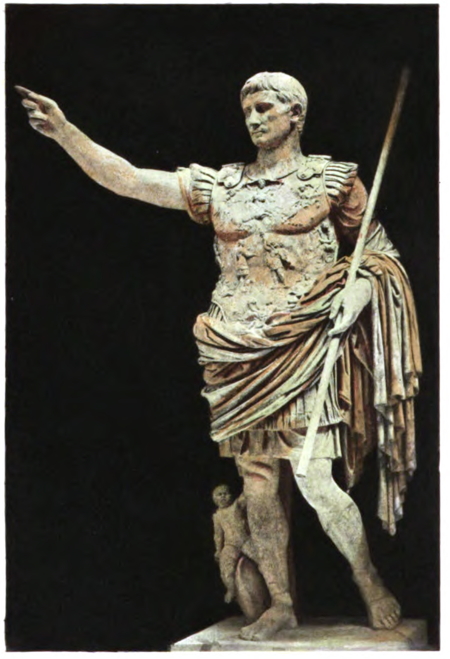
Augustus Caesar. From a statue in the Vatican Museum.
LIST OF ILLUSTRATIONS↩
- Augustus Cæsar Frontispiece. From a statue in the Vatican Museum.
- Map of the Roman Empire in 180 ad, page 90
- Triumphal Entry of Marcus Aurelius into Rome, p. 98. From a bas-relief.
- Marcus Aurelius Granting Grace to his Enemies, p. 108. From a Roman bas-relief.
- A Banquet of Commodus, p. 120. From a drawing by Jan Styka.
- The Forum, Rome, p. 220. From a drawing by Jan Styka.
[I-xvii]
INTRODUCTION [1] ↩
The history of Gibbon has been described by John Stuart Mill as the only eighteenth-century history that has withstood nineteenth-century criticism; and whatever objections modern critics may bring against some of its parts, the substantial justice of this verdict will scarcely be contested. No other history of that century has been so often reprinted, annotated, and discussed, or remains to the present day a capital authority on the great period of which it treats. As a composition it stands unchallenged and conspicuous among the masterpieces of English literature, while as a history it covers a space of more than twelve hundred years, including some of the most momentous events in the annals of mankind.
Gibbon was born at Putney, Surrey, April 27, 1737. Though his father was a member of Parliament and the owner of a moderate competence, the author of this great work was essentially a self-educated man. Weak health and almost constant illness in early boyhood broke up his school life, — which appears to have been fitfully and most imperfectly conducted, — withdrew him from boyish games, but also gave him, as it has given to many other shy and sedentary boys, an early and inveterate passion for reading. His reading, however, was very unlike that of an ordinary boy. He has given a graphic picture of the ardour with which, when he was only fourteen, he flung himself into serious but unguided study; which was at first purely desultory, but [I-xviii] gradually contracted into historic lines, and soon concentrated itself mainly on that Oriental history which he was one day so brilliantly to illuminate. “Before I was sixteen,” he says, “I had exhausted all that could be learned in English of the Arabs and Persians, the Tartars and Turks; and the same ardour led me to guess at the French of D’Herbelot, and to construe the barbarous Latin of Pocock’s ‘Abulfaragius.’”
His health, however, gradually improved, and when he entered Magdalen College, Oxford, it might have been expected that a new period of intellectual development would have begun; but Oxford had at this time sunk to the lowest depth of stagnation, and to Gibbon it proved extremely uncongenial. He complained that he found no guidance, no stimulus, and no discipline, and that the fourteen months he spent there were the most idle and unprofitable of his life. They were very unexpectedly cut short by his conversion to the Roman Catholic faith, which he formally adopted at the age of sixteen.
This conversion is, on the whole, the most surprising incident of his calm and uneventful life. The tendencies of the time, both in England and on the Continent, were in a wholly different direction. The more spiritual and emotional natures were now passing into the religious revival of Wesley and Whitefield, which was slowly transforming the character of the Anglican Church and laying the foundations of the great Evangelical party. In other quarters the predominant tendencies were towards unbelief, scepticism, or indifference. Nature seldom formed a more sceptical intellect than that of Gibbon, and he was utterly without the spiritual insight, or spiritual cravings, or overmastering enthusiasms, that produce and explain most religious changes. Nor was he in the least drawn towards Catholicism on its æsthetic side. He had never come in contact with its worship or its professors; and to his unimaginative, unimpassioned, and profoundly intellectual temperament, no ideal type could be [I-xix] more uncongenial than that of the saint. He had, however, from early youth been keenly interested in theological controversies. He argued, like Lardner and Paley, that miracles are the Divine attestation of orthodoxy. Middleton convinced him that unless the Patristic writers were wholly undeserving of credit, the gift of miracles continued in the Church during the fourth and fifth centuries; and he was unable to resist the conclusion that during that period many of the leading doctrines of Catholicism had passed into the Church. The writings of the Jesuit Parsons, and still more the writings of Bossuet, completed the work which Middleton had begun. Having arrived at this conclusion, Gibbon acted on it with characteristic honesty, and was received into the Church on the 8th of June, 1753.
The English universities were at this time purely Anglican bodies, and the conversion of Gibbon excluded him from Oxford. His father judiciously sent him to Lausanne to study with a Swiss pastor named Pavilliard, with whom he spent five happy and profitable years. The theological episode was soon terminated. Partly under the influence of his teacher, but much more through his own reading and reflections, he soon disentangled the purely intellectual ties that bound him to the Church of Rome; and on Christmas Day, 1754, he received the sacrament in the Protestant church of Lausanne.
His residence at Lausanne was very useful to him. He had access to books in abundance, and his tutor, who was a man of great good sense and amiability but of no remarkable capacity, very judiciously left his industrious pupil to pursue his studies in his own way. “Hiving wisdom with each studious year,” as Byron so truly says, he speedily amassed a store of learning which has seldom been equalled. His insatiable love of knowledge, his rare capacity for concentrated, accurate, and fruitful study, guided by a singularly sure and masculine judgment, soon made him, in the true sense of the word, one of the best scholars of his time. His learning, [I-xx] however, was not altogether of the kind that may be found in a great university professor. Though the classical languages became familiar to him, he never acquired or greatly valued the minute and finished scholarship which is the boast of the chief English schools; and careful students have observed that in following Greek books he must have very largely used the Latin translations. Perhaps in his capacity of historian this deficiency was rather an advantage than the reverse. It saved him from the exaggerated value of classical form, and from the neglect of the more corrupt literatures, to which English scholars have been often prone. Gibbon always valued books mainly for what they contained, and he had early learned the lesson which all good historians should learn: that some of his most valuable materials will be found in literatures that have no artistic merit; in writers who, without theory and almost without criticism, simply relate the facts which they have seen, and express in unsophisticated language the beliefs and impressions of their time.
Lausanne and not Oxford was the real birthplace of his intellect, and he returned from it almost a foreigner. French had become as familiar to him as his own tongue; and his first book, a somewhat superficial essay on the study of literature, was published in the French language. The noble contemporary French literature filled him with delight, and he found on the borders of the Lake of Geneva a highly cultivated society to which he was soon introduced, and which probably gave him more real pleasure than any in which he afterwards moved. With Voltaire himself he had some slight acquaintance, and he at one time looked on him with profound admiration; though fuller knowledge made him sensible of the flaws in that splendid intellect. I am here concerned with the life of Gibbon only in as far as it discloses the influences that contributed to his master work, and among these influences the foreign element holds a prominent place. There was little in Gibbon that was distinctively [I-xxi] English; his mind was essentially cosmopolitan. His tastes, ideals, and modes of thought and feeling turned instinctively to the Continent.
In one respect this foreign type was of great advantage to his work. Gibbon excels all other English historians in symmetry, proportion, perspective, and arrangement, which are also the preëminent and characteristic merits of the best French literature. We find in his writing nothing of the great miscalculations of space that were made by such writers as Macaulay and Buckle; nothing of the awkward repetitions, the confused arrangement, the semi-detached and disjointed episodes that mar the beauty of many other histories of no small merit. Vast and multifarious as are the subjects which he has treated, his work is a great whole, admirably woven in all its parts. On the other hand, his foreign taste may perhaps be seen in his neglect of the Saxon element, which is the most vigorous and homely element in English prose. Probably in no other English writer does the Latin element so entirely predominate. Gibbon never wrote an unmeaning and very seldom an obscure sentence; he could always paint with sustained and stately eloquence an illustrious character or a splendid scene: but he was wholly wanting in the grace of simplicity, and a monotony of glitter and of mannerism is the great defect of his style. He possessed, to a degree which even Tacitus and Bacon had hardly surpassed, the supreme literary gift of condensation, and it gives an admirable force and vividness to his narrative; but it is sometimes carried to excess. Not unfrequently it is attained by an excessive allusiveness, and a wide knowledge of the subject is needed to enable the reader to perceive the full import and meaning conveyed or hinted at by a mere turn of phrase. But though his style is artificial and pedantic, and greatly wanting in flexibility, it has a rare power of clinging to the memory, and it has profoundly influenced English prose. That excellent judge, Cardinal Newman, has said of Gibbon, “I seem to trace his vigorous [I-xxii] condensation and peculiar rhythm at every turn in the literature of the present day.”
It is not necessary to relate here in any detail the later events of the life of Gibbon. There was his enlistment as captain in the Hampshire militia. It involved two and a half years of active service, extending from May, 1760, to December, 1762; and as Gibbon afterwards acknowledged, if it interrupted his studies and brought him into very uncongenial duties and societies, it at least greatly enlarged his acquaintance with English life, and also gave him a knowledge of the rudiments of military science, which was not without its use to the historian of so many battles. There was a long journey, lasting for two years and five months, in France and Italy, which greatly confirmed his foreign tendencies. In Paris he moved familiarly in some of the best French literary society; and in Rome, as he tells us in a well-known passage, while he sat “musing amidst the ruins of the Capitol while the barefooted friars were singing vespers in the Temple of Jupiter” (which is now the Church of the Ara Cœli), — on October 15, 1764, — he first conceived the idea of writing the history of the decline and fall of Rome.
There was also that very curious episode in his life, lasting from 1774 to 1782, — his appearance in the House of Commons. He had declined an offer of his father’s to purchase a seat for him in 1760; and fourteen years later, when his father was dead, when his own circumstances were considerably contracted, he received and accepted at the hands of a family connection the offer of a seat. His Parliamentary career was entirely undistinguished, and he never even opened his mouth in debate, — a fact which was not forgotten when very recently another historian was candidate for a seat in Parliament. In truth, this somewhat shy and reserved scholar, with his fastidious taste, his eminently judicial mind, and his highly condensed and elaborate style, was singularly unfit for the rough work of Parliamentary discussion. No one can read his books without perceiving [I-xxiii] that his English was not that of a debater; and he has candidly admitted that he entered Parliament without public spirit or serious interest in politics, and that he valued it chiefly as leading to an office which might restore the fortune which the extravagance of his father had greatly impaired. His only real public service was the composition in French of a reply to the French manifesto which was issued at the beginning of the war of 1778. He voted steadily and placidly as a Tory, and it is not probable that in doing so he did any violence to his opinions. Like Hume, he shrank with an instinctive dislike from all popular agitations, from all turbulence, passion, exaggeration, and enthusiasm; and a temperate and well-ordered despotism was evidently his ideal. He showed it in the well-known passage in which he extols the benevolent despotism of the Antonines as without exception the happiest period in the history of mankind, and in the unmixed horror with which he looked upon the French Revolution that broke up the old landmarks of Europe. For three years he held an office in the Board of Trade, which added considerably to his income without adding greatly to his labours, and he supported steadily the American policy of Lord North and the Coalition ministry of North and Fox; but the loss of his office and the retirement of North soon drove him from Parliament, and he shortly after took up his residence at Lausanne.
But before this time a considerable part of his great work had been accomplished. The first quarto volume of the “Decline and Fall” appeared in February, 1776. As is usually the case with historical works, it occupied a much longer period than its successors, and was the fruit of about ten years of labour. It passed rapidly through three editions, received the enthusiastic eulogy of Hume and Robertson, and was no doubt greatly assisted in its circulation by the storm of controversy that arose about his Fifteenth and Sixteenth Chapters. In April, 1781, two more volumes appeared, and the three concluding volumes were published [I-xxiv] together on the 8th of May, 1788, being the fifty-first birthday of the author.
A work of such magnitude, dealing with so vast a variety of subjects, was certain to exhibit some flaws. The controversy at first turned mainly upon its religious tendency. The complete scepticism of the author, his aversion to the ecclesiastical type which dominated in the period of which he wrote, and his unalterable conviction that Christianity, by diverting the strength and enthusiasm of the Empire from civic into ascetic and ecclesiastical channels, was a main cause of the downfall of the Empire and of the triumph of barbarism, gave him a bias which it was impossible to overlook. On no other subject is his irony more bitter or his contempt so manifestly displayed. Few good critics will deny that the growth of the ascetic spirit had a large part in corroding and enfeebling the civic virtues of the Empire; but the part which it played was that of intensifying a disease that had already begun, and Gibbon, while exaggerating the amount of the evil, has very imperfectly described the great services rendered even by a monastic Church in laying the basis of another civilisation and in mitigating the calamities of the barbarian invasion. The causes he has given of the spread of Christianity in the Fifteenth Chapter were for the most part true causes, but there were others of which he was wholly insensible. The strong moral enthusiasms that transform the character and inspire or accelerate all great religious changes lay wholly beyond the sphere of his realisations. His language about the Christian martyrs is the most repulsive portion of his work; and his comparison of the sufferings caused by pagan and Christian persecutions is greatly vitiated by the fact that he only takes account of the number of deaths, and lays no stress on the profuse employment of atrocious tortures, which was one of the most distinct features of the pagan persecutions. At the same time, though Gibbon displays in this field a manifest and a distorting bias, he never, like some of his French contemporaries, [I-xxv] sinks into the mere partisan, awarding to one side unqualified eulogy and to the other unqualified contempt. Let the reader who doubts this examine and compare his masterly portraits of Julian and of Athanasius, and he will perceive how clearly the great historian could recognise weaknesses in the characters by which he was most attracted, and elements of true greatness in those by which he was most repelled. A modern writer, in treating of the history of religions, would have given a larger space to comparative religion, and to the gradual, unconscious, and spontaneous growth of myths in the twilight periods of the human mind. These, however, were subjects which were scarcely known in the days of Gibbon, and he cannot be blamed for not having discussed them.
Another class of objections which has been brought against him is that he is weak upon the philosophical side, and deals with history mainly as a mere chronicle of events, and not as a chain of causes and consequences, a series of problems to be solved, a gradual evolution which it is the task of the historian to explain. Coleridge, who detested Gibbon and spoke of him with gross injustice, has put this objection in the strongest form. He accuses him of having reduced history to a mere collection of splendid anecdotes; of noting nothing but what may produce an effect; of skipping from eminence to eminence without ever taking his readers through the valleys between; of having never made a single philosophical attempt to fathom the ultimate causes of the decline and fall of the Roman Empire, which is the very subject of his history. That such charges are grossly exaggerated will be apparent to any one who will carefully read the Second and Third Chapters, describing the state and tendencies of the Empire under the Antonines; or the chapters devoted to the rise and character of the barbarians, to the spread of Christianity, to the influence of monasticism, to the jurisprudence of the republic, and of the Empire; nor would it be difficult to collect many acute and profound philosophical [I-xxvi] remarks from other portions of the history. Still, it may be admitted that the philosophical side is not its strongest part. Social and economical changes are sometimes inadequately examined and explained, and we often desire fuller information about the manners and life of the masses of the people. As far as concerns the age of the Antonines, this want has been amply supplied by the great work of Friedländer.
History, like many other things in our generation, has fallen largely into the hands of specialists; and it is inevitable that men who have devoted their lives to a minute examination of short periods should be able to detect some deficiencies and errors in a writer who traversed a period of more than twelve hundred years. Many generations of scholars have arisen since Gibbon; many new sources of knowledge have become available, and archæology especially has thrown a flood of new light on some of the subjects he treated. Though his knowledge and his narrative are on the whole admirably sustained, there are periods which he knew less well and treated less fully than others. His account of the Crusades is generally acknowledged to be one of the most conspicuous of these, and within the last few years there has arisen a school of historians who protest against the low opinion of the Byzantine Empire which was held by Gibbon, and was almost universal among scholars till the present generation. That these writers have brought into relief certain merits of the Lower Empire which Gibbon had neglected, will not be denied; but it is perhaps too early to decide whether the reaction has not, like most reactions, been carried to extravagance, and whether in its general features the estimate of Gibbon is not nearer the truth than some of those which are now put forward to replace it.
Much must no doubt be added to the work of Gibbon in order to bring it up to the level of our present knowledge; but there is no sign that any single work is likely to supersede [I-xxvii] it or to render it useless to the student; nor does its survival depend only or even mainly on its great literary qualities, which have made it one of the classics of the language. In some of these qualities Hume was the equal of Gibbon and in others his superior, and he brought to his history a more penetrating and philosophical intellect and an equally calm and unenthusiastic nature; but the study which Hume bestowed on his subject was so superficial and his statements were often so inaccurate, that his work is now never quoted as an authority. With Gibbon it is quite otherwise. His marvellous industry, his almost unrivalled accuracy of detail, his sincere love of truth, his rare discrimination and insight in weighing testimony and in judging character, have given him a secure place among the greatest historians of the world.
His life lasted only fifty-six years; he died in London on January 15, 1794. Gibbon’s autobiography is one of the best specimens of self-portraiture in the language, reflecting with pellucid clearness both the life and character, the merits and defects, of its author. He was certainly neither a hero nor a saint; nor did he possess the moral and intellectual qualities that dominate in the great conflicts of life, sway the passions of men, appeal powerfully to the imagination, or dazzle and impress in social intercourse. He was a little slow, a little pompous, a little affected and pedantic. In the general type of his mind and character he bore much more resemblance to Hume, Adam Smith, or Reynolds, than to Johnson or Burke. A reserved scholar, who was rather proud of being a man of the world; a confirmed bachelor, much wedded to his comforts though caring nothing for luxury, he was eminently moderate in his ambitions, and there was not a trace of passion or enthusiasm in his nature. Such a man was not likely to inspire any strong devotion. But his temper was most kindly, equable, and contented; he was a steady friend, and he appears to have been always liked and honoured in the cultivated and uncontentious [I-xxviii] society in which he delighted. His life was not a great one, but it was in all essentials blameless and happy. He found the work which was most congenial to him. He pursued it with admirable industry and with brilliant success, and he left behind him a book which is not likely to be forgotten while the English language endures.
[I-xxix]
PREFACE OF THE AUTHOR↩
It is not my intention to detain the reader by expatiating on the variety, or the importance of the subject, which I have undertaken to treat; since the merit of the choice would serve to render the weakness of the execution still more apparent, and still less excusable. But, as I have presumed to lay before the Public a first volume only [1] of the History of the Decline and Fall of the Roman Empire, it will perhaps be expected that I should explain, in a few words, the nature and limits of my general plan.
The memorable series of revolutions, which, in the course of about thirteen centuries, gradually undermined, and at length destroyed, the solid fabric of human greatness, may, with some propriety, be divided into the three following periods:
I. The first of these periods may be traced from the age of Trajan and the Antonines, when the Roman monarchy, having attained its full strength and maturity, began to verge towards its decline; and will extend to the subversion of the Western Empire, by the barbarians of Germany and Scythia, the rude ancestors of the most polished nations of modern Europe. This extraordinary revolution, which subjected Rome to the power of a Gothic conqueror, was completed about the beginning of the sixth century.
[I-xxx]
II. The second period of the Decline and Fall of Rome may be supposed to commence with the reign of Justinian, who by his laws, as well as by his victories, restored a transient splendour to the Eastern Empire. It will comprehend the invasion of Italy by the Lombards; the conquest of the Asiatic and African provinces by the Arabs, who embraced the religion of Mahomet; the revolt of the Roman people against the feeble princes of Constantinople; and the elevation of Charlemagne, who, in the year 800, established the second, or German Empire of the West.
III. The last and longest of these periods includes about six centuries and a half; from the revival of the Western Empire till the taking of Constantinople by the Turks and the extinction of a degenerate race of princes, who continued to assume the titles of Cæsar and Augustus, after their dominions were contracted to the limits of a single city; in which the language, as well as manners, of the ancient Romans had been long since forgotten. The writer who should undertake to relate the events of this period would find himself obliged to enter into the general history of the Crusades, as far as they contributed to the ruin of the Greek Empire; and he would scarcely be able to restrain his curiosity from making some enquiry into the state of the city of Rome during the darkness and confusion of the middle ages.
As I have ventured, perhaps too hastily, to commit to the press a work, which, in every sense of the word, deserves the epithet of imperfect, I consider myself as contracting an engagement to finish, most probably in a second volume, [1] the first of these memorable periods; and to deliver to the Public the complete History of the Decline and Fall of [I-xxxi] Rome, from the age of the Antonines to the subversion of the Western Empire. With regard to the subsequent periods, though I may entertain some hopes, I dare not presume to give any assurances. The execution of the extensive plan which I have described would connect the ancient and modern history of the World; but it would require many years of health, of leisure, and of perseverance.
Bentinck Street,
February 1, 1776.
P.S. — The entire History, which is now published, of the Decline and Fall of the Roman Empire in the West abundantly discharges my engagements with the Public. Perhaps their favourable opinion may encourage me to prosecute a work, which, however laborious it may seem, is the most agreeable occupation of my leisure hours.
Bentinck Street,
March 1, 1781.
An Author easily persuades himself that the public opinion is still favourable to his labours; and I have now embraced the serious resolution of proceeding to the last period of my original design, and of the Roman Empire, the taking of Constantinople by the Turks, in the year one thousand four hundred and fifty-three. The most patient reader, who computes that three ponderous volumes [1] have been already employed on the events of four centuries, may, perhaps, be alarmed at the long prospect of nine hundred years. But it is not my intention to expatiate with the same minuteness on the whole series of the Byzantine history. At our entrance into this period, the reign of Justinian and the conquests of the Mahometans will deserve and detain our attention, and the last age of Constantinople (the Crusades [I-xxxii] and the Turks) is connected with the revolutions of Modern Europe. From the seventh to the eleventh century, the obscure interval will be supplied by a concise narrative of such facts as may still appear either interesting or important.
Bentinck Street,
March 1, 1782.
[I-xxxiii]
ADVERTISEMENT TO THE NOTES [1] ↩
Diligence and accuracy are the only merits which an historical writer may ascribe to himself; if any merit indeed can be assumed from the performance of an indispensable duty. I may therefore be allowed to say that I have carefully examined all the original materials that could illustrate the subject which I had undertaken to treat. Should I ever complete the extensive design which has been sketched out in the preface, I might perhaps conclude it with a critical account of the authors consulted during the progress of the whole work; and, however such an attempt might incur the censure of ostentation, I am persuaded that it would be susceptible of entertainment as well as information.
At present I shall content myself with a single observation. The Biographers, who, under the reigns of Diocletian and Constantine, composed, or rather compiled, the lives of the emperors, from Hadrian to the sons of Carus, are usually mentioned under the names of Ælius Spartianus, Julius Capitolinus, Ælius Lampridius, Vulcatius Gallicanus, Trebellius Pollio, and Flavius Vopiscus. But there is so much perplexity in the titles of the MSS., and so many disputes have arisen among the critics (see Fabricius Biblioth. Latin. l. iii. c. 6) concerning their number, their names and their respective property, that for the most part I have quoted them without distinction, under the general and well-known title of the Augustan History.
[I-xxxiv]
ADVERTISEMENT TO THE FIRST OCTAVO EDITION↩
The History of the Decline and Fall of the Roman Empire is now delivered to the public in a more convenient form. Some alterations and improvements had presented themselves to my mind, but I was unwilling to injure or offend the purchasers of the preceding editions. The accuracy of the corrector of the press has been already tried and approved; and perhaps I may stand excused if, amidst the avocations of a busy writer, I have preferred the pleasures of composition and study to the minute diligence of revising a former publication.
Bentinck Street,
April 20, 1783.
[I-xxxv]
PREFACE TO THE FOURTH VOLUME OF THE QUARTO EDITION↩
I now discharge my promise, and complete my design, of writing the History of the Decline and Fall of the Roman Empire, both in the West and the East. The whole period extends from the age of Trajan and the Antonines to the taking of Constantinople by Mahomet the Second; and includes a review of the Crusades and the state of Rome during the middle ages. Since the publication of the first volume, twelve years have elapsed; twelve years, according to my wish, “of health, of leisure and of perseverance.” I may now congratulate my deliverance from a long and laborious service, and my satisfaction will be pure and perfect, if the public favour should be extended to the conclusion of my work.
It was my first intention to have collected under one view the numerous authors, of every age and language, from whom I have derived the materials of this history; and I am still convinced that the apparent ostentation would be more than compensated by real use. If I have renounced this idea, if I have declined an undertaking which had obtained the approbation of a master-artist, [1] my excuse may be found in the extreme difficulty of assigning a proper measure to such a catalogue. A naked list of names and editions would not be satisfactory either to myself or my readers: the characters of the principal Authors of the Roman and Byzantine History have been occasionally connected with the events which they describe; a more copious and critical enquiry might indeed deserve, but it would demand, an elaborate volume, which [I-xxxvi] might swell by degrees into a general library of historical writers. For the present I shall content myself with renewing my serious protestation, that I have always endeavoured to draw from the fountain-head; that my curiosity, as well as a sense of duty, has always urged me to study the originals; and that, if they have sometimes eluded my search, I have carefully marked the secondary evidence, on whose faith a passage or a fact were reduced to depend.
I shall soon visit the banks of the lake of Lausanne, a country which I have known and loved from my early youth. Under a mild government, amidst a beauteous landskip, in a life of leisure and independence, and among a people of easy and elegant manners, I have enjoyed, and may again hope to enjoy, the varied pleasures of retirement and society. But I shall ever glory in the name and character of an Englishman: I am proud of my birth in a free and enlightened country; and the approbation of that country is the best and most honourable reward for my labours. Were I ambitious of any other Patron than the Public, I would inscribe this work to a Statesman, who, in a long, a stormy, and at length an unfortunate administration, had many political opponents, almost without a personal enemy: who has retained, in his fall from power, many faithful and disinterested friends; and who, under the pressure of severe infirmity, enjoys the lively vigour of his mind, and the felicity of his incomparable temper. Lord North will permit me to express the feelings of friendship in the language of truth: but even truth and friendship should be silent, if he still dispensed the favours of the crown.
In a remote solitude, vanity may still whisper in my ear that my readers, perhaps, may enquire whether, in the conclusion of the present work, I am now taking an everlasting farewell. They shall hear all that I know myself, all that I could reveal to the most intimate friend. The motives of action or silence are now equally balanced; nor can I pronounce, in my most secret thoughts, on which side the scale will preponderate. I cannot dissemble that twelve ample [I-xxxvii] octavos must have tried, and may have exhausted, the indulgence of the Public; that, in the repetition of similar attempts, a successful Author has much more to lose, than he can hope to gain; that I am now descending into the vale of years; and that the most respectable of my countrymen, the men whom I aspire to imitate, have resigned the pen of history about the same period of their lives. Yet I consider that the annals of ancient and modern times may afford many rich and interesting subjects; that I am still possessed of health and leisure; that by the practice of writing some skill and facility must be acquired; and that in the ardent pursuit of truth and knowledge I am not conscious of decay. To an active mind, indolence is more painful than labour; and the first months of my liberty will be occupied and amused in the excursions of curiosity and taste. By such temptations I have been sometimes seduced from the rigid duty even of a pleasing and voluntary task: but my time will now be my own; and in the use or abuse of independence I shall no longer fear my own reproaches or those of my friends. I am fairly entitled to a year of jubilee: next summer and the following winter will rapidly pass away; and experience only can determine whether I shall still prefer the freedom and variety of study to the design and composition of a regular work, which animates, while it confines, the daily application of the Author. Caprice and accident may influence my choice; but the dexterity of self-love will contrive to applaud either active industry or philosophic repose.
Downing Street,
May 1, 1788.
P. S. — I shall embrace this opportunity of introducing two verbal remarks, which have not conveniently offered themselves to my notice. 1. As often as I use the definitions of beyond the Alps, the Rhine, the Danube, &c., I generally suppose myself at Rome, and afterwards at Constantinople: without observing whether this relative geography may agree with the [I-xxxviii] local, but variable, situation of the reader or the historian. 2. In proper names of foreign, and especially of Oriental, origin, it should be always our aim to express in our English version a faithful copy of the original. But this rule, which is founded on a just regard to uniformity and truth, must often be relaxed; and the exceptions will be limited or enlarged by the custom of the language and the taste of the interpreter. Our alphabets may be often defective: a harsh sound, an uncouth spelling, might offend the ear or the eye of our countrymen; and some words, notoriously corrupt, are fixed, and, as it were, naturalised in the vulgar tongue. The prophet Mohammed can no longer be stripped of the famous, though improper, appellation of Mahomet: the well-known cities of Aleppo, Damascus and Cairo would almost be lost in the strange descriptions of Haleb, Demashk and Al Cahira: the titles and offices of the Ottoman empire are fashioned by the practice of three hundred years; and we are pleased to blend the three Chinese monosyllables Con-fû-tzee in the respectable name of Confucius, or even to adopt the Portuguese corruption of Mandarin. But I would vary the use of Zoroaster and Zerdusht, as I drew my information from Greece or Persia: since our connection with India, the genuine Timour is restored to the throne of Tamerlane: our most correct writers have retrenched the Al, the superfluous article, from the Koran; and we escape an ambiguous termination by adopting Moslem instead of Musulman, in the plural number. In these, and in a thousand examples, the shades of distinction are often minute; and I can feel, where I cannot explain, the motives of my choice.
[I-xxxix]
INTRODUCTION BY THE EDITOR↩
Gibbon is one of those few writers who hold as high a place in the history of literature as in the roll of great historians. He concerns us here as an historian; our business is to consider how far the view which he has presented of the decline and fall of the Roman Empire can be accepted as faithful to the facts, and in what respects it needs correction in the light of discoveries which have been made since he wrote. But the fact that his work, composed more than a hundred years ago, is still successful with the general circle of educated people, and has not gone the way of Hume and Robertson, whom we laud as “classics” and leave on the cold shelves, is due to the singularly happy union of the historian and the man of letters. Gibbon thus ranks with Thucydides and Tacitus, and is perhaps the clearest example that brilliance of style and accuracy of statement — in Livy’s case conspicuously divorced — are perfectly compatible in an historian.
His position among men of letters depends both on the fact that he was an exponent of important ideas and on his style. The appreciation of his style devolves upon the history of literature; but it may be interesting to illustrate how much attention he paid to it, by alterations which he made in his text. The first volume was published, in quarto form, in 1776, and the second quarto edition of this volume, which appeared in 1782, exhibits a considerable number of variants. Having carefully collated the two editions throughout the first fourteen chapters, I have observed that, in most [I-xl] cases, the changes were made for the sake not of correcting misstatements of fact, but of improving the turn of a sentence, rearranging the dactyls and cretics, or securing greater accuracy of expression. Some instances may be interesting.
| First edition | Second edition | |
| P. 2. | Instead of exposing his person and his legions to the arrows of the Parthians, he satisfied himself with the restitution of the standards and prisoners which were taken in the defeat of Crassus. | Instead of exposing his person and his legions to the arrows of the Parthians he obtained, by an honourable treaty, the restitution of the standards and prisoners which had been taken in the defeat of Crassus. |
| P. 12. | The peasant or mechanic, imbibed the useful prejudice . . . that, although the prowess of a private soldier, might escape the notice of fame, it would be in his power to confer glory or disgrace on the company, the legion, or even the army, to whose honours he was associated. | The peasant, or mechanic imbibed the useful prejudice . . . that although the prowess of a private soldier must often escape the notice of fame, his own behaviour might sometimes confer glory or disgrace on the company, the legion, or even the army, to whose honours he was associated. |
| P. 67. | The olive, in the western world, was the companion as well as the symbol of peace. | The olive, in the western world, followed the progress of peace of which it was considered as the symbol. |
| P. 75. | The general definition of a monarchy seems to be that of a state, &c. | The obvious definition of a monarchy seems to be that of a state, &c. |
| P. 77. | The present greatness of the Roman state, the corruption of manners, and the licence of the soldiers added new weight to the advocates of monarchy. | The present greatness of the Roman state, the corruption of manners, and the licence of the soldiers supplied new arguments to the advocates of monarchy. |
| P. 79. | On the most important occasions, peace and war were seriously debated in the senate. | The most important resolutions of peace and war were seriously debated in the senate. |
| P. 89. | However the latter [i.e. the name Cæsar], was diffused by adoption and female alliance, Nero was the last prince who could claim so noble an extraction. | However the latter was diffused by adoption and female alliance, Nero was the last prince who could allege any hereditary claim to the honours of the Julian line. |
| P. 93. | Which . . . had just finished the conquest of Judæa. | Which . . . had recently achieved the conquest of Judæa. |
| P. 136. | To ascend a throne streaming with the blood of so near a relation. | To ascend a throne polluted with the recent blood of so near a relation. |
| P. 141. | Severus, who had sufficient greatness of mind to adopt several useful institutions from a vanquished enemy. | Severus, who afterwards displayed the greatness of his mind by adopting several useful institutions from a vanquished enemy. |
These are a few specimens of the numerous cases in which alterations have been made for the purpose of improving the language. Sometimes, in the new edition, statements are couched in a less positive form. For example: —
| P. 11. | The legions themselves consisted of Roman citizens. | The legions themselves were supposed to consist of Roman citizens. |
| P. 99. | And he even condescended to give lessons of philosophy in a more public manner than suited the modesty of a sage or the dignity of an emperor. | And he even condescended to give lessons of philosophy in a more public manner than was perhaps consistent with the modesty of a sage or the dignity of an emperor. |
There are also cases, where something is added which, without changing the general sense, renders a statement fuller, more picturesque, or more vivid. Thus: —
| P. 31. | A sandy desert skirted along the doubtful confine of Syria, from the Euphrates to the Red Sea. | A sandy desert, alike destitute of wood and water, skirts along the doubtful confine of Syria, from the Euphrates to the Red Sea. |
| P. 61. | The spirit of improvement had passed the Alps and been felt even in the woods of Britain. | The spirit of improvement had passed the Alps and been felt even in the woods of Britain, which were gradually leared away to open a free space for convenient and elegant habitations. |
| P. 72. | The sciences of physic and astronomy were cultivated with some degree of reputation; but if we except the inimitable Lucian, an age of indolence passed away without producing a single writer of genius, who deserved the attention of posterity. | The sciences of physic and astronomy were successfully cultivated by the Greeks; the observations of Ptolemy and the writings of Galen are studied by those who have improved their discoveries and corrected their errors; but if we except the inimitable Lucian, this age of indolence passed away without having produced a single writer of original genius, or who excelled in the arts of elegant composition. |
It may be noticed in this connection that at a later period Gibbon set to work to revise the second edition, but did not get further than p. 32 of the first volume. [1] His own copy with autograph marginal notes was exhibited last year, on the occasion of the Gibbon Centenary, by the Royal Historical Society, and is to be seen in the British Museum. The corrections and annotations are as follows: —
(P. 1 = 1 of this edition.) “To describe the prosperous condition of their empire.” Read times for empire.
“And afterwards from the death of Marcus Antoninus.” The following note is entered: “Should I not have given the history of that fortunate period which was interposed between two iron ages? Should I not have deduced the decline of the Empire from the Civil Wars that ensued after the Fall of Nero, or even from the tyranny which succeeded the reign of [I-xliii] Augustus? Alas! I should: but of what avail is this tardy knowledge? Where error is irreparable, repentance is useless.”
(P. 2 = 1.) “To deduce the most important circumstances of its decline and fall: a revolution which will ever be remembered, and is still felt by the nations of the earth.” These words are erased and the following are substituted: “To prosecute the decline and fall of the empire of Rome: of whose language, religion and laws the impression will be long preserved in our own and the neighbouring countries of Europe.” To which an observation is appended: “N.B. Mr. Hume told me that, in correcting his history, he always laboured to reduce superlatives, and soften positives. Have Asia and Africa, from Japan to Morocco, any feeling or memory of the Roman Empire?”
(P. 2 = 2.) On the words “rapid succession of triumphs,” note: “Excursion I. on the succession of Roman triumphs.”
(P. 3 = 3.) On “bulwarks and boundaries,” note: “Incertum metû an per invidiam (Tacit. Annal. i. 11). Why must rational advice be imputed to a base or foolish motive? To what cause, error, malevolence, or flattery shall I ascribe the unworthy alternative? Was the historian dazzled by Trajan’s conquests?”
(P. 6 = 6.) “On the immortality and transmigration of soul” (compare footnote). Note: “Julian assigns this Theological cause, of whose power he himself might be conscious (Cæsares, p. 327). Yet I am not assured that the religion of Zamolxis subsisted in the time of Trajan; or that his Dacians were the same people with the Getae of Herodotus. The transmigration of the soul has been believed by many nations, warlike as the Celts, or pusillanimous like the Hindoos. When speculative opinion is kindled into practical enthusiasm, its operation will be determined by the previous character of the man or the nation.”
(P. 7 = 7.) “On their destroyers than on their benefactors.” Note: “The first place in the temple of fame is [I-xliv] due and is assigned to the successful heroes who had struggled with adversity; who, after signalising their valour in the deliverance of their country, have displayed their wisdom and virtue in foundation or government of a flourishing state. Such men as Moses, Cyrus, Alfred, Gustavus Vasa, Henry IV. of France, &c.”
“The thirst of military glory will ever be the vice of the most exalted [characters . . . but he] lamented with a sigh that his advanced age, &c.” All included within the brackets is erased, and the following substituted: “the most exalted minds. Late generations and far distant climates may impute their calamities to the immortal author of the Iliad. The spirit of Alexander was inflamed by the praises of Achilles: and succeeding Heroes have been ambitious to tread in the footsteps of Alexander. Like him the Emperor Trajan aspired to the conquest of the East; but the Roman lamented with a sigh,” &c.
(P. 11 = 12.) “A just preference was given to the climates of the north over those of the south.” Note: “The distinction of North and South is real and intelligible; and our pursuit is terminated on either side by the poles of the Earth. But the difference of East and West is arbitrary and shifts round the globe. As the men of the North, not of the West, the legions of Gaul and Germany were superior to the South-Eastern natives of Asia and Egypt. It is the triumph of cold over heat; which may, however, and has been surmounted by moral causes.”
(P. 15 = 15.) “A correspondent number of tribunes and centurions.” Note: “The composition of the Roman officers was very faulty. 1. It was late before a Tribune was fixed to each cohort. Six tribunes were chosen from the entire legion, which two of them commanded by turns (Polyb. l. vi. p. 526, edit. Schweighaeuser), for the space of two months. 2. One long subordination from the Colonel to the Corporal was unknown. I cannot discover any intermediate ranks between the Tribune and the Centurion, the Centurion and the manipularis [I-xlv] or private leginary [sic]. 3. As the tribunes were often without experience, the centurions were often without education, mere soldiers of fortune who had risen from the ranks (eo immitior quia toleraverat, Tacit. Annal. i. 20). A body equal to eight or nine of our battalions might be commanded by half a dozen young gentlemen and fifty or sixty old sergeants. Like the legions, our great ships of war may seem ill provided with officers: but in both cases the deficiency is corrected by strong principles of discipline and rigour.”
(P. 17, footnote 53 = 18, footnote 55.) “As in the instance of Horace and Agricola.” These words are erased. Note: “quod mihi pareret legio Romana Tribuno (Horat. Serm. l. i. vi. 45), a worthy commander of three and twenty from the school of Athens! Augustus was indulgent to Roman birth, liberis Senatorum . . . militiam. auspicantes non tribunatum modo legionum sed et praefecturas alarum dedit (Sueton. c. 38).”
(P. 32, footnote 86 = 33, footnote 94.) “A league and a half above the surface of the sea.” Note: “More correctly, according to Mr. Bouguer, 2500 toises (Buffon, Supplement, tom. v. p. 304). The height of Mont Blanc is now fixed to 2416 toises (Saussure, Voyage dans les Alpes, tom. i. p. 495): but the lowest ground from whence it can be seen is itself greatly elevated above the level of the sea. He who sails by the isle of Teneriff, contemplates the entire Pike, from the foot to the summit.”
But Gibbon has his place in literature not only as the stylist, who never lays aside his toga when he takes up his pen, but as the expounder of a large and striking idea in a sphere of intense interest to mankind, and as a powerful representative of certain tendencies of his age. The guiding idea or “moral” of his history is briefly stated in his epigram: “I have described the triumph of barbarism and religion.” In other words, the historical development of [I-xlvi] human societies, since the second century after Christ, was a retrogression (according to ordinary views of “progress”), for which Christianity was mainly to blame. This conclusion of Gibbon tended in the same direction as the theories of Rousseau; only, while Rousseau dated the decline from the day when men left Arcadia, Gibbon’s era was the death of Marcus Aurelius.
We are thus taken into a region of speculation where every traveller must make his own chart. But to attempt to deny a general truth in Gibbon’s point of view is vain; and it is feeble to deprecate his sneer. We may spare more sympathy than he for the warriors and the churchmen; but all that has since been added to his knowledge of facts has neither reversed nor blunted the point of the “Decline and Fall.” Optimism of temperament may shut the eyes; faith, wedded to some “one increasing purpose” which it shrinks from grasping, may divert from the path of facts. But for an inquirer not blinded by religious prepossessions, or misled by comfortable sophistries, Gibbon really expounded one of the chief data with which the philosophy of history has to reckon. How are we to define progress? how recognise retrogression? What is the end in relation to which such words have their meaning, and is there a law which will explain “the triumph of barbarism and religion” as a necessary moment in a reasonable process towards that end, whatever it may be? Answers have been given since Gibbon’s day, engaging to the intellect, but always making some demand on the faith — answers for which he would have the same smile as for Leo’s Dogmatic Epistle. There is certainly some reason for thinking these questions insoluble. We may say at least that the meaning of the philosophy of history is misapprehended until it is recognised that its function is not to solve problems but to transform them.
But, though the moral of Gibbon’s work has not lost its meaning yet, it is otherwise with the particular treatment of Christian theology and Christian institutions. Our point [I-xlvii] of view has altered, and, if Gibbon were writing now, the tone of his “candid and rational inquiry” would certainly be different. His manner would not be that of sometimes open, sometimes transparently veiled, dislike; he would rather assume an attitude of detachment. He would be affected by that merely historical point of view, which is a note of the present century and its larger tolerances; and more than half disarmed by that wide diffusion of unobtrusive scepticism among educated people, which seems to render offensive warfare superfluous. The man of letters admires the fine edge of subtle sarcasm, wielded by Gibbon with such skill and effect; while the historian is interested in an historical standpoint of the last century. Neither the historian nor the man of letters will any longer subscribe, without a thousand reserves, to the theological chapters of the “Decline and Fall,” and no discreet inquirer would go there for his ecclesiastical history. Yet we need not hide the fact that Gibbon’s success has in a large measure been due to his scorn for the Church; which, most emphatically expressed in the theological chapters, has, as one might say, spiced his book. The attack of a man, equipped with erudition, and of perfectly sober judgment, on cherished beliefs and revered institutions, must always excite the interest, by irritating the passions, of men. Gibbon’s classical moderation of judgment, his temperate mood, was responsible, as well as foreign education and the influence of French thought, for his attitude to Christianity and to Mahometanism. He hated excess, and the immoderation of the multitude. He could suffer the tolerant piety of a learned abbé or “the fat slumbers of the Church”; but with the religious faith of a fanatical populace or the ardour of its demagogues his reason was unable to sympathise. In the spirit of Cicero or Tacitus he despised the superstitions of the vulgar, and regarded the unmeasured enthusiasm of the early Christians as many sober Churchmen regard the fanaticism of Islam. He dealt out the same measure to the [I-xlviii] opposite enthusiasm of Julian the Apostate. [2] His work was all the more effective, because he was never dogmatic himself. His irony should not be construed as insincerity, but rather as showing that he was profoundly — one might say, constitutionally — convinced of the truth of that sceptical conclusion which has been, in a different spirit, formulated precisely by the Bishop of Oxford; “there is no room for sweeping denunciations or trenchant criticisms in the dealings of a world whose falsehoods and veracities are separated by so very thin a barrier.”
Thus Gibbon’s attitude to religion, while it was conditioned by the intellectual atmosphere of Europe in that age, was also the expression of the man. When Dean Milman spoke of his “bold and disingenuous attack on Christianity,” [3] he made one of those futile charges which it would be impossible to prove and impossible to disprove; such imputations as are characteristic of theologians in the heat of controversy and may be condoned to politicians in the heat of electioneering, but in an historical critic are merely an impertinence.
It has sometimes been remarked that those histories are most readable which are written to prove a thesis. The indictment of the Empire by Tacitus, the defence of Cæsarianism by Mommsen, Grote’s vindication of democracy, Droysen’s advocacy of monarchy, might be cited as examples. All these writers intended to present the facts as they took place, but all wrote with prepossessions and opinions, in the light of which they interpreted the events of history. Arnold deliberately advocated such partiality on the ground that “the past is reflected to us by the present and the partyman feels the present most.” Another Oxford Regius Professor remarked that “without some infusion of spite it seems as if history could not be written.” On the other side stands the [I-xlix] formula of Ranke as to the true task of the historian: “Ich will bloss sagen wie es eigentlich gewesen ist.” The Greek History of Bishop Thirlwall, the English Constitutional History of Bishop Stubbs himself, were written in this spirit. But the most striking instances perhaps, because they tread with such light feet on the treacherous ashes of more recent history, are Ranke and Bishop Creighton. Thucydides is the most ancient example of this historical reserve. It cannot be said that Gibbon sat down to write with any ulterior purpose, but, as we have seen, he allowed his temperament to colour his history, and used it to prove a congenial thesis. But, while he put things in the light demanded by this thesis, he related his facts accurately. If we take into account the vast range of his work, his accuracy is amazing. He laboured under some disadvantages, which are set forth in his own Memoirs. He had not enjoyed that school and university training in the languages and literatures of Greece and Rome which is probably the best preparation for historical research. His knowledge of Greek was imperfect; he was very far from having the “scrupulous ear of the well-flogged critic.” He has committed errors of translation, and was capable of writing “Gregory of Nazianzen.” But such slips are singularly few. Nor is he accustomed to take lightly quotations at second hand; like that famous passage of Eligius of Noyon — held up by Arnold as a warning — which Robertson and Hallam successively copied from Mosheim, where it had appeared in a garbled form, to prove exactly the opposite of its true meaning.
From one curious inaccuracy, which neither critics nor editors seem to have observed, he must I think be acquitted. In his account of the disturbances in Africa and Egypt in the reign of Diocletian, we meet the following passage (vol. ii. chap. xiii. p. 160): —
“Julian had assumed the purple at Carthage. Achilleus at Alexandria, and even the Blemmyes, renewed, or [I-l] rather continued their incursions into the Upper Egypt.”
Achilleus arose at this time (295-6 ad) as a tyrant at Alexandria; but that he made either at this date or at any previous date an incursion into the Upper Egypt, there is not a trace of evidence in our authorities. I am convinced however that this error was not originally due to the author, but merely a treacherous misprint, which was overlooked by him in correcting the proof sheets, and has also escaped the notice of his editors. By a slight change in punctuation we obtain a perfectly correct statement of the situation: —
“Julian had assumed the purple at Carthage, Achilleus at Alexandria; and even the Blemmyes renewed, or rather continued, their incursions into the Upper Egypt.”
I have no doubts that this was the sentence originally meant and probably written by Gibbon, and have felt no scruple in extirpating the inveterate error from the text. [4]
Gibbon’s diligent accuracy in the use of his materials cannot be over-praised, and it will not be diminished by giving the due credit to his French predecessor Tillemont. The Histoire des Empereurs and the Mémoires ecclésiastiques, laborious and exhaustive collections of material, were addressed to the special student and not to the general reader, but scholars may still consult them with profit. It is interesting to find Mommsen in his later years retracting one of his earlier judgments and reverting to a conclusion of [I-li] Tillemont. In his recent edition [5] of the Laterculus of Polemius Silvius, he writes thus: —
“L’auteur de la Notice — peritissimi Tillemontii verba sunt (hist. 5, 699) — vivoit en Occident et ne savoit pas trop l’état où estoit l’Orient; ei iuvenis contradixi hodie subscribo.”
It is one of Gibbon’s merits that he made full use of Tillemont, “whose inimitable accuracy almost assumes the character of genius,” as far as Tillemont guided him, up to the reign of Anastasius I.; and it is only just to the mighty work of the Frenchman to impute to him a large share in the accuracy which the Englishman achieved. From the historical, though not from the literary, point of view, Gibbon, deserted by Tillemont, distinctly declines, though he is well sustained through the wars of Justinian by the clear narrative of Procopius.
Recognising that Gibbon was accurate, we do not acknowledge by implication that he was always right; for accuracy is relative to opportunities. The discovery of new materials, the researches of numerous scholars, in the course of a hundred years, have not only added to our knowledge of facts, but have modified and upset conclusions which Gibbon with his materials was justified in drawing. Compare a chapter or two of Mr. Hodgkin’s Italy and her Invaders with the corresponding episode in Gibbon, and many minor points will appear in which correction has been needful. If Gibbon were alive and writing now, his history would be very different. Affected by the intellectual experiences of the past century he could not adopt quite the same historical attitude; and we should consequently lose the colouring of his brilliant attack on Christianity. [I-lii] Again, he would have found it an absolute necessity to learn what he insolently called that “barbarous idiom,” the German language; and this might have affected his style as it would certainly have affected his matter. We dare not deplore Gibbon’s limitations, for they were the conditions of his great achievement.
Not the least important aspect of the Decline and Fall is its lesson in the unity of history, the favourite theme of Mr. Freeman. The title displays the cardinal fact that the Empire founded by Augustus fell in 1461; that all the changes which transformed the Europe of Marcus Aurelius into the Europe of Erasmus had not abolished the name and memory of the Empire. And whatever names of contempt — in harmony with his thesis — Gibbon might apply to the institution in the period of its later decline, such as the “Lower Empire,” or “Greek Empire,” his title rectified any false impressions that such language might cause. On the continuity of the Roman Empire depended the unity of his work. By the emphasis laid on this fact he did the same kind of service to the study of history in England, that Mr. Bryce has done in his Holy Roman Empire by tracing the thread which connects the Europe of Francis the Second with the Europe of Charles the Great.
Gibbon read widely, and had a large general knowledge of history, which supplied him with many happy illustrations. It is worth pointing out that the gap in his knowledge of ancient history was the period of the Diadochi and Epigoni. If he had been familiar with that period, he would not have said that Diocletian was the first to give to the world the example of a resignation of sovereignty. He would have referred to the conspicuous case of Ptolemy Soter; Mr. Freeman would have added Lydiadas, the tyrant of Megalopolis. Of the earlier example of Asarhaddon Gibbon could not have known.
To pass from scope and spirit to method, Gibbon’s historical sense kept him constantly right in dealing with his [I-liii] sources, but he can hardly be said to have treated them methodically. The growth of German erudition is one of the leading features of the intellectual history of the nineteenth century; and one of its most important contributions to historical method lies in the investigation of sources. German scholars have indeed pressed this “Quellenkunde” further than it can safely be pressed. A philologist, writing his doctoral dissertation, will bring plausible reasons to prove where exactly Diodorus ceased to “write out” Ephorus, whose work we do not possess, and began to write out somebody else, whose work is also lost to us. But, though the method lends itself to the multiplication of vain subtleties, it is absolutely indispensable for scientific historiography. It is in fact part of the science of evidence. The distinction of primary and derivative authorities might be used as a test. The untrained historian fails to recognise that nothing is added to the value of a statement of Widukind by its repetition by Thietmar or Ekkehard, and that a record in the Continuation of Theophanes gains no further credibility from the fact that it likewise occurs in Cedrenus, Zonaras or Glycas.
While evidence is more systematically arranged, greater care is bestowed on sifting and probing what our authorities say, and in distinguishing contemporary from later witnesses. Not a few important results have been derived from such methods; they enable us to trace the growth of stories. The evidence against Faustina shrinks into nothing; the existence of Pope Joan is exploded. It is irrelevant to condemn a statement of Zonaras as made by a “modern Greek.” The question is, where did he get it? [6]
The difficult questions connected with the authorship and compilation of the Historia Augusta have produced a chestful of German pamphlets, but they did not trouble Gibbon. [I-liv] The relationships of the later Greek chronicles and histories are more difficult and intricate even than the questions raised by the Historia Augusta, but he did not even formulate a prudent interrogation. Ferdinand Hirsch, twenty years ago, cleared new roads through this forest, in which George the Monk and the Logothete who continued him, Leo Grammaticus and Simeon Magister, John Scylitzes, George Cedrenus and Zonaras, lived in promiscuous obscurity. Büttner-Wobst on one side, C. de Boor on the other, have been working effectually on the same lines, clearing up the haze which surrounds George the Monk — the time has gone by for calling him George Hamartolus. Another formidable problem, that of John Malalas — with his namesake John of Antioch, so hard to catch, — having been grappled with by Jeep, Sotiriades and others, is now being more effectively treated by Patzig.
Criticism, too, has rejected some sources from which Gibbon drew without suspicion. In the interest of literature we may perhaps be glad that like Ockley he used with confidence the now discredited Al Wakidi. Before such maintained perfection of manner, to choose is hard; but the chapter on the origin of Mahometanism and its first triumphs against the Empire would alone be enough to win perpetual literary fame. Without Al Wakidi’s romance they would not have been written; and the historian, compelled to regard Gibbon’s description as he would a Life of Charles the Great based on the monk of St. Gall, must refer the inquirer after facts to Sprenger’s Life of Mahomet and Weil’s History of the Caliphs. [7]
In connection with the use of materials, reference may be [I-lv] made to a mode of proceeding which Gibbon has sometimes adopted and which modern method condemns. It is not legitimate to blend the evidence of two different periods in order to paint a complete picture of an institution. Great caution, for example, is needed in using the Greek epics, of which the earliest and latest parts differ by a long interval, for the purpose of portraying a so-called Homeric or heroic age. A notice of Fredegarius will not be necessarily applicable to the age of the sons and grandsons of Chlodwig, and a custom which was familiar to Gregory or Venantius may have become obsolete before the days of the last Merwings. It is instructive to compare Gibbon’s description of the social and political institutions of our Teutonic forefathers with that of Bishop Stubbs. Gibbon blends together with dexterity the evidence of Cæsar and Tacitus, between whom a century had elapsed, and composes a single picture; whereas Bishop Stubbs keeps the statements of the two Romans carefully apart, and by comparing them is able to show that in certain respects the Germans had developed in the interval. Gibbon’s account of the military establishment of the Empire, in the first chapter of his work, is open to a like objection. He has blended, without due criticism, the evidence of Vegetius with that of earlier writers. [8]
In the study of sources, then, our advance has been great, while the labours of an historian have become more arduous. It leads us to another advance of the highest importance. To use historical documents with confidence, an assurance that the words of the writer have been correctly transmitted is manifestly indispensable. It generally happens that our [I-lvi] texts have come down in several MSS., of different ages, and there are often various discrepancies. We have then to determine the relations of the MSS. to each other and their comparative values. To the pure philologist this is part of the alphabet of his profession; but the pure historian takes time to realise it, and it was not realised in the age of Gibbon as it is to-day. Nothing forces upon the historian the necessity of having a sound text so impressively as the process of comparing different documents in order to determine whether one was dependent on another, — the process of investigating sources. In this respect we have now to be thankful for many blessings denied to Gibbon and — so recent is our progress — denied to Milman and Finlay. We have Mommsen’s editions of Jordanes and the Variæ of Cassiodorius, his Chronica Minora (still incomplete), including, for instance, Idatius, the Prospers, Count Marcellinus; we have Peter’s Historia Augusta, Gardthausen’s Ammianus, Luetjohann’s Sidonius Apollinaris; Duchesne’s Liber Pontificalis; and a large number of critical texts of ecclesiastical writers might be mentioned. [9] The Greek historians have been less fortunate. The Bonn edition of the “Byzantine Writers,” issued under the auspices of Niebuhr and Bekker in the early part of this century, was the most lamentably feeble production ever given to the world by German scholars of great reputation. It marked no advance on the older folio edition, except that it was cheaper, and that one or two new documents were included. But there is now a reasonable prospect that we shall by degrees have a complete series of trustworthy texts. De Boor showed the way by his splendid edition of Theophanes and his smaller texts of Theophylactus Simocatta and the Patriarch Nicephorus. Mendelssohn’s Zosimus, and Reifferscheid’s Anna Comnena stand beside them. Haury promises a Procopius, and we are expecting from Seger a long-desired John Scylitzes, the greater part of whose text, though [I-lvii] existing in a MS. at Paris, has never been printed and can only be inferred by a comparison of the Latin translation of Gabius with the chronicle of Cedrenus, who copied him with faithful servility.
The legends of the Saints, though properly outside the domain of the historian proper, often supply him with valuable help. For “Culturgeschichte” they are a direct source. Finlay observed that the Acta Sanctorum contain an unexplored mine for the social life of the Eastern Empire. But before they can be confidently dealt with, trained criticism must do its will on the texts; the relations between the various versions of each legend must be defined and the tradition in each case made clear. The task is huge; the libraries of Europe and Hither Asia are full of these holy tales. But Usener has made a good beginning and Krumbacher has rendered the immense service of pointing out precisely what the problems are. [10]
Besides improved methods of dealing with the old material, much new material of various kinds has been discovered, since the work of Gibbon. To take one department, our coins have increased in number. It seems a pity that he who worked at his Spanheim with such diligence was not able to make use of Eckhel’s great work on Imperial coinage which began to appear in 1792 and was completed in 1798. Since then we have had Cohen, and the special works of Saulcy [I-lviii] and Sabatier. M. Schlumberger’s splendid study of Byzantine sigillography must be mentioned in the same connection. [11]
The constitution and history of the Principate, and the provincial government of the early Emperors, have been placed on an entirely new basis by Mommsen and his school. [12] The Römisches Staatsrecht is a fabric for whose rearing was needed not only improved scholarship but an extensive collection of epigraphic material. The Corpus of Latin Inscriptions is the keystone of the work.
Hence Gibbon’s first chapters are somewhat “out of date.” But on the other hand his admirable description of the change from the Principate to absolute Monarchy, and the system of Diocletian and Constantine, is still most valuable. Here inscriptions are less illustrative, and he disposed of much the same material as we, especially the Codex Theodosianus. New light is badly wanted, and has not been to any extent forthcoming, on the respective contributions of Diocletian and Constantine to the organisation of the new monarchy. As to the arrangement of the provinces we have indeed a precious document in the Verona List (published by Mommsen), which, dating from 297 ad, shows Diocletian’s reorganisation. The modifications which were made between this year and the beginning of the fifth century when the Notitia Dignitatum was drawn up, can be largely determined not only by lists in Rufus and Ammianus, but, as far as the Eastern provinces are concerned, by the Laterculus of Polemius Silvius. Thus, partly by critical method applied to Polemius, partly by the discovery of a new document, we are enabled to rectify the list of Gibbon, who adopted the [I-lix] simple plan of ascribing to Diocletian and Constantine the detailed organisation of the Notitia. Otherwise our knowledge of the changes of Diocletian has not been greatly augmented; but our clearer conception of the Principate and its steady development towards pure monarchy has reflected light on Diocletian’s system; and the tendencies of the third century, though still obscure at many points, have been made more distinct. The year of the Gordians is still as great a puzzle as ever; but the dates of Alexandrine coins with the tribunician years give us here, as elsewhere, limits of which Gibbon was ignorant. While speaking of the third century, I may add that Calpurnius Siculus, whom Gibbon claimed as a contemporary of Carinus, has been restored by modern criticism to the reign of Nero, and this error has vitiated some of Gibbon’s pages.
The constitutional history of the Empire from Diocletian forward has still to be written systematically. Some noteworthy contributions to this subject have been made by Russian scholars.
Gibbon’s forty-fourth chapter is still not only famous, but admired by jurists as a brief and brilliant exposition of the principles of Roman law. To say that it is worthy of the subject is the best tribute that can be paid to it. A series of foreign scholars of acute legal ability has elaborated the study of the science in the present century; I need only refer to such names as Savigny and Jhering. A critical edition of the Corpus juris Romani by Mommsen himself has been one of the chief contributions. The manuscript of Gaius is the new discovery to be recorded; and we can imagine with what interest Gibbon, were he restored to earth, would compare in Gneist’s parallel columns the Institutions with the elder treatise.
But whoever takes up Gibbon’s theme now will not be content with an exposition of the Justinianean Law. He must go on to its later development in the subsequent centuries, in the company of Zachariä von Lingenthal and Heimbach. [I-lx] Such a study has been made possible and comparatively easy by the magnificent works of Zachariä, among whose achievements I may single out his restoration of the Ecloga, which used to be ascribed to Leo VI., to its true author Leo III.; a discovery which illuminated in a most welcome manner the Isaurian reformation. It is interesting to observe that the last work which engaged him even on his death-bed was an attempt to prove exactly the same thing for the military treatise known as the Tactics of Leo VI. Here too Zachariä thinks that Leo was the Isaurian, while the received view is that he was the “Philosopher.”
Having illustrated by examples the advantages open to an historian of the present day, which were not open to Gibbon, for dealing with Gibbon’s theme, — improved and refined methods, a closer union of philology with history, and ampler material, — we may go on to consider a general defect in his treatment of the Later Empire, and here too exhibit, by a few instances, progress made in particular departments.
Gibbon ended the first half of his work with the so-called fall of the Western Empire in 476 ad — a date which has been fixed out of regard for Italy and Rome, and should strictly be 480 ad in consideration of Julius Nepos. Thus the same space is devoted to the first three hundred years which is allowed to the remaining nine hundred and eighty. Nor does the inequality end here. More than a quarter of the second half of the work deals with the first two of these ten centuries. The mere statement of the fact shows that the history of the Empire from Heraclius to the last Grand Comnenus of Trebizond is merely a sketch with certain episodes more fully treated. The personal history and domestic policy of all the Emperors, from the son of Heraclius to Isaac Angelus, are compressed into one chapter. This mode of dealing with the subject is in harmony with the author’s contemptuous attitude to the “Byzantine” or “Lower” Empire.
[I-lxi]
But Gibbon’s account of the internal history of the Empire after Heraclius is not only superficial: it gives an entirely false impression of the facts. If the materials had been then as well sifted and studied as they are even to-day, he could not have failed to see that beneath the intrigues and crimes of the Palace there were deeper causes at work, and beyond the revolutions of the Capital City wider issues implied. The cause for which the Iconoclasts contended involved far more than an ecclesiastical rule or usage: it meant, and they realised, the regeneration of the Empire. Or, to take another instance: the key to the history of the tenth and eleventh centuries is the struggle between the Imperial throne and the great landed interest of Asia Minor; [13] the accession of Alexius Comnenus marked the final victory of the latter. Nor had Gibbon any conception of the great ability of most of the Emperors from Leo the Isaurian to Basil II., or, we might say, to Constantine the conqueror of Armenia. The designation of the story of the later Empire as a “uniform tale of weakness and misery” [14] is one of the most untrue, and most effective, judgments ever uttered by a thoughtful historian. Before the outrage of 1204, the Empire was the bulwark of the West. [15]
Against Gibbon’s point of view there has been a gradual reaction which may be said to have culminated within the last ten years. It was begun by Finlay, whose unprosperous speculations in Greece after the Revolution prompted him to seek for the causes of the insecurity of investments in land, and, leading him back to the year 146 bc, involved him in [I-lxii] a history of the “Byzantine Empire” which embedded a history of Greece. [16] The great value of Finlay’s work lies not only in its impartiality and in his trained discernment of the commercial and financial facts underlying the superficial history of the chronicles, but in its full and trustworthy narration of the events. By the time that Mr. Tozer’s edition appeared in 1876, it was being recognised that Gibbon’s word on the later Empire was not the last. Meanwhile Hertzberg was going over the ground in Germany, and Gfrörer, whose ecclesiastical studies had taken him into those regions, had written a good deal of various value. Hirsch’s Byzantinische Studien had just appeared, and Rambaud’s l’Empire grec au Xme siècle. M. Sathas was bringing out his Bibliotheca Græca medii aevi — including two volumes of Psellus — and was beginning his Documents inédits. Professor Lambros was working at his Athens in the Twelfth Century and preparing his editio princeps of the great Archbishop Akominatos. Hopf had collected a mass of new materials from the archives of southern cities. In England, Freeman was pointing out the true position of New Rome and her Emperors in the history of Europe.
These tendencies have increased in volume and velocity within the last twenty years. They may be said to have reached their culminating point in the publication of Professor Krumbacher’s History of Byzantine Literature. [17] The importance of this work, of vast scope and extraordinary accuracy, can only be fully understood by the specialist. It has already promoted and facilitated the progress of the study in an incalculable measure; and it was soon followed by the inauguration of a journal, entirely devoted to works on “Byzantine” subjects, by the same scholar. The Byzantinische [I-lxiii] Zeitschrift would have been impossible twenty-five years ago, and nothing shows more surely the turn of the tide. Professor Krumbacher’s work seems likely to form as important an epoch as that of Ducange.
Meanwhile in a part of Europe which deems itself to have received the torch from the Emperors as it has received their torch from the Patriarchs, and which has always had a special regard for the city of Constantine, some excellent work was being done. In Russia, Muralt edited the chronicle of George the monk and his Continuers, and compiled Byzantine Fasti. The Journal of the Ministry of Public Instruction is the storehouse of a long series of most valuable articles dealing, from various sides, with the history of the later Empire, by those indefatigable workers Uspenski and Vasilievski. At length, in 1894, Krumbacher’s lead has been followed, and the Vizantiski Vremennik, a Russian counterpart of the Byzantinische Zeitschrift, has been started under the joint editorship of Vasilievski and Regel, and is clearly destined, with the help of Veselovski, Kondakov, Bieliaiev and the rest of a goodly fellowship, to make its mark.
After this general sketch of the new prospects of later Imperial history, it will be useful to show by some examples what sort of progress is being made, and what kind of work has to be done. I will first take some special points of interest connected with Justinian. My second example shall be the topography of Constantinople; and my third the large field of literature composed in colloquial Greek. Lastly, the capital defect of the second half of Gibbon’s work, his inadequate treatment, or rather his neglect, of the Slavs, will serve to illustrate our historical progress.
New light has been cast, from more than one side, on the reign of Justinian where there are so many uncertain and interesting places. The first step that methodical history had to take was a thoroughgoing criticism of Procopius, and [I-lxiv] this was more than half done by Dahn in his elaborate monograph. The double problem of the “Secret History” has stimulated the curiosity of the historian and the critic. Was Procopius the author? and in any case, are the statements credible? Gibbon has inserted in his notes the worst bits of the scandals which far outdid the convivium quinquaginta meretricum described by Burchard, or the feast of Sophonius Tigellinus; and he did not hesitate to believe them. Their credibility is now generally questioned, but the historian of Cæsarea is a much more interesting figure if it can be shown that he was the author. From a careful comparison of the Secret History with the works of Procopian authorship, in point of style, Dahn concluded that Procopius wrote it. Ranke argued against this view and maintained that it was the work of a malcontent who had obtained possession of a private diary of Procopius, on which framework he constructed the scandalous chronicle, imitating successfully the Procopian style. [18]
The question has been placed on a new footing by Haury; [19] and it is very interesting to find that the solution depends on the right determination of certain dates. The result is briefly as follows: —
Procopius was a malcontent who hated Justinian and all his works. He set himself the task of writing a history of his time, which, as the secretary of Belisarius, he had good opportunities of observing. He composed a narrative of the military events, in which he abstained from committing himself, so that it could be safely published in his own lifetime. Even here his critical attitude to the government is sometimes clear. He allows it to be read between the lines that he regarded the reconquest of Africa and Italy as calamities for those countries; which thus came under an [I-lxv] oppressor, to be stripped by his governors and tax gatherers. But the domestic administration was more dangerous ground, on which Procopius could not tread without raising a voice of bitter indignation and hatred. So he dealt with this in a book which was to be kept secret during his own life and bequeathed to friends who might be trusted to give it to the world at a suitable time. The greater part of the Military History, which treated in seven Books the Persian, Vandalic, and Gothic wars, was finished in 545 ad, and perhaps read to a select circle of friends; at a later time some additions were made, but no changes in what had been already written. The Secret History, as Haury has proved from internal evidence, was written in 550. [20] About three years later the Military History received an eighth Book, bringing the story down to the end of the Gothic war. Then the work came under the notice of Justinian, who saw that a great historian had arisen; and Procopius, who had certainly not described the wars for the purpose of pleasing the Emperor, but had sailed as close to the wind as he dared, was called upon to undertake the disagreeable task of lauding the oppressor. An Imperial command was clearly the origin of the De Ædificiis (560 ad), in which the reluctant writer adopted the plan of making adulation so fulsome, that, except to Justinian’s vanity, he might appear to be laughing in his sleeve. At the very beginning of the treatise he has a sly allusion to the explosives which were lying in his desk, unknown to the Imperial spies.
Such is the outline of the literary motives of Procopius as we must conceive them, now that we have a practical certainty that he, and no other, wrote the Secret History. For Haury’s [I-lxvi] dates enable us, as he points out, to argue as follows: If Procopius did not write the book, it was obviously written by a forger, who wished it to pass as a Procopian work. But in 550 no forger could have had the close acquaintance with the Military History which is exhibited by the author of the Anecdota. And moreover the identity of the introduction of the eighth Book of the Military History with that of the Secret History, which was urged by Ranke as an objection to the genuineness of the latter work, now tells decisively in favour of it. For if Procopius composed it in 553, how could a forger, writing in 550, have anticipated it? And if the forger composed it in 550, how are we to explain its appearance in a later work of Procopius himself? These considerations put it beyond all reasonable doubt that Procopius was the author of the Secret History; for this assumption is the only one which supplies an intelligible explanation of the facts.
Another puzzle in connection with Justinian lay in certain biographical details relating to that emperor and his family; which Alemanni, in his commentary on the Secret History, quoted on the authority of a Life of Justinian by a certain Abbot Theophilus, said to have been the Emperor’s preceptor. Of these biographical notices, and of Justinian’s preceptor Theophilus, we otherwise knew nothing; nor had any one, since Alemanni, seen the Biography. Gibbon and other historians accepted without question the statements quoted by Alemanni; though it would have been wiser to treat them with more reserve, until some data for criticising them were discovered. The puzzle of Alemanni’s source, the Life of Theophilus, was solved by Mr. Bryce, who discovered in the library of the Barberini palace at Rome the original text from which Alemanni drew his information. [21] [I-lxvii] It professes to be an extract from a Slavonic work, containing the Life of Justinian up to the thirtieth year of his reign, composed by Bogomil, abbot of the monastery of St. Alexander in Dardania. This extract was translated by Marnavich, Canon of Sebenico (afterwards Bishop of Bosnia, 1631-1639), a friend of Alemanni, and some notes were appended by the same scholar. Bogomil is the Slavonic equivalent of the Greek Theophilus, which was accordingly adopted by Alemanni in his references. Mr. Bryce has shown clearly that this document, interesting as it is in illustrating how Slavonic legends had grown up round the name of Justinian, is worthless as history, and that there is no reason to suppose that such a person as the Dardanian Bogomil ever existed. We are indeed met by a new problem, which, however, is of no serious concern to the practical purposes of history. How did Marnavich obtain a copy of the original Life, from which he made the extract, and which he declares to be preserved in the library of the monks who profess the rule of St. Basil on Mount Athos? Does the original still exist, on Mount Athos or elsewhere? or did it ever exist?
The wars of Justinian [22] in the west have been fully and admirably related by Mr. Hodgkin, with the exception of the obscure conquest of Spain, on which there is too little to be said and nothing further seems likely to come to light. In regard to the ecclesiastical policy of Justinian there is still a field for research.
As for the study of the great work of Anthemius, which brings us to the general subject of Byzantine art, much has been done within the last half century. Gibbon had nothing to help him for the buildings of Constantinople that could compare with Adam’s splendid work which he consulted for the buildings of Spalato. We have now Salzenberg’s luxurious work, Alt-christliche Baudenkmale von Constantinopel, [I-lxviii] published just fifty years ago by the Prussian government, with plates which enable us to make a full study of the architecture of St. Sophia. A few months ago a complete and scholarly English study of this church by Messrs. Lethaby and Swainson appeared. Other churches, too, especially those at Ravenna, have received careful attention; De Voguě’s admirable work on the architecture of Syria is well known; but Strzygovski has only too good reason for complaining that the study of Byzantine architecture, as a whole, has not yet properly begun. A large work on the churches of Greece, which two English scholars are preparing, ought to do much to further the cause which Strzygovski has at heart, and to which he has made valuable contributions himself. [23] More progress is perhaps being made in the study of miniature painting and iconography; and in this field the work of the Russian student Kondakov is the most noteworthy.
The study of works of architecture in ancient cities, like Athens, Rome, or Constantinople, naturally entails a study of the topography of the town; and in the case of Constantinople this study is equally important for the historian. Little progress of a satisfactory kind can be made until either Constantinople passes under a European government, or a complete change comes over the spirit of Turkish administration. The region of the Imperial Palace and the ground between the Hippodrome and St. Sophia must be excavated before certainty on the main points can be attained. Labarte’s a priori reconstruction of the plan of the palace, on the basis of the Cerimonies of Constantine Porphyrogennetos and scattered notices in other Greek writers, was wonderfully ingenious and a certain part of it is manifestly right, though there is much which is not borne out by a more careful examination of the sources. The next step was taken by a [I-lxix] Russian scholar Bieliaiev who has recently published a most valuable study on the Cerimonies, [24] in which he has tested the reconstruction of Labarte and shown us exactly where we are, — what we know, and what with our present materials we cannot possibly know. Between Labarte and Bieliaiev the whole problem was obscured by the unscholarly work of Paspatês, the Greek antiquarian; whose sole merit was that he kept the subject before the world. As the acropolis is the scene of so many great events in the history which Gibbon recorded, it is well to warn the reader that our sources make it absolutely certain that the Hippodrome adjoined the Palace; there was no public space between them. The Augusteum did not lie, as Paspatês asserted, between the Palace and the Hippodrome, [25] but between the north side of the Hippodrome and St. Sophia.
On the trades and industries of the Imperial City, on the trade corporations and the minute control exercised over them by the government, new light has been thrown by M. Nicole’s discovery and publication of the Prefect’s Book, a code of regulations drawn up by Leo VI. The demes of Constantinople are a subject which needs investigation. They are certainly not to be regarded as Gibbon and his successors have regarded them, as mere circus parties. They must represent, as Uspenski points out in the opening number [I-lxx] of the new Vizantiski Vremennik, organised divisions of the population.
A field in which the historian must wander to breathe the spirit and learn the manner of the mediæval Greek world is that of the romance, both prose and verse, written in the vulgar tongue. This field was closed to Gibbon, but the labours of many scholars, above all Legrand, have rendered it now easily accessible. Out of a large number of interesting things I may refer especially to two. One is the epic of Digenes Akritas, the Roland or Cid of the Later Empire, a poem of the tenth century, which illustrates the life of Armatoli and the border warfare against the Saracens in the Cilician mountains. The other is the Book of the Conquest of the Morea, [26] a mixture of fiction and fact, but invaluable for realising the fascinating though complicated history of the “Latin” settlements in Greece. That history was set aside by Gibbon, with the phrase, “I shall not pursue the obscure and various dynasties that rose and fell on the continent or in the isles,” though he deigns to give a page or two to Athens. [27] But it is a subject with unusual possibilities for picturesque treatment, and out of which, Gibbon, if he had apprehended the opportunity, and had possessed the materials, would have made a brilliant chapter. Since Finlay, who entered into this episode of Greek history with great fulness, the material has been largely increased by the researches of Hopf. [28]
[I-lxxi]
As I have already observed, it is perhaps on the Slavonic side of the history of the Empire that Gibbon is most conspicuously inadequate. Since he wrote, various causes have combined to increase our knowledge of Slavonic antiquity. The Slavs themselves have engaged in methodical investigation of their own past; and, since the entire or partial emancipations of the southern Slavs from Asiatic rule, a general interest in Slavonic things has grown up throughout Europe. Gibbon dismissed the history of the First Bulgarian Kingdom, from its foundation in the reign of Constantine Pogonatus to its overthrow by the second Basil, in two pages. To-day the author of a history of the Empire on the same scale would find two hundred a strict limit. Gibbon tells us nothing of the Slavonic missionaries, Cyril and Methodius, round whose names an extensive literature has been formed. It is only in recent years that the geography of the Illyrian peninsula has become an accessible subject of study.
The investigation of the history of the northern peoples who came under the influence of the Empire has been stimulated by controversy, and controversy has been animated and even embittered by national pride. The question of Slavonic settlements in Greece has been thoroughly ventilated, because Fallmerayer excited the scholarship of Hellenes and Philhellenes to refute what they regarded as an insulting paradox. [29] So, too, the pride of the Roumanians was irritated by Roesler, who denied that they were descended from the inhabitants of Trajan’s Dacia and described them as later immigrants of the thirteenth century. Pič arose against him; then Hermuzaki argued for an intermediate date. The best Hungarian scholar of the day joined the fray, on the other side; and the contention became bitter between [I-lxxii] Vlach and Magyar, the Roumanian pretensions to Siebenbürgen — “Dacia irredenta” — sharpening the lances of the foes. The Roumanians have not come out of their “question” as well as the Hellenes. Hungary too has its own question. Are the Magyars to be ethically associated with the Finns or given over to the family of the Turks, whom as champions of Christendom they had opposed at Mohácz and Varna? It was a matter of pride for the Hungarian to detach himself from the Turk; and the evidence is certainly on his side. Hunfalvy’s conclusions have successfully defied the assaults of Vámbéry. [30] Again in Russia there has been a long and vigorous contest, — the so-called Norman or Varangian question. No doubt is felt now by the impartial judge as to the Scandinavian origin of the princes of Kiev, and that the making of Russia was due to Northmen or Varangians. Kunik and Pogodin were reinforced by Thomsen of Denmark; and the pure Slavism of Ilovaiski [31] and Gedeonov, though its champions were certainly able, is a lost cause.
From such collisions sparks have flown and illuminated dark corners. For the Slavs the road was first cleared by Šafarik. The development of the comparative philology of the Indo-Germanic tongues has had its effect; the Slavonic languages have been brought into line, chiefly by the lifework of Miklosich; and the science is being developed by such scholars as Jagič and Leskien. The several countries of the Balkan lands have their archæologists and archæological journals; and the difficulty which now meets the historian is not the absence but the plenitude of philological and historical literature.
[I-lxxiii]
A word may be added about the Hungarians, who have not been so successful with their early history as the Slavs. Until the appearance of Hunfalvy, their methods were antediluvian, and their temper credulous. The special work of Jászay, and the first chapters of Szalay’s great History of Hungary, showed no advance on Katóna and Pray, who were consulted by Gibbon. All believed in the Anonymous Scribe of King Béla; Jászay simply transcribed him. Then Roesler came and dispelled the illusion. Our main sources now are Constantine Porphyrogennetos, and the earlier Asiatic traveller Ibn Dasta, who has been rendered accessible by Chwolson. [32] The linguistic researches of Ahlquist, Hunfalvy and others into Vogul, Ostjak and the rest of the Ugro-Finnic kindred, must be taken into account by the critic who is dealing with those main sources. The Chazars, to whom the Hungarians were once subject, the Patzinaks, who drove the Magyars from “Lebedia” to “Atelkuzu” and from “Atelkuzu” to Pannonia, and other peoples of the same kind, have profited by these investigations.
The foregoing instances will serve to give a general idea of the respects in which Gibbon’s history might be described as behind date. To follow out all the highways and byways of progress would mean the usurpation of at least a volume by the editor. What more has to be said, must be said briefly in notes and appendices. That Gibbon is behind date in many details, and in some departments of importance, simply signifies that we and our fathers have not lived in an absolutely incompetent world. But in the main things he is still our master, above and beyond “date.” It is needless to dwell on the obvious qualities which secure to him immunity from the common lot of historical writers, — such as the bold and certain measure of his progress through the ages; his accurate [I-lxxiv] vision, and his tact in managing perspective; his discreet reserves of judgment and timely scepticism; the immortal affectation of his unique manner. By virtue of these superiorities he can defy the danger with which the activity of successors must always threaten the worthies of the past. But there is another point which was touched on in an earlier page and to which here, in a different connection, we may briefly revert. It is well to realise that the greatest history of modern times was written by one in whom a distrust of enthusiasm was deeply rooted. [33] This cynicism was not inconsistent with partiality, with definite prepossessions, with a certain spite. In fact it supplied the antipathy which the artist infused when he mixed his most effective colours. The conviction that enthusiasm is inconsistent with intellectual balance was engrained in his mental constitution, and confirmed by study and experience. It might be reasonably maintained that zeal for men or causes is an historian’s marring, and that “reserve sympathy” — the principle of Thucydides — is the first lesson he has to learn. But without venturing on any generalisation we must consider Gibbon’s zealous distrust of zeal as an essential and most suggestive characteristic of the “Decline and Fall.”
[I-1]
CHAPTER I↩
The Extent and Military Force of the Empire in the Age of the Antonines
In the second century of the Christian era, the empire of Rome comprehended the fairest part of the earth, and the most civilised portion of mankind. The frontiers of that extensive monarchy were guarded by ancient renown and disciplined valour. The gentle, but powerful, influence of laws and manners had gradually cemented the union of the provinces. Their peaceful inhabitants enjoyed and abused the advantages of wealth and luxury. The image of a free constitution was preserved with decent reverence. The Roman senate appeared to possess the sovereign authority, and devolved on the emperors all the executive powers of government. During a happy period of more than fourscore years, the public administration was conducted by the virtue and abilities of Nerva, Trajan, Hadrian, and the two Antonines. It is the design of this and of the two succeeding chapters, to describe the prosperous condition of their empire; and afterwards, from the death of Marcus Antoninus, to deduce the most important circumstances of its decline and fall: a revolution which will ever be remembered, and is still felt by the nations of the earth.
[I-2]
The principal conquests of the Romans were achieved under the republic; and the emperors, for the most part, were satisfied with preserving those dominions which had been acquired by the policy of the senate, the active emulation of the consuls, and the martial enthusiasm of the people. The seven first centuries were filled with a rapid succession of triumphs; but it was reserved for Augustus to relinquish the ambitious design of subduing the whole earth, and to introduce a spirit of moderation into the public councils. Inclined to peace by his temper and situation, it was easy for him to discover that Rome, in her present exalted situation, had much less to hope than to fear from the chance of arms; and that, in the prosecution of remote wars, the undertaking became every day more difficult, the event more doubtful, and the possession more precarious and less beneficial. The experience of Augustus added weight to these salutary reflections, and effectually convinced him that, by the prudent vigour of his counsels, it would be easy to secure every concession which the safety or the dignity of Rome might require from the most formidable barbarians. Instead of exposing his person and his legions to the arrows of the Parthians, he obtained, by an honourable treaty, the restitution of the standards and prisoners which had been taken in the defeat of Crassus. [1]
His generals, in the early part of his reign, attempted the reduction of Æthiopia and Arabia Felix. They marched near a thousand miles to the south of the tropic; but the heat of the climate soon repelled the invaders and protected the unwarlike natives of those sequestered regions. [2] The northern [I-3] countries of Europe scarcely deserved the expense and labour of conquest. The forests and morasses of Germany were filled with a hardy race of barbarians, who despised life when it was separated from freedom; and though, on the first attack, they seemed to yield to the weight of the Roman power, they soon, by a signal act of despair, regained their independence, and reminded Augustus of the vicissitude of fortune. [3] On the death of that emperor his testament was publicly read in the senate. He bequeathed, as a valuable legacy to his successors, the advice of confining the empire within those limits which nature seemed to have placed as its permanent bulwarks and boundaries; on the west the Atlantic Ocean; the Rhine and Danube on the north; the Euphrates on the east; and towards the south the sandy deserts of Arabia and Africa. [4]
Happily for the repose of mankind, the moderate system recommended by the wisdom of Augustus was adopted by the fears and vices of his immediate successors. Engaged in the pursuit of pleasure or in the exercise of tyranny, the first Cæsars seldom showed themselves to the armies, or to the provinces; nor were they disposed to suffer that those triumphs which their indolence neglected should be usurped by the conduct and valour of their lieutenants. The military fame of a subject was considered as an insolent invasion of the Imperial prerogative; and it became the duty, as well as interest, of every Roman general, to guard the frontiers intrusted to his care, without aspiring to conquests which [I-4] might have proved no less fatal to himself than to the vanquished barbarians. [5]
The only accession which the Roman empire received during the first century of the Christian era was the province of Britain. In this single instance the successors of Cæsar and Augustus were persuaded to follow the example of the former, rather than the precept of the latter. The proximity of its situation to the coast of Gaul seemed to invite their arms; the pleasing, though doubtful, intelligence of a pearl fishery attracted their avarice; [6] and as Britain was viewed in the light of a distinct and insulated world, the conquest scarcely formed any exception to the general system of continental measures. After a war of about forty years, undertaken by the most stupid, [7] maintained by the most dissolute, and terminated by the most timid of all the emperors, the far greater part of the island submitted to the Roman yoke. [8] The various tribes of Britons possessed valour without conduct, and the love of freedom without the spirit of union. They took up arms with savage fierceness, they laid them down, or turned them against each other with wild inconstancy; and while they fought singly, they were successively subdued. Neither the fortitude of Caractacus, nor the despair of Boadicea, nor the fanaticism of the Druids, could avert [I-5] the slavery of their country, or resist the steady progress of the Imperial generals, who maintained the national glory, when the throne was disgraced by the weakest or the most vicious of mankind. At the very time when Domitian, confined to his palace, felt the terrors which he inspired, his legions, under the command of the virtuous Agricola, defeated the collected force of the Caledonians at the foot of the Grampian hills; [9] and his fleets, venturing to explore an unknown and dangerous navigation, displayed the Roman arms round every part of the island. The conquest of Britain was considered as already achieved; and it was the design of Agricola to complete and ensure his success by the easy reduction of Ireland, for which, in his opinion, one legion and a few auxiliaries were sufficient. [10] The western isle might be improved into a valuable possession, and the Britons would wear their chains with the less reluctance, if the prospect and example of freedom was on every side removed from before their eyes.
But the superior merit of Agricola soon occasioned his removal from the government of Britain; and for ever disappointed this rational, though extensive, scheme of conquest. Before his departure the prudent general had provided for security as well as for dominion. He had observed that the island is almost divided into two unequal parts by the opposite gulfs or, as they are now called, the Friths of Scotland. Across the narrow interval of about forty miles he had drawn a line of military stations, which was afterwards fortified, in the reign of Antoninus Pius, by a turf rampart, erected on foundations of stone. [11] This wall of Antoninus, at a small [I-6] distance beyond the modern cities of Edinburgh and Glasgow, was fixed as the limit of the Roman province. The native Caledonians preserved, in the northern extremity of the island, their wild independence, for which they were not less indebted to their poverty than to their valour. Their incursions were frequently repelled and chastised; but their country was never subdued. [12] The masters of the fairest and most wealthy climates of the globe turned with contempt from gloomy hills assailed by the winter tempest, from lakes concealed in a blue mist, and from cold and lonely heaths, over which the deer of the forest were chased by a troop of naked barbarians. [13]
Such was the state of the Roman frontiers, and such the maxims of Imperial policy, from the death of Augustus to the accession of Trajan. That virtuous and active prince had received the education of a soldier, and possessed the talents of a general. [14] The peaceful system of his predecessors was interrupted by scenes of war and conquest; and the legions, after a long interval, beheld a military emperor at their head. The first exploits of Trajan were against the Dacians, the most warlike of men, who dwelt beyond the Danube, and who, during the reign of Domitian, had insulted, with impunity, the majesty of Rome. [15] To the strength and fierceness of barbarians they added a contempt for life, which was derived from a warm persuasion of the immortality and transmigration of the soul. [16] Decebalus, the Dacian king, approved [I-7] himself a rival not unworthy of Trajan; nor did he despair of his own and the public fortune, till, by the confession of his enemies, he had exhausted every resource both of valour and policy. [17] This memorable war, with a very short suspension of hostilities, lasted five years; and as the emperor could exert, without control, the whole force of the state, it was terminated by the absolute submission of the barbarians. [18] The new province of Dacia, which formed a second exception to the precept of Augustus, was about thirteen hundred miles in circumference. Its natural boundaries were the Dniester, the Theiss, or Tibiscus, the Lower Danube, and the Euxine Sea. The vestiges of a military road may still be traced from the banks of the Danube to the neighbourhood of Bender, a place famous in modern history, and the actual frontier of the Turkish and Russian Empires. [19]
Trajan was ambitious of fame; and as long as mankind shall continue to bestow more liberal applause on their destroyers than on their benefactors, the thirst of military glory will ever be the vice of the most exalted characters. The praises of Alexander, transmitted by a succession of poets and historians, had kindled a dangerous emulation in the mind of Trajan. Like him, the Roman emperor undertook an expedition against the nations of the east, but he lamented with a sigh that his advanced age scarcely left him any hopes of equalling the renown of the son of Philip. [20] [I-8] Yet the success of Trajan, however transient, was rapid and specious. The degenerate Parthians, broken by intestine discord, fled before his arms. He descended the river Tigris in triumph, from the mountains of Armenia to the Persian gulf. He enjoyed the honour of being the first, as he was the last, of the Roman generals, who ever navigated that remote sea. His fleets ravished the coasts of Arabia; and Trajan vainly flattered himself that he was approaching towards the confines of India. [21] Every day the astonished senate received the intelligence of new names and new nations that acknowledged his sway. They were informed that the kings of Bosphorus, Colchos, Iberia, Albania, Osrhœne, and even the Parthian monarch himself, had accepted their diadems from the hands of the emperor; that the independent tribes of the Median and Carduchian hills had implored his protection; and that the rich countries of Armenia, Mesopotamia, and Assyria, were reduced into the state of provinces. [22] But the death of Trajan soon clouded the splendid prospect; [23] and it was justly to be dreaded that so many distant nations would throw off the unaccustomed yoke, when they were no longer restrained by the powerful hand which had imposed it.
It was an ancient tradition that, when the Capitol was founded by one of the Roman kings, the god Terminus (who presided over boundaries, and was represented according to the fashion of that age by a large stone) alone, among all the inferior deities, refused to yield his place to Jupiter himself. A favourable inference was drawn from his obstinacy, which was interpreted by the augurs as a sure presage that the [I-9] boundaries of the Roman power would never recede. [24] During many ages, the prediction, as it is usual, contributed to its own accomplishment. But though Terminus had resisted the majesty of Jupiter, he submitted to the authority of the emperor Hadrian. [25] The resignation of all the eastern conquests of Trajan was the first measure of his reign. He restored to the Parthians the election of an independent sovereign; withdrew the Roman garrisons from the provinces of Armenia, Mesopotamia, and Assyria; and, in compliance with the precepts of Augustus, once more established the Euphrates as the frontier of the empire. [26] Censure, which arraigns the public actions and the private motives of princes, has ascribed to envy a conduct which might be attributed to the prudence and moderation of Hadrian. The various character of that emperor, capable, by turns, of the meanest and the most generous sentiments, may afford some colour to the suspicion. It was, however, scarcely in his power to place the superiority of his predecessor in a more conspicuous light, than by thus confessing himself unequal to the task of defending the conquests of Trajan.
The martial and ambitious spirit of Trajan formed a very singular contrast with the moderation of his successor. The restless activity of Hadrian was not less remarkable when compared with the gentle repose of Antoninus Pius. The life of the former was almost a perpetual journey; and as he possessed the various talents of the soldier, the statesman, and the scholar, he gratified his curiosity in the discharge of his duty. Careless of the difference of seasons and of climates, [I-10] he marched on foot, and bareheaded, over the snows of Caledonia, and the sultry plains of the Upper Egypt; nor was there a province of the empire which, in the course of his reign, was not honoured with the presence of the monarch. [27] But the tranquil life of Antoninus Pius was spent in the bosom of Italy; and, during the twenty-three years that he directed the public administration, the longest journeys of that amiable prince extended no farther than from his palace in Rome to the retirement of his Lanuvian villa. [28]
Notwithstanding this difference in their personal conduct, the general system of Augustus was equally adopted and uniformly pursued by Hadrian and by the two Antonines. They persisted in the design of maintaining the dignity of the empire, without attempting to enlarge its limits. By every honourable expedient they invited the friendship of the barbarians; and endeavoured to convince mankind that the Roman power, raised above the temptation of conquest, was actuated only by the love of order and justice. During a long period of forty-three years their virtuous labours were crowned with success; and, if we except a few slight hostilities that served to exercise the legions of the frontier, the reigns of Hadrian and Antoninus Pius offer the fair prospect of universal peace. [29] The Roman name was revered among the most remote nations of the earth. The fiercest barbarians frequently submitted their differences to the arbitration of the emperor; and we are informed by a contemporary historian [I-11] that he had seen ambassadors who were refused the honour which they came to solicit, of being admitted into the rank of subjects. [30]
The terror of the Roman arms added weight and dignity to the moderation of the emperors. They preserved peace by a constant preparation for war; and while justice regulated their conduct, they announced to the nations on their confines that they were as little disposed to endure as to offer an injury. The military strength, which it had been sufficient for Hadrian and the elder Antoninus to display, was exerted against the Parthians and the Germans by the emperor Marcus. The hostilities of the barbarians provoked the resentment of that philosophic monarch, and, in the prosecution of a just defence, Marcus and his generals obtained many signal victories, both on the Euphrates and on the Danube. [31] The military establishment of the Roman empire, which thus assured either its tranquillity or success, will now become the proper and important object of our attention.
In the purer ages of the commonwealth, the use of arms was reserved for those ranks of citizens who had a country to love, a property to defend, and some share in enacting those laws which it was their interest, as well as duty, to maintain. But in proportion as the public freedom was lost in extent of conquest, war was gradually improved into an art, and degraded into a trade. [32] The legions themselves, even at the time when they were recruited in the most distant provinces, [I-12] were supposed to consist of Roman citizens. That distinction was generally considered either as a legal qualification or as a proper recompense for the soldier; but a more serious regard was paid to the essential merit of age, strength, and military stature. [33] In all levies, a just preference was given to the climates of the north over those of the south; the race of men born to the exercise of arms was sought for in the country rather than in cities, and it was very reasonably presumed that the hardy occupations of smiths, carpenters, and huntsmen would supply more vigour and resolution than the sedentary trades which are employed in the service of luxury. [34] After every qualification of property had been laid aside, the armies of the Roman emperors were still commanded, for the most part, by officers of a liberal birth and education; but the common soldiers, like the mercenary troops of modern Europe, were drawn from the meanest, and very frequently from the most profligate, of mankind.
That public virtue, which among the ancients was denominated patriotism, is derived from a strong sense of our own interest in the preservation and prosperity of the free government of which we are members. Such a sentiment, which had rendered the legions of the republic almost invincible, could make but a very feeble impression on the mercenary servants of a despotic prince; and it became necessary to supply that defect by other motives, of a different, but not less forcible nature, — honour and religion. The peasant, or mechanic, imbibed the useful prejudice that he was advanced to the more dignified profession of arms, in which his rank and reputation would depend on his own valour; and that, although the prowess of a private soldier must often escape the notice of fame, his own behaviour might sometimes [I-13] confer glory or disgrace on the company, the legion, or even the army, to whose honours he was associated. On his first entrance into the service, an oath was administered to him with every circumstance of solemnity. He promised never to desert his standard, to submit his own will to the commands of his leaders, and to sacrifice his life for the safety of the emperor and the empire. [35] The attachment of the Roman troops to their standards was inspired by the united influence of religion and of honour. The golden eagle, which glittered in the front of the legion, was the object of their fondest devotion; nor was it esteemed less impious than it was ignominious, to abandon that sacred ensign in the hour of danger. [36] These motives, which derived their strength from the imagination, were enforced by fears and hopes of a more substantial kind. Regular pay, occasional donatives, and a stated recompense, after the appointed term of service, alleviated the hardships of the military life, [37] whilst, on the other hand, it was impossible for cowardice or disobedience to escape the severest punishment. The centurions were authorised to chastise with blows, the generals had a right to punish with death; and it was an inflexible maxim of Roman discipline, that a good soldier should dread his officers far more than the enemy. From such laudable arts did the valour of the Imperial troops receive a degree of firmness and [I-14] docility, unattainable by the impetuous and irregular passions of barbarians.
And yet so sensible were the Romans of the imperfection of valour without skill and practice, that, in their language, the name of an army was borrowed from the word which signified exercise. [38] Military exercises were the important and unremitted object of their discipline. The recruits and young soldiers were constantly trained, both in the morning and in the evening, nor was age or knowledge allowed to excuse the veterans from the daily repetition of what they had completely learnt. Large sheds were erected in the winter-quarters of the troops, that their useful labours might not receive any interruption from the most tempestuous weather; and it was carefully observed, that the arms destined to this imitation of war should be of double the weight which was required in real action. [39] It is not the purpose of this work to enter into any minute description of the Roman exercises. We shall only remark that they comprehended whatever could add strength to the body, activity to the limbs, or grace to the motions. The soldiers were diligently instructed to march, to run, to leap, to swim, to carry heavy burdens, to handle every species of arms that was used either for offence or for defence, either in distant engagement or in a closer onset; to form a variety of evolutions; and to move to the sound of flutes in the Pyrrhic or martial dance. [40] In the midst of peace, the Roman troops familiarised themselves with the practice of war; and it is prettily remarked by an ancient historian who had fought against them, that the effusion of blood was the only circumstance [I-15] which distinguished a field of battle from a field of exercise. [41] It was the policy of the ablest generals, and even of the emperors themselves, to encourage these military studies by their presence and example; and we are informed that Hadrian, as well as Trajan, frequently condescended to instruct the inexperienced soldiers, to reward the diligent, and sometimes to dispute with them the prize of superior strength or dexterity. [42] Under the reigns of those princes, the science of tactics was cultivated with success; and as long as the empire retained any vigour, their military instructions were respected as the most perfect model of Roman discipline.
Nine centuries of war had gradually introduced into the service many alterations and improvements. The legions, as they are described by Polybius, [43] in the time of the Punic wars, differed very materially from those which achieved the victories of Cæsar, or defended the monarchy of Hadrian and the Antonines. The constitution of the Imperial legion may be described in a few words. [44] The heavy-armed infantry, which composed its principal strength, [45] was divided into ten cohorts, and fifty-five companies, under the orders of a correspondent number of tribunes and centurions. The first cohort, which always claimed the post of honour and the custody [I-16] of the eagle, was formed of eleven hundred and five soldiers, the most approved for valour and fidelity. The remaining nine cohorts consisted each of five hundred and fifty-five; and the whole body of legionary infantry amounted to six thousand one hundred men. Their arms were uniform, and admirably adapted to the nature of their service: an open helmet, with a lofty crest; a breast-plate, or coat of mail; greaves on their legs, and an ample buckler on their left arm. The buckler was of an oblong and concave figure, four feet in length, and two and a half in breadth, framed of a light wood, covered with a bull’s hide, and strongly guarded with plates of brass. Besides a lighter spear, the legionary soldier grasped in his right hand the formidable pilum, a ponderous javelin, whose utmost length was about six feet, and which was terminated by a massy triangular point of steel of eighteen inches. [46] This instrument was indeed much inferior to our modern fire-arms; since it was exhausted by a single discharge, at the distance of only ten or twelve paces. Yet, when it was launched by a firm and skilful hand, there was not any cavalry that durst venture within its reach, nor any shield or corslet that could sustain the impetuosity of its weight. As soon as the Roman had darted his pilum, he drew his sword, and rushed forwards to close with the enemy. It was a short well-tempered Spanish blade, that carried a double edge, and was alike suited to the purpose of striking or of pushing; but the soldier was always instructed to prefer the latter use of his weapon, as his own body remained less exposed, whilst he inflicted a more dangerous wound on his adversary. [47] The legion was usually drawn up eight deep; and the regular distance of three feet was left between the files as well as ranks. [48] A body of troops, habituated to preserve [I-17] this open order, in a long front and a rapid charge, found themselves prepared to execute every disposition which the circumstances of war, or the skill of their leader, might suggest. The soldier possessed a free space for his arms and motions, and sufficient intervals were allowed, through which seasonable reinforcements might be introduced to the relief of the exhausted combatants. [49] The tactics of the Greeks and Macedonians were formed on very different principles. The strength of the phalanx depended on sixteen ranks of long pikes, wedged together in the closest array. [50] But it was soon discovered, by reflection as well as by the event, that the strength of the phalanx was unable to contend with the activity of the legion. [51]
The cavalry, without which the force of the legion would have remained imperfect, was divided into ten troops or squadrons; the first, as the companion of the first cohort, consisted of an hundred and thirty-two men; whilst each of the other nine amounted only to sixty-six. The entire establishment formed a regiment, if we may use the modern expression, of seven hundred and twenty-six horse, naturally connected with its respective legion, but occasionally separated to act in the line, and to compose a part of the wings of the army. [52] The cavalry of the emperors was no longer composed, like that of the ancient republic, of the noblest youths of Rome and Italy, who, by performing their military service on horseback, prepared themselves for the offices of senator [I-18] and consul; and solicited, by deeds of valour, the future suffrages of their countrymen. [53] Since the alteration of manners and government, the most wealthy of the equestrian order were engaged in the administration of justice, and of the revenue; [54] and whenever they embraced the profession of arms, they were immediately intrusted with a troop of horse, or a cohort of foot. [55] Trajan and Hadrian formed their cavalry from the same provinces, and the same class of their subjects, which recruited the ranks of the legion. The horses were bred, for the most part, in Spain or Cappadocia. The Roman troopers despised the complete armour with which the cavalry of the East was encumbered. Their more useful arms consisted in a helmet, an oblong shield, light boots, and a coat of mail. A javelin, and a long broad sword, were their principal weapons of offence. The use of lances and of iron maces they seem to have borrowed from the barbarians. [56]
The safety and honour of the empire was principally intrusted to the legions, but the policy of Rome condescended to adopt every useful instrument of war. Considerable levies were regularly made among the provincials, who had not yet deserved the honourable distinction of Romans. Many dependent princes and communities, dispersed round the frontiers, were permitted, for a while, to hold their freedom and security by the tenure of military service. [57] Even select troops of hostile barbarians were frequently compelled or persuaded to consume their dangerous valour in remote [I-19] climates, and for the benefit of the state. [58] All these were included under the general name of auxiliaries; and howsoever they might vary according to the difference of times and circumstances, their numbers were seldom much inferior to those of the legions themselves. [59] Among the auxiliaries, the bravest and most faithful bands were placed under the command of prefects and centurions, and severely trained in the arts of Roman discipline; but the far greater part retained those arms, to which the nature of their country, or their early habits of life, more peculiarly adapted them. By this institution, each legion, to whom a certain proportion of auxiliaries was allotted, contained within itself every species of lighter troops, and of missile weapons; and was capable of encountering every nation with the advantages of its respective arms and discipline. [60] Nor was the legion destitute of what, in modern language, would be styled a train of artillery. It consisted in ten military engines of the largest, and fifty-five of a smaller size; but all of which, either in an oblique or horizontal manner, discharged stones and darts with irresistible violence. [61]
The camp of a Roman legion presented the appearance of a fortified city. [62] As soon as the space was marked out, the [I-20] pioneers carefully levelled the ground, and removed every impediment that might interrupt its perfect regularity. Its form was an exact quadrangle; and we may calculate, that a square of about seven hundred yards was sufficient for the encampment of twenty thousand Romans; though a similar number of our own troops would expose to the enemy a front of more than treble that extent. In the midst of the camp, the prætorium, or general’s quarters, rose above the others; the cavalry, the infantry, and the auxiliaries occupied their respective stations; the streets were broad and perfectly straight, and a vacant space of two hundred feet was left on all sides, between the tents and the rampart. The rampart itself was usually twelve feet high, armed with a line of strong and intricate palisades, and defended by a ditch of twelve feet in depth as well as in breadth. This important labour was performed by the hands of the legionaries themselves; to whom the use of the spade and the pick-axe was no less familiar than that of the sword or pilum. Active valour may often be the present of nature; but such patient diligence can be the fruit only of habit and discipline. [63]
Whenever the trumpet gave the signal of departure, the camp was almost instantly broken up, and the troops fell into their ranks without delay or confusion. Besides their arms, which the legionaries scarcely considered as an encumbrance, they were laden with their kitchen furniture, the instruments of fortification, and the provision of many days. [64] Under this weight, which would oppress the delicacy of a modern soldier, they were trained by a regular step to advance, [I-21] in about six hours, near twenty miles. [65] On the appearance of an enemy, they threw aside their baggage, and, by easy and rapid evolutions, converted the column of march into an order of battle. [66] The slingers and archers skirmished in the front; the auxiliaries formed the first line, and were seconded or sustained by the strength of the legions; the cavalry covered the flanks, and the military engines were placed in the rear.
Such were the arts of war, by which the Roman emperors defended their extensive conquests, and preserved a military spirit, at a time when every other virtue was oppressed by luxury and despotism. If, in the consideration of their armies, we pass from their discipline to their numbers, we shall not find it easy to define them with any tolerable accuracy. We may compute, however, that the legion, which was itself a body of six thousand eight hundred and thirty-one Romans, might, with its attendant auxiliaries, amount to about twelve thousand five hundred men. The peace establishment of Hadrian and his successors was composed of no less than thirty of these formidable brigades; and most probably formed a standing force of three hundred and seventy-five thousand men. Instead of being confined within the walls of fortified cities, which the Romans considered as the refuge of weakness or pusillanimity, the legions were encamped on the banks of the great rivers, and along the frontiers of the barbarians. As their stations, for the most part, remained fixed and permanent, we may venture to describe the distribution of the troops. Three legions were sufficient for Britain. The principal strength lay upon the Rhine and Danube, and consisted of sixteen legions, in the following proportions: two in the Lower, and three in the Upper Germany; one in Rhætia, one in Noricum, four in Pannonia, three in Mæsia, and two in Dacia. The defence [I-22] of the Euphrates was intrusted to eight legions, six of whom were planted in Syria, and the other two in Cappadocia. With regard to Egypt, Africa, and Spain, as they were far removed from any important scene of war, a single legion maintained the domestic tranquillity of each of those great provinces. Even Italy was not left destitute of a military force. Above twenty thousand chosen soldiers, distinguished by the titles of City Cohorts and Prætorian Guards, watched over the safety of the monarch and the capital. As the authors of almost every revolution that distracted the empire, the Prætorians will very soon and very loudly demand our attention; but, in their arms and institutions, we cannot find any circumstance which discriminated them from the legions, unless it were a more splendid appearance, and a less rigid discipline. [67]
The navy maintained by the emperors might seem inadequate to their greatness; but it was fully sufficient for every useful purpose of government. The ambition of the Romans was confined to the land; nor was that warlike people ever actuated by the enterprising spirit which had prompted the navigators of Tyre, of Carthage, and even of Marseilles, to enlarge the bounds of the world, and to explore the most remote coasts of the ocean. To the Romans the ocean remained an object of terror rather than of curiosity; [68] the whole extent of the Mediterranean, after the destruction of Carthage and the extirpation of the pirates, was included within their provinces. The policy of the emperors was directed only to preserve the peaceful dominion of that sea, and to protect the commerce of their subjects. With these moderate views, [I-23] Augustus stationed two permanent fleets in the most convenient ports of Italy, the one at Ravenna, on the Adriatic, the other at Misenum, in the bay of Naples. Experience seems at length to have convinced the ancients that, as soon as their galleys exceeded two, or at the most three ranks of oars, they were suited rather for vain pomp than for real service. Augustus himself, in the victory of Actium, had seen the superiority of his own light frigates (they were called Liburnians) over the lofty but unwieldy castles of his rival. [69] Of these Liburnians he composed the two fleets of Ravenna and Misenum, destined to command, the one the eastern, the other the western division of the Mediterranean; and to each of the squadrons he attached a body of several thousand marines. Besides these two ports, which may be considered as the principal seats of the Roman navy, a very considerable force was stationed at Frejus, on the coast of Provence, and the Euxine was guarded by forty ships, and three thousand soldiers. To all these we add the fleet which preserved the communication between Gaul and Britain, and a great number of vessels constantly maintained on the Rhine and Danube, to harass the country, or to intercept the passage of the barbarians. [70] If we review this general state of the Imperial forces, of the cavalry as well as infantry, of the legions, the auxiliaries, the guards, and the navy, the most liberal computation will not allow us to fix the entire establishment by sea and by land at more than four hundred and fifty thousand men: a military power which, however formidable it may seem, was equalled by a monarch of the last century, whose kingdom was confined within a single province of the Roman empire. [71]
[I-24]
We have attempted to explain the spirit which moderated, and the strength which supported, the power of Hadrian and the Antonines. We shall now endeavour, with clearness and precision, to describe the provinces once united under their sway, but, at present, divided into so many independent and hostile states. [72]
Spain, the western extremity of the empire, of Europe, and of the ancient world, has, in every age, invariably preserved the same natural limits; the Pyrenean mountains, the Mediterranean, and the Atlantic Ocean. That great peninsula, at present so unequally divided between two sovereigns, was distributed by Augustus into three provinces, Lusitania, Bætica, and Tarraconensis. [73] The kingdom of Portugal now fills the place of the warlike country of the Lusitanians; and the loss sustained by the former, on the side of the East, is compensated by an accession of territory towards the North. The confines of Grenada and Andalusia correspond with those of ancient Bætica. The remainder of Spain — Gallicia, and the Asturias, Biscay, and Navarre, Leon, and the two Castilles, Murcia, Valencia, Catalonia, and Arragon, — all contributed to form the third and most considerable of the Roman governments, which, from the name of its capital, was styled the province of Tarragona. [74] Of the native barbarians, the Celtiberians were the most powerful, as the Cantabrians and Asturians proved the most obstinate. Confident in the strength of their mountains, they were the last who submitted to the arms of Rome, and the first who threw off the yoke of the Arabs.
Ancient Gaul, as it contained the whole country between the Pyrenees, the Alps, the Rhine, and the Ocean, was of [I-25] greater extent than modern France. To the dominions of that powerful monarchy, with its recent acquisitions of Alsace and Lorraine, we must add the duchy of Savoy, the cantons of Switzerland, the four electorates of the Rhine, and the territories of Liege, Luxemburg, Hainault, Flanders, and Brabant. When Augustus gave laws to the conquests of his father, he introduced a division of Gaul equally adapted to the progress of the legions, to the course of the rivers, and to the principal national distinctions, which had comprehended above an hundred independent states. [75] The sea-coast of the Mediterranean, Languedoc, Provence, and Dauphiné, received their provincial appellation from the colony of Narbonne. The government of Aquitaine was extended from the Pyrenees to the Loire. The country between the Loire and the Seine was styled the Celtic Gaul, and soon borrowed a new denomination from the celebrated colony of Lugdunum, or Lyons. The Belgic lay beyond the Seine, and in more ancient times had been bounded only by the Rhine; but a little before the age of Cæsar, the Germans, abusing their superiority of valour, had occupied a considerable portion of the Belgic territory. The Roman conquerors very eagerly embraced so flattering a circumstance, and the Gallic frontier of the Rhine, from Basil to Leyden, received the pompous names of the Upper and the Lower Germany. [76] Such, under the reign of the Antonines, were the six provinces of Gaul; the Narbonnese, Aquitaine, the Celtic, or Lyonnese, the Belgic, and the two Germanies.
We have already had occasion to mention the conquest of Britain, and to fix the boundary of the Roman province in this [I-26] island. It comprehended all England, Wales, and the Lowlands of Scotland, as far as the Friths of Dumbarton and Edinburgh. Before Britain lost her freedom, the country was irregularly divided between thirty tribes of barbarians, of whom the most considerable were the Belgæ in the West, the Brigantes in the North, the Silures in South Wales, and the Iceni in Norfolk and Suffolk. [77] As far as we can either trace or credit the resemblance of manners and language, Spain, Gaul, and Britain were peopled by the same hardy race of savages. Before they yielded to the Roman arms, they often disputed the field, and often renewed the contest. After their submission they constituted the western division of the European provinces, which extended from the columns of Hercules to the wall of Antoninus, [78] and from the mouth of the Tagus to the sources of the Rhine and Danube.
Before the Roman conquest, the country which is now called Lombardy was not considered as a part of Italy. It had been occupied by a powerful colony of Gauls, who, settling themselves along the banks of the Po, from Piedmont to Romagna, carried their arms and diffused their name from the Alps to the Apennine. The Ligurians dwelt on the rocky coast, which now forms the republic of Genoa. [79] Venice was yet unborn; but the territories of that state, which lie to the east of the Adige, were inhabited by the Venetians. [80] The middle part of the peninsula, that now composes the duchy of Tuscany and the ecclesiastical state, was the ancient seat of the Etruscans and Umbrians; to the [I-27] former of whom Italy was indebted for the first rudiments of a civilised life. [81] The Tiber rolled at the foot of the seven hills of Rome, and the country of the Sabines, the Latins, and the Volsci, from that river to the frontiers of Naples, was the theatre of her infant victories. On that celebrated ground the first consuls deserved triumphs, their successors adorned villas, and their posterity have erected convents. [82] Capua and Campania possessed the immediate territory of Naples; the rest of the kingdom was inhabited by many warlike nations, the Marsi, the Samnites, the Apulians, and the Lucanians; and the sea-coasts had been covered by the flourishing colonies of the Greeks. We may remark, that when Augustus divided Italy into eleven regions, the little province of Istria was annexed to that seat of Roman sovereignty. [83]
The European provinces of Rome were protected by the course of the Rhine and the Danube. The latter of those mighty streams, which rises at the distance of only thirty miles from the former, flows above thirteen hundred miles, for the most part to the south-east, collects the tribute of sixty navigable rivers, and is, at length, through six mouths, received into the Euxine, which appears scarcely equal to such an accession of waters. [84] The provinces of the Danube soon acquired the general appellation of Illyricum, or the Illyrian frontier, [85] and were esteemed the most warlike of the empire; but they deserve to be more particularly considered under the names of Rhætia, Noricum, Pannonia, Dalmatia, Dacia, Mæsia, Thrace, Macedonia, and Greece.
The province of Rhætia, which soon extinguished the name of the Vindelicians, extended from the summit of the Alps to [I-28] the banks of the Danube; from its source, as far as its conflux with the Inn. The greatest part of the flat country is subject to the elector of Bavaria; the city of Augsburg is protected by the constitution of the German empire; the Grisons are safe in their mountains; and the country of Tyrol is ranked among the numerous provinces of the house of Austria.
The wide extent of territory which is included between the Inn, the Danube, and the Save, — Austria, Styria, Carinthia, Carniola, the Lower Hungary, and Sclavonia, — was known to the ancients under the names of Noricum and Pannonia. In their original state of independence their fierce inhabitants were intimately connected. Under the Roman government they were frequently united, and they still remain the patrimony of a single family. They now contain the residence of a German prince, who styles himself Emperor of the Romans, and form the centre, as well as strength, of the Austrian power. It may not be improper to observe, that, if we except Bohemia, Moravia, the northern skirts of Austria, and a part of Hungary, between the Theiss and the Danube, all the other dominions of the house of Austria were comprised within the limits of the Roman empire.
Dalmatia, to which the name of Illyricum more properly belonged, was a long, but narrow tract, between the Save and the Adriatic. The best part of the sea-coast, which still retains its ancient appellation, is a province of the Venetian state, and the seat of the little republic of Ragusa. The inland parts have assumed the Sclavonian names of Croatia and Bosnia; the former obeys an Austrian governor, the latter a Turkish pasha; but the whole country is still infested by tribes of barbarians, whose savage independence irregularly marks the doubtful limit of the Christian and Mahometan power. [86]
[I-29]
After the Danube had received the waters of the Theiss and the Save, it acquired, at least among the Greeks, the name of Ister. [87] It formerly divided Mæsia and Dacia, the latter of which, as we have already seen, was a conquest of Trajan, and the only province beyond the river. If we inquire into the present state of those countries, we shall find that, on the left hand of the Danube, Temeswar and Transylvania have been annexed, after many revolutions, to the crown of Hungary; whilst the principalities of Moldavia and Walachia acknowledge the supremacy of the Ottoman Porte. On the right hand of the Danube, Mæsia, which during the middle ages was broken into the barbarian kingdoms of Servia and Bulgaria, is again united in Turkish slavery.
The appellation of Roumelia, which is still bestowed by the Turks on the extensive countries of Thrace, Macedonia, and Greece, preserves the memory of their ancient state under the Roman empire. [88] In the time of the Antonines, the martial regions of Thrace, from the mountains of Hæmus and Rhodope to the Bosphorus and the Hellespont, had assumed the form of a province. Notwithstanding the change of masters and of religion, the new city of Rome, founded by Constantine on the banks of the Bosphorus, has ever since remained the capital of a great monarchy. The kingdom of Macedonia, which, under the reign of Alexander, gave laws to Asia, derived more solid advantages from the policy of the two Philips; and, with its dependencies of Epirus and Thessaly, extended from the Ægean to the Ionian sea. When we reflect on the fame of Thebes and Argos, of Sparta and Athens, we can scarcely persuade ourselves that so many immortal [I-30] republics of ancient Greece were lost in a single province of the Roman empire, which, from the superior influence of the Achæan league, was usually denominated the province of Achaia.
Such was the state of Europe under the Roman emperors. The provinces of Asia, without excepting the transient conquests of Trajan, are all comprehended within the limits of the Turkish power. But instead of following the arbitrary divisions of despotism and ignorance, it will be safer for us, as well as more agreeable, to observe the indelible characters of nature. The name of Asia Minor is attributed, with some propriety, to the peninsula which, confined between the Euxine and the Mediterranean, advances from the Euphrates towards Europe. The most extensive and flourishing district westward of Mount Taurus and the river Halys, was dignified by the Romans with the exclusive title of Asia. The jurisdiction of that province extended over the ancient monarchies of Troy, Lydia, and Phrygia, the maritime countries of the Pamphylians, Lycians, and Carians, and the Grecian colonies of Ionia, which equalled in arts, though not in arms, the glory of their parent. The kingdoms of Bithynia and Pontus possessed the northern side of the peninsula from Constantinople to Trebizond. On the opposite side the province of Cilicia was terminated by the mountains of Syria: the inland country, separated from the Roman Asia by the river Halys, and from Armenia by the Euphrates, had once formed the independent kingdom of Cappadocia. In this place we may observe that the northern shores of the Euxine, beyond Trebizond in Asia and beyond the Danube in Europe, acknowledged the sovereignty of the emperors, and received at their hands either tributary princes or Roman garrisons. Budzak, Crim Tartary, Circassia, and Mingrelia are the modern appellations of those savage countries. [89]
[I-31]
Under the successors of Alexander, Syria was the seat of the Seleucidæ, who reigned over Upper Asia, till the successful revolt of the Parthians confined their dominions between the Euphrates and the Mediterranean. When Syria became subject to the Romans, it formed the eastern frontier of their empire; nor did that province, in its utmost latitude, know any other bounds than the mountains of Cappadocia to the north, and, towards the south, the confines of Egypt and the Red Sea. Phœnicia and Palestine were sometimes annexed to, and sometimes separated from, the jurisdiction of Syria. The former of these was a narrow and rocky coast; the latter was a territory scarcely superior to Wales, either in fertility or extent. Yet Phœnicia and Palestine will for ever live in the memory of mankind; since America, as well as Europe, has received letters from the one, and religion from the other. [90] A sandy desert, alike destitute of wood and water, skirts along the doubtful confine of Syria, from the Euphrates to the Red Sea. The wandering life of the Arabs was inseparably connected with their independence, and wherever, on some spots less barren than the rest, they ventured to form any settled habitations, they soon became subjects to the Roman empire. [91]
The geographers of antiquity have frequently hesitated to what portion of the globe they should ascribe Egypt. [92] By [I-32] its situation that celebrated kingdom is included within the immense peninsula of Africa; but it is accessible only on the side of Asia, whose revolutions, in almost every period of history, Egypt has humbly obeyed. A Roman prefect was seated on the splendid throne of the Ptolemies; and the iron sceptre of the Mamelukes is now in the hands of a Turkish pasha. The Nile flows down the country, above five hundred miles from the tropic of Cancer to the Mediterranean, and marks, on either side, the extent of fertility by the measure of its inundations. Cyrene, situated towards the west and along the sea-coast, was first a Greek colony, afterwards a province of Egypt, and is now lost in the desert of Barca.
From Cyrene to the ocean, the coast of Africa extends above fifteen hundred miles; yet so closely is it pressed between the Mediterranean and the Sahara, or sandy desert, that its breadth seldom exceeds fourscore or an hundred miles. The eastern division was considered by the Romans as the more peculiar and proper province of Africa. Till the arrival of the Phœnician colonies, that fertile country was inhabited by the Libyans, the most savage of mankind. Under the immediate jurisdiction of Carthage it became the centre of commerce and empire; but the republic of Carthage is now degenerated into the feeble and disorderly states of Tripoli and Tunis. The military government of Algiers oppresses the wide extent of Numidia, as it was once united under Massinissa and Jugurtha: but in the time of Augustus the limits of Numidia were contracted; and at least two-thirds of the country acquiesced in the name of Mauritania, with the epithet of Cæsariensis. [93] The genuine Mauritania, or country of the Moors, which, from the ancient city of Tingi, or Tangier, was distinguished by the appellation of Tingitana, is represented by the modern [I-33] kingdom of Fez. Sallè, on the Ocean, so infamous at present for its piratical depredations, was noticed by the Romans, as the extreme object of their power, and almost of their geography. A city of their foundation may still be discovered near Mequinez, the residence of the barbarian whom we condescend to style the Emperor of Morocco; but it does not appear that his more southern dominions, Morocco itself, and Segelmessa, were ever comprehended within the Roman province. The western parts of Africa are intersected by the branches of Mount Atlas, a name so idly celebrated by the fancy of poets; [94] but which is now diffused over the immense ocean that rolls between the ancient and the new continent. [95]
Having now finished the circuit of the Roman empire, we may observe that Africa is divided from Spain by a narrow strait of about twelve miles, through which the Atlantic flows into the Mediterranean. The columns of Hercules, so famous among the ancients, were two mountains which seemed to have been torn asunder by some convulsion of the elements; and at the foot of the European mountain the fortress of Gibraltar is now seated. The whole extent of the Mediterranean Sea, its coasts and its islands, were comprised within the Roman dominion. Of the larger islands, the two Baleares, which derive their names of Majorca and Minorca from their respective size, are subject at present, the former to Spain, the latter to Great Britain. It is easier to deplore the fate [I-34] than to describe the actual condition of Corsica. Two Italian sovereigns assume a regal title from Sardinia and Sicily. Crete, or Candia, with Cyprus, and most of the smaller islands of Greece and Asia, have been subdued by the Turkish arms; whilst the little rock of Malta defies their power, and has emerged, under the government of its military Order, into fame and opulence.
This long enumeration of provinces, whose broken fragments have formed so many powerful kingdoms, might almost induce us to forgive the vanity or ignorance of the ancients. Dazzled with the extensive sway, the irresistible strength, and the real or affected moderation of the emperors, they permitted themselves to despise, and sometimes to forget, the outlying countries which had been left in the enjoyment of a barbarous independence; and they gradually assumed the licence of confounding the Roman monarchy with the globe of the earth. [96] But the temper, as well as knowledge, of a modern historian require a more sober and accurate language. He may impress a juster image of the greatness of Rome by observing that the empire was above two thousand miles in breadth, from the wall of Antoninus and the northern limits of Dacia to Mount Atlas and the tropic of Cancer; that it extended in length more than three thousand miles, from the Western Ocean to the Euphrates; that it was situated in the finest part of the Temperate Zone, between the twenty-fourth and fifty-sixth degrees of northern latitude; and that it was supposed to contain above sixteen hundred thousand square miles, for the most part of fertile and well-cultivated land. [97]
[I-35]
CHAPTER II↩
Of the Union and Internal Prosperity of the Roman Empire, in the Age of the Antonines
It is not alone by the rapidity or extent of conquest that we should estimate the greatness of Rome. The sovereign of the Russian deserts commands a larger portion of the globe. In the seventh summer after his passage of the Hellespont, Alexander erected the Macedonian trophies on the banks of the Hyphasis. [1] Within less than a century, the irresistible Zingis, and the Mogul princes of his race, spread their cruel devastations and transient empire from the sea of China to the confines of Egypt and Germany. [2] But the firm edifice of Roman power was raised and preserved by the wisdom of ages. The obedient provinces of Trajan and the Antonines were united by laws and adorned by arts. They might occasionally suffer from the partial abuse of delegated authority; but the general principle of government was wise, simple, and beneficent. They enjoyed the religion of their ancestors, whilst in civil honours and advantages they were exalted, by just degrees, to an equality with their conquerors.
I. The policy of the emperors and the senate, as far as it concerned religion, was happily seconded by the reflections of the enlightened, and by the habits of the superstitious, part of their subjects. The various modes of worship which prevailed [I-36] in the Roman world were all considered by the people as equally true; by the philosopher as equally false; and by the magistrate as equally useful. And thus toleration produced not only mutual indulgence, but even religious concord.
The superstition of the people was not embittered by any mixture of theological rancour; nor was it confined by the chains of any speculative system. The devout polytheist, though fondly attached to his national rites, admitted with implicit faith the different religions of the earth. [3] Fear, gratitude, and curiosity, a dream or an omen, a singular disorder, or a distant journey, perpetually disposed him to multiply the articles of his belief, and to enlarge the list of his protectors. The thin texture of the pagan mythology was interwoven with various but not discordant materials. As soon as it was allowed that sages and heroes, who had lived or who had died for the benefit of their country, were exalted to a state of power and immortality, it was universally confessed that they deserved, if not the adoration, at least the reverence of all mankind. The deities of a thousand groves and a thousand streams possessed in peace their local and respective influence; nor could the Roman who deprecated the wrath of the Tiber deride the Egyptian who presented his offering to the beneficent genius of the Nile. The visible powers of Nature, the planets, and the elements, were the same throughout the universe. The invisible governors of the moral world were inevitably cast in a similar mould of fiction and allegory. Every virtue, and even vice, acquired its divine representative; every art and profession its patron, whose attributes in the most distant ages and countries were uniformly [I-37] derived from the character of their peculiar votaries. A republic of gods of such opposite tempers and interests required, in every system, the moderating hand of a supreme magistrate, who, by the progress of knowledge and of flattery, was gradually invested with the sublime perfections of an Eternal Parent and an Omnipotent Monarch. [4] Such was the mild spirit of antiquity, that the nations were less attentive to the difference than to the resemblance of their religious worship. The Greek, the Roman, and the Barbarian, as they met before their respective altars, easily persuaded themselves that, under various names and with various ceremonies, they adored the same deities. The elegant mythology of Homer gave a beautiful and almost a regular form to the polytheism of the ancient world. [5]
The philosophers of Greece deduced their morals from the nature of man rather than from that of God. They meditated, however, on the Divine Nature as a very curious and important speculation, and in the profound inquiry they displayed the strength and weakness of the human understanding. [6] Of the four most celebrated schools, the Stoics and the Platonists endeavoured to reconcile the jarring interests of reason and piety. They have left us the most sublime proofs of the existence and perfections of the first cause; but, as it was impossible for them to conceive the creation of matter, the workman in the Stoic philosophy was not sufficiently distinguished from the work; whilst, on the contrary, the spiritual God of Plato and his disciples [I-38] resembled an idea rather than a substance. The opinions of the Academics and Epicureans were of a less religious cast; but, whilst the modest science of the former induced them to doubt, the positive ignorance of the latter urged them to deny, the providence of a Supreme Ruler. The spirit of inquiry, prompted by emulation and supported by freedom, had divided the public teachers of philosophy into a variety of contending sects; but the ingenuous youth, who from every part resorted to Athens and the other seats of learning in the Roman empire, were alike instructed in every school to reject and to despise the religion of the multitude. How, indeed, was it possible that a philosopher should accept as divine truths the idle tales of the poets, and the incoherent traditions of antiquity; or that he should adore, as gods, those imperfect beings whom he must have despised, as men! Against such unworthy adversaries, Cicero condescended to employ the arms of reason and eloquence; but the satire of Lucian was a much more adequate as well as more efficacious weapon. We may be well assured that a writer conversant with the world would never have ventured to expose the gods of his country to public ridicule, had they not already been the objects of secret contempt among the polished and enlightened orders of society. [7]
Notwithstanding the fashionable irreligion which prevailed in the age of the Antonines, both the interests of the priests and the credulity of the people were sufficiently respected. In their writings and conversation the philosophers of antiquity asserted the independent dignity of reason; but they resigned their actions to the commands of law and of custom. Viewing with a smile of pity and indulgence the various errors of the vulgar, they diligently practised the ceremonies of their fathers, devoutly frequented the temples of the gods; and, [I-39] sometimes condescending to act a part on the theatre of superstition, they concealed the sentiments of an Atheist under the sacerdotal robes. Reasoners of such a temper were scarcely inclined to wrangle about their respective modes of faith or of worship. It was indifferent to them what shape the folly of the multitude might choose to assume; and they approached, with the same inward contempt and the same external reverence, the altars of the Libyan, the Olympian, or the Capitoline Jupiter. [8]
It is not easy to conceive from what motives a spirit of persecution could introduce itself into the Roman councils. The magistrates could not be actuated by a blind though honest bigotry, since the magistrates were themselves philosophers; and the schools of Athens had given laws to the senate. They could not be impelled by ambition or avarice, as the temporal and ecclesiastical powers were united in the same hands. The pontiffs were chosen among the most illustrious of the senators; and the office of Supreme Pontiff was constantly exercised by the emperors themselves. They knew and valued the advantages of religion, as it is connected with civil government. They encouraged the public festivals which humanize the manners of the people. They managed the arts of divination as a convenient instrument of policy; and they respected, as the firmest bond of society, the useful persuasion that, either in this or in a future life, the crime of perjury is most assuredly punished by the avenging gods. [9] But, whilst they acknowledged the general advantages of religion, they were convinced that the various modes of worship contributed alike to the same salutary purposes; and that, in [I-40] every country, the form of superstition which had received the sanction of time and experience was the best adapted to the climate and to its inhabitants. Avarice and taste very frequently despoiled the vanquished nations of the elegant statues of their gods and the rich ornaments of their temples; [10] but, in the exercise of the religion which they derived from their ancestors, they uniformly experienced the indulgence, and even protection, of the Roman conquerors. The province of Gaul seems, and indeed only seems, an exception to this universal toleration. Under the specious pretext of abolishing human sacrifices, the emperors Tiberius and Claudius suppressed the dangerous power of the Druids; [11] but the priests themselves, their gods, and their altars, subsisted in peaceful obscurity till the final destruction of Paganism. [12]
Rome, the capital of a great monarchy, was incessantly filled with subjects and strangers from every part of the world, [13] who all introduced and enjoyed the favourite superstitions of their native country. [14] Every city in the empire was justified in maintaining the purity of its ancient ceremonies; and the Roman senate, using the common privilege, sometimes interposed to check this inundation of foreign rites. The Egyptian superstition, of all the most contemptible and abject, was frequently prohibited; the temples of Serapis and Isis demolished, and their worshippers banished from Rome and Italy. [15] But the zeal of fanaticism prevailed over [I-41] the cold and feeble efforts of policy. The exiles returned, the proselytes multiplied, the temples were restored with increasing splendour, and Isis and Serapis at length assumed their place among the Roman deities. [16] Nor was this indulgence a departure from the old maxims of government. In the purest ages of the commonwealth, Cybele and Æsculapius had been invited by solemn embassies; [17] and it was customary to tempt the protectors of besieged cities by the promise of more distinguished honours than they possessed in their native country. [18] Rome gradually became the common temple of her subjects; and the freedom of the city was bestowed on all the gods of mankind. [19]
II. The narrow policy of preserving without any foreign mixture the pure blood of the ancient citizens, had checked the fortune, and hastened the ruin, of Athens and Sparta. The aspiring genius of Rome sacrificed vanity to ambition, and deemed it more prudent, as well as honourable, to adopt virtue and merit for her own wheresoever they were found, among slaves or strangers, enemies or barbarians. [20] During the most flourishing era of the Athenian commonwealth the number of citizens gradually decreased from about thirty [21] [I-42] to twenty-one thousand. [22] If, on the contrary, we study the growth of the Roman republic, we may discover that, notwithstanding the incessant demands of wars and colonies, the citizens, who, in the first census of Servius Tullius, amounted to no more than eighty-three thousand, [23] were multiplied, before the commencement of the social war, to the number of four hundred and sixty-three thousand men able to bear arms in the service of their country. [24] When the allies of Rome claimed an equal share of honours and privileges, the senate indeed preferred the chance of arms to an ignominous concession. The Samnites and the Lucanians paid the severe penalty of their rashness; but the rest of the Italian states, as they successively returned to their duty, were admitted into the bosom of the republic, [25] and soon contributed to the ruin of public freedom. Under a democratical government the citizens exercise the powers of sovereignty; and those powers will be first abused, and afterwards lost, if they are committed to an unwieldy multitude. But, when the popular assemblies had been suppressed by the administration of the emperors, the conquerors were distinguished from the vanquished nations only as the first and most honourable order of subjects; and their increase, however rapid, was no longer exposed to the same dangers. Yet the wisest princes who adopted the maxims of Augustus guarded with the strictest care the dignity of the Roman name, and diffused the freedom of the city with a prudent liberality. [26]
[I-43]
Till the privileges of Romans had been progressively extended to all the inhabitants of the empire, an important distinction was preserved between Italy and the provinces. The former was esteemed the centre of public unity, and the firm basis of the constitution. Italy claimed the birth, or at least the residence, of the emperors and the senate. [27] The estates of the Italians were exempt from taxes, their persons from the arbitrary jurisdiction of governors. Their municipal corporations, formed after the perfect model of the capital, [28] were intrusted, under the immediate eye of the supreme power, with the execution of the laws. From the foot of the Alps to the extremity of Calabria, all the natives of Italy were born citizens of Rome. Their partial distinctions were obliterated, and they insensibly coalesced into one great nation, united by language, manners, and civil institutions, and equal to the weight of a powerful empire. The republic gloried in her generous policy, and was frequently rewarded by the merit and services of her adopted sons. Had she always confined the distinction of Romans to the ancient families within the walls of the city, that immortal name would have been deprived of some of its noblest ornaments. Virgil was a native of Mantua; Horace was inclined to doubt whether he should call himself an Apulian or a Lucanian; it was in Padua that an historian was found worthy to record the majestic series of Roman victories. The patriot family of the Catos emerged from Tusculum; and the little town of Arpinum claimed the double honour of producing Marius and Cicero, the former of whom deserved, after Romulus and Camillus, to be styled [I-44] the Third Founder of Rome; and the latter, after saving his country from the designs of Catiline, enabled her to contend with Athens for the palm of eloquence. [29]
The provinces of the empire (as they have been described in the preceding chapter) were destitute of any public force or constitutional freedom. In Etruria, in Greece, [30] and in Gaul, [31] it was the first care of the senate to dissolve those dangerous confederacies which taught mankind that, as the Roman arms prevailed by division, they might be resisted by union. Those princes whom the ostentation of gratitude or generosity permitted for a while to hold a precarious sceptre were dismissed from their thrones, as soon as they had performed their appointed task of fashioning to the yoke the vanquished nations. The free states and cities which had embraced the cause of Rome were rewarded with a nominal alliance, and insensibly sunk into real servitude. The public authority was everywhere exercised by the ministers of the senate and of the emperors, and that authority was absolute and without control. But the same salutary maxims of government, which had secured the peace and obedience of Italy, were extended to the most distant conquests. A nation of Romans was gradually formed in the provinces, by the double expedient of introducing colonies, and of admitting the most faithful and deserving of the provincials to the freedom of Rome.
“Wheresoever the Roman conquers, he inhabits,” is a very just observation of Seneca, [32] confirmed by history and [I-45] experience. The natives of Italy, allured by pleasure or by interest, hastened to enjoy the advantages of victory; and we may remark that, about forty years after the reduction of Asia, eighty thousand Romans were massacred in one day by the cruel orders of Mithridates. [33] These voluntary exiles were engaged for the most part in the occupations of commerce, agriculture, and the farm of the revenue. But after the legions were rendered permanent by the emperors, the provinces were peopled by a race of soldiers; and the veterans, whether they received the reward of their service in land or in money, usually settled with their families in the country where they had honourably spent their youth. Throughout the empire, but more particularly in the western parts, the most fertile districts and the most convenient situations were reserved for the establishment of colonies; some of which were of a civil and others of a military nature. In their manners and internal policy, the colonies formed a perfect representation of their great parent; and [as] they were soon endeared to the natives by the ties of friendship and alliance, they effectually diffused a reverence for the Roman name, and a desire which was seldom disappointed of sharing, in due time, its honours and advantages. [34] The municipal cities insensibly equalled the rank and splendour of the colonies; and in the reign of Hadrian it was disputed which was the preferable condition, of those societies which had issued from, or those which [I-46] had been received into, the bosom of Rome. [35] The right of Latium, as it was called, conferred on the cities to which it had been granted a more partial favour. The magistrates only, at the expiration of their office, assumed the quality of Roman citizens; but as those offices were annual, in a few years they circulated round the principal families. [36] Those of the provincials who were permitted to bear arms in the legions; [37] those who exercised any civil employment; all, in a word, who performed any public service, or displayed any personal talents, were rewarded with a present, whose value was continually diminished by the increasing liberality of the emperors. Yet even in the age of the Antonines, when the freedom of the city had been bestowed on the greater number of their subjects, it was still accompanied with very solid advantages. The bulk of the people acquired, with that title, the benefit of the Roman laws, particularly in the interesting articles of marriage, testaments, and inheritances; and the road of fortune was open to those whose pretensions were seconded by favour or merit. The grandsons of the Gauls who had besieged Julius Cæsar in Alesia commanded legions, governed provinces, and were admitted into the senate of Rome. [38] Their ambition, instead of disturbing the tranquillity of the state, was intimately connected with its safety and greatness.
So sensible were the Romans of the influence of language over national manners, that it was their most serious care to extend, with the progress of their arms, the use of the Latin [I-47] tongue. [39] The ancient dialects of Italy, the Sabine, the Etruscan, and the Venetian, sunk into oblivion; but in the provinces, the east was less docile than the west to the voice of its victorious preceptors. This obvious difference marked the two portions of the empire with a distinction of colours, which, though it was in some degree concealed during the meridian splendour of prosperity, became gradually more visible as the shades of night descended upon the Roman world. The western countries were civilized by the same hands which subdued them. As soon as the barbarians were reconciled to obedience, their minds were opened to any new impressions of knowledge and politeness. The language of Virgil and Cicero, though with some inevitable mixture of corruption, was so universally adopted in Africa, Spain, Gaul, Britain, and Pannonia, [40] that the faint traces of the Punic or Celtic idioms were preserved only in the mountains, or among the peasants. [41] Education and study insensibly inspired the natives of those countries with the sentiments of Romans; and Italy gave fashions, as well as laws, to her Latin provincials. They solicited with more ardour, and obtained with more facility, the freedom and honours of the state; supported the national dignity in letters [42] and in arms; and, at length, in the person of Trajan, produced [I-48] an emperor whom the Scipios would not have disowned for their countryman. The situation of the Greeks was very different from that of the barbarians. The former had been long since civilized and corrupted. They had too much taste to relinquish their language, and too much vanity to adopt any foreign institutions. Still preserving the prejudices, after they had lost the virtues, of their ancestors, they affected to despise the unpolished manners of the Roman conquerors, whilst they were compelled to respect their superior wisdom and power. [43] Nor was the influence of the Grecian language and sentiments confined to the narrow limits of that once celebrated country. Their empire, by the progress of colonies and conquest, had been diffused from the Hadriatic to the Euphrates and the Nile. Asia was covered with Greek cities, and the long reign of the Macedonian kings had introduced a silent revolution into Syria and Egypt. In their pompous courts those princes united the elegance of Athens with the luxury of the East, and the example of the court was imitated, at an humble distance, by the higher ranks of their subjects. Such was the general division of the Roman empire into the Latin and Greek languages. To these we may add a third distinction for the body of the natives in Syria, and especially in Egypt. The use of their ancient dialects, by secluding them from the commerce of mankind, checked the improvement of those barbarians. [44] The slothful effeminacy of the former exposed them to the contempt, the sullen ferociousness of the latter excited the aversion, of the conquerors. [45] Those nations had submitted to the Roman power, but they [I-49] seldom desired or deserved the freedom of the city; and it was remarked that more than two hundred and thirty years elapsed after the ruin of the Ptolemies, before an Egyptian was admitted into the senate of Rome. [46]
It is a just though trite observation, that victorious Rome was herself subdued by the arts of Greece. Those immortal writers who still command the admiration of modern Europe soon became the favourite object of study and imitation in Italy and the western provinces. But the elegant amusements of the Romans were not suffered to interfere with their sound maxims of policy. Whilst they acknowledged the charms of the Greek, they asserted the dignity of the Latin, tongue, and the exclusive use of the latter was inflexibly maintained in the administration of civil as well as military government. [47] The two languages exercised at the same time their separate jurisdiction throughout the empire: the former, as the natural idiom of science; the latter, as the legal dialect of public transactions. Those who united letters with business were equally conversant with both; and it was almost impossible, in any province, to find a Roman subject, of a liberal education, who was at once a stranger to the Greek and to the Latin language.
It was by such institutions that the nations of the empire insensibly melted away into the Roman name and people. But there still remained, in the centre of every province and of every family, an unhappy condition of men who endured the weight, without sharing the benefits, of society. In the free states of antiquity the domestic slaves were exposed to the wanton rigour of despotism. The perfect settlement of the Roman empire was preceded by ages of violence and rapine. The slaves consisted, for the most part, of barbarian [I-50] captives, taken in thousands by the chance of war, purchased at a vile price, [48] accustomed to a life of independence, and impatient to break and to revenge their fetters. Against such internal enemies, whose desperate insurrections had more than once reduced the republic to the brink of destruction, [49] the most severe regulations [50] and the most cruel treatment seemed almost justified by the great law of self-preservation. But when the principal nations of Europe, Asia, and Africa were united under the laws of one sovereign, the source of foreign supplies flowed with much less abundance, and the Romans were reduced to the milder but more tedious method of propagation. In their numerous families, and particularly in their country estates, they encouraged the marriage of their slaves. The sentiments of nature, the habits of education, and the possession of a dependent species of property, contributed to alleviate the hardships of servitude. [51] The existence of a slave became an object of greater value, and though his happiness still depended on the temper and circumstances of the master, the humanity of the latter, instead of being restrained by fear, was encouraged by the sense of his own interest. The progress of manners was accelerated by the virtue or policy of the emperors; and by the edicts of Hadrian and the Antonines the protection of the laws was extended to the most abject part of mankind. The jurisdiction of life and death over the slaves, a power long exercised and often abused, was taken out of private hands, and reserved to the magistrates alone. The subterraneous prisons were abolished; and, upon a just complaint of intolerable treatment, the injured [I-51] slave obtained either his deliverance or a less cruel master. [52]
Hope, the best comfort of our imperfect condition, was not denied to the Roman slave; and, if he had any opportunity of making himself either useful or agreeable, he might very naturally expect that the diligence and fidelity of a few years would be rewarded with the inestimable gift of freedom. The benevolence of the master was so frequently prompted by the meaner suggestions of vanity and avarice, that the laws found it more necessary to restrain than to encourage a profuse and undistinguishing liberality, which might degenerate into a very dangerous abuse. [53] It was a maxim of ancient jurisprudence, that a slave had not any country of his own; he acquired with his liberty an admission into the political society of which his patron was a member. The consequences of this maxim would have prostituted the privileges of the Roman city to a mean and promiscuous multitude. Some seasonable exceptions were therefore provided; and the honourable distinction was confined to such slaves only as, for just causes, and with the approbation of the magistrate, should receive a solemn and legal manumission. Even these chosen freedmen obtained no more than the private rights of citizens, and were rigorously excluded from civil or military honours. Whatever might be the merit or fortune of their sons, they likewise were esteemed unworthy of a seat in the senate; nor were the traces of a servile origin allowed to be completely obliterated till the third or fourth generation. [54] Without destroying the distinction of ranks, a distant prospect of freedom and honours was presented, even to those whom pride and prejudice almost disdained to number among the human species.
[I-52]
It was once proposed to discriminate the slaves by a peculiar habit, but it was justly apprehended that there might be some danger in acquainting them with their own numbers. [55] Without interpreting, in their utmost strictness, the liberal appellations of legions and myriads, [56] we may venture to pronounce that the proportion of slaves, who were valued as property, was more considerable than that of servants, who can be computed only as an expense. [57] The youths of a promising genius were instructed in the arts and sciences, and their price was ascertained by the degree of their skill and talents. [58] Almost every profession, either liberal [59] or mechanical, might be found in the household of an opulent senator. The ministers of pomp and sensuality were multiplied beyond the conception of modern luxury. [60] It was more for the interest of the merchant or manufacturer to purchase than to hire his workmen; and in the country slaves were employed as the cheapest and most laborious instruments of agriculture. To confirm the general observation, and to display the multitude of slaves, we might allege a variety of particular instances. It was discovered, on a very melancholy occasion, that four hundred slaves were maintained in a single palace of Rome. [61] The same number [I-53] of four hundred belonged to an estate, which an African widow, of a very private condition, resigned to her son, whilst she reserved for herself a much larger share of her property. [62] A freedman, under the reign of Augustus, though his fortune had suffered great losses in the civil wars, left behind him three thousand six hundred yoke of oxen, two hundred and fifty thousand head of smaller cattle, and, what was almost included in the description of cattle, four thousand one hundred and sixteen slaves. [63]
The number of subjects who acknowledged the laws of Rome, of citizens, of provincials, and of slaves, cannot now be fixed with such a degree of accuracy as the importance of the object would deserve. [64] We are informed that, when the emperor Claudius exercised the office of censor, he took an account of six millions nine hundred and forty-five thousand Roman citizens, who, with the proportion of women and children, must have amounted to about twenty millions of souls. The multitude of subjects of an inferior rank was uncertain and fluctuating. But, after weighing with attention every circumstance which could influence the balance, it seems probable that there existed, in the time of Claudius, about twice as many provincials as there were citizens, of either sex and of every age; and that the slaves were at least equal in number to the free inhabitants of the Roman world. The total amount of this imperfect calculation would rise to about one hundred and twenty millions of persons: a degree of population which possibly exceeds that of [I-54] modern Europe, [65] and forms the most numerous society that has ever been united under the same system of government.
Domestic peace and union were the natural consequences of the moderate and comprehensive policy embraced by the Romans. If we turn our eyes towards the monarchies of Asia, we shall behold despotism in the centre and weakness in the extremities; the collection of the revenue, or the administration of justice, enforced by the presence of an army; hostile barbarians, established in the heart of the country, hereditary satraps usurping the dominion of the provinces and subjects, inclined to rebellion, though incapable of freedom. But the obedience of the Roman world was uniform, voluntary, and permanent. The vanquished nations, blended into one great people, resigned the hope, nay even the wish, of resuming their independence, and scarcely considered their own existence as distinct from the existence of Rome. The established authority of the emperors pervaded without an effort the wide extent of their dominions, and was exercised with the same facility on the banks of the Thames, or of the Nile, as on those of the Tiber. The legions were destined to serve against the public enemy, and the civil magistrate seldom required the aid of a military force. [66] In this state of general security, the leisure as well as opulence both of the prince and people were devoted to improve and to adorn the Roman empire.
Among the innumerable monuments of architecture constructed [I-55] by the Romans, how many have escaped the notice of history, how few have resisted the ravages of time and barbarism! And yet even the majestic ruins that are still scattered over Italy and the provinces would be sufficient to prove that those countries were once the seat of a polite and powerful empire. Their greatness alone, or their beauty, might deserve our attention; but they are rendered more interesting by two important circumstances, which connect the agreeable history of the arts with the more useful history of human manners. Many of those works were erected at private expense, and almost all were intended for public benefit.
It is natural to suppose that the greatest number, as well as the most considerable of the Roman edifices, were raised by the emperors, who possessed so unbounded a command both of men and money. Augustus was accustomed to boast that he had found his capital of brick, and that he had left it of marble. [67] The strict economy of Vespasian was the source of his magnificence. The works of Trajan bear the stamp of his genius. The public monuments with which Hadrian adorned every province of the empire were executed not only by his orders, but under his immediate inspection. He was himself an artist; and he loved the arts, as they conduced to the glory of the monarch. They were encouraged by the Antonines, as they contributed to the happiness of the people. But if the emperors were the first, they were not the only architects of their dominions. Their example was universally imitated by their principal subjects, who were not afraid of declaring that they had spirit to conceive, [I-56] and wealth to accomplish, the noblest undertakings. Scarcely had the proud structure of the Coliseum been dedicated at Rome, before the edifices of a smaller scale indeed, but of the same design and materials, were erected for the use, and at the expense, of the cities of Capua and Verona. [68] The inscription of the stupendous bridge of Alcantara attests that it was thrown over the Tagus by the contribution of a few Lusitanian communities. When Pliny was intrusted with the government of Bithynia and Pontus, provinces by no means the richest or most considerable of the empire, he found the cities within his jurisdiction striving with each other in every useful and ornamental work that might deserve the curiosity of strangers or the gratitude of their citizens. It was the duty of the Proconsul to supply their deficiencies, to direct their taste, and sometimes to moderate their emulation. [69] The opulent senators of Rome and the provinces esteemed it an honour, and almost an obligation, to adorn the splendour of their age and country; and the influence of fashion very frequently supplied the want of taste or generosity. Among a crowd of these private benefactors, we may select Herodes Atticus, an Athenian citizen, who lived in the age of the Antonines. Whatever might be the motive of his conduct, his magnificence would have been worthy of the greatest kings.
The family of Herod, at least after it had been favoured by fortune, was lineally descended from Cimon and Miltiades, Theseus and Cecrops, Æacus and Jupiter. But the posterity of so many gods and heroes was fallen into the most abject state. His grandfather had suffered by the hands [I-57] of justice, and Julius Atticus, his father, must have ended his life in poverty and contempt, had he not discovered an immense treasure buried under an old house, the last remains of his patrimony. According to the rigour of law, the emperor might have asserted his claim; and the prudent Atticus prevented, by a frank confession, the officiousness of informers. But the equitable Nerva, who then filled the throne, refused to accept any part of it, and commanded him to use, without scruple, the present of fortune. The cautious Athenian still insisted that the treasure was too considerable for a subject, and that he knew not how to use it. Abuse it then, replied the monarch, with a good-natured peevishness; for it is your own. [70] Many will be of opinion that Atticus literally obeyed the emperor’s last instructions, since he expended the greatest part of his fortune, which was much increased by an advantageous marriage, in the service of the Public. He had obtained for his son Herod the prefecture of the free cities of Asia; and the young magistrate, observing that the town of Troas was indifferently supplied with water, obtained from the munificence of Hadrian three hundred myriads of drachms (about a hundred thousand pounds) for the construction of a new aqueduct. But in the execution of the work the charge amounted to more than double the estimate, and the officers of the revenue began to murmur, till the generous Atticus silenced their complaints by requesting that he might be permitted to take upon himself the whole additional expense. [71]
The ablest preceptors of Greece and Asia had been invited by liberal rewards to direct the education of young Herod. Their pupil soon became a celebrated orator in [I-58] the useless rhetoric of that age, which, confining itself to the schools, disdained to visit either the Forum or the Senate. He was honoured with the consulship at Rome; but the greatest part of his life was spent in a philosophic retirement at Athens, and his adjacent villas; perpetually surrounded by sophists, who acknowledged, without reluctance, the superiority of a rich and generous rival. [72] The monuments of his genius have perished; some remains still preserve the fame of his taste and munificence: modern travellers have measured the remains of the stadium which he constructed at Athens. It was six hundred feet in length, built entirely of white marble, capable of admitting the whole body of the people, and finished in four years, whilst Herod was president of the Athenian games. To the memory of his wife Regilla he dedicated a theatre, scarcely to be paralleled in the empire: no wood except cedar very curiously carved, was employed in any part of the building. The Odeum, designed by Pericles for musical performances and the rehearsal of new tragedies, had been a trophy of the victory of the arts over Barbaric greatness; as the timbers employed in the construction consisted chiefly of the masts of the Persian vessels. Notwithstanding the repairs bestowed on that ancient edifice by a king of Cappadocia, it was again fallen to decay. Herod restored its ancient beauty and magnificence. [73] Nor was the liberality of that illustrious citizen confined to the walls of Athens. The most splendid ornaments bestowed on the temple of Neptune in the Isthmus, a theatre at Corinth, a stadium at Delphi, a bath at Thermopylæ, and an aqueduct at Canusium in Italy, were insufficient [I-59] to exhaust his treasures. The people of Epirus, Thessaly, Eubœa, Bœotia, and Peloponnesus, experienced his favours; and many inscriptions of the cities of Greece and Asia gratefully style Herodes Atticus their patron and benefactor. [74]
In the commonwealths of Athens and Rome, the modest simplicity of private houses announced the equal condition of freedom; whilst the sovereignty of the people was represented in the majestic edifices destined to the public use: [75] nor was this republican spirit totally extinguished by the introduction of wealth and monarchy. It was in works of national honour and benefit that the most virtuous of the emperors affected to display their magnificence. The golden palace of Nero excited a just indignation, but the vast extent of ground which had been usurped by his selfish luxury was more nobly filled under the succeeding reigns by the Coliseum, the baths of Titus, the Claudian portico, and the temples dedicated to the goddess of Peace and to the genius of Rome. [76] These monuments of architecture, the property of the Roman people, were adorned with the most beautiful productions of Grecian painting and sculpture; and in the temple of Peace a very curious library was open to the curiosity of the learned. At a small distance from thence was situated the Forum of Trajan. It was surrounded with a lofty portico in the form of a quadrangle, into which four triumphal arches opened a noble and spacious entrance: [I-60] in the centre arose a column of marble, whose height of one hundred and ten feet denoted the elevation of the hill that had been cut away. This column, which still subsists in its ancient beauty, exhibited an exact representation of the Dacian victories of its founder. The veteran soldier contemplated the story of his own campaigns, and, by an easy illusion of national vanity, the peaceful citizen associated himself to the honours of the triumph. All the other quarters of the capital, and all the provinces of the empire, were embellished by the same liberal spirit of public magnificence, and were filled with amphitheatres, theatres, temples, porticos, triumphal arches, baths, and aqueducts, all variously conducive to the health, the devotion, and the pleasures of the meanest citizen. The last mentioned of those edifices deserve our peculiar attention. The boldness of the enterprise, the solidity of the execution, and the uses to which they were subservient, rank the aqueducts among the noblest monuments of Roman genius and power. The aqueducts of the capital claim a just pre-eminence; but the curious traveller, who, without the light of history, should examine those of Spoleto, of Metz, or of Segovia, would very naturally conclude that those provincial towns had formerly been the residence of some potent monarch. The solitudes of Asia and Africa were once covered with flourishing cities, whose populousness, and even whose existence, was derived from such artificial supplies of a perennial stream of fresh water. [77]
We have computed the inhabitants, and contemplated the public works, of the Roman empire. The observation of the number and greatness of its cities will serve to confirm the former and to multiply the latter. It may not be unpleasing to collect a few scattered instances relative to that subject, [I-61] without forgetting, however, that, from the vanity of nations and the poverty of language, the vague appellation of city has been indifferently bestowed on Rome and upon Laurentum. I. Ancient Italy is said to have contained eleven hundred and ninety-seven cities; and, for whatsoever era of antiquity the expression might be intended, [78] there is not any reason to believe the country less populous in the age of the Antonines, than in that of Romulus. The petty states of Latium were contained within the metropolis of the empire, by whose superior influence they had been attracted. Those parts of Italy which have so long languished under the lazy tyranny of priests and viceroys had been afflicted only by the more tolerable calamities of war; and the first symptoms of decay which they experienced were amply compensated by the rapid improvements of the Cisalpine Gaul. The splendour of Verona may be traced in its remains: yet Verona was less celebrated than Aquileia or Padua, Milan or Ravenna. II. The spirit of improvement had passed the Alps, and been felt even in the woods of Britain, which were gradually cleared away to open a free space for convenient and elegant habitations. York was the seat of government; London was already enriched by commerce; and Bath was celebrated for the salutary effects of its medicinal waters. Gaul could boast of her twelve hundred cities; [79] and, though, in the northern parts, many of them, without excepting Paris itself, were little more than the rude and imperfect townships of a rising people, the southern provinces imitated the wealth and elegance of Italy. [80] Many were the cities of Gaul, Marseilles, Arles, Nismes, Narbonne, Toulouse, Bordeaux, Autun, Vienne, Lyons, Langres, and Treves, whose ancient condition might sustain an equal, [I-62] and perhaps advantageous, comparison with their present state. With regard to Spain, that country flourished as a province, and has declined as a kingdom. Exhausted by the abuse of her strength, by America, and by superstition, her pride might possibly be confounded, if we required such a list of three hundred and sixty cities as Pliny has exhibited under the reign of Vespasian. [81] III. Three hundred African cities had once acknowledged the authority of Carthage, [82] nor is it likely that their numbers diminished under the administration of the emperors: Carthage itself rose with new splendour from its ashes; and that capital, as well as Capua and Corinth, soon recovered all the advantages which can be separated from independent sovereignty. IV. The provinces of the East present the contrast of Roman magnificence with Turkish barbarism. The ruins of antiquity, scattered over uncultivated fields, and ascribed by ignorance to the power of magic, scarcely afford a shelter to the oppressed peasant or wandering Arab. Under the reign of the Cæsars, the proper Asia alone contained five hundred populous cities, [83] enriched with all the gifts of nature, and adorned with all the refinements of art. Eleven cities of Asia had once disputed the honour of dedicating a temple to Tiberius, and their respective merits were examined by the senate. [84] [I-63] Four of them were immediately rejected as unequal to the burden; and among these was Laodicea, whose splendour is still displayed in its ruins. [85] Laodicea collected a very considerable revenue from its flocks of sheep, celebrated for the fineness of their wool, and had received, a little before the contest, a legacy of above four hundred thousand pounds by the testament of a generous citizen. [86] If such was the poverty of Laodicea, what must have been the wealth of those cities, whose claim appeared preferable, and particularly of Pergamus, of Smyrna, and of Ephesus, who so long disputed with each other the titular primacy of Asia? [87] The capitals of Syria and Egypt held a still superior rank in the empire: Antioch and Alexandria looked down with disdain on a crowd of dependent cities, [88] and yielded with reluctance to the majesty of Rome itself.
All these cities were connected with each other, and with the capital, by the public highways, which, issuing from the Forum of Rome, traversed Italy, pervaded the provinces, and were terminated only by the frontiers of the empire. If we carefully trace the distance from the wall of Antoninus to Rome, and from thence to Jerusalem, it will be found that the great chain of communication, from the north-west to the south-east point of the empire, was drawn out to the length of four thousand and eighty Roman miles. [89] The public [I-64] roads were accurately divided by milestones, and ran in a direct line from one city to another, with very little respect for the obstacles either of nature or private property. Mountains were perforated, and bold arches thrown over the broadest and most rapid streams. [90] The middle part of the road was raised into a terrace which commanded the adjacent country, consisted of several strata of sand, gravel, and cement and was paved with large stones, or, in some places near the capital, with granite. [91] Such was the solid construction of the Roman highways, whose firmness has not entirely yielded to the effort of fifteen centuries. They united the subjects of the most distant provinces by an easy and familiar intercourse; but their primary object had been to facilitate the marches of the legions; nor was any country considered as completely subdued, till it had been rendered, in all its parts, pervious to the arms and authority of the conqueror. The advantage of receiving the earliest intelligence, and of conveying their orders with celerity, induced the emperors to establish, throughout their extensive dominions, the regular institution of posts. [92] Houses were everywhere erected at the distance only of five or six miles; each of them was constantly provided with forty horses, and, by the help of these relays, it was easy to travel an hundred miles in a day along the Roman roads. [93] The use of the posts was allowed to [I-65] those who claimed it by an Imperial mandate; but, though originally intended for the public service, it was sometimes indulged to the business or conveniency of private citizens. [94] Nor was the communication of the Roman empire less free and open by sea than it was by land. The provinces surrounded and enclosed the Mediterranean; and Italy, in the shape of an immense promontory, advanced into the midst of that great lake. The coasts of Italy are, in general, destitute of safe harbours; but human industry had corrected the deficiencies of nature; and the artificial port of Ostia, in particular, situate at the mouth of the Tiber, and formed by the Emperor Claudius, was an useful monument of Roman greatness. [95] From this port, which was only sixteen miles from the capital, a favourable breeze frequently carried vessels in seven days to the columns of Hercules, and in nine or ten to Alexandria in Egypt. [96]
Whatever evils either reason or declamation have imputed to extensive empire, the power of Rome was attended with some beneficial consequences to mankind; and the same freedom of intercourse which extended the vices, diffused likewise the improvements, of social life. In the more remote ages of antiquity, the world was unequally divided. The East was in the immemorial possession of arts and luxury; whilst the West was inhabited by rude and warlike barbarians, who either disdained agriculture, or to whom it was totally unknown. Under the protection of an established government, [I-66] the productions of happier climates and the industry of more civilised nations were gradually introduced into the western countries of Europe; and the natives were encouraged, by an open and profitable commerce, to multiply the former as well as to improve the latter. It would be almost impossible to enumerate all the articles, either of the animal or the vegetable reign, which were successively imported into Europe from Asia and Egypt; [97] but it will not be unworthy of the dignity, and much less of the utility, of an historical work, slightly to touch on a few of the principal heads. 1. Almost all the flowers, the herbs, and the fruits that grow in our European gardens are of foreign extraction, which, in many cases, is betrayed even by their names: the apple was a native of Italy, and, when the Romans had tasted the richer flavour of the apricot, the peach, the pomegranate, the citron, and the orange, they contented themselves with applying to all these new fruits the common denomination of apple, discriminating them from each other by the additional epithet of their country. 2. In the time of Homer, the vine grew wild in the island of Sicily and most probably in the adjacent continent; but it was not improved by the skill, nor did it afford a liquor grateful to the taste, of the savage inhabitants. [98] A thousand years afterwards, Italy could boast that, of the fourscore most generous and celebrated wines, more than two-thirds were produced from her soil. [99] The blessing was soon communicated to the Narbonnese province of Gaul; but so intense was the cold to the north of the Cevennes, that, in the time of Strabo, it was thought impossible to ripen the grapes in those parts of Gaul. [100] This difficulty, however, [I-67] was gradually vanquished; and there is some reason to believe that the vineyards of Burgundy are as old as the age of the Antonines. [101] 3. The olive, in the western world, followed the progress of peace, of which it was considered as the symbol. Two centuries after the foundation of Rome, both Italy and Africa were strangers to that useful plant; it was naturalised in those countries; and at length carried into the heart of Spain and Gaul. The timid errors of the ancients, that it required a certain degree of heat, and could only flourish in the neighbourhood of the sea, were insensibly exploded by industry and experience. [102] 4. The cultivation of flax was transported from Egypt to Gaul, and enriched the whole country, however it might impoverish the particular lands on which it was sown. [103] 5. The use of artificial grasses became familiar to the farmers both of Italy and the provinces, particularly the Lucerne, which derived its name and origin from Media. [104] The assured supply of wholesome and plentiful food for the cattle during winter multiplied the number of the flocks and herds, which in their turn contributed to the fertility of the soil. To all these improvements may be added an assiduous attention to mines and fisheries, which, by employing a multitude of laborious hands, serve to increase the pleasures of the rich and the subsistence of the poor. The elegant treatise of Columella describes the advanced state of the Spanish husbandry, under the reign of Tiberius; and it may be observed that those famines which so frequently afflicted the infant republic were seldom or never experienced [I-68] by the extensive empire of Rome. The accidental scarcity, in any single province, was immediately relieved by the plenty of its more fortunate neighbours.
Agriculture is the foundation of manufactures; since the productions of nature are the materials of art. Under the Roman empire, the labour of an industrious and ingenious people was variously, but incessantly, employed in the service of the rich. In their dress, their table, their houses, and their furniture, the favourites of fortune united every refinement of conveniency, of elegance, and of splendour, whatever could soothe their pride or gratify their sensuality. Such refinements, under the odious name of luxury, have been severely arraigned by the moralists of every age; and it might perhaps be more conducive to the virtue, as well as happiness, of mankind, if all possessed the necessaries, and none the superfluities, of life. But in the present imperfect condition of society, luxury, though it may proceed from vice or folly, seems to be the only means that can correct the unequal distribution of property. The diligent mechanic, and the skilful artist, who have obtained no share in the division of the earth, receive a voluntary tax from the possessors of land; and the latter are prompted, by a sense of interest, to improve those estates, with whose produce they may purchase additional pleasures. This operation, the particular effects of which are felt in every society, acted with much more diffusive energy in the Roman world. The provinces would soon have been exhausted of their wealth, if the manufactures and commerce of luxury had not insensibly restored to the industrious subjects the sums which were exacted from them by the arms and authority of Rome. As long as the circulation was confined within the bounds of the empire, it impressed the political machine with a new degree of activity, and its consequences, sometimes beneficial, could never become pernicious.
But it is no easy task to confine luxury within the limits of an empire. The most remote countries of the ancient world [I-69] were ransacked to supply the pomp and delicacy of Rome. The forest of Scythia afforded some valuable furs. Amber was brought overland from the shores of the Baltic to the Danube; and the barbarians were astonished at the price which they received in exchange for so useless a commodity. [105] There was a considerable demand for Babylonian carpets, and other manufactures of the East; but the most important and unpopular branch of foreign trade was carried on with Arabia and India. Every year, about the time of the summer solstice, a fleet of an hundred and twenty vessels sailed from Myos-hormos, a port of Egypt, on the Red Sea. By the periodical assistance of the monsoons, they traversed the ocean in about forty days. The coast of Malabar, or the island of Ceylon, [106] was the usual term of their navigation, and it was in those markets that the merchants from the more remote countries of Asia expected their arrival. The return of the fleet of Egypt was fixed to the months of December or January; and as soon as their rich cargo had been transported on the backs of camels from the Red Sea to the Nile, and had descended that river as far as Alexandria, it was poured, without delay, into the capital of the empire. [107] The objects of oriental traffic were splendid and trifling: silk, a pound of which was esteemed not inferior in value to a pound of gold; [108] precious stones, among which the pearl claimed the first rank after the diamond; [109] and a variety of aromatics, [I-70] that were consumed in religious worship and the pomp of funerals. [110] The labour and risk of the voyage was rewarded with almost incredible profit; but the profit was made upon Roman subjects, and a few individuals were enriched at the expense of the Public. As the natives of Arabia and India were contented with the productions and manufactures of their own country, silver, on the side of the Romans, was the principal, if not the only, instrument of commerce. It was a complaint worthy of the gravity of the senate, that, in the purchase of female ornaments, the wealth of the state was irrecoverably given away to foreign and hostile nations. [111] The annual loss is computed, by a writer of an inquisitive but censorious temper, at upwards of eight hundred thousand pounds sterling. [112] Such was the style of discontent, brooding over the dark prospect of approaching poverty. And yet, if we compare the proportion between gold and silver, as it stood in the time of Pliny, and as it was fixed in the reign of [I-71] Constantine, we shall discover within that period a very considerable increase. [113] There is not the least reason to suppose that gold was become more scarce; it is therefore evident that silver was grown more common; that whatever might be the amount of the Indian and Arabian exports, they were far from exhausting the wealth of the Roman world; and that the produce of the mines abundantly supplied the demands of commerce.
Notwithstanding the propensity of mankind to exalt the past, and to depreciate the present, the tranquil and prosperous state of the empire was warmly felt, and honestly confessed, by the provincials as well as Romans. “They acknowledged that the true principles of social life, laws, agriculture, and science, which had been first invented by the wisdom of Athens, were now firmly established by the power of Rome, under whose auspicious influence the fiercest barbarians were united by an equal government and common language. They affirm that, with the improvement of arts, the human species was visibly multiplied. They celebrate the increasing splendour of the cities, the beautiful face of the country, cultivated and adorned like an immense garden; and the long festival of peace, which was enjoyed by so many nations, forgetful of their ancient animosities, and delivered from the apprehension of future danger.” [114] Whatever suspicions may be suggested by the air of rhetoric and declamation which seems to prevail in these passages, the substance of them is perfectly agreeable to historic truth.
It was scarcely possible that the eyes of contemporaries should discover in the public felicity the latent causes of decay and corruption. This long peace, and the uniform government of the Romans, introduced a slow and secret poison into the vitals of the empire. The minds of men were [I-72] gradually reduced to the same level, the fire of genius was extinguished, and even the military spirit evaporated. The natives of Europe were brave and robust. Spain, Gaul, Britain, and Illyricum supplied the legions with excellent soldiers, and constituted the real strength of the monarchy. Their personal valour remained, but they no longer possessed that public courage which is nourished by the love of independence, the sense of national honour, the presence of danger, and the habit of command. They received laws and governors from the will of their sovereign, and trusted for their defence to a mercenary army. The posterity of their boldest leaders was contented with the rank of citizens and subjects. The most aspiring spirits resorted to the court or standard of the emperors; and the deserted provinces, deprived of political strength or union, insensibly sunk into the languid indifference of private life.
The love of letters, almost inseparable from peace and refinement, was fashionable among the subjects of Hadrian and the Antonines, who were themselves men of learning and curiosity. It was diffused over the whole extent of their empire; the most northern tribes of Britons had acquired a taste for rhetoric; Homer as well as Virgil were transcribed and studied on the banks of the Rhine and Danube; and the most liberal rewards sought out the faintest glimmerings of literary merit. [115] The sciences of physic and astronomy were successfully cultivated by the Greeks; the observations of [I-73] Ptolemy and the writings of Galen are studied by those who have improved their discoveries and corrected their errors; but, if we except the inimitable Lucian, this age of indolence passed away without having produced a single writer of original genius or who excelled in the arts of elegant composition. The authority of Plato and Aristotle, of Zeno and Epicurus, still reigned in the schools, and their systems, transmitted with blind deference from one generation of disciples to another, precluded every generous attempt to exercise the powers, or enlarge the limits, of the human mind. The beauties of the poets and orators, instead of kindling a fire like their own, inspired only cold and servile imitations: or, if any ventured to deviate from those models, they deviated at the same time from good sense and propriety. On the revival of letters, the youthful vigour of the imagination after a long repose, national emulation, a new religion, new languages, and a new world, called forth the genius of Europe. But the provincials of Rome, trained by a uniform artificial foreign education, were engaged in a very unequal competition with those bold ancients, who, by expressing their genuine feelings in their native tongue, had already occupied every place of honour. The name of Poet was almost forgotten; that of Orator was usurped by the sophists. A cloud of critics, of compilers, of commentators, darkened the face of learning, and the decline of genius was soon followed by the corruption of taste.
The sublime Longinus, who in somewhat a later period, and in the court of a Syrian queen, preserved the spirit of ancient Athens, observes and laments this degeneracy of his contemporaries, which debased their sentiments, enervated their courage, and depressed their talents. “In the same manner,” says he, “as some children always remain pigmies, [I-74] whose infant limbs have been too closely confined; thus our tender minds, fettered by the prejudices and habits of a just servitude, are unable to expand themselves, or to attain that well-proportioned greatness which we admire in the ancients, who, living under a popular government, wrote with the same freedom as they acted.” [116] This diminutive stature of mankind, if we pursue the metaphor, was daily sinking below the old standard, and the Roman world was indeed peopled by a race of pigmies, when the fierce giants of the North broke in and mended the puny breed. They restored a manly spirit of freedom; and, after the revolution of ten centuries, freedom became the happy parent of taste and science.
[I-75]
CHAPTER III↩
Of the Constitution of the Roman Empire, in the Age of the Antonines
The obvious definition of a monarchy seems to be that of a state, in which a single person, by whatsoever name he may be distinguished, is entrusted with the execution of the laws, the management of the revenue, and the command of the army. But unless public liberty is protected by intrepid and vigilant guardians, the authority of so formidable a magistrate will soon degenerate into despotism. The influence of the clergy, in an age of superstition, might be usefully employed to assert the rights of mankind; but so intimate is the connection between the throne and the altar, that the banner of the church has very seldom been seen on the side of the people. A martial nobility and stubborn commons, possessed of arms, tenacious of property, and collected into constitutional assemblies, form the only balance capable of preserving a free constitution against enterprises of an aspiring prince.
Every barrier of the Roman constitution had been levelled by the vast ambition of the dictator; every fence had been extirpated by the cruel hand of the triumvir. After the victory of Actium, the fate of the Roman world depended on the will of Octavianus, surnamed Cæsar by his uncle’s adoption, and afterwards Augustus, by the flattery of the senate. [1] The conqueror was at the head of forty-four veteran legions, [2] conscious [I-76] of their own strength and of the weakness of the constitution, habituated during twenty years’ civil war to every act of blood and violence, and passionately devoted to the house of Cæsar, from whence alone they had received and expected the most lavish rewards. The provinces, long oppressed by the ministers of the republic, sighed for the government of a single person, who would be the master, not the accomplice, of those petty tyrants. The people of Rome, viewing with a secret pleasure the humiliation of the aristocracy, demanded only bread and public shows, and were supplied with both by the liberal hand of Augustus. The rich and polite Italians, who had almost universally embraced the philosophy of Epicurus, enjoyed the present blessings of ease and tranquillity, and suffered not the pleasing dream to be interrupted by the memory of their old tumultuous freedom. With its power, the senate had lost its dignity; many of the most noble families were extinct. The republicans of spirit and ability had perished in the field of battle, or in the proscription. The door of the assembly had been designedly left open for a mixed multitude of more than a thousand persons, who reflected disgrace upon their rank, instead of deriving honour from it. [3]
The reformation of the senate was one of the first steps in which Augustus laid aside the tyrant and professed himself the father of his country. He was elected censor; and, in concert with his faithful Agrippa, he examined the list of the senators, expelled a few members, [4] whose vices or whose obstinacy required a public example, persuaded near two hundred to prevent the shame of an expulsion by a voluntary retreat, raised the qualification of a senator to about ten thousand pounds, created a sufficient number of patrician families, [I-77] and accepted for himself the honourable title of Prince of the Senate, which had always been bestowed by the censors on the citizen the most eminent for his honours and services. [5] But, whilst he thus restored the dignity, he destroyed the independence of the senate. The principles of a free constitution are irrecoverably lost, when the legislative power is nominated by the executive.
Before an assembly thus modelled and prepared, Augustus pronounced a studied oration, which displayed his patriotism, and disguised his ambition. “He lamented, yet excused, his past conduct. Filial piety had required at his hands the revenge of his father’s murder; the humanity of his own nature had sometimes given way to the stern laws of necessity, and to a forced connection with two unworthy colleagues: as long as Antony lived, the republic forbade him to abandon her to a degenerate Roman and a barbarian queen. He was now at liberty to satisfy his duty and his inclination. He solemnly restored the senate and people to all their ancient rights; and wished only to mingle with the crowd of his fellow-citizens, and to share the blessings which he had obtained for his country.” [6]
It would require the pen of Tacitus (if Tacitus had assisted at this assembly) to describe the various emotions of the senate; those that were suppressed, and those that were effected. It was dangerous to trust the sincerity of Augustus; to seem to distrust it was still more dangerous. The respective advantages of monarchy and a republic have often divided speculative inquirers; the present greatness of the Roman state, the corruption of manners, and the licence of the soldiers, supplied new arguments to the advocates of monarchy; and these general views of government were again warped by [I-78] the hopes and fears of each individual. Amidst this confusion of sentiments, the answer of the senate was unanimous and decisive. They refused to accept the resignation of Augustus; they conjured him not to desert the republic which he had saved. After a decent resistance the crafty tyrant submitted to the orders of the senate; and consented to receive the government of the provinces, and the general command of the Roman armies, under the well-known names of Proconsul and Imperator. [7] But he would receive them only for ten years. Even before the expiration of that period, he hoped that the wounds of civil discord would be completely healed, and that the republic, restored to its pristine health and vigour, would no longer require the dangerous interposition of so extraordinary a magistrate. The memory of this comedy, repeated several times during the life of Augustus, was preserved to the last ages of the empire by the peculiar pomp with which the perpetual monarchs of Rome always solemnised the tenth years of their reign. [8]
Without any violation of the principles of the constitution, the general of the Roman armies might receive and exercise an authority almost despotic over the soldiers, the enemies, and the subjects of the republic. With regard to the soldiers, the jealousy of freedom had, even from the earliest ages of Rome, given way to the hopes of conquest, and a just sense of military discipline. The dictator, or consul, had a right to command the service of the Roman youth, and to punish an obstinate or cowardly disobedience by the most severe and [I-79] ignominious penalties, by striking the offender out of the list of citizens, by confiscating his property, and by selling his person into slavery. [9] The most sacred rights of freedom, confirmed by the Porcian and Sempronian laws, were suspended by the military engagement. In his camp the general exercised an absolute power of life and death; his jurisdiction was not confined by any forms of trial or rules of proceeding, and the execution of the sentence was immediate and without appeal. [10] The choice of the enemies of Rome was regularly decided by the legislative authority. The most important resolutions of peace and war were seriously debated in the senate, and solemnly ratified by the people. But when the arms of the legions were carried to a great distance from Italy, the generals assumed the liberty of directing them against whatever people, and in whatever manner, they judged most advantageous for the public service. It was from the success, not from the justice, of their enterprises, that they expected the honours of a triumph. In the use of victory, especially after they were no longer controlled by the commissioners of the senate, they exercised the most unbounded despotism. When Pompey commanded in the East, he rewarded his soldiers and allies, dethroned princes, divided kingdoms, founded colonies, and distributed the treasures of Mithridates. On his return to Rome he obtained, by a single act of the senate and people, the universal ratification of all his proceedings. [11] Such was the power over the soldiers, and [I-80] over the enemies of Rome, which was either granted to, or assumed by, the generals of the republic. They were, at the same time, the governors, or rather monarchs, of the conquered provinces, united the civil with the military character, administered justice as well as the finances, and exercised both the executive and legislative power of the state.
From what has been already observed in the first chapter of this work, some notion may be formed of the armies and provinces thus entrusted to the ruling hand of Augustus. But, as it was impossible that he could personally command the legions of so many distant frontiers, he was indulged by the senate, as Pompey had already been, in the permission of devolving the execution of his great office on a sufficient number of lieutenants. In rank and authority these officers seemed not inferior to the ancient proconsuls; but their station was dependent and precarious. They received and held their commissions at the will of a superior, to whose auspicious influence the merit of their action was legally attributed. [12] They were the representatives of the emperor. The emperor alone was the general of the republic, and his jurisdiction, civil as well as military, extended over all the conquests of Rome. It was some satisfaction, however, to the senate that he always delegated his power to the members of their body. The imperial lieutenants were of consular or prætorian dignity; the legions were commanded by senators, and the prefecture of Egypt was the only important trust committed to a Roman knight.
Within six days after Augustus had been compelled to accept so very liberal a grant, he resolved to gratify the pride [I-81] of the senate by an easy sacrifice. He represented to them that they had enlarged his powers, even beyond that degree which might be required by the melancholy condition of the times. They had not permitted him to refuse the laborious command of the armies and the frontiers; but he must insist on being allowed to restore the more peaceful and secure provinces to the mild administration of the civil magistrate. In the division of the provinces Augustus provided for his own power and for the dignity of the republic. The proconsuls of the senate, particularly those of Asia, Greece, and Africa, enjoyed a more honourable character than the lieutenants of the emperor, who commanded in Gaul or Syria. The former were attended by lictors, the latter by soldiers. A law was passed that, wherever the emperor was present, his extraordinary commission should supersede the ordinary jurisdiction of the governor; a custom was introduced, that the new conquests belonged to the imperial portion; and it was soon discovered that the authority of the Prince, the favourite epithet of Augustus, was the same in every part of the empire.
In return for this imaginary concession, Augustus obtained an important privilege, which rendered him master of Rome and Italy. By a dangerous exception to the ancient maxims, he was authorised to preserve his military command, supported by a numerous body of guards, even in time of peace, and in the heart of the capital. [13] His command, indeed, was confined to those citizens who were engaged in the service by the military oath; but such was the propensity of the Romans to servitude, that the oath was voluntarily taken by the magistrates, the senators, and the equestrian order, till the homage of flattery was insensibly converted into an annual and solemn protestation of fidelity.
Although Augustus considered a military force as the firmest [I-82] foundation, he wisely rejected it as a very odious instrument, of government. It was more agreeable to his temper, as well as to his policy, to reign under the venerable names of ancient magistracy, and artfully to collect in his own person all the scattered rays of civil jurisdiction. With this view, he permitted the senate to confer upon him, for his life, the powers of the consular [14] and tribunitian offices, [15] which were, in the same manner, continued to all his successors. The consuls had succeeded to the kings of Rome, and represented the dignity of the state. They superintended the ceremonies of religion, levied and commanded the legions, gave audience to foreign ambassadors, and presided in the assemblies both of the senate and people. The general control of the finances was entrusted to their care; and, though they seldom had leisure to administer justice in person, they were considered as the supreme guardians of law, equity, and the public peace. Such was their ordinary jurisdiction; but, whenever the senate empowered the first magistrate to consult the safety of the commonwealth, he was raised by that degree above the laws, and exercised, in the defence of liberty, a temporary despotism. [16] The character of the tribunes was, in every respect, different from that of the consuls. The appearance of the former was modest and humble; but their persons were [I-83] sacred and inviolable. Their force was suited rather for opposition than for action. They were instituted to defend the oppressed, to pardon offences, to arraign the enemies of the people, and, when they judged it necessary, to stop, by a single word, the whole machine of government. As long as the republic subsisted, the dangerous influence which either the consul or the tribune might derive from their respective jurisdiction was diminished by several important restrictions. Their authority expired with the year in which they were elected; the former office was divided between two, the latter among ten persons; and, as both in their private and public interest they were adverse to each other, their mutual conflicts contributed, for the most part, to strengthen rather than to destroy the balance of the constitution. But when the consular and tribunitian powers were united, [17] when they were vested for life in a single person, when the general of the army was, at the same time, the minister of the senate and the representative of the Roman people, it was impossible to resist the exercise, nor was it easy to define the limits, of his imperial prerogative.
To these accumulated honours the policy of Augustus soon added the splendid as well as important dignities of supreme pontiff, and of censor. [18] By the former he acquired the management of the religion, and by the latter a legal inspection over the manners and fortunes, of the Roman people. If so many distinct and independent powers did not exactly unite with each other, the complaisance of the senate was prepared to supply every deficiency by the most ample and extraordinary concessions. The emperors, as the first ministers of the republic, were exempted from the obligation and penalty of many inconvenient laws: they were authorised to convoke the senate, to make several motions in the same day, [I-84] to recommend candidates for the honours of the state, to enlarge the bounds of the city, to employ the revenue at their discretion, to declare peace and war, to ratify treaties; and by a most comprehensive clause, they were empowered to execute whatsoever they should judge advantageous to the empire, and agreeable to the majesty of things private or public, human or divine. [19]
When all the various powers of executive government were committed to the Imperial magistrate, the ordinary magistrates of the commonwealth languished in obscurity, without vigour, and almost without business. The names and forms of the ancient administration were preserved by Augustus with the most anxious care. The usual number of consuls, prætors, and tribunes [20] were annually invested with their respective ensigns of office, and continued to discharge some of their least important functions. Those honours still attracted the vain ambition of the Romans; and the emperors themselves, though invested for life with the powers of the consulship, [21] frequently aspired to the title of that annual dignity, which they condescended to share with the most illustrious of their fellow-citizens. [22] In the election of these magistrates, the [I-85] people, during the reign of Augustus, were permitted to expose all the inconveniences of a wild democracy. That artful prince, instead of discovering the least symptom of impatience, humbly solicited their suffrages for himself or his friends, and scrupulously practised all the duties of an ordinary candidate. [23] But we may venture to ascribe to his councils the first measure of the succeeding reign, by which the elections were transferred to the senate. [24] The assemblies of the people were for ever abolished, and the emperors were delivered from a dangerous multitude, who, without restoring liberty, might have disturbed, and perhaps endangered, the established government.
By declaring themselves the protectors of the people, Marius and Cæsar had subverted the constitution of their country. But as soon as the senate had been humbled and disarmed, such an assembly, consisting of five or six hundred persons, was found a much more tractable and useful instrument of dominion. It was on the dignity of the senate that Augustus and his successors founded their new empire; and they affected, on every occasion, to adopt the language and principles of Patricians. In the administration of their own powers, they frequently consulted the great national council, and seemed to refer to its decision the most important concerns of peace and war. Rome, Italy, and the internal provinces were subject to the immediate jurisdiction of the senate. [I-86] With regard to civil objects, it was the supreme court of appeal; with regard to criminal matters, a tribunal, constituted for the trial of all offences that were committed by men in any public station, or that affected the peace and majesty of the Roman people. The exercise of the judicial power became the most frequent and serious occupation of the senate; and the important causes that were pleaded before them afforded a last refuge to the spirit of ancient eloquence. As a council of state, and as a court of justice, the senate possessed very considerable prerogatives; but in its legislative capacity, in which it was supposed virtually to represent the people, the rights of sovereignty were acknowledged to reside in that assembly. Every power was derived from their authority, every law was ratified by their sanction. Their regular meetings were held on three stated days in every month, the Calends, the Nones, and the Ides. The debates were conducted with decent freedom; and the emperors themselves, who gloried in the name of senators, sat, voted, and divided with their equals.
To resume, in a few words, the system of the Imperial government, as it was instituted by Augustus, and maintained by those princes who understood their own interest and that of the people, it may be defined an absolute monarchy disguised by the forms of a commonwealth. The masters of the Roman world surrounded their throne with darkness, concealed their irresistible strength, and humbly professed themselves the accountable ministers of the senate, whose supreme decrees they dictated and obeyed. [25]
[I-87]
The face of the court corresponded with the forms of the administration. The emperors, if we except those tyrants whose capricious folly violated every law of nature and decency, disdained that pomp and ceremony which might offend their countrymen, but could add nothing to their real power. In all the offices of life, they affected to confound themselves with their subjects, and maintained with them an equal intercourse of visits and entertainments. Their habit, their palace, their table, were suited only to the rank of an opulent senator. Their family, however numerous or splendid, was composed entirely of their domestic slaves and freedmen. [26] Augustus or Trajan would have blushed at employing the meanest of the Romans in those menial offices which, in the household and bedchamber of a limited monarch, are so eagerly solicited by the proudest nobles of Britain.
The deification of the emperors [27] is the only instance in which they departed from their accustomed prudence and modesty. The Asiatic Greeks were the first inventors, the successors of Alexander [28] the first objects, of this servile and impious mode of adulation. It was easily transferred from the kings to the governors of Asia; and the Roman magistrates very frequently were adored as provincial deities, with the pomp of altars and temples, of festivals and sacrifices. [29] It was natural that the emperors should not refuse what the proconsuls had accepted; and the divine honours which both [I-88] the one and the other received from the provinces attested rather the despotism than the servitude of Rome. But the conquerors soon imitated the vanquished nations in the arts of flattery; and the imperious spirit of the first Cæsar too easily consented to assume, during his lifetime, a place among the tutelar deities of Rome. The milder temper of his successor declined so dangerous an ambition, which was never afterwards revived, except by the madness of Caligula and Domitian. Augustus permitted indeed some of the provincial cities to erect temples to his honour, on condition that they should associate the worship of Rome with that of the sovereign; he tolerated private superstition, of which he might be the object; [30] but he contented himself with being revered by the senate and people in his human character, and wisely left to his successor the care of his public deification. A regular custom was introduced, that, on the decease of every emperor who had neither lived nor died like a tyrant, the senate by a solemn decree should place him in the number of the gods: and the ceremonies of his apotheosis were blended with those of his funeral. This legal, and, as it should seem, injudicious profanation, so abhorrent to our stricter principles, was received with a very faint murmur [31] by the easy nature of Polytheism; but it was received as an institution, not of religion, but of policy. We should disgrace the virtues of the Antonines by comparing them with the vices of Hercules or Jupiter. Even the characters of Cæsar or Augustus were far superior to those of the popular deities. But it was the misfortune of the former to live in an enlightened age, and their actions were too faithfully recorded to admit of such a mixture of fable and mystery as the devotion of the vulgar requires. As soon as their divinity was established by law, [I-89] it sunk into oblivion, without contributing either to their own fame or to the dignity of succeeding princes.
In the consideration of the Imperial government, we have frequently mentioned the artful founder, under his well-known title of Augustus, which was not however conferred upon him till the edifice was almost completed. The obscure name of Octavianus he derived from a mean family in the little town of Aricia. It was stained with the blood of the proscriptions; and he was desirous, had it been possible, to erase all memory of his former life. The illustrious surname of Cæsar he had assumed, as the adopted son of the dictator; but he had too much good sense either to hope to be confounded, or to wish to be compared, with that extraordinary man. It was proposed in the senate to dignify their minister with a new appellation; and after a very serious discussion, that of Augustus was chosen, among several others, as being the most expressive of the character of peace and sanctity which he uniformly affected. [32] Augustus was therefore a personal, Cæsar a family distinction. The former should naturally have expired with the prince on whom it was bestowed; and however the latter was diffused by adoption and female alliance, Nero was the last prince who could allege any hereditary claim to the honours of the Julian line. But, at the time of his death, the practice of a century had inseparably connected those appellations with the Imperial dignity, and they have been preserved by a long succession of emperors, — Romans, Greeks, Franks, and Germans, — from the fall of the republic to the present time. A distinction was, however, soon introduced. The sacred title of Augustus was always reserved for the monarch, whilst the name of Cæsar was more freely communicated to his relations; and, from the reign of Hadrian at least, was appropriated [I-90] to the second person in the state, who was considered as the presumptive heir of the empire.
The tender respect of Augustus for a free constitution which he had destroyed can only be explained by an attentive consideration of the character of that subtle tyrant. A cool head, an unfeeling heart, and a cowardly disposition, prompted him at the age of nineteen to assume the mask of hypocrisy, which he never afterwards laid aside. With the same hand, and probably with the same temper, he signed the proscription of Cicero and the pardon of Cinna. His virtues, and even his vices, were artificial; and according to the various dictates of his interest, he was at first the enemy, and at last the father, of the Roman world. [33] When he framed the artful system of the Imperial authority, his moderation was inspired by his fears. He wished to deceive the people by an image of civil liberty, and the armies by an image of civil government.
I. The death of Cæsar was ever before his eyes. He had lavished wealth and honours on his adherents; but the most favoured friends of his uncle were in the number of the conspirators. The fidelity of the legions might defend his authority against open rebellion, but their vigilance could not secure his person from the dagger of a determined republican; and the Romans, who revered the memory of Brutus, [34] would applaud the imitation of his virtue. Cæsar had provoked his fate as much by the ostentation of his power as by his power itself. The consul or the tribune might have reigned in peace. The title of king had armed the Romans against his [I-none] [I-91] life. Augustus was sensible that mankind is governed by names; nor was he deceived in his expectation that the senate and people would submit to slavery, provided they were respectfully assured that they still enjoyed their ancient freedom. A feeble senate and enervated people cheerfully acquiesced in the pleasing illusion, as long as it was supported by the virtue, or by even the prudence, of the successors of Augustus. It was a motive of self-preservation, not a principle of liberty, that animated the conspirators against Caligula, Nero, and Domitian. They attacked the person of the tyrant, without aiming their blow at the authority of the emperor.
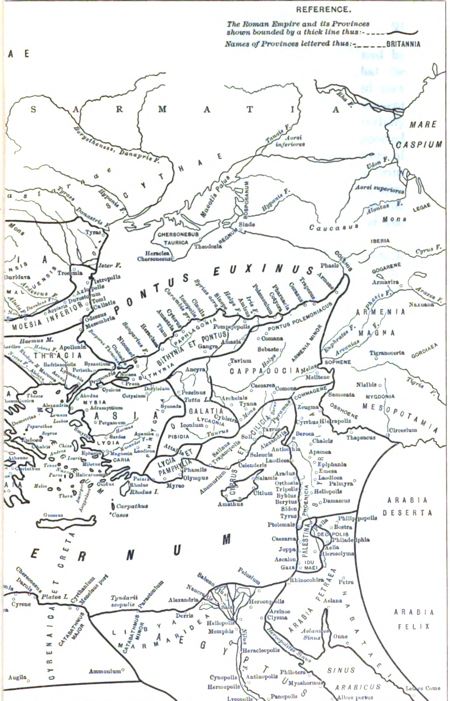
Map of the Roman Empire in 180 A.D.
There appears, indeed, one memorable occasion, in which the senate, after seventy years of patience, made an ineffectual attempt to reassume its long-forgotten rights. When the throne was vacant by the murder of Caligula, the consuls convoked that assembly in the Capitol, condemned the memory of the Cæsars, gave the watchword liberty to the few cohorts who faintly adhered to their standard, and during eight and forty hours acted as the independent chiefs of a free commonwealth. But while they deliberated, the prætorian guards had resolved. The stupid Claudius, brother of Germanicus, was already in their camp, invested with the Imperial purple, and prepared to support his election by arms. The dream of liberty was at an end; and the senate awoke to all the horrors of inevitable servitude. Deserted by the people, and threatened by a military force, that feeble assembly was compelled to ratify the choice of the prætorians, and to embrace the benefit of an amnesty, which Claudius had the prudence to offer, and the generosity to observe. [35]
II. The insolence of the armies inspired Augustus with fears of a still more alarming nature. The despair of the [I-92] citizens could only attempt what the power of the soldiers was, at any time, able to execute. How precarious was his own authority over men whom he had taught to violate every social duty! He had heard their seditious clamours; he dreaded their calmer moments of reflection. One revolution had been purchased by immense rewards; but a second revolution might double those rewards. The troops professed the fondest attachment to the house of Cæsar; but the attachments of the multitude are capricious and inconstant. Augustus summoned to his aid whatever remained in those fierce minds of Roman prejudices; enforced the rigour of discipline by the sanction of law; and, interposing the majesty of the senate between the emperor and the army, boldly claimed their allegiance as the first magistrate of the republic. [36]
During a long period of two hundred and twenty years, from the establishment of this artful system to the death of Commodus, the dangers inherent to a military government were, in a great measure, suspended. The soldiers were seldom roused to that fatal sense of their own strength, and of the weakness of the civil authority, which was, before and afterwards, productive of such dreadful calamities. Caligula and Domitian were assassinated in their palace by their own domestics: [37] the convulsions which agitated Rome on the death of the former were confined to the walls of the city. But Nero involved the whole empire in his ruin. In the space of eighteen months four princes perished by the sword; and the Roman world was shaken by the fury of the contending armies. Excepting only this short, though violent, eruption of military licence, the two centuries from Augustus to Commodus passed away, unstained with civil blood, and undisturbed by revolutions. The emperor was elected by [I-93] the authority of the senate and the consent of the soldiers. [38] The legions respected their oath of fidelity; and it requires a minute inspection of the Roman annals to discover three inconsiderable rebellions, which were all suppressed in a few months, and without even the hazard of a battle. [39]
In elective monarchies, the vacancy of the throne is a moment big with danger and mischief. The Roman emperors, desirous to spare the legions that interval of suspense, and the temptation of an irregular choice, invested their designed successor with so large a share of present power, as should enable him, after their decease, to assume the remainder without suffering the empire to perceive the change of masters. Thus Augustus, after all his fairer prospects had been snatched from him by untimely deaths, rested his last hopes on Tiberius, obtained for his adopted son the censorial and tribunitian powers, and dictated a law, by which the future prince was invested with an authority equal to his own over the provinces and the armies. [40] Thus Vespasian subdued the generous mind of his eldest son. Titus was adored by the eastern legions, which, under his command, had recently achieved the conquest of Judea. His power was dreaded, and, as his virtues were clouded by the intemperance of youth, his designs were suspected. Instead of listening to such unworthy suspicions, the prudent monarch associated Titus to the full powers of the Imperial dignity; and the grateful son ever approved himself [I-94] the humble and faithful minister of so indulgent a father. [41]
The good sense of Vespasian engaged him indeed to embrace every measure that might confirm his recent and precarious elevation. The military oath, and the fidelity of the troops, had been consecrated, by the habits of an hundred years, to the name and family of the Cæsars; and, although that family had been continued only by the fictitious rite of adoption, the Romans still revered, in the person of Nero, the grandson of Germanicus, and the lineal successor of Augustus. It was not without reluctance and remorse that the prætorian guards had been persuaded to abandon the cause of the tyrant. [42] The rapid downfall of Galba, Otho, and Vitellius taught the armies to consider the emperors as the creatures of their will, and the instruments of their licence. The birth of Vespasian was mean; his grandfather had been a private soldier, his father a petty officer of the revenue, [43] his own merit had raised him, in an advanced age, to the empire; but his merit was rather useful than shining, and his virtues were disgraced by a strict and even sordid parsimony. Such a prince consulted his true interest by the association of a son whose more splendid and amiable character might turn the public attention from the obscure origin to the future glories of the Flavian house. Under the mild administration of Titus, the Roman world enjoyed a transient felicity, and his beloved memory served to protect, above fifteen years, the vices of his brother Domitian.
Nerva had scarcely accepted the purple from the assassins of Domitian before he discovered that his feeble age was [I-95] unable to stem the torrent of public disorders which had multiplied under the long tyranny of his predecessor. His mild disposition was respected by the good; but the degenerate Romans required a more vigorous character, whose justice should strike terror into the guilty. Though he had several relations, he fixed his choice on a stranger. He adopted Trajan, then about forty years of age, and who commanded a powerful army in the Lower Germany; and immediately, by a decree of the senate, declared him his colleague and successor in the empire. [44] It is sincerely to be lamented, that, whilst we are fatigued with the disgustful relation of Nero’s crimes and follies, we are reduced to collect the actions of Trajan from the glimmerings of an abridgment, or the doubtful light of a panegyric. There remains, however, one panegyric far removed beyond the suspicion of flattery. Above two hundred and fifty years after the death of Trajan, the senate, in pouring out the customary acclamations on the accession of a new emperor, wished that he might surpass the felicity of Augustus, and the virtue of Trajan. [45]
We may readily believe that the father of his country hesitated whether he ought to entrust the various and doubtful character of his kinsman Hadrian with sovereign power. In his last moments, the arts of the empress Plotina either fixed the irresolution of Trajan, or boldly supposed a fictitious adoption, [46] the truth of which could not be safely disputed; and Hadrian was peaceably acknowledged as his lawful successor. Under his reign, as has been already mentioned, [I-96] the empire flourished in peace and prosperity. He encouraged the arts, reformed the laws, asserted military discipline, and visited all his provinces in person. His vast and active genius was equally suited to the most enlarged views and the minute details of civil policy. But the ruling passions of his soul were curiosity and vanity. As they prevailed, and as they were attracted by different objects, Hadrian was, by turns, an excellent prince, a ridiculous sophist, and a jealous tyrant. The general tenor of his conduct deserved praise for its equity and moderation. Yet, in the first days of his reign, he put to death four consular senators, his personal enemies, and men who had been judged worthy of empire; and the tediousness of a painful illness rendered him, at last, peevish and cruel. The senate doubted whether they should pronounce him a god or a tyrant; and the honours decreed to his memory were granted to the prayers of the pious Antoninus. [47]
The caprice of Hadrian influenced his choice of a successor. After revolving in his mind several men of distinguished merit, whom he esteemed and hated, he adopted Ælius Verus, a gay and voluptuous nobleman, recommended by uncommon beauty to the lover of Antinous. [48] But whilst Hadrian was delighting himself with his own applause, and the acclamations of the soldiers, whose consent had been secured by an immense donative, the new Cæsar [49] was ravished from his embraces by an untimely death. He left only one son. Hadrian commended the boy to the gratitude of the Antonines. He was adopted by Pius; and, on the accession of Marcus, was invested with an equal share of sovereign [I-97] power. Among the many vices of this younger Verus, he possessed one virtue — a dutiful reverence for his wiser colleague, to whom he willingly abandoned the ruder cares of empire. The philosophic emperor dissembled his follies, lamented his early death, and cast a decent veil over his memory.
As soon as Hadrian’s passion was either gratified or disappointed, he resolved to deserve the thanks of posterity by placing the most exalted merit on the Roman throne. His discerning eye easily discovered a senator about fifty years of age, blameless in all the offices of life; and a youth of about seventeen, whose riper years opened the fair prospect of every virtue: the elder of these was declared the son and successor of Hadrian, on condition, however, that he himself should immediately adopt the younger. The two Antonines (for it is of them that we are now speaking) governed the Roman world forty-two years with the same invariable spirit of wisdom and virtue. Although Pius had two sons, [50] he preferred the welfare of Rome to the interest of his family, gave his daughter Faustina in marriage to young Marcus, obtained from the senate the tribunitian and proconsular powers, and, with a noble disdain, or rather ignorance, of jealousy, associated him to all the labours of government. Marcus, on the other hand, revered the character of his benefactor, loved him as a parent, obeyed him as his sovereign, [51] and, after he was no more, regulated his own administration by the example and maxims of his predecessor. Their united reigns are possibly the only period of history in which the happiness of a great people was the sole object of government.
[I-98]
Titus Antoninus Pius had been justly denominated a second Numa. The same love of religion, justice, and peace was the distinguishing characteristic of both princes. But the situation of the latter opened a much larger field for the exercise of those virtues. Numa could only prevent a few neighbouring villages from plundering each other’s harvests. Antoninus diffused order and tranquillity over the greatest part of the earth. His reign is marked by the rare advantage of furnishing very few materials for history; which is, indeed, little more than the register of the crimes, follies, and misfortunes of mankind. In private life he was an amiable as well as a good man. The native simplicity of his virtue was a stranger to vanity or affectation. He enjoyed with moderation the conveniences of his fortune, and the innocent pleasures of society; [52] and the benevolence of his soul displayed itself in a cheerful serenity of temper.
The virtue of Marcus Aurelius Antoninus was of a severer and more laborious kind. [53] It was the well-earned harvest of many a learned conference, of many a patient lecture, and many a midnight lucubration. At the age of twelve years he embraced the rigid system of the Stoics, which taught him to submit his body to his mind, his passions to his reason; to consider virtue as the only good, vice as the only evil, all things external as things indifferent. [54] His [I-none] [I-99] Meditations, composed in the tumult of a camp, are still extant; and he even condescended to give lessons on philosophy, in a more public manner than was perhaps consistent with the modesty of a sage or the dignity of an emperor. [55] But his life was the noblest commentary on the precepts of Zeno. He was severe to himself, indulgent to the imperfection of others, just and beneficent to all mankind. He regretted that Avidius Cassius, who excited a rebellion in Syria, had disappointed him, by a voluntary death, of the pleasure of converting an enemy into a friend; and he justified the sincerity of that sentiment, by moderating the zeal of the senate against the adherents of the traitor. [56] War he detested, as the disgrace and calamity of human nature; but when the necessity of a just defence called upon him to take up arms, he readily exposed his person to eight winter campaigns on the frozen banks of the Danube, the severity of which was at last fatal to the weakness of his constitution. His memory was revered by a grateful posterity, and above a century after his death many persons preserved the image of Marcus Antoninus among those of their household gods. [57]
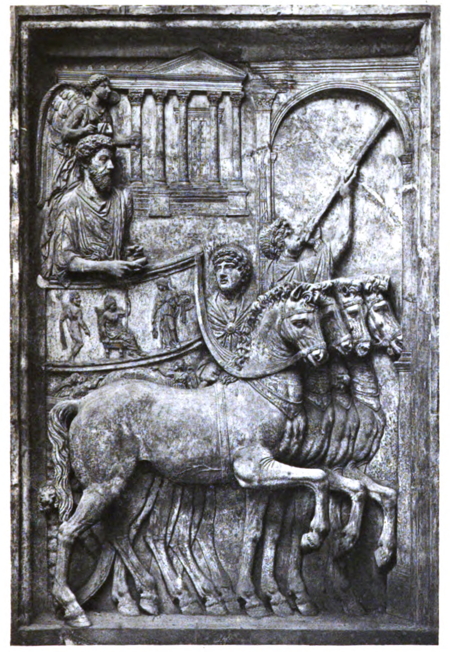
Triumphal entry of Marcus Aurelius into Rome. From a bas-relief.
If a man were called to fix the period in the history of the world during which the condition of the human race was most happy and prosperous, he would, without hesitation, name that which elapsed from the death of Domitian to the accession of Commodus. The vast extent of the Roman empire was governed by absolute power, under the guidance of virtue and wisdom. The armies were restrained by the firm but gentle hand of four successive emperors, whose characters and authority commanded involuntary respect. [I-100] The forms of the civil administration were carefully preserved by Nerva, Trajan, Hadrian, and the Antonines, who delighted in the image of liberty, and were pleased with considering themselves as the accountable ministers of the laws. Such princes deserved the honour of restoring the republic, had the Romans of their days been capable of enjoying a rational freedom.
The labours of these monarchs were over-paid by the immense reward that inseparably waited on their success; by the honest pride of virtue, and by the exquisite delight of beholding the general happiness of which they were the authors. A just but melancholy reflection embittered, however, the noblest of human enjoyments. They must often have recollected the instability of a happiness which depended on the character of a single man. The fatal moment was perhaps approaching, when some licentious youth, or some jealous tyrant, would abuse, to the destruction, that absolute power which they had exerted for the benefit of their people. The ideal restraints of the senate and the laws might serve to display the virtues, but could never correct the vices, of the emperor. The military force was a blind and irresistible instrument of oppression; and the corruption of Roman manners would always supply flatterers eager to applaud, and ministers prepared to serve, the fear or the avarice, the lust or the cruelty, of their masters.
These gloomy apprehensions had been already justified by the experience of the Romans. The annals of the emperors exhibit a strong and various picture of human nature, which we should vainly seek among the mixed and doubtful characters of modern history. In the conduct of those monarchs we may trace the utmost lines of vice and virtue; the most exalted perfection and the meanest degeneracy of our own species. The golden age of Trajan and the Antonines had been preceded by an age of iron. It is almost superfluous to enumerate the unworthy successors [I-101] of Augustus. Their unparalleled vices, and the splendid theatre on which they were acted, have saved them from oblivion. The dark unrelenting Tiberius, the furious Caligula, the stupid Claudius, the profligate and cruel Nero, the beastly Vitellius, [58] and the timid inhuman Domitian are condemned to everlasting infamy. During fourscore years (excepting only the short and doubtful respite of Vespasian’s reign), [59] Rome groaned beneath an unremitting tyranny, which exterminated the ancient families of the republic, and was fatal to almost every virtue and every talent that arose in that unhappy period.
Under the reign of these monsters [60] the slavery of the Romans was accompanied with two peculiar circumstances, the one occasioned by their former liberty, the other by their extensive conquests, which rendered their condition more wretched than that of the victims of tyranny in any other age or country. From these causes were derived, 1. The exquisite sensibility of the sufferers; and 2. The impossibility of escaping from the hand of the oppressor.
I. When Persia was governed by the descendants of Sefi, a race of princes whose wanton cruelty often stained their divan, their table, and their bed with the blood of their favourites, there is a saying recorded of a young nobleman, that he never departed from the sultan’s presence without satisfying himself whether his head was still on his shoulders. The experience of every day might almost justify the scepticism [I-102] of Rustan. [61] Yet the fatal sword, suspended above him by a single thread, seems not to have disturbed the slumbers, or interrupted the tranquillity, of the Persian. The monarch’s frown, he well knew, could level him with the dust; but the stroke of lightning or apoplexy might be equally fatal; and it was the part of a wise man to forget the inevitable calamities of human life in the enjoyment of the fleeting hour. He was dignified with the appellation of the king’s slave; had, perhaps, been purchased from obscure parents, in a country which he had never known; and was trained up from his infancy in the severe discipline of the seraglio. [62] His name, his wealth, his honours, were the gift of a master, who might, without injustice, resume what he had bestowed. Rustan’s knowledge, if he possessed any, could only serve to confirm his habits by prejudices. His language afforded not words for any form of government, except absolute monarchy. The history of the East informed him that such had ever been the condition of mankind. [63] The Koran, and the interpreters of that divine book, inculcated to him that the sultan was the descendant of the prophet, and the vicegerent of heaven; that patience was the first virtue of a Mussulman, and unlimited obedience the great duty of a subject.
The minds of the Romans were very differently prepared for slavery. Oppressed beneath the weight of their own corruption and of military violence, they for a long while preserved the sentiments, or at least the ideas, of their free-born ancestors. The education of Helvidius and Thrasea, of Tacitus and Pliny, was the same as that of Cato and Cicero. [I-103] From Grecian philosophy they had imbibed the justest and most liberal notions of the dignity of human nature and the origin of civil society. The history of their own country had taught them to revere a free, a virtuous, and a victorious commonwealth; to abhor the successful crimes of Cæsar and Augustus; and inwardly to despise those tyrants whom they adored with the most abject flattery. As magistrates and senators, they were admitted into the great council which had once dictated laws to the earth, whose name gave still a sanction to the acts of the monarch, and whose authority was so often prostituted to the vilest purposes of tyranny. Tiberius, and those emperors who adopted his maxims, attempted to disguise their murders by the formalities of justice, and perhaps enjoyed a secret pleasure in rendering the senate their accomplice as well as their victim. By this assembly the last of the Romans were condemned for imaginary crimes and real virtues. Their infamous accusers assumed the language of independent patriots, who arraigned a dangerous citizen before the tribunal of his country; and the public service was rewarded by riches and honours. [64] The servile judges professed to assert the majesty of the commonwealth, violated in the person of its first magistrate, [65] whose clemency they most applauded when they trembled the most at his inexorable and impending cruelty. [66] The tyrant beheld their baseness [I-104] with just contempt, and encountered their secret sentiments of detestation with sincere and avowed hatred for the whole body of the senate.
II. The division of Europe into a number of independent states, connected, however, with each other, by the general resemblance of religion, language, and manners, is productive of the most beneficial consequences to the liberty of mankind. A modern tyrant, who should find no resistance either in his own breast or in his people, would soon experience a gentle restraint from the example of his equals, the dread of present censure, the advice of his allies, and the apprehension of his enemies. The object of his displeasure, escaping from the narrow limits of his dominions, would easily obtain, in a happier climate, a secure refuge, a new fortune adequate to his merit, the freedom of complaint, and perhaps the means of revenge. But the empire of the Romans filled the world, and, when that empire fell into the hands of a single person, the world became a safe and dreary prison for his enemies. The slave of Imperial despotism, whether he was condemned to drag his gilded chain in Rome and the senate, or to wear out a life of exile on the barren rock of Seriphus, or the frozen banks of the Danube, expected his fate in silent despair. [67] To resist was fatal, and it was impossible to fly. On every side he was encompassed with a vast extent of sea and land, which he could never hope to traverse without being discovered, seized, and restored to his irritated master. Beyond the frontiers, his anxious view could discover nothing, except the ocean, inhospitable deserts, hostile tribes of barbarians, of fierce manners and unknown language, or dependent kings, who would gladly purchase the emperor’s protection [I-105] by the sacrifice of an obnoxious fugitive. [68] “Wherever you are,” said Cicero to the exiled Marcellus, “remember that you are equally within the power of the conqueror.” [69]
[I-106]
CHAPTER IV↩
The cruelty, follies, and murder of Commodus — Election of Pertinax — his attempts to reform the State — his assassination by the Prætorian Guards
The mildness of Marcus, which the rigid discipline of the Stoics was unable to eradicate, formed, at the same time, the most amiable, and the only defective, part of his character. His excellent understanding was often deceived by the unsuspecting goodness of his heart. Artful men, who study the passions of princes and conceal their own, approached his person in the disguise of philosophic sanctity, and acquired riches and honours by affecting to despise them. [1] His excessive indulgence to his brother, [2] his wife, and his son, exceeded the bounds of private virtue, and became a public injury, by the example and consequences of their vices.
Faustina, the daughter of Pius and the wife of Marcus, has been as much celebrated for her gallantries as for her beauty. The grave simplicity of the philosopher was ill calculated to engage her wanton levity, or to fix that unbounded passion for variety which often discovered personal merit in the meanest of mankind. [3] The Cupid of the ancients was, in general, a very sensual deity; and the amours of an empress, as they [I-107] exact on her side the plainest advances, are seldom susceptible of much sentimental delicacy. Marcus was the only man in the empire who seemed ignorant or insensible of the irregularities of Faustina; which, according to the prejudices of every age, reflected some disgrace on the injured husband. He promoted several of her lovers to posts of honour and profit, [4] and, during a connection of thirty years, invariably gave her proofs of the most tender confidence, and of a respect which ended not with her life. In his Meditations he thanks the gods, who had bestowed on him a wife so faithful, so gentle, and of such a wonderful simplicity of manners. [5] The obsequious senate, at his earnest request, declared her a goddess. She was represented in her temples, with the attributes of Juno, Venus, and Ceres; and it was decreed that, on the day of their nuptials, the youth of either sex should pay their vows before the altar of their chaste patroness. [6]
The monstrous vices of the son have cast a shade on the purity of the father’s virtues. It has been objected to Marcus, that he sacrificed the happiness of millions to a fond partiality for a worthless boy; and that he chose a successor in his own family rather than in the republic. Nothing, however, was neglected by the anxious father, and by the men of virtue and learning whom he summoned to his assistance, to expand the narrow mind of young Commodus, to correct his growing vices, and to render him worthy of the throne for which he was designed. But the power of instruction is seldom of much efficacy, except in those happy dispositions where it is almost superfluous. The distasteful lesson of a grave philosopher was, in a moment, obliterated by the whisper [I-108] of a profligate favourite; and Marcus himself blasted the fruits of this laboured education, by admitting his son, at the age of fourteen or fifteen, to a full participation of the Imperial power. He lived but four years afterwards; but he lived long enough to repent a rash measure, which raised the impetuous youth above the restraint of reason and authority.
Most of the crimes which disturb the internal peace of society are produced by the restraints which the necessary, but unequal, laws of property have imposed on the appetites of mankind, by confining to a few the possession of those objects that are coveted by many. Of all our passions and appetites, the love of power is of the most imperious and unsociable nature, since the pride of one man requires the submission of the multitude. In the tumult of civil discord the laws of society lose their force, and their place is seldom supplied by those of humanity. The ardour of contention, the pride of victory, the despair of success, the memory of past injuries, and the fear of future dangers, all contribute to inflame the mind, and to silence the voice of pity. From such motives almost every page of history has been stained with civil blood; but these motives will not account for the unprovoked cruelties of Commodus, who had nothing to wish, and everything to enjoy. The beloved son of Marcus succeeded to his father, amidst the acclamations of the senate and armies; [7] and when he ascended the throne, the happy youth saw round him neither competitor to remove, nor enemies to punish. In this calm elevated station it was surely natural that he should prefer the love of mankind to [I-none] [I-109] their detestation, the mild glories of his five predecessors to the ignominious fate of Nero and Domitian.
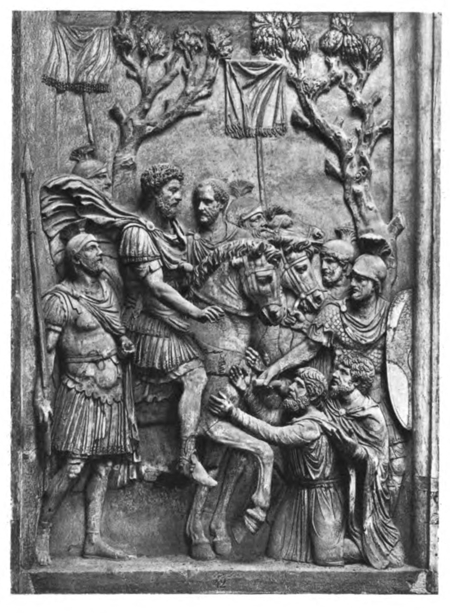
Marcus Aurelius granting grace to his enemies. From a Roman bas-relief.
Yet Commodus was not, as he has been represented, a tiger born with an insatiate thirst of human blood, and capable, from his infancy, of the most inhuman actions. [8] Nature had formed him of a weak, rather than a wicked, disposition. His simplicity and timidity rendered him the slave of his attendants, who gradually corrupted his mind. His cruelty, which at first obeyed the dictates of others, degenerated into habit, and at length became the ruling passion of his soul. [9]
Upon the death of his father Commodus found himself embarrassed with the command of a great army, and the conduct of a difficult war against the Quadi and Marcomanni. [10] The servile and profligate youths whom Marcus had banished soon regained their station and influence about the new emperor. They exaggerated the hardships and dangers of a campaign in the wild countries beyond the Danube; and they assured the indolent prince that the terror of his name and the arms of his lieutenants would be sufficient to complete the conquest of the dismayed barbarians, or to impose such conditions as were more advantageous than any conquest. By a dexterous application to his sensual appetites, they compared the tranquillity, the splendour, the refined pleasures of Rome with the tumult of a Pannonian camp, which afforded neither leisure nor materials for luxury. [11] Commodus listened to the pleasing advice; but whilst he hesitated between his own inclination and the awe which he still retained for his father’s counsellors, the summer [I-110] insensibly elapsed, and his triumphal entry into the capital was deferred till the autumn. His graceful person, [12] popular address, and imagined virtues attracted the public favour; the honourable peace which he had recently granted to the barbarians diffused an universal joy; [13] his impatience to revisit Rome was fondly ascribed to the love of his country; and his dissolute course of amusements was faintly condemned in a prince of nineteen years of age.
During the three first years of his reign, the forms, and even the spirit, of the old administration were maintained by those faithful counsellors to whom Marcus had recommended his son, and for whose wisdom and integrity Commodus still entertained a reluctant esteem. The young prince and his profligate favourites revelled in all the licence of sovereign power; but his hands were yet unstained with blood; and he had even displayed a generosity of sentiment, which might perhaps have ripened into solid virtue. [14] A fatal incident decided his fluctuating character.
One evening, as the emperor was returning to the palace through a dark and narrow portico in the amphitheatre, [15] an assassin, who waited his passage, rushed upon him with a drawn sword, loudly exclaiming, The senate sends you this. The menace prevented the deed; the assassin was seized by the guards, and immediately revealed the authors [I-111] of the conspiracy. It had been formed, not in the state, but within the walls of the palace. Lucilla, the emperor’s sister, and widow of Lucius Verus, impatient of the second rank, and jealous of the reigning empress, had armed the murderer against her brother’s life. She had not ventured to communicate the black design to her second husband, Claudius Pompeianus, a senator of distinguished merit and unshaken loyalty; but among the crowd of her lovers (for she imitated the manners of Faustina) she found men of desperate fortunes and wild ambition, who were prepared to serve her more violent as well as her tender passions. The conspirators experienced the rigour of justice, and the abandoned princess was punished, first with exile, and afterwards with death. [16]
But the words of the assassin sunk deep into the mind of Commodus, and left an indelible impression of fear and hatred against the whole body of the senate. Those whom he had dreaded as importunate ministers, he now suspected as secret enemies. The Delators, a race of men discouraged, and almost extinguished, under the former reigns, again became formidable as soon as they discovered that the emperor was desirous of finding disaffection and treason in the senate. That assembly, whom Marcus had ever considered as the great council of the nation, was composed of the most distinguished of the Romans; and distinction of every kind soon became criminal. The possession of wealth stimulated the diligence of the informers; rigid virtue implied a tacit censure of the irregularities of Commodus; important services implied a dangerous superiority of merit, and the friendship of the father always insured the aversion of the son. Suspicion was equivalent to proof; trial to condemnation. The execution of a considerable senator was attended with the death of all who might lament [I-112] or revenge his fate; and when Commodus had once tasted human blood, he became incapable of pity or remorse.
Of these innocent victims of tyranny, none died more lamented than the two brothers of the Quintilian family, Maximus and Condianus, whose fraternal love has saved their names from oblivion, and endeared their memory to posterity. Their studies and their occupations, their pursuits and their pleasures, were still the same. In the enjoyment of a great estate, they never admitted the idea of a separate interest: some fragments are now extant of a treatise [17] which they composed in common; and in every action of life it was observed that their two bodies were animated by one soul. The Antonines, who valued their virtues and delighted in their union, raised them, in the same year, to the consulship; and Marcus afterwards entrusted to their joint care the civil administration of Greece, and a great military command, in which they obtained a signal victory over the Germans. The kind cruelty of Commodus united them in death. [18]
The tyrant’s rage, after having shed the noblest blood of the senate, at length recoiled on the principal instrument of his cruelty. Whilst Commodus was immersed in blood and luxury, he devolved the detail of the public business on Perennis; a servile and ambitious minister, who had obtained his post by the murder of his predecessor, but who possessed a considerable share of vigour and ability. By acts of extortion, and the forfeited estates of the nobles sacrificed to his avarice, he had accumulated an immense treasure. The Prætorian guards were under his immediate command; and his son, who already discovered a military genius, was at the head of the Illyrian legions. Perennis aspired to the empire; or what, in the eyes of Commodus, amounted [I-113] to the same crime, he was capable of aspiring to it, had he not been prevented, surprised, and put to death. The fall of a minister is a very trifling incident in the general history of the empire; but it was hastened by an extraordinary circumstance, which proved how much the nerves of discipline were already relaxed. The legions of Britain, discontented with the administration of Perennis, formed a deputation of fifteen hundred select men, with instructions to march to Rome and lay their complaints before the emperor. These military petitioners, by their own determined behaviour, by inflaming the divisions of the guards, by exaggerating the strength of the British army, and by alarming the fears of Commodus, exacted and obtained the minister’s death, as the only redress of their grievances. [19] This presumption of a distant army, and their discovery of the weakness of government, was a sure presage of the most dreadful convulsions.
The negligence of the public administration was betrayed soon afterwards by a new disorder, which arose from the smallest beginnings. A spirit of desertion began to prevail among the troops, and the deserters, instead of seeking their safety in flight or concealment, infested the highways. Maternus, a private soldier, of a daring boldness above his station, collected these bands of robbers into a little army, set open the prisons, invited the slaves to assert their freedom, and plundered with impunity the rich and defenceless cities of Gaul and Spain. The governors of the provinces, who had long been the spectators, and perhaps the partners, of his depredations, were, at length, roused from their supine indolence [I-114] by the threatening commands of the emperor. Maternus found that he was encompassed, and foresaw that he must be overpowered. A great effort of despair was his last resource. He ordered his followers to disperse, to pass the Alps in small parties and various disguises, and to assemble at Rome, during the licentious tumult of the festival of Cybele. [20] To murder Commodus, and to ascend the vacant throne, was the ambition of no vulgar robber. His measures were so ably concerted that his concealed troops already filled the streets of Rome. The envy of an accomplice discovered and ruined this singular enterprise in the moment when it was ripe for execution. [21]
Suspicious princes often promote the last of mankind, from a vain persuasion that those who have no dependence except on their favour will have no attachment except to the person of their benefactor. Cleander, the successor of Perennis, was a Phrygian by birth; of a nation, over whose stubborn but servile temper blows only could prevail. [22] He had been sent from his native country to Rome in the capacity of a slave. As a slave he entered the imperial palace, rendered himself useful to his master’s passions, and rapidly ascended to the most exalted station which a subject could enjoy. His influence over the mind of Commodus was much greater than that of his predecessor; for Cleander was devoid of any ability or virtue which could inspire the emperor with envy or distrust. Avarice was the reigning passion of his soul, and the great principle of his administration. The rank of consul, of Patrician, of senator, was exposed to public sale; and it would have been considered as disaffection if [I-115] any one had refused to purchase these empty and disgraceful honours with the greatest part of his fortune. [23] In the lucrative provincial employments the minister shared with the governor the spoils of the people. The execution of the laws was venal and arbitrary. A wealthy criminal might obtain not only the reversal of the sentence by which he was justly condemned; but might likewise inflict whatever punishment he pleased on the accuser, the witnesses, and the judge.
By these means Cleander, in the space of three years, had accumulated more wealth than had ever yet been possessed by any freedman. [24] Commodus was perfectly satisfied with the magnificent presents which the artful courtier laid at his feet in the most seasonable moments. To divert the public envy, Cleander, under the emperor’s name, erected baths, porticos, and places of exercise, for the use of the people. [25] He flattered himself that the Romans, dazzled and amused by this apparent liberality, would be less affected by the bloody scenes which were daily exhibited; that they would forget the death of Byrrhus, a senator to whose superior merit the late emperor had granted one of his daughters; and that they would forgive the execution of Arrius Antoninus, the last representative of the name and virtues of the Antonines. The former, with more integrity than prudence, had attempted to disclose to his brother-in-law the true character of Cleander. An equitable sentence pronounced by the latter, when proconsul of Asia, against a worthless creature of the favourite, proved fatal to him. [26] After the fall of Perennis [I-116] the terrors of Commodus had, for a short time, assumed the appearance of a return to virtue. He repealed the most odious of his acts, loaded his memory with the public execration, and ascribed to the pernicious counsels of that wicked minister all the errors of his inexperienced youth. But his repentance lasted only thirty days; and, under Cleander’s tyranny, the administration of Perennis was often regretted.
Pestilence and famine contributed to fill up the measure of the calamities of Rome. [27] The first could only be imputed to the just indignation of the gods; but a monopoly of corn, supported by the riches and power of the minister, was considered as the immediate cause of the second. The popular discontent, after it had long circulated in whispers, broke out in the assembled circus. The people quitted their favourite amusements for the more delicious pleasure of revenge, rushed in crowds towards a palace in the suburbs, one of the emperor’s retirements, and demanded, with angry clamours, the head of the public enemy. Cleander, who commanded the Prætorian guards, [28] ordered a body of cavalry to sally forth and disperse the seditious multitude. The multitude fled with precipitation towards the city; several were slain, and many more were trampled to death; but, when the cavalry entered the streets their pursuit was checked by a shower of stones and darts from the roofs and windows of the houses. The foot guards, [29] who had been long jealous of the prerogatives and insolence of the Prætorian [I-117] cavalry, embraced the party of the people. The tumult became a regular engagement, and threatened a general massacre. The Prætorians at length gave way, oppressed with numbers; and the tide of popular fury returned with redoubled violence against the gates of the palace, where Commodus lay dissolved in luxury, and alone unconscious of the civil war. It was death to approach his person with the unwelcome news. He would have perished in this supine security had not two women, his eldest sister Fadilla, and Marcia the most favoured of his concubines, ventured to break into his presence. Bathed in tears, and with dishevelled hair, they threw themselves at his feet, and, with all the pressing eloquence of fear, discovered to the affrighted emperor the crimes of the minister, the rage of the people, and the impending ruin which in a few minutes would burst over his palace and person. Commodus started from his dream of pleasure, and commanded that the head of Cleander should be thrown out to the people. The desired spectacle instantly appeased the tumult; and the son of Marcus might even yet have regained the affection and confidence of his subjects. [30]
But every sentiment of virtue and humanity was extinct in the mind of Commodus. Whilst he thus abandoned the reins of empire to these unworthy favourites, he valued nothing in sovereign power except the unbounded licence of indulging his sensual appetites. His hours were spent in a seraglio of three hundred beautiful women and as many boys, of every rank and of every province; and, wherever the arts of seduction proved ineffectual, the brutal lover had recourse to violence. The ancient historians [31] have [I-118] expatiated on these abandoned scenes of prostitution, which scorned every restraint of nature or modesty; but it would not be easy to translate their too faithful descriptions into the decency of modern language. The intervals of lust were filled up with the basest amusements. The influence of a polite age and the labour of an attentive education had never been able to infuse into his rude and brutish mind the least tincture of learning; and he was the first of the Roman emperors totally devoid of taste for the pleasures of the understanding. Nero himself excelled, or affected to excel, in the elegant arts of music and poetry; nor should we despise his pursuits, had he not converted the pleasing relaxation of a leisure hour into the serious business and ambition of his life. But Commodus, from his earliest infancy, discovered an aversion to whatever was rational or liberal, and a fond attachment to the amusements of the populace, — the sports of the circus and amphitheatre, the combats of gladiators, and the hunting of wild beasts. The masters in every branch of learning, whom Marcus provided for his son, were heard with inattention and disgust; whilst the Moors and Parthians, who taught him to dart the javelin and to shoot with the bow, found a disciple who delighted in his application, and soon equalled the most skilful of his instructors in the steadiness of the eye and the dexterity of the hand.
The servile crowd, whose fortune depended on their master’s vices, applauded these ignoble pursuits. The perfidious voice of flattery reminded him that, by exploits of the same nature, by the defeat of the Nemean lion, and the slaughter of the wild boar of Erymanthus, the Grecian Hercules had acquired a place among the gods, and an immortal memory among men. They only forgot to observe [I-119] that, in the first ages of society, when the fiercer animals often dispute with man the possession of an unsettled country, a successful war against those savages is one of the most innocent and beneficial labours of heroism. In the civilised state of the Roman empire the wild beasts had long since retired from the face of man and the neighbourhood of populous cities. To surprise them in their solitary haunts, and to transport them to Rome, that they might be slain in pomp by the hand of an emperor, was an enterprise equally ridiculous for the prince and oppressive for the people. [32] Ignorant of these distinctions, Commodus eagerly embraced the glorious resemblance, and styled himself (as we still read on his medals) [33] the Roman Hercules. The club and the lion’s hide were placed by the side of the throne amongst the ensigns of sovereignty; and statues were erected, in which Commodus was represented in the character and with the attributes of the God whose valour and dexterity he endeavoured to emulate in the daily course of his ferocious amusements. [34]
Elated with these praises, which gradually extinguished the innate sense of shame, Commodus resolved to exhibit, before the eyes of the Roman people, those exercises which till then he had decently confined within the walls of his palace and to the presence of a few favourites. On the appointed day the various motives of flattery, fear, and curiosity attracted to the amphitheatre an innumerable multitude of spectators; and some degree of applause was deservedly [I-120] bestowed on the uncommon skill of the Imperial performer. Whether he aimed at the head or heart of the animal, the wound was alike certain and mortal. With arrows, whose point was shaped into the form of a crescent, Commodus often intercepted the rapid career and cut asunder the long bony neck of the ostrich. [35] A panther was let loose; and the archer waited till he had leaped upon a trembling malefactor. In the same instant the shaft flew, the beast dropt dead, and the man remained unhurt. The dens of the amphitheatre disgorged at once a hundred lions; a hundred darts from the unerring hand of Commodus laid them dead as they ran raging round the Arena. Neither the huge bulk of the elephant nor the scaly hide of the rhinoceros could defend them from his stroke. Æthiopia and India yielded their most extraordinary productions; and several animals were slain in the amphitheatre which had been seen only in the representations of art, or perhaps of fancy. [36] In all these exhibitions, the surest precautions were used to protect the person of the Roman Hercules from the desperate spring of any savage who might possibly disregard the dignity of the emperor and the sanctity of the god. [37]
But the meanest of the populace were affected with shame and indignation, when they beheld their sovereign enter the lists as a gladiator, and glory in a profession which the laws and manners of the Romans had branded with the justest note of infamy. [38] He chose the habit and arms of the [I-none] [I-121] Secutor, whose combat with the Retiarius formed one of the most lively scenes in the bloody sports of the amphitheatre. The Secutor was armed with an helmet, sword, and buckler; his naked antagonist had only a large net and a trident; with the one he endeavoured to entangle, with the other to despatch, his enemy. If he missed the first throw he was obliged to fly from the pursuit of the Secutor till he had prepared his net for a second cast. [39] The emperor fought in this character seven hundred and thirty-five several times. These glorious achievements were carefully recorded in the public acts of the empire; and, that he might omit no circumstance of infamy, he received from the common fund of gladiators a stipend so exorbitant that it became a new and most ignominious tax upon the Roman people. [40] It may be easily supposed that in these engagements the master of the world was always successful: in the amphitheatre his victories were not often sanguinary; but when he exercised his skill in the school of gladiators, or his own palace, his wretched antagonists were frequently honoured with a mortal wound from the hand of Commodus, and obliged to seal their flattery with their blood. [41] He now disdained the appellation of Hercules. The name of Paulus, a celebrated Secutor, was the only one which delighted his ear. It was inscribed on his colossal statues, and repeated in the redoubled acclamations [42] of the mournful and applauding [I-122] senate. [43] Claudius Pompeianus, the virtuous husband of Lucilla, was the only senator who asserted the honour of his rank. As a father he permitted his sons to consult their safety by attending the amphitheatre. As a Roman be declared that his own life was in the emperor’s hands, but that he would never behold the son of Marcus prostituting his person and dignity. Notwithstanding his manly resolution, Pompeianus escaped the resentment of the tyrant, and, with his honour, had the good fortune to preserve his life. [44]
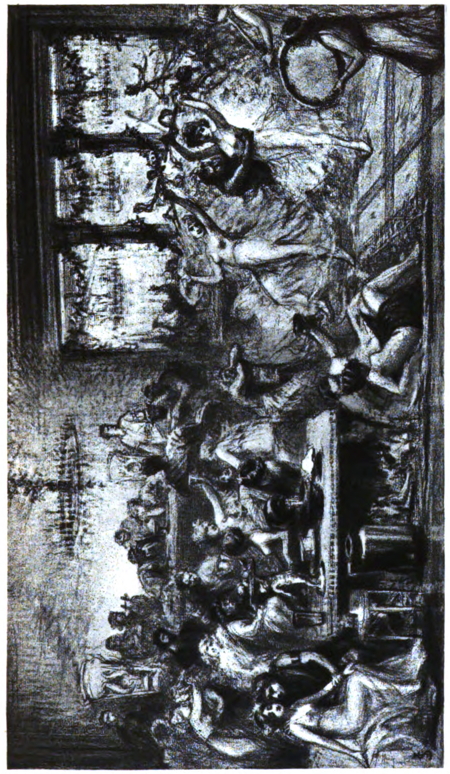
Commodus had now attained the summit of vice and infamy. Amidst the acclamations of a flattering court, he was unable to disguise from himself that he had deserved the contempt and hatred of every man of sense and virtue in his empire. His ferocious spirit was irritated by the consciousness of that hatred, by the envy of every kind of merit, by the just apprehension of danger, and by the habit of slaughter which he contracted in his daily amusements. History has preserved a long list of consular senators sacrificed to his wanton suspicion, which sought out, with peculiar anxiety, those unfortunate persons connected, however remotely, with the family of the Antonines, without sparing even the ministers of his crimes or pleasures. [45] His cruelty proved at last fatal to himself. He had shed with impunity the noblest blood of Rome: he perished as soon as he was dreaded by his own domestics. Marcia, his favourite concubine, Eclectus, his chamberlain, and Lætus, his Prætorian [I-123] prefect, alarmed by the fate of their companions and predecessors, resolved to prevent the destruction which every hour hung over their heads, either from the mad caprice of the tyrant, or the sudden indignation of the people. Marcia seized the occasion of presenting a draught of wine to her lover, after he had fatigued himself with hunting some wild beasts. Commodus retired to sleep; but whilst he was labouring with the effects of poison and drunkenness, a robust youth, by profession a wrestler, entered his chamber, and strangled him without resistance. The body was secretly conveyed out of the palace, before the least suspicion was entertained in the city, or even in the court, of the emperor’s death. Such was the fate of the son of Marcus, and so easy was it to destroy a hated tyrant, who, by the artificial powers of government, had oppressed, during thirteen years, so many millions of subjects, every one of whom was equal to their master in personal strength and personal abilities. [46]
The measures of the conspirators were conducted with the deliberate coolness and celerity which the greatness of the occasion required. They resolved instantly to fill the vacant throne with an emperor whose character would justify and maintain the action that had been committed. They fixed on Pertinax, prefect of the city, an ancient senator of consular rank, whose conspicuous merit had broken through the obscurity of his birth, and raised him to the first honours of the state. He had successively governed most of the provinces of the empire; and in all his great employments, military as well as civil, he had uniformly distinguished himself, by the firmness, the prudence, and the integrity [I-124] of his conduct. [47] He now remained almost alone of the friends and ministers of Marcus; and, when, at a late hour of the night, he was awakened with the news that the chamberlain and the prefect were at his door, he received them with intrepid resignation, and desired they would execute their master’s orders. Instead of death, they offered him the throne of the Roman world. During some moments he distrusted their intentions and assurances. Convinced at length of the death of Commodus, he accepted the purple with a sincere reluctance, the natural effect of his knowledge both of the duties and of the dangers of the supreme rank. [48]
Lætus conducted without delay his new emperor to the camp of the Prætorians, diffusing at the same time through the city a seasonable report that Commodus died suddenly of an apoplexy; and that the virtuous Pertinax had already succeeded to the throne. The guards were rather surprised than pleased with the suspicious death of a prince whose [I-125] indulgence and liberality they alone had experienced; but the emergency of the occasion, the authority of their prefect, the reputation of Pertinax, and the clamours of the people obliged them to stifle their secret discontents, to accept the donative promised by the new emperor, to swear allegiance to him, and, with joyful acclamations and laurels in their hands, to conduct him to the senate-house, that the military consent might be ratified by the civil authority.
This important night was now far spent; with the dawn of day, and the commencement of the new year, the senators expected a summons to attend an ignominious ceremony. In spite of all remonstrances, even of those of his creatures who yet preserved any regard for prudence or decency, Commodus had resolved to pass the night in the gladiators’ school, and from thence to take possession of the consulship, in the habit and with the attendance of that infamous crew. On a sudden, before the break of day, the senate was called together in the temple of Concord, to meet the guards, and to ratify the election of a new emperor. For a few minutes they sat in silent suspense, doubtful of their unexpected deliverance, and suspicious of the cruel artifices of Commodus: but, when at length they were assured that the tyrant was no more, they resigned themselves to all the transports of joy and indignation. Pertinax, who modestly represented the meanness of his extraction, and pointed out several noble senators more deserving than himself of the empire, was constrained by their dutiful violence to ascend the throne, and received all the titles of Imperial power, confirmed by the most sincere vows of fidelity. The memory of Commodus was branded with eternal infamy. The names of tyrant, of gladiator, of public enemy, resounded in every corner of the house. They decreed in tumultuous [49] votes, that his [I-126] honours should be reversed, his titles erased from the public monuments, his statues thrown down, his body dragged with a hook into the stripping-room of the gladiators, to satiate the public fury; and they expressed some indignation against those officious servants who had already presumed to screen his remains from the justice of the senate. But Pertinax could not refuse those last rites to the memory of Marcus and the tears of his first protector Claudius Pompeianus, who lamented the cruel fate of his brother-in-law, and lamented still more that he had deserved it. [50]
These effusions of impotent rage against a dead emperor, whom the senate had flattered when alive with the most abject servility, betrayed a just but ungenerous spirit of revenge. The legality of these decrees was, however, supported by the principles of the Imperial constitution. To censure, to depose, or to punish with death, the first magistrate of the republic who had abused his delegated trust, was the ancient and undoubted prerogative of the Roman senate; [51] but that feeble assembly was obliged to content itself with inflicting on a fallen tyrant that public justice from which, during his life and reign, he had been shielded by the strong arm of military despotism.
Pertinax found a nobler way of condemning his predecessor’s memory, — by the contrast of his own virtues with the vices of Commodus. On the day of his accession he resigned over to his wife and son his whole private fortune; [52] [I-127] that they might have no pretence to solicit favours at the expense of the state. He refused to flatter the vanity of the former with the title of Augusta, or to corrupt the inexperienced youth of the latter by the rank of Cæsar. Accurately distinguishing between the duties of a parent and those of a sovereign, he educated his son with a severe simplicity, which, while it gave him no assured prospect of the throne, might in time have rendered him worthy of it. In public the behaviour of Pertinax was grave and affable. He lived with the virtuous part of the senate [53] (and, in a private station, he had been acquainted with the true character of each individual), without either pride or jealousy; considered them as friends and companions, with whom he had shared the dangers of the tyranny, and with whom he wished to enjoy the security of the present time. He very frequently invited them to familiar entertainments, the frugality of which was ridiculed by those who remembered and regretted the luxurious prodigality of Commodus. [54]
To heal, as far as it was possible, the wounds inflicted by the hand of tyranny, was the pleasing, but melancholy, task of Pertinax. The innocent victims who yet survived were recalled from exile, released from prison, and restored to the full possession of their honours and fortunes. The unburied bodies of murdered senators (for the cruelty of Commodus endeavoured to extend itself beyond death) were deposited in the sepulchres of their ancestors; their memory was justified; and every consolation was bestowed on their ruined and afflicted families. Among these consolations, one of the most grateful was the punishment [I-128] of the Delators, the common enemies of their master, of virtue, and of their country. Yet, even in the inquisition of these legal assassins, Pertinax proceeded with a steady temper, which gave everything to justice, and nothing to popular prejudice and resentment.
The finances of the state demanded the most vigilant care of the emperor. Though every measure of injustice and extortion had been adopted which could collect the property of the subject into the coffers of the prince, the rapaciousness of Commodus had been so very inadequate to his extravagance that, upon his death, no more than eight thousand pounds were found in the exhausted treasury, [55] to defray the current expenses of government, and to discharge the pressing demand of a liberal donative, which the new emperor had been obliged to promise to the Prætorian guards. Yet, under these distressed circumstances, Pertinax had the generous firmness to remit all the oppressive taxes invented by Commodus, and to cancel all the unjust claims of the treasury; declaring, in a decree of the senate, “that he was better satisfied to administer a poor republic with innocence, than to acquire riches by the ways of tyranny and dishonour.” Economy and industry he considered as the pure and genuine sources of wealth; and from them he soon derived a copious supply for the public necessities. The expense of the household was immediately reduced to one half. All the instruments of luxury Pertinax exposed to public auction, [56] gold and silver plate, chariots of a singular construction, a superfluous wardrobe of silk and embroidery, and a great number of beautiful slaves of both sexes; excepting only, with attentive humanity, those who were born in a state of [I-129] freedom, and had been ravished from the arms of their weeping parents. At the same time that he obliged the worthless favourites of the tyrant to resign a part of their ill-gotten wealth, he satisfied the just creditors of the state, and unexpectedly discharged the long arrears of honest services. He removed the oppressive restrictions which had been laid upon commerce, and granted all the uncultivated lands in Italy and the provinces to those who would improve them; with an exemption from tribute during the term of ten years. [57]
Such an uniform conduct had already secured to Pertinax the noblest reward of a sovereign, the love and esteem of his people. Those who remembered the virtues of Marcus were happy to contemplate in their new emperor the features of that bright original, and flattered themselves that they should long enjoy the benign influence of his administration. A hasty zeal to reform the corrupted state, accompanied with less prudence than might have been expected from the years and experience of Pertinax, proved fatal to himself and to his country. His honest indiscretion united against him the servile crowd, who found their private benefit in the public disorders, and who preferred the favour of a tyrant to the inexorable equality of the laws. [58]
Amidst the general joy the sullen and angry countenance of the Prætorian guards betrayed their inward dissatisfaction. They had reluctantly submitted to Pertinax; they dreaded the strictness of the ancient discipline, which he was preparing to restore; and they regretted the licence of the former reign. Their discontents were secretly fomented by Lætus, their prefect, who found, when it was too late, that his new emperor would reward a servant, but would not be ruled by a favourite. On the third day of his reign, the soldiers seized on a noble senator, with a design to carry him to the camp, [I-130] and to invest him with the imperial purple. Instead of being dazzled by the dangerous honour, the affrighted victim escaped from their violence, and took refuge at the feet of Pertinax. A short time afterwards Sosius Falco, one of the consuls of the year, a rash youth, [59] but of an ancient and opulent family, listened to the voice of ambition; and a conspiracy was formed during a short absence of Pertinax, which was crushed by his sudden return to Rome and his resolute behaviour. Falco was on the point of being justly condemned to death as a public enemy, had he not been saved by the earnest and sincere entreaties of the injured emperor; who conjured the senate that the purity of his reign might not be stained by the blood even of a guilty senator.
These disappointments served only to irritate the rage of the Prætorian guards. On the twenty-eighth of March, eighty-six days only after the death of Commodus, a general sedition broke out in the camp, which the officers wanted either power or inclination to suppress. Two or three hundred of the most desperate soldiers marched at noon-day, with arms in their hands and fury in their looks, towards the Imperial palace. The gates were thrown open by their companions upon guard; and by the domestics of the old court, who had already formed a secret conspiracy against the life of the too virtuous emperor. On the news of their approach, Pertinax, disdaining either flight or concealment, advanced to meet his assassins; and recalled to their minds his own innocence, and the sanctity of their recent oath. For a few moments they stood in silent suspense, ashamed of their atrocious design, and awed by the venerable aspect and majestic firmness of their sovereign, till at length, the despair of pardon reviving their fury, a barbarian of the country of [I-131] Tongres [60] levelled the first blow against Pertinax, who was instantly despatched with a multitude of wounds. His head, separated from his body, and placed on a lance, was carried in triumph to the Prætorian camp, in the sight of a mournful and indignant people, who lamented the unworthy fate of that excellent prince, and the transient blessings of a reign, the memory of which could serve only to aggravate their approaching misfortunes. [61]
[I-132]
CHAPTER V↩
Public sale of the empire to Didius Julianus by the Prætorian Guards — Clodius Albinus in Britain, Pescennius Niger in Syria, and Septimius Severus in Pannonia, declare against the murderers of Pertinax — Civil wars, and victory of Severus over his three rivals — Relaxation of discipline — New maxims of government
The power of the sword is more sensibly felt in an extensive monarchy than in a small community. It has been calculated by the ablest politicians that no state, without being soon exhausted, can maintain above the hundredth part of its members in arms and idleness. But, although this relative proportion may be uniform, its influence over the rest of the society will vary according to the degree of its positive strength. The advantages of military science and discipline cannot be exerted, unless a proper number of soldiers are united into one body, and actuated by one soul. With a handful of men, such an union would be ineffectual; with an unwieldy host, it would be impracticable; and the powers of the machine would be alike destroyed by the extreme minuteness, or the excessive weight, of its springs. To illustrate this observation we need only reflect that there is no superiority of natural strength, artificial weapons, or acquired skill, which could enable one man to keep in constant subjection one hundred of his fellow-creatures: the tyrant of a single town, or a small district, would soon discover that an hundred armed followers were a weak defence against ten thousand peasants or citizens; but an hundred thousand well-disciplined soldiers will command, with despotic sway, ten millions of subjects; and a body of ten [I-133] or fifteen thousand guards will strike terror into the most numerous populace that ever crowded the streets of an immense capital.
The Prætorian bands, whose licentious fury was the first symptom and cause of the decline of the Roman empire, scarcely amounted to the last mentioned number. [1] They derived their institution from Augustus. That crafty tyrant, sensible that laws might colour, but that arms alone could maintain, his usurped dominion, had gradually formed this powerful body of guards, in constant readiness to protect his person, to awe the senate, and either to prevent or to crush the first motions of rebellion. He distinguished these favoured troops by a double pay, and superior privileges; but, as their formidable aspect would at once have alarmed and irritated the Roman people, three cohorts only were stationed in the capital; whilst the remainder was dispersed in the adjacent towns of Italy. [2] But after fifty years of peace and servitude, Tiberius ventured on a decisive measure, which for ever riveted the fetters of his country. Under the fair pretences of relieving Italy from the heavy burden [I-134] of military quarters, and of introducing a stricter discipline among the guards, he assembled them at Rome, in a permanent camp, [3] which was fortified with skilful care, [4] and placed on a commanding situation. [5]
Such formidable servants are always necessary, but often fatal, to the throne of despotism. By thus introducing the Prætorian guards, as it were, into the palace and the senate, the emperors taught them to perceive their own strength, and the weakness of the civil government; to view the vices of their masters with familiar contempt, and to lay aside that reverential awe which distance only, and mystery, can preserve towards an imaginary power. In the luxurious idleness of an opulent city, their pride was nourished by the sense of their irresistible weight; nor was it possible to conceal from them that the person of the sovereign, the authority of the senate, the public treasure, and the seat of empire, were all in their hands. To divert the Prætorian bands from these dangerous reflections the firmest and best established princes were obliged to mix blandishments with commands, rewards with punishments, to flatter their pride, indulge their pleasures, connive at their irregularities, and to purchase their precarious faith by a liberal donative; which, since the elevation of Claudius, was exacted as a legal claim on the accession of every new emperor. [6]
[I-135]
The advocates of the guards endeavoured to justify by arguments the power which they asserted by arms; and to maintain that, according to the purest principles of the constitution, their consent was essentially necessary in the appointment of an emperor. The election of consuls, of generals, and of magistrates, however it had been recently usurped by the senate, was the ancient and undoubted right of the Roman people. [7] But where was the Roman people to be found? Not surely amongst the mixed multitude of slaves and strangers that filled the streets of Rome; a servile populace, as devoid of spirit as destitute of property. The defenders of the state, selected from the flower of Italian youth, [8] and trained in the exercise of arms and virtue, were the genuine representatives of the people, and the best entitled to elect the military chief of the republic. These assertions, however defective in reason, became unanswerable, when the fierce Prætorians increased their weight, by throwing, like the barbarian conqueror of Rome, their swords into the scale. [9]
The Prætorians had violated the sanctity of the throne, by the atrocious murder of Pertinax; they dishonoured the majesty of it, by their subsequent conduct. The camp was without a leader, for even the prefect Lætus, who had excited the tempest, prudently declined the public indignation. Amidst the wild disorder, Sulpicianus, the emperor’s father-in-law, and governor of the city, who had been sent to the camp on the first alarm of mutiny, was endeavouring to calm the fury of the multitude, when he was silenced by the clamorous return of the murderers, bearing on a lance the [I-136] head of Pertinax. Though history has accustomed us to observe every principle and every passion yielding to the imperious dictates of ambition, it is scarcely credible that, in these moments of horror, Sulpicianus should have aspired to ascend a throne polluted with the recent blood of so near a relation, and so excellent a prince. He had already begun to use the only effectual argument, and to treat for the Imperial dignity; but the more prudent of the Prætorians, apprehensive that, in this private contract, they should not obtain a just price for so valuable a commodity, ran out upon the ramparts; and, with a loud voice, proclaimed that the Roman world was to be disposed of to the best bidder by public auction. [10]
This infamous offer, the most insolent excess of military licence, diffused an universal grief, shame, and indignation throughout the city. It reached at length the ears of Didius Julianus, a wealthy senator, who, regardless of the public calamities, was indulging himself in the luxury of the table. [11] His wife and his daughter, his freedmen and his parasites, easily convinced him that he deserved the throne, and earnestly conjured him to embrace so fortunate an opportunity. The vain old man hastened to the Prætorian camp, where Sulpicianus was still in treaty with the guards; and began to bid against him from the foot of the rampart. The unworthy negotiation was transacted by faithful emissaries, who passed alternately from one candidate to the other, and acquainted each of them with the offers of his rival. Sulpicianus had already promised a donative of five thousand drachms (above one hundred and sixty pounds) to each soldier; when Julian, eager for the prize, rose at once to the sum of six thousand two hundred and fifty drachms, or upwards [I-137] of two hundred pounds sterling. The gates of the camp were instantly thrown open to the purchaser; he was declared emperor, and received an oath of allegiance from the soldiers, who retained humanity enough to stipulate that he should pardon and forget the competition of Sulpicianus.
It was now incumbent on the Prætorians to fulfil the conditions of the sale. They placed their new sovereign, whom they served and despised, in the centre of their ranks, surrounded him on every side with their shields, and conducted him in close order of battle through the deserted streets of the city. The senate was commanded to assemble, and those who had been the distinguished friends of Pertinax, or the personal enemies of Julian, found it necessary to affect a more than common share of satisfaction at this happy revolution. [12] After Julian had filled the senate house with armed soldiers, he expatiated on the freedom of his election, his own eminent virtues, and his full assurance of the affections of the senate. The obsequious assembly congratulated their own and the public felicity; engaged their allegiance, and conferred on him all the several branches of the Imperial power. [13] From the senate Julian was conducted by the same military procession, to take possession of the palace. The first objects which struck his eyes were the abandoned trunk of Pertinax, and the frugal entertainment prepared for his supper. The one he viewed with indifference; the other with contempt. A magnificent feast was prepared by his order, and he amused himself till a very late hour, with dice, and the performances of Pylades, a celebrated dancer. Yet it was observed that, after the crowd of flatterers dispersed, [I-138] and left him to darkness, solitude, and terrible reflection, he passed a sleepless night; revolving most probably in his mind his own rash folly, the fate of his virtuous predecessor, and the doubtful and dangerous tenure of an empire, which had not been acquired by merit, but purchased by money. [14]
He had reason to tremble. On the throne of the world he found himself without a friend, and even without an adherent. The guards themselves were ashamed of the prince whom their avarice had persuaded them to accept; nor was there a citizen who did not consider his elevation with horror, as the last insult on the Roman name. The nobility, whose conspicuous station and ample possessions exacted the strictest caution, dissembled their sentiments, and met the affected civility of the emperor with smiles of complacency and professions of duty. But the people, secure in their numbers and obscurity, gave a free vent to their passions. The streets and public places of Rome resounded with clamours and imprecations. The enraged multitude affronted the person of Julian, rejected his liberality, and, conscious of the impotence of their own resentment, they called aloud on the legions of the frontiers to assert the violated majesty of the Roman empire.
The public discontent was soon diffused from the centre to the frontiers of the empire. The armies of Britain, of Syria, and of Illyricum, lamented the death of Pertinax, in whose company, or under whose command, they had so often fought and conquered. They received with surprise, with indignation, and perhaps with envy, the extraordinary intelligence that the Prætorians had disposed of the empire by public auction; and they sternly refused to ratify the ignominious bargain. Their immediate and unanimous revolt was fatal to Julian, but it was fatal at the same time [I-139] to the public peace; as the generals of the respective armies, Clodius Albinus, Pescennius Niger, and Septimius Severus, were still more anxious to succeed than to revenge the murdered Pertinax. Their forces were exactly balanced. Each of them was at the head of three legions, [15] with a numerous train of auxiliaries; and, however different in their characters, they were all soldiers of experience and capacity.
Clodius Albinus, [16] governor of Britain, surpassed both his competitors in the nobility of his extraction, which he derived from some of the most illustrious names of the old republic. [17] But the branch, from whence he claimed his descent, was sunk into mean circumstances, and transplanted into a remote province. It is difficult to form a just idea of his true character. Under the philosophic cloak of austerity, he stands accused of concealing most of the vices which degrade human nature. [18] But his accusers are those venal writers who adored the fortune of Severus, and trampled on the ashes of an unsuccessful rival. Virtue, or the appearances of virtue, recommended Albinus to the confidence and good opinion of Marcus; and his preserving with the son the same interest which he had acquired with the father is a proof at least that he was possessed of a very flexible disposition. The favour of a tyrant does not always suppose a want of merit in the object of it; he may, without intending it, reward a man of worth and ability, or he may find such a man useful to his own service. It does not appear that Albinus served the son of Marcus, either as the minister of his cruelties, or even as the associate of his pleasures. He was employed in a distant honourable command, when he [I-140] received a confidential letter from the emperor, acquainting him of the treasonable designs of some discontented generals, and authorising him to declare himself the guardian and successor of the throne, by assuming the title and ensigns of Cæsar. [19] The governor of Britain wisely declined the dangerous honour, which would have marked him for the jealousy, or involved him in the approaching ruin, of Commodus. He courted power by nobler, or, at least, by more specious, arts. On a premature report of the death of the emperor, he assembled his troops; and, in an eloquent discourse, deplored the inevitable mischiefs of despotism, described the happiness and glory which their ancestors had enjoyed under the consular government, and declared his firm resolution to reinstate the senate and people in their legal authority. This popular harangue was answered by the loud acclamations of the British legions, and received at Rome with a secret murmur of applause. Safe in the possession of his little world, and in the command of an army less distinguished indeed for discipline than for numbers and valour, [20] Albinus braved the menaces of Commodus, maintained towards Pertinax a stately ambiguous reserve, and instantly declared against the usurpation of Julian. The convulsions of the capital added new weight to his sentiments, or rather to his professions, of patriotism. A regard to decency induced him to decline the lofty titles of Augustus and Emperor, and he imitated perhaps the example of Galba, who, on a similar occasion, had styled himself the Lieutenant of the senate and people. [21]
Personal merit alone had raised Pescennius Niger [22] from an obscure birth and station to the government of Syria; a [I-141] lucrative and important command, which in times of civil confusion gave him a near prospect of the throne. Yet his parts seem to have been better suited to the second than to the first rank; he was an unequal rival, though he might have approved himself an excellent lieutenant, to Severus, who afterwards displayed the greatness of his mind by adopting several useful institutions from a vanquished enemy. [23] In his government, Niger acquired the esteem of the soldiers and the love of the provincials. His rigid discipline fortified the valour and confirmed the obedience of the former, whilst the voluptuous Syrians were less delighted with the mild firmness of his administration than with the affability of his manners and the apparent pleasure with which he attended their frequent and pompous festivals. [24] As soon as the intelligence of the atrocious murder of Pertinax had reached Antioch, the wishes of Asia invited Niger to assume the Imperial purple and revenge his death. The legions of the eastern frontier embraced his cause; the opulent but unarmed provinces, from the frontiers of Æthiopia [25] to the Hadriatic, cheerfully submitted to his power; and the kings beyond the Tigris and the Euphrates congratulated his election, and offered him their homage and services. The mind of Niger was not capable of receiving this sudden tide of fortune; he flattered himself that his accession would be undisturbed by competition, and unstained by civil blood; and whilst he enjoyed the vain pomp of triumph, he neglected to secure the means of victory. Instead of entering into an effectual negotiation with the powerful armies of the West, whose resolution might decide, or at least must balance, [I-142] the mighty contest; instead of advancing without delay towards Rome and Italy, where his presence was impatiently expected, [26] Niger trifled away in the luxury of Antioch those irretrievable moments which were diligently improved by the decisive activity of Severus. [27]
The country of Pannonia and Dalmatia, which occupied the space between the Danube and the Hadriatic, was one of the last and most difficult conquests of the Romans. In the defence of national freedom, two hundred thousand of these barbarians had once appeared in the field, alarmed the declining age of Augustus, and exercised the vigilant prudence of Tiberius at the head of the collected force of the empire. [28] The Pannonians yielded at length to the arms and institutions of Rome. Their recent subjection, however, the neighbourhood, and even the mixture of the unconquered tribes, and perhaps the climate, adapted, as it has been observed, to the production of great bodies and slow minds, [29] all contributed to preserve some remains of their original ferocity, and, under the tame resemblance of Roman provincials, the hardy features of the natives were still to be discerned. Their warlike youth afforded an inexhaustible supply of recruits to the legions stationed on the banks of the Danube, and which, from a perpetual warfare against the Germans and Sarmatians, were deservedly esteemed the best troops in the service.
The Pannonian army was at this time commanded by [I-143] Septimius Severus, a native of Africa, who, in the gradual ascent of private honours, had concealed his daring ambition, which was never diverted from its steady course by the allurements of pleasure, the apprehension of danger, or the feelings of humanity. [30] On the first news of the murder of Pertinax, he assembled his troops, painted in the most lively colours the crime, the insolence, and the weakness of the Prætorian guards, and animated the legions to arms and to revenge. He concluded (and the peroration was thought extremely eloquent) with promising every soldier about four hundred pounds; an honourable donative, double in value to the infamous bribe with which Julian had purchased the empire. [31] The acclamations of the army immediately saluted Severus with the names of Augustus, Pertinax, and Emperor; and he thus attained the lofty station to which he was invited by conscious merit and a long train of dreams and omens, the fruitful offspring either of his superstition or policy. [32]
The new candidate for empire saw and improved the peculiar advantage of his situation. His province extended to the Julian Alps, which gave an easy access into Italy; and he remembered the saying of Augustus, That a Pannonian [I-144] army might in ten days appear in sight of Rome. [33] By a celerity proportioned to the greatness of the occasion, he might reasonably hope to revenge Pertinax, punish Julian, and receive the homage of the senate and people, as their lawful emperor, before his competitors, separated from Italy by an immense tract of sea and land, were apprised of his success, or even of his election. During the whole expedition, he scarcely allowed himself any moments for sleep or food; marching on foot, and in complete armour, at the head of his columns, he insinuated himself into the confidence and affection of his troops, pressed their diligence, revived their spirits, animated their hopes, and was well satisfied to share the hardships of the meanest soldier, whilst he kept in view the infinite superiority of his reward.
The wretched Julian had expected, and thought himself prepared, to dispute the empire with the governor of Syria; but in the invincible and rapid approach of the Pannonian legions, he saw his inevitable ruin. [34] The hasty arrival of every messenger increased his just apprehensions. He was successively informed that Severus had passed the Alps; that the Italian cities, unwilling or unable to oppose his progress, had received him with the warmest professions of joy and duty; that the important place of Ravenna had surrendered without resistance, and that the Hadriatic fleet was in the hands of the conqueror. The enemy was now within two hundred and fifty miles of Rome; and every moment diminished the narrow span of life and empire allotted to Julian.
He attempted, however, to prevent, or at least to protract, [I-145] his ruin. He implored the venal faith of the Prætorians, filled the city with unavailing preparations for war, drew lines round the suburbs, and even strengthened the fortifications of the palace; as if those last intrenchments could be defended, without hope of relief, against a victorious invader. Fear and shame prevented the guards from deserting his standard; but they trembled at the name of the Pannonian legions, commanded by an experienced general, and accustomed to vanquish the barbarians on the frozen Danube. [35] They quitted, with a sigh, the pleasures of the baths and theatres, to put on arms, whose use they had almost forgotten, and beneath the weight of which they were oppressed. The unpractised elephants, whose uncouth appearance, it was hoped, would strike terror into the army of the North, threw their unskilful riders; and the awkward evolutions of the marines, drawn from the fleet of Misenum, were an object of ridicule to the populace; whilst the senate enjoyed, with secret pleasure, the distress and weakness of the usurper. [36]
Every motion of Julian betrayed his trembling perplexity. He insisted that Severus should be declared a public enemy by the senate. He entreated that the Pannonian general might be associated to the empire. He sent public ambassadors of consular rank to negotiate with his rival; he despatched private assassins to take away his life. He designed that the Vestal virgins, and all the colleges of priests, in their sacerdotal habits, and bearing before them the sacred pledges of the Roman religion, should advance, in solemn procession, to meet the Pannonian legions; and, at the same time, he [I-146] vainly tried to interrogate, or to appease, the fates, by magic ceremonies, and unlawful sacrifices. [37]
Severus, who dreaded neither his arms nor his enchantments, guarded himself from the only danger of secret conspiracy by the faithful attendance of six hundred chosen men, who never quitted his person or their cuirasses, either by night or by day, during the whole march. Advancing with a steady and rapid course, he passed, without difficulty, the defiles of the Apennine, received into his party the troops and ambassadors sent to retard his progress, and made a short halt at Interamna, about seventy miles from Rome. His victory was already secure; but the despair of the Prætorians might have rendered it bloody; and Severus had the laudable ambition of ascending the throne without drawing the sword. [38] His emissaries, dispersed in the capital, assured the guards that, provided they would abandon their worthless prince, and the perpetrators of the murder of Pertinax, to the justice of the conqueror, he would no longer consider that melancholy event as the act of the whole body. The faithless Prætorians, whose resistance was supported only by sullen obstinacy, gladly complied with the easy conditions, seized the greatest part of the assassins, and signified to the senate that they no longer defended the cause of Julian. That assembly, convoked by the consul, unanimously acknowledged Severus as lawful emperor, decreed divine honours to Pertinax, and pronounced a sentence of deposition and death against his unfortunate successor. Julian was conducted into a private apartment of the baths of the palace, and beheaded as a common criminal, after having purchased, with an immense treasure, an anxious and precarious reign of only sixty-six days. [39] The almost incredible [I-147] expedition of Severus, who, in so short a space of time, conducted a numerous army from the banks of the Danube to those of the Tiber, proves at once the plenty of provisions produced by agriculture and commerce, the goodness of the roads, the discipline of the legions, and the indolent subdued temper of the provinces. [40]
The first cares of Severus were bestowed on two measures, the one dictated by policy, the other by decency; the revenge, and the honours due to the memory of Pertinax. Before the new emperor entered Rome, he issued his commands to the Prætorian guards, directing them to wait his arrival on a large plain near the city, without arms, but in the habits of ceremony in which they were accustomed to attend their sovereign. He was obeyed by those haughty troops, whose contrition was the effect of their just terrors. A chosen part of the Illyrian army encompassed them with levelled spears. Incapable of flight or resistance, they expected their fate in silent consternation. Severus mounted the tribunal, sternly reproached them with perfidy and cowardice, dismissed them with ignominy from the trust which they had betrayed, despoiled them of their splendid ornaments, and banished them, on pain of death, to the distance of an hundred miles from the capital. During the transaction, another detachment had been sent to seize their arms, occupy their camp, and prevent the hasty consequences of their despair. [41]
The funeral and consecration of Pertinax was next solemnised [I-148] with every circumstance of sad magnificence. [42] The senate, with a melancholy pleasure, performed the last rites to that excellent prince, whom they had loved and still regretted. The concern of his successor was probably less sincere. He esteemed the virtues of Pertinax, but those virtues would for ever have confined his ambition to a private station. Severus pronounced his funeral oration with studied eloquence, inward satisfaction, and well-acted sorrow; and by this pious regard to his memory, convinced the credulous multitude that he alone was worthy to supply his place. Sensible, however, that arms, not ceremonies, must assert his claim to the empire, he left Rome at the end of thirty days, and, without suffering himself to be elated by this easy victory, prepared to encounter his more formidable rivals.
The uncommon abilities and fortune of Severus have induced an elegant historian to compare him with the first and greatest of the Cæsars. [43] The parallel is, at least, imperfect. Where shall we find, in the character of Severus, the commanding superiority of soul, the generous clemency, and the various genius, which could reconcile and unite the love of pleasure, the thirst of knowledge, and the fire of ambition? [44] In one instance only, they may be compared, with some degree of propriety, in the celerity of their motion, and their civil victories. In less than four years, [45] Severus subdued the riches of the East, and the valour of the West. He vanquished two competitors of reputation and ability, [I-149] and defeated numerous armies, provided with weapons and discipline equal to his own. In that age, the art of fortification and the principles of tactics, were well understood by all the Roman generals; and the constant superiority of Severus was that of an artist, who uses the same instruments with more skill and industry than his rivals. I shall not, however, enter into a minute narrative of these military operations; but as the two civil wars against Niger and against Albinus, were almost the same in their conduct, event, and consequences, I shall collect into one point of view the most striking circumstances, tending to develop the character of the conqueror, and the state of the empire.
Falsehood and insincerity, unsuitable as they seem to the dignity of public transactions, offend us with a less degrading idea of meanness than when they are found in the intercourse of private life. In the latter, they discover a want of courage; in the other, only a defect of power; and, as it is impossible for the most able statesmen to subdue millions of followers and enemies by their own personal strength, the world, under the name of policy, seems to have granted them a very liberal indulgence of craft and dissimulation. Yet the arts of Severus cannot be justified by the most ample privileges of state-reason. He promised only to betray, he flattered only to ruin; and however he might occasionally bind himself by oaths and treaties, his conscience, obsequious to his interest, always released him from the inconvenient obligation. [46]
If his two competitors, reconciled by their common danger, had advanced upon him without delay, perhaps Severus would have sunk under their united effort. Had they even attacked him at the same time, with separate views and separate armies, the contest might have been long and doubtful. But they fell, singly and successively, an easy prey to the arts as well as arms of their subtle enemy, lulled into [I-150] security by the moderation of his professions, and overwhelmed by the rapidity of his action. He first marched against Niger, whose reputation and power he the most dreaded: but he declined any hostile declarations, suppressed the name of his antagonist, and only signified to the senate and people his intention of regulating the eastern provinces. In private he spoke of Niger, his old friend and intended successor, [47] with the most affectionate regard, and highly applauded his generous design of revenging the murder of Pertinax. To punish the vile usurper of the throne was the duty of every Roman general. To persevere in arms, and to resist a lawful emperor, acknowledged by the senate, would alone render him criminal. [48] The sons of Niger had fallen into his hands among the children of the provincial governors, detained at Rome as pledges for the loyalty of their parents. [49] As long as the power of Niger inspired terror, or even respect, they were educated with the most tender care, with the children of Severus himself; but they were soon involved in their father’s ruin, and removed, first by exile, and afterwards by death, from the eye of public compassion. [50]
Whilst Severus was engaged in his eastern war, he had reason to apprehend that the governor of Britain might pass the sea and the Alps, occupy the vacant seat of empire, and oppose his return with the authority of the senate and the forces of the West. The ambiguous conduct of Albinus, [I-151] in not assuming the Imperial title, left room for negotiation. Forgetting at once his professions of patriotism and the jealousy of sovereign power, he accepted the precarious rank of Cæsar, as a reward for his fatal neutrality. Till the first contest was decided, Severus treated the man whom he had doomed to destruction with every mark of esteem and regard. Even in the letter in which he announced his victory over Niger he styles Albinus the brother of his soul and empire, sends him the affectionate salutations of his wife Julia, and his young family, and entreats him to preserve the armies and the republic faithful to their common interest. The messengers charged with this letter were instructed to accost the Cæsar with respect, to desire a private audience, and to plunge their daggers into his heart. [51] The conspiracy was discovered, and the too credulous Albinus at length passed over to the continent, and prepared for an unequal contest with his rival, who rushed upon him at the head of a veteran and victorious army.
The military labours of Severus seem inadequate to the importance of his conquests. Two engagements, the one near the Hellespont, the other in the narrow defiles of Cilicia, decided the fate of his Syrian competitor; and the troops of Europe asserted their usual ascendant over the effeminate natives of Asia. [52] The battle of Lyons, where one hundred and fifty thousand Romans [53] were engaged, was equally fatal to Albinus. The valour of the British army maintained, indeed, a sharp and doubtful contest with the hardy discipline of the Illyrian legions. The fame and person of Severus appeared, during a few moments, irrecoverably lost, till that warlike prince rallied his fainting troops, and led them on [I-152] to a decisive victory. [54] The war was finished by that memorable day.
The civil wars of modern Europe have been distinguished, not only by the fierce animosity, but likewise by the obstinate perseverance, of the contending factions. They have generally been justified by some principle, or, at least, coloured by some pretext, of religion, freedom, or loyalty. The leaders were nobles of independent property and hereditary influence. The troops fought like men interested in the decision of the quarrel; and as military spirit and party zeal were strongly diffused throughout the whole community, a vanquished chief was immediately supplied with new adherents, eager to shed their blood in the same cause. But the Romans, after the fall of the republic, combated only for the choice of masters. Under the standard of a popular candidate for empire, a few enlisted from affection, some from fear, many from interest, none from principle. The legions, uninflamed by party zeal, were allured into civil war by liberal donatives, and still more liberal promises. A defeat, by disabling the chief from the performance of his engagements, dissolved the mercenary allegiance of his followers, and left them to consult their own safety by a timely desertion of an unsuccessful cause. It was of little moment to the provinces under whose name they were oppressed or governed; they were driven by the impulsion of the present power, and as soon as that power yielded to a superior force, they hastened to implore the clemency of the conqueror, who, as he had an immense debt to discharge, was obliged to sacrifice the most guilty countries to the avarice of his soldiers. In the vast extent of the Roman empire there were few fortified cities capable of protecting a routed army; nor was there any person, or family, or [I-153] order of men, whose natural interest, unsupported by the powers of government, was capable of restoring the cause of a sinking party. [55]
Yet, in the contest between Niger and Severus, a single city deserves an honourable exception. As Byzantium was one of the greatest passages from Europe into Asia, it had been provided with a strong garrison, and a fleet of five hundred vessels was anchored in the harbour. [56] The impetuosity of Severus disappointed this prudent scheme of defence; he left to his generals the siege of Byzantium, forced the less guarded passage of the Hellespont, and, impatient of a meaner enemy, pressed forward to encounter his rival. Byzantium, attacked by a numerous and increasing army, and afterwards by the whole naval power of the empire, sustained a siege of three years, and remained faithful to the name and memory of Niger. The citizens and soldiers (we know not from what cause) were animated with equal fury; several of the principal officers of Niger, who despaired of, or who disdained a pardon, had thrown themselves into this last refuge; the fortifications were esteemed impregnable, and, in the defence of the place, a celebrated engineer displayed all the mechanic powers known to the ancients. [57] Byzantium, at length, surrendered to famine. The magistrates and soldiers were put to the sword, the walls demolished, the privileges suppressed, and the destined capital of the East subsisted only as an open village, subject to the insulting jurisdiction of Perinthus. The historian Dion, who had admired the flourishing, and lamented the desolate, state of Byzantium, accused the revenge of [I-154] Severus for depriving the Roman people of the strongest bulwark against the barbarians of Pontus and Asia. [58] The truth of this observation was but too well justified in the succeeding age, when the Gothic fleets covered the Euxine, and passed through the undefended Bosphorus into the centre of the Mediterranean.
Both Niger and Albinus were discovered and put to death in their flight from the field of battle. Their fate excited neither surprise nor compassion. They had staked their lives against the chance of empire, and suffered what they would have inflicted; nor did Severus claim the arrogant superiority of suffering his rivals to live in a private station. But his unforgiving temper, stimulated by avarice, indulged a spirit of revenge, where there was no room for apprehension. The most considerable of the provincials, who, without any dislike to the fortunate candidate, had obeyed the governor under whose authority they were accidentally placed, were punished by death, exile, and especially by the confiscation of their estates. Many cities of the East were stript of their ancient honours, and obliged to pay, into the treasury of Severus, four times the amount of the sums contributed by them for the service of Niger. [59]
Till the final decision of the war, the cruelty of Severus was, in some measure, restrained by the uncertainty of the event and his pretended reverence for the senate. The head of Albinus, accompanied with a menacing letter, announced to the Romans that he was resolved to spare none of the adherents of his unfortunate competitors. He was irritated by the just suspicion that he had never possessed the affections [I-155] of the senate, and he concealed his old malevolence under the recent discovery of some treasonable correspondencies. Thirty-five senators, however, accused of having favoured the party of Albinus, he freely pardoned; and, by his subsequent behaviour, endeavoured to convince them that he had forgotten, as well as forgiven, their supposed offences. But, at the same time, he condemned forty-one [60] other senators, whose names history has recorded; their wives, children, and clients, attended them in death, and the noblest provincials of Spain and Gaul were involved in the same ruin. Such rigid justice, for so he termed it, was, in the opinion of Severus, the only conduct capable of ensuring peace to the people, or stability to the prince; and he condescended slightly to lament that, to be mild, it was necessary that he should first be cruel. [61]
The true interest of an absolute monarch generally coincides with that of his people. Their numbers, their wealth, their order, and their security, are the best and only foundations of his real greatness; and, were he totally devoid of virtue, prudence might supply its place, and would dictate the same rule of conduct. Severus considered the Roman empire as his property, and had no sooner secured the possession, than he bestowed his care on the cultivation and improvement of so valuable an acquisition. Salutary laws, executed with inflexible firmness, soon corrected most of the abuses with which, since the death of Marcus, every part of the government had been infected. In the administration of justice, the judgments of the emperor were characterised by attention, discernment, and impartiality; and, whenever he deviated from the strict line of equity, it was generally in [I-156] favour of the poor and oppressed; not so much indeed from any sense of humanity, as from the natural propensity of a despot to humble the pride of greatness, and to sink all his subjects to the same common level of absolute dependence. His expensive taste for building, magnificent shows, and, above all, a constant and liberal distribution of corn and provisions, were the surest means of captivating the affection of the Roman people. [62] The misfortunes of civil discord were obliterated. The calm of peace and prosperity was once more experienced in the provinces, and many cities, restored by the munificence of Severus, assumed the title of his colonies, and attested by public monuments their gratitude and felicity. [63] The fame of the Roman arms was revived by that warlike and successful emperor, [64] and he boasted, with a just pride, that, having received the empire oppressed with foreign and domestic wars, he left it established in profound, universal, and honourable peace. [65]
Although the wounds of civil war appeared completely healed, its mortal poison still lurked in the vitals of the constitution. Severus possessed a considerable share of vigour and ability; but the daring soul of the first Cæsar, or the deep policy of Augustus, were scarcely equal to the task of curbing [I-157] the insolence of the victorious legions. By gratitude, by misguided policy, by seeming necessity, Severus was induced to relax the nerves of discipline. [66] The vanity of his soldiers was flattered with the honour of wearing gold rings; their ease was indulged in the permission of living with their wives in the idleness of quarters. He increased their pay beyond the example of former times, and taught them to expect, and soon to claim, extraordinary donatives on every public occasion of danger or festivity. Elated by success, enervated by luxury, and raised above the level of subjects by their dangerous privileges, [67] they soon became incapable of military fatigue, oppressive to the country, and impatient of a just subordination. Their officers asserted the superiority of rank by a more profuse and elegant luxury. There is still extant a letter of Severus, lamenting the licentious state of the army, and exhorting one of his generals to begin the necessary reformation from the tribunes themselves; since, as he justly observes, the officer who has forfeited the esteem, will never command the obedience, of his soldiers. [68] Had the emperor pursued the train of reflection, he would have discovered that the primary cause of this general corruption might be ascribed, not indeed to the example, but to the pernicious indulgence, however, of the commander-in-chief.
The Prætorians, who murdered their emperor and sold the empire, had received the just punishment of their treason; but the necessary, though dangerous, institution of guards [I-158] was soon restored on a new model by Severus, and increased to four times the ancient number. [69] Formerly these troops had been recruited in Italy; and, as the adjacent provinces gradually imbibed the softer manners of Rome, the levies were extended to Macedonia, Noricum, and Spain. In the room of these elegant troops, better adapted to the pomp of courts than to the uses of war, it was established by Severus, that, from all the legions of the frontiers, the soldiers most distinguished for strength, valour, and fidelity, should be occasionally draughted, and promoted, as an honour and reward, into the more eligible service of the guards. [70] By this new institution, the Italian youth were diverted from the exercise of arms, and the capital was terrified by the strange aspect and manners of a multitude of barbarians. But Severus flattered himself that the legions would consider these chosen Prætorians as the representatives of the whole military order; and that the present aid of fifty thousand men, superior in arms and appointments to any force that could be brought into the field against them, would for ever crush the hopes of rebellion, and secure the empire to himself and his posterity.
The command of these favoured and formidable troops soon became the first office of the empire. As the government degenerated into military despotism, the Prætorian prefect, who in his origin had been a simple captain of the guards, was placed, not only at the head of the army, but of the finances, and even of the law. In every department of administration, he represented the person, and exercised the authority, of the emperor. The first prefect who enjoyed and abused this immense power was Plautianus, the favourite minister of Severus. His reign lasted above ten years, till the marriage of his daughter with the eldest son of the emperor, which [I-159] seemed to assure his fortune, proved the occasion of his ruin. [71] The animosities of the palace, by irritating the ambition and alarming the fears of Plautianus, threatened to produce a revolution, and obliged the emperor, who still loved him, to consent with reluctance to his death. [72] After the fall of Plautianus, an eminent lawyer, the celebrated Papinian, was appointed to execute the motley office of Prætorian prefect. [73]
Till the reign of Severus, the virtue, and even the good sense of the emperors had been distinguished by their zeal or affected reverence for the senate, and by a tender regard to the nice frame of civil policy instituted by Augustus. But the youth of Severus had been trained in the implicit obedience of camps, and his riper years spent in the despotism of military command. His haughty and inflexible spirit could not discover, or would not acknowledge, the advantage of preserving an intermediate power, however imaginary, between the emperor and the army. He disdained to profess himself the servant of an assembly that detested his person and trembled at his frown; he issued his commands, where his request would have proved as effectual; assumed the conduct and style of a sovereign and a conqueror, and exercised, without disguise, the whole legislative as well as the executive power.
The victory over the senate was easy and inglorious. Every eye and every passion were directed to the supreme magistrate, who possessed the arms and treasure of the state; whilst the senate, neither elected by the people, nor guarded [I-160] by the military force, nor animated by public spirit, rested its declining authority on the frail and crumbling basis of ancient opinion. The fine theory of a republic insensibly vanished, and made way for the more natural and substantial feelings of monarchy. As the freedom and honours of Rome were successfully communicated to the provinces, in which the old government had been either unknown, or was remembered with abhorrence, the tradition of republican maxims was gradually obliterated. The Greek historians of the age of the Antonines [74] observe, with a malicious pleasure, that, although the sovereign of Rome, in compliance with an obsolete prejudice, abstained from the name of king, he possessed the full measure of regal power. In the reign of Severus, the senate was filled with polished and eloquent slaves from the eastern provinces, who justified personal flattery by speculative principles of servitude. These new advocates of prerogative were heard with pleasure by the court, and with patience by the people, when they inculcated the duty of passive obedience, and descanted on the inevitable mischiefs of freedom. The lawyers and the historians concurred in teaching that the Imperial authority was held, not by the delegated commission, but by the irrevocable resignation, of the senate; that the emperor was freed from the restraint of civil laws, could command by his arbitrary will the lives and fortunes of his subjects, and might dispose of the empire as of his private patrimony. [75] The most eminent of the civil lawyers, and particularly Papinian, Paulus, and Ulpian, flourished under the house of Severus; and the Roman jurisprudence, having closely united itself with the system of monarchy, was supposed to have attained its full maturity and perfection.
[I-161]
The contemporaries of Severus, in the enjoyment of the peace and glory of his reign, forgave the cruelties by which it had been introduced. Posterity, who experienced the fatal effect of his maxims and example, justly considered him as the principal author of the decline of the Roman empire. [76]
[I-162]
CHAPTER VI↩
The death of Severus — Tyranny of Caracalla — Usurpation of Macrinus — Follies of Elagabalus — Virtues of Alexander Severus — Licentiousness of the army — General state of the Roman Finances
The ascent to greatness, however steep and dangerous, may entertain an active spirit with the consciousness and exercise of its own powers: but the possession of a throne could never yet afford a lasting satisfaction to an ambitious mind. This melancholy truth was felt and acknowledged by Severus. Fortune and merit had, from an humble station, elevated him to the first place among mankind. He had been “all things,” as he said himself, “and all was of little value.” [1] Distracted with the care, not of acquiring, but of preserving, an empire, oppressed with age and infirmities, careless of fame, [2] and satiated with power, all his prospects of life were closed. The desire of perpetuating the greatness of his family was the only remaining wish of his ambition and paternal tenderness.
Like most of the Africans, Severus was passionately addicted to the vain studies of magic and divination, deeply versed in the interpretation of dreams and omens, and perfectly acquainted with the science of judicial astrology; which, in almost every age except the present, has maintained its dominion over the mind of man. He had lost his first wife whilst he was governor of the Lyonnese Gaul. [3] In the choice of a second, he sought only to connect himself with [I-163] some favourite of fortune; and, as soon as he had discovered that a young lady of Emesa in Syria had a royal nativity, he solicited and obtained her hand. [4] Julia Domna (for that was her name) deserved all that the stars could promise her. She possessed, even in an advanced age, the attractions of beauty, [5] and united to a lively imagination a firmness of mind, and strength of judgment, seldom bestowed on her sex. Her amiable qualities never made any deep impression on the dark and jealous temper of her husband; but, in her son’s reign, she administered the principal affairs of the empire with a prudence that supported his authority; and with a moderation that sometimes corrected his wild extravagancies. [6] Julia applied herself to letters and philosophy with some success, and with the most splendid reputation. She was the patroness of every art, and the friend of every man of genius. [7] The grateful flattery of the learned has celebrated her virtues; but, if we may credit the scandal of ancient history, chastity was very far from being the most conspicuous virtue of the Empress Julia. [8]
Two sons, Caracalla [9] and Geta, were the fruit of this marriage, [I-164] and the destined heirs of the empire. The fond hopes of the father, and of the Roman world, were soon disappointed by these vain youths, who displayed the indolent security of hereditary princes, and a presumption that fortune would supply the place of merit and application. Without any emulation of virtue or talents, they discovered, almost from their infancy, a fixed and implacable antipathy for each other.
Their aversion, confirmed by years, and fomented by the arts of their interested favourites, broke out in childish, and gradually in more serious, competitions; and at length divided the theatre, the circus, and the court, into two factions, actuated by the hopes and fears of their respective leaders. The prudent emperor endeavoured, by every expedient of advice and authority, to allay this growing animosity. The unhappy discord of his sons clouded all his prospects, and threatened to overturn a throne raised with so much labour, cemented with so much blood, and guarded with every defence of arms and treasure. With an impartial hand he maintained between them an exact balance of favour, conferred on both the rank of Augustus, with the revered name of Antoninus; and for the first time the Roman world beheld three emperors. [10] Yet even this equal conduct served only to inflame the contest, [I-165] whilst the fierce Caracalla asserted the right of primogeniture, and the milder Geta courted the affections of the people and the soldiers. In the anguish of a disappointed father, Severus foretold that the weaker of his sons would fall a sacrifice to the stronger; who, in his turn, would be ruined by his own vices. [11]
In these circumstances the intelligence of a war in Britain, and of an invasion of the province by the barbarians of the North, was received with pleasure by Severus. Though the vigilance of his lieutenants might have been sufficient to repel the distant enemy, he resolved to embrace the honourable pretext of withdrawing his sons from the luxury of Rome, which enervated their minds and irritated their passions, and of inuring their youth to the toils of war and government. Notwithstanding his advanced age (for he was above three-score), and his gout, which obliged him to be carried in a litter, he transported himself in person into that remote island, attended by his two sons, his whole court, and a formidable army. He immediately passed the walls of Hadrian and Antoninus, and entered the enemy’s country, with the design of completing the long-attempted conquest of Britain. He penetrated to the northern extremity of the island without meeting an enemy. But the concealed ambuscades of the Caledonians, who hung unseen on the rear and flanks of his army, the coldness of the climate, and the severity of a winter march across the hills and morasses of Scotland, are reported to have cost the Romans above fifty thousand men. [12] The Caledonians at length yielded to the powerful and obstinate attack, sued for peace, and surrendered a part of their arms, and a large tract of territory. [13] But their apparent submission lasted no longer than the present terror. As soon [I-166] as the Roman legions had retired, they resumed their hostile independence. Their restless spirit provoked Severus to send a new army into Caledonia, with the most bloody orders, not to subdue, but to extirpate the natives. They were saved by the death of their haughty enemy. [14]
This Caledonian war, neither marked by decisive events, nor attended with any important consequences, would ill deserve our attention; but it is supposed, not without a considerable degree of probability, that the invasion of Severus is connected with the most shining period of the British history of fable. Fingal, whose fame, with that of his heroes and bards, has been revived in our language by a recent publication, is said to have commanded the Caledonians in that memorable juncture, to have eluded the power of Severus, and to have obtained a signal victory on the banks of the Carun, in which the son of the King of the World, Caracul, fled from his arms along the fields of his pride. [15] Something of a doubtful mist still hangs over these Highland traditions; nor can it be entirely dispelled by the most ingenious researches of modern criticism: [16] but if we could, with safety, indulge the pleasing supposition that Fingal lived, and that Ossian sung, the striking contrast of the situation and manners of the contending nations might amuse a philosophic [I-167] mind. The parallel would be little to the advantage of the more civilised people, if we compared the unrelenting revenge of Severus with the generous clemency of Fingal; the timid and brutal cruelty of Caracalla, with the bravery, the tenderness, the elegant genius of Ossian; the mercenary chiefs who, from motives of fear or interest, served under the Imperial standard, with the freeborn warriors who started to arms at the voice of the King of Morven; if, in a word, we contemplated the untutored Caledonians, glowing with the warm virtues of nature, and the degenerate Romans, polluted with the mean vices of wealth and slavery.
The declining health and last illness of Severus inflamed the wild ambition and black passions of Caracalla’s soul. Impatient of any delay or division of empire, he attempted, more than once, to shorten the small remainder of his father’s days, and endeavoured, but without success, to excite a mutiny among the troops. [17] The old emperor had often censured the misguided lenity of Marcus, who, by a single act of justice, might have saved the Romans from the tyranny of his worthless son. Placed in the same situation, he experienced how easily the rigour of a judge dissolves away in the tenderness of a parent. He deliberated, he threatened, but he could not punish; and this last and only instance of mercy was more fatal to the empire than a long series of cruelty. [18] The disorder of his mind irritated the pains of his body; he wished impatiently for death, and hastened the instant of it by his impatience. He expired at York in the sixty-fifth year of his life, and in the eighteenth of a glorious and successful reign. In his last moments he recommended concord to his sons, and his sons to the army. The salutary advice never reached the heart, or even the understanding, of the impetuous youths; but the more obedient troops, mindful of their oath of allegiance, and of the authority of their deceased master, resisted [I-168] the solicitations of Caracalla, and proclaimed both brothers emperors of Rome. The new princes soon left the Caledonians in peace, returned to the capital, celebrated their father’s funeral with divine honours, and were cheerfully acknowledged as lawful sovereigns by the senate, the people, and the provinces. Some pre-eminence of rank seems to have been allowed to the elder brother; but they both administered the empire with equal and independent power. [19]
Such a divided form of government would have proved a source of discord between the most affectionate brothers. It was impossible that it could long subsist between two implacable enemies, who neither desired nor could trust a reconciliation. It was visible that one only could reign, and that the other must fall; and each of them, judging of his rival’s designs by his own, guarded his life with the most jealous vigilance from the repeated attacks of poison or the sword. Their rapid journey through Gaul and Italy, during which they never ate at the same table, or slept in the same house, displayed to the provinces the odious spectacle of fraternal discord. On their arrival at Rome, they immediately divided the vast extent of the Imperial palace. [20] No communication was allowed between their apartments; the [I-169] doors and passages were diligently fortified, and guards posted and relieved with the same strictness as in a besieged place. The emperors met only in public, in the presence of their afflicted mother; and each surrounded by a numerous train of armed followers. Even on these occasions of ceremony, the dissimulation of courts could ill disguise the rancour of their hearts. [21]
This latent civil war already distracted the whole government, when a scheme was suggested that seemed of mutual benefit to the hostile brothers. It was proposed, that, since it was impossible to reconcile their minds, they should separate their interest, and divide the empire between them. The conditions of the treaty were already drawn with some accuracy. It was agreed, that Caracalla, as the elder brother, should remain in possession of Europe and the western Africa; and that he should relinquish the sovereignty of Asia and Egypt to Geta, who might fix his residence at Alexandria or Antioch, cities little inferior to Rome itself in wealth and greatness; that numerous armies should be constantly encamped on either side of the Thracian Bosphorus, to guard the frontiers of the rival monarchies; and that the senators of European extraction should acknowledge the sovereign of Rome, whilst the natives of Asia followed the emperor of the East. The tears of the empress Julia interrupted the negotiation, the first idea of which had filled every Roman breast with surprise and indignation. The mighty mass of conquest was so intimately connected by the hand of time and policy, that it required the most forcible violence to rend it asunder. The Romans had reason to dread that the disjointed members would soon be reduced by a civil war under the dominion of one master; but, if the separation was permanent, the division of the provinces must terminate in the [I-170] dissolution of an empire whose unity had hitherto remained inviolate. [22]
Had the treaty been carried into execution, the sovereign of Europe might soon have been the conqueror of Asia; but Caracalla obtained an easier though a more guilty victory. He artfully listened to his mother’s entreaties, and consented to meet his brother in her apartment, on terms of peace and reconciliation. In the midst of their conversation, some centurions, who had contrived to conceal themselves, rushed with drawn swords upon the unfortunate Geta. His distracted mother strove to protect him in her arms; but in the unavailing struggle, she was wounded in the hand, and covered with the blood of her younger son, while she saw the elder animating and assisting [23] the fury of the assassins. As soon as the deed was perpetrated, Caracalla, with hasty steps and horror in his countenance, ran towards the Prætorian camp, as his only refuge, and threw himself on the ground before the statues of the tutelar deities. [24] The soldiers attempted to raise and comfort him. In broken and disordered words he informed them of his imminent danger and fortunate escape: insinuating that he had prevented the designs of his [I-171] enemy, and declaring his resolution to live and die with his faithful troops. Geta had been the favourite of the soldiers; but complaint was useless, revenge was dangerous, and they still reverenced the son of Severus. Their discontent died away in idle murmurs, and Caracalla soon convinced them of the justice of his cause, by distributing in one lavish donative the accumulated treasures of his father’s reign. [25] The real sentiments of the soldiers alone were of importance to his power or safety. Their declaration in his favour commanded the dutiful professions of the senate. The obsequious assembly was always prepared to ratify the decision of fortune; but as Caracalla wished to assuage the first emotions of public indignation, the name of Geta was mentioned with decency, and he received the funeral honours of a Roman emperor. [26] Posterity, in pity to his misfortune, has cast a veil over his vices. We consider that young prince as the innocent victim of his brother’s ambition, without recollecting that he himself wanted power, rather than inclination, to consummate the same attempts of revenge and murder.
The crime went not unpunished. Neither business, nor pleasure, nor flattery, could defend Caracalla from the stings of a guilty conscience; and he confessed, in the anguish of a tortured mind, that his disordered fancy often beheld the angry forms of his father and his brother rising into life, to threaten and upbraid him. [27] The consciousness of his crime should have induced him to convince mankind, by the virtues of his reign, that the bloody deed had been the involuntary effect of fatal necessity. But the repentance of Caracalla only prompted him to remove from the world whatever could remind him of his guilt, or recall the memory of his murdered brother. On his return from the senate to the palace, he [I-172] found his mother in the company of several noble matrons, weeping over the untimely fate of her younger son. The jealous emperor threatened them with instant death: the sentence was executed against Fadilla, the last remaining daughter of the emperor Marcus; and even the afflicted Julia was obliged to silence her lamentations, to suppress her sighs, and to receive the assassin with smiles of joy and approbation. It was computed that, under the vague appellation of the friends of Geta, above twenty thousand persons of both sexes suffered death. His guards and freedmen, the ministers of his serious business, and the companions of his looser hours, those who by his interest had been promoted to any commands in the army or provinces, with the long connected chain of their dependants, were included in the proscription; which endeavoured to reach every one who had maintained the smallest correspondence with Geta, who lamented his death, or who even mentioned his name. [28] Helvius Pertinax, son to the prince of that name, lost his life by an unseasonable witticism. [29] It was a sufficient crime of Thrasea Priscus to be descended from a family in which the love of liberty seemed an hereditary quality. [30] The particular causes of calumny and suspicion were at length exhausted; and when a senator was accused of being a secret enemy to the government, the emperor was satisfied with the general proof that he was a man of property and virtue. From this well-grounded principle, he frequently drew the most bloody inferences.
[I-173]
The execution of so many innocent citizens was bewailed by the secret tears of their friends and families. The death of Papinian, the Prætorian prefect, [31] was lamented as a public calamity. During the last seven years of Severus, he had exercised the most important offices of the state, and, by his salutary influence, guided the emperor’s steps in the paths of justice and moderation. In full assurance of his virtue and abilities, Severus, on his deathbed, had conjured him to watch over the prosperity and union of the Imperial family. [32] The honest labours of Papinian served only to inflame the hatred which Caracalla had already conceived against his father’s minister. After the murder of Geta, the prefect was commanded to exert the powers of his skill and eloquence in a studied apology for that atrocious deed. The philosophic Seneca had condescended to compose a similar epistle to the senate, in the name of the son and assassin of Agrippina. [33] “That it was easier to commit than to justify a parricide,” was the glorious reply of Papinian, [34] who did not hesitate between the loss of life and that of honour. Such intrepid virtue, which had escaped pure and unsullied from the intrigues of courts, the habits of business, and the arts of his profession, reflects more lustre on the memory of Papinian than all his great employments, his numerous writings, and the superior reputation as a lawyer, which he has preserved through every age of the Roman jurisprudence. [35]
It had hitherto been the peculiar felicity of the Romans, and in the worst of times their consolation, that the virtue of the emperors was active, and their vice indolent. Augustus, [I-174] Trajan, Hadrian, and Marcus visited their extensive dominions in person, and their progress was marked by acts of wisdom and beneficence. The tyranny of Tiberius, Nero, and Domitian, who resided almost constantly at Rome, or in the adjacent villas, was confined to the senatorial and equestrian orders. [36] But Caracalla was the common enemy of mankind. He left the capital (and he never returned to it) [37] about a year after the murder of Geta. The rest of his reign was spent in the several provinces of the empire, particularly those of the East, and every province was, by turns, the scene of his rapine and cruelty. The senators, compelled by fear to attend his capricious motions, were obliged to provide daily entertainments at an immense expense, which he abandoned with contempt to his guards; and to erect, in every city, magnificent palaces and theatres, which he either disdained to visit, or ordered to be immediately thrown down. The most wealthy families were ruined by partial fines and confiscations, and the great body of his subjects oppressed by ingenious and aggravated taxes. [38] In the midst of peace, and upon the slightest provocation, he issued his commands, at Alexandria in Egypt, for a general massacre. From a secure post in the temple of Serapis, he viewed and directed the slaughter of many thousand citizens, as well as strangers, without distinguishing either the number or the crime of the sufferers; since, as he coolly informed the senate, all the Alexandrians, those who had perished and those who had escaped, were alike guilty. [39]
[I-175]
The wise instructions of Severus never made any lasting impression on the mind of his son, who, although not destitute of imagination and eloquence, was equally devoid of judgment and humanity. [40] One dangerous maxim, worthy of a tyrant, was remembered and abused by Caracalla, “To secure the affections of the army, and to esteem the rest of his subjects as of little moment.” [41] But the liberality of the father had been restrained by prudence, and his indulgence to the troops was tempered by firmness and authority. The careless profusion of the son was the policy of one reign, and the inevitable ruin both of the army and of the empire. The vigour of the soldiers, instead of being confirmed by the severe discipline of camps, melted away in the luxury of cities. The excessive increase of their pay and donatives [42] exhausted [I-176] the state to enrich the military order, whose modesty in peace, and service in war, is best secured by an honourable poverty. The demeanour of Caracalla was haughty and full of pride; but with the troops he forgot even the proper dignity of his rank, encouraged their insolent familiarity, and, neglecting the essential duties of a general, affected to imitate the dress and manners of a common soldier.
It was impossible that such a character and such a conduct as that of Caracalla could inspire either love or esteem; but, as long as his vices were beneficial to the armies, he was secure from the danger of rebellion. A secret conspiracy, provoked by his own jealousy, was fatal to the tyrant. The Prætorian prefecture was divided between two ministers. The military department was entrusted to Adventus, an experienced rather than an able soldier; and the civil affairs were transacted by Opilius Macrinus, who, by his dexterity in business, had raised himself, with a fair character, to that high office. But his favour varied with the caprice of the emperor, and his life might depend on the slightest suspicion, or the most casual circumstance. Malice or fanaticism had suggested to an African, deeply skilled in the knowledge of futurity, a very dangerous prediction, that Macrinus and his son were destined to reign over the empire. The report was soon diffused through the province; and, when the man was sent in chains to Rome, he still asserted, in the presence of the prefect of the city, the faith of his prophecy. That magistrate, who had received the most pressing instructions to inform himself of the successors of Caracalla, immediately communicated the examination of the African to the Imperial court, which at that time resided in Syria. But notwithstanding the diligence of the public messengers, a friend of Macrinus found means to apprise him of the approaching danger. The emperor received the letters from Rome; and, [I-177] as he was then engaged in the conduct of a chariot race, he delivered them unopened to the Prætorian prefect, directing him to despatch the ordinary affairs, and to report the more important business that might be contained in them. Macrinus read his fate and resolved to prevent it. He inflamed the discontents of some inferior officers, and employed the hand of Martialis, a desperate soldier, who had been refused the rank of centurion. The devotion of Caracalla had prompted him to make a pilgrimage from Edessa to the celebrated temple of the Moon at Carrhæ. He was attended by a body of cavalry; but having stopped on the road for some necessary occasion, his guards preserved a respectful distance, and Martialis, approaching his person under a pretence of duty, stabbed him with a dagger. [43] The bold assassin was instantly killed by a Scythian archer of the Imperial guard. Such was the end of a monster whose life disgraced human nature, and whose reign accused the patience of the Romans. [44] The grateful soldiers forgot his vices, remembered only his partial liberality, and obliged the senate to prostitute their own dignity and that of religion by granting him a place among the gods. Whilst he was upon earth, Alexander the Great was the only hero whom this god deemed worthy his admiration. He assumed the name and ensigns of Alexander, formed a Macedonian phalanx of guards, [45] persecuted the disciples of Aristotle, and displayed with a puerile enthusiasm the only sentiment by which he discovered any regard for virtue or glory. We can easily conceive that, after the battle of Narva and the conquest of Poland, Charles the Twelfth (though he still wanted the more elegant accomplishments of the son of Philip) might boast of having rivalled his valour [I-178] and magnanimity; but in no one action of his life did Caracalla express the faintest resemblance of the Macedonian hero, except in the murder of a great number of his own and of his father’s friends. [46]
After the extinction of the house of Severus, the Roman world remained three days without a master. The choice of the army (for the authority of a distant and feeble senate was little regarded) hung in anxious suspense; as no candidate presented himself whose distinguished birth and merit could engage their attachment and unite their suffrages. The decisive weight of the Prætorian guards elevated the hopes of their prefects, and these powerful ministers began to assert their legal claim to fill the vacancy of the Imperial throne. Adventus, however, the senior prefect, conscious of his age and infirmities, of his small reputation and his smaller abilities, resigned the dangerous honour to the crafty ambition of his colleague Macrinus, whose well-dissembled grief removed all suspicion of his being accessory to his master’s death. [47] The troops neither loved nor esteemed his character. They cast their eyes around in search of a competitor, and at last yielded with reluctance to his promises of unbounded liberality and indulgence. A short time after his accession he conferred on his son Diadumenianus, at the age of only ten years, the Imperial title and the popular name of Antoninus. [48] The beautiful figure of the youth, assisted by an additional donative, for which the ceremony furnished a pretext, might attract, [I-179] it was hoped, the favour of the army, and secure the doubtful throne of Macrinus.
The authority of the new sovereign had been ratified by the cheerful submission of the senate and provinces. They exulted in their unexpected deliverance from a hated tyrant, and it seemed of little consequence to examine into the virtues of the successor of Caracalla. But as soon as the first transports of joy and surprise had subsided, they began to scrutinise the merits of Macrinus with a critical severity, and to arraign the hasty choice of the army. It had hitherto been considered as a fundamental maxim of the constitution that the emperor must always be chosen in the senate, and the sovereign power, no longer exercised by the whole body, was always delegated to one of its members. But Macrinus was not a senator. [49] The sudden elevation of the Prætorian prefects betrayed the meanness of their origin; and the equestrian order was still in possession of that great office, which commanded with arbitrary sway the lives and fortunes of the senate. A murmur of indignation was heard, that a man, whose obscure [50] extraction had never been illustrated by any signal service, should dare to invest himself with the purple, instead of bestowing it on some distinguished senator, equal in birth and dignity to the splendour of the Imperial station. As soon as the character of Macrinus was surveyed by the [I-180] sharp eye of discontent, some vices, and many defects, were easily discovered. The choice of his ministers was in several instances justly censured, and the dissatisfied people, with their usual candour, accused at once his indolent tameness and his excessive severity. [51]
His rash ambition had climbed a height where it was difficult to stand with firmness, and impossible to fall without instant destruction. Trained in the arts of courts and the forms of civil business, he trembled in the presence of the fierce and undisciplined multitude, over whom he had assumed the command: his military talents were despised, and his personal courage suspected: a whisper that circulated in the camp, disclosed the fatal secret of the conspiracy against the late emperor, aggravated the guilt of murder by the baseness of hypocrisy, and heightened contempt by detestation. To alienate the soldiers, and to provoke inevitable ruin, the character of a reformer only was wanting; and such was the peculiar hardship of his fate, that Macrinus was compelled to exercise that invidious office. The prodigality of Caracalla had left behind it a long train of ruin and disorder: and, if that worthless tyrant had been capable of reflecting on the sure consequences of his own conduct, he would perhaps have enjoyed the dark prospect of the distress and calamities which he bequeathed to his successors.
In the management of this necessary reformation, Macrinus proceeded with a cautious prudence which would have restored health and vigour to the Roman army in an easy and almost imperceptible manner. To the soldiers already engaged in the service, he was constrained to leave the dangerous privileges and extravagant pay given by Caracalla; but the new recruits were received on the more moderate, though liberal, establishment of Severus, and gradually formed to [I-181] modesty and obedience. [52] One fatal error destroyed the salutary effects of this judicious plan. The numerous army, assembled in the East by the late emperor, instead of being immediately dispersed by Macrinus through the several provinces, was suffered to remain united in Syria during the winter that followed his elevation. In the luxurious idleness of their quarters, the troops viewed their strength and numbers, communicated their complaints, and revolved in their minds the advantages of another revolution. The veterans, instead of being flattered by the advantageous distinction, were alarmed by the first steps of the emperor, which they considered as the presage of his future intentions. The recruits, with sullen reluctance, entered on a service, whose labours were increased while its rewards were diminished by a covetous and unwarlike sovereign. The murmurs of the army swelled with impunity into seditious clamours; and the partial mutinies betrayed a spirit of discontent and disaffection, that waited only for the slightest occasion to break out on every side into a general rebellion. To minds thus disposed the occasion soon presented itself.
The empress Julia had experienced all the vicissitudes of fortune. From an humble station, she had been raised to greatness, only to taste the superior bitterness of an exalted rank. She was doomed to weep over the death of one of her sons, and over the life of the other. The cruel fate of Caracalla, though her good sense must have long taught her to expect it, awakened the feelings of a mother and of an empress. Notwithstanding the respectful civility expressed by the usurper towards the widow of Severus, she descended with a painful struggle into the condition of a subject, and soon withdrew herself by a voluntary death from the anxious and [I-182] humiliating dependence. [53] Julia Mæsa, her sister, was ordered to leave the court and Antioch. She retired to Emesa with an immense fortune, the fruit of twenty years’ favour, accompanied by her two daughters, Soæmias and Mamæa, each of whom was a widow, and each had an only son. Bassianus, for that was the name of the son of Soæmias, was consecrated to the honourable ministry of high priest of the Sun; and this holy vocation, embraced either from prudence or superstition, contributed to raise the Syrian youth to the empire of Rome. A numerous body of troops were stationed at Emesa; and, as the severe discipline of Macrinus had constrained them to pass the winter encamped, they were eager to revenge the cruelty of such unaccustomed hardships. The soldiers, who restored in crowds to the temple of the Sun, beheld with veneration and delight the elegant dress and figure of the young pontiff: they recognised, or thought that they recognised, the features of Caracalla, whose memory they now adored. The artful Mæsa saw and cherished their rising partiality, and, readily sacrificing her daughter’s reputation to the fortune of her grandson, she insinuated that Bassianus was the natural son of their murdered sovereign. The sums distributed by her emissaries with a lavish hand [54] silenced every objection, and the profusion sufficiently proved the affinity, or at least the resemblance, of Bassianus with the great original. The young Antoninus (for he had assumed and polluted that respectable name) was declared emperor by the troops of Emesa, asserted his hereditary right, and called aloud on the armies to follow the standard of a young and liberal prince, who had taken up arms to revenge his father’s death and the oppression of the military order. [55]
[I-183]
Whilst a conspiracy of women and eunuchs was concerted with prudence, and conducted with rapid vigour, Macrinus, who by a decisive motion might have crushed his infant enemy, floated between the opposite extremes of terror and security, which alike fixed him inactive at Antioch. A spirit of rebellion diffused itself through all the camps and garrisons of Syria, successive detachments murdered their officers, [56] and joined the party of the rebels; and the tardy restitution of military pay and privileges was imputed to the acknowledged weakness of Macrinus. At length he marched out of Antioch, to meet the increasing and zealous army of the young pretender. His own troops seemed to take the field with faintness and reluctance; but, in the heat of battle, [57] the Prætorian guards, almost by an involuntary impulse, asserted the superiority of their valour and discipline. The rebel ranks were broken; when the mother and grandmother of the Syrian prince, who, according to their Eastern custom, had attended the army, threw themselves from their covered chariots, and, by exciting the compassion of the soldiers, endeavoured to animate their drooping courage. Antoninus himself, who in the rest of his life never acted like a man, in this important crisis of his fate approved himself a hero, mounted his horse, and, at the head of his rallied troops, [I-184] charged sword in hand among the thickest of the enemy; whilst the eunuch Gannys, whose occupation had been confined to female cares and the soft luxury of Asia, displayed the talents of an able and experienced general. The battle still raged with doubtful violence, and Macrinus might have obtained the victory, had he not betrayed his own cause by a shameful and precipitate flight. His cowardice served only to protract his life a few days, and to stamp deserved ignominy on his misfortunes. It is scarcely necessary to add that his son Diadumenianus was involved in the same fate. As soon as the stubborn Prætorians could be convinced that they fought for a prince who had basely deserted them, they surrendered to the conqueror; the contending parties of the Roman army, mingling tears of joy and tenderness, united under the banners of the imagined son of Caracalla, and the East [58] acknowledged with pleasure the first emperor of Asiatic extraction.
The letters of Macrinus had condescended to inform the senate of the slight disturbance occasioned by an impostor in Syria, and a decree immediately passed, declaring the rebel and his family public enemies; with a promise of pardon, however, to such of his deluded adherents as should merit it by an immediate return to their duty. During the twenty days that elapsed from the declaration to the victory of Antoninus (for in so short an interval was the fate of the Roman world decided), the capital and the provinces, more especially those of the East, were distracted with hopes and fears, agitated with tumult, and stained with a useless effusion of civil blood, since whosoever of the rivals prevailed in Syria must reign over the empire. The specious letters in which the young conqueror announced his victory to the obedient senate were filled with professions of virtue and moderation; [I-185] the shining examples of Marcus and Augustus he should ever consider as the great rule of his administration; and he affected to dwell with pride on the striking resemblance of his own age and fortunes with those of Augustus, who in the earliest youth had revenged by a successful war the murder of his father. By adopting the style of Marcus Aurelius Antoninus, son of Antoninus, and grandson of Severus, he tacitly asserted his hereditary claim to empire; but, by assuming the tribunitian and proconsular powers [59] before they had been conferred on him by a decree of the senate, he offended the delicacy of Roman prejudice. This new and injudicious violation of the constitution was probably dictated either by the ignorance of his Syrian courtiers, or the fierce disdain of his military followers. [60]
As the attention of the new emperor was diverted by the most trifling amusements, he wasted many months in his luxurious progress from Syria to Italy, passed at Nicomedia the first winter after his victory, and deferred till the ensuing summer his triumphal entry into the capital. A faithful picture, however, which preceded his arrival, and was placed by his immediate order over the altar of Victory in the senatehouse, conveyed to the Romans the just but unworthy resemblance of his person and manners. He was drawn in his sacerdotal robes of silk and gold, after the loose-flowing fashion of the Medes and Phœnicians; his head was covered with a lofty tiara, his numerous collars and bracelets were adorned with gems of an inestimable value. His eyebrows were tinged with black, and his cheeks painted with an artificial red and white. [61] The grave senators confessed with a sigh, that, after having long experienced the stern tyranny of their own countrymen, Rome was at length humbled beneath the effeminate luxury of Oriental despotism.
[I-186]
The Sun was worshipped at Emesa under the name of Elagabalus, [62] and under the form of a black conical stone, which, as it was universally believed, had fallen from heaven on that sacred place. To this protecting deity, Antoninus, not without some reason, ascribed his elevation to the throne. The display of superstitious gratitude was the only serious business of his reign. The triumph of the god of Emesa over all the religions of the earth, was the great object of his zeal and vanity; and the appellation of Elagabalus (for he presumed as pontiff and favourite to adopt that sacred name) was dearer to him than all the titles of Imperial greatness. [63] In a solemn procession through the streets of Rome, the way was strewed with gold dust; the black stone, set in precious gems, was placed on a chariot drawn by six milk-white horses richly caparisoned. The pious emperor held the reins, and, supported by his ministers, moved slowly backwards, that he might perpetually enjoy the felicity of the divine presence. In a magnificent temple raised on the Palatine Mount, the sacrifices of the god Elagabalus were celebrated with every circumstance of cost and solemnity. The richest wines, the most extraordinary victims, and the rarest aromatics, were profusely consumed on his altar. Around the altar a chorus of Syrian damsels performed their lascivious dances to the sound of barbarian music, whilst the gravest personages of the state and army, clothed in long Phœnician tunics, officiated in the meanest functions, with affected zeal and secret indignation. [64]
To this temple, as to the common centre of religious worship, the Imperial fanatic attempted to remove the Ancilia, [I-187] the Palladium, [65] and all the sacred pledges of the faith of Numa. A crowd of inferior deities attended in various stations the majesty of the god of Emesa; but his court was still imperfect, till a female of distinguished rank was admitted to his bed. Pallas had been first chosen for his consort; but, as it was dreaded that her warlike terrors might affright the soft delicacy of a Syrian deity, the Moon, adored by the Africans [66] under the name of Astarte, was deemed a more suitable companion for the Sun. Her image, with the rich offerings of her temple as a marriage portion, was transported with solemn pomp from Carthage to Rome, and the day of these mystic nuptials was a general festival in the capital and throughout the empire. [67]
A rational voluptuary adheres with invariable respect to the temperate dictates of nature, and improves the gratifications of sense by social intercourse, endearing connections, and the soft colouring of taste and imagination. But Elagabalus (I speak of the emperor of that name), corrupted by his youth, his country, and his fortune, abandoned himself to the grossest pleasures with ungoverned fury, and soon found disgust and satiety in the midst of his enjoyments. The inflammatory powers of art were summoned to his aid: the confused multitude of women, of wines, and of dishes, and the studied variety of attitudes and sauces, served to revive his languid appetites. New terms and new inventions in these sciences, the only ones cultivated and patronised [I-188] by the monarch, [68] signalised his reign, and transmitted his infamy to succeeding times. A capricious prodigality supplied the want of taste and elegance; and, whilst Elagabalus lavished away the treasures of his people in the wildest extravagance, his own voice and that of his flatterers applauded a spirit and magnificence unknown to the tameness of his predecessors. To confound the order of seasons and climates, [69] to sport with the passions and prejudices of his subjects, and to subvert every law of nature and decency, were in the number of his most delicious amusements. A long train of concubines, and a rapid succession of wives, among whom was a vestal virgin, ravished by force from her sacred asylum, [70] were insufficient to satisfy the impotence of his passions. The master of the Roman world affected to copy the dress and manners of the female sex, preferred the distaff to the sceptre, and dishonoured the principal dignities of the empire by distributing them among his numerous lovers; one of whom was publicly invested with the title and authority of the emperor’s, or, as he more properly styled himself, of the empress’s husband. [71]
It may seem probable the vices and follies of Elagabalus [I-189] have been adorned by fancy and blackened by prejudice. [72] Yet, confining ourselves to the public scenes displayed before the Roman people, and attested by grave and contemporary historians, their inexpressible infamy surpasses that of any other age or country. The licence of an Eastern monarch is secluded from the eye of curiosity by the inaccessible walls of the seraglio. The sentiments of honour and gallantry have introduced a refinement of pleasure, a regard for decency, and a respect for the public opinion, into the modern courts of Europe; but the corrupt and opulent nobles of Rome gratified every vice that could be collected from the mighty conflux of nations and manners. Secure of impunity, careless of censure, they lived without restraint in the patient and humble society of their slaves and parasites. The emperor, in his turn, viewing every rank of his subjects with the same contemptuous indifference, asserted without control his sovereign privilege of lust and luxury.
The most worthless of mankind are not afraid to condemn in others the same disorders which they allow in themselves; and can readily discover some nice difference of age, character, or station, to justify the partial distinction. The licentious soldiers, who had raised to the throne the dissolute son of Caracalla, blushed at their ignominious choice, and turned with disgust from that monster, to contemplate with pleasure the opening virtues of his cousin Alexander, the son of Mamæa. The crafty Mæsa, sensible that her grandson Elagabalus must inevitably destroy himself by his own vices, had provided another and surer support of her family. Embracing a favourable moment of fondness and devotion, she had persuaded the young emperor to adopt Alexander, and to invest him with the title of Cæsar, that his own divine occupations might be no longer interrupted by the care of the earth. In the second rank, that amiable prince soon acquired [I-190] the affections of the public, and excited the tyrant’s jealousy, who resolved to terminate the dangerous competition either by corrupting the manners, or by taking away the life, of his rival. His arts proved unsuccessful; his vain designs were constantly discovered by his own loquacious folly, and disappointed by those virtuous and faithful servants whom the prudence of Mamæa had placed about the person of her son. In a hasty sally of passion, Elagabalus resolved to execute by force what he had been unable to compass by fraud, and by a despotic sentence degraded his cousin from the rank and honours of Cæsar. The message was received in the senate with silence, and in the camp with fury. The Prætorian guards swore to protect Alexander, and to revenge the dishonoured majesty of the throne. The tears and promises of the trembling Elagabalus, who only begged them to spare his life, and to leave him in the possession of his beloved Hierocles, diverted their just indignation; and they contented themselves with empowering their prefects to watch over the safety of Alexander and the conduct of the emperor. [73]
It was impossible that such a reconciliation should last, or that even the mean soul of Elagabalus could hold an empire on such humiliating terms of dependence. He soon attempted, by a dangerous experiment, to try the temper of the soldiers. The report of the death of Alexander, and the natural suspicion that he had been murdered, inflamed their passions into fury, and the tempest of the camp could be appeased only by the presence and authority of the popular youth. Provoked at this new instance of their affection for his cousin, and their contempt for his person, the emperor ventured to punish some of the leaders of the mutiny. His unseasonable severity proved instantly fatal [I-191] to his minions, his mother, and himself. Elagabalus was massacred by the indignant Prætorians, his mutilated corpse dragged through the streets of the city, and thrown into the Tiber. His memory was branded with eternal infamy by the senate; the justice of whose decree has been ratified by posterity. [74]
In the room of Elagabalus, his cousin Alexander was raised to the throne by the Prætorian guards. His relation to the family of Severus, whose name he assumed, [75] was the same as that of his predecessor; his virtue and his danger had already endeared him to the Romans, and the eager liberality of the senate conferred upon him, in one day, the various titles and powers of the Imperial dignity. [76] But, as Alexander was a modest and dutiful youth of only seventeen years of age, the reins of government were in the hands of two women, of his mother Mamæa, and of Mæsa, his grandmother. After the death of the latter, who survived but a short time the elevation of Alexander, Mamæa remained the sole regent of her son and of the empire.
In every age and country, the wiser, or at least the stronger, [I-192] of the two sexes has usurped the powers of the state, and confined the other to the cares and pleasures of domestic life. In hereditary monarchies, however, and especially in those of modern Europe, the gallant spirit of chivalry, and the law of succession, have accustomed us to allow a singular exception; and a woman is often acknowledged the absolute sovereign of a great kingdom, in which she would be deemed incapable of exercising the smallest employment, civil or military. But as the Roman emperors were still considered as the generals and magistrates of the republic, their wives and mothers, although distinguished by the name of Augusta, were never associated to their personal honours; and a female reign would have appeared an inexpiable prodigy in the eyes of those primitive Romans, who married without love, or loved without delicacy and respect. [77] The haughty Agrippina aspired, indeed, to share the honours of the empire which she had conferred on her son; but her mad ambition, detested by every citizen who felt for the dignity of Rome, was disappointed by the artful firmness of Seneca and Burrhus. [78] The good sense, or the indifference, of succeeding princes restrained them from offending the prejudices of their subjects; and it was reserved for the profligate Elagabalus to disgrace the acts of the senate with the name of his mother Soæmias, who was placed by the side of the consuls, and subscribed, as a regular member, the decrees of the legislative assembly. Her more prudent sister, Mamæa, declined the useless and odious prerogative, and a solemn law was enacted, excluding women for ever from the senate, and devoting to the infernal gods the head of the wretch by whom this sanction should be violated. [79] [I-193] The substance, not the pageantry, of power was the object of Mamæa’s manly ambition. She maintained an absolute and lasting empire over the mind of her son, and in his affection the mother could not brook a rival. Alexander, with her consent, married the daughter of a patrician; [80] but his respect for his father-in-law, and love for the empress, were inconsistent with the tenderness or interest of Mamæa. The patrician was executed on the ready accusation of treason, and the wife of Alexander driven with ignominy from the palace, and banished into Africa. [81]
Notwithstanding this act of jealous cruelty, as well as some instances of avarice, with which Mamæa is charged, the general tenor of her administration was equally for the benefit of her son and of the empire. With the approbation of the senate, she chose sixteen of the wisest and most virtuous senators, as a perpetual council of state, before whom every public business of moment was debated and determined. The celebrated Ulpian, equally distinguished by his knowledge of, and his respect for, the laws of Rome, was at their head; and the prudent firmness of this aristocracy restored order and authority to the government. As soon as they had purged the city from foreign superstition and luxury, the remains of the capricious tyranny of Elagabalus, they applied themselves to remove his worthless creatures from every department of public administration, and to supply their places with men of virtue and ability. Learning, and the love of justice, became the only recommendations for civil offices; [I-194] valour, and the love of discipline, the only qualifications for military employments. [82]
But the most important care of Mamæa and her wise counsellors was to form the character of the young emperor, on whose personal qualities the happiness or misery of the Roman world must ultimately depend. The fortunate soil assisted, and even prevented, the hand of cultivation. An excellent understanding soon convinced Alexander of the advantages of virtue, the pleasure of knowledge, and the necessity of labour. A natural mildness and moderation of temper preserved him from the assaults of passion and the allurements of vice. His unalterable regard for his mother, and his esteem for the wise Ulpian, guarded his unexperienced youth from the poison of flattery.
The simple journal of his ordinary occupations exhibits a pleasing picture of an accomplished emperor, [83] and, with some allowance for the difference of manners, might well deserve the imitation of modern princes. Alexander rose early; the first moments of the day were consecrated to private devotion, and his domestic chapel was filled with the images of those heroes who, by improving or reforming human life, had deserved the grateful reverence of posterity. But, as he deemed the service of mankind the most acceptable worship of the gods, the greatest part of his morning hours was employed in his council, where he discussed public affairs, and determined private causes, with a patience and discretion above his years. The dryness of business was relieved by the charms of literature; and a portion of time was always set apart for his favourite studies of poetry, history, and philosophy. The works of Virgil and Horace, the republics [I-195] of Plato and Cicero, formed his taste, enlarged his understanding, and gave him the noblest ideas of man and government. The exercises of the body succeeded to those of the mind; and Alexander, who was tall, active, and robust, surpassed most of his equals in the gymnastic arts. Refreshed by the use of the bath and a slight dinner, he resumed, with new vigour, the business of the day, and, till the hour of supper, the principal meal of the Romans, he was attended by his secretaries, with whom he read and answered the multitude of letters, memorials, and petitions, that must have been addressed to the master of the greatest part of the world. His table was served with the most frugal simplicity; and, whenever he was at liberty to consult his own inclination, the company consisted of a few select friends, men of learning and virtue, amongst whom Ulpian was constantly invited. Their conversation was familiar and instructive; and the pauses were occasionally enlivened by the recital of some pleasing composition, which supplied the place of the dancers, comedians, and even gladiators, so frequently summoned to the tables of the rich and luxurious Romans. [84] The dress of Alexander was plain and modest, his demeanour courteous and affable: at the proper hours his palace was open to all his subjects, but the voice of a crier was heard, as in the Eleusinian mysteries, pronouncing the same salutary admonition: “Let none enter these holy walls, unless he is conscious of a pure and innocent mind.” [85]
Such an uniform tenor of life, which left not a moment for vice or folly, is a better proof of the wisdom and justice of Alexander’s government than all the trifling details preserved in the compilation of Lampridius. Since the accession of Commodus the Roman world had experienced, during a term of forty years, the successive and various vices of four tyrants. From the death of Elagabalus it enjoyed an auspicious calm of thirteen years. The provinces, relieved from the [I-196] oppressive taxes invented by Caracalla and his pretended son, flourished in peace and prosperity under the administration of magistrates who were convinced by experience that to deserve the love of the subjects was their best and only method of obtaining the favour of their sovereign. While some gentle restraints were imposed on the innocent luxury of the Roman people, the price of provisions and the interest of money were reduced by the paternal care of Alexander, whose prudent liberality, without distressing the industrious, supplied the wants and amusements of the populace. The dignity, the freedom, the authority of the senate were restored; and every virtuous senator might approach the person of the emperor without a fear and without a blush.
The name of Antoninus, ennobled by the virtues of Pius and Marcus, had been communicated by adoption to the dissolute Verus, and by descent to the cruel Commodus. It became the honourable appellation of the sons of Severus, was bestowed on young Diadumenianus, and at length prostituted to the infamy of the high priest of Emesa. Alexander, though pressed by the studied, and perhaps sincere, importunity of the senate, nobly refused the borrowed lustre of a name; whilst in his whole conduct he laboured to restore the glories and felicity of the age of the genuine Antonines. [86]
In the civil administration of Alexander, wisdom was enforced by power, and the people, sensible of the public felicity, repaid their benefactor with their love and gratitude. There still remained a greater, a more necessary, but a more difficult enterprise: the reformation of the military order, whose interest and temper, confirmed by long impunity, [I-197] rendered them impatient of the restraints of discipline, and careless of the blessings of public tranquillity. In the execution of his design the emperor affected to display his love, and to conceal his fear, of the army. The most rigid economy in every other branch of the administration supplied a fund of gold and silver for the ordinary pay and the extraordinary rewards of the troops. In their marches he relaxed the severe obligation of carrying seventeen days’ provision on their shoulders. Ample magazines were formed along the public roads, and as soon as they entered the enemy’s country, a numerous train of mules and camels waited on their haughty laziness. As Alexander despaired of correcting the luxury of his soldiers, he attempted, at least, to direct it to objects of martial pomp and ornament, fine horses, splendid armour, and shields enriched with silver and gold. He shared whatever fatigues he was obliged to impose, visited, in person, the sick and wounded, preserved an exact register of their services and his own gratitude, and expressed, on every occasion, the warmest regard for a body of men, whose welfare, as he affected to declare, was so closely connected with that of the state. [87] By the most gentle arts he laboured to inspire the fierce multitude with a sense of duty, and to restore at least a faint image of that discipline to which the Romans owed their empire over so many other nations, as warlike and more powerful than themselves. But his prudence was vain, his courage fatal, and the attempt towards a reformation served only to inflame the ills it was meant to cure.
The Prætorian guards were attached to the youth of Alexander. They loved him as a tender pupil, whom they had saved from a tyrant’s fury, and placed on the Imperial throne. That amiable prince was sensible of the obligation; [I-198] but, as his gratitude was restrained within the limits of reason and justice, they soon were more dissatisfied with the virtues of Alexander than they had ever been with the vices of Elagabalus. Their prefect, the wise Ulpian, was the friend of the laws and of the people; he was considered as the enemy of the soldiers, and to his pernicious counsels every scheme of reformation was imputed. Some trifling accident blew up their discontent into a furious mutiny; and a civil war raged, during three days, in Rome, whilst the life of that excellent minister was defended by the grateful people. [88] Terrified, at length, by the sight of some houses in flames, and by the threats of a general conflagration, the people yielded with a sigh, and left the virtuous but unfortunate Ulpian to his fate. He was pursued into the Imperial palace, and massacred at the feet of his master, who vainly strove to cover him with the purple, and to obtain his pardon from the inexorable soldiers. Such was the deplorable weakness of government that the emperor was unable to revenge his murdered friend and his insulted dignity, without stooping to the arts of patience and dissimulation. Epagathus, the principal leader of the mutiny, was removed from Rome by the honourable employment of prefect of Egypt; from that high rank he was gently degraded to the government of Crete; and when, at length, his popularity among the guards was effaced by time and absence, Alexander ventured to inflict the tardy, but deserved, punishment of his crimes. [89] Under the reign of a just and virtuous prince, the tyranny [I-199] of the army threatened with instant death his most faithful ministers, who were suspected of an intention to correct their intolerable disorders. The historian Dion Cassius had commanded the Pannonian legions with the spirit of ancient discipline. Their brethren of Rome, embracing the common cause of military licence, demanded the head of the reformer. Alexander, however, instead of yielding to their seditious clamours, showed a just sense of his merit and services, by appointing him his colleague in the consulship, and defraying from his own treasury the expense of that vain dignity; but, as it was justly apprehended that if the soldiers beheld him with the ensigns of his office they would revenge the insult in his blood, the nominal first magistrate of the states retired, by the emperor’s advice, from the city, and spent the greatest part of his consulship at his villas in Campania. [90]
The lenity of the emperor confirmed the insolence of the troops; the legions imitated the example of the guards, and defended their prerogative of licentiousness with the same furious obstinacy. The administration of Alexander was an unavailing struggle against the corruption of his age. In Illyricum, in Mauritania, in Armenia, in Mesopotamia, in Germany, fresh mutinies perpetually broke out; his officers were murdered, his authority was insulted, and his life at last sacrificed to the fierce discontents of the army. [91] One particular fact well deserves to be recorded, as it illustrates the manners of the troops, and exhibits a singular instance of their return to a sense of duty and obedience. Whilst the emperor lay at Antioch, in his Persian expedition, the particulars of which we shall hereafter relate, the punishment of some soldiers, who had been discovered in the baths of women, excited a sedition in the legion to which they belonged. [I-200] Alexander ascended his tribunal, and with a modest firmness represented to the armed multitude the absolute necessity, as well as his inflexible resolution, of correcting the vices introduced by his impure predecessor, and of maintaining the discipline, which could not be relaxed without the ruin of the Roman name and empire. Their clamours interrupted his mild expostulation. “Reserve your shouts,” said the undaunted emperor, “till you take the field against the Persians, the Germans, and the Sarmatians. Be silent in the presence of your sovereign and benefactor, who bestows upon you the corn, the clothing, and the money of the provinces. Be silent, or I shall no longer style you soldiers, but citizens, [92] if those indeed who disclaim the laws of Rome deserve to be ranked among the meanest of the people.” His menaces inflamed the fury of the legion, and their brandished arms already threatened his person. “Your courage,” resumed the intrepid Alexander, “would be more nobly displayed in the field of battle; me you may destroy, you cannot intimidate; and the severe justice of the republic would punish your crime and revenge my death.” The legion still persisted in clamorous sedition, when the emperor pronounced, with a loud voice, the decisive sentence, “Citizens! lay down your arms, and depart in peace to your respective habitations.” The tempest was instantly appeased; the soldiers, filled with grief and shame, silently confessed the justice of their punishment and the power of discipline, yielded up their arms and military ensigns, and retired in confusion, not to their camp, but to the several inns of the city. Alexander enjoyed, during thirty days, the edifying [I-201] spectacle of their repentance; nor did he restore them to their former rank in the army, till he had punished with death those tribunes whose connivance had occasioned the mutiny. The grateful legion served the emperor whilst living, and revenged him when dead. [93]
The resolutions of the multitude generally depend on a moment; and the caprice of passion might equally determine the seditious legion to lay down their arms at the emperor’s feet, or to plunge them into his breast. Perhaps, if the singular transaction had been investigated by the penetration of a philosopher, we should discover the secret causes which on that occasion authorised the boldness of the prince and commanded the obedience of the troops; and perhaps, if it had been related by a judicious historian, we should find this action, worthy of Cæsar himself, reduced nearer to the level of probability and the common standard of the character of Alexander Severus. The abilities of that amiable prince seem to have been inadequate to the difficulties of his situation, the firmness of his conduct inferior to the purity of his intentions. His virtues, as well as the vices of Elagabalus, contracted a tincture of weakness and effeminacy from the soft climate of Syria, of which he was a native; though he blushed at his foreign origin, and listened with a vain complacency to the flattering genealogists, who derived his race from the ancient stock of Roman nobility. [94] The pride and avarice of his mother cast a shade on the glories of his reign; and by exacting from his riper years the same dutiful obedience which she had justly claimed from his unexperienced youth, Mamæa exposed to public ridicule both her son’s character and her own. [95] The fatigues of the Persian war [I-202] irritated the military discontent; the unsuccessful event degraded the reputation of the emperor as a general, and even as a soldier. Every cause prepared, and every circumstance hastened, a revolution, which distracted the Roman empire with a long series of intestine calamities.
The dissolute tyranny of Commodus, the civil wars occasioned by his death, and the new maxims of policy introduced by the house of Severus, had all contributed to increase the dangerous power of the army, and to obliterate the faint image of laws and liberty that was still impressed on the minds of the Romans. This internal change, which undermined the foundations of the empire, we have endeavoured to explain with some degree of order and perspicuity. The personal characters of the emperors, their victories, laws, follies, and fortunes, can interest us no further than as they are connected with the general history of the Decline and Fall of the monarchy. Our constant attention to that great object will not suffer us to overlook a most important edict of Antoninus Caracalla, which communicated to all the free inhabitants of the empire the name and privileges of Roman citizens. His unbounded liberality flowed not, however, from the sentiments of a generous mind; it was the sordid result of avarice, [96] and will naturally be illustrated [I-203] by some observations on the finances of that state, from the victorious ages of the commonwealth to the reign of Alexander Severus.
The siege of Veii in Tuscany, the first considerable enterprise of the Romans, was protracted to the tenth year, much less by the strength of the place than by the unskilfulness of the besiegers. The unaccustomed hardships of so many winter campaigns, at the distance of near twenty miles from home, [97] required more than common encouragements; and the senate wisely prevented the clamours of the people, by the institution of a regular pay for the soldiers, which was levied by a general tribute, assessed according to an equitable proportion on the property of the citizens. [98] During more than two hundred years after the conquest of Veii, the victories of the republic added less to the wealth than to the power of Rome. The states of Italy paid their tribute in military service only, and the vast force, both by sea and land, which was exerted in the Punic wars, was maintained at the expense of the Romans themselves. That high-spirited people (such is often the generous enthusiasm of freedom) cheerfully submitted to the most excessive but voluntary burdens, in the just confidence that they should speedily enjoy the rich harvest of their labours. Their expectations were not disappointed. In the course of a few years, the riches of Syracuse, of Carthage, of Macedonia, and of Asia were brought in triumph to Rome. The treasures of Perseus alone amounted to near two millions sterling, and the Roman people, the sovereign of so many nations, was [I-204] for ever delivered from the weight of taxes. [99] The increasing revenue of the provinces was found sufficient to defray the ordinary establishment of war and government, and the superfluous mass of gold and silver was deposited in the temple of Saturn, and reserved for any unforeseen emergency of the state. [100]
History has never perhaps suffered a greater or more irreparable injury than in the loss of that curious register bequeathed by Augustus to the senate, in which that experienced prince so accurately balanced the revenues and expenses of the Roman empire. [101] Deprived of this clear and comprehensive estimate, we are reduced to collect a few imperfect hints from such of the ancients as have accidentally turned aside from the splendid to the more useful parts of history. We are informed that, by the conquests of Pompey, the tributes of Asia were raised from fifty to one hundred and thirty-five millions of drachms, or about four millions and a half sterling. [102] Under the last and most indolent of the Ptolemies, the revenue of Egypt is said to have amounted to twelve thousand five hundred talents; a sum equivalent to more than two millions and a half of our money, but which was afterwards considerably improved by the more exact economy of the Romans, and the increase of the trade of Ethiopia and India. [103] Gaul was enriched by rapine, as Egypt was by commerce, and the tributes of those two great provinces have been compared as nearly equal to each other in value. [104] The ten thousand Euboic or Phœnician [I-205] talents, about four millions sterling, [105] which vanquished Carthage was condemned to pay within the term of fifty years, were a slight acknowledgment of the superiority of Rome, [106] and cannot bear the least proportion with the taxes afterwards raised both on the lands and on the persons of the inhabitants, when the fertile coast of Africa was reduced into a province. [107]
Spain, by a very singular fatality, was the Peru and Mexico of the old world. The discovery of the rich western continent by the Phœnicians, and the oppression of the simple natives, who were compelled to labour in their own mines for the benefit of strangers, form an exact type of the more recent history of Spanish America. [108] The Phœnicians were acquainted only with the sea-coast of Spain; avarice as well as ambition carried the arms of Rome and Carthage into the heart of the country, and almost every part of the soil was found pregnant with copper, silver, and gold. Mention is made of a mine near Carthagena which yielded every day twenty-five thousand drachms of silver, or about three hundred thousand pounds a year. [109] Twenty thousand pounds weight of gold was annually received from the provinces of Asturia, Gallicia, and Lusitania. [110]
We want both leisure and materials to pursue this curious inquiry through the many potent states that were annihilated in the Roman empire. Some notion, however, may be formed of the revenue of the provinces where considerable [I-206] wealth had been deposited by nature, or collected by man, if we observe the severe attention that was directed to the abodes of solitude and sterility. Augustus once received a petition from the inhabitants of Gyarus, humbly praying that they might be relieved from one third of their excessive impositions. Their whole tax amounted indeed to no more than one hundred and fifty drachms, or about five pounds; but Gyarus was a little island, or rather a rock, of the Ægean Sea, destitute of fresh water and every necessary of life, and inhabited only by a few wretched fishermen. [111]
From the faint glimmerings of such doubtful and scattered lights, we should be inclined to believe, 1st, That (with every fair allowance for the difference of times and circumstances) the general income of the Roman provinces could seldom amount to less than fifteen or twenty millions of our money; [112] and, 2ndly, That so ample a revenue must have been fully adequate to all the expenses of the moderate government instituted by Augustus, whose court was the modest family of a private senator, and whose military establishment was calculated for the defence of the frontiers, without any aspiring views of conquest, or any serious apprehension of a foreign invasion.
Notwithstanding the seeming probability of both these conclusions, the latter of them at least is positively disowned by the language and conduct of Augustus. It is not easy to determine whether, on this occasion, he acted as the common father of the Roman world, or as the oppressor of liberty; whether he wished to relieve the provinces, or to impoverish the senate and the equestrian order. But no sooner had he [I-207] assumed the reins of government than he frequently intimated the insufficiency of the tributes, and the necessity of throwing an equitable proportion of the public burden upon Rome and Italy. In the prosecution of this unpopular design, he advanced, however, by cautious and well-weighed steps. The introduction of customs was followed by the establishment of an excise, and the scheme of taxation was completed by an artful assessment on the real and personal property of the Roman citizens, who had been exempted from any kind of contribution above a century and a half.
I. In a great empire like that of Rome, a natural balance of money must have gradually established itself. It has been already observed that, as the wealth of the provinces was attracted to the capital by the strong hand of conquest and power, so a considerable part of it was restored to the industrious provinces by the gentle influence of commerce and arts. In the reign of Augustus and his successors, [113] duties were imposed on every kind of merchandise, which through a thousand channels flowed to the great centre of opulence and luxury; and in whatsoever manner the law was expressed, it was the Roman purchaser, and not the provincial merchant, who paid the tax. [114] The rate of the customs varied from the eighth to the fortieth part of the value of the commodity; and we have a right to suppose that the variation was directed by the unalterable maxims of policy: that a higher duty was fixed on the articles of luxury than on those of necessity, and that the productions raised or manufactured by the labour of the subjects of the empire were treated with more indulgence than was shown to the pernicious, or at least the unpopular, commerce of Arabia and India. [115] There is still [I-208] extant a long but imperfect catalogue of Eastern commodities, which about the time of Alexander Severus were subject to the payment of duties: cinnamon, myrrh, pepper, ginger, and the whole tribe of aromatics; a great variety of precious stones, among which the diamond was the most remarkable for its price, and the emerald for its beauty: [116] Parthian and Babylonian leather, cottons, silks, both raw and manufactured, ebony, ivory, and eunuchs. [117] We may observe that the use and value of those effeminate slaves gradually rose with the decline of the empire.
II. The excise, introduced by Augustus after the civil wars, was extremely moderate, but it was general. [118] It seldom exceeded one per cent.; but it comprehended whatever was sold in the markets or by public auction, from the most considerable purchases of land and houses to those minute objects which can only derive a value from their infinite multitude and daily consumption. Such a tax, as it affects the body of the people, has ever been the occasion of clamour and discontent. An emperor well acquainted with the wants and resources of the state was obliged to declare, by a public edict, that the support of the army depended in a great measure on the produce of the excise. [119]
III. When Augustus resolved to establish a permanent military force for the defence of his government against foreign and domestic enemies, he instituted a peculiar treasury for the pay of the soldiers, the rewards of the veterans, and the extraordinary expenses of war. The ample revenue of the excise, though peculiarly appropriated to those uses, was found [I-209] inadequate. To supply the deficiency, the emperor suggested a new tax of five per cent. on all legacies and inheritances. But the nobles of Rome were more tenacious of property than of freedom. Their indignant murmurs were received by Augustus with his usual temper. He candidly referred the whole business to the senate, and exhorted them to provide for the public service by some other expedient of a less odious nature. They were divided and perplexed. He insinuated to them that their obstinacy would oblige him to propose a general land-tax and capitation. They acquiesced in silence. [120] The new imposition on legacies and inheritances was however mitigated by some restrictions. It did not take place unless the object was of a certain value, most probably of fifty or an hundred pieces of gold: [121] nor could it be exacted from the nearest of kin on the father’s side. [122] When the rights of nature and property were thus secured, it seemed reasonable that a stranger, or a distant relation, who acquired an unexpected accession of fortune, should cheerfully resign a twentieth part of it for the benefit of the state. [123]
Such a tax, plentiful as it must prove in every wealthy community, was most happily suited to the situation of the Romans, who could frame their arbitrary wills, according to the dictates of reason or caprice, without any restraint from the modern fetters of entails and settlements. From various causes, the partiality of paternal affection often lost its influence over the stern patriots of the commonwealth and the dissolute nobles of the empire; and if the father bequeathed [I-210] to his son the fourth part of his estate, he removed all ground of legal complaint. [124] But a rich childless old man was a domestic tyrant, and his power increased with his years and infirmities. A servile crowd, in which he frequently reckoned prætors and consuls, courted his smiles, pampered his avarice, applauded his follies, served his passions, and waited with impatience for his death. The arts of attendance and flattery were formed into a most lucrative science; those who professed it acquired a peculiar appellation; and the whole city, according to the lively descriptions of satire, was divided between two parties, the hunters and their game. [125] Yet while so many unjust and extravagant wills were every day dictated by cunning, and subscribed by folly, a few were the result of rational esteem and virtuous gratitude. Cicero, who had so often defended the lives and fortunes of his fellow-citizens, was rewarded with legacies to the amount of an hundred and seventy thousand pounds; [126] nor do the friends of the younger Pliny seem to have been less generous to that amiable orator. [127] Whatever was the motive of the testator, the treasury claimed, without distinction, the twentieth part of his estate; and in the course of two or three generations, the whole property of the subject must have gradually passed through the coffers of the state.
In the first and golden years of the reign of Nero, that prince, from a desire of popularity, and perhaps from a blind impulse of benevolence, conceived a wish of abolishing the oppression of the customs and excise. The wisest senators applauded his magnanimity: but they diverted him from the execution of a design which would have dissolved the strength and resources of the republic. [128] Had it indeed been possible [I-211] to realise this dream of fancy, such princes as Trajan and the Antonines would surely have embraced with ardour the glorious opportunity of conferring so signal an obligation on mankind. Satisfied, however, with alleviating the public burden, they attempted not to remove it. The mildness and precision of their laws ascertained the rule and measure of taxation, and protected the subject of every rank against arbitrary interpretations, antiquated claims, and the insolent vexation of the farmers of the revenue. [129] For it is somewhat singular that, in every age, the best and wisest of the Roman governors persevered in this pernicious method of collecting the principal branches at least of the excise and customs. [130]
The sentiments, and indeed the situation, of Caracalla were very different from those of the Antonines. Inattentive, or rather averse, to the welfare of his people, he found himself under the necessity of gratifying the insatiate avarice which he had excited in the army. Of the several impositions introduced by Augustus, the twentieth on inheritances and legacies was the most fruitful as well as the most comprehensive. As its influence was not confined to Rome or Italy, the produce continually increased with the gradual extension of the Roman City. The new citizens, though charged on equal terms [131] with the payment of new taxes which had not affected them as subjects, derived an ample compensation from the rank they obtained, the privileges they acquired, and the fair prospect of honours and fortune that was thrown open to their ambition. But the favour which implied a distinction was lost in the prodigality of Caracalla, and the reluctant provincials were compelled to assume the vain title and the real obligations of Roman citizens. Nor was the rapacious son of [I-212] Severus contented with such a measure of taxation as had appeared sufficient to his moderate predecessors. Instead of a twentieth, he exacted a tenth of all legacies and inheritances; and during his reign (for the ancient proportion was restored after his death) he crushed alike every part of the empire under the weight of his iron sceptre. [132]
When all the provincials became liable to the peculiar impositions of Roman citizens, they seemed to acquire a legal exemption from the tributes which they had paid in their former condition of subjects. Such were not the maxims of government adopted by Caracalla and his pretended son. The old as well as the new taxes were, at the same time, levied in the provinces. It was reserved for the virtue of Alexander to relieve them in a great measure from this intolerable grievance, by reducing the tributes to a thirtieth part of the sum exacted at the time of his accession. [133] It is impossible to conjecture the motive that engaged him to spare so trifling a remnant of the public evil; but the noxious weed, which had not been totally eradicated, again sprang up with the most luxuriant growth, and in the succeeding age darkened the Roman world with its deadly shade. In the course of this history, we shall be too often summoned to explain the land-tax, the capitation, and the heavy contributions of corn, wine, oil, and meat, which were exacted from the provinces for the use of the court, the army, and the capital.
As long as Rome and Italy were respected as the centre of government, a national spirit was preserved by the ancient, and insensibly imbibed by the adopted, citizens. The principal commands of the army were filled by men who had received a liberal education, were well instructed in the advantages of [I-213] laws and letters, and who had risen by equal steps through the regular succession of civil and military honours. [134] To their influence and example we may partly ascribe the modest obedience of the legions during the two first centuries of the Imperial history.
But when the last enclosure of the Roman constitution was trampled down by Caracalla, the separation of possessions gradually succeeded to the distinction of ranks. The more polished citizens of the internal provinces were alone qualified to act as lawyers and magistrates. The rougher trade of arms was abandoned to the peasants and barbarians of the frontiers, who knew no country but their camp, no science but that of war, no civil laws, and scarcely those of military discipline. With bloody hands, savage manners, and desperate resolutions, they sometimes guarded, but much oftener subverted, the throne of the emperors.
[I-214]
CHAPTER VII↩
The elevation, and tyranny, of Maximin — Rebellion in Africa and Italy, under the authority of the Senate — Civil Wars and Seditions — Violent Deaths of Maximin and his Son, of Maximus and Balbinus, and of the three Gordians — Usurpation and Secular Games of Philip
Of the various forms of government which have prevailed in the world, an hereditary monarchy seems to present the fairest scope for ridicule. Is it possible to relate without an indignant smile, that, on the father’s decease, the property of a nation, like that of a drove of oxen, descends to his infant son, as yet unknown to mankind and to himself, and that the bravest warriors and the wisest statesmen, relinquishing their natural right to empire, approach the royal cradle with bended knees and protestations of inviolable fidelity? Satire and declamation may paint these obvious topics in the most dazzling colours, but our more serious thoughts will respect a useful prejudice, that establishes a rule of succession, independent of the passions of mankind; and we shall cheerfully acquiesce in any expedient which deprives the multitude of the dangerous, and indeed the ideal, power of giving themselves a master.
In the cool shade of retirement, we may easily devise imaginary forms of government, in which the sceptre shall be constantly bestowed on the most worthy by the free and incorrupt suffrage of the whole community. Experience overturns these airy fabrics, and teaches us that in a large society the election of a monarch can never devolve to the wisest or to the most numerous part of the people. The army is the only order of men sufficiently united to concur in the same sentiments, and powerful enough to impose them on the rest of [I-215] their fellow-citizens; but the temper of soldiers, habituated at once to violence and to slavery, renders them very unfit guardians of a legal or even a civil constitution. Justice, humanity, or political wisdom, are qualities they are too little acquainted with in themselves to appreciate them in others. Valour will acquire their esteem, and liberality will purchase their suffrage; but the first of these merits is often lodged in the most savage breasts; the latter can only exert itself at the expense of the public; and both may be turned against the possessor of the throne by the ambition of a daring rival.
The superior prerogative of birth, when it has obtained the sanction of time and popular opinion, is the plainest and least invidious of all distinctions among mankind. The acknowledged right extinguishes the hopes of faction, and the conscious security disarms the cruelty of the monarch. To the firm establishment of this idea we owe the peaceful succession and mild administration of European monarchies. To the defect of it we must attribute the frequent civil wars, through which an Asiatic despot is obliged to cut his way to the throne of his fathers. Yet, even in the East, the sphere of contention is usually limited to the princes of the reigning house, and, as soon as the more fortunate competitor has removed his brethren, by the sword and the bow-string, he no longer entertains any jealousy of his meaner subjects. But the Roman empire, after the authority of the senate had sunk into contempt, was a vast scene of confusion. The royal, and even noble, families of the provinces had long since been led in triumph before the car of the haughty republicans. The ancient families of Rome had successively fallen beneath the tyranny of the Cæsars; and, whilst those princes were shackled by the forms of a commonwealth, and disappointed by the repeated failure of their posterity, [1] it was impossible [I-216] that any idea of hereditary succession should have taken root in the minds of their subjects. The right to the throne, which none could claim from birth, every one assumed from merit. The daring hopes of ambition were set loose from the salutary restraints of law and prejudice, and the meanest of mankind might, without folly, entertain a hope of being raised by valour and fortune to a rank in the army, in which a single crime would enable him to wrest the sceptre of the world from his feeble and unpopular master. After the murder of Alexander Severus and the elevation of Maximin, no emperor could think himself safe upon the throne, and every barbarian peasant of the frontier might aspire to that august but dangerous station.
About thirty-two years before that event, the emperor Severus, returning from an Eastern expedition, halted in Thrace, to celebrate, with military games, the birthday of his younger son, Geta. The country flocked in crowds to behold their sovereign, and a young barbarian of gigantic stature earnestly solicited, in his rude dialect, that he might be allowed to contend for the prize of wrestling. As the pride of discipline would have been disgraced in the overthrow of a Roman soldier by a Thracian peasant, he was matched with the stoutest followers of the camp, sixteen of whom he successively laid on the ground. His victory was rewarded by some trifling gifts, and a permission to enlist in the troops. The next day the happy barbarian was distinguished above a crowd of recruits, dancing and exulting after the fashion of his country. As soon as he perceived that he had attracted the emperor’s notice, he instantly ran up to his horse, and followed him on foot, without the least appearance of fatigue, in a long and rapid career. “Thracian,” said Severus, with astonishment, “art thou disposed to wrestle after thy race?” “Most willingly, sir,” replied the unwearied youth, and, almost in a breath, overthrew seven of the strongest soldiers in the army. A gold collar was the prize of his matchless vigour and activity, [I-217] and he was immediately appointed to serve in the horse-guards who always attended on the person of the sovereign. [2]
Maximin, for that was his name, though born on the territories of the empire, descended from a mixed race of barbarians. His father was a Goth, and his mother of the nation of the Alani. [3] He displayed on every occasion a valour equal to his strength; and his native fierceness was soon tempered or disguised by the knowledge of the world. Under the reign of Severus and his son, he obtained the rank of centurion, with the favour and esteem of both those princes, the former of whom was an excellent judge of merit. Gratitude forbade Maximin to serve under the assassin of Caracalla. Honour taught him to decline the effeminate insults of Elagabalus. On the accession of Alexander he returned to court, and was placed by that prince in a station useful to the service and honourable to himself. The fourth legion, to which he was appointed tribune, soon became, under his care, the best disciplined of the whole army. With the general applause of the soldiers, who bestowed on their favourite hero the names of Ajax and Hercules, he was successively promoted to the first military command, [4] and had not he still retained too much of his savage origin, the emperor might perhaps have given his own sister in marriage to the son of Maximin. [5]
Instead of securing his fidelity, these favours served only to inflame the ambition of the Thracian peasant, who deemed his fortune inadequate to his merit as long as he was constrained to acknowledge a superior. Though a stranger to real wisdom, he was not devoid of a selfish cunning, which [I-218] showed him that the emperor had lost the affection of the army, and taught him to improve their discontent to his own advantage. It is easy for faction and calumny to shed their poison on the administration of the best of princes, and to accuse even their virtues by artfully confounding them with those vices to which they bear the nearest affinity. The troops listened with pleasure to the emissaries of Maximin. They blushed at their own ignominious patience, which, during thirteen years, had supported the vexatious discipline imposed by an effeminate Syrian, the timid slave of his mother and of the senate. It was time, they cried, to cast away that useless phantom of the civil power, and to elect for their prince and general a real soldier, educated in camps, exercised in war, who would assert the glory and distribute among his companions the treasures of the empire. A great army was at that time assembled on the banks of the Rhine, under the command of the emperor himself, who, almost immediately after his return from the Persian war, had been obliged to march against the barbarians of Germany. The important care of training and reviewing the new levies was entrusted to Maximin. One day, as he entered the field of exercise, the troops either from a sudden impulse or a formed conspiracy, saluted him emperor, silenced by their loud acclamations his obstinate refusal, and hastened to consummate their rebellion by the murder of Alexander Severus.
The circumstances of his death are variously related. The writers who suppose that he died in ignorance of the ingratitude and ambition of Maximin affirm that, after taking a frugal repast in the sight of the army, he retired to sleep, and that about the seventh hour of the day a party of his own guards broke into the Imperial tent, and, with many wounds, assassinated their virtuous and unsuspecting prince. [6] If we [I-219] credit another, and indeed a more probable, account, Maximin was invested with the purple by a numerous detachment, at the distance of several miles from the headquarters, and he trusted for success rather to the secret wishes than to the public declarations of the great army. Alexander had sufficient time to awaken a faint sense of loyalty among his troops; but their reluctant professions of fidelity quickly vanished on the appearance of Maximin, who declared himself the friend and advocate of the military order, and was unanimously acknowledged emperor of the Romans by the applauding legions. The son of Mamæa, betrayed and deserted, withdrew into his tent, desirous at least to conceal his approaching fate from the insults of the multitude. He was soon followed by a tribune and some centurions, the ministers of death; but instead of receiving with manly resolution the inevitable stroke, his unavailing cries and entreaties disgraced the last moments of his life, and converted into contempt some portion of the just pity which his innocence and misfortunes must inspire. His mother, Mamæa, whose pride and avarice he loudly accused as the cause of his ruin, perished with her son. The most faithful of his friends were sacrificed to the first fury of the soldiers. Others were reserved for the more deliberate cruelty of the usurper, and those who experienced mildest treatment were stripped of their employments and ignominiously driven from the court and army. [7]
The former tyrants Caligula and Nero, Commodus and [I-220] Caracalla, were all dissolute and unexperienced youths, [8] educated in the purple, and corrupted by the pride of empire, the luxury of Rome, and the perfidious voice of flattery. The cruelty of Maximin [9] was derived from a different source, the fear of contempt. Though he depended on the attachment of the soldiers, who loved him for virtues like their own, he was conscious that his mean and barbarian origin, his savage appearance, and his total ignorance of the arts and institutions of civil life, [10] formed a very unfavourable contrast with the amiable manners of the unhappy Alexander. He remembered that, in his humbler fortune, he had often waited before the doors of the haughty nobles of Rome, and had been denied admittance by the insolence of their slaves. He recollected too the friendship of a few who had relieved his poverty, and assisted his rising hopes. But those who had spurned, and those who had protected, the Thracian, were guilty of the same crime, the knowledge of his original obscurity. For this crime many were put to death; and by the execution of several of his benefactors Maximin published, in characters of blood, the indelible history of his baseness and ingratitude. [11]
[I-none]
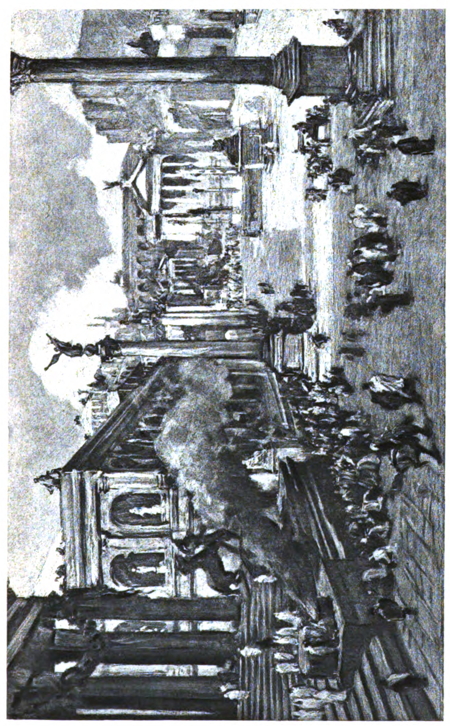
[I-221]
The dark and sanguinary soul of the tyrant was open to every suspicion against those among his subjects who were the most distinguished by their birth or merit. Whenever he was alarmed with the sound of treason, his cruelty was unbounded and unrelenting. A conspiracy against his life was either discovered or imagined, and Magnus, a consular senator, was named as the principal author of it. Without a witness, without a trial, and without an opportunity of defence, Magnus, with four thousand of his supposed accomplices, were put to death. Italy and the whole empire were infested with innumerable spies and informers. On the slightest accusation, the first of the Roman nobles, who had governed provinces, commanded armies, and been adorned with the consular and triumphal ornaments, were chained on the public carriages, and hurried away to the emperor’s presence. Confiscation, exile, or simple death, were esteemed uncommon instances of his lenity. Some of the unfortunate sufferers he ordered to be sewed up in the hides of slaughtered animals, others to be exposed to wild beasts, others again to be beaten to death with clubs. During the three years of his reign he disdained to visit either Rome or Italy. His camp, occasionally removed from the banks of the Rhine to those of the Danube, was the seat of his stern despotism, which trampled on every principle of law and justice, and was supported by the avowed power of the sword. [12] No man of noble birth, elegant accomplishments, or knowledge of civil business, was suffered near his person; and the court of a Roman emperor revived the idea of those ancient chiefs of slaves and [I-222] gladiators, whose savage power had left a deep impression of terror and detestation. [13]
As long as the cruelty of Maximin was confined to the illustrious senators, or even to the bold adventurers who in the court or army expose themselves to the caprice of fortune, the body of the people viewed their sufferings with indifference, or perhaps with pleasure. But the tyrant’s avarice, stimulated by the insatiate desires of the soldiers, at length attacked the public property. [14] Every city of the empire was possessed of an independent revenue, destined to purchase corn for the multitude, and to supply the expenses of the games and entertainments. By a single act of authority, the whole mass of wealth was at once confiscated for the use of the Imperial treasury. The temples were stripped of their most valuable offerings of gold and silver, and the statues of gods, heroes, and emperors were melted down and coined into money. These impious orders could not be executed without tumults and massacres, as in many places the people chose rather to die in the defence of their altars than to behold in the midst of peace their cities exposed to the rapine and cruelty of war. The soldiers themselves, among whom this sacrilegious plunder was distributed, received it with a blush; and, hardened as they were in acts of violence, they dreaded the just reproaches of their friends and relations. Throughout the Roman world a general cry of indignation was heard, imploring vengeance on the common enemy of human kind; and at length, by an act of private oppression, a peaceful and unarmed province was driven into rebellion against him. [15]
[I-223]
The procurator of Africa was a servant worthy of such a master, who considered the fines and confiscations of the rich as one of the most fruitful branches of the Imperial revenue. An iniquitous sentence had been pronounced against some opulent youths of that country, the execution of which would have stripped them of far the greater part of their patrimony. In this extremity, a resolution that must either complete or prevent their ruin was dictated by despair. A respite of three days, obtained with difficulty from the rapacious treasurer, was employed in collecting from their estates a great number of slaves and peasants blindly devoted to the commands of their lords, and armed with the rustic weapons of clubs and axes. The leaders of the conspiracy, as they were admitted to the audience of the procurator, stabbed him with the daggers concealed under their garments, and, by the assistance of their tumultuary train, seized on the little town of Thysdrus, [16] and erected the standard of rebellion against the sovereign of the Roman empire. They rested their hopes on the hatred of mankind against Maximin, and they judiciously resolved to oppose to that detested tyrant an emperor whose mild virtues had already acquired the love and esteem of the Romans, and whose authority over the province would give weight and stability to the enterprise. Gordianus, [17] their proconsul, and the object of their choice, refused, with unfeigned reluctance, the dangerous honour, and begged with tears that they should suffer him to terminate in peace a long and innocent life, without staining his feeble age with civil blood. Their menaces compelled him to accept the Imperial purple, his only refuge indeed against the jealous cruelty of [I-224] Maximin; since, according to the reasoning of tyrants, those who had been esteemed worthy of the throne deserve death, and those who deliberate have already rebelled. [18]
The family of Gordianus was one of the most illustrious of the Roman senate. On the father’s side he was descended from the Gracchi; on his mother’s, from the emperor Trajan. A great estate enabled him to support the dignity of his birth, and in the enjoyment of it he displayed an elegant taste and beneficent disposition. The palace in Rome formerly inhabited by the great Pompey had been, during several generations, in the possession of Gordian’s family. [19] It was distinguished by ancient trophies of naval victories, and decorated with the works of modern painting. His villa on the road to Præneste was celebrated for baths of singular beauty and extent, for three stately rooms of an hundred feet in length, and for a magnificent portico, supported by two hundred columns of the four most curious and costly sorts of marble. [20] The public shows exhibited at his expense, and in which the people were entertained with many hundreds of wild beasts and gladiators, [21] seem to surpass the fortune of a subject; [I-225] and, whilst the liberality of other magistrates was confined to a few solemn festivals in Rome, the magnificence of Gordian was repeated, when he was ædile, every month in the year, and extended, during his consulship, to the principal cities of Italy. He was twice elevated to the last-mentioned dignity, by Caracalla and by Alexander; for he possessed the uncommon talent of acquiring the esteem of virtuous princes, without alarming the jealousy of tyrants. His long life was innocently spent in the study of letters and the peaceful honours of Rome; and, till he was named proconsul of Africa by the voice of the senate and the approbation of Alexander, [22] he appears prudently to have declined the command of armies and the government of provinces. As long as that emperor lived, Africa was happy under the administration of his worthy representative; after the barbarous Maximin had usurped the throne, Gordianus alleviated the miseries which he was unable to prevent. When he reluctantly accepted the purple, he was above fourscore years old; a last and valuable remains of the happy age of the Antonines, whose virtues he revived in his own conduct, and celebrated in an elegant poem of thirty books. With the venerable proconsul, his son, who had accompanied him into Africa as his lieutenant, was likewise declared emperor. His manners were less pure, but his character was equally amiable with that of his father. Twenty-two acknowledged concubines, and a library of sixty-two thousand volumes, attested the variety of his inclinations; and from the productions which he left behind him, it appears that both the one and the other were designed for use rather than for ostentation. [23] The Roman people acknowledged in the features of the younger Gordian [I-226] the resemblance of Scipio Africanus, recollected with pleasure that his mother was the grand-daughter of Antoninus Pius, and rested the public hope on those latent virtues which had hitherto, as they fondly imagined, lain concealed in the luxurious indolence of a private life.
As soon as the Gordians had appeased the first tumult of a popular election they removed their court to Carthage. They were received with the acclamations of the Africans, who honoured their virtues, and who, since the visit of Hadrian, had never beheld the majesty of a Roman emperor. But these vain acclamations neither strengthened nor confirmed the title of the Gordians. They were induced by principle, as well as interest, to solicit the approbation of the senate; and a deputation of the noblest provincials was sent, without delay, to Rome, to relate and justify the conduct of their countrymen, who, having long suffered with patience, were at length resolved to act with vigour. The letters of the new princes were modest and respectful, excusing the necessity which had obliged them to accept the Imperial title, but submitting their election and their fate to the supreme judgment of the senate. [24]
The inclinations of the senate were neither doubtful nor divided. The birth and noble alliances of the Gordians had intimately connected them with the most illustrious houses of Rome. Their fortune had created many dependants in that assembly, their merit had acquired many friends. Their mild administration opened the flattering prospect of the restoration, not only of the civil, but even of the republican government. The terror of military violence, which had first obliged the senate to forget the murder of Alexander, and to ratify the election of a barbarian peasant, [25] now produced a contrary effect, and provoked them to assert the injured rights of freedom and humanity. The hatred of Maximin towards the [I-227] senate was declared and implacable; the tamest submission had not appeased his fury, the most cautious innocence would not remove his suspicions; and even the care of their own safety urged them to share the fortune of an enterprise, of which (if unsuccessful) they were sure to be the first victims. These considerations, and perhaps others of a more private nature, were debated in a previous conference of the consuls and the magistrates. As soon as their resolution was decided, they convoked in the temple of Castor the whole body of the senate, according to an ancient form of secrecy, [26] calculated to awaken their attention and to conceal their decrees. “Conscript fathers,” said the consul Syllanus, “the two Gordians, both of consular dignity, the one your proconsul, and the other your lieutenant, have been declared emperors by the general consent of Africa. Let us return thanks,” he boldly continued, “to the youth of Thysdrus; let us return thanks to the faithful people of Carthage, our generous deliverers from a horrid monster. — Why do you hear me thus coolly, thus timidly? Why do you cast these anxious looks on each other? why hesitate? Maximin is a public enemy! may his enmity soon expire with him, [27] and may we long enjoy the prudence and felicity of Gordian the father, the valour and constancy of Gordian the son!” [28] The noble ardour of the consul revived the languid spirit of the senate. By an unanimous decree the election of the Gordians was ratified; Maximin, his son, and his adherents were pronounced enemies of their country, and liberal rewards were offered to whomsoever had the courage and good fortune to destroy them.
During the emperor’s absence a detachment of the Prætorian [I-228] guards remained at Rome, to protect, or rather to command, the capital. The prefect Vitalianus had signalised his fidelity to Maximin by the alacrity with which he had obeyed, and even prevented, the cruel mandates of the tyrant. His death alone could rescue the authority of the senate, and the lives of the senators, from a state of danger and suspense. Before their resolves had transpired, a quæstor and some tribunes were commissioned to take his devoted life. They executed the order with equal boldness and success; and, with their bloody daggers in their hands, ran through the streets, proclaiming to the people and the soldiers the news of the happy revolution. The enthusiasm of liberty was seconded by the promise of a large donative in lands and money; the statues of Maximin were thrown down; the capital of the empire acknowledged, with transport, the authority of the two Gordians and the senate; [29] and the example of Rome was followed by the rest of Italy.
A new spirit had arisen in that assembly, whose long patience had been insulted by wanton despotism and military licence. The senate assumed the reins of government, and, with a calm intrepidity, prepared to vindicate by arms the cause of freedom. Among the consular senators recommended by their merit and services to the favour of the emperor Alexander, it was easy to select twenty, not unequal to the command of an army and the conduct of a war. [30] To these was the defence of Italy entrusted. Each was appointed to act in his respective department, authorised to enrol and discipline the Italian youth, and instructed to fortify the ports and highways against the impending invasion of Maximin. A number of deputies, chosen from the most illustrious of the senatorian and equestrian orders, were despatched at the same time to the governors of the several provinces, earnestly conjuring them to fly to the assistance of their country, and to [I-229] remind the nations of their ancient ties of friendship with the Roman senate and people. The general respect with which these deputies were received, and the zeal of Italy and the provinces in favour of the senate, sufficiently prove that the subjects of Maximin were reduced to that uncommon distress, in which the body of the people has more to fear from oppression than from resistance. The consciousness of that melancholy truth inspires a degree of persevering fury seldom to be found in those civil wars which are artificially supported for the benefit of a few factious and designing leaders. [31]
For, while the cause of the Gordians was embraced with such diffusive ardour, the Gordians themselves were no more. The feeble court of Carthage was alarmed with the rapid approach of Capelianus, governor of Mauritania, [32] who, with a small band of veterans [33] and a fierce host of barbarians, attacked a faithful but unwarlike province. The younger Gordian sallied out to meet the enemy at the head of a few guards, and a numerous undisciplined multitude, educated in the peaceful luxury of Carthage. His useless valour served only to procure him an honourable death in the field of battle. His aged father, whose reign had not exceeded thirty-six days, put an end to his life on the first news of the defeat. Carthage, destitute of defence, opened her gates to the conqueror, and Africa was exposed to the rapacious cruelty of a slave, obliged to satisfy his unrelenting master with a large account of blood and treasure. [34]
[I-230]
The fate of the Gordians filled Rome with just, but unexpected, terror. The senate, convoked in the temple of Concord, affected to transact the common business of the day; and seemed to decline, with trembling anxiety, the consideration of their own, and the public, danger. A silent consternation prevailed on the assembly, till a senator, of the name and family of Trajan, awakened his brethren from their fatal lethargy. He represented to them that the choice of cautious dilatory measures had been long since out of their power; that Maximin, implacable by nature and exasperated by injuries, was advancing towards Italy, at the head of the military force of the empire; and that their only remaining alternative was either to meet him bravely in the field, or tamely to expect the tortures and ignominious death reserved for unsuccessful rebellion. “We have lost,” continued he, “two excellent princes; but, unless we desert ourselves, the hopes of the republic have not perished with the Gordians. Many are the senators whose virtues have deserved, and whose abilities would sustain, the Imperial dignity. Let us elect two emperors, one of whom may conduct the war against the public enemy, whilst his colleague remains at Rome to direct the civil administration. I cheerfully expose myself to the danger and envy of the nomination, and give my vote in favour of Maximus and Balbinus. Ratify my choice, conscript fathers, or appoint, in their place, others more worthy of the empire.” The general apprehension silenced the whispers of jealousy; the merit of the candidates was universally acknowledged; and the house resounded with the sincere acclamations of “Long life and victory to the Emperors Maximus and Balbinus. You are happy in the judgment [I-231] of the senate; may the republic be happy under your administration!” [35]
The virtues and the reputation of the new emperors justified the most sanguine hopes of the Romans. The various nature of their talents seemed to appropriate to each his peculiar department of peace and war, without leaving room for jealous emulation. Balbinus was an admired orator, a poet of distinguished fame, and a wise magistrate, who had exercised with innocence and applause the civil jurisdiction in almost all the interior provinces of the empire. His birth was noble, [36] his fortune affluent, his manners liberal and affable. In him, the love of pleasure was corrected by a sense of dignity, nor had the habits of ease deprived him of a capacity for business. The mind of Maximus [37] was formed in a rougher mould. By his valour and abilities he had raised himself from the meanest origin to the first employments of the state and army. His victories over the Sarmatians and the Germans, the austerity of his life, and the rigid impartiality of his justice whilst he was prefect of the city, commanded the esteem of a people whose affections were engaged in favour of the more amiable Balbinus. The two colleagues had both been consul (Balbinus had twice enjoyed that honourable [I-232] office), both had been named among the twenty lieutenants of the senate; and, since the one was sixty and the other seventy-four years old, [38] they had both attained the full maturity of age and experience.
After the senate had conferred on Maximus and Balbinus an equal portion of the consular and tribunitian powers, the title of Fathers of their country, and the joint office of Supreme Pontiff, they ascended to the Capitol to return thanks to the gods, protectors of Rome. [39] The solemn rites of sacrifice were disturbed by a sedition of the people. The licentious multitude neither loved the rigid Maximus, nor did they sufficiently fear the mild and humane Balbinus. Their increasing numbers surrounded the temple of Jupiter; with obstinate clamours they asserted their inherent right of consenting to the election of their sovereign: and demanded, with an apparent moderation, that, besides the two emperors chosen by the senate, a third should be added of the family of the Gordians, as a just return of gratitude to those princes who had sacrificed their lives for the republic. At the head of the city guards and the youth of the equestrian order, Maximus and Balbinus attempted to cut their way through the seditious multitude. The multitude, armed with sticks and stones, drove them back into the Capitol. It is prudent to yield, when the contest, whatever may be the issue of it, must be fatal to both parties. A boy, only thirteen years of age, the grandson of the elder and nephew of the younger Gordian, was produced to the people, invested with the ornaments and title of Cæsar. [40] The tumult was appeased by this [I-233] easy condescension; and the two emperors, as soon as they had been peaceably acknowledged in Rome, prepared to defend Italy against the common enemy.
Whilst in Rome and Africa revolutions succeeded each other with such amazing rapidity, the mind of Maximin was agitated by the most furious passions. He is said to have received the news of the rebellion of the Gordians, and of the decree of the senate against him, not with the temper of a man, but the rage of a wild beast; which, as it could not discharge itself on the distant senate, threatened the life of his son, of his friends, and of all who ventured to approach his person. The grateful intelligence of the death of the Gordians was quickly followed by the assurance that the senate, laying aside all hopes of pardon or accommodation, had substituted in their room two emperors, with whose merit he could not be unacquainted. Revenge was the only consolation left to Maximin, and revenge could only be obtained by arms. The strength of the legions had been assembled by Alexander from all parts of the empire. Three successful campaigns against the Germans and the Sarmatians [41] had raised their fame, confirmed their discipline, and even increased their numbers, by filling the ranks with the flower of the barbarian youth. The life of Maximin had been spent in war, and the candid severity of history cannot refuse him the valour of a soldier, or even the abilities of an experienced general. [42] It might naturally be expected that a prince of such a character, instead of suffering the rebellion to gain stability by delay, should immediately have marched from the banks of the Danube to those of the Tiber, and that his victorious army, [I-234] instigated by contempt for the senate, and eager to gather the spoils of Italy, should have burned with impatience to finish the easy and lucrative conquest. Yet, as far as we can trust to the obscure chronology of that period, [43] it appears that the operations of some foreign war deferred the Italian expedition till the ensuing spring. From the prudent conduct of Maximin, we may learn that the savage features of his character have been exaggerated by the pencil of party; that his passions, however impetuous, submitted to the force of reason; and that the barbarian possessed something of the generous spirit of Sylla, who subdued the enemies of Rome before he suffered himself to revenge his private injuries. [44]
When the troops of Maximin, advancing [45] in excellent order, arrived at the foot of the Julian Alps, they were terrified by the silence and desolation that reigned on the frontiers of Italy. The villages and open towns had been abandoned, on their approach, by the inhabitants, the cattle was driven away, the provisions removed or destroyed, the bridges broken down, nor was anything left which could afford either shelter or subsistence to an invader. Such had been the wise orders of the generals of the senate, whose design was to protract the war, to ruin the army of Maximin by the [I-235] slow operation of famine, and to consume his strength in the sieges of the principal cities of Italy, which they had plentifully stored with men and provisions from the deserted country. Aquileia received and withstood the first shock of the invasion. The streams that issue from the head of the Hadriatic gulf, swelled by the melting of the winter snows, [46] opposed an unexpected obstacle to the arms of Maximin. At length, on a singular bridge, constructed, with art and difficulty, of large hogsheads, he transported his army to the opposite bank, rooted up the beautiful vineyards in the neighbourhood of Aquileia, demolished the suburbs, and employed the timber of the buildings in the engines and towers with which on every side he attacked the city. The walls, fallen to decay during the security of a long peace, had been hastily repaired on this sudden emergency; but the firmest defence of Aquileia consisted in the constancy of the citizens; all ranks of whom, instead of being dismayed, were animated by the extreme danger, and their knowledge of the tyrant’s unrelenting temper. Their courage was supported and directed by Crispinus and Menophilus, two of the twenty lieutenants of the senate, who, with a small body of regular troops, had thrown themselves into the besieged place. The army of Maximin was repulsed in repeated attacks, his machines destroyed by showers of artificial fire; and the generous enthusiasm of the Aquileians was exalted into a confidence of success, by the opinion that Belenus, their [I-236] tutelar deity, combated in person in the defence of his distressed worshippers. [47]
The emperor Maximus, who had advanced as far as Ravenna, to secure that important place and to hasten the military preparations, beheld the event of the war in the more faithful mirror of reason and policy. He was too sensible that a single town could not resist the persevering efforts of a great army; and he dreaded lest the enemy, tired with the obstinate resistance of Aquileia, should on a sudden relinquish the fruitless siege and march directly towards Rome. The fate of the empire and the cause of freedom must then be committed to the chance of a battle; and what arms could he oppose to the veteran legions of the Rhine and Danube? Some troops newly levied among the generous but enervated youth of Italy, and a body of German auxiliaries, on whose firmness, in the hour of trial, it was dangerous to depend. In the midst of these just alarms, the stroke of domestic conspiracy punished the crimes of Maximin and delivered Rome and the senate from the calamities that would surely have attended the victory of an enraged barbarian.
The people of Aquileia had scarcely experienced any of the common miseries of a siege; their magazines were plentifully supplied, and several fountains within the walls assured them of an inexhaustible resource of fresh water. The soldiers of Maximin were, on the contrary, exposed to the inclemency of the season, the contagion of disease, and the horrors of famine. The naked country was ruined, the rivers filled with the slain and polluted with blood. A spirit of despair and disaffection began to diffuse itself among the troops; and, as they were cut off from all intelligence, they easily believed that the whole empire had embraced the [I-237] cause of the senate, and that they were left as devoted victims to perish under the impregnable walls of Aquileia. The fierce temper of the tyrant was exasperated by disappointments, which he imputed to the cowardice of his army; and his wanton and ill-timed cruelty, instead of striking terror, inspired hatred and a just desire of revenge. A party of Prætorian guards, who trembled for their wives and children in the camp of Alba, near Rome, executed the sentence of the senate. Maximin, abandoned by his guards, was slain in his tent, with his son (whom he had associated to the honours of the purple), Anulinus the prefect, and the principal ministers of his tyranny. [48] The sight of their heads, borne on the point of spears, convinced the citizens of Aquileia that the siege was at an end; the gates of the city were thrown open, a liberal market was provided for the hungry troops of Maximin, and the whole army joined in solemn protestations of fidelity to the senate and people of Rome, and to their lawful emperors Maximus and Balbinus. Such was the deserved fate of a brutal savage, destitute, as he has generally been represented, of every sentiment that distinguishes a civilised, or even a human, being. The body was suited to the soul. The stature of Maximin exceeded the measure of eight feet, and circumstances almost incredible are related of his matchless strength and appetite. [49] Had he lived in a less enlightened age, tradition and poetry might well have described him as one [I-238] of those monstrous giants, whose supernatural power was constantly exerted for the destruction of mankind.
It is easier to conceive than to describe the universal joy of the Roman world on the fall of the tyrant, the news of which is said to have been carried in four days from Aquileia to Rome. The return of Maximus was a triumphal procession; his colleague and young Gordian went out to meet him, and the three princes made their entry into the capital, attended by the ambassadors of almost all the cities of Italy, saluted with the splendid offerings of gratitude and superstition, and received with the unfeigned acclamations of the senate and people, who persuaded themselves that a golden age would succeed to an age of iron. [50] The conduct of the two emperors corresponded with these expectations. They administered justice in person; and the rigour of the one was tempered by the other’s clemency. The oppressive taxes with which Maximin had loaded the rights of inheritance and succession were repealed, or at least moderated. Discipline was revived, and with the advice of the senate many wise laws were enacted by their Imperial ministers, who endeavoured to restore a civil constitution on the ruins of military tyranny. “What reward may we expect for delivering Rome from a monster?” was the question asked by Maximus, in a moment of freedom and confidence. Balbinus answered it without hesitation, “The love of the senate, of the people, and of all mankind.” “Alas!” replied his more penetrating colleague, “Alas! I dread the hatred of the soldiers, and the fatal effects of their resentment.” [51] His apprehensions were but too well justified by the event.
Whilst Maximus was preparing to defend Italy against the common foe, Balbinus, who remained at Rome, had been engaged in scenes of blood and intestine discord. Distrust [I-239] and jealousy reigned in the senate; and even in the temples where they assembled every senator carried either open or concealed arms. In the midst of their deliberations, two veterans of the guards, actuated either by curiosity or a sinister motive, audaciously thrust themselves into the house, and advanced by degrees beyond the altar of Victory. Gallicanus, a consular, and Mæcenas, a prætorian senator, viewed with indignation their insolent intrusion: drawing their daggers, they laid the spies, for such they deemed them, dead at the foot of the altar, and then, advancing to the door of the senate, imprudently exhorted the multitude to massacre the Prætorians as the secret adherents of the tyrant. Those who escaped the first fury of the tumult took refuge in the camp, which they defended with superior advantage against the reiterated attacks of the people, assisted by the numerous bands of gladiators, the property of opulent nobles. The civil war lasted many days, with infinite loss and confusion on both sides. When the pipes were broken that supplied the camp with water, the Prætorians were reduced to intolerable distress; but, in their turn, they made desperate sallies into the city, set fire to a great number of houses, and filled the streets with the blood of the inhabitants. The emperor Balbinus attempted, by ineffectual edicts and precarious truces, to reconcile the factions of Rome. But their animosity, though smothered for a while, burnt with redoubled violence. The soldiers, detesting the senate and the people, despised the weakness of a prince who wanted either the spirit or the power to command the obedience of his subjects. [52]
After the tyrant’s death his formidable army had acknowledged, from necessity rather than from choice, the authority of Maximus, who transported himself without delay to the camp before Aquileia. As soon as he had received their oath of fidelity he addressed them in terms full of mildness [I-240] and moderation; lamented rather than arraigned the wild disorders of the times, and assured the soldiers that, of all their past conduct, the senate would remember only their generous desertion of the tyrant and their voluntary return to their duty. Maximus enforced his exhortations by a liberal donative, purified the camp by a solemn sacrifice of expiation, and then dismissed the legions to their several provinces, impressed, as he hoped, with a lively sense of gratitude and obedience. [53] But nothing could reconcile the haughty spirit of the Prætorians. They attended the emperors on the memorable day of their public entry into Rome; but, amidst the general acclamations, the sullen dejected countenance of the guards sufficiently declared that they considered themselves as the object, rather than the partners, of the triumph. When the whole body was united in their camp, those who had served under Maximin, and those who had remained at Rome, insensibly communicated to each other their complaints and apprehensions. The emperors chosen by the army had perished with ignominy; those elected by the senate were seated on the throne. [54] The long discord between the civil and military powers was decided by a war in which the former had obtained a complete victory. The soldiers must now learn a new doctrine of submission to the senate; and, whatever clemency was affected by that politic assembly, they dreaded a slow revenge, coloured by the name of discipline, and justified by fair pretences of the public good. But their fate was still in their own hands; and, if they had courage to despise the vain terrors of an impotent republic, it was easy to convince the world that those who were masters of the arms were masters of the authority of the state.
When the senate elected two princes, it is probable that, [I-241] besides the declared reason of providing for the various emergencies of peace and war, they were actuated by the secret desire of weakening by division the despotism of the supreme magistrate. Their policy was effectual, but it proved fatal both to their emperors and to themselves. The jealousy of power was soon exasperated by the difference of character. Maximus despised Balbinus as a luxurious noble, and was in his turn disdained by his colleague as an obscure soldier. Their silent discord was understood rather than seen; [55] but the mutual consciousness prevented them from uniting in any vigorous measures of defence against their common enemies of the Prætorian camp. The whole city was employed in the Capitoline games, and the emperors were left almost alone in the palace. On a sudden they were alarmed by the approach of a troop of desperate assassins. Ignorant of each other’s situation or designs, for they already occupied very distant apartments, afraid to give or to receive assistance, they wasted the important moments in idle debates and fruitless recriminations. The arrival of the guards put an end to the vain strife. They seized on these emperors of the senate, for such they called them with malicious contempt, stripped them of their garments, and dragged them in insolent triumph through the streets of Rome, with a design of inflicting a slow and cruel death on these unfortunate princes. The fear of a rescue from the faithful Germans of the Imperial guards shortened their tortures; and their bodies, mangled with a thousand wounds, were left exposed to the insults or to the pity of the populace. [56]
In the space of a few months six princes had been cut off [I-242] by the sword. Gordian, who had already received the title of Cæsar, was the only person that occurred to the soldiers as proper to fill the vacant throne. [57] They carried him to the camp and unanimously saluted him Augustus and Emperor. [58] His name was dear to the senate and people; his tender age promised a long impunity of military licence; and the submission of Rome and the provinces to the choice of the Prætorian guards saved the republic, at the expense indeed of its freedom and dignity, from the horrors of a new civil war in the heart of the capital. [59]
As the third Gordian was only nineteen years of age at the time of his death, the history of his life, were it known to us with greater accuracy than it really is, would contain little more than the account of his education and the conduct of the ministers who by turns abused or guided the simplicity of his inexperienced youth. Immediately after his accession he fell into the hands of his mother’s eunuchs, that pernicious vermin of the East, who, since the days of Elagabalus, had infested the Roman palace. By the artful conspiracy of these wretches an impenetrable veil was drawn between an innocent prince and his oppressed subjects, the virtuous disposition of Gordian was deceived, and the honours of the empire sold without his knowledge, though in a very public manner, to the most worthless of mankind. We are ignorant by what fortunate accident the emperor escaped from this ignominious [I-243] slavery, and devolved his confidence on a minister whose wise counsels had no object except the glory of the sovereign and the happiness of the people. It should seem that love and learning introduced Misitheus [60] to the favour of Gordian. The young prince married the daughter of his master of rhetoric, and promoted his father-in-law to the first offices of the empire. Two admirable letters that passed between them are still extant. The minister, with the conscious dignity of virtue, congratulates Gordian that he is delivered from the tyranny of the eunuchs, [61] and still more, that he is sensible of his deliverance. The emperor acknowledges, with an amiable confusion, the errors of his past conduct; and laments, with singular propriety, the misfortune of a monarch from whom a venal tribe of courtiers perpetually labour to conceal the truth. [62]
The life of Misitheus had been spent in the profession of letters, not of arms; yet such was the versatile genius of that great man that, when he was appointed Prætorian prefect, he discharged the military duties of his place with vigour and ability. The Persians had invaded Mesopotamia, and threatened Antioch. By the persuasion of his father-in-law, the young emperor quitted the luxury of Rome, opened, for the last time recorded in history, the temple of Janus, and marched in person into the East. [63] On his approach [I-244] with a great army, the Persians withdrew their garrisons from the cities which they had already taken, and retired from the Euphrates to the Tigris. [64] Gordian enjoyed the pleasure of announcing to the senate the first success of his arms, which he ascribed with a becoming modesty and gratitude to the wisdom of his father and prefect. During the whole expedition, Misitheus watched over the safety and discipline of the army; whilst he prevented their dangerous murmurs by maintaining a regular plenty in the camp, and by establishing ample magazines of vinegar, bacon, straw, barley, and wheat, in all the cities of the frontier. [65] But the prosperity of Gordian expired with Misitheus, who died of a flux, not without very strong suspicions of poison. Philip, his successor in the prefecture, was an Arab by birth, and consequently, in the earlier part of his life, a robber by profession. His rise from so obscure a station to the first dignities of the empire seems to prove that he was a bold and able leader. But his boldness prompted him to aspire to the throne, and his abilities were employed to supplant, not to serve, his indulgent master. The minds of the soldiers were irritated by an artificial scarcity, created by his contrivance in the camp; and the distress of the army was attributed to the youth and incapacity of the prince. It is not in our power to trace the successive steps of the secret conspiracy and open sedition which were at length fatal to Gordian. A sepulchral monument was erected to [I-245] his memory on the spot [66] where he was killed, near the conflux of the Euphrates with the little river Aboras. [67] The fortunate Philip, raised to the empire by the votes of the soldiers, found a ready obedience from the senate and the provinces. [68]
We cannot forbear transcribing the ingenious, though somewhat fanciful, description, which a celebrated writer of our own times has traced of the military government of the Roman empire. “What in that age was called the Roman empire was only an irregular republic, not unlike the aristocracy [69] of Algiers, [70] where the militia, possessed of the sovereignty, creates and deposes a magistrate, who is styled a Dey. Perhaps, indeed, it may be laid down as a general rule, that a military government is, in some respects, more republican than monarchical. Nor can it be said that the soldiers only partook of the government by their disobedience and rebellions. The speeches made to them by the emperors, were they not at length of the same nature as those formerly pronounced to the people by the consuls and the tribunes? And although the armies had no regular [I-246] place or forms of assembly, though their debates were short, their action sudden, and their resolves seldom the result of cool reflection, did they not dispose, with absolute sway, of the public fortune? What was the emperor, except the minister of a violent government, elected for the private benefit of the soldiers?
“When the army had elected Philip, who was Prætorian prefect to the third Gordian, the latter demanded that he might remain sole emperor; he was unable to obtain it. He requested that the power might be equally divided between them; the army would not listen to his speech. He consented to be degraded to the rank of Cæsar; the favour was refused him. He desired, at least, he might be appointed Prætorian prefect; his prayer was rejected. Finally, he pleaded for his life. The army, in these several judgments, exercised the supreme magistracy.” According to the historian, whose doubtful narrative the president De Montesquieu has adopted, Philip, who, during the whole transaction, had preserved a sullen silence, was inclined to spare the innocent life of his benefactor; till, recollecting that his innocence might excite a dangerous compassion in the Roman world, he commanded, without regard to his suppliant cries, that he should be seized, stript, and led away to instant death. After a moment’s pause the inhuman sentence was executed. [71]
On his return from the East to Rome, Philip, desirous of obliterating the memory of his crimes, and of captivating the affections of the people, solemnised the secular games with infinite pomp and magnificence. Since their institution [I-247] or revival by Augustus, [72] they had been celebrated by Claudius, by Domitian, and by Severus, and were now renewed, the fifth time, on the accomplishment of the full period of a thousand years from the foundation of Rome. Every circumstance of the secular games was skilfully adapted to inspire the superstitious mind with deep and solemn reverence. The long interval between them [73] exceeded the term of human life; and, as none of the spectators had already seen them, none could flatter themselves with the expectation of beholding them a second time. The mystic sacrifices were performed, during three nights, on the banks of the Tiber; and the Campus Martius resounded with music and dances, and was illuminated with innumerable lamps and torches. Slaves and strangers were excluded from any participation in these national ceremonies. A chorus of twenty-seven youths, and as many virgins, of noble families, and whose parents were both alive, implored the propitious gods in favour of the present, and for the hope of the rising generation; requesting, in religious hymns, that, according to the faith of their ancient oracles, they would still maintain the virtue, the felicity, and the empire of the Roman people. [74] The magnificence of Philip’s shows and entertainments [I-248] dazzled the eyes of the multitude. The devout were employed in the rites of superstition, whilst the reflecting few revolved in their anxious minds the past history and the future fate of the empire.
Since Romulus, with a small band of shepherds and outlaws, fortified himself on the hills near the Tiber, ten centuries had already elapsed. [75] During the four first ages, the Romans, in the laborious school of poverty, had acquired the virtues of war and government: by the vigorous exertion of those virtues, and by the assistance of fortune, they had obtained, in the course of the three succeeding centuries, an absolute empire over many countries of Europe, Asia, and Africa. The last three hundred years had been consumed in apparent prosperity and internal decline. The nation of soldiers, magistrates, and legislators, who composed the thirty-five tribes of the Roman people, was dissolved into the common mass of mankind, and confounded with the millions of servile provincials, who had received the name, without adopting the spirit, of Romans. A mercenary army, levied among the subjects and barbarians of the frontier, was the only order of men who preserved and abused their independence. By their tumultuary election, a Syrian, a Goth, or an Arab, was exalted to the throne of Rome, and invested with despotic power over the conquests and over the country of the Scipios.
The limits of the Roman empire still extended from the Western Ocean to the Tigris, and from Mount Atlas to the Rhine and the Danube. To the undiscerning eye of the vulgar, Philip appeared a monarch no less powerful than Hadrian or Augustus had formerly been. The form was still the same, but the animating health and vigour were fled. The industry of the people was discouraged and exhausted [I-249] by a long series of oppression. The discipline of the legions, which alone, after the extinction of every other virtue, had propped the greatness of the state, was corrupted by the ambition, or relaxed by the weakness, of the emperors. The strength of the frontiers, which had always consisted in arms rather than in fortifications, was insensibly undermined; and the fairest provinces were left exposed to the rapaciousness or ambition of the barbarians, who soon discovered the decline of the Roman empire.
[I-250]
CHAPTER VIII↩
Of the State of Persia after the Restoration of the Monarchy by Artaxerxes [1]
Whenever Tacitus indulges himself in those beautiful episodes, in which he relates some domestic transaction of the Germans or of the Parthians, his principal object is to relieve the attention of the reader from a uniform scene of vice and misery. From the reign of Augustus to the time of Alexander Severus, the enemies of Rome were in her bosom — the tyrants, and the soldiers; and her prosperity had a very distant and feeble interest in the revolutions that might happen beyond the Rhine and the Euphrates. But, when the military order had levelled in wild anarchy the power of the prince, the laws of the senate, and even the discipline of the camp, the barbarians of the North and of the East, who had long hovered on the frontier, boldly attacked the provinces of a declining monarchy. Their vexatious inroads were changed into formidable irruptions, and, after a long vicissitude of mutual calamities, many tribes of the victorious invaders established themselves in the provinces of the Roman empire. To obtain a clearer knowledge of these great events we shall endeavour to form a previous idea of the character, forces, and designs of those nations who avenged the cause of Hannibal and Mithridates.
In the more early ages of the world, whilst the forest that covered Europe afforded a retreat to a few wandering savages, the inhabitants of Asia were already collected into populous cities, and reduced under extensive empires, the seat of the [I-251] arts, of luxury and of despotism. The Assyrians reigned over the East, [2] till the sceptre of Ninus and Semiramis dropt from the hands of their enervated successors. The Medes and the Babylonians divided their power, and were themselves swallowed up in the monarchy of the Persians, whose arms could not be confined within the narrow limits of Asia. Followed, as it is said, by two millions of men, Xerxes, the descendant of Cyrus, invaded Greece. Thirty thousand soldiers, under the command of Alexander, the son of Philip, who was entrusted by the Greeks with their glory and revenge, were sufficient to subdue Persia. The princes of the house of Seleucus usurped and lost the Macedonian command over the East. About the same time that, by an ignominious treaty, they resigned to the Romans the country on this side Mount Taurus, they were driven by the Parthians, an obscure horde of Scythian origin, from all the provinces of Upper Asia. The formidable power of the Parthians, which spread from India to the frontiers of Syria, was in its turn subverted by Ardshir, [3] or Artaxerxes; the founder of a new dynasty, which, under the name of Sassanides, governed Persia till the invasion of the Arabs. This great revolution, whose fatal influence was soon experienced by the Romans, happened in the fourth year of Alexander Severus, two hundred and twenty-six years after the Christian era. [4]
[I-252]
Artaxerxes had served with great reputation in the armies of Artaban, the last king of the Parthians, and it appears that he was driven into exile and rebellion by royal ingratitude, the customary reward for superior merit. His birth was obscure, and the obscurity equally gave room to the aspersions of his enemies, and the flattery of his adherents. If we credit the scandal of the former, Artaxerxes sprang from the illegitimate commerce of a tanner’s wife with a common soldier. [5] The latter represents him as descended from a branch of the ancient kings of Persia, though time and misfortune had gradually reduced his ancestors to the humble station of private citizens. [6] As the lineal heir of the monarchy, he asserted his right to the throne, and challenged the noble task of delivering the Persians from the oppression under which they groaned above five centuries since the death of Darius. The Parthians were defeated in three great battles. In the last of these their king Artaban was slain, and the spirit of the nation was for ever broken. [7] The authority of Artaxerxes was solemnly acknowledged in a great assembly held at Balch in Khorasan. Two younger branches of the royal house of Arsaces were confounded among the prostrate satraps. A third, more mindful of ancient grandeur than of present necessity, attempted to retire with a numerous train of vassals, towards their kinsman, the king of Armenia; [I-253] but this little army of deserters was intercepted and cut off by the vigilance of the conqueror, [8] who boldly assumed the double diadem, and the title of King of Kings, which had been enjoyed by his predecessor. [9] But these pompous titles, instead of gratifying the vanity of the Persian, served only to admonish him of his duty, and to inflame in his soul the ambition of restoring, in their full splendour, the religion and empire of Cyrus.
I. During the long servitude of Persia under the Macedonian and the Parthian yoke, the nations of Europe and Asia had mutually adopted and corrupted each other’s superstitions. The Arsacides, indeed, practised the worship of the Magi; but they disgraced and polluted it with a various mixture of foreign idolatry. The memory of Zoroaster, the ancient prophet and philosopher of the Persians, [10] was still revered in the East; but the obsolete and mysterious language in which the Zendavesta was composed, [11] opened a field of dispute to seventy sects, who variously explained [I-254] the fundamental doctrines of their religion, and were all equally derided by a crowd of infidels, who rejected the divine mission and miracles of the prophet. To suppress the idolaters, re-unite the schismatics, and confute the unbelievers by the infallible decision of a general council, the pious Artaxerxes summoned the Magi from all parts of his dominions. These priests, who had so long sighed in contempt and obscurity, obeyed the welcome summons; and on the appointed day appeared to the number of about eighty thousand. But as the debates of so tumultuous an assembly could not have been directed by the authority of reason, or influenced by the art of policy, the Persian synod was reduced, by successive operations, to forty thousand, to four thousand, to four hundred, to forty, and at last to seven Magi, the most respected for their learning and piety. One of these, Erdaviraph, a young but holy prelate, received from the hands of his brethren three cups of soporiferous wine. He drank them off, and instantly fell into a long and profound sleep. As soon as he waked, he related to the king and to the believing multitude his journey to Heaven, and his intimate conferences with the Deity. Every doubt was silenced by this supernatural evidence; and the articles of the faith of Zoroaster were fixed with equal authority and precision. [12] A short delineation of that celebrated system will be found useful, not only to display the character of the Persian nation, but to illustrate many of their most important transactions, both in peace and war, with the Roman empire. [13]
The great and fundamental article of the system was the [I-255] celebrated doctrine of the two principles; a bold and injudicious attempt of Eastern philosophy to reconcile the existence of moral and physical evil with the attributes of a beneficent Creator and Governor of the world. The first and original Being, in whom, or by whom, the universe exists, is denominated in the writings of Zoroaster, Time without bounds; but it must be confessed that this infinite substance seems rather a metaphysical abstraction of the mind than a real object endowed with self-consciousness, or possessed of moral perfections. [14] From either the blind or the intelligent operation of this infinite Time, which bears but too near an affinity with the Chaos of the Greeks, the two secondary but active principles of the universe were from all eternity produced, Ormusd and Ahriman, each of them possessed of the powers of creation, but each disposed, by his invariable nature, to exercise them with different designs. [15] The principle of good is eternally absorbed in light: the principle of evil eternally buried in darkness. The wise benevolence of Ormusd formed man capable of virtue, and abundantly provided his fair habitation with the materials of happiness. By his vigilant providence, the motion of the planets, the order of the seasons, and the temperate mixture of the elements are preserved. But the malice of Ahriman has long since pierced Ormusd’s egg; or, in other words, has violated the harmony of his works. Since that fatal eruption, the most minute particles of good and evil are intimately intermingled and agitated together, the rankest poisons spring up amidst the most salutary plants; deluges, earthquakes, and conflagrations attest the conflict of Nature; and the little world of man is perpetually shaken by vice and misfortune. Whilst the rest of human kind are led [I-256] away captives in the chains of their infernal enemy, the faithful Persian alone reserves his religious adoration for his friend and protector Ormusd, and fights under his banner of light, in the full confidence that he shall, in the last day, share the glory of his triumph. At that decisive period the enlightened wisdom of goodness will render the power of Ormusd superior to the furious malice of his rival. Ahriman and his followers, disarmed and subdued, will sink into their native darkness; and virtue will maintain the eternal peace and harmony of the universe. [16]
The theology of Zoroaster was darkly comprehended by foreigners, and even by the far greater number of his disciples; but the most careless observers were struck with the philosophic simplicity of the Persian worship. “That people,” says Herodotus, [17] “rejects the use of temples, of altars, and of statues, and smiles at the folly of those nations, who imagine that the gods are sprung from, or bear any affinity with, the human nature. The tops of the highest mountains are the places chosen for sacrifices. Hymns and prayers are the principal worship; the Supreme God who fills the wide circle of heaven, is the object to whom they are addressed.” Yet, at the same time, in the true spirit of a polytheist, he accuses them of adoring Earth, Water, Fire, the Winds, and the Sun and Moon. But the Persians of every age have denied the charge, and explained the equivocal conduct which might appear to give a colour to it. The elements, and more particularly Fire, Light, and the Sun, whom they called Mithra, were the objects of their religious reverence, because they considered them as the [I-257] purest symbols, the noblest productions, and the most powerful agents of the Divine Power and Nature. [18]
Every mode of religion, to make a deep and lasting impression on the human mind, must exercise our obedience by enjoining practices of devotion, for which we can assign no reason; and must acquire our esteem, by inculcating moral duties analogous to the dictates of our own hearts. The religion of Zoroaster was abundantly provided with the former, and possessed a sufficient portion of the latter. At the age of puberty the faithful Persian was invested with a mysterious girdle, the badge of the divine protection; and from that moment all the actions of his life, even the most indifferent or the most necessary, were sanctified by their peculiar prayers, ejaculations, or genuflexions; the omission of which, under any circumstances, was a grievous sin, not inferior in guilt to the violation of the moral duties. The moral duties, however, of justice, mercy, liberality, &c., were in their turn required of the disciple of Zoroaster, who wished to escape the persecution of Ahriman, and to live with Ormusd in a blissful eternity, where the degree of felicity will be exactly proportioned to the degree of virtue and piety. [19]
But there are some remarkable instances in which Zoroaster lays aside the prophet, assumes the legislator, and discovers a liberal concern for private and public happiness, seldom to be found among the grovelling or visionary schemes of superstition. Fasting and celibacy, the common means of purchasing the divine favour, he condemns with abhorrence, as a criminal rejection of the best gifts of providence. The saint, [I-258] in the Magian religion, is obliged to beget children, to plant useful trees, to destroy noxious animals, to convey water to the dry lands of Persia, and to work out his salvation by pursuing all the labours of agriculture. We may quote from the Zend Avesta a wise and benevolent maxim, which compensates for many an absurdity. “He who sows the ground with care and diligence acquires a greater stock of religious merit than he could gain by the repetition of ten thousand prayers.” [20] In the spring of every year a festival was celebrated, destined to represent the primitive equality, and the present connection, of mankind. The stately kings of Persia, exchanging their vain pomp for more genuine greatness, freely mingled with the humblest but most useful of their subjects. On that day the husbandmen were admitted, without distinction, to the table of the king and his satraps. The monarch accepted their petitions, inquired into their grievances, and conversed with them on the most equal terms. “From your labours,” was he accustomed to say (and to say with truth, if not with sincerity), “from your labours we receive our subsistence; you derive your tranquillity from our vigilance; since, therefore, we are mutually necessary to each other, let us live together like brothers in concord and love.” [21] Such a festival must indeed have degenerated, in a wealthy and despotic empire, into a theatrical representation; but it was at least a comedy well worthy of a royal audience, and which might sometimes imprint a salutary lesson on the mind of a young prince.
Had Zoroaster, in all his institutions, invariably supported this exalted character, his name would deserve a place with those of Numa and Confucius, and his system would be justly entitled to all the applause which it has pleased some of our divines, and even some of our philosophers, to bestow on it. But in that motley composition, dictated by reason and passion, [I-259] by enthusiasm and by selfish motives, some useful and sublime truths were disgraced by a mixture of the most abject and dangerous superstition. The Magi, or sacerdotal order, were extremely numerous, since, as we have already seen, fourscore thousand of them were convened in a general council. Their forces were multiplied by discipline. A regular hierarchy was diffused through all the provinces of Persia; and the Archimagus, who resided at Balch, was respected as the visible head of the church, and the lawful successor of Zoroaster. [22] The property of the Magi was very considerable. Besides the less invidious possession of a large tract of the most fertile lands of Media, [23] they levied a general tax on the fortunes and the industry of the Persians. [24] “Though your good works,” says the interested prophet, “exceed in number the leaves of the trees, the drops of rain, the stars in the heaven, or the sands on the sea-shore, they will all be unprofitable to you, unless they are accepted by the destour, or priest. To obtain the acceptation of this guide to salvation, you must faithfully pay him tithes of all you possess, of your goods, of your lands, and of your money. If the destour be satisfied, your soul will escape hell tortures; you will secure praise in this world and happiness in the next. For the destours are the teachers of religion; they know all things, and they deliver all men.” [25]
These convenient maxims of reverence and implicit faith were doubtless imprinted with care on the tender minds of [I-260] youth; since the Magi were the masters of education in Persia, and to their hands the children even of the royal family were entrusted. [26] The Persian priests, who were of a speculative genius, preserved and investigated the secrets of Oriental philosophy; and acquired, either by superior knowledge or superior art, the reputation of being well versed in some occult sciences, which have derived their appellation from the Magi. [27] Those of more active dispositions mixed with the world in courts and cities; and it is observed that the administration of Artaxerxes was in a great measure directed by the counsels of the sacerdotal order, whose dignity, either from policy or devotion, that prince restored to its ancient splendour. [28]
The first counsel of the Magi was agreeable to the unsociable genius of their faith, [29] to the practice of ancient kings, [30] and even to the example of their legislator, who had fallen a victim to a religious war excited by his own intolerant zeal. [31] By an edict of Artaxerxes, the exercise of every worship, except that of Zoroaster, was severely prohibited. The temples of the Parthians, and the statues of their deified monarchs, were thrown down with ignominy. [32] The sword of Aristotle (such was the name given by the Orientals to the polytheism and philosophy of the Greeks) was easily broken: [33] the flames of persecution soon reached the more [I-261] stubbom Jews and Christians; [34] nor did they spare the heretics of their own nation and religion. The majesty of Ormusd, who was jealous of a rival, was seconded by the despotism of Artaxerxes, who could not suffer a rebel; and the schismatics within his vast empire were soon reduced to the inconsiderable number of eighty thousand. [35] This spirit of persecution reflects dishonour on the religion of Zoroaster; but, as it was not productive of any civil commotion, it served to strengthen the new monarchy by uniting all the various inhabitants of Persia in the bands of religious zeal.
II. Artaxerxes, by his valour and conduct, had wrested the sceptre of the East from the ancient royal family of Parthia. There still remained the more difficult task of establishing, throughout the vast extent of Persia, a uniform and vigorous administration. The weak indulgence of the Arsacides had resigned to their sons and brothers the principal provinces and the greatest offices of the kingdom, in the nature of hereditary possessions. The vitaxæ, or eighteen most powerful satraps, were permitted to assume the regal title, and the vain pride of the monarch was delighted with a nominal dominion over so many vassal kings. Even tribes of barbarians in their mountains, and the Greek cities of Upper Asia, [36] within their walls, scarcely acknowledged, or seldom obeyed, any superior; and the Parthian empire exhibited, under other names, a lively image of the feudal system [37] [I-262] which has since prevailed in Europe. But the active victor, at the head of a numerous and disciplined army, visited in person every province of Persia. The defeat of the boldest rebels and the reduction of the strongest fortifications [38] diffused the terror of his arms and prepared the way for the peaceful reception of his authority. An obstinate resistance was fatal to the chiefs; but their followers were treated with lenity. [39] A cheerful submission was rewarded with honours and riches; but the prudent Artaxerxes, suffering no person except himself to assume the title of king, abolished every intermediate power between the throne and the people. His kingdom, nearly equal in extent to modern Persia, was, on every side, bounded by the sea or by great rivers, — by the Euphrates, the Tigris, the Araxes, the Oxus, and the Indus; by the Caspian Sea and the Gulf of Persia. [40] That country was computed to contain, in the last century, five hundred and fifty-four cities, sixty thousand villages, and about forty millions of souls. [41] If we compare the administration of the [I-263] house of Sassan with that of the house of Sesi, the political influence of the Magian with that of the Mahometan religion, we shall probably infer that the kingdom of Artaxerxes contained at least as great a number of cities, villages, and inhabitants. But it must likewise be confessed that in every age the want of harbours on the sea coast, and the scarcity of fresh water in the inland provinces, have been very unfavourable to the commerce and agriculture of the Persians; who, in the calculation of their numbers, seem to have indulged one of the meanest, though most common, artifices of national vanity.
As soon as the ambitious mind of Artaxerxes had triumphed over the resistance of his vassals, he began to threaten the neighbouring states, who, during the long slumber of his predecessors, had insulted Persia with impunity. He obtained some easy victories over the wild Scythians and the effeminate Indians; but the Romans were an enemy who, by their past injuries and present power, deserved the utmost efforts of his arms. A forty years’ tranquillity, the fruit of valour and moderation, had succeeded the victories of Trajan. During the period that elapsed from the accession of Marcus to the reign of Alexander, the Roman and the Parthian empires were twice engaged in war; and, although the whole strength of the Arsacides contended with a part only of the forces of Rome, the event was most commonly in favour of the latter. Macrinus, indeed, prompted by his precarious situation and pusillanimous temper, purchased a peace at the expense of near two millions of our money; [42] but the generals of Marcus, the emperor Severus, and his son, erected many trophies in Armenia, Mesopotamia, and Assyria. Among their exploits, the imperfect relation of which would have unseasonably interrupted the more important series of [I-264] domestic revolutions, we shall only mention the repeated calamities of the two great cities of Seleucia and Ctesiphon.
Seleucia, on the western bank of the Tigris, about forty-five miles to the north of ancient Babylon, was the capital of the Macedonian conquests in Upper Asia. [43] Many ages after the fall of their empire, Seleucia retained the genuine characters of a Grecian colony — arts, military virtue, and the love of freedom. The independent republic was governed by a senate of three hundred nobles; the people consisted of six hundred thousand citizens; the walls were strong, and, as long as concord prevailed among the several orders of the state, they viewed with contempt the power of the Parthian: but the madness of faction was sometimes provoked to implore the dangerous aid of the common enemy, who was posted almost at the gates of the colony. [44] The Parthian monarchs, like the Mogul sovereigns of Hindostan, delighted in the pastoral life of their Scythian ancestors; and the Imperial camp was frequently pitched in the plain of Ctesiphon, on the eastern bank of the Tigris, at the distance of only three miles from Seleucia. [45] The innumerable attendants on luxury and despotism resorted to the court, and the little village of Ctesiphon insensibly swelled into a great city. [46] Under the reign of Marcus, the Roman generals penetrated as far as Ctesiphon and Seleucia. [47] They were received as [I-265] friends by the Greek colony; they attacked as enemies the seat of the Parthian kings; yet both cities experienced the same treatment. The sack and conflagration of Seleucia, with the massacre of three hundred thousand of the inhabitants, tarnished the glory of the Roman triumph. [48] Seleucia, already exhausted by the neighbourhood of a too powerful rival, sunk under the fatal blow; but Ctesiphon, in about thirty-three years, had sufficiently recovered its strength to maintain an obstinate siege against the emperor Severus. The city was, however, taken by assault; the king, who defended it in person, escaped with precipitation; an hundred thousand captives and a rich booty rewarded the fatigues of the Roman soldiers. [49] Notwithstanding these misfortunes, Ctesiphon succeeded to Babylon and to Seleucia as one of the great capitals of the East. [50] In summer, the monarch of Persia enjoyed at Ecbatana the cool breezes of the mountains of Media; but the mildness of the climate engaged him to prefer Ctesiphon for his winter residence.
From these successful inroads the Romans derived no real or lasting benefit; nor did they attempt to preserve such distant conquests, separated from the provinces of the empire by a large tract of intermediate desert. The reduction of the kingdom of Osrhoene was an acquisition of less splendour indeed, but of a far more solid advantage. That little state occupied the northern and most fertile part of Mesopotamia, between the Euphrates and the Tigris. Edessa, its capital, was situated about twenty miles beyond the former of those rivers, and the inhabitants, since the time of Alexander, were [I-266] a mixed race of Greeks, Arabs, Syrians, and Armenians. [51] The feeble sovereigns of Osrhoene, placed on the dangerous verge of two contending empires, were attached from inclination to the Parthian cause; but the superior power of Rome exacted from them a reluctant homage, which is still attested by their medals. [52] After the conclusion of the Parthian war under Marcus, it was judged prudent to secure some substantial pledges of their doubtful fidelity. Forts were constructed in several parts of the country, and a Roman garrison was fixed in the strong town of Nisibis. During the troubles that followed the death of Commodus, the princes of Osrhoene attempted to shake off the yoke; but the stern policy of Severus confirmed their dependence, [53] and the perfidy of Caracalla completed the easy conquest. Abgarus, the last king [54] of Edessa, was sent in chains to Rome, his dominions reduced into a province, and his capital dignified with the rank of colony; [55] and thus the Romans, about ten years before the fall of the Parthian monarchy, obtained a firm and permanent establishment beyond the Euphrates. [56]
Prudence as well as glory might have justified a war on the side of Artaxerxes, had his views been confined to the defence or the acquisition of a useful frontier. But the ambitious Persian openly avowed a far more extensive design of conquest; and he thought himself able to support his lofty pretensions [I-267] by the arms of reason as well as by those of power. Cyrus, he alleged, had first subdued, and his successors had for a long time possessed, the whole extent of Asia, as far as the Propontis and the Ægean Sea; the provinces of Caria and Ionia, under their empire, had been governed by Persian satraps; and all Egypt, to the confines of Æthiopia, had acknowledged their sovereignty. [57] Their rights had been suspended, but not destroyed, by a long usurpation; [58] and, as soon as he received the Persian diadem, which birth and successful valour had placed upon his head, the first great duty of his station called upon him to restore the ancient limits and splendour of the monarchy. The Great King, therefore (such was the haughty style of his embassies to the emperor Alexander), commanded the Romans instantly to depart from all the provinces of his ancestors, and, yielding to the Persians the empire of Asia, to content themselves with the undisturbed possession of Europe. This haughty mandate was delivered by four hundred of the tallest and most beautiful of the Persians; who, by their fine horses, splendid arms, and rich apparel displayed the pride and greatness of their master. [59] Such an embassy was much less an offer of negotiation than a declaration of war. Both Alexander Severus and Artaxerxes, collecting the military force of the Roman and Persian monarchies, resolved in this important contest to lead their armies in person.
If we credit what should seem the most authentic of all records, an oration, still extant, and delivered by the emperor himself to the senate, we must allow that the victory of Alexander Severus was not inferior to any of those formerly obtained over the Persians by the son of Philip. The army of [I-268] the Great King consisted of one hundred and twenty thousand horse, clothed in complete armour of steel; of seven hundred elephants, with towers filled with archers on their backs; and of eighteen hundred chariots armed with scythes. This formidable host, the like of which is not to be found in Eastern history, and has scarcely been imagined in Eastern romance, [60] was discomfited in a great battle, in which the Roman Alexander approved himself an intrepid soldier and a skilful general. The Great King fled before his valour: an immense booty and the conquest of Mesopotamia were the immediate fruits of this signal victory. Such are the circumstances of this ostentatious and improbable relation, dictated, as it too plainly appears, by the vanity of the monarch, adorned by the unblushing servility of his flatterers, and received without contradiction by a distant and obsequious senate. [61] Far from being inclined to believe that the arms of Alexander obtained any memorable advantage over the Persians, we are induced to suspect that all this blaze of imaginary glory was designed to conceal some real disgrace.
Our suspicions are confirmed by the authority of a contemporary [I-269] historian, who mentions the virtues of Alexander with respect, and his faults with candour. He describes the judicious plan which had been formed for the conduct of the war. Three Roman armies were destined to invade Persia at the same time, and by different roads. But the operations of the campaign, though wisely concerted, were not executed either with ability or success. The first of these armies, as soon as it had entered the marshy plains of Babylon, towards the artificial conflux of the Euphrates and the Tigris, [62] was encompassed by the superior numbers, and destroyed by the arrows, of the enemy. The alliance of Chosroes, king of Armenia, [63] and the long tract of mountainous country, in which the Persian cavalry was of little service, opened a secure entrance into the heart of Media to the second of the Roman armies. These brave troops laid waste the adjacent provinces, and by several successful actions against Artaxerxes gave a faint colour to the emperor’s vanity. But the retreat of this victorious army was imprudent, or at least unfortunate. In repassing the mountains, great numbers of soldiers perished by the badness of the roads and the severity of the winter season. It had been resolved that whilst these two great detachments penetrated into the opposite extremes of the Persian dominions, the main body, under the command of Alexander himself, should support their attack by invading the centre of the kingdom. But the unexperienced youth, influenced by his mother’s counsels, and perhaps by his own fears, deserted the bravest troops and the fairest prospect of victory; and, after consuming in Mesopotamia an inactive [I-270] and inglorious summer, he led back to Antioch an army diminished by sickness, and provoked by disappointment. The behaviour of Artaxerxes had been very different. Flying with rapidity from the hills of Media to the marshes of the Euphrates, he had everywhere opposed the invaders in person; and in either fortune had united with the ablest conduct the most undaunted resolution. But in several obstinate engagements against the veteran legions of Rome the Persian monarch had lost the flower of his troops. Even his victories had weakened his power. The favourable opportunities of the absence of Alexander, and of the confusions that followed that emperor’s death, presented themselves in vain to his ambition. Instead of expelling the Romans, as he pretended, from the continent of Asia, he found himself unable to wrest from their hands the little province of Mesopotamia. [64]
The reign of Artaxerxes, which from the last defeat of the Parthians lasted only fourteen years, forms a memorable era in the history of the East, and even in that of Rome. His character seems to have been marked by those bold and commanding features that generally distinguish the princes who conquer, from those who inherit, an empire. Till the last period of the Persian monarchy, his code of laws was respected as the groundwork of their civil and religious policy. [65] Several of his sayings are preserved. One of them in particular discovers a deep insight into the constitution of government. “The authority of the prince,” said Artaxerxes, [I-271] “must be defended by a military force; that force can only be maintained by taxes; all taxes must, at last, fall upon agriculture; and agriculture can never flourish except under the protection of justice and moderation.” [66] Artaxerxes bequeathed his new empire, and his ambitious designs against the Romans, to Sapor, a son not unworthy of his great father; but those designs were too extensive for the power of Persia, and served only to involve both nations in a long series of destructive wars and reciprocal calamities.
The Persians, long since civilised and corrupted, were very far from possessing the martial independence, and the intrepid hardiness, both of mind and body, which have rendered the Northern barbarians masters of the world. The science of war, that constituted the more rational force of Greece and Rome, as it now does of Europe, never made any considerable progress in the East. Those disciplined evolutions which harmonise and animate a confused multitude were unknown to the Persians. They were equally unskilled in the arts of constructing, besieging, or defending regular fortifications. They trusted more to their numbers than to their courage; more to their courage than to their discipline. The infantry was a half-armed, spiritless crowd of peasants, levied in haste by the allurements of plunder, and as easily dispersed by a victory as by a defeat. The monarch and his nobles transported into the camp the pride and luxury of the seraglio. Their military operations were impeded by a useless train of women, eunuchs, horses, and camels; and in the midst of a successful campaign the Persian host was often separated or destroyed by an unexpected famine. [67]
[I-272]
But the nobles of Persia, in the bosom of luxury and despotism, preserved a strong sense of personal gallantry and national honour. From the age of seven years they were taught to speak truth, to shoot with the bow, and to ride; and it was universally confessed that in the two last of these arts they had made a more than common proficiency. [68] The most distinguished youth were educated under the monarch’s eye, practised their exercises in the gate of his palace, and were severely trained up to the habits of temperance and obedience in their long and laborious parties of hunting. In every province the satrap maintained a like school of military virtue. The Persian nobles (so natural is the idea of feudal tenures) received from the king’s bounty lands and houses on the condition of their service in war. They were ready on the first summons to mount on horseback, with a martial and splendid train of followers, and to join the numerous bodies of guards, who were carefully selected from among the most robust slaves and the bravest adventurers of Asia. These armies, both of light and of heavy cavalry, equally formidable by the impetuosity of their charge and the rapidity of their motions, threatened, as an impending cloud, the eastern provinces of the declining empire of Rome. [69]
[I-273]
CHAPTER IX↩
The State of Germany till the Invasion of the Barbarians, in the Time of the Emperor Decius
The government and religion of Persia have deserved some notice from their connection with the decline and fall of the Roman empire. We shall occasionally mention the Scythian or Sarmatian tribes, which, with their arms and horses, their flocks and herds, their wives and families, wandered over the immense plains which spread themselves from the Caspian Sea to the Vistula, from the confines of Persia to those of Germany. But the warlike Germans, who first resisted, then invaded, and at length overturned, the Western monarchy of Rome, will occupy a much more important place in this history, and possess a stronger, and, if we may use the expression, a more domestic, claim to our attention and regard. The most civilised nations of modern Europe issued from the woods of Germany, and in the rude institutions of those barbarians we may still distinguish the original principles of our present laws and manners. In their primitive state of simplicity and independence, the Germans were surveyed by the discerning eye, and delineated by the masterly pencil, of Tacitus, the first of historians who applied the science of philosophy to the study of facts. The expressive conciseness of his descriptions has deserved to exercise the diligence of innumerable antiquarians, and to excite the genius and penetration of the philosophic historians of our own times. The subject, however various and important, has already been so frequently, so ably, and so successfully discussed, [I-274] that it is now grown familiar to the reader, and difficult to the writer. We shall therefore content ourselves with observing, and indeed with repeating, some of the most important circumstances of climate, of manners, and of institutions, which rendered the wild barbarians of Germany such formidable enemies to the Roman power.
Ancient Germany, excluding from its independent limits the province westward of the Rhine, which had submitted to the Roman yoke, extended itself over a third part of Europe. [1] Almost the whole of modern Germany, Denmark, Norway, Sweden, Finland, Livonia, Prussia, and the greater part of Poland were peopled by the various tribes of one great nation, whose complexion, manners, and language denoted a common origin, and preserved a striking resemblance. On the west, ancient Germany was divided by the Rhine from the Gallic, and on the south by the Danube from the Illyrian, provinces of the empire. A ridge of hills, rising from the Danube, and called the Carpathian Mountains, covered Germany on the side of Dacia or Hungary. The eastern frontier was faintly marked by the mutual fears of the Germans and the Sarmatians, and was often confounded by the mixture of warring and confederating tribes of the two nations. In the remote darkness of the north the ancients imperfectly described a frozen ocean that lay beyond the Baltic Sea and beyond the peninsula, or islands, [2] of Scandinavia.
[I-275]
Some ingenious writers [3] have suspected that Europe was much colder formerly than it is at present; and the most ancient descriptions of the climate of Germany tend exceedingly to confirm their theory. The general complaints of intense frost and eternal winter are perhaps little to be regarded, since we have no method of reducing to the accurate standard of the thermometer the feelings or the expressions of an orator born in the happier regions of Greece or Asia. But I shall select two remarkable circumstances of a less equivocal nature. 1. The great rivers which covered the Roman provinces, the Rhine and the Danube, were frequently frozen over, and capable of supporting the most enormous weights. The barbarians, who often chose that severe season for their inroads, transported, without apprehension or danger, their numerous armies, their cavalry, and their heavy waggons, over a vast and solid bridge of ice. [4] Modern ages have not presented an instance of a like phenomenon. 2. The reindeer, that useful animal, from whom the savage of the North derives the best comforts of his dreary life, is of a constitution that supports, and even requires, the most intense cold. He is found on the rock of Spitzberg, within ten degrees of the pole; he seems to delight in the snows of Lapland and Siberia; but at present he cannot subsist, much less multiply, in any country to the south of the Baltic. [5] [I-276] In the time of Cæsar, the reindeer, as well as the elk and the wild bull, was a native of the Hercynian forest, which then overshadowed a great part of Germany and Poland. [6] The modern improvements sufficiently explain the causes of the diminution of the cold. These immense woods have been gradually cleared, which intercepted from the earth the rays of the sun. [7] The morasses have been drained, and, in proportion as the soil has been cultivated, the air has become more temperate. Canada, at this day, is an exact picture of ancient Germany. Although situate in the same parallel with the finest provinces of France and England, that country experiences the most rigorous cold. The reindeer are very numerous, the ground is covered with deep and lasting snow, and the great river of St. Lawrence is regularly frozen, in a season when the waters of the Seine and the Thames are usually free from ice. [8]
It is difficult to ascertain, and easy to exaggerate, the influence of the climate of ancient Germany over the minds and bodies of the natives. Many writers have supposed, and most have allowed, though, as it should seem, without any adequate proof, that the rigorous cold of the North was favourable to long life and generative vigour, that the women were more fruitful, and the human species more prolific, than in warmer or more temperate climates. [9] We may assert, with greater confidence, that the keen air of Germany formed the large and masculine limbs of the natives, who were, in general, of a more lofty stature than the people of the South, [10] [I-277] gave them a kind of strength better adapted to violent exertions than to patient labour, and inspired them with constitutional bravery, which is the result of nerves and spirits. The severity of a winter campaign, that chilled the courage of the Roman troops, was scarcely felt by these hardy children of the North, [11] who, in their turn, were unable to resist the summer heats, and dissolved away in languor and sickness under the beams of an Italian sun. [12]
There is not anywhere upon the globe a large tract of country, which we have discovered destitute of inhabitants, or whose first population can be fixed with any degree of historical certainty. And yet, as the most philosophic minds can seldom refrain from investigating the infancy of great nations, our curiosity consumes itself in toilsome and disappointed efforts. When Tacitus considered the purity of the German blood, and the forbidding aspect of the country, he was disposed to pronounce those barbarians Indigenæ, or natives of the soil. We may allow with safety, and perhaps with truth, that ancient Germany was not originally peopled by any foreign colonies already formed into a political society; [13] but that the name and nation received their existence from the gradual union of some wandering savages of the Hercynian woods. To assert those savages to have been the spontaneous production of the earth which they inhabited would be a rash inference, condemned by religion, and unwarranted by reason.
[I-278]
Such rational doubt is but ill suited with the genius of popular vanity. Among the nations who have adopted the Mosaic history of the world, the ark of Noah has been of the same use, as was formerly to the Greeks and Romans the siege of Troy. On a narrow basis of acknowledged truth, an immense but rude superstructure of fable has been erected; and the wild Irishman, [14] as well as the wild Tartar, [15] could point out the individual son of Japhet from whose loins his ancestors were lineally descended. The last century abounded with antiquarians of profound learning and easy faith, who, by the dim light of legends and traditions, of conjectures and etymologies, conducted the great-grandchildren of Noah from the Tower of Babel to the extremities of the globe. Of these judicious critics, one of the most entertaining was Olaus Rudbeck, professor in the university of Upsal. [16] Whatever is celebrated either in history or fable, this zealous patriot ascribes to his country. From Sweden (which formed so considerable a part of ancient Germany) the Greeks themselves derived their alphabetical characters, their astronomy, and their religion. Of that delightful region (for such it appeared to the eyes of a native) the Atlantis of Plato, the country of the Hyperboreans, the gardens of the Hesperides, the Fortunate Islands, and even the Elysian Fields, were all but faint and imperfect transcripts. A clime so profusely favoured by Nature could not long remain desert after the [I-279] flood. The learned Rudbeck allows the family of Noah a few years to multiply from eight to about twenty thousand persons. He then disperses them into small colonies to replenish the earth, and to propagate the human species. The German or Swedish detachment (which marched, if I am not mistaken, under the command of Askenaz the son of Gomer, the son of Japhet) distinguished itself by a more than common diligence in the prosecution of this great work. The northern hive cast its swarms over the greatest part of Europe, Africa, and Asia; and (to use the author’s metaphor) the blood circulated back from the extremities to the heart.
But all this well-laboured system of German antiquities is annihilated by a single fact, too well attested to admit of any doubt, and of too decisive a nature to leave room for any reply. The Germans, in the age of Tacitus, were unacquainted with the use of letters; [17] and the use of letters is the principal circumstance that distinguishes a civilised people from a herd of savages, incapable of knowledge or reflection. Without that artificial help the human memory soon dissipates or corrupts the ideas entrusted to her charge; and the nobler faculties of the mind, no longer supplied with models or with materials, gradually forget their powers: [I-280] the judgment becomes feeble and lethargic, the imagination languid or irregular. Fully to apprehend this important truth, let us attempt, in an improved society, to calculate the immense distance between the man of learning and the illiterate peasant. The former, by reading and reflection, multiplies his own experience, and lives in distant ages and remote countries; whilst the latter, rooted to a single spot, and confined to a few years of existence, surpasses but very little his fellow-labourer the ox in the exercise of his mental faculties. The same and even a greater difference will be found between nations than between individuals; and we may safely pronounce, that without some species of writing no people has ever preserved the faithful annals of their history, ever made any considerable progress in the abstract sciences, or ever possessed, in any tolerable degree of perfection, the useful and agreeable arts of life.
Of these arts the ancient Germans were wretchedly destitute. They passed their lives in a state of ignorance and poverty, which it has pleased some declaimers to dignify with the appellation of virtuous simplicity. Modern Germany is said to contain about two thousand three hundred walled towns. [18] In a much wider extent of country the geographer Ptolemy could discover no more than ninety places which he decorates with the name of cities; [19] though, according to our ideas, they would but ill deserve that splendid title. We can only suppose them to have been rude fortifications, constructed in the centre of the woods, and designed to secure the women, children, and cattle, whilst the warriors of the tribe marched out to repel a sudden invasion. [20] But Tacitus [I-281] asserts, as a well-known fact, that the Germans, in his time, had no cities; [21] and that they affected to despise the works of Roman industry as places of confinement rather than of security. [22] Their edifices were not even contiguous, or formed into regular villas; [23] each barbarian fixed his independent dwelling on the spot to which a plain, a wood, or a stream of fresh water had induced him to give the preference. Neither stone, nor brick, nor tiles were employed in these slight habitations. [24] They were indeed no more than low huts of a circular figure, built of rough timber, thatched with straw, and pierced at the top to leave a free passage for the smoke. In the most inclement winter, the hardy German was satisfied with a scanty garment made of the skin of some animal. The nations who dwelt towards the north clothed themselves in furs; and the women manufactured for their own use a coarse kind of linen. [25] The game of various sorts with which the forests of Germany were plentifully stocked supplied its inhabitants with food and exercise. [26] Their monstrous herds of cattle, less remarkable indeed for their beauty than for their utility, [27] formed the principal object of their wealth. A small quantity of corn was the only produce exacted from the earth: the use of orchards or artificial meadows was unknown to the Germans; nor can we expect any improvements in agriculture from a people whose property every year experienced a general change by [I-282] a new division of the arable lands, and who, in that strange operation, avoided disputes by suffering a great part of their territory to lie waste and without tillage. [28]
Gold, silver, and iron were extremely scarce in Germany. Its barbarous inhabitants wanted both skill and patience to investigate those rich veins of silver, which have so liberally rewarded the attention of the princes of Brunswick and Saxony. Sweden, which now supplies Europe with iron, was equally ignorant of its own riches; and the appearance of the arms of the Germans furnished a sufficient proof how little iron they were able to bestow on what they must have deemed the noblest use of that metal. The various transactions of peace and war had introduced some Roman coins (chiefly silver) among the borderers of the Rhine and Danube; but the more distant tribes were absolutely unacquainted with the use of money, carried on their confined traffic by the exchange of commodities, and prized their rude earthen vessels as of equal value with the silver vases, the presents of Rome to their princes and ambassadors. [29] To a mind capable of reflection such leading facts convey more instruction than a tedious detail of subordinate circumstances. The value of money has been settled by general consent to express our wants and our property, as letters were invented to express our ideas; and both these institutions, by giving more active energy to the powers and passions of human nature, have contributed to multiply the objects they were designed to represent. The use of gold and silver is in a great measure factitious; but it would be impossible to enumerate the important and various services which agriculture, and all the arts, have received from iron, when tempered and fashioned by the operation of fire and the dexterous hand of man. Money, in a word, is the most universal incitement, iron the most powerful instrument, of human industry; and it is very difficult to conceive by what means a people, neither [I-283] actuated by the one nor seconded by the other, could emerge from the grossest barbarism. [30]
If we contemplate a savage nation in any part of the globe, a supine indolence and a carelessness of futurity will be found to constitute their general character. In a civilised state every faculty of man is expanded and exercised; and the great chain of mutual dependence connects and embraces the several members of society. The most numerous portion of it is employed in constant and useful labour. The select few, placed by fortune above that necessity, can, however, fill up their time by the pursuits of interest or glory, by the improvement of their estate or of their understanding, by the duties, the pleasures, and even the follies, of social life. The Germans were not possessed of these varied resources. The care of the house and family, the management of the land and cattle, were delegated to the old and the infirm, to women and slaves. The lazy warrior, destitute of every art that might employ his leisure hours, consumed his days and nights in the animal gratifications of sleep and food. And yet, by a wonderful diversity of nature (according to the remark of a writer who had pierced into its darkest recesses), the same barbarians are by turns the most indolent and the most restless of mankind. They delight in sloth, they detest tranquillity. [31] The languid soul, oppressed with its own weight, anxiously required some new and powerful sensation; and war and danger were the only amusements adequate to its fierce temper. The sound that summoned the German to arms was grateful to his ear. It roused him from his uncomfortable lethargy, gave him an active pursuit, and, by strong exercise of the body, and violent emotions of the mind, restored him to a more lively sense of his existence. In the [I-284] dull intervals of peace these barbarians were immoderately addicted to deep gaming and excessive drinking; both of which, by different means, the one by inflaming their passions, the other by extinguishing their reason, alike relieved them from the pain of thinking. They gloried in passing whole days and nights at table; and the blood of friends and relations often stained their numerous and drunken assemblies. [32] Their debts of honour (for in that light they have transmitted to us those of play) they discharged with the most romantic fidelity. The desperate gamester, who had staked his person and liberty on a last throw of the dice, patiently submitted to the decision of fortune, and suffered himself to be bound, chastised, and sold into remote slavery, by his weaker but more lucky antagonist. [33]
Strong beer, a liquor extracted with very little art from wheat or barley, and corrupted (as it is strongly expressed by Tacitus) into a certain semblance of wine, was sufficient for the gross purposes of German debauchery. But those who had tasted the rich wines of Italy, and afterwards of Gaul, sighed for that more delicious species of intoxication. They attempted not, however (as has since been executed with so much success), to naturalise the vine on the banks of the Rhine and Danube; nor did they endeavour to procure by industry the materials of an advantageous commerce. To solicit by labour what might be ravished by arms was esteemed unworthy of the German spirit. [34] The intemperate thirst of strong liquors often urged the barbarians to invade the provinces on which art or nature had bestowed those much envied presents. The Tuscan who betrayed his country to the Celtic nations attracted them into Italy by the prospect of the rich fruits and delicious wines, the productions of a happier climate. [35] And in the same manner the German auxiliaries, [I-285] invited into France during the civil wars of the sixteenth century, were allured by the promise of plenteous quarters in the provinces of Champagne and Burgundy. [36] Drunkenness, the most illiberal, but not the most dangerous of our vices, was sometimes capable, in a less civilised state of mankind, of occasioning a battle, a war, or a revolution.
The climate of ancient Germany has been mollified, and the soil fertilised, by the labour of ten centuries from the time of Charlemagne. The same extent of ground, which at present maintains, in ease and plenty, a million of husbandmen and artificers, was unable to supply an hundred thousand lazy warriors with the simple necessaries of life. [37] The Germans abandoned their immense forests to the exercise of hunting, employed in pasturage the most considerable part of their lands, bestowed on the small remainder a rude and careless cultivation, and then accused the scantiness and sterility of a country that refused to maintain the multitude of its inhabitants. When the return of famine severely admonished them of the importance of the arts, the national distress was sometimes alleviated by the emigration of a third, perhaps, or a fourth part of their youth. [38] The possession and the enjoyment of property are the pledges which bind a civilised people to an improved country. But the Germans, who carried with them what they most valued, their arms, their cattle, and their women, cheerfully abandoned the vast silence of their woods for the unbounded hopes of plunder and conquest. The innumerable swarms that issued, or [I-286] seemed to issue, from the great storehouse of nations, were multiplied by the fears of the vanquished and by the credulity of succeeding ages. And from facts thus exaggerated, an opinion was gradually established, and has been supported by writers of distinguished reputation, that, in the age of Cæsar and Tacitus, the inhabitants of the North were far more numerous than they are in our days. [39] A more serious inquiry into the causes of population seems to have convinced modern philosophers of the falsehood, and indeed the impossibility, of the supposition. To the names of Mariana and of Machiavel [40] we can oppose the equal names of Robertson and Hume. [41]
A warlike nation like the Germans, without either cities, letters, arts, or money, found some compensation for this savage state in the enjoyment of liberty. Their poverty secured their freedom, since our desires and our possessions are the strongest fetters of despotism. “Among the Suiones (says Tacitus) riches are held in honour. They are therefore subject to an absolute monarch, who instead of entrusting his people with the free use of arms, as is practised in the rest of Germany, commits them to the safe custody, not of a citizen, or even of a freedman, but of a slave. The neighbours of the Suiones, the Sitones, are sunk even below servitude; they obey a woman.” [42] In the mention of these exceptions, the great historian sufficiently acknowledges the general theory of government. We are only at a loss to conceive by what means riches and despotism could penetrate into a remote corner of the North, and extinguish the generous flame that blazed with such fierceness on the frontier of the [I-287] Roman provinces, or how the ancestors of those Danes and Norwegians, so distinguished in later ages by their unconquered spirit, could thus tamely resign the great character of German liberty. [43] Some tribes, however, on the coast of the Baltic, acknowledged the authority of kings, though without relinquishing the rights of men; [44] but in the far greater part of Germany the form of government was a democracy, tempered, indeed, and controlled, not so much by general and positive laws as by the occasional ascendant of birth or valour, of eloquence or superstition. [45]
Civil governments, in their first institutions, are voluntary associations for mutual defence. To obtain the desired end it is absolutely necessary that each individual should conceive himself obliged to submit his private opinion and actions to the judgment of the greater number of his associates. The German tribes were contented with this rude but liberal outline of political society. As soon as a youth, born of free parents, had attained the age of manhood, he was introduced into the general council of his countrymen, solemnly invested with a shield and spear, and adopted as an equal and worthy member of the military commonwealth. The assembly of the warriors of the tribe was convened at stated seasons, or on sudden emergencies. The trial of public offences, the election of magistrates, and the great business of peace and war were determined by its independent voice. [I-288] Sometimes, indeed, these important questions were previously considered and prepared in a more select council of the principal chieftains. [46] The magistrates might deliberate and persuade, the people only could resolve and execute; and the resolutions of the Germans were for the most part hasty and violent. Barbarians accustomed to place their freedom in gratifying the present passion, and their courage in overlooking all future consequences, turned away with indignant contempt from the remonstrances of justice and policy, and it was the practice to signify by a hollow murmur their dislike of such timid councils. But, whenever a more popular orator proposed to vindicate the meanest citizen, from either foreign or domestic injury, whenever he called upon his fellow-countrymen to assert the national honour, or to pursue some enterprise full of danger and glory, a loud clashing of shields and spears expressed the eager applause of the assembly. For the Germans always met in arms, and it was constantly to be dreaded lest an irregular multitude, inflamed with faction and strong liquors, should use those arms to enforce, as well as to declare, their furious resolves. We may recollect how often the diets of Poland have been polluted with blood, and the more numerous party has been compelled to yield to the more violent and seditious. [47]
A general of the tribe was elected on occasions of danger; and, if the danger was pressing and extensive, several tribes concurred in the choice of the same general. The bravest warrior was named to lead his countrymen into the field, by his example rather than by his commands. But this power, however limited, was still invidious. It expired with the war, [I-289] and in time of peace the German tribes acknowledged not any supreme chief. [48] Princes were, however, appointed, in the general assembly, to administer justice, or rather to compose differences, [49] in their respective districts. In the choice of these magistrates as much regard was shown to birth as to merit. [50] To each was assigned, by the public, a guard, and a council of an hundred persons, and the first of the princes appears to have enjoyed a pre-eminence of rank and honour which sometimes tempted the Romans to compliment him with the regal title. [51]
The comparative view of the powers of the magistrates, in two remarkable instances, is alone sufficient to represent the whole system of German manners. The disposal of the landed property within their district was absolutely vested in their hands, and they distributed it every year according to a new division. [52] At the same time they were not authorised to punish with death, to imprison, or even to strike a private citizen. [53] A people thus jealous of their persons, and careless of their possessions, must have been totally destitute of industry and the arts, but animated with a high sense of honour and independence.
The Germans respected only those duties which they imposed on themselves. The most obscure soldier resisted with disdain the authority of the magistrates. “The noblest youths blushed not to be numbered among the faithful companions of some renowned chief, to whom they devoted their arms and service. A noble emulation prevailed among the companions to obtain the first place in the esteem of their chief; amongst the chiefs, to acquire the greatest number of valiant companions. To be ever surrounded by a band of [I-290] select youths was the pride and strength of the chiefs, their ornament in peace, their defence in war. The glory of such distinguished heroes diffused itself beyond the narrow limits of their own tribe. Presents and embassies solicited their friendship, and the fame of their arms often ensured victory to the party which they espoused. In the hour of danger it was shameful for the chief to be surpassed in valour by his companions; shameful for the companions not to equal the valour of their chief. To survive his fall in battle was indelible infamy. To protect his person, and to adorn his glory with the trophies of their own exploits, were the most sacred of their duties. The chiefs combated for victory, the companions for the chief. The noblest warriors, whenever their native country was sunk in the laziness of peace, maintained their numerous bands in some distant scene of action, to exercise their restless spirit, and to acquire renown by voluntary dangers. Gifts worthy of soldiers, the warlike steed, the bloody and ever victorious lance, were the rewards which the companions claimed from the liberality of their chief. The rude plenty of his hospitable board was the only pay that he could bestow, or they would accept. War, rapine, and the free-will offerings of his friends supplied the materials of this munificence.” [54] This institution, however it might accidentally weaken the several republics, invigorated the general character of the Germans, and even ripened amongst them all the virtues of which barbarians are susceptible — the faith and valour, the hospitality and the courtesy, so conspicuous long afterwards in the ages of chivalry. The honourable gifts, bestowed by the chief on his brave companions, have been supposed, by an ingenious writer, to contain the first rudiments of the fiefs, distributed after the conquest of the Roman provinces, by the barbarian lords among their vassals, with a similar duty of homage and military service. [55] These [I-291] conditions are, however, very repugnant to the maxims of the ancient Germans, who delighted in mutual presents, but without either imposing or accepting the weight of obligations. [56]
“In the days of chivalry, or more properly of romance, all the men were brave, and all the women were chaste;” and, notwithstanding the latter of these virtues is acquired and preserved with much more difficulty than the former, it is ascribed, almost without exception, to the wives of the ancient Germans. Polygamy was not in use, except among the princes, and among them only for the sake of multiplying their alliances. Divorces were prohibited by manners rather than by laws. Adulteries were punished as rare and inexpiable crimes; nor was seduction justified by example and fashion. [57] We may easily discover that Tacitus indulges an honest pleasure in the contrast of barbarian virtue with the dissolute conduct of the Roman ladies; yet there are some striking circumstances that give an air of truth, or at least of probability, to the conjugal faith and chastity of the Germans.
Although the progress of civilisation has undoubtedly contributed to assuage the fiercer passions of human nature, it seems to have been less favourable to the virtue of chastity, whose most dangerous enemy is the softness of the mind. The refinements of life corrupt while they polish the intercourse of the sexes. The gross appetite of love becomes most dangerous, when it is elevated, or rather, indeed, disguised, by sentimental passion. The elegance of dress, of motion, and of manners gives a lustre to beauty, and inflames the [I-292] senses through the imagination. Luxurious entertainments, midnight dances, and licentious spectacles present at once temptation and opportunity to female frailty. [58] From such dangers the unpolished wives of the barbarians were secured by poverty, solitude, and the painful cares of a domestic life. The German huts, open on every side to the eye of indiscretion or jealousy, were a better safeguard of conjugal fidelity than the walls, the bolts, and the eunuchs of a Persian harem. To this reason another may be added of a more honourable nature. The Germans treated their women with esteem and confidence, consulted them on every occasion of importance, and fondly believed that in their breasts resided a sanctity and wisdom more than human. Some of these interpreters of fate, such as Velleda, in the Batavian war, governed, in the name of the Deity, the fiercest nations of Germany. [59] The rest of the sex, without being adored as goddesses, were respected as the free and equal companions of soldiers; associated even by the marriage ceremony to a life of toil, of danger, and of glory. [60] In their great invasions, the camps of the barbarians were filled with a multitude of women, who remained firm and undaunted amidst the sound of arms, the various forms of destruction, and the honourable wounds of their sons and husbands. [61] Fainting armies of Germans have more than once been driven back upon the enemy by the generous despair of the women, who dreaded death much less than servitude. If the day was irrecoverably lost, they well knew how to deliver themselves and their children, with their [I-293] own hands, from an insulting victor. [62] Heroines of such a cast may claim our admiration; but they were most assuredly neither lovely nor very susceptible of love. Whilst they affected to emulate the stern virtues of man, they must have resigned that attractive softness in which principally consist the charm and weakness of woman. Conscious pride taught the German females to suppress every tender emotion that stood in competition with honour, and the first honour of the sex has ever been that of chastity. The sentiments and conduct of these high-spirited matrons may, at once, be considered as a cause, as an effect, and as a proof of the general character of the nation. Female courage, however it may be raised by fanaticism, or confirmed by habit, can be only a faint and imperfect imitation of the manly valour that distinguishes the age or country in which it may be found.
The religious system of the Germans (if the wild opinions of savages can deserve that name) was dictated by their wants, their fears, and their ignorance. [63] They adored the great visible objects and agents of Nature, the Sun and the Moon, the Fire and the Earth; together with those imaginary deities who were supposed to preside over the most important occupations of human life. They were persuaded that, by some ridiculous arts of divination, they could discover the will of the superior beings, and that human sacrifices were the most precious and acceptable offering to their altars. Some applause has been hastily bestowed on the sublime notion entertained by that people of the Deity whom they neither confined within the walls of a temple, nor represented by any human figure; but when we recollect that the Germans [I-294] were unskilled in architecture, and totally unacquainted with the art of sculpture, we shall readily assign the true reason of a scruple, which arose not so much from a superiority of reason as from a want of ingenuity. The only temples in Germany were dark and ancient groves, consecrated by the reverence of succeeding generations. Their secret gloom, the imagined residence of an invisible power, by presenting no distinct object of fear or worship, impressed the mind with a still deeper sense of religious horror; [64] and the priests, rude and illiterate as they were, had been taught by experience the use of every artifice that could preserve and fortify impressions so well suited to their own interest.
The same ignorance which renders barbarians incapable of conceiving or embracing the useful restraints of laws exposes them naked and unarmed to the blind terrors of superstition. The German priests, improving this favourable temper of their countrymen, had assumed a jurisdiction even in temporal concerns which the magistrate could not venture to exercise; and the haughty warrior patiently submitted to the lash of correction, when it was inflicted, not by any human power, but by the immediate order of the god of war. [65] The defects of civil policy were sometimes supplied by the interposition of ecclesiastical authority. The latter was constantly exerted to maintain silence and decency in the popular assemblies; and was sometimes extended to a more enlarged concern for the national welfare. A solemn procession was occasionally celebrated in the present countries of Mecklenburgh and Pomerania. The unknown symbol of the Earth, covered with a thick veil, was placed on a carriage drawn by cows; and in this manner the goddess, whose common residence was in the isle of Rugen, visited several adjacent tribes of her worshippers. During her progress, the sound of war was [I-295] hushed, quarrels were suspended, arms laid aside, and the restless Germans had an opportunity of tasting the blessings of peace and harmony. [66] The truce of God, so often and so ineffectually proclaimed by the clergy of the eleventh century, was an obvious imitation of this ancient custom. [67]
But the influence of religion was far more powerful to inflame than to moderate the fierce passions of the Germans. Interest and fanaticism often prompted its ministers to sanctify the most daring and the most unjust enterprises, by the approbation of Heaven, and full assurances of success. The consecrated standards, long revered in the groves of superstition, were placed in the front of the battle; [68] and the hostile army was devoted with dire execrations to the gods of war and of thunder. [69] In the faith of soldiers (and such were the Germans) cowardice is the most unpardonable of sins. A brave man was the worthy favourite of their martial deities; the wretch who had lost his shield was alike banished from the religious and the civil assemblies of his countrymen. Some tribes of the North seem to have embraced the doctrine of transmigration, [70] others imagined a gross paradise of immortal drunkenness. [71] All agreed that a life spent in arms, and a glorious death in battle, were the best preparations for a happy futurity, either in this or in another world.
The immortality so vainly promised by the priests was, in some degree, conferred by the bards. That singular order of men has most deservedly attracted the notice of all who have attempted to investigate the antiquities of the Celts, the [I-296] Scandinavians, and the Germans. Their genius and character, as well as the reverence paid to that important office, have been sufficiently illustrated. But we cannot so easily express, or even conceive, the enthusiasm of arms and glory which they kindled in the breast of their audience. Among a polished people, a taste for poetry is rather an amusement of the fancy than a passion of the soul. And yet, when in calm retirement we peruse the combats described by Homer or Tasso, we are insensibly seduced by the fiction, and feel a momentary glow of martial ardour. But how faint, how cold is the sensation which a peaceful mind can receive from solitary study! It was in the hour of battle, or in the feast of victory, that the bards celebrated the glory of heroes of ancient days, the ancestors of those warlike chieftains who listened with transport to their artless but animated strains. The view of arms and of danger heightened the effect of the military song; and the passions which it tended to excite, the desire of fame and the contempt of death, were the habitual sentiments of a German mind. [72]
Such was the situation and such were the manners of the ancient Germans. Their climate, their want of learning, of arts, and of laws, their notions of honour, of gallantry, and of religion, their sense of freedom, impatience of peace, and thirst of enterprise, all contributed to form a people of military heroes. And yet we find that, during more than two hundred and fifty years that elapsed from the defeat of Varus to the reign of Decius, these formidable barbarians made few considerable attempts, and not any material impression, on the luxurious and enslaved provinces of the [I-297] empire. Their progress was checked by their want of arms and discipline, and their fury was diverted by the intestine divisions of ancient Germany.
I. It has been observed, with ingenuity, and not without truth, that the command of iron soon gives a nation the command of gold. But the rude tribes of Germany, alike destitute of both those valuable metals, were reduced slowly to acquire, by their unassisted strength, the possession of the one as well as the other. The face of a German army displayed their poverty of iron. Swords and the longer kind of lances they could seldom use. Their frameæ (as they called them in their own language) were long spears headed with a sharp but narrow iron point, and which, as occasion required, they either darted from a distance, or pushed in close onset. With this spear and with a shield their cavalry was contented. A multitude of darts, scattered [73] with incredible force, were an additional resource of the infantry. Their military dress, when they wore any, was nothing more than a loose mantle. A variety of colours was the only ornament of their wooden or their osier shields. Few of the chiefs were distinguished by cuirasses, scarce any by helmets. Though the horses of Germany were neither beautiful, swift, nor practised in the skilful evolutions of the Roman manage, several of the nations obtained renown by their cavalry; but, in general, the principal strength of the Germans consisted in their infantry, [74] which was drawn up in several deep columns, according to the distinction of tribes and families. Impatient of fatigue or delay, these half-armed warriors rushed to battle with dissonant shouts and disordered ranks; and sometimes, by the effort of native valour, prevailed over the constrained and more artificial bravery of the Roman mercenaries. But as the barbarians poured forth their whole souls on the first [I-298] onset, they knew not how to rally or to retire. A repulse was a sure defeat; and a defeat was most commonly total destruction. When we recollect the complete armour of the Roman soldiers, their discipline, exercises, evolutions, fortified camps, and military engines, it appears a just matter of surprise how the naked and unassisted valour of the barbarians could dare to encounter in the field the strength of the legions and the various troops of the auxiliaries, which seconded their operations. The contest was too unequal, till the introduction of luxury had enervated the vigour, and a spirit of disobedience and sedition had relaxed the discipline, of the Roman armies. The introduction of barbarian auxiliaries into those armies was a measure attended with very obvious dangers, as it might gradually instruct the Germans in the arts of war and of policy. Although they were admitted in small numbers and with the strictest precaution, the example of Civilis was proper to convince the Romans that the danger was not imaginary, and that their precautions were not always sufficient. [75] During the civil wars that followed the death of Nero, that artful and intrepid Batavian, whom his enemies condescended to compare with Hannibal and Sertorius, [76] formed a great design of freedom and ambition. Eight Batavian cohorts, renowned in the wars of Britain and Italy, repaired to his standard. He introduced an army of Germans into Gaul, prevailed on the powerful cities of Treves and Langres to embrace his cause, defeated the legions, destroyed their fortified camps, and employed against the Romans the military knowledge which he had acquired in their service. When at length, after an obstinate struggle, he yielded to the power of the empire, Civilis secured himself and his country by an honourable treaty. The Batavians still [I-299] continued to occupy the islands of the Rhine, [77] the allies, not the servants, of the Roman monarchy.
II. The strength of ancient Germany appears formidable when we consider the effects that might have been produced by its united effort. The wide extent of country might very possibly contain a million of warriors, as all who were of an age to bear arms were of a temper to use them. But this fierce multitude, incapable of concerting or executing any plan of national greatness, was agitated by various and often hostile intentions. Germany was divided into more than forty independent states; and even in each state the union of the several tribes was extremely loose and precarious. The barbarians were easily provoked; they knew not how to forgive an injury, much less an insult; their resentments were bloody and implacable. The casual disputes that so frequently happened in their tumultuous parties of hunting or drinking were sufficient to inflame the minds of whole nations; the private feud of any considerable chieftains diffused itself among their followers and allies. To chastise the insolent, or to plunder the defenceless, were alike causes of war. The most formidable states of Germany affected to encompass their territories with a wide frontier of solitude and devastation. The awful distance preserved by their neighbours attested the terror of their arms, and in some measure defended them from the danger of unexpected incursions. [78]
“The Bructeri (it is Tacitus who now speaks) were totally exterminated by the neighbouring tribes, [79] provoked by their insolence, allured by the hopes of spoil, and perhaps inspired by the tutelar deities of the empire. Above sixty thousand [I-300] barbarians were destroyed, not by the Roman arms, but in our sight, and for our entertainment. May the nations, enemies of Rome, ever preserve this enmity to each other! We have now attained the utmost verge of prosperity, [80] and have nothing left to demand of fortune except the discord of the barbarians.” [81] These sentiments, less worthy of the humanity than of the patriotism of Tacitus, express the invariable maxims of the policy of his countrymen. They deemed it a much safer expedient to divide than to combat the barbarians, from whose defeat they could derive neither honour nor advantage. The money and negotiations of Rome insinuated themselves into the heart of Germany, and every art of seduction was used with dignity to conciliate those nations whom their proximity to the Rhine or Danube might render the most useful friends as well as the most troublesome enemies. Chiefs of renown and power were flattered by the most trifling presents, which they received either as marks of distinction or as the instruments of luxury. In civil dissensions, the weaker faction endeavoured to strengthen its interest by entering into secret connections with the governors of the frontier provinces. Every quarrel among the Germans was fomented by the intrigues of Rome; and every plan of union and public good was defeated by the stronger bias of private jealousy and interest. [82]
The general conspiracy which terrified the Romans under the reign of Marcus Antoninus comprehended almost all the nations of Germany, and even Sarmatia, from the mouth of the Rhine to that of the Danube. [83] It is impossible for us to [I-301] determine whether this hasty confederation was formed by necessity, by reason, or by passion; but we may rest assured, that the barbarians were neither allured by the indolence or provoked by the ambition of the Roman monarch. This dangerous invasion required all the firmness and vigilance of Marcus. He fixed generals of ability in the several stations of attack, and assumed in person the conduct of the most important province on the Upper Danube. After a long and doubtful conflict, the spirit of the barbarians was subdued. The Quadi and the Marcomanni, [84] who had taken the lead in the war, were the most severely punished in its catastrophe. They were commanded to retire five miles [85] from their own banks of the Danube, and to deliver up the flower of the youth, who were immediately sent into Britain, a remote island, where they might be secure as hostages and useful as soldiers. [86] On the frequent rebellions of the Quadi and Marcomanni, the irritated emperor resolved to reduce their country into the form of a province. [87] His designs were disappointed by death. This formidable league, however, the only [I-302] one that appears in the two first centuries of the Imperial history, was entirely dissipated without leaving any traces behind in Germany.
In the course of this introductory chapter, we have confined ourselves to the general outlines of the manners of Germany, without attempting to describe or to distinguish the various tribes which filled that great country in the time of Cæsar, of Tacitus, or of Ptolemy. [88] As the ancient, or as new tribes successively present themselves in the series of this history, we shall concisely mention their origin, their situation, and their particular character. Modern nations are fixed and permanent societies, connected among themselves by laws and government, bound to their native soil by arts and agriculture. The German tribes were voluntary and fluctuating associations of soldiers, almost of savages. The same territory often changed its inhabitants in the tide of conquest and emigration. The same communities, uniting in a plan of defence or invasion, bestowed a new title on their new confederacy. The dissolution of an ancient confederacy restored to the independent tribes their peculiar but long-forgotten appellation. A victorious state often communicated its own name to a vanquished people. Sometimes crowds of volunteers flocked from all parts to the standard of a favourite leader; his camp became their country, and some circumstance of the enterprise soon gave a common denomination to the mixed multitude. The distinctions of the ferocious invaders were perpetually varied by themselves, and confounded by the astonished subjects of the Roman empire. [89]
Wars and the administration of public affairs are the principal subjects of history; but the number of persons interested in these busy scenes is very different, according to the different condition of mankind. In great monarchies millions of [I-303] obedient subjects pursue their useful occupations in peace and obscurity. The attention of the writer, as well as of the reader, is solely confined to a court, a capital, a regular army, and the districts which happen to be the occasional scene of military operations. But a state of freedom and barbarism, the season of civil commotions, or the situation of petty republics [90] raises almost every member of the community into action and consequently into notice. The irregular divisions and the restless motions of the people of Germany dazzle our imagination, and seem to multiply their numbers. The profuse enumeration of kings and warriors, of armies and nations, inclines us to forget that the same objects are continually repeated under a variety of appellations, and that the most splendid appellations have been frequently lavished on the most inconsiderable objects.
[I-304]
[I-305]
APPENDIX: ADDITIONAL NOTES BY THE EDITOR↩
NOTE 1.: AUTHORITIES↩
Cassius Dio Coccelanus belonged to a good family of the Bithynian town of Nicæa. His father Apronianus had been entrusted with the governorships of Dalmatia and Cilicia, and he himself achieved a more distinguished career in the civil service. Arriving at Rome in the year in which the Emperor Marcus died (180), he advanced step by step to the prætorship (193), and subsequently held the office of consul twice (see lxxiii. 12; lxxx. 2; Corp. Insc. Lat. iii. 5587). He was prefect (ἐπεστάτησα, lxxix. 7) of Pergamum and Smyrna in the reign of Macrinus; and under Alexander Severus was at first proconsul of Africa, and was afterwards transferred to Dalmatia and thence to Upper Pannonia (lxxx. 1). After the year 229 he retired from public life, owing to an ailment of his feet (lxxx. 5).
A work on dreams and a monograph on the reign of the Emperor Commodus having elicited words of encouragement from Septimius Severus, Dion conceived the idea of writing a Roman history from the earliest time to his own day. During the intervals between his public employments abroad he used to retire to Capua and devote his leisure to this enterprise. He completed it in eighty Books, bringing the history down as far as the year of his second consulship, 229 ad Of this work we possess in a complete form only Books xxxvi. to lx., which cover the important period from 68 bc to 60 ad The earlier books were largely used by Zonaras whose Epitome we possess, and we have also a considerable number of fragments, preserved in the Excerpta de virtutibus et vitiis, and the Excerpta de legationibus (compilations made from Constantine VII. in the tenth century). [1] For the last twenty Books we have the abridgment by Xiphilin (eleventh century), but in the case of the lxxviiith and lxxixth a mutilated MS. of the original text. For the reign of Antoninus Pius, however (bk. lxx.), even Xiphilin deserts us; there seems to have been a lacuna in his copy.
For the history of the early Empire we have few contemporary literary sources, and thus the continuous narrative of Dion is of inestimable value. Living before the Principate had passed away, and having had personal experience of affairs of state, he had a grasp of constitutional matters which was quite impossible for later writers; though in describing the institutions of Augustus he falls into the error of making statements which applied to his own age but not to the beginning of the Principate. He affected to be an Attic stylist and aspired to write like Thucydides. (The text of Dindorf — an important contribution to the study of Dion — is now being admirably re-edited by J. Melber; the first two volumes have already appeared.)
[I-306]
The history of Dion was continued by an Anonymous author, of whose work we have some fragments (collected in vol. iv. of Müller’s Fragmenta Hist. Græc. p. 191 sqq.), and know something further through the fact that it was a main source of Zonaras when he had no longer Dion to follow. [Compare vol. ii. Appendix 10 ad. init.]
Herodian was of Syrian birth, and, like Dion, was employed in the civil service, but in far humbler grades. If he had ever risen to the higher magistracies, if he had ever held the exalted position of a provincial governor, he would certainly have mentioned his success; the general expression which he employs, “Imperial and public offices” (i. 2), shows sufficiently that he had no career. The title of his work was “Histories of the Empire after Marcus,” and embraced in eight Books the reigns from the accession of Commodus to that of Gordian III. His own comments on the events which he relates are tedious; and the importance of his book rests on the circumstance that he was an honest contemporary; he has none of the higher qualities of an historian. (Kreutzer’s dissertation, De Herodiano rerum Rom. scriptore, 1881, may be referred to.)
The Historia Augusta is a composite work, in which six several authors, who lived and wrote in the reigns of Diocletian and Constantine, had a hand. These authors however were not collaborators and did not write with a view to the production of the work which we possess. The Historia Augusta seems, in the light of recent criticism, to have been an eclectic compilation from a number of different, originally independent histories.
Ælius Spartianus wrote, by the wish of the Emperor Diocletian, whom he often addresses, a series of Imperial biographies (including Cæsars as well as Augusti) from the death of the dictator (post Cæsarem dictatorem; ii. 7, 5). He came down at least as far as Caracalla.
Vulcacius Gallicanus likewise addressed to Diocletian a work on the lives of all the Emperors who bore the full title of Augustus, whether by legitimate right or as tyrants. See vi. 3, 3.
The series of Trebellius Pollio was on a more limited scale. It began with the two Philips, and embracing all Emperors, whether renowned or obscure, reached as far as Claudius and his brother Quintillus. It was not dedicated to Diocletian but was written in his reign, before Constantius Chlorus had been raised to the dignity of Augustus, that is before 1st May 305 (cp. xxiii. 7, 1, where Claudius is described as the ancestor Constanti Cæsaris nostri; cp. too, ib. 14, 3, where Constantinus is an error for Constantius, and xxiv. 21, 7, where we get the prior limit of 302). It is probable that the work of Pollio was a continuation of another series of Lives which ended with the accession of Philip; and it is possible that this presumable series may have been actually that of Spartian or Vulcacius, but it is quite uncertain.
Flavius Vopiscus of Syracuse professedly continued the work of Pollio, and carried it down as far as the death of Carinus and accession of Diocletian. He wrote, at least, the life of Aurelian between 1st May 305 and 25th July 306, the period in which Constantius was Emperor; et est quidem iam Constantius imperator, xxvi. 44, 5.
Julius Capitolinus wrote another series of Imperial biographies, of which some were composed under, and dedicated to, Diocletian, while others were written at a later period for Constantine. Where he began is uncertain; the earliest Life from his pen which we possess is that of Antoninus Pius, the latest those of Maximus and Balbinus. Of the Lives which are extant under [I-307] his name, those of Marcus, Lucius Verus, and Macrinus contain the name of Diocletian. Those of Albinus and the Maximins have internal notes of their dedication to Constantine. As Albinus comes chronologically between Verus and Macrinus, both dating from the reign of Diocletian, it is impossible, if the ascription of Macrinus to Capitolinus is right, to draw the conclusion that all the earlier Lives were written in the earlier period, and all the later Lives in the later. But to this point I shall return.
Ælius Lampridius dedicated his Imperial biographies to Constantine. He began with Commodus, if not earlier, and intended to include Diocletian and Maximian. The latest of his Lives that exists is that of Alexander Severus.
The original MS. of the Historia Augusta, from which our MSS. are derived, contained a complete series of Imperial biographies, from Hadrian to Carinus, put together from the works of these six writers. The work of Pollio, and its continuation by Vopiscus, were included in their entirety. The contributions drawn from the various biographers may be conveniently seen in the following table:—
| Spartian: | Hadrian | i. | (date: before May 305). |
| Aelius Verus | ii. | ||
| Didius Julianus | ix. | ||
| Severus | x. | ||
| Pescennius Niger | xi. | ||
| Caracallus | xiii. | ||
| Vulcacius: | Avidius Cassius | vi. | (date: before May 305). |
| Capitolinus: | Antoninus Pius | iii. | (date: before May 305). |
| M. Antoninus | iv. | ||
| Verus | v. | ||
| Pertinax | viii. | ||
| Clodius Albinus | xii. | (date: reign of Constantine). | |
| Maximini duo | xix. | ||
| Gordiani tres | xx. | ||
| Maximus et Balbinus | xxi. | ||
| Lampridius: | Commodus | vii. | (date: reign of Constantine). |
| Diadumenus | xvi. | ||
| Heliogabalus | xvii. | ||
| Alexander Severus | xviii. | ||
| Pollio: | Philip to Claudius. | — to xxv. | (date: before May 305). |
| Vopiscus: | Aurelian to Carinus | xxvi. to xxx. | (date: after May 305, and begun before July 306). |
I. The Life of Geta (xiv.) I have not included in this list. The name of the author is not given in the MSS.; the editio princeps assigned it to Spartianus. There is, however, a serious objection against attributing it to Spartian in the lack of decisive external evidence. For it is dedicated to Constantine, whereas the Lives written by Spartian are dedicated to Diocletian. The fact that Spartian intended to write a life of Geta (see xiii. 11, 1) proves nothing; for there is nothing to show that separate Lives of Geta were not also included in the collections of Lampridius and Capitolinus, and that the compiler of the Historia Augusta did not prefer one of them to the Geta of Spartian.
II. The Life of Opilius Macrinus (xv.) I have also omitted, although the [I-308] MSS. ascribe it to Capitolinus. But it is highly probable that the Inscriptio is not genuine. For the author of this Life only knows of two Gordians (3, 5, nec inter Antoninos referendi sunt duo Gordiani), herein agreeing with Lampridius (xvi. 32, and xvii. 34, 6); whereas Capitolinus is not only aware of the three Gordians, whose lives he wrote (xx.), but criticises the ignorant writers who only speak of two (xx. 2, 1, Gordiani non, ut quidam inperiti scriptores locuntur, duo sed tres fuerunt). This flagrant contradiction, which imperatively forbids us to ascribe the Gordians and Macrinus to the same writer, is borne out by the fact that Macrinus is dedicated to Diocletian, whereas Albinus is addressed to Constantine. It is natural to suppose that Capitolinus wrote his Lives in chronological order, and completed in the reign of Constantine the biographical series which he had begun in that of Diocletian. If we decide that our Macrinus is not really his work, we restore the natural order. We cannot, however, suppose that Macrinus was the composition of Lampridius, who wrote under Constantine. We must attribute it either to Spartian or to Vulcacius.
III. The archetype of our MSS. was mutilated, and, unfortunately for the history of a very difficult period, there is a lacuna extending from the end of Maximus and Balbinus into the Two Valerians, of which only a congeries of fragments remains. Thus the Lives of Philip, Decius, and Gallus by Trebellius Pollio are lost. The subscription at the end of Maximus and Balbinus attributes the Valerians to Capitolinus, but this is clearly an insertion made after the lost Lives had fallen out.
IV. In general the Lives are arranged in chronological order. There are three remarkable deviations. (1) Didius Julianus comes after Verus and before Commodus, in the place where we should expect Avidius Cassius, while Avidius comes where we expect Julianus. (2) Albinus comes after Macrinus instead of following Pescennius; and (3) Heliogabalus, Diadumenus, Macrinus takes the place of the proper order Macrinus, Diadumenus, Heliogabalus. In all three cases Peter has corrected the MSS. in his edition. These misplacements cannot be explained by mistakes in the binding of the sheets (quaternions) of the archetype, though such mistakes certainly occurred and led to minor misplacements, notably that in the Life of Alexander, c. 43 (see Peter’s ed.).
All these writers have much the same idea of historical biography. They give a great many personal details, and are fond of trivial anecdotes; but they have no notion of perspicuous arrangement, and no apprehension of deeper historical questions. Their chief source for the earlier Lives was Marius Maximus (used by Spartian, Vulcacius, Capitolinus, and Lampridius, and criticised by Vopiscus as homo omnium verbosissimus, xxix. 1), who continued the work of Suetonius, from Nerva to Elagabalus. He lived about 170-230 ad (See, for a daring attempt to reconstruct the history of Marius, Müller’s essay in Büdinger’s Untersuchungen zur römischen Kaisergeschichte, vol. iii. The tract of J. Plew, Marius Maximus als directe und indirecte Quelle der Scriptores Hist. Aug., 1878, is of much greater value.) Capitolinus and the author of the Vita Macrini, also used a work of Junius Cordus who devoted himself to the elucidation of the obscurer reigns (xv. 1). But there were other stray sources both Latin and Greek. For example Acholius, master of ceremonies to the Emperor Valerian, described the journeys of Alexander Severus and was consulted by Lampridius (xviii. 64). The same writer wrote Acta, in the ninth Book of which he dealt with the reign of Valerian (xxvi. 12). For other sources see Teuffel, Gesch. der rom. Litt., § 387. The introduction of Vopiscus to his Life of Aurelian is well worth reading. It throws some light on the way in which these lives were [I-309] written and the sources which the writers commanded. We learn that Aurelian’s daily acts were written by his own orders in libri lintei, and the historian could obtain them from the numbered cases [1] of the Ulpian Library. The war of Aurelian then was an official account (charactere historico digesta).
The citation of original documents (both genuine and spurious) is a feature of the Historia Augusta. Vopiscus, and perhaps the others in some cases, took these directly from the originals in the Ulpian Library, but in the case of the earlier Lives it is highly probable that they were drawn, at second hand, from Marius Maximus, who included such pièces justicatifs in his work.
The uncertainty which prevailed in the reign of Diocletian as to leading events which happened as late as the reign of Aurelian is illustrated instructively by the dispute among historical students, recorded by Vopiscus, as to whether Firmus, the tyrant of Egypt, had been invested with the purple, and reigned as an Emperor, or not (xxix. 2).
A special word must be said about the Lives of Trebellius Pollio. It has been shown with tolerable certainty, by the investigations of H. Peter, that all the original documents which he inserts, whether transactions, or letters, or speeches, are forgeries. He has also been convicted of unfairness in his presentation of the personality of Gallienus. When Gibbon says (chap. x. note 156), that the character of that unfortunate prince has been fairly transmitted to us, on the ground that “the historians who wrote before the elevation of the family of Constantine, could not have the most remote interest to misrepresent the character of Gallienus,” he overlooks the internal evidence in the Biographies of Pollio (as pointed out above) which proves that this writer was actuated by the wish to glorify Constantius indirectly by a glorification of Claudius. He had thus a distinct motive for disparaging the abilities and actions of Gallienus. For, by portraying that monarch as incapable of ruling and utterly incompetent to cope with the dangers which beset the Empire, he was enabled to suggest a contrast between the contemptible prince and his brilliant successor. Through such a contrast the achievements of Claudius seemed more striking. (Recently F. Rothkegel in a treatise on Die Regierung des Gallienus, of which the first part has appeared, 1894, has endeavoured to do justice to Gallienus, and show that he was not so bad or incompetent as he has been made out.)
The best text of the Historia Augusta is that of H. Peter, who is the chief authority on the subject. Out of the large literature, which bears on these biographies, I may refer to Gemoll’s Die Script. Hist. Aug., 1886, which has been largely used in this account of the Augustan Biographies. Dessau has recently proved (Hermes, 1889) that the Lives were seriously interpolated in the age of Theodosius. His daring thesis that they are entirely forgeries is rejected by Mommsen, who admits the interpolations (ib. 1890).
When the Historia Augusta deserts us, our sources, whether Greek or Latin, are either late or scrappy. We can extract some historical facts from a number of contemporary panegyrical orations, mostly of uncertain authorship, composed for special occasions under Maximian and his successors. These will be best consulted in the xii. Panegyrici Latini edited by Bährens. No. 2 in praise of Maximian is doubtfully ascribed to Claudius Mamertinus; it was composed at Trier in 289 ad for 21st April, the birthday of Rome. No. 3, said to be by the same author, is a genethliacus for Maximian’s birthday in 291. No. 4 is the plea of Eumenius of Augustodunum pro restaurandis [I-310] scholis pronounced in the end of 297 before the praeses provincias. No. 5, of uncertain authorship, but probably by Eumenius, is a panegyric on Constantius, delivered in the spring of the same year at Trier. No. 6 extols Maximian and Constantine, on the occasion of the marriage of Constantine with Fausta, Maximian’s daughter, 307. No. 7 (probably by Eumenius), is a panegyric on Constantine, delivered at Trier, shortly after the execution of Maximian, 310. No. 8 (also plausibly ascribed to Eumenius), is a speech of thanksgiving to Constantine for benefits which he bestowed upon Autun, 311. No. 9 is a eulogy of Constantine pronounced at Trier, early in 313, and contains a brief account of his Italian expedition. No. 10 bears the name of Nazarius, and is likewise a panegyric of Constantine, dating from the fifteenth year of his reign, 321. (On Eumenius, cp. Brandt, Eumenius von Augustodunum, &c., 1882.)
Sextus Aurelius Victor was appointed (Ammianus tells us, xxi. 10, 6) governor of the Second Pannonia by the Emperor Julian in 361; and at a later period became Prefect of the City. Inscriptions confirm both statements (see C.I.L. 6, 1186, and Orelli-Henzen, 3715). He was of African birth (see his Cæs. 20, 6), and a pagan. Some think that the work known as Cæsares was composed in its present form by Victor himself; but in the two MSS. (Bruxell. and Oxon.) the title is Aurelii Victoris historiæ abbreviatæ, and Th. Opitz (Quæstiones de Sex. Aurelio Victore, in the Acta Societ. Philol. Lips. ii. 2) holds that it is an abridgment of a larger work — an opinion which is shared by Wölfflin and others. (A convenient critical edition has been recently brought out by F. Pichlmayer, 1892.) The Epitome (libellus de vita et moribus imperatorum breviatus ex libris Sex. Aurelii Victoris a Cæsare Aug. usque ad Theodosium) seems dependent on the Cæsares as far as Domitian, but afterwards differs completely. Marius Maximus was very probably one of the chief sources.
Eutropius held the office of magister memorias at the court of Valens (365-378 ad), to whom he dedicated his Short Roman History (Breviarium ab urbe condita). He had taken part, as he tells us, in the fatal expedition of Julian, 363 ad (x. 16, 1). His handbook, which comes down to the death of Jovian, was a success, and had the honour of being translated into Greek about 380 ad by the Syrian Paeanius, a pupil of Libanius (see above, p. 237). It contrasts favourably with other books of the kind, both in matter and in style. His chief sources were Suetonius, the writers of the Historia Augusta, and the work of the unknown author who is generally designated as the “Chronographer of 354.”
This work, unknown to Gibbon, was published and commented on by Mommsen in the Abhandlungen der sächs. Gesellschaft der Wissensch. in 1850, and has been recently published by the same editor in vol. i. of the Chronica Minora in the M.H.G. It contains a number of various lists, including Fasti Consulares up to 354, the praefecti urbis of Rome from 258 to 354, the bishops of Rome up to Liberius (352). The MSS. contain later additions, especially the so-called Chronicon Cuspiniani (published by Cuspinianus in 1552 along with the Chronicle of Cassiodorus), which is a source of value for the reigns of Leo and Zeno and the first years of Anastasius.
Another historical epitome dedicated to Valens was that of (Rufus) Festus, who seems also to have been a magister memoriae. The time at which his book was composed can be precisely fixed to 369 ad by his reference to “this great victory over the Goths” (c. 29) gained by Valens in that year and by the fact that he is ignorant of the province of Valentia, which was formed [I-311] in the same year. Festus has some valuable notices for the history of the fourth century.
L. Cælius Lactantius Firmianus lived at Nicomedia under Diocletian and Constantine, and taught rhetoric. In the later years of his life he had the honour of acting as the tutor of Constantine’s son, Crispus. Our chief authority for his life is Jerome; cp. esp. De Viris Illust., 80. His works were mainly theological, and the chief of them is the Divine Institutions in seven Books. But the most important for the historian is the treatise De Mortibus Persecutorum, [1] — concerning the manners of death which befell the persecutors of Christianity from Nero to Maximin. It was composed in 314-315 ad Its authorship has been a matter of dispute, for it does not bear the name Lactantius, but L. Cæcilius. It is, however, by no means improbable that L. Cæcilius is Lactantius, and that the treatise is that enumerated by Jerome (loc. cit.) among his works as de persecutione librum unum. There is a remarkable resemblance in vocabulary and syntax with the undoubted works of Lactantius, and differences in style can be explained by the difference of subject. The author of the De Mortibus is accurately informed as to the events which took place in Nicomedia, and he dedicates his work to Donatus, to whom Lactantius addressed another treatise, De Ira Dei. Due allowance being made for the tendency of the De Mortibus, it is a very important contemporary source.
Other authorities which, though referred to in the present volume, are more concerned with the history of subsequent events, such as Ammianus Marcellinus, the Anonymous known as Anon. Valesianus, Eusebius, Zosimus, will be noticed in the Appendix to vol. ii.
Modern Works. For the general history: Schiller’s Geschichte der römischen Kaiserzeit (2 vols., from Augustus to Theodosius I.), up to date and very valuable for references. Mommsen, Römische Geschichte, vol. v. Die Provinzen von Cäsar bis Diocletian (also in Eng. trans. in 2 vols.). Hoeck’s Römische Geschichte (reaching as far as Constantine) is now rather antiquated; Duruy’s History of Rome (to Theodosius the Great) may also be mentioned. For the general administration, including the military system of which Gibbon treats in chap. i.: Marquardt, Handbuch der römischen Alterthümer (Staatsverwaltung, vols. iv.-vi.); and Schiller’s summary in Ivan Müller’s Handbuch der klass. Alterthumswissenschaft. For manners, social life, &c., under the early empire: Friedländer’s Darstellungen aus der Sittengeschichte Roms in der Zeit von Augustus bis zum Ausgang der Antonine. For chronology: Clinton’s Fasti Romani, and Goyau’s short Chronologie de l’Empire romain; Klein’s Fasti Consulares.
A few special monographs (in addition to those referred to elsewhere) may be mentioned here. Hundertmark, de Imperatore Pertinace. Höfner, Untersuchungen zur Gesch. des Kaisers L. Septimius Severus; A. de Ceuleneer, Essai sur la vie et la règne de Septime Sevère; Wirth, Quaestiones Severianae. A. Duncker, Claudius Gothicus. Preuss, Kaiser Diokletian und seine Zeit; Vogel, Der Kaiser Diokletian.
NOTE 2.: CONQUEST OF BRITAIN — (P. 4 and P. 45) ↩
It may be well to note more exactly how Roman arms progressed in Britain after Claudius. (Our chief authority is the Agricola of Tacitus.) The first legatus sent by Vespasian was Petillius Cerealis, who fought against the Brigantes and subdued the eastern districts of the island as far north as Lincoln [I-312] (Lindum). A line drawn from Chester (Deva) to Lincoln would rightly mark the limits of Roman rule at this time. Cerealis was succeeded by Frontinus (whose treatise on the science of warfare is extant), and he reduced the Silures (in the west). Then came Agricola, whose government lasted from 78 to 85 ad He attempted to extend the Roman frontiers both northward and westward, but failed to consolidate his conquests. The only lasting fruit of the enterprises of Agricola was the acquisition of York (Eburacum), — a fact which Tacitus does not record and which we have to infer.
On p. 45, n. 34, Gibbon mentions nine colonies in Britain, on the authority of Richard of Cirencester, which has no value. The only towns, which we know to have had the rank of coloniae, are Camalodunum, Eburacum, Glevum, Lindum. Verulamium was a municipium.
NOTE 3.: THE CONQUESTS OF TRAJAN, AND POLICY OF HADRIAN — (P. 7)↩
The first Dacian war of Trajan lasted during 101 and 102 ad and Trajan celebrated his triumph at the end of the latter year, taking the title of Dacicus. The second war began two years later, and was concluded in 107 by the disensions of the barbarians and the suicide of Decebalus. Our only contemporary sources for these wars are monumental, — the sculptures on the Pillar of Trajan and some inscriptions. Unfortunately Trajan’s own work on the war has perished. (Arosa and Froehner have published in a splendid form photographic reproductions of the scenes on the column of Trajan, Paris, 1872-1874. For details of the war, see Jung, Römer und Romanen in den Donauländern; a paper of Xenopol in the Revue Historique, 1886; and an interesting Hungarian monograph by Király on Sarmizegetusa, Dacia fövárosa, 1891. On the reign of Trajan, consult Dierauer’s paper in Büdinger’s Untersuchungen, vol. 1., and De la Berge, Essai sur la règne Trajan. I may also refer to the Student’s Roman Empire.)
Trajan’s Dacia must be carefully distinguished from Dacia ripensis south of the Danube, a province formed, as we shall see, at a much later date. The capital of northern Dacia was Sarmizegetusa, a Dacian town, which was founded anew after Trajan’s conquest under the name of Ulpia Trajana. The traveller in Siebenbürgen may now trace the remains of this historic site at Várbely, as the Hungarians have named it. H. Schiller lays stress on one important result of the Dacian war: “The military centre of gravity of the Empire” was transferred from the Rhine to the Danube (Gesch. der röm. Kaiserzeit, i. 554).
Gibbon omits to mention as a third “exception,” besides Britain and Dacia, the acquisition of new territory in the north of Arabia (east of Palestine), and the organisation of a province of “Arabia” by Cornelius Palma (106 ad). This change was accomplished peacefully; the two important towns of Petra and Bostra had been already Roman for a considerable time. The chief value of the province lay in the fact that the caravans from the East on their way to Egypt passed through it. There are remarkable ruins at Petra which testify to its importance.
Hadrian, as Gibbon explains, narrowed the boundaries of the Empire in the East (it may be disputed whether he was right in resigning Great Armenia); but he was diligent in making strong the defences of what he retained. The Euphrates was a sufficient protection in itself; but in other quarters Hadrian found work to do, and did it. He built forts on the northern frontier of Dacia; he completed the rampart which defended the exposed corner between the Danube and Rhine; and it is probable that he built the great wall in [I-313] Britain, from the mouth of the Tyne to the Solway. He visited Britain in 122 ad (The chronology of his travels given by Merivale must be modified in the light of more recent research. See J. Dürr, Die Reisen des Kaisers Hadrian, 1881, and the Student’s Roman Empire.)
It has been said that under no Emperor was the Roman army in better condition than under Hadrian. Dion Cassius regarded him as the founder of what might be almost called a new military system, and from his time the character of the army becomes more and more “cosmopolitan” (Schiller, i. 609).
NOTE 4.: THE ROMAN ARMY — (P. 15)↩
In his account of the army Gibbon closely followed Vegetius, whose statements must be received with caution. I may call attention here to a few points.
(a) The legion contained ten cohorts; and the cohort, which had its own standard (signum), six centuries. Each century was commanded by a centurion. Under the early Empire, each legion was commanded by a tribunus militum Augusti (under the republic, trib. mil. a populo), who, however, was subject to the authority of a higher officer, the legatus legionis, who was supreme commander of both the legion and the auxiliary troops associated with it. In later times (as we learn from Vegetius) the sphere of the tribune was reduced to the cohort. The number of soldiers in a legion was elastic, and varied at different times. It is generally reckoned at six thousand foot, and one hundred and twenty horsemen (four turmae).
(b) The auxilia included all the standing troops, except the legions, the volunteers (cohortes Italicae civium Romanorum voluntariorum), and of course the prætorian guards. They were divided into cohorts, and were under the command of the legati. Cavalry and infantry were often combined, and constituted a cohors equitata. Each cohort (like the legionary cohort) had its standard, and consisted of six or ten centuries, according to its size, which might be five hundred or a thousand men. To be distinguished from the auxilia were a provincial militia, which appear in certain provinces (such as Rætia, Britain, Dacia). They were not imperial, and were supported by provincial funds (Mommsen, Die röm. Provinzialmilizen, Hermes, xxii. 4).
(c) The use of “artillery” on a large scale was due to Greek influence. It played an important part in the Macedonian army. The fixed number of engines mentioned in the text (ten onagri and fifty-five carroballistae) was perhaps introduced in the time of Vespasian. Vegetius, ii. 25; Josephus, Bell. Jud. 5, 6, 3.
(d) As for the distribution of the troops, Gibbon arrived at his statement by combining what Tacitus tells of the reign of Tiberius, and what Dion Cassius tells of the reign of Alexander Severus; always a doubtful method of procedure, and in this case demonstrably leading to erroneous results. Under Tiberius in 23 ad there were four legions in Upper Germany, four in Lower Germany, three in Spain, two in Egypt, four in Syria, two in Pannonia, two in Dalmatia, two in Moesia, two temporarily removed from Pannonia to Africa. New legions were created by Claudius, Nero, Domitian, &c.; on the other hand, some of the old legions disappeared, or their names were changed. Three new legions (i., ii., and iii. Parthica) were instituted by Septimius Severus. Each legion had a special name. A list of the legions (thirty in number) in the time of Marcus Aurelius will be found in Marquardt, Röm. Alterthümer, iii. 2, 356. The history of the Roman legions is a very difficult subject, and the conclusions of Pfitzner (Geschichte der römischen [I-314] Kaiseriegionen) are extremely doubtful (see Mr. E. G. Hardy in the Journal of Philology, xxiii. 29 sqq.).
(e) The cohortes urbanae had their headquarters in the Forum Suarium (Pig-market) at Rome. They were at first four in number, of one thousand men each, until the time of Claudius, who seems to have increased the number to six; Vespasian perhaps added another. Some of these regiments were sometimes stationed elsewhere; for example, at Lyons, Ostia, Puteoli.
See further article Exercitus in Smith’s Dictionary of Antiquities, new edition.
NOTE 5.: THE ROMAN NAVY — (P. 23)↩
The fleets of Ravenna and Misenum were called the classes praetoriae, a fitting name, as they were the naval guards of the Emperor as long as he resided at Old Rome.
The fleet at (1) Forum Julium was discontinued soon after the time of Augustus. The other lesser naval stations under the Empire were (2) Seleucia, for the classis Syriaca; (3) Alexandria, for the classis Augusta Alexandreas; (4) the Island of Carpathos; (5) at the beginning of the fifth century, Aquileia, for the classis Venetum. Besides these there were (6) the classis Pontica, stationed in the Euxine or in the Propontis, and (7) the classis Britannica, both mentioned in the author’s text. There were also fleets on the three great rivers of the Empire; (8) the classis Germanica on the Rhine; (9) the classis Pannonica and Moesica on the Danube; and (10) a fleet on the Euphrates (mentioned by Ammianus Marcellinus, xxiii. 3, 9).
NOTE 6.: THE PROVINCES OF THE ROMAN EMPIRE IN 180 ad — (P. 24) ↩
For a general view of the provinces, the reader must be referred to Mommsen’s brilliant volume Die Provinzen von Cäsar bis Diocletian (translated into English in two vols.). For the general administration, including the military system, see Marquardt, Handbuch der römischen Alterthümer (Staatsverwaltung, vols. iv.-vi.).
1. Sicilia, the first Roman province, 241 bc It became a senatorial province in 27 bc
2. Sardinia and Corsica, 231 bc Senatorial in 27 bc, but became imperial in 6 ad Again senatorial under Nero; once more imperial under Vespasian, and governed by a procurator et praeses. (Given to senate again by M. Aurelius but resumed by Commodus.)
3. Hispania citerior, or Tarraconensis, 197 bc; imperial. (Divided into 3 dioceses, each under a leg. Augusti.)
4. Baetica, senatorial. { These formed one province under the Republic, Hispania ulterior (197 bc), which was divided soon after the foundation of the Empire (27 bc).
5. Lustania, imperial. { These formed one province under the Republic, Hispania ulterior (197 bc), which was divided soon after the foundation of the Empire (27 bc).
6. Gallia Narbonensis, after 121 bc (At first, imperial, after) 22 bc senatorial.
7. Aquitania, 27 bc { Called collectively tres Galliae, at first under one imperial governor; after 17 ad each had its own imperial governor.
8. Lugdunensis, 27 bc { Called collectively tres Galliae, at first under one imperial governor; after 17 ad each had its own imperial governor.
9. Belgica, 27 bc { Called collectively tres Galliae, at first under one imperial governor; after 17 ad each had its own imperial governor.
Novempopuli, a province cut off from Aquitania by Trajan.
10. Germania superior, 17 ad (?). { The civil administration of these frontier districts was united with that of Belgica. The military commanders were consular legati.
11. Germania inferior 17 ad (?). { The civil administration of these frontier districts was united with that of Belgica. The military commanders were consular legati.
[I-315]
12. Alpes Maritimæ, 14 bc, made an imperial province, governed by a (prefect, afterwards a) procurator.
13. Alpes Cottiæ, under Nero, imperial (under a procurator et praeses).
14. Alpes Poeninæ (or A. Poeninæ et Graiæ); in second century became an imperial province (under a procurator).
15. Britannia, 43 ad, imperial.
16. Rætia, 15 bc, imperial (under a procurator); but after Marcus Aurelius governed by the legatus pro prætore of the legion Concordia.
17. Noricum, 15 bc, imperial, under a procurator. After Marcus, under the general of the legion Pia. (Dion Cassius, lv. 24, 4.)
18. Pannonia superior. { After its conquest Pannonia was added to the province of Illyria (44 bc), imperial; which was broken up into Pannonia and Dalmatia, 10-14 ad; Dalmatia under a consular legatus. Pannonia was broken up by Trajan (102-107 ad) into the two Pannoniæ, each under a consular legatus (at least under Marcus).
19. Pannonia inferior. { After its conquest Pannonia was added to the province of Illyria (44 bc), imperial; which was broken up into Pannonia and Dalmatia, 10-14 ad; Dalmatia under a consular legatus. Pannonia was broken up by Trajan (102-107 ad) into the two Pannoniæ, each under a consular legatus (at least under Marcus).
20. Dalmatia, or Illyricum. { After its conquest Pannonia was added to the province of Illyria (44 bc), imperial; which was broken up into Pannonia and Dalmatia, 10-14 ad; Dalmatia under a consular legatus. Pannonia was broken up by Trajan (102-107 ad) into the two Pannoniæ, each under a consular legatus (at least under Marcus).
21. Moesia superior. { Moesia, 6 ad, an imperial province, was broken up into the two Moesias by Domitian under consular legati.
22. Moesia inferior. { Moesia, 6 ad, an imperial province, was broken up into the two Moesias by Domitian under consular legati.
23. Dacia Porolissensis. { Dacia, 107 ad, was at first one province (imperial). Hadrian broke it up into two (superior and inferior). Marcus made a new triple division (not later than 168 ad, not earlier than 158 ad), and placed the provinces under consular legati.
24. Dacia Apulensis. { Dacia, 107 ad, was at first one province (imperial). Hadrian broke it up into two (superior and inferior). Marcus made a new triple division (not later than 168 ad, not earlier than 158 ad), and placed the provinces under consular legati.
25. Dacia Maluensis. { Dacia, 107 ad, was at first one province (imperial). Hadrian broke it up into two (superior and inferior). Marcus made a new triple division (not later than 168 ad, not earlier than 158 ad), and placed the provinces under consular legati.
26. Thracia, 46 ad, imperial (at first under a procurator, but from Trajan forward) under a legatus.
27. Macedonia, 146 bc; senatorial in 27 bc; from Tiberius to Claudius, imperial and united with Achaia; after Claudius, senatorial.
28. Achaia. { Included in Macedonia, 146 bc; together formed a senatorial province, 27 bc; after having been united with Macedonia (15 and 44 ad), restored to the senate, and declared free by Nero, it was made senatorial by Vespasian. This Emperor probably separated Epirus (including Acarnania), imperial, under a procurator.
29. Epirus. { Included in Macedonia, 146 bc; together formed a senatorial province, 27 bc; after having been united with Macedonia (15 and 44 ad), restored to the senate, and declared free by Nero, it was made senatorial by Vespasian. This Emperor probably separated Epirus (including Acarnania), imperial, under a procurator.
30. Asia, 133 bc; senatorial 27 bc (under a consular).
31. Bithynia and Pontus, 74 and 65 bc; senatorial 27 bc, became under Hadrian imperial.
32. Galatia (including Pontus Polemoniacus), 25 bc imperial; united twice and twice severed from Cappadocia; finally separated by Trajan and placed under a praetorian legatus.
33. Cappadocia (including Lesser Armenia), 17 ad imperial; (procuratorial till Vespasian, 70 ad, gave it a consular legatus).
34. Lycia and Pamphylia, 43 ad; after various changes definitely constituted as imperial by Vespasian, 74 ad, but transferred to the senate by Hadrian.
35. Cilicia, 102 bc At one time apparently united with Syria, but independent since Vespasian. From Hadrian (including Trachea) imperial under legatus; Severus transferred Isauria and Lycaonia from Galatia to Cilicia.
36. Cyprus, 58 bc; at first united with Cilicia; 22 bc, became an independent senatorial province.
37. Syria, 64 bc; imperial under consular legatus, 27 bc
[I-316]
38. Syria Palaestina (= Judæa), separated from Syria 70 ad, imperial under legatus.
39. Arabia, 106 ad, imperial.
40. Aegyptus 30 bc, imperial domain under praefectus Aegypti.
41. Creta and Cyrene, at first one province (67 bc and 74 bc respectively); united 27 bc as a senatorial province (under a praetor).
42. Africa, 146 bc, senatorial under a consular proconsul; seems to have included Numidia from 25 bc
43. Mauretania Caesariensis. } 40 ad, imperial (under procurators).
44. Mauretania Tingitana. } 40 ad, imperial (under procurators).
It is important to note some changes that were made between the death of Marcus and the accession of Diocletian. (1) The diocese of Asturia et Gallaecia was cut off as a separate imperial province from Tarraconensis (216 or 217 ad); (2) Britannia was divided by Septimius Severus (197 ad) into Brit. superior and Brit. inferior (each probably under a praeses); (3) Septimius made Numidia a separate province (under a legatus till Aurelian, after wards under a praeses); (4) Syria was divided by the same Emperor (198 ad) into Syria Cœle (Magna) and Syr. Phœnice; (5) Arabia was divided in the third century into Ar. Bostræa and Arabia Petræa, corresponding to the two chief towns of the province; (6) Mesopotamia (made a province by Trajan, and resigned by Hadrian) was restored by Lucius Verus. (7) For Dacia see vol. ii., p. 73.
NOTE 7.: CHANGES IN SOUTH-EASTERN EUROPE SINCE GIBBON WROTE — (Pp. 28, 29) ↩
Gibbon’s account of the political geography of the Illyrian lands brings home to us the changes which have taken place within the last century. When he wrote, Servia and Bulgaria were “united in Turkish slavery”; Greece herself was under the same bondage as well as Moldavia, Walachia and Bosnia; the Dalmatian coast was a province of the Venetian State. Since then (1) the Turkish realm in Europe has been happily reduced, and (2) Austria has advanced at the expense of Venice. (1) Now Greece and Servia are each a kingdom, wholly independent of the Turk; Bulgaria is a free principality, only formally dependent on the Sultan. Moldavia and Walachia form the independent kingdom of Roumania. Even a portion of Thrace, south of the Balkans, known as Eastern Roumelia, has been annexed to Bulgaria. Macedonia and the greatest part of Epirus are still Turkish. (2) All the Dalmatian coast, including Ragusa, belongs to Austria, but Antivari and Dulcigno belong to the independent Slavonic principality of Tzernagora or Montenegro (which was founded in the middle of the fifteenth century, preserved its independence against the Turks with varying success ever since, and in our own time played a conspicuous part in the events of 1876 to 1878, which so effectually checked the power of the Turk). Austria also acquired (by the treaty of Berlin, 1878) the protectorate of Bosnia and Herzegovina.
NOTE 8.: COLONIES AND MUNICIPIA, IUS LATINUM — (P. 46)↩
The distinction between colonies and municipal towns, and the history of ius Latinum, are explained briefly in the following passage of the Student’s Roman Empire, pp. 76, 77:—
[I-317]
“It is to be observed that these communities were either coloniæ or municipia. In the course of Italian history the word municipium had completely changed its meaning. Originally it was applied to a community possessing ius Latinum, and also to the civitas sine suffragio, and thus it was a term of contrast to those communities which possessed full Roman citizenship. But when in the course of time the civitates sine suffragio received political rights and the Roman states received full Roman citizenship, and thus the municipium proper disappeared from Italy, the word was still applied to those communities of Roman citizens which had originally been either Latin municipia or independent federate states. And it also, of course, continued to be applied to cities outside Italy which possessed ius Latinum. It is clear that originally municipium and colonia were not incompatible ideas. For a colony founded with ius Latinum was both a municipium and a colonia. But a certain opposition arose between them, and became stronger when municipium came to be used in a new sense. Municipium is only used of communities which existed as independent states before they received Roman citizenship, whether by the deduction of a colony or not. Colonia is generally confined to those communities which were settled for the first time as Roman cities, and were never states before. Thus municipium involves a reference to previous autonomy.
“Besides Roman cities, there were also Latin cities in the provinces. Originally there were two kinds of ius Latinum, one better and the other inferior The old Latin colonies possessed the better kind. The inferior kind was known as the ius of Ariminum, and it alone was extended to provincial communities. When Italy received Roman citizenship after the Social war, the better kind of ius Latinum vanished for ever, and the leaser kind only existed outside Italy. The most important privilege which distinguished the Latin from peregrine communities was that the member of a Latin city had a prospect of obtaining full Roman citizenship by holding magistracies in his own community. The Latin communities are of course autonomous and are not controlled by the provincial governor; but like Roman communities they have to pay tribute for their land, which is the property of the Roman people, unless they possess immunity or ius Italicum as well as ius Latinum.”
NOTE 9.: THE MINE OF SOUMELPOUR — (P. 69)↩
In an appendix to the second volume of his translation of Tavernier’s Travels in India, Mr. V. Ball has pointed out (p. 457), that the diamond mine of Soumelpour on the Gouel is not to be identified, as hitherto, with Sambulpur on the Mahánadi, but is the same as “Semah or Semulpur on the Koel, in the Sub-Division of Palámau.”
In the original, and all subsequent editions of Gibbon, the name was spelt “Jumelpur.” Mr. Ball rightly remarks that this is merely a misprint; and I have corrected it in the text.
NOTE 10.: THE CONSTITUTION OF THE ROMAN EMPIRE — (Chapter III.)↩
The constitutional history of Rome (both Republican and Imperial) has been set on a new basis since Gibbon. The impulse was given by Niebuhr; and this branch of history has progressed hand in hand with the study of inscriptions on stone and metal. No one has done so much for the subject as [I-318] Mommsen, whose Römisches Staatsrecht (3 vols.) occupies the same position for Roman constitutional history as the work of Bishop Stubbs for English. Another recent work of importance is E. Herzog’s Geschichte und System der römischen Staatsverfassung (2 vols.). Madvig’s Verfassung und Verwaltung des römischen Staates was retrogressive. The works of Mispoulet and Willems may also be mentioned. Of great value for details is O. Hirschfeld’s Untersuchungen auf dem Gebiete der römischen Verwaltungsgeschichte. For the imperial procurators see “Procurator” in Smith’s Dictionary of Antiquities, new edition.
It would be endless to enumerate the writers from whom material for the constitutional history is drawn; but attention must be called to the importance of inscriptions and coins which fill up many gaps in our knowledge. It would hardly be an exaggeration to say that the Corpus Inscriptionum Latinarum (edited by Mommsen and others) is the keystone of Mommsen’s Staatsrecht. The Corpus is not yet complete, and must be supplemented by the collections of Orelli-Henzen and Wilmanns.
The most important collections of coins are Eckbel’s Doctrina Numorum Veterum (8 vols.), which appeared in 1792 — some years too late for Gibbon, — and Cohen’s Descriptions des monnaies frappées sous l’Empire romain communément appelées Médailles impériales, 2nd ed. 1880-92.
For a short account of the Imperial constitution I may refer to Mr. Pelham’s article on the Principate in Smith’s Dictionary of Antiquities, and to the Student’s Roman Empire, chaps. ii. and iii. Here it will be enough to draw attention to a few important points in which Gibbon’s statements need correction or call for precision.
(1) P. 76. — “He was elected censor.”
The censorship of Augustus was only temporary; it was not considered one of the necessary prerogatives of the princeps, for that, as Gibbon says, would have meant the destruction of the independence of the senate. It must be remembered that in the theory of the principate the independence of the senate was carefully guarded, though practically the influence of the princeps was predominant. Augustus discharged the functions of censor repeatedly; not, however, under that name, but as præfectus morum. Gibbon is wrong in stating (p. 83) that the censorship was one of the Imperial prerogatives. He was followed in this by Merivale.
(2) P. 77. — “Prince of the Senate.”
The view that the name princeps meant princeps senatus held its ground until a few years ago, when it was exploded by Mr. Pelham. Princeps, the general, non-official designation of the emperors, meant “first of the Roman citizens” (princeps civium Romanorum or civitatis), and had nothing to do with the Senate.
(3) P. 80. — “Lieutenants of the Emperor.”
The provinces fell into two classes according as consulars or prætorians were admitted to the post of governor. But this distinction must not be confounded with that of the titles pro consule and pro prætore, which were borne by the governors of senatorial and Imperial provinces respectively. The representative of the emperor could not be pro consule, as his position depended on the proconsular imperium of the emperor himself. A vir consularis might be pro prætore. The full title of the Imperial lieutenant was legatus Augusti pro prætore.
In the dependent kingdoms were placed procuratores, of equestrian rank.
(4) P. 82. — “Consular and tribunitian powers.”
Gibbon’s statements here require correction, though the question of the exact constitution of the power of the princeps is still a matter of debate.
[I-319]
Augustus at first intended to found the principate as a continuation of the proconsular imperium with the consulate, and he held the consulate from 27 to 23 bc But then he changed his mind, as this arrangement gave rise to some difficulties, and replaced the consular power by the tribunitian power, which had been conferred on him for life in 36 bc, after his victory over Sextus Pompeius. Thus the principate depended on the association of the proconsular with the tribunitian power; and Augustus dated the years of his reign from 23, not from 27 bc After this be filled the consulship only in those years in which he instituted a census.
(5) P. 83. — “Supreme pontiff.”
He became Pontiff in 12 bc Besides being Pont. Max., Augustus belonged to the other sacerdotal colleges. He was augur, septemvir, quindecimvir.
NOTE 11.: THE CONSTITUTIONAL SIGNIFICANCE OF THE PRINCIPATE OF SEPTIMIUS SEVERUS — (Pp. 154-161)↩
The name of Septimius Severus marks an important stage in the development of the Principate of Augustus into the absolute monarchy of Diocletian. If he had been followed by emperors as strong and far-sighted as himself, the goal would have been reached sooner; and, moreover, the tendencies of his policy would have been clearer to us. But the administration of his immediate successors was arbitrary; and the reaction under Alexander threw things back. Severus had no Tiberius or Constantine to follow him; and like Augustus he committed the error of founding a dynasty. His example was a warning to Diocletian.
The records of his reign show that he took little account of the senate, and made much of the army. This has been brought out by Gibbon. But it would be a mistake to call his rule a military despotism. He did not apply military methods to civil affairs. He was more than a mere soldier-emperor: he was a considerable statesman.
His influence on constitutional history concerns three important points. (1) He furthered in a very marked way the tendency, already manifest early in the second century, to remove the line of distinction between Italy and the provinces. (a) He recruited the Prætorian guards, hitherto Italians, from the legionaries, and so from the provinces. (b) He encroached on the privileges of Italy by quartering one of three new legions, which he created, in a camp on Mount Alba near Rome. (c) He assumed the proconsular title in Italy. (d) By the bestowal of ius Italicum he elevated a great many provincial cities (in Dacia, Africa, and Syria) to a level with Italy. (2) He increased the importance of the Prætorian prefect. We can see now this post undergoing a curious change from a military into a civil office. Held by Papinian, it seemed to be the summit in the career not of a soldier but of a jurist. (3) The financial policy of Severus in keeping the res privata of the princeps distinct from his fiscus, — crown property as distinguished from state revenue (cp. p. 126, footnote 52).
There is no doubt that the tendency to give effect to the maius imperium of the princeps in controlling the governors of the senatorial provinces and the republican magistrates (consuls) was confirmed and furthered under Severus. For example, governors of senatorial provinces are brought before his court, Hist. Aug. x. 4, 8. The maius imperium, used with reserve by the earlier emperors, was one of the chief constitutional instruments by which the princeps ousted the senate from the government and converted the “dyarchy” into a monarchy.
[I-320]
Note. — In regard to the prefecture of the Prætorian guards, the rule that it should be held by two colleagues was generally observed from Augustus to Diocletian. We can quote cases of (1) two prefects under Augustus, Tiberius, Gaius, Claudius, Nero, Otho, Vitellius, Domitian, Trajan, Hadrian, Pius, Marcus, Commodus, Julianus, Severus, Caracalla, Elagabalus, Macrinus, Alexander, Gordian; (2) of one prefect under Augustus (Seius Strabo), Tiberius (Sejanus Macro), Claudius and Nero (Burrus), Galba, Vespasian (Clemens, Titus), Pius, Alexander (Ulpian), Probus; (3) of three prefects under Commodus, Julianus, Alexander (Ulpian as superior colleague and two others).
NOTE 12.: CHRONOLOGY OF 238 ad — (P. 229) ↩
The chronological difficulties of the year 238, which exercised Tillemont, Clinton, Eckbel (vii. 293 sqq.) and Borghesi, have been recently discussed with care by O. Seeck in a paper in the Rheinisches Museum, xli. (p. 161 sqq.) 1886, and by J. Löhrer in his monograph de Julio Vero Maximino.
The Chronicler of 354 gives as the length of the reign of Maximin three years, four months, two days, which would give 17th March 235 to 18th July 238 (Hist. Aug. xxi. i.). The latter date cannot be right (for Alexandrian coins show that the seventh trib. year of Gordian III. ran from 30th August 243, to 29th August 244, proving that Gordian was elected before 29th August 238; the latest possible date for the dethronement of Maximus and Balbinus would therefore be 1st August, and in the thirteen days between 18th July and that day, there is not room for the arrival of the news of Maximin’s death at Rome, for the journey of Maximus to Aquileia and his stay there); hence Seeck emends menses iii. (for menses iiii.), which gives 17th June for Maximin’s death. He calculates that the siege of Aquileia began in the beginning or middle of May.
The Chronicler of 354 gives ninety-nine days for the reign of Maximus and Balbinus; and twenty days for that of the two Gordians, but Seeck shows from Zonaras (622 d.), and Glycas (243 c.) that this number should be twenty-two. Allowing roughly 130 days from the elevation of the Gordians to the fall of Maximus and Balbinus, we get 24th March, as the latest possible date for the elevation of the Gordians. This calculation would suit Cod. Just. vii. 26, 5 (Imp. Gordianus A. Marino), which is subscribed xii. Kal. April Pio et Pontiano Coss., and would prove that the reign of Gordianus began before 21st March. But we should have to emend Impp. Gordiani.
It must be remembered that this plausible reconstruction of Seeck depends on the emendation of a text.
NOTE 13.: AUTHORITIES FOR ORIENTAL AFFAIRS — (Chapter VIII.)↩
The Armenian writers: Moses of Chorene, History of Armenia; Agathangelus, History of the Reign of Tiridates and the Preaching of Gregory Illuminator (Müller, F.H.G. v. 2; transl. by V. Langlois); Faustus of Byzantium, Historical Library (ib.). The credibility of Moses of Chorene is examined in an important article by Gutschmid in the Berichte der kön. sächs. Gesellschaft d. Wissensch., 1876. A. Carrière has recently attempted to show (Nouvelles Sources de Molse de Khoren, 1893) that the work of Moses belongs not to the latter half of the fifth, but to the beginning of the eighth century.
Agathias, the Greek historian, who wrote at the end of the sixth century, [I-321] made a special study of Sassanid history, and, through a friend, derived information from Persian documents. His digression on the origin of the new Persian kingdom (bk. ii. 26, 27) is important.
Rawlinson’s Sixth and Seventh Oriental Monarchies treat of the Parthian and new Persian periods respectively. Gutschmid, Geschichte Irans von Alexander dem Grossen bis zum Untergang der Arsaciden, 1888. Justi, Geschichte Persiens. Nöldeke, Geschichte der Perser und Araber zur Zeit der Sassaniden, 1879. Schneiderwirth, Die Parther, 1874. Drexler, Caracallas Zug nach dem Orient.
NOTE 14.: THE ZEND AVESTA — (P. 253 sqq.) ↩
The first European translation of the Avesta was made by Anquetil du Perron, and appeared (in 3 vols.) in 1771, just in time for Gibbon to make use of. The appearance of this work aroused a storm of controversy, chiefly in England, and it is interesting to observe that Gibbon was among those who accepted the Avesta as genuine documents of the Zoroastrian religion. It is unnecessary to say that in the present century their antiquity has been abundantly confirmed.
The Avesta is a liturgical collection of fragments from older texts, and is (as M. Darmesteter remarks) more like a prayer-book than a Bible. It consists of two parts, of which the first (1) contains the Vendidâd, the Visperâd, and the Yasna. The Vendidâd (a corruption of vidaêvô-dâtem = “antidemoniac law”) consists of religious laws and legendary tales; the Visperâd, of litanies for sacrifice; and the Yasna, of litanies also, and five hymns in an older dialect than the rest of the work. The second part (2) is the Small Avesta, a collection of short prayers.
Two questions arise: (a) When was the Avesta compiled? (b) What is the origin of the older texts which supplied the material?
(a) It is generally supposed that the Avesta was first collected under the Sassanids. But it is stated in a Pahlavi authority that the collection was begun under the Arsacids (having been ordered by King Valkash or Vologeses) and completed under the Sassanid Shapûr II. in the fourth century (ad 309-380). If this is true, we must modify the usual view of the revival of Mazdeism by Ardeshîr the first Sassanid, and regard his religious movement as merely the thorough realisation of an idea derived from the Parthian princes. M. Darmesteter concludes his discussion of the question thus (Introduction to his translation of the Zend Avesta, p. xxxv.): “It can be fairly admitted, that even in the time and at the court of the Philhellenic Parthians a Zoroastrian movement may have originated, and that there came a time when they perceived that a national religion is a part of national life. It was the merit of the Sassanids that they saw the drift of this idea which they had the good fortune to carry out.” It would of course be vain to attempt to determine which of the four or five kings named Vologeses originated the collection. The completion under Shapûr II. is an established fact.
(b) As to the older texts from which the Avesta was put together, Darmesteter concludes that “the original texts of the Avesta were not written by the Persians. . . . They were written in Media by the priests of Ragha and Atropatene in the language of Media, and they exhibit the ideas of the sacerdotal class under the Achaemenian dynasty.”
There is a Parsi tradition that of twenty-one original books the Vendidâd is the sole remaining one. But Zend scholars seem uncertain as to how far this tradition is to be accepted. For the original religion of Ahura-mazda, as [I-322] it existed under the Achaemenians, our sources are (1) the inscriptions of Darius and his successors, and (2) Herodotus and other Greek writers.
Those who wish to know more of the Avesta and the Zoroastrian religion may be sent to M. Darmesteter’s translation of the Vendidâd (vol. iv. of the “Sacred Books of the East”) and his admirable Introduction, to which I am indebted for the summary in this note. This translation has superseded those of Spiegel and De Harlez; but it must be observed that the students of the sacred books of the Persians constantly disagree in a very marked way, in translation as well as in interpretation.
THE DECLINE AND FALL OF THE ROMAN EMPIRE
VOLUME 2↩

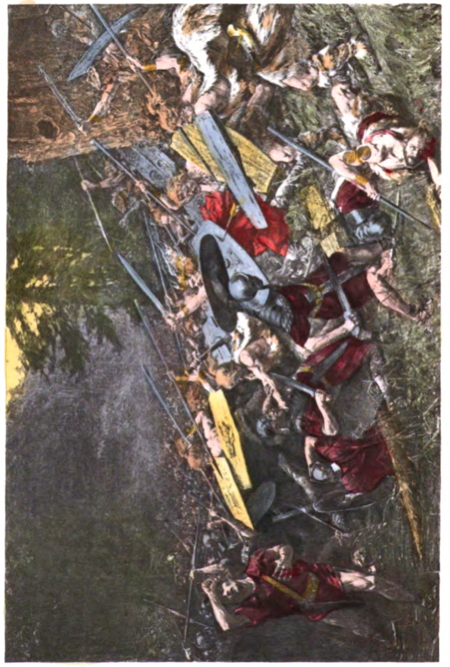
(See this image in horizontal aspect [here].)
Battle between the Troops of Decius and the Goths. From a painting by Joanowitz.
[II-xiii]
LIST OF ILLUSTRATIONS↩
- Battle between the Troops of Decius and the Goths. From a painting by Joanowitz. Frontispiece
- Zenobia, page 90. From a statue in the Capitoline Museum.
- Temple of Diocletian, Palmyra, p. 142. From a photograph.
- Map of the Roman Empire under Diocletian, p. 150
- A Roman Ambassador offering Terms of Peace to the Barbarians, p. 158.
- From a painting by Peter Paul Rubens.
- Arch of Titus, Rome, p. 264.From a photograph.
[II-1]
CHAPTER X↩
The Emperors Decius, Gallus, Æmilianus, Valerian, and Gallienus — The general Irruption of the Barbarians — The thirty Tyrants
From the great secular games celebrated by Philip to the death of the emperor Gallienus, there elapsed twenty years of shame and misfortune. During that calamitous period, every instant of time was marked, every province of the Roman world was afflicted, by barbarous invaders and military tyrants, and the ruined empire seemed to approach the last and fatal moment of its dissolution. The confusion of the times and the scarcity of authentic memorials oppose equal difficulties to the historian, who attempts to preserve a clear and unbroken thread of narration. [1] Surrounded with imperfect fragments, always concise, often obscure, and sometimes contradictory, he is reduced to collect, to compare, and to conjecture: and though he ought never to place his conjectures in the rank of facts, yet the knowledge of human nature, and of the sure operation of its fierce and unrestrained passions, might, on some occasions, supply the want of historical materials.
[II-2]
There is not, for instance, any difficulty in conceiving that the successive murders of so many emperors had loosened all the ties of allegiance between the prince and people; that all the generals of Philip were disposed to imitate the example of their master; and that the caprice of armies, long since habituated to frequent and violent revolutions, might every day raise to the throne the most obscure of their fellow-soldiers. History can only add, that the rebellion against the emperor Philip broke out in the summer of the year two hundred and forty-nine, among the legions of Mæsia, and that a subaltern officer, [2] named Marinus, was the object of their seditious choice. Philip was alarmed. He dreaded lest the treason of the Mæsian army should prove the first spark of a general conflagration. Distracted with the consciousness of his guilt and of his danger, he communicated the intelligence to the senate. A gloomy silence prevailed, the effect of fear, and perhaps of disaffection, till at length Decius, one of the assembly, assuming a spirit worthy of his noble extraction, ventured to discover more intrepidity than the emperor seemed to possess. He treated the whole business with contempt, as a hasty and inconsiderate tumult, and Philip’s rival as a phantom of royalty, who in a very few days would be destroyed by the same inconstancy that had created him. The speedy completion of the prophecy inspired Philip with a just esteem for so able a counsellor, and Decius appeared to him the only person capable of restoring peace and discipline to an army whose tumultuous spirit did not immediately subside after the murder of Marinus. Decius, [3] who long resisted his own nomination, [II-3] seems to have insinuated the danger of presenting a leader of merit to the angry and apprehensive minds of the soldiers; and his prediction was again confirmed by the event. The legions of Mæsia forced their judge to become their accomplice. They left him only the alternative of death or the purple. His subsequent conduct, after that decisive measure, was unavoidable. He conducted or followed his army to the confines of Italy, whither Philip, collecting all his force to repel the formidable competitor whom he had raised up, advanced to meet him. The Imperial troops were superior in number; but the rebels formed an army of veterans, commanded by an able and experienced leader. Philip was either killed in the battle or put to death a few days afterwards at Verona. His son and associate in the empire, [4] was massacred at Rome by the Prætorian guards; and the victorious Decius, with more favourable circumstances than the ambition of that age can usually plead, was universally acknowledged by the senate and provinces. It is reported that, immediately after his reluctant acceptance of the title of Augustus, he had assured Philip by a private message of his innocence and loyalty, solemnly protesting that, on his arrival in Italy, he would resign the Imperial ornaments, and return to the condition of an obedient subject. His professions might be sincere; but, in the situation where fortune had placed him, it was scarcely possible that he could either forgive or be forgiven. [5]
The emperor Decius had employed a few months in the works of peace [6] and the administration of justice, when he was summoned to the banks of the Danube by the invasion of the Goths. This is the first considerable occasion in which [II-4] history mentions that great people, who afterwards broke the Roman power, sacked the Capitol, and reigned in Gaul, Spain, and Italy. So memorable was the part which they acted in the subversion of the Western empire, that the name of Goths is frequently but improperly used as a general appellation of rude and warlike barbarism.
In the beginning of the sixth century, and after the conquest of Italy, the Goths, in possession of present greatness, very naturally indulged themselves in the prospect of past and of future glory. They wished to preserve the memory of their ancestors, and to transmit to posterity their own achievements. The principal minister of the court of Ravenna, the learned Cassiodorus, gratified the inclination of the conquerors in a Gothic history, which consisted of twelve books, now reduced to the imperfect abridgment of Jornandes. [7] These writers passed with the most artful conciseness over the misfortunes of the nation, celebrated its successful valour, and adorned the triumph with many Asiatic trophies that more properly belonged to the people of Scythia. On the faith of ancient songs, the uncertain but the only memorials of barbarians, they deduced the first origin of the Goths from the vast island or peninsula of Scandinavia. [8] That extreme country of the North was not unknown to the conquerors of Italy; the ties of ancient consanguinity had been strengthened by recent offices of friendship; and a Scandinavian king had cheerfully abdicated his savage greatness, that he might pass the remainder of his days in the peaceful and polished court of Ravenna. [9] Many vestiges, which cannot be ascribed to the arts of popular vanity, attest the ancient residence of the [II-5] Goths in the countries beyond the Baltic. From the time of the geographer Ptolemy, the southern part of Sweden seems to have continued in the possession of the less enterprising remnant of the nation, and a large territory is even at present divided into east and west Gothland. During the middle ages (from the ninth to the twelfth century), whilst Christianity was advancing with a slow progress into the North, the Goths and the Swedes composed two distinct and sometimes hostile members of the same monarchy. [10] The latter of these two names has prevailed without extinguishing the former. The Swedes, who might well be satisfied with their own fame in arms, have in every age claimed the kindred glory of the Goths. In a moment of discontent against the court of Rome, Charles the Twelfth insinuated that his victorious troops were not degenerated from their brave ancestors, who had already subdued the mistress of the world. [11]
Till the end of the eleventh century, a celebrated temple subsisted at Upsal, the most considerable town of the Swedes and Goths. It was enriched with the gold which the Scandinavians had acquired in their piratical adventures, and sanctified by the uncouth representations of the three principal deities, the god of war, the goddess of generation, and the god of thunder. In the general festival that was solemnised every ninth year, nine animals of every species (without excepting the human) were sacrificed, and their bleeding bodies suspended in the sacred grove adjacent to the temple. [12] The [II-6] only traces that now subsist of this barbaric superstition are contained in the Edda, a system of mythology, compiled in Iceland about the thirteenth century, and studied by the learned of Denmark and Sweden, as the most valuable remains of their ancient traditions.
Notwithstanding the mysterious obscurity of the Edda, we can easily distinguish two persons confounded under the name of Odin — the god of war, and the great legislator of Scandinavia. The latter, the Mahomet of the North, instituted a religion adapted to the climate and to the people. Numerous tribes on either side of the Baltic were subdued by the invincible valour of Odin, by his persuasive eloquence, and by the fame which he acquired of a most skilful magician. The faith that he had propagated, during a long and prosperous life, he confirmed by a voluntary death. Apprehensive of the ignominious approach of disease and infirmity, he resolved to expire as became a warrior. In a solemn assembly of the Swedes and Goths, he wounded himself in nine mortal places, hastening away (as he asserted with his dying voice) to prepare the feast of heroes in the palace of the god of war. [13]
The native and proper habitation of Odin is distinguished by the appellation of As-gard. The happy resemblance of that name, with As-burg, or As-of, [14] words of a similar signification, has given rise to an historical system of so pleasing a contexture that we could almost wish to persuade ourselves of its truth. It is supposed that Odin was the chief of a tribe of barbarians which dwelt on the banks of the lake Mæotis, till the fall of Mithridates and the arms of Pompey menaced the North with servitude; that Odin, yielding with indignant fury to a power which he was unable to resist, conducted his [II-7] tribe from the frontiers of the Asiatic Sarmatia into Sweden, with the great design of forming, in that inaccessible retreat of freedom, a religion and a people which, in some remote age, might be subservient to his immortal revenge; when his invincible Goths, armed with martial fanaticism, should issue in numerous swarms from the neighbourhood of the Polar circle, to chastise the oppressors of mankind. [15]
If so many successive generations of Goths were capable of preserving a faint tradition of their Scandinavian origin, we must not expect, from such unlettered barbarians, any distinct account of the time and circumstances of their emigration. To cross the Baltic was an easy and natural attempt. The inhabitants of Sweden were masters of a sufficient number of large vessels with oars, [16] and the distance is little more than one hundred miles from Carlscroon to the nearest ports of Pomerania and Prussia. Here, at length, we land on firm and historic ground. At least as early as the Christian era, [17] and as late as the age of the Antonines, [18] the Goths were established towards the mouth of the Vistula, and in that fertile province where the commercial cities of Thorn, Elbing, Königsberg, and Danzig, were long afterwards founded. [19] Westward of the Goths, the numerous tribes of the Vandals [II-8] were spread along the banks of the Oder, and the sea coast of Pomerania and Mecklenburg. A striking resemblance of manners, complexion, religion, and language seemed to indicate that the Vandals and the Goths were originally one great people. [20] The latter appear to have been subdivided into Ostrogoths, Visigoths, and Gepidæ. [21] The distinction among the Vandals was more strongly marked by the independent names of Heruli, Burgundians, Lombards, and a variety of other petty states, many of which, in a future age, expanded themselves into powerful monarchies.
In the age of the Antonines the Goths were still seated in Prussia. About the reign of Alexander Severus, the Roman province of Dacia had already experienced their proximity by frequent and destructive inroads. [22] In this interval, therefore, of about seventy years, we must place the second migration of the Goths from the Baltic to the Euxine; but the cause that produced it lies concealed among the various motives which actuate the conduct of unsettled barbarians. Either a pestilence or a famine, a victory or a defeat, an oracle of the gods, or the eloquence of a daring leader, were sufficient to impel the Gothic arms on the milder climates of the South. Besides the influence of a martial religion, the numbers and spirit of the Goths were equal to the most dangerous adventures. [II-9] The use of round bucklers and short swords rendered them formidable in a close engagement; the manly obedience which they yielded to hereditary kings gave uncommon union and stability to their councils; [23] and the renowned Amala, the hero of that age, and the tenth ancestor of Theodoric, king of Italy, enforced, by the ascendant of personal merit, the prerogative of his birth, which he derived from the Anses, or demigods of the Gothic nation. [24]
The fame of a great enterprise excited the bravest warriors from all the Vandalic states of Germany, many of whom are seen a few years afterwards combating under the common standard of the Goths. [25] The first motions of the emigrants carried them to the banks of the Prypec, a river universally conceived by the ancients to be the southern branch of the Borysthenes. [26] The windings of that great stream through the plains of Poland and Russia gave a direction to their line of march, and a constant supply of fresh water and pasturage to their numerous herds of cattle. They followed the unknown course of the river, confident in their valour, and careless of whatever power might oppose their progress. The Bastarnæ and the Venedi were the first who presented themselves; and the flower of their youth, either from choice or compulsion, increased the Gothic army. The Bastarnæ dwelt on the northern side of the Carpathian mountains; the immense tract of land that separated the Bastarnæ from the savages of Finland was possessed, or rather wasted, by [II-10] the Venedi: [27] we have some reason to believe that the first of these nations, which distinguished itself in the Macedonian war, [28] and was afterwards divided into the formidable tribes of the Peucini, the Borani, the Carpi, &c., derived its origin from the Germans. With better authority a Sarmatian extraction may be assigned to the Venedi, who rendered themselves so famous in the middle ages. [29] But the confusion of blood and manners on that doubtful frontier often perplexed the most accurate observers. [30] As the Goths advanced near the Euxine Sea, they encountered a purer race of Sarmatians, the Jazyges, the Alani, and the Roxolani; and they were probably the first Germans who saw the mouths of the Borysthenes and of the Tanais. If we inquire into the characteristic marks of the people of Germany and of Sarmatia, we shall discover that those two great portions of human kind were principally distinguished by fixed huts or movable tents, by a close dress or flowing garments, by the marriage of one or of several wives, by a military force consisting, for the most part, either of infantry or cavalry; and, above all, by the use of the Teutonic, or of the Sclavonian language; the last of which has been diffused, by conquest, from the confines of Italy to the neighbourhood of Japan.
The Goths were now in possession of the Ukraine, a country of considerable extent and uncommon fertility, intersected with navigable rivers, which from either side discharge themselves into the Borysthenes; and interspersed with large and lofty forests of oaks. The plenty of game and fish, the innumerable bee-hives, deposited in the hollow of old trees [II-11] and in the cavities of rocks, and forming, even in that rude age, a valuable branch of commerce, the size of the cattle, the temperature of the air, the aptness of the soil for every species of grain, and the luxuriancy of the vegetation, all displayed the liberality of Nature, and tempted the industry of man. [31] But the Goths withstood all these temptations, and still adhered to a life of idleness, of poverty, and of rapine.
The Scythian hordes, which, towards the east, bordered on the new settlements of the Goths, presented nothing to their arms, except the doubtful chance of an unprofitable victory. But the prospect of the Roman territories was far more alluring; and the fields of Dacia were covered with rich harvests, sown by the hands of an industrious, and exposed to be gathered by those of a warlike, people. It is probable that the conquests of Trajan, maintained by his successors less for any real advantage than for ideal dignity, had contributed to weaken the empire on that side. The new and unsettled province of Dacia was neither strong enough to resist, nor rich enough to satiate, the rapaciousness of the barbarians. As long as the remote banks of the Dniester were considered as the boundary of the Roman power, the fortifications of the Lower Danube were more carelessly guarded, and the inhabitants of Mæsia lived in supine security, fondly conceiving themselves at an inaccessible distance from any barbarian invaders. The irruptions of the Goths, under the reign of Philip, fatally convinced them of their mistake. The king or leader [32] of that fierce nation traversed with contempt the province of Dacia, and passed both the Dniester and the Danube without encountering any opposition [II-12] capable of retarding his progress. The relaxed discipline of the Roman troops betrayed the most important posts where they were stationed, and the fear of deserved punishment induced great numbers of them to enlist under the Gothic standard. The various multitude of barbarians appeared, at length, under the walls of Marcianopolis, a city built by Trajan in honour of his sister, and at that time the capital of the second Mæsia. [33] The inhabitants consented to ransom their lives and property by the payment of a large sum of money, and the invaders retreated back into their deserts, animated, rather than satisfied, with the first success of their arms against an opulent but feeble country. Intelligence was soon transmitted to the emperor Decius, that Cniva, king of the Goths, had passed the Danube a second time, with more considerable forces; that his numerous detachments scattered devastation over the province of Mæsia, whilst the main body of the army, consisting of seventy thousand Germans and Sarmatians, a force equal to the most daring achievements, required the presence of the Roman monarch, and the exertion of his military power.
Decius found the Goths engaged before Nicopolis, on the Jatrus, one of the many monuments of Trajan’s victories. [34] On his approach they raised the siege, but with a design only of marching away to a conquest of greater importance, the siege of Philippopolis, a city of Thrace, founded by the father [II-13] of Alexander, near the foot of Mount Hæmus. [35] Decius followed them through a difficult country, and by forced marches; but, when he imagined himself at a considerable distance from the rear of the Goths, Cniva turned with rapid fury on his pursuers. The camp of the Romans was surprised and pillaged, and, for the first time, their emperor fled in disorder before a troop of half-armed barbarians. After a long resistance Philippopolis, destitute of succour, was taken by storm. A hundred thousand persons are reported to have been massacred in the sack of that great city. [36] Many prisoners of consequence became a valuable accession to the spoil; and Priscus, a brother of the late emperor Philip, blushed not to assume the purple under the protection of the barbarous enemies of Rome. [37] The time, however, consumed in that tedious siege enabled Decius to revive the courage, restore the discipline, and recruit the numbers of his troops. He intercepted several parties of Carpi, and other Germans, who were hastening to share the victory of their countrymen, [38] entrusted the passes of the mountains to officers of approved valour and fidelity, [39] repaired and strengthened the fortifications of the Danube, and exerted his utmost vigilance to oppose either the progress or the retreat of the Goths. Encouraged by the return of fortune, he anxiously [II-14] waited for an opportunity to retrieve, by a great and decisive blow, his own glory, and that of the Roman arms. [40]
At the same time when Decius was struggling with the violence of the tempest, his mind, calm and deliberate amidst the tumult of war, investigated the more general causes that, since the age of the Antonines, had so impetuously urged the decline of the Roman greatness. He soon discovered that it was impossible to replace that greatness on a permanent basis without restoring public virtue, ancient principles and manners, and the oppressed majesty of the laws. To execute this noble but arduous design, he first resolved to revive the obsolete office of censor; an office which, as long as it had subsisted in its pristine integrity, had so much contributed to the perpetuity of the state, [41] till it was usurped and gradually neglected by the Cæsars. [42] Conscious that the favour of the sovereign may confer power, but that the esteem of the people can alone bestow authority, he submitted the choice of the censor to the unbiassed voice of the senate. By their unanimous votes, or rather acclamations, Valerian, who was afterwards emperor, and who then served with distinction in the army of Decius, was declared the most worthy of that exalted honour. As soon as the decree of [II-15] the senate was transmitted to the emperor, he assembled a great council in his camp, and, before the investiture of the censor elect, he apprized him of the difficulty and importance of his great office. “Happy Valerian,” said the prince, to his distinguished subject, “happy in the general approbation of the senate and of the Roman republic! Accept the censorship of mankind, and judge of our manners. You will select those who deserve to continue members of the senate; you will restore the equestrian order to its ancient splendour; you will improve the revenue, yet moderate the public burdens. You will distinguish into regular classes the various and infinite multitude of citizens, and accurately review the military strength, the wealth, the virtue, and the resources of Rome. Your decisions shall obtain the force of laws. The army, the palace, the ministers of justice, and the great officers of the empire are all subject to your tribunal. None are exempted, excepting only the ordinary consuls, [43] the prefect of the city, the king of the sacrifices, and (as long as she preserves her chastity inviolate) the eldest of the vestal virgins. Even these few, who may not dread the severity, will anxiously solicit the esteem, of the Roman censor.” [44]
A magistrate invested with such extensive powers would have appeared not so much the minister as the colleague of his sovereign. [45] Valerian justly dreaded an elevation so full of envy and of suspicion. He modestly urged the alarming greatness of the trust, his own insufficiency, and the incurable corruption of the times. He artfully insinuated that the office of censor was inseparable from the Imperial dignity, and that the feeble hands of a subject were unequal [II-16] to the support of such an immense weight of cares and of power. [46] The approaching event of war soon put an end to the prosecution of a project so specious but so impracticable, and, whilst it preserved Valerian from the danger, saved the emperor Decius from the disappointment, which would most probably have attended it. A censor may maintain, he can never restore, the morals of a state. It is impossible for such a magistrate to exert his authority with benefit, or even with effect, unless he is supported by a quick sense of honour and virtue in the minds of the people, by a decent reverence for the public opinion, and by a train of useful prejudices combating on the side of national manners. In a period when these principles are annihilated, the censorial jurisdiction must either sink into empty pageantry, or be converted into a partial instrument of vexatious oppression. [47] It was easier to vanquish the Goths than to eradicate the public vices; yet, even in the first of these enterprises, Decius lost his army and his life.
The Goths were now, on every side, surrounded and pursued by the Roman arms. The flower of their troops had perished in the long siege of Philippopolis, and the exhausted country could no longer afford subsistence for the remaining multitude of licentious barbarians. Reduced to this extremity, the Goths would gladly have purchased, by the surrender of all their booty and prisoners, the permission of an undisturbed retreat. But the emperor, confident of victory, and resolving, by the chastisement of these invaders, to strike a salutary terror into the nations of the North, refused to listen to any terms of accommodation. The high-spirited barbarians preferred death to slavery. An obscure town of Mæsia, called Forum Terebronii, [48] was the scene of the [II-17] battle. The Gothic army was drawn up in three lines, and, either from choice or accident, the front of the third line was covered by a morass. In the beginning of the action, the son of Decius, a youth of the fairest hopes, and already associated to the honours of the purple, was slain by an arrow, in the sight of his afflicted father; who, summoning all his fortitude, admonished the dismayed troops that the loss of a single soldier was of little importance to the republic. [49] The conflict was terrible; it was the combat of despair against grief and rage. The first line of the Goths at length gave way in disorder; the second, advancing to sustain it, shared its fate; and the third only remained entire, prepared to dispute the passage of the morass, which was imprudently attempted by the presumption of the enemy. “Here the fortune of the day turned, and all things became adverse to the Romans: the place deep with ooze, sinking under those who stood, slippery to such as advanced; their armour heavy, the waters deep; nor could they wield, in that uneasy situation, their weighty javelins. The barbarians, on the contrary, were enured to encounters in the bogs; their persons tall, their spears long, such as could wound at a distance.” [50] In this morass the Roman army, after an ineffectual struggle, was irrecoverably lost; nor could the body of the emperor ever be found. [51] Such was the fate of Decius, in the fiftieth year of his age; an accomplished prince, active in war, and affable in peace; [52] who, together with his son, has [II-18] deserved to be compared, both in life and death, with the brightest examples of ancient virtue. [53]
This fatal blow humbled, for a very little time, the insolence of the legions. They appear to have patiently expected, and submissively obeyed, the decree of the senate which regulated the succession to the throne. From a just regard for the memory of Decius, the Imperial title was conferred on Hostilianus, his only surviving son; but an equal rank, with more effectual power, was granted to Gallus, [54] whose experience and ability seemed equal to the great trust of guardian to the young prince and the distressed empire. [55] The first care of the new emperor was to deliver the Illyrian provinces from the intolerable weight of the victorious Goths. He consented to leave in their hands the rich fruits of their invasion, an immense booty, and, what was still more disgraceful, a great number of prisoners of the highest merit and quality. He plentifully supplied their camp with every conveniency that could assuage their angry spirits, or facilitate their so much wished-for departure; and he even promised to pay them annually a large sum of gold, on condition they should never afterwards infest the Roman territories by their incursions. [56]
In the age of the Scipios, the most opulent kings of the earth, who courted the protection of the victorious commonwealth, were gratified with such trifling presents as could only derive a value from the hand that bestowed them; an ivory chair, a coarse garment of purple, an inconsiderable [II-19] piece of plate, or a quantity of copper coin. [57] After the wealth of nations had centred in Rome, the emperors displayed their greatness, and even their policy, by the regular exercise of a steady and moderate liberality towards the allies of the state. They relieved the poverty of the barbarians, honoured their merit, and recompensed their fidelity. These voluntary marks of bounty were understood to flow, not from the fears, but merely from the generosity or the gratitude of the Romans; and whilst presents and subsidies were liberally distributed among friends and suppliants, they were sternly refused to such as claimed them as a debt. [58] But this stipulation of an annual payment to a victorious enemy appeared without disguise in the light of an ignominious tribute; the minds of the Romans were not yet accustomed to accept such unequal laws from a tribe of barbarians; and the prince, who by a necessary concession had probably saved his country, became the object of the general contempt and aversion. The death of Hostilianus, though it happened in the midst of a raging pestilence, was interpreted as the personal crime of Gallus; [59] and even the defeat of the late emperor was ascribed by the voice of suspicion to the perfidious counsels of his hated successor. [60] The tranquillity which the empire enjoyed during the first year of his administration [61] served rather to inflame than to appease the public discontent; and, as soon as the apprehensions [II-20] of war were removed, the infamy of the peace was more deeply and more sensibly felt.
But the Romans were irritated to a still higher degree, when they discovered that they had not even secured their repose, though at the expense of their honour. The dangerous secret of the wealth and weakness of the empire had been revealed to the world. New swarms of barbarians, encouraged by the success, and not conceiving themselves bound by the obligation, of their brethren, spread devastation through the Illyrian provinces, and terror as far as the gates of Rome. The defence of the monarchy, which seemed abandoned by the pusillanimous emperor, was assumed by Æmilianus, [62] governor of Pannonia and Mæsia; who rallied the scattered forces and revived the fainting spirits of the troops. The barbarians were unexpectedly attacked, routed, chased, and pursued beyond the Danube. The victorious leader distributed as a donative the money collected for the tribute, and the acclamations of the soldiers proclaimed him emperor on the field of battle. [63] Gallus, who, careless of the general welfare, indulged himself in the pleasures of Italy, was almost in the same instant informed of the success, of the revolt, and of the rapid approach, of his aspiring lieutenant. He advanced to meet him as far as the plains of Spoleto. When the armies came in sight of each other, the soldiers of Gallus compared the ignominious conduct of their sovereign with the glory of his rival. They admired the valour of Æmilianus; they were attracted by his liberality, for he offered a considerable increase of pay to all deserters. [64] The murder of Gallus, and of his son Volusianus, [65] put an end to the civil war; and the senate gave a legal sanction to the rights of conquest. The letters of Æmilianus to that assembly [II-21] displayed a mixture of moderation and vanity. He assured them that he should resign to their wisdom the civil administration; and, contenting himself with the quality of their general, would in a short time assert the glory of Rome, and deliver the empire from all the barbarians both of the North and of the East. [66] His pride was flattered by the applause of the senate; and medals are still extant, representing him with the name and attributes of Hercules the Victor, and of Mars the Avenger. [67]
If the new monarch possessed the abilities, he wanted the time, necessary to fulfil these splendid promises. Less than four months intervened between his victory and his fall. [68] He had vanquished Gallus: he sunk under the weight of a competitor more formidable than Gallus. That unfortunate prince had sent Valerian, already distinguished by the honourable title of censor, to bring the legions of Gaul and Germany [69] to his aid. Valerian executed that commission with zeal and fidelity; and, as he arrived too late to save his sovereign, he resolved to revenge him. The troops of Æmilianus, who still lay encamped in the plains of Spoleto, were awed by the sanctity of his character, but much more by the superior strength of his army; and, as they were now become as incapable of personal attachment as they had always been of constitutional principle, they readily imbrued their hands in the blood of a prince who so lately had been the [II-22] object of their partial choice. The guilt was theirs, but the advantage of it was Valerian’s; who obtained the possession of the throne by the means indeed of a civil war, but with a degree of innocence singular in that age of revolutions; since he owed neither gratitude nor allegiance to his predecessor, whom he dethroned.
Valerian was about sixty years of age [70] when he was invested with the purple, not by the caprice of the populace or the clamours of the army, but by the unanimous voice of the Roman world. In his gradual ascent through the honours of the state he had deserved the favour of virtuous princes, and had declared himself the enemy of tyrants. [71] His noble birth, his mild but unblemished manners, his learning, prudence, and experience, were revered by the senate and people; and, if mankind (according to the observation of an ancient writer) had been left at liberty to choose a master, their choice would most assuredly have fallen on Valerian. [72] Perhaps the merit of this emperor was inadequate to his reputation; perhaps his abilities, or at least his spirit, were affected by the languor and coldness of old age. The consciousness of his decline engaged him to share the throne with a younger and more active associate: [73] the emergency of the times demanded a general no less than a prince; and the experience of the Roman censor might have directed him where to bestow the Imperial purple, as the reward [II-23] of military merit. But, instead of making a judicious choice, which would have confirmed his reign and endeared his memory, Valerian, consulting only the dictates of affection or vanity, immediately invested with the supreme honours his son Gallienus, [74] a youth whose effeminate vices had been hitherto concealed by the obscurity of a private station. The joint government of the father and the son subsisted about seven, and the sole administration of Gallienus continued about eight, years. But the whole period was one uninterrupted series of confusion and calamity. As the Roman empire was at the same time, and on every side, attacked by the blind fury of foreign invaders, and the wild ambition of domestic usurpers, we shall consult order and perspicuity by pursuing not so much the doubtful arrangement of dates as the more natural distribution of subjects. The most dangerous enemies of Rome, during the reigns of Valerian and Gallienus, were, — 1. The Franks. 2. The Alemanni. 3. The Goths; and, 4. The Persians. Under these general appellations we may comprehend the adventures of less considerable tribes, whose obscure and uncouth names would only serve to oppress the memory and perplex the attention of the reader.
I. As the posterity of the Franks compose one of the greatest and most enlightened nations of Europe, the powers of learning and ingenuity have been exhausted in the discovery of their unlettered ancestors. To the tales of credulity have succeeded the systems of fancy. Every passage has been sifted, every spot has been surveyed, that might possibly reveal some faint traces of their origin. It has been supposed that Pannonia, [75] that Gaul, that the northern parts of Germany, [76] gave birth to that celebrated colony of warriors. [II-24] At length the most rational critics, rejecting the fictitious emigrations of ideal conquerors, have acquiesced in a sentiment whose simplicity persuades us of its truth. [77] They suppose that, about the year two hundred and forty, [78] a new confederacy was formed under the name of Franks by the old inhabitants of the Lower Rhine and the Weser. The present circle of Westphalia, the Landgraviate of Hesse, and the duchies of Brunswick and Luneburg were the ancient seat of the Chauci, who, in their inaccessible morasses, defied the Roman arms; [79] of the Cherusci, proud of the fame of Arminius; of the Catti, formidable by their firm and intrepid infantry; and of several other tribes of inferior power and renown. [80] The love of liberty was the ruling passion of these Germans; the enjoyment of it their best treasure; the word that expressed that enjoyment the most pleasing to their ear. They deserved, they assumed, they maintained the honourable epithet of Franks or Freemen; which concealed, though it did not extinguish, the peculiar names of the several states of the confederacy. [81] Tacit consent and mutual advantage dictated the first laws of the union; it was gradually cemented by habit and experience. The league of the Franks may admit of some comparison with the Helvetic body; in which every canton, retaining its independent sovereignty, consults [II-25] with its brethren in the common cause, without acknowledging the authority of any supreme head or representative assembly. [82] But the principle of the two confederacies was extremely different. A peace of two hundred years has rewarded the wise and honest policy of the Swiss. An inconstant spirit, the thirst of rapine, and a disregard to the most solemn treaties disgraced the character of the Franks.
The Romans had long experienced the daring valour of the people of Lower Germany. The union of their strength threatened Gaul with a more formidable invasion, and required the presence of Gallienus, the heir and colleague of Imperial power. [83] Whilst that prince [84] and his infant son Saloninus displayed in the court of Treves the majesty of the empire, its armies were ably conducted by their general Posthumus, [85] who, though he afterwards betrayed [86] the family of Valerian, was ever faithful to the great interest of the monarchy. The treacherous language of panegyrics and medals darkly announces a long series of victories. Trophies and titles attest (if such evidence can attest) the fame of Posthumus, who is repeatedly styled The Conqueror of the Germans, and the Saviour of Gaul. [87]
But a single fact, the only one indeed of which we have any distinct knowledge, erases in a great measure these monuments [II-26] of vanity and adulation. The Rhine, though dignified with the title of Safeguard of the provinces, was an imperfect barrier against the daring spirit of enterprise with which the Franks were actuated. Their rapid devastations stretched from the river to the foot of the Pyrenees; nor were they stopped by those mountains. Spain, which had never dreaded, was unable to resist, the inroads of the Germans. During twelve years, [88] the greatest part of the reign of Gallienus, that opulent country was the theatre of unequal and destructive hostilities. Tarragona, the flourishing capital of a peaceful province, was sacked and almost destroyed; [89] and so late as the days of Orosius, who wrote in the fifth century, wretched cottages, scattered amidst the ruins of magnificent cities, still recorded the rage of the barbarians. [90] When the exhausted country no longer supplied a variety of plunder, the Franks seized on some vessels in the ports of Spain [91] and transported themselves into Mauritania. The distant province was astonished with the fury of these barbarians, who seemed to fall from a new world, as their name, manners, and complexion were equally unknown on the coast of Africa. [92]
II. In that part of Upper Saxony, beyond the Elbe, which is at present called the Marquisate of Lusace, there existed in ancient times a sacred wood, the awful seat of the superstition of the Suevi. None were permitted to enter the holy precincts without confessing, by their servile bonds and suppliant posture, the immediate presence of the sovereign [II-27] Deity. [93] Patriotism contributed, as well as devotion, to consecrate the Sonnenwald, or wood of the Semnones. [94] It was universally believed that the nation had received its first existence on that sacred spot. At stated periods the numerous tribes who gloried in the Suevic blood resorted thither by their ambassadors; and the memory of their common extraction was perpetuated by barbaric rites and human sacrifices. The wide-extended name of Suevi filled the interior countries of Germany, from the banks of the Oder to those of the Danube. They were distinguished from the other Germans by their peculiar mode of dressing their long hair, which they gathered into a rude knot on the crown of the head; and they delighted in an ornament that showed their ranks more lofty and terrible in the eyes of the enemy. [95] Jealous as the Germans were of military renown, they all confessed the superior valour of the Suevi; and the tribes of the Usipetes and Tencteri, who, with a vast army, encountered the dictator Cæsar, declared that they esteemed it not a disgrace to have fled before a people to whose arms the immortal gods themselves were unequal. [96]
In the reign of the emperor Caracalla, an innumerable swarm of Suevi appeared on the banks of the Main, and in the neighbourhood of the Roman provinces, in quest either of food, of plunder, or of glory. [97] The hasty army of volunteers gradually coalesced into a great and permanent nation, and, as it was composed from so many different tribes, assumed the name of Alemanni, or Allmen, to denote at once their various lineage and their common bravery. [98] The latter was soon felt by the Romans in many a hostile inroad. [II-28] The Alemanni fought chiefly on horseback; but their cavalry was rendered still more formidable by a mixture of light infantry selected from the bravest and most active of the youth, whom frequent exercise had enured to accompany the horsemen in the longest march, the most rapid charge, or the most precipitate retreat. [99]
This warlike people of Germans had been astonished by the immense preparations of Alexander Severus; they were dismayed by the arms of his successor, a barbarian equal in valour and fierceness to themselves. But, still hovering on the frontiers of the empire, they increased the general disorder that ensued after the death of Decius. They inflicted severe wounds on the rich provinces of Gaul: they were the first who removed the veil that covered the feeble majesty of Italy. A numerous body of the Alemanni penetrated across the Danube, and through the Rhætian Alps into the plains of Lombardy, advanced as far as Ravenna, and displayed the victorious banners of barbarians almost in sight of Rome. [100] The insult and the danger rekindled in the senate some sparks of their ancient virtue. Both the emperors were engaged in far distant wars, Valerian in the East, and Gallienus on the Rhine. All the hopes and resources the of the Romans were in themselves. In this emergency, senators resumed the defence of the republic, drew out the Prætorian guards, who had been left to garrison the capital, and filled up their numbers by enlisting into the public [II-29] service the stoutest and most willing of the plebeians. The Alemanni, astonished with the sudden appearance of an army more numerous than their own, retired into Germany, laden with spoil; and their retreat was esteemed as a victory by the unwarlike Romans. [101]
When Gallienus received the intelligence that his capital was delivered from the barbarians, he was much less delighted than alarmed with the courage of the senate, since it might one day prompt them to rescue the republic [a] from domestic tyranny, as well as from foreign invasion. His timid ingratitude was published to his subjects in an edict which prohibited the senators from exercising any military employment, and even from approaching the camps of the legions. But his fears were groundless. The rich and luxurious nobles, sinking into their natural character, accepted as a favour this disgraceful exemption from military service; and, as long as they were indulged in the enjoyment of their baths, their theatres, and their villas, they cheerfully resigned the more dangerous cares of empire to the rough hands of peasants and soldiers. [102]
Another invasion of the Alemanni, of a more formidable aspect, but more glorious event, is mentioned by a writer of the Lower Empire. Three hundred thousand of that warlike people are said to have been vanquished, in a battle near Milan, by Gallienus in person, at the head of only ten thousand Romans. [103] We may however, with great probability, ascribe this incredible victory either to the credulity of the historian, or to some exaggerated exploits of one of the emperor’s lieutenants. It was by arms of a very different nature [II-30] that Gallienus endeavoured to protect Italy from the fury of the Germans. He espoused Pipa, the daughter of a king of the Marcomanni, a Suevic tribe, which was often confounded with the Alemanni in their wars and conquests. [104] To the father, as the price of his alliance, he granted an ample settlement in Pannonia. The native charms of unpolished beauty seem to have fixed the daughter in the affections of the inconstant emperor, and the bands of policy were more firmly connected by those of love. But the haughty prejudice of Rome still refused the name of marriage to the profane mixture of a citizen and a barbarian; and has stigmatised the German princess with the opprobrious title of concubine of Gallienus. [105]
III. We have already traced the emigration of the Goths from Scandinavia, or at least from Prussia, to the mouth of the Borysthenes, and have followed their victorious arms from the Borysthenes to the Danube. Under the reigns of Valerian and Gallienus the frontier of the last-mentioned river was perpetually infested by the inroads of Germans and Sarmatians; but it was defended by the Romans with more than usual firmness and success. The provinces that were the seat of war recruited the armies of Rome with an inexhaustible supply of hardy soldiers; and more than one of these Illyrian peasants attained the station, and displayed the abilities, of a general. Though flying parties of the barbarians, who incessantly hovered on the banks of the Danube, penetrated sometimes to the confines of Italy and Macedonia, their progress was commonly checked, or their return intercepted, by the Imperial lieutenants. [106] But the great stream of the [II-31] Gothic hostilities was diverted into a very different channel. The Goths, in their new settlement of the Ukraine, soon became masters of the northern coast of the Euxine: to the south of that inland sea were situated the soft and wealthy provinces of Asia Minor, which possessed all that could attract, and nothing that could resist, a barbarian conqueror.
The banks of the Borysthenes are only sixty miles distant from the narrow entrance [107] of the peninsula of Crim Tartary, known to the ancients under the name of Chersonesus Taurica. [108] On that inhospitable shore, Euripides, embellishing with exquisite art the tales of antiquity, has placed the scene of one of his most affecting tragedies. [109] The bloody sacrifices of Diana, the arrival of Orestes and Pylades, and the triumph of virtue and religion over savage fierceness, serve to represent an historical truth, that the Tauri, the original inhabitants of the peninsula, were in some degree reclaimed from their brutal manners by a gradual intercourse with the Grecian colonies which settled along the maritime coast. The little kingdom of Bosphorus, whose capital was situated on the straits through which the Mæotis communicates itself to the Euxine, was composed of degenerate Greeks and half-civilised barbarians. It subsisted as an independent state from the time of the Peloponnesian war, [110] was at last swallowed up by the ambition of Mithridates, [111] and, with the rest of his dominions, sunk under the weight of the Roman arms. From the reign of Augustus, [112] the kings [II-32] of Bosphorus were the humble, but not useless, allies of the empire. By presents, by arms, and by a slight fortification drawn across the isthmus, they effectually guarded against the roving plunderers of Sarmatia the access of a country which, from its peculiar situation and convenient harbours, commanded the Euxine Sea and Asia Minor. [113] As long as the sceptre was possessed by a lineal succession of kings, they acquitted themselves of their important charge with vigilance and success. Domestic factions, and the fears or private interest of obscure usurpers who seized on the vacant throne, admitted the Goths into the heart of Bosphorus. With the acquisition of a superfluous waste of fertile soil, the conquerors obtained the command of a naval force sufficient to transport their armies to the coast of Asia. [114] The ships used in the navigation of the Euxine were of a very singular construction. They were slight flat-bottomed barks framed of timber only, without the least mixture of iron, and occasionally covered with a shelving roof on the appearance of a tempest. [115] In these floating houses the Goths carelessly trusted themselves to the mercy of an unknown sea, under the conduct of sailors pressed into the service, and whose skill and fidelity were equally suspicious. But the hopes of plunder had banished every idea of danger, and a natural fearlessness of temper supplied in their minds the more rational confidence which is the just result of knowledge and experience. Warriors of such a daring spirit must have often murmured against the cowardice of their guides, who required the strongest assurances of a settled calm before they would venture to embark, and would scarcely ever be [II-33] tempted to lose sight of the land. Such, at least, is the practice of the modern Turks; [116] and they are probably not inferior in the art of navigation to the ancient inhabitants of Bosphorus.
The fleet of the Goths, leaving the coast of Circassia on the left hand, first appeared before Pityus, [117] the utmost limits of the Roman provinces; a city provided with a convenient port, and fortified with a strong wall. Here they met with a resistance more obstinate than they had reason to expect from the feeble garrison of a distant fortress. They were repulsed; and their disappointment seemed to diminish the terror of the Gothic name. As long as Successianus, an officer of superior rank and merit, defended that frontier, all their efforts were ineffectual: but, as soon as he was removed by Valerian to a more honourable but less important station, they resumed the attack of Pityus; and, by the destruction of that city, obliterated the memory of their former disgrace. [118]
Circling round the eastern extremity of the Euxine Sea, the navigation from Pityus to Trebizond is about three hundred miles. [119] The course of the Goths carried them in sight of the country of Colchis, so famous by the expedition of the Argonauts; and they even attempted, though without success, to pillage a rich temple at the mouth of the river Phasis. Trebizond, celebrated in the retreat of the Ten Thousand as an ancient colony of Greeks, [120] derived its wealth and splendour from the munificence of the emperor Hadrian, who had constructed an artificial port on a coast left destitute by nature [II-34] of secure harbours. [121] The city was large and populous; a double enclosure of walls seemed to defy the fury of the Goths, and the usual garrison had been strengthened by a reinforcement of ten thousand men. But there are not any advantages capable of supplying the absence of discipline and vigilance. The numerous garrison of Trebizond, dissolved in riot and luxury, disdained to guard their impregnable fortifications. The Goths soon discovered the supine negligence of the besieged, erected a lofty pile of fascines, ascended the walls in the silence of the night, and entered the defenceless city, sword in hand. A general massacre of the people ensued, whilst the affrighted soldiers escaped through the opposite gates of the town. The most holy temples, and the most splendid edifices, were involved in a common destruction. The booty that fell into the hands of the Goths was immense: the wealth of the adjacent countries had been deposited in Trebizond, as in a secure place of refuge. The number of captives was incredible, as the victorious barbarians ranged without opposition through the extensive province of Pontus. [122] The rich spoils of Trebizond filled a great fleet of ships that had been found in the port. The robust youth of the sea coast were chained to the oar; and the Goths, satisfied with the success of their first naval expedition, returned in triumph to their new establishments in the kingdom of Bosphorus. [123]
The second expedition of the Goths was undertaken with greater powers of men and ships; but they steered a different course, and, disdaining the exhausted provinces of Pontus, followed the western coast of the Euxine, passed before the wide mouths of the Borysthenes, the Dniester, and the Danube, and, increasing their fleet by the capture of a great number of fishing barques, they approached the narrow outlet [II-35] through which the Euxine Sea pours its waters into the Mediterranean, and divides the continents of Europe and Asia. The garrison of Chalcedon was encamped near the temple of Jupiter Urius, on a promontory that commanded the entrance of the strait: and so inconsiderable were the dreaded invasions of the barbarians, that this body of troops surpassed in number the Gothic army. But it was in numbers alone that they surpassed it. They deserted with precipitation their advantageous post, and abandoned the town of Chalcedon, most plentifully stored with arms and money, to the discretion of the conquerors. Whilst they hesitated whether they should prefer the sea or land, Europe or Asia, for the scene of their hostilities, a perfidious fugitive pointed out Nicomedia, once the capital of the kings of Bithynia, as a rich and easy conquest. He guided the march, which was only sixty miles from the camp of Chalcedon, [124] directed the resistless attack, and partook of the booty; for the Goths had learned sufficient policy to reward the traitor whom they detested. Nice, Prusa, Apamæa, Cius, cities that had sometimes rivalled, or imitated, the splendour of Nicomedia, were involved in the same calamity, which, in a few weeks, raged without control through the whole province of Bithynia. Three hundred years of peace, enjoyed by the soft inhabitants of Asia, had abolished the exercise of arms, and removed the apprehension of danger. The ancient walls were suffered to moulder away, and all the revenue of the most opulent cities was reserved for the construction of baths, temples, and theatres. [125]
When the city of Cyzicus withstood the utmost effort of Mithridates, [126] it was distinguished by wise laws, a naval [II-36] power of two hundred galleys, and three arsenals, — of arms, of military engines, and of corn. [127] It was still the seat of wealth and luxury; but of its ancient strength nothing remained except the situation, in a little island of the Propontis, connected with the continent of Asia only by two bridges. From the recent sack of Prusa, the Goths advanced within eighteen miles [128] of the city, which they had devoted to destruction; but the ruin of Cyzicus was delayed by a fortunate accident. The season was rainy, and the lake Apolloniates, the reservoir of all the springs of Mount Olympus, rose to an uncommon height. The little river of Rhyndacus, which issues from the lake, swelled into a broad and rapid stream and stopped the progress of the Goths. Their retreat to the maritime city of Heraclea, where the fleet had probably been stationed, was attended by a long train of waggons laden with the spoils of Bithynia, and was marked by the flames of Nice and Nicomedia, which they wantonly burnt. [129] Some obscure hints are mentioned of a doubtful combat that secured their retreat. [130] But even a complete victory would have been of little moment, as the approach of the autumnal equinox summoned them to hasten their return. To navigate the Euxine before the month of May, or after that of September, is esteemed by the modern Turks the most unquestionable instance of rashness and folly. [131]
When we are informed that the third fleet, equipped by the Goths in the ports of Bosphorus, consisted of five hundred sail of ships, [132] our ready imagination instantly computes and [II-37] multiplies the formidable armament; but, as we are assured by the judicious Strabo, [133] that the piratical vessels used by the barbarians of Pontus and the Lesser Scythia, were not capable of containing more than twenty-five or thirty men, we may safely affirm that fifteen thousand warriors at the most embarked in this great expedition. Impatient of the limits of the Euxine, they steered their destructive course from the Cimmerian to the Thracian Bosphorus. When they had almost gained the middle of the straits, they were suddenly driven back to the entrance of them; till a favourable wind, springing up the next day, carried them in a few hours into the placid sea, or rather lake, of the Propontis. [134] Their landing on the little island of Cyzicus was attended with the ruin of that ancient and noble city. From thence issuing again through the narrow passage of the Hellespont, they pursued their winding navigation amidst the numerous islands scattered over the Archipelago or the Ægean Sea. The assistance of captives and deserters must have been very necessary to pilot their vessels, and to direct their various incursions, as well on the coast of Greece as on that of Asia. At length the Gothic fleet anchored in the port of Piræus, five miles distant from Athens, [135] which had attempted to make some preparations for a vigorous defence. Cleodamus, one of the engineers employed by the emperor’s orders to fortify the maritime cities against the Goths, had already begun to repair the ancient walls fallen to decay since the time of Sylla. [136] The efforts of his skill were ineffectual, and the barbarians became masters of the native seat of the [II-38] muses and the arts. But, while the conquerors abandoned themselves to the licence of plunder and intemperance, [137] their fleet, that lay with a slender guard in the harbour of Piræus, was unexpectedly attacked by the brave Dexippus, who, flying with the engineer Cleodamus from the sack of Athens, collected a hasty band of volunteers, peasants as well as soldiers, and in some measure avenged the calamities of his country. [138]
But this exploit, whatever lustre it might shed on the declining age of Athens, served rather to irritate than to subdue the undaunted spirit of the Northern invaders. A general conflagration blazed out at the same time in every district of Greece. [139] Thebes and Argos, Corinth and Sparta, which had formerly waged such memorable wars against each other, were now unable to bring an army into the field, or even to defend their ruined fortifications. The rage of war, both by land and by sea, spread from the eastern point of Sunium to the western coast of Epirus. The Goths had already advanced within sight of Italy, when the approach of such imminent danger awakened the indolent Gallienus from his dream of pleasure. The emperor appeared in arms; and his presence seems to have checked the ardour, and to have divided the strength, of the enemy. Naulobatus, a chief of the Heruli, accepted an honourable capitulation, [II-39] entered with a large body of his countrymen into the service of Rome, and was invested with the ornaments of the consular dignity, which had never before been profaned by the hands of a barbarian. [140] Great numbers of the Goths, disgusted with the perils and hardships of a tedious voyage, broke into Mæsia, with a design of forcing their way over the Danube to their settlements in the Ukraine. The wild attempt would have proved inevitable destruction, if the discord of the Roman generals had not opened to the barbarians the means of an escape. [141] The small remainder of this destroying host returned on board their vessels, and, measuring back their way through the Hellespont and the Bosphorus, ravaged in their passage the shores of Troy, whose fame, immortalised by Homer, will probably survive the memory of the Gothic conquests. As soon as they found themselves in safety within the bason of the Euxine, they landed at Anchialus in Thrace, near the foot of Mount Hæmus, and, after all their toils, indulged themselves in the use of those pleasant and salutary hot baths. What remained of the voyage was a short and easy navigation. [142] Such was the various fate of this third and greatest of their naval enterprises. It may seem difficult to conceive how the original body of fifteen thousand warriors could sustain the losses and divisions of so bold an adventure. But, as their numbers were gradually wasted by the sword, by shipwrecks, and by the influence of a warm climate, they were perpetually renewed by troops of banditti and deserters, who flocked to the standard of plunder, and by a crowd of fugitive slaves, often of German or Sarmatian extraction, who eagerly seized the glorious opportunity of freedom and [II-40] revenge. In these expeditions the Gothic nation claimed a superior share of honour and danger; but the tribes that fought under the Gothic banners are sometimes distinguished and sometimes confounded in the imperfect histories of that age; and, as the barbarian fleets seemed to issue from the mouth of the Tanais, the vague but familiar appellation of Scythians was frequently bestowed on the mixed multitude. [143]
In the general calamities of mankind the death of an individual, however exalted, the ruin of an edifice, however famous, are passed over with careless inattention. Yet we cannot forget that the temple of Diana at Ephesus, after having risen with increasing splendour from seven repeated misfortunes, [144] was finally burnt by the Goths in their third naval invasion. The arts of Greece and the wealth of Asia had conspired to erect that sacred and magnificent structure. It was supported by an hundred and twenty-seven marble columns of the Ionic order; they were the gifts of devout monarchs, and each was sixty feet high. The altar was adorned with the masterly sculptures of Praxiteles, who had, perhaps, selected from the favourite legends of the place the birth of the divine children of Latona, the concealment of Apollo after the slaughter of the Cyclops, and the clemency of Bacchus to the vanquished Amazons. [145] Yet the length of the temple of Ephesus was only four hundred and twenty-five feet, about two-thirds the measure of the church of St. Peter’s at Rome. [146] In the other dimensions, it was still [II-41] more inferior to that sublime production of modern architecture. The spreading arms of a Christian cross require a much greater breadth than the oblong temples of the Pagans; and the boldest artists of antiquity would have been startled at the proposal of raising in the air a dome of the size and proportions of the Pantheon. The temple of Diana was, however, admired as one of the wonders of the world. Successive empires, the Persian, the Macedonian, and the Roman, had revered its sanctity, and enriched its splendour. [147] But the rude savages of the Baltic were destitute of a taste for the elegant arts, and they despised the ideal terrors of a foreign superstition. [148]
Another circumstance is related of these invasions, which might deserve our notice were it not justly to be suspected as the fanciful conceit of a recent sophist. We are told that in the sack of Athens the Goths had collected all the libraries, and were on the point of setting fire to this funeral pile of Grecian learning, had not one of their chiefs, of more refined policy than his brethren, dissuaded them from the design, by the profound observation, that as long as the Greeks were addicted to the study of books they would never apply themselves to the exercise of arms. [149] The sagacious counsellor (should the truth of the fact be admitted) reasoned like an ignorant barbarian. In the most polite and powerful nations genius of every kind has displayed itself about the same period; and the age of science has generally been the age of military virtue and success.
[II-42]
IV. The new sovereigns of Persia, Artaxerxes and his son Sapor, had triumphed (as we have already seen) over the house of Arsaces. Of the many princes of that ancient race, Chosroes, king of Armenia, had alone preserved both his life and his independence. He defended himself by the natural strength of his country; by the perpetual resort of fugitives and malcontents; by the alliance of the Romans; and, above all, by his own courage. Invincible in arms, during a thirty years’ war, he was assassinated by the emissaries of Sapor, king of Persia. The patriotic satraps of Armenia, who asserted the freedom and dignity of the crown, implored the protection of Rome in favour of Tiridates, the lawful heir. But the son of Chosroes was an infant, the allies were at a distance, and the Persian monarch advanced towards the frontier at the head of an irresistible force. Young Tiridates, the future hope of his country, was saved by the fidelity of a servant, and Armenia continued above twenty-seven years a reluctant province of the great monarchy of Persia. [150] Elated with this easy conquest, and presuming on the distresses or the degeneracy of the Romans, Sapor obliged the strong garrisons of Carrhæ and Nisibis to surrender, and spread devastation and terror on either side of the Euphrates.
The loss of an important frontier, the ruin of a faithful and natural ally, and the rapid success of Sapor’s ambition, affected Rome with a deep sense of the insult as well as of the danger. Valerian flattered himself that the vigilance of his lieutenants would sufficiently provide for the safety of the Rhine and of the Danube; but he resolved, notwithstanding his advanced age, to march in person to the defence of [II-43] the Euphrates. During his progress through Asia Minor, the naval enterprises of the Goths were suspended, and the afflicted province enjoyed a transient and fallacious calm. He passed the Euphrates, encountered the Persian monarch near the walls of Edessa, was vanquished, and taken prisoner by Sapor. The particulars of that great event are darkly and imperfectly represented; yet, by the glimmering light which is afforded us, we may discover a long series of imprudence, of error, and of deserved misfortunes on the side of the Roman emperor. He reposed an implicit confidence in Macrianus, his Prætorian prefect. [151] That worthless minister rendered his master formidable only to the oppressed subjects, and contemptible to the enemies, of Rome. [152] By his weak or wicked counsels the Imperial army was betrayed into a situation where valour and military skill were equally unavailing. [153] The vigorous attempt of the Romans to cut their way through the Persian host was repulsed with great slaughter; [154] and Sapor, who encompassed the camp with superior numbers, patiently waited till the increasing rage of famine and pestilence had ensured his victory. The licentious murmurs of the legions soon accused Valerian as the cause of their calamities; their seditious clamours demanded an instant capitulation. An immense sum of gold was offered to purchase the permission of a disgraceful retreat. But the Persian, conscious of his superiority, refused the money with disdain; and, detaining the deputies, advanced in order of battle to the foot of the Roman rampart, and insisted on a personal conference with the emperor. Valerian was reduced to the necessity of entrusting [II-44] his life and dignity to the faith of an enemy. The interview ended as it was natural to expect. The emperor was made a prisoner, and his astonished troops laid down their arms. [155] In such a moment of triumph, the pride and policy of Sapor prompted him to fill the vacant throne with a successor entirely dependent on his pleasure. Cyriades, an obscure fugitive of Antioch, stained with every vice, was chosen to dishonour the Roman purple; and the will of the Persian victor could not fail of being ratified by the acclamations, however reluctant, of the captive army. [156]
The Imperial slave was eager to secure the favour of his master by an act of treason to his native country. He conducted Sapor over the Euphrates, and, by the way of Chalcis, to the metropolis of the East. So rapid were the motions of the Persian cavalry, that, if we may credit a very judicious historian, [157] the city of Antioch was surprised when the idle multitude was fondly gazing on the amusements of the theatre. The splendid buildings of Antioch, private as well as public, were either pillaged or destroyed; and the numerous inhabitants were put to the sword or led away into captivity. [158] The tide of devastation was stopped for a moment by the resolution of the high priest of Emesa. Arrayed in his sacerdotal robes he appeared at the head of a great body of fanatic peasants, armed only with slings, and defended his god and his property from the sacrilegious hands of the followers of Zoroaster. [159] But the ruin of Tarsus, and of [II-45] many other cities, furnishes a melancholy proof that, except in this singular instance, the conquest of Syria and Cilicia scarcely interrupted the progress of the Persian arms. The advantages of the narrow passes of Mount Taurus were abandoned, in which an invader whose principal force consisted in his cavalry would have been engaged in a very unequal combat: and Sapor was admitted to form the siege of Cæsarea, the capital of Cappadocia; a city, though of the second rank, which was supposed to contain four hundred thousand inhabitants. Demosthenes commanded in the place, not so much by the commission of the emperor as in the voluntary defence of his country. For a long time he deferred its fate; and, when at last Cæsarea was betrayed by the perfidy of a physician, he cut his way through the Persians, who had been ordered to exert their utmost diligence to take him alive. This heroic chief escaped the power of a foe who might either have honoured or punished his obstinate valour; but many thousands of his fellow-citizens were involved in a general massacre, and Sapor is accused of treating his prisoners with wanton and unrelenting cruelty. [160] Much should undoubtedly be allowed for national animosity, much for humbled pride and impotent revenge; yet, upon the whole, it is certain that the same prince who, in Armenia, had displayed the mild aspect of a legislator, showed himself to the Romans under the stern features of a conqueror. He despaired of making any permanent establishment in the empire, and sought only to leave behind him a wasted desert, whilst he transported into Persia the people and the treasures of the provinces. [161]
At a time when the East trembled at the name of Sapor, he received a present not unworthy of the greatest kings — a [II-46] long train of camels laden with the most rare and valuable merchandises. The rich offering was accompanied with an epistle, respectful but not servile, from Odenathus, one of the noblest and most opulent senators of Palmyra. “Who is this Odenathus” (said the haughty victor, and he commanded that the presents should be cast into the Euphrates), “that he thus insolently presumes to write to his lord? If he entertains a hope of mitigating his punishment, let him fall prostrate before the foot of our throne, with his hands bound behind his back. Should he hesitate, swift destruction shall be poured on his head, on his whole race, and on his country.” [162] The desperate extremity to which the Palmyrenian was reduced called into action all the latent powers of his soul. He met Sapor; but he met him in arms. Infusing his own spirit into a little army collected from the villages of Syria, [163] and the tents of the desert, [164] he hovered round the Persian host, harassed their retreat, carried off part of the treasure, and, what was dearer than any treasure, several of the women of the Great King; who was at last obliged to repass the Euphrates with some marks of haste and confusion. [165] By this exploit Odenathus laid the foundations of his future fame and fortunes. The majesty of Rome, oppressed by a Persian, was protected by a Syrian or Arab of Palmyra.
[II-47]
The voice of history, which is often little more than the organ of hatred or flattery, reproaches Sapor with a proud abuse of the rights of conquest. We are told that Valerian, in chains, but invested with the Imperial purple, was exposed to the multitude, a constant spectacle of fallen greatness; and that, whenever the Persian monarch mounted on horseback, he placed his foot on the neck of a Roman emperor. Notwithstanding all the remonstrances of his allies, who repeatedly advised him to remember the vicissitude of fortune, to dread the returning power of Rome, and to make his illustrious captive the pledge of peace, not the object of insult, Sapor still remained inflexible. When Valerian sunk under the weight of shame and grief, his skin, stuffed with straw, and formed into the likeness of a human figure, was preserved for ages in the most celebrated temple of Persia; a more real monument of triumph than the fancied trophies of brass and marble so often erected by Roman vanity. [166] The tale is moral and pathetic, but the truth of it may very fairly be called in question. The letters still extant from the princes of the East to Sapor are manifest forgeries; [167] nor is it natural to suppose that a jealous monarch should, even in the person of a rival, thus publicly degrade the majesty of kings. Whatever treatment the unfortunate Valerian might experience in Persia, it is at least certain that the only emperor of Rome who had ever fallen into the hands of the enemy languished away his life in hopeless captivity.
The emperor Gallienus, who had long supported with impatience the censorial severity of his father and colleague, received the intelligence of his misfortunes with secret pleasure, [II-48] and avowed indifference. “I knew that my father was a mortal,” said he, “and, since he has acted as becomes a brave man, I am satisfied.” Whilst Rome lamented the fate of her sovereign, the savage coldness of his son was extolled by the servile courtiers as the perfect firmness of a hero and a stoic. [168] It is difficult to paint the light, the various, the inconstant character of Gallienus, which he displayed without constraint as soon as he became sole possessor of the empire. In every art that he attempted his lively genius enabled him to succeed; and, as his genius was destitute of judgment, he attempted every art, except the important ones of war and government. He was a master of several curious but useless sciences, a ready orator, an elegant poet, [169] a skilful gardener, an excellent cook, and most contemptible prince. When the great emergencies of the state required his presence and attention, he was engaged in conversation with the philosopher Plotinus, [170] wasting his time in trifling or licentious pleasures, preparing his initiation to the Grecian mysteries, or soliciting a place in the Areopagus of Athens. His profuse magnificence insulted the general poverty; the solemn ridicule of his triumphs impressed a deeper sense of the public disgrace. [171] The [II-49] repeated intelligence of invasions, defeats, and rebellions, he received with a careless smile; and singling out, with affected contempt, some particular production of the lost province, he carelessly asked, whether Rome must be ruined, unless it was supplied with linen from Egypt, and Arras cloth from Gaul? There were, however, a few short moments in the life of Gallienus when, exasperated by some recent injury, he suddenly appeared the intrepid soldier and the cruel tyrant; till, satiated with blood or fatigued by resistance, he insensibly sunk into the natural mildness and indolence of his character. [172]
At a time when the reins of government were held with so loose a hand, it is not surprising that a crowd of usurpers should start up in every province of the empire, against the son of Valerian. It was probably some ingenious fancy, of comparing the thirty tyrants of Rome with the thirty tyrants of Athens, that induced the writers of the Augustan History to select that celebrated number, which has been gradually received into a popular appellation. [173] But in every light the parallel is idle and defective. What resemblance can we discover between a council of thirty persons, the united oppressors of a single city, and an uncertain list of independent rivals, who rose and fell in irregular succession through the extent of a vast empire? Nor can the number of thirty be completed unless we include in the account the women and children who were honoured with the Imperial title. The [II-50] reign of Gallienus, distracted as it was, produced only nineteen pretenders to the throne: Cyriades, Macrianus, Balista, Odenathus, and Zenobia in the East; in Gaul and the western provinces, Posthumus, Lollianus, Victorinus and his mother Victoria, Marius, and Tetricus. In Illyricum and the confines of the Danube, Ingenuus, Regillianus, and Aureolus; in Pontus, [174] Saturninus; in Isauria, Trebellianus; Piso in Thessaly; Valens in Achaia; Æmilianus in Egypt; and Celsus in Africa. To illustrate the obscure monuments of the life and death of each individual would prove a laborious task, alike barren of instruction and amusement. We may content ourselves with investigating some general characters, that most strongly mark the condition of the times and the manners of the men, their pretensions, their motives, their fate, and the destructive consequences of their usurpation. [175]
It is sufficiently known that the odious appellation of Tyrant was often employed by the ancients to express the illegal seizure of supreme power, without any reference to the abuse of it. Several of the pretenders who raised the standard of rebellion against the emperor Gallienus were shining models of virtue, and almost all possessed a considerable share of vigour and ability. Their merit had recommended them to the favour of Valerian, and gradually promoted them to the most important commands of the empire. The generals who assumed the title of Augustus were either respected by their troops for their able conduct and severe discipline, or admired for valour and success in war, or beloved for frankness and generosity. The field of victory was often the scene of their election; and even the armourer Marius, the most contemptible of all the candidates for the purple, was distinguished however by intrepid courage, matchless strength, [II-51] and blunt honesty. [176] His mean and recent trade cast, indeed, an air of ridicule on his elevation; but his birth could not be more obscure than was that of the greater part of his rivals, who were born of peasants, and enlisted in the army as private soldiers. In times of confusion every active genius finds the place assigned him by nature; in a general state of war military merit is the road to glory and to greatness. Of the nineteen tyrants Tetricus only was a senator; Piso alone was a noble. The blood of Numa, through twenty-eight successive generations, ran in the veins of Calphurnius Piso, [177] who, by female alliances, claimed a right of exhibiting in his house the images of Crassus and of the great Pompey. [178] His ancestors had been repeatedly dignified with all the honours which the commonwealth could bestow; and, of all the ancient families of Rome, the Calphurnian alone had survived the tyranny of the Cæsars. The personal qualities of Piso added new lustre to his race. The usurper Valens, by whose order he was killed, confessed, with deep remorse, that even an enemy ought to have respected the sanctity of Piso; and, although he died in arms against Gallienus, the senate, with the emperor’s generous permission, decreed the triumphal ornaments to the memory of so virtuous a rebel. [179]
The lieutenants of Valerian were grateful to the father, whom they esteemed. They disdained to serve the luxurious [II-52] indolence of his unworthy son. The throne of the Roman world was unsupported by any principle of loyalty; and treason against such a prince might easily be considered as patriotism to the state. Yet, if we examine with candour the conduct of these usurpers, it will appear that they were much oftener driven into rebellion by their fears than urged to it by their ambition. They dreaded the cruel suspicions of Gallienus: they equally dreaded the capricious violence of their troops. If the dangerous favour of the army had imprudently declared them deserving of the purple, they were marked for sure destruction; and even prudence would counsel them to secure a short enjoyment of the empire, and rather to try the fortune of war than to expect the hand of an executioner. When the clamour of the soldiers invested the reluctant victims with the ensigns of sovereign authority, they sometimes mourned in secret their approaching fate. “You have lost,” said Saturninus, on the day of his elevation, “you have lost a useful commander, and you have made a very wretched emperor.” [180]
The apprehensions of Saturninus were justified by the repeated experience of revolutions. Of the nineteen tyrants who started up under the reign of Gallienus, there was not one who enjoyed a life of peace, or a natural death. As soon as they were invested with the bloody purple, they inspired their adherents with the same fears and ambition which had occasioned their own revolt. Encompassed with domestic conspiracy, military sedition, and civil war, they trembled on the edge of precipices, in which, after a longer or shorter term of anxiety, they were inevitably lost. These precarious monarchs received, however, such honours as the flattery of their respective armies and provinces could bestow; but their claim, founded on rebellion, could never obtain the sanction of law or history. Italy, Rome, and the senate constantly adhered to the cause of Gallienus, and he alone was considered [II-53] as the sovereign of the empire. That prince condescended indeed to acknowledge the victorious arms of Odenathus, who deserved the honourable distinction by the respectful conduct which he always maintained towards the son of Valerian. With the general applause of the Romans and the consent of Gallienus, the senate conferred the title of Augustus on the brave Palmyrenian; and seemed to entrust him with the government of the East, which he already possessed, in so independent a manner, that, like a private succession, he bequeathed it to his illustrious widow Zenobia. [181]
The rapid and perpetual transitions from the cottage to the throne, and from the throne to the grave, might have amused an indifferent philosopher, were it possible for a philosopher to remain indifferent amidst the general calamities of human kind. The election of these precarious emperors, their power and their death, were equally destructive to their subjects and adherents. The price of their fatal elevation was instantly discharged to the troops by an immense donative drawn from the bowels of the exhausted people. However virtuous was their character, however pure their intentions, they found themselves reduced to the hard necessity of supporting their usurpation by frequent acts of rapine and cruelty. When they fell, they involved armies and provinces in their fall. There is still extant a most savage mandate from Gallienus to one of his ministers, after the suppression of Ingenuus, who had assumed the purple in Illyricum. “It is not enough,” says that soft but inhuman prince, “that you exterminate such as have appeared in arms: the chance of battle might have served me as effectually. The male sex of every age must be extirpated; provided that, in the execution of the children and old men, you can contrive means to save our reputation. Let every one die who has dropt an expression, who has entertained a thought, against me, [II-54] against me, the son of Valerian, the father and brother of so many princes. [182] Remember that Ingenuus was made emperor: tear, kill, hew in pieces. I write to you with my own hand, and would inspire you with my own feelings.” [183] Whilst the public forces of the state were dissipated in private quarrels, the defenceless provinces lay exposed to every invader. The bravest usurpers were compelled by the perplexity of their situation to conclude ignominious treaties with the common enemy, to purchase with oppressive tributes the neutrality or services of the barbarians, and to introduce hostile and independent nations into the heart of the Roman monarchy. [184]
Such were the barbarians, and such the tyrants, who, under the reigns of Valerian and Gallienus, dismembered the provinces, and reduced the empire to the lowest pitch of disgrace and ruin, from whence it seemed impossible that it should ever emerge. As far as the barrenness of materials would permit, we have attempted to trace, with order and perspicuity, the general events of that calamitous period. There still remain some particular facts: I. The disorders of Sicily; II. The tumults of Alexandria; and III. The rebellion of the Isaurians — which may serve to reflect a strong light on the horrid picture.
I. Whenever numerous troops of banditti, multiplied by success and impunity, publicly defy, instead of eluding, the justice of their country, we may safely infer that the excessive [II-55] weakness of the government is felt and abused by the lowest ranks of the community. The situation of Sicily preserved it from the barbarians; nor could the disarmed province have supported an usurper. The sufferings of that once flourishing and still fertile island were inflicted by baser hands. A licentious crowd of slaves and peasants reigned for a while over the plundered country, and renewed the memory of the servile wars of more ancient times. [185] Devastations, of which the husbandman was either the victim or the accomplice, must have ruined the agriculture of Sicily; and as the principal estates were the property of the opulent senators of Rome, who often enclosed within a farm the territory of an old republic, it is not improbable that this private injury might affect the capital more deeply than all the conquests of the Goths or the Persians.
II. The foundation of Alexandria was a noble design, at once conceived and executed by the son of Philip. The beautiful and regular form of that great city, second only to Rome itself, comprehended a circumference of fifteen miles; [186] it was peopled by three hundred thousand free inhabitants, besides at least an equal number of slaves. [187] The lucrative trade of Arabia and India flowed through the port of Alexandria to the capital and provinces of the empire. Idleness was unknown. Some were employed in blowing of glass, others in weaving of linen, others again in [a] manufacturing the papyrus. Either sex, and every age, was engaged in the pursuits of industry, nor did even the blind or the lame want occupations suited to their condition. [188] But the people of Alexandria, a various mixture of nations, united the vanity and inconstancy of the Greeks with the superstition and [II-56] obstinacy of the Egyptians. The most trifling occasion, a transient scarcity of flesh or lentils, the neglect of an accustomed salutation, a mistake of precedency in the public baths, or even a religious dispute, [189] were at any time sufficient to kindle a sedition among that vast multitude, whose resentments were furious and implacable. [190] After the captivity of Valerian and the indolence of his son had relaxed the authority of the laws, the Alexandrians abandoned themselves to the ungoverned rage of their passions, and their unhappy country was the theatre of a civil war, which continued (with a few short and suspicious truces) above twelve years. [191] All intercourse was cut off between the several quarters of the afflicted city, every street was polluted with blood, every building of strength converted into a citadel; nor did the tumults subside till a considerable part of Alexandria was irretrievably ruined. The spacious and magnificent district of Bruchion, with its palaces and museum, the residence of the kings and philosophers of Egypt, is described above a century afterwards, as already reduced to its present state of a dreary solitude. [192]
III. The obscure rebellion of Trebellianus, who assumed the purple in Isauria, a petty province of Asia Minor, was attended with strange and memorable consequences. The pageant of royalty was soon destroyed by an officer of Gallienus; but his followers, despairing of mercy, resolved to shake off their allegiance, not only to the emperor but to the empire, and suddenly returned to the savage manners from which they had never perfectly been reclaimed. Their craggy rocks, a branch of the wide-extended Taurus, protected their [II-57] inaccessible retreat. The tillage of some fertile valleys [193] supplied them with necessaries, and a habit of rapine with the luxuries of life. In the heart of the Roman monarchy, the Isaurians long continued a nation of wild barbarians. Succeeding princes, unable to reduce them to obedience either by arms or policy, were compelled to acknowledge their weakness by surrounding the hostile and independent spot with a strong chain of fortifications, [194] which often proved insufficient to restrain the incursions of these domestic foes. The Isaurians, gradually extending their territory to the sea coast, subdued the western and mountainous part of Cilicia, formerly the nest of those daring pirates against whom the republic had once been obliged to exert its utmost force, under the conduct of the great Pompey. [195]
Our habits of thinking so fondly connect the order of the universe with the fate of man, that this gloomy period of history has been decorated with inundations, earthquakes, uncommon meteors, preternatural darkness, and a crowd of prodigies fictitious or exaggerated. [196] But a long and general famine was a calamity of a more serious kind. It was the inevitable consequence of rapine and oppression, which extirpated the produce of the present and the hope of future harvests. Famine is almost always followed by epidemical diseases, the effect of scanty and unwholesome food. Other causes must however have contributed to the furious plague which, from the year two hundred and fifty to the year two hundred and sixty-five, raged without interruption in every province, every city, and almost every family of the Roman empire. During some time five thousand persons died daily in Rome; and many towns that had escaped the hands of the barbarians were entirely depopulated. [197]
[II-58]
We have the knowledge of a very curious circumstance, of some use perhaps in the melancholy calculation of human calamities. An exact register was kept at Alexandria of all the citizens entitled to receive the distribution of corn. It was found that the ancient number of those comprised between the ages of forty and seventy had been equal to the whole sum of claimants, from fourteen to fourscore years of age, who remained alive after the reign of Gallienus. [198] Applying this authentic fact to the most correct tables of mortality, it evidently proves that above half the people of Alexandria had perished; and could we venture to extend the analogy to the other provinces, we might suspect that war, pestilence, and famine had consumed, in a few years, the moiety of the human species. [199]
[II-59]
CHAPTER XI↩
Reign of Claudius — Defeat of the Goths — Victories, triumph, and death of Aurelian
Under the deplorable reigns of Valerian and Gallienus, the empire was oppressed and almost destroyed by the soldiers, the tyrants, and the barbarians. It was saved by a series of great princes, who derived their obscure origin from the martial provinces of Illyricum. Within a period of about thirty years, Claudius, Aurelian, Probus, Diocletian, and his colleagues triumphed over the foreign and domestic enemies of the state, re-established, with the military discipline, the strength of the frontiers, and deserved the glorious title of Restorers of the Roman world.
The removal of an effeminate tyrant made way for a succession of heroes. The indignation of the people imputed all their calamities to Gallienus, and the far greater part were, indeed, the consequence of his dissolute manners and careless administration. He was even destitute of a sense of honour, which so frequently supplies the absence of public virtue; and, as long as he was permitted to enjoy the possession of Italy, a victory of the barbarians, the loss of a province, or the rebellion of a general seldom disturbed the tranquil course of his pleasures. At length, a considerable army, stationed on the Upper Danube, invested with the Imperial purple their leader Aureolus; who, disdaining a confined and barren reign over the mountains of Rhætia, passed the Alps, occupied Milan, threatened Rome, and challenged Gallienus to dispute in the field the sovereignty of Italy. The emperor, provoked by the insult, and alarmed by the instant danger, [II-60] suddenly exerted that latent vigour which sometimes broke through the indolence of his temper. Forcing himself from the luxury of the palace, he appeared in arms at the head of his legions, and advanced beyond the Po to encounter his competitor. The corrupted name of Pontirolo [1] still preserves the memory of a bridge over the Adda, which, during the action, must have proved an object of the utmost importance to both armies. The Rhætian usurper, after receiving a total defeat and a dangerous wound, retired into Milan. The siege of that great city was immediately formed; the walls were battered with every engine in use among the ancients; and Aureolus, doubtful of his internal strength, and hopeless of foreign succours, already anticipated the fatal consequences of unsuccessful rebellion.
His last resource was an attempt to seduce the loyalty of the besiegers. He scattered libels through their camp, inviting the troops to desert an unworthy master, who sacrificed the public happiness to his luxury, and the lives of his most valuable subjects to the slightest suspicions. The arts of Aureolus diffused fears and discontent among the principal officers of his rival. A conspiracy was formed by Heraclianus, the Prætorian prefect, by Marcian, a general of rank and reputation, and by Cecrops, [2] who commanded a numerous body of Dalmatian guards. The death of Gallienus was resolved, and, notwithstanding their desire of first terminating the siege of Milan, the extreme danger which accompanied every moment’s delay obliged them to hasten the execution of their daring purpose. At a late hour of the night, but while the emperor still protracted the pleasures of the table, an alarm was suddenly given that Aureolus, at the head of all [II-61] his forces, had made a desperate sally from the town; Gallienus, who was never deficient in personal bravery, started from his silken couch, and, without allowing himself time either to put on his armour or to assemble his guards, he mounted on horseback, and rode full speed towards the supposed place of the attack. Encompassed by his declared or concealed enemies, he soon, amidst the nocturnal tumult, received a mortal dart from an uncertain hand. Before he expired, a patriotic sentiment rising in the mind of Gallienus induced him to name a deserving successor, and it was his last request that the Imperial ornaments should be delivered to Claudius, who then commanded a detached army in the neighbourhood of Pavia. The report at least was diligently propagated, and the order cheerfully obeyed by the conspirators, who had already agreed to place Claudius on the throne. On the first news of the emperor’s death, the troops expressed some suspicion and resentment, till the one was removed and the other assuaged by a donative of twenty pieces of gold to each soldier. They then ratified the election, and acknowledged the merit, of their new sovereign. [3]
The obscurity which covered the origin of Claudius, though it was afterwards embellished by some flattering fictions, [4] sufficiently betrays the meanness of his birth. We can only discover that he was a native of one of the provinces bordering on the Danube; that his youth was spent in arms, and [II-62] that his modest valour attracted the favour and confidence of Decius. The senate and people already considered him as an excellent officer, equal to the most important trusts; and censured the inattention of Valerian, who suffered him to remain in the subordinate station of a tribune. But it was not long before that emperor distinguished the merit of Claudius, by declaring him general and chief of the Illyrian frontier, with the command of all the troops in Thrace, Mæsia, Dacia, Pannonia, and Dalmatia, the appointments of the prefect of Egypt, the establishment of the proconsul of Africa, and the sure prospect of the consulship. By his victories over the Goths, he deserved from the senate the honour of a statue and excited the jealous apprehensions of Gallienus. It was impossible that a soldier could esteem so dissolute a sovereign, nor is it easy to conceal a just contempt. Some unguarded expressions which dropped from Claudius were officiously transmitted to the royal ear. The emperor’s answer to an officer of confidence describes in very lively colours his own character and that of the times. “There is not anything capable of giving me more serious concern, than the intelligence contained in your last despatch, [5] that some malicious suggestions have indisposed towards us the mind of our friend and parent, Claudius. As you regard your allegiance, use every means to appease his resentment, but conduct your negotiation with secrecy; let it not reach the knowledge of the Dacian troops; they are already provoked, and it might inflame their fury. I myself have sent him some presents: be it your care that he accept them with pleasure. Above all, let him not suspect that I am made acquainted with his imprudence. The fear of my anger might urge him to desperate counsels.” [6] The presents which accompanied this [II-63] humble epistle, in which the monarch solicited a reconciliation with his discontented subject, consisted of a considerable sum of money, a splendid wardrobe, and a valuable service of silver and gold plate. By such arts Gallienus softened the indignation, and dispelled the fears, of his Illyrian general; and during the remainder of that reign the formidable sword of Claudius was always drawn in the cause of a master whom he despised. At last, indeed, he received from the conspirators the bloody purple of Gallienus: but he had been absent from their camps and counsels; and, however he might applaud the deed, we may candidly presume that he was innocent of the knowledge of it. [7] When Claudius ascended the throne, he was about fifty-four years of age.
The siege of Milan was still continued, and Aureolus soon discovered that the success of his artifices had only raised up a more determined adversary. He attempted to negotiate with Claudius a treaty of alliance and partition. “Tell him,” replied the intrepid emperor, “that such proposals should have been made to Gallienus; he, perhaps, might have listened to them with patience, and accepted a colleague as despicable as himself.” [8] This stern refusal, and a last unsuccessful effort, obliged Aureolus to yield the city and himself to the discretion of the conqueror. The judgment of the army pronounced him worthy of death, and Claudius, after a feeble resistance, consented to the execution of the sentence. Nor was the zeal of the senate less ardent in the cause of their new sovereign. They ratified, perhaps with a sincere transport of zeal, the election of Claudius; and, as his predecessor had shown himself the personal enemy of their order, they [II-64] exercised, under the name of justice, a severe revenge against his friends and family. The senate was permitted to discharge the ungrateful office of punishment, and the emperor reserved for himself the pleasure and merit of obtaining by his intercession a general act of indemnity. [9]
Such ostentatious clemency discovers less of the real character of Claudius than a trifling circumstance in which he seems to have consulted only the dictates of his heart. The frequent rebellions of the provinces had involved almost every person in the guilt of treason, almost every estate in the case of confiscation; and Gallienus often displayed his liberality by distributing among his officers the property of his subjects. On the accession of Claudius, an old woman threw herself at his feet, and complained that a general of the late emperor had obtained an arbitrary grant of her patrimony. This general was Claudius himself, who had not entirely escaped the contagion of the times. The emperor blushed at the reproach, but deserved the confidence which she had reposed in his equity. The confession of his fault was accompanied with immediate and ample restitution. [10]
In the arduous task which Claudius had undertaken, of restoring the empire to its ancient splendour, it was first necessary to revive among his troops a sense of order and obedience. With the authority of a veteran commander, he represented to them that the relaxation of discipline had introduced a long train of disorders, the effects of which were at length experienced by the soldiers themselves; that a people ruined by oppression, and indolent from despair, could no longer supply a numerous army with the means of luxury, or even of subsistence; that the danger of each individual had increased with the despotism of the military order, since princes who [II-65] tremble on the throne will guard their safety by the instant sacrifice of every obnoxious subject. The emperor expatiated on the mischiefs of a lawless caprice which the soldiers could only gratify at the expense of their own blood, as their seditious elections had so frequently been followed by civil wars, which consumed the flower of the legions either in the field of battle or in the cruel abuse of victory. He painted in the most lively colours the exhausted state of the treasury, the desolation of the provinces, the disgrace of the Roman name, and the insolent triumph of rapacious barbarians. It was against those barbarians, he declared, that the intended to point the first effort of their arms. Tetricus might reign for a while over the West, and even Zenobia might preserve the dominion of the East. [11] These usurpers were his personal adversaries; nor could he think of indulging any private resentment till he had saved an empire, whose impending ruin would, unless it was timely prevented, crush both the army and the people.
The various nations of Germany and Sarmatia [12] who fought under the Gothic standard had already collected an armament more formidable than any which had yet issued from the Euxine. On the banks of the Dniester, one of the great rivers that discharge themselves into that sea, they constructed a fleet of two thousand, or even of six thousand vessels; [13] numbers which, however incredible they may seem, would have been insufficient to transport their pretended army of three hundred and twenty thousand barbarians. Whatever [II-66] might be the real strength of the Goths, the vigour and success of the expedition were not adequate to the greatness of the preparations. In their passage through the Bosphorus, the unskilful pilots were overpowered by the violence of the current; and while the multitude of their ships were crowded in a narrow channel, many were dashed against each other, or against the shore. The barbarians made several descents on the coasts both of Europe and Asia; but the open country was already plundered, and they were repulsed with shame and loss from the fortified cities which they assaulted. A spirit of discouragement and division arose in the fleet, and some of their chiefs sailed away towards the islands of Crete and Cyprus; but the main body, pursuing a more steady course, anchored at length near the foot of Mount Athos, and assaulted the city of Thessalonica, the wealthy capital of all the Macedonian provinces. Their attacks, in which they displayed a fierce but artless bravery, were soon interrupted by the rapid approach of Claudius, hastening to a scene of action that deserved the presence of a warlike prince at the head of the remaining powers of the empire. Impatient for battle, the Goths immediately broke up their camp, relinquished the siege of Thessalonica, left their navy at the foot of Mount Athos, traversed the hills of Macedonia, and pressed forwards to engage the last defence of Italy.
We still possess an original letter addressed by Claudius to the senate and people on this memorable occasion. “Conscript fathers,” says the emperor, “know that three hundred and twenty thousand Goths have invaded the Roman territory. If I vanquish them, your gratitude will reward my services. Should I fall, remember that I am the successor of Gallienus. The whole republic is fatigued and exhausted. We shall fight after Valerian, after Ingenuus, Regillianus, Lollianus, Posthumus, Celsus, and a thousand others, whom a just contempt for Gallienus provoked into rebellion. We are in want of darts, of spears, and of shields. The strength of the empire, Gaul and Spain, are usurped by Tetricus, and [II-67] we blush to acknowledge that the archers of the East serve under the banners of Zenobia. Whatever we shall perform will be sufficiently great.” [14] The melancholy firmness of this epistle announces a hero careless of his fate, conscious of his danger, but still deriving a well-grounded hope from the resources of his own mind.
The event surpassed his own expectations and those of the world. By the most signal victories he delivered the empire from this host of barbarians, and was distinguished by posterity under the glorious appellation of the Gothic Claudius. The imperfect historians of an irregular war [15] do not enable us to describe the order and circumstances of his exploits; but, if we could be indulged in the illusion, we might distribute into three acts this memorable tragedy. I. The decisive battle was fought near Naissus, a city of Dardania. The legions at first gave way, oppressed by numbers, and dismayed by misfortunes. Their ruin was inevitable, had not the abilities of their emperor prepared a seasonable relief. A large detachment, rising out of the secret and difficult passes of the mountains, which, by his order, they had occupied, suddenly assailed the rear of the victorious Goths. The favourable instant was improved by the activity of Claudius. He revived the courage of his troops, restored their ranks, and pressed the barbarians on every side. Fifty thousand men are reported to have been slain in the battle of Naissus. Several large bodies of barbarians, covering their retreat with a movable fortification of waggons, retired, or rather escaped, from the field of slaughter. II. We may presume that some insurmountable difficulty, the fatigue, perhaps, or the disobedience, of the conquerors, prevented Claudius from completing in one day [II-68] the destruction of the Goths. The war was diffused over the provinces of Mæsia, Thrace, and Macedonia, and its operations drawn out into a variety of marches, surprises, and tumultuary engagements, as well by sea as by land. When the Romans suffered any loss, it was commonly occasioned by their own cowardice or rashness; but the superior talents of the emperor, his perfect knowledge of the country, and his judicious choice of measures as well as officers, assured on most occasions the success of his arms. The immense booty, the fruit of so many victories, consisted for the greater part of cattle and slaves. A select body of the Gothic youth was received among the Imperial troops; the remainder was sold into servitude; and so considerable was the number of female captives, that every soldier obtained to his share two or three women. A circumstance from which we may conclude that the invaders entertained some designs of settlement as well as of plunder; since even in a naval expedition they were accompanied by their families. III. The loss of their fleet, which was either taken or sunk, had intercepted the retreat of the Goths. A vast circle of Roman posts, distributed with skill, supported with firmness, and gradually closing towards a common centre, forced the barbarians into the most inaccessible parts of Mount Hæmus, where they found a safe refuge, but a very scanty subsistence. During the course of a rigorous winter, in which they were besieged by the emperor’s troops, famine and pestilence, desertion and the sword, continually diminished the imprisoned multitude. On the return of spring, nothing appeared in arms except a hardy and desperate band, the remnant of that mighty host which had embarked at the mouth of the Dniester.
The pestilence which swept away such numbers of the barbarians at length proved fatal to their conqueror. After a short but glorious reign of two years, Claudius expired at Sirmium, amidst the tears and acclamations of his subjects. In his last illness, he convened the principal officers of the state [II-69] and army, and in their presence recommended Aurelian, [16] one of his generals, [17] as the most deserving of the throne, and the best qualified to execute the great design which he himself had been permitted only to undertake. The virtues of Claudius, his valour, affability, justice, and temperance, his love of fame and of his country, place him in that short list of emperors who added lustre to the Roman purple. Those virtues, however, were celebrated with peculiar zeal and complacency by the courtly writers of the age of Constantine, who was the great-grandson of Crispus, the elder brother of Claudius. The voice of flattery was soon taught to repeat that the gods, who so hastily had snatched Claudius from the earth, rewarded his merit and piety by the perpetual establishment of the empire in his family. [18]
Notwithstanding these oracles, the greatness of the Flavian family (a name which it had pleased them to assume) was deferred above twenty years, and the elevation of Claudius occasioned the immediate ruin of his brother Quintilius, who possessed not sufficient moderation or courage to descend into the private station to which the patriotism of the late emperor had condemned him. Without delay or reflection, he assumed the purple at Aquileia, where he commanded a considerable force; and, though his reign lasted only seventeen days, he had time to obtain the sanction of the senate, and to experience a mutiny of the troops. As soon as he was informed that the great army of the Danube had invested the well-known valour of Aurelian with Imperial power, he sunk under the fame and merit of his rival; and, ordering his veins to [II-70] be opened, prudently withdrew himself from the unequal contest. [19]
The general design of this work will not permit us minutely to relate the actions of every emperor after he ascended the throne, much less to deduce the various fortunes of his private life. We shall only observe, that the father of Aurelian was a peasant of the territory of Sirmium, who occupied a small farm, the property of Aurelius, a rich senator. His warlike son enlisted in the troops as a common soldier, successively rose to the rank of a centurion, a tribune, the prefect of a legion, the inspector of the camp, [20] the general, or, as it was then called, the duke of a frontier; and at length, during the Gothic war, exercised the important office of commander-in-chief of the cavalry. In every station he distinguished himself by matchless valour, [21] rigid discipline, and successful conduct. He was invested with the consulship by the emperor Valerian, who styles him, in the pompous language of that age, the deliverer of Illyricum, the restorer of Gaul, and the rival of the Scipios. At the recommendation of Valerian, a senator of the highest rank and merit, Ulpius Crinitus, whose blood was derived from the same source as that of Trajan, adopted the Pannonian peasant, gave him his daughter in [II-71] marriage, and relieved with his ample fortune the honourable poverty which Aurelian had preserved inviolate. [22]
The reign of Aurelian lasted only four years and about nine months; but every instant of that short period was filled by some memorable achievement. He put an end to the Gothic war, chastised the Germans who invaded Italy, recovered Gaul, Spain, and Britain out of the hands of Tetricus, and destroyed the proud monarchy which Zenobia had erected in the East on the ruins of the afflicted empire.
It was the rigid attention of Aurelian even to the minutest articles of discipline which bestowed such uninterrupted success on his arms. His military regulations are contained in a very concise epistle to one of his inferior officers, who is commanded to enforce them, as he wishes to become a tribune, or as he is desirous to live. Gaming, drinking, and the arts of divination were severely prohibited. Aurelian expected that his soldiers should be modest, frugal, and laborious; that their armour should be constantly kept bright, their weapons sharp, their clothing and horses ready for immediate service; that they should live in their quarters with chastity and sobriety, without damaging the corn fields, without stealing even a sheep, a fowl or a bunch of grapes, without exacting from their landlords either salt, or oil, or wood. “The public allowance,” continues the emperor, “is sufficient for their support; their wealth should be collected from the spoil of the enemy, not from the tears of the provincials.” [23] A single [II-72] instance will serve to display the rigour, and even cruelty, of Aurelian. One of the soldiers had seduced the wife of his host. The guilty wretch was fastened to two trees forcibly drawn towards each other, and his limbs were torn asunder by their sudden separation. A few such examples impressed a salutary consternation. The punishments of Aurelian were terrible; but he had seldom occasion to punish more than once the same offence. His own conduct gave a sanction to his laws, and the seditious legions dreaded a chief who had learned to obey, and who was worthy to command.
The death of Claudius had revived the fainting spirit of the Goths. The troops which guarded the passes of Mount Hæmus, and the banks of the Danube, had been drawn away by the apprehension of a civil war; and it seems probable that the remaining body of the Gothic and Vandalic tribes embraced the favourable opportunity, abandoned their settlements of the Ukraine, traversed the rivers, and swelled with new multitudes the destroying host of their countrymen. Their united numbers were at length encountered by Aurelian, and the bloody and doubtful conflict ended only with the approach of night. [24] Exhausted by so many calamities which they had mutually endured and inflicted during a twenty years’ war, the Goths and the Romans consented to a lasting and beneficial treaty. It was earnestly solicited by the barbarians, and cheerfully ratified by the legions, to whose suffrage the prudence of Aurelian referred the decision of that important question. The Gothic nation engaged to supply the armies of Rome with a body of two thousand auxiliaries, consisting entirely of cavalry, and stipulated in return an undisturbed [II-73] retreat, with a regular market as far as the Danube, provided by the emperor’s care, but at their own expense. The treaty was observed with such religious fidelity, that, when a party of five hundred men straggled from the camp in quest of plunder, the king or general of the barbarians commanded that the guilty leader should be apprehended and shot to death with darts, as a victim devoted to the sanctity of their engagements. It is, however, not unlikely that the precaution of Aurelian, who had exacted as hostages the sons and daughters of the Gothic chiefs, contributed something to this pacific temper. The youths he trained in the exercise of arms, and near his own person; to the damsels he gave a liberal and Roman education, and, by bestowing them in marriage on some of his principal officers, gradually introduced between the two nations the closest and most endearing connections. [25]
But the most important condition of peace was understood rather than expressed in the treaty. Aurelian withdrew the Roman forces from Dacia, and tacitly relinquished that great province to the Goths and Vandals. [26] His manly judgment convinced him of the solid advantages, and taught him to despise the seeming disgrace, of thus contracting the frontiers of the monarchy. The Dacian subjects, removed from those distant possessions which they were unable to cultivate or defend, added strength and populousness to the southern side of the Danube. A fertile territory, which the repetition of barbarous inroads had changed into a desert, was yielded [II-74] to their industry, and a new province of Dacia [27] still preserved the memory of Trajan’s conquests. The old country of that name detained, however, a considerable number of its inhabitants, who dreaded exile more than a Gothic master. [28] These degenerate Romans continued to serve the empire, whose allegiance they had renounced, by introducing among their conquerors the first notions of agriculture, the useful arts, and the conveniences of civilised life. An intercourse of commerce and language was gradually established between the opposite banks of the Danube; and, after Dacia became an independent state, it often proved the firmest barrier of the empire against the invasions of the savages of the North. A sense of interest attached these more settled barbarians to the alliance of Rome, and a permanent interest very frequently ripens into sincere and useful friendship. This various colony, which filled the ancient province and was insensibly blended into one great people, still acknowledged the superior renown and authority of the Gothic tribe, and claimed the fancied honour of a Scandinavian origin. At the same time the lucky though accidental resemblance of the name of Getæ, infused among the credulous Goths a vain persuasion that, in a remote age, their own ancestors, already seated in the Dacian provinces, had received the instructions of Zamolxis, and checked the victorious arms of Sesostris and Darius. [29]
While the vigorous and moderate conduct of Aurelian restored [II-75] the Illyrian frontier, the nation of the Alemanni [30] violated the conditions of peace, which either Gallienus had purchased, or Claudius had imposed, and, inflamed by their impatient youth, suddenly flew to arms. Forty thousand horse appeared in the field, [31] and the numbers of the infantry doubled those of the cavalry. [32] The first objects of their avarice were a few cities of the Rhætian frontier; but, their hopes soon rising with success, the rapid march of the Alemanni traced a line of devastation from the Danube to the Po. [33]
The emperor was almost at the same time informed of the irruption, and of the retreat, of the barbarians. Collecting an active body of troops, he marched with silence and celerity along the skirts of the Hercynian forest; and the Alemanni, laden with the spoils of Italy, arrived at the Danube, without suspecting that, on the opposite bank, and in an advantageous post, a Roman army lay concealed and prepared to intercept their return. Aurelian indulged the fatal security of the barbarians, and permitted about half their forces to pass the river without disturbance and without precaution. Their situation and astonishment gave him an easy victory; his skilful conduct improved the advantage. Disposing the legions in a semicircular form, he advanced the two horns of the crescent [II-76] across the Danube, and, wheeling them on a sudden towards the centre, enclosed the rear of the German host. The dismayed barbarians, on whatsoever side they cast their eyes, beheld with despair a wasted country, a deep and rapid stream, a victorious and implacable enemy.
Reduced to this distressed condition, the Alemanni no longer disdained to sue for peace. [34] Aurelian received their ambassadors at the head of his camp, and with every circumstance of martial pomp that could display the greatness and discipline of Rome. The legions stood to their arms in well-ordered ranks and awful silence. The principal commanders, distinguished by the ensigns of their rank, appeared on horseback on either side of the Imperial throne. Behind the throne, the consecrated images of the emperor and his predecessors, [35] the golden eagles, and the various titles of the legions, engraved in letters of gold, were exalted in the air on lofty pikes covered with silver. When Aurelian assumed his seat, his manly grace and majestic figure [36] taught the barbarians to revere the person as well as the purple of their conqueror. The ambassadors fell prostrate on the ground in silence. They were commanded to rise, and permitted to speak. By the assistance of interpreters they extenuated their perfidy, magnified their exploits, expatiated on the vicissitudes of fortune and the advantages of peace, and, with an ill-timed confidence, demanded a large subsidy, as the price of the alliance which they offered to the Romans. The answer of the emperor was stern and imperious. He treated their offer with contempt, and their demand with indignation; reproached the barbarians, that they were as ignorant of the [II-77] arts of war as of the laws of peace; and finally dismissed them with the choice only of submitting to his unconditioned mercy, or awaiting the utmost severity of his resentment. [37] Aurelian had resigned a distant province to the Goths; but it was dangerous to trust or to pardon these perfidious barbarians, whose formidable power kept Italy itself in perpetual alarms.
Immediately after this conference it should seem that some unexpected emergency required the emperor’s presence in Pannonia. He devolved on his lieutenants the care of finishing the destruction of the Alemanni, either by the sword, or by the surer operation of famine. But an active despair has often triumphed over the indolent assurance of success. The barbarians, finding it impossible to traverse the Danube and the Roman camp, broke through the posts in their rear, which were more feebly or less carefully guarded; and with incredible diligence, but by a different road, returned towards the mountains of Italy. [38] Aurelian, who considered the war as totally extinguished, received the mortifying intelligence of the escape of the Alemanni, and of the ravage which they already committed in the territory of Milan. The legions were commanded to follow, with as much expedition as those heavy bodies were capable of exerting, the rapid flight of an enemy whose infantry and cavalry moved with almost equal swiftness. A few days afterwards the emperor himself marched to the relief of Italy, at the head of a chosen body of auxiliaries (among whom were the hostages and cavalry of the Vandals), and of all the Prætorian guards who had served in the wars on the Danube. [39]
As the light troops of the Alemanni had spread themselves [II-78] from the Alps to the Apennine, the incessant vigilance of Aurelian and his officers was exercised in the discovery, the attack, and the pursuit of the numerous detachments. Notwithstanding this desultory war, three considerable battles are mentioned, in which the principal force of both armies was obstinately engaged. [40] The success was various. In the first, fought near Placentia, the Romans received so severe a blow, that, according to the expression of a writer extremely partial to Aurelian, the immediate dissolution of the empire was apprehended. [41] The crafty barbarians, who had lined the woods, suddenly attacked the legions in the dusk of the evening, and, it is most probable, after the fatigue and disorder of a long march. The fury of their charge was irresistible; but at length, after a dreadful slaughter, the patient firmness of the emperor rallied his troops, and restored, in some degree, the honour of his arms. The second battle was fought near Fano in Umbria; on the spot which, five hundred years before, had been fatal to the brother of Hannibal. [42] Thus far the successful Germans had advanced along the Æmilian and Flaminian way, with a design of sacking the defenceless mistress of the world. But Aurelian, who, watchful for the safety of Rome, still hung on their rear, found in this place the decisive moment of giving them a total and irretrievable defeat. [43] The flying remnant of their host was exterminated in a third and last battle near Pavia; and Italy was delivered from the inroads of the Alemanni.
Fear has been the original parent of superstition, and every new calamity urges trembling mortals to deprecate the wrath of their invisible enemies. Though the best hope of the republic was in the valour and conduct of Aurelian, yet such [II-79] was the public consternation, when the barbarians were hourly expected at the gates of Rome, that, by a decree of the senate, the Sibylline books were consulted. Even the emperor himself, from a motive either of religion or of policy, recommended the salutary measure, chided the tardiness of the senate, [44] and offered to supply whatever expense, whatever animals, whatever captives of any nation, the gods should require. Notwithstanding this liberal offer, it does not appear that any human victims expiated with their blood the sins of the Roman people. The Sibylline books enjoined ceremonies of a more harmless nature, processions of priests in white robes, attended by a chorus of youths and virgins; lustrations of the city and adjacent country; and sacrifices, whose powerful influence disabled the barbarians from passing the mystic ground on which they had been celebrated. However puerile in themselves, these superstitious arts were subservient to the success of the war; and if, in the decisive battle of Fano, the Alemanni fancied they saw an army of spectres combating on the side of Aurelian, he received a real and effectual aid from this imaginary reinforcement. [45]
But, whatever confidence might be placed in ideal ramparts, the experience of the past, and the dread of the future, induced the Romans to construct fortifications of a grosser and more substantial kind. The seven hills of Rome had been surrounded by the successors of Romulus with an ancient wall of more than thirteen miles. [46] The vast enclosure may [II-80] seem disproportioned to the strength and numbers of the infant state. But it was necessary to secure an ample extent of pasture and arable land against the frequent and sudden incursions of the tribes of Latium, the perpetual enemies of the republic. With the progress of Roman greatness, the city and its inhabitants gradually increased, filled up the vacant space, pierced through the useless walls, covered the field of Mars, and, on every side, followed the public highways in long and beautiful suburbs. [47] The extent of the new walls, erected by Aurelian, and finished in the reign of Probus, was magnified by popular estimation to near fifty; [48] but is reduced by accurate measurement to about twenty-one miles. [49] It was a great but a melancholy labour, since the defence of the capital betrayed the decline of the monarchy. The Romans of a more prosperous age, who trusted to the arms of the legions the safety of the frontier camps, [50] were very far from entertaining a suspicion that it would ever become necessary to fortify the seat of empire against the inroads of the barbarians. [51]
The victory of Claudius over the Goths, and the success of Aurelian against the Alemanni, had already restored to the arms of Rome their ancient superiority over the barbarous nations of the North. To chastise domestic tyrants, and to reunite the dismembered parts of the empire, was a task reserved [II-81] for the latter of those warlike emperors. Though he was acknowledged by the senate and people, the frontiers of Italy, Africa, Illyricum, and Thrace, confined the limits of his reign. Gaul, Spain, and Britain, Egypt, Syria, and Asia Minor were still possessed by two rebels, who alone, out of so numerous a list, had hitherto escaped the dangers of their situation; and, to complete the ignominy of Rome, these rival thrones had been usurped by women.
A rapid succession of monarchs had arisen and fallen in the provinces of Gaul. The rigid virtues of Posthumus served only to hasten his destruction. After suppressing a competitor, who had assumed the purple at Mentz, he refused to gratify his troops with the plunder of the rebellious city; and, in the seventh year of his reign, became the victim of their disappointed avarice. [52] The death of Victorinus, his friend and associate, was occasioned by a less worthy cause. The shining accomplishments [53] of that prince were stained by a licentious passion, which he indulged in acts of violence, with too little regard to the laws of society, or even to those of love. [54] He was slain at Cologne, by a conspiracy of jealous husbands, whose revenge would have appeared more justifiable, had they spared the innocence of his son. After the murder of so many valiant princes, it is somewhat remarkable that a female for a long time controlled the fierce legions of [II-82] Gaul, and still more singular that she was the mother of the unfortunate Victorinus. The arts and treasures of Victoria enabled her successfully to place Marius and Tetricus on the throne, and to reign with a manly vigour under the name of those dependent emperors. Money of copper, of silver, and of gold was coined in her name; she assumed the titles of Augusta and Mother of the Camps: her power ended only with her life; but her life was perhaps shortened by the ingratitude of Tetricus. [55]
When, at the instigation of his ambitious patroness, Tetricus [56] assumed the ensigns of royalty, he was governor of the peaceful province of Aquitaine, an employment suited to his character and education. He reigned four or five years over Gaul, Spain, and Britain, the slave and sovereign of a licentious army, whom he dreaded and by whom he was despised. The valour and fortune of Aurelian at length opened the prospect of a deliverance. He ventured to disclose his melancholy situation, and conjured the emperor to hasten to the relief of his unhappy rival. Had this secret correspondence reached the ears of the soldiers, it would most probably have cost Tetricus his life; nor could he resign the sceptre of the West without committing an act of treason against himself. He affected the appearances of a civil war, led his forces into the field against Aurelian, posted them in the most disadvantageous manner, betrayed his own counsels to the enemy, and with a few chosen friends deserted in the beginning of the action. The rebel legions, though disordered and dismayed by the unexpected treachery of their chief, defended themselves with a desperate valour, till they were cut in pieces almost to a man, in this bloody and memorable battle, which was fought near Chalons in Champagne. [57] [II-83] The retreat of the irregular auxiliaries, Franks and Batavians, [58] whom the conqueror soon compelled or persuaded to repass the Rhine, restored the general tranquillity, and the power of Aurelian was acknowledged from the wall of Antoninus to the columns of Hercules.
As early as the reign of Claudius, the city of Autun, alone and unassisted, had ventured to declare against the legions of Gaul. After a siege of seven months, they stormed and plundered that unfortunate city, already wasted by famine. [59] Lyons, on the contrary, had resisted with obstinate disaffection the arms of Aurelian. We read of the punishment of Lyons, [60] but there is not any mention of the rewards of Autun. Such, indeed, is the policy of civil war; severely to remember injuries, and to forget the most important services. Revenge is profitable, gratitude is expensive.
Aurelian had no sooner secured the person and provinces of Tetricus, than he turned his arms against Zenobia, the celebrated queen of Palmyra and the East. Modern Europe has produced several illustrious women who have sustained with glory the weight of empire; nor is our own age destitute of such distinguished characters. But if we except the doubtful achievements of Semiramis, Zenobia is perhaps the only female whose superior genius broke through the servile [II-84] indolence imposed on her sex by the climate and manners of Asia. [61] She claimed her descent from the Macedonian kings of Egypt, equalled in beauty her ancestor Cleopatra, and far surpassed that princes in chastity [62] and valour. Zenobia was esteemed the most lovely as well as the most heroic of her sex. She was of dark complexion (for in speaking of a lady these trifles become important). Her teeth were of a pearly whiteness, and her large black eyes sparkled with uncommon fire, tempered by the most attractive sweetness. Her voice was strong and harmonious. Her manly understanding was strengthened and adorned by study. She was not ignorant of the Latin tongue, but possessed in equal perfection the Greek, the Syriac, and the Egyptian languages. She had drawn up for her own use an epitome of oriental history, and familiarly compared the beauties of Homer and Plato under the tuition of the sublime Longinus.
This accomplished woman gave her hand to Odenathus, who from a private station raised himself to the dominion of the East. She soon became the friend and companion of a hero. In the intervals of war, Odenathus passionately delighted in the exercise of hunting; he pursued with ardour the wild beasts of the desert, lions, panthers, and bears; and the ardour of Zenobia in that dangerous amusement was not inferior to his own. She had inured her constitution to fatigue, disdained the use of a covered carriage, generally appeared on horseback in a military habit, and sometimes marched several miles on foot at the head of the troops. The success of Odenathus was in a great measure ascribed to her incomparable prudence and fortitude. Their splendid victories over the Great King, whom they twice pursued as far as the gates of Ctesiphon, laid the foundations of their [II-85] united fame and power. The armies which they commanded, and the provinces which they had saved, acknowledged not any other sovereigns than their invincible chiefs. The senate and people of Rome revered a stranger who had avenged their captive emperor, and even the insensible son of Valerian accepted Odenathus for his legitimate colleague.
After a successful expedition against the Gothic plunderers of Asia, the Palmyrenian prince returned to the city of Emesa in Syria. Invincible in war, he was there cut off by domestic treason, and his favourite amusement of hunting was the cause, or at least the occasion, of his death. [63] His nephew, Mæonius, presumed to dart his javelin before that of his uncle; and, though admonished of his error, repeated the same insolence. As a monarch and as a sportsman, Odenathus was provoked: took away his horse, a mark of ignominy among the barbarians, and chastised the rash youth by a short confinement. The offence was soon forgot, but the punishment was remembered; and Mæonius, with a few daring associates, assassinated his uncle in the midst of a great entertainment. Herod, the son of Odenathus, though not of Zenobia, a young man of a soft and effeminate temper, [64] was killed with his father. But Mæonius obtained only the pleasure of revenge by this bloody deed. He had scarcely time to assume the title of Augustus, before he was sacrificed by Zenobia to the memory of her husband. [65]
With the assistance of his most faithful friends, she immediately filled the vacant throne, and governed with manly counsels Palmyra, Syria, and the East, above five years. By the death of Odenathus, that authority was at an end [II-86] which the senate had granted him only as a personal distinction; but his martial widow, disdaining both the senate and Gallienus, obliged one of the Roman generals, who was sent against her, to retreat into Europe, with the loss of his army and his reputation. [66] Instead of the little passions which so frequently perplex a female reign, the steady administration of Zenobia was guided by the most judicious maxims of policy. If it was expedient to pardon, she could calm her resentment; if it was necessary to punish, she could impose silence on the voice of pity. Her strict economy was accused of avarice; yet on every proper occasion she appeared magnificent and liberal. The neighbouring states of Arabia, Armenia, and Persia dreaded her enmity and solicited her alliance. To the dominions of Odenathus, which extended from the Euphrates to the frontiers of Bithynia, his widow added the inheritance of her ancestors, the populous and fertile kingdom of Egypt. The emperor Claudius acknowledged her merit, and was content that, while he pursued the Gothic war, she should assert the dignity of the empire in the East. [67] The conduct, however, of Zenobia was attended with some ambiguity; nor is it unlikely that she had conceived the design of erecting an independent and hostile monarchy. She blended with the popular manners of Roman princes the stately pomp of the courts of Asia, and exacted from her subjects the same adoration that was paid to the successors of Cyrus. She bestowed on her three sons [68] a Latin education, and often showed them to the troops adorned with the Imperial purple. For herself she reserved the diadem, with the splendid but doubtful title of Queen of the East.
[II-87]
When Aurelian passed over into Asia, against an adversary whose sex alone could render her an object of contempt, his presence restored obedience to the province of Bithynia, already shaken by the arms and intrigues of Zenobia. [69] Advancing at the head of his legions, he accepted the submission of Ancyra, and was admitted into Tyana, after an obstinate siege, by the help of a perfidious citizen. The generous though fierce temper of Aurelian abandoned the traitor to the rage of the soldiers: a superstitious reverence induced him to treat with lenity the countrymen of Apollonius the philosopher. [70] Antioch was deserted on his approach, till the emperor, by his salutary edicts, recalled the fugitives, and granted a general pardon to all who, from necessity rather than choice, had been engaged in the service of the Palmyrenian queen. The unexpected mildness of such a conduct reconciled the minds of the Syrians, and, as far as the gates of Emesa, the wishes of the people seconded the terror of his arms. [71]
Zenobia would have ill deserved her reputation, had she indolently permitted the emperor of the West to approach within a hundred miles of her capital. The fate of the East was decided in two great battles; so similar in almost every circumstance that we can scarcely distinguish them from each other, except by observing that the first was fought near Antioch, [72] and the second near Emesa. [73] In both, the queen of Palmyra animated the armies by her presence, and devolved the execution of her orders on Zabdas, who had already signalised [II-88] his military talents by the conquest of Egypt. The numerous forces of Zenobia consisted for the most part of light archers, and of heavy cavalry clothed in complete steel. The Moorish and Illyrian horse of Aurelian were unable to sustain the ponderous charge of their antagonists. They fled in real or affected disorder, engaged the Palmyrenians in a laborious pursuit, harassed them by a desultory combat, and at length discomfited this impenetrable but unwieldy body of cavalry. The light infantry, in the meantime, when they had exhausted their quivers, remaining without protection against a closer onset, exposed their naked sides to the swords of the legions. Aurelian had chosen these veteran troops, who were usually stationed on the Upper Danube, and whose valour had been severely tried in the Alemannic war. [74] After the defeat of Emesa, Zenobia found it impossible to collect a third army. As far as the frontier of Egypt, the nations subject to her empire had joined the standard of the conqueror, who detached Probus, the bravest of his generals, to possess himself of the Egyptian provinces. Palmyra was the last resource of the widow of Odenathus. She retired within the walls of her capital, made every preparation for a vigorous resistance, and declared, with the intrepidity of a heroine, that the last moment of her reign and of her life should be the same.
Amid the barren deserts of Arabia, a few cultivated spots rise like islands out of the sandy ocean. Even the name of Tadmor, or Palmyra, by its signification in the Syriac as well as in the Latin language, denoted the multitude of palm trees which afforded shade and verdure to that temperate region. The air was pure, and the soil, watered by some invaluable springs, was capable of producing fruits as well as corn. A place possessed of such singular advantages, and situated at a convenient distance, [75] between the Gulf of [II-89] Persia and the Mediterranean, was soon frequented by the caravans which conveyed to the nations of Europe a considerable part of the rich commodities of India. Palmyra insensibly increased into an opulent and independent city, and, connecting the Roman and the Parthian monarchies by the mutual benefits of commerce, was suffered to observe an humble neutrality, till at length, after the victories of Trajan, the little republic sunk into the bosom of Rome, and flourished more than one hundred and fifty years in the subordinate though honourable rank of a colony. It was during that peaceful period, if we may judge from a few remaining inscriptions, that the wealthy Palmyrenians constructed those temples, palaces, and porticos of Grecian architecture, whose ruins, scattered over an extent of several miles, have deserved the curiosity of our travellers. The elevation of Odenathus and Zenobia appeared to reflect new splendour on their country, and Palmyra for a while stood forth the rival of Rome: but the competition was fatal, and ages of prosperity were sacrificed to a moment of glory. [76]
In his march over the sandy desert, between Emesa and Palmyra, the emperor Aurelian was perpetually harassed by the Arabs; nor could he always defend his army, and especially his baggage, from these flying troops of active and daring robbers, who watched the moment of surprise, and eluded the slow pursuit of the legions. The siege of Palmyra was an object far more difficult and important, and the emperor, who with incessant vigour pressed the attacks in person, was himself wounded with a dart. “The [II-90] Roman people,” says Aurelian, in an original letter, “speak with contempt of the war which I am waging against a woman. They are ignorant both of the character and of the power of Zenobia. It is impossible to enumerate her warlike preparations, of stones, of arrows, and of every species of missile weapons. Every part of the walls is provided with two or three balistæ, and artificial fires are thrown from her military engines. The fear of punishment has armed her with a desperate courage. Yet still I trust in the protecting deities of Rome, who have hitherto been favourable to all my undertakings.” [77] Doubtful, however, of the protection of the gods, and of the event of the siege, Aurelian judged it more prudent to offer terms of an advantageous capitulation: to the queen, a splendid retreat; to the citizens, their ancient privileges. His proposals were obstinately rejected, and the refusal was accompanied with insult.
The firmness of Zenobia was supported by the hope that in a very short time famine would compel the Roman army to repass the desert; and by the reasonable expectation that the kings of the East, and particularly the Persian monarch, would arm in the defence of their most natural ally. But fortune and the perseverance of Aurelian overcame every obstacle. The death of Sapor, which happened about this time, [78] distracted the councils of Persia, and the inconsiderable succours that attempted to relieve Palmyra, were easily intercepted either by the arms or the liberality of the emperor. From every part of Syria, a regular succession of convoys safely arrived in the camp, which was increased by the return of Probus with his victorious troops from the conquest of Egypt. It was then that Zenobia resolved to fly. She mounted the fleetest of her dromedaries, [79] and had already [II-none] [II-91] reached the banks of the Euphrates, about sixty miles from Palmyra, when she was overtaken by the pursuit of Aurelian’s light horse, seized, and brought back a captive to the feet of the emperor. Her capital soon afterwards surrendered, and was treated with unexpected lenity. The arms, horses, and camels, with an immense treasure of gold, silver, silk, and precious stones, were all delivered to the conqueror, who, leaving only a garrison of six hundred archers, returned to Emesa, and employed some time in the distribution of rewards and punishments at the end of so memorable a war, which restored to the obedience of Rome those provinces that had renounced their allegiance since the captivity of Valerian.
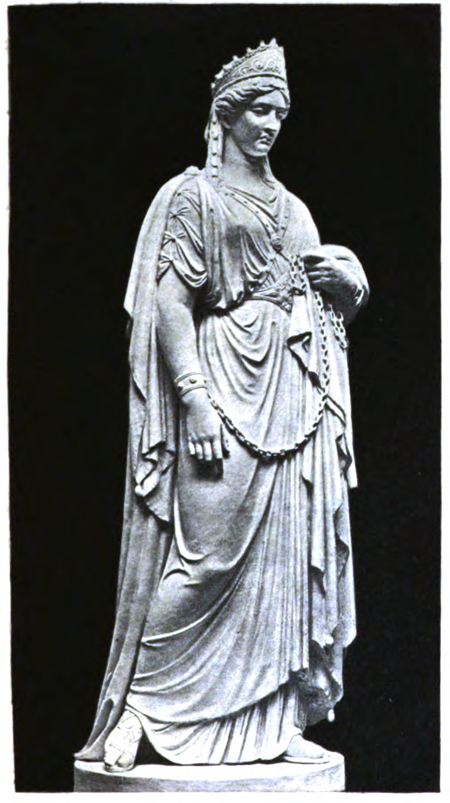
Zenobia. From a painting by Joanowitz.
When the Syrian queen was brought into the presence of Aurelian, he sternly asked her, How she had presumed to rise in arms against the emperors of Rome? The answer of Zenobia was a prudent mixture of respect and firmness. “Because I disdained to consider as Roman emperors an Aureolus or a Gallienus. You alone I acknowledge as my conqueror and my sovereign.” [80] But, as female fortitude is commonly artificial, so it is seldom steady or consistent. The courage of Zenobia deserted her in the hour of trial; she trembled at the angry clamours of the soldiers, who called aloud for her immediate execution, forgot the generous despair of Cleopatra, which she had proposed as her model, and ignominiously purchased life by the sacrifice of her fame and her friends. It was to their counsels, which governed the weakness of her sex, that she imputed the guilt of her obstinate resistance; it was on their heads that she directed the vengeance of the cruel Aurelian. The fame of Longinus, [II-92] who was included among the numerous and perhaps innocent victims of her fear, will survive that of the queen who betrayed, or the tyrant who condemned, him. Genius and learning were incapable of moving a fierce unlettered soldier, but they had served to elevate and harmonise the soul of Longinus. Without uttering a complaint, he calmly followed the executioner, pitying his unhappy mistress, and bestowing comfort on his afflicted friends. [81]
Returning from the conquest of the East, Aurelian had already crossed the straits which divide Europe from Asia, when he was provoked by the intelligence that the Palmyrenians had massacred the governor and garrison which he had left among them, and again erected the standard of revolt. Without a moment’s deliberation, he once more turned his face towards Syria. Antioch was alarmed by his rapid approach, and the helpless city of Palmyra felt the irresistible weight of his resentment. We have a letter of Aurelian himself, in which he acknowledges [82] that old men, women, children, and peasants had been involved in that dreadful execution, which should have been confined to armed rebellion; and, although his principal concern seems directed to the re-establishment of a temple of the Sun, he discovers some pity for the remnant of the Palmyrenians, to whom he grants the permission of rebuilding and inhabiting their city. But it is easier to destroy than to restore. The seat of commerce, of arts, and of Zenobia gradually sunk into an obscure town, a trifling fortress, and at length a miserable village. The present citizens of Palmyra, consisting of thirty or forty families, have erected their mud cottages within the spacious court of a magnificent temple.
Another and a last labour still awaited the indefatigable Aurelian; to suppress a dangerous though obscure rebel, who, during the revolt of Palmyra, had arisen on the banks [II-93] of the Nile. Firmus, the friend and ally, as he proudly styled himself, of Odenathus and Zenobia, was no more than a wealthy merchant of Egypt. In the course of his trade to India, he had formed very intimate connections with the Saracens and the Blemmyes, whose situation on either coast of the Red Sea gave them an easy introduction into the Upper Egypt. The Egyptians he inflamed with the hope of freedom, and, at the head of their furious multitude, broke into the city of Alexandria, where he assumed the Imperial purple, coined money, published edicts, and raised an army, which, as he vainly boasted, he was capable of maintaining from the sole profits of his paper trade. Such troops were a feeble defence against the approach of Aurelian; and it seems almost unnecessary to relate that Firmus was routed, taken, tortured, and put to death. Aurelian might now congratulate the senate, the people, and himself, that in little more than three years he had restored universal peace and order to the Roman world. [83]
Since the foundation of Rome, no general had more nobly deserved a triumph than Aurelian; nor was a triumph ever celebrated with superior pride and magnificence. [84] The pomp was opened by twenty elephants, four royal tigers, and above two hundred of the most curious animals from every climate of the North, the East, and the South. They were followed by sixteen hundred gladiators, devoted to the cruel amusement of the amphitheatre. The wealth of Asia, the arms and ensigns of so many conquered nations, and the magnificent plate and wardrobe of the Syrian queen, were disposed in exact symmetry or artful disorder. The ambassadors [II-94] of the most remote parts of the earth, of Æthiopia, Arabia, Persia, Bactriana, India, and China, all remarkable by their rich or singular dresses, displayed the fame and power of the Roman emperor, who exposed likewise to the public view the presents that he had received, and particularly a great number of crowns of gold, the offerings of grateful cities. The victories of Aurelian were attested by the long train of captives who reluctantly attended his triumph, Goths, Vandals, Sarmatians, Alemanni, Franks, Gauls, Syrians, and Egyptians. Each people was distinguished by its peculiar inscription, and the title of Amazons was bestowed on ten martial heroines of the Gothic nation who had been taken in arms. [85] But every eye, disregarding the crowd of captives, was fixed on the emperor Tetricus and the queen of the East. The former, as well as his son, whom he had created Augustus, was dressed in Gallic trowsers, [86] a saffron tunic, and a robe of purple. The beauteous figure of Zenobia was confined by fetters of gold; a slave supported the gold chain which encircled her neck, and she almost fainted under the intolerable weight of jewels. She preceded on foot the magnificent chariot in which she once hoped to enter the gates of Rome. It was followed by two other chariots, still more sumptuous, of Odenathus and of the Persian monarch. The triumphal car of Aurelian (it had formerly been used by a Gothic king) was drawn, on this memorable occasion, either by four stags or by four elephants. [87] The most illustrious of the senate, [II-95] the people, and the army closed the solemn procession. Unfeigned joy, wonder, and gratitude swelled the acclamations of the multitude; but the satisfaction of the senate was clouded by the appearance of Tetricus; nor could they suppress a rising murmur that the haughty emperor should thus expose to public ignominy the person of a Roman and a magistrate. [88]
But however, in the treatment of his unfortunate rivals, Aurelian might indulge his pride, he behaved towards them with a generous clemency which was seldom exercised by the ancient conquerors. Princes who, without success, had defended their throne or freedom were frequently strangled in prison, as soon as the triumphal pomp ascended the Capitol. These usurpers, whom their defeat had convicted of the crime of treason, were permitted to spend their lives in affluence and honourable repose. The emperor presented Zenobia with an elegant villa at Tibur, or Tivoli, about twenty miles from the capital; the Syrian queen insensibly sank into a Roman matron, her daughters married into noble families, and her race was not yet extinct in the fifth century. [89] Tetricus and his son were reinstated in their rank and fortunes. They erected on the Cælian Hill a magnificent palace, and, as soon as it was finished, invited Aurelian to supper. On his entrance, he was agreeably surprised with a picture which represented their singular [II-96] history. They were delineated offering to the emperor a civic crown and the sceptre of Gaul, and again receiving at his hands the ornaments of the senatorial dignity. The father was afterwards invested with the government of Lucania, [90] and Aurelian, who soon admitted the abdicated monarch to his friendship and conversation, familiarly asked him, Whether it were not more desirable to administer a province of Italy, than to reign beyond the Alps? The son long continued a respectable member of the senate; nor was there any one of the Roman nobility more esteemed by Aurelian, as well as by his successors. [91]
So long and so various was the pomp of Aurelian’s triumph that, although it opened with the dawn of day, the slow majesty of the procession ascended not the Capitol before the ninth hour; and it was already dark when the emperor returned to the palace. The festival was protracted by theatrical representations, the games of the circus, the hunting of wild beasts, combats of gladiators, and naval engagements. Liberal donatives were distributed to the army and people, and several institutions, agreeable or beneficial to the city, contributed to perpetuate the glory of Aurelian. A considerable portion of his oriental spoils was consecrated to the gods of Rome; the Capitol, and every other temple, glittered with the offerings of his ostentatious piety; and the temple of the Sun alone received above fifteen thousand pounds of gold. [92] This last was a magnificent structure, erected by the emperor on the side of the Quirinal Hill, and dedicated, soon after the triumph, to that deity whom Aurelian adored as the parent of his life and fortunes. His [II-97] mother had been an inferior priestess in a chapel of the Sun; a peculiar devotion to the god of Light was a sentiment which the fortunate peasant imbibed in his infancy; and every step of his elevation, every victory of his reign, fortified superstition by gratitude. [93]
The arms of Aurelian had vanquished the foreign and domestic foes of the republic. We are assured that, by his salutary rigour, crimes and factions, mischievous arts and pernicious connivance, the luxuriant growth of a feeble and oppressive government, were eradicated throughout the Roman world. [94] But, if we attentively reflect how much swifter is the progress of corruption than its cure, and if we remember that the years abandoned to public disorders exceeded the months allotted to the martial reign of Aurelian, we must confess that a few short intervals of peace were insufficient for the arduous work of reformation. Even his attempt to restore the integrity of the coin was opposed by a formidable insurrection. The emperor’s vexation breaks out in one of his private letters: “Surely,” says he, “the gods have decreed that my life should be a perpetual warfare. A sedition within the walls has just now given birth to a very serious civil war. The workmen of the mint, at the instigation of Felicissimus, a slave to whom I had entrusted an employment in the finances, have risen in rebellion. They are at length suppressed; but seven thousand of my soldiers have been slain in the contest, of those troops whose ordinary station is in Dacia, and the camps along the Danube.” [95] Other writers, who confirm the same fact, add likewise that it happened soon after Aurelian’s triumph; that the decisive [II-98] engagement was fought on the Cælian Hill; that the workmen of the mint had adulterated the coin; and that the emperor restored the public credit by delivering out good money in exchange for the bad which the people was commanded to bring into the treasury. [96]
We might content ourselves with relating this extraordinary transaction, but we cannot dissemble how much, in its present form, it appears to us inconsistent and incredible. The debasement of the coin is, indeed, well suited to the administration of Gallienus; nor is it unlikely that the instruments of the corruption might dread the inflexible justice of Aurelian. But the guilt, as well as the profit, must have been confined to a few; nor is it easy to conceive by what arts they could arm a people whom they had injured against a monarch whom they had betrayed. We might naturally expect that such miscreants should have shared the public detestation with the informers and the other ministers of oppression; and that the reformation of the coin should have been an action equally popular with the destruction of those obsolete accounts which, by the emperor’s order, were burnt in the forum of Trajan. [97] In an age when the principles of commerce were so imperfectly understood, the most desirable end might perhaps be effected by harsh and injudicious means; but a temporary grievance of such a nature can scarcely excite and support a serious civil war. The repetition of intolerable taxes, imposed either on the land or on the necessaries of life, may at last provoke those who will not, or who cannot, relinquish their country. But the case is far otherwise in every operation which, by whatsoever expedients, restores the just value of money. The transient evil is soon obliterated by the permanent benefit, the loss is divided among multitudes; and, if a few wealthy individuals experience a [II-99] sensible diminution of treasure, with their riches they at the same time lose the degree of weight and importance which they derived from the possession of them. However Aurelian might choose to disguise the real cause of the insurrection, his reformation of the coin could furnish only a faint pretence to a party already powerful and discontented. Rome, though deprived of freedom, was distracted by faction. The people, towards whom the emperor, himself a plebeian, always expressed a peculiar fondness, lived in perpetual dissension with the senate, the equestrian order, and the Prætorian guards. [98] Nothing less than the firm though secret conspiracy of those orders, of the authority of the first, the wealth of the second, and the arms of the third, could have displayed a strength capable of contending in battle with the veteran legions of the Danube, which, under the conduct of a martial sovereign, had achieved the conquest of the West and of the East.
Whatever was the cause or the object of this rebellion, imputed with so little probability to the workmen of the mint, Aurelian used his victory with unrelenting rigour. [99] He was naturally of a severe disposition. A peasant and a soldier, his nerves yielded not easily to the impressions of sympathy, and he could sustain without emotion the sight of tortures and death. Trained from his earliest youth in the exercise of arms, he set too small a value on the life of a citizen, chastised by military execution the slightest offences, and transferred the stern discipline of the camp into the civil administration of the laws. His love of justice often became a blind and furious passion; and, whenever he deemed his own or the public safety endangered, he disregarded the rules of evidence, and the proportion of punishments. [II-100] The unprovoked rebellion with which the Romans rewarded his services exasperated his haughty spirit. The noblest families of the capital were involved in the guilt or suspicion of this dark conspiracy. A hasty spirit of revenge urged the bloody prosecution, and it proved fatal to one of the nephews of the emperor. The executioners (if we may use the expression of a contemporary poet) were fatigued, the prisons were crowded, and the unhappy senate lamented the death or absence of its most illustrious members. [100] Nor was the pride of Aurelian less offensive to that assembly than his cruelty. Ignorant or impatient of the restraints of civil institutions, he disdained to hold his power by any other title than that of the sword, and governed by right of conquest an empire which he had saved and subdued. [101]
It was observed by one of the most sagacious of the Roman princes that the talents of his predecessor Aurelian were better suited to the command of an army than to the government of an empire. [102] Conscious of the character in which nature and experience had enabled him to excel, he again took the field a few months after his triumph. It was expedient to exercise the restless temper of the legions in some foreign war, and the Persian monarch, exulting in the shame of Valerian, still braved with impunity the offended majesty of Rome. At the head of an army, less formidable by its numbers than by its discipline and valour, the emperor advanced as far as the Straits which divide Europe from Asia. He there experienced that the most absolute power is a weak defence against the effects of despair. He had threatened one of his secretaries who was accused of extortion; [II-101] and it was known that he seldom threatened in vain. The last hope which remained for the criminal was to involve some of the principal officers of the army in his danger, or at least in his fears. Artfully counterfeiting his master’s hand, he showed them, in a long and bloody list, their own names devoted to death. Without suspecting or examining the fraud, they resolved to secure their lives by the murder of the emperor. On his march, between Byzantium and Heraclea, Aurelian was suddenly attacked by the conspirators, whose stations gave them a right to surround his person; and, after a short resistance, fell by the hand of Mucapor, a general whom he had always loved and trusted. He died regretted by the army, detested by the senate, but universally acknowledged as a warlike and fortunate prince, the useful though severe reformer of a degenerate state. [103]
[II-102]
CHAPTER XII↩
Conduct of the Army and Senate after the Death of Aurelian — Reigns of Tacitus, Probus, Carus, and his Sons
Such was the unhappy condition of the Roman emperors, that, whatever might be their conduct, their fate was commonly the same. A life of pleasure or virtue, of severity or mildness, of indolence or glory, alike led to an untimely grave; and almost every reign is closed by the same disgusting repetition of treason and murder. The death of Aurelian, however, is remarkable by its extraordinary consequences. The legions admired, lamented, and revenged their victorious chief. The artifice of his perfidious secretary was discovered and punished. The deluded conspirators attended the funeral of their injured sovereign, with sincere or well-feigned contrition, and submitted to the unanimous resolution of the military order, which was signified by the following epistle: “The brave and fortunate armies to the senate and people of Rome. The crime of one man, and the error of many, have deprived us of the late emperor Aurelian. May it please you, venerable lords and fathers! to place him in the number of the gods, and to appoint a successor whom your judgment shall declare worthy of the Imperial purple. None of those whose guilt or misfortune have contributed to our loss shall ever reign over us.” [1] The Roman senators heard, without surprise, that another emperor had been assassinated in his camp; they secretly rejoiced in the fall of Aurelian; but the modest and dutiful address of the legions, when it was communicated in full assembly by the consul, diffused the most [II-103] pleasing astonishment. Such honours as fear and perhaps esteem could extort they liberally poured forth on the memory of their deceased sovereign. Such acknowledgments as gratitude could inspire they returned to the faithful armies of the republic, who entertained so just a sense of the legal authority of the senate in the choice of an emperor. Yet, notwithstanding this flattering appeal, the most prudent of the assembly declined exposing their safety and dignity to the caprice of an armed multitude. The strength of the legions was, indeed, a pledge of their sincerity, since those who may command are seldom reduced to the necessity of dissembling; but could it naturally be expected, that a hasty repentance would correct the inveterate habits of fourscore years? Should the soldiers relapse into their accustomed seditions, their insolence might disgrace the majesty of the senate, and prove fatal to the object of its choice. Motives like these dictated a decree by which the election of a new emperor was referred to the suffrage of the military order.
The contention that ensued is one of the best-attested, but most improbable, events in the history of mankind. [2] The troops, as if satiated with the exercise of power, again conjured the senate to invest one of its own body with the Imperial purple. The senate still persisted in its refusal; the army in its request. The reciprocal offer was pressed and rejected at least three times, and, whilst the obstinate modesty of either party was resolved to receive a master from the hands of the other, eight months insensibly elapsed; an amazing period of tranquil anarchy, during which the Roman world remained [II-104] without a sovereign, without an usurper, and without a sedition. The generals and magistrates appointed by Aurelian continued to execute their ordinary functions; and it is observed that a proconsul of Asia was the only considerable person removed from his office in the whole course of the interregnum.
An event somewhat similar, but much less authentic, is supposed to have happened after the death of Romulus, who, in his life and character, bore some affinity with Aurelian. The throne was vacant during twelve months till the election of a Sabine philosopher, and the public peace was guarded in the same manner by the union of the several orders of the state. But, in the time of Numa and Romulus, the arms of the people were controlled by the authority of the patricians; and the balance of freedom was easily preserved in a small and virtuous community. [3] The decline of the Roman state, far different from its infancy, was attended with every circumstance that could banish from an interregnum the prospect of obedience and harmony: an immense and tumultuous capital, a wide extent of empire, the servile equality of despotism, an army of four hundred thousand mercenaries, and the experience of frequent revolution. Yet, notwithstanding all these temptations, the discipline and memory of Aurelian still restrained the seditious temper of the troops, as well as the fatal ambition of their leaders. The flower of the legions maintained their stations on the banks of the Bosphorus, and the Imperial standard awed the less powerful camps of Rome and of the provinces. A generous though transient enthusiasm seemed to animate the military order; and we may hope that a few real patriots cultivated the returning friendship of the army and the senate, as the only expedient capable of restoring the republic to its ancient beauty and vigour.
[II-105]
On the twenty-fifth of September, [4] near eight months after the murder of Aurelian, the consul convoked an assembly of the senate, and reported the doubtful and dangerous situation of the empire. He slightly insinuated that the precarious loyalty of the soldiers depended on the chance of every hour and of every accident; but he represented, with the most convincing eloquence, the various dangers that might attend any farther delay in the choice of an emperor. Intelligence, he said, was already received that the Germans had passed the Rhine and occupied some of the strongest and most opulent cities of Gaul. The ambition of the Persian king kept the East in perpetual alarms; Egypt, Africa, and Illyricum were exposed to foreign and domestic arms; and the levity of Syria would prefer even a female sceptre to the sanctity of the Roman laws. The consul then, addressing himself to Tacitus, the first of the senators, [5] required his opinion on the important subject of a proper candidate for the vacant throne.
If we can prefer personal merit to accidental greatness, we shall esteem the birth of Tacitus more truly noble than that of kings. He claimed his descent from the philosophic historian whose writings will instruct the last generations of mankind. [6] The senator Tacitus was then seventy-five years of age. [7] The long period of his innocent life was adorned with wealth and honours. He had twice been invested with the consular dignity, [8] and enjoyed with elegance and sobriety his ample [II-106] patrimony of between two and three millions sterling. [9] The experience of so many princes, whom he had esteemed or endured, from the vain follies of Elagabalus to the useful rigour of Aurelian, taught him to form a just estimate of the duties, the dangers, and the temptations of their sublime station. From the assiduous study of his immortal ancestor he derived the knowledge of the Roman constitution and of human nature. [10] The voice of the people had already named Tacitus as the citizen the most worthy of empire. The ungrateful rumour reached his ears, and induced him to seek the retirement of one of his villas in Campania. He had passed two months in the delightful privacy of Baiæ, when he reluctantly obeyed the summons of the consul to resume his honourable place in the senate, and to assist the republic with his counsels on this important occasion.
He arose to speak, when, from every quarter of the house, he was saluted with the names of Augustus and Emperor. “Tacitus Augustus, the gods preserve thee, we choose thee for our sovereign, to thy care we entrust the republic and the world. Accept the empire from the authority of the senate. It is due to thy rank, to thy conduct, to thy manners.” As soon as the tumult of acclamations subsided, Tacitus attempted to decline the dangerous honour, and to express his wonder that they should elect his age and infirmities to succeed the martial vigour of Aurelian. “Are these limbs, conscript fathers! fitted to sustain the weight of armour, or to practise the exercises of the camp? The variety of climates, and the [II-107] hardships of a military life, would soon oppress a feeble constitution, which subsists only by the most tender management. My exhausted strength scarcely enables me to discharge the duty of a senator; how insufficient would it prove to the arduous labours of war and government! Can you hope that the legions will respect a weak old man, whose days have been spent in the shade of peace and retirement? Can you desire that I should ever find reason to regret the favourable opinion of the senate?” [11]
The reluctance of Tacitus, and it might possibly be sincere, was encountered by the affectionate obstinacy of the senate. Five hundred voices repeated at once, in eloquent confusion, that the greatest of the Roman princes, Numa, Trajan, Hadrian, and the Antonines, had ascended the throne in a very advanced season of life; that the mind, not the body, a sovereign, not a soldier, was the object of their choice; and that they expected from him no more than to guide by his wisdom the valour of the legions. These pressing though tumultuary instances were seconded by a more regular oration of Metius Falconius, the next on the consular bench to Tacitus himself. He reminded the assembly of the evils which Rome had endured from the vices of headstrong and capricious youths, congratulated them on the election of a virtuous and experienced senator, and, with a manly, though perhaps a selfish, freedom, exhorted Tacitus to remember the reasons of his elevation, and to seek a successor, not in his own family, but in the republic. The speech of Falconius was enforced by a general acclamation. The emperor-elect submitted to the authority of his country, and received the voluntary homage of his equals. The judgment of the senate was confirmed by the consent of the Roman people, and of the Prætorian guards. [12]
[II-108]
The administration of Tacitus was not unworthy of his life and principles. A grateful servant of the senate, he considered that national council as the author, and himself as the subject, of the laws. [13] He studied to heal the wounds which Imperial pride, civil discord, and military violence had inflicted on the constitution, and to restore, at least, the image of the ancient republic, as it had been preserved by the policy of Augustus, and the virtues of Trajan and the Antonines. It may not be useless to recapitulate some of the most important prerogatives which the senate appeared to have regained by the election of Tacitus. [14] 1. To invest one of their body, under the title of emperor, with the general command of the armies and the government of the frontier provinces. 2. To determine the list, or, as it was then styled, the College of Consuls. They were twelve in number, who, in successive pairs, each during the space of two months, filled the year, and represented the dignity of that ancient office. The authority of the senate in the nomination of the consuls was exercised with such independent freedom that no regard was paid to an irregular request of the emperor in favour of his brother Florianus. “The senate,” exclaimed Tacitus, with the honest transport of a patriot, “understand the character of a prince whom they have chosen.” 3. To appoint the proconsuls and presidents of the provinces, and to confer on all the magistrates their civil jurisdiction. 4. To receive appeals through the intermediate office of the prefect of the city from all the tribunals of the empire. 5. To give force and validity, by their decrees, to such as they should approve of the emperor’s edicts. 6. To these several branches of authority we [II-109] may add some inspection over the finances, since, even in the stern reign of Aurelian, it was in their power to divert a part of the revenue from the public service. [15]
Circular epistles were sent, without delay, to all the principal cities of the empire, Treves, Milan, Aquileia, Thessalonica, Corinth, Athens, Antioch, Alexandria, and Carthage, to claim their obedience, and to inform them of the happy revolution, which had restored the Roman senate to its ancient dignity. Two of these epistles are still extant. We likewise possess two very singular fragments of the private correspondence of the senators on this occasion. They discover the most excessive joy and the most unbounded hopes. “Cast away your indolence,” it is thus that one of the senators addresses his friend, “emerge from your retirements of Baiæ and Puteoli. Give yourself to the city, to the senate. Rome flourishes, the whole republic flourishes. Thanks to the Roman army, to an army truly Roman, at length we have recovered our just authority, the end of all our desires. We hear appeals, we appoint proconsuls, we create emperors: perhaps, too, we may restrain them — to the wise, a word is sufficient.” [16] These lofty expectations were, however, soon disappointed; nor, indeed, was it possible that the armies and the provinces should long obey the luxurious and unwarlike nobles of Rome. On the slightest touch, the unsupported fabric of their pride and power fell to the ground. The expiring senate displayed a sudden lustre, blazed for a moment, and was extinguished for ever.
All that had yet passed at Rome was no more than a theatrical representation, unless it was ratified by the more substantial power of the legions. Leaving the senators to enjoy their dream of freedom and ambition, Tacitus proceeded to [II-110] the Thracian camp, and was there, by the Prætorian prefect, presented to the assembled troops, as the prince whom they themselves had demanded, and whom the senate had bestowed. As soon as the prefect was silent, the emperor addressed himself to the soldiers with elegance and propriety. He gratified their avarice by a liberal distribution of treasure, under the names of pay and donative. He engaged their esteem by a spirited declaration that, although his age might disable him from the performance of military exploits, his counsels should never be unworthy of a Roman general, the successor of the brave Aurelian. [17]
Whilst the deceased emperor was making preparations for a second expedition into the East, he had negotiated with the Alani, a Scythian people, who pitched their tents in the neighbourhood of the lake Mæotis. Those barbarians, allured by presents and subsidies, had promised to invade Persia with a numerous body of light cavalry. They were faithful to their engagements; but, when they arrived on the Roman frontier, Aurelian was already dead, the design of the Persian war was at least suspended, and the generals, who, during the interregnum, exercised a doubtful authority, were unprepared either to receive or to oppose them. Provoked by such treatment, which they considered as trifling and perfidious, the Alani had recourse to their own valour for their payment and revenge; and, as they moved with the usual swiftness of Tartars, they had soon spread themselves over the provinces of Pontus, Cappadocia, Cilicia, and Galatia. The legions, who from the opposite shores of the Bosphorus could almost distinguish the flames of the cities and villages, impatiently urged their general to lead them against the invaders. The conduct of Tacitus was suitable to his age and station. He convinced the barbarians of the faith, as well as of the power, of the empire. Great numbers of the Alani, appeased by the punctual discharge of the engagements which Aurelian had [II-111] contracted with them, relinquished their booty and captives, and quietly retreated to their own deserts beyond the Phasis. Against the remainder, who refused peace, the Roman emperor waged, in person, a successful war. Seconded by an army of brave and experienced veterans, in a few weeks he delivered the provinces of Asia from the terror of the Scythian invasion. [18]
But the glory and life of Tacitus were of short duration. Transported, in the depth of winter, from the soft retirement of Campania to the foot of Mount Caucasus, he sunk under the unaccustomed hardships of a military life. The fatigues of the body were aggravated by the cares of the mind. For a while, the angry and selfish passions of the soldiers had been suspended by the enthusiasm of public virtue. They soon broke out with redoubled violence, and raged in the camp, and even in the tent of the aged emperor. His mild and amiable character served only to inspire contempt, and he was incessantly tormented with factions which he could not assuage, and by demands which it was impossible to satisfy. Whatever flattering expectations he had conceived of reconciling the public disorders, Tacitus soon was convinced that the licentiousness of the army disdained the feeble restraint of laws, and his last hour was hastened by anguish and disappointment. It may be doubtful whether the soldiers imbrued their hands in the blood of this innocent prince. [19] It is certain that their insolence was the cause of his death. He [II-112] expired at Tyana in Cappadocia, after a reign of only six months and about twenty days. [20]
The eyes of Tacitus were scarcely closed before his brother Florianus [21] showed himself unworthy to reign, by the hasty usurpation of the purple, without expecting the approbation of the senate. The reverence for the Roman constitution, which yet influenced the camp and the provinces, was sufficiently strong to dispose them to censure, but not to provoke them to oppose, the precipitate ambition of Florianus. The discontent would have evaporated in idle murmurs, had not the general of the East, the heroic Probus, boldly declared himself the avenger of the senate. The contest, however, was still unequal; nor could the most able leader, at the head of the effeminate troops of Egypt and Syria, encounter, with any hopes of victory, the legions of Europe, whose irresistible strength appeared to support the brother of Tacitus. But the fortune and activity of Probus triumphed over every obstacle. The hardy veterans of his rival, accustomed to cold climates, sickened and consumed away in the sultry heats of Cilicia, where the summer proved remarkably unwholesome. Their numbers were diminished by frequent desertion, the passes of the mountains were feebly defended; Tarsus opened its gates, and the soldiers of Florianus, when they had permitted him to enjoy the Imperial title about three months, [22] delivered the empire from civil war by the easy sacrifice of a prince whom they despised. [23]
The perpetual revolutions of the throne had so perfectly [II-113] erased every notion of hereditary right, that the family of an unfortunate emperor was incapable of exciting the jealousy of his successors. The children of Tacitus and Florianus were permitted to descend into a private station, and to mingle with the general mass of the people. Their poverty indeed became an additional safeguard to their innocence. When Tacitus was elected by the senate, he resigned his ample patrimony to the public service, [24] an act of generosity specious in appearance, but which evidently disclosed his intention of transmitting the empire to his descendants. The only consolation of their fallen state was the remembrance of transient greatness, and a distant hope, the child of a flattering prophecy, that, at the end of a thousand years, a monarch of the race of Tacitus should rise, the protector of the senate, the restorer of Rome, and the conqueror of the whole earth. [25]
The peasants of Illyricum, who had already given Claudius and Aurelian to the sinking empire, had an equal right to glory in the elevation of Probus. [26] Above twenty years before, the emperor Valerian, with his usual penetration, had discovered the rising merit of the young soldier, on whom he conferred the rank of tribune long before the age prescribed by the military regulations. The tribune soon justified his choice by a victory over a great body of Sarmatians, in which he saved the life of a near relation of Valerian; and deserved to receive from the emperor’s hand the collars, bracelets, spears, and banners, the mural and the civic crown, and all the honourable rewards reserved by ancient Rome for successful valour. The third, and afterwards the tenth, legion were entrusted to the command of Probus, who, in every step of his [II-114] promotion, showed himself superior to the station which he filled. Africa and Pontus, the Rhine, the Danube, the Euphrates, and the Nile, by turns afforded him the most splendid occasions of displaying his personal prowess and his conduct in war. [27] Aurelian was indebted to him for the conquest of Egypt, and still more indebted for the honest courage with which he often checked the cruelty of his master. Tacitus, who desired by the abilities of his generals to supply his own deficiency of military talents, named him commander in chief of all the Eastern provinces, with five times the usual salary, the promise of the consulship, and the hope of a triumph. When Probus ascended the Imperial throne, he was about forty-four years of age; [28] in the full possession of his fame, of the love of the army, and of a mature vigour of mind and body.
His acknowledged merit, and the success of his arms against Florianus, left him without an enemy or a competitor. Yet, if we may credit his own professions, very far from being desirous of the empire, he had accepted it with the most sincere reluctance. “But it is no longer in my power,” says Probus, in a private letter, “to lay down a title so full of envy and of danger. I must continue to personate the character which the soldiers have imposed upon me.” [29] His dutiful address to the senate displayed the sentiments, or at least the language, of a Roman patriot: “When you elected one of your order, conscript father! to succeed the emperor Aurelian, you acted in a manner suitable to your justice and wisdom. For you are the legal sovereigns of the world, and the power which you derive from your ancestors will descend [II-115] to your posterity. Happy would it have been, if Florianus, instead of usurping the purple of his brother, like a private inheritance, had expected what your majesty might determine, either in his favour or in that of any other person. The prudent soldiers have punished his rashness. To me they have offered the title of Augustus. But I submit to your clemency my pretensions and my merits.” [30] When this respectful epistle was read by the consul, the senators were unable to disguise their satisfaction that Probus should condescend thus humbly to solicit a sceptre which he already possessed. They celebrated with the warmest gratitude his virtues, his exploits, and above all his moderation. A decree immediately passed, without a dissenting voice, to ratify the election of the Eastern armies, and to confer on their chief all the several branches of the Imperial dignity: the names of Cæsar and Augustus, the title of Father of his country, the right of making in the same day three motions in the senate, [31] the office of Pontifex Maximus, the tribunitian power, and the proconsular command; a mode of investiture, which, though it seemed to multiply the authority of the emperor, expressed the constitution of the ancient republic. The reign of Probus corresponded with this fair beginning. The senate was permitted to direct the civil administration of the empire. Their faithful general asserted the honour of the Roman arms, and often laid at their feet crowns of gold and barbaric trophies, the fruits of his numerous victories. [32] Yet, whilst he gratified their vanity, he must secretly have despised their indolence and weakness. [II-116] Though it was every moment in their power to repel the disgraceful edict of Gallienus, the proud successors of the Scipios patiently acquiesced in their exclusion from all military employments. They soon experienced that those who refuse the sword must renounce the sceptre.
The strength of Aurelian had crushed on every side the enemies of Rome. After his death they seemed to revive, with an increase of fury and of numbers. They were again vanquished by the active vigour of Probus, who, in a short reign of about six years, [33] equalled the fame of ancient heroes, and restored peace and order to every province of the Roman world. The dangerous frontier of Rhætia he so firmly secured, that he left it without the suspicion of an enemy. He broke the wandering power of the Sarmatian tribes, and by the terror of his arms compelled those barbarians to relinquish their spoil. The Gothic nation courted the alliance of so warlike an emperor. [34] He attacked the Isaurians in their mountains, besieged and took several of their strongest castles, [35] and flattered himself that he had for ever suppressed a domestic foe, whose independence so deeply wounded the majesty of the empire. The troubles excited by the usurper Firmus in the Upper Egypt had never been perfectly appeased, and the cities of Ptolemais and Coptos, fortified by the alliance of the Blemmyes, still maintained an obscure rebellion. The chastisement of those cities, and of their auxiliaries the savages of the South, is said to have alarmed the court of Persia, [36] [II-117] and the Great King sued in vain for the friendship of Probus. Most of the exploits which distinguished his reign were achieved by the personal valour and conduct of the emperor, insomuch that the writer of his life expresses some amazement how, in so short a time, a single man could be present in so many distant wars. The remaining actions he entrusted to the care of his lieutenants, the judicious choice of whom forms no inconsiderable part of his glory. Carus, Diocletian, Maximian, Constantius, Galerius, Asclepiodatus, Annibalianus, and a crowd of other chiefs, who afterwards ascended or supported the throne, were trained to arms in the severe school of Aurelian and Probus. [37]
But the most important service which Probus rendered to the republic was the deliverance of Gaul, and the recovery of seventy flourishing cities oppressed by the barbarians of Germany, who, since the death of Aurelian, had ravaged that great province with impunity. [38] Among the various multitude of those fierce invaders we may distinguish, with some degree of clearness, three great armies, or rather nations, successively vanquished by the valour of Probus. He drove back the Franks into their morasses; a descriptive circumstance from whence we may infer that the confederacy known by the manly appellation of Free already occupied the flat maritime country, intersected and almost overflown by the stagnating waters of the Rhine, and that several tribes of the Frisians and Batavians had acceded to their alliance. He vanquished the Burgundians, a considerable people of the Vandalic race. They had wandered in quest of booty from the banks of the Oder to those of the Seine. They esteemed themselves sufficiently fortunate to purchase, by the restitution of all their booty, the permission of an undisturbed retreat. They attempted to elude that article of the treaty. [II-118] Their punishment was immediate and terrible. [39] But of all the invaders of Gaul, the most formidable were the Lygians, a distant people who reigned over a wide domain on the frontiers of Poland and Silesia. [40] In the Lygian nation, the Arii held the first rank by their numbers and fierceness. “The Arii (it is thus that they are described by the energy of Tacitus) study to improve by art and circumstances the innate terrors of their barbarism. Their shields are black, their bodies are painted black. They choose for the combat the darkest hour of the night. Their host advances, covered as it were with a funereal shade; [41] nor do they often find an enemy capable of sustaining so strange and infernal an aspect. Of all our senses, the eyes are the first vanquished in battle.” [42] Yet the arms and discipline of the Romans easily discomfited these horrid phantoms. The Lygii were defeated in a general engagement, and Semno, the most renowned of their chiefs, fell alive into the hands of Probus. That prudent emperor, unwilling to reduce a brave people to despair, granted them an honourable capitulation, and permitted them to return in safety to their native country. But the losses which they suffered in the march, the battle, and the retreat broke the power of the nation: nor is the Lygian name ever repeated in the history either of Germany or of the empire. The deliverance of Gaul is reported to have cost the lives of four hundred thousand of the invaders; a work of labour to the [II-119] Romans, and of expense to the emperor, who gave a piece of gold for the head of every barbarian. [43] But, as the fame of warriors is built on the destruction of human kind, we may naturally suspect that the sanguinary account was multiplied by the avarice of the soldiers, and accepted without any very severe examination by the liberal vanity of Probus.
Since the expedition of Maximin, the Roman generals had confined their ambition to a defensive war against the nations of Germany, who perpetually pressed on the frontiers of the empire. The more daring Probus pursued his Gallic victories, passed the Rhine, and displayed his invincible eagles on the banks of the Elbe and the Neckar. [44] He was fully convinced that nothing could reconcile the minds of the barbarians to peace, unless they experienced in their own country the calamities of war. Germany, exhausted by the ill success of the last emigration, was astonished by his presence. Nine of the most considerable princes repaired to his camp, and fell prostrate at his feet. Such a treaty was humbly received by the Germans, as it pleased the conqueror to dictate. He exacted a strict restitution of the effects and captives which they had carried away from the provinces; and obliged their own magistrates to punish the more obstinate robbers who presumed to detain any part of the spoil. A considerable tribute of corn, cattle, and horses, the only wealth of barbarians, was reserved for the use of the garrisons which Probus established on the limits of their territory. He even entertained some thoughts of compelling the Germans to relinquish the exercise of arms, and to trust their differences to the justice, their safety to the power, of Rome. To accomplish these salutary ends, the constant residence of an Imperial governor, supported by a numerous army, was indispensably requisite. Probus therefore judged it more expedient to defer [II-120] the execution of so great a design; which was indeed rather of specious than solid utility. [45] Had Germany been reduced into the state of a province, the Romans, with immense labour and expense, would have acquired only a more extensive boundary to defend against the fiercer and more active barbarians of Scythia.
Instead of reducing the warlike natives of Germany to the condition of subjects, Probus contented himself with the humble expedient of raising a bulwark against their inroads. The country which now forms the circle of Swabia had been left desert in the age of Augustus by the emigration of its ancient inhabitants. [46] The fertility of the soil soon attracted a new colony from the adjacent provinces of Gaul. Crowds of adventurers, of a roving temper and of desperate fortunes, occupied the doubtful possession, and acknowledged, by the payment of tithes, the majesty of the empire. [47] To protect these new subjects, a line of frontier garrisons was gradually extended from the Rhine to the Danube. About the reign of Hadrian, when that mode of defence began to be practised, these garrisons were connected and covered by a strong intrenchment of trees and palisades. In the place of so rude a bulwark, the emperor Probus constructed a stone wall of a considerable height, and strengthened it by towers at convenient distances. From the neighbourhood of Neustadt and Ratisbon on the Danube, it stretched across hills, valleys, rivers, and morasses, as far as Wimpfen on the Neckar, and at length terminated on the banks of the Rhine, after a winding course of near two hundred miles. [48] This important barrier, [II-121] uniting the two mighty streams that protected the provinces of Europe, seemed to fill up the vacant space through which the barbarians, and particularly the Alemanni, could penetrate with the greatest facility into the heart of the empire. But the experience of the world, from China to Britain, has exposed the vain attempt of fortifying any extensive tract of country. [49] An active enemy, who can select and vary his points of attack, must, in the end, discover some feeble spot or unguarded moment. The strength as well as the attention of the defenders is divided; and such are the blind effects of terror on the firmest troops, that a line broken in a single place is almost instantly deserted. The fate of the wall which Probus erected may confirm the general observation. Within a few years after his death, it was overthrown by the Alemanni. Its scattered ruins, universally ascribed to the power of the Dæmon, now serve only to excite the wonder of the Swabian peasant.
Among the useful conditions of peace, imposed by Probus on the vanquished nations of Germany, was the obligation of supplying the Roman army with sixteen thousand recruits, the bravest and most robust of their youth. The emperor dispersed them through all the provinces, and distributed this dangerous reinforcement in small bands, of fifty or sixty each, among the national troops; judiciously observing that the aid which the republic derived from the barbarians should be felt but not seen. [50] Their aid was now become necessary. [II-122] The feeble elegance of Italy and the internal provinces could no longer support the weight of arms. The hardy frontier of the Rhine and Danube still produced minds and bodies equal to the labours of the camp; but a perpetual series of wars had gradually diminished their numbers. The infrequency of marriage, and the ruin of agriculture, affected the principles of population, and not only destroyed the strength of the present, but intercepted the hope of future, generations. The wisdom of Probus embraced a great and beneficial plan of replenishing the exhausted frontiers, by new colonies of captive or fugitive barbarians, on whom he bestowed lands, cattle, instruments of husbandry, and every encouragement that might engage them to educate a race of soldiers for the service of the republic. Into Britain, and most probably into Cambridgeshire, [51] he transported a considerable body of Vandals. The impossibility of an escape reconciled them to their situation, and in the subsequent troubles of that island they approved themselves the most faithful servants of the state. [52] Great numbers of Franks and Gepidæ were settled on the banks of the Danube and the Rhine. An hundred thousand Bastarnæ, expelled from their own country, cheerfully accepted an establishment in Thrace, and soon imbibed the manners and sentiments of Roman subjects. [53] But the expectations of Probus were too often disappointed. The impatience and idleness of the barbarians could ill brook the slow labours of agriculture. Their unconquerable love of freedom, rising against despotism, provoked them into hasty rebellions, alike fatal to themselves and to the provinces; [54] nor could these artificial supplies, however repeated by succeeding [II-123] emperors, restore the important limit of Gaul and Illyricum to its ancient and native vigour.
Of all the barbarians who abandoned their new settlements, and disturbed the public tranquillity, a very small number returned to their own country. For a short season they might wander in arms through the empire; but in the end they were surely destroyed by the power of a warlike emperor. The successful rashness of a party of Franks was attended, however, with such memorable consequences, that it ought not to be passed unnoticed. They had been established by Probus on the sea coast of Pontus, with a view of strengthening that frontier against the inroads of the Alani. A fleet stationed in one of the harbours of the Euxine fell into the hands of the Franks; and they resolved, through unknown seas, to explore their way from the mouth of the Phasis to that of the Rhine. They easily escaped through the Bosphorus and the Hellespont, and, cruising along the Mediterranean, indulged their appetite for revenge and plunder by frequent descents on the unsuspecting shores of Asia, Greece, and Africa. The opulent city of Syracuse, in whose port the navies of Athens and Carthage had formerly been sunk, was sacked by a handful of barbarians, who massacred the greatest part of the trembling inhabitants. From the island of Sicily the Franks proceeded to the columns of Hercules, trusted themselves to the ocean, coasted round Spain and Gaul, and, steering their triumphant course through the British channel, at length finished their surprising voyage, by landing in safety on the Batavian or Frisian shores. [55] The example of their success, instructing their countrymen to conceive the advantages, and to despise the dangers, of the sea, pointed out to their enterprising spirit a new road to wealth and glory.
Notwithstanding the vigilance and activity of Probus, it was almost impossible that he could at once contain in obedience [II-124] every part of his wide-extended dominions. The barbarians, who broke their chains, had seized the favourable opportunity of a domestic war. When the emperor marched to the relief of Gaul, he devolved the command of the East on Saturninus. That general, a man of merit and experience, was driven into rebellion by the absence of his sovereign, the levity of the Alexandrian people, the pressing instances of his friends, and his own fears; but from the moment of his elevation he never entertained a hope of empire, or even of life. “Alas!” he said, “the republic has lost a useful servant, and the rashness of an hour has destroyed the services of many years. You know not,” continued he, “the misery of sovereign power: a sword is perpetually suspended over our head. We dread our very guards, we distrust our companions. The choice of action or of repose is no longer in our disposition, nor is there any age, or character, or conduct, that can protect us from the censure of envy. In thus exalting me to the throne, you have doomed me to a life of cares, and to an untimely fate. The only consolation which remains is the assurance that I shall not fall alone.” [56] But, as the former part of his prediction was verified by the victory, so the latter was disappointed by the clemency, of Probus. That amiable prince attempted even to save the unhappy Saturninus from the fury of the soldiers. He had more than once solicited the usurper himself to place some confidence in the mercy of a sovereign who so highly esteemed his character, that he had punished, as a malicious informer, the first who related the improbable news of his defection. [57] Saturninus might, perhaps, have embraced the generous offer, had he not been restrained by the obstinate distrust of his adherents. Their guilt was deeper, and their hopes more sanguine, than those of their experienced leader.
[II-125]
The revolt of Saturninus was scarcely extinguished in the East, before new troubles were excited in the West by the rebellion of Bonosus and Proculus in Gaul. The most distinguished merit of those two officers was their respective prowess, of the one in the combats of Bacchus, of the other in those of Venus; [58] yet neither of them were destitute of courage and capacity, and both sustained, with honour, the august character which the fear of punishment had engaged them to assume, till they sunk at length beneath the superior genius of Probus. He used the victory with his accustomed moderation, and spared the fortunes as well as the lives of their innocent families. [59]
The arms of Probus had now suppressed all the foreign and domestic enemies of the state. His mild but steady administration confirmed the re-establishment of the public tranquillity; nor was there left in the provinces a hostile barbarian, a tyrant, or even a robber, to revive the memory of past disorders. It was time that the emperor should revisit Rome, and celebrate his own glory and the general happiness. The triumph due to the valour of Probus was conducted with a magnificence suitable to his fortune, and the people who had so lately admired the trophies of Aurelian gazed with equal pleasure on those of his heroic successor. [60] We cannot, on this occasion, forget the desperate courage of about fourscore gladiators, reserved, with near six hundred others, for the inhuman sports of the amphitheatre. Disdaining to [II-126] shed their blood for the amusement of the populace, they killed their keepers, broke from the place of their confinement, and filled the streets of Rome with blood and confusion. After an obstinate resistance they were overpowered and cut in pieces by the regular forces; but they obtained at least an honourable death, and the satisfaction of a just revenge. [61]
The military discipline which reigned in the camps of Probus was less cruel than that of Aurelian, but it was equally rigid and exact. The latter had punished the irregularities of the soldiers with unrelenting severity, the former prevented them by employing the legions in constant and useful labours. When Probus commanded in Egypt, he executed many considerable works for the splendour and benefit of that rich country. The navigation of the Nile, so important to Rome itself, was improved; and temples, bridges, porticos, and palaces were constructed by the hands of the soldiers, who acted by turns as architects, as engineers, and as husbandmen. [62] It was reported of Hannibal that, in order to preserve his troops from the dangerous temptations of idleness, he had obliged them to form large plantations of olive trees along the coast of Africa. [63] From a similar principle, Probus exercised his legions in covering with rich vineyards the hills of Gaul and Pannonia, and two considerable spots are described, which were entirely dug and planted by military labour. [64] One of these, known under the name of Mount Alma, was situated near Sirmium, the country where Probus was born, for which he ever retained a partial affection, and whose gratitude he [II-127] endeavoured to secure by converting into tillage a large and unhealthy tract of marshy ground. An army thus employed constituted perhaps the most useful, as well as the bravest, portion of the Roman subjects.
But, in the prosecution of a favourite scheme, the best of men, satisfied with the rectitude of their intentions, are subject to forget the bounds of moderation; nor did Probus himself sufficiently consult the patience and disposition of his fierce legionaries. [65] The dangers of the military profession seem only to be compensated by a life of pleasure and idleness; but, if the duties of the soldier are incessantly aggravated by the labours of the peasant, he will at last sink under the intolerable burden, or shake it off with indignation. The imprudence of Probus is said to have inflamed the discontent of his troops. More attentive to the interests of mankind than to those of the army, he expressed the vain hope that, by the establishment of universal peace, he should soon abolish the necessity of a standing and mercenary force. [66] The unguarded expression proved fatal to him. In one of the hottest days of summer, as he severely urged the unwholesome labour of draining the marshes of Sirmium, the soldiers, impatient of fatigue, on a sudden threw down their tools, grasped their arms, and broke out into a furious mutiny. The emperor, conscious of his danger, took refuge in a lofty tower, constructed for the purpose of surveying the progress of the work. [67] The tower was instantly forced, and a thousand swords were plunged at once into the bosom of the unfortunate Probus. [II-128] The rage of the troops subsided as soon as it had been gratified. They then lamented their fatal rashness, forgot the severity of the emperor whom they had massacred, and hastened to perpetuate, by an honourable monument, the memory of his virtues and victories. [68]
When the legions had indulged their grief and repentance for the death of Probus, their unanimous consent declared Carus, his Prætorian prefect, the most deserving of the Imperial throne. Every circumstance that relates to this prince appears of a mixed and doubtful nature. He gloried in the title of Roman Citizen; and affected to compare the purity of his blood with the foreign, and even barbarous, origin of the preceding emperors: yet the most inquisitive of his contemporaries, very far from admitting his claim, have variously deduced his own birth, or that of his parents, from Illyricum, from Gaul, or from Africa. [69] Though a soldier, he had received a learned education; though a senator, he was invested with the first dignity of the army; and, in an age when the civil and military professions began to be irrecoverably separated from each other, they were united in the person of Carus. Notwithstanding the severe justice which he exercised against the assassins of Probus, to whose favour and esteem he was highly indebted, he could not escape the suspicion of being accessory to a deed from whence he derived the principal advantage. He enjoyed, at least before his elevation, an acknowledged character [II-129] of virtue and abilities: [70] but his austere temper insensibly degenerated into moroseness and cruelty; and the imperfect writers of his life almost hesitate whether they shall not rank him in the number of Roman tyrants. [71] When Carus assumed the purple, he was about sixty years of age, and his two sons, Carinus and Numerian, had already attained the season of manhood. [72]
The authority of the senate expired with Probus; nor was the repentance of the soldiers displayed by the same dutiful regard for the civil power which they had testified after the unfortunate death of Aurelian. The election of Carus was decided without expecting the approbation of the senate, and the new emperor contented himself with announcing, in a cold and stately epistle, that he had ascended the vacant throne. [73] A behaviour so very opposite to that of his amiable predecessor afforded no favourable presage of the new reign; and the Romans, deprived of power and freedom, asserted their privilege of licentious murmurs. [74] The voice of congratulation and flattery was not however silent; and we may still peruse, with pleasure and contempt, an eclogue, which was composed on the accession of the emperor Carus. Two shepherds, avoiding the noon-tide heat, retire into the cave of Faunus. On a spreading beech they discover some recent characters. The rural deity had described, in prophetic verses, the felicity promised to the empire under the reign of so great a prince. Faunus hails the approach of [II-130] that hero, who, receiving on his shoulders the sinking weight of the Roman world, shall extinguish war and faction, and once again restore the innocence and security of the golden age. [75]
It is more than probable that these elegant trifles never reached the ears of a veteran general, who, with the consent of the legions, was preparing to execute the long-suspended design of the Persian war. Before his departure for this distant expedition, Carus conferred on his two sons, Carinus and Numerian, the title of Cæsar; and, investing the former with almost an equal share of the Imperial power, directed the young prince, first to suppress some troubles which had arisen in Gaul, and afterwards to fix the seat of his residence at Rome, and to assume the government of the Western provinces. [76] The safety of Illyricum was confirmed by a memorable defeat of the Sarmatians; [77] sixteen thousand of those barbarians remained on the field of battle, and the number of captives amounted to twenty thousand. The old emperor, animated with the fame and prospect of victory, pursued his march, in the midst of winter, through the countries of Thrace and Asia Minor, and at length, with his younger son, Numerian, arrived on the confines of the Persian monarchy. There, encamping on the summit of a lofty mountain, he pointed out to his troops the opulence and luxury of the enemy whom they were about to invade.
The successor of Artaxerxes, Varnes or Bahram, though he had subdued the Segestans, one of the most warlike nations of Upper Asia, [78] was alarmed at the approach of the Romans and endeavoured to retard their progress by a negotiation of peace. His ambassadors entered the camp about sunset, [II-131] at the time when the troops were satisfying their hunger with a frugal repast. The Persians expressed their desire of being introduced to the presence of the Roman emperor. They were at length conducted to a soldier, who was seated on the grass. A piece of stale bacon and a few hard peas composed his supper. A coarse woollen garment of purple was the only circumstance that announced his dignity. The conference was conducted with the same disregard of courtly elegance. Carus, taking off a cap which he wore to conceal his baldness, assured the ambassadors that, unless their master acknowledged the superiority of Rome, he would speedily render Persia as naked of trees as his own head was destitute of hair. [79] Notwithstanding some traces of art and preparation, we may discover, in this scene, the manners of Carus, and the severe simplicity which the martial princes, who succeeded Gallienus, had already restored in the Roman camps. The ministers of the Great King trembled and retired.
The threats of Carus were not without effect. He ravaged Mesopotamia, cut in pieces whatever opposed his passage, made himself master of the great cities of Seleucia and Ctesiphon (which seem to have surrendered without resistance), and carried his victorious arms beyond the Tigris. [80] He had seized the favourable moment for an invasion. The Persian councils were distracted by domestic factions, and the greater part of their forces were detained on the frontiers of India. Rome and the East received with transport the news of such important advantages. Flattery and hope painted, in the most lively colours, the fall of Persia, the conquest of Arabia, the submission of Egypt, and a lasting deliverance from the inroads of the Scythian nations. [81] But the reign [II-132] of Carus was destined to expose the vanity of predictions. They were scarcely uttered before they were contradicted by his death; an event attended with such ambiguous circumstances, that it may best be related in a letter from his own secretary to the prefect of the city. “Carus,” says he, “our dearest emperor, was confined by sickness to his bed, when a furious tempest arose in the camp. The darkness which overspread the sky was so thick, that we could no longer distinguish each other; and the incessant flashes of lightning took from us the knowledge of all that passed in the general confusion. Immediately after the most violent clap of thunder, we heard a sudden cry that the emperor was dead; and it soon appeared that his chamberlains, in a rage of grief, had set fire to the royal pavilion, a circumstance which gave rise to the report that Carus was killed by lightning. But, as far as we have been able to investigate the truth, his death was the natural effect of his disorder.” [82]
The vacancy of the throne was not productive of any disturbance. The ambition of the aspiring generals was checked by their mutual fears, and young Numerian, with his absent brother Carinus, were unanimously acknowledged as Roman emperors. The public expected that the successor of Carus would pursue his father’s footsteps, and, without allowing the Persians to recover from their consternation, would advance sword in hand to the palaces of Susa and Ecbatana. [83] But the legions, however strong in numbers and discipline, were dismayed by the most abject superstition. Notwithstanding all the arts that were practised to disguise the manner of the late emperor’s death, it was [II-133] found impossible to remove the opinion of the multitude, and the power of opinion is irresistible. Places or persons struck with lightning were considered by the ancients with pious horror, as singularly devoted to the wrath of Heaven. [84] An oracle was remembered, which marked the river Tigris as the fatal boundary of the Roman arms. The troops, terrified with the fate of Carus and with their own danger, called aloud on young Numerian to obey the will of the gods, and to lead them away from this inauspicious scene of war. The feeble emperor was unable to subdue their obstinate prejudice, and the Persians wondered at the unexpected retreat of a victorious enemy. [85]
The intelligence of the mysterious fate of the late emperor was soon carried from the frontiers of Persia to Rome; and the senate, as well as the provinces, congratulated the accession of the sons of Carus. These fortunate youths were strangers, however, to that conscious superiority, either of birth or of merit, which can alone render the possession of a throne easy, and as it were natural. Born and educated in a private station, the election of their father raised them at once to the rank of princes; and his death, which happened about sixteen months afterwards, left them the unexpected legacy of a vast empire. To sustain with temper this rapid elevation, an uncommon share of virtue and prudence was requisite; and Carinus, the elder of the brothers, was more than commonly deficient in those qualities. In the Gallic war, he discovered some degree of personal courage; [86] but, from the moment of his arrival at Rome, he abandoned himself to the luxury of the capital, and to the abuse of his fortune. He was soft, yet cruel; devoted [II-134] to pleasure, but destitute of taste; and, though exquisitely susceptible of vanity, indifferent to the public esteem. In the course of a few months, he successively married and divorced nine wives, [87] most of whom he left pregnant; and, notwithstanding this legal inconstancy, found time to indulge such a variety of irregular appetites as brought dishonour on himself and on the noblest houses of Rome. He beheld with inveterate hatred all those who might remember his former obscurity, or censure his present conduct. He banished or put to death the friends and counsellors whom his father had placed about him to guide his inexperienced youth; and he persecuted with the meanest revenge his school-fellows and companions, who had not sufficiently respected the latent majesty of the emperor. With the senators, Carinus affected a lofty and regal demeanour, frequently declaring that he designed to distribute their estates among the populace of Rome. From the dregs of that populace he selected his favourites, and even his ministers. The palace, and even the Imperial table, was filled with singers, dancers, prostitutes, and all the various retinue of vice and folly. One of his door-keepers [88] he entrusted with the government of the city. In the room of the Prætorian prefect, whom he put to death, Carinus substituted one of the ministers of his looser pleasures. Another who possessed the same, or even a more infamous, title to favour, was invested with the consulship. A confidential secretary, who had acquired uncommon skill in the art of forgery, delivered the indolent emperor, with his own consent, from the irksome duty of signing his name.
When the emperor Carus undertook the Persian war, he was induced, by motives of affection as well as policy, to [II-135] secure the fortunes of his family by leaving in the hands of his eldest son the armies and provinces of the West. The intelligence which he soon received of the conduct of Carinus filled him with shame and regret; nor had he concealed his resolution of satisfying the republic by a severe act of justice, and of adopting, in the place of an unworthy son, the brave and virtuous Constantius, who at that time was governor of Dalmatia. But the elevation of Constantius was for a while deferred; and, as soon as a father’s death had released Carinus from the control of fear or decency, he displayed to the Romans the extravagancies of Elagabalus, aggravated by the cruelty of Domitian. [89]
The only merit of the administration of Carinus that history could record or poetry celebrate was the uncommon splendour with which, in his own and his brother’s name, he exhibited the Roman games of the theatre, the circus, and the amphitheatre. More than twenty years afterwards, when the courtiers of Diocletian represented to their frugal sovereign the fame and popularity of his munificent predecessor, he acknowledged that the reign of Carinus had indeed been a reign of pleasure. [90] But this vain prodigality, which the prudence of Diocletian might justly despise, was enjoyed with surprise and transport by the Roman people. The oldest of the citizens, recollecting the spectacles of former days, the triumphal pomp of Probus or Aurelian, and the secular games of the emperor Philip, acknowledged that they were all surpassed by the superior magnificence of Carinus. [91]
The spectacles of Carinus may therefore be best illustrated by the observation of some particulars, which history has [II-136] condescended to relate concerning those of his predecessors. If we confine ourselves solely to the hunting of wild beasts, however we may censure the vanity of the design or the cruelty of the execution, we are obliged to confess that neither before nor since the time of the Romans so much art and expense have ever been lavished for the amusement of the people. [92] By the order of Probus, a great quantity of large trees, torn up by the roots, were transplanted into the midst of the circus. The spacious and shady forest was immediately filled with a thousand ostriches, a thousand stags, a thousand fallow deer, and a thousand wild boars; and all this variety of game was abandoned to the riotous impetuosity of the multitude. The tragedy of the succeeding day consisted in the massacre of an hundred lions, an equal number of lionesses, two hundred leopards, and three hundred bears. [93] The collection prepared by the younger Gordian for his triumph, and which his successor exhibited in the secular games, was less remarkable by the number than by the singularity of the animals. Twenty zebras displayed their elegant forms and variegated beauty to the eyes of the Roman people. [94] Ten elks, and as many camelopards, the loftiest and most harmless creatures that wander over the plains of Sarmatia and Æthiopia, were contrasted with thirty African hyænas, and ten Indian tigers, the most implacable savages of the torrid zone. The unoffending strength with which Nature has endowed the greater quadrupeds was admired in the rhinoceros, the hippopotamus of the Nile, [95] [II-137] and a majestic troop of thirty-two elephants. [96] While the populace gazed with stupid wonder on the splendid show, the naturalist might indeed observe the figure and properties of so many different species, transported from every part of the ancient world into the amphitheatre of Rome. But this accidental benefit which science might derive from folly is surely insufficient to justify such a wanton abuse of the public riches. There occurs, however, a single instance in the first Punic war, in which the senate wisely connected this amusement of the multitude with the interest of the state. A considerable number of elephants, taken in the defeat of the Carthaginian army, were driven through the circus by a few slaves, armed only with blunt javelins. [97] The useful spectacle served to impress the Roman soldier with a just contempt for those unwieldy animals; and he no longer dreaded to encounter them in the ranks of war.
The hunting or exhibition of wild beasts was conducted with a magnificence suitable to a people who styled themselves the masters of the world; nor was the edifice appropriated to that entertainment less expressive of Roman greatness. Posterity admires, and will long admire, the awful remains of the amphitheatre of Titus, which so well deserved the epithet of Colossal. [98] It was a building of an elliptic figure, five hundred and sixty-four feet in length, and four hundred and sixty-seven in breadth, founded on fourscore arches, and rising, with four successive orders of architecture, to the height of one hundred and forty feet. [99] The [II-138] outside of the edifice was encrusted with marble, and decorated with statues. The slopes of the vast concave, which formed the inside, were filled and surrounded with sixty or eighty rows of seats, of marble likewise, covered with cushions, and capable of receiving with ease above fourscore thousand spectators. [100] Sixty-four vomitories (for by that name the doors were very aptly distinguished) poured forth the immense multitude; and the entrances, passages, and staircases were contrived with such exquisite skill, that each person, whether of the senatorial, the equestrian, or the plebeian order, arrived at his destined place without trouble or confusion. [101] Nothing was omitted, which, in any respect, could be subservient to the convenience and pleasure of the spectators. They were protected from the sun and rain by an ample canopy, occasionally drawn over their heads. The air was continually refreshed by the playing of fountains, and profusely impregnated by the grateful scent of aromatics. In the centre of the edifice, the arena, or stage, was strewed with the finest sand, and successively assumed the most different forms. At one moment it seemed to rise out of the earth, like the garden of the Hesperides, and was afterwards broken into the rocks and caverns of Thrace. The subterraneous pipes conveyed an inexhaustible supply of water; and what had just before appeared a level plain, might be suddenly converted into a wide lake, covered with armed vessels, and replenished with the monsters of the deep. [102] In the decoration of these [II-139] scenes the Roman emperors displayed their wealth and liberality; and we read on various occasions that the whole furniture of the amphitheatre consisted either of silver, or of gold, or of amber. [103] The poet who describes the games of Carinus, in the character of a shepherd attracted to the capital by the fame of their magnificence, affirms that the nets designed as a defence against the wild beasts were of gold wire; that the porticos were gilded; and that the belt or circle which divided the several ranks of spectators from each other was studded with a precious Mosaic of beautiful stones. [104]
In the midst of this glittering pageantry, the emperor Carinus, secure of his fortune, enjoyed the acclamations of the people, the flattery of his courtiers, and the songs of the poets, who, for want of a more essential merit, were reduced to celebrate the divine graces of his person. [105] In the same hour, but at the distance of nine hundred miles from Rome, his brother expired; and a sudden revolution transferred into the hands of a stranger the sceptre of the house of Carus. [106]
The sons of Carus never saw each other after their father’s death. The arrangements which their new situation required were probably deferred till the return of the younger brother to Rome, where a triumph was decreed to the young emperors, for the glorious success of the Persian war. [107] It is uncertain whether they intended to divide between them the administration or the provinces of the empire; but it is very [II-140] unlikely that their union would have proved of any long duration. The jealousy of power must have been inflamed by the opposition of characters. In the most corrupt of times, Carinus was unworthy to live: Numerian deserved to reign in a happier period. His affable manners and gentle virtues secured him, as soon as they became known, the regard and affections of the public. He possessed the elegant accomplishments of a poet and orator, which dignify as well as adorn the humblest and the most exalted station. His eloquence, however it was applauded by the senate, was formed not so much on the model of Cicero, as on that of the modern declaimers; but in an age very far from being destitute of poetical merit, he contended for the prize with the most celebrated of his contemporaries, and still remained the friend of his rivals; a circumstance which evinces either the goodness of his heart, or the superiority of his genius. [108] But the talents of Numerian were rather of the contemplative than of the active kind. When his father’s elevation reluctantly forced him from the shade of retirement, neither his temper nor his pursuits had qualified him for the command of armies. His constitution was destroyed by the hardships of the Persian war; and he had contracted, from the heat of the climate, [109] such a weakness in his eyes as obliged him, in the course of a long retreat, to confine himself to the solitude and darkness of a tent or litter. The administration of all affairs, civil as well as military, was devolved on Arrius Aper, the Prætorian prefect, who to the power of his important office added the honour of being father-in-law to Numerian. The Imperial pavilion was strictly guarded by his [II-141] most trusty adherents; and, during many days, Aper delivered to the army the supposed mandates of their invisible sovereign. [110]
It was not till eight months after the death of Carus that the Roman army, returning by slow marches from the banks of the Tigris, arrived on those of the Thracian Bosphorus. The legions halted at Chalcedon in Asia, while the court passed over to Heraclea, on the European side of the Propontis. [111] But a report soon circulated through the camp, at first in secret whispers, and at length in loud clamours, of the emperor’s death, and of the presumption of his ambitious minister, who still exercised the sovereign power in the name of a prince who was no more. The impatience of the soldiers could not long support a state of suspense. With rude curiosity they broke into the Imperial tent, and discovered only the corpse of Numerian. [112] The gradual decline of his health might have induced them to believe that his death was natural; but the concealment was interpreted as an evidence of guilt, and the measures which Aper had taken to secure his election became the immediate occasion of his ruin. Yet, even in the transport of their rage and grief, the troops observed a regular proceeding, which proves how firmly discipline had been re-established by the martial successors of Gallienus. A general assembly of the army was appointed to be held at Chalcedon, whither Aper was transported in chains, as a prisoner and a criminal. A vacant tribunal was erected in the midst of the camp, and the generals and tribunes formed a great military council. They soon [II-142] announced to the multitude that their choice had fallen on Diocletian, commander of the domestics or body-guards, [113] as the person the most capable of revenging and succeeding their beloved emperor. The future fortunes of the candidate depended on the chance or conduct of the present hour. Conscious that the station which he had filled exposed him to some suspicions, Diocletian ascended the tribunal, and, raising his eyes towards the Sun, made a solemn profession of his own innocence, in the presence of that all-seeing Deity. [114] Then, assuming the tone of a sovereign and a judge, he commanded that Aper should be brought in chains to the foot of the tribunal. “This man,” said he, “is the murderer of Numerian;” and, without giving him time to enter on a dangerous justification, drew his sword, and buried it in the breast of the unfortunate prefect. [115] A charge supported by such decisive proof was admitted without contradiction, and the legions, with repeated acclamations, acknowledged the justice and authority of the emperor Diocletian. [116]
Before we enter upon the memorable reign of that prince, it will be proper to punish and dismiss the unworthy brother of Numerian. Carinus possessed arms and treasures sufficient to support his legal title to the empire. [117] But his personal vices overbalanced every advantage of birth and situation. The most faithful servants of the father despised the incapacity, and dreaded the cruel arrogance, of the son. The hearts [II-none] [II-143] of the people were engaged in favour of his rival, and even the senate was inclined to prefer an usurper to a tyrant. The arts of Diocletian inflamed the general discontent; and the winter was employed in secret intrigues, and open preparations for a civil war. In the spring the forces of the East and of the West encountered each other in the plains of Margus, a small city of Mæsia, in the neighbourhood of the Danube. [118] The troops, so lately returned from the Persian war, had acquired their glory at the expense of health and numbers, nor were they in a condition to contend with the unexhausted strength of the legions of Europe. Their ranks were broken, and, for a moment, Diocletian despaired of the purple and of life. But the advantage which Carinus had obtained by the valour of his soldiers he quickly lost by the infidelity of his officers. A tribune, whose wife he had seduced, seized the opportunity of revenge, and by a single blow extinguished civil discord in the blood of the adulterer. [119]
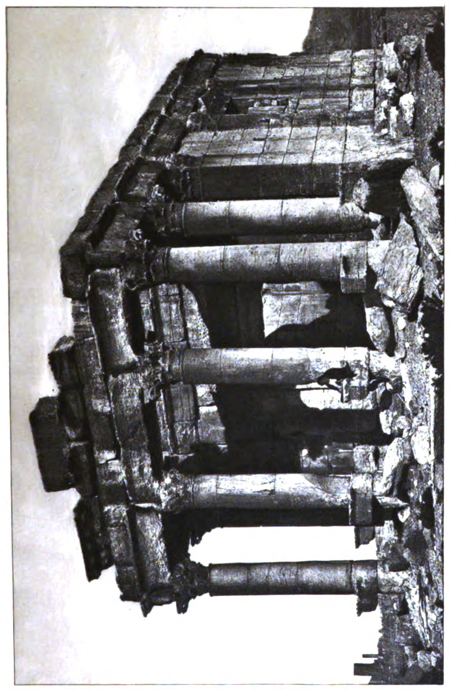
[II-144]
CHAPTER XIII↩
The reign of Diocletian and his three associates, Maximian, Galerius, and Constantius — General re-establishment of order and tranquillity — The Persian war, victory, and triumph — The new form of administration — Abdication and retirement of Diocletian and Maximian
As the reign of Diocletian was more illustrious than that of any of his predecessors, so was his birth more abject and obscure. The strong claims of merit and of violence had frequently superseded the ideal prerogatives of nobility; but a distinct line of separation was hitherto preserved between the free and the servile part of mankind. The parents of Diocletian had been slaves in the house of Anulinus, a Roman senator; nor was he himself distinguished by any other name than that which he derived from a small town in Dalmatia, from whence his mother deduced her origin. [1] It is, however, probable, that his father obtained the freedom of the family, and that he soon acquired an office of scribe, which was commonly exercised by persons of his condition. [2] Favourable oracles, or rather the consciousness of superior merit, prompted his aspiring son to pursue the profession of arms and the hopes of fortune; and it would be extremely curious to observe the gradation of arts and accidents which [II-145] enabled him in the end to fulfil those oracles, and to display that merit to the world. Diocletian was successively promoted to the government of Mæsia, the honours of the consulship, and the important command of the guards of the palace. He distinguished his abilities in the Persian war; and, after the death of Numerian, the slave, by the confession and judgment of his rivals, was declared the most worthy of the Imperial throne. The malice of religious zeal, whilst it arraigns the savage fierceness of his colleague Maximian, has affected to cast suspicions on the personal courage of the emperor Diocletian. [3] It would not be easy to persuade us of the cowardice of a soldier of fortune, who acquired and preserved the esteem of the legions, as well as the favour of so many warlike princes. Yet even calumny is sagacious enough to discover and to attack the most vulnerable part. The valour of Diocletian was never found inadequate to his duty, or to the occasion; but he appears not to have possessed the daring and generous spirit of a hero, who courts danger and fame, disdains artifice, and boldly challenges the allegiance of his equals. His abilities were useful rather than splendid; a vigorous mind, improved by the experience and study of mankind, dexterity and application in business; a judicious mixture of liberality and economy, of mildness and rigour; profound dissimulation under the disguise of military frankness; steadiness to pursue his ends; flexibility to vary his means; and above all the great art of submitting his own passions, as well as those of others, to the interest of his ambition, and of colouring his ambition with the most specious pretences of justice and public utility. Like Augustus, Diocletian may be considered as the founder of a new empire. [4] [II-146] Like the adopted son of Cæsar, he was distinguished as a statesman rather than a warrior; nor did either of those princes employ force, whenever their purpose could be effected by policy.
The victory of Diocletian was remarkable for its singular mildness. A people accustomed to applaud the clemency of the conqueror, if the usual punishments of death, exile, and confiscation were inflicted with any degree of temper and equity, beheld with the most pleasing astonishment a civil war, the flames of which were extinguished in the field of battle. Diocletian received into his confidence Aristobulus, the principal minister of the house of Carus, respected the lives, the fortunes, and the dignity of his adversaries, and even continued in their respective stations the greater number of the servants of Carinus. [5] It is not improbable that motives of prudence might assist the humanity of the artful Dalmatian; of these servants many had purchased his favour by secret treachery; in others, he esteemed their grateful fidelity to an unfortunate master. The discerning judgment of Aurelian, of Probus, and of Carus had filled the several departments of the state and army with officers of approved merit, whose removal would have injured the public service, without promoting the interest of the successor. Such a conduct, however, displayed to the Roman world the fairest prospect of the new reign, and the emperor affected to confirm this favourable prepossession by declaring that, among all the virtues of his predecessors, he was the most ambitious of imitating the humane philosophy of Marcus Antoninus. [6]
The first considerable action of his reign seemed to evince his sincerity as well as his moderation. After the example of Marcus, he gave himself a colleague in the person of Maximian, [II-147] on whom he bestowed at first the title of Cæsar, and afterwards that of Augustus. [7] But the motives of his conduct, as well as the object of his choice, were of a very different nature from those of his admired predecessor. By investing a luxurious youth with the honours of the purple, Marcus had discharged a debt of private gratitude, at the expense, indeed, of the happiness of the state. By associating a friend and a fellow-soldier to the labours of government, Diocletian, in a time of public danger, provided for the defence both of the East and of the West. Maximian was born a peasant, and, like Aurelian, in the territory of Sirmium. Ignorant of letters, [8] careless of laws, the rusticity of his appearance and manners still betrayed in the most elevated fortune the meanness of his extraction. War was the only art which he professed. In a long course of service, he had distinguished himself on every frontier of the empire; and, though his military talents were formed to obey rather than to command, though, perhaps, he never attained the skill of a consummate general, he was capable, by his valour, constancy, and experience, of executing the most arduous undertakings. Nor were the vices of Maximian less useful to his benefactor. Insensible to pity, and fearless of consequences, he was the ready instrument of every act of cruelty which the policy [II-148] of that artful prince might at once suggest and disclaim. As soon as a bloody sacrifice had been offered to prudence or to revenge, Diocletian, by his seasonable intercession, saved the remaining few whom he had never designed to punish, gently censured the severity of his stern colleague, and enjoyed the comparison of a golden and an iron age, which was universally applied to their opposite maxims of government. Notwithstanding the difference of their characters, the two emperors maintained, on the throne, that friendship which they had contracted in a private station. The haughty turbulent spirit of Maximian, so fatal afterwards to himself and to the public peace, was accustomed to respect the genius of Diocletian, and confessed the ascendant of reason over brutal violence. [9] From a motive either of pride or superstition, the two emperors assumed the titles, the one of Jovius, the other of Herculius. Whilst the motion of the world (such was the language of their venal orators) was maintained by the all-seeing wisdom of Jupiter, the invincible arm of Hercules purged the earth of monsters and tyrants. [10]
But even the omnipotence of Jovius and Herculius was insufficient to sustain the weight of the public administration. The prudence of Diocletian discovered that the empire, assailed on every side by the barbarians, required on every side the presence of a great army, and of an emperor. With this view he resolved once more to divide his unwieldy power, and, with the inferior title of Cæsars, to confer on two generals of approved merit an equal share of the sovereign [II-149] authority. [11] Galerius, surnamed Armentarius, from his original profession of a herdsman, and Constantius, who from his pale complexion had acquired the denomination of Chlorus, [12] were the two persons invested with the second honours of the Imperial purple. In describing the country, extraction, and manners of Herculius, we have already delineated those of Galerius, who was often, and not improperly, styled the younger Maximian, though in many instances both of virtue and ability he appears to have possessed a manifest superiority over the elder. The birth of Constantius was less obscure than that of his colleagues. Eutropius, his father, was one of the most considerable nobles of Dardania, and his mother was the niece of the emperor Claudius. [13] Although the youth of Constantius had been spent in arms, he was endowed with a mild and amiable disposition, and the popular voice had long since acknowledged him worthy of the rank which he at last attained. To strengthen the bonds of political, by those of domestic, union, each of the emperors assumed the character of a father to one of the Cæsars, Diocletian to Galerius, and Maximian to Constantius; and each, obliging them to repudiate their former wives, bestowed his daughter in marriage on his adopted son. [14] These four princes distributed among themselves the wide extent of the Roman empire. [II-150] The defence of Gaul, Spain, [15] and Britain was entrusted to Constantius; Galerius was stationed on the banks of the Danube, as the safeguard of the Illyrian provinces. Italy and Africa were considered as the department of Maximian, and, for his peculiar portion, Diocletian reserved Thrace, Egypt, and the rich countries of Asia. Every one was sovereign within his own jurisdiction; [16] but their united authority extended over the whole monarchy; and each of them was prepared to assist his colleagues with his councils or presence. The Cæsars, in their exalted rank, revered the majesty of the emperors, and the three younger princes invariably acknowledged, by their gratitude and obedience, the common parent of their fortunes. The suspicious jealousy of power found not any place among them; and the singular happiness of their union has been compared to a chorus of music, whose harmony was regulated and maintained by the skilful hand of the first artist. [17]
This important measure was not carried into execution till about six years after the association of Maximian, and that interval of time had not been destitute of memorable incidents. But we have preferred, for the sake of perspicuity, first to describe the more perfect form of Diocletian’s government, and afterwards to relate the actions of his reign, following rather the natural order of the events than the dates of a very doubtful chronology.
[II-none]
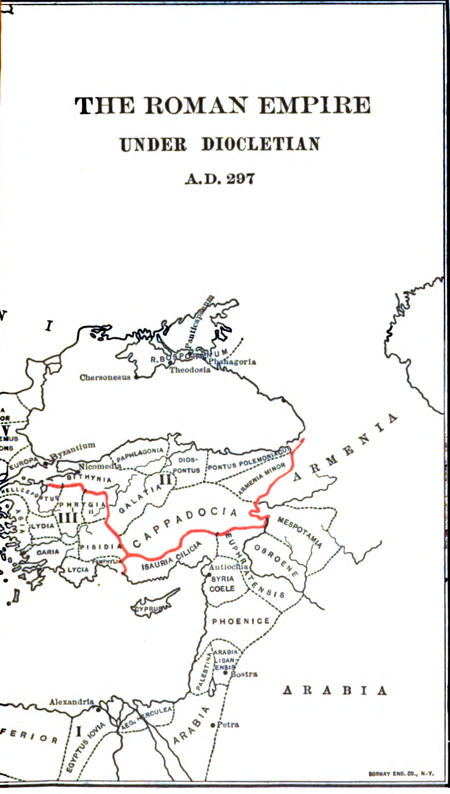
Map of the Roman Empire under Diocletian. (Part of a larger piece)
[II-151]
The first exploit of Maximian, though it is mentioned in a few words by our imperfect writers, deserves, from its singularity, to be recorded in a history of human manners. He suppressed the peasants of Gaul, who, under the appellation of Bagaudæ, [18] had risen in a general insurrection; very similar to those which in the fourteenth century successively afflicted both France and England. [19] It should seem that very many of those institutions, referred by an easy solution to the feudal system, are derived from the Celtic barbarians. When Cæsar subdued the Gauls, that great nation was already divided into three orders of men: the clergy, the nobility, and the common people. The first governed by superstition, the second by arms, but the third and last was not of any weight or account in their public councils. It was very natural for the plebeians, oppressed by debt or apprehensive of injuries, to implore the protection of some powerful chief, who acquired over their persons and property the same absolute rights as, among the Greeks and Romans, a master exercised over his slaves. [20] The greatest part of the nation was gradually reduced into a state of servitude; compelled to perpetual labour on the estates of the Gallic nobles, and confined to the soil, either by the real weight of fetters, or by the no less cruel and forcible restraints of the laws. During the long series of troubles which agitated Gaul, from the reign of Gallienus to that of Diocletian, the condition of these servile peasants was peculiarly miserable; and they experienced at once the complicated tyranny of their masters, of the [II-152] barbarians, of the soldiers, and of the officers of the revenue. [21]
Their patience was at last provoked into despair. On every side they rose in multitudes, armed with rustic weapons, and with irresistible fury. The ploughman became a footsoldier, the shepherd mounted on horseback, the deserted villages and open towns were abandoned to the flames, and the ravages of the peasants equalled those of the fiercest barbarians. [22] They asserted the natural rights of men, but they asserted those rights with the most savage cruelty. The Gallic nobles, justly dreading their revenge, either took refuge in the fortified cities, or fled from the wild scene of anarchy. The peasants reigned without control; and two of their most daring leaders had the folly and rashness to assume the Imperial ornaments. [23] Their power soon expired at the approach of the legions. The strength of union and discipline obtained an easy victory over a licentious and divided multitude. [24] A severe retaliation was inflicted on the peasants who were found in arms; the affrighted remnant returned to their respective habitations, and their unsuccessful effort for freedom served only to confirm their slavery. So strong and uniform is the current of popular passions that we might almost venture, from very scanty materials, to relate the particulars of this war; but we are not disposed to believe that the principal leaders Ælianus and Amandus were Christians, [25] or to insinuate that the rebellion, as it happened in the time of Luther, was occasioned by the abuse of those benevolent [II-153] principles of Christianity which inculcate the natural freedom of mankind.
Maximian had no sooner recovered Gaul from the hands of the peasants, than he lost Britain by the usurpation of Carausius. Ever since the rash but successful enterprise of the Franks under the reign of Probus, their daring countrymen had constructed squadrons of light brigantines, in which they incessantly ravaged the provinces adjacent to the ocean. [26] To repel their desultory incursions, it was found necessary to create a naval power; and the judicious measure was pursued with prudence and vigour. Gessoriacum or Boulogne, in the straits of the British channel, was chosen by the emperor for the station of the Roman fleet; and the command of it was entrusted to Carausius, a Menapian of the meanest origin, [27] but who had long signalised his skill as a pilot, and his valour as a soldier. The integrity of the new admiral corresponded not with his abilities. When the German pirates sailed from their own harbours, he connived at their passage, but he diligently intercepted their return, and appropriated to his own use an ample share of the spoil which they had acquired. The wealth of Carausius was, on this occasion, very justly considered as an evidence of his guilt; and Maximian had already given orders for his death. But the crafty Menapian foresaw and prevented the severity of the emperor. By his liberality he had attached to his fortunes the fleet which he commanded, and secured the barbarians in his interest. From the port of Boulogne he sailed over to [II-154] Britain, persuaded the legion and the auxiliaries which guarded that island to embrace his party, and boldly assuming, with the Imperial purple, the title of Augustus, defied the justice and the arms of his injured sovereign. [28]
When Britain was thus dismembered from the empire, its importance was sensibly felt, and its loss sincerely lamented. The Romans celebrated, and perhaps magnified, the extent of that noble island, provided on every side with convenient harbours; the temperature of the climate, and the fertility of the soil, alike adapted for the production of corn or of vines; the valuable minerals with which it abounded; its rich pastures covered with innumerable flocks, and its woods free from wild beasts or venomous serpents. Above all, they regretted the large amount of the revenue of Britain, whilst they confessed that such a province well deserved to become the seat of an independent monarchy. [29] During the space of seven [30] years, it was possessed by Carausius; and fortune continued propitious to a rebellion supported with courage and ability. The British emperor defended the frontiers of his dominions against the Caledonians of the North, invited from the continent a great number of skilful artists, and displayed, on a variety of coins that are still extant, his taste and opulence. Born on the confines of the Franks, he courted the friendship of that formidable people, by the flattering imitation of their dress and manners. The bravest of their youth he enlisted among his land or sea forces; and, in return for their useful alliance, he communicated to the barbarians the dangerous knowledge of military and naval arts. Carausius [II-155] still preserved the possession of Boulogne and the adjacent country. His fleets rode triumphant in the channel, commanded the mouths of the Seine and of the Rhine, ravaged the coasts of the ocean, and diffused, beyond the Columns of Hercules, the terror of his name. Under his command, Britain, destined in a future age to obtain the empire of the sea, already assumed its natural and respectable station of a maritime power. [31]
By seizing the fleet of Boulogne, Carausius had deprived his master of the means of pursuit and revenge. And, when, after vast expense of time and labour, a new armament was launched into the water, [32] the Imperial troops, unaccustomed to that element, were easily baffled and defeated by the veteran sailors of the usurper. This disappointed effort was soon productive of a treaty of peace. Diocletian and his colleague, who justly dreaded the enterprising spirit of Carausius, resigned to him the sovereignty of Britain, and reluctantly admitted their perfidious servant to a participation of the Imperial honours. [33] But the adoption of the two Cæsars restored new vigour to the Roman arms; and, while the Rhine was guarded by the presence of Maximian, his brave associate, Constantius, assumed the conduct of the British war. His first enterprise was against the important place of Boulogne. A stupendous mole, raised across the entrance of the harbour, [II-156] intercepted all hopes of relief. The town surrendered after an obstinate defence; and a considerable part of the naval strength of Carausius fell into the hands of the besiegers. During the three years, which Constantius employed in preparing a fleet adequate to the conquest of Britain, he secured the coast of Gaul, invaded the country of the Franks, and deprived the usurper of the assistance of those powerful allies.
Before the preparations were finished, Constantius received the intelligence of the tyrant’s death, and it was considered as a sure presage of the approaching victory. The servants of Carausius imitated the example of treason which he had given. He was murdered by his first minister Allectus, and the assassin succeeded to his power and to his danger. But he possessed not equal abilities either to exercise the one, or to repel the other. He beheld, with anxious terror, the opposite shores of the continent, already filled with arms, with troops, and with vessels; for Constantius had very prudently divided his forces, that he might likewise divide the attention and resistance of the enemy. The attack was at length made by the principal squadron, which, under the command of the prefect Asclepiodotus, an officer of distinguished merit, had been assembled in the mouth of the Seine. So imperfect in those times was the art of navigation that orators have celebrated the daring courage of the Romans, who ventured to set sail with a side-wind, and on a stormy day. The weather proved favourable to their enterprise. Under the cover of a thick fog, they escaped the fleet of Allectus, which had been stationed off the Isle of Wight to receive them, landed in safety on some part of the western coast, and convinced the Britons that a superiority of naval strength will not always protect their country from a foreign invasion. Asclepiodotus had no sooner disembarked the Imperial troops than he set fire to his ships; and, as the expedition proved fortunate, his heroic conduct was universally admired. The usurper had posted himself near London, to expect the formidable attack of Constantius, who commanded in person the fleet of Boulogne; [II-157] but the descent of a new enemy required his immediate presence in the West. He performed this long march in so precipitate a manner that he encountered the whole force of the prefect with a small body of harassed and disheartened troops. The engagement was soon terminated by the total defeat and death of Allectus; a single battle, as it has often happened, decided the fate of this great island; and, when Constantius landed on the shores of Kent, he found them covered with obedient subjects. Their acclamations were loud and unanimous; and the virtues of the conqueror may induce us to believe that they sincerely rejoiced in a revolution which, after a separation of ten years, restored Britain to the body of the Roman empire. [34]
Britain had none but domestic enemies to dread; and, as long as the governors preserved their fidelity, and the troops their discipline, the incursions of the naked savages of Scotland or Ireland could never materially affect the safety of the province. The peace of the continent, and the defence of the principal rivers which bounded the empire, were objects of far greater difficulty and importance. The policy of Diocletian, which inspired the councils of his associates, provided for the public tranquillity, by encouraging a spirit of dissension among the barbarians, and by strengthening the fortifications of the Roman limit. In the East he fixed a line of camps from Egypt to the Persian dominions, and, for every camp, he instituted an adequate number of stationary troops, commanded by their respective officers, and supplied with every kind of arms, from the new arsenals which he had formed at Antioch, Emesa, and Damascus. [35] Nor was the precaution of the emperor less watchful against the wellknown valour of the barbarians of Europe. From the mouth of the Rhine to that of the Danube, the ancient camps, towns, and citadels were diligently re-established, and, in the most [II-158] exposed places, new ones were skilfully constructed; the strictest vigilance was introduced among the garrisons of the frontier, and every expedient was practised that could render the long chain of fortifications firm and impenetrable. [36] A barrier so respectable was seldom violated, and the barbarians often turned against each other their disappointed rage. The Goths, the Vandals, the Gepidæ, the Burgundians, the Alemanni, wasted each other’s strength by destructive hostilities: and whosoever vanquished, they vanquished the enemies of Rome. The subjects of Diocletian enjoyed the bloody spectacle, and congratulated each other that the mischiefs of civil war were now experienced only by the barbarians. [37]
Notwithstanding the policy of Diocletian, it was impossible to maintain an equal and undisturbed tranquillity during a reign of twenty years, and along a frontier of many hundred miles. Sometimes the barbarians suspended their domestic animosities, and the vigilance of the garrisons sometimes gave a passage to their strength or dexterity. Whenever the provinces were invaded, Diocletian conducted himself with that calm dignity which he always affected or possessed; reserved his presence for such occasions as were worthy of his interposition, never exposed his person or reputation to any unnecessary danger, ensured his success by every means that prudence could suggest, and displayed, with ostentation, the consequences of his victory. In wars of a more difficult nature, and more doubtful event, he employed the rough valour of Maximian, and that faithful soldier was content to ascribe his own victories to the wise counsels and auspicious influence [II-none] [II-159] of his benefactor. But, after the adoption of the two Cæsars, the emperors, themselves retiring to a less laborious scene of action, devolved on their adopted sons the defence of the Danube and of the Rhine. The vigilant Galerius was never reduced to the necessity of vanquishing an army of barbarians on the Roman territory. [38] The brave and active Constantius delivered Gaul from a very furious inroad of the Alemanni; and his victories of Langres and Vindonissa appear to have been actions of considerable danger and merit. As he traversed the open country with a feeble guard he was encompassed on a sudden by the superior multitude of the enemy. He retreated with difficulty towards Langres; but, in the general consternation, the citizens refused to open their gates, and the wounded prince was drawn up the wall by the means of a rope. But on the news of his distress the Roman troops hastened from all sides to his relief, and before the evening he had satisfied his honour and revenge by the slaughter of six thousand Alemanni. [39] From the monuments of those times, the obscure traces of several other victories over the barbarians of Sarmatia and Germany might possibly be collected; but the tedious search would not be rewarded either with amusement or with instruction.
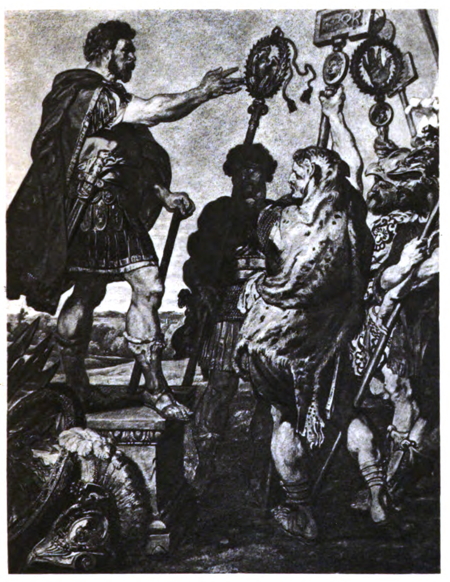
A Roman Ambassador offering Terms of Peace to the Barbarians. From a painting by Peter Paul Rubens.
The conduct which the emperor Probus had adopted in the disposal of the vanquished was imitated by Diocletian and his associates. The captive barbarians, exchanging death for slavery, were distributed among the provincials, and assigned to those districts (in Gaul, the territories of Amiens, Beauvais, Cambray, Treves, Langres, and Troyes are particularly [II-160] specified [40] ) which had been depopulated by the calamities of war. They were usefully employed as shepherds and husbandmen, but were denied the exercise of arms, except when it was found expedient to enrol them in the military service. Nor did the emperors refuse the property of lands, with a less servile tenure, to such of the barbarians as solicited the protection of Rome. They granted a settlement to several colonies of the Carpi, the Bastarnæ, and the Sarmatians; and, by a dangerous indulgence, permitted them in some measure to retain their national manners and independence. [41] Among the provincials, it was a subject of flattering exultation, that the barbarian, so lately an object of terror, now cultivated their lands, drove their cattle to the neighbouring fair, and contributed by his labour to the public plenty. They congratulated their masters on the powerful accession of subjects and soldiers; but they forgot to observe that multitudes of secret enemies, insolent from favour, or desperate from oppression, were introduced into the heart of the empire. [42]
While the Cæsars exercised their valour on the banks of the Rhine and Danube, the presence of the emperors was required on the southern confines of the Roman world. From the Nile to Mount Atlas, Africa was in arms. A confederacy of five Moorish nations issued from their deserts to invade the peaceful provinces. [43] Julian had assumed the purple at [II-161] Carthage, [44] Achilleus at Alexandria; [45] and even the Blemmyes renewed, or rather continued, their incursions into the Upper Egypt. Scarcely any circumstances have been preserved of the exploits of Maximian in the western parts of Africa; but it appears, by the event, that the progress of his arms was rapid and decisive, that he vanquished the fiercest barbarians of Mauritania, and that he removed them from the mountains, whose inaccessible strength had inspired their inhabitants with a lawless confidence, and habituated them to a life of rapine and violence. [46] Diocletian, on his side, opened the campaign in Egypt by the siege of Alexandria, cut off the aqueducts which conveyed the waters of the Nile into every quarter of that immense city, [47] and, rendering his camp impregnable to the sallies of the besieged multitude, he pushed his reiterated attacks with caution and vigour. After a siege of eight months, Alexandria, wasted by the sword and by fire, implored the clemency of the conqueror; but it experienced the full extent of his severity. Many thousands of the citizens perished in a promiscuous slaughter, and there were few obnoxious persons in Egypt who escaped a sentence either of death or at least of exile. [48] The fate of Busiris and [II-162] of Coptos was still more melancholy than that of Alexandria; those proud cities, the former distinguished by its antiquity, the latter enriched by the passage of the Indian trade, were utterly destroyed by the arms and by the severe order of Diocletian. [49] The character of the Egyptian nation, insensible to kindness, but extremely susceptible of fear, could alone justify this excessive rigour. The seditions of Alexandria had often affected the tranquillity and subsistence of Rome itself. Since the usurpation of Firmus, the province of Upper Egypt, incessantly relapsing into rebellion, had embraced the alliance of the savages of Æthiopia. The number of the Blemmyes, scattered between the Island of Meroe and the Red Sea, was very inconsiderable, their disposition was unwarlike, their weapons rude and inoffensive. [50] Yet in the public disorders these barbarians, whom antiquity, shocked with the deformity of their figure, had almost excluded from the human species, presumed to rank themselves among the enemies of Rome. [51] Such had been the unworthy allies of the Egyptians; and, while the attention of the state was engaged in more serious wars, their vexatious inroads might again harass the repose of the province. With a view of opposing to the Blemmyes a suitable adversary, Diocletian persuaded the Nobatæ, or people of Nubia, to remove from their ancient habitations in the deserts of Libya, and resigned to them an extensive but unprofitable territory, above Syene and the [II-163] cataracts of the Nile, with the stipulation that they should ever respect and guard the frontier of the empire. The treaty long subsisted; and till the establishment of Christianity introduced stricter notions of religious worship, it was annually ratified by a solemn sacrifice in the isle of Elephantine, in which the Romans, as well as the barbarians, adored the same visible or invisible powers of the universe. [52]
At the same time that Diocletian chastised the past crimes of the Egyptians, he provided for their future safety and happiness by many wise regulations, which were confirmed and enforced under the succeeding reigns. [53] One very remarkable edict, which he published, instead of being condemned as the effect of jealous tyranny, deserves to be applauded as an act of prudence and humanity. He caused a diligent inquiry to be made “for all the ancient books which treated of the admirable art of making gold and silver, and without pity committed them to the flames; apprehensive, as we are assured, lest the opulence of the Egyptians should inspire them with confidence to rebel against the empire.” [54] But, if Diocletian had been convinced of the reality of that valuable art, far from extinguishing the memory, he would have converted the operation of it to the benefit of the public revenue. It is much more likely that his good sense discovered to him the folly of such magnificent pretensions, and that he was desirous of preserving the reason and fortunes of his subjects from the mischievous pursuit. It may be remarked that these ancient books, so liberally ascribed to Pythagoras, to Solomon, or to Hermes, were the pious frauds of more recent adepts. The Greeks were inattentive either to the use or to the abuse of chymistry. In that immense [II-164] register where Pliny has deposited the discoveries, the arts, and the errors of mankind, there is not the least mention of the transmutation of metals; and the persecution of Diocletian is the first authentic event in the history of alchymy. The conquest of Egypt by the Arabs diffused that vain science over the globe. Congenial to the avarice of the human heart, it was studied in China as in Europe, with equal eagerness, and with equal success. The darkness of the middle ages ensured a favourable reception to every tale of wonder, and the revival of learning gave new vigour to hope, and suggested more specious arts of deception. Philosophy, with the aid of experience, has at length banished the study of alchymy; and the present age, however desirous of riches, is content to seek them by the humbler means of commerce and industry. [55]
The reduction of Egypt was immediately followed by the Persian war. It was reserved for the reign of Diocletian to vanquish that powerful nation, and to extort a confession from the successors of Artaxerxes, of the superior majesty of the Roman empire.
We have observed, under the reign of Valerian, that Armenia was subdued by the perfidy and the arms of the Persians, and that, after the assassination of Chosroes, his son Tiridates, the infant heir of the monarchy, was saved by the fidelity of his friends, and educated under the protection of the emperors. Tiridates derived from his exile such advantages as he could never have attained on the throne of Armenia: the early knowledge of adversity, of mankind, and of the Roman discipline. He signalised his youth by deeds of valour, and displayed a matchless dexterity, as well as strength, in every martial exercise, and even in the less honourable contests of the Olympian games. [56] Those qualities were more nobly [II-165] exerted in the defence of his benefactor Licinius. [57] That officer, in the sedition which occasioned the death of Probus, was exposed to the most imminent danger, and the enraged soldiers were forcing their way into his tent, when they were checked by the single arm of the Armenian prince. The gratitude of Tiridates contributed soon afterwards to his restoration. Licinius was in every station the friend and companion of Galerius, and the merit of Galerius, long before he was raised to the dignity of Cæsar, had been known and esteemed by Diocletian. In the third year of that emperor’s reign, Tiridates was invested with the kingdom of Armenia. The justice of the measure was not less evident than its expediency. It was time to rescue from the usurpation of the Persian monarch an important territory, which, since the reign of Nero, had been always granted under the protection of the empire to a younger branch of the house of Arsaces. [58]
When Tiridates appeared on the frontiers of Armenia, he was received with an unfeigned transport of joy and loyalty. During twenty-six years, the country had experienced the real and imaginary hardships of a foreign yoke. The Persian monarchs had adorned their new conquest with magnificent buildings; but those monuments had been erected at the expense of the people, and were abhorred as badges of slavery. The apprehension of a revolt had inspired the most rigorous precautions: oppression had been aggravated by insult, and the consciousness of the public hatred had been productive of every measure that could render it still more implacable. We have already remarked the intolerant spirit of the Magian religion. The statues of the deified kings of Armenia, and [II-166] the sacred images of the sun and moon, were broken in pieces by the zeal of the conqueror; and the perpetual fire of Ormuzd was kindled and preserved upon an altar erected on the summit of Mount Bagavan. [59] It was natural that a people exasperated by so many injuries should arm with zeal in the cause of their independence, their religion, and their hereditary sovereign. The torrent bore down every obstacle, and the Persian garrison retreated before its fury. The nobles of Armenia flew to the standard of Tiridates, all alleging their past merit, offering their future service, and soliciting from the new king those honours and rewards from which they had been excluded with disdain under the foreign government. [60] The command of the army was bestowed on Artavasdes, whose father had saved the infancy of Tiridates, and whose family had been massacred for that generous action. The brother of Artavasdes obtained the government of a province. One of the first military dignities was conferred on the satrap Otas, a man of singular temperance and fortitude, who presented to the king his sister [61] and a considerable treasure, both of which, in a sequestered fortress, Otas had preserved from violation. Among the Armenian nobles appeared an ally, whose fortunes are too remarkable to pass unnoticed. His name was Mamgo, his origin was Scythian, and the horde which acknowledged his authority had encamped a very few years before on the skirts of the Chinese empire, [62] which at [II-167] that time extended as far as the neighbourhood of Sogdiana. [63] Having incurred the displeasure of his master, Mamgo, with his followers, retired to the banks of the Oxus, and implored the protection of Sapor. The emperor of China claimed the fugitive, and alleged the rights of sovereignty. The Persian monarch pleaded the laws of hospitality, and with some difficulty avoided a war, by the promise that he would banish Mamgo to the uttermost parts of the West; a punishment, as he described it, not less dreadful than death itself. Armenia was chosen for the place of exile, and a large district was assigned to the Scythian horde, on which they might feed their flocks and herds, and remove their encampment from one place to another according to the different seasons of the year. They were employed to repel the invasion of Tiridates; but their leader, after weighing the obligations and injuries which he had received from the Persian monarch, resolved to abandon his party. The Armenian prince, who was well acquainted with the merit as well as power of Mamgo, treated him with distinguished respect; and, by admitting him into his confidence, acquired a brave and faithful servant, who contributed very effectually to his restoration. [64]
For a while, fortune appeared to favour the enterprising valour of Tiridates. He not only expelled the enemies of his family and country from the whole extent of Armenia, but in the prosecution of his revenge he carried his arms, or at least [II-168] his incursions, into the heart of Assyria. The historian who has preserved the name of Tiridates from oblivion celebrates, with a degree of national enthusiasm, his personal prowess; and, in the true spirit of Eastern romance, describes the giants and the elephants that fell beneath his invincible arm. It is from other information that we discover the distracted state of the Persian monarchy, to which the king of Armenia was indebted for some part of his advantages. The throne was disputed by the ambition of contending brothers; and Hormuz, after exerting without success the strength of his own party, had recourse to the dangerous assistance of the barbarians who inhabited the banks of the Caspian Sea. [65] The civil war was, however, soon terminated, either by a victory or by a reconciliation; and Narses, who was universally acknowledged as king of Persia, directed his whole force against the foreign enemy. The contest then became too unequal; nor was the valour of the hero able to withstand the power of the monarch. Tiridates, a second time expelled from the throne of Armenia, once more took refuge in the court of the emperors. Narses soon re-established his authority over the revolted province; and, loudly complaining of the protection afforded by the Romans to rebels and fugitives, aspired to the conquest of the East. [66]
Neither prudence nor honour could permit the emperors to forsake the cause of the Armenian king, and it was resolved [II-169] to exert the force of the empire in the Persian war. Diocletian, with the calm dignity which he constantly assumed, fixed his own station in the city of Antioch, from whence he prepared and directed the military operations. [67] The conduct of the legions was entrusted to the intrepid valour of Galerius, who, for that important purpose, was removed from the banks of the Danube to those of the Euphrates. The armies soon encountered each other in the plains of Mesopotamia, and two battles were fought with various and doubtful success: but the third engagement was of a more decisive nature; and the Roman army received a total overthrow, which is attributed to the rashness of Galerius, who, with an inconsiderable body of troops, attacked the innumerable host of the Persians. [68] But the consideration of the country that was the scene of action may suggest another reason for his defeat. The same ground, on which Galerius was vanquished, had been rendered memorable by the death of Crassus and the slaughter of ten legions. It was a plain of more than sixty miles, which extended from the hills of Carrhæ to the Euphrates; a smooth and barren surface of sandy desert, without a hillock, without a tree, and without a spring of fresh water. [69] The steady infantry of the Romans, fainting with heat and thirst, could neither hope for victory, if they preserved their ranks, nor break their ranks without exposing themselves to the most imminent danger. In this situation, they were gradually encompassed by the superior numbers, harassed by the rapid evolutions, and destroyed by the arrows, of the barbarian cavalry. The king of Armenia had signalised his valour in [II-170] the battle, and acquired personal glory by the public misfortune. He was pursued as far as the Euphrates; his horse was wounded, and it appeared impossible for him to escape the victorious enemy. In this extremity, Tiridates embraced the only refuge which he saw before him: he dismounted and plunged into the stream. His armour was heavy, the river very deep, and in those parts at least half a mile in breadth; [70] yet such was his strength and dexterity that he reached in safety the opposite bank. [71] With regard to the Roman general, we are ignorant of the circumstances of his escape; but, when he returned to Antioch, Diocletian received him, not with the tenderness of a friend and colleague, but with the indignation of an offended sovereign. The haughtiest of men, clothed in his purple, but humbled by the sense of his fault and misfortune, was obliged to follow the emperor’s chariot above a mile on foot, and to exhibit before the whole court the spectacle of his disgrace. [72]
As soon as Diocletian had indulged his private resentment, and asserted the majesty of supreme power, he yielded to the submissive entreaties of the Cæsar, and permitted him to retrieve his own honour as well as that of the Roman arms. In the room of the unwarlike troops of Asia, which had most probably served in the first expedition, a second army was drawn from the veterans and new levies of the Illyrian frontier, and a considerable body of Gothic auxiliaries were taken into the Imperial pay. [73] At the head of a chosen army of twenty-five thousand men, Galerius again passed the Euphrates; but, instead of exposing his legions in the open plains of [II-171] Mesopotamia, he advanced through the mountains of Armenia, where he found the inhabitants devoted to his cause, and the country as favourable to the operations of infantry as it was inconvenient for the motions of cavalry. [74] Adversity had confirmed the Roman discipline, whilst the barbarians, elated by success, were become so negligent and remiss, that, in the moment when they least expected it, they were surprised by the active conduct of Galerius, who, attended only by two horsemen, had, with his own eyes, secretly examined the state and position of their camp. A surprise, especially in the night-time, was for the most part fatal to a Persian army. “Their horses were tied, and generally shackled, to prevent their running away; and, if an alarm happened, a Persian had his housing to fix, his horse to bridle, and his corselet to put on, before he could mount.” [75] On this occasion, the impetuous attack of Galerius spread disorder and dismay over the camp of the barbarians. A slight resistance was followed by a dreadful carnage, and, in the general confusion, the wounded monarch (for Narses commanded his armies in person) fled towards the deserts of Media. His sumptuous tents, and those of his satraps, afforded an immense booty to the conqueror; and an incident is mentioned, which proves the rustic but martial ignorance of the legions in the elegant superfluities of life. A bag of shining leather, filled with pearls, fell into the hands of a private soldier; he carefully preserved the bag, but he threw away its contents, judging that whatever was of no use could not possibly be of any value. [76] The principal loss of Narses was of a much more [II-172] affecting nature. Several of his wives, his sisters, and children, who had attended the army, were made captives in the defeat. But, though the character of Galerius had in general very little affinity with that of Alexander, he imitated, after his victory, the amiable behaviour of the Macedonian towards the family of Darius. The wives and children of Narses were protected from violence and rapine, conveyed to a place of safety, and treated with every mark of respect and tenderness that was due, from a generous enemy, to their age, their sex, and their royal dignity. [77]
While the East anxiously expected the decision of this great contest, the emperor Diocletian, having assembled in Syria a strong army of observation, displayed from a distance the resources of the Roman power, and reserved himself for any future emergency of the war. On the intelligence of the victory, he condescended to advance towards the frontier, with a view of moderating, by his presence and counsels, the pride of Galerius. The interview of the Roman princes at Nisibis was accompanied with every expression of respect on one side, and of esteem on the other. It was in that city that they soon afterwards gave audience to the ambassador of the Great King. [78] The power, or at least the spirit, of Narses had been broken by his last defeat; and he considered an immediate peace as the only means that could stop the progress of the Roman arms. He despatched Apharban, a servant who possessed his favour and confidence, with a commission to negotiate a treaty, or rather to receive whatever conditions the conqueror should impose. Apharban opened the conference by expressing his master’s gratitude for the generous [II-173] treatment of his family, and by soliciting the liberty of those illustrious captives. He celebrated the valour of Galerius, without degrading the reputation of Narses, and thought it no dishonour to confess the superiority of the victorious Cæsar over a monarch who had surpassed in glory all the princes of his race. Notwithstanding the justice of the Persian cause, he was empowered to submit the present differences to the decision of the emperors themselves; convinced as he was, that, in the midst of prosperity, they would not be unmindful of the vicissitudes of fortune. Apharban concluded his discourse in the style of Eastern allegory, by observing that the Roman and Persian monarchies were the two eyes of the world, which would remain imperfect and mutilated, if either of them should be put out.
“It well becomes the Persians,” replied Galerius, with a transport of fury, which seemed to convulse his whole frame, “it well becomes the Persians to expatiate on the vicissitudes of fortune and calmly to read us lectures on the virtues of moderation. Let them remember their own moderation towards the unhappy Valerian. They vanquished him by fraud, they treated him with indignity. They detained him till the last moment of his life in shameful captivity, and, after his death, they exposed his body to perpetual ignominy.” Softening, however, his tone, Galerius insinuated to the ambassador that it had never been the practice of the Romans to trample on a prostrate enemy; and that on this occasion they should consult their own dignity rather than the Persian merit. He dismissed Apharban with a hope that Narses would soon be informed on what conditions he might obtain, from the clemency of the emperors, a lasting peace, and the restoration of his wives and children. In this conference we may discover the fierce passions of Galerius, as well as his deference to the superior wisdom and authority of Diocletian. The ambition of the former grasped at the conquest of the East and had proposed to reduce Persia into the state of a province. The prudence of the latter, who adhered [II-174] to the moderate policy of Augustus and the Antonines, embraced the favourable opportunity of terminating a successful war by an honourable and advantageous peace. [79]
In pursuance of their promise, the emperors soon afterwards appointed Sicorius Probus, one of their secretaries, to acquaint the Persian court with their final resolution. As the minister of peace, he was received with every mark of politeness and friendship; but, under the pretence of allowing him the necessary repose after so long a journey, the audience of Probus was deferred from day to day; and he attended the slow motions of the king, till at length he was admitted to his presence, near the river Asprudus in Media. The secret motive of Narses, in this delay, had been to collect such a military force as might enable him, though sincerely desirous of peace, to negotiate with the greater weight and dignity. Three persons only assisted at this important conference; the minister Apharban, the prefect of the guards, and an officer who had commanded on the Armenian frontier. [80] The first condition, proposed by the ambassador, is not at present of a very intelligible nature; that the city of Nisibis might be established for the place of mutual exchange, or, as we should formerly have termed it, for the staple of trade between the two empires. There is no difficulty in conceiving the intention of the Roman princes to improve their revenue by some restraints upon commerce; but, as Nisibis was situated within their own dominions, and as they were masters both of the imports and exports, it should seem that such restraints were the objects of an internal law rather than of a foreign treaty. To render them more effectual, some stipulations were probably required on the side of [II-175] the king of Persia, which appeared so very repugnant either to his interest or to his dignity, that Narses could not be persuaded to subscribe them. As this was the only article to which he refused his consent, it was no longer insisted on; and the emperors either suffered the trade to flow in its natural channels, or contented themselves with such restrictions as it depended on their own authority to establish.
As soon as this difficulty was removed, a solemn peace was concluded and ratified between the two nations. The conditions of a treaty so glorious to the empire, and so necessary to Persia, may deserve a more peculiar attention, as the history of Rome presents very few transactions of a similar nature; most of her wars having either been terminated by absolute conquest, or waged against barbarians ignorant of the use of letters. I. The Aboras, or, as it is called by Xenophon, the Araxes, was fixed as the boundary between the two monarchies. [81] That river, which rose near the Tigris, was increased, a few miles below Nisibis, by the little stream of the Mygdonius, passed under the walls of Singara, and fell into the Euphrates at Circesium, a frontier town, which, by the care of Diocletian, was very strongly fortified. [82] Mesopotamia, the object of so many wars, was ceded to the empire; and the Persians, by this treaty, renounced all pretensions to that great province. II. They relinquished to the Romans five provinces beyond the Tigris. [83] Their situation formed [II-176] a very useful barrier, and their natural strength was soon improved by art and military skill. Four of these, to the north of the river, were districts of obscure fame and inconsiderable extent: Intiline, Zabdicene, Arzanene, and Moxoene; but, on the east of the Tigris, the empire acquired the large and mountainous territory of Carduene, the ancient seat of the Carduchians, who preserved for many ages their manly freedom in the heart of the despotic monarchies of Asia. The ten thousand Greeks traversed their country, after a painful march, or rather engagement, of seven days; and it is confessed by their leader, in his incomparable relation of the retreat, that they suffered more from the arrows of the Carduchians than from the power of the Great King. [84] Their posterity, the Curds, with very little alteration either of name or manners, acknowledged the nominal sovereignty of the Turkish sultan. III. It is almost needless to observe that Tiridates, the faithful ally of Rome, was restored to the throne of his fathers, and that the rights of the Imperial supremacy were fully asserted and secured. The limits of Armenia were extended as far as the fortress of Sintha in Media, and this increase of dominion was not so much an act of liberality as of justice. Of the provinces already mentioned beyond the Tigris, the four first had been dismembered by the Parthians from the crown of Armenia; [85] and, when the Romans acquired the possession of them, they stipulated, at the expense of the usurpers, an ample [II-177] compensation, which invested their ally with the extensive and fertile country of Atropatene. Its principal city, in the same situation perhaps as the modern Tauris, was frequently honoured with the residence of Tiridates; and, as it sometimes bore the name of Ecbatana, he imitated, in the buildings and fortifications, the splendid capital of the Medes. [86] IV. The country of Iberia was barren, its inhabitants rude and savage. But they were accustomed to the use of arms, and they separated from the empire barbarians much fiercer and more formidable than themselves. The narrow defiles of Mount Caucasus were in their hands, and it was in their choice either to admit or to exclude the wandering tribes of Sarmatia, whenever a rapacious spirit urged them to penetrate into the richer climates of the South. [87] The nomination of the kings of Iberia, which was resigned by the Persian monarch to the emperors, contributed to the strength and security of the Roman power in Asia. [88] The East enjoyed a profound tranquillity during forty years; and the treaty between the rival monarchies was strictly observed till the death of Tiridates; when a new generation, animated with different views and different passions, succeeded to the government of the world; and the grandson of Narses undertook a long and memorable war against the princes of the house of Constantine.
The arduous work of rescuing the distressed empire from tyrants and barbarians had now been completely achieved by a succession of Illyrian peasants. As soon as Diocletian entered into the twentieth year of his reign, he celebrated that memorable era, as well as the success of his arms, [II-178] by the pomp of a Roman triumph. [89] Maximian, the equal partner of his power, was his only companion in the glory of that day. The two Cæsars had fought and conquered, but the merit of their exploits was ascribed, according to the rigour of ancient maxims, to the auspicious influence of their fathers and emperors. [90] The triumph of Diocletian and Maximian was less magnificent, perhaps, than those of Aurelian and Probus, but it was dignified by several circumstances of superior fame and good fortune. Africa and Britain, the Rhine, the Danube, and the Nile, furnished their respective trophies; but the most distinguished ornament was of a more singular nature, a Persian victory followed by an important conquest. [91] The representations of rivers, mountains, and provinces were carried before the Imperial car. The images of the captive wives, the sisters, and the children of the Great King afforded a new and grateful spectacle to the vanity of the people. [92] In the eyes of posterity this triumph is remarkable by a distinction of a less honourable kind. It was the last that Rome ever beheld. Soon after this period, the emperors ceased to vanquish, and Rome ceased to be the capital of the empire.
The spot on which Rome was founded had been consecrated [II-179] by ancient ceremonies and imaginary miracles. The presence of some god, or the memory of some hero, seemed to animate every part of the city, and the empire of the world had been promised to the Capitol. [93] The native Romans felt and confessed the power of this agreeable illusion. It was derived from their ancestors, had grown up with their earliest habits of life, and was protected, in some measure, by the opinion of political utility. The form and the seat of government were intimately blended together, nor was it esteemed possible to transport the one without destroying the other. [94] But the sovereignty of the capital was gradually annihilated in the extent of conquest; the provinces rose to the same level, and the vanquished nations acquired the name and privileges, without imbibing the partial affections, of Romans. During a long period, however, the remains of the ancient constitution, and the influence of custom, preserved the dignity of Rome. The emperors, though perhaps of African or Illyrian extraction, respected their adopted country, as the seat of their power, and the centre of their extensive dominions. The emergencies of war very frequently required their presence on the frontiers; but Diocletian and Maximian were the first Roman princes who fixed, in time of peace, their ordinary residence in the provinces; and their conduct, however it might be suggested by private motives, was justified by very specious considerations of policy. The court of the emperor of the West was, for the most part, established at Milan, whose situation, at the foot of the Alps, appeared far more convenient than that of Rome, for the important purpose of watching the motions [II-180] of the barbarians of Germany. Milan soon assumed the splendour of an Imperial city. The houses are described as numerous and well built; the manners of the people as polished and liberal. A circus, a theatre, a mint, a palace, baths, which bore the name of their founder Maximian; porticoes adorned with statues, and a double circumference of walls, contributed to the beauty of the new capital; nor did it seem oppressed even by the proximity of Rome. [95] To rival the majesty of Rome was the ambition likewise of Diocletian, who employed his leisure, and the wealth of the East, in the embellishment of Nicomedia, a city placed on the verge of Europe and Asia, almost at an equal distance between the Danube and the Euphrates. By the taste of the monarch, and at the expense of the people, Nicomedia acquired, in the space of a few years, a degree of magnificence which might appear to have required the labour of ages, and became inferior only to Rome, Alexandria, and Antioch, in extent or populousness. [96] The life of Diocletian and Maximian was a life of action, and a considerable portion of it was spent in camps, or in their long and frequent marches; but, whenever the public business allowed them any relaxation, they seem to have retired with pleasure to their favourite residences of Nicomedia and Milan. Till Diocletian, in the [II-181] twentieth year of his reign, celebrated his Roman triumph, it is extremely doubtful whether he ever visited the ancient capital of the empire. Even on that memorable occasion his stay did not exceed two months. Disgusted with the licentious familiarity of the people, he quitted Rome with precipitation thirteen days before it was expected that he should have appeared in the senate, invested with the ensigns of the consular dignity. [97]
The dislike expressed by Diocletian towards Rome and Roman freedom was not the effect of momentary caprice, but the result of the most artful policy. That crafty prince had framed a new system of Imperial government, which was afterwards completed by the family of Constantine, and, as the image of the old constitution was religiously preserved in the senate, he resolved to deprive that order of its small remains of power and consideration. We may recollect, about eight years before the elevation of Diocletian, the transient greatness, and the ambitious hopes, of the Roman senate. As long as that enthusiasm prevailed, many of the nobles imprudently displayed their zeal in the cause of freedom; and, after the successors of Probus had withdrawn their countenance from the republican party, the senators were unable to disguise their impotent resentment. As the sovereign of Italy, Maximian was entrusted with the care of extinguishing this troublesome, rather than dangerous, spirit, and the task was perfectly suited to his cruel temper. The most illustrious members of the senate, whom Diocletian always affected to esteem, were involved, by his colleague, in the accusation of imaginary plots; and the possession of an elegant villa, or a well-cultivated estate, was interpreted as a convincing evidence of guilt. [98] The camp of the Prætorians, [II-182] which had so long oppressed, began to protect, the majesty of Rome; and as those haughty troops were conscious of the decline of their power, they were naturally disposed to unite their strength with the authority of the senate. By the prudent measures of Diocletian, the numbers of the Prætorians were insensibly reduced, their privileges abolished, [99] and their place supplied by two faithful legions of Illyricum, who, under the new titles of Jovians and Herculians, were appointed to perform the service of the Imperial guards. [100] But the most fatal though secret wound, which the senate received from the hands of Diocletian and Maximian, was inflicted by the inevitable operation of their absence. As long as the emperors resided at Rome, that assembly might be oppressed, but it could scarcely be neglected. The successors of Augustus exercised the power of dictating whatever laws their wisdom or caprice might suggest; but those laws were ratified by the sanction of the senate. The model of ancient freedom was preserved in its deliberations and decrees; and wise princes, who respected the prejudices of the Roman people, were in some measure obliged to assume the language and behaviour suitable to the general and first magistrate of the republic. In the armies and in the provinces, they displayed the dignity of monarchs; and, when they fixed their residence at a distance from the capital, they for ever laid aside the dissimulation which Augustus had recommended to his successors. In the exercise of the legislative as well as of the executive power, the sovereign advised with his ministers, instead of consulting the great council of the nation. The name of the senate was mentioned with honour [II-183] till the last period of the empire; the vanity of its members was still flattered with honorary distinctions; [101] but the assembly, which had so long been the source, and so long the instrument, of power, was respectfully suffered to sink into oblivion. The senate of Rome, losing all connection with the Imperial court and the actual constitution, was left a venerable but useless monument of antiquity on the Capitoline hill.
When the Roman princes had lost sight of the senate and of their ancient capital, they easily forgot the origin and nature of their legal power. The civil offices of consul, of proconsul, of censor, and of tribune, by the union of which it had been formed, betrayed to the people its republican extraction. Those modest titles were laid aside; [102] and, if they still distinguished their high station by the appellation of Emperor, or Imperator, that word was understood in a new and more dignified sense, and no longer denoted the general of the Roman armies, but the sovereign of the Roman world. The name of Emperor, which was at first of a military nature, was associated with another of a more servile kind. The epithet of Dominus, or Lord, in its primitive signification, was expressive, not of the authority of a prince over his subjects, or of a commander over his soldiers, but of the despotic power of a master over his domestic slaves. [103] Viewing it in that odious light, it had been rejected with abhorrence by the first Cæsars. Their resistance insensibly became more feeble, and the name less odious; till at length the style of our Lord and Emperor was not only bestowed by flattery, but was regularly admitted into the laws and public monuments. [II-184] Such lofty epithets were sufficient to elate and satisfy the most excessive vanity; and, if the successors of Diocletian still declined the title of King, it seems to have been the effect not so much of their moderation as of their delicacy. Wherever the Latin tongue was in use (and it was the language of government throughout the empire), the Imperial title, as it was peculiar to themselves, conveyed a more respectable idea than the name of King, which they must have shared with an hundred barbarian chieftains; or which, at the best, they could derive only from Romulus or from Tarquin. But the sentiments of the East were very different from those of the West. From the earliest period of history, the sovereigns of Asia had been celebrated in the Greek language by the title of Basileus, or King; and since it was considered as the first distinction among men, it was soon employed by the servile provincials of the East in their humble addresses to the Roman throne. [104] Even the attributes, or at least the titles, of the Divinity were usurped by Diocletian and Maximian, who transmitted them to a succession of Christian emperors. [105] Such extravagant compliments, however, soon lose their impiety by losing their meaning; and when the ear is once accustomed to the sound, they are heard with indifference as vague though excessive professions of respect.
From the time of Augustus to that of Diocletian, the Roman princes, conversing in a familiar manner among their fellow-citizens, were saluted only with the same respect that was [II-185] usually paid to senators and magistrates. Their principal distinction was the Imperial or military robe of purple; whilst the senatorial garment was marked by a broad, and the equestrian by a narrow, band or stripe of the same honourable colour. The pride, or rather the policy, of Diocletian engaged that artful prince to introduce the stately magnificence of the court of Persia. [106] He ventured to assume the diadem, an ornament detested by the Romans as the odious ensign of royalty, and the use of which had been considered as the most desperate act of the madness of Caligula. [107] It was no more than a broad white fillet set with pearls, which encircled the emperor’s head. The sumptuous robes of Diocletian and his successors were of silk and gold; and it is remarked, with indignation, that even their shoes were studded with the most precious gems. The access to their sacred person was every day rendered more difficult, by the institution of new forms and ceremonies. The avenues of the palace were strictly guarded by the various schools, as they began to be called, of domestic officers. The interior apartments were entrusted to the jealous vigilance of the eunuchs; the increase of whose numbers and influence was the most infallible symptom of the progress of despotism. When a subject was at length admitted to the Imperial presence, he was obliged, whatever might be his rank, to fall prostrate on the ground, and to adore, according to the Eastern fashion, the divinity of his lord and master. [108] Diocletian was a man of sense, who, in the course of private as well as public life, had formed a just [II-186] estimate both of himself and of mankind: nor is it easy to conceive that, in substituting the manners of Persia to those of Rome, he was seriously actuated by so mean a principle as that of vanity. He flattered himself that an ostentation of splendour and luxury would subdue the imagination of the multitude; that the monarch would be less exposed to the rude licence of the people and the soldiers, as his person was secluded from the public view; and that habits of submission would insensibly be productive of sentiments of veneration. Like the modesty affected by Augustus, the state maintained by Diocletian was a theatrical representation; but it must be confessed that, of the two comedies, the former was of a much more liberal and manly character than the latter. It was the aim of the one to disguise, and the object of the other to display, the unbounded power which the emperors possessed over the Roman world.
Ostentation was the first principle of the new system instituted by Diocletian. The second was division. He divided the empire, the provinces, and every branch of the civil as well as military administration. He multiplied the wheels of the machine of government, and rendered its operations less rapid but more secure. Whatever advantages, and whatever defects, might attend these innovations, they must be ascribed in a very great degree to the first inventor; but, as the new frame of policy was gradually improved and completed by succeeding princes, it will be more satisfactory to delay the consideration of it till the season of its full maturity and perfection. [109] Reserving, therefore, for the [II-187] reign of Constantine a more exact picture of the new empire, we shall content ourselves with describing the principal and decisive outline, as it was traced by the hand of Diocletian. He had associated three colleagues in the exercise of the supreme power; and, as he was convinced that the abilities of a single man were inadequate to the public defence, he considered the joint administration of four princes not as a temporary expedient, but as a fundamental law of the constitution. It was his intention that the two elder princes should be distinguished by the use of the diadem, and the title of Augusti: that, as affection or esteem might direct their choice, they should regularly call to their assistance two subordinate colleagues; and that the Cæsars, rising in their turn to the first rank, should supply an uninterrupted succession of emperors. The empire was divided into four parts. The East and Italy were the most honourable, the Danube and the Rhine the most laborious stations. The former claimed the presence of the Augusti, the latter were entrusted to the administration of the Cæsars. The strength of the legions was in the hands of the four partners of sovereignty, and the despair of successively vanquishing four formidable rivals might intimidate the ambition of an aspiring general. In their civil government, the emperors were supposed to exercise the undivided power of the monarch, and their edicts, inscribed with their joint names, were received in all the provinces, as promulgated by their mutual councils and authority. [110] Notwithstanding these precautions, the political union of the Roman world was gradually dissolved, and a principle of division was introduced, which, in the course of a few years, occasioned the perpetual separation of the Eastern and Western empires.
[II-188]
The system of Diocletian was accompanied with another very material disadvantage, which cannot even at present be totally overlooked: a more expensive establishment, and consequently an increase of taxes, and the oppression of the people. Instead of a modest family of slaves and freedmen, such as had contended the simple greatness of Augustus and Trajan, three or four magnificent courts were established in the various parts of the empire, and as many Roman kings contended with each other and with the Persian monarch for the vain superiority of pomp and luxury. The number of ministers, of magistrates, of officers, and of servants, who filled the different departments of the state, was multiplied beyond the example of former times; and (if we may borrow the warm expression of a contemporary) “when the proportion of those who received exceeded the proportion of those who contributed, the provinces were oppressed by the weight of tributes.” [111] From this period to the extinction of the empire, it would be easy to deduce an uninterrupted series of clamours and complaints. According to his religion and situation, each writer chooses either Diocletian, or Constantine, or Valens, or Theodosius, for the object of his invectives; but they unanimously agree in representing the burden of the public impositions, and particularly the land-tax and capitation, as the intolerable and increasing grievance of their own times. From such a concurrence, an impartial historian, who is obliged to extract truth from satire as well as from panegyric, will be inclined to divide the blame among the princes whom they accuse, and to ascribe their exactions much less to their personal vices than to the uniform system of their administration. The emperor Diocletian was, indeed, the author of that system; but during his reign the growing evil was confined within the bounds of modesty and discretion, and he deserves the reproach of establishing pernicious precedents, rather than of [II-189] exercising actual oppression. [112] It may be added, that his revenues were managed with prudent economy; and that, after all the current expenses were discharged, there still remained in the Imperial treasury an ample position either for judicious liberality or for any emergency of the state.
It was in the twenty-first year of his reign that Diocletian executed his memorable resolution of abdicating the empire; an action more naturally to have been expected from the elder or the younger Antoninus, than from a prince who had never practised the lessons of philosophy either in the attainment or in the use of supreme power. Diocletian acquired the glory of giving to the world the first example of a resignation, [113] which has not been very frequently imitated by succeeding monarchs. The parallel of Charles the Fifth, however, will naturally offer itself to our mind, not only since the eloquence of a modern historian has rendered that name so familiar to an English reader, but from the very striking resemblance between the characters of the two emperors, whose political abilities were superior to their military genius, and whose specious virtues were much less the effect of nature than of art. The abdication of Charles appears to have been hastened by the vicissitude of fortune; and the disappointment of his favourite schemes urged him to relinquish a power which he found inadequate to his ambition. But the reign of Diocletian had flowed with a tide of uninterrupted success; nor was it till after he had vanquished all his enemies, and accomplished all his designs, that he seems to have entertained any serious thoughts of resigning the empire. Neither Charles nor Diocletian was [II-190] arrived at a very advanced period of life; since the one was only fifty-five, and the other was no more than fifty-nine, years of age; but the active life of those princes, their wars and journeys, the cares of royalty, and their application to business had already impaired their constitution, and brought on the infirmities of a premature old age. [114]
Notwithstanding the severity of a very cold and rainy winter, Diocletian left Italy soon after the ceremony of his triumph, and began his progress towards the East round the circuit of the Illyrian provinces. From the inclemency of the weather, and the fatigue of the journey, he soon contracted a slow illness; and, though he made easy marches, and was generally carried in a close litter, his disorder, before he arrived at Nicomedia, about the end of the summer, was become very serious and alarming. During the whole winter he was confined to his palace; his danger inspired a general and unaffected concern; but the people could only judge of the various alterations of his health from the joy or consternation which they discovered in the countenances and behaviour of his attendants. The rumour of his death was for some time universally believed, and it was supposed to be concealed with a view to prevent the troubles that might have happened during the absence of the Cæsar Galerius. At length, however, on the first of March, Diocletian once more appeared in public, but so pale and emaciated that he could scarcely have been recognised by those to whom his person was the most familiar. It was time to put an end to the painful struggle, which he had sustained during more than a year, between the care of his health and that of his dignity. The former required indulgence and relaxation, the latter compelled him to direct, from the bed of sickness, the administration of a great empire. He resolved to pass the remainder of his days in honourable repose, to place his glory [II-191] beyond the reach of fortune, and to relinquish the theatre of the world to his younger and more active associates. [115]
The ceremony of his abdication was performed in a spacious plain, about three miles from Nicomedia. The emperor ascended a lofty throne, and in a speech, full of reason and dignity, declared his intention, both to the people and to the soldiers who were assembled on this extraordinary occasion. As soon as he had divested himself of the purple, he withdrew from the gazing multitude, and, traversing the city in a covered chariot, proceeded, without delay, to the favourite retirement which he had chosen in his native country of Dalmatia. On the same day, which was the first of May, [116] Maximian, as it had been previously concerted, made his resignation of the Imperial dignity at Milan. Even in the splendour of the Roman triumph, Diocletian had meditated his design of abdicating the government. As he wished to secure the obedience of Maximian, he exacted from him either a general assurance that he would submit his actions to the authority of his benefactor, or a particular promise that he would descend from the throne, whenever he should receive the advice and the example. This engagement, though it was confirmed by the solemnity of an oath before the altar of the Capitoline Jupiter, [117] would have proved a feeble restraint on the fierce temper of Maximian, whose passion was the love of power, and who neither desired present tranquillity nor future reputation. But he yielded, [II-192] however reluctantly, to the ascendant which his wiser colleague had acquired over him, and retired, immediately after his abdication, to a villa in Lucania, where it was almost impossible that such an impatient spirit could find any lasting tranquillity.
Diocletian, who, from a servile origin, had raised himself to the throne, passed the nine last years of his life in a private condition. Reason had dictated, and content seems to have accompanied, his retreat, in which he enjoyed for a long time the respect of those princes to whom he had resigned the possession of the world. [118] It is seldom that minds long exercised in business have formed any habits of conversing with themselves, and in the loss of power they principally regret the want of occupation. The amusements of letters and of devotion, which afford so many resources in solitude, were incapable of fixing the attention of Diocletian; but he had preserved, or at least he soon recovered, a taste for the most innocent as well as natural pleasures; and his leisure hours were sufficiently employed in building, planting, and gardening. His answer to Maximian is deservedly celebrated. He was solicited by that restless old man to reassume the reins of government and the Imperial purple. He rejected the temptation with a smile of pity, calmly observing that, if he could show Maximian the cabbages which he had planted with his own hands at Salona, he should no longer be urged to relinquish the enjoyment of happiness for the pursuit of power. [119] In his conversations with his friends, he frequently acknowledged that, of all arts, the most difficult was the art of reigning; and he expressed himself on that [II-193] favourite topic with a degree of warmth which could be the result only of experience. “How often,” was he accustomed to say, “is it the interest of four or five ministers to combine together to deceive their sovereign! Secluded from mankind by his exalted dignity, the truth is concealed from his knowledge; he can see only with their eyes, he hears nothing but their misrepresentations. He confers the most important offices upon vice and weakness, and disgraces the most virtuous and deserving among his subjects. By such infamous arts,” added Diocletian, “the best and wisest princes are sold to the venal corruption of their courtiers.” [120] A just estimate of greatness, and the assurance of immortal fame, improve our relish for the pleasures of retirement; but the Roman emperor had filled too important a character in the world to enjoy without alloy the comforts and security of a private condition. It was impossible that he could remain ignorant of the troubles which afflicted the empire after his abdication. It was impossible that he could be indifferent to their consequences. Fear, sorrow and discontent sometimes pursued him into the solitude of Salona. His tenderness, or at least his pride, was deeply wounded by the misfortunes of his wife and daughter; and the last moments of Diocletian were embittered by some affronts, which Licinius and Constantine might have spared the father of so many emperors, and the first author of their own fortune. A report, though of a very doubtful nature, has reached our times, that he prudently withdrew himself from their power by a voluntary death. [121]
Before we dismiss the consideration of the life and character of Diocletian, we may, for a moment, direct our view to the [II-194] place of his retirement. Salona, a principal city of his native province of Dalmatia, was near two hundred Roman miles (according to the measurement of the public highways) from Aquileia and the confines of Italy, and about two hundred and seventy from Sirmium, the usual residence of the emperors whenever they visited the Illyrian frontier. [122] A miserable village still preserves the name of Salona, but so late as the sixteenth century, the remains of a theatre, and a confused prospect of broken arches and marble columns, continued to attest its ancient splendour. [123] About six or seven miles from the city, Diocletian constructed a magnificent palace, and we may infer from the greatness of the work, how long he had meditated his design of abdicating the empire. The choice of a spot which united all that could contribute either to health or to luxury did not require the partiality of a native. “The soil was dry and fertile, the air is pure and wholesome, and, though extremely hot during the summer months, this country seldom feels those sultry and noxious winds to which the coast of Istria and some parts of Italy are exposed. The views from the palace are no less beautiful than the soil and climate were inviting. Towards the west lies the fertile shore that stretches along the Hadriatic, in which a number of small islands are scattered in such a manner as to give this part of the sea the appearance of a great lake. On the north side lies the bay, which led to the ancient city of Salona, and the country beyond it, appearing in sight, forms a proper contrast to that more extensive prospect of water, which the Hadriatic presents both to the south and to the east. Towards the north, the view is terminated by high and irregular mountains, situated at a [II-195] proper distance, and, in many places, covered with villages, woods and vineyards.” [124]
Though Constantine, from a very obvious prejudice, affects to mention the palace of Diocletian with contempt, [125] yet one of their successors, who could only see it in a neglected and mutilated state, celebrates its magnificence in terms of the highest admiration. [126] It covered an extent of ground consisting of between nine and ten English acres. The form was quadrangular, flanked with sixteen towers. Two of the sides were near six hundred, and the other two near seven hundred, feet in length. The whole was constructed of a beautiful freestone, extracted from the neighbouring quarries of Trau or Tragutium, [127] and very little inferior to marble itself. Four streets, intersecting each other at right angles, divided the several parts of this great edifice, and the approach to the principal apartment was from a very stately entrance, which is still denominated the Golden Gate. The approach was terminated by a peristylium of granite columns, on one side of which we discover the square temple of Æsculapius, on the other the octagon temple of Jupiter. The latter of those deities Diocletian revered as the patron of his fortunes, the former as the protector of his health. By comparing the present remains with the precepts of Vitruvius, the several parts of the building, [II-196] the baths, bedchamber, the atrium, the basilica, and the Cyzicene, Corinthian, and Egyptian halls have been described with some degree of precision, or at least of probability. Their forms were various, their proportions just, but they were all attended with two imperfections, very repugnant to our modern notions of taste and conveniency. These stately rooms had neither windows nor chimneys. They were lighted from the top (for the building seems to have consisted of no more than one storey), and they received their heat by the help of pipes that were conveyed along the walls. The range of principal apartments was protected towards the south-west by a portico five hundred and seventeen feet long, which must have formed a very noble and delightful walk, when the beauties of painting and sculpture were added to those of the prospect.
Had this magnificent edifice remained in a solitary country, it would have been exposed to the ravages of time; but it might, perhaps, have escaped the rapacious industry of man. The village of Aspalathus, [128] and, long afterwards, the provincial town of Spalatro, have grown out of its ruins. The Golden Gate now opens into the market place. St. John the Baptist has usurped the honours of Æsculapius; and the temple of Jupiter, under the protection of the Virgin, is converted into the cathedral church. For this account of Diocletian’s palace we are principally indebted to an ingenious artist of our own time and country, whom a very liberal curiosity carried into the heart of Dalmatia. [129] But there is room to suspect that the elegance of his designs and engraving has somewhat flattered the objects which it was their purpose to represent. We are informed by a more recent and very judicious traveller that the awful ruins of Spalatro are not less expressive of the decline of the arts than of the [II-197] greatness of the Roman empire in the time of Diocletian. [130] If such was indeed the state of architecture, we must naturally believe that painting and sculpture had experienced a still more sensible decay. The practice of architecture is directed by a few general and even mechanical rules. But sculpture, and, above all, painting, propose to themselves the imitation not only of the forms of nature, but of the characters and passions of the human soul. In those sublime arts, the dexterity of the hand is of little avail, unless it is animated by fancy and guided by the most correct taste and observation.
It is almost unnecessary to remark that the civil distractions of the empire, the licence of the soldiers, the inroads of the barbarians, and the progress of despotism had proved very unfavourable to genius, and even to learning. The succession of Illyrian princes restored the empire, without restoring the sciences. Their military education was not calculated to inspire them with the love of letters; and even the mind of Diocletian, however active and capacious in business, was totally uninformed by study or speculation. The professions of law and physic are of such common use and certain profit that they will always secure a sufficient number of practitioners endowed with a reasonable degree of abilities and knowledge; but it does not appear that the students in those two faculties appeal to any celebrated masters who have flourished within that period. The voice of poetry was silent. History was reduced to dry and confused abridgments, alike destitute of amusement and instruction. A languid and affected eloquence was still retained in the pay and service of the emperors, who encouraged not any [II-198] arts except those which contributed to the gratification of their pride or the defence of their power. [131]
The declining age of learning and of mankind is marked, however, by the rise and rapid progress of the new Platonists. The school of Alexandria silenced those of Athens; and the ancient sects enrolled themselves under the banners of the more fashionable teachers, who recommended their system by the novelty of their method and the austerity of their manners. Several of these masters, Ammonius, Plotinus, Amelius, and Porphyry, [132] were men of profound thought and intense application; but, by mistaking the true object of philosophy, their labours contributed much less to improve than to corrupt the human understanding. The knowledge that is suited to our situation and powers, the whole compass of moral, natural, and mathematical science, was neglected by the new Platonists, whilst they exhausted their strength in the verbal disputes of metaphysics, attempted to explore the secrets of the invisible world, and studied to reconcile Aristotle with Plato, on subjects of which both these philosophers were as ignorant as the rest of mankind. Consuming their reason in these deep but unsubstantial meditations, their minds were exposed to illusions of fancy. They flattered themselves that they possessed the secret of disengaging the soul from its corporeal prison; claimed a familiar intercourse with demons and spirits; and, by a very [II-199] singular revolution, converted the study of philosophy into that of magic. The ancient sages had derided the popular superstition; after disguising its extravagance by the thin pretence of allegory, the disciplines of Plotinus and Porphyry became its most zealous defenders. As they agreed with the Christians in a few mysterious points of faith, they attacked the remainder of their theological system with all the fury of civil war. The new Platonists would scarcely deserve a place in the history of science, but in that of the church the mention of them will very frequently occur.
[II-200]
CHAPTER XIV↩
Troubles after the abdication of Diocletian — Death of Constantius — Elevation of Constantine and Maxentius — Six Emperors at the same time — Death of Maximian and Galerius — Victories of Constantine over Maxentius and Licinius — Reunion of the Empire under the authority of Constantine
The balance of power established by Diocletian subsisted no longer than while it was sustained by the firm and dexterous hand of the founder. It required such a fortunate mixture of different tempers and abilities as could scarcely be found, or even expected, a second time; two emperors without jealousy, two Cæsars without ambition, and the same general interest invariably pursued by four independent princes. The abdication of Diocletian and Maximian was succeeded by eighteen years of discord and confusion. The empire was afflicted by five civil wars; and the remainder of the time was not so much a state of tranquillity as a suspension of arms between several hostile monarchs, who, viewing each other with an eye of fear and hatred, strove to increase their respective forces at the expense of their subjects.
As soon as Diocletian and Maximian had resigned the purple, their station, according to the rules of the new constitution, was filled by the two Cæsars, Constantius and Galerius, who immediately assumed the title of Augustus. [1] [II-201] The honours of seniority and precedence were allowed to the former of those princes, and he continued, under a new appellation, to administer his ancient department of Gaul, Spain, [2] and Britain. The government of those ample provinces was sufficient to exercise his talents, and to satisfy his ambition. Clemency, temperance, and moderation distinguished the amiable character of Constantius, and his fortunate subjects had frequently occasion to compare the virtues of their sovereign with the passions of Maximian, and even with the arts of Diocletian. [3] Instead of imitating their Eastern pride and magnificence, Constantius preserved the modesty of a Roman prince. He declared, with unaffected sincerity, that his most valued treasure was in the hearts of his people, and that, whenever the dignity of the throne or the danger of the state required any extraordinary supply, he could depend with confidence on their gratitude and liberality. [4] The provincials of Gaul, Spain, and Britain, sensible of his worth and of their own happiness, reflected with anxiety on the declining health of the emperor Constantius, and the tender age of his numerous family, the issue of his second marriage with the daughter of Maximian.
The stern temper of Galerius was cast in a very different mould; and, while he commanded the esteem of his subjects, he seldom condescended to solicit their affections. His fame in arms, and, above all, the success of the Persian war, had elated his haughty mind, which was naturally impatient of a superior, or even of an equal. If it were possible to rely on the partial testimony of an injudicious writer, we might [II-202] ascribe the abdication of Diocletian to the menaces of Galerius, and relate the particulars of a private conversation between the two princes, in which the former discovered as much pusillanimity as the latter displayed ingratitude and arrogance. [5] But these obscure anecdotes are sufficiently refuted by an impartial view of the character and conduct of Diocletian. Whatever might otherwise have been his intentions, if he had apprehended any danger from the violence of Galerius, his good sense would have instructed him to prevent the ignominious contest; and, as he had held the sceptre with glory, he would have resigned it without disgrace.
After the elevation of Constantius and Galerius to the rank of Augusti, two new Cæsars were required to supply their place, and to complete the system of the Imperial government. Diocletian was sincerely desirous of withdrawing himself from the world; he considered Galerius, who had married his daughter, as the firmest support of his family and of the empire; and he consented, without reluctance, that his successor should assume the merit as well as the envy of the important nomination. It was fixed without consulting the interest or inclination of the princes of the West. Each of them had a son who was arrived at the age of manhood, and who might have been deemed the most natural condidates for the vacant honour. But the impotent resentment of Maximian was no longer to be dreaded, and the moderate Constantius, though he might despise the dangers, was humanely apprehensive of the calamities, of civil war. The two persons whom Galerius promoted to the rank of Cæsar were much better suited to serve the views of his ambition; and their principal recommendation seems to [II-203] have consisted in the want of merit or personal consequence. The first of these was Daza, or, as he was afterwards called, Maximin, [6] whose mother was the sister of Galerius. The unexperienced youth still betrayed by his manners and language his rustic education, when, to his own astonishment as well as that of the world, he was invested by Diocletian with the purple, exalted to the dignity of Cæsar, and entrusted with the sovereign command of Egypt and Syria. [7] At the same time, Severus, a faithful servant, addicted to pleasure, but not incapable of business, was sent to Milan, to receive from the reluctant hands of Maximian the Cæsarean ornaments, and the possession of Italy and Africa. [8] According to the forms of the constitution, Severus acknowledged the supremacy of the Western emperor; but he was absolutely devoted to the commands of his benefactor Galerius, who, reserving to himself the intermediate countries from the confines of Italy to those of Syria, firmly established his power over three-fourths of the monarchy. In the full confidence that the approaching death of Constantius would leave him sole master of the Roman world, we are assured that he had arranged in his mind a long succession of future princes, and that he meditated his own retreat from public life after he should have accomplished a glorious reign of about twenty years. [9]
But, within less than eighteen months, two unexpected revolutions overturned the ambitious schemes of Galerius. The hopes of uniting the Western provinces to his empire were disappointed by the elevation of Constantine; whilst Italy [II-204] and Africa were lost by the successful revolt of Maxentius.
I. The fame of Constantine has rendered posterity attentive to the most minute circumstances of his life and actions. The place of his birth, as well as the condition of his mother Helena, have been the subject not only of literary but of national disputes. Notwithstanding the recent tradition, which assigns for her father a British king, we are obliged to confess that Helena was the daughter of an innkeeper; [10] but at the same time we may defend the legality of her marriage against those who have represented her as the concubine of Constantius. [11] The great Constantine was most probably born at Naissus, in Dacia, [12] and it is not surprising [II-205] that, in a family and province distinguished only by the profession of arms, the youth should discover very little inclination to improve his mind by the acquisition of knowledge. [13] He was about eighteen years of age when his father was promoted to the rank of Cæsar; but that fortunate event was attended with his mother’s divorce; and the splendour of an Imperial alliance reduced the son of Helena to a state of disgrace and humiliation. Instead of following Constantius in the West, he remained in the service of Diocletian, signalised his valour in the wars of Egypt and Persia, and gradually rose to the honourable station of a tribune of the first order. The figure of Constantine was tall and majestic; he was dexterous in all his exercises, intrepid in war, affable in peace; in his whole conduct the active spirit of youth was tempered by habitual prudence; and, while his mind was engrossed by ambition, he appeared cold and insensible to the allurements of pleasure. The favour of the people and soldiers, who had named him as a worthy candidate for the rank of Cæsar, served only to exasperate the jealousy of Galerius; and, though prudence might restrain him from exercising any open violence, an absolute monarch is seldom at a loss how to execute a sure and secret revenge. [14] Every hour increased the danger of Constantine and the anxiety of his father, who, by repeated letters, expressed the warmest [II-206] desire of embracing his son. For some time the policy of Galerius supplied him with delays and excuses, but it was impossible long to refuse so natural a request of his associate, without maintaining his refusal by arms. The permission for the journey was reluctantly granted, and, whatever precautions the emperor might have taken to intercept a return, the consequences of which he, with so much reason, apprehended, they were effectually disappointed by the incredible diligence of Constantine. [15] Leaving the palace of Nicomedia in the night, he travelled post through Bithynia, Thrace, Dacia, Pannonia, Italy, and Gaul, and, amidst the joyful acclamations of the people, reached the port of Boulogne in the very moment when his father was preparing to embark for Britain. [16]
The British expedition, and an easy victory over the barbarians of Caledonia, were the last exploits of the reign of Constantius. He ended his life in the Imperial palace of York, fifteen months after he had assumed the title of Augustus, and almost fourteen years and a half after he had been promoted to the rank of Cæsar. [17] His death was immediately succeeded by the elevation of Constantine. The ideas of inheritance and succession are so very familiar that the [II-207] generality of mankind consider them as founded, not only in reason, but in nature itself. Our imagination readily transfers the same principles from private property to public dominion: and, whenever a virtuous father leaves behind him a son whose merit seems to justify the esteem, or even the hopes, of the people, the joint influence of prejudice and of affection operates with irresistible weight. The flower of the Western armies had followed Constantius into Britain, and the national troops were reinforced by a numerous body of Alemanni, who obeyed the orders of Crocus, one of their hereditary chieftains. [18] The opinion of their own importance, and the assurance that Britain, Gaul, and Spain [19] would acquiesce in their nomination, were diligently inculcated to the legions by the adherents of Constantine. The soldiers were asked, Whether they could hesitate a moment between the honour of placing at their head the worthy son of their beloved emperor and the ignominy of tamely expecting the arrival of some obscure stranger, on whom it might please the sovereign of Asia to bestow the armies and provinces of the West. It was insinuated to them that gratitude and liberality held a distinguished place among the virtues of Constantine; nor did that artful prince show himself to the troops, till they were prepared to salute him with the names of Augustus and Emperor. The throne was the object of his desires; and, had he been less actuated by ambition, it was his only means of safety. He was well acquainted with the character and sentiments of Galerius, and sufficiently apprised that, if he wished to live, he must determine to [II-208] reign. The decent and even obstinate resistance which he chose to affect [20] was contrived to justify his usurpation; nor did he yield to the acclamations of the army, till he had provided the proper materials for a letter, which he immediately despatched to the emperor of the East. Constantine informed him of the melancholy event of his father’s death, modestly asserted his natural claim to the succession, and respectfully lamented that the affectionate violence of his troops had not permitted him to solicit the Imperial purple in the regular and constitutional manner. The first emotions of Galerius were those of surprise, disappointment, and rage; and, as he could seldom restrain his passions, he loudly threatened that he would commit to the flames both the letter and the messenger. But his resentment insensibly subsided; and, when he recollected the doubtful chance of war, when he had weighed the character and strength of his adversary, he consented to embrace the honourable accommodation which the prudence of Constantine had left open to him. Without either condemning or ratifying the choice of the British army, Galerius accepted the son of his deceased colleague as the sovereign of the provinces beyond the Alps; but he gave him only the title of Cæsar, and the fourth rank among the Roman princes, whilst he conferred the vacant place of Augustus on his favourite Severus. The apparent harmony of the empire was still preserved, and Constantine, who already possessed the substance, expected, without impatience, an opportunity of obtaining the honours, of supreme power. [21]
The children of Constantius by his second marriage were six in number, three of either sex, and whose Imperial descent might have solicited a preference over the meaner [II-209] extraction of the son of Helena. But Constantine was in the thirty-second year of his age, in the full vigour both of mind and body, at the time when the eldest of his brothers could not possibly be more than thirteen years old. His claim of superior merit had been allowed and ratified by the dying emperor. [22] In his last moments Constantius bequeathed to his eldest son the care of the safety, as well as greatness, of the family; conjuring him to assume both the authority and the sentiments of a father with regard to the children of Theodora. Their liberal education, advantageous marriages, the secure dignity of their lives, and the first honours of the state with which they were invested, attest the fraternal affection of Constantine; and, as those princes possessed a mild and grateful disposition, they submitted without reluctance to the superiority of his genius and fortune. [23]
II. The ambitious spirit of Galerius was scarcely reconciled to the disappointment of his views upon the Gallic provinces, before the unexpected loss of Italy wounded his pride as well as power in a still more sensible part. The long absence of the emperors had filled Rome with discontent and indignation; and the people gradually discovered that the preference given to Nicomedia and Milan was not to be ascribed to the particular inclination of Diocletian, but to the permanent form of government which he had instituted. It was in vain that, a few months after his abdication, his successors dedicated, under his name, those magnificent baths, whose ruins still supply the ground as well as the [II-210] materials for so many churches and convents. [24] The tranquillity of those elegant recesses of ease and luxury was disturbed by the impatient murmurs of the Romans; and a report was insensibly circulated that the sums expended in erecting those buildings would soon be required at their hands. About that time the avarice of Galerius, or perhaps the exigencies of the state, had induced him to make a very strict and rigorous inquisition into the property of his subjects for the purpose of a general taxation, both on their lands and on their persons. A very minute survey appears to have been taken of their real estates; and, wherever there was the slightest suspicion of concealment, torture was very freely employed to obtain a sincere declaration of their personal wealth. [25] The privileges which had exalted Italy above the rank of the provinces were no longer regarded: and the officers of the revenue already began to number the Roman people, and to settle the proportion of the new taxes. Even when the spirit of freedom had been utterly extinguished, the tamest subjects have sometimes ventured to resist an unprecedented invasion of their property; but on this occasion the injury was aggravated by the insult, and the sense of private interest was quickened by that of national honour. The conquest of Macedonia, as we have already observed, had delivered the Roman people from the weight of personal taxes. Though they had experienced every form of despotism, they had now enjoyed that exemption near five hundred years; nor could they patiently brook the insolence of an Illyrian peasant, who, from his distant [II-211] residence in Asia, presumed to number Rome among the tributary cities of his empire. The rising fury of the people was encouraged by the authority, or at least the connivance, of the senate; and the feeble remains of the Prætorian guards, who had reason to apprehend their own dissolution, embraced so honourable a pretence, and declared their readiness to draw their swords in the service of their oppressed country. It was the wish, and it soon became the hope, of every citizen, that, after expelling from Italy their foreign tyrants, they should elect a prince who, by the place of his residence, and by his maxims of government, might once more deserve the title of Roman emperor. The name as well as the situation of Maxentius determined in his favour the popular enthusiasm.
Maxentius was the son of the emperor Maximian, and he had married the daughter of Galerius. His birth and alliance seemed to offer him the fairest promise of succeeding to the empire; but his vices and incapacity procured him the same exclusion from the dignity of Cæsar which Constantine had deserved by a dangerous superiority of merit. The policy of Galerius preferred such associates as would never disgrace the choice, nor dispute the commands, of their benefactors. An obscure stranger was therefore raised to the throne of Italy, and the son of the late emperor of the West was left to enjoy the luxury of a private fortune in a villa a few miles distant from the capital. The gloomy passions of his soul, shame, vexation, and rage, were inflamed by envy on the news of Constantine’s success; but the hopes of Maxentius revived with the public discontent, and he was easily persuaded to unite his personal injury and pretensions with the cause of the Roman people. Two Prætorian tribunes and a commissary of provisions undertook the management of the conspiracy; and, as every order of men was actuated by the same spirit, the immediate event was neither doubtful nor difficult. The prefect of the city and a few magistrates, who maintained their fidelity to Severus, [II-212] were massacred by the guards; and Maxentius, invested with the Imperial ornaments, was acknowledged by the applauding senate and people as the protector of the Roman freedom and dignity. [26] It is uncertain whether Maximian was previously acquainted with the conspiracy; but, as soon as the standard of rebellion was erected at Rome, the old emperor broke from the retirement where the authority of Diocletian had condemned him to pass a life of melancholy solitude, and concealed his returning ambition under the disguise of paternal tenderness. At the request of his son and of the senate, he condescended to reassume the purple. His ancient dignity, his experience, and his fame in arms added strength as well as reputation to the party of Maxentius. [27]
According to the advice, or rather the orders, of his colleague, the emperor Severus immediately hastened to Rome, in the full confidence that, by his unexpected celerity, he should easily suppress the tumult of an unwarlike populace, commanded by a licentious youth. But he found on his arrival the gates of the city shut against him, the walls filled with men and arms, an experienced general at the head of the rebels, and his own troops without spirit or affection. A large body of Moors deserted to the enemy, allured by the promise of a large donative; and, if it be true that they had been levied by Maximian in his African war, preferring the natural feelings of gratitude to the artificial ties of allegiance. Anulinus, the Prætorian prefect, declared himself in favour of Maxentius, and drew after him the most considerable part of the troops, accustomed to obey his commands. Rome, according to the expression of an orator, recalled her armies, and the unfortunate Severus, destitute of force and of counsel, retired, or rather fled, with precipitation [II-213] to Ravenna. Here he might for some time have been safe. The fortifications of Ravenna were able to resist the attempts, and the morasses that surrounded the town were sufficient to prevent the approach, of the Italian army. The sea, which Severus commanded with a powerful fleet, secured him an inexhaustible supply of provisions, and gave a free entrance to the legions which, on the return of spring, would advance to his assistance from Illyricum and the East. Maximian, who conducted the siege in person, was soon convinced that he might waste his time and his army in the fruitless enterprise, and that he had nothing to hope either from force or famine. With an art more suitable to the character of Diocletian than to his own, he directed his attack, not so much against the walls of Ravenna as against the mind of Severus. The treachery which he had experienced disposed that unhappy prince to distrust the most sincere of his friends and adherents. The emissaries of Maximian easily persuaded his credulity that a conspiracy was formed to betray the town, and prevailed upon his fears not to expose himself to the discretion of an irritated conqueror, but to accept the faith of an honourable capitulation. He was at first received with humanity, and treated with respect. Maximian conducted the captive emperor to Rome, and gave him the most solemn assurances that he had secured his life by the resignation of the purple. But Severus could obtain only an easy death and an Imperial funeral. When the sentence was signified to him, the manner of executing it was left to his own choice; he preferred the favourite mode of the ancients, that of opening his veins: and, as soon as he expired, his body was carried to the sepulchre which had been constructed for the family of Gallienus. [28]
[II-214]
Though the characters of Constantine and Maxentius had very little affinity with each other, their situation and interest were the same; and prudence seemed to require that they should unite their forces against the common enemy. Notwithstanding the superiority of his age and dignity, the indefatigable Maximian passed the Alps, and, courting a personal interview with the sovereign of Gaul, carried with him his daughter Fausta as the pledge of the new alliance. The marriage was celebrated at Arles with every circumstance of magnificence; and the ancient colleague of Diocletian, who again asserted his claim to the Western empire, conferred on his son-in-law and ally the title of Augustus. By consenting to receive that honour from Maximian, Constantine seemed to embrace the cause of Rome and of the senate; but his professions were ambiguous, and his assistance slow and ineffectual. He considered with attention the approaching contest between the masters of Italy and the emperor of the East, and was prepared to consult his own safety or ambition in the event of the war. [29]
[II-215]
The importance of the occasion called for the presence and abilities of Galerius. At the head of a powerful army, collected from Illyricum and the East, he entered Italy, resolved to revenge the death of Severus, and to chastise the rebellious Romans; or, as he expressed his intentions, in the furious language of a barbarian, to extirpate the senate, and to destroy the people by the sword. But the skill of Maximian had concerted a prudent system of defence. The invader found every place hostile, fortified, and inaccessible; and, though he forced his way as far as Narni, within sixty miles of Rome, his dominion in Italy was confined to the narrow limits of his camp. Sensible to the increasing difficulties of his enterprise, the haughty Galerius made the first advances towards a reconciliation, and despatched two of his most considerable officers to tempt the Roman princes by the offer of a conference and the declaration of his paternal regard for Maxentius, who might obtain much more from his liberality than he could hope from the doubtful chance of war. [30] The offers of Galerius were rejected with firmness, his perfidious friendship refused with contempt, and it was not long before he discovered that, unless he provided for his safety by a timely retreat, he had some reason to apprehend the fate of Severus. The wealth, which the Romans defended against his rapacious tyranny, they freely contributed for his destruction. The name of Maximian, the popular arts of his son, the secret distribution of large sums, and the promise of still more liberal rewards, checked the ardour and corrupted the fidelity of the Illyrian legions; and, when Galerius at length gave the signal of the retreat, it was with some difficulty that he could prevail on his veterans not to desert a banner which had so often conducted them to victory and honour. A contemporary writer assigns [II-216] two other causes for the failure of the expedition; but they are both of such a nature that a cautious historian will scarcely venture to adopt them. We are told that Galerius, who had formed a very imperfect notion of the greatness of Rome by the cities of the East with which he was acquainted, found his forces inadequate to the siege of that immense capital. But the extent of a city serves only to render it more accessible to the enemy; Rome had long since been accustomed to submit on the approach of a conqueror; nor could the temporary enthusiasm of the people have long contended against the discipline and valour of the legions. We are likewise informed that the legions themselves were struck with horror and remorse, and that those pious sons of the republic refused to violate the sanctity of their venerable parent. [31] But, when we recollect with how much ease in the more ancient civil wars, the zeal of party and the habits of military obedience had converted the native citizens of Rome into her most implacable enemies, we shall be inclined to distrust this extreme delicacy of strangers and barbarians, who had never beheld Italy till they entered it in a hostile manner. Had they not been restrained by motives of a more interested nature, they would probably have answered Galerius in the words of Cæsar’s veterans: “If our general wishes to lead us to the banks of the Tiber, we are prepared to trace out his camp. Whatsoever walls he has determined to level with the ground, our hands are ready to work the engines: nor shall we hesitate, should the name of the devoted city be Rome itself.” These are indeed the expressions of a poet; but of a poet who has been distinguished, and even censured, for his strict adherence to the truth of history. [32]
[II-217]
The legions of Galerius exhibited a very melancholy proof of their disposition by the ravages which they committed in their retreat. They murdered, they ravished, they plundered, they drove away the flocks and herds of the Italians; they burnt the villages through which they passed, and they endeavoured to destroy the country, which it had not been in their power to subdue. During the whole march Maxentius hung on their rear; but he very prudently declined a general engagement with those brave and desperate veterans. His father had undertaken a second journey into Gaul, with the hope of persuading Constantine, who had assembled an army on the frontier, to join the pursuit and to complete the victory. But the actions of Constantine were guided by reason, and not by resentment. He persisted in the wise resolution of maintaining a balance of power in the divided empire, and he no longer hated Galerius when that aspiring prince had ceased to be an object of terror. [33]
The mind of Galerius was the most susceptible of the sterner passions, but it was not however incapable of a sincere and lasting friendship. Licinius, [34] whose manners as well as character were not unlike his own, seems to have engaged both his affection and esteem. Their intimacy had commenced in the happier period, perhaps, of their youth and obscurity. It had been cemented by the freedom and dangers of a military life; they had advanced, almost by equal steps, through the successive honours of the service; and, as soon as Galerius was invested with the Imperial dignity, he seems to have conceived the design of raising his companion to the same rank with himself. During the short [II-218] period of his prosperity, he considered the rank of Cæsar as unworthy of the age and merit of Licinius, and rather chose to reserve for him the place of Constantius, and the empire of the West. While the emperor was employed in the Italian war, he entrusted his friend with the defence of the Danube; and immediately after his return from that unfortunate expedition he invested Licinius with the vacant purple of Severus, resigning to his immediate command the provinces of Illyricum. [35] The news of his promotion was no sooner carried into the East, than Maximin, who governed, or rather oppressed, the countries of Egypt and Syria, betrayed his envy and discontent, disdained the inferior name of Cæsar, and, notwithstanding the prayers as well as arguments of Galerius, exacted, almost by violence, the equal title of Augustus. [36] For the first, and indeed for the last, time, the Roman world was administered by six emperors. In the West, Constantine and Maxentius affected to reverence their father Maximian. In the East, Licinius and Maximin honoured with more real consideration their benefactor Galerius. The opposition of interest, and the memory of a recent war, divided the empire into two great hostile powers; but their mutual fears produced an apparent tranquillity, and even a feigned reconciliation, till the deaths of the elder princes, of Maximian, and more particularly of Galerius, gave a new direction to the views and passions of their surviving associates.
[II-219]
When Maximian had reluctantly abdicated the empire, the venal orators of the times applauded his philosophic moderation. When his ambition excited, or at least encouraged, a civil war, they returned thanks to his generous patriotism, and gently censured that love of ease and retirement which had withdrawn him from the public service. [37] But it was impossible that minds like those of Maximian and his son could long possess in harmony an undivided power. Maxentius considered himself as the legal sovereign of Italy, elected by the Roman senate and people; nor would he endure the control of his father, who arrogantly declared that by his name and abilities the rash youth had been established on the throne. The cause was solemnly pleaded before the Prætorian guards, and those troops, who dreaded the severity of the old emperor, espoused the party of Maxentius. [38] The life and freedom of Maximian were however respected, and he retired from Italy into Illyricum, affecting to lament his past conduct, and secretly contriving new mischiefs. But Galerius, who was well acquainted with his character, soon obliged him to leave his dominions, and the last refuge of the disappointed Maximian was the court of his son-in-law Constantine. [39] He was received with respect by that artful prince, and with the appearance of filial tenderness by the empress Fausta. That he might remove every suspicion, he resigned the Imperial purple a second time, [40] professing himself at [II-220] length convinced of the vanity of greatness and ambition. Had he persevered in this resolution, he might have ended his life with less dignity indeed than in his first retirement, yet, however, with comfort and reputation. But the near prospect of a throne brought back to his remembrance the state from whence he was fallen, and he resolved, by a desperate effort, either to reign or to perish. An incursion of the Franks had summoned Constantine, with a part of his army, to the banks of the Rhine; the remainder of the troops were stationed in the southern provinces of Gaul, which lay exposed to the enterprises of the Italian emperor, and a considerable treasure was deposited in the city of Arles. Maximian either craftily invented, or hastily credited, a vain report of the death of Constantine. Without hesitation he ascended the throne, seized the treasure, and, scattering it with his accustomed profusion among the soldiers, endeavoured to awake in their minds the memory of his ancient dignity and exploits. Before he could establish his authority, or finish the negotiation which he appears to have entered into with his son Maxentius, the celerity of Constantine defeated all his hopes. On the first news of his perfidy and ingratitude, that prince returned by rapid marches from the Rhine to the Saone, embarked on the last-mentioned river at Chalons, and, at Lyons trusting himself to the rapidity of the Rhone, arrived at the gates of Arles, with a military force which it was impossible for Maximian to resist, and which scarcely permitted him to take refuge in the neighbouring city of Marseilles. The narrow neck of land which joined that place to the continent was fortified against the besiegers, whilst the sea was open, either for the escape of Maximian, or for the succours of Maxentius, if the latter should choose to disguise his invasion of Gaul under the honourable pretence [II-221] of defending a distressed, or, as he might allege, an injured father. Apprehensive of the fatal consequences of delay, Constantine gave orders for an immediate assault; but the scaling ladders were found too short for the height of the walls, and Marseilles might have sustained as long a siege as it formerly did against the arms of Cæsar, if the garrison, conscious either of their fault or of their danger, had not purchased their pardon by delivering up the city and the person of Maximian. A secret but irrevocable sentence of death was pronounced against the usurper; he obtained only the same favour which he had indulged to Severus, and it was published to the world that, oppressed by the remorse of his repeated crimes, he strangled himself with his own hands. After he had lost the assistance, and disdained the moderate counsels, of Diocletian, the second period of his active life was a series of public calamities and personal mortifications, which were terminated, in about three years, by an ignominious death. He deserved his fate; but we should find more reason to applaud the humanity of Constantine, if he had spared an old man, the benefactor of his father, and the father of his wife. During the whole of this melancholy transaction, it appears that Fausta sacrificed the sentiments of nature to her conjugal duties. [41]
The last years of Galerius were less shameful and unfortunate; and, though he had filled with more glory the subordinate station of Cæsar than the superior rank of Augustus, he preserved, till the moment of his death, the first place among the princes of the Roman world. He survived his retreat from Italy about four years; and, wisely relinquishing his [II-222] views of universal empire, he devoted the remainder of his life to the enjoyment of pleasure, and to the execution of some works of public utility; among which we may distinguish the discharging into the Danube the superfluous waters of the lake Pelso, and the cutting down the immense forests that encompassed it; an operation worthy of a monarch, since it gave an extensive country to the agriculture of his Pannonian subjects. [42] His death was occasioned by a very painful and lingering disorder. His body, swelled by an intemperate course of life to an unwieldy corpulence, was covered with ulcers, and devoured by innumerable swarms of those insects who have given their name to a most loathsome disease; [43] but, as Galerius had offended a very zealous and powerful party among his subjects, his sufferings, instead of exciting their compassion, have been celebrated as the visible effects of divine justice. [44] He had no sooner expired in his palace of Nicomedia, [45] than the two emperors who were indebted for their purple to his favour began to collect their forces, with the intention either of disputing, or of dividing, the dominions which he had left without a master. They were persuaded however to desist from the former design, and to agree in the latter. The [II-223] provinces of Asia fell to the share of Maximin, and those of Europe augmented the portion of Licinius. The Hellespont and the Thracian Bosphorus formed their mutual boundary, and the banks of those narrow seas, which flowed in the midst of the Roman world, were covered with soldiers, with arms, and with fortifications. The deaths of Maximian and of Galerius reduced the number of emperors to four. [46] The sense of their true interest soon connected Licinius and Constantine; a secret alliance was concluded between Maximin and Maxentius, and their unhappy subjects expected with terror the bloody consequences of their inevitable dissensions, which were no longer restrained by the fear or the respect which they had entertained for Galerius. [47]
Among so many crimes and misfortunes occasioned by the passions of the Roman princes, there is some pleasure in discovering a single action which may be ascribed to their virtue. In the sixth year of his reign, Constantine visited the city of Autun, and generously remitted the arrears of tribute, reducing at the same time the proportion of their assessment from twenty-five to eighteen thousand heads, subject to the real and personal capitation. [48] Yet even this indulgence affords the most unquestionable proof of the public misery. This tax was so extremely oppressive, either in itself or in the mode of collecting it, that, whilst the revenue was increased by extortion, it was diminished by despair: a considerable part of the territory of Autun was left uncultivated; and great numbers of the provincials rather chose to live as exiles and outlaws than to support the weight of civil society. It is but too probable that the bountiful emperor relieved, by a partial act of liberality, one among the many evils which he had caused by his general maxims of administration. But [II-224] even those maxims were less the effect of choice than of necessity. And, if we except the death of Maximian, the reign of Constantine in Gaul seems to have been the most innocent and even virtuous period of his life. The provinces were protected by his presence from the inroads of the barbarians, who either dreaded or experienced his active valour. After a signal victory over the Franks and Alemanni, several of their princes were exposed by his order to the wild beasts in the amphitheatre of Treves, and the people seem to have enjoyed the spectacle, without discovering, in such a treatment of royal captives, anything that was repugnant to the laws of nations or of humanity. [49]
The virtues of Constantine were rendered more illustrious by the vices of Maxentius. Whilst the Gallic provinces enjoyed as much happiness as the condition of the times was capable of receiving, Italy and Africa [50] groaned under the dominion of a tyrant as contemptible as he was odious. The zeal of flattery and faction has indeed too frequently sacrificed the reputation of the vanquished to the glory of their successful rivals; but even those writers who have revealed, with the most freedom and pleasure, the faults of Constantine, unanimously confess that Maxentius was cruel, rapacious, and profligate. [51] He had the good fortune to suppress a slight rebellion in Africa. The governor and a few adherents had been guilty; the province suffered for their crime. The flourishing cities of Cirtha and Carthage, and the whole extent of that fertile country, were wasted by fire and sword. The abuse of victory was followed by [II-225] the abuse of law and justice. A formidable army of sycophants and delators invaded Africa; the rich and the noble were easily convicted of a connection with the rebels; and those among them who experienced the emperor’s clemency were only punished by the confiscation of their estates. [52] So signal a victory was celebrated by a magnificent triumph, and Maxentius exposed to the eyes of the people the spoils and captives of a Roman province. The state of the capital was no less deserving of compassion than that of Africa. The wealth of Rome supplied an inexhaustible fund for his vain and prodigal expenses, and the ministers of his revenue were skilled in the arts of rapine. It was under his reign that the method of exacting a free gift from the senators was first invented; and, as the sum was insensibly increased, the pretences of levying it, a victory, a birth, a marriage, or an Imperial consulship, were proportionably multiplied. [53] Maxentius had imbibed the same implacable aversion to the senate, which had characterised most of the former tyrants of Rome; nor was it possible for his ungrateful temper to forgive the generous fidelity which had raised him to the throne and supported him against all his enemies. The lives of the senators were exposed to his jealous suspicions, the dishonour of their wives and daughters heightened the gratification of his sensual passions. [54] It may be presumed that an Imperial lover was seldom reduced to sigh in vain; but, whenever persuasion proved ineffectual, he had recourse to violence; and there remains one memorable example of a noble matron, who preserved her chastity by a voluntary [II-226] death. The soldiers were the only order of men whom he appeared to respect, or studied to please. He filled Rome and Italy with armed troops, connived at their tumults, suffered them with impunity to plunder, and even to massacre, the defenceless people; [55] and, indulging them in the same licentiousness which their emperor enjoyed, Maxentius often bestowed on his military favourites the splendid villa, or the beautiful wife, of a senator. A prince of such a character, alike incapable of governing either in peace or in war, might purchase the support, but he could never obtain the esteem, of the army. Yet his pride was equal to his other vices. Whilst he passed his indolent life, either within the walls of his palace, or in the neighbouring gardens of Sallust, he was repeatedly heard to declare, that he alone was emperor, and that the other princes were no more than his lieutenants, on whom he had devolved the defence of the frontier provinces, that he might enjoy without interruption the elegant luxury of the capital. Rome, which had so long regretted the absence, lamented, during the six years of his reign, the presence, of her sovereign. [56]
Though Constantine might view the conduct of Maxentius with abhorrence, and the situation of the Romans with compassion, we have no reason to presume that he would have taken up arms to punish the one or to relieve the other. But the tyrant of Italy rashly ventured to provoke a formidable enemy, whose ambition had been hitherto restrained by considerations of prudence, rather than by principles of [II-227] justice. [57] After the death of Maximian, his titles, according to the established custom, had been erased, and his statues thrown down with ignominy. His son, who had persecuted and deserted him when alive, affected to display the most pious regard for his memory, and gave orders that a similar treatment should be immediately inflicted on all the statues that had been erected in Italy and Africa to the honour of Constantine. That wise prince, who sincerely wished to decline a war, with the difficulty and importance of which he was sufficiently acquainted, at first dissembled the insult, and sought for redress by the milder expedients of negotiation, till he was convinced that the hostile and ambitious designs of the Italian emperor made it necessary for him to arm in his own defence. Maxentius, who openly avowed his pretensions to the whole monarchy of the West, had already prepared a very considerable force to invade the Gallic provinces on the side of Rhætia, and, though he could not expect any assistance from Licinius, he was flattered with the hope that the legions of Illyricum, allured by his presents and promises, would desert the standard of that prince, and unanimously declare themselves his soldiers and subjects. [58] Constantine no longer hesitated. He had deliberated with caution, he acted with vigour. He gave a private audience to the ambassadors, who, in the name of the senate and people, conjured him to deliver Rome from a detested tyrant; and, without regarding the timid remonstrances of his council, he resolved to prevent the enemy, and to carry the war into the heart of Italy. [59]
[II-228]
The enterprise was as full of danger as of glory; and the unsuccessful event of two former invasions was sufficient to inspire the most serious apprehensions. The veteran troops, who revered the name of Maximian, had embraced in both those wars the party of his son, and were now restrained by a sense of honour, as well as of interest, from entertaining an idea of a second desertion. Maxentius, who considered the Prætorian guards as the firmest defence of his throne, had increased them to their ancient establishment; and they composed, including the rest of the Italians who were enlisted into his service, a formidable body of fourscore thousand men. Forty thousand Moors and Carthaginians had been raised since the reduction of Africa. Even Sicily furnished its proportion of troops; and the army of Maxentius amounted to one hundred and seventy thousand foot and eighteen thousand horse. The wealth of Italy supplied the expenses of the war; and the adjacent provinces were exhausted to form immense magazines of corn and every other kind of provisions. The whole force of Constantine consisted of ninety thousand foot and eight thousand horse; [60] and, as the defence of the Rhine required an extraordinary attention during the absence of the emperor, it was not in his power to employ above half his troops in the Italian expedition, unless he sacrificed the public safety to his private quarrel. [61] At the head of about forty [II-229] thousand soldiers, he marched to encounter an enemy whose numbers were at least four times superior to his own. [62] But the armies of Rome, placed at a secure distance from danger, were enervated by indulgence and luxury. Habituated to the baths and theatres of Rome, they took the field with reluctance, and were chiefly composed of veterans who had almost forgotten, or of new levies who had never acquired, the use of arms and the practice of war. The hardy legions of Gaul had long defended the frontiers of the empire against the barbarians of the North; and in the performance of that laborious service their valour was exercised and their discipline confirmed. There appeared the same difference between the leaders as between the armies. Caprice or flattery had tempted Maxentius with the hopes of conquest; but these aspiring hopes soon gave way to the habits of pleasure and the consciousness of his inexperience. The intrepid mind of Constantine had been trained from his earliest youth to war, to action, and to military command.
When Hannibal marched from Gaul into Italy, he was obliged, first to discover, and then to open, a way over mountains, and through savage nations, that had never yielded a passage to a regular army. [63] The Alps were then guarded by nature, they are now fortified by art. Citadels, constructed with no less skill than labour and expense, command every avenue into the plain, and on that side render Italy almost inaccessible to the enemies of the king of Sardinia. [64] But in [II-230] the course of the intermediate period, the generals who have attempted the passage have seldom experienced any difficulty or resistance. In the age of Constantine, the peasants of the mountains were civilised and obedient subjects; the country was plentifully stocked with provisions, and the stupendous highways which the Romans had carried over the Alps opened several communications between Gaul and Italy. [65] Constantine preferred the road of the Cottian Alps, or, as it is now called, of Mount Cenis, [66] and led his troops with such active diligence that he descended into the plain of Piedmont before the court of Maxentius had received any certain intelligence of his departure from the banks of the Rhine. The city of Susa, however, which is situated at the foot of Mount Cenis, was surrounded with walls, and provided with a garrison sufficiently numerous to check the progress of an invader; but the impatience of Constantine’s troops disdained the tedious forms of a siege. The same day that they appeared before Susa, they applied fire to the gates and ladders to the walls; and, mounting to the assault amidst a shower of stones and arrows, they entered the place sword in hand, and cut in pieces the greatest part of the garrison. The flames were extinguished by the care of Constantine, and the remains of Susa preserved from total destruction. About forty miles from thence, a more severe contest awaited him. A numerous army of Italians was assembled, under the lieutenants of Maxentius, in the plains of Turin. Its principal strength consisted in a species of heavy cavalry, which the Romans, since the decline of their discipline, had borrowed from the nations of the East. The horses, as well as the men, were clothed in complete armour, the joints of which were artfully adapted to the motions of their bodies. The aspect of this cavalry was formidable, their weight almost irresistible; and, as, on this occasion, their generals had drawn them up in a [II-231] compact column or wedge, with a sharp point, and with spreading flanks, they flattered themselves that they should easily break and trample down the army of Constantine. They might, perhaps, have succeeded in their design, had not their experienced adversary embraced the same method of defence which in similar circumstances had been practised by Aurelian. The skilful evolutions of Constantine divided and baffled this massy column of cavalry. The troops of Maxentius fled in confusion towards Turin; and, as the gates of the city were shut against them, very few escaped the sword of the victorious pursuers. By this important service Turin deserved to experience the clemency and even favour of the conqueror. He made his entry into the Imperial palace of Milan, and almost all the cities of Italy between the Alps and the Po not only acknowledged the power, but embraced with zeal the party, of Constantine. [67]
From Milan to Rome, the Æmilian and Flaminian highways offered an easy march of about four hundred miles; but, though Constantine was impatient to encounter the tyrant, he prudently directed his operations against another army of Italians, who, by their strength and position, might either oppose his progress, or, in case of a misfortune, might intercept his retreat. Ruricius Pompeianus, a general distinguished by his valour and ability, had under his command the city of Verona, and all the troops that were stationed in the province of Venetia. As soon as he was informed that Constantine was advancing towards him, he detached a large body of cavalry, which was defeated in an engagement near Brescia, and pursued by the Gallic legions as far as the gates of Verona. The necessity, the importance, and the difficulties of the siege of Verona immediately presented themselves to the sagacious mind of Constantine. [68] The city was accessible only by a [II-232] narrow peninsula towards the west, as the other three sides were surrounded by the Adige, a rapid river which covered the province of Venetia, from whence the besieged derived an inexhaustible supply of men and provisions. It was not without great difficulty, and after several fruitless attempts, that Constantine found means to pass the river, at some distance above the city, and in a place where the torrent was less violent. He then encompassed Verona with strong lines, pushed his attacks with prudent vigour, and repelled a desperate sally of Pompeianus. That intrepid general, when he had used every means of defence that the strength of the place or that of the garrison could afford, secretly escaped from Verona, anxious not for his own but for the public safety. With indefatigable diligence he soon collected an army sufficient either to meet Constantine in the field, or to attack him if he obstinately remained within his lines. The emperor, attentive to the motions, and informed of the approach, of so formidable an enemy, left a part of his legions to continue the operations of the siege, whilst, at the head of those troops on whose valour and fidelity he more particularly depended, he advanced in person to engage the general of Maxentius. The army of Gaul was drawn up in two lines, according to the usual practice of war; but their experienced leader, perceiving that the numbers of the Italians far exceeded his own, suddenly changed his disposition, and, reducing the second, extended the front of his first, line to a just proportion with that of the enemy. Such evolutions, which only veteran troops can execute without confusion in a moment of danger, commonly prove decisive: but, as this engagement began towards the close of the day, and was contested with great obstinacy during the whole night, there was less room for the conduct [II-233] of the generals than for the courage of the soldiers. The return of light displayed the victory of Constantine, and a field of carnage, covered with many thousands of the vanquished Italians. Their general, Pompeianus, was found among the slain; Verona immediately surrendered at discretion, and the garrison was made prisoners of war. [69] When the officers of the victorious army congratulated their master on this important success, they ventured to add some respectful complaints, of such a nature, however, as the most jealous monarchs will listen to without displeasure. They represented to Constantine that, not contented with performing all the duties of a commander, he had exposed his own person with an excess of valour which almost degenerated into rashness; and they conjured him for the future to pay more regard to the preservation of a life in which the safety of Rome and of the empire was involved. [70]
While Constantine signalised his conduct and valour in the field, the sovereign of Italy appeared insensible of the calamities and danger of a civil war which raged in the heart of his dominions. Pleasure was still the only business of Maxentius. Concealing, or at least attempting to conceal, from the public knowledge the misfortunes of his arms, [71] he indulged himself in vain confidence which deferred the remedies of the approaching evil, without deferring the evil itself. [72] The rapid progress of Constantine [73] was scarcely sufficient to awaken him from this fatal security; he flattered himself [II-234] that his well-known liberality, and the majesty of the Roman name, which had already delivered him from two invasions, would dissipate with the same facility the rebellious army of Gaul. The officers of experience and ability who had served under the banners of Maximian were at length compelled to inform his effeminate son of the imminent danger to which he was reduced; and, with a freedom that at once surprised and convinced him, to urge the necessity of preventing his ruin by a vigorous exertion of his remaining power. The resources of Maxentius, both of men and money, were still considerable. The Prætorian guards felt how strongly their own interest and safety were connected with his cause; and a third army was soon collected, more numerous than those which had been lost in the battles of Turin and Verona. It was far from the intention of the emperor to lead his troops in person. A stranger to the exercises of war, he trembled at the apprehension of so dangerous a contest; and, as fear is commonly superstitious, he listened with melancholy attention to the rumours of omens and presages which seemed to menace his life and empire. Shame at length supplied the place of courage, and forced him to take the field. He was unable to sustain the contempt of the Roman people. The circus resounded with their indignant clamours, and they tumultuously besieged the gates of the palace, reproaching the pusillanimity of their indolent sovereign, and celebrating the heroic spirit of Constantine. [74] Before Maxentius left Rome, he consulted the Sibylline books. The guardians of these ancient oracles were as well versed in the arts of this world, as they were ignorant of the secrets of fate; and they returned him a very prudent answer, which might adapt itself to the event, and secure their reputation whatever should be the chance of arms. [75]
The celerity of Constantine’s march has been compared to [II-235] the rapid conquest of Italy by the first of the Cæsars; nor is the flattering parallel repugnant to the truth of history, since no more than fifty-eight days elapsed between the surrender of Verona and the final decision of the war. Constantine had always apprehended that the tyrant would obey the dictates of fear, and perhaps of prudence; and that, instead of risking his last hopes in a general engagement, he would shut himself up within the walls of Rome. His ample magazines secured him against the danger of famine; and, as the situation of Constantine admitted not of delay, he might have been reduced to the sad necessity of destroying with fire and sword the Imperial city, the noblest reward of his victory, and the deliverance of which had been the motive, or rather indeed the pretence, of the civil war. [76] It was with equal surprise and pleasure that, on his arrival at a place called Saxa Rubra, about nine miles from Rome, [77] he discovered the army of Maxentius prepared to give him battle. [78] Their long front filled a very spacious plain, and their deep array reached to the banks of the Tiber, which covered their rear, and forbade their retreat. We are informed, and we may believe, that Constantine disposed his troops with consummate skill, and that he chose for himself the post of honour and danger. Distinguished by the splendour of his arms, he charged in person the cavalry of his rival; and his irresistible attack determined the fortune of the day. The cavalry of Maxentius was principally composed either of unwieldy cuirassiers [II-236] or of light Moors and Numidians. They yielded to the vigour of the Gallic horse, which possessed more activity than the one, more firmness than the other. The defeat of the two wings left the infantry without any protection on its flanks, and the undisciplined Italians fled without reluctance from the standard of a tyrant whom they had always hated, and whom they no longer feared. The Prætorians, conscious that their offences were beyond the reach of mercy, were animated by revenge and despair. Notwithstanding their repeated efforts, those brave veterans were unable to recover the victory: they obtained, however, an honourable death; and it was observed that their bodies covered the same ground which had been occupied by their ranks. [79] The confusion then became general, and the dismayed troops of Maxentius, pursued by an implacable enemy, rushed by thousands into the deep and rapid stream of the Tiber. The emperor himself attempted to escape back into the city over the Milvian bridge, but the crowds which pressed together through that narrow passage forced him into the river, where he was immediately drowned by the weight of his armour. [80] His body, which had sunk very deep into the mud, was found with some difficulty the next day. The sight of his head, when it was exposed to the eyes of the people, convinced them of their deliverance, and admonished them to receive with acclamations of loyalty and gratitude the fortunate Constantine, who thus achieved by his valour and ability the most splendid enterprise of his life. [81]
[II-237]
In the use of victory, Constantine neither deserved the praise of clemency, nor incurred the censure of immoderate rigour. [82] He inflicted the same treatment to which a defeat would have exposed his own person and family, put to death the two sons of the tyrant, and carefully extirpated his whole race. The most distinguished adherents of Maxentius must have expected to share his fate, as they had shared his prosperity and his crimes: but, when the Roman people loudly demanded a greater number of victims, the conqueror resisted, with firmness and humanity, those servile clamours which were dictated by flattery as well as by resentment. Informers were punished and discouraged; the innocent who had suffered under the late tyranny were recalled from exile, and restored to their estates. A general act of oblivion quieted the minds and settled the property of the people, both in Italy and in Africa. [83] The first time that Constantine honoured the senate with his presence, he recapitulated his own services and exploits in a modest oration, assured that illustrious order of his sincere regard, and promised to re-establish its ancient dignity and privileges. The grateful senate repaid these unmeaning professions by the empty titles of honour, which it was yet in their power to bestow; and, without presuming to ratify the authority of Constantine, they passed a decree to assign him the first rank among the three Augusti who governed the Roman world. [84] Games and festivals were instituted [II-238] to preserve the fame of his victory, and several edifices, raised at the expense of Maxentius, were dedicated to the honour of his successful rival. The triumphal arch of Constantine still remains a melancholy proof of the decline of the arts, and a singular testimony of the meanest vanity. As it was not possible to find in the capital of the empire a sculptor who was capable of adorning that public monument, the arch of Trajan, without any respect either for his memory or for the rules of propriety, was stripped of its most elegant figures. The difference of times and persons, of actions and characters, was totally disregarded. The Parthian captives appear prostrate at the feet of a prince who never carried his arms beyond the Euphrates; and curious antiquarians can still discover the head of Trajan on the trophies of Constantine. The new ornaments which it was necessary to introduce between the vacancies of ancient sculpture are executed in the rudest and most unskilful manner. [85]
The final abolition of the Prætorian guards was a measure of prudence as well as of revenge. Those haughty troops, whose numbers and privileges had been restored, and even augmented, by Maxentius, were for ever suppressed by Constantine. Their fortified camp was destroyed, and the few Prætorians who had escaped the fury of the sword were dispersed among the legions, and banished to the frontiers of the empire, where they might be serviceable without again becoming dangerous. [86] By suppressing the troops which were [II-239] usually stationed in Rome, Constantine gave the fatal blow to the dignity of the senate and people, and the disarmed capital was exposed without protection to the insults or neglect of its distant master. We may observe that, in this last effort to preserve their expiring freedom, the Romans, from the apprehension of a tribute, had raised Maxentius to the throne. He exacted that tribute from the senate, under the name of a free gift. They implored the assistance of Constantine. He vanquished the tyrant, and converted the free gift into a perpetual tax. The senators, according to the declaration which was required of their property, were divided into several classes. The most opulent paid annually eight pounds of gold, [87] the next class paid four, the last two, and those whose poverty might have claimed an exemption were assessed, however, at seven pieces of gold. Besides the regular members of the senate, their sons, their descendants, and even their relations, enjoyed the vain privileges, and supported the heavy burdens, of the senatorial order; nor will it any longer excite our surprise that Constantine should be attentive to increase the number of persons who were included under so useful a description. [88] After the defeat of Maxentius, the victorious emperor passed no more than two or three months in Rome, which he visited twice during the remainder of his life, to celebrate the solemn festivals of the tenth and of the twentieth years of his reign. Constantine was almost perpetually in motion, to exercise the legions, or to inspect the state of the provinces. Treves, Milan, Aquileia, Sirmium, Naissus, and Thessalonica were the occasional places of his [II-240] residence, till he founded a new Rome on the confines of Europe and Asia. [89]
Before Constantine marched into Italy, he had secured the friendship, or at least the neutrality, of Licinius, the Illyrian emperor. He had promised his sister Constantia in marriage to that prince; but the celebration of the nuptials was deferred till after the conclusion of the war; and the interview of the two emperors at Milan, which was appointed for that purpose, appeared to cement the union of their families and interests. [90] In the midst of the public festivity they were suddenly obliged to take leave of each other. An inroad of the Franks summoned Constantine to the Rhine, and the hostile approach of the sovereign of Asia demanded the immediate presence of Licinius. Maximin had been the secret ally of Maxentius, and, without being discouraged by his fate, he resolved to try the fortune of a civil war. He moved out of Syria towards the frontiers of Bithynia, in the depth of winter. The season was severe and tempestuous; great numbers of men as well as horses perished in the snow; and, as the roads were broken up by incessant rains, he was obliged to leave behind him a considerable part of the heavy baggage, which was unable to follow the rapidity of his forced marches. By this extraordinary effort of diligence, he arrived with a harassed but formidable army on the banks of the Thracian Bosphorus, before the lieutenants of Licinius were apprised of his hostile intentions. Byzantium surrendered to the power of Maximin, after a siege of eleven days. He was detained some days under the walls of Heraclea; and he had no sooner [II-241] taken possession of that city than he was alarmed by the intelligence that Licinius had pitched his camp at the distance of only eighteen miles. After a fruitless negotiation, in which the two princes attempted to seduce the fidelity of each other’s adherents, they had recourse to arms. The emperor of the East commanded a disciplined and veteran army of above seventy thousand men, and Licinius, who had collected about thirty thousand Illyrians, was at first oppressed by the superiority of numbers. His military skill and the firmness of his troops restored the day, and obtained a decisive victory. The incredible speed which Maximin exerted in his flight is much more celebrated than his prowess in the battle. Twenty-four hours afterwards he was seen pale, trembling, and without his Imperial ornaments, at Nicomedia, one hundred and sixty miles from the place of his defeat. The wealth of Asia was yet unexhausted; and, though the flower of his veterans had fallen in the late action, he had still power, if he could obtain time, to draw very numerous levies from Syria and Egypt. But he survived his misfortune only three or four months. His death, which happened at Tarsus, was variously ascribed to despair, to poison, and to the divine justice. As Maximin was alike destitute of abilities and of virtue, he was lamented neither by the people nor by the soldiers. The provinces of the East, delivered from the terrors of civil war, cheerfully acknowledged the authority of Licinius. [91]
The vanquished emperor left behind him two children, a boy of about eight, and a girl of about seven, years old. Their inoffensive age might have excited compassion; but the compassion of Licinius was a very feeble resource, nor did it restrain him from extinguishing the name and memory of his adversary. The death of Severianus will admit of less excuse, as it was dictated neither by revenge nor by policy. [II-242] The conqueror had never received any injury from the father of that unhappy youth, and the short and obscure reign of Severus in a distant part of the empire was already forgotten. But the execution of Candidianus was an act of the blackest cruelty and ingratitude. He was the natural son of Galerius, the friend and benefactor of Licinius. The prudent father had judged him too young to sustain the weight of a diadem; but he hoped that, under the protection of princes who were indebted to his favour for the Imperial purple, Candidianus might pass a secure and honourable life. He was now advancing towards the twentieth year of his age, and the royalty of his birth, though unsupported either by merit or ambition, was sufficient to exasperate the jealous mind of Licinius. [92] To these innocent and illustrious victims of his tyranny, we must add the wife and daughter of the emperor Diocletian. When that prince conferred on Galerius the title of Cæsar, he had given him in marriage his daughter Valeria, whose melancholy adventures might furnish a very singular subject for tragedy. She had fulfilled, and even surpassed, the duties of a wife. As she had not any children herself, she condescended to adopt the illegitimate son of her husband, and invariably displayed towards the unhappy Candidianus the tenderness and anxiety of a real mother. After the death of Galerius, her ample possessions provoked the avarice, and her personal attractions excited the desires, of his successor Maximin. [93] He had a wife still alive; but divorce was permitted by the Roman law, and the fierce passions of the [II-243] tyrant demanded an immediate gratification. The answer of Valeria was such as became the daughter and widow of emperors; but it was tempered by the prudence which her defenceless condition compelled her to observe. She represented to the persons whom Maximin had employed on this occasion “that, even if honour could permit a woman of her character and dignity to entertain a thought of second nuptials, decency at least must forbid her to listen to his addresses at a time when the ashes of her husband and his benefactor were still warm, and while the sorrows of her mind were still expressed by her mourning garments. She ventured to declare that she could place very little confidence in the professions of a man, whose cruel inconstancy was capable of repudiating a faithful and affectionate wife.” [94] On this repulse, the love of Maximin was converted into fury; and, as witnesses and judges were always at his disposal, it was easy for him to cover his fury with an appearance of legal proceedings, and to assault the reputation as well as the happiness of Valeria. Her estates were confiscated, her eunuchs and domestics devoted to the most inhuman tortures, and several innocent and respectable matrons, who were honoured with her friendship, suffered death on a false accusation of adultery. The empress herself, together with her mother Prisca, was condemned to exile; and, as they were ignominiously hurried from place to place before they were confined to a sequestered village in the deserts of Syria, they exposed their shame and distress to the provinces of the East, which, during thirty years, had respected their august dignity. Diocletian made several ineffectual efforts to alleviate the misfortunes of his daughter; and, as the last return that he expected for the Imperial purple, which he had conferred upon Maximin, he entreated that Valeria might be permitted to share his retirement of Salona, and to close the eyes of her afflicted father. [95] [II-244] He entreated, but, as he could no longer threaten, his prayers were received with coldness and disdain; and the pride of Maximin was gratified in treating Diocletian as a suppliant, and his daughter as a criminal. The death of Maximin seemed to assure the empresses of a favourable alteration in their fortune. The public disorders relaxed the vigilance of their guard, and they easily found means to escape from the place of their exile, and to repair, though with some precaution, and in disguise, to the court of Licinius. His behaviour, in the first days of his reign, and the honourable reception which he gave to young Candidianus, inspired Valeria with a secret satisfaction, both on her own account, and on that of her adopted son. But these grateful prospects were soon succeeded by horror and astonishment; and the bloody executions which stained the palace of Nicomedia sufficiently convinced her that the throne of Maximin was filled by a tyrant more inhuman than himself. Valeria consulted her safety by a hasty flight, and, still accompanied by her mother Prisca, they wandered above fifteen months [96] through the provinces, concealed in the disguise of plebeian habits. They were at length discovered at Thessalonica; and, as the sentence of their death was already pronounced, they were immediately beheaded, and their bodies thrown into the sea. The people gazed on the melancholy spectacle; but their grief and indignation were suppressed by the terrors of a military guard. Such was the unworthy fate of the wife and daughter of Diocletian. We lament their misfortunes, we cannot discover [II-245] their crimes; and, whatever idea we may justly entertain of the cruelty of Licinius, it remains a matter of surprise that he was not contented with some more secret and decent method of revenge. [97]
The Roman world was now divided between Constantine and Licinius, the former of whom was master of the West, and the latter of the East. It might perhaps have been expected that the conquerors, fatigued with civil war, and connected by a private as well as public alliance, would have renounced, or at least would have suspended, any farther designs of ambition. And yet a year had scarcely elapsed after the death of Maximin, before the victorious emperors turned their arms against each other. The genius, the success, and the aspiring temper of Constantine may seem to mark him out as the aggressor; but the perfidious character of Licinius justifies the most unfavourable suspicions, and by the faint light which history reflects on this transaction [98] we may discover a conspiracy fomented by his arts against the authority of his colleague. Constantine had lately given his sister Anastasia in marriage to Bassianus, a man of a considerable family and fortune, and had elevated his new kinsman to the rank of Cæsar. According to the system of government instituted by Diocletian, Italy, and perhaps Africa, were designed for his department in the empire. But the performance of the promised favour was either attended with so much delay, or accompanied with so many unequal conditions, that the fidelity of Bassianus was alienated rather than secured by the honourable distinction which he had obtained. His nomination had been ratified by the consent of Licinius, and [II-246] that artful prince, by the means of his emissaries, soon contrived to enter into a secret and dangerous correspondence with the new Cæsar, to irritate his discontents, and to urge him to the rash enterprise of extorting by violence what he might in vain solicit from the justice of Constantine. But the vigilant emperor discovered the conspiracy before it was ripe for execution; and, after solemnly renouncing the alliance of Bassianus, despoiled him of the purple and inflicted the deserved punishment on his treason and ingratitude. The haughty refusal of Licinius, when he was required to deliver up the criminals who had taken refuge in his dominions, confirmed the suspicions already entertained of his perfidy; and the indignities offered at Æmona, on the frontiers of Italy, to the statues of Constantine, became the signal of discord between the two princes. [99]
The first battle was fought near Cibalis, a city of Pannonia, situated on the river Save, about fifty miles above Sirmium. [100] From the inconsiderable forces which in this important contest two such powerful monarchs brought into the field, it may be inferred that the one was suddenly provoked, and that the other was unexpectedly surprised. The emperor of the West had only twenty thousand, and the sovereign of the East no more than five and thirty thousand, men. The inferiority of number was, however, compensated by the advantage of the ground. Constantine had taken post in a defile about half a mile in breadth, between a steep hill and a deep morass; and in that situation he steadily expected and repulsed the first [II-247] attack of the enemy. He pursued his success, and advanced into the plain. But the veteran legions of Illyricum rallied under the standard of a leader who had been trained to arms in the school of Probus and Diocletian. The missile weapons on both sides were soon exhausted; the two armies, with equal valour, rushed to a closer engagement of swords and spears, and the doubtful contest had already lasted from the dawn of day to a late hour of the evening when the right wing, which Constantine led in person, made a vigorous and decisive charge. The judicious retreat of Licinius saved the remainder of his troops from a total defeat; but, when he computed his loss, which amounted to more than twenty thousand men, he thought it unsafe to pass the night in the presence of an active and victorious enemy. Abandoning his camp and magazines, he marched away with secrecy and diligence at the head of the greatest part of his cavalry, and was soon removed beyond the danger of a pursuit. His diligence preserved his wife, his son, and his treasures, which he had deposited at Sirmium. Licinius passed through that city, and, breaking down the bridge on the Save, hastened to collect a new army in Dacia and Thrace. In his flight he bestowed the precarious title of Cæsar on Valens, his general of the Illyrian frontier. [101]
The plain of Mardia in Thrace was the theatre of a second battle no less obstinate and bloody than the former. The troops on both sides displayed the same valour and discipline; and the victory was once more decided by the superior abilities of Constantine, who directed a body of five thousand men to gain an advantageous height, from whence, during the heat of the action, they attacked the rear of the enemy, and made a very considerable slaughter. The troops of Licinius, however, presenting a double front, still maintained their ground, till the approach of night put an end to the combat, and [II-248] secured their retreat towards the mountains of Macedonia. [102] The loss of two battles, and of his bravest veterans, reduced the fierce spirit of Licinius to sue for peace. His ambassador, Mistrianus, was admitted to the audience of Constantine; he expatiated on the common topics of moderation and humanity, which are so familiar to the eloquence of the vanquished; represented, in the most insinuating language, that the event of the war was still doubtful, whilst its inevitable calamities were alike pernicious to both the contending parties; and declared that he was authorised to propose a lasting and honourable peace in the name of the two emperors his masters. Constantine received the mention of Valens with indignation and contempt. “It was not for such a purpose,” he sternly replied, “that we have advanced from the shores of the Western ocean in an uninterrupted course of combats and victories, that, after rejecting an ungrateful kinsman, we should accept for our colleague a contemptible slave. The abdication of Valens is the first article of the treaty.” [103] It was necessary to accept this humiliating condition, and the unhappy Valens, after a reign of a few days, was deprived of the purple and of his life. As soon as the obstacle was removed, the tranquillity of the Roman world was easily restored. The successive defeats of Licinius had ruined his forces, but they had displayed his courage and abilities. His situation was almost desperate, but the efforts of despair are sometimes formidable; and the good sense of Constantine preferred a great and certain advantage to a third trial of the chance of arms. He [II-249] consented to leave his rival, or, as he again styled Licinius, his friend and brother, in the possession of Thrace, Asia Minor, Syria, and Egypt; but the provinces of Pannonia, Dalmatia, Dacia, Macedonia, and Greece were yielded to the Western empire, and the dominions of Constantine now extended from the confines of Caledonia to the extremity of Peloponnesus. It was stipulated by the same treaty that three royal youths, the sons of the emperors, should be called to the hopes of the succession. Crispus and the younger Constantine were soon afterwards declared Cæsars in the West, while the younger Licinius was invested with the same dignity in the East. In this double proportion of honours, the conqueror asserted the superiority of his arms and power. [104]
The reconciliation of Constantine and Licinius, though it was embittered by resentment and jealousy, by the remembrance of recent injuries, and by the apprehension of future dangers, maintained, however, above eight years, the tranquillity of the Roman world. As a very regular series of the Imperial laws commences about this period, it would not be difficult to transcribe the civil regulations which employed the leisure of Constantine. But the most important of his institutions are intimately connected with the new system of policy and religion, which was not perfectly established till the last and peaceful years of his reign. There are many of his laws which, as far as they concern the rights and property of individuals, and the practice of the bar, are more properly referred to the private than to the public jurisprudence of the empire; and he published many edicts of so local and temporary a nature, that they would ill deserve the notice of a [II-250] general history. Two laws, however, may be selected from the crowd; the one, for its importance, the other, for its singularity; the former for its remarkable benevolence, the latter for its excessive severity. 1. The horrid practice, so familiar to the ancients, of exposing or murdering their newborn infants, was become every day more frequent in the provinces, and especially in Italy. It was the effect of distress; and the distress was principally occasioned by the intolerable burden of taxes, and by the vexatious as well as cruel prosecutions of the officers of the revenue against their insolvent debtors. The less opulent or less industrious part of mankind, instead of rejoicing in an increase of family, deemed it an act of paternal tenderness to release their children from the impending miseries of a life which they themselves were unable to support. The humanity of Constantine, moved, perhaps, by some recent and extraordinary instances of despair, engaged him to address an edict to all the cities of Italy, and afterwards of Africa, directing immediate and sufficient relief to be given to those parents who should produce, before the magistrates, the children whom their own poverty would not allow them to educate. But the promise was too liberal, and the provision too vague, to effect any general or permanent benefit. [105] The law, though it may merit some praise, served rather to display than to alleviate the public distress. It still remains an authentic monument to contradict and confound those venal orators, who were too well satisfied with their own situation to discover either vice or misery under the government of a generous sovereign. [106] 2. The laws of Constantine against rapes were dictated with very little indulgence for the most amiable weaknesses of human nature; since the description of that crime was applied not only to [II-251] the brutal violence which compelled, but even to the gentle seduction which might persuade, an unmarried woman, under the age of twenty-five, to leave the house of her parents. “The successful ravisher was punished with death; and, as if simple death was inadequate to the enormity of his guilt, he was either burnt alive or torn in pieces by wild beasts in the amphitheatre. The virgin’s declaration that she had been carried away with her own consent, instead of saving her lover, exposed her to share his fate. The duty of a public prosecution was entrusted to the parents of the guilty or unfortunate maid; and, if the sentiments of Nature prevailed on them to dissemble the injury, and to repair by a subsequent marriage the honour of their family, they were themselves punished by exile and confiscation. The slaves, whether male or female, who were convicted of having been accessory to the rape or seduction, were burnt alive, or put to death by the ingenious torture of pouring down their throats a quantity of melted lead. As the crime was of a public kind, the accusation was permitted even to strangers. The commencement of the action was not limited to any term of years, and the consequences of the sentence were extended to the innocent offspring of such an irregular union.” [107] But, whenever the offence inspires less horror than the punishment, the rigour of penal law is obliged to give way to the common feelings of mankind. The most odious parts of this edict were softened or repealed in the subsequent reigns; [108] and even Constantine himself very frequently alleviated, by partial acts of mercy, the stern temper of his general institutions. Such, indeed, was the singular humour of that emperor, who showed himself as indulgent, and even remiss, in the execution of his laws, [II-252] as he was severe, and even cruel, in the enacting of them. It is scarcely possible to observe a more decisive symptom of weakness, either in the character of the prince, or in the constitution of the government. [109]
The civil administration was sometimes interrupted by the military defence of the empire. Crispus, a youth of the most amiable character, who had received with the title of Cæsar the command of the Rhine, distinguished his conduct, as well as valour, in several victories over the Franks and Alemanni; and taught the barbarians of that frontier to dread the eldest son of Constantine, and the grandson of Constantius. [110] The emperor himself had assumed the more difficult and important province of the Danube. The Goths, who in the time of Claudius and Aurelian had felt the weight of the Roman arms, respected the power of the empire, even in the midst of its intestine divisions. But the strength of that warlike nation was now restored by a peace of near fifty years; a new generation had arisen, who no longer remembered the misfortunes of ancient days: the Sarmatians of the lake Mæotis followed the Gothic standard, either as subjects or as allies, and their united force was poured upon the countries of Illyricum. Campona, Margus, and Bononia appear to have been the scenes of several memorable sieges and battles; [111] and, though Constantine encountered a very obstinate resistance, [II-253] he prevailed at length in the contest, and the Goths were compelled to purchase an ignominious retreat by restoring the booty and prisoners which they had taken. Nor was this advantage sufficient to satisfy the indignation of the emperor. He resolved to chastise as well as to repulse the insolent barbarians who had dared to invade the territories of Rome. At the head of the legions he passed the Danube, after repairing the bridge which had been constructed by Trajan, penetrated into the strongest recesses of Dacia, [112] and, when he had inflicted a severe revenge, condescended to give peace to the suppliant Goths, on condition that, as often as they were required, they should supply his armies with a body of forty thousand soldiers. [113] Exploits like these were no doubt honourable to Constantine and beneficial to the state; but it may surely be questioned whether they can justify the exaggerated assertion of Eusebius, that all Scythia, as far as the extremity of the North, divided as it was into so many names and nations of the most various and savage manners, had been added by his victorious arms to the Roman empire. [114]
In this exalted state of glory it was impossible that Constantine should any longer endure a partner in the empire. Confiding in the superiority of his genius and military power, he determined, without any previous injury, to exert them for the destruction of Licinius, whose advanced age and unpopular vices seemed to offer a very easy conquest. [115] But [II-254] the old emperor, awakened by the approaching danger, deceived the expectations of his friends as well as of his enemies. Calling forth that spirit and those abilities by which he had deserved the friendship of Galerius and the Imperial purple, he prepared himself for the contest, collected the forces of the East, and soon filled the plains of Hadrianople with his troops, and the straits of the Hellespont with his fleet. The army consisted of one hundred and fifty thousand foot, and fifteen thousand horse; and, as the cavalry was drawn, for the most part, from Phrygia and Cappadocia, we may conceive a more favourable opinion of the beauty of the horses than of the courage and dexterity of their riders. The fleet was composed of three hundred and fifty galleys of three ranks of oars. An hundred and thirty of these were furnished by Egypt, and the adjacent coast of Africa. An hundred and ten sailed from the ports of Phœnicia and the isle of Cyprus; and the maritime countries of Bithynia, Ionia, and Caria were likewise obliged to provide an hundred and ten galleys. The troops of Constantine were ordered to rendezvous at Thessalonica; they amounted to above an hundred and twenty thousand horse and foot. [116] Their emperor was satisfied with their martial appearance, and his army contained more soldiers, though fewer men, than that of his Eastern competitor. The legions of Constantine were levied in the warlike provinces of Europe; action had confirmed their discipline, victory had elevated their hopes, and there were among them a great number of veterans, who, after seventeen glorious campaigns under the same leader, prepared themselves to deserve an honourable dismission by a last effort of their valour. [117] But the naval preparations of [II-255] Constantine were in every respect much inferior to those of Licinius. The maritime cities of Greece sent their respective quotas of men and ships to the celebrated harbour of Piræus, and their united forces consisted of no more than two hundred small vessels: a very feeble armament, if it is compared with those formidable fleets which were equipped and maintained by the republic of Athens during the Peloponnesian war. [118] Since Italy was no longer the seat of government, the naval establishments of Misenum and Ravenna had been gradually neglected; and, as the shipping and mariners of the empire were supported by commerce rather than by war, it was natural that they should the most abound in the industrious provinces of Egypt and Asia. It is only surprising that the Eastern emperor, who possessed so great a superiority at sea, should have neglected the opportunity of carrying an offensive war into the centre of his rival’s dominions.
Instead of embracing such an active resolution, which might have changed the whole face of the war, the prudent Licinius expected the approach of his rival in a camp near Hadrianople, which he had fortified with an anxious care that betrayed his apprehension of the event. Constantine directed his march from Thessalonica towards that part of Thrace, till he found himself stopped by the broad and rapid stream of the Hebrus, and discovered the numerous army of Licinius, which filled the steep ascent of the hill, from the river to the city of Hadrianople. Many days were spent in doubtful and distant skirmishes; but at length the obstacles of the passage and of the attack were removed by the intrepid conduct of Constantine. In this place we might relate a [II-256] wonderful exploit of Constantine, which, though it can scarce be paralleled either in poetry or romance, is celebrated, not by a venal orator devoted to his fortune, but by an historian, the partial enemy of his fame. We are assured that the valiant emperor threw himself into the river Hebrus, accompanied only by twelve horsemen, and that, by the effort or terror of his invincible arm, he broke, slaughtered, and put to flight a host of an hundred and fifty thousand men. The credulity of Zosimus prevailed so strongly over his passion that, among the events of the memorable battle of Hadrianople, he seems to have selected and embellished, not the most important, but the most marvellous. The valour and danger of Constantine are attested by a slight wound which he received in the thigh; but it may be discovered even from an imperfect narration, and, perhaps, a corrupted text, that the victory was obtained no less by the conduct of the general than by the courage of the hero; that a body of five thousand archers marched round to occupy a thick wood in the rear of the enemy, whose attention was diverted by the construction of a bridge; and that Licinius, perplexed by so many artful evolutions, was reluctantly drawn from his advantageous post to combat on equal ground in the plain. The contest was no longer equal. His confused multitude of new levies was easily vanquished by the experienced veterans of the West. Thirty-four thousand men are reported to have been slain. The fortified camp of Licinius was taken by assault the evening of the battle; the greater part of the fugitives, who had retired to the mountains, surrendered themselves the next day to the discretion of the conqueror; and his rival, who could no longer keep the field, confined himself within the walls of Byzantium. [119]
[II-257]
The siege of Byzantium, which was immediately undertaken by Constantine, was attended with great labour and uncertainty. In the late civil wars, the fortifications of that place, so justly considered as the key of Europe and Asia, had been repaired and strengthened; and, as long as Licinius remained master of the sea, the garrison was much less exposed to the danger of famine than the army of the besiegers. The naval commanders of Constantine were summoned to his camp, and received his positive orders to force the passage of the Hellespont, as the fleet of Licinius, instead of seeking and destroying their feeble enemy, continued inactive in those narrow straits where its superiority of numbers was of little use or advantage. Crispus, the emperor’s eldest son, was entrusted with the execution of this daring enterprise, which he performed with so much courage and success, that he deserved the esteem, and most probably excited the jealousy, of his father. The engagement lasted two days, and, in the evening of the first, the contending fleets, after a considerable and mutual loss, retired into their respective harbours of Europe and Asia. The second day about noon a strong south wind [120] sprang up, which carried the vessels of Crispus against the enemy; and, as the casual advantage was improved by his skilful intrepidity, he soon obtained a complete victory. An hundred and thirty vessels were destroyed, five thousand men were slain and Amandus, the admiral of the Asiatic fleet, escaped with the utmost difficulty to the shores of Chalcedon. As soon as the Hellespont was open, a plentiful convoy of provisions flowed into the camp of Constantine, who had already advanced the operations of the siege. He constructed artificial mounds of earth of an equal height with the ramparts [II-258] of Byzantium. The lofty towers which were erected on that foundation galled the besieged with large stones and darts from the military engines, and the battering-rams had shaken the walls in several places. If Licinius persisted much longer in the defence, he exposed himself to be involved in the ruin of the place. Before he was surrounded, he prudently removed his person and treasures to Chalcedon in Asia; and, as he was always desirous of associating companions to the hopes and dangers of his fortune, he now bestowed the title of Cæsar on Martinianus, who exercised one of the most important offices of the empire. [121]
Such were still the resources, and such the abilities, of Licinius, that, after so many successive defeats, he collected in Bithynia a new army of fifty or sixty thousand men, while the activity of Constantine was employed in the siege of Byzantium. The vigilant emperor did not, however, neglect the last struggles of his antagonist. A considerable part of his victorious army was transported over the Bosphorus in small vessels, and the decisive engagement was fought soon after their landing on the heights of Chrysopolis, or, as it is now called, of Scutari. The troops of Licinius, though they were lately raised, ill armed, and worse disciplined, made head against their conquerors with fruitless but desperate valour, till a total defeat and the slaughter of five and twenty thousand men irretrievably determined the fate of their leader. [122] He retired to Nicomedia, rather with the view of gaining some time for negotiation than with the hope of any effectual defence. Constantia, his wife and the sister of Constantine, [II-259] interceded with her brother in favour of her husband, and obtained from his policy, rather than from his compassion, a solemn promise, confirmed by an oath, that after the sacrifice of Martinianus, and the resignation of the purple, Licinius himself should be permitted to pass the remainder of his life in peace and affluence. The behaviour of Constantia, and her relation to the contending parties, naturally recalls the remembrance of that virtuous matron who was the sister of Augustus and the wife of Antony. But the temper of mankind was altered, and it was no longer esteemed infamous for a Roman to survive his honour and independence. Licinius solicited and accepted the pardon of his offences, laid himself and his purple at the feet of his lord and master, was raised from the ground with insulting pity, was admitted the same day to the Imperial banquet, and soon afterwards was sent away to Thessalonica, which had been chosen for the place of his confinement. [123] His confinement was soon terminated by death, and it is doubtful whether a tumult of the soldiers, or a decree of the senate, was suggested as the motive for his execution. According to the rules of tyranny, he was accused of forming a conspiracy, and of holding a treasonable correspondence with the barbarians; but, as he was never convicted, either by his own conduct or by any legal evidence, we may perhaps be allowed, from his weakness, to presume his innocence. [124] The memory of Licinius was branded with infamy, his statues were thrown down, and by a hasty edict, of such mischievous tendency that it was almost immediately corrected, all his laws, and all the judicial proceedings of his reign, were [II-260] at once abolished. [125] By this victory of Constantine, the Roman world was again united under the authority of one emperor, thirty-seven years after Diocletian had divided his power and provinces with his associate Maximian.
The successive steps of the elevation of Constantine, from his first assuming the purple at York to the resignation of Licinius at Nicomedia, have been related with some minuteness and precision, not only as the events are in themselves both interesting and important, but still more as they contributed to the decline of the empire by the expense of blood and treasure, and by the perpetual increase, as well of the taxes as of the military establishment. The foundation of Constantinople, and the establishment of the Christian religion, were the immediate and memorable consequences of this revolution.
[II-261]
CHAPTER XV↩
The Progress of the Christian Religion, and the Sentiments, Manners, Numbers, and Condition of the primitive Christians
A candid but rational inquiry into the progress and establishment of Christianity may be considered as a very essential part of the history of the Roman empire. While that great body was invaded by open violence, or undermined by slow decay, a pure and humble religion gently insinuated itself into the minds of men, grew up in silence and obscurity, derived new vigour from opposition, and finally erected the triumphant banner of the cross on the ruins of the Capitol. Nor was the influence of Christianity confined to the period or to the limits of the Roman empire. After a revolution of thirteen or fourteen centuries, that religion is still professed by the nations of Europe, the most distinguished portion of human kind in arts and learning as well as in arms. By the industry and zeal of the Europeans it has been widely diffused to the most distant shores of Asia and Africa; and by the means of their colonies has been firmly established from Canada to Chili, in a world unknown to the ancients.
But this inquiry, however useful or entertaining, is attended with two peculiar difficulties. The scanty and suspicious materials of eccesiastical history seldom enable us to dispel the dark cloud that hangs over the first age of the church. The great law of impartiality too often obliges us to reveal the imperfections of the uninspired teachers and believers of the gospel; and, to a careless observer, their faults may seem to cast a shade on the faith which they professed. But the scandal of the pious Christian, and the fallacious triumph [II-262] of the Infidel, should cease as soon as they recollect not only by whom, but likewise to whom, the Divine Revelation was given. The theologian may indulge the pleasing task of describing Religion as she descended from Heaven, arrayed in her native purity. A more melancholy duty is imposed on the historian. He must discover the inevitable mixture of error and corruption which she contracted in a long residence upon earth, among a weak and degenerate race of beings.
Our curiosity is naturally prompted to inquire by what means the Christian faith obtained so remarkable a victory over the established religions of the earth. To this inquiry, an obvious but satisfactory answer may be returned; that it was owing to the convincing evidence of the doctrine itself, and to the ruling providence of its great Author. But, as truth and reason seldom find so favourable a reception in the world, and as the wisdom of Providence frequently condescends to use the passions of the human heart, and the general circumstances of mankind, as instruments to execute its purpose; we may still be permitted, though with becoming submission, to ask not indeed what were the first, but what were the secondary causes of the rapid growth of the Christian church. It will, perhaps, appear that it was most effectually favoured and assisted by the five following causes: I. The inflexible, and, if we may use the expression, the intolerant zeal of the Christians, derived, it is true, from the Jewish religion, but purified from the narrow and unsocial spirit which, instead of inviting, had deterred the Gentiles from embracing the law of Moses. II. The doctrine of a future life, improved by every additional circumstance which could give weight and efficacy to that important truth. III. The miraculous powers ascribed to the primitive church. IV. The pure and austere morals of the Christians. V. The union and discipline of the Christian republic, which gradually formed an independent and increasing state in the heart of the Roman empire.
[II-263]
I. We have already described the religious harmony of the ancient world, and the facility with which the most different and even hostile nations embraced, or at least respected, each other’s superstitions. A single people refused to join in the common intercourse of mankind. The Jews, who, under the Assyrian and Persian monarchies, had languished for many ages the most despised portion of their slaves, [1] emerged from obscurity under the successors of Alexander; and, as they multiplied to a surprising degree in the East, and afterwards in the West, they soon excited the curiosity and wonder of other nations. [2] The sullen obstinacy with which they maintained their peculiar rites and unsocial manners seemed to mark them out a distinct species of men, who boldly professed, or who faintly disguised, their implacable hatred to the rest of human kind. [3] Neither the violence of Antiochus, nor the arts of Herod, nor the example of the circumjacent nations, could ever persuade the Jews to associate with the institutions of Moses the elegant mythology of the Greeks. [4] According to the maxims of universal toleration, [II-264] the Romans protected a superstition which they despised. [5] The polite Augustus condescended to give orders that sacrifices should be offered for his prosperity in the temple of Jerusalem; [6] while the meanest of the posterity of Abraham, who should have paid the same homage to the Jupiter of the Capitol, would have been an object of abhorrence to himself and to his brethren. But the moderation of the conquerors was insufficient to appease the jealous prejudices of their subjects, who were alarmed and scandalised at the ensigns of paganism, which necessarily introduced themselves into a Roman province. [7] The mad attempt of Caligula to place his own statue in the temple of Jerusalem was defeated by the unanimous resolution of a people who dreaded death much less than such an idolatrous profanation. [8] Their attachment to the law of Moses was equal to their detestation of foreign religions. The current of zeal and devotion, as it was contracted into a narrow channel, ran with the strength, and sometimes with the fury, of a torrent.
This inflexible perseverance, which appeared so odious, or so ridiculous, to the ancient world, assumes a more awful character, since Providence has deigned to reveal to us the mysterious history of the chosen people. But the devout, and even scrupulous, attachment to the Mosaic religion, so conspicuous among the Jews who lived under the second temple, becomes still more surprising, if it is compared with the stubborn incredulity of their forefathers. When the [II-none] [II-265] law was given in thunder from Mount Sinai; when the tides of the ocean and the course of the planets were suspended for the convenience of the Israelites; and when temporal rewards and punishments were the immediate consequences of their piety or disobedience; they perpetually relapsed into rebellion against the visible majesty of their Divine King, placed the idols of the nations in the sanctuary of Jehovah, and imitated every fantastic ceremony that was practised in the tents of the Arabs or in the cities of Phœnicia. [9] As the protection of Heaven was deservedly withdrawn from the ungrateful race, their faith acquired a proportionable degree of vigour and purity. The contemporaries of Moses and Joshua had beheld, with careless indifference, the most amazing miracles. Under the pressure of every calamity, the belief of those miracles has preserved the Jews of a later period from the universal contagion of idolatry; and, in contradiction to every known principle of the human mind, that singular people seems to have yielded a stronger and more ready assent to the traditions of their remote ancestors than to the evidence of their own senses. [10]
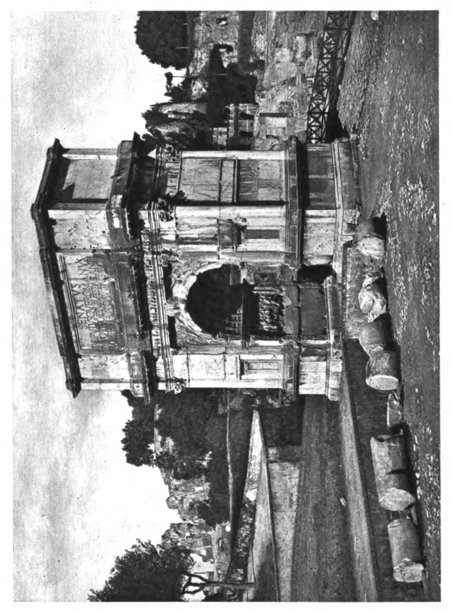
The Jewish religion was admirably fitted for defence, but it was never designed for conquest; and it seems probable that the number of proselytes was never much superior to that of apostates. The divine promises were originally made, and the distinguishing rite of circumcision was enjoined, to a single family. When the posterity of Abraham had multiplied like the sands of the sea, the Deity, from whose mouth they received a system of laws and ceremonies, declared himself the proper and, as it were, the national God of Israel; [II-266] and, with the most jealous care, separated his favourite people from the rest of mankind. The conquest of the land of Canaan was accompanied with so many wonderful and with so many bloody circumstances that the victorious Jews were left in a state of irreconcilable hostility with all their neighbours. They had been commanded to extirpate some of the most idolatrous tribes; and the execution of the Divine will had seldom been retarded by the weakness of humanity. With the other nations they were forbidden to contract any marriages or alliances; and the prohibition of receiving them into the congregation, which, in some cases, was perpetual, almost always extended to the third, to the seventh, or even to the tenth generation. The obligation of preaching to the Gentiles the faith of Moses had never been inculcated as a precept of the law, nor were the Jews inclined to impose it on themselves as a voluntary duty. In the admission of new citizens, that unsocial people was actuated by the selfish vanity of the Greeks, rather than by the generous policy of Rome. The descendants of Abraham were flattered by the opinion that they alone were the heirs of the covenant; and they were apprehensive of diminishing the value of their inheritance, by sharing it too easily with the strangers of the earth. A larger acquaintance with mankind extended their knowledge without correcting their prejudices; and, whenever the God of Israel acquired any new votaries, he was much more indebted to the inconstant humour of polytheism than to the active zeal of his own missionaries. [11] The religion of Moses seems to be instituted for a particular country, as well as for a single nation; and, if a strict obedience had been paid to the order that every male, three times in the year, should present himself before the Lord Jehovah, it would have been impossible that the Jews could ever have spread themselves beyond the narrow limits [II-267] of the promised land. [12] That obstacle was indeed removed by the destruction of the temple of Jerusalem; but the most considerable part of the Jewish religion was involved in its destruction; and the Pagans, who had long wondered at the strange report of an empty sanctuary, [13] were at a loss to discover what could be the object, or what could be the instruments, of a worship which was destitute of temples and of altars, of priests and of sacrifices. Yet even in their fallen state, the Jews, still asserting their lofty and exclusive privileges, shunned, instead of courting, the society of strangers. They still insisted with inflexible rigour on those parts of the law which it was in their power to practise. Their peculiar distinctions of days, of meats, and a variety of trivial though burdensome observances, were so many objects of disgust and aversion for the other nations, to whose habits and prejudices they were diametrically opposite. The painful and even dangerous rite of circumcision was alone capable of repelling a willing proselyte from the door of the synagogue. [14]
Under these circumstances, Christianity offered itself to the world, armed with the strength of the Mosaic law, and delivered from the weight of its fetters. An exclusive zeal for the truth of religion and the unity of God was as carefully inculcated in the new as in the ancient system; and whatever was now revealed to mankind, concerning the nature and designs of the Supreme Being, was fitted to increase their [II-268] reverence for that mysterious doctrine. The divine authority of Moses and the prophets was admitted, and even established, as the firmest basis of Christianity. From the beginning of the world, an uninterrupted series of predictions had announced and prepared the long-expected coming of the Messiah, who, in compliance with the gross apprehensions of the Jews, had been more frequently represented under the character of a King and Conqueror, than under that of a Prophet, a Martyr, and the Son of God. By his expiatory sacrifice, the imperfect sacrifices of the temple were at once consummated and abolished. The ceremonial law, which consisted only of types and figures, was succeeded by a pure and spiritual worship, equally adapted to all climates, as well as to every condition of mankind; and to the initiation of blood was substituted a more harmless initiation of water. The promise of divine favour, instead of being partially confined to the posterity of Abraham, was universally proposed to the freeman and the slave, to the Greek and to the barbarian, to the Jew and to the Gentile. Every privilege that could raise the proselyte from earth to Heaven, that could exalt his devotion, secure his happiness, or even gratify that secret pride which, under the semblance of devotion, insinuates itself into the human heart, was still reserved for the members of the Christian church; but at the same time all mankind was permitted, and even solicited, to accept the glorious distinction, which was not only proffered as a favour, but imposed as an obligation. It became the most sacred duty of a new convert to diffuse among his friends and relations the inestimable blessing which he had received, and to warn them against a refusal that would be severely punished as a criminal disobedience to the will of a benevolent but all-powerful deity.
The enfranchisement of the church from the bonds of the synagogue was a work however of some time and of some difficulty. The Jewish converts, who acknowledged Jesus in the character of the Messiah foretold by their ancient oracles, [II-269] respected him as a prophetic teacher of virtue and religion; but they obstinately adhered to the ceremonies of their ancestors, and were desirous of imposing them on the Gentiles, who continually augmented the number of believers. These Judaising Christians seem to have argued with some degree of plausibility from the divine origin of the Mosaic law, and from the immutable perfections of its great Author. They affirmed that, if the Being, who is the same through all eternity, had designed to abolish those sacred rites which had served to distinguish his chosen people, the repeal of them would have been no less clear and solemn than their first promulgation: that, instead of those frequent declarations, which either suppose or assert the perpetuity of the Mosaic religion, it would have been represented as a provisionary scheme intended to last only till the coming of the Messiah, who should instruct mankind in a more perfect mode of faith and of worship: [15] that the Messiah himself, and his disciples who conversed with him on earth, instead of authorising by their example the most minute observances of the Mosaic law, [16] would have published to the world the abolition of those useless and obsolete ceremonies, without suffering Christianity to remain during so many years obscurely confounded among the sects of the Jewish church. Arguments like these appear to have been used in the defence of the expiring cause of the Mosaic law; but the industry of our learned divines has abundantly explained the ambiguous language of the Old Testament, and the ambiguous conduct [II-270] of the apostolic teachers. It was proper gradually to unfold the system of the Gospel, and to pronounce, with the utmost caution and tenderness, a sentence of condemnation so repugnant to the inclination and prejudices of the believing Jews.
The history of the church of Jerusalem affords a lively proof of the necessity of those precautions, and of the deep impression which the Jewish religion had made on the minds of its sectaries. The first fifteen bishops of Jerusalem were all circumcised Jews; and the congregation over which they presided, united the law of Moses with the doctrine of Christ. [17] It was natural that the primitive tradition of a church which was founded only forty years after the death of Christ, and was governed almost as many years under the immediate inspection of his apostle, should be received as the standard of orthodoxy. [18] The distant churches very frequently appealed to the authority of their venerable Parent, and relieved her distresses by a liberal contribution of alms. But, when numerous and opulent societies were established in the great cities of the empire, in Antioch, Alexandria, Ephesus, Corinth, and Rome, the reverence which Jerusalem had inspired to all the Christian colonies insensibly diminished. The Jewish converts, or, as they were afterwards called, the Nazarenes, who had laid the foundations of the church, soon found themselves overwhelmed by the increasing multitudes that from all the various religions of polytheism enlisted under the banner of Christ; and the Gentiles, who with the approbation of their peculiar apostle had rejected the intolerable weight of Mosaic ceremonies, at length refused to their more scrupulous [II-271] brethren the same toleration which at first they had humbly solicited for their own practice. The ruin of the temple, of the city, and of the public religion of the Jews was severely felt by the Nazarenes; as in their manners, though not in their faith, they maintained so intimate a connection with their impious countrymen, whose misfortunes were attributed by the Pagans to the contempt, and more justly ascribed by the Christians to the wrath, of the Supreme Deity. The Nazarenes retired from the ruins of Jerusalem to the little town of Pella beyond the Jordan, where that ancient church languished above sixty years in solitude and obscurity. [19] They still enjoyed the comfort of making frequent and devout visits to the Holy City, and the hope of being one day restored to those seats which both nature and religion taught them to love as well as to revere. But at length, under the reign of Hadrian, the desperate fanaticism of the Jews filled up the measure of their calamities; and the Romans, exasperated by their repeated rebellions, exercised the rights of victory with unusual rigour. The emperor founded, under the name of Ælia Capitolina, a new city on Mount Sion, [20] to which he gave the privileges of a colony; and, denouncing the severest penalties against any of the Jewish people who should dare to approach its precincts, he fixed a vigilant garrison of a Roman cohort to enforce the execution of his orders. The Nazarenes had only one way left to [II-272] escape the common proscription, and the force of truth was, on this occasion, assisted by the influence of temporal advantages. They elected Marcus for their bishop, a prelate of the race of the Gentiles, and most probably a native either of Italy or of some of the Latin provinces. At his persuasion, the most considerable part of the congregation renounced the Mosaic law, in the practice of which they had persevered above a century. By this sacrifice of their habits and prejudices they purchased a free admission into the colony of Hadrian, and more firmly cemented their union with the Catholic church. [21]
When the name and honours of the church of Jerusalem had been restored to Mount Sion, the crimes of heresy and schism were imputed to the obscure remnant of the Nazarenes which refused to accompany their Latin bishop. They still preserved their former habitation of Pella, spread themselves into the villages adjacent to Damascus, and formed an inconsiderable church in the city of Berœa, or, as it is now called, of Aleppo, in Syria. [22] The name of Nazarenes was deemed too honourable for those Christian Jews, and they soon received from the supposed poverty of their understanding, as well as of their condition, the contemptuous epithet of Ebionites. [23] In a few years after the return of the church [II-273] of Jerusalem, it became a matter of doubt and controversy whether a man who sincerely acknowledged Jesus as the Messiah, but who still continued to observe the law of Moses, could possibly hope for salvation. The humane temper of Justin Martyr inclined him to answer this question in the affirmative; and, though he expressed himself with the most guarded diffidence, he ventured to determine in favour of such an imperfect Christian, if he were content to practise the Mosaic ceremonies, without pretending to assert their general use or necessity. But, when Justin was pressed to declare the sentiment of the church, he confessed that there were very many among the orthodox Christians, who not only excluded their Judaising brethren from the hope of salvation, but who declined any intercourse with them in the common offices of friendship, hospitality, and social life. [24] The more rigorous opinion prevailed, as it was natural to expect, over the milder; and an external bar of separation was fixed between the disciples of Moses and those of Christ. The unfortunate Ebionites, rejected from one religion as apostates, and from the other as heretics, found themselves compelled to assume a more decided character; and, although some traces of that obsolete sect may be discovered as late as the fourth century, they insensibly melted away either into the church or the synagogue. [25]
[II-274]
While the orthodox church preserved a just medium between excessive veneration and improper contempt for the law of Moses, the various heretics deviated into equal but opposite extremes of error and extravagance. From the acknowledged truth of the Jewish religion the Ebionites had concluded that it could never be abolished. From its supposed imperfections the Gnostics as hastily inferred that it never was instituted by the wisdom of the Deity. There are some objections against the authority of Moses and the prophets, which too readily present themselves to the sceptical mind; though they can only be derived from our ignorance of remote antiquity, and from our incapacity to form an adequate judgment of the divine œconomy. These objections were eagerly embraced, and as petulantly urged, by the vain science of the Gnostics. [26] As those heretics were, for the most part, averse to the pleasures [II-275] of sense, they morosely arraigned the polygamy of the patriarchs, the gallantries of David, and the seraglio of Solomon. The conquest of the land of Canaan, and the extirpation of the unsuspecting natives, they were at a loss how to reconcile with the common notions of humanity and justice. But, when they recollected the sanguinary list of murders, of executions, and of massacres, which stain almost every page of the Jewish annals, they acknowledged that the barbarians of Palestine had exercised as much compassion towards their idolatrous enemies as they had ever shewn to their friends or countrymen. [27] Passing from the sectaries of the law to the law itself, they asserted that it was impossible that a religion which consisted only of bloody sacrifices and trifling ceremonies, and whose rewards as well as punishments were all of a carnal and temporal nature, could inspire the love of virtue, or restrain the impetuosity of passion. The Mosaic account of the creation and fall of man was treated with profane derision by the Gnostics, who would not listen with patience to the repose of the Deity after six days’ labour, to the rib of Adam, the garden of Eden, the trees of life and of knowledge, the speaking serpent, the forbidden fruit, and the condemnation pronounced against human kind for the venial offence of their first progenitors. [28] The God of Israel was impiously represented by the Gnostics as a being liable to passion and to error, capricious in his favour, implacable in his resentment, meanly jealous of his superstitious worship, and confining his partial providence to a single people and to this transitory life. In such a character they could discover none of the features of the wise and omnipotent father of the universe. [29] They allowed that the [II-276] religion of the Jews was somewhat less criminal than the idolatry of the Gentiles; but it was their fundamental doctrine that the Christ whom they adored as the first and brightest emanation of the Deity appeared upon earth to rescue mankind from their various errors, and to reveal a new system of truth and perfection. The most learned of the fathers, by a very singular condescension, have imprudently admitted the sophistry of the Gnostics. Acknowledging that the literal sense is repugnant to every principle of faith as well as reason, they deem themselves secure and invulnerable behind the ample veil of allegory, which they carefully spread over every tender part of the Mosaic dispensation. [30]
It has been remarked, with more ingenuity than truth, that the virgin purity of the church was never violated by schism or heresy before the reign of Trajan or Hadrian, about one hundred years after the death of Christ. [31] We may observe, with much more propriety, that, during that period, the disciples of the Messiah were indulged in a freer latitude both of faith and practice than has ever been allowed in succeeding ages. As the terms of communion were insensibly narrowed, and the spiritual authority of the prevailing party was exercised with increasing severity, many of its most respectable adherents, who were called upon to renounce, were provoked to assert, their private opinions, to pursue the consequences of their mistaken principles, and openly to erect the standard of rebellion against the unity of the church. The Gnostics were distinguished as the most polite, the most learned, and the most wealthy of the Christian name, and that general appellation which expressed a superiority [II-277] of knowledge was either assumed by their own pride or ironically bestowed by the envy of their adversaries. [32] They were almost without exception of the race of the Gentiles, and their principal founders seem to have been natives of Syria or Egypt, where the warmth of the climate disposes both the mind and the body to indolent and contemplative devotion. The Gnostics blended with the faith of Christ many sublime but obscure tenets which they derived from oriental philosophy, and even from the religion of Zoroaster, concerning the eternity of matter, the existence of two principles, and the mysterious hierarchy of the invisible world. [33] As soon as they launched out into that vast abyss, they delivered themselves to the guidance of a disordered imagination; and, as the paths of error are various and infinite, the Gnostics were imperceptibly divided into more than fifty particular sects, [34] of whom the most celebrated appear to have been the Basilidians, the Valentinians, the Marcionites, and, in a still later period, the Manichæans. Each of these sects could boast of its bishops and congregations, of its doctors and martyrs, [35] and, instead of the four [II-278] gospels adopted by the church, the heretics produced a multitude of histories, in which the actions and discourses of Christ and of his apostles were adapted to their respective tenets. [36] The success of the Gnostics was rapid and extensive. [37] They covered Asia and Egypt, established themselves in Rome, and sometimes penetrated into the provinces of the West. For the most part they arose in the second century, flourished during the third, and were suppressed in the fourth or fifth, by the prevalence of more fashionable controversies, and by the superior ascendant of the reigning power. Though they constantly disturbed the peace, and frequently disgraced the name, of religion, they contributed to assist rather than to retard the progress of Christianity. The Gentile converts, whose strongest objections and prejudices were directed against the law of Moses, could find admission into many Christian societies, which required not from their untutored mind any belief of an antecedent revelation. Their faith was insensibly fortified and enlarged, and the church was ultimately benefited by the conquests of its most inveterate enemies. [38]
But, whatever difference of opinion might subsist between the Orthodox, the Ebionites, and the Gnostics, concerning the divinity or the obligation of the Mosaic law, they were all [II-279] equally animated by the same exclusive zeal and by the same abhorrence for idolatry which had distinguished the Jews from the other nations of the ancient world. The philosopher, who considered the system of polytheism as a composition of human fraud and error, could disguise a smile of contempt under the mask of devotion, without apprehending that either the mockery or the compliance would expose him to the resentment of any invisible, or, as he conceived them, imaginary powers. But the established religions of Paganism were seen by the primitive Christians in a much more odious and formidable light. It was the universal sentiment both of the church and of heretics that the dæmons were the authors, the patrons, and the objects of idolatry. [39] Those rebellious spirits who had been degraded from the rank of angels, and cast down into the infernal pit, were still permitted to roam upon earth, to torment the bodies, and to seduce the minds, of sinful men. The dæmons soon discovered and abused the natural propensity of the human heart towards devotion, and, artfully withdrawing the adoration of mankind from their Creator, they usurped the place and honours of the Supreme Deity. By the success of their malicious contrivances, they at once gratified their own vanity and revenge, and obtained the only comfort of which they were yet susceptible, the hope of involving the human species in the participation of their guilt and misery. It was confessed, or at least it was imagined, that they had distributed among themselves the most important characters of polytheism, one dæmon assuming the name and attributes of Jupiter, another of Æsculapius, a third of Venus, and a fourth perhaps of Apollo; [40] and that, by the advantage of [II-280] their long experience and aërial nature, they were enabled to execute, with sufficient skill and dignity, the parts which they had undertaken. They lurked in the temples, instituted festivals and sacrifices, invented fables, pronounced oracles, and were frequently allowed to perform miracles. The Christians, who, by the interposition of evil spirits, could so readily explain every præternatural appearance, were disposed and even desirous to admit the most extravagant fictions of the Pagan mythology. But the belief of the Christian was accompanied with horror. The most trifling mark of respect to the national worship he considered as a direct homage yielded to the dæmon, and as an act of rebellion against the majesty of God.
In consequence of this opinion, it was the first but arduous duty of a Christian to preserve himself pure and undefiled by the practice of idolatry. The religion of the nations was not merely a speculative doctrine professed in the schools or preached in the temples. The innumerable deities and rites of polytheism were closely interwoven with every circumstance of business or pleasure, of public or of private life; and it seemed impossible to escape the observance of them, without, at the same time, renouncing the commerce of mankind and all the offices and amusements of society. [41] The important transactions of peace and war were prepared or concluded by solemn sacrifices, in which the magistrate, the senator, and the soldier were obliged to preside or to participate. [42] The public spectacles were an essential part of the cheerful devotion of the Pagans, and the gods were supposed to accept, as the most grateful offering, the games that the prince and people celebrated in honour of their [II-281] peculiar festivals. [43] The Christian, who with pious horror avoided the abomination of the circus or the theatre, found himself encompassed with infernal snares in every convivial entertainment, as often as his friends, invoking the hospitable deities, poured out libations to each other’s happiness. [44] When the bride, struggling with well-affected reluctance, was forced in hymenæal pomp over the threshold of her new habitation, [45] or when the sad procession of the dead slowly moved towards the funeral pile; [46] the Christian, on these interesting occasions, was compelled to desert the persons who were the dearest to him, rather than contract the guilt inherent to those impious ceremonies. Every art and every trade that was in the least concerned in the framing or adorning of idols was polluted by the stain of idolatry; [47] a severe sentence, since it devoted to eternal misery the far greater part of the community, which is employed in the exercise of liberal or mechanic professions. If we cast our eyes over the numerous remains of antiquity, we shall perceive that, besides the immediate representations of the Gods and the holy instruments of their worship, the elegant forms and agreeable fictions, consecrated by the imagination of the Greeks, were introduced as the richest [II-282] ornaments of the houses, the dress, and the furniture, of the Pagans. [48] Even the arts of music and painting, of eloquence and poetry, flowed from the same impure origin. In the style of the fathers, Apollo and the Muses were the organs of the infernal spirit, Homer and Virgil were the most eminent of his servants, and the beautiful mythology which pervades and animates the compositions of their genius is destined to celebrate the glory of the dæmons. Even the common language of Greece and Rome abounded with familiar but impious expressions, which the imprudent Christian might too carelessly utter, or too patiently hear. [49]
The dangerous temptations which on every side lurked in ambush to surprise the unguarded believer assailed him with redoubled violence on the days of solemn festivals. So artfully were they framed and disposed throughout the year that superstition always wore the appearance of pleasure, and often of virtue. [50] Some of the most sacred festivals in the Roman ritual were destined to salute the new calends of January with vows of public and private felicity, to indulge the pious remembrance of the dead and living, to ascertain the inviolable bounds of property, to hail, on the return of spring, the genial powers of fecundity, to perpetuate the two memorable eras of Rome, the foundation of the city and that of the republic, and to restore, during the humane licence of the Saturnalia, the primitive equality of mankind. Some idea may be conceived of the abhorrence of the Christians for such impious ceremonies, by the scrupulous delicacy [II-283] which they displayed on a much less alarming occasion. On days of general festivity, it was the custom of the ancients to adorn their doors with lamps and with branches of laurel, and to crown their heads with a garland of flowers. This innocent and elegant practice might, perhaps, have been tolerated as a mere civil institution. But it most unluckily happened that the doors were under the protection of the household gods, that the laurel was sacred to the lover of Daphne, and that garlands of flowers, though frequently worn as a symbol either of joy or mourning, had been dedicated in their first origin to the service of superstition. The trembling Christians, who were persuaded in this instance to comply with the fashion of their country and the commands of the magistrate, laboured under the most gloomy apprehensions, from the reproaches of their own conscience, the censures of the church, and the denunciations of divine vengeance. [51]
Such was the anxious diligence which was required to guard the chastity of the gospel from the infectious breath of idolatry. The superstitious observances of public or private rites were carelessly practised, from education and habit, by the followers of the established religion. But, as often as they occurred, they afforded the Christians an opportunity of declaring and confirming their zealous opposition. By these frequent protestations, their attachment to the faith was continually fortified, and, in proportion to the increase of zeal, they combated with the more ardour and success in the holy war which they had undertaken against the empire of the dæmons.
[II-284]
II. The writings of Cicero [52] represent, in the most lively colours, the ignorance, the errors, and the uncertainty of the ancient philosophers, with regard to the immortality of the soul. When they are desirous of arming their disciples against the fear of death, they inculcate, as an obvious though melancholy position, that the fatal stroke of our dissolution releases us from the calamities of life, and that those can no longer suffer who no longer exist. Yet there were a few sages of Greece and Rome who had conceived a more exalted, and, in some respects, a juster idea of human nature; though it must be confessed that, in the sublime inquiry, their reason had been often guided by their imagination, and that their imagination had been prompted by their vanity. When they viewed with complacency the extent of their own mental powers when they exercised the various faculties of memory, of fancy, and of judgment, in the most profound speculations, or the most important labours, and when they reflected on the desire of fame, which transported them into future ages far beyond the bounds of death and of the grave; they were unwilling to confound themselves with the beasts of the field, or to suppose that a being, for whose dignity they entertained the most sincere admiration, could be limited to a spot of earth and to a few years of duration. With this favourable prepossession, they summoned to their aid the science, or rather the language, of Metaphysics. They soon discovered that, as none of the properties of matter will apply to the operations of the mind, the human soul must consequently be a substance distinct from the body, pure, simple, and spiritual, incapable of dissolution, and susceptible of a much higher degree of virtue and happiness after the release from its corporeal prison. From these spacious and noble principles, the philosophers [II-285] who trod in the footsteps of Plato deduced a very unjustifiable conclusion, since they asserted, not only the future immortality, but the past eternity of the human soul, which they were too apt to consider as a portion of the infinite and self-existing spirit which pervades and sustains the universe. [53] A doctrine thus removed beyond the senses and the experience of mankind might serve to amuse the leisure of a philosophic mind; or, in the silence of solitude, it might sometimes impart a ray of comfort to desponding virtue; but the faint impression which had been received in the schools was soon obliterated by the commerce and business of active life. We are sufficiently acquainted with the eminent persons who flourished in the age of Cicero, and of the first Cæsars, with their actions, their characters, and their motives, to be assured that their conduct in this life was never regulated by any serious conviction of the rewards or punishments of a future state. At the bar and in the senate of Rome the ablest orators were not apprehensive of giving offence to their hearers by exposing that doctrine as an idle and extravagant opinion, which was rejected with contempt by every man of a liberal education and understanding. [54]
Since, therefore, the most sublime efforts of philosophy can extend no farther than feebly to point out the desire, the hope, or at most the probability, of a future state, there is nothing, except a divine revelation, that can ascertain the existence, and describe the condition, of the invisible country which is destined to receive the souls of men after their separation from the body. But we may perceive several defects inherent to the popular religions of Greece and Rome, which rendered them [II-286] very unequal to so arduous a task. 1. The general system of their mythology was unsupported by any solid proofs; and the wisest among the Pagans had already disclaimed its usurped authority. 2. The description of the infernal regions had been abandoned to the fancy of painters and of poets, who peopled them with so many phantoms and monsters, who dispensed their rewards and punishments with so little equity, that a solemn truth, the most congenial to the human heart, was oppressed and disgraced by the absurd mixture of the wildest fictions. [55] 3. The doctrine of a future state was scarcely considered among the devout polytheists of Greece and Rome as a fundamental article of faith. The providence of the gods, as it related to public communities rather than to private individuals, was principally displayed on the visible theatre of the present world. The petitions which were offered on the altars of Jupiter or Apollo expressed the anxiety of their worshippers for temporal happiness, and their ignorance or indifference concerning a future life. [56] The important truth of the immortality of the soul was inculcated with more diligence as well as success in India, in Assyria, in Egypt, and in Gaul; and, since we cannot attribute such a difference to the superior knowledge of the barbarians, we must ascribe it to the influence of an established priesthood, which employed the motives of virtue as the instrument of ambition. [57]
[II-287]
We might naturally expect that a principle, so essential to religion, would have been revealed in the clearest terms to the chosen people of Palestine, and that it might safely have been entrusted to the hereditary priesthood of Aaron. It is incumbent on us to adore the mysterious dispensations of Providence, [58] when we discover that the doctrine of the immortality of the soul is omitted in the law of Moses; it is darkly insinuated by the prophets, and during the long period which elapsed between the Egyptian and the Babylonian servitudes, the hopes as well as fears of the Jews appear to have been confined within the narrow compass of the present life. [59] After Cyrus had permitted the exiled nation to return into the promised land, and after Ezra had restored the ancient records of their religion, two celebrated sects, the Sadducees and the Pharisees, insensibly arose at Jerusalem. [60] The former, selected from the more opulent and distinguished ranks of society, were strictly attached to the literal sense of the Mosaic law, and they piously rejected the immortality of the soul, as an opinion that received no countenance from the Divine book, which they revered as the only rule of their faith. To the authority of scripture the Pharisees added that of tradition, and they accepted, under the name of traditions, several speculative tenets from the philosophy or [II-288] religion of the Eastern nations. The doctrines of fate or predestination, of angels and spirits, and of a future state of rewards and punishments, were in the number of these new articles of belief; and, as the Pharisees, by the austerity of their manners, had drawn into their party the body of the Jewish people, the immortality of the soul became the prevailing sentiment of the synagogue, under the reign of the Asmonæan princes and pontiffs. The temper of the Jews was incapable of contenting itself with such a cold and languid assent as might satisfy the mind of a Polytheist; and, as soon as they admitted the idea of a future state, they embraced it with the zeal which has always formed the characteristic of the nation. Their zeal, however, added nothing to its evidence, or even probability: and it was still necessary that the doctrine of life and immortality, which had been dictated by nature, approved by reason, and received by superstition, should obtain the sanction of Divine truth from the authority and example of Christ.
When the promise of eternal happiness was proposed to mankind, on condition of adopting the faith and of observing the precepts of the gospel, it is no wonder that so advantageous an offer should have been accepted by great numbers of every religion, of every rank, and of every province in the Roman empire. The ancient Christians were animated by a contempt for their present existence, and by a just confidence of immortality, of which the doubtful and imperfect faith of modern ages cannot give us any adequate notion. In the primitive church, the influence of truth was very powerfully strengthened by an opinion which, however it may deserve respect for its usefulness and antiquity, has not been found agreeable to experience. It was universally believed that the end of the world and the kingdom of Heaven were at hand. The near approach of this wonderful event had been predicted by the apostles; the tradition of it was preserved by their earliest disciples, and those who understood in their literal sense the discourses of Christ himself were obliged to [II-289] expect the second and glorious coming of the Son of Man in the clouds, before that generation was totally extinguished, which had beheld his humble condition upon earth, and which might still be witness of the calamities of the Jews under Vespasian or Hadrian. The revolution of seventeen centuries has instructed us not to press too closely the mysterious language of prophecy and revelation; but, as long as, for wise purposes, this error was permitted to subsist in the church, it was productive of the most salutary effects on the faith and practice of Christians, who lived in the lawful expectation of that moment when the globe itself, and all the various race of mankind, should tremble at the appearance of their divine judge. [61]
The ancient and popular doctrine of the Millennium was intimately connected with the second coming of Christ. As the works of the creation had been finished in six days, their duration in their present state, according to a tradition which was attributed to the prophet Elijah, was fixed to six thousand years. [62] By the same analogy it was inferred that this long period of labour and contention, which was now almost elapsed, [63] would be succeded by a joyful Sabbath of a thousand years; and that Christ, with the triumphant band of the saints [II-290] and the elect who had escaped death, or who had been miraculously revived, would reign upon earth till the time appointed for the last and general resurrection. So pleasing was this hope to the mind of believers that the New Jerusalem, the seat of this blissful kingdom, was quickly adorned with all the gayest colours of the imagination. A felicity consisting only of pure and spiritual pleasure would have appeared too refined for its inhabitants, who were still supposed to possess their human nature and senses. A garden of Eden, with the amusements of the pastoral life, was no longer suited to the advanced state of society which prevailed under the Roman empire. A city was therefore erected of gold and precious stones, and a supernatural plenty of corn and wine was bestowed on the adjacent territory; in the free enjoyment of whose spontaneous productions the happy and benevolent people was never to be restrained by any jealous laws of exclusive property. [64] The assurance of such a Millennium was carefully inculcated by a succession of fathers from Justin Martyr [65] and Irenæus, who conversed with the immediate disciples of the apostles, down to Lactantius, who was preceptor to the son of Constantine. [66] Though it might not be universally received, it appears to have been the reigning sentiment of the orthodox believers; and it seems so well adapted to the desires and apprehensions of mankind that it [II-291] must have contributed, in a very considerable degree, to the progress of the Christian faith. But, when the edifice of the church was almost completed, the temporary support was laid aside. The doctrine of Christ’s reign upon earth was at first treated as a profound allegory, was considered by degrees as a doubtful and useless opinion, and was at length rejected as the absurd invention of heresy and fanaticism. [67] A mysterious prophecy, which still forms a part of the sacred canon, but which was thought to favour the exploded sentiment, has very narrowly escaped the proscription of the church. [68]
Whilst the happiness and glory of a temporal reign were promised to the disciples of Christ, the most dreadful calamities were denounced against an unbelieving world. The edification of the new Jerusalem was to advance by equal steps with the destruction of the mystic Babylon; and, as long as the emperors who reigned before Constantine persisted in the [II-292] profession of idolatry, the epithet of Babylon was applied to the city and to the empire of Rome. A regular series was prepared of all the moral and physical evils which can afflict a flourishing nation; intestine discord, and the invasion of the fiercest barbarians from the unknown regions of the North; pestilence and famine, comets and eclipses, earthquakes and inundations. [69] All these were only so many preparatory and alarming signs of the great catastrophe of Rome, when the country of the Scipios and Cæsars should be consumed by a flame from Heaven, and the city of the seven hills, with her palaces, her temples, and her triumphal arches, should be buried in a vast lake of fire and brimstone. It might, however, afford some consolation to Roman vanity, that the period of their empire would be that of the world itself; which, as it had once perished by the element of water, was destined to experience a second and a speedy destruction from the element of fire. In the opinion of a general conflagration, the faith of the Christian very happily coincided with the tradition of the East, the philosophy of the Stoics, and the analogy of Nature; and even the country which, from religious motives, had been chosen for the origin and principal scene of the conflagration, was the best adapted for that purpose by natural and physical causes; by its deep caverns, beds of sulphur, and numerous volcanoes, of which those of Ætna, of Vesuvius, and of Lipari exhibit a very imperfect representation. The calmest and most intrepid sceptic could not refuse to acknowledge that the destruction of the present system of the world by fire was in itself extremely probable. The Christian, who founded his belief much less on the fallacious arguments of reason than on the authority of tradition and the interpretation of scripture, expected it with terror and confidence, as a certain and approaching event; and, as his mind was perpetually filled with the solemn idea, [II-293] he considered every disaster that happened to the empire as an infallible symptom of an expiring world. [70]
The condemnation of the wisest and most virtuous of the Pagans, on account of their ignorance or disbelief of the divine truth, seems to offend the reason and the humanity of the present age. [71] But the primitive church, whose faith was of a much firmer consistence, delivered over, without hesitation, to eternal torture the far greater part of the human species. A charitable hope might perhaps be indulged in favour of Socrates, or some other sages of antiquity, who had consulted the light of reason before that of the gospel had arisen. [72] But it was unanimously affirmed that those who, since the birth or the death of Christ, had obstinately persisted in the worship of the dæmons, neither deserved, nor could expect, a pardon from the irritated justice of the Deity. These rigid sentiments, which had been unknown to the ancient world, appear to have infused a spirit of bitterness into a system of love and harmony. The ties of blood and friendship were frequently torn asunder by the difference of religious faith; and the Christians, who, in this world, found themselves oppressed by the power of the Pagans, were sometimes seduced by resentment and spiritual pride to delight in the prospect of their [II-294] future triumph. “You are fond of spectacles,” exclaims the stern Tertullian; “expect the greatest of all spectacles, the last and eternal judgment of the universe. How shall I admire, how laugh, how rejoice, how exult, when I behold so many proud monarchs, and fancied gods, groaning in the lowest abyss of darkness; so many magistrates, who persecuted the name of the Lord, liquefying in fiercer fires than they ever kindled against the Christians; so many sage philosophers blushing in red-hot flames, with their deluded scholars; so many celebrated poets trembling before the tribunal, not of Minos, but of Christ; so many tragedians, more tuneful in the expression of their own sufferings; so many dancers —!” But the humanity of the reader will permit me to draw a veil over the rest of this infernal description, which the zealous African pursues in a long variety of affected and unfeeling witticisms. [73]
Doubtless there were many among the primitive Christians of a temper more suitable to the meekness and charity of their profession. There were many who felt a sincere compassion for the danger of their friends and countrymen, and who exerted the most benevolent zeal to save them from the impending destruction. The careless Polytheist, assailed by new and unexpected terrors, against which neither his priests nor his philosophers could afford him any certain protection, was very frequently terrified and subdued by the menace of eternal tortures. His fears might assist the progress of his faith and reason; and, if he could once persuade himself to suspect that the Christian religion might possibly be true, it became an easy task to convince him that it was [II-295] the safest and most prudent party that he could possibly embrace.
III. The supernatural gifts, which even in this life were ascribed to the Christians above the rest of mankind, must have conduced to their own comfort, and very frequently to the conviction of infidels. Besides the occasional prodigies, which might sometimes be effected by the immediate interposition of the Deity when he suspended the laws of Nature for the service of religion, the Christian church, from the time of the apostles and their first disciples, [74] has claimed an uninterrupted succession of miraculous powers, the gift of tongues, of vision and of prophecy, the power of expelling dæmons, of healing the sick, and of raising the dead. The knowledge of foreign languages was frequently communicated to the contemporaries of Irenæus, though Irenæus himself was left to struggle with the difficulties of a barbarous dialect whilst he preached the gospel to the natives of Gaul. [75] The divine inspiration, whether it was conveyed in the form of a waking or of a sleeping vision, is described as a favour very liberally bestowed on all ranks of the faithful, on women as on elders, on boys as well as upon bishops. When their devout minds were sufficiently prepared by a course of prayer, of fasting, and of vigils to receive the extraordinary impulse, they were transported out of their senses, and delivered in ecstasy what was inspired, being mere organs of the Holy Spirit, just as a pipe or flute is of him who blows into it. [76] We may add that the design of these visions was, for the most part, either to [II-296] disclose the future history, or to guide the present administration, of the church. The expulsion of the dæmons from the bodies of those unhappy persons whom they had been permitted to torment was considered as a signal, though ordinary, triumph of religion, and is repeatedly alleged by the ancient apologists as the most convincing evidence of the truth of Christianity. The awful ceremony was usually performed in a public manner, and in the presence of a great number of spectators; the patient was relieved by the power or skill of the exorcist, and the vanquished dæmon was heard to confess that he was one of the fabled gods of antiquity, who had impiously usurped the adoration of mankind. [77] But the miraculous cure of diseases, of the most inveterate or even præternatural kind, can no longer occasion any surprise, when we recollect that in the days of Irenæus, about the end of the second century, the resurrection of the dead was very far from being esteemed an uncommon event; that the miracle was frequently performed on necessary occasions, by great fasting and the joint supplication of the church of the place, and that the persons thus restored to their prayers had lived afterwards among them many years. [78] At such a period, when faith could boast of so many wonderful victories over death, it seems difficult to account for the scepticism of those philosophers who still rejected and derided the doctrine of the resurrection. A noble Grecian had rested on this important ground the whole controversy, and promised Theophilus, bishop of Antioch, that, if he could be gratified with the sight of a single person who had been actually raised from the dead, he would immediately embrace the Christian religion. It is somewhat remarkable that the prelate of the first Eastern church, however [II-297] anxious for the conversion of his friend, thought proper to decline this fair and reasonable challenge. [79]
The miracles of the primitive church, after obtaining the sanction of ages, have been lately attacked in a very free and ingenious inquiry; [80] which, though it has met with the most favourable reception from the Public, appears to have excited a general scandal among the divines of our own as well as of the other Protestant churches of Europe. [81] Our different sentiments on this subject will be much less influenced by any particular arguments than by our habits of study and reflection; and, above all, by the degree of the evidence which we have accustomed ourselves to require for the proof of a miraculous event. The duty of an historian does not call upon him to interpose his private judgment in this nice and important controversy; but he ought not to dissemble the difficulty of adopting such a theory as may reconcile the interest of religion with that of reason, of making a proper application of that theory, and of defining with precision the limits of that happy period, exempt from error and from deceit, to which we might be disposed to extend the gift of supernatural powers. From the first of the fathers to the last of the popes, a succession of bishops, of saints, of martyrs, and of miracles is continued without interruption, and the progress of superstition was so gradual and almost imperceptible that we know not in what particular link we should break the chain of tradition. Every age bears testimony to the wonderful events by which it was distinguished, and its testimony appears no less weighty and respectable than that of the preceding generation, till we are insensibly led on to accuse our own inconsistency, [II-298] sistency, if in the eighth or in the twelfth century we deny to the venerable Bede, or to the holy Bernard, the same degree of confidence which, in the second century, we had so liberally granted to Justin or to Irenæus. [82] If the truth of any of those miracles is appreciated by their apparent use and propriety, every age had unbelievers to convince, heretics to confute, and idolatrous nations to convert; and sufficient motives might always be produced to justify the interposition of Heaven. And yet, since every friend to revelation is persuaded of the reality, and every reasonable man is convinced of the cessation, of miraculous powers, it is evident that there must have been some period in which they were either suddenly or gradually withdrawn from the Christian church. Whatever era is chosen for that purpose, the death of the apostles, the conversion of the Roman empire, or the extinction of the Arian heresy, [83] the insensibility of the Christians who lived at that time will equally afford a just matter of surprise. They still supported their pretensions after they had lost their power. Credulity performed the office of faith; fanaticism was permitted to assume the language of inspiration, and the effects of accident or contrivance were ascribed to supernatural causes. The recent experience of genuine miracles should have instructed the Christian world in the ways of Providence and habituated their eye (if we may use a very inadequate expression) to the style of the divine artist. Should the most skilful painter of modern Italy presume to decorate his feeble imitations with the name of Raphael or of Correggio, the [II-299] insolent fraud would be soon discovered and indignantly rejected.
Whatever opinion may be entertained of the miracles of the primitive church since the time of the apostles, this unresisting softness of temper, so conspicuous among the believers of the second and third centuries, proved of some accidental benefit to the cause of truth and religion. In modern times, a latent, and even involuntary, scepticism adheres to the most pious dispositions. Their admission of supernatural truths is much less an active consent than a cold and passive acquiescence. Accustomed long since to observe and to respect the invariable order of Nature, our reason, or at least our imagination, is not sufficiently prepared to sustain the visible action of the Deity. But, in the first ages of Christianity, the situation of mankind was extremely different. The most curious, or the most credulous, among the Pagans were often persuaded to enter into a society which asserted an actual claim of miraculous powers. The primitive Christians perpetually trod on mystic ground, and their minds were exercised by the habits of believing the most extraordinary events. They felt, or they fancied, that on every side they were incessantly assaulted by dæmons, comforted by visions, instructed by prophecy, and surprisingly delivered from danger, sickness, and from death itself, by the supplications of the church. The real or imaginary prodigies, of which they so frequently conceived themselves to be the objects, the instruments, or the spectators, very happily disposed them to adopt, with the same ease, but with far greater justice, the authentic wonders of the evangelic history; and thus miracles that exceeded not the measure of their own experience inspired them with the most lively assurance of mysteries which were acknowledged to surpass the limits of their understanding. It is this deep impression of supernatural truths which has been so much celebrated under the name of faith; a state of mind described as the surest pledge of the divine favour and of future felicity, and recommended as the first or perhaps the only merit of a Christian. [II-300] According to the more rigid doctors, the moral virtues, which may be equally practised by infidels, are destitute of any value or efficacy in the work of our justification.
IV. But the primitive Christian demonstrated his faith by his virtues; and it was very justly supposed that the divine persuasion, which enlightened or subdued the understanding, must, at the same time, purify the heart, and direct the actions, of the believer. The first apologists of Christianity who justify the innocence of their brethren, and the writers of a later period who celebrate the sanctity of their ancestors, display, in the most lively colours, the reformation of manners which was introduced into the world by the preaching of the gospel. As it is my intention to remark only such human causes as were permitted to second the influence of revelation, I shall slightly mention two motives which might naturally render the lives of the primitive Christians much purer and more austere than those of their Pagan contemporaries, or their degenerate successors: repentance for their past sins, and the laudable desire of supporting the reputation of the society in which they were engaged.
It is a very ancient reproach, suggested by the ignorance or the malice of infidelity, that the Christians allured into their party the most atrocious criminals, who, as soon as they were touched by a sense of remorse, were easily persuaded to wash away, in the water of baptism, the guilt of their past conduct, for which the temples of the gods refused to grant them any expiation. But this reproach, when it is cleared from misrepresentation, contributes as much to the honour as it did to the increase of the church. [84] The friends of Christianity may acknowledge without a blush that many of the most eminent saints had been before their baptism the most abandoned sinners. Those persons who in the world had followed, though in an imperfect manner, the dictates of benevolence and propriety, [II-301] derived such a calm satisfaction from the opinion of their own rectitude, as rendered them much less susceptible of the sudden emotions of shame, of grief, and of terror, which have given birth to so many wonderful conversions. After the example of their Divine Master, the missionaries of the gospel disdained not the society of men, and especially of women, oppressed by the consciousness, and very often by the effects, of their vices. As they emerged from sin and superstition to the glorious hope of immortality, they resolved to devote themselves to a life, not only of virtue, but of penitence. The desire of perfection became the ruling passion of their soul; and it is well known that, while reason embraces a cold mediocrity, our passions hurry us, with rapid violence, over the space which lies between the most opposite extremes.
When the new converts had been enrolled in the number of the faithful and were admitted to the sacraments of the church, they found themselves restrained from relapsing into their past disorders by another consideration of a less spiritual, but of a very innocent and respectable nature. Any particular society that has departed from the great body of the nation or the religion to which it belonged immediately becomes the object of universal as well as invidious observation. In proportion to the smallness of its numbers, the character of the society may be affected by the virtue and vices of the persons who compose it; and every member is engaged to watch with the most vigilant attention over his own behaviour and over that of his brethren, since, as he must expect to incur a part of the common disgrace, he may hope to enjoy a share of the common reputation. When the Christians of Bithynia were brought before the tribunal of the younger Pliny, they assured the proconsul that, far from being engaged in any unlawful conspiracy, they were bound by a solemn obligation to abstain from the commission of those crimes which disturb the private or public peace of society, from theft, robbery, adultery, perjury, and fraud. [85] Near a century afterwards, Tertullian, [II-302] with an honest pride, could boast that very few Christians had suffered by the hand of the executioner, except on account of their religion. [86] Their serious and sequestered life, averse to the gay luxury of the age, insured them to chastity, temperance, economy, and all the sober and domestic virtues. As the greater number were of some trade or profession, it was incumbent on them, by the strictest integrity and the fairest dealing, to remove the suspicions which the profane are too apt to conceive against the appearances of sanctity. The contempt of the world exercised them in the habits of humility, meekness, and patience. The more they were persecuted, the more closely they adhered to each other. Their mutual charity and unsuspecting confidence has been remarked by infidels, and was too often abused by perfidious friends. [87]
It is a very honourable circumstance for the morals of the primitive Christians, that even their faults, or rather errors, were derived from an excess of virtue. The bishops and doctors of the church, whose evidence attests, and whose authority might influence, the professions, the principles, and even the practice, of their contemporaries, had studied the scriptures with less skill than devotion, and they often received, in the most literal sense, those rigid precepts of Christ and the apostles to which the prudence of succeeding commentators has applied a looser and more figurative mode of interpretation. Ambitious to exalt the perfection of the gospel above the wisdom of philosophy, the zealous fathers have carried the duties of self-mortification, of purity, and of patience to a height which it is scarcely possible to attain, and much less to preserve, in our present state of weakness and corruption. A doctrine so extraordinary and so sublime must [II-303] inevitably command the veneration of the people; but it was ill calculated to obtain the suffrage of those worldly philosophers who, in the conduct of this transitory life, consult only the feelings of nature and the interest of society. [88]
There are two very natural propensities which we may distinguish in the most virtuous and liberal dispositions, the love of pleasure and the love of action. If the former be refined by art and learning, improved by the charms of social intercourse, and corrected by a just regard to economy, to health, and to reputation, it is productive of the greatest part of the happiness of private life. The love of action is a principle of a much stronger and more doubtful nature. It often leads to anger, to ambition, and to revenge; but, when it is guided by the sense of propriety and benevolence, it becomes the parent of every virtue; and, if those virtues are accompanied with equal abilities, a family, a state, or an empire may be indebted for their safety and prosperity to the undaunted courage of a single man. To the love of pleasure we may therefore ascribe most of the agreeable, to the love of action we may attribute most of the useful and respectable qualifications. The character in which both the one and the other should be united and harmonised would seem to constitute the most perfect idea of human nature. The insensible and inactive disposition, which should be supposed alike destitute of both, would be rejected, by the common consent of mankind, as utterly incapable of procuring any happiness to the individual, or any public benefit to the world. But it was not in this world that the primitive Christians were desirous of making themselves either agreeable or useful.
The acquisition of knowledge, the exercise of our reason or fancy, and the cheerful flow of unguarded conversation, may employ the leisure of a liberal mind. Such amusements, however, were rejected with abhorrence, or admitted with the utmost caution, by the severity of the fathers, who despised all [II-304] knowledge that was not useful to salvation, and who considered all levity of discourse as a criminal abuse of the gift of speech. In our present state of existence, the body is so inseparably connected with the soul that it seems to be our interest to taste, with innocence and moderation, the enjoyments of which that faithful companion is susceptible. Very different was the reasoning of our devout predecessors; vainly aspiring to imitate the perfection of angels, they disdained, or they affected to disdain, every earthly and corporeal delight. [89] Some of our senses indeed are necessary for our preservation, others for our subsistence, and others again for our information, and thus far it was impossible to reject the use of them. The first sensation of pleasure was marked as the first moment of their abuse. The unfeeling candidate for Heaven was instructed, not only to resist the grosser allurements of the taste or smell, but even to shut his ears against the profane harmony of sounds, and to view with indifference the most finished productions of human art. Gay apparel, magnificent houses, and elegant furniture were supposed to unite the double guilt of pride and of sensuality: a simple and mortified appearance was more suitable to the Christian who was certain of his sins and doubtful of his salvation. In their censures of luxury, the fathers are extremely minute and circumstantial; [90] and among the various articles which excite their pious indignation, we may enumerate false hair, garments of any colour except white, instruments of music, vases of gold or silver, downy pillows (as Jacob reposed his head on a stone), white bread, foreign wines, public salutations, the use of warm baths, and the practice of shaving the beard, which, according to the expression of Tertullian, is a lie against our own faces, and an impious attempt to improve the works of the Creator. [91] [II-305] When Christianity was introduced among the rich and the polite, the observation of these singular laws was left, as it would be at present, to the few who were ambitious of superior sanctity. But it is always easy, as well as agreeable, for the inferior ranks of mankind to claim a merit from the contempt of that pomp and pleasure, which fortune has placed beyond their reach. The virtue of the primitive Christians, like that of the first Romans, was very frequently guarded by poverty and ignorance.
The chaste severity of the fathers, in whatever related to the commerce of the two sexes, flowed from the same principle: their abhorrence of every enjoyment which might gratify the sensual, and degrade the spiritual, nature of man. It was their favourite opinion that, if Adam had preserved his obedience to the Creator, he would have lived for ever in a state of virgin purity, and that some harmless mode of vegetation might have peopled paradise with a race of innocent and immortal beings. [92] The use of marriage was permitted only to his fallen posterity, as a necessary expedient to continue the human species, and as a restraint, however imperfect, on the natural licentiousness of desire. The hesitation of the orthodox casuists on this interesting subject betrays the perplexity of men, unwilling to approve an institution which they were compelled to tolerate. [93] The enumeration of the very whimsical laws, which they most circumstantially imposed on the marriage-bed, would force a smile from the young, and a blush from the fair. It was their unanimous sentiment that a first marriage was adequate to all the purposes of nature and of society. The sensual connection was refined into a resemblance of the mystic union of Christ with his church, and was pronounced to be indissoluble either by divorce or by death. The practice of second nuptials was branded with the name [II-306] of a legal adultery; and the persons who were guilty of so scandalous an offence against Christian purity were soon excluded from the honours, and even from the alms, of the church. [94] Since desire was imputed as a crime, and marriage was tolerated as a defect, it was consistent with the same principles to consider a state of celibacy as the nearest approach to the divine perfection. It was with the utmost difficulty that ancient Rome could support the institution of six vestals; [95] but the primitive church was filled with a great number of persons of either sex who had devoted themselves to the profession of perpetual chastity. [96] A few of these, among whom we may reckon the learned Origen, judged it the most prudent to disarm the tempter. [97] Some were insensible and some were invincible against the assaults of the flesh. Disdaining an ignominious flight, the virgins of the warm climate of Africa encountered the enemy in the closest engagement; they permitted priests and deacons to share their bed, and gloried amidst the flames in their unsullied purity. But insulted Nature sometimes vindicated her rights, and this new species of martyrdom served only to introduce a new scandal into the church. [98] Among the Christian ascetics, however (a name [II-307] which they soon acquired from their painful exercise), many, as they were less presumptuous, were probably more successful. The loss of sensual pleasure was supplied and compensated by spiritual pride. Even the multitude of Pagans were inclined to estimate the merit of the sacrifice by its apparent difficulty; and it was in the praise of these chaste spouses of Christ that the fathers have poured forth the troubled stream of their eloquence. [99] Such are the early traces of monastic principles and institutions which, in a subsequent age, have counterbalanced all the temporal advantages of Christianity. [100]
The Christians were not less averse to the business than to the pleasures of this world. The defence of our persons and property they knew not how to reconcile with the patient doctrine which enjoined an unlimited forgiveness of past injuries and commanded them to invite the repetition of fresh insults. Their simplicity was offended by the use of oaths, by the pomp of magistracy, and by the active contention of public life, nor could their humane ignorance be convinced that it was lawful on any occasion to shed the blood of our fellow-creatures, either by the sword of justice or by that of war; even though their criminal or hostile attempts should threaten the peace and safety of the whole community. [101] It was acknowledged that, under a less perfect law, the powers of the Jewish constitution had been exercised, with the approbation of Heaven, by inspired prophets and by anointed kings. The Christians felt and confessed that such institutions might be necessary for the present system of the world, and they [II-308] cheerfully submitted to the authority of their Pagan governors. But, while they inculcated the maxims of passive obedience, they refused to take any active part in the civil administration or the military defence of the empire. Some indulgence might perhaps be allowed to those persons who, before their conversion, were already engaged in such violent and sanguinary occupations; [102] but it was impossible that the Christians, without renouncing a more sacred duty, could assume the character of soldiers, of magistrates, or of princes. [103] This indolent, or even criminal, disregard to the public welfare exposed them to the contempt and reproaches of the Pagans, who very frequently asked, What must be the fate of the empire, attacked on every side by the barbarians, if all mankind should adopt the pusillanimous sentiments of the new sect? [104] To this insulting question the Christian apologists returned obscure and ambiguous answers, as they were unwilling to reveal the secret cause of their security; the expectation that, before the conversion of mankind was accomplished, war, government, the Roman empire, and the world itself would be no more. It may be observed that, in this instance likewise, the situation of the first Christians coincided very happily with their religious scruples, and that their aversion to an active life contributed rather to excuse them from the service, than to exclude them from the honours, of the state and army.
V. But the human character, however it may be exalted or depressed by a temporary enthusiasm, will return, by degrees, to its proper and natural level, and will resume those passions that seem the most adapted to its present condition. The [II-309] primitive Christians were dead to the business and pleasures of the world; but their love of action, which could never be entirely extinguished, soon revived, and found a new occupation in the government of the church. A separate society, which attacked the established religion of the empire, was obliged to adopt some form of internal policy, and to appoint a sufficient number of ministers, entrusted not only with the spiritual functions, but even with the temporal direction, of the Christian commonwealth. The safety of that society, its honour, its aggrandisement, were productive, even in the most pious minds, of a spirit of patriotism, such as the first of the Romans had felt for the republic, and sometimes, of a similar indifference in the use of whatever means might probably conduce to so desirable an end. The ambition of raising themselves or their friends to the honours and offices of the church was disguised by the laudable intention of devoting to the public benefit the power and consideration which, for that purpose only, it became their duty to solicit. In the exercise of their functions, they were frequently called upon to detect the errors of heresy, or the arts of faction, to oppose the designs of perfidious brethren, to stigmatise their characters with deserved infamy, and to expel them from the bosom of a society whose peace and happiness they had attempted to disturb. The ecclesiastical governors of the Christians were taught to unite the wisdom of the serpent with the innocence of the dove; but, as the former was refined, so the latter was insensibly corrupted, by the habits of government. In the church as well as in the world the persons who were placed in any public station rendered themselves considerable by their eloquence and firmness, by their knowledge of mankind, and by their dexterity in business; and, while they concealed from others, and, perhaps, from themselves, the secret motives of their conduct, they too frequently relapsed into all the turbulent passions of active life, which were tinctured with an additional degree of bitterness and obstinacy from the infusion of spiritual zeal.
[II-310]
The government of the church has often been the subject, as well as the prize, of religious contention. The hostile disputants of Rome, of Paris, of Oxford, and of Geneva have alike struggled to reduce the primitive and apostolic model [105] to the respective standards of their own policy. The few who have pursued this inquiry with more candour and impartiality are of opinion [106] that the apostles declined the office of legislation, and rather chose to endure some partial scandals and divisions than to exclude the Christians of a future age from the liberty of varying their forms of ecclesiastical government according to the changes of times and circumstances. The scheme of policy which, under their approbation, was adopted for the use of the first century may be discovered from the practice of Jerusalem, of Ephesus, or of Corinth. The societies which were instituted in the cities of the Roman empire were united only by the ties of faith and charity. Independence and equality formed the basis of their internal constitution. The want of discipline and human learning was supplied by the occasional assistance of the prophets, [107] who were called to that function, without distinction of age, of sex, or of natural abilities, and who, as often as they felt the divine impulse, poured forth the effusions of the spirit in the assembly of the faithful. But these extraordinary gifts were frequently abused or misapplied by the prophetic teachers. They displayed them at an improper season, presumptuously disturbed the service of the assembly, and by their pride or mistaken zeal they introduced, particularly into the apostolic church of Corinth, a long and melancholy train of disorders. [108] As [II-311] the institution of prophets became useless, and even pernicious, their powers were withdrawn and their office abolished. The public functions of religion were solely entrusted to the established ministers of the church, the bishops and the presbyters; two appellations which, in their first origin, appear to have distinguished the same office and the same order of persons. The name of Presbyter was expressive of their age, or rather of their gravity and wisdom. The title of Bishop denoted their inspection over the faith and manners of the Christians who were committed to their pastoral care. In proportion to the respective numbers of the faithful, a larger or smaller number of these episcopal presbyters guided each infant congregation with equal authority and with united councils. [109]
But the most perfect equality of freedom requires the directing hand of a superior magistrate; and the order of public deliberations soon introduces the office of a president, invested at least with the authority of collecting the sentiments, and of executing the resolutions, of the assembly. A regard for the public tranquillity, which would so frequently have been interrupted by annual or by occasional elections, induced the primitive Christians to constitute an honourable and perpetual magistracy, and to choose one of the wisest and most holy among their presbyters to execute, during his life, the duties of their ecclesiastical governor. It was under these circumstances that the lofty title of Bishop began to raise itself above the humble appellation of presbyter; and, while the latter remained the most natural distinction for the members of every Christian senate, the former was appropriated to the dignity of its new president. [110] The advantages of this episcopal [II-312] form of government, which appears to have been introduced before the end of the first century, [111] were so obvious, and so important for the future greatness, as well as the present peace, of Christianity, that it was adopted without delay by all the societies which were already scattered over the empire, had acquired in a very early period the sanction of antiquity, [112] and is still revered by the most powerful churches, both of the East and of the West, as a primitive and even as a divine establishment. [113] It is needless to observe that the pious and humble presbyters who were first dignified with the episcopal title could not possess, and would probably have rejected, the power and pomp which now encircles the tiara of the Roman pontiff, or the mitre of a German prelate. But we may define, in a few words, the narrow limits of their original jurisdiction, which was chiefly of a spiritual, though in some instances of a temporal, nature. [114] It consisted in the administration of the [II-313] sacraments and discipline of the church, the superintendency of religious ceremonies, which imperceptibly increased in number and variety, the consecration of ecclesiastical ministers, to whom the bishop assigned their respective functions, the management of the public fund, and the determination of all such differences as the faithful were unwilling to expose before the tribunal of an idolatrous judge. These powers, during a short period, were exercised according to the advice of the presbyteral college, and with the consent and approbation of the assembly of Christians. The primitive bishops were considered only as the first of their equals, and the honourable servants of a free people. Whenever the episcopal chair became vacant by death, a new president was chosen among the presbyters by the suffrage of the whole congregation, every member of which supposed himself invested with a sacred and sacerdotal character. [115]
Such was the mild and equal constitution by which the Christians were governed more than a hundred years after the death of the apostles. Every society formed within itself a separate and independent republic: and, although the most distant of these little states maintained a mutual as well as friendly intercourse of letters and deputations, the Christian world was not yet connected by any supreme authority or legislative assembly. As the numbers of the faithful were gradually multiplied, they discovered the advantages that might result from a closer union of their interest and designs. Towards the end of the second century, the churches of Greece and Asia adopted the useful institutions of provincial synods, and they may justly be supposed to have borrowed the model of a representative council from the celebrated examples of their own country, the Amphictyons, the Achæan league, or the assemblies of the Ionian cities. It was soon established [II-314] as a custom and as a law that the bishops of the independent churches should meet in the capital of the province at the stated periods of spring and autumn. Their deliberations were assisted by the advice of a few distinguished presbyters, and moderated by the presence of a listening multitude. [116] Their decrees, which were styled Canons, regulated every important controversy of faith and discipline; and it was natural to believe that a liberal effusion of the Holy Spirit would be poured on the united assembly of the delegates of the Christian people. The institution of synods was so well suited to private ambition and to public interest that in the space of a few years it was received throughout the whole empire. A regular correspondence was established between the provincial councils, which mutually communicated and approved their respective proceedings; and the Catholic church soon assumed the form, and acquired the strength, of a great federative republic. [117]
As the legislative authority of the particular churches was insensibly superseded by the use of councils, the bishops obtained by their alliance a much larger share of executive and arbitrary power; and, as soon as they were connected by a sense of their common interest, they were enabled to attack, with united vigour, the original rights of their clergy and people. The prelates of the third century imperceptibly changed the language of exhortation into that of command, scattered the seeds of future usurpations, and supplied, by scripture allegories and declamatory rhetoric, their deficiency of force and of reason. They exalted the unity and power of the church, as it was represented in the episcopal office, [II-315] of which every bishop enjoyed an equal and undivided portion. [118] Princes and magistrates, it was often repeated, might boast an earthly claim to a transitory dominion; it was the episcopal authority alone which was derived from the Deity, and extended itself over this and over another world. The bishop were the vicegerents of Christ, the successors of the apostles, and the mystic substitutes of the high priest of the Mosaic law. Their exclusive privilege of conferring the sacerdotal character invaded the freedom both of clerical and of popular elections; and if, in the administration of the church, they still consulted the judgment of the presbyters or the inclination of the people, they most carefully inculcated the merit of such a voluntary condescension. The bishops acknowledged the supreme authority which resided in the assembly of their brethren; but, in the government of his peculiar diocese, each of them exacted from his flock the same implicit obedience as if that favourite metaphor had been literally just, and as if the shepherd had been of a more exalted nature than that of his sheep. [119] This obedience, however, was not imposed without some efforts on one side, and some resistance on the other. The democratical part of the constitution was, in many places, very warmly supported by the zealous or interested opposition of the inferior clergy. But their patriotism received the ignominious epithets of faction and schism; and the episcopal cause was indebted for its rapid progress to the labours of many active prelates, who, like Cyprian of Carthage, could reconcile the arts of the most ambitious statesman with the Christian virtues which seem adapted to the character of a saint and martyr. [120]
[II-316]
The same causes which at first had destroyed the equality of the presbyters introduced among the bishops a pre-eminence of rank, and from thence a superiority of jurisdiction. As often as in the spring and autumn they met in provincial synod, the difference of personal merit and reputation was very sensibly felt among the members of the assembly, and the multitude was governed by the wisdom and eloquence of the few. But the order of public proceedings required a more regular and less invidious distinction; the office of perpetual presidents in the councils of each province was conferred on the bishops of the principal city, and these aspiring prelates, who soon acquired the lofty titles of Metropolitans and Primates, secretly prepared themselves to usurp over their episcopal brethren the same authority which the bishops had so lately assumed above the college of presbyters. [121] Nor was it long before an emulation of pre-eminence and power prevailed among the metropolitans themselves, each of them affecting to display, in the most pompous terms, the temporal honours and advantages of the city over which he presided; the numbers and opulence of the Christians who were subject to their pastoral care; the saints and martyrs who had arisen among them, and the purity with which they preserved the tradition of the faith, as it had been transmitted through a series of orthodox bishops from the apostle or the apostolic disciple, to whom the foundation of their church was ascribed. [122] From every cause, either of a civil or of an ecclesiastical nature, it was easy to foresee that Rome must enjoy the respect, and would soon claim the obedience, of the provinces. The society of the faithful bore a just proportion to the capital of the [II-317] empire; and the Roman church was the greatest, the most numerous, and, in regard to the West, the most ancient of all the Christian establishments, many of which had received their religion from the pious labours of her missionaries. Instead of one apostolic founder, the utmost boast of Antioch, of Ephesus, or of Corinth, the banks of the Tiber were supposed to have been honoured with the preaching and martyrdom of the two most eminent among the apostles; [123] and the bishops of Rome very prudently claimed the inheritance of whatsoever prerogatives were attributed either to the person or to the office of St. Peter. [124] The bishops of Italy and of the provinces were disposed to allow them a primacy of order and association (such was their very accurate expression) in the Christian aristocracy. [125] But the power of a monarch was rejected with abhorrence, and the aspiring genius of Rome experienced, from the nations of Asia and Africa, a more vigorous resistance to her spiritual, than she had formerly done to her temporal, dominion. The patriotic Cyprian, who ruled with the most absolute sway the church of Carthage and the provincial synods, opposed with resolution and success the ambition of the Roman pontiff, artfully connected his own cause with that of the eastern bishops, and, like Hannibal, sought out new allies [II-318] in the heart of Asia. [126] If this Punic war was carried on without any effusion of blood, it was owing much less to the moderation than to the weakness of the contending prelates. Invectives and excommunications were their only weapons; and these, during the progress of the whole controversy, they hurled against each other with equal fury and devotion. The hard necessity of censuring either a pope, or a saint and martyr, distresses the modern Catholics, whenever they are obliged to relate the particulars of a dispute in which the champions of religion indulged such passions as seem much more adapted to the senate or to the camp. [127]
The progress of the ecclesiastical authority gave birth to the memorable distinction of the laity and of the clergy, which had been unknown to the Greeks and Romans. [128] The former of these appellations comprehended the body of the Christian people; the latter, according to the signification of the word, was appropriated to the chosen portion that had been set apart for the service of religion; a celebrated order of men which has furnished the most important, though not always the most edifying, subjects for modern history. Their mutual hostilities sometimes disturbed the peace of the infant church, but their zeal and activity were united in the common cause, and the love of power, which (under the most artful disguises) could insinuate itself into the breasts of bishops and martyrs, animated them to increase the number of their subjects, and to enlarge the limits of the Christian empire. They were destitute of any temporal force, and they were for a long time discouraged and oppressed, rather than assisted, by the civil magistrate; but they had acquired, [II-319] and they employed within their own society, the two most efficacious instruments of government, rewards and punishments; the former derived from the pious liberality, the latter from the devout apprehensions, of the faithful.
I. The community of goods, which had so agreeably amused the imagination of Plato, [129] and which subsisted in some degree among the austere sect of the Essenians, [130] was adopted for a short time in the primitive church. The fervour of the first proselytes prompted them to sell those worldly possessions which they despised, to lay the price of them at the feet of the apostles, and to content themselves with receiving an equal share out of the general distribution. [131] The progress of the Christian religion relaxed, and gradually abolished, this generous institution, which, in hands less pure than those of the apostles, would too soon have been corrupted and abused by the returning selfishness of human nature; and the converts who embraced the new religion were permitted to retain the possession of their patrimony, to receive legacies and inheritances, and to increase their separate property by all the lawful means of trade and industry. Instead of an absolute sacrifice, a moderate proportion was accepted by the ministers of the gospel; and in their weekly or monthly assemblies, every believer, according to the exigency of the occasion, and the measure of his wealth and piety, presented his voluntary offering for the use of the common fund. [132] Nothing, however inconsiderable, was refused; but it was diligently inculcated that, in the article of Tythes, the Mosaic law was still of divine obligation; and that, [II-320] since the Jews, under a less perfect discipline, had been commanded to pay a tenth part of all that they possessed, it would become the disciples of Christ to distinguish themselves by a superior degree of liberality, [133] and to acquire some merit by resigning a superfluous treasure, which must so soon be annihilated with the world itself. [134] It is almost unnecessary to observe that the revenue of each particular church, which was of so uncertain and fluctuating a nature, must have varied with the poverty or the opulence of the faithful, as they were dispersed in obscure villages, or collected in the great cities of the empire. In the time of the emperor Decius, it was the opinion of the magistrates that the Christians of Rome were possessed of very considerable wealth; that vessels of gold and silver were used in their religious worship; and that many among their proselytes had sold their lands and houses to increase the public riches of the sect, at the expense, indeed, of their unfortunate children, who found themselves beggars, because their parents had been saints. [135] We should listen with distrust [II-321] to the suspicions of strangers and enemies: on this occasion, however, they receive a very specious and probable colour from the two following circumstances, the only ones that have reached our knowledge, which define any precise sums, or convey any distinct idea. Almost at the same period, the bishop of Carthage, from a society less opulent than that of Rome, collected a hundred thousand sesterces (above eight hundred and fifty pounds sterling), on a sudden call of charity, to redeem the brethren of Numidia, who had been carried away captives by the barbarians of the desert. [136] About an hundred years before the reign of Decius, the Roman church had received, in a single donation, the sum of two hundred thousand sesterces from a stranger of Pontus, who proposed to fix his residence in the capital. [137] These oblations, for the most part, were made in money; nor was the society of Christians either desirous or capable of acquiring, to any considerable degree, the incumbrance of landed property. It had been provided by several laws, which were enacted with the same design as our statutes of mortmain, that no real estates should be given or bequeathed to any corporate body, without either a special privilege or a particular dispensation from the emperor or from the senate; [138] who were seldom disposed to grant them in favour of a sect, at [II-322] first the object of their contempt, and at last of their fears and jealousy. A transaction, however, is related under the reign of Alexander Severus, which discovers that the restraint was sometimes eluded or suspended, and that the Christians were permitted to claim and to possess lands within the limits of Rome itself. [139] The progress of Christianity and the civil confusion of the empire contributed to relax the severity of the laws; and, before the close of the third century, many considerable estates were bestowed on the opulent churches of Rome, Milan, Carthage, Antioch, Alexandria, and the other great cities of Italy and the provinces.
The bishop was the natural steward of the church; the public stock was entrusted to his care, without account or control; the presbyters were confined to their spiritual functions, and the more dependent order of deacons was solely employed in the management and distribution of the ecclesiastical revenue. [140] If we may give credit to the vehement declamations of Cyprian, there were too many among his African brethren who, in the execution of their charge, violated every precept, not only of evangelic perfection, but even of moral virtue. By some of these unfaithful stewards, the riches of the church were lavished in sensual pleasures, by others they were perverted to the purposes of private gain, of fraudulent purchases, and of rapacious usury. [141] But, as long as the contributions of the Christian people were free and unconstrained, the abuse of their confidence could not be very frequent, and the general uses to which their liberality was applied reflected honour on the religious society. A decent portion was reserved for the maintenance of the bishop and his clergy; a sufficient sum was allotted for the expenses [II-323] of the public worship, of which the feasts of love, the agapæ, as they were called, constituted a very pleasing part. The whole remainder was the sacred patrimony of the poor. According to the discretion of the bishop, it was distributed to support widows and orphans, the lame, the sick, and the aged of the community; to comfort strangers and pilgrims, and to alleviate the misfortunes of prisoners and captives, more especially when their sufferings had been occasioned by their firm attachment to the cause of religion. [142] A generous intercourse of charity united the most distant provinces, and the smaller congregations were cheerfully assisted by the alms of their more opulent brethren. [143] Such an institution, which paid less regard to the merit than to the distress of the object, very materially conduced to the progress of Christianity. The Pagans, who were actuated by a sense of humanity, while they derided the doctrines, acknowledged the benevolence, of the new sect. [144] The prospect of immediate relief and of future protection allured into its hospitable bosom many of those unhappy persons whom the neglect of the world would have abandoned to the miseries of want, of sickness, and of old age. There is some reason likewise to believe that great numbers of infants who, according to the inhuman practice of the times, had been exposed by their parents were frequently rescued from death, baptized, educated, and maintained by the piety of the Christians, and at the expense of the public treasure. [145]
II. It is the undoubted right of every society to exclude [II-324] from its communion and benefits such among its members as reject or violate those regulations which have been established by general consent. In the exercise of this power, the censures of the Christian church were chiefly directed against scandalous sinners, and particularly those who were guilty of murder, of fraud, or of incontinence; against the authors, or the followers, of any heretical opinions which had been condemned by the judgment of the episcopal order; and against those unhappy persons who, whether from choice or from compulsion, had polluted themselves after their baptism by any act of idolatrous worship. The consequences of excommunication were of a temporal as well as a spiritual nature. The Christian against whom it was pronounced was deprived of any part in the oblations of the faithful. The ties both of religious and of private friendship were dissolved; he found himself a profane object of abhorrence to the persons whom he the most esteemed, or by whom he had been the most tenderly beloved; and, as far as an expulsion from a respectable society could imprint on his character a mark of disgrace, he was shunned or suspected by the generality of mankind. The situation of these unfortunate exiles was in itself very painful and melancholy; but, as it usually happens, their apprehensions far exceeded their sufferings. The benefits of the Christian communion were those of eternal life, nor could they erase from their minds the awful opinion, that to those ecclesiastical governors by whom they were condemned the Deity had committed the keys of Hell and of Paradise. The heretics, indeed, who might be supported by the consciousness of their intentions, and by the flattering hope that they alone had discovered the true path of salvation, endeavoured to regain, in their separate assemblies, those comforts, temporal as well as spiritual, which they no longer derived from the great society of Christians. But almost all those who had reluctantly yielded to the power of vice or idolatry were sensible of their fallen condition, and anxiously desirous [II-325] of being restored to the benefits of the Christian communion.
With regard to the treatment of these penitents, two opposite opinions, the one of justice, the other of mercy, divided the primitive church. The more rigid and inflexible casuists refused them for ever, and without exception, the meanest place in the holy community, which they had disgraced or deserted, and, leaving them to the remorse of a guilty conscience, indulged them only with a faint ray of hope that the contrition of their life and death might possibly be accepted by the Supreme Being. [146] A milder sentiment was embraced, in practice as well as in theory, by the purest and most respectable of the Christian churches. [147] The gates of reconciliation and of Heaven were seldom shut against the returning penitent; but a severe and solemn form of discipline was instituted, which, while it served to expiate his crime, might powerfully deter the spectators from the imitation of his example. Humbled by a public confession, emaciated by fasting, and clothed in sackcloth, the penitent lay prostrate at the door of the assembly, imploring, with tears, the pardon of his offences, and soliciting the prayers of the faithful. [148] If the fault was of a very heinous nature, whole years of penance were esteemed an inadequate satisfaction to the Divine Justice; and it was always by slow and painful gradations that the sinner, the heretic, or the apostate was re-admitted into the bosom of the church. A sentence of perpetual excommunication was, however, reserved for some crimes of an extraordinary magnitude, and particularly for the inexcusable relapses of those penitents who had already experienced and abused the [II-326] clemency of their ecclesiastical superiors. According to the circumstances or the number of the guilty, the exercise of the Christian discipline was varied by the discretion of the bishops. The councils of Ancyra and Illiberis were held about the same time, the one in Galatia, the other in Spain; but their respective canons, which are still extant, seem to breathe a very different spirit. The Galatian, who after his baptism had repeatedly sacrificed to idols, might obtain his pardon by a penance of seven years, and, if he had seduced others to imitate his example, only three years more were added to the term of his exile. But the unhappy Spaniard, who had committed the same offence, was deprived of the hope of reconciliation, even in the article of death; and his idolatry was placed at the head of a list of seventeen other crimes, against which a sentence, no less terrible, was pronounced. Among these we may distinguish the inexpiable guilt of calumniating a bishop, a presbyter, or even a deacon. [149]
The well-tempered mixture of liberality and rigour, the judicious dispensation of rewards and punishments, according to the maxims of policy as well as justice, constituted the human strength of the church. The bishops, whose paternal care extended itself to the government of both worlds, were sensible of the importance of these prerogatives, and, covering their ambition with the fair pretence of the love of order, they were jealous of any rival in the exercise of a discipline so necessary to prevent the desertion of those troops which had enlisted themselves under the banner of the cross, and whose numbers every day became more considerable. From the imperious declamations of Cyprian we should naturally conclude that the doctrines of excommunication and penance [II-327] formed the most essential part of religion; and that it was much less dangerous for the disciples of Christ to neglect the observance of the moral duties than to despise the censures and authority of their bishops. Sometimes we might imagine that we were listening to the voice of Moses, when he commanded the earth to open, and to swallow up, in consuming flames, the rebellious race which refused obedience to the priesthood of Aaron; and we should sometimes suppose that we heard a Roman consul asserting the majesty of the republic, and declaring his inflexible resolution to enforce the rigour of the laws. “If such irregularities are suffered with impunity (it is thus that the bishop of Carthage chides the lenity of his colleague), if such irregularities are suffered, there is an end of Episcopal vigour; [150] an end of the sublime and divine power of governing the church, an end of Christianity itself.” Cyprian had renounced those temporal honours which it is probable he would never have obtained; but the acquisition of such absolute command over the consciences and understanding of a congregation, however obscure or despised by the world, is more truly grateful to the pride of the human heart than the possession of the most despotic power imposed by arms and conquest on a reluctant people.
In the course of this important, though perhaps tedious, inquiry, I have attempted to display the secondary causes which so efficaciously assisted the truth of the Christian religion. If among these causes we have discovered any artificial ornaments, any accidental circumstances, or any mixture of error and passion, it cannot appear surprising that mankind should be the most sensibly affected by such motives as were suited to their imperfect nature. It was by the aid of these causes, exclusive zeal, the immediate expectation of another world, the claim of miracles, the practice of rigid virtue, and the constitution of the primitive church, that Christianity [II-328] spread itself with so much success in the Roman empire. To the first of these the Christians were indebted for their invincible valour, which disdained to capitulate with the enemy whom they were resolved to vanquish. The three succeeding causes supplied their valour with the most formidable arms. The last of these causes united their courage, directed their arms, and gave their efforts that irresistible weight which even a small band of well-trained and intrepid volunteers has so often possessed over an undisciplined multitude, ignorant of the subject, and careless of the event of the war. In the various religions of Polytheism, some wandering fanatics of Egypt and Syria, who addressed themselves to the credulous superstition of the populace, were perhaps the only order of priests [151] that derived their whole support and credit from their sacerdotal profession, and were very deeply affected by a personal concern for the safety or prosperity of their tutelar deities. The ministers of Polytheism, both in Rome and in the provinces, were, for the most part, men of a noble birth, and of an affluent fortune, who received, as an honourable distinction, the care of a celebrated temple, or of a public sacrifice, exhibited, very frequently at their own expense, the sacred games, [152] and with cold indifference performed the ancient rites, according to the laws and fashion of their country. As they were engaged in the ordinary occupations of life, their zeal and devotion were seldom animated by a sense of interest, or by the habits of an ecclesiastical character. [II-329] Confined to their respective temples and cities, they remained without any connection of discipline or government; and, whilst they acknowledged the supreme jurisdiction of the senate, of the college of pontiffs, and of the emperor, those civil magistrates contented themselves with the easy task of maintaining, in peace and dignity, the general worship of mankind. We have already seen how various, how loose, and how uncertain were the religious sentiments of Polytheists. They were abandoned, almost without control, to the natural workings of a superstitious fancy. The accidental circumstances of their life and situation determined the object, as well as the degree, of their devotion; and, as long as their adoration was successively prostituted to a thousand deities, it was scarcely possible that their hearts could be susceptible of a very sincere or lively passion for any of them.
When Christianity appeared in the world, even these faint and imperfect impressions had lost much of their original power. Human reason, which, by its unassisted strength, is incapable of perceiving the mysteries of faith, had already obtained an easy triumph over the folly of Paganism; and, when Tertullian or Lactantius employ their labours in exposing its falsehood and extravagance, they are obliged to transcribe the eloquence of Cicero or the wit of Lucian. The contagion of these sceptical writings had been diffused far beyond the number of their readers. The fashion of incredulity was communicated from the philosopher to the man of pleasure or business, from the noble to the plebeian, and from the master to the menial slave who waited at his table, and who eagerly listened to the freedom of his conversation. On public occasions the philosophic part of mankind affected to treat with respect and decency the religious institutions of their country; but their secret contempt penetrated through the thin and awkward disguise; and even the people, when they discovered that their deities were rejected and derided by those whose rank or understanding [II-330] they were accustomed to reverence, were filled with doubts and apprehensions concerning the truth of those doctrines to which they had yielded the most implicit belief. The decline of ancient prejudice exposed a very numerous portion of human kind to the danger of a painful and comfortless situation. A state of scepticism and suspense may amuse a few inquisitive minds. But the practice of superstition is so congenial to the multitude that, if they are forcibly awakened, they still regret the loss of their pleasing vision. Their love of the marvellous and supernatural, their curiosity with regard to future events, and their strong propensity to extend their hopes and fears beyond the limits of the visible world, were the principal causes which favoured the establishment of Polytheism. So urgent on the vulgar is the necessity of believing that the fall of any system of mythology will most probably be succeeded by the introduction of some other mode of superstition. Some deities of a more recent and fashionable cast might soon have occupied the deserted temples of Jupiter and Apollo, if, in the decisive moment, the wisdom of Providence had not interposed a genuine revelation, fitted to inspire the most rational esteem and conviction, whilst, at the same time, it was adorned with all that could attract the curiosity, the wonder, and the veneration of the people. In their actual disposition, as many were almost disengaged from their artificial prejudices, but equally susceptible and desirous of a devout attachment; an object much less deserving would have been sufficient to fill the vacant place in their hearts, and to gratify the uncertain eagerness of their passions. Those who are inclined to pursue this reflection, instead of viewing with astonishment the rapid progress of Christianity, will perhaps be surprised that its success was not still more rapid and still more universal.
It has been observed, with truth as well as propriety, that the conquests of Rome prepared and facilitated those of Christianity. In the second chapter of this work we have attempted [II-331] to explain in what manner the most civilised provinces of Europe, Asia, and Africa were united under the dominion of one sovereign, and gradually connected by the most intimate ties of laws, of manners, and of language. The Jews of Palestine, who had fondly expected a temporal deliverer, gave so cold a reception to the miracles of the divine prophet that it was found unnecessary to publish, or at least to preserve, any Hebrew gospel. [153] The authentic histories of the actions of Christ were composed in the Greek language, at a considerable distance from Jerusalem, and after the Gentile converts were grown extremely numerous. [154] As soon as those histories were translated into the Latin tongue, they were perfectly intelligible to all the subjects of Rome, excepting only to the peasants of Syria and Egypt, for whose benefit particular versions were afterwards made. The public highways, which had been constructed for the use of the legions, opened an easy passage for the Christian missionaries from Damascus to Corinth, and from Italy to the extremity of Spain or Britain; nor did those spiritual conquerors encounter any of the obstacles which usually retard or prevent the introduction of a foreign religion into a distant country. There is the strongest reason to believe that before the reigns of Diocletian and Constantine, the faith of Christ had been preached in every province, and in all the great cities of the empire; but the foundation of the several congregations, the numbers of the faithful who composed them, and their proportion to the unbelieving multitude, are now [II-332] buried in obscurity, or disguised by fiction and declamation. Such imperfect circumstances, however, as have reached our knowledge concerning the increase of the Christian name in Asia and Greece, in Egypt, in Italy, and in the West, we shall now proceed to relate, without neglecting the real or imaginary acquisitions which lay beyond the frontiers of the Roman empire.
The rich provinces that extend from the Euphrates to the Ionian sea were the principal theatre on which the apostle of the Gentiles displayed his zeal and piety. The seeds of the gospel, which he had scattered in a fertile soil, were diligently cultivated by his disciples; and it should seem that, during the two first centuries, the most considerable body of Christians was contained within those limits. Among the societies which were instituted in Syria, none were more ancient or more illustrious than those of Damascus, of Berœa or Aleppo, and of Antioch. The prophetic introduction of the Apocalypse has described and immortalised the seven churches of Asia: — Ephesus, Smyrna, Pergamus, Thyatira, [155] Sardes, Laodicea, and Philadelphia; and their colonies were soon diffused over that populous country. In a very early period, the islands of Cyprus and Crete, the provinces of Thrace and Macedonia, gave a favourable reception to the new religion; and Christian republics were soon founded in the cities of Corinth, of Sparta, and of Athens. [156] The antiquity of the Greek and Asiatic churches allowed a sufficient space of time for their increase and multiplication, and even the swarms of Gnostics and other heretics serve to display the flourishing condition of the orthodox church, since the appellation of [II-333] heretics has always been applied to the less numerous party. To these domestic testimonies we may add the confession, the complaints, and the apprehensions of the Gentiles themselves. From the writings of Lucian, a philosopher who had studied mankind, and who describes their manners in the most lively colours, we may learn that, under the reign of Commodus, his native country of Pontus was filled with Epicureans and Christians. [157] Within fourscore years after the death of Christ, [158] the humane Pliny laments the magnitude of the evil which he vainly attempted to eradicate. In his very curious epistle to the emperor Trajan, he affirms that the temples were almost deserted, that the sacred victims scarcely found any purchasers, and that the superstition had not only infected the cities, but had even spread itself into the villages and the open country of Pontus and Bithynia. [159]
Without descending into a minute scrutiny of the expressions, or of the motives of those writers who either celebrate or lament the progress of Christianity in the East, it may in general be observed that none of them have left us any grounds from whence a just estimate might be formed of the real numbers of the faithful in those provinces. One circumstance, however, has been fortunately preserved, which seems to cast a more distinct light on this obscure but interesting subject. Under the reign of Theodosius, after Christianity [II-334] had enjoyed, during more than sixty years, the sunshine of Imperial favour, the ancient and illustrious church of Antioch consisted of one hundred thousand persons, three thousand of whom were supported out of the public oblations. [160] The splendour and dignity of the queen of the East, the acknowledged populousness of Cæsarea, Seleucia, and Alexandria, and the destruction of two hundred and fifty thousand souls in the earthquake which afflicted Antioch under the elder Justin, [161] are so many convincing proofs that the whole number of its inhabitants was not less than half a million, and that the Christians, however multiplied by zeal and power, did not exceed a fifth part of that great city. How different a proportion must we adopt when we compare the persecuted with the triumphant church, the West with the East, remote villages with populous towns, and countries recently converted to the faith with the place where the believers first received the appellation of Christians! It must not, however, be dissembled that, in another passage, Chrysostom, to whom we are indebted for this useful information, computes the multitude of the faithful as even superior to that of the Jews and Pagans. [162] But the solution of this apparent difficulty is easy and obvious. The eloquent preacher draws a parallel between the civil and the ecclesiastical constitution of Antioch; between the list of Christians who had acquired Heaven by baptism and the list of citizens who had a right to share the public liberality. Slaves, strangers, and infants were comprised in the former; they were excluded from the latter.
The extensive commerce of Alexandria, and its proximity to Palestine, gave an easy entrance to the new religion. It [II-335] was at first embraced by great numbers of the Therapeutæ, or Essenians of the lake Mareotis, a Jewish sect which had abated much of its reverence for the Mosaic ceremonies. The austere life of the Essenians, their fasts and excommunications, the community of goods, the love of celibacy, their zeal for martyrdom, and the warmth though not the purity of their faith, already offered a very lively image of the primitive discipline. [163] It was in the school of Alexandria that the Christian theology appears to have assumed a regular and scientifical form; and, when Hadrian visited Egypt, he found a church, composed of Jews and of Greeks, sufficiently important to attract the notice of that inquisitive prince. [164] But the progress of Christianity was for a long time confined within the limits of a single city, which was itself a foreign colony, and, till the close of the second century, the predecessors of Demetrius were the only prelates of the Egyptian church. Three bishops were consecrated by the hands of Demetrius, and the number was increased to twenty by his successor Heraclas. [165] The body of the natives, a people distinguished by a sullen inflexibility of temper, [166] [II-336] entertained the new doctrine with coldness and reluctance; and even in the time of Origen it was rare to meet with an Egyptian who had surmounted his early prejudices in favour of the sacred animals of his country. [167] As soon, indeed, as Christianity ascended the throne, the zeal of those barbarians obeyed the prevailing impulsion; the cities of Egypt were filled with bishops, and the deserts of Thebais swarmed with hermits.
A perpetual stream of strangers and provincials flowed into the capacious bosom of Rome. Whatever was strange or odious, whoever was guilty or suspected, might hope, in the obscurity of that immense capital, to elude the vigilance of the law. In such a various conflux of nations, every teacher, either of truth or of falsehood, every founder, whether of a virtuous or a criminal association, might easily multiply his disciples or accomplices. The Christians of Rome, at the time of the accidental persecution of Nero, are represented by Tacitus as already amounting to a very great multitude, [168] and the language of that great historian is almost similar to the style employed by Livy, when he relates the introduction and the suppression of the rites of Bacchus. After the Bacchanals had awakened the severity of the senate, it was likewise apprehended that a very great multitude, as it were another people, had been initiated into those abhorred mysteries. A more careful inquiry soon demonstrated that the offenders did not exceed seven thousand; a number, indeed, sufficiently alarming, when considered as the object of public justice. [169] It is with the same candid allowance that we should interpret the vague expressions of Tacitus, and in a former instance of Pliny, when they exaggerate the crowds of deluded fanatics who had forsaken the established [II-337] worship of the gods. The church of Rome was undoubtedly the first and most populous of the empire; and we are possessed of an authentic record which attests the state of religion in that city, about the middle of the third century, and after a peace of thirty-eight years. The clergy, at that time, consisted of a bishop, forty-six presbyters, seven deacons, as many sub-deacons, forty-two acolytes, and fifty readers, exorcists, and porters. The number of widows, of the infirm, and of the poor, who were maintained by the oblations of the faithful, amounted to fifteen hundred. [170] From reason, as well as from the analogy of Antioch, we may venture to estimate the Christians of Rome at about fifty thousand. The populousness of that great capital cannot, perhaps, be exactly ascertained; but the most modest calculation will not surely reduce it lower than a million of inhabitants, of whom the Christians might constitute at the most a twentieth part. [171]
The Western provincials appeared to have derived the knowledge of Christianity from the same source which had diffused among them the language, the sentiments, and the manners of Rome. In this more important circumstance, Africa, as well as Gaul, was gradually fashioned to the imitation of the capital. Yet, notwithstanding the many favourable occasions which might invite the Roman missionaries to visit their Latin provinces, it was late before they passed either the sea or the Alps; [172] nor can we discover in those great countries any assured traces either of faith or of persecution [II-338] that ascend higher than the reign of the Antonines. [173] The slow progress of the gospel in the cold climate of Gaul was extremely different from the eagerness with which it seems to have been received on the burning sands of Africa. The African Christians soon formed one of the principal members of the primitive church. The practice introduced into that province of appointing bishops to the most inconsiderable towns, and very frequently to the most obscure villages, contributed to multiply the splendour and importance of their religious societies, which during the course of the third century were animated by the zeal of Tertullian, directed by the abilities of Cyprian, and adorned by the eloquence of Lactantius. But if, on the contrary, we turn our eyes towards Gaul, we must content ourselves with discovering, in the time of Marcus Antoninus, the feeble and united congregations of Lyons and Vienna; and, even as late as the reign of Decius, we are assured that in a few cities only, Arles, Narbonne, Toulouse, Limoges, Clermont, Tours, and Paris, some scattered churches were supported by the devotion of a small number of Christians. [174] Silence is indeed very consistent with devotion, but, as it is seldom compatible with zeal, we may perceive and lament the languid state of Christianity in those provinces which had exchanged the Celtic for the Latin tongue; since they did not, during the three first centuries, give birth to a single ecclesiastical [II-339] writer. From Gaul, which claimed a just pre-eminence of learning and authority over all the countries on this side of the Alps, the light of the gospel was more faintly reflected on the remote provinces of Spain and Britain; and, if we may credit the vehement assertions of Tertullian, they had already received the first rays of the faith when he addressed his apology to the magistrates of the emperor Severus. [175] But the obscure and imperfect origin of the Western churches of Europe has been so negligently recorded that, if we would relate the time and manner of their foundation, we must supply the silence of antiquity by those legends which avarice or superstition long afterwards dictated to the monks in the lazy gloom of their convents. [176] Of these holy romances, that of the apostle St. James can alone, by its single extravagance, deserve to be mentioned. From a peaceful fisherman of the lake of Gennesareth, he was transformed into a valorous knight, who charged at the head of the Spanish chivalry in their battles against the Moors. The gravest historians have celebrated his exploits; the miraculous shrine of Compostella displayed his power; and the sword of a military order, assisted by the terrors of the Inquisition, was sufficient to remove every objection of profane criticism. [177]
The progress of Christianity was not confined to the Roman empire; and, according to the primitive fathers, who interpret facts by prophecy, the new religion within a century after the death of its divine author, had already [II-340] visited every part of the globe. “There exists not,” says Justin Martyr, “a people, whether Greek or barbarian, or any other race of men, by whatsoever appellation or manners they may be distinguished, however ignorant of arts or agriculture, whether they dwell under tents, or wander about in covered waggons, among whom prayers are not offered up in the name of a crucified Jesus to the Father and Creator of all things.” [178] But this splendid exaggeration, which even at present it would be extremely difficult to reconcile with the real state of mankind, can be considered only as the rash sally of a devout but careless writer, the measure of whose belief was regulated by that of his wishes. But neither the belief nor the wishes of the fathers can alter the truth of history. It will still remain an undoubted fact, that the barbarians of Scythia and Germany who afterwards subverted the Roman monarchy were involved in the darkness of paganism; and that even the conversion of Iberia, of Armenia, or of Æthiopia was not attempted with any degree of success till the sceptre was in the hands of an orthodox emperor. [179] Before that time the various accidents of war and commerce might indeed diffuse an imperfect knowledge of the gospel among the tribes of Caledonia, [180] and among the [II-341] borderers of the Rhine, the Danube, and the Euphrates. [181] Beyond the last-mentioned river, Edessa was distinguished by a firm and early adherence to the faith. [182] From Edessa the principles of Christianity were easily introduced into the Greek and Syrian cities which obeyed the successors of Artaxerxes; but they do not appear to have made any deep impression on the minds of the Persians, whose religious system, by the labours of a well-disciplined order of priests, had been constructed with much more art and solidity than the uncertain mythology of Greece and Rome. [183]
From this impartial, though imperfect, survey of the progress of Christianity, it may, perhaps, seem probable that the number of its proselytes has been excessively magnified by fear on the one side and by devotion on the other. According to the irreproachable testimony of Origen, [184] the proportion of the faithful was very inconsiderable when compared with the multitude of an unbelieving world; but, as we are left without any distinct information, it is impossible to determine, and it is difficult even to conjecture, the real numbers of the primitive Christians. The most favourable calculation, however, that can be deduced from the examples [II-342] of Antioch and of Rome will not permit us to imagine that more than a twentieth part of the subjects of the empire had enlisted themselves under the banner of the cross before the important conversion of Constantine. But their habits of faith, of zeal, and of union seemed to multiply their numbers; and the same causes which contributed to their future increase served to render their actual strength more apparent and more formidable.
Such is the constitution of civil society that, whilst a few persons are distinguished by riches, by honours, and by knowledge, the body of the people is condemned to obscurity, ignorance, and poverty. The Christian religion, which addressed itself to the whole human race, must consequently collect a far greater number of proselytes from the lower than from the superior ranks of life. This innocent and natural circumstance has been improved into a very odious imputation, which seems to be less strenuously denied by the apologists than it is urged by the adversaries of the faith; that the new sect of Christians was almost entirely composed of the dregs of the populace, of peasants and mechanics, of boys and women, of beggars and slaves; the last of whom might sometimes introduce the missionaries into the rich and noble families to which they belonged. These obscure teachers (such was the charge of malice and infidelity) are as mute in public as they are loquacious and dogmatical in private. Whilst they cautiously avoid the dangerous encounter of philosophers, they mingle with the rude and illiterate crowd, and insinuate themselves into those minds, whom their age, their sex, or their education has the best disposed to receive the impression of superstitious terrors. [185]
This unfavourable picture, though not devoid of a faint resemblance, betrays, by its dark colouring and distorted features, the pencil of an enemy. As the humble faith of [II-343] Christ diffused itself through the world, it was embraced by several persons who derived some consequence from the advantages of nature or fortune. Aristides, who presented an eloquent apology to the emperor Hadrian, was an Athenian philosopher. [186] Justin Martyr had sought divine knowledge in the schools of Zeno, of Aristotle, of Pythagoras, and of Plato, before he fortunately was accosted by the old man, or rather the angel, who turned his attention to the study of the Jewish prophets. [187] Clemens of Alexandria had acquired much various reading in the Greek, and Tertullian in the Latin, language. Julius Africanus and Origen possessed a very considerable share of the learning of their times; and, although the style of Cyprian is very different from that of Lactantius, we might almost discover that both those writers had been public teachers of rhetoric. Even the study of philosophy was at length introduced among the Christians, but it was not always productive of the most salutary effects; knowledge was as often the parent of heresy as of devotion, and the description which was designed for the followers of Artemon may, with equal propriety, be applied to the various sects that resisted the successors of the apostles. “They presume to alter the holy scriptures, to abandon the ancient rule of faith, and to form their opinions according to the subtile precepts of logic. The [II-344] science of the church is neglected for the study of geometry, and they lose sight of Heaven while they are employed in measuring the earth. Euclid is perpetually in their hands. Aristotle and Theophrastus are the objects of their admiration; and they express an uncommon reverence for the works of Galen. Their errors are derived from the abuse of the arts and sciences of the infidels, and they corrupt the simplicity of the Gospel by the refinements of human reason.” [188]
Nor can it be affirmed with truth that the advantages of birth and fortune were always separated from the profession of Christianity. Several Roman citizens were brought before the tribunal of Pliny, and he soon discovered that a great number of persons of every order of men in Bithynia had deserted the religion of their ancestors. [189] His unsuspected testimony may, in this instance, obtain more credit than the bold challenge of Tertullian, when he addresses himself to the fears as well as to the humanity of the proconsul of Africa, by assuring him that, if he persists in his cruel intentions, he must decimate Carthage, and that he will find among the guilty many persons of his own rank, senators and matrons of noblest extraction, and the friends or relations of his most intimate friends. [190] It appears, however, that about forty years afterwards the emperor Valerian was persuaded of the truth of this assertion, since in one of his rescripts he evidently supposes that senators, Roman knights, and ladies of quality were engaged in the Christian sect. [191] The church still continued to increase its outward splendour as it lost its internal purity; and in the reign of Diocletian the palace, the courts of justice, [II-345] and even the army concealed a multitude of Christians who endeavoured to reconcile the interests of the present with those of a future life.
And yet these exceptions are either too few in number, or too recent in time, entirely to remove the imputation of ignorance and obscurity which has been so arrogantly cast on the first proselytes of Christianity. Instead of employing in our defence the fictions of later ages, it will be more prudent to convert the occasion of scandal into a subject of edification. Our serious thoughts will suggest to us that the apostles themselves were chosen by Providence among the fishermen of Galilee, and that, the lower we depress the temporal condition of the first Christians, the more reason we shall find to admire their merit and success. It is incumbent on us diligently to remember that the kingdom of heaven was promised to the poor in spirit, and that minds afflicted by calamity and the contempt of mankind cheerfully listen to the divine promise of future happiness; while, on the contrary, the fortunate are satisfied with the possession of this world; and the wise abuse in doubt and dispute their vain superiority of reason and knowledge.
We stand in need of such reflections to comfort us for the loss of some illustrious characters, which in our eyes might have seemed the most worthy of the heavenly present. The names of Seneca, of the elder and the younger Pliny, of Tacitus, of Plutarch, of Galen, of the slave Epictetus, and of the emperor Marcus Antoninus, adorn the age in which they flourished, and exalt the dignity of human nature. They filled with glory their respective stations, either in active or contemplative life; their excellent understandings were improved by study; Philosophy had purified their minds from the prejudices of the popular superstition; and their days were spent in the pursuit of truth and the practice of virtue. Yet all these sages (it is no less an object of surprise than of concern) overlooked or rejected the perfection of the Christian system. Their language or their silence equally discover their [II-346] contempt for the growing sect, which in their time had diffused itself over the Roman empire. Those among them who condescend to mention the Christians consider them only as obstinate and perverse enthusiasts, who exacted an implicit submission to their mysterious doctrines, without being able to produce a single argument that could engage the attention of men of sense and learning. [192]
It is at least doubtful whether any of these philosophers perused the apologies which the primitive Christians repeatedly published in behalf of themselves and of their religion; but it is much to be lamented that such a cause was not defended by abler advocates. They expose with superfluous wit and eloquence the extravagance of Polytheism. They interest our compassion by displaying the innocence and sufferings of their injured brethren. But, when they would demonstrate the divine origin of Christianity, they insist much more strongly on the predictions which announced, than on the miracles which accompanied, the appearance of the Messiah. Their favourite argument might serve to edify a Christian or to convert a Jew, since both the one and the other acknowledge the authority of those prophecies, and both are obliged, with devout reverence, to search for their sense and their accomplishment. But this mode of persuasion loses much of its weight and influence, when it is addressed to those who neither understand nor respect the Mosaic dispensation and the prophetic style. [193] In the unskilful hands of Justin [II-347] and of the succeeding apologists, the sublime meaning of the Hebrew oracles evaporates in distant types, affected conceits, and cold allegories; and even their authenticity was rendered suspicious to an unenlightened Gentile by the mixture of pious forgeries, which, under the names of Orpheus, Hermes, and the Sibyls, [194] were obtruded on him as of equal value with the genuine inspirations of Heaven. The adoption of fraud and sophistry in the defence of revelation too often reminds us of the injudicious conduct of those poets who load their invulnerable heroes with a useless weight of cumbersome and brittle armour.
But how shall we excuse the supine inattention of the Pagan and philosophic world to those evidences which were presented by the hand of Omnipotence, not to their reason, but to their senses? During the age of Christ, of his apostles, and of their first disciples, the doctrine whch they preached was confirmed by innumerable prodigies. The lame walked, the blind saw, the sick were healed, the dead were raised, dæmons were expelled, and the laws of Nature were frequently suspended for the benefit of the church. But the sages of Greece and Rome turned aside from the awful spectacle, and, pursuing the ordinary occupations of life and study, appeared unconscious of any alterations in the moral or physical government of the world. Under the reign of Tiberius, the whole earth, [195] or at least a celebrated province of the Roman empire, [196] was involved in a præternatural darkness of three [II-348] hours. Even this miraculous event, which ought to have excited the wonder, the curiosity, and the devotion of mankind, passed without notice in an age of science and history. [197] It happened during the lifetime of Seneca and the elder Pliny, who must have experienced the immediate effects, or received the earliest intelligence, of the prodigy. Each of these philosophers, in a laborious work, has recorded all the great phenomena of Nature, earthquakes, meteors, comets, and eclipses, which his indefatigable curiosity could collect. [198] Both the one and the other have omitted to mention the greatest phenomenon to which the mortal eye has been witness since the creation of the globe. A distinct chapter of Pliny [199] is designed for eclipses of an extraordinary nature and unusual duration; but he contents himself with describing the singular defect of light which followed the murder of Cæsar, when, during the greatest part of the year, the orb of the sun appeared pale and without splendour. This season of obscurity, which cannot surely be compared with the præternatural darkness of the Passion, had been already celebrated by most of the poets [200] and historians of that memorable age. [201]
[II-349]
APPENDIX: ADDITIONAL NOTES BY THE EDITOR↩
NOTE 1.: THE ORIGIN OF THE GOTHS; AND THE GOTHIC HISTORY OF JORDANES — (P. 4 sqq.) ↩
The earliest mention of the Goths of which we have any record occurred in the work of Pytheas of Massilia, who lived towards the end of the fourth century bc and is famous as the earliest explorer of the North. His good faith has been called in question by some ancient writers, but the moderns take a more favourable view of his work, so far as it is known from the references of such writers as Strabo and Pliny. (See Müllenhoff, Deutsche Alterthumskunde, I.) His notice of the Goths is cited by Pliny, Nat. Hist. xxxvii. 2: Pytheas Guttonibus Germaniae genti accoli aestuarium Oceani Mentonomon nomine spatio sladiorum sex milia; ab hoc diei navigatione insulam abesse Abalum. The names Abalum and Mentonomon are mysterious; but there seems ground for inferring that in the fourth century bc the Guttones lived in the same regions on the shores of the Baltic which they occupied in the first century ad (Pliny, Nat. Hist. iv. 14; Tacitus, Germ. 43, Gotones). Nor is there any good ground for refusing to identify the Gotones or Guttones of the first century with the Gothi of the third. (See Hodgkin, Italy and her Invaders, vol. i. cap. i., to which I would refer for a full discussion, as well as to Dahn’s Könige der Germanen.)
Our chief source for the early history of the Goths is the Getica (or de origine actibusque Getarum) of Jordanes (whom it was formerly usual to call Jornandes, a name which appears only in inferior MSS.). Jordanes (a Christian name suggesting the river Jordan) was a native of Lower Moesia, and lived in the sixth century in the reign of Justinian. It is not quite certain to what nationality he belonged; but it is less probable that he was a genuine Goth or even a Teuton than that he was of Alanic descent. A certain Candac had led a mixed body of barbarians, Scyri, Sadagarii, and Alans (see Get. l. 265) into Lower Moesia and Scythia; they had settled in the land, assimilated themselves to the surrounding Goths, and adopted the Gothic name, more illustrious than their own. The grandfather of Jordanes had been a notary of Candac, and Jordanes himself was secretary of Candac’s nephew Gunthigis. This connection of the family of Jordanes with a family which was certainly not Gothic, combined with the name of his father Alanoviimuthes, leads us to conclude that Jordanes was an Alan; [1] and this was quite consistent with his being an ardent “Goth.” The small Alanic settlement of Moesia merged itself in the Gothic people, just as the larger Alanic [II-350] population of Spain merged itself in the Vandalic nation. Beginning life as a scribe, Jordanes ended it as a monk (Getica, l. 266), perhaps as a bishop; it has been proposed to identify him with a bishop of Croton who lived at the same time and bore the same name (Mansi, ix. 60).
Jordanes wrote his Getica in the year 551. It was unnecessary for him to say that he had no literary training (agrammatus); this fact is written large all over his work. He states that his book was the result of a three days’ study of the Gothic History of Cassiodorius, the learned minister of Theodoric. The fact is that the Getica is simply an abridgment of the larger work of Cassiodorius (in twelve books); and modern critics (Usener, Hodgkin) not unreasonably question the “three days” of Jordanes. Thus, when we are dealing with Jordanes, we are really, in most cases, dealing with Cassiodorius; and the spirit, the tendency, of Cassiodorius is faithfully reflected in Jordanes. To praise the Gothic race, and especially the Amal line to which Theodoric belonged, was the aim of that monarch’s minister; Jordanes writes in the same spirit and echoes the antipathy to the Vandals which was expressed by Cassiodorius. There are, however, also certain original elements in the Getica. There is a significant contrast between the knowledge of the geography of the eastern provinces in the Balkan peninsula and the ignorance of the rest of the empire, which are displayed in this treatise. The stress laid on the institution of Gothic foederati may be attributed rather to the Moesian subject of the empire than to the minister of the independent Ostrogothic kingdom.
One of the features of the lost work of Cassiodorius was the manufacture of an ancient history for the Goths by the false identification of that race with the Getae and with the Scythians. The former confusion was suggested by the resemblance of name, the latter by the geographical comprehensiveness of the term Scythia, which embraced all the peoples of the North before they appeared on the scene of history. These fanciful reconstructions are eagerly adopted by Jordanes.
It may be well doubted whether Jordanes consulted on his own account another writer on Gothic history, Ablavius (cp. Gibbon, chap. x. note 5), who is merely a name to us. He cites him with praise (iv. 28 and elsewhere); but there is little doubt that the laudatory references are derived from Cassiodorius. On the other hand it may be supposed that Jordanes, living among Goths, counting himself as a Goth, had some independent knowledge of old Gothic legends and songs to which he refers as mentioned by Ablavius (ib. quem ad modum et in priscis eorum carminibus pene storico ritu, &c.). The emigration of the Goths from Scandzia, the island of the far north, their coming to the land of Oium, and battle with the Spali, are not indeed historical, but are a genuine Gothic legend; and stand on quite a different footing from the Getic and Scythian discoveries of Cassiodorius.
The other work of Jordanes, a summary of Roman history (entitled de summa temporum vel origine actibusque gentis Romanorum, usually cited as Romana), written partly before, partly after, the Getica, does not concern us here. An account of the sources of both works will be found in Mommsen’s exhaustive Proœmium to his splendid edition in the Monumenta Germaniæ historica (1882), from which for this brief notice I have selected a few leading points. The reader may also be referred to the clear summary and judicious discussion of Mr. Hodgkin in the introduction and appendix to the first chapter of his Italy and her Invaders, and to Mr. Acland’s article “Jordanes” in the Dictionary of Christian Biography.
Some other points in connection with Jordanes will call for notice when we come to his own time.
[II-351]
NOTE 2.: VISIGOTHS AND OSTROGOTHS — (P. 8)↩
We cannot say with certainty at what period the Gothic race was severed into the nations of East and West Goths. The question is well discussed by Mr. Hodgkin, in Italy and her Invaders, chap. i. Appendix.
The name Ostrogoth occurs first in the Life of Claudius Gothicus in the Historia Augusta (written about the beginning of the fourth century), and next in Claudian, in Eutrop. ii. 153 (at the end of the same century). Our first testimony to the existence of the Visigothic name is later. In the fifth century Sidonius Apollinaris speaks of the Vesi in two places (Pan. in Avit. 456; Pan. in Major. 458). Is there any ground for inferring that the Ostrogothic name is the older? It looks rather as if at first (c. 300-400) the distinction was between Ostrogoths and Goths; and that the name Visigoth was a later appellation.
We must emphatically reject the view that Gruthungi and Thervingi were old names for Ostrogoths and Visigoths respectively and expressed the same distinction. Mr. Hodgkin has noticed the objections supplied by the passages in the Vita Claudii and Claudian; and they are decisive.
NOTE 3.: THE DEFEAT OF VALERIAN, AND THE DATE OF CYRIADES — (P. 43)↩
Valerian set out in 257, held a council of war in Byzantium at the beginning of 258 (Hist. Aug. xxvi. 13). Thence he proceeded to Cappadocia. The north coasts of Asia Minor were suffering at this time from the invasions of the Germans, and it has been conjectured that there may have been an understanding between the European and Asiatic enemies of the Empire (as sometimes in later ages; as once before in the days of Decebalus), and that Valerian aimed at preventing a junction of Persians and Goths. Vict. Parthica on coins in 259 ad point to a victory perhaps near Edessa. Where Valerian was captured is uncertain. Cedrenus says in Cæsarea (i. p. 454); the anonymous Continuator of Dion suggests the neighbourhood of Samosata. The date is uncertain too. There is no trace of Valerian after 260 ad Inscriptions and sculptures on the rocks of Nakshi Rustan have been supposed to commemorate the Persian victory.
Gibbon in his “probable series of events” has distinctly gone wrong. Two things are certain: (1) Sapor was twice at Antioch, and (2) Cyriades fell before Valerian. The first visit of the Persian monarch to Antioch was in the summer of 256, whither he was accompanied by Cyriades (also called Mariades, see Müller, F.H.G. iv. p. 192), whom he had set up in that city as a Persian vassal. Antioch was won back in the same year or in 257; Cyriades was torn to pieces by the inhabitants, and the Persians were massacred. See Ammian, xxiii. 5; Hist. Aug. xxiv. 2. The second visit of Sapor to Antioch was after the capture of Valerian. See Aur. Victor, Cæsar. 33, 3.
NOTE 4.: THE PRETENDERS IN THE REIGN OF GALLIENUS, KNOWN AS THE THIRTY TYRANTS — (P. 49)↩
Fati publici fuit, says Trebellius Pollio, who recorded the deeds of the tyrants in the Augustan History, ut Gallieni tempore quicunque potuit, ad imperium prosiliret. Gibbon recognised that the significance of these shadow-emperors was only “collective”; they all vanished rapidly; the [II-352] emperor’s power always proved superior. Their simultaneous appearance only illustrates vividly the general disintegration of the Empire.
It may be well, however, to add a few details, chiefly references, to the succinct account of Gibbon. I take them in the order of his list.
(1) Cyriades. See p. 44, and Appendix 3.
(2) Macrianus. The generals Macrianus and Balista caused the two sons of the former, T. Fulvius Junius Macrianus and T. Fulvius Junius Quietus, to be proclaimed emperors (261 ad; see Hist. Aug. Vita Gall. 1, 2). It is a question whether Macrianus their father (he to whom Gibbon imputed the blame of Valerian’s disaster) assumed the purple also. There can, I think, be no doubt that he did not. We have (a) the negative evidence that no coins which can be certainly ascribed to him and not to his son are forthcoming; (b) the story of his refusal in Hist. Aug. xxiv. 7-11; and (c) the positive statement of Zonaras, xii. 24. Against this we have to place the apparent statement in Hist. Aug. xxiii. 1, 2-4 (I say apparent, because the passage is mutilated), and the clear statement in xxiv. 12, 12, which is glaringly inconsistent with the immediately preceding narrative. Macrianus is described as refusing the empire on the ground of old age and bodily weakness, and casting the burden on his sons. Balista, who had offered him the empire, agrees; and then the narrative proceeds: “Macrianus promises (clearly in the name of his sons) a double donation to the soldiers and hurls threats against Gallienus; accordingly he was made emperor along with Macrianus and Quietus his two sons,” as if this were the logical outcome of the proceedings. From this evidence there can I think be only one conclusion.
(3) Balista. He has even less claim than the elder Macrianus to a place among the tyrants; like Macrianus he was only a tyrant-maker. Hist. Aug. xxiv. 12, 4, and 18.
(4) Odenathus. The ground for placing Odenathus among the tyrants seems to be that he assumed the title of king (Hist. Aug. xxiv. 15, 2) and that he had great power in the East. But a tyrant means one who rebels against the true emperor and usurps the Imperial title. Odenthaus never rebelled against Gallienus and never usurped the title Augustus (Σεβαστὁς) or the title Cæsar. He supported the interests of Gallienus in the East and overthrew the real tyranny which was set up by Macrianus. For his services Gallienus rewarded him by the title of αὐτοκράτωρ or imperator, an unusual title to confer, but not necessarily involving Imperial dignity. (This title is enough to account for the statement in Hist. Aug. xxiii. 12, 1.) As a king he held the same position that, for instance, Agrippa held under Claudius. An inscription of a statue which two of his generals erected in his honour in 271 ad has been preserved (de Vogüe, Syrie centrale, p. 28) and there he is entitled king of kings. This, as Schiller says (i. 838), should be decisive.
(5) Zenobia. What applies to Odenathus applies to Zenobia as far as the reign of Gallienus is concerned. She received the title Σεβαστή in Egypt, but not till after 271 and doubtless with the permission of Claudius.
(6) Postumus. (See note 86, p. 25.) He made his residence at Trier, was acknowledged in Spain and Britain, and seems to have taken effective measures for the tranquillity and security of Gaul. In 262 he celebrated his quinquennalia (Eckhel, vii. 438). His coinage is superior to that of the lawful emperors of the time; it did not pass current in Italy, and the Imperial money was excluded from Gaul (Mommsen, Röm. Münzwesen, 815). It is important to observe that Postumus was faithful to the idea of Rome. He was not in any sense a successor of Sacrovir, Vindex, and Classicus; he had no thought of an anti-Roman imperium Galliarum.
(7) Lollianus. This is the form of the name in our MSS. of his Life in [II-353] the Historia Augusta (xxiv. 5); his true name, Cornelius Ulpianus Laelianus, is preserved on coins (Cohen, v. 60). In a military mutiny (268 ad, in his fifth consulship) Postumus was slain and Laelianus elevated. The new tyrant marched against the Germans, who had taken advantage of this struggle (subita irruptione Germanorum) to invade the empire and destroy the forts which Postumus during the year of his rule had erected on the frontier; but he was slain by his soldiers, — it is said, because he was too energetic, quod in labore nimius esset (Hist. Aug. xxiv. 5). Victorinus, who succeeded him, had probably something to do with his death.
(8) Victorinus. In 265 ad Gallienus sent Aureolus to assert his authority in Gaul against Postumus. In the course of the war, an Imperial commander M. Piauvonius Victorinus deserted to the tyrant, who welcomed him and created him Cæsar. Victorinus obtained supreme power after the death of Laelianus. He reigned but a few months; his death is noticed by Gibbon in chap. xi.
Victoria or Victorina. The mother of Victorinus (see chap. xi.). Her coins are condemned as spurious (Cohen, 5, 75).
(9) Marius. M. Aurelius Marius; Eckhel, vii. 454. According to Hist. Aug. xxiv. 8, 1, he reigned only three days after the death of Victorinus. Perhaps he survived Victorinus by three days, but there can be no doubt that he arose as a tyrant, at an earlier date, perhaps immediately after the death of Postumus. If he had reigned only three days, it is unlikely we should have his coins. Compare Schiller, i. 856.
(10) Tetricus. (See chap. xi.)
(11) Ingenuus. His tyranny was set up in Pannonia and Moesia in the same year as that of Postumus in Gaul (258 ad). He was defeated by Aureolus at Mursa — the scene of the defeat of a more famous tyrant in later times — and slain, at his own request, by his shield-bearer.
(12) Regillianus. A Dacian, who held the post of dux of Illyricum; his true name was Regalianus, preserved on coins and in one MS. of the Historia Augusta. He had won victories against the Sarmatians, and his name, in its corrupt form, lent itself to the declension of rex: “rex, regis, regi, Regi-lianus” (Hist. Aug. xxiv. 10, 5). But his reign lasted only for a moment. His elevation was probably due to disaffection produced by the hard measures adopted by Gallienus in Pannonia when he suppressed the revolt of Ingenuus.
(13) Aureolus. (See chap. xi.)
(14) Saturninus. Of him we know nothing. See Hist. Aug. xxiv. 23, and xxiii. 9, 1.
(15) Trebellianus. See Hist. Aug. xxiv. 26; beyond what is stated there we know nothing. Palatium in arce Isauriae constituit. He was slain by an Egyptian, brother of the man who slew Æmilianus, tyrant in Egypt; see below.
(16) Piso. It is probably a mistake to include Piso among the tyrants. He belonged to the party of Macrianus (see above), who in 261 sent him to Greece to overpower the governor Valens. But a curious thing happened. Piso, who had come in the name of a tyrant, supported the cause of the lawful emperor Gallienus (see Hist. Aug. xxiv. 21, 4), while Valens, who represented the cause of Gallienus, revolted, and became a tyrant himself. Both Piso and Valens were slain by their soldiers; — the news of Piso’s death had reached Rome by the 25th June (Hist. Aug. ib. 3).
(17) Valens. See last note.
(18) Æmilianus. He threatened to starve the empire, which depended for corn on Egypt. There are no genuine coins of this tyrant.
[II-354]
(19) Celsus. Elevated by the proconsul of Africa and the dux limitis Libyci. Hist. Aug. xxiv. 29.
Of these nineteen, Macrianus, Balista, Odenathus, Zenobia, and Piso have no claim to be regarded as tyrants. But the places of Macrianus the father and Balista may be filled by Macrianus the son and Quietus. Thus the number nineteen is reduced to sixteen.
It is worth noting that Pollio, who, as Gibbon says, “expresses the most minute anxiety to complete the number” of the thirty tyrants, and as we have seen includes some who were certainly not tyrants, should omit two names of rebels which are mentioned by Zosimus. In i. 38 (ed. Mendelssohn) this historian says: ὲν τούτῳ δὲ ὲπαναστάντων αὐτῷ (Gallienus) Μέμορός τε τον̂ Μουρουσίου καὶ Αὐριόλου καὶ Ἀντωνίνου καὶ ὲτέρων πλειόνων. Aurelius we know; ὲτέρους πλείονας we know; but who were Memor and Antoninus? Are they mentioned by Pollio under other names or did they not reach the length of an Imperial title? Of Antoninus as far as I know we hear nowhere else, but of Memor we have a notice, in a fragment of the Anonymous Continuer of Dion Cassius (Müller, F.H.G. iv. p. 193), frag. 4, where the mention of a Theodotus recalls him who put to death Æmilianus and makes us think of Egypt. (In the old Stephanian text of Zosimus Κέκροπος is read instead of Μὲμορος; but the unknown MS. used by Stephanus seems to have been worthless.)
NOTE 5.: ZENOBIA — (P. 83 sqq.) ↩
In regard to Gibbon’s account of the war of Aurelian with Zenobia, the following points are to be observed: —
(1) This war preceded the subjugation of Tetricus and Gaul.
(2) After her husband’s death Zenobia took the title βασίλισσα, and while her son Wahballath succeeded to his father’s position as dux Romanorum and Lord of Palmyra, she really ruled. The name Wahballath, meaning dea dedit, was rendered in Greek by Ἀθηνό-δωρος.
(3) The story told by Gibbon from Hist. Aug. xxiii. 13, that Zenobia defeated a Roman army (under one Heraclian) is suspicious (see Schiller, i. 859, note 1); for we find her on good terms with the Roman government immediately after, and she recovers Egypt, which was under the usurper Probatus, for Claudius, who was too much occupied with the Gothic danger to proceed himself against the tyrant. Her son Wahballath governed in Egypt as the representative of Claudius, and the circumstance that he was officially named βασιλεύς does not imply that he was a rebel.
(4) Aurelian on his accession 270 ad recognised Wahballath as vir consularis Romanorum Imperator dux Romanorum; he appeared beside Aurelian on coins; and his mother assumed the title Augusta.
(5) Wahballath began to issue coins without the head of Aurelian and assumed the title Augustus. This seems to have been a consequence of an estrangement from the Emperor; but we do not know the immediate circumstances. The position which the Palmyrene family occupied was obviously inconsistent with the unity of the Empire.
(6) The following stages may be marked in the course of the war: (a) Probus establishes the authority of Aurelian in Egypt, and the forces of Zenobia fail at Chalcedon; (b) Aurelian takes Ancyra and Tyana, and passes into Syria; (c) Zenobia’s army is driven from Antioch, and (d) defeated at Emesa; (e) the surrender of Palmyra (early in 272); (f) its final destruction (spring 273).
(7) Von Sallet, who has thrown much light on this episode in his work [II-355] Die Fürsten von Palmyra, thinks that the catastrophe of Palmyra was accomplished before the end of 271. But there are serious objections to his chronology. See Schiller, i. 857-864.
NOTE 6.: CORRECTOR ITALIÆ — (P. 96)↩
As Gibbon notices, two statements are made in the Historia Augusta, as to the honourable provision which Aurelian made for Tetricus. In the Life of Tetricus (xxiv. 24, 5) we read: conrectorem totius Italiæ fecit, id est, Campaniæ, Samni, Lucaniæ, Brittiorum [Bruttii], Apuliæ, Calabriæ, Etruriæ atque Umbriæ, Piceni et Flaminiæ omnisque annonariæ regionis; but in the Life of Aurelian (xxvi. 39, 1) Tetricum triumphatum correctorem Lucaniæ fecit (so Aurel. Victor. &c.). Both statements cannot be true, and Mommsen (Ephem. epig. i. 140) has proved that the first is to be accepted and the second rejected.
We find the idea of a governor of Italy in the famous advice to Augustus which Dion Cassius (52, 21) puts in the mouth of Maecenas. It is suggested that Italy beyond a circuit of a hundred miles from Rome should be governed like the provinces. But as early as 214 we find C. Suetrius Sabinus, a consular, as electus ad corrigendum statum Italiæ (C.I.L. x. 5398) and at a later period Pomponius Bassus ἐπανορθωτὴς πάσης Ἰταλίας. See further Mommsen, loc. cit., and Staatsrecht, ii. 1086.
Thus we find that correctors of all Italy were occasionally appointed, during the third century. Therefore, Mommsen argues convincingly (and it is a good instance of the application of a principle of historical criticism), the notice that Tetricus was corrector Italiæ is the true one. For a later writer to whom correctors of Lucania were perfectly familiar would never have changed a corrector Lucaniæ into a corrector Italiæ.
NOTE 7.: PROBUS AND THE LIMES GERMANICUS — (P. 120)↩
The statement of Gibbon that Probus “constructed a stone wall of a considerable height, and strengthened it by towers at convenient distances” is not warranted by the evidence, which consists entirely of two remarks in his Life in the Hist. Aug.: —
(1) c. 13. contra urbes Romanas et castra in solo barbarico posuit atque illic milites collocavit.
(2) c. 14. sed visum est id non posse fieri nisi si limes Romanus extenderetur et fieret Germania tota provincia. (id refers to the command of Probus, that the German dependent tribes should not fight themselves, but, when attacked, seek the aid of the Roman army.)
It will be observed that the only statement of fact is in the first passage, from which we learn that Probus constructed and garrisoned some forts on soil which was then barbarian. The second passage states no fact, but ventilates a, perhaps wild, hypothesis.
It is also to be noticed that the actual Wall, constructed long before the time of Probus, was not a regular wall of hewn stone, and that its length between the points that Gibbon roughly marks was more than 300 (not “near 200”) miles.
It may be added that the limes (both the trans-Rhenane and the trans-Danubian) was probably due chiefly to Domitian and Hadrian.
There is a considerable literature on the Imperial limes; but all previous works will be superseded by “Der Obergermanischraetische Limes des [II-356] Römerreichs,” edited by O. von Sarwey and F. Hettner, and published under the auspices of the Reichs-Limes-Kommission. This work is appearing in parts.
NOTE 8.: GERMAN CAMPAIGNS OF DIOCLETIAN, MAXIMIAN, AND CONSTANTIUS (ad 285-299) — (P. 158 sqq.) ↩
(1) There was a campaign in spring 285, against German invaders of the Danubian regions, in consequence of which Diocletian assumed the title of Germanicus Maximus. Cp. Corp. Insc. Lat. vi. 1116.
(2) In 286 the Alamanni (who, pushed by the Burgundians, had left their old abodes on the Main and established themselves along the banks of the Rhine, within the limes, from Mainz to Lake Constance) and Burgundians invaded Gaul. Maximian was at Mainz, in June (Frag. Vat. 271). The Heruls and Chaibones also approached the frontier, but their host was destroyed by Maximian, who allowed plague and famine to work havoc among the Alamannic invaders. See Mamertinus, Pan. Max. v. and Genethl. Max. 17.
(3) At the beginning of 287 marauding expeditions had to be repelled and Maximian won back some territory beyond the Rhine. Mamertinus, Pan. Max. 6, 10.
(4) 291; war with the Franks, of whom large numbers were settled in lands of the Nervii and round Trier. Cp. Incert. Pan. Constant. Cæs. 21, Mamert. Genethl. Max. 7.
(5) 293, summer; Constantius, having taken Gesoriacum, invades the land of the Franks, and, returning victorious, settles a large number as coloni in Gaul. It has been conjectured (Schiller, ii. 132) that the regions of the Lower Meuse and Rhine were now once more incorporated in the Empire as the province of Germania Secunda, which is mentioned in the List of provinces found at Verona (see Introduction, p. lviii.).
(6) After the recovery of Britain, Constantius busied himself with the fortification of the Rhine frontier. In 298 the victories of Langres and Windisch (Vindonissa) were won over the Alamanni.
(7) In 299 Constantius invaded the land of the Alamanni; Incert. Pan. Constantio Cæs. 2, 3.
For the determination of the chronology Mommsen’s study in the Abhandlungen of the Berlin Academy, 1860, is invaluable.
NOTE 9.: DIOCLETIAN’S TARIFF OF MAXIMUM PRICES — (P. 178)↩
The most celebrated work of Diocletian in the field of political economy was the edict (referred to by Lactantius in De Mort. persecutorum, 7; partial copies of it have been discovered since Gibbon wrote, in the form of inscriptions) fixing maximum prices for provisions and wages, 301 ad See Corp. Insc. Lat. iii. 801 sqq. and ib. Suppl. p. 1910 sqq. It had been found that, notwithstanding plenteous harvests, prices and wages went up. The soldiers especially suffered, and, unable to purchase their provisions from their pay, were obliged to draw upon their savings. It is probable that the law was not universal, but applied only to those provinces which were ruled directly by Diocletian; it is also probable that it was enforced only for a few years. For a full discussion see Mommsen’s paper in the Berichte der könsächsischen Ges. d. Wissensch., phil.-hist. klasse, 1851. The text is published in a convenient form by Mommsen, with notes by Blümner, 1893.
The monetary reforms of Diocletian, though they were not permanent, [II-357] have some interest in connection with this edict. He coined a new aureus of 60 to a pound of gold; he restored the denarius of silver; and introduced some new copper coins. The relative value of silver to gold seems to have been determined at 14·27 to 1. See Finlay, Hist. of Greece, vol. 1, App. 1.
NOTE 10.: AUTHORITIES FOR MATTERS PERTAINING TO CHRISTIANITY AND THE PRIMITIVE CHRISTIANS — (Chap. XV.) ↩
[By an inadvertency it was not mentioned on p. 263, that C. de Boor has shown it to be highly probable (Byzantinische Zeitschrift, i. p. 13 sqq.) that the Anonymous Continuer of Dion is identical with Peter the Patrician (who lived in the sixth century under Justinian). — It should also be added to the notice of Rufus Festus, vol. i. p. 310, that this writer should be simply called Festus (as C. Wagener observes in his Jahresbericht on Eutropius, in Philologus, 42, p. 521), as the addition “Rufus” appears only in inferior MSS. It is highly unsafe to speak, as some writers do, of “Rufius Festus,” on the strength of a guess of Mommsen (Hermes, 16, p. 605) that the author of the Breviarium is identical with the Rufius Festus Avienus of C.I.L. 6, 103. — I am also bound to state that E. Rohde (Byz. Ztsch., 5, p. 1 sqq.) and C. Neumann (in the same number of the same journal) agree in ascribing to the tenth cent. the Philopatris, which, with Crampe, I assigned to the seventh on p. 131 above; and they urge weighty arguments against Crampe’s view.]
The De Mortibus Persecutorum, which was briefly noticed in vol. i. Appendix 1, calls for some further observations here. It always seemed clear that it was ascribed to Lactantius before the end of the fourth century, and possible that L. Cæcilius (the name of the author in the unique MS. found at Moissac, and now in the Bibl. Nationale) might be a mistake for L. Cælius, the name of Firmianus Lactantius; accordingly, fortified by the judgments of Teuffel and Ebert, I am inclined (with Schiller, Burckhardt, and others) to accept the identification, and suppose that the difference of style (justly noticed by Gibbon, ch. xx. n. 40) may be explained by difference of subject. Yet a study of the exhaustive investigation of Brandt might go far to convince one that Lactantius was not the author of the Mortes, and that Gibbon’s hesitation was thoroughly justified. The arguments of Ebert, the chief champion of the Lactantian authorship (Ueber den Verfasser des Buches de M. P., Ber. der sächs. Ges. der Wissensch., phil.-hist. Cl. 1870), have been assailed with force by Brandt, the greatest living authority on Lactantius, in his essay Ueber die Entstehungsverhältnisse der Prosaschr. des Lact. und des Buches de M. P. (Sitzungsber. der Wiener Akad., vol. cxxv. Abh. vi. 1892).
(1) There is a serious chronological argument, which in itself (if the facts were correct) would be almost conclusive (first urged by P. Meyer in Quæst. Lactant. particula prima, 1878). The author of the Mortes was an eye-witness of the persecutions at Nicomedia, where he wrote after the middle of 313 ad (cp. xii. 2; xiii. 1; xxxv. 4; xlviii. 1; and xlviii. 13; xlix.; lii. 4). But the Divine Institutions, which was finished before 310 (Brandt has shown, p. 12 sqq., that it was almost certainly completed in 307-8), though begun at Nicomedia, was finished at Trier, whither Lactantius must have gone before 310. Therefore, the writer who describes as an eye-witness the persecutions after 310 cannot have been Lactantius.
(2) There are peculiarities in style in the Mortes which cannot be explained by the nature of the subject; e.g., “more or less strong vulgarisms, Græcisms, [II-358] &c., where Lactantius writes correctly” (p. 58, e.g., misereri with dat., idolum, &c.).
(3) Advocates of the Lactantian authorship appeal to numerous passages which are verbally identical with, or echoes of, passages of Lactantius. But Brandt urges that these must be the work of an inferior imitator, and are in fact a strong argument against the Lactantian authorship. Especially instructive is a comparison of Mort. xxxviii. 1 (which Ebert is forced to regard as an interpolation) with Div. Inst. vi. 23, § 10-12.
(4) Brandt also insists that the author of the Mortes (whose want of bona fides is glaringly exhibited in his exaggerated descriptions of Maximin’s lust, e.g., or the cruelty of Galerius; xxxviii. 4; xxi. 5) stands on a lower ethical level than the Lactantius whom we know from his undoubted writings.
(5) The weak argument which rests on the fact that the Mortes is dedicated to “Donatus confessor,” and that Lactantius inscribed his De Ira Dei to Donatus, is turned by Brandt into an argument on the other side. While the mere identity of a most common name proves nothing, what we know of the two Donati forbids the identification. The Donatus of the Mort. was imprisoned in 305 (cf. 16; 35), and underwent the stress of the persecution; but the only thing that Lactantius has to say to his Donatus is to warn him against trusting the authority of philosophers. There is not a hint in the De Ira Dei that the person addressed was undergoing imprisonment, which, whether the De Ira Dei was prior to 311 (as Brandt has tried to show) or subsequent (as Ebert held), is an argument against the identification of the two Donati.
On the other hand the Mortes was ascribed to Lactantius in the course of the fourth century, for Jerome had a copy in 393 ad, on which doubtless the name of Lactantius was inscribed; De Vir. Ill. c. 80, habemus (I possess) eius — de persecutione librum unum. And Brandt has corroborated this view of Jerome’s statement by showing that the person who (c. 370 or not many years later) interpolated the Divine Institutions with the addresses to the Emperors (see Brandt, die Kaiseranreden, Sitzungsber. der W. Ak. 119, 1889), made use of the Mortes, supposing it to be Lactantian. This false ascription of the treatise, the work perhaps of a pupil of Lactantius, to Lactantius himself is accounted for by Brandt by the hypothesis that it was published anonymously, and the public, anxious to discover the authorship, were led by the Lactantianisms and the Nicomedian origin to fix on the wellknown writer of the Divine Institutions. L. Cæcilii would be, on this hypothesis, probably a mistak for L. Cælii (i.e. Lactantii), and not the name of the true author.
As for the date (discussed by Görres in Philologus, xxxvi. p. 597 sqq., 1877), Brandt narrows it down to a short period between the end of 314 ad and the middle of 315 (p. 111). The Epitome of the Divine Institutions (its Lactantian authorship has been vindicated, p. 2-10) was used in the Mortes, and was written between the middle of 313 ad and the conclusion of the Mortes. Seeck (who accepts from Idatius 316 as date of Diocletian’s death) makes the limits 317 and 321.
On Brandt’s arguments I would observe that all except (1) have little cogency. (4) is especially weak; we have a much more glaring example of such inconsistency in the case of Procopius the historian. In regard to (1), Seeck urges (Gesch. des Unterg. der ant. Welt, p. 428) Jerome’s statement that L. taught Crispus as Cæsar, i.e. after 317 ad; Constantine would not before his conversion (312, at earliest) have chosen a Christian preceptor for his son; in 308 Crispus was not more than two years old. There seems indeed to be no reason for supposing that L. went to Trier much before 317; therefore [II-359] he could be in Nicomedia in 313; and the chief argument against the Lactantian authorship of the Mortes breaks down. It may be added that no argument, except one favourable to the identification, can be based on the difference between the names in the MSS., — Cælius and Cæcilius, — in view of the fact that L. Cæcilius Firmianus is found in a Numidian inscription (C.I.L. 8, 7241); and Lactantius belonged to the African Diocese (Seeck, ib. 426).
On the life of Lactantius see Brandt, Ueber das Leben des L., Sitzungsber. der W. Akad., cxx., 1890; and on the interpolations in the Divine Inst. (see above chap. xx. n. 2) his two papers, Die dualistischen Zusätze, ib. cxviii., 1889, and Die Kaiseranreden, ib. cxix., 1889.
To understand the historical work of Eusebius of Cæsarea, we must glance at the “Chronographies” of Sextus Julius Africanus, who flourished in the early part of the third century and wrote his chronographical work between 212 and 221 ad All that is known about him and his work will be found in the invaluable study of H. Gelzer, Sextus Julius Africanus und die byzantinische Chronographie (1880). He is the founder of Byzantine chronography. His system is determined by the Jewish idea of a worldepoch of 6000 years; and he divides this into two parts at the death of Phalek. He is concerned to prove that the incarnation took place in the year 5500 (= 2 bc); after which there are 500 years of waiting till the end of the world and the beginning of the millennium or the World-Sabbath. The date of Moses was fixed at 1020 years before the first olympiad by Justus of Tiberias, and this view, to which the apologist Justin gave currency, is maintained by Africanus, who puts Moses in 3707-8 and the first olympiad = first year of Ahaz in 4727-8. A contemporary of Africanus, Hippolytus of Rome, also wrote a chronicle of the world, which Gelzer (ii. 23) designates as a very feeble performance, in erudition far inferior to that of Africanus.
The chronicle of Eusebius, translated into Latin by Jerome, threw that of Africanus into the background. Gelzer (ii. 42 sqq.) gives him the credit which he deserves for his excellent critical discussion of the number of years between the Exodus and the building of Solomon’s temple. Here we have a contradiction between St. Paul and the Book of Judges on one hand, and the Books of Kings on the other. Eusebius does not hesitate to criticise the inspired numbers with masterly ability, just as if they occurred in profane documents, and rejects the statement of the apostle Paul. “In later patristic literature we find nothing similar. The Greek Church was perfectly speechless at the boldness which treated the chronological sketch of the apostle like that of a profane author” (Gelzer, ii. 47).
Again the historical instinct of Eusebius is shown in the choice of his era. While Africanus began with Adam, this instinct taught Eusebius that all Hebrew events before Abraham were “prehistoric,” and so he dated events by the years of Abraham, whom he places in 2017 bc, whereas the date of Africanus was 2300. But this was little compared with his boldness in rejecting the received date of Moses, whom he placed in 1512 bc instead of 1795 bc
In the Ecclesiastical History, the Panegyric on Constantine, and the Life of Constantine (a Denkschrift rather than a regular biography; Ranke), the guiding idea of Eusebius is the establishment of a Christian empire, for which Constantine was the chosen instrument. See Ranke’s short suggestive essay in Weltgeschichte, ii. 2, 249 sqq.; one of his points is that we must not press some deviations in the Life, written after Constantine’s death, from the earlier works. But we must agree with the remark of O. Seeck: “Nichts hat dem Andenken des grossen Kaisers mehr geschadet als das Lügenbuch [II-360] des Eusebios.” Seeck declines to make any use of the documents contained in it. P. Meyer, de Vita Const. Eusebiana, 1883; V. Schultze, Quellenuntersuchungen zur Vita Const. des Eus., in Zeitsch. für Kirchengesch., xiv. p. 503 sqq., 1894; Amedeo Crivellucci, Della fede storica di Eusebio nella vita di Constantino, 1888 (Livorno); Görres, Z. f. wiss. Theol., xx. 215 sqq.; xxi. 35 sqq.; xxxiii. 124 sqq.
Two historical fragments, one covering ad 293-337, the other ad 474-526, first printed by H. Valois at the end of his edition of Ammian (from a MS. belonging to J. Sirmond, which afterwards passed into the Phillipps collection, and was translated in 1887 from Cheltenham to Berlin), are generally described under the name Anonymus Valesii. This title is misleading, by its suggestion that the two fragments belong to the same work, whereas they have nothing to do with each other; but it is still convenient to refer to them under the old title. Though they have nothing to do with Ammianus, Gardthausen. following the example of Valois, printed them at the end of his edition. The authoritative edition is now Mommsen’s in the Chronica Minora (M.G.H.); the first which concerns us here, being printed under the title Origo Constantini imperatoris in vol. i. p. 7-11 (1891).
The unknown author of this fragment wrote in the fourth century, and Mommsen designates him as “optimi et Ammiano neque aetate neque auctoritate inferioris” and adds that he probably wrote “ante tempora absolute Christiana.” Several passages (e.g., 20, 33, 34), which are redolent of the Christian clerical style, are shown to be interpolations derived from Orocius (Mommsen, pref. p. 6; cp. W. Ohnesorge, Der Anonymus Valesii de Constantino, p. 88 sqq., 1885, who has some good remarks on the author’s geographical knowledge, and the probability that he wrote in Italy).
[The Anonymi Monodia (first published by Morelli in 1691) was supposed to be (in accordance with its title in the Palatine MS.) a funeral oration on Constantine, the eldest son of Constantine the Great; and on this supposition Gibbon made important use of it (p. 180, n. 26; cp. p. 206, n. 71). But it is only necessary to read it carefully to see that the inscription is false, and that it cannot refer to the younger Constantine. This was proved by Wesseling, who made it probable that the subject of the oration was Theodore Palæologus. As the argument of Gibbon as to Fausta’s survival was recently repeated by such a capable scholar as Victor Schultze, with an appeal to the Monodia (Brieger’s Zeitschr. f. Kirchengeschichte, viii. p. 541, apparently he had not read the document), it may be worth while to state briefly the chief decisive points. (I cite from the most recent edition: Anon. Græci oratio funebris, by C. E. Frotscher, 1856.) (1) The very first words are quite impossible in an orator of the fourth century: Ἄνδρες Ῥωμαɩ̂οι, μα̂λλον δὲ τω̂ν Ῥωμαίων ποτὲ λείψανα δυστυχη̂. (2) The subject of the laudation died of a plague (p. 14); Constantine according to our authorities was killed by violence. (3) ἐπὶ τούτοις ἐκ Πελοποννήσου πρὸς ἡμα̂ς πάλιν ἀνἡγου (p. 16) does not apply to Constantine, nor yet (4) the statement (p. 26) that he sent ambassadors to Iberia (whether Spanish or Caucasian) to get him a wife.]
It is much to be regretted that the history of Constantine the Great, in two books, written by a young Athenian named Praxagoras at the age of twenty-two, is only known to us by a brief quotation in Photius, cod. 62, p. 20, ed. Bekk. (= F.H.G. iv. p. 2). Photius does not give his date. Müller says he wrote at end of Constantine’s reign, or under Constantius, ut uidetur, but does not give reasons. In accepting this date as probably right I am guided by the following consideration. Praxagoras (Photius tells us) was a pagan (Ἕλλην τὴν θρησκείαν), and yet he praised Constantine very highly, setting him above all his predecessors who held the Imperial [II-361] dignity. It is extremely improbable that a pagan living in the second half of the fourth century — a contemporary of Julian and Eunapius — or in the fifth, would have adopted this attitude. Hostility to Constantine’s memory is a note of Julian and all the pagans who came after him. It seems to me, therefore, that the first half of the fourth century is the only epoch which suits our data respecting Praxagoras.
Julian has been treated so fully in the text that only bibliographical points need be noted here. My references throughout are to the critical text of Hertlein (Gibbon used that of Spanheim, 1696), which includes the extant works, except (1) the treatise contra Christianos, which has been ingeniously reconstituted from the citations of Cyril and edited by C. J. Neumann, 1880; and (2) six letters which A. Papadopoulos-Kerameus discovered in a MS. at the μονὴ τη̂ς Θεοτόκου in the island of Chalce near Constantinople. These are published in the Rheinisches Museum, 42 (1887), p. 15 sqq., in the Maurogordateios Bibliotheke and elsewhere [number 1, to his uncle Julian, 2, to the priestess Theodora (cp. Hertl. Ep. 5), 3, to Theodorus, high priest, 4, to Priscus, 5, to Maximin, 6, probably to a priestess]. Three of these [1, 2, 3] are considered of doubtful authenticity by Schwarz in his valuable Julianstudien, Philol. li. p. 623 sqq. (1892), where he tries to discriminate in the extant correspondence of Julian, what is genuine, spurious, and doubtful. He condemns letters 8, 18, 19, 24, 25, 34, 40, 41, 53, 54, 60, 61, 66, 67, 72, 73, 75. Doubts are attached to 28, 32, 57, 68. Letter 27 is mainly genuine, but is tainted by an interpolation, § 9-21. (Schwarz also disproves Cumont’s conjecture that a number of the letters are the work of Julian the Sophist, p. 626 sqq.) Julian wrote a special work in his Alamannic campaign, not extant now, which was used by Ammianus and Libanius (see below under Ammianus). The Cohortatio ad Græcos, which had been falsely ascribed to Justin, has been shown by J. Asmus to be a contemporary polemical tract against Julian (acc. to J. Dräseke, Apollinarios von Laodicea, 1891, p. 85 sqq., identical with the treatise of Apollinaris on Truth, mentioned by Sozomen, v. 18). It was used by Gregory Naz., in his Invectives. See Zeitsch. für wissensch. Theologie, xxxviii. 115 sqq., 1895. The Therapeutic of Theodoret seems to have been directed against Julian’s “Rhetor-edict” and his work against the Galilæans; see J. Asmus, Byz. Zeitsch. 3, p. 116 sqq. [Modern works: J. F. Mücke, Flavius Cl. Julianus, 1866-8. Rendall, The Emperor Julian, 1878. Naville, Julien l’Apostat et sa philosophie du polythéisme, 1877. Miss Gardner, Julian the Philosopher, 1895. Sievers (in his Studien), Julians Perserkrieg. Rode, Geschichte der Reaction Kaiser J. gegen die christliche Kirche, 1877. Schwarz, de vita et scriptis Juliani imperatoris, 1888. F. Cumont, Sur l’authenticité de quelques lettres de Julian, 1889. Wiegand, Die Alamannenschlacht von Strassburg (in Heft 3 of Beitr. zur Landes und Volkeskunde von Elsass-Lothr., 1887). Koch, Leyden Dissertation on Julian’s Gallic campaigns, 1890. Reinhardt, Der Tod des Kaisers Julian, 1891, and Der Perserkrieg des K. J., 1892. Klimek, Zur Wurdigung der Handschriften und zur Textkritik Julians, 1888. See also G. Boissier’s La fin du paganisme; Petit de Julleville’s L’Ecole d’Athènes au ive siècle après Jésus Christ. Others have been mentioned in the notes.]
Of the life and works of Libanius (314-c. 395 ad) a full account will be found in the standard monograph of Sievers, Das Leben des Libanius (1868), which is full of valuable research for the general history of the time. Reiske’s edition of the Orations and Declamations appeared too late (1784-1797, 4 volumes) for Gibbon to use. A new edition both of Speeches and Letters (ed. Wolf, 1738) is much needed. 1607 letters are preserved, of which [II-362] Sievers gives a full dated index (p. 297 sqq.). Four hundred letters professing to be Latin translations from originals of Libanius have been proved by R. Förster to be forgeries (F. Zambeccari und die Briefe des Libanius, 1876; cp. Sievers, ib. Beil. T.T.). The dates of the Speeches of Libanius, which concern us in the present volume, are, according to Sievers (p. 203), as follows:—
| (1) Βασιλικός (lx.) = | c. 348 (349 ad, Tillemont). |
| (2) Μονῳδία ἐπὶ Νικομηδείᾳ (lxii.) = | c. 358 (after 24th August). |
| (3) Ἀντιοχικός (xi.) = | 360 |
| (4) Προσϕωνητικὸς Ἰουλιανῷ (xiii.) = | July 362 |
| (5) ὺπὲρ Ἀριστοϕάνους (xiv.) = | 362 (intercession for a friend who had been exiled). |
| (6) Μονῳδία ἐπὶ τῷ ἐν Δάϕνῃ νεῷ (lxi.) = | 362 (after 23rd October). |
| (7) εἰς Ἰουλιανὸν ὕπατον (xii.) = | 1st January 363 |
| (8) πρεσβευτικὸς πρὸς Ἰουλιανόν (xv.) } | = after March 363 |
| (9) πρὸς Ἀντ. περὶ τη̂ς βασ. ὸργη̂ς (xvi.) } | |
| (10) Μονῳδία ἐπὶ Ἰουλιανῷ (xvii.) = | end July 363 |
| (11) Ἐπιτάϕιος ἐπὶ Ἰουλιανῷ (xviii.) = | 368 or 369 |
| (12) ὑπὲρ τη̂ς Ἰουλιανον̂ τιμωρίας (xxiii.) = | after 378 |
Of the orations of Themistius (a younger contemporary and friend of Libanius) those which concern this volume are the Panegyrics of Constantius: i. ad 347; ii. ad 355; iii. (Πρεσβευτικός) and iv., delivered in the senate at Constantinople ad 357. The subject of i. is ϕιλανθρωπία, which Christ (Gr. Litteratur, p. 672) designates as the Schlagwort of Themistius, — a pagan whose tolerance stands out in contrast with the temper of men like Libanius and Eunapius. (Ed. Dindorf, 1832; E. Baret, de Them. sophista et apud imperatores oratore, Paris, 1853.)
The Latin panegyric of Nazarius on Constantine (see below, vol. iii. p. 299) and the speech of thanksgiving of Claudius Mamertinus to Julian are printed in Baehrens’ xii. Panegyr. Lat., as x. and xi.
Ammianus Marcellinus, born c. 330, belonged to a good Antiochene family (Amm. xix. 8, 6), and was thus a Græcus (xxxi. 16), though he wrote his history in Latin, which had become a second mother-tongue. His good birth and connections gained him admission to the corps of the domestici (see vol. iii. App. 8). His military service probably lasted somewhat more than ten years. We find him at Nisibis in 353 under Ursicinus (xiv. 9, 1). Next year he is in the West; we catch him on the way to Milan (ib. 11, 5); and he goes with other protectores, domestici and tribuni (scholarum?) on a mission to Köln (xv. 5, 2, and xviii. 8, 11). But in 357 he returns to the East, to the scene of the Persian war (xvi. 10, 21), and Gibbon notices his escape from Amida. He went through Julian’s campaign and probably retired from military service soon after the conclusion of the war by Jovian’s treaty (cp. Budinger, Ammianus Marcellinus und die Eigenart seines Geschichtswerkes, 1895).
His Res Gestæ in thirty-one books was intended as a continuation of Tacitus, and began with Nerva (xxxi. 16). “The first thirteen books, a superficial epitome of 257 years, are now lost; the last eighteen, which contain no more than twenty-five years, still preserve the copious and authentic history of his own times” (Gibbon, ch. xxvi. n. 113). Book xiv. begins with the acts of the Cæsar Gallus in 353 ad, and book xxxi. ends with the battle of Hadrianople in 378 ad The work seems to have been finished early in the last decade of the century, and he won by it a considerable reputation at Rome (cp. Libanius, Epp. ed. Wolf, Ep. to Amm. Marc. pp. 132 sqq.). Characteristic are his imitations of Tacitus and Sallust, and his contempt [II-363] for the scandal-mongering popular history of Marius Maximus. The impartiality of Ammianus is appreciated by Gibbon, and generally recognised. For the Persian wars his account is not only that of a contemporary but of an eye-witness. As to his sources for Julian’s German wars, see below. He was a pagan, but was not unjust to Christianity, of which he speaks with respect, and, though an admirer of Julian, shows by a very strong expression his disapprobation of that Emperor’s measure which prohibited Christians from teaching (xxii. 10, 7). For his view of Christianity cp. xxi. 16, 18 (quoted by Gibbon) and xxii. 11, 5 (nihil nisi iustum suadet et lene). His remarkable phrase about the founder of Christianity was unknown until A. von Gutschmid brilliantly restored a corrupt pasage, xxii. 16, 22: —
Ex his fontibus [sc. Egyptian sources] per sublimia gradiens sermonum amplitudine Iouis æmulus non uisa Aegypto militauit sapientia gloriosa.
The name of the wise man, thus described, has disappeared from the MSS., and Valesius proposed to substitute Platon for non. But Gutschmid saw that the reference is to Jesus, and that the abbreviated name ihs had fallen out accidentally after his. Thus ex his Iesus fontibus now appears in Gardthausen’s text. (Non u. Aegypto is not verbally true, according to the account of Matthew, but it is in any case true in spirit.) Ammianus was doubtless thinking of the doctrine of the Logos in the fourth Gospel.
In connection with this passage I would hazard a conjecture. I think that when Ammianus went out of his way to connect Jesus with Egypt, he had in mind a letter of Julian to the Alexandrians (Ep. li.), where the Emperor reproaches them for the prevalence of the Galilean superstition in their cities. The general theme of the letter is: What is Alexandria to Jesus or Jesus to Alexandria? The Ptolemies, he says (p. 557, l. 7, ed. Hertl.), οὔτι τοɩ̂ς Ἰησον̂ λόγοις ηὔξησαν αὐτήν οὐδὲ τῃ̑ τω̂ν ἐχθίστων Γαλιλαίων διδασκαλἱᾳ τὴν οἰκονομἱαν αὐτῃ̑ ταύτην ὑϕ’ [Editor: illegible character]ς νν̂ν ὲστιν εὐδαίμων ὲξειργάσαντο. Again (p. 558, l. 7), [Editor: illegible character]ν δὲ οῠτε ὑμεɩ̂ς οὔτε οἱ πατέρες ὑμω̂ν ὲοράκασιν Ἰησον̂ν οἰεσθε χρη̂ναι θεὸν λόγον ὑπάρχειν. I suggest that Ammian’s words are a criticism on Julian’s argument, and that non uisa Aegypto was suggested by the sentence last quoted.
The attitude of Ammianus to internal ecclesiastical history has been well brought out by Büdinger (op. cit. p. 15 sqq.). He declines to enter into the details of Christian controversies; his idea is that the Christians fight among themselves like wild beasts. — His ideas of morality are high and strict; he believes in progress and the enlightenment of his own age, cp. xviii. 7, 7. He has a high ideal of the Imperial authority. He shows towards the Germans a certain bitterness which is never apparent in his treatment of the oriental nations. That he was in a certain measure superstitious, notwithstanding his enlightenment, has been brought out by Büdinger. A proneness to exaggerate signs and portents may partly account for the extraordinary mistake in xx. 3, 1, where it is stated that in the east of the Empire there was an eclipse of the sun visible from dawn to noon, in 360 ad (the month is not given), — a total eclipse, for the stars were visible. In that year there was a total eclipse, but only visible in Australia; and there was also an eclipse in the afternoon of 28th August, (1) visible in Asia but further east than the east boundary of the Empire, and (2) partial, so that intermicabant iugiter stellæ could not apply to it. (Query: Did Ammianus, by a lapse of memory, set down under a wrong year the total eclipse of 4th June, 364 ?)
One sharp criticism of Gibbon on Ammianus (see below, chap. xxii. n. 6) is due, as Mr. Hodgkin has pointed out to me, to a misunderstanding. Ammianus [II-364] means in the passage in question that the troops were not to reach Persia, but to muster in Italy, at the beginning of spring.
A reference must be made to the friendship of Ammian with his fellowcitizen and fellow-pagan Libanius. Their correspondence seems to have begun (not very cordially perhaps) about 359; Libanius, ep. 141, ed. Wolf; and a very interesting letter (cited above) is extant (date 390-1) in which the rhetor admonishes Ammianus to go on with his historical work. In ep. 232 he refers to ὀ καλὸς Ἀμμιανός. In other letters addressed to. Ammianus or Marcellinus there is nothing to identify the writer’s correspondent.
For contemporary history Ammianus made use of the writings of Julian, the history of Eutropius and other sources. Much has been written on the subject of his fontes: Gardthausen, Die geographischen Quellen Ammians, 1873 (and Coniectanea Ammianea, 1869); Hertz, Aulus Gellius und Ammianus Marcellinus (Hermes 8, 1874); Sudhaus, de ratione quæ intercedat inter Zosimi et Ammiani de bello a Jul. imp. cum Pers. gesto relationes, 1870; Hugo Michael, de A. M. studiis Ciceronianis, 1874, die verlorenen Bücher des Ammianus M., 1880. In Hermes 25, 1889, E. von Borries, Die Quellen zu den Feldzügen Julians des Abtrünnigen gegen die Germanen (p. 173 sqq.), elaborately and ingeniously discusses the question of the relations between the sources for Julian’s German campaigns (viz., Ammian, Libanius’ Epitaphios, and Zosimus). His results are:—
(1) Libanius used all Julian’s writings including a lost work on the battle of Strassburg. Borries thinks the Ἐπιτάϕιος was composed as early as end of 363.
(2) (Zosimus drew from) Eunapius (who) used a memoir of the physician Oribasius, and various writings (including lost letters) of Julian, but not the work on the campaign against the Alamanni.
(3) A lost source, x., used all the writings of Julian and the Memoir of Oribasius.
(4) Ammianus used two sources (as is shown by a number of contradictions and repetitions, and the fact that he sometimes agrees with Libanius, sometimes with Eunapius (Zosimus)). These sources were Julian’s monograph on the Alamannic campaign, and x.
Borries shows that there were no “Commentaries” of Julian such as Hecker assumes in “Zur Geschichte des Kaisers Julian,” 1876 (cp. Die Alamannenschlacht bei Strassburg, in Jahrbb. für class. Philol., 1879, p. 59-80).
Gardthausen’s edition of Ammianus (1874) is the best.
On Ammian’s geographical knowledge see Mommsen, Hermes 16, 1881.
Eunapius of Sardis was born about 347, and survived 414 ad For the facts which are known about his life see Müller, Frag. Hist. Græc. iv. p. 7-8. He wrote (1) a continuation of the Chronicle of Dexippus, which ended in 270 ad and brought it down to the death of Theodosius I., in 395 ad Then (2) he composed (c. 405 ad) his Lives of [23] Philosophers and Sophists, a work which is preserved (ed. Boissonade, in Didot series, 1849), and is valuable as a history of the fourth century renascence of sophistic. (3) About ten years later, he took up his history again and continued it to 404 ad, — probably intending to make the death of Arcadius (408) his terminus. Of the history we have only fragments (edited by Müller, F.H.G. iv.); but we have further knowledge of it through the fact that it was the main source of Zosimus. It was characterised by all the weaknesses of contemporary rhetoric. For the history of events from Diocletian forward Eunapius’ narrative and the Epitome of Victor seem to have been drawn from a common source, but I agree with Mendelssohn in deciding, in opposition [II-365] to Opitz and Jeep, that this source was not Ammianus. For the campaigns of Julian, Eunapius used the Memoirs of Oribasius. Like Libanius, he was a firm adherent of the old religion, and an enthusiastic admirer of Julian.
For Magnus of Carrhæ and Eutychianus who wrote accounts of the Persian campaign of Julian, see Müller, F.H.G. iv. 4-6, and Mendelssohn’s Preface to Zosimus, p. xxxix. sqq.
Zosimus, count and ex-advocatus fisci, wrote his history, as L. Mendelssohn (who has recently published an excellent critical edition, 1887) showed, between the years 450 and 501 ad He is not to be identified with either of his two contemporary namesakes, the grammarian of Ascalon or the sophist of Gaza. That he lived part of his life at Constantinople has been inferred from his accurate description of the city, ii. c. 30 sqq. Like Eunapius he was devoted to paganism, and hostile to the Christian Emperors.
Introducing his work by expressing his belief in a guiding providence in history, and appealing to the work of Polybius in which the wonderful career of Rome was unfolded, Zosimus proceeds to give a rapid sketch of Imperial history up to the death of Claudius (i. 1-46), and then begins, with the accession of Aurelian, a fuller narrative, coming down to the siege of Rome by Alaric in 410. The author clearly intended to continue his work to a later date; if the sixth book, of which there are only thirteen chapters, had reached the average length of the first five, it would probably have ended with the death of Honorius. Between books i. and ii. there is a great gap, corresponding to the reigns of Carus, Carinus, and Diocletian. We may conjecture that book ii. began with the accession of Diocletian.
The important question of the sources of Zosimus has been acutely investigated by Mendelssohn (see Preface and Notes to his edition). His results are briefly: (1) For chaps. 1-46, Zosimus used a lost source, in which the account of the Gothic invasions was drawn from the Scythica of Dexippus, but the Chronica of that writer was not consulted. The hypothesis of an indirect use of the same source will explain the remarkable agreements between Zonaras and Zosimus; and the identification of the source is bound up with the perplexed question of the fontes of Zonaras. (2) For the main body of the work Zosimus has chiefly relied on Eunapius, as can be shown from the Eunapian fragments. Besides oracles, and one or two passages of small importance, which he has taken from other sources, Mendelssohn makes it probable that the digression on the secular games at beginning of book ii. was derived from Phlegon’s treatise on Roman Feasts; and explains the agreements between Zosimus and Ammianus in the account of Julian’s Persian expedition by a common use of Magnus of Carrhæ (cp. Zosimus’ own words, iii. 2, 4, where he promises to tell of Julian μάλιστα ὄσα τοɩ̂ς ἄλλοις παραλελεɩ̂ϕθαι δοκεɩ̂—doubtless an allusion to Eunapius). (3) For the last years, 407-410 ad, he uses Olympiodorus, whom he mentions. It is important here to consult Sozomen, who used the same source.
There is an elaborate and admirable “characteristic” of Zosimus as an historian in the Analekten to the fourth part of Ranke’s Weltgeschichte (Abth. 2, p. 264 sqq.).
The Consular Fasti of Idatius or, correctly, Hydatius, the Spaniard, consist of three parts: (1) from the first consuls to the foundation of Constantinople, 330 ad, (2) from ad 330 to 395, (3) from ad 395 to 468. Parts i. and ii. are an epitome of a chronicle which has been more fully preserved in a Greek form in the Chronicon Paschale. (Mommsen has [II-366] printed the two versions side by side in Chron. Minora, i. p. 208 sqq.) The second part was written at Constantinople “quae etiam in chronicis urbanis hereditatem quodammodo Romae veteris sibi vindicavit.” We must suppose that a copy reached Spain towards the end of the fourth century, and was continued by Idatius concurrently with his continuation of the Chronicle of Jerome, along with which it has come down (see Mommsen, l. c. p. 201. Also C. Frick, in Byz. Zeitschrift, vol. i.). In the second part, Idatius seems to have added some notices from the Chronicle of Jerome (composed c. 380 ad).
Of the four Greek ecclesiastical historians who wrote in the first half of the fifth century, the earliest, Philostorgius (born before 365 (?); flor. c. 380-412 ad), is the most interesting, as an Arian. Unluckily his “Ecclesiastical History” (which beginning with Constantine ended in 425 ad) is only known by the epitome of it made by Photius in the ninth century; it can be proved that at the beginning of the fourteenth century Nicephorus Xanthopulos had only this epitome and not the complete work before him. (For the problem as to how far the epitome differs from the original, the study of J. R. Asmus, in Byz. Zeitsch. v. 30 sqq., 1895, is suggestive.) The sources of Philostorgius, Socrates, and Sozomen have been elaborately studied by L. Jeep in Quæstiones Fridericianæ, 1881, and Quellenuntersuchungen zu den griechischen Kirchenhistorikern, 1884. He concludes that Philostorgius made use of Eunapius, and, for the late years of his work, Olympiodorus (see below, vol. iv. Appendix 5).
Some fragments of another Arian historian (name unknown) are preserved (as Mr. Gwatkin showed in his Studies of Arianism) in the Chronicon Paschale. P. Batiffol has tried to show that this writer was a source of Philostorgius and Theodoret (Röm. Quartalschrift, 9, p. 57 sqq., 1895).
Socrates (orthodox; native of Constantinople) brought down his History to 439 ad (cp. vii. 48), in which year (or 440) he can be shown to have completed his work. His sources (referred to by himself) are: Eusebius; Rufinus (cp. ii. 1); Athanasius; three Collections of Letters, of (a) Arius, (b) Constantine against Arius, (c) Alexander of Alexandria (cp. i. 6); Sabinus (Bishop of Thracian Heraclea, and adherent of the heresy of Macedonius), who compiled a Collection of the Acts of the Synods, beginning with Nicæa (συναγωγὴ τω̂ν συνοδικω̂ν), doubtless filling in the historical connection, and adding comments from his own point of view. Besides these, Socrates certainly made use of the Constantinopolitan Chronicle (see above); and Jeep has tried to show that he used Philostorgius and Olympiodorus. For the relations of Socrates and Rufinus see Gwatkin, Studies of Arianism, p. 93 sqq.
Sozomen, a contemporary of Socrates and likewise orthodox (probably native of Palestine), proposed to trace the history of the Church from ad 324 to 439 (where Socrates ended; see Soz.’s dedication); but the work as we have it ends in 425, the last books apparently having been lost (cp. Jeep, Quellenuntersuch. p. 140). He used Socrates, but also went to the sources of Socrates; in the last book he abandons Socrates for Olympiodorus. Cp. Sarrazin, de Theodoro Lectore (in Gelzer u. Götz, Diss. Jenenses).
Theodoret (orthodox) wrote his work (which comes down to 429 ad) between 441 and 449 ad It has very little value, adding almost nothing to Socrates and Sozomen. The sources have been fully investigated by A. Güldenpenning, Die Kirchengeschichte des Theodoret von Kyrrhos, 1889. Besides Athanasius, Arius, Eustathius of Antioch, he used (according to [II-367] Güldenpenning) Socrates and Sozomen, and perhaps Philostorgius; also Ephraem Syrus and the Gregories of Nazianzus and Nyssa. The most elaborate work on Theodoret is in Russian, by N. Glubokovski, 1890.
Besides these, two other Ecclesiastical Histories in Greek were composed about the same time, which are now lost and never attained the same popularity, those of (1) Philip Sidetes; cp. Socr. vii. 26-7; and Harnack, Texte u. Untersuch. I. i. 179 sqq.; and (2) Hesychius of Jerusalem, cp. Fabricius, Bib. Gr. vii. 548 sqq. All six began their histories about the same place, — where Eusebius ended. Cp. Harnack’s Sokrates u. Sozomenos, in Encycl. of Herzog u. Plitt; he calls attention to the differences between western and eastern Ecclesiastical historians in motive, aim, and scope.
Modern Works (compare vol. i. Appendix 1). Burckhardt, Die Zeit Constantins des Grossen, 1880 (edition 2). Ranke, Weltgeschichte, iv. O. Seeck, Geschichte des Untergangs der antiken Welt, vol. i. 1895 (which, I regret, appeared too late to be used in the preparation of vol. i. and ii. of this edition. Especially noteworthy is the brilliant chapter on early German society). For early Christian art, F. X. Kraus, Geschichte der christlichen Kunst, vol. i. part i. 1895, where full bibliographical references will be found, and V. Schultze, Archäologie der altchristlichen Kunst, 1895 (cp. vol. iii. Appendix 2). On ecclesiastical matters the reader may profitably consult (besides good ecclesiastical histories, which are numerous, e.g., Neander, Schröckh, Hefele, Milman) articles in the Dictionary of Christian Biography, and in the theological encyclopædia of Herzog and Plitt.
NOTE 11.: ORIGIN OF GNOSTICISM — (P. 274)↩
Hilgenfeld has developed his view as to the rise of Gnosticism in his highly important work on early heresies, Die Ketzergeschichte des Urchristenthums. His position is that Gnosticism was founded (as Irenæus said) by the Samaritan, Simon the Magian, at the beginning of the Apostolic epoch, and thus arose strictly outside Christianity, but yet within its atmosphere. Then it became in a way Christian, and deeply affected Christianity, both by breaking down Jewish Christianity, and by calling forth a combined opposition which led to the formation of a united Catholic church. Hilgenfeld repeats and defends his theory in his Zeitsch. für wissenschaftliche Theologie, vol. xxxiii. 1890, p. 1 sqq., against the different view put forward in Harnack’s Lehrbuch der Dogmengeschichte, vol. i. 1st edition, p. 178 sqq. Harnack holds that Gnosticism arose from pre-Christian syncretistic religious theories (a “Religionsmischung”) which existed in Syria and especially Samaria, and aimed at a universal religion. The Gnostics he describes as “the theologians of the first century” (p. 163); they took up Christianity at once as a universal religion and opposed it sharply to Judaism and other religions. In Gnosticism, he says (following Overbeck), is represented “die acute Verweltlichung” (Hellenisation) of Christianity, — a result which was only obtained by a gradual process in Catholic Christianity.
Harnack points out well (p. 172) that Gnosticism was accompanied by a number of other sects, only partially related, which on one hand shade off into Hellenism, on the other to ordinary Christianity; e.g. Carpocratians and Encratites respectively. He deals at length with the peculiar position of Marcion, p. 197 sqq. [Cp. articles on Gnosticism and Marcion, in Dict. of Christian Biography.]
Harnack has since made a valuable contribution to the study of Gnosticism by his work “Ueber das gnostische Buch Pistis Sophia” (1891). He shows [II-368] that this treatise (for which see above, p. 277, n. 33), of which he gives an elaborate exegesis, was earlier than ad 302, and fixes it to the second half of the third century (p. 94 sqq.). He shows that it was written in Egypt, but does not represent Valentinian doctrines (as had been supposed) but rather Ophite, if we use this elastic word to connote a whole group of Syrian gnostic heresies (Ophites, Nicolaites, Sethites, Kainites, &c.). He goes on to develop an attractive theory that the Pistis Sophia is identical with a treatise mentioned by Epiphanius (De Hær. xxvi.) under the title of the Small Questions of Mary, as a work that issued from this Gnostic group, and he even tries to establish that it represents in particular the views of the Sethites.
A long and important study on Gnostic works preserved in Coptic (the Books of Jeû: Coptic text and German translation) by C. Schmidt, in Gebhardt u. Harnack, Texte u. Unters., viii. 1 and 2, deserves special mention.
NOTE 12.: WORLD-ERAS — (P. 289)↩
The system of Africanus (see above, note 10) which established 5500 years between the creation of the world and the incarnation (σάρκωσις: not the nativity, ἐνανθρωπησις) of Christ was adopted by many subsequent chroniclers: e.g. by Hippolytus, by Sulpicius Severus, by Eutychius. It was also accepted by Eusebius, but in his chronicle (see above, n. 10) he reckoned events from Abraham, 2017 ad On this system a.m. 5500 was concurrent with our 2 bc
The other most important eras were:—
(1) The “Byzantine” or “Roman” era (adopted in the Chronicon Paschale) = a.m. 5507 (incarnation, 21st March). As this year was identified with 1 bc we must, in order to reduce a date a.m. to a date ad, subtract 5508. Thus a.m. 5958 (- 5508) = ad 450.
(2) The “Antiochene” era (used by John Malalas) = a.m. 5967; but concurrent with 3-2 bc The rule for reducing a date ad is: subtract 5970. Thus a.m. 6370 (- 5970) = ad 400-1. Cp. Gelzer, Sex. Julius Africanus, ii. 132.
(3) The “Ecclesiastical” era of Annianus (adopted by George Syncellus and Theophanes) was a.m. 5501. (The year 5500 ended on 24th March, 5501 began 25th March, day of the immaculate conception. The same day of the month (1st Nisan) was the day of the Creation and the Crucifixion.) This year was concurrent with 9 ad Therefore to reduce a.m. in Theophanes to ad we must subtract (5501 - 9 =) 5492. Thus a.m. 6000 (- 5492) = ad 508.
Annianus (finished his work 412) owed much to his elder contemporary Panodorus (c. 395-408) — as has been shown by Unger, cp. Gelzer, op. cit. ii. 191 — and both were the main foundations of the chronicle of Syncellus. Panodorus invented a different era which found little favour. He placed Christ’s birth in a.m. 5493. Unger has shown that he miscalculated the length of the Ptolemaic dynasty by a year; his era should be 5494. The eras of Annianus and Panodorus are sometimes known as the Alexandrine.
NOTE 13.: EARLY CHURCH INSTITUTIONS — (P. 311)↩
There is a considerable German literature on early Christian institutions, from Baur’s Der Ursprung des Episkopats, 1838, to the present day (of recent works, E. Löning’s Die Gemeindeverfassung des Urchristenthums, 1889, deserves special mention). Important contributions have been made to [II-369] the subject in England by Bishop Lightfoot and by Dr. Hatch; the latter in The Organisation of the Early Christian Churches (translated into German and edited by Harnack), 1880, doing good service by pointing out resemblances with the organisation of religious communities in the contemporary pagan world. The large literature relating to the Ignatian Letters is also directly concerned with the origin of episcopacy. The subject has been treated from a wider point of view by M. Réville in his Les origines de l’épiscopat, vol. i. 1894, a work which throws light on many points. A very brief summary of his results (though they are by no means incontestable) in regard to the episcopate will be appropriate.
He throws aside the πρω̂τον ψεν̂δος of many of his predecessors, “le funeste préjugé de l’unité du christianisme primitif,” the idea that in the early church the institutions found in one community existed in all the others. Thus for Paul’s time the evidence of the Pauline epistles proves that there were episcopi at Philippi, but does not give the slightest reason to assume such in Galatia. The episcopal functions were originally administrative and financial [and liturgical]; and were distinct from the presbyteral functions, though often exercised by presbyters; the deacons were assistants of the episcopi. Thus the current view that bishop and presbyter were originally synonymous terms is, according to Réville, erroneous; it is only true in so far as the duties of instruction came to devolve on the bishops as well as the presbyters. (1) In the earliest documents we find a plurality of bishops (and this is still the case at Corinth, when the Epistle of Clement was written); (2) in the last years of the first century a single bishop is becoming the rule in the churches of Asia Minor (cp. Pastoral Epistles); (3) the third stage is the monarchical bishop, the ideal which Ignatius extolled in his Letters (which are certainly genuine) as the true remedy for the disorders and divisions of the Eastern Churches, but which (the monarchical, as distinguished from the “uninominal”) was not yet (in the second decade of the second century), as his letters prove, a reality. For the organisation of the Christian community in Palestine, consult the articles of Hilgenfeld in his Zeitschrift, vol. 33, 1890, p. 98 sqq., and 223 sqq.
It may still be maintained that neither M. Réville nor any one else has satisfactorily explained how bishop and presbyter came to be used interchangeably at any time, as in Acts xx. 28, and the 1st chap. of Titus.
NOTE 14.: NUMBER OF CHRISTIANS IN THE EMPIRE UNDER DIOCLETIAN AND CONSTANTINE — (Pp. 337, 341)↩
Gibbon considers the number of Christians at Rome to have been not more than one-twentieth of the population about the middle of the third century, and he adopts the same proportion for the whole Empire. (This conclusion agrees with that of Friedländer, Sittengeschichte, iii. 531.) On the other hand, much higher proportions have been computed by more recent writers: Stäudlin, one-half; Matter, one-fifth; La Bastie, one-twelfth; while Chastel gives one-fifteenth for the West, and one-tenth for the East. See Burckhardt, Die Zeit Constantins des Grossen, edition 2, p. 137. H. Richter (whose judgment in such a matter deserves particular consideration) reckons the Christians at one-ninth of the total population (Weströmisches Reich, 85, 86). But we have not sufficient data to fix such accurate ratios; we may say that from Decius to Constantine the proportion probably varied from about one-twentieth to one-ninth. Burckhardt, putting aside the question of numbers, finds the main strength of the Christians in their belief in immortality (p. 140).
THE DECLINE AND FALL OF THE ROMAN EMPIRE
VOLUME 3↩

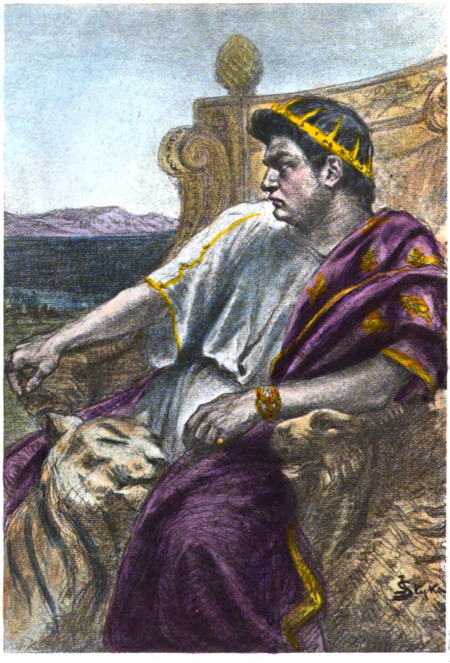
Nero. From a drawing by Jan Styka.
LIST OF ILLUSTRATIONS↩
- Nero. Frontispiece. From a drawing by Jan Styka.
- St. Peter preaching in the Catacombs, page 10. From a drawing by Jan Styka.
- The Christian Martyrs, p. 30. From a drawing by Jan Styka.
- Plan of Constantinople, p. 100
- Constantine’s Coronation at Rome, p. 306. From a painting by Raphael, in the Vatican.
- Baptistery of St. John, in the Lateran, built by Constantine, p. 350. From a photograph.
[III-1]
CHAPTER XVI↩
The Conduct of the Roman Government towards the Christians, from the Reign of Nero to that of Constantine
If we seriously consider the purity of the Christian religion, the sanctity of its moral precepts, and the innocent as well as austere lives of the greater number of those who, during the first ages, embraced the faith of the gospel, we should naturally suppose that so benevolent a doctrine would have been received with due reverence, even by the unbelieving world; that the learned and the polite, however they might deride the miracles, would have esteemed the virtues of the new sect; and that the magistrates, instead of persecuting, would have protected an order of men who yielded the most passive obedience to the laws, though they declined the active cares of war and government. If, on the other hand, we recollect the universal toleration of Polytheism, as it was invariably maintained by the faith of the people, the incredulity of philosophers, and the policy of the Roman senate and emperors, we are at a loss to discover what new offence the Christians had committed, what new provocation could exasperate the mild indifference of antiquity, and what new motives could urge the Roman princes, who beheld, without concern, a thousand forms of religion subsisting in peace under their gentle sway, to inflict a severe punishment on any part of their subjects, who had chosen for themselves a singular, but an inoffensive, mode of faith and worship.
[III-2]
The religious policy of the ancient world seems to have assumed a more stern and intolerant character, to oppose the progress of Christianity. About fourscore years after the death of Christ, his innocent disciples were punished with death, by the sentence of a proconsul of the most amiable and philosophic character, and, according to the laws of an emperor, distinguished by the wisdom and justice of his general administration. The apologies which were repeatedly addressed to the successors of Trajan, are filled with the most pathetic complaints, that the Christians, who obeyed the dictates, and solicited the liberty, of conscience, were alone, among all the subjects of the Roman empire, excluded from the common benefits of their auspicious government. The deaths of a few eminent martyrs have been recorded with care; and from the time that Christianity was invested with the supreme power, the governors of the church have been no less diligently employed in displaying the cruelty, than in imitating the conduct, of their Pagan adversaries. To separate (if it be possible) a few authentic, as well as interesting, facts, from an undigested mass of fiction and error, and to relate, in a clear and rational manner, the causes, the extent, the duration, and the most important circumstances of the persecutions to which the first Christians were exposed, is the design of the present Chapter.
The sectaries of a persecuted religion, depressed by fear, animated with resentment, and perhaps heated by enthusiasm, are seldom in a proper temper of mind calmly to investigate, or candidly to appreciate, the motives of their enemies, which often escape the impartial and discerning view even of those who are placed at a secure distance from the flames of persecution. A reason has been assigned for the conduct of the emperors towards the primitive Christians, which may appear the more specious and probable as it is drawn from the acknowledged genius of Polytheism. It has already been observed that the religious concord of the world was principally supported by the implicit assent and reverence which the [III-3] nations of antiquity expressed for their respective traditions and ceremonies. It might therefore be expected that they would unite with indignation against any sect of people which should separate itself from the communion of mankind, and, claiming the exclusive possession of divine knowledge, should disdain every form of worship, except its own, as impious and idolatrous. The rights of toleration were held by mutual indulgence; they were justly forfeited by a refusal of the accustomed tribute. As the payment of this tribute was inflexibly refused by the Jews, and by them alone, the consideration of the treatment which they experienced from the Roman magistrates will serve to explain how far these speculations are justified by facts, and will lead us to discover the true causes of the persecution of Christianity.
Without repeating what has been already mentioned of the reverence of the Roman princes and governors for the temple of Jerusalem, we shall only observe that the destruction of the temple and city was accompanied and followed by every circumstance that could exasperate the minds of the conquerors, and authorise religious persecution by the most specious arguments of political justice and the public safety. From the reign of Nero to that of Antoninus Pius, the Jews discovered a fierce impatience of the dominion of Rome, which repeatedly broke out in the most furious massacres and insurrections. Humanity is shocked at the recital of the horrid cruelties which they committed in the cities of Egypt, of Cyprus, and of Cyrene, where they dwelt in treacherous friendship with the unsuspecting natives; [1] and we are tempted to applaud the severe retaliation which was exercised by the arms of the legions against a race of fanatics, whose dire and [III-4] credulous superstition seemed to render them the implacable enemies not only of the Roman government, but of human kind. [2] The enthusiasm of the Jews was supported by the opinion that it was unlawful for them to pay taxes to an idolatrous master; and by the flattering promise which they derived from their ancient oracles, that a conquering Messiah would soon arise, destined to break their fetters and to invest the favourites of heaven with the empire of the earth. It was by announcing himself as their long-expected deliverer, and by calling on all the descendants of Abraham to assert the hope of Israel, that the famous Barchochebas collected a formidable army, with which he resisted, during two years, the power of the emperor Hadrian. [3]
Notwithstanding these repeated provocations, the resentment of the Roman princes expired after the victory; nor were their apprehensions continued beyond the period of war and danger. By the general indulgence of Polytheism, and by the mild temper of Antoninus Pius, the Jews were restored to their ancient privileges, and once more obtained the permission of circumcising their children, with the easy restraint that they should never confer on any foreign proselyte that distinguishing mark of the Hebrew race. [4] The numerous remains of that people, though they were still excluded from the precincts of Jerusalem, were permitted to form and to maintain considerable establishments both in Italy and in the provinces, to acquire the freedom of Rome, to enjoy municipal honours, and to obtain, at the same time, an exemption from [III-5] the burdensome and expensive offices of society. The moderation or the contempt of the Romans gave a legal sanction to the form of ecclesiastical police which was instituted by the vanquished sect. The patriarch, who had fixed his residence at Tiberias, was empowered to appoint his subordinate ministers and apostles, to exercise a domestic jurisdiction, and to receive from his dispersed brethren an annual contribution. [5] New synagogues were frequently erected in the principal cities of the empire; and the sabbaths, the fasts, and the festivals, which were either commanded by the Mosaic law or enjoined by the traditions of the Rabbis, were celebrated in the most solemn and public manner. [6] Such gentle treatment insensibly assuaged the stern temper of the Jews. Awakened from their dream of prophecy and conquest, they assumed the behaviour of peaceable and industrious subjects. Their irreconcilable hatred of mankind, instead of flaming out in acts of blood and violence, evaporated in less dangerous gratifications. They embraced every opportunity of overreaching the idolaters in trade; and they pronounced secret and ambiguous imprecations against the haughty kingdom of Edom. [7]
Since the Jews, who rejected with abhorrence the deities adored by their sovereign and by their fellow-subjects, enjoyed, however, the free exercise of their unsocial religion; there must have existed some other cause, which exposed the disciples of Christ to those severities from which the posterity [III-6] of Abraham was exempt. The difference between them is simple and obvious; but, according to the sentiments of antiquity, it was of the highest importance. The Jews were a nation; the Christians were a sect; and, if it was natural for every community to respect the sacred institutions of their neighbours, it was incumbent on them, to persevere in those of their ancestors. The voice of oracles, the precepts of philosophers, and the authority of the laws unanimously enforced this national obligation. By their lofty claim of superior sanctity, the Jews might provoke the Polytheists to consider them as an odious and impure race. By disdaining the intercourse of other nations they might deserve their contempt. The laws of Moses might be for the most part frivolous or absurd; yet, since they had been received during many ages by a large society, his followers were justified by the example of mankind; and it was universally acknowledged that they had a right to practise what it would have been criminal in them to neglect. But this principle which protected the Jewish synagogue afforded not any favour or security to the primitive church. By embracing the faith of the Gospel, the Christians incurred the supposed guilt of an unnatural and unpardonable offence. They dissolved the sacred ties of custom and education, violated the religious institutions of their country, and presumptuously despised whatever their fathers had believed as true, or had reverenced as sacred. Nor was this apostacy (if we may use the expression) merely of a partial or local kind; since the pious deserter who withdrew himself from the temples of Egypt or Syria would equally disdain to seek an asylum in those of Athens or Carthage. Every Christian rejected with contempt the superstitions of his family, his city, and his province. The whole body of Christians unanimously refused to hold any communion with the gods of Rome, of the empire, and of mankind. It was in vain that the oppressed believer asserted the inalienable rights of conscience and private judgment. Though his situation might excite the pity, his arguments [III-7] could never reach the understanding, either of the philosophic or of the believing part of the Pagan world. To their apprehensions, it was no less a matter of surprise that any individuals should entertain scruples against complying with the established mode of worship, than if they had conceived a sudden abhorrence to the manners, the dress, or the language of their native country. [8]
The surprise of the Pagans was soon succeeded by resentment; and the most pious of men were exposed to the unjust but dangerous imputation of impiety. Malice and prejudice concurred in representing the Christians as a society of atheists, who, by the most daring attack on the religious constitution of the empire, had merited the severest animadversion of the civil magistrate. They had separated themselves (they gloried in the confession) from every mode of superstition which was received in any part of the globe by the various temper of Polytheism; but it was not altogether so evident what deity or what form of worship they had substituted to the gods and temples of antiquity. The pure and sublime idea which they entertained of the Supreme Being escaped the gross conception of the Pagan multitude, who were at a loss to discover a spiritual and solitary God, that was neither represented under any corporeal figure or visible symbol, nor was adored with the accustomed pomp of libations and festivals, of altars and sacrifices. [9] The sages of Greece and Rome, who had elevated their minds to the contemplation of the existence and attributes of the First Cause, [III-8] were induced, by reason or by vanity, to reserve for themselves and their chosen disciples the privilege of this philosophical devotion. [10] They were far from admitting the prejudices of mankind as the standard of truth; but they considered them as flowing from the original disposition of human nature; and they supposed that any popular mode of faith and worship which presumed to disclaim the assistance of the senses would, in proportion as it receded from superstition, find itself incapable of restraining the wanderings of the fancy and the visions of fanaticism. The careless glance which men of wit and learning condescended to cast on the Christian revelation served only to confirm their hasty opinion, and to persuade them that the principle, which they might have revered, of the divine unity was defaced by the wild enthusiasm, and annihilated by the airy speculations, of the new sectaries. The author of a celebrated dialogue which has been attributed to Lucian, whilst he affects to treat the mysterious subject of the Trinity in a style of ridicule and contempt, betrays his own ignorance of the weakness of human reason, and of the inscrutable nature of the divine perfections. [11]
It might appear less surprising that the founder of Christianity should not only be revered by his disciples as a sage and a prophet, but that he should be adored as a God. The [III-9] Polytheists were disposed to adopt every article of faith which seemed to offer any resemblance, however distant or imperfect, with the popular mythology; and the legends of Bacchus, of Hercules, and of Æsculapius had, in some measure, prepared their imagination for the appearance of the Son of God under a human form. [12] But they were astonished that the Christians should abandon the temples of those ancient heroes who, in the infancy of the world, had invented arts, instituted laws, and vanquished the tyrants or monsters who infested the earth; in order to choose, for the exclusive object of their religious worship, an obscure teacher who, in a recent age, and among a barbarous people, had fallen a sacrifice either to the malice of his own countrymen, or to the jealousy of the Roman government. The Pagan multitude, reserving their gratitude for temporal benefits alone, rejected the inestimable present of life and immortality which was offered to mankind by Jesus of Nazareth. His mild constancy in the midst of cruel and voluntary sufferings, his universal benevolence, and the sublime simplicity of his actions and character were insufficient, in the opinion of those carnal men, to compensate for the want of fame, of empire, and of success; and, whilst they refused to acknowledge his stupendous triumph over the powers of darkness and of the grave, they misrepresented, or they insulted, the equivocal birth, wandering life, and ignominious death of the divine Author of Christianity. [13]
The personal guilt which every Christian had contracted, in thus preferring his private sentiment to the national religion, was aggravated, in a very high degree, by the number and [III-10] union of the criminals. It is well known, and has been already observed, that Roman policy viewed with the utmost jealousy and distrust any association among its subjects; and that the privileges of private corporations, though formed for the most harmless or beneficial purposes, were bestowed with a very sparing hand. [14] The religious assemblies of the Christians, who had separated themselves from the public worship, appeared of a much less innocent nature: they were illegal in their principle and in their consequences might become dangerous; nor were the emperors conscious that they violated the laws of justice, when, for the peace of society, they prohibited those secret and sometimes nocturnal meetings. [15] The pious disobedience of the Christians made their conduct, or perhaps their designs, appear in a much more serious and criminal light; and the Roman princes, who might perhaps have suffered themselves to be disarmed by a ready submission, deeming their honour concerned in the execution of their commands, sometimes attempted by rigorous punishments to subdue this independent spirit, which boldly acknowledged an authority superior to that of the magistrate. The extent and duration of this spiritual conspiracy seemed to render it every day more deserving of his animadversion. We have already seen that the active and successful zeal of the Christians had insensibly diffused them through every province and almost every city of the empire. The new converts seemed to renounce their family and country, that they might connect themselves in an indissoluble band of union with a peculiar society, which everywhere assumed a different character from the rest of mankind. Their gloomy and austere aspect, their abhorrence of the common business and pleasures of life, and [III-none] [III-11] their frequent predictions of impending calamities, [16] inspired the Pagans with the apprehension of some danger which would arise from the new sect, the more alarming as it was the more obscure. “Whatever,” says Pliny, “may be the principle of their conduct, their inflexible obstinacy appeared deserving of punishment.” [17]
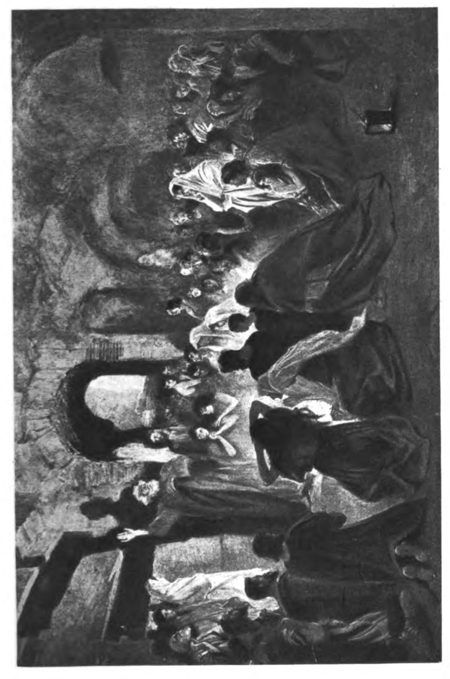
(See this image in horizontal aspect [here].)
St. Peter preaching in the Catacombs. From a drawing by Jan Styka.
The precautions with which the disciples of Christ performed the offices of religion were at first dictated by fear and necessity; but they were continued from choice. By imitating the awful secrecy which reigned in the Eleusinian mysteries, the Christians had flattered themselves that they should render their sacred institutions more respectable in the eyes of the Pagan world. [18] But the event, as it often happens to the operations of subtile policy, deceived their wishes and their expectations. It was concluded that they only concealed what they would have blushed to disclose. Their mistaken prudence afforded an opportunity for malice to invent, and for suspicious credulity to believe, the horrid tales which described the Christians as the most wicked of human kind, who practised in their dark recesses every abomination that a depraved fancy could suggest, and who solicited the favour of their unknown God by the sacrifice of every moral virtue. There were many who pretended to confess or to relate the ceremonies of this abhorred society. It was asserted, “that a new-born infant, entirely covered over with flour, was presented, like some mystic symbol of initiation, to the knife of the proselyte, who unknowingly inflicted many a secret and mortal wound on the innocent victim of his error; that, as soon as the cruel deed was perpetrated, the sectaries drank [III-12] up the blood, greedily tore asunder the quivering members, and pledged themselves to eternal secrecy, by a mutual consciousness of guilt. It was as confidently affirmed that this inhuman sacrifice was succeeded by a suitable entertainment, in which intemperance served as a provocative to brutal lust; till, at the appointed moment, the lights were suddenly extinguished, shame was banished, nature was forgotten; and, as accident might direct, the darkness of the night was polluted by the incestuous commerce of sisters and brothers, of sons and of mothers.” [19]
But the perusal of the ancient apologies was sufficient to remove even the slightest suspicion from the mind of a candid adversary. The Christians, with the intrepid security of innocence, appeal from the voice of rumour to the equity of the magistrates. They acknowledge that, if any proof can be produced of the crimes which calumny has imputed to them, they are worthy of the most severe punishment. They provoke the punishment, and they challenge the proof. At the same time they urge, with equal truth and propriety, that the charge is not less devoid of probability than it is destitute of evidence; they ask whether any one can seriously believe that the pure and holy precepts of the Gospel, which so frequently restrain the use of the most lawful enjoyments, should inculcate the practice of the most abominable crimes; that a large society should resolve to dishonour itself in the eyes of its own members; and that a great number of persons of either sex, and every age and character, insensible to the fear of death or infamy, should consent to violate those principles which nature and education had imprinted most deeply in their minds. [20] [III-13] Nothing, it should seem, could weaken the force or destroy the effect of so unanswerable a justification, unless it were the injudicious conduct of the apologists themselves, who betrayed the common cause of religion, to gratify their devout hatred to the domestic enemies of the church. It was sometimes faintly insinuated, and sometimes boldly asserted, that the same bloody sacrifices, and the same incestuous festivals, which were so falsely ascribed to the orthodox believers, were in reality celebrated by the Marcionites, by the Carpocratians, and by several other sects of the Gnostics, who, notwithstanding they might deviate into the paths of heresy, were still actuated by the sentiments of men, and still governed by the precepts of Christianity. [21] Accusations of a similar kind were retorted upon the church by the schismatics who had departed from its communion; [22] and it was confessed on all sides that the most scandalous licentiousness of manners prevailed among great numbers of those who affected the name of Christians. A Pagan magistrate, who possessed neither leisure nor abilities to discern the almost imperceptible line which divides the orthodox faith from heretical pravity, might easily have imagined that their mutual animosity had extorted the discovery of their common guilt. It was fortunate for the repose, or at least for the reputation, of the first Christians, that the [III-14] magistrates sometimes proceeded with more temper and moderation than is usually consistent with religious zeal, and that they reported, as the impartial result of their judicial inquiry, that the sectaries who had deserted the established worship appeared to them sincere in their professions and blameless in their manners; however they might incur, by their absurd and excessive superstition, the censure of the laws. [23]
History, which undertakes to record the transactions of the past, for the instruction of future, ages, would ill deserve that honourable office, if she condescended to plead the cause of tyrants, or to justify the maxims of persecution. It must, however, be acknowledged that the conduct of the emperors who appeared the least favourable to the primitive church is by no means so criminal as that of modern sovereigns who have employed the arm of violence and terror against the religious opinions of any part of their subjects. From their reflections, or even from their own feelings, a Charles V. or a Louis XIV. might have acquired a just knowledge of the rights of conscience, of the obligation of faith, and of the innocence of error. But the princes and magistrates of ancient Rome were strangers to those principles which inspired and authorised the inflexible obstinacy of the Christians in the cause of truth, nor could they themselves discover in their own breasts any motive which would have prompted them to refuse a legal, and as it were a natural, submission to the sacred institutions of their country. The same reason which contributes to alleviate the guilt, must have tended to abate the rigour, of their persecutions. As they were actuated, not by the furious zeal of bigots, but by the temperate policy of legislators, contempt must often have relaxed, and humanity must frequently have suspended, the execution of those laws which they enacted against the humble and obscure [III-15] followers of Christ. From the general view of their character and motives we might naturally conclude: I. That a considerable time elapsed before they considered the new sectaries as an object deserving of the attention of government. II. That, in the conviction of any of their subjects who were accused of so very singular a crime, they proceeded with caution and reluctance. III. That they were moderate in the use of punishments; and IV. That the afflicted church enjoyed many intervals of peace and tranquillity. Notwithstanding the careless indifference which the most copious and the most minute of the Pagan writers have shewn to the affairs of the Christians, [24] it may still be in our power to confirm each of these probable suppositions by the evidence of authentic facts.
I. By the wise dispensation of Providence, a mysterious veil was cast over the infancy of the church, which, till the faith of the Christians was matured and their numbers were multiplied, served to protect them not only from the malice, but even from the knowledge, of the Pagan world. The slow and gradual abolition of the Mosaic ceremonies afforded a safe and innocent disguise to the more early proselytes of the Gospel. As they were far the greater part of the race of Abraham, they were distinguished by the peculiar mark of circumcision, offered up their devotions in the Temple of Jerusalem till its final destruction, and received both the Law and the Prophets as the genuine inspirations of the Deity. The Gentile converts, who by a spiritual adoption had been associated to the hope of Israel, were likewise confounded under the garb and appearance of Jews, [25] and, as the Polytheists paid less regard [III-16] to articles of faith than to the external worship, the new sect, which carefully concealed, or faintly announced, its future greatness and ambition, was permitted to shelter itself under the general toleration which was granted to an ancient and celebrated people in the Roman empire. It was not long, perhaps, before the Jews themselves, animated with a fiercer zeal and a more jealous faith, perceived the gradual separation of their Nazarene brethren from the doctrine of the synagogue; and they would gladly have extinguished the dangerous heresy in the blood of its adherents. But the decrees of heaven had already disarmed their malice; and, though they might sometimes exert the licentious privilege of sedition, they no longer possessed the administration of criminal justice; nor did they find it easy to infuse into the calm breast of a Roman magistrate the rancour of their own zeal and prejudice. The provincial governors declared themselves ready to listen to any accusation that might affect the public safety; but, as soon as they were informed that it was a question not of facts but of words, a dispute relating only to the interpretation of the Jewish laws and prophecies, they deemed it unworthy of the majesty of Rome seriously to discuss the obscure differences which might arise among a barbarous and superstitious people. The innocence of the first Christians was protected by ignorance and contempt; and the tribunal of the Pagan magistrate often proved their most assured refuge against the fury of the synagogue. [26] If, indeed, we were disposed to adopt the traditions of a too credulous antiquity, we might relate the distant peregrinations, the wonderful achievements, and the various deaths, of the twelve apostles; but a more accurate inquiry will induce us to doubt whether any of those persons who had been witnesses to the miracles of Christ were permitted, beyond the limits of Palestine, to seal with their blood the truth of their testimony. [27] From the ordinary term [III-17] of human life, it may very naturally be presumed that most of them were deceased before the discontent of the Jews broke out into that furious war which was terminated only by the ruin of Jerusalem. During a long period, from the death of Christ to that memorable rebellion, we cannot discover any traces of Roman intolerance, unless they are to be found in the sudden, the transient, but the cruel persecution, which was exercised by Nero against the Christians of the capital, thirty-five years after the former, and only two years before the latter, of those great events. The character of the philosophic historian, to whom we are principally indebted for the knowledge of this singular transaction, would alone be sufficient to recommend it to our most attentive consideration.
In the tenth year of the reign of Nero, the capital of the empire was afflicted by a fire which raged beyond the memory or example of former ages. [28] The monuments of Grecian art and of Roman virtue, the trophies of the Punic and Gallic wars, the most holy temples, and the most splendid palaces were involved in one common destruction. Of the fourteen regions or quarters into which Rome was divided, four only subsisted entire, three were levelled with the ground, and the remaining seven, which had experienced the fury of the flames, displayed a melancholy prospect of ruin and desolation. The vigilance of government appears not to have neglected any of the precautions which might alleviate the sense of so dreadful a calamity. The Imperial gardens were thrown open to the distressed multitude, temporary buildings were erected for their accommodation, and a plentiful supply of corn and provisions was distributed at a very moderate price. [29] The most [III-18] generous policy seemed to have dictated the edicts which regulated the disposition of the streets and the construction of private houses; and, as it usually happens in an age of prosperity, the conflagration of Rome, in the course of a few years, produced a new city, more regular and more beautiful than the former. But all the prudence and humanity affected by Nero on this occasion were insufficient to preserve him from the popular suspicion. Every crime might be imputed to the assassin of his wife and mother; nor could the prince who prostituted his person and dignity on the theatre be deemed incapable of the most extravagant folly. The voice of rumour accused the emperor as the incendiary of his own capital; and, as the most incredible stories are the best adapted to the genius of an enraged people, it was gravely reported, and firmly believed, that Nero, enjoying the calamity which he had occasioned, amused himself with singing to his lyre the destruction of ancient Troy. [30] To divert a suspicion which the power of despotism was unable to suppress the emperor resolved to substitute in his own place some fictitious criminals. “With this view (continues Tacitus) he inflicted the most exquisite tortures on those men, who, under the vulgar appellation of Christians, were already branded with deserved infamy. They derived their name and origin from Christ, who, in the reign of Tiberius, had suffered death, by the sentence of the procurator Pontius Pilate. [31] For a while [III-19] this dire superstition was checked; but it again burst forth, and not only spread itself over Judæa, the first seat of this mischievous sect, but was even introduced into Rome, the common asylum which receives and protects whatever is impure, whatever is atrocious. The confessions of those who were seized, discovered a great multitude of their accomplices, and they were all convicted, not so much for the crime of setting fire to the city, as for their hatred of human kind. [32] They died in torments, and their torments were embittered by insult and derision. Some were nailed on crosses; others sewn up in the skins of wild beasts, and exposed to the fury of dogs; others again, smeared over with combustible materials, were used as torches to illuminate the darkness of the night. The gardens of Nero were destined for the melancholy spectacle, which was accompanied with a horse race, and honoured with the presence of the emperor, who mingled with the populace in the dress and attitude of a charioteer. The guilt of the Christians deserved, indeed, the most exemplary punishment, but the public abhorrence was changed into commiseration, from the opinion that those unhappy wretches were sacrificed, not so much to the public welfare, as to the cruelty of a jealous tyrant.” [33] Those who survey, [III-20] with a curious eye, the revolutions of mankind may observe that the gardens and circus of Nero on the Vatican, which were polluted with the blood of the first Christians, have been rendered still more famous by the triumph and by the abuse of the persecuted religion. On the same spot, [34] a temple, which far surpasses the ancient glories of the Capitol, has been since erected by the Christian Pontiffs, who, deriving their claim of universal dominion from an humble fisherman of Galilee, have succeeded to the throne of the Cæsars, given laws to the barbarian conquerors of Rome, and extended their spiritual jurisdiction from the coast of the Baltic to the shores of the Pacific Ocean.
But it would be improper to dismiss this account of Nero’s persecution, till we have made some observations, that may serve to remove the difficulties with which it is perplexed and to throw some light on the subsequent history of the church.
1. The most sceptical criticism is obliged to respect the truth of this extraordinary fact, and the integrity of this celebrated passage of Tacitus. The former is confirmed by the diligent and accurate Suetonius, who mentions the punishment which Nero inflicted on the Christians, a sect of men who had embraced a new and criminal superstition. [35] The latter may be proved by the consent of the most ancient manuscripts; by the inimitable character of the style of Tacitus; by his reputation, which guarded his text from the interpolations of pious fraud; and by the purport of his narration, which accused the first Christians of the most atrocious crimes, without insinuating that they possessed any miraculous or even magical powers above the rest of mankind. [36] [III-21] 2. Notwithstanding it is probable that Tacitus was born some years before the fire of Rome, [37] he could derive only from reading and conversation the knowledge of an event which happened during his infancy. Before he gave himself to the Public, he calmly waited till his genius had attained its full maturity, and he was more than forty years of age, when a grateful regard for the memory of the virtuous Agricola extorted from him the most early of those historical compositions which will delight and instruct the most distant posterity. After making a trial of his strength in the life of Agricola and the description of Germany, he conceived, and at length executed, a more arduous work: the history of Rome, in thirty books, from the fall of Nero to the accession of Nerva. The administration of Nerva introduced an age of justice and prosperity, which Tacitus had destined for the occupation of his old age; [38] but, when he took a nearer view of his subject, judging, perhaps, that it was a more honourable or a less invidious office to record the vices of past tyrants than to celebrate the virtues of a reigning monarch, he chose rather to relate, under the form of annals, the actions of four [III-22] immediate successors of Augustus. To collect, to dispose, and to adorn a series of fourscore years in an immortal work, every sentence of which is pregnant with the deepest observations and the most lively images, was an undertaking sufficient to exercise the genius of Tacitus himself during the greatest part of his life. In the last years of the reign of Trajan, whilst the victorious monarch extended the power of Rome beyond its ancient limits, the historian was describing, in the second and fourth books of his annals, the tyranny of Tiberius; [39] and the emperor Hadrian must have succeeded to the throne, before Tacitus, in the regular prosecution of his work, could relate the fire of the capital and the cruelty of Nero towards the unfortunate Christians. At the distance of sixty years, it was the duty of the annalist to adopt the narratives of contemporaries; but it was natural for the philosopher to indulge himself in the description of the origin, the progress, and the character of the new sect, not so much according to the knowledge or prejudices of the age of Nero, as according to those of the time of Hadrian. 3. Tacitus very frequently trusts to the curiosity or reflection of his readers to supply those intermediate circumstances and ideas which, in his extreme conciseness, he has thought proper to suppress. We may, therefore, presume to imagine some probable cause which could direct the cruelty of Nero against the Christians of Rome, whose obscurity, as well as innocence, should have shielded them from his indignation, and even from his notice. The Jews, who were numerous in the capital, and oppressed in their own country, were a much fitter object for the suspicions of the emperor and of the people; nor did it seem unlikely that a vanquished nation, who already discovered their abhorrence of the Roman yoke, might have recourse to the most atrocious means of gratifying their implacable revenge. But the Jews possessed very powerful advocates in the palace, and even in the heart of the tyrant: his wife and mistress, the beautiful [III-23] Poppæa, and a favourite player of the race of Abraham, who had already employed their intercession in behalf of the obnoxious people. [40] In their room it was necessary to offer some other victims, and it might easily be suggested, that, although the genuine followers of Moses were innocent of the fire of Rome, there had arisen among them a new and pernicious sect of Galilæans, which was capable of the most horrid crimes. Under the appellation of Galilæans, two distinctions of men were confounded, the most opposite to each other in their manners and principles: the disciples who had embraced the faith of Jesus of Nazareth, [41] and the zealots who had followed the standard of Judas the Gaulonite. [42] The former were the friends, and the latter were the enemies, of human kind; and the only resemblance between them consisted in the same inflexible constancy which, in the defence of their cause, rendered them insensible of death and tortures. The followers of Judas, who impelled their countrymen into rebellion, were soon buried under the ruins of Jerusalem; whilst those of Jesus, known by the more celebrated name of Christians, diffused themselves over the Roman empire. How natural was it for Tacitus, in the time of Hadrian, to appropriate to the Christians the guilt and the sufferings which he might, with far greater truth and justice, have attributed to a sect whose odious memory was almost extinguished! 4. Whatever opinion may be entertained of this conjecture (for it is no more than a conjecture), it is evident [III-24] that the effect, as well as the cause, of Nero’s persecution were confined to the walls of Rome; [43] that the religious tenets of the Galilæans, or Christians, were never made a subject of punishment or even of inquiry; and that, as the idea of their sufferings was, for a long time, connected with the idea of cruelty and injustice, the moderation of succeeding princes inclined them to spare a sect, oppressed by a tyrant whose rage had been usually directed against virtue and innocence.
It is somewhat remarkable that the flames of war consumed almost at the same time the temple of Jerusalem and the Capitol of Rome; [44] and it appears no less singular that the tribute which devotion had destined to the former should have been converted by the power of an assaulting victor to restore and adorn the splendour of the latter. [45] The emperors levied a general capitation tax on the Jewish people; and, although the sum assessed on the head of each individual was inconsiderable, the use for which it was designed, and the severity with which it was exacted, were considered as an intolerable grievance. [46] Since the officers of the revenue extended their unjust claim to many persons who were strangers to the blood or religion of the Jews, it was impossible that the Christians, [III-25] who had so often sheltered themselves under the shade of the synagogue, should now escape this rapacious persecution. Anxious as they were to avoid the slightest infection of idolatry, their conscience forbade them to contribute to the honour of that dæmon who had assumed the character of the Capitoline Jupiter. As a very numerous, though declining, party among the Christians still adhered to the law of Moses, their efforts to dissemble their Jewish origin were detected by the decisive test of circumcision, [47] nor were the Roman magistrates at leisure to inquire into the difference of their religious tenets. Among the Christians who were brought before the tribunal of the emperor, or, as it seems more probable, before that of the procurator of Judæa, two persons are said to have appeared, distinguished by their extraction, which was more truly noble than that of the greatest monarchs. These were the grandsons of St. Jude the apostle, who himself was the brother of Jesus Christ. [48] Their natural pretensions to the throne of David might perhaps attract the respect of the people, and excite the jealousy of the governor; but the meanness of their garb and the simplicity of their answers soon convinced him that they were neither desirous nor capable of disturbing the peace of the Roman empire. They frankly confessed their royal origin and their near relation to the Messiah; but they disclaimed any temporal views, and professed that his kingdom, which they devoutly expected, was [III-26] purely of a spiritual and angelic nature. When they were examined concerning their fortune and occupation, they shewed their hands hardened with daily labour, and declared that they derived their whole subsistence from the cultivation of a farm near the village of Cocaba, of the extent of about twenty-four English acres, [49] and of the value of nine thousand drachms, or three hundred pounds sterling. The grandsons of St. Jude were dismissed with compassion and contempt. [50]
But, although the obscurity of the house of David might protect them from the suspicions of a tyrant, the present greatness of his own family alarmed the pusillanimous temper of Domitian, which could only be appeased by the blood of those Romans whom he either feared, or hated, or esteemed. Of the two sons of his uncle Flavius Sabinus, [51] the elder was soon convicted of treasonable intentions, and the younger, who bore the name of Flavius Clemens, was indebted for his safety to his want of courage and ability. [52] The emperor, for a long time, distinguished so harmless a kinsman by his favour and protection, bestowed on him his own niece Domitilla, adopted the children of that marriage to the hope of the succession, and invested their father with the honours of the consulship. But he had scarcely finished the term of his annual magistracy, when, on a slight pretence, he was condemned and executed; Domitilla was banished to a desolate island on the coast of Campania; [53] and sentences [III-27] either of death or of confiscation were pronounced against a great number of persons who were involved in the same accusation. The guilt imputed to their charge was that of Atheism and Jewish manners; [54] a singular association of ideas, which cannot with any propriety be applied except to the Christians, as they were obscurely and imperfectly viewed by the magistrates and by the writers of that period. On the strength of so probable an interpretation, and too eagerly admitting the suspicions of a tyrant as an evidence of their honourable crime, the church has placed both Clemens and Domitilla among its first martyrs, and has branded the cruelty of Domitian with the name of the second persecution. But this persecution (if it deserves that epithet) was of no long duration. A few months after the death of Clemens and the banishment of Domitilla, Stephen, a freedman belonging to the latter, who had enjoyed the favour, but who had not surely embraced the faith, of his mistress, assassinated the emperor in his palace. [55] The memory of Domitian was condemned by the senate; his acts were rescinded; his exiles recalled; and under the gentle administration of Nerva, while the innocent were restored to their rank and fortunes, even the most guilty either obtained pardon or escaped punishment. [56]
II. About ten years afterwards, under the reign of Trajan, the younger Pliny was entrusted by his friend and master with the government of Bithynia and Pontus. He soon found himself at a loss to determine by what rule of justice or of law he should direct his conduct in the execution of an office the most repugnant to his humanity. Pliny had never [III-28] assisted at any judicial proceedings against the Christians, with whose name alone he seems to be acquainted; and he was totally uninformed with regard to the nature of their guilt, the method of their conviction, and the degree of their punishment. In this perplexity he had recourse to his usual expedient, of submitting to the wisdom of Trajan an impartial and, in some respects, a favourable account of the new superstition, requesting the emperor that he would condescend to resolve his doubts and to instruct his ignorance. [57] The life of Pliny had been employed in the acquisition of learning, and in the business of the world. Since the age of nineteen he had pleaded with distinction in the tribunals of Rome, [58] filled a place in the senate, had been invested with the honours of the consulship, and had formed very numerous connections with every order of men, both in Italy and in the provinces. From his ignorance, therefore, we may derive some useful information. We may assure ourselves that when he accepted the government of Bithynia there were no general laws or decrees of the senate in force against the Christians; that neither Trajan nor any of his virtuous predecessors, whose edicts were received into the civil and criminal jurisprudence, had publicly declared their intentions concerning the new sect; and that, whatever proceedings had been carried on against the Christians, there were none of sufficient weight and authority to establish a precedent for the conduct of a Roman magistrate.
The answer of Trajan, to which the Christians of the succeeding age have frequently appealed, discovers as much regard for justice and humanity as could be reconciled with [III-29] his mistaken notions of religious policy. [59] Instead of displaying the implacable zeal of an inquisitor, anxious to discover the most minute particles of heresy and exulting in the number of his victims, the emperor expresses much more solicitude to protect the security of the innocent than to prevent the escape of the guilty. He acknowledges the difficulty of fixing any general plan; but he lays down two salutary rules, which often afforded relief and support to the distressed Christians. Though he directs the magistrates to punish such persons as are legally convicted, he prohibits them, with a very humane inconsistency, from making any inquiries concerning the supposed criminals. Nor was the magistrate allowed to proceed on every kind of information. Anonymous charges the emperor rejects, as too repugnant to the equity of his government; and he strictly requires, for the conviction of those to whom the guilt of Christianity is imputed, the positive evidence of a fair and open accuser. It is likewise probable that the persons who assumed so invidious an office were obliged to declare the grounds of their suspicions, to specify (both in respect to time and place) the secret assemblies which their Christian adversary had frequented, and to disclose a great number of circumstances which were concealed with the most vigilant jealousy from the eye of the profane. If they succeeded in their prosecution, they were exposed to the resentment of a considerable and active party, to the censure of the more liberal portion of mankind, and to the ignominy which, in every age and country, has attended the character of an informer. If, on the contrary, they failed in their proofs, they incurred the severe, and perhaps capital, penalty which, according to a law published by the emperor Hadrian, was inflicted on those who falsely attributed to their fellow-citizens [III-30] the crime of Christianity. The violence of personal or superstitious animosity might sometimes prevail over the most natural apprehensions of disgrace and danger; but it cannot surely be imagined that accusations of so unpromising an appearance were either lightly or frequently undertaken by the Pagan subjects of the Roman empire. [60]
The expedient which was employed to elude the prudence of the laws affords a sufficient proof how effectually they disappointed the mischievous designs of private malice or superstitious zeal. In a large and tumultuous assembly, the restraints of fear and shame, so forcible on the minds of individuals, are deprived of the greatest part of their influence. The pious Christian, as he was desirous to obtain or to escape the glory of martyrdom, expected, either with impatience or with terror, the stated returns of the public games and festivals. On those occasions, the inhabitants of the great cities of the empire were collected in the circus of the theatre, where every circumstance of the place, as well as of the ceremony, contributed to kindle their devotion and to extinguish their humanity. Whilst the numerous spectators, crowned with garlands, perfumed with incense, purified with the blood of victims, and surrounded with the altars and statues of their tutelar deities, resigned themselves to the enjoyment of pleasures which they considered as an essential part of their religious worship; they recollected that the Christians alone abhorred the gods of mankind, and by their absence and melancholy on these solemn festivals seemed to insult or to lament the public felicity. If the empire had been afflicted by any recent calamity, by a plague, a famine, or an unsuccessful war; if the Tiber had, or if the Nile had not, risen beyond its banks; if the earth had shaken, or if the [III-none] [III-31] temperate order of the seasons had been interrupted, the superstitious Pagans were convinced that the crimes and the impiety of the Christians, who were spared by the excessive lenity of the government, had at length provoked the Divine Justice. It was not among a licentious and exasperated populace that the forms of legal proceedings could be observed; it was not in an amphitheatre, stained with the blood of wild beasts and gladiators, that the voice of compassion could be heard. The impatient clamours of the multitude denounced the Christians as the enemies of gods and men, doomed them to the severest tortures, and, venturing to accuse by name some of the most distinguished of the new sectaries, required, with irresistible vehemence, that they should be instantly apprehended and cast to the lions. [61] The provincial governors and magistrates who presided in the public spectacles were usually inclined to gratify the inclinations, and to appease the rage, of the people by the sacrifice of a few obnoxious victims. But the wisdom of the emperors protected the church from the danger of these tumultuous clamours and irregular accusations, which they justly censured as repugnant both to the firmness and to the equity of their administration. The edicts of Hadrian and of Antoninus Pius expressly declared that the voice of the multitude should never be admitted as legal evidence to convict or to punish those unfortunate persons who had embraced the enthusiasm of the Christians. [62]
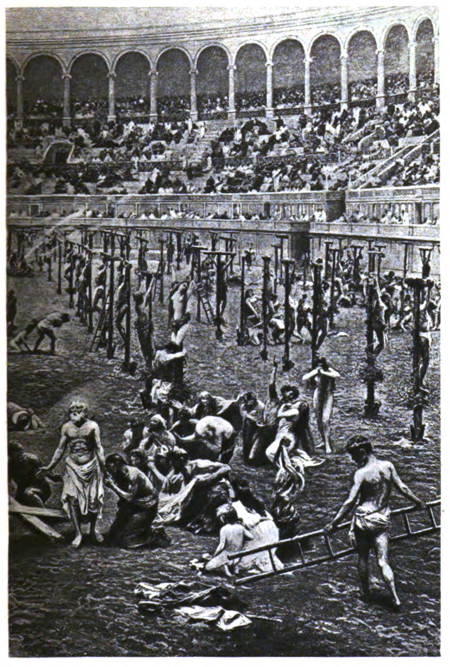
The Christian Martyrs. From a drawing by Jan Styka.
III. Punishment was not the inevitable consequence of conviction, and the Christians, whose guilt was the most clearly proved by the testimony of witnesses, or even by their voluntary confession, still retained in their own power the alternative of life or death. It was not so much the past [III-32] offence, as the actual resistance, which excited the indignation of the magistrate. He was persuaded that he offered them an easy pardon, since, if they consented to cast a few grains of incense upon the altar, they were dismissed from the tribunal in safety and with applause. It was esteemed the duty of a humane judge to endeavour to reclaim, rather than to punish, those deluded enthusiasts. Varying his tone according to the age, the sex, or the situation of the prisoners, he frequently condescended to set before their eyes every circumstance which could render life more pleasing, or death more terrible; and to solicit, nay, to entreat them, that they would show some compassion to themselves, to their families, and to their friends. [63] If threats and persuasions proved ineffectual, he had often recourse to violence; the scourge and the rack were called in to supply the deficiency of argument, and every art of cruelty was employed to subdue such inflexible and, as it appeared to the Pagans, such criminal obstinacy. The ancient apologists of Christianity have censured, with equal truth and severity, the irregular conduct of their persecutors, who, contrary to every principle of judicial proceeding, admitted the use of torture, in order to obtain not a confession but a denial of the crime which was the object of their inquiry. [64] The monks of succeeding ages, who, in their peaceful solitudes, entertained themselves with diversifying the death and sufferings of the primitive martyrs, have frequently invented torments of a much more refined and ingenious nature. In particular, it has pleased them to suppose that the zeal of the Roman magistrates, disdaining every consideration of moral virtue or public decency, endeavoured to seduce those whom they were unable to vanquish, and that, by their orders, the most brutal violence [III-33] was offered to those whom they found it impossible to seduce. It is related that pious females, who were prepared to despise death, were sometimes condemned to a more severe trial, and called upon to determine whether they set a higher value on their religion or on their chastity. The youths to whose licentious embraces they were abandoned received a solemn exhortation from the judge to exert their most strenuous efforts to maintain the honour of Venus against the impious virgin who refused to burn incense on her altars. Their violence, however, was commonly disappointed; and the seasonable interposition of some miraculous power preserved the chaste spouses of Christ from the dishonour even of an involuntary defeat. We should not, indeed, neglect to remark that the more ancient, as well as authentic, memorials of the church are seldom polluted with these extravagant and indecent fictions. [65]
The total disregard of truth and probability in the representation of these primitive martyrdoms was occasioned by a very natural mistake. The ecclesiastical writers of the fourth or fifth centuries ascribed to the magistrates of Rome the same degree of implacable and unrelenting zeal which filled their own breasts against the heretics or the idolaters of their own times. It is not improbable that some of those persons who were raised to the dignities of the empire might have imbibed the prejudices of the populace, and that the cruel disposition of others might occasionally be stimulated by motives of avarice or of personal resentment. [66] But it is certain, and we may appeal to the grateful confessions of the first Christians, that the greatest part of those magistrates [III-34] who exercised in the provinces the authority of the emperor, or of the senate, and to whose hands alone the jurisdiction of life and death was entrusted, behaved like men of polished manners and liberal educations, who respected the rules of justice, and who were conversant with the precepts of philosophy. They frequently declined the odious task of persecution, dismissed the charge with contempt, or suggested to the accused Christian some legal evasion by which he might elude the severity of the laws. [67] Whenever they were invested with a discretionary power, [68] they used it much less for the oppression than for the relief and benefit of the afflicted church. They were far from condemning all the Christians who were accused before their tribunal, and very far from punishing with death all those who were convicted of an obstinate adherence to the new superstition. Contenting themselves, for the most part, with the milder chastisements of imprisonment, exile, or slavery in the mines, [69] they left the unhappy victims of their justice some reason to hope that a prosperous event, the accession, the marriage, or the triumph of an emperor might speedily restore them, by a general pardon, to their former state. The martyrs, devoted to immediate execution by the Roman magistrates, appear to have been selected from the most opposite extremes. They were either bishops and presbyters, the persons the most distinguished among the Christians by their rank and influence, and whose example might strike terror into the whole sect; [70] or else they were [III-35] the meanest and most abject among them, particularly those of the servile condition, whose lives were esteemed of little value, and whose sufferings were viewed by the ancients with too careless an indifference. [71] The learned Origen, who, from his experience as well as reading, was intimately acquainted with the history of the Christians, declares, in the most express terms, that the number of martyrs was very inconsiderable. [72] His authority would alone be sufficient to annihilate that formidable army of martyrs whose relics, drawn for the most part from the catacombs of Rome, have replenished so many churches, [73] and whose marvellous achievements have been the subject of so many volumes [III-36] of holy romance. [74] But the general assertion of Origen may be explained and confirmed by the particular testimony of his friend Dionysius, who, in the immense city of Alexandria, and under the rigorous persecution of Decius, reckons only ten men and seven women who suffered for the profession of the Christian name. [75]
During the same period of persecution, the zealous, the eloquent, the ambitious Cyprian governed the church, not only of Carthage, but even of Africa. He possessed every quality which could engage the reverence of the faithful or provoke the suspicions and resentment of the Pagan magistrates. His character as well as his station seemed to mark out that holy prelate as the most distinguished object of envy and of danger. [76] The experience, however, of the life of Cyprian is sufficient to prove that our fancy has exaggerated the perilous situation of a Christian bishop; and that the dangers to which he was exposed were less imminent than those which temporal ambition is always prepared to encounter in the pursuit of honours. Four Roman emperors, with their families, their favourites, and their adherents, perished by the sword in the space of ten years, during which the bishop of Carthage guided, by his authority [III-37] and eloquence, the counsels of the African church. It was only in the third year of his administration that he had reason, during a few months, to apprehend the severe edicts of Decius, the vigilance of the magistrate, and the clamours of the multitude, who loudly demanded that Cyprian, the leader of the Christians, should be thrown to the lions. Prudence suggested the necessity of a temporary retreat, and the voice of prudence was obeyed. He withdrew himself into an obscure solitude, from whence he could maintain a constant correspondence with the clergy and people of Carthage; and, concealing himself till the tempest was past, he preserved his life, without relinquishing either his power or his reputation. His extreme caution did not, however, escape the censure of the more rigid Christians who lamented, or the reproaches of his personal enemies who insulted, a conduct which they considered as a pusillanimous and criminal desertion of the most sacred duty. [77] The propriety of reserving himself for the future exigencies of the church, the example of several holy bishops, [78] and the divine admonitions which, as he declares himself, he frequently received in visions and ecstacies, were the reasons alleged in his justification. [79] But his best apology may be found in the cheerful resolution with which, about eight years afterwards, he suffered death in the cause of religion. The authentic history of his martyrdom has been recorded with unusual candour and impartiality. A short abstract, therefore, of its most important circumstnaces will convey the clearest information of the spirit, and of the forms, of the Roman persecutions. [80]
[III-38]
When Valerian was consul for the third, and Gallienus for the fourth, time, Paternus, proconsul of Africa, summoned Cyprian to appear in his private council-chamber. He there acquainted him with the Imperial mandate which he had just received, [81] that those who had abandoned the Roman religion should immediately return to the practice of the ceremonies of their ancestors. Cyprian replied without hesitation that he was a Christian and a bishop, devoted to the worship of the true and only Deity, to whom he offered up his daily supplications for the safety and prosperity of the two emperors, his lawful sovereigns. With modest confidence he pleaded the privilege of a citizen, in refusing to give any answer to some invidious and, indeed, illegal questions which the proconsul had proposed. A sentence of banishment was pronounced as the penalty of Cyprian’s disobedience; and he was conducted, without delay, to Curubis, a free and maritime city of Zeugitana, in a pleasant situation, a fertile territory, and at the distance of about forty miles from Carthage. [82] The exiled bishop enjoyed the conveniences of life and the consciousness of virtue. His reputation was diffused [III-39] over Africa and Italy; an account of his behaviour was published for the edification of the Christian world; [83] and his solitude was frequently interrupted by the letters, the visits, and the congratulations of the faithful. On the arrival of a new proconsul in the province, the fortune of Cyprian appeared for some time to wear a still more favourable aspect. He was recalled from banishment; and, though not yet permitted to return to Carthage, his own gardens in the neighbourhood of the capital were assigned for the place of his residence. [84]
At length, exactly one year [85] after Cyprian was first apprehended, Galerius Maximus, proconsul of Africa, received the Imperial warrant for the execution of the Christian teachers. The bishop of Carthage was sensible that he should be singled out for one of the first victims; and the frailty of nature tempted him to withdraw himself, by a secret flight, from the danger and the honour of martyrdom; but, soon recovering that fortitude which his character required, [86] he returned to his gardens, and patiently expected the ministers of death. Two officers of rank, who were entrusted with that commission, placed Cyprian between them in a chariot; and, as the proconsul was not then at leisure, they conducted him, not to a prison, but to a private house in Carthage, which belonged to one of them. An elegant supper was provided for the entertainment of the bishop, and his Christian friends were permitted for the last time to enjoy his society, whilst the streets were filled with a multitude of the faithful, anxious and alarmed at the approaching fate of their spiritual father. [87] In the morning [III-40] he appeared before the tribunal of the proconsul, who, after informing himself of the name and situation of Cyprian, commanded him to offer sacrifice, and pressed him to reflect on the consequences of his disobedience. The refusal of Cyprian was firm and decisive; and the magistrate, when he had taken the opinion of his council, pronounced with some reluctance the sentence of death. It was conceived in the following terms: “That Thascius Cyprianus should be immediately beheaded, as the enemy of the gods of Rome, and as the chief and ringleader of a criminal association, which he had seduced into an impious resistance against the laws of the most holy emperors, Valerian and Gallienus.” [88] The manner of his execution was the mildest and least painful that could be inflicted on a person convicted of any capital offence: nor was the use of torture admitted to obtain from the bishop of Carthage either the recantation of his principles or the discovery of his accomplices.
As soon as the sentence was proclaimed, a general cry of “We will die with him!” arose at once among the listening multitude of Christians who waited before the palace gates. The generous effusions of their zeal and affection were neither serviceable to Cyprian nor dangerous to themselves. He was led away under a guard of tribunes and centurions, without resistance and without insult, to the place of his execution, a spacious and level plain near the city, which was already filled with great numbers of spectators. His faithful presbyters and deacons were permitted to accompany their holy bishop. They assisted him in laying aside his upper garment, spread linen on the ground to catch the precious relics of his blood, and received his orders to bestow five-and-twenty [III-41] pieces of gold on the executioner. The martyr then covered his face with his hands, and at one blow his head was separated from his body. His corpse remained during some hours exposed to the curiosity of the Gentiles; but in the night it was removed, and transported in a triumphal procession and with a splendid illumination to the burial-place of the Christians. The funeral of Cyprian was publicly celebrated without receiving any interruption from the Roman magistrates; and those among the faithful who had performed the last offices to his person and his memory were secure from the danger of inquiry or of punishment. It is remarkable that of so great a multitude of bishops in the province of Africa Cyprian was the first who was esteemed worthy to obtain the crown of martyrdom. [89]
It was in the choice of Cyprian either to die a martyr or to live an apostate, but on that choice depended the alternative of honour or infamy. Could we suppose that the bishop of Carthage had employed the profession of the Christian faith only as the instrument of his avarice or ambition, it was still incumbent on him to support the character which he had assumed; [90] and, if he possessed the smallest degree of manly fortitude, rather to expose himself to the most cruel tortures than by a single act to exchange the reputation of a whole life for the abhorrence of his Christian brethren and the contempt of the Gentile world. But, if the zeal of Cyprian was supported by the sincere conviction of the truth of those doctrines which he preached, the crown of martyrdom must have appeared to him as an object of desire rather than of terror. It is not easy to extract any distinct ideas from the [III-42] vague though eloquent declamations of the Fathers or to ascertain the degree of immortal glory and happiness which they confidently promised to those who were so fortunate as to shed their blood in the cause of religion. [91] They inculcated with becoming diligence that the fire of martyrdom supplied every defect and expiated every sin; that, while the souls of ordinary Christians were obliged to pass through a slow and painful purification, the triumphant sufferers entered into the immediate fruition of eternal bliss, where, in the society of the patriarchs, the apostles, and the prophets, they reigned with Christ, and acted as his assessors in the universal judgment of mankind. The assurance of a lasting reputation upon earth, a motive so congenial to the vanity of human nature, often served to animate the courage of the martyrs. The honours which Rome or Athens bestowed on those citizens who had fallen in the cause of their country were cold and unmeaning demonstrations of respect, when compared with the ardent gratitude and devotion which the primitive church expressed towards the victorious champions of the faith. The annual commemoration of their virtues and sufferings was observed as a sacred ceremony, and at length terminated in religious worship. Among the Christians who had publicly confessed their religious principles, those who (as it very frequently happened) had been dismissed from the tribunal or the prisons [III-43] of the Pagan magistrates obtained such honours as were justly due to their imperfect martyrdom and their generous resolution. The most pious females courted the permission of imprinting kisses on the fetters which they had worn and on the wounds which they had received. Their persons were esteemed holy, their decisions were admitted with deference, and they too often abused, by their spiritual pride and licentious manners, the pre-eminence which their zeal and intrepidity had acquired. [92] Distinctions like these, whilst they display the exalted merit, betray the inconsiderable number, of those who suffered and of those who died for the profession of Christianity.
The sober discretion of the present age will more readily censure than admire, but can more easily admire than imitate, the fervour of the first Christians; who, according to the lively expression of Sulpicius Severus, desired martyrdom with more eagerness than his own contemporaries solicited a bishopric. [93] The epistles which Ignatius composed as he was carried in chains through the cities of Asia breathe sentiments the most repugnant to the ordinary feelings of human nature. He earnestly beseeches the Romans that, when he should be exposed in the amphitheatre, they would not, by their kind but unseasonable intercession, deprive him of the crown of glory; and he declares his resolution to provoke and irritate the wild beasts which might be employed as the instruments of his death. [94] Some stories are related of the courage of martyrs who actually [III-44] performed what Ignatius had intended; who exasperated the fury of the lions, pressed the executioner to hasten his office, cheerfully leaped into the fires which were kindled to consume them, and discovered a sensation of joy and pleasure in the midst of the most exquisite tortures. Several examples have been preserved of a zeal impatient of those restraints which the emperors had provided for the security of the church. The Christians sometimes supplied by their voluntary declaration the want of an accuser, rudely disturbed the public service of Paganism, [95] and, rushing in crowds round the tribunal of the magistrates, called upon them to pronounce and to inflict the sentence of the law. The behaviour of the Christians was too remarkable to escape the notice of the ancient philosophers; but they seem to have considered it with much less admiration than astonishment. Incapable of conceiving the motives which sometimes transported the fortitude of believers beyond the bounds of prudence or reason, they treated such an eagerness to die as the strange result of obstinate despair, of stupid insensibility, or of superstitious frenzy. [96] “Unhappy men!” exclaimed the proconsul Antoninus to the Christians of Asia; “unhappy men! if you are thus weary of your lives, is it so difficult for you to find ropes and precipices?” [97] He was extremely cautious (as it is observed by a learned and [III-45] pious historian) of punishing men who had found no accusers but themselves, the Imperial laws not having made any provision for so unexpected a case; condemning, therefore, a few as a warning to their brethren, he dismissed the multitude with indignation and contempt. [98] Notwithstanding this real or affected disdain, the intrepid constancy of the faithful was productive of more salutary effects on those minds which nature or grace had disposed for the easy reception of religious truth. On these melancholy occasions, there were many among the Gentiles who pitied, who admired, and who were converted. The generous enthusiasm was communicated from the sufferer to the spectators; and the blood of martyrs, according to a well-known observation, became the seed of the church.
But, although devotion had raised, and eloquence continued to inflame, this fever of the mind, it insensibly gave way to the more natural hopes and fears of the human heart, to the love of life, the apprehension of pain, and the horror of dissolution. The more prudent rulers of the church found themselves obliged to restrain the indiscreet ardour of their followers, and to distrust a constancy which too often abandoned them in the hour of trial. [99] As the lives of the faithful became less mortified and austere, they were every day less ambitious of the honours of martyrdom; and the soldiers of Christ, instead of distinguishing themselves by voluntary deeds of heroism, frequently deserted their post, and fled in confusion before the enemy whom it was their duty to resist. There were three methods, however, of escaping the flames of persecution, which were not attended with an equal degree of guilt: the first, indeed, was generally allowed to be innocent; the second was of a doubtful, or a least of a venial, nature; but the third implied a direct and criminal apostacy from the Christian faith.
[III-46]
I. A modern inquisitor would hear with surprise that, whenever an information was given to a Roman magistrate of any person within his jurisdiction who had embraced the sect of the Christians, the charge was communicated to the party accused, and that a convenient time was allowed him to settle his domestic concerns and to prepare an answer to the crime which was imputed to him. [100] If he entertained any doubt of his own constancy, such a delay afforded him the opportunity of preserving his life and honour by flight, of withdrawing himself into some obscure retirement or some distant province, and of patiently expecting the return of peace and security. A measure so consonant to reason was soon authorised by the advice and example of the most holy prelates, and seems to have been censured by few, except by the Montanists, who deviated into heresy by their strict and obstinate adherence to the rigour of ancient discipline. [101] II. The provincial governors, whose zeal was less prevalent than their avarice, had countenanced the practice of selling certificates (or libels, as they were called), which attested that the persons therein mentioned had complied with the laws and sacrificed to the Roman deities. By producing these false declarations, the opulent and timid Christians were enabled to silence the malice of an informer and to reconcile, in some measure, their safety with their religion. A slight penance atoned for this profane dissimulation. [102] [III-47] III. In every persecution there were great numbers of unworthy Christians who publicly disowned or renounced the faith which they had professed; and who confirmed the sincerity of their abjuration by the legal acts of burning incense or of offering sacrifices. Some of these apostates had yielded on the first menance or exhortation of the magistrate; whilst the patience of others had been subdued by the length and repetition of tortures. The affrighted countenances of some betrayed their inward remorse, while others advanced, with confidence and alacrity, to the altars of the gods. [103] But the disguise which fear had imposed subsisted no longer than the present danger. As soon as the severity of the persecution was abated, the doors of the churches were assailed by the returning multitude of penitents, who detested their idolatrous submission, and who solicited, with equal ardour, but with various success, their readmission into the society of Christians. [104]
IV. Notwithstanding the general rules established for the conviction and punishment of the Christians, the fate of those sectaries, in an extensive and arbitrary government, must still, in a great measure, have depended on their own behaviour, the circumstances of the times, and the temper of their supreme as well as subordinate rulers. Zeal might sometimes provoke, and prudence might sometimes avert or assuage, the superstitious fury of the Pagans. A variety of motives might dispose the provincial governors either to enforce or to relax the execution of the laws; and of these motives the [III-48] most forcible was their regard not only for the public edicts, but for the secret intentions of the emperor, a glance from whose eye was sufficient to kindle or to extinguish the flames of persecution. As often as any occasional severities were exercised in the different parts of the empire, the primitive Christians lamented and perhaps magnified their own sufferings; but the celebrated number of ten persecutions has been determined by the ecclesiastical writers of the fifth century, who possessed a more distinct view of the prosperous or adverse fortunes of the church, from the age of Nero to that of Diocletian. The ingenious parallels of the ten plagues of Egypt and of the ten horns of the Apocalypse first suggested this calculation to their minds; and in their application of the faith of prophecy to the truth of history they were careful to select those reigns which were indeed the most hostile to the Christian cause. [105] But these transient persecutions served only to revive the zeal, and to restore the discipline, of the faithful: and the moments of extraordinary rigour were compensated by much longer intervals of peace and security. The indifference of some princes and the indulgence of others permitted the Christians to enjoy, though not perhaps a legal, yet an actual and public, toleration of their religion.
The apology of Tertullian contains two very ancient, very singular, but at the same time very suspicious, instances of Imperial clemency; the edicts published by Tiberius and by Marcus Antoninus, and designed not only to protect the innocence of the Christians, but even to proclaim those stupendous miracles which had attested the truth of their doctrine. The first of these examples is attended with some difficulties which might perplex the sceptical mind. [106] We are required to [III-49] believe that Pontius Pilate informed the emperor of the unjust sentence of death which he had pronounced against an innocent, and, as it appeared, a divine, person; and that, without acquiring the merit, he exposed himself to the danger, of martyrdom; that Tiberius, who avowed his contempt for all religion, immediately conceived the design of placing the Jewish Messiah among the gods of Rome; that his servile senate ventured to disobey the commands of their master; that Tiberius, instead of resenting their refusal, contented himself with protecting the Christians from the severity of the laws, many years before such laws were enacted, or before the church had assumed any distinct name or existence; and lastly, that the memory of this extraordinary transaction was preserved in the most public and authentic records, which escaped the knowledge of the historians of Greece and Rome, and were only visible to the eyes of an African Christian, who composed his apology one hundred and sixty years after the death of Tiberius. The edict of Marcus Antoninus is supposed to have been the effect of his devotion and gratitude for the miraculous deliverance which he had obtained in the Marcomannic war. The distress of the legions, the seasonable tempest of rain and hail, of thunder and lightning, and the dismay and defeat of the barbarians, have been celebrated by the eloquence of several Pagan writers. If there were any Christians in that army, it was natural that they should ascribe some merit to the fervent prayers which, in the moment of danger, they had offered up for their own and the public safety. But we are still assured by monuments of brass and marble, by the Imperial medals, and by the Antonine column, that neither the prince nor the people entertained any sense of this signal obligation, since they unanimously attribute their deliverance to the providence [III-50] of Jupiter and to the interposition of Mercury. During the whole course of his reign, Marcus despised the Christians as a philosopher, and punished them as a sovereign. [107]
By a singular fatality, the hardships which they had endured under the government of a virtuous prince immediately ceased on the accession of a tyrant, and, as none except themselves had experienced the injustice of Marcus, so they alone were protected by the lenity of Commodus. The celebrated Marcia, the most favoured of his concubines, and who at length contrived the murder of her Imperial lover, entertained a singular affection for the oppressed church; and, though it was impossible that she could reconcile the practice of vice with the precepts of the Gospel, she might hope to atone for the frailties of her sex and profession, by declaring herself the patroness of the Christians. [108] Under the gracious protection of Marcia, they passed in safety the thirteen years of a cruel tyranny; and, when the empire was established in the house of Severus, they formed a domestic but more honourable connection with the new court. The emperor was persuaded that, in a dangerous sickness, he had derived some benefit, either spiritual or physical, from the holy oil with which one of his slaves had anointed him. He always treated with peculiar distinction several persons of both sexes who had embraced the new religion. The nurse as well as the preceptor of Caracalla were Christians; and, if that young prince ever betrayed a sentiment of humanity, it was occasioned by an incident which, however trifling, bore some relation to the cause of Christianity. [109] Under the reign of Severus, [III-51] the fury of the populace was checked; the rigour of ancient laws was for some time suspended; and the provincial governors were satisfied with receiving an annual present from the churches within their jurisdiction, as the price, or as the reward, of their moderation. [110] The controversy concerning the precise time of the celebration of Easter armed the bishops of Asia and Italy against each other, and was considered as the most important business of this period of leisure and tranquillity. [111] Nor was the peace of the church interrupted till the increasing numbers of proselytes seem at length to have attracted the attention, and to have alienated the mind, of Severus. With the design of restraining the progress of Christianity, he published an edict which, though it was designed to affect only the new converts, could not be carried into strict execution without exposing to danger and punishment the most zealous of their teachers and missionaries. In this mitigated persecution, we may still discover the indulgent spirit of Rome and of Polytheism, which so readily admitted every excuse in favour of those who practised the religious ceremonies of their fathers. [112]
But the laws which Severus had enacted soon expired with the authority of that emperor; and the Christians, after this accidental tempest, enjoyed a calm of thirty-eight years. [113] Till this period they had usually held their assemblies in private houses and sequestered places. They were now permitted to erect and consecrate convenient edifices for the [III-52] purpose of religious worship; [114] to purchase lands, even at Rome itself, for the use of the community; and to conduct the elections of their ecclesiastical ministers in so public, but at the same time in so exemplary, a manner as to deserve the respectful attention of the Gentiles. [115] This long repose of the church was accompanied with dignity. The reigns of those princes who derived their extraction from the Asiatic provinces proved the most favourable to the Christians; the eminent persons of the sect, instead of being reduced to implore the protection of a slave or concubine, were admitted into the palace in the honourable characters of priests and philosophers; and their mysterious doctrines, which were already diffused among the people, insensibly attracted the curiosity of their sovereign. When the empress Mammæa passed through Antioch, she expressed a desire of conversing with the celebrated Origen, the fame of whose piety and learning was spread over the East. Origen obeyed so flattering an invitation, and, though he could not expect to succeed in the conversion of an artful and ambitious woman, she listened with pleasure to his eloquent exhortations, and honourably dismissed him to his retirement in Palestine. [116] The sentiments of Mammæa were adopted by her son Alexander, and the philosophic devotion of that emperor was marked by a singular but injudicious regard for the Christian religion. In his domestic chapel he placed the statues of Abraham, of Orpheus, of Apollonius, and of Christ, as an [III-53] honour justly due to those respectable sages who had instructed mankind in the various modes of addressing their homage to the supreme and universal deity. [117] A purer faith, as well as worship, was openly professed and practised among his household. Bishops, perhaps for the first time, were seen at court; and after the death of Alexander, when the inhuman Maximin discharged his fury on the favourites and servants of his unfortunate benefactor, a great number of Christians, of every rank, and of both sexes, were involved in the promiscuous massacre, which, on their account, has improperly received the name of Persecution. [118]
Notwithstanding the cruel disposition of Maximin, the effects of his resentment against the Christians were of a very local and temporary nature, and the pious Origen, who had been proscribed as a devoted victim, was still reserved to convey the truths of the Gospel to the ear of monarchs. [119] He addressed several edifying letters to the emperor Philip, to his wife, and to his mother; and, as sson as that prince, who was born in the neighbourhood of Palestine, had usurped the Imperial sceptre, the Christians acquired a friend and a protector. The public and even partial favour of Philip [III-54] towards the sectaries of the new religion, and his constant reverence for the ministers of the church, gave some colour to the suspicion, which prevailed in his own times, that the emperor himself was become a convert to the faith; [120] and afforded some grounds for a fable which was afterwards invented, that he had been purified by confession and penance from the guilt contracted by the murder of his innocent predecessor. [121] The fall of Philip introduced, with the change of masters, a new system of government, so oppressive to the Christians that their former condition, ever since the time of Domitian, was represented as a state of perfect freedom and security, if compared with the rigorous treatment which they experienced under the short reign of Decius. [122] The virtues of that prince will scarcely allow us to suspect that he was actuated by a mean resentment against the favourites of his predecessor, and it is more reasonable to believe that, in the prosecution of his general design to restore [III-55] the purity of Roman manners, he was desirous of delivering the empire from what he condemned as a recent and criminal superstition. The bishops of the most considerable cities were removed by exile or death; the vigilance of the magistrates prevented the clergy of Rome during sixteen months from proceeding to a new election; and it was the opinion of the Christians that the emperor would more patiently endure a competitor for the purple than a bishop in the capital. [123] Were it possible to suppose that the penetration of Decius had discovered pride under the disguise of humility, or that he could foresee the temporal dominion which might insensibly arise from the claims of spiritual authority, we might be less surprised that he should consider the successors of St. Peter as the most formidable rivals to those of Augustus.
The administration of Valerian was distinguished by a levity and inconstancy, ill-suited to the gravity of the Roman Censor. In the first part of his reign, he surpassed in clemency those princes who had been suspected of an attachment to the Christian faith. In the last three years and a half, listening to the insinuations of a minister addicted to the superstitions of Egypt, he adopted the maxims, and imitated the severity, of his predecessor Decius. [124] The accession of Gallienus, which increased the calamities of the empire, restored peace to the church; and the Christians obtained the free exercise of their religion, by an edict addressed to the bishops and conceived in such terms as seemed to acknowledge their office and public character. [125] The ancient laws, without being formally repealed, were suffered to sink into [III-56] oblivion; and (excepting only some hostile intentions which are attributed to the emperor Aurelian [126] ) the disciples of Christ passed above forty years in a state of prosperity, far more dangerous to their virtue than the severest trials of persecution.
The story of Paul of Samosata, who filled the metropolitan see of Antioch, while the East was in the hands of Odenathus and Zenobia, may serve to illustrate the condition and character of the times. The wealth of that prelate was a sufficient evidence of his guilt, since it was neither derived from the inheritance of his fathers nor acquired by the arts of honest industry. But Paul considered the service of the church as a very lucrative profession. [127] His ecclesiastical jurisdiction was venal and rapacious; he extorted frequent contributions from the most opulent of the faithful, and converted to his own use a considerable part of the public revenue. By his pride and luxury the Christian religion was rendered odious in the eyes of the Gentiles. His council chamber and his throne, the splendour with which he appeared in public, the suppliant crowd who solicited his attention, the multitude of letters and petitions to which he dictated his answers, and the perpetual hurry of business in which he was involved, were circumstances much better suited to the state of a civil magistrate [128] than to the humility of a primitive bishop. [III-57] When he harangued his people from the pulpit, Paul affected the figurative style and the theatrical gestures of an Asiatic sophist, while the cathedral resounded with the loudest and most extravagant acclamations in the praise of his divine eloquence. Against those who resisted his power, or refused to flatter his vanity, the prelate of Antioch was arrogant, rigid, and inexorable; but he relaxed the discipline, and lavished the treasures, of the church on his dependent clergy, who were permitted to imitate their master in the gratification of every sensual appetite. For Paul indulged himself very freely in the pleasures of the table, and he had received into the episcopal palace two young and beautiful women, as the constant companions of his leisure moments. [129]
Notwithstanding these scandalous vices, if Paul of Samosata had preserved the purity of the orthodox faith, his reign over the capital of Syria would have ended only with his life; and, had a seasonable persecution intervened, an effort of courage might perhaps have placed him in the rank of saints and martyrs. Some nice and subtle errors, which he imprudently adopted and obstinately maintained, concerning the doctrine of the Trinity, excited the zeal and indignation of the Eastern churches. [130] From Egypt to the Euxine Sea, the bishops were in arms and in motion. Several councils were held, confutations were published, excommunications [III-58] were pronounced, ambiguous explanations were by turns accepted and refused, treaties were concluded and violated, and, at length, Paul of Samosata was degraded from his episcopal character, by the sentence of seventy or eighty bishops, who assembled for that purpose at Antioch, and who, without consulting the rights of the clergy or people, appointed a successor by their own authority. The manifest irregularity of this proceeding increased the numbers of the discontented faction; and as Paul, who was no stranger to the arts of courts, had insinuated himself into the favour of Zenobia, he maintained above four years the possession of the episcopal house and office. The victory of Aurelian changed the face of the East, and the two contending parties, who applied to each other the epithets of schism and heresy, were either commanded or permitted to plead their cause before the tribunal of the conqueror. This public and very singular trial affords a convincing proof that the existence, the property, the privileges, and the internal policy of the Christians were acknowledged, if not by the laws, at least by the magistrates, of the empire. As a Pagan and as a soldier, it could scarcely be expected that Aurelian should enter into the discussion, whether the sentiments of Paul or those of his adversaries were most agreeable to the true standard of the orthodox faith. His determination, however, was founded on the general principles of equity and reason. He considered the bishops of Italy as the most impartial and respectable judges among the Christians, and, as soon as he was informed that they had unanimously approved the sentence of the council, he acquiesced in their opinion, and immediately gave orders that Paul should be compelled to relinquish the temporal possessions belonging to an office of which, in the judgment of his brethren, he had been regularly deprived. But, while we applaud the justice, we should not overlook the policy, of Aurelian; who was desirous of restoring and cementing the dependence of the provinces on the capital by every means [III-59] which could bind the interest or prejudices of any part of his subjects. [131]
Amidst the frequent revolutions of the empire, the Christians still flourished in peace and prosperity; and, notwithstanding a celebrated era of martyrs has been deduced from the accession of Diocletian, [132] the new system of policy, introduced and maintained by the wisdom of that prince, continued, during more than eighteen years, to breathe the mildest and most liberal spirit of religious toleration. The mind of Diocletian himself was less adapted indeed to speculative inquiries than to the active labours of war and government. His prudence rendered him averse to any great innovation, and, though his temper was not very susceptible of zeal or enthusiasm, he always maintained an habitual regard for the ancient deities of the empire. But the leisure of the two empresses, of his wife Prisca and of Valeria his daughter, permitted them to listen with more attention and respect to the truths of Christianity, which in every age has acknowledged its important obligations to female devotion. [133] The principal eunuchs, Lucian [134] and Dorotheus, Gorgonius and Andrew, who attended the person, possessed the favour, and governed the household of Diocletian, protected by their powerful influence the faith which they had embraced. Their example was imitated by many of the most considerable officers of the palace, who, in their respective stations, had the [III-60] care of the Imperial ornaments, of the robes, of the furniture, of the jewels, and even of the private treasury; and, though it might sometimes be incumbent on them to accompany the emperor when he sacrificed in the temple, [135] they enjoyed, with their wives, their children, and their slaves, the free exercise of the Christian religion. Diocletian and his colleagues frequently conferred the most important offices on those persons who avowed their abhorrence for the worship of the gods, but who had displayed abilities proper for the service of the state. The bishops held an honourable rank in their respective provinces, and were treated with distinction and respect, not only by the people, but by the magistrates themselves. Almost in every city, the ancient churches were found insufficient to contain the increasing multitude of proselytes; and in their place more stately and capacious edifices were erected for the public worship of the faithful. The corruption of manners and principles, so forcibly lamented by Eusebius, [136] may be considered, not only as a consequence, but as a proof, of the liberty which the Christians enjoyed and abused under the reign of Diocletian. Prosperity had relaxed the nerves of discipline. Fraud, envy, and malice prevailed in every congregation. The presbyters aspired to the episcopal office, which every day became an object more worthy of their ambition. The bishops, who contended with each other for ecclesiastical pre-eminence, appeared by their conduct to claim a secular and tyrannical power in the church; and the lively faith which still distinguished the Christians from the Gentiles was shewn much less in their lives than in their controversial writings.
Notwithstanding this seeming security, an attentive observer might discern some symptoms that threatened the church with a more violent persecution than any which she had yet endured. The zeal and rapid progress of the Christians [III-61] awakened the Polytheists from their supine indifference in the cause of those deities whom custom and education had taught them to revere. The mutual provocations of a religious war, which had already continued above two hundred years, exasperated the animosity of the contending parties. The Pagans were incensed at the rashness of a recent and obscure sect which presumed to accuse their countrymen of error and to devote their ancestors to eternal misery. The habits of justifying the popular mythology against the invectives of an implacable enemy produced in their minds some sentiments of faith and reverence for a system which they had been accustomed to consider with the most careless levity. The supernatural powers assumed by the church inspired at the same time terror and emulation. The followers of the established religion intrenched themselves behind a similar fortification of prodigies; invented new modes of sacrifice, of expiation, and of initiation; [137] attempted to revive the credit of their expiring oracles; [138] and listened with eager credulity to every impostor who flattered their prejudices by a tale of wonders. [139] Both parties seemed to acknowledge the truth of those miracles which were claimed by their adversaries; and, while they were contented with ascribing them to the arts of magic and to [III-62] the power of dæmons, they mutually concurred in restoring and establishing the reign of superstition. [140] Philosophy, her most dangerous enemy, was now converted into her most useful ally. The groves of the academy, the gardens of Epicurus, and even the portico of the Stoics were almost deserted, as so many different schools of scepticism or impiety; [141] and many among the Romans were desirous that the writings of Cicero should be condemned and suppressed by the authority of the senate. [142] The prevailing sect of the new Platonicians judged it prudent to connect themselves with the priests, whom perhaps they despised, against the Christians, whom they had reason to fear. These fashionable philosophers prosecuted the design of extracting allegorical wisdom from the fictions of the Greek poets; instituted mysterious rites of devotion for the use of their chosen disciples; recommended the worship of the ancient gods as the emblems or ministers of the Supreme Deity, and composed against the faith of the Gospel many elaborate treatises, [143] which have since been committed to the flames by the prudence of orthodox emperors. [144]
[III-63]
Although the policy of Diocletian and the humanity of Constantius inclined them to preserve inviolate the maxims of toleration, it was soon discovered that their two associates Maximian and Galerius entertained the most implacable aversion for the name and religion of the Christians. The minds of those princes had never been enlightened by science; education had never softened their temper. They owed their greatness to their swords, and in their most elevated fortune they still retained their superstitious prejudices of soldiers and peasants. In the general administration of the provinces they obeyed the laws which their benefactor had established; but they frequently found occasions of exercising within their camp and palaces a secret persecution, [145] for which the imprudent zeal of the Christians sometimes offered the most specious pretences. A sentence of death was executed upon Maximilianus, an African youth, who had been produced by his own father before the magistrate as a sufficient and legal recruit, but who obstinately persisted in declaring that his conscience would not permit him to embrace the profession of a soldier. [146] It could scarcely be expected that any government should suffer the action of Marcellus the centurion to pass with impunity. On the day of a public festival, that officer threw away his belt, his arms [III-64] and the ensigns of his office, and exclaimed with a loud voice that he would obey none but Jesus Christ the eternal King, and that he renounced for ever the use of carnal weapons and the service of an idolatrous master. The soldiers, as soon as they recovered from their astonishment, secured the person of Marcellus. He was examined in the city of Tingi by the president of that part of Mauritania; and, as he was convicted by his own confession, he was condemned and beheaded for the crime of desertion. [147] Examples of such a nature savour much less of religious persecution than of martial or even civil law: but they served to alienate the mind of the emperors, to justify the severity of Galerius, who dismissed a great number of Christian officers from their employments, and to authorise the opinion that a sect of enthusiasts which avowed principles so repugnant to the public safety must either remain useless, or would soon become dangerous, subjects of the empire.
After the success of the Persian war had raised the hopes and the reputation of Galerius, he passed a winter with Diocletian in the palace of Nicomedia; and the fate of Christianity became the object of their secret consultations. [148] The experienced emperor was still inclined to pursue measures of lenity; and, though he readily consented to exclude the Christians from holding any employments in the household or the army, he urged in the strongest terms the danger as well as cruelty of shedding the blood of those deluded fanatics. Galerius at length extorted from him the permission of summoning a council, composed of a few persons the most distinguished in the civil and military departments of the state. The important question was agitated in their presence, and those ambitious courtiers easily discerned that [III-65] it was incumbent on them to second, by their eloquence, the importunate violence of the Cæsar. It may be presumed that they insisted on every topic which might interest the pride, the piety, or the fears of their sovereign in the destruction of Christianity. Perhaps they represented that the glorious work of the deliverance of the empire was left imperfect, as long as an independent people was permitted to subsist and multiply in the heart of the provinces. The Christians (it might speciously be alleged), renouncing the gods and the institutions of Rome, had constituted a distinct republic, which might yet be suppressed before it had acquired any military force; but which was already governed by its own laws and magistrates, was possessed of a public treasure, and was intimately connected in all its parts by the frequent assemblies of the bishops, to whose decrees their numerous and opulent congregations yielded an implicit obedience. Arguments like these may seem to have determined the reluctant mind of Diocletian to embrace a new system of persecution: but, though we may suspect, it is not in our power to relate, the secret intrigues of the palace, the private views and resentments, the jealousy of women or eunuchs, and all those trifling but decisive causes which so often influence the fate of empires and the councils of the wisest monarchs. [149]
The pleasure of the emperors was at length signified to the Christians, who, during the course of this melancholy winter, had expected, with anxiety, the result of so many secret consultations. The twenty-third of February, which coincided with the Roman festival of the Terminalia, [150] was appointed [III-66] (whether from accident or design) to set bounds to the progress of Christianity. At the earliest dawn of day, the Prætorian prefect, [151] accompanied by several generals, tribunes, and officers of the revenue, repaired to the principal church of Nicomedia, which was situated on an eminence in the most populous and beautiful part of the city. The doors were instantly broken open; they rushed into the sanctuary; and, as they searched in vain for some visible object of worship, they were obliged to content themselves with committing to the flames the volumes of holy scripture. The ministers of Diocletian were followed by a numerous body of guards and pioneers, who marched in order of battle, and were provided with all the instruments used in the destruction of fortified cities. By their incessant labour, a sacred edifice, which towered above the Imperial palace, and had long excited the indignation and envy of the Gentiles, was in a few hours levelled with the ground. [152]
The next day the general edict of persecution was published; [153] and, though Diocletian, still averse to the effusion of blood, had moderated the fury of Galerius, who proposed that every one refusing to offer sacrifice should immediately be burnt alive, the penalties inflicted on the obstinacy of the Christians might be deemed sufficiently rigorous and effectual. It was enacted that their churches, in all the provinces of the empire, should be demolished to their foundations; and the punishment of death was denounced against all who should presume to hold any secret assemblies for the purpose of religious worship. The philosophers, who now assumed the unworthy office of directing the blind zeal of persecution, had diligently [III-67] studied the nature and genius of the Christian religion; and, as they were not ignorant that the speculative doctrines of the faith were supposed to be contained in the writings of the prophets, of the evangelists, and of the apostles, they most probably suggested the order that the bishops and presbyters should deliver all their sacred books into the hands of the magistrates; who were commanded, under the severest penalties, to burn them in a public and solemn manner. By the same edict, the property of the church was at once confiscated; and the several parts of which it might consist were either sold to the highest bidder, united to the Imperial domain, bestowed on the cities and corporations, or granted to the solicitations of rapacious courtiers. After taking such effectual measures to abolish the worship, and to dissolve the government of the Christians, it was thought necessary to subject to the most intolerable hardships the condition of those perverse individuals who should still reject the religion of Nature, of Rome, and of their ancestors. Persons of a liberal birth were declared incapable of holding any honours or employments; slaves were for ever deprived of the hopes of freedom, and the whole body of the people were put out of the protection of the law. The judges were authorised to hear and to determine every action that was brought against a Christian. But the Christians were not permitted to complain of any injury which they themselves had suffered; and thus those unfortunate sectaries were exposed to the severity, while they were excluded from the benefits, of public justice. This new species of martyrdom, so painful and lingering, so obscure and ignominious, was, perhaps, the most proper to weary the constancy of the faithful; nor can it be doubted that the passions and interest of mankind were disposed on this occasion to second the designs of the emperors. But the policy of a well-ordered government must sometimes have interposed in behalf of the oppressed Christians; nor was it possible for the Roman princes entirely to remove the apprehension of punishment, or to [III-68] connive at every act of fraud and violence, without exposing their own authority and the rest of their subjects to the most alarming dangers. [154]
This edict was scarcely exhibited to the public view, in the most conspicuous place of Nicomedia, before it was torn down by the hands of a Christian, who expressed, at the same time, by the bitterest invectives, his contempt as well as abhorrence for such impious and tyrannical governors. His offence, according to the mildest laws, amounted to treason, and deserved death. And, if it be true that he was a person of rank and education, those circumstances could serve only to aggravate his guilt. He was burnt, or rather roasted, by a slow fire; and his executioners, zealous to revenge the personal insult which had been offered to the emperors, exhausted every refinement of cruelty, without being able to subdue his patience, or to alter the steady and insulting smile which in his dying agonies he still preserved in his countenance. The Christians, though they confessed that his conduct had not been strictly conformable to the laws of prudence, admired the divine fervour of his zeal; and the excessive commendations which they lavished on the memory of their hero and martyr contributed to fix a deep impression of terror and hatred in the mind of Diocletian. [155]
His fears were soon alarmed by the view of a danger from which he very narrowly escaped. Within fifteen days the palace of Nicomedia, and even the bed-chamber of Diocletian, were twice in flames; and, though both times they were extinguished without any material damage, the singular [III-69] repetition of the fire was justly considered as an evident proof that it had not been the effect of chance or negligence. The suspicion naturally fell on the Christians; and it was suggested, with some degree of probability, that those desperate fanatics, provoked by their present sufferings and apprehensive of impending calamities, had entered into a conspiracy with their faithful brethren, the eunuchs of the palace, against the lives of two emperors, whom they detested as the irreconcilable enemies of the church of God. Jealousy and resentment prevailed in every breast, but especially in that of Diocletian. A great number of persons, distinguished either by the offices which they had filled or by the favour which they had enjoyed, were thrown into prison. Every mode of torture was put in practice, and the court, as well as city, was polluted with many bloody executions. [156] But, as it was found impossible to extort any discovery of this mysterious transaction, it seems incumbent on us either to presume the innocence, or to admire the resolution, of the sufferers. A few days afterwards Galerius hastily withdrew himself from Nicomedia, declaring that, if he delayed his departure from that devoted palace, he should fall a sacrifice to the rage of the Christians. The ecclesiastical historians, from whom alone we derive a partial and imperfect knowledge of this persecution, are at a loss how to account for the fears and dangers of the emperors. Two of these writers, a Prince and a Rhetorician, were eye-witnesses of the fire of Nicomedia. The one ascribes it to lightning and the divine wrath; the other affirms that it was kindled by the malice of Galerius himself. [157]
[III-70]
As the edict against the Christians was designed for a general law of the whole empire, and as Diocletian and Galerius, though they might not wait for the consent, were assured of the concurrence, of the Western princes, it would appear more consonant to our ideas of policy that the governors of all the provinces should have received secret instructions to publish, on one and the same day, this declaration of war within their respective departments. It was at least to be expected that the convenience of the public highways and established posts would have enabled the emperors to transmit their orders with the utmost despatch from the palace of Nicomedia to the extremities of the Roman world; and that they would not have suffered fifty days to elapse before the edict was published in Syria, and near four months before it was signified to the cities of Africa. [158] This delay may perhaps be imputed to the cautious temper of Diocletian, who had yielded a reluctant consent to the measures of persecution, and who was desirous of trying the experiment under his more immediate eye, before he gave way to the disorders and discontent which it must inevitably occasion in the distant provinces. At first, indeed, the magistrates were restrained from the effusion of blood; but the use of every other severity was permitted and even recommended to their zeal; nor could the Christians, though they cheerfully resigned the ornaments of their churches, resolve to interrupt their religious assemblies or to deliver their sacred books to the flames. The pious obstinacy of Felix, an African bishop, appears to have embarrassed the subordinate ministers of the government. The curator of his city sent him in chains to the proconsul. The proconsul transmitted him to the Prætorian prefect of Italy; and Felix, who disdained even to give an evasive answer, was at length beheaded at Venusia, in Lucania, a place on which the birth of Horace has conferred fame. [159] This precedent, and perhaps some Imperial rescript, [III-71] which was issued in consequence of it, appeared to authorise the governors of provinces in punishing with death the refusal of the Christians to deliver up their sacred books. There were undoubtedly many persons who embraced this opportunity of obtaining the crown of martyrdom; but there were likewise too many who purchased an ignominious life by discovering and betraying the holy scripture into the hands of infidels. A great number even of bishops and presbyters acquired, by this criminal compliance, the opprobrious epithet of Traditors; and their offence was productive of much present scandal, and of much future discord, in the African church. [160]
The copies, as well as the versions, of scripture were already so multiplied in the empire that the most severe inquisition could no longer be attended with any fatal consequences; and even the sacrifice of those volumes which, in every congregation, were preserved for public use required the consent of some treacherous and unworthy Christians. But the ruin of the churches was easily effected by the authority of the government and by the labour of the Pagans. In some provinces, however, the magistrates contented themselves with shutting up the places of religious worship. In others, they more literally complied with the terms of the edict; and, after taking away the doors, the benches, and the pulpit, which they burnt, as it were in a funeral pile, they completely demolished the remainder of the edifice. [161] It is perhaps to this melancholy occasion that we should apply [III-72] a very remarkable story, which is related with so many circumstances of variety and improbability that it serves rather to excite than to satisfy our curiosity. In a small town in Phrygia, of whose name as well as situation we are left ignorant, it should seem that the magistrates and the body of the people had embraced the Christian faith; and, as some resistance might be apprehended to the execution of the edict, the governor of the province was supported by a numerous detachment of legionaries. On their approach the citizens threw themselves into the church, with the resolution either of defending by arms that sacred edifice or of perishing in its ruins. They indignantly rejected the notice and permission which was given them to retire, till the soldiers, provoked by their obstinate refusal, set fire to the building on all sides, and consumed, by this extraordinary kind of martyrdom, a great number of Phrygians, with their wives and children. [162]
Some slight disturbances, though they were suppressed almost as soon as excited, in Syria and the frontiers of Armenia, afforded the enemies of the church a very plausible occasion to insinuate that those troubles had been secretly fomented by the intrigues of the bishops, who had already forgotten their ostentatious professions of passive and unlimited obedience. [163] The resentment, or the fears, of Diocletian at length transported [III-73] him beyond the bounds of moderation which he had hitherto preserved, and he declared, in a series of cruel edicts, his intention of abolishing the Christian name. By the first of these edicts, the governors of the provinces were directed to apprehend all persons of the ecclesiastical order; and the prisons, destined for the vilest criminals, were soon filled with a multitude of bishops, presbyters, deacons, readers, and exorcists. By a second edict, the magistrates were commanded to employ every method of severity which might reclaim them from their odious superstition and oblige them to return to the established worship of the gods. This rigorous order was extended by a subsequent edict to the whole body of Christians, who were exposed to a violent and general persecution. [164] Instead of those salutary restraints, which had required the direct and solemn testimony of an accuser, it became the duty as well as the interest of the Imperial officers to discover, to pursue, and to torment the most obnoxious among the faithful. Heavy penalties were denounced against all who should presume to save a proscribed sectary from the just indignation of the gods, and of the emperors. Yet, notwithstanding the severity of this law, the virtuous courage of many of the Pagans, in concealing their friends or relations, affords an honourable proof that the rage of superstition had not extinguished in their minds the sentiments of nature and humanity. [165]
Diocletian had no sooner published his edicts against the Christians than, as if he had been desirous of committing to other hands the work of persecution, he divested himself of the Imperial purple. The character and situation of his colleagues and successors sometimes urged them to enforce, [III-74] and sometimes inclined them to suspend the execution of these rigorous laws; nor can we acquire a just and distinct idea of this important period of ecclesiastical history, unless we separately consider the state of Christianity, in the different parts of the empire, during the space of ten years, which elapsed between the first edicts of Diocletian and the final peace of the church.
The mild and humane temper of Constantius was averse to the oppression of any part of his subjects. The principal offices of his palace were exercised by Christians. He loved their persons, esteemed their fidelity, and entertained not any dislike to their religious principles. But, as long as Constantius remained in the subordinate station of Cæsar, it was not in his power openly to reject the edicts of Diocletian or to disobey the commands of Maximian. His authority contributed, however, to alleviate the sufferings which he pitied and abhorred. He consented, with reluctance, to the ruin of the churches; but he ventured to protect the Christians themselves from the fury of the populace and from the rigour of the laws. The provinces of Gaul (under which we may probably include those of Britain) were indebted for the singular tranquillity which they enjoyed to the gentle interposition of their sovereign. [166] But Datianus, the president or governor of Spain, actuated either by zeal or policy, chose rather to execute the public edicts of the emperors than to understand the secret intentions of Constantius; and it can scarcely be doubted that his provincial administration was stained with the blood of a few martyrs. [167] The elevation [III-75] of Constantius to the supreme and independent dignity of Augustus gave a free scope to the exercise of his virtues, and the shortness of his reign did not prevent him from establishing a system of toleration, of which he left the precept and the example to his son Constantine. His fortunate son, from the first moment of his accession declaring himself the protector of the church, at length deserved the appellation of the first emperor who publicly professed and established the Christian religion. The motives of his conversion, as they may variously be deduced from benevolence, from policy, from conviction, or from remorse; and the progress of the revolution which, under his powerful influence, and that of his sons, rendered Christianity the reigning religion of the Roman empire, will form a very interesting and important chapter in the third volume of this history. At present it may be sufficient to observe that every victory of Constantine was productive of some relief or benefit to the church.
The provinces of Italy and Africa experienced a short but violent persecution. The rigorous edicts of Diocletian were strictly and cheerfully executed by his associate Maximian, who had long hated the Christians, and who delighted in acts of blood and violence. In the autumn of the first year of the persecution, the two emperors met at Rome to celebrate their triumph; several oppressive laws appear to have issued from their secret consultations, and the diligence of the magistrates was animated by the presence of their sovereigns. After Diocletian had divested himself of the purple, Italy and Africa were administered under the name of Severus, and were [III-76] exposed, without defence, to the implacable resentment of his master Galerius. Among the martyrs of Rome, Adauctus deserves the notice of posterity. He was of a noble family in Italy, and had raised himself, through the successive honours of the palace, to the important office of treasurer of the private demesnes. Adauctus is the more remarkable for being the only person of rank and distinction who appears to have suffered death during the whole course of this general persecution. [168]
The revolt of Maxentius immediately restored peace to the churches of Italy and Africa; and the same tyrant who oppressed every other class of his subjects showed himself just, humane, and even partial towards the afflicted Christians. He depended on their gratitude and affection, and very naturally presumed that the injuries which they had suffered, and the dangers which they still apprehended from his most inveterate enemy, would secure the fidelity of a party already considerable by their numbers and opulence. [169] Even the conduct of Maxentius towards the bishops of Rome and Carthage may be considered as the proof of his toleration, since it is probable that the most orthodox princes would adopt the same measures with regard to their established clergy. Marcellus, the former of those prelates, had thrown the capital into confusion by the severe penance which he imposed on a great number of Christians, who, during the late persecution, had renounced or dissembled their religion. The rage of faction broke out in frequent and violent seditions; the blood of the faithful was shed by each other’s hands; and the exile of Marcellus, whose prudence seems to have been less eminent than his zeal, was found to be the only measure [III-77] capable of restoring peace to the distracted church of Rome. [170] The behaviour of Mensurius, bishop of Carthage, appears to have been still more reprehensible. A deacon of that city had published a libel against the emperor. The offender took refuge in the episcopal palace; and, though it was somewhat early to advance any claims of ecclesiastical immunities, the bishop refused to deliver him up to the officers of justice. For this treasonable resistance, Mensurius was summoned to court, and, instead of receiving a legal sentence of death or banishment, he was permitted, after a short examination, to return to his diocese. [171] Such was the happy condition of the Christian subjects of Maxentius that, whenever they were desirous of procuring for their own use any bodies of martyrs, they were obliged to purchase them from the most distant provinces of the East. A story is related of Aglae, a Roman lady, descended from a consular family, and possessed of so ample an estate that it required the management of severnty-three stewards. Among these, Boniface was the favourite of his mistress; and, as Aglae mixed love with devotion, it is reported that he was admitted to share her bed. Her fortune enabled her to gratify the pious desire of obtaining some sacred relics from the East. [III-78] She entrusted Boniface with a considerable sum of gold and a large quantity of aromatics; and her lover, attended by twelve horsemen and three covered chariots, undertook a remote pilgrimage, as far as Tarsus in Cilicia. [172]
The sanguinary temper of Galerius, the first and principal author of the persecution, was formidable to those Christians whom their misfortunes had placed within the limits of his dominions; and it may fairly be presumed that many persons of a middle rank, who were not confined by the chains either of wealth or of poverty, very frequently deserted their native country, and sought a refuge in the milder climate of the West. As long as he commanded only the armies and provinces of Illyricum, he could with difficulty either find or make a considerable number of martyrs, in a warlike country, which had entertained the missionaries of the Gospel with more coldness and reluctance than any other part of the empire. [173] But, when Galerius had obtained the supreme power and the government of the East, he indulged in their fullest extent his zeal and cruelty, not only in the provinces of Thrace and Asia, which acknowledged his immediate jurisdiction, but in those of Syria, Palestine, and Egypt, where Maximin gratified his own inclination by yielding a rigorous obedience to the stern commands of his benefactor. [174] The frequent disappointments of his ambitious views, the experience of six years of persecution, and the salutary reflections which a [III-79] lingering and painful distemper suggested to the mind of Galerius, at length convinced him that the most violent efforts of despotism are insufficient to extirpate a whole people or to subdue their religious prejudices. Desirous of repairing the mischief that he had occasioned, he published in his own name, and in those of Licinius and Constantine, a general edict, which, after a pompous recital of the Imperial titles, proceeded in the following manner:
“Among the important cares which have occupied our mind for the utility and preservation of the empire, it was our intention to correct and re-establish all things according to the ancient laws and public discipline of the Romans. We were particularly desirous of reclaiming, into the way of reason and nature, the deluded Christians, who had renounced the religion and ceremonies instituted by their fathers, and, presumptuously despising the practice of antiquity, had invented extravagant laws and opinions, according to the dictates of their fancy, and had collected a various society from the different provinces of our empire. The edicts which we have published to enforce the worship of the gods, having exposed many of the Christians to danger and distress, many having suffered death, and many more, who still persist in their impious folly, being left destitute of any public exercise of religion, we are disposed to extend to those unhappy men the effects of our wonted clemency. We permit them, therefore, freely to profess their private opinions, and to assemble in their conventicles without fear or molestation, provided always that they preserve a due respect to the established laws and government. By another rescript we shall signify our intentions to the judges and magistrates; and we hope that our indulgence will engage the Christians to offer up their prayers to the Deity whom they adore, for our safety and prosperity, for their own, and for that of the republic.” [175] It is not usually in the language of edicts [III-80] and manifestoes that we should search for the real character or the secret motives of princes; but, as these were the words of a dying emperor, his situation, perhaps, may be admitted as a pledge of his sincerity.
When Galerius subscribed this edict of toleration, he was well assured that Licinius would readily comply with the inclinations of his friend and benefactor, and that any measures in favour of the Christians would obtain the approbation of Constantine. But the emperor would not venture to insert in the preamble the name of Maximin, whose consent was of the greatest importance, and who succeeded a few days afterwards to the provinces of Asia. In the first six months, however, of his new reign, Maximin affected to adopt the prudent counsels of his predecessor; and, though he never condescended to secure the tranquillity of the church by a public edict, Sabinus, his Prætorian prefect, addressed a circular letter to all the governors and magistrates of the provinces, expatiating on the Imperial clemency, acknowledging the invincible obstinacy of the Christians, and directing the officers of justice to cease their ineffectual prosecutions and to connive at the secret assemblies of those enthusiasts. In consequence of these orders, great numbers of Christians were released from prison or delivered from the mines. The confessors, singing hymns of triumph, returned into their own countries; and those who had yielded to the violence of the tempest solicited with tears of repentance their re-admission into the bosom of the church. [176]
But this treacherous calm was of short duration; nor could the Christians of the East place any confidence in the character of their sovereign. Cruelty and superstition were the ruling passions of the soul of Maximin. The former suggested the means, the latter pointed out the objects, of [III-81] persecution. The emperor was devoted to the worship of the gods, to the study of magic, and to the belief of oracles. The prophets or philosophers, whom he revered as the favourites of heaven, were frequently raised to the government of provinces and admitted into his most secret counsels. They easily convinced him that the Christians had been indebted for their victories to their regular discipline, and that the weakness of Polytheism had principally flowed from a want of union and subordination among the ministers of religion. A system of government was therefore instituted, which was evidently copied from the policy of the church. In all the great cities of the empire, the temples were repaired and beautified by the order of Maximin; and the officiating priests of the various deities were subjected to the authority of a superior pontiff, destined to oppose the bishop and to promote the cause of Paganism. These pontiffs acknowledged, in their turn, the supreme jurisdiction of the metropolitans or high priests of the province, who acted as the immediate vicegerents of the emperor himself. A white robe was the ensign of their dignity; and these new prelates were carefully selected from the most noble and opulent families. By the influence of the magistrates and of the sacerdotal order, a great number of dutiful addresses were obtained, particularly from the cities of Nicomedia, Antioch, and Tyre, which artfully represented the well-known intentions of the court as the general sense of the people; solicited the emperor to consult the laws of justice rather than the dictates of his clemency; expressed their abhorrence of the Christians; and humbly prayed that those impious sectaries might at least be excluded from the limits of their respective territories. The answer of Maximin to the address which he obtained from the citizens of Tyre is still extant. He praises their zeal and devotion in terms of the highest satisfaction, descants on the obstinate impiety of the Christians, and betrays, by the readiness with which he consents to their banishment, [III-82] that he considered himself as receiving, rather than as conferring, an obligation. The priests, as well as the magistrates, were empowered to enforce the execution of his edicts, which were engraved on tables of brass; and, though it was recommended to them to avoid the effusion of blood, the most cruel and ignominious punishments were inflicted on the refractory Christians. [177]
The Asiatic Christians had everything to dread from the severity of a bigoted monarch, who prepared his measures of violence with such deliberate policy. But a few months had scarcely elapsed before the edicts published by the two Western emperors obliged Maximin to suspend the prosecution of his designs: the civil war, which he so rashly undertook against Licinius, employed all his attention; and the defeat and death of Maximin soon delivered the church from the last and most implacable of her enemies. [178]
In this general view of the persecution, which was first authorised by the edicts of Diocletian, I have purposely refrained from describing the particular sufferings and deaths of the Christian martyrs. It would have been an easy task, from the history of Eusebius, from the declamations of Lactantius, and from the most ancient acts, to collect a long series of horrid and disgustful pictures, and to fill many pages with racks and scourges, with iron hooks and red-hot beds, and with all the variety of tortures which fire and steel, savage beasts and more savage executioners, could inflict on the human body. These melancholy scenes might be enlivened by a crowd of visions and miracles destined either [III-83] to delay the death, to celebrate the triumph, or to discover the relics, of those canonised saints who suffered for the name of Christ. But I cannot determine what I ought to transcribe, till I am satisfied how much I ought to believe. The gravest of the ecclesiastical historians, Eusebius himself, indirectly confesses that he has related whatever might redound to the glory, and that he has suppressed all that could tend to the disgrace, of religion. [179] Such an acknowledgment will naturally excite a suspicion that a writer who has so openly violated one of the fundamental laws of history has not paid a very strict regard to the observance of the other; and the suspicion will derive additional credit from the character of Eusebius, which was less tinctured with credulity, and more practised in the arts of courts, than that of almost any of his contemporaries. On some particular occasions, when the magistrates were exasperated by some personal motives of interest or resentment, when the zeal of the martyrs urged them to forget the rules of prudence, and perhaps of decency, to overturn the altars, to pour out imprecations against the emperors, or to strike the judge as he sat on his tribunal, it may be presumed that every mode of torture, which cruelty could invent or constancy could endure, was exhausted on those devoted victims. [180] Two circumstances, however, [III-84] have been unwarily mentioned, which insinuate that the general treatment of the Christians who had been apprehended by the officers of justice was less intolerable than it is usually imagined to have been. 1. The confessors who were condemned to work in the mines were permitted, by the humanity or the negligence of their keepers, to build chapels and freely to profess their religion in the midst of those dreary habitations. [181] 2. The bishops were obliged to check and to censure the forward zeal of the Christians, who voluntarily threw themselves into the hands of the magistrates. Some of these were persons oppressed by poverty and debts, who blindly sought to terminate a miserable existence by a glorious death. Others were allured by the hope that a short confinement would expiate the sins of a whole life; and others, again, were actuated by the less honourable motive of deriving a plentiful subsistence, and perhaps a considerable profit, from the alms which the charity of the faithful bestowed on the prisoners. [182] After the church had triumphed over all her enemies, the interest as well as vanity of the captives prompted them to magnify the merit of their respective suffering. A convenient distance of time or place gave an ample scope to the progress of fiction; and the frequent instances which might be alleged of holy martyrs, whose wounds had been instantly healed, whose strength had been renewed, and whose lost members had miraculously been restored, were extremely convenient for the purpose of removing every difficulty and of silencing every objection. The most extravagant legends, as they conduced to the honour of the church, were applauded by the credulous multitude, countenanced by the power of the clergy, and attested by the suspicious evidence of ecclesiastical history.
[III-85]
The vague descriptions of exile and imprisonment, of pain and torture, are so easily exaggerated or softened by the pencil of an artful orator that we are naturally induced to inquire into a fact of a more distinct and stubborn kind: the number of persons who suffered death, in consequence of the edicts published by Diocletian, his associates, and his successors. The recent legendaries record whole armies and cities, which were at once swept away by the undistinguishing rage of persecution. The more ancient writers content themselves with pouring out a liberal effusion of loose and tragical invectives, without condescending to ascertain the precise number of those persons who were permitted to seal with their blood their belief of the gospel. From the history of Eusebius, it may however be collected that only nine bishops were punished with death; and we are assured, by his particular enumeration of the martyrs of Palestine, that no more than ninety-two Christians were entitled to that honourable appellation. [183] As we are unacquainted with the degree of episcopal zeal and courage which prevailed at that time, it is not in our power to draw any useful inferences from the [III-86] former of these facts; but the latter may serve to justify a very important and probable conclusion. According to the distribution of Roman provinces, Palestine may be considered as the sixteenth part of the Eastern empire; [184] and since there were some governors who, from a real or affected clemency, had preserved their hands unstained with the blood of the faithful, [185] it is reasonable to believe that the country which had given birth to Christianity produced at least the sixteenth part of the martyrs who suffered death within the dominions of Galerius and Maximin; the whole might consequently amount to about fifteen hundred; a number which, if it is equally divided between the ten years of the persecution, will allow an annual consumption of one hundred and fifty martyrs. Allotting the same proportion to the provinces of Italy, Africa, and perhaps Spain, where, at the end of two or three years, the rigour of the penal laws was either suspended or abolished, the multitude of Christians in the Roman empire on whom a capital punishment was inflicted by a judicial sentence will be reduced to somewhat less than two thousand persons. Since it cannot be doubted that the Christians were more numerous, and their enemies more exasperated, in the time of Diocletian, than they had ever been in any former persecution, this probable and moderate computation may teach us to estimate the number of primitive saints and martyrs who sacrificed their lives for the important purpose of introducing Christianity into the world.
We shall conclude this chapter by a melancholy truth which obtrudes itself on the reluctant mind; that even admitting, [III-87] without hesitation or inquiry, all that history has recorded, or devotion has feigned, on the subject of martyrdoms, it must still be acknowledged that the Christians, in the course of their intestine dissensions, have inflicted far greater severities on each other than they had experienced from the zeal of infidels. During the ages of ignorance which followed the subversion of the Roman empire in the West, the bishops of the Imperial city extended their dominion over the laity as well as clergy of the Latin church. The fabric of superstition which they had erected, and which might long have defied the feeble efforts of reason, was at length assaulted by a crowd of daring fanatics, who, from the twelfth to the sixteenth century, assumed the popular character of reformers. The church of Rome defended by violence the empire which she had acquired by fraud; a system of peace and benevolence was soon disgraced by proscriptions, wars, massacres, and the institution of the holy office. And, as the reformers were animated by the love of civil, as well as of religious, freedom, the Catholic princes connected their own interest with that of the clergy, and enforced by fire and the sword the terrors of spiritual censures. In the Netherlands alone, more than one hundred thousand of the subjects of Charles the Fifth are said to have suffered by the hand of the executioner; and this extraordinary number is attested by Grotius, [186] a man of genius and learning, who preserved his moderation amidst the fury of contending sects, and who composed the annals of his own age and country, at a time when the invention of printing had facilitated the means of intelligence and increased the danger of detection. If we are obliged to submit our belief to the authority of Grotius, it must be allowed that the number of Protestants who were executed in a single province and a single reign far exceeded that of the primitive martyrs in the space of three centuries and of the Roman empire. But, if the improbability of the [III-88] fact itself should prevail over the weight of evidence; if Grotius should be convicted of exaggerating the merit and sufferings of the Reformers; [187] we shall be naturally led to inquire what confidence can be placed in the doubtful and imperfect monuments of ancient credulity; what degree of credit can be assigned to a courtly bishop, and a passionate declaimer, who, under the protection of Constantine, enjoyed the exclusive privilege of recording the persecutions inflicted on the Christians by the vanquished rivals, or disregarded predecessors, of their gracious sovereign.
[III-89]
CHAPTER XVII↩
Foundation of Constantinople — Political System of Constantine, and his Successors — Military Discipline — The Palace — The Finances
The unfortunate Licinius was the last rival who opposed the greatness, and the last captive who adorned the triumph, of Constantine. After a tranquil and prosperous reign, the conqueror bequeathed to his family the inheritance of the Roman empire: a new capital, a new policy, and a new religion; and the innovations which he established have been embraced and consecrated by succeeding generations. The age of the great Constantine and his sons is filled with important events; but the historian must be oppressed by their number and variety, unless he diligently separates from each other the scenes which are connected only by the order of time. He will describe the political institutions that gave strength and stability to the empire, before he proceeds to relate the wars and revolutions which hastened its decline. He will adopt the division, unknown to the ancients, of civil and ecclesiastical affairs: the victory of the Christians and their intestine discord will supply copious and distinct materials both for edification and for scandal.
After the defeat and abdication of Licinius, his victorious rival proceeded to lay the foundations of a city destined to reign in future times the mistress of the East, and to survive the empire and religion of Constantine. The motives, whether of pride or of policy, which first induced Diocletian to withdraw himself from the ancient seat of government, had acquired additional weight by the example of his successors [III-90] and the habits of forty years. Rome was insensibly confounded with the dependent kingdoms which had once acknowledged her supremacy; and the country of the Cæsars was viewed with cold indifference by a martial prince, born in the neighbourhood of the Danube, educated in the courts and armies of Asia, and invested with the purple by the legions of Britain. The Italians, who had received Constantine as their deliverer, submissively obeyed the edicts which he sometimes condescended to address to the senate and people of Rome; but they were seldom honoured with the presence of their new sovereign. During the vigour of his age, Constantine, according to the various exigencies of peace and war, moved with slow dignity, or with active diligence, along the frontiers of his extensive dominions; and was always prepared to take the field either against a foreign or a domestic enemy. But, as he gradually reached the summit of prosperity and the decline of life, he began to meditate the design of fixing in a more permanent station the strength as well as majesty of the throne. In the choice of an advantageous situation, he preferred the confines of Europe and Asia; to curb, with a powerful arm, the barbarians who dwelt between the Danube and the Tanais; to watch with an eye of jealousy the conduct of the Persian monarch, who indignantly supported the yoke of an ignominious treaty. With these views Diocletian had selected and embellished the residence of Nicomedia: but the memory of Diocletian was justly abhorred by the protector of the church; and Constantine was not insensible to the ambition of founding a city which might perpetuate the glory of his own name. During the late operations of the war against Licinius, he had sufficient opportunity to contemplate, both as a soldier and as a statesman, the incomparable position of Byzantium; and to observe how strongly it was guarded by Nature against an hostile attack, whilst it was accessible on every side to the benefits of commercial intercourse. Many ages before Constantine, one of the most judicious historians of antiquity [1] [III-91] had described the advantages of a situation, from whence a feeble colony of Greeks derived the command of the sea and the honours of a flourishing and independent republic. [2]
If we survey Byzantium in the extent which it acquired with the august name of Constantinople, the figure of the Imperial city may be represented under that of an unequal triangle. The obtuse point, which advances towards the east and the shores of Asia, meets and repels the waves of the Thracian Bosphorus. The northern side of the city is bounded by the harbour; and the southern is washed by the Propontis, or sea of Marmara. The basis of the triangle is opposed to the west, and terminates the continent of Europe. But the admirable form and division of the circumjacent land and water cannot, without a more ample explanation, be clearly or sufficiently understood.
The winding channel through which the waters of the Euxine flow with a rapid and incessant course towards the Mediterranean received the appellation of Bosphorus, a name not less celebrated in the history than in the fables of antiquity. [3] A crowd of temples and of votive altars, profusely scattered along its steep and woody banks, attested the unskilfulness, the terrors, and the devotion of the Grecian navigators, who, [III-92] after the example of the Argonauts, explored the dangers of the inhospitable Euxine. On these banks tradition long preserved the memory of the palace of Phineus, infested by the obscene harpies; [4] and of the sylvan reign of Amycus, who defied the son of Leda to the combat of the Cestus. [5] The straits of the Bosphorus are terminated by the Cyanean rocks, which, according to the description of the poets, had once floated on the face of the waters, and were destined by the gods to protect the entrance of the Euxine against the eye of profane curiosity. [6] From the Cyanean rocks to the point and harbour of Byzantium, the winding length of the Bosphorus extends about sixteen miles, [7] and its most ordinary breadth may be computed at about one mile and a half. The new castles of Europe and Asia are constructed, on either continent, upon the foundations of two celebrated temples, of Serapis and of Jupiter Urius. The old castles, a work of the Greek emperors, command the narrowest part of the channel, in a place where the opposite banks advance within five hundred paces of each other. These fortresses were restored and strengthened by Mahomet the Second, when he meditated the siege of Constantinople: [8] but the Turkish conqueror was most probably ignorant that, near two [III-93] thousand years before his reign, Darius had chosen the same situation to connect the two continents by a bridge of boats. [9] At a small distance from the old castles we discover the little town of Chrysopolis, or Scutari, which may almost be considered as the Asiatic suburb of Constantinople. The Bosphorus, as it begins to open into the Propontis, passes between Byzantium and Chalcedon. The latter of those cities was built by the Greeks, a few years before the former; and the blindness of its founders, who overlooked the superior advantages of the opposite coast, has been stigmatised by a proverbial expression of contempt. [10]
The harbour of Constantinople, which may be considered as an arm of the Bosphorus, obtained, in a very remote period, the denomination of the Golden Horn. The curve which it describes might be compared to the horn of a stag, or, as it should seem, with more propriety, to that of an ox. [11] The epithet of golden was expressive of the riches which every wind wafted from the most distant countries into the secure and capacious port of Constantinople. The river Lycus, formed by the conflux of two little streams, pours into the harbour [12] a perpetual supply of fresh water, which serves to cleanse the bottom and to invite the periodical shoals of fish [III-94] to seek their retreat in that convenient recess. As the vicissitudes of tides are scarcely felt in those seas, the constant depth of the harbour allows goods to be landed on the quays without the assistance of boats; and it has been observed that in many places the largest vessels may rest their prows against the houses, while their sterns are floating in the water. [13] From the mouth of the Lycus to that of the harbour this arm of the Bosphorus is more than seven miles in length. The entrance is about five hundred yards broad, and a strong chain could be occasionally drawn across it, to guard the port and city from the attack of an hostile navy. [14]
Between the Bosphorus and the Hellespont, the shores of Europe and Asia receding on either side enclose the sea of Marmara, which was known to the ancients by the denomination of Propontis. The navigation from the issue of the Bosphorus to the entrance of the Hellespont is about one hundred and twenty miles. Those who steer their westward course through the middle of the Propontis may at once descry the high lands of Thrace and Bithynia, and never lose sight of the lofty summit of Mount Olympus, covered with eternal snows. [15] They leave on the left a deep gulf, at the bottom of which Nicomedia was seated, the imperial residence of Diocletian; and they pass the small islands of Cyzicus and Proconnesus before they cast anchor at Gallipoli; where the sea, which [III-95] separates Asia from Europe, is again contracted into a narrow channel.
The geographers who, with the most skilful accuracy, have surveyed the form and extent of the Hellespont, assign about sixty miles for the winding course, and about three miles for the ordinary breadth of those celebrated straits. [16] But the narrowest part of the channel is found to the northward of the old Turkish castles between the cities of Sestus and Abydus. It was here that the adventurous Leander braved the passage of the flood for the possession of his mistress. [17] It was here likewise, in a place where the distance between the opposite banks cannot exceed five hundred paces, that Xerxes imposed a stupendous bridge of boats, for the purpose of transporting into Europe an hundred and seventy myriads of barbarians. [18] A sea contracted within such narrow limits may seem but ill to deserve the singular epithet of broad, which Homer, as well as Orpheus, has frequently bestowed on the Hellespont. But our ideas of greatness are of a relative nature: the traveller, and especially the poet, who sailed along the Hellespont, who pursued the windings of the stream, and contemplated the rural scenery, which appeared on every side to terminate the [III-96] prospect, insensibly lost the remembrance of the sea; and his fancy painted those celebrated straits with all the attributes of a mighty river flowing with a swift current, in the midst of a woody and inland country, and at length, through a wide mouth, discharging itself into the Ægean or Archipelago. [19] Ancient Troy, [20] seated on an eminence at the foot of Mount Ida, overlooked the mouth of the Hellespont, which scarcely received an accession of waters from the tribute of those immortal rivulets Simois and Scamander. The Grecian camp had stretched twelve miles along the shore from the Sigæan to the Rhœtean promontory; and the flanks of the army were guarded by the bravest chiefs who fought under the banners of Agamemnon. The first of those promontories was occupied by Achilles with his invincible Myrmidons, and the dauntless Ajax pitched his tents on the other. After Ajax had fallen a sacrifice to his disappointed pride and to the ingratitude of the Greeks, his sepulchre was erected on the ground where he had defended the navy against the rage of Jove and of Hector; and the citizens of the rising town of Rhœteum celebrated his memory with divine honours. [21] Before Constantine gave a just preference to the situation of Byzantium, he had conceived the design of erecting the seat of empire on this celebrated spot, from whence the Romans derived their fabulous origin. The extensive plain which lies below ancient Troy, towards the Rhœtean promontory and the tomb of Ajax, was first chosen for his new capital; and, [III-97] though the undertaking was soon relinquished, the stately remains of unfinished walls and towers attracted the notice of all who sailed through the straits of the Hellespont. [22]
We are at present qualified to view the advantageous position of Constantinople; which appears to have been formed by Nature for the centre and capital of a great monarchy. Situated in the forty-first degree of latitude, the imperial city commanded, from her seven hills, [23] the opposite shores of Europe and Asia; the climate was healthy and temperate, the soil fertile, the harbour secure and capacious; and the approach on the side of the continent was of small extent and easy defence. The Bosphorus and Hellespont may be considered as the two gates of Constantinople; and the prince who possessed those important passages could always shut them against a naval enemy and open them to the fleets of commerce. The preservation of the Eastern provinces may, in some degree, be ascribed to the policy of Constantine, as the barbarians of the Euxine, who in the preceding age had poured their armaments into the heart of the Mediterranean, soon desisted from the exercise of piracy, and despaired of forcing this insurmountable barrier. When the gates of the Hellespont and Bosphorus were shut, the capital still enjoyed, within their spacious enclosure, every production which could supply the wants, or gratify the luxury, of its numerous inhabitants. The sea-coast of Thrace [III-98] and Bithynia, which languish under the weight of Turkish oppression, still exhibits a rich prospect of vineyards, of gardens, and of plentiful harvests; and the Propontis has ever been renowned for an inexhaustible store of the most exquisite fish, that are taken in their stated seasons without skill and almost without labour. [24] But, when the passages of the Straits were thrown open for trade, they alternately admitted the natural and artificial riches of the north and south, of the Euxine, and of the Mediterranean. Whatever rude commodities were collected in the forests of Germany and Scythia, as far as the sources of the Tanais and the Borysthenes; whatsoever was manufactured by the skill of Europe or Asia; the corn of Egypt, and the gems and spices of the farthest India, were brought by the varying winds into the port of Constantinople, which, for many ages, attracted the commerce of the ancient world. [25]
The prospect of beauty, of safety, and of wealth, united in a single spot, was sufficient to justify the choice of Constantine. But, as some decent mixture of prodigy and fable has, in every age, been supposed to reflect a becoming majesty on the origin of great cities, [26] the emperor was desirous of ascribing his resolution, not so much to the uncertain counsels of human policy, as to the infallible and eternal decrees of divine wisdom. In one of his laws he has been careful to instruct posterity that, in obedience to the commands of God, he laid the everlasting foundations of Constantinople: [27] and, though he has not condescended [III-99] to relate in what manner the celestial inspiration was communicated to his mind, the defect of his modest silence has been liberally supplied by the ingenuity of succeeding writers, who describe the nocturnal vision which appeared to the fancy of Constantine, as he slept within the walls of Byzantium. The tutelar genius of the city, a venerable matron sinking under the weight of years and infirmities, was suddenly transformed into a blooming maid, whom his own hands adorned with all the symbols of imperial greatness. [28] The monarch awoke, interpreted the auspicious omen, and obeyed, without hesitation, the will of heaven. The day which gave birth to a city or colony was celebrated by the Romans with such ceremonies as had been ordained by a generous superstition; [29] and, though Constantine might omit some rites which savoured too strongly of their Pagan origin, yet he was anxious to leave a deep impression of hope and respect on the minds of the spectators. On foot, with a lance in his hand, the emperor himself led the solemn procession; and directed the line which was traced as the boundary of the destined capital; till the growing circumference was observed with astonishment by the assistants, who, at length, ventured to observe that he had already exceeded the most ample measure of a great city. “I shall still advance,” replied Constantine, “till he, the invisible guide who marches before me, thinks proper to stop.” [30] Without presuming to investigate the nature or motives of this extraordinary conductor, we shall content ourselves with the more humble [III-100] task of describing the extent and limits of Constantinople. [31]
In the actual state of the city, the palace and gardens of the Seraglio occupy the eastern promontory, the first of the seven hills, and cover about one hundred and fifty acres of our own measure. The seat of Turkish jealousy and despotism is erected on the foundations of a Grecian republic; but it may be supposed that the Byzantines were tempted by the conveniency of the harbour to extend their habitations on that side beyond the modern limits of the Seraglio. The new walls of Constantine stretched from the port to the Propontis across the enlarged breadth of the triangle, at the distance of fifteen stadia from the ancient fortification; and with the city of Byzantium they enclosed five of the seven hills, which, to the eyes of those who approach Constantinople, appear to rise above each other in beautiful order. [32] About a century after the death of the founder, the new building, extending on one side up the harbour, and on the other along the Propontis, already covered the narrow ridge of the sixth, and the broad summit of the seventh, hill. The necessity of protecting those suburbs from the incessant inroads of the barbarians engaged the younger Theodosius to surround his capital with an adequate and permanent enclosure of walls. [33] From the [III-none] [III-101] eastern promontory to the golden gate, the extreme length of Constantinople was about three Roman miles; [34] the circumference measured between ten and eleven; and the surface might be computed as equal to about two thousand English acres. It is impossible to justify the vain and credulous exaggerations of modern travellers, who have sometimes stretched the limits of Constantinople over the adjacent villages of the European, and even of the Asiatic, coast. [35] But the suburbs of Pera and Galata, though situate beyond the harbour, may deserve to be considered as a part of the city; [36] and this addition may perhaps authorise the measure of a Byzantine historian, who assigns sixteen Greek (about fourteen Roman) miles for the circumference of his native city. [37] Such an extent may seem not unworthy [III-102] of an imperial residence. Yet Constantinople must yield to Babylon and Thebes, [38] to ancient Rome, to London, and even to Paris. [39]
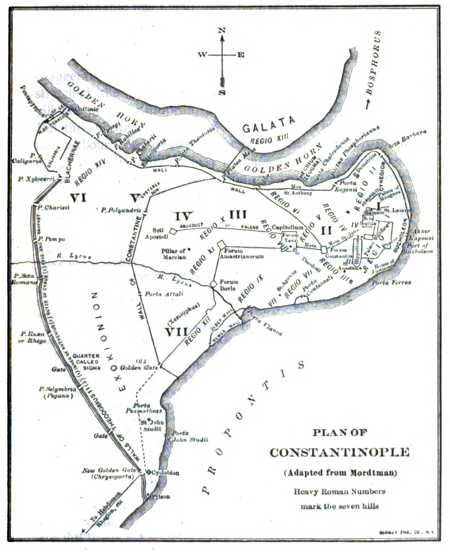
Plan of Constantinople.
The master of the Roman world, who aspired to erect an eternal monument of the glories of his reign, could employ in the prosecution of that great work the wealth, the labour, and all that yet remained of the genius, of obedient millions. Some estimate may be formed of the expense bestowed with imperial liberality on the foundation of Constantinople, by the allowance of about two millions five hundred thousand pounds for the construction of the walls, the porticoes, and the aqueducts. [40] The forests that overshadowed the shores of the Euxine, and the celebrated quarries of white marble in the little island of Proconnesus, supplied an inexhaustible stock of materials, ready to be conveyed, by the convenience of a short water-carriage, to the harbour of Byzantium. [41] A multitude of labourers and artificers urged the conclusion of the work with incessant toil: but the impatience of Constantine soon discovered that, in the decline of the arts, the skill as well as numbers of his architects bore a very unequal proportion to the greatness of his designs. The magistrates of the most distant provinces were therefore directed to institute schools, to appoint professors, and by the hopes of rewards and privileges, to engage in the study and practice [III-103] of architecture a sufficient number of ingenious youths, who had received a liberal education. [42] The buildings of the new city were executed by such artificers as the reign of Constantine could afford; but they were decorated by the hands of the most celebrated masters of the age of Pericles and Alexander. To revive the genius of Phidias and Lysippus surpassed indeed the power of a Roman emperor; but the immortal productions which they had bequeathed to posterity were exposed without defence to the rapacious vanity of a despot. By his commands the cities of Greece and Asia were despoiled of their most valuable ornaments. [43] The trophies of memorable wars, the objects of religious veneration, the most finished statues of the gods and heroes, of the sages and poets of ancient times, contributed to the splendid triumph of Constantinople; and gave occasion to the remark of the historian Cedrenus, [44] who observes, with some enthusiasm, that nothing seemed wanting except the souls of the illustrious men whom those admirable monuments were intended to represent. But it is not in the city of Constantine, nor in the declining period of an empire when the human mind was depressed by civil and religious slavery, that we should seek for the souls of Homer and of Demosthenes.
During the siege of Byzantium, the conqueror had pitched his tent on the commanding eminence of the second hill. To perpetuate the memory of his success, he chose the same [III-104] advantageous position for the principal Forum; [45] which appears to have been of a circular, or rather elliptical, form. The two opposite entrances formed triumphal arches; the porticoes, which enclosed it on every side, were filled with statues; and the centre of the Forum was occupied by a lofty column, of which a mutilated fragment is now degraded by the appellation of the burnt pillar. This column was erected on a pedestal of white marble twenty feet high; and was composed of ten pieces of porphyry, each of which measured above ten feet in height and about thirty-three in circumference. [46] On the summit of the pillar, above one hundred and twenty feet from the ground, stood the colossal statue of Apollo. It was of bronze, had been transported either from Athens or from a town of Phrygia, and was supposed to be the work of Pheidias. The artist had represented the god of day, or, as it was afterwards interpreted, the emperor Constantine himself, with a sceptre in his right hand, the globe of the world in his left, and a crown of rays glittering on his head. [47] The Circus, or Hippodrome, was a stately building about four hundred paces in length and one hundred in breadth. [48] The space between the two metæ or goals was filled with statues and obelisks; and we may still [III-105] remark a very singular fragment of antiquity: the bodies of three serpents, twisted into one pillar of brass. Their triple heads had once supported the golden tripod which, after the defeat of Xerxes, was consecrated in the temple of Delphi by the victorious Greeks. [49] The beauty of the Hippodrome has been long since defaced by the rude hands of the Turkish conquerors; but, under the similar appellation of Atmeidan, it still serves as a place of exercise for their horses. From the throne, whence the emperor viewed the Circensian games, a winding staircase [50] descended to the palace; a magnificent edifice, which scarcely yielded to the residence of Rome itself, and which, together with the dependent courts, gardens, and porticoes, covered a considerable extent of ground upon the banks of the Propontis between the Hippodrome and the church of St. Sophia. [51] We might likewise celebrate the baths, which still retained the name of Zeuxippus, after they [III-106] had been enriched, by the munificence of Constantine, with lofty columns, various marbles, and above threescore statues of bronze. [52] But we should deviate from the design of this history, if we attempted minutely to describe the different buildings or quarters of the city. It may be sufficient to observe that whatever could adorn the dignity of a great capital, or contribute to the benefit or pleasure of its numerous inhabitants, was contained within the walls of Constantinople. A particular description, composed about a century after its foundation, enumerates a capitol or school of learning, a circus, two theatres, eight public, and one hundred and fifty-three private, baths, fifty-two porticoes, five granaries, eight aqueducts or reservoirs of water, four spacious halls for the meetings of the senate or courts of justice, fourteen churches, fourteen palaces, and four thousand three hundred and eighty-eight houses, which, for their size or beauty, deserved to be distinguished from the multitude of plebeian habitations. [53]
The populousness of his favoured city was the next and most serious object of the attention of its founder. In the dark ages which succeeded the translation of the empire, the remote and the immediate consequences of that memorable event were strangely confounded by the vanity of the Greeks and the credulity of the Latins. [54] It was asserted and believed [III-107] that all the noble families of Rome, the senate, and the equestrian order, with their innumerable attendants, had followed their emperor to the banks of the Propontis; that a spurious race of strangers and plebeians was left to possess the solitude of the ancient capital; and that the lands of Italy, long since converted into gardens, were at once deprived of cultivation and inhabitants. [55] In the course of this history, such exaggerations will be reduced to their just value: yet, since the growth of Constantinople cannot be ascribed to the general increase of mankind and of industry, it must be admitted that this artificial colony was raised at the expense of the ancient cities of the empire. Many opulent senators of Rome, and of the Eastern provinces, were probably invited by Constantine to adopt for their country the fortunate spot which he had chosen for his own residence. The invitations of a master are scarcely to be distinguished from commands; and the liberality of the emperor obtained a ready and cheerful obedience. He bestowed on his favourites the palaces which he had built in the several quarters of the city, assigned them lands and pensions for the support of their dignity, [56] and alienated the demesnes of Pontus and Asia, to grant hereditary estates by the easy tenure of maintaining a house [III-108] in the capital. [57] But these encouragements and obligations soon became superfluous, and were gradually abolished. Wherever the seat of government is fixed, a considerable part of the public revenue will be expended by the prince himself, by his ministers, by the officers of justice, and by the domestics of the palace. The most wealthy of the provincials will be attracted by the powerful motives of interest and duty, of amusement and curiosity. A third and more numerous class of inhabitants will insensibly be formed, of servants, of artificers, and of merchants, who derive their subsistence from their own labour and from the wants or luxury of the superior ranks. In less than a century, Constantinople disputed with Rome itself the pre-eminence of riches and numbers. New piles of buildings, crowded together with too little regard to health or convenience, scarcely allowed the intervals of narrow streets for the perpetual throng of men, of horses, and of carriages. The allotted space of ground was insufficient to contain the increasing people; and the additional foundations, which, on either side, were advanced into the sea, might alone have composed a very considerable city. [58]
The frequent and regular distributions of wine and oil, of corn or bread, of money or provisions, had almost exempted the poorer citizens of Rome from the necessity of labour. The magnificence of the first Cæsars was in some measure [III-109] imitated by the founder of Constantinople: [59] but his liberality, however it might excite the applause of the people, has incurred the censure of posterity. A nation of legislators and conquerors might assert their claim to the harvests of Africa, which had been purchased with their blood; and it was artfully contrived by Augustus that, in the enjoyment of plenty, the Romans should lose the memory of freedom. But the prodigality of Constantine could not be excused by any consideration either of public or private interest; and the annual tribute of corn imposed upon Egypt for the benefit of his new capital was applied to feed a lazy and indolent populace, at the expense of the husbandmen of an industrious province. [60] Some other regulations of this emperor are less liable to blame, but they are less deserving of notice. He divided Constantinople into fourteen regions or quarters, [61] dignified the public council with the appellation of Senate, [62] [III-110] communicated to the citizens the privileges of Italy, [63] and bestowed on the rising city the title of Colony, the first and most favoured daughter of ancient Rome. The venerable parent still maintained the legal and acknowledged supremacy which was due to her age, to her dignity, and to the remembrance of her former greatness. [64]
As Constantine urged the progress of the work with the impatience of a lover, the walls, the porticoes, and the principal edifices, were completed in a few years, or, according to another account, in a few months; [65] but this extraordinary [III-111] diligence should excite the less admiration, since many of the buildings were finished in so hasty and imperfect a manner that, under the succeeding reign, they were preserved with difficulty from impending ruin. [66] But, while they displayed the vigour and freshness of youth, the founder prepared to celebrate the dedication of his city. [67] The games and largesses which crowned the pomp of this memorable festival may easily be supposed; but there is one circumstance of a more singular and permanent nature, which ought not entirely to be overlooked. As often as the birthday of the city returned, the statue of Constantine, framed, by his order, of gilt wood, and bearing in its right hand a small image of the genius of the place, was erected on a triumphal car. The guards, carrying white tapers, and clothed in their richest apparel, accompanied the solemn procession as it moved through the Hippodrome. When it was opposite to the throne of the reigning emperor, he rose from his seat, and with grateful reverence adored the memory of his predecessor. [68] At the festival of the dedication, an edict, engraved on a column of marble, bestowed the title of Second or New Rome on the city of Constantine. [69] But the name of Constantinople [70] has prevailed over that honourable epithet; and, after the [III-112] revolution of fourteen centuries, still perpetuates the fame of its author. [71]
The foundation of a new capital is naturally connected with the establishment of a new form of civil and military administration. The distinct view of the complicated system of policy, introduced by Diocletian, improved by Constantine, and completed by his immediate successors, may not only amuse the fancy by the singular picture of a great empire, but will tend to illustrate the secret and internal causes of its rapid decay. In the pursuit of any remarkable institution, we may be frequently led into the more early or the more recent times of the Roman history; but the proper limits of this inquiry will be included within a period of about one hundred and thirty years, from the accession of Constantine to the publication of the Theodosian code; [72] from which, as well as from the Notitia of the East and West, [73] we derive the most copious and authentic information of the state of the empire. This variety of objects will suspend, for some time, the course of the narrative; but the interruption will be censured only by those readers who are insensible to the importance of laws and manners, while they peruse, with eager curiosity, the [III-113] transient intrigues of a court, or the accidental event of a battle.
The manly pride of the Romans, content with substantial power, had left to the vanity of the East the forms and ceremonies of ostentatious greatness. [74] But when they lost even the semblance of those virtues which were derived from their ancient freedom, the simplicity of Roman manners was insensibly corrupted by the stately affectation of the courts of Asia. The distinctions of personal merit and influence, so conspicuous in a republic, so feeble and obscure under a monarchy, were abolished by the despotism of the emperors; who substituted in their room a severe subordination of rank and office, from the titled slaves, who were seated on the steps of the throne, to the meanest instruments of arbitrary power. This multitude of abject dependants was interested in the support of the actual government, from the dread of a revolution, which might at once confound their hopes and intercept the reward of their services. In this divine hierarchy (for such it is frequently styled) every rank was marked with the most scrupulous exactness, and its dignity was displayed in a variety of trifling and solemn ceremonies, which it was a study to learn and a sacrilege to neglect. [75] The purity of the Latin language was debased by adopting, in the intercourse of pride and flattery, a profusion of epithets, which Tully would scarcely have understood, and which Augustus would have rejected with indignation. The principal officers of the empire were saluted, even by the sovereign himself, with the [III-114] deceitful titles of your Sincerity, your Gravity, your Excellency, your Eminence, your sublime and wonderful Magnitude, your illustrious and magnificent Highness. [76] The codicils or patents of their office were curiously emblazoned with such emblems as were best adapted to explain its nature and high dignity; the image or portrait of the reigning emperors; a triumphal car; the book of mandates placed on a table, covered with a rich carpet, and illuminated by four tapers; the allegorical figures of the provinces which they governed; or the appellations and standards of the troops whom they commanded. Some of these official ensigns were really exhibited in their hall of audience; others preceded their pompous march whenever they appeared in public; and every circumstance of their demeanour, their dress, their ornaments, and their train was calculated to inspire a deep reverence for the representatives of supreme majesty. By a philosophic observer, the system of the Roman government might have been mistaken for a splendid theatre, filled with players of every character and degree, who repeated the language, and imitated the passions, of their original model. [77]
All the magistrates of sufficient importance to find a place in the general state of the empire were accurately divided into three classes. 1. The Illustrious. 2. The Spectabiles, or Respectable. And, 3. The Clarissimi; whom we may translate by the word Honourable. In the times of Roman simplicity, the last-mentioned epithet was used only as a vague expression of deference, till it became at length the peculiar and appropriated title of all who were members of the senate, [78] [III-115] and consequently of all who, from that venerable body, were selected to govern the provinces. The vanity of those who, from their rank and office, might claim a superior distinction above the rest of the senatorial order was long afterwards indulged with the new appellation of Respectable; but the title of Illustrious was always reserved to some eminent personages who were obeyed or reverenced by the two subordinate classes. It was communicated only, I. To the consuls and patricians; II. To the prætorian prefects, with the prefects of Rome and Constantinople; III. To the masters general of the cavalry and the infantry; and, IV. To the seven ministers of the palace, who exercised their sacred functions about the person of the emperor. [79] Among those illustrious magistrates who were esteemed co-ordinate with each other, the seniority of appointment gave place to the union of dignities. [80] By the expedient of honorary codicils, the emperors, who were fond of multiplying their favours, might sometimes gratify the vanity, though not the ambition, of impatient courtiers. [81]
I. As long as the Roman consuls were the first magistrates of a free state, they derived their right to power from the choice of the people. As long as the emperors condescended to disguise the servitude which they imposed, the consuls were still elected by the real or apparent suffrage of the senate. From the reign of Diocletian, even these vestiges of liberty [III-116] were abolished, and the successful candidates who were invested with the annual honours of the consulship affected to deplore the humiliating condition of their predecessors. The Scipios and the Catos had been reduced to solicit the votes of Plebeians, to pass through the tedious and expensive forms of a popular election, and to expose their dignity to the shame of a public refusal; while their own happier fate had reserved them for an age and government in which the rewards of virtue were assigned by the unerring wisdom of a gracious sovereign. [82] In the epistles which the emperor addressed to the two consuls elect, it was declared that they were created by his sole authority. [83] Their names and portraits, engraved on gilt tablets of ivory, were dispersed over the empire as presents to the provinces, the cities, the magistrates, the senate, and the people. [84] Their solemn inauguration was performed at the place of the imperial residence; and, during a period of one hundred and twenty years, Rome was constantly deprived of the presence of her ancient magistrates. [85] On the morning of the first of January, the consuls assumed the ensigns of their dignity. Their dress was a robe of purple, embroidered in silk and gold, and sometimes ornamented [III-117] with costly gems. [86] On this solemn occasion they were attended by the most eminent officers of the state and army, in the habit of senators; and the useless fasces, armed with the once formidable axes, were borne before them by the lictors. [87] The procession moved from the palace [88] to the Forum, or principal square of the city; where the consuls ascended their tribunal, and seated themselves in the curule chairs, which were framed after the fashion of ancient times. They immediately exercised an act of jurisdiction, by the manumission of a slave, who was brought before them for that purpose; and the ceremony was intended to represent the celebrated action of the elder Brutus, the author of liberty and of the consulship, when he admitted among his fellow-citizens the faithful Vindex, who had revealed the conspiracy of the Tarquins. [89] The public festival was continued during [III-118] several days in all the principal cities; in Rome, from custom; in Constantinople, from imitation; in Carthage, Antioch, and Alexandria, from the love of pleasure and the superfluity of wealth. [90] In the two capitals of the empire the annual games of the theatre, the circus, and the amphitheatre, [91] cost four thousand pounds of gold, (about) one hundred and sixty thousand pounds sterling: and if so heavy an expense surpassed the faculties or the inclination of the magistrates themselves, the sum was supplied from the imperial treasury. [92] As soon as the consuls had discharged these customary duties, they were at liberty to retire into the shade of private life, and to enjoy, during the remainder of the year, the undisturbed contemplation of their own greatness. They no longer presided in the national councils; they no longer executed the resolutions of peace or war. Their abilities (unless they were employed in more effective offices) were of little moment; and their names served only as the legal date of the year in which they had filled the chair of Marius and of Cicero. Yet it was still felt and acknowledged, in the last period of Roman servitude, that this empty name might be compared, and even preferred, to the possession of substantial power. The title of consul was still the most splendid object of ambition, the noblest reward of virtue and loyalty. The emperors themselves, who disdained the faint shadow of the republic, were conscious that they acquired an additional splendour and majesty [III-119] as often as they assumed the annual honours of the consular dignity. [93]
The proudest and most perfect separation which can be found in any age or country between the nobles and the people is perhaps that of the Patricians and the Plebeians, as it was established in the first age of the Roman republic. Wealth and honours, the offices of the state, and the ceremonies of religion, were almost exclusively possessed by the former; who, preserving the purity of their blood with the most insulting jealousy, [94] held their clients in a condition of specious vassalage. But these distinctions, so incompatible with the spirit of a free people, were removed, after a long struggle, by the persevering efforts of the Tribunes. The most active and successful of the Plebeians accumulated wealth, aspired to honours, deserved triumphs, contracted alliances, and, after some generations, assumed the pride of ancient nobility. [95] The Patrician families, on the other hand, whose original number was never recruited till the end of the commonwealth, either failed in the ordinary course of nature, or were extinguished [III-120] in so many foreign and domestic wars, or, through a want of merit or fortune, insensibly mingled with the mass of the people. [96] Very few remained who could derive their pure and genuine origin from the infancy of the city, or even from that of the republic, when Cæsar and Augustus, Claudius and Vespasian, created from the body of the senate a competent number of new Patrician families, in the hope of perpetuating an order which was still considered as honourable and sacred. [97] But these artificial supplies (in which the reigning house was always included) were rapidly swept away by the rage of tyrants, by frequent revolutions, by the change of manners, and by the intermixture of nations. [98] Little more was left when Constantine ascended the throne than a vague and imperfect tradition that the Patricians had once been the first of the Romans. To form a body of nobles, whose influence may restrain, while it secures, the authority of the monarch, would have been very inconsistent with the character and policy of Constantine; but, had he seriously entertained such a design, it might have exceeded the measure of his power to ratify, by an arbitrary edict, an institution [III-121] which must expect the sanction of time and of opinion. He revived, indeed, the title of Patricians, but he revived it as a personal, not as an hereditary, distinction. They yielded only to the transient superiority of the annual consuls; but they enjoyed the pre-eminence over all the great officers of state, with the most familiar access to the person of the prince. This honourable rank was bestowed on them for life; and, as they were usually favourites and ministers who had grown old in the Imperial court, the true etymology of the word was perverted by ignorance and flattery; and the Patricians of Constantine were reverenced as the adopted Fathers of the emperor and the republic. [99]
II. The fortunes of the Prætorian prefects were essentially different from those of the consuls and Patricians. The latter saw their ancient greatness evaporate in a vain title. The former, rising by degrees from the most humble condition, were invested with the civil and military administration of the Roman world. From the reign of Severus to that of Diocletian, the guards and the palace, the laws and the finances, the armies and the provinces, were entrusted to their superintending care; and, like the Vizirs of the East, they held with one hand the seal, and with the other the standard, of the empire. The ambition of the prefects, always formidable and sometimes fatal to the masters whom they served, was supported by the strength of the Prætorian bands; but after those haughty troops had been weakened by Diocletian, and finally suppressed by Constantine, the prefects, who survived their fall, were reduced without difficulty to the station of useful and obedient ministers. When they were no longer responsible for the safety of the emperor’s person, they resigned the jurisdiction which they had hitherto claimed and exercised over all the departments of the palace. They were [III-122] deprived by Constantine of all military command, as soon as they had ceased to lead into the field, under their immediate orders, the flower of the Roman troops; and at length, by a singular revolution, the captains of the guard were transformed into the civil magistrates of the provinces. According to the plan of government instituted by Diocletian, the four princes had each their Prætorian prefect; [100] and, after the monarchy was once more united in the person of Constantine, he still continued to create the same number of four prefects, and entrusted to their care the same provinces which they already administered. 1. The prefect of the East stretched his ample jurisdiction into the three parts of the globe which were subject to the Romans, from the cataracts of the Nile to the banks of the Phasis, and from the mountains of Thrace to the frontiers of Persia. 2. The important provinces of Pannonia, Dacia, Macedonia, and Greece once acknowledged the authority of the prefect of Illyricum. 3. The power of the prefect of Italy was not confined to the country from whence he derived his title; it extended over the additional territory of Rhætia as far as the banks of the Danube, over the dependent islands of the Mediterranean, and over that part of the continent of Africa which lies between the confines of Cyrene and those of Tingitania. 4. The prefect of the Gauls comprehended under that plural denomination the kindred provinces of Britain and Spain, and his authority was obeyed from the wall of Antoninus to the foot of Mount Atlas. [101]
After the Prætorian prefects had been dismissed from all military command, [102] the civil functions which they were [III-123] ordained to exercise over so many subject nations were adequate to the ambition and abilities of the most consummate ministers. To their wisdom was committed the supreme administration of justice and of the finances, the two objects which, in a state of peace, comprehend almost all the respective duties of the sovereign and of the people; of the former, to protect the citizens who are obedient to the laws; of the latter, to contribute the share of their property which is required for the expenses of the state. [103] The coin, the highways, the posts, the granaries, the manufactures, whatever could interest the public prosperity was moderated by the authority of the Prætorian prefects. As the immediate representatives of the Imperial majesty, they were empowered to explain, to enforce, and on some occasions to modify the general edicts by their discretionary proclamations. They watched over the conduct of the provincial governors, [104] removed the negligent, and inflicted punishments on the guilty. From all the inferior jurisdictions, an appeal in every matter of importance, either civil or criminal, might be brought before the tribunal of the prefect: but his sentence was final and absolute; and the emperors themselves refused to admit any complaints against the judgment or the integrity of a magistrate whom they honoured with such unbounded confidence. [105] His appointments were suitable to his dignity; [106] and, if [III-124] avarice was his ruling passion, he enjoyed frequent opportunities of collecting a rich harvest of fees, of presents, and of perquisites. Though the emperors no longer dreaded the ambition of their prefects, they were attentive to counterbalance the power of this great office by the uncertainty and shortness of its duration. [107]
From their superior importance and dignity, Rome and Constantinople were alone excepted from the jurisdiction of the Prætorian prefects. The immense size of the city and the experience of the tardy, ineffectual operation of the laws had furnished the policy of Augustus with a specious pretence for introducing a new magistrate, who alone could restrain a servile and turbulent populace by the strong arm of arbitrary power. [108] Valerius Messalla was appointed the first prefect of Rome, that his reputation might countenance so invidious a measure: but, at the end of a few days, that accomplished citizen [109] resigned his office, declaring with a spirit worthy of the friend of Brutus, that he found himself incapable of exercising a power incompatible with public freedom. [110] [III-125] As the sense of liberty became less exquisite, the advantages of order were more clearly understood; and the prefect, who seemed to have been designed as a terror only to slaves and vagrants, was permitted to extend his civil and criminal jurisdiction over the equestrian and noble families of Rome. The prætors, annually created as the judges of law and equity, could not long dispute the possession of the Forum with a vigorous and permanent magistrate, who was usually admitted into the confidence of the prince. Their courts were deserted, their number, which had once fluctuated between twelve and eighteen, [111] was gradually reduced to two or three, and their important functions were confined to the expensive obligation [112] of exhibiting games for the amusement of the people. After the office of the Roman consuls had been changed into a vain pageant, which was rarely displayed in the capital, the prefects assumed their vacant place in the senate, and were soon acknowledged as the ordinary presidents of that venerable assembly. They received appeals from the distance of one hundred miles; and it was allowed as a principle of jurisprudence, that all municipal authority was derived from them alone. [113] In the discharge of his laborious employment, the governor of Rome was assisted by fifteen officers, some of whom had been originally his equals, or even his superiors. The principal departments were relative to the command of a numerous watch, [III-126] established as a safeguard against fires, robberies, and nocturnal disorders; the custody and distribution of the public allowance of corn and provisions; the care of the port, of the aqueducts, of the common sewers, and of the navigation and bed of the Tiber; the inspection of the markets, the theatres, and of the private as well as public works. Their vigilance ensured the three principal objects of a regular police, safety, plenty, and cleanliness; and, as a proof of the attention of government to preserve the splendour and ornaments of the capital, a particular inspector was appointed for the statues; the guardian, as it were, of that inanimate people, which, according to the extravagant computation of an old writer, was scarcely inferior in number to the living inhabitants of Rome. About thirty years after the foundation of Constantinople, a similar magistrate was created in that rising metropolis, for the same uses, and with the same powers. A perfect equality was established between the dignity of the two municipal, and that of the four Prætorian, prefects. [114]
Those who, in the Imperial hierarchy, were distinguished by the title of Respectable, formed an intermediate class between the illustrious prefects and the honourable magistrates of the provinces. In this class the proconsuls of Asia, Achaia, and Africa claimed a pre-eminence, which was yielded to the remembrance of their ancient dignity; and the appeal from their tribunal to that of the prefects was almost the only mark of their dependence. [115] But the civil government of the [III-127] empire was distributed into thirteen great dioceses, each of which equalled the just measure of a powerful kingdom. The first of these dioceses was subject to the jurisdiction of the count of the East; and we may convey some idea of the importance and variety of his functions, by observing that six hundred apparitors, who would be styled at present either secretaries, or clerks, or ushers, or messengers, were employed in his immediate office. [116] The place of Augustal prefect of Egypt was no longer filled by a Roman knight; but the name was retained; and the extraordinary powers which the situation of the country and the temper of the inhabitants had once made indispensable were still continued to the governor. The eleven remaining dioceses, of Asiana, Pontica, and Thrace; of Macedonia, Dacia, [117] and Pannonia or Western Illyricum; of Italy and Africa; of Gaul, Spain, and Britain; were governed by twelve vicars or vice-prefects, [118] whose name sufficiently explains the nature and dependence of their [III-128] office. It may be added that the lieutenant-generals of the Roman armies, the military counts and dukes, who will be hereafter mentioned, were allowed the rank and title of Respectable.
As the spirit of jealousy and ostentation prevailed in the councils of the emperors, they proceeded with anxious diligence to divide the substance, and to multiply the titles of power. The vast countries which the Roman conquerors had united under the same simple form of administration were imperceptibly crumbled into minute fragments; till at length the whole empire was distributed into one hundred and sixteen provinces, each of which supported an expensive and splendid establishment. Of these, three were governed by proconsuls, thirty-seven by consulars, five by correctors, and seventy-one by presidents. The appellations of these magistrates were different; they ranked in successive order, the ensigns of their dignity were curiously varied, and their situation, from accidental circumstances, might be more or less agreeable or advantageous. But they were all (excepting only the proconsuls) alike included in the class of honourable persons; and they were alike entrusted, during the pleasure of the prince, and under the authority of the prefects or their deputies, with the administration of justice and the finances in their respective districts. The ponderous volumes of the Codes and Pandects [119] would furnish ample materials for a minute inquiry into the system of provincial government, as in the space of six centuries it was improved by the wisdom of the Roman statesmen and lawyers. It may be sufficient for the historian to select two singular and salutary provisions intended to restrain the abuse of authority. 1. For the preservation of peace and order, the governors of the provinces were armed with the sword of justice. They inflicted corporal punishments, [III-129] and they exercised, in capital offences, the power of life and death. But they were not authorised to indulge the condemned criminal with the choice of his own execution, or to pronounce a sentence of the mildest and most honourable kind of exile. These prerogatives were reserved to the prefects, who alone could impose the heavy fine of fifty pounds of gold: their vicegerents were confined to the trifling weight of a few ounces. [120] This distinction, which seems to grant the larger, while it denies the smaller, degree of authority, was founded on a very rational motive. The smaller degree was infinitely more liable to abuse. The passions of a provincial magistrate might frequently provoke him into acts of oppression which affected only the freedom or the fortunes of the subject; though, from a principle of prudence, perhaps of humanity, he might still be terrified by the guilt of innocent blood. It may likewise be considered that exile, considerable fines, or the choice of an easy death relate more particularly to the rich and the noble; and the persons the most exposed to the avarice or resentment of a provincial magistrate were thus removed from his obscure persecution to the more august and impartial tribunal of the Prætorian prefect. 2. As it was reasonably apprehended that the integrity of the judge might be biassed, if his interest was concerned or his affections were engaged, the strictest regulations were established to exclude any person, without the special dispensation of the emperor, from the government of the province where he was born; [121] and to prohibit the governor or his son from contracting [III-130] marriage with a native or an inhabitant; [122] or from purchasing slaves, lands, or houses, within the extent of his jurisdiction. [123] Notwithstanding these rigorous precautions, the emperor Constantine, after a reign of twenty-five years, still deplores the venal and oppressive administration of justice, and expresses the warmest indignation that the audience of the judge, his despatch of business, his seasonable delays, and his final sentence were publicly sold, either by himself or by the officers of his court. The continuance, and perhaps the impunity, of these crimes is attested by the repetition of important laws and ineffectual menaces. [124]
All the civil magistrates were drawn from the profession of the law. The celebrated Institutes of Justinian are addressed to the youth of his dominions, who had devoted themselves to the study of Roman jurisprudence; and the sovereign condescends to animate their diligence by the assurance that their skill and ability would in time be rewarded by an adequate share in the government of the republic. [125] The rudiments of this lucrative science were taught in all the considerable cities of the East and West; but the most famous school was that of [III-131] Berytus, [126] on the coast of Phœnicia; which flourished above three centuries from the time of Alexander Severus, the author perhaps of an institution so advantageous to his native country. After a regular course of education, which lasted five years, the students dispersed themselves through the provinces, in search of fortune and honours; nor could they want an inexhaustible supply of business in a great empire, already corrupted by the multiplicity of laws, of arts, and of vices. The court of the Prætorian prefect of the East could alone furnish employment for one hundred and fifty advocates, sixty-four of whom were distinguished by peculiar privileges, and two were annually chosen with a salary of sixty pounds of gold, to defend the causes of the treasury. The first experiment was made of their judicial talents, by appointing them to act occasionally as assessors to the magistrates; from thence they were often raised to preside in the tribunals before which they had pleaded. They obtained the government of a province; and, by the aid of merit, of reputation, or of favour, they ascended, by successive steps, to the illustrious dignities of the state. [127] In the practice of the bar, [III-132] these men had considered reason as the instrument of dispute; they interpreted the laws according to the dictates of private interest; and the same pernicious habits might still adhere to their characters in the public administration of the state. The honour of a liberal profession has indeed been vindicated by ancient and modern advocates, who have filled the most important stations with pure integrity and consummate wisdom: but in the decline of Roman jurisprudence, the ordinary promotion of lawyers was pregnant with mischief and disgrace. The noble art, which had once been preserved as the sacred inheritance of the patricians, was fallen into the hands of freedmen and plebeians, [128] who, with cunning rather than skill, exercised a sordid and pernicious trade. Some of them procured admittance into families for the purpose of fomenting differences, of encouraging suits, and of preparing a harvest of gain for themselves or their brethren. Others, recluse in their chambers, maintained the dignity of legal professors by furnishing a rich client with subtleties to confound the plainest truth and with arguments to colour the most unjustifiable pretensions. The splendid and popular class was [III-133] composed of the advocates, who filled the Forum with the sound of their turgid and loquacious rhetoric. Careless of fame and of justice, they are described, for the most part, as ignorant and rapacious guides, who conducted their clients through a maze of expense, of delay, and of disappointment; from whence, after a tedious series of years, they were at length dismissed, when their patience and fortune were almost exhausted. [129]
III. In the system of policy introduced by Augustus, the governors, those at least of the Imperial provinces, were invested with the full powers of the sovereign himself. Ministers of peace and war, the distribution of rewards and punishments depended on them alone, and they successively appeared on their tribunal in the robes of civil magistracy, and in complete armour at the head of the Roman legions. [130] The influence of the revenue, the authority of law, and the command of a military force concurred to render their power supreme and absolute; and whenever they were tempted to violate their allegiance, the loyal province which they involved in their rebellion was scarcely sensible of any change in its political state. From the time of Commodus to the reign of Constantine, near one hundred governors might be enumerated, who, with various success, erected the standard of revolt; and though the innocent were too often sacrificed, the guilty might be sometimes prevented, by the suspicious [III-134] cruelty of their master. [131] To secure his throne and the public tranquillity from these formidable servants, Constantine resolved to divide the military from the civil administration; and to establish, as a permanent and professional distinction, a practice which had been adopted only as an occasional expedient. The supreme jurisdiction exercised by the Prætorian prefects over the armies of the empire was transferred to the two masters general whom he instituted, the one for the cavalry, the other for the infantry; and, though each of these illustrious officers was more peculiarly responsible for the discipline of those troops which were under his immediate inspection, they both indifferently commanded in the field the several bodies, whether of horse or foot, which were united in the same army. [132] Their number was soon doubled by the division of the East and West; and, as separate generals of the same rank and title were appointed on the four important frontiers of the Rhine, of the Upper and the Lower Danube, and of the Euphrates, the defence of the Roman empire was at length committed to eight masters general of the cavalry and infantry. Under their orders, thirty-five military commanders were stationed in the provinces: three in Britain, six in Gaul, one in Spain, one in Italy, five on the Upper, and four on the Lower Danube; in Asia eight, three in Egypt, and four in Africa. The titles [III-135] of counts, and dukes, [133] by which they were properly distinguished, have obtained in modern languages so very different a sense that the use of them may occasion some surprise. But it should be recollected that the second of those appellations is only a corruption of the Latin word which was indiscriminately applied to any military chief. All these provincial generals were therefore dukes; but no more than ten among them were dignified with the rank of counts or companions, a title of honour, or rather of favour, which had been recently invented in the court of Constantine. [134] A gold belt was the ensign which distinguished the office of the counts and dukes; and besides their pay, they received a liberal allowance, sufficient to maintain one hundred and ninety servants, and one hundred and fifty-eight horses. They were strictly prohibited from interfering in any matter which related to the administration of justice or the revenue; but the command which they exercised over the troops of their department was independent of the authority of the magistrates. About the same time that Constantine gave a legal sanction to the ecclesiastical order, he instituted in the Roman empire the nice balance of the civil and the military powers. The emulation, and sometimes the discord, which reigned between two professions of opposite interests and incompatible manners, was productive of beneficial and of pernicious consequences. It was seldom to be expected that the general and the civil governor of a province should either conspire for the disturbance, or should unite for the service, of their country. While the one delayed to offer the assistance which [III-136] the other disdained to solicit, the troops very frequently remained without orders or without supplies; the public safety was betrayed, and the defenceless subjects were left exposed to the fury of the Barbarians. The divided administration which had been formed by Constantine relaxed the vigour of the state, while it secured the tranquillity of the monarch.
The memory of Constantine has been deservedly censured for another innovation, which corrupted military discipline and prepared the ruin of the empire. The nineteen years which preceded his final victory over Licinius had been a period of licence and intestine war. The rivals who contended for the possession of the Roman world had withdrawn the greatest part of their forces from the guard of the general frontier; and the principal cities which formed the boundary of their respective dominions were filled with soldiers, who considered their countrymen as their most implacable enemies. After the use of these internal garrisons had ceased with the civil war, the conqueror wanted either wisdom or firmness to revive the severe discipline of Diocletian, and to suppress a fatal indulgence which habit had endeared and almost confirmed to the military order. From the reign of Constantine, a popular and even legal distinction was admitted between the Palatines [135] and the Borderers; the troops of the court as they were improperly styled, and the troops of the frontier. The former, elevated by the superiority of their pay and privileges, were permitted, except in the extraordinary emergencies of war, to occupy their tranquil stations in the heart of the provinces. The most flourishing cities were oppressed by the intolerable weight of quarters. The soldiers insensibly forgot the virtues of their profession, and contracted only [III-137] the vices of civil life. They were either degraded by the industry of mechanic trades, or enervated by the luxury of baths and theatres. They soon became careless of their martial exercises, curious in their diet and apparel; and, while they inspired terror to the subjects of the empire, they trembled at the hostile approach of the Barbarians. [136] The chain of fortifications which Diocletian and his colleagues had extended along the banks of the great rivers was no longer maintained with the same care or defended with the same vigilance. The numbers which still remained under the name of the troops of the frontier might be sufficient for the ordinary defence. But their spirit was degraded by the humiliating reflection that they who were exposed to the hardships and dangers of a perpetual warfare were rewarded only with about two-thirds of the pay and emoluments which were lavished on the troops of the court. Even the bands or legions that were raised the nearest to the level of those unworthy favourites were in some measure disgraced by the title of honour which they were allowed to assume. It was in vain that Constantine repeated the most dreadful menaces of fire and sword against the Borderers who should dare to desert their colours, to connive at the inroads of the Barbarians, or to participate in the spoil. [137] The mischiefs which flow from injudicious counsels are seldom removed by the application of partial severities; and, though succeeding princes laboured to restore the strength and numbers of the frontier garrisons, the empire, till the last moment of its dissolution, continued to languish under the mortal wound which had been so rashly or so weakly inflicted by the hand of Constantine.
[III-138]
The same timid policy, of dividing whatever is united, of reducing whatever is eminent, of dreading every active power, and of expecting that the most feeble will prove the most obedient, seems to pervade the institutions of several princes, and particularly those of Constantine. The martial pride of the legions, whose victorious camps had so often been the scene of rebellion, was nourished by the memory of their past exploits and the consciousness of their actual strength. As long as they maintained their ancient establishment of six thousand men, they subsisted, under the reign of Diocletian, each of them singly, a visible and important object in the military history of the Roman empire. A few years afterwards these gigantic bodies were shrunk to a very diminutive size; and, when seven legions, with some auxiliaries, defended the city of Amida against the Persians, the total garrison, with the inhabitants of both sexes, and the peasants of the deserted country, did not exceed the number of twenty thousand persons. [138] From this fact, and from similar examples, there is reason to believe that the constitution of the legionary troops, to which they partly owed their valour and discipline, was dissolved by Constantine; and that the bands of Roman infantry, which still assumed the same names and the same honours, consisted only of one thousand or fifteen hundred men. [139] The conspiracy of so many separate detachments, each of which was awed by the sense of its own weakness, could easily be checked; and the successors of Constantine might indulge their love of ostentation, by issuing their orders to one hundred and thirty-two legions, inscribed on the muster-roll of their numerous armies. The [III-139] remainder of their troops was distributed into several hundred cohorts of infantry, and squadrons of cavalry. Their arms, and titles, and ensigns were calculated to inspire terror, and to display the variety of nations who marched under the Imperial standard. And not a vestige was left of that severe simplicity which, in the ages of freedom and victory, had distinguished the line of battle of a Roman army from the confused host of an Asiatic monarch. [140] A more particular enumeration, drawn from the Notitia, might exercise the diligence of an antiquary; but the historian will content himself with observing that the number of permanent stations or garrisons established on the frontiers of the empire amounted to five hundred and eighty-three; and that, under the successors of Constantine, the complete force of the military establishment was computed at six hundred and forty-five thousand soldiers. [141] An effort so prodigious surpassed the wants of a more ancient, and the faculties of a later, period.
In the various states of society, armies are recruited from very different motives. Barbarians are urged by the love of war; the citizens of a free republic may be prompted by a principle of duty; the subjects, or at least the nobles, of a monarchy are animated by a sentiment of honour; but the timid and luxurious inhabitants of a declining empire must be allured into the service by the hopes of profit, or compelled by the dread of punishment. The resources of the Roman treasury were exhausted by the increase of pay, [III-140] by the repetition of donatives, and by the invention of new emoluments and indulgences, which, in the opinion of the provincial youth, might compensate the hardships and dangers of a military life. Yet, although the stature was lowered, [142] although slaves, at least by a tacit connivance, were indiscriminately received into the ranks, the insurmountable difficulty of procuring a regular and adequate supply of volunteers obliged the emperors to adopt more effectual and coercive methods. The lands bestowed on the veterans, as the free reward of their valour, were henceforward granted under a condition, which contains the first rudiments of the feudal tenures: that their sons, who succeeded to the inheritance, should devote themselves to the profession of arms, as soon as they attained the age of manhood; and their cowardly refusal was punished by the loss of honour, of fortune, or even of life. [143] But, as the annual growth of the sons of the veterans bore a very small proportion to the demands of the service, levies of men were frequently required from the provinces, and every proprietor was obliged either to take up arms, or to procure a substitute, or to purchase his exemption by the payment of a heavy fine. The sum of forty-two pieces of gold, to which it was reduced, ascertains the exorbitant price of volunteers and the reluctance with which the government admitted of this alternative. [144] [III-141] Such was the horror for the profession of a soldier which had affected the minds of the degenerate Romans that many of the youth of Italy and the provinces chose to cut off the fingers of their right hand to escape from being pressed into the service; and this strange expedient was so commonly practised as to deserve the severe animadversion of the laws [145] and a peculiar name in the Latin language. [146]
The introduction of Barbarians into the Roman armies became every day more universal, more necessary, and more fatal. The most daring of the Scythians, of the Goths, and of the Germans, who delighted in war, and who found it more profitable to defend than to ravage the provinces, were enrolled, not only in the auxiliaries of their respective nations, but in the legions themselves, and among the most distinguished of the Palatine troops. As they freely mingled with the subjects of the empire, they gradually learned to despise their manners and to imitate their arts. They abjured the implicit reverence which the pride of Rome had exacted from their ignorance, while they acquired the knowledge and possession of those advantages by which alone she supported her declining greatness. The Barbarian soldiers who displayed any military talents were advanced, without exception, to [III-142] the most important commands; and the names of the tribunes, of the counts and dukes, and of the generals themselves betray a foreign origin, which they no longer condescended to disguise. They were often entrusted with the conduct of a war against their countrymen; and, though most of them preferred the ties of allegiance to those of blood, they did not always avoid the guilt, or at least the suspicion, of holding a treasonable correspondence with the enemy, of inviting his invasion, or of sparing his retreat. The camps and the palace of the son of Constantine were governed by the powerful faction of the Franks, who preserved the strictest connection with each other and with their country, and who resented every personal affront as a national indignity. [147] When the tyrant Caligula was suspected of an intention to invest a very extraordinary candidate with the consular robes, the sacrilegious profanation would have scarcely excited less astonishment if, instead of a horse, the noblest chieftain of Germany or Britain had been the object of his choice. The revolution of three centuries had produced so remarkable a change in the prejudices of the people that, with the public approbation, Constantine shewed his successors the example of bestowing the honours of the consulship on the Barbarians who, by their merit and services, had deserved to be ranked among the first of the Romans. [148] But as these hardy veterans, who had been educated in the ignorance or contempt of the laws, were incapable of exercising any civil offices, the powers of the human mind were contracted by the irreconcilable separation of talents as well as of professions. [III-143] The accomplished citizens of the Greek and Roman republics, whose characters could adapt themselves to the bar, the senate, the camp, or the schools, had learned to write, to speak, and to act, with the same spirit, and with equal abilities.
IV. Besides the magistrates and generals, who at a distance from the court diffused their delegated authority over the provinces and armies, the emperor conferred the rank of Illustrious on seven of his more immediate servants, to whose fidelity he entrusted his safety, or his counsels, or his treasures. 1. The private apartments of the palace were governed by a favourite eunuch, who, in the language of that age, was styled the præpositus or prefect of the sacred bed-chamber. His duty was to attend the emperor in his hours of state, or in those of amusement, and to perform about his person all those menial services which can only derive their splendour from the influence of royalty. Under a prince who deserved to reign, the great chamberlain (for such we may call him) was an useful and humble domestic; but an artful domestic, who improves every occasion of unguarded confidence, will insensibly acquire over a feeble mind that ascendant which harsh wisdom and uncomplying virtue can seldom obtain. The degenerate grandsons of Theodosius, who were invisible to their subjects and contemptible to their enemies, exalted the prefects of their bed-chamber above the heads of all the ministers of the palace; [149] and even his deputy, the first of the splendid train of slaves who waited in the presence, was thought worthy to rank before the respectable proconsuls of Greece or Asia. The jurisdiction of the chamberlain was acknowledged by the counts, or superintendents, who regulated the two important provinces of the magnificence of the wardrobe and of the luxury of the imperial table. [150] 2. The [III-144] principal administration of public affairs was committed to the diligence and abilities of the master of the offices. [151] He was the supreme magistrate of the palace, inspected the discipline of the civil and military schools, and received appeals from all parts of the empire; in the causes which related to that numerous army of privileged persons who, as the servants of the court, had obtained, for themselves and families, a right to decline the authority of the ordinary judges. The correspondence between the prince and his subjects was managed by the four scrinia or offices of this minister of state. The first was appropriated to memorials, the second to epistles, the third to petitions, and the fourth to papers and orders of a miscellaneous kind. [152] Each of these was directed by an inferior master of respectable dignity, and the whole business was despatched by an hundred and forty-eight secretaries, chosen for the most part from the profession of the law, on account of the variety of abstracts of reports and references which frequently occurred in the exercise of their several functions. From a condescension, which in former ages would have been esteemed unworthy of the Roman majesty, a particular secretary was allowed for the Greek language; and interpreters were appointed to receive the ambassadors of the Barbarians: but the department of foreign affairs, which constitutes so essential a part of modern policy, seldom diverted the attention of the master of the offices. His [III-145] mind was more seriously engaged by the general direction of the posts and arsenals of the empire. There were thirty-four cities, fifteen in the East, and nineteen in the West, in which regular companies of workmen were perpetually employed in fabricating defensive armour, offensive weapons of all sorts, and military engines, which were deposited in the arsenals, and occasionally delivered for the service of the troops. [153] 3. In the course of nine centuries, the office of quæstor had experienced a very singular revolution. In the infancy of Rome, two inferior magistrates were annually elected by the people, to relieve the consuls from the invidious management of the public treasure; [154] a similar assistant was granted to every proconsul, and to every prætor, who exercised a military or provincial command; with the extent of conquest, the two quæstors were gradually multiplied to the number of four, of eight, of twenty, and, for a short time, perhaps, of forty; [155] and the noblest citizens ambitiously solicited an office which gave them a seat in the senate, and a just hope of obtaining the honours of the republic. Whilst Augustus affected to maintain the freedom of election, he consented to accept the annual privilege of recommending, or rather indeed of nominating, a certain proportion of candidates; and it was his custom to select one of these distinguished youths, to read his orations or epistles in the assemblies [III-146] of the senate. [156] The practice of Augustus was imitated by succeeding princes; the occasional commission was established as a permanent office; and the favoured quæstor, assuming a new and more illustrious character, alone survived the suppression of his ancient and useless colleagues. [157] As the orations which he composed in the name of the emperor [158] acquired the force, and, at length, the form of absolute edicts, he was considered as the representative of the legislative [III-147] power, the oracle of the council, and the original source of the civil jurisprudence. He was sometimes invited to take his seat in the supreme judicature of the Imperial consistory, with the Prætorian prefects, and the master of the offices; and he was frequently requested to resolve the doubts of inferior judges; but, as he was not oppressed with a variety of subordinate business, his leisure and talents were employed to cultivate that dignified style of eloquence which, in the corruption of taste and language, still preserves the majesty of the Roman laws. [159] In some respects, the office of the Imperial quæstor may be compared with that of a modern chancellor; but the use of a great seal, which seems to have been adopted by the illiterate Barbarians, was never introduced to attest the public acts of the emperors. 4. The extraordinary title of count of the sacred largesses was bestowed on the treasurer-general of the revenue, with the intention perhaps of inculcating that every payment flowed from the voluntary bounty of the monarch. To conceive the almost infinite detail of the annual and daily expense of the civil and military administration in every part of a great empire. would exceed the powers of the most vigorous imagination. The actual account employed several hundred persons, distributed into eleven different offices, which were artfully contrived to examine and control their respective operations. The multitude of these agents had a natural tendency to increase; and it was more than once thought expedient to dismiss to their native homes the useless supernumeraries, who, deserting their honest labours, had pressed with too much eagerness into the lucrative profession of the finances. [160] Twenty-nine [III-148] provincial receivers, of whom eighteen were honoured with the title of count, corresponded with the treasurer; and he extended his jurisdiction over the mines, from whence the precious metals were extracted, over the mints, in which they were converted into the current coin, and over the public treasuries of the most important cities, where they were deposited for the service of the state. The foreign trade of the empire was regulated by this minister, who directed likewise all the linen and woollen manufactures, in which the successive operations of spinning, weaving, and dyeing were executed, chiefly by women of a servile condition, for the use of the palace and army. Twenty-six of these institutions are enumerated in the West, where the arts had been more recently introduced, and a still larger proportion may be allowed for the industrious provinces of the East. [161] 5. Besides the public revenue, which an absolute monarch might levy and expend according to his pleasure, the emperors, in the capacity of opulent citizens, possessed a very extensive property, which was administered by the count, or treasurer, of the private estate. Some part had perhaps been the ancient demesnes of kings and republics; some accessions might be derived from the families which were successively invested with the purple; but the most considerable portion flowed from the impure source of confiscations and forfeitures. The Imperial estates were scattered through the provinces, from Mauritania to Britain; but the rich and fertile soil of Cappadocia tempted the monarch to acquire in that country [III-149] his fairest possessions, [162] and either Constantine or his successors embraced the occasion of justifying avarice by religious zeal. They suppressed the rich temple of Comana, where the high priest of the goddess of war supported the dignity of a sovereign prince; and they applied to their private use the consecrated lands, which were inhabited by six thousand subjects or slaves of the Deity and her ministers. [163] But these were not the valuable inhabitants; the plains that stretch from the foot of Mount Argæus to the banks of the Sarus bred a generous race of horses, renowned above all others in the ancient world for their majestic shape and incomparable swiftness. These sacred animals, destined for the service of the palace and the Imperial games, were protected by the laws from the profanation of a vulgar master. [164] The demesnes of Cappadocia were important enough to require the inspection of a count; [165] officers of an inferior rank were stationed in the other parts of the empire; and the deputies of the private, as well as those of the public, treasurer were maintained in the exercise of their independent functions, and encouraged to control the authority of the provincial [III-150] magistrates. [166] 6, 7. The chosen bands of cavalry and infantry which guarded the person of the emperor, were under the immediate command of the two counts of the domestics. The whole number consisted of three thousand five hundred men, divided into seven schools, or troops, of five hundred each; and in the East, this honourable service was almost entirely appropriated to the Armenians. Whenever, on public ceremonies, they were drawn up in the courts and porticoes of the palace, their lofty stature, silent order, and splendid arms of silver and gold displayed a martial pomp, not unworthy of the Roman majesty. [167] From the seven schools two companies of horse and foot were selected, of the protectors, whose advantageous station was the hope and reward of the most deserving soldiers. They mounted guard in the interior apartments, and were occasionally despatched into the provinces to execute with celerity and vigour the orders of their master. [168] The counts of the domestics had succeeded to the office of the Prætorian prefects, they aspired from the service of the palace to the command of armies.
The perpetual intercourse between the court and the provinces was facilitated by the construction of roads and the institution of posts. But these beneficial establishments were accidentally connected with a pernicious and intolerable abuse. Two or three hundred agents or messengers were employed, under the jurisdiction of the master of the offices, to announce the names of the annual consuls and the edicts or victories of the emperors. They insensibly assumed the licence of reporting whatever they could observe of the conduct either of magistrates or of private citizens; and were [III-151] soon considered as the eyes of the monarch, [169] and the scourge of the people. Under the warm influence of a feeble reign, they multiplied to the incredible number of ten thousand, disdained the mild though frequent admonitions of the laws, and exercised in the profitable management of the posts a rapacious and insolent oppression. These official spies, who regularly corresponded with the palace, were encouraged, by favour and reward, anxiously to watch the progress of every treasonable design, from the faint and latent symptoms of disaffection to the actual preparation of an open revolt. Their careless or criminal violation of truth and justice was covered by the consecrated mask of zeal; and they might securely aim their poisoned arrows at the breast either of the guilty or the innocent, who had provoked their resentment or refused to purchase their silence. A faithful subject, of Syria perhaps, or of Britain, was exposed to the danger, or at least to the dread, of being dragged in chains to the court of Milan or Constantinople, to defend his life and fortune against the malicious charge of these privileged informers. The ordinary administration was conducted by those methods which extreme necessity can alone palliate; and the defects of evidence were diligently supplied by the use of torture. [170]
The deceitful and dangerous experiment of the criminal question, as it is emphatically styled, was admitted, rather than approved, in the jurisprudence of the Romans. They applied this sanguinary mode of examination only to servile [III-152] bodies, whose sufferings were seldom weighed by those haughty republicans in the scale of justice or humanity: but they would never consent to violate the sacred person of a citizen, till they possessed the clearest evidence of his guilt. [171] The annals of tyranny, from the reign of Tiberius to that of Domitian, circumstantially relate the executions of many innocent victims; but, as long as the faintest remembrance was kept alive of the national freedom and honour, the last hours of a Roman were secure from the danger of ignominious torture. [172] The conduct of the provincial magistrates was not, however, regulated by the practice of the city or the strict maxims of the civilians. They found the use of torture established, not only among the slaves of oriental despotism, but among the Macedonians, who obeyed a limited monarch; among the Rhodians, who flourished by the liberty of commerce; and even among the sage Athenians, who had asserted and adorned the dignity of human kind. [173] The acquiescence of the provincials encouraged their governors to acquire, or perhaps to usurp, a discretionary power of employing the rack, to extort from vagrants or plebeian criminals the confession of their guilt, till they insensibly proceeded to confound the distinction of rank and to disregard the privileges of Roman citizens. The apprehensions of the subjects urged them to solicit, and the interest of the sovereign engaged him to grant, a variety of special exemptions, which [III-153] tacitly allowed, and even authorised, the general use of torture. They protected all persons of illustrious or honourable rank, bishops and their presbyters, professors of the liberal arts, soldiers and their families, municipal officers, and their posterity to the third generation, and all children under the age of puberty. [174] But a fatal maxim was introduced into the new jurisprudence of the empire, that in the case of treason, which included every offence that the subtlety of lawyers could derive from an hostile intention towards the prince or republic, [175] all privileges were suspended, and all conditions were reduced to the same ignominious level. As the safety of the emperor was avowedly preferred to every consideration of justice or humanity, the dignity of age and the tenderness of youth were alike exposed to the most cruel tortures; and the terrors of a malicious information, which might select them as the accomplices, or even as the witnesses, perhaps, of an imaginary crime, perpetually hung over the heads of the principal citizens of the Roman world. [176]
These evils, however terrible they may appear, were confined to the smaller number of Roman subjects, whose dangerous situation was in some degree compensated by the enjoyment of those advantages, either of nature or of fortune, which exposed them to the jealousy of the monarch. The obscure millions of a great empire have much less to dread [III-154] from the cruelty than from the avarice of their masters; and their humble happiness is principally affected by the grievance of excessive taxes, which, gently pressing on the wealthy, descend with accelerated weight on the meaner and more indigent classes of society. An ingenious philosopher [177] has calculated the universal measure of the public impositions by the degrees of freedom and servitude; and ventures to assert that, according to an invariable law of nature, it must always increase with the former, and diminish in a just proportion to the latter. But this reflection, which would tend to alleviate the miseries of despotism, is contradicted at least by the history of the Roman empire; which accuses the same princes of despoiling the senate of its authority and the provinces of their wealth. Without abolishing all the various customs and duties on merchandises, which are imperceptibly discharged by the apparent choice of the purchaser, the policy of Constantine and his successors preferred a simple and direct mode of taxation, more congenial to the spirit of an arbitrary government. [178]
The name and use of the indictions, [179] which serve to ascertain [III-155] the chronology of the middle ages, was derived from the regular practice of the Roman tributes. [180] The emperor subscribed with his own hand, and in purple ink, the solemn edict, or indiction, which was fixed up in the principal city of each diocese during two months previous to the first day of September. And, by a very easy connection of ideas, the word indiction was transferred to the measure of tribute which it prescribed, and to the annual term which it allowed for the payment. This general estimate of the supplies was proportioned to the real and imaginary wants of the state; but, as often as the expense exceeded the revenue, or the revenue fell short of the computation, an additional tax, under the name of superindiction, was imposed on the people, and the most valuable attribute of sovereignty was communicated to the Prætorian prefects, who, on some occasions, were permitted to provide for the unforeseen and extraordinary exigencies of the public service. The execution of these laws (which it would be tedious to pursue in their minute and intricate detail) consisted of two distinct operations: the resolving the general imposition into its constituent parts, which were assessed on the provinces, the cities, and the individuals of the Roman world, and the collecting the separate contributions [III-156] of the individuals, the cities, and the provinces, till the accumulated sums were poured into the Imperial treasuries. But, as the account between the monarch and the subject was perpetually open, and as the renewal of the demand anticipated the perfect discharge of the preceding obligation, the weighty machine of the finances was moved by the same hands round the circle of its yearly revolution. Whatever was honourable or important in the administration of the revenue was committed to the wisdom of the prefects and their provincial representatives; the lucrative functions were claimed by a crowd of subordinate officers, some of whom depended on the treasurer, others on the governor of the province; and who, in the inevitable conflicts of a perplexed jurisdiction, had frequent opportunities of disputing with each other the spoils of the people. The laborious offices, which could be productive only of envy and reproach, of expense and danger, were imposed on the Decurions, who formed the corporations of the cities, and whom the severity of the Imperial laws had condemned to sustain the burthens of civil society. [181] The whole landed property of the empire (without excepting the patrimonial estates of the monarch) was the object of ordinary taxation; and every new purchaser contracted the obligations of the former proprietor. An accurate census, [182] or survey, was the only equitable mode of ascertaining the proportion which every citizen should be obliged to contribute for the public service; and from the well-known period of the indictions there is reason to believe that this difficult and expensive operation was repeated at the regular distance of fifteen years. The lands were measured by surveyors, who were sent into [III-157] the provinces; their nature, whether arable or pasture, or vineyards or woods, was distinctly reported; and an estimate was made of their common value from the average produce of five years. The numbers of slaves and of cattle constituted an essential part of the report; an oath was administered to the proprietors, which bound them to disclose the true state of their affairs; and their attempts to prevaricate, or elude the intention of the legislator, were severely watched, and punished as a capital crime which included the double guilt of treason and sacrilege. [183] A large portion of the tribute was paid in money; and of the current coin of the empire, gold alone could be legally accepted. [184] The remainder of the taxes, according to the proportions determined by the annual indiction, was furnished in a manner still more direct, and still more oppressive. According to the different nature of lands, their real produce, in the various articles of wine or oil, corn or barley, wood or iron, was transported by the labour or at the expense of the provincials to the Imperial magazines, from whence they were occasionally distributed, for the use of the court, of the army, and of the two capitals, Rome and Constantinople. The commissioners of the revenue were so frequently obliged to make considerable purchases that they were strictly prohibited from allowing any compensation or from receiving in money the value of those supplies which were exacted in kind. In the primitive simplicity of small communities, this method may be well adapted to collect the almost voluntary offerings of the people; but it is at once susceptible of the utmost latitude and of the utmost [III-158] strictness, which in a corrupt and absolute monarchy must introduce a perpetual contest between the power of oppression and the arts of fraud. [185] The agriculture of the Roman provinces was insensibly ruined, and, in the progress of despotism, which tends to disappoint its own purpose, the emperors were obliged to derive some merit from the forgiveness of debts, or the remission of tributes, which their subjects were utterly incapable of paying. According to the new division of Italy, the fertile and happy province of Campania, the scene of the early victories and of the delicious retirements of the citizens of Rome, extended between the sea and the Apennine from the Tiber to the Silarus. Within sixty years after the death of Constantine, and on the evidence of an actual survey, an exemption was granted in favour of three hundred and thirty thousand English acres of desert and uncultivated land; which amounted to one-eighth of the whole surface of the province. As the footsteps of the Barbarians had not yet been seen in Italy, the cause of this amazing desolation, which is recorded in the laws, can be ascribed only to the administration of the Roman emperors. [186]
Either from design or from accident, the mode of assessment seemed to unite the substance of a land-tax with the forms of a capitation. [187] The returns which were sent of [III-159] every province or district expressed the number of tributary subjects and the amount of the public impositions. The latter of these sums was divided by the former; and the estimate, that such a province contained so many capita, or heads of tribute, and that each head was rated at such a price, was universally received, not only in the popular, but even in the legal, computation. The value of a tributary head must have varied, according to many accidental, or at least fluctuating, circumstances; but some knowledge has been preserved of a very curious fact, the more important, since it relates to one of the richest provinces of the Roman empire, and which now flourishes as the most splendid of the European kingdoms. The rapacious ministers of Constantius had exhausted the wealth of Gaul, by exacting twenty-five pieces of gold for the annual tribute of every head. The humane policy of his successor reduced the capitation to seven pieces. [188] A moderate proportion between these opposite extremes of extravagant oppression and of transient indulgence may [III-160] therefore be fixed at sixteen pieces of gold, or about nine pounds sterling, the common standard perhaps of the impositions of Gaul. [189] But this calculation, or rather indeed the facts from whence it is deduced, cannot fail of suggesting two difficulties to a thinking mind, who will be at once surprised by the equality and by the enormity of the capitation. An attempt to explain them may perhaps reflect some light on the interesting subject of the finances of the declining empire.
I. It is obvious that, as long as the immutable constitution of human nature produces and maintains so unequal a division of property, the most numerous part of the community would be deprived of their subsistence by the equal assessment of a tax from which the sovereign would derive a very trifling revenue. Such indeed might be the theory of the Roman capitation; but in the practice, this unjust equality was no longer felt, as the tribute was collected on the principle of a real, not of a personal, imposition. Several indigent citizens contributed to compose a single head, or share of taxation; while the wealthy provincial, in proportion to his fortune, [III-161] alone represented several of those imaginary beings. In a poetical request, addressed to one of the last and most deserving of the Roman princes who reigned in Gaul, Sidonius Apollinaris personifies his tribute under the figure of a triple monster, the Geryon of the Grecian fables, and entreats the new Hercules that he would most graciously be pleased to save his life by cutting off three of his heads. [190] The fortune of Sidonius far exceeded the customary wealth of a poet; but, if he had pursued the allusion, he must have painted many of the Gallic nobles with the hundred heads of the deadly Hydra spreading over the face of the country and devouring the substance of an hundred families. II. The difficulty of allowing an annual sum of about nine pounds sterling, even for the average of the capitation of Gaul, may be rendered more evident by the comparison of the present state of the same country, as it is now governed by the absolute monarch of an industrious, wealthy, and affectionate people. The taxes of France cannot be magnified, either by fear or by flattery, beyond the annual amount of eighteen millions sterling, which ought perhaps to be shared among four and twenty millions of inhabitants. [191] Seven millions of these, in the [III-162] capacity of fathers or brothers or husbands, may discharge the obligations of the remaining multitude of women and children; yet the equal proportion of each tributary subject will scarcely rise above fifty shillings of our money, instead of a proportion almost four times as considerable, which was regularly imposed on their Gallic ancestors. The reason of this difference may be found, not so much in the relative scarcity or plenty of gold and silver, as in the different state of society in ancient Gaul and in modern France. In a country where personal freedom is the privilege of every subject, the whole mass of taxes, whether they are levied on property or on consumption, may be fairly divided among the whole body of the nation. But the far greater part of the lands of ancient Gaul, as well as of the other provinces of the Roman world, were cultivated by slaves, or by peasants whose dependent condition was a less rigid servitude. [192] In such a state the poor were maintained at the expense of the masters, who enjoyed the fruits of their labour; and, as the rolls of tribute were filled only with the names of those citizens who possessed the means of an honourable, or at least of a decent, subsistence, the comparative smallness of their numbers explains and justifies the high rate of their capitation. The truth of this assertion may be illustrated by the following example: The Ædui, one of the most powerful and civilised tribes or cities of Gaul, occupied an extent of territory which now contains above five hundred thousand inhabitants in the two ecclesiastical dioceses of Autun and Nevers: [193] and with the [III-163] probable accession of those of Châlons and Macon, [194] the population would amount to eight hundred thousand souls. In the time of Constantine, the territory of the Ædui afforded no more than twenty-five thousand heads of capitation, of whom seven thousand were discharged by that prince from the intolerable weight of tribute. [195] A just analogy would seem to countenance the opinion of an ingenious historian, [196] that the free and tributary citizens did not surpass the number of half a million; and if, in the ordinary administration of government, their annual payments may be computed at about four millions and a half of our money, it would appear that, although the share of each individual was four times as considerable, a fourth part only of the modern taxes of France was levied on the Imperial province of Gaul. [197] The exactions of Constantius may be calculated at seven millions [III-164] sterling, which were reduced to two millions by the humanity or the wisdom of Julian.
But this tax or capitation on the proprietors of land would have suffered a rich and numerous class of free citizens to escape. With the view of sharing that species of wealth which is derived from art or labour, and which exists in money or in merchandise, the emperors imposed a distinct and personal tribute on the trading part of their subjects. [198] Some exemptions, very strictly confined both in time and place, were allowed to the proprietors who disposed of the produce of their own estates. Some indulgence was granted to the profession of the liberal arts: but every other branch of commercial industry was affected by the severity of the law. The honourable merchant of Alexandria, who imported the gems and spices of India for the use of the Western world; the usurer, who derived from the interest of money a silent and ignominious profit; the ingenious manufacturer, the diligent mechanic, and even the most obscure retailer of a sequestered village, were obliged to admit the officers of the revenue into the partnership of their gain: and the sovereign of the Roman empire, who tolerated the profession, consented to share the infamous salary, of public prostitutes. As this general tax upon industry was collected every fourth year, it was styled the Lustral Contribution: and the historian Zosimus [199] laments that the approach of the fatal period was announced by the tears and terrors of the citizens, who were often compelled by the impending scourge to embrace the most abhorred and unnatural methods of procuring the sum at which their property had been assessed. The testimony of Zosimus cannot indeed be justified from the charge of passion and prejudice; but, from the nature of this tribute, it [III-165] seems reasonable to conclude that it was arbitrary in the distribution, and extremely rigorous in the mode of collecting. The secret wealth of commerce, and the precarious profits of art or labour, are susceptible only of a discretionary valuation, which is seldom disadvantageous to the interest of the treasury; and, as the person of the trader supplies the want of a visible and permanent security, the payment of the imposition, which, in the case of a land-tax, may be obtained by the seizure of property, can rarely be extorted by any other means than those of corporal punishments. The cruel treatment of the insolvent debtors of the state is attested, and was perhaps mitigated, by a very humane edict of Constantine, who, disclaiming the use of racks and of scourges, allots a spacious and airy prison for the place of their confinement. [200]
These general taxes were imposed and levied by the absolute authority of the monarch; but the occasional offerings of the coronary gold still retained the name and semblance of popular consent. It was an ancient custom that the allies of the republic, who ascribed their safety or deliverance to the success of the Roman arms; and even the cities of Italy, who admired the virtues of their victorious general; adorned the pomp of his triumph by their voluntary gifts of crowns of gold, which, after the ceremony, were consecrated in the temple of Jupiter, to remain a lasting monument of his glory to future ages. The progress of zeal and flattery soon multiplied the number, and increased the size, of these popular donations; and the triumph of Cæsar was enriched with two thousand eight hundred and twenty-two massy crowns, whose weight amounted to twenty thousand four hundred and fourteen pounds of gold. This treasure was immediately melted down by the prudent dictator, who was satisfied that it would be more serviceable to his soldiers than to the gods: his example was imitated by his successors; and the custom was introduced of exchanging these splendid ornaments for the more acceptable present of [III-166] the current gold coin of the empire. [201] The spontaneous offering was at length exacted as the debt of duty; and, instead of being confined to the occasion of a triumph, it was supposed to be granted by the several cities and provinces of the monarchy as often as the emperor condescended to announce his accession, his consulship, the birth of a son, the creation of a Cæsar, a victory over the Barbarians, or any other real or imaginary event which graced the annals of his reign. The peculiar free gift of the senate of Rome was fixed by custom at sixteen hundred pounds of gold, or about sixty-four thousand pounds sterling. The oppressed subjects celebrated their own felicity, that their sovereign should graciously consent to accept this feeble but voluntary testimony of their loyalty and gratitude. [202]
A people elated by pride, or soured by discontent, are seldom qualified to form a just estimate of their actual situation. The subjects of Constantine were incapable of discerning the decline of genius and manly virtue, which so far degraded them below the dignity of their ancestors; but they could feel and lament the rage of tyranny, the relaxation of discipline, and the increase of taxes. The impartial historian, who acknowledges the justice of their complaints, will observe some favourable circumstances which tended to alleviate the misery of their condition. The threatening tempest of Barbarians, which so soon subverted the foundations of Roman greatness, was still repelled, or suspended, on the [III-167] frontiers. The arts of luxury and literature were cultivated, and the elegant pleasures of society were enjoyed, by the inhabitants of a considerable portion of the globe. The forms, the pomp, and the expense of the civil administration contributed to restrain the irregular licence of the soldiers; and, although the laws were violated by power or perverted by subtlety, the sage principles of the Roman jurisprudence preserved a sense of order and equity, unknown to the despotic governments of the East. The rights of mankind might derive some protection from religion and philosophy; and the name of freedom, which could no longer alarm, might sometimes admonish, the successors of Augustus that they did not reign over a nation of slaves or barbarians. [203]
[III-168]
CHAPTER XVIII↩
Character of Constantine — Gothic War — Death of Constantine — Division of the Empire among his three Sons — Persian War — Tragic Deaths of Constantine the Younger and Constans — Usurpation of Magnentius — Civil War — Victory of Constantius
The character of the prince who removed the seat of empire and introduced such important changes into the civil and religious constitution of his country has fixed the attention, and divided the opinions, of mankind. By the grateful zeal of the Christians, the deliverer of the church has been decorated with every attribute of a hero, and even of a saint; while the discontent of the vanquished party has compared Constantine to the most abhorred of those tyrants who, by their vice and weakness, dishonoured the Imperial purple. The same passions have in some degree been perpetuated to succeeding generations, and the character of Constantine is considered, even in the present age, as an object either of satire or of panegyric. By the impartial union of those defects which are confessed by his warmest admirers and of those virtues which are acknowledged by his most implacable enemies, we might hope to delineate a just portrait of that extraordinary man, which the truth and candour of history should adopt without a blush. [1] But it would soon appear that the vain attempt to blend such discordant colours, and [III-169] to reconcile such inconsistent qualities, must produce a figure monstrous rather than human, unless it is viewed in its proper and distinct lights by a careful separation of the different periods of the reign of Constantine.
The person, as well as the mind, of Constantine had been enriched by Nature with her choicest endowments. His stature was lofty, his countenance majestic, his deportment graceful; his strength and activity were displayed in every manly exercise, and from his earliest youth to a very advanced season of life, he preserved the vigour of his constitution by a strict adherence to the domestic virtues of chastity and temperance. He delighted in the social intercourse of familiar conversation; and, though he might sometimes indulge his disposition to raillery with less reserve than was required by the severe dignity of his station, the courtesy and liberality of his manners gained the hearts of all who approached him. The sincerity of his friendship has been suspected; yet he shewed, on some occasions, that he was not incapable of a warm and lasting attachment. The disadvantage of an illiterate education had not prevented him from forming a just estimate of the value of learning; and the arts and sciences derived some encouragement from the munificent protection of Constantine. In the despatch of business, his diligence was indefatigable; and the active powers of his mind were almost continually exercised in reading, writing, or meditating, in giving audience to ambassadors, and in examining the complaints of his subjects. Even those who censured the propriety of his measures were compelled to acknowledge that he possessed magnanimity to conceive, and patience to execute, the most arduous designs, without being checked either by the prejudices of education or by the clamours of the multitude. In the field, he infused his own intrepid spirit into the troops, whom he conducted with the talents of a consummate general; and to his abilities, rather than to his fortune, we may ascribe the signal victories which he obtained [III-170] over the foreign and domestic foes of the republic. He loved glory, as the reward, perhaps as the motive, of his labours. The boundless ambition, which, from the moment of his accepting the purple at York, appears as the ruling passion of his soul, may be justified by the dangers of his own situation, by the character of his rivals, by the consciousness of superior merit, and by the prospect that his success would enable him to restore peace and order to the distracted empire. In his civil wars against Maxentius and Licinius, he had engaged on his side the inclinations of the people, who compared the undissembled vices of those tyrants with the spirit of wisdom and justice which seemed to direct the general tenor of the administration of Constantine. [2]
Had Constantine fallen on the banks of the Tiber, or even in the plains of Hadrianople, such is the character which, with a few exceptions, he might have transmitted to posterity. But the conclusion of his reign (according to the moderate and indeed tender sentence of a writer of the same age) degraded him from the rank which he had acquired among the most deserving of the Roman princes. [3] In the life of Augustus, we behold the tyrant of the republic converted, almost by imperceptible degrees, into the father of his country and of human kind. In that of Constantine, we may contemplate a hero, who had so long inspired his subjects with love and his enemies with terror, degenerating into a cruel and dissolute monarch, [III-171] corrupted by his fortune, or raised by conquest above the necessity of dissimulation. The general peace which he maintained during the last fourteen years of his reign was a period of apparent splendour rather than of real prosperity; and the old age of Constantine was disgraced by the opposite yet reconcilable vices of rapaciousness and prodigality. The accumulated treasures found in the palaces of Maxentius and Licinius were lavishly consumed; the various innovations introduced by the conqueror were attended with an increasing expense; the cost of his buildings, his court, and his festivals required an immediate and plentiful supply; and the oppression of the people was the only fund which could support the magnificence of the sovereign. [4] His unworthy favourites, enriched by the boundless liberality of their master, usurped with impunity the privilege of rapine and corruption. [5] A secret but universal decay was felt in every part of the public administration, and the emperor himself, though he still retained the obedience, gradually lost the esteem, of his subjects. The dress and manners which, towards the decline of life, he chose to affect, served only to degrade him in the eyes of mankind. The Asiatic pomp, which had been adopted by the pride of Diocletian, assumed an air of softness and effeminacy in the person of Constantine. He is represented with false hair of various colours, laboriously arranged by the skilful artists of the times; a diadem of a new and more expensive fashion; a profusion of gems and pearls, of collars and bracelets, and a variegated flowing robe of silk, most curiously embroidered with flowers of gold. In such apparel, scarcely to be excused by the youth and folly of Elagabalus, [III-172] we are at a loss to discover the wisdom of an aged monarch and the simplicity of a Roman veteran. [6] A mind thus relaxed by prosperity and indulgence was incapable of rising to that magnanimity which disdains suspicion and dares to forgive. The deaths of Maximian and Licinius may perhaps be justified by the maxims of policy, as they are taught in the schools of tyrants; but an impartial narrative of the executions, or rather murders, which sullied the declining age of Constantine, will suggest to our most candid thoughts the idea of a prince who could sacrifice without reluctance the laws of justice and the feelings of nature to the dictates either of his passions or of his interest.
The same fortune which so invariably followed the standard of Constantine seemed to secure the hopes and comforts of his domestic life. Those among his predecessors who had enjoyed the longest and most prosperous reigns, Augustus, Trajan, and Diocletian, had been disappointed of posterity; and the frequent revolutions had never allowed sufficient time for any Imperial family to grow up and multiply under the shade of the purple. But the royalty of the Flavian line, which had been first ennobled by the Gothic Claudius, descended through several generations; and Constantine himself derived from his royal father the hereditary honours which he transmitted to his children. The emperor had been twice married. Minervina, the obscure but lawful object of his youthful attachment, [7] had left him only one son, who was called Crispus. [III-173] By Fausta, the daughter of Maximian, he had three daughters, and three sons, known by the kindred names of Constantine, Constantius, and Constans. The unambitious brothers of the great Constantine, Julius Constantius, Dalmatius, and Hannibalianus, [8] were permitted to enjoy the most honourable rank, and the most affluent fortune, that could be consistent with a private station. The youngest of the three lived without a name, and died without posterity. His two elder brothers obtained in marriage the daughters of wealthy senators, and propagated new branches of the Imperial race. Gallus and Julian afterwards became the most illustrious of the children of Julius Constantius, the Patrician. The two sons of Dalmatius, who had been decorated with the vain title of censor, were named Dalmatius and Hannibalianus. The two sisters of the great Constantine, Anastasia and Eutropia, were bestowed on Optatus and Nepotianus, two senators of noble birth and of consular dignity. His third sister, Constantia, was distinguished by her pre-eminence of greatness and of misery. She remained the widow of the vanquished Licinius; and it was by her entreaties that an innocent boy, the offspring of their marriage, preserved, for some time, his life, the title of Cæsar, and a precarious hope of the succession. Besides the females and the allies of the Flavian house, ten or twelve males, to whom the language of modern courts would apply the title of princes of the blood, seemed according to the order of their birth to be destined either to inherit or to support the throne of Constantine. [III-174] But in less than thirty years, this numerous and increasing family was reduced to the persons of Constantius and Julian, who alone had survived a series of crimes and calamities, such as the tragic poets have deplored in the devoted lines of Pelops and of Cadmus.
Crispus, the eldest son of Constantine, and the presumptive heir of the empire, is represented by impartial historians as an amiable and accomplished youth. The care of his education, or at least of his studies, was entrusted to Lactantius, the most eloquent of the Christians; a preceptor admirably qualified to form the taste, and to excite the virtues, of his illustrious disciple. [9] At the age of seventeen, Crispus was invested with the title of Cæsar, and the administration of the Gallic provinces, where the inroads of the Germans gave him an early occasion of signalising his military prowess. In the civil war which broke out soon afterwards, the father and son divided their powers; and this history has already celebrated the valour as well as conduct displayed by the latter in forcing the straits of the Hellespont, so obstinately defended by the superior fleet of Licinius. This naval victory contributed to determine the event of the war; and the names of Constantine and of Crispus were united in the joyful acclamations of their Eastern subjects: who loudly proclaimed that the world had been subdued, and was now governed, by an emperor endowed with every virtue; and by his illustrious son, a prince beloved of heaven, and the lively image of his father’s perfections. The public favour, which seldom accompanies old age, diffused its lustre over the youth of Crispus. He deserved the esteem, and he engaged the affections, of the court, the army, and the people. The experienced merit of a reigning monarch is acknowledged by his subjects with [III-175] reluctance, and frequently denied with partial and discontented murmurs; while, from the opening virtues of his successor, they fondly conceive the most unbounded hopes of private as well as public felicity. [10]
This dangerous popularity soon excited the attention of Constantine, who, both as a father and as a king, was impatient of an equal. Instead of attempting to secure the allegiance of his son, by the generous ties of confidence and gratitude, he resolved to prevent the mischiefs which might be apprehended from dissatisfied ambition. Crispus soon had reason to complain that, while his infant brother Constantius was sent, with the title of Cæsar, to reign over his peculiar department of the Gallic provinces, [11] he, a prince of mature years, who had performed such recent and signal services, instead of being raised to the superior rank of Augustus, was confined almost a prisoner to his father’s court; and exposed, without power or defence, to every calumny which the malice of his enemies could suggest. Under such painful circumstances, the royal youth might not always be able to compose his behaviour, or suppress his discontent; and we may be assured that he was encompassed by a train of indiscreet or perfidious followers, who assiduously studied to inflame, and who were perhaps instructed to betray, the unguarded warmth of his resentment. An edict of Constantine, published about this time, manifestly indicates his real or affected suspicions that a secret [III-176] conspiracy had been formed against his person and government. By all the allurements of honours and rewards, he invites informers of every degree to accuse without exception his magistrates or ministers, his friends or his most intimate favourites, protesting, with a solemn asseveration, that he himself will listen to the charge, that he himself will revenge his injuries; and concluding with a prayer, which discovers some apprehension of danger, that the providence of the Supreme Being may still continue to protect the safety of the emperor and of the empire. [12]
The informers, who complied with so liberal an invitation, were sufficiently versed in the arts of courts to select the friends and adherents of Crispus as the guilty persons; nor is there any reason to distrust the veracity of the emperor, who had promised an ample measure of revenge and punishment. The policy of Constantine maintained, however, the same appearances of regard and confidence towards a son whom he began to consider as his most irreconcilable enemy. Medals were struck with the customary vows for the long and auspicious reign of the young Cæsar; [13] and as the people, who were not admitted into the secrets of the palace, still loved his virtues and respected his dignity, a poet who solicits his recall from exile, adores with equal devotion the majesty of the father and that of the son. [14] The time was now arrived for celebrating the august ceremony of the twentieth year of the reign of Constantine; and the emperor, for that purpose, removed his court from Nicomedia to Rome, where the most splendid preparations had been made for his reception. Every eye and every [III-177] tongue affected to express their sense of the general happiness, and the veil of ceremony and dissimulation was drawn for a while over the darkest designs of revenge and murder. [15] In the midst of the festival the unfortunate Crispus was apprehended by order of the emperor, who laid aside the tenderness of a father, without assuming the equity of a judge. The examination was short and private; [16] and, as it was thought decent to conceal the fate of the young prince from the eyes of the Roman people, he was sent under a strong guard to Pola, in Istria, where, soon afterwards, he was put to death, either by the hand of the executioner or by the more gentle operation of poison. [17] The Cæsar Licinius, a youth of amiable manners, was involved in the ruin of Crispus; [18] and the stern jealousy of Constantine was unmoved by the prayers and tears of his favourite sister, pleading for the life of a son, whose rank was his only crime, and whose loss [III-178] she did not long survive. The story of these unhappy princes, the nature and evidence of their guilt, the forms of their trial, and the circumstances of their death, were buried in mysterious obscurity; and the courtly bishop, who has celebrated in an elaborate work the virtues and piety of his hero, observes a prudent silence on the subject of these tragic events. [19] Such haughty contempt for the opinion of mankind, whilst it imprints an indelible stain on the memory of Constantine, must remind us of the very different behaviour of one of the greatest monarchs of the present age. The Czar Peter, in the full possession of despotic power, submitted to the judgment of Russia, of Europe, and of posterity the reasons which had compelled him to subscribe to the condemnation of a criminal, or at least of a degenerate, son. [20]
The innocence of Crispus was so universally acknowledged that the modern Greeks, who adore the memory of their founder, are reduced to palliate the guilt of a parricide, which the common feelings of human nature forbade them to justify. They pretend that, as soon as the afflicted father discovered the falsehood of the accusation by which his credulity had been so fatally misled, he published to the world his repentance and remorse; that he mourned forty days, during which he abstained from the use of the bath and all the ordinary comforts of life; and that, for the lasting instruction of posterity, he erected a golden statue of Crispus, with this memorable inscription: To my Son, whom I unjustly condemned. [21] A tale so moral and so interesting would deserve to be supported [III-179] by less exceptionable authority; but, if we consult the more ancient and authentic writers, they will inform us that the repentance of Constantine was manifested only in acts of blood and revenge; and that he atoned for the murder of an innocent son, by the execution, perhaps, of a guilty wife. They ascribe the misfortunes of Crispus to the arts of his stepmother Fausta, whose implacable hatred, or whose disappointed love, renewed in the palace of Constantine the ancient tragedy of Hippolytus and of Phædra. [22] Like the daughter of Minos, the daughter of Maximian accused her son-in-law of an incestuous attempt on the chastity of his father’s wife; and easily obtained, from the jealousy of the emperor, a sentence of death against a young prince whom she considered with reason as the most formidable rival of her own children. But Helena, the aged mother of Constantine, lamented and revenged the untimely fate of her grandson Crispus: nor was it long before a real or pretended discovery was made, that Fausta herself entertained a criminal connection with a slave belonging to the Imperial stables. [23] Her condemnation and punishment were the instant consequences of the charge; and the adulteress was suffocated by the steam of a bath, which, for that purpose, had been heated to an extraordinary degree. [24] By some it will perhaps be thought, that [III-180] the remembrance of a conjugal union of twenty years, and the honour of their common offspring, the destined heirs of the throne, might have softened the obdurate heart of Constantine; and persuaded him to suffer his wife, however guilty she might appear, to expiate her offences in a solitary prison. But it seems a superfluous labour to weigh the propriety, unless we could ascertain the truth, of this singular event; which is attended with some circumstances of doubt and perplexity. Those who have attacked, and those who have defended, the character of Constantine have alike disregarded two very remarkable passages of two orations pronounced under the succeeding reign. The former celebrates the virtues, the beauty, and the fortune of the empress Fausta, the daughter, wife, sister, and mother of so many princes. [25] The latter asserts, in explicit terms, that the mother of the younger Constantine, who was slain three years after his father’s death, survived to weep over the fate of her son. [26] Notwithstanding the positive testimony of several writers of the Pagan as well as of the Christian religion, there may still remain some reason to believe, or at least to suspect, that Fausta escaped the blind and suspicious cruelty of her husband. The deaths of a son, and of a nephew, with the execution of a great number of respectable and perhaps innocent friends, [27] who were involved in their fall, may be sufficient, however, to justify the discontent of the Roman people, and to explain the satirical [III-181] verses affixed to the palace-gate, comparing the splendid and bloody reigns of Constantine and Nero. [28]
By the death of Crispus, the inheritance of the empire seemed to devolve on the three sons of Fausta, who have been already mentioned under the names of Constantine, of Constantius, and of Constans. These young princes were successively invested with the title of Cæsar; and the dates of their promotion may be referred to the tenth, the twentieth, and the thirtieth years of the reign of their father. [29] This conduct, though it tended to multiply the future masters of the Roman world, might be excused by the partiality of paternal affection; but it is not easy to understand the motives of the emperor, when he endangered the safety both of his family and of his people, by the unnecessary elevation of his two nephews, Dalmatius and Hannibalianus. The former was raised, by the title of Cæsar, to an equality with his cousins. In favour of the latter, Constantine invented the new and singular appellation of Nobilissimus; [30] to which he annexed the flattering distinction of a robe of purple and gold. But of the whole series of Roman princes in any age of the empire, Hannibalianus alone was distinguished by the title of King; a name which the subjects of Tiberius would have detested, as the profane and cruel insult of capricious tyranny. The use of such a title, even as it appears under the reign of Constantine, is a strange and unconnected fact, which can [III-182] scarcely be admitted on the joint authority of Imperial medals and contemporary writers. [31]
The whole empire was deeply interested in the education of these five youths, the acknowledged successors of Constantine. The exercises of the body prepared them for the fatigues of war and the duties of active life. Those who occasionally mention the education or talents of Constantius allow that he excelled in the gymnastic arts of leaping and running; that he was a dexterous archer, a skilful horseman, and a master of all the different weapons used in the service either of the cavalry or of the infantry. [32] The same assiduous cultivation was bestowed, though not perhaps with equal success, to improve the minds of the sons and nephews of Constantine. [33] The most celebrated professors of the Christian faith, of the Grecian philosophy, and of the Roman jurisprudence were invited by the liberality of the emperor, who reserved for himself the important task of instructing the royal youths in the science of government and the knowledge of mankind. But the genius of Constantine himself had been formed by adversity and experience. In the free intercourse of private life, and amidst the dangers of the court of Galerius, he had learned [III-183] to command his own passions, to encounter those of his equals, and to depend for his present safety and future greatness on the prudence and firmness of his personal conduct. His destined successors had the misfortune of being born and educated in the Imperial purple. Incessantly surrounded with a train of flatterers, they passed their youth in the enjoyment of luxury and the expectation of a throne; nor would the dignity of their rank permit them to descend from that elevated station from whence the various characters of human nature appear to wear a smooth and uniform aspect. The indulgence of Constantine admitted them at a very tender age to share the administration of the empire; and they studied the art of reigning at the expense of the people entrusted to their care. The younger Constantine was appointed to hold his court in Gaul; and his brother Constantius exchanged that department, the ancient patrimony of their father, for the more opulent, but less martial, countries of the East. Italy, the Western Illyricum, and Africa were accustomed to revere Constans, the third of his sons, as the representative of the great Constantine. He fixed Dalmatius on the Gothic frontier, to which he annexed the government of Thrace, Macedonia, and Greece. The city of Cæsarea was chosen for the residence of Hannibalianus; and the provinces of Pontus, Cappadocia, and the Lesser Armenia were destined to form the extent of his new kingdom. For each of these princes a suitable establishment was provided. A just proportion of guards, of legions, and of auxiliaries was allotted for their respective dignity and defence. The ministers and generals who were placed about their persons were such as Constantine could trust to assist, and even to control, these youthful sovereigns in the exercise of their delegated power. As they advanced in years and experience, the limits of their authority were insensibly enlarged: but the emperor always reserved for himself the title of Augustus; and, while he shewed the Cæsars to the armies and provinces, he maintained every part of the empire in equal obedience to its supreme [III-184] head. [34] The tranquillity of the last fourteen years of his reign was scarcely interrupted by the contemptible insurrection of a camel-driver in the island of Cyprus, [35] or by the active part which the policy of Constantine engaged him to assume in the wars of the Goths and Sarmatians.
Among the different branches of the human race, the Sarmatians form a very remarkable shade; as they seem to unite the manners of the Asiatic barbarians with the figure and complexion of the ancient inhabitants of Europe. According to the various accidents of peace and war, of alliance or conquest, the Sarmatians were sometimes confined to the banks of the Tanais; and they sometimes spread themselves over the immense plains which lie between the Vistula and the Volga. [36] The care of their numerous flocks and herds, the pursuit of game, and the exercise of war, or rather of rapine, directed the vagrant motions of the Sarmatians. The movable camps or cities, the ordinary residence of their wives and children, consisted only of large waggons, drawn by oxen and covered in the form of tents. The military strength of the nation was composed of cavalry; and the custom of their warriors, to lead in their hand one or two spare horses, enabled them to advance and to retreat with a rapid diligence which surprised the security, and eluded the pursuit, of a distant enemy. [37] [III-185] Their poverty of iron prompted their rude industry to invent a sort of cuirass, which was capable of resisting a sword or javelin, though it was formed only of horses’ hoofs, cut into thin and polished slices, carefully laid over each other in the manner of scales or feathers, and strongly sewed upon an under-garment of coarse linen. [38] The offensive arms of the Sarmatians were short daggers, long lances, and a weighty bow with a quiver of arrows. They were reduced to the necessity of employing fish bones for the points of their weapons; but the custom of dipping them in a venomous liquor that poisoned the wounds which they inflicted is alone sufficient to prove the most savage manners; since a people impressed with a sense of humanity would have abhorred so cruel a practice, and a nation skilled in the arts of war would have disdained so impotent a resource. [39] Whenever these Barbarians issued from their deserts in quest of prey, their shaggy beards, uncombed locks, the furs with which they were covered from head to foot, and their fierce countenances, which seemed to express the innate cruelty of their minds, inspired the more civilised provincials of Rome with horror and dismay.
The tender Ovid, after a youth spent in the enjoyment of fame and luxury, was condemned to an hopeless exile on the frozen banks of the Danube, where he was exposed, almost without defence, to the fury of these monsters of the desert, with whose stern spirits he feared that his gentle shade might [III-186] hereafter be confounded. In his pathetic, but sometimes unmanly, lamentations, [40] he describes, in the most lively colours, the dress and manners, the arms and inroads, of the Getæ and Sarmatians, who were associated for the purposes of destruction; and from the accounts of history there is some reason to believe that these Sarmatians were the Jazygæ, one of the most numerous and warlike tribes of the nation. The allurements of plenty engaged them to seek a permanent establishment on the frontiers of the empire. Soon after the reign of Augustus, they obliged the Dacians, who subsisted by fishing on the banks of the river Theiss or Tibiscus, to retire into the hilly country, and to abandon to the victorious Sarmatians the fertile plains of the Upper Hungary, which are bounded by the course of the Danube and the semi-circular enclosure of the Carpathian mountains. [41] In this advantageous position, they watched or suspended the moment of attack, as they were provoked by injuries or appeased by presents; they gradually acquired the skill of using more dangerous weapons; and, although the Sarmatians did not illustrate their name by any memorable exploits, they occasionally assisted their eastern and western neighbours, the Goths and the Germans, with a formidable body of cavalry. They lived under the irregular aristocracy of their chieftains; [42] but, after they had received [III-187] into their bosom the fugitive Vandals, who yielded to the pressure of the Gothic power, they seem to have chosen a king from that nation, and from the illustrious race of the Astingi, who had formerly dwelt on the shores of the Northern ocean. [43]
This motive of enmity must have inflamed the subjects of contention, which perpetually arise on the confines of warlike and independent nations. The Vandal princes were stimulated by fear and revenge; the Gothic kings aspired to extend their dominion from the Euxine to the frontiers of Germany: and the waters of the Maros, a small river which falls into the Theiss, were stained with the blood of the contending Barbarians. After some experience of the superior strength and number of their adversaries, the Sarmatians implored the protection of the Roman monarch, who beheld with pleasure the discord of the nations, but who was justly alarmed by the progress of the Gothic arms. As soon as Constantine had declared himself in favour of the weaker party, the haughty Araric, king of the Goths, instead of expecting the attack of the legions, boldly passed the Danube, and spread terror and devastation through the province of Mæsia. To oppose the inroad of this destroying host, the aged emperor took the field in person; but on this occasion either his conduct or his fortune betrayed the glory which he had acquired in so many foreign and domestic wars. He had the mortification of seeing his troops fly before an inconsiderable detachment of the Barbarians, who pursued them to the edge of their fortified camp and obliged him to consult his safety by a precipitate and ignominious retreat. [44] The event of a second and more successful action retrieved the honour of the Roman name; [III-188] and the powers of art and discipline prevailed, after an obstinate contest, over the efforts of irregular valour. The broken army of the Goths abandoned the field of battle, the wasted province, and the passage of the Danube: and, although the eldest of the sons of Constantine was permitted to supply the place of his father, the merit of the victory, which diffused universal joy, was ascribed to the auspicious counsels of the emperor himself.
He contributed at least to improve this advantage, by his negotiations with the free and warlike people of Chersonesus, [45] whose capital, situate on the western coast of the Tauric or Crimæan peninsula, still retained some vestiges of a Grecian colony, and was governed by a perpetual magistrate, assisted by a council of senators, emphatically styled the Fathers of the City. The Chersonites were animated against the Goths by the memory of the wars which, in the preceding century, they had maintained with unequal forces against the invaders of their country. They were connected with the Romans by the mutual benefits of commerce; as they were supplied from the provinces of Asia with corn and manufactures, which they purchased with their only productions, salt, wax, and hides. Obedient to the requisition of Constantine, they prepared, under the conduct of their magistrate Diogenes, a considerable army, of which the principal strength consisted in crossbows [III-189] and military chariots. The speedy march and intrepid attack of the Chersonites, by diverting the attention of the Goths, assisted the operations of the Imperial generals. The Goths, vanquished on every side, were driven into the mountains, where, in the course of a severe campaign, above an hundred thousand were computed to have perished by cold and hunger. Peace was at length granted to their humble supplications; the eldest son of Araric was accepted as the most valuable hostage; and Constantine endeavoured to convince their chiefs, by a liberal distribution of honours and rewards, how far the friendship of the Romans was preferable to their enmity. In the expressions of his gratitude towards the faithful Chersonites, the emperor was still more magnificent. The pride of the nation was gratified by the splendid and almost royal decorations bestowed on their magistrate and his successors. A perpetual exemption from all duties was stipulated for their vessels which traded to the ports of the Black Sea. A regular subsidy was promised, of iron, corn, oil, and of every supply which could be useful either in peace or war. But it was thought that the Sarmatians were sufficiently rewarded by their deliverance from impending ruin; and the emperor, perhaps with too strict an economy, deducted some part of the expenses of the war from the customary gratifications which were allowed to that turbulent nation. [46]
Exasperated by this apparent neglect, the Sarmatians soon forgot, with the levity of Barbarians, the services which they had so lately received and the dangers which still threatened their safety. Their inroads on the territory of the empire provoked the indignation of Constantine to leave them to their fate, and he no longer opposed the ambition of Geberic, a renowned warrior, who had recently ascended the Gothic throne. Wisumar, the Vandal king, whilst alone and unassisted [III-190] he defended his dominions with undaunted courage, was vanquished and slain in a decisive battle, which swept away the flower of the Sarmatian youth. The remainder of the nation embraced the desperate expedient of arming their slaves, a hardy race of hunters and herdsmen, by whose tumultuary aid they revenged their defeat and expelled the invader from their confines. But they soon discovered that they had exchanged a foreign for a domestic enemy, more dangerous and more implacable. Enraged by their former servitude, elated by their present glory, the slaves, under the name of Limigantes, claimed and usurped the possession of the country which they had saved. Their masters, unable to withstand the ungoverned fury of the populace, preferred the hardships of exile to the tyranny of their servants. Some of the fugitive Sarmatians solicited a less ignominious dependence, under the hostile standard of the Goths. A more numerous band retired beyond the Carpathian mountains, among the Quadi, their German allies, and were easily admitted to share a superfluous waste of uncultivated land. But the far greater part of the distressed nation turned their eyes towards the fruitful provinces of Rome. Imploring the protection and forgiveness of the emperor, they solemnly promised, as subjects in peace and as soldiers in war, the most inviolable fidelity to the empire which should graciously receive them into its bosom. According to the maxims adopted by Probus and his successors, the offers of this Barbarian colony were eagerly accepted; and a competent portion of lands, in the provinces of Pannonia, Thrace, Macedonia, and Italy, were immediately assigned for the habitation and subsistence of three hundred thousand Sarmatians. [47]
[III-191]
By chastising the pride of the Goths, and by accepting the homage of a suppliant nation, Constantine asserted the majesty of the Roman empire; and the ambassadors of Æthiopia, Persia, and the most remote countries of India congratulated the peace and prosperity of his government. [48] If he reckoned, among the favours of fortune, the death of his eldest son, of his nephew, and perhaps of his wife, he enjoyed an uninterrupted flow of private as well as public felicity, till the thirtieth year of his reign; a period which none of his predecessors, since Augustus, had been permitted to celebrate. Constantine survived that solemn festival about ten months; and, at the mature age of sixty-four, after a short illness, he ended his memorable life at the palace of Aquyrion, in the suburbs of Nicomedia, whither he had retired for the benefit of the air, and with the hope of recruiting his exhausted strength by the use of the warm baths. The excessive demonstrations of grief, or at least of mourning, surpassed whatever had been practised on any former occasion. Notwithstanding the claims of the senate and people of ancient Rome, the corpse of the deceased emperor, according to his last request, was transported to the city which was destined to preserve the name and memory of its founder. The body of Constantine, adorned with the vain symbols of greatness, the purple and [III-192] diadem, was deposited on a golden bed in one of the apartments of the palace, which for that purpose had been splendidly furnished and illuminated. The forms of the court were strictly maintained. Every day, at the appointed hours, the principal officers of the state, the army, and the household, approaching the person of their sovereign with bended knees and a composed countenance, offered their respectful homage as seriously as if he had been still alive. From motives of policy, this theatrical representation was for some time continued; nor could flattery neglect the opportunity of remarking that Constantine alone, by the peculiar indulgence of heaven, had reigned after his death. [49]
But this reign could subsist only in empty pageantry; and it was soon discovered that the will of the most absolute monarch is seldom obeyed, when his subjects have no longer anything to hope from his favour, or to dread from his resentment. The same ministers and generals who bowed with such reverential awe before the inanimate corpse of their deceased sovereign were engaged in secret consultations to exclude his two nephews, Dalmatius and Hannibalianus, from the share which he had assigned them in the succession of the empire. We are too imperfectly acquainted with the court of Constantine to form any judgment of the real motives which influenced the leaders of the conspiracy; unless we should suppose that they were actuated by a spirit of jealousy and revenge against the prefect Ablavius, a proud favourite, who had long directed the counsels and abused the confidence of the late emperor. The arguments by which they solicited the concurrence of the soldiers and people are of a more obvious nature: and they [III-193] might with decency, as well as truth, insist on the superior rank of the children of Constantine, the danger of multiplying the number of sovereigns, and the impending mischiefs which threatened the republic, from the discord of so many rival princes, who were not connected by the tender sympathy of fraternal affection. The intrigue was conducted with zeal and secrecy till a loud and unanimous declaration was procured from the troops that they would suffer none except the sons of their lamented monarch to reign over the Roman empire. [50] The younger Dalmatius, who was united with his collateral relations by the ties of friendship and interest, is allowed to have inherited a considerable share of the abilities of the great Constantine; but, on this occasion, he does not appear to have concerted any measures for supporting, by arms, the just claims which himself and his royal brother derived from the liberality of their uncle. [51] Astonished and overwhelmed by the tide of popular fury, they seem to have remained, without the power of flight or of resistance, in the hands of their implacable enemies. Their fate was suspended till the arrival of Constantius, the second, and perhaps the most favoured, of the sons of Constantine.
The voice of the dying emperor had recommended the care of his funeral to the piety of Constantius; and that prince, by the vicinity of his Eastern station, could easily prevent the diligence of his brothers, who resided in their distant government of Italy and Gaul. As soon as he had taken possession of the palace of Constantinople, his first care was to remove the apprehensions of his kinsmen by a solemn oath, which he [III-194] pledged for their security. His next employment was to find some specious pretence which might release his conscience from the obligation of an imprudent promise. The arts of fraud were made subservient to the designs of cruelty; and a manifest forgery was attested by a person of the most sacred character. From the hands of the bishop of Nicomedia, Constantius received a fatal scroll affirmed to be the genuine testament of his father; in which the emperor expressed his suspicions that he had been poisoned by his brother; and conjured his sons to revenge his death, and to consult their own safety by the punishment of the guilty. [52] Whatever reasons might have been alleged by these unfortunate princes to defend their life and honour against so incredible an accusation, they were silenced by the furious clamours of the soldiers, who declared themselves at once their enemies, their judges, and their executioners. The spirit, and even the forms, of legal proceedings were repeatedly violated in a promiscuous massacre; which involved the two uncles of Constantius, seven of his cousins, of whom Dalmatius and Hannibalianus were the most illustrious, the patrician Optatus, who had married a sister of the late emperor, and the prefect Ablavius, whose power and riches had inspired him with some hopes of obtaining the purple. If it were necessary to aggravate the horrors of this bloody scene, we might add that Constantius himself had espoused the daughter of his uncle Julius, and that he had bestowed his sister in marriage on his cousin Hannibalianus. These alliances, which the policy of Constantine, regardless of the public [53] prejudice, had [III-195] formed between the several branches of the Imperial house, served only to convince mankind that these princes were as cold to the endearments of conjugal affection, as they were insensible to the ties of consanguinity and the moving entreaties of youth and innocence. Of so numerous a family Gallus and Julian alone, the two youngest children of Julius Constantius, were saved from the hands of the assassins, till their rage, satiated with slaughter, had in some measure subsided. The emperor Constantius, who, in the absence of his brothers, was the most obnoxious to guilt and reproach, discovered, on some future occasions, a faint and transient remorse for those cruelties, which the perfidious counsels of his ministers and the irresistible violence of the troops had extorted from his unexperienced youth. [54]
The massacre of the Flavian race was succeeded by a new division of the provinces; which was ratified in a personal interview of the three brothers. Constantine, the eldest of the Cæsars, obtained, with a certain pre-eminence of rank, the possession of the new capital, which bore his own name and that of his father. Thrace and the countries of the East were allotted for the patrimony of Constantius; and Constans was [III-196] acknowledged as the lawful sovereign of Italy, Africa, and the Western Illyricum. The armies submitted to their hereditary right; and they condescended, after some delay, to accept from the Roman senate the title of Augustus. When they first assumed the reins of government, the eldest of these princes was twenty-one, the second twenty, and the third only seventeen, years of age. [55]
While the martial nations of Europe followed the standards of his brothers, Constantius, at the head of the effeminate troops of Asia, was left to sustain the weight of the Persian war. At the decease of Constantine, the throne of the East was filled by Sapor, son of Hormouz or Hormisdas, and grandson of Narses, who, after the victory of Galerius, had humbly confessed the superiority of the Roman power. Although Sapor was in the thirtieth year of his long reign, he was still in the vigour of youth, as the date of his accession, by a very strange fatality, had preceded that of his birth. The wife of Hormouz remained pregnant at the time of her husband’s death; and the uncertainty of the sex, as well as of the event, excited the ambitious hopes of the princes of the house of Sassan. The apprehensions of civil war were at length removed by the positive assurance of the Magi that the widow of Hormouz had conceived, and would safely produce, a son. Obedient to the voice of superstition, the Persians prepared, without delay, the ceremony of his coronation. A royal bed, on which the queen lay in state, was exhibited in the midst of the palace; the diadem was placed on the spot which might be supposed to conceal the future heir of Artaxerxes, and the prostrate Satraps adored the majesty of their invisible and insensible sovereign. [56] [III-197] If any credit can be given to this marvellous tale, which seems however to be countenanced by the manners of the people and by the extraordinary duration of his reign, we must admire not only the fortune, but the genius, of Sapor. In the soft sequestered education of a Persian harem, the royal youth could discover the importance of exercising the vigour of his mind and body; and, by his personal merit, deserved a throne, on which he had been seated while he was yet unconscious of the duties and temptations of absolute power. His minority was exposed to the almost inevitable calamities of domestic discord; his capital was surprised and plundered by Thair, a powerful king of Yemen, or Arabia; and the majesty of the royal family was degraded by the captivity of a princess, the sister of the deceased king. But, as soon as Sapor attained the age of manhood, the presumptuous Thair, his nation, and his country fell beneath the first effort of the young warrior; who used his victory with so judicious a mixture of rigour and clemency that he obtained from the fears and gratitude of the Arabs the title of Dhoulacnaf, or protector of the nation. [57]
The ambition of the Persian, to whom his enemies ascribe the virtues of a soldier and a statesman, was animated by the desire of revenging the disgrace of his fathers, and of wresting from the hands of the Romans the five provinces beyond the Tigris. The military fame of Constantine, and the real or apparent strength of his government, suspended the attack; and, while the hostile conduct of Sapor provoked the resentment, his artful negotiations amused the patience, of the Imperial court. The death of Constantine was the signal of war, [58] and the actual condition of the Syrian and Armenian [III-198] frontier seemed to encourage the Persians by the prospect of a rich spoil and an easy conquest. The example of the massacres of the palace diffused a spirit of licentiousness and sedition among the troops of the East, who were no longer restrained by their habits of obedience to a veteran commander. By the prudence of Constantius, who, from the interview with his brothers in Pannonia, immediately hastened to the banks of the Euphrates, the legions were gradually restored to a sense of duty and discipline; but the season of anarchy had permitted Sapor to form the siege of Nisibis, and to occupy several of the most important fortresses of Mesopotamia. [59] In Armenia, the renowned Tiridates had long enjoyed the peace and glory which he deserved by his valour and fidelity to the cause of Rome. The firm alliance which he maintained with Constantine was productive of spiritual as well as of temporal benefits: by the conversion of Tiridates, the character of a saint was applied to that of a hero, the Christian faith was preached and established from the Euphrates to the shores of the Caspian, and Armenia was attached to the empire by the double ties of policy and of religion. But, as many of the Armenian nobles still refused to abandon the plurality of their gods and of their wives, the public tranquillity was disturbed by a discontented faction, which insulted the feeble age of their sovereign, and impatiently expected the hour of his death. He died at length after a reign of fifty-six years, and the fortune of the Armenian monarchy expired with Tiridates. His lawful heir was driven into exile, the Christian priests were either murdered or expelled from their churches, the barbarous tribes of Albania were [III-199] solicited to descend from their mountains; and two of the most powerful governors, usurping the ensigns or the powers of royalty, implored the assistance of Sapor, and opened the gates of their cities to the Persian garrisons. The Christian party, under the guidance of the Archbishop of Artaxata, the immediate successor of St. Gregory the Illuminator, had recourse to the piety of Constantius. After the troubles had continued about three years, Antiochus, one of the officers of the household, executed with success the Imperial commission of restoring Chosroes, the son of Tiridates, to the throne of his fathers, of distributing honours and rewards among the faithful servants of the house of Arsaces, and of proclaiming a general amnesty, which was accepted by the greater part of the rebellious Satraps. But the Romans derived more honour than advantage from this revolution. Chosroes was a prince of a puny stature, and a pusillanimous spirit. Unequal to the fatigues of war, averse to the society of mankind, he withdrew from his capital to a retired palace, which he built on the banks of the river Eleutherus, and in the centre of a shady grove; where he consumed his vacant hours in the rural sports of hunting and hawking. To secure this inglorious ease, he submitted to the conditions of peace which Sapor condescended to impose; the payment of an annual tribute, and the restitution of the fertile province of Atropatene, which the courage of Tiridates and the victorious arms of Galerius had annexed to the Armenian monarchy. [60]
During the long period of the reign of Constantius, the provinces of the East were afflicted by the calamities of the Persian war. The irregular incursions of the light troops alternately [III-200] spread terror and devastation beyond the Tigris and beyond the Euphrates, from the gates of Ctesiphon to those of Antioch; and this active service was performed by the Arabs of the desert, who were divided in their interest and affections; some of their independent chiefs being enlisted in the party of Sapor, whilst others had engaged their doubtful fidelity to the emperor. [61] The more grave and important operations of the war were conducted with equal vigour; and the armies of Rome and Persia encountered each other in nine bloody fields, in two of which Constantius himself commanded in person. [62] The event of the day was most commonly adverse to the Romans, but in the battle of Singara [63] their imprudent valour had almost achieved a signal and decisive victory. The stationary troops of Singara retired on the approach of Sapor, who passed the Tigris over three bridges, and occupied near the village of Hilleh an advantageous camp, which, by the labour of his numerous pioneers, he surrounded in one day with a deep ditch and a lofty rampart. His formidable host, [III-201] when it was drawn out in order of battle, covered the banks of the river, the adjacent heights, and the whole extent of a plain of above twelve miles, which separated the two armies. Both were alike impatient to engage; but the Barbarians, after a slight resistance, fled in disorder; unable to resist, or desirous to weary, the strength of the heavy legions, who, fainting with heat and thirst, pursued them across the plain, and cut in pieces a line of cavalry, clothed in complete armour, which had been posted before the gates of the camp to protect their retreat. Constantius, who was hurried along in the pursuit, attempted, without effect, to restrain the ardour of his troops, by representing to them the dangers of the approaching night and the certainty of completing their success with the return of day. As they depended much more on their own valour than on the experience or the abilities of their chief, they silenced by their clamours his timid remonstrances; and rushing with fury to the charge filled up the ditch, broke down the rampart, and dispersed themselves through the tents, to recruit their exhausted strength and to enjoy the rich harvest of their labours. But the prudent Sapor had watched the moment of victory. His army, of which the greater part, securely posted on the heights, had been spectators of the action, advanced in silence, and under the shadow of the night; and his Persian archers, guided by the illumination of the camp, poured a shower of arrows on a disarmed and licentious crowd. The sincerity of history [64] declares that the Romans were vanquished with a dreadful slaughter, and that the flying remnant of the legions was exposed to the most intolerable hardships. Even the tenderness of panegyric, confessing that the glory of the emperor was sullied by the disobedience of his soldiers, chooses to draw a veil over the circumstances of this melancholy retreat. Yet one of those venal orators, so jealous of the fame of Constantius, [III-202] relates with amazing coolness an act of such incredible cruelty, as, in the judgment of posterity, must imprint a far deeper stain on the honour of the Imperial name. The son of Sapor, the heir of his crown, had been made a captive in the Persian camp. The unhappy youth, who might have excited the compassion of the most savage enemy, was scourged, tortured, and publicly executed by the inhuman Romans. [65]
Whatever advantages might attend the arms of Sapor in the field, though nine repeated victories diffused among the nations the fame of his valour and conduct, he could not hope to succeed in the execution of his designs, while the fortified towns of Mesopotamia, and, above all, the strong and ancient city of Nisibis, remained in the possession of the Romans. In the space of twelve years, Nisibis, which, since the time of Lucullus, had been deservedly esteemed the bulwark of the East, sustained three memorable sieges against the power of Sapor, and the disappointed monarch, after urging his attacks above sixty, eighty, and an hundred days, was thrice repulsed with loss and ignominy. [66] This last and populous city was situate about two days’ journey from the Tigris, in the midst of a pleasant and fertile plain at the foot of Mount Masius. A treble enclosure of brick walls was defended by a deep ditch; [67] and the intrepid assistance of Count Lucilianus and [III-203] his garrison was seconded by the desperate courage of the people. The citizens of Nisibis were animated by the exhortations of their bishop, [68] enured to arms by the presence of danger, and convinced of the intentions of Sapor to plant a Persian colony in their room and to lead them away into distant and barbarous captivity. The event of the two former sieges elated their confidence, and exasperated the haughty spirit of the Great King, who advanced a third time towards Nisibis, at the head of the united forces of Persia and India. The ordinary machines invented to batter or undermine the walls were rendered ineffectual by the superior skill of the Romans; and many days had vainly elapsed, when Sapor embraced a resolution, worthy of an Eastern monarch, who believed that the elements themselves were subject to his power. At the stated season of the melting of the snows in Armenia, the river Mygdonius, which divides the plain and the city of Nisibis, forms, like the Nile, [69] an inundation over the adjacent country. By the labour of the Persians, the course of the river was stopped below the town, and the waters were confined on every side by solid mounds of earth. On this artificial lake, a fleet of armed vessels, filled with soldiers and with engines which discharged stones of five hundred pounds’ weight, advanced in order of battle, and engaged, almost upon a level, the troops which defended [III-204] the ramparts. The irresistible force of the waters was alternately fatal to the contending parties, till at length a portion of the walls, unable to sustain the accumulated pressure, gave way at once, and exposed an ample breach of one hundred and fifty feet. The Persians were instantly driven to the assault, and the fate of Nisibis depended on the event of the day. The heavy-armed cavalry, who led the van of a deep column, were embarrassed in the mud, and great numbers were drowned in the unseen holes which had been filled by the rushing waters. The elephants, made furious by their wounds, increased the disorder, and trampled down thousands of the Persian archers. The Great King, who, from an exalted throne, beheld the misfortunes of his arms, sounded, with reluctant indignation, the signal of the retreat, and suspended for some hours the prosecution of the attack. But the vigilant citizens improved the opportunity of the night; and the return of day discovered a new wall of six feet in height, rising every moment to fill up the interval of the breach. Notwithstanding the disappointment of his hopes, and the loss of more than twenty thousand men, Sapor still pressed the reduction of Nisibis, with an obstinate firmness which could have yielded only to the necessity of defending the eastern provinces of Persia against a formidable invasion of the Massagetæ. [70] Alarmed by this intelligence, he hastily relinquished the siege, and marched with rapid diligence from the banks of the Tigris to those of the Oxus. The danger and difficulties of the Scythian war engaged him soon afterwards to conclude, or at least to observe, a truce with the Roman emperor, which was equally grateful to both princes; as Constantius himself, after the deaths of his two brothers, was involved, by the revolutions of the West, in a civil contest, which [III-205] required and seemed to exceed the most vigorous exertion of his undivided strength.
After the partition of the empire three years had scarcely elapsed, before the sons of Constantine seemed impatient to convince mankind that they were incapable of contenting themselves with the dominions which they were unqualified to govern. The eldest of those princes soon complained that he was defrauded of his just proportion of the spoils of their murdered kinsmen; and, though he might yield to the superior guilt and merit of Constantius, he exacted from Constans the cession of the African provinces, as an equivalent for the rich countries of Macedonia and Greece, which his brother had acquired by the death of Dalmatius. The want of sincerity which Constantine experienced in a tedious and fruitless negotiation exasperated the fierceness of his temper; and he eagerly listened to those favourites who suggested to him that his honour, as well as his interest, was concerned in the prosecution of the quarrel. At the head of a tumultuary band, suited for rapine rather than for conquest, he suddenly broke into the dominions of Constans, by he way of the Julian Alps, and the country round Aquileia felt the first effects of his resentment. The measures of Constans, who then resided in Dacia, were directed with more prudence and ability. On the news of his brother’s invasion, he despatched a select and disciplined body of his Illyrian troops, proposing to follow them in person with the remainder of his forces. But the conduct of his lieutenants soon terminated the unnatural contest. By the artful appearances of flight, Constantine was betrayed into an ambuscade, which had been concealed in a wood, where the rash youth, with a few attendants, was surprised, surrounded, and slain. His body, after it had been found in the obscure stream of the Alsa, obtained the honours of an Imperial sepulchre; but his provinces transferred their allegiance to the conqueror, who, refusing to admit his elder brother Constantius to any share in these new acquisitions, [III-206] maintained the undisputed possession of more than two-thirds of the Roman empire. [71]
The fate of Constans himself was delayed about ten years longer, and the revenge of his brother’s death was reserved for the more ignoble hand of a domestic traitor. The pernicious tendency of the system introduced by Constantine was displayed in the feeble administration of his sons; who, by their vices and weakness, soon lost the esteem and affections of their people. The pride assumed by Constans, from the unmerited success of his arms, was rendered more contemptible by his want of abilities and application. His fond partiality towards some German captives, distinguished only by the charms of youth, was an object of scandal to the people; [72] and Magnentius, an ambitious soldier, who was himself of barbarian extraction, was encouraged by the public discontent to assert the honour of the Roman name. [73] The chosen bands [III-207] of Jovians and Herculians, who acknowledged Magnentius as their leader, maintained the most respectable and important station in the Imperial camp. The friendship of Marcellinus, count of the sacred largesses, supplied with a liberal hand the means of seduction. The soldiers were convinced, by the most specious arguments, that the republic summoned them to break the bonds of hereditary servitude and, by the choice of an active and vigilant prince, to reward the same virtues which had raised the ancestors of the degenerate Constans from a private condition to the throne of the world. As soon as the conspiracy was ripe for execution, Marcellinus, under the pretence of celebrating his son’s birthday, gave a splendid entertainment to the illustrious and honourable persons of the court of Gaul, which then resided in the city of Autun. The intemperance of the feast was artfully protracted till a very late hour of the night; and the unsuspecting guests were tempted to indulge themselves in a dangerous and guilty freedom of conversation. On a sudden the doors were thrown open, and Magnentius, who had retired for a few moments, returned into the apartment, invested with the diadem and purple. The conspirators instantly saluted him with the titles of Augustus and Emperor. The surprise, the terror, the intoxication, the ambitious hopes, and the mutual ignorance of the rest of the assembly prompted them to join their voices to the general acclamation. The guards hastened to take the oath of fidelity; the gates of the town were shut; and, before the dawn of day, Magnentius became master of the troops and treasure of the palace and city of Autun. By his secrecy and diligence he entertained some hopes of surprising the person of Constans, who was pursuing in the adjacent forest his favourite amusement of hunting, or perhaps some pleasures of a more private and criminal nature. The rapid progress of fame allowed him, however, an instant for flight, though the desertion of his soldiers and subjects deprived him of the power of resistance. Before he could reach a seaport in Spain, where he intended to embark, he was [III-208] overtaken near Helena, [74] at the foot of the Pyrenees, by a party of light cavalry, whose chief, regardless of the sanctity of a temple, executed his commission by the murder of the son of Constantine. [75]
As soon as the death of Constans had decided this easy but important revolution, the example of the court of Autun was imitated by the provinces of the West. The authority of Magnentius was acknowledged through the whole extent of the two great prefectures of Gaul and Italy; [76] and the usurper prepared, by every act of oppression, to collect a treasure, which might discharge the obligation of an immense donative and supply the expenses of a civil war. The martial countries of Illyricum, from the Danube to the extremity of Greece, had long obeyed the government of Vetranio, an aged general, beloved for the simplicity of his manners, and who had acquired some reputation by his experience and services in war. [77] Attached, by habit, by duty, and by gratitude, to the house of Constantine, he immediately gave the strongest assurances to [III-209] the only surviving son of his late master that he would expose, with unshaken fidelity, his person and his troops, to inflict a just revenge on the traitors of Gaul. But the legions of Vetranio were seduced rather than provoked by the example of rebellion; their leader soon betrayed a want of firmness, or a want of sincerity; and his ambition derived a specious pretence from the approbation of the princess Constantina. That cruel and aspiring woman, who had obtained from the great Constantine her father the rank of Augusta, placed the diadem with her own hands on the head of the Illyrian general; and seemed to expect from his victory the accomplishment of those unbounded hopes of which she had been disappointed by the death of her husband Hannibalianus. Perhaps it was without the consent of Constantina that the new emperor formed a necessary, though dishonourable, alliance with the usurper of the West, whose purple was so recently stained with her brother’s blood. [78]
The intelligence of these important events, which so deeply affected the honour and safety of the Imperial house, recalled the arms of Constantius from the inglorious prosecution of the Persian war. He recommended the care of the East to his lieutenants, and afterwards to his cousin Gallus, whom he raised from a prison to a throne; and marched towards Europe, with a mind agitated by the conflict of hope and fear, of grief and indignation. On his arrival at Heraclea in Thrace, the emperor gave audience to the ambassadors of Magnentius and Vetranio. The first author of the conspiracy, Marcellinus, who in some measure had bestowed the purple on his new master, boldly accepted [III-210] this dangerous commission; and his three colleagues were selected from the illustrious personages of the state and army. These deputies were instructed to soothe the resentment, and to alarm the fears, of Constantius. They were empowered to offer him the friendship and alliance of the Western princes, to cement their union by a double marriage; of Constantius with the daughter of Magnentius, and of Magnentius himself with the ambitious Constantina; and to acknowledge in the treaty the pre-eminence of rank, which might justly be claimed by the emperor of the East. Should pride and mistaken piety urge him to refuse these equitable conditions, the ambassadors were ordered to expatiate on the inevitable ruin which must attend his rashness, if he ventured to provoke the sovereigns of the West to exert their superior strength and to employ against him that valour, those abilities, and those legions, to which the house of Constantine had been indebted for so many triumphs. Such propositions and such arguments appeared to deserve the most serious attention; the answer of Constantius was deferred till the next day; and, as he had reflected on the importance of justifying a civil war in the opinion of the people, he thus addressed his council, who listened with real or affected credulity: “Last night,” said he, “after I retired to rest, the shade of the great Constantine, embracing the corpse of my murdered brother, rose before my eyes; his well-known voice awakened me to revenge, forbade me to despair of the republic, and assured me of the success and immortal glory which would crown the justice of my arms.” The authority of such a vision, or rather of the prince who alleged it, silenced every doubt, and excluded all negotiation. The ignominious terms of peace were rejected with disdain. One of the ambassadors of the tyrant was dismissed with the haughty answer of Constantius; his colleagues, as unworthy of the privileges of the law of nations, were put in irons; and [III-211] the contending powers prepared to wage an implacable war. [79]
Such was the conduct, and such perhaps was the duty, of the brother of Constans towards the perfidious usurper of Gaul. The situation and character of Vetranio admitted of milder measures; and the policy of the Eeastern emperor was directed to disunite his antagonists, and to separate the forces of Illyricum from the cause of rebellion. It was an easy task to deceive the frankness and simplicity of Vetranio, who, fluctuating some time between the opposite views of honour and interest, displayed to the world the insincerity of his temper, and was insensibly engaged in the snares of an artful negotiation. Constantius acknowledged him as a legitimate and equal colleague in the empire, on condition that he would renounce his disgraceful alliance with Magnentius and appoint a place of interview on the frontiers of their respective provinces, where they might pledge their friendship by mutual vows of fidelity and regulate by common consent the future operations of the civil war. In consequence of this agreement, Vetranio advanced to the city of Sardica, [80] at the head of twenty thousand horse and of a more numerous body of infantry; a power so far superior to the forces of Constantius that the Illyrian emperor appeared to command the life and fortunes of his rival, who, depending on the success of his private negotiations, had seduced the troops, and undermined the throne, of Vetranio. The chiefs, who had secretly embraced the party of Constantius, prepared in his favour a public spectacle, calculated to discover and inflame the passions of the multitude. [81] [III-212] The united armies were commanded to assemble in a large plain near the city. In the centre, according to the rules of ancient discipline, a military tribunal, or rather scaffold, was erected, from whence the emperors were accustomed, on solemn and important occasions, to harangue the troops. The well-ordered ranks of Romans and Barbarians, with drawn swords or with erected spears, the squadrons of cavalry and the cohorts of infantry, distinguished by the variety of their arms and ensigns, formed an immense circle round the tribunal; and the attentive silence which they preserved was sometimes interrupted by loud bursts of clamour or of applause. In the presence of this formidable assembly, the two emperors were called upon to explain the situation of public affairs: the precedency of rank was yielded to the royal birth of Constantius; and, though he was indifferently skilled in the arts of rhetoric, he acquitted himself, under these difficult circumstances, with firmness, dexterity, and eloquence. The first part of his oration seemed to be pointed only against the tyrant of Gaul; but, while he tragically lamented the cruel murder of Constans, he insinuated that none, except a brother, could claim a right to the succession of his brother. He displayed, with some complacency, the glories of his Imperial race; and recalled to the memory of the troops the valour, the triumphs, the liberality of the great Constantine, to whose sons they had engaged their allegiance by an oath of fidelity, which the ingratitude of his most favoured servants had tempted them to violate. The officers, who surrounded the tribunal and were instructed to act their parts in this extraordinary scene, confessed the irresistible power of reason and eloquence by saluting the emperor Constantius as their lawful sovereign. The [III-213] contagion of loyalty and repentance was communicated from rank to rank; till the plain of Sardica resounded with the universal acclamation of “Away with these upstart usurpers! Long life and victory to the son of Constantine! Under his banners alone we will fight and conquer.” The shout of thousands, their menacing gestures, the fierce clashing of their arms, astonished and subdued the courage of Vetranio, who stood, amidst the defection of his followers, in anxious and silent suspense. Instead of embracing the last refuge of generous despair, he tamely submitted to his fate; and taking the diadem from his head, in view of both armies, fell prostrate at the feet of his conqueror. Constantius used his victory with prudence and moderation; and raising from the ground the aged suppliant, whom he affected to style by the endearing name of Father, he gave him his hand to descend from the throne. The city of Prusa was assigned for the exile or retirement of the abdicated monarch, who lived six years in the enjoyment of ease and affluence. He often expressed his grateful sense of the goodness of Constantius, and, with a very amiable simplicity, advised his benefactor to resign the sceptre of the world, and to seek for content (where alone it could be found) in the peaceful obscurity of a private condition. [82]
The behaviour of Constantius on this memorable occasion was celebrated with some appearance of justice; and his courtiers compared the studied orations which a Pericles or a Demosthenes addressed to the populace of Athens with the victorious eloquence which had persuaded an armed multitude to desert and depose the object of their partial choice. [83] The approaching contest with Magnentius [III-214] was of a more serious and bloody kind. The tyrant advanced by rapid marches to encounter Constantius, at the head of a numerous army, composed of Gauls and Spaniards, of Franks and Saxons; of those provincials who supplied the strength of the legions, and of those Barbarians who were dreaded as the most formidable enemies of the republic. The fertile plains [84] of the Lower Pannonia, between the Drave, the Save, and the Danube, presented a spacious theatre; and the operations of the civil war were protracted during the summer months by the skill or timidity of the combatants. [85] Constantius had declared his intention of deciding the quarrel in the fields of Cibalis, a name that would animate his troops by the remembrance of the victory which, on the same auspicious ground, had been obtained by the arms of his father Constantine. Yet, by the impregnable fortifications with which the emperor encompassed his camp, he appeared to decline, rather than to invite, a general engagement. It was the object of Magnentius to tempt or to compel his adversary to relinquish this advantageous position; and he employed, with that view, the various marches, evolutions, and stratagems, which the knowledge of the art of war could suggest to an experienced officer. He carried by assault the important town of Siscia; made an attack on the city of Sirmium, which lay in the rear of the Imperial [III-215] camp; attempted to force a passage over the Save into the eastern provinces of Illyricum; and cut in pieces a numerous detachment, which he had allured into the narrow passes of Adarne. During the greater part of the summer, the tyrant of Gaul shewed himself master of the field. The troops of Constantius were harassed and dispirited; his reputation declined in the eye of the world; and his pride condescended to solicit a treaty of peace, which would have resigned to the assassin of Constans the sovereignty of the provinces beyond the Alps. These offers were enforced by the eloquence of Philip, the Imperial ambassador; and the council as well as the army of Magnentius were disposed to accept them. But the haughty usurper, careless of the remonstrances of his friends, gave orders that Philip should be detained as a captive, or at least as a hostage; while he despatched an officer to reproach Constantius with the weakness of his reign, and to insult him by the promise of a pardon, if he would instantly abdicate the purple. “That he should confide in the justice of his cause and the protection of an avenging Deity,” was the only answer which honour permitted the emperor to return. But he was so sensible of the difficulties of his situation that he no longer dared to retaliate the indignity which had been offered to his representative. The negotiation of Philip was not, however, ineffectual, since he determined Sylvanus, the Frank, a general of merit and reputation, to desert with a considerable body of cavalry, a few days before the battle of Mursa.
The city of Mursa, or Essek, celebrated in modern times for a bridge of boats five miles in length over the river Drave and the adjacent morasses, [86] has been always considered as [III-216] a place of importance in the wars of Hungary. Magnentius, directing his march towards Mursa, set fire to the gates, and, by a sudden assault, had almost scaled the walls of the town. The vigilance of the garrison extinguished the flames; the approach of Constantius left him no time to continue the operations of the siege; and the emperor soon removed the only obstacle that could embarrass his motions, by forcing a body of troops which had taken post in an adjoining amphitheatre. The field of battle round Mursa was a naked and level plain: on this ground the army of Constantius formed, with the Drave on their right; while their left, either from the nature of their disposition or from the superiority of their cavalry, extended far beyond the right flank of Magnentius. [87] The troops on both sides remained under arms in anxious expectation during the greatest part of the morning; and the son of Constantine, after animating his soldiers by an eloquent speech, retired into a church at some distance from the field of battle, and committed to his generals the conduct of this decisive day. [88] They deserved his confidence by the valour and military skill which they exerted. They wisely began the action upon the left; and, advancing their whole wing of cavalry in an oblique line, they suddenly wheeled it on the right flank of the enemy, which was unprepared to resist the impetuosity of their charge. But the Romans of the West soon rallied, by the habits of discipline; and the Barbarians of Germany supported the renown of their national bravery. The engagement soon became general; was maintained [III-217] with various and singular turns of fortune; and scarcely ended with the darkness of the night. The signal victory which Constantius obtained is attributed to the arms of his cavalry. His cuirassiers are described as so many massy statues of steel, glittering with their scaly armour, and breaking with their ponderous lances the firm array of the Gallic legions. As soon as the legions gave way, the lighter and more active squadrons of the second line rode sword in hand into the intervals, and completed the disorder. In the meanwhile, the huge bodies of the Germans were exposed almost naked to the dexterity of the oriental archers; and whole troops of those Barbarians were urged by anguish and despair to precipitate themselves into the broad and rapid stream of the Drave. [89] The number of the slain was computed at fifty-four thousand men, and the slaughter of the conquerors was more considerable than that of the vanquished; [90] a circumstance which proves the obstinacy of the contest, and justifies the observation of an ancient writer that the forces of the empire were consumed in the fatal battle of Mursa, by the loss of a veteran army, sufficient to defend the frontiers or to add new triumphs to the glory of Rome. [91] Notwithstanding the invectives of a [III-218] servile orator, there is not the least reason to believe that the tyrant deserted his own standard in the beginning of the engagement. He seems to have displayed the virtues of a general and of a soldier till the day was irrecoverably lost, and his camp in the possession of the enemy. Magnentius then consulted his safety, and, throwing away the Imperial ornaments, escaped with some difficulty from the pursuit of the light horse, who incessantly followed his rapid flight from the banks of the Drave to the foot of the Julian Alps. [92]
The approach of winter supplied the indolence of Constantius with specious reasons for deferring the prosecution of the war till the ensuing spring. Magnentius had fixed his residence in the city of Aquileia, and shewed a seeming resolution to dispute the passage of the mountains and morasses which fortified the confines of the Venetian province. The surprisal of a castle in the Alps by the secret march of the Imperialists could scarcely have determined him to relinquish the possession of Italy, if the inclinations of the people had supported the cause of their tyrant. [93] But the memory of the cruelties exercised by his ministers, after the unsuccessful revolt of Nepotian, had left a deep impression of horror and resentment on the minds of the Romans. That rash youth, the son of the princess Eutropia, and the nephew of Constantine, had seen with indignation the sceptre of the West usurped by a perfidious Barbarian. Arming a desperate troop of slaves and gladiators, he overpowered the feeble guard of the domestic tranquillity of Rome, received the homage of the senate, and, [III-219] assuming the title of Augustus, precariously reigned during a tumult of twenty-eight days. The march of some regular forces put an end to his ambitious hopes: the rebellion was extinguished in the blood of Nepotian, of his mother Eutropia, and of his adherents; and the proscription was extended to all who had contracted a fatal alliance with the name and family of Constantine. [94] But, as soon as Constantius, after the battle of Mursa, became master of the sea-coast of Dalmatia, a band of noble exiles, who had ventured to equip a fleet in some harbour of the Hadriatic, sought protection and revenge in his victorious camp. By their secret intelligence with their countrymen, Rome and the Italian cities were persuaded to display the banners of Constantius on their walls. The grateful veterans, enriched by the liberality of the father, signalised their gratitude and loyalty to the son. The cavalry, the legions, and the auxiliaries of Italy renewed their oath of allegiance to Constantius; and the usurper, alarmed by the general desertion, was compelled, with the remains of his faithful troops, to retire beyond the Alps into the provinces of Gaul. The detachments, however, which were ordered either to press or to intercept the flight of Magnentius, conducted themselves with the usual imprudence of success; and allowed him, in the plains of Pavia, an opportunity of turning on his pursuers and of gratifying his despair by the carnage of a useless victory. [95]
The pride of Magnentius was reduced, by repeated misfortunes, [III-220] to sue, and to sue in vain, for peace. He first despatched a senator, in whose abilities he confided, and afterwards several bishops, whose holy character might obtain a more favourable audience, with the offer of resigning the purple, and the promise of devoting the remainder of his life to the service of the emperor. But Constantius, though he granted fair terms of pardon and reconciliation to all who abandoned the standard of rebellion, [96] avowed his inflexible resolution to inflict a just punishment on the crimes of an assassin, whom he prepared to overwhelm on every side by the effort of his victorious arms. An Imperial fleet acquired the easy possession of Africa and Spain, confirmed the wavering faith of the Moorish nations, and landed a considerable force, which passed the Pyrenees, and advanced towards Lyons, the last and fatal station of Magnentius. [97] The temper of the tyrant, which was never inclined to clemency, was urged by distress to exercise every act of oppression which could extort an immediate supply from the cities of Gaul. [98] Their patience was at length exhausted; and Treves, the seat of Prætorian government, gave the signal of revolt by shutting her gates against Decentius, who had been raised by his brother to the rank either of Cæsar or of Augustus. [99] From Treves, Decentius was obliged to retire to Sens, [III-221] where he was soon surrounded by an army of Germans, whom the pernicious arts of Constantius had introduced into the civil dissensions of Rome. [100] In the meantime the Imperial troops forced the passages of the Cottian Alps, and in the bloody combat of Mount Seleucus irrevocably fixed the title of Rebels on the party of Magnentius. [101] He was unable to bring another army into the field; the fidelity of his guards was corrupted: and, when he appeared in public to animate them by his exhortations, he was saluted with an unanimous shout of “Long live the emperor Constantius!” The tyrant, who perceived that they were preparing to deserve pardon and rewards by the sacrifice of the most obnoxious criminal, prevented their design by falling on his sword; [102] a death more easy and more honourable than he could hope to obtain from the hands of an enemy, whose revenge would have been coloured with the specious pretence of justice and fraternal piety. The example of suicide was imitated by Decentius, who strangled himself on the news of his brother’s death. The author of the conspiracy, Marcellinus, had long since disappeared in the battle of Mursa, [103] and the public tranquillity [III-222] was confirmed by the execution of the surviving leaders of a guilty and unsuccessful faction. A severe inquisition was extended over all who, either from choice or from compulsion, had been involved in the cause of rebellion. Paul, surnamed Catena, from his superior skill in the judicial exercise of tyranny, was sent to explore the latent remains of the conspiracy in the remote province of Britain. The honest indignation expressed by Martin, vice-prefect of the island, was interpreted as an evidence of his own guilt; and the governor was urged to the necessity of turning against his breast the sword with which he had been provoked to wound the Imperial minister. The most innocent subjects of the West were exposed to exile and confiscation, to death and torture; and, as the timid are always cruel, the mind of Constantius was inaccessible to mercy. [104]
[III-223]
CHAPTER XIX↩
Constantius sole Emperor — Elevation and Death of Gallus — Danger and Elevation of Julian — Sarmatian and Persian Wars — Victories of Julian in Gaul
The divided provinces of the empire were again united by the victory of Constantius; but, as that feeble prince was destitute of personal merit, either in peace or war; as he feared his generals and distrusted his ministers; the triumph of his arms served only to establish the reign of the eunuchs over the Roman world. Those unhappy beings, the ancient production of oriental jealousy and despotism, [1] were introduced into Greece and Rome by the contagion of Asiatic luxury. [2] Their progress was rapid; and the eunuchs, who, in the time of Augustus, had been abhorred, as the monstrous retinue of an Egyptian queen, [3] were gradually admitted into the families of matrons, of [III-224] senators, and of the emperors themselves. [4] Restrained by the severe edicts of Domitian and Nerva, [5] cherished by the pride of Diocletian, reduced to an humble station by the prudence of Constantine, [6] they multiplied in the palaces of his degenerate sons, and insensibly acquired the knowledge, and at length the direction, of the secret councils of Constantius. The aversion and contempt which mankind has so uniformly entertained for that imperfect species appears to have degraded their character, and to have rendered them almost as incapable as they were supposed to be of conceiving any generous sentiment or of performing any worthy action. [7] But the eunuchs were skilled in the arts of flattery and intrigue; and they alternately governed the mind of Constantius by his fears, his indolence, [III-225] and his vanity. [8] Whilst he viewed in a deceitful mirror the fair appearance of public prosperity, he supinely permitted them to intercept the complaints of the injured provinces, to accumulate immense treasures by the sale of justice and of honours; to disgrace the most important dignities by the promotion of those who had purchased at their hands the powers of oppression, [9] and to gratify their resentment against the few independent spirits who arrogantly refused to solicit the protection of slaves. Of these slaves the most distinguished was the chamberlain Eusebius, who ruled the monarch and the palace with such absolute sway that Constantius, according to the sarcasm of an impartial historian, possessed some credit with his haughty favourite. [10] By his artful suggestions the emperor was persuaded to subscribe the condemnation of the unfortunate Gallus, and to add a new crime to the long list of unnatural murders which pollute the honour of the house of Constantine.
When the two nephews of Constantine, Gallus and Julian, were saved from the fury of the soldiers, the former was about twelve, and the latter about six, years of age; and, as the eldest was thought to be of a sickly constitution, they obtained with the less difficulty a precarious and dependent life from the affected pity of Constantius, who was sensible that the execution of these helpless orphans would have been esteemed by all mankind an act of the most [III-226] deliberate cruelty. [11] Different cities of Ionia and Bithynia were assigned for the places of their exile and education; but, as soon as their growing years excited the jealousy of the emperor, he judged it more prudent to secure those unhappy youths in the strong castle of Macellum, near Cæsarea. The treatment which they experienced during a six years’ confinement was partly such as they could hope from a careful guardian, and partly such as they might dread from a suspicious tyrant. [12] Their prison was an ancient palace, the residence of the kings of Cappadocia; the situation was pleasant, the buildings stately, the enclosure spacious. They pursued their studies, and practised their exercises, under the tuition of the most skilful masters; and the numerous household, appointed to attend, or rather to guard, the nephews of Constantine, was not unworthy of the dignity of their birth. But they could not disguise to themselves that they were deprived of fortune, of freedom, and of safety; secluded from the society of all whom they could trust or esteem; and condemned to pass their melancholy hours in the company of slaves, devoted to the commands of a tyrant, who had already injured [III-227] them beyond the hope of reconciliation. At length, however, the emergencies of the state compelled the emperor, or rather his eunuchs, to invest Gallus, in the twenty-fifth year of his age, with the title of Cæsar, [13] and to cement this political connection by his marriage with the princess Constantina. [14] After a formal interview, in which the two princes mutually engaged their faith never to undertake anything to the prejudice of each other, they repaired without delay to their respective stations. Constantius continued his march towards the West, and Gallus fixed his residence at Antioch, from whence, with a delegated authority, he administered the five great dioceses of the Eastern prefecture. [15] In this fortunate change, the new Cæsar was not unmindful of his brother Julian, who obtained the honours of his rank, the appearances of liberty, and the restitution of an ample patrimony. [16]
The writers the most indulgent to the memory of Gallus, and even Julian himself, though he wished to cast a veil over the frailties of his brother, are obliged to confess that the Cæsar was incapable of reigning. Transported from a prison to a throne, he possessed neither genius nor application, nor docility to compensate for the want of knowledge and experience. A temper naturally morose and violent, instead of being corrected, was soured, by solitude and adversity; the remembrance of what he had endured disposed him to retaliation rather than to sympathy; [III-228] and the ungoverned sallies of his rage were often fatal to those who approached his person or were subject to his power. [17] Constantina, his wife, is described, not as a woman, but as one of the infernal furies tormented with an insatiate thirst of human blood. [18] Instead of employing her influence to insinuate the mild counsels of prudence and humanity, she exasperated the fierce passions of her husband; and, as she retained the vanity, though she had renounced the gentleness, of her sex, a pearl necklace was esteemed an equivalent price for the murder of an innocent and virtuous nobleman. [19] The cruelty of Gallus was sometimes displayed in the undissembled violence of popular or military executions; and was sometimes disguised by the abuse of law, and the forms of judicial proceedings. The private houses of Antioch and the places of public resort were besieged by spies and informers; and the Cæsar himself, concealed in a plebeian habit, very frequently condescended to assume that odious character. Every apartment of the palace was adorned with the instruments of death and torture, and a general consternation was diffused through the capital of Syria. The Prince of the East, as if he had been conscious how much he had to fear, and how little he deserved to reign, selected for the objects of his resentment the provincials, accused of some imaginary [III-229] treason, and his own courtiers, whom with more reason he suspected of incensing, by their secret correspondence, the timid and suspicious mind of Constantius. But he forgot that he was depriving himself of his only support, the affection of the people; whilst he furnished the malice of his enemies with the arms of truth, and afforded the emperor the fairest pretence of exacting the forfeit of his purple, and of his life. [20]
As long as the civil war suspended the fate of the Roman world, Constantius dissembled his knowledge of the weak and cruel administration to which his choice had subjected the East; and the discovery of some assassins, secretly despatched to Antioch by the tyrant of Gaul, was employed to convince the public, that the emperor and the Cæsar were united by the same interest and pursued by the same enemies. [21] But, when the victory was decided in favour of Constantius, his dependent colleague became less useful and less formidable. Every circumstance of his conduct was severely and suspiciously examined, and it was privately resolved either to deprive Gallus of the purple or at least to remove him from the indolent luxury of Asia to the hardships and dangers of a German war. The death of Theophilus, consular of the province of Syria, who in a time of scarcity had been massacred by the people of Antioch with the connivance, and almost at the instigation, of Gallus, was justly resented, not only as an act of wanton cruelty, but as a dangerous insult on the supreme majesty of Constantius. Two ministers of illustrious rank, Domitian, the oriental prefect, and Montius, quæstor of [III-230] the palace, were empowered by a special commission to visit and reform the state of the East. [22] They were instructed to behave towards Gallus with moderation and respect, and, by the gentlest arts of persuasion, to engage him to comply with the invitation of his brother and colleague. The rashness of the prefect disappointed these prudent measures, and hastened his own ruin as well as that of his enemy. On his arrival at Antioch, Domitian passed disdainfully before the gates of the palace, and, alleging a slight pretence of indisposition, continued several days in sullen retirement to prepare an inflammatory memorial, which he transmitted to the Imperial court. Yielding at length to the pressing solicitations of Gallus, the prefect condescended to take his seat in council; but his first step was to signify a concise and haughty mandate, importing that the Cæsar should immediately repair to Italy, and threatening that he himself would punish his delay or hesitation by suspending the usual allowance of his household. The nephew and daughter of Constantine, who could ill brook the insolence of a subject, expressed their resentment by instantly delivering Domitian to the custody of a guard. The quarrel still admitted of some terms of accommodation. They were rendered impracticable by the imprudent behaviour of Montius, a statesman whose art and experience were frequently betrayed by the [III-231] levity of his disposition. [23] The quæstor reproached Gallus in haughty language that a prince who was scarcely authorised to remove a municipal magistrate should presume to imprison a Prætorian prefect; convoked a meeting of the civil and military officers; and required them, in the name of their sovereign, to defend the person and dignity of his representatives. By this rash declaration of war, the impatient temper of Gallus was provoked to embrace the most desperate counsels. He ordered his guards to stand to their arms, assembled the populace of Antioch, and recommended to their zeal the care of his safety and revenge. His commands were too fatally obeyed. They rudely seized the prefect and the quæstor, and, tying their legs together with ropes, they dragged them through the streets of the city, inflicted a thousand insults and a thousand wounds on these unhappy victims, and at last precipitated their mangled and lifeless bodies into the stream of the Orontes. [24]
After such a deed, whatever might have been the designs of Gallus, it was only in a field of battle that he could assert his innocence with any hope of success. But the mind of that prince was formed of an equal mixture of violence and weakness. Instead of assuming the title of Augustus, instead of employing in his defence the troops and treasures of the East, he suffered himself to be deceived by the [III-232] affected tranquillity of Constantius, who, leaving him the vain pageantry of a court, imperceptibly recalled the veteran legions from the provinces of Asia. But, as it still appeared dangerous to arrest Gallus in his capital, the slow and safer arts of dissimulation were practised with success. The frequent and pressing epistles of Constantius were filled with professions of confidence and friendship; exhorting the Cæsar to discharge the duties of his high station, to relieve his colleague from a part of the public cares, and to assist the West by his presence, his counsels and his arms. After so many reciprocal injuries, Gallus had reason to fear and to distrust. But he had neglected the opportunities of flight and of resistance; he was seduced by the flattering assurances of the tribune Scudilo, who, under the semblance of a rough soldier, disguised the most artful insinuation; and he depended on the credit of his wife Constantina, till the unseasonable death of that princess completed the ruin in which he had been involved by her impetuous passions. [25]
After a long delay, the reluctant Cæsar set forwards on his journey to the Imperial court. From Antioch to Hadrianople, he traversed the wide extent of his dominions with a numerous and stately train; and, as he laboured to conceal his apprehensions from the world, and perhaps from himself, he entertained the people of Constantinople with an exhibition of the games of the circus. The progress of the journey might, however, have warned him of the impending danger. In all the principal cities he was met by ministers of confidence, commissioned to seize the offices of government, to observe his motions, and to prevent the hasty sallies of his despair. The persons despatched to secure the provinces which he left behind passed him with cold salutations or affected disdain; and the troops, whose [III-233] station lay along the public road, were studiously removed on his approach, lest they might be tempted to offer their swords for the service of a civil war. [26] After Gallus had been permitted to repose himself a few days at Hadrianople he received a mandate, expressed in the most haughty and absolute style, that his splendid retinue should halt in that city, while the Cæsar himself, with only ten post-carriages, should hasten to the Imperial residence at Milan. In this rapid journey, the profound respect which was due to the brother and colleague of Constantius was insensibly changed into rude familiarity; and Gallus, who discovered in the countenances of the attendants that they already considered themselves as his guards, and might soon be employed as his executioners, began to accuse his fatal rashness, and to recollect with terror and remorse the conduct by which he had provoked his fate. The dissimulation which had hitherto been preserved, was laid aside at Poetovio in Pannonia. He was conducted to a palace in the suburbs, where the general Barbatio, with a select band of soldiers, who could neither be moved by pity nor corrupted by rewards, expected the arrival of his illustrious victim. In the close of the evening he was arrested, ignominiously stripped of the ensigns of Cæsar, and hurried away to Pola in Istria, a sequestered prison which had been so recently polluted with royal blood. The horror which he felt was soon increased by the appearance of his implacable enemy the eunuch Eusebius, who, with the assistance of a notary and a tribune, proceeded to interrogate him concerning the administration of the East. [III-234] The Cæsar sunk under the weight of shame and guilt, confessed all the criminal actions, and all the treasonable designs, with which he was charged; and, by imputing them to the advice of his wife, exasperated the indignation of Constantius, who reviewed with partial prejudice the minutes of the examination. The emperor was easily convinced that his own safety was incompatible with the life of his cousin: the sentence of death was signed, despatched, and executed; and the nephew of Constantine, with his hands tied behind his back, was beheaded in prison like the vilest malefactor. [27] Those who are inclined to palliate the cruelties of Constantius assert that he soon relented and endeavoured to recall the bloody mandate: but that the second messenger entrusted with the reprieve was detained by the eunuchs, who dreaded the unforgiving temper of Gallus, and were desirous of reuniting to their empire the wealthy provinces of the East. [28]
Besides the reigning emperor, Julian alone survived, of all the numerous posterity of Constantius Chlorus. The misfortune of his royal birth involved him in the disgrace of Gallus. From his retirement in the happy country of Ionia, he was conveyed under a strong guard to the court of Milan; where he languished above seven months, in the continual apprehension of suffering the same ignominious death which was daily inflicted, almost before his eyes, on the friends and adherents of his persecuted family. His looks, his gestures, his silence, were scrutinised with malignant curiosity, and he was perpetually assaulted by enemies whom he had never offended, and by arts to which he was [III-235] a stranger. [29] But, in the school of adversity, Julian insensibly acquired the virtues of firmness and discretion. He defended his honour, as well as his life, against the ensnaring subtleties of the eunuchs, who endeavoured to extort some declaration of his sentiments; and, whilst he cautiously suppressed his grief and resentment, he nobly disdained to flatter the tyrant by any seeming approbation of his brother’s murder. Julian most devoutly ascribes his miraculous deliverance to the protection of the gods, who had exempted his innocence from the sentence of destruction pronounced by their justice against the impious house of Constantine. [30] As the most effectual instrument of their providence, he gratefully acknowledges the steady and generous friendship of the empress Eusebia, [31] a woman of beauty and merit, who, by the ascendant which she had gained over the mind of her husband, counterbalanced, in some measure, the powerful conspiracy of the eunuchs. By the intercession of his patroness, Julian was admitted into the Imperial presence; he pleaded his cause with a decent freedom, he was heard with favour; and, notwithstanding the efforts of his enemies, who urged the danger of sparing an avenger of the blood of Gallus, the milder sentiment of Eusebia prevailed in the council. But the effects of a second interview were dreaded by the eunuchs; [III-236] and Julian was advised to withdraw for a while into the neighbourhood of Milan, till the emperor thought proper to assign the city of Athens for the place of his honourable exile. As he had discovered from his earliest youth a propensity, or rather passion, for the language, the manners, the learning, and the religion of the Greeks, he obeyed with pleasure an order so agreeable to his wishes. Far from the tumult of arms and the treachery of courts, he spent six months amidst the groves of the academy, in a free intercourse with the philosophers of the age, who studied to cultivate the genius, to encourage the vanity, and to inflame the devotion, of their royal pupil. Their labours were not unsuccessful; and Julian inviolably preserved for Athens that tender regard which seldom fails to arise in a liberal mind from the recollection of the place where it has discovered and exercised its growing powers. The gentleness and affability of manners, which his temper suggested and his situation imposed, insensibly engaged the affections of the strangers, as well as citizens, with whom he conversed. Some of his fellow-students might perhaps examine his behaviour with an eye of prejudice and aversion; but Julian established, in the schools of Athens, a general prepossession in favour of his virtues and talents, which was soon diffused over the Roman world. [32]
Whilst his hours were passed in studious retirement, the empress, resolute to achieve the generous design which she had undertaken, was not unmindful of the care of his fortune. The death of the late Cæsar had left Constantius invested with the sole command, and oppressed by the [III-237] accumulated weight, of a mighty empire. Before the wounds of civil discord could be healed, the provinces of Gaul were overwhelmed by a deluge of Barbarians. The Sarmatians no longer respected the barrier of the Danube. The impunity of rapine had increased the boldness and numbers of the wild Isaurians: those robbers descended from their craggy mountains to ravage the adjacent country, and had even presumed, though without success, to besiege the important city of Seleucia, which was defended by a garrison of three Roman legions. Above all, the Persian monarch, elated by victory, again threatened the peace of Asia, and the presence of the emperor was indispensably required both in the West and in the East. For the first time, Constantius sincerely acknowledged that his single strength was unequal to such an extent of care and of dominion. [33] Insensible to the voice of flattery, which assured him that his all-powerful virtue and celestial fortune would still continue to triumph over every obstacle, he listened with complacency to the advice of Eusebia, which gratified his indolence, without offending his suspicious pride. As she perceived that the remembrance of Gallus dwelt on the emperor’s mind, she artfully turned his attention to the opposite characters of the two brothers, which from their infancy had been compared to those of Domitian and of Titus. [34] She accustomed her husband to consider Julian as a youth of a mild unambitious disposition, whose allegiance and gratitude might be secured by the gift of the purple, and who was qualified to fill, with honour, a subordinate station, without aspiring to dispute [III-238] the commands, or to shade the glories, of his sovereign and benefactor. After an obstinate, though secret, struggle, the opposition of the favourite eunuchs submitted to the ascendancy of the empress; and it was resolved that Julian, after celebrating his nuptials with Helena, sister of Constantius, should be appointed, with the title of Cæsar, to reign over the countries beyond the Alps. [35]
Although the order which recalled him to court was probably accompanied by some intimation of his approaching greatness, he appeals to the people of Athens to witness his tears of undissembled sorrow, when he was reluctantly torn away from his beloved retirement. [36] He trembled for his life, for his fame, and even for his virtue; and his sole confidence was derived from the persuasion that Minerva inspired all his actions, and that he was protected by an invisible guard of angels, whom for that purpose she had borrowed from the Sun and Moon. He approached with horror the palace of Milan; nor could the ingenuous youth conceal his indignation, when he found himself accosted with false and servile respect by the assassins of his family. Eusebia, rejoicing in the success of her benevolent schemes, embraced him with the tenderness of a sister; and endeavoured, by the most soothing caresses, to dispel his terrors and reconcile him to his fortune. But the ceremony of shaving his beard, and his awkward demeanour, when he first exchanged the cloak of a Greek philosopher for the military habit of a Roman prince, amused, during a few days, the levity of the Imperial court. [37]
[III-239]
The emperors of the age of Constantine no longer deigned to consult with the senate in the choice of a colleague; but they were anxious that their nomination should be ratified by the consent of the army. On this solemn occasion, the guards, with the other troops whose stations were in the neighbourhood of Milan, appeared under arms; and Constantius ascended his lofty tribunal, holding by the hand his cousin Julian, who entered the same day into the twenty-fifth year of his age. [38] In a studied speech, conceived and delivered with dignity, the emperor represented the various dangers which threatened the prosperity of the republic, the necessity of naming a Cæsar for the administration of the West, and his own intention, if it was agreeable to their wishes, of rewarding with the honours of the purple the promising virtues of the nephew of Constantine. The approbation of the soldiers was testified by a respectful murmur: they gazed on the manly countenance of Julian, and observed with pleasure that the fire which sparkled in his eyes was tempered by a modest blush, on being thus exposed, for the first time, to the public view of mankind. As soon as the ceremony of his investiture had been performed, Constantius addressed him with the tone of authority which his superior age and station permitted him to assume; and, exhorting the new Cæsar to deserve, by heroic deeds, that sacred and immortal name, the emperor gave his colleague the strongest assurances of a friendship which should never be impaired by time, nor interrupted by their separation into the most distant climates. As soon as the speech was ended, the troops, as a token of applause, clashed their shields against their knees; [39] while the officers who surrounded the tribunal expressed, with [III-240] decent reserve, their sense of the merits of the representative of Constantius.
The two princes returned to the palace in the same chariot; and, during the slow procession, Julian repeated to himself a verse of his favourite Homer, which he might equally apply to his fortune and to his fears. [40] The four-and-twenty days which the Cæsar spent at Milan after his investiture, and the first months of his Gallic reign, were devoted to a splendid but severe captivity; nor could the acquisition of honour compensate for the loss of freedom. [41] His steps were watched, his correspondence was intercepted; and he was obliged, by prudence, to decline the visits of his most intimate friends. Of his former domestics, four only were permitted to attend him: two pages, his physician, and his librarian; the last of whom was employed in the care of a valuable collection of books, the gift of the empress, who studied the inclinations as well as the interest of her friend. In the room of these faithful servants, an household was formed, such indeed as became the dignity of a Cæsar; but it was filled with a crowd of slaves, destitute and perhaps incapable of any attachment for their new master, to whom, for the most part, they were either unknown or suspected. His want of experience might require the assistance of a wise council; but the minute instructions which regulated the service of [III-241] his table, and the distribution of his hours, were adapted to a youth still under the discipline of his preceptors, rather than to the situation of a prince entrusted with the conduct of an important war. If he aspired to deserve the esteem of his subjects, he was checked by the fear of displeasing his sovereign; and even the fruits of his marriage-bed were blasted by the jealous artifices of Eusebia [42] herself, who, on this occasion alone, seems to have been unmindful of the tenderness of her sex and the generosity of her character. The memory of his father and of his brothers reminded Julian of his own danger, and his apprehensions were increased by the recent and unworthy fate of Sylvanus. In the summer which preceded his own elevation, that general had been chosen to deliver Gaul from the tyranny of the Barbarians; but Sylvanus soon discovered that he had left his most dangerous enemies in the Imperial court. A dexterous informer, countenanced by several of the principal ministers, procured from him some recommendatory letters; and erasing the whole of the contents, except the signature, filled up the vacant parchment with matters of high and treasonable import. By the industry and courage of his friends, the fraud was however detected, and in a great council of the civil and military officers, held in the presence of the emperor himself, the innocence of Sylvanus was publicly acknowledged. But the discovery came too late; the report of the calumny and the hasty seizure of [III-242] his estate had already provoked the indignant chief to the rebellion of which he was so unjustly accused. He assumed the purple at his head-quarters of Cologne, and his active powers appeared to menace Italy with an invasion, and Milan with a siege. In this emergency, Ursicinus, a general of equal rank, regained, by an act of treachery, the favour which he had lost by his eminent services in the East. Exasperated, as he might speciously allege, by injuries of a similar nature, he hastened with a few followers to join the standard, and to betray the confidence, of his too credulous friend. After a reign of only twenty-eight days, Sylvanus was assassinated: the soldiers who, without any criminal intention, had blindly followed the example of their leader, immediately returned to their allegiance; and the flatterers of Constantius celebrated the wisdom and felicity of the monarch who had extinguished a civil war without the hazard of a battle. [43]
The protection of the Rhætian frontier, and the persecution of the Catholic Church, detained Constantius in Italy above eighteen months after the departure of Julian. Before the emperor returned into the East, he indulged his pride and curiosity in a visit to the ancient capital. [44] He proceeded from Milan to Rome along the Æmilian and Flaminian ways; and, as soon as he approached within forty miles of the city, the march of a prince who had never vanquished a foreign enemy assumed the appearance of a triumphal procession. His splendid train was composed of all the ministers of luxury; but in a time of profound peace, he was encompassed by the glittering arms of the numerous [III-243] squadrons of his guards and cuirassiers. Their streaming banners of silk, embossed with gold and shaped in the form of dragons, waved round the person of the emperor. Constantius sat alone in a lofty car resplendent with gold and precious gems; and, except when he bowed his head to pass under the gates of the cities, he affected a stately demeanour of inflexible and, as it might seem, of insensible gravity. The severe discipline of the Persian youth had been introduced by the eunuchs into the Imperial palace; and such were the habits of patience which they had inculcated that, during a slow and sultry march, he was never seen to move his hand towards his face or to turn his eyes either to the right or to the left. He was received by the magistrates and senate of Rome; and the emperor surveyed, with attention, the civil honours of the republic and the consular images of the noble families. The streets were lined with an innumerable multitude. Their repeated acclamations expressed their joy at beholding, after an absence of thirty-two years, the sacred person of their sovereign; and Constantius himself expressed, with some pleasantry, his affected surprise that the human race should thus suddenly be collected on the same spot. The son of Constantine was lodged in the ancient palace of Augustus: he presided in the senate, harangued the people from the tribunal which Cicero had so often ascended, assisted with unusual courtesy at the games of the circus, and accepted the crowns of gold as well as the panegyrics which had been prepared for this ceremony by the deputies of the principal cities. His short visit of thirty days was employed in viewing the monuments of art and power which were scattered over the seven hills and the interjacent valleys. He admired the awful majesty of the capitol, the vast extent of the baths of Caracalla and Diocletian, the severe simplicity of the Pantheon, the massy greatness of the amphitheatre of Titus, the elegant architecture of the theatre of Pompey and the Temple of Peace, and, above all, the stately structure [III-244] of the Forum and column of Trajan; acknowledging that the voice of fame, so prone to invent and to magnify, had made an inadequate report of the metropolis of the world. The traveller, who has contemplated the ruins of ancient Rome, may conceive some imperfect idea of the sentiments which they must have inspired when they reared their heads in the splendour of unsullied beauty.
The satisfaction which Constantius had received from this journey excited him to the generous emulation of bestowing on the Romans some memorial of his own gratitude and munificence. His first idea was to imitate the equestrian and colossal statue which he had seen in the Forum of Trajan; but, when he had maturely weighed the difficulties of the execution, [45] he chose rather to embellish the capital by the gift of an Egyptian obelisk. In a remote but polished age, which seems to have preceded the invention of alphabetical writing, a great number of these obelisks had been erected, in the cities of Thebes and Heliopolis, by the ancient sovereigns of Egypt, in a just confidence that the simplicity of their form and the hardness of their substance would resist the injuries of time and violence. [46] Several of these extraordinary columns had been transported to Rome by Augustus and his successors, as the most durable monuments of their power and victory; [47] [III-245] but there remained one obelisk which, from its size or sanctity, escaped for a long time the rapacious vanity of the conquerors. It was designed by Constantine to adorn his new city; [48] and, after being removed by his order from the pedestal where it stood before the Temple of the Sun at Heliopolis, was floated down the Nile to Alexandria. The death of Constantine suspended the execution of his purpose, and this obelisk was destined by his son to the ancient capital of the empire. A vessel of uncommon strength and capaciousness was provided to convey this enormous weight of granite, at least an hundred and fifteen feet in length, from the banks of the Nile to those of the Tiber. The obelisk of Constantius was landed about three miles from the city, and elevated by the efforts of art and labour, in the great Circus of Rome. [49]
The departure of Constantius from Rome was hastened by the alarming intelligence of the distress and danger of the Illyrian provinces. The distractions of civil war, [III-246] and the irreparable loss which the Roman legions had sustained in the battle of Mursa, exposed those countries, almost without defence, to the light cavalry of the Barbarians; and particularly to the inroads of the Quadi, a fierce and powerful nation, who seem to have exchanged the institutions of Germany for the arms and military arts of their Sarmatian allies. [50] The garrisons of the frontier were insufficient to check their progress; and the indolent monarch was at length compelled to assemble, from the extremities of his dominions, the flower of the Palatine troops, [51] to take the field in person, and to employ a whole campaign, with the preceding autumn and the ensuing spring, in the serious prosecution of the war. The emperor passed the Danube on a bridge of boats, cut in pieces all that encountered his march, penetrated into the heart of the country of the Quadi, and severely retaliated the calamities which they had inflicted on the Roman province. The dismayed Barbarians were soon reduced to sue for peace: they offered the restitution of his captive subjects as an atonement for the past, and the noblest hostages as a pledge of their future conduct. The generous courtesy which was shown to the first among their chieftains who implored the clemency of Constantius encouraged the more timid, or the more obstinate, to imitate their examples; and the Imperial camp was crowded with the princes and ambassadors of the most distant tribes, who occupied the plains of the Lesser Poland, and who might have deemed themselves secure behind the lofty ridge of the Carpathian mountains. While Constantius gave laws to the Barbarians beyond the Danube, he distinguished with specious compassion the Sarmatian exiles who had been expelled from their native country by the rebellion of [III-247] their slaves, and who formed a very considerable accession to the power of the Quadi. The emperor, embracing a generous but artful system of policy, released the Sarmatians from the bands of this humiliating dependence, and restored them, by a separate treaty, to the dignity of a nation united under the government of a king, the friend and ally of the republic. He declared his resolution of asserting the justice of their cause, and of securing the peace of the provinces by the extirpation, or at least the banishment, of the Limigantes, whose manners were still infected with the vices of their servile origin. The execution of this design was attended with more difficulty than glory. The territory of the Limigantes was protected against the Romans by the Danube, against the hostile Barbarians by the Theiss. The marshy lands which lay between those rivers, and were often covered by their inundations, formed an intricate wilderness, pervious only to the inhabitants, who were acquainted with its secret paths and inaccessible fortresses. On the approach of Constantius, the Limigantes tried the efficacy of prayers, of fraud, and of arms; but he sternly rejected their supplications, defeated their rude stratagems, and repelled with skill and firmness the efforts of their irregular valour. One of their most warlike tribes, established in a small island towards the conflux of the Theiss and the Danube, consented to pass the river with the intention of surprising the emperor during the security of an amicable conference. They soon became the victims of the perfidy which they meditated. Encompassed on every side, trampled down by the cavalry, slaughtered by the swords of the legions, they disdained to ask for mercy; and with an undaunted countenance still grasped their weapons in the agonies of death. After this victory a considerable body of Romans was landed on the opposite banks of the Danube; the Taifalæ, a Gothic tribe engaged in the service of the empire, invaded the Limigantes [III-248] on the side of the Theiss; and their former masters, the free Sarmatians, animated by hope and revenge, penetrated through the hilly country into the heart of their ancient possessions. A general conflagration revealed the huts of the Barbarians, which were seated in the depth of the wilderness; and the soldier fought with confidence on marshy ground, which it was dangerous for him to tread. In this extremity the bravest of the Limigantes were resolved to die in arms, rather than to yield: but the milder sentiment, enforced by the authority of their elders, at length prevailed; and the suppliant crowd, followed by their wives and children, repaired to the Imperial camp, to learn their fate from the mouth of the conqueror. After celebrating his own clemency, which was still inclined to pardon their repeated crimes and to spare the remnant of a guilty nation, Constantius assigned for the place of their exile a remote country, where they might enjoy a safe and honourable repose. The Limigantes obeyed with reluctance; but before they could reach, at least before they could occupy, their destined habitations, they returned to the banks of the Danube, exaggerating the hardships of their situation, and requesting, with fervent professions of fidelity, that the emperor would grant them an undisturbed settlement within the limits of the Roman provinces. Instead of consulting his own experience of their incurable perfidy, Constantius listened to his flatterers, who were ready to represent the honour and advantage of accepting a colony of soldiers, at a time when it was much easier to obtain the pecuniary contributions than the military service of the subjects of the empire. The Limigantes were permitted to pass the Danube; and the emperor gave audience to the multitude in a large plain near the modern city of Buda. They surrounded the tribunal, and seemed to hear with respect an oration full of mildness and dignity; when one of the Barbarians, casting his shoe into the air, exclaimed with a loud voice, Marha! Marha! a word of defiance, which was [III-249] received as the signal of the tumult. They rushed with fury to seize the person of the emperor; his royal throne and golden couch were pillaged by these rude hands; but the faithful defence of his guards, who died at his feet, allowed him a moment to mount a fleet horse, and to escape from the confusion. The disgrace which had been incurred by a treacherous surprise was soon retrieved by the numbers and discipline of the Romans; and the combat was only terminated by the extinction of the name and nation of the Limigantes. The free Sarmatians were reinstated in the possession of their ancient seats; and, although Constantius distrusted the levity of their character, he entertained some hopes that a sense of gratitude might influence their future conduct. He had remarked the lofty stature and obsequious demeanour of Zizais, one of the noblest of their chiefs. He conferred on him the title of King; and Zizais proved that he was not unworthy to reign by a sincere and lasting attachment to the interest of his benefactor, who, after this splendid success, received the name of Sarmaticus from the acclamations of his victorious army. [52]
While the Roman emperor and the Persian monarch, at the distance of three thousand miles, defended their extreme limits against the Barbarians of the Danube and of the Oxus, their intermediate frontier experienced the vicissitudes of a languid war, and a precarious truce. Two of the Eastern ministers of Constantius, the Prætorian prefect Musonian, whose abilities were disgraced by the want of truth and integrity, and Cassian, duke of Mesopotamia, a hardy and veteran soldier, opened a secret negotiation with the satrap Tamsapor. [53] These overtures of peace, translated into the servile and flattering language of Asia, were transmitted to [III-250] the camp of the Great King; who resolved to signify, by an ambassador, the terms which he was inclined to grant to the suppliant Romans. Narses, whom he invested with that character, was honourably received in his passage through Antioch and Constantinople: he reached Sirmium after a long journey, and, at his first audience, respectfully unfolded the silken veil which covered the haughty epistle of his sovereign. Sapor, King of Kings, and Brother of the Sun and Moon (such were the lofty titles affected by oriental vanity), expressed his satisfaction that his brother, Constantius Cæsar, had been taught wisdom by adversity. As the lawful successor of Darius Hystaspes, Sapor asserted that the river Strymon in Macedonia was the true and ancient boundary of his empire; declaring, however, that, as an evidence of his moderation, he would content himself with the provinces of Armenia and Mesopotamia, which had been fraudulently extorted from his ancestors. He alleged that, without the restitution of these disputed countries, it was impossible to establish any treaty on a solid and permanent basis; and he arrogantly threatened that, if his ambassador returned in vain, he was prepared to take the field in the spring, and to support the justice of his cause by the strength of his invincible arms. Narses, who was endowed with the most polite and amiable manners, endeavoured, as far as was consistent with his duty, to soften the harshness of the message. [54] Both the style and the substance were maturely weighed in the Imperial council, and he was dismissed with the following answer: “Constantius had a right to disclaim the officiousness of his ministers, who had acted without any specific orders from the throne: he was not, however, averse to an equal and [III-251] honourable treaty; but it was highly indecent, as well as absurd, to propose to the sole and victorious emperor of the Roman world the same conditions of peace which he had indignantly rejected at the time when his power was contracted within the narrow limits of the East: the chance of arms was uncertain; and Sapor should recollect that, if the Romans had sometimes been vanquished in battle, they had almost always been successful in the event of the war.” A few days after the departure of Narses, three ambassadors were sent to the court of Sapor, who was already returned from the Scythian expedition to his ordinary residence of Ctesiphon. A count, a notary, and a sophist had been selected for this important commission; and Constantius, who was secretly anxious for the conclusion of the peace, entertained some hopes that the dignity of the first of these ministers, the dexterity of the second, and the rhetoric of the third [55] would persuade the Persian monarch to abate the rigour of his demands. But the progress of their negotiation was opposed and defeated by the hostile arts of Antoninus, [56] a Roman subject of Syria, who had fled from the oppression, and was admitted into the councils of Sapor, and even to the royal table, where, according to the custom of the Persians, the most important business was frequently discussed. [57] The dexterous fugitive promoted his interest [III-252] by the same conduct which gratified his revenge. He incessantly urged the ambition of his new master to embrace the favourable opportunity when the bravest of the Palatine troops were employed with the emperor in a distant war on the Danube. He pressed Sapor to invade the exhausted and defenceless provinces of the East, with the numerous armies of Persia, now fortified by the alliance and accession of the fiercest Barbarians. The ambassadors of Rome retired without success, and a second embassy of a still more honourable rank was detained in strict confinement, and threatened either with death or exile.
The military historian, [58] who was himself despatched to observe the army of the Persians, as they were preparing to construct a bridge of boats over the Tigris, beheld from an eminence the plain of Assyria, as far as the edge of the horizon, covered with men, with horses, and with arms. Sapor appeared in the front, conspicuous by the splendour of his purple. On his left hand, the place of honour among the Orientals, Grumbates, king of the Chionites, [59] displayed the stern countenance of an aged and renowned warrior. The monarch had reserved a similar place on his right hand for the king of the Albanians, who led his independent tribes from the shores of the Caspian. The satraps and generals were distributed according to their several ranks, and the whole army, besides the numerous train of oriental luxury, consisted of more than one hundred thousand effective men, inured to fatigue, and selected from the bravest nations of Asia. The Roman deserter, who in some measure guided the councils of Sapor, had prudently advised that, instead of wasting the summer in tedious and difficult sieges, he would march directly to the Euphrates, [III-253] and press forwards without delay to seize the feeble and wealthy metropolis of Syria. But the Persians were no sooner advanced into the plains of Mesopotamia than they discovered that every precaution had been used which could retard their progress or defeat their design. The inhabitants, with their cattle, were secured in places of strength, the green forage throughout the country was set on fire, the fords of the river were fortified by sharp stakes; military engines were planted on the opposite banks, and a seasonable swell of the waters of the Euphrates deterred the Barbarians from attempting the ordinary passage of the bridge of Thapsacus. Their skilful guide, changing his plan of operations, then conducted the army by a longer circuit, but through a fertile territory, towards the head of the Euphrates, where the infant river is reduced to a shallow and accessible stream. Sapor overlooked, with prudent disdain, the strength of Nisibis; but, as he passed under the walls of Amida, he resolved to try whether the majesty of his presence would not awe the garrison into immediate submission. The sacrilegious insult of a random dart, which glanced against the royal tiara, convinced him of his error; and the indignant monarch listened with impatience to the advice of his ministers, who conjured him not to sacrifice the success of his ambition to the gratification of his resentment. The following day Grumbates advanced towards the gates with a select body of troops, and required the instant surrender of the city as the only atonement which could be accepted for such an act of rashness and insolence. His proposals were answered by a general discharge, and his only son, a beautiful and valiant youth, was pierced through the heart by a javelin, shot from one of the balistæ. The funeral of the prince of the Chionites was celebrated according to the rites of his country; and the grief of his aged father was alleviated by the solemn promise of Sapor that the guilty city of Amida should serve [III-254] as a funeral pile to expiate the death, and to perpetuate the memory, of his son.
The ancient city of Amid or Amida, [60] which sometimes assumes the provincial appellation of Diarbekir, [61] is advantageously situate in a fertile plain, watered by the natural and artificial channels of the Tigris, of which the least inconsiderable stream bends in a semicircular form round the eastern part of the city. The emperor Constantius had recently conferred on Amida the honour of his own name, and the additional fortifications of strong walls and lofty towers. It was provided with an arsenal of military engines, and the ordinary garrison had been reinforced to the amount of seven legions, when the place was invested by the arms of Sapor. [62] His first and most sanguine hopes depended on the success of a general assault. To the several nations which followed his standard their respective posts were assigned; the south to the Vertæ, the north to the Albanians, the east to the Chionites, inflamed with grief and indignation; the west to the Segestans, the bravest of his warriors, who covered their front with a formidable line of Indian elephants. [63] The Persians, on every [III-255] side, supported their efforts, and animated their courage; and the monarch himself, careless of his rank and safety, displayed, in the prosecution of the siege, the ardour of a youthful soldier. After an obstinate combat the Barbarians were repulsed; they incessantly returned to the charge; they were again driven back with a dreadful slaughter, and two rebel legions of Gauls, who had been banished into the East, signalised their undisciplined courage by a nocturnal sally into the heart of the Persian camp. In one of the fiercest of these repeated assaults, Amida was betrayed by the treachery of a deserter, who indicated to the Barbarians a secret and neglected staircase, scooped out of the rock that hangs over the stream of the Tigris. Seventy chosen archers of the royal guard ascended in silence to the third story of a lofty tower which commanded the precipice; they elevated on high the Persian banner, the signal of confidence to the assailants and of dismay to the besieged; and, if this devoted band could have maintained their post a few minutes longer, the reduction of the place might have been purchased by the sacrifice of their lives. After Sapor had tried, without success, the efficacy of force and of stratagem, he had recourse to the slower but more certain operations of a regular siege, in the conduct of which he was instructed by the skill of the Roman deserters. The trenches were opened at a convenient distance, and the troops destined for that service advanced under the portable cover of strong hurdles, to fill up the ditch and undermine the foundations of the walls. Wooden towers were at the same time constructed, and moved forwards on wheels, till the soldiers, who were provided with every species of missile weapons, could engage almost on level ground with the troops who defended the rampart. Every mode of resistance which [III-256] art could suggest, or courage could execute, was employed in the defence of Amida, and the works of Sapor were more than once destroyed by the fire of the Romans. But the resources of a besieged city may be exhausted. The Persians repaired their losses, and pushed their approaches; a large breach was made by the battering-ram, [63a] and the strength of the garrison, wasted by the sword and by disease, yielded to the fury of the assault. The soldiers, the citizens, their wives, their children, all who had not time to escape through the opposite gate, were involved by the conquerors in a promiscuous massacre.
But the ruin of Amida was the safety of the Roman provinces. As soon as the first transports of victory had subsided, Sapor was at leisure to reflect that, to chastise a disobedient city, he had lost the flower of his troops, and the most favourable season for conquest. [64] Thirty thousand of his veterans had fallen under the walls of Amida during the continuance of a siege which lasted seventy-three days; and the disappointed monarch returned to his capital with affected triumph and secret mortification. It was more [III-257] than probable that the inconstancy of his Barbarian allies was tempted to relinquish a war in which they had encountered such unexpected difficulties; and that the aged king of the Chionites, satiated with revenge, turned away with horror from a scene of action where he had been deprived of the hope of his family and nation. The strength as well as spirit of the army with which Sapor took the field in the ensuing spring was no longer equal to the unbounded views of his ambition. Instead of aspiring to the conquest of the East, he was obliged to content himself with the reduction of two fortified cities of Mesopotamia, Singara and Bezabde; [65] the one situate in the midst of a sandy desert, the other in a small peninsula, surrounded almost on every side by the deep and rapid stream of the Tigris. Five Roman legions, of the diminutive size to which they had been reduced in the age of Constantine, were made prisoners, and sent into remote captivity on the extreme confines of Persia. After dismantling the walls of Singara, the conqueror abandoned that solitary and sequestered place; but he carefully restored the fortifications of Bezabde, and fixed in that important post a garrison or colony of veterans, amply supplied with every means of defence, and animated by high sentiments of honour and fidelity. Towards the close of the campaign, the arms of Sapor incurred some disgrace by an unsuccessful enterprise against Virtha, or Tecrit, a strong, or as it was universally esteemed till the age of Tamerlane, an impregnable fortress of the independent Arabs. [66]
The defence of the East against the arms of Sapor required, and would have exercised, the abilities of the most [III-258] consummate general: and it seemed fortunate for the state that it was the actual province of the brave Ursicinus, who alone deserved the confidence of the soldiers and people. In the hour of danger, Ursicinus [67] was removed from his station by the intrigues of the eunuchs; and the military command of the East was bestowed, by the same influence, on Sabinian, a wealthy and subtle veteran, who had attained the infirmities, without acquiring the experience, of age. By a second order, which issued from the same jealous and inconstant counsels, Ursicinus was again despatched to the frontier of Mesopotamia, and condemned to sustain the labours of a war, the honours of which had been transferred to his unworthy rival. Sabinian fixed his indolent station under the walls of Edessa; and, while he amused himself with the idle parade of military exercise, and moved to the sound of flutes in the Pyrrhic dance, the public defence was abandoned to the boldness and diligence of the former general of the East. But, whenever Ursicinus recommended any vigorous plan of operations; when he proposed, at the head of a light and active army, to wheel round the foot of the mountains, to intercept the convoys of the enemy, to harass the wide extent of the Persian lines, and to relieve the distress of Amida; the timid and envious commander alleged that he was restrained by his positive orders from endangering the safety of the troops. Amida was at length taken; its bravest defenders, who had escaped the sword of the Barbarians, died in the Roman camp by the hand of the executioner; and Ursicinus himself, after supporting the disgrace of a partial inquiry, was punished for the misconduct of Sabinian by the loss of his military rank. But Constantius soon experienced the truth of the prediction which honest indignation had extorted [III-259] from his injured lieutenant, that, as long as such maxims of government were suffered to prevail, the emperor himself would find it no easy task to defend his Eastern dominions from the invasion of a foreign enemy. When he had subdued or pacified the Barbarians of the Danube, Constantius proceeded by slow marches into the East; and, after he had wept over the smoking ruins of Amida, he formed, with a powerful army, the siege of Bezabde. The walls were shaken by the reiterated efforts of the most enormous of the battering-rams: the town was reduced to the last extremity; but it was still defended by the patient and intrepid valour of the garrison, till the approach of the rainy season obliged the emperor to raise the siege, and ingloriously to retreat into his winter quarters at Antioch. [68] The pride of Constantius and the ingenuity of his courtiers were at a loss to discover any materials for panegyric in the events of the Persian war; while the glory of his cousin Julian, to whose military command he had entrusted the provinces of Gaul, was proclaimed to the world in the simple and concise narrative of his exploits.
In the blind fury of civil discord, Constantius had abandoned to the Barbarians of Germany the countries of Gaul, which still acknowledged the authority of his rival. A numerous swarm of Franks and Alemanni were invited to cross the Rhine by presents and promises, by the hopes of spoil, and by a perpetual grant of all the territories which they should be able to subdue. [69] But the emperor, who [III-260] for a temporary service had thus imprudently provoked the rapacious spirit of the Barbarians, soon discovered and lamented the difficulty of dismissing these formidable allies, after they had tasted the richness of the Roman soil. Regardless of the nice distinction of loyalty and rebellion, these undisciplined robbers treated as their natural enemies all the subjects of the empire, who possessed any property which they were desirous of acquiring. Forty-five flourishing cities, Tongres, Cologne, Treves, Worms, Spires, Strasburg, &c., besides a far greater number of towns and villages, were pillaged, and for the most part reduced to ashes. The Barbarians of Germany, still faithful to the maxims of their ancestors, abhorred the confinement of walls, to which they applied the odious names of prisons and sepulchres; and, fixing their independent habitations on the banks of rivers, the Rhine, the Moselle, and the Meuse, they secured themselves against the danger of a surprise by a rude and hasty fortification of large trees, which were felled and thrown across the roads. The Alemanni were established in the modern countries of Alsace and Lorraine; the Franks occupied the island of the Batavians, together with an extensive district of Brabant, which was then known by the appellation of Toxandria, [70] and may deserve to be considered as the original seat of their Gallic monarchy. [71] From the sources to the mouth of the Rhine, the conquests [III-261] of the Germans extended above forty miles to the west of that river, over a country peopled by colonies of their own name and nation; and the scene of their devastations was three times more extensive than that of their conquests. At a still greater distance the open towns of Gaul were deserted, and the inhabitants of the fortified cities, who trusted to their strength and vigilance, were obliged to content themselves with such supplies of corn as they could raise on the vacant land within the enclosure of their walls. The diminished legions, destitute of pay and provisions, of arms and discipline, trembled at the approach, and even at the name, of the Barbarians.
Under these melancholy circumstances, an unexperienced youth was appointed to save and to govern the provinces of Gaul, or rather, as he expresses it himself, to exhibit the vain image of Imperial greatness. The retired scholastic education of Julian, in which he had been more conversant with books than with arms, with the dead than with the living, left him in profound ignorance of the practical arts of war and government; and, when he awkwardly repeated some military exercise which it was necessary for him to learn, he exclaimed with a sigh, “O Plato, Plato, what a task for a philosopher!” Yet even this speculative philosophy, which men of business are too apt to despise, had filled the mind of Julian with the noblest precepts and the most shining examples; had animated him with the love of virtue, the desire of fame, and the contempt of death. The habits of temperance recommended in the schools are still more essential in the severe discipline of a camp. The simple wants of nature regulated the measure of his food and sleep. Rejecting with disdain the delicacies provided for his table, he satisfied his appetite with the coarse and common fare which was allotted to the meanest [III-262] soldiers. During the rigour of a Gallic winter, he never suffered a fire in his bed-chamber; and after a short and interrupted slumber he frequently rose in the middle of the night from a carpet spread on the floor, to despatch any urgent business, to visit his rounds, or to steal a few moments for the prosecution of his favourite studies. [72] The precepts of eloquence which he had hitherto practised on fancied topics of declamation were more usefully applied to excite or to assuage the passions of an armed multitude: and, although Julian, from his early habits of conversation and literature, was more familiarly acquainted with the beauties of the Greek language, he had attained a competent knowledge of the Latin tongue. [73] Since Julian was not originally designed for the character of a legislator or a judge, it is probable that the civil jurisprudence of the Romans had not engaged any considerable share of his attention: but he derived from his philosophic studies an inflexible regard for justice, tempered by a disposition to clemency; the knowledge of the general principles of equity and evidence; and the faculty of patiently investigating the most intricate and tedious questions which could be proposed for his discussion. The measures of policy and the operations of war must submit to the various accidents of circumstance and character, and the unpractised student will often be perplexed in the application of the most perfect theory. But in the acquisition of this important science, Julian was assisted by the active vigour of his own genius, as well as by the wisdom and experience of Sallust, [III-263] an officer of rank, who soon conceived a sincere attachment for a prince so worthy of his friendship; and whose incorruptible integrity was adormed by the talent of insinuating the harshest truths without wounding the delicacy of a royal ear. [74]
Immediately after Julian had received the purple at Milan, he was sent into Gaul, with a feeble retinue of three hundred and sixty soldiers. At Vienna, where he passed a painful and anxious winter, in the hands of those ministers to whom Constantius had entrusted the direction of his conduct, the Cæsar was informed of the siege and deliverance of Autun. That large and ancient city, protected only by a ruined wall and pusillanimous garrison, was saved by the generous resolution of a few veterans, who resumed their arms for the defence of their country. In his march from Autun through the heart of the Gallic provinces, Julian embraced with ardour the earliest opportunity of signalising his courage. At the head of a small body of archers and heavy cavalry, he preferred the shorter but the more dangerous of two roads; and sometimes eluding, and sometimes resisting, the attacks of the Barbarians, who were masters of the field, he arrived with honour and safety at the camp near Rheims, where the Roman troops had been ordered to assemble. The aspect of their young prince revived the drooping spirit of the soldiers, and they marched from Rheims in search of the enemy, with a confidence which had almost proved fatal to them. The Alemanni, familiarised to the knowledge of the country, secretly collected their scattered forces and, seizing the opportunity of a dark and rainy day, poured with unexpected fury on [III-264] the rear-guard of the Romans. [75] Before the inevitable disorder could be remedied two legions were destroyed; and Julian was taught by experience that caution and vigilance are the most important lessons of the art of war. In a second and more successful action, he recovered and established his military fame: but, as the agility of the Barbarians saved them from the pursuit, his victory was neither bloody nor decisive. He advanced, however, to the banks of the Rhine, surveyed the ruins of Cologne, convinced himself of the difficulties of the war, and retreated on the approach of winter, discontented with the court, with his army, and with his own success. [76] The power of the enemy was yet unbroken; and the Cæsar had no sooner separated his troops, and fixed his own quarters at Sens, in the centre of Gaul, than he was surrounded and besieged by a numerous host of Germans. Reduced in this extremity to the resources of his own mind, he displayed a prudent intrepidity which compensated for all the deficiencies of the place and garrison; and the Barbarians, at the end of thirty days, were obliged to retire with disappointed rage.
The conscious pride of Julian, who was indebted only to his sword for this signal deliverance, was embittered by the reflection that he was abandoned, betrayed, and perhaps devoted to destruction, by those who were bound to assist him by every tie of honour and fidelity. Marcellus, master-general of the cavalry in Gaul, interpreting too strictly the jealous orders of the court, beheld with supine indifference the distress of Julian, and had restrained the troops under his command from marching to the relief of Sens. If the Cæsar had dissembled in silence so dangerous an insult, his person and authority would have been exposed to [III-265] the contempt of the world; and, if an action so criminal had been suffered to pass with impunity, the emperor would have confirmed the suspicions which received a very specious colour from his past conduct towards the princes of the Flavian family. Marcellus was recalled, and gently dismissed from his office. [77] In his room Severus was appointed general of the cavalry; an experienced soldier, of approved courage and fidelity, who could advise with respect and execute with zeal; and who submitted, without reluctance, to the supreme command which Julian, by the interest of his patroness Eusebia, at length obtained over the armies of Gaul. [78] A very judicious plan of operations was adopted for the approaching campaign. Julian himself, at the head of the remains of the veteran bands, and of some new levies which he had been permitted to form, boldly penetrated into the centre of the German cantonments and carefully re-established the fortifications of Saverne [79] in an advantageous post, which would either check the incursions, or intercept the retreat, of the enemy. At the same time Barbatio, general of the infantry, advanced from Milan with an army of thirty thousand men, [80] and passing the mountains prepared to throw a bridge over the Rhine, in the neighbourhood of Basil. It was reasonable to expect that the Alemanni, pressed on either side by the Roman arms, would soon be forced to evacuate the provinces of Gaul, and to hasten to the defence of their native country. But the hopes of the campaign were [III-266] defeated by the incapacity, or the envy, or the secret instructions, of Barbatio; who acted as if he had been the enemy of the Cæsar and the secret ally of the Barbarians. The negligence with which he permitted a troop of pillagers freely to pass, and to return almost before the gates of his camp, may be imputed to his want of abilities; but the treasonable act of burning a number of boats, and a superfluous stock of provisions, which would have been of the most essential service to the army of Gaul, was an evidence of his hostile and criminal intentions. The Germans despised an enemy who appeared destitute either of power or of inclination to offend them; and the ignominious retreat of Barbatio deprived Julian of the expected support, and left him to extricate himself from a hazardous situation, where he could neither remain with safety nor retire with honour. [81]
As soon as they were delivered from the fears of invasion, the Alemanni prepared to chastise the Roman youth, who presumed to dispute the possession of that country which they claimed as their own by the right of conquest and of treaties. They employed three days and as many nights in transporting over the Rhine their military powers. The fierce Chnodomar, shaking the ponderous javelin which he had victoriously wielded against the brother of Magnentius, led the van of the Barbarians, and moderated by his experience the martial ardour which his example inspired. [82] [III-267] He was followed by six other kings, by ten princes of regal extraction, by a long train of high-spirited nobles, and by thirty-five thousand of the bravest warriors of the tribes of Germany. The confidence derived from the view of their own strength was increased by the intelligence which they received from a deserter, that the Cæsar, with a feeble army of thirteen thousand men, occupied a post about one-and-twenty miles from their camp of Strasburg. With this inadequate force, Julian resolved to seek and to encounter the Barbarian host; and the chance of a general action was preferred to the tedious and uncertain operation of separately engaging the dispersed parties of the Alemanni. The Romans marched in close order, and in two columns, the cavalry on the right, the infantry on the left; and the day was so far spent when they appeared in sight of the enemy, that Julian was desirous of deferring the battle till the next morning, and of allowing his troops to recruit their exhausted strength by the necessary refreshments of sleep and food. Yielding, however, with some reluctance to the clamours of the soldiers, and even to the opinion of his council, he exhorted them to justify by their valour the eager impatience, which, in case of a defeat, would be universally branded with the epithets of rashness and presumption. The trumpets sounded, the military shout was heard through the field, and the two armies rushed with equal fury to the charge. The Cæsar, who conducted in person his right wing, depended on the dexterity of his archers, and the weight of his cuirassiers. But his ranks were instantly broken by an irregular mixture of light-horse and of light-infantry, and he had the mortification of beholding the flight of six hundred of his most renowned cuirassiers. [83] The fugitives were stopped and rallied by [III-268] the presence and authority of Julian, who, careless of his own safety, threw himself before them, and, urging every motive of shame and honour, led them back against the victorious enemy. The conflict between the two lines of infantry was obstinate and bloody. The Germans possessed the superiority of strength and stature, the Romans that of discipline and temper; and, as the Barbarians who served under the standard of the empire united the respective advantages of both parties, their strenuous efforts, guided by a skilful leader, at length determined the event of the day. The Romans lost four tribunes, and two hundred and forty-three soldiers, in this memorable battle of Strasburg, so glorious to the Cæsar, [84] and so salutary to the afflicted provinces of Gaul. Six thousand of the Alemanni were slain in the field, without including those who were drowned in the Rhine or transfixed with darts whilst they attempted to swim across the river. [85] Chnodomar himself was surrounded and taken prisoner, with three of his brave companions, who had devoted themselves to follow in life or death the fate of their chieftain. Julian received [III-269] him with military pomp in the council of his officers; and, expressing a generous pity for the fallen state, dissembled his inward contempt for the abject humiliation, of his captive. Instead of exhibiting the vanquished king of the Alemanni, as a grateful spectacle to the cities of Gaul, he respectfully laid at the feet of the emperor this splendid trophy of his victory. Chnodomar experienced an honourable treatment: but the impatient Barbarian could not long survive his defeat, his confinement, and his exile. [86]
After Julian had repulsed the Alemanni from the provinces of the Upper Rhine, he turned his arms against the Franks, who were seated nearer to the ocean on the confines of Gaul and Germany, and who, from their numbers, and still more from their intrepid valour, had ever been esteemed the most formidable of the Barbarians. [87] Although they were strongly actuated by the allurements of rapine, they professed a disinterested love of war, which they considered as the supreme honour and felicity of human nature; and their minds and bodies were so completely hardened by perpetual action that, according to the lively expression of an orator, the snows of winter were as pleasant to them as the flowers of spring. In the month of December, which followed the battle of Strasburg, Julian attacked a body of six hundred Franks, who had thrown themselves into two castles on the Meuse. [88] In the midst of that severe season they sustained, with inflexible constancy, a siege of fifty-four days; till at length, exhausted by hunger, and satisfied that the vigilance of the enemy in breaking the ice of the river left them no hopes of escape, [III-270] the Franks consented, for the first time, to dispense with the ancient law which commanded them to conquer or to die. The Cæsar immediately sent his captives to the court of Constantius, who, accepting them as a valuable present, [89] rejoiced in the opportunity of adding so many heroes to the choicest troops of his domestic guards. The obstinate resistance of this handful of Franks apprised Julian of the difficulties of the expedition which he meditated for the ensuing spring against the whole body of the nation. His rapid diligence surprised and astonished the active Barbarians. Ordering his soldiers to provide themselves with biscuit for twenty days, he suddenly pitched his camp near Tongres, while the enemy still supposed him in his winter quarters of Paris, expecting the slow arrival of his convoys from Aquitain. Without allowing the Franks to unite or to deliberate, he skilfully spread his legions from Cologne to the ocean; and by the terror as well as by the success of his arms soon reduced the suppliant tribes to implore the clemency, and to obey the commands, of their conqueror. The Chamavians submissively retired to their former habitations beyond the Rhine: but the Salians were permitted to possess their new establishment of Toxandria, as the subjects and auxiliaries of the Roman empire. [90] The treaty was ratified by solemn oaths; and perpetual inspectors were appointed to reside among the Franks, with the authority of enforcing the strict observance [III-271] of the conditions. An incident is related, interesting enough in itself, and by no means repugnant to the character of Julian, who ingeniously contrived both the plot and the catastrophe of the tragedy. When the Chamavians sued for peace, he required the son of their king, as the only hostage on whom he could rely. A mournful silence, interrupted by tears and groans, declared the sad perplexity of the Barbarians; and their aged chief lamented in pathetic language that his private loss was now embittered by a sense of the public calamity. While the Chamavians lay prostrate at the foot of his throne, the royal captive, whom they believed to have been slain, unexpectedly appeared before their eyes; and, as soon as the tumult of joy was hushed into attention, the Cæsar addressed the assembly in the following terms: “Behold the son, the prince, whom you wept. You had lost him by your fault. God and the Romans have restored him to you. I shall still preserve and educate the youth, rather as a monument of my own virtue than as a pledge of your sincerity. Should you presume to violate the faith which you have sworn, the arms of the republic will avenge the perfidy, not on the innocent, but on the guilty.” The Barbarians withdrew from his presence, impressed with the warmest sentiments of gratitude and admiration. [91]
It was not enough for Julian to have delivered the provinces of Gaul from the Barbarians of Germany. He aspired to emulate the glory of the first and most illustrious of the emperors; after whose example he composed his own commentaries of the Gallic war. [92] Cæsar has related, [III-272] with conscious pride, the manner in which he twice passed the Rhine. Julian could boast that, before he assumed the title of Augustus, he had carried the Roman Eagles beyond that great river in three successful expeditions. [93] The consternation of the Germans, after the battle of Strasburg, encouraged him to the first attempt; and the reluctance of the troops soon yielded to the persuasive eloquence of a leader who shared the fatigues and dangers which he imposed on the meanest of the soldiers. The villages on either side of the Main, which were plentifully stored with corn and cattle, felt the ravages of an invading army. The principal houses, constructed with some imitation of Roman elegance, were consumed by the flames; and the Cæsar boldly advanced about ten miles, till his progress was stopped by a dark and impenetrable forest, undermined by subterraneous passages, which threatened, with secret snares and ambush, every step of the assailant. The ground was already covered with snow; and Julian, after repairing an ancient castle which had been erected by Trajan, [94] granted a truce of ten months to the submissive Barbarians. At the expiration of the truce, Julian undertook a second expedition beyond the Rhine, to humble the pride of Surmar [95] and Hortaire, two of the kings of the Alemanni, who had been present at the battle of Strasburg. They promised to restore all the Roman captives who yet remained alive; and, as the Cæsar had procured an exact account from the cities and villages of Gaul, of the inhabitants whom they had lost, he detected every attempt to deceive him with a degree of readiness and accuracy which almost established the belief of his supernatural knowledge. His [III-273] third expedition was still more splendid and important than the two former. The Germans had collected their military powers, and moved along the opposite banks of the river, with a design of destroying the bridge and of preventing the passage of the Romans. But this judicious plan of defence was disconcerted by a skilful diversion. Three hundred light-armed and active soldiers were detached in forty small boats, to fall down the stream in silence, and to land at some distance from the posts of the enemy. They executed their orders with so much boldness and celerity that they had almost surprised the Barbarian chiefs, who returned in the fearless confidence of intoxication from one of their nocturnal festivals. Without repeating the uniform and disgusting tale of slaughter and devastation, it is sufficient to observe that Julian dictated his own conditions of peace to six of the haughtiest kings of the Alemanni, three of whom were permitted to view the severe discipline and martial pomp of a Roman camp. Followed by twenty thousand captives, whom he had rescued from the chains of the Barbarians, the Cæsar repassed the Rhine, after terminating a war, the success of which has been compared to the ancient glories of the Punic and Cimbric victories.
As soon as the valour and conduct of Julian had secured an interval of peace, he applied himself to a work more congenial to his humane and philosophic temper. The cities of Gaul, which had suffered from the inroads of the Barbarians, he diligently repaired; and seven important posts, between Mainz and the mouth of the Rhine, are particularly mentioned, as having been rebuilt and fortified by the order of Julian. [96] The vanquished Germans had [III-274] submitted to the just but humiliating condition of preparing and conveying the necessary materials. The active zeal of Julian urged the prosecution of the work; and such was the spirit which he had diffused among the troops that the auxiliaries themselves, waiving their exemption from any duties of fatigue, contended in the most servile labours with the diligence of the Roman soldiers. It was incumbent on the Cæsar to provide for the subsistence, as well as for the safety, of the inhabitants and of the garrisons. The desertion of the former, and the mutiny of the latter, must have been the fatal and inevitable consequences of famine. The tillage of the provinces of Gaul had been interrupted by the calamities of war; but the scanty harvests of the continent were supplied, by his paternal care, from the plenty of the adjacent island. Six hundred large barks, framed in the forest of the Ardennes, made several voyages to the coast of Britain; and, returning from thence laden with corn, sailed up the Rhine, and distributed their cargoes to the several towns and fortresses along the banks of the river. [97] The arms of Julian had restored a free and secure navigation, which Constantius had offered to purchase at the expense of his dignity, and of a tributary present of two thousand pounds of silver. The emperor parsimoniously refused to his soldiers the sums which he granted with a lavish and trembling hand to the Barbarians. The dexterity, as well as the firmness, of Julian was put to a severe trial, when he took the field with [III-275] a discontented army, which had already served two campaigns without receiving any regular pay or any extraordinary donative. [98]
A tender regard for the peace and happiness of his subjects was the ruling principle which directed, or seemed to direct, the administration of Julian. [99] He devoted the leisure of his winter quarters to the offices of civil government, and affected to assume with more pleasure the character of a magistrate than that of a general. Before he took the field, he devolved on the provincial governors most of the public and private causes which had been referred to his tribunal; but, on his return, he carefully revised their proceedings, mitigated the rigour of the law, and pronounced a second judgment on the judges themselves. Superior to the last temptation of virtuous minds, an indiscreet and intemperate zeal for justice, he restrained, with calmness and dignity, the warmth of an advocate who prosecuted, for extortion, the president of the Narbonnese province. “Who will ever be found guilty,” exclaimed the vehement Delphidius, “if it be enough to deny?” “And who,” replied Julian, “will ever be innocent, if it be sufficient to affirm?” In the general administration of peace and war, the interest of the sovereign is commonly the same as that of his people; but Constantius would have thought himself deeply injured, if the virtues of Julian had defrauded him of any part of the tribute which he extorted from an oppressed and exhausted country. The prince, who was invested with the ensigns of royalty, might sometimes presume to correct the rapacious insolence of the inferior agents, to expose their corrupt arts, and to introduce an equal and easier mode of collection. But the management of the finances was more safely entrusted to Florentius, Prætorian prefect of Gaul, an effeminate tyrant, incapable [III-276] of pity or remorse; and the haughty minister complained of the most decent and gentle opposition, while Julian himself was rather inclined to censure the weakness of his own behaviour. The Cæsar had rejected with abhorrence a mandate for the levy of an extraordinary tax; a new superindiction, which the prefect had offered for his signature; and the faithful picture of the public misery, by which he had been obliged to justify his refusal, offended the court of Constantius. We may enjoy the pleasure of reading the sentiments of Julian, as he expresses them with warmth and freedom in a letter to one of his most intimate friends. After stating his own conduct, he proceeds in the following terms: “Was it possible for the disciple of Plato and Aristotle to act otherwise than I have done? Could I abandon the unhappy subjects entrusted to my care? Was I not called upon to defend them from the repeated injuries of these unfeeling robbers? A tribune who deserts his post is punished with death and deprived of the honours of burial. [100] With what justice could I pronounce his sentence, if, in the hour of danger, I myself neglected a duty far more sacred and far more important? God has placed me in this elevated post; his providence will guard and support me. Should I be condemned to suffer, I shall derive comfort from the testimony of a pure and upright conscience. Would to heaven that I still possessed a councillor like Sallust! If they think proper to send me a successor, I shall submit without reluctance; and had much rather improve the short opportunity of doing good than enjoy a long and lasting impunity of evil.” [101] The precarious and dependent situation of Julian displayed his virtues and concealed his defects. The young hero who [III-277] supported, in Gaul, the throne of Constantius was not permitted to reform the vices of the government; but he had courage to alleviate or to pity the distress of the people. Unless he had been able to revive the martial spirit of the Romans, or to introduce the arts of industry and refinement among their savage enemies, he could not entertain any rational hopes of securing the public tranquillity, either by the peace or conquest of Germany. Yet the victories of Julian suspended, for a short time, the inroads of the Barbarians, and delayed the ruin of the Western empire.
His salutary influence restored the cities of Gaul, which had been so long exposed to the evils of civil discord, barbarian war, and domestic tyranny; and the spirit of industry was revived with the hopes of enjoyment. Agriculture, manufactures, and commerce again flourished under the protection of the laws; and the curiæ, or civil corporations, were again filled with useful and respectable members: the youth were no longer apprehensive of marriage; and married persons were no longer apprehensive of posterity: the public and private festivals were celebrated with customary pomp; and the frequent and secure intercourse of the provinces displayed the image of national prosperity. [102] A mind like that of Julian must have felt the general happiness of which he was the author; but he viewed with peculiar satisfaction and complacency the city of Paris, the seat of his winter residence, and the object even of his partial affection. [103] That splendid capital, which now embraces an ample territory on either side of [III-278] the Seine, was originally confined to the small island in the midst of the river, from whence the inhabitants derived a supply of pure and salubrious water. The river bathed the foot of the walls; and the town was accessible only by two wooden bridges. A forest overspread the northern side of the Seine; but on the south, the ground, which now bears the name of the university, was insensibly covered with houses, and adorned with a palace and amphitheatre, baths, an aqueduct, and a field of Mars for the exercise of the Roman troops. The severity of the climate was tempered by the neighbourhood of the ocean; and with some precautions, which experience had taught, the vine and figtree were successfully cultivated. But in remarkable winters, the Seine was deeply frozen; and the huge pieces of ice that floated down the stream might be compared, by an Asiatic, to the blocks of white marble which were extracted from the quarries of Phrygia. The licentiousness and corruption of Antioch recalled to the memory of Julian the severe and simple manners of his beloved Lutetia; [104] where the amusements of the theatre were unknown or despised. He indignantly contrasted the effeminate Syrians with the brave and honest simplicity of the Gauls, and almost forgave the intemperance which was the only stain of the Celtic character. [105] If Julian could now revisit the capital of France, he might converse with men of science and genius, capable of understanding and of instructing a disciple of the Greeks; he might excuse the lively and graceful follies of a nation whose martial spirit has never been enervated by the indulgence of luxury; and he must applaud the perfection of that inestimable art which softens and refines and embellishes the intercourse of social life.
[III-279]
CHAPTER XX↩
The Motives, Progress, and Effects of the Conversion of Constantine — Legal Establishment and Constitution of the Christian or Catholic Church
The public establishment of Christianity may be considered as one of those important and domestic revolutions which excite the most lively curiosity and afford the most valuable instruction. The victories and the civil policy of Constantine no longer influence the state of Europe; but a considerable portion of the globe still retains the impression which it received from the conversion of that monarch; and the ecclesiastical institutions of his reign are still connected, by an indissoluble chain, with the opinions, the passions, and the interests of the present generation.
In the consideration of a subject which may be examined with impartiality, but cannot be viewed with indifference, a difficulty immediately arises of a very unexpected nature: that of ascertaining the real and precise date of the conversion of Constantine. The eloquent Lactantius, in the midst of his court, seems impatient [1] to proclaim to the world the glorious example of the sovereign of Gaul; who, [III-280] in the first moments of his reign, acknowledged and adored the majesty of the true and only God. [2] The learned Eusebius has ascribed the faith of Constantine to the miraculous sign which was displayed in the heavens whilst he meditated and prepared the Italian expedition. [3] The historian Zosimus maliciously asserts that the emperor had imbrued his hands in the blood of his eldest son, before he publicly renounced the gods of Rome and of his ancestors. [4] The perplexity produced by these discordant authorities is derived from the behaviour of Constantine himself. According to the strictness of ecclesiastical language, the first of the Christian emperors was unworthy of that name, till the moment of his death; since it was only during his last illness that he received, as a catechumen, the imposition of hands, [5] and was afterwards admitted, by the initiatory rites of baptism, into the number of the faithful. [6] [III-281] The Christianity of Constantine must be allowed in a much more vague and qualified sense; and the nicest accuracy is required in tracing the slow and almost imperceptible gradations by which the monarch declared himself the protector, and at length the proselyte, of the church. It was an arduous task to eradicate the habits and prejudices of his education, to acknowledge the divine power of Christ, and to understand that the truth of his revelation was incompatible with the worship of the gods. The obstacles which he had probably experienced in his own mind instructed him to proceed with caution in the momentous change of a national religion; and he insensibly discovered his new opinions, as far as he could enforce them with safety and with effect. During the whole course of his reign, the stream of Christianity flowed with a gentle, though accelerated, motion: but its general direction was sometimes checked, and sometimes diverted, by the accidental circumstances of the times, and by the prudence, or possibly by the caprice, of the monarch. His ministers were permitted to signify the intentions of their master in the various language which was best adapted to their respective principles; [7] and he artfully balanced the hopes and fears of his subjects by publishing in the same year two edicts: the first of which enjoined the solemn observance of Sunday, [8] and the second directed the regular consultation of the Aruspices. [9] [III-282] While this important revolution yet remained in suspense, the Christians and the Pagans watched the conduct of their sovereign with the same anxiety, but with very opposite sentiments. The former were prompted by every motive of zeal, as well as vanity, to exaggerate the marks of his favour, and the evidences of his faith. The latter, till their just apprehensions were changed into despair and resentment, attempted to conceal from the world, and from themselves, that the gods of Rome could no longer reckon the emperor in the number of their votaries. The same passions and prejudices have engaged the partial writers of the times to connect the public profession of Christianity with the most glorious or the most ignominious era of the reign of Constantine.
Whatever symptoms of Christian piety might transpire in the discourses or actions of Constantine, he persevered till he was near forty years of age in the practice of the established religion; [10] and the same conduct, which in the court of Nicomedia might be imputed to his fear, could be ascribed only to the inclination or policy of the sovereign of Gaul. His liberality restored and enriched the temples of the gods: the medals which issued from his Imperial mint are impressed with the figures and attributes of Jupiter and Apollo, of Mars and Hercules; and his filial piety increased the council of Olympus by the solemn apotheosis of his father Constantius. [11] But the devotion of Constantine was more peculiarly directed to the genius of the Sun, the Apollo of Greek and Roman mythology; and he was pleased to be [III-283] represented with the symbols of the God of Light and Poetry. The unerring shafts of that deity, the brightness of his eyes, his laurel wreath, immortal beauty, and elegant accomplishments, seem to point him out as the patron of a young hero. The altars of Apollo were crowned with the votive offerings of Constantine; and the credulous multitude were taught to believe that the emperor was permitted to behold with mortal eyes the visible majesty of their tutelar deity, and that, either waking or in a vision, he was blessed with the auspicious omens of a long and victorious reign. The Sun was universally celebrated as the invincible guide and protector of Constantine; and the Pagans might reasonably expect that the insulted god would pursue with unrelenting vengeance the impiety of his ungrateful favourite. [12]
As long as Constantine exercised a limited sovereignty over the provinces of Gaul, his Christian subjects were protected by the authority, and perhaps by the laws, of a prince who wisely left to the gods the care of vindicating their own honour. If we may credit the assertion of Constantine himself, he had been an indignant spectator of the savage cruelties which were inflicted, by the hands of Roman soldiers, on those citizens whose religion was their only crime. [13] In the East and in the West, he had seen the different effects of severity and indulgence; and, as the former was rendered still more odious by the example of Galerius, his implacable enemy, the latter was recommended to his imitation by the [III-284] authority and advice of a dying father. The son of Constantius immediately suspended or repealed the edicts of persecution, and granted the free exercise of their religious ceremonies to all those who had already professed themselves members of the church. They were soon encouraged to depend on the favour as well as on the justice of their sovereign, who had imbibed a secret and sincere reverence for the name of Christ and for the God of the Christians. [14]
About five months after the conquest of Italy, the emperor made a solemn and authentic declaration of his sentiments, by the celebrated edict of Milan, which restored peace to the Catholic church. In the personal interview of the two Western princes, Constantine, by the ascendant of genius and power, obtained the ready concurrence of his colleague Licinius; the union of their names and authority disarmed the fury of Maximin; and, after the death of the tyrant of the East, the edict of Milan was received as a general and fundamental law of the Roman world. [15] The wisdom of the emperors provided for the restitution of all the civil and religious rights of which the Christians had been so unjustly deprived. It was enacted that the places of worship, and public lands, which had been confiscated, should be restored to the church, without dispute, without delay, and without expense: and this severe injunction was accompanied with a gracious promise that, if any of the purchasers had paid a fair and adequate price, they should be indemnified from the Imperial treasury. The salutary regulations which guard the future tranquillity of the faithful are framed on the principles of enlarged and equal toleration; and such [III-285] an equality must have been interpreted by a recent sect as an advantageous and honourable distinction. The two emperors proclaim to the world that they have granted a free and absolute power to the Christians, and to all others, of following the religion which each individual thinks proper to prefer, to which he has addicted his mind, and which he may deem the best adapted to his own use. They carefully explain every ambiguous word, remove every exception, and exact from the governors of the provinces a strict obedience to the true and simple meaning of an edict which was designed to establish and secure, without any limitation, the claims of religious liberty. They condescend to assign two weighty reasons which have induced them to allow this universal toleration: the humane intention of consulting the peace and happiness of their people; and the pious hope that, by such a conduct, they shall appease and propitiate the Deity, whose seat is in heaven. They gratefully acknowledge the many signal proofs which they have received of the divine favour; and they trust that the same Providence will for ever continue to protect the prosperity of the prince and people. From these vague and indefinite expressions of piety, three suppositions may be deduced, of a different, but not of an incompatible, nature. The mind of Constantine might fluctuate between the Pagan and the Christian religions. According to the loose and complying notions of Polytheism, he might acknowledge the God of the Christians as one of the many deities who composed the hierarchy of heaven. Or perhaps he might embrace the philosophic and pleasing idea that, notwithstanding the variety of names, of rites, and of opinions, all the sects and all the nations of mankind are united in the worship of the common Father and Creator of the universe. [16]
[III-286]
But the counsels of princes are more frequently influenced by views of temporal advantage than by considerations of abstract and speculative truth. The partial and increasing favour of Constantine may naturally be referred to the esteem which he entertained for the moral character of the Christians; and to a persuasion that the propagation of the gospel would inculcate the practice of private and public virtue. Whatever latitude an absolute monarch may assume in his own conduct, whatever indulgence he may claim for his own passions, it is undoubtedly his interest that all his subjects should respect the natural and civil obligations of society. But the operation of the wisest laws is imperfect and precarious. They seldom inspire virtue, they cannot always restrain vice. Their power is insufficient to prohibit all that they condemn, nor can they always punish the actions which they prohibit. The legislators of antiquity had summoned to their aid the powers of education and of opinion. But every principle which had once maintained the vigour and purity of Rome and Sparta was long since extinguished in a declining and despotic empire. Philosophy still exercised her temperate sway over the human mind, but the cause of virtue derived very feeble support from the influence of the Pagan superstition. Under these discouraging circumstances, a prudent magistrate might observe with pleasure the progress of a religion, which diffused among the people a pure, benevolent, and universal system of ethics, adapted to every duty and every condition of life; recommended as the will and reason of the Supreme Deity, and enforced by the sanction of eternal rewards or punishments. The experience of Greek and Roman history could not inform the world how far the system of national manners might be reformed and improved by the precepts of a divine revelation; and Constantine might listen with some confidence [III-287] to the flattering, and indeed reasonable, assurances of Lactantius. The eloquent apologist seemed firmly to expect, and almost ventured to promise, that the establishment of Christianity would restore the innocence and felicity of the primitive age; that the worship of the true God would extinguish war and dissension among those who mutually considered themselves as the children of a common parent; that every impure desire, every angry or selfish passion, would be restrained by the knowledge of the gospel; and that the magistrates might sheathe the sword of justice among a people who would be universally actuated by the sentiments of truth and piety, of equity and moderation, of harmony and universal love. [17]
The passive and unresisting obedience which bows under the yoke of authority, or even of oppression, must have appeared, in the eyes of an absolute monarch, the most conspicuous and useful of the evangelic virtues. [18] The primitive Christians derived the institution of civil government, not from the consent of the people, but from the decrees of heaven. The reigning emperor, though he had usurped the sceptre by treason and murder, immediately assumed the sacred character of vicegerent of the Deity. To the Deity alone he was accountable for the abuse of his power; and his subjects were indissolubly bound, by their oath of fidelity, to a tyrant who had violated every law of nature and society. The humble Christians were sent into the world as sheep among wolves; and, since they were not permitted to employ force, even in the defence of their religion, they should be still more criminal if they were tempted to shed the blood of their fellow-creatures in disputing the vain privileges, or the sordid possessions, of this transitory life. Faithful to the [III-288] doctrine of the apostle who in the reign of Nero had preached the duty of unconditional submission, the Christians of the three first centuries preserved their conscience pure and innocent of the guilt of secret conspiracy or open rebellion. While they experienced the rigour of persecution, they were never provoked either to meet their tyrants in the field or indignantly to withdraw themselves into some remote and sequestered corner of the globe. [19] The Protestants of France, of Germany, and of Britain, who asserted with such intrepid courage their civil and religious freedom, have been insulted by the invidious comparison between the conduct of the primitive and of the reformed Christians. [20] Perhaps, instead of censure, some applause may be due to the superior sense and spirit of our ancestors, who had convinced themselves that religion cannot abolish the unalienable rights of human nature. [21] Perhaps the patience of the primitive church may be ascribed to its weakness, as well as to its virtue. A sect of unwarlike plebeians, without leaders, without arms, without fortifications, must have encountered inevitable destruction in a rash and fruitless resistance to the master of the Roman legions. But the Christians, when they deprecated the wrath of Diocletian, or solicited the favour of Constantine, could allege, with truth and confidence, that they held the principle of passive obedience, and that, in the space of three centuries, their conduct had [III-289] always been conformable to their principles. They might add that the throne of the emperors would be established on a fixed and permanent basis, if all their subjects, embracing the Christian doctrine, should learn to suffer and to obey.
In the general order of Providence, princes and tyrants are considered as the ministers of Heaven, appointed to rule or to chastise the nations of the earth. But sacred history affords many illustrious examples of the more immediate interposition of the Deity in the government of his chosen people. The sceptre and the sword were committed to the hands of Moses, of Joshua, of Gideon, of David, of the Maccabees; the virtues of those heroes were the motive or the effect of the divine favour, the success of their arms was destined to achieve the deliverance or the triumph of the church. If the judges of Israel were occasional and temporary magistrates, the kings of Judah derived from the royal unction of their great ancestor an hereditary and indefeasible right, which could not be forfeited by their own vices, nor recalled by the caprice of their subjects. The same extraordinary Providence, which was no longer confined to the Jewish people, might elect Constantine and his family as the protectors of the Christian world; and the devout Lactantius announces, in a prophetic tone, the future glories of his long and universal reign. [22] Galerius and Maximin, Maxentius and Licinius, were the rivals who shared with the favourite of Heaven the provinces of the empire. The tragic deaths of Galerius and Maximin soon gratified the resentment, and fulfilled the sanguine expectations, of the Christians. The success of Constantine against Maxentius and Licinius removed the two formidable competitors who still opposed the triumph of the second David, and his cause might seem to claim the peculiar interposition of Providence. The character of the Roman tyrant disgraced [III-290] the purple and human nature; and, though the Christians might enjoy his precarious favour, they were exposed, with the rest of his subjects, to the effects of his wanton and capricious cruelty. The conduct of Licinius soon betrayed the reluctance with which he had consented to the wise and humane regulations of the edict of Milan. The convocation of provincial synods was prohibited in his dominions; his Christian officers were ignominiously dismissed; and, if he avoided the guilt, or rather danger, of a general persecution, his partial oppressions were rendered still more odious by the violation of a solemn and voluntary engagement. [23] While the East, according to the lively expression of Eusebius, was involved in the shades of infernal darkness, the auspicious rays of celestial light warmed and illuminated the provinces of the West. The piety of Constantine was admitted as an unexceptionable proof of the justice of his arms; and his use of victory confirmed the opinion of the Christians, that their hero was inspired, and conducted by the Lord of Hosts. The conquest of Italy produced a general edict of toleration: and, as soon as the defeat of Licinius had invested Constantine with the sole dominion of the Roman world, he immediately, by circular letters, exhorted all his subjects to imitate, without delay, the example of their sovereign, and to embrace the divine truth of Christianity. [24]
The assurance that the elevation of Constantine was intimately connected with the designs of Providence instilled into the minds of the Christians two opinions, which, by very different means, assisted the accomplishment of the prophecy. Their warm and active loyalty exhausted in his [III-291] favour every resource of human industry; and they confidently expected that their strenuous efforts would be seconded by some divine and miraculous aid. The enemies of Constantine have imputed to interested motives the alliance which he insensibly contracted with the Catholic church, and which apparently contributed [24a] to the success of his ambition. In the beginning of the fourth century, the Christians still bore a very inadequate proportion to the inhabitants of the empire; but among a degenerate people, who viewed the change of masters with the indifference of slaves, the spirit and union of a religious party might assist the popular leader to whose service, from a principle of conscience, they had devoted their lives and fortunes. [25] The example of his father had instructed Constantine to esteem and to reward the merit of the Christians; and in the distribution of public offices, he had the advantage of strengthening his government, by the choice of ministers or generals in whose fidelity he could repose a just and unreserved confidence. By the influence of these dignified missionaries, the proselytes of the new faith must have multiplied in the court and army; the Barbarians of Germany, who filled the ranks of the legions, were of a careless temper, which acquiesced without resistance in the religion of their commander; and, when they passed the Alps, it may fairly be presumed that a great number of the soldiers had already consecrated their swords to the service of Christ and of Constantine. [26] The [III-292] habits of mankind, and the interest of religion, gradually abated the horror of war and bloodshed, which had so long prevailed among the Christians; and, in the councils which were assembled under the gracious protection of Constantine, the authority of the bishops was seasonably employed to ratify the obligation of the military oath, and to inflict the penalty of excommunication on those soldiers who threw away their arms during the peace of the church. [27] While Constantine, in his own dominions, increased the number and zeal of his faithful adherents, he could depend on the support of a powerful faction in those provinces which were still possessed or usurped by his rivals. A secret disaffection was diffused among the Christian subjects of Maxentius and Licinius; and the resentment which the latter did not attempt to conceal served only to engage them still more deeply in the interest of his competitor. The regular correspondence which connected the bishops of the most distant provinces enabled them freely to communicate their wishes and their designs, and to transmit without danger any useful intelligence, or any pious contributions, which might promote the service of Constantine, who publicly declared that he had taken up arms for the deliverance of the church. [28]
The enthusiasm which inspired the troops, and perhaps the emperor himself, had sharpened their swords, while it satisfied their conscience. They marched to battle with the [III-293] full assurance that the same God, who had formerly opened a passage to the Israelites through the waters of Jordan, and had thrown down the walls of Jericho at the sound of the trumpets of Joshua, would display his visible majesty and power in the victory of Constantine. The evidence of ecclesiastical history is prepared to affirm that their expectations were justified by the conspicuous miracle to which the conversion of the first Christian emperor has been almost unanimously ascribed. The real or imaginary cause of so important an event deserves and demands the attention of posterity; and I shall endeavour to form a just estimate of the famous vision of Constantine, by a distinct consideration of the standard, the dream, and the celestial sign; by separating the historical, the natural, and the marvellous parts of this extraordinary story, which, in the composition of a specious argument, have been artfully confounded in one splendid and brittle mass.
I. An instrument of the tortures which were inflicted only on slaves and strangers became an object of horror in the eyes of a Roman citizen; and the ideas of guilt, of pain, and of ignominy were closely united with the idea of the cross. [29] The piety rather than the humanity of Constantine soon abolished in his dominions the punishment which the Saviour of mankind had condescended to suffer; [30] but the emperor had already learned to despise the prejudices of his education, and of his people, before he could erect in the midst of [III-294] Rome his own statue, bearing a cross in its right hand, with an inscription which referred the victory of his arms, and the deliverance of Rome, to the virtue of that salutary sign, the true symbol of force and courage. [31] The same symbol sanctified the arms of the soldiers of Constantine; the cross glittered on their helmets, was engraved on their shields, was interwoven into their banners; and the consecrated emblems which adorned the person of the emperor himself were distinguished only by richer materials and more exquisite workmanship. [32] But the principal standard which displayed the triumph of the cross was styled the Labarum, [33] an obscure though celebrated name, which has been vainly derived from almost all the languages of the world. It is described [34] as a long pike intersected by a transversal beam. The silken veil which hung down from the beam was curiously enwrought with the images of the reigning monarch and his children. The summit of the pike supported a crown of [III-295] gold which enclosed the mysterious monogram, at once expressive of the figure of the cross and the initial letters of the name of Christ. [35] The safety of the labarum was entrusted to fifty guards, of approved valour and fidelity; their station was marked by honours and emoluments; and some fortunate accidents soon introduced an opinion that, as long as the guards of the labarum were engaged in the execution of their office, they were secure and invulnerable amidst the darts of the enemy. In the second civil war Licinius felt and dreaded the power of this consecrated banner, the sight of which, in the distress of battle, animated the soldiers of Constantine with an invincible enthusiasm, and scattered terror and dismay through the ranks of the adverse legions. [36] The Christian emperors, who respected the example of Constantine, displayed in all their military expeditions the standard of the cross; but, when the degenerate successors of Theodosius had ceased to appear in person at the head of their armies, the labarum was deposited as a venerable but useless relic in the palace of Constantinople. [37] Its honours are still preserved on the medals of the Flavian family. Their grateful devotion has placed the monogram of Christ in the midst of the ensigns of Rome. The solemn epithets of, safety of the republic, [III-296] glory of the army, restoration of public happiness, are equally applied to the religious and military trophies; and there is still extant a medal of the emperor Constantius, where the standard of the labarum is accompanied with these memorable words, By this sign thou shalt conquer. [38]
II. In all occasions of danger or distress, it was the practice of the primitive Christians to fortify their minds and bodies by the sign of the cross, which they used, in all their ecclesiastical rites, in all the daily occurrences of life, as an infallible preservative against every species of spiritual or temporal evil. [39] The authority of the church might alone have had sufficient weight to justify the devotion of Constantine, who, in the same prudent and gradual progress, acknowledged the truth, and assumed the symbol, of Christianity. But the testimony of a contemporary writer, who in a former treatise has avenged the cause of religion, bestows on the piety of the emperor a more awful and sublime character. He affirms, with the most perfect confidence, that, in the night which preceded the last battle against Maxentius, Constantine was admonished in a dream to inscribe the shields of his soldiers with the celestial sign of God, the sacred monogram of the name of Christ; that he executed the commands of heaven; and that his valour and obedience were rewarded by the decisive victory of the Milvian Bridge. Some considerations might perhaps incline a sceptical mind to suspect the judgment or the veracity of the rhetorician, whose pen, either from zeal or interest, was devoted to the cause of the prevailing faction. [40] He appears to have published [III-297] his deaths of the persecutors at Nicomedia about three years after the Roman victory; but the interval of a thousand miles, and a thousand days, will allow an ample latitude for the invention of declaimers, the credulity of party, and the tacit approbation of the emperor himself; who might listen without indignation to a marvellous tale, which exalted his fame and promoted his designs. In favour of Licinius, who still dissembled his animosity to the Christians, the same author has provided a similar vision, of a form of prayer, which was communicated by an angel, and repeated by the whole army before they engaged the legions of the tyrant Maximin. The frequent repetition of miracles serves to provoke, where it does not subdue, the reason of mankind; [41] but, if the dream of Constantine is separately considered, it may be naturally explained either by the policy or the enthusiasm of the emperor. Whilst his anxiety for the approaching day, which must decide the fate of the empire, was suspended by a short and interrupted slumber, the venerable form of Christ, and the well-known symbol of his religion, might forcibly offer themselves to the active fancy of a prince who reverenced the name, and had perhaps secretly implored the power, of the God of the Christians. As [III-298] readily might a consummate statesman indulge himself in the use of one of those military stratagems, one of those pious frauds, which Philip and Sertorius had employed with such art and effect. [42] The preternatural origin of dreams was universally admitted by the nations of antiquity, and a considerable part of the Gallic army was already prepared to place their confidence in the salutary sign of the Christian religion. The secret vision of Constantine could be disproved only by the event; and the intrepid hero who had passed the Alps and the Apennine might view with careless despair the consequences of a defeat under the walls of Rome. The senate and people, exulting in their own deliverance from an odious tyrant, acknowledged that the victory of Constantine surpassed the powers of man, without daring to insinuate that it had been obtained by the protection of the Gods. The triumphal arch which was erected about three years after the event proclaims, in ambiguous language, that, by the greatness of his own mind and by an instinct or impulse of the Divinity, he had saved and avenged the Roman republic. [43] The Pagan orator, who had seized an earlier opportunity of celebrating the virtues of the conqueror, supposes that he alone enjoyed a secret and intimate commerce with the Supreme Being, who delegated the care of mortals to his subordinate deities; and thus assigns [III-299] a very plausible reason why the subjects of Constantine should not presume to embrace the new religion of their sovereign. [44]
III. The philosopher, who with calm suspicion examines the dreams and omens, the miracles and prodigies, of profane or even of ecclesiastical history, will probably conclude that, if the eyes of the spectators have sometimes been deceived by fraud, the understanding of the readers has much more frequently been insulted by fiction. Every event, or appearance, or accident, which seems to deviate from the ordinary course of nature, has been rashly ascribed to the immediate action of the Deity; and the astonished fancy of the multitude has sometimes given shape and colour, language and motion, to the fleeting but uncommon meteors of the air. [45] Nazarius and Eusebius are the two most celebrated orators who, in studied panegyrics, have laboured to exalt the glory of Constantine. Nine years after the Roman victory, Nazarius [46] describes an army of divine warriors, who seemed to fall from the sky: he marks their beauty, their spirit, their gigantic forms, the stream of light which beamed from their celestial armour, their patience in suffering themselves to be heard, as well as seen, by mortals; and their declaration that they were sent, that they flew, to the assistance of the great Constantine. For the truth of this prodigy, the Pagan orator appeals to the whole Gallic nation, in whose presence he was then speaking; and seems to hope that the ancient apparitions [47] would now obtain credit from this recent and public event. [III-300] The Christian fable of Eusebius, which in the space of twenty-six years might arise from the original dream, is cast in a much more correct and elegant mould. In one of the marches of Constantine, he is reported to have seen with his own eyes the luminous trophy of the cross, placed above the meridian sun, [47a] and inscribed with the following words: By this conquer. This amazing object in the sky astonished the whole army, as well as the emperor himself, who was yet undetermined in the choice of a religion; but his astonishment was converted into faith by the vision of the ensuing night. Christ appeared before his eyes; and, displaying the same celestial sign of the cross, he directed Constantine to frame a similar standard, and to march, with an assurance of victory, against Maxentius and all his enemies. [48] The learned bishop of Cæsarea appears to be sensible that the recent discovery of this marvellous anecdote would excite some surprise and distrust among the most pious of his readers. Yet instead of ascertaining the precise circumstances of time and place, which always serve to detect falsehood or establish truth; [49] instead of collecting and recording the evidence of so many living witnesses, who must have been spectators of this stupendous [III-301] miracle; [50] Eusebius contents himself with alleging a very singular testimony; that of the deceased Constantine, who, many years after the event, in the freedom of conversation, had related to him this extraordinary incident of his own life, and had attested the truth of it by a solemn oath. The prudence and gratitude of the learned prelate forbade him to suspect the veracity of his victorious master; but he plainly intimates that, in a fact of such a nature, he should have refused his assent to any meaner authority. This motive of credibility could not survive the power of the Flavian family; and the celestial sign, which the Infidels might afterwards deride, [51] was disregarded by the Christians of the age which immediately followed the conversion of Constantine. [52] But the Catholic church, both of the East and of the West, has adopted a prodigy, which favours, or seems to favour, the popular worship of the cross. The vision of Constantine maintained an honourable place in the legend of superstition, till the bold and sagacious spirit of criticism presumed to depreciate the triumph, and to arraign the truth, of the first Christian emperor. [53]
The protestant and philosophic readers of the present age will incline to believe that, in the account of his own conversion, Constantine attested a wilful falsehood by a solemn [III-302] and deliberate perjury. They may not hesitate to pronounce that, in the choice of a religion, his mind was determined only by a sense of interest; and that (according to the expression of a profane poet [54] ) he used the altars of the church as a convenient footstool to the throne of the empire. A conclusion so harsh and so absolute is not, however, warranted by our knowledge of human nature, of Constantine, or of Christianity. In an age of religious fervour, the most artful statesmen are observed to feel some part of the enthusiasm which they inspire; and the most orthodox saints assume the dangerous privilege of defending the cause of truth by the arms of deceit and falsehood. Personal interest is often the standard of our belief, as well as of our practice; and the same motives of temporal advatage which might influence the public conduct and professions of Constantine would insensibly dispose his mind to embrace a religion so propitious to his fame and fortunes. His vanity was gratified by the flattering assurance that he had been chosen by Heaven to reign over the earth; success had justified his divine title to the throne, and that title was founded on the truth of the Christian revelation. As real virtue is sometimes excited by undeserved applause, the specious piety of Constantine, if at first it was only specious, might gradually, by the influence of praise, of habit, and of [III-303] example, be matured into serious faith and fervent devotion. The bishops and teachers of the new sect, whose dress and manners had not qualified them for the residence of a court, were admitted to the Imperial table; they accompanied the monarch in his expeditions; and the ascendant which one of them, an Egyptian or a Spaniard, [55] acquired over his mind was imputed by the Pagans to the effect of magic. [56] Lactantius, who has adorned the precepts of the gospel with the eloquence of Cicero, [57] and Eusebius, who has consecrated the learning and philosophy of the Greeks to the service of religion, [58] were both received into the friendship and familiarity of their sovereign: and those able masters of controversy could patiently watch the soft and yielding moments of persuasion, and dexterously apply the arguments which were the best adapted to his character and understanding. Whatever advantages might be derived from the acquisition of an Imperial proselyte, he was distinguished by the splendour of his purple, rather than by the superiority of wisdom or virtue, from the many thousands of his subjects who had embraced the doctrines of Christianity. Nor can it be deemed incredible that the mind of an unlettered [III-304] soldier should have yielded to the weight of evidence, which, in a more enlightened age, has satisfied or subdued the reason of a Grotius, a Pascal, or a Locke. In the midst of the incessant labours of his great office, this soldier employed, or affected to employ, the hours of the night in the diligent study of the Scriptures and the composition of theological discourses; which he afterwards pronounced in the presence of a numerous and applauding audience. In a very long discourse, which is still extant, the royal preacher expatiates on the various proofs of religion; but he dwells with peculiar complacency on the Sibylline verses, [59] and the fourth eclogue of Virgil. [60] Forty years before the birth of Christ, the Mantuan bard, as if inspired by the celestial muse of Isaiah, had celebrated, with all the pomp of oriental metaphor, the return of the Virgin, the fall of the serpent, the approaching birth of a god-like child, the offspring of the great Jupiter, who should expiate the guilt of human kind, and govern the peaceful universe with the virtues of his father; the rise and appearance of an heavenly race, a primitive nation throughout the world: and the gradual restoration of the innocence and felicity of the golden age. The poet was perhaps unconscious of the secret sense and object of these sublime predictions, which have been so unworthily applied to the infant son of a consul or a triumvir: [61] but, if a more splendid, and indeed specious, interpretation of the fourth eclogue contributed to the conversion of the [III-305] first Christian emperor, Virgil may deserve to be ranked among the most successful missionaries of the gospel. [62]
The awful mysteries of the Christian faith and worship were concealed from the eyes of strangers, and even of catechumens, with an affected secrecy, which served to excite their wonder and curiosity. [63] But the severe rules of discipline which the prudence of the bishops had instituted were relaxed by the same prudence in favour of an Imperial proselyte, whom it was so important to allure, by every gentle condescension, into the pale of the church; and Constantine was permitted, at least by a tacit dispensation, to enjoy most of the privileges, before he had contracted any of the obligations, of a Christian. Instead of retiring from the congregation when the voice of the deacon dismissed the profane multitude, he prayed with the faithful, disputed with the bishops, preached on the most sublime and intricate subjects of theology, celebrated with sacred rites the vigil of Easter, and publicly declared himself, not only a partaker, but in some measure a priest and hierophant, of the Christian mysteries. [64] The pride of Constantine might assume, and his services had deserved, some extraordinary distinction: an ill-timed rigour might have blasted the unripened fruits of his conversion; and, if the doors of the church had been strictly closed against a prince who had deserted the altars of the gods, the master of the empire would have been left [III-306] destitute of any form of religious worship. In his last visit to Rome, he piously disclaimed and insulted the superstition of his ancestors by refusing to lead the military procession of the equestrian order and to offer the public vows to the Jupiter of the Capitoline Hill. [65] Many years before his baptism and death, Constantine had proclaimed to the world that neither his person nor his image should ever more be seen within the walls of an idolatrous temple; while he distributed through the provinces a variety of medals and pictures, which represented the emperor in an humble and suppliant posture of Christian devotion. [66]
The pride of Constantine, who refused the privileges of a catechumen, cannot easily be explained or excused; but the delay of his baptism may be justified by the maxims and the practice of ecclesiastical antiquity. The sacrament of baptism [67] was regularly administered by the bishop himself, with his assistant clergy, in the cathedral church of the diocese, during the fifty days between the solemn festivals of Easter and Pentecost; and this holy term admitted a numerous band of infants and adult persons into the bosom of the church. The discretion of parents often suspended the baptism of their children till they could understand the obligations which they contracted; the severity of ancient bishops exacted from the new converts a noviciate of two or three years; and the catechumens themselves, from different motives of a temporal or a spiritual nature, were seldom impatient to assume the character of perfect and initiated Christians. The sacrament of baptism was supposed to [III-none] [III-307] contain a full and absolute expiation of sin; and the soul was instantly restored to its original purity, and entitled to the promise of eternal salvation. Among the proselytes of Christianity, there were many who judged it imprudent to precipitate a salutary rite, which could not be repeated; to throw away an inestimable privilege, which could never be recovered. By the delay of their baptism, they could venture freely to indulge their passions in the enjoyments of this world, while they still retained in their own hands the means of a sure and easy absolution. [68] The sublime theory of the gospel had made a much fainter impression on the heart than on the understanding of Constantine himself. He pursued the great object of his ambition through the dark and bloody paths of war and policy; and, after the victory, he abandoned himself, without moderation, to the abuse of his fortune. Instead of asserting his just superiority above the imperfect heroism and profane philosophy of Trajan and the Antonines, the mature age of Constantine forfeited the reputation which he had acquired in his youth. As he gradually advanced in the knowledge of truth, he proportionably declined in the practice of virtue; and the same year of his reign in which he convened the council of Nice was polluted by the execution, or rather murder, of his eldest son. This date is alone sufficient to refute the ignorant and malicious suggestions of Zosimus, [69] [III-308] who affirms that, after the death of Crispus, the remorse of his father accepted from the ministers of Christianity the expiation which he had vainly solicited from the Pagan Pontiffs. At the time of the death of Crispus, the emperor could no longer hesitate in the choice of a religion; he could no longer be ignorant that the church was possessed of an infallible remedy, though he chose to defer the application of it, till the approach of death had removed the temptation and danger of a relapse. The bishops, whom he summoned in his last illness to the palace of Nicomedia, were edified by the fervour with which he requested and received the sacrament of baptism, by the solemn protestation that the remainder of his life should be worthy of a disciple of Christ, and by his humble refusal to wear the Imperial purple after he had been clothed in the white garment of a neophyte. The example and reputation of Constantine seemed to countenance the delay of baptism. [70] Future tyrants were encouraged to believe that the innocent blood which they might shed in a long reign would instantly be washed away in the waters of regeneration; and the abuse of religion dangerously undermined the foundations of moral virtue.
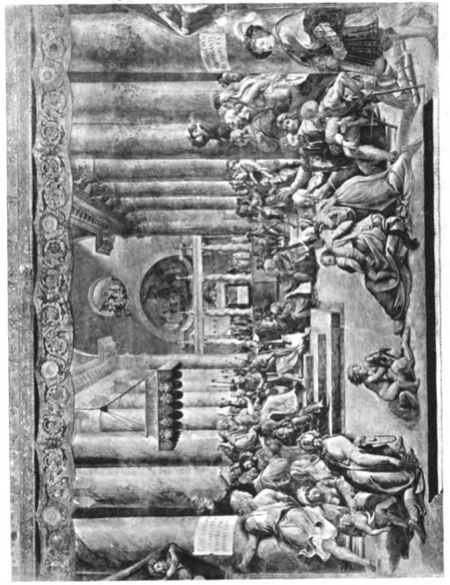
(See this image in horizontal aspect [here].)
Constantine's coronation at Rome. From a painting by Raphael, in the Vatican.
The gratitude of the church has exalted the virtues and excused the failings of a generous patron, who seated Christianity on the throne of the Roman world; and the Greeks, who celebrate the festival of the Imperial saint, seldom mention the name of Constantine without adding the title of equal to the Apostles. [71] Such a comparison, if it allude to the character of those divine missionaries, must be imputed [III-309] to the extravagance of impious flattery. But, if the parallel is confined to the extent and number of their evangelic victories, the success of Constantine might perhaps equal that of the Apostles themselves. By the edicts of toleration he removed the temporal disadvantages which had hitherto retarded the progress of Christianity; and its active and numerous ministers received a free permission, a liberal encouragement, to recommend the salutary truths of revelation by every argument which could affect the reason or piety of mankind. The exact balance of the two religions continued but a moment; and the piercing eye of ambition and avarice soon discovered that the profession of Christianity might contribute to the interest of the present, as well as of a future, life. [72] The hopes of wealth and honours, the example of an emperor, his exhortations, his irresistible smiles, diffused conviction among the venal and obsequious crowds which usually fill the apartments of a palace. The cities which signalised a forward zeal by the voluntary destruction of their temples were distinguished by municipal privileges, and rewarded with popular donatives; and the new capital of the East gloried in the singular advantage that Constantinople was never profaned by the worship of idols. [73] As the lower ranks of society are governed by imitation, the conversion of those who possessed any eminence of birth, of power, or of riches, was soon followed by dependent multitudes. [74] The salvation of the common people was purchased at an easy rate, if it be true that, in [III-310] one year, twelve thousand men were baptized at Rome, besides a proportionable number of women and children; and that a white garment, with twenty pieces of gold, had been promised by the emperor to every convert. [75] The powerful influence of Constantine was not circumscribed by the narrow limits of his life, or of his dominions. The education which he bestowed on his sons and nephews secured to the empire a race of princes whose faith was still more lively and sincere, as they imbibed, in their earliest infancy, the spirit, or at least the doctrine, of Christianity. War and commerce had spread the knowledge of the gospel beyond the confines of the Roman provinces; and the Barbarians, who had disdained an humble and proscribed sect, soon learned to esteem a religion which had been so lately embraced by the greatest monarch and the most civilised nation of the globe. [76] The Goths and Germans who enlisted under the standard of Rome revered the cross which glittered at the head of the legions, and their fierce countrymen [III-311] received at the same time the lessons of faith and of humanity. The kings of Iberia and Armenia worshipped the God of their protector; and their subjects, who have invariably preserved the name of Christians, soon formed a sacred and perpetual connection with their Roman brethren. The Christians of Persia were suspected, in time of war, of preferring their religion to their country; but, as long as peace subsisted between the two empires, the persecuting spirit of the Magi was effectually restrained by the interposition of Constantine. [77] The rays of the gospel illuminated the coast of India. The colonies of Jews, who had penetrated into Arabia and Æthiopia, [78] opposed the progress of Christianity; but the labour of the missionaries was in some measure facilitated by a previous knowledge of the Mosaic revelation; and Abyssinia still reveres the memory of Frumentius, who, in the time of Constantine, devoted his life to the conversion of those sequestered regions. Under the reign of his son Constantius, Theophilus, [79] who was himself of Indian extraction, was invested with the double character of ambassador and bishop. He embarked on the Red Sea with two hundred horses of the purest breed of Cappadocia, which were sent by the emperor to the prince of the Sabæans, or Homerites. Theophilus was entrusted with many other useful or curious presents, which might raise the admiration and conciliate the friendship of the [III-312] Barbarians; and he successfully employed several years in a pastoral visit to the churches of the torrid zone. [80]
The irresistible power of the Roman emperors was displayed in the important and dangerous change of the national religion. The terrors of a military force silenced the faint and unsupported murmurs of the Pagans, and there was reason to expect that the cheerful submission of the Christian clergy, as well as people, would be the result of conscience and gratitude. It was long since established, as a fundamental maxim of the Roman constitution, that every rank of citizens were alike subject to the laws, and that the care of religion was the right as well as duty of the civil magistrate. Constantine and his successors could not easily persuade themselves that they had forfeited, by their conversion, any branch of the Imperial prerogatives, or that they were incapable of giving laws to a religion which they had protected and embraced. The emperors still continued to exercise a supreme jurisdiction over the ecclesiastical order; and the sixteenth book of the Theodosian Code represents, under a variety of titles, the authority which they assumed in the government of the Catholic church.
But the distinction of the spiritual and temporal powers, [81] which had never been imposed on the free spirit of Greece and Rome, was introduced and confirmed by the legal establishment of Christianity. The office of supreme pontiff, which, from the time of Numa to that of Augustus, had always been exercised by one of the most eminent of the senators, was at length united to the Imperial dignity. The first magistrate of the state, as often as he was prompted by superstition [III-313] or policy, performed with his own hands the sacerdotal functions; [82] nor was there any order of priests, either at Rome or in the provinces, who claimed a more sacred character among men, or a more intimate communication with the Gods. But in the Christian church, which entrusts the service of the altar to a perpetual succession of consecrated ministers, the monarch, whose spiritual rank is less honourable than that of the meanest deacon, was seated below the rails of the sanctuary, and confounded with the rest of the faithful multitude. [83] The emperor might be saluted as the father of his people, but he owed a filial duty and reverence to the fathers of the church; and the same marks of respect which Constantine had paid to the persons of saints and confessors were soon exacted by the pride of the episcopal order. [84] A secret conflict between the civil and ecclesiastical jurisdictions embarrassed the operations of the Roman government; and a pious emperor was alarmed by the guilt and danger of touching with a profane hand the ark of the covenant. The separation of men into the two orders of the clergy and of the laity was, indeed, familiar to many nations of antiquity; and the priests of India, of Persia, of [III-314] Assyria, of Judea, of Æthiopia, of Egypt, and of Gaul derived from a celestial origin the temporal power and possessions which they had acquired. These venerable institutions had gradually assimilated themselves to the manners and government of their respective countries; [85] but the opposition or contempt of the civil power served to cement the discipline of the primitive church. The Christians had been obliged to elect their own magistrates, to raise and distribute a peculiar revenue, and to regulate the internal policy of their republic by a code of laws, which were ratified by the consent of the people and the practice of three hundred years. When Constantine embraced the faith of the Christians, he seemed to contract a perpetual alliance with a distinct and independent society; and the privileges granted or confirmed by that emperor, or by his successors, were accepted, not as the precarious favours of the court, but as the just and unalienable rights of the ecclesiastical order.
The Catholic church was administered by the spiritual and legal jurisdiction of eighteen hundred bishops; [86] of whom one thousand were seated in the Greek, and eight hundred in the Latin, provinces of the empire. The extend and boundaries of their respective dioceses had been variously and accidentally decided by the zeal and success of the first missionaries, by the wishes of the people, and by the propagation of the gospel. Episcopal churches were closely planted along the banks of the Nile, on the sea-coast of Africa, in the proconsular Asia, and through the southern provinces of Italy. The [III-315] bishops of Gaul and Spain, of Thrace and Pontus, reigned over an ample territory, and delegated their rural suffragans to execute the subordinate duties of the pastoral office. [87] A Christian diocese might be spread over a province or reduced to a village; but all the bishops possessed an equal and indelible character: they all derived the same powers and privileges from the apostles, from the people, and from the laws. While the civil and military professions were separated by the policy of Constantine, a new and perpetual order of ecclesiastical ministers, always respectable, sometimes dangerous, was established in the church and state. The important review of their station and attributes may be distributed under the following heads: I. Popular election. II. Ordination of the clergy. III. Property. IV. Civil jurisdiction. V. Spiritual censures. VI. Exercise of public oratory. VII. Privilege of legislative assemblies.
I. The freedom of elections subsisted long after the legal establishment of Christianity; [88] and the subjects of Rome enjoyed in the church the privilege which they had lost in the republic, of choosing the magistrates whom they were bound to obey. As soon as a bishop had closed his eyes, the metropolitan issued a commission to one of his suffragans to administer the vacant see, and prepare, within a limited time, the future election. The right of voting was vested in the inferior clergy, who were best qualified to judge of the merit of the candidates; in the senators or nobles of the city, all those [III-316] who were distinguished by their rank or property; and finally in the whole body of the people, who, on the appointed day, flocked in multitudes from the most remote parts of the diocese, [89] and sometimes silenced, by their tumultuous acclamations, the voice of reason and the laws of discipline. These acclamations might accidentally fix on the head of the most deserving competitor; of some ancient presbyter, some holy monk, or some layman, conspicuous for his zeal and piety. But the episcopal chair was solicited, especially in the great and opulent cities of the empire, as a temporal rather than as a spiritual dignity. The interested views, the selfish and angry passions, the arts of perfidy and dissimulation, the secret corruption, the open and even bloody violence, which had formerly disgraced the freedom of election in the commonwealths of Greece and Rome, too often influenced the choice of the successors of the apostles. While one of the candidates boasted the honours of his family, a second allured his judges by the delicacies of a plentiful table, and a third, more guilty than his rivals, offered to share the plunder of the church among the accomplices of his sacrilegious hopes. [90] The civil as well as ecclesiastical laws attempted to exclude the populace from this solemn and important transaction. The canons of ancient discipline, by requiring several episcopal qualifications of age, station, &c., restrained in some measure the indiscriminate caprice of the electors. The authority of the provincial bishops, who were assembled in the vacant church to consecrate the choice of the people, was interposed to moderate their passions and to correct their mistakes. The bishops could refuse to ordain an unworthy [III-317] candidate, and the rage of contending factions sometimes accepted their impartial mediation. The submission, or the resistance, of the clergy and people, on various occasions, afforded different precedents, which were insensibly converted into positive laws and provincial customs: [91] but it was everywhere admitted, as a fundamental maxim of religious policy, that no bishop could be imposed on an orthodox church without the consent of its members. The emperors, as the guardians of the public peace, and as the first citizens of Rome and Constantinople, might effectually declare their wishes in the choice of a primate: but those absolute monarchs respected the freedom of ecclesiastical elections; and, while they distributed and resumed the honours of the state and army, they allowed eighteen hundred perpetual magistrates to receive their important offices from the free suffrages of the people. [92] It was agreeable to the dictates of justice, that these magistrates should not desert an honourable station from which they could not be removed; but the wisdom of councils endeavoured, without much success, to enforce the residence, and to prevent the translation, of bishops. The discipline of the West was indeed less relaxed than that of the East; but the same passions which made those regulations necessary rendered them ineffectual. The reproaches which angry prelates have so vehemently urged against each other serve only to expose their common guilt and their mutual indiscretion.
II. The bishops alone possessed the faculty of spiritual generation; and this extraordinary privilege might compensate, in some degree, for the painful celibacy [93] which was imposed [III-318] as a virtue, as a duty, and at length as a positive obligation. The religions of antiquity, which established a separate order of priests, dedicated a holy race, a tribe or family, to the perpetual service of the Gods. [94] Such institutions were founded for possession rather than conquest. The children of the priests enjoyed, with proud and indolent security, their sacred inheritance; and the fiery spirit of enthusiasm was abated by the cares, the pleasures, and the endearments of domestic life. But the Christian sanctuary was open to every ambitious candidate who aspired to its heavenly promises or temporal possessions. The office of priests, like that of soldiers or magistrates, was strenuously exercised by those men whose temper and abilities had prompted them to embrace the ecclesiastical profession, or who had been selected by a discerning bishop as the best qualified to promote the glory and interest of the church. The bishops [95] (till the abuse was restrained by the prudence of the laws) might constrain the reluctant, and protect the distressed; and the imposition of hands for ever bestowed some of the most valuable privileges of civil society. The whole body of the Catholic clergy, more numerous perhaps [III-319] than the legions, was exempted by the emperors from all service, private or public, all municipal offices, and all personal taxes and contributions which pressed on their fellow-citizens with intolerable weight; and the duties of their holy profession were accepted as a full discharge of their obligations to the republic. [96] Each bishop acquired an absolute and indefeasible right to the perpetual obedience of the clerk whom he ordained: the clergy of each episcopal church, with its dependent parishes, formed a regular and permanent society; and the cathedrals of Constantinople [97] and Carthage [98] maintained their peculiar establishment of five hundred ecclesiastical ministers. Their ranks [99] and numbers were insensibly multiplied by the superstition of the times, which introduced into the church the splendid ceremonies of a Jewish or Pagan temple; and a long train of priests, deacons, sub-deacons, acolytes, exorcists, readers, singers, and door-keepers contributed, in their respective stations, to swell the pomp and harmony of religious worship. The clerical name and privilege were extended to many pious fraternities, who devoutly supported the ecclesiastical throne. [100] Six hundred parabolani, [III-320] or adventurers, visited the sick at Alexandria; eleven hundred copiatæ, or gravediggers, buried the dead at Constantinople; and the swarms of monks, who arose from the Nile, overspread and darkened the face of the Christian world.
III. The edict of Milan secured the revenue as well as the peace of the church. [101] The Christians not only recovered the lands and houses of which they had been stripped by the persecuting laws of Diocletian, but they acquired a perfect title to all the possessions which they had hitherto enjoyed by the connivance of the magistrate. As soon as Christianity became the religion of the emperor and the empire, the national clergy might claim a decent and honourable maintenance: and the payment of an annual tax might have delivered the people from the more oppressive tribute which superstition imposes on her votaries. But, as the wants and expenses of the church increased with her prosperity, the ecclesiastical order was still supported and enriched by the voluntary oblations of the faithful. Eight years after the edict of Milan, Constantine granted to all his subjects the free and universal permission of bequeathing their fortunes to the holy Catholic church; [102] and their devout liberality, which during their lives was checked by luxury or avarice, flowed with a profuse stream at the hour of their death. The wealthy Christians were encouraged by the example of their sovereign. An absolute monarch, who is rich without patrimony, may be charitable without merit; and Constantine too easily [III-321] believed that he should purchase the favour of Heaven, if he maintained the idle at the expense of the industrious, and distributed among the saints the wealth of the republic. The same messenger who carried over to Africa the head of Maxentius might be entrusted with an epistle to Cæcilian, bishop of Carthage. The emperor acquaints him that the treasurers of the province are directed to pay into his hands the sum of three thousand folles, or eighteen thousand pounds sterling, and to obey his farther requisitions for the relief of the churches of Africa, Numidia, and Mauritania. [103] The liberality of Constantine increased in a just proportion to his faith, and to his vices. He assigned in each city a regular allowance of corn, to supply the fund of ecclesiastical charity; and the persons of both sexes who embraced the monastic life became the peculiar favourites of their sovereign. The Christian temples of Antioch, Alexandria, Jerusalem, Constantinople, &c., displayed the ostentatious piety of a prince ambitious, in a declining age, to equal the perfect labours of antiquity. [104] The form of these religious edifices was simple and oblong; though they might sometimes swell into the shape of a dome, and sometimes branch into the figure of a cross. The timbers were framed for the most part of cedars of Libanus; the roof was covered with tiles, perhaps of gilt brass; and the walls, the columns, the pavement, were incrusted with variegated marbles. The most precious ornaments of gold and silver, of silk and gems, were profusely dedicated to the service of the altar; and this specious magnificence was supported on the solid and perpetual basis of [III-322] landed property. In the space of two centuries, from the reign of Constantine to that of Justinian, the eighteen hundred churches of the empire were enriched by the frequent and unalienable gifts of the prince and people. An annual income of six hundred pounds sterling may be reasonably assigned to the bishops, who were placed at an equal distance between riches and poverty, [105] but the standard of their wealth insensibly rose with the dignity and opulence of the cities which they governed. An authentic but imperfect [106] rent roll specifies some houses, shops, gardens, and farms, which belonged to the three Basilicæ of Rome, St. Peter, St. Paul, and St. John Lateran, in the provinces of Italy, Africa, and the East. They produce, besides a reserved rent of oil, of linen, paper, aromatics, &c., a clear annual revenue of twenty-two thousand pieces of gold, or twelve thousand pounds sterling. In the age of Constantine and Justinian, the bishops no longer possessed, perhaps they no longer deserved, the unsuspecting confidence of their clergy and people. The ecclesiastical revenues of each diocese were divided into four parts: for the respective uses of the bishop himself, of his inferior clergy, of the poor, and of the public worship; and the abuse of this sacred trust was strictly and repeatedly checked. [107] The patrimony of the church was [III-323] still subject to all the public impositions of the state. [108] The clergy of Rome, Alexandria, Thessalonica, &c., might solicit and obtain some partial exemptions; but the premature attempt of the great council of Rimini, which aspired to universal freedom, was successfully resisted by the son of Constantine. [109]
IV. The Latin clergy, who erected their tribunal on the ruins of the civil and common law, have modestly accepted as the gift of Constantine [110] the independent jurisdiction which was the fruit of time, of accident, and of their own industry. But the liberality of the Christian emperors had actually endowed them with some legal prerogatives, which secured and dignified the sacerdotal character. [111] 1. Under [III-324] a despotic government, the bishops alone enjoyed and asserted the inestimable privilege of being tried only by their peers; and even in a capital accusation, a synod of their brethren were the sole judges of their guilt or innocence. Such a tribunal, unless it was inflamed by personal resentment or religious discord, might be favourable, or even partial, to the sacerdotal order: but Constantine was satisfied [112] that secret impunity would be less pernicious than public scandal: and the Nicene council was edified by his public declaration that, if he surprised a bishop in the act of adultery, he should cast his Imperial mantle over the episcopal sinner. 2. The domestic jurisdiction of the bishops was at once a privilege and a restraint of the ecclesiastical order, whose civil causes were decently withdrawn from the cognizance of a secular judge. Their venial offences were not exposed to the shame of a public trial or punishment; and the gentle correction, which the tenderness of youth may endure from its parents or instructors, was inflicted by the temperate severity of the bishops. But, if the clergy were guilty of any crime which could not be sufficiently expiated by their degradation from an honourable and beneficial profession, the Roman magistrate drew the sword of justice without any regard to ecclesiastical immunities. 3. The arbitration of the bishops was ratified by a positive law; and the judges were instructed to execute, without appeal or delay, the episcopal decrees, whose validity had hitherto depended on the consent of the parties. The conversion of the magistrates themselves, and of the whole empire, might gradually remove the fears and scruples of the Christians. But they still resorted to the tribunal of the bishops, whose abilities and integrity they esteemed: and the venerable Austin enjoyed [III-325] the satisfaction of complaining that his spiritual functions were perpetually interrupted by the invidious labour of deciding the claim or the possession of silver and gold, of lands and cattle. 4. The ancient privilege of sanctuary was transferred to the Christian temples, and extended, by the liberal piety of the younger Theodosius, to the precincts of consecrated ground. [113] The fugitive, and even guilty, suppliants were permitted to implore either the justice or the mercy of the Deity and his ministers. The rash violence of despotism was suspended by the mild interposition of the church; and the lives or fortunes of the most eminent subjects might be protected by the mediation of the bishop.
V. The bishop was the perpetual censor of the morals of his people. The discipline of penance was digested into a system of canonical jurisprudence, [114] which accurately defined the duty of private or public confession, the rules of evidence, the degrees of guilt, and the measure of punishment. It was impossible to execute this spiritual censure, if the Christian pontiff, who punished the obscure sins of the multitude, respected the conspicuous vices and destructive crimes of the magistrate; but it was impossible to arraign the conduct of the magistrate without controlling the administration of civil government. Some considerations of religion, or loyalty, or fear, protected the sacred persons of the emperors from the zeal or resentment of the bishops; but they [III-326] boldly censured and excommunicated the subordinate tyrants who were not invested with the majesty of the purple. St. Athanasius excommunicated one of the ministers of Egypt; and the interdict which he pronounced, of fire and water, was solemnly transmitted to the churches of Cappadocia. [115] Under the reign of the younger Theodosius, the polite and eloquent Synesius, one of the descendants of Hercules, [116] filled the episcopal seat of Ptolemais, near the ruins of ancient Cyrene, [117] and the philosophic bishop supported, with dignity, the character which he had assumed with reluctance. [118] He vanquished the monster of Libya, the president Andronicus, who abused the authority of a venal office, invented new modes of rapine and torture, and aggravated the guilt of [III-327] oppression by that of sacrilege. [119] After a fruitless attempt to reclaim the haughty magistrate by mild and religious admonition, Synesius proceeds to inflict the last sentence of ecclesiastical justice, [120] which devotes Andronicus, with his associates and their families, to the abhorrence of earth and heaven. The impenitent sinners, more cruel than Phalaris or Sennacherib, more destructive than war, pestilence, or a cloud of locusts, are deprived of the name and privileges of Christians, of the participation of the sacraments, and of the hope of Paradise. The bishop exhorts the clergy, the magistrates, and the people to renounce all society with the enemies of Christ; to exclude them from their houses and tables; and to refuse them the common offices of life and the decent rites of burial. The church of Ptolemais, obscure and contemptible as she may appear, addresses this declaration to all her sister churches of the world; and the profane who reject her decrees will be involved in the guilt and punishment of Andronicus and his impious followers. These spiritual terrors were enforced by a dexterous application to the Byzantine court; the trembling president implored the mercy of the church; and the descendant of Hercules enjoyed the satisfaction of raising a prostrate tyrant from the ground. [121] Such principles and such examples insensibly prepared the triumph of the Roman pontiffs, who have trampled on the necks of kings.
VI. Every popular government has experienced the effects [III-328] of rude or artificial eloquence. The coldest nature is animated, the firmest reason is moved, by the rapid communication of the prevailing impulse; and each hearer is affected by his own passions, and by those of the surrounding multitude. The ruin of civil liberty had silenced the demagogues of Athens and the tribunes of Rome; the custom of preaching, which seems to constitute a considerable part of Christian devotion, had not been introduced into the temples of antiquity; and the ears of monarchs were never invaded by the harsh sound of popular eloquence, till the pulpits of the empire were filled with sacred orators who possessed some advantages unknown to their profane predecessors. [122] The arguments and rhetoric of the tribune were instantly opposed, with equal arms, by skilful and resolute antagonists; and the cause of truth and reason might derive an accidental support from the conflict of hostile passions. The bishop, or some distinguished presbyter, to whom he cautiously delegated the powers of preaching, harangued, without the danger of interruption or reply, a submissive multitude, whose minds had been prepared and subdued by the awful ceremonies of religion. Such was the strict subordination of the Catholic church that the same concerted sounds might issue at once from an hundred pulpits of Italy or Egypt, if they were tuned [123] by the master hand of the Roman or Alexandrian primate. The design of this institution was laudable, but the fruits were not always salutary. The preachers recommended the practice of the social duties; but they exalted the perfection of monastic [III-329] virtue, which is painful to the individual and useless to mankind. Their charitable exhortations betrayed a secret wish that the clergy might be permitted to manage the wealth of the faithful for the benefit of the poor. The most sublime representations of the attributes and laws of the Deity were sullied by an idle mixture of metaphysical subtleties, puerile rites, and fictitious miracles: and they expatiated, with the most fervent zeal, on the religious merit of hating the adversaries, and obeying the ministers, of the church. When the public peace was distracted by heresy and schism, the sacred orators sounded the trumpet of discord, and perhaps of sedition. The understandings of their congregations were perplexed by mystery, their passions were inflamed by invectives: and they rushed from the Christian temples of Antioch or Alexandria, prepared either to suffer or to inflict martyrdom. The corruption of taste and language is strongly marked in the vehement declamations of the Latin bishops; but the compositions of Gregory and Chrysostom have been compared with the most splendid models of Attic, or at least of Asiatic, eloquence. [124]
VII. The representatives of the Christian republic were regularly assembled in the spring and autumn of each year: and these synods diffused the spirit of ecclesiastical discipline and legislation through the hundred and twenty provinces of the Roman world. [125] The archbishop or metropolitan was empowered, by the laws, to summon the suffragan bishops of his province, to revise their conduct, to vindicate their rights, to declare their faith, and to examine the merit of the candidates [III-330] who were elected by the clergy and people to supply the vacancies of the episcopal college. The primates of Rome, Alexandria, Antioch, Carthage, and afterwards Constantinople, who exercised a more ample jurisdiction, convened the numerous assembly of their dependent bishops. But the convocation of great and extraordinary synods was the prerogative of the emperor alone. Whenever the emergencies of the church required this decisive measure, he despatched a peremptory summons to the bishops, or the deputies of each province, with an order for the use of post-horses, and a competent allowance for the expenses of their journey. At an early period, when Constantine was the protector, rather than the proselyte, of Christianity, he referred the African controversy to the council of Arles; in which the bishops of York, of Treves, of Milan, and of Carthage met as friends and brethren, to debate in their native tongue on the common interest of the Latin or Western church. [126] Eleven years afterwards, a more numerous and celebrated assembly was convened at Nice in Bithynia, to extinguish, by their final sentence, the subtle disputes which had arisen in Egypt on the subject of the Trinity. Three hundred and eighteen bishops obeyed the summons of their indulgent master; the ecclesiastics, of every rank and sect and denomination, have been computed at two thousand and forty-eight persons; [127] the Greeks appeared in person; and the consent of the Latins was expressed by the legates of the Roman pontiff. The session, which lasted about two months, was frequently honoured by the presence of the emperor. Leaving his guards at the door, he seated himself (with the permission [III-331] of the council) on a low stool in the midst of the hall. Constantine listened with patience and spoke with modesty: and, while he influenced the debates, he humbly professed that he was the minister, not the judge, of the successors of the apostles, who had been established as priests and as gods upon earth. [128] Such profound reverence of an absolute monarch towards a feeble and unarmed assembly of his own subjects can only be compared to the respect with which the senate had been treated by the Roman princes, who adopted the policy of Augustus. Within the space of fifty years, a philosophic spectator of the vicissitude of human affairs might have contemplated Tacitus in the senate of Rome, and Constantine in the council of Nice. The fathers of the Capitol and those of the church had alike degenerated from the virtues of their founders; but, as the bishops were more deeply rooted in the public opinion, they sustained their dignity with more decent pride, and sometimes opposed, with a manly spirit, the wishes of their sovereign. The progress of time and superstition erased the memory of the weakness, the passion, the ignorance, which disgraced these ecclesiastical synods; and the Catholic world has unanimously submitted [129] to the infallible decrees of the general councils. [130]
[III-332]
CHAPTER XXI↩
Persecution of Heresy — The Schism of the Donatists — The Arian Controversy — Athanasius — Distracted State of the Church and Empire under Constantine and his Sons — Toleration of Paganism
The grateful applause of the clergy has consecrated the memory of a prince who indulged their passions and promoted their interest. Constantine gave them security, wealth, honours, and revenge: and the support of the orthodox faith was considered as the most sacred and important duty of the civil magistrate. The edict of Milan, the great charter of toleration, had confirmed to each individual of the Roman world the privilege of choosing and professing his own religion. But this inestimable privilege was soon violated: with the knowledge of truth, the emperor imbibed the maxims of persecution; and the sects which dissented from the Catholic church were afflicted and oppressed by the triumph of Christianity. Constantine easily believed that the Heretics, who presumed to dispute his opinions or to oppose his commands, were guilty of the most absurd and criminal obstinacy; and that a seasonable application of moderate severities might save those unhappy men from the danger of an everlasting condemnation. Not a moment was lost in excluding the ministers and teachers of the separated congregations from any share of the rewards and immunities which the emperor had so liberally bestowed on the orthodox clergy. But, as the sectaries might still exist under the cloud of royal disgrace, the conquest of the East was immediately followed by an edict which announced their total destruction. [1] After a [III-333] preamble filled with passion and reproach, Constantine absolutely prohibits the assemblies of the Heretics, and confiscates their public property to the use either of the revenue or of the Catholic church. The sects against whom the Imperial severity was directed appear to have been the adherents of Paul of Samosata; the Montanists of Phrygia, who maintained an enthusiastic succession of prophecy; the Novatians, who sternly rejected the temporal efficacy of repentance; the Marcionites and Valentinians, under whose leading banners the various Gnostics of Asia and Egypt had insensibly rallied; and perhaps the Manichæans, who had recently imported from Persia a more artful composition of Oriental and Christian theology. [2] The design of extirpating the name, or at least of restraining the progress, of these odious Heretics was prosecuted with vigour and effect. Some of the penal regulations were copied from the edicts of Diocletian; and this method of conversion was applauded by the same bishops who had felt the hand of oppression and had pleaded for the rights of humanity. Two immaterial circumstances [III-334] may serve, however, to prove that the mind of Constantine was not entirely corrupted by the spirit of zeal and bigotry. Before he condemned the Manichæans and their kindred sects, he resolved to make an accurate inquiry into the nature of their religious principles. As if he distrusted the impartiality of his ecclesiastical counsellors, this delicate commission was entrusted to a civil magistrate, whose learning and moderation he justly esteemed, and of whose venal character he was probably ignorant. [3] The emperor was soon convinced that he had too hastily proscribed the orthodox faith and the exemplary morals of the Novatians, who had dissented from the church in some articles of discipline which were not perhaps essential to salvation. By a particular edict, he exempted them from the general penalties of the law; [4] allowed them to build a church at Constantinople, respected the miracles of their saints, invited their bishop Acesius to the council of Nice, and gently ridiculed the narrow tenets of his sect by a familiar jest, which, from the mouth of a sovereign, must have been received with applause and gratitude. [5]
The complaints and mutual accusations which assailed the throne of Constantine, as soon as the death of Maxentius had submitted Africa to his victorious arms, were ill adapted to edify an imperfect proselyte. He learned with surprise that the provinces of that great country, from the confines of [III-335] Cyrene to the columns of Hercules, were distracted with religious discord. [6] The source of the division was derived from a double election in the church of Carthage; the second, in rank and opulence, of the ecclesiastical thrones of the West. Cæcilian and Majorinus were the two rival primates of Africa; and the death of the latter soon made room for Donatus, who, by his superior abilities and apparent virtues, was the firmest support of his party. The advantage which Cæcilian might claim from the priority his ordination was destroyed by the illegal, or at least indecent, haste with which it had been performed, without expecting the arrival of the bishops of Numidia. The authority of these bishops, who, to the number of seventy, condemned Cæcilian and consecrated Majorinus, is again weakened by the infamy of some of their personal characters; and by the female intrigues, sacrilegious bargains, and tumultuous proceedings which are imputed to this Numidian council. [7] The bishops of the contending factions maintained, with equal ardour and obstinacy, that [III-336] their adversaries were degraded, or at least dishonoured, by the odious crime of delivering the Holy Scriptures to the officers of Diocletian. From their mutual reproaches, as well as from the story of this dark transaction, it may justly be inferred that the late persecution had embittered the zeal, without reforming the manners, of the African Christians. That divided church was incapable of affording an impartial judicature; the controversy was solemnly tried in five successive tribunals which were appointed by the emperor; and the whole proceeding, from the first appeal to the final sentence, lasted above three years. A severe inquisition, which was taken by the Prætorian vicar and the proconsul of Africa, the report of two episcopal visitors who had been sent to Carthage, the decrees of the councils of Rome and of Arles, and the supreme judgment of Constantine himself in his sacred consistory, were all favourable to the cause of Cæcilian; and he was unanimously acknowledged by the civil and ecclesiastical powers as the true and lawful primate of Africa. The honours and estates of the church were attributed to his suffragan bishops, and it was not without difficulty that Constantine was satisfied with inflicting the punishment of exile on the principal leaders of the Donatist faction. As their cause was examined with attention, perhaps it was determined with justice. Perhaps their complaint was not without foundation, that the credulity of the emperor had been abused by the insidious arts of his favourite Osius. The influence of falsehood and corruption might procure the condemnation of the innocent, or aggravate the sentence of the guilty. Such an act, however, of injustice, if it concluded an importunate dispute, might be numbered among the transient evils of a despotic administration, which are neither felt nor remembered by posterity.
But this incident, so inconsiderable that it scarcely deserves a place in history, was productive of a memorable schism, which afflicted the provinces of Africa above three hundred years, and was extinguished only with Christianity [III-337] itself. The inflexible zeal of freedom and fanaticism animated the Donatists to refuse obedience to the usurpers whose election they disputed and whose spiritual powers they denied. Excluded from the civil and religious communion of mankind, they boldly excommunicated the rest of mankind, who had embraced the impious party of Cæcilian, and of the Traditors, from whom he derived his pretended ordination. They asserted with confidence, and almost with exultation, that the Apostolical succession was interrupted; that all the bishops of Europe and Asia were infected by the contagion of guilt and schism; and that the prerogatives of the Catholic church were confined to the chosen portion of the African believers, who alone had preserved inviolate the integrity of their faith and discipline. This rigid theory was supported by the most uncharitable conduct. Whenever they acquired a proselyte, even from the distant provinces of the East, they carefully repeated the sacred rites of baptism [8] and ordination; as they rejected the validity of those which he had already received from the hands of heretics or schismatics. Bishops, virgins, and even spotless infants were subjected to the disgrace of a public penance, before they could be admitted to the communion of the Donatists. If they obtained possession of a church which had been used by their Catholic adversaries, they purified the unhallowed building with the same jealous care which a temple of idols might have required. They washed the pavement, scraped the walls, burnt the altar, which was commonly of wood, melted the consecrated plate, and cast the Holy Eucharist to the dogs, with every circumstance of ignominy which could [III-338] provoke and perpetuate the animosity of religious factions. [9] Notwithstanding this irreconcilable aversion, the two parties, who were mixed and separated in all the cities of Africa, had the same language and manners, the same zeal and learning, the same faith and worship. Proscribed by the civil and ecclesiastical powers of the empire, the Donatists still maintained in some provinces, particularly in Numidia, their superior numbers; and four hundred bishops acknowledged the jurisdiction of their primate. But the invincible spirit of the sect sometimes preyed on its own vitals; and the bosom of their schismatical church was torn by intestine divisions. A fourth part of the Donatist bishops followed the independent standard of the Maximianists. The narrow and solitary path which their first leaders had marked out continued to deviate from the great society of mankind. Even the imperceptible sect of the Rogatians could affirm, without a blush, that, when Christ should descend to judge the earth, he would find his true religion preserved only in a few nameless villages of the Cæsarean Mauritania. [10]
The schism of the Donatists was confined to Africa: the more diffusive mischief of the Trinitarian controversy successively penetrated into every part of the Christian world. The former was an accidental quarrel, occasioned by the abuse of freedom; the latter was a high and mysterious argument, derived from the abuse of philosophy. From the age of Constantine to that of Clovis and Theodoric, the temporal interests both of the Romans and Barbarians were deeply involved in the theological disputes of Arianism. The historian may therefore be permitted respectfully to withdraw the veil of the sanctuary; and to deduce the progress of reason and faith, of error and passion, from the school of Plato to the decline and fall of the empire.
[III-339]
The genius of Plato, informed by his own meditation, or by the traditional knowledge of the priests of Egypt, [11] had ventured to explore the mysterious nature of the Deity. When he had elevated his mind to the sublime contemplation of the first self-existent, necessary cause of the universe, the Athenian sage was incapable of conceiving how the simple unity of his essence could admit the infinite variety of distinct and successive ideas which compose the model of the intellectual world; how a Being purely incorporeal could execute that perfect model, and mould with a plastic hand the rude and independent chaos. The vain hope of extricating himself from these difficulties, which must ever oppress the feeble powers of the human mind, might induce Plato to consider the divine nature under the threefold modification: of the first cause, the reason or Logos, and the soul or spirit of the universe. His poetical imagination sometimes fixed and animated these metaphysical abstractions; the three archical or original principles were represented in the Platonic system of three Gods, united with each other by a mysterious and ineffable generation; and the Logos was particularly considered under the more accessible character of the Son of an Eternal Father, and the Creator and Governor of the world. Such appear to have been the secret doctrines which were cautiously whispered in the gardens of the academy; and which, according to the more recent disciples of Plato, could not be perfectly understood, till after an assiduous study of thirty years. [12]
[III-340]
The arms of the Macedonians diffused over Asia and Egypt the language and learning of Greece; and the theological system of Plato was taught with less reserve, and perhaps with some improvements, in the celebrated school of Alexandria. [13] A numerous colony of Jews had been invited, by the favour of the Ptolemies, to settle in their new capital. [14] While the bulk of the nation practised the legal ceremonies, and pursued the lucrative occupations of commerce, a few Hebrews, of a more liberal spirit, devoted their lives to religious and philosophical contemplation. [15] They cultivated with diligence, and embraced with ardour, the theological system of the Athenian sage. But their national pride would have been mortified by a fair confession of their former poverty: and they boldly marked, as the sacred inheritance of their ancestors, the gold and jewels which they had so lately stolen from their Egyptian masters. One hundred years before the birth of Christ, a philosophical treatise, which manifestly betrays the style and sentiments of the school of Plato, was produced by the Alexandrian Jews, and unanimously received as a genuine and valuable relic of the inspired Wisdom of Solomon. [16] A similar union of the Mosaic faith and the Grecian philosophy distinguishes the works of Philo, which were composed, for the most part, under the reign of [III-341] Augustus. [17] The material soul of the universe [18] might offend the piety of the Hebrews: but they applied the character of the Logos to the Jehovah of Moses and the patriarchs; and the Son of God was introduced upon earth under a visible, and even human, appearance, to perform those familiar offices which seem incompatible with the nature and attributes of the Universal Cause. [19]
The eloquence of Plato, the name of Solomon, the authority of the school of Alexandria, and the consent of the Jews and Greeks were insufficient to establish the truth of a mysterious doctrine which might please, but could not satisfy, a rational mind. A prophet or apostle, inspired by the Deity, can alone exercise a lawful dominion over the faith of mankind; and the theology of Plato might have been for ever confounded with the philosophical visions of the Academy, the Porch, and the Lyceum, if the name and divine attributes of the Logos had not been confirmed by the celestial pen of the last and most sublime of the Evangelists. [20] The Christian [III-342] Revelation, which was consummated under the reign of Nerva, disclosed to the world the amazing secret that the Logos, who was with God from the beginning and was God, who had made all things and for whom all things had been made, was incarnate in the person of Jesus of Nazareth; who had been born of a virgin, and suffered death on the cross. Besides the general design of fixing on a perpetual basis the divine honours of Christ, the most ancient and respectable of the ecclesiastical writers have ascribed to the evangelic theologian a particular intention to confute two opposite heresies, which disturbed the peace of the primitive church. [21] I. The faith of the Ebionites, [22] perhaps of the Nazarenes, [23] was gross and imperfect. They revered Jesus as the greatest of the prophets, endowed with supernatural virtue and power. They ascribed to his person and to his future reign all the predictions of the Hebrew oracles which relate to the spiritual and everlasting kingdom of the promised Messiah. [24] Some [III-343] of them might confess that he was born of a virgin: but they obstinately rejected the preceding existence and divine perfections of the Logos, or Son of God, which are so clearly defined in the Gospel of St. John. About fifty years afterwards, the Ebionites, whose errors are mentioned by Justin Martyr with less severity than they seem to deserve, [25] formed a very inconsiderable portion of the Christian name. II. The Gnostics, who were distinguished by the epithet of Docetes, deviated into the contrary extreme, and betrayed the human, while they asserted the divine, nature of Christ. Educated in the school of Plato, accustomed to the sublime idea of the Logos, they readily conceived that the brightest Æon, or Emanation of the Deity, might assume the outward shape and visible appearances of a mortal; [26] but they vainly pretended that the imperfections of matter are incompatible with the purity of a celestial substance. While the blood of Christ yet smoked on Mount Calvary, the Docetes invented the impious and extravagant hypothesis that, instead of issuing from the womb of the Virgin, [27] he had descended on the banks of the Jordan in the form of perfect manhood; that he had imposed on the senses of his enemies, and of his disciples; and that the ministers of Pilate had wasted their [III-344] impotent rage on an airy phantom, who seemed to expire on the cross and, after three days, to rise from the dead. [28]
The divine sanction which the Apostle had bestowed on the fundamental principle of the theology of Plato encouraged the learned proselytes of the second and third centuries to admire and study the writings of the Athenian sage, who had thus marvellously anticipated one of the most surprising discoveries of the Christian revelation. The respectable name of Plato was used by the orthodox, [29] and abused by the heretics, [30] as the common support of truth and error: the authority of his skilful commentators, and the science of dialectics, were employed to justify the remote consequences of his opinions, and to supply the discreet silence of the inspired writers. The same subtle and profound questions concerning the nature, the generation, the distinction, and the equality of the three divine persons of the mysterious Triad, or Trinity, [31] were agitated in the philosophical, and in the Christian, schools of Alexandria. An eager spirit of curiosity [III-345] urged them to explore the secrets of the abyss; and the pride of the professors and of their disciples was satisfied with the science of words. But the most sagacious of the Christian theologians, the great Athanasius himself, has candidly confessed [32] that, whenever he forced his understanding to meditate on the divinity of the Logos, his toilsome and unavailing efforts recoiled on themselves; that the more he thought, the less he comprehended; and the more he wrote, the less capable was he of expressing his thoughts. In every step of the inquiry, we are compelled to feel and acknowledge the immeasurable disproportion between the size of the object and the capacity of the human mind. We may strive to abstract the notions of time, of space, and of matter, which so closely adhere to all the perceptions of our experimental knowledge. But, as soon as we presume to reason of infinite substance, of spiritual generation; as often as we deduce any positive conclusions from a negative idea, we are involved in darkness, perplexity, and inevitable contradiction. As these difficulties arise from the nature of the subject, they oppress, with the same insuperable weight, the philosophic and the theological disputant; but we may observe two essential and peculiar circumstances which discriminated the doctrines of the Catholic church from the opinions of the Platonic school.
I. A chosen society of philosophers, men of a liberal education and curious disposition, might silently meditate, and temperately discuss, in the gardens of Athens or the library of Alexandria, the abstruse questions of metaphysical science. The lofty speculations which neither convinced the understanding, nor agitated the passions, of the Platonists themselves were carelessly overlooked by the idle, the busy, and even the studious part of mankind. [33] But, after the Logos [III-346] had been revealed as the sacred object of the faith, the hope, and the religious worship of the Christians, the mysterious system was embraced by a numerous and increasing multitude in every province of the Roman world. Those persons who, from their age, or sex, or occupations, were the least qualified to judge, who were the least exercised in the habits of abstract reasoning, aspired to contemplate the economy of the Divine Nature; and it is the boast of Tertullian [34] that a Christian mechanic could readily answer such questions as had perplexed the wisest of the Grecian sages. Where the subject lies so far beyond our reach, the difference between the highest and the lowest of human understandings may indeed be calculated as infinitely small; yet the degree of weakness may perhaps be measured by the degree of obstinacy and dogmatic confidence. These speculations, instead of being treated as the amusement of a vacant hour, became the most serious business of the present, and the most useful preparation for a future, life. A theology, which it was incumbent to believe, which it was impious to doubt, and which it might be dangerous, and even fatal, to mistake, became the familiar topic of private meditation and popular discourse. The cold indifference of philosophy was inflamed by the fervent spirit of devotion; and even the metaphors of common anguage suggested the fallacious prejudices of sense and experience. The Christians, who abhorred the gross and impure generation of the Greek mythology, [35] were tempted [III-347] to argue from the familiar analogy of the filial and paternal relations. The character of Son seemed to imply a perpetual subordination to the voluntary author of his existence; [36] but, as the act of generation, in the most spiritual and abstracted sense, must be supposed to transmit the properties of a common nature, [37] they durst not presume to circumscribe the powers or the duration of the Son of an eternal and omnipotent Father. Fourscore years after the death of Christ, the Christians of Bithynia declared before the tribunal of Pliny that they invoked him as a god; and his divine honours have been perpetuated in every age and country by the various sects who assume the name of his disciples. [38] Their tender reverence for the memory of Christ and their horror for the profane worship of any created being would have engaged them to assert the equal and absolute divinity of the Logos, if their rapid ascent towards the throne of heaven had not been imperceptibly checked by the apprehension of violating the unity and sole supremacy of the great Father of Christ and of the Universe. The suspense and fluctuation produced in the minds of the Christians by these opposite tendencies may be observed in the writings of the theologians who flourished after the end of the apostolic age and before the origin of the Arian controversy. Their suffrage is claimed, with equal confidence, by the orthodox and by the heretical parties; and the most inquisitive critics have fairly allowed that, if they had the good fortune of possessing the Catholic verity, [III-348] they have delivered their conceptions in loose, inaccurate, and sometimes contradictory language. [39]
II. The devotion of individuals was the first circumstance which distinguished the Christians from the Platonists; the second was the authority of the church. The disciples of philosophy asserted the rights of intellectual freedom, and their respect for the sentiments of their teachers was a liberal and voluntary tribute, which they offered to superior reason. But the Christians formed a numerous and disciplined society; and the jurisdiction of their laws and magistrates was strictly exercised over the minds of the faithful. The loose wanderings of the imagination were gradually confined by creeds and confessions; [40] the freedom of private judgment submitted to the public wisdom of synods; the authority of a theologian was determined by his ecclesiastical rank; and the episcopal successors of the apostles inflicted the censures of the church on those who deviated from the orthodox belief. But in an age of religious controversy every act of oppression adds new force to the elastic vigour of the mind; and the zeal or obstinacy of a spiritual rebel was sometimes stimulated by secret motives of ambition or avarice. A metaphysical argument became the cause or pretence of political contests; the subtleties of the Platonic school were used as the badges of popular factions, and the distance which separated their respective tenets was enlarged or magnified by the acrimony of dispute. As long as the dark heresies of [III-349] Praxeas and Sabellius laboured to confound the Father with the Son, [41] the orthodox party might be excused if they adhered more strictly and more earnestly to the distinction, than to the equality, of the divine persons. But, as soon as the heat of controversy had subsided, and the progress of the Sabellians was no longer an object of terror to the churches of Rome, of Africa, or of Egypt; the tide of theological opinion began to flow with a gentle but steady motion toward the contrary extreme; and the most orthodox doctors allowed themselves the use of the terms and definitions which had been censured in the mouth of the sectaries. [42] After the edict of toleration had restored peace and leisure to the Christians, the Trinitarian controversy was revived in the ancient seat of Platonism, the learned, the opulent, the tumultuous city of Alexandria; and the flame of religious discord was rapidly communicated from the schools to the clergy, the people, the province, and the East. The abstruse question of the eternity of the Logos was agitated in ecclesiastical conferences and popular sermons; and the heterodox opinions of Arius [43] were soon made public by his own zeal and by that of his adversaries. His most implacable adversaries [III-350] have acknowledged the learning and blameless life of that eminent presbyter, who, in a former election, had declared, and perhaps generously declined, his pretensions to the episcopal throne. [44] His competitor Alexander assumed the office of his judge. The important cause was argued before him; and, if at first he seemed to hesitate, he at length pronounced his final sentence, as an absolute rule of faith. [45] The undaunted presbyter, who presumed to resist the authority of his angry bishop, was separated from the communion of the church. But the pride of Arius was supported by the applause of a numerous party. He reckoned among his immediate followers two bishops of Egypt, seven presbyters, twelve deacons, and (what may appear almost incredible) seven hundred virgins. A large majority of the bishops of Asia appeared to support or favour his cause; and their measures were conducted by Eusebius of Cæsarea, the most learned of the Christian prelates, and by Eusebius of Nicomedia, who had acquired the reputation of a statesman without forfeiting that of a saint. Synods in Palestine and Bithynia were opposed to the synods of Egypt. The attention of the prince and people was attracted by this theological dispute; and the decision, at the end of six years, [46] was referred to the supreme authority of the general council of Nice.
[III-none]
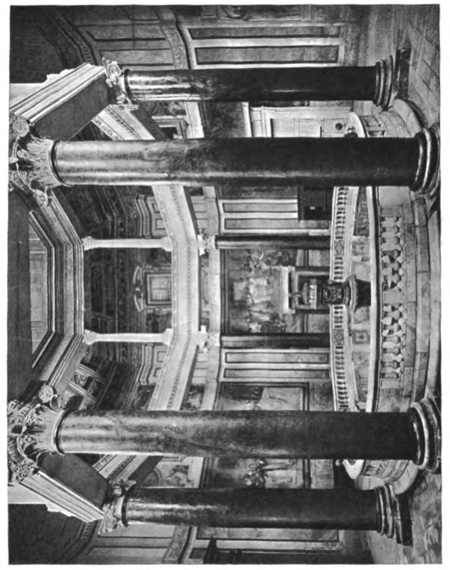
(See this image in horizontal aspect [here].)
Baptistry of St. John, in the Lateran, built by Constantine. From a photograph.
[III-351]
When the mysteries of the Christian faith were dangerously exposed to public debate, it might be observed that the human understanding was capable of forming three distinct, though imperfect, systems concerning the nature of the Divine Trinity; and it was pronounced that none of these systems, in a pure and absolute sense, were exempt from heresy and error. [47] I. According to the first hypothesis, which was maintained by Arius and his disciples, the Logos was a dependent and spontaneous production, created from nothing by the will of the Father. The Son, by whom all things were made, [48] had been begotten before all worlds, and the longest of the astronomical periods could be compared only as a fleeting moment to the extent of his duration; yet this duration was not infinite, [49] and there had been a time which preceded the ineffable generation of the Logos. On this only-begotten Son the Almighty Father had transfused his ample spirit, and impressed the effulgence of his glory. Visible image of invisible perfection, he saw, at an immeasurable distance beneath his feet, the thrones of the brightest archangels: yet he shone only with a reflected light, and, like the sons of the Roman emperors who were invested with the [III-352] titles of Cæsar or Augustus, [50] he governed the universe in obedience to the will of his Father and Monarch. II. In the second hypothesis, the Logos possessed all the inherent, incommunicable perfections which religion and philosophy appropriate to the Supreme God. Three distinct and infinite minds or substances, three co-equal and co-eternal beings, composed the Divine Essence; [51] and it would have implied contradiction that any of them should not have existed or that they should ever cease to exist. [52] The advocates of a system which seemed to establish three independent Deities attempted to preserve the unity of the First Cause, so conspicuous in the design and order of the world, by the perpetual concord of their administration and the essential agreement of their will. A faint resemblance of this unity of action may be discovered in the societies of men, and even of animals. The causes which disturb their harmony proceed only from the imperfection and inequality of their faculties: but the omnipotence which is guided by infinite wisdom and goodness cannot fail of choosing the same means for the accomplishment of the same ends. III. Three Beings, who, by the self-derived necessity of their existence, possess all the divine attributes in the most perfect degree; who are eternal in duration, infinite in space, and intimately present to each other and to the whole universe; irresistibly force themselves [III-353] on the astonished mind as one and the same Being, [53] who, in the economy of grace, as well as in that of nature, may manifest himself under different forms, and be considered under different aspects. By this hypothesis, a real substantial Trinity is refined into a trinity of names and abstract modifications, that subsist only in the mind which conceives them. The Logos is no longer a person, but an attribute; and it is only in a figurative sense that the epithet of Son can be applied to the eternal reason which was with God from the beginning, and by which, not by whom, all things were made. The incarnation of the Logos is reduced to a mere inspiration of the Divine Wisdom, which filled the soul, and directed all the actions, of the man Jesus. Thus, after revolving round the theological circle, we are surprised to find that the Sabellian ends where the Ebionite had begun; and that the incomprehensible mystery which excites our adoration eludes our inquiry. [54]
If the bishops of the council of Nice [55] had been permitted to [III-354] follow the unbiassed dictates of their conscience, Arius and his associates could scarcely have flattered themselves with the hopes of obtaining a majority of votes, in favour of an hypothesis so directly adverse to the two most popular opinions of the Catholic world. The Arians soon perceived the danger of their situation, and prudently assumed those modest virtues which, in the fury of civil and religious dissensions, are seldom practised, or even praised, except by the weaker party. They recommended the exercise of Christian charity and moderation; urged the incomprehensible nature of the controversy; disclaimed the use of any terms or definitions which could not be found in the scriptures; and offered, by very liberal concessions, to satisfy their adversaries without renouncing the integrity of their own principles. The victorious faction received all their proposals with haughty suspicion; and anxiously sought for some irreconcilable mark of distinction, the rejection of which might involve the Arians in the guilt and consequences of heresy. A letter was publicly read, and ignominiously torn, in which their patron, Eusebius of Nicomedia, ingenuously confessed that the admission of the Homoousion, or Consubstantial, a word already familiar to the Platonists, was incompatible with the principles of their theological system. The fortunate opportunity was eagerly embraced by the bishops who governed the resolutions of the synod; and, according to the lively expression of Ambrose, [56] they used the sword, which heresy itself had drawn from the scabbard, to cut off the head of the hated monster. The consubstantiality of the Father and the Son was established by the council of Nice, and has been [III-355] unanimously received as a fundamental article of the Christian faith, by the consent of the Greek, the Latin, the Oriental, and the Protestant churches. But, if the same word had not served to stigmatise the heretics and to unite the Catholics, it would have been inadequate to the purpose of the majority by whom it was introduced into the orthodox creed. This majority was divided into two parties, distinguished by a contrary tendency to the sentiments of the Tritheists and of the Sabellians. But, as those opposite extremes seemed to overthrow the foundations either of natural or revealed religion, they mutually agreed to qualify the rigour of their principles and to disavow the just, but invidious, consequences which might be urged by their antagonists. The interest of the common cause inclined them to join their numbers and to conceal their differences; their animosity was softened by the healing counsels of toleration, and their disputes were suspended by the use of the mysterious Homoousion, which either party was free to interpret according to their peculiar tenets. The Sabellian sense, which, about fifty years before, had obliged the council of Antioch [57] to prohibit this celebrated term, had endeared it to those theologians who entertained a secret but partial affection for a nominal Trinity. But the more fashionable saints of the Arian times, the intrepid Athanasius, the learned Gregory Nazianzen, and the other pillars of the church, who supported with ability and success the Nicene doctrine, appeared to consider the expression of substance as if it had been synonymous with that of nature; and they ventured to illustrate their meaning by affirming that three men, as they belong to the same common species, are consubstantial or homoousian to each other. [58] This pure [III-356] and distinct equality was tempered, on the one hand, by the internal connection, and spiritual penetration, which indissolubly unites the divine persons; [59] and on the other, by the pre-eminence of the Father, which was acknowledged as far as it is compatible with the independence of the Son. [60] Within these limits the almost invisible and tremulous ball of orthodoxy was allowed securely to vibrate. On either side, beyond this consecrated ground, the heretics and the demons lurked in ambush to surprise and devour the unhappy wanderer. But, as the degrees of theological hatred depend on the spirit of the war rather than on the importance of the controversy, the heretics who degraded, were treated with more severity than those who annihilated, the person of the Son. The life of Athanasius was consumed in irreconcilable opposition to the impious madness of the Arians; [61] but he defended above twenty years the Sabellianism of Marcellus of Ancyra; and, when at last he was compelled to withdraw himself from his communion, he continued to mention, with an ambiguous smile, the venial errors of his respectable friend. [62]
The authority of a general council, to which the Arians themselves had been compelled to submit, inscribed on the banners of the orthodox party the mysterious characters of the word Homoousion, which essentially contributed, notwithstanding [III-357] some obscure disputes, some nocturnal combats, to maintain and perpetuate the uniformity of faith, or at least of language. The Consubstantialists, who by their success have deserved and obtained the title of Catholics, gloried in the simplicity and steadiness of their own creed, and insulted the repeated variations of their adversaries, who were destitute of any certain rule of faith. The sincerity or the cunning of the Arian chiefs, the fears of the laws or of the people, their reverence for Christ, their hatred of Athanasius, all the causes, human and divine, that influence and disturb the councils of a theological faction, introduced among the sectaries a spirit of discord and inconstancy, which, in the course of a few years, erected eighteen different models of religion, [63] and avenged the violated dignity of the church. The zealous Hilary, [64] who, from the peculiar hardships of his situation, was inclined to extenuate rather than to aggravate the errors of the Oriental clergy, declares that in the wide extent of the ten provinces of Asia, to which he had been banished, there could be found very few prelates who had preserved the knowledge of the true God. [65] The oppression which he had felt, the disorders of which he was the spectator and the victim, appeased, during a short interval, the angry passions of his soul; and in the following passage, of which I [III-358] shall transcribe a few lines, the bishop of Poitiers unwarily deviates into the style of a Christian philosopher. “It is a thing,” says Hilary, “equally deplorable and dangerous, that there are as many creeds as opinions among men, as many doctrines as inclinations, and as many sources of blasphemy as there are faults among us; because we make creeds arbitrarily, and explain them as arbitrarily. The Homoousion is rejected, and received, and explained away by successive synods. The partial or total resemblance of the Father and of the Son is a subject of dispute for these unhappy times. Every year, nay every moon, we make new creeds to describe invisible mysteries. We repent of what we have done, we defend those who repent, we anathematise those whom we defended. We condemn either the doctrine of others in ourselves or our own in that of others; and, reciprocally tearing one another to pieces, we have been the cause of each other’s ruin.” [66]
It will not be expected, it would not perhaps be endured, that I should swell this theological digression by a minute examination of the eighteen creeds, the authors of which, for the most part, disclaimed the odious name of their parent Arius. It is amusing enough to delineate the form, and to trace the vegetation, of a singular plant; but the tedious detail of leaves without flowers, and of branches without fruit, would soon exhaust the patience, and disappoint the curiosity, of the laborious student. One question which gradually arose from the Arian controversy may however be noticed, as it served to produce and discriminate the three sects who were united only by their common aversion to the Homoousion of the Nicene synod. 1. If they were asked, whether the Son was like unto the Father, the question was resolutely answered in the negative by the heretics who adhered to the [III-359] principles of Arius, or indeed to those of philosophy; which seem to establish an infinite difference between the Creator and the most excellent of his creatures. This obvious consequence was maintained by Aetius, [67] on whom the zeal of his adversaries bestowed the surname of the Atheist. His restless and aspiring spirit urged him to try almost every profession of human life. He was successively a slave, or at least a husbandman, a travelling tinker, a goldsmith, a physician, a schoolmaster, a theologian, and at last the apostle of a new church, which was propagated by the abilities of his disciple Eunomius. [68] Armed with texts of scripture, and with captious syllogisms from the logic of Aristotle, the subtle Aetius had acquired the fame of an invincible disputant, whom it was impossible either to silence or to convince. Such talents engaged the friendship of the Arian bishops, till they were forced to renounce and even to persecute a dangerous ally, who by the accuracy of his reasoning had prejudiced their cause in the popular opinion and offended the piety of their most devoted followers. 2. The omnipotence of the Creator suggested a specious and respectful solution of the likeness of the Father and the Son; and faith might humbly receive what reason could not presume to deny, that the Supreme God might communicate his infinite perfections, and create a being similar only to himself. [69] These Arians were powerfully supported by the weight and abilities of [III-360] their leaders, who had succeeded to the management of the Eusebian interest, and who occupied the principal thrones of the East. They detested, perhaps with some affectation, the impiety of Aetius; they professed to believe, either without reserve, or according to the scriptures, that the Son was diferent from all other creatures and similar only to the Father. But they denied that he was either of the same or of a similar substance; sometimes boldly justifying their dissent, and sometimes objecting to the use of the word substance, which seems to imply an adequate, or at least a distinct, notion of the nature of the Deity. 3. The sect which asserted the doctrine of a similar substance was the most numerous, at least in the provinces of Asia; and, when the leaders of both parties were assembled in the council of Seleucia, [70] their opinion would have prevailed by a majority of one hundred and five to forty-three bishops. The Greek word which was chosen to express this mysterious resemblance bears so close an affinity to the orthodox symbol, that the profane of every age have derided the furious contests which the difference of a single diphthong excited between the Homoousians and the Homoiousians. As it frequently happens that the sounds and characters which approach the nearest to each other accidentally represent the most opposite ideas, the observation would be itself ridiculous, if it were possible to mark any real and sensible distinction between the doctrine of the Semi-Arians, as they were improperly styled, and that of the Catholics themselves. The bishop of Poitiers, who in his Phrygian exile very wisely aimed at a coalition of parties, endeavours to [III-361] prove that, by a pious and faithful interpretation, [71] the Homoiousion may be reduced to a consubstantial sense. Yet he confesses that the word has a dark and suspicious aspect; and, as if darkness were congenial to theological disputes, the Semi-Arians, who advanced to the doors of the church, assailed them with the most unrelenting fury.
The provinces of Egypt and Asia, which cultivated the language and manners of the Greeks, had deeply imbibed the venom of the Arian controversy. The familiar study of the Platonic system, a vain and argumentative disposition, a copious and flexible idiom, supplied the clergy and people of the East with an inexhaustible flow of words and distinctions; and, in the midst of their fierce contentions, they easily forgot the doubt which is recommended by philosophy, and the submission which is enjoined by religion. The inhabitants of the West were of a less inquisitive spirit; their passions were not so forcibly moved by invisible objects; their minds were less frequently exercised by the habits of dispute, and such was the happy ignorance of the Gallican church that Hilary himself, above thirty years after the first general council, was still a stranger to the Nicene creed. [72] The Latins had received the rays of divine knowledge through the dark and doubtful medium of a translation. The poverty and stubbornness of their native tongue was not always capable of affording just equivalents for the Greek terms, for the technical [III-362] words of the Platonic philosophy, [73] which had been consecrated by the gospel or by the church to express the mysteries of the Christian faith; and a verbal defect might introduce into the Latin theology a long train of error or perplexity. [74] But, as the Western provincials had the good fortune of deriving their religion from an orthodox source, they preserved with steadiness the doctrine which they had accepted with docility; and, when the Arian pestilence approached their frontiers, they were supplied with the seasonable preservative of the Homoousion, by the paternal care of the Roman pontiff. Their sentiments and their temper were displayed in the memorable synod of Rimini, which surpassed in numbers the council of Nice, since it was composed of above four hundred bishops of Ialy, Africa, Spain, Gaul, Britain, and Illyricum. From the first debates it appeared that only fourscore prelates adhered to the party, though they affected to anathematise the name and memory of Arius. But this inferiority was compensated by the advantages of skill, of experience, and of discipline; and the minority was conducted by Valens and Ursacius, two bishops of Illyricum, who had spent their lives in the intrigues of courts and councils, and who had been trained under the Eusebian banner in the religious wars of the East. By their arguments and negotiations, they embarrassed, they confounded, they at last deceived, the honest simplicity of the Latin bishops; who suffered the palladium of the faith to be extorted from their hands by fraud and importunity rather than by open violence. The council of Rimini was not allowed to separate, till the members had imprudently subscribed a captious creed, in which some expressions, susceptible of an heretical sense, were inserted in [III-363] the room of the Homoousion. It was on this occasion that, according to Jerom, the world was surprised to find itself Arian. [75] But the bishops of the Latin provinces had no sooner reached their respective dioceses than they discovered their mistake and repented of their weakness. The ignominious capitulation was rejected with disdain and abhorrence; and the Homoousian standard, which had been shaken but not overthrown, was more firmly replanted in all the churches of the West. [76]
Such was the rise and progress and such were the natural revolutions of those theological disputes which disturbed the peace of Christianity under the reigns of Constantine and of his sons. But, as those princes presumed to extend their despotism over the faith, as well as over the lives and fortunes, of their subjects; the weight of their suffrage sometimes inclined the ecclesiastical balance: and the prerogatives of the King of Heaven were settled, or changed, or modified, in the cabinet of an earthly monarch.
The unhappy spirit of discord which pervaded the provinces of the East interrupted the triumph of Constantine; but the emperor continued for some time to view, with cool and careless indifference, the object of the dispute. As he was yet ignorant of the difficulty of appeasing the quarrels of theologians, he addressed to the contending parties, to Alexander and to Arius, a moderating epistle; [77] which may be ascribed, [III-364] with far greater reason, to the untutored sense of a soldier and statesman than to the dictates of any of his episcopal counsellors. He attributes the origin of the whole controversy to a trifling and subtle question, concerning an incomprehensible point of the law, which was foolishly asked by the bishop, and imprudently resolved by the presbyter. He laments that the Christian people, who had the same God, the same religion, and the same worship, should be divided by such inconsiderable distinctions; and he seriously recommends to the clergy of Alexandria the example of the Greek philosophers; who could maintain their arguments without losing their temper, and assert their freedom without violating their friendship. The indifference and contempt of the sovereign would have been, perhaps, the most effectual method of silencing the dispute, if the popular current had been less rapid and impetuous, and if Constantine himself, in the midst of faction and fanaticism, could have preserved the calm possession of his own mind. But his ecclesiastical ministers soon contrived to seduce the impartiality of the magistrate, and to awaken the zeal of the proselyte. He was provoked by the insults which had been offered to his statues; he was alarmed by the real, as well as the imaginary, magnitude of the spreading mischief; and he extinguished the hope of peace and toleration, from the moment that he assembled three hundred bishops within the walls of the same palace. The presence of the monarch swelled the importance of the debate; his attention multiplied the arguments; and he exposed his person with a patient intrepidity, which animated the valour of the combatants. Notwithstanding the applause which has been bestowed on the eloquence and sagacity of Constantine, [78] a Roman general, whose religion might be still a subject of doubt, and whose mind had not been enlightened either by study or by inspiration, was indifferently qualified to discuss, in the Greek language, a metaphysical question, or an article of faith. But [III-365] the credit of his favourite Osius, who appears to have presided in the council of Nice, might dispose the emperor in favour of the orthodox party; and a well-timed insinuation that the same Eusebius of Nicomedia, who now protected the heretic, had lately assisted the tyrant, [79] might exasperate him against their adversaries. The Nicene creed was ratified by Constantine; and his firm declaration that those who resisted the divine judgment of the synod must prepare themselves for an immediate exile annihilated the murmurs of a feeble opposition; which from seventeen, was almost instantly reduced to two, protesting bishops. Eusebius of Cæsarea yielded a reluctant and ambiguous consent to the Homoousion; [80] and the wavering conduct of the Nicomedian Eusebius served only to delay, about three months, his disgrace and exile. [81] The impious Arius was banished into one of the remote provinces of Illyricum; his person and disciples were branded by law with the odious name of Porphyrians; his writings were condemned to the flames: and a capital punishment was denounced against those in whose possession they should be found. The emperor had now imbibed the spirit of controversy, and the angry sarcastic style of his edicts was [III-366] designed to inspire his subjects with the hatred which he had conceived against the enemies of Christ. [82]
But, as if the conduct of the emperor had been guided by passion instead of principle, three years from the council of Nice were scarcely elapsed before he discovered some symptoms of mercy, and even of indulgence, towards the proscribed sect, which was secretly protected by his favourite sister. The exiles were recalled; and Eusebius, who gradually resumed his influence over the mind of Constantine, was restored to the episcopal throne from which he had been ignominiously degraded. Arius himself was treated by the whole court with the respect which would have been due to an innocent and oppressed man. His faith was approved by the synod of Jerusalem; and the emperor seemed impatient to repair his injustice, by issuing an absolute command that he should be solemnly admitted to the communion in the cathedral of Constantinople. On the same day which had been fixed for the triumph of Arius, he expired; and the strange and horrid circumstances of his death might excite a suspicion that the orthodox saints had contributed more efficaciously than by their prayers to deliver the church from the most formidable of her enemies. [83] The three principal leaders of the Catholics, Athanasius of Alexandria, Eustathius of Antioch, and Paul of Constantinople, were deposed on various accusations, by the sentence of numerous councils; and were afterwards banished into distant provinces by the first of the Christian emperors, who, in the last moments of [III-367] his life, received the rites of baptism from the Arian bishop of Nicomedia. The ecclesiastical government of Constantine cannot be justified from the reproach of levity and weakness. But the credulous monarch, unskilled in the stratagems of theological warfare, might be deceived by the modest and specious professions of the heretics, whose sentiments he never perfectly understood; and, while he protected Arius, and persecuted Athanasius, he still considered the council of Nice as the bulwark of the Christian faith and the peculiar glory of his own reign. [84]
The sons of Constantine must have been admitted from their childhood into the rank of catechumens, but they imitated, in the delay of their baptism, the example of their father. Like him, they presumed to pronounce their judgment on mysteries into which they had never been regularly initiated: [85] and the fate of the Trinitarian controversy depended, in a great measure, on the sentiments of Constantius; who inherited the provinces of the East, and acquired the possession of the whole empire. The Arian presbyter or bishop, who had secreted for his use the testament of the deceased emperor, improved the fortunate occasion which had introduced him to the familiarity of a prince whose public counsels were always swayed by his domestic favourites. The eunuchs and slaves diffused the spiritual poison through the palace, and the dangerous infection was communicated, by the female attendants to the guards, and by the empress to her unsuspicious husband. [86] The partiality which Constantius [III-368] always expressed towards the Eusebian faction [87] was insensibly fortified by the dexterous management of their leaders; and his victory over the tyrant Magnentius increased his inclination, as well as ability, to employ the arms of power in the cause of Arianism. While the two armies were engaged in the plains of Mursa, and the fate of the two rivals depended on the chance of war, the son of Constantine passed the anxious moments in a church of the martyrs, under the walls of the city. His spiritual comforter, Valens, the Arian bishop of the diocese, employed the most artful precautions to obtain such early intelligence as might secure either his favour or his escape. A secret chain of swift and trusty messengers informed him of the vicissitudes of the battle; and, while the courtiers stood trembling round their affrighted master, Valens assured him that the Gallic legions gave way; and insinuated with some presence of mind that the glorious event had been revealed to him by an angel. The grateful emperor ascribed his success to the merits and intercession of the bishop of Mursa, whose faith had deserved the public and miraculous approbation of Heaven. [88] The Arians, who considered as their own the victory of Constantius, preferred his glory to that of his father. [89] Cyril, bishop of Jerusalem, immediately [III-369] composed the description of a celestial cross encircled with a splendid rainbow; which during the festival of Pentecost, about the third hour of the day, had appeared over the Mount of Olives, to the edification of the devout pilgrims and the people of the holy city. [90] The size of the meteor was gradually magnified; and the Arian historian has ventured to affirm that it was conspicuous to the two armies in the plains of Pannonia; and that the tyrant, who is purposely represented as an idolater, fled before the auspicious sign of orthodox Christianity. [91]
The sentiments of a judicious stranger, who has impartially considered the progress of civil or ecclesiastical discord, are always entitled to our notice: and a short passage of Ammianus, who served in the armies, and studied the character, of Constantius, is perhaps of more value than many pages of theological invectives. “The Christian religion, which, in itself,” says that moderate historian, “is plain and simple, he confounded by the dotage of superstition. Instead of reconciling the parties by the weight of his authority, he cherished and propagated, by verbal disputes, the differences which his vain curiosity had excited. The highways were covered with troops of bishops, galloping from every side to the assemblies, which they call synods; and, while they laboured to reduce the whole sect to their own particular opinions, the public establishment of the posts was almost ruined by their hasty and repeated journeys.” [92] Our more intimate knowledge of [III-370] the ecclesiastical transactions of the reign of Constantius would furnish an ample commentary on this remarkable passage; which justifies the rational apprehensions of Athanasius that the restless activity of the clergy, who wandered round the empire in search of the true faith, would excite the contempt and laughter of the unbelieving world. [93] As soon as the emperor was relieved from the terrors of the civil war, he devoted the leisure of his winter quarters at Arles, Milan, Sirmium, and Constantinople, to the amusement or toils of controversy: the sword of the magistrate, and even of the tyrant, was unsheathed, to enforce the reasons of the theologian; and, as he opposed the orthodox faith of Nice, it is readily confessed that his incapacity and ignorance were equal to his presumption. [94] The eunuchs, the women, and the bishops, who governed the vain and feeble mind of the emperor, had inspired him with an insuperable dislike to the Homoousion; but his timid conscience was alarmed by the impiety of Aetius. The guilt of that atheist was aggravated by the suspicious favour of the unfortunate Gallus; and even the deaths of the Imperial ministers who had been massacred at Antioch were imputed to the suggestions of that dangerous sophist. The mind of Constantius, which could neither be moderated by reason nor fixed by faith, was blindly impelled to either side of the dark and empty abyss by his horror of the opposite extreme: he alternately embraced and condemned the sentiments, he successively banished and recalled the leaders, of the Arian and Semi-Arian factions. [95] During the [III-371] season of public business or festivity, he employed whole days, and even nights, in selecting the words, and weighing the syllables, which composed his fluctuating creeds. The subject of his meditation still pursued and occupied his slumbers; the incoherent dreams of the emperor were received as celestial visions; and he accepted with complacency the lofty title of bishop of bishops, from those ecclesiastics who forgot the interest of their order for the gratification of their passions. The design of establishing an uniformity of doctrine, which had engaged him to convene so many synods in Gaul, Italy, Illyricum, and Asia, was repeatedly baffled by his own levity, by the divisions of the Arians, and by the resistance of the Catholics; and he resolved, as the last and decisive effort, imperiously to dictate the decrees of a general council. The destructive earthquake of Nicomedia, the difficulty of finding a convenient place, and perhaps some secret motives of policy, produced an alteration in the summons. The bishops of the East were directed to meet at Seleucia, in Isauria; while those of the West held their deliberations at Rimini, on the coast of the Hadriatic; and, instead of two or three deputies from each province, the whole episcopal body was ordered to march. The Eastern council, after consuming four days in fierce and unavailing debate, separated without any definitive conclusion. The council of the West was protracted till the seventh month. Taurus, the Prætorian prefect, was instructed not to dismiss the prelates till they should all be united in the same opinion; and his efforts were supported by a power of banishing fifteen of the most refractory, and a promise of the consulship if he achieved so difficult an adventure. His prayers and threats, the authority of the sovereign, the sophistry of Valens and Ursacius, the distress of cold and [III-372] hunger, and the tedious melancholy of a hopeless exile, at length extorted the reluctant consent of the bishops of Rimini. The deputies of the East and of the West attended the emperor in the palace of Constantinople, and he enjoyed the satisfaction of imposing on the world a profession of faith which established the likeness, without expressing the consubstantiality, of the Son of God. [96] But the triumph of Arianism had been preceded by the removal of the orthodox clergy, whom it was impossible either to intimidate or to corrupt; and the reign of Constantius was disgraced by the unjust and ineffectual persecution of the great Athanasius.
We have seldom an opportunity of observing, either in active or speculative life, what effect may be produced, or what obstacles may be surmounted, by the force of a single mind when it is inflexibly applied to the pursuit of a single object. The immortal name of Athanasius [97] will never be separated from the Catholic doctrine of the Trinity, to whose defence he consecrated every moment and every faculty of his being. Educated in the family of Alexander, he had vigorously opposed the early progress of the Arian heresy: he exercised the important functions of secretary under the aged prelate; and the fathers of the Nicene council beheld, with surprise and respect, the rising virtues of the young deacon. In a time of public danger, the dull claims of age and of rank are sometimes superseded; and within five months after his return from Nice, [98] the deacon Athanasius was seated on the [III-373] archiepiscopal throne of Egypt. He filled that eminent station above forty-six years, and his long administration was spent in a perpetual combat against the powers of Arianism. Five times was Athanasius expelled from his throne; twenty years he passed as an exile or a fugitive; and almost every province of the Roman empire was successively witness to his merit, and his sufferings in the cause of the Homoousion, which he considered as the sole pleasure and business, as the duty, and as the glory, of his life. Amidst the storms of persecution, the archbishop of Alexandria was patient of labour, jealous of fame, careless of safety; and, although his mind was tainted by the contagion of fanaticism, Athanasius displayed a superiority of character and abilities, which would have qualified him, far better than the degenerate sons of Constantine, for the government of a great monarchy. His learning was much less profound and extensive than that of Eusebius of Cæsarea, and his rude eloquence could not be compared with the polished oratory of Gregory or Basil; but, whenever the primate of Egypt was called upon to justify his sentiments or his conduct, his unpremeditated style, either of speaking or writing, was clear, forcible, and persuasive. He has always been revered in the orthodox school, as one of the most accurate masters of the Christian theology; and he was supposed to possess two profane sciences, less adapted to the episcopal character, the knowledge of jurisprudence [99] and that of divination. [100] Some fortunate conjectures of future events, which impartial reasoners might ascribe to the experience and judgment of Athanasius, were attributed by his [III-374] friends to heavenly inspiration, and imputed by his enemies to infernal magic.
But, as Athanasius was continually engaged with the prejudices and passions of every order of men, from the monk to the emperor, the knowledge of human nature was his first and most important science. He preserved a distinct and unbroken view of a scene which was incessantly shifting; and never failed to improve those decisive moments which are irrecoverably past before they are perceived by a common eye. The archbishop of Alexandria was capable of distinguishing how far he might boldly command, and where he must dexterously insinuate; how long he might contend with power, and when he must withdraw from persecution; and, while he directed the thunders of the church against heresy and rebellion, he could assume, in the bosom of his own party, the flexible and indulgent temper of a prudent leader. The election of Athanasius has not escaped the reproach of irregularity and precipitation; [101] but the propriety of his behaviour conciliated the affections both of the clergy and of the people. The Alexandrians were impatient to rise in arms for the defence of an eloquent and liberal pastor. In his distress he always derived support, or at least consolation, from the faithful attachment of his parochial clergy; and the hundred bishops of Egypt adhered, with unshaken zeal, to the cause of Athanasius. In the modest equipage which pride and policy would affect, he frequently performed the episcopal visitation of his provinces, from the mouth of the Nile to the confines of Æthiopia; familiarly conversing with the meanest of the populace, and humbly saluting the saints and hermits of the desert. [102] Nor was it only in ecclesiastical assemblies, [III-375] among men whose education and manners were similar to his own, that Athanasius displayed the ascendancy of his genius. He appeared with easy and respectful firmness in the courts of princes; and in the various turns of his prosperous and adverse fortune, he never lost the confidence of his friends or the esteem of his enemies.
In his youth, the primate of Egypt resisted the great Constantine, who had repeatedly signified his will that Arius should be restored to the Catholic communion. [103] The emperor respected, and might forgive, this inflexible resolution; and the faction who considered Athanasius as their most formidable enemy were constrained to dissemble their hatred, and silently to prepare an indirect and distant assault. They scattered rumours and suspicions, represented the archbishop as a proud and oppressive tyrant, and boldly accused him of violating the treaty which had been ratified in the Nicene council with the schismatic followers of Meletius. [104] Athanasius had openly disapproved that ignominious peace, and the emperor was disposed to believe that he had abused his ecclesiastical and civil power, to persecute those odious sectaries; that he had sacrilegiously broken a chalice in one of their churches of Mareotis; that he had whipped or imprisoned six of their bishops; and that Arsenius, a seventh [III-376] bishop of the same party, had been murdered, or at least mutilated, by the cruel hand of the primate. [105] These charges, which affected his honour and his life, were referred by Constantine to his brother Dalmatius the censor, who resided at Antioch; the synods of Cæsarea and Tyre were successively convened; and the bishops of the East were instructed to judge the cause of Athanasius before they proceeded to consecrate the new church of the Resurrection at Jerusalem. The primate might be conscious of his innocence; but he was sensible that the same implacable spirit which had dictated the accusation would direct the proceeding, and pronounce the sentence. He prudently declined the tribunal of his enemies, despised the summons of the synod of Cæsarea; and, after a long and artful delay, submitted to the peremptory commands of the emperor, who threatened to punish his criminal disobedience if he refused to appear in the council of Tyre. [106] Before Athanasius, at the head of fifty Egyptian prelates, sailed from Alexandria, he had wisely secured the alliance of the Meletians; and Arsenius himself, his imaginary victim and his secret friend, was privately concealed in his train. The synod of Tyre was conducted by Eusebius of Cæsarea with more passion, and with less art, than his learning and experience might promise; his numerous faction repeated the names of homicide and [III-377] tyrant; and their clamours were encouraged by the seeming patience of Athanasius; who expected the decisive moment to produce Arsenius alive and unhurt in the midst of the assembly. The nature of the other charges did not admit of such clear and satisfactory replies; yet the archbishop was able to prove that, in the village where he was accused of breaking a consecrated chalice, neither church nor altar nor chalice could really exist. The Arians, who had secretly determined the guilt and condemnation of their enemy, attempted, however, to disguise their injustice by the imitation of judicial forms: the synod appointed an episcopal commission of six delegates to collect evidence on the spot; and this measure, which was vigorously opposed by the Egyptian bishops, opened new scenes of violence and perjury. [107] After the return of the deputies from Alexandria, the majority of the council pronounced the final sentence of degradation and exile against the primate of Egypt. The decree, expressed in the fiercest language of malice and revenge, was communicated to the emperor and the Catholic church; and the bishops immediately resumed a mild and devout aspect, such as became their holy pilgrimage to the sepulchre of Christ. [108]
But the injustice of these ecclesiastical judges had not been countenanced by the submission, or even by the presence, of Athanasius. He resolved to make a bold and dangerous experiment, whether the throne was inaccessible to the voice of truth; and, before the final sentence could be pronounced at Tyre, the intrepid primate threw himself into a bark which was ready to hoist sail for the Imperial city. The request of a formal audience might have been opposed or eluded; but [III-378] Athanasius concealed his arrival, watched the moment of Constantine’s return from an adjacent villa, and boldly encountered his angry sovereign as he passed on horseback through the principal street of Constantinople. So strange an apparition excited his surprise and indignation; and the guards were ordered to remove the importunate suitor; but his resentment was subdued by involuntary respect; and the haughty spirit of the emperor was awed by the courage and eloquence of a bishop, who implored his justice and awakened his conscience. [109] Constantine listened to the complaints of Athanasius with impartial and even gracious attention; the members of the synod of Tyre were summoned to justify their proceedings; and the arts of the Eusebian faction would have been confounded, if they had not aggravated the guilt of the primate by the dexterous supposition of an unpardonable offence: a criminal design to intercept and detain the cornfleet of Alexandria, which supplied the subsistence of the new capital. [110] The emperor was satisfied that the peace of Egypt would be secured by the absence of a popular leader; but he refused to fill the vacancy of the archiepiscopal throne; and the sentence which, after a long hesitation, he pronounced was that of a jealous ostracism, rather than of an ignominious exile. In the remote province of Gaul, but in the hospitable court of Treves, Athanasius passed about twenty-eight months. The death of the emperor changed [III-379] the face of public affairs; and, amidst the general indulgence of a young reign, the primate was restored to his country by an honourable edict of the younger Constantine, who expressed a deep sense of the innocence and merit of his venerable guest. [111]
The death of that prince exposed Athanasius to a second persecution; and the feeble Constantius, the sovereign of the East, soon became the secret accomplice of the Eusebians. Ninety bishops of that sect or faction assembled at Antioch, under the specious pretence of dedicating the cathedral. They composed an ambiguous creed, which is faintly tinged with the colours of Semi-Arianism, and twenty-five canons, which still regulate the discipline of the orthodox Greeks. [112] It was decided, with some appearance of equity, that a bishop, deprived by a synod, should not resume his episcopal functions, till he had been absolved by the judgment of an equal synod; the law was immediately applied to the case of Athanasius, the council of Antioch pronounced, or rather confirmed, his degradation: a stranger, named Gregory, was seated on his throne; and Philagrius, [113] the prefect of Egypt, was instructed to support the new primate with the civil and military powers of the province. Oppressed by the conspiracy of the Asiatic prelates Athanasius withdrew from Alexandria, and passed three [114] years as an exile and a suppliant [III-380] on the holy threshold of the Vatican. [115] By the assiduous study of the Latin language, he soon qualified himself to negotiate with the Western clergy; his decent flattery swayed and directed the haughty Julius: the Roman Pontiff was persuaded to consider his appeal as the peculiar interest of the Apostolic see; and his innocence was unanimously declared in a council of fifty bishops of Italy. [116] At the end of three years, the primate was summoned to the court of Milan by the emperor Constans, who, in the indulgence of unlawful pleasures, still professed a lively regard for the orthodox faith. The cause of truth and justice was promoted by the influence of gold, [117] and the ministers of Constans [III-381] advised their sovereign to require the convocation of an ecclesiastical assembly, which might act as the representatives of the Catholic church. Ninety-four bishops of the West, seventy-six bishops of the East, encountered each other at Sardica on the verge of the two empires, but in the dominions of the protector of Athanasius. Their debates soon degenerated into hostile altercations; the Asiatics, apprehensive for their personal safety, retired to Philippopolis in Thrace; and the rival synods reciprocally hurled their spiritual thunders against their enemies, whom they piously condemned as the enemies of the true God. Their decrees were published and ratified in their respective provinces; and Athanasius, who in the West was revered as a saint, was exposed as a criminal to the abhorrence of the East. [118] The council of Sardica reveals the first symptoms of discord and schism between the Greek and Latin churches, which were separated by the accidental difference of faith and the permanent distinction of language.
During the second exile in the West, Athanasius was frequently admitted to the Imperial presence: at Capua, Lodi, Milan, Verona, Padua, Aquileia, and Treves. The bishop of the diocese usually assisted at these interviews; the master of the offices stood before the veil or curtain of the sacred apartment; and the uniform moderation of the primate might be attested by these respectable witnesses, to whose evidence he solemnly appeals. [119] Prudence would undoubtedly suggest the mild and respectful tone that became a subject and a bishop. In these familiar conferences with the sovereign [III-382] of the West, Athanasius might lament the error of Constantius; but he boldly arraigned the guilt of his eunuchs and his Arian prelates; deplored the distress and danger of the Catholic church; and excited Constans to emulate the zeal and glory of his father. The emperor declared his resolution of employing the troops and treasures of Europe in the orthodox cause; and signified, by a concise and peremptory epistle to his brother Constantius, that, unless he consented to the immediate restoration of Athanasius, he himself, with a fleet and army, would seat the archbishop on the throne of Alexandria. [120] But this religious war, so horrible to nature, was prevented by the timely compliance of Constantius; and the emperor of the East condescended to solicit a reconciliation with a subject whom he had injured. Athanasius waited with decent pride, till he had received three successive epistles full of the strongest assurances of the protection, the favour, and the esteem of his sovereign; who invited him to resume his episcopal seat, and who added the humiliating precaution of engaging his principal ministers to attest the sincerity of his intentions. They were manifested in a still more public manner by the strict orders which were despatched into Egypt to recall the adherents of Athanasius, to restore their privileges, to proclaim their innocence, and to erase from the public registers the illegal proceedings which had been obtained during the prevalence of the Eusebian faction. After every satisfaction and security had been given, which justice or even delicacy could require, the primate proceeded, by slow journeys, through the provinces of Thrace, Asia, and Syria; and his progress was marked by the abject homage of the oriental bishops, who excited his contempt without deceiving his penetration. [121] At Antioch he saw the emperor [III-383] Constantius; sustained, with modest firmness, the embraces and protestations of his master, and eluded the proposal of allowing the Arians a single church at Alexandria, by claiming, in the other cities of the empire, a similar toleration for his own party; a reply which might have appeared just and moderate in the mouth of an independent prince. The entrance of the archbishop into his capital was a triumphal procession; absence and persecution had endeared him to the Alexandrians; his authority, which he exercised with rigour, was more firmly established; and his fame was diffused from Æthiopia to Britain, over the whole extent of the Christian world. [122]
But the subject who has reduced his prince to the necessity of dissembling can never expect a sincere and lasting forgiveness; and the tragic fate of Constans soon deprived Athanasius of a powerful and generous protector. The civil war between the assassin and the only surviving brother of Constans, which afflicted the empire above three years, secured an interval of repose to the Catholic church; and the two contending parties were desirous to conciliate the friendship of a bishop who, by the weight of his personal authority, might determine the fluctuating resolutions of an important province. He gave audience to the ambassadors of the tyrant, with whom he was afterwards accused of holding a secret correspondence; [123] and the emperor Constantius [III-384] repeatedly assured his dearest father, the most reverend Athanasius, that, notwithstanding the malicious rumours which were circulated by their common enemies, he had inherited the sentiments, as well as the throne, of his deceased brother. [124] Gratitude and humanity would have disposed the primate of Egypt to deplore the untimely fate of Constans, and to abhor the guilt of Magnentius; but, as he clearly understood that the apprehensions of Constantius were his only safeguard, the fervour of his prayers for the success of the righteous cause might perhaps be somewhat abated. The ruin of Athanasius was no longer contrived by the obscure malice of a few bigoted or angry bishops, who abused the authority of a credulous monarch. The monarch himself avowed the resolution, which he had so long suppressed, of avenging his private injuries; [125] and the first winter after his victory, which he passed at Arles, was employed against an enemy more odious to him than the vanquished tyrant of Gaul.
If the emperor had capriciously decreed the death of the most eminent and virtuous citizen of the republic, the cruel order would have been executed without hesitation, by the ministers of open violence or of specious injustice. The caution, the delay, the difficulty with which he proceeded in the condemnation and punishment of a popular bishop, discovered to the world that the privileges of the church had already revived a sense of order and freedom in the Roman government. The sentence which was pronounced in the synod of Tyre, and subscribed by a large majority of the Eastern bishops, had never been expressly repealed; and, as Athanasius had been once degraded from his episcopal dignity by the judgment of his brethren, every subsequent act might be considered as irregular, and even criminal. But the [III-385] memory of the firm and effectual support which the primate of Egypt had derived from the attachment of the Western church engaged Constantius to suspend the execution of the sentence, till he had obtained the concurrence of the Latin bishops. Two years were consumed in ecclesiastical negotiations; and the important cause between the emperor and one of his subjects was solemnly debated, first in the synod of Arles, and afterwards in the great council of Milan, [126] which consisted of above three hundred bishops. Their integrity was gradually undermined by the arguments of the Arians, the dexterity of the eunuchs, and the pressing solicitations of a prince, who gratified his revenge at the expense of his dignity, and exposed his own passions, whilst he influenced those of the clergy. Corruption, the most infallible symptom of constitutional liberty, was successfully practised: honours, gifts, and immunities were offered and accepted as the price of an episcopal vote; [127] and the condemnation of the Alexandrian primate was artfully represented as the only measure which could restore the peace and union of the Catholic church. The friends of Athanasius were not, however, wanting to their leader, or to their cause. With a manly spirit, which the sanctity of their character rendered less dangerous, they maintained in public debate, and in private conference with the emperor, the eternal obligation of religion and justice. They declared that neither the hope of his favour nor the fear of his displeasure should prevail on them to join in the condemnation of an absent, an innocent, a respectable [III-386] brother. [128] They affirmed, with apparent reason, that the illegal and obsolete decrees of the council of Tyre had long since been tacitly abolished by the Imperial edicts, the honourable re-establishment of the archbishop of Alexandria, and the silence or recantation of his most clamorous adversaries. They alleged that his innocence had been attested by the unanimous bishops of Egypt, and had been acknowledged, in the councils of Rome and Sardica, [129] by the impartial judgment of the Latin church. They deplored the hard condition of Athanasius, who, after enjoying so many years his seat, his reputation, and the seeming confidence of his sovereign, was again called upon to confute the most groundless and extravagant accusations. Their language was specious; their conduct was honourable: but in this long and obstinate contest, which fixed the eyes of the whole empire on a single bishop, the ecclesiastical factions were prepared to sacrifice truth and justice to the more interesting object of defending, or removing, the intrepid champion of the Nicene faith. The Arians still thought it prudent to disguise, in ambiguous language, their real sentiments and designs; but the orthodox bishops, armed with the favour of the people and the decrees of a general council, insisted on every occasion, and particularly at Milan, that their adversaries should purge themselves from the suspicion of heresy, before they presumed to arraign the conduct of the great Athanasius. [130]
But the voice of reason (if reason was indeed on the side of [III-387] Athanasius) was silenced by the clamours of a factious or venal majority; and the councils of Arles and Milan were not dissolved, till the archbishop of Alexandria had been solemnly condemned and deposed by the judgment of the Western, as well as of the Eastern, church. The bishops who had opposed, were required to subscribe, the sentence; and to unite in religious communion with the suspected leaders of the adverse party. A formulary of consent was transmitted by the messengers of state to the absent bishops: and all those who refused to submit their private opinion to the public and inspired wisdom of the councils of Arles and Milan were immediately banished by the emperor, who affected to execute the decrees of the Catholic church. Among those prelates who led the honourable band of confessors and exiles, Liberius of Rome, Osius of Cordova, Paulinus of Treves, Dionysius of Milan, Eusebius of Vercellæ, Lucifer of Cagliari, and Hilary of Poitiers may deserve to be particularly distinguished. The eminent station of Liberius, who governed the capital of the empire; the personal merit and long experience of the venerable Osius, who was revered as the favourite of the great Constantine, and the father of the Nicene faith; placed those prelates at the head of the Latin church: and their example, either of submission or resistance, would probably be imitated by the episcopal crowd. But the repeated attempts of the emperor to seduce or to intimidate the bishops of Rome and Cordova were for some time ineffectual. The Spaniard declared himself ready to suffer under Constantius, as he had suffered threescore years before under his grandfather Maximian. The Roman, in the presence of his sovereign, asserted the innocence of Athanasius, and his own freedom. When he was banished to Berœa in Thrace, he sent back a large sum which had been offered for the accommodation of his journey; and insulted the court of Milan by the haughty remark that the emperor and his eunuchs might want that gold to pay their soldiers and their [III-388] bishops. [131] The resolution of Liberius and Osius was at length subdued by the hardships of exile and confinement. The Roman pontiff purchased his return by some criminal compliances; and afterwards expiated his guilt by a seasonable repentance. Persuasion and violence were employed to extort the reluctant signature of the decrepit bishop of Cordova, whose strength was broken, and whose faculties were perhaps impaired, by the weight of an hundred years; and the insolent triumph of the Arians provoked some of the orthodox party to treat with inhuman severity the character, or rather the memory, of an unfortunate old man, to whose former services Christianity itself was so deeply indebted. [132]
The fall of Liberius and Osius reflected a brighter lustre on the firmness of those bishops who still adhered, with unshaken fidelity, to the cause of Athanasius and religious truth. The ingenious malice of their enemies had deprived them of the benefit of mutual comfort and advice, separated those illustrious exiles into distant provinces, and carefully selected the most inhospitable spots of a great empire. [133] Yet they soon experienced that the deserts of Libya and the most barbarous tracts of Cappadocia were less inhospitable than the residence of those cities in which an Arian bishop could satiate, without restraint, the exquisite rancour of theological hatred. [134] Their [III-389] consolation was derived from the consciousness of rectitude and independence, from the applause, the visits, the letters, and the liberal alms of their adherents, [135] and from the satisfaction which they soon enjoyed of observing the intestine divisions of the adversaries of the Nicene faith. Such was the nice and capricious taste of the emperor Constantius, and so easily was he offended by the slightest deviation from his imaginary standard of Christian truth, that he persecuted, with equal zeal, those who defended the consubstantiality, those who asserted the similar substance, and those who denied the likeness, of the Son of God. Three bishops, degraded and banished for those adverse opinions, might possibly meet in the same place of exile; and, according to the difference of their temper, might either pity or insult the blind enthusiasm of their antagonists, whose present sufferings would never be compensated by future happiness.
The disgrace and exile of the orthodox bishops of the West were designed as so many preparatory steps to the ruin of Athanasius himself. [136] Six and twenty months had elapsed, during which the Imperial court secretly laboured, by the most insidious arts, to remove him from Alexandria, and to withdraw the allowance which supplied his popular liberality. But, when the primate of Egypt, deserted and proscribed by the Latin church, was left destitute of any foreign support, Constantius despatched two of his secretaries with a verbal commission to announce and execute the order of his banishment. [III-390] As the justice of the sentence was publicly avowed by the whole party, the only motive which could restrain Constantius from giving his messengers the sanction of a written mandate must be imputed to his doubt of the event; and to a sense of the danger to which he might expose the second city, and the most fertile province, of the empire if the people should persist in the resolution of defending, by force of arms, the innocence of their spiritual father. Such extreme caution afforded Athanasius a specious pretence respectfully to dispute the truth of an order, which he could not reconcile either with the equity, or with the former declarations, of his gracious master. The civil powers of Egypt found themselves inadequate to the task of persuading or compelling the primate to abdicate his episcopal throne; and they were obliged to conclude a treaty with the popular leaders of Alexandria, by which it was stipulated that all proceedings and hostilities should be suspended till the emperor’s pleasure had been more distinctly ascertained. By this seeming moderation, the Catholics were deceived into a false and fatal security; while the legions of the Upper Egypt and of Libya advanced, by secret orders and hasty marches, to besiege, or rather to surprise, a capital habituated to sedition and inflamed by religious zeal. [137] The position of Alexandria, between the sea and the lake Mareotis, facilitated the approach and landing of the troops; who were introduced into the heart of the city, before any effectual measures could be taken either to shut the gates or to occupy the important posts of defence. At the hour of midnight, twenty-three days after the signature of the treaty, Syrianus, duke of Egypt, at the head of five thousand soldiers, armed and prepared for an assault, unexpectedly invested the church of St. Theonas, where the archbishop, with a party of his clergy and people, performed [III-391] their nocturnal devotions. The doors of the sacred edifice yielded to the impetuosity of the attack, which was accompanied with every horrid circumstance of tumult and bloodshed; but, as the bodies of the slain and the fragments of military weapons remained the next day an unexceptionable evidence in the possession of the Catholics, the enterprise of Syrianus may be considered as a successful irruption, rather than as an absolute conquest. The other churches of the city were profaned by similar outrages; and, during at least four months, Alexandria was exposed to the insults of a licentious army, stimulated by the ecclesiastics of an hostile faction. Many of the faithful were killed; who may deserve the name of martyrs, if their deaths were neither provoked nor revenged; bishops and presbyters were treated with cruel ignominy; consecrated virgins were stripped naked, scourged, and violated; the houses of wealthy citizens were plundered; and, under the mask of religious zeal, lust, avarice, and private resentment were gratified with impunity, and even with applause. The Pagans of Alexandria, who still formed a numerous and discontented party, were easily persuaded to desert a bishop whom they feared and esteemed. The hopes of some peculiar favours, and the apprehension of being involved in the general penalties of rebellion, engaged them to promise their support to the destined successor of Athanasius, the famous George of Cappadocia. The usurper, after receiving the consecration of an Arian synod, was placed on the episcopal throne by the arms of Sebastian, who had been appointed Count of Egypt for the execution of that important design. In the use, as well as in the acquisition, of power, the tyrant George disregarded the laws of religion, of justice, and of humanity; and the same scenes of violence and scandal which had been exhibited in the capital were repeated in more than ninety episcopal cities of Egypt. Encouraged by success, Constantius ventured to approve the conduct of his ministers. By a public and passionate epistle, the emperor congratulates the deliverance of Alexandria from [III-392] a popular tyrant, who deluded his blind votaries by the magic of his eloquence; expatiates on the virtues and piety of the most reverend George, the elected bishop; and aspires, as the patron and benefactor of the city, to surpass the fame of Alexander himself. But he solemnly declares his unalterable resolution to pursue with fire and sword the seditious adherents of the wicked Athanasius, who, by flying from justice, has confessed his guilt, and escaped the ignominious death which he had so often deserved. [138]
Athanasius had indeed escaped from the most imminent dangers; and the adventures of that extraordinary man deserve and fix our attention. On the memorable night when the church of St. Theonas was invested by the troops of Syrianus, the archbishop, seated on his throne, expected, with calm and intrepid dignity, the approach of death. While the public devotion was interrupted by shouts of rage and cries of terror, he animated his trembling congregation to express their religious confidence, by chanting one of the psalms of David, which celebrates the triumph of the God of Israel over the haughty and impious tyrant of Egypt. The doors were at length burst open; a cloud of arrows was discharged among the people; the soldiers, with drawn swords, rushed forwards into the sanctuary; and the dreadful gleam of their armour was reflected by the holy luminaries which burnt round the altar. [139] Athanasius still rejected the pious importunity of the Monks and Presbyters, who were attached to his person; and nobly refused to desert his episcopal station, till he had dismissed in safety the last of the congregation. The darkness and tumult of the night favoured the retreat of the archbishop; and, though he was oppressed by the waves of an agitated multitude, though he was thrown to the ground, [III-393] and left without sense or motion, he still recovered his undaunted courage, and eluded the eager search of the soldiers, who were instructed by their Arian guides that the head of Athanasius would be the most acceptable present to the emperor. From that moment the primate of Egypt disappeared from the eyes of his enemies, and remained above six years concealed in impenetrable obscurity. [140]
The despotic power of his implacable enemy filled the whole extent of the Roman world; and the exasperated monarch had endeavoured, by a very pressing epistle to the Christian princes of Æthiopia, to exclude Athanasius from the most remote and sequestered regions of the earth. Counts, prefects, tribunes, whole armies, were successively employed to pursue a bishop and a fugitive; the vigilance of the civil and military powers were excited by the Imperial edicts; liberal rewards were promised to the man who should produce Athanasius, either alive or dead; and the most severe penalties were denounced against those who should dare to protect the public enemy. [141] But the deserts of Thebais were now peopled by a race of wild yet submissive fanatics, who preferred the commands of their abbot to the laws of their sovereign. The numerous disciples of Anthony and Pachomius received the fugitive primate as their father, admired the patience and humility with which he conformed to their strictest institutions, collected every word which dropt from his lips as the genuine effusions of inspired wisdom; and persuaded themselves that their prayers, their fasts, and their vigils were less meritorious than the zeal which they expressed, and the dangers which they braved, in the defence of truth and [III-394] innocence. [142] The monasteries of Egypt were seated in lonely and desolate places, on the summit of mountains, or in the islands of the Nile; and the sacred horn or trumpet of Tabenne was the well-known signal which assembled several thousand robust and determined Monks, who, for the most part, had been the peasants of the adjacent country. When their dark retreats were invaded by a military force, which it was impossible to resist, they silently stretched out their necks to the executioner, and supported their national character that tortures could never wrest from an Egyptian the confession of a secret which he was resolved not to disclose. [143] The archbishop of Alexandria, for whose safety they eagerly devoted their lives, was lost among a uniform and well-disciplined multitude; and on the nearer approach of danger, he was swiftly removed, by their officious hands, from one place of concealment to another, till he reached the formidable deserts, which the gloomy and credulous temper of superstition had peopled with demons and savage monsters. The retirement of Athanasius, which ended only with the life of Constantius, was spent, for the most part, in the society of the Monks, who faithfully served him as guards, as secretaries, and as messengers; but the importance of maintaining a more intimate connection with the Catholic party tempted him, whenever the diligence of the pursuit was abated, to emerge from the desert, to introduce himself into Alexandria, and to trust his person to the discretion of his friends and adherents. His various adventures might have furnished the subject of a very entertaining romance. He was once secreted in a dry cistern, which he had scarcely left before he was betrayed by the treachery of a female slave; [144] [III-395] and he was once concealed in a still more extraordinary asylum, the house of a virgin, only twenty years of age, and who was celebrated in the whole city for her exquisite beauty. At the hour of midnight, as she related the story many years afterwards, she was surprised by the appearance of the archbishop in a loose undress, who, advancing with hasty steps, conjured her to afford him the protection which he had been directed by a celestial vision to seek under her hospitable roof. The pious maid accepted and preserved the sacred pledge which was entrusted to her prudence and courage. Without imparting the secret to any one, she instantly conducted Athanasius into her most secret chamber, and watched over his safety with the tenderness of a friend and the assiduity of a servant. As long as the danger continued, she regularly supplied him with books and provisions, washed his feet, managed his correspondence, and dexterously concealed from the eye of suspicion this familiar and solitary intercourse between a saint whose character required the most unblemished chastity and a female whose charms might excite the most dangerous emotions. [145] During the six years of persecution and exile, Athanasius repeated his visits to his fair and faithful companion; and the formal declaration that he saw the councils of Rimini and Seleucia [146] forces us to believe that he was secretly present at the time and place of their convocation. The advantage of personally negotiating with his friends, and of observing and improving the divisions of his enemies, might justify, in a prudent statesman, [III-396] so bold and dangerous an enterprise; and Alexandria was connected by trade and navigation with every seaport of the Mediterranean. From the depth of his inaccessible retreat, the intrepid primate waged an incessant and offensive war against the protector of the Arians; and his seasonable writings, which were diligently circulated and eagerly perused, contributed to unite and animate the orthodox party. In his public apologies, which he addressed to the emperor himself, he sometimes affected the praise of moderation; whilst at the same time, in secret and vehement invectives, he exposed Constantius as a weak and wicked prince, the executioner of his family, the tyrant of the republic, and the antichrist of the church. In the height of his prosperity, the victorious monarch, who had chastised the rashness of Gallus, and suppressed the revolt of Sylvanus, who had taken the diadem from the head of Vetranio, and vanquished in the field the legions of Magnentius, received from an invisible hand a wound which he could neither heal nor revenge; and the son of Constantine was the first of the Christian princes who experienced the strength of those principles which, in the cause of religion, could resist the most violent exertions of the civil power. [147]
The persecution of Athanasius and of so many respectable bishops, who suffered for the truth of their opinions, or at least for the integrity of their conscience, was a just subject of indignation and discontent to all Christians, except those who were blindly devoted to the Arian faction. The people regretted the loss of their faithful pastors, whose banishment was usually followed by the intrusion of a stranger [148] into the [III-397] episcopal chair; and loudly complained that the right of election was violated, and that they were condemned to obey a mercenary usurper, whose person was unknown, and whose principles were suspected. The Catholics might prove to the world that they were not involved in the guilt and heresy of their ecclesiastical governor, by publicly testifying their dissent, or by totally separating themselves from his communion. The first of these methods was invented at Antioch, and practised with such success that it was soon diffused over the Christian world. The doxology or sacred hymn, which celebrates the glory of the Trinity, is susceptible of very nice, but material, inflections; and the substance of an orthodox, or an heretical, creed may be expressed by the difference of a disjunctive, or a copulative, particle. Alternate responses, and a more regular psalmody, [149] were introduced into the public service by Flavianus and Diodorus, two devout and active laymen, who were attached to the Nicene faith. Under their conduct, a swarm of Monks issued from the adjacent desert, bands of well-disciplined singers were stationed in the cathedral of Antioch, the Glory to the Father, and the Son, and the Holy Ghost, [150] was triumphantly chanted by a full chorus of voices; and the Catholics insulted, by the purity of their doctrine, the Arian prelate who had usurped the throne of the venerable Eustathius. The same zeal which inspired their songs prompted the more scrupulous members of the orthodox party to form separate assemblies, which were governed by the presbyters, till the death of their exiled bishop allowed the election and consecration of a new episcopal [III-398] pastor. [151] The revolutions of the court multiplied the number of pretenders; and the same city was often disputed, under the reign of Constantius, by two, or three, or even four bishops, who exercised their spiritual jurisdiction over their respective followers, and alternately lost and regained the temporal possessions of the church. The abuse of Christianity introduced into the Roman government new causes of tyranny and sedition; the bands of civil society were torn asunder by the fury of religious factions; and the obscure citizen, who might calmly have surveyed the elevation and fall of successive emperors, imagined and experienced that his own life and fortune were connected with the interests of a popular ecclesiastic. The example of the two capitals, Rome and Constantinople, may serve to represent the state of the empire, and the temper of mankind, under the reign of the sons of Constantine.
I. The Roman pontiff, as long as he maintained his station and his principles, was guarded by the warm attachment of a great people; and could reject with scorn the prayers, the menaces, and the oblations of an heretical prince. When the eunuchs had secretly pronounced the exile of Liberius, the well-grounded apprehension of a tumult engaged them to use the utmost precautions in the execution of the sentence. The capital was invested on every side, and the prefect was commanded to seize the person of the bishop, either by stratagem or by open force. The order was obeyed; and Liberius, with the greatest difficulty, at the hour of midnight, was swiftly conveyed beyond the reach of the Roman people, before their consternation was turned into rage. As soon as they were informed of his banishment into Thrace, a general [III-399] assembly was convened, and the clergy of Rome bound themselves, by a public and solemn oath, never to desert their bishop, never to acknowledge the usurper Felix; who, by the influence of the eunuchs, had been irregularly chosen and consecrated within the walls of a profane palace. At the end of two years, their pious obstinacy subsisted entire and unshaken; and, when Constantius visited Rome, he was assailed by the importunate solicitations of a people, who had preserved, as the last remnant of their ancient freedom, the right of treating their sovereign with familiar insolence. The wives of many of the senators and most honourable citizens, after pressing their husbands to intercede in favour of Liberius, were advised to undertake a commission, which, in their hands, would be less dangerous and might prove more successful. The emperor received with politeness these female deputies, whose wealth and dignity were displayed in the magnificence of their dress and ornaments: he admired their inflexible resolution of following their beloved pastor to the most distant regions of the earth, and consented that the two bishops, Liberius and Felix, should govern in peace their respective congregations. But the ideas of toleration were so repugnant to the practice, and even to the sentiments, of those times that, when the answer of Constantius was publicly read in the Circus of Rome, so reasonable a project of accommodation was rejected with contempt and ridicule. The eager vehemence which animated the spectators in the decisive moment of a horse-race was now directed towards a different object; and the Circus resounded with the shout of thousands, who repeatedly exclaimed, “One God, One Christ, One Bishop.” The zeal of the Roman people in the cause of Liberius was not confined to words alone; and the dangerous and bloody sedition which they excited soon after the departure of Constantius determined that prince to accept the submission of the exiled prelate, and to restore him to the undivided dominion of the capital. After some ineffectual resistance, his rival was expelled from the city by the permission [III-400] of the emperor, and the power of the opposite faction; the adherents of Felix were inhumanly murdered in the streets, in the public places, in the baths, and even in the churches; and the face of Rome, upon the return of a Christian bishop, renewed the horrid image of the massacres of Marius and the proscriptions of Sylla. [152]
II. Notwithstanding the rapid increase of Christians under the reign of the Flavian family, Rome, Alexandria, and the other great cities of the empire still contained a strong and powerful faction of Infidels, who envied the prosperity, and who ridiculed, even on their theatres, the theological disputes, of the church. Constantinople alone enjoyed the advantage of being born and educated in the bosom of the faith. The capital of the East had never been polluted by the worship of idols; and the whole body of the people had deeply imbibed the opinions, the virtues, and the passions, which distinguished the Christians of that age from the rest of mankind. After the death of Alexander, the episcopal throne was disputed by Paul and Macedonius. By their zeal and abilities they both deserved the eminent station to which they aspired; and, if the moral character of Macedonius was less exceptionable, his competitor had the advantage of a prior election and a more orthodox doctrine. His firm attachment to the Nicene creed, which has given Paul a place in the calendar among saints and martyrs, exposed him to the resentment of the Arians. In the space of fourteen years he was five times driven from the throne; to which he was more frequently restored by the violence of the people than by the permission of the prince; and the power of Macedonius could be secured only by the death of his rival. The unfortunate Paul was dragged in chains from the sandy deserts of Mesopotamia to the most [III-401] desolate places of Mount Taurus, [153] confined in a dark and narrow dungeon, left six days without food, and at length strangled, by the order of Philip, one of the principal ministers of the emperor Constantius. [154] The first blood which stained the new capital was spilt in this ecclesiastical contest; and many persons were slain on both sides, in the furious and obstinate seditions of the people. The commission of enforcing a sentence of banishment against Paul had been entrusted to Hermogenes, the master-general of the cavalry; but the execution of it was fatal to himself. The Catholics rose in the defence of their bishop; the palace of Hermogenes was consumed; the first military officer of the empire was dragged by the heels through the streets of Constantinople, and, after he expired, his lifeless corpse was exposed to their wanton insults. [155] The fate of Hermogenes instructed Philip, the Prætorian prefect, to act with more precaution on a similar occasion. In the most gentle and honourable terms, he required the attendance of Paul in the baths of Zeuxippus, which had a private communication with the palace and the sea. A vessel, which lay ready at the garden-stairs, immediately hoisted sail; and, while the people were still ignorant of the meditated sacrilege, their bishop was already embarked on his voyage to Thessalonica. They soon beheld, with surprise and indignation, the gates of the palace [III-402] thrown open, and the usurper Macedonius seated by the side of the prefect on a lofty chariot, which was surrounded by troops of guards with drawn swords. The military procession advanced towards the cathedral; the Arians and the Catholics eagerly rushed to occupy that important post; and three thousand one hundred and fifty persons lost their lives in the confusion of the tumult. Macedonius, who was supported by a regular force, obtained a decisive victory; but his reign was disturbed by clamour and sedition; and the causes which appeared the least connected with the subject of dispute were sufficient to nourish and to kindle the flame of civil discord. As the chapel in which the body of the great Constantine had been deposited was in a ruinous condition, the bishops transported those venerable remains into the church of St. Acacius. This prudent and even pious measure was represented as a wicked profanation by the whole party which adhered to the Homoousian doctrine. The factions immediately flew to arms, the consecrated ground was used as their field of battle; and one of the ecclesiastical historians has observed, as a real fact, not as a figure of rhetoric, that the well before the church overflowed with a stream of blood, which filled the porticoes and the adjacent courts. The writer who should impute these tumults solely to a religious principle would betray a very imperfect knowledge of human nature; yet it must be confessed that the motive which misled the sincerity of zeal, and the pretence which disguised the licentiousness of passion, suppressed the remorse which, in another cause, would have succeeded to the rage of the Christians of Constantinople. [156]
The cruel and arbitrary disposition of Constantius, which did not always require the provocations of guilt and resistance, [III-403] was justly exasperated by the tumults of his capital and the criminal behaviour of a faction, which opposed the authority and religion of their sovereign. The ordinary punishments of death, exile, and confiscation were inflicted with partial rigour; and the Greeks still revere the holy memory of two clerks, a reader and a sub-deacon, who were accused of the murder of Hermogenes, and beheaded at the gates of Constantinople. By an edict of Constantius against the Catholics, which has not been judged worthy of a place in the Theodosian Code, those who refused to communicate with the Arian bishops, and particularly with Macedonius, were deprived of the immunities of ecclesiastics and of the rights of Christians; they were compelled to relinquish the possession of the churches; and were strictly prohibited from holding their assemblies within the walls of the city. The execution of this unjust law, in the provinces of Thrace and Asia Minor, was committed to the zeal of Macedonius; the civil and military powers were directed to obey his commands; and the cruelties exercised by this semi-Arian tyrant in the support of the Homoiousion, exceeded the commission, and disgraced the reign, of Constantius. The sacraments of the church were administered to the reluctant victims, who denied the vocation, and abhorred the principles, of Macedonius. The rites of baptism were conferred on women and children, who, for that purpose, had been torn from the arms of their friends and parents; the mouths of the communicants were held open, by a wooden engine, while the consecrated bread was forced down their throat; the breasts of tender virgins were either burnt with red-hot egg-shells or inhumanly compressed between sharp and heavy boards. [157] [III-404] The Novatians of Constantinople and the adjacent country, by their firm attachment to the Homoousian standard, deserved to be confounded with the Catholics themselves. Macedonius was informed that a large district of Paphlagonia [158] was almost entirely inhabited by those sectaries. He resolved either to convert or to extirpate them; and, as he distrusted, on this occasion, the efficacy of an ecclesiastical mission, he commanded a body of four thousand legionaries to march against the rebels, and to reduce the territory of Mantinium under his spiritual dominion. The Novatian peasants, animated by despair and religious fury, boldly encountered the invaders of their country; and, though many of the Paphlagonians were slain, the Roman legions were vanquished by an irregular multitude, armed only with scythes and axes; and, except a few who escaped by an ignominious flight, four thousand soldiers were left dead on the field of battle. The successor of Constantius has expressed, in a concise but lively manner, some of the theological calamities which afflicted the empire, and more especially the East, in the reign of a prince who was the slave of his own passions and of those of his eunuchs. “Many were imprissoned, and persecuted, and driven into exile. Whole troops of those who were styled heretics were massacred, particularly at Cyzicus, and at Samosata. In Paphlagonia, Bithynia, Galatia, and in many other provinces, towns and villages were laid waste and utterly destroyed.” [159]
While the flames of the Arian controversy consumed the vitals of the empire, the African provinces were infested by [III-405] their peculiar enemies the savage fanatics, who, under the name of Circumcellions, formed the strength and scandal of the Donatist party. [160] The severe execution of the laws of Constantine had excited a spirit of discontent and resistance; the strenuous efforts of his son Constans to restore the unity of the church exasperated the sentiments of mutual hatred which had first occasioned the separation; and the methods of force and corruption employed by the two Imperial commissioners, Paul and Macarius, furnished the schismatics with a specious contrast between the maxims of the apostles and the conduct of their pretended successors. [161] The peasants who inhabited the villages of Numidia and Mauritania were a ferocious race, who had been imperfectly reduced under the authority of the Roman laws; who were imperfectly converted to the Christian faith; but who were actuated by a blind and furious enthusiasm in the cause of their Donatist teachers. They indignantly supported the exile of their bishops, the demolition of their churches, and the interruption of their secret assemblies. The violence of the officers of justice, who were usually sustained by a military guard, [III-406] was sometimes repelled with equal violence; and the blood of some popular ecclesiastics, which had been shed in the quarrel, inflamed their rude followers with an eager desire of revenging the death of these holy martyrs. By their own cruelty and rashness, the ministers of persecution sometimes provoked their fate; and the guilt of an accidental tumult precipitated the criminals into despair and rebellion. Driven from their native villages, the Donatist peasants assembled in formidable gangs on the edge of the Gætulian desert; and readily exchanged the habits of labour for a life of idleness and rapine, which was consecrated by the name of religion and faintly condemned by the doctors of the sect. The leaders of the Circumcellions assumed the title of captains of the saints; their principal weapon, as they were indifferently provided with swords and spears, was a huge and weighty club, which they termed an Israelite; and the well-known sound of “Praise be to God,” which they used as their cry of war, diffused consternation over the unarmed provinces of Africa. At first their depredations were coloured by the plea of necessity; but they soon exceeded the measure of subsistence, indulged without control their intemperance and avarice, burnt the villages which they had pillaged, and reigned the licentious tyrants of the open country. The occupations of husbandry, and the administration of justice, were interrupted; and, as the Circumcellions pretended to restore the primitive equality of mankind and to reform the abuses of civil society, they opened a secure asylum for the slaves and debtors, who flocked in crowds to their holy standard. When they were not resisted, they usually contented themselves with plunder, but the slightest opposition provoked them to acts of violence and murder; and some Catholic priests, who had imprudently signalised their zeal, were tortured by the fanatics with the most refined and wanton barbarity. The spirit of the Circumcellions was not always exerted against their defenceless enemies; they engaged, and sometimes defeated, the troops of the province; and in [III-407] the bloody action of Bagai, they attacked in the open field, but with unsuccessful valour, an advanced guard of the Imperial cavalry. The Donatists who were taken in arms received, and they soon deserved, the same treatment which might have been shewn to the wild beasts of the desert. The captives died, without a murmur, either by the sword, the axe, or the fire; and the measures of retaliation were multiplied in a rapid proportion, which aggravated the horrors of rebellion, and excluded the hope of mutual forgiveness. In the beginning of the present century, the example of the Circumcellions has been renewed in the persecution, the boldness, the crimes, and the enthusiasm of the Camisards; and, if the fanatics of Languedoc surpassed those of Numidia by their military achievements, the Africans maintained their fierce independence with more resolution and perseverance. [162]
Such disorders are the natural effects of religious tyranny; but the rage of the Donatists was inflamed by a frenzy of a very extraordinary kind; and which, if it really prevailed among them in so extravagant a degree, cannot surely be paralleled in any country or in any age. Many of these fanatics were possessed with the horror of life, and the desire of martyrdom; and they deemed it of little moment by what means, or by what hands, they perished, if their conduct was sanctified by the intention of devoting themselves to the glory of the true faith and the hope of eternal happiness. [163] Sometimes they rudely disturbed the festivals and profaned the temples of paganism, with the design of exciting the most zealous of the idolaters to revenge the insulted honour of their gods. They sometimes forced their way into the courts of justice, and compelled the affrighted judge to give orders [III-408] for their immediate execution. They frequently stopped travellers on the public highways, and obliged them to inflict the stroke of martyrdom, by the promise of a reward, if they consented, and by the threat of instant death, if they refused to grant so very singular a favour. When they were disappointed of every other resource, they announced the day on which, in the presence of their friends and brethren, they should cast themselves headlong from some lofty rock; and many precipices were shewn, which had acquired fame by the number of religious suicides. In the actions of these desperate enthusiasts, who were admired by one party as the martyrs of God, and abhorred by the other as the victims of Satan, an impartial philosopher may discover the influence and the last abuse of that inflexible spirit, which was originally derived from the character and principles of the Jewish nation.
The simple narrative of the intestine divisions, which distracted the peace, and dishonoured the triumph, of the church, will confirm the remark of a pagan historian, and justify the complaint of a venerable bishop. The experience of Ammianus had convinced him that the enmity of the Christians towards each other surpassed the fury of savage beasts against man; [164] and Gregory Nazianzen most pathetically laments that the kingdom of heaven was converted, by discord, into the image of chaos, of a nocturnal tempest, and of hell itself. [165] The fierce and partial writers of the times, ascribing all virtue to themselves, and imputing all guilt to their adversaries, have painted the battle of the angels and dæmons. Our calmer reason will reject such pure and perfect monsters of vice or sanctity, and will impute an equal, or at least an indiscriminate, measure of good and evil to the hostile sectaries, who assumed and bestowed the appellations of [III-409] orthodox and heretics. They had been educated in the same religion, and the same civil society. Their hopes and fears in the present, or in a future, life were balanced in the same proportion. On either side, the error might be innocent, the faith sincere, the practice meritorious or corrupt. Their passions were excited by similar objects; and they might alternately abuse the favour of the court or of the people. The metaphysical opinions of the Athanasians and the Arians could not influence their moral character; and they were alike actuated by the intolerant spirit which has been extracted from the pure and simple maxims of the gospel.
A modern writer, who, with a just confidence, has prefixed to his own history the honourable epithets of political and philosophical, [166] accuses the timid prudence of Montesquieu for neglecting to enumerate, among the causes of the decline of the empire, a law of Constantine, by which the exercise of the pagan worship was absolutely suppressed, and a considerable part of his subjects was left destitute of priests, of temples, and of any public religion. The zeal of the philosophic historian for the rights of mankind has induced him to acquiesce in the ambiguous testimony of those ecclesiastics, who have too lightly ascribed to their favourite hero the merit of a general persecution. [167] Instead of alleging this imaginary law, which would have blazed in the front of the Imperial codes, we may safely appeal to the original epistle which Constantine addressed to the followers of the ancient religion; at a time when he no longer disguised his conversion nor [III-410] dreaded the rivals of his throne. He invites and exhorts, in the most pressing terms, the subjects of the Roman empire to imitate the example of their master; but he declares that those who still refuse to open their eyes to the celestial light may freely enjoy their temples and their fancied gods. A report that the ceremonies of paganism were suppressed is formally contradicted by the emperor himself, who wisely assigns, as the principle of his moderation, the invincible force of habit, of prejudice, and of superstition. [168] Without violating the sanctity of his promise, without alarming the fears of the pagans, the artful monarch advanced, by slow and cautious steps, to undermine the irregular and decayed fabric of Polytheism. The partial acts of severity which he occasionally exercised, though they were secretly prompted by a Christian zeal, were coloured by the fairest pretences of justice and the public good; and, while Constantine designed to ruin the foundations, he seemed to reform the abuses, of the ancient religion. After the example of the wisest of his predecessors, he condemned, under the most rigorous penalties, the occult and impious arts of divination; which excited the vain hopes, and sometimes the criminal attempts, of those who were discontented with their present condition. An ignominious silence was imposed on the oracles, which had been publicly convicted of fraud and falsehood; the effeminate priests of the Nile were abolished; and Constantine discharged the duties of a Roman censor, when he gave orders for the demolition of several temples of Phœnicia, in which every mode of prostitution was devoutly practised in the face of day, and to the honour of Venus. [169] The Imperial city of [III-411] Constantinople was, in some measure, raised at the expense, and was adorned with the spoils, of the opulent temples of Greece and Asia; the sacred property was confiscated; the statues of gods and heroes were transported, with rude familiarity, among a people who considered them as objects, not of adoration, but of curiosity: the gold and silver were restored to circulation; and the magistrates, the bishops, and the eunuchs improved the fortunate occasion of gratifying at once their zeal, their avarice, and their resentment. But these depredations were confined to a small part of the Roman world; and the provinces had been long since accustomed to endure the same sacrilegious rapine, from the tyranny of princes and proconsuls, who could not be suspected of any design to subvert the established religion. [170]
The sons of Constantine trod in the footsteps of their father, with more zeal and with less discretion. The pretences of rapine and oppression were insensibly multiplied; [171] every indulgence was shewn to the illegal behaviour of the Christians; every doubt was explained to the disadvantage of paganism; and the demolition of the temples was celebrated as one of the auspicious events of the reign of Constans and Constantius. [172] The name of Constantius is prefixed to a concise law, which might have superseded the necessity of any future prohibitions. “It is our pleasure that in all [III-412] places, and in all cities, the temples be immediately shut, and carefully guarded, that none may have the power of offending. It is likewise our pleasure that all our subjects should abstain from sacrifices. If any one should be guilty of such an act, let him feel the sword of vengeance, and, after his execution, let his property be confiscated to the public use. We denounce the same penalties against the governors of the provinces, if they neglect to punish the criminals.” [173] But there is the strongest reason to believe that this formidable edict was either composed without being published, or was published without being executed. The evidence of facts, and the monuments which are still extant of brass and marble, continue to prove the public exercise of the pagan worship during the whole reign of the sons of Constantine. In the East, as well as in the West, in cities, as well as in the country, a great number of temples were respected, or at least were spared; and the devout multitude still enjoyed the luxury of sacrifices, of festivals, and of processions, by the permission, or by the connivance, of the civil government. About four years after the supposed date of his bloody edict, Constantius visited the temples of Rome; and the decency of his behaviour is recommended by a pagan orator as an example worthy of the imitation of succeeding princes. “That emperor,” says Symmachus, “suffered the privileges of the vestal virgins to remain inviolate; he bestowed the sacerdotal dignities on [III-413] the nobles of Rome, granted the customary allowance to defray the expenses of the public rites and sacrifices: and, though he had embraced a different religion, he never attempted to deprive the empire of the sacred worship of antiquity.” [174] The senate still presumed to consecrate, by solemn decrees, the divine memory of their sovereigns; and Constantine himself was associated, after his death, to those gods whom he had renounced and insulted during his life. The title, the ensigns, the prerogatives of sovereign pontiff, which had been instituted by Numa, and assumed by Augustus, were accepted, without hesitation, by seven Christian emperors; who were invested with a more absolute authority over the religion which they had deserted than over that which they professed. [175]
The divisions of Christianity suspended the ruin of paganism; [176] and the holy war against the infidels was less [III-414] vigorously prosecuted by princes and bishops who were more immediately alarmed by the guilt and danger of domestic rebellion. The extirpation of idolatry [177] might have been justified by the established principles of intolerance: but the hostile sects, which alternately reigned in the Imperial court, were mutually apprehensive of alienating, and perhaps exasperating, the minds of a powerful, though declining, faction. Every motive of authority and fashion, of interest and reason, now militated on the side of Christianity; but two or three generations elapsed before their victorious influence was universally felt. The religion which had so long and so lately been established in the Roman empire was still revered by a numerous people, less attached indeed to speculative opinion than to ancient custom. The honours of the state and army were indifferently bestowed on all the subjects of Constantine and Constantius; and a considerable portion of knowledge and wealth and valour was still engaged in the [III-415] service of Polytheism. The superstition of the senator and of the peasant, of the poet and the philosopher, was derived from very different causes, but they met with equal devotion in the temples of the gods. Their zeal was insensibly provoked by the insulting triumph of a proscribed sect; and their hopes were revived by the well-grounded confidence that the presumptive heir of the empire, a young and valiant hero, who had delivered Gaul from the arms of the Barbarians, had secretly embraced the religion of his ancestors.
[III-none]
[III-417]
APPENDIX: ADDITIONAL NOTES BY THE EDITOR↩
NOTE 1.: THE RESCRIPT OF ANTONINUS CONCERNING THE CHRISTIANS — (P. 30)↩
The authenticity of this edict has not yet been finally determined. It has come down to us in three forms: (1) in Eusebius, H.E. iv. 13, (2) in Rufinus, H.E. iv. 13, which is merely a free rendering of the Greek text in Eusebius, and does not rest on a Latin original, (3) in a fourteenth century MS. of Justin. Harnack, who has thoroughly discussed the whole question (in his Texte u. Untersuch. xiii. 4), has shown satisfactorily that the version in Justin is not independent, but is taken from Eusebius with certain “tendenziös” changes. The most striking difference between the Justin version and the Eusebian (Rufinus) is in the title; in the former the edict is attributed to Titus, in the latter to Marcus. But the context in Eusebius shows that he regarded the edict as issuing from Titus; and so it would seem, as Harnack suggests, that he found the incorrect title in his source and did not venture to omit or alter it, while he assumed it to be wrong. But in any case, the title is a clumsy forgery, for Marcus is described as Αρμένιος (he did not possess the true title Ἀρμενιακός so early as 161), and the name of Lucius Verus his colleague does not appear. In regard to the authenticity of the rescript as Eusebius gives it, Harnack points out that he had a Greek, not a Latin (as in other cases, iv. 9; vii. 13; viii. 17), copy before him, and that this cannot have been the original. The comparison between the behaviour of Christians and pagans to the advantage of the former is clearly a Christian interpolation. Harnack attempts to restore the original Greek form of the rescript, in whose authenticity he believes (though he owns that certainty cannot be attained). The rescript was an answer to a petition of the κοινόν of Asia, and Harnack thinks that the copy used by Eusebius was preserved (and interpolated) in Christian circles.
The difference between the rescripts of Hadrian and Antoninus was that the former protected the Christians against calumnious accusation; the latter against the accusation of atheism in general.
NOTE 2.: EXILE OF MARCELLUS AND EUSEBIUS, BISHOPS OF ROME — (P. 77)↩
Most interesting traces of the early Bishops of Rome have been found in the Catacombs. We owe them to the activity of Bishop Damasus in subterranean Rome. The subject can be studied in English, in the “Roman Sotteranea” of Messrs. Northcote and Brownlow (2 vols.), an excellent compilation from the researches of the Cavaliere di Rossi, the greatest authority of this century on Christian Rome.
[III-418]
Marcellus and Marcellinus were “different persons.” Marcellinus is mentioned in the inscription of the Deacon Severus found in the Catacomb of St. Callixtus (op. cit. i. 350). Both Marcellus and Marcellinus were buried not in this cemetery but in that of St. Priscilla (ib. 304).
Eusebius, the successor of Marcellus, was like him severe to the “Lapsed,” and like him banished. This is shown by the following inscription, found in the Catacomb of St. Callixtus, — the fellow of that relating to Marcellus quoted in Gibbon’s note (p. 77).
Heraclius vetuit lapsos peccata dolere;
Eusebius miseros docuit sua crimina flere.
scinditur in partes populus gliscente furore;
seditio caedes bellum discordia lites;
extemplo pariter pulsi feritate tyranni,
integra cum rector servaret foedera pacis,
pertulit exilium domino sub iudice laetus,
litore Trinacrio mundum vitamque reliquit.
The author of these epitaphs had a limited vocabulary. But they throw light on the divisions in the Roman Church at the time, and on the interference of Maxentius, in the interests of order, — which won for him in later times the name of a persecutor.
NOTE 3.: PERSECUTIONS OF THE CHRISTIANS IN THE FIRST AND SECOND CENTURIES, ad — (C. XVI.) ↩
A considerable literature has sprung up in recent years regarding the attitude of the Roman government to Christianity from Nero to Marcus Aurelius (Th. Keim, Rom und das Christenthum, ed. Ziegler, 1881; K. J. Neumann, der römische Staat und die allgemeine Kirche, vol. i. 1890; Th. Mommsen, der Religionsfrevel nach römischem Recht, in Sybel’s Hist. Zeitschrift, 1890; Professor Ramsay’s The Church in the Roman Empire, 1893; may be mentioned). A thorough and instructive discussion of the whole question will be found in Mr. E. G. Hardy’s Christianity and the Roman Government, 1894. A summary of some of his results will illustrate the sixteenth chapter of Gibbon.
From a review of the practical policy of the Roman state towards foreign cults Mr. Hardy concludes that they were tolerated in so far as they did not (1) injure the national religion, (2) encourage gross immoralities, (3) seem likely to lead to political disaffection (p. 35-6). Various considerations led to the toleration of Judaism, and Mr. Hardy points out that its toleration would by no means logically lead to that of Christianity, a religion “claiming to overstep all limits of nationality” (p. 37). The contact between the state and the Christians at Rome in 64 ad, on the occasion of the conflagration, was accidental. The charge of incendiarism broke down at the trials, but it was converted into a charge of odium generis humani (a brief summary of the antisocialism and other characteristics of Christianity). It was for this that they were punished; and Suetonius does not bring their punishment into connection with the fire, which was the occasion, not the ground, of their condemnation (Ner. 16: adflicti suppliciis Christiani genus hominum superstitionis nouæ ac maleficæ). Mr. Hardy seems to have quite made out his point that in the Neronian persecution the Christians were condemned as Christians, not on any special charge.
This charge odium generis humani, for the use of which the Neronian [III-419] episode set a precedent, did not come under maiestas of the formula of any regular quæstio. According to Mommsen, whose view in this respect Mr. Hardy accepts, it was a matter for police regulation, to be dealt with by virtue of the coercitio vested in magistrates. In Rome, such cases would come under the jurisdiction of the prefect of the city (Tac. Ann. vi. 11); and the provincial governor was empowered to deal with them by his instructions to maintain the peace and tranquillity of his province, “which he will find no difficulty in effecting, if he be careful ut malis hominibus provincia careat cosque conquirat” (e.g., sacrilegi, latrones, &c.). Mr. Ramsay holds that a new principle was introduced into the State policy towards Christians between 65 and 95 ad, namely that whereas under Nero they were attacked by charges of special and definite crimes (incendiarism), under the Flavians Christianity itself became a punishable offence. But if Mr. Hardy is right as to the Neronian persecution, this change in attitude would disappear. “As soon as the Christians were once convicted of an odium generis humani, they were potentially outlaws and brigands and could be treated by the police administration as such, whether in Rome or the provinces” (p. 82). That the distinction between Judaism and Christianity had been clearly recognised in the East as early as 70 ad, is proved by the speech of Titus in Sulpicius Severus, ii. 30 (taken from a lost book of Tacitus, as we may with some confidence assume); one of the advantages of the destruction of Jerusalem will be, that prince is reported to say, the extirpation of the Jewish and the Christian religion. We need not infer, as Mr. Hardy points out, that Titus had special designs against the Christians: “the persecution of the Christians was a standing one like that of brigands” (Mommsen).
“With Roman citizens,” however, “of standing and importance a more definite charge was necessary, and this we find from Dio Cassius was primarily ἀθεοτης, i.e., not so much sacrilegium as a refusal to worship the national gods of the state” (p. 88). This was applied in the case of Flavius Clemens, cousin of Domitian, who was executed, and his wife Domitilla, who was banished, 95 ad The reign of Domitian introduced no new principle, but a very convenient test — e.g., the observance of the imperial cult — for discovering whether a person suspected of the crime of Christianity (a crime, that is, in the eyes of the police administration, not of the law) was justly suspected.
Nor does the Bithynian persecution introduce (according to Mr. Hardy) any new principle. The letter of Trajan to Pliny is described (p. 117) as “the decision of a practical statesman who declined on the one hand to be led into severe repressive measures against a body which was only remotely and theoretically dangerous to the state, while he, on the other, refused to give up on humanitarian grounds the claim of the state to absolute obedience on the part of all its subjects.” It is in no sense an edict of proscription or of toleration, but it is “an index of the imperial policy” (p. 122). [1] As to Hadrian’s rescript to Minucius Fundanus (whose genuineness is by no means above suspicion), Mr. Hardy considers (143) that it “was intended, as indeed it naturally would be, for the special circumstances of Asia: it does not in any way, as I interpret it, rescind the decision of Trajan that the nomen was a crime, but to avoid any miscarriage of justice . . . it lays down more stringent conditions for the proof of punishable crime.” Under M. Antoninus and his successor things remained theoretically the same. In the reign of the former there were some persecutions, — Ptolemæus and Lucius [III-420] were executed at Rome (Justin Apol. ii. 2) and (according to M. Waddington’s date) Polycarp at Smyrna. The remarkable point in the persecutions of Aurelius is that they take place in the western as well as the eastern provinces, and not so much their extent or the number of victims (p. 147). In general tenor these conclusions agree with the view of Mommsen and Ramsay that there were no laws against the Christians. I cannot see that this has been made out, for the second century at least, though it may be true of the Flavian period. It does not appear that the explicit statement of Sulpicius Severus in ii. 29, post etiam datis legibus religio vetabatur (referring to the whole period after Nero), is definitely disproved. Some of Mr. W. T. Arnold’s criticisms (Eng. Hist. Review, 1895, p. 546 sqq.) are very much to the point.
Gibbon’s general view of the slight extent of the early persecutions, resting as it does on the strong testimony of Origen (c. Cels. 3, 8), is commonly admitted. Compare Hardy, p. 131: “There seems good reason to suppose that this state of things — a general indulgence and toleration on the part of the emperors, occasionally interrupted by violent manifestations of popular feeling, which provincial governors had either not the will or not the strength to resist — continued throughout the second century: that the Christians were still punished for the name, but that the initiative in the way of searching them out was not taken by the governors, while accusers had to come forward in their own name; and finally, that the number of victims was on the whole a comparatively small one.” It must at the same time be remembered that it was the policy of the Apologists (on whose evidence our knowledge is largely based) “to accentuate and in a measure to exaggerate the indulgent attitude of the government, especially in the period preceding their own, or at any rate to omit anything unfavourable to their own cause” (p. 132).
Two important documents give a notion of the proceedings adopted in the trials of Christians in the second century: (1) the Acts of Martyrs of Scili in Numidia, in 181 ad (ed. Usener, 1881, and Robinson in Texts and Studies, vol. i.), and (2) the Acts of Apollonius, tried at Rome in the first years of Commodus (Armenian version of a lost Greek original, discovered by Mr. Conybeare, who has given a translation in his Acts and Monuments of Early Christianity). The credit of these documents as trustworthy rests chiefly on the circumstance that miracles are conspicuously absent. Mr. Hardy gives an account of them in an Appendix. Cp. Mommsen, Der Process des Christen Apollonios, in the Sitzungsberichte of the Berlin Academy, xxvii. 1894.
B. Aubé has written several books dealing with the subject of the persecutions of the Christians: Les persecutions de l’église jusqu’à la fin des Antonins; Les Chrétiens dans l’empire romain; L’église et l’état dans le 2me moitié du 3me siècle.
On Nero’s persecution also see C. F. Arnold, Die neronische Christenverfolgung, and an article by Hilgenfeld in his Zeitschrift, vol. xxxiii. p. 216 sqq.
On church and state from Decius to Diocletian: Görres, Jahrb. für protest. Theologie, xvi. 1890, p. 454 sqq.
On Diocletian’s persecution: Mason’s The Persecution of D., 1876; Hunziker, Zur Reg. u. Christenverfolgung des K. Diokletian und s. Nachfolger, in Büdinger’s Untersuch. zur römischen Kaisergeschichte; papers of F. Görres in Hilgenfeld’s Zeitsch. f. wiss. Theol., xxxiii. p. 314 sqq. (cp. 469 sqq.). I. Belser, Zur Diokl. Christenverfolgung, 1891. Cp. also Schwarze, Unters. über die äussere Entwicklung der afrik. Kirche, 1892.
[III-421]
On church and state in fourth century: A. de Broglie, L’église et l’empire romain au quatrième siècle. Some other works have been mentioned in the footnotes.
An important memoir has been published as a supplement to the Acta Sincera of Ruinart by E. Le Blant: Les actes des martyrs, in Mém. of the National Institute of France (Acad. d. Belles lettres, t. xxx., 1883, p. 57-347). Le Blant is too anxious to rescue apocryphal lives, and overdoes his criticism of technical terms of Roman procedure. But he has done good work here (as well as in his essay, Sur les bases juridiques des poursuites dirigées contre les martyrs, in Comptes rendus of Académie des Inscriptions, N.S., ii. 1866), and any one studying martyrological Acta will do ill to neglect this memoir.
NOTE 4.: AUGUSTEUM AND FORUM OF CONSTANTINE — (P. 104-106) [1] ↩
The chief thoroughfare in the new city of Constantine led from the Golden Gate (in the wall of Constantine, not to be confused with the later Golden Gate in the wall of Theodosius ii.) eastward (passing through the Forum Bovis, the Forum Amastrianorum, and the Forum Tauri) to the Golden Milestone in the Augusteum. Before it reached the Augusteum it passed through the Forum of Constantine in which stood the Pillar of Constantine (and the Churches of S. Constantine and S. Mary of the Forum). In the Augusteum (which we might translate Place Impériale) it came to an end, in front of the Senate house (Σενάτον) and west wall of the Palace. The Augusteum was bounded on the north by St. Sophia; on the east, by Senate house and palace buildings; on the south, by the Palace (the great entrance gate, known as the Chalkê, was here) and the north side of the Hippodrome, beside which were the Baths of Zeuxippus. There was no public way between the east side of the Hippodrome and the Palace. According to Labarte, the Augusteum was enclosed by a wall, with gates, on the west side, running from south-west of St. Sophia to a point between the Palace and the Hippodrome; so that the entrance to the Hippodrome and the Zeuxippus would have been outside the Augusteum. The street connecting the Augusteum with the Forum of Constantine was called Middle St., — Μέση. The Chalkoprateia, and the Church of the Theotokos (Mother of God) in Chalkoprateia, were not in the Augusteum where Labarte places them, but west of St. Sophia, to the right of the Mese (as Mordtmann has shown, Esquisse Top. § 6, p. 4, and also Bieliaiev, cp. Byz. Zeitsch. ii. p. 138; but probably close to the Mese, cp. Krasnoseljcev, in the Annual Hist.-Phil. Publication of the Odessa University, iv. (Byz. section, 2) p. 309 sqq.). A plan of the Augusteum and adjoining buildings will appear in vol. vii., to illustrate the Nika riots under Justinian.
The chief guides to the topography of Constantinople used by Gibbon were Ducange’s folio, Constantinopolis Christiana, and the little 32mo of Petrus Gyllius, de Constantinopoleos topographia, libri iv., 1632; both still of great value. The prolix work in 2 vols. of Skarlatos D. Byzantios (ἡ Κωνσταντινούπολος, Athens, 1851) is unscientific and must be used with great caution. The reconstruction of the Imperial Palace, involving a theory of the topography of the Augusteum and adjacent buildings, was undertaken by Jules Labarte (Le Palais impérial de Constantinople et ses abords, 1861) [III-422] whose scholarly book marked a new departure and is of permanent value. The diligent Greek antiquarian A. G. Paspatês succeeded in establishing several valuable identifications in his Βυζαντεναὶ Μελέται (Constantinople, 1877), but his τὰ Βυζαντινὰ ἀνάκτορα (1885; in English: The Great Palace of Constantinople, translated by Mr. Metcalfe, 1893) is a retrorgession compared with Labarte (see above, vol. i. Introd. p. lxviii.-lxix.). The problems of the Palace have been critically and thoroughly dealt with by D. Th. Bieliaiev in his Obzor glavnych chastei bolshago dvortsa Vizantiiskich tsarei (Part 1 of Byzantina), 1891, where it is shown that we must retain the main line of Labarte’s reconstruction, but that in most of the details we must be content for the present to confess our ignorance.
In 1892 Dr. Mordtmann’s Esquisse topographique de Constantinople appeared. It is not well arranged, but it is an important contribution to the subject; and his map has been an indispensable guide in the preparation of the plan in this volume. He clearly recognises the true position of the Hebdomon on the Propontis; and I may observe that I had already pointed out (in 1889) that the received view which placed it near Blachernae must be wrong (Later Roman Empire, vol. ii. p. 556). The most recent work on Constantinople is: Constantinople, 2 vols., by E. A. Grosvenor, Professor of History at Robert College, Constantinople.
It is impossible to notice all the smaller contributions to the subject, but I must specially refer to some valuable articles of the late G. S. Destunis in the Zhurnal Min. Narodnago Prosviescheniia in 1882-1883.
NOTE 5.: THE NEW MONARCHY — (C. XVII.)↩
All the main points in the new absolute monarchy, founded by Diocletian and organised by Constantine, have been brought out in the brilliant description of Gibbon (ch. xvii.): the new organisation of the provinces; the hierarchical administration; the separation of civil from military functions; the abolition of the distinction between Italy and the Provinces; the loss of her unique position by Rome, which is closely connected with the clearly pronounced tendency of the Empire to part into an eastern and a western half. Anticipations of some of these results we have seen in the history of the third century. The formal oligarchy of Emperor and Senate, in which the Senate had been gradually becoming more and more a silent partner, formally ceases; the distinction between senatorial and imperial provinces vanishes, there are no senatorial provinces; and the aerarium, which had many years before lost its importance, is no longer a state treasury but merely a municipal chest. Externally the change from the Principate to undisguised monarchy is indicated by the assumption of oriental state by the emperor (here Aurelian had pointed the way). The thorough-going reformation of the military system, which was not fully understood till Mommsen’s recent investigation, demands a note to itself; and the new division of provinces another. To distinguish between the work of Diocletian and that of Constantine is in many cases impossible, and Gibbon did not attempt it; it will be seen however in the two following appendices that some distinctions can be established. To Diocletian was due the separation of the civil and military authority (Lactant., de Mort. P., 7; Euseb., de Mart. Pal., 13). The dioceses and prefectures are an instructive, and I think we may say, typical instance of the relation between the work of the two great emperors. We know beyond question that the dioceses were instituted by Diocletian (Lact., ib.), but it has been disputed whether the prefectures were due to him or (so Zosimus) to Constantine. [III-423] The latter view seems the more probable; but the quadruple division of the Empire between Diocletian, Maximian and the two Cæsars (implying four prefects; there is distinct evidence that the Cæsar Constantius had a prefect) was the suggestion and anticipation of the three (sometimes four; after 395 ad four) prefectures. Constantine abandoned the artificial, adoptive system of Diocletian for a dynastic principle, but he retained the geographical side of that system and stereotyped it in the prefectures.
A few words may be said here on (a) the new ceremonial, (b) the imperial titles, and (c) the consistorium.
(a) For the adoration see Godefroy on Cod. Theod., vol. ii. p. 83. Those who approached the Emperor bent the knee, and drew the edge of his purple robe to their lips. The Emperor wore a robe of silk, embroidered with gold, and adorned with gems (introduced by Aurelian); or the purple cloak of the military commander (first worn in Rome by Septimius Severus, and since then an imperial insigne). He also wore the diadem (perhaps first worn by Aurelian, see Victor, Epit. 35, 5; but the novelty is also ascribed to Diocletian, and to Constantine). Constantine introduced the gold band round the head, which was called nimbus (cp. Eckhel, Doct. Num., 8, 79). The emperor is officially called deus, and the cult of the imperial majesty, which at an early time had made its way in the camp, is further developed; and, when a new Emperor is proclaimed, his bust crowned with laurel is carried round in procession in the provinces. See Schiller, ii. p. 33, 34.
(b) The style of imperial titles which was usual in the latter part of the Principate was maintained until the time of Gratian. It was Imperator Cæsar pius (felix or) invictus Augustus pontifex Maximus — icus [Sarmaticus, &c.] maximus trib. pot. [ii. &c.] consul [ii. &c.] imperator [ii. &c.] pater patriae proconsul. [The order of imperator and consul is variable. The only change made was the substitution of maximus victor ac triumphator for invictus. Gratian dropped the title pontifex maximus, and the other titles were at the same time abandoned in favour of a shorter formula,
Dominus noster {pius felix semper Augustus invictissimus princeps, &c.
The chief reminiscence of the republican constitution of the principate, so carefully contrived by Augustus, was the practice of numbering the years of a reign by the formula trib. pot., which appears as late as Theodosius ii. (on coins, Eckhel, 8, 182). Dominus, which (like deus) Aurelian had only used in the dative case, is from Constantine forward the ordinary official title of the Emperor (equivalent of “His Majesty”). Schiller, ii. 31-33.
(c) The consilium, which had been organised by Hadrian, is superseded in the new monarchy by a council called consistorium (the name first occurs in an inscription of 353 ad, C.I.L. 6, 1739), which assembled at fixed times in the Emperor’s presence. The chief of the Hadrianic consilium was the prætorian prefect; but, as that officer has been diverted to new administrative functions and as the provincial administration and palace offices are kept carefully apart, his position in the council is inherited by the quæstor sacri pal. who presides over the consistorium. It is however unlikely that the quæstor had this position at first under Diocletian and Constantine; for he does not belong to the class of illustres till after Valentinian I. It has been conjectured (by Mommsen) that the president of the council was at first entitled præpositus and afterwards developed into the quæstor, and that he had a deputy, the vicarius a sacris consiliis, who developed into the magister officiorum (Schiller, ii. 66). The members of the council (entitled at first a consiliis sacris, afterwards comites consistoriani) were divided into two [III-424] classes with a difference of stipend: ducenarii (200,000 sesterces), sexagenarii (60,000 sesterces), and mainly consisted of jurists. The functions of the council were properly confined to judicature, but they also assisted the Emperor in legislation. The two finance ministers belonged to the council, and in later times prætorian prefects and masters of soldiers were sometimes invited by the Emperor, but did not belong to the consistory ex officio. See on the subject, E. Cuq, Le conseil des empereurs d’Auguste à Dioclétian.
NOTE 6.: DIOCESES AND PROVINCES — (P. 126 sqq.) ↩
Diocletian made considerable modifications in the provincial divisions of the Empire, and distributed all the provinces under twelve large Dioceses. Three changes in his diocesan arrangement were made in the course of the fourth century, and by 400 ad we find thirteen Dioceses. (a) Egypt, which was at first part of the Diocese of the East, was promoted to be a separate Diocese towards the end of the fourth century. (b) Diœcesis Moesiarum was broken up into Diœcesis Daciae and Diœcesis Macedoniae. (c) On the other hand, Diœcesis Galliarum and Diœcesis Viennensis were combined to form a single Diocese of Gaul. In the case of this change we find an interesting example of the survival of nomenclatures which had ceased to be appropriate. The south of Gaul was at first divided into five provinces (Novempopuli, Aquitanica, Narbonensis, Viennensis, Alpes Maritimiae). But when these became seven by the subdivision of Aquitanica and Narbonensis the Diocese (Viennensis) still continued to be known as Quinque Provinciae as well as by the amended title Septem Provinciae. But this was not all. When Northern Gaul, the original Diœcesis Galliarum, was added to the sphere of the governor of the Diœcesis Viennensis, the whole united Diocese was known not only as the Diocese of the Gauls but as the Septem Provinciae; while the old name Quinque Provinciae was appropriated to the seven southern provinces, which, though they were no longer a separate Diocese, preserved a fragment of their former integrity by having financial officers (rationales) to themselves.
(1) A record of the new organisation as it existed in 297 ad has been preserved in the List of Verona (Laterculus Veronensis), published with a valuable commentary by Mommsen in the Abhandl. of the Berlin Acad., 1862, p. 489 sqq., and reprinted by Seeck in his edition of the Notitia Dignitatum. [1] (2) Our next list is (incomplete) in the Breviarium of Festus (above, vol. i. App. 1), dating from 369 ad, just before the foundation of the new Britannic province Valentia. (3) This defective list is supplemented by another, dating from much the same time, of the eastern provinces of the Empire (dioceses of Illyricum, Thrace, Pontus, Asia, East, Egypt), which is preserved in the Laterculus of Polemius Silvius, drawn up in 449 ad The list of Polemius with a complete critical apparatus is edited by Mommsen in Chron. Minora, i. p. 511-551 (also printed in Seeck’s Notit. Dign.). Mommsen has shown that Polemius is up to date in regard to the western provinces, but that for the eastern he practically reproduces a list dating from about the middle of the fourth century, with one or two blunders, and only adding the new provinces of Arcadia and Honorias, which bearing the names of the sons of Theodosius were more likely than other new provinces to be known of in the west. (4) A list of the Gallic provinces in Ammianus (writing between 383 and 390 ad), xv. 11, 7 sqq., who clearly used an official laterculus. Mommsen, Chron. Min. i. p. 552 sqq. Ammianus [III-425] also enumerates the provinces of Egypt, xxii. 16, 1. (5) Notitia Galliarum, between 190 and 413 ad, edited by Mommsen, ib., 552-612; printed in Seeck, op. cit.; the provinces are the same as in the Not. Dign. (6) Notitia Dignitatum: first years of the fifth century. Panciroli’s commentary, used by Gibbon, has been completely superseded by that of Böcking (2 vols., 1839-53), which is absolutely indispensable to the student; but Böcking’s text has been superseded by that of O. Seeck, 1876. For a good account of work and history of the Codex, with its curious pictures, see Hodgkin, Italy and her Invaders, i. 594 sqq. For date cp. above, p. 112, n. 73. From the fact that the twentieth legion does not appear in the Not., it has been argued that the date is ad 402 — at the moment when this legion was recalled from Britain and had not yet been enrolled among the Italian forces (Hodgkin, ib. p. 717). (7) The Laterculus of Polemius Silvius: for the western provinces, ad 449, see above. I have arranged the data of these successive documents in parallel columns.
(Literature: L. Czwalina, Ueber das Verzeichniss der rōm. Prov. v. Jahr. 297, 1881; L. Jullian, De la réforme provinciale attribuée à Diocl., Revue Hist., 19, 331 sqq.; Schiller, Röm. Gesch. ii. 45-50; W. Ohnesorge, Die römische Provinzliste von 297, Teil. i., 1889. Cp. also Marquardt, Staatsverwaltung, vol. i.)
[III-426]
| 1These names were clearly given in honour of Diocletian and Maximian. | ||||
| 2This name first occurs in an edict of 342 C. Theod. xii. 1, 34. | ||||
| 3Arcadia is added by Polemius; it cannot have stood in the old laterculus which he used, which was prior to 384 | ||||
| 4Arcadia (and Honorias) formed after 384; Mommsen thinks perhaps as late as 393, when Arcadius became Augustus. | ||||
| 6See Nöldeke, Hermes, x. 163 sqq. Ohnesorge (Die röm. Provinzliste, v. 297, p. 33 sqq.) has shown that northern province (chief city, Bostra) was Arabia (the addition “Aug. Lib.” was dropped early in the fourth century), and the southern (Diocletian’s Arabia) was renamed Palæstina Salutaris before 325 (p. 43). | ||||
| 5Not a regular province; governed by a satrap. | ||||
| List of Verona | List in “Polemius” | Ammianus | Notitia Dignitatum | |
| Diocese of the East (L. Ver.) = Diocese of Egypt (L. Polem., Notit.). | Libya superior | Libya Pentapolis | Pentapolis | Libya superior |
| Libya inferior | Libya Sicca | Libya | Libya inferior | |
| Thebais | Thebais | Thebais | Thebais | |
| Ægyptus Jovia1 | Ægyptus | Ægyptus | Ægyptus | |
| Ægyptus Herculea1 | Augustamnis2 | Augustamnica | Augustamnica | |
| — | —3 | Arcadia4 | ||
| List of Verona | List in “Polemius” | Notitia Dignitatum | ||
| Diocese of the East continued (L. Ver.) = Diocese of the East (L. Pol., Not.). | Arabia | — | Palæstina Salutaris6 | |
| Arabia Augusta Libanensis | — | Arabia | ||
| Palæstina | Syria Palæstina | Palæstina | ||
| Phœnice | Syria Phœnice | Phœnice | ||
| Syria Cœle | Syria Cœle | Syria | ||
| Augusta Euphratensis | Euphratesia | Euphratensis | ||
| Cilicia | Cilicia | Cilicia | ||
| Isauria | Isauria | Isauria | ||
| Cyprus | Cyprus | Cyprus | ||
| Mesopotamia | Mesopotamia | Mesopotamia | ||
| Osroena | Osroene | Osroena | ||
| — | Sophanene5 | — | ||
| — | — | Palæstina secunda | ||
| — | — | Phœnice Libani | ||
| — | — | Syria Salutaris | ||
| — | — | Cilicia secunda |
[III-427]
| 9Polemius places it in the Diocese of Asia, probably by an oversight. | |||
| 7There is a later false adscript nunc in duas divisa. | |||
| 8Another note (from the hand of the same interpolator) et nunc maior addita records the conquest of Diocletian. | |||
| 10Cappadocia II. is mentioned in an edict of 386, Cod. Theod. xiii. 11, 2 (wrong reference in Mommsen, Chron. Min. i. p. 533). Armenia I. was the northern, Armenia II. the southern, half of Little Armenia. Galatia Salutaris also existed already in 386, Cod. Theod., ib. | |||
| 11I.e., Lycia et Pamphylia. We find Lycia and Pamphylia as one province in 313 ad, C. Th. xiii. 10, 2, but separate in the subscriptions (not always reliable) in the Acts of the Council of Nice, 325 | |||
| 12Lycaonia became a separate province in 373. See Tillemont, v. 99. | |||
| List of Verona | List in “Polemius” | Notitia | |
| Diocese of Pontus. | Bithynia | Bithynia | Bithynia |
| Cappadocia | Cappadocia | Cappadocia prima | |
| Galatia | Galatia9 | Galatia | |
| Paphlagonia7 | Paphlagonia | Paphlagonia | |
| Diospontus | Pontus Amasia | Helenopontus | |
| Pontus Polemiacus | Pontus Polemiacus | Pontus Polemoniacus | |
| Armenia Minor8 | Armenia Minor | Armenia prima | |
| — | Armenia Maior | — | |
| — | Honorias | Honorias | |
| — | — | Cappadocia secunda10 | |
| — | — | Galatia Salutaris10 | |
| — | — | Armenia secunda10 | |
| Diocese of Asia. | Pamphylia11 | Pamphylia | Pamphylia |
| Phrygia prima | Phrygia prima | Phrygia Pacatiana | |
| Phrygia secunda | Phrygia Salutaris | Phrygia Salutaris | |
| Asia | Asia | Asia | |
| Lydia | Lydia | Lydia | |
| Caria | Caria | Caria | |
| Insulae | Cyclades | Insulae | |
| Pisidia | Pisidia | Pisidia | |
| Hellespontus | Hellespontus | Hellespontus | |
| — | Lycia | Lycia | |
| — | Lycaonia12 | Lycaonia |
[III-428]
| 13Polemius has put the right names Haemimontus and Scythia under the wrong diocese, Illyricum; in this place he substitutes Thracia Secunda and Scythia inferior. The list used by Polemius seems to have included the dioceses of Dacia, Macedonia, and Illyricum under the head Illyricum. | ||||
| 14Dacia medit. and Dardania were at this time names of the same province. Between the composition of the List of Polemius and 386 (see C. Theod. i. 32, 5) the province was divided into Dardania and Dacia med. | ||||
| 15A mysterious priantina usurps the place of Achaia. Mommsen conjectured that it is a dittogram of privalitana which follows, and that Achaia has dropped out. | ||||
| List of Verona | Festus | List in “Polemius” | Notitia | |
| Diocese of Thrace. | Europa | Europa | Europa | Europa |
| Rhodope | Rhodope | Rhodope | Rhodope | |
| Thracia | Thracia | Thracia [prima] | Thracia | |
| Haemus mons | Haemimontus | Haemimontus13 | Haemimontus | |
| Scythia | Scythia | Scythia13 | Scythia | |
| Moesia inferior | Moesia inferior | Moesia inferior | Moesia secunda | |
| Diocese of the Moesias (L. Ver.) = Diocese of Dacia (Not.). | Dacia | Dacia | Dacia | Dacia ripensis |
| Moesia superior Margensis | Moesia | Moesia superior | Moesia prima | |
| Dardania | Dacia14 | Dardania | Dardania | |
| Praevalitana | Praevalis | Praevalis | Praevalitana | |
| — | — | — | Dacia mediterranea14 | |
| Diocese of the Moesias continued (L. Ver.) — Diocese of Macedonia (Not.). | Macedonia | Macedonia | Macedonia | Macedonia |
| Thessalia | Thessalia | Thessalia | Thessalia | |
| [Achaia]15 | Achaia | Achaia | Achaia | |
| Epirus nova | Epirus | Epirus nova | Epirus nova | |
| Epirus vetus | Epirus | Epirus vetus | Epirus vetus | |
| Creta | Creta | Creta | Creta | |
| — | — | — | Macedonia Salutaris | |
| Diocese of the Pannonias (L. Ver.) = Diocese of Illyricum (Not.). | Pannonia inferior | Pannonia | Pannonia secunda | Pannonia secunda |
| Savensis | Savia | Savia | Savia | |
| Dalmatia | Dalmatia | Dalmatia | Dalmatia | |
| Valeria | Valeria | Valeria | — | |
| Pannonia superior | Pannonia | Pannonia prima | Pannonia prima | |
| Noricus ripariensis | Noricum | Noricus ripensis | Noricum ripense | |
| Noricus mediterranea | Noricum | Noricus mediterranea | Noricum mediterraneum |
[III-429]
| 16These names seem to be connected with the Cæsar Flavius Constantius (Chlorus) who won back Britain in 296 | |||||
| 17Formed 369 In Polemius Silvius an interpolator added Orcades, suggested, as Mommsen observes, by Eutropius, 7, 13. | |||||
| 18Appear in the notit. Galliarum. | |||||
| 19The mention of a single Narbonensis by both Festus and Ammianus, and of a single Aquitanica by Ammianus, must be regarded as merely errors. | |||||
| List of Verona | Festus | Ammianus | Notitia | Polemius Silvius | |
| Diocese of the Britains. | Prima | Britannia prima | Britannia prima | Britannia prima | |
| Secunda | Britannia sccunda | Britannia secunda | Britannia secunda | ||
| Maxima Cæsariensis16 | Maxima Cæsariensis | Maxima Cæsariensis | Maxima | ||
| Flavia Cæsariensis16 | Flavia | Flavia Cæsariensis | Flavia | ||
| — | — | Valentia17 | Valentiniana | ||
| Diocese of the Gauls (L. Ver.) = Diocese of the Gauls (Not., Pol.). | Belgica prima | Belgica | Belgica prima | Belgica prima | Belgica prima |
| Belgica secunda | Belgica | Belgica secunda | Belgica secunda | Belgica secunda | |
| Germania prima | Germania | Germania prima | Germania prima | Germania prima | |
| Germania secunda | Germania | Germania secunda | Germania secunda | Germania secunda | |
| Sequania | Maxima Sequanorum | Sequania | Maxima Sequanorum | Maxima Sequanorum | |
| Lugdunensis prima | Lugdunensis | Lugdunensis prima | Lugdunensis prima | Lugdunensis prima | |
| Lugdunensis secunda | Lugdunensis | Lugdunensis secunda | Lugdunensis secunda | Lugdunensis secunda | |
| Alpes Graiæ et Pœninæ | Alpes Graiæ | Alpes Graiæ et Pœninæ | Alpes Pœninæ et Graiæ | Alpes Graiæ | |
| — | — | — | Lugdunensis tertia18 | Lugdunensis tertia | |
| — | — | — | Lugdunensis Senonia18 | Senonia | |
| Diocese of Vienna (L. Ver.) = Aquitania (Fest., Amm.) = Provinciæ septem (Notit. Gall.) = Dioc. of Gauls (Not., Pol.). | Viennensis | Provincia Viennensis | Viennensis | Viennensis | Viennensis |
| Narbonensis prima | Narbonensis | Narbonensis | Narbonensis prima | Narbonensis prima | |
| Narbonensis secunda | —19 | —19 | Narbonensis secunda | Narbonensis secunda | |
| Novem populi | Novempopulana | Novem populi | Novem populi | Novempopulana | |
| Aquitanica prima | Aquitania | Aquitanica19 | Aquitania prima | Aquitania prima | |
| Aquitanica secunda | Aquitania | — | Aquitania secunda | Aquitania secunda | |
| Alpes maritimæ | Alpes maritimæ | — | Alpes maritimæ | Alpes maritimæ |
[III-430]
| 22An interpolator of sixth or seventh century added Alpes Appenninæ. I wonder at the appearance of this province in Sieglin’s atlas, in the map of the Empire under Diocletian. Liguria came down to the sea-coast. | |||
| 20There is an accidental omission in the MS., for the Italian provinces are introduced by the words Diocensis Italiciana habet provincias numero xvi.; but we cannot tell how many provinces are omitted. For in the case of the other dioceses the copyist has sometimes counted rightly, sometimes wrongly. If his enumeration is correct here, seven provinces are lost; if he has counted each name as a province, only three. Probably his reckoning was based partly on the right, and partly on the wrong principle. As Valeria must have been formed by Diocletian, we can supply with certainty: Campania, Samnium (or Campania et Samnium), Sicilia, Sardinia, Valeria, and Aemilia et Liguria (which formed a single province in 385 ad, C. Th. ii. 4, 4). If we could assume that Rætia was already subdivided, the number xvi. would be correct. | |||
| 23The same interpolator added Nursia and Valeria. | |||
| 21The Italian Valeria had a habit of vanishing and reappearing, being sometimes separate from, sometimes united with, Picenum. Thus: (1) instituted by Diocletian; (2) it disappears in 364 ad, C. Theod. ix. 30, 1; (3) reappears in 399, C. Th. ix. 30, 5; (4) disappears in 400 C.I.L., 6, 1706; (5) reappears in the Notitia; (6) disappears in 413, C. Theod. xi. 28, 7, and is not mentioned in Polemius (interpolated in some MSS.), see Mommsen, Chron. Min. i. p. 532. Ohnesorge, holding that Flaminia and Picenum formed one province in 297 and were not divided till 364, places the separation of Valeria from Picenum suburb, after that date, op. cit., p. 8 and 10. | |||
| List of Verona | Notitia Dignitatum | Polemius Silvius | |
| Diocese of Italy. | Venetia Histria | Venetia | Venetia cum Histria |
| Flaminia | Flaminia et Picenum annonarium | Flaminia | |
| Picenum | Picenum suburbicarium | Picenum | |
| Tuscia Umbria | Tuscia Umbria | Tuscia Umbria | |
| Apulia Calabria | Apulia Calabria | Apulia Calabria | |
| Lucania | Lucania Brittii | Brittia Lucania | |
| Corsica | Corsica | Corsica | |
| Alpes Cottiæ | Alpes Cottiæ | Alpes Cottiæ22 | |
| Rætia | Rætia prima | Rætia prima | |
| —20 | Rætia secunda | Rætia secunda | |
| — | Campania | Campania | |
| — | Aemilia | Aemilia23 | |
| — | Liguria | Liguria | |
| — | Samnium | Samnium | |
| — | Sicilia | Sicilia | |
| — | Sardinia | Sardinia | |
| — | Valeria21 | — |
[III-431]
| 24It is a question whether Numidia Miliciana is a name, or corruption, for Tripolitana, or is a distinct province which afterwards became obsolete (Tripolitana being accidentally omitted). The latter view is adopted in Sieglin’s new Historical Atlas, and in the map of the Empire in the preceding volume. | ||||
| 25In MS. Mauritania Tabia insidiana. | ||||
| List of Verona | Festus | Notitia Dignitatum | Polemius Silvius | |
| Diocese of the Spains. | Bætica | Bætica | Bætica | Bætica |
| Lusitania | Lusitania | Lusitania | Lusitania | |
| Karthaginiensis | Karthaginiensis | Carthaginiensis | Carthaginensis | |
| Gallæcia | Gallæcia | Gallæcia | Gallæcia | |
| Tarraconensis | Tarraconensis | Tarraconensis | Tarraconensis | |
| Mauritania Tingitana | Mauritania Tingitana | Tingitania | Tingitana | |
| — | — | Baleares | insulæ Baleares | |
| Diocese of Africa. | proconsularis Zeugitana | proconsularis | Africa | proconsularis |
| Byzacena | Byzacium | Byzacium | Byzacium | |
| Numidia Cirtensis | Numidia | Numidia | Numidia | |
| Numidia miliciana24 | — | — | — | |
| — | Tripolis | Tripolitana | Tripolis | |
| Mauritania Cæsariensis | Mauritania Cæsariensis | Mauritania Cæsariensis | Mauritania Cæsariensis | |
| Mauritania [Sitifensis]25 | Mauritania Sitifensis | Mauritania Sitifensis | Mauritania Sitifensis |
[III-432]
NOTE 7.: THE ORGANISATION OF THE ARMY UNDER THE NEW SYSTEM — (P. 136 sqq.) ↩
Mommsen has brought light and order into the subject of the new military organisation which was introduced in the epoch of Diocletian and Constantine, by his article entitled Das römische Militärwesen seit Diocletian, which appeared in Hermes in 1889 (vol. xxiv. p. 195 sqq.). The following brief account is based on this important study.
Under Diocletian the regular army seems to have fallen into two main divisions: the troops who followed the emperor as he moved throughout his dominion, and the troops stationed on the frontier. The latter were called limitanei, the former were possibly distinguished as in sacro comitatu (cp. C.I.L. 3, 6194). But early in Constantine’s reign the troops in sacro comitatu were broken up into two classes, the comitatenses and the Palatini (before 310, for the comitatenses existed then, cp. C.I.L. 5565; palatini occurs first in a law of 365 ad, Cod. Theod. vii. 4, 22). Thus there were three great divisions of the army: 1, (a) palatini, (b) comitatenses, and 2, limitanei. Thus Gibbon’s use of palatines to include the comitatenses is erroneous.
The other most important changes introduced by Constantine were: the increase of the comitatenses (who were under the command of the magister militum) at the expense of the limitanei, who had been increased by Diocletian; and the separation of the cavalry from the infantry.
1. Limitanei (commanded by duces). The statement that Diocletian strengthened the frontier troops (Zos. ii. 34) is borne out by the fact that if we compare the list of the legions in the time of Marcus (C.I.L. 6, 3492) with the Notitia Dignitatum, we find in the former twenty-three legions, in the latter the same twenty-three and seventeen new legions (leaving out of account Britain, Germany, Africa, for which we have not materials for comparison). And if we remember that Constantine drafted away regiments (the pseudo-comitatenses) to increase his comitatenses, we may conclude that Diocletian doubled the numbers of the frontier armies.
The limitanei consisted of both infantry and cavalry. (1) The infantry consisted of legiones, auxilia, and cohortes. (a) The legions are of two kinds. The old legions of the Principate retain their old strength of 6000 men; while the new legions correspond to the old legionary detachments, and are probably 1000 strong. But the larger legions are usually broken into detachments which are distributed in different places, and the præfectus legionis consequently disappears. (b) The auxilia are of barbarian formation, and as such are thought more highly of than the rest of the frontier infantry; they are found only in the Illyric provinces. The size of the auxilium is probably 500. (c) The cohortes, 500 strong as under the Principate, are found everywhere except in the duchies on the Lower Danube. (2) The (a) cunei equitum probably differ from (b) equites, by being of barbarian formation and of higher rank. The (c) ala is generally 600 (not as before 500) strong.
Constantine’s new organisation reduced the limitanei to second-class troops, as compared with the imperial troops of both kinds.
2. Imperial Troops. (a) Comitatenses (under Masters of Soldiers) consist of infantry and cavalry: (α) The legion is of the smaller size, about 1000 strong; (β) the vexillatio of horse is about 500 strong. Connected with the comitatenses but of lower rank are the pseudo-comitatenses, drawn from the frontiers (eighteen legions in the west, twenty in the east). (b) Palatini (under Masters of Soldiers in præsenti) consist of infantry and cavalry: (α) the legion of 1000; (β) the vexillatio of 500.
[III-433]
In connection with the Palatini, the auxilia palatina demand notice. These are troops of light infantry, higher in rank than the legion of the comitatenses, lower than the palatine legion. They chiefly consist of Gauls and include Germans from beyond the Rhine (but virtually no orientals). Mommsen makes it probable that their formation was mainly the work of Maximian (p. 233). They were perhaps the most important troops in the army.
The scholae, which seem to have been instituted by Constantine, must also be mentioned here (cp. Cod. Theod. 14, 17, 9). They were probably so called from having a hall in the palace to await orders. At first they were composed of Germans (but in fifth century under Leo I., of Armenians; under Zeno, of Isaurians; afterwards of the best men who could be got, Procop., Hist. Arc. c. 24). There were at first five divisions of 500 men; then seven; finally under Justinian eleven. The division was commanded by a tribune, who was a person of much importance (e.g., Valentinian I.). They ultimately lost their military character, and the excubitores (first introduced by Leo I.) took their place.
Gibbon considers the question of the size of the army under the New Monarchy. On one side, we have the fact that under Severus at the beginning of the third century there were thirty-three legions, which, reckoned, along with their adjuncts, at the usual strength, give as the total strength of the army about 300,000. On the other side we have the statement of Agathias quoted by Gibbon, which puts the nominal strength of the army in the middle of the sixth century at 645,000. Taking into account the great increase of the troops under Diocletian, the record that the army was further strengthened by Valentinian (cp. Amm. Marc., 30, 7, 6, Zos. 4, 12), and a statement of Themistius (Or. 18, p. 270) as to the strength of the frontier forces under Theodosius the Great, we might guess that at the beginning of the fifth century, when the Notitia was drawn up, the army numbered five, if not six, hundred thousand. These a priori considerations correspond satisfactorily with the rough calculation which Mommsen has ventured to make from the data of the Notitia. His figures deserve to be noted, though he cautions us that we must not build on them.
| Limitanei | Foot, 249,500; Horse, 110,500 | Total 360,000 |
| Comitatenses } | Foot, 148,000; Horse, 46,500 | Total 194,500 |
| Palatini (with aux.) } | ||
| Total 554,500 |
A word must be said about the gentes, who, outside the Roman provinces and formally independent, but within the Roman sphere of influence and virtually dependent on the Empire, helped to protect the frontiers and sometimes supplied auxiliary troops to the Roman army. (Thus in Amm. xxiii. 2, 1, we read of legationes gentium plurimarum auxilia pollicentium; Julian refuses such adventicia adiumenta.) The most important of these gentes are the Saracens on the borders of Syria, and the Goths on the right bank of the Danube. They are fæderati; and their relation to the Empire depends on a fædus which determines the services they are bound to perform. Under the Principate the theory was that such fæderati were tributaries, but in return for their military services the tribute was either remitted or diminished. But under the new system, they are considered rather in the light of a frontier force and, like the regular riparienses, are paid for their work. Consequently the amount of the annonæ fæderaticæ is the chief question to be arranged in a fædus. The Lazi of Colchis were an exception to this rule; [III-434] though federates they received no annonæ (Procop., B. P. 2, 15). The inclusion of the federates in the Empire is illustrated by the treaty with Persia in 532 ad, in which the Saracens are included as a matter of course, without special mention (Procop., B. P. 1, 17; 2, 1). See Mommsen, op. cit. p. 215 sqq.
NOTE 8.: PROTECTORES AND DOMESTICI — (P. 150)↩
The origin and organisation of the imperial guards, named Protectores and Domestici, who so often meet us in our historical authorities from the time of Constantine forward, have been eludicated, so far as the scanty material allows, by Mommsen in a paper entitled Protectores Augusti, in the Ephemeris Epigraphica, v. p. 121 sqq.
In the second half of the third century there existed protectores of two kinds: protectores Augusti, and protectores of the prætorian prefect. The latter (whose existence is proved by epigraphic evidence, cp. C.I.L. vi. 3238) naturally ceased when, under Constantine’s new régime, the prætorian prefect ceased to have military functions.
The earliest instance of a protector Augusti whose date we can control is that of Taurus, who was consul in 261 ad, and held the office of prætorian prefect. An inscription (whose date must fall between 261 and 267 ad, Orelli, 3100) mentions that he had been a protector Augusti. Mommsen calculates that he must have held that post before 253 ad, and infers that protectors were instituted about the middle of the century, by Decius or possibly Philip. The full title of the protector was protector divini lateris Augusti nostri, preserved in one inscription found at Ocriculæ (Orelli, 1869); for this form cp. Cod. Theod. vi. 24, 9. The abbreviation protector Augusti is the regular formula up to Diocletian; after Diocletian it is simply protector.
The protectors were soldiers who had shown special competence in their service, and were rewarded by a post in which they received higher pay (they were called ducenarii from the amount of their salary) and had the expectation of being advanced to higher military commands. Gallienus hindered Senators from serving as officers in the army, and from that time the service of the protectors became a sort of military training school (Mommsen, l. c. p. 137) to supply commanders (ad regendos milites, Ammianus). From Aurelian’s time (ib. 131) the protectors seem to have been organised as a bodyguard of the Emperor, with a captain of their own. (The earliest mention of the service in legislation is in a law of 325 ad, Cod. Th. vii. 20, 4.);
Constantine completely abolished the prætorian and the military functions of the praef. praet. With this change we must connect his reorganisation of the protectores (ib. 135). The nature of this reorganisation was determined by his abrogation of the measure of Gallienus which excluded senators from military command. A body of guards was instituted, called Domestici or Houseguards, which was designed to admit nobles and sons of senators to a career in the army. Thus there were now two corps of palace guards, that of the Protectors who were enrolled for distinguished service, and were consequently veterans, and that of the Domestics who were admitted nobilitate et gratia, through birth and interest. But the two were closely connected and jointly commanded by captains called Counts of the Domestics; and the two names came to be interchangeable and used indifferently of one or the other.
It cannot indeed be strictly demonstrated that Constantine organised the Domestics, who are first mentioned in a law of 346 ad (Cod. Th. xii. 1, 38); but this hypothesis is far more likely than any other. At the same time the pay of the guards was probably increased — a necessary result of the new [III-435] monetary system of Constantine. [1] The epithet ducenarii was given up, and became attached to the schola of agentes in rebus. The rank of a guardsman was perfectissimus, but the first ten in standing (decem primi) were clarissimi.
By a law of Valentinian (Cod. Th. vi. 24, 2) veterans were enrolled in the guards gratis, while all others had to pay. The ultimate result was that veterans ceased to be enrolled altogether, and the post of domesticus or protector was regularly purchased. The traffic in these offices in Justinian’s time is noticed by Procopius, Hist. Arc. c. 24.
NOTE 9.: THE TRAGEDY OF FAUSTA AND CRISPUS — (P. 175 sqq.) ↩
The attempt of Gibbon to show that Fausta was not put to death by Constantine was unsuccessful; for the text on which he chiefly relied has nothing to do with Constantine the Great, but refers to an Emperor of the fifteenth century (see above, vol. ii. App. 10, p. 360); and from the subsidiary passage in Julian (p. 211, n. 25) no inference can be drawn. On the other hand, as Seeck has pointed out, the sign of the Constantinople mint appears on coins of Constantine I. and II., Constantius, Constans, Helena, Theodore, Delmatius and Hannibalianus, in short all the members of the imperial family who survived the foundation of the Capital (11th May, 330); but in the Fausta series as in the Crispus series the sign never appears, and in the Trier mint the latest coins of both belong to the same emission. Eusebius, the writer of the Anonymous Valesian fragment, and Aurelius Victor are silent as to the death of Fausta; but this proves nothing, on the principle, as Seeck observes, “im Hause des Gehenkten redet man nicht vom Stricke.”
The evidence as to the circumstances of the tragedy is investigated in a suggestive manner by Seeck, “Die Verwandtenmorde Constantins des Grossen,” in Ztsch. f. wiss. Theol. 33, 1890, p. 63 sqq. He distinguishes four independent testimonies. (1) Eutropius (on whom Jerome and Orosius depend) states simply that Constantine put to death his son and wife. (2) Sidonius Apollinaris mentions (Ep. v. 8) that Crispus was poisoned, Fausta suffocated by a hot bath. These kinds of death were suitable to avoid the appearance of violence. (3) Philostorgius (ii. 4) assigns causes. He says that Crispus, calumniated by Fausta, was put to death, and that she was afterwards found guilty of adultery with a cursor and killed in a hot bath. (4) A common source, on which the Epitome of Victor, the account of Zosimus, and that of John the Monk in the Vita S. Artemii (Acta Sanct. 8th October) depend, stated that Fausta charged Crispus with having offered her violence; Crispus was therefore executed; then Helena persuaded Constantine that Fausta was the guilty one, and induced him to kill her by an overheated bath. Then Constantine repents; the heathen priests declared that his deeds could not be expiated; Christianity offered forgiveness and he became a Christian. Seeck points out that this unknown source agrees with Philostorgius in three points: the manner of Fausta’s death; her guilt in causing the death of Crispus; her connection with a story of adultery. In the details (which Gibbon, p. 178-180, combines) they differ.
Seeck argues for the view that the drama of Fausta and Crispus was a renewal of that of Phædra and Hippolytus. It is certainly by no means impossible that this is the solution; the evidence for it is not absolutely convincing [III-436] (especially as the Vita Artemii is of extremely doubtful value; cp. Görres, Z. f. wiss. Theol., 30, 1887, 243 sqq.). Seeck conjectures that Constantine’s law of 22nd April (C. Th. ix. 7, 2), which confines the liberty to bring accusations of adultery to the husband’s and the wife’s nearest relatives, and in their case converts the liberty into a duty, &c., was partly occasioned by the Emperor’s own experience.
But I cannot regard as successful Seeck’s attempt to show that the younger Licinius (1) was not the son of Constantia, but the bastard of a slave-woman whom Constantia was compelled to adopt, and (2) was not killed in 326, but was alive in 336; by means of the rescripts Cod. Theod. iv. 6, 2 and 3. Cp. the criticisms of Görres in the same vol. of Z. f. wiss. Theol. p. 324-327.
NOTE 10.: DIVISIONS OF THE EMPIRE, ad 293 to 378 — (P. 183, 196) ↩
The chief interest of the divisions of the Empire in ad 335 and 337-8 lies in their connection with the general subject of the lines of geographical division drawn by imperial partitions in the century between Diocletian and Arcadius. The divisions in the first half of this period (ad 285-338) present various difficulties, from the circumstance that the statements of our best authorities are not sufficiently precise, and those of secondary authorities are often divergent. Here I would lay stress upon a principle which has not been sufficiently considered. Later writers were accustomed to certain stereotyped lines of division which had been fixed by the partitions of ad (364 and) 395; and they were determined by these in interpreting the geographical phrases of earlier writers. It is therefore especially important in this case to consider the testimonies of the earlier writers apart from later exegesis. It is also clear that names like Illyricum (which came to be distinguished into the diocese [Western] and the prefecture [Eastern]), Thrace (which might mean either the diocese or the province, or might bear, as in Anon. Val., its old sense, covering the four provinces south of Mount Haemus), Gaul (which might include Spain and Britain), were very likely to mislead into false and various explanations.
I. Division of ad 293. (1) a, Maximian: Italy, Africa, Spain; b, Constantius: Gaul and Britain. (2) c, Diocletian: Dioceses of Pontus and the East, including Egypt; d, Galerius: Dioceses of Pannonia, Dacia, Macedonia, Thrace, and Asia.
As to (1), a passage in the De Mort., our earliest authority, is quite decisive; in c. 8, Africa vel ( = et) Hispania, are assigned to Maximian. Against this, we cannot entertain Julian’s ascription of Spain to Constantius (Or. ii. p. 65); an error which would easily arise from the inclusion (under Constantine) of Spain in the Prefecture of Gaul. Under Diocletian the division of the west is drawn across the map, by Alps and Pyrenees, not downward. (Victor, Cæs., 39, 30, does not mention Spain; his Galliae might = Gaul + Britain, or = Gaul + Britain + Spain. Praxagoras mentions neither Africa nor Spain.) As to (2), our authorities are Praxagoras and Victor, and the truth has been obscured by following the statements of later writers. Praxagoras assigns to Galerius τη̂ς τε Ἑλλάδος καὶ τη̂ς κάτω Ἀσίας καὶ Θρᾴκης; to Diocletian τη̂ς τε Βιθυνίας καὶ τη̂ς Λιβύης καὶ τη̂ς Αἰγύπτου. Now in this enumeration a rough principle may be observed. He enumerates countries which mark the lines of division. Less well informed as to the west, he does not commit himself about Spain. Beginning at the north, he gives Britain to Constantius (Κ Βρετανίας ἐβασίλ.), and Italy to Maximian; implying that Maximian’s realm began, where Constantius’s ended. Thus Gaul is implicitly assigned to [III-437] Constantius; Africa to Maximian. From the extreme south, Diocletian’s part reaches to Bithynia, which implies the Dioceses of Pontus and the East; while Thrace and Asia (ἡ κάτω Ἀσία, to designate the diocese, not the province) mark the line of partition on the side of Galerius, whose realm in the other direction stretches, it is implied, to Italy. (Hellas is mentioned, doubtless, because the writer was an Athenian.) There is no good reason for rejecting this evidence; the same assignment of Asia is repeated (on the same authority) at the later division of 315. It is at least not contradicted by the not precise statement of Aur. Victor (ib.): Illyrica ora adusque Ponti fretum Galerio; cetera Valerius retentavit. Later writers, accustomed to the later division of the Prefectures of Illyricum and the East, could hardly realise this cross division; the utmost their imaginations could compass would be to connect Thrace with Illyricum instead of Asia Minor. That the statesmen of Diocletian’s age did not regard the Propontis as a necessary geographical boundary, and that a part of Asia could be as easily attached to Europe as a part of Europe could be attached to Asia, is proved by the next division on incontestably good evidence.
II. ad 305. (1) a, Severus: Maximian’s portion with Diocese of Pannonia; b, Constantius: as before, with Spain (?). (2) c, Maximin: Egypt, the East; Pontus (?) except Bithynia; d, Galerius: as before, with Bithynia, but without Pannonia.
Anon. Val. iii. 5. Maximino datum est orientis imperium: Galerius sibi Illyricum Thracias et Bithyniam tenuit. (Thraciæ: the point of the plural is probably to include Moesia ii. and Scythia; as, in 18, the singular excludes them. See below.) Victor, with his usual vagueness (40, 1), gives Italy to Severus; quæ Iouius obtinuerat to Maximin. Anon. Val. 4, 9. Severo Pannoniæ et Italiæ urbes et Africæ contigerunt.
III. ad 306 (on death of Constantius). (1) a, Constantine: Britain and Gaul; b, Severus (Maxentius): as before, with Spain. (2) c, d, As before.
It is clear that, since (according to Anon. Val.) the Cæsar Severus had Diocese of Pannonia, he could not have also had Spain; for his realm would have been quite out of proportion to that of the Augustus Constantius. We may therefore assume that on Maximian’s resignation Constantius took over Spain, but that after his death it was claimed by Severus, as Augustus, and actually held for a time by Maxentius.
IV. ad 314. Constantine now has all the dominions that from 293 to 305 were held by Constantius, Maximian, and Galerius, with the exception of Thrace. Licinius has Diocletian’s part, along with Thrace. The important point in this arrangement is the beginning of an administrative connection between Thrace and the East; they would now be governed by the same Prætorian Prefect.
Praxagoras (F.H.G. iv. p. 3): Ἑλλάδος τε καὶ Μακεδονιὰς καὶ τη̂ς κάτω (ita leg. pro κατὰ) Ἀσίας were acquired by Constantine. Anon. Val. 18; Licinius: orientem, Asiam, Thraciam, Moesiam, minorem Scythiam.
V. ad 335. [The arrangement of this year was not a division of the Empire, but partly a confirmation of the assignment of administrative spheres, already made to his sons, and partly a new assignment of administrations to his nephews. Constantine did not directly sacrifice the unity of the Empire, which was still realised in his own sovereignty, though he adopted a policy which might at any moment endanger it. “Von einer Erbtheilung ist dabei nicht die Rede, sondern nur von einem Antheil an der Verwaltung” (Ranke, Weltgeschichte, iv. 2, 270).]
(1) Constantine had Gaul, Britain, and Spain (= the later “Prefecture of [III-438] Gaul”); (2) Constantius, Asia and Egypt; (3) Constans, Italy, Africa, and Illyricum (including Thrace). For Delmatius the ripa Gothica was cut off from the portion of Constans; Hannibalian had (at the expense of Constantius) a “kingdom” composed of principalities in the regions of Pontus and Armenia. [1]
The question is, what were the limits of the province of Delmatius? Is ripa Gothica [I have not seen noticed a parallel expression in De Mortibus, 17, where Galerius reaches Nicomedia, per circuitum ripæ strigæ, where the emendation Istricæ is doubtless right] to be interpreted as Eastern Illyricum (= dioceses of Dacia, Macedonia, and Thrace)? So Schiller (ii. 235), Ranke, Burckhardt, and others. But the Epitome of Victor (41, 20) includes in the share of Constans “Dalmatia, Thrace, Macedonia, and Achaia.” Ranke supposes that Dalmatiam here is a scribe’s mistake for Dalmatius, and that we should interpret the ripa Gothica of the Anonymous by the words thus amended. If we adopted this view, it would be better to read: Dalmaci <;us Daci=;am Thraciam Macedoniam Achaiamque.
But a view that necessitates tampering with a text which in itself gives perfect sense cannot be accepted as satisfactory. There is a further objection here. The text of the Epitome agrees remarkably with the statement of Zonaras, xiii. 5, which assigns to Constans Italy, Africa, Sicily and the islands, Illyricum, Macedonia, “Achaia, with the Peloponnesus.” The Epitome was not a direct source of Zonaras; but the agreement is explained by the fact that both (the author of the Epitome directly, Zonaras indirectly) drew from a common source (probably Ammianus: cp. L. Jeep, Quellenunt. zu den gr. Kirchenhistorikern, p. 67). Thus the assumption of a textual error in the Epitome means the assumption of an error in the text of an earlier authority; and therefore becomes decidedly hazardous and unconvincing. Add to this that the interpretation of ripa Gothica to include or to imply Macedonia and Greece is extremely forced. The natural meaning of the expression is: the provinces of Dacia, Moesia I. and II. and Scythia and perhaps Pannonia and Noricum. The actual testimonies of the two best authorities, that are explicit, concur in showing that the main division of ad 335 was tripartite — between the Emperor’s three sons — and that only subsidiary (though highly responsible) posts in frontier regions were given to the two nephews. This view is also more in accordance with Zosimus, ii. 39, who distinctly marks a triple division. [2] Nor is it contradicted by Eusebius, Panegyr. ch. iii., which only proves that Delmatius (unlike Hannibalian) was a Cæsar, and thus co-ordinate in dignity with his cousins.
VI. ad 337-8. (1) Constantius: as before, along with the kingdom of Hannibalian, and the four provinces of D. Thrace, south of Haemus; [3] (2) Constans: as before, along with ripa Gothica, including Moesia II. and Scythia; and without (?) Raetia or part of Africa; (3) Constantine: as before, along with some part of Africa or of the Diocese of Italy (?).
We have not data for determining the details of this partition. The problem was to divide the provinces held by the two nephews into three parts. To secure geographical continuity Constans would naturally take the ripa [III-439] Gothica, and hand over some part of his western dominions to Constantine; he likewise resigned Thrace south of Haemus (not Moesia and Scythia, I infer from Zos. ii. 39, who gives to Constans and Constantine τὰ περὶ τὸν Εὔξεινον πόντον) to Constantius. The war which broke out between Constans and Constantine was probably connected with the question of the territorial compensation to be received by the latter; seeing that Zos. ii. 41, ascribes it to a dispute about Africa and Italy.
Gibbon (with Tillemont) has accepted from the Chron. Alex. of Eutychius a curious notice (under Ol. 279) that Constantine the younger reigned for a year at Constantinople. The only possible support I can see for this statement must be derived from the passage of Zosimus. He groups together the lands of Constantine and Constans, as if they ruled jointly over an undivided realm, in which he includes “the regions of the Euxine.” A defender of Eutychius might urge that for some months at least Constans did not assert his independence, that his elder brother may have governed for him, and that the transference of Thrace to Constantius may have been subsequent. But without further evidence it is better to leave the Eutychian notice aside; and I may call attention to Ranke’s remark that there is a tendency in the account of Zosimus, who desiring to justify Magnentius is hostile to Constans and anxious to throw on him the blame for the war with Constantine.
The division of 338 ad is given as follows in the Life of St. Artemius (Acta Sanct., Oct. 20) — a document which merits more criticism than it has received: —
(1) Constantine: αἰ ἄνω Γαλλίαι καὶ τὰ ἐπέκεινα Ἄλπεων (an expression often used to include Spain), αἰ τε Βρεττανικαὶ νη̂σοι (Britain and the Orcades, etc.? cp. Eutropius 7, 13, and the interpolation in the Laterculus of Polemius Silvius, see above, App. 6), καὶ ἔως τον̂ ὲσπερίου ὠκεανον̂. (2) Constans: αἰ κάτω Γαλλίαι ἤγουν αὶ Ἰταλίαι (Italy with its adjuncts, Sicily, Africa, etc.), καὶ αὐτη ἡ Ῥώμη. (3) Constantius: τὸ τη̂ς ἀνατολη̂ς μέρος, Βυζάντιον, τὰ ἀπὸ τον̂ Ἰλλυρικον̂ (implying that Illyricum went to Constans) μέχρι τη̂ς Προποντίδος ὁπόσα ὑπήκοα τοɩ̂ς Ῥωμαίοις τήν τε Συρίαν καὶ Παλαιστίνην καὶ Μεσοποταμίαν καὶ Αἴγυπτον καὶ τὰς νήσους ἁπάσας.
The Vita Artemii (the Greek text was first published by A. Mai in Spicilegium Romanum, vol. iv.) was composed by “John the Monk,” and professes to be compiled from the Ecclesiastical History of Philostorgius and some other writers. Eusebius, Socrates, and Theodoret are also referred to. There is evidence that Philostorgius was largely used, and consequently the Life of Artemius becomes an important mine of material for the restoration of the history of that Arian writer. The story of Gallus is, I presume, derived from him, and I conjecture that the statement of the partition of the Empire among the sons of Constantine comes from the same source. If so, both passages ultimately depend on Eunapius, who was doubtless the source of Philostorgius.
From the same source is certainly derived the statement of the partition in Constantine Porphyrogennetos, de Them., ii. 9 (ed. Bonn, p. 57). The portion of Constantine is described in exactly the same words as in the Vita Artemii (τὰς ἄνω Γαλλίας καὶ τὰ ἐπέκεινα Ἀλπἐων ἒως τον̂ ἑσπερίου Ὠκεανον̂) except that instead of “the British Isles” the imperial geographer says “as far as the city of Canterbury itself” (Κάνταβριν). The expression αὶ κάτω Γαλλἰαι is also used, but, in expanding the concise expressions of his source, Constantine falls into error and assigns Illyricum and Greece to Constantius.
VII. ad 364. (1) Valentinian i.: Prefectures of Gaul, and of Italy and Illyricum; (2) Valens: Prefecture of the East, including D. of Thrace.
[III-440]
VIII. ad 378. (1) Gratian and Valentinian ii.: Prefectures of Gaul and of Italy, including Western Illyricum: (2) Theodosius: Prefecture of the East, along with Dioceses of Dacia and Macedonia (Soz. vii. 4).
This partition, which drew a new line of division between East and West, probably established definitely the system of four prefectures which Zosimus attributed to the express enactment of Constantine. Up to this time three pr. prefects seem to have been the rule, four an exception. But now, instead of adding Eastern Illyricum to the large Prefecture of the East, Theodosius instituted a new Prefecture.
NOTE 11.: THE SARMATIANS — (P. 186)↩
It is often asserted that “Sarmatian” was a generic name for Slavonic peoples. It is certain that a great many Slavonic tribes must have been often described under the name, but it is extremely doubtful whether any of the chief Sarmatian peoples — the Bastarnae, the Roxolani (? Rox-alani) or Jazyges — were Slavonic. I believe that Šafarik, in taking up a negative position on this question, was right (Slawische Alterthümer, ed. Wuttke, i. 333 sqq.). But I cannot think that he has quite made out the Slavonic race of the Carpi (ib. 213-214), though this is accepted by Jireček (Gesch. der Bulgaren, p. 77); he has a more plausible case, perhaps, for the Kostoboks. On the other hand it is extremely likely, though it cannot be absolutely proved, that in the great settlements of non-German peoples, made in the third and fourth centuries in the Illyrian peninsula by the Roman Emperors, some Slavonic tribes were included. This is an idea which was developed by Drinov in his rare book on the Slavic colonisation of the Balkan lands, and has been accepted by Jireček. There is much probability in the view that Slavonic settlers were among the 300,000 Sarmatae, to whom Constantine assigned abodes in 334 ad It is an hypothesis such as, in some form, is needed to account for the appearance of Slavonic names before the beginning of the sixth century in the Illyrian provinces.
Šafarik tried to show that the Alani, Roxolani, Bastarnae, Jazyges, &c., were of Iranian race, allied to the Persians and Medes, — like the Scythians of Herodotus.
NOTE 12.: BATTLE OF SINGARA — (P. 200)↩
I have shown in the Byzantinische Zeitschrift (vol. 5) that we should accept Julian’s notice as to the date of this battle (and place it in ad 344), instead of following Jerome’s date (adopted by Idatius), ad 348. One might be tempted to guess that there were two battles at Singara, and that the nocturna pugna was placed in the wrong year by an inadvertence of Jerome; this might be considered in connection with Förster’s reconstruction of the corrupt passage of Festus, Brev. ch. 27: Verum pugnis Sisaruena, Singarena, et iterum Singarena praesente Constantio ac Sicgarena, &c. The νυκτομαχία is described below as: nocturna Elliensi prope Singaram pugna. Elliensi is mysterious.
The events of the Persian wars of Constantius and Julian are briefly narrated by General F. R. Chesney in his Expedition for the Survey of the Rivers Euphrates and Tigris, vol. 2, p. 430 sqq. (quarto ed.).
[III-441]
NOTE 13.: SOURCES AND CHRONOLOGY OF ARMENIAN HISTORY UNDER TRDAT AND HIS SUCCESSORS — (C. XIX.)↩
Some works bearing on Armenia have been mentioned in connection with general oriental history in vol. i. Appendix 13. In addition to these must now be mentioned (besides St. Martin’s Mémoires sur l’Arménie and the notes to his edition of Lebeau’s Bas-Empire): Ter Mikelian, Die armenische Kirche in ihren Beziehungen zur byzantinischen (saec. 4-13), 1892; Chalatianz, Zenob of Glak (in modern Armenian; known to me through Stackelberg’s summary in Byz. Zeitschrift, 4, 368-370), 1893; and above all Gelzer’s highly important essay, Die Anfange der armenischen Kirche (in the Ber. der kön. sächs. Gesellschaft der Wiss.), 1895.
1. Sources. (a) Faustus. For Armenian history in the fourth century after death of Trdat (Tiridates), ad 317, our only trustworthy source is Faustus, who wrote his History of Armenia in Greek (before the Armenian alphabet was introduced; the Greek original is quoted by Procopius, Pers. i. 5), probably in first years of King Vram Šapuh, who reigned from 395 to 416 (Gelzer, p. 116). The work is marked by enthusiasm for the clergy, and a certain prejudice against the policy of those who were loyal to the kings; also by chronological errors. “Faustus is completely a national Armenian; therein lies his strength and his weakness” (ib. 117). He consulted official documents in the royal archives (ib.) and made use of old songs. It is announced that H. Gelzer and L. Babajan will issue a translation of Faustus, and Gelzer’s name is a guarantee that it will be trustworthy. (b) Agathangelos, who lived about half a century later, contains a work which is our only good source for the reign of Trdat. His work (preserved both in Armenian and in a Greek translation, which mutually check each other) has been dissected by A. von Gutschmid (Kleine Schriften, 3, 395, sqq.). It contains an earlier Life of St. Gregory (perhaps originally composed in Syriac, Gelzer, p. 114) and an Apocalypse of Gregory written between 452 and 456 by a priest of Valarsapat. The latter is valuable as throwing indirect light on the church history of the fifth century, but worthless for the history of Trdat. (c) The conclusion of Carrière (mentioned in vol. i. App. 13) that the date of Moses of Chorene is very late (beginning of eighth century) is accepted by Chalatianz and Gelzer, and seems to be established. (d) The worthlessness of the History of Taron by Zenob of Glak has been shown by the investigation of Chalatianz (op. cit.). Hitherto supposed to have been written in Syriac in the fourth century and translated into Armenian in the seventh, it is now shown to be an apocryphal work of an impostor of the eighth or ninth century. There is a French translation by Langlois, F.H.G. vol. v.
2. Chronology. The student who consults the translation of Langlois (Agathangelos and Faustus; op. cit.) must be warned that the chronological indications in the notes are set down at random and contradict one another. And, if he has read the note in Smith’s edition of the Decline and Fall, vol. ii. p. 369, which is taken from St. Martin’s edition of Lebeau, and compares it with the chronological list of kings in the same scholar’s Mémoires, he will find that the two accounts diverge. (In the Mémoires, p. 412-413, the dates are: death of Trdat, 314; interregnum; accession of Chosroes II., 316; Tiran II., 325; Arsaces, 341; Pap, 370. According to the old view, which appears, though not consistently, in Langlois’ collection, and seems to be assumed in Ter Mikelian’s op. cit., Trdat reigned from 286 to 342.) The following reconstruction seems most probable: —
[III-442]
| Death of Chosrov I., accession of Trdat, | 261 |
| Accession of Chosrov II., | 317 |
| Accession of Chosrov Train, | 326 |
| Accession of Chosrov Aršak, | 337 |
| Accession of Chosrov Pap, | 367 |
| to 374 |
There are not sufficient data for determining the dates of the Catholici; the statements of Moses will not bear criticism, see Gelzer, p. 121 sqq. The only certainties we have are that Aristakēs, son and successor of Gregory, attended the Council of Nicæa, 325; and that Nersēs was poisoned by King Pap before 374.
3. Trdat and Constantine (Gelzer, 165 sqq.). Officially the Armenian kings adopted the style “Arsaces” (just as the Severian Emperors adopted Antoninus), and he appears in Cod. Theod. xi. i. 1 (Constantine and Licinius ad 315) as Arsacis regis Armeniæ. In the previous year, he and Gregory visited Constantine in Illyricum (“the land of the Dalmatians” in the Armenian Agathangelos) in “the royal city of the Romans,” probably Serdica. There the alliance mentioned by Faustus (iii. 21; Langlois, p. 232) was concluded, which endured till 363. The authenticity of the account of Agathangelos (doubted by Gutschmid) has been successfully vindicated by Gelzer.
On Trdat’s death the Romans intervened to put Chosrov on the throne, and Tiran likewise owed his elevation to Constantine. In 337 he was betrayed to the Persians by his chamberlain, seized by the governor of Atropatene, and blinded. The armed intervention of Constantine and Constantius led to the elevation of Arsak, the son of Tiran, who declined to resume the sovereignty. Aršak first married Olympias, a Greek lady connected with the Constantinian house; and afterwards a daughter of the Persian king. His policy was to hold the balance between Rome and Persia throughout the wars of Constantius and Julian.
4. In Eusebius, H. E. vi. 46, 2, we find this notice: καὶ τοɩ̂ς κατὰ Ἀρμενίαν ὡσαύτως περὶ μετανοίας ἐπιστέλλει ὠν ἐπεσκόπευε Μερουζάνης. Gelzer (p. 171 sqq.) points out that this bishopric of Meruzanes cannot have been in the Roman provinces called Armenia, and therefore was in Great Armenia; and he seeks to show that it may have been in the south-eastern corner, the district of Vaspurakan. The words in Eusebius are from a letter of Dionysios of Alexdria (248-265), and the inference seems to be that Christianity was introduced into an outlying district of Armenia in the fifties of the third century. [1] But the formal conversion of Armenia began about 280 under the auspices of King Trdat, through the labours of Gregory the Illuminator. The destruction of the temples of the gods, in spite of strong opposition from the priests, was one of the first parts of the change, and preceded Gregory’s journey to Cæsarea (between 285 and 290 according to Gelzer) to be consecrated by Leontius. The Armenian Church was dependent on the see of Cæsarea, and under Greek influence for nearly a century. After the death of the Patriarch Nersēs, it was severed and made autocephalous by King Pap (circa ad 373-4. Cp. Ter Mikelian, p. 31). During the fourth century the seat of the Catholicus and the spiritual centre of Armenia was Aštišat in the southern [III-443] district of Taron, as has been well brought out by Gelzer. It was afterwards removed to Valaršapat, when no longer dependent on Cæsarea, and then the priests of Valaršapat invented stories to prove the antiquity of their seat and the original independence of the Armenian Church. In the fourth century, the chief feature of the domestic history of Armenia is the struggle between the monarch and the Catholicus, between the spirit of nationality and the subjection to foreign influences. It culminated in the reign of Pap, who solved the question by poison.
In regard to the conversion of Armenia, its progress was partly determined by the feudal condition of the country (Gelzer, 132). The nobles were easily won over by the personal influence of the king; the priests were naturally the most obstinate opponents. The new faith seems to have been slow in taking root among the people, and it is noteworthy that women, even in high rank, clung tenaciously to the old religion (like the wife of Chosrov, Faustus, iii. 3, and the mother of Pap, ib. 44).
I have read with interest the remarkable study of N. Marr, O nachalnoi istorii Armenii Anonima, in Viz. Vremennik, i. 263 sqq. (1894). He discusses the character of the brief History of Armenia, which is prefixed to Sebeos’ History of the Emperor Heraclius (Russ. tr. by Patkanian, 1862); and its relation to Moses of Chorene. This document (which appears in the collection of Langlois under the title Pseudo-Agathange) he regards as the earliest extant Armenian history of early Armenia; it was worked up by a later (also anonymous) writer, of whose composition a large extract has been preserved in Moses of Chorene, bk. i. c. 8 (in Langlois, under the title, Mar Apas Catina). Moses also used the original work. Marr points out a number of resemblances between Faustus and the first Anonymous, and hazards the conjecture (295 sqq.) that this history of Armenia may be part of the first two books of Faustus, whose work, as we have it, begins with book iii.
NOTE 14.: CONSTANTINE AND CHRISTIANITY — (C. XX.)↩
The attitude of Constantine to the Christian religion has been the theme of many discussions, and historians are still far from having reached a general agreement. Burckhardt, in his attractive monograph, developed the view that Constantine was “ganz wesentlich unreligiös,” constitutionally indifferent to religion, because he was a “genialer Mensch,” dominated by ambition; and that in his later years he exhibited personal inclinations rather towards paganism than towards Christianity. H. Richter has some remarkable pages on Constantine’s system of parity between the two religions; and Brieger, in an excellent article in his Zeitschrift j. Kirchengesch. (iv., 1881, p. 163 sqq.), agrees with Gibbon that Constantine’s Christianity was due entirely to political considerations. Many of the data admit of different interpretations. Those who ascribe to him a policy of parity, or the idea of a state religion which might combine elements common to enlightened paganism and Christianity (so Schiller), appeal to the fact that the sacerdotales and flamines in Africa were granted privileges; but it is replied that they had ceased to carry on the ritual and simply, as a matter of equity, had the old rights secured to them, while they no longer performed the old duties. If the “cult” of Tyche at Constantinople is alleged, it is urged that she had no temple-service. The temples of Constantinople are explained away; and the “aedes Flaviae nostrae gentis” of the remarkable inscription of Hispellum (date between 326 and 337; Orelli, 5580) is asserted not to have been intended for the worship of the Emperors, but simply as a fine hall for [III-444] public spectacles. [1] (See V. Schultze, in Brieger’s Zeitschrift, vii. 352 sqq.) The indulgence to paganism was simply the toleration of a statesman who could not discreetly go too fast in the accomplishment of such a great reformation. And certainly on the hypothesis that Constantine had before his eyes, as the thing to be achieved, the ultimate establishment of Christianity as the exclusive state religion, his attitude to paganism would be, in general, the attitude we should expect from a really great statesman. Ranke’s remark hits the point (Weltgesch. iii. 1, 532): “Er konnte unmöglich zugeben dass an die Stelle der Unordnungen der Verfolgung die vielleicht noch grosseren einer gewaltsamen Reaction träten.”
It seems to me that Seeck, in holding that Constantine had really broken with the old religion and was frankly a Christian, is nearer the mark than Gibbon or Schiller. From the evidence which we have, I believe that Constantine adopted the Christian religion and intended that Christianity should be the State religion. As to a great many details, there may be uncertainty in regard to the facts themselves or their interpretation, but I would invite attention to the following general considerations.
(1) The theory that the motives of Constantine’s Christian policy were purely political, and that he was religiously indifferent, seems perilously like an anachronism, — ascribing to him modern ideas. There is no reason to suppose that he was above the superstitiousness of his age. (2) The theory that he was a Deist, that he desired to put Paganism and Christianity on an equality, emphasising some common features, and that circumstances led him to incline the balance towards Christianity in his later years, is not the view naturally suggested by the (a) Christian education he gave his children, and (b) the hostility of the pagan Emperor Julian to his memory. (3) The fact that he countenanced Paganism and did not completely abolish the customs of the old State religion proves nothing; the remark of Ranke quoted above is a sufficient answer. In fact, those who have dealt with the question have sometimes failed to distinguish between two different things. It is one thing to say that Constantine’s motives for establishing Christianity were purely secular. It is quite another to say that he was guided by secular considerations in the methods which he adopted to establish Christianity. The second thesis is true — Constantine would have been a bad statesman if he had not been so guided; — but its truth is quite consistent with the falsity of the first.
Schiller (iii. 301 sqq.) has conveniently summarised the chief facts, and his results may be arranged as follows: —
(1) Coins. In Constantine’s western mints coins appeared with Mars, with genius pop. Rom., and with Sol, but certainly not in the two first cases, perhaps not in the last case, after 315 ad Further, Constantinian coins with Juppiter were not struck in the west, but in the mints of Licinius. Thus we may say that between 315 and 323 pagan emblems were disappearing from Constantine’s coinage, and indifferent legends took their place, such as Beata tranquillitas.
We also find coins with [Editor: see p. 444 of the PDF for this image], as a sign of the mint; and at the end of Constantine’s reign a series of copper coins was issued in which two soldiers were represented on the reverse holding the labarum, that is a flag with the monogram [Editor: see p. 444 of the PDF for this image].
We see then two stages in Constantine’s policy. At first he removes from [III-445] his coins symbols which might offend his Christian soldiers and subjects whom he wished to propitiate (this is Schiller’s interpretation); and finally he allows to appear on his money symbols which did not indeed commit him to Christianity, but were susceptible of a Christian meaning.
(2) Laws. After the great Edict of Milan, 312-3 ad (which, according to Seeck, was never issued), the following measures were taken by Constantine to put Christianity on a level with the old religion. (1) 313 ad, the Catholic clergy were freed from all state burdens. (2) 313 (or 315), the Church was freed from annona and tributum. (3) 316 (321), Manumissions in the Church were made valid. (4) 319, (1) was extended to the whole empire. (5) 320, exception to the laws against celibacy made in favour of the clergy, allowing them to inherit. (6) 321, wills in favour of the Catholic Church permitted. (7) 323, forcing of Christians to take part in pagan celebrations forbidden. On the other hand, a law of 321 (Cod. Theod. xvi. 10, 1) forbids private consultation of haruspices, but allows it in public. [Cp. further Seuffert, Constantins Gesetze und das Christenthum, 1891.]
(3) Eusebius describes in his Ecclesiastical History (bk. x. 1 sqq.) a number of acts of Constantine after his victory over Maxentius, which attest not only toleration but decided favour towards the Christians. He entertains Christian priests, heaps presents on the Church, takes an interest in ecclesiastical questions. There is no reason to doubt these statements; but Schiller urges us to remember (1) that Eusebius does not mention what favour Constantine bestowed on the pagans, and (2) that, when the final struggle with Licinius came and that Emperor resorted to persecution, policy clearly dictated to Constantine the expediency of specially favouring Christianity. In general, according to Schiller, from 313 to 323 Constantine not only maintained impartial toleration, but bestowed positive benefits on both the old and the new religion. The account of Eusebius is a misrepresentation through omission of the other side.
One or two points may be added. Eusebius states that after the victory over Maxentius Constantine erected a statue of himself with a cross in his right hand at Rome. This statement occurs in Hist. E. ix. c. 10, 11; Paneg. ix. 18; Vit. C. i. 40. Is this to be accepted as a fact? A statement in H. E. is more trustworthy than any statement in the Vit. C.; and Brieger thought that in this case the passage in H. E. is an interpolation from that in the Vit. C. (Ztsch. f. Kirchengesch. 1880, p. 45). But Schultze (ib. vii. 1885, 343 sqq.) has shown that Eusebius mentioned the statue in question, in his speech at Tyre in 314 ad, from H. E. x. 4, 16. This adds considerable weight to the evidence.
In regard to the monogram [Editor: see p. 444 of the PDF for this image], Rapp in his paper, Das Labarum und der Sonnenkultus (Jahrb. des Vereins von Altertumsfreunden im Rheinlande, 1866, p. 116 sqq.), showed that it appears on Greco-Bactrian coins of 2nd and 1st centuries bc It appears still earlier on Tarentine coins of the first half of the 3rd century. It is not clear that Constantine used it as an ambiguous symbol; nor yet is there a well-attested instance of its use as a Christian symbol before ad 323 (cp. Brieger in his Ztschr. iv. 1881, p. 201).
Several examples of the Labarum as described by Eusebius are preserved; I may refer especially to one on a Roman sarcophagus in the Lateran Museum.
For “Christian emblems on the coins of Constantine the Great, his family and his successors,” see Madden in the Numismatic Chronicle, 1877-8.
For the Tyche, to whom Constantine dedicated his new city, the most recent and instructive study is the brief paper of Strzygovski, in Analecta Græciensia (Graz, 1893).
[III-446]
As to the connection of Constantine with the Donatist controversy, attention may be drawn to the article of O. Seeck in Brieger’s Zeitsch. f. Kirchengeschichte, x. 505-568 (Quellen und Urkunden über die Anfange des Donatismus). He fixes the date of the Council of Arles to ad 316 (cp. Euseb. V. C. i. 44-45). The general result of his discussion is to discredit the authority of Optatus, whom he regards as a liar, drawing from a lying source. The only value of the work of Optatus is to be found, he concludes, in the parts which rest on the protocols of the Synods of Cirta and Rome, and the lost parts of the Acta of the process of Felix (viz., I., 13, 14, 23, 24, 27, and perhaps the story of the choice of Cæcilian, 16-18).
For Constantine in mediæval legend see the Incerti Auctoris de C. Magno eiusque matre Helena, edited by Heydenreich (1879); Extracts from a popular Chronicle (Greek) given by A. Kirpitschnikow, Byz. Ztsch. i. p. 308 sqq. (1892); Heydenreich, C. der Grosse in den Sagen des Mittelalters, Deutsche Ztsch. f. Geschichts-wissenschaft, 9, 1 sqq. (1893), and Griechische Berichte über die Jugend C. des G., in Gr. Stud. H. Lipsius zum Geburtstag dargebracht, p. 88 sqq. (1894). For his father Constantius in mediæval legend see Li contes dou roi Constant l’Emperor, ed. in the Bibl. Elzevir, by MM. Moland and d’Hericault, 1856. An English translation by Mr. Wm. Morris has appeared, 1896.
NOTE 15.: ECCLESIASTICAL GEOGRAPHY — (P. 314)↩
The ecclesiastical divisions of the empire, referred to incidentally by Gibbon, are not closely enough connected with the subject to require an editorial note. But, as they sometimes throw light on the political boundaries, and as they have been recently much investigated, some bibliographical indications of literature on the eastern bishoprics may be useful.
Parthey: Notitiæ Græcæ Episcopatuum (along with Hierocles).
H. Gelzer: Die Zeitbestimmung der griece. Not. Episc., Jahrb. f. protest. Theologie, xii. 556 sqq.; Zeitsch. f. wiss. Theologie, xxxv. 419 sqq.; Byz. Ztsch., i. 245 (on eastern Patriarchates); ii. 22. Also edition of Basil’s Notitia (early in ninth century) in “Georgius Cyprius” (edition Teubner, 1890).
W. Ramsay: Articles in the Journal of Hellenic Studies, 1884, 1887; Historical Geography of Asia Minor, 1890, passim.
De Boor: Ztsch. f. Kirchengeschichte, xii. 303 sqq., 519 sqq. (1890); xiv. 573 sqq. (1893).
Duchesne: Byz. Ztsch., i. 531 sqq. (eccl. geogr. of Illyricum).
THE DECLINE AND FALL OF THE ROMAN EMPIRE
VOLUME 4↩

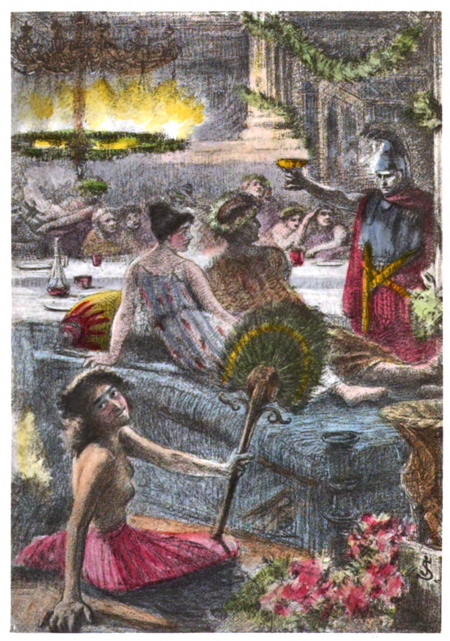
A Roman Feast. From a drawing by Jan Styka.
LIST OF ILLUSTRATIONS↩
- A Roman Feast. Frontispiece. From a drawing by Jan Styka.
- Julian the Apostate, p. page 20. From a bust in the Capitoline Museum.
- Map of Mesopotamia, p. 126
- Jovian with a Hunting-party, p. 174. From a bas-relief on the Tomb of Jovian.
- Battle between Romans and Gauls, p. 212. From a bas-relief.
- Arch of Constantine, Rome, p. 290. From a photograph.
[IV-1]
CHAPTER XXII↩
Julian is declared Emperor by the Legions of Gaul — His March and Success — The Death of Constantius — Civil Administration of Julian
While the Romans languished under the ignominious tyranny of eunuchs and bishops, the praises of Julian were repeated with transport in every part of the empire, except in the palace of Constantius. The Barbarians of Germany had felt, and still dreaded, the arms of the young Cæsar; his soldiers were the companions of his victory; the grateful provincials enjoyed the blessings of his reign; but the favourites who had opposed his elevation were offended by his virtues; and they justly considered the friend of the people as the enemy of the court. As long as the fame of Julian was doubtful, the buffoons of the palace, who were skilled in the language of satire, tried the efficacy of those arts which they had so often practised with success. They easily discovered that his simplicity was not exempt from affectation: the ridiculous epithets of an hairy savage, of an ape invested with the purple, were applied to the dress and person of the philosophic warrior; and his modest despatches were stigmatised as the vain and elaborate fictions of a loquacious Greek, a speculative soldier, who had studied the art of war amidst the groves of the academy. [1] The voice of malicious [IV-2] folly was at length silenced by the shouts of victory; the conqueror of the Franks and Alemanni could no longer be painted as an object of contempt; and the monarch himself was meanly ambitious of stealing from his lieutenant the honourable reward of his labours. In the letters crowned with laurel, which, according to ancient custom, were addressed to the provinces, the name of Julian was omitted. “Constantius had made his dispositions in person; he had signalised his valour in the foremost ranks; his military conduct had secured the victory; and the captive king of the Barbarians was presented to him on the field of battle,” from which he was at that time distant about forty days’ journey. [2] So extravagant a fable was incapable, however, of deceiving the public credulity, or even of satisfying the pride of the emperor himself. Secretly conscious that the applause and favour of the Romans accompanied the rising fortunes of Julian, his discontented mind was prepared to receive the subtle poison of those artful sycophants who coloured their mischievous designs with the fairest appearances of truth and candour. [3] Instead of depreciating the [IV-3] merits of Julian, they acknowledged, and even exaggerated, his popular fame, superior talents, and important services. But they darkly insinuated that the virtues of the Cæsar might instantly be converted into the most dangerous crimes, if the inconstant multitude should prefer their inclinations to their duty; or if the general of a victorious army should be tempted from his allegiance by the hopes of revenge and independent greatness. The personal fears of Constantius were interpreted by his council as a laudable anxiety for the public safety; whilst in private, and perhaps in his own breast, he disguised, under the less odious appellation of fear, the sentiments of hatred and envy, which he had secretly conceived for the inimitable virtues of Julian.
The apparent tranquillity of Gaul and the imminent danger of the Eastern provinces offered a specious pretence for the design which was artfully concerted by the Imperial ministers. They resolved to disarm the Cæsar; to recall those faithful troops who guarded his person and dignity; and to employ in a distant war against the Persian monarch the hardy veterans who had vanquished, on the banks of the Rhine, the fiercest nations of Germany. While Julian used the laborious hours of his winter quarters at Paris in the administration of power, which, in his hands, was the exercise of virtue, he was surprised by the hasty arrival of a tribune and a notary, with positive orders from the emperor, which they were directed to execute, and he was commanded not to oppose. Constantius signified his pleasure, that four entire legions, the Celtæ, and Petulants, the Heruli, and the Batavians, [4] should be separated from the standard of Julian, under which they had acquired their fame and discipline; that in each of the remaining bands three hundred of the [IV-4] bravest youths should be selected; [5] and that this numerous detachment, the strength of the Gallic army, should instantly begin their march, and exert their utmost diligence to arrive, before the opening of the campaign, on the frontiers of Persia. [6] The Cæsar foresaw, and lamented, the consequences of this fatal mandate. Most of the auxiliaries, who engaged their voluntary service, had stipulated that they should never be obliged to pass the Alps. The public faith of Rome and the personal honour of Julian had been pledged for the observance of this condition. Such an act of treachery and oppression would destroy the confidence, and excite the resentment, of the independent warriors of Germany, who considered truth as the noblest of their virtues, and freedom as the most valuable of their possessions. The legionaries, who enjoyed the title and privileges of Romans, were enlisted for the general defence of the republic; but those mercenary troops heard with cold indifference the antiquated names of the Republic and of Rome. Attached, either from birth or long habit, to the climate and manners of Gaul, they loved and admired Julian; they despised, and perhaps hated, the emperor; they dreaded the laborious march, the Persian arrows, and the burning deserts of Asia. They claimed as their own the country which they had saved; and excused their want of spirit by pleading the sacred and more immediate duty of protecting their families and friends. The apprehensions of the Gauls were derived from the knowledge of the impending and inevitable danger. As soon as the provinces were exhausted of their military strength, the [IV-5] Germans would violate a treaty which had been imposed on their fears; and, notwithstanding the abilities and valour of Julian, the general of a nominal army, to whom the public calamities would be imputed, must find himself, after a vain resistance, either a prisoner in the camp of the Barbarians or a criminal in the palace of Constantius. If Julian complied with the orders which he had received, he subscribed his own destruction, and that of a people who deserved his affection. But a positive refusal was an act of rebellion and a declaration of war. The inexorable jealousy of the emperor, the peremptory, and perhaps insidious, nature of his commands, left not any room for a fair apology or candid interpretation; and the dependent station of the Cæsar scarcely allowed him to pause or to deliberate. Solitude increased the perplexity of Julian; he could no longer apply to the faithful counsels of Sallust, who had been removed from his office by the judicious malice of the eunuchs: he could not even enforce his representations by the concurrence of the ministers, who would have been afraid or ashamed to approve the ruin of Gaul. The moment had been chosen, when Lupicinus, [7] the general of the cavalry, was despatched into Britain, to repulse the inroads of the Scots and Picts; and Florentius was occupied at Vienna by the assessment of the tribute. The latter, a crafty and corrupt statesman, declining to assume a responsible part on this dangerous occasion, eluded the pressing and repeated invitations of Julian, who represented to him that in every important measure, the presence of the prefect was indispensable in the council of the prince. In the meanwhile the Cæsar was oppressed by the rude and [IV-6] importunate solicitations of the Imperial messengers, who presumed to suggest that, if he expected the return of his ministers, he would charge himself with the guilt of the delay, and reserve for them the merit of the execution. Unable to resist, unwilling to comply, Julian expressed, in the most serious terms, his wish, and even his intention, of resigning the purple, which he could not preserve with honour, but which he could not abdicate with safety.
After a painful conflict, Julian was compelled to acknowledge that obedience was the virtue of the most eminent subject, and that the sovereign alone was entitled to judge of the public welfare. He issued the necessary orders for carrying into execution the commands of Constantius; a part of the troops began their march for the Alps; and the detachments from the several garrisons moved towards their respective places of assembly. They advanced with difficulty through the trembling and affrighted crowds of provincials; who attempted to excite their pity by silent despair or loud lamentations; while the wives of the soldiers, holding their infants in their arms, accused the desertion of their husbands, in the mixed language of grief, of tenderness, and of indignation. This scene of general distress afflicted the humanity of the Cæsar; he granted a sufficient number of post-waggons to transport the wives and families of the soldiers, [8] endeavoured to alleviate the hardships which he was constrained to inflict, and increased, by the most laudable arts, his own popularity and the discontent of the exiled troops. The grief of an armed multitude is soon converted into rage; their licentious murmurs, which every hour were communicated from tent to tent with more boldness and effect, prepared their minds for the most daring acts of sedition; and by the connivance of their tribunes, a seasonable libel was secretly dispersed, which painted in lively colours the disgrace of the Cæsar, the [IV-7] oppression of the Gallic army, and the feeble vices of the tyrant of Asia. The servants of Constantius were astonished and alarmed by the progress of this dangerous spirit. They pressed the Cæsar to hasten the departure of the troops: but they imprudently rejected the honest and judicious advice of Julian; who proposed that they should not march through Paris, and suggested the danger and temptation of a last interview.
As soon as the approach of the troops was announced, the Cæsar went out to meet them, and ascended his tribunal, which had been erected in a plain before the gates of the city. After distinguishing the officers and soldiers who by their rank or merit deserved a peculiar attention, Julian addressed himself in a studied oration to the surrounding multitude: he celebrated their exploits with grateful applause: encouraged them to accept, with alacrity, the honour of serving under the eyes of a powerful and liberal monarch; and admonished them that the commands of Augustus required an instant and cheerful obedience. The soldiers, who were apprehensive of offending their general by an indecent clamour, or of belying their sentiments by false and venal acclamations, maintained an obstinate silence, and, after a short pause, were dismissed to their quarters. The principal officers were entertained by the Cæsar, who professed, in the warmest language of friendship, his desire and his inability to reward, according to their deserts, the brave companions of his victories. They retired from the feast, full of grief and perplexity; and lamented the hardship of their fate, which tore them from their beloved general and their native country. The only expedient which could prevent their separation was boldly agitated and approved; the popular resentment was insensibly moulded into a regular conspiracy; their just reasons of complaint were heightened by passion, and their passions were inflamed by wine; as, on the eve of their departure, the troops were indulged in licentious festivity. At the hour of midnight, the [IV-8] impetuous multitude, with swords and bowls [8a] and torches in their hands, rushed into the suburbs; encompassed the palace; [9] and, careless of future dangers, pronounced the fatal and irrevocable words, Julian Augustus! The prince, whose anxious suspense was interrupted by their disorderly acclamations, secured the doors against their intrusion; and, as long as it was in his power, secluded his person and dignity from the accidents of a nocturnal tumult. At the dawn of day, the soldiers, whose zeal was irritated by opposition, forcibly entered the palace, seized, with respectful violence, the object of their choice, guarded Julian with drawn swords through the streets of Paris, placed him on the tribunal, and with repeated shouts saluted him as their emperor. Prudence as well as loyalty inculcated the propriety of resisting their treasonable designs and of preparing for his oppressed virtue the excuse of violence. Addressing himself by turns to the multitude and to individuals, he sometimes implored their mercy, and sometimes expressed his indignation; conjured them not to sully the fame of their immortal victories; and ventured to promise that, if they would immediately return to their allegiance, he would undertake to obtain from the [IV-9] emperor, not only a free and gracious pardon, but even the revocation of the orders which had excited their resentment. But the soldiers, who were conscious of their guilt, chose rather to depend on the gratitude of Julian than on the clemency of the emperor. Their zeal was insensibly turned into impatience, and their impatience into rage. The inflexible Cæsar sustained, till the third hour of the day, their prayers, their reproaches, and their menaces; nor did he yield, till he had been repeatedly assured that, if he wished to live, he must consent to reign. He was exalted on a shield in the presence, and amidst the unanimous acclamations, of the troops; a rich military collar, which was offered by chance, supplied the want of a diadem; [10] the ceremony was concluded by the promise of a moderate donative; [11] and the new emperor, overwhelmed with real or affected grief, retired into the most secret recesses of his apartment. [12]
The grief of Julian could proceed only from his innocence; but his innocence must appear extremely doubtful [13] in the eyes of those who have learned to suspect the motives and the professions of princes. His lively and active mind was [IV-10] susceptible of the various impressions of hope and fear, of gratitude and revenge, of duty and of ambition, of the love of fame and of the fear of reproach. But it is impossible for us to calculate the respective weight and operation of these sentiments; or to ascertain the principles of action, which might escape the observation, while they guided or rather impelled the steps, of Julian himself. The discontent of the troops was produced by the malice of his enemies; their tumult was the natural effect of interest and of passion; and, if Julian had tried to conceal a deep design under the appearances of chance, he must have employed the most consummate artifice without necessity, and probably without success. He solemnly declares, in the presence of Jupiter, of the Sun, of Mars, of Minerva, and of all the other deities, that, till the close of the evening which preceded his elevation, he was utterly ignorant of the designs of the soldiers; [14] and it may seem ungenerous to distrust the honour of a hero and the truth of a philosopher. Yet the superstitious confidence that Constantius was the enemy, and that he himself was the favourite, of the gods might prompt him to desire, to solicit, and even to hasten the auspicious moment of his reign, which was predestined to restore the ancient religion of mankind. When Julian had received the intelligence of the conspiracy, he resigned himself to a short slumber; and afterwards related to his friends that he had seen the Genius of the empire waiting with some impatience at his door, pressing for admittance, and reproaching his want of spirit and ambition. [15] [IV-11] Astonished and perplexed, he addressed his prayers to the great Jupiter; who immediately signified, by a clear and manifest omen, that he should submit to the will of heaven and of the army. The conduct which disclaims the ordinary maxims of reason excites our suspicion and eludes our inquiry. Whenever the spirit of fanaticism, at once so credulous and so crafty, has insinuated itself into a noble mind, it insensibly corrodes the vital principles of virtue and veracity.
To moderate the zeal of his party, to protect the persons of his enemies, [16] to defeat and to despise the secret enterprises which were formed against his life and dignity, were the cares which employed the first days of the reign of the new emperor. Although he was firmly resolved to maintain the station which he had assumed, he was still desirous of saving his country from the calamities of civil war, of declining a contest with the superior forces of Constantius, and of preserving his own character from the reproach of perfidy and ingratitude. Adorned with the ensigns of military and Imperial pomp, Julian showed himself in the field of Mars to the soldiers, who glowed with ardent enthusiasm in the cause of their pupil, their leader, and their friend. He recapitulated their victories, lamented their sufferings, applauded their resolution, animated their hopes, and checked their impetuosity; nor did he dismiss the assembly, till he had obtained a solemn promise from the troops that, if the emperor of the East would subscribe an equitable treaty, they would renounce any views of conquest, and satisfy themselves with the tranquil possession of the Gallic provinces. On this foundation he composed, in his own name, and in that of the army, a specious and moderate epistle, [17] which was delivered to Pentadius, [IV-12] his master of the offices, and to his chamberlain Eutherius; two ambassadors whom he appointed to receive the answer, and observe the dispositions, of Constantius. This epistle is inscribed with the modest appellation of Cæsar; but Julian solicits in a peremptory, though respectful, manner the confirmation of the title of Augustus. He acknowledges the irregularity of his own election, while he justifies, in some measure, the resentment and violence of the troops which had extorted his reluctant consent. He allows the supremacy of his brother Constantius; and engages to send him an annual present of Spanish horses, to recruit his army with a select number of Barbarian youths, and to accept from his choice a Prætorian prefect of approved discretion and fidelity. But he reserves for himself the nomination of his other civil and military officers, with the troops, the revenue, and the sovereignty of the provinces beyond the Alps. He admonishes the emperor to consult the dictates of justice; to distrust the arts of those venal flatterers who subsist only by the discord of princes; and to embrace the offer of a fair and honourable treaty, equally advantageous to the republic and to the house of Constantine. In this negotiation Julian claimed no more than he already possessed. The delegated authority which he had long exercised over the provinces of Gaul, Spain, and Britain was still obeyed under a name more independent and august. The soldiers and the people rejoiced in a revolution which was not stained even with the blood of the guilty. Florentius was a fugitive; Lupicinus a prisoner. The persons who were disaffected to the new government were disarmed and secured; and the vacant offices were distributed, according to the recommendation of merit, by a prince who despised the intrigues of the palace and the clamours of the soldiers. [18]
The negotiations of peace were accompanied and supported [IV-13] by the most vigorous preparations for war. The army, which Julian held in readiness for immediate action, was recruited and augmented by the disorders of the times. The cruel persecution of the faction of Magnentius had filled Gaul with numerous bands of outlaws and robbers. They cheerfully accepted the offer of a general pardon from a prince whom they could trust, submitted to the restraints of military discipline, and retained only their implacable hatred to the person and government of Constantius. [19] As soon as the season of the year permitted Julian to take the field, he appeared at the head of his legions; threw a bridge over the Rhine in the neighbourhood of Cleves; and prepared to chastise the perfidy of the Attuarii, a tribe of Franks, who presumed that they might ravage, with impunity, the frontiers of a divided empire. The difficulty, as well as glory, of this enterprise consisted in a laborious march; and Julian had conquered, as soon as he could penetrate into, a country which former princes had considered as inaccessible. After he had given peace to the Barbarians, the emperor carefully visited the fortifications along the Rhine from Cleves to Basil; surveyed, with peculiar attention, the territories which he had recovered from the hands of the Alemanni, passed through Besançon, [20] which had severely suffered from their fury, and fixed his head-quarters at Vienna for the ensuing winter. The barrier of Gaul was improved and strengthened with additional fortifications; and Julian entertained some hopes that the Germans, whom he had so often vanquished, might, in his absence, be restrained by [IV-14] the terror of his name. Vadomair [21] was the only prince of the Alemanni whom he esteemed or feared; and, while the subtle Barbarian affected to observe the faith of treaties, the progress of his arms threatened the state with an unseasonable and dangerous war. The policy of Julian condescended to surprise the prince of the Alemanni by his own arts; and Vadomair, who in the character of a friend had incautiously accepted an invitation from the Roman governors, was seized in the midst of the entertainment, and sent away prisoner into the heart of Spain. Before the Barbarians were recovered from their amazement, the emperor appeared in arms on the banks of the Rhine, and, once more crossing the river, renewed the deep impressions of terror and respect which had been already made by four preceding expeditions. [22]
The ambassadors of Julian had been instructed to execute, with the utmost diligence, their important commission. But, in their passage through Italy and Illyricum, they were detained by the tedious and affected delays of the provincial governors; they were conducted by slow journeys from Constantinople to Cæsarea in Cappadocia; and, when at length they were admitted to the presence of Constantius, they found that he had already conceived, from the despatches of his own officers, the most unfavourable opinion of the conduct of Julian and of the Gallic army. The letters were heard with impatience; the trembling messengers were dismissed with indignation and contempt; and the looks, the gestures, the furious language of the monarch expressed the disorder of his soul. The domestic connection, which might have reconciled the brother and the husband of Helena, was recently dissolved by the death of that princess, whose pregnancy [IV-15] had been several times fruitless, and was at last fatal to herself. [23] The empress Eusebia had preserved, to the last moment of her life, the warm and even jealous affection which she had conceived for Julian; and her mild influence might have moderated the resentment of a prince who, since her death, was abandoned to his own passions and to the arts of his eunuchs. But the terror of a foreign invasion obliged him to suspend the punishment of a private enemy; he continued his march towards the confines of Persia, and thought it sufficient to signify the conditions which might entitle Julian and his guilty followers to the clemency of their offended sovereign. He required that the presumptuous Cæsar should expressly renounce the appellation and rank of Augustus, which he had accepted from the rebels; that he should descend to his former station of a limited and dependent minister; that he should vest the powers of the state and army in the hands of those officers who were appointed by the Imperial court; and that he should trust his safety to the assurances of pardon, which were announced by Epictetus, a Gallic bishop, and one of the Arian favourites of Constantius. Several months were ineffectually consumed in a treaty which was negotiated at the distance of three thousand miles between Paris and Antioch; and, as soon as Julian perceived that his moderate and respectful behaviour served only to irritate the pride of an implacable adversary, he boldly resolved to commit his life and fortune to the chance of a civil war. He [IV-16] gave a public and military audience to the quæstor Leonas: the haughty epistle of Constantius was read to the attentive multitude; and Julian protested, with the most flattering deference, that he was ready to resign the title of Augustus, if he could obtain the consent of those whom he acknowledged as the authors of his elevation. The faint proposal was impetuously silenced; and the acclamations of “Julian Augustus, continue to reign, by the authority of the army, of the people, of the republic, which you have saved,” thundered at once from every part of the field, and terrified the pale ambassador of Constantius. A part of the letter was afterwards read, in which the emperor arraigned the ingratitude of Julian, whom he had invested with the honours of the purple; whom he had educated with so much care and tenderness; whom he had preserved in his infancy, when he was left a helpless orphan. “An orphan!” interrupted Julian, who justified his cause by indulging his passions; “does the assassin of my family reproach me that I was left an orphan? He urges me to revenge those injuries which I have long studied to forget.” The assembly was dismissed; and Leonas, who, with some difficulty, had been protected from the popular fury, was sent back to his master, with an epistle, in which Julian expressed, in a strain of the most vehement eloquence, the sentiments of contempt, of hatred, and of resentment, which had been suppressed and embittered by the dissimulation of twenty years. After this message, which might be considered as a signal of irreconcilable war, Julian, who some weeks before had celebrated the Christian festival of the Epiphany, [24] made a public declaration that he [IV-17] committed the care of his safety to the immortal gods; and thus publicly renounced the religion, as well as the friendship, of Constantius. [25]
The situation of Julian required a vigorous and immediate resolution. He had discovered from intercepted letters that his adversary, sacrificing the interest of the state to that of the monarch, had again excited the Barbarians to invade the provinces of the West. The position of two magazines, one of them collected on the banks of the lake of Constance, the other formed at the foot of the Cottian Alps, seemed to indicate the march of two armies; and the size of those magazines, each of which consisted of six hundred thousand quarters of wheat, or rather flour, [26] was a threatening evidence of the strength and numbers of the enemy, who prepared to surround him. But the Imperial legions were still in their distant quarters of Asia; the Danube was feebly guarded; and, if Julian could occupy by a sudden incursion the important provinces of Illyricum, he might expect that a people of soldiers would resort to his standard, and that the rich mines of gold and silver would contribute to the expenses of the civil war. He proposed this bold enterprise to the assembly of the soldiers; inspired them with a just confidence in their general and in themselves; and exhorted them to maintain their reputation, of being terrible to the enemy, moderate to their fellow-citizens, and obedient to their officers. His spirited discourse was received with the loudest acclamations, and the [IV-18] same troops which had taken up arms against Constantius, when he summoned them to leave Gaul, now declared with alacrity, that they would follow Julian to the farthest extremities of Europe or Asia. The oath of fidelity was administered; and the soldiers, clashing their shields, and pointing their drawn swords to their throats, devoted themselves, with horrid imprecations, to the service of a leader whom they celebrated as the deliverer of Gaul and the conqueror of the Germans. [27] This solemn engagement, which seemed to be dictated by affection rather than by duty, was singly opposed by Nebridius, who had been admitted to the office of Prætorian prefect. That faithful minister, alone and unassisted, asserted the rights of Constantius in the midst of an armed and angry multitude, to whose fury he had almost fallen an honourable, but useless, sacrifice. After losing one of his hands by the stroke of a sword, he embraced the knees of the prince whom he had offended. Julian covered the prefect with his Imperial mantle, and, protecting him from the zeal of his followers, dismissed him to his own house, with less respect than was perhaps due to the virtue of an enemy. [28] The high office of Nebridius was bestowed on Sallust; and the provinces of Gaul, which were now delivered from the intolerable oppression of taxes, enjoyed the mild and equitable administration of the friend of Julian, who was permitted to practise those virtues which he had instilled into the mind of his pupil. [29]
The hopes of Julian depended much less on the number of [IV-19] his troops than on the celerity of his motions. In the execution of a daring enterprise, he availed himself of every precaution, as far as prudence could suggest; and, where prudence could no longer accompany his steps, he trusted the event to valour and to fortune. In the neighbourhood of Basil he assembled and divided his army. [30] One body, which consisted of ten thousand men, was directed, under the command of Nevitta, general of the cavalry, to advance through the midland parts of Rhætia and Noricum. A similar division of troops, under the orders of Jovius and Jovinus, prepared to follow the oblique course of the highways, through the Alps and the northern confines of Italy. The instructions to the generals were conceived with energy and precision: to hasten their march in close and compact columns, which, according to the disposition of the ground, might readily be changed into any order of battle; to secure themselves against the surprises of the night by strong posts and vigilant guards; to prevent resistance by their unexpected arrival; to elude examination by their sudden departure; to spread the opinion of their strength and the terror of his name; and to join their sovereign under the walls of Sirmium. For himself, Julian had reserved a more difficult and extraordinary part. He selected three thousand brave and active volunteers, resolved, like their leader, to cast behind them every hope of a retreat: at the head of this faithful band, he fearlessly plunged into the recesses of the Marcian or black forest, which conceals the sources of the Danube; [31] and, for many days, the fate of Julian was unknown to the world. The secrecy of his march, his diligence and vigour, surmounted every obstacle; he forced his way over mountains and morasses, occupied the bridges or swam [IV-20] the rivers, pursued his direct course, [32] without reflecting whether he traversed the territory of the Romans or of the Barbarians, and at length emerged, between Ratisbon and Vienna, at the place where he designed to embark his troops on the Danube. By a well-concerted stratagem, he seized a fleet of light brigantines, [33] as it lay at anchor; secured a supply of coarse provisions sufficient to satisfy the indelicate, but voracious, appetite of a Gallic army; and boldly committed himself to the stream of the Danube. The labours of his mariners, who plied their oars with incessant diligence, and the steady continuance of a favourable wind, carried his fleet above seven hundred miles in eleven days; [34] and he had already disembarked his troops at Bononia, only nineteen miles from Sirmium, before his enemies could receive any certain intelligence that he had left the banks of the Rhine. In the course of this long and rapid navigation, the mind of Julian was fixed on the object of his enterprise; and, though he accepted the deputation of some cities, which hastened to claim the merit of an early submission, he passed before the hostile stations, which were placed along the river, without indulging the temptation of signalising an useless and ill-timed valour. The banks of the Danube were crowded on [IV-none] [IV-21] either side with spectators, who gazed on the military pomp, anticipated the importance of the event, and diffused through the adjacent country the fame of a young hero, who advanced with more than mortal speed at the head of the innumerable forces of the West. Lucilian, who, with the rank of general of the cavalry, commanded the military powers of Illyricum, was alarmed and perplexed by the doubtful reports which he could neither reject nor believe. He had taken some slow and irresolute measures for the purpose of collecting his troops; when he was surprised by Dagalaiphus, an active officer, whom Julian, as soon as he landed at Bononia, had pushed forwards with some light infantry. The captive general, uncertain of his life or death, was hastily thrown upon a horse, and conducted to the presence of Julian; who kindly raised him from the ground, and dispelled the terror and amazement which seemed to stupefy his faculties. But Lucilian had no sooner recovered his spirits than he betrayed his want of discretion, by presuming to admonish his conqueror that he had rashly ventured, with a handful of men, to expose his person in the midst of his enemies. “Reserve for your master Constantius these timid remonstrances,” replied Julian, with a smile of contempt; “when I gave you my purple to kiss, I received you not as a counsellor, but as a suppliant.” Conscious that success alone could justify his attempt, and that boldness only could command success, he instantly advanced, at the head of three thousand soldiers, to attack the strongest and most populous city of the Illyrian provinces. As he entered the long suburb of Sirmium, he was received by the joyful acclamations of the army and people; who, crowned with flowers, and holding lighted tapers in their hands, conducted their acknowledged sovereign to his Imperial residence. Two days were devoted to the public joy, which was celebrated by the games of the Circus; but, early on the morning of the third day, Julian marched to occupy the narrow pass of Succi, in the defiles of Mount Hæmus; which, almost in the mid-way between Sirmium [IV-22] and Constantinople, separates the provinces of Thrace and Dacia, by an abrupt descent towards the former and a simple declivity on the side of the latter. [35] The defence of this important post was entrusted to the brave Nevitta; who, as well as the generals of the Italian division, successfully executed the plan of the march and junction which their master had so ably conceived. [36]
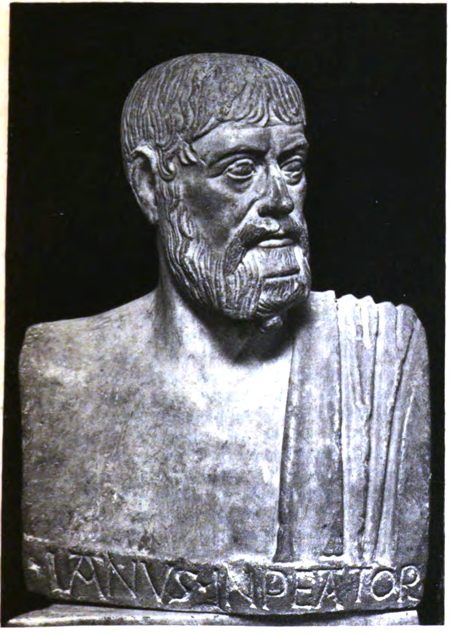
John the Apostate. From a bust in the Capitoline Museum.
The homage which Julian obtained, from the fears or the inclination of the people, extended far beyond the immediate effect of his arms. [37] The prefectures of Italy and Illyricum were administered by Taurus and Florentius, who united that important office with the vain honours of the consulship; and, as those magistrates had retired with precipitation to the court of Asia, Julian, who could not always restrain the levity of his temper, stigmatised their flight by adding, in all the Acts of the Year, the epithet of jugitive to the names of the two consuls. The provinces which had been deserted by their first magistrates acknowledged the authority of an emperor, who, conciliating the qualities of a soldier with those of a philosopher, was equally admired in the camps of the Danube and in the cities of Greece. From his palace, or, more properly, from his head-quarters of Sirmium and Naissus, he distributed to the principal cities of the empire a laboured apology for his own conduct; published the secret despatches of Constantius; and solicited the judgment of mankind between two competitors, the one of whom had [IV-23] expelled, and the other had invited, the Barbarians. [38] Julian, whose mind was deeply wounded by the reproach of ingratitude, aspired to maintain, by argument as well as by arms, the superior merits of his cause; and to excel, not only in the arts of war, but in those of composition. His epistle to the senate and people of Athens [39] seems to have been dictated by an elegant enthusiasm; which prompted him to submit his actions and his motives to the degenerate Athenians of his own times, with the same humble deference as if he had been pleading, in the days of Aristides, before the tribunal of the Areopagus. His application to the senate of Rome, which was still permitted to bestow the titles of Imperial power, was agreeable to the forms of the expiring republic. An assembly was summoned by Tertullus, prefect of the city; the epistle of Julian was read; and, as he appeared to be master of Italy, his claims were admitted without a dissenting voice. His oblique censure of the innovations of Constantine, and his passionate invective against the vices of Constantius, were heard with less satisfaction; and the senate, as if Julian had been present, unanimously exclaimed, “Respect, we beseech you, the author of your own fortune.” [40] An artful expression, which, according to the chance of war, might be differently explained: as a manly reproof of the ingratitude [IV-24] of the usurper, or as a flattering confession that a single act of such benefit to the state ought to atone for all the failings of Constantius.
The intelligence of the march and rapid progress of Julian was speedily transmitted to his rival, who, by the retreat of Sapor, had obtained some respite from the Persian war. Disguising the anguish of his soul under the semblance of contempt, Constantius professed his intention of returning into Europe, and of giving chase to Julian; for he never spoke of this military expedition in any other light than that of a hunting party. [41] In the camp of Hierapolis, in Syria, he communicated this design to his army, slightly mentioned the guilt and rashness of the Cæsar, and ventured to assure them that, if the mutineers of Gaul presumed to meet them in the field, they would be unable to sustain the fire of their eyes and the irresistible weight of their shout of onset. The speech of the emperor was received with military applause, and Theodotus, the president of the council of Hierapolis, requested, with tears of adulation, that his city might be adorned with the head of the vanquished rebel. [42] A chosen detachment was despatched away in post-waggons, to secure, if it were yet possible, the pass of Succi; the recruits, the horses, the arms, and the magazines which had been prepared against Sapor, were appropriated to the service of the civil war; and the domestic victories of Constantius inspired his partisans with the most sanguine assurances of success. The notary Gaudentius had occupied in his name the provinces of Africa; the subsistence of Rome was intercepted; and the distress of Julian was increased by an unexpected event which might have been productive of fatal consequences. [IV-25] Julian had received the submission of two legions and a cohort of archers, who were stationed at Sirmium; but he suspected, with reason, the fidelity of those troops, which had been distinguished by the emperor, and it was thought expedient, under the pretence of the exposed state of the Gallic frontier, to dismiss them from the most important scene of action. They advanced, with reluctance, as far as the confines of Italy; but, as they dreaded the length of the way and the savage fierceness of the Germans, they resolved, by the instigation of one of their tribunes, to halt at Aquileia, and to erect the banners of Constantius on the walls of that impregnable city. The vigilance of Julian perceived at once the extent of the mischief and the necessity of applying an immediate remedy. By his order, Jovinus led back a part of the army into Italy; and the siege of Aquileia was formed with diligence and prosecuted with vigour. But the legionaries, who seemed to have rejected the yoke of discipline, conducted the defence of the place with skill and perseverance; invited the rest of Italy to imitate the example of their courage and loyalty; and threatened the retreat of Julian, if he should be forced to yield to the superior numbers of the arms of the East. [43]
But the humanity of Julian was preserved from the cruel alternative, which he pathetically laments, of destroying or of being himself destroyed: and the seasonable death of Constantius delivered the Roman empire from the calamities of civil war. The approach of winter could not detain the monarch at Antioch; and his favourites durst not oppose his impatient desire of revenge. A slight fever, which was perhaps [IV-26] occasioned by the agitation of his spirits, was increased by the fatigues of the journey; and Constantius was obliged to halt at the little town of Mopsucrene, twelve miles beyond Tarsus, where he expired, after a short illness, in the forty-fifth year of his age, and the twenty-fourth of his reign. [44] His genuine character, which was composed of pride and weakness, of superstition and cruelty, has been fully displayed in the preceding narrative of civil and ecclesiastical events. The long abuse of power rendered him a considerable object in the eyes of his contemporaries; but, as personal merit can alone deserve the notice of posterity, the last of the sons of Constantine may be dismissed from the world with the remark, that he inherited the defects, without the abilities, of his father. Before Constantius expired, he is said to have named Julian for his successor; nor does it seem improbable that his anxious concern for the fate of a young and tender wife, whom he left with child, may have prevailed, in his last moments, over the harsher passions of hatred and revenge. Eusebius, and his guilty associates, made a faint attempt to prolong the reign of the eunuchs by the election of another emperor: but their intrigues were rejected with disdain by an army which now abhorred the thought of civil discord; and two officers of rank were instantly despatched, to assure Julian that every sword in the empire would be drawn for his service. The military designs of that prince, who had formed three different attacks against Thrace, were prevented [IV-27] by this fortunate event. Without shedding the blood of his fellow-citizens, he escaped the dangers of a doubtful conflict and acquired the advantages of a complete victory. Impatient to visit the place of his birth and the new capital of the empire, he advanced from Naissus through the mountains of Hæmus and the cities of Thrace. When he reached Heraclea, at the distance of sixty miles, all Constantinople was poured forth to receive him; and he made his triumphal entry, amidst the dutiful acclamations of the soldiers, the people, and the senate. An innumerable multitude pressed around him with eager respect; and were perhaps disappointed when they beheld the small stature and simple garb of a hero whose unexperienced youth had vanquished the Barbarians of Germany, and who had now traversed, in a successful career, the whole continent of Europe, from the shores of the Atlantic to those of the Bosphorus. [45] A few days afterwards, when the remains of the deceased emperor were landed in the harbour, the subjects of Julian applauded the real or affected humanity of their sovereign. On foot, without his diadem, and clothed in a mourning habit, he accompanied the funeral as far as the church of the Holy Apostles, where the body was deposited: and, if these marks of respect may be interpreted as a selfish tribute to the birth and dignity of his Imperial kinsman, the tears of Julian professed to the world that he had forgot the injuries, and remembered only the obligations, which he had received from Constantius. [46] As soon as the legions of Aquileia were assured of the death of the emperor, they opened the gates of [IV-28] the city, and, by the sacrifice of their guilty leaders, obtained an easy pardon from the prudence or lenity of Julian; who, in the thirty-second year of his age, acquired the undisputed possession of the Roman empire. [47]
Philosophy had instructed Julian to compare the advantages of action and retirement; but the elevation of his birth and the accidents of his life never allowed him the freedom of choice. He might perhaps sincerely have preferred the groves of the academy and the society of Athens; but he was constrained, at first by the will, and afterwards by the injustice, of Constantius, to expose his person and fame to the dangers of Imperial greatness; and to make himself accountable to the world, and to posterity, for the happiness of millions. [48] Julian recollected with terror the observation of his master Plato, [49] that the government of our flocks and herds is always committed to beings of a superior species; and that the conduct of nations requires and deserves the celestial powers of the Gods or of the Genii. From this principle he justly concluded that the man who presumes to reign should aspire to the perfection of the divine nature; that he should purify his soul from her mortal and terrestrial part; that he should extinguish his appetites, enlighten his understanding, regulate his passions, and subdue the wild beast which, according to the lively metaphor of Aristotle, [50] [IV-29] seldom fails to ascend the throne of a despot. The throne of Julian, which the death of Constantius fixed on an independent basis, was the seat of reason, of virtue, and perhaps of vanity. He despised the honours, renounced the pleasures, and discharged with incessant diligence the duties, of his exalted station; and there were few among his subjects who would have consented to relieve him from the weight of the diadem, had they been obliged to submit their time and their actions to the rigorous laws which their philosophic emperor imposed on himself. One of his most intimate friends, [51] who had often shared the frugal simplicity of his table, has remarked that his light and sparing diet (which was usually of the vegetable kind) left his mind and body always free and active for the various and important business of an author, a pontiff, a magistrate, a general, and a prince. In one and the same day, he gave audience to several ambassadors, and wrote, or dictated, a great number of letters to his generals, his civil magistrates, his private friends, and the different cities of his dominions. He listened to the memorials which had been received, considered the subject of the petitions, and signified his intentions more rapidly than they could be taken in shorthand by the diligence of his secretaries. He possessed such flexibility of thought, and such firmness of attention, that he could employ his hand to write, his ear to listen, and his voice to dictate; and pursue at once three several trains of ideas without hesitation and without error. While his ministers reposed, the prince flew with agility from one labour to another, and, after a hasty dinner, retired into his library, till the public business, which he had appointed [IV-30] for the evening, summoned him to interrupt the prosecution of his studies. The supper of the emperor was still less substantial than the former meal; his sleep was never clouded by the fumes of indigestion; and, except in the short interval of a marriage, which was the effect of policy rather than love, the chaste Julian never shared his bed with a female companion. [52] He was soon awakened by the entrance of fresh secretaries, who had slept the preceding day; and his servants were obliged to wait alternately, while their indefatigable master allowed himself scarcely any other refreshment than the change of occupations. The predecessors of Julian, his uncle, his brother, and his cousin, indulged their puerile taste for the games of the circus, under the specious pretence of complying with the inclinations of the people; and they frequently remained the greatest part of the day, as idle spectators, and as a part of the splendid spectacle, till the ordinary round of twenty-four races [53] was completely finished. On solemn festivals, Julian, who felt and professed an unfashionable dislike to these frivolous amusements, condescended to appear in the circus; and, after bestowing a careless glance on five or six of the races, [IV-31] he hastily withdrew, with the impatience of a philosopher, who considered every moment as lost that was not devoted to the advantage of the public or the improvement of his own mind. [54] By this avarice of time, he seemed to protract the short duration of his reign; and, if the dates were less securely ascertained, we should refuse to believe that only sixteen months elapsed between the death of Constantius and the departure of his successor for the Persian war. The actions of Julian can only be preserved by the care of the historian; but the portion of his voluminous writings which is still extant remains as a monument of the application, as well as of the genius, of the emperor. The Misopogon, the Cæsars, several of his orations, and his elaborate work against the Christian religion were composed in the long nights of the two winters, the former of which he passed at Constantinople, and the latter at Antioch.
The reformation of the Imperial court was one of the first and most necessary acts of the government of Julian. [55] Soon after his entrance into the palace of Constantinople, he had occasion for the service of a barber. An officer, magnificently dressed, immediately presented himself. “It is a barber,” exclaimed the prince, with affected surprise, “that I want, and not a receiver-general of the finances.” [56] He questioned the man concerning the profits of his employment; and was informed that, besides a large salary and some valuable perquisites, he enjoyed a daily allowance for twenty servants [IV-32] and as many horses. A thousand barbers, a thousand cupbearers, a thousand cooks, were distributed in the several offices of luxury; and the number of eunuchs could be compared only with the insects of a summer’s day. [57] The monarch who resigned to his subjects the superiority of merit and virtue was distinguished by the oppressive magnificence of his dress, his table, his buildings, and his train. The stately palaces erected by Constantine and his sons were decorated with many-coloured marbles and ornaments of massy gold. The most exquisite dainties were procured, to gratify their pride rather than their taste; birds of the most distant climates, fish from the most remote seas, fruits out of their natural season, winter roses, and summer snows. [58] The domestic crowd of the palace surpassed the expense of the legions; yet the smallest part of this costly multitude was subservient to the use, or even to the splendour, of the throne. The monarch was disgraced, and the people was injured, by the creation and sale of an infinite number of obscure, and even titular, employments; and the most worthless of mankind might purchase the privilege of being maintained, without the necessity of labour, from the public revenue. The waste of an enormous household, the increase of fees and perquisites, which were soon claimed as a lawful debt, and the bribes which they extorted from those who feared their enmity or solicited their favour, suddenly enriched these haughty menials. They abused their fortune, without considering their past, or their future, condition; and their rapine and venality could be equalled only by the extravagance [IV-33] of their dissipations. Their silken robes were embroidered with gold, their tables were served with delicacy and profusion; the houses which they built for their own use would have covered the farm of an ancient consul; and the most honourable citizens were obliged to dismount from their horses, and respectfully to salute an eunuch whom they met on the public highway. The luxury of the palace excited the contempt and indignation of Julian, who usually slept on the ground, who yielded with reluctance to the indispensable calls of nature, and who placed his vanity, not in emulating, but in despising, the pomp of royalty. By the total extirpation of a mischief which was magnified even beyond its real extent, he was impatient to relieve the distress, and to appease the murmurs, of the people; who support with less uneasiness the weight of taxes, if they are convinced that the fruits of their industry are appropriated to the service of the state. But in the execution of this salutary work Julian is accused of proceeding with too much haste and inconsiderate severity. By a single edict, he reduced the palace of Constantinople to an immense desert, and dismissed with ignominy the whole train of slaves and dependents, [59] without providing any just, or at least benevolent, exceptions, for the age, the services, or the poverty of the faithful domestics of the Imperial family. Such indeed was the temper of Julian, who seldom recollected the fundamental maxim of Aristotle that true virtue is placed at an equal distance between the opposite vices. The splendid and effeminate dress of the Asiatics, the curls and paint, the collars and bracelets, which had appeared so ridiculous in the person of Constantine, were consistently rejected by his philosophic successor. But with the fopperies, Julian affected to renounce the decencies, of dress; and [IV-34] seemed to value himself for his neglect of the laws of cleanliness. In a satirical performance, which was designed for the public eye, the emperor descants with pleasure, and even with pride, on the length of his nails, and the inky blackness of his hands; protests that, although the greatest part of his body was covered with hair, the use of the razor was confined to his head alone; and celebrates with visible complacency, the shaggy and populous [60] beard, which he fondly cherished after the example of the philosophers of Greece. Had Julian consulted the simple dictates of reason, the first magistrate of the Romans would have scorned the affectation of Diogenes as well as that of Darius.
But the work of public reformation would have remained imperfect, if Julian had only corrected the abuses, without punishing the crimes, of his predecessor’s reign. “We are now delivered,” says he, in a familiar letter to one of his intimate friends, “we are now surprisingly delivered from the voracious jaws of the Hydra. [61] I do not mean to apply that epithet to my brother Constantius. He is no more; may the earth lie light on his head! But his artful and cruel favourites studied to deceive and exasperate a prince whose natural mildness cannot be praised without some efforts of adulation. It is not, however, my intention that even those men should be oppressed: they are accused, and they shall enjoy the benefit of a fair and impartial trial.” To conduct this inquiry, Julian named six judges of the highest rank in the state and [IV-35] army; and, as he wished to escape the reproach of condemning his personal enemies, he fixed this extraordinary tribunal at Chalcedon, on the Asiatic side of the Bosphorus; and transferred to the commissioners an absolute power to pronounce and execute their final sentence, without delay and without appeal. The office of president was exercised by the venerable prefect of the East, a second Sallust, [62] whose virtues conciliated the esteem of Greek sophists and of Christian bishops. He was assisted by the eloquent Mamertinus, [63] one of the consuls elect, whose merit is loudly celebrated by the doubtful evidence of his own applause. But the civil wisdom of two magistrates was overbalanced by the ferocious violence of four generals, Nevitta, Agilo, Jovinus, and Arbetio. Arbetio, whom the public would have seen with less surprise at the bar than on the bench, was supposed to possess the secret of the commission; the armed and angry leaders of the Jovian and Herculian bands encompassed the tribunal; and the judges were alternately swayed by the laws of justice, and by the clamours of faction. [64]
The chamberlain Eusebius, who had so long abused the favour of Constantius, expiated, by an ignominious death, the insolence, the corruption, and cruelty of his servile reign. The executions of Paul and Apodemius (the former of whom was burnt alive) were accepted as an inadequate atonement by the widows and orphans of so many hundred Romans, whom those legal tyrants had betrayed and murdered. But [IV-36] Justice herself (if we may use the pathetic expression of Ammianus) [65] appeared to weep over the fate of Ursulus, the treasurer of the empire; and his blood accused the ingratitude of Julian, whose distress had been seasonably relieved by the intrepid liberality of that honest minister. The rage of the soldiers, whom he had provoked by his indiscretion, was the cause and the excuse of his death; and the emperor, deeply wounded by his own reproaches and those of the public, offered some consolation to the family of Ursulus, by the restitution of his confiscated fortunes. Before the end of the year in which they had been adorned with the ensigns of the prefecture and consulship, [66] Taurus and Florentius were reduced to implore the clemency of the inexorable tribunal of Chalcedon. The former was banished to Vercellæ in Italy, and a sentence of death was pronounced against the latter. A wise prince should have rewarded the crime of Taurus: the faithful minister, when he was no longer able to oppose the progress of a rebel, had taken refuge in the court of his benefactor and his lawful sovereign. But the guilt of Florentius justified the severity of the judges; and his escape served to display the magnanimity of Julian; who nobly checked the interested diligence of an informer, and refused to learn what place concealed the wretched fugitive from his just resentment. [67] Some months after the tribunal of Chalcedon had been dissolved, the prætorian vicegerent of Africa, the notary Gaudentius, and Artemius, [68] duke of Egypt, were [IV-37] executed at Antioch. Artemius had reigned the cruel and corrupt tyrant of a great province; Gaudentius had long practised the arts of calumny against the innocent, the virtuous, and even the person of Julian himself. Yet the circumstances of their trial and condemnation were so unskilfully managed, that these wicked men obtained, in the public opinion, the glory of suffering for the obstinate loyalty with which they had supported the cause of Constantius. The rest of his servants were protected by a general act of oblivion; and they were left to enjoy with impunity the bribes which they had accepted either to defend the oppressed or to oppress the friendless. This measure, which, on the soundest principles of policy, may deserve our approbation, was executed in a manner which seemed to degrade the majesty of the throne. Julian was tormented by the importunities of a multitude, particularly of Egyptians, who loudly demanded the gifts which they had imprudently or illegally bestowed; he foresaw the endless prosecution of vexatious suits; and he engaged a promise, which ought always to have been sacred, that, if they would repair to Chalcedon, he would meet them in person, to hear and determine their complaints. But, as soon as they were landed, he issued an absolute order, which prohibited the watermen from transporting any Egyptian to Constantinople; and thus detained his disappointed clients on the Asiatic shore, till, their patience and money being utterly exhausted, they were obliged to return with indignant murmurs to their native country. [69]
The numerous army of spies, of agents, and informers, enlisted by Constantius to secure the repose of one man and [IV-38] to interrupt that of millions, was immediately disbanded by his generous successor. Julian was slow in his suspicions and gentle in his punishments; and his contempt of treason was the result of judgment, of vanity, and of courage. Conscious of superior merit, he was persuaded that few among his subjects would dare to meet him in the field, to attempt his life, or even to seat themselves on his vacant throne. The philosopher could excuse the hasty sallies of discontent; and the hero could despise the ambitious projects which surpassed the fortune or the abilities of the rash conspirators. A citizen of Ancyra had prepared for his own use a purple garment; and this indiscreet action, which, under the reign of Constantius, would have been considered as a capital offence, [70] was reported to Julian by the officious importunity of a private enemy. The monarch, after making some inquiry into the rank and character of his rival, despatched the informer with a present of a pair of purple slippers, to complete the magnificence of his Imperial habit. A more dangerous conspiracy was formed by ten of the domestic guards, who had resolved to assassinate Julian in the field of exercise near Antioch. Their intemperance revealed their guilt; and they were conducted in chains to the presence of their injured sovereign, who, after a lively representation of the wickedness and folly of their enterprise, instead of a death of torture, which they deserved and expected, pronounced a sentence of exile against the two principal offenders. The only instance in which Julian seemed to depart from his accustomed clemency was the execution of a rash youth, who, with a feeble hand, had aspired to seize the reins of empire. But [IV-39] that youth was the son of Marcellus, the general of cavalry, who in the first campaign of the Gallic war had deserted the standard of the Cæsar and the republic. Without appearing to indulge his personal resentment, Julian might easily confound the crime of the son and of the father: but he was reconciled by the distress of Marcellus, and the liberality of the emperor endeavoured to heal the wound which had been inflicted by the hand of justice. [71]
Julian was not insensible of the advantages of freedom. [72] From his studies he had imbibed the spirit of ancient sages and heroes; his life and fortunes had depended on the caprice of a tyrant; and, when he ascended the throne, his pride was sometimes mortified by the reflection that the slaves who would not dare to censure his defects were not worthy to applaud his virtues. [73] He sincerely abhorred the system of Oriental despotism which Diocletian, Constantine, and the patient habits of fourscore years had established in the empire. A motive of superstition prevented the execution of the design which Julian had frequently meditated, of relieving his head from the weight of a costly diadem: [74] but he absolutely refused the title of Dominus or Lord, [75] a word [IV-40] which was grown so familiar to the ears of the Romans that they no longer remembered its servile and humiliating origin. The office, or rather the name, of consul was cherished by a prince who contemplated with reverence the ruins of the republic; and the same behaviour which had been assumed by the prudence of Augustus was adopted by Julian from choice and inclination. On the calends of January, at break of day, the new consuls, Mamertinus and Nevitta, hastened to the palace to salute the emperor. As soon as he was informed of their approach, he leaped from his throne, eagerly advanced to meet them, and compelled the blushing magistrates to receive the demonstrations of his affected humility. From the palace they proceeded to the senate. The emperor, on foot, marched before their litters; and the gazing multitude admired the image of ancient times, or secretly blamed a conduct which, in their eyes, degraded the majesty of the purple. [76] But the behaviour of Julian was uniformly supported. During the games of the Circus, he had, imprudently or designedly, performed the manumission of a slave in the presence of the consul. The moment he was reminded that he had trespassed on the jurisdiction of another magistrate, he condemned himself to pay a fine of ten pounds of gold; and embraced this public occasion of declaring to the world that he was subject, like the rest of his fellow-citizens, to the laws, [77] and even to the forms, of the [IV-41] republic. The spirit of his administration, and his regard for the place of his nativity, induced Julian to confer on the senate of Constantinople, the same honours, privileges, and authority, which were still enjoyed by the senate of ancient Rome. [78] A legal fiction was introduced, and gradually established, that one half of the national council had migrated into the East: and the despotic successors of Julian, accepting the title of Senators, acknowledged themselves the members of a respectable body, which was permitted to represent the majesty of the Roman name. From Constantinople, the attention of the monarch was extended to the municipal senates of the provinces. He abolished, by repeated edicts, the unjust and pernicious exemptions which had withdrawn so many idle citizens from the service of their country; and by imposing an equal distribution of public duties he restored the strength, the splendour, or, according to the glowing expression of Libanius, [79] the soul of the expiring cities of his empire. The venerable age of Greece excited the most tender compassion in the mind of Julian; which kindled into rapture when he recollected the gods, the heroes, and the men, superior to heroes and to gods, who had bequeathed to the latest posterity the monuments of their genius or the example of their virtues. He relieved the distress, and restored the beauty, of the cities of Epirus and Peloponnesus. [80] Athens acknowledged him for her benefactor; Argos, for her deliverer. The pride of Corinth, again rising from her ruins with the honours of a Roman colony, exacted a tribute from [IV-42] the adjacent republics, for the purpose of defraying the games of the Isthmus, which were celebrated in the amphitheatre with the hunting of bears and panthers. From this tribute the cities of Elis, of Delphi, and of Argos, which had inherited from their remote ancestors the sacred office of perpetuating the Olympic, the Pythian, and the Nemean games, claimed a just exemption. The immunity of Elis and Delphi was respected by the Corinthians; but the poverty of Argos tempted the insolence of oppression; and the feeble complaints of its deputies were silenced by the decree of a provincial magistrate, who seems to have consulted only the interest of the capital in which he resided. Seven years after this sentence, Julian [81] allowed the cause to be referred to a superior tribunal; and his eloquence was interposed, most probably with success, in the defence of a city which had been the royal seat of Agamemnon [82] and had given to Macedonia a race of kings and conquerors. [83]
The laborious administration of military and civil affairs, which were multiplied in proportion to the extent of the empire, exercised the abilities of Julian; but he frequently assumed the two characters of Orator [84] and of [IV-43] Judge, [85] which are almost unknown to the modern sovereigns of Europe. The arts of persuasion, so diligently cultivated by the first Cæsars, were neglected by the military ignorance, and Asiatic pride, of their successors; and, if they condescended to harangue the soldiers, whom they feared, they treated with silent disdain the senators, whom they despised. The assemblies of the senate, which Constantius had avoided, were considered by Julian as the place where he could exhibit, with the most propriety, the maxims of a republican and the talents of a rhetorician. He alternately practised, as in a school of declamation, the several modes of praise, of censure, of exhortation; and his friend Libanius has remarked that the study of Homer taught him to imitate the simple, concise style of Menelaus, the copiousness of Nestor, whose words descended like the flakes of a winter’s snow, or the pathetic and forcible eloquence of Ulysses. The functions of a judge, which are sometimes incompatible with those of a prince, were exercised by Julian, not only as a duty, but as an amusement: and, although he might have trusted the integrity and discernment of his Prætorian prefects, he often placed himself by their side on the seat of judgment. The acute penetration of his mind was agreeably occupied in detecting and defeating the chicanery of the advocates, who laboured to disguise the truth of facts and to pervert the sense of the laws. He sometimes forgot the gravity of his station, asked indiscreet or unseasonable questions, and betrayed, by the loudness of his voice and the agitation of his body, the earnest vehemence with which he maintained his opinion [IV-44] against the judges, the advocates, and their clients. But his knowledge of his own temper prompted him to encourage, and even to solicit, the reproof of his friends and ministers; and, whenever they ventured to oppose the irregular sallies of his passions, the spectators could observe the shame, as well as the gratitude, of their monarch. The decrees of Julian were almost always founded on the principles of justice; and he had the firmness to resist the two most dangerous temptations which assault the tribunal of a sovereign under the specious forms of compassion and equity. He decided the merits of the cause without weighing the circumstances of the parties; and the poor, whom he wished to relieve, were condemned to satisfy the just demands of a noble and wealthy adversary. He carefully distinguished the judge from the legislator; [86] and, though he meditated a necessary reformation of the Roman jurisprudence, he pronounced sentence according to the strict and literal interpretation of those laws which the magistrates were bound to execute and the subjects to obey.
The generality of princes, if they were stripped of their purple and cast naked into the world, would immediately sink to the lowest rank of society, without a hope of emerging from their obscurity. But the personal merit of Julian was, in some measure, independent of his fortune. Whatever had been his choice of life, by the force of intrepid courage, lively wit, and intense application, he would have obtained, or at least he would have deserved, the highest honours of his profession; and Julian might have raised himself to the rank of minister, or general, of the state in which he was born a private citizen. If the jealous caprice of power had disappointed his expectations; if he had prudently declined the [IV-45] paths of greatness, the employment of the same talents in studious solitude would have placed, beyond the reach of kings, his present happiness and his immortal fame. When we inspect, with minute or perhaps malevolent attention, the portrait of Julian, something seems wanting to the grace and perfection of the whole figure. His genius was less powerful and sublime than that of Cæsar; nor did he possess the consummate prudence of Augustus. The virtues of Trajan appear more steady and natural, and the philosophy of Marcus is more simple and consistent. Yet Julian sustained adversity with firmness, and prosperity with moderation. After an interval of one hundred and twenty years from the death of Alexander Severus, the Romans beheld an emperor who made no distinction between his duties and his pleasures; who laboured to relieve the distress, and to revive the spirit, of his subjects; and who endeavoured always to connect authority with merit, and happiness with virtue. Even faction, and religious faction, was constrained to acknowledge the superiority of his genius, in peace as well as in war; and to confess, with a sigh, that the apostate Julian was a lover of his country, and that he deserved the empire of the world. [87]
[IV-46]
CHAPTER XXIII↩
The Religion of Julian — Universal Toleration — He attempts to restore and reform the Pagan Worship; to rebuild the Temple of Jerusalem — His artful Persecution of the Christians — Mutual Zeal and Injustice
The character of Apostate has injured the reputation of Julian; and the enthusiasm which clouded his virtues has exaggerated the real and apparent magnitude of his faults. Our partial ignorance may represent him as a philosophic monarch, who studied to protect, with an equal hand, the religious factions of the empire; and to allay the theological fever which had inflamed the minds of the people from the edicts of Diocletian to the exile of Athanasius. A more accurate view of the character and conduct of Julian will remove this favourable prepossession for a prince who did not escape the general contagion of the times. We enjoy the singular advantage of comparing the pictures which have been delineated by his fondest admirers and his implacable enemies. The actions of Julian are faithfully related by a judicious and candid historian, the impartial spectator of his life and death. The unanimous evidence of his contemporaries is confirmed by the public and private declarations of the emperor himself; and his various writings express the uniform tenor of his religious sentiments, which policy would have prompted him to dissemble rather than to affect. A devout and sincere attachment for the gods of Athens and Rome constituted the ruling passion of Julian; [1] the powers [IV-47] of an enlightened understanding were betrayed and corrupted by the influence of superstitious prejudice; and the phantoms which existed only in the mind of the emperor had a real and pernicious effect on the government of the empire. The vehement zeal of the Christians, who despised the worship, and overturned the altars, of those fabulous deities, engaged their votary in a state of irreconcilable hostility with a very numerous party of his subjects; and he was sometimes tempted, by the desire of victory or the shame of a repulse, to violate the laws of prudence, and even of justice. The triumph of the party which he deserted and opposed has fixed a stain of infamy on the name of Julian; and the unsuccessful apostate has been overwhelmed with a torrent of pious invectives, of which the signal was given by the sonorous trumpet [2] of Gregory Nazianzen. [3] The interesting nature of the events which were crowded into the short reign of this active emperor deserves a just and circumstantial narrative. His motives, his counsels, and his actions, as far as they are connected with the history of religion, will be the subject of the present chapter.
The cause of his strange and fatal apostacy may be derived [IV-48] from the early period of his life, when he was left an orphan in the hands of the murderers of his family. The names of Christ and of Constantius, the ideas of slavery and of religion, were soon associated in a youthful imagination, which was susceptible of the most lively impressions. The care of his infancy was entrusted to Eusebius, bishop of Nicomedia, [4] who was related to him on the side of his mother; and, till Julian reached the twentieth year of his age, he received from his Christian preceptors the education, not of a hero, but of a saint. The emperor, less jealous of a heavenly than of an earthly crown, contented himself with the imperfect character of a catechumen, while he bestowed the advantages of baptism [5] on the nephews of Constantine. [6] They were even admitted to the inferior offices of the ecclesiastical order; and Julian publicly read the Holy Scriptures in the church of Nicomedia. The study of religion, which they assiduously cultivated, appeared to produce the fairest fruits of faith and devotion. [7] They prayed, they fasted, they distributed alms to the poor, gifts to the clergy, and oblations to the tombs of the martyrs; and the splendid monument of St. Mamas, at Cæsarea, was erected, or at least was undertaken, by the joint labour of Gallus and Julian. [8] [IV-49] They respectfully conversed with the bishops who were eminent for superior sanctity, and solicited the benediction of the monks and hermits who had introduced into Cappadocia the voluntary hardships of the ascetic life. [9] As the two princes advanced towards the years of manhood, they discovered, in their religious sentiments, the difference of their characters. The dull and obstinate understanding of Gallus embraced, with implicit zeal, the doctrines of Christianity; which never influenced his conduct or moderated his passions. The mild disposition of the younger brother was less repugnant to the precepts of the gospel; and his active curiosity might have been gratified by a theological system which explains the mysterious essence of the Deity and opens the boundless prospect of invisible and future worlds. But the independent spirit of Julian refused to yield the passive and unresisting obedience which was required, in the name of religion, by the haughty ministers of the church. Their speculative opinions were imposed as positive laws, and guarded by the terrors of eternal punishments; but, while they prescribed the rigid formulary of the thoughts, the words, and the actions of the young prince; whilst they silenced his objections and severely checked the freedom of his inquiries, they secretly provoked his impatient genius to disclaim the authority of his ecclesiastical guides. He was educated in the Lesser Asia, amidst the scandals of the Arian controversy. [10] The fierce contests of the Eastern bishops, [IV-50] the incessant alterations of their creeds, and the profane motives which appeared to actuate their conduct, insensibly strengthened the prejudice of Julian, that they neither understood nor believed the religion for which they so fiercely contended. Instead of listening to the proofs of Christianity with that favourable attention which adds weight to the most respectable evidence, he heard with suspicion, and disputed with obstinacy and acuteness, the doctrines for which he already entertained an invincible aversion. Whenever the young princes were directed to compose declamations on the subject of the prevailing controversies, Julian always declared himself the advocate of Paganism; under the specious excuse that, in the defence of the weaker cause, his learning and ingenuity might be more advantageously exercised and displayed.
As soon as Gallus was invested with the honours of the purple, Julian was permitted to breathe the air of freedom, of literature, and of Paganism. [11] The crowd of sophists, who were attracted by the taste and liberality of their royal pupil, had formed a strict alliance between the learning and the religion of Greece; and the poems of Homer, instead of being admired as the original productions of human genius, were seriously ascribed to the heavenly inspiration of Apollo and the muses. The deities of Olympus, as they are painted by the immortal bard, imprint themselves on the minds which are the least addicted to superstitious credulity. Our familiar knowledge of their names and characters, their forms and attributes, seems to bestow on those airy beings a real and substantial existence; and the pleasing enchantment produces an imperfect and momentary assent of the imagination to those fables which are the most repugnant to our [IV-51] reason and experience. In the age of Julian every circumstance contributed to prolong and fortify the illusion; the magnificent temples of Greece and Asia; the works of those artists who had expressed, in painting or in sculpture, the divine conceptions of the poet; the pomp of festivals and sacrifices; the successful arts of divination; the popular traditions of oracles and prodigies; and the ancient practice of two thousand years. The weakness of polytheism was, in some measure, excused by the moderation of its claims; and the devotion of the Pagans was not incompatible with the most licentious scepticism. [12] Instead of an indivisible and regular system, which occupies the whole extent of the believing mind, the mythology of the Greeks was composed of a thousand loose and flexible parts, and the servant of the gods was at liberty to define the degree and measure of his religious faith. The creed which Julian adopted for his own use was of the largest dimensions; and, by a strange contradiction, he disdained the salutary yoke of the gospel, whilst he made a voluntary offering of his reason on the altars of Jupiter and Apollo. One of the orations of Julian is consecrated to the honour of Cybele, the mother of the gods, who required from her effeminate priests the bloody sacrifice, so rashly performed by the madness of the Phrygian boy. The pious emperor condescends to relate, without a blush, and without a smile, the voyage of the goddess from the shores of Pergamus to the mouth of the Tiber, and the stupendous miracle, which convinced the senate and people of Rome that the lump of clay which their ambassadors had transported over the seas was endowed with life, and sentiment, and divine power. [13] For the truth of this prodigy, he [IV-52] appeals to the public monuments of the city; and censures, with some acrimony, the sickly and affected taste of those men who impertinently derided the sacred traditions of their ancestors. [14]
But the devout philosopher, who sincerely embraced and warmly encouraged the superstition of the people, reserved for himself the privilege of a liberal interpretation; and silently withdrew from the foot of the altars into the sanctuary of the temple. The extravagance of the Grecian mythology proclaimed with a clear and audible voice that the pious inquirer, instead of being scandalised or satisfied with the literal sense, should diligently explore the occult wisdom which had been disguised, by the prudence of antiquity, under the mask of folly and of fable. [15] The philosophers of the Platonic school, [16] Plotinus, Porphyry, and the divine Iamblichus, were admired as the most skilful masters of this allegorical science which laboured to soften and harmonise the deformed features of paganism. Julian himself, who was directed in the mysterious pursuit by Ædesius, the venerable successor of Iamblichus, aspired to the possession [IV-53] of a treasure which he esteemed, if we may credit his solemn asseverations, far above the empire of the world. [17] It was indeed a treasure which derived its value only from opinion; and every artist who flattered himself that he had extracted the precious ore from the surrounding dross claimed an equal right of stamping the name and figure the most agreeable to his peculiar fancy. The fable of ATys and Cybele had been already explained by Porphyry; but his labours served only to animate the pious industry of Julian, who invented and published his own allegory of that ancient and mystic tale. This freedom of interpretation, which might gratify the pride of the Platonists, exposed the vanity of their art. Without a tedious detail, the modern reader could not form a just idea of the strange allusions, the forced etymologies, the solemn trifling, and the impenetrable obscurity of these sages, who professed to reveal the system of the universe. As the traditions of Pagan mythology were variously related, the sacred interpreters were at liberty to select the most convenient circumstances; and, as they translated an arbitrary cypher, they could extract from any fable any sense which was adapted to their favourite system of religion and philosophy. The lascivious form of a naked Venus was tortured into the discovery of some moral precept or some physical truth: and the castration of Atys explained the revolution of the sun between the tropics or the separation of the human soul from vice and error. [18]
The theological system of Julian appears to have contained the sublime and important principles of natural religion. [IV-54] But, as the faith which is not founded on revelation must remain destitute of any firm assurance, the disciple of Plato imprudently relapsed into the habits of vulgar superstition; and the popular and philosophic notion of the Deity seems to have been confounded in the practice, the writings, and even in the mind of Julian. [19] The pious emperor acknowledged and adored the Eternal Cause of the universe, to whom he ascribed all the perfections of an infinite nature, invisible to the eyes, and inaccessible to the understanding, of feeble mortals. The Supreme God had created, or rather, in the Platonic language, had generated, the gradual succession of dependent spirits, of gods, of dæmons, of heroes, and of men; and every being which derived its existence immediately from the First Cause received the inherent gift of immortality. That so precious an advantage might not be lavished upon unworthy objects, the Creator had entrusted to the skill and power of the inferior gods the office of forming the human body, and of arranging the beautiful harmony of the animal, the vegetable, and the mineral kingdoms. To the conduct of these divine ministers he delegated the temporal government of this lower world; but their imperfect administration is not exempt from discord or error. The earth, and its inhabitants, are divided among them, and the characters of Mars or Minerva, of Mercury or Venus, may be distinctly traced in the laws and manners of their peculiar votaries. As long as our immortal souls are confined in a mortal prison, it is our interest, as well as our duty, to solicit the favour, and to deprecate the wrath, of the powers of heaven; whose pride is gratified by the devotion of mankind; and whose grosser parts may be supposed to derive some nourishment from the [IV-55] fumes of sacrifice. [20] The inferior gods might sometimes condescend to animate the statues, and to inhabit the temples, which were dedicated to their honour. They might occasionally visit the earth, but the heavens were the proper throne and symbol of their glory. The invariable order of the sun, moon, and stars was hastily admitted by Julian as a proof of their eternal duration; and their eternity was a sufficient evidence that they were the workmanship, not of an inferior deity, but of the Omnipotent King. In the system of the Platonists, the visible, was a type of the invisible, world. The celestial bodies, as they were informed by a divine spirit, might be considered as the objects the most worthy of religious worship. The Sun, whose genial influence pervades and sustains the universe, justly claimed the adoration of mankind, as the bright representative of the Logos, the lively, the rational, the beneficent image of the intellectual Father. [21]
In every age, the absence of genuine inspiration is supplied by the strong illusions of enthusiasm and the mimic arts of imposture. If, in the time of Julian, these arts had been practised only by the Pagan priests, for the support of an expiring cause, some indulgence might perhaps be allowed to the interest and habits of the sacerdotal character. But it may appear a subject of surprise and scandal that the philosophers themselves should have contributed to abuse the superstitious credulity of mankind, [22] and that the Grecian [IV-56] mysteries should have been supported by the magic or theurgy of the modern Platonists. They arrogantly pretended to control the order of nature, to explore the secrets of futurity, to command the service of the inferior dæmons, to enjoy the view and conversation of the superior gods, and, by disengaging the soul from her material bands, to re-unite that immortal particle with the Infinite and Divine Spirit.
The devout and fearless curiosity of Julian tempted the philosophers with the hopes of an easy conquest; which, from the situation of their young proselyte, might be productive of the most important consequences. [23] Julian imbibed the first rudiments of the Platonic doctrines from the mouth of Ædesius, who had fixed at Pergamus his wandering and persecuted school. But, as the declining strength of that venerable sage was unequal to the ardour, the diligence, the rapid conception of his pupil, two of his most learned disciples, Chrysanthes and Eusebius, supplied, at his own desire, the place of their aged master. These philosophers seem to have prepared and distributed their respective parts; and they artfully contrived, by dark hints and affected disputes, to excite the impatient hopes of the aspirant, till they delivered him into the hands of their associate Maximus, the boldest and most skilful master of the Theurgic science. By his hands Julian was secretly initiated at Ephesus, in the twentieth year of his age. His residence at Athens confirmed this unnatural alliance of philosophy and superstition. He obtained the privilege of a solemn initiation into the mysteries of Eleusis, which, amidst the general decay of the Grecian worship, still retained some [IV-57] vestiges of their primeval sanctity; and such was the zeal of Julian that he afterwards invited the Eleusinian pontiff to the court of Gaul, for the sole purpose of consummating, by mystic rites and sacrifices, the great work of his sanctification. As these ceremonies were performed in the depth of caverns, and in the silence of the night, and as the inviolable secret of the mysteries was preserved by the discretion of the initiated, I shall not presume to describe the horrid sounds and fiery apparitions, which were presented to the senses, or the imagination, of the credulous aspirant, [24] till the visions of comfort and knowledge broke upon him in a blaze of celestial light. [25] In the caverns of Ephesus and Eleusis, [26] the mind of Julian was penetrated with sincere, deep, and unalterable enthusiasm; though he might sometimes exhibit the vicissitudes of pious fraud and hypocrisy, which may be observed, or at least suspected, in the characters of the most conscientious fanatics. From that moment he consecrated his life to the service of the gods; and, while the occupations of war, of government, and of study seemed to claim the whole measure of his time, a stated portion of the hours of the night was invariably reserved for the exercise of private devotion. The temperance which adorned the severe manners of the soldier and the philosopher was connected with some strict and frivolous rules of religious abstinence; and it was in honour of Pan or Mercury, of Hecate or Isis, that Julian, on particular days, denied himself the use of some particular [IV-58] food, which might have been offensive to his tutelar deities. By these voluntary fasts, he prepared his senses and his understanding for the frequent and familiar visits with which he was honoured by the celestial powers. Notwithstanding the modest silence of Julian himself, we may learn from his faithful friend, the orator Libanius, that he lived in a perpetual intercourse with the gods and goddesses; that they descended upon earth, to enjoy the conversation of their favourite hero; that they gently interrupted his slumbers, by touching his hand or his hair; that they warned him of every impending danger, and conducted him, by their infallible wisdom, in every action of his life; and that he had acquired such an intimate knowledge of his heavenly guests, as readily to distinguish the voice of Jupiter from that of Minerva, and the form of Apollo from the figure of Hercules. [27] These sleeping or waking visions, the ordinary effects of abstinence and fanaticism, would almost degrade the emperor to the level of an Egyptian monk. But the useless lives of Antony or Pachomius were consumed in these vain occupations. Julian could break from the dream of superstition to arm himself for battle; and, after vanquishing in the field the enemies of Rome, he calmly retired into his tent, to dictate the wise and salutary laws of an empire, or to indulge his genius in the elegant pursuits of literature and philosophy.
The important secret of the apostacy of Julian was entrusted to the fidelity of the initiated, with whom he was united by the sacred ties of friendship and religion. [28] The pleasing rumour was cautiously circulated among the adherents [IV-59] of the ancient worship; and his future greatness became the object of the hopes, the prayers, and the predictions of the Pagans, in every province of the empire. From the zeal and virtues of their royal proselyte, they fondly expected the cure of every evil and the restoration of every blessing; and, instead of disapproving of the ardour of their pious wishes, Julian ingenuously confessed that he was ambitious to attain a situation in which he might be useful to his country and to his religion. But this religion was viewed with an hostile eye by the successor of Constantine, whose capricious passions alternately saved and threatened the life of Julian. The arts of magic and divination were strictly prohibited under a despotic government which condescended to fear them; and, if the Pagans were reluctantly indulged in the exercise of their superstition, the rank of Julian would have excepted him from the general toleration. The apostate soon became the presumptive heir of the monarchy, and his death could alone have appeased the just apprehensions of the Christians. [29] But the young prince, who aspired to the glory of a hero rather than of a martyr, consulted his safety by dissembling his religion; and the easy temper of polytheism permitted him to join in the public worship of a sect which he inwardly despised. Libanius has considered the hypocrisy of his friend as a subject, not of censure, but of praise. “As the statues of the gods,” says that orator, “which have been defiled with filth, are again placed in a magnificent temple; so the beauty of truth was seated in the mind of Julian, after it had been purified from the errors and follies of his education. His sentiments were changed; but, as it would have been dangerous to have avowed his sentiments, his conduct still continued the same. Very different from the ass in Æsop, who disguised himself with a lion’s hide, our [IV-60] lion was obliged to conceal himself under the skin of an ass; and, while he embraced the dictates of reason, to obey the laws of prudence and necessity.” [30] The dissimulation of Julian lasted above ten years, from his secret initiation at Ephesus to the beginning of the civil war; when he declared himself at once the implacable enemy of Christ and of Constantius. This state of constraint might contribute to strengthen his devotion; and, as soon as he had satisfied the obligation of assisting, on solemn festivals, at the assemblies of the Christians, Julian returned, with the impatience of a lover, to burn his free and voluntary incense on the domestic chapels of Jupiter and Mercury. But, as every act of dissimulation must be painful to an ingenuous spirit, the profession of Christianity increased the aversion of Julian for a religion which oppressed the freedom of his mind and compelled him to hold a conduct repugnant to the noblest attributes of human nature, sincerity and courage.
The inclination of Julian might prefer the gods of Homer, and of the Scipios, to the new faith which his uncle had established in the Roman empire; and in which he himself had been sanctified by the sacrament of baptism. But, as a philosopher, it was incumbent on him to justify his dissent from Christianity, which was supported by the number of its converts, by the chain of prophecy, the splendour of miracles, and the weight of evidence. The elaborate work, [31] which he composed amidst the preparations of the Persian war, contained the substance of those arguments which he had long revolved in his mind. Some fragments have been transcribed and preserved by his adversary, the vehement Cyril of Alexandria; [32] and they exhibit a very singular [IV-61] mixture of wit and learning, of sophistry and fanaticism. The elegance of the style, and the rank of the author, recommended his writings to the public attention; [33] and in the impious list of the enemies of Christianity, the celebrated name of Porphyry was effaced by the superior merit or reputation of Julian. The minds of the faithful were either seduced, or scandalised, or alarmed; and the Pagans, who sometimes presumed to engage in the unequal dispute, derived from the popular work of their Imperial missionary an inexhaustible supply of fallacious objections. But in the assiduous prosecution of these theological studies, the emperor of the Romans imbibed the illiberal prejudices and passions of a polemic divine. He contracted an irrevocable obligation to maintain and propagate his religious opinions; and, whilst he secretly applauded the strength and dexterity with which he wielded the weapons of controversy, he was tempted to distrust the sincerity, or to despise the understandings, of his antagonists, who could obstinately resist the force of reason and eloquence.
The Christians, who beheld with horror and indignation the apostacy of Julian, had much more to fear from his power than from his arguments. The Pagans, who were conscious of his fervent zeal, expected, perhaps with impatience, that the flames of persecution should be immediately kindled against the enemies of the gods; and that the ingenious malice of Julian would invent some cruel refinements of death and torture, which had been unknown to the rude and [IV-62] inexperienced fury of his predecessors. But the hopes, as well as the fears, of the religious factions were apparently disappointed by the prudent humanity of a prince [34] who was careful of his own fame, of the public peace, and of the rights of mankind. Instructed by history and reflection, Julian was persuaded that, if the diseases of the body may sometimes be cured by salutary violence, neither steel nor fire can eradicate the erroneous opinions of the mind. The reluctant victim may be dragged to the foot of the altar; but the heart still abhors and disclaims the sacrilegious act of the hand. Religious obstinacy is hardened and exasperated by oppression; and, as soon as the persecution subsides, those who have yielded are restored as penitents, and those who have resisted are honoured as saints and martyrs. If Julian adopted the unsuccessful cruelty of Diocletian and his colleagues, he was sensible that he should stain his memory with the name of tyrant, and add new glories to the Catholic church, which had derived strength and increase from the severity of the pagan magistrates. Actuated by these motives, and apprehensive of disturbing the repose of an unsettled reign, Julian surprised the world by an edict which was not unworthy of a statesman or a philosopher. He extended to all the inhabitants of the Roman world the benefits of a free and equal toleration; and the only hardship which he inflicted on the Christians was to deprive them of the power of tormenting their fellow-subjects, whom they stigmatised with the odious titles of idolaters and heretics. The Pagans received a gracious permission, or rather an express order, to open all their temples; [35] and they were at [IV-63] once delivered from the oppressive laws and arbitrary vexations which they had sustained under the reign of Constantine and of his sons. At the same time, the bishops and clergy who had been banished by the Arian monarch were recalled from exile and restored to their respective churches; the Donatists, the Novatians, the Macedonians, the Eunomians, and those who, with a more prosperous fortune, adhered to the doctrine of the council of Nice. Julian, who understood and derided their theological disputes, invited to the palace the leaders of the hostile sects, that he might enjoy the agreeable spectacle of their furious encounters. The clamour of controversy sometimes provoked the emperor to exclaim, “Hear me! the Franks have heard me, and the Alemanni;” but he soon discovered that he was now engaged with more obstinate and implacable enemies; and, though he exerted the powers of oratory to persuade them to live in concord, or at least in peace, he was perfectly satisfied, before he dismissed them from his presence, that he had nothing to dread from the union of the Christians. The impartial Ammianus has ascribed this affected clemency to the desire of fomenting the intestine divisions of the church; and the insidious design of undermining the foundations of Christianity was inseparably connected with the zeal which Julian professed to restore the ancient religion of the empire. [36]
As soon as he ascended the throne, he assumed, according to the custom of his predecessors, the character of supreme pontiff; not only as the most honourable title of Imperial greatness, but as a sacred and important office, the duties of which he was resolved to execute with pious diligence. As [IV-64] the business of the state prevented the emperor from joining every day in the public devotion of his subjects, he dedicated a domestic chapel to his tutelar deity the Sun; his gardens were filled with statues and altars of the gods; and each apartment of the palace displayed the appearance of a magnificent temple. Every morning he saluted the parent of light with a sacrifice; the blood of another victim was shed at the moment when the Sun sunk below the horizon; and the Moon, the Stars, and the Genii of the night received their respective and seasonable honours from the indefatigable devotion of Julian. On solemn festivals, he regularly visited the temple of the god or goddess to whom the day was peculiarly consecrated, and endeavoured to excite the religion of the magistrates and people by the example of his own zeal. Instead of maintaining the lofty state of a monarch, distinguished by the splendour of his purple, and encompassed by the golden shields of his guards, Julian solicited, with respectful eagerness, the meanest offices which contributed to the worship of the gods. Amidst the sacred but licentious crowd of priests, of inferior ministers, and of female dancers, who were dedicated to the service of the temple, it was the business of the emperor to bring the wood, to blow the fire, to handle the knife, to slaughter the victim, and, thrusting his bloody hand into the bowels of the expiring animal, to draw forth the heart or liver, and to read, with the consummate skill of an haruspex, the imaginary signs of future events. The wisest of the Pagans censured this extravagant superstition which affected to despise the restraints of prudence and decency. Under the reign of a prince who practised the rigid maxims of economy the expense of religious worship consumed a very large portion of the revenue; a constant supply of the scarcest and most beautiful birds was transported from distant climates, to bleed on the altars of the gods; an hundred oxen were frequently sacrificed by Julian on one and the same day; and it soon became a popular jest that, if he should return with conquest from the Persian war, the [IV-65] breed of horned cattle must infallibly be extinguished. Yet this expense may appear inconsiderable, when it is compared with the splendid presents which were offered, either by the hand or by order of the emperor, to all the celebrated places of devotion in the Roman world; and with the sums allotted to repair and decorate the ancient temples, which had suffered the silent decay of time or the recent injuries of Christian rapine. Encouraged by the example, the exhortations, the liberality, of their pious sovereign, the cities and families resumed the practice of their neglected ceremonies. “Every part of the world,” exclaims Libanius with devout transport, “displayed the triumph of religion; and the grateful prospect of flaming altars, bleeding victims, the smoke of incense, and a solemn train of priests and prophets, without fear and without danger. The sound of prayer and of music was heard on the tops of the highest mountains; and the same ox afforded a sacrifice for the gods and a supper for their joyous votaries.” [37]
But the genius and power of Julian were unequal to the enterprise of restoring a religion which was destitute of theological principles, of moral precepts, and of ecclesiastical discipline; which rapidly hastened to decay and dissolution, and was not susceptible of any solid or consistent reformation. The jurisdiction of the supreme pontiff, more especially after that office had been united with the Imperial dignity, comprehended the whole extent of the Roman empire. Julian named for his vicars, in the several provinces, the priests and philosophers whom he esteemed the best qualified to coöperate in the execution of his great design; and his [IV-66] pastoral letters, [38] if we may use that name, still represent a very curious sketch of his wishes and intentions. He directs that in every city the sacerdotal order should be composed, without any distinction of birth or fortune, of those persons who were the most conspicuous for their love of the gods and of men. “If they are guilty,” continues he, “of any scandalous offence, they should be censured or degraded by the superior pontiff; but, as long as they retain their rank, they are entitled to the respect of the magistrates and people. Their humility may be shown in the plainness of their domestic garb; their dignity, in the pomp of holy vestments. When they are summoned in their turn to officiate before the altar, they ought not, during the appointed number of days, to depart from the precincts of the temple; nor should a single day be suffered to elapse without the prayers and the sacrifice, which they are obliged to offer for the prosperity of the state and of individuals. The exercise of their sacred functions requires an immaculate purity, both of mind and body; and, even when they are dismissed from the temple to the occupations of common life, it is incumbent on them to excel in decency and virtue the rest of their fellow-citizens. The priest of the gods should never be seen in theatres or taverns. His conversation should be chaste, his diet temperate, his friends of honourable reputation; and, if he sometimes visits the Forum or the Palace, he should appear only as the advocate of those who have vainly solicited either justice or mercy. His studies should be suited to the sanctity of his profession. Licentious tales, or comedies, or satires, must be banished from his library; which ought solely to consist of historical and philosophical writings; of history which is founded in truth, and of philosophy which is connected [IV-67] with religion. The impious opinions of the Epicureans and Sceptics deserve his abhorrence and contempt; [39] but he should diligently study the systems of Pythagoras, of Plato, and of the Stoics, which unanimously teach that there are gods; that the world is governed by their providence; that their goodness is the source of every temporal blessing; and that they have prepared for the human soul a future state of reward or punishment.” The Imperial pontiff inculcates, in the most persuasive language, the duties of benevolence and hospitality; exhorts his inferior clergy to recommend the universal practice of those virtues; promises to assist their indigence from the public treasury; and declares his resolution of establishing hospitals in every city, where the poor should be received without any invidious distinction of country or of religion. Julian beheld with envy the wise and humane regulations of the church; and he very frankly confesses his intention to deprive the Christians of the applause, as well as advantage, which they had acquired by the exclusive practice of charity and beneficence. [40] The same spirit of imitation might dispose the emperor to adopt several ecclesiastical institutions, the use and importance of which were approved by the success of his enemies. But, if these imaginary plans of reformation had been realised, the forced and imperfect copy would have [IV-68] been less beneficial to Paganism than honourable to Christianity. [41] The Gentiles, who peaceably followed the customs of their ancestors, were rather surprised than pleased with the introduction of foreign manners; and, in the short period of his reign, Julian had frequent occasions to complain of the want of fervour of his own party. [42]
The enthusiasm of Julian prompted him to embrace the friends of Jupiter as his personal friends and brethren; and, though he partially overlooked the merit of Christian constancy, he admired and rewarded the noble perseverance of those Gentiles who had preferred the favour of the gods to that of the emperor. [43] If they cultivated the literature, as well as the religion, of the Greeks, they acquired an additional claim to the friendship of Julian, who ranked the Muses in the number of his tutelar deities. In the religion which he had adopted, piety and learning were almost synonymous; [44] and a crowd of poets, of rhetoricians, and of philosophers hastened to the Imperial court, to occupy the vacant places of the bishops who had seduced the credulity of Constantius. His successor esteemed the ties of common initiation as far more sacred than those of consanguinity: he chose his favourites among the sages who were deeply [IV-69] skilled in the occult sciences of magic and divination; and every impostor who pretended to reveal the secrets of futurity was assured of enjoying the present hour in honour and affluence. [45] Among the philosophers, Maximus obtained the most eminent rank in the friendship of his royal disciple, who communicated, with unreserved confidence, his actions, his sentiments, and his religious designs, during the anxious suspense of the civil war. [46] As soon as Julian had taken possession of the palace of Constantinople, he despatched an honourable and pressing invitation to Maximus; who then resided at Sardes in Lydia, with Chrysanthius, the associate of his art and studies. The prudent and superstitious Chrysanthius refused to undertake a journey which showed itself, according to the rules of divination, with the most threatening and malignant aspect: but his companion, whose fanaticism was of a bolder cast, persisted in his interrogations, till he had extorted from the gods a seeming consent to his own wishes and those of the emperor. The journey of Maximus through the cities of Asia displayed the triumph of philosophic vanity; and the magistrates vied with each other in the honourable reception which they prepared for the friend of their sovereign. Julian was pronouncing an oration before the senate, when he was informed of the arrival of Maximus. The emperor immediately interrupted his discourse, advanced to meet him, and, after a tender embrace, conducted him by the hand into the midst of the assembly; where he publicly acknowledged the benefits which he had derived from the instructions of the philosopher. Maximus, [47] who soon acquired the confidence, and [IV-70] influenced the councils, of Julian, was insensibly corrupted by the temptations of a court. His dress became more splendid, his demeanour more lofty, and he was exposed, under a succeeding reign, to a disgraceful inquiry into the means by which the disciple of Plato had accumulated, in the short duration of his favour, a very scandalous proportion of wealth. Of the other philosophers and sophists, who were invited to the Imperial residence by the choice of Julian or by the success of Maximus, few were able to preserve their innocence or their reputation. [48] The liberal gifts of money, lands, and houses were insufficient to satiate their rapacious avarice; and the indignation of the people was justly excited by the remembrance of their abject poverty and disinterested professions. The penetration of Julian could not always be deceived: but he was unwilling to despise the characters of those men whose talents deserved his esteem; he desired to escape the double reproach of imprudence and inconstancy; and he was apprehensive of degrading, in the eyes of the profane, the honour of letters and of religion. [49]
The favour of Julian was almost equally divided between the Pagans, who had firmly adhered to the worship of their ancestors, and the Christians, who prudently embraced the religion of their sovereign. The acquisition of new proselytes [50] gratified the ruling passions of his soul, superstition [IV-71] and vanity; and he was heard to declare with the enthusiasm of a missionary that, if he could render each individual richer than Midas, and every city greater than Babylon, he should not esteem himself the benefactor of mankind, unless, at the same time, he could reclaim his subjects from their impious revolt against the immortal gods. [51] A prince, who had studied human nature, and who possessed the treasures of the Roman empire, could adapt his arguments, his promises, and his rewards to every order of Christians; [52] and the merit of a seasonable conversion was allowed to supply the defects of a candidate, or even to expiate the guilt of a criminal. As the army is the most forcible engine of absolute power, Julian applied himself, with peculiar diligence, to corrupt the religion of his troops, without whose hearty concurrence every measure must be dangerous and unsuccessful; and the natural temper of soldiers made this conquest as easy as it was important. The legions of Gaul devoted themselves to the faith, as well as to the fortunes, of their victorious leader; and even before the death of Constantius, he had the satisfaction of announcing to his friends that they assisted with fervent devotion, and voracious appetite, at the sacrifices, which were repeatedly offered in his camp, of whole hecatombs of fat oxen. [53] The armies of the East, [IV-72] which had been trained under the standard of the cross, and of Constantius, required a more artful and expensive mode of persuasion. On the days of solemn and public festivals, the emperor received the homage, and rewarded the merits, of the troops. His throne of state was encircled with the military ensigns of Rome and the republic; the holy name of Christ was erased from the Labarum; and the symbols of war, of majesty, and of Pagan superstition were so dexterously blended, that the faithful subject incurred the guilt of idolatry, when he respectfully saluted the person or image of his sovereign. The soldiers passed successively in review; and each of them, before he received from the hand of Julian a liberal donative, proportioned to his rank and services, was required to cast a few grains of incense into the flame which burnt upon the altar. Some Christian confessors might resist, and others might repent; but the far greater number, allured by the prospect of gold and awed by the presence of the emperor, contracted the criminal engagement; and their future perseverance in the worship of the gods was enforced by every consideration of duty and of interest. By the frequent repetition of these arts, and at the expense of sums which would have purchased the service of half the nations of Scythia, Julian gradually acquired for his troops the imaginary protection of the gods, and for himself the firm and effectual support of the Roman legions. [54] It is indeed more than probable that the restoration and encouragement of Paganism revealed a multitude of pretended Christians, who, from motives of temporal advantage, had acquiesced in the religion of the former reign; and who afterwards returned, with the same flexibility of conscience, to the faith which was professed by the successors of Julian.
While the devout monarch incessantly laboured to restore [IV-73] and propagate the religion of his ancestors, he embraced the extraordinary design of rebuilding the temple of Jerusalem. In a public epistle [55] to the nation or community of the Jews, dispersed through the provinces, he pities their misfortunes, condemns their oppressors, praises their constancy, declares himself their gracious protector, and expresses a pious hope that, after his return from the Persian war, he may be permitted to pay his grateful vows to the Almighty in his holy city of Jerusalem. The blind superstition and abject slavery of those unfortunate exiles must excite the contempt of a philosophic emperor; but they deserved the friendship of Julian by their implacable hatred of the Christian name. The barren synagogue abhorred and envied the fecundity of the rebellious church: the power of the Jews was not equal to their malice; but their gravest rabbis approved the private murder of an apostate; [56] and their seditious clamours had often awakened the indolence of the Pagan magistrates. Under the reign of Constantine, the Jews became the subjects of their revolted children, nor was it long before they experienced the bitterness of domestic tyranny. The civil immunities which had been granted, or confirmed, by Severus were gradually repealed by the Christian princes; [IV-74] and a rash tumult excited by the Jews of Palestine [57] seemed to justify the lucrative modes of oppression, which were invented by the bishops and eunuchs of the court of Constantius. The Jewish patriarch, who was still permitted to exercise a precarious jurisdiction, held his residence at Tiberias; [58] and the neighbouring cities of Palestine were filled with the remains of a people who fondly adhered to the promised land. But the edict of Hadrian was renewed and enforced; and they viewed from afar the walls of the holy city, which were profaned in their eyes by the triumph of the cross and the devotion of the Christians. [59]
In the midst of a rocky and barren country, the walls of Jerusalem [60] enclosed the two mountains of Sion and Acra, within an oval figure of about three English miles. [61] Towards the south, the upper town and the fortress of David were erected on the lofty ascent of Mount Sion: on the north side, [IV-75] the buildings of the lower town covered the spacious summit of Mount Acra; and a part of the hill, distinguished by the name of Moriah and levelled by human industry, was crowned with the stately temple of the Jewish nation. After the final destruction of the temple, by the arms of Titus and Hadrian, a ploughshare was drawn over the consecrated ground, as a sign of perpetual interdiction. Sion was deserted; and the vacant space of the lower city was filled with the public and private edifices of the Ælian colony, which spread themselves over the adjacent hill of Calvary. The holy places were polluted with monuments of idolatry; and, either from design or accident, a chapel was dedicated to Venus on the spot which had been sanctified by the death and resurrection of Christ. [62] Almost three hundred years after those stupendous events, the profane chapel of Venus was demolished by the order of Constantine; and the removal of the earth and stones revealed the holy sepulchre to the eyes of mankind. A magnificent church was erected on that mystic ground, by the first Christian emperor; and the effects of his pious munificence were extended to every spot which had been consecrated by the footsteps of patriarchs, of prophets, and of the Son of God. [63]
The passionate desire of contemplating the original monuments of their redemption attracted to Jerusalem a successive crowd of pilgrims, from the shores of the Atlantic Ocean and the most distant countries of the East; [64] and their piety was [IV-76] authorised by the example of the empress Helena, who appears to have united the credulity of age with the warm feelings of a recent conversion. Sages and heroes, who have visited the memorable scenes of ancient wisdom or glory, have confessed the inspiration of the genius of the place; [65] and the Christian who knelt before the holy sepulchre ascribed his lively faith and his fervent devotion to the more immediate influence of the Divine spirit. The zeal, perhaps the avarice, of the clergy of Jerusalem cherished and multiplied these beneficial visits. They fixed, by unquestionable tradition, the scene of each memorable event. They exhibited the instruments which had been used in the passion of Christ; the nails and the lance that had pierced his hands, his feet, and his side; the crown of thorns that was planted on his head, the pillar at which he was scourged; and, above all, they shewed the cross on which he suffered, and which was dug out of the earth in the reign of those princes who inserted the symbol of Christianity in the banners of the Roman legions. [66] Such miracles as seemed necessary to account for its extraordinary preservation and seasonable discovery were gradually propagated without opposition. The custody of the true cross, which on Easter Sunday was solemnly exposed to the people, was entrusted to the bishop of Jerusalem; and he alone might gratify the curious devotion of the pilgrims, by the gift of small pieces, which they enchased [IV-77] in gold or gems, and carried away in triumph to their respective countries. But, as this gainful branch of commerce must soon have been annihilated, it was found convenient to suppose that the marvellous wood possessed a secret power of vegetation; and that its substance, though continually diminished, still remained entire and unimpaired. [67] It might perhaps have been expected that the influence of the place, and the belief of a perpetual miracle, should have produced some salutary effects on the morals as well as on the faith of the people. Yet the most respectable of the ecclesiastical writers have been obliged to confess, not only that the streets of Jerusalem were filled with the incessant tumult of business and pleasure, [68] but that every species of vice, adultery, theft, idolatry, poisoning, murder, was familiar to the inhabitants of the holy city. [69] The wealth and preeminence of the church of Jerusalem excited the ambition of Arian, as well as orthodox, candidates; and the virtues of Cyril, who, since his death, has been honoured with the title of Saint, were displayed in the exercise, rather than in the acquisition, of his episcopal dignity. [70]
The vain and ambitious mind of Julian might aspire to [IV-78] restore the ancient glory of the temple of Jerusalem. [71] As the Christians were firmly persuaded that a sentence of everlasting destruction had been pronounced against the whole fabric of the Mosaic law, the Imperial sophist would have converted the success of his undertaking into a specious argument against the faith of the prophecy and the truth of revelation. [72] He was displeased with the spiritual worship of the synagogue; but he approved the institutions of Moses, who had not disdained to adopt many of the rites and ceremonies of Egypt. [73] The local and national deity of the Jews was sincerely adored by a polytheist who desired only to multiply the number of the gods; [74] and such was the appetite of Julian for bloody sacrifice that his emulation might be excited by the piety of Solomon, who had offered, at the feast of the dedication, twenty-two thousand oxen and one hundred and twenty thousand sheep. [75] These considerations might influence his designs; but the prospect of [IV-79] an immediate and important advantage would not suffer the impatient monarch to expect the remote and uncertain event of the Persian war. He resolved to erect, without delay, on the commanding eminence of Moriah, a stately temple which might eclipse the splendour of the church of the Resurrection on the adjacent hill of Calvary; to establish an order of priests, whose interested zeal would detect the arts, and resist the ambition, of their Christian rivals; and to invite a numerous colony of Jews, whose stern fanaticism would be always prepared to second, and even to anticipate, the hostile measures of the Pagan government. Among the friends of the emperor (if the names of emperor and of friend are not incompatible) the first place was assigned, by Julian himself, to the virtuous and learned Alypius. [76] The humanity of Alypius was tempered by severe justice and manly fortitude; and, while he exercised his abilities in the civil administration of Britain, he imitated, in his poetical compositions, the harmony and softness of the odes of Sappho. This minister, to whom Julian communicated, without reserve, his most careless levities and his most serious counsels, received an extraordinary commission to restore, in its pristine beauty, the temple of Jerusalem; and the diligence of Alypius required and obtained the strenuous support of the governor of Palestine. At the call of their great deliverer, the Jews, from all the provinces of the empire, assembled on the holy mountain of their fathers; and their insolent triumph alarmed and exasperated the Christian inhabitants of Jerusalem. The desire of rebuilding the temple has, in every age, been the ruling passion of the children of Israel. In this propitious moment the men forgot their avarice, and the women their delicacy; spades and pickaxes of silver were provided by the vanity of the rich, and the rubbish was transported in mantles of silk and purple. Every purse [IV-80] was opened in liberal contributions, every hand claimed a share in the pious labour; and the commands of a great monarch were executed by the enthusiasm of a whole people. [77]
Yet, on this occasion, the joint efforts of power and enthusiasm were unsuccessful; and the ground of the Jewish temple, which is now covered by a Mahometan mosque, [78] still continued to exhibit the same edifying spectacle of ruin and desolation. Perhaps the absence and death of the emperor, and the new maxims of a Christian reign, might explain the interruption of an arduous work, which was attempted only in the last six months of the life of Julian. [79] But the Christians entertained a natural and pious expectation that, in this memorable contest, the honour of religion would be vindicated by some signal miracle. An earthquake, a whirlwind, and a fiery eruption, which overturned and scattered the new foundations of the temple, are attested, with some variations, by contemporary and respectable [IV-81] evidence. [80] This public event is described by Ambrose, [81] bishop of Milan, in an epistle to the emperor Theodosius, which must provoke the severe animadversion of the Jews; by the eloquent Chrysostom, [82] who might appeal to the memory of the elder part of his congregation at Antioch; and by Gregory Nazianzen, [83] who published his account of the miracle before the expiration of the same year. The last of these writers has boldly declared that this preternatural event was not disputed by the infidels; and his assertion, strange as it may seem, is confirmed by the unexceptionable testimony of Ammianus Marcellinus. [84] The philosophic soldier, who loved the virtues, without adopting the prejudices, of his master, has recorded, in his judicious and candid history of his own times, the extraordinary obstacles which interrupted the restoration of the temple of Jerusalem. “Whilst Alypius, assisted by the governor of the province, [IV-82] urged with vigour and diligence the execution of the work, horrible balls of fire breaking out near the foundations with frequent and reiterated attacks, rendered the place, from time to time, inaccessible to the scorched and blasted workmen; and, the victorious element continuing in this manner obstinately and resolutely bent, as it were, to drive them to a distance, the undertaking was abandoned.” Such authority should satisfy a believing, and must astonish an incredulous, mind. Yet a philosopher may still require the original evidence of impartial and intelligent spectators. At this important crisis, any singular accident of nature would assume the appearance, and produce the effects, of a real prodigy. This glorious deliverance would be speedily improved and magnified by the pious art of the clergy of Jerusalem and the active credulity of the Christian world; and, at the distance of twenty years, a Roman historian, careless of theological disputes, might adorn his work with the specious and splendid miracle. [85]
The restoration of the Jewish temple was secretly connected with the ruin of the Christian church. Julian still continued to maintain the freedom of religious worship, without distinguishing whether this universal toleration proceeded from his justice or his clemency. He affected to pity the unhappy Christians, who were mistaken in the most important object of their lives; but his pity was degraded by contempt, his contempt was embittered by hatred; and the sentiments of Julian were expressed in a style of sarcastic wit, which inflicts a deep and deadly wound whenever it issues from the mouth of a sovereign. As he was sensible that the Christians gloried in the name of their Redeemer, [IV-83] he countenanced, and perhaps enjoined, the use of the less honourable appellation of Galilæans. [86] He declared that, by the folly of the Galilæans, whom he describes as a sect of fanatics, contemptible to men, and odious to the gods, the empire had been reduced to the brink of destruction; and he insinuates in a public edict that a frantic patient might sometimes be cured by salutary violence. [87] An ungenerous distinction was admitted into the mind and counsels of Julian, that, according to the difference of their religious sentiments, one part of his subjects deserved his favour and friendship, while the other was entitled only to the common benefits that his justice could not refuse to an obedient people. [88] According to a principle, pregnant with mischief and oppression, the emperor transferred to the pontiffs of his own religion the management of the liberal allowances from the public revenue which had been granted to the church by the piety of Constantine and his sons. The proud system of clerical honours and immunities, which had been constructed with so much art and labour, was levelled to the ground; the hopes of testamentary donations were intercepted by the rigour of the laws; and the priests of the Christian sect were confounded with the last and most ignominious class of the people. Such of these regulations as [IV-84] appeared necessary to check the ambition and avarice of the ecclesiastics were soon afterwards imitated by the wisdom of an orthodox prince. The peculiar distinctions which policy has bestowed, or superstition has lavished, on the sacerdotal order must be confined to those priests who profess the religion of the state. But the will of the legislator was not exempt from prejudice and passion; and it was the object of the insidious policy of Julian to deprive the Christians of all the temporal honours and advantages which rendered them respectable in the eyes of the world. [89]
A just and severe censure has been inflicted on the law which prohibited the Christians from teaching the arts of grammar and rhetoric. [90] The motives alleged by the emperor to justify this partial and oppressive measure might command, during his lifetime, the silence of slaves and the applause of flatterers. Julian abuses the ambiguous meaning of a word which might be indifferently applied to the language and the religion of the Greeks: he contemptuously observes that the men who exalt the merit of implicit faith are unfit to claim or to enjoy the advantages of science; and he vainly contends that, if they refuse to adore the gods of Homer and Demosthenes, they ought to content themselves with expounding Luke and Matthew in the churches of the Galilæans. [91] In all the cities of the Roman world, the education of the youth was entrusted to masters of grammar and rhetoric; who were elected by the magistrates, maintained [IV-85] at the public expense, and distinguished by many lucrative and honourable privileges. The edict of Julian appears to have included the physicians, and professors of all the liberal arts; and the emperor, who reserved to himself the approbation of the candidates, was authorised by the laws to corrupt, or to punish, the religious constancy of the most learned of the Christians. [92] As soon as the resignation of the more obstinate [93] teachers had established the unrivalled dominion of the Pagan sophists, Julian invited the rising generation to resort with freedom to the public schools, in a just confidence that their tender minds would receive the impressions of literature and idolatry. If the greatest part of the Christian youth should be deterred by their own scruples, or by those of their parents, from accepting this dangerous mode of instruction, they must at the same time relinquish the benefits of a liberal education. Julian had reason to expect that, in the space of a few years, the church would relapse into its primeval simplicity, and that the theologians, who possessed an adequate share of the learning and eloquence of the age, would be succeeded by a generation of blind and ignorant fanatics, incapable of defending the truth of their own principles or of exposing the various follies of Polytheism. [94]
It was undoubtedly the wish and the design of Julian to deprive the Christians of the advantages of wealth, of knowledge, and of power; but the injustice of excluding them [IV-86] from all offices of trust and profit seems to have been the result of his general policy rather than the immediate consequence of any positive law. [95] Superior merit might deserve, and obtain, some extraordinary exceptions; but the greater part of the Christian officers were gradually removed from their employments in the state, the army, and the provinces. The hopes of future candidates were extinguished by the declared partiality of a prince who maliciously reminded them that it was unlawful for a Christian to use the sword either of justice or of war; and who studiously guarded the camp and the tribunals with the ensigns of idolatry. The powers of government were entrusted to the Pagans, who professed an ardent zeal for the religion of their ancestors; and, as the choice of the emperor was often directed by the rules of divination, the favourites whom he preferred as the most agreeable to the gods did not always obtain the approbation of mankind. [96] Under the administration of their enemies, the Christians had much to suffer, and more to apprehend. The temper of Julian was averse to cruelty; and the care of his reputation, which was exposed to the eyes of the universe, restrained the philosophic monarch from violating the laws of justice and toleration which he himself had so recently established. But the provincial ministers of his authority were placed in a less conspicuous station. In the exercise of arbitrary power, they consulted the wishes, rather than the commands, of their sovereign; and ventured to exercise a secret and vexatious tyranny against the sectaries, on whom they were not permitted to confer the honours of martyrdom. The emperor, who [IV-87] dissembled as long as possible his knowledge of the injustice that was exercised in his name, expressed his real sense of the conduct of his officers by gentle reproofs and substantial rewards. [97]
The most effectual instrument of oppression with which they were armed was the law that obliged the Christians to make full and ample satisfaction for the temples which they had destroyed under the preceding reign. The zeal of the triumphant church had not always expected the sanction of the public authority; and the bishops, who were secure of impunity, had often marched, at the head of their congregations, to attack and demolish the fortresses of the prince of darkness. The consecrated lands, which had increased the patrimony of the sovereign or of the clergy, were clearly defined, and easily restored. But on these lands, and on the ruins of Pagan superstition, the Christians had frequently erected their own religious edifices: and, as it was necessary to remove the church before the temple could be rebuilt, the justice and piety of the emperor were applauded by one party, while the other deplored and execrated his sacrilegious violence. [98] After the ground was cleared, the restitution of those stately structures which had been levelled with the dust and of the precious ornaments which had been converted to Christian uses swelled into a very large account of damages and debt. The authors of the injury had neither the ability nor the inclination to discharge this accumulated demand: and the impartial wisdom of a legislator would have been displayed in balancing the adverse claims and complaints, by an equitable and temperate arbitration. But [IV-88] the whole empire, and particularly the East, was thrown into confusion by the rash edicts of Julian; and the Pagan magistrates, inflamed by zeal and revenge, abused the rigorous privilege of the Roman law, which substitutes, in the place of his inadequate property, the person of the insolvent debtor. Under the preceding reign, Mark, bishop of Arethusa, [99] had laboured in the conversion of his people with arms more effectual than those of persuasion. [100] The magistrates required the full value of a temple which had been destroyed by his intolerant zeal: but, as they were satisfied of his poverty, they desired only to bend his inflexible spirit to the promise of the slightest compensation. They apprehended the aged prelate, they inhumanly scourged him, they tore his beard; and his naked body, anointed with honey, was suspended in a net between heaven and earth, and exposed to the stings of insects and the rays of a Syrian sun. [101] From this lofty station, Mark still persisted to glory in his crime and to insult the impotent rage of his persecutors. He was at length rescued from their hands, and dismissed to enjoy the honour of his divine triumph. The Arians celebrated the virtue of their pious confessor; the Catholics [IV-89] ambitiously claimed his alliance; [102] and the Pagans, who might be susceptible of shame or remorse, were deterred from the repetition of such unavailing cruelty. [103] Julian spared his life: but, if the bishop of Arethusa had saved the infancy of Julian, [104] posterity will condemn the ingratitude, instead of praising the clemency, of the emperor.
At the distance of five miles from Antioch, the Macedonian kings of Syria had consecrated to Apollo one of the most elegant places of devotion in the Pagan world. [105] A magnificent temple rose in honour of the god of light; and his colossal figure [106] almost filled the capacious sanctuary, which was enriched with gold and gems, and adorned by the skill of the Grecian artists. The deity was represented in a bending attitude, with a golden cup in his hand, pouring out a libation on the earth; as if he supplicated the venerable mother to give to his arms the cold and beauteous Daphne: for the spot was ennobled by fiction; and the fancy of the Syrian poets had transported the amorous tale from the banks of the Peneus to those of the Orontes. The ancient [IV-90] rites of Greece were imitated by the royal colony of Antioch. A stream of prophecy, which rivalled the truth and reputation of the Delphic oracle, flowed from the Castalian fountain of Daphne. [107] In the adjacent fields a stadium was built by a special privilege, [108] which had been purchased from Elis; the Olympic games were celebrated at the expense of the city; and a revenue of thirty thousand pounds sterling was annually applied to the public pleasures. [109] The perpetual resort of pilgrims and spectators insensibly formed, in the neighbourhood of the temple, the stately and populous village of Daphne, which emulated the splendour, without acquiring the title, of a provincial city. The temple and the village were deeply bosomed in a thick grove of laurels and cypresses, which reached as far as a circumference of ten miles, and formed in the most sultry summers a cool and impenetrable shade. A thousand streams of the purest water, issuing from every hill, preserved the verdure of the earth and the temperature of the air; the senses were gratified with harmonious sounds and aromatic odours; and the peaceful grove was consecrated to health and joy, to luxury and love. The vigorous youth pursued, like Apollo, the object of his desires; and the blushing maid was warned, by the fate of Daphne, to shun the folly of unseasonable coyness. [IV-91] The soldier and the philosopher wisely avoided the temptation of this sensual paradise; [110] where pleasure, assuming the character of religion, imperceptibly dissolved the firmness of manly virtue. But the groves of Daphne continued for many ages to enjoy the veneration of natives and strangers; the privileges of the holy ground were enlarged by the munificence of succeeding emperors; and every generation added new ornaments to the splendour of the temple. [111]
When Julian, on the day of the annual festival, hastened to adore the Apollo of Daphne, his devotion was raised to the highest pitch of eagerness and impatience. His lively imagination anticipated the grateful pomp of victims, of libations, and of incense; a long procession of youths and virgins, clothed in white robes, the symbol of their innocence; and the tumultuous concourse of an innumerable people. But the zeal of Antioch was diverted, since the reign of Christianity, into a different channel. Instead of hecatombs of fat oxen sacrificed by the tribes of a wealthy city to their tutelar deity, the emperor complains that he found only a single goose, provided at the expense of a priest, the pale and solitary inhabitant of this decayed temple. [112] The altar was deserted, the oracle had been reduced to silence, and the holy ground was profaned by the introduction of Christian and funereal rites. After Babylas [113] (a bishop of Antioch, [IV-92] who died in prison in the persecution of Decius) had rested near a century in his grave, his body, by the order of the Cæsar Gallus, was transported into the midst of the grove of Daphne. A magnificent church was erected over his remains; a portion of the sacred lands was usurped for the maintenance of the clergy, and for the burial of the Christians of Antioch who were ambitious of lying at the feet of their bishop; and the priests of Apollo retired, with their affrighted and indignant votaries. As soon as another revolution seemed to restore the fortune of Paganism, the church of St. Babylas was demolished, and new buildings were added to the mouldering edifice which had been raised by the piety of Syrian kings. But the first and most serious care of Julian was to deliver his oppressed deity from the odious presence of the dead and living Christians who had so effectually suppressed [IV-93] the voice of fraud or enthusiasm. [114] The scene of infection was purified, according to the forms of ancient rituals; the bodies were decently removed; and the ministers of the church were permitted to convey the remains of St. Babylas to their former habitation within the walls of Antioch. The modest behaviour which might have assuaged the jealousy of an hostile government was neglected on this occasion by the zeal of the Christians. The lofty car that transported the relics of Babylas was followed, and accompanied, and received, by an innumerable multitude; who chanted, with thundering acclamations, the Psalms of David the most expressive of their contempt for idols and idolaters. The return of the saint was a triumph; and the triumph was an insult on the religion of the emperor, who exerted his pride to dissemble his resentment. During the night which terminated this indiscreet procession, the temple of Daphne was in flames; the statue of Apollo was consumed; and the walls of the edifice were left a naked and awful monument of ruin. The Christians of Antioch asserted, with religious confidence, that the powerful intercession of St. Babylas had pointed the lightnings of heaven against the devoted roof: but, as Julian was reduced to the alternative of believing either a crime or a miracle, he chose, without hesitation, without evidence, but with some colour of probability, to impute the fire of Daphne to the revenge of the Galilæans. [115] Their offence, had it been sufficiently proved, might have justified the retaliation which was immediately executed by the order of Julian, of shutting the doors, and confiscating the wealth, of the cathedral of Antioch. To [IV-94] discover the criminals who were guilty of the tumult, of the fire, or of secreting the riches of the church, several ecclesiastics were tortured; [116] and a presbyter, of the name of Theodoret, was beheaded by the sentence of the Count of the East. But this hasty act was blamed by the emperor; who lamented, with real or affected concern, that the imprudent zeal of his ministers would tarnish his reign with the disgrace of persecution. [117]
The zeal of the ministers of Julian was instantly checked by the frown of their sovereign; but, when the father of his country declares himself the leader of a faction, the licence of popular fury cannot easily be restrained nor consistently punished. Julian, in a public composition, applauds the devotion and loyalty of the holy cities of Syria, whose pious inhabitants had destroyed, at the first signal, the sepulchres of the Galilæans; and faintly complains that they had revenged the injuries of the gods with less moderation than he should have recommended. [118] This imperfect and reluctant confession may appear to confirm the ecclesiastical narratives: that in the cities of Gaza, Ascalon, Cæsarea, Heliopolis, &c., the Pagans abused, without prudence or remorse, the moment of their prosperity; that the unhappy objects of their cruelty were released from torture only by death; that, as their mangled bodies were dragged through the streets, they were pierced (such was the universal rage) by the spits of cooks and the distaffs of enraged women; and [IV-95] that the entrails of Christian priests and virgins, after they had been tasted by those bloody fanatics, were mixed with barley, and contemptuously thrown to the unclean animals of the city. [119] Such scenes of religious madness exhibit the most contemptible and odious picture of human nature; but the massacre of Alexandria attracts still more attention, from the certainty of the fact, the rank of the victims, and the splendour of the capital of Egypt.
George, [120] from his parents or his education surnamed the Cappadocian, was born at Epiphania in Cilicia, in a fuller’s shop. From this obscure and servile origin he raised himself by the talents of a parasite: and the patrons, whom he assiduously flattered, procured for their worthless dependent a lucrative commission, or contract, to supply the army with bacon. His employment was mean; he rendered it infamous. He accumulated wealth by the basest arts of fraud and corruption; but his malversations were so notorious that George was compelled to escape from the pursuits of justice. After this disgrace, in which he appears to have saved his fortune at the expense of his honour, he embraced, with real or affected zeal, the profession of Arianism. From the love, or the ostentation, of learning, he collected a valuable library of history, rhetoric, philosophy, and theology; [121] and the [IV-96] choice of the prevailing faction promoted George of Cappadocia to the throne of Athanasius. The entrance of the new archbishop was that of a Barbarian conqueror; and each moment of his reign was polluted by cruelty and avarice. The Catholics of Alexandria and Egypt were abandoned to a tyrant, qualified, by nature and education, to exercise the office of persecution; but he oppressed with an impartial hand the various inhabitants of his extensive diocese. The primate of Egypt assumed the pomp and insolence of his lofty station; but he still betrayed the vices of his base and servile extraction. The merchants of Alexandria were impoverished by the unjust, and almost universal, monopoly, which he acquired, of nitre, salt, paper, funerals, &c.; and the spiritual father of a great people condescended to practice the vile and pernicious arts of an informer. The Alexandrians could never forget nor forgive the tax which he suggested on all the houses of the city; under an obsolete claim that the royal founder had conveyed to his successors, the Ptolemies and the Cæsars, the perpetual property of the soil. The Pagans, who had been flattered with the hopes of freedom and toleration, excited his devout avarice; and the rich temples of Alexandria were either pillaged or insulted by the haughty prelate, who exclaimed, in a loud and threatening tone, “How long will these sepulchres be permitted to stand?” Under the reign of Constantius, he was expelled by the fury, or rather by the justice, of the people; and it was not without a violent struggle that the civil and military powers of the state could restore his authority and gratify his revenge. The messenger who proclaimed at Alexandria the accession of Julian announced the downfall of the archbishop. George, with two of his obsequious ministers, Count Diodorus, and Dracontius, master of the mint, were ignominiously dragged in chains to the public prison. At the [IV-97] end of twenty-four days, the prison was forced open by the rage of a superstitious multitude, impatient of the tedious forms of judicial proceedings. The enemies of gods and men expired under their cruel insults; the lifeless bodies of the archbishop and his associates were carried in triumph through the streets on the back of a camel; and the inactivity of the Athanasian party [122] was esteemed a shining example of evangelical patience. The remains of these guilty wretches were thrown into the sea; and the popular leaders of the tumult declared their resolution to disappoint the devotion of the Christians, and to intercept the future honours of these martyrs, who had been punished, like their predecessors, by the enemies of their religion. [123] The fears of the Pagans were just, and their precautions ineffectual. The meritorious death of the archbishop obliterated the memory of his life. The rival of Athanasius was dear and sacred to the Arians, and the seeming conversion of those sectaries introduced his worship into the bosom of the Catholic church. [124] The odious stranger, disguising every circumstance of time and place, assumed the mask of a martyr, a saint, and a Christian hero; [125] and the infamous George of Cappadocia [IV-98] has been transformed [126] into the renowned St. George of England, the patron of arms, of chivalry, and of the garter. [127]
About the same time that Julian was informed of the tumult of Alexandria, he received intelligence from Edessa that the proud and wealthy faction of the Arians had insulted the weakness of the Valentinians, and committed such disorders as ought not to be suffered with impunity in a well-regulated state. Without expecting the slow forms of justice, the exasperated prince directed his mandate to the magistrates of Edessa, [128] by which he confiscated the whole property of the church: the money was distributed among the soldiers; the lands were added to the domain; and this act of oppression was aggravated by the most ungenerous irony. “I shew myself,” says Julian, “the true friend of the Galilæans. Their admirable law has promised the kingdom of heaven to the poor; and they will advance with more diligence in the paths of virtue and salvation, when they are relieved by my assistance from the load of temporal possessions. Take care,” pursued the monarch, in a more serious tone, “take care how you provoke my patience and humanity. If these disorders continue, I will revenge on the magistrates the crimes of the people; and you will have reason to dread, not only confiscation and exile, but fire and the sword.” The tumults of Alexandria were doubtless of a [IV-99] more bloody and dangerous nature: but a Christian bishop had fallen by the hands of the Pagans; and the public epistle of Julian affords a very lively proof of the partial spirit of his administration. His reproaches to the citizens of Alexandria are mingled with expressions of esteem and tenderness; and he laments that on this occasion they should have departed from the gentle and generous manners which attested their Grecian extraction. He gravely censures the offence which they had committed against the laws of justice and humanity; but he recapitulates, with visible complacency, the intolerable provocations which they had so long endured from the impious tyranny of George of Cappadocia. Julian admits the principle that a wise and vigorous government should chastise the insolence of the people: yet, in consideration of their founder Alexander and of Serapis their tutelar deity, he grants a free and gracious pardon to the guilty city, for which he again feels the affection of a brother. [129]
After the tumult of Alexandria had subsided, Athanasius, amidst the public acclamations, seated himself on the throne from whence his unworthy competitor had been precipitated; and, as the zeal of the archbishop was tempered with discretion, the exercise of his authority tended not to inflame, but to reconcile, the minds of the people. His pastoral labours were not confined to the narrow limits of Egypt. The state of the Christian world was present to his active and capacious mind; and the age, the merit, the reputation of Athanasius enabled him to assume, in a moment of danger, the office of Ecclesiastical Dictator. [130] Three years were not yet elapsed since the majority of the bishops of the West had ignorantly, or reluctantly, subscribed the Confession of Rimini. They [IV-100] repented, they believed, but they dreaded the unseasonable rigour of their orthodox brethren, and, if their pride was stronger than their faith, they might throw themselves into the arms of the Arians, to escape the indignity of a public penance, which must degrade them to the condition of obscure laymen. At the same time, the domestic differences concerning the union and distinction of the divine persons were agitated with some heat among the Catholic doctors; and the progress of this metaphysical controversy seemed to threaten a public and lasting division of the Greek and Latin churches. By the wisdom of a select synod, to which the name and presence of Athanasius gave the authority of a general council, the bishops who had unwarily deviated into error were admitted to the communion of the church, on the easy condition of subscribing the Nicene Creed; without any formal acknowledgment of their past fault or any minute definition of their scholastic opinions. The advice of the primate of Egypt had already prepared the clergy of Gaul and Spain, of Italy and Greece, for the reception of this salutary measure; and, notwithstanding the opposition of some ardent spirits, [131] the fear of the common enemy promoted the peace and harmony of the Christians. [132]
The skill and diligence of the primate of Egypt had improved the season of tranquillity, before it was interrupted by the hostile edicts of the emperor. [133] Julian, who despised [IV-101] the Christians, honoured Athanasius with his sincere and peculiar hatred. For his sake alone, he introduced an arbitrary distinction, repugnant, at least, to the spirit of his former declarations. He maintained that the Galilæans whom he had recalled from exile were not restored, by that general indulgence, to the possession of their respective churches: and he expressed his astonishment that a criminal, who had been repeatedly condemned by the judgment of the emperors, should dare to insult the majesty of the laws, and insolently usurp the archiepiscopal throne of Alexandria, without expecting the orders of his sovereign. As a punishment for the imaginary offence, he again banished Athanasius from the city: and he was pleased to suppose that this act of justice would be highly agreeable to his pious subjects. The pressing solicitations of the people soon convinced him that the majority of the Alexandrians were Christians; and that the greatest part of the Christians were firmly attached to the cause of their oppressed primate. But the knowledge of their sentiments, instead of persuading him to recall his decree, provoked him to extend to all Egypt the term of the exile of Athanasius. The zeal of the multitude rendered Julian still more inexorable: he was alarmed by the danger of leaving at the head of a tumultuous city a daring and popular leader: and the language of his resentment discovers the opinion which he entertained of the courage and abilities of Athanasius. The execution of the sentence was still delayed, by the caution or negligence of Ecdicius, prefect of Egypt, who was at length awakened from his lethargy by a severe reprimand. “Though you neglect,” says Julian, “to write to me on any other subject, at least it is your duty to inform me of your conduct towards Athanasius, the enemy of the gods. My intentions have been long since communicated to you. I swear by the great Serapis that unless, on the calends of December, Athanasius has departed from Alexandria, nay from Egypt, the officers of your government shall pay a fine of one hundred pounds of gold. You [IV-102] know my temper: I am slow to condemn, but I am still slower to forgive.” This epistle was enforced by a short postscript, written with the emperor’s own hand. “The contempt that is shewn for all the gods fills me with grief and indignation. There is nothing that I should see, nothing that I should hear with more pleasure than the expulsion of Athanasius from all Egypt. The abominable wretch! Under my reign, the baptism of several Grecian ladies of the highest rank has been the effect of his persecutions.” [134] The death of Athanasius was not expressly commanded; but the prefect of Egypt understood that it was safer for him to exceed, than to neglect, the orders of an irritated master. The archbishop prudently retired to the monasteries of the Desert: eluded, with his usual dexterity, the snares of the enemy; and lived to triumph over the ashes of a prince who, in words of formidable import, had declared his wish that the whole venom of the Galilæan school were contained in the single person of Athanasius. [135]
I have endeavoured faithfully to represent the artful system by which Julian proposed to obtain the effects, without incurring the guilt, or reproach, of persecution. But, if the deadly spirit of fanaticism perverted the heart and understanding [IV-103] of a virtuous prince, it must, at the same time, be confessed, that the real sufferings of the Christians were inflamed and magnified by human passions and religious enthusiasm. The meekness and resignation which had distinguished the primitive disciples of the gospel was the object of the applause rather than of the imitation of their successors. The Christians, who had now possessed about forty years the civil and ecclesiastical government of the empire, had contracted the insolent vices of prosperity, [136] and the habit of believing that the saints alone were entitled to reign over the earth. As soon as the enmity of Julian deprived the clergy of the privileges which had been conferred by the favour of Constantine, they complained of the most cruel oppression; and the free toleration of idolaters and heretics was a subject of grief and scandal to the orthodox party. [137] The acts of violence, which were no longer countenanced by the magistrates, were still committed by the zeal of the people. At Pessinus, the altar of Cybele was overturned almost in the presence of the emperor; and in the city of Cæsarea in Cappadocia, the temple of Fortune, the sole place of worship which had been left to the Pagans, was destroyed by the rage of a popular tumult. On these occasions, a prince who felt for the honour of the gods was not disposed to interrupt the course of justice; and his mind was still more deeply exasperated, when he found that the fanatics, who had deserved and suffered the punishment of incendiaries, were rewarded with the honours of martyrdom. [138] The Christian subjects of Julian were assured of the hostile designs of their sovereign; and, to their jealous apprehension, every circumstance [IV-104] of his government might afford some grounds of discontent and suspicion. In the ordinary administration of the laws, the Christians, who formed so large a part of the people, must frequently be condemned: but their indulgent brethren, without examining the merits of the cause, presumed their innocence, allowed their claims, and imputed the severity of their judge to the partial malice of religious persecution. [139] These present hardships, intolerable as they might appear, were represented as a slight prelude of the impending calamities. The Christians considered Julian as a cruel and crafty tyrant who suspended the execution of his revenge, till he should return victorious from the Persian war. They expected that, as soon as he had triumphed over the foreign enemies of Rome, he would lay aside the irksome mask of dissimulation; that the amphitheatres would stream with the blood of hermits and bishops; and that the Christians, who still persevered in the profession of the faith, would be deprived of the common benefits of nature and society. [140] Every calumny [141] that could wound the reputation of the apostate was credulously embraced by the fears and hatred of his adversaries; and their indiscreet clamours provoked the temper of a sovereign whom it was their duty to respect and their interest to flatter. They still protested that prayers and tears were their only weapons against the impious tyrant, [IV-105] whose head they devoted to the justice of offended Heaven. But they insinuated with sullen resolution, that their submission was no longer the effect of weakness; and that, in the imperfect state of human virtue, the patience which is founded on principle may be exhausted by persecution. It is impossible to determine how far the zeal of Julian would have prevailed over his good sense and humanity: but, if we seriously reflect on the strength and spirit of the church, we shall be convinced that, before the emperor could have extinguished the religion of Christ, he must have involved his country in the horrors of a civil war. [142]
[IV-106]
CHAPTER XXIV↩
Residence of Julian at Antioch — His successful Expedition against the Persians — Passage of the Tigris — The Retreat and Death of Julian — Election of Jovian — He saves the Roman Army by a disgraceful Treaty
The philosophical fable which Julian composed under the name of the Cæsars [1] is one of the most agreeable and instructive productions of ancient wit. [2] During the freedom and equality of the days of the Saturnalia, Romulus prepared a feast for the deities of Olympus, who had adopted him as a worthy associate, and for the Roman princes, who had reigned over his martial people and the vanquished nations of the earth. The immortals were placed in just order on their thrones of state, and the table of the Cæsars was spread below the Moon, in the upper region of the air. The tyrants, who would have disgraced the society of gods and men, were thrown headlong, by the inexorable Nemesis, into the Tartarean abyss. The rest of the Cæsars successively advanced to their seats: and, as they passed, the vices, the defects, the [IV-107] blemishes of their respective characters were maliciously noticed by old Silenus, a laughing moralist, who disguised the wisdom of a philosopher under the mask of a Bacchanal. [3] As soon as the feast was ended, the voice of Mercury proclaimed the will of Jupiter, that a celestial crown should be the reward of superior merit. Julius Cæsar, Augustus Trajan, and Marcus Antoninus were selected as the most illustrious candidates; the effeminate Constantine [4] was not excluded from this honourable competition, and the great Alexander was invited to dispute the prize of glory with the Roman heroes. Each of the candidates was allowed to display the merit of his own exploits; but, in the judgment of the gods, the modest silence of Marcus pleaded more powerfully than the elaborate orations of his haughty rivals. When the judges of this awful contest proceeded to examine the heart and to scrutinise the springs of action, the superiority of the Imperial Stoic appeared still more decisive and conspicuous. [5] Alexander and Cæsar, Augustus, Trajan, and Constantine, acknowledged with a blush that fame or power or pleasure had been the important object of their labours: but the gods themselves beheld, with reverence and love, a virtuous mortal, who had practised on the throne the lessons of philosophy; and who, in a state of human imperfection, had aspired to imitate the moral attributes of the Deity. The value of this agreeable composition (the Cæsars of Julian) is enhanced by the rank of the author. A prince, who delineates with freedom the vices and virtues of his predecessors, [IV-108] subscribes, in every line, the censure or approbation of his own conduct.
In the cool moments of reflection, Julian preferred the useful and benevolent virtues of Antoninus: but his ambitious spirit was inflamed by the glory of Alexander; and he solicited, with equal ardour, the esteem of the wise and the applause of the multitude. In the season of life, when the powers of the mind and body enjoy the most active vigour, the emperor, who was instructed by the experience, and animated by the success, of the German war, resolved to signalise his reign by some more splendid and memorable achievement. The ambassadors of the East, from the continent of India and the isle of Ceylon, [6] had respectfully saluted the Roman purple. [7] The nations of the West esteemed and dreaded the personal virtues of Julian, both in peace and war. He despised the trophies of a Gothic victory [8] and was satisfied that the rapacious Barbarians of the Danube would be restrained from any future violation of the faith of treaties by the terror of his name and the additional fortifications with which he strengthened the Thracian [IV-109] and Illyrian frontiers. The successor of Cyrus and Artaxerxes was the only rival whom he deemed worthy of his arms; and he resolved, by the final conquest of Persia, to chastise the haughty nation which had so long resisted and insulted the majesty of Rome. [9] As soon as the Persian monarch was informed that the throne of Constantius was filled by a prince of a very different character, he condescended to make some artful, or perhaps sincere, overtures towards a negotiation of peace. But the pride of Sapor was astonished by the firmness of Julian; who sternly declared that he would never consent to hold a peaceful conference among the flames and ruins of the cities of Mesopotamia; and who added, with a smile of contempt, that it was needless to treat by ambassadors, as he himself had determined to visit speedily the court of Persia. The impatience of the emperor urged the diligence of the military preparations. The generals were named; a formidable army was destined for this important service; and Julian, marching from Constantinople through the provinces of Asia Minor, arrived at Antioch about eight months after the death of his predecessor. His ardent desire to march into the heart of Persia was checked by the indispensable duty of regulating the state of the empire; by his zeal to revive the worship of the gods; and by the advice of his wisest friends, who represented the necessity of allowing the salutary interval of winter quarters, to restore the exhausted strength of the legions of Gaul and the discipline and spirit of the Eastern troops. Julian was persuaded to fix, till the ensuing spring, his residence at Antioch, among a people maliciously disposed to deride the haste, and to censure the delays, of their sovereign. [10]
[IV-110]
If Julian had flattered himself that his personal connection with the capital of the East would be productive of mutual satisfaction to the prince and people, he made a very false estimate of his own character, and of the manners of Antioch. [11] The warmth of the climate disposed the natives to the most intemperate enjoyment of tranquillity and opulence; and the lively licentiousness of the Greeks was blended with the hereditary softness of the Syrians. Fashion was the only law, pleasure the only pursuit, and the splendour of dress and furniture was the only distinction of the citizens of Antioch. The arts of luxury were honoured; the serious and manly virtues were the subject of ridicule; and the contempt for female modesty and reverent [11a] age announced the universal corruption of the capital of the East. The love of spectacles was the taste, or rather passion, of the Syrians: the most skilful artists were procured from the adjacent cities; [12] a considerable share of the revenue was devoted to the public amusements; and the magnificence of the games of the theatre and circus was considered as the happiness, and as the glory, of Antioch. The rustic manners of a prince who disdained such glory, and was insensible of such happiness, soon disgusted the delicacy of his subjects; and the effeminate Orientals could neither imitate nor admire the severe simplicity which Julian always maintained and sometimes affected. The days of festivity, consecrated by ancient custom to the honour of the gods, were the only occasions in [IV-111] which Julian relaxed his philosophic severity; and those festivals were the only days in which the Syrians of Antioch could reject the allurements of pleasure. The majority of the people supported the glory of the Christian name, which had been first invented by their ancestors; [13] they contented themselves with disobeying the moral precepts, but they were scrupulously attached to the speculative doctrines, of their religion. The church of Antioch was distracted by heresy and schism; but the Arians and the Athanasians, the followers of Meletius and those of Paulinus, [14] were actuated by the same pious hatred of their common adversary.
The strongest prejudice was entertained against the character of an apostate, the enemy and successor of a prince who had engaged the affections of a very numerous sect; and the removal of St. Babylas excited an implacable opposition to the person of Julian. His subjects complained, with superstitious indignation, that famine had pursued the emperor’s steps from Constantinople to Antioch; and the discontent of a hungry people was exasperated by the injudicious attempt to relieve their distress. The inclemency of the season had affected the harvests of Syria; and the price of bread, [15] in the markets of Antioch, had [IV-112] naturally risen in proportion to the scarcity of corn. But the fair and reasonable proportion was soon violated by the rapacious arts of monopoly. In this unequal contest, in which the produce of the land is claimed by one party as his exclusive property; is used by another as a lucrative object of trade; and is required by a third for the daily and necessary support of life; all the profits of the intermediate agents are accumulated on the head of the defenceless consumers. The hardships of their situation were exaggerated and increased by their own impatience and anxiety; and the apprehension of a scarcity gradually produced the appearances of a famine. When the luxurious citizens of Antioch complained of the high price of poultry and fish, Julian publicly declared that a frugal city ought to be satisfied with a regular supply of wine, oil, and bread; but he acknowledged that it was the duty of a sovereign to provide for the subsistence of his people. With this salutary view, the emperor ventured on a very dangerous and doubtful step, of fixing, by legal authority, the value of corn. He enacted that, in a time of scarcity, it should be sold at a price which had seldom been known in the most plentiful years; and, that his own example might strengthen his laws, he sent into the market four hundred and twenty-two thousand modii, or measures, which were drawn by his order from the granaries of Hierapolis, of Chalcis, and even of Egypt. The consequences might have been foreseen, and were soon felt. The Imperial wheat was purchased by the rich merchants; the proprietors of land, or of corn, withheld from the city the accustomed supply; and the small quantities that appeared in the market were secretly sold at an advanced and illegal price. Julian still continued to applaud his own policy, treated the complaints of the people as a vain and ungrateful murmur, and [IV-113] convinced Antioch that he had inherited the obstinacy, though not the cruelty, of his brother Gallus. [16] The remonstrances of the municipal senate served only to exasperate his inflexible mind. He was persuaded, perhaps with truth, that the senators of Antioch who possessed lands, or were concerned in trade, had themselves contributed to the calamities of their country; and he imputed the disrespectful boldness which they assumed to the sense, not of public duty, but of private interest. The whole body, consisting of two hundred of the most noble and wealthy citizens, were sent under a guard from the palace to the prison; and, though they were permitted, before the close of evening, to return to their respective houses, [17] the emperor himself could not obtain the forgiveness which he had so easily granted. The same grievances were still the subject of the same complaints, which were industriously circulated by the wit and levity of the Syrian Greeks. During the licentious days of the Saturnalia, the streets of the city resounded with insolent songs, which derided the laws, the religion, the personal conduct, and even the beard of the emperor; and the spirit of Antioch was manifested by the connivance of the magistrates and the applause of the multitude. [18] The disciple of Socrates was too deeply affected by these popular insults; but the monarch, endowed with quick sensibility, and possessed of absolute power, refused his passions the [IV-114] gratification of revenge. A tyrant might have proscribed, without distinction, the lives and fortunes of the citizens of Antioch; and the unwarlike Syrians must have patiently submitted to the lust, the rapaciousness, and the cruelty of the faithful legions of Gaul. A milder sentence might have deprived the capital of the East of its honours and privileges; and the courtiers, perhaps the subjects, of Julian would have applauded an act of justice which asserted the dignity of the supreme magistrate of the republic. [19] But, instead of abusing, or exerting, the authority of the state to revenge his personal injuries, Julian contented himself with an inoffensive mode of retaliation, which it would be in the power of few princes to employ. He had been insulted by satires and libels; in his turn he composed, under the title of the Enemy of the Beard, an ironical confession of his own faults, and a severe satire of the licentious and effeminate manners of Antioch. This Imperial reply was publicly exposed before the gates of the palace; and the Misopogon [20] still remains a singular monument of the resentment, the wit, the humanity, and the indiscretion of Julian. Though he affected to laugh, he could not forgive. [21] His contempt was expressed, and his revenge might be gratified, by the nomination of a governor [22] worthy only of such subjects: and the [IV-115] emperor, for ever renouncing the ungrateful city, proclaimed his resolution to pass the ensuing winter at Tarsus in Cilicia. [23]
Yet Antioch possessed one citizen, whose genius and virtues might atone, in the opinion of Julian, for the vice and folly of his country. The sophist Libanius was born in the capital of the East; he publicly professed the arts of rhetoric and declamation at Nice, Nicomedia, Constantinople, Athens, and, during the remainder of his life, at Antioch. His school was assiduously frequented by the Grecian youth; his disciples, who sometimes exceeded the number of eighty, celebrated their incomparable master; and the jealousy of his rivals, who persecuted him from one city to another, confirmed the favourable opinion which Libanius ostentatiously displayed of his superior merit. The preceptors of Julian had extorted a rash but solemn assurance that he would never attend the lectures of their adversary: the curiosity of the royal youth was checked and inflamed: he secretly procured the writings of this dangerous sophist, and gradually surpassed, in the perfect imitation of his style, the most laborious of his domestic pupils. [24] When Julian ascended the throne, he declared his impatience to embrace and reward the Syrian sophist, who had preserved, in a degenerate age, the Grecian purity of taste, of manners and of religion. The emperor’s prepossession was increased and justified by the discreet pride of his favourite. Instead of pressing, with the foremost of the crowd, into the palace of Constantinople, Libanius calmly expected his arrival at Antioch; withdrew from court on the first symptoms of coldness and indifference; required a formal invitation for [IV-116] each visit; and taught his sovereign an important lesson, that he might command the obedience of a subject, but that he must deserve the attachment of a friend. The sophists of every age, despising, or affecting to despise, the accidental distinctions of birth and fortune, [25] reserve their esteem for the superior qualities of the mind, with which they themselves are so plentifully endowed. Julian might disdain the acclamations of a venal court, who adored the Imperial purple; but he was deeply flattered by the praise, the admonition, the freedom, and the envy of an independent philosopher, who refused his favours, loved his person, celebrated his fame, and protected his memory. The voluminous writings of Libanius still exist: for the most part, they are the vain and idle compositions of an orator, who cultivated the science of words; the productions of a recluse student, whose mind, regardless of his contemporaries, was incessantly fixed on the Trojan war and the Athenian commonwealth. Yet the sophist of Antioch sometimes descended from this imaginary elevation; he entertained a various and elaborate correspondence; [26] he praised the virtues of his own times; he boldly arraigned the abuses of public and private life; and he eloquently pleaded the cause of Antioch against the just resentment of Julian and Theodosius. It is the common calamity of old age, [27] to lose whatever might have rendered it desirable; but Libanius experienced [IV-117] the peculiar misfortune of surviving the religion and the sciences to which he had consecrated his genius. The friend of Julian was an indignant spectator of the triumph of Christianity; and his bigotry, which darkened the prospect of the visible world, did not inspire Libanius with any lively hopes of celestial glory and happiness. [28]
The martial impatience of Julian urged him to take the field in the beginning of the spring; and he dismissed, with contempt and reproach, the senate of Antioch, who accompanied the emperor beyond the limits of their own territory, to which he was resolved never to return. After a laborious march of two days, [29] he halted on the third at Berœa, or Aleppo, where he had the mortification of finding a senate almost entirely Christian; who received with cold and formal demonstrations of respect the eloquent sermon of the apostle of Paganism. The son of one of the most illustrious citizens of Berœa, who had embraced, either from interest or conscience, the religion of the emperor, was disinherited by his angry parent. The father and the son were invited to the Imperial table. Julian, placing himself between them, attempted, without success, to inculcate the lesson and example of toleration; supported, with affected calmness, the indiscreet zeal of the aged Christian, who seemed to forget the sentiments of nature and the duty of a subject; and at length turning towards the afflicted youth, “Since you have lost a father,” said he, “for my sake, it is [IV-118] incumbent on me to supply his place.” [30] The emperor was received in a manner much more agreeable to his wishes at Batnæ, [31] a small town pleasantly seated in a grove of cypresses, about twenty miles from the city of Hierapolis. The solemn rites of sacrifice were decently prepared by the inhabitants of Batnæ, who seemed attached to the worship of their tutelar deities, Apollo and Jupiter; but the serious piety of Julian was offended by the tumult of their applause; and he too clearly discerned that the smoke which arose from their altars was the incense of flattery rather than of devotion. The ancient and magnificent temple, which had sanctified, for so many ages, the city of Hierapolis, [32] no longer subsisted; and the consecrated wealth, which afforded a liberal maintenance to more than three hundred priests, might hasten its downfall. Yet Julian enjoyed the satisfaction of embracing a philosopher and a friend, whose religious firmness had withstood the pressing and repeated solicitations of Constantius and Gallus, as often as those princes lodged at his house, in their passage through Hierapolis. In the hurry of military preparation, and the careless confidence of a familiar correspondence, the zeal of Julian appears to have been lively and uniform. He had now undertaken an important and difficult war; and the anxiety of the event rendered him still more attentive to observe and register the most trifling presages from which, according to the rules of divination, [IV-119] any knowledge of futurity could be derived. [33] He informed Libanius of his progress as far as Hierapolis, by an elegant epistle, [34] which displays the facility of his genius and his tender friendship for the sophist of Antioch.
Hierapolis, situate almost on the banks of the Euphrates, [35] had been appointed for the general rendezvous of the Roman troops, who immediately passed the great river on a bridge of boats, which was previously constructed. [36] If the inclinations of Julian had been similar to those of his predecessor, he might have wasted the active and important season of the year in the circus of Samosata, or in the churches of Edessa. But, as the warlike emperor, instead of Constantius, had chosen Alexander for his model, he advanced without delay to Carrhæ, [37] a very ancient city of Mesopotamia, at the distance of fourscore miles from Hierapolis. The temple of the Moon attracted the devotion of Julian; but the halt of a few days was principally employed in completing the immense preparations of the Persian war. The secret of the expedition had hitherto remained in his own breast; but, as Carrhæ is the point of separation of the two great roads, he could no longer conceal whether it was his design to attack the dominions of Sapor on the side of the Tigris or on that of [IV-120] the Euphrates. The emperor detached an army of thirty thousand men, under the command of his kinsman Procopius, and of Sebastian, who had been duke of Egypt. They were ordered to direct their march towards Nisibis, and to secure the frontier from the desultory incursions of the enemy, before they attempted the passage of the Tigris. Their subsequent operations were left to the discretion of the generals; but Julian expected that, after wasting with fire and sword the fertile districts of Media and Adiabene, they might arrive under the walls of Ctesiphon about the same time that he himself, advancing with equal steps along the banks of the Euphrates, should besiege the capital of the Persian monarchy. The success of this well-concerted plan depended, in a great measure, on the powerful and ready assistance of the king of Armenia, who, without exposing the safety of his own dominions, might detach an army of four thousand horse, and twenty thousand foot, to the assistance of the Romans. [38] But the feeble Arsaces Tiranus, [39] king of Armenia, had degenerated still more shamefully than his father Chosroes from the manly virtues of the great Tiridates; and, as the pusillanimous monarch was averse to any enterprise of danger and glory, he could disguise his timid indolence by the more decent excuses of religion and gratitude. He expressed a pious attachment to the memory of Constantius, from whose hands he had received in marriage Olympias, the daughter of the prefect Ablavius; and the alliance of a female who had been educated as the destined wife of the emperor Constans exalted the dignity of a Barbarian king. [40] Tiranus professed the Christian religion; [IV-121] he reigned over a nation of Christians; and he was restrained, by every principle of conscience and interest, from contributing to the victory, which would consummate the ruin of the church. The alienated mind of Tiranus was exasperated by the indiscretion of Julian, who treated the king of Armenia as his slave, and as the enemy of the gods. The haughty and threatening style of the Imperial mandates [41] awakened the secret indignation of a prince who, in the humiliating state of dependence, was still conscious of his royal descent from the Arsacides, the lords of the East and the rivals of the Roman power.
The military dispositions of Julian were skilfully contrived to deceive the spies, and to divert the attention, of Sapor. The legions appeared to direct their march towards Nisibis and the Tigris. On a sudden they wheeled to the right; traversed the level and naked plain of Carrhæ; and reached, on the third day, the banks of the Euphrates, where the strong town of Nicephorium, or Callinicum, had been founded by the Macedonian kings. [42] From thence the emperor pursued his march, above ninety miles, along the winding stream of the Euphrates, till, at length, about one month after his departure from Antioch, he discovered the towers of Circesium, the extreme limit of the Roman dominions. The army of Julian, the most numerous that any of the Cæsars had ever led against Persia, consisted of sixty-five thousand effective and well-disciplined soldiers. The veteran bands of cavalry and infantry, of Romans and Barbarians, [IV-122] had been selected from the different provinces; and a just pre-eminence of loyalty and valour was claimed by the hardy Gauls, who guarded the throne and person of their beloved prince. A formidable body of Scythian auxiliaries had been transported from another climate, and almost from another world, to invade a distant country, of whose name and situation they were ignorant. The love of rapine and war allured to the Imperial standard several tribes of Saracens, or roving Arabs, whose service Julian had commanded, while he sternly refused the payment of the accustomed subsidies. The broad channel of the Euphrates [43] was crowded by a fleet of eleven hundred ships, destined to attend the motions, and to satisfy the wants, of the Roman army. The military strength of the fleet was composed of fifty armed galleys; and these were accompanied by an equal number of flat-bottomed boats, which might occasionally be connected into the form of temporary bridges. The rest of the ships, partly constructed of timber and partly covered with raw hides, were laden with an almost inexhaustible supply of arms and engines, of utensils and provisions. The vigilant humanity of Julian had embarked a very large magazine of vinegar and biscuit for the use of the soldiers, but he prohibited the indulgence of wine; and rigorously stopped a long string of superfluous camels that attempted to follow the rear of the army. The river Chaboras falls into the Euphrates at Circesium; [44] and, as soon as the trumpet gave the signal of march, the Romans passed the [IV-123] little stream which separated two mighty and hostile empires. The custom of ancient discipline required a military oration; and Julian embraced every opportunity of displaying his eloquence. He animated the impatient and attentive legions by the example of the inflexible courage and glorious triumphs of their ancestors. He excited their resentment by a lively picture of the insolence of the Persians; and he exhorted them to imitate his firm resolution, either to extirpate that perfidious nation or to devote his life in the cause of the republic. The eloquence of Julian was enforced by a donative of one hundred and thirty pieces of silver to every soldier; and the bridge of the Chaboras was instantly cut away, to convince the troops that they must place their hopes of safety in the success of their arms. Yet the prudence of the emperor induced him to secure a remote frontier, perpetually exposed to the inroads of the hostile Arabs. A detachment of four thousand men was left at Circesium, which completed, to the number of ten thousand, the regular garrison of that important fortress. [45]
From the moment that the Romans entered the enemy’s country, [46] the country of an active and artful enemy, the order of march was disposed in three columns. [47] The strength of the infantry, and consequently of the whole army, was placed in the centre, under the peculiar command of [IV-124] their master-general Victor. On the right, the brave Nevitta led a column of several legions along the banks of the Euphrates, and almost always in sight of the fleet. The left flank of the army was protected by the column of cavalry. Hormisdas and Arinthæus were appointed generals of the horse; and the singular adventures of Hormisdas [48] are not undeserving of our notice. He was a Persian prince, of the royal race of the Sassanides, who, in the troubles of the minority of Sapor, had escaped from prison to the hospitable court of the great Constantine. Hormisdas at first excited the compassion, and at length acquired the esteem, of his new masters; his valour and fidelity raised him to the military honours of the Roman service; and, though a Christian, he might indulge the secret satisfaction of convincing his ungrateful country that an oppressed subject may prove the most dangerous enemy. Such was the disposition of the three principal columns. The front and flanks of the army were covered by Lucillianus with a flying detachment of fifteen hundred light-armed soldiers, whose active vigilance observed the most distant signs, and conveyed the earliest notice, of any hostile approach. Dagalaiphus, and Secundinus duke of Osrhoene, conducted the troops of the rear-guard; the baggage, securely, proceeded in the intervals of the columns; and the ranks, from a motive either of use or ostentation, were formed in such open order that the whole line of march extended almost ten miles. The ordinary post of Julian was at the head of the centre column; but, as he preferred the duties of a general to the state of a monarch, he rapidly moved, with a small escort of light cavalry, to the front, the rear, the flanks, wherever his presence could animate or [IV-125] protect the march of the Roman army. The country which they traversed from the Chaboras to the cultivated lands of Assyria may be considered as a part of the desert of Arabia, a dry and barren waste, which could never be improved by the most powerful arts of human industry. Julian marched over the same ground which had been trod above seven hundred years before by the footsteps of the younger Cyrus, and which is described by one of the companions of his expedition, the sage and heroic Xenophon. [49] “The country was a plain throughout, as even as the sea, and full of wormwood; and, if any other kind of shrubs or reeds grew there, they had all an aromatic smell; but no trees could be seen. Bustards and ostriches, antelopes and wild asses, [50] appeared to be the only inhabitants of the desert; and the fatigues of the march were alleviated by the amusements of the chace.” The loose sand of the desert was frequently raised by the wind into clouds of dust: and a great number of the soldiers of Julian, with their tents, were suddenly thrown to the ground by the violence of an unexpected hurricane.
The sandy plains of Mesopotamia were abandoned to the antelopes and wild asses of the desert; but a variety of populous towns and villages were pleasantly situated on the banks of the Euphrates, and in the islands which are occasionally formed by that river. The city of Annah, or Anatho, [51] the actual residence of an Arabian Emir, is composed [IV-126] of two long streets, which enclose, within a natural fortification, a small island in the midst, and two fruitful spots on either side of the Euphrates. The warlike inhabitants of Anatho shewed a disposition to stop the march of a Roman emperor; till they were diverted from such fatal presumption by the mild exhortations of prince Hormisdas and the approaching terrors of the fleet and army. They implored, and experienced, the clemency of Julian, who transplanted the people to an advantageous settlement near Chalcis in Syria, and admitted Pusæus, the governor, to an honourable rank in his service and friendship. But the impregnable fortress of Thilutha could scorn the menace of a siege; and the emperor was obliged to content himself with an insulting promise that, when he had subdued the interior provinces of Persia, Thilutha would no longer refuse to grace the triumph of the conqueror. The inhabitants of the open towns, unable to resist and unwilling to yield, fled with precipitation; and their houses, filled with spoil and provisions, were occupied by the soldiers of Julian, who massacred, without remorse, and without punishment, some defenceless women. During the march, the Surenas, or Persian general, and Malek Rodosaces, the renowned Emir of the tribe of Gassan, [52] incessantly hovered round the army: every straggler was intercepted; every detachment was attacked; and the valiant Hormisdas escaped with some difficulty from their hands. But the Barbarians were finally repulsed; the country became every day less favourable to the operations of cavalry; and, when the Romans arrived at Macepracta, they perceived the ruins of the wall which had [IV-none] [IV-127] been constructed by the ancient kings of Assyria to secure their dominions from the incursions of the Medes. These preliminaries of the expedition of Julian appear to have employed about fifteen days; and we may compute near three hundred miles from the fortress of Circesium to the wall of Macepracta. [53]
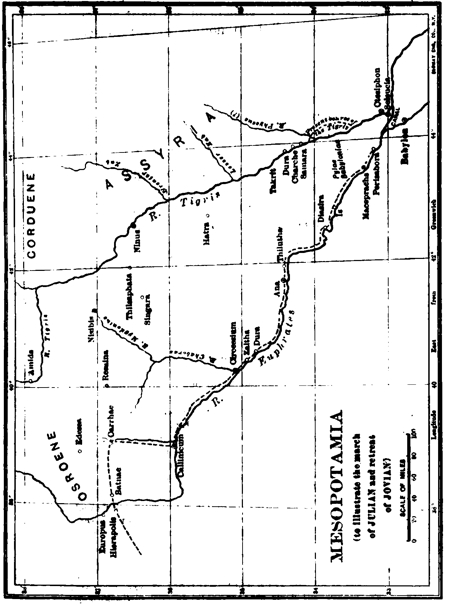
The fertile province of Assyria, [54] which stretched beyond the Tigris as far as the mountains of Media, [55] extended about four hundred miles from the ancient wall of Macepracta to the territory of Basra, where the united streams of the Euphrates and Tigris discharge themselves into the Persian Gulf. [56] The whole country might have claimed the peculiar name of Mesopotamia; as the two rivers which are never more distant than fifty, approach, between Bagdad and Babylon, within twenty-five, miles of each other. A multitude of artificial canals, dug without much labour in a soft and yielding soil, connected the rivers, and intersected the plain of Assyria. The uses of these artificial canals were [IV-128] various and important. They served to discharge the superfluous waters from one river into the other, at the season of their respective inundations. Subdividing themselves into smaller and smaller branches, they refreshed the dry lands, and supplied the deficiency of rain. They facilitated the intercourse of peace and commerce; and, as the dams could be speedily broke down, they armed the despair of the Assyrians with the means of opposing a sudden deluge to the progress of an invading army. To the soil and climate of Assyria Nature had denied some of her choicest gifts, the vine, the olive, and the fig-tree; [56a] but the food which supports the life of man, and particularly wheat and barley, were produced with inexhaustible fertility; and the husbandman who committed his seed to the earth was frequently rewarded with an increase of two, or even of three, hundred. The face of the country was interspersed with groves of innumerable palm-trees; [57] and the diligent natives celebrated, either in verse or prose, the three hundred and sixty uses to which the trunk, the branches, the leaves, the juice, and the fruit were skilfully applied. Several manufactures, especially those of leather and linen, employed the industry of a numerous people, and afforded valuable materials for foreign trade; which appears, however, to have been conducted by the hands of strangers. Babylon had been converted into a royal park; but near the ruins of the ancient capital new cities had successively arisen, and the populousness of the country was displayed in the multitude of towns and villages, which were built of bricks, dried in the sun, and strongly cemented with bitumen, the natural and peculiar production of the Babylonian soil. While the successors of Cyrus reigned over Asia, the province of Assyria alone maintained, during a third part of the year, the luxurious plenty of the [IV-129] table and household of the Great King. Four considerable villages were assigned for the subsistence of his Indian dogs; eight hundred stallions and sixteen thousand mares were constantly kept at the expense of the country, for the royal stables; and, as the daily tribute, which was paid to the satrap, amounted to one English bushel of silver, we may compute the annual revenue of Assyria at more than twelve hundred thousand pounds sterling. [58]
The fields of Assyria were devoted by Julian to the calamities of war; and the philosopher retaliated on a guiltless people the acts of rapine and cruelty which had been committed by their haughty master in the Roman provinces. The trembling Assyrians summoned the rivers to their assistance; and completed, with their own hands, the ruin of their country. The roads were rendered impracticable; a flood of waters was poured into the camp; and during several days the troops of Julian were obliged to contend with the most discouraging hardships. But every obstacle was surmounted by the perseverance of the legionaries, who were inured to toil as well as to danger, and who felt themselves animated by the spirit of their leader. The damage was gradually repaired; the waters were restored to their proper channels; whole groves of palm-trees were cut down and placed along the broken parts of the road; and the army passed over the broad and deeper canals on bridges of floating rafts, which were supported by the help of bladders. [IV-130] Two cities of Assyria presumed to resist the arms of a Roman emperor: and they both paid the severe penalty of their rashness. At the distance of fifty miles from the royal residence of Ctesiphon, Perisabor, or Anbar, [59] held the second rank in the province; a city, large, populous, and well fortified, surrounded with a double wall, almost encompassed by a branch of the Euphrates, and defended by the valour of a numerous garrison. The exhortations of Hormisdas were repulsed with contempt; and the ears of the Persian prince were wounded by a just reproach that, unmindful of his royal birth, he conducted an army of strangers against his king and country. The Assyrians maintained their loyalty by a skilful, as well as vigorous, defence; till, the lucky stroke of a battering-ram having opened a large breach by shattering one of the angles of the wall, they hastily retired into the fortifications of the interior citadel. The soldiers of Julian rushed impetuously into the town, and, after the full gratification of every military appetite, Perisabor was reduced to ashes; and the engines which assaulted the citadel were planted on the ruins of the smoking houses. The contest was continued by an incessant and mutual discharge of missile weapons; and the superiority which the Romans might derive from the mechanical powers of their balistæ and catapultæ was counterbalanced by the advantage of the ground on the side of the besieged. But as soon as an Helepolis had been constructed, which could engage on equal terms with the loftiest ramparts, the tremendous aspect of a moving turret, that would leave no hope of resistance or of mercy, terrified the defenders of the citadel into an humble submission; and the place was surrendered only two days after Julian first appeared under the walls of Perisabor. Two thousand five hundred persons of both [IV-131] sexes, the feeble remnant of a flourishing people, were permitted to retire: the plentiful magazines of corn, of arms, and of splendid furniture were partly distributed among the troops, and partly reserved for the public service: the useless stores were destroyed by fire or thrown into the stream of the Euphrates; and the fate of Amida was revenged by the total ruin of Perisabor.
The city, or rather fortress, of Maogamalcha, which was defended by sixteen large towers, a deep ditch, and two strong and solid walls of brick and bitumen, appears to have been constructed at the distance of eleven miles, as the safeguard of the capital of Persia. The emperor, apprehensive of leaving such an important fortress in his rear, immediately formed the siege of Maogamalcha; and the Roman army was distributed, for that purpose, into three divisions. Victor, at the head of the calvary, and of a detachment of heavy-armed foot, was ordered to clear the country as far as the banks of the Tigris and the suburbs of Ctesiphon. The conduct of the attack was assumed by Julian himself, who seemed to place his whole dependence in the military engines which he erected against the walls; while he secretly contrived a more efficacious method of introducing his troops into the heart of the city. Under the direction of Nevitta and Dagalaiphus, the trenches were opened at a considerable distance, and gradually prolonged as far as the edge of the ditch. The ditch was speedily filled with earth; and, by the incessant labour of the troops, a mine was carried under the foundations of the walls, and sustained, at sufficient intervals, by props of timber. Three chosen cohorts, advancing in a single file, silently explored the dark and dangerous passage; till their intrepid leader whispered back the intelligence that he was ready to issue from his confinement into the streets of the hostile city. Julian checked their ardour that he might ensure their success; and immediately diverted the attention of the garrison, by the tumult and clamour of a general assault. [IV-132] The Persians, who from their walls contemptuously beheld the progress of an impotent attack, celebrated, with songs of triumph, the glory of Sapor; and ventured to assure the emperor that he might ascend the starry mansion of Ormusd, before he could hope to take the impregnable city of Maogamalcha. The city was already taken. History has recorded the name of a private soldier, the first who ascended from the mine into a deserted tower. The passage was widened by his companions, who pressed forwards with impatient valour. Fifteen hundred enemies were already in the midst of the city. The astonished garrison abandoned the walls, and their only hope of safety; the gates were instantly burst open; and the revenge of the soldier, unless it were suspended by lust or avarice, was satiated by an undistinguishing massacre. The governor, who had yielded on a promise of mercy, was burnt alive, a few days afterwards, on a charge of having uttered some disrespectful words against the honour of prince Hormisdas. The fortifications were razed to the ground; and not a vestige was left that the city of Maogamalcha had ever existed. The neighbourhood of the capital of Persia was adorned with three stately palaces, laboriously enriched with every production that could gratify the luxury and pride of an Eastern monarch. The pleasant situation of the gardens along the banks of the Tigris was improved, according to the Persian taste, by the symmetry of flowers, fountains, and shady walks: and spacious parks were enclosed for the reception of the bears, lions, and wild boars, which were maintained at a considerable expense for the pleasure of the royal chase. The park-walls were broke down, the savage game was abandoned to the darts of the soldiers, and the palaces of Sapor were reduced to ashes, by the command of the Roman emperor. Julian, on this occasion, shewed himself ignorant, or careless, of the laws of civility, which the prudence and refinement of polished ages have established between hostile princes. Yet these wanton ravages need not excite in our breasts any vehement emotions [IV-133] of pity or resentment. A simple, naked statue, finished by the hand of a Grecian artist, is of more genuine value, than all these rude and costly monuments of Barbaric labour: and, if we are more deeply affected by the ruin of a palace than by the conflagration of a cottage, our humanity must have formed a very erroneous estimate of the miseries of human life. [60]
Julian was an object of terror and hatred to the Persians: and the painters of that nation represented the invader of their country under the emblem of a furious lion, who vomited from his mouth a consuming fire. [61] To his friends and soldiers, the philosophic hero appeared in a more amiable light; and his virtues were never more conspicuously displayed than in the last, and most active, period of his life. He practised, without effort, and almost without merit, the habitual qualities of temperance and sobriety. According to the dictates of that artificial wisdom which assumes an absolute dominion over the mind and body, he sternly refused himself the indulgence of the most natural appetites. [62] In the warm climate of Assyria, which solicited a luxurious people to the gratification of every sensual desire, [63] a youthful conqueror preserved his chastity pure and inviolate: nor was Julian ever tempted, even by a motive of curiosity, to visit his female captives of exquisite beauty, [64] who, instead of [IV-134] resisting his power, would have disputed with each other the honour of his embraces. With the same firmness that he resisted the allurements of love, he sustained the hardships of war. When the Romans marched through the flat and flooded country, their sovereign, on foot, at the head of his legions, shared their fatigues, and animated their diligence. In every useful labour, the hand of Julian was prompt and strenuous; and the Imperial purple was wet and dirty, as the coarse garment of the meanest soldier. The two sieges allowed him some remarkable opportunities of signalising his personal valour, which, in the improved state of the military art, can seldom be exerted by a prudent general. The emperor stood before the citadel of Perisabor, insensible of his extreme danger, and encouraged his troops to burst open the gates of iron, till he was almost overwhelmed under a cloud of missile weapons and huge stones that were directed against his person. As he examined the exterior fortifications of Maogamalcha, two Persians, devoting themselves for their country, suddenly rushed upon him with drawn scimitars: the emperor dexterously received their blows on his uplifted shield; and, with a steady and well-aimed thrust, laid one of his adversaries dead at his feet. The esteem of a prince who possesses the virtues which he approves is the noblest recompense of a deserving subject; and the authority which Julian derived from his personal merit enabled him to revive and enforce the rigour of ancient discipline. He punished with death, or ignominy, the misbehaviour of three troops of horse, who, in a skirmish with the Surenas, had lost their honour, and one of their standards: and he distinguished with obsidional [65] crowns the valour of the [IV-135] foremost soldiers who had ascended into the city of Maogamalcha. After the siege of Perisabor, the firmness of the emperor was exercised by the insolent avarice of the army, who loudly complained that their services were rewarded by a trifling donative of one hundred pieces of silver. His just indignation was expressed in the grave and manly language of a Roman. “Riches are the object of your desires? those riches are in the hands of the Persians; and the spoils of this fruitful country are proposed as the prize of your valour and discipline. Believe me,” added Julian, “the Roman republic, which formerly possessed such immense treasures, is now reduced to want and wretchedness; since our princes have been persuaded, by weak and interested ministers, to purchase with gold the tranquillity of the Barbarians. The revenue is exhausted; the cities are ruined; the provinces are dispeopled. For myself, the only inheritance that I have received from my royal ancestors is a soul incapable of fear; and, as long as I am convinced that every real advantage is seated in the mind, I shall not blush to acknowledge an honourable poverty, which, in the days of ancient virtue, was considered as the glory of Fabricius. That glory, and that virtue, may be your own, if you will listen to the voice of Heaven, and of your leader. But, if you will rashly persist, if you are determined to renew the shameful and mischievous examples of old seditions, proceed. — As it becomes an emperor who has filled the first rank among men, I am prepared to die, standing; and to despise a precarious life, which, every hour, may depend on an accidental fever. If I have been found unworthy of the command, there are now among you (I speak it with pride and pleasure), there are many chiefs, whose merit and experience are equal to the conduct of the most important war. Such has been the temper of my reign that I can retire, without regret, and [IV-136] without apprehension, to the obscurity of a private station.” [66] The modest resolution of Julian was answered by the unanimous applause and cheerful obedience of the Romans; who declared their confidence of victory, while they fought under the banners of their heroic prince. Their courage was kindled by his frequent and familiar asseverations (for such wishes were the oaths of Julian), “So may I reduce the Persians under the yoke!” “Thus may I restore the strength and splendour of the republic!” The love of fame was the ardent passion of his soul: but it was not before he trampled on the ruins of Maogamalcha, that he allowed himself to say, “We have now provided some materials for the sophist of Antioch.” [67]
The successful valour of Julian had triumphed over all the obstacles that opposed his march to the gates of Ctesiphon. But the reduction, or even the siege, of the capital of Persia was still at a distance: nor can the military conduct of the emperor be clearly apprehended without a knowledge of the country which was the theatre of his bold and skilful operations. [68] Twenty miles to the south of Bagdad, and on the eastern bank of the Tigris, the curiosity of travellers has observed some ruins of the palaces of Ctesiphon, which, in the time of Julian, was a great and populous city. The name and glory of the adjacent Seleucia were for ever extinguished; and the only remaining quarter of that Greek colony had resumed, with the Assyrian language and manners, the primitive appellation of Coche. Coche was situate on the [IV-137] western side of the Tigris; but it was naturally considered as a suburb of Ctesiphon, with which we may suppose it to have been connected by a permanent bridge of boats. The united parts contributed to form the common epithet of Al Modain, the cities, which the Orientals have bestowed on the winter residence of the Sassanides; and the whole circumference of the Persian capital was strongly fortified by the waters of the river, by lofty walls, and by impracticable morasses. Near the ruins of Seleucia, the camp of Julian was fixed; and secured, by a ditch and rampart, against the sallies of the numerous and enterprising garrison of Coche. In this fruitful and pleasant country, the Romans were plentifully supplied with water and forage; and several forts which might have embarrassed the motions of the army submitted, after some resistance, to the efforts of their valour. The fleet passed from the Euphrates into an artificial derivation of that river, which pours a copious and navigable stream into the Tigris, at a small distance below the great city. If they had followed this royal canal, which bore the name of Nahar-Malcha, [69] the intermediate situation of Coche would have separated the fleet and army of Julian; and the rash attempt of steering against the current of the Tigris, and forcing their way through the midst of a hostile capital, must have been attended with the total destruction of the Roman navy. The prudence of the emperor foresaw the danger, and provided the remedy. As he had minutely studied the operations of Trajan in the same country, he soon recollected that his warlike predecessor had dug a new and navigable canal, which, leaving Coche on the right hand, conveyed the waters of the Nahar-Malcha into the river [IV-138] Tigris, at some distance above the cities. From the information of the peasants, Julian ascertained the vestiges of this ancient work, which were almost obliterated by design or accident. By the indefatigable labour of the soldiers, a broad and deep channel was speedily prepared for the reception of the Euphrates. A strong dike was constructed to interrupt the ordinary current of the Nahar-Malcha: a flood of waters rushed impetuously into their new bed; and the Roman fleet, steering their triumphant course into the Tigris, derided the vain and ineffectual barriers which the Persians of Ctesiphon had erected to oppose their passage.
As it became necessary to transport the Roman army over the Tigris, another labour presented itself, of less toil, but of more danger, than the preceding expedition. The stream was broad and rapid; the ascent steep and difficult; and the intrenchments, which had been formed on the ridge of the opposite bank, were lined with a numerous army of heavy cuirassiers, dexterous archers, and huge elephants; who (according to the extravagant hyperbole of Libanius) could trample, with the same ease, a field of corn, or a legion of Romans. [70] In the presence of such an enemy, the construction of a bridge was impracticable; and the intrepid prince, who instantly seized the only possible expedient, concealed his design, till the moment of execution, from the knowledge of the Barbarians, of his own troops, and even of his generals themselves. Under the specious pretence of examining the state of the magazines, fourscore vessels were gradually unladen; [71] and a select detachment, apparently destined for some secret expedition, was ordered to stand to their arms on the first signal. Julian disguised the silent anxiety of his own mind with smiles of confidence and joy; and amused [IV-139] the hostile nations with the spectacle of military games, which he insultingly celebrated under the walls of Coche. The day was consecrated to pleasure; but, as soon as the hour of supper was past, the emperor summoned the generals to his tent; and acquainted them that he had fixed that night for the passage of the Tigris. They stood in silent and respectful astonishment; but, when the venerable Sallust assumed the privilege of his age and experience, the rest of the chiefs supported with freedom the weight of his prudent remonstrances. [72] Julian contented himself with observing that conquest and safety depended on the attempt; that, instead of diminishing, the number of their enemies would be increased, by successive reinforcements; and that a longer delay would neither contract the breadth of the stream nor level the height of the bank. The signal was instantly given, and obeyed: the most impatient of the legionaries leaped into five vessels that lay nearest to the bank; and, as they plied their oars with intrepid diligence, they were lost, after a few moments, in the darkness of the night. A flame arose on the opposite side; and Julian, who too clearly understood that his foremost vessels, in attempting to land, had been fired by the enemy, dexterously converted their extreme danger into a presage of victory. “Our fellowsoldiers,” he eagerly exclaimed, “are already masters of the bank; see — they make the appointed signal: let us hasten to emulate and assist their courage.” The united and rapid motion of a great fleet broke the violence of the current, and they reached the eastern shore of the Tigris with sufficient speed to extinguish the flames and rescue their adventurous companions. The difficulties of a steep and lofty ascent were increased by the weight of armour and the darkness of the night. A shower of stones, darts, and fire was incessantly discharged on the heads of the assailants; who, after an [IV-140] arduous struggle, climbed the bank, and stood victorious upon the ramparts. As soon as they possessed a more equal field, Julian, who, with his light infantry, had led the attack, [73] darted through the ranks a skilful and experienced eye: his bravest soldiers, according to the precepts of Homer, [74] were distributed in the front and rear; and all the trumpets of the Imperial army sounded to battle. The Romans, after sending up a military shout, advanced in measured steps to the animating notes of martial music; launched their formidable javelins; and rushed forwards with drawn swords, to deprive the Barbarians, by a closer onset, of the advantage of their missile weapons. The whole engagement lasted above twelve hours; till the gradual retreat of the Persians was changed into a disorderly flight, of which the shameful example was given by the principal leaders, and the Surenas himself. They were pursued to the gates of Ctesiphon; and the conquerors might have entered the dismayed city, [75] if their general, Victor, who was dangerously wounded with an arrow, had not conjured them to desist from a rash attempt, which must be fatal, if it were not successful. On their side, the Romans acknowledged the loss of only seventy-five men; while they affirmed that the Barbarians had left on the field of battle two thousand five hundred, or even six thousand, of their bravest soldiers. The spoil was such as might be expected from the riches and luxury of an Oriental camp; large quantities of silver and gold, splendid arms and trappings, [IV-141] and beds and tables of massy silver. The victorious emperor distributed, as the rewards of valour, some honourable gifts, civic and mural and naval crowns; which he, and perhaps he alone, esteemed more precious than the wealth of Asia. A solemn sacrifice was offered to the god of war, but the appearances of the victims threatened the most inauspicious events; and Julian soon discovered, by less ambiguous signs, that he had now reached the term of his prosperity. [76]
On the second day after the battle, the domestic guards, the Jovians and Herculians, and the remaining troops, which composed near two-thirds of the whole army, were securely wafted over the Tigris. [77] While the Persians beheld from the walls of Ctesiphon the desolation of the adjacent country, Julian cast many an anxious look towards the north, in full expectation that, as he himself had victoriously penetrated to the capital of Sapor, the march and junction of his lieutenants, Sebastian and Procopius, would be executed with the same courage and diligence. His expectations were disappointed by the treachery of the Armenian king, who permitted, and most probably directed, the desertion of his auxiliary troops from the camp of the Romans; [78] and by the dissensions of the two generals, who were incapable of forming or executing any plan for the public service. When the emperor had relinquished the [IV-142] hope of this important reinforcement, he condescended to hold a council of war, and approved, after a full debate, the sentiment of those generals who dissuaded the siege of Ctesiphon as a fruitless and pernicious undertaking. It is not easy for us to conceive by what arts of fortification a city thrice besieged and taken by the predecessors of Julian could be rendered impregnable against an army of sixty thousand Romans, commanded by a brave and experienced general, and abundantly supplied with ships, provisions, battering engines, and military stores. But we may rest assured, from the love of glory, and contempt of danger, which formed the character of Julian, that he was not discouraged by any trivial or imaginary obstacles. [79] At the very time when he declined the siege of Ctesiphon, he rejected, with obstinacy and disdain, the most flattering offers of a negotiation of peace. Sapor, who had been so long accustomed to the tardy ostentation of Constantius, was surprised by the intrepid diligence of his successor. As far as the confines of India and Scythia, the satraps of the distant provinces were ordered to assemble their troops, and to march, without delay, to the assistance of their monarch. But their preparations were dilatory, their motions slow; and, before Sapor could lead an army into the field, he received the melancholy intelligence of the devastation of Assyria, the ruin of his palaces, and the slaughter of his bravest troops, who defended the passage of the Tigris. The pride of royalty was humbled in the dust; he took his repasts on the ground; and the disorder of his hair expressed the grief and anxiety of his mind. Perhaps he would not have refused to purchase, with one half of his kingdom, the safety of the remainder: and he would have gladly subscribed himself, in a [IV-143] treaty of peace, the faithful and dependent ally of the Roman conqueror. Under the pretence of private business, a minister of rank and confidence was secretly dispatched to embrace the knees of Hormisdas, and to request, in the language of a suppliant, that he might be introduced into the presence of the emperor. The Sassanian prince, whether he listened to the voice of pride or humanity, whether he consulted the sentiments of his birth or the duties of his situation, was equally inclined to promote a salutary measure, which would terminate the calamities of Persia, and secure the triumph of Rome. He was astonished by the inflexible firmness of a hero, who remembered, most unfortunately for himself and for his country, that Alexander had uniformly rejected the propositions of Darius. But, as Julian was sensible that the hope of a safe and honourable peace might cool the ardour of his troops, he earnestly requested that Hormisdas would privately dismiss the minister of Sapor and conceal this dangerous temptation from the knowledge of the camp. [80]
The honour, as well as interest, of Julian forbade him to consume his time under the impregnable walls of Ctesiphon; and, as often as he defied the Barbarians, who defended the city, to meet him on the open plain, they prudently replied that, if he desired to exercise his valour, he might seek the army of the Great King. He felt the insult, and he accepted the advice. Instead of confining his servile march to the banks of the Euphrates and Tigris, he resolved to imitate the adventurous spirit of Alexander, and boldly to advance into the inland provinces, till he forced his rival to contend with him, perhaps in the plains of Arbela, for the empire of Asia. The magnanimity of Julian was applauded and betrayed by the arts of a noble Persian, who, in the cause of his country, had generously submitted to act a part full of [IV-144] danger, of falsehood, and of shame. [81] With a train of faithful followers, he deserted to the Imperial camp; exposed, in a specious tale, the injuries which he had sustained; exaggerated the cruelty of Sapor, the discontent of the people, and the weakness of the monarchy; and confidently offered himself as the hostage and guide of the Roman march. The most rational grounds of suspicion were urged, without effect, by the wisdom and experience of Hormisdas; and the credulous Julian, receiving the traitor into his bosom, was persuaded to issue an hasty order, which, in the opinion of mankind, appeared to arraign his prudence, and to endanger his safety. He destroyed, in a single hour, the whole navy, which had been transported above five hundred miles, at so great expense of toil, of treasure, and of blood. Twelve, or, at the most, twenty-two, small vessels were saved, to accompany, on carriages, the march of the army, and to form occasional bridges for the passage of the rivers. A supply of twenty days’ provisions was reserved for the use of the soldiers; and the rest of the magazines, with a fleet of eleven hundred vessels, which rode at anchor in the Tigris, were abandoned to the flames, by the absolute command of the emperor. The Christian bishops, Gregory and Augustin, insult the madness of the apostate, who executed, with his own hands, the sentence of divine justice. Their authority, of less weight, perhaps, in a military question, is confirmed by the cool judgment of an experienced soldier, who was himself spectator of the conflagration, and who could not disapprove the reluctant murmurs of the troops. [82] Yet there are not wanting some [IV-145] specious and perhaps solid reasons, which might justify the resolution of Julian. The navigation of the Euphrates never ascended above Babylon, nor that of the Tigris above Opis. [83] The distance of the last-mentioned city from the Roman camp was not very considerable; and Julian must soon have renounced the vain and impracticable attempt of forcing upwards a great fleet against the stream of a rapid river, [84] which in several places was embarrassed by natural or artificial cataracts. [85] The power of sails or oars was insufficient; it became necessary to tow the ships against the current of the river; the strength of twenty thousand soldiers was exhausted in this tedious and servile labour; and, if the Romans continued to march along the banks of the Tigris, they could only expect to return home without achieving any enterprise worthy of the genius or fortune of their leader. If, on the contrary, it was advisable to advance into the inland country, the destruction of the fleet and magazines was the only measure which could save that valuable prize from the hands of the numerous and active troops which might suddenly be poured from the gates of Ctesiphon. Had the arms of Julian been victorious, we should now admire the conduct, as well as the courage, of a hero, who, by depriving his soldiers of the hopes of a retreat, left them only the alternative of death or conquest. [86]
[IV-146]
The cumbersome train of artillery and waggons which retards the operations of a modern army were in a great measure unknown in the camps of the Romans. [87] Yet, in every age, the subsistence of sixty thousand men must have been one of the most important cares of a prudent general; and that subsistence could only be drawn from his own or from the enemy’s country. Had it been possible for Julian to maintain a bridge of communication on the Tigris, and to preserve the conquered places of Assyria, a desolated province could not afford any large or regular supplies, in a season of the year when the lands were covered by the inundation of the Euphrates, [88] and the unwholesome air was darkened with swarms of innumerable insects. [89] The appearance of the hostile country was far more inviting. The extensive region that lies between the river Tigris and the mountains of Media was filled with villages and towns; and the fertile soil, for the most part, was in a very improved state of cultivation. Julian might expect that a conqueror who possessed the two forcible instruments of persuasion, steel and gold, would easily procure a plentiful subsistence from the fears or the avarice of the natives. But on the approach of the Romans, this rich and smiling prospect was instantly blasted. Wherever they moved, the inhabitants deserted the open villages, and took shelter in the fortified towns; the cattle was driven away; the grass and ripe corn were consumed [IV-147] with fire; and, as soon as the flames had subsided which interrupted the march of Julian, he beheld the melancholy face of a smoking and naked desert. This desperate but effectual method of defence can only be executed by the enthusiasm of a people who prefer their independence to their property; or by the rigour of an arbitrary government, which consults the public safety without submitting to their inclinations the liberty of choice. On the present occasion, the zeal and obedience of the Persians seconded the commands of Sapor; and the emperor was soon reduced to the scanty stock of provisions, which continually wasted in his hands. Before they were entirely consumed, he might still have reached the wealthy and unwarlike cities of Ecbatana or Susa, by the effort of a well-directed march; [90] but he was deprived of this last resource by his ignorance of the roads, and by the perfidy of his guides. The Romans wandered several days in the country to the eastward of Bagdad: the Persian deserter, who had artfully led them into the snare, escaped from their resentment; and his followers, as soon as they were put to the torture, confessed the secret of the conspiracy. The visionary conquests of Hyrcania and India, which had so long amused, now tormented, the mind of Julian. Conscious that his own imprudence was the cause of the public distress, he anxiously balanced the hopes of safety or success, without obtaining a satisfactory answer either from gods or men. At length, as the only practicable measure, he embraced the resolution of directing his steps towards the banks of the Tigris, with the design of saving the army by a hasty march to the confines of Corduence; a fertile and friendly province, which acknowledged the sovereignty of Rome. The desponding troops obeyed the [IV-148] signal of the retreat, only seventy days after they had passed the Chaboras with the sanguine expectation of subverting the throne of Persia. [91]
As long as the Romans seemed to advance into the country, their march was observed and insulted from a distance by several bodies of Persian cavalry; who, showing themselves sometimes in loose, and sometimes in closer, order, faintly skirmished with the advanced guards. These detachments were, however, supported by a much greater force; and the heads of the columns were no sooner pointed towards the Tigris than a cloud of dust arose on the plain. The Romans, who now aspired only to the permission of a safe and speedy retreat, endeavoured to persuade themselves that this formidable appearance was occasioned by a troop of wild asses, or perhaps by the approach of some friendly Arabs. They halted, pitched their tents, fortified their camp, passed the whole night in continual alarms; and discovered, at the dawn of day, that they were surrounded by an army of Persians. This army, which might be considered only as the van of the Barbarians, was soon followed by the main body of cuirassiers, archers, and elephants, commanded by Meranes, a general of rank and reputation. He was accompanied by two of the king’s sons, and many of the principal satraps; and fame and expectation exaggerated the strength of the remaining powers, which slowly advanced under the conduct of Sapor himself. As the Romans continued their march, their long array, which was forced to bend, or divide, according to the varieties of the ground, afforded frequent and favourable opportunities to their vigilant enemies. The Persians repeatedly charged with fury; they were repeatedly repulsed with firmness; and the action at Maronga, which almost deserved the name of a [IV-149] battle, was marked by a considerable loss of satraps and elephants, perhaps of equal value in the eyes of their monarch. These splendid advantages were not obtained without an adequate slaughter on the side of the Romans: several officers of distinction were either killed or wounded; and the emperor himself, who, on all occasions of danger, inspired and guided the valour of his troops, was obliged to expose his person and exert his abilities. The weight of offensive and defensive arms, which still constituted the strength and safety of the Romans, disabled them from making any long or effectual pursuit; and, as the horsemen of the East were trained to dart their javelins, and shoot their arrows, at full speed, and in every possible direction, [92] the cavalry of Persia was never more formidable than in the moment of a rapid and disorderly flight. But the most certain and irreparable loss of the Romans was that of time. The hardy veterans, accustomed to the cold climate of Gaul and Germany, fainted under the sultry heat of an Assyrian summer: their vigour was exhausted by the incessant repetition of march and combat; and the progress of the army was suspended by the precautions of a slow and dangerous retreat in the presence of an active enemy. Every day, every hour, as the supply diminished, the value and price of subsistence increased in the Roman camp. [93] Julian, who always contented himself with such food as a hungry soldier would have disdained, distributed for the use of his troops the provisions of the Imperial household, and whatever could be spared from [IV-150] the sumpter-horses of the tribunes and generals. But this feeble relief served only to aggravate the sense of the public distress; and the Romans began to entertain the most gloomy apprehensions that, before they could reach the frontiers of the empire, they should all perish, either by famine or by the sword of the Barbarians. [94]
While Julian struggled with the almost insuperable difficulties of his situation, the silent hours of the night were still devoted to study and contemplation. Whenever he closed his eyes in short and interrupted slumbers, his mind was agitated with painful anxiety; nor can it be thought surprising that the Genius of the empire should once more appear before him, covering with a funeral veil his head and his horn of abundance, and slowly retiring from the Imperial tent. The monarch started from his couch, and stepping forth, to refresh his wearied spirits with the coolness of the midnight air, he beheld a fiery meteor, which shot athwart the sky, and suddenly vanished. Julian was convinced that he had seen the menacing countenance of the god of war; [95] the council which he summoned, of Tuscan haruspices, [96] unanimously pronounced that he should abstain from action; but, on this occasion, necessity and reason were more prevalent than superstition; and the trumpets sounded at the break of day. The army marched through a hilly country; and the hills had been secretly occupied by the Persians. [IV-151] Julian led the van, with the skill and attention of a consummate general; he was alarmed by the intelligence that his rear was suddenly attacked. The heat of the weather had tempted him to lay aside his cuirass; but he snatched a shield from one of his attendants, and hastened, with a sufficient reinforcement, to the relief of the rear-guard. A similar danger recalled the intrepid prince to the defence of the front; and, as he galloped between the columns, the centre of the left was attacked, and almost overpowered, by a furious charge of the Persian cavalry and elephants. This huge body was soon defeated, by the well-timed evolution of the light infantry, who aimed their weapons, with dexterity and effect, against the backs of the horsemen and the legs of the elephants. The Barbarians fled; and Julian, who was foremost in every danger, animated the pursuit with his voice and gestures. His trembling guards, scattered and oppressed by the disorderly throng of friends and enemies, reminded their fearless sovereign that he was without armour; and conjured him to decline the fall of the impending ruin. As they exclaimed, [97] a cloud of darts and arrows was discharged from the flying squadrons; and a javelin, after razing the skin of his arm, transpierced the ribs, and fixed in the [IV-152] inferior part of the liver. Julian attempted to draw the deadly weapon from his side; but his fingers were cut by the sharpness of the steel, and he fell senseless from his horse. His guards flew to his relief; and the wounded emperor was gently raised from the ground, and conveyed out of the tumult of the battle into an adjacent tent. The report of the melancholy event passed from rank to rank; but the grief of the Romans inspired them with invincible valour and the desire of revenge. The bloody and obstinate conflict was maintained by the two armies, till they were separated by the total darkness of the night. The Persians derived some honour from the advantage which they obtained against the left wing, where Anatolius, master of the offices, was slain, and the prefect Sallust very narrowly escaped. But the event of the day was adverse to the Barbarians. They abandoned the field, their two generals, Meranes and Nohordates, [98] fifty nobles or satraps, and a multitude of their bravest soldiers: and the success of the Romans, if Julian had survived, might have been improved into a decisive and useful victory.
The first words that Julian uttered, after his recovery from the fainting fit into which he had been thrown by loss of blood, were expressive of his martial spirit. He called for his horse and arms, and was impatient to rush into the battle. His remaining strength was exhausted by the painful effort; and the surgeons who examined his wound discovered the symptoms of approaching death. He employed the awful moments with the firm temper of a hero and a sage; the philosophers who had accompanied him in this fatal expedition compared the tent of Julian with the prison of Socrates; and the spectators, whom duty, or friendship, or curiosity had assembled around his couch, listened with respectful [IV-153] grief to the funeral oration of their dying emperor. [99] “Friends and fellow-soldiers, the seasonable period of my departure is now arrived, and I discharge, with the cheerfulness of a ready debtor, the demands of nature. I have learned from philosophy, how much the soul is more excellent than the body; and that the separation of the nobler substance should be the subject of joy, rather than of affliction. I have learned from religion, that an early death has often been the reward of piety; [100] and I accept, as a favour of the gods, the mortal stroke that secures me from the danger of disgracing a character, which has hitherto been supported by virtue and fortitude. I die without remorse, as I have lived without guilt. I am pleased to reflect on the innocence of my private life; and I can affirm, with confidence, that the supreme authority, that emanation of the Divine Power, has been preserved in my hands pure and immaculate. Detesting the corrupt and destructive maxims of despotism, I have considered the happiness of the people as the end of government. Submitting my actions to the laws of prudence, of justice, and of moderation, I have trusted the event to the care of Providence. Peace was the object of my counsels, as long as peace was consistent with the public welfare; but, when the imperious voice of my country summoned me to arms, I exposed my person to the dangers of war, with the clear foreknowledge (which I had acquired from the art of divination) that I was destined to fall by the sword. I now offer my tribute of gratitude to the Eternal Being, who has not suffered me to perish by the [IV-154] cruelty of a tyrant, by the secret dagger of conspiracy, or by the slow tortures of lingering disease. He has given me, in the midst of an honourable career, a splendid and glorious departure from this world; and I hold it equally absurd, equally base, to solicit, or to decline, the stroke of fate. — Thus much I have attempted to say; but my strength fails me, and I feel the approach of death. — I shall cautiously refrain from any word that may tend to influence your suffrages in the election of an emperor. My choice might be imprudent, or injudicious; and, if it should not be ratified by the consent of the army, it might be fatal to the person whom I should recommend. I shall only, as a good citizen, express my hopes that the Romans may be blessed with the government of a virtuous sovereign.” After this discourse, which Julian pronounced in a firm and gentle tone of voice, he distributed, by a military testament, [101] the remains of his private fortune; and, making some inquiry why Anatolius was not present, he understood, from the answer of Sallust, that Anatolius was killed; and bewailed, with amiable inconsistency, the loss of his friend. At the same time he reproved the immoderate grief of the spectators; and conjured them not to disgrace, by unmanly tears, the fate of a prince who in a few moments would be united with heaven, and with the stars. [102] The spectators were silent; and Julian entered into a metaphysical argument with the philosophers Priscus and Maximus, on the nature of the soul. The efforts which he made, of mind as well as body, most probably hastened his death. His wound began to bleed with fresh violence; his respiration was embarrassed by the swelling of [IV-155] the veins: he called for a draught of cold water, and, as soon as he had drunk it, expired without pain, about the hour of midnight. Such was the end of that extraordinary man, in the thirty-second year of his age, after a reign of one year and about eight months from the death of Constantius. In his last moments he displayed, perhaps with some ostentation, the love of virtue and of fame which had been the ruling passions of his life. [103]
The triumph of Christianity, and the calamities of the empire, may, in some measure, be ascribed to Julian himself, who had neglected to secure the future execution of his designs by the timely and judicious nomination of an associate and successor. But the royal race of Constantius Chlorus was reduced to his own person; and, if he entertained any serious thoughts of investing with the purple the most worthy among the Romans, he was diverted from his resolution by the difficulty of the choice, the jealousy of power, the fear of ingratitude, and the natural presumption of health, of youth, and of prosperity. His unexpected death left the empire without a master and without an heir, in a state of perplexity and danger, which, in the space of fourscore years, had never been experienced, since the election of Diocletian. In a government which had almost forgotten the distinction of pure and noble blood, the superiority of birth was of little moment; the claims of official rank were accidental and precarious; and the candidates who might aspire to ascend the vacant throne could be supported only by the consciousness of personal merit, or by the hopes of popular favour. But the situation of a famished army, encompassed on all sides by an host of Barbarians, shortened the moments of grief and deliberation. In this scene of terror and distress, the body [IV-156] of the deceased prince, according to his own directions, was decently embalmed; and, at the dawn of day, the generals convened a military senate, at which the commanders of the legions and the officers, both of cavalry and infantry, were invited to assist. Three or four hours of the night had not passed away without some secret cabals; and, when the election of an emperor was proposed, the spirit of faction began to agitate the assembly. Victor and Arinthæus collected the remains of the court of Constantius; the friends of Julian attached themselves to the Gallic chiefs, Dagalaiphus and Nevitta; and the most fatal consequences might be apprehended from the discord of two factions, so opposite in their character and interest, in their maxims of government, and perhaps in their religious principles. The superior virtues of Sallust could alone reconcile their divisions and unite their suffrages; and the venerable prefect would immediately have been declared the successor of Julian, if he himself, with sincere and modest firmness, had not alleged his age and infirmities, so unequal to the weight of the diadem. The generals, who were surprised and perplexed by his refusal, shewed some disposition to adopt the salutary advice of an inferior officer, [104] that they should act as they would have acted in the absence of the emperor; that they should exert their abilities to extricate the army from the present distress; and, if they were fortunate enough to reach the confines of Mesopotamia, they should proceed with united and deliberate counsels in the election of a lawful sovereign. While they debated, a few voices saluted Jovian, who was no more than first [105] of the domestics, with the [IV-157] names of Emperor and Augustus. The tumultuary acclamation was instantly repeated by the guards who surrounded the tent, and passed, in a few minutes, to the extremities of the line. The new prince, astonished with his own fortune, was hastily invested with the Imperial ornaments and received an oath of fidelity from the generals whose favour and protection he so lately solicited. The strongest recommendation of Jovian was the merit of his father, Count Varronian, who enjoyed, in honourable retirement, the fruit of his long services. In the obscure freedom of a private station, the son indulged his taste for wine and women; yet he supported, with credit, the character of a Christian [106] and a soldier. Without being conspicuous for any of the ambitious qualifications which excite the admiration and envy of mankind, the comely person of Jovian, his cheerful temper, and familiar wit had gained the affection of his fellowsoldiers; and the generals of both parties acquiesced in a popular election, which had not been conducted by the arts of their enemies. The pride of this unexpected elevation was moderated by the just apprehension that the same day might terminate the life and reign of the new emperor. The pressing voice of necessity was obeyed without delay; and the first orders issued by Jovian, a few hours after his predecessor had expired, were to prosecute a march which could alone extricate the Romans from their actual distress. [107]
The esteem of an enemy is most sincerely expressed by [IV-158] his fears; and the degree of fear may be accurately measured by the joy with which he celebrates his deliverance. The welcome news of the death of Julian, which a deserter revealed to the camp of Sapor, inspired the desponding monarch with a sudden confidence of victory. He immediately detached the royal cavalry, perhaps the ten thousand Immortals, [108] to second and support the pursuit; and discharged the whole weight of his united forces on the rear-guard of the Romans. The rear-guard was thrown into disorder; the renowned legions, which derived their titles from Diocletian and his warlike colleague, were broke and trampled down by the elephants; and three tribunes lost their lives in attempting to stop the flight of their soldiers. The battle was at length restored by the persevering valour of the Romans; the Persians were repulsed with a great slaughter of men and elephants; and the army, after marching and fighting a long summer’s day, arrived, in the evening, at Samara on the banks of the Tigris, about one hundred miles above Ctesiphon. [109] On the ensuing day, the Barbarians, instead of harassing the march, attacked the camp of Jovian, which had been seated in a deep and sequestered valley. From the hills, the archers of Persia insulted and annoyed the wearied legionaries; and a body of cavalry, which had penetrated with desperate courage through the Prætorian gate, was cut in pieces, after a doubtful conflict, near the Imperial tent. In the succeeding night, the camp of Carche was protected by [IV-159] the lofty dikes of the river; and the Roman army, though incessantly exposed to the vexatious pursuit of the Saracens, pitched their tents near the city of Dura, [110] four days after the death of Julian. The Tigris was still on their left; their hopes and provisions were almost consumed; and the impatient soldiers, who had fondly persuaded themselves that the frontiers of the empire were not far distant, requested their new sovereign that they might be permitted to hazard the passage of the river. With the assistance of his wisest officers, Jovian endeavoured to check their rashness; by representing that, if they possessed sufficient skill and vigour to stem the torrent of a deep and rapid stream, they would only deliver themselves naked and defenceless to the Barbarians, who had occupied the opposite banks. Yielding at length to their clamorous importunities, he consented, with reluctance, that five hundred Gauls and Germans, accustomed from their infancy to the waters of the Rhine and Danube, should attempt the bold adventure, which might serve either as an encouragement, or as a warning, for the rest of the army. In the silence of the night, they swam the Tigris, surprised an unguarded post of the enemy, and displayed at the dawn of day the signal of their resolution and fortune. The success of this trial disposed the emperor to listen to the promises of his architects, who proposed to construct a floating bridge of the inflated skins of sheep, oxen, and goats, covered with a floor of earth and fascines. [111] Two important days were spent in the ineffectual labour; and the Romans, who already endured the miseries of famine, cast a look of [IV-160] despair on the Tigris, and upon the Barbarians; whose numbers and obstinacy increased with the distress of the Imperial army. [112]
In this hopeless situation, the fainting spirits of the Romans were revived by the sound of peace. The transient presumption of Sapor had vanished: he observed, with serious concern, that, in the repetition of doubtful combats, he had lost his most faithful and intrepid nobles, his bravest troops, and the greatest part of his train of elephants: and the experienced monarch feared to provoke the resistance of despair, the vicissitudes of fortune, and the unexhausted powers of the Roman empire; which might soon advance to relieve, or to revenge, the successor of Julian. The Surenas himself, accompanied by another satrap, appeared in the camp of Jovian; [113] and declared that the clemency of his sovereign was not averse to signify the conditions on which he would consent to spare and to dismiss the Cæsar with the relics of his captive army. The hopes of safety subdued the firmness of the Romans; the emperor was compelled, by the advice of his council and the cries of the soldiers, to embrace the offer of peace; and the prefect Sallust was immediately sent, with the general Arinthæus, to understand the pleasure of the Great King. The crafty Persian delayed, under various pretences, the conclusion of the agreement; started difficulties, required explanations, suggested expedients, receded from his concessions, increased his demands, and wasted four days in the arts of negotiation, till he had consumed the stock of provisions which yet remained in the [IV-161] camp of the Romans. Had Jovian been capable of executing a bold and prudent measure, he would have continued his march with unremitting diligence; the progress of the treaty would have suspended the attacks of the Barbarians; and, before the expiration of the fourth day, he might have safely reached the fruitful province of Corduene, at the distance only of one hundred miles. [114] The irresolute emperor, instead of breaking through the toils of the enemy, expected his fate with patient resignation; and accepted the humiliating conditions of peace, which it was no longer in his power to refuse. The five provinces beyond the Tigris, which had been ceded by the grandfather of Sapor, were restored to the Persian monarchy. He acquired, by a single article, the impregnable city of Nisibis; which had sustained, in three successive sieges, the effort of his arms. Singara, and the castle of the Moors, one of the strongest places of Mesopotamia, were likewise dismembered from the empire. It was considered as an indulgence, that the inhabitants of those fortresses were permitted to retire with their effects; but the conqueror rigorously insisted that the Romans should for ever abandon the king and kingdom of Armenia. A peace, or rather a long truce, of thirty years was stipulated between the hostile nations; the faith of the treaty was ratified by solemn oaths, and religious ceremonies; and hostages of distinguished rank were reciprocally delivered to secure the performance of the conditions. [115]
[IV-162]
The sophist of Antioch, who saw with indignation the sceptre of his hero in the feeble hand of a Christian successor, professes to admire the moderation of Sapor, in contenting himself with so small a portion of the Roman empire. If he had stretched as far as the Euphrates the claims of his ambition, he might have been secure, says Libanius, of not meeting with a refusal. If he had fixed, as the boundary of Persia, the Orontes, the Cydnus, the Sangarius, or even the Thracian Bosphorus, flatterers would not have been wanting in the court of Jovian to convince the timid monarch that his remaining provinces would still afford the most ample gratifications of power and luxury. [116] Without adopting in its full force this malicious insinuation, we must acknowledge that the conclusion of so ignominious a treaty was facilitated by the private ambition of Jovian. The obscure domestic, exalted to the throne by fortune rather than by merit, was impatient to escape from the hands of the Persians; that he might prevent the designs of Procopius, who commanded the army of Mesopotamia, and establish his doubtful reign over the legions and provinces, which were still ignorant of the hasty and tumultuous choice of the camp beyond the Tigris. [117] In the neighbourhood of the same river, at no very considerable distance from the fatal station of Dura, [118] the ten thousand Greeks, without generals, or guides, or provisions, were abandoned, above twelve hundred miles from their native [IV-163] country, to the resentment of a victorious monarch. The difference of their conduct and success depended much more on their character than on their situation. Instead of tamely resigning themselves to the secret deliberations and private views of a single person, the united councils of the Greeks were inspired by the generous enthusiasm of a popular assembly; where the mind of each citizen is filled with the love of glory, the pride of freedom, and the contempt of death. Conscious of their superiority over the Barbarians in arms and discipline, they disdained to yield, they refused to capitulate; every obstacle was surmounted by their patience, courage, and military skill; and the memorable retreat of the ten thousand exposed and insulted the weakness of the Persian monarchy. [119]
As the price of his disgraceful concessions, the emperor might perhaps have stipulated that the camp of the hungry Romans should be plentifully supplied; [120] and that they should be permitted to pass the Tigris, on the bridge which was constructed by the hands of the Persians. But, if Jovian presumed to solicit those equitable terms, they were sternly refused by the haughty tyrant of the East; whose clemency had pardoned the invaders of his country. The Saracens sometimes intercepted the stragglers of the march; but the generals and troops of Sapor respected the cessation of arms; and Jovian was suffered to explore the most convenient place for the passage of the river. The small vessels, which had been saved from the conflagration of the fleet, performed the most essential service. They first conveyed the emperor and his favourites; and afterwards transported, in many successive voyages, a great part of the army. But, [IV-164] as every man was anxious for his personal safety, and apprehensive of being left on the hostile shore, the soldiers, who were too impatient to wait the slow returns of the boats, boldly ventured themselves on light hurdles, or inflated skins; and, drawing after them their horses, attempted, with various success, to swim across the river. Many of these daring adventurers were swallowed by the waves; many others, who were carried along by the violence of the stream, fell an easy prey to the avarice, or cruelty, of the wild Arabs: and the loss which the army sustained in the passage of the Tigris was not inferior to the carnage of a day of battle. As soon as the Romans had landed on the western bank, they were delivered from the hostile pursuit of the Barbarians; but, in a laborious march of two hundred miles over the plains of Mesopotamia, they endured the last extremities of thirst and hunger. They were obliged to traverse a sandy desert, which, in the extent of seventy miles, did not afford a single blade of sweet grass, nor a single spring of fresh water; and the rest of the inhospitable waste was untrod by the footsteps either of friends or enemies. Whenever a small measure of flour could be discovered in the camp, twenty pounds’ weight were greedily purchased with ten pieces of gold: [121] the beasts of burden were slaughtered and devoured; and the desert was strewed with the arms and baggage of the Roman soldiers, whose tattered garments and meagre countenances displayed their past sufferings and actual misery. A small convoy of provisions advanced to meet the army as [IV-165] far as the castle of Ur; and the supply was the more grateful, since it declared the fidelity of Sebastian and Procopius. At Thilsaphata, [122] the emperor most graciously received the generals of Mesopotamia, and the remains of a once flourishing army at length reposed themselves under the walls of Nisibis. The messengers of Jovian had already proclaimed, in the language of flattery, his election, his treaty, and his return; and the new prince had taken the most effectual measures to secure the allegiance of the armies and provinces of Europe; by placing the military command in the hands of those officers who, from motives of interest or inclination, would firmly support the cause of their benefactor. [123]
The friends of Julian had confidently announced the success of his expedition. They entertained a fond persuasion that the temples of the gods would be enriched with the spoils of the East; that Persia would be reduced to the humble state of a tributary province, governed by the laws and magistrates of Rome; that the Barbarians would adopt the dress, and manners, and language of their conquerors; and that the youth of Ecbatana and Susa would study the art of rhetoric under Grecian masters. [124] The progress of the arms of Julian interrupted his communication with the empire; and, from the moment that he passed the Tigris, his affectionate subjects were ignorant of the fate and fortunes of their prince. Their contemplation of fancied triumphs was disturbed by the melancholy rumour of his death; and they persisted to doubt, after they could no longer deny, the [IV-166] truth of that fatal event. [125] The messengers of Jovian promulgated the specious tale of a prudent and necessary peace: the voice of fame, louder and more sincere, revealed the disgrace of the emperor and the conditions of the ignominious treaty. The minds of the people were filled with astonishment and grief, with indignation and terror, when they were informed that the unworthy successor of Julian relinquished the five provinces which had been acquired by the victory of Galerius; and that he shamefully surrendered to the Barbarians the important city of Nisibis, the firmest bulwark of the provinces of the East. [126] The deep and dangerous question, how far the public faith should be observed, when it becomes incompatible with the public safety, was freely agitated in popular conversation; and some hopes were entertained that the emperor would redeem his pusillanimous behaviour by a splendid act of patriotic perfidy. The inflexible spirit of the Roman senate had always disclaimed the unequal conditions which were extorted from the distress of her captive armies; and, if it were necessary to satisfy the national honour by delivering the guilty general into the hands of the Barbarians, the greatest part of the subjects of Jovian would have cheerfully acquiesced in the precedent of ancient times. [127]
But the emperor, whatever might be the limits of his constitutional [IV-167] authority, was the absolute master of the laws and arms of the state; and the same motives which had forced him to subscribe, now pressed him to execute, the treaty of peace. He was impatient to secure an empire at the expense of a few provinces; and the respectable names of religion and honour concealed the personal fears and the ambition of Jovian. Notwithstanding the dutiful solicitations of the inhabitants, decency, as well as prudence, forbade the emperor to lodge in the palace of Nisibis; but, the next morning after his arrival, Bineses, the ambassador of Persia, entered the place, displayed from the citadel the standard of the Great King, and proclaimed, in his name, the cruel alternative of exile or servitude. The principal citizens of Nisibis, who, till that fatal moment, had confided in the protection of their sovereign, threw themselves at his feet. They conjured him not to abandon, or, at least, not to deliver, a faithful colony to the rage of a Barbarian tyrant, exasperated by the three successive defeats which he had experienced under the walls of Nisibis. They still possessed arms and courage to repel the invaders of their country; they requested only the permission of using them in their own defence; and, as soon as they had asserted their independence, they should implore the favour of being again admitted into the rank of his subjects. Their arguments, their eloquence, their tears, were ineffectual. Jovian alleged, with some confusion, the sanctity of oaths; and, as the reluctance with which he accepted the present of a crown of gold convinced the citizens of their hopeless condition, the advocate Sylvanus was provoked to exclaim, “O Emperor! may you thus be crowned by all the cities of your dominions!” Jovian, who, in a few weeks, had assumed the habits of a prince, [128] was displeased with freedom, and offended with truth: and, as he reasonably [IV-168] supposed that the discontent of the people might incline them to submit to the Persian government, he published an edict, under pain of death, that they should leave the city within the term of three days. Ammianus has delineated in lively colours the scene of universal despair, which he seems to have viewed with an eye of compassion. [129] The martial youth deserted, with indignant grief, the walls which they had so gloriously defended: the disconsolate mourner dropt a last tear over the tomb of a son or husband, which must soon be profaned by the rude hand of a Barbarian master; and the aged citizen kissed the threshold, and clung to the doors, of the house where he had passed the cheerful and careless hours of infancy. The highways were crowded with a trembling multitude: the distinctions of rank, and sex, and age were lost in the general calamity. Every one strove to bear away some fragment from the wreck of his fortunes; and, as they could not command the immediate service of an adequate number of horses or waggons, they were obliged to leave behind them the greatest part of their valuable effects. The savage insensibility of Jovian appears to have aggravated the hardships of these unhappy fugitives. They were seated, however, in a new-built quarter of Amida; and that rising city, with the reinforcement of a very considerable colony, soon recovered its former splendour, and became the capital of Mesopotamia. [130] Similar orders were despatched by the emperor for the evacuation of Singara and the castle of the Moors; and for the restitution of the five provinces beyond the Tigris. Sapor enjoyed the glory and the fruits of his victory; and this ignominious peace has justly been considered as a memorable era in the decline and fall of the Roman empire. The predecessors of Jovian had sometimes relinquished the dominion of distant and [IV-169] unprofitable provinces; but, since the foundation of the city, the genius of Rome, the god Terminus, who guarded the boundaries of the republic, had never retired before the sword of a victorious enemy. [131]
After Jovian had performed those engagements which the voice of his people might have tempted him to violate, he hastened away from the scene of his disgrace, and proceeded with his whole court to enjoy the luxury of Antioch. [132] Without consulting the dictates of religious zeal, he was prompted, by humanity and gratitude, to bestow the last honours on the remains of his deceased sovereign; [133] and Procopius, who sincerely bewailed the loss of his kinsman, was removed from the command of the army, under the decent pretence of conducting the funeral. The corpse of Julian was transported from Nisibis to Tarsus, in a slow march of fifteen days; and, as it passed through the cities of the East, was saluted by the hostile factions, with mournful lamentations and clamorous insults. The Pagans already placed their beloved hero in the rank of those gods whose worship he had restored; while the invectives of the Christians pursued the soul of the apostate to hell, and his body to the grave. [134] One party lamented the approaching ruin of their altars; the other celebrated the [IV-170] marvellous deliverance of the church. The Christians applauded, in lofty and ambiguous strains, the stroke of divine vengeance, which had been so long suspended over the guilty head of Julian. They acknowledged [134a] that the death of the tyrant, at the instant he expired beyond the Tigris, was revealed to the saints of Egypt, Syria and Cappadocia; [135] and, instead of suffering him to fall by the Persian darts, their indiscretion ascribed the heroic deed to the obscure hand of some mortal or immortal champion of the faith. [136] Such imprudent declarations were eagerly adopted by the malice, or credulity, of their adversaries; [137] who darkly insinuated, or confidently asserted, that the governors of the church had instigated and directed the fanaticism of a domestic assassin. [138] Above sixteen years after the death of Julian, the charge was solemnly and vehemently urged, in a public oration, addressed by Libanius to the emperor Theodosius. His suspicions are unsupported by fact or argument; and we can only esteem the generous zeal of the sophist of Antioch for the cold and neglected ashes of his friend. [139]
[IV-171]
It was an ancient custom in the funerals, as well as in the triumphs, of the Romans, that the voice of praise should be corrected by that of satire and ridicule; and that, in the midst of the splendid pageants, which displayed the glory of the living or of the dead, their imperfections should not be concealed from the eyes of the world. [140] This custom was practised in the funeral of Julian. The comedians, who resented his contempt and aversion for the theatre, exhibited, with the applause of a Christian audience, the lively and exaggerated representation of the faults and follies of the deceased emperor. His various character and singular manners afforded an ample scope for pleasantry and ridicule. [141] In the exercise of his uncommon talents, he often descended below the majesty of his rank. Alexander was transformed into Diogenes; the philosopher was degraded into a priest. The purity of his virtue was sullied by excessive vanity: his superstition disturbed the peace, and endangered the safety, of a mighty empire; and his irregular sallies were the less entitled to indulgence, as they appear to be the laborious efforts of art, or even of affectation. The remains of Julian were interred at Tarsus in Cilicia; but his stately tomb which arose in that city, on the banks of the cold and limpid Cydnus, [142] was displeasing to the faithful friends, who loved and revered the memory of that extraordinary man. [IV-172] The philosopher expressed a very reasonable wish that the disciple of Plato might have reposed amidst the groves of the academy: [143] while the soldiers exclaimed in bolder accents that the ashes of Julian should have been mingled with those of Cæsar, in the field of Mars, and among the ancient monuments of Roman virtue. [144] The history of princes does not very frequently renew the example of a similar competition.
[IV-173]
CHAPTER XXV↩
The Government and Death of Jovian — Election of Valentinian, who associates his Brother Valens, and makes the final Division of the Eastern and Western Empires — Revolt of Procopius — Civil and Ecclesiastical Administration — Germany — Britain — Ajrica — The East — The Danube — Death of Valentinian — His two Sons, Gratian and Valentinian II., succeed to the Western Empire
The death of Julian had left the public affairs of the empire in a very doubtful and dangerous situation. The Roman army was saved by an inglorious, perhaps a necessary, treaty; [1] and the first moments of peace were consecrated by the pious Jovian to restore the domestic tranquillity of the church and state. The indiscretion of his predecessor, instead of reconciling, had artfully fomented the religious war; and the balance which he affected to preserve between the hostile factions served only to perpetuate the contest, by the vicissitudes of hope and fear, by the rival claims of ancient possession and actual favour. The Christians had forgotten the spirit of the Gospel; and the Pagans had imbibed the spirit of the church. In private families, the sentiments of nature were extinguished by the blind fury of zeal and revenge; the majesty of the laws was violated or abused; the cities of the East were stained with blood; and the most implacable enemies of the Romans were [IV-174] in the bosom of their country. Jovian was educated in the profession of Christianity; and, as he marched from Nisibis to Antioch, the banner of the Cross, the Labarum of Constantine, which was again displayed at the head of the legions, announced to the people the faith of their new emperor. As soon as he ascended the throne, he transmitted a circular epistle to all the governors of provinces: in which he confessed the divine truth, and secured the legal establishment, of the Christian religion. The insidious edicts of Julian were abolished; the ecclesiastical immunities were restored and enlarged; and Jovian condescended to lament that the distress of the times obliged him to diminish the measure of charitable distributions. [2] The Christians were unanimous in the loud and sincere applause which they bestowed on the pious successor of Julian. But they were still ignorant what creed, or what synod, he would choose for the standard of orthodoxy; and the peace of the church immediately revived those eager disputes which had been suspended during the season of persecution. The episcopal leaders of the contending sects, convinced, from experience, how much their fate would depend on the earliest impressions that were made on the mind of an untutored soldier, hastened to the court of Edessa or Antioch. The highways of the East were crowded with Homoousian, and Arian, and Semi-Arian, and Eunomian bishops, who struggled to outstrip each other in the holy race; the apartments of the palace resounded with their clamours; and the ears of the prince were assaulted, and perhaps astonished, by the singular mixture of metaphysical [IV-none] [IV-175] argument and passionate invective. [3] The moderation of Jovian, who recommended concord and charity and referred the disputants to the sentence of a future council, was interpreted as a symptom of indifference; but his attachment to the Nicene creed was at length discovered and declared by the reverence which he expressed for the celestial [4] virtues of the great Athanasius. The intrepid veteran of the faith, at the age of seventy, had issued from his retreat on the first intelligence of the tyrant’s death. The acclamations of the people seated him once more on the archiepiscopal throne; and he wisely accepted, or anticipated, the invitation of Jovian. The venerable figure of Athanasius, his calm courage, and insinuating eloquence sustained the reputation which he had already acquired in the courts of four successive princes. [5] As soon as he had gained the confidence, and secured the faith, of the Christian emperor, he returned in triumph to his diocese, and continued, with mature counsels and undiminished vigour, to direct, ten years longer, [6] the ecclesiastical government of Alexandria, Egypt, and the Catholic church. Before his departure from Antioch, he [IV-176] assured Jovian that his orthodox devotion would be rewarded with a long and peaceful reign. Athanasius had reason to hope that he should be allowed either the merit of a successful prediction or the excuse of a grateful, though ineffectual, prayer. [7]
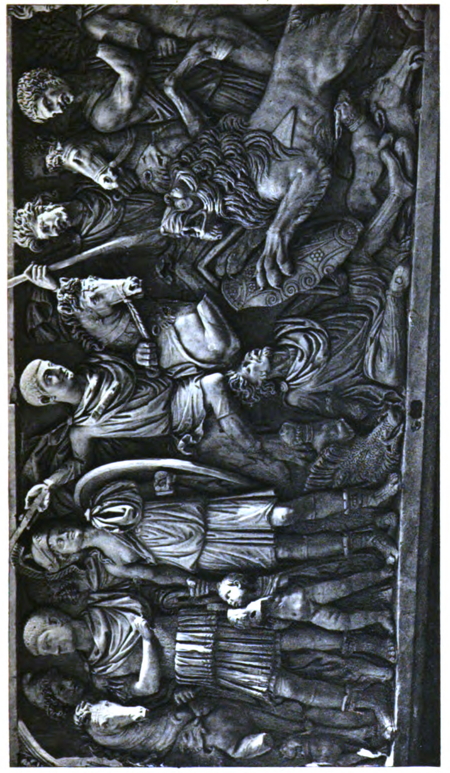
(See this image in horizontal aspect [here].)
Jovian with a hunting-party. From a bas-relief on the Tomb of Jovian.
The slightest force, when it is applied to assist and guide the natural descent of its object, operates with irresistible weight; and Jovian had the good fortune to embrace the religious opinions which were supported by the spirit of the times and the zeal and numbers of the most powerful sect. [8] Under his reign, Christianity obtained an easy and lasting victory; and, as soon as the smile of royal patronage was withdrawn, the genius of Paganism, which had been fondly raised and cherished by the arts of Julian, sunk irrecoverably in the dust. In many cities, the temples were shut or deserted: the philosophers, who had abused their transient favour, thought it prudent to shave their beards and disguise their profession; and the Christians rejoiced, that they were now in a condition to forgive, or to revenge, the injuries which they had suffered under the preceding reign. [9] The consternation of the Pagan world was dispelled by a wise and gracious edict of toleration; in which Jovian explicitly declared that, although he should severely punish the sacrilegious rites of magic, his subjects might exercise, with freedom and safety, the ceremonies of the ancient worship. The memory of this law has been preserved by the orator [IV-177] Themistius, who was deputed by the senate of Constantinople to express their loyal devotion for the new emperor. Themistius expatiates on the clemency of the Divine Nature, the facility of human error, the rights of conscience, and the independence of the mind; and, with some eloquence, inculcates the principles of philosophical toleration; whose aid Superstition herself, in the hour of her distress, is not ashamed to implore. He justly observes that, in the recent changes, both religions had been alternately disgraced by the seeming acquisition of worthless proselytes, of those votaries of the reigning purple who could pass, without a reason and without a blush, from the church to the temple, and from the altars of Jupiter to the sacred table of the Christians. [10]
In the space of seven months, the Roman troops, who were now returned to Antioch, had performed a march of fifteen hundred miles; in which they had endured all the hardships of war, of famine, and of climate. Notwithstanding their services, their fatigues, and the approach of winter, the timid and impatient Jovian allowed only, to the men and horses, a respite of six weeks. The emperor could not sustain the indiscreet and malicious raillery of the people of Antioch. [11] He was impatient to possess the palace of Constantinople, and to prevent the ambition of some competitor, who might occupy the vacant allegiance of Europe. But he soon received the grateful intelligence that his authority [IV-178] was acknowledged from the Thracian Bosphorus to the Atlantic Ocean. By the first letters which he despatched from the camp of Mesopotamia he had delegated the military command of Gaul and Illyricum to Malarich, a brave and faithful officer of the nation of the Franks, and to his father-in-law, Count Lucillian, who had formerly distinguished his courage and conduct in the defence of Nisibis. Malarich had declined an office to which he thought himself unequal; and Lucillian was massacred at Rheims, in an accidental mutiny of the Batavian cohorts. [12] But the moderation of Jovinus, master-general of the cavalry, who forgave the intention of his disgrace, soon appeased the tumult and confirmed the uncertain minds of the soldiers. The oath of fidelity was administered and taken with loyal acclamations; and the deputies of the Western armies [13] saluted their new sovereign as he descended from Mount Taurus to the city of Tyana, in Cappadocia. From Tyana he continued his hasty march to Ancyra, capital of the province of Galatia; where Jovian assumed, with his infant son, the name and ensigns of the consulship. [14] Dadastana, [15] an obscure town, almost at an equal distance between Ancyra and Nice, was marked for the fatal term of his journey and his life. After [IV-179] indulging himself with a plentiful, perhaps an intemperate, supper, he retired to rest; and the next morning the emperor Jovian was found dead in his bed. The cause of this sudden death was variously understood. By some it was ascribed to the consequences of an indigestion, occasioned either by the quantity of the wine, or the quality of the mushrooms, which he had swallowed in the evening. According to others, he was suffocated in his sleep by the vapour of charcoal; which extracted from the walls of the apartment the unwholesome moisture of the fresh plaister. [16] But the want of a regular inquiry into the death of a prince, whose reign and person were soon forgotten, appears to have been the only circumstance which countenanced the malicious whispers of poison and domestic guilt. [17] The body of Jovian was sent to Constantinople, to be interred with his predecessors; and the sad procession was met on the road by his wife Charito, the daughter of Count Lucillian; who still wept the recent death of her father, and was hastening to dry her tears in the embraces of an Imperial husband. Her disappointment and grief were embittered by the anxiety of maternal tenderness. Six weeks before the death of Jovian, his infant son had been placed in the curule chair, adorned with the title of Nobilissimus, and the vain ensigns of the consulship. Unconscious of his fortune, the royal youth, who, from his grandfather, assumed the name of Varronian, was reminded only by the jealousy of the government that he was the son of an emperor. Sixteen years afterwards he was still alive, but he had already been deprived of an eye; and his [IV-180] afflicted mother expected every hour that the innocent victim would be torn from her arms, to appease with his blood the suspicions of the reigning prince. [18]
After the death of Jovian, the throne of the Roman world remained ten days [19] without a master. The ministers and generals still continued to meet in council; to exercise their respective functions; to maintain the public order; and peaceably to conduct the army to the city of Nice in Bithynia, which was chosen for the place of the election. [20] In a solemn assembly of the civil and military powers of the empire, the diadem was again unanimously offered to the prefect Sallust. He enjoyed the glory of a second refusal; and, when the virtues of the father were alleged in favour of his son, the prefect, with the firmness of a disinterested patriot, declared to the electors that the feeble age of the one and the unexperienced youth of the other were equally incapable of the laborious duties of government. Several candidates were proposed, and, after weighing the objections of character or situation, they were successively rejected; but, as soon as the name of Valentinian was pronounced, the merit of that officer united the suffrages of the whole assembly, and [IV-181] obtained the sincere approbation of Sallust himself. Valentinian [21] was the son of Count Gratian, [22] a native of Cibalis, in Pannonia, who, from an obscure condition, had raised himself, by matchless strength and dexterity, to the military commands of Africa and Britain; from which he retired with an ample fortune and suspicious integrity. The rank and services of Gratian contributed, however, to smooth the first steps of the promotion of his son; and afforded him an early opportunity of displaying those solid and useful qualifications which raised his character above the ordinary level of his fellow-soldiers. The person of Valentinian was tall, graceful, and majestic. His manly countenance, deeply marked with the impression of sense and spirit, inspired his friends with awe, and his enemies with fear: and, to second the efforts of his undaunted courage, the son of Gratian had inherited the advantages of a strong and healthy constitution. By the habits of chastity and temperance, which restrain the appetites and invigorate the faculties, Valentinian preserved his own, and the public, esteem. The avocations of a military life had diverted his youth from the elegant pursuits of literature; he was ignorant of the Greek language and the arts of rhetoric; but, as the mind of the orator was never disconcerted by timid perplexity, he was able, as often as the occasion prompted him, to deliver his decided sentiments with bold and ready elocution. The laws of martial discipline were the only laws that he had studied; and he was soon distinguished by the laborious diligence and inflexible severity with which he discharged and enforced the duties of the camp. In the time of Julian he provoked the danger of disgrace by the contempt which he publicly expressed for the [IV-182] reigning religion; [23] and it should seem from his subsequent conduct that the indiscreet and unseasonable freedom of Valentinian was the effect of military spirit rather than of Christian zeal. He was pardoned, however, and still employed by a prince who esteemed his merit: [24] and in the various events of the Persian war he improved the reputation which he had already acquired on the banks of the Rhine. The celerity and success with which he executed an important commission recommended him to the favour of Jovian, and to the honourable command of the second school, or company, of Targetteers, of the domestic guards. In the march from Antioch, he had reached his quarters at Ancyra, when he was unexpectedly summoned without guilt, and without intrigue, to assume, in the forty-third year of his age, the absolute government of the Roman empire.
The invitation of the ministers and generals at Nice was of little moment, unless it were confirmed by the voice of the army. The aged Sallust, who had long observed the irregular fluctuations of popular assemblies, proposed, under pain of death, that none of those persons whose rank in the service might excite a party in their favour should appear in public, on the day of the inauguration. Yet such was the prevalence of ancient superstition that a whole day was voluntarily added to this dangerous interval, because it happened to be the intercalation of the Bissextile. [25] At length, [IV-183] when the hour was supposed to be propitious, Valentinian showed himself from a lofty tribunal; the judicious choice was applauded; and the new prince was solemnly invested with the diadem and the purple, amidst the acclamations of the troops, who were disposed in martial order round the tribunal. But, when he stretched forth his hand to address the armed multitude, a busy whisper was accidentally started in the ranks, and insensibly swelled into a loud and imperious clamour, that he should name, without delay, a colleague in the empire. The intrepid calmness of Valentinian obtained silence and commanded respect, and he thus addressed the assembly: “A few minutes since it was in your power, fellow-soldiers, to have left me in the obscurity of a private station. Judging, from the testimony of my past life, that I deserved to reign, you have placed me on the throne. It is now my duty to consult the safety and interest of the republic. The weight of the universe is undoubtedly too great for the hands of a feeble mortal. I am conscious of the limits of my abilities and the uncertainty of my life; and far from declining, I am anxious to solicit, the assistance of a worthy colleague. But, where discord may be fatal, the choice of a faithful friend requires mature and serious deliberation. That deliberation shall be my care. Let your conduct be dutiful and consistent. Retire to your quarters; refresh your minds and bodies; and expect the accustomed donative on the accession of a new emperor.” [26] The astonished troops, with a mixture of pride, of satisfaction, and of terror, confessed the voice of their master. Their angry clamours subsided into silent reverence; and Valentinian, encompassed with the eagles of the legions and the various banners [IV-184] of the cavalry and infantry, was conducted, in warlike pomp, to the palace of Nice. As he was sensible, however, of the importance of preventing some rash declaration of the soldiers, he consulted the assembly of the chiefs: and their real sentiments were concisely expressed by the generous freedom of Dagalaiphus. “Most excellent prince,” said that officer, “if you consider only your family, you have a brother; if you love the republic, look round for the most deserving of the Romans.” [27] The emperor, who suppressed his displeasure, without altering his intention, slowly proceeded from Nice to Nicomedia and Constantinople. In one of the suburbs of that capital, [28] thirty days after his own elevation, he bestowed the title of Augustus on his brother Valens; and, as the boldest patriots were convinced that their opposition, without being serviceable to their country, would be fatal to themselves, the declaration of his absolute will was received with silent submission. Valens was now in the thirty-sixth year of his age; but his abilities had never been exercised in any employment, military or civil; and his character had not inspired the world with any sanguine expectations. He possessed, however, one quality, which recommended him to Valentinian, and preserved the domestic peace of the empire: a devout and grateful attachment to his benefactor, whose superiority of genius, as well as of authority, Valens humbly and cheerfully acknowledged in every action of his life. [29]
[IV-185]
Before Valentinian divided the provinces, he reformed the administration of the empire. All ranks of subjects, who had been injured or oppressed under the reign of Julian, were invited to support their public accusations. The silence of mankind attested the spotless integrity of the prefect Sallust; [30] and his own pressing solicitations that he might be permitted to retire from the business of the state were rejected by Valentinian with the most honourable expressions of friendship and esteem. But among the favourites of the late emperor there were many who had abused his credulity or superstition, and who could no longer hope to be protected either by favour or justice. [31] The greater part of the ministers of the palace and the governors of the provinces were removed from their respective stations; yet the eminent merit of some officers was distinguished from the obnoxious crowd; and, notwithstanding the opposite clamours of zeal and resentment, the whole proceedings of this delicate inquiry appear to have been conducted with a reasonable share of wisdom and moderation. [32] The festivity of a new reign received a short and suspicious interruption from the sudden illness of the two princes; but, as soon as their health was restored, they left Constantinople in the beginning of the spring. In the castle or palace of Mediana, only three miles from Naissus, they executed the solemn and final division of the Roman empire. [33] Valentinian bestowed on his brother the rich prefecture of the East, from the Lower Danube to the confines of Persia; whilst he reserved for his immediate [IV-186] government the warlike prefectures of Illyricum, Italy, and Gaul, from the extremity of Greece to the Caledonian rampart; and from the rampart of Caledonia to the foot of Mount Atlas. The provincial administration remained on its former basis; but a double supply of generals and magistrates was required for two councils and two courts: the division was made with a just regard to their peculiar merit and situation, and seven master-generals were soon created, either of the cavalry or infantry. When this important business had been amicably transacted, Valentinian and Valens embraced for the last time. The emperor of the West established his temporary residence at Milan; and the emperor of the East returned to Constantinople, to assume the dominion of fifty provinces, of whose language he was totally ignorant. [34]
The tranquillity of the East was soon disturbed by rebellion; and the throne of Valens was threatened by the daring attempts of a rival, whose affinity to the emperor Julian [35] was his sole merit, and had been his only crime. Procopius had been hastily promoted from the obscure station of a tribune and a notary to the joint command of the army of Mesopotamia; the public opinion already named him as the successor of a prince who was destitute of natural heirs; and a vain rumour was propagated by his friends, or his enemies, that Julian, before the altar of the Moon, at Carrhæ, had privately invested Procopius with the Imperial purple. [36] [IV-187] He endeavoured, by his dutiful and submissive behaviour, to disarm the jealousy of Jovian; resigned, without a contest, his military command; and retired, with his wife and family, to cultivate the ample patrimony which he possessed in the province of Cappadocia. These useful and innocent occupations were interrupted by the appearance of an officer, with a band of soldiers, who, in the name of his new sovereigns, Valentinian and Valens, was despatched to conduct the unfortunate Procopius either to a perpetual prison or an ignominious death. His presence of mind procured him a longer respite and a more splendid fate. Without presuming to dispute the royal mandate, he requested the indulgence of a few moments to embrace his weeping family; and, while the vigilance of his guards was relaxed by a plentiful entertainment, he dexterously escaped to the sea-coast of the Euxine, from whence he passed over to the country of Bosphorus. In that sequestered region he remained many months, exposed to the hardships of exile, of solitude, and of want: his melancholy temper brooding over his misfortunes, and his mind agitated by the just apprehension that, if any accident should discover his name, the faithless Barbarians would violate, without much scruple, the laws of hospitality. In a moment of impatience and despair, Procopius embarked in a merchant vessel, which made sail for Constantinople; and boldly aspired to the rank of a sovereign, because he was not allowed to enjoy the security of a subject. At first he lurked in the villages of Bithynia, continually changing his habitation, and his disguise. [37] By degrees he ventured into the capital, trusted his life and fortune to the fidelity of two friends, a senator and an eunuch, and conceived some hopes of success [IV-188] from the intelligence which he obtained of the actual state of public affairs. The body of the people was infected with a spirit of discontent: they regretted the justice and the abilities of Sallust, who had been imprudently dismissed from the prefecture of the East. They despised the character of Valens, which was rude without vigour and feeble without mildness. They dreaded the influence of his father-in-law, the Patrician Petronius, a cruel and rapacious minister, who rigorously exacted all the arrears of tribute that might remain unpaid since the reign of the emperor Aurelian. The circumstances were propitious to the designs of an usurper. The hostile measures of the Persians required the presence of Valens in Syria; from the Danube to the Euphrates the troops were in motion; and the capital was occasionally filled with the soldiers who passed, or repassed, the Thracian Bosphorus. Two cohorts of Gauls were persuaded to listen to the secret proposals of the conspirators; which were recommended by the promise of a liberal donative; and, as they still revered the memory of Julian, they easily consented to support the hereditary claim of his proscribed kinsman. At the dawn of day they were drawn up near the baths of Anastasia; [38] and Procopius, clothed in a purple garment, more suitable to a player than to a monarch, appeared, as if he rose from the dead, in the midst of Constantinople. The soldiers, who were prepared for his reception, saluted their trembling prince with shouts of joy and vows of fidelity. Their numbers were soon increased by a sturdy band of peasants, collected from the adjacent country; and Procopius, shielded by the arms of his adherents, was successively conducted to the tribunal, the senate, and the palace. During the first moments of his tumultuous reign, he was astonished and terrified by the gloomy silence of the people; who were either ignorant of the cause or apprehensive of the event. But his military strength was superior to any actual [IV-189] resistance: the malcontents flocked to the standard of rebellion; the poor were excited by the hopes, and the rich were intimidated by the fear, of a general pillage; and the obstinate credulity of the multitude was once more deceived by the promised advantages of a revolution. The magistrates were seized; the prisons and arsenals broke open; the gates, and the entrance of the harbour, were diligently occupied; and, in a few hours, Procopius became the absolute, though precarious, master of the Imperial city. The usurper improved this unexpected success with some degree of courage and dexterity. He artfully propagated the rumours and opinions the most favourable to his interest; while he deluded the populace by giving audience to the frequent, but imaginary, ambassadors of distant nations. The large bodies of troops stationed in the cities of Thrace and the fortresses of the Lower Danube were gradually involved in the guilt of rebellion: and the Gothic princes consented to supply the sovereign of Constantinople with the formidable strength of several thousand auxiliaries. His generals passed the Bosphorus, and subdued, without an effort, the unarmed but wealthy provinces of Bithynia and Asia. After an honourable defence, the city and island of Cyzicus yielded to his power; the renowned legions of the Jovians and Herculians embraced the cause of the usurper whom they were ordered to crush; and, as the veterans were continually augmented with new levies, he soon appeared at the head of an army whose valour, as well as numbers, were not unequal to the greatness of the contest. The son of Hormisdas, [39] a youth of [IV-190] spirit and ability, condescended to draw his sword against the lawful emperor of the East; and the Persian prince was immediately invested with the ancient and extraordinary powers of a Roman Proconsul. The alliance of Faustina, the widow of the emperor Constantius, who entrusted herself and her daughter to the hands of the usurper, added dignity and reputation to his cause. The princess Constantia, who was then about five years of age, accompanied in a litter the march of the army. She was shewn to the multitude in the arms of her adopted father; and, as often as she passed through the ranks, the tenderness of the soldiers was inflamed into martial fury: [40] they recollected the glories of the house of Constantine, and they declared, with loyal acclamation, that they would shed the last drop of their blood in the defence of the royal infant. [41]
In the meanwhile, Valentinian was alarmed and perplexed by the doubtful intelligence of the revolt of the East. The difficulties of a German war forced him to confine his immediate care to the safety of his own dominions; and, as every channel of communication was stopt or corrupted, he listened, with doubtful anxiety, to the rumours which were industriously spread, that the defeat and death of Valens had left Procopius sole master of the Eastern provinces. Valens was not dead: but, on the news of the rebellion, which he received at Cæsarea, he basely despaired of his life and fortune; proposed to negotiate with the usurper, and discovered his secret inclination to abdicate the Imperial purple. The timid monarch was saved from disgrace and ruin by the firmness of his ministers, and their abilities soon decided in his favour the event of the civil war. In a season of tranquillity, Sallust had resigned without a murmur; but, as [IV-191] soon as the public safety was attacked, he ambitiously solicited the pre-eminence of toil and danger; and the restoration of that virtuous minister to the prefecture of the East was the first step which indicated the repentance of Valens and satisfied the minds of the people. The reign of Procopius was apparently supported by powerful armies and obedient provinces. But many of the principal officers, military as well as civil, had been urged, either by motives of duty or interest, to withdraw themselves from the guilty scene; or to watch the moment of betraying and deserting the cause of the usurper. Lupicinus advanced, by hasty marches, to bring the legions of Syria to the aid of Valens. Arintheus, who, in strength, beauty, and valour, excelled all the heroes of the age, attacked with a small troop a superior body of the rebels. When he beheld the faces of the soldiers who had served under his banner, he commanded them, with a loud voice, to seize and deliver up their pretended leader; and such was the ascendant of his genius that this extraordinary order was instantly obeyed. [42] Arbetio, a respectable veteran of the great Constantine, who had been distinguished by the honours of the consulship, was persuaded to leave his retirement, and once more to conduct an army into the field. In the heat of action, calmly taking off his helmet, he shewed his grey hairs, and venerable countenance; saluted the soldiers of Procopius by the endearing names of children and companions, and exhorted them, no longer to support the desperate cause of a contemptible tyrant; but to follow their old commander, who had so often led them to honour and [IV-192] victory. In the two engagements of Thyatira [43] and Nacolia, the unfortunate Procopius was deserted by his troops, who were seduced by the instructions and example of their perfidious officers. After wandering some time among the woods and mountains of Phrygia, he was betrayed by his desponding followers, conducted to the Imperial camp, and immediately beheaded. He suffered the ordinary fate of an unsuccessful usurper; but the acts of cruelty which were exercised by the conqueror, under the forms of legal justice, excited the pity and indignation of mankind. [44]
Such indeed are the common and natural fruits of despotism and rebellion. But the inquisition into the crime of magic, which, under the reign of the two brothers, was so rigorously prosecuted both at Rome and Antioch, was interpreted as the fatal symptom either of the displeasure of heaven or of the depravity of mankind. [45] Let us not hesitate to indulge a liberal pride that in the present age the enlightened part of Europe has abolished [46] a cruel and odious [IV-193] prejudice, which reigned in every climate of the globe and adhered to every system of religious opinions. [47] The nations and the sects of the Roman world admitted with equal credulity and similar abhorrence the reality of that infernal art [48] which was able to control the eternal order of the planets and the voluntary operations of the human mind. They dreaded the mysterious power of spells and incantations, of potent herbs, and execrable rites; which could extinguish or recall life, inflame the passions of the soul, blast the works of creation, and extort from the reluctant demons the secrets of futurity. They believed, with the wildest inconsistency, that this preternatural dominion of the air, of earth, and of hell was exercised, from the vilest motives of malice or gain, by some wrinkled hags and itinerant sorcerers, who passed their obscure lives in penury and contempt. [49] The arts of magic were equally condemned by the public opinion and by the laws of Rome; but, as they tended to gratify the most imperious passions of the heart of man, they were continually proscribed, and continually [IV-194] practised. [50] An imaginary cause is capable of producing the most serious and mischievous effects. The dark predictions of the death of an emperor, or the success of a conspiracy, were calculated only to stimulate the hopes of ambition and to dissolve the ties of fidelity; and the intentional guilt of magic was aggravated by the actual crimes of treason and sacrilege. [51] Such vain terrors disturbed the peace of society and the happiness of individuals; and the harmless flame which insensibly melted a waxen image might derive a powerful and pernicious energy from the affrighted fancy of the person whom it was maliciously designed to represent. [52] From the infusion of those herbs which were supposed to possess a supernatural influence it was an easy step to the use of more substantial poison; and the folly of mankind sometimes became the instrument, and the mask, of the most atrocious crimes. As soon as the zeal of informers was encouraged by the ministers of Valens and Valentinian, they could not refuse to listen to another charge, too frequently mingled in the scenes of domestic guilt; a charge of a softer and less malignant nature, for which the pious, though excessive, rigour of Constantine had recently decreed the [IV-195] punishment of death. [53] This deadly and incoherent mixture of treason and magic, of poison and adultery, afforded infinite gradations of guilt and innocence, of excuse and aggravation, which in these proceedings appear to have been confounded by the angry or corrupt passions of the judges. They easily discovered that the degree of their industry and discernment was estimated, by the Imperial court, according to the number of executions that were furnished from their respective tribunals. It was not without extreme reluctance that they pronounced a sentence of acquittal; but they eagerly admitted such evidence as was stained with perjury, or procured by torture, to prove the most improbable charges against the most respectable characters. The progress of the inquiry continually opened new subjects of criminal prosecution; the audacious informer, whose falsehood was detected, retired with impunity; but the wretched victim, who discovered his real or pretended accomplices, was seldom permitted to receive the price of his infamy. From the extremity of Italy and Asia, the young and the aged were dragged in chains to the tribunals of Rome and Antioch. Senators, matrons, and philosophers expired in ignominious and cruel tortures. The soldiers, who were appointed to guard the prisons, declared, with a murmur of pity and indignation, that their numbers were insufficient to oppose the flight or resistance of the multitude of captives. The wealthiest families were ruined by fines and confiscations; the most innocent citizens trembled for their safety; and we may form some notion of the magnitude of the evil from the extravagant assertion of an ancient writer that, in the obnoxious provinces, the prisoners, the exiles, and the fugitives formed the greatest part of the inhabitants. [54]
[IV-196]
When Tacitus describes the deaths of the innocent and illustrious Romans, who were sacrificed to the cruelty of the first Cæsars, the art of the historian, or the merit of the sufferers, excite in our breasts the most lively sensations of terror, of admiration, and of pity. The coarse and undistinguishing pencil of Ammianus has delineated his bloody figures with tedious and disgusting accuracy. But, as our attention is no longer engaged by the contrast of freedom and servitude, of recent greatness and of actual misery, we should turn with horror from the frequent executions which disgraced, both at Rome and Antioch, the reign of the two brothers. [55] Valens was of a timid, [56] and Valentinian of a choleric, disposition. [57] An anxious regard to his personal safety was the ruling principle of the administration of Valens. In the condition of a subject, he had kissed, with trembling awe, the hand of the oppressor; and, when he ascended the throne, he reasonably expected that the same fears which had subdued his own mind would secure the patient submission of his people. The favourites of Valens obtained, by the privilege of rapine and confiscation, the wealth which his economy would have refused. [58] They urged, with persuasive [IV-197] eloquence, that, in all cases of treason, suspicion is equivalent to proof; that the power, supposes the intention, of mischief; that the intention is not less criminal than the act; and that a subject no longer deserves to live, if his life may threaten the safety, or disturb the repose, of his sovereign. The judgment of Valentinian was sometimes deceived and his confidence abused; but he would have silenced the informers with a contemptuous smile, had they presumed to alarm his fortitude by the sound of danger. They praised his inflexible love of justice; and, in the pursuit of justice, the emperor was easily tempted to consider clemency as a weakness and passion as a virtue. As long as he wrestled with his equals, in the bold competition of an active and ambitious life, Valentinian was seldom injured, and never insulted, with impunity: if his prudence was arraigned, his spirit was applauded; and the proudest and most powerful generals were apprehensive of provoking the resentment of a fearless soldier. After he became master of the world, he unfortunately forgot that, where no resistance can be made, no courage can be exerted; and, instead of consulting the dictates of reason and magnanimity, he indulged the furious emotions of his temper at a time when they were disgraceful to himself and fatal to the defenceless objects of his displeasure. In the government of his household, or of his empire, slight, or even imaginary, offences, a hasty word, a casual omission, an involuntary delay, were chastised by a sentence of immediate death. The expressions which issued the most readily from the mouth of the emperor of the West were, “Strike off his head”; “Burn him alive”; “Let him be beaten with clubs till he expires”; [59] and his most favoured ministers soon understood that, by a rash attempt to [IV-198] dispute, or suspend, the execution of his sanguinary commands, they might involve themselves in the guilt and punishment of disobedience. The repeated gratification of this savage justice hardened the mind of Valentinian against pity and remorse; and the sallies of passion were confirmed by the habits of cruelty. [60] He could behold with calm satisfaction the convulsive agonies of torture and death: he reserved his friendship for those faithful servants whose temper was the most congenial to his own. The merit of Maximin, who had slaughtered the noblest families of Rome, was rewarded with the royal approbation and the prefecture of Gaul. Two fierce and enormous bears, distinguished by the appellations of Innocence and Mica Aurea, could alone deserve to share the favour of Maximin. The cages of those trusty guards were always placed near the bed-chamber of Valentinian, who frequently amused his eyes with the grateful spectacle of seeing them tear and devour the bleeding limbs of the malefactors who were abandoned to their rage. Their diet and exercises were carefully inspected by the Roman emperor; and, when Innocence had earned her discharge by a long course of meritorious service, the faithful animal was again restored to the freedom of her native woods. [61]
But in the calmer moments of reflection, when the mind of Valens was not agitated by fear, or that of Valentinian by rage, the tyrant resumed the sentiments, or at least the conduct, of the father of his country. The dispassionate judgment of the Western emperor could clearly perceive, and accurately pursue, his own and the public interest; and the [IV-199] sovereign of the East, who imitated with equal docility the various examples which he received from his elder brother, was sometimes guided by the wisdom and virtue of the prefect Sallust. Both princes invariably retained, in the purple, the chaste and temperate simplicity which had adorned their private life; and, under their reign, the pleasures of the court never cost the people a blush or a sigh. They gradually reformed many of the abuses of the times of Constantius; judiciously adopted and improved the designs of Julian and his successor; and displayed a style and spirit of legislation which might inspire posterity with the most favourable opinion of their character and government. It is not from the master of Innocence that we should expect the tender regard for the welfare of his subjects which prompted Valentinian to condemn the exposition of new-born infants; [62] and to establish fourteen skilful physicians, with stipends and privileges, in the fourteen quarters of Rome. The good sense of an illiterate soldier founded an useful and liberal institution for the education of youth, and the support of declining science. [63] It was his intention that the arts of rhetoric and grammar should be taught in the Greek and Latin languages in the metropolis of every province; and as the size and dignity of the school was usually proportioned to the importance of the city, the academies of Rome and Constantinople claimed a just and singular pre-eminence. The fragments of the literary edicts of Valentinian imperfectly [IV-200] represent the school of Constantinople, which was gradually improved by subsequent regulations. That school consisted of thirty-one professors in different branches of learning. One philosopher, and two lawyers; five sophists and ten grammarians for the Greek, and three orators and ten grammarians for the Latin, tongue; besides seven scribes, or, as they were then styled, antiquarians, whose laborious pens supplied the public library with fair and correct copies of the classic writers. The rule of conduct, which was prescribed to the students, is the more curious, as it affords the first outlines of the form and discipline of a modern university. It was required that they should bring proper certificates from the magistrates of their native province. Their names, professions, and places of abode were regularly entered in a public register. The studious youth were severely prohibited from wasting their time in feasts or in the theatre; and the term of their education was limited to the age of twenty. The prefect of the city was empowered to chastise the idle and refractory, by stripes or expulsion; and he was directed to make an annual report to the master of the offices, that the knowledge and abilities of the scholars might be usefully applied to the public service. The institutions of Valentinian contributed to secure the benefits of peace and plenty; and the cities were guarded by the establishment of the Defensors, [64] freely elected as the tribunes and advocates of the people, to support their rights and to expose their grievances before the tribunals of the civil magistrates, or even at the foot of the Imperial throne. The finances were diligently administered by two princes, who had been so long accustomed to the rigid economy of a private fortune; but in the receipt and application of the revenue a discerning eye might observe some difference between the government of the East and of the West. Valens was persuaded that royal [IV-201] liberality can be supplied only by public oppression, and his ambition never aspired to secure, by their actual distress, the future strength and prosperity of his people. Instead of increasing the weight of taxes, which, in the space of forty years, had been gradually doubled, he reduced, in the first years of his reign, one-fourth of the tribute of the East. [65] Valentinian appears to have been less attentive and less anxious to relieve the burthens of his people. He might reform the abuses of the fiscal administration; but he exacted, without scruple, a very large share of the private property; as he was convinced that the revenues, which supported the luxury of individuals, would be much more advantageously employed for the defence and improvement of the state. The subjects of the East, who enjoyed the present benefit, applauded the indulgence of their prince. The solid, but less splendid, merit of Valentinian was felt and acknowledged by the subsequent generation. [66]
But the most honourable circumstance of the character of Valentinian is the firm and temperate impartiality which he uniformly preserved in an age of religious contention. His strong sense, unenlightened, but uncorrupted, by study, declined, with respectful indifference, the subtle questions of theological debate. The government of the Earth claimed his vigilance and satisfied his ambition; and, while he remembered that he was the disciple of the church, he never forgot that he was the sovereign of the clergy. Under the reign of an apostate, he had signalised his zeal for the honour of Christianity: he allowed to his subjects the privilege which [IV-202] he had assumed for himself; and they might accept, with gratitude and confidence, the general toleration which was granted by a prince addicted to passion, but incapable of fear or of disguise. [67] The Pagans, the Jews, and all the various sects which acknowledged the divine authority of Christ were protected by the laws from arbitrary power or popular insult: nor was any mode of worship prohibited by Valentinian, except those secret and criminal practices which abused the name of religion for the dark purposes of vice and disorder. The art of magic, as it was more cruelly punished, was more strictly proscribed; but the emperor admitted a formal distinction to protect the ancient methods of divination, which were approved by the senate and exercised by the Tuscan haruspices. He had condemned, with the consent of the most rational Pagans, the licence of nocturnal sacrifices; but he immediately admitted the petition of Prætextatus, proconsul of Achaia, who represented that the life of the Greeks would become dreary and comfortless, if they were deprived of the invaluable blessing of the Eleusinian mysteries. Philosophy alone can boast (and perhaps it is no more than the boast of philosophy), that her gentle hand is able to eradicate from the human mind the latent and deadly principle of fanaticism. But this truce of twelve years, which was enforced by the wise and vigorous government of Valentinian, by suspending the repetition of mutual injuries, contributed to soften the manners, and abate the prejudices, of the religious factions.
The friend of toleration was unfortunately placed at a distance from the scene of the fiercest controversies. As soon as the Christians of the West had extricated themselves [IV-203] from the snares of the creed of Rimini, they happily relapsed into the slumber of orthodoxy; and the small remains of the Arian party that still subsisted at Sirmium or Milan might be considered rather as objects of contempt than of resentment. But in the provinces of the East, from the Euxine to the extremity of Thebais, the strength and numbers of the hostile factions were more equally balanced; and this equality, instead of recommending the counsels of peace, served only to perpetuate the horrors of religious war. The monks and bishops supported their arguments by invectives; and their invectives were sometimes followed by blows. Athanasius still reigned at Alexandria; the thrones of Constantinople and Antioch were occupied by Arian prelates, and every episcopal vacancy was the occasion of a popular tumult. The Homoousians were fortified by the reconciliation of fifty-nine Macedonian, or Semi-Arian, bishops; but their secret reluctance to embrace the divinity of the Holy Ghost clouded the splendour of the triumph: and the declaration of Valens, who, in the first years of his reign, had imitated the impartial conduct of his brother, was an important victory on the side of Arianism. The two brothers had passed their private life in the condition of catechumens; but the piety of Valens prompted him to solicit the sacrament of baptism, before he exposed his person to the dangers of a Gothic war. He naturally addressed himself to Eudoxus, [68] bishop of the Imperial city; and, if the ignorant monarch was instructed by that Arian pastor in the principles of heterodox theology, his misfortune, rather than his guilt, was the inevitable consequence of his erroneous choice. Whatever had been the determination of the emperor, he must have offended a numerous party of his Christian subjects; as the leaders both [IV-204] of the Homoousians and of the Arians believed that, if they were not suffered to reign, they were most cruelly injured and oppressed. After he had taken this decisive step, it was extremely difficult for him to preserve either the virtue or the reputation of impartiality. He never aspired, like Constantius, to the fame of a profound theologian; but, as he had received with simplicity and respect the tenets of Eudoxus, Valens resigned his conscience to the direction of his ecclesiastical guides, and promoted, by the influence of his authority, the re-union of the Athanasian heretics to the body of the Catholic church. At first, he pitied their blindness; by degrees he was provoked at their obstinacy; and he insensibly hated those sectaries to whom he was an object of hatred. [69] The feeble mind of Valens was always swayed by the persons with whom he familiarly conversed; and the exile or imprisonment of a private citizen are the favours the most readily granted in a despotic court. Such punishments were frequently inflicted on the leaders of the Homoousian party; and the misfortune of fourscore ecclesiastics of Constantinople, who, perhaps accidentally, were burnt on shipboard, was imputed to the cruel and premeditated malice of the emperor and his Arian ministers. In every contest, the Catholics (if we may anticipate that name) were obliged to pay the penalty of their own faults, and of those of their adversaries. In every election, the claims of the Arian candidate obtained the preference; and, if they were opposed by the majority of the people, he was usually supported by the authority of the civil magistrate, or even by the terrors of a military force. The enemies of Athanasius attempted to disturb the last years of his venerable age; and his temporary retreat to his father’s sepulchre has been celebrated as a fifth exile. But the zeal of a great people [IV-205] who instantly flew to arms, intimidated the prefect; and the archbishop was permitted to end his life in peace and in glory, after a reign of forty-seven years. The death of Athanasius was the signal of the persecution of Egypt; and the Pagan minister of Valens, who forcibly seated the worthless Lucius on the archiepiscopal throne, purchased the favour of the reigning party by the blood and sufferings of their Christian brethren. The free toleration of the heathen and Jewish worship was bitterly lamented, as a circumstance which aggravated the misery of the Catholics and the guilt of the impious tyrant of the East. [70]
The triumph of the orthodox party has left a deep stain of persecution on the memory of Valens; and the character of a prince who derived his virtues, as well as his vices, from a feeble understanding and a pusillanimous temper scarcely deserves the labour of an apology. Yet candour may discover some reasons to suspect that the ecclesiastical ministers of Valens often exceeded the orders, or even the intentions, of their master; and that the real measure of facts has been very liberally magnified by the vehement declamation and easy credulity of his antagonists. [71] 1. The silence of Valentinian may suggest a probable argument, that the partial severities, which were exercised in the name and provinces of his colleague, amounted only to some obscure and inconsiderable deviations from the established system of religious toleration: and the judicious historian, who has praised the equal temper of the elder brother, has not thought himself obliged to contrast the tranquillity of the West with the cruel persecution of the East. [72] 2. Whatever credit may be [IV-206] allowed to vague and distant reports, the character, or at least the behaviour, of Valens may be most distinctly seen in his personal transactions with the eloquent Basil, archbishop of Cæsarea, who had succeeded Athanasius in the management of the Trinitarian cause. [73] The circumstantial narrative has been composed by the friends and admirers of Basil; and, as soon as we have stripped away a thick coat of rhetoric and miracle, we shall be astonished by the unexpected mildness of the Arian tyrant, who admired the firmness of his character, or was apprehensive, if he employed violence, of a general revolt in the province of Cappadocia. The archbishop, who asserted, with inflexible pride, [74] the truth of his opinions and the dignity of his rank, was left in the free possession of his conscience and his throne. The emperor devoutly assisted at the solemn service of the cathedral; and, instead of a sentence of banishment, subscribed the donation of a valuable estate for the use of an hospital which Basil had lately founded in the neighbourhood of Cæsarea. [75] 3. I am not able to discover that any law (such as Theodosius afterwards enacted against the Arians) was published by Valens [IV-207] against the Athanasian sectaries; and the edict which excited the most violent clamours may not appear so extremely reprehensible. The emperor had observed that several of his subjects, gratifying their lazy disposition under the pretence of religion, had associated themselves with the monks of Egypt; and he directed the count of the East to drag them from their solitude; and to compel those deserters of society to accept the fair alternative of renouncing their temporal possessions or of discharging the public duties of men and citizens. [76] The ministers of Valens seem to have extended the sense of this penal statute, since they claimed a right of enlisting the young and able-bodied monks in the Imperial armies. A detachment of cavalry and infantry, consisting of three thousand men, marched from Alexandria into the adjacent desert of Nitria, [77] which was peopled by five thousand monks. The soldiers were conducted by Arian priests; and it is reported that a considerable slaughter was made in the monasteries which disobeyed the commands of their sovereign. [78]
The strict regulations which have been framed by the wisdom of modern legislators to restrain the wealth and avarice of the clergy may be originally deduced from the example of the emperor Valentinian. His edict [79] addressed [IV-208] to Damasus, bishop of Rome, was publicly read in the churches of the city. He admonished the ecclesiastics and monks not to frequent the houses of widows and virgins; and menaced their disobedience with the animadversion of the civil judge. The director was no longer permitted to receive any gift, or legacy, or inheritance, from the liberality of his spiritual daughter; every testament contrary to this edict was declared null and void; and the illegal donation was confiscated for the use of the treasury. By a subsequent regulation it should seem that the same provisions were extended to nuns and bishops; and that all persons of the ecclesiastical order were rendered incapable of receiving any testamentary gifts, and strictly confined to the natural and legal rights of inheritance. As the guardian of domestic happiness and virtue, Valentinian applied this severe remedy to the growing evil. In the capital of the empire, the females of noble and opulent houses possessed a very ample share of independent property: and many of those devout females had embraced the doctrines of Christianity, not only with the cold assent of the understanding, but with the warmth of affection, and perhaps with the eagerness of fashion. They sacrificed the pleasures of dress and luxury; and renounced, for the praise of chastity, the soft endearments of conjugal society. Some ecclesiastic, of real or apparent sanctity, was chosen to direct their timorous conscience and to amuse the vacant tenderness of their heart: and the unbounded confidence which they hastily bestowed was often abused by knaves and enthusiasts; who hastened from the extremities of the East to enjoy, on a splendid theatre, the privileges of the monastic profession. By their contempt of the world, they insensibly acquired its most desirable advantages; the lively attachment, perhaps, of a young and beautiful woman, the delicate plenty of an opulent household, and the respectful homage of the slaves, the freedmen, and the clients of a senatorial family. The immense fortunes of the Roman ladies were gradually consumed in lavish alms and expensive pilgrimages; [IV-209] and the artful monk, who had assigned himself the first or possibly the sole place in the testament of his spiritual daughter, still presumed to declare, with the smooth face of hypocrisy, that he was only the instrument of charity and the steward of the poor. The lucrative, but disgraceful, trade [80] which was exercised by the clergy to defraud the expectations of the natural heirs had provoked the indignation of a superstitious age: and two of the most respectable of the Latin fathers very honestly confess that the ignominious edict of Valentinian was just and necessary; and that the Christian priests had deserved to lose a privilege which was still enjoyed by comedians, charioteers, and the ministers of idols. But the wisdom and authority of the legislator are seldom victorious in a contest with the vigilant dexterity of private interest: and Jerom or Ambrose might patiently acquiesce in the justice of an ineffectual or salutary law. If the ecclesiastics were checked in the pursuit of personal emolument, they would exert a more laudable industry to increase the wealth of the church, and dignify their covetousness with the specious names of piety and patriotism. [81]
Damasus, bishop of Rome, who was constrained to stigmatise the avarice of his clergy by the publication of the law of Valentinian, had the good sense or the good fortune to engage in his service the zeal and abilities of the learned Jerom; and the grateful saint has celebrated the merit and purity of a very [IV-210] ambiguous character. [82] But the splendid vices of the church of Rome, under the reign of Valentinian and Damasus, have been curiously observed by the historian Ammianus, who delivers his impartial sense in these expressive words: “The prefecture of Juventius [83] was accompanied with peace and plenty: but the tranquillity of his government was soon disturbed by a bloody sedition of the distracted people. The ardour of Damasus and Ursinus, to seize the episcopal seat, surpassed the ordinary measure of human ambition. They contended with the rage of party; the quarrel was maintained by the wounds and death of their followers; and the prefect, unable to resist or to appease the tumult, was constrained, by superior violence, to retire into the suburbs. Damasus prevailed: the well-disputed victory remained on the side of his faction; one hundred and thirty-seven dead bodies [84] were found in the Basilica of Sicininus, [85] where the Christians hold their religious assemblies; and it was long before the angry minds of the people resumed their accustomed tranquillity. When I consider the splendour of the capital, I am not astonished that so valuable a prize should inflame the desires of ambitious men, and produce the fiercest and most [IV-211] obstinate contests. The successful candidate is secure that he will be enriched by the offerings of matrons; [86] that, as soon as his dress is composed with becoming care and elegance, he may proceed, in his chariot, through the streets of Rome; [87] and that the sumptuousness of the Imperial table will not equal the profuse and delicate entertainments provided by the taste, and at the expense, of the Roman pontiffs. How much more rationally (continues the honest Pagan) would those pontiffs consult their true happiness, if, instead of alleging the greatness of the city as an excuse for their manners, they would imitate the exemplary life of some provincial bishops, whose temperance and sobriety, whose mean apparel and downcast looks, recommended their pure and modest virtue to the Deity and his true worshippers.” [88] The schism of Damasus and Ursinus was extinguished by the exile of the latter; and the wisdom of the prefect Prætextatus [89] restored the tranquillity of the city. Prætextatus was a philosophic Pagan, a man of learning, of taste, and politeness; who [IV-212] disguised a reproach in the form of a jest, when he assured Damasus that, if he could obtain the bishopric of Rome, he himself would immediately embrace the Christian religion. [90] This lively picture of the wealth and luxury of the popes in the fourth century becomes the more curious as it represents the intermediate degree between the humble poverty of the apostolic fisherman and the royal state of a temporal prince whose dominions extend from the confines of Naples to the banks of the Po.
When the suffrage of the generals and of the army committed the sceptre of the Roman empire to the hands of Valentinian, his reputation in arms, his military skill and experience, and his rigid attachment to the forms, as well as spirit, of ancient discipline were the principal motives of their judicious choice. The eagerness of the troops who pressed him to nominate his colleague was justified by the dangerous situation of public affairs; and Valentinian himself was conscious that the abilities of the most active mind were unequal to the defence of the distant frontiers of an invaded monarchy. As soon as the death of Julian had relieved the Barbarians from the terror of his name, the most sanguine hopes of rapine and conquest excited the nations of the East, and of the North, and of the South. Their inroads were often vexatious, and sometimes formidable; but, during the twelve years of the reign of Valentinian, his firmness and vigilance protected his own dominions; and his powerful genius seemed to inspire and direct the feeble counsels of his brother. Perhaps the method of annals would more forcibly express the urgent and divided cares of the two emperors; but the attention of the reader, likewise, would be distracted by a tedious and desultory narrative. A separate view of the five great theatres of war: I. Germany; II. Britain; [IV-none] [IV-213] III. Africa; IV. The East; and, V. The Danube; will impress a more distinct image of the military state of the empire under the reigns of Valentinian and Valens.
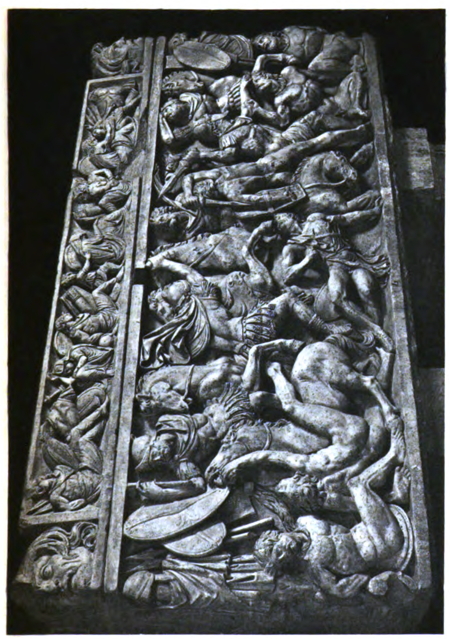
I. The ambassadors of the Alemanni had been offended by the harsh and haughty behaviour of Ursacius, master of the offices; [91] who, by an act of unseasonable parsimony, had diminished the value, as well as the quantity, of the presents to which they were entitled, either from custom or treaty, on the accession of a new emperor. They expressed, and they communicated to their countrymen, their strong sense of the national affront. The irascible minds of the chiefs were exasperated by the suspicion of contempt; and the martial youth crowded to their standard. Before Valentinian could pass the Alps, the villages of Gaul were in flames; before his general Dagalaiphus could encounter the Alemanni, they had secured the captives and the spoil in the forests of Germany. In the beginning of the ensuing year, the military force of the whole nation, in deep and solid columns, broke through the barrier of the Rhine, during the severity of a Northern winter. Two Roman counts were defeated and mortally wounded; and the standard of the Heruli and Batavians fell into the hands of the conquerors, who displayed, with insulting shouts and menaces, the trophy of their victory. The standard was recovered; but the Batavians had not redeemed the shame of their disgrace and flight in the eyes of their severe judge. It was the opinion of Valentinian that his soldiers must learn to fear their commander, before they could cease to fear the enemy. The troops were solemnly assembled; and the trembling Batavians were enclosed within the circle of the Imperial army. Valentinian then ascended his tribunal; and, as if he disdained to punish cowardice with death, he inflicted a stain of indelible ignominy on the officers whose [IV-214] misconduct and pusillanimity were found to be the first occasion of the defeat. The Batavians were degraded from their rank, stripped of their arms, and condemned to be sold for slaves to the highest bidder. At this tremendous sentence the troops fell prostrate on the ground, deprecated the indignation of their sovereign, and protested that, if he would indulge them in another trial, they would approve themselves not unworthy of the name of Romans, and of his soldiers. Valentinian, with affected reluctance, yielded to their entreaties: the Batavians resumed their arms, and, with their arms, the invincible resolution of wiping away their disgrace in the blood of the Alemanni. [92] The principal command was declined by Dagalaiphus; and that experienced general, who had represented, perhaps with too much prudence, the extreme difficulties of the undertaking, had the mortification, before the end of the campaign, of seeing his rival Jovinus convert those difficulties into a decisive advantage over the scattered forces of the Barbarians. At the head of a well-disciplined army of cavalry, infantry, and light troops, Jovinus advanced, with cautious and rapid steps, to Scarponna, [93] in the territory of Metz, where he surprised a large division of the Alemanni, before they had time to run to their arms: and flushed his soldiers with the confidence of an easy and bloodless victory. Another division, or rather army, of the enemy, after the cruel and wanton devastation of the adjacent country, reposed themselves on the shady banks of the Moselle. Jovinus, who had viewed the ground with the eyes of a general, made his silent approach through a deep and woody vale, till he could distinctly perceive the indolent [IV-215] security of the Germans. Some were bathing their huge limbs in the river; others were combing their long and flaxen hair; others again were swallowing large draughts of rich and delicious wine. On a sudden they heard the sound of the Roman trumpet; they saw the enemy in their camp. Astonishment produced disorder; disorder was followed by flight and dismay; and the confused multitude of the bravest warriors was pierced by the swords and javelins of the legionaries and auxiliaries. The fugitives escaped to the third and most considerable camp, in the Catalaunian plains, near Châlons in Champagne: the straggling detachments were hastily recalled to their standard; and the Barbarian chiefs, alarmed and admonished by the fate of their companions, prepared to encounter, in a decisive battle, the victorious forces of the lieutenant of Valentinian. The bloody and obstinate conflict lasted a whole summer’s day, with equal valour, and with alternate success. The Romans at length prevailed, with the loss of about twelve hundred men. Six thousand of the Alemanni were slain, four thousand were wounded; and the brave Jovinus, after chasing the flying remnant of their host as far as the banks of the Rhine, returned to Paris, to receive the applause of his sovereign and the ensigns of the consulship for the ensuing year. [94] The triumph of the Romans was indeed sullied by their treatment of the captive king, whom they hung on a gibbet without the knowledge of their indignant general. This disgraceful act of cruelty, which might be imputed to the fury of the troops, was followed by the deliberate murder of Withicab, the son of Vadomair; a German prince, of a weak and sickly constitution, but of a daring and formidable spirit. The domestic assassin was instigated and protected by the Romans; [95] and the violation of the laws of humanity and [IV-216] justice betrayed their secret apprehension of the weakness of the declining empire. The use of the dagger is seldom adopted in public councils, as long as they retain any confidence in the power of the sword.
While the Alemanni appeared to be humbled by their recent calamities, the pride of Valentinian was mortified by the unexpected surprisal of Moguntiacum, or Mentz, the principal city of the Upper Germany. In the unsuspicious moment of a Christian festival, Rando, a bold and artful chieftain, who had long meditated his attempt, suddenly passed the Rhine; entered the defenceless town, and retired with a multitude of captives of either sex. Valentinian resolved to execute severe vengeance on the whole body of the nation. Count Sebastian, with the bands of Italy and Illyricum, was ordered to invade their country, most probably on the side of Rhætia. The emperor in person, accompanied by his son Gratian, passed the Rhine at the head of a formidable army, which was supported on both flanks by Jovinus and Severus, the two masters-general of the cavalry and infantry of the West. The Alemanni, unable to prevent the devastation of their villages, fixed their camp on a lofty, and almost inaccessible, mountain, in the modern duchy of Wirtemberg, and resolutely expected the approach of the Romans. The life of Valentinian was exposed to imminent danger by the intrepid curiosity with which he persisted to explore some secret and unguarded path. A troop of Barbarians suddenly rose from their ambuscade: and the emperor, who vigorously spurred his horse down a steep and slippery descent, was obliged to leave behind him his armour-bearer, and his helmet, magnificently enriched with gold and precious stones. At the signal of the general assault, the Roman troops encompassed and ascended the mountain of Solicinium on three different sides. Every step which they [IV-217] gained increased their ardour and abated the resistance of the enemy: and, after their united forces had occupied the summit of the hill, they impetuously urged the Barbarians down the northern descent where Count Sebastian was posted to intercept their retreat. After this signal victory, Valentinian returned to his winter quarters at Treves; where he indulged the public joy by the exhibition of splendid and triumphal games. [96] But the wise monarch, instead of aspiring to the conquest of Germany, confined his attention to the important and laborious defence of the Gallic frontier, against an enemy whose strength was renewed by a stream of daring volunteers, which incessantly flowed from the most distant tribes of the North. [97] The banks of the Rhine, from its source to the straits of the ocean, were closely planted with strong castles and convenient towers; new works, and new arms, were invented by the ingenuity of a prince who was skilled in the mechanical arts; and his numerous levies of Roman and Barbarian youth were severely trained in all the exercises of war. The progress of the work, which was sometimes opposed by modest representations, and sometimes by hostile attempts, secured the tranquillity of Gaul during the nine subsequent years of the administration of Valentinian. [98]
That prudent emperor, who diligently practised the wise [IV-218] maxims of Diocletian, was studious to foment and excite the intestine divisions of the tribes of Germany. About the middle of the fourth century, the countries, perhaps of Lusace and Thuringia, on either side of the Elbe were occupied by the vague dominion of the Burgundians; a warlike and numerous people of the Vandal race, [99] whose obscure name insensibly swelled into a powerful kingdom, and has finally settled on a flourishing province. The most remarkable circumstance in the ancient manners of the Burgundians appears to have been the difference of their civil and ecclesiastical constitution. The appellation of Hendinos was given to the king or general, and the title of Sinistus to the high priest, of the nation. The person of the priest was sacred, and his dignity perpetual; but the temporal government was held by a very precarious tenure. If the events of war accused the courage or conduct of the king, he was immediately deposed; and the injustice of his subjects made him responsible for the fertility of the earth and the regularity of the seasons, which seemed to fall more properly within the sacerdotal department. [100] The disputed possession of some salt-pits [101] engaged the Alemanni and the Burgundians in frequent contests: the latter were easily tempted by the secret solicitations and liberal offers of the emperor; and their fabulous descent from the Roman soldiers who had formerly been left to garrison the fortresses [IV-219] of Drusus was admitted with mutual credulity, as it was conducive to mutual interest. [102] An army of fourscore thousand Burgundians soon appeared on the banks of the Rhine; and impatiently required the support and subsidies which Valentinian had promised: but they were amused with excuses and delays, till at length, after a fruitless expectation, they were compelled to retire. The arms and fortifications of the Gallic frontier checked the fury of their just resentment; and their massacre of the captives served to embitter the hereditary feud of the Burgundians and the Alemanni. The inconstancy of a wise prince may, perhaps, be explained by some alteration of circumstances; and perhaps it was the original design of Valentinian to intimidate rather than to destroy, as the balance of power would have been equally overturned by the extirpation of either of the German nations. Among the princes of the Alemanni, Macrianus, who, with a Roman name, had assumed the arts of a soldier and a statesman, deserved his hatred and esteem. The emperor himself, with a light and unencumbered band, condescended to pass the Rhine, marched fifty miles into the country, and would infallibly have seized the object of his pursuit, if his judicious measures had not been defeated by the impatience of the troops. Macrianus was afterwards admitted to the honour of a personal conference with the emperor; and the favours which he received fixed him, till the hour of his death, a steady and sincere friend of the republic. [103]
[IV-220]
The land was covered by the fortifications of Valentinian; but the sea-coast of Gaul and Britain was exposed to the depredations of the Saxons. That celebrated name, in which we have a dear and domestic interest, escaped the notice of Tacitus; and in the maps of Ptolemy it faintly marks the narrow neck of the Cimbric peninsula and three small islands towards the mouth of the Elbe. [104] This contracted territory, the present Duchy of Sleswig, or perhaps of Holstein, was incapable of pouring forth the inexhaustible swarms of Saxons who reigned over the ocean, who filled the British island with their language, their laws, and their colonies; and who so long defended the liberty of the North against the arms of Charlemagne. [105] The solution of this difficulty is easily derived from the similar manners and loose constitution of the tribes of Germany; which were blended with each other by the slightest accidents of war or friendship. The situation of the native Saxons disposed them to embrace the hazardous professions of fishermen and pirates; and the success of their first adventures would naturally excite the emulation of their bravest countrymen, who were impatient of the gloomy solitude of their woods and mountains. Every tide might float down the Elbe whole fleets of canoes, filled with hardy and intrepid associates, who aspired to behold the unbounded prospect of the ocean and to taste the wealth and luxury of unknown worlds. It should seem probable, however, that the most numerous auxiliaries of the Saxons were furnished by the nations who dwelt along the shores of the Baltic. They possessed arms and ships, the art of navigation, and the habits of naval war; but the difficulty of issuing through the [IV-221] northern columns of Hercules (which during several months of the year are obstructed with ice) confined their skill and courage within the limits of a spacious lake. [106] The rumour of the successful armaments which sailed from the mouth of the Elbe would soon provoke them to cross the narrow isthmus of Sleswig and to launch their vessels on the great sea. The various troops of pirates and adventurers who fought under the same standard were insensibly united in a permanent society, at first of rapinc, and afterwards of government. A military confederation was gradually moulded into a national body, by the gentle operation of marriage and consanguinity; and the adjacent tribes, who solicited the alliance, accepted the name and laws, of the Saxons. If the fact were not established by the most unquestionable evidence, we should appear to abuse the credulity of our readers by the description of the vessels in which the Saxon pirates ventured to sport in the waves of the German Ocean, the British Channel, and the Bay of Biscay. The keel of their large flat-bottomed boats was framed of light timber, but the sides and upper work consisted only of wicker, with a covering of strong hides. [107] In the course of their slow and distant navigations, they must always have been exposed to the danger, and very frequently to the misfortune, of shipwreck; and the naval annals of the Saxons were undoubtedly filled [IV-222] with the accounts of the losses which they sustained on the coasts of Britain and Gaul. But the daring spirit of the pirates braved the perils, both of the sea and of the shore; their skill was confirmed by the habits of enterprise; the meanest of their mariners was alike capable of handling an oar, of rearing a sail, or of conducting a vessel; and the Saxons rejoiced in the appearance of a tempest, which concealed their design, and dispersed the fleets of the enemy. [108] After they had acquired an accurate knowledge of the maritime provinces of the West, they extended the scene of their depredations, and the most sequestered places had no reason to presume on their security. The Saxon boats drew so little water that they could easily proceed fourscore or an hundred miles up the great rivers; their weight was so inconsiderable that they were transported on waggons from one river to another; and the pirates who had entered the mouth of the Seine or of the Rhine, might descend, with the rapid stream of the Rhone, into the Mediterranean. Under the reign of Valentinian, the maritime provinces of Gaul were afflicted by the Saxons: a military count was stationed for the defence of the sea-coast, or Armorican limit; and that officer, who found his strength, or his abilities, unequal to the task, implored the assistance of Severus, master-general of the infantry. The Saxons, surrounded and out-numbered, were forced to relinquish their spoil, and to yield a select band of their tall and robust youth to serve in the Imperial armies. They stipulated only a safe and honourable retreat: and the condition was readily granted by the Roman general; who meditated an act of perfidy, [109] imprudent as it was inhuman, [IV-223] while a Saxon remained alive, and in arms, to revenge the fate of his countrymen. The premature eagerness of the infantry, who were secretly posted in a deep valley, betrayed the ambuscade; and they would perhaps have fallen the victims of their own treachery, if a large body of cuirassiers, alarmed by the noise of the combat, had not hastily advanced to extricate their companions and to overwhelm the undaunted valour of the Saxons. Some of the prisoners were saved from the edge of the sword, to shed their blood in the amphitheatre; and the orator Symmachus complains that twenty-nine of those desperate savages, by strangling themselves with their own hands, had disappointed the amusement of the public. Yet the polite and philosophic citizens of Rome were impressed with the deepest horror, when they were informed that the Saxons consecrated to the gods the tythe of their human spoil; and that they ascertained by lot the objects of the barbarous sacrifice. [110]
II. The fabulous colonies of Egyptians and Trojans, of Scandinavians and Spaniards, which flattered the pride, and amused the credulity, of our rude ancestors, have insensibly vanished in the light of science and philosophy. [111] The present age is satisfied with the simple and rational opinion that the islands of Great Britain and Ireland were gradually peopled from the adjacent continent of Gaul. From the coast of Kent to the extremity of Caithness and Ulster, the memory of a Celtic origin was distinctly preserved, in the [IV-224] perpetual resemblance of language, of religion, and of manners: and the peculiar characters of the British tribes might be naturally ascribed to the influence of accidental and local circumstances. [112] The Roman province was reduced to the state of civilised and peaceful servitude: the rights of savage freedom were contracted to the narrow limits of Caledonia. The inhabitants of that northern region were divided, as early as the reign of Constantine, between the two great tribes of the Scots and of the Picts, [113] who have since experienced a very different fortune. The power, and almost the memory, of the Picts have been extinguished by their successful rivals; and the Scots, after maintaining for ages the dignity of an independent kingdom, have multiplied, by an equal and voluntary union, the honours of the English name. The hand of nature had contributed to mark the ancient distinction of the Scots and Picts. The former were the men of the hills, and the latter those of the plain. The eastern coast of Caledonia may be considered as a level and fertile country, which, even in a rude state of tillage, was capable of producing a considerable quantity of corn; and the epithet of [IV-225] cruitnich, or wheat-eaters, expressed the contempt, or envy, of the carnivorous highlander. The cultivation of the earth might introduce a more accurate separation of property and the habits of a sedentary life; but the love of arms and rapine was still the ruling passion of the Picts; and their warriors, who stripped themselves for a day of battle, were distinguished, in the eyes of the Romans, by the strange fashion of painting their naked bodies with gaudy colours and fantastic figures. The western part of Caledonia irregularly rises into wild and barren hills, which scarcely repay the toil of the husbandman and are most profitably used for the pasture of cattle. The highlanders were condemned to the occupations of shepherds and hunters; and, as they seldom were fixed to any permanent habitation, they acquired the expressive name of Scots, which, in the Celtic tongue, is said to be equivalent to that of wanderers or vagrants. The inhabitants of a barren land were urged to seek a fresh supply of food in the waters. The deep lakes and bays which intersect their country are plentifully stored with fish; and they gradually ventured to cast their nets in the waves of the ocean. The vicinity of the Hebrides, so profusely scattered along the western coast of Scotland, tempted their curiosity and improved their skill; and they acquired by slow degrees, the art, or rather the habit, of managing their boats in a tempestuous sea and of steering their nocturnal course by the light of the well-known stars. The two bold headlands of Caledonia almost touch the shores of a spacious island, which obtained, from its luxuriant vegetation, the epithet of Green; and has preserved, with a slight alteration, the name of Erin, or Ierne, or Ireland. It is probable that in some remote period of antiquity the fertile plains of Ulster received a colony of hungry Scots; and that the strangers of the North, who had dared to encounter the arms of the legions, spread their conquests over the savage and unwarlike natives of a solitary island. It is certain, that, in the declining age of the Roman [IV-226] empire, Caledonia, Ireland, and the Isle of Man were inhabited by the Scots, and that the kindred tribes, who were often associated in military enterprise, were deeply affected by the various accidents of their mutual fortunes. They long cherished the lively tradition of their common name and origin; and the missionaries of the Isle of Saints, who diffused the light of Christianity over North Britain, established the vain opinion that their Irish countrymen were the natural as well as spiritual fathers of the Scottish race. The loose and obscure tradition has been preserved by the venerable Bede, who scattered some rays of light over the darkness of the eighth century. On this slight foundation, a huge superstructure of fable was gradually reared, by the bards and the monks; two orders of men who equally abused the privilege of fiction. The Scottish nation, with mistaken pride, adopted their Irish genealogy: and the annals of a long line of imaginary kings have been adorned by the fancy of Boethius and the classic elegance of Buchanan. [114]
Six years after the death of Constantine, the destructive [IV-227] inroads of the Scots and Picts required the presence of his youngest son, who reigned in the Western empire. Constans visited his British dominions; but we may form some estimate of the importance of his achievements by the language of panegyric, which celebrates only his triumph over the elements; or, in other words, the good fortune of a safe and easy passage from the port of Boulogne to the harbour of Sandwich. [115] The calamities which the afflicted provincials continued to experience, from foreign war and domestic tyranny, were aggravated by the feeble and corrupt administration of the eunuchs of Constantius; and the transient relief which they might obtain from the virtues of Julian was soon lost by the absence and death of their benefactor. The sums of gold and silver which had been painfully collected, or liberally transmitted, for the payment of the troops were intercepted by the avarice of the commanders; discharges, or, at least, exemptions, from the military service were publicly sold; the distress of the soldiers, who were injuriously deprived of their legal and scanty subsistence, provoked them to frequent desertion; the nerves of discipline were relaxed, and the highways were infested with robbers. [116] The oppression of the good and the impunity of the wicked equally contributed to diffuse through the island a spirit of discontent and revolt; and every ambitious subject, every desperate exile, might entertain a reasonable hope of subverting the weak and distracted government of Britain. The hostile tribes of the North, who detested the pride and power of the King of the World, suspended their domestic feuds; and the Barbarians of the land and sea, the Scots, the Picts, and the Saxons, spread themselves, with rapid and [IV-228] irresistible fury, from the wall of Antoninus to the shores of Kent. Every production of art and nature, every object of convenience or luxury, which they were incapable of creating by labour or procuring by trade, was accumulated in the rich and fruitful province of Britain. [117] A philosopher may deplore the eternal discord of the human race, but he will confess that the desire of spoil is a more rational provocation than the vanity of conquest. From the age of Constantine to that of the Plantagenets, this rapacious spirit continued to instigate the poor and hardy Caledonians: but the same people, whose generous humanity seems to inspire the songs of Ossian, was disgraced by a savage ignorance of the virtues of peace and of the laws of war. Their southern neighbours have felt, and perhaps exaggerated, the cruel depredations of the Scots and Picts: [118] and a valiant tribe of Caledonia, the Attacotti, [119] the enemies, and afterwards the soldiers, of Valentinian, are accused, by an eye-witness, of delighting in the taste of human flesh. When they hunted the woods for prey, it is said that they attacked the shepherd rather than his flock; and that they curiously selected the most delicate and brawny parts, both of males and females, which they prepared for their horrid repasts. [120] If, in the neighbourhood of the commercial and literary town of Glasgow, a [IV-229] race of cannibals has really existed, we may contemplate, in the period of the Scottish history, the opposite extremes of savage and civilised life. Such reflections tend to enlarge the circle of our ideas: and to encourage the pleasing hope that New Zealand may produce, in some future age, the Hume of the Southern Hemisphere.
Every messenger who escaped across the British Channel conveyed the most melancholy and alarming tidings to the ears of Valentinian; and the emperor was soon informed that the two military commanders of the province had been surprised and cut off by the Barbarians. Severus, count of the domestics, was hastily despatched, and as suddenly recalled, by the court of Treves. The representations of Jovinus served only to indicate the greatness of the evil; and after a long and serious consultation, the defence, or rather the recovery, of Britain was entrusted to the abilities of the brave Theodosius. The exploits of that general, the father of a line of emperors, have been celebrated, with peculiar complacency, by the writers of the age; but his real merit deserved their applause; and his nomination was received, by the army and province, as a sure presage of approaching victory. He seized the favourable moment of navigation, and securely landed the numerous and veteran bands of the Heruli and Batavians, the Jovians and the Victors. In his march from Sandwich to London, Theodosius defeated several parties of the Barbarians, released a multitude of captives, and, after distributing to his soldiers a small portion of the spoil, established the fame of disinterested justice by the restitution of the remainder to the rightful proprietors. The citizens of London, who had almost despaired of their safety, threw open their gates; and, as soon as Theodosius had obtained from the court of Treves the important aid of a military lieutenant and a civil governor, he executed, with wisdom and vigour, the laborious task of the deliverance of Britain. [121] The [IV-230] vagrant soldiers were recalled to their standard; an edict of amnesty dispelled the public apprehensions; and his cheerful example alleviated the rigour of martial discipline. The scattered and desultory warfare of the Barbarians, who infested the land and sea, deprived him of the glory of a signal victory; but the prudent spirit and consummate art of the Roman general were displayed in the operations of two campaigns, which successively rescued every part of the province from the hands of a cruel and rapacious enemy. The splendour of the cities and the security of the fortifications were diligently restored by the paternal care of Theodosius: who with a strong hand confined the trembling Caledonians to the northern angle of the island; and perpetuated, by the name and settlement of the new province of Valentia, the glories of the reign of Valentinian. [122] The voice of poetry and panegyric may add, perhaps with some degree of truth, that the unknown regions of Thule were stained with the blood of the Picts; that the oars of Theodosius dashed the waves of the Hyperborean Ocean; and that the distant Orkneys were the scene of his naval victory over the Saxon pirates. [123] He left the province with a fair, as well as splendid, [IV-231] reputation: and was immediately promoted to the rank of master-general of the cavalry, by a prince who could applaud without envy the merit of his servants. In the important station of the upper Danube, the conqueror of Britain checked and defeated the armies of the Alemanni before he was chosen to suppress the revolt of Africa.
III. The prince who refuses to be the judge, instructs his people to consider him as the accomplice, of his ministers. The military command of Africa had been long exercised by Count Romanus, and his abilities were not inadequate to his station: but, as sordid interest was the sole motive of his conduct, he acted, on most occasions, as if he had been the enemy of the province and the friend of the Barbarians of the desert. The three flourishing cities of Oea, Leptis, and Sabrata, which, under the name of Tripoli, had long constituted a federal union, [124] were obliged, for the first time, to shut their gates against a hostile invasion; several of their most honourable citizens were surprised and massacred; the villages, and even the suburbs, were pillaged; and the vines and fruit-trees of that rich territory were extirpated by the malicious savages of Getulia. The unhappy provincials implored the protection of Romanus; but they soon found that their military governor was not less cruel and rapacious than the Barbarians. As they were incapable of furnishing the four thousand camels, and the exorbitant present, which he required before he would march to the assistance of Tripoli, his demand was equivalent to a refusal, and he might justly be accused as the author of the public calamity. In the annual assembly of the three cities, they nominated two deputies, to lay at the feet of Valentinian the customary [IV-232] offering of a gold victory; and to accompany this tribute of duty, rather than of gratitude, with their humble complaint that they were ruined by the enemy and betrayed by their governor. If the severity of Valentinian had been rightly directed, it would have fallen on the guilty head of Romanus. But the Count, long exercised in the arts of corruption, had despatched a swift and trusty messenger to secure the venal friendship of Remigius, master of the offices. The wisdom of the Imperial council was deceived by artifice; and their honest indignation was cooled by delay. At length, when the repetition of complaint had been justified by the repetition of public misfortunes, the notary Palladius was sent from the court of Treves, to examine the state of Africa, and the conduct of Romanus. The rigid impartiality of Palladius was easily disarmed: he was tempted to reserve for himself a part of the public treasure which he brought with him for the payment of the troops; and from the moment that he was conscious of his own guilt, he could no longer refuse to attest the innocence and merit of the Count. The charge of the Tripolitans was declared to be false and frivolous; and Palladius himself was sent back from Treves to Africa, with a special commission to discover and prosecute the authors of this impious conspiracy against the representatives of the sovereign. His inquiries were managed with so much dexterity and success that he compelled the citizens of Leptis, who had sustained a recent siege of eight days, to contradict the truth of their own decrees and to censure the behaviour of their own deputies. A bloody sentence was pronounced, without hesitation, by the rash and headstrong cruelty of Valentinian. The president of Tripoli, who had presumed to pity the distress of the province, was publicly executed at Utica; four distinguished citizens were put to death as the accomplices of the imaginary fraud; and the tongues of two others were cut out by the express order of the emperor. Romanus, elated by impunity and irritated by resistance, was still continued in the military command; till the Africans [IV-233] were provoked by his avarice to join the rebellious standard of Firmus, the Moor. [125]
His father Nabal was one of the richest and most powerful of the Moorish princes, who acknowledged the supremacy of Rome. But, as he left, either by his wives or concubines, a very numerous posterity, the wealthy inheritance was eagerly disputed; and Zamma, one of his sons, was slain in a domestic quarrel by his brother Firmus. The implacable zeal with which Romanus prosecuted the legal revenge of this murder could be ascribed only to a motive of avarice, or personal hatred: but, on this occasion, his claims were just; his influence was weighty; and Firmus clearly understood that he must either present his neck to the executioner or appeal from the sentence of the Imperial consistory to his sword and to the people. [126] He was received as the deliverer of his country; and, as soon as it appeared that Romanus was formidable only to a submissive province, the tyrant of Africa became the object of universal contempt. The ruin of Cæsarea, which was plundered and burnt by the licentious Barbarians, convinced the refractory cities of the danger of resistance; the power of Firmus was established, at least in the provinces of Mauritania and Numidia; and it seemed [IV-234] to be his only doubt, whether he should assume the diadem of a Moorish king or the purple of a Roman emperor. But the imprudent and unhappy Africans soon discovered that, in this rash insurrection, they had not sufficiently consulted their own strength or the abilities of their leader. Before he could procure any certain intelligence that the emperor of the West had fixed the choice of a general, or that a fleet of transports was collected at the mouth of the Rhone, he was suddenly informed that the great Theodosius, with a small band of veterans, had landed near Igilgilis, or Gigeri, on the African coast; and the timid usurper sunk under the ascendant of virtue and military genius. Though Firmus possessed arms and treasures, his despair of victory immediately reduced him to the use of those arts which, in the same country and in a similar situation, had formerly been practised by the crafty Jugurtha. He attempted to deceive, by an apparent submission, the vigilance of the Roman general; to seduce the fidelity of his troops; and to protract the duration of the war, by successively engaging the independent tribes of Africa to espouse his quarrel or to protect his flight. Theodosius imitated the example, and obtained the success, of his predecessor Metellus. When Firmus, in the character of a suppliant, accused his own rashness and humbly solicited the clemency of the emperor, the lieutenant of Valentinian received and dismissed him with a friendly embrace; but he diligently required the useful and substantial pledges of a sincere repentance; nor could he be persuaded, by the assurances of peace, to suspend, for an instant, the operations of an active war. A dark conspiracy was detected by the penetration of Theodosius; and he satisfied, without much reluctance, the public indignation, which he had secretly excited. Several of the guilty accomplices of Firmus were abandoned, according to ancient custom, to the tumult of a military execution; many more, by the amputation of both their hands, continued to exhibit an instructive spectacle of horror; the hatred of the rebels was accompanied with fear; [IV-235] and the fear of the Roman soldiers was mingled with respectful admiration. Amidst the boundless plains of Getulia, and the innumerable valleys of Mount Atlas, it was impossible to prevent the escape of Firmus; and, if the usurper could have tired the patience of his antagonist, he would have secured his person in the depth of some remote solitude, and expected the hopes of a future revolution. He was subdued by the perseverance of Theodosius; who had formed an inflexible determination that the war should end only by the death of the tyrant, and that every nation of Africa which presumed to support his cause should be involved in his ruin. At the head of a small body of troops, which seldom exceeded three thousand five hundred men, the Roman general advanced with a steady prudence, devoid of rashness or of fear, into the heart of a country where he was sometimes attacked by armies of twenty thousand Moors. The boldness of his charge dismayed the irregular Barbarians; they were disconcerted by his seasonable and orderly retreats; they were continually baffled by the unknown resources of the military art; and they felt and confessed the just superiority which was assumed by the leader of a civilised nation. When Theodosius entered the extensive dominions of Igmazen, king of the Isaflenses, the haughty savage required, in words of defiance, his name and the object of his expedition. “I am,” replied the stern and disdainful count, “I am the general of Valentinian, the lord of the world; who has sent me hither to pursue and punish a desperate robber. Deliver him instantly into my hands; and be assured that, if thou dost not obey the commands of my invincible sovereign, thou, and the people over whom thou reignest, shall be utterly extirpated.” As soon as Igmazen was satisfied that his enemy had strength and resolution to execute the fatal menace, he consented to purchase a necessary peace by the sacrifice of a guilty fugitive. The guards that were placed to secure the person of Firmus deprived him of the hopes of escape; and the [IV-236] Moorish tyrant, after wine had extinguished the sense of danger, disappointed the insulting triumph of the Romans by strangling himself in the night. His dead body, the only present which Igmazen could offer to the conqueror, was carelessly thrown upon a camel; and Theodosius, leading back his victorious troops to Sitifi, was saluted by the warmest acclamations of joy and loyalty. [127]
Africa had been lost by the vices of Romanus; it was restored by the virtues of Theodosius: and our curiosity may be usefully directed to the inquiry of the respective treatment which the two generals received from the Imperial court. The authority of Count Romanus had been suspended by the master-general of the cavalry; and he was committed to safe and honourable custody till the end of the war. His crimes were proved by the most authentic evidence; and the public expected, with some impatience, the decree of severe justice. But the partial and powerful favour of Mellobaudes encouraged him to challenge his legal judges, to obtain repeated delays for the purpose of procuring a crowd of friendly witnesses, and, finally, to cover his guilty conduct by the additional guilt of fraud and forgery. About the same time, the restorer of Britain and Africa, on a vague suspicion that his name and services were superior to the rank of a subject, was ignominiously beheaded at Carthage. Valentinian no longer reigned; and the death of Theodosius, as well as the impunity of Romanus, may justly be imputed to the arts of the ministers who abused the confidence, and deceived the inexperienced youth, of his sons. [128]
If the geographical accuracy of Ammianus had been fortunately bestowed on the British exploits of Theodosius, we [IV-237] should have traced, with eager curiosity, the distinct and domestic footsteps of his march. But the tedious enumeration of the unknown and uninteresting tribes of Africa may be reduced to the general remark that they were all of the swarthy race of the Moors; that they inhabited the back settlements of the Mauritanian and Numidian provinces, the country, as they have since been termed by the Arabs, of dates and of locusts; [129] and that, as the Roman power declined in Africa, the boundary of civilised manners and cultivated land was insensibly contracted. Beyond the utmost limits of the Moors, the vast and inhospitable desert of the South extends above a thousand miles to the banks of the Niger. The ancients, who had a very faint and imperfect knowledge of the great peninsula of Africa, were sometimes tempted to believe that the torrid zone must ever remain destitute of inhabitants: [130] and they sometimes amused their fancy by filling the vacant space with headless men, or rather monsters; [131] with horned and cloven-footed satyrs; [132] with fabulous centaurs; [133] and with human pygmies, [IV-238] who waged a bold and doubtful warfare against the cranes. [134] Carthage would have trembled at the strange intelligence that the countries on either side of the equator were filled with innumerable nations, who differed only in their colour from the ordinary appearance of the human species; and the subjects of the Roman empire might have anxiously expected that the swarms of Barbarians which issued from the North would soon be encountered from the South by new swarms of Barbarians, equally fierce, and equally formidable. These gloomy terrors would indeed have been dispelled by a more intimate acquaintance with the character of their African enemies. The inaction of the negroes does not seem to be the effect either of their virtue or of their pusillanimity. They indulge, like the rest of mankind, their passions and appetites; and the adjacent tribes are engaged in frequent acts of hostility. [135] But their rude ignorance has never invented any effectual weapons of defence or of destruction; they appear incapable of forming any extensive plans of government or conquest; and the obvious inferiority of their mental faculties has been discovered and abused by the nations of the temperate zone. Sixty thousand blacks are annually embarked from the coast of Guinea, never to return to their native country; but they are embarked in chains: [136] and this constant emigration, which, in the space of two centuries, might have [IV-239] furnished armies to overrun the globe, accuses the guilt of Europe and the weakness of Africa.
IV. The ignominious treaty which saved the army of Jovian had been faithfully executed on the side of the Romans: and, as they had solemnly renounced the sovereignty and alliance of Armenia and Iberia, those tributary kingdoms were exposed, without protection, to the arms of the Persian monarch. [137] Sapor entered the Armenian territories at the head of a formidable host of cuirassiers, of archers, and of mercenary foot; but it was the invariable practice of Sapor to mix war and negotiation, and to consider falsehood and perjury as the most powerful instruments of regal policy. He affected to praise the prudent and moderate conduct of the king of Armenia; and the unsuspicious Tiranus was persuaded, by the repeated assurances of insidious friendship, to deliver his person into the hands of a faithless and cruel enemy. In the midst of a splendid entertainment, he was bound in chains of silver, as an honour due to the blood of the Arsacides; and, after a short confinement in the Tower of Oblivion at Ecbatana, [138] he was released from the miseries of life, either by his own dagger or by that of an assassin. The kingdom of Armenia was reduced to the state of a Persian province; the administration was shared between a distinguished satrap and a favourite eunuch; and Sapor marched, without delay, to subdue the martial spirit of the Iberians. Sauromaces, who reigned in that country by the permission of the emperors, was expelled by a superior [IV-240] force; and, as an insult on the majesty of Rome, the King of kings placed a diadem on the head of his abject vassal Aspacuras. The city of Artogerassa [139] was the only place of Armenia which presumed to resist the effort of his arms. The treasure deposited in that strong fortress tempted the avarice of Sapor; but the danger of Olmypias, the wife, or widow, of the Armenian king, excited the public compassion, and animated the desperate valour of her subjects and soldiers. The Persians were surprised and repulsed under the walls of Artogerassa, by a bold and well-concerted sally of the besieged. But the forces of Sapor were continually renewed and increased; the hopeless courage of the garrison was exhausted; the strength of the walls yielded to the assault; and the proud conqueror, after wasting the rebellious city with fire and sword, led away captive an unfortunate queen, who, in a more auspicious hour, had been the destined bride of the son of Constantine. [140] Yet, if Sapor already triumphed in the easy conquest of two dependent kingdoms, he soon felt that a country is unsubdued, as long as the minds of the people are actuated by an hostile and contumacious spirit. The satraps, whom he was obliged to trust, embraced the first opportunity of regaining the affection of their countrymen and of signalising their immortal hatred to the Persian name. Since the conversion of the Armenians and Iberians, those nations considered the Christians as the favourites, and the Magians as the adversaries, of the Supreme Being; the influence of the clergy over a superstitious people was uniformly exerted in the cause of Rome; and, as long as the successors of Constantine disputed with those of Artaxerxes the sovereignty of the [IV-241] intermediate provinces, the religious connection always threw a decisive advantage into the scale of the empire. A numerous and active party acknowledged Para, the son of Tiranus, as the lawful sovereign of Armenia; and his title to the throne was deeply rooted in the hereditary succession of five hundred years. By the unanimous consent of the Iberians, the country was equally divided between the rival princes; and Aspacuras, who owed his diadem to the choice of Sapor, was obliged to declare that his regard for his children, who were detained as hostages by the tyrant, was the only consideration which prevented him from openly renouncing the alliance of Persia. The emperor Valens, who respected the obligations of the treaty, and who was apprehensive of involving the East in a dangerous war, ventured, with slow and cautious measures, to support the Roman party in the kingdoms of Iberia and Armenia. Twelve legions established the authority of Sauromaces on the banks of the Cyrus. The Euphrates was protected by the valour of Arintheus. A powerful army, under the command of Count Trajan, and of Vadomair, king of the Alemanni, fixed their camp on the confines of Armenia. But they were strictly enjoined not to commit the first hostilities, which might be understood as a breach of the treaty: and such was the implicit obedience of the Roman general that they retreated, with exemplary patience, under a shower of Persian arrows, till they had clearly acquired a just title to an honourable and legitimate victory. Yet these appearances of war insensibly subsided in a vain and tedious negotiation. The contending parties supported their claims by mutual reproaches of perfidy and ambition; and it should seem that the original treaty was expressed in very obscure terms, since they were reduced to the necessity of making their inconclusive appeal to the partial testimony of the generals of the two nations who had assisted at the negotiations. [141] The invasion of the Goths [IV-242] and Huns, which soon afterwards shook the foundations of the Roman empire, exposed the provinces of Asia to the arms of Sapor. But the declining age, and perhaps the infirmities, of the monarch suggested new maxims of tranquillity and moderation. His death, which happened in the full maturity of a reign of seventy years, changed in a moment the court and councils of Persia; and their attention was most probably engaged by domestic troubles, and the distant efforts of a Carmanian war. [142] The remembrance of ancient injuries was lost in the enjoyment of peace. The kingdoms of Armenia and Iberia were permitted, by the mutual, though tacit, consent of both empires, to resume their doubtful neutrality. In the first years of the reign of Theodosius, a Persian embassy arrived at Constantinople, to excuse the unjustifiable measures of the former reign; and to offer, as the tribute of friendship, or even of respect, a splendid present of gems, of silk, and of Indian elephants. [143]
In the general picture of the affairs of the East under the reign of Valens, the adventures of Para form one of the most striking and singular objects. The noble youth, by the persuasion of his mother Olympias, had escaped through the Persian host that besieged Artogerassa, and implored the protection of the emperor of the East. By his timid councils, [IV-243] Para was alternately supported, and recalled, and restored, and betrayed. The hopes of the Armenians were sometimes raised by the presence of their natural sovereign; and the ministers of Valens were satisfied that they preserved the integrity of the public faith, if their vassal was not suffered to assume the diadem and title of King. But they soon repented of their own rashness. They were confounded by the reproaches and threats of the Persian monarch. They found reason to distrust the cruel and inconstant temper of Para himself, who sacrificed, to the slightest suspicions, the lives of his most faithful servants; and held a secret and disgraceful correspondence with the assassin of his father and the enemy of his country. Under the specious pretence of consulting with the emperor on the subject of their common interest, Para was persuaded to descend from the mountains of Armenia, where his party was in arms, and to trust his independence and safety to the discretion of a perfidious court. The king of Armenia, for such he appeared in his own eyes and in those of his nation, was received with due honours by the governors of the provinces through which he passed; but, when he arrived at Tarsus in Cilicia, his progress was stopped under various pretences; his motions were watched with respectful vigilance; and he gradually discovered that he was a prisoner in the hands of the Romans. Para suppressed his indignation, dissembled his fears, and, after secretly preparing his escape, mounted on horseback with three hundred of his faithful followers. The officer stationed at the door of his apartment immediately communicated his flight to the consular of Cilicia, who overtook him in the suburbs, and endeavoured, without success, to dissuade him from prosecuting his rash and dangerous design. A legion was ordered to pursue the royal fugitive; but the pursuit of infantry could not be very alarming to a body of light cavalry; and upon the first cloud of arrows that was discharged into the air they retreated with precipitation to the gates of Tarsus. After an incessant march of two days and [IV-244] two nights, Para and his Armenians reached the banks of the Euphrates; but the passage of the river, which they were obliged to swim, was attended with some delay and some loss. The country was alarmed; and the two roads, which were only separated by an interval of three miles, had been occupied by a thousand archers on horseback, under the command of a count and a tribune. Para must have yielded to superior force, if the accidental arrival of a friendly traveller had not revealed the danger, and the means of escape. A dark and almost impervious path securely conveyed the Armenian troop through the thicket; and Para had left behind him the count and the tribune, while they patiently expected his approach along the public highways. They returned to the Imperial court to excuse their want of diligence or success: and seriously alleged that the king of Armenia, who was a skilful magician, had transformed himself and his followers, and passed before their eyes under a borrowed shape. After his return to his native kingdom, Para still continued to profess himself the friend and ally of the Romans; but the Romans had injured him too deeply ever to forgive, and the secret sentence of his death was signed in the council of Valens. The execution of the bloody deed was committed to the subtle prudence of Count Trajan; and he had the merit of insinuating himself into the confidence of the credulous prince, that he might find an opportunity of stabbing him to the heart. Para was invited to a Roman banquet, which had been prepared with all the pomp and sensuality of the East: the hall resounded with cheerful music, and the company was already heated with wine; when the count retired for an instant, drew his sword, and gave the signal of the murder. A robust and desperate Barbarian instantly rushed on the king of Armenia; and, though he bravely defended his life with the first weapon that chance offered to his hand, the table of the Imperial general was stained with the royal blood of a guest, and an ally. Such were the weak and wicked maxims of the Roman [IV-245] administration, that, to attain a doubtful object of political interest, the laws of nations and the sacred rights of hospitality were inhumanly violated in the face of the world. [144]
V. During a peaceful interval of thirty years, the Romans secured their frontiers, and the Goths extended their dominions. The victories of the great Hermanric, [145] king of the Ostrogoths, and the most noble of the race of the Amali, have been compared, by the enthusiasm of his countrymen, to the exploits of Alexander: with this singular, and almost incredible, difference, that the martial spirit of the Gothic hero, instead of being supported by the vigour of youth, was displayed with glory and success in the extreme period of human life; between the age of fourscore and one hundred and ten years. The independent tribes were persuaded, or compelled, to acknowledge the king of the Ostrogoths as the sovereign of the Gothic nation: the chiefs of the Visigoths, or Thervingi, renounced the royal title, and assumed the more humble appellation of Judges; [146] and, among those judges, Athanaric, Fritigern, and Alavivus were the most illustrious, by their personal merit, as well as by their vicinity to the Roman provinces. These domestic conquests, which increased the military power of Hermanric, enlarged his ambitious designs. He invaded the adjacent countries of the North; and twelve considerable nations, whose names and limits cannot be accurately defined, successively yielded to [IV-246] the superiority of the Gothic arms. [147] The Heruli, who inhabited the marshy lands near the lake Mæotis, were renowned for their strength and agility; and the assistance of their light infantry was eagerly solicited, and highly esteemed, in all the wars of the Barbarians. But the active spirit of the Heruli was subdued by the slow and steady perseverance of the Goths; and, after a bloody action, in which the king was slain, the remains of that warlike tribe became an useful accession to the camp of Hermanric. He then marched against the Venedi; unskilled in the use of arms, and formidable only by their numbers, which filled the wide extent of the plains of modern Poland. The victorious Goths, who were not inferior in numbers, prevailed in the contest, by the decisive advantages of exercise and discipline. After the submission of the Venedi, the conqueror advanced, without resistance, as far as the confines of the Æstii; [148] an ancient people, whose name is still preserved in the province of Esthonia. Those distant inhabitants of the Baltic coast were supported by the labours of agriculture, enriched by the trade of amber, and consecrated by the peculiar worship of the Mother of the Gods. But the scarcity of iron obliged the Æstian warriors to content themselves with wooden clubs; and the reduction of that wealthy country is ascribed to the prudence, rather than to the arms, of Hermanric. His dominions, which extended from the Danube to the Baltic, included the native seats, and the [IV-247] recent acquisitions, of the Goths; and he reigned over the greatest part of Germany and Scythia with the authority of a conqueror, and sometimes with the cruelty of a tyrant. But he reigned over a part of the globe incapable of perpetuating and adorning the glory of its heroes. The name of Hermanric is almost buried in oblivion; his exploits are imperfectly known; and the Romans themselves appeared unconscious of the progress of an aspiring power, which threatened the liberty of the North and the peace of the empire. [149]
The Goths had contracted an hereditary attachment for the Imperial house of Constantine, of whose power and liberality they had received so many signal proofs. They respected the public peace; and, if an hostile band sometimes presumed to pass the Roman limit, their irregular conduct was candidly ascribed to the ungovernable spirit of the Barbarian youth. Their contempt for two new and obscure princes, who had been raised to the throne by a popular election, inspired the Goths with bolder hopes; and, while they agitated some design of marching their confederate force under the national standard, [150] they were easily tempted to embrace the party of Procopius, and to foment, by their dangerous aid, the civil discord of the Romans. The public treaty might stipulate no more than ten thousand auxiliaries; but the design was so zealously adopted by the chiefs of the Visigoths that the army which passed the Danube amounted to the number of thirty thousand men. [151] They marched with the proud confidence that their invincible valour would decide the fate of [IV-248] the Roman empire; and the provinces of Thrace groaned under the weight of the Barbarians, who displayed the insolence of masters and the licentiousness of enemies. But the intemperance which gratified their appetites retarded their progress; and, before the Goths could receive any certain intelligence of the defeat and death of Procopius, they perceived, by the hostile state of the country, that the civil and military powers were resumed by his successful rival. A chain of posts and fortifications, skilfully disposed by Valens, or the generals of Valens, resisted their march, prevented their retreat, and intercepted their subsistence. The fierceness of the Barbarians was tamed and suspended by hunger; they indignantly threw down their arms at the feet of the conqueror, who offered them food and chains; the numerous captives were distributed in all the cities of the East; and the provincials, who were soon familiarised with their savage appearance, ventured, by degrees, to measure their own strength with these formidable adversaries, whose name had so long been the object of their terror. The king of Scythia (and Hermanric alone could deserve so lofty a title) was grieved and exasperated by this national calamity. His ambassadors loudly complained, at the court of Valens, of the infraction of the ancient and solemn alliance which had so long subsisted between the Romans and the Goths. They alleged that they had fulfilled the duty of allies by assisting the kinsman and successor of the emperor Julian; they required the immediate restitution of the noble captives; and they urged a very singular claim, that the Gothic generals, marching in arms and in hostile array, were entitled to the sacred character and privileges of ambassadors. The decent but peremptory refusal of these extravagant demands was signified to the Barbarians by Victor, master-general of the cavalry; who expressed, with force and dignity, the just complaints of the emperor of the East. [152] The negotiation [IV-249] was interrupted; and the manly exhortations of Valentinan encouraged his timid brother to vindicate the insulted majesty of the empire. [153]
The splendour and magnitude of this Gothic war are celebrated by a contemporary historian; [154] but the events scarcely deserve the attention of posterity, except as the preliminary steps of the approaching decline and fall of the empire. Instead of leading the nations of Germany and Scythia to the banks of the Danube, or even to the gates of Constantinople, the aged monarch of the Goths resigned to the brave Athanaric the danger and glory of a defensive war, against an enemy who wielded with a feeble hand the powers of a mighty state. A bridge of boats was established upon the Danube; the presence of Valens animated his troops; and his ignorance of the art of war was compensated by personal bravery and a wise deference to the advice of Victor and Arintheus, his masters-general of the cavalry and infantry. The operations of the campaign were conducted by their skill and experience; but they found it impossible to drive the Visigoths from their strong posts in the mountains: and the devastation of the plains obliged the Romans themselves to repass the Danube on the approach of winter. The incessant rains, which swelled the waters of the river, produced a tacit suspension of arms, and confined the emperor Valens, during the whole course of the ensuing summer, to his camp of Marcianopolis. The third year of the war was [IV-250] more favourable to the Romans and more pernicious to the Goths. The interruption of trade deprived the Barbarians of the objects of luxury which they already confounded with the necessaries of life; and the desolation of a very extensive tract of country threatened them with the horrors of famine. Athanaric was provoked, or compelled, to risk a battle, which he lost, in the plains; and the pursuit was rendered more bloody by the cruel precaution of the victorious generals, who had promised a large reward for the head of every Goth that was brought into the Imperial camp. The submission of the Barbarians appeased the resentment of Valens and his council; the emperor listened with satisfaction to the flattering and eloquent remonstrance of the senate of Constantinople, which assumed, for the first time, a share in the public deliberations; and the same generals, Victor and Arintheus, who had successfully directed the conduct of the war, were empowered to regulate the conditions of peace. The freedom of trade, which the Goths had hitherto enjoyed, was restricted to two cities on the Danube; the rashness of their leaders was severely punished by the suppression of their pensions and subsidies; and the exception, which was stipulated in favour of Athanaric alone, was more advantageous than honourable to the Judge of the Visigoths. Athanaric, who, on this occasion, appears to have consulted his private interest, without expecting the orders of his sovereign, supported his own dignity, and that of his tribe, in the personal interview which was proposed by the ministers of Valens. He persisted in his declaration that it was impossible for him, without incurring the guilt of perjury, ever to set his foot on the territory of the empire; and it is more than probable that his regard for the sanctity of an oath was confirmed by the recent and fatal examples of Roman treachery. The Danube, which separated the dominions of the two independent nations, was chosen for the scene of the conference. The emperor of the East and the Judge of the [IV-251] Visigoths, accompanied by an equal number of armed followers, advanced in their respective barges to the middle of the stream. After the ratification of the treaty, and the delivery of hostages, Valens returned in triumph to Constantinople; and the Goths remained in a state of tranquillity about six years; till they were violently impelled against the Roman empire by an innumerable host of Scythians, who appeared to issue from the frozen regions of the North. [155]
The emperor of the West, who had resigned to his brother the command of the Lower Danube, reserved for his immediate care the defence of the Rhætian and Illyrian provinces, which spread so many hundred miles along the greatest of the European rivers. The active policy of Valentinian was continually employed in adding new fortifications to the security of the frontier; but the abuse of this policy provoked the just resentment of the Barbarians. The Quadi complained that the ground for an intended fortress had been marked out on their territories; and their complaints were urged with so much reason and moderation that Equitius, master-general of Illyricum, consented to suspend the prosecution of the work, till he should be more clearly informed of the will of his sovereign. This fair occasion of injuring a rival, and of advancing the fortune of his son, was eagerly embraced by the inhuman Maximin, the prefect, or rather tyrant, of Gaul. The passions of Valentinian were impatient of control; and he credulously listened to the assurances of his favourite that, if the government of Valeria, and the direction of the work, were entrusted to the zeal of his son Marcellinus, the emperor should no longer be importuned [IV-252] with the audacious remonstrances of the Barbarians. [156] The subjects of Rome, and the natives of Germany, were insulted by the arrogance of a young and worthless minister, who considered his rapid elevation as the proof and reward of his superior merit. He affected, however, to receive the modest application of Gabinius, king of the Quadi, with some attention and regard; but this artful civility concealed a dark and bloody design, and the credulous prince was persuaded to accept the pressing invitation of Marcellinus. I am at a loss how to vary the narrative of similar crimes; or how to relate that, in the course of the same year, but in remote parts of the empire, the inhospitable table of two Imperial generals was stained with the royal blood of two guests and allies, inhumanly murdered by their order and in their presence. The fate of Gabinius and of Para was the same: but the cruel death of their sovereign was resented in a very different manner by the servile temper of the Armenians and the free and daring spirit of the Germans. The Quadi were much declined from that formidable power which, in the time of Marcus Antoninus, had spread terror to the gates of Rome. But they still possessed arms and courage; their courage was animated by despair, and they obtained the usual reinforcement of the cavalry of their Sarmatian allies. So improvident was the assassin Marcellinus that he chose the moment when the bravest veterans had been drawn away to suppress the revolt of Firmus; and the whole province was exposed, with a very feeble defence, to the rage of the exasperated Barbarians. They invaded Pannonia in the season of harvest; unmercifully destroyed every object of plunder which they could not easily transport; and either disregarded or demolished the empty fortifications. The princess Constantia, the daughter of the emperor Constantius and the grand-daughter of the great Constantine, very narrowly [IV-253] escaped. That royal maid, who had innocently supported the revolt of Procopius, was now the destined wife of the heir of the Western empire. She traversed the peaceful province with a splendid and unarmed train. Her person was saved from danger, and the republic from disgrace, by the active zeal of Messalla, governor of the provinces. As soon as he was informed that the village, where she stopped only to dine, was almost encompassed by the Barbarians, he hastily placed her in his own chariot, and drove full speed till he reached the gates of Sirmium, which were at the disstance of six and twenty miles. Even Sirmium might not have been secure, if the Quadi and Sarmatians had diligently advanced during the general consternation of the magistrates and people. Their delay allowed Probus, the Prætorian prefect, sufficient time to recover his own spirits and to revive the courage of the citizens. He skilfully directed their strenuous efforts to repair and strengthen the decayed fortifications; and procured the seasonable and effectual assistance of a company of archers, to protect the capital of the Illyrian provinces. Disappointed in their attempts against the walls of Sirmium, the indignant Barbarians turned their arms against the master-general of the frontier, to whom they unjustly attributed the murder of their king. Equitius could bring into the field no more than two legions; but they contained the veteran strength of the Mæsian and Pannonian bands. The obstinacy with which they disputed the vain honours of rank and precedency was the cause of their destruction; and, while they acted with separate forces and divided councils, they were surprised and slaughtered by the active vigour of the Sarmatian horse. The success of this invasion provoked the emulation of the bordering tribes; and the province of Mæsia would infallibly have been lost, [IV-254] if young Theodosius, the duke, or military commander, of the frontier, had not signalised, in the defeat of the public enemy, an intrepid genius, worthy of his illustrious father, and of his future greatness. [157]
The mind of Valentinian, who then resided at Treves, was deeply affected by the calamities of Illyricum; but the lateness of the season suspended the execution of his designs till the ensuing spring. He marched in person, with a considerable part of the forces of Gaul, from the banks of the Moselle: and to the suppliant ambassadors of the Sarmatians, who met him on the way, he returned a doubtful answer that, as soon as he reached the scene of action, he should examine and pronounce. When he arrived at Sirmium, he gave audience to the deputies of the Illyrian provinces; who loudly congratulated their own felicity under the auspicious government of Probus, his Prætorian prefect. [158] Valentinian, who was flattered by these demonstrations of their loyalty and gratitude, imprudently asked the deputy of Epirus, a Cynic philosopher of intrepid sincerity, [159] whether he was freely sent by the wishes of the province? “With tears and [IV-255] groans am I sent (replied Iphicles) by a reluctant people.” The emperor paused: but the impunity of his ministers established the pernicious maxim that they might oppress his subjects without injuring his service. A strict inquiry into their conduct would have relieved the public discontent. The severe condemnation of the murder of Gabinius was the only measure which could restore the confidence of the Germans and vindicate the honour of the Roman name. But the haughty monarch was incapable of the magnanimity which dares to acknowledge a fault. He forgot the provocation, remembered only the injury, and advanced into the country of the Quadi with an insatiate thirst of blood and revenge. The extreme devastation and promiscuous massacre of a savage war were justified, in the eyes of the emperor, and perhaps in those of the world, by the cruel equity of retaliation; [160] and such was the discipline of the Romans, and the consternation of the enemy, that Valentinian repassed the Danube without the loss of a single man. As he had resolved to complete the destruction of the Quadi by a second campaign, he fixed his winter quarters at Bregetio, on the Danube, near the Hungarian city of Presburg. While the operations of war were suspended by the severity of the weather, the Quadi made an humble attempt to deprecate the wrath of their conqueror; and, at the earnest persuasion of Equitius, their ambassadors were introduced into the Imperial council. They approached the throne with bended bodies and dejected countenances; and, without daring to complain of the murder of their king, they affirmed, with solemn oaths, that the late invasion was the crime of some irregular robbers, which the public council of the nation condemned and abhorred. The answer of the emperor left them but little to hope from his clemency or compassion. He [IV-256] reviled, in the most intemperate language, their baseness, their ingratitude, their insolence. — His eyes, his voice, his colour, his gestures, expressed the violence of his ungoverned fury; and, while his whole frame was agitated with convulsive passion, a large blood-vessel suddenly burst in his body; and Valentinian fell speechless into the arms of his attendants. Their pious care immediately concealed his situation from the crowd; but, in a few minutes, the emperor of the West expired in an agony of pain, retaining his senses till the last, and struggling, without success, to declare his intentions to the generals and ministers who surrounded the royal couch. Valentinian was about fifty-four years of age; and he wanted only one hundred days to accomplish the twelve years of his reign. [161]
The polygamy of Valentinian is seriously attested by an ecclesiastical historian. [162] “The empress Severa (I relate the fable) admitted into her familiar society the lovely Justina, the daughter of an Italian governor; her admiration of those naked charms which she had often seen in the bath was expressed with such lavish and imprudent praise that the emperor was tempted to introduce a second wife into his bed; and his public edict extended to all the subjects of the empire the same domestic privilege which he had assumed for himself.” But we may be assured, from the evidence of reason as well as history, that the two marriages of Valentinian, [IV-257] with Severa, and with Justina, were successively contracted; and that he used the ancient permission of divorce, which was still allowed by the laws, though it was condemned by the church. Severa was the mother of Gratian, who seemed to unite every claim which could entitle him to the undoubted succession of the Western empire. He was the eldest son of a monarch, whose glorious reign had confirmed the free and honourable choice of his fellow-soldiers. Before he had attained the ninth year of his age, the royal youth received from the hands of his indulgent father the purple robe and diadem, with the title of Augustus: the election was solemnly ratified by the consent and applause of the armies of Gaul; [163] and the name of Gratian was added to the names of Valentinian and Valens, in all the legal transactions of the Roman government. By his marriage with the grand-daughter of Constantine, the son of Valentinian acquired all the hereditary rights of the Flavian family; which, in a series of three Imperial generations, were sanctified by time, religion, and the reverence of the people. At the death of his father, the royal youth was in the seventeenth year of his age; and his virtues already justified the favourable opinion of the army and people. But Gratian resided, without apprehension, in the palace of Treves; whilst, at the distance of many hundred miles, Valentinian suddenly expired in the camp of Bregetio. The passions, which had been so long suppressed by the presence of a master, immediately revived in the Imperial council; and the ambitious design of reigning in the name of an infant was artfully executed by Mellobaudes [163a] and Equitius, who commanded the attachment of the Illyrian and Italian bands. They contrived the most honourable pretences to remove the popular leaders and the troops of Gaul, who might have [IV-258] asserted the claims of the lawful successor; they suggested the necessity of extinguishing the hopes of foreign and domestic enemies by a bold and decisive measure. The empress Justina, who had been left in a palace about one hundred miles from Bregetio, was respectfully invited to appear in the camp, with the son of the deceased emperor. On the sixth day after the death of Valentinian, the infant prince of the same name, who was only four years old, was shewn in the arms of his mother to the legions; and solemnly invested by military acclamation with the titles and ensigns of supreme power. The impending dangers of a civil war were seasonably prevented by the wise and moderate conduct of the emperor Gratian. He cheerfully accepted the choice of the army; declared that he should always consider the son of Justina as a brother, not as a rival; and advised the empress, with her son Valentinian, to fix their residence at Milan, in the fair and peaceful province of Italy; while he assumed the more arduous command of the countries beyond the Alps. Gratian dissembled his resentment till he could safely punish, or disgrace, the authors of the conspiracy; and, though he uniformly behaved with tenderness and regard to his infant colleague, he gradually confounded, in the administration of the Western empire, the office of a guardian with the authority of a sovereign. The government of the Roman world was exercised in the united names of Valens and his two nephews; but the feeble emperor of the East, who succeeded to the rank of his elder brother, never obtained any weight or influence in the councils of the West. [164]
[IV-259]
CHAPTER XXVI↩
Manners of the Pastoral Nations — Progress of the Huns, from China to Europe — Flight of the Goths — They pass the Danube — Gothic war — Defeat and Death of Valens — Gratian invests Theodosius with the Eastern Empire — His Character and Success — Peace and Settlement of the Goths
In the second year of the reign of Valentinian and Valens, on the morning of the twenty-first day of July, the greatest part of the Roman world was shaken by a violent and destructive earthquake. The impression was communicated to the waters; the shores of the Mediterranean were left dry, by the sudden retreat of the sea; great quantities of fish were caught with the hand; large vessels were stranded on the mud; and a curious spectator [1] amused his eye, or rather his fancy, by contemplating the various appearance of valleys and mountains, which had never, since the formation of the globe, been exposed to the sun. But the tide soon returned, with the weight of an immense and irresistible deluge, which was severely felt on the coast of Sicily, of Dalmatia, of Greece, and of Egypt; large boats were transported, and lodged on the roofs of houses, or at the distance of two miles from the shore; the people, with their habitations, were swept away by the waters; and the city of Alexandria annually commemorated the fatal day on which fifty thousand persons had lost their lives in the inundation. This calamity, the report [IV-260] of which was magnified from one province to another, astonished and terrified the subjects of Rome; and their affrighted imagination enlarged the real extent of a momentary evil. They recollected the preceding earthquakes, which had subverted the cities of Palestine and Bithynia; they considered these alarming strokes as the prelude only of still more dreadful calamities, and their fearful vanity was disposed to confound the symptoms of a declining empire and a sinking world. [2] It was the fashion of the times to attribute every remarkable event to the particular will of the Deity; the alterations of nature were connected, by an invisible chain, with the moral and metaphysical opinions of the human mind; and the most sagacious divines could distinguish, according to the colour of their respective prejudices, that the establishment of heresy tended to produce an earthquake, or that a deluge was the inevitable consequence of the progress of sin and error. Without presuming to discuss the truth or propriety of these lofty speculations, the historian may content himself with an observation, which seems to be justified by experience, that man has much more to fear from the passions of his fellow-creatures than from the convulsions of the elements. [3] The mischievous effects of an earthquake or deluge, a hurricane, or the eruption of a volcano, bear a very inconsiderable proportion to the ordinary calamities of war, as they are now moderated by the prudence or humanity [IV-261] of the princes of Europe, who amuse their own leisure, and exercise the courage of their subjects, in the practice of the military art. But the laws and manners of modern nations protect the safety and freedom of the vanquished soldier; and the peaceful citizen has seldom reason to complain that his life, or even his fortune, is exposed to the rage of war. In the disastrous period of the fall of the Roman empire, which may justly be dated from the reign of Valens, the happiness and security of each individual were personally attacked; and the arts and labours of ages were rudely defaced by the Barbarians of Scythia and Germany. The invasion of the Huns precipitated on the provinces of the West the Gothic nation, which advanced, in less than forty years, from the Danube to the Atlantic, and opened a way, by the success of their arms, to the inroads of so many hostile tribes, more savage than themselves. The original principle of motion was concealed in the remote countries of the North; and the curious observation of the pastoral life of the Scythians, [4] or Tartars, [5] will illustrate the latent cause of these destructive emigrations.
The different characters that mark the civilised nations of the globe may be ascribed to the use, and the abuse, of reason; which so variously shapes, and so artificially composes, the manners and opinions of an European or a Chinese. But the operation of instinct is more sure and simple than [IV-262] that of reason: it is much easier to ascertain the appetites of a quadruped than the speculations of a philosopher; and the savage tribes of mankind, as they approach nearer to the condition of animals, preserve a stronger resemblance to themselves and to each other. The uniform stability of their manners is the natural consequence of the imperfection of their faculties. Reduced to a similar situation, their wants, their desires, their enjoyments, still continue the same; and the influence of food or climate, which, in a more improved state of society, is suspended or subdued by so many moral causes, most powerfully contributes to form and to maintain the national character of Barbarians. In every age, the immense plains of Scythia or Tartary have been inhabited by vagrant tribes of hunters and shepherds, whose indolence refuses to cultivate the earth, and whose restless spirit disdains the confinement of a sedentary life. In every age, the Scythians and Tartars have been renowned for their invincible courage and rapid conquests. The thrones of Asia have been repeatedly overturned by the shepherds of the North; and their arms have spread terror and devastation over the most fertile and warlike countries of Europe. [6] On this occasion, as well as on many others, the sober historian is forcibly awakened from a pleasing vision; and is compelled, with some reluctance, to confess that the pastoral manners which have been adorned with the fairest attributes of peace and innocence are much better adapted to the fierce and cruel habits of a military life. To illustrate this observation, I shall now proceed to consider a nation of shepherds and of warriors, in the three important articles of, I. Their diet; II. Their habitations; and, III. Their exercises. The narratives of antiquity are justified [IV-263] by the experience of modern times; [7] and the banks of the Borysthenes, of the Volga, or of the Selinga will indifferently present the same uniform spectacle of similar and native manners. [8]
I. The corn, or even the rice, which constitutes the ordinary and wholesome food of a civilised people, can be obtained only by the patient toil of the husbandman. Some of the happy savages who dwell between the tropics are plentifully nourished by the liberality of nature; but in the climates of the North a nation of shepherds is reduced to their flocks and herds. The skilful practitioners of the medical art will determine (if they are able to determine) how far the temper of the human mind may be affected by the use of animal or of vegetable food; and whether the common association of carnivorous and cruel deserves to be considered in any other light than that of an innocent, perhaps a salutary, prejudice of humanity. [9] Yet, if it be true that the sentiment of compassion is imperceptibly weakened by the sight and practice of domestic cruelty, we may observe that the horrid objects [IV-264] which are disguised by the arts of European refinement are exhibited, in their naked and most disgusting simplicity, in the tent of a Tartarian shepherd. The ox or the sheep are slaughtered by the same hand from which they were accustomed to receive their daily food; and the bleeding limbs are served, with very little preparation, on the table of their unfeeling murderer. In the military profession, and especially in the conduct of a numerous army, the exclusive use of animal food appears to be productive of the most solid advantages. Corn is a bulky and perishable commodity; and the large magazines, which are indispensably necessary for the subsistence of our troops, must be slowly transported by the labour of men or horses. But the flocks and herds, which accompany the march of the Tartars, afford a sure and increasing supply of flesh and milk; in the far greater part of the uncultivated waste, the vegetation of the grass is quick and luxuriant; and there are few places so extremely barren that the hardy cattle of the North cannot find some tolerable pasture. The supply is multiplied and prolonged by the undistinguishing appetite and patient abstinence of the Tartars. They indifferently feed on the flesh of those animals that have been killed for the table or have died of disease. Horse-flesh, which in every age and country has been proscribed by the civilised nations of Europe and Asia, they devour with peculiar greediness; and this singular taste facilitates the success of their military operations. The active cavalry of Scythia is always followed, in their most distant and rapid incursions, by an adequate number of spare horses, who may be occasionally used, either to redouble the speed, or to satisfy the hunger, of the Barbarians. Many are the resources of courage and poverty. When the forage round a camp of Tartars is almost consumed, they slaughter the greatest part of their cattle, and preserve the flesh either smoked or dried in the sun. On the sudden emergency of a hasty march, they provide themselves with a sufficient quantity of little balls of cheese, or [IV-265] rather of hard curd, which they occasionally dissolve in water; and this unsubstantial diet will support, for many days, the life, and even the spirits, of the patient warrior. But this extraordinary abstinence, which the Stoic would approve and the hermit might envy, is commonly succeeded by the most voracious indulgence of appetite. The wines of a happier climate are the most grateful present, or the most valuable commodity, that can be offered to the Tartars; and the only example of their industry seems to consist in the art of extracting from mares’ milk a fermented liquor, which possesses a very strong power of intoxication. Like the animals of prey, the savages, both of the old and new world, experience the alternate vicissitudes of famine and plenty; and their stomach is enured to sustain, without much inconvenience, the opposite extremes of hunger and of intemperance.
II. In the ages of rustic and martial simplicity, a people of soldiers and husbandmen are dispersed over the face of an extensive and cultivated country, and some time must elapse before the warlike youth of Greece or Italy could be assembled under the same standard, either to defend their own confines or to invade the territories of the adjacent tribes. The progress of manufactures and commerce insensibly collects a large multitude within the walls of a city; but these citizens are no longer soldiers; and the arts which adorn and improve the state of civil society corrupt the habits of a military life. The pastoral manners of the Scythians seem to unite the different advantages of simplicity and refinement. The individuals of the same tribe are constantly assembled, but they are assembled in a camp; and the native spirit of these dauntless shepherds is animated by mutual support and emulation. The houses of the Tartars are no more than small tents, of an oval form, which afford a cold and dirty habitation for the promiscuous youth of both sexes. The palaces of the rich consist of wooden huts, of such a size that they may be conveniently fixed on large waggons and drawn [IV-266] by a team perhaps of twenty or thirty oxen. The flocks and herds, after grazing all day in the adjacent pastures, retire, on the approach of night, within the protection of the camp. The necessity of preventing the most mischievous confusion, in such a perpetual concourse of men and animals, must gradually introduce, in the distribution, the order, and the guard of the encampment, the rudiments of the military art. As soon as the forage of a certain district is consumed, the tribe, or rather army, of shepherds makes a regular march to some fresh pastures; and thus acquires, in the ordinary occupations of the pastoral life, the practical knowledge of one of the most important and difficult operations of war. The choice of stations is regulated by the difference of the seasons: in the summer, the Tartars advance towards the North, and pitch their tents on the banks of a river, or, at least, in the neighbourhood of a running stream. But in the winter they return to the South, and shelter their camp behind some convenient eminence, against the winds which are chilled in their passage over the bleak and icy regions of Siberia. These manners are admirably adapted to diffuse, among the wandering tribes, the spirit of emigration and conquest. The connection between the people and their territory is of so frail a texture that it may be broken by the slightest accident. The camp, and not the soil, is the native country of the genuine Tartar. Within the precincts of that camp, his family, his companions, his property, are always included; and in the most distant marches he is still surrounded by the objects which are dear, or valuable, or familiar in his eyes. The thirst of rapine, the fear or the resentment of injury, the impatience of servitude, have, in every age, been sufficient causes to urge the tribes of Scythia boldly to advance into some unknown countries, where they might hope to find a more plentiful subsistence or a less formidable enemy. The revolutions of the North have frequently determined the fate of the South; and, in the conflict of hostile nations, the victor and the vanquished have alternately drove and been driven, [IV-267] from the confines of China to those of Germany. [10] These great emigrations, which have been sometimes executed with almost incredible diligence, were rendered more easy by the peculiar nature of the climate. It is well known that the cold of Tartary is much more severe than in the midst of the temperate zone might reasonably be expected: this uncommon rigour is attributed to the height of the plains, which rise, especially towards the East, more than half a mile above the level of the sea; and to the quantity of saltpetre with which the soil is deeply impregnated. [11] In the winter-season, the broad and rapid rivers, that discharge their waters into the Euxine, the Caspian, or the Icy Sea, are strongly frozen; the fields are covered with a bed of snow; and the fugitive or victorious tribes may securely traverse, with their families, their waggons, and their cattle, the smooth and hard surface of an immense plain.
III. The pastoral life, compared with the labours of agriculture and manufactures, is undoubtedly a life of idleness; and, as the most honourable shepherds of the Tartar race devolve on their captives the domestic management of the [IV-268] cattle, their own leisure is seldom disturbed by any servile and assiduous cares. But this leisure, instead of being devoted to the soft enjoyments of love and harmony, is usefully spent in the violent and sanguinary exercise of the chase. The plains of Tartary are filled with a strong and serviceable breed of horses, which are easily trained for the purposes of war and hunting. The Scythians of every age have been celebrated as bold and skilful riders; and constant practice had seated them so firmly on horseback that they were supposed by strangers to perform the ordinary duties of civil life, to eat, to drink, and even to sleep, without dismounting from their steeds. They excel in the dexterous management of the lance; the long Tartar bow is drawn with a nervous arm; and the weighty arrow is directed to its object with unerring aim and irresistible force. These arrows are often pointed against the harmless animals of the desert, which increase and multiply in the absence of their most formidable enemy: the hare, the goat, the roebuck, the fallow-deer, the stag, the elk, and the antelope. The vigour and patience both of the men and horses are continually exercised by the fatigues of the chase; and the plentiful supply of game contributes to the subsistence, and even luxury, of a Tartar camp. But the exploits of the hunters of Scythia are not confined to the destruction of timid or innoxious beasts; they boldly encounter the angry wild boar, when he turns against his pursuers, excite the sluggish courage of the bear, and provoke the fury of the tiger, as he slumbers in the thicket. Where there is danger, there may be glory; and the mode of hunting which opens the fairest field to the exertions of valour may justly be considered as the image and as the school of war. The general hunting-matches, the pride and delight of the Tartar princes, compose an instructive exercise for their numerous cavalry. A circle is drawn, of many miles in circumference, to encompass the game of an extensive district; and the troops that form the circle regularly advance towards a common centre; where the captive animals, surrounded [IV-269] on every side, are abandoned to the darts of the hunters. In this march, which frequently continues many days, the cavalry are obliged to climb the hills, to swim the rivers, and to wind through the valleys, without interrupting the prescribed order of their gradual progress. They acquire the habit of directing their eye, and their steps, to a remote object; of preserving their intervals; of suspending, or accelerating, their pace, according to the motions of the troops on their right and left; and of watching and repeating the signals of their leaders. Their leaders study, in this practical school, the most important lesson of the military art: the prompt and accurate judgment of ground, of distance, and of time. To employ against a human enemy the same patience and valour, the same skill and discipline, is the only alteration which is required in real war; and the amusements of the chase serve as a prelude to the conquest of an empire. [12]
The political society of the ancient Germans has the appearance of a voluntary alliance of independent warriors. The tribes of Scythia, distinguished by the modern appellation of Hords, assume the form of a numerous and increasing family; which, in the course of successive generations, has been propagated from the same original stock. The meanest and most ignorant of the Tartars preserve, with conscious pride, the inestimable treasure of their genealogy; and, whatever distinctions of rank may have been introduced by the unequal distribution of pastoral wealth, they mutually respect themselves, and each other, as the descendants of the first founder of the tribe. The custom, which still prevails, [IV-270] of adopting the bravest and most faithful of the captives may countenance the very probable suspicion that this extensive consanguinity is, in a great measure, legal and fictitious. But the useful prejudice, which has obtained the sanction of time and opinion, produces the effects of truth; the haughty Barbarians yield a cheerful and voluntary obedience to the head of their blood; and their chief or mursa, as the representative of their great father, exercises the authority of a judge, in peace, and of a leader, in war. In the original state of the pastoral world, each of the mursas (if we may continue to use a modern appellation) acted as the independent chief of a large and separate family; and the limits of their peculiar territories were gradually fixed by superior force or mutual consent. But the constant operation of various and permanent causes contributed to unite the vagrant Hords into national communities, under the command of a supreme head. The weak were desirous of support, and the strong were ambitious of dominion; the power, which is the result of union, oppressed and collected the divided forces of the adjacent tribes; and, as the vanquished were freely admitted to share the advantages of victory, the most valiant chiefs hastened to range themselves and their followers under the formidable standard of a confederate nation. The most successful of the Tartar princes assumed the military command, to which he was entitled by the superiority either of merit or of power. He was raised to the throne by the acclamations of his equals; and the title of Khan expresses, in the language of the North of Asia, the full extent of the regal dignity. The right of hereditary succession was long confined to the blood of the founder of the monarchy; and at this moment all the Khans, who reign from Crimea to the wall of China, are the lineal descendants of the renowned Zingis. [13] But, as it is the indispensable [IV-271] duty of a Tartar sovereign to lead his warlike subjects into the field, the claims of an infant are often disregarded; and some royal kinsman, distinguished by his age and valour, is entrusted with the sword and sceptre of his predecessor. Two distinct and regular taxes are levied on the tribes, to support the dignity of their national monarch and of their peculiar chiefs; and each of those contributions amounts to the tythe both of their property and of their spoil. A Tartar sovereign enjoys the tenth part of the wealth of his people; and, as his own domestic riches of flocks and herds increase in a much larger proportion, he is able plentifully to maintain the rustic splendour of his court, to reward the most deserving, or the most favoured, of his followers, and to obtain, from the gentle influence of corruption, the obedience which might be sometimes refused to the stern mandates of authority. The manners of his subjects, accustomed, like himself, to blood and rapine, might excuse, in their eyes, such partial acts of tyranny as would excite the horror of a civilised people; but the power of a despot has never been acknowledged in the deserts of Scythia. The immediate jurisdiction of the Khan is confined within the limits of his own tribe; and the exercise of his royal prerogative has been moderated by the ancient institution of a national council. The Coroultai, [14] or Diet, of the Tartars was regularly held in the spring and autumn, in the midst of a plain; where the princes of the reigning family and the mursas of the respective [IV-272] tribes may conveniently assemble on horseback, with their martial and numerous trains; and the ambitious monarch, who reviewed the strength, must consult the inclination, of an armed people. The rudiments of a feudal government may be discovered in the constitution of the Scythian or Tartar nations; but the perpetual conflict of these hostile nations has sometimes terminated in the establishment of a powerful and despotic empire. The victor, enriched by the tribute, and fortified by the arms, of dependent kings, has spread his conquests over Europe or Asia; the successful shepherds of the North have submitted to the confinement of arts, of laws, and of cities; and the introduction of luxury, after destroying the freedom of the people, has undermined the foundations of the throne. [15]
The memory of past events cannot long be preserved, in the frequent and remote emigrations of illiterate Barbarians. The modern Tartars are ignorant of the conquests of their ancestors; [16] and our knowledge of the history of the Scythians is derived from their intercourse with the learned and civilised nations of the South, the Greeks, the Persians, and the Chinese. The Greeks, who navigated the Euxine, and planted their colonies along the sea-coast, made the gradual and imperfect discovery of Scythia; from the Danube, and the confines of Thrace, as far as the frozen Mæotis, the seat of eternal winter, and Mount Caucasus, which, in the language of poetry, was described as the utmost boundary of the earth. They celebrated, with simple credulity, the virtues of the pastoral life. [17] They entertained a more rational apprehension [IV-273] of the strength and numbers of the warlike Barbarians, [18] who contemptuously baffled the immense armament of Darius, the son of Hystaspes. [19] The Persian monarchs had extended their western conquests to the banks of the Danube and the limits of European Scythia. The eastern provinces of their empire were exposed to the Scythians of Asia: the wild inhabitants of the plains beyond the Oxus and the Jaxartes, two mighty rivers, which direct their course towards the Caspian Sea. The long and memorable quarrel of Iran and Touran is still the theme of history or romance; the famous, perhaps the fabulous, valour of the Persian heroes, Rustan and Asfendiar, was signalised in the defence of their country against the Afrasiabs of the North; [20] and the invincible spirit of the same Barbarians resisted, on the same ground, the victorious arms of Cyrus and Alexander. [21] In the eyes of the Greeks and Persians, the real geography of Scythia was bounded, on the East, by the mountains of Imaus, or Caf; and their distant prospect of the extreme and inaccessible parts of Asia was clouded by ignorance or perplexed by fiction. But those inaccessible regions are the ancient residence of a powerful and civilised nation, [22] [IV-274] which ascends, by a probable tradition, above forty centuries; [23] and which is able to verify a series of near two thousand years, by the perpetual testimony of accurate and contemporary historians. [24] The annals of China [25] illustrate the state and revolutions of the pastoral tribes, which may still be distinguished by the vague appellation of Scythians, or Tartars; the vassals, the enemies, and sometimes the conquerors, of a great empire; whose policy has uniformly opposed the blind and impetuous valour of the Barbarians of the North. From the mouth of the Danube to the sea of Japan, the whole longitude of Scythia is about one hundred [IV-275] and ten degrees, which, in that parallel, are equal to more than five thousand miles. The latitude of these extensive deserts cannot be so easily or so accurately measured; but from the fortieth degree, which touches the wall of China, we may securely advance above a thousand miles to the northward, till our progress is stopped by the excessive cold of Siberia. In that dreary climate, instead of the animated picture of a Tartar camp, the smoke which issues from the earth, or rather from the snow, betrays the subterraneous dwellings of the Tongouses and the Samoiedes: the want of horses and oxen is imperfectly supplied by the use of reindeer and of large dogs; and the conquerors of the earth insensibly degenerate into a race of deformed and diminutive savages, who tremble at the sound of arms. [26]
The Huns, who under the reign of Valens threatened the empire of Rome, had been formidable, in a much earlier period, to the empire of China. [27] Their ancient, perhaps their original, seat was an extensive, though dry and barren, tract of country, immediately on the north side of the great wall. Their place is at present occupied by the forty-nine Hords or Banners of the Mongous, a pastoral nation, which consists of about two hundred thousand families. [28] But the valour of the Huns had extended the narrow limits of their dominions; and their rustic chiefs, who assumed the appellation of Tanjou, gradually became the conquerors, and the sovereigns, of a formidable empire. Towards the east, their victorious arms were stopped only by the ocean; and the tribes, which are thinly scattered between the Amoor and the extreme peninsula of Corea, adhered with reluctance to [IV-276] the standard of the Huns. On the west, near the head of the Irtish and in the valleys of Imaus, they found a more ample space, and more numerous enemies. One of the lieutenants of the Tanjou subdued in a single expedition twenty-six nations; the Igours, [29] distinguished above the Tartar race by the use of letters, were in the number of his vassals; and by the strange connection of human events, the flight of one of those vagrant tribes recalled the victorious Parthians from the invasion of Syria. [30] On the side of the north, the ocean was assigned as the limit of the power of the Huns. Without enemies to resist their progress or witnesses to contradict their vanity, they might securely achieve a real, or imaginary, conquest of the frozen regions of Siberia. The Northern Sea was fixed as the remote boundary of their empire. But the name of that sea, on whose shores the patriot Sovou embraced the life of a shepherd and an exile, [31] may be transferred, with much more probability, to the Baikal, a capacious basin, above three hundred miles in length, which disdains the modest appellation of a lake, [32] and which actually communicates with the seas of the North, by the long course of the Angara, the Tonguska, and the Jenissea. The submission of so many distant nations might flatter the pride of the Tanjou; but the valour of the Huns could be rewarded only by the enjoyment of the wealth and luxury of the empire of the South. In the third century before the Christian era, [IV-277] a wall of fifteen hundred miles in length was constructed, to defend the frontiers of China against the inroads of the Huns; [33] but this stupendous work, which holds a conspicuous place in the map of the world, has never contributed to the safety of an unwarlike people. The cavalry of the Tanjou frequently consisted of two or three hundred thousand men, formidable by the matchless dexterity with which they managed their bows and their horses; by their hardy patience in supporting the inclemency of the weather; and by the incredible speed of their march, which was seldom checked by torrents or precipices, by the deepest rivers or by the most lofty mountains. They spread themselves at once over the face of the country; and their rapid impetuosity surprised, astonished, and disconcerted the grave and elaborate tactics of a Chinese army. The emperor Kaoti, [34] a soldier of fortune, whose personal merit had raised him to the throne, marched against the Huns with those veteran troops which had been trained in the civil wars of China. But he was soon surrounded by the Barbarians; and after a siege of seven days, the monarch, hopeless of relief, was reduced to purchase his deliverance by an ignominious capitulation. The successors of Kaoti, whose lives were dedicated to the arts of peace or the luxury of the palace, submitted to a more permanent disgrace. They too hastily confessed the insufficiency of arms and fortifications. They were too easily convinced that, while the blazing signals announced on every side the approach of the Huns, the Chinese troops, who slept with the helmet on their head and the cuirass on their back, were destroyed by the incessant labour of ineffectual marches. [35] [IV-278] A regular payment of money and silk was stipulated as the condition of a temporary and precarious peace; and the wretched expedient of disguising a real tribute under the names of a gift or a subsidy was practised by the emperors of China, as well as by those of Rome. But there still remained a more disgraceful article of tribute, which violated the sacred feelings of humanity and nature. The hardships of the savage life, which destroy in their infancy the children who are born with a less healthy and robust constitution, introduce a remarkable disproportion between the numbers of the two sexes. The Tartars are an ugly, and even deformed race; and, while they consider their own women as the instruments of domestic labour, their desires, or rather their appetites, are directed to the enjoyment of more elegant beauty. A select band of the fairest maidens of China was annually devoted to the rude embraces of the Huns; [36] and the alliance of the haughty Tanjous was secured by their marriage with the genuine, or adopted, daughters of the Imperial family, which vainly attempted to escape the sacrilegious pollution. The situation of these unhappy victims is described in the verses of a Chinese princess, who laments that she had been condemned by her parents to a distant exile, under a Barbarian husband; who complains that sour milk was her only drink, raw flesh her only food, a tent her only palace; and who expresses, in a strain of pathetic simplicity, the natural wish that she were transformed into a bird, to fly back to her dear country; the object of her tender and perpetual regret. [37]
The conquest of China has been twice achieved by the [IV-279] pastoral tribes of the North: the forces of the Huns were not inferior to those of the Moguls, or of the Mantcheoux; and their ambition might entertain the most sanguine hopes of success. But their pride was humbled, and their progress was checked, by the arms and policy of Vouti, [38] the fifth emperor of the powerful dynasty of the Han. In his long reign of fifty-four years, the Barbarians of the southern provinces submitted to the laws and manners of China; and the ancient limits of the monarchy were enlarged, from the great river of Kiang to the port of Canton. Instead of confining himself to the timid operations of a defensive war, his lieutenants penetrated many hundred miles into the country of the Huns. In those boundless deserts, where it is impossible to form magazines and difficult to transport a sufficient supply of provisions, the armies of Vouti were repeatedly exposed to intolerable hardships: and, of one hundred and forty thousand soldiers, who marched against the Barbarians, thirty thousand only returned in safety to the feet of their master. These losses, however, were compensated by splendid and decisive success. The Chinese generals improved the superiority which they derived from the temper of their arms, their chariots of war, and the service of their Tartar auxiliaries. The camp of the Tanjou was surprised in the midst of sleep and intemperance; and, though the monarch of the Huns bravely cut his way through the ranks of the enemy, he left above fifteen thousand of his subjects on the field of battle. Yet this signal victory, which was preceded and followed by many bloody engagements, contributed much less to the destruction of the power of the Huns than the effectual policy which was employed to detach the tributary nations from their obedience. Intimidated by the arms, or allured by the promises, of Vouti and his successors, the most considerable tribes, both of the East and [IV-280] of the West, disclaimed the authority of the Tanjou. While some acknowledged themselves the allies or vassals of the empire, they all became the implacable enemies of the Huns: and the numbers of that haughty people, as soon as they were reduced to their native strength, might, perhaps, have been contained within the walls of one of the great and populous cities of China. [39] The desertion of his subjects, and the perplexity of a civil war, at length compelled the Tanjou himself to renounce the dignity of an independent sovereign and the freedom of a warlike and high-spirited nation. He was received at Sigan, the capital of the monarchy, by the troops, the Mandarins, and the emperor himself, with all the honours that could adorn and disguise the triumph of Chinese vanity. [40] A magnificent palace was prepared for his reception; his place was assigned above all the princes of the royal family; and the patience of the Barbarian king was exhausted by the ceremonies of a banquet, which consisted of eight courses of meat, and of nine solemn pieces of music. But he performed, on his knees, the duty of a respectful homage to the emperor of China; pronounced, in his own name, and in the name of his successors, a perpetual oath of fidelity; and gratefully accepted a seal, which was bestowed as the emblem of his regal dependence. After this humiliating submission, the Tanjous sometimes departed from their allegiance, and seized the favourable moments of war and rapine; but the monarchy of the Huns gradually declined, till it was broken, by civil dissension, into two hostile and separate kingdoms. One of the princes of the nation was urged, by fear and ambition, to retire towards the south with [IV-281] eight hords, which composed between forty and fifty thousand families. He obtained, with the title of Tanjou, a convenient territory on the verge of the Chinese provinces; and his constant attachment to the service of the empire was secured by weakness and the desire of revenge. From the time of this fatal schism, the Huns of the north continued to languish about fifty years; till they were oppressed on every side by their foreign and domestic enemies. The proud inscription [41] of a column, erected on a lofty mountain, announced to posterity that a Chinese army had marched seven hundred miles into the heart of their country. The Sienpi, [42] a tribe of Oriental Tartars, retaliated the injuries which they had formerly sustained; and the power of the Tanjous, after a reign of thirteen hundred years, was utterly destroyed before the end of the first century of the Christian era. [43]
The fate of the vanquished Huns was diversified by the various influence of character and situation. [44] Above one hundred thousand persons, the poorest, indeed, and the most pusillanimous of the people, were contented to remain in their native country, to renounce their peculiar name and origin, and to mingle with the victorious nation of the Sienpi. Fifty-eight hords, about two hundred thousand men, ambitious of a more honourable servitude, retired towards the south; implored the protection of the emperors of China; and were permitted to inhabit, and to guard, the extreme frontiers of the province of Chansi and the territory of Ortous. But the [IV-282] most warlike and powerful tribes of the Huns maintained, in their adverse fortune, the undaunted spirit of their ancestors. The Western world was open to their valour; and they resolved, under the conduct of their hereditary chieftains, to discover and subdue some remote country, which was still inaccessible to the arms of the Sienpi and to the laws of China. [45] The course of their emigration soon carried them beyond the mountains of Imaus, and the limits of the Chinese geography; but we are able to distinguish the two great divisions of these formidable exiles, which directed their march towards the Oxus, and towards the Volga. The first of these colonies established their dominion in the fruitful and extensive plains of Sogdiana, on the eastern side of the Caspian: where they preserved the name of Huns, with the epithet of Euthalites or Nepthalites. [46] Their manners were softened, and even their features were insensibly improved, by the mildness of the climate and their long residence in a flourishing province [47] which might still retain a faint impression of the arts of Greece. [48] The white Huns, a name which they derived from the change of their complexions, soon [IV-283] abandoned the pastoral life of Scythia. Gorgo, which, under the appellation of Carizme, has since enjoyed a temporary splendour, was the residence of the king, who exercised a legal authority over an obedient people. Their luxury was maintained by the labour of the Sogdians; and the only vestige of their ancient barbarism was the custom which obliged all the companions, perhaps to the number of twenty, who had shared the liberality of a wealthy lord, to be buried alive in the same grave. [49] The vicinity of the Huns to the provinces of Persia involved them in frequent and bloody contests with the power of that monarchy. But they respected, in peace, the faith of treaties; in war, the dictates of humanity; and their memorable victory over Peroses, or Firuz, displayed the moderation, as well as the valour, of the Barbarians. The second division of their countrymen, [50] the Huns, who gradually advanced towards the north-west, were exercised by the hardships of a colder climate and a more laborious march. Necessity compelled them to exchange the skils of China for the furs of Siberia; the imperfect rudiments of civilised life were obliterated; and the native fierceness of the Huns was exasperated by their intercourse with the savage tribes, who were compared, with some propriety, to the wild beasts of the desert. Their independent spirit soon rejected the hereditary succession of the Tanjous; and, while each hord was governed by its peculiar mursa, their tumultuary council directed the public measures of the whole nation. As late as the thirteenth century, their transient residence on the eastern banks of the Volga was attested by the name of Great Hungary. [51] In the winter, [IV-284] they descended with their flocks and herds towards the mouth of that mighty river; and their summer excursions reached as high as the latitude of Saratoff, or perhaps the conflux of the Kama. Such at least were the recent limits of the black Calmucks, [52] who remained about a century under the protection of Russia; and who have since returned to their native seats on the frontiers of the Chinese empire. The march and the return of those wandering Tartars, whose united camp consists of fifty thousand tents or families, illustrate the distant emigrations of the ancient Huns. [53]
It is impossible to fill the dark interval of time, which elapsed, after the Huns of the Volga were lost in the eyes of the Chinese, and before they shewed themselves to those of the Romans. There is some reason, however, to apprehend, that the same force which had driven them from their native seats, still continued to impel their march towards the frontiers of Europe. The power of the Sienpi, their implacable enemies, which extended above three thousand miles from east to west, [54] must have gradually oppressed them by the weight and terror of a formidable neighbourhood; and the flight of the tribes of Scythia would inevitably tend to increase the strength, or to contract the territories, of the Huns. [IV-285] The harsh and obscure appellations of those tribes would offend the ear, without informing the understanding, of the reader; but I cannot suppress the very natural suspicion, that the Huns of the north derived a considerable reinforcement from the ruin of the dynasty of the south, which, in the course of the third century, submitted to the dominion of China; that the bravest warriors marched away in search of their free and adventurous countrymen; and that, as they had been divided by prosperity, they were easily reunited by the common hardships of their adverse fortune. [55] The Huns, with their flocks and herds, their wives and children, their dependants and allies, were transported to the west of the Volga, and they boldly advanced to invade the country of the Alani, a pastoral people who occupied, or wasted, an extensive tract of the deserts of Scythia. The plains between the Volga and the Tanais were covered with the tents of the Alani, but their name and manners were diffused over the wide extent of their conquests; and the painted tribes of the Agathyrsi and Geloni were confounded among their vassals. Towards the north, they penetrated into the frozen regions of Siberia, among the savages who were accustomed, in their rage or hunger, to the taste of human flesh; and their southern inroads were pushed as far as the confines of Persia and India. The mixture of Sarmatic and German blood had contributed to improve the features of the Alani, to whiten their swarthy complexions, and to tinge their hair with a yellowish cast, which is seldom found in the Tartar race. They were less deformed in their persons, less brutish in their manners, than the Huns; but they did not yield to those formidable Barbarians in their martial and independent spirit; in the love of freedom, which rejected even the use of domestic slaves; and in the love of arms, which considered [IV-286] war and rapine as the pleasure and the glory of mankind. A naked scymetar, fixed in the ground, was the only object of their religious worship; the scalps of their enemies formed the costly trappings of their horses; and they viewed, with pity and contempt, the pusillanimous warriors, who patiently expected the infirmities of age and the tortures of lingering disease. [56] On the banks of the Tanais, the military power of the Huns and the Alani encountered each other with equal valour, but with unequal success. The Huns prevailed in the bloody contest: the king of the Alani was slain; and the remains of the vanquished nation were dispersed by the ordinary alternative of flight or submission. [57] A colony of exiles found a secure refuge in the mountains of Caucasus, between the Euxine and the Caspian; where they still preserve their name and their independence. Another colony advanced, with more intrepid courage, towards the shores of the Baltic; associated themselves with the northern tribes of Germany; and shared the spoil of the Roman provinces of Gaul and Spain. But the greatest part of the nation of the Alani embraced the offers of an honourable and advantageous union; and the Huns, who esteemed the valour of their less fortunate enemies, proceeded, with an increase of numbers and confidence, to invade the limits of the Gothic empire.
The great Hermanric, whose dominions extended from the Baltic to the Euxine, enjoyed, in the full maturity of age and reputation, the fruit of his victories, when he was alarmed by the formidable approach of an host of unknown enemies, [58] [IV-287] on whom his barbarous subjects might, without injustice, bestow the epithet of Barbarians. The numbers, the strength, the rapid motions, and the implacable cruelty of the Huns were felt and dreaded and magnified by the astonished Goths; who beheld their fields and villages consumed with flames and deluged with indiscriminate slaughter. To these real terrors they added the surprise and abhorrence which were excited by the shrill voice, the uncouth gestures, and the strange deformity of the Huns. These savages of Scythia were compared (and the picture had some resemblance) to the animals who walk very awkwardly on two legs; and to the misshapen figures, the Termini, which were often placed on the bridges of antiquity. They were distinguished from the rest of the human species by their broad shoulders, flat noses, and small black eyes, deeply buried in the head; and, as they were almost destitute of beards, they never enjoyed either the manly graces of youth or the venerable aspect of age. [59] A fabulous origin was assigned worthy of their form and manners; that the witches of Scythia, who, for their foul and deadly practices, had been driven from society, had copulated in the desert with infernal spirits; and that the Huns were the offspring of this execrable conjunction. [60] The tale, so full of horror and absurdity, was greedily embraced by the credulous hatred of the Goths; but, while it gratified [IV-288] their hatred, it increased their fear; since the posterity of demons and witches might be supposed to inherit some share of the preternatural powers, as well as of the malignant temper, of their parents. Against these enemies, Hermanric prepared to exert the united forces of the Gothic state; but he soon discovered that his vassal tribes, provoked by oppression, were much more inclined to second, than to repel, the invasion of the Huns. One of the chiefs of the Roxolani [61] had formerly deserted the standard of Hermanric, and the cruel tyrant had condemned the innocent wife of the traitor to be torn asunder by wild horses. The brothers of that unfortunate woman seized the favourable moment of revenge. The aged king of the Goths languished some time after the dangerous wound which he received from their daggers; but the conduct of the war was retarded by his infirmities, and the public councils of the nation were distracted by a spirit of jealousy and discord. His death, which has been imputed to his own despair, left the reins of government in the hands of Withimer, who, with the doubtful aid of some Scythian mercenaries, maintained the unequal contest against the arms of the Huns and the Alani, till he was defeated and slain in a decisive battle. The Ostrogoths submitted to their fate; and the royal race of the Amali will hereafter be found among the subjects of the haughty Attila. But the person of Witheric, the infant king, was saved by the diligence of Alatheus and Saphrax: two warriors of approved valour and fidelity; who, by cautious marches, conducted the independent remains of the nation of the Ostrogoths towards the Danastus, or Dniester, a considerable river, which now separates the Turkish dominions from the empire of Russia. On the banks of the Dniester the [IV-289] prudent Athanaric, more attentive to his own than to the general safety, had fixed the camp of the Visigoths; with the firm resolution of opposing the victorious Barbarians whom he thought it less advisable to provoke. The ordinary speed of the Huns was checked by the weight of baggage, and the encumbrance of captives; but their military skill deceived, and almost destroyed, the army of Athanaric. While the judge of the Visigoths defended the banks of the Dniester, he was encompassed and attacked by a numerous detachment of cavalry, who, by the light of the moon, had passed the river in a fordable place; and it was not without the utmost efforts of courage and conduct that he was able to effect his retreat towards the hilly country. The undaunted general had already formed a new and judicious plan of defensive war; and the strong lines, which he was preparing to construct between the mountains, the Pruth, and the Danube would have secured the extensive and fertile territory that bears the modern name of Walachia from the destructive inroads of the Huns. [62] But the hopes and measures of the judge of the Visigoths were soon disappointed by the trembling impatience of his dismayed countrymen; who were persuaded by their fears that the interposition of the Danube was the only barrier that could save them from the rapid pursuit and invincible valour of the Barbarians of Scythia. Under the command of Fritigern and Alavivus, [63] the body of the nation hastily advanced to the banks of the great river, and implored the protection of the Roman emperor of the East. Athanaric himself, still anxious to avoid [IV-290] the guilt of perjury, retired with a band of faithful followers into the mountainous country of Caucaland; which appears to have been guarded, and almost concealed, by the impenetrable forests of Transylvania. [64]
After Valens had terminated the Gothic war with some appearance of glory and success, he made a progress through his dominions of Asia, and at length fixed his residence in the capital of Syria. The five years [65] which he spent at Antioch were employed to watch, from a secure distance, the hostile designs of the Persian monarch; to check the depredations of the Saracens and Isaurians; [66] to enforce, by arguments more prevalent than those of reason and eloquence, the belief of the Arian theology; and to satisfy his anxious suspicions by the promiscuous execution of the innocent and the guilty. But the attention of the emperor was most seriously engaged by the important intelligence which he received from the civil and military officers who were entrusted with the defence of the Danube. He was informed that the North was agitated by a furious tempest; that the irruption of the Huns, an unknown and monstrous race of savages, had subverted the power of the Goths; and that the suppliant multitudes of that warlike nation, whose pride was now humbled in the dust, covered a space of many miles along the banks of the river. With outstretched arms and pathetic lamentations, they loudly deplored their past misfortunes and their present danger; acknowledged that their only hope of safety was in the clemency of the Roman government; and most solemnly [IV-none] [IV-291] protested that, if the gracious liberality of the emperor would permit them to cultivate the waste lands of Thrace, they should ever hold themselves bound, by the strongest obligations of duty and gratitude, to obey the laws, and to guard the limits, of the republic. These assurances were confirmed by the ambassadors of the Goths, who impatiently expected, from the mouth of Valens, an answer that must finally determine the fate of their unhappy countrymen. The emperor of the East was no longer guided by the wisdom and authority of his elder brother, whose death happened towards the end of the preceding year: and, as the distressful situation of the Goths required an instant and peremptory decision, he was deprived of the favourite resource of feeble and timid minds; who consider the use of dilatory and ambiguous measures as the most admirable efforts of consummate prudence. As long as the same passions and interests subsist among mankind, the questions of war and peace, of justice and policy, which were debated in the councils of antiquity, will frequently present themselves as the subject of modern deliberation. But the most experienced statesman of Europe has never been summoned to consider the propriety or the danger of admitting or rejecting an innumerable multitude of Barbarians, who are driven by despair and hunger to solicit a settlement on the territories of a civilised nation. When that important proposition, so essentially connected with the public safety, was referred to the ministers of Valens, they were perplexed and divided; but they soon acquiesced in the flattering sentiment which seemed the most favourable to the pride, the indolence, and the avarice of their sovereign. The slaves, who were decorated with the titles of prefects and generals, dissembled or disregarded the terrors of this national emigration, so extremely different from the partial and accidental colonies which had been received on the extreme limits of the empire. But they applauded the liberality of fortune, which had conducted, from the most distant countries of the globe, a numerous and [IV-292] invincible army of strangers, to defend the throne of Valens; who might now add to the royal treasures the immense sums of gold supplied by the provincials to compensate their annual proportion of recruits. The prayers of the Goths were granted, and their service was accepted by the Imperial court: and orders were immediately despatched to the civil and military governors of the Thracian diocese, to make the necessary preparations for the passage and subsistence of a great people, till a proper and sufficient territory could be allotted for their future residence. The liberality of the emperor was accompanied, however, with two harsh and rigorous conditions, which prudence might justify on the side of the Romans but which distress alone could extort from the indignant Goths. Before they passed the Danube, they were required to deliver their arms; and it was insisted that their children should be taken from them and dispersed through the provinces of Asia, where they might be civilised by the arts of education and serve as hostages to secure the fidelity of their parents.
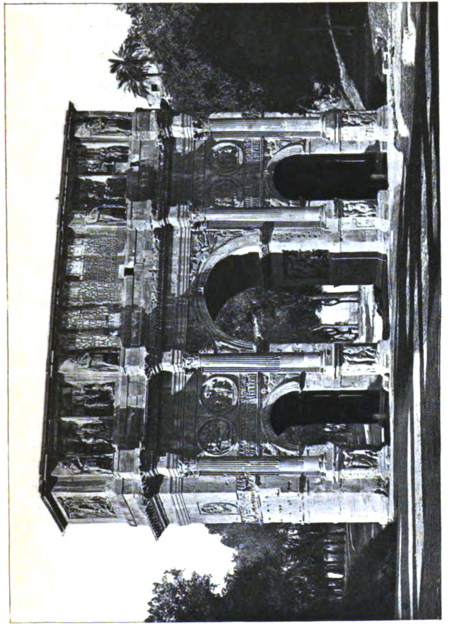
During this suspense of a doubtful and distant negotiation, the impatient Goths made some rash attempts to pass the Danube, without the permission of the government whose protection they had implored. Their motions were strictly observed by the vigilance of the troops which were stationed along the river, and their foremost detachments were defeated with considerable slaughter; yet such were the timid councils of the reign of Valens that the brave officers who had served their country in the execution of their duty were punished by the loss of their employments and narrowly escaped the loss of their heads. The Imperial mandate was at length received for transporting over the Danube the whole body of the Gothic nation; [67] but the execution of this order [IV-293] was a task of labour and difficulty. The stream of the Danube, which in those parts is above a mile broad, [68] had been swelled by incessant rains; and, in this tumultuous passage, many were swept away and drowned by the rapid violence of the current. A large fleet of vessels, of boats, and of canoes was provided; many days and nights they passed and repassed with indefatigable toil; and the most strenuous diligence was exerted by the officers of Valens that not a single Barbarian, of those who were reserved to subvert the foundations of Rome, should be left on the opposite shore. It was thought expedient that an accurate account should be taken of their numbers; but the persons who were employed soon desisted, with amazement and dismay, from the prosecution of the endless and impracticable task; [69] and the principal historian of the age most seriously affirms that the prodigious armies of Darius and Xerxes, which had so long been considered as the fables of vain and credulous antiquity, were now justified, in the eyes of mankind, by the evidence of fact and experience. A probable testimony has fixed the number of the Gothic warriors at two hundred thousand men; and, if we can venture to add the just proportion of women, of children, and of slaves, the whole mass of people which composed this formidable emigration must have amounted to near a million of persons, of both sexes and of all ages. The children of the Goths, [IV-294] those at least of a distinguished rank, were separated from the multitude. They were conducted, without delay, to the distant seats assigned for their residence and education; and, as the numerous train of hostages or captives passed through the cities, their gay and splendid apparel, their robust and martial figure, excited the surprise and envy of the Provincials. But the stipulation, the most offensive to the Goths and the most important to the Romans, was shamefully eluded. The Barbarians, who considered their arms as the ensigns of honour and the pledges of safety, were disposed to offer a price which the lust or avarice of the Imperial officers was easily tempted to accept. To preserve their arms, the haughty warriors consented, with some reluctance, to prostitute their wives or their daughters; the charms of a beauteous maid, or a comely boy, secured the connivance of the inspectors; who sometimes cast an eye of covetousness on the fringed carpets and linen garments of their new allies, [70] or who sacrificed their duty to the mean consideration of filling their farms with cattle and their houses with slaves. The Goths, with arms in their hands, were permitted to enter the boats; and, when their strength was collected on the other side of the river, the immense camp which was spread over the plains and the hills of the Lower Mæsia assumed a threatening and even hostile aspect. The leaders of the Ostrogoths, Alatheus and Saphrax, the guardians of their infant king, appeared soon afterwards on the northern banks of the Danube; and immediately despatched their ambassadors to the court of Antioch, to solicit, with the same professions of allegiance and gratitude, the same favour which had been granted to the suppliant Visigoths. The absolute refusal of Valens suspended their progress, and [IV-295] discovered the repentance, the suspicions, and the fears of the Imperial council.
An undisciplined and unsettled nation of Barbarians required the firmest temper and the most dexterous management. The daily subsistence of near a million of extraordinary subjects could be supplied only by constant and skilful diligence, and might continually be interrupted by mistake or accident. The insolence or the indignation of the Goths, if they conceived themselves to be the objects either of fear or of contempt, might urge them to the most desperate extremities; and the fortune of the state seemed to depend on the prudence, as well as the integrity, of the generals of Valens. At this important crisis, the military government of Thrace was exercised by Lupicinus and Maximus, in whose venal minds the slightest hope of private emolument outweighed every consideration of public advantage; and whose guilt was only alleviated by their incapacity of discerning the pernicious effects of their rash and criminal administration. Instead of obeying the orders of their sovereign and satisfying with decent liberality the demands of the Goths, they levied an ungenerous and oppressive tax on the wants of the hungry Barbarians. The vilest food was sold at an extravagant price; and, in the room of wholesome and substantial provisions, the markets were filled with the flesh of dogs, and of unclean animals, who had died of disease. To obtain the valuable acquisition of a pound of bread, the Goths resigned the possession of an expensive, though serviceable, slave; and a small quantity of meat was greedily purchased with ten pounds of a precious, but useless, metal. [71] When their [IV-296] property was exhausted, they continued this necessary traffic by the sale of their sons and daughters; and notwithstanding the love of freedom, which animated every Gothic breast, they submitted to the humiliating maxim that it was better for their children to be maintained in a servile condition than to perish in a state of wretched and helpless independence. The most lively resentment is excited by the tyranny of pretended benefactors, who sternly exact the debt of gratitude which they have cancelled by subsequent injuries: a spirit of discontent insensibly arose in the camp of the Barbarians, who pleaded, without success, the merit of their patient and dutiful behaviour; and loudly complained of the inhospitable treatment which they had received from their new allies. They beheld around them the wealth and plenty of a fertile province, in the midst of which they suffered the intolerable hardships of artificial famine. But the means of relief, and even of revenge, were in their hands; since the rapaciousness of their tyrants had left, to an injured people, the possession and the use of arms. The clamours of a multitude, untaught to disguise their sentiments, announced the first symptoms of resistance, and alarmed the timid and guilty minds of Lupicinus and Maximus. Those crafty ministers, who substituted the cunning of temporary expedients to the wise and salutary counsels of general policy, attempted to remove the Goths from their dangerous station on the frontiers of the empire, and to disperse them in separate quarters of cantonment through the interior provinces. As they were conscious how ill they had deserved the respect, or confidence, of the Barbarians, they diligently collected, from every side, a military force, that might urge the tardy and reluctant march of a people who had not yet renounced the title, or the duties, of Roman subjects. But the generals of Valens, while their attention was solely directed to the discontented Visigoths, imprudently disarmed the ships and fortifications which constituted the defence of the Danube. The fatal oversight [IV-297] was observed and improved by Alatheus and Saphrax, who anxiously watched the favourable moment of escaping from the pursuit of the Huns. By the help of such rafts and vessels as could be hastily procured, the leaders of the Ostrogoths transported, without opposition, their king and their army; and boldly fixed an hostile and independent camp on the territories of the empire. [72]
Under the name of judges, Alavivus and Fritigern were the leaders of the Visigoths in peace and war; and the authority which they derived from their birth was ratified by the free consent of the nation. In a season of tranquillity, their power might have been equal, as well as their rank; but, as soon as their countrymen were exasperated by hunger and oppression, the superior abilities of Fritigern assumed the military command, which he was qualified to exercise for the public welfare. He restrained the impatient spirit of the Visigoths, till the injuries and the insults of their tyrants should justify their resistance in the opinion of mankind; but he was not disposed to sacrifice any solid advantages for the empty praise of justice and moderation. Sensible of the benefits which would result from the union of the Gothic powers under the same standard, he secretly cultivated the friendship of the Ostrogoths; and, while he professed an implicit obedience to the orders of the Roman generals, he proceeded by slow marches towards Marcianopolis, the capital of the Lower Mæsia, about seventy miles from the banks of the Danube. On that fatal spot, the flames of discord and mutual hatred burst forth into a dreadful conflagration. Lupicinus had invited the Gothic chiefs to a splendid entertainment; and their martial train remained under arms at the entrance of the palace. But the gates of the city were strictly guarded; and the Barbarians were sternly excluded from the use of a plentiful market, to which they asserted their equal claim of subjects and allies. Their [IV-298] humble prayers were rejected with insolence and derision; and, as their patience was now exhausted, the townsmen, the soldiers, and the Goths were soon involved in a conflict of passionate altercation and angry reproaches. A blow was imprudently given; a sword was hastily drawn; and the first blood that was spilt in this accidental quarrel became the signal of a long and destructive war. In the midst of noise and brutal intemperance, Lupicinus was informed, by a secret messenger, that many of his soldiers were slain and despoiled of their arms; and, as he was already inflamed by wine and oppressed by sleep, he issued a rash command that their death should be revenged by the massacre of the guards of Fritigern and Alavivus. The clamorous shouts and dying groans apprised Fritigern of his extreme danger; and, as he possessed the calm and intrepid spirit of a hero, he saw that he was lost if he allowed a moment of deliberation to the man who had so deeply injured him. “A trifling dispute,” said the Gothic leader, with a firm but gentle tone of voice, “appears to have arisen between the two nations; but it may be productive of the most dangerous consequences, unless the tumult is immediately pacified by the assurance of our safety and the authority of our presence.” At these words, Fritigern and his companions drew their swords, opened their passage through the unresisting crowd which filled the palace, the streets, and the gates of Marcianopolis, and, mounting their horses, hastily vanished from the eyes of the astonished Romans. The generals of the Goths were saluted by the fierce and joyful acclamations of the camp; war was instantly resolved, and the resolution was executed without delay; the banners of the nation were displayed according to the custom of their ancestors; and the air resounded with the harsh and mournful music of the Barbarian trumpet. [73] [IV-299] The weak and guilty Lupicinus, who had dared to provoke, who had neglected to destroy, and who still presumed to despise his formidable enemy, marched against the Goths, at the head of such a military force as could be collected on this sudden emergency. The Barbarians expected his approach about nine miles from Marcianopolis; and on this occasion the talents of the general were found to be of more prevailing efficacy than the weapons and discipline of the troops. The valour of the Goths was so ably directed by the genius of Fritigern that they broke, by a close and vigorous attack, the ranks of the Roman legions. Lupicinus left his arms and standards, his tribunes and his bravest soldiers, on the field of battle; and their useless courage served only to protect the ignominious flight of their leader. “That successful day put an end to the distress of the Barbarians and the security of the Romans: from that day, the Goths, renouncing the precarious condition of strangers and exiles, assumed the character of citizens and masters, claimed an absolute dominion over the possessors of land, and held, in their own right, the northern provinces of the empire, which are bounded by the Danube.” Such are the words of the Gothic historian, [74] who celebrates, with rude eloquence, the glory of his countrymen. But the dominion of the Barbarians was exercised only for the purposes of rapine and destruction. As they had been deprived, by the ministers of the emperor, of the common benefits of nature and the fair intercourse of social life, they retaliated the injustice on the subjects of the empire; and the crimes of Lupicinus were [IV-300] expiated by the ruin of the peaceful husbandmen of Thrace, the conflagration of their villages, and the massacre, or captivity, of their innocent families. The report of the Gothic victory was soon diffused over the adjacent country; and, while it filled the minds of the Romans with terror and dismay, their own hasty prudence contributed to increase the forces of Fritigern and the calamities of the province. Some time before the great emigration, a numerous body of Goths, under the command of Suerid and Colias, had been received into the protection and service of the empire. [75] They were encamped under the walls of Hadrianople: but the ministers of Valens were anxious to remove them beyond the Hellespont, at a distance from the dangerous temptation which might so easily be communicated by the neighbourhood, and the success, of their countrymen. The respectful submission with which they yielded to the order of their march might be considered as a proof of their fidelity; and their moderate request of a sufficient allowance of provisions, and of a delay of only two days, was expressed in the most dutiful terms. But the first magistrate of Hadrianople, incensed by some disorders which had been committed at his country-house, refused this indulgence; and arming against them the inhabitants and manufacturers of a populous city, he urged, with hostile threats, their instant departure. The Barbarians stood silent and amazed, till they were exasperated by the insulting clamours, and missile weapons, of the populace: but, when patience or contempt was fatigued, they crushed the undisciplined multitude, inflicted many a shameful wound on the backs of their flying enemies, and despoiled them of the splendid armour [76] which they were unworthy to bear. The resemblance of [IV-301] their sufferings and their actions soon united this victorious detachment to the nation of the Visigoths; the troops of Colias and Suerid expected the approach of the great Fritigern, ranged themselves under his standard, and signalised their ardour in the siege of Hadrianople. But the resistance of the garrison informed the Barbarians that, in the attack of regular fortifications, the efforts of unskilful courage are seldom effectual. Their general acknowledged his error, raised the siege, declared that “he was at peace with stone walls,” [77] and revenged his disappointment on the adjacent country. He accepted, with pleasure, the useful reinforcement of hardy workmen, who laboured in the gold mines of Thrace [78] for the emolument, and under the lash, of an unfeeling master: [79] and these new associates conducted the Barbarians, through the secret paths, to the most sequestered places, which had been chosen to secure the inhabitants, the cattle, and the magazines of corn. With the assistance of such guides, nothing could remain impervious or inaccessible; resistance was fatal; flight was impracticable; and the patient submission of helpless innocence seldom found mercy from the Barbarian conqueror. In the course of these depredations, a great number of the children of the Goths, who had been sold into captivity, were restored to the embraces of their afflicted parents; but these tender interviews, which might have revived and cherished in their minds [IV-302] some sentiments of humanity, tended only to stimulate their native fierceness by the desire of revenge. They listened, with eager attention, to the complaints of their captive children, who had suffered the most cruel indignities from the lustful or angry passions of their masters; and the same cruelties, the same indignities, were severely retaliated on the sons and daughters of the Romans. [80]
The imprudence of Valens and his ministers had introduced into the heart of the empire a nation of enemies; but the Visigoths might even yet have been reconciled, by the manly confession of past errors and the sincere performance of former engagements. These healing and temperate measures seemed to concur with the timorous disposition of the sovereign of the East; but, on this occasion alone, Valens was brave; and his unseasonable bravery was fatal to himself and to his subjects. He declared his intention of marching from Antioch to Constantinople, to subdue this dangerous rebellion; and, as he was not ignorant of the difficulties of the enterprise, he solicited the assistance of his nephew, the emperor Gratian, who commanded all the forces of the West. The veteran troops were hastily recalled from the defence of Armenia; that important frontier was abandoned to the discretion of Sapor; and the immediate conduct of the Gothic war was entrusted, during the absence of Valens, to his lieutenants Trajan and Profuturus, two generals who indulged themselves in a very false and favourable opinion of their own abilities. On their arrival in Thrace, they were joined by Richomer, count of the domestics; and the auxiliaries of the West, that marched under his banner, were composed of the Gallic legions, reduced indeed by a spirit of desertion to the vain appearances of strength and numbers. In a council of war, which was influenced by pride rather [IV-303] than by reason, it was resolved to seek and to encounter the Barbarians, who lay encamped in the spacious and fertile meadows near the most southern of the six mouths of the Danube. [81] Their camp was surrounded by the usual fortification of waggons; [82] and the Barbarians, secure within the vast circle of the enclosure, enjoyed the fruits of their valour and the spoils of the province. In the midst of riotous intemperance, the watchful Fritigern observed the motions, and penetrated the designs, of the Romans. He perceived that the numbers of the enemy were continually increasing; and, as he understood their intention of attacking his rear as soon as the scarcity of forage should oblige him to remove his camp, he recalled to their standard his predatory detachments which covered the adjacent country. As soon as they descried the flaming beacons, [83] they obeyed, with incredible speed, the signal of their leader; the camp was filled with the martial crowd of Barbarians; their impatient clamours demanded the battle, and their tumultuous zeal was approved and animated by the spirit of their chiefs. The evening was already far advanced; and the two armies prepared themselves for the approaching combat, which was deferred only till the dawn of day. While the trumpets sounded to arms, the undaunted courage of the Goths was confirmed by the mutual obligation of a solemn oath; and, [IV-304] as they advanced to meet the enemy, the rude songs, which celebrated the glory of their forefathers, were mingled with their fierce and dissonant outcries, and opposed to the artificial harmony of the Roman shout. Some military skill was displayed by Fritigern to gain the advantage of a commanding eminence; but the bloody conflict, which began and ended with the light, was maintained, on either side, by the personal and obstinate efforts of strength, valour, and agility. The legions of Armenia supported their fame in arms; but they were oppressed by the irresistible weight of the hostile multitude; the left wing of the Romans was thrown into disorder, and the field was strewed with their mangled carcasses. This partial defeat was balanced, however, by partial success; and when the two armies, at a late hour of the evening, retreated to their respective camps, neither of them could claim the honours, or the effects, of a decisive victory. The real loss was more severely felt by the Romans, in proportion to the smallness of their numbers; but the Goths were so deeply confounded and dismayed by this vigorous, and perhaps unexpected, resistance that they remained seven days within the circle of their fortifications. Such funeral rites as the circumstances of time and place would admit were piously discharged to some officers of distinguished rank; but the indiscriminate vulgar was left unburied on the plain. Their flesh was greedily devoured by the birds of prey, who, in that age, enjoyed very frequent and delicious feasts; and several years afterwards the white and naked bones which covered the wide extent of the fields presented to the eyes of Ammianus a dreadful monument of the battle of Salices. [84]
[IV-305]
The progress of the Goths had been checked by the doubtful event of that bloody day; and the Imperial generals, whose army would have been consumed by the repetition of such a contest, embraced the more rational plan of destroying the Barbarians by the wants and pressure of their own multitudes. They prepared to confine the Visigoths in the narrow angle of land between the Danube, the desert of Scythia, and the mountains of Hæmus, till their strength and spirit should be insensibly wasted by the inevitable operation of famine. The design was prosecuted with some conduct and success; the Barbarians had almost exhausted their own magazines, and the harvests of the country; and the diligence of Saturninus, the master-general of the cavalry, was employed to improve the strength, and to contract the extent, of the Roman fortifications. His labours were interrupted by the alarming intelligence that new swarms of Barbarians had passed the unguarded Danube, either to support the cause, or to imitate the example, of Fritigern. The just apprehension, that he himself might be surrounded, and overwhelmed, by the arms of hostile and unknown nations, compelled Saturninus to relinquish the siege of the Gothic camp: and the indignant Visigoths, breaking from their confinement, satiated their hunger and revenge, by the repeated devastation of the fruitful country, which extends above three hundred miles from the banks of the Danube to the straits of the Hellespont. [85] The sagacious Fritigern had successfully appealed to the passions, as well as to the interest, of his Barbarian allies; and the love of rapine and the hatred of Rome seconded, or even prevented, the eloquence of his ambassadors. He cemented a strict and useful alliance with the great body of his countrymen, who obeyed Alatheus and Saphrax as the guardians of their infant king; the long animosity of rival tribes was suspended by the sense of their common interest; the independent part of the nation [IV-306] was associated under one standard; and the chiefs of the Ostrogoths appear to have yielded to the superior genius of the general of the Visigoths. He obtained the formidable aid of the Taifalæ, whose military renown was disgraced and polluted by the public infamy of their domestic manners. Every youth, on his entrance into the world, was united by the ties of honourable friendship, and brutal love, to some warrior of the tribe; nor could he hope to be released from this unnatural connection, till he had approved his manhood by slaying, in single combat, a huge bear, or a wild boar of the forest. [86] But the most powerful auxiliaries of the Goths were drawn from the camp of those enemies who had expelled them from their native seats. The loose subordination, and extensive possessions, of the Huns and the Alani delayed the conquests, and distracted the councils, of that victorious people. Several of the hords were allured by the liberal promises of Fritigern; and the rapid cavalry of Scythia added weight and energy to the steady and strenuous efforts of the Gothic infantry. The Sarmatians, who could never forgive the successor of Valentinian, enjoyed and increased the general confusion; and a seasonable irruption of the Alemanni into the provinces of Gaul engaged the attention, and diverted the forces, of the emperor of the West. [87]
One of the most dangerous inconveniences of the introduction of the Barbarians into the army and the palace, was sensibly felt in their correspondence with their hostile countrymen, [IV-307] to whom they imprudently, or maliciously, revealed the weakness of the Roman empire. A soldier, of the life-guards of Gratian, was of the nation of the Alemanni, and of the tribe of the Lentienses, who dwelt beyond the lake of Constance. Some domestic business obliged him to request a leave of absence. In a short visit to his family and friends, he was exposed to their curious inquiries; and the vanity of the loquacious soldier tempted him to display his intimate acquaintance with the secrets of the state and the designs of his master. The intelligence that Gratian was preparing to lead the military force of Gaul and of the West to the assistance of his uncle Valens pointed out to the restless spirit of the Alemanni the moment, and the mode, of a successful invasion. The enterprise of some light detachments, who, in the month of February, passed the Rhine upon the ice, was the prelude of a more important war. The boldest hopes of rapine, perhaps of conquest, outweighed the consideration of timid prudence or national faith. Every forest and every village poured forth a band of hardy adventurers; and the great army of the Alemanni, which, on their approach, was estimated at forty thousand men by the fears of the people, was afterwards magnified to the number of seventy thousand by the vain and credulous flattery of the Imperial court. The legions which had been ordered to march into Pannonia were immediately recalled or detained for the defence of Gaul; the military command was divided between Nanienus and Mellobaudes; and the youthful emperor, though he respected the long experience and sober wisdom of the former, was much more inclined to admire and to follow the martial ardour of his colleague; who was allowed to unite the incompatible characters of count of the domestics and of king of the Franks. His rival Priarius, king of the Alemanni, was guided, or rather impelled, by the same headstrong valour; and, as their troops were animated by the spirit of their leaders, they met, they saw, they encountered, each other, near the town of Argentaria, or [IV-308] Colmar, [88] in the plains of Alsace. The glory of the day was justly ascribed to the missile weapons and well-practised evolutions of the Roman soldiers; the Alemanni, who long maintained their ground, were slaughtered with unrelenting fury; five thousand only of the Barbarians escaped to the woods and mountains; and the glorious death of their king on the field of battle saved him from the reproaches of the people, who are always disposed to accuse the justice, or policy, of an unsuccessful war. After this signal victory, which secured the peace of Gaul and asserted the honour of the Roman arms, the emperor Gratian appeared to proceed without delay on his Eastern expedition; but, as he approached the confines of the Alemanni, he suddenly inclined to the left, surprised them by his unexpected passage of the Rhine, and boldly advanced into the heart of their country. The Barbarians opposed to his progress the obstacles of nature and of courage; and still continued to retreat from one hill to another, till they were satisfied, by repeated trials, of the power and perseverance of their enemies. Their submission was accepted as a proof, not indeed of their sincere repentance, but of their actual distress; and a select number of their brave and robust youth was exacted from the faithless nation, as the most substantial pledge of their future moderation. The subjects of the empire, who had so often experienced that the Alemanni could neither be subdued by arms nor restrained by treaties, might not promise themselves any solid or lasting tranquillity: but they discovered, in the virtues of their young sovereign, the prospect of a long and auspicious reign. When the legions climbed the mountains, and scaled the fortifications, of the Barbarians, the valour of Gratian was distinguished in the foremost ranks; and the gilt and variegated armour of his guards was pierced and [IV-309] shattered by the blows which they had received in their constant attachment to the person of their sovereign. At the age of nineteen, the son of Valentinian seemed to possess the talents of peace and war; and his personal success against the Alemanni was interpreted as a sure presage of his Gothic triumphs. [89]
While Gratian deserved and enjoyed the applause of his subjects, the emperor Valens, who, at length, had removed his court and army from Antioch, was received by the people of Constantinople as the author of the public calamity. Before he had reposed himself ten days in the capital, he was urged, by the licentious clamours of the Hippodrome, to march against the Barbarians whom he had invited into his dominions: and the citizens, who are always brave at a distance from any real danger, declared, with confidence, that, if they were supplied with arms, they alone would undertake to deliver the province from the ravages of an insulting foe. [90] The vain reproaches of an ignorant multitude hastened the downfall of the Roman empire; they provoked the desperate rashness of Valens, who did not find, either in his reputation or in his mind, any motives to support with firmness the public contempt. He was soon persuaded, by the successful achievements of his lieutenants, to despise the power of the Goths, who, by the diligence of Fritigern, were now collected in the neighbourhood of Hadrianople. The march of the Taifalæ had been intercepted by the valiant Frigerid; the king of those licentious Barbarians was slain in battle; and the suppliant captives were sent into distant exile to cultivate the lands of Italy which were assigned for their settlement in the vacant territories of Modena and [IV-310] Parma. [91] The exploits of Sebastian, [92] who was recently engaged in the service of Valens and promoted to the rank of master-general of the infantry, were still more honourable to himself and useful to the republic. He obtained the permission of selecting three hundred soldiers from each of the legions; and this separate detachment soon acquired the spirit of discipline and the exercise of arms, which were almost forgotten under the reign of Valens. By the vigour and conduct of Sebastian, a large body of the Goths was surprised in their camp: and the immense spoil which was recovered from their hands filled the city of Hadrianople and the adjacent plain. The splendid narratives which the general transmitted of his own exploits alarmed the Imperial court by the appearance of superior merit; and, though he cautiously insisted on the difficulties of the Gothic war, his valour was praised, his advice was rejected; and Valens, who listened with pride and pleasure to the flattering suggestions of the eunuchs of the palace, was impatient to seize the glory of an easy and assured conquest. His army was strengthened by a numerous reinforcement of veterans; and his march from Constantinople to Hadrianople was conducted with so much military skill that he prevented the activity of the Barbarians, who designed to occupy the intermediate defiles and to intercept either the troops themselves or their convoys of provisions. The camp of Valens, which he pitched under [IV-311] the walls of Hadrianople, was fortified, according to the practice of the Romans, with a ditch and rampart; and a most important council was summoned, to decide the fate of the emperor and of the empire. The party of reason and of delay was strenuously maintained by Victor, who had corrected, by the lessons of experience, the native fierceness of the Sarmatian character; while Sebastian, with the flexible and obsequious eloquence of a courtier, represented every precaution and every measure that implied a doubt of immediate victory as unworthy of the courage and majesty of their invincible monarch. The ruin of Valens was precipitated by the deceitful arts of Fritigern and the prudent admonitions of the emperor of the West. The advantages of negotiating in the midst of war were perfectly understood by the general of the Barbarians; and a Christian ecclesiastic was despatched, as the holy minister of peace, to penetrate, and to perplex, the councils of the enemy. The misfortunes, as well as the provocations, of the Gothic nation were forcibly and truly described by their ambassador; who protested, in the name of Fritigern, that he was still disposed to lay down his arms, or to employ them only in the defence of the empire if he could secure, for his wandering countrymen, a tranquil settlement on the waste lands of Thrace and a sufficient allowance of corn and cattle. But he added, in a whisper of confidential friendship, that the exasperated Barbarians were averse to these reasonable conditions; and that Fritigern was doubtful whether he could accomplish the conclusion of the treaty, unless he found himself supported by the presence and terrors of an Imperial army. About the same time Count Richomer returned from the West, to announce the defeat and submission of the Alemanni; to inform Valens that his nephew advanced by rapid marches at the head of the veteran and victorious legions of Gaul; and to request, in the name of Gratian and of the republic, that every dangerous and decisive measure might be suspended, till the junction of the two emperors should ensure the success [IV-312] of the Gothic war. But the feeble sovereign of the East was actuated only by the fatal illusions of pride and jealousy. He disdained the importunate advice; he rejected the humiliating aid; he secretly compared the ignominious, or at least the inglorious, period of his own reign with the fame of a beardless youth: and Valens rushed into the field, to erect his imaginary trophy, before the diligence of his colleague could usurp any share of the triumphs of the day.
On the ninth of August, a day which has deserved to be marked among the most inauspicious of the Roman Calendar, [93] the emperor Valens, leaving, under a strong guard, his baggage and military treasure, marched from Hadrianople to attack the Goths, who were encamped about twelve miles from the city. [94] By some mistake of the orders, or ignorance of the ground, the right wing, or column of cavalry, arrived in sight of the enemy, whilst the left was still at a considerable distance; the soldiers were compelled, in the sultry heat of summer, to precipitate their pace; and the line of battle was formed with tedious confusion and irregular delay. The Gothic cavalry had been detached to forage in the adjacent country; and Fritigern still continued to practise his customary arts. He despatched messengers of peace, made proposals, required hostages, and wasted the hours, till the Romans, exposed without shelter to the burning rays of the sun, were exhausted by thirst, hunger, and intolerable fatigue. The emperor was persuaded to send an ambassador to the [IV-313] Gothic camp; the zeal of Richomer, who alone had courage to accept the dangerous commission, was applauded: and the count of the domestics, adorned with the splendid ensigns of his dignity, had proceeded some way in the space between the two armies when he was suddenly recalled by the alarm of battle. The hasty and imprudent attack was made by Bacurius the Iberian, who commanded a body of archers and targetteers; and, as they advanced with rashness, they retreated with loss and disgrace. In the same moment, the flying squadrons of Alatheus and Saphrax, whose return was anxiously expected by the general of the Goths, descended like a whirlwind from the hills, swept across the plain, and added new terrors to the tumultuous, but irresistible, charge of the Barbarian host. The event of the battle of Hadrianople, so fatal to Valens and to the empire, may be described in a few words: the Roman cavalry fled; the infantry was abandoned, surrounded, and cut in pieces. The most skilful evolutions, the firmest courage, are scarcely sufficient to extricate a body of foot, encompassed, on an open plain, by superior numbers of horse; but the troops of Valens, oppressed by the weight of the enemy and their own fears, were crowded into a narrow space, where it was impossible for them to extend their ranks, or even to use, with effect, their swords and javelins. In the midst of tumult, of slaughter, and of dismay, the emperor, deserted by his guards and wounded, as it was supposed, with an arrow, sought protection among the Lancearii and the Mattiarii, who still maintained their ground with some appearance of order and firmness. His faithful generals, Trajan and Victor, who perceived his danger, loudly exclaimed that all was lost unless the person of the emperor could be saved. Some troops, animated by their exhortation, advanced to his relief: they found only a bloody spot, covered with a heap of broken arms and mangled bodies, without being able to discover their unfortunate prince, either among the living or the [IV-314] dead. Their search could not indeed be successful, if there is any truth in the circumstances with which some historians have related the death of the emperor. By the care of his attendants, Valens was removed from the field of battle to a neighbouring cottage, where they attempted to dress his wound and to provide for his future safety. But this humble retreat was instantly surrounded by the enemy; they tried to force the door; they were provoked by a discharge of arrows from the roof, till at length, impatient of delay, they set fire to a pile of dry faggots, and consumed the cottage with the Roman emperor and his train. Valens perished in the flames; [94n] and a youth, who dropt from the window, alone escaped, to attest the melancholy tale and to inform the Goths of the inestimable prize which they had lost by their own rashness. A great number of brave and distinguished officers perished in the battle of Hadrianople, which equalled in the actual loss, and far surpassed in the fatal consequences, the misfortune which Rome had formerly sustained in the field of Cannæ. [95] Two master-generals of the cavalry and infantry, two great officers of the palace and thirty-five tribunes were found among the slain; and the death of Sebastian might satisfy the world that he was the victim, as well as the author, of the public calamity. Above two-thirds of the Roman army were destroyed; and the darkness of the night was esteemed a very favourable circumstance, as it served to conceal the flight of the multitude and to protect the more orderly retreat of Victor and Richomer, who alone, amidst the general consternation, [IV-315] maintained the advantage of calm courage and regular discipline. [96]
While the impressions of grief and terror were still recent in the minds of men, the most celebrated rhetorician of the age composed the funeral oration of a vanquished army and of an unpopular prince, whose throne was already occupied by a stranger. “There are not wanting,” says the candid Libanius, “those who arraign the prudence of the emperor, [96a] or who impute the public misfortune to the want of courage and discipline in the troops. For my own part, I reverence the memory of their former exploits: I reverence the glorious death which they bravely received, standing, and fighting in their ranks: I reverence the field of battle, stained with their blood and the blood of the Barbarians. Those honourable marks have been already washed away by the rains; but the lofty monuments of their bones, the bones of generals, of centurions, and of valiant warriors, claim a longer period of duration. The king himself fought and fell in the foremost ranks of the battle. His attendants presented him with the fleetest horses of the Imperial stable, that would soon have carried him beyond the pursuit of the enemy. They vainly pressed him to reserve his important life for the future service of the republic. He still declared that he was unworthy to survive so many of the bravest and most faithful of his subjects; and the monarch was nobly buried under a mountain of the slain. Let none, therefore, presume to ascribe the victory of the Barbarians to the fear, the weakness, or the imprudence of the Roman troops. The chiefs and the soldiers were animated by the virtue of their ancestors, whom they equalled in discipline and the arts of war. Their [IV-316] generous emulation was supported by the love of glory, which prompted them to contend at the same time with heat and thirst, with fire and the sword; and cheerfully to embrace an honourable death as their refuge against flight and infamy. The indignation of the gods has been the only cause of the success of our enemies.” The truth of history may disclaim some parts of this panegyric, which cannot strictly be reconciled with the character of Valens or the circumstances of the battle; but the fairest commendation is due to the eloquence, and still more to the generosity, of the sophist of Antioch. [97]
The pride of the Goths was elated by this memorable victory; but their avarice was disappointed by the mortifying discovery that the richest part of the Imperial spoil had been within the walls of Hadrianople. They hastened to possess the reward of their valour; but they were encountered by the remains of a vanquished army with an intrepid resolution, which was the effect of their despair and the only hope of their safety. The walls of the city and the ramparts of the adjacent camp were lined with military engines, that threw stones of an enormous weight; and astonished the ignorant Barbarians by the noise and velocity, still more than by the real effects, of the discharge. The soldiers, the citizens, the provincials, the domestics of the palace, were united in the danger and in the defence; the furious assault of the Goths was repulsed; their secret arts of treachery and treason were discovered; and, after an obstinate conflict of many hours, they retired to their tents; convinced, by experience, that it would be far more advisable to observe the treaty which their sagacious leader had tacitly stipulated with the fortifications of great and populous cities. After the hasty and impolitic massacre of three hundred deserters, an act of justice extremely useful to the discipline of the Roman armies, the Goths indignantly [IV-317] raised the siege of Hadrianople. The scene of war and tumult was instantly converted into a silent solitude; the multitude suddenly disappeared; the sacred paths of the wood and mountains were marked with the footsteps of the trembling fugitives, who sought a refuge in the distant cities of Illyricum and Macedonia; and the faithful officers of the household and the treasury cautiously proceeded in search of the emperor, of whose death they were still ignorant. The tide of the Gothic inundation rolled from the walls of Hadrianople to the suburbs of Constantinople. The Barbarians were surprised with the splendid appearance of the capital of the East, the height and extent of the walls, the myriads of wealthy and affrighted citizens who crowded the ramparts, and the various prospect of the sea and land. While they gazed with hopeless desire on the inaccessible beauties of Constantinople, a sally was made from one of the gates by a party of Saracens, [98] who had been fortunately engaged in the service of Valens. The cavalry of Scythia was forced to yield to the admirable swiftness and spirit of the Arabian horses; their riders were skilled in the evolutions of irregular war; and the Northern Barbarians were astonished, and dismayed, by the inhuman ferocity of the Barbarians of the South. A Gothic soldier was slain by the dagger of an Arab; and the hairy, naked savage, applying his lips to the wound, expressed a horrid delight, while he sucked the blood of his vanquished enemy. [99] The army [IV-318] of the Goths, laden with the spoils of the wealthy suburbs and the adjacent territory, slowly moved from the Bosphorus to the mountains which form the western boundary of Thrace. The important pass of Succi was betrayed by the fear, or the misconduct, of Maurus; and the Barbarians, who no longer had any resistance to apprehend from the scattered and vanquished troops of the East, spread themselves over the face of a fertile and cultivated country, as far as the confines of Italy and the Hadriatic Sea. [100]
The Romans, who so coolly and so concisely mention the acts of justice which were exercised by the legions, [101] reserve their compassion and their eloquence for their own sufferings, when the provinces were invaded and desolated by the arms of the successful Barbarians. The simple circumstantial narrative (did such a narrative exist) of the ruin of a single town, of the misfortunes of a single family, [102] might exhibit an interesting and instructive picture of human manners; but the tedious repetition of vague and declamatory complaints would fatigue the attention of the most patient reader. The same censure may be applied, though not perhaps in an equal degree, to the profane and the ecclesiastical writers of this unhappy period; that their minds were inflamed by popular and religious animosity; and that the true size and colour [IV-319] of every object is falsified by the exaggerations of their corrupt eloquence. The vehement Jerom [103] might justly deplore the calamities inflicted by the Goths and their barbarous allies on his native country of Pannonia and the wide extent of the provinces, from the walls of Constantinople to the foot of the Julian Alps; the rapes, the massacres, the conflagrations; and, above all, the profanation of the churches, that were turned into stables, and the contemptuous treatment of the relics of holy martyrs. But the Saint is surely transported beyond the limits of nature and history, when he affirms “that, in those desert countries, nothing was left except the sky and the earth; that, after the destruction of the cities and the extirpation of the human race, the land was overgrown with thick forests and inextricable brambles; and that the universal desolation, announced by the prophet Zephaniah, was accomplished, in the scarcity of the beasts, the birds, and even of the fish.” These complaints were pronounced about twenty years after the death of Valens; and the Illyrian provinces, which were constantly exposed to the invasion and passage of the Barbarians, still continued, after a calamitous period of ten centuries, to supply new materials for rapine and destruction. Could it even be supposed that a large tract of country had been left without cultivation and without inhabitants, the consequences might not have been so fatal to the inferior productions of animated nature. The useful and feeble animals, which are nourished by the hand of man, might suffer and perish, if they were deprived of his protection; but the beasts of the forest, his enemies, or his victims, would multiply in the free and undisturbed possession of their solitary domain. The various tribes that people the air, or the waters, are still [IV-320] less connected with the fate of the human species; and it is highly probable that the fish of the Danube would have felt more terror and distress from the approach of a voracious pike than from the hostile inroad of a Gothic army.
Whatever may have been the just measure of the calamities of Europe, there was reason to fear that the same calamities would soon extend to the peaceful countries of Asia. The sons of the Goths had been judiciously distributed through the cities of the East; and the arts of education were employed to polish and subdue the native fierceness of their temper. In the space of about twelve years, their numbers had continually increased; and the children, who, in the first emigration, were sent over the Hellespont, had attained, with rapid growth, the strength and spirit of perfect manhood. [104] It was impossible to conceal from their knowledge the events of the Gothic war; and, as those daring youths had not studied the language of dissimulation, they betrayed their wish, their desire, perhaps their intention, to emulate the glorious example of their fathers. The danger of the times seemed to justify the jealous suspicions of the provincials; and these suspicions were admitted as unquestionable evidence that the Goths of Asia had formed a secret and dangerous conspiracy against the public safety. The death of Valens had left the East without a sovereign; and Julius, who filled the important station of master-general of the troops, with a high reputation of diligence and ability, thought it his duty to consult the senate of Constantinople; which he considered, during the vacancy of the throne, as the representative council of the nation. As soon as he had obtained the discretionary power of acting as he should judge most expedient for the good of the republic, he assembled the principal officers; and privately concerted effectual measures for the execution of his bloody [IV-321] design. An order was immediately promulgated that, on a stated day, the Gothic youth should assemble in the capital cities of their respective provinces; and, as a report was industriously circulated that they were summoned to receive a liberal gift of lands and money, the pleasing hope allayed the fury of their resentment and perhaps suspended the motions of the conspiracy. On the appointed day, the unarmed crowd of the Gothic youth was carefully collected in the square, or Forum; the streets and avenues were occupied by the Roman troops; and the roofs of the houses were covered with archers and slingers. At the same hour, in all the cities of the East, the signal was given of indiscriminate slaughter; and the provinces of Asia were delivered, by the cruel prudence of Julius, from a domestic enemy, who, in a few months, might have carried fire and sword from the Hellespont to the Euphrates. [105] The urgent consideration of the public safety may undoubtedly authorise the violation of every positive law. How far that, or any other, consideration may operate to dissolve the natural obligations of humanity and justice is a doctrine of which I still desire to remain ignorant.
The emperor Gratian was far advanced on his march towards the plains of Hadrianople when he was informed, at first by the confused voice of fame, and afterwards by the more accurate reports of Victor and Richomer, that his impatient colleague had been slain in battle, and that twothirds of the Roman army were exterminated by the sword of the victorious Goths. Whatever resentment the rash and jealous vanity of his uncle might deserve, the resentment of a generous mind is easily subdued by the softer emotions of grief and compassion: and even the sense of pity was soon [IV-322] lost in the serious and alarming consideration of the state of the republic. Gratian was too late to assist, he was too weak to revenge, his unfortunate colleague: and the valiant and modest youth felt himself unequal to the support of a sinking world. A formidable tempest of the Barbarians of Germany seemed ready to burst over the provinces of Gaul; and the mind of Gratian was oppressed and distracted by the administration of the Western empire. In this important crisis, the government of the East and the conduct of the Gothic war required the undivided attention of a hero and a statesman. A subject invested with such ample command would not long have preserved his fidelity to a distant benefactor; and the Imperial council embraced the wise and manly resolution of conferring an obligation rather than of yielding to an insult. It was the wish of Gratian to bestow the purple as the reward of virtue; but, at the age of nineteen, it is not easy for a prince, educated in the supreme rank, to understand the true characters of his ministers and generals. He attempted to weigh, with an impartial hand, their various merits and defects; and, whilst he checked the rash confidence of ambition, he distrusted the cautious wisdom which despaired of the republic. As each moment of delay diminished something of the power and resources of the future sovereign of the East, the situation of the times would not allow a tedious debate. The choice of Gratian was soon declared in favour of an exile, whose father, only three years before, had suffered, under the sanction of his authority, an unjust and ignominious death. The great Theodosius, a name celebrated in history and dear to the Catholic church, [106] was summoned to the Imperial court, which had gradually [IV-323] retreated from the confines of Thrace to the more secure station of Sirmium. Five months after the death of Valens, the emperor Gratian produced before the assembled troops his colleague and their master; who, after a modest, perhaps a sincere, resistance, was compelled to accept, amidst the general acclamations, the diadem, the purple, and the equal title of Augustus. [107] The provinces of Thrace, Asia, and Egypt, over which Valens had reigned, were resigned to the administration of the new emperor; but, as he was specially entrusted with the conduct of the Gothic war, the Illyrian prefecture was dismembered; and the two great dioceses of Dacia and Macedonia were added to the dominions of the Eastern empire. [108]
The same province, and, perhaps, the same city, [109] which had given to the throne the virtues of Trajan and the talents of Hadrian, was the original seat of another family of Spaniards, who, in a less fortunate age, possessed, near fourscore years, the declining empire of Rome. [110] They emerged from the obscurity of municipal honours by the active spirit of the elder Theodosius, a general whose exploits in Britain and Africa have formed one of the most splendid parts of the annals of Valentinian. The son of that general, who likewise [IV-324] bore the name of Theodosius, was educated, by skilful preceptors, in the liberal studies of youth; but he was instructed in the art of war by the tender care and severe discipline of his father. [111] Under the standard of such a leader, young Theodosius sought glory and knowledge, in the most distant scenes of military action; enured his constitution to the difference of seasons and climates; distinguished his valour by sea and land; and observed the various warfare of the Scots, the Saxons, and the Moors. His own merit, and the recommendation of the conqueror of Africa, soon raised him to a separate command; and in the station of Duke of Mæsia, he vanquished an army of Sarmatians; saved the province; deserved the love of the soldiers; and provoked the envy of the court. [112] His rising fortunes were soon blasted by the disgrace and execution of his illustrious father; and Theodosius obtained, as a favour, the permission of retiring to a private life in his native province of Spain. He displayed a firm and temperate character in the ease with which he adapted himself to this new situation. His time was almost equally divided between the town and country: the spirit which had animated his public conduct was shewn in the active and affectionate performance of every social duty; and the diligence of the soldier was profitably converted to the improvement of his ample patrimony, [113] which lay between Valladolid and Segovia, in the midst of a fruitful district still famous for a most exquisite breed of sheep. [114] [IV-325] From the innocent but humble labours of his farm Theodosius was transported, in less than four months, to the throne of the Eastern empire; [115] and the whole period of the history of the world will not perhaps afford a similar example of an elevation, at the same time, so pure and so honourable. The princes who peaceably inherit the sceptre of their fathers claim and enjoy a legal right, the more secure as it is absolutely distinct from the merits of their personal characters. The subjects, who, in a monarchy or a popular estate, acquire the possession of supreme power, may have raised themselves, by the superiority either of genius or virtue, above the heads of their equals; but their virtue is seldom exempt from ambition; and the cause of the successful candidate is frequently stained by the guilt of conspiracy or civil war. Even in those governments which allow the reigning monarch to declare a colleague or a successor, his partial choice, which may be influenced by the blindest passions, is often directed to an unworthy object. But the most suspicious malignity cannot ascribe to Theodosius, in his obscure solitude of Caucha, the arts, the desires, or even the hopes of an ambitious statesman; and the name of the Exile would long since have been forgotten, if his genuine and distinguished virtues had not left a deep impression in the Imperial court. During the season of prosperity, he had been neglected; but, in the public distress, his superior merit was universally felt and acknowledged. What confidence must have been reposed in his integrity, since Gratian could trust that a pious son would forgive, for the sake of the republic, the murder of his father! What expectations must have been formed of his abilities to encourage the hope that a single man could save, and restore, the empire of the [IV-326] East! Theodosius was invested with the purple in the thirty-third year of his age. The vulgar gazed with admiration on the manly beauty of his face, and the graceful majesty of his person, which they were pleased to compare with the pictures and medals of the emperor Trajan; whilst intelligent observers discovered, in the qualities of his heart and understanding, a more important resemblance to the best and greatest of the Roman princes.
It is not without the most sincere regret that I must now take leave of an accurate and faithful guide, who has composed the history of his own times without indulging the prejudices and passions which usually affect the mind of a contemporary. Ammianus Marcellinus, who terminates his useful work with the defeat and death of Valens, recommends the more glorious subject of the ensuing reign to the youthful vigour and eloquence of the rising generation. [116] The rising generation was not disposed to accept his advice or to imitate his example; [117] and, in the study of the reign of Theodosius, we are reduced to illustrate the partial narrative of Zosimus by the obscure hints of fragments and chronicles, by the figurative style of poetry or panegyric, and by the precarious assistance of the ecclesiastical writers who, in the heat of religious faction, are apt to despise the profane virtues of sincerity and moderation. Conscious of these disadvantages, which will continue to involve a considerable [IV-327] portion of the decline and fall of the Roman empire, I shall proceed with doubtful and timorous steps. Yet I may boldly pronounce that the battle of Hadrianople was never revenged by any signal or decisive victory of Theodosius over the Barbarians; and the expressive silence of his venal orators may be confirmed by the observation of the condition and circumstances of the times. The fabric of a mighty state, which has been reared by the labours of successive ages, could not be overturned by the misfortune of a single day, if the fatal power of the imagination did not exaggerate the real measure of the calamity. The loss of forty thousand Romans, who fell in the plains of Hadrianople, might have been soon recruited in the populous provinces of the East, which contained so many millions of inhabitants. The courage of a soldier is found to be the cheapest, and most common, quality of human nature; and sufficient skill to encounter an undisciplined foe might have been speedily taught by the care of the surviving centurions. If the Barbarians were mounted on the horses, and equipped with the armour, of their vanquished enemies, the numerous studs of Cappadocia and Spain would have supplied new squadrons of cavalry; the thirty-four arsenals of the empire were plentifully stored with magazines of offensive and defensive arms; and the wealth of Asia might still have yielded an ample fund for the expenses of the war. But the effects which were produced by the battle of Hadrianople on the minds of the Barbarians, and of the Romans, extended the victory of the former, and the defeat of the latter, far beyond the limits of a single day. A Gothic chief was heard to declare, with insolent moderation, that, for his own part, he was fatigued with slaughter; but that he was astonished how a people who fled before him like a flock of sheep could still presume to dispute the possession of their treasures and provinces. [118] The same [IV-328] terrors which the name of the Huns had spread among the Gothic tribes were inspired, by the formidable name of the Goths, among the subjects and soldiers of the Roman empire. [119] If Theodosius, hastily collecting his scattered forces, had led them into the field to encounter a victorious enemy, his army would have been vanquished by their own fears; and his rashness could not have been excused by the chance of success. But the great Theodosius, an epithet which he honourably deserved on this momentous occasion, conducted himself as the firm and faithful guardian of the republic. He fixed his headquarters at Thessalonica, the capital of the Macedonian diocese; [120] from whence he could watch the irregular motions of the Barbarians, and direct the operations of his lieutenants, from the gates of Constantinople to the shores of the Hadriatic. The fortifications and garrisons of the cities were strengthened; and the troops, among whom a sense of order and discipline was revived, were insensibly emboldened by the confidence of their own safety. From these secure stations, they were encouraged to make frequent sallies on the Barbarians, who infested the adjacent country; and, as they were seldom allowed to engage without some decisive superiority either of ground or of numbers, their enterprises were, for the most part, successful; and they were soon convinced, by their own experience, of the possibility of vanquishing their invincible enemies. [121] The detachments of these separate garrisons were gradually united into small armies; the same cautious measures were pursued, according to an extensive and well-concerted plan of operations; the events of each day added strength and [IV-329] spirit to the Roman arms; and the artful diligence of the emperor, who circulated the most favourable reports of the success of the war, contributed to subdue the pride of the Barbarians and to animate the hopes and courage of his subjects. If, instead of this faint and imperfect outline, we could accurately represent the counsels and actions of Theodosius, in four successive campaigns, there is reason to believe that his consummate skill would deserve the applause of every military reader. The republic had formerly been saved by the delays of Fabius: and, while the splendid trophies of Scipio in the field of Zama attract the eyes of posterity, the camps and marches of the Dictator among the hills of Campania may claim a juster proportion of the solid and independent fame which the general is not compelled to share either with fortune or with his troops. Such was likewise the merit of Theodosius; and the infirmities of his body, which most unseasonably languished under a long and dangerous disease, could not oppress the vigour of his mind or divert his attention from the public service. [122]
The deliverance and peace of the Roman provinces [123] was the work of prudence rather than of valour: the prudence of Theodosius was seconded by fortune; and the emperor never failed to seize, and to improve, every favourable circumstance. As long as the superior genius of Fritigern preserved the union, and directed the motions, of the Barbarians, their power was not inadequate to the conquest of a great empire. The death of that hero, the predecessor and master of the renowned Alaric, relieved an impatient multitude from the intolerable [IV-330] yoke of discipline and discretion. The Barbarians, who had been restrained by his authority, abandoned themselves to the dictates of their passions; and their passions were seldom uniform or consistent. An army of conquerors was broken into many disorderly bands of savage robbers; and their blind and irregular fury was not less pernicious to themselves than to their enemies. [124] Their mischievous disposition was shewn in the destruction of every object which they wanted strength to remove or taste to enjoy; and they often consumed, with improvident rage, the harvests or the granaries, which soon afterwards became necessary for their own subsistence. A spirit of discord arose among the independent tribes and nations, which had been united only by the bands of a loose and voluntary alliance. The troops of the Huns and the Alani would naturally upbraid the flight of the Goths who were not disposed to use with moderation the advantages of their fortune; the ancient jealousy of the Ostrogoths and the Visigoths could not long be suspended; and the haughty chiefs still remembered the insults and injuries which they had reciprocally offered, or sustained, while the nation was seated in the countries beyond the Danube. The progress of domestic faction abated the more diffusive sentiment of national animosity; and the officers of Theodosius were instructed to purchase with liberal gifts and promises the retreat, or service, of the discontented party. The acquisition of Modar, a prince of the royal blood of the Amali, gave a bold and faithful champion to the cause of Rome. The illustrious deserter soon obtained the rank of master-general, with an important command; surprised an army of his countrymen who were immersed in wine and sleep; and, after a cruel slaughter of the astonished Goths, returned with an immense spoil, and four thousand waggons, to the Imperial [IV-331] camp. [125] In the hands of a skilful politician, the most different means may be successfully applied to the same ends: and the peace of the empire, which had been forwarded by the divisions, was accomplished by the reunion of the Gothic nation. Athanaric, who had been a patient spectator of these extraordinary events, was at length driven, by the chance of arms, from the dark recesses of the woods of Caucaland. [126] He no longer hesitated to pass the Danube; and a very considerable part of the subjects of Fritigern, who already felt the inconveniences of anarchy, were easily persuaded to acknowledge for their king a Gothic Judge, whose birth they respected and whose abilities they had frequently experienced. But age had chilled the daring spirit of Athanaric; and, instead of leading his people to the field of battle and victory, he wisely listened to the fair proposal of an honourable and advantageous treaty. Theodosius, who was acquainted with the merit and power of his new ally, condescended to meet him at the distance of several miles from Constantinople; and entertained him in the Imperial city, with the confidence of a friend and the magnificence of a monarch. “The Barbarian prince observed, with curious attention, the variety of objects which attracted his notice, and at last brokeout into a sincere and passionate exclamation of wonder. I now behold (said he) what I never could believe, the glories of this stupendous capital! and, as he cast his eyes around, he viewed, and he admired, the commanding situation of the city, the strength and beauty of the walls and public edifices, the capacious harbour, crowded with innumerable vessels, the perpetual concourse of distant nations, and the arms and discipline of the troops. Indeed (continued [IV-332] Athanaric), the emperor of the Romans is a god upon earth; and the presumptuous man, who dares to lift his hand against him, is guilty of his own blood.” [127] The Gothic king did not long enjoy this splendid and honourable reception; and, as temperance was not the virtue of his nation, it may justly be suspected that his mortal disease was contracted amidst the pleasures of the Imperial banquets. But the policy of Theodosius derived more solid benefit from the death, than he could have expected from the most faithful services, of his ally. The funeral of Athanaric was performed with solemn rites in the capital of the East; a stately monument was erected to his memory; and his whole army, won by the liberal courtesy and decent grief of Theodosius, enlisted under the standard of the Roman empire. [128] The submission of so great a body of the Visigoths was productive of the most salutary consequences; and the mixed influence of force, of reason, and of corruption became every day more powerful and more extensive. Each independent chieftain hastened to obtain a separate treaty, from the apprehension that an obstinate delay might expose him, alone and unprotected, to the revenge, or justice, of the conqueror. The general, or rather the final, capitulation of the Goths may be dated four years, one month, and twenty-five days after the defeat and death of the emperor Valens. [129]
[IV-333]
The provinces of the Danube had been already relieved from the oppressive weight of the Gruthungi, or Ostrogoths, by the voluntary retreat of Alatheus and Saphrax; whose restless spirit had prompted them to seek new scenes of rapine and glory. Their destructive course was pointed towards the West; but we must be satisfied with a very obscure and imperfect knowledge of their various adventures. The Ostrogoths impelled several of the German tribes on the provinces of Gaul; concluded, and soon violated, a treaty with the emperor Gratian; advanced into the unknown countries of the North; and, after an interval of more than four years, returned, with accumulated force, to the banks of the Lower Danube. Their troops were recruited with the fiercest warriors of Germany and Scythia; and the soldiers, or at least the historians, of the empire no longer recognised the name and countenances of their former enemies. [130] The general, who commanded the military and naval powers of the Thracian frontier, soon perceived that his superiority would be disadvantageous to the public service; and that the Barbarians, awed by the presence of his fleet and legions, would probably defer the passage of the river till the approaching winter. The dexterity of the spies whom he sent into the Gothic camp allured the Barbarians into a fatal snare. They were persuaded that, by a bold attempt, they might surprise, in the silence and darkness of the night, the sleeping army of the Romans; and the whole multitude was hastily embarked in a fleet of three thousand canoes. [131] The bravest [IV-334] of the Ostrogoths led the van; the main body consisted of the remainder of their subjects and soldiers; and the women and children securely followed in the rear. One of the nights without a moon had been selected for the execution of their design; and they had almost reached the southern bank of the Danube, in the firm confidence that they should find an easy landing and an unguarded camp. But the progress of the Barbarians was suddenly stopped by an unexpected obstacle: a triple line of vessels, strongly connected with each other, and which formed an impenetrable chain of two miles and a half along the river. While they struggled to force their way in the unequal conflict, their right rank was overwhelmed by the irresistible attack of a fleet of galleys, which were urged down the stream by the united impulse of oars and of the tide. The weight and velocity of those ships of war broke, and sank, and dispersed the rude and feeble canoes of the Barbarians; their valour was ineffectual; and Alatheus, the king, or general, of the Ostrogoths, perished with his bravest troops either by the sword of the Romans or in the waves of the Danube. The last division of this unfortunate fleet might regain the opposite shore; but the distress and disorder of the multitude rendered them alike incapable either of action or counsel; and they soon implored the clemency of the victorious enemy. On this occasion, as well as on many others, it is a difficult task to reconcile the passions and prejudices of the writers of the age of Theodosius. The partial and malignant historian who misrepresents every action of his reign affirms that the emperor did not appear in the field of battle till the Barbarians had been vanquished by the valour and conduct of his lieutenant Promotus. [132] The flattering poet, who celebrated, in the court of Honorius, the glory of the father and of the son, ascribes the victory [IV-335] to the personal prowess of Theodosius; and almost insinuates that the King of the Ostrogoths was slain by the hand of the emperor. [133] The truth of history might perhaps be found in a just medium between these extreme and contradictory assertions.
The original treaty, which fixed the settlement of the Goths, ascertained their privileges and stipulated their obligations, would illustrate the history of Theodosius and his successors. The series of their history has imperfectly preserved the spirit and substance of this singular agreement. [134] The ravages of war and tyranny had provided many large tracts of fertile but uncultivated land for the use of those Barbarians who might not disdain the practice of agriculture. A numerous colony of the Visigoths was seated in Thrace; the remains of the Ostrogoths were planted in Phrygia and Lydia; their immediate wants were supplied by a distribution of corn and cattle; and their future industry was encouraged by an exemption from tribute, [135] during a certain term of years. The Barbarians would have deserved to feel the cruel and perfidious policy of the Imperial court, if they had suffered themselves to be dispersed through the provinces. They required, and they obtained, the sole possession of the villages and districts assigned for their residence; they still cherished and propagated their native manners and language; asserted, [IV-336] in the bosom of despotism, the freedom of their domestic government; and acknowledged the sovereignty of the emperor, without submitting to the inferior jurisdiction of the laws and magistrates of Rome. The hereditary chiefs of the tribes and families were still permitted to command their followers in peace and war; but the royal dignity was abolished; and the generals of the Goths were appointed and removed at the pleasure of the emperor. An army of forty thousand Goths was maintained for the perpetual service of the empire of the East; and those haughty troops, who assumed the title of Fœderati, or allies, were distinguished by their gold collars, liberal pay, and licentious privileges. Their native courage was improved by the use of arms and the knowledge of discipline; and, while the republic was guarded, or threatened, by the doubtful sword of the Barbarians, the last sparks of the military flame were finally extinguished in the minds of the Romans. [136] Theodosius had the address to persuade his allies that the conditions of peace which had been extorted from him by prudence and necessity were the voluntary expressions of his sincere friendship for the Gothic nation. [137] A different mode of vindication or apology was opposed to the complaints of the people; who loudly censured these shameful and dangerous concessions. [138] [IV-337] The calamities of the war were painted in the most lively colours; and the first symptoms of the return of order, of plenty, and security were diligently exaggerated. The advocates of Theodosius could affirm, with some appearance of truth and reason, that it was impossible to extirpate so many warlike tribes, who were rendered desperate by the loss of their native country; and that the exhausted provinces would be revived by a fresh supply of soldiers and husbandmen. The Barbarians still wore an angry and hostile aspect; but the experience of past times might encourage the hope that they would acquire the habits of industry and obedience; that their manners would be polished by time, education, and the influence of Christianity; and that their prosperity would insensibly blend with the great body of the Roman people. [139]
Notwithstanding these specious arguments and these sanguine expectations, it was apparent to every discerning eye that the Goths would long remain the enemies, and might soon become the conquerors, of the Roman empire. Their rude and insolent behaviour expressed their contempt of the citizens and provincials, whom they insulted with impunity. [140] To the zeal and valour of the Barbarians Theodosius was indebted for the success of his arms; but their assistance was precarious; and they were sometimes seduced by a treacherous and inconstant disposition to abandon his standard at the moment when their service was the most essential. During the civil war against Maximus, a great number of Gothic deserters retired into the morasses of Macedonia, wasted the adjacent provinces, and obliged the intrepid monarch to expose his person, and exert his power, to suppress the rising [IV-338] flame of rebellion. [141] The public apprehensions were fortified by the strong suspicion that these tumults were not the effect of accidental passion, but the result of deep and premeditated design. It was generally believed that the Goths had signed the treaty of peace with an hostile and insidious spirit; and that their chiefs had previously bound themselves, by a solemn and secret oath, never to keep faith with the Romans; to maintain the fairest shew of loyalty and friendship, and to watch the favourable moment of rapine, of conquest, and of revenge. But, as the minds of the Barbarians were not insensible to the power of gratitude, several of the Gothic leaders sincerely devoted themselves to the service of the empire, or, at least, of the emperor; the whole nation was insensibly divided into two opposite factions, and much sophistry was employed in conversation and dispute, to compare the obligations of their first and second engagements. The Goths, who considered themselves as the friends of peace, of justice, and of Rome, were directed by the authority of Fravitta, a valiant and honourable youth, distinguished above the rest of his countrymen by the politeness of his manners, the liberality of his sentiments, and the mild virtues of social life. But the more numerous faction adhered to the fierce and faithless Priulf, who inflamed the passions, and asserted the independence, of his warlike followers. On one of the solemn festivals, when the chiefs of both parties were invited to the Imperial table, they were insensibly heated by wine, till they forgot the usual restraints of discretion and respect; and betrayed, in the presence of Theodosius, the fatal secret of their domestic disputes. The emperor, who had been the reluctant witness of this extraordinary controversy, dissembled his fears and resentment, and soon dismissed the tumultuous assembly. Fravitta, alarmed and exasperated [IV-339] by the insolence of his rival, whose departure from the palace might have been the signal of a civil war, boldly followed him; and, drawing his sword, laid Priulf dead at his feet. Their companions flew to arms; and the faithful champion of Rome would have been oppressed by superior numbers, if he had not been protected by the seasonable interposition of the Imperial guards. [142] Such were the scenes of Barbaric rage which disgraced the palace and table of the Roman emperor; and, as the impatient Goths could only be restrained by the firm and temperate character of Theodosius, the public safety seemed to depend on the life and abilities of a single man. [143]
[IV-none]
[IV-341]
APPENDIX: ADDITIONAL NOTES BY THE EDITOR↩
NOTE 1.: LEGEND OF THE FINDING OF THE TRUE CROSS — (P. 76)↩
The legend of the discovery of the Cross by Judas for St. Helena has come down in Syriac, Greek, and Latin versions. See E. Nestle, Byz. Zeitschrift, iv. p. 319-345, who makes it probable that the original Helena legend was in Syriac, and prints the oldest Greek version extant from a Sinai MS. of the eighth century copied by Mr. Rendel Harris. (The Greek from later MSS. (1) in J. Gretser’s huge treatise, De Cruce Christi (1000), ii. 530 sqq., and Holder, Inventio verae crucis, 1889; (2) in Gretser, op. cit., ii. 543 sqq.; (3) Wotke, Wiener Studien, 1891, p. 300 sqq.; the Latin (1) in the Sanctuarium (a rather rare book; c. 1479) of Mombritius, and in Acta Sanct., May 4, I., 445 sqq.; (2) in Holder, op. cit.; (3) in Mombritius, op. cit.; the Syriac (1) from seventh century MS., in Nestle’s De sancta Cruce, 1889; (2) ib.; (3) in Bedjan’s Acta Martyrum et Sanctorum, 1890, p. 326 sqq.)
NOTE 2.: ST. GEORGE — (P. 98)↩
The article on St. George by Zöckler in Herzog and Plitt’s Encyclopædia has been superseded by the discussion of F. Görres in the Zeitsch. f. wiss. Theologie, xvi. 1890, p. 454 sqq. “Ritter St. Georg in Geschichte, Legende, u. Kunst.” [There is no question that the Acta (in Act. Sanct. 23rd April) are apocryphal and legendary. They are remarkable for the horrible descriptions of scenes of martyrdom, which might serve as a text to elucidate the pictures on the walls of the curious round Church of San Stefano on the Esquiline.] Görres arrives at practically the same conclusion as Tillemont (Mém. eccl., v. 185-9, 658-60). All the details of St. George’s martyrdom are uncertain; but St. George existed and suffered as a martyr in the East in some pre-Constantinian persecution. Tillemont established the reality of St. George by the existence of his cult (he was a μεγαλόμαρτυς) in the sixth century; Görres proves that it already existed in the fifth century. (1) The round Church of St. George at Thessalonica is not younger than the fifth century and possibly belongs to the fourth; (2) Venantius (Carm. ii. 12, p. 41, ed. M.H.G.) mentions a Gallic basilica to St. George, founded by Sidonius Apollinaris; (3) the decree of Pope Gelasius de libris non recipiendis, at end of fifth century, condemns the Acta of St. George as apocryphal, but confesses his historical existence.
The connection of his name with a dragon-slaying legend does not relegate him to the region of myth. For over against the fabulous Christian dragonslayer, Theodore of the Bithynian Heraclea, we can set Agapetus of Synnada and Arsacius, who though celebrated as dragon-slayers were historical persons.
[IV-342]
Gibbon’s theory which identifies St. George with George of Cappadocia has nothing to be said for it; but Görres points out that it is not open to any objection on the ground that George of Cappadocia was an Arian. For there are examples of Arians admitted into the Martyrologium: he cites Agapetus of Synnada and Auxentius, afterwards bishop of Mopsuestia. (It is to be noted that one recension of the Acta S. Georgii was edited by Arians.)
NOTE 3.: CHURCHES OF CONSTANTINE AT JERUSALEM — (P. 75)↩
In regard to Constantine’s Churches at Jerusalem it may be said, without entering upon the question as to the true positions of Golgotha and the Holy Sepulchre, that it is certain that these Churches — (1) the round Church of the Anastasis which contained the Sepulchre, and the (2) adjacent Basilica, dedicated to the Cross — stood on the site of the present Church of the Holy Sepulchre. Injured by the Persians (614 ad) they were restored some years later, and a plan of the buildings drawn up, towards the end of the seventh century, by the pilgrim Arculfus is extant, and is of great importance for the topography. Some traces of the old buildings still remain. “The relative position of the Churches is the same; the circular Church of the Anastasis has preserved its form; the south wall of the Basilica can be traced from ‘Calvary’ eastward, and one of the large cisterns constructed by Constantine has been discovered” (Sir C. Wilson, in Smith’s Dict. of the Bible, new ed., 1893, p. 1654). Mr. Fergusson’s theory which identified the Church of the Resurrection with the mosque known as Kubbet-es-Sakhrah, the Dome of the Rock (within the so-called “Haram area”), is now quite exploded.
The Dome of the Rock has its own question, but has nothing to do with Constantine. Is it of Saracenic origin dating from the end of the seventh century — built perhaps by a Greek architect? or was it originally a Christian Church, and converted into a mosque? It has been identified by Professor Sepp with a Church of St. Sophia built by Justinian. Sir C. Wilson thinks that it stands on the site of St. Sophia, which was destroyed by the Persians; “that it was rebuilt with the old material by Abdul-Melik who covered it with a dome, and that it was again repaired and redecorated by El Mamûn” (ib., p. 1657).
The adjacent mosque el-Aksa occupies the site of the mosque of Omar. It was built by Abd al Malik, “out of the ruins of Justinian’s Church of St. Mary” (Wilson, ib.), which is fully described by Procopius; but there is a difference of opinion whether the Church was on the same site as the mosque or (so Fergusson and others) in the south-eastern corner of the “Haram area,” where there are vaults apparently of the Justinianean age.
For further details see Sir C. Wilson’s article Jerusalem, cited above; Mr. T. H. Lewis’ essay on the Church of Constantine at Jerusalem in the Palestine Pilgrims’ Text Society, 1891; Sepp, Die Felsenkuppell eine Justinianische Sophien-kirche; various papers in the Palestine Exploration Fund publications.
NOTE 4.: THE TIGRIS AND EUPHRATES — (P. 127)↩
The recent publication of a geographical description of Mesopotamia and Baghdād by an Arabic writer, Ibn Serapion, of whom nothing is known except that he wrote in the early years of the tenth century, by Mr. Guy Le Strange (with translation and commentary, in the Journal of the Royal [IV-343] Asiatic Soc., 1895, January and April; cp. addenda in July, and 1896, October), is of considerable importance.
It shows that since the tenth century great alterations have taken place in the course of the Tigris and Euphrates, and shows what these alterations were; it gives a clear account of the canal system which drew the overflow of the Euphrates into the Tigris; and it supplies most important data for the reconstruction of the topography of Baghdād.
Before the Caliphate, the River Tigris followed its present course, from Kūt-al-Amarah (about 100 miles below Baghdād) flowing in a south-easterly direction to its junction with the Euphrates. But during the middle ages — in the tenth century for example — it flowed almost due south, “running down the channel now known as the Shatt-al-Hay, and passing through the city of Wāsit” (Le Strange, ib., Jan., p. 3). The changes in the Euphrates are thus summed up by Mr. Le Strange (p. 4): A little above Al-Kūfa “the stream bifurcated. The branch to the right — considered then as the main stream of the Euphrates, but now known as the Hindiyya Canal — ran down past Al-Kūfa, and a short distance below the city became lost in the western part of the great Swamp,” which also swallowed up the waters of the Tigris. “The stream to the left or eastward called the Sūrā Canal — which, in its upper reach, follows the line of the modern Euphrates — ran a short course and then split up into numerous canals whose waters for the most part flowed out into the Tigris above Wāsit.” The great Swamp in which the streams of both Tigris and Euphrates lost themselves was drained by the Tidal Estuary which reached the sea at Abbadān, “a town which, on account of the recession of the Persian Gulf, now lies nearly twenty miles distant from the present shore-line.”
It should be carefully remembered in reading the account of the events after Julian’s death that the Tigris has also altered its course to the north of Ctesiphon since the tenth century. From a point below Samarrā to a point above Baghdād, it followed a shorter and more westerly channel than at the present day.
As to the canal Nahr-al-Malik (see above, p. 137), Mr. Le Strange says (ib., Jan., p. 75), that “roughly speaking it followed the line of the modern Radhwāniyya Canal.”
It may be added that the geographical work of Abu-l-Fidā, mentioned by Gibbon, p. 127, n. 54, is not very valuable, being neither good nor early. The authoritative Arabic text is that of Reinaud, 1840, and there is a French translation by S. Guyard, 1883. On early geographical works in Arabic, see Le Strange’s Palestine under the Moslems (Pal. Explor. Fund).
NOTE 5.: AUTHORITIES — (C. XXV. sqq.) ↩
For the works of Libanius, cp. vol. ii. Appendix 10, p. 361-362. The chronology of the most important of his later orations is determined by Sievers as follows: —
| 381. | Or. ii., πρὸς τοὺς βαρὺν αὐτὸν καλον̂ντας. He contrasts the present with the reign of Julian; and refers to the Battle of Hadrianople. | |
| 386. | Or. xxxi. Against Tisamenos (consularis of Syria). An interesting indictment of the governor’s exactions and oppression. | |
| 387 (March). | Or. xix., περὶ τη̂ς στάσεως. On the sedition at Antioch, a petition to Theodosius for mercy. | |
| 387. | Or. xxxiv., κατὰ τω̂ν πεϕευγότων. Against those who fled from the city during the sedition. It was written during the sedition but μετὰ δικαστήρια καὶ κρίσιν καὶ δεσμόν. | |
| 387. | Or. xx., πρὸς θεοδόσιον ἐπὶ ταɩ̂ς διαλλαγαɩ̂ς. The story of the sedition and the pardon is narrated. | |
| 387. | Or. xxi., πρὸς Καισάριον Μάγιστρον. A thanksgiving to Cæsarius for his good offices in obtaining the pardon from Theodosius. | |
| 387. | Or. xxii., πρὸς Ἐλλέβιχον. Describing the inquiry into the sedition, conducted by Ellebichus. | |
| 388 (?). | Or. xxx., πρὸς θρασυδαɩ̂ον. Deals with events connected with the sedition. | |
| After 388. | Or. xxviii., περὶ τω̂ν ὶερω̂ν. A complaint that although the offering of incence in pagan temples was not forbidden [by Cod. Theod. xvi. 10, 9. ad 385], the monks destroyed the temples. |
There can be no question that Or. xxviii. on the Temples and many other of the orations of Libanius were not publicly delivered (in the Emperor’s presence, for instance), but were merely read to a private audience of sympathisers, or circulated as pamphlets.
For Themistius, cp. vol. ii. Appendix 10, p. 362. The orations which concern this and the following chapters are: —
| 364. | Or. v. On the consulship of Jovian. Claims toleration for both Christians and pagans. |
| 364. | Or. vi., ϕιλάκελϕοι. To Valentinian and Valens on their accession. |
| 367. | Or. vii., περὶ τω̂ν ήτυχηκότων ἐπὶ Οὐάλεντος. On the victory of Valens over Procopius. Praises the Emperor’s clemency. |
| 368. | Or. viii., πενταετηρικός. On the quinquennalia of Valens. |
| 369. | Or. ix., προτρεπτικὸς Οὐαλεντινιανῷ τῷ νέῳ. To Valentinian the younger, son of Valens, consul this year. |
| 370. | Or. x., ἐπὶ τη̂ς εἱρήνης, pronounced before the Senate of Constantinople, congratulating Valens on his peace with the Goths. |
| 373. | Or. xi., δεκετηρικός (March 28). On the decennalia of Valens, who was then in Syria. |
| 374. | Or. xii. An appeal for religious toleration. |
| 377. | Or. xiii., ἐρωτικός, pronounced in honour of Gratian at Rome, whither Themistius was sent by Valens. |
| 379. | Or. xiv., πρεσβευτικὸς εἰς θεοδόσιον αὐτοκράτορα (early in the year), pronounced at Thessalonica by Themistius as delegate of the Senate of Constantinople. |
| 381. | Or. xv., εἰς θεοδόσιον (February or March). On the virtues of a king. |
| 383. | Or. xvi., χαριστήριος τῷ αὐτοκράτορι ὑπὲρ τη̂ς εἰρήνης καὶ τη̂ς ὑπατείας τον̂ στρατηγον̂ Σατορνίνου (January). On the peace with the Goths in 382. |
| 384. | Or. xvii., ἐπὶ τῃ̑ χειροτονίᾳ τη̂ς πολιαρχίας. Returning thanks for his own appointment to the Prefecture of Constantinople (c. Sept. 1?). |
| 384. | Or. xviii., περὶ τη̂ς τον̂ βασιλέως ϕιληκοίας. Panegyric of Theodosius. |
| 385. | Or. xix., ἐπὶ τῃ̑ ϕιλανθρωπίᾳ τον̂ αὐτοκράτορος θεοδοσίου, pronounced in the Senate; praises the clemency of Theodosius (before Sept. 14). |
[IV-345]
Synesius of Cyrene (born 360-70 ad) studied first at Alexandria, afterwards at Athens. When he had completed his academical course he returned to the Pentapolis and led the life of a cultivated country gentleman. In 397 ad he arrived in Constantinople to plead the cause of Cyrene at the court, and stayed there some years, where he enjoyed the friendship of Aurelian. During that time he delivered his speech on the office of king (see below, vol. v. p. 146), and witnessed the fall of Aurelian and rebellion of Gainas. He afterwards made these events the subject of a bold political “squib,” entitled “The Egyptians.” For the light which this throws on the political parties and intrigues in Constantinople, see below, vol. v. Appendix 19.
After the Gainas episode, Aurelian returned, and by his influence the petition of Synesius was granted. Synesius then returned to Africa (probably in 402 to Alexandria, and 404 to Cyrene; so Seeck, who has revised the chronology of the letters of Synesius in a very valuable study in Philologus, 52, p. 458 sqq., 1893). Translation of his interesting descriptions of the pleasures of country life will be found in Mr. Halcomb’s excellent article on “Synesius,” in the Dict. of Chr. Biography. These descriptions occur in his letters, of which 156 are extant [1] (included in the Epistolographi Græci of Hercher). The Cyrenaica, however, was exposed to the depredation of the nomads, owing to the incompetence of the governor Cerealis, and Synesius took an active part in defending the province. In 403 he had married a Christian wife; he came under the influence of Theophilus, Bishop of Alexandria (where he resided a couple of years); and was gradually converted to Christianity. In 410 he yielded to the wishes of the people of Ptolemais and became a bishop. He died a few years later. His works, which included philosophical poems, may be most conveniently consulted in Migne’s edition (Monograph: Volkmann, Synesios von Cyrene, 1869. See also A. Nieri, La Cirenaica nel secolo quinto giusta le lettere di Sinesio, in the Revista di filologia, 21, 220 sqq. (1892)).
Palladius, Bishop of Helenopolis, wrote a biographical work on John Chrysostom (of whom he was a supporter) under the title “A Dialogue with Theodore the Deacon.” After Chrysostom’s banishment, not being safe in Constantinople, he went to Rome and explained to the Pope the true facts of Chrysostom’s treatment. Afterwards returning to the east he was thrown into prison, and then banished to a remote part of Egypt. At a later time his sentence was revoked; he seems to have been restored to Helenopolis, and was then translated to the See of Aspuna in Galatia I. (Socrates, vii. 36). A strict ascetic himself, he dedicated to Lausus the Chamberlain (of Theodosius ii. ?) a compilation of short biographies of men and women of his time who had embraced the ascetic life. It is known as the Historia Lausiaca (written about 420 ad); more will be said of it in considering the sources for the growth of monasticism, in an appendix to vol. vi.
To what has been said of Eunapius in vol. ii. Appendix 10 (p. 364) I must here add a reference to a paper of C. de Boor (in Rheinisches Museum, vol. xlvii. (1892) p. 321-3) on the new edition of the history of Eunapius, which, softened down and mutilated so as not to shock the susceptibilities of Christian readers, was subsequently issued (by the book-trade?). The Prooemium in the Excerpta de Sententiis was copied down from this expurgated edition, and is not the work of Eunapius but is the editor’s preface. Güldenpenning has attempted to explain the extraordinary fact that Zosimus does not even mention the greatest blot on the reign of Theodosius the Great — the massacre [IV-346] of Thessalonica — by supposing that he used the expurgated Eunapius. This seems hardly probable.
The History (λόγοι ἱστορικοὶ) of the pagan Olympiodorus (of the Egyptian Thebes) in twenty-two books was a highly important work. It embraced eighteen years of contemporary history (ad 407-425). It is unluckily lost, but valuable fragments are preserved in the Bibliotheca of Photius (amongst others a curious account of the initiation of new students at the university of Athens, fr. 28). The work was used as a source by the somewhat later writers, Philostorgius, Socrates, Sozomen, and later still by Zosimus, so that our historical material for the reign of Honorius and the first half of the reign of Theodosius ii. depends more largely on Olympiodorus than might be inferred from the extent of the Photian fragments. He himself described his work as material (ὕλη) for history. He dedicated it to Theodosius ii. The most convenient edition of the fragments is that in Müller’s Fragmenta, Hist. Græc., iv. p. 57 sqq.
In the same place (69 sqq.) will be found the fragments of Priscus of Panium in Thrace, whose history probably began about ad 433 and ended at 474. The most famous is the account of his embassy to Hunland, but other very valuable notices from his work are preserved. So far as we can judge from these remains he was perhaps the best historian of the fifth century.
Q. Aurelius Symmachus (of a rich but not an ancient family [2] ) was born not long after 340. The details of his career are rehearsed on the base of a statue which his son set up in his house: —
Q. Aur(elio) Symmacho v(iro) c(larissimo) quaest(ori) pret(ori) pontifici maiori, correctori Lucaniae et Brittiorum, comiti ordinis tertii, procons(uli) Africae, praef(ecto) urb(i), co(nsuli) ordinario, oratori disertissimo, Q. Fab(ius) Memm(ius) Symmachus v(ir) c(larissimus) patri optimo.
On the occasion of the quinquennalia of Valentinian (ad 369, Feb. 25) he carried the Senate’s congratulations and aurum oblaticium to the Emperor and pronounced panegyrics on Valentinian and Gratian, of which fragments remain (Or. i. and Or. iii., ed. Seeck, p. 318 and 330). He remained with the court, and accompanied the Emperors on their Alamannic expedition in 369 (like Ausonius). He celebrated the campaign in a second panegyric in honour of Valentinian’s third consulship, ad 370 (Orat. ii.). He was proconsul of Africa at the time of the revolt of Firmus (373-375). He was prefect of Rome in 384, and his appointment probably marks a revival of the pagan influence after Gratian’s death. [3] In the same year he drew up the celebrated third Relatio to Theodosius for the restoration of the Altar of Victory, which had been removed by Gratian in 382. In 388, as the spokesman of the senate, he pronounced a panegyric on the tyrant Maximus, when he invaded Italy, and for this he was accused of treason on Valentinian’s restoration, and with difficulty escaped punishment. The Panegyric and the Apology to Theodosius which he wrote after his pardon are mentioned by Socrates (v. 14), but have not survived. In 391 he was consul, and took the occasion of a panegyric which he pronounced in the presence of Theodosius to recommend to him a petition which the Roman senate had recently preferred for the restoration of the Altar of Victory. The result is described by Gibbon (vol. v. p. 75). Next year Symmachus made another unsuccessful [IV-347] attempt with Valentinian. He probably survived the year 404 (see below, p. 350).
His works have been edited by Seeck (in M.G.H.). They consist of nine Books of Letters, and the Relationes (which used to be numbered as a tenth Book of Letters); and fragmentary remains of eight Orations (first published by Mai, and unknown to Gibbon).
The poems of Decimus Magnus Ausonius (born c. 310 at Burdigala) are more important for the literary than for the political history of the century. His uncle and preceptor Arborius, with whom he lived at Tolosa (320-28), had the honour of being for a time teacher of one of Constantine’s sons (Constantine or Constantius). He became a teacher of grammar (about 334) and soon afterwards of rhetoric, in his native town, and married about the same time. About 364 ad he was summoned to the court of Trier to instruct Gratian. In 368 and 369 he accompanied Valentinian and Gratian on their Alamannic campaigns. He refers to their victories in his Mosella (written at Trier in 370-1): —
Hostibus exactis Nicrum super et Lupodunum
Et fontem Latiis ignotum annalibus Histri (423-4).
In 370 he obtained the rank of comes and in 375 was promoted to be quæstor sacri palatii. His son Hesperius (ad 376 proconsul of Africa) became in 377 Prætorian Prefect of Italy, while his son-in-law Thalassius became in 378 proconsul of Africa. Ausonius himself was appointed Prætorian Prefect of Gaul in first months of 378 (see Cod. Th. 815, 35). But in his Epicedion in Patrem he describes his son Hesperius as,
Præfectus Gallis et Libyæ et Latio.
By coupling this with words in the Gratiarum Actio to Gratian, § 7, ad præfecturæ collegium filius cum patre coniunctus, and Liber Protrept. ad Nepotem, v. 91, præfecturam duplicem, it has been concluded (see Peiper’s preface to his ed. p. ci.) that, in consequence of the relationship between the two prefects, the prefectures of Gaul and Italy were temporarily united into a single administration under the collegial government of father and son, and, when Ausonius laid down the office in the last month of 379, again divided. In 379 he was consul. His death occurred later than 393. One of his most intimate friends was his pupil Pontius Paulinus, and he was in touch with many other men of literary importance, such as Symmachus and Drepanius Pacatus. His son-in-law Thalassius was the father (by a first wife) of the poet Paulinus of Pella. The works of Ausonius have been edited by Schenkl (in Mon. Germ. Hist.) and by Peiper (1886).
Of Pontius Paulinus of Nola, the most important of various people of the same name (to be distinguished from (1) Paulinus of Pella, (2) the author of the Life of St. Ambrose, and (3) Paulinus of Périgueux, who in the latter half of fifth century wrote a Life of St. Martin), there are extant various works both poetical and, in prose, epistles and a panegyric on Theodosius i. Born about 354, he retired to Nola in 394 and died 431 (there is an account of his death in a letter of Uranius to Pacatus, printed in Migne, Patr. Lat., vol. 53). His descriptions of Churches at Nola, in Epistle 32 and in some of his poems (18, 21, 27, 28), are of great importance for the history of Christian architecture. A new edition of his works is much wanted. That in Migne’s Patrologia is most convenient for reference (Monograph: A. Bose, Paulin und seine Zeit, 1856).
[IV-348]
Paulinus of Pella (his father, a native of Burdigala, was Prætorian Prefect of Illyricum; which explains the birth of Paulinus in Macedonia) is known by his poem entitled Eucharisticon Deo sub ephemeridis meæ textu (published in De la Bigne, Bibliot. Patr., Appendix col. 281, ed. 1579); contains one or two important notices of events in Aquitania at the time of Ataulf’s invasion. The poet, thirty years old then, was appointed comes largitionum by the tyrant Attalus,
Ut me conquirens solacia vana tyrannus
Attalus absentem casso oneraret honoris
Nomine, private comitivae largitionis.
Burdigala was burnt down by the Goths, who, not knowing that he held this dignity, stripped him and his mother of their property. He went to the neighbouring Vasates; induced the Alans to separate from the Goths and undertake the Roman cause; and the town was delivered by their intervention.
It is probable that Claudius Claudianus was born in Egypt and certain that he belonged to Alexandria and spent his early years there (cp. Sidonius Apoll. ix. 275, and Birt’s preface to his ed. of Claudian, ad init.). His father Claudian (cp. C.I.L., 6, 1710) may be identical with Claudian the brother of the philosopher Maximus, Julian’s teacher (Eunapius, Vit. Soph., p. 47 and 101, ed. Boiss.; Birt, ib. p. vi.). At Alexandria he wrote poems in Greek, and a fragment of his Γιγαντομαχία has been preserved. (There seems to have been another Greek poet of the same name, who wrote in the reign of Theodosius ii., and to him may be ascribed perhaps some Christian epigrams. But it is certain that the great Claudian wrote in Greek, [4] and his authorship of the Γιγαντομαχία has been successfully vindicated by Birt.) He seems to have come to Italy in or before ad 394, where he obtained a small post in one of the departments (scrinia) under the control of the magister officiorum; and his poetical talents were discovered in the senatorial circles of Rome. He was patronised by Rufinus Synesius Hadrianus, a countryman of his own, who held the post of Count of the Sacred Largesses (ad 395; he was Mag. Offic., 397-399, and subsequently Praet. Praef. of Italy), and by members of the great Anician family, in the years 394 and 395, before he was discovered and “taken up” by Stilicho and the court of Honorius. From 396 to 404 he was a sort of poet laureate to the Imperial court; Honorius was his Augustus, Stilicho his Maecenas. His fame and favour did not bring any remarkable advancement in his career in the civil service; by the year 400 he had become tribune and notary. But he enjoyed the ample honour of having his statue erected (perhaps at the beginning of ad 400; Birt, op. cit., xliv.) in the Forum of Trajan, and the inscription of this statue is preserved in the Museum of Naples. It is printed in C.I.L., 6, 1710, and runs as follows:—
CL] CLAVDIANI V C
CLA]VDIO CLAVDIANO V C TRI
BV]NO ET NOTARIO INTER CETERAS
DE]CENTES ARTES PRAEGLORIOSISSIMO
PO] ETARVM LICET AD MEMORIAM SEM
PITERNAM CARMINA AB EODEM | SCRIPTA
SVFFICIANT ADTAMEN
TESTIMONII CRATIA OB IVDICII SVI [IV-349]
EIDEM DDNN ARCADIVS ET HONORIVS
EILICISSIMI AC DOCTISSIMI
IMPERATORES SENATV PETENTE
STATVAM IN FORO DIVI TRAIANI
ERIGI COLLOCARIQVE IVSSERVNT
ΕΙΝ ΕΝΙ ΒΙΡΓΙΛΙΟΙΟ ΝΟΟΝ ΚΑΙ ΜΟΤΑCΝ ΟΜΗΡΟΥ
ΚΛΑΥΔΙΑΝΙΝ ΡΩΜΗ ΚΑΙ ΒΑCΙΛΗC ΕΘΕCΑΝ
We have no record of Claudian’s death; but it is a probability closely approaching certainty that he died in ad 404 (so Birt, p. lix.). The silence of his muse after this date, amidst the public events which ensued, is unintelligible on any other supposition. Here, if ever, a conclusion from silence is justified.
| Γιγαντομαχία | 394, or shortly before. |
| Panegyricus dictus Probino et Olybrio consulibus | 394 between Sept. and Dec. |
| Letters to Olybrius and Probinus (= Carm. Min., 40, 41) | 395. |
| Raptus Proserpinae | between 395 and 397. |
| Panegyr. de iii. consulatu Honorii | 395 between Sept. and Dec. |
| In Rufinum Libri i. and ii. | between 395 Dec. and 396 July. |
| Carm. Min., 32 | 396 or later. |
| Carm. Min., 21, 22 | 396. |
| Carm. Min., 19 | 397 or later. |
| Præfatio to Bk. ii. in Rufinum, and the whole work published | 397. |
| Panegyricus de iv. cons. Honorii | 397 between Sept. and Dec. |
| Epithalamium de nuptiis Honorii, and Fescennina de nupt. Hon. | 398 Jan., Feb. |
| Carm. Min., 45, 46, 47 | between 398 and 404. |
| De Bello Gildonico | 398 Aug., Sept. |
| Panegyricus dictus Manlio Theodoro consuli | 398 between Oct. and Dec. |
| In Eutropium Bk. i., written and published by itself | 399 between Jan. and June. |
| In Eutropium Bk. ii. and Præfatio | 399 between June and Sept. |
| Carm. Min., 25 (Epithalamium dict. Palladio) | 399. |
| De consul. Stilichonis and Præfatio | between 399 Sept. and 400 Jan. |
| Carm. Min., 48, Carm. Min., appendix 4 | between 400 and 404. |
| Carm. Min., 41 | 400 or 401. |
| Carm. Min., 20 | before 401. |
| Carm. Min., 50 | autumn 401. |
| De bello Gothico | 402 April, May. |
| Panegyr. dict. de vi. cons. Honorii | 403 between Sept. and Dec. |
| Carm. Min., 30 and 53 | 404 early months. |
This table may be found convenient by those who have the older editions of Claudian. More details, and the proofs of the chronology, will be found [IV-350] in Th. Birt’s Preface to his complete and admirable edition of Claudian (in Mon. Germ. Hist.). A handy text founded on Birt’s work has been published by I. Koch (1893). Cp. also Jeep, Cl. Claudiani Carmina, 1876-9. Vogt, de Claudiani carminum quæ Stiliconem prædicant fide historica, 1863. Ney, Vindiciæ Claudianeæ, 1865.
Aurelius Prudentius Clemens — the first distinctly Christian Latin poet — was a Spaniard by birth (born ad 348). He gave up a secular career at the age of fifty-seven and spent the remainder of his life in composing Christian poetry. For historical purposes his most important work is the Contra Symmachum in two Books, on the question of the Altar of Victory. It is important to determine the date of this work. It seems decisive (as Birt has observed in his Preface to Claudian) that in Bk. ii. Prudentius sings of the victory over Alaric at Pollentia but does not mention the triumph of Verona (see below, vol. v. Appendix 9). It follows that the work Contra Symmachum appeared between May 402 and August 403; another inference is that Symmachus was alive (cp. Gibbon, chap. xxviii. n. 22) in the year 402-3. (Birt points out a number of verbal echoes which show that the muse of the Christian poet was stimulated by the “Gothic War” of the pagan.) It seems highly probable that this controversial poem was called forth by an actual permission granted by Honorius to restore the Altar of Victory in ad 399. At least this is a very plausible inference from a line (19) of Claudian in the Præf. to De cons. Stil. iii. (a poem of that year): —
advexit reduces secum Victoria Musas,
combined with de vi. cons. Hon. 597: —
adfuit ipsa suis ales Victoria templis
Romanae tutela togae: quae divite penna
Patricii reverenda fovet sacraria cœtus
castrorumque eadem comes indefessa tuorum
nunc tandem fruitur votis atque omne futurum
te Romae seseque tibi promittit in aevum.
(Edition of Prudentius: H. Dressel, 1860. “Translations from Prudentius,” Rev. F. St. J. Thackeray, 1890.)
The most distinguished poet [5] in the reign of Valentinian iii., before the rise of Sidonius, was the Spaniard, Flavius Merobaudes. Sidonius mentions, without naming him, in Carm. ix. 296 sqq., as one who was honoured (like Claudian) by a statue in the Forum of Trajan.
sed nec tertius ille nunc legetur
Baetin qui patrium semel relinquens
undosae petiit sitim Ravennae,
plosores cui fulgidam Quirites
et carus popularitate princeps
Traiano statuam foro locarunt.
Sirmondus brilliantly guessed the identity of the poet referred to in these lines, and his guess was confirmed by the discovery of the basis of the statue, with the full inscription, beginning Fl.: Merobaudi vs com. sc., and ending: dedicata iv. kal. Aug. Conss. DD NN Theodosio vx. et Valentiniano iv. About the same time fragments of a poet of that age were discovered in a [IV-351] MS. of St. Gall, and the text of the Inscription enabled Niebuhr (by means of verbal similarities) to establish that these relics belonged to Merobaudes. First edited by Niebuhr, they were printed by Bekker in the Bonn Corpus Byz. (in the same volume as Corippus). The following are some of the points of historical interest in these fragments: —
Carmina I. and II. reflect the establishment of Galla Placidia and her son Valentinian in the West after the overthrow of the usurper John by the help of Theodosius ii. The verse on the child Valentinian (I., 11): —
hic ubi sacra parens placidi petit oscula nati,
has a curious interest owing to the epithet. The child who is here placidus (with a play on his mother’s name) is destined to be more familiar as the mature, effeminate placidus, branded for ever with infamy by another poet: —
Aetium Placidus mactavit semivir amens.
The victory over John and the betrothal of Valentinian with Eudoxia are thus referred to (l. 9): —
cui natura dedit, victoria reddidit orbem
claraque longinquos praebuit aula toros.
For the intimate relation between the courts of Ravenna and Constantinople, such a full and candid expression of gratitude to the Eastern sovereign, as the following, on the part of a poet of Ravenna, is of much significance, C. ii., 13, 14: —
sic dominos secura sui de stemmate regni
continuat proprios dum creat aula novos.
C. iv. is a hendecasyllabic poem on the birthday of Gaudentius the son of Aetius. The sojourn of Aetius as a hostage with the Goths is mentioned: —
vix puberibus pater sub annis
objectus Geticis puer catenis,
bellorum mora, fœderis sequester.
The most important fragment is that of the Panegyric on the third consulship of Aetius (ad 446) with a Preface in prose. He refers to his exploits against the Armorici (l. 8): —
lustrat Aremoricos iam mitior incola saltus;
he describes the peace of ad 442 with Gaiseric (insessor Libyes) and alludes to the marriage of Huneric with Eudoxia (ll. 24-30).
27 nunc hostem exutus pactis propioribus arsit
Romanam vincire fidem Latiosque parentes
adnumerare sibi sociamque intexere prolem.
The death of the father of Aetius and the story of that general’s youth are narrated (l. 110 sqq.), and the suppression of troubles in Gaul, probably caused by the bagaudae, is celebrated (148 sqq.). [6] The deliverance of Narbo is specially emphasised (l. 20): —
sed belliger ultor
captivum reseravit iter clausasque recepit
expulso praedone vias, &c.
[IV-352]
Prosper Tiro, of Aquitaine, lived in the first half of the fifth century. He was probably in holy orders, and was an admirer of St. Augustine. He compiled an Epitome chronicon, based almost entirely on Jerome’s chronicle, and published it in ad 433 (first edition). (1) From the crucifixion forward, Prosper added the consuls of each year, derived from a consular list. (2) He continued the chronicle of Jerome to ad 433, the year of publication. (3) He introduced notices from some of St. Augustine’s works. The second edition appeared ad 443, the third ad 445, the fourth (which some of the extant MSS. represent) ad 451, in each case brought down to the date of publication. The fifth and last edition appeared ad 455, after the death of Valentinian, which it records. The compilation has been very carelessly done, both in the earlier part which is based on Jerome and in the later independent part, ad 378-455. But in lack of other sources Prosper is very important for the first half of the fifth century. The authoritative edition is that of Mommsen (in Chronica Minora, i. p. 343 sqq., 1892), on whose preface this notice is based.
From the true Prosper Tiro (whom Gibbon always cites as Prosper) we must carefully distinguish another chronicle, which for some time went under Prosper’s name. This is what used to be called the Chronicon Imperiale. [7] It ended with the year 452, and was ascribed to Prosper, because the last notices of Prosper’s chronicle, ad 453-455, were added to it in the MSS. But it came to be seen that the two chronicles were not from the same author; the Chronicon Imperiale gives Imperial not Consular years; and the strange practice was adopted of distinguishing it from the work of the true Prosper by giving it the true Prosper’s full name — “Prosper Tiro.” This practice was followed by Gibbon. It must therefore be carefully remembered that in Gibbon’s references “Prosper” means Prosper Tiro, while “Prosper Tiro” means a totally distinct chronicle with which neither Prosper Tiro nor any one of Prosper’s name had anything to do.
This anonymous chronicle has been edited by Mommsen in Chron. Min. i. p. 617 sqq., along with another anonymous chronicle [8] (which goes down to ad 511), under the title Chronica Gallica. The earlier part is based on Jerome’s chronicle. The compiler also used the additions made by Rufinus to the Ecclesiastical History of Eusebius; some works of Ambrose, Augustine and Cassian; and the Life of Ambrose by Paulinus. From ad 395 to the end he either used written sources now lost or verbal information. He is quite independent of Prosper, and sympathises with the opponents of Augustine in the Pelagian controversy. His work contains two important notices on the Saxon conquest of Britain (ad 408 and 441).
This later part of the work represents a Gallic chronicle, perhaps written at Massilia (cp. Mommsen, p. 628), which was used by the compiler of the other chronicle, mentioned above, which goes down to ad 511. The later part of this chronicle is taken doubtless from a continuation of the Gallic chronicle. The author of the chronicle of ad 511 drew also upon Orosius and Idatius and upon the Chronicle of Constantinople (Mommsen, p. 627).
In future it would be convenient to refer to Gibbon’s “Prosper Tiro” and this second chronicle as the Chronicle of 452 and the Chronicle of 511. The South-Gallic Annals were continued in the sixth century and were used by Marius of Avenches, Maximus of Saragossa, and Isidore of [IV-353] Seville. See vol. v. Appendix 2. With the South-Gallic Chronicles Mommsen has published (from a Brussels and a Madrid MS.) a short untitled Narration concerning Emperors of the Valentinianean and Theodosian House (Valentinian, Valens, Gratian, Theodosius, Arcadius, and Honorius), written by a “contemporary and admirer” of Theodosius ii. It contains no new historical fact; but is interesting in having the notice that Honorius died of dropsy, which is found in no other Latin record, and among Greek writers only in Philostorgius (12, 13).
The second of the two fragments which, accidentally joined together in an MS. and hence falsely supposed to belong to the same work, go under the name of Anonymus Valesii, [9] is highly important for events in Italy for the period which it covers from ad 475 to 526, that is to say, for Odovacar and Theodoric. It is a fragment of annals written at Ravenna in the sixth century, when that city had been recovered by the Empire. The fragment (of which more will be said in vol. v. Appendix 2) is mentioned here, because it is edited by Mommsen (in Chronica Minora, I. p. 259 sqq.) as belonging to one of a series of annals and chronicles which had a common source in a lost document which he calls Chronica Italica and which had formerly been called by Waitz the Ravennate Annals, a name which disguises the fact that the compilation had been begun before Ravenna became the seat of the western Emperors.
The other chief documents which contain the material for arriving at the original constitution of the Chronica Italica are as follows: —
Fasti Vindobonenses, preserved in a Vienna MS. in two recensions (distinguished as priores and posteriores), to which are to be added some excerpts in a St. Gall MS. (excerpta Sangallensia). This chronicle used to be known as the Anonymus Cuspiniani, having been first published by Cuspinianus in 1553. The prior recension comes down to ad 493, the posterior to ad 539, but both are mutilated, the prior omitting the years 404-454.
The Continuation of Prosper, preserved in a Copenhagen MS. [10] (compiled in the seventh century towards the end of the reign of Heraclius, probably in Italy). In the later part of his work he made use of the chronicle of Isidore (who himself used the Chronica Italica) and the Chronica Italica.
The Latin version of a Greek chronicle (written at Alexandria after ad 387), known as the Barbarus of Scaliger.
Excerpts in the Liber Pontificalis of Ravenna, written by Agnellus in the ninth century.
These documents are edited by Mommsen in parallel columns in vol. i. of Chronica Minora. But as the Chronica Italica were utilised by Prosper, Marcellinus Comes, Cassiodorius, Marius of Aventicum, Isidore, Paulus Diaconus, Theophanes, these authors must be also taken into account. The “Chronica Italica” seems to have been first published in ad 387, and its basis was the chronicle of Constantinople. Afterwards it was from time to time brought up to date, perhaps, as Mommsen suggests, by the care of booksellers. In the sixth century it was probably re-edited and carried on, after the overthrow of the Gothic kingdom, by Archbishop Maximian of Ravenna, whose “chronicle” is cited by Agnellus. But there is no reason to suppose that he had anything to do with the illiterate fragment of the socalled Anonymus Valesii.
The so-called Historia Miscella is made up of three distinct works of different ages: (1) Books 1-10 = the history of Eutropius, coming down to [IV-354] the death of Jovian; cp. vol. i. Appendix 1; (2) Books 11-16, the work of Paulus Diaconus, who lived at the end of the eighth century and is more famous by his History of the Lombards; (3) the continuation of Landulfus Sagax, who lived more than 200 years later. The second part, which concerns us here, is compiled from Prosper, Orosius, Jordanes and others, but contains some notices drawn from lost sources. The work may be consulted in Muratori’s Scriptores Rerum Italicarum, vol. i., or in Migne’s Patrol. Lat., vol. xcv.
Paulus Orosius of Tarraco in Spain dedicated to his friend St. Augustine his Historiae adversum Paganos in 7 Books. He was young when, at St. Augustine’s suggestion, he wrote the work shortly after ad 417. It was intended to illustrate and vindicate the Divine dispensation of a history of the world from the deluge to his own day, and to show that Christianity was not the cause of the evil times (see below on Salvian). The only part of importance as historical material is the last portion of Bk. vii., which deals with the latter part of the fourth, and first seventeen years of the fifth, century. His spirit is that of a narrow-minded provincial bigot, but he has some very important entries for the history of his own time — for example on the campaign of Pollentia and the invasion of Radagaisus. [Edition C. Zangemeister in the Corpus Script. Eccles. Lat. 1882; and text (Teubner) by same editor 1889.]
The importance of the work of Salvian on the Divine Government (De Gubernatione Dei, in 8 Books) for the state of the Empire in the fifth century is not adequately realised by Gibbon. It is (as Mr. Hodgkin justly says, i. p. 918, in his admirable chapter on the book) “one of our most valuable sources of information as to the inner life of the dying Empire and the moral character of its foes.” Salvian was a presbyter of Massilia. He was married, but after the birth of a daughter he and his wife took a vow of chastity for life. He seems to have been born c. 400 and was still living in 480. He wrote his book before the middle of the century.
The purpose of this book was to answer the great problem which at that time was perplexing thoughtful people: Why is civilised society dissolving and breaking up before the barbarians, if there is a Divine governance of the world? This question had been dealt with before by Augustine in the De Civitate Dei, and by Orosius in the Hist. adversus Paganos. Their various answers have been well compared by Mr. Hodgkin. Augustine’s answer was merely negative: the evils which had come upon Rome were not the effect of the introduction of Christianity. Orosius denied the existence of the evils. But a good deal had happened between 417 and 440; and in 440 even Orosius could hardly have ventured to maintain his thesis. Salvian’s answer was: these evils are the effects of our vices. He draws a vivid and highly exaggerated contrast between Roman vices and Teutonic virtues. He dwells especially on a matter which came very directly within his own knowledge, the abuses and unjust exactions practised by Gallic officials.
So far as Salvian’s arguments are concerned there is nothing to be added to Gibbon’s criticism (xxxv. n. 12): “Salvian has attempted to explain the moral government of the Deity: a task which may be readily performed by supposing that the calamities of the wicked are judgments, and those of the righteous trials.”
Tyrannius Rufinus (born at Concordia c. ad 345, died in Sicily, ad 410) lived in Egypt for some time, where he was thrown into prison, on the occasion of the persecution which was conducted with the permission of the Emperor Valens, by Lucius, the Arian successor of Athanasius at Alexandria. [IV-355] Having quitted Egypt, on his release, he spent nearly twenty years as a monk on the Mount of Olives. During this period he became acquainted with Bacurius the first Christian king of the Iberians, and with Oedesius the companion of Frumentius, the apostle of the Ethiopians. He returned to Italy in 397 and spent the later part of his life at Aquileia. This period was troubled by a famous controversy with his friend Jerome. Rufinus translated many Greek works into Latin, among others Origen’s treatise περὶ ἀρχω̂ν. The controversy arose out of certain references to Jerome in the Preface to this translation, and it was represented that Rufinus misused the authority of Jerome’s name to cover heretical doctrines of Origen. The most important works of Rufinus are his Ecclesiastical History in two Books, being a continuation of that of Eusebius, which he rendered into Latin; and his history of Egyptian Anchorets. For the origin of monasticism the latter work is of considerable importance.
Modern Works. Besides those mentioned in Appendix 1, vol. i., and Appendix 10, vol. ii.: H. Richter, Das weströmische Reich, besonders unter den Kaisern Gratian, Valentinian II. und Maximus (375-388), 1865; J. Ifland and A. Güldenpenning, der Kaiser Theodosius der Grosse, 1878; A. Güldenpenning, Geschichte des oströmischen Reiches unter den Kaisern Arcadius und Theodosius ii., 1885. V. Schultze, Geschichte des Untergangs des griechisch-römischen Heidentums, 1887.
For the barbarian invasions and the Teutonic Kingdoms: Hodgkin, Italy and her Invaders, vol. i. and ii. (ed. 2, 1892); F. Dahn, Könige der Germanen; and the same writer’s Urgeschichte der germanischen und romanischen Völker; R. Pallmann’s Geschichte der Völkerwanderung; E. von Wietersheim’s Geschichte der Völkerwanderung (ed. 2 by Dahn, 1880-1); Köpke’s Anfänge des Königthums bei den Gothen. There are also special histories of the chief German invaders: I. Aschbach, Geschichte der Westgothen; F. Papencordt’s Geschichte der vandalischen Herrschaft in Afrika; C. Binding’s Geschichte des burgundisch-romanischen Königreichs. The work of Zeuss: Die Deutschen und die Nachbarstämme, is a most valuable storehouse of references.
Special Monographs: on Stilicho (cp. above, under Claudian): R. Keller, Stilicho, 1884; Rosenstein, Alarich und Stilicho, in Forsch. zur deutschen Geschichte, vol. 3, 1863; Vogt, Die politischen Bestrebungen Stilichos, 1870; on Chrysostom: F. Ludwig, Der heilige Johannes Chrys. in seinem Verhältniss zum byzantinischen Hof, 1883, and Rev. W. R. W. Stephens, Life and Times of John Chrysostom. (Others are referred to in the footnotes.)
NOTE 6.: PICTS AND SCOTS — (P. 226, 227)↩
“Cæsar tells us that the inhabitants of Britain in his day painted themselves with a dye extracted from wood; by the time, however, of British independence under Carausius and Allectus, in the latter part of the third century, the fashion had so far fallen off in Roman Britain that the word Picti, Picts, or painted men, had got to mean the peoples beyond the Northern Wall, and the people on the Solway were probably included under the same name, though they also went by the separate denomination of Atecotti. Now all these Picts were natives of Britain, and the word Picti is found applied to them for the first time in a panegyric by Eumenius, in the year 296; but in the year 360 another painted people appeared on the scene. They came from Ireland, and to distinguish these two sets of painted foes from one another Latin historians left the painted natives to be called Picti, [IV-356] as had been done before, and for the painted invaders from Ireland they retained, untranslated, a Celtic word of the same (or nearly the same) meaning, namely Scotti. Neither the Picts nor the Scotti probably owned these names, the former of which is to be traced to Roman authors, while the latter was probably given the invaders from Ireland by the Brythons, whose country they crossed the sea to ravage. The Scots, however, did recognise a national name, which described them as painted or tattooed men. . . . This word was Cruithnig, which is found applied equally to the painted people of both Islands.” “The portion of Ireland best known to history as Pictish was a pretty well-defined district consisting of the present county of Antrim and most of that of Down.” (Professor Rhŷs, Early Britain, p. 235 sqq.) But Professor Rhŷs now takes another view of Picti, which he regards not as Latin, but as native and connected with the Gallic Pictones. See Scottish Review, July, 1891.
Ammianus (278) divided the inhabitants of the North of Britain (the Picts) into two nations, the Dicalidonæ and Verturiones. “Under the former name, which seems to mean the people of the two Caledonias, we appear to have to do with the Caledonias proper . . . while in later times the word Verturiones yielded in Goidelic the well-known name of the Brythons of the kingdom of Fortrenn: they were possibly the people previously called Boresti, but that is by no means certain.” (Rhŷs, ib. p. 93.)
The Atecotti seem to have occupied part of the land between the walls of Hadrian and Antoninus, where the Maeatae dwelled (see Mr. Haverfield’s map of Roman Britain, in Poole’s Historical Atlas of Modern Europe). Professor Rhŷs proposes to identify them with the earlier Genunians (Γενουνία μοɩ̂ρα of Pausanias, 8, 43) and the later Picts of Galloway (ib. p. 89, 90).
NOTE 7.: THE DEATH OF COUNT THEODOSIUS — (P. 236)↩
The cause of the sudden execution of Theodosius at Carthage in 396 ad is obscure. We can only suppose that he had powerful enemies — friends of the governor Romanus. H. Richter (das weströmische Reich, p. 401) imputes the responsibility to Merobaudes. But Merobaudes was the minister of Gratian in Gaul, and not of Justina and Valentinian in Mediolanum (as Mr. Hodgkin observes). Mr. Hodgkin conjectures that the blow came not from Mediolanum but from Antioch. The name of Theodosius began with the four fatal letters Θ ε ο δ, “and it seems therefore allowable to suppose that the incantation scene at Antioch four years previously — the laurel tripod, the person in linen mantle and with linen socks, who shook the magic cauldron and made the ring dance up and down among the twenty-four letters of the alphabet — were links in the chain of causation which led the blameless veteran to his doom” (Italy and her Invaders, i. p. 292). And certainly we can well imagine that the superstitious Valens watched with apprehension the career of every eminent officer whose name began with those four letters, and observing the distinguished services of the Count of Africa used influence at Milan to procure his fall.
NOTE 8.: MELLOBAUDES — (P. 236, 257)↩
Gibbon has confused Mellobaudes with the more eminent Merobaudes in two places (p. 236 and 257). Mellobaudes (or Mallobaudes: the MSS. of Ammian vary) was a Frank king and held the post of comes domesticorum under Gratian. See Ammian, 30, 3, 7, and 31, 10, 6; and cp. above p. 306.
[IV-357]
This Mellobaudes must also be distinguished from another less important Mellobaudes (or Mallobaudes), a Frank who was tribunus armaturarum under Constantius; see Ammian, 14, 11, 21, and 15, 5, 6. These namesakes are confounded in the index of Gardthausen’s Ammianus. See Richter, Das weströmische Reich, p. 283.
Merobaudes deserves prominence as the first of a series of men of barbarian origin who rose to power in the Imperial service; Merobaudes, Arbogast, Stilicho, Aetius, Ricimer. He married into the family of Valentinian (Victor, Epit. 45), and was consul in ad 377.
NOTE 9.: LIST OF KINGS OF PERSIA, FROM SAPOR II. TO KOBAD — (P. 242)↩
Sapor (Shāpūr) ii. dies ad 379.
Ardashir ii. succeeds ad 379, Aug. 19.
Sapor iii. succeeds ad 383, Aug. 18.
Bahrām iv. succeeds ad 388, Aug. 16.
Yezdegerd i. succeeds ad 399, Aug. 14.
Bahrām v. succeeds ad 420, Aug. 8.
Yezdegerd ii. succeeds ad 438, Aug. 4.
Hormizd iii. succeeds ad 457, July 30.
Pērōz came to the throne in 459, but counted from the first year of Hormizd, whom he deposed.
Balāsh succeeds ad 484, July 23
Kobad (Kavādh) succeeds ad 488, July 22; died Sept. 13, ad 531.
The dates given are those of the beginning of the Persian year in which the king succeeded and from which he counted, not the actual days of accession; and are taken from Nöldeke, Excurs i. to his Geschichte der Perser und Araber zur Zeit der Sassaniden. Thus Bahrām v. did not actually possess the throne till 421 (spring).
NOTE 10.: THE ORIGIN OF THE HUNS — (C. XXVI.)↩
Excerpts of ethnological interest from the voluminous Annals of the Han dynasty (in about a hundred volumes) [1] were translated by Mr. Wylie (at Sir H. Howorth’s request) and published in the third and fourth volumes of the Journal of the Anthropol. Institute. Sir H. Howorth wrote a preface, arguing that the Hiung-Nu cannot be identified with the Huns. His argument is: the Hiung-Nu were Turks; the Huns were Ugrians; therefore the Huns were not Hiung-Nu. “The Huns, as I have elsewhere argued, were a race of Ugrians led by a caste of another race now represented by some of the Lesghian tribes of the Caucasus. The Hiung-Nu were not Ugrians. It was Klaproth, whose grasp of the whole subject of the ethnography of Northern Asia was most masterly, and who, notwithstanding some failures, I hold to have been facile princeps among Asiatic ethnologists, first proved that the Hiung-Nu were Turks, and his conclusions were endorsed by the very competent authority of Abel Remusat, and since by other scholars.”
That the Hiung-Nu were a Turkic race (the correct way of stating it is: the Turks were Hiung-Nu) may indeed be regarded as certain; but so much cannot be said of Sir H. Howorth’s other premiss, that the Huns were Ugrians.
[IV-358]
For Klaproth’s proof that the Huns were Lesghians, see his Tableaux historiques de l’Asie, and Howorth, Journal Anth. Inst. iii. p. 453-4. His comparative list of Hunnic and Lesghian names presents such strikingly close resemblances that it is hard to resist his conclusions; and his identification of the Hunnic var “river” (Jordanes, Get. 52) with Lesghian or, ouor, is plausible. While admitting that the Huns may be connected with this Caucasian race, I cannot follow Sir H. Howorth in his further speculations, or admit that an affinity has been proved with the Finno-Ugrian languages. Sir H. Howorth’s comparative table of Hunnic with Hungarian names (p. 470) is quite unconvincing.
On the other hand I cannot accept as proven, or as more than a brilliant conjecture, the identification of the Huns with the Hiung-Nu. The thesis has been recently defended by Mr. E. H. Parker, a Chinese scholar, whose work I have used and referred to in additional footnotes on Gibbon’s account of the Hiung-Nu in this volume. In “A Thousand Years of the Tartars,” p. 99, Mr. Parker puts it thus: The Northern Hiung-Nu, unable to maintain their ground against various enemies, “disappeared far away to the North, many of them no doubt finding their way by the upper waters of the Selinga and the Irtysh to Issekul, the Aral, and the Caspian, struggling with the Bashkirs, the Alans, and the unknown tribes then occupying Russia into Europe.” And again in an article on “The Origin of the Turks” in the English Hist. Review, July, 1896, p. 434, he defends the view that “the Hiung-Nu were in fact the Huns, who afterwards appeared as the Hunni in Europe.”
While I am not convinced that on the ethnographical side there is any a priori objection to the identification of the Huns with the “Hiung” slaves — Mr. Parker observes that to this day Hiung “is in some parts of China still pronounced Hiln” — I cannot, from the historical side, see the justification for asserting the identity. The resemblance of the name is in fact the only proof. It is a mortal leap from the kingdom of the northern Zenghi to the steppes of Russia, and he who takes it is supported on the wings of fancy, not on the ground of fact. On this question research in the Chinese annals has added nothing to the data which were so ably manipulated by Deguignes.
The Geougen, who will be more important afterwards in connection with the Turks (see chapter xlii.), were wrongly identified with the Avars by Deguignes. Mr. Parker (Eng. Hist. Rev. loc. cit. p. 435) is unable to decide whether they were of Hunnic or Tungusic origin, and suspects a mixture of both races.
The close connection of the Huns and Avars seems clear. Professor Vámbéry in his A Magyarok Eredete (1882), p. 415 sqq., has collected the Hun and Avar words and names that can be gleaned from literature, and attempted to interpret them by the help of Turkish. His list however is not complete.
NOTE 11.: THE SARMATIAN WAR OF ad 378 — (P. 324, n. 112) ↩
A Sarmatian campaign of Theodosius in 378 ad after his recall from Spain is mentioned by Theodoret, v. 5; and Theodoret’s statement, which has been questioned by some, is confirmed, as H. Richter has pointed out (das weströmische Reich, p. 691), by Themistius and Pacatus. In his Panegyric of ad 379 Themistius refers to it thus (xiv. 182 C): ἐξ ἐκείνου δὲ καὶ σὲ ἐκάλουν ἐπὶ τὴν βασιλείαν Ῥωμαɩ̂οι, ἐξότου Σαυρομάτας λυττω̂ντας καὶ τὴν πρὸς τῷ ποταμῷ γη̂ν ἄπασαν ἐπιδραμόντας μόνος ἀνέστειλας κ.τ.λ. Pacatus, c. 10: vix tecta Hispana susceperas, iam Sarmatias tabernaculis tegebaris; [IV-359] vix emerita arma suspenderas, iam hosti armatus instabas; vix Iberum tuum videras, iam Istro prætendebas. Cp. Ifland, p. 59, and Kaufmann, Philologus, 31, p. 472 sqq.
NOTE 12.: CHRONOLOGY OF THE PACIFICATION OF THE GOTHS, ad 379, 380 — (P. 329 sqq.) ↩
The account given in our sources of the warfare in Thrace and Illyricum during the years 379-80 and the subjugation of the Goths is very confused, and Gibbon has made no attempt to distinguish the events of the two years. With the help of laws in the Codex Theod. (of which the dates however cannot be implicitly trusted) Ifland has extracted with some pains the following chronology from Zosimus, Jordanes, and the ecclesiastical historians, with an occasional indication from Ambrose (Der Kaiser Theodosius, p. 65-86).
| 379, Spring: | Theodosius with Gratian at Sirmium. |
| 379, before middle of June: | Theodosius at Thessalonica (c. Th. x. 1, 12); Embassy of senate of Constantinople greets Theodosius there; Themistius delivers his panegyric, written for the occasion, some weeks later (Or. 14). Having organised his army Theodosius divides his forces. One part he leads northward to act against the Goths in Dacia and Moesia; the other under Modares is to operate in Thrace. |
| 379, 6 July: | Theodosius at Scupi (c. Th. vi. 30, 2). |
| 379, | Modares gains a great victory in Thrace. |
| 379, Aug.: | Theodosius at Vicus Augusti (on the Danube?), c. Th. xii. 13, 4. |
| 379, | Roman victories during autumn (see chronicles of Idatius and Prosper; Aur. Victor, 48; Socrates, 5, 6; Sozomen, vii. 4); |
| 379, | fœdus made with the Goths, who give hostages (Sozomen, vii. 4); |
| 379, Nov. 17: | proclamation of Roman victories over Goths, Alans and Huns (Idatius Fasti, ad ann.). |
| 380, January: | Theodosius again in Thessalonica (c. Th. ix. 27, 1). |
| 380, February: | illness of Theodosius (Feb. 27, his intolerant edict, C. Th. xvi. 1, 2); his illness lasts during the summer. |
| 380, | Goths begin new hostilities; two movements distinguished: (1) West Gothic under Fritigern against Epirus, Thessaly, Achaia; (2) East Gothic under Alatheus and Safrax against Pannonia and Upper Moesia. |
| 380, | Difficulties of Theodosius in coping with the Goths. Gratian sends troops to his aid, under Bauto and Arbogastes. Cp. Zosimus, iv. 33. |
| 380, Second half of year: | Fritigern disappears; Athanaric crosses the Danube into Roman territory; Gratian himself acts against the Goths in Pannonia (Zos., ib.; Jordanes, 27). |
| 380, 17 August: | Theodosius at Hadrianople; 8 September, at Sirmium. |
| 380, 14 or 24 November: | Theodosius enters Constantinople in triumph (cp. below, vol. v. p. 18, n. 37). |
THE DECLINE AND FALL OF THE ROMAN EMPIRE
VOLUME 5↩

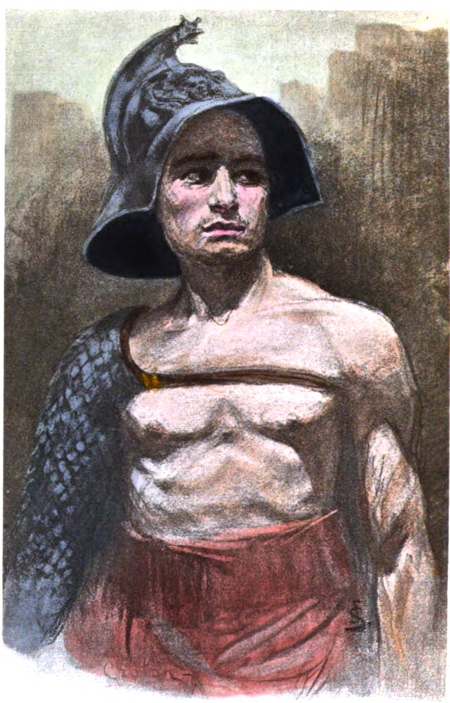
A Roman Gladiator. From a drawing by Jan Styka.
LIST OF ILLUSTRATIONS↩
- A Roman Gladiator. Frontispiece. From a drawing by Jan Styka.
- Obelisk of Theodosius, page 56. From a photograph.
- The Favourites of Honorius, p. 134. From a painting by J. W. Waterhouse, R.A.
- Armour of Gladiators, p. 160. Found at Ercolano, and now in the National Museum, Naples.
- The Pillage and Fire of Rome, p. 244. From a drawing by Jan Styka.
[V-1]
CHAPTER XXVII↩
Death of Gratian — Ruin of Arianism — St. Ambrose — First Civil War, against Maximus — Character, Administration, and Penance of Theodosius — Death of Valentinian II. — Second Civil War, against Eugenius — Death of Theodosius
The fame of Gratian, before he had accomplished the twentieth year of his age, was equal to that of the most celebrated princes. His gentle and amiable disposition endeared him to his private friends, the graceful affability of his manners engaged the affection of the people: the men of letters, who enjoyed the liberality, acknowledged the taste and eloquence, of their sovereign; his valour and dexterity in arms were equally applauded by the soldiers; and the clergy considered the humble piety of Gratian as the first and most useful of his virtues. The victory of Colmar had delivered the West from a formidable invasion; and the grateful provinces of the East ascribed the merits of Theodosius to the author of his greatness and of the public safety. Gratian survived those memorable events only four or five years; but he survived his reputation; and, before he fell a victim to rebellion, he had lost, in a great measure, the respect and confidence of the Roman world.
The remarkable alteration of his character or conduct may not be imputed to the arts of flattery which had besieged the [V-2] son of Valentinian from his infancy; nor to the headstrong passions which that gentle youth appears to have escaped. A more attentive view of the life of Gratian may perhaps suggest the true cause of the disappointment of the public hopes. His apparent virtues, instead of being the hardy productions of experience and adversity, were the premature and artificial fruits of a royal education. The anxious tenderness of his father was continually employed to bestow on him those advantages which he might perhaps esteem the more highly, as he himself had been deprived of them; and the most skilful masters of every science and of every art had laboured to form the mind and body of the young prince. [1] The knowledge which they painfully communicated was displayed with ostentation and celebrated with lavish praise. His soft and tractable disposition received the fair impression of their judicious precepts, and the absence of passion might easily be mistaken for the strength of reason. His preceptors gradually rose to the rank and consequence of ministers of state; [2] and, as they wisely dissembled their secret authority, he seemed to act with firmness, with propriety and with judgment, on the most important occasions of his life and reign. But the influence of this elaborate instruction did not penetrate beyond the surface; and the skilful preceptors, who so accurately guided the steps of their royal pupil, could not infuse into his feeble and indolent character the vigorous [V-3] and independent principle of action which renders the laborious pursuit of glory essentially necessary to the happiness, and almost to the existence, of the hero. As soon as time and accident had removed those faithful counsellors from the throne, the emperor of the West insensibly descended to the level of his natural genius; abandoned the reins of government to the ambitious hands which were stretched forwards to grasp them; and amused his leisure with the most frivolous gratifications. A public sale of favour and injustice was instituted, both in the court and in the provinces, by the worthless delegates of his power, whose merit it was made sacrilege to question. [3] The conscience of the credulous prince was directed by saints and bishops, [4] who procured an Imperial edict to punish as a capital offence, the violation, the neglect, or even the ignorance of the divine law. [5] Among the various arts which had exercised the youth of Gratian, he had applied himself with singular inclination and success to manage the horse, to draw the bow, and to dart the javelin; and these qualifications, which might be useful to a soldier, were prostituted to the viler purposes of hunting. Large parks were enclosed for the Imperial pleasures, and plentifully stocked with every species of wild beasts; and Gratian neglected the duties, and even the dignity, of his rank, to consume whole days in the vain display of his dexterity and boldness in the chase. The pride and wish of the Roman emperor to excel in an art in which he might be surpassed [V-4] by the meanest of his slaves reminded the numerous spectators of the examples of Nero and Commodus; but the chaste and temperate Gratian was a stranger to their monstrous vices; and his hands were stained only with the blood of animals. [6]
The behaviour of Gratian, which degraded his character in the eyes of mankind, could not have disturbed the security of his reign, if the army had not been provoked to resent their peculiar injuries. As long as the young emperor was guided by the instructions of his masters, he professed himself the friend and pupil of the soldiers; many of his hours were spent in the familiar conversation of the camp; and the health, the comforts, the rewards, the honours, of his faithful troops appeared to be the object of his attentive concern. But, after Gratian more freely indulged his prevailing taste for hunting and shooting, he naturally connected himself with the most dexterous ministers of his favourite amusement. A body of the Alani was received into the military and domestic service of the palace; and the admirable skill which they were accustomed to display in the unbounded plains of Scythia was exercised, on a more narrow theatre, in the parks and enclosures of Gaul. Gratian admired the talents and customs of these favourite guards, to whom alone he entrusted the defence of his person; and as if he meant to insult the public opinion, he frequently shewed himself to the soldiers and people, with the dress and arms, the long bow, the sounding quiver, and the fur garments of a Scythian warrior. The unworthy spectacle of a Roman prince who had renounced the dress and manners of his country filled the minds of the legions with grief and indignation. [7] Even the Germans, so [V-5] strong and formidable in the armies of the empire, affected to disdain the strange and horrid appearance of the savages of the North, who, in the space of a few years, had wandered from the banks of the Volga to those of the Seine. A loud and licentious murmur was echoed through the camps and garrisons of the West; and, as the mild indolence of Gratian neglected to extinguish the first symptoms of discontent, the want of love and respect was not supplied by the influence of fear. But the subversion of an established government is always a work of some real, and of much apparent, difficulty; and the throne of Gratian was protected by the sanctions of custom, law, religion, and the nice balance of the civil and military powers, which had been established by the policy of Constantine. It is not very important to inquire from what causes the revolt of Britain was produced. Accident is commonly the parent of disorder; the seed of rebellion happened to fall on a soil which was supposed to be more fruitful than any other in tyrants and usurpers; [8] the legions of that sequestered island had been long famous for a spirit of presumption and arrogance; [9] and the name of Maximus was proclaimed by the tumultuary but unanimous voice both of the soldiers and of the provincials. The emperor, or the rebel, for his title was not yet ascertained by fortune, was a native of Spain, the countryman, the fellow-soldier, and the rival of Theodosius, whose elevation he had not seen without some emotions of envy and resentment. The events of his life had long [V-6] since fixed him in Britain; and I should not be unwilling to find some evidence for the marriage which he is said to have contracted with the daughter of a wealthy lord of Caernarvonshire. [10] But this provincial rank might justly be considered as a state of exile and obscurity; and, if Maximus had obtained any civil or military office, he was not invested with the authority either of governor or general. [11] His abilities, and even his integrity, are acknowledged by the partial writers of the age; and the merit must indeed have been conspicuous, that could extort such a confession in favour of the vanquished enemy of Theodosius. The discontent of Maximus might incline him to censure the conduct of his sovereign, and to encourage, perhaps without any views of ambition, the murmurs of the troops. But in the midst of the tumult he artfully, or modestly, refused to ascend the throne; and some credit appears to have been given to his own positive declaration that he was compelled to accept the dangerous present of the Imperial purple. [12]
But there was a danger likewise in refusing the empire; and from the moment that Maximus had violated his aliegiance to his lawful sovereign, he could not hope to reign, or even to live, if he confined his moderate ambition within the narrow limits of Britain. He boldly and wisely resolved to prevent [V-7] the designs of Gratian; the youth of the island crowded to his standard, and he invaded Gaul with a fleet and army, which were long afterwards remembered as the emigration of a considerable part of the British nation. [13] The emperor, in his peaceful residence of Paris, was alarmed by their hostile approach; and the darts which he idly wasted on lions and bears might have been employed more honourably against the rebels. But his feeble efforts announced his degenerate spirit and desperate situation, and deprived him of the resources which he still might have found in the support of his subjects and allies. The armies of Gaul, instead of opposing the march of Maximus, received him with joyful and loyal acclamations; and the shame of the desertion was transferred from the people to the prince. The troops whose station more immediately attached them to the service of the palace abandoned the standard of Gratian the first time that it was displayed in the neighbourhood of Paris. The emperor of the West fled towards Lyons, with a train of only three hundred horse; and in the cities along the road, where he hoped to find a refuge, or at least a passage, he was taught, by cruel experience, that every gate is shut against the unfortunate. Yet he might still have reached in safety the dominions of his brother, and soon have returned with the forces of Italy and the East, if he had not suffered himself to be fatally deceived by the perfidious governor of the Lyonese province. Gratian was amused by protestations of doubtful fidelity and the hopes of a support which could not be effectual, till the arrival of Andragathius, the general of the cavalry of Maximus, put [V-8] an end to his suspense. That resolute officer executed without remorse the orders, or the intentions, of the usurper. Gratian, as he rose from supper, was delivered into the hands of the assassin; and his body was denied to the pious and pressing entreaties of his brother Valentinian. [14] The death of the emperor was followed by that of his powerful general Mellobaudes, the king of the Franks; who maintained, to the last moment of his life, the ambiguous reputation which is the just recompense of obscure and subtle policy. [15] These executions might be necessary to the public safety; but the successful usurper, whose power was acknowledged by all the provinces of the West, had the merit and the satisfaction of boasting that, except those who had perished by the chance of war, his triumph was not stained by the blood of the Romans. [16]
The events of this revolution had passed in such rapid succession that it would have been impossible for Theodosius to march to the relief of his benefactor, before he received the intelligence of his defeat and death. During the season of sincere grief, or ostentatious mourning, the Eastern emperor was interrupted by the arrival of the principal chamberlain of Maximus; and the choice of a venerable old man, for an [V-9] office which was usually exercised by eunuchs, announced to the court of Constantinople the gravity and temperance of the British usurper. The ambassador condescended to justify, or excuse, the conduct of his master, and to protest in specious language that the murder of Gratian had been perpetrated, without his knowledge or consent, by the precipitate zeal of the soldiers. But he proceeded, in a firm and equal tone, to offer Theodosius the alternative of peace or war. The speech of the ambassador concluded with a spirited declaration that, although Maximus, as a Roman and as the father of his people, would choose rather to employ his forces in the common defence of the republic, he was armed and prepared, if his friendship should be rejected, to dispute in a field of battle the empire of the world. An immediate and peremptory answer was required; but it was extremely difficult for Theodosius to satisfy, on this important occasion, either the feelings of his own mind or the expectations of the public. The imperious voice of honour and gratitude called aloud for revenge. From the liberality of Gratian he had received the Imperial diadem: his patience would encourage the odious suspicion that he was more deeply sensible of former injuries than of recent obligations; and, if he accepted the friendship, he must seem to share the guilt, of the assassin. Even the principles of justice and the interest of society would receive a fatal blow from the impunity of Maximus; and the example of successful usurpation would tend to dissolve the artificial fabric of government, and once more to replunge the empire in the crimes and calamities of the preceding age. But, as the sentiments of gratitude and honour should invariably regulate the conduct of an individual, they may be overbalanced in the mind of a sovereign by the sense of superior duties; and the maxims both of justice and humanity must permit the escape of an atrocious criminal, if an innocent people would be involved in the consequences of his punishment. The assassin of Gratian had usurped, but he actually possessed, the most warlike provinces of the [V-10] empire; the East was exhausted by the misfortunes, and even by the success, of the Gothic war; and it was seriously to be apprehended that, after the vital strength of the republic had been wasted in a doubtful and destructive contest, the feeble conqueror would remain an easy prey to the Barbarians of the North. These weighty considerations engaged Theodosius to dissemble his resentment and to accept the alliance of the tyrant. But he stipulated that Maximus should content himself with the possession of the countries beyond the Alps. The brother of Gratian was confirmed and secured in the sovereignty of Italy, Africa, and the Western Illyricum; and some honourable conditions were inserted in the treaty, to protect the memory and the laws of the deceased emperor. [17] According to the custom of the age, the images of the three Imperial colleagues were exhibited to the veneration of the people: nor should it be lightly supposed that, in the moment of a solemn reconciliation, Theodosius secretly cherished the intention of perfidy and revenge. [18]
The contempt of Gratian for the Roman soldiers had exposed him to the fatal effects of their resentment. His profound veneration for the Christian clergy was rewarded by the applause and gratitude of a powerful order, which has claimed, in every age, the privilege of dispensing honours both on earth and in heaven. [19] The orthodox bishops bewailed his death and their own irreparable loss; but they were soon comforted by the discovery that Gratian had committed the sceptre of the East to the hands of a prince whose humble faith and fervent zeal were supported by the spirit [V-11] and abilities of a more vigorous character. Among the benefactors of the church, the fame of Constantine has been rivalled by the glory of Theodosius. If Constantine had the advantage of erecting the standard of the cross, the emulation of his successor assumed the merit of subduing the Arian heresy and of abolishing the worship of idols in the Roman world. Theodosius was the first of the emperors baptised in the true faith of the Trinity. Although he was born of a Christian family, the maxims, or at least the practice, of the age encouraged him to delay the ceremony of his initiation; till he was admonished of the danger of delay by the serious illness which threatened his life towards the end of the first year of his reign. Before he again took the field against the Goths, he received the sacrament of baptism [20] from Acholius, the orthodox bishop of Thessalonica; [21] and, as the emperor ascended from the holy font, still glowing with the warm feelings of regeneration, he dictated a solemn edict, which proclaimed his own faith and prescribed the religion of his subjects. “It is our pleasure (such is the Imperial style) that all the nations which are governed by our clemency and moderation should steadfastly adhere to the religion which was taught by St. Peter to the Romans; which faithful tradition has preserved; and which is now professed by the pontiff Damasus, and by Peter, bishop of Alexandria, a man of apostolic holiness. According to the discipline of the apostles and the doctrine of the gospel, let us believe the sole deity of the Father, the Son, and the Holy Ghost; under an equal majesty and a pious Trinity. We authorise the followers of this doctrine to assume the title of Catholic Christians; [V-12] and, as we judge that all others are extravagant madmen, we brand them with the infamous name of Heretics; and declare that their conventicles shall no longer usurp the respectable appellation of churches. Besides the condemnation of Divine justice, they must expect to suffer the severe penalties which our authority, guided by heavenly wisdom, shall think proper to inflict upon them.” [22] The faith of a soldier is commonly the fruit of instruction rather than of inquiry; but, as the emperor always fixed his eyes on the visible land-marks of orthodoxy, which he had so prudently constituted, his religious opinions were never affected by the specious texts, the subtle arguments, and the ambiguous creeds of the Arian doctors. Once indeed he expressed a faint inclination to converse with the eloquent and learned Eunomius, who lived in retirement at a small distance from Constantinople. [22a] But the dangerous interview was prevented by the prayers of the empress Flaccilla, who trembled for the salvation of her husband; and the mind of Theodosius was confirmed by a theological argument, adapted to the rudest capacity. He had lately bestowed on his eldest son Arcadius the name and honours of Augustus; and the two princes were seated on a stately throne to receive the homage of their subjects. A bishop, Amphilochius of Iconium, approached the throne, and, after saluting with due reverence the person of his sovereign, he accosted the royal youth with the same familiar tenderness which he might have used towards a plebeian child. Provoked by this insolent behaviour, the monarch gave orders that the rustic priest should be instantly driven from his presence. But, while the guards were forcing him to the door, the dexterous polemic had time to execute his design, by exclaiming with a loud voice, “Such is the treatment, O emperor! which the King of heaven has [V-13] prepared for those impious men who affect to worship the Father but refuse to acknowledge the equal majesty of his divine Son.” Theodosius immediately embraced the bishop of Iconium, and never forgot the important lesson which he had received from this dramatic parable. [23]
Constantinople was the principal seat and fortress of Arianism; and, in a long interval of forty years, [24] the faith of the princes and prelates who reigned in the capital of the East was rejected in the purer schools of Rome and Alexandria. The archiepiscopal throne of Macedonius, which had been polluted with so much Christian blood, was successively filled by Eudoxus and Damophilus. Their diocese enjoyed a free importation of vice and error from every province of the empire; the eager pursuit of religious controversy afforded a new occupation to the busy idleness of the metropolis; and we may credit the assertion of an intelligent observer, who describes, with some pleasantry, the effects of their loquacious zeal. “This city,” says he, “is full of mechanics and slaves, who are all of them profound theologians, and preach in the shops and in the streets. If you desire a man to change a piece of silver, he informs you wherein the Son differs from the Father; if you ask the price of a loaf, you are told by way of reply that the Son is inferior to the Father; and, if you enquire whether the bath is ready, the answer is that the Son was made out of nothing.” [25] The heretics of various [V-14] denominations subsisted in peace under the protection of the Arians of Constantinople; who endeavoured to secure the attachment of those obscure sectaries; while they abused, with unrelenting severity, the victory which they had obtained over the followers of the council of Nice. During the partial reigns of Constantius and Valens, the feeble remnant of the Homoousians was deprived of the public and private exercise of their religion; and it has been observed, in pathetic language, that the scattered flock was left without a shepherd, to wander on the mountains, or to be devoured by rapacious wolves. [26] But, as their zeal, instead of being subdued, derived strength and vigour from oppression, they seized the first moments of imperfect freedom, which they acquired by the death of Valens, to form themselves into a regular congregation under the conduct of an episcopal pastor. Two natives of Cappadocia, Basil and Gregory Nazianzen, [27] were distinguished above all their contemporaries [28] by the rare union of profane eloquence and of orthodox piety. These orators, who might sometimes be compared, by themselves and by the public, to the most celebrated of the ancient Greeks, were united by the ties of the strictest friendship. They had cultivated, with equal ardour, the same liberal studies in the schools of Athens; they had retired, with equal devotion, to the same solitude in the deserts of Pontus; and [V-15] every spark of emulation, or envy, appeared to be totally extinguished in the holy and ingenuous breasts of Gregory and Basil. But the exaltation of Basil, from a private life to the archiepiscopal throne of Cæsarea, discovered to the world, and perhaps to himself, the pride of his character; and the first favour which he condescended to bestow on his friend was received, and perhaps was intended, as a cruel insult. [29] Instead of employing the superior talents of Gregory in some useful and conspicuous station, the haughty prelate selected, among the fifty bishoprics of his extensive province, the wretched village of Sasima, [30] without water, without verdure, without society, situate at the junction of three highways, and frequented only by the incessant passage of rude and clamorous waggoners. Gregory submitted with reluctance to this humiliating exile; he was ordained bishop of Sasima; but he solemnly protests that he never consummated his spiritual marriage with this disgusting bride. He afterwards consented to undertake the government of his native church of Nazianzus, [31] of which his father had been [V-16] bishop above five-and-forty years. But, as he was still conscious that he deserved another audience and another theatre, he accepted, with no unworthy ambition, the honourable invitation which was addressed to him from the orthodox party of Constantinople. On his arrival in the capital, Gregory was entertained in the house of a pious and charitable kinsman; the most spacious room was consecrated to the uses of religious worship; and the name of Anastasia was chosen to express the resurrection of the Nicene faith. This private conventicle was afterwards converted into a magnificent church; and the credulity of the succeeding age was prepared to believe the miracles and visions, which attested the presence, or at least the protection, of the Mother of God. [32] The pulpit of the Anastasia was the scene of the labours and triumphs of Gregory Nazianzen; and, in the space of two years, he experienced all the spiritual adventures which constitute the prosperous or adverse fortunes of a missionary. [33] The Arians, who were provoked by the boldness of his enterprise, represented his doctrine as if he had preached three distinct and equal Deities; and the devout populace was excited to suppress, by violence and tumult, the irregular assemblies of the Athanasian heretics. From the cathedral of St. Sophia there issued a motley crowd “of common beggars, who had forfeited their claim to pity; of monks, who had the appearance of goats or satyrs; and of [V-17] women, more terrible than so many Jezebels.” The doors of the Anastasia were broke open; much mischief was perpetrated, or attempted, with sticks, stones, and firebrands; and, as a man lost his life in the affray, Gregory, who was summoned the next morning before the magistrate, had the satisfaction of supposing that he publicly confessed the name of Christ. After he was delivered from the fear and danger of a foreign enemy, his infant church was disgraced and distracted by intestine faction. A stranger who assumed the name of Maximus [34] and the cloak of a Cynic philosopher, insinuated himself into the confidence of Gregory; deceived and abused his favourable opinion; and, forming a secret connection with some bishops of Egypt, attempted by a clandestine ordination to supplant his patron in the episcopal seat of Constantinople. These mortifications might sometimes tempt the Cappadocian missionary to regret his obscure solitude. But his fatigues were rewarded by the daily increase of his fame and his congregation; and he enjoyed the pleasure of observing that the greater part of his numerous audience retired from his sermons satisfied with the eloquence of the preacher [35] or dissatisfied with the manifold imperfections of their faith and practice. [36]
The Catholics of Constantinople were animated with joyful confidence by the baptism and edict of Theodosius; and they impatiently waited the effects of his gracious [V-18] promise. Their hopes were speedily accomplished; and the emperor, as soon as he had finished the operations of the campaign, made his public entry into the capital at the head of a victorious army. The next day after his arrival, he summoned Damophilus to his presence, and offered that Arian prelate the hard alternative of subscribing the Nicene creed, or of instantly resigning, to the orthodox believers, the use and possession of the episcopal palace, the cathedral of St. Sophia, and all the churches of Constantinople. The zeal of Damophilus, which in a Catholic saint would have been justly applauded, embraced, without hesitation, a life of poverty and exile, [37] and his removal was immediately followed by the purification of the Imperial City. The Arians might complain, with some appearance of justice, that an inconsiderable congregation of sectaries should usurp the hundred churches, which they were insufficient to fill; whilst the far greater part of the people was cruelly excluded from every place of religious worship. Theodosius was still inexorable: but, as the angels who protected the Catholic cause were only visible to the eyes of faith, he prudently reinforced those heavenly legions with the more effectual aid of temporal and carnal weapons; and the church of St. Sophia [38] was occupied by a large body of the Imperial guards. If the mind of Gregory was susceptible of pride, he must have felt a very lively satisfaction, when the emperor conducted him through the streets in solemn triumph; and, with his own hand, respectfully placed him on the archiepiscopal throne of Constantinople. But the saint [V-19] (who had not subdued the imperfections of human virtue) was deeply affected by the mortifying consideration that his entrance into the fold was that of a wolf, rather than of a shepherd; that the glittering arms, which surrounded his person, were necessary for his safety; and that he alone was the object of the imprecations of a great party, whom, as men and citizens, it was impossible for him to despise. He beheld the innumerable multitude, of either sex and of every age, who crowded the streets, the windows, and the roofs of the houses; he heard the tumultuous voice of rage, grief, astonishment, and despair; and Gregory fairly confesses that, on the memorable day of his installation, the capital of the East wore the appearance of a city taken by storm, and in the hands of a Barbarian conqueror. [39] About six weeks afterwards, Theodosius declared his resolution of expelling, from all the churches of his dominions, the bishops and their clergy who should obstinately refuse to believe, or at least to profess, the doctrine of the council of Nice. His lieutenant Sapor was armed with the ample powers of a general law, a special commission, and a military force; [40] and this ecclesiastical revolution was conducted with so much discretion and vigour that the religion of the emperor was established, without tumult or bloodshed, in all the provinces of the East. The writings of the Arians, if they had been permitted to exist, [41] would perhaps contain the lamentable story of the persecution which afflicted the church under the reign of the [V-20] impious Theodosius; and the sufferings of their holy confessors might claim the pity of the disinterested reader. Yet there is reason to imagine that the violence of zeal and revenge was, in some measure, eluded by the want of resistance; and that, in their adversity, the Arians displayed much less firmness than had been exerted by the orthodox party under the reigns of Constantius and Valens. The moral character and conduct of the hostile sects appear to have been governed by the same common principles of nature and religion; but a very material circumstance may be discovered, which tended to distinguish the degrees of their theological faith. Both parties in the schools, as well as in the temples, acknowledged and worshipped the divine majesty of Christ; and, as we are always prone to impute our own sentiments and passions to the Deity, it would be deemed more prudent and respectful to exaggerate, than to circumscribe, the adorable perfections of the Son of God. The disciple of Athanasius exulted in the proud confidence that he had entitled himself to the divine favour; while the follower of Arius must have been tormented by the secret apprehension that he was guilty, perhaps, of an unpardonable offence, by the scanty praise, and parsimonious honours, which he bestowed on the Judge of the World. The opinions of Arianism might satisfy a cold and speculative mind; but the doctrine of the Nicene Creed, most powerfully recommended by the merits of faith and devotion, was much better adapted to become popular and successful in a believing age.
The hope that truth and wisdom would be found in the assemblies of the orthodox clergy induced the emperor to convene, at Constantinople, a synod of one hundred and fifty bishops, who proceeded, without much difficulty or delay, to complete the theological system which had been established in the council of Nice. The vehement disputes of the fourth century had been chiefly employed on the nature of the Son of God; and the various opinions, which were embraced concerning the Second, were extended and transferred, by a natural [V-21] analogy, to the Third, person of the Trinity. [42] Yet it was found, or it was thought, necessary, by the victorious adversaries of Arianism, to explain the ambiguous language of some respectable doctors; to confirm the faith of the Catholics; and to condemn an unpopular and inconsistent sect of Macedonians, who freely admitted that the Son was consubstantial to the Father, while they were fearful of seeming to acknowledge the existence of Three Gods. A final and unanimous sentence was pronounced to ratify the equal Deity of the Holy Ghost; the mysterious doctrine has been received by all the nations and all the churches of the Christian world; and their grateful reverence has assigned to the bishops of Theodosius the second rank among the general councils. [43] Their knowledge of religious truth may have been preserved by tradition, or it may have been communicated by inspiration; but the sober evidence of history will not allow much weight to the personal authority of the fathers of Constantinople. In an age when the ecclesiastics had scandalously degenerated from the model of apostolical purity, the most worthless and corrupt were always the most eager to frequent, and disturb, the episcopal assemblies. The conflict and fermentation of so many opposite interests and tempers inflamed the passions of the bishops; and their ruling passions were the love of gold and the love of dispute. Many of the same prelates [V-22] who now applauded the orthodox piety of Theodosius had repeatedly changed, with prudent flexibility, their creeds and opinions; and in the various revolutions of the church and state, the religion of their sovereign was the rule of their obsequious faith. When the emperor suspended his prevailing influence, the turbulent synod was blindly impelled by the absurd or selfish motives of pride, hatred, and resentment. The death of Meletius, which happened at the council of Constantinople, presented the most favourable opportunity of terminating the schism of Antioch, by suffering his aged rival, Paulinus, peaceably to end his days in the episcopal chair. The faith and virtues of Paulinus were unblemished. But his cause was supported by the Western churches; and the bishops of the synod resolved to perpetuate the mischiefs of discord by the hasty ordination of a perjured candidate, [44] rather than to betray the imagined dignity of the East, which had been illustrated by the birth and death of the Son of God. Such unjust and disorderly proceedings forced the gravest members of the assembly to dissent and to secede; and the clamorous majority, which remained masters of the field of battle, could be compared only to wasps or magpies, to a flight of cranes, or to a flock of geese. [45]
A suspicion may possibly arise that so unfavourable a picture of ecclesiastical synods has been drawn by the partial hand of some obstinate heretic or some malicious infidel. [V-23] But the name of the sincere historian who has conveyed this instructive lesson to the knowledge of posterity must silence the impotent murmurs of superstition and bigotry. He was one of the most pious and eloquent bishops of the age; a saint and a doctor of the church; the scourge of Arianism, and the pillar of the orthodox faith; a distinguished member of the council of Constantinople, in which, after the death of Meletius, he exercised the functions of president: in a word — Gregory Nazianzen himself. The harsh and ungenerous treatment which he experienced, [46] instead of derogating from the truth of his evidence, affords an additional proof of the spirit which actuated the deliberations of the synod. Their unanimous suffrage had confirmed the pretensions which the bishop of Constantinople derived from the choice of the people and the approbation of the emperor. But Gregory soon became the victim of malice and envy. The bishops of the East, his strenuous adherents, provoked by his moderation in the affairs of Antioch, abandoned him, without support, to the adverse faction of the Egyptians; who disputed the validity of his election, and rigorously asserted the obsolete canon that prohibited the licentious practice of episcopal translations. The pride, or the humility, of Gregory prompted him to decline a contest which might have been imputed to ambition and avarice; and he publicly offered, not without some mixture of indignation, to renounce the government of a church which had been restored, and almost created, by his labours. His resignation was accepted by the synod, and by the emperor, with more readiness than he seems to have expected. At the time, when he might have hoped to enjoy the fruits of his victory, his episcopal throne was filled by the senator [V-24] Nectarius; and the new archbishop, accidentally recommended by his easy temper and venerable aspect, was obliged to delay the ceremony of his consecration, till he had previously despatched the rites of his baptism. [47] After this remarkable experience of the ingratitude of princes and prelates, Gregory retired once more to his obscure solitude of Cappadocia; where he employed the remainder of his life, about eight years, in the exercises of poetry and devotion. The title of Saint has been added to his name; but the tenderness of his heart [48] and the elegance of his genius reflect a more pleasing lustre on the memory of Gregory Nazianzen.
It was not enough that Theodosius had suppressed the insolent reign of Arianism, or that he had abundantly revenged the injuries which the Catholics sustained from the zeal of Constantius and Valens. The orthodox emperor considered every heretic as a rebel against the supreme powers of heaven, and of earth; and each of those powers might exercise their peculiar jurisdiction over the soul and body of the guilty. The decrees of the council of Constantinople had ascertained the true standard of the faith; and the ecclesiastics who governed the conscience of Theodosius suggested the most effectual methods of persecution. In the space of fifteen years, he promulgated at least fifteen severe edicts against the heretics; [49] more especially against [V-25] those who rejected the doctrine of the Trinity; and to deprive them of every hope of escape, he sternly enacted that, if any laws or rescripts should be alleged in their favour, the judges should consider them as the illegal productions either of fraud or forgery. The penal statutes were directed against the ministers, the assemblies, and the persons of the heretics; and the passions of the legislator were expressed in the language of declamation and invective. I. The heretical teachers, who usurped the sacred titles of Bishops or Presbyters, were not only excluded from the privileges and emoluments so liberally granted to the orthodox clergy, but they were exposed to the heavy penalties of exile and confiscation, if they presumed to preach the doctrine, or to practise the rites, of their accursed sects. A fine of ten pounds of gold (above four hundred pounds sterling) was imposed on every person who should dare to confer, or receive, or promote an heretical ordination: and it was reasonably expected that, if the race of pastors could be extinguished, their helpless flocks would be compelled by ignorance and hunger to return within the pale of the Catholic church. II. The rigorous prohibition of conventicles was carefully extended to every possible circumstance in which the heretics could assemble with the intention of worshipping God and Christ according to the dictates of their conscience. Their religious meetings, whether public or secret, by day or by night, in cities or in the country, were equally proscribed by the edicts of Theodosius; and the building or ground which had been used for that illegal purpose was forfeited to the Imperial domain. III. It was supposed that the error of the heretics could proceed only from the obstinate temper of their minds; and that such a temper was a fit object of censure and punishment. The anathemas of the church were fortified by a sort of civil excommunication, which separated them from their fellow-citizens by a peculiar brand of infamy; and this declaration of the supreme magistrate tended to justify, or at least to excuse, the insults of a fanatic populace. The sectaries were gradually disqualified [V-26] for the possession of honourable or lucrative employments; and Theodosius was satisfied with his own justice, when he decreed that, as the Eunomians distinguished the nature of the Son from that of the Father, they should be incapable of making their wills or of receiving any advantage from testamentary donations. The guilt of the Manichæan heresy was esteemed of such magnitude that it could be expiated only by the death of the offender; and the same capital punishment was inflicted on the Audians, or Quartodecimans, [50] who should dare to perpetrate the atrocious crime of celebrating, on an improper day, the festival of Easter. Every Roman might exercise the right of public accusation; but the office of Inquisitors of the Faith, a name so deservedly abhorred, was first instituted under the reign of Theodosius. Yet we are assured that the execution of his penal edicts was seldom enforced; and that the pious emperor appeared less desirous to punish than to reclaim, or terrify, his refractory subjects. [51]
The theory of persecution was established by Theodosius, whose justice and piety have been applauded by the saints; but the practice of it, in the fullest extent, was reserved for his rival and colleague Maximus, the first, among the Christian princes, who shed the blood of his Christian subjects on account of their religious opinions. The cause of the Priscillianists, [52] a recent sect of heretics, who disturbed the provinces [V-27] of Spain, was transferred, by appeal, from the synod of Bourdeaux to the Imperial consistory of Treves; and, by the sentence of the Prætorian prefect, seven persons were tortured, condemned, and executed. The first of these was Priscillian [53] himself, bishop of Avila, [54] in Spain; who adorned the advantages of birth and fortune by the accomplishments of eloquence and learning. Two presbyters and two deacons accompanied their beloved master in his death, which they esteemed as a glorious martyrdom; and the number of religious victims was completed by the execution of Latronian, a poet, who rivalled the fame of the ancients; and of Euchrocia, a noble matron of Bourdeaux, the widow of the orator Delphidius. [55] Two bishops, who had embraced the sentiments of Priscillian, were condemned to a distant and dreary exile; [56] and some indulgence was shown to the meaner criminals who assumed the merit of an early repentance. [V-28] If any credit could be allowed to confessions extorted by fear or pain, and to vague reports, the offspring of malice and credulity, the heresy of the Priscillianists would be found to include the various abominations of magic, of impiety, and of lewdness. [57] Priscillian, who wandered about the world in the company of his spiritual sisters, was accused of praying stark naked in the midst of the congregation; and it was confidently asserted that the effects of his criminal intercourse with the daughter of Euchrocia had been suppressed by means still more odious and criminal. But an accurate, or rather a candid, inquiry will discover that, if the Priscillianists violated the laws of nature, it was not by the licentiousness, but by the austerity, of their lives. They absolutely condemned the use of the marriage-bed; and the peace of families was often disturbed by indiscreet separations. They enjoined, or recommended, a total abstinence from all animal food; and their continual prayers, fasts, and vigils inculcated a rule of strict and perfect devotion. The speculative tenets of the sect, concerning the person of Christ and the nature of the human soul, were derived from the Gnostic and Manichæan system; and this vain philosophy, which had been transported from Egypt to Spain, was ill adapted to the grosser spirits of the West. The obscure disciples of Priscillian suffered, languished, and gradually disappeared: his tenets were rejected by the clergy and people, but his death was the subject of a long and vehement controversy; while some arraigned, and others applauded, the justice of his sentence. It is with pleasure that we can observe the humane inconsistency of the most illustrious saints and bishops, Ambrose of Milan, [58] and Martin of Tours; [59] who, [V-29] on this occasion, asserted the cause of toleration. They pitied the unhappy men, who had been executed at Treves; they refused to hold communication with their episcopal murderers; and, if Martin deviated from that generous resolution, his motives were laudable, and his repentance was exemplary. The bishops of Tours and Milan pronounced, without hesitation, the eternal damnation of heretics; but they were surprised, and shocked, by the bloody image of their temporal death, and the honest feelings of nature resisted the artificial prejudices of theology. The humanity of Ambrose and Martin was confirmed by the scandalous irregularity of the proceedings against Priscillian and his adherents. The civil and ecclesiastical ministers had transgressed the limits of their respective provinces. The secular judge had presumed to receive an appeal, and to pronounce a definitive sentence, in a matter of faith and episcopal jurisdiction. The bishops had disgraced themselves by exercising the function of accusers in a criminal prosecution. The cruelty of Ithacius, [60] who beheld the tortures, and solicited the death, of the heretics, provoked the just indignation of mankind; and the vices of that profligate bishop were admitted as a proof that his zeal was instigated by the sordid motives of interest. Since the death of Priscillian, the rude attempts of persecution have been refined and methodised in the holy office, which assigns their distinct parts to the ecclesiastical and secular powers. The devoted victim is regularly delivered by the priest to the magistrate, and by the magistrate to the executioner; and the inexorable sentence of the church, which declares the spiritual guilt of the offender, is expressed in the mild language of pity and intercession.
Among the ecclesiastics, who illustrated the reign of Theodosius, [V-30] Gregory Nazianzen was distinguished by the talents of an eloquent preacher; the reputation of miraculous gifts added weight and dignity to the monastic virtues of Martin of Tours; [61] but the palm of episcopal vigour and ability was justly claimed by the intrepid Ambrose. [62] He was descended from a noble family of Romans; his father had exercised the important office of Prætorian prefect of Gaul; and the son, after passing through the studies of a liberal education, attained, in the regular gradation of civil honours, the station of consular of Liguria, a province which included the Imperial residence of Milan. At the age of thirty-four, and before he had received the sacrament of baptism, Ambrose, to his own surprise, and to that of the world, was suddenly transformed from a governor to an archbishop. Without the least mixture, as it is said, of art or intrigue, the whole body of the people unanimously saluted him with the episcopal title; the concord and perseverance of their acclamations were ascribed to a preternatural impulse; and the reluctant magistrate was compelled to undertake a spiritual office, for which he was not prepared by the habits and occupations of his former life. But the active force of his genius soon qualified him to exercise, with zeal and prudence, the duties of his ecclesiastical jurisdiction; and, while he cheerfully renounced the vain and splendid trappings of temporal greatness, he condescended, for the good of the church, to direct the conscience of the emperors and to control the administration of the empire. Gratian loved and revered him as a father; and the elaborate treatise on the faith of the Trinity was designed for [V-31] the instruction of the young prince. After his tragic death, at a time when the empress Justina trembled for her own safety and for that of her son Valentinian, the archbishop of Milan was despatched, on two different embassies, to the court of Treves. He exercised, with equal firmness and dexterity, the powers of his spiritual and political characters; and perhaps contributed, by his authority and eloquence, to check the ambition of Maximus and to protect the peace of Italy. [63] Ambrose had devoted his life and his abilities to the service of the church. Wealth was the object of his contempt; he had renounced his private patrimony; and he sold, without hesitation, the consecrated plate for the redemption of captives. The clergy and people of Milan were attached to their archbishop; and he deserved the esteem, without soliciting the favour or apprehending the displeasure, of his feeble sovereigns.
The government of Italy, and of the young emperor, naturally devolved to his mother Justina, a woman of beauty and spirit, but who, in the midst of an orthodox people, had the misfortune of professing the Arian heresy, which she endeavoured to instil into the mind of her son. Justina was persuaded that a Roman emperor might claim, in his own dominions, the public exercise of his religion; and she proposed to the archbishop, as a moderate and reasonable concession, that he should resign the use of a single church, either in the city or suburbs of Milan. But the conduct of Ambrose was governed by very different principles. [64] The palaces of the earth might indeed belong to Cæsar; but the churches were the houses of God; and, within the limits of his diocese, he himself, as the lawful successor of the [V-32] apostles, was the only minister of God. The privileges of Christianity, temporal as well as spiritual, were confined to the true believers; and the mind of Ambrose was satisfied that his own theological opinions were the standard of truth and orthodoxy. The archbishop, who refused to hold any conference or negotiation with the instruments of Satan, declared, with modest firmness, his resolution to die a martyr rather than to yield to the impious sacrilege; and Justina, who resented the refusal as an act of insolence and rebellion, hastily determined to exert the Imperial prerogative of her son. As she desired to perform her public devotions on the approaching festival of Easter, Ambrose was ordered to appear before the council. He obeyed the summons with the respect of a faithful subject, but he was followed, without his consent, by an innumerable people: they pressed, with impetuous zeal, against the gates of the palace; and the affrighted ministers of Valentinian, instead of pronouncing a sentence of exile on the archbishop of Milan, humbly requested that he would interpose his authority, to protect the person of the emperor and to restore the tranquillity of the capital. But the promises which Ambrose received and communicated were soon violated by a perfidious court, and during six of the most solemn days which Christian piety has set apart for the exercise of religion the city was agitated by the irregular convulsions of tumult and fanaticism. The officers of the household were directed to prepare, first the Porcian, and afterwards the new Basilica, for the immediate reception of the emperor and his mother. The splendid canopy and hangings of the royal seat were arranged in the customary manner; but it was found necessary to defend them, by a strong guard, from the insults of the populace. The Arian ecclesiastics who ventured to shew themselves in the streets were exposed to the most imminent danger of their lives; and Ambrose enjoyed the merit and reputation of rescuing his personal enemies from the hands of the enraged multitude.
But, while he laboured to restrain the effects of their zeal, [V-33] the pathetic vehemence of his sermons continually inflamed the angry and seditious temper of the people of Milan. The characters of Eve, of the wife of Job, of Jezebel, of Herodias, were indecently applied to the mother of the emperor; and her desire to obtain a church for the Arians was compared to the most cruel persecutions which Christianity had endured under the reign of Paganism. The measures of the court served only to expose the magnitude of the evil. A fine of two hundred pounds of gold was imposed on the corporate body of merchants and manufacturers: an order was signified, in the name of the emperor, to all the officers, and inferior servants, of the courts of justice, that, during the continuance of the public disorders, they should strictly confine themselves to their houses: and the ministers of Valentinian imprudently confessed that the most respectable part of the citizens of Milan was attached to the cause of their archbishop. He was again solicited to restore peace to his country, by a timely compliance with the will of his sovereign. The reply of Ambrose was couched in the most humble and respectful terms, which might, however, be interpreted as a serious declaration of civil war. “His life and fortune were in the hands of the emperor; but he would never betray the church of Christ or degrade the dignity of the episcopal character. In such a cause, he was prepared to suffer whatever the malice of the demon could inflict; and he only wished to die in the presence of his faithful flock, and at the foot of the altar; he had not contributed to excite, but it was in the power of God alone to appease, the rage of the people: he deprecated the scenes of blood and confusion which were likely to ensue; and it was his fervent prayer that he might not survive to behold the ruin of a flourishing city and perhaps the desolation of all Italy.” [65] The obstinate bigotry of Justina [V-34] would have endangered the empire of her son, if, in this contest with the church and people of Milan, she could have depended on the active obedience of the troops of the palace. A large body of Goths had marched to occupy the Basilica which was the object of the dispute: and it might be expected from the Arian principles and barbarous manners of these foreign mercenaries that they would not entertain any scruples in the execution of the most sanguinary orders. They were encountered, on the sacred threshold, by the archbishop, who, thundering against them a sentence of excommunication, asked them, in the tone of a father and a master, Whether it was to invade the house of God that they had implored the hospitable protection of the republic? The suspense of the Barbarians allowed some hours for a more effectual negotiation; and the empress was persuaded, by the advice of her wisest counsellors, to leave the Catholics in possession of all the churches of Milan; and to dissemble, till a more convenient season, her intentions of revenge. The mother of Valentinian could never forgive the triumph of Ambrose; and the royal youth uttered a passionate exclamation that his own servants were ready to betray him into the hands of an insolent priest.
The laws of the empire, some of which were inscribed with the name of Valentinian, still condemned the Arian heresy, and seemed to excuse the resistance of the Catholics. By the influence of Justina an edict of toleration was promulgated in all the provinces which were subject to the court of Milan; the free exercise of their religion was granted to those who professed the faith of Rimini; and the emperor declared that all persons who should infringe this sacred and salutary constitution should be capitally punished as the enemies of the public peace. [66] The character and language of the archbishop of Milan may justify the suspicion that his conduct [V-35] soon afforded a reasonable ground, or at least a specious pretence, to the Arian ministers, who watched the opportunity of surprising him in some act of disobedience to a law which he strangely represents as a law of blood and tyranny. A sentence of easy and honourable banishment was pronounced, which enjoined Ambrose to depart from Milan without delay; whilst it permitted him to choose the place of his exile and the number of his companions. But the authority of the saints who have preached and practised the maxims of passive loyalty appeared to Ambrose of less moment than the extreme and pressing danger of the church. He boldly refused to obey; and his refusal was supported by the unanimous consent of his faithful people. [67] They guarded by turns the person of their archbishop; the gates of the cathedral and the episcopal palace were strongly secured; and the Imperial troops, who had formed the blockade, were unwilling to risk the attack, of that impregnable fortress. The numerous poor, who had been relieved by the liberality of Ambrose, embraced the fair occasion of signalising their zeal and gratitude; and, as the patience of the multitude might have been exhausted by the length and uniformity of nocturnal vigils, he prudently introduced into the church of Milan the useful institution of a loud and regular psalmody. While he maintained this arduous contest, he was instructed by a dream to open the earth in a place where the remains of two martyrs, Gervasius and Protasius, [68] had been deposited above three hundred years. Immediately under the pavement of the church two perfect skeletons were found, [69] with the heads [V-36] separated from their bodies, and a plentiful effusion of blood. The holy relics were presented, in solemn pomp, to the veneration of the people; and every circumstance of this fortunate discovery was admirably adapted to promote the designs of Ambrose. The bones of the martyrs, their blood, their garments, were supposed to contain a healing power; and their preternatural influence was communicated to the most distant objects, without losing any part of its original virtue. The extraordinary cure of a blind man, [70] and the reluctant confessions of several demoniacs, appeared to justify the faith and sanctity of Ambrose; and the truth of those miracles is attested by Ambrose himself, by his secretary Paulinus, and by his proselyte, the celebrated Augustin, who, at that time, professed the art of rhetoric in Milan. The reason of the present age may possibly approve the incredulity of Justina and her Arian court; who derided the theatrical representations which were exhibited by the contrivance, and at the expense, of the archbishop. [71] Their effect, however, on the minds of the people was rapid and irresistible; and the feeble sovereign of Italy found himself unable to contend with the favourite of heaven. The powers likewise of the earth interposed in the defence of Ambrose; the disinterested advice of Theodosius was the general result of piety and friendship; and the mask of religious zeal concealed the hostile and ambitious designs of the tyrant of Gaul. [72]
[V-37]
The reign of Maximus might have ended in peace and prosperity, could he have contented himself with the possession of three ample countries, which now constitute the three most flourishing kingdoms of modern Europe. But the aspiring usurper, whose sordid ambition was not dignified by the love of glory and of arms, considered his actual forces as the instruments only of his future greatness, and his success was the immediate cause of his destruction. The wealth which he extorted [73] from the oppressed provinces of Gaul, Spain, and Britain was employed in levying and maintaining a formidable army of Barbarians, collected, for the most part, from the fiercest nations of Germany. The conquest of Italy was the object of his hopes and preparations; and he secretly meditated the ruin of an innocent youth, whose government was abhorred and despised by his Catholic subjects. But, as Maximus wished to occupy, without resistance, the passes of the Alps, he received, with perfidious smiles, Domninus of Syria, the ambassador of Valentinian, and pressed him to accept the aid of a considerable body of troops for the service of a Pannonian war. The penetration of Ambrose had discovered the snares of an enemy under the professions of friendship; [74] but the Syrian Domninus was corrupted, or deceived, by the liberal favour of the court of Treves; and the council of Milan obstinately rejected the suspicion of danger, with a blind confidence which was the effect, not of courage, but of fear. The march of the auxiliaries was guided by the ambassador; and they were admitted, without distrust, into the fortresses of the Alps. But the crafty tyrant followed, with hasty and silent footsteps, in the rear; [V-38] and, as he diligently intercepted all intelligence of his motions, the gleam of armour and the dust excited by the troops of cavalry first announced the hostile approach of a stranger to the gates of Milan. In this extremity, Justina and her son might accuse their own imprudence and the perfidious arts of Maximus; but they wanted time, and force and resolution to stand against the Gauls and Germans, either in the field or within the walls of a large and disaffected city. Flight was their only hope, Aquileia their only refuge; and, as Maximus now displayed his genuine character, the brother of Gratian might expect the same fate from the hands of the same assassin. Maximus entered Milan in triumph; and, if the wise archbishop refused a dangerous and criminal connection with the usurper, he might indirectly contribute to the success of his arms by inculcating, from the pulpit, the duty of resignation rather than that of resistance. [75] The unfortunate Justina reached Aquileia in safety; but she distrusted the strength of the fortifications; she dreaded the event of a siege; and she resolved to implore the protection of the great Theodosius, whose power and virtue were celebrated in all the countries of the West. A vessel was secretly provided to transport the Imperial family; they embarked with precipitation in one of the obscure harbours of Venetia or Istria; traversed the whole extent of the Hadriatic and Ionian seas; turned the extreme promontory of Peloponnesus; and, after a long but successful navigation, reposed themselves in the port of Thessalonica. All the subjects of Valentinian deserted the cause of a prince who, by his abdication, had absolved them from the duty of allegiance; and, if the little city of Æmona, on the verge of Italy, had not presumed to stop the career of his inglorious victory, Maximus would have obtained, without a struggle, the sole possession of the Western empire.
[V-39]
Instead of inviting his royal guests to the palace of Constantinople, Theodosius had some unknown reasons to fix their residence at Thessalonica; but these reasons did not proceed from contempt or indifference, as he speedily made a visit to that city, accompanied by the greatest part of his court and senate. After the first tender expressions of friendship and sympathy, the pious emperor of the East gently admonished Justina that the guilt of heresy was sometimes punished in this world as well as in the next; and that the public profession of the Nicene faith would be the most efficacious step to promote the restoration of her son, by the satisfaction which it must occasion both on earth and in heaven. The momentous question of peace or war was referred, by Theodosius, to the deliberation of his council; and the arguments which might be alleged on the side of honour and justice had acquired, since the death of Gratian, a considerable degree of additional weight. The persecution of the Imperial family, to which Theodosius himself had been indebted for his fortune, was now aggravated by recent and repeated injuries. Neither oaths nor treaties could restrain the boundless ambition of Maximus; and the delay of vigorous and decisive measures, instead of prolonging the blessings of peace, would expose the Eastern empire to the danger of an hostile invasion. The Barbarians, who had passed the Danube, had lately assumed the character of soldiers and subjects, but their native fierceness was yet untamed; and the operations of a war which would exercise their valour and diminish their numbers might tend to relieve the provinces from an intolerable oppression. Notwithstanding these specious and solid reasons, which were approved by a majority of the council, Theodosius still hesitated whether he should draw the sword in a contest which could no longer admit any terms of reconciliation; and his magnanimous character was not disgraced by the apprehensions which he felt for the safety of his infant sons and the welfare of his exhausted people. In this moment of anxious doubt, while the fate of the Roman [V-40] world depended on the resolution of a single man, the charms of the princess Galla most powerfully pleaded the cause of her brother Valentinian. [76] The heart of Theodosius was softened by the tears of beauty; his affections were insensibly engaged by the graces of youth and innocence; the art of Justina managed and directed the impulse of passion; and the celebration of the royal nuptials was the assurance and signal of the civil war. The unfeeling critics, who consider every amorous weakness as an indelible stain on the memory of a great and orthodox emperor, are inclined, on this occasion, to dispute the suspicious evidence of the historian Zosimus. For my own part, I shall frankly confess that I am willing to find, or even to seek, in the revolutions of the world some traces of the mild and tender sentiments of domestic life; and, amidst the crowd of fierce and ambitious conquerors, I can distinguish, with peculiar complacency, a gentle hero, who may be supposed to receive his armour from the hands of love. The alliance of the Persian king was secured by the faith of treaties; the martial Barbarians were persuaded to follow the standard, or to respect the frontiers, of an active and liberal monarch; and the dominions of Theodosius, from the Euphrates to the Hadriatic, resounded with the preparations of war both by land and sea. The skilful disposition of the forces of the East seemed to multiply their numbers, and distracted the attention of Maximus. He had reason to fear that a chosen body of troops, under the command of the intrepid Arbogastes, would direct their march along the banks of the Danube and boldly penetrate through the Rhætian provinces into the centre of Gaul. A powerful fleet was equipped in the harbours of Greece and Epirus, with an apparent design that, as soon as a passage had [V-41] been opened by a naval victory, Valentinian and his mother should land in Italy, proceed, without delay, to Rome, and occupy the majestic seat of religion and empire. In the meanwhile, Theodosius himself advanced at the head of a brave and disciplined army, to encounter his unworthy rival, who, after the siege of Æmona, had fixed his camp in the neighbourhood of Siscia, a city of Pannonia, strongly fortified by the broad and rapid stream of the Save.
The veterans, who still remembered the long resistance and successive resources of the tyrant Magnentius, might prepare themselves for the labours of three bloody campaigns. But the contest with his successor, who, like him, had usurped the throne of the West, was easily decided in the term of two months [77] and within the space of two hundred miles. The superior genius of the emperor of the East might prevail over the feeble Maximus; who, in this important crisis, shewed himself destitute of military skill or personal courage; but the abilities of Theodosius were seconded by the advantage which he possessed of a numerous and active cavalry. The Huns, the Alani, and, after their example, the Goths themselves, were formed into squadrons of archers; who fought on horseback and confounded the steady valour of the Gauls and Germans by the rapid motions of a Tartar war. After the fatigue of a long march, in the heat of summer, they spurred their foaming horses into the waters of the Save, swam the river in the presence of the enemy, and instantly charged and routed the troops who guarded the high ground on the opposite side. Marcellinus, the tyrant’s brother, advanced to support them with the select cohorts which were considered as the hope and strength of the army. The action, which had been interrupted by the approach of night, was renewed in the morning; and, after a sharp conflict, the surviving remnant of the bravest soldiers of Maximus threw down their arms at the feet of the conqueror. Without suspending his march to receive the [V-42] loyal acclamations of the citizens of Æmona, Theodosius pressed forwards, to terminate the war by the death or captivity of his rival, who fled before him with the diligence of fear. From the summit of the Julian Alps, he descended with such incredible speed into the plain of Italy that he reached Aquileia on the evening of the first day; and Maximus, who found himself encompassed on all sides, had scarcely time to shut the gates of the city. But the gates could not long resist the effort of a victorious enemy; and the despair, the disaffection, the indifference of the soldiers and people, hastened the downfall of the wretched Maximus. He was dragged from his throne, rudely stripped of the Imperial ornaments, the robe, the diadem, and the purple slippers; and conducted, like a malefactor, to the camp and presence of Theodosius, at a place about three miles from Aquileia. The behaviour of the emperor was not intended to insult, and he shewed some disposition to pity and forgive, the tyrant of the West, who had never been his personal enemy and was now become the object of his contempt. Our sympathy is the most forcibly excited by the misfortunes to which we are exposed; and the spectacle of a proud competitor, now prostrate at his feet, could not fail of producing very serious and solemn thoughts in the mind of the victorious emperor. But the feeble emotion of involuntary pity was checked by his regard for public justice and the memory of Gratian; and he abandoned the victim to the pious zeal of the soldiers, who drew him out of the Imperial presence and instantly separated his head from his body. The intelligence of his defeat and death was received with sincere, or well-dissembled, joy: his son Victor, on whom he had conferred the title of Augustus, died by the order, perhaps by the hand, of the bold Arbogastes; and all the military plans of Theodosius were successfully executed. When he had thus terminated the civil war with less difficulty and bloodshed than he might naturally expect, he employed the winter months of his residence at Milan to restore the state of the afflicted [V-43] provinces; and early in the spring he made, after the example of Constantine and Constantius, his triumphal entry into the ancient capital of the Roman empire. [78]
The orator, who may be silent without danger, may praise without difficulty and without reluctance; [79] and posterity will confess that the character of Theodosius [80] might furnish the subject of a sincere and ample panegyric. The wisdom of his laws, and the success of his arms, rendered his administration respectable in the eyes both of his subjects and of his enemies. He loved and practised the virtues of domestic life, which seldom hold their residence in the palaces of kings. Theodosius was chaste and temperate; he enjoyed, without excess, the sensual and social pleasures of the table; and the warmth of his amorous passions was never diverted from their lawful objects. The proud titles of Imperial greatness were adorned by the tender names of a faithful husband, an indulgent father; his uncle was raised, by his affectionate esteem, to the rank of a second parent; Theodosius embraced, as his own, the children of his brother and sister; and the expressions of his regard were extended to the most distant and obscure branches of his numerous [V-44] kindred. His familiar friends were judiciously selected from among those persons who, in the equal intercourse of private life, had appeared before his eyes without a mask; the consciousness of personal and superior merit enabled him to despise the accidental distinction of the purple; and he proved by his conduct that he had forgotten all the injuries, while he most gratefully remembered all the favours and services, which he had received before he ascended the throne of the Roman empire. The serious, or lively, tone of his conversation was adapted to the age, the rank, or the character of his subjects whom he admitted into his society; and the affability of his manners displayed the image of his mind. Theodosius respected the simplicity of the good and virtuous; every art, every talent, of an useful, or even of an innocent, nature was rewarded by his judicious liberality; and, except the heretics whom he persecuted with implacable hatred, the diffusive circle of his benevolence was circumscribed only by the limits of the human race. The government of a mighty empire may assuredly suffice to occupy the time and the abilities of a mortal; yet the diligent prince, without aspiring to the unsuitable reputation of profound learning, always reserved some moments of his leisure for the instructive amusement of reading. History, which enlarged his experience, was his favourite study. The annals of Rome, in the long period of eleven hundred years, presented him with a various and splendid picture of human life; and it has been particularly observed that, whenever he perused the cruel acts of Cinna, of Marius, or of Sylla, he warmly expressed his generous detestation of those enemies of humanity and freedom. His disinterested opinion of past events was usefully applied as the rule of his own actions; and Theodosius has deserved the singular commendation that his virtues always seemed to expand with his fortune; the season of his prosperity was that of his moderation; and his clemency appeared the most conspicuous after the danger and success of the civil war. The Moorish [V-45] guards of the tyrant had been massacred in the first heat of the victory; and a small number of the most obnoxious criminals suffered the punishment of the law. But the emperor shewed himself much more attentive to relieve the innocent than to chastise the guilty. The oppressed subjects of the West, who would have deemed themselves happy in the restoration of their lands, were astonished to receive a sum of money equivalent to their losses; and the liberality of the conqueror supported the aged mother, and educated the orphan daughters, of Maximus. [81] A character thus accomplished might almost excuse the extravagant supposition of the orator Pacatus, that, if the elder Brutus could be permitted to revisit the earth, the stern republican would abjure, at the feet of Theodosius, his hatred of kings; and ingenuously confess that such a monarch was the most faithful guardian of the happiness and dignity of the Roman people. [82]
Yet the piercing eye of the founder of the republic must have discerned two essential imperfections, which might, perhaps, have abated his recent love of despotism. The virtuous mind of Theodosius was often relaxed by indolence, [83] and it was sometimes inflamed by passion. [84] In the pursuit of an important object, his active courage was capable of the most vigorous exertions; but, as soon as the design was [V-46] accomplished or the danger was surmounted, the hero sunk into inglorious repose; and, forgetful that the time of a prince is the property of his people, resigned himself to the enjoyment of the innocent, but trifling, pleasures of a luxurious court. The natural disposition of Theodosius was hasty and choleric; and, in a station where none could resist and few would dissuade the fatal consequence of his resentment, the humane monarch was justly alarmed by the consciousness of his infirmity, and of his power. It was the constant study of his life to suppress or regulate the intemperate sallies of passion; and the success of his efforts enhanced the merit of his clemency. But the painful virtue which claims the merit of victory is exposed to the danger of defeat; and the reign of a wise and merciful prince was polluted by an act of cruelty which would stain the annals of Nero or Domitian. Within the space of three years, the inconsistent historian of Theodosius must relate the generous pardon of the citizens of Antioch and the inhuman massacre of the people of Thessalonica.
The lively impatience of the inhabitants of Antioch was never satisfied with their own situation, or with the character or conduct of their successive sovereigns. The Arian subjects of Theodosius deplored the loss of their churches; and, as three rival bishops disputed the throne of Antioch, the sentence which decided their pretensions excited the murmurs of the two unsuccessful congregations. The exigencies of the Gothic war, and the inevitable expense that accompanied the conclusion of the peace, had constrained the emperor to aggravate the weight of the public impositions; and the provinces of Asia, as they had not been involved in the distress, were the less inclined to contribute to the relief, of Europe. The auspicious period now approached of the tenth year of his reign; a festival more grateful to the soldiers, who received a liberal donative, than to the subjects, whose voluntary offerings had been long since converted into an extraordinary and oppressive burthen. The edicts of taxation [V-47] interrupted the repose and pleasures of Antioch; and the tribunal of the magistrate was besieged by a suppliant crowd; who, in pathetic, but, at first, in respectful language, solicited the redress of their grievances. They were gradually incensed by the pride of their haughty rulers, who treated their complaints as a criminal resistance; their satirical wit degenerated into sharp and angry invectives; and, from the subordinate powers of government, the invectives of the people insensibly rose to attack the sacred character of the emperor himself. Their fury, provoked by a feeble opposition, discharged itself on the images of the Imperial family, which were erected as objects of public veneration in the most conspicuous places of the city. The statues of Theodosius, of his father, of his wife Flaccilla, of his two sons, Arcadius and Honorius, were insolently thrown down from their pedestals, broken in pieces, or dragged with contempt through the streets; and the indignities which were offered to the representations of Imperial majesty, sufficiently declared the impious and treasonable wishes of the populace. The tumult was almost immediately suppressed by the arrival of a body of archers; and Antioch had leisure to reflect on the nature and consequences of her crime. [85] According to the duty of his office, the governor of the province despatched a faithful narrative of the whole transaction; while the trembling citizens entrusted the confession of their crime, and the assurance of their repentance, to the zeal of Flavian their bishop and to the eloquence of the senator Hilarius, the friend, and most probably the disciple, of Libanius, whose genius, on this melancholy occasion, was not useless to his country. [86] But the two capitals, Antioch and [V-48] Constantinople, were separated by the distance of eight hundred miles; and, notwithstanding the diligence of the Imperial posts, the guilty city was severely punished by a long and dreadful interval of suspense. Every rumour agitated the hopes and fears of the Antiochians, and they heard with terror that their sovereign, exasperated by the insult which had been offered to his own statues, and, more especially, to those of his beloved wife, had resolved to level with the ground the offending city; and to massacre, without distinction of age or sex, the criminal inhabitants; [87] many of whom were actually driven by their apprehensions to seek a refuge in the mountains of Syria and the adjacent desert. At length, twenty-four days after the sedition, the general Hellebicus and Cæsarius, master of the offices, declared the will of the emperor and the sentence of Antioch. That proud capital was degraded from the rank of a city; and the metropolis of the East, stripped of its lands, its privileges, and its revenues, was subjected, under the humiliating denomination of a village, to the jurisdiction of Laodicea. [88] The baths, the circus, and the theatres were shut; and, that every source of plenty and pleasure might at the same time be intercepted, the distribution of corn was abolished by the severe instructions of Theodosius. His commissioners then proceeded to inquire into the guilt of individuals; of those who had perpetrated, and of those who had not prevented, the destruction of the sacred statues. The tribunal of Hellebicus and Cæsarius, encompassed with armed soldiers, was erected in the midst of the Forum. The noblest and [V-49] most wealthy of the citizens of Antioch appeared before them in chains; the examination was assisted by the use of torture, and their sentence was pronounced or suspended, according to the judgment of these extraordinary magistrates. The houses of the criminals were exposed to sale, their wives and children were suddenly reduced, from affluence and luxury, to the most abject distress; and a bloody execution was expected to conclude the horrors of a day [89] which the preacher of Antioch, the eloquent Chrysostom, has represented as a lively image of the last and universal judgment of the world. But the ministers of Theodosius performed, with reluctance, the cruel task which had been assigned them; they dropped a gentle tear over the calamities of the people; and they listened with reverence to the pressing solicitations of the monks and hermits, who descended in swarms from the mountains. [90] Hellebicus and Cæsarius were persuaded to suspend the execution of their sentence; and it was agreed that the former should remain at Antioch, while the latter returned, with all possible speed, to Constantinople; and presumed once more to consult the will of his sovereign. The resentment of Theodosius had already subsided; the deputies of the people, both the bishop and the orator, had obtained a favourable audience; and the reproaches of the emperor were the complaints of injured friendship rather than the stern menaces of pride and power. A free and general pardon was granted to the city and citizens of Antioch; the prison-doors were thrown open; the senators who despaired of their lives recovered the possession of their houses [V-50] and estates; and the capital of the East was restored to the enjoyment of her ancient dignity and splendour. Theodosius condescended to praise the senate of Constantinople, who had generously interceded for their distressed brethren; he rewarded the eloquence of Hilarius with the government of Palestine; and dismissed the bishop of Antioch with the warmest expressions of his respect and gratitude. A thousand new statues arose to the clemency of Theodosius; the applause of his subjects was ratified by the approbation of his own heart; and the emperor confessed that, if the exercise of justice is the most important duty, the indulgence of mercy is the most exquisite pleasure, of a sovereign. [91]
The sedition of Thessalonica is ascribed to a more shameful cause, [91a] and was productive of much more dreadful consequences. That great city, the metropolis of all the Illyrian provinces, had been protected from the dangers of the Gothic war by strong fortifications and a numerous garrison. Botheric, the general of those troops, and, as it should seem from his name, a Barbarian, had among his slaves a beautiful boy, who excited the impure desires of one of the charioteers of the Circus. The insolent and brutal lover was thrown into prison by the order of Botheric; and he sternly rejected the importunate clamours of the multitude, who, on the day of the public games, lamented the absence of their favourite, and considered the skill of a charioteer as an object of more [V-51] importance than his virtue. The resentment of the people was embittered by some previous disputes; and, as the strength of the garrison had been drawn away for the service of the Italian war, the feeble remnant, whose numbers were reduced by desertion, could not save the unhappy general from their licentious fury. Botheric, and several of his principal officers, were inhumanly murdered; their mangled bodies were dragged about the streets; and the emperor, who then resided at Milan, was surprised by the intelligence of the audacious and wanton cruelty of the people of Thessalonica. The sentence of a dispassionate judge would have inflicted a severe punishment on the authors of the crime; and the merit of Botheric might contribute to exasperate the grief and indignation of his master. The fiery and choleric temper of Theodosius was impatient of the dilatory forms of a judicial inquiry; and he hastily resolved that the blood of his lieutenant should be expiated by the blood of the guilty people. Yet his mind still fluctuated between the counsels of clemency and of revenge; the zeal of the bishops had almost extorted from the reluctant emperor the promise of a general pardon; his passion was again inflamed by the flattering suggestions of his minister Rufinus; and, after Theodosius had despatched the messengers of death, he attempted, when it was too late, to prevent the execution of his orders. The punishment of a Roman city was blindly committed to the undistinguishing sword of the Barbarians; and the hostile preparations were concerted with the dark and perfidious artifice of an illegal conspiracy. The people of Thessalonica were treacherously invited, in the name of their sovereign, to the games of the Circus; and such was their insatiate avidity for those amusements that every consideration of fear, or suspicion, was disregarded by the numerous spectators. As soon as the assembly was complete, the soldiers, who had secretly been posted round the Circus, received the signal, not of the races, but of a general massacre. The promiscuous carnage continued [V-52] three hours, without discrimination of strangers or natives, of age or sex, of innocence or guilt; the most moderate accounts state the number of the slain at seven thousand; [92] and it is affirmed by some writers, that more than fifteen thousand victims were sacrificed to the manes of Botheric. A foreign merchant, who had probably no concern in his murder, offered his own life and all his wealth, to supply the place of one of his two sons; but, while the father hesitated with equal tenderness, while he was doubtful to choose and unwilling to condemn, the soldiers determined his suspense by plunging their daggers at the same moment into the breasts of the defenceless youths. The apology of the assassins that they were obliged to produce the prescribed number of heads serves only to increase, by an appearance of order and design, the horrors of the massacre which was executed by the commands of Theodosius. The guilt of the emperor is aggravated by his long and frequent residence at Thessalonica. The situation of the unfortunate city, the aspect of the streets and buildings, the dress and faces of the inhabitants, were familiar and even present to his imagination; and Theodosius possessed a quick and lively sense of the existence of the people whom he detroyed. [93]
The respectful attachment of the emperor for the orthodox clergy had disposed him to love and admire the character of Ambrose; who united all the episcopal virtues in the most eminent degree. The friends and ministers of Theodosius [V-53] imitated the example of their sovereign; and he observed, with more surprise than displeasure, that all his secret counsels were immediately communicated to the archbishop; who acted from the laudable persuasion that every measure of civil government may have some connection with the glory of God and the interest of the true religion. The monks and populace of Callinicum, an obscure town on the frontier of Persia, excited by their own fanaticism and by that of their bishop, had tumultuously burnt a conventicle of the Valentinians and a synagogue of the Jews. The seditious prelate was condemned by the magistrate of the province either to rebuild the synagogue or to repay the damage, and this moderate sentence was confirmed by the emperor. But it was not confirmed by the archbishop of Milan. [94] He dictated an epistle of censure and reproach, more suitable, perhaps, if the emperor had received the mark of circumcision and renounced the faith of his baptism. Ambrose considers the toleration of the Jewish, as the persecution of the Christian, religion; boldly declares that he himself and every true believer would eagerly dispute with the bishop of Callinicum the merit of the deed and the crown of martyrdom; and laments, in the most pathetic terms, that the execution of the sentence would be fatal to the fame and salvation of Theodosius. As this private admonition did not produce an immediate effect, the archbishop, from his pulpit, [95] publicly addressed the emperor on his throne; [96] [V-54] nor would he consent to offer the oblation of the altar, till he had obtained from Theodosius a solemn and positive declaration, which secured the impunity of the bishop and monks of Callinicum. The recantation of Theodosius was sincere; [97] and, during the term of his residence at Milan, his affection for Ambrose was continually increased by the habits of pious and familiar conversation.
When Ambrose was informed of the massacre of Thessalonica, [97a] his mind was filled with horror and anguish. He retired into the country to indulge his grief, and to avoid the presence of Theodosius. But, as the archbishop was satisfied that a timid silence would render him the accomplice of his guilt, he represented, in a private letter, the enormity of the crime; which could only be effaced by the tears of penitence. The episcopal vigour of Ambrose was tempered by prudence; and he contented himself with signifying [98] an indirect sort of excommunication, by the assurance that he had been warned in a vision not to offer the oblation in the name or in the presence of Theodosius; and by the advice that he would confine himself to the use of prayer, without presuming to approach the altar of Christ or to receive the holy eucharist with those hands that were still polluted with the blood of an innocent people. The emperor was deeply affected by his own reproaches and by those of his spiritual father; and, after he had bewailed the mischievous and irreparable consequences of his rash fury, he proceeded, in the accustomed [V-55] manner, to perform his devotions in the great church of Milan. He was stopped in the porch by the archbishop; who, in the tone and language of an ambassador of Heaven, declared to his sovereign that private contrition was not sufficient to atone for a public fault or to appease the justice of the offended Deity. Theodosius humbly represented that, if he had contracted the guilt of homicide, David, the man after God’s own heart, had been guilty, not only of murder, but of adultery. “You have imitated David in his crime, imitate then his repentance,” was the reply of the undaunted Ambrose. The rigorous conditions of peace and pardon were accepted; and the public penance of the emperor Theodosius has been recorded as one of the most honourable events in the annals of the church. According to the mildest rules of ecclesiastical discipline which were established in the fourth century the crime of homicide was expiated by the penitence of twenty years; [99] and, as it was impossible, in the period of human life, to purge the accumulated guilt of the massacre of Thessalonica, the murderer should have been excluded from the holy communion till the hour of his death. But the archbishop, consulting the maxims of religious policy, granted some indulgence to the rank of his illustrious penitent, who humbled in the dust the pride of the diadem; and the public edification might be admitted as a weighty reason to abridge the duration of his punishment. It was sufficient that the emperor of the Romans, stripped of the ensigns of royalty, should appear in a mournful and suppliant posture; and that, in the midst of the church of Milan, he should humbly solicit, with sighs and tears, the pardon of his sins. [100] In this spiritual cure, [V-56] Ambrose employed the various methods of mildness and severity. After a delay of about eight months, Theodosius was restored to the communion of the faithful; and the edict, which interposes a salutary interval of thirty days between the sentence and the execution, may be accepted as the worthy fruits of his repentance. [101] Posterity has applauded the virtuous firmness of the archbishop; and the example of Theodosius may prove the beneficial influence of those principles which could force a monarch, exalted above the apprehension of human punishment, to respect the laws, and ministers, of an invisible Judge. “The prince,” says Montesquieu, “who is actuated by the hopes and fears of religion, may be compared to a lion, docile only to the voice, and tractable to the hand, of his keeper.” [102] The motions of the royal animal will therefore depend on the inclination and interest of the man who has acquired such dangerous authority over him; and the priest who holds in his hand the conscience of a king may inflame or moderate his sanguinary passions. The cause of humanity, and that of persecution, have been asserted by the same Ambrose, with equal energy and with equal success.
After the defeat and death of the tyrant of Gaul, the Roman world was in the possession of Theodosius. He derived from the choice of Gratian his honourable title to the provinces of the East; he had acquired the West by the right of conquest; and the three years which he spent in Italy were usefully employed to restore the authority of the laws, and to correct the abuses, which had prevailed with impunity under the usurpation of Maximus and the minority of Valentinian. The [V-none] [V-57] name of Valentinian was regularly inserted in the public acts; but the tender age, and doubtful faith, of the son of Justina appeared to require the prudent care of an orthodox guardian; and his specious ambition might have excluded the unfortunate youth, without a struggle and almost without a murmur, from the administration, and even from the inheritance, of the empire. If Theodosius had consulted the rigid maxims of interest and policy, his conduct would have been justified by his friends; but the generosity of his behaviour on this memorable occasion has extorted the applause of his most inveterate enemies. He seated Valentinian on the throne of Milan; and, without stipulating any present or future advantages, restored him to the absolute dominion of all the provinces from which he had been driven by the arms of Maximus. To the restitution of his ample patrimony, Theodosius added the free and generous gift of the countries beyond the Alps, which his successful valour had recovered from the assassin of Gratian. [103] Satisfied with the glory which he had acquired, by revenging the death of his benefactor and delivering the West from the yoke of tyranny, the emperor returned from Milan to Constantinople; and, in the peaceful possession of the East, insensibly relapsed into his former habits of luxury and indolence. Theodosius discharged his obligation to the brother, he indulged his conjugal tenderness to the sister, of Valentinian; and posterity, which admires the pure and singular glory of his elevation, must applaud his unrivalled generosity in the use of victory.
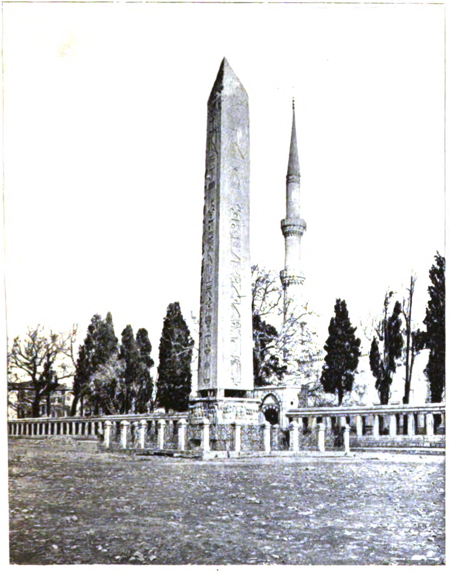
Obelisk of Theodosius. From a photograph.
The empress Justina did not long survive her return to Italy; and, though she beheld the triumph of Theodosius, she was not allowed to influence the government of her son. [104] [V-58] The pernicious attachment to the Arian sect, which Valentinian had imbibed from her example and instructions, was soon erased by the lessons of a more orthodox education. His growing zeal for the faith of Nice and his filial reverence for the character and authority of Ambrose disposed the Catholics to entertain the most favourable opinion of the virtues of the young emperor of the West. [105] They applauded his chastity and temperance, his contempt of pleasure, his application to business, and his tender affection for his two sisters; which could not, however, seduce his impartial equity to pronounce an unjust sentence against the meanest of his subjects. But this amiable youth, before he had accomplished the twentieth year of his age, was oppressed by domestic treason; and the empire was again involved in the horrors of a civil war. Arbogastes, [106] a gallant soldier of the nation of the Franks, held the second rank in the service of Gratian. On the death of his master, he joined the standard of Theodosius; contributed, by his valour and military conduct, to the destruction of the tyrant; and was appointed, after the victory, master-general of the armies of Gaul. His real merit and apparent fidelity had gained the confidence both of the prince and people; his boundless liberality corrupted the allegiance of the troops; and, whilst he was universally esteemed as the pillar of the state, the bold and crafty Barbarian was secretly determined either to rule or to ruin the empire of the West. The important commands of the army were distributed among the Franks; the creatures of Arbogastes were promoted to all the honours and offices of the civil government; the progress [V-59] of the conspiracy removed every faithful servant from the presence of Valentinian; and the emperor, without power and without intelligence, insensibly sunk into the precarious and dependent condition of a captive. [107] The indignation which he expressed, though it might arise only from the rash and impatient temper of youth, may be candidly ascribed to the generous spirit of a prince who felt that he was not unworthy to reign. He secretly invited the archbishop of Milan to undertake the office of a mediator, as the pledge of his sincerity and the guardian of his safety. He contrived to apprise the emperor of the East of his helpless situation; and he declared that, unless Theodosius could speedily march to his assistance, he must attempt to escape from the palace, or rather prison, of Vienna in Gaul, where he had imprudently fixed his residence in the midst of the hostile faction. But the hopes of relief were distant and doubtful; and, as every day furnished some new provocation, the emperor, without strength or counsel, too hastily resolved to risk an immediate contest with his powerful general. He received Arbogastes on the throne; and, as the count approached with some appearance of respect, delivered to him a paper, which dismissed him from all his employments. “My authority,” replied Arbogastes with insulting coolness, “does not depend on the smile, or the frown, of a monarch;” and he contemptuously threw the paper on the ground. [108] The indignant monarch snatched at the sword of one of the guards, which he struggled to draw from its scabbard; and it was not without some degree of violence that he was prevented from using the deadly weapon against his enemy, or against himself. A few days after this extraordinary quarrel, in which he had exposed his resentment and his [V-60] weakness, the unfortunate Valentinian was found strangled in his apartment; and some pains were employed to disguise the manifest guilt of Arbogastes, and to persuade the world that the death of the young emperor had been the voluntary effect of his own despair. [109] His body was conducted with decent pomp to the sepulchre of Milan; and the archbishop pronounced a funeral oration, to commemorate his virtue and his misfortunes. [110] On this occasion, the humanity of Ambrose tempted him to make a singular breach in his theological system, and to comfort the weeping sisters of Valentinian, by the firm assurance that their pious brother, though he had not received the sacrament of baptism, was introduced, without difficulty, into the mansions of eternal bliss. [111]
The prudence of Arbogastes had prepared the success of his ambitious designs; and the provincials, in whose breasts every sentiment of patriotism or loyalty was extinguished, expected, with tame resignation, the unknown master, whom the choice of a Frank might place on the Imperial throne. But some remains of pride and prejudice still opposed the elevation of Arbogastes himself; and the judicious Barbarian thought it more advisible to reign under the name of some dependent Roman. He bestowed the purple on the rhetorician [V-61] Eugenius; [112] whom he had already raised from the place of his domestic secretary to the rank of master of the offices. [112a] In the course both of his private and public service, the count had always approved the attachment and abilities of Eugenius; his learning and eloquence, supported by the gravity of his manners, recommended him to the esteem of the people; and the reluctance with which he seemed to ascend the throne may inspire a favourable prejudice of his virtue and moderation. The ambassadors of the new emperor were immediately despatched to the court of Theodosius, to communicate, with affected grief, the unfortunate accident of the death of Valentinian; and, without mentioning the name of Arbogastes, to request that the monarch of the East would embrace, as his lawful colleague, the respectable citizen who had obtained the unanimous suffrage of the armies and provinces of the West. [113] Theodosius was justly provoked that the perfidy of a Barbarian should have destroyed, in a moment, the labours and the fruit of his former victory; and he was excited by the tears of his beloved wife [114] to revenge the fate of her unhappy brother and once more to assert by arms the violated majesty of the throne. But, as the second conquest of the West was a task of difficulty and danger, he dismissed, with splendid presents and an ambiguous answer, the ambassadors of Eugenius; and almost two years were consumed [V-62] in the preparations of the civil war. Before he formed any decisive resolution, the pious emperor was anxious to discover the will of Heaven; and, as the progress of Christianity had silenced the oracles of Delphi and Dodona, he consulted an Egyptian monk, who possessed, in the opinion of the age, the gift of miracles and the knowledge of futurity. Eutropius, one of the favourite eunuchs of the palace of Constantinople, embarked for Alexandria, from whence he sailed up the Nile as far as the city of Lycopolis, or of Wolves, in the remote province of Thebais. [115] In the neighbourhood of that city, and on the summit of a lofty mountain, the holy John [116] had constructed, with his own hands, an humble cell, in which he had dwelt above fifty years, without opening his door, without seeing the face of a woman, and without tasting any food that had been prepared by fire or any human art. Five days of the week he spent in prayer and meditation; but on Saturdays and Sundays he regularly opened a small window, and gave audience to the crowd of suppliants who successively flowed from every part of the Christian world. The eunuch of Theodosius approached the window with respectful steps, proposed his questions concerning the event of the civil war, and soon returned with a favourable oracle, which animated the courage of the emperor by the assurance of a bloody but infallible victory. [117] The accomplishment of the prediction was forwarded by all the means that human [V-63] prudence could supply. The industry of the two master-generals, Stilicho and Timasius, was directed to recruit the numbers, and to revive the discipline, of the Roman legions. The formidable troops of Barbarians marched under the ensigns of their national chieftains. The Iberian, the Arab, and the Goth, who gazed on each other with mutual astonishment, were enlisted in the service of the same prince; and the renowned Alaric acquired, in the school of Theodosius, the knowledge of the art of war which he afterwards so fatally exerted for the destruction of Rome. [118]
The emperor of the West, or, to speak more properly, his general Arbogastes, was instructed by the misconduct and misfortune of Maximus, how dangerous it might prove to extend the line of defence against a skilful antagonist, who was free to press or to suspend, to contract or to multiply, his various methods of attack. [119] Arbogastes fixed his station on the confines of Italy: the troops of Theodosius were permitted to occupy without resistance the provinces of Pannonia as far as the foot of the Julian Alps; and even the passages of the mountains were negligently, or perhaps artfully, abandoned to the bold invader. He descended from the hills, and beheld, with some astonishment, the formidable camp of the Gauls and Germans that covered with arms and tents the open country which extends to the walls of Aquileia and the banks [V-64] of the Frigidus, [120] or Cold River. [121] This narrow theatre of the war, circumscribed by the Alps and the Hadriatic, did not allow much room for the operations of military skill; the spirit of Arbogastes would have disdained a pardon; his guilt extinguished the hope of a negotiation; and Theodosius was impatient to satisfy his glory and revenge by the chastisement of the assassins of Valentinian. Without weighing the natural and artificial obstacles that opposed his efforts, the emperor of the East immediately attacked the fortifications of his rivals, assigned the post of honourable danger to the Goths, and cherished a secret wish that the bloody conflict might diminish the pride and numbers of the conquerors. Ten thousand of those auxiliaries, and Bacurius, general of the Iberians, died bravely on the field of battle. But the victory was not purchased by their blood; the Gauls maintained their advantage; and the approach of night protected the disorderly flight, or retreat, of the troops of Theodosius. The emperor retired to the adjacent hills; where he passed a disconsolate night, without sleep, without provisions, and without hopes; [122] except that strong assurance which, under the most desperate circumstances, the independent mind may derive from the contempt of fortune and of life. The triumph of Eugenius was celebrated by the insolent and dissolute joy of his camp; whilst the active and vigilant Arbogastes secretly detached a considerable body of troops, to occupy the passes of the mountains, and to encompass the rear of the Eastern army. [V-65] The dawn of day discovered to the eyes of Theodosius the extent and the extremity of his danger: but his apprehensions were soon dispelled by a friendly message from the leaders of those troops, who expressed their inclination to desert the standard of the tyrant. The honourable and lucrative rewards, which they stipulated as the price of their perfidy, were granted without hesitation; and, as ink and paper could not easily be procured, the emperor subscribed, on his own tablets, the ratification of the treaty. The spirit of his soldiers was revived by this seasonable reinforcement; and they again marched with confidence, to surprise the camp of a tyrant whose principal officers appeared to distrust either the justice or the success of his arms. In the heat of the battle, a violent tempest, [123] such as is often felt among the Alps, suddenly arose from the East. The army of Theodosius was sheltered by their position from the impetuosity of the wind, which blew a cloud of dust in the faces of the enemy, disordered their ranks, wrested their weapons from their hands, and diverted or repelled their ineffectual javelins. This accidental advantage was skilfully improved; the violence of the storm was magnified by the superstitious terrors of the Gauls; and they yielded without shame to the invisible powers of heaven, who seemed to militate on the side of the pious emperor. His victory was decisive; and the deaths of his two rivals were distinguished only by the difference of their characters. The rhetorician Eugenius, who had almost acquired the dominion [V-66] of the world, was reduced to implore the mercy of the conqueror; and the unrelenting soldiers separated his head from his body, as he lay prostrate at the feet of Theodosius. Arbogastes, after the loss of a battle in which he had discharged the duties of a soldier and a general, wandered several days among the mountains. But, when he was convinced that his cause was desperate, and his escape impracticable, the intrepid Barbarian imitated the example of the ancient Romans, and turned his sword against his own breast. The fate of the empire was determined in a narrow corner of Italy, and the legitimate successor of the house of Valentinian embraced the archbishop of Milan, and graciously received the submission of the provinces of the West. Those provinces were involved in the guilt of rebellion; while the inflexible courage of Ambrose alone had resisted the claims of successful usurpation. With a manly freedom, which might have been fatal to any other subject, the archbishop rejected the gifts of Eugenius, declined his correspondence, and withdrew himself from Milan, to avoid the odious presence of a tyrant, whose downfall he predicted in discreet and ambiguous language. The merit of Ambrose was applauded by the conqueror, who secured the attachment of the people by his alliance with the church; and the clemency of Theodosius is ascribed to the humane intercession of the archbishop of Milan. [124]
After the defeat of Eugenius, the merit, as well as the authority, of Theodosius was cheerfully acknowledged by all the inhabitants of the Roman world. The experience of his past conduct encouraged the most pleasing expectations of his future reign; and the age of the emperor, which did not [V-67] exceed fifty years, seemed to extend the prospect of the public felicity. His death, only four months after his victory, was considered by the people as an unforeseen and fatal event, which destroyed in a moment the hopes of the rising generation. But the indulgence of ease and luxury had secretly nourished the principles of disease. [125] The strength of Theodosius was unable to support the sudden and violent transition from the palace to the camp; and the increasing symptoms of a dropsy announced the speedy dissolution of the emperor. The opinion, and perhaps the interest, of the public had confirmed the division of the Eastern and Western empires; and the two royal youths, Arcadius and Honorius, who had already obtained, from the tenderness of their father, the title of Augustus, were destined to fill the thrones of Constantinople and of Rome. Those princes were not permitted to share the danger and glory of the civil war; [126] but, as soon as Theodosius had triumphed over his unworthy rivals, he called his younger son Honorius to enjoy the fruits of the victory and to receive the sceptre of the West from the hands of his dying father. The arrival of Honorius at Milan was welcomed by a splendid exhibition of the games of the Circus; and the emperor, though he was oppressed by the weight of his disorder, contributed by his presence to the public joy. But the remains of his strength were exhausted by the painful effort which he made to assist at the spectacles of the morning. Honorius supplied, during the rest of the day, the place of his father; and the great Theodosius expired in the ensuing night. Notwithstanding the recent animosities of a civil war, his death was universally lamented. [V-68] The Barbarians, whom he had vanquished, and the churchmen, by whom he had been subdued, celebrated with loud and sincere applause, the qualities of the deceased emperor which appeared the most valuable in their eyes. The Romans were terrified by the impending dangers of a feeble and divided administration; and every disgraceful moment of the unfortunate reigns of Arcadius and Honorius revived the memory of their irreparable loss.
In the faithful picture of the virtues of Theodosius, his imperfections have not been dissembled: the act of cruelty, and the habits of indolence, which tarnished the glory of one of the greatest of the Roman princes. An historian, perpetually adverse to the fame of Theodosius, has exaggerated his vices and their pernicious effects; he boldly asserts that every rank of subjects imitated the effeminate manners of their sovereign; that every species of corruption polluted the course of public and private life; and that the feeble restraints of order and decency were insufficient to resist the progress of that degenerate spirit which sacrifices, without a blush, the consideration of duty and interest to the base indulgence of sloth and appetite. [127] The complaints of contemporary writers, who deplore the increase of luxury and depravation of manners, are commonly expressive of their peculiar temper and situation. There are few observers who possess a clear and comprehensive view of the revolutions of society; and who are capable of discovering the nice and secret springs of action which impel, in the same uniform direction, the blind and capricious passions of a multitude of individuals. If it can be affirmed, with any degree of truth, that the luxury of the Romans was more shameless and dissolute in the reign of Theodosius than in the age of Constantine, perhaps, or of Augustus, the alteration cannot be ascribed to any beneficial improvements, which had gradually increased the stock of national riches. A long period of [V-69] calamity or decay must have checked the industry, and diminished the wealth, of the people; and their profuse luxury must have been the result of that indolent despair which enjoys the present hour and declines the thoughts of futurity. The uncertain condition of their property discouraged the subjects of Theodosius from engaging in those useful and laborious undertakings which require an immediate expense and promise a slow and distant advantage. The frequent examples of ruin and desolation tempted them not to spare the remains of a patrimony which might, every hour, become the prey of the rapacious Goth. And the mad prodigality which prevails in the confusion of a shipwreck or a siege may serve to explain the progress of luxury amidst the misfortunes and terrors of a sinking nation.
The effeminate luxury which infected the manners of courts and cities had instilled a secret and destructive poison into the camps of the legions; and their degeneracy has been marked by the pen of a military writer who had accurately studied the genuine and ancient principles of Roman discipline. It is the just and important observation of Vegetius that the infantry was invariably covered with defensive armour, from the foundation of the city to the reign of the emperor Gratian. The relaxation of discipline and the disuse of exercise rendered the soldiers less able, and less willing, to support the fatigues of the service; they complained of the weight of the armour, which they seldom wore; and they successfully obtained the permission of laying aside both their cuirasses and their helmets. The heavy weapons of their ancestors, the short sword and the formidable pilum, which had subdued the world, insensibly dropped from their feeble hands. As the use of the shield is incompatible with that of the bow, they reluctantly marched into the field; condemned to suffer either the pain of wounds or the ignominy of flight, and always disposed to prefer the [V-70] more shameful alternative. The cavalry of the Goths, the Huns and the Alani had felt the benefits, and adopted the use, of defensive armour; and, as they excelled in the management of missile weapons, they easily overwhelmed the naked and trembling legions, whose heads and breasts were exposed, without defence, to the arrows of the Barbarians. The loss of armies, the destruction of cities, and the dishonour of the Roman name ineffectually solicited the successors of Gratian to restore the helmets and cuirasses of the infantry. The enervated soldiers abandoned their own and the public defence; and their pusillanimous indolence may be considered as the immediate cause of the downfall of the empire. [128]
[V-71]
CHAPTER XXVIII↩
Final Destruction of Paganism — Introduction of the Worship of Saints, and Relics, among the Christians
The ruin of Paganism, [1] in the age of Theodosius, is perhaps the only example of the total extirpation of any ancient and popular superstition; and may therefore deserve to be considered as a singular event in the history of the human mind. The Christians, more especially the clergy, had impatiently supported the prudent delays of Constantine and the equal toleration of the elder Valentinian; nor could they deem their conquest perfect or secure, as long as their adversaries were permitted to exist. The influence which Ambrose and his brethren had acquired over the youth of Gratian and the piety of Theodosius was employed to infuse the maxims of persecution into the breasts of their Imperial proselytes. Two specious principles of religious jurisprudence were established, from whence they deduced a direct and rigorous conclusion against the subjects of the empire who still adhered to the ceremonies of their ancestors: that the magistrate is, in some measure, guilty of the crimes which he neglects to prohibit or to punish; and, that the idolatrous worship of fabulous deities and real demons is the most abominable crime against the supreme majesty of the Creator. The laws of Moses and the examples of Jewish history [2] were hastily, perhaps erroneously, applied by the [V-72] clergy to the mild and universal reign of Christianity. [3] The zeal of the emperors was excited to vindicate their own honour, and that of the Deity; and the temples of the Roman world were subverted, about sixty years after the conversion of Constantine.
From the age of Numa to the reign of Gratian the Romans preserved the regular succession of the several colleges of the sacerdotal order. [4] Fifteen Pontiffs exercised their supreme jurisdiction over all things and persons that were consecrated to the service of the gods; and the various questions which perpetually arose in a loose and traditionary system were submitted to the judgment of their holy tribunal. Fifteen grave and learned Augurs observed the face of the heavens, and prescribed the actions of heroes, according to the flight of birds. Fifteen keepers of the Sybilline books (their name of Quindecemvirs was derived from their number) occasionally consulted the history of future, and as it should seem, of contingent, events. Six Vestals devoted their virginity to the guard of the sacred fire and of the unknown pledges of the duration of Rome; which no mortal had been suffered to behold with impunity. [5] Seven [V-73] Epulos [6] prepared the table of the gods, conducted the solemn procession, and regulated the ceremonies of the annual festival. The three Flamens [7] of Jupiter, of Mars, and of Quirinus were considered as the peculiar ministers of the three most powerful deities who watched over the fate of Rome and of the universe. The King of the Sacrifices represented the person of Numa, and of his successors, in the religious functions which could be performed only by royal hands. The confraternities of the Salians, the Lupercals, &c., practised such rites as might extort a smile of contempt from every reasonable man, with a lively confidence of recommending themselves to the favour of the immortal gods. The authority which the Roman priests had formerly obtained in the counsels of the republic was gradually abolished by the establishment of monarchy and the removal of the seat of empire. But the dignity of their sacred character was still protected by the laws and manners of their country; and they still continued, more especially the college of pontiffs, to exercise in the capital, and sometimes in the provinces, the rights of their ecclesiastical and civil jurisdiction. Their robes of purple, chariots of state, and sumptuous entertainments attracted the admiration of the people; and they received, from the consecrated lands and the public revenue, an ample stipend, which liberally supported the splendour of the priesthood and all the expenses of the religious worship of the state. As the service of the altar was not incompatible with the command of armies, the Romans, after their consulships and triumphs, aspired to the place of pontiff or of augur; the seats of Cicero [8] and Pompey were filled, in the [V-74] fourth century, by the most illustrious members of the senate; and the dignity of their birth reflected additional splendour on their sacerdotal character. The fifteen priests who composed the college of pontiffs enjoyed a more distinguished rank as the companions of their sovereign; and the Christian emperors condescended to accept the robe and ensigns which were appropriated to the office of supreme pontiff. But, when Gratian ascended the throne, more scrupulous, or more enlightened, he sternly rejected those profane symbols; [9] applied to the service of the state, or of the church, the revenues of the priests and vestals; abolished their honours and immunities; and dissolved the ancient fabric of Roman superstition, which was supported by the opinions and habits of eleven hundred years. [10] Paganism was still the constitutional religion of the senate. The hall, or temple, in which they assembled, was adorned by the statue and altar of Victory; [11] a majestic female standing on a globe, with flowing garments, expanded wings, and a crown of laurel in her outstretched hand. [12] The senators were sworn on the altar of the goddess to observe the laws of the emperor and of the empire; and a solemn offering of wine and incense was the ordinary prelude of their public deliberations. [13] The removal of this ancient monument was the only injury which Constantius had offered to the superstition of the Romans. The altar of Victory was again restored by Julian, tolerated by Valentinian, and once more banished from the [V-75] senate by the zeal of Gratian. [14] But the emperor yet spared the statues of the gods, which were exposed to the public veneration; four hundred and twenty-four temples, or chapels, still remained to satisfy the devotion of the people; and in every quarter of Rome the delicacy of the Christians was offended by the fumes of idolatrous sacrifice. [15]
But the Christians formed the least numerous party in the senate of Rome; [16] and it was only by their absence that they could express their dissent from the legal, though profane, acts of a Pagan majority. In that assembly, the dying embers of freedom were, for a moment, revived and inflamed by the breath of fanaticism. Four respectable deputations were successively voted to the Imperial court [17] to represent the grievances of the priesthood and the senate; and to solicit the restoration of the altar of Victory. The conduct of this important business was entrusted to the eloquent Symmachus, [18] a wealthy and noble senator, who united the sacred characters of pontiff and augur with the civil dignities of proconsul of Africa and prefect of the city. The breast of Symmachus was animated by the warmest zeal for the cause of expiring Paganism; and his religious antagonists lamented [V-76] the abuse of his genius, and the inefficacy of his moral virtues. [19] The orator, whose petition is extant to the emperor Valentinian, was conscious of the difficulty and danger of the office which he had assumed. He cautiously avoids every topic which might appear to reflect on the religion of his sovereign; humbly declares that prayers and entreaties are his only arms; and artfully draws his arguments from the schools of rhetoric rather than from those of philosophy. Symmachus endeavours to seduce the imagination of a young prince, by displaying the attributes of the goddess of victory; he insinuates that the confiscation of the revenues, which were consecrated to the service of the gods, was a measure unworthy of his liberal and disinterested character; and he maintains that the Roman sacrifices would be deprived of their force and energy, if they were no longer celebrated at the expense, as well as in the name, of the republic. Even scepticism is made to supply an apology for superstition. The great and incomprehensible secret of the universe eludes the inquiry of man. Where reason cannot instruct, custom may be permitted to guide; and every nation seems to consult the dictates of prudence by a faithful attachment to those rites and opinions which have received the sanction of ages. If those ages have been crowned with glory and prosperity, if the devout people has frequently obtained the blessings which they have solicited at the altars of the gods, it must appear still more advisable to persist in the same salutary practice; and not to risk the unknown perils that may attend any rash innovations. The test of antiquity and success was applied with singular advantage to the religion of Numa; and Rome herself, the celestial genius that presided over the [V-77] fates of the city, is introduced by the orator to plead her own cause before the tribunal of the emperors. “Most excellent princes,” says the venerable matron, “fathers of your country! pity and respect my age, which has hitherto flowed in an uninterrupted course of piety. Since I do not repent, permit me to continue in the practice of my ancient rites. Since I am born free, allow me to enjoy my domestic institutions. This religion has reduced the world under my laws. These rites have repelled Hannibal from the city, and the Gauls from the capitol. Were my grey hairs reserved for such intolerable disgrace? I am ignorant [20] of the new system that I am required to adopt; but I am well assured that the correction of old age is always an ungrateful and ignominious office.” [21] The fears of the people supplied what the discretion of the orator had suppressed; and the calamities which afflicted, or threatened, the declining empire were unanimously imputed, by the Pagans, to the new religion of Christ and of Constantine.
But the hopes of Symmachus were repeatedly baffled by the firm and dexterous opposition of the archbishop of Milan; who fortified the emperors against the fallacious eloquence of the advocate of Rome. In this controversy, Ambrose condescends to speak the language of a philosopher, and to ask, with some contempt, why it should be thought necessary to introduce an imaginary and invisible power, as the cause of those victories which were sufficiently explained by the valour and discipline of the legions? He justly derides the absurd reverence for antiquity which could only tend to discourage the improvements of art and to replunge the human race into [V-78] their original barbarism. From thence gradually rising to a more lofty and theological tone, he pronounces that Christianity alone is the doctrine of truth and salvation, and that every mode of Polytheism conducts its deluded votaries, through the paths of error, to the abyss of eternal perdition. [22] Arguments like these, when they were suggested by a favourite bishop, had power to prevent the restoration of the altar of Victory; but the same arguments fell, with much more energy and effect, from the mouth of a conqueror; and the gods of antiquity were dragged in triumph at the chariot-wheels of Theodosius. [23] In a full meeting of the senate, the emperor proposed, according to the forms of the republic, the important question, Whether the worship of Jupiter or that of Christ should be the religion of the Romans? [24] The liberty of suffrages, which he affected to allow, was destroyed by the hopes and fears that his presence inspired; and the arbitrary exile of Symmachus was a recent admonition that it might be dangerous to oppose the wishes of the monarch. On a regular division of the senate, Jupiter was condemned and degraded by the sense of a very large majority; and it is rather surprising that any members should be found bold enough to declare by their speeches and votes that they were still attached to the interest of an abdicated deity. [25] [V-79] The hasty conversion of the senate must be attributed either to supernatural or to sordid motives; and many of these reluctant proselytes betrayed, on every favourable occasion, their secret disposition to throw aside the mask of odious dissimulation. But they were gradually fixed in the new religion, as the cause of the ancient became more hopeless; they yielded to the authority of the emperor, to the fashion of the times, and to the entreaties of their wives and children, [26] who were instigated and governed by the clergy of Rome and the monks of the East. The edifying example of the Anician family was soon imitated by the rest of the nobility: the Bassi, the Paullini, the Gracchi, embraced the Christian religion; and “the luminaries of the world, the venerable assembly of Catos (such are the high-flown expressions of Prudentius), were impatient to strip themselves of their pontifical garment: to cast the skin of the old serpent; to assume the snowy robes of baptismal innocence; and to humble the pride of the consular fasces before the tombs of the martyrs.” [27] The citizens, who subsisted by their own industry, and the populace, who were supported by the public liberality, filled the churches of the Lateran and Vatican with an incessant throng of devout [V-80] proselytes. The decrees of the senate, which proscribed the worship of idols, were ratified by the general consent of the Romans; [28] the splendour of the capitol was defaced, and the solitary temples were abandoned to ruin and contempt. [29] Rome submitted to the yoke of the Gospel; and the vanquished provinces had not yet lost their reverence for the name and authority of Rome.
The filial piety of the emperors themselves engaged them to proceed, with some caution and tenderness, in the reformation of the eternal city. Those absolute monarchs acted with less regard to the prejudices of the provincials. The pious labour, which had been suspended near twenty years since the death of Constantius, [30] was vigorously resumed, and finally accomplished, by the zeal of Theodosius. Whilst that warlike prince yet struggled with the Goths, not for the glory, but for the safety, of the republic, he ventured to offend a considerable party of his subjects, by some acts which might perhaps secure the protection of Heaven, but which must seem rash and unseasonable in the eye of human prudence. The success of his first experiments against the Pagans encouraged the pious emperor to reiterate and enforce his edicts of proscription; the same laws which had been originally published in the provinces of the East were applied, after the defeat of Maximus, to the whole extent of the Western empire; and every victory of the orthodox Theodosius contributed to the triumph of the [V-81] Christian and Catholic faith. [31] He attacked superstition in her most vital part by prohibiting the use of sacrifices, which he declared to be criminal as well as infamous; and, if the terms of his edicts more strictly condemned the impious curiosity which examined the entrails of the victims, [32] every subsequent explanation tended to involve, in the same guilt, the general practice of immolation, which essentially constituted the religion of the Pagans. As the temples had been erected for the purpose of sacrifice, it was the duty of a benevolent prince to remove from his subjects the dangerous temptation of offending against the laws which he had enacted. A special commission was granted to Cynegius, the Prætorian prefect of the East, and afterwards to the counts Jovius and Gaudentius, two officers of distinguished rank in the West; by which they were directed to shut the temples, to seize or destroy the instruments of idolatry, to abolish the privileges of the priests, and to confiscate the consecrated property for the benefit of the emperor, of the church, or of the army. [33] Here the desolation might have stopped, and the naked edifices, which were no longer employed in the service of idolatry, might have been protected from the destructive rage of fanaticism. Many of those temples were the most splendid and beautiful monuments of Grecian architecture: and the emperor himself was interested not to deface the splendour of his own cities or to diminish the value of his own possessions. Those stately edifices might be suffered to remain as so many lasting trophies of the victory of Christ. In the decline of the [V-82] arts, they might be usefully converted into magazines, manufactures, or places of public assembly; and perhaps, when the walls of the temple had been sufficiently purified by holy rites, the worship of the true Deity might be allowed to expiate the ancient guilt of idolatry. But, as long as they subsisted, the Pagans fondly cherished the secret hope that an auspicious revolution, a second Julian, might again restore the altars of the gods; and the earnestness with which they addressed their unavailing prayers to the throne [34] increased the zeal of the Christian reformers to extirpate, without mercy, the root of superstition. The laws of the emperors exhibit some symptoms of a milder disposition; [35] but their cold and languid efforts were insufficient to stem the torrent of enthusiasm and rapine, which was conducted, or rather impelled, by the spiritual rulers of the church. In Gaul, the holy Martin, bishop of Tours, [36] marched at the head of his faithful monks, to destroy the idols, the temples, and the consecrated trees of his extensive diocese; and in the execution of this arduous task, the prudent reader will judge whether Martin was supported by the aid of miraculous powers or of carnal weapons. In Syria, the divine and excellent Marcellus, [37] as he is styled by Theodoret, a bishop animated with [V-83] apostolic fervour, resolved to level with the ground the stately temples within the diocese of Apamea. His attack was resisted by the skill and solidity with which the temple of Jupiter had been constructed. The building was seated on an eminence; on each of the four sides, the lofty roof was supported by fifteen massy columns, sixteen feet in circumference; and the large stones, of which they were composed, were firmly cemented with lead and iron. The force of the strongest and sharpest tools had been tried without effect. It was found necessary to undermine the foundations of the columns, which fell down as soon as the temporary wooden props had been consumed with fire; and the difficulties of the enterprise are described under the allegory of a black demon, who retarded, though he could not defeat, the operations of the Christian engineers. Elated with victory, Marcellus took the field in person against the powers of darkness; a numerous troop of soldiers and gladiators marched under the episcopal banner, and he successively attacked the villages and country temples of the diocese of Apamea. Whenever any resistance or danger was apprehended, the champion of the faith, whose lameness would not allow him either to fight or fly, placed himself at a convenient distance, beyond the reach of darts. But this prudence was the occasion of his death; he was surprised and slain by a body of exasperated rustics; and the synod of the province pronounced, without hesitation, that the holy Marcellus had sacrificed his life in the cause of God. In the support of this cause, the monks, who rushed with tumultuous fury from the desert, distinguished themselves by their zeal and diligence. They deserved the enmity of the Pagans; and some of them might deserve the reproaches of avarice and intemperance: of avarice, which they gratified with holy plunder, and of intemperance, which they indulged at the expense of the people, who foolishly admired their tattered garments, loud psalmody, and artificial paleness. [38] [V-84] A small number of temples was protected by the fears, the venality, the taste, or the prudence, of the civil and ecclesiastical governors. The temple of the celestial Venus at Carthage, whose sacred precincts formed a circumference of two miles, was judiciously converted into a Christian church; [39] and a similar consecration has preserved inviolate the majestic dome of the Pantheon at Rome. [40] But, in almost every province of the Roman world, an army of fanatics, without authority and without discipline, invaded the peaceful inhabitants; and the ruin of the fairest structures of antiquity still displays the ravages of those Barbarians, who alone had time and inclination to execute such laborious destruction.
In this wide and various prospect of devastation, the spectator may distinguish the ruins of the temple of Serapis, at Alexandria. [41] Serapis does not appear to have been one of the native gods, or monsters, who sprung from the fruitful soil of superstitious Egypt. [42] The first of the Ptolemies had been commanded, by a dream, to import the mysterious stranger from the coast of Pontus, where he had been long adored by the inhabitants of Sinope; but his attributes and his reign were so imperfectly understood that it became a subject of dispute, whether he represented the bright orb of [V-85] day or the gloomy monarch of the subterraneous regions. [43] The Egyptians, who were obstinately devoted to the religion of their fathers, refused to admit this foreign deity within the walls of their cities. [44] But the obsequious priests, who were seduced by the liberality of the Ptolemies, submitted, without resistance, to the power of the god of Pontus; an honourable and domestic genealogy was provided; and this fortunate usurper was introduced into the throne and bed of Osiris, [45] the husband of Isis, and the celestial monarch of Egypt. Alexandria, which claimed his peculiar protection, gloried in the name of the city of Serapis. His temple, [46] which rivalled the pride and magnificence of the capitol, was erected on the spacious summit of an artificial mount, raised one hundred steps above the level of the adjacent parts of the city; and the interior cavity was strongly supported by arches, and distributed into vaults and subterraneous apartments. The consecrated buildings were surrounded by a quadrangular portico; the stately halls, and exquisite statues, displayed the triumph of the arts; and the treasures of ancient learning were preserved in the famous Alexandrian library, which had arisen with new splendour from its ashes. [47] After the edicts [V-86] of Theodosius had severely prohibited the sacrifices of the Pagans, they were still tolerated in the city and temple of Serapis; and this singular indulgence was imprudently ascribed to the superstitious terrors of the Christians themselves: as if they had feared to abolish those ancient rites which could alone secure the inundations of the Nile, the harvests of Egypt, and the subsistence of Constantinople. [48]
At that time [49] the archiepiscopal throne of Alexandria was filled by Theophilus, [50] the perpetual enemy of peace and virtue; a bold, bad man, whose hands were alternately polluted with gold and with blood. His pious indignation was excited by the honours of Serapis; and the insults which he offered to an ancient chapel of Bacchus [51] convinced the Pagans that he meditated a more important and dangerous enterprise. In the tumultuous capital of Egypt, the slightest provocation was sufficient to inflame a civil war. The votaries of Serapis, whose strength and numbers were much inferior to those of their antagonists, rose in arms at the instigation of the philosopher Olympius, [52] who exhorted them to die in the defence of the altars of the gods. These Pagan fanatics fortified themselves in the temple, or rather fortress, of Serapis; repelled the besiegers by daring sallies and a [V-87] resolute defence; and, by the inhuman cruelties which they exercised on their Christian prisoners, obtained the last consolation of despair. The efforts of the prudent magistrate were usefully exerted for the establishment of a truce till the answer of Theodosius should determine the fate of Serapis. The two parties assembled, without arms, in the principal square; and the Imperial rescript was publicly read. But, when a sentence of destruction against the idols of Alexandria was pronounced, the Christians set up a shout of joy and exultation, whilst the unfortunate Pagans, whose fury had given way to consternation, retired with hasty and silent steps, and eluded, by their flight or obscurity, the resentment of their enemies. Theophilus proceeded to demolish the temple of Serapis, without any other difficulties than those which he found in the weight and solidity of the materials; but these obstacles proved so insuperable that he was obliged to leave the foundations and to content himself with reducing the edifice itself to a heap of rubbish; a part of which was soon afterwards cleared away, to make room for a church erected in honour of the Christian martyrs. The valuable library of Alexandria was pillaged or destroyed; and, near twenty years afterwards, the appearance of the empty shelves excited the regret and indignation of every spectator whose mind was not totally darkened by religious prejudice. [53] The compositions of ancient genius, so many of which have irretrievably perished, might surely have been excepted from the wreck of idolatry, for the amusement and instruction of succeeding ages; and either the zeal or the avarice of the archbishop [54] [V-88] might have been satiated with the rich spoils which were the reward of his victory. While the images and vases of gold and silver were carefully melted, and those of a less valuable metal were contemptuously broken and cast into the streets, Theophilus laboured to expose the frauds and vices of the ministers of the idols; their dexterity in the management of the loadstone; their secret methods of introducing an human actor into a hollow statue; and their scandalous abuse of the confidence of devout husbands and unsuspecting females. [55] Charges like these may seem to deserve some degree of credit, as they are not repugnant to the crafty and interested spirit of superstition. But the same spirit is equally prone to the base practice of insulting and calumniating a fallen enemy; and our belief is naturally checked by the reflection that it is much less difficult to invent a fictitious story than to support a practical fraud. The colossal statue of Serapis [56] was involved in the ruin of his temple and religion. A great number of plates of different metals, artificially joined together, composed the majestic figure of the Deity, who touched on either side the walls of the sanctuary. The aspect of Serapis, his sitting posture, and the sceptre which he bore in his left hand were extremely similar to the ordinary representations of Jupiter. He was distinguished from Jupiter by the basket, or bushel, which was placed on his head; and by the emblematic monster, which he held in his right hand: the head and body of a serpent branching into three tails, which were again terminated by the triple heads of a dog, a lion, and a wolf. It was [V-89] confidently affirmed that, if any impious hand should dare to violate the majesty of the god, the heavens and the earth would instantly return to their original chaos. An intrepid solider, animated by zeal and armed with a weighty battle-axe, ascended the ladder; and even the Christian multitude expected, with some anxiety, the event of the combat. [57] He aimed a vigorous stroke against the cheek of Serapis; the cheek fell to the ground; the thunder was still silent, and both the heavens and the earth continued to preserve their accustomed order and tranquillity. The victorious soldier repeated his blows; the huge idol was overthrown, and broken in pieces; and the limbs of Serapis were ignominiously dragged through the streets of Alexandria. His mangled carcase was burnt in the Amphitheatre, amidst the shouts of the populace; and many persons attributed their conversion to this discovery of the impotence of their tutelar deity. The popular modes of religion that propose any visible and material objects of worship have the advantage of adapting and familiarising themselves to the senses of mankind; but this advantage is counterbalanced by the various and inevitable accidents to which the faith of the idolater is exposed. It is scarcely possible that, in every disposition of mind, he should preserve his implicit reverence for the idols or the relics which the naked eye and the profane hand are unable to distinguish from the most common productions of art or nature; and, if, in the hour of danger, their secret and miraculous virtue does not operate for their own preservation, he scorns the vain apologies of his priest, and justly derides the object, and the folly, of [V-90] his superstitious attachment. [58] After the fall of Serapis, some hopes were still entertained by the Pagans that the Nile would refuse his annual supply to the impious masters of Egypt; and the extraordinary delay of the inundation seemed to announce the displeasure of the river-god. But this delay was soon compensated by the rapid swell of the waters. They suddenly rose to such an unusual height as to comfort the discontented party with the pleasing expectation of a deluge; till the peaceful river again subsided to the well-known and fertilising level of sixteen cubits, or about thirty English feet. [59]
The temples of the Roman empire were deserted, or destroyed; but the ingenious superstition of the Pagans still attempted to elude the laws of Theodosius, by which all sacrifices had been severely prohibited. The inhabitants of the country, whose conduct was less exposed to the eye of malicious curiosity, disguised their religious, under the appearance of convivial, meetings. On the days of solemn festivals, they assembled in great numbers under the spreading shade of some consecrated trees; sheep and oxen were slaughtered and roasted; and this rural entertainment was sanctified by the use of incense, and by the hymns which were sung in honour of the gods. But it was alleged that, as no part of the animal was made a burnt-offering, as no altar was provided to receive the blood, and as the previous oblation of salt cakes and the concluding ceremony of libations were carefully omitted, these festal meetings did not involve the guests in the guilt, or penalty, of an illegal sacrifice. [60] [V-91] Whatever might be the truth of the facts or the merit of the distinction, [61] these vain pretences were swept away by the last edict of Theodosius; which inflicted a deadly wound on the superstition of the Pagans. [62] This prohibitory law is expressed in the most absolute and comprehensive terms. “It is our will and pleasure,” says the emperor, “that none of our subjects, whether magistrates or private citizens, however exalted or however humble may be their rank and condition, shall presume, in any city or in any place, to worship an inanimate idol by the sacrifice of a guiltless victim.” The act of sacrificing and the practice of divination by the entrails of the victim are declared (without any regard to the object of the inquiry) a crime of high-treason against the state; which can be expiated only by the death of the guilty. The rites of Pagan superstition, which might seem less bloody and atrocious, are abolished, as highly injurious to the truth and honour of religion; luminaries, garlands, frankincense, and libations of wine are specially enumerated and condemned; and the harmless claims of the domestic genius, of the household gods, are included in this rigorous proscription. The use of any of these profane and illegal ceremonies subjects the offender to the forfeiture of the house or estate where they have been performed; and, if he has artfully chosen the property of another for the scene of his impiety, he is compelled [V-92] to discharge, without delay, a heavy fine of twenty-five pounds of gold, or more than one thousand pounds sterling. A fine, not less considerable, is imposed on the connivance of the secret enemies of religion, who shall neglect the duty of their respective stations, either to reveal or to punish the guilt of idolatry. Such was the persecuting spirit of the laws of Theodosius, which were repeatedly enforced by his sons and grandsons, with the loud and unanimous applause of the Christian world. [63]
In the cruel reigns of Decius and Diocletian, Christianity had been proscribed, as a revolt from the ancient and hereditary religion of the empire; and the unjust suspicions which were entertained of a dark and dangerous faction were, in some measure, countenanced by the inseparable union and rapid conquests of the Catholic church. But the same excuses of fear and ignorance cannot be applied to the Christian emperors, who violated the precepts of humanity and of the Gospel. The experience of ages had betrayed the weakness, as well as folly, of Paganism; the light of reason and of faith had already exposed, to the greatest part of mankind, the vanity of idols; and the declining sect, which still adhered to their worship, might have been permitted to enjoy, in peace and obscurity, the religious customs of their ancestors. Had the Pagans been animated by the undaunted zeal which possessed the minds of the primitive believers, the triumph of the church must have been stained with blood; and the martyrs of Jupiter and Apollo might have embraced the glorious opportunity of devoting their lives [V-93] and fortunes at the foot of their altars. But such obstinate zeal was not congenial to the loose and careless temper of Polytheism. The violent and repeated strokes of the orthodox princes were broken by the soft and yielding substance against which they were directed; and the ready obedience of the Pagans protected them from the pains and penalties of the Theodosian Code. [64] Instead of asserting that the authority of the gods was superior to that of the emperor, they desisted, with a plaintive murmur, from the use of those sacred rites which their sovereign had condemned. If they were sometimes tempted, by a sally of passion or by the hopes of concealment, to indulge their favourite superstition, their humble repentance disarmed the severity of the Christian magistrate; and they seldom refused to atone for their rashness by submitting, with some secret reluctance, to the yoke of the Gospel. The churches were filled with the increasing multitude of these unworthy proselytes, who had conformed, from temporal motives, to the reigning religion; and, whilst they devoutly imitated the postures, and recited the prayers, of the faithful, they satisfied their conscience by the silent and sincere invocation of the gods of antiquity. [65] If the Pagans wanted patience to suffer, they wanted spirit to resist; and the scattered myriads, who deplored the ruin of the temples, yielded, without a contest, to the fortune of their adversaries. The disorderly opposition [66] of the peasants of Syria, and the populace of Alexandria, to the rage of private fanaticism was silenced by the name and [V-94] authority of the emperor. The Pagans of the West, without contributing to the elevation of Eugenius, disgraced, by their partial attachment, the cause and character of the usurper. The clergy vehemently exclaimed that he aggravated the crime of rebellion by the guilt of apostacy; that, by his permission, the altar of Victory was again restored; and that the idolatrous symbols of Jupiter and Hercules were displayed in the field against the invincible standard of the cross. But the vain hopes of the Pagans were soon annihilated by the defeat of Eugenius; and they were left exposed to the resentment of the conqueror, who laboured to deserve the favour of heaven by the extirpation of idolatry. [67]
A nation of slaves is always prepared to applaud the clemency of their master, who, in the abuse of absolute power, does not proceed to the last extremes of injustice and oppression. Theodosius might undoubtedly have proposed to his Pagan subjects the alternative of baptism or of death; and the eloquent Libanius has praised the moderation of a prince, who never enacted, by any positive law, that all his subjects should immediately embrace and practise the religion of their sovereign. [68] The profession of Christianity was not made an essential qualification for the enjoyment of the civil rights of society, nor were any peculiar hardships imposed on the sectaries who credulously received the fables of Ovid and obstinately rejected the miracles of the Gospel. The palace, the schools, the army, and the senate were filled with declared and devout Pagans; they obtained, without distinction, the civil and military honours of the empire. Theodosius distinguished his liberal regard for virtue and genius, by the consular dignity which he bestowed [V-95] on Symmachus, [69] and by the personal friendship which he expressed to Libanius; [70] and the two eloquent apologists of Paganism were never required either to change or to dissemble their religious opinions. The Pagans were indulged in the most licentious freedom of speech and writing; the historical and philosophical remains of Eunapius, Zosimus, [71] and the fanatic teachers of the school of Plato, betray the most furious animosity, and contain the sharpest invectives, against the sentiments and conduct of their victorious adversaries. If these audacious libels were publicly known, we must applaud the good sense of the Christian princes who viewed, with a smile of contempt, the last struggles of superstition and despair. [72] But the Imperial laws which prohibited the sacrifices and ceremonies of Paganism were rigidly executed; and every hour contributed to destroy the influence of a religion which was supported by custom rather than by argument. The devotion of the poet or the philosopher may be secretly nourished by prayer, meditation, and study; but the exercise of public worship appears to be the only solid foundation of the religious sentiments of the people, which derive their force from imitation and habit. The interruption of that public exercise may consummate, [V-96] in the period of a few years, the important work of a national revolution. The memory of theological opinions cannot long be preserved without the artificial helps of priests, of temples, and of books. [73] The ignorant vulgar, whose minds are still agitated by the blind hopes and terrors of superstition, will be soon persuaded by their superiors to direct their vows to the reigning deities of the age; and will insensibly imbibe an ardent zeal for the support and propagation of the new doctrine, which spiritual hunger at first compelled them to accept. The generation that arose in the world after the promulgation of the Imperial laws was attracted within the pale of the Catholic church: and so rapid, yet so gentle, was the fall of Paganism that only twenty-eight years after the death of Theodosius the faint and minute vestiges were no longer visible to the eye of the legislator. [74]
The ruin of the Pagan religion is described by the sophists as a dreadful and amazing prodigy which covered the earth with darkness and restored the ancient dominion of chaos and of night. They relate, in solemn and pathetic strains, that the temples were converted into sepulchres, and that the holy places, which had been adorned by the statues of the gods, were basely polluted by the relics of Christian martyrs. “The monks” (a race of filthy animals, to whom Eunapius is tempted to refuse the name of men) “are the authors of the new worship, which, in the place of one of those deities, who are conceived by the understanding, has substituted the meanest and most contemptible slaves. The heads, salted and pickled, of those infamous malefactors, who for the [V-97] multitude of their crimes have suffered a just and ignominious death; their bodies, still marked by the impression of the lash, and the scars of those tortures which were inflicted by the sentence of the magistrate; such” (continues Eunapius) “are the gods which the earth produces in our days; such are the martyrs, the supreme arbitrators of our prayers and petitions to the Deity, whose tombs are now consecrated as the objects of the veneration of the people.” [75] Without approving the malice, it is natural enough to share the surprise, of the Sophist, the spectator of a revolution which raised those obscure victims of the laws of Rome to the rank of celestial and invisible protectors of the Roman empire. The grateful respect of the Christians for the martyrs of the faith was exalted, by time and victory, into religious adoration; and the most illustrious of the saints and prophets were deservedly associated to the honours of the martyrs. One hundred and fifty years after the glorious deaths of St. Peter and St. Paul, the Vitican and the Ostian road were distinguished by the tombs, or rather by the trophies, of those spiritual heroes. [76] In the age which followed the conversion of Constantine, the emperors, the consuls, and the generals of armies devoutly visited the sepulchres of a tent-maker and a fisherman; [77] and their venerable bones were deposited under the altars of Christ, on which the bishops of the royal city continually offered the unbloody sacrifice. [78] The new [V-98] capital of the Eastern world, unable to produce any ancient and domestic trophies, was enriched by the spoils of dependent provinces. The bodies of St. Andrew, St. Luke, and St. Timothy had reposed, near three hundred years, in the obscure graves from whence they were sent, in solemn pomp, to the church of the Apostles, which the magnificence of Constantine had founded on the banks of the Thracian Bosphorus. [79] About fifty years afterwards, the same banks were honoured by the presence of Samuel, the judge and prophet of the people of Israel. His ashes, deposited in a golden vase and covered with a silken veil, were delivered by the bishops into each other’s hands. The relics of Samuel were received by the people with the same joy and reverence which they would have shown to the living prophet; the highways, from Palestine to the gates of Constantinople, were filled with an uninterrupted procession; and the emperor Arcadius himself, at the head of the most illustrious members of the clergy and senate, advanced to meet his extraordinary guest, who had always deserved and claimed the homage of kings. [80] The example of Rome and Constantinople confirmed the faith and discipline of the Catholic world. The honours of the saints and martyrs, after a feeble and ineffectual murmur of profane reason, [81] were [V-99] universally established; and in the age of Ambrose and Jerom, something was still deemed wanting to the sanctity of a Christian church, till it had been consecrated by some portion of holy relics, which fixed and inflamed the devotion of the faithful.
In the long period of twelve hundred years which elapsed between the reign of Constantine and the reformation of Luther the worship of saints and relics corrupted the pure and perfect simplicity of the Christian model; and some symptoms of degeneracy may be observed even in the first generations which adopted and cherished this pernicious innovation.
I. The satisfactory experience that the relics of saints were more valuable than gold or precious stones [82] stimulated the clergy to multiply the treasures of the church. Without much regard for truth or probability, they invented names for skeletons and actions for names. The fame of the apostles, and of the holy men who had imitated their virtues, was darkened by religious fiction. To the invincible band of genuine and primitive martyrs, they added myriads of imaginary heroes, who had never existed except in the fancy of crafty or credulous legendaries; and there is reason to suspect that Tours might not be the only diocese in which the bones of a malefactor were adored instead of those of a saint. [83] A superstitious practice, which tended to increase the temptations of fraud and credulity, insensibly extinguished the light of history and of reason in the Christian world.
II. But the progress of superstition would have been [V-100] much less rapid and victorious, if the faith of the people had not been assisted by the seasonable aid of visions and miracles, to ascertain the authenticity and virtue of the most suspicious relics. In the reign of the younger Theodosius, Lucian, [84] a presbyter of Jerusalem, and the ecclesiastical minister of the village of Caphargamala, about twenty miles from the city, related a very singular dream, which, to remove his doubts, had been repeated on three successive Saturdays. A venerable figure stood before him, in the silence of the night, with a long beard, a white robe, and a gold rod; announced himself by the name of Gamaliel, and revealed to the astonished presbyter that his own corpse, with the bodies of his son Abibas, his friend Nicodemus, and the illustrious Stephen, the first martyr of the Christian faith, were secretly buried in the adjacent field. He added, with some impatience, that it was time to release himself and his companions from their obscure prison; that their appearance would be salutary to a distressed world; and that they had made choice of Lucian to inform the bishop of Jerusalem of their situation and their wishes. The doubts and difficulties which still retarded this important discovery were successively removed by new visions; and the ground was opened by the bishop, in the presence of an innumerable multitude. The coffins of Gamaliel, of his son, and of his friend were found in regular order; but when the fourth coffin, which contained the remains of Stephen, was shown to the light, the earth trembled, and an odour, such as that of paradise, was smelt, which instantly cured the various diseases of seventy-three of the assistants. The companions of Stephen were left in their [V-101] peaceful residence of Caphargamala; but the relics of the first martyr were transported in solemn procession to a church constructed in their honour on Mount Sion; and the minute particles of those relics, a drop of blood, [85] or the scrapings of a bone were acknowledged in almost every province of the Roman world to possess a divine and miraculous virtue. The grave and learned Augustin, [86] whose understanding scarcely admits the excuse of credulity, has attested the innumerable prodigies which were performed in Africa by the relics of St. Stephen; and this marvellous narrative is inserted in the elaborate work of the City of God, which the bishop of Hippo designed as a solid and immortal proof of the truth of Christianity. Augustin solemnly declares that he has selected those miracles only which were publicly certified by the persons who were either the objects, or the spectators, of the power of the martyr. Many prodigies were omitted or forgotten; and Hippo had been less favourably treated than the other cities of the province. And yet the bishop enumerates above seventy miracles, of which three were resurrections from the dead, in the space of two years and within the limits of his own diocese. [87] If we enlarge our view to all the dioceses and all the saints of the Christian world, it will not be easy to calculate the fables and the errors which issued from this inexhaustible source. But we may surely be allowed to observe that a miracle, in [V-102] that age of superstition and credulity, lost its name and its merit, since it could scarcely be considered as a deviation from the ordinary and established laws of nature.
III. The innumerable miracles of which the tombs of the martyrs were the perpetual theatre revealed to the pious believer the actual state and constitution of the invisible world; and his religious speculations appeared to be founded on the firm basis of fact and experience. Whatever might be the condition of vulgar souls, in the long interval between the dissolution and the resurrection of their bodies, it was evident that the superior spirits of the saints and martyrs did not consume that portion of their existence in silent and inglorious sleep. [88] It was evident (without presuming to determine the place of their habitation or the nature of their felicity) that they enjoyed the lively and active consciousness of their happiness, their virtue, and their powers; and that they had already secured the possession of their eternal reward. The enlargement of their intellectual faculties surpassed the measure of the human imagination; since it was proved by experience that they were capable of hearing and understanding the various petitions of their numerous votaries; who, in the same moment of time, but in the most distant parts of the world, invoked the name and assistance of Stephen or of Martin. [89] The confidence of their petitioners was founded on the persuasion that the saints, who reigned with Christ, cast an eye of pity upon earth; that they were [V-103] warmly interested in the prosperity of the Catholic church; and that the individuals, who imitated the example of their faith and piety, were the peculiar and favourite objects of their most tender regard. Sometimes, indeed, their friendship might be influenced by considerations of a less exalted kind: they viewed, with partial affection, the places which had been consecrated by their birth, their residence, their death, their burial, or the possession of their relics. The meaner passions of pride, avarice, and revenge may be deemed unworthy of a celestial breast; yet the saints themselves condescended to testify their grateful approbation of the liberality of their votaries; and the sharpest bolts of punishment were hurled against those impious wretches who violated their magnificent shrines or disbelieved their supernatural power. [90] Atrocious, indeed, must have been the guilt, and strange would have been the scepticism, of those men, if they had obstinately resisted the proofs of a divine agency which the elements, the whole range of the animal creation, and even the subtle and invisible operations of the human mind were compelled to obey. [91] The immediate, and almost instantaneous, effects, that were supposed to follow the prayer or the offence, satisfied the Christians of the ample measure of favour and authority which the saints enjoyed in the presence of the Supreme God; and it seemed almost superfluous to inquire whether they were continually obliged to intercede before the throne of grace, or whether they might not be permitted to exercise, according to the dictates of their benevolence and justice, the delegated powers of their subordinate ministry. The imagination, which had been raised by a painful effort to the [V-104] contemplation and worship of the Universal Cause, eagerly embraced such inferior objects of adoration as were more proportioned to its gross conceptions and imperfect faculties. The sublime and simple theology of the primitive Christians was gradually corrupted; and the monarchy of heaven, already clouded by metaphysical subtleties, was degraded by the introduction of a popular mythology, which tended to restore the reign of polytheism. [92]
IV. As the objects of religion were gradually reduced to the standard of the imagination, the rites and ceremonies were introduced that seemed most powerfully to affect the senses of the vulgar. If, in the beginning of the fifth century, [93] Tertullian or Lactantius [94] had been suddenly raised from the dead, to assist at the festival of some popular saint or martyr, [95] they would have gazed with astonishment and indignation on the profane spectacle, which had succeeded to the pure and spiritual worship of a Christian congregation. As soon as the doors of the church were thrown open, they must have been offended by the smoke of incense, the perfume of flowers, and the glare of lamps and tapers, which diffused, at noon-day, a gaudy, superfluous, and, in their opinion, a sacrilegious light. If they approached the balustrade of the altar, they made their way through the prostrate crowd, [V-105] consisting, for the most part, of strangers and pilgrims, who restored to the city on the vigil of the feast; and who already felt the strong intoxication of fanaticism, and, perhaps, of wine. Their devout kisses were imprinted on the walls and pavement of the sacred edifice; and their fervent prayers were directed, whatever might be the language of their church, to the bones, the blood, or the ashes of the saints, which were usually concealed by a linen or silken veil from the eyes of the vulgar. The Christians frequented the tombs of the martyrs, in the hope of obtaining, from their powerful intercession, every sort of spiritual, but more especially of temporal, blessings. They implored the preservation of their health or the cure of their infirmities; the fruitfulness of their barren wives or the safety and happiness of their children. Whenever they undertook any distant or dangerous journey, they requested that the holy martyrs would be their guides and protectors on the road; and, if they returned without having experienced any misfortune, they again hastened to the tombs of the martyrs, to celebrate, with grateful thanksgivings, their obligations to the memory and relics of those heavenly patrons. The walls were hung round with symbols of the favours which they had received; eyes, and hands, and feet, of gold and silver; and edifying pictures, which could not long escape the abuse of indiscreet or idolatrous devotion, represented the image, the attributes, and the miracles of the tutelar saint. The same uniform original spirit of superstition might suggest, in the most distant ages and countries, the same methods of deceiving the credulity, and of affecting the senses, of mankind; [96] but it must ingenuously be confessed that the ministers of the Catholic church imitated the profane model which they were impatient to destroy. The most respectable bishops had [V-106] persuaded themselves that the ignorant rustics would more cheerfully renounce the superstitions of Paganism, if they found some resemblance, some compensation, in the bosom of Christianity. The religion of Constantine achieved, in less than a century, the final conquest of the Roman empire: but the victors themselves were insensibly subdued by the arts of their vanquished rivals. [97]
[V-107]
CHAPTER XXIX↩
Final Division of the Roman Empire between the Sons of Theodosius — Reign of Arcadius and Honorius — Administration of Rufinus and Stilicho — Revolt and Defeat of Gildo in Africa
The genius of Rome expired with Theodosius; the last of the successors of Augustus and Constantine, who appeared in the field at the head of their armies, and whose authority was universally acknowledged throughout the whole extent of the empire. The memory of his virtues still continued, however, to protect the feeble and inexperienced youth of his two sons. After the death of their father, Arcadius and Honorius were saluted, by the unanimous consent of mankind, as the lawful emperors of the East, and of the West; and the oath of fidelity was eagerly taken by every order of the state; the senates of old and new Rome, the clergy, the magistrates, the soldiers, and the people. Arcadius, who then was about eighteen years of age, was born in Spain, in the humble habitation of a private family. But he received a princely education in the palace of Constantinople; and his inglorious life was spent in that peaceful and splendid seat of royalty, from whence he appeared to reign over the provinces of Thrace, Asia Minor, Syria, and Egypt, from the Lower Danube to the confines of Persia and Æthiopia. His younger brother, Honorius, assumed, in the eleventh year of his age, the nominal government of Italy, Africa, Gaul, Spain, and Britain; and the troops which guarded the frontiers of his kingdom were opposed, on one side, to the Caledonians, and on the other, to the Moors. The great and martial prefecture of Illyricum was divided between the two princes; the [V-108] defence and possession of the provinces of Noricum, Pannonia, and Dalmatia still belonged to the Western empire; but the two large dioceses of Dacia and Macedonia, which Gratian had entrusted to the valour of Theodosius, were for ever united to the empire of the East. The boundary in Europe was not very different from the line which now separates the Germans and the Turks; and the respective advantages of territory, riches, populousness, and military strength were fairly balanced and compensated in this final and permanent division of the Roman empire. The hereditary sceptre of the sons of Theodosius appeared to be the gift of nature, and of their father; the generals and ministers had been accustomed to adore the majesty of the royal infants; and the army and people were not admonished of their rights and of their power by the dangerous example of a recent election. The gradual discovery of the weakness of Arcadius and Honorius, and the repeated calamities of their reign, were not sufficient to obliterate the deep and early impressions of loyalty. The subjects of Rome, who still reverenced the persons or rather the names of their sovereigns, beheld, with equal abhorrence, the rebels who opposed, and the ministers who abused, the authority of the throne.
Theodosius had tarnished the glory of his reign by the elevation of Rufinus: an odious favourite, who, in an age of civil and religious faction, has deserved, from every party, the imputation of every crime. The strong impulse of ambition and avarice [1] had urged Rufinus to abandon his native country, an obscure corner of Gaul, [2] to advance his fortune in the [V-109] capital of the East; the talent of bold and ready elocution [3] qualified him to succeed in the lucrative profession of the law; and his success in that profession was a regular step to the most honourable and important employments of the state. He was raised, by just degrees, to the station of master of the offices. In the exercise of his various functions, so essentially connected with the whole system of civil government, he acquired the confidence of a monarch, who soon discovered his diligence and capacity in business, and who long remained ignorant of the pride, the malice, and the covetousness of his disposition. These vices were concealed beneath the mask of profound dissimulation; [4] his passions were subservient only to the passions of his master; yet, in the horrid massacre of Thessalonica, the cruel Rufinus inflamed the fury, without imitating the repentance, of Theodosius. The minister, who viewed with proud indifference the rest of mankind, never forgave the appearance of an injury; and his personal enemies had forfeited in his opinion the merit of all public services. Promotus, the master-general of the infantry, had saved the empire from the invasion of the Ostrogoths; but he indignantly supported the pre-eminence of a rival whose character and profession he despised; and, in the midst of a public council, the impatient soldier was provoked to chastise with a blow the indecent pride of the favourite. This act of violence was represented to the emperor as an insult which it was incumbent on his dignity to resent. The disgrace and exile of Promotus were signified by a peremptory order to repair, without delay, to a military station on the banks of the Danube; and the death of that general (though he was slain in a skirmish with the Barbarians) was imputed to the perfidious arts of Rufinus. [5] The sacrifice of an hero gratified his revenge; the honours of the consulship elated [V-110] his vanity; but his power was still imperfect and precarious, as long as the important posts of prefect of the East and of prefect of Constantinople were filled by Tatian [6] and his son Proculus; whose united authority balanced, for some time, the ambition and favour of the master of the offices. The two prefects were accused of rapine and corruption in the administration of the laws and finances. For the trial of these illustrous offenders, the emperor constituted a special commission; several judges were named to share the guilt and reproach of injustice; but the right of pronouncing sentence was reserved to the president alone, and that president was Rufinus himself. The father, stripped of the prefecture of the East, was thrown into a dungeon; but the son, conscious that few ministers can be found innocent where an enemy is their judge, had secretly escaped; and Rufinus must have been satisfied with the least obnoxious victim, if despotism had not condescended to employ the basest and most ungenerous artifice. The prosecution was conducted with an appearance of equity and moderation, which flattered Tatian with the hope of a favourable event; his confidence was fortified by the solemn assurances and perfidious oaths of the president, who presumed to interpose the sacred name of Theodosius himself; and the unhappy father was at last persuaded to recall, by a private letter, the fugitive Proculus. He was instantly seized, examined, condemned, and beheaded, in one of the suburbs of Constantinople, with a precipitation which disappointed the clemency of the emperor. Without respecting the misfortunes of a consular senator, the cruel judges of Tatian compelled him to behold the execution of his [V-111] son; the fatal cord was fastened round his own neck; but, in the moment when he expected, and perhaps desired, the relief of a speedy death, he was permitted to consume the miserable remnant of his old age in poverty and exile. [7] The punishment of the two prefects might perhaps be excused by the exceptionable parts of their own conduct; the enmity of Rufinus might be palliated by the jealous and unsociable nature of ambition. But he indulged a spirit of revenge, equally repugnant to prudence and to justice, when he degraded their native country of Lycia from the rank of Roman provinces; stigmatised a guiltless people with a mark of ignominy; and declared that the countrymen of Tatian and Proculus should ever remain incapable of holding any employment of honour or advantage under the Imperial government. [8] The new prefect of the East (for Rufinus instantly succeeded to the vacant honours of his adversary) was not diverted, however, by the most criminal pursuits, from the performance of the religious duties which in that age were considered as the most essential to salvation. In the suburb of Chalcedon, surnamed the Oak, he had built a magnificent villa; to which he devoutly added a stately church, consecrated to the apostles St. Peter and St. Paul, and continually sanctified by the prayers and penance of a regular society of [V-112] monks. A numerous, and almost general, synod of the bishops of the Eastern empire was summoned to celebrate, at the same time, the dedication of the church and the baptism of the founder. This double ceremony was performed with extraordinary pomp; and, when Rufinus was purified, in the holy font, from all the sins that he had hitherto committed, a venerable hermit of Egypt rashly proposed himself as the sponsor of a proud and ambitious statesman. [9]
The character of Theodosius imposed on his minister the task of hypocrisy, which disguised, and sometimes restrained, the abuse of power; and Rufinus was apprehensive of disturbing the indolent slumber of a prince, still capable of exerting the abilities and the virtue which had raised him to the throne. [10] But the absence, and soon afterwards the death, of the emperor confirmed the absolute authority of Rufinus over the person and dominions of Arcadius: a feeble youth, whom the imperious prefect considered as his pupil rather than his sovereign. Regardless of the public opinion, he indulged his passions without remorse and without resistance; and his malignant and rapacious spirit rejected every passion that might have contributed to his own glory or the happiness of the people. His avarice, [11] which seems to have prevailed [V-113] in his corrupt mind over every other sentiment, attracted the wealth of the East by the various arts of partial, and general, extortion: oppressive taxes, scandalous bribery, immoderate fines, unjust confiscations, forced or fictitious testaments, by which the tyrant despoiled of their lawful inheritance the children of strangers, or enemies; and the public sale of justice, as well as of favour, which he instituted in the palace of Constantinople. The ambitious candidate eagerly solicited, at the expense of the fairest part of his patrimony, the honours and emoluments of some provincial government; the lives and fortunes of the unhappy people were abandoned to the most liberal purchaser; and the public discontent was sometimes appeased by the sacrifice of an unpopular criminal, whose punishment was profitable only to the prefect of the East, his accomplice and his judge. If avarice were not the blindest of the human passions, the motives of Rufinus might excite our curiosity; and we might be tempted to inquire, with what view he violated every principle of humanity and justice, to accumulate those immense treasures which he could not spend without folly nor possess without danger. Perhaps he vainly imagined that he laboured for the interest of an only daughter, on whom he intended to bestow his royal pupil and the august rank of empress of the East. Perhaps he deceived himself by the opinion that his avarice was the instrument of his ambition. He aspired to place his fortune on a secure and independent basis, which should no longer depend on the caprice of the young emperor; yet he neglected to conciliate the hearts of the soldiers and people, by the liberal distribution of those riches which he had acquired with so much toil, and with so much guilt. The extreme parsimony of Rufinus left him only the reproach and envy of ill-gotten wealth; his dependents served him without [V-114] attachment; the universal hatred of mankind was repressed only by the influence of servile fear. The fate of Lucian proclaimed to the East that the prefect whose industry was much abated in the despatch of ordinary business was active and indefatigable in the pursuit of revenge. Lucian, the son of the prefect Florentius, the oppressor of Gaul, and the enemy of Julian, had employed a considerable part of his inheritance, the fruit of rapine and corruption, to purchase the friendship of Rufinus and the high office of Count of the East. But the new magistrate imprudently departed from the maxims of the court and of the times; disgraced his benefactor, by the contrast of a virtuous and temperate administration; and presumed to refuse an act of injustice, which might have tended to the profit of the emperor’s uncle. Arcadius was easily persuaded to resent the supposed insult; and the prefect of the East resolved to execute in person the cruel vengeance which he meditated against this ungrateful delegate of his power. He performed with incessant speed the journey of seven or eight hundred miles from Constantinople to Antioch, entered the capital of Syria at the dead of night, and spread universal consternation among a people ignorant of his design but not ignorant of his character. The count of the fifteen provinces of the East was dragged, like the vilest malefactor, before the arbitrary tribunal of Rufinus. Notwithstanding the clearest evidence of his integrity, which was not impeached even by the voice of an accuser, Lucian was condemned, almost without a trial, to suffer a cruel and ignominious punishment. The ministers of the tyrant, by the order, and in the presence, of their master, beat him on the neck with leather thongs, armed at the extremities with lead; and, when he fainted under the violence of the pain, he was removed in a close litter, to conceal his dying agonies from the eyes of the indignant city. No sooner had Rufinus perpetrated this inhuman act, the sole object of his expedition, than he returned, amidst the deep and silent curses of a trembling people, from Antioch to Constantinople; and his diligence [V-115] was accelerated by the hope of accomplishing, without delay, the nuptials of his daughter with the emperor of the East. [12]
But Rufinus soon experienced that a prudent minister should constantly secure his royal captive by the strong, though invisible, chain of habit; and that the merit, and much more easily the favour, of the absent are obliterated in a short time from the mind of a weak and capricious sovereign. While the prefect satiated his revenge at Antioch, a secret conspiracy of the favourite eunuchs, directed by the great chamberlain Eutropius, undermined his power in the palace of Constantinople. They discovered that Arcadius was not inclined to love the daughter of Rufinus, who had been chosen, without his consent, for his bride; and they contrived to substitute in her place the fair Eudoxia, the daughter of Bauto, [13] a general of the Franks in the service of Rome; and who was educated, since the death of her father, in the family of the sons of Promotus. The young emperor, whose chastity had been strictly guarded by the pious care of his tutor Arsenius, [14] eagerly listened to the artful and flattering descriptions of the charms of Eudoxia; he gazed with impatient ardour on her picture, and he understood the necessity of concealing his amorous designs from the knowledge of a minister who was so deeply interested to oppose the consummation [V-116] of his happiness. Soon after the return of Rufinus, the approaching ceremony of the royal nuptials was announced to the people of Constantinople, who prepared to celebrate, with false and hollow acclamations, the fortune of his daughter. A splendid train of eunuchs and officers issued, in hymeneal pomp, from the gates of the palace; bearing aloft the diadem, the robes and the inestimable ornaments of the future empress. The solemn procession passed through the streets of the city, which were adorned with garlands and filled with spectators; but, when it reached the house of the sons of Promotus, the principal eunuch respectfully entered the mansion, invested the fair Eudoxia with the Imperial robes, and conducted her in triumph to the palace and bed of Arcadius. [15] The secrecy and success with which this conspiracy against Rufinus had been conducted imprinted a mark of indelible ridicule on the character of a minister who had suffered himself to be deceived in a post where the arts of deceit and dissimulation constitute the most distinguished merit. He considered, with a mixture of indignation and fear, the victory of an aspiring eunuch, who had secretly captivated the favour of his sovereign; and the disgrace of his daughter, whose interest was inseparably connected with his own, wounded the tenderness, or, at least, the pride, of Rufinus. At the moment when he flattered himself that he should become the father of a line of kings, a foreign maid, who had been educated in the house of his implacable enemies, was introduced into the Imperial bed; and Eudoxia soon displayed a superiority of sense and spirit, to improve the ascendant which her beauty must acquire over the mind of a fond and youthful husband. The emperor would soon be instructed to hate, to fear, and to destroy the powerful subject [V-117] whom he had injured; and the consciousness of guilt deprived Rufinus of every hope, either of safety or comfort, in the retirement of a private life. But he still possessed the most effectual means of defending his dignity, and perhaps of oppressing his enemies. The prefect still exercised an uncontrolled authority over the civil and military government of the East; and his treasures, if he could resolve to use them, might be employed to procure proper instruments for the execution of the blackest designs that pride, ambition, and revenge could suggest to a desperate statesman. The character of Rufinus seemed to justify the accusations that he conspired against the person of his sovereign to seat himself on the vacant throne; and that he had secretly invited the Huns and the Goths to invade the provinces of the empire and to increase the public confusion. The subtle prefect, whose life had been spent in the intrigues of the palace, opposed, with equal arms, the artful measures of the eunuch Eutropius; but the timid soul of Rufinus was astonished by the hostile approach of a more formidable rival, of the great Stilicho, the general, or rather the master, of the empire of the West. [16]
The celestial gift which Achilles obtained, and Alexander envied, of a poet worthy to celebrate the actions of heroes has been enjoyed by Stilicho in a much higher degree than might have been expected from the declining state of genius and of art. The muse of Claudian, [17] devoted to his service, was always prepared to stigmatise his adversaries, Rufinus or Eutropius, with eternal infamy; or to paint, in the most splendid colours, the victories and virtues of a powerful [V-118] benefactor. In the review of a period indifferently supplied with authentic materials, we cannot refuse to illustrate the annals of Honorius from the invectives or the panegyrics of a contemporary writer; but, as Claudian appears to have indulged the most ample privilege of a poet and a courtier, some criticism will be requisite to translate the language of fiction or exaggeration into the truth and simplicity of historic prose. His silence concerning the family of Stilicho may be admitted as a proof that his patron was neither able nor desirous to boast a long series of illustrious progenitors; and the slight mention of his father, an officer of Barbarian cavalry in the service of Valens, seems to countenance the assertion that the general who so long commanded the armies of Rome was descended from the savage and perfidious race of the Vandals. [18] If Stilicho had not possessed the external advantages of strength and stature, the most flattering bard, in the presence of so many thousand spectators, would have hesitated to affirm that he surpassed the measure of the demigods of antiquity; and that, whenever he moved, with lofty steps, through the streets of the capital, the astonished crowd made room for the stranger, who displayed, in a private condition, the awful majesty of a hero. From his earliest youth he embraced the profession of arms; his prudence and valour were soon distinguished in the field; the horsemen and archers of the East admired his superior dexterity; and in each degree of his military promotions the public judgment always prevented and approved the choice of the sovereign. He was named by Theodosius to ratify a solemn treaty with the monarch of Persia; he supported, during that important embassy, the dignity of the Roman name; and, after his return to Constantinople, his merit was rewarded by an intimate and honourable alliance with [V-119] the Imperial family. Theodosius had been prompted by a pious motive of fraternal affection to adopt for his own the daughter of his brother Honorius; the beauty and accomplishments of Serena [19] were universally admired by the obsequious court; and Stilicho obtained the preference over a crowd of rivals, who ambitiously disputed the hand of the princess and the favour of her adoptive father. [20] The assurance that the husband of Serena would be faithful to the throne, which he was permitted to approach, engaged the emperor to exalt the fortunes and to employ the abilities of the sagacious and intrepid Stilicho. He rose, through the successive steps of master of the horse and count of the domestics, to the supreme rank of master-general of all the cavalry and infantry of the Roman, or at least of the Western, empire; [21] and his enemies confessed that he invariably disdained to barter for gold the rewards of merit, or to defraud the soldiers of the pay and gratifications which they deserved or claimed from the liberality of the State. [22] The valour and conduct which he afterwards displayed in the defence of Italy against the arms of Alaric and Radagaisus may justify the fame of his early achievements; and, in an age less attentive to the laws of honour or of pride, the Roman generals might [V-120] yield the pre-eminence of rank to the ascendant of superior genius. [23] He lamented and revenged the murder of Promotus, his rival and his friend; and the massacre of many thousands of the flying Bastarnæ is represented by the poet as a bloody sacrifice which the Roman Achilles offered to the manes of another Patroclus. The virtues and victories of Stilicho deserved the hatred of Rufinus; and the arts of calumny might have been successful, if the tender and vigilant Serena had not protected her husband against his domestic foes, whilst he vanquished in the field the enemies of the empire. [24] Theodosius continued to support an unworthy minister, to whose diligence he delegated the government of the palace and of the East; but, when he marched against the tyrant Eugenius, he associated his faithful general to the labours and glories of the civil war; and, in the last moments of his life, the dying monarch recommended to Stilicho the care of his sons, and of the republic. [25] The ambition and the abilities of Stilicho were not unequal to the important trust; and he claimed the guardianship of the two empires during the minority of Arcadius and Honorius. [26] [V-121] The first measure of his administration, or rather of his reign, displayed to the nations the vigour and activity of a spirit worthy to command. He passed the Alps in the depth of winter; descended the stream of the Rhine from the fortress of Basel to the marshes of Batavia; reviewed the state of the garrisons; repressed the enterprises of the Germans; and, after establishing along the banks a firm and honourable peace, returned with incredible speed to the palace of Milan. [27] The person and court of Honorius were subject to the master-general of the West; and the armies and provinces of Europe obeyed, without hesitation, a regular authority, which was exercised in the name of their young sovereign. Two rivals only remained to dispute the claims, and to provoke the vengeance, of Stilicho. Within the limits of Africa, Gildo, the Moor, maintained a proud and dangerous independence; and the minister of Constantinople asserted his equal reign over the emperor and the empire of the East.
The impartiality which Stilicho affected, as the common guardian of the royal brothers, engaged him to regulate the equal division of the arms, the jewels, and the magnificent wardrobe and furniture of the deceased emperor. [28] But the most important object of the inheritance consisted of the numerous legions, cohorts and squadrons of Romans or Barbarians, whom the event of the civil war had united under the standard of Theodosius. The various multitudes of Europe and Asia, exasperated by recent animosities, were overawed by the authority of a single man; and the rigid discipline of Stilicho protected the lands of the citizen from [V-122] the rapine of the licentious soldier. [29] Anxious, however, and impatient to relieve Italy from the presence of this formidable host, which could be useful only on the frontiers of the empire, he listened to the just requisition of the minister of Arcadius, declared his intention of re-conducting in person the troops of the East, and dexterously employed the rumour of a Gothic tumult to conceal his private designs of ambition and revenge. [30] The guilty soul of Rufinus was alarmed by the approach of a warrior and a rival, whose enmity he deserved; he computed with increasing terror the narrow space of his life and greatness: and, as the last hope of safety, he interposed the authority of the emperor Arcadius. Stilicho, who appears to have directed his march along the sea coast of the Hadriatic, was not far distant from the city of Thessalonica, when he received a peremptory message to recall the troops of the East and to declare that his nearer approach would be considered by the Byzantine court as an act of hostility. The prompt and unexpected obedience of the general of the West convinced the vulgar of his loyalty and moderation; and, as he had already engaged the affection of the Eastern troops, he recommended to their zeal the execution of his bloody design, which might be accomplished in his absence with less danger, perhaps, and with less reproach. Stilicho left the command of the troops of the East to Gainas the Goth, on whose fidelity he firmly relied; with an assurance, at least, that the hardy Barbarian would never be diverted from his purpose by any consideration of fear or remorse. The soldiers were easily persuaded to punish the enemy of Stilicho [V-123] and of Rome; and such was the general hatred which Rufinus had excited that the fatal secret, communicated to thousands, was faithfully preserved during the long march from Thessalonica to the gates of Constantinople. As soon as they had resolved his death, they condescended to flatter his pride; the ambitious prefect was seduced to believe that those powerful auxiliaries might be tempted to place the diadem on his head; and the treasures which he distributed with a tardy and reluctant hand were accepted by the indignant multitude as an insult rather than as a gift. At the distance of a mile from the capital, in the field of Mars, before the palace of Hebdomon, [31] the troops halted; and the emperor, as well as his minister, advanced according to ancient custom respectfully to salute the power which supported their throne. As Rufinus passed along the ranks and disguised with studied courtesy his innate haughtiness, the wings insensibly wheeled from the right and left and enclosed the devoted victim within the circle of their arms. Before he could reflect on the danger of his situation Gainas gave the signal of death; a daring and forward soldier plunged his sword into the breast of the guilty prefect, and Rufinus fell, groaned and expired at the feet of the affrighted emperor. If the agonies of a moment could expiate the crimes of a whole life, or if the outrages inflicted on a breathless corpse could be the object of pity, our humanity might perhaps be affected by the horrid circumstances which accompanied the murder of Rufinus. His mangled body was abandoned to the brutal fury of the populace of either sex, who hastened in crowds from every quarter of the city to trample on the remains of the haughty minister at whose frown they had so lately trembled. His right hand was cut off and carried through the streets of Constantinople in cruel mockery to extort contributions for the avaricious tyrant, whose head was publicly exposed, borne aloft on the point of a long lance. [32] According to the savage [V-124] maxims of the Greek republics his innocent family would have shared the punishment of his crimes. The wife and daughter of Rufinus were indebted for their safety to the influence of religion. Her sanctuary protected them from the raging madness of the people; and they were permitted to spend the remainder of their lives in the exercises of Christian devotion in the peaceful retirement of Jerusalem. [33]
The servile poet of Stilicho applauds, with ferocious joy, this horrid deed, which, in the execution, perhaps, of justice, violated every law of nature and society, profaned the majesty of the prince, and renewed the dangerous examples of military licence. The contemplation of the universal order and harmony had satisfied Claudian of the existence of the Deity; but the prosperous impunity of vice appeared to contradict his moral attributes; and the fate of Rufinus was the only event which could dispel the religious doubts of the poet. [34] Such an act might vindicate the honour of Providence; but it did not much contribute to the happiness of the people. In less than three months they were informed of the maxims of the new administration by a singular edict, which established the exclusive right of the treasury over the spoils of Rufinus; and silenced, under heavy penalties, the presumptuous claims of the subjects of the Eastern empire, who had been injured by his rapacious tyranny. [35] Even Stilicho did [V-125] not derive from the murder of his rival the fruit which he had proposed; and, though he gratified his revenge, his ambition was disappointed. Under the name of a favourite, the weakness of Arcadius required a master; but he naturally preferred the obsequious arts of the eunuch Eutropius, who had obtained his domestic confidence; and the emperor contemplated, with terror and aversion, the stern genius of a foreign warrior. Till they were divided by the jealousy of power, the sword of Gainas and the charms of Eudoxia supported the favour of the great chamberlain of the palace; the perfidious Goth, who was appointed master-general of the East, betrayed, without scruple, the interest of his benefactor; and the same troops who had so lately massacred the enemy of Stilicho were engaged to support, against him, the independence of the throne of Constantinople. The favourites of Arcadius fomented a secret and irreconcileable war against a formidable hero who aspired to govern and to defend the two empires of Rome and the two sons of Theodosius. They incessantly laboured, by dark and treacherous machinations, to deprive him of the esteem of the prince, the respect of the people, and the friendship of the Barbarians. The life of Stilicho was repeatedly attempted by the dagger of hired assassins; and a decree was obtained, from the senate of Constantinople, to declare him an enemy of the republic and to confiscate his ample possessions in the provinces of the East. At a time when the only hope of delaying the ruin of the Roman name depended on the firm union, and reciprocal aid, of all the nations to whom it had been gradually communicated, the subjects of Arcadius and Honorius were instructed, by their respective masters, to view each other in a foreign, and even hostile, light; to rejoice in their mutual calamities, and to embrace, as their faithful allies, the Barbarians whom they excited to invade the territories of their [V-126] countrymen. [36] The natives of Italy affected to despise the servile and effeminate Greeks of Byzantium, who presumed to imitate the dress, and to usurp the dignity, of Roman senators; [37] and the Greeks had not yet forgot the sentiments of hatred and contempt which their polished ancestors had so long entertained for the rude inhabitants of the West. The distinction of two governments, which soon produced the separation of two nations, will justify my design of suspending the series of the Byzantine history, to prosecute, without interruption, the disgraceful, but memorable, reign of Honorius.
The prudent Stilicho, instead of persisting to force the inclinations of a prince and people who rejected his government, wisely abandoned Arcadius to his unworthy favourites; and his reluctance to involve the two empires in a civil war displayed the moderation of a minister who had so often signalised his military spirit and abilities. But, if Stilicho had any longer endured the revolt of Africa, he would have betrayed the security of the capital and the majesty of the Western emperor to the capricious insolence of a Moorish rebel. Gildo, [38] the brother of the tyrant Firmus, had preserved and obtained, as the reward of his apparent fidelity, the immense patrimony which was forfeited by treason; long and meritorious service, in the armies of Rome, raised [V-127] him to the dignity of a military count; the narrow policy of the court of Theodosius had adopted the mischievous expedient of supporting a legal government by the interest of a powerful family; and the brother of Firmus was invested with the command of Africa. His ambition soon usurped the administration of justice and of the finances, without account and without control; and he maintained, during a reign of twelve years, the possession of an office from which it was impossible to remove him without the danger of a civil war. During those twelve years, the province of Africa groaned under the dominion of a tyrant who seemed to unite the unfeeling temper of a stranger with the partial resentments of domestic faction. The forms of law were often superseded by the use of poison; and, if the trembling guests, who were invited to the table of Gildo, presumed to express their fears, the insolent suspicion served only to excite his fury, and he loudly summoned the ministers of death. Gildo alternately indulged the passions of avarice and lust; [39] and, if his days were terrible to the rich, his nights were not less dreadful to husbands and parents. The fairest of their wives and daughters were prostituted to the embraces of the tyrant; and afterwards abandoned to a ferocious troop of Barbarians and assassins, the black, or swarthy, natives of the desert, whom Gildo considered as the only guardians of his throne. In the civil war between Theodosius and Eugenius, the count, or rather the sovereign, of Africa maintained a haughty and suspicious neutrality; refused to assist either of the contending parties with troops or vessels, expected [V-128] the declaration of fortune, and reserved for the conqueror the vain professions of his allegiance. Such professions would not have satisfied the master of the Roman world; but the death of Theodosius, and the weakness and discord of his sons, confirmed the power of the Moor; who condescended, as a proof of his moderation, to abstain from the use of the diadem and to supply Rome with the customary tribute, or rather subsidy, of corn. In every division of the empire, the five provinces of Africa were invariably assigned to the West; and Gildo had consented to govern that extensive country in the name of Honorius; but his knowledge of the character and designs of Stilicho soon engaged him to address his homage to a more distant and feeble sovereign. The ministers of Arcadius embraced the cause of a perfidious rebel; and the delusive hope of adding the numerous cities of Africa to the empire of the East tempted them to assert a claim which they were incapable of supporting either by reason or by arms. [40]
When Stilicho had given a firm and decisive answer to the pretensions of the Byzantine court, he solemnly accused the tyrant of Africa before the tribunal which had formerly judged the kings and nations of the earth; and the image of the republic was revived, after a long interval, under the reign of Honorius. The emperor transmitted an accurate and ample detail of the complaints of the provincials and the crimes of Gildo to the Roman senate; and the members of that venerable assembly were required to pronounce the condemnation of the rebel. Their unanimous suffrage declared him the enemy of the republic; and the decree of the senate added a sacred and legitimate sanction to the Roman arms. [41] A [V-129] people who still remembered that their ancestors had been the masters of the world would have applauded, with conscious pride, the representation of ancient freedom; if they had not long since been accustomed to prefer the solid assurance of bread to the unsubstantial visions of liberty and greatness. The subsistence of Rome depended on the harvests of Africa; and it was evident that a declaration of war would be the signal of famine. The prefect Symmachus, who presided in the deliberations of the senate, admonished the ministers of his just apprehension that, as soon as the revengeful Moor should prohibit the exportation of corn, the tranquillity, and perhaps the safety, of the capital would be threatened by the hungry rage of a turbulent multitude. [42] The prudence of Stilicho conceived and executed without delay the most effectual measure for the relief of the Roman people. A large and seasonable supply of corn, collected in the inland provinces of Gaul, was embarked on the rapid stream of the Rhone, and transported, by an easy navigation, from the Rhone to the Tiber. During the whole term of the African war, the granaries of Rome were continually filled, her dignity was vindicated from the humiliating dependence, and the minds of an immense people were quieted by the calm confidence of peace and plenty. [43]
The cause of Rome and the conduct of the African war were entrusted, by Stilicho, to a general active and ardent to avenge his private injuries on the head of the tyrant. The spirit of discord which prevailed in the house of Nabal had excited a deadly quarrel between two of his sons, Gildo and Mascezel. [44] [V-130] The usurper pursued, with implacable rage, the life of his younger brother, whose courage and abilities he feared; and Mascezel, oppressed by superior power, took refuge in the court of Milan; where he soon received the cruel intelligence that his two innocent and helpless children had been murdered by their inhuman uncle. The affliction of the father was suspended only by the desire of revenge. The vigilant Stilicho already prepared to collect the naval and military forces of the Western empire; and he had resolved, if the tyrant should be able to wage an equal and doubtful war, to march against him in person. But, as Italy required his presence, and as it might be dangerous to weaken the defence of the frontier, he judged it more advisable that Mascezel should attempt this arduous adventure, at the head of a chosen body of Gallic veterans, who had lately served under the standard of Eugenius. These troops, who were exhorted to convince the world that they could subvert, as well as defend, the throne of an usurper, consisted of the Jovian, the Herculian, and the Augustan legions; of the Nervian auxiliaries; of the soldiers who displayed in their banners the symbol of a lion, and of the troops which were distinguished by the auspicious names of Fortunate and Invincible. Yet such was the smallness of their establishments, or the difficulty of recruiting, that these seven bands, [45] of high dignity and reputation in the service of Rome, amounted to no more than five thousand effective men. [46] The fleet of galleys and transports sailed in tempestuous weather from the port of Pisa, in Tuscany, and steered their course to the little island of Capraria; which had borrowed that name from the wild goats, its original inhabitants, [V-131] whose place was now occupied by a new colony of a strange and savage appearance. “The whole island (says an ingenious traveller of those times) is filled, or rather defiled, by men who fly from the light. They call themselves Monks, or solitaries, because they choose to live alone, without any witnesses of their actions. They fear the gifts of fortune, from the apprehension of losing them; and, lest they should be miserable, they embrace a life of voluntary wretchedness. How absurd is their choice! how perverse their understanding! to dread the evils, without being able to support the blessings, of the human condition. Either this melancholy madness is the effect of disease, or else the consciousness of guilt urges these unhappy men to exercise on their own bodies the tortures which are inflicted on fugitive slaves by the hand of justice.” [47] Such was the contempt of a profane magistrate for the monks of Capraria, who were revered, by the pious Mascezel, as the chosen servants of God. [48] Some of them were persuaded, by his entreaties, to embark on board the fleet; and it is observed, to the praise of the Roman general, that his days and nights were employed in prayer, fasting, and the occupation of singing psalms. The devout leader, who, with such a reinforcement, appeared confident of victory, avoided the dangerous rocks of Corsica, coasted along the eastern side of Sardinia, and secured his ships against the violence of the south wind, by casting anchor in the safe and capacious harbour of Cagliari, at the distance of one hundred and forty miles from the African shores. [49]
[V-132]
Gildo was prepared to resist the invasion with all the forces of Africa. By the liberality of his gifts and promises, he endeavoured to secure the doubtful allegiance of the Roman soldiers, whilst he attracted to his standard the distant tribes of Gætulia and Æthiopia. He proudly reviewed an army of seventy thousand men, and boasted, with the rash presumption which is the forerunner of disgrace, that his numerous cavalry would trample under their horses’ feet the troops of Mascezel and involve, in a cloud of burning sand, the natives of the cold regions of Gaul and Germany. [50] But the Moor who commanded the legions of Honorius was too well acquainted with the manners of his countrymen to entertain any serious apprehension of a naked and disorderly host of Barbarians; whose left arm, instead of a shield, was protected only by a mantle; who were totally disarmed as soon as they had darted their javelin from their right hand; and whose horses had never been taught to bear the control, or to obey the guidance, of the bridle. He fixed his camp of five thousand veterans in the face of a superior enemy, and, after the delay of three days, gave the signal of a general engagement. [51] As Mascezel advanced before the front with fair offers of peace and pardon, he encountered one of the foremost standard-bearers of the Africans, and, on his refusal to yield, struck him on the arm with his sword. The arm, and the standard, sunk under the weight of the blow; and the imaginary act of submission was hastily repeated by all the standards of the line. At this signal, the disaffected cohorts proclaimed the name of their lawful sovereign; [V-133] the Barbarians, astonished by the defection of their Roman allies, dispersed, according to their custom, in tumultuary flight; and Mascezel obtained the honours of an easy, and almost bloodless, victory. [52] The tyrant escaped from the field of battle to the seashore, and threw himself into a small vessel, with the hope of reaching in safety some friendly port of the empire of the East; but the obstinacy of the wind drove him back into the harbour of Tabraca, [53] which had acknowledged, with the rest of the province, the dominion of Honorius and the authority of his lieutenant. The inhabitants, as a proof of their repentance and loyalty, seized and confined the person of Gildo in a dungeon; and his own despair saved him from the intolerable torture of supporting the presence of an injured and victorious brother. [54] The captives and the spoils of Africa were laid at the feet of the emperor; but Stilicho, whose moderation appeared more conspicuous and more sincere in the midst of prosperity, still affected to consult the laws of the republic, and referred to the senate and people of Rome the judgment of the most illustrious criminals. [55] Their trial was public and solemn; but the judges, in the exercise of this obsolete and precarious jurisdiction, were impatient to punish the African magistrates, [V-134] who had intercepted the subsistence of the Roman people. The rich and guilty province was impressed by the Imperial ministers, who had a visible interest to multiply the number of the accomplices of Gildo; and, if an edict of Honorius seems to check the malicious industry of informers, a subsequent edict, at the distance of ten years, continues and renews the prosecution of the offences which had been committed in the time of the general rebellion. [56] The adherents of the tyrant who escaped the first fury of the soldiers and the judges might derive some consolation from the tragic fate of his brother, who could never obtain his pardon for the extraordinary services which he had performed. After he had finished an important war in the space of a single winter, Mascezel was received at the court of Milan with loud applause, affected gratitude, and secret jealousy; [57] and his death, which, perhaps, was the effect of accident, has been considered as the crime of Stilicho. In the passage of a bridge, the Moorish prince, who accompanied the master-general of the West, was suddenly thrown from his horse into the river; the officious haste of the attendants was restrained by a cruel and perfidious smile which they observed on the countenance of Stilicho; and, while they delayed the necessary assistance, the unfortunate Mascezel was irrecoverably drowned. [58]
The joy of the African triumph was happily connected with the nuptials of the emperor Honorius and of his cousin Maria, the daughter of Stilicho: and this equal and honourable alliance seemed to invest the powerful minister with the authority of a parent over his submissive pupil. The muse [V-none] [V-135] of Claudian was not silent on this propitious day: [59] he sung, in various and lively strains, the happiness of the royal pair, and the glory of the hero, who confirmed their union and supported their throne. The ancient fables of Greece, which had almost ceased to be the object of religious faith, were saved from oblivion by the genius of poetry. The picture of the Cyprian grove, the seat of harmony and love; the triumphant progress of Venus over her native seas, and the mild influence which her presence diffused in the palace of Milan; express to every age the natural sentiments of the heart, in the just and pleasing language of allegorical fiction. But the amorous impatience which Claudian attributes to the young prince [60] must excite the smiles of the court; and his beauteous spouse (if she deserved the praise of beauty) had not much to fear or to hope from the passions of her lover. Honorius was only in the fourteenth year of his age; Serena, the mother of his bride, deferred, by art or persuasion, the consummation of the royal nuptials; Maria died a virgin, after she had been ten years a wife; and the chastity of the emperor was secured by the coldness, or perhaps the debility, of his constitution. [61] His subjects, who attentively studied the character of their young sovereign, discovered that Honorius was without passions, and consequently without [V-136] talents; and that his feeble and languid disposition was alike incapable of discharging the duties of his rank or of enjoying the pleasures of his age. In his early youth he made some progress in the exercises of riding and drawing the bow: but he soon relinquished these fatiguing occupations, and the amusement of feeding poultry became the serious and daily care of the monarch of the West, [62] who resigned the reins of empire to the firm and skilful hand of his guardian Stilicho. The experience of history will countenance the suspicion that a prince who was born in the purple received a worse education than the meanest peasant of his dominions; and that the ambitious minister suffered him to attain the age of manhood without attempting to excite his courage or to enlighten his understanding. [63] The predecessors of Honorius were accustomed to animate by their example, or at least by their presence, the valour of the legions; and the dates of their laws attest the perpetual activity of their motions through the provinces of the Roman world. But the son of Theodosius passed the slumber of his life, a captive in his palace, a stranger in his country, and the patient, almost the indifferent, spectator of the ruin of the Western empire, which was repeatedly attacked, and finally subverted, by the arms of the Barbarians. In the eventful history of a reign of twenty-eight years, it will seldom be necessary to mention the name of the emperor Honorius.
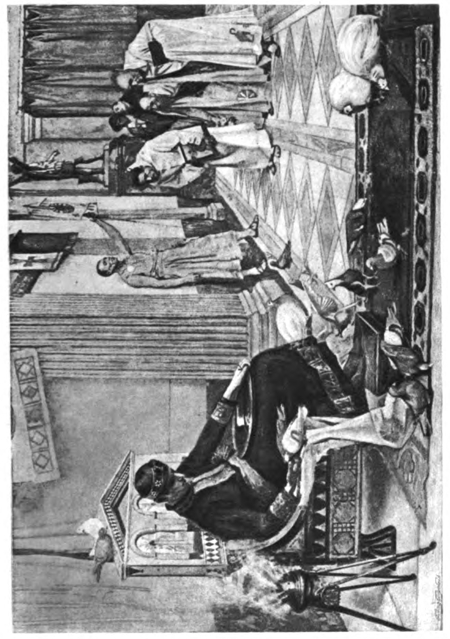
(See this image in horizontal aspect [here].)
The Favourites of Honorius. From a painting by J.W. Waterhouse, R.A..
[V-137]
CHAPTER XXX↩
Revolt of the Goths — They plunder Greece — Two great Invasions of Italy by Alaric and Radagaisus — They are repulsed by Stilicho — The Germans overrun Gaul — Usurpation of Constantine in the West — Disgrace and Death of Stilicho
If the subjects of Rome could be ignorant of their obligations to the great Theodosius, they were too soon convinced how painfully the spirit and abilities of their deceased emperor had supported the frail and mouldering edifice of the republic. He died in the month of January; and before the end of the winter of the same year the Gothic nation was in arms. [1] The Barbarian auxiliaries erected their independent standard; and boldly avowed the hostile designs which they had long cherished in their ferocious minds. Their countrymen, who had been condemned by the conditions of the last treaty to a life of tranquillity and labour, deserted their farms at the first sound of the trumpet, and eagerly resumed the weapons which they had reluctantly laid down. The barriers of the Danube were thrown open; the savage warriors of Scythia issued from their forests; and the uncommon severity of the winter allowed the poet to remark “that they rolled their ponderous waggons over the broad and icy back of the indignant river.” [2] The unhappy natives of the [V-138] provinces to the south of the Danube submitted to the calamities which, in the course of twenty years, were almost grown familiar to their imagination; and the various troops of Barbarians who gloried in the Gothic name were irregularly spread from the woody shores of Dalmatia to the walls of Constantinople. [3] The interruption, or at least the diminution, of the subsidy which the Goths had received from the prudent liberality of Theodosius was the specious pretence of their revolt; the affront was embittered by their contempt for the unwarlike sons of Theodosius; and their resentment was inflamed by the weakness or treachery of the minister of Arcadius. The frequent visits of Rufinus to the camp of the Barbarians, whose arms and apparel he affected to imitate, were considered as a sufficient evidence of his guilty correspondence: and the public enemy, from a motive either of gratitude or of policy, was attentive, amidst the general devastation, to spare the private estates of the unpopular prefect. The Goths, instead of being impelled by the blind and headstrong passions of their chiefs, were now directed by the bold and artful genius of Alaric. That renowned leader was descended from the noble race of the Balti; [4] which yielded only to the royal dignity of the Amali: he had solicited the command of the Roman armies; and the Imperial [V-139] court provoked him to demonstrate the folly of their refusal and the importance of their loss. Whatever hopes might be entertained of the conquest of Constantinople, the judicious general soon abandoned an impracticable enterprise. In the midst of a divided court and a discontented people, the emperor Arcadius was terrified by the aspect of the Gothic arms; but the want of wisdom and valour was supplied by the strength of the city; and the fortifications, both of the sea and land, might securely brave the impotent and random darts of the Barbarians. Alaric disdained to trample any longer on the prostrate and ruined countries of Thrace and Dacia, and he resolved to seek a plentiful harvest of fame and riches in a province which had hitherto escaped the ravages of war. [5]
The character of the civil and military officers, on whom Rufinus had devolved the government of Greece, confirmed the public suspicion that he had betrayed the ancient seat of freedom and learning to the Gothic invader. The proconsul Antiochus was the unworthy son of a respectable father; and Gerontius, who commanded the provincial troops, was much better qualified to execute the oppressive orders of a tyrant than to defend, with courage and ability, a country most remarkably fortified by the hand of nature. Alaric had traversed, without resistance, the plains of Macedonia and Thessaly, as far as the foot of Mount Oeta, a steep and woody range of hills, almost impervious to his cavalry. They stretched from east to west, to the edge of the seashore; and left, between the precipice and the Malian Gulf, an interval of three hundred feet, which, in some places, was contracted to a road capable of admitting only a single carriage. [6] In this narrow pass of Thermopylæ, where [V-140] Leonidas and the three hundred Spartans had gloriously devoted their lives, the Goths might have been stopped, or destroyed, by a skilful general; and perhaps the view of that sacred spot might have kindled some sparks of military ardour in the breasts of the degenerate Greeks. The troops which had been posted to defend the straits of Thermopylæ retired, as they were directed, without attempting to disturb the secure and rapid passage of Alaric; [7] and the fertile fields of Phocis and Bœotia were instantly covered by a deluge of Barbarians, who massacred the males of an age of bear arms, and drove away the beautiful females, with the spoil and cattle, of the flaming villages. The travellers who visited Greece several years afterwards could easily discover the deep and bloody traces of the march of the Goths; and Thebes was less indebted for her preservation to the strength of her seven gates than to the eager haste of Alaric, who advanced to occupy the city of Athens and the important harbour of the Piræus. The same impatience urged him to prevent the delay and danger of a siege, by the offer of a capitulation: and, as soon as the Athenians heard the voice of the Gothic herald, they were easily persuaded to deliver the greatest part of their wealth, as the ransom of the city of Minerva and its inhabitants. The treaty was ratified by solemn oaths, and observed with mutual fidelity. The Gothic prince, with a small and select train, was admitted within the walls; he indulged himself in the refreshment of the bath, accepted a splendid banquet which was provided by the magistrate, and affected to show that he was not ignorant of the manners of civilised nations. [8] But the [V-141] whole territory of Attica, from the promontory of Sunium to the town of Megara, was blasted by his baleful presence; and, if we may use the comparison of a contemporary philosopher, Athens itself resembled the bleeding and empty skin of a slaughtered victim. The distance between Megara and Corinth could not much exceed thirty miles; but the bad road, an expressive name, which it still bears among the Greeks, was, or might easily have been made, impassable for the march of an enemy. The thick and gloomy woods of Mount Cithæron covered the inland country; the Scironian rocks approached the water’s edge, and hung over the narrow and winding path, which was confined above six miles along the seashore. [9] The passage of those rocks, so infamous in every age, was terminated by the isthmus of Corinth; and a small body of firm and intrepid soldiers might have successfully defended a temporary intrenchment of five or six miles from the Ionian to the Ægean Sea. The confidence of the cities of Peloponnesus in their natural rampart had tempted them to neglect the care of their antique walls; and the avarice of the Roman governors had exhausted and betrayed the unhappy province. [10] Corinth, Argos, Sparta, yielded without resistance to the arms of the Goths; and the most fortunate of the inhabitants were saved by death from beholding the slavery of their families and the conflagration of their cities. [11] The vases and statues were [V-142] distributed among the Barbarians, with more regard to the value of the materials than to the elegance of the workmanship; the female captives submitted to the laws of war; the enjoyment of beauty was the reward of valour; and the Greeks could not reasonably complain of an abuse, which was justified by the example of the heroic times. [12] The descendants of that extraordinary people, who had considered valour and discipline as the walls of Sparta, no longer remembered the generous reply of their ancestors to an invader more formidable than Alaric: “If thou art a god, thou wilt not hurt those who have never injured thee; if thou art a man, advance: — and thou wilt find men equal to thyself.” [13] From Thermopylæ to Sparta, the leader of the Goths pursued his victorious march without encountering any mortal antagonists; but one of the advocates of expiring Paganism has confidently asserted that the walls of Athens were guarded by the goddess Minerva, with her formidable Ægis, and by the angry phantom of Achilles; [14] and that the conqueror was dismayed by the presence of the hostile deities of Greece. In an age of miracles, it would perhaps be unjust to dispute the claim of the historian Zosimus to the common benefit; yet it cannot be dissembled that the mind of Alaric was ill prepared to receive, either in sleeping or waking visions, the impressions of Greek superstition. The songs of Homer and the fame of Achilles had probably never reached the ear of the illiterate Barbarian; and the [V-143] Christian faith, which he had devoutly embraced, taught him to despise the imaginary deities of Rome and Athens. The invasion of the Goths, instead of vindicating the honour, contributed, at least accidentally, to extirpate the last remains, of Paganism; and the mysteries of Ceres, which had subsisted eighteen hundred years, did not survive the destruction of Eleusis and the calamities of Greece. [15]
The last hope of a people who could no longer depend on their arms, their gods, or their sovereign was placed in the powerful assistance of the general of the West; and Stilicho, who had not been permitted to repulse, advanced to chastise the invaders of Greece. [16] A numerous fleet was equipped in the ports of Italy; and the troops, after a short and prosperous navigation over the Ionian Sea, were safely disembarked on the isthmus, near the ruins of Corinth. The woody and mountainous country of Arcadia, the fabulous residence of Pan and the Dryads, became the scene of a long and doubtful conflict between two generals not unworthy of each other. The skill and perseverance of the Roman at length prevailed; and the Goths, after sustaining a considerable loss from disease and desertion, gradually retreated to the lofty mountain of Pholoe, near the sources of the Peneus, and on the frontiers of Elis: a sacred country, which had formerly been exempted from the calamities of war. [17] The camp of the Barbarians was immediately besieged; the waters of the [V-144] river [18] were diverted into another channel; and, while they laboured under the intolerable pressure of thirst and hunger, a strong line of circumvallation was formed to prevent their escape. After these precautions, Stilicho, too confident of victory, retired to enjoy his triumph in the theatrical games and lascivious dances of the Greeks; his soldiers, deserting their standards, spread themselves over the country of their allies, which they stripped of all that had been saved from the rapacious hands of the enemy. Alaric appears to have seized the favourable moment to execute one of those hardy enterprises, in which the abilities of a general are displayed with more genuine lustre than in the tumult of a day of battle. To extricate himself from the prison of Peloponnesus, it was necessary that he should pierce the intrenchments which surrounded his camp; that he should perform a difficult and dangerous march of thirty miles as far as the Gulf of Corinth; and that he should transport his troops, his captives, and his spoil over an arm of the sea which, in the narrow interval between Rhium and the opposite shore, is at least half a mile in breadth. [19] The operations of Alaric must have been secret, prudent, and rapid; since the Roman general was confounded by the intelligence that the Goths, who had eluded his efforts, were in full possession of the important province of Epirus. This unfortunate delay allowed Alaric sufficient time to conclude the treaty, which he secretly negotiated with the ministers of Constantinople. [V-145] The apprehension of a civil war compelled Stilicho to retire, at the haughty mandate of his rivals, from the dominions of Arcadius; and he respected in the enemy of Rome the honourable character of the ally and servant of the emperor of the East.
A Grecian philosopher, [20] who visited Constantinople soon after the death of Theodosius, published his liberal opinions concerning the duties of kings and the state of the Roman republic. Synesius observes and deplores the fatal abuse which the imprudent bounty of the late emperor had introduced into the military service. The citizens and subjects had purchased an exemption from the indispensable duty of defending their country; which was supported by the arms of Barbarian mercenaries. The fugitives of Scythia were permitted to disgrace the illustrious dignities of the empire; their ferocious youth, who disdained the salutary restraint of laws, were more anxious to acquire the riches than to imitate the arts of a people, the object of their contempt and hatred; and the power of the Goths was the stone of Tantalus, perpetually suspended over the peace and safety of the devoted state. The measures which Synesius recommends are the dictates of a bold and generous patriot. He exhorts the emperor to revive the courage of his subjects by the example of manly virtue; to banish luxury from the court and from the camp; to substitute in the place of the Barbarian mercenaries, an army of men interested in the defence of their laws and of their property; to force, in such a moment of public danger, the mechanic from his shop and the philosopher from his school; to rouse the indolent citizen from his dream of pleasure, and to arm, for the protection of [V-146] agriculture, the hands of the laborious husbandman. At the head of such troops, who might deserve the name, and would display the spirit, of Romans, he animates the son of Theodosius to encounter a race of Barbarians who were destitute of any real courage; and never to lay down his arms, till he had chased them far away into the solitudes of Scythia; or had reduced them to the state of ignominious servitude which the Lacedæmonians formerly imposed on the captive Helots. [21] The court of Arcadius indulged the zeal, applauded the eloquence, and neglected the advice of Synesius. Perhaps the philosopher, who addresses the emperor of the East in the language of reason and virtue which he might have used to a Spartan king, had not condescended to form a practicable scheme, consistent with the temper and circumstances of a degenerate age. Perhaps the pride of the ministers, whose business was seldom interrupted by reflection, might reject as wild and visionary every proposal which exceeded the measure of their capacity and deviated from the forms and precedents of office. While the oration of Synesius and the downfall of the Barbarians were the topics of popular conversation, an edict was published at Constantinople, which declared the promotion of Alaric to the rank of master-general of the Eastern Illyricum. The Roman provincials and the allies, who had respected the faith of treaties, were justly indignant that the ruin of Greece and Epirus should be so liberally rewarded. The Gothic conqueror was received as a lawful magistrate, in the cities which he had so lately besieged. The fathers whose sons he had massacred, the husbands whose wives he had violated, were subject to his authority; and the success of his rebellion encouraged the ambition of every leader of the foreign mercenaries. The use to which Alaric applied his new command distinguishes the firm and judicious character of his policy. He issued his orders to the [V-147] four magazines and manufactures of offensive and defensive arms, Margus, Ratiaria, Naissus, and Thessalonica, to provide his troops with an extraordinary supply of shields, helmets, swords, and spears; the unhappy provincials were compelled to forge the instruments of their own destruction; and the Barbarians removed the only defect which had sometimes disappointed the efforts of their courage. [22] The birth of Alaric, the glory of his past exploits, and the confidence in his future designs insensibly united the body of the nation under his victorious standard; and with the unanimous consent of the Barbarian chieftains, the mastergeneral of Illyricum was elevated, according to ancient custom, on a shield, and solemnly proclaimed king of the Visigoths. [23] Armed with this double power, seated on the verge of the two empires, he alternately sold his deceitful promises to the courts of Arcadius and Honorius; [24] till he declared and executed his resolution of invading the dominions of the West. The provinces of Europe which belonged to the Eastern emperor were already exhausted; those of [V-148] Asia were inaccessible; and the strength of Constantinople had resisted his attack. But he was tempted by the fame, the beauty, the wealth of Italy, which he had twice visited; and he secretly aspired to plant the Gothic standard on the walls of Rome, and to enrich his army with the accumulated spoils of three hundred triumphs. [25]
The scarcity of facts [26] and the uncertainty of dates [27] oppose our attempts to describe the circumstances of the first invasion of Italy by the arms of Alaric. His march, perhaps from Thessalonica, through the warlike and hostile country of Pannonia, as far as the foot of the Julian Alps; his passage of those mountains, which were strongly guarded by troops and intrenchments; the siege of Aquileia, and the conquest of the provinces of Istria and Venetia, appear to have employed a considerable time. Unless his operations were extremely cautious and slow, the length of the interval would suggest a probable suspicion that the Gothic king retreated towards the banks of the Danube and reinforced his army with fresh swarms of Barbarians, before he again attempted to penetrate into the heart of Italy. Since the public and important events escape the diligence of the historian, he may amuse himself with contemplating, for a moment, the influence of the arms of Alaric on the fortunes of two obscure [V-149] individuals, a presbyter of Aquileia and an husbandman of Verona. The learned Rufinus, who was summoned by his enemies to appear before a Roman synod, [28] wisely preferred the dangers of a besieged city; and the Barbarians, who furiously shook the walls of Aquileia, might save him from the cruel sentence of another heretic, who, at the request of the same bishops, was severely whipped and condemned to perpetual exile on a desert island. [29] The old man, [30] who had passed his simple and innocent life in the neighbourhood of Verona, was a stranger to the quarrels both of kings and of bishops; his pleasures, his desires, his knowledge, were confined within the little circle of his paternal farm; and a staff supported his aged steps, on the same ground where he had sported in his infancy. Yet even this humble and rustic felicity (which Claudian describes with so much truth and feeling) was still exposed to the undistinguishing rage of war. His trees, his old contemporary trees, [31] must blaze in the conflagration of the whole country; a detachment of Gothic cavalry might sweep away his cottage and his family; and the [V-150] power of Alaric could destroy this happiness which he was not able either to taste or to bestow. “Fame,” says the poet, “encircling with terror her gloomy wings, proclaimed the march of the Barbarian army, and filled Italy with consternation;” the apprehensions of each individual were increased in just proportion to the measure of his fortune; and the most timid, who had already embarked their valuable effects, meditated their escape to the island of Sicily or the African coast. The public distress was aggravated by the fears and reproaches of superstition. [32] Every hour produced some horrid tale of strange and portentous accidents; the Pagans deplored the neglect of omens and the interruption of sacrifices; but the Christians still derived some comfort from the powerful intercession of the saints and martyrs. [33]
The emperor Honorius was distinguished, above his subjects, by the pre-eminence of fear, as well as of rank. The pride and luxury in which he was educated had not allowed him to suspect that there existed on the earth any power presumptuous enough to invade the repose of the successor of Augustus. The arts of flattery concealed the impending danger, till Alaric approached the palace of Milan. But, when the sound of war had awakened the young emperor, instead of flying to arms with the spirit, or even the rashness, of his age, he eagerly listened to those timid counsellors who proposed to convey his sacred person and his faithful attendants to some secure and distant station in the provinces of Gaul. Stilicho alone [34] had courage and authority to resist [V-151] this disgraceful measure, which would have abandoned Rome and Italy to the Barbarians; but, as the troops of the palace had been lately detached to the Rhætian frontier, and as the resource of new levies was slow and precarious, the general of the West could only promise that, if the court of Milan would maintain their ground during his absence, he would soon return with an army equal to the encounter of the Gothic king. Without losing a moment (while each moment was so important to the public safety) Stilicho hastily embarked on the Larian lake, ascended the mountains of ice and snow, amidst the severity of an Alpine winter, and suddenly repressed, by his unexpected presence, the enemy who had disturbed the tranquillity of Rhætia. [35] The Barbarians, perhaps some tribes of the Alemanni, respected the firmness of a chief who still assumed the language of command; and the choice which he condescended to make of a select number of their bravest youths was considered as a mark of his esteem and favour. The cohorts, who were delivered from the neighbouring foe, diligently repaired to the Imperial standard; and Stilicho issued his orders to the most remote troops of the West to advance, by rapid marches, to the defence of Honorius and of Italy. The fortresses of the Rhine were abandoned; and the safety of Gaul was protected only by the faith of the Germans and the ancient terror of the Roman name. Even the legion which had been stationed to guard the wall of Britain against the Caledonians of the North was hastily recalled; [36] and a numerous body of the cavalry [V-152] of the Alani was persuaded to engage in the service of the emperor, who anxiously expected the return of his general. The prudence and vigour of Stilicho were conspicuous on this occasion, which revealed, at the same time, the weakness of the falling empire. The legions of Rome, which had long since languished in the gradual decay of discipline and courage, were exterminated by the Gothic and civil wars; and it was found impossible, without exhausting and exposing the provinces, to assemble an army for the defence of Italy.
When Stilicho seemed to abandon his sovereign in the unguarded palace of Milan, he had probably calculated the term of his absence, the distance of the enemy, and the obstacles that might retard their march. He principally depended on the rivers of Italy, the Adige, the Mincius, the Oglio, and the Addua; which, in the winter or spring, by the fall of rains, or by the melting of the snows, are commonly swelled into broad and impetuous torrents. [37] But the season happened to be remarkably dry; and the Goths could traverse, without impediment, the wide and stony beds, whose centre was faintly marked by the course of a shallow stream. The bridge and passage of the Addua were secured by a strong detachment of the Gothic army; and, as Alaric approached the walls, or rather the suburbs, of Milan, he enjoyed the proud satisfaction of seeing the emperor of the Romans fly before him. Honorius, accompanied by a feeble train of statesmen and eunuchs, hastily retreated towards the Alps, with a design of securing his person in the city of Arles, which had often been the royal residence of his predecessors. But Honorius [38] had scarcely passed the Po, before he was overtaken [V-153] by the speed of the Gothic cavalry; [39] since the urgency of the danger compelled him to seek a temporary shelter within the fortification of Asta, a town of Liguria or Piemont, situate on the banks of the Tanarus. [40] The siege of an obscure place, which contained so rich a prize and seemed incapable of a long resistance, was instantly formed and indefatigably pressed by the king of the Goths; and the bold declaration, which the emperor might afterwards make, that his breast had never been susceptible of fear, did not probably obtain much credit, even in his own court. [41] In the last and almost hopeless extremity, after the Barbarians had already proposed the indignity of a capitulation, the Imperial captive was suddenly relieved by the fame, the approach, and at length the presence of the hero whom he had so long expected. At the head of a chosen and intrepid vanguard, Stilicho swam the stream of the Addua, to gain the time which he must have lost in the attack of the bridge; the passage of the Po was an enterprise of much less hazard and difficulty; and the successful action, in which he cut his way through the Gothic camp under the walls of Asta, revived the hopes, and vindicated the honour, of Rome. Instead of grasping the fruit of his victory, the Barbarian was gradually invested, on every side, by the troops of the West, who successively issued through all the passes of the Alps; his quarters were straitened; his convoys were intercepted; and the vigilance of the Romans prepared to form a chain of fortifications, and to besiege the lines of the [V-154] besiegers. A military council was assembled of the longhaired chiefs of the Gothic nation; of aged warriors, whose bodies were wrapped in furs, and whose stern countenances were marked with honourable wounds. They weighed the glory of persisting in their attempt against the advantage of securing their plunder; and they recommended the prudent measure of a seasonable retreat. In this important debate, Alaric displayed the spirit of the conqueror of Rome; and, after he had reminded his countrymen of their achievements and of their designs, he concluded his animating speech by the solemn and positive assurance that he was resolved to find in Italy either a kingdom or a grave. [42]
The loose discipline of the Barbarians always exposed them to the danger of a surprise; but, instead of choosing the dissolute hours of riot and intemperance, Stilicho resolved to attack the Christian Goths, whilst they were devoutly employed in celebrating the festival of Easter. [43] The execution of the stratagem, or, as it was termed by the clergy, of the sacrilege, was entrusted to Saul, a Barbarian and a Pagan, who had served, however, with distinguished reputation among the veteran generals of Theodosius. The camp of the Goths, which Alaric had pitched in the neighbourhood of Pollentia, [44] was thrown into confusion by the sudden and impetuous [V-155] charge of the Imperial cavalry; but, in a few moments, the undaunted genius of their leader gave them an order, and a field, of battle; and, as soon as they had recovered from their astonishment, the pious confidence, that the God of the Christians would assert their cause, added new strength to their native valour. In this engagement, which was long maintained with equal courage and success, the chief of the Alani, whose diminutive and savage form concealed a magnanimous soul, approved his suspected loyalty by the zeal with which he fought, and fell, in the service of the republic; and the fame of this gallant Barbarian has been imperfectly preserved in the verses of Claudian, since the poet, who celebrates his virtue, has omitted the mention of his name. His death was followed by the flight and dismay of the squadrons which he commanded; and the defeat of the wing of cavalry might have decided the victory of Alaric, if Stilicho had not immediately led the Roman and Barbarian infantry to the attack. The skill of the general and the bravery of the soldiers surmounted every obstacle. In the evening of the bloody day, the Goths retreated from the field of battle; the intrenchments of their camp were forced, and the scene of rapine and slaughter made some atonement for the calamities which they had inflicted on the subjects of the empire. [45] The magnificent spoils of Corinth and Argos enriched the veterans of the West; the captive wife of Alaric, who had impatiently claimed his promise of Roman jewels and Patrician handmaids, [46] was reduced to implore the mercy of the insulting [V-156] foe; and many thousand prisoners, released from the Gothic chains, dispersed through the provinces of Italy the praises of their heroic deliverer. The triumph of Stilicho [47] was compared by the poet, and perhaps by the public, to that of Marius; who, in the same part of Italy, had encountered and destroyed another army of Northern Barbarians. The huge bones, and the empty helmets, of the Cimbri and of the Goths would easily be confounded by succeeding generations; and posterity might erect a common trophy to the memory of the two most illustrious generals who had vanquished, on the same memorable ground, the two most formidable enemies of Rome. [48]
The eloquence of Claudian [49] has celebrated with lavish applause the victory of Pollentia, one of the most glorious days in the life of his patron; but his reluctant and partial muse bestows more genuine praise on the character of the Gothic king. His name is indeed branded with the reproachful epithets of pirate and robber, to which the conquerors of every age are so justly entitled; but the poet of Stilicho is compelled to acknowledge that Alaric possessed the invincible temper of mind which rises superior to every misfortune and derives new resources from adversity. After the total defeat of his infantry he escaped, or rather withdrew, from the field of battle, with the greatest part of his cavalry entire [V-157] and unbroken. Without wasting a moment to lament the irreparable loss of so many brave companions, he left his victorious enemy to bind in chains the captive images of a Gothic king; [50] and boldly resolved to break through the unguarded passes of the Apennine, to spread desolation over the fruitful face of Tuscany, and to conquer or die before the gates of Rome. [51] The capital was saved by the active and incessant diligence of Stilicho: but he respected the despair of his enemy; and, instead of committing the fate of the republic to the chance of another battle, he proposed to purchase the absence of the Barbarians. The spirit of Alaric would have rejected such terms, the permission of a retreat and the offer of a pension, with contempt and indignation; but he exercised a limited and precarious authority over the independent chieftains, who had raised him, for their service, above the rank of his equals; they were still less disposed to follow an unsuccessful general, and many of them were tempted to consult their interest by a private negotiation with the minister of Honorious. The king submitted to the voice of his people, ratified the treaty with the empire of the West, and repassed the Po, with the remains of the flourishing army which he had led into Italy. A considerable part of the Roman forces still continued to attend his motions; and Stilicho, who maintained a secret correspondence with some of the Barbarian chiefs, was punctually apprized of the designs that were formed in the camp and council of Alaric. The king of the Goths, ambitious to signalise his retreat by some splendid achievement, had resolved to occupy the important city of Verona, [V-158] which commands the principal passage of the Rhætian Alps; and directing his march through the territories of those German tribes, whose alliance would restore his exhausted strength, to invade, on the side of the Rhine, the wealthy and unsuspecting provinces of Gaul. Ignorant of the treason, which had already betrayed his bold and judicious enterprise, he advanced towards the passes of the mountains, already possessed by the Imperial troops; where he was exposed, almost at the same instant, to a general attack in the front, on his flanks, and in the rear. In this bloody action, at a small distance from the walls of Verona, [52] the loss of the Goths was not less heavy than that which they had sustained in the defeat of Pollentia; and their valiant king, who escaped by the swiftness of his horse, must either have been slain or made prisoner, if the hasty rashness of the Alani had not disappointed the measures of the Roman general. Alaric secured the remains of his army on the adjacent rocks; and prepared himself with undaunted resolution to maintain a siege against the superior numbers of the enemy, who invested him on all sides. But he could not oppose the destructive progress of hunger and disease; nor was it possible for him to check the continual desertion of his impatient and capricious Barbarians. In this extremity he still found resources in his own courage, or in the moderation of his adversary; and the retreat of the Gothic king was considered as the deliverance of Italy. [53] Yet the people and even the clergy, incapable of forming any rational judgment of the business of peace and war, presumed to arraign the policy of Stilicho, who so often vanquished, so often surrounded, and so often dismissed the implacable enemy of the republic. The first moment of the public safety is devoted to gratitude and joy; but the second is diligently occupied by envy and calumny. [54]
[V-159]
The citizens of Rome had been astonished by the approach of Alaric; and the diligence with which they laboured to restore the walls of the capital confessed their own fears and the decline of the empire. After the retreat of the Barbarians, Honorius was directed to accept the dutiful invitation of the senate, and to celebrate in the Imperial city the auspicious era of the Gothic victory and of his sixth consulship. [55] The suburbs and the streets from the Milvian bridge to the Palatine mount, were filled by the Roman people, who, in the space of an hundred years, had only thrice been honoured with the presence of their sovereigns. While their eyes were fixed on the chariot where Stilicho was deservedly seated by the side of his royal pupil, they applauded the pomp of a triumph, which was not stained, like that of Constantine, or of Theodosius, with civil blood. The procession passed under a lofty arch, which had been purposely erected: but in less than seven years the Gothic conquerors of Rome might read, if they were able to read, the superb inscription of that monument, which attested the total defeat and destruction of their nation. [56] The emperor resided several months in the capital, and every part of his behaviour was regulated with care to conciliate the affection of the clergy, the senate, and the people of Rome. The clergy was edified by his frequent visits and liberal gifts to the shrines of the apostles. The senate, who in the triumphal procession had been excused from the humiliating ceremony of preceding on foot the Imperial chariot, was treated with the decent reverence which Stilicho always affected for that assembly. The people was repeatedly gratified by the attention and courtesy of Honorius in the [V-160] public games, which were celebrated on that occasion with a magnificence not unworthy of the spectator. As soon as the appointed number of chariot races was concluded, the decoration of the Circus was suddenly changed; the hunting of wild beasts afforded a various and splendid entertainment; and the chase was succeeded by a military dance, which seems in the lively description of Claudian to present the image of a modern tournament.
In these games of Honorius, the inhuman combats of gladiators [57] polluted, for the last time, the amphitheatre of Rome. The first Christian emperor may claim the honour of the first edict which condemned the art and amusement of shedding human blood; [58] but this benevolent law expressed the wishes of the prince, without reforming an inveterate abuse, which degraded a civilised nation below the condition of savage cannibals. Several hundred, perhaps several thousand, victims were annually slaughtered in the great cities of the empire; and the month of December, more peculiarly devoted to the combats of gladiators, still exhibited to the eyes of the Roman people a grateful spectacle of blood and cruelty. Amidst the general joy of the victory of Pollentia, a Christian poet exhorted the emperor to extirpate by his authority the horrid custom which had so long resisted the voice of humanity and religion. [59] The pathetic representations of Prudentius were less effectual than the generous boldness of Telemachus, an Asiatic monk, whose death was more useful to mankind than his life. [60] The Romans were provoked by the interruption [V-none] [V-161] of their pleasures; and the rash monk, who had descended into the arena to separate the gladiators, was overwhelmed under a shower of stones. But the madness of the people soon subsided; they respected the memory of Telemachus, who had deserved the honours of martyrdom; and they submitted, without a murmur, to the laws of Honorius, which abolished for ever the human sacrifices of the amphitheatre. The citizens who adhered to the manners of their ancestors, might perhaps insinuate that the last remains of a martial spirit were preserved in this school of fortitude, which accustomed the Romans to the sight of blood and to the contempt of death: a vain and cruel prejudice, so nobly confuted by the valour of ancient Greece and of modern Europe. [61]
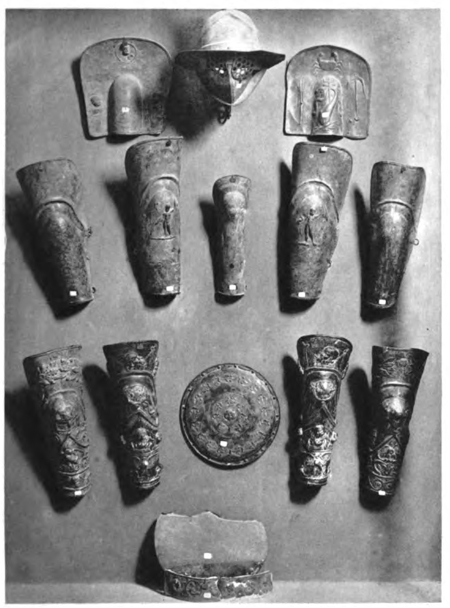
Armour of Galadiators. Found at Ercolano, and now in the National Museum, Naples.
The recent danger to which the person of the emperor had been exposed in the defenceless palace of Milan urged him to seek a retreat in some inaccessible fortress of Italy, where he might securely remain while the open country was covered by a deluge of Barbarians. On the coast of the Hadriatic, about ten or twelve miles from the most southern of the seven mouths of the Po, the Thessalians had founded the ancient colony of Ravenna, [62] which they afterwards resigned to the natives of Umbria. Augustus, who had observed the opportunity of the place, prepared, at the distance of three miles from the old [V-162] town, a capacious harbour for the reception of two hundred and fifty ships of war. This naval establishment, which included the arsenals and magazines, the barracks of the troops, and the houses of the artificers, derived its origin and name from the permanent station of the Roman fleet; the intermediate space was soon filled with buildings and inhabitants, and the three extensive and populous quarters of Ravenna gradually contributed to form one of the most important cities of Italy. The principal canal of Augustus poured a copious stream of the waters of the Po through the midst of the city to the entrance of the harbour; the same waters were introduced into the profound ditches that encompassed the walls; they were distributed by a thousand subordinate canals into every part of the city, which they divided into a variety of small islands; the communication was maintained only by the use of boats and bridges; and the houses of Ravenna, whose appearance may be compared to that of Venice, were raised on the foundation of wooden piles. The adjacent country, to the distance of many miles, was a deep and impassable morass; and the artificial causeway, which connected Ravenna with the continent, might be easily guarded or destroyed on the approach of an hostile army. These morasses were interspersed, however, with vineyards; and, though the soil was exhausted by four or five crops, the town enjoyed a more plentiful supply of wine than of fresh water. [63] The air, instead of receiving the sickly and almost pestilential exhalations of low and marshy grounds, was distinguished, like the neighbourhood of Alexandria, as uncommonly pure and salubrious; and this singular advantage was ascribed to the regular tides of the Hadriatic, which swept the canals, interrupted the unwholesome stagnation of the waters, and floated every day the vessels of the adjacent [V-163] country into the heart of Ravenna. The gradual retreat of the sea has left the modern city at the distance of four miles from the Hadriatic; and as early as the fifth or sixth century of the Christian era the port of Augustus was converted into pleasant orchards, and a lonely grove of pines covered the ground where the Roman fleet once rode at anchor. [64] Even this alteration contributed to increase the natural strength of the place; and the shallowness of the water was a sufficient barrier against the large ships of the enemy. This advantageous situation was fortified by art and labour; and in the twentieth year of his age the emperor of the West, anxious only for his personal safety, retired to the perpetual confinement of the walls and morasses of Ravenna. The example of Honorius was imitated by his feeble successors, the Gothic kings, and afterwards the Exarchs, who occupied the throne and palace of the emperors; and, till the middle of the eighth century, Ravenna was considered as the seat of government and the capital of Italy. [65]
The fears of Honorius were not without foundation, nor were his precautions without effect. While Italy rejoiced in her deliverance from the Goths, a furious tempest was excited among the nations of Germany, who yielded to the irresistible impulse that appears to have been gradually communicated from the eastern extremity of the continent of Asia. The Chinese annals, as they have been interpreted by the learned industry of the present age, may be usefully applied to reveal the secret and remote causes of the fall of the Roman empire. The extensive territory to the north of the great wall was possessed, [V-164] after the flight of the Huns, by the victorious Sien-pi, who were sometimes broken into independent tribes, and re-united under a supreme chief; till at length, styling themselves Topa, or masters of the earth, they acquired a more solid consistence and a more formidable power. The Topa soon compelled the pastoral nations of the eastern desert to acknowledge the superiority of their arms; they invaded China in a period of weakness and intestine discord; and these fortunate Tartars, adopting the laws and manners of the vanquished people, founded an Imperial dynasty, which reigned near one hundred and sixty years over the northern provinces of the monarchy. Some generations before they ascended the throne of China one of the Topa princes had enlisted in his cavalry a slave of the name of Moko, renowned for his valour; but who was tempted by the fear of punishment to desert his standard and to range the desert at the head of an hundred followers. This gang of robbers and outlaws swelled into a camp, a tribe, a numerous people, distinguished by the appellation of Geougen; and their hereditary chieftains, the posterity of Moko, the slave, assumed their rank among the Scythian monarchs. The youth of Toulun, the greatest of his descendants, was exercised by those misfortunes which are the school of heroes. He bravely struggled with adversity, broke the imperious yoke of the Topa, and became the legislator of his nation and the conqueror of Tartary. His troops were distributed into regular bands of an hundred and of a thousand men; cowards were stoned to death; the most splendid honours were proposed as the reward of valour; and Toulun, who had knowledge enough to despise the learning of China, adopted only such arts and institutions as were favourable to the military spirit of his government. His tents, which he removed in the winter season to a more southern latitude, were pitched during the summer on the fruitful banks of the Selinga. His conquests stretched from Corea far beyond the river Irtish. He vanquished in the country to the north of the Caspian Sea the nation of the [V-165] Huns; and the new title of Khan or Cagan expressed the fame and power which he derived from this memorable victory. [66]
The chain of events is interrupted, or rather is concealed, as it passes from the Volga to the Vistula, through the dark interval which separates the extreme limits of the Chinese and of the Roman geography. Yet the temper of the Barbarians and the experience of successive emigrations sufficiently declare that the Huns, who were oppressed by the arms of the Geougen, soon withdrew from the presence of an insulting victor. The countries towards the Euxine were already occupied by their kindred tribes; and their hasty flight, which they soon converted into a bold attack, would more naturally be directed towards the rich and level plains through which the Vistula gently flows into the Baltic Sea. The North must again have been alarmed and agitated by the invasion of the Huns; and the nations who retreated before them must have pressed with incumbent weight on the confines of Germany. [67] The inhabitants of those regions which the ancients have assigned to the Suevi, the Vandals, and the Burgundians might embrace the resolution of abandoning to the fugitives of Sarmatia their woods and morasses; or at least of discharging their superfluous numbers on the provinces of the Roman empire. [68] About four years after the victorious [V-166] Toulun had assumed the title of Khan of the Geougen, another Barbarian, the haughty Rhodogast or Radagaisus, [69] marched from the northern extremities of Germany almost to the gates of Rome, and left the remains of his army to achieve the destruction of the West. The Vandals, the Suevi, and the Burgundians formed the strength of this mighty host; but the Alani, who had found an hospitable reception in their new seats, added their active cavalry to the heavy infantry of the Germans; and the Gothic adventurers crowded so eagerly to the standard of Radagaisus that, by some historians, he has been styled the king of the Goths. Twelve thousand warriors, distinguished above the vulgar by their noble birth or their valiant deeds, glittered in the van; [70] and the whole multitude, which was not less than two hundred thousand fighting men, might be increased by the accession of women, of children, and of slaves, to the amount of four hundred thousand persons. This formidable emigration issued from the same coast of the Baltic which had poured forth the myriads of the Cimbri and Teutones to assault Rome and Italy in the vigour of the republic. After the departure of those Barbarians, their native country, which was marked by the vestiges of their greatness, long ramparts and gigantic moles, [71] remained during some ages a vast and dreary solitude; till the human species was renewed by the powers of generation, [V-167] and the vacancy was filled by the influx of new inhabitants. The nations who now usurp an extent of land which they are unable to cultivate would soon be assisted by the industrious poverty of their neighbours, if the government of Europe did not protect the claims of dominion and property.
The correspondence of nations was in that age so imperfect and precarious that the revolutions of the North might escape the knowledge of the court of Ravenna; till the dark cloud which was collected along the coast of the Baltic burst in thunder upon the banks of the Upper Danube. The emperor of the West, if his ministers disturbed his amusements by the news of the impending danger, was satisfied with being the occasion, and the spectator, of the war. [72] The safety of Rome was entrusted to the counsels and the sword of Stilicho; but such was the feeble and exhausted state of the empire that it was impossible to restore the fortifications of the Danube, or to prevent, by a vigorous effort, the invasion of the Germans. [73] The hopes of the vigilant minister of Honorius were confined to the defence of Italy. He once more abandoned the provinces, recalled the troops, pressed the new levies, which were rigorously exacted and pusillanimously eluded, employed the most efficacious means to arrest, or allure, the deserters, and offered the gift of freedom, and of two pieces of gold, to all the slaves who would enlist. [74] By these efforts he painfully [V-168] collected, from the subjects of a great empire, an army of thirty or forty thousand men, which, in the days of Scipio or Camillus, would have been instantly furnished by the free citizens of the territory of Rome. [75] The thirty legions of Stilicho were reinforced by a large body of Barbarian auxiliaries; the faithful Alani were personally attached to his service; and the troops of Huns and of Goths, who marched under the banners of their native princes, Huldin and Sarus, were animated by interest and resentment to oppose the ambition of Radagaisus. The king of the confederate Germans passed, without resistance, the Alps, the Po, and the Apennine, leaving on one hand the inaccessible palace of Honorius, securely buried among the marshes of Ravenna, and, on the other, the camp of Stilicho, who had fixed his headquarters at Ticinum, or Pavia, but who seems to have avoided a decisive battle, till he had assembled his distant forces. Many cities of Italy were pillaged, or destroyed, and the siege of Florence [76] by Radagaisus is one of the earliest events in the history of that celebrated republic, whose firmness checked and delayed the unskilful fury of the Barbarians. The senate and people trembled at their approach within an hundred and eighty miles of Rome, and anxiously compared the danger which they had escaped with the new perils to which they were exposed. Alaric was a Christian and a soldier, the leader of a disciplined army; who understood the laws of war, who respected the sanctity of treaties, and who [V-169] had familiarly conversed with the subjects of the empire in the same camps, and the same churches. The savage Radagaisus was a stranger to the manners, the religion, and even the language of the civilised nations of the South. The fierceness of his temper was exasperated by cruel superstition, and it was universally believed that he had bound himself by a solemn vow to reduce the city into a heap of stones and ashes, and to sacrifice the most illustrious of the Roman senators on the altars of those gods who were appeased by human blood. The public danger, which should have reconciled all domestic animosities, displayed the incurable madness of religious faction. The oppressed votaries of Jupiter and Mercury respected, in the implacable enemy of Rome, the character of a devout Pagan; loudly declared that they were more apprehensive of the sacrifices than of the arms of Radagaisus, and secretly rejoiced in the calamities of their country, which condemned the faith of their Christian adversaries. [77]
Florence was reduced to the last extremity, and the fainting courage of the citizens was supported only by the authority of St. Ambrose, who had communicated, in a dream, the promise of a speedy deliverance. [78] On a sudden, they beheld, from their walls, the banners of Stilicho, who advanced, with his united force, to the relief of the faithful city, and who soon marked that fatal spot for the grave of the Barbarian host. The apparent contradictions of those writers who variously relate the defeat of Radagaisus may be reconciled, without offering much violence to their respective testimonies. Orosius and Augustin, who were intimately connected by friendship [V-170] and religion, ascribe this miraculous victory to the providence of God rather than to the valour of man. [79] They strictly exclude every idea of chance, or even of bloodshed, and positively affirm that the Romans, whose camp was the scene of plenty and idleness, enjoyed the distress of the Barbarians, slowly expiring on the sharp and barren ridge of the hills of Fæsulæ, which rise above the city of Florence. Their extravagant assertion that not a single soldier of the Christian army was killed, or even wounded, may be dismissed with silent contempt; but the rest of the narrative of Augustin and Orosius is consistent with the state of the war and the character of Stilicho. Conscious that he commanded the last army of the republic, his prudence would not expose it in the open field to the headstrong fury of the Germans. The method of surrounding the enemy with strong lines of circumvallation, which he had twice employed against the Gothic king, was repeated on a larger scale, and with more considerable effect. The examples of Cæsar must have been familiar to the most illiterate of the Roman warriors; and the fortifications of Dyrrachium, which connected twenty-four castles by a perpetual ditch and rampart of fifteen miles, afforded the model of an intrenchment which might confine and starve the most numerous host of Barbarians. [80] The Roman troops had less degenerated from the industry than from the valour of their ancestors, and, if the servile and laborious [V-171] work offended the pride of the soliders, Tuscany could supply many thousand peasants who would labour, though perhaps they would not fight, for the salvation of their native country. The imprisoned multitude of horses and men [81] was gradually destroyed by famine rather than by the sword; but the Romans were exposed, during the progress of such an extensive work, to the frequent attacks of an impatient enemy. The despair of the hungry Barbarians would precipitate them against the fortifications of Stilicho; the general might sometimes indulge the ardour of his brave auxiliaries, who eagerly pressed to assault the camp of the Germans; and these various incidents might produce the sharp and bloody conflicts which dignify the narrative of Zosimus and the Chronicles of Prosper and Marcellinus. [82] A seasonable supply of men and provisions had been introduced into the walls of Florence, and the famished host of Radagaisus was in its turn besieged. The proud monarch of so many warlike nations, after the loss of his bravest warriors, was reduced to confide either in the faith of a capitulation or in the clemency of Stilicho. [83] But the death of the royal captive, who was ignominiously beheaded, disgraced the triumph of Rome and of Christianity, and the short delay of his execution was sufficient to brand the conqueror with the guilt of cool and deliberate cruelty. [84] The famished Germans who escaped the fury of the auxiliaries were sold as slaves, at the contemptible [V-172] price of as many single pieces of gold; but the difference of food and climate swept away great numbers of those unhappy strangers; and it was observed that the inhuman purchasers, instead of reaping the fruits of their labour, were soon obliged to provide the expense of their interment. Stilicho informed the emperor and the senate of his success; and deserved, a second time, the glorious title of Deliverer of Italy. [85]
The fame of the victory, and more especially of the miracle, has encouraged a vain persuasion that the whole army, or rather nation, of Germans, who migrated from the shores of the Baltic, miserably perished under the walls of Florence. Such indeed was the fate of Radagaisus himself, of his brave and faithful companions, and of more than one third of the various multitude of Sueves and Vandals, of Alani and Burgundians, who adhered to the standard of their general. [86] The union of such an army might excite our surprise, but the causes of separation are obvious and forcible; the pride of birth, the insolence of valour, the jealousy of command, the impatience of subordination, and the obstinate conflict of opinions, of interests, and of passions, among so many kings and warriors, who were untaught to yield, or to obey. After the defeat of Radagaisus, two parts of the German host, which must have exceeded the number of one hundred thousand men, still remained in arms, between the Apennine and the Alps, or between the Alps and the Danube. It is uncertain [V-173] whether they attempted to revenge the death of their general; but their irregular fury was soon diverted by the prudence and firmness of Stilicho, who opposed their march, and facilitated their retreat; who considered the safety of Rome and Italy as the great object of his care, and who sacrificed, with too much indifference, the wealth and tranquillity of the distant provinces. [87] The Barbarians acquired, from the junction of some Pannonian deserters, the knowledge of the country and of the roads; and the invasion of Gaul, which Alaric had designed, was executed by the remains of the great army of Radagaisus. [88]
Yet, if they expected to derive any assistance from the tribes of Germany, who inhabited the banks of the Rhine, their hopes were disappointed: The Alemanni preserved a state of inactive neutrality; and the Franks distinguished their zeal and courage in the defence of the empire. In the rapid progress down the Rhine, which was the first act of the administration of Stilicho, he had applied himself, with peculiar attention, to secure the alliance of the warlike Franks, and to remove the irreconcileable enemies of peace and of the republic. Marcomir, one of their kings, was publicly convicted before the tribunal of the Roman magistrate, of violating the faith of treaties. He was sentenced to a mild, but distant, exile in the province of Tuscany; and this degradation of the regal dignity was so far from exciting the resentment of his subjects that they punished with death the turbulent [V-174] Sunno, who attempted to revenge his brother; and maintained a dutiful allegiance to the princes who were established on the throne by the choice of Stilicho. [89] When the limits of Gaul and Germany were shaken by the northern emigration, the Franks bravely encountered the single force of the Vandals, who, regardless of the lessons of adversity, had again separated their troops from the standard of their Barbarian allies. They paid the penalty of their rashness, and twenty thousand Vandals, with their king Godigisclus, were slain in the field of battle. The whole people must have been extirpated if the squadrons of the Alani, advancing to their relief, had not trampled down the infantry of the Franks, who, after an honourable resistance, were compelled to relinquish the unequal contest. The victorious confederates pursued their march; and on the last day of the year, in a season when the waters of the Rhine were most probably frozen, they entered, without opposition, the defenceless provinces of Gaul. This memorable passage of the Suevi, the Vandals, the Alani, and the Burgundians, who never afterwards retreated, may be considered as the fall of the Roman empire in the countries beyond the Alps; and the barriers, which had so long separated the savage and the civilised nations of the earth, were from that fatal moment levelled with the ground. [90]
[V-175]
While the peace of Germany was secured by the attachment of the Franks, and the neutrality of the Alemanni, the subjects of Rome, unconscious of their approaching calamities, enjoyed the state of quiet and prosperity, which had seldom blessed the frontiers of Gaul. Their flocks and herds were permitted to graze in the pastures of the Barbarians; their huntsmen penetrated, without fear or danger, into the darkest recesses of the Hercynian wood. [91] The banks of the Rhine were crowned, like those of the Tiber, with elegant houses, and well-cultivated farms; and, if a poet descended the river, he might express his doubt on which side was situated the territory of the Romans. [92] This scene of peace and plenty was suddenly changed into a desert; and the prospect of the smoking ruins could alone distinguish the solitude of nature from the desolation of man. The flourishing city of Mentz was surprised and destroyed; and many thousand Christians were inhumanly massacred in the church. Worms perished after a long and obstinate siege; Strasburg, Spires, Rheims, Tournay, Arras, Amiens, experienced the cruel oppression of the German yoke; and the consuming flames of war spread from the banks of the Rhine over the greatest part of the seventeen provinces of Gaul. That rich and extensive country, as far as the ocean, the Alps, and the Pyrenees, was delivered to the Barbarians, who drove before them, in a promiscuous crowd, the bishop, the senator, and the virgin, laden with the spoils of their houses and altars. [93] The ecclesiastics, to whom we are [V-176] indebted for this vague description of the public calamities, embraced the opportunity of exhorting the Christians to repent of the sins which had provoked the Divine Justice, and to renounce the perishable goods of a wretched and deceitful world. But, as the Pelagian controversy, [94] which attempts to sound the abyss of grace and predestination, soon became the serious employment of the Latin clergy; the Providence which had decreed, or foreseen, or permitted such a train of moral and natural evils was rashly weighed in the imperfect and fallacious balance of reason. The crimes and the misfortunes of the suffering people were presumptuously compared with those of their ancestors; and they arraigned the Divine Justice, which did not exempt from the common destruction the feeble, the guiltless, the infant portion of the human species. These idle disputants overlooked the invariable laws of nature, which have connected peace with innocence, plenty with industry, and safety with valour. The timid and selfish policy of the court of Ravenna might recall the Palatine legions for the protection of Italy; the remains of the stationary troops might be unequal to the arduous task; and the Barbarian auxiliaries might prefer the unbounded licence of spoil to the benefits of a moderate and regular stipend. But the provinces of Gaul were filled with a numerous race of hardy and robust youth, who, in the defence of their houses, their families, and their altars, if they had dared to die, would have deserved to vanquish. The knowledge of their native country would have enabled them to oppose continual and insuperable obstacles to the progress of an invader; and the deficiency of the Barbarians, [V-177] in arms as well as in discipline, removed the only pretence which excuses the submission of a populous country to the inferior numbers of a veteran army. When France was invaded by Charles the Fifth, he inquired of a prisoner how many days Paris might be distant from the frontier. “Perhaps twelve, but they will be days of battle;” [95] such was the gallant answer which checked the arrogance of that ambitious prince. The subjects of Honorius and those of Francis I. were animated by a very different spirit; and in less than two years the divided troops of the savages of the Baltic, whose numbers, were they fairly stated, would appear contemptible, advanced without a combat to the foot of the Pyrenæan mountains.
In the early part of the reign of Honorius, the vigilance of Stilicho had successfully guarded the remote island of Britain from her incessant enemies of the ocean, the mountains, and the Irish coast. [96] But those restless Barbarians could not neglect the fair opportunity of the Gothic war, when the walls and stations of the province were stripped of the Roman troops. If any of the legionaries were permitted to return from the Italian expedition, their faithful report of the court and character of Honorius must have tended to dissolve the bonds of allegiance and to exasperate the seditious temper of the British army. The spirit of revolt, which had formerly disturbed the age of Gallienus, was revived by the capricious [V-178] violence of the soldiers; and the unfortunate, perhaps the ambitious, candidates, who were the objects of their choice, were the instruments, and at length the victims, of their passion. [97] Marcus was the first whom they placed on the throne, as the lawful emperor of Britain, and of the West. They violated, by the hasty murder of Marcus, the oath of fidelity which they had imposed on themselves; and their disapprobation of his manners may seem to inscribe an honourable epitaph on his tomb. Gratian was the next whom they adorned with the diadem and the purple; and, at the end of four months, Gratian experienced the fate of his predecessor. The memory of the great Constantine, whom the British legions had given to the church and to the empire, suggested the singular motive of their third choice. They discovered in the ranks a private soldier of the name of Constantine, and their impetuous levity had already seated him on the throne, before they perceived his incapacity to sustain the weight of that glorious appellation. [98] Yet the authority of Constantine was less precarious, and his government was more successful, than the transient reigns of Marcus and of Gratian. The danger of leaving his inactive troops in those camps which had been twice polluted with blood and sedition urged him to attempt the reduction of the Western provinces. He landed at Boulogne with an inconsiderable force; and, after he had reposed himself some days, he summoned the cities of Gaul, which had escaped the yoke of the Barbarians, to acknowledge their [V-179] lawful sovereign. They obeyed the summons without reluctance. The neglect of the court of Ravenna had absolved a deserted people from the duty of allegiance; their actual distress encouraged them to accept any circumstances of change, without apprehension, and perhaps with some degree of hope; and they might flatter themselves that the troops, the authority, and even the name of a Roman emperor, who fixed his residence in Gaul, would protect the unhappy country from the rage of the Barbarians. The first successes of Constantine against the detached parties of the Germans were magnified by the voice of adulation into splendid and decisive victories; which the reunion and insolence of the enemy soon reduced to their just value. His negotiations procured a short and precarious truce; and, if some tribes of the Barbarians were engaged, by the liberality of his gifts and promises, to undertake the defence of the Rhine, these expensive and uncertain treaties, instead of restoring the pristine vigour of the Gallic frontier, served only to disgrace the majesty of the prince and to exhaust what yet remained of the treasures of the republic. Elated, however, with this imaginary triumph, the vain deliverer of Gaul advanced into the provinces of the South, to encounter a more pressing and personal danger. Sarus the Goth was ordered to lay the head of the rebel at the feet of the emperor Honorius; and the forces of Britain and Italy were unworthily consumed in this domestic quarrel. After the loss of his two bravest generals Justinian and Nevigastes, the former of whom was slain in the field of battle, the latter in a peaceful and treacherous interview, Constantine fortified himself within the walls of Vienna. The place was ineffectually attacked seven days; and the Imperial army supported, in a precipitate retreat, the ignominy of purchasing a secure passage from the freebooters and outlaws of the Alps. [99] Those mountains now separated the dominions of [V-180] two rival monarchs: and the fortifications of the double frontier were guarded by the troops of the empire, whose arms would have been more usefully employed to maintain the Roman limits against the Barbarians of Germany and Scythia.
On the side of the Pyrenees, the ambition of Constantine might be justified by the proximity of danger; but his throne was soon established by the conquest, or rather submission, of Spain; which yielded to the influence of regular and habitual subordination, and received the laws and magistrates of the Gallic prefecture. The only opposition which was made to the authority of Constantine proceeded not so much from the powers of government, or the spirit of the people, as from the private zeal and interest of the family of Theodosius. Four brothers [100] had obtained by the favour of their kinsman, the deceased emperor, an honourable rank, and ample possessions, in their native country; and the grateful youths resolved to risk those advantages in the service of his son. After an unsuccessful effort to maintain their ground at the head of the stationary troops of Lusitania, they retired to their estates; where they armed and levied, at their own expense, a considerable body of slaves and dependents, and boldly marched to occupy the strong posts of the Pyrenæan mountains. This domestic insurrection alarmed and perplexed the sovereign of Gaul and Britain; and he was compelled to negotiate with some troops of Barbarian auxiliaries, for the service of the Spanish war. They were distinguished by the title of Honorians; [101] a name which might have [V-181] reminded them of their fidelity to their lawful sovereign; and, if it should candidly be allowed that the Scots were influenced by any partial affection for a British prince, the Moors and Marcomanni could be tempted only by the profuse liberality of the usurper, who distributed among the Barbarians the military, and even the civil, honours of Spain. The nine bands of Honorians, which may be easily traced on the establishment of the Western empire, could not exceed the number of five thousand men; yet this inconsiderable force was sufficient to terminate a war which had threatened the power and safety of Constantine. The rustic army of the Theodosian family was surrounded and destroyed in the Pyrenees: two of the brothers had the good fortune to escape by sea to Italy, or the East; the other two, after an interval of suspense, were executed at Arles; and, if Honorius could remain insensible of the public disgrace, he might perhaps be affected by the personal misfortunes of his generous kinsmen. Such were the feeble arms which decided the possession of the Western provinces of Europe, from the wall of Antoninus to the columns of Hercules. The events of peace and war have undoubtedly been diminished by the narrow and imperfect view of the historians of the times, who were equally ignorant of the causes and of the effects of the most important revolutions. But the total decay of the national strength had annihilated even the last resource of a despotic government; and the revenue of exhausted provinces could no longer purchase the military service of a discontented and pusillanimous people.
The poet whose flattery has ascribed to the Roman eagle [V-182] the victories of Pollentia and Verona pursues the hasty retreat of Alaric, from the confines of Italy, with a horrid train of imaginary spectres, such as might hover over an army of Barbarians, which was almost exterminated by war, famine, and disease. [102] In the course of this unfortunate expedition, the king of the Goths must indeed have sustained a considerable loss, and his harassed forces required an interval of repose, to recruit their numbers and revive their confidence. Adversity had exercised, and displayed, the genius of Alaric; and the fame of his valour invited to the Gothic standard the bravest of the Barbarian warriors, who, from the Euxine to the Rhine, were agitated by the desire of rapine and conquest. He had deserved the esteem, and he soon accepted the friendship, of Stilicho himself. Renouncing the service of the emperor of the East, Alaric concluded, with the court of Ravenna, a treaty of peace and alliance, by which he was declared master-general of the Roman armies throughout the prefecture of Illyricum; as it was claimed, according to the true and ancient limits, by the minister of Honorius. [103] The execution of the ambitious design, which was either stipulated, or implied, in the articles of the treaty, appears to have been suspended by the formidable irruption of Radagaisus; and the neutrality of the Gothic king may perhaps be compared to the indifference of Cæsar, who, in the conspiracy of Catiline, refused either to assist or to oppose the enemy of the republic. After the defeat of the Vandals, Stilicho resumed his pretensions to the provinces of the East; appointed civil magistrates for the administration of justice, and of the finances; and declared his impatience to lead to [V-183] the gates of Constantinople the united armies of the Romans and of the Goths. The prudence, however, of Stilicho, his aversion to civil war, and his perfect knowledge of the weakness of the state may countenance the suspicion that domestic peace, rather than foreign conquest, was the object of his policy; and that his principal care was to employ the forces of Alaric at a distance from Italy. This design could not long escape the penetration of the Gothic king, who continued to hold a doubtful, and perhaps a treacherous, correspondence with the rival courts, who protracted, like a dissatisfied mercenary, his languid operations in Thessaly and Epirus, and who soon returned to claim the extravagant reward of his ineffectual services. From his camp near Æmona, [104] on the confines of Italy, he transmitted, to the emperor of the West, a long account of promises, of expenses, and of demands; called for immediate satisfaction and clearly intimated the consequences of a refusal. Yet, if his conduct was hostile, his language was decent and dutiful. He humbly professed himself the friend of Stilicho, and the soldier of Honorius; offered his person and his troops to march, without delay, against the usurper of Gaul; and solicited, as a permanent retreat for the Gothic nation, the possession of some vacant province of the Western empire.
The political and secret transactions of two statesmen, who laboured to deceive each other and the world, must for ever have been concealed in the impenetrable darkness of the cabinet, if the debates of a popular assembly had not thrown some rays of light on the correspondence of Alaric and Stilicho. The necessity of finding some artificial support for a government, which, from a principle, not of moderation, [V-184] but of weakness, was reduced to negotiate with its own subjects, had insensibly revived the authority of the Roman senate; and the minister of Honorius respectfully consulted the legislative council of the republic. Stilicho assembled the senate in the palace of the Cæsars; represented, in a studied oration, the actual state of affairs; proposed the demands of the Gothic king, and submitted to their consideration the choice of peace or war. The senators, as if they had been suddenly awakened from a dream of four hundred years, appeared on this important occasion to be inspired by the courage, rather than by the wisdom, of their predecessors. They loudly declared, in regular speeches, or in tumultuary acclamations, that it was unworthy of the majesty of Rome to purchase a precarious and disgraceful truce from a Barbarian king; and that, in the judgment of a magnanimous people, the chance of ruin was always preferable to the certainty of dishonour. The minister, whose pacific intentions were seconded only by the voices of a few servile and venal followers, attempted to allay the general ferment, by an apology for his own conduct, and even for the demands of the Gothic prince. “The payment of a subsidy, which had excited the indignation of the Romans, ought not (such was the language of Stilicho) to be considered in the odious light either of a tribute or of a ransom, extorted by the menaces of a Barbarian enemy. Alaric had faithfully asserted the just pretensions of the republic to the provinces which were usurped by the Greeks of Constantinople; he modestly required the fair and stipulated recompense of his services; and, if he had desisted from the prosecution of his enterprise, he had obeyed, in his retreat, the peremptory though private letters of the emperor himself. These contradictory orders (he would not dissemble the errors of his own family) had been procured by the intercession of Serena. The tender piety of his wife had been too deeply affected by the discord of the royal brothers, the sons of her adopted father; and the sentiments of nature had too easily prevailed [V-185] over the stern dictates of the public welfare.” These ostensible reasons, which faintly disguise the obscure intrigues of the palace of Ravenna, were supported by the authority of Stilicho; and obtained, after a warm debate, the reluctant approbation of the senate. The tumult of virtue and freedom subsided; and the sum of four thousand pounds of gold was granted, under the name of a subsidy, to secure the peace of Italy, and to conciliate the friendship of the king of the Goths. Lampadius alone, one of the most illustrious members of the assembly, still persisted in his dissent; exclaimed with a loud voice, “This is not a treaty of peace, but of servitude;” [105] and escaped the danger of such bold opposition by immediately retiring to the sanctuary of a Christian church.
But the reign of Stilicho drew towards its end, and the proud minister might perceive the symptoms of his approaching disgrace. The generous boldness of Lampadius had been applauded; and the senate, so patiently resigned to a long servitude, rejected with disdain the offer of invidious and imaginary freedom. The troops, who still assumed the name and prerogatives of the Roman legions, were exasperated by the partial affection of Stilicho for the Barbarians; and the people imputed to the mischievous policy of the minister the public misfortunes, which were the natural consequence of their own degeneracy. Yet Stilicho might have continued to brave the clamours of the people, and even of the soldiers, if he could have maintained his dominion over the feeble mind of his pupil. But the respectful attachment of Honorius was converted into fear, suspicion, and hatred. The crafty Olympius, [106] who concealed his vices [V-186] under the mask of Christian piety, had secretly undermined the benefactor by whose favour he was promoted to the honourable offices of the Imperial palace. Olympius revealed to the unsuspecting emperor, who had attained the twenty-fifth year of his age, that he was without weight, or authority, in his own government; and artfully alarmed his timid and indolent disposition by a lively picture of the designs of Stilicho, who already mediated the death of his sovereign, with the ambitious hope of placing the diadem on the head of his son Eucherius. The emperor was instigated, by his new favourite, to assume the tone of independent dignity; and the minister was astonished to find that secret resolutions were formed in the court and council, which were repugnant to his interest or to his intentions. Instead of residing in the palace at Rome, Honorius declared that it was his pleasure to return to the secure fortress of Ravenna. On the first intelligence of the death of his brother Arcadius, he prepared to visit Constantinople, and to regulate, with the authority of a guardian, the provinces of the infant Theodosius. [107] The representation of the difficulty and expense of such a distant expedition checked this strange and sudden sally of active diligence; but the dangerous project of showing the emperor to the camp of Pavia, which was composed of the Roman troops, the enemies of Stilicho, and his Barbarian auxiliaries, remained fixed and unalterable. The minister was pressed, by the advice of his confidant Justinian, a Roman advocate of a lively and penetrating genius, to oppose a journey so prejudicial to his reputation and safety. [V-187] His strenuous, but ineffectual, efforts confirmed the triumph of Olympius; and the prudent lawyer withdrew himself from the impending ruin of his patron.
In the passage of the emperor through Bologna, a mutiny of the guards was excited and appeased by the secret policy of Stilicho; who announced his instructions to decimate the guilty, and ascribed to his own intercession the merit of their pardon. After this tumult, Honorious embraced, for the last time, the minister whom he now considered as a tyrant, and proceeded on his way to the camp of Pavia, where he was received by the loyal acclamations of the troops who were assembled for the service of the Gallic war. On the morning of the fourth day, he pronounced, as he had been taught, a military oration in the presence of the soldiers, whom the charitable visits, and artful discourses, of Olympius had prepared to execute a dark and bloody conspiracy. At the first signal, they massacred the friends of Stilicho, the most illustrious officers of the empire; two Prætorian prefects, of Gaul, and of Italy; two masters-general, of the cavalry and infantry; the master of the offices; the quæstor, the treasurer, and the count of the domestics. Many lives were lost; many houses were plundered; the furious sedition continued to rage till the close of the evening; and the trembling emperor, who was seen in the streets of Pavia without his robes or diadem, yielded to the persuasions of his favourite, condemned the memory of the slain, and solemnly approved the innocence and fidelity of their assassins. The intelligence of the massacre of Pavia filled the mind of Stilicho with just and gloomy apprehensions; and he instantly summoned, in the camp of Bologna, a council of the confederate leaders who were attached to his service, and would be involved in his ruin. The impetuous voice of the assembly called aloud for arms, and for revenge; to march, without a moment’s delay, under the banners of a hero whom they had so often followed to victory; to surprise, to oppress, to extirpate the guilty Olympius, and his degenerate Romans; [V-188] and perhaps to fix the diadem on the head of their injured general. Instead of executing a resolution, which might have been justified by success, Stilicho hesitated till he was irrecoverably lost. He was still ignorant of the fate of the emperor; he distrusted the fidelity of his own party; and he viewed with horror the fatal consequences of arming a crowd of licentious Barbarians against the soldiers and people of Italy. The confederates, impatient of his timorous and doubtful delay, hastily retired, with fear and indignation. At the hour of midnight, Sarus, a Gothic warrior, renowned among the Barbarians themselves for his strength and valour, suddenly invaded the camp of his benefactor, plundered the baggage, cut in pieces the faithful Huns, who guarded his person, and penetrated to the tent, where the minister, pensive and sleepless, meditated on the dangers of his situation. Stilicho escaped with difficulty from the sword of the Goths; and, after issuing a last and generous admonition to the cities of Italy, to shut their gates against the Barbarians, his confidence, or his despair, urged him to throw himself into Ravenna, which was already in the absolute possession of his enemies. Olympius, who had assumed the dominion of Honorius, was speedily informed that his rival had embraced, as a suppliant, the altar of the Christian church. The base and cruel disposition of the hypocrite was incapable of pity or remorse; but he piously affected to elude, rather than to violate, the privilege of the sanctuary. Count Heraclian, with a troop of soldiers, appeared, at the dawn of day, before the gates of the church of Ravenna. The bishop was satisfied by a solemn oath that the Imperial mandate only directed them to secure the person of Stilicho: but, as soon as the unfortunate minister had been tempted beyond the holy threshold, he produced the warrant for his instant execution. Stilicho supported, with calm resignation, the injurious names of traitor and parricide; repressed the unseasonable zeal of his followers, who were ready to attempt an ineffectual rescue; and, with a firmness not unworthy of [V-189] the last of the Roman generals, submitted his neck to the sword of Heraclian. [108]
The servile crowd of the palace, who had so long adored the fortune of Stilicho, affected to insult his fall, and the most distant connection with the master-general of the West, which had so lately been a title to wealth and honours, was studiously denied and rigorously punished. His family, united by a triple alliance with the family of Theodosius, might envy the condition of the meanest peasant. The flight of his son Eucherius was intercepted, and the death of that innocent youth soon followed the divorce of Thermantia, who filled the place of her sister Maria, and who, like Maria, had remained a virgin in the Imperial bed. [109] The friends of Stilicho, who had escaped the massacre of Pavia, were persecuted by the implacable revenge of Olympius, and the most exquisite cruelty was employed to extort the confession of a treasonable and sacrilegious conspiracy. They died in silence: their firmness justified the choice, [110] and perhaps absolved the innocence, of their patron, and the despotic power which could take his life without a trial, and stigmatise his memory without a proof, has no jurisdiction over the impartial suffrage of posterity. [111] The services of Stilicho are great and manifest; his crimes, as they are vaguely stated in the language of flattery [V-190] and hatred, are obscure, at least, and improbable. About four months after his death an edict was published in the name of Honorius to restore the free communication of the two empires which had been so long interrupted by the public enemy. [112] The minister whose fame and fortune depended on the prosperity of the state was accused of betraying Italy to the Barbarians, whom he repeatedly vanquished at Pollentia, at Verona, and before the walls of Florence. His pretended design of placing the diadem on the head of his son Eucherius could not have been conducted without preparations or accomplices, and the ambitious father would not surely have left the future emperor, till the twentieth year of his age, in the humble station of tribune of the notaries. Even the religion of Stilicho was arraigned by the malice of his rival. The seasonable and almost miraculous deliverance was devoutly celebrated by the applause of the clergy, who asserted that the restoration of idols and the persecution of the church would have been the first measure of the reign of Eucherius. The son of Stilicho, however, was educated in the bosom of Christianity, which his father had uniformly professed and zealously supported. [113] Serena had borrowed her magnificent necklace from the statue of Vesta, [114] and the Pagans execrated the memory of the sacrilegious minister, by whose order the Sybilline books, the oracles of Rome, had been committed to the flames. [115] The pride and power of [V-191] Stilicho constituted his real guilt. An honourable reluctance to shed the blood of his countrymen appears to have contributed to the success of his unworthy rival; and it is the last humiliation of the character of Honorius that posterity has not condescended to reproach him with his base ingratitude to the guardian of his youth and the support of his empire.
Among the train of dependents whose wealth and dignity attracted the notice of their own times our curiosity is excited by the celebrated name of the poet Claudian, who enjoyed the favour of Stilicho, and was overwhelmed in the ruin of his patron. The titular offices of tribune and notary fixed his rank in the Imperial court; he was indebted to the powerful intercession of Serena for his marriage with a very rich heiress of the province of Africa, [116] and the statue of Claudian, erected in the forum of Trajan, was a monument of the taste and liberality of the Roman senate. [117] After the praises of Stilicho became offensive and criminal, Claudian was exposed to the enmity of a powerful and unforgiving courtier, whom he had provoked by the insolence of wit. He had compared, in a lively epigram, the opposite characters of two Prætorian prefects of Italy; he contrasts the innocent repose of a [V-192] philosopher who sometimes resigned the hours of business to slumber, perhaps to study, with the interested diligence of a rapacious minister, indefatigable in the pursuit of unjust or sacrilegious gain. “How happy,” continues Claudian, “how happy might it be for the people of Italy if Mallius could be constantly awake, and if Hadrian would always sleep!” [118] The repose of Mallius was not disturbed by this friendly and gentle admonition, but the cruel vigilance of Hadrian watched the opportunity of revenge, and easily obtained from the enemies of Stilicho the trifling sacrifice of an obnoxious poet. The poet concealed himself, however, during the tumult of the revolution, and, consulting the dictates of prudence rather than of honour, he addressed, in the form of an epistle, a suppliant and humble recantation to the offended prefect. He deplores, in mournful strains, the fatal indiscretion into which he had been hurried by passion and folly; submits to the imitation of his adversary the generous examples of the clemency of gods, of heroes, and of lions; and expresses his hope that the magnanimity of Hadrian will not trample on a defenceless and contemptible foe, already humbled by disgrace and poverty, and deeply wounded by the exile, the tortures, and the death of his dearest friends. [119] Whatever might be the success of his [V-193] prayer, or the accidents of his future life, the period of a few years levelled in the grave the minister and the poet: but the name of Hadrian is almost sunk in oblivion, while Claudian is read with pleasure in every country which has retained, or acquired, the knowledge of the Latin language. If we fairly balance his merits and his defects, we shall acknowledge that Claudian does not either satisfy or silence our reason. It would not be easy to produce a passage that deserves the epithet of sublime or pathetic; to select a verse that melts the heart or enlarges the imagination. We should vainly seek, in the poems of Claudian, the happy invention and artificial conduct of an interesting fable, or the just and lively representation of the characters and situations of real life. For the service of his patron he published occasional panegyrics and invectives; and the design of these slavish compositions encouraged his propensity to exceed the limits of truth and nature. These imperfections, however, are compensated in some degree by the poetical virtues of Claudian. He was endowed with the rare and precious talent of raising the meanest, of adoring the most barren, and of diversifying the most similar topics; his colouring, more especially in descriptive poetry, is soft and splendid; and he seldom fails to display, and even to abuse, the advantages of a cultivated understanding, a copious fancy, an easy, and sometimes forcible, expression, and a perpetual flow of harmonious versifications. To these commendations, independent of any accidents of time and place, we must add the peculiar merit which Claudian derived from the unfavourable circumstances of his birth. In the decline of arts and of empire a native of Egypt, [120] who had received the education of a Greek, assumed, in a mature age, the familiar use and absolute command [V-194] of the Latin language, [121] soared above the heads of his feeble contemporaries, and placed himself, after an interval of three hundred years, among the poets of ancient Rome. [122]
[V-195]
CHAPTER XXXI↩
Invasion of Italy by Alaric — Manners of the Roman Senate and People — Rome is thrice besieged and at length pillaged by the Goths — Death of Alaric — The Goths evacuate Italy — Fall of Constantine — Gaul and Spain are occupied by the Barbarians — Independence of Britain
The incapacity of a weak and distracted government may often assume the appearance, and produce the effects, of a treasonable correspondence with the public enemy. If Alaric himself had been introduced into the council of Ravenna, he would probably have advised the same measures which were actually pursued by the ministers of Honorius. [1] The king of the Goths would have conspired, perhaps with some reluctance, to destroy the formidable adversary by whose arms, in Italy as well as in Greece, he had been twice overthrown. Their active and interested hatred laboriously accomplished the disgrace and ruin of the great Stilicho. The valour of Sarus, his fame in arms, and his personal, or hereditary, influence over the confederate Barbarians could recommend him only to the friends of their country, who despised, or detested, the worthless characters of Turpilio, Varanes, and Vigilantius. By the pressing instances of the new favourites, these generals, unworthy as they had shewn themselves of the name of soldiers, [2] were promoted to the command of the cavalry, of the infantry, and of the domestic troops. The Gothic prince [V-196] would have subscribed with pleasure the edict which the fanaticism of Olympius dictated to the simple and devout emperor. Honorius excluded all persons who were adverse to the catholic church from holding any office in the state; obstinately rejected the service of all those who dissented from his religion; and rashly disqualified many of his bravest and most skilful officers, who adhered to the Pagan worship, or who had imbibed the opinions of Arianism. [3] These measures, so advantageous to an enemy, Alaric would have approved, and might perhaps have suggested; but it may seem doubtful whether the Barbarian would have promoted his interest at the expense of the inhuman and absurd cruelty which was perpetrated by the direction, or at least with the connivance, of the Imperial ministers. The foreign auxiliaries who had been attached to the person of Stilicho lamented his death; but the desire of revenge was checked by a natural apprehension for the safety of their wives and children; who were detained as hostages in the strong cities of Italy, where they had likewise deposited their most valuable effects. At the same hour, and as if by a common signal, the cities of Italy were polluted by the same horrid scenes of universal massacre and pillage, which involved, in promiscuous destruction, the families and fortunes of the Barbarians. Exasperated by such an injury, which might have awakened the tamest and most servile spirit, they cast a look of indignation and hope towards the camp of Alaric, and unanimously swore to pursue, with just and implacable war, the perfidious nation that had so basely violated the laws of hospitality. By the imprudent conduct of the ministers of Honorius, the republic lost the assistance, and deserved the enmity, of thirty thousand of her bravest soldiers; and the weight of that formidable [V-197] army, which alone might have determined the event of the war, was transferred from the scale of the Romans into that of the Goths.
In the arts of negotiation, as well as in those of war, the Gothic king maintained his superior ascendant over an enemy whose seeming changes proceeded from the total want of counsel and design. From his camp, on the confines of Italy, Alaric attentively observed the revolutions of the palace, watched the progress of faction and discontent, disguised the hostile aspect of a Barbarian invader, and assumed the more popular appearance of the friend and ally of the great Stilicho; to whose virtues, when they were no longer formidable, he could pay a just tribute of sincere praise and regret. The pressing invitation of the malcontents, who urged the king of the Goths to invade Italy, was enforced by a lively sense of his personal injuries; and he might speciously complain that the Imperial ministers still delayed and eluded the payment of the four thousand pounds of gold, which had been granted by the Roman senate either to reward his services or to appease his fury. His decent firmness was supported by an artful moderation, which contributed to the success of his designs. He required a fair and reasonable satisfaction; but he gave the strongest assurances that, as soon as he had obtained it, he would immediately retire. He refused to trust the faith of the Romans, unless Aetius and Jason, the sons of two great officers of state, were sent as hostages to his camp; but he offered to deliver, in exchange, several of the noblest youths of the Gothic nation. The modesty of Alaric was interpreted, by the ministers of Ravenna, as a sure evidence of his weakness and fear. They disdained either to negotiate a treaty or to assemble an army; and with a rash confidence, derived only from their ignorance of the extreme danger, irretrievably wasted the decisive moments of peace and war. While they expected, in sullen silence, that the Barbarians should evacuate the confines of Italy, Alaric, with bold and rapid marches, passed the Alps and the Po; hastily pillaged the cities of [V-198] Aquileia, Altinum, Concordia, and Cremona, which yielded to his arms; [4] increased his forces by the accession of thirty thousand auxiliaries; and without meeting a single enemy in the field, advanced as far as the edge of the morass which protected the impregnable residence of the emperor of the West. Instead of attempting the hopeless siege of Ravenna, the prudent leader of the Goths proceeded to Rimini, stretched his ravages along the sea-coast of the Hadriatic, and meditated the conquest of the ancient mistress of the world. An Italian hermit, whose zeal and sanctity were respected by the Barbarians themselves, encountered the victorious monarch, and boldly denounced the indignation of heaven against the oppressors of the earth; but the saint himself was so confounded by the solemn asseveration of Alaric, that he felt a secret and preternatural impulse, which directed, and even compelled, his march to the gates of Rome. He felt that his genius and his fortune were equal to the most arduous enterprises; and the enthusiasm which he communicated to the Goths insensibly removed the popular, and almost superstitious, reverence of the nations for the majesty of the Roman name. His troops, animated by the hopes of spoil, followed the course of the Flaminian way, occupied the unguarded passes of the Apennine, [5] descended into the rich plains of Umbria; and, as they lay encamped on the banks of the Clitumnus, might wantonly slaughter and devour the milk-white oxen, which had been so long reserved for the use of Roman triumphs. [6] A lofty situation and a seasonable [V-199] tempest of thunder and lightning preserved the little city of Narni; but the king of the Goths, despising the ignoble prey, still advanced with unabated vigour; and, after he had passed through the stately arches, adorned with the spoils of Barbaric victories, he pitched his camp under the walls of Rome. [7]
During a period of six hundred and nineteen years, the seat of empire had never been violated by the presence of a foreign enemy. The unsuccessful expedition of Hannibal [8] served only to display the character of the senate and people; of a senate degraded, rather than ennobled, by the comparison of an assembly of kings; and of a people to whom the ambassador of Pyrrhus ascribed the inexhaustible resources of the Hydra. [9] Each of the senators, in the time of the Punic war, had accomplished his term of military service, either in a subordinate or a superior station; and the decree which invested with temporary command all those who had been consuls or censors or dictators gave the republic the immediate assistance of many brave and experienced generals. In the beginning of the war, the Roman people consisted of two hundred and fifty thousand citizens of an age to bear arms. [10] [V-200] Fifty thousand had already died in the defence of their country; and the twenty-three legions which were employed in the different camps of Italy, Greece, Sardinia, Sicily, and Spain required about one hundred thousand men. But there still remained an equal number in Rome, and the adjacent territory, who were animated by the same intrepid courage; and every citizen was trained, from his earliest youth, in the discipline and exercises of a soldier. Hannibal was astonished by the constancy of the senate, who, without raising the siege of Capua or recalling their scattered forces, expected his approach. He encamped on the banks of the Anio, at the distance of three miles from the city; and he was soon informed that the ground on which he had pitched his tent was sold for an adequate price at a public auction and that a body of troops was dismissed by an opposite road, to reinforce the legions of Spain. [11] He led his Africans to the gates of Rome, where he found three armies in order of battle, prepared to receive him; but Hannibal dreaded the event of a combat from which he could not hope to escape, unless he destroyed the last of his enemies; and his speedy retreat confessed the invincible courage of the Romans.
From the time of the Punic war the uninterrupted succession of senators had preserved the name and image of the republic; and the degenerate subjects of Honorius ambitiously derived their descent from the heroes who had repulsed the arms of Hannibal and subdued the nations of the earth. The temporal [V-201] honours which the devout Paula [12] inherited and despised are carefully recapitulated by Jerom, the guide of her conscience and the historian of her life. The genealogy of her father, Rogatus, which ascended as high as Agamemnon, might seem to betray a Grecian origin; but her mother, Blæsilla, numbered the Scipios, Æmilius Paulus and the Gracchi, in the list of her ancestors; and Toxotius, the husband of Paula, deduced his royal lineage from Æneas, the father of the Julian line. The vanity of the rich who desired to be noble was gratified by these lofty pretensions. Encouraged by the applause of their parasites, they easily imposed on the credulity of the vulgar, and were countenanced in some measure by the custom of adopting the name of their patron, which had always prevailed among the freedmen and clients of illustrious families. Most of those families, however, attacked by so many causes of external violence or internal decay, were gradually extirpated; and it would be more reasonable to seek for a lineal descent of twenty generations among the mountains of the Alps, or in the peaceful solitude of Apulia, than on the theatre of Rome, the seat of fortune, of danger, and of perpetual revolutions. Under each successive reign and from every province of the empire, a crowd of hardy adventurers, rising to eminence by their talents or their vices, usurped the wealth, the honours, and the palaces of Rome; and oppressed or protected the poor and humble remains of consular families; who were ignorant perhaps of the glory of their ancestors. [13]
[V-202]
In the time of Jerom and Claudian, the senators unanimously yielded the pre-eminence to the Anician line; and a slight view of their history will serve to appreciate the rank and antiquity of the noble families which contended only for the second place. [14] During the first five ages of the city the name of the Anicians was unknown; they appear to have derived their origin from Præneste; and the ambition of those new citizens was long satisfied with the Plebeian honours of tribunes of the people. [15] One hundred and sixty-eight years before the Christian era, the family was ennobled by the prætorship of Anicius, who gloriously terminated the Illyrian war by the conquest of the nation and the captivity of their king. [16] From the triumph of that general, three consulships in distant periods mark the succession of the Anician name. [17] From the reign of Diocletian to the final extinction of the Western empire that name shone with a lustre which was not eclipsed in the public estimation by the majesty of the Imperial purple. [18] The several branches to whom it was communicated [V-203] united, by marriage or inheritance, the wealth and titles of the Annian, the Petronian, and the Olybrian houses; and in each generation the number of consulships was multiplied by an hereditary claim. [19] The Anician family excelled in faith and in riches; they were the first of the Roman senate who embraced Christianity; and it is probable that Anicius Julian, who was afterwards consul and prefect of the city, atoned for his attachment to the party of Maxentius by the readiness with which he accepted the religion of Constantine. [20] Their ample patrimony was increased by the industry of Probus, the chief of the Anician family; who shared with Gratian the honours of the consulship, and exercised four times the high office of Prætorian prefect. [21] His immense estates were scattered over the wide extent of the Roman world; and, though the public might suspect or disapprove the methods by which they had been acquired, the generosity and magnificence of that fortunate statesman deserved the [V-204] gratitude of his clients and the admiration of strangers. [22] Such was the respect entertained for his memory that the two sons of Probus in their earliest youth, and at the request of the senate, were associated in the consular dignity: a memorable distinction without example in the annals of Rome. [23]
“The marbles of the Anician palace” was used as a proverbial expression of opulence and splendour; [24] but the nobles and senators of Rome aspired in due gradation to imitate that illustrious family. The accurate description of the city, which was composed in the Theodosian age, enumerates one thousand seven hundred and eighty houses, the residence of wealthy and honourable citizens. [25] Many of these stately mansions might almost excuse the exaggeration of the poet: that Rome contained a multitude of palaces, and that each palace was equal to a city; since it included within its own precincts everything which could be subservient either to use or luxury: markets, hippodromes, temples, fountains, baths, porticos, shady groves, and artificial aviaries. [26] The historian Olympiodorus, who represents the state of Rome when it was besieged by the Goths, [27] continues to observe that several of the richest senators received [V-205] from their estates an annual income of four thousand pounds of gold, above one hundred and sixty thousand pounds sterling; without computing the stated provision of corn and wine, which, had they been sold, might have equalled in value one third of the money. Compared to this immoderate wealth, an ordinary revenue of a thousand or fifteen hundred pounds of gold might be considered as no more than adequate to the dignity of the senatorian rank, which required many expenses of a public and ostentatious kind. Several examples are recorded in the age of Honorius, of vain and popular nobles who celebrated the year of their prætorship by a festival, which lasted seven days and cost above one hundred thousand pounds sterling. [28] The estates of the Roman senators, which so far exceeded the proportion of modern wealth, were not confined to the limits of Italy. Their possessions extended far beyond the Ionian and Ægean seas to the most distant provinces; the city of Nicopolis, which Augustus had founded as an eternal monument of the Actian victory, was the property of the devout Paula; [29] and it is observed by Seneca that the rivers which had divided hostile nations now flowed through the lands of private [V-206] citizens. [30] According to their temper and circumstances, the estates of the Romans were either cultivated by the labour of their slaves or granted, for a certain and stipulated rent, to the industrious farmer. The economical writers of antiquity strenuously recommend the former method whereever it may be practicable; but, if the object should be removed by its distance or magnitude from the immediate eye of the master, they prefer the active care of an old hereditary tenant, attached to the soil and interested in the produce, to the mercenary administration of a negligent, perhaps an unfaithful, steward. [31]
The opulent nobles of an immense capital, who were never excited by the pursuit of military glory, and seldom engaged in the occupations of civil government, naturally resigned their leisure to the business and amusements of private life. At Rome, commerce was always held in contempt; but the senators, from the first age of the republic, increased their patrimony, and multiplied their clients, by the lucrative practice of usury; and the obsolete laws were eluded, or violated, by the mutual inclinations and interest of both parties. [32] A considerable mass of treasure must always have existed at Rome, either in the current coin of the empire [V-207] or in the form of gold and silver plate; and there were many sideboards, in the time of Pliny, which contained more solid silver than had been transported by Scipio from vanquished Carthage. [33] The greater part of the nobles, who dissipated their fortunes in profuse luxury, found themselves poor in the midst of wealth, and idle in a constant round of dissipation. Their desires were continually gratified by the labour of a thousand hands; of the numerous train of their domestic slaves, who were actuated by the fear of punishment; and of the various professions of artificers and merchants, who were more powerfully impelled by the hopes of gain. The ancients were destitute of many of the conveniencies of life which have been invented or improved by the progress of industry; and the plenty of glass and linen has diffused more real comforts among the modern nations of Europe than the senators of Rome could derive from all the refinements of pompous or sensual luxury. [34] Their luxury and their manners have been the subject of minute and laborious disquisition; but, as such inquiries would divert me too long from the design of the present work, I shall produce an authentic state of Rome and its inhabitants, which is more peculiarly applicable to the period of the Gothic invasion. Ammianus Marcellinus, who prudently chose the capital of the empire as the residence the best adapted to the historian of his own times, has mixed with the narrative of public events a lively representation of the scenes with which he was familiarly conversant. The judicious reader will not always approve the asperity of censure, the choice of circumstances, or the style of expression; he will perhaps detect the latent prejudices [V-208] and personal resentments which soured the temper of Ammianus himself; but he will surely observe, with philosophic curiosity, the interesting and original picture of the manners of Rome. [35]
“The greatness of Rome” (such is the language of the historian) “was founded on the rare and almost incredible alliance of virtue and of fortune. The long period of her infancy was employed in a laborious struggle against the tribes of Italy, the neighbours and enemies of the rising city. In the strength and ardour of youth, she sustained the storms of war; carried her victorious arms beyond the seas and the mountains; and brought home triumphal laurels from every country of the globe. At length, verging towards old age, and sometimes conquering by the terror only of her name, she sought the blessings of ease and tranquillity. The venerable city, which had trampled on the necks of the fiercest nations, and established a system of laws, the perpetual guardians of justice and freedom, was content, like a wise and wealthy parent, to devolve on the Cæsars, her favourite sons, the care of governing her ample patrimony. [36] A secure and profound peace, such as had been once enjoyed in the reign of Numa, succeeded to the tumults of a republic; while Rome was still adored as the queen of the earth, and the subject nations still reverenced the name of the people and [V-209] the majesty of the senate. But this native splendour” (continues Ammianus) “is degraded and sullied by the conduct of some nobles; who, unmindful of their own dignity and of that of their country, assume an unbounded licence of vice and folly. They contend with each other in the empty vanity of titles and surnames; and curiously select or invent the most lofty and sonorous appellations, Reburrus, or Fabunius, Pagonius, or Tarrasius, [37] which may impress the ears of the vulgar with astonishment and respect. From a vain ambition of perpetuating their memory, they affect to multiply their likeness in statues of bronze and marble; nor are they satisfied, unless those statues are covered with plates of gold: an honourable distinction, first granted to Acilius the consul, after he had subdued, by his arms and counsels, the power of king Antiochus. The ostentation of displaying, of magnifying perhaps, the rent-roll of the estates which they possess in all the provinces, from the rising to the setting sun, provokes the just resentment of every man who recollects that their poor and invincible ancestors were not distinguished from the meanest of the soldiers by the delicacy of their food or the splendour of their apparel. But the modern nobles measure their rank and consequence according to the loftiness of their chariots [38] and the weighty magnificence of their dress. [V-210] Their long robes of silk and purple float in the wind; and, as they are agitated, by art or accident, they occasionally discover the under garments, the rich tunics, embroidered with the figures of various animals. [39] Followed by a train of fifty servants, and tearing up the pavement, they move along the streets with the same impetuous speed as if they travelled with post horses; and the example of the senators is boldly imitated by the matrons and ladies, whose covered carriages are continually driving round the immense space of the city and suburbs. Whenever these persons of high distinction condescend to visit the public baths, they assume, on their entrance, a tone of loud and insolent command, and appropriate to their own use the conveniencies which were designed for the Roman people. If, in these places of mixed and general resort, they meet any of the infamous ministers of their pleasures, they express their affection by a tender embrace; while they proudly decline the salutations of their fellow-citizens, who are not permitted to aspire above the honour of kissing their hands or their knees. As soon as they have indulged themselves in the refreshment of the bath, they resume their rings, and the other ensigns of their dignity; select from their private wardrobe of the finest linen, such as might suffice for a dozen persons, the garments the most agreeable to their fancy, and maintain till their departure the same haughty demeanour; which perhaps might have been excused in the great Marcellus, after the conquest of Syracuse. Sometimes, indeed, these heroes undertake more arduous [V-211] achievements; they visit their estates in Italy, and procure themselves, by the toil of servile hands, the amusements of the chase. [40] If at any time, but more especially on a hot day, they have courage to sail, in their painted galleys, from the Lucrine lake [41] to their elegant villas on the sea-coast of Puteoli and Caieta, [42] they compare their own expeditions to the marches of Cæsar and Alexander. Yet should a fly presume to settle on the silken folds of their gilded umbrellas, should a sunbeam penetrate through some unguarded and imperceptible chink, they deplore their intolerable hardships, and lament in affected language that they were not born in the land of the Cimmerians, [43] the regions of eternal darkness. In these journeys into the country [44] the whole body of the [V-212] household marches with their master. In the same manner as the cavalry and infantry, the heavy and the light armed troops, the advanced guard and the rear, are marshalled by the skill of their military leaders; so the domestic officers, who bear a rod as an ensign of authority, distribute and arrange the numerous train of slaves and attendants. The baggage and wardrobe move in the front; and are immediately followed by a multitude of cooks and inferior ministers employed in the service of the kitchens and of the table. The main body is composed of a promiscuous crowd of slaves, increased by the accidental concourse of idle or dependent plebeians. The rear is closed by the favourite band of eunuchs, distributed from age to youth, according to the order of seniority. Their numbers and their deformity excite the horror of the indignant spectators, who are ready to execrate the memory of Semiramis for the cruel art which she invented of frustrating the purposes of nature and of blasting in the bud the hopes of future generations. In the exercise of domestic jurisdiction the nobles of Rome express an exquisite sensibility for any personal injury, and a contemptuous indifference for the rest of the human species. When they have called for warm water, if a slave has been tardy in his obedience, he is instantly chastised with three hundred lashes: but should the same slave commit wilful murder, the master will mildly observe that he is a worthless fellow; but that, if he repeats the offence, he shall not escape punishment. Hospitality was formerly the virtue of the Romans; and every stranger who could plead either merit or misfortune was relieved or rewarded by their generosity. At present, if a foreigner, perhaps of no contemptible rank, is introduced to one of the proud and wealthy senators, he is welcomed indeed in the first audience, with such warm professions and such kind inquiries that he retires, enchanted with the affability of his illustrious friend, and full of regret that he had so long delayed his journey to Rome, the native seat of manners as well as of empire. Secure of a favourable [V-213] reception, he repeats his visit the ensuing day, and is mortified by the discovery that his person, his name, and his country are already forgotten. If he still has resolution to persevere, he is gradually numbered in the train of dependents, and obtains the permission to pay his assiduous and unprofitable court to a haughty patron, incapable of gratitude or friendship; who scarcely deigns to remark his presence, his departure, or his return. Whenever the rich prepare a solemn and popular entertainment; [45] whenever they celebrate, with profuse and pernicious luxury, their private banquets; the choice of the guests is the subject of anxious deliberation. The modest, the sober, and the learned are seldom preferred; and the nomenclators, who are commonly swayed by interested motives, have the address to insert, in the list of invitations, the obscure names of the most worthless of mankind. But the frequent and familiar companions of the great are those parasites who practise the most useful of all arts, the art of flattery; who eagerly applaud each word and every action of their immortal patron; gaze with rapture on his marble columns and variegated pavements; and strenuously praise the pomp and elegance which he is taught to consider as a part of his personal merit. At the Roman tables the birds, the squirrels, [46] or the fish, which appear of an uncommon [V-214] size, are contemplated with curious attention; a pair of scales is accurately applied to ascertain their real weight; and, while the more rational guests are disgusted by the vain and tedious repetition, notaries are summoned to attest by an authentic record the truth of such a marvellous event. Another method of introduction into the houses and society of the great is derived from the profession of gaming, or, as it is more politely styled, of play. The confederates are united by a strict and indissoluble bond of friendship, or rather of conspiracy; a superior degree of skill in the Tesserarian art (which may be interpreted the game of dice and tables [47] ) is a sure road to wealth and reputation. A master of that sublime science, who in a supper or assembly is placed below a magistrate, displays in his countenance the surprise and indignation which Cato might be supposed to feel when he was refused the prætorship by the votes of a capricious people. The acquisition of knowledge seldom engages the curiosity of the nobles, who abhor the fatigue and disdain the advantages of study; and the only books which they peruse are the satires of Juvenal, and the verbose and fabulous [V-215] histories of Marius Maximus. [48] The libraries which they have inherited from their fathers are secluded, like dreary sepulchres, from the light of day. [49] But the costly instruments of the theatre, flutes, and enormous lyres, and hydraulic organs, are constructed for their use; and the harmony of vocal and instrumental music is incessantly repeated in the palaces of Rome. In those palaces sound is preferred to sense; and the care of the body to that of the mind. It is allowed as a salutary maxim that the light and frivolous suspicion of a contagious malady is of sufficient weight to excuse the visits of the most intimate friends; and even the servants who are despatched to make the decent inquiries are not suffered to return home till they have undergone the ceremony of a previous ablution. Yet this selfish and unmanly delicacy occasionally yields to the more imperious passion of avarice. The prospect of gain will urge a rich and gouty senator as far as Spoleto; every sentiment of arrogance and dignity is subdued by the hopes of an inheritance, or even of a legacy; and a wealthy, childless citizen is the most powerful of the Romans. The art of obtaining the signature of a favourable testament, and sometimes of hastening the moment of its execution, is perfectly understood; and it has happened that in the same house, though in different apartments, a husband and a wife, with the laudable design of over-reaching each other, have summoned their respective lawyers, to declare, at the same time, their mutual but contradictory intentions. The distress which follows and chastises extravagant luxury often reduces the great to [V-216] the use of the most humiliating expedients. When they desire to borrow, they employ the base and supplicating style of the slave in the comedy; but, when they are called upon to pay, they assume the royal and tragic declamation of the grandsons of Hercules. If the demand is repeated, they readily procure some trusty sycophant, instructed to maintain a charge of poison or magic against the insolent creditor; who is seldom released from prison till he has signed a discharge of the whole debt. These vices, which degrade the moral character of the Romans, are mixed with a puerile superstition that disgraces their understanding. They listen with confidence to the predictions of haruspices, who pretend to read in the entrails of victims the signs of future greatness and prosperity; and there are many who do not presume either to bathe, or to dine, or to appear in public, till they have diligently consulted, according to the rules of astrology, the situation of Mercury and the aspect of the moon. [50] It is singular enough that this vain credulity may often be discovered among the profane sceptics, who impiously doubt or deny the existence of a celestial power.”
In populous cities which are the seat of commerce and manufactures, the middle ranks of inhabitants, who derive their subsistence from the dexterity or labour of their hands, are commonly the most prolific, the most useful, and in that sense the most respectable part of the community. But the plebeians of Rome, who disdained such sedentary and servile arts, had been oppressed from the earliest times, by the weight of debt and usury; and the husbandman, during the term of his military service, was obliged to abandon the cultivation of his farm. [51] The lands of Italy, which had been originally [V-217] divided among the families of free and indigent proprietors, were insensibly purchased or usurped by the avarice of the nobles; and in the age which preceded the fall of the republic it was computed that only two thousand citizens were possessed of any independent substance. [52] Yet, as long as the people bestowed, by their suffrages, the honours of the state, the command of the legions, and the administration of wealthy provinces, their conscious pride alleviated, in some measure, the hardships of poverty; and their wants were seasonably supplied by the ambitious liberality of the candidates, who aspired to secure a venal majority in the thirty-five tribes, or the hundred and ninety-three centuries, of Rome. But, when the prodigal commons had imprudently alienated not only the use, but the inheritance, of power, they sunk, under the reign of the Cæsars, into a vile and wretched populace which must, in a few generations, have been totally extinguished, if it had not been continually recruited by the manumission of slaves and the influx of strangers. As early as the time of Hadrian it was the just complaint of the ingenuous natives that the capital had attracted the vices of the universe and the manners of the most opposite nations. The intemperance of the Gauls, the cunning and levity of the Greeks, the savage obstinacy of the Egyptians and Jews, the servile temper of the Asiatics, and the dissolute, effeminate prostitution of the Syrians, were mingled in the various multitude, which, under the proud and false denomination of Romans, presumed to despise their fellow-subjects, and even their sovereigns, who dwelt beyond the precincts of the eternal city. [53]
[V-218]
Yet the name of that city was still pronounced with respect: the frequent and capricious tumults of its inhabitants were indulged with impunity; and the successors of Constantine, instead of crushing the last remains of the democracy by the strong arm of military power, embraced the mild policy of Augustus, and studied to relieve the poverty, and to amuse the idleness, of an innumerable people. [54] I. For the convenience of the lazy plebeians the monthly distributions of corn were converted into a daily allowance of bread; a great number of ovens was constructed and maintained at the public expense; and at the appointed hour each citizen who was furnished with a ticket ascended the flight of steps which had been assigned to his peculiar quarter or division, and received, either as a gift or at a very low price, a loaf of bread of the weight of three pounds for the use of his family. II. The forests of Lucania, whose acorns fattened large droves of wild hogs, [55] afforded, as a species of tribute, a plentiful supply of cheap and wholesome meat. During five months of the year a [V-219] regular allowance of bacon was distributed to the poorer citizens; and the annual consumption of the capital, at a time when it was much declined from its former lustre, was ascertained by an edict of Valentinian the Third, at three millions six hundred and twenty-eight thousand pounds. [56] III. In the manners of antiquity the use of oil was indispensable for the lamp as well as for the bath; and the annual tax, which was imposed on Africa for the benefit of Rome, amounted to the weight of three millions of pounds, to the measure, perhaps, of three hundred thousand English gallons. IV. The anxiety of Augustus to provide the metropolis with sufficient plenty of corn was not extended beyond that necessary article of human subsistence; and, when the popular clamour accused the dearness and scarcity of wine, a proclamation was issued by the grave reformer to remind his subjects that no man could reasonably complain of thirst since the aqueducts of Agrippa had introduced into the city so many copious streams of pure and salubrious water. [57] This rigid sobriety was insensibly relaxed; and, although the generous design of Aurelian [58] does not appear to have been executed in its full extent, the use of wine was allowed on very easy and liberal terms. The administration of the public cellars was delegated to a magistrate of honourable rank; and a considerable part of the vintage of Campania was reserved for the fortunate inhabitants of Rome.
The stupendous aqueducts, so justly celebrated by the praises of Augustus himself, replenished the Thermæ, or baths, which had been constructed in every part of the city, with Imperial magnificence. The baths of Antoninus [V-220] Caracalla, which were open, at stated hours, for the indiscriminate service of the senators and the people, contained about sixteen hundred seats of marble; and more than three thousand were reckoned in the baths of Diocletian. [59] The walls of the lofty apartments were covered with curious mosaics, that imitated the art of the pencil in the elegance of design and the variety of colours. The Egyptian granite was beautifully incrusted with the precious green marble of Numidia; the perpetual stream of hot water was poured into the capacious basons, through so many wide mouths of bright and massy silver; and the meanest Roman could purchase, with a small copper coin, the daily enjoyment of a scene of pomp and luxury, which might excite the envy of the kings of Asia. [60] From these stately palaces issued a swarm of dirty and ragged plebeians, without shoes, and without a mantle; who loitered away whole days in the street or Forum, to hear news, and to hold disputes; who dissipated, in extravagant gaming, the miserable pittance of their wives and children; and spent the hours of the night in obscure taverns and brothels in the indulgence of gross and vulgar sensuality. [61]
But the most lively and splendid amusement of the idle multitude depended on the frequent exhibition of public games and spectacles. The piety of Christian princes had suppressed the inhuman combats of gladiators; but the Roman people still considered the Circus as their home, their temple, and the seat of the republic. The impatient crowd rushed at the dawn of day to secure their places, and there were [V-221] many who passed a sleepless and anxious night in the adjacent porticos. From the morning to the evening, careless of the sun or of the rain, the spectators, who sometimes amounted to the number of four hundred thousand, remained in eager attention; their eyes fixed on the horses and charioteers, their minds agitated with hope and fear, for the success of the colours which they espoused: and the happiness of Rome appeared to hang on the event of a race. [62] The same immoderate ardour inspired their clamours and their applause, as often as they were entertained with the hunting of wild beasts and the various modes of theatrical representation. These representations in modern capitals may deserve to be considered as a pure and elegant school of taste, and perhaps of virtue. But the Tragic and Comic Muse of the Romans, who seldom aspired beyond the imitation of Attic genius, [63] had been almost totally silent since the fall of the republic; [64] and their place was unworthily occupied by licentious farce, effeminate music, and splendid pageantry. The pantomimes, [65] [V-222] who maintained their reputation from the age of Augustus to the sixth century, expressed, without the use of words, the various fables of the gods and heroes of antiquity; and the perfection of their art, which sometimes disarmed the gravity of the philosopher, always excited the applause and wonder of the people. The vast and magnificent theatres of Rome were filled by three thousand female dancers, and by three thousand singers, with the masters of the respective choruses. Such was the popular favour which they enjoyed that, in a time of scarcity, when all strangers were banished from the city, the merit of contributing to the public pleasures exempted them from a law which was strictly executed against the professors of the liberal arts. [66]
It is said that the foolish curiosity of Elagabalus attempted to discover, from the quantity of spiders’ webs, the number of the inhabitants of Rome. A more rational method of inquiry might not have been undeserving of the attention of the wisest princes, who could easily have resolved a question so important for the Roman government and so interesting to succeeding ages. The births and deaths of the citizens were duly registered; and, if any writer of antiquity had condescended to mention the annual amount, or the common average, we might now produce some satisfactory calculation, which would destroy the extravagant assertions of critics, and perhaps confirm the modest and probable conjectures of philosophers. [67] The most diligent researches have collected [V-223] only the following circumstances; which, slight and imperfect as they are, may tend, in some degree, to illustrate the question of the populousness of ancient Rome. I. When the capital of the empire was besieged by the Goths, the circuit of the walls was accurately measured by Ammonius, the mathematician, who found it equal to twenty-one miles. [68] It should not be forgotten that the form of the city was almost that of a circle, the geometrical figure which is known to contain the largest space within any given circumference. II. The architect Vitruvius, who flourished in the Augustan age, and whose evidence on this occasion has peculiar weight and authority, observes that the innumerable habitations of the Roman people would have spread themselves far beyond the narrow limits of the city; and that the want of ground, which was probably contracted on every side by gardens and villas, suggested the common, though inconvenient, practice of raising the houses to a considerable height in the air. [69] But the loftiness of these buildings, which often consisted of hasty work and insufficient materials, was the cause of frequent and fatal accidents; and it was repeatedly enacted by Augustus, as well as by Nero, that the height of private edifices within the walls of Rome should not exceed the measure of seventy feet from the ground. [70] III. [V-224] Juvenal [71] laments, as it should seem from his own experience, the hardships of the poorer citizens, to whom he addresses the salutary advice of emigrating, without delay, from the smoke of Rome, since they might purchase, in the little towns of Italy, a cheerful, commodious dwelling, at the same price which they annually paid for a dark and miserable lodging. House-rent was therefore immoderately dear; the rich acquired, at an enormous expense, the ground, which they covered with palaces and gardens; but the body of the Roman people was crowded into a narrow space; and the different floors and apartments of the same house were divided, as it is still the custom of Paris and other cities, among several families of plebeians. IV. The total number of houses in the fourteen regions of the city is accurately stated in the description of Rome composed under the reign of Theodosius, and they amount to forty-eight thousand three hundred and eighty-two. [72] The two classes of domus and of insulæ, into which they are divided, include all the habitations of the capital, of every rank and condition, from the marble palace of the Anicii, with a numerous establishment of freedmen and slaves, to the lofty and narrow lodging-house, where the poet Codrus and his wife were permitted to hire a wretched garret immediately under the tiles. If we adopt the same average which, under similar circumstances, has been found applicable to Paris, [73] and indifferently allow about twenty-five [V-225] persons for each house of every degree, we may fairly estimate the inhabitants of Rome at twelve hundred thousand: a number which cannot be thought excessive for the capital of a mighty empire, though it exceeds the populousness of the greatest cities of modern Europe. [74]
Such was the state of Rome under the reign of Honorius; at the time when the Gothic army formed the siege, or rather the blockade, of the city. [75] By a skilful disposition of his numerous forces, who impatiently watched the moment of an assault, Alaric encompassed the walls, commanded the twelve principal gates, intercepted all communication with the adjacent country, and vigilantly guarded the navigation of the Tiber, from which the Romans derived the surest and most plentiful supply of provisions. The first emotions of the nobles and of the people were those of surprise and indignation, that a vile Barbarian should dare to insult the capital of the world; but their arrogance was soon humbled by misfortune; and their unmanly rage, instead of being directed against an enemy in arms, was meanly exercised on a defenceless and innocent victim. Perhaps in the person of Serena the Romans might have respected the niece of Theodosius, the aunt, nay even the adopted mother, of the reigning emperor: but they abhorred the widow of Stilicho; and they listened with credulous passion to the tale of calumny which [V-226] accused her of maintaining a secret and criminal correspondence with the Gothic invader. Actuated, or overawed, by the same popular frenzy, the senate, without requiring any evidence of her guilt, pronounced the sentence of her death. Serena was ignominiously stranged; and the infatuated multitude were astonished to find that this cruel act of injustice did not immediately produce the retreat of the Barbarians and the deliverance of the city. That unfortunate city gradually experienced the distress of scarcity, and at length the horrid calamities of famine. The daily allowance of three pounds of bread was reduced to one half, to one third, to nothing; and the price of corn still continued to rise in a rapid and extravagant proportion. The poorer citizens, who were unable to purchase the necessaries of life, solicited the precarious charity of the rich; and for a while the public misery was alleviated by the humanity of Læta, the widow of the emperor Gratian, who had fixed her residence at Rome, and consecrated to the use of the indigent the princely revenue which she annually received from the grateful successors of her husband. [76] But these private and temporary donatives were insufficient to appease the hunger of a numerous people; and the progress of famine invaded the marble palaces of the senators themselves. The persons of both sexes, who had been educated in the enjoyment of ease and luxury, discovered how little is requisite to supply the demands of nature; and lavished their unavailing treasures of gold and silver, to obtain the coarse and scanty sustenance which they would formerly have rejected with disdain. The food the most repugnant to sense or imagination, the aliments the most unwholesome and pernicious to the constitution, were eagerly devoured and fiercely disputed by the rage of hunger. A dark suspicion was entertained that some desperate wretches fed on the bodies of their fellow-creatures, whom they had secretly [V-227] murdered; and even mothers (such was the horrid conflict of the two most powerful instincts implanted by nature in the human breast) — even mothers are said to have tasted the flesh of their slaughtered infants! [77] Many thousands of the inhabitants of Rome expired in their houses, or in the streets, for want of sustenance; and, as the public sepulchres without the walls were in the power of the enemy, the stench which arose from so many putrid and unburied carcases infected the air, and the miseries of famine were succeeded and aggravated by the contagion of pestilential disease. The assurances of speedy and effectual relief, which were repeatedly transmitted from the court of Ravenna, supported for some time the fainting resolution of the Romans, till at length the despair of any human aid tempted them to accept the offers of a preternatural deliverance. Pompeianus, prefect of the city, had been persuaded, by the art or fanaticism of some Tuscan diviners, that, by the mysterious force of spells and sacrifices, they could extract the lightning from the clouds, and point those celestial fires against the camp of the Barbarians. [78] The important secret was communicated to [V-228] Innocent, the bishop of Rome; and the successor of St. Peter is accused, perhaps without foundation, of preferring the safety of the republic to the rigid severity of the Christian worship. But, when the question was agitated in the senate; when it was proposed, as an essential condition, that those sacrifices should be performed in the Capitol, by the authority, and in the presence, of the magistrates; the majority of that respectable assembly, apprehensive either of the Divine or of the Imperial displeasure, refused to join in an act which appeared almost equivalent to the public restoration of Paganism. [79]
The last resource of the Romans was in the clemency, or at least in the moderation, of the king of the Goths. The senate, who in this emergency assumed the supreme powers of government, appointed two ambassadors to negotiate with the enemy. This important trust was delegated to Basilius, a senator, of Spanish extraction, and already conspicuous in the administration of provinces: and to John, the first tribune of the notaries, who was peculiarly qualified by his dexterity in business as well as by his former intimacy with the Gothic prince. When they were introduced into his presence, they declared, perhaps in a more lofty style than became their abject condition, that the Romans were resolved to maintain their dignity, either in peace or war; and that, if Alaric refused them a fair and honourable capitulation, he might sound his trumpets, and prepare to give battle to an innumerable people, exercised in arms and animated by despair. “The thicker the hay, the easier it is mowed,” was [V-229] the concise reply of the Barbarian; and this rustic metaphor was accompanied by a loud and insulting laugh, expressive of his contempt for the menaces of an unwarlike populace, enervated by luxury before they were emaciated by famine. He then condescended to fix the ransom, which he would accept as the price of his retreat from the walls of Rome: all the gold and silver in the city, whether it were the property of the state or of individuals; all the rich and precious moveables; and all the slaves who could prove their title to the name of Barbarians. The ministers of the senate presumed to ask, in a modest and suppliant tone, “If such, O king! are your demands, what do you intend to leave us?” “Your lives,” replied the haughty conqueror: they trembled and retired. Yet, before they retired, a short suspension of arms was granted, which allowed some time for a more temperate negotiation. The stern features of Alaric were insensibly relaxed; he abated much of the rigour of his terms; and at length consented to raise the siege, on the immediate payment of five thousand pounds of gold, of thirty thousand pounds of silver, of four thousand robes of silk, of three thousand pieces of fine scarlet cloth, [80] and of three thousand pounds weight of pepper. [81] But the public treasury was exhausted; the annual rents of the great estates in Italy and the provinces were intercepted by the calamities of war; the gold and gems had been exchanged during the famine for the vilest sustenance; the hoards of secret wealth were still concealed by the obstinacy of avarice; and some remains of consecrated spoils afforded the only resource that could avert the impending ruin of the city. As soon as the Romans had satisfied the rapacious demands of Alaric, they were [V-230] restored, in some measure, to the enjoyment of peace and plenty. Several of the gates were cautiously opened; the importation of provisions from the river and the adjacent country was no longer obstructed by the Goths; the citizens resorted in crowds to the free market, which was held during three days in the suburbs; and, while the merchants who undertook this gainful trade made a considerable profit, the future subsistence of the city was secured by the ample magazines which were deposited in the public and private granaries. A more regular discipline than could have been expected was maintained in the camp of Alaric; and the wise Barbarian justified his regard for the faith of treaties by the just severity with which he chastised a party of licentious Goths, who had insulted some Roman citizens on the road to Ostia. His army, enriched by the contributions of the capital, slowly advanced into the fair and fruitful province of Tuscany, where he proposed to establish his winter-quarters; and the Gothic standard became the refuge of forty thousand Barbarian slaves, who had broke their chains, and aspired, under the command of their great deliverer, to revenge the injuries and the disgrace of their cruel servitude. About the same time, he received a more honourable reinforcement of Goths and Huns, whom Adolphus, [82] the brother of his wife, had conducted, at his pressing invitation, from the banks of the Danube to those of the Tiber, and who had cut their way, with some difficulty and loss, through the superior numbers of the Imperial troops. A victorious leader, who united the daring spirit of a Barbarian with the art and discipline of a Roman general, was at the head of an hundred thousand fighting men; and Italy pronounced, with terror and respect, the formidable name of Alaric. [83]
[V-231]
At the distance of fourteen centuries, we may be satisfied with relating the military exploits of the conquerors of Rome without presuming to investigate the motives of their political conduct. In the midst of his apparent prosperity, Alaric was conscious, perhaps, of some secret weakness, some internal defect; or perhaps the moderation which he displayed was intended only to deceive and disarm the easy credulity of the ministers of Honorius. The king of the Goths repeatedly declared that it was his desire to be considered as the friend of peace and of the Romans. Three senators, at his earnest request, were sent ambassadors to the court of Ravenna, to solicit the exchange of hostages and the conclusion of the treaty; and the proposals, which he more clearly expressed during the course of the negotiations, could only inspire a doubt of his sincerity, as they might seem inadequate to the state of his fortune. The Barbarian still aspired to the rank of master-general of the armies of the West; he stipulated an annual subsidy of corn and money; and he chose the provinces of Dalmatia, Noricum, and Venetia for the seat of his new kingdom, which would have commanded the important communication between Italy and the Danube. If these modest terms should be rejected, Alaric shewed a disposition to relinquish his pecuniary demands, and even to content himself with the possession of Noricum: an exhausted and impoverished country, perpetually exposed to the inroads of the Barbarians of Germany. [84] But the hopes of peace were disappointed by the weak obstinacy, or interested views, of the minister Olympius. Without listening to the salutary remonstrances of the senate, he dismissed their ambassadors under the conduct of a military escort, too numerous for a retinue of honour and too feeble for an army of defence. [V-232] Six thousand Dalmatians, the flower of the Imperial legions, were ordered to march from Ravenna to Rome, through an open country, which was occupied by the formidable myriads of the Barbarians. These brave legionaries, encompassed and betrayed, fell a sacrifice to ministerial folly; their general, Valens, with an hundred soldiers, escaped from the field of battle; and one of the ambassadors, who could no longer claim the protection of the law of nations, was obliged to purchase his freedom with a ransom of thirty thousand pieces of gold. Yet Alaric, instead of resenting this act of impotent hostility, immediately renewed his proposals of peace; and the second embassy of the Roman senate, which derived weight and dignity from the presence of Innocent, bishop of the city, was guarded from the dangers of the road by a detachment of Gothic soldiers. [85]
Olympius [86] might have continued to insult the just resentment of a people who loudly accused him as the author of the public calamities; but his power was undermined by the secret intrigues of the palace. The favourite eunuchs transferred the government of Honorius and the empire to Jovius, the Prætorian prefect: an unworthy servant, who did not atone by the merit of personal attachment for the errors and misfortunes of his administration. The exile or escape of the guilty Olympius reserved him for more vicissitudes of fortune: he experienced the adventures of an obscure and wandering life; he again rose to power; he fell a second time into disgrace; his ears were cut off; he expired under the lash; and his ignominious death afforded a grateful spectacle to the friends of Stilicho. After the removal of Olympius, whose character was deeply tainted with religious [V-233] fanaticism, the Pagans and heretics were delivered from the impolitic proscription which excluded them from the dignities of the state. The brave Gennerid, [87] a soldier of Barbarian origin who still adhered to the worship of his ancestors, had been obliged to lay aside the military belt; and, though he was repeatedly assured by the emperor himself that laws were not made for persons of his rank or merit, he refused to accept any partial dispensation, and persevered in honourable disgrace till he had extorted a general act of justice from the distress of the Roman government. The conduct of Gennerid in the important station, to which he was promoted or restored, of master-general of Dalmatia, Pannonia, Noricum and Rhætia [88] seemed to revive the discipline and spirit of the republic. From a life of idleness and want his troops were soon habituated to severe exercise and plentiful subsistence; and his private generosity often supplied the rewards which were denied by the avarice or poverty of the court of Ravenna. The valour of Gennerid, formidable to the adjacent Barbarians, was the firmest bulwark of the Illyrian frontier; and his vigilant care assisted the empire with a reinforcement of ten thousand Huns, who arrived on the confines of Italy, attended by such a convoy of provisions and such a numerous train of sheep and oxen as might have been sufficient not only for the march of an army but for the settlement of a colony. But the court and councils of Honorius still remained a scene of weakness and distraction, of corruption and anarchy. [V-234] Instigated by the prefect Jovius the guards rose in furious mutiny, and demanded the heads of two generals, and of the two principal eunuchs. The generals, under a perfidious promise of safety, were sent on shipboard, and privately executed; while the favour of the eunuchs procured them a mild and secure exile at Milan and Constantinople. Eusebius the eunuch and the Barbarian Allobich succeeded to the command of the bedchamber and of the guards; and the mutual jealousy of these subordinate ministers was the cause of their mutual destruction. By the insolent order of the count of the domestics the great chamberlain was shamefully beaten to death with sticks before the eyes of the astonished emperor; and the subsequent assassination of Allobich in the midst of a public procession is the only circumstance of his life in which Honorius discovered the faintest symptom of courage or resentment. Yet, before they fell, Eusebius and Allobich had contributed their part to the ruin of the empire by opposing the conclusion of a treaty which Jovius, from a selfish and perhaps a criminal motive, had negotiated with Alaric in a personal interview under the walls of Rimini. During the absence of Jovius the emperor was persuaded to assume a lofty tone of inflexible dignity, such as neither his situation nor his character could enable him to support: and a letter signed with the name of Honorius was immediately despatched to the Prætorian prefect, granting him a free permission to dispose of the public money, but sternly refusing to prostitute the military honours of Rome to the proud demands of a Barbarian. This letter was imprudently communicated to Alaric himself; and the Goth, who in the whole transaction had behaved with temper and decency, expressed in the most outrageous language his lively sense of the insult so wantonly offered to his person and to his nation. The conference of Rimini was hastily interrupted; and the prefect Jovius on his return to Ravenna was compelled to adopt, and even to encourage, the fashionable opinions of the court. By his advice and example the [V-235] principal officers of the state and army were obliged to swear that, without listening, in any circumstances, to any condition of peace, they would still persevere in perpetual and implacable war against the enemy of the republic. This rash engagement opposed an insuperable bar to all future negotiation. The ministers of Honorius were heard to declare that, if they had only invoked the name of the Deity, they would consult the public safety and trust their souls to the mercy of Heaven; but they had sworn by the sacred head of the emperor himself; they had touched in solemn ceremony that august seat of majesty and wisdom; and the violation of their oath would expose them to the temporal penalties of sacrilege and rebellion. [89]
While the emperor and his court enjoyed, with sullen pride, the security of the marshes and fortifications of Ravenna, they abandoned Rome almost without defence to the resentment of Alaric. Yet such was the moderation which he still preserved or affected that, as he moved with his army along the Flaminian way, he successively despatched the bishops of the towns of Italy to reiterate his offers of peace and to conjure the emperor that he would save the city and its inhabitants from hostile fire and the sword of the Barbarians. [90] These impending calamities were however averted, not indeed by the wisdom of Honorius, but by the prudence or humanity of the Gothic king; who employed a milder, though not less effectual, method of conquest. Instead of assaulting the capital, he successfully directed his efforts against the Port of Ostia, [V-236] one of the boldest and most stupendous works of Roman magnificence. [91] The accidents to which the precarious subsistence of the city was continually exposed in a winter-navigation and an open road had suggested to the genius of the first Cæsar the useful design which was executed under the reign of Claudius. The artificial moles which formed the narrow entrance advanced far into the sea and firmly repelled the fury of the waves, while the largest vessels securely rode at anchor within three deep and capacious basons, which received the northern branch of the Tiber, about two miles from the ancient colony of Ostia. [92] The Roman Port insensibly swelled to the size of an episcopal city, [93] where the corn [V-237] of Africa was deposited in spacious granaries for the use of the capital. As soon as Alaric was in possession of that important place, he summoned the city to surrender at discretion, and his demands were enforced by the positive declaration that a refusal or even a delay should be instantly followed by the destruction of the magazines, on which the life of the Roman people depended. The clamours of that people and the terror of famine subdued the pride of the senate; they listened without reluctance to the proposal of placing a new emperor on the throne of the unworthy Honorius; and the suffrage of the Gothic conqueror bestowed the purple on Attalus, prefect of the city. The grateful monarch immediately acknowledged his protector as master-general of the armies of the West; Adolphus, with the rank of count of the domestics, obtained the custody of the person of Attalus; and the two hostile nations seemed to be united in the closest bands of friendship and alliance. [94]
The gates of the city were thrown open, and the new emperor of the Romans, encompassed on every side by the Gothic arms, was conducted in tumultuous procession, to the palace of Augustus and Trajan. After he had distributed the civil and military dignities among his favourites and followers, Attalus convened an assembly of the senate; before whom, in a formal and florid speech, he asserted his resolution of restoring the majesty of the republic, and of uniting to the empire the provinces of Egypt and the East, which had once acknowledged the sovereignty of Rome. Such extravagant promises inspired every reasonable citizen with a just contempt for the character of an unwarlike usurper; whose elevation was the deepest and most ignominious wound which the republic had yet sustained from the [V-238] insolence of the Barbarians. But the populace, with their usual levity, applauded the change of masters. The public discontent was favourable to the rival of Honorius; and the sectaries, oppressed by his persecuting edicts, expected some degree of countenance, or at least of toleration, from a prince who, in his native country of Ionia, had been educated in the Pagan superstition, and who had since received the sacrament of baptism from the hands of an Arian bishop. [95] The first days of the reign of Attalus were fair and prosperous. An officer of confidence was sent with an inconsiderable body of troops to secure the obedience of Africa; the greatest part of Italy submitted to the terror of the Gothic powers; and, though the city of Bologna made a vigorous and effectual resistance, the people of Milan, dissatisfied perhaps with the absence of Honorius, accepted, with loud acclamations, the choice of the Roman senate. At the head of a formidable army Alaric conducted his royal captive almost to the gates of Ravenna; and a solemn embassy of the principal ministers, of Jovius, the Prætorian prefect, of Valens, master of the cavalry and infantry, of the quæstor Potamius, and of Julian, the first of the notaries, was introduced with martial pomp into the Gothic camp. In the name of their sovereign they consented to acknowledge the lawful election of his competitor, and to divide the provinces of Italy and the West between the two emperors. Their proposals were rejected with disdain; and the refusal was aggravated by the insulting clemency of Attalus, who condescended to promise that, if Honorius would instantly resign the purple, he should be permitted to pass the remainder of his life in the peaceful exile of some remote island. [96] So desperate indeed did the [V-239] situation of the son of Theodosius appear to those who were the best acquainted with his strength and resources, that Jovius and Valens, his minister and his general, betrayed their trust, infamously deserted the sinking cause of their benefactor, and devoted their treacherous allegiance to the service of his more fortunate rival. Astonished by such examples of domestic treason, Honorius trembled at the approach of every servant, at the arrival of every messenger. He dreaded the secret enemies, who might lurk in his capital, his palace, his bedchamber; and some ships lay ready in the harbour of Ravenna to transport the abdicated monarch to the dominions of his infant nephew, the emperor of the East.
But there is a Providence (such at least was the opinion of the historian Procopius [97] ) that watches over innocence and folly; and the pretensions of Honorius to its peculiar care cannot reasonably be disputed. At the moment when his despair, incapable of any wise or manly resolution, meditated a shameful flight, [98] a seasonable reinforcement of four thousand veterans unexpectedly landed in the port of Ravenna. To these valiant strangers, whose fidelity had not been corrupted by the factions of the court, he committed the walls and gates of the city; and the slumbers of the emperor were no longer disturbed by the apprehension of imminent and internal danger. The favourable intelligence which was received from Africa suddenly changed the opinions of men, and the state of public affairs. The troops and officers whom Attalus had sent into that province were defeated and slain; and the active zeal of Heraclian maintained his own allegiance and that of his people. The faithful count of Africa transmitted a large sum of money, which fixed the [V-240] attachment of the Imperial guards; and his vigilance, in preventing the exportation of corn and oil, introduced famine, tumult, and discontent into the walls of Rome. The failure of the African expedition was the source of mutual complaint and recrimination in the party of Attalus; and the mind of his protector was insensibly alienated from the interest of a prince who wanted spirit to command or docility to obey. The most imprudent measures were adopted, without the knowledge, or against the advice, of Alaric; and the obstinate refusal of the senate to allow, in the embarkation, the mixture even of five hundred Goths betrayed a suspicious and distrustful temper, which, in their situation, was neither generous nor prudent. The resentment of the Gothic king was exasperated by the malicious arts of Jovius, who had been raised to the rank of patrican, and who afterwards excused his double perfidy by declaring, without a blush, that he had only seemed to abandon the service of Honorius, more effectually to ruin the cause of the usurper. In a large plain near Rimini, and in the presence of an innumerable multitude of Romans and Barbarians, the wretched Attalus was publicly despoiled of the diadem and purple; and those ensigns of royalty were sent by Alaric, as the pledge of peace and friendship, to the son of Theodosius. [99] The officers who returned to their duty were reinstated in their employments, and even the merit of a tardy repentance was graciously allowed; but the degraded emperor of the Romans, desirous of life and insensible of disgrace, implored the permission of following the Gothic camp in the train of a haughty and capricious Barbarian. [100]
[V-241]
The degradation of Attalus removed the only real obstacle to the conclusion of the peace; and Alaric advanced within three miles of Ravenna, to press the irresolution of the Imperial ministers, whose insolence soon returned with the return of fortune. His indignation was kindled by the report that a rival chieftain, that Sarus, the personal enemy of Adolphus and the hereditary foe of the house of Balti, had been received into the palace. At the head of three hundred followers, that fearless Barbarian immediately sallied from the gates of Ravenna; surprised, and cut in pieces, a considerable body of Goths; re-entered the city in triumph; and was permitted to insult his adversary by the voice of a herald, who publicly declared that the guilt of Alaric had for ever excluded him from the friendship and alliance of the emperor. [101] The crime and folly of the court of Ravenna was expiated a third time by the calamities of Rome. The king of the Goths, who no longer dissembled his appetite for plunder and revenge, appeared in arms under the walls of the capital; and the trembling senate, without any hopes of relief, prepared, by a desperate resistance, to delay the ruin of their country. But they were unable to guard against the secret conspiracy of their slaves and domestics; who, either from birth or interest, were attached to the cause of the enemy. At the hour of midnight, the Salarian gate was silently opened, and the inhabitants were awakened by the tremendous sound of the Gothic trumpet. Eleven hundred and sixty-three years after the foundation of Rome, the Imperial city, which had subdued and civilised so considerable a part of mankind, was delivered to the licentious fury of the tribes of Germany and Scythia. [102]
[V-242]
The proclamation of Alaric, when he forced his entrance into a vanquished city, discovered, however, some regard for the laws of humanity and religion. He encouraged his troops boldly to seize the rewards of valour, and to enrich themselves with the spoils of a wealthy and effeminate people; but he exhorted them at the same time to spare the lives of the unresisting citizens, and to respect the churches of the apostles St. Peter and St. Paul, as holy and inviolable sanctuaries. Amidst the horrors of a nocturnal tumult, several of the Christian Goths displayed the fervour of a recent conversion; and some instances of their uncommon piety and moderation are related, and perhaps adorned, by the zeal of ecclesiastical writers. [103] While the Barbarians roamed through the city in quest of prey, the humble dwelling of an aged virgin, who had devoted her life to the service of the altar, was forced open by one of the powerful Goths. He immediately demanded, though in civil language, all the gold and silver in her possession; and was astonished at the readiness with which she conducted him to a splendid hoard of massy plate, of the richest materials, and the most curious workmanship. The Barbarian viewed with wonder and delight this valuable acquisition, till he was interrupted by a serious admonition, addressed to him in the following words: [V-243] “These,” said she, “are the consecrated vessels belonging to St. Peter; if you presume to touch them, the sacrilegious deed will remain on your conscience. For my part, I dare not keep what I am unable to defend.” The Gothic captain, struck with reverential awe, despatched a messenger to inform the king of the treasure which he had discovered; and received a peremptory order from Alaric that all the consecrated plate and ornaments should be transported, without damage or delay, to the church of the apostle. From the extremity, perhaps, of the Quirinal hill to the distant quarter of the Vatican, a numerous detachment of Goths, marching in order of battle through the principal streets, protected, with glittering arms, the long train of their devout companions, who bore aloft, on their heads, the sacred vessels of gold and silver; and the martial shouts of the Barbarians were mingled with the sound of religious psalmody. From all the adjacent houses, a crowd of Christians hastened to join this edifying procession; and a multitude of fugitives, without distinction of age, or rank, or even of sect, had the good fortune to escape to the secure and hospitable sanctuary of the Vatican. The learned work, concerning the City of God, was professedly composed by St. Augustin, to justify the ways of Providence in the destruction of the Roman greatness. He celebrates with peculiar satisfaction this memorable triumph of Christ; and insults his adversaries by challenging them to produce some similar example of a town taken by storm in which the fabulous gods of antiquity had been able to protect either themselves or their deluded votaries. [104]
In the sack of Rome, some rare and extraordinary examples of Barbarian virtue have been deservedly applauded. But the holy precincts of the Vatican and the apostolic churches could [V-244] receive a very small proportion of the Roman people: many thousand warriors, more especially of the Huns, who served under the standard of Alaric, were strangers to the name, or at least to the faith, of Christ; and we may suspect, without any breach of charity or candour, that in the hour of savage licence, when every passion was inflamed and every restraint was removed, the precepts of the gospel seldom influenced the behaviour of the Gothic Christians. The writers, the best disposed to exaggerate their clemency, have freely confessed that a cruel slaughter was made of the Romans; [105] and that the streets of the city were filled with dead bodies, which remained without burial during the general consternation. The despair of the citizens was sometimes converted into fury; and, whenever the Barbarians were provoked by opposition, they extended the promiscuous massacre to the feeble, the innocent, and the helpless. The private revenge of forty thousand slaves was exercised without pity or remorse; and the ignominious lashes, which they had formerly received, were washed away in the blood of the guilty, or obnoxious, families. The matrons and virgins of Rome were exposed to injuries more dreadful in the apprehension of chastity than death itself; and the ecclesiastical historian has selected an example of female virtue, for the admiration of future ages. [106] A Roman lady of singular beauty and orthodox faith [V-none] [V-245] had excited the impatient desires of a young Goth, who, according to the sagacious remark of Sozomen, was attached to the Arian heresy. Exasperated by her obstinate resistance, he drew his sword, and, with the anger of a lover, slightly wounded her neck. The bleeding heroine still continued to brave his resentment and to repel his love, till the ravisher desisted from his unavailing efforts, respectfully conducted her to the sanctuary of the Vatican, and gave six pieces of gold to the guards of the church, on condition that they should restore her inviolate to the arms of her husband. Such instances of courage and generosity were not extremely common. The brutal soldiers satisfied their sensual appetites, without consulting either the inclination or the duties of their female captives; and a nice question of casuistry was seriously agitated, Whether those tender victims who had inflexibly refused their consent to the violation which they sustained had lost, by their misfortune, the glorious crown of virginity. [107] There were other losses indeed of a more substantial kind and more general concern. It cannot be presumed that all the Barbarians were at all times capable of perpetrating such amorous outrages; and the want of youth or beauty or chastity protected the greatest part of the Roman women from the danger of a rape. But avarice is an insatiate and universal passion; since the enjoyment of almost every object that can afford pleasure to the different tastes and [V-246] tempers of mankind may be procured by the possession of wealth. In the pillage of Rome, a just preference was given to gold and jewels, which contain the greatest value in the smallest compass and weight; but, after these portable riches had been removed by the more diligent robbers, the palaces of Rome were rudely stripped of their splendid and costly furniture. The sideboards of massy plate, and the variegated wardrobes of silk and purple, were irregularly piled in the waggons that always followed the march of a Gothic army. The most exquisite works of art were roughly handled or wantonly destroyed: many a statue was melted for the sake of the precious materials; and many a vase, in the division of the spoil, was shivered into fragments by the stroke of a battle-axe. The acquisition of riches served only to stimulate the avarice of the rapacious Barbarians, who proceeded by threats, by blows, and by tortures to force from their prisoners the confession of hidden treasure. [108] Visible splendour and expense were alleged as the proof of a plentiful fortune; the appearance of poverty was imputed to a parsimonious disposition; and the obstinacy of some misers, who endured the most cruel torments before they would discover the secret object of their affection, was fatal to many unhappy wretches, who expired under the lash for refusing to reveal their imaginary treasures. The edifices of Rome, though the damage has been much exaggerated, received some injury from the violence of the Goths. At their entrance through the Salarian gate, they fired the adjacent houses, to guide their march and to distract the attention of the citizens; the flames, which encountered no obstacle in the disorder of the night, consumed many private and public buildings; [V-247] and the ruins of the palace of Sallust [109] remained in the age of Justinian, a stately monument of the Gothic conflagration. [110] Yet a contemporary historian has observed that fire could scarcely consume the enormous beams of solid brass, and that the strength of man was insufficient to subvert the foundations of ancient structures. Some truth may possibly be concealed in his devout assertion that the wrath of Heaven supplied the imperfections of hostile rage, and that the proud Forum of Rome, decorated with the statues of so many gods and heroes, was levelled in the dust by the stroke of lightning. [111]
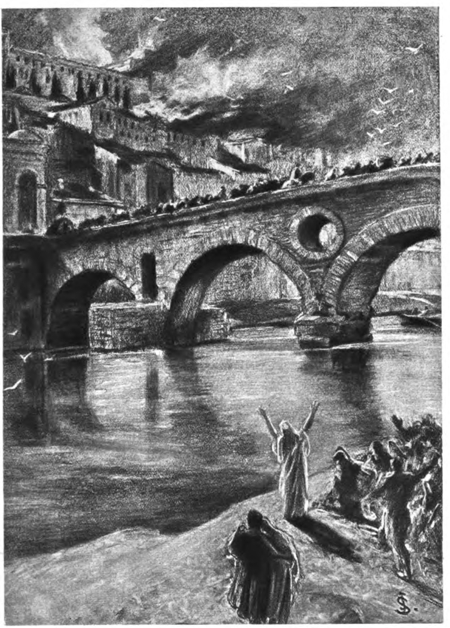
The Pillage and Fire of Rome. From a drawing by Jan Styka.
Whatever might be the numbers, of equestrian or plebeian rank, who perished in the massacre of Rome, it is confidently affirmed that only one senator lost his life by the sword of the enemy. [112] But it was not easy to compute the multitudes, [V-248] who, from an honourable station and a prosperous fortune, were suddenly reduced to the miserable condition of captives and exiles. As the Barbarians had more occasion for money than for slaves, they fixed at a moderate price the redemption of their indigent prisoners; and the ransom was often paid by the benevolence of their friends or the charity of strangers. [113] The captives, who were regularly sold, either in open market or by private contract, would have legally regained their native freedom, which it was impossible for a citizen to lose or to alienate. [114] But, as it was soon discovered that the vindication of their liberty would endanger their lives, and that the Goths, unless they were tempted to sell, might be provoked to murder, their useless prisoners, the civil jurisprudence had been already qualified by a wise regulation that they should be obliged to serve the moderate term of five years, till they had discharged by their labour the price of their redemption. [115] The nations who invaded the Roman empire had driven before them, into Italy, whole troops of hungry and affrighted provincials, less apprehensive of servitude than of famine. The calamities of Rome and Italy dispersed the inhabitants to the most lonely, the most secure, the most distant places of refuge. While the Gothic cavalry spread terror and desolation along the sea-coast of Campania and Tuscany, the little Island of Igilium, separated by a narrow channel from the Argentarian promontory, repulsed, or eluded, their hostile attempts; and, at so small a distance [V-249] from Rome, great numbers of citizens were securely concealed in the thick woods of that sequestered spot. [116] The ample patrimonies, which many senatorian families possessed in Africa, invited them, if they had time and prudence, to escape from the ruin of their country, to embrace the shelter of that hospitable province. The most illustrious of these fugitives was the noble and pious Proba, [117] the widow of the prefect Petronius. After the death of her husband, the most powerful subject of Rome, she had remained at the head of the Anician family, and successively supplied, from her private fortune, the expense of the consulships of her three sons. When the city was besieged and taken by the Goths, Proba supported, with Christian resignation, the loss of immense riches; embarked in a small vessel, from whence she beheld, at sea, the flames of her burning palace; and fled with her daughter Læta, and her granddaughter, the celebrated virgin Demetrias, to the coast of Africa. The benevolent [V-250] profusion with which the matron distributed the fruits, or the price, of her estates contributed to alleviate the misfortunes of exile and captivity. But even the family of Proba herself was not exempt from the rapacious oppression of Count Heraclian, who basely sold, in matrimonial prostitution, the noblest maidens of Rome to the lust or avarice of the Syrian merchants. The Italian fugitives were dispersed through the provinces, along the coast of Egypt and Asia, as far as Constantinople and Jerusalem; and the village of Bethlem, the solitary residence of St. Jerom and his female converts, was crowded with illustrious beggars of either sex and every age, who excited the public compassion by the remembrance of their past fortune. [118] This awful catastrophe of Rome filled the astonished empire with grief and terror. So interesting a contrast of greatness and ruin disposed the fond credulity of the people to deplore, and even to exaggerate, the afflictions of the queen of cities. The clergy, who applied to recent events the lofty metaphors of Oriental prophecy, were sometimes tempted to confound the destruction of the capital and the dissolution of the globe.
There exists in human nature a strong propensity to depreciate the advantages, and to magnify the evils, of the present times. Yet, when the first emotions had subsided, and a fair estimate was made of the real damage, the more learned and judicious contemporaries were forced to confess that infant Rome had formerly received more essential injury from the Gauls than she had now sustained from the Goths in her declining age. [119] The experience of eleven centuries has enabled posterity to produce a much more singular parallel; [V-251] and to affirm with confidence that the ravages of the Barbarians, whom Alaric had led from the banks of the Danube, were less destructive than the hostilities exercised by the troops of Charles the Fifth, a Catholic prince, who styled himself Emperor of the Romans. [120] The Goths evacuated the city at the end of six days, but Rome remained above nine months in the possession of the Imperialists; and every hour was stained by some atrocious act of cruelty, lust, and rapine. The authority of Alaric preserved some order and moderation among the ferocious multitude, which acknowledged him for their leader and king; but the constable of Bourbon had gloriously fallen in the attack of the walls; and the death of the general removed every restraint of discipline from an army which consisted of three independent nations, the Italians, the Spaniards, and the Germans. In the beginning of the sixteenth century, the manners of Italy exhibited a remarkable scene of the depravity of mankind. They united the sanguinary crimes that prevail in an unsettled state of society, with the polished vices that spring from the abuse of art and luxury; and the loose adventurers, who had violated every prejudice of patriotism and superstition to assault the palace of the Roman pontiff, must deserve to be considered as the most profligate of the Italians. At the same era, the Spaniards were the terror both of the Old and New World; but their high-spirited valour was disgraced by gloomy pride, rapacious avarice, and unrelenting cruelty. Indefatigable in the pursuit of fame and riches, they had [V-252] improved, by repeated practice, the most exquisite and effectual methods of torturing their prisoners; many of the Castillans, who pillaged Rome, were familiars of the holy inquisition; and some volunteers, perhaps, were lately returned from the conquest of Mexico. The Germans were less corrupt than the Italians, less cruel than the Spaniards; and the rustic, or even savage, aspect of those Tramontane warriors often disguised a simple and merciful disposition. But they had imbibed, in the first fervour of the reformation, the spirit, as well as the principles, of Luther. It was their favourite amusement to insult or destroy the consecrated objects of Catholic superstition; they indulged, without pity or remorse, a devout hatred against the clergy of every denomination and degree, who form so considerable a part of the inhabitants of modern Rome; and their fanatic zeal might aspire to subvert the throne of Anti-christ, to purify, with blood and fire, the abominations of the spiritual Babylon. [121]
The retreat of the victorious Goths, who evacuated Rome on the sixth day, [122] might be the result of prudence, but it was not surely the effect of fear. [123] At the head of an army, encumbered with rich and weighty spoils, their intrepid leader advanced along the Appian way into the southern provinces of Italy, destroying whatever dared to oppose his passage, and contenting himself with the plunder of the unresisting country. The fate of Capua, the proud and luxurious metropolis of Campania, and which was respected, even in its [V-253] decay, as the eighth city of the empire, [124] is buried in oblivion; whilst the adjacent town of Nola [125] has been illustrated, on this occasion, by the sanctity of Paulinus, [126] who was successively a consul, a monk, and a bishop. At the age of forty, he renounced the enjoyment of wealth and honour, of society and literature, to embrace a life of solitude and penance; and the loud applause of the clergy encouraged him to despise the reproaches of his worldly friends, who ascribed this desperate act to some disorder of the mind or body. [127] An early and passionate attachment determined him to fix his humble dwelling in one of the suburbs of Nola, near the miraculous tomb of St. Felix, which the public devotion had already surrounded with five large and populous churches. The remains of his fortune, and of his understanding, were dedicated to the service of the glorious martyr; whose praise, on the day of his festival, Paulinus never failed to celebrate by a solemn hymn; and in whose name he erected a sixth church, of superior elegance and beauty, which was decorated with many curious pictures, from the history of the Old and New Testament. Such assiduous zeal secured the favour of the saint, [128] or at least of the people; and, after fifteen years’ [V-254] retirement, the Roman consul was compelled to accept the bishopric of Nola, a few months before the city was invested by the Goths. During the siege, some religious persons were satisfied that they had seen, either in dreams or visions, the divine form of their tutelar patron; yet it soon appeared by the event that Felix wanted power, or inclination, to preserve the flock of which he had formerly been the shepherd. Nola was not saved from the general devastation; [129] and the captive bishop was protected only by the general opinion of his innocence and poverty. Above four years elapsed from the successful invasion of Italy by the arms of Alaric to the voluntary retreat of the Goths under the conduct of his successor Adolphus; and, during the whole time, they reigned without control over a country which, in the opinion of the ancients, had united all the various excellencies of nature and art. The prosperity, indeed, which Italy had attained in the auspicious age of the Antonines, had gradually declined with the decline of the empire. The fruits of a long peace perished under the rude grasp of the Barbarians; and they themselves were incapable of tasting the more elegant refinements of luxury which had been prepared for the use of the soft and polished Italians. Each soldier, however, claimed an ample portion of the substantial plenty, the corn and cattle, oil and wine, that was daily collected and consumed in the Gothic camp; and the principal warriors insulted the villas and gardens, once inhabited by Lucullus and Cicero, along the beauteous coast of Campania. Their trembling captives, the sons and daughters of Roman senators, presented in goblets of gold and gems large draughts of Falernian wine to the haughty victors; who stretched their huge limbs under the shade of plane-trees, [130] artificially disposed to [V-255] exclude the scorching rays, and to admit the genial warmth, of the sun. These delights were enhanced by the memory of past hardships; the comparison of their native soil, the bleak and barren hills of Scythia, and the frozen banks of the Elbe and Danube, added new charms to the felicity of the Italian climate. [131]
Whether fame or conquest or riches were the object of Alaric, he pursued that object with an indefatigable ardour, which could neither be quelled by adversity nor satiated by success. No sooner had he reached the extreme land of Italy than he was attacked by the neighbouring prospect of a fertile and peaceful island. Yet even the possession of Sicily he considered only as an intermediate step to the important expedition which he already meditated against the continent of Africa. The straits of Rhegium and Messina [132] are twelve miles in length, and in the narrowest passage about one mile and a half broad; and the fabulous monsters of the deep, the rocks of Scylla and the whirlpool of Charybdis, could terrify none but the most timid and unskilful mariners. Yet, as soon as [V-256] the first division of the Goths had embarked, a sudden tempest arose, which sunk or scattered many of the transports; their courage was daunted by the terrors of a new element; and the whole design was defeated by the premature death of Alaric, which fixed, after a short illness, the fatal term of his conquests. The ferocious character of the Barbarians was displayed in the funeral of a hero, whose valour and fortune they celebrated with mournful applause. By the labour of a captive multitude they forcibly diverted the course of the Busentinus, a small river that washes the walls of Consentia. The royal sepulchre, adorned with the splendid spoils and trophies of Rome, was constructed in the vacant bed the waters were then restored to their natural channel, and the secret spot, where the remains of Alaric had been deposited, was for ever concealed by the inhuman massacre of the prisoners who had been employed to execute the work. [133]
The personal animosities and hereditary feuds of the Barbarians were suspended by the strong necessity of their affairs; and the brave Adolphus, the brother-in-law of the deceased monarch, was unanimously elected to succeed to his throne. The character and political system of the new king of the Goths may be best understood from his own conversation with an illustrious citizen of Narbonne, who afterwards, in a pilgrimage to the Holy Land, related it to St. Jerom, in the presence of the historian Orosius. “In the full confidence of valour and victory I once aspired” (said Adolphus) “to change the face of the universe; to obliterate the name of Rome; to erect on its ruins the dominion of the Goths; and to acquire, like Augustus, the immortal fame of the founder of a new empire. By repeated experiments I was gradually convinced that laws are essentially necessary to maintain and regulate a well-constituted state, and that the fierce untractable humour of the Goths was incapable of bearing the salutary yoke of laws and civil government. From that moment I [V-257] proposed to myself a different object of glory and ambition; and it is now my sincere wish that the gratitude of future ages should acknowledge the merit of a stranger who employed the sword of the Goths, not to subvert, but to restore and maintain, the prosperity of the Roman empire.” [134] With these pacific views the successor of Alaric suspended the operations of war, and seriously negotiated with the Imperial court a treaty of friendship and alliance. It was the interest of the ministers of Honorius, who were now released from the obligation of their extravagant oath, to deliver Italy from the intolerable weight of the Gothic powers; and they readily accepted their service against the tyrants and barbarians who infested the provinces beyond the Alps. Adolphus, [135] assuming the character of a Roman general, directed his march from the extremity of Campania to the southern provinces of Gaul. His troops, either by force or agreement, immediately occupied the cities of Narbonne, Toulouse, and Bourdeaux; and though they were repulsed by Count Boniface from the walls of Marseilles, they soon extended their quarters from the Mediterranean to the Ocean. The oppressed provincials might exclaim that the miserable remnant which the enemy had spared was cruelly ravished by their pretended allies; yet some specious colours were not wanting to palliate, or justify, the violence of the Goths. The cities of Gaul which they attacked might perhaps be considered as in a state of rebellion against the government of Honorius; the articles of the treaty, or the secret instructions of the court, might sometimes be alleged in favour of the seeming usurpations [V-258] of Adolphus; and the guilt of any irregular, unsuccessful act of hostility might always be imputed, with an appearance of truth, to the ungovernable spirit of a Barbarian host, impatient of peace or discipline. The luxury of Italy had been less effectual to soften the temper than to relax the courage of the Goths; and they had imbibed the vices, without imitating the arts and institutions, of civilised society. [136]
The professions of Adolphus were probably sincere, and his attachment to the cause of the republic was secured by the ascendant which a Roman princess had acquired over the heart and understanding of the Barbarian king. Placidia, [137] the daughter of the great Theodosius and of Galla, his second wife, had received a royal education in the palace of Constantinople; but the eventful story of her life is connected with the revolutions which agitated the Western empire under the reign of her brother Honorius. When Rome was first invested by the arms of Alaric, Placidia, who was then about twenty years of age, resided in the city; and her ready consent to the death of her cousin Serena has a cruel and ungrateful appearance, which, according to the circumstances of the action, may be aggravated or excused by the consideration of her tender age. [138] The victorious Barbarians detained, either as a hostage or a captive, [139] the sister of Honorius; but, while she was exposed to the disgrace of following round Italy the motions of a Gothic camp, she experienced, however, a decent and respectful treatment. The authority of Jornandes, who praises the beauty of Placidia, may perhaps be [V-259] counterbalanced by the silence, the expressive silence, of her flatterers; yet the splendour of her birth, the bloom of youth, the elegance of manners, and the dexterous insinuation which she condescended to employ, made a deep impression on the mind of Adolphus; and the Gothic king aspired to call himself the brother of the emperor. The ministers of Honorius rejected with disdain the proposal of an alliance so injurious to every sentiment of Roman pride, and repeatedly urged the restitution of Placidia as an indispensable condition of the treaty of peace. But the daughter of Theodosius submitted, without reluctance, to the desires of the conqueror, a young and valiant prince, who yielded to Alaric in loftiness of stature, but who excelled in the more attractive qualities of grace and beauty. The marriage of Adolphus and Placidia [140] was consummated before the Goths retired from Italy; and the solemn, perhaps the anniversary, day of their nuptials was afterwards celebrated in the house of Ingenuus, one of the most illustrious citizens of Narbonne in Gaul. The bride, attired and adorned like a Roman empress, was placed on a throne of state; and the king of the Goths, who assumed on this occasion the Roman habit, contented himself with a less honourable seat by her side. The nuptial gift, which according to the custom of his nation [141] was offered to Placidia, [V-260] consisted of the rare and magnificent spoils of her country. Fifty beautiful youths, in silken robes; carried a bason in each hand; and one of these basons was filled with pieces of gold, the other with precious stones of an inestimable value. Attalus, so long the sport of fortune and of the Goths, was appointed to lead the chorus of the Hymenæal song, and the degraded emperor might aspire to the praise of a skilful musician. The Barbarians enjoyed the insolence of their triumph; and the provincials rejoiced in this alliance, which tempered by the mild influence of love and reason the fierce spirit of their Gothic lord. [142]
The hundred basons of gold and gems, presented to Placidia at her nuptial feast, formed an inconsiderable portion of the Gothic treasures; of which some extraordinary specimens may be selected from the history of the successors of Adolphus. Many curious and costly ornaments of pure gold, enriched with jewels, were found in their palace of Narbonne when it was pillaged in the sixth century by the Franks: sixty cups or chalices; fifteen patens, or plates, for the use of the communion; twenty boxes, or cases, to hold the books of the gospel; this consecrated wealth [143] was distributed by the son of Clovis among the churches of his dominions, and his pious liberality seems to upbraid some former sacrilege of the Goths. [V-261] They possessed, with more security of conscience, the famous missorium, or great dish for the service of the table, of massy gold of the weight of five hundred pounds, and of far superior value from the precious stones, the exquisite workmanship, and the tradition that it had been presented by Aetius the patrician to Torismond king of the Goths. One of the successors of Torismond purchased the aid of the French monarch by the promise of this magnificent gift. When he was seated on the throne of Spain, he delivered it with reluctance to the ambassadors of Dagobert; despoiled them on the road; stipulated, after a long negotiation, the inadequate ransom of two hundred thousand pieces of gold; and preserved the missorium as the pride of the Gothic treasury. [144] When that treasury, after the conquest of Spain, was plundered by the Arabs, they admired, and they have celebrated, another object still more remarkable, a table of considerable size, of one single piece of solid emerald, [145] encircled with three rows of fine pearls, supported by three hundred and sixty-five feet of gems and massy gold, and estimated at the price of five hundred thousand pieces of gold. [146] Some portion of the Gothic treasures might be the gift of friendship or the tribute of obedience; but the far greater part had been the fruits of war and rapine, the spoils of the empire, and perhaps of Rome.
[V-262]
After the deliverance of Italy from the oppression of the Goths some secret counsellor was permitted, amidst the factions of the palace, to heal the wounds of that afflicted country. [147] By a wise and humane regulation the eight provinces which had been the most deeply injured, Campania, Tuscany, Picenum, Samnium, Apulia, Calabria, Bruttium, and Lucania, obtained an indulgence of five years: the ordinary tribute was reduced to one fifth, and even that fifth was destined to restore and support the useful institution of the public posts. By another law the lands which had been left without inhabitants or cultivation were granted, with some diminution of taxes, to the neighbours who should occupy, or the strangers who should solicit, them; and the new possessors were secured against the future claims of the fugitive proprietors. About the same time a general amnesty was published in the name of Honorius, to abolish the guilt and memory of all the involuntary offences which had been committed by his unhappy subjects during the term of the public disorder and calamity. A decent and respectful attention was paid to the restoration of the capital; the citizens were encouraged to rebuild the edifices which had been destroyed or damaged by hostile fire; and extraordinary supplies of corn were imported from the coast of Africa. The crowds that so lately fled before the sword of the Barbarians were soon recalled by the hopes of plenty and pleasure; and Albinus, prefect of Rome, informed the court, with some anxiety and surprise, that in a single day he had taken an account of the arrival of fourteen thousand strangers. [148] In less than seven years the vestiges of the Gothic invasion [V-263] were almost obliterated, and the city appeared to resume its former splendour and tranquillity. The venerable matron replaced her crown of laurel which had been ruffled by the storms of war; and was still amused, in the last moment of her decay, with the prophecies of revenge, of victory, and of eternal dominion. [149]
This apparent tranquillity was soon disturbed by the approach of an hostile armament from the country which afforded the daily subsistence of the Roman people. Heraclian, count of Africa, who, under the most difficult and distressful circumstances, had supported, with active loyalty, the cause of Honorius, was tempted, in the year of his consulship, to assume the character of a rebel and the title of emperor. The ports of Africa were immediately filled with the naval forces, at the head of which he prepared to invade Italy; and his fleet, when it cast anchor at the mouth of the Tiber, indeed surpassed the fleets of Xerxes and Alexander, if all the vessels, including the royal galley and the smallest boat, did actually amount to the incredible number of three thousand two hundred. [150] Yet with such an armament, which might have subverted or restored the greatest empires of the earth, the African usurper made a very faint and feeble impression on the provinces of his rival. As he marched from the port along the road which leads to the gates of Rome, [V-264] he was encountered, terrified, and routed by one of the Imperial captains; and the lord of this mighty host, deserting his fortune and his friends, ignominiously fled with a single ship. [151] When Heraclian landed in the harbour of Carthage, he found that the whole province, disdaining such an unworthy ruler, had returned to their allegiance. The rebel was beheaded in the ancient temple of Memory; his consulship was abolished; [152] and the remains of his private fortune, not exceeding the moderate sum of four thousand pounds of gold, were granted to the brave Constantius, who had already defended the throne which he afterwards shared with his feeble sovereign. Honorius viewed with supine indifference the calamities of Rome and Italy; [153] but the rebellious attempts of Attalus and Heraclian against his personal safety awakened, for a moment, the torpid instinct of his nature. He was probably ignorant of the causes and events which preserved him from these impending dangers; and, as Italy was no longer invaded by any foreign or domestic enemies, he peaceably existed in the palace of Ravenna, while the tyrants beyond the Alps were repeatedly vanquished in the name, and by the lieutenants, of the son of Theodosius. [154] [V-265] In the course of a busy and interesting narrative, I might possibly forget to mention the death of such a prince, and I shall therefore take the precaution of observing, in this place, that he survived the last siege of Rome about thirteen years.
The usurpation of Constantine, who received the purple from the legions of Britain, had been successful; and seemed to be secure. His title was acknowledged, from the wall of Antoninus to the columns of Hercules; and, in the midst of the public disorder, he shared the dominion, and the plunder, of Gaul and Spain with the tribes of Barbarians, whose destructive progress was no longer checked by the Rhine or Pyrenees. Stained with the blood of the kinsmen of Honorius, he extorted from the court of Ravenna, with which he secretly corresponded, the ratification of his rebellious claims. Constantine engaged himself by a solemn promise to deliver Italy from the Goths; advanced as far as the banks of the Po; and, after alarming rather than assisting his pusillanimous ally, hastily returned to the palace of Arles, to celebrate, with intemperate luxury, his vain and ostentatious triumph. But this transient prosperity was soon interrupted and destroyed by the revolt of Count Gerontius, the bravest of his generals; who, during the absence of his son Constans, a prince already invested with the Imperial purple, had been left to command in the provinces of Spain. For some reason of which we are ignorant, Gerontius, instead of assuming the diadem, placed it on the head of his friend Maximus, [155] who fixed his residence at Tarragona, while the active count pressed forwards, through the Pyrenees, to surprise the two emperors, Constantine and Constans, before they could prepare for their defence. The son was made prisoner at Vienna and immediately put to death; and the unfortunate youth had scarcely leisure to deplore the elevation of his family, which [V-266] had tempted or compelled him sacrilegiously to desert the peaceful obscurity of the monastic life. The father maintained a siege within the walls of Arles; but those walls must have yielded to the assailants had not the city been unexpectedly relieved by the approach of an Italian army. The name of Honorius, the proclamation of a lawful emperor, astonished the contending parties of the rebels. Gerontius, abandoned by his own troops, escaped to the confines of Spain; and rescued his name from oblivion by the Roman courage which appeared to animate the last moments of his life. In the middle of the night, a great body of his perfidious soldiers surrounded and attacked his house, which he had strongly barricaded. His wife, a valiant friend of the nation of the Alani, and some faithful slaves were still attached to his person; and he used with so much skill and resolution a large magazine of darts and arrows that above three hundred of the assailants lost their lives in the attempt. His slaves, when all the missile weapons were spent, fled at the dawn of day; and Gerontius, if he had not been restrained by conjugal tenderness, might have imitated their example; till the soldiers, provoked by such obstinate resistance, applied fire on all sides to the house. In this fatal extremity, he complied with the request of his Barbarian friend, and cut off his head. The wife of Gerontius, who conjured him not to abandon her to a life of misery and disgrace, eagerly presented her neck to his sword; and the tragic scene was terminated by the death of the count himself, who, after three ineffectual strokes, drew a short dagger, and sheathed it in his heart. [156] The unprotected Maximus, whom he had invested with the purple, was indebted for his life to the contempt that was entertained of his power and abilities. The caprice of the [V-267] Barbarians, who ravaged Spain, once more seated this Imperial phantom on the throne; but they soon resigned him to the justice of Honorius; and the tyrant Maximus, after he had been shown to the people of Ravenna and Rome, was publicly executed.
The general, Constantius was his name, who raised by his approach the siege of Arles, and dissipated the troops of Gerontius, was born a Roman; and this remarkable distinction is strongly expressive of the decay of military spirit among the subjects of the empire. The strength and majesty which were conspicuous in the person of that general [157] marked him, in the popular opinion, as a candidate worthy of the throne which he afterwards ascended. In the familiar intercourse of private life his manners were cheerful and engaging; nor would he sometimes disdain, in the licence of convivial mirth, to vie with the pantomimes themselves in the exercises of their ridiculous profession. But, when the trumpet summoned him to arms; when he mounted his horse, and, bending down (for such was his singular practice) almost upon the neck, fiercely rolled his large animated eyes round the field, Constantius then struck terror into his foes, and inspired his soldiers with the assurance of victory. He had received from the court of Ravenna the important commission of extirpating rebellion in the provinces of the West; and the pretended emperor Constantine, after enjoying a short and anxious respite, was again besieged in his capital by the arms of a more formidable enemy. Yet this interval allowed time for a successful negotiation with the Franks and Alemanni; and his ambassador, Edobic, soon returned, at the head of an army, to disturb the operations of the siege of Arles. The Roman general, instead of expecting the [V-268] attack in his lines, boldly, and perhaps wisely, resolved to pass the Rhone, and to meet the Barbarians. His measures were conducted with so much skill and secrecy that, while they engaged the infantry of Constantius in the front, they were suddenly attacked, surrounded, and destroyed by the cavalry of his lieutenant Ulphilas, who had silently gained an advantageous post in their rear. The remains of the army of Edobic were preserved by flight or submission, and their leader escaped from the field of battle to the house of a faithless friend; who too clearly understood that the head of his obnoxious guest would be an acceptable and lucrative present for the Imperial general. On this occasion, Constantius behaved with the magnanimity of a genuine Roman. Subduing or suppressing every sentiment of jealousy, he publicly acknowledged the merit and services of Ulphilas; but he turned with horror from the assassin of Edobic; and sternly intimated his commands that the camp should no longer be polluted by the presence of an ungrateful wretch, who had violated the laws of friendship and hospitality. The usurper, who beheld from the walls of Arles the ruin of his last hopes, was tempted to place some confidence in so generous a conqueror. He required a solemn promise for his security; and after receiving, by the imposition of hands, the sacred character of a Christian Presbyter, he ventured to open the gates of the city. But he soon experienced that the principles of honour and integrity, which might regulate the ordinary conduct of Constantius, were superseded by the loose doctrines of political morality. The Roman general, indeed, refused to sully his laurels with the blood of Constantine; but the abdicated emperor and his son Julian were sent under a strong guard into Italy; and before they reached the palace of Ravenna they met the ministers of death.
At a time when it was universally confessed that almost every man in the empire was superior in personal merit to the princes whom the accident of their birth had seated on the throne, a rapid succession of usurpers, regardless of the fate [V-269] of their predecessors, still continued to arise. This mischief was peculiarly felt in the provinces of Spain and Gaul, where the principles of order and obedience had been extinguished by war and rebellion. Before Constantine resigned the purple, and in the fourth month of the siege of Arles, intelligence was received in the Imperial camp that Jovinus had assumed the diadem at Mentz in the Upper Germany, at the instigation of Goar, king of the Alani, and of Guntiarius, king of the Burgundians; and that the candidate on whom they had bestowed the empire advanced with a formidable host of Barbarians from the banks of the Rhine to those of the Rhone. Every circumstance is dark and extraordinary in the short history of the reign of Jovinus. It was natural to expect that a brave and skilful general, at the head of a victorious army, would have asserted in a field of battle the justice of the cause of Honorius. The hasty retreat of Constantius might be justified by weighty reasons; but he resigned, without a struggle, the possession of Gaul: and Dardanus, the Prætorian prefect, is recorded as the only magistrate who refused to yield obedience to the usurper. [158] When the Goths, two years after the siege of Rome, established their quarters in Gaul, it was natural to suppose that their inclinations could be divided only between the emperor Honorius, with whom they had formed a recent alliance, and the degraded Attalus, whom they reserved in their camp for the occasional purpose of acting the part of a musician or a monarch. Yet in a moment of disgust (for which it is not easy to assign a cause or a date) Adolphus connected himself with the usurper of Gaul, and imposed on [V-270] Attalus the ignominious task of negotiating the treaty which ratified his own disgrace. We are again surprised to read that, instead of considering the Gothic alliance as the firmest support of his throne, Jovinus upbraided, in dark and ambiguous language, the officious importunity of Attalus; that, scorning the advice of his great ally, he invested with the purple his brother Sebastian; and that he most imprudently accepted the service of Sarus, when that gallant chief, the soldier of Honorius, was provoked to desert the court of a prince who knew not how to reward or punish. Adolphus, educated among a race of warriors, who esteemed the duty of revenge as the most precious and sacred portion of their inheritance, advanced with a body of ten thousand Goths to encounter the hereditary enemy of the house of Balti. He attacked Sarus at an unguarded moment, when he was accompanied only by eighteen or twenty of his valiant followers. United by friendship, animated by despair, but at length oppressed by multitudes, this band of heroes deserved the esteem, without exciting the compassion, of their enemies; and the lion was no sooner taken in the toils [159] than he was instantly despatched. The death of Sarus dissolved the loose alliance which Adolphus still maintained with the usurpers of Gaul. He again listened to the dictates of love and prudence; and soon satisfied the brother of Placidia, by the assurance that he would immediately transmit to the palace of Ravenna the heads of the two tyrants, Jovinus and Sebastian. The king of the Goths executed his promise without difficulty or delay; the helpless brothers, unsupported by any personal merit, were abandoned by their Barbarian auxiliaries; and the short opposition of Valentia was [V-271] expiated by the ruin of one of the noblest cities of Gaul. The emperor, chosen by the Roman senate, who had been promoted, degraded, insulted, restored, again degraded, and again insulted, was finally abandoned to his fate; but, when the Gothic king withdrew his protection, he was restrained by pity or contempt from offering any violence to the person of Attalus. The unfortunate Attalus, who was left without subjects or allies, embarked in one of the ports of Spain, in search of some secure and solitary retreat; but he was intercepted at sea, conducted to the presence of Honorius, led in triumph through the streets of Rome or Ravenna, and publicly exposed to the gazing multitude, on the second step of the throne of his invincible conqueror. The same measure of punishment with which, in the days of his prosperity, he was accused of menacing his rival was inflicted on Attalus himself: he was condemned, after the amputation of two fingers, to a perpetual exile in the isle of Lipari, where he was supplied with the decent necessaries of life. The remainder of the reign of Honorius was undisturbed by rebellion; and it may be observed that, in the space of five years, seven usurpers had yielded to the fortunes of a prince, who was himself incapable either of counsel or of action.
The situation of Spain, separated, on all sides, from the enemies of Rome, by the sea, by the mountains, and by intermediate provinces, had secured the long tranquillity of that remote and sequestered country; and we may observe, as a sure symptom of domestic happiness, that in a period of four hundred years Spain furnished very few materials to the history of the Roman empire. The footsteps of the Barbarians, who, in the reign of Gallienus, had penetrated beyond the Pyrenees, were soon obliterated by the return of peace; and in the fourth century of the Christian era, the cities of Emerita, or Merida, of Corduba, Seville, Bracara, and Tarragona, were numbered with the most illustrious of the Roman world. The various plenty of the animal, the vegetable, and the mineral kingdoms was improved and manufactured [V-272] by the skill of an industrious people; and the peculiar advantages of naval stores contributed to support an extensive and profitable trade. [160] The arts and sciences flourished under the protection of the emperors; and, if the character of the Spaniards was enfeebled by peace and servitude, the hostile approach of the Germans, who had spread terror and desolation from the Rhine to the Pyrenees, seemed to rekindle some sparks of military ardour. As long as the defence of the mountains was entrusted to the hardy and faithful militia of the country, they successfully repelled the frequent attempts of the Barbarians. But no sooner had the national troops been compelled to resign their post to the Honorian bands in the service of Constantine than the gates of Spain were treacherously betrayed to the public enemy, about ten months before the sack of Rome by the Goths. [161] The consciousness of guilt and the thirst of rapine promoted the mercenary guards of the Pyrenees to desert their station; to invite the arms of the Suevi, the Vandals, and the Alani; and to swell the torrent which was poured with irresistible violence from the frontiers of Gaul to the sea of Africa. The misfortunes of Spain may be described in the language of its most eloquent historian, who has concisely expressed the passionate, and perhaps exaggerated, declamations of contemporary writers. [162] “The irruption of these nations was [V-273] followed by the most dreadful calamities; as the Barbarians exercised their indiscriminate cruelty on the fortunes of the Romans and the Spaniards, and ravaged with equal fury the cities and the open country. The progress of famine reduced the miserable inhabitants to feed on the flesh of their fellow-creatures; and even the wild beasts, who multiplied, without control, in the desert, were exasperated, by the taste of blood and the impatience of hunger, boldly to attack and devour their human prey. Pestilence soon appeared, the inseparable companion of famine; a large proportion of the people was swept away; and the groans of the dying excited only the envy of their surviving friends. At length the Barbarians, satiated with carnage and rapine, and afflicted by the contagious evils which they themselves had introduced, fixed their permanent seats in the depopulated country. The ancient Gallicia, whose limits included the kingdom of Old Castille, was divided between the Suevi and the Vandals; the Alani were scattered over the provinces of Carthagena and Lusitania, from the Mediterranean to the Atlantic Ocean; and the fruitful territory of Bætica was allotted to the Silingi, another branch of the Vandalic nation. After regulating this partition, the conquerors contracted with their new subjects some reciprocal engagements of protection and obedience; the lands were again cultivated; and the towns and villages were again occupied by a captive people. The greatest part of the Spaniards was even disposed to prefer this new condition of poverty and barbarism to the severe oppressions of the Roman government; yet there were many who still asserted their native freedom; and who refused, more especially in the mountains of Gallicia, to submit to the Barbarian yoke.” [163]
[V-274]
The important present of the heads of Jovinus and Sebastian had approved the friendship of Adolphus and restored Gaul to the obedience of his brother Honorius. Peace was incompatible with the situation and temper of the king of the Goths. He readily accepted the proposal of turning his victorious arms against the Barbarians of Spain; the troops of Constantius intercepted his communication with the seaports of Gaul, and gently pressed his march towards the Pyrenees; [164] he passed the mountains, and surprised, in the name of the emperor, the city of Barcelona. The fondness of Adolphus for his Roman bride was not abated by time or possession; and the birth of a son, surnamed, from his illustrious grandsire, Theodosius, appeared to fix him for ever in the interest of the republic. The loss of that infant, whose remains were deposited in a silver coffin in one of the churches near Barcelona, afflicted his parents; but the grief of the Gothic king was suspended by the labours of the field; and the course of his victories was soon interrupted by domestic treason. He had imprudently received into his service one of the followers of Sarus: a Barbarian of a daring spirit, but of a diminutive stature; whose secret desire of revenging the death of his beloved patron was continually irritated by the sarcasms of his insolent master. Adolphus was assassinated in the palace of Barcelona; the laws of the succession were violated by a tumultuous faction; [165] and a stranger to the royal race, Singeric, the brother of Sarus himself, was seated on the Gothic throne. The first act of his reign was the inhuman murder of the six children of Adolphus, the issue [V-275] of a former marriage, whom he tore, without pity, from the feeble arms of a venerable bishop. [166] The unfortunate Placidia, instead of the respectful compassion which she might have excited in the most savage breasts, was treated with cruel and wanton insult. The daughter of the emperor Theodosius, confounded among a crowd of vulgar captives, was compelled to march on foot above twelve miles, before the horse of a Barbarian, the assassin of a husband whom Placidia loved and lamented. [167]
But Placidia soon obtained the pleasure of revenge; and the view of her ignominious sufferings might rouse an indignant people against the tyrant who was assassinated on the seventh day of his usurpation. After the death of Singeric, the free choice of the nation bestowed the Gothic sceptre on Wallia; whose warlike and ambitious temper appeared in the beginning of his reign extremely hostile to the republic. He marched in arms from Barcelona to the shores of the Atlantic Ocean, which the ancients revered and dreaded as the boundary of the world. But, when he reached the southern promontory of Spain, [168] and, from the rock now covered by the fortress of Gibraltar, contemplated the neighbouring and fertile coast of Africa, Wallia resumed the designs of conquest which had been interrupted by the death of Alaric. The winds and waves again disappointed the enterprise of the Goths, and the minds of a superstitious people were deeply affected by the repeated disasters of [V-276] storms and shipwrecks. In this disposition, the successor of Adolphus no longer refused to listen to a Roman ambassador, whose proposals were enforced by the real, or supposed, approach of a numerous army under the conduct of the brave Constantius. A solemn treaty was stipulated and observed: Placidia was honourably restored to her brother; six hundred thousand measures of wheat were delivered to the hungry Goths; [169] and Wallia engaged to draw his sword in the service of the empire. A bloody war was instantly excited among the Barbarians of Spain; and the contending princes are said to have addressed their letters, their ambassadors, and their hostages to the throne of the Western emperor, exhorting him to remain a tranquil spectator of their contest; the events of which must be favourable to the Romans, by the mutual slaughter of their common enemies. [170] The Spanish war was obstinately supported, during three campaigns, with desperate valour and various success; and the martial achievements of Wallia diffused through the empire the superior renown of the Gothic hero. He exterminated the Silingi, who had irretrievably ruined the elegant plenty of the province of Bætica. He slew, in battle, the king of the Alani; and the remains of those Scythian wanderers who escaped from the field, instead of choosing a new leader, humbly sought a refuge under the standard of the Vandals, with whom they were ever afterwards confounded. The Vandals themselves and the Suevi yielded to the efforts of the invincible Goths. The promiscuous multitude of Barbarians, whose retreat had been intercepted, were driven into the mountains of Gallicia; where they still continued, in a narrow compass [V-277] and on a barren soil, to exercise their domestic and implacable hostilities. In the pride of victory, Wallia was faithful to his engagements: he restored his Spanish conquests to the obedience of Honorius; and the tyranny of the Imperial officers soon reduced an oppressed people to regret the time of their Barbarian servitude. While the event of the war was still doubtful, the first advantages obtained by the arms of Wallia had encouraged the court of Ravenna to decree the honours of a triumph to their feeble sovereign. He entered Rome like the ancient conquerors of nations; and, if the monuments of servile corruption had not long since met with the fate which they deserved, we should probably find that a crowd of poets and orators, of magistrates and bishops, applauded the fortune, the wisdom, and the invincible courage, of the emperor Honorius. [171]
Such a triumph might have been justly claimed by the ally of Rome, if Wallia, before he repassed the Pyrenees, had extirpated the seeds of the Spanish war. His victorious Goths, forty-three years after they had passed the Danube, were established, according to the faith of treaties, in the possession of the second Aquitain: a maritime province between the Garonne and the Loire, under the civil and ecclesiastical jurisdiction of Bourdeaux. That metropolis, advantageously situated for the trade of the ocean, was built in a regular and elegant form; and its numerous inhabitants were distinguished among the Gauls by their wealth, their learning, and the politeness of their manners. The adjacent province, which has been fondly compared to the garden of Eden, is blessed with a fruitful soil and a temperate climate: the face of the country displayed the arts and the rewards of industry; and the Goths, after their [V-278] martial toils, luxuriously exhausted the rich vineyards of Aquitain. [172] The Gothic limits were enlarged by the additional gift of some neighbouring dioceses; and the successors of Alaric fixed their royal residence at Toulouse, which included five populous quarters, or cities, within the spacious circuit of its walls. About the same time, in the last years of the reign of Honorius, the Goths, the Burgundians, and the Franks obtained a permanent seat and dominion in the provinces of Gaul. The liberal grant of the usurper Jovinus to his Burgundian allies was confirmed by the lawful emperor; the lands of the First, or Upper, Germany were ceded to those formidable Barbarians; and they gradually occupied, either by conquest or treaty, the two provinces which still retain, with the titles of Duchy and of County, the national appellation of Burgundy. [173] The Franks, the valiant and faithful allies of the Roman republic, were soon tempted to imitate the invaders, whom they had so bravely resisted. Treves, the capital of Gaul, was pillaged by their lawless bands; and the humble colony, which they so long maintained in the district of Toxandria, in Brabant, insensibly multiplied along the banks of the Meuse and Scheld, till their independent power filled the whole extent of the Second or Lower Germany. These facts may be sufficiently justified by historic evidence; but the foundation of the French monarchy by Pharamond, the conquests, the laws, and even the existence of that hero, have been justly arraigned by the impartial severity of modern criticism. [174]
[V-279]
The ruin of the opulent provinces of Gaul may be dated from the establishment of these Barbarians, whose alliance was dangerous and oppressive, and who were capriciously impelled, by interest or passion, to violate the public peace. A heavy and partial ransom was imposed on the surviving provincials, who had escaped the calamities of war; the fairest and most fertile lands were assigned to the rapacious strangers, for the use of their families, their slaves, and their cattle; and the trembling natives relinquished with a sigh the inheritance of their fathers. Yet these domestic misfortunes, which are seldom the lot of a vanquished people, had been felt and inflicted by the Romans themselves, not only in the insolence of foreign conquest, but in the madness of civil discord. The Triumvirs proscribed eighteen of the most flourshing colonies of Italy; and distributed their lands and houses to the veterans who revenged the death of Cæsar and oppressed the liberty of their country. Two poets, of unequal fame, have deplored, in similar circumstances, the loss of their patrimony; but the legionaries of Augustus appeared to have surpassed, in violence and injustice, the Barbarians who invaded Gaul under the reign of Honorius. It was not without the utmost difficulty that Virgil escaped from the sword of the centurion who had usurped his farm in the neighbourhood of Mantua; [175] but Paulinus of Bourdeaux [V-280] received a sum of money from his Gothic purchaser, which he accepted with pleasure and surprise; and, though it was much inferior to the real value of his estate, this act of rapine was disguised by some colours of moderation and equity. [176] The odious name of conquerors, was softened into the mild and friendly appellation of the guests, of the Romans; and the Barbarians of Gaul, more especially the Goths, repeatedly declared that they were bound to the people by the ties of hospitality and to the emperor by the duty of allegiance and military service. The title of Honorius and his successors, their laws, and their civil magistrates, were still respected in the provinces of Gaul of which they had resigned the possession to the Barbarian allies; and the kings, who exercised a supreme and independent authority over their native subjects, ambitiously solicited the more honourable rank of master-generals of the Imperial armies. [177] Such was the involuntary reverence which the Roman name still impressed on the minds of those warriors who had borne away in triumph the spoils of the Capitol.
Whilst Italy was ravaged by the Goths and a succession of feeble tyrants oppressed the provinces beyond the Alps, the British island separated itself from the body of the Roman empire. The regular forces, which guarded that remote province, had been gradually withdrawn; and Britain was abandoned, without defence, to the Saxon pirates and the savages of Ireland and Caledonia. The Britons, reduced to this extremity, no longer relied on the tardy and doubtful aid of a declining monarch. They assembled in arms, repelled the invaders, and rejoiced in the important discovery [V-281] of their own strength. [178] Afflicted by similar calamities and actuated by the same spirit, the Armorican provinces (a name which comprehended the maritime countries of Gaul between the Seine and the Loire [179] ) resolved to imitate the example of the neighbouring island. They expelled the Roman magistrates who acted under the authority of the usurper Constantine; and a free government was established among a people who had so long been subject to the arbitrary will of a master. The independence of Britain and Armorica was soon confirmed by Honorius himself, the lawful emperor of the West; and the letters, by which he committed to the new states the care of their own safety, might be interpreted as an absolute and perpetual abdication of the exercise and rights of sovereignty. This interpretation was, in some measure, justified by the event. After the usurpers of Gaul had successively fallen, the maritime provinces were restored to the empire. Yet their obedience was imperfect and precarious: the vain, inconstant, rebellious disposition of the people was incompatible either with freedom or servitude, [180] and Armorica, though it could not long maintain [V-282] the form of a republic, [181] was agitated by frequent and destructive revolts. Britain was irrecoverably lost. [182] But, as the emperors wisely acquiesced in the independence of a remote province, the separation was not embittered by the reproach of tyranny or rebellion; and the claims of allegiance and protection were succeeded by the mutual and voluntary offices of national friendship. [183]
This revolution dissolved the artificial fabric of civil and military government; and the independent country, during a period of forty years, till the descent of the Saxons, was ruled by the authority of the clergy, the nobles, and the municipal towns. [184] I. Zosimus, who alone has preserved the memory of this singular transaction, very accurately observes that the letters of Honorius were addressed to the cities of Britain. [185] Under the protection of the Romans, ninety-two considerable towns had arisen in the several parts of that great province; and, among these, thirty-three cities were distinguished above the rest by their superior privileges and importance. [186] Each of these cities, as in all the other [V-283] provinces of the empire, formed a legal corporation, for the purpose of regulating their domestic policy; and the powers of municipal government were distributed among annual magistrates, a select senate, and the assembly of the people, according to the original model of the Roman constitution. [187] The management of a common revenue, the exercise of civil and criminal jurisdiction, and the habits of public counsel and command were inherent to these petty republics; and, when they asserted their independence, the youth of the city and of the adjacent districts would naturally range themselves under the standard of the magistrate. But the desire of obtaining the advantages, and of escaping the burdens, of political society is a perpetual and inexhaustible source of discord; nor can it reasonably be presumed that the restoration of British freedom was exempt from tumult and faction. The pre-eminence of birth and fortune must have been frequently violated by bold and popular citizens; and the haughty nobles, who complained that they were become the subjects of their own servants, [188] would sometimes regret the reign of an arbitrary monarch. II. The jurisdiction of each city over the adjacent country was supported by the patrimonial influence of the principal senators; and the smaller towns, the villages, and the proprietors of land consulted their own safety by adhering to the shelter of these rising republics. The sphere of their attraction was proportioned to the respective degrees of their wealth and populousness; but the hereditary lords of ample possessions, who [V-284] were not oppressed by the neighbourhood of any powerful city, aspired to the rank of independent princes, and boldly exercised the rights of peace and war. The gardens and villas, which exhibited some faint imitation of Italian elegance, would soon be converted into strong castles, the refuge, in time of danger, of the adjacent country; [189] the produce of the land was applied to purchase arms and horses, to maintain a military force of slaves, of peasants, and of licentious followers; and the chieftain might assume, within his own domain, the powers of a civil magistrate. Several of these British chiefs might be the genuine posterity of ancient kings; and many more would be tempted to adopt this honourable genealogy, and to vindicate their hereditary claims, which had been suspended by the usurpation of the Cæsars. [190] Their situation and their hopes would dispose them to affect the dress, the language, and the customs of their ancestors. If the princes of Britain relapsed into barbarism, while the cities studiously preserved the laws and manners of Rome, the whole island must have been gradually divided by the distinction of two national parties; again broken into a thousand subdivisions of war and faction, by the various provocations of interest and resentment. The public strength, instead of being united against a foreign enemy, was consumed in obscure and intestine quarrels; and the personal merit which had placed a successful leader at the head of his equals might enable him to subdue the freedom of some neighbouring [V-285] cities, and to claim a rank among the tyrants [191] who infested Britain after the dissolution of the Roman government. III. The British church might be composed of thirty or forty bishops, [192] with an adequate proportion of the inferior clergy; and the want of riches (for they seem to have been poor [193] ) would compel them to deserve the public esteem by a decent and exemplary behaviour. The interest, as well as the temper, of the clergy was favourable to the peace and union of their distracted country; those salutary lessons might be frequently inculcated in their popular discourses; and the episcopal synods were the only councils that could pretend to the weight and authority of a national assembly. In such councils, where the princes and magistrates sat promiscuously with the bishops, the important affairs of the state, as well as of the church, might be freely debated; differences reconciled, alliances formed, contributions imposed, wise resolutions often concerted, and sometimes executed; and there is reason to believe that, in moments of extreme danger, a Pendragon, or Dictator, was elected by the general consent of the Britons. These pastoral cares, so worthy of the episcopal character, were interrupted, however, by zeal and superstition; and the British clergy incessantly laboured to eradicate the Pelagian heresy, which they abhorred as the peculiar disgrace of their native country. [194]
[V-286]
It is somewhat remarkable, or rather it is extremely natural, that the revolt of Britain and Armorica should have introduced an appearance of liberty into the obedient provinces of Gaul. In a solemn edict, [195] filled with the strongest assurances of that paternal affection which princes so often express and so seldom feel, the emperor Honorius promulgated his intention of convening an annual assembly of the seven provinces: a name peculiarly appropriated to Aquitain, and the ancient Narbonnese, which had long since exchanged their Celtic rudeness for the useful and elegant arts of Italy. [196] Arles, the seat of government and commerce, was appointed for the place of the assembly; which regularly continued twenty-eight days, from the fifteenth of August to the thirteenth of September, of every year. It consisted of the Prætorian prefect of the Gauls; of seven provincial governors, one consular and six presidents; of the magistrates, and perhaps the bishops, of about sixty cities; and of a competent, though indefinite, number of the most honourable and opulent possessors of land, who might justly be considered as the representatives of their country. They were empowered to interpret and communicate the laws of their sovereign; to expose the grievances and wishes of their constituents; to moderate the excessive or unequal weight of taxes; and to deliberate on every subject of local or national importance, that could tend to the restoration of the peace and prosperity of the seven provinces. If such an institution, which gave the people an interest in their own government, had been [V-287] universally established by Trajan or the Antonines, the seeds of public wisdom and virtue might have been cherished and propagated in the empire of Rome. The privileges of the subject would have secured the throne of the monarch; the abuses of an arbitrary administration might have been prevented, in some degree, or corrected, by the interposition of these representative assemblies; and the country would have been defended against a foreign enemy by the arms of natives and freemen. Under the mild and generous influence of liberty, the Roman empire might have remained invincible and immortal; or, if its excessive magnitude and the instability of human affairs had opposed such perpetual continuance, its vital and constituent members might have separately preserved their vigour and independence. But in the decline of the empire, when every principle of health and life had been exhausted, the tardy application of this partial remedy was incapable of producing any important or salutary effects. The emperor Honorius expresses his surprise that he must compel the reluctant provinces to accept a privilege which they should ardently have solicited. A fine of three or even five pounds of gold was imposed on the absent representatives; who seem to have declined this imaginary gift of a free constitution, as the last and most cruel insult of their oppressors. [197]
[V-288]
CHAPTER XXXII↩
Arcadius Emperor of the East — Administration and Disgrace of Eutropius — Revolt of Gainas — Persecution of St. John Chrysostom — Theodosius II. Emperor of the East — His Sister Pulcheria — His Wife Eudocia — The Persian War, and Division of Armenia
The division of the Roman world between the sons of Theodosius marks the final establishment of the empire of the East, which, from the reign of Arcadius to the taking of Constantinople by the Turks, subsisted one thousand and fifty-eight years, in a state of premature and perpetual decay. The sovereign of that empire assumed, and obstinately retained, the vain, and at length fictitious, title of Emperor of the Romans; and the hereditary appellations of Cæsar and Augustus continued to declare that he was the legitimate successor of the first of men, who had reigned over the first of nations. The palace of Constantinople rivalled, and perhaps excelled, the magnificence of Persia; and the eloquent sermons of St. Chrysostom [1] celebrate, while they condemn, the pompous luxury of the reign of Arcadius. “The emperor,” says he, “wears on his head either a diadem or a crown of gold, decorated with precious stones of inestimable [V-289] value. These ornaments and his purple garments are reserved for his sacred person alone; and his robes of silk are embroidered with the figures of golden dragons. His throne is of massy gold. Whenever he appears in public, he is surrounded by his courtiers, his guards, and his attendants. Their spears, their shields, their cuirasses, the bridles and trappings of their horses, have either the substance or the appearance of gold; and the large splendid boss in the midst of their shield is encircled with smaller bosses, which represent the shape of the human eye. The two mules that draw the chariot of the monarch are perfectly white, and shining all over with gold. The chariot itself, of pure and solid gold, attracts the admiration of the spectators, who contemplate the purple curtains, the snowy carpet, the size of the precious stones, and the resplendent plates of gold, that glitter as they are agitated by the motion of the carriage. The Imperial pictures are white on a blue ground; the emperor appears seated on his throne, with his arms, his horses, and his guards beside him; and his vanquished enemies in chains at his feet.” The successors of Constantine established their perpetual residence in the royal city which he had erected on the verge of Europe and Asia. Inaccessible to the menaces of their enemies, and perhaps to the complaints of their people, they received, with each wind, the tributary productions of every climate; while the impregnable strength of their capital continued for ages to defy the hostile attempts of the Barbarians. Their dominions were bounded by the Hadriatic and Tigris; and the whole interval of twenty-five days’ navigation, which separated the extreme cold of Scythia from the torrid zone of Ethiopia, [2] [V-290] was comprehended within the limits of the empire of the East. The populous countries of that empire were the seat of art and learning, of luxury and wealth; and the inhabitants, who had assumed the language and manners of Greeks, styled themselves, with some appearance of truth, the most enlightened and civilised portion of the human species. The form of government was a pure and simple monarchy; the name of the Roman Republic, which so long preserved a faint tradition of freedom, was confined to the Latin provinces; and the princes of Constantinople measured their greatness by the servile obedience of their people. They were ignorant how much this passive disposition enervates and degrades every faculty of the mind. The subjects, who had resigned their will to the absolute commands of a master, were equally incapable of guarding their lives and fortunes against the assaults of the Barbarians or of defending their reason from the terrors of superstition.
The first events of the reign of Arcadius and Honorius are so intimately connected that the rebellion of the Goths and the fall of Rufinus have already claimed a place in the history of the West. It has already been observed that Eutropius, [3] one of the principal eunuchs of the palace of Constantinople, succeeded the haughty minister whose ruin he had accomplished, and whose vices he soon imitated. Every order of the state bowed to the new favourite; and their tame and obsequious submission encouraged him to insult the laws, and, what is still more difficult and dangerous, the manners, of [V-291] his country. Under the weakest of the predecessors of Arcadius, the reign of the eunuchs had been secret and almost invisible. They insinuated themselves into the confidence of the prince; but their ostensible functions were confined to the menial service of the wardrobe and Imperial bed-chamber. They might direct, in a whisper, the public counsels, and blast, by their malicious suggestions, the fame and fortunes of the most illustrious citizens; but they never presumed to stand forward in the front of empire, [4] or to profane the public honours of the state. Eutropius was the first of his artificial sex, who dared to assume the character of a Roman magistrate and general. [5] Sometimes in the presence of the blushing senate he ascended the tribunal, to pronounce judgment or to repeat elaborate harangues; and sometimes appeared on horseback, at the head of his troops, in the dress and armour of a hero. The disregard of custom and decency always betrays a weak and ill-regulated mind; nor does Eutropius seem to have compensated for the folly of the design by any superior merit or ability in the execution. His former habits of life had not introduced him to the study of the laws or the exercises of the field; his awkward and unsuccessful attempts provoked the secret contempt of the spectators; the Goths [V-292] expressed their wish that such a general might always command the armies of Rome; and the name of the minister was branded with ridicule, more pernicious perhaps than hatred to a republic character. The subjects of Arcadius were exasperated by the recollection that this deformed and decrepid eunuch, [6] who so perversely mimicked the actions of a man, was born in the most abject condition of servitude; that, before he entered the Imperial palace, he had been successively sold and purchased by an hundred masters, who had exhausted his youthful strength in every mean and infamous office, and at length dismissed him, in his old age, to freedom and poverty. [7] While these disgraceful stories were circulated, and perhaps exaggerated, in private conversations, the vanity of the favourite was flattered with the most extraordinary honours. In the senate, in the capital, in the provinces, the statues of Eutropius were erected in brass or marble, decorated with the symbols of his civil and military virtues, and inscribed with the pompous title of the third founder of Constantinople. He was promoted to the rank of patrician, which began to signify, in a popular and even legal acceptation, the father of the emperor; and the last year of the fourth century was polluted by the consulship of an eunuch and a slave. This strange and inexpiable [V-293] prodigy [8] awakened, however, the prejudices of the Romans. The effeminate consul was rejected by the West, as an indelible stain to the annals of the republic; and, without invoking the shades of Brutus and Camillus, the colleague of Eutropius, a learned and respectable magistrate, [9] sufficiently represented the different maxims of the two administrations.
The bold and vigorous mind of Rufinus seems to have been actuated by a more sanguinary and revengeful spirit; but the avarice of the eunuch was not less insatiate than that of the prefect. [10] As long as he despoiled the oppressors who had enriched themselves with the plunder of the people, Eutropius might gratify his covetous disposition without much envy or injustice; but the progress of his rapine soon invaded the wealth which had been acquired by lawful inheritance or laudable industry. The usual methods of extortion were practised and improved; and Claudian has sketched a lively and original picture of the public auction of the state. “The impotence of the eunuch” (says that agreeable satirist) “has served only to stimulate his avarice: the same hand which, in his servile condition, was exercised in petty thefts, to unlock the coffers of his master, now grasps the riches of the world; and this infamous broker of the empire appreciates and divides the Roman provinces, from Mount Hæmus to the Tigris. One man, at the expense of his villa, is made proconsul [V-294] of Asia; a second purchases Syria with his wife’s jewels; and a third laments that he has exchanged his paternal estate for the government of Bithynia. In the ante-chamber of Eutropius, a large tablet is exposed to public view, which marks the respective prices of the provinces. The different value of Pontus, of Galatia, of Lydia, is accurately distinguished. Lycia may be obtained for so many thousand pieces of gold; but the opulence of Phrygia will require a more considerable sum. The eunuch wishes to obliterate, by the general disgrace, his personal ignominy; and, as he has been sold himself, he is desirous of selling the rest of mankind. In the eager contention, the balance, which contains the fate and fortunes of the province, often trembles on the beam; and, till one of the scales is inclined, by a superior weight, the mind of the impartial judge remains in anxious suspense. [11] Such” (continues the indignant poet) “are the fruits of Roman valour, of the defeat of Antiochus, and of the triumph of Pompey.” This venal prostitution of public honours secured the impunity of future crimes; but the riches which Eutropius derived from confiscation were already stained with injustice; since it was decent to accuse, and to condemn, the proprietors of the wealth which he was impatient to confiscate. Some noble blood was shed by the hand of the executioner; and the most inhospitable extremities of the empire were filled with innocent and illustrious exiles. Among the generals and consuls of the East, Abundantius [12] had [V-295] reason to dread the first effects of the resentment of Eutropius. He had been guilty of the unpardonable crime of introducing that abject slave to the palace of Constantinople; and some degree of praise must be allowed to a powerful and ungrateful favourite, who was satisfied with the disgrace of his benefactor. Abundantius was stripped of his ample fortunes by an Imperial rescript, and banished to Pityus on the Euxine, the last frontier of the Roman world; where he subsisted by the precarious mercy of the Barbarians, till he could obtain, after the fall of Eutropius, a milder exile at Sidon in Phœnicia. The destruction of Timasius [13] required a more serious and regular mode of attack. That great officer, the master-general of the armies of Theodosius, had signalised his valour by a decisive victory, which he obtained over the Goths of Thessaly; but he was too prone, after the example of his sovereign, to enjoy the luxury of peace, and to abandon his confidence to wicked and designing flatterers. Timasius had despised the public clamour, by promoting an infamous dependent to the command of a cohort; and he deserved to feel the ingratitude of Bargus, who was secretly instigated by the favourite to accuse his patron of a treasonable conspiracy. The general was arraigned before the tribunal of Arcadius himself; and the principal ennuch stood by the side of the throne, to suggest the questions and answers of his sovereign. But, as this form of trial might be deemed partial and arbitrary, the farther inquiry into the crimes of Timasius was delegated to Saturninus and Procopius: the former of consular rank, the latter still respected as the father-in-law of the emperor Valens. The appearances of a fair and legal proceeding were maintained by the blunt honesty of Procopius; and he [V-296] yielded with reluctance to the obsequious dexterity of his colleague, who pronounced a sentence of condemnation against the unfortunate Timasius. His immense riches were confiscated, in the name of the emperor, and for the benefit of the favourite; and he was doomed to perpetual exile at Oasis, a solitary spot in the midst of the sandy deserts of Libya. [14] Secluded from all human converse, the master-general of the Roman armies was lost for ever to the world; but the circumstances of his fate have been related in a various and contradictory manner. It is insinuated that Eutropius despatched a private order for his secret execution. [15] It was reported that, in attempting to escape from Oasis, he perished in the desert, of thirst and hunger; and that his dead body was found on the sands of Libya. [16] It has been asserted with more confidence that his son Syagrius, after successfully eluding the pursuit of the agents and emissaries of the court, collected a band of African robbers; that he rescued Timasius from the place of his exile; and that both the father and son disappeared from the knowledge of mankind. [17] But the ungrateful Bargus, instead of being suffered to possess the reward of guilt, was soon afterwards circumvented and destroyed by the more powerful villany of the minister himself; who retained sense and spirit enough to abhor the instrument of his own crimes.
[V-297]
The public hatred and the despair of individuals continually threatened, or seemed to threaten, the personal safety of Eutropius; as well as of the numerous adherents who were attached to his fortune and had been promoted by his venal favour. For their mutual defence, he contrived the safeguard of a law, which violated every principle of humanity and justice. [18] I. It is enacted, in the name and by the authority of Arcadius, that all those who shall conspire, either with subjects or with strangers, against the lives of any of the persons whom the emperor considers as the members of his own body, shall be punished with death and confiscation. This species of fictitious and metaphorical treason is extended to protect, not only the illustrious officers of the state and army, who are admitted into the sacred consistory, but likewise the principal domestics of the palace, the senators of Constantinople, the military commanders, and the civil magistrates of the provinces: a vague and indefinite list, which, under the successors of Constantine, included an obscure and numerous train of subordinate ministers. II. This extreme severity might perhaps be justified, had it been only directed to secure the representatives of the sovereign from any actual violence in the execution of their office. But the whole body of Imperial dependents claimed a privilege, or rather impunity, which screened them, in the loosest moments of their lives, from the hasty, perhaps the justifiable, resentment of their fellow-citizens; and, by a strange perversion of the laws, the same degree of guilt and punishment was applied to a private quarrel and to a deliberate conspiracy against the emperor and the empire. The edict of Arcadius most positively and [V-298] most absurdly declares that in such cases of treason thoughts and actions ought to be punished with equal severity; that the knowledge of a mischievous intention, unless it be instantly revealed, becomes equally criminal with the intention itself; [19] and that those rash men who shall presume to solicit the pardon of traitors shall themselves be branded with public and perpetual infamy. III. “With regard to the sons of the traitors” (continues the emperor), “although they ought to share the punishment, since they will probably imitate the guilt, of their parents, yet, by the special effect of our Imperial lenity, we grant them their lives; but, at the same time, we declare them incapable of inheriting, either on the father’s or on the mother’s side, or of receiving any gift or legacy from the testament either of kinsmen or of strangers. Stigmatised with hereditary infamy, excluded from the hopes of honours or fortune, let them endure the pangs of poverty and contempt, till they shall consider life as a calamity, and death as a comfort and relief.” In such words, so well adapted to insult the feelings of mankind, did the emperor, or rather his favourite eunuch, applaud the moderation of a law which transferred the same unjust and inhuman penalties to the children of all those who had seconded, or who had not disclosed, these fictitious conspiracies. Some of the noblest regulations of Roman jurisprudence have been suffered to expire; but this edict, a convenient and forcible engine of ministerial tyranny, was carefully inserted in the codes of Theodosius and Justinian; and the same maxims have been revived in modern ages, to protect the electors of Germany and the cardinals of the church of Rome. [20]
[V-299]
Yet these sanguinary laws, which spread terror among a disarmed and dispirited people, were of too weak a texture to restrain the bold enterprise of Tribigild [21] the Ostrogoth. The colony of that warlike nation, which had been planted by Theodosius in one of the most fertile districts of Phrygia, [22] impatiently compared the slow returns of laborious husbandry with the successful rapine and liberal rewards of Alaric; and their leader resented, as a personal affront, his own ungracious reception in the palace of Constantinople. A soft and wealthy province, in the heart of the empire, was astonished by the sound of war; and the faithful vassal, who had been disregarded or oppressed, was again respected, as soon as he resumed the hostile character of a Barbarian. The vineyards and fruitful fields, between the rapid Marsyas and the winding Mæander, [23] were consumed with fire; the decayed walls of the city crumbled into dust, at the first stroke of an enemy; the trembling inhabitants escaped from a bloody massacre to the shores of the Hellespont; and a considerable part of Asia Minor was desolated by the rebellion of Tribigild. His rapid progress was checked by the resistance of the peasants of Pamphylia; and the Ostrogoths, attacked in a narrow [V-300] pass, between the city of Selgæ, [24] a deep morass, and the craggy cliffs of Mount Taurus, were defeated with the loss of their bravest troops. But the spirit of their chief was not daunted by misfortune; and his army was continually recruited by swarms of Barbarians and outlaws, who were desirous of exercising the profession of robbery, under the more honourable names of war and conquest. The rumours of the success of Tribigild might for some time be suppressed by fear or disguised by flattery; yet they gradually alarmed both the court and the capital. Every misfortune was exaggerated in dark and doubtful hints; and the future designs of the rebels became the subject of anxious conjecture. Whenever Tribigild advanced into the inland country, the Romans were inclined to suppose that he meditated the passage of Mount Taurus and the invasion of Syria. If he descended towards the sea, they imputed, and perhaps suggested, to the Gothic chief the more dangerous project of arming a fleet in the harbours of Ionia, and of extending his depredations along the maritime coast, from the mouth of the Nile to the port of Constantinople. The approach of danger, and the obstinacy of Tribigild, who refused all terms of accommodation, compelled Eutropius to summon a council of war. [25] After claiming for himself the privilege of a veteran soldier, the eunuch entrusted the guard of Thrace and the Hellespont to Gainas the Goth; and the command of the Asiatic army to his favourite Leo: two generals who differently, but effectually, promoted the cause of the rebels. Leo, [26] [V-301] who, from the bulk of his body and the dulness of his mind, was surnamed the Ajax of the East, had deserted his original trade of a wool comber, to exercise, with much less skill and success, the military profession; and his uncertain operations were capriciously framed and executed, with an ignorance of real difficulties and a timorous neglect of every favourable opportunity. The rashness of the Ostrogoths had drawn them into a disadvantageous position between the rivers Melas and Eurymedon, where they were almost besieged by the peasants of Pamphylia; but the arrival of an Imperial army, instead of completing their destruction, afforded the means of safety and victory. Tribigild surprised the unguarded camp of the Romans, in the darkness of the night; seduced the faith of the greater part of the Barbarian auxiliaries; and dissipated, without much effort, the troops which had been corrupted by the relaxation of discipline and the luxury of the capital. The discontent of Gainas, who had so boldly contrived and executed the death of Rufinus, was irritated by the fortune of his unworthy successor; he accused his own dishonourable patience under the servile reign of an eunuch; and the ambitious Goth was convicted, at least in the public opinion, of secretly fomenting the revolt of Tribigild, with whom he was connected by a domestic, as well as by a national, alliance. [27] When Gainas passed the Hellespont, to unite under his standard the remains of the Asiatic troops, he skilfully adapted his motions to the wishes of the Ostrogoths; abandoning, by his retreat, the country which they desired to invade; or facilitating, by his approach, the desertion of the Barbarian auxiliaries. To the Imperial court he repeatedly magnified the valour, the genius, the inexhaustible resources of Tribigild; confessed his own inability to prosecute the war; and extorted the permission of negotiating with his invincible [V-302] adversary. The conditions of peace were dictated by the haughty rebel; and the peremptory demand of the head of Eutropius revealed the author and the design of this hostile conspiracy.
The bold satirist, who has indulged his discontent by the partial and passionate censure of the Christian emperors, violates the dignity rather than the truth of history, by comparing the son of Theodosius to one of those harmless and simple animals who scarcely feel that they are the property of their shepherd. Two passions, however, fear and conjugal affection, awakened the languid soul of Arcadius: he was terrified by the threats of a victorious Barbarian; and he yielded to the tender eloquence of his wife Eudoxia, who, with a flood of artificial tears, presenting her infant children to their father, implored his justice for some real or imaginary insult which she imputed to the audacious eunuch. [28] The emperor’s hand was directed to sign the condemnation of Eutropius; the magic spell, which during four years had bound the prince and the people, was instantly dissolved; and the acclamations that so lately hailed the merit and fortune of the favourite were converted into the clamours of the soldiers and the people, who reproached his crimes and pressed his immediate execution. In this hour of distress and despair his only refuge was in the sanctuary of the church, whose privileges he had wisely, or profanely, attempted to circumscribe; and the most eloquent of the saints, John Chrysostom, enjoyed the triumph of protecting a prostrate minister, whose choice had raised him to the ecclesiastical throne of Constantinople. The archbishop, ascending the pulpit of the cathedral, that he might be distinctly seen and heard by an innumerable crowd of either sex and of every age, pronounced a seasonable and pathetic discourse on the forgiveness of injuries and the instability [V-303] of human greatness. The agonies of the pale and affrighted wretch, who lay grovelling under the table of the altar, exhibited a solemn and instructive spectacle; and the orator, who was afterwards accused of insulting the misfortunes of Eutropius, laboured to excite the contempt, that he might assuage the fury, of the people. [29] The powers of humanity, of superstition, and of eloquence prevailed. The empress Eudoxia was restrained, by her own prejudices, or by those of her subjects, from violating the sanctuary of the church; and Eutropius was tempted to capitulate, by the milder arts of persuasion, and by an oath that his life should be spared. [30] Careless of the dignity of their sovereign, the new ministers of the palace immediately published an edict, to declare that his late favourite had disgraced the names of consul and patrician, to abolish his statues, to confiscate his wealth, and to inflict a perpetual exile in the island of Cyprus. [31] A despicable and decrepid eunuch could no longer alarm the fears of his enemies; nor was he capable of enjoying what yet remained, the comforts of peace, of solitude, and of a happy [V-304] climate. But their implacable revenge still envied him the last moments of a miserable life, and Eutropius had no sooner touched the shores of Cyprus than he was hastily recalled. The vain hope of eluding, by a change of place, the obligation of an oath engaged the empress to transfer the scene of his trial and execution from Constantinople to the adjacent suburb of Chalcedon. The consul Aurelian pronounced the sentence; and the motives of that sentence expose the jurisprudence of a despotic government. The crimes which Eutropius had committed against the people might have justified his death; but he was found guilty of harnessing to his chariot the sacred animals, who, from their breed or colour, were reserved for the use of the emperor alone. [32]
While this domestic revolution was transacted, Gainas [33] openly revolted from his allegiance; united his forces, at Thyatira in Lydia, with those of Tribigild; and still maintained his superior ascendant over the rebellious leader of the Ostrogoths. The confederate armies advanced, without resistance, to the straits of the Hellespont and the Bosphorus; and Arcadius was instructed to prevent the loss of his Asiatic dominions by resigning his authority and his person to the faith of the Barbarians. The church of the holy martyr Euphemia, situate on a lofty eminence near Chalcedon, [34] was chosen for the place of the interview. Gainas bowed, with reverence, at the feet of the emperor, [V-305] whilst he required the sacrifice of Aurelian and Saturninus, two ministers of consular rank; and their naked necks were exposed, by the haughty rebel, to the edge of the sword, till he condescended to grant them a precarious and disgraceful respite. The Goths, according to the terms of the agreement, were immediately transported from Asia into Europe; and their victorious chief, who accepted the title of master-general of the Roman armies, soon filled Constantinople with his troops, and distributed among his dependents the honours and rewards of the empire. In his early youth, Gainas had passed the Danube as a suppliant and a fugitive; his elevation had been the work of valour and fortune; and his indiscreet, or perfidious, conduct was the cause of his rapid downfall. Notwithstanding the vigorous opposition of the archbishop, he importunately claimed, for his Arian sectaries, the possession of a peculiar church; and the pride of the catholics was offended by the public toleration of heresy. [35] Every quarter of Constantinople was filled with tumult and disorder; and the Barbarians gazed with such ardour on the rich shops of the jewellers, and the tables of the bankers, which were covered with gold and silver, that it was judged prudent to remove those dangerous temptations from their sight. They resented the injurious precaution; and some alarming attempts were made, during the night, to attack and destroy with fire the Imperial palace. [36] In this state of mutual and suspicious hostility, the guards and the people of Constantinople shut the gates, and rose in arms to prevent, or to punish, the conspiracy of the Goths. During the absence of Gainas, his troops were surprised and oppressed; [V-306] seven thousand Barbarians perished in this bloody massacre. In the fury of the pursuit, the catholics uncovered the roof, and continued to throw down flaming logs of wood, till they overwhelmed their adversaries, who had retreated to the church or conventicle of the Arians. Gainas was either innocent of the design or too confident of his success; he was astonished by the intelligence that the flower of his army had been ingloriously destroyed; that he himself was declared a public enemy; and that his countryman, Fravitta, a brave and loyal confederate, had assumed the management of the war by sea and land. The enterprises of the rebel against the cities of Thrace were encountered by a firm and well-ordered defence; his hungry soldiers were soon reduced to the grass that grew on the margin of the fortifications; and Gainas, who vainly regretted the wealth and luxury of Asia, embraced a desperate resolution of forcing the passage of the Hellespont. He was destitute of vessels; but the woods of the Chersonesus afforded materials for rafts, and his intrepid Barbarians did not refuse to trust themselves to the waves. But Fravitta attentively watched the progress of their undertaking. As soon as they had gained the middle of the stream, the Roman galleys, [37] impelled by the full force of oars, of the current, and of the favourable wind, rushed forwards in compact order and with irresistible weight; and the Hellespont was covered with the fragments of the Gothic shipwreck. After the destruction of his hopes, and the loss of many thousands of his bravest soldiers, Gainas, who could no longer aspire to govern, or to subdue, the Romans, determined [V-307] to resume the independence of a savage life. A light and active body of Barbarian horse, disengaged from their infantry and baggage, might perform, in eight or ten days, a march of three hundred miles from the Hellespont to the Danube; [38] the garrisons of that important frontier had been gradually annihilated; the river, in the month of December, would be deeply frozen; and the unbounded prospect of Scythia was opened to the ambition of Gainas. This design was secretly communicated to the national troops, who devoted themselves to the fortunes of their leader; and, before the signal of departure was given, a great number of provincial auxiliaries, whom he suspected of an attachment to their native country, were perfidiously massacred. The Goths advanced, by rapid marches, through the plains of Thrace; and they were soon delivered from the fear of a pursuit by the vanity of Fravitta, who, instead of extinguishing the war, hastened to enjoy the popular applause and to assume the peaceful honours of the consulship. But a formidable ally appeared in arms to vindicate the majesty of the empire and to guard the peace and liberty of Scythia. [39] The superior forces of Uldin, king of the Huns, opposed the progress of Gainas; an hostile and ruined country prohibited his retreat; he disdained to capitulate; and, after repeatedly attempting to cut his way through the ranks of [V-308] the enemy, he was slain, with his desperate followers, in the field of battle. Eleven days after the naval victory of the Hellespont, the head of Gainas, the inestimable gift of the conqueror, was received at Constantinople with the most liberal expressions of gratitude, and the public deliverance was celebrated by festivals and illuminations. The triumphs of Arcadius became the subject of epic poems; [40] and the monarch, no longer oppressed by any hostile terrors, resigned himself to the mild and absolute dominion of his wife, the fair and artful Eudoxia; who has sullied her fame by the persecution of St. John Chrysostom.
After the death of the indolent Nectarius, the successor of Gregory Nazianzen, the church of Constantinople was distracted by the ambition of rival candidates, who were not ashamed to solicit, with gold or flattery, the suffrage of the people, or of the favourite. On this occasion, Eutropius seems to have deviated from his ordinary maxims; and his uncorrupted judgment was determined only by the superior merit of a stranger. In a late journey into the East, he had admired the sermons of John, a native and presbyter of Antioch, whose name has been distinguished by the epithet of Chrysostom, or the Golden Mouth. [41] A private order [V-309] was despatched to the governor of Syria; and, as the people might be unwilling to resign their favourite preacher, he was transported with speed and secrecy, in a post-chariot, from Antioch to Constantinople. The unanimous and unsolicited consent of the court, the clergy, and the people ratified the choice of the minister; and, both as a saint and as an orator, the new archbishop surpassed the sanguine expectations of the public. Born of a noble and opulent family, in the capital of Syria, Chrysostom had been educated by the care of a tender mother, under the tuition of the most skilful masters. He studied the art of rhetoric in the school of Libanius; and that celebrated sophist, who soon discovered the talents of his disciple, ingenuously confessed that John would have deserved to succeed him, had he not been stolen away by the Christians. His piety soon disposed him to receive the sacrament of baptism; to renounce the lucrative and honourable profession of the law; and to bury himself in the adjacent desert, where he subdued the lusts of the flesh by an austere penance of six years. His infirmities compelled him to return to the society of mankind; and the authority of Meletius devoted his talents to the service of the church; but in the midst of his family, and afterwards on the archiepiscopal throne, Chrysostom still persevered in the practice of the monastic virtues. The ample revenues, which his predecessors had consumed in pomp and luxury, he diligently applied to the establishment of hospitals; and the multitudes, who were supported by his charity, preferred the eloquent and edifying discourses of their archbishop to the amusements of the theatre or the circus. The monuments of that eloquence, which was admired near twenty years at Antioch and Constantinople, have been carefully [V-310] preserved, and the possession of near one thousand sermons, or homilies, has authorised the critics [42] of succeeding times to appreciate the genuine merit of Chrysostom. They unanimously attribute to the Christian orator the free command of an elegant and copious language; the judgment to conceal the advantages which he derived from the knowledge of rhetoric and philosophy; an inexhaustible fund of metaphors and similitudes, of ideas and images, to vary and illustrate the most familiar topics; the happy art of engaging the passions in the service of virtue; and of exposing the folly as well as the turpitude of vice, almost with the truth and spirit of a dramatic representation.
The pastoral labours of the archbishop of Constantinople provoked, and gradually united against him, two sorts of enemies: the aspiring clergy, who envied his success, and the obstinate sinners, who were offended by his reproofs. When Chrysostom thundered, from the pulpit of St. Sophia, against the degeneracy of the Christians, his shafts were spent among the crowd, without wounding, or even marking, the character of any individual. When he declaimed against the peculiar vices of the rich, poverty might obtain a transient consolation from his invectives; but the guilty were still sheltered by their numbers, and the reproach itself was dignified by some ideas of superiority and enjoyment. But, as the pyramid rose towards the summit, it insensibly diminished to a point; and the magistrates, the ministers, the favourite eunuchs, the ladies of the court, [43] the empress [V-311] Eudoxia herself, had a much larger share of guilt to divide among a smaller proportion of criminals. The personal applications of the audience were anticipated, or confirmed, by the testimony of their own conscience; and the intrepid preacher assumed the dangerous right of exposing both the offence and the offender to the public abhorrence. The secret resentment of the court encouraged the discontent of the clergy and monks of Constantinople, who were too hastily reformed by the fervent zeal of their archbishop. He had condemned, from the pulpit, the domestic females of the clergy of Constantinople, who, under the name of servants or sisters, afforded a perpetual occasion either of sin or of scandal. The silent and solitary ascetics who had secluded themselves from the world were intitled to the warmest approbation of Chrysostom; but he despised and stigmatised, as the disgrace of their holy profession, the crowd of degenerate monks, who, from some unworthy motives of pleasure or profit, so frequently infested the streets of the capital. To the voice of persuasion the archbishop was obliged to add the terrors of authority; and his ardour, in the exercise of ecclesiastical jurisdiction, was not always exempt from passion; nor was it always guided by prudence. Chrysostom was naturally of a choleric disposition. [44] Although he struggled, according to the precepts of the gospel, to love his private enemies, he indulged himself in the privilege of hating the enemies of God and of the church; and his sentiments were sometimes delivered with too much energy of countenance and expression. He still maintained, from [V-312] some considerations of health or abstinence, his former habits of taking his repasts alone; and this inhospitable custom, [45] which his enemies imputed to pride, contributed, at least, to nourish the infirmity of a morose and unsocial humour. Separated from that familiar intercourse which facilitates the knowledge and the despatch of business, he reposed an unsuspecting confidence in his deacon Serapion; and seldom applied his speculative knowledge of human nature to the particular characters either of his dependents or of his equals. Conscious of the purity of his intentions, and perhaps of the superiority of his genius, the archbishop of Constantinople extended the jurisdiction of the Imperial city that he might enlarge the sphere of his pastoral labours; and the conduct which the profane imputed to an ambitious motive appeared to Chrysostom himself in the light of a sacred and indispensable duty. In his visitation through the Asiatic provinces, he deposed thirteen bishops of Lydia and Phrygia; and indiscreetly declared that a deep corruption of simony and licentiousness had infected the whole episcopal order. [46] If those bishops were innocent, such a rash and unjust condemnation must excite a well-grounded discontent. If they were guilty, the numerous associates of their guilt would soon discover that their own safety depended on the ruin of the archbishop; whom they studied to represent as the tyrant of the Eastern church.
This ecclesiastical conspiracy was managed by Theophilus, [47] archbishop of Alexandria, an active and ambitious [V-313] prelate, who displayed the fruits of rapine in monuments of ostentation. His national dislike to the rising greatness of a city which degraded him from the second to the third rank in the Christian world was exasperated by some personal disputes with Chrysostom himself. [48] By the private invitation of the empress, Theophilus landed at Constantinople, with a stout body of Egyptian mariners, to encounter the populace; and a train of attendant bishops, to secure, by their voices, the majority of a synod. The synod [49] was convened in the suburb of Chalcedon, surnamed the Oak, where Rufinus had erected a stately church and monastery, and their proceedings were continued during fourteen days, or sessions. A bishop and a deacon accused the archbishop of Constantinople; but the frivolous or improbable nature of the forty-seven articles which they presented against him may justly be considered as a fair and unexceptionable panegyric. Four successive summons were signified to Chrysostom, but he still refused to trust either his person or his reputation in the hands of his implacable enemies, who, prudently declining the examination of any particular charges, condemned his contumacious disobedience, and hastily pronounced a sentence of deposition. The synod of the Oak immediately addressed the emperor to ratify and execute their judgment, and charitably insinuated that the penalties of treason might be inflicted on the audacious preacher who had reviled, under the name of Jezebel, the empress Eudoxia herself. The [V-314] archbishop was rudely arrested, and conducted through the city, by one of the Imperial messengers, who landed him, after a short navigation, near the entrance of the Euxine; from whence, before the expiration of two days, he was gloriously recalled.
The first astonishment of his faithful people had been mute and passive; they suddenly rose with unanimous and irresistible fury. Theophilus escaped; but the promiscuous crowd of monks and Egyptian mariners were slaughtered without pity in the streets of Constantinople. [50] A seasonable earthquake justified the interposition of heaven; the torrent of sedition rolled forwards to the gates of the palace; and the empress, agitated by fear or remorse, threw herself at the feet of Arcadius, and confessed that the public safety could be purchased only by the restoration of Chrysostom. The Bosphorus was covered with innumerable vessels; the shores of Europe and Asia were profusely illuminated; and the acclamations of a victorious people accompanied, from the port to the cathedral, the triumph of the archbishop; who, too easily, consented to resume the exercise of his functions, before his sentence had been legally reversed by the authority of an ecclesiastical synod. Ignorant or careless of the impending danger, Chrysostom indulged his zeal, or perhaps his resentment; declaimed with peculiar asperity against female vices; and condemned the profane honours which were addressed almost in the precincts of St. Sophia, to the statue of the empress. His imprudence tempted his enemies to inflame the haughty spirit of Eudoxia by reporting, or perhaps inventing, the famous exordium of a sermon: [V-315] “Herodias is again furious; Herodias again dances; she once more requires the head of John:” an insolent allusion, which, as a woman and a sovereign, it was impossible for her to forgive. [51] The short interval of a perfidious truce was employed to concert more effectual measures for the disgrace and ruin of the archbishop. A numerous council of the Eastern prelates, who were guided from a distance by the advice of Theophilus, confirmed the validity, without examining the justice, of the former sentence; and a detachment of Barbarian troops was introduced into the city, to suppress the emotions of the people. On the vigil of Easter, the solemn administration of baptism was rudely interrupted by the soldiers, who alarmed the modesty of the naked catechumens, and violated, by their presence, the awful mysteries of the Christian worship. Arsacius occupied the church of St. Sophia and the archiepiscopal throne. The catholics retreated to the baths of Constantine, and afterwards to the fields; where they were still pursued and insulted by the guards, the bishops, and the magistrates. The fatal day of the second and final exile of Chrysostom was marked by the conflagration of the cathedral, of the senate house, and of the adjacent buildings; and this calamity was imputed, without proof but not without probability, to the despair of a persecuted faction. [52]
Cicero might claim some merit, if his voluntary banishment preserved the peace of the republic; [53] but the submission of Chrysostom was the indispensable duty of a Christian and a subject. Instead of listening to his humble prayer that he [V-316] might be permitted to reside at Cyzicus or Nicomedia, the inflexible empress assigned for his exile the remote and desolate town of Cucusus, among the ridges of Mount Taurus, in the Lesser Armenia. A secret hope was entertained that the archbishop might perish in a difficult and dangerous march of seventy days in the heat of summer through the provinces of Asia Minor, where he was continually threatened by the hostile attacks of the Isaurians and the more implacable fury of the monks. Yet Chrysostom arrived in safety at the place of his confinement; and the three years which he spent at Cucusus and the neighbouring town of Arabissus were the last and most glorious of his life. His character was consecrated by absence and persecution; the faults of his administration were no longer remembered; but every tongue repeated the praises of his genius and virtue, and the respectful attention of the Christian world was fixed on a desert spot among the mountains of Taurus. From that solitude the archbishop, whose active mind was invigorated by misfortunes, maintained a strict and frequent correspondence [54] with the most distant provinces; exhorted the separate congregation of his faithful adherents to persevere in their allegiance; urged the destruction of the temples of Phœnicia, and the extirpation of heresy in the isle of Cyprus; extended his pastoral care to the missions of Persia and Scythia; negotiated, by his ambassadors, with the Roman pontiff and the emperor Honorius; and boldly appealed, from a partial synod, to the supreme tribunal of a free and general council. The mind of the illustrious exile was still independent; but his captive body was exposed to the revenge of the oppressors, who continued to abuse the name and authority of Arcadius. [55] [V-317] An order was despatched for the instant removal of Chrysostom to the extreme desert of Pityus: and his guards so faithfully obeyed their cruel instructions that, before he reached the sea-coast of the Euxine, he expired at Comana, in Pontus, in the sixtieth year of his age. The succeeding generation acknowledged his innocence and merit. The archbishops of the East, who might blush that their predecessors had been the enemies of Chrysostom, were gradually disposed, by the firmness of the Roman pontiff, to restore the honours of that venerable name. [56] At the pious solicitation of the clergy and people of Constantinople, his relics, thirty years after his death, were transported from their obscure sepulchre to the royal city. [57] The emperor Theodosius advanced to receive them as far as Chalcedon; and, falling prostrate on the coffin, implored, in the name of his guilty parents, Arcadius and Eudoxia, the forgiveness of the injured saint. [58]
Yet a reasonable doubt may be entertained, whether any [V-318] stain of hereditary guilt could be derived from Arcadius to his successor. Eudoxia was a young and beautiful woman, who indulged her passions and despised her husband; Count John enjoyed, at least, the familiar confidence of the empress; and the public named him as the real father of Theodosius the younger. [59] The birth of a son was accepted, however, by the pious husband, as an event the most fortunate and honourable to himself, to his family, and to the eastern world; and the royal infant, by an unprecedented favour, was invested with the titles of Cæsar and Augustus. In less than four years afterwards, Eudoxia, in the bloom of youth, was destroyed by the consequences of a miscarriage; and this untimely death confounded the prophecy of a holy bishop, [60] who, amidst the universal joy, had ventured to foretell that she should behold the long and auspicious reign of her glorious son. The catholics applauded the justice of heaven, which avenged the persecution of St. Chrysostom; and perhaps the emperor was the only person who sincerely bewailed the loss of the haughty and rapacious Eudoxia. Such a domestic misfortune afflicted him more deeply than the public calamities of the East; [61] the licentious excursions, from Pontus to Palestine, of the Isaurian robbers, whose impunity accused the weakness of the government; and the earthquakes, the [V-319] conflagrations, the famine, and the flights of locusts, [62] which the popular discontent was equally disposed to attribute to the incapacity of the monarch. At length, in the thirty-first year of his age, after a reign (if we may abuse that word) of thirteen years, three months, and fifteen days, Arcadius expired in the palace of Constantinople. It is impossible to delineate his character; since, in a period very copiously furnished with historical materials, it has not been possible to remark one action that properly belongs to the son of the great Theodosius.
The historian Procopius [63] has indeed illuminated the mind of the dying emperor with a ray of human prudence or celestial wisdom. Arcadius considered, with anxious foresight, the helpless condition of his son Theodosius, who was no more than seven years of age, the dangerous factions of a minority, and the aspiring spirit of Jezdegerd, the Persian monarch. Instead of tempting the allegiance of an ambitious subject by the participation of supreme power, he boldly appealed to the magnanimity of a king; and placed, by a solemn testament, the sceptre of the East in the hands of Jezdegerd himself. The royal guardian accepted and discharged this honourable trust with unexampled fidelity; and the infancy of Theodosius was protected by the arms and councils of Persia. Such is the singular narrative of Procopius; and his veracity is not disputed by Agathias, [64] while he presumes to dissent from his judgment and to [V-320] arraign the wisdom of a Christian emperor, who so rashly, though so fortunately, committed his son and his dominions to the unknown faith of a stranger, a rival, and a heathen. At the distance of one hundred and fifty years, this political question might be debated in the court of Justinian; but a prudent historian will refuse to examine the propriety, till he has ascertained the truth, of the testament of Arcadius. As it stands without a parallel in the history of the world, we may justly require that it should be attested by the positive and unanimous evidence of contemporaries. The strange novelty of the event, which excites our distrust, must have attracted their notice; and their universal silence annihilates the vain tradition of the succeeding age.
The maxims of Roman jurisprudence, if they could fairly be transferred from private property to public dominion, would have adjudged to the emperor Honorius the guardianship of his nephew, till he had attained, at least, the fourteenth year of his age. But the weakness of Honorius and the calamities of his reign disqualified him from prosecuting this natural claim; and such was the absolute separation of the two monarchies, both in interest and affection, that Constantinople would have obeyed with less reluctance the orders of the Persian, than those of the Italian, court. Under a prince whose weakness is disguised by the external signs of manhood and discretion the most worthless favourites may secretly dispute the empire of the palace, and dictate to submissive provinces the commands of a master whom they direct and despise. But the ministers of a child who is incapable of arming them with the sanction of the royal name must acquire and exercise an independent authority. The great officers of the state and army, who had been appointed before the death of Arcadius, formed an aristocracy, which might have inspired them with the idea of a free republic; and the government of the Eastern empire was fortunately assumed by the prefect Anthemius, [65] [V-321] who obtained, by his superior abilities, a lasting ascendant over the minds of his equals. The safety of the young emperor proved the merit and integrity of Anthemius; and his prudent firmness sustained the force and reputation of an infant reign. Uldin, with a formidable host of Barbarians, was encamped in the heart of Thrace: he proudly rejected all terms of accommodation; and, pointing to the rising sun, declared to the Roman ambassadors that the course of that planet should alone terminate the conquests of the Huns. But the desertion of his confederates, who were privately convinced of the justice and liberality of the Imperial ministers, obliged Uldin to repass the Danube; the tribe of the Scyrri, which composed his rear-guard, was almost extirpated; and many thousand captives were dispersed to cultivate, with servile labour, the fields of Asia. [66] In the midst of the public triumph, Constantinople was protected by a strong enclosure of new and more extensive walls; the same vigilant care was applied to restore the fortifications of the Illyrian cities; and a plan was judiciously conceived, which, in the space of seven years, would have secured the command of the Danube, by establishing on that river a perpetual fleet of two hundred and fifty armed vessels. [67]
But the Romans had so long been accustomed to the authority of a monarch, that the first, even among the females, of the Imperial family who displayed any courage or capacity was permitted to ascend the vacant throne of Theodosius. His sister Pulcheria, [68] who was only two years older than himself, [V-322] received at the age of sixteen the title of Augusta; and, though her favour might be sometimes clouded by caprice or intrigue, she continued to govern the Eastern empire near forty years; during the long minority of her brother, and, after his death, in her own name, and in the name of Marcian, her nominal husband. From a motive, either of prudence or religion, she embraced a life of celibacy; and, notwithstanding some aspersions on the chastity of Pulcheria, [69] this resolution, which she communicated to her sisters Arcadia and Marina, was celebrated by the Christian world, as the sublime effort of heroic piety. In the presence of the clergy and people, the three daughters of Arcadius [70] dedicated their virginity to God; and the obligation of their solemn vow was inscribed on a tablet of gold and gems; which they publicly offered in the great church of Constantinople. Their palace was converted into a monastery; and all males, except the guides of their conscience, the saints who had forgotten the distinction of sexes, were scrupulously excluded from the holy threshold. Pulcheria, her two sisters, and a chosen train of favourite damsels formed a religious community: they renounced the vanity of dress; interrupted, by frequent fasts, their simple and frugal diet; allotted a portion of their time to works of embroidery; and devoted several hours of the day and night to the exercises of prayer and psalmody. The piety of a Christian virgin was adorned by the zeal and liberality of an empress. Ecclesiastical history [V-323] describes the splendid churches which were built at the expense of Pulcheria, in all the provinces of the East; her charitable foundations for the benefit of strangers and the poor; the ample donations which she assigned for the perpetual maintenance of monastic societies; and the active severity with which she laboured to suppress the opposite heresies of Nestorius and Eutyches. Such virtues were supposed to deserve the peculiar favour of the Deity; and the relics of martyrs, as well as the knowledge of future events, were communicated in visions and revelations to the Imperial saint. [71] Yet the devotion of Pulcheria never diverted her indefatigable attention from temporal affairs; and she alone, among all the descendants of the great Theodosius, appears to have inherited any share of his manly spirit and abilities. The elegant and familiar use which she had acquired both of the Greek and Latin languages was readily applied to the various occasions of speaking or writing on public business; her deliberations were maturely weighed; her actions were prompt and decisive; and, while she moved, without noise or ostentation, the wheel of government, she discreetly attributed to the genius of the emperor the long tranquillity of his reign. In the last years of his peaceful life Europe was indeed afflicted by the arms of Attila; but the more extensive provinces of Asia still continued to enjoy a profound and permanent repose. Theodosius the younger was never reduced to the disgraceful necessity of encountering and punishing a rebellious subject; and, since we cannot applaud the vigour, some praise may [V-324] be due to the mildness and prosperity, of the administration of Pulcheria.
The Roman world was deeply interested in the education of its master. A regular course of study and exercise was judiciously instituted; of the military exercises of riding and shooting with the bow; of the liberal studies of grammar, rhetoric, and philosophy; the most skilful masters of the East ambitiously solicited the attention of their royal pupil; and several noble youths were introduced into the palace, to animate his diligence by the emulation of friendship. Pulcheria alone discharged the important task of instructing her brother in the arts of government; but her precepts may countenance some suspicion of the extent of her capacity or of the purity of her intentions. She taught him to maintain a grave and majestic deportment; to walk, to hold his robes, to seat himself on his throne, in a manner worthy of a great prince; to abstain from laughter; to listen with condescension; to return suitable answers; to assume, by turns, a serious or a placid countenance; in a word, to represent with grace and dignity the external figure of a Roman emperor. But Theodosius [72] was never excited to support the weight and glory of an illustrious name; and, instead of aspiring to imitate his ancestors, he degenerated (if we may presume to measure the degrees of incapacity) below the weakness of his father and his uncle. Arcadius and Honorius had been assisted by the guardian care of a parent whose [V-325] lessons were enforced by his authority and example. But the unfortunate prince who is born in the purple must remain a stranger to the voice of truth; and the son of Arcadius was condemned to pass his perpetual infancy, encompassed only by a servile train of women and eunuchs. The ample leisure, which he acquired by neglecting the essential duties of his high office, was filled by idle amusements and unprofitable studies. Hunting was the only active pursuit that could tempt him beyond the limits of the palace; but he most assiduously laboured, sometimes by the light of a midnight lamp, in the mechanic occupations of painting and carving; and the elegance with which he transcribed religious books entitled the Roman emperor to the singular epithet of Calligraphes, or a fair writer. Separated from the world by an impenetrable veil, Theodosius trusted the persons whom he loved; he loved those who were accustomed to amuse and flatter his indolence; and, as he never perused the papers that were presented for the royal signature, the acts of injustice the most repugnant to his character were frequently perpetrated in his name. The emperor himself was chaste, temperate liberal, and merciful; but these qualities, which can only deserve the name of virtues when they are supported by courage and regulated by discretion, were seldom beneficial, and they sometimes proved mischievous, to mankind. His mind, enervated by a royal education, was oppressed and degraded by abject superstition; he fasted, he sung psalms, he blindly accepted the miracles and doctrines with which his faith was continually nourished. Theodosius devoutly worshipped the dead and living saints of the Catholic church; and he once refused to eat, till an insolent monk, who had cast an excommunication on his sovereign, condescended to heal the spiritual wound which he had inflicted. [73]
[V-326]
The story of a fair and virtuous maiden, exalted from a private condition to the Imperial throne, might be deemed an incredible romance, if such a romance had not been verified in the marriage of Theodosius. The celebrated Athenais [74] was educated by her father Leontius in the religion and sciences of the Greeks; and so advantageous was the opinion which the Athenian philosopher entertained of his contemporaries, that he divided his patrimony between his two sons, bequeathing to his daughter a small legacy of one hundred pieces of gold, in the lively confidence that her beauty and merit would be a sufficient portion. The jealousy and avarice of her brothers soon compelled Athenais to seek a refuge at Constantinople; and with some hopes, either of justice or favour, to throw herself at the feet of Pulcheria. That sagacious princess listened to her eloquent complaint; and secretly destined the daughter of the philosopher Leontius for the future wife of the emperor of the East, who had now attained the twentieth year of his age. She easily excited the curiosity of her brother by an interesting picture of the charms of Athenais; large eyes, a well-proportioned nose, a fair complexion, golden locks, a slender person, a graceful demeanour, an understanding improved by study, and a virtue tried by distress. Theodosius, concealed behind a curtain in the apartment of his sister, was permitted to behold the Athenian virgin; the modest youth immediately declared his [V-327] pure and honourable love; and the royal nuptials were celebrated amidst the acclamations of the capital and the provinces. Athenais, who was easily persuaded to renounce the errors of Paganism, received at her baptism the Christian name of Eudocia; but the cautious Pulcheria withheld the title of Augusta, till the wife of Theodosius had approved her fruitfulness by the birth of a daughter, who espoused, fifteen years afterwards, the emperor of the West. The brothers of Eudocia obeyed, with some anxiety, her Imperial summons; but, as she could easily forgive their fortunate unkindness, she indulged the tenderness, or perhaps the vanity, of a sister by promoting them to the rank of consuls and prefects. In the luxury of the palace, she still cultivated those ingenuous arts which had contributed to her greatness; and wisely dedicated her talents to the honour of religion and of her husband. Eudocia composed a poetical paraphrase of the first eight books of the Old Testament, and of the prophecies of Daniel and Zachariah; a cento of the verses of Homer, applied to the life and miracles of Christ; the legend of St. Cyprian, and a panegyric on the Persian victories of Theodosius; and her writings, which were applauded by a servile and superstitious age, have not been disdained by the candour of impartial criticism. [75] The fondness of the emperor was not abated by time and possession; and Eudocia, after the marriage of her daughter, was permitted to discharge her grateful vows by a solemn progress to Jerusalem. Her ostentatious progress through the East may seem inconsistent with the spirit of Christian humility; she pronounced, from a throne of gold and gems, an eloquent oration to the senate of [V-328] Antioch, declared her royal intention of enlarging the walls of the city, bestowed a donative of two hundred pounds of gold to restore the public baths, and accepted the statues which were decreed by the gratitude of Antioch. In the Holy Land, her alms and pious foundations exceeded the munificence of the great Helena; and, though the public treasure might be impoverished by this excessive liberality, she enjoyed the conscious satisfaction of returning to Constantinople with the chains of St. Peter, the right arm of St. Stephen, and an undoubted picture of the Virgin, painted by St. Luke. [76] But this pilgrimage was the fatal term of the glories of Eudocia. Satiated with empty pomp, and unmindful, perhaps, of her obligations to Pulcheria, she ambitiously aspired to the government of the Eastern empire; the palace was distracted by female discord; but the victory was at last decided by the superior ascendant of the sister of Theodosius. The execution of Paulinus, master of the offices, and the disgrace of Cyrus, Prætorian prefect of the East, convinced the public that the favour of Eudocia was insufficient to protect her most faithful friends; and the uncommon beauty of Paulinus encouraged the secret rumour that his guilt was that of a successful lover. [77] As soon as the empress perceived that the affection of Theodosius was irretrievably lost, she requested the permission of retiring to the distant solitude of Jerusalem. She obtained her request; but the jealousy of Theodosius, or the vindictive spirit of Pulcheria, pursued her in her last retreat; and Saturninus, count of the domestics, was directed to punish with death two ecclesiastics, her most favoured servants. Eudocia instantly revenged them by the assassination of the [V-329] count; the furious passions, which she indulged on this suspicious occasion, seemed to justify the severity of Theodosius; and the empress, ignominiously stript of the honours of her rank, [78] was disgraced, perhaps unjustly, in the eyes of the world. The remainder of the life of Eudocia, about sixteen years, was spent in exile and devotion; and the approach of age, the death of Theodosius, the misfortunes of her only daughter, who was led a captive from Rome to Carthage, and the society of the Holy Monks of Palestine, insensibly confirmed the religious temper of her mind. After a full experience of the vicissitudes of human life, the daughter of the philosopher Leontius expired at Jerusalem, in the sixty-seventh year of her age; protesting, with her dying breath, that she had never transgressed the bounds of innocence and friendship. [79]
The gentle mind of Theodosius was never inflamed by the ambition of conquest or military renown; and the slight alarm of a Persian war scarcely interrupted the tranquillity of the East. The motives of this war were just and honourable. In the last year of the reign of Jezdegerd, the supposed guardian of Theodosius, a bishop, who aspired to the crown of martyrdom, destroyed one of the fire temples of Susa. [80] His zeal and obstinacy were revenged on his brethren; the [V-330] Magi excited a cruel persecution; and the intolerant zeal of Jezdegerd was imitated by his son Vararanes, or Bahram, who soon afterwards ascended the throne. Some Christian fugitives, who escaped to the Roman frontier, were sternly demanded and generously refused; and the refusal, aggravated by commercial disputes, soon kindled a war between the rival monarchies. The mountains of Armenia and the plains of Mesopotamia were filled with hostile armies; but the operations of two successive campaigns were not productive of any decisive or memorable events. Some engagements were fought, some towns were besieged, with various and doubtful success; and, if the Romans failed in their attempt to recover the long-lost possession of Nisibis, the Persians were repulsed from the walls of a Mesopotamian city by the valour of a martial bishop, who pointed his thundering engine in the name of St. Thomas the Apostle. Yet the splendid victories, which the incredible speed of the messenger Palladius repeatedly announced to the palace of Constantinople, were celebrated with festivals and panegyrics. From these panegyrics the historians [81] of the age might borrow their extraordinary and, perhaps, fabulous tales; of the proud challenge of a Persian hero, who was entangled by the net, and despatched by the sword, of Areobindus the Goth; of the ten thousand Immortals, who were slain in the attack of the Roman camp; and of the hundred thousand Arabs, or Saracens, who were impelled by a panic of terror to throw themselves headlong into the Euphrates. Such events may be disbelieved or disregarded; but the charity of a bishop, Acacius of Amida, whose name might have dignified the saintly calendar, shall not be lost in oblivion. Boldly declaring that vases of gold and silver are useless to a God who neither eats nor drinks, the generous prelate sold the plate of the church of Amida; employed [V-331] the price in the redemption of seven thousand Persian captives; supplied their wants with affectionate liberality; and dismissed them to their native country, to inform the king of the true spirit of the religion which he persecuted. The practice of benevolence in the midst of war must always tend to assuage the animosity of contending nations; and I wish to persuade myself that Acacius contributed to the restoration of peace. In the conference which was held on the limits of the two empires, the Roman ambassadors degraded the personal character of their sovereign by a vain attempt to magnify the extent of his power; when they seriously advised the Persians to prevent, by a timely accommodation, the wrath of a monarch who was yet ignorant of this distant war. A truce of one hundred years was solemnly ratified; and, although the revolutions of Armenia might threaten the public tranquillity, the essential conditions of this treaty were respected near fourscore years by the successors of Constantine and Artaxerxes.
Since the Roman and Parthian standards first encountered on the banks of the Euphrates, the kingdom of Armenia [82] was alternately oppressed by its formidable protectors; and, in the course of this History, several events, which inclined the balance of peace and war, have been already related. A disgraceful treaty had resigned Armenia to the ambition of Sapor; and the scale of Persia appeared to preponderate. But the royal race of Arsaces impatiently submitted to the house of Sassan; the turbulent nobles asserted or betrayed their hereditary independence; and the nation was still attached to the Christian princes of Constantinople. In the [V-332] beginning of the fifth century, Armenia was divided by the progress of war and faction; [83] and the unnatural division precipitated the downfall of that ancient monarchy. Chosroes, the Persian vassal, reigned over the eastern and most extensive portion of the country; while the western province acknowledged the jurisdiction of Arsaces and the supremacy of the emperor Arcadius. After the death of Arsaces, the Romans suppressed the regal government and imposed on their allies the condition of subjects. The military command was delegated to the count of the Armenian frontier; the city of Theodosiopolis [84] was built and fortified in a strong situation, on a fertile and lofty ground near the sources of the Euphrates; and the dependent territories were ruled by five satraps, whose dignity was marked by a peculiar habit of gold and purple. The less fortunate nobles, who lamented the loss of their king and envied the honours of their equals, were provoked to negotiate their peace and pardon at the Persian court; and, returning, with their followers, to the palace of Artaxata, acknowledged Chosroes for their lawful sovereign. About thirty years afterwards, Artasires, the nephew and successor of Chosroes, fell under the displeasure of the haughty and capricious nobles of Armenia; and they unanimously desired a Persian governor in the room of an unworthy king. The answer of the archbishop Isaac, whose sanction they earnestly solicited, is expressive of the character of a superstitious [V-333] people. He deplored the manifest and inexcusable vices of Artasires; and declared that he should not hesitate to accuse him before the tribunal of a Christian emperor who would punish, without destroying, the sinner. “Our king,” continued Isaac, “is too much addicted to licentious pleasures, but he has been purified in the holy waters of baptism. He is a lover of women, but he does not adore the fire or the elements. He may deserve the reproach of lewdness, but he is an undoubted Catholic; and his faith is pure, though his manners are flagitious. I will never consent to abandon my sheep to the rage of devouring wolves; and you would soon repent your rash exchange of the infirmities of a believer for the specious virtues of an heathen.” [85] Exasperated by the firmness of Isaac, the factious nobles accused both the king and the archbishop as the secret adherents of the emperor; and absurdly rejoiced in the sentence of condemnation, which, after a partial hearing, was solemnly pronounced by Bahram himself. The descendants of Arsaces were degraded from the royal dignity, [86] which they had possessed above five hundred and sixty years, [87] and the dominions of the unfortunate Artasires, under the new and significant appellation of Persarmenia, were reduced into the form of a province. [V-334] This usurpation excited the jealousy of the Roman government; but the rising disputes were soon terminated by an amicable, though unequal, partition of the ancient kingdom of Armenia; and a territorial acquisition, which Augustus might have despised, reflected some lustre on the declining empire of the younger Theodosius.
[V-335]
CHAPTER XXXIII↩
Death of Honorius — Valentinian III. Emperor of the West — Administration of his Mother Placidia — Aetius and Boniface — Conquest of Africa by the Vandals
During a long and disgraceful reign of twenty-eight years, Honorius, emperor of the West, was separated from the friendship of his brother, and afterwards of his nephew, who reigned over the East; and Constantinople beheld, with apparent indifference and secret joy, the calamities of Rome. The strange adventures of Placidia [1] gradually renewed and cemented the alliance of the two empires. The daughter of the great Theodosius had been the captive and the queen of the Goths; she lost an affectionate husband; she was dragged in chains by his insulting assassin; she tasted the pleasure of revenge, and was exchanged, in the treaty of peace, for six hundred thousand measures of wheat. After her return from Spain to Italy, Placidia experienced a new persecution in the bosom of her family. She was averse to a marriage which had been stipulated without her consent; and the brave Constantius, as a noble reward for the tyrants whom he had vanquished, received, from the hand of Honorius himself, the struggling and reluctant hand of the widow of Adolphus. But her resistance ended with the ceremony of the nuptials; nor did Placidia refuse to become the mother of Honoria and Valentinian the Third, or to assume and exercise an absolute dominion over the mind of her grateful husband. The generous soldier, whose time had hitherto been divided between social pleasure and military service, was taught new lessons of avarice and ambition; he extorted [V-336] the title of Augustus; and the servant of Honorius was associated to the empire of the West. The death of Constantius, in the seventh month of his reign, instead of diminishing, seemed to increase, the power of Placidia; and the indecent familiarity [2] of her brother, which might be no more than the symptoms of a childish affection, were [2a] universally attributed to incestuous love. On a sudden, by some base intrigues of a steward and a nurse, this excessive fondness was converted into an irreconcilable quarrel; the debates of the emperor and his sister were not long confined within the walls of the palace; and, as the Gothic soldiers adhered to their queen, the city of Ravenna was agitated with bloody and dangerous tumults, which could only be appeased by the forced or voluntary retreat of Placidia and her children. The royal exiles landed at Constantinople, soon after the marrige of Theodosius, during the festival of the Persian victories. They were treated with kindness and magnificence; but, as the statues of the emperor Constantius had been rejected by the Eastern court, the title of Augusta could not decently be allowed to his widow. Within a few months after the arrival of Placidia, a swift messenger announced the death of Honorius, the consequence of a dropsy; but the important secret was not divulged, till the necessary orders had been despatched for the march of a large body of troops to the seacoast of Dalmatia. The shops and the gates of Constantinople remained shut during seven days; and the loss of a foreign prince, who could neither be esteemed nor regretted, [V-337] was celebrated with loud and affected demonstrations of the public grief.
While the ministers of Constantinople deliberated, the vacant throne of Honorius was usurped by the ambition of a stranger. The name of the rebel was John; he filled the confidential office of Primicerius, or principal secretary; and history has attributed to his character more virtues than can easily be reconciled with the violation of the most sacred duty. Elated by the submission of Italy and the hope of an alliance with the Huns, John presumed to insult, by an embassy, the majesty of the Eastern emperor; but, when he understood that his agents had been banished, imprisoned, and at length chased away with deserved ignominy, John prepared to assert, by arms, the injustice of his claims. In such a cause, the grandson of the great Theodosius should have marched in person; but the young emperor was easily diverted, by his physicians, from so rash and hazardous a design; and the conduct of the Italian expedition was prudently entrusted to Ardaburius and his son Aspar, who had already signalised their valour against the Persians. It was resolved that Ardaburius should embark with the infantry; whilst Aspar, at the head of the cavalry, conducted Placidia and her son Valentinian along the sea-coast of the Hadriatic. The march of the cavalry was performed with such active diligence that they surprised, without resistance, the important city of Aquileia; when the hopes of Aspar were unexpectedly confounded by the intelligence that a storm had dispersed the Imperial fleet; and that his father, with only two galleys, was taken and carried a prisoner into the port of Ravenna. Yet this incident, unfortunate as it might seem, facilitated the conquest of Italy. Ardaburius employed, or abused, the courteous freedom which he was permitted to enjoy, to revive among the troops a sense of loyalty and gratitude; and, as soon as the conspiracy was ripe for execution, he invited, by private messages, and pressed the approach of, Aspar. [V-338] A shepherd, whom the popular credulity transformed into an angel, guided the Eastern cavalry, by a secret and, it was thought, an impassable road, through the morasses of the Po; the gates of Ravenna, after a short struggle, were thrown open; and the defenceless tyrant was delivered to the mercy, or rather to the cruelty, of the conquerors. His right hand was first cut off; and, after he had been exposed, mounted on an ass, to the public derision, John was beheaded in the circus of Aquileia. The emperor Theodosius, when he received the news of the victory, interrupted the horse-races; and, singing, as he marched through the streets, a suitable psalm, conducted his people from the Hippodrome to the church, where he spent the remainder of the day in grateful devotion. [3]
In a monarchy, which, according to various precedents, might be considered as elective, or hereditary, or patrimonial, it was impossible that the intricate claims of female and collateral succession should be clearly defined; [4] and Theodosius, by the right of consanguinity or conquest, might have reigned the sole legitimate emperor of the Romans. For a moment, perhaps, his eyes were dazzled by the prospect of unbounded sway; but his indolent temper gradually acquiesced in the dictates of sound policy. He contented himself with the possession of the East; and wisely relinquished the laborious task of waging a distant and doubtful war against the Barbarians beyond the Alps; or of securing the obedience of the Italians and Africans, whose minds were alienated by the irreconcileable difference of language and interest. Instead of listening to the voice of ambition, [V-339] Theodosius resolved to imitate the moderation of his grandfather, and to seat his cousin Valentinian on the throne of the West. The royal infant was distinguished at Constantinople by the title of Nobilissimus; he was promoted, before his departure from Thessalonica, to the rank and dignity of Cæsar; and, after the conquest of Italy, the patrician Helion, by the authority of Theodosius, and in the presence of the senate, saluted Valentinian the Third by the name of Augustus, and solemnly invested him with the diadem and the Imperial purple. [5] By the agreement of the three females who governed the Roman world, the son of Placidia was betrothed to Eudoxia, the daughter of Theodosius and Athenais; and, as soon as the lover and his bride had attained the age of puberty, this honourable alliance was faithfully accomplished. At the same time, as a compensation, perhaps, for the expenses of the war, the Western Illyricum was detached from the Italian dominions and yielded to the throne of Constantinople. [6] The emperor of the East acquired the useful dominion of the rich and maritime province of Dalmatia, and the dangerous sovereignty of Pannonia and Noricum, which had been filled and ravaged above twenty years by a promiscuous crowd of Huns, Ostrogoths, Vandals, and Bavarians. Theodosius and Valentinian continued to respect the obligations of their public and domestic alliance; but the unity of the Roman government was finally dissolved. By a positive declaration, the validity of all future laws was limited to the dominions of their peculiar author; unless he should think proper to communicate them, subscribed with his own hand, for the approbation of his independent colleague. [7]
[V-340]
Valentinian, when he received the title of Augustus, was no more than six years of age; and his long minority was entrusted to the guardian care of a mother, who might assert a female claim to the succession of the Western Empire. Placidia envied, but she could not equal, the reputation and virtues of the wife and sister of Theodosius: the elegant genius of Eudocia, the wise and successful policy of Pulcheria. The mother of Valentinian was jealous of the power, which she was incapable of exercising; [8] she reigned twenty-five years, in the name of her son; and the character of that unworthy emperor gradually countenanced the suspicion that Placidia had enervated his youth by a dissolute education and studiously diverted his attention from every manly and honourable pursuit. Amidst the decay of military spirit, her armies were commanded by two generals, Aetius [9] and Boniface, [10] who may be deservedly named as the last of the Romans. Their union might have supported a sinking empire; their discord [V-341] was the fatal and immediate cause of the loss of Africa. The invasion and defeat of Attila has immortalised the fame of Aetius; and, though time has thrown a shade over the exploits of his rival, the defence of Marseilles and the deliverance of Africa [11] attest the military talents of Count Boniface. In the field of battle, in partial encounters, in single combats, he was still the terror of the Barbarians; the clergy, and particularly his friend Augustin, were edified by the Christian piety which had once tempted him to retire from the world; the people applauded his spotless integrity; the army dreaded his equal and inexorable justice, which may be displayed in a very singular example. A peasant, who complained of the criminal intimacy between his wife and a Gothic soldier, was directed to attend his tribunal the following day; in the evening the count, who had diligently informed himself of the time and place of the assignation, mounted his horse, rode ten miles into the country, surprised the guilty couple, punished the soldier with instant death, and silenced the complaints of the husband by presenting him, the next morning, with the head of the adulterer. The abilities of Aetius and Boniface might have been usefully employed against the public enemies, in separate and important commands; but the experience of their past conduct should have decided the real favour and confidence of the empress Placidia. In the melancholy season of her exile and distress, Boniface alone had maintained her cause with unshaken fidelity; and the troops and treasures of Africa had essentially contributed to extinguish the rebellion. The same rebellion had been supported by the zeal and activity of Aetius, who brought an army of sixty thousand Huns from the Danube to the confines of Italy, for the service of the usurper. The untimely death of John compelled him to accept an advantageous treaty; but he still continued, the subject and the soldier of Valentinian, [V-342] to entertain a secret, perhaps a treasonable, correspondence with his Barbarian allies, whose retreat had been purchased by liberal gifts and more liberal promises. But Aetius possessed an advantage of singular moment in a female reign: he was present; he besieged, with artful and assiduous flattery, the palace of Ravenna; disguised his dark designs with the mask of loyalty and friendship; and at length deceived both his mistress and his absent rival by a subtle conspiracy, which a weak woman and a brave man could not easily suspect. He secretly persuaded [12] Placidia to recall Boniface from the government of Africa; he secretly advised Boniface to disobey the Imperial summons: to the one he represented the order as a sentence of death; to the other he stated the refusal as a signal of revolt; and, when the credulous and unsuspectful count had armed the province in his defence, Aetius applauded his sagacity in foreseeing the rebellion which his own perfidy had excited. A temperate inquiry into the real motives of Boniface would have restored a faithful servant to his duty and to the republic; but the arts of Aetius still continued to betray and to inflame, and the count was urged by persecution to embrace the most desperate counsels. The success with which he eluded or repelled the first attacks could not inspire a vain confidence that, at the head of some loose, disorderly Africans, he should be able to withstand the regular forces of the West, commanded by a rival whose military character it was impossible for him to despise. After some hesitation, the last struggles of prudence and loyalty, Boniface despatched a trusty friend to the court, or rather to the camp, of Gonderic, king of the Vandals, with the proposal of a strict alliance, and the offer of an advantageous and perpetual settlement.
[V-343]
After the retreat of the Goths, the authority of Honorius had obtained a precarious establishment in Spain; except only in the province of Gallicia, where the Suevi and the Vandals had fortified their camps, in mutual discord and hostile independence. The Vandals prevailed; and their adversaries were besieged in the Nervasian hills, between Leon and Oviedo, till the approach of Count Asterius compelled, or rather provoked, the victorious Barbarians to remove the scene of the war to the plains of Baetica. The rapid progress of the Vandals soon required a more effectual opposition; and the master-general Castinus marched against them with a numerous army of Romans and Goths. Vanquished in battle by an inferior enemy, Castinus fled with dishonour to Tarragona; and this memorable defeat, which has been represented as the punishment, was most probably the effect, of his rash presumption. [13] Seville and Carthagena became the reward, or rather the prey, of the ferocious conquerors, and the vessels which they found in the harbour of Carthagena might easily transport them to the isles of Majorca and Minorca, where the Spanish fugitives, as in a secure recess, had vainly concealed their families and their fortunes. The experience of navigation, and perhaps the prospect of Africa, encouraged the Vandals to accept the invitation which they received from Count Boniface; and the death of Gonderic served only to forward and animate the bold enterprise. In the room of a prince, not conspicuous for any superior powers of the mind or body, they acquired his bastard brother, the terrible Genseric: [14] a name which, [V-344] in the destruction of the Roman empire, has deserved an equal rank with the names of Alaric and Attila. The king of the Vandals is described to have been of a middle stature, with a lameness in one leg, which he had contracted by an accidental fall from his horse. His slow and cautious speech seldom declared the deep purposes of his soul: he disdained to imitate the luxury of the vanquished; but he indulged the sterner passions of anger and revenge. The ambition of Genseric was without bounds, and without scruples; and the warrior could dexterously employ the dark engines of policy to solicit the allies who might be useful to his success, or to scatter among his enemies the seeds of hatred and contention. Almost in the moment of his departure he was informed that Hermanric, king of the Suevi, had presumed to ravage the Spanish territories, which he was resolved to abandon. Impatient of the insult, Genseric pursued the hasty retreat of the Suevi as far as Merida; precipitated the king and his army into the river Anas; and calmly returned to the sea-shore, to embark his victorious troops. The vessels which transported the Vandals over the modern Straits of Gibraltar, a channel only twelve miles in breadth, [15] were furnished by the Spaniards, who anxiously wished their departure, and by the African general, who had implored their formidable assistance. [16]
[V-345]
Our fancy, so long accustomed to exaggerate and multiply the martial swarms of Barbarians that seemed to issue from the North, will perhaps be surprised by the account of the army which Genseric mustered on the coast of Mauritania. The Vandals, who in twenty years had penetrated from the Elbe to Mount Atlas, were united under the command of their warlike king; and he reigned with equal authority over the Alani, who had passed, within the term of human life, from the cold of Scythia to the excessive heat of an African climate. The hopes of the bold enterprise had excited many brave adventurers of the Gothic nation; and many desperate provincials were tempted to repair their fortunes by the same means which had occasioned their ruin. Yet this various multitude amounted only to fifty thousand effective men; and, though Genseric artfully magnified his apparent strength, by appointing eighty chiliarchs, or commanders of thousands, the fallacious increase of old men, of children, and of slaves would scarcely have swelled his army to the number of fourscore thousand persons. [17] But his own dexterity, and the discontents of Africa, soon fortified the Vandal powers by the accession of numerous and active allies. The parts of Mauritania, which border on the great desert and the Atlantic ocean, were filled with a fierce and untractable race of men, whose savage temper had been exasperated, rather than [V-346] reclaimed, by their dread of the Roman arms. The wandering Moors, [18] as they gradually ventured to approach the seashore and the camp of the Vandals, must have viewed with terror and astonishment the dress, the armour, the martial pride and discipline of the unknown strangers, who had landed on their coast; and the fair complexions of the blueeyed warriors of Germany formed a very singular contrast with the swarthy or olive hue which is derived from the neighbourhood of the torrid zone. After the first difficulties had in some measure been removed, which arose from the mutual ignorance of their respective language, the Moors, regardless of any future consequence, embraced the alliance of the enemies of Rome; and a crowd of naked savages rushed from the woods and valleys of Mount Atlas, to satiate their revenge on the polished tyrants who had injuriously expelled them from the native sovereignty of the land.
The persecution of the Donatists [19] was an event not less favourable to the designs of Genseric. Seventeen years before he landed in Africa, a public conference was held at Carthage, by the order of the magistrate. The Catholics were satisfied that, after the invincible reasons which they had alleged, the obstinacy of the schismatics must be inexcusable and voluntary; and the emperor Honorius was persuaded to inflict the most rigorous penalties on a faction which had so long abused his patience and clemency. Three hundred bishops, [20] with many thousands of the inferior clergy, were [V-347] torn from their churches, stripped of their ecclesiastical possessions, banished to the islands, and proscribed by the laws, if they presumed to conceal themselves in the provinces of Africa. Their numerous congregations, both in cities and in the country, were deprived of the rights of citizens, and of the exercise of religious worship. A regular scale of fines, from ten to two hundred pounds of silver, was curiously ascertained, according to the distinctions of rank and fortune, to punish the crime of assisting at a schismatic conventicle; and, if the fine had been levied five times, without subduing the obstinacy of the offender, his future punishment was referred to the discretion of the Imperial court. [21] By these severities, which obtained the warmest approbation of St. Augustin, [22] great numbers of Donatists were reconciled to the Catholic church; but the fanatics, who still persevered in their opposition, were provoked to madness and despair; the distracted country was filled with tumult and bloodshed; the armed troops of Circumcellions alternately pointed their rage against themselves or against their adversaries; and the calendar of martyrs received on both sides a considerable augmentation. [23] Under these circumstances, Genseric, a Christian, but an enemy of the orthodox communion, showed himself to the Donatists as a powerful deliverer, from whom [V-348] they might reasonably expect the repeal of the odious and oppressive edicts of the Roman emperors. [24] The conquest of Africa was facilitated by the active zeal, or the secret favour, of a domestic faction; the wanton outrages against the churches and the clergy, of which the Vandals are accused, may be fairly imputed to the fanaticism of their allies; and the intolerant spirit, which disgraced the triumph of Christianity, contributed to the loss of the most important province of the West. [25]
The court and the people were astonished by the strange intelligence that a virtuous hero, after so many favours and so many services, had renounced his allegiance, and invited the Barbarians to destroy the province entrusted to his command. The friends of Boniface, who still believed that his criminal behaviour might be excused by some honourable motive, solicited, during the absence of Aetius, a free conference with the count of Africa, and Darius, an officer of high distinction, was named for the important embassy. [26] In their first interview at Carthage, the imaginary provocations were mutually explained; the opposite letters of Aetius were produced and compared; and the fraud was easily detected. Placidia and Boniface lamented their fatal error; and the [V-349] count had sufficient magnanimity to confide in the forgiveness of his sovereign or to expose his head to her future resentment. His repentance was fervent and sincere; but he soon discovered that it was no longer in his power to restore the edifice which he had shaken to its foundations. Carthage, and the Roman garrisons, returned with their general to the allegiance of Valentinian; but the rest of Africa was still distracted with war and faction; and the inexorable king of the Vandals, disdaining all terms of accommodation, sternly refused to relinquish the possession of his prey. The band of veterans, who marched under the standard of Boniface, and his hasty levies of provincial troops, were defeated with considerable loss; the victorious Barbarians insulted the open country; and Carthage, Cirta, and Hippo Regius were the only cities that appeared to rise above the general inundation.
The long and narrow tract of the African coast was filled with frequent monuments of Roman art and magnificence; and the respective degrees of improvement might be accurately measured by the distance from Carthage and the Mediterranean. A simple reflection will impress every thinking mind with the clearest idea of fertility and cultivation: the country was extremely populous; the inhabitants reserved a liberal subsistence for their own use; and the annual exportation, particularly of wheat, was so regular and plentiful that Africa deserved the name of the common granary of Rome and of mankind. On a sudden the seven fruitful provinces, from Tangier to Tripoli, were overwhelmed by the invasion of the Vandals; whose destructive rage has perhaps been exaggerated by popular animosity, religious zeal, and extravagant declamation. War, in its fairest form, implies a perpetual violation of humanity and justice; and the hostilities of Barbarians are inflamed by the fierce and lawless spirit which incessantly disturbs their peaceful and domestic society. The Vandals, where they found resistance, seldom gave quarter; and the deaths of their valiant countrymen were expiated by the ruin of the cities under whose walls they had [V-350] fallen. Careless of the distinctions of age, or sex, or rank, they employed every species of indignity and torture, to force from the captives a discovery of their hidden wealth. The stern policy of Genseric justified his frequent examples of military execution: he was not always the master of his own passions, or of those of his followers; and the calamities of war were aggravated by the licentiousness of the Moors and the fanaticism of the Donatists. Yet I shall not easily be persuaded that it was the common practice of the Vandals to extirpate the olives, and other fruit trees, of a country where they intended to settle; nor can I believe that it was a usual stratagem to slaughter great numbers of their prisoners before the walls of a besieged city, for the sole purpose of infecting the air and producing a pestilence of which they themselves must have been the first victims. [27]
The generous mind of Count Boniface was tortured by the exquisite distress of beholding the ruin which he had occasioned, and whose rapid progress he was unable to check. After the loss of a battle he retired into Hippo Regius; where he was immediately besieged by an enemy who considered him as the real bulwark of Africa. The maritime colony of Hippo, [28] about two hundred miles westward of Carthage, had formerly acquired the distinguishing epithet of Regius, from the residence of Numidian kings; and some remains [V-351] of trade and populousness still adhere to the modern city, which is known in Europe by the corrupted name of Bona. The military labours and anxious reflections of Count Boniface were alleviated by the edifying conversation of his friend St. Augustin; [29] till that bishop, the light and pillar of the Catholic church, was gently released, in the third month of the siege, and in the seventy-sixth year of his age, from the actual and the impending calamities of his country. The youth of Augustin had been stained by the vices and errors which he so ingenuously confesses; but from the moment of his conversion to that of his death the manners of the bishop of Hippo were pure and austere; and the most conspicuous of his virtues was an ardent zeal against heretics of every denomination: the Manichæans, the Donatists, and the Pelagians, against whom he waged a perpetual controversy. When the city, some months after his death, was burnt by the Vandals, the library was fortunately saved, which contained his voluminous writings: two hundred and thirty-two separate books, or treatises, on theological subjects, besides a complete exposition of the psalter and the gospel, and a copious magazine of epistles and homilies. [30] According to the judgment of the most impartial critics, the superficial learning of Augustin was confined to the Latin language; [31] and his [V-352] style, though sometimes animated by the eloquence of passion, is usually clouded by false and affected rhetoric. But he possessed a strong, capacious, argumentative mind; he boldly sounded the dark abyss of grace, predestination, freewill, and original sin; and the rigid system of Christianity, which he framed or restored, [32] has been entertained, with public applause and secret reluctance, by the Latin church. [33]
By the skill of Boniface, and perhaps by the ignorance of the Vandals, the siege of Hippo was protracted above fourteen months; the sea was continually open, and, when the adjacent country had been exhausted by irregular rapine, the besiegers themselves were compelled by famine to relinquish their enterprise. The importance and danger of Africa were deeply felt by the regent of the West. Placidia implored the assistance of her Eastern ally; and the Italian fleet and army were reinforced by Aspar, who sailed from Constantinople with a powerful armament. As soon as the force of the two empires was united under the command of Boniface, he boldly marched against the Vandals; and the loss of a second battle irretrievably decided the fate of Africa. He embarked with the precipitation of despair, and the people of Hippo were permitted, with their families and effects, to occupy the vacant place of the soldiers, the greatest part of whom were [V-353] either slain or made prisoners by the Vandals. The count, whose fatal credulity had wounded the vitals of the republic, might enter the palace of Ravenna with some anxiety, which was soon removed by the smiles of Placidia. Boniface accepted with gratitude the rank of patrician, and the dignity of master-general of the Roman armies; but he must have blushed at the sight of those medals in which he was represented with the name and attributes of victory. [34] The discovery of his fraud, the displeasure of the empress, and the distinguished favour of his rival exasperated the haughty and perfidious soul of Aetius. He hastily returned from Gaul to Italy, with a retinue, or rather with an army, of Barbarian followers; and such was the weakness of the government that the two generals decided their private quarrel in a bloody battle. Boniface was successful; but he received in the conflict a mortal wound from the spear of his adversary, of which he expired within a few days, in such Christian and charitable sentiments that he exhorted his wife, a rich heiress of Spain, to accept Aetius for her second husband. But Aetius could not derive any immediate advantage from the generosity of his dying enemy; he was proclaimed a rebel by the justice of Placidia, and, though he attempted to defend some strong fortresses erected on his patrimonial estate, the Imperial power soon compelled him to retire into Pannonia, to the tents of his faithful Huns. The republic was deprived, by their mutual discord, of the service of her two most illustrious champions. [35]
[V-354]
It might naturally be expected, after the retreat of Boniface, that the Vandals would achieve, without resistance or delay, the conquest of Africa. Eight years however elapsed from the evacuation of Hippo to the reduction of Carthage. In the midst of that interval the ambitious Genseric, in the full tide of apparent prosperity, negotiated a treaty of peace, by which he gave his son Hunneric for an hostage, and consented to leave the Western emperor in the undisturbed possession of the three Mauritanias. [36] This moderation, which cannot be imputed to the justice, must be ascribed to the policy, of the conqueror. His throne was encompassed with domestic enemies, who accused the baseness of his birth and asserted the legitimate claims of his nephews, the sons of Gonderic. Those nephews, indeed, he sacrificed to his safety; and their mother, the widow of the deceased king, was precipitated, by his order, into the river Ampsaga. But the public discontent burst forth in dangerous and frequent conspiracies; and the warlike tyrant is supposed to have shed more Vandal blood by the hand of the executioner than in the field of battle. [37] The convulsions of Africa, which had favoured his attack, opposed the firm establishment of his power, and the various seditions of the Moors [V-355] and Germans, the Donatists and Catholics, continually disturbed, or threatened, the unsettled reign of the conqueror. As he advanced towards Carthage, he was forced to withdraw his troops from the Western provinces; the sea-coast was exposed to the naval enterprises of the Romans of Spain and Italy; and, in the heart of Numidia, the strong inland city of Cirta still persisted in obstinate independence. [38] These difficulties were gradually subdued by the spirit, the perseverance, and the cruelty of Genseric, who alternately applied the arts of peace and war to the establishment of his African kingdom. He subscribed a solemn treaty, with the hope of deriving some advantage from the term of its continuance and the moment of its violation. The vigilance of his enemies was relaxed by the protestations of friendship which concealed his hostile approach; and Carthage was at length surprised by the Vandals, five hundred and eighty-five years after the destruction of the city and republic by the younger Scipio. [39]
A new city had arisen from its ruins, with the title of a colony; and, though Carthage might yield to the royal prerogatives of Constantinople, and perhaps to the trade of Alexandria or the splendour of Antioch, she still maintained the second rank in the West; as the Rome (if we may use the style of contemporaries) of the African world. That wealthy and opulent metropolis [40] displayed, in a dependent condition, the image of a flourishing republic. Carthage contained the manufactures, the arms, and the treasures of the [V-356] six provinces. A regular subordination of civil honours gradually ascended from the procurators of the streets and quarters of the city to the tribunal of the supreme magistrate, who, with the title of proconsul, represented the state and dignity of a consul of ancient Rome. Schools and gymnasia were instituted for the education of the African youth, and the liberal arts and manners, grammar, rhetoric, and philosophy, were publicly taught in the Greek and Latin languages. The buildings of Carthage were uniform and magnificent; a shady grove was planted in the midst of the capital; the new port, a secure and capacious harbour, was subservient to the commercial industry of citizens and strangers; and the splendid games of the circus and theatre were exhibited almost in the presence of the Barbarians. The reputation of the Carthaginians was not equal to that of their country, and the reproach of Punic faith still adhered to their subtle and faithless character. [41] The habits of trade and the abuse of luxury had corrupted their manners; but their impious contempt of monks and the shameless practice of unnatural lusts are the two abominations which excite the pious vehemence of Salvian, the preacher of the age. [42] The king of the Vandals severely reformed the vices of a voluptuous people; and the ancient, noble, ingenuous freedom of Carthage (these expressions of Victor are not without energy) was reduced by Genseric into a state of ignominious servitude. [V-357] After he had permitted his licentious troops to satiate their rage and avarice, he instituted a more regular system of rapine and oppression. An edict was promulgated, which enjoined all persons, without fraud or delay, to deliver their gold, silver, jewels, and valuable furniture or apparel to the royal officers; and the attempt to secrete any part of their patrimony was inexorably punished with death and torture, as an act of treason against the state. The lands of the proconsular province, which formed the immediate district of Carthage, were accurately measured and divided among the Barbarians; and the conqueror reserved for his peculiar domain the fertile territory of Byzacium, and the adjacent parts of Numidia and Getulia. [43]
It was natural enough that Genseric should hate those whom he had injured; the nobility and senators of Carthage were exposed to his jealousy and resentment; and all those who refused the ignominious terms, which their honour and religion forbade them to accept, were compelled by the Arian tyrant to embrace the condition of perpetual banishment. Rome, Italy, and the provinces of the East were filled with a crowd of exiles, of fugitives, and of ingenuous captives, who solicited the public compassion; and the benevolent epistles of Theodoret still preserve the names and misfortunes of Cælestian and Maria. [44] The Syrian bishop deplores the misfortunes of Cælestian, who, from the state of a noble and opulent senator of Carthage, was reduced, with his wife and family, and servants, to beg his bread in a foreign country; but he applauds the resignation of the Christian exile, and the philosophic temper which, under the pressure of such calamities, could enjoy more real happiness than was the ordinary lot of wealth and prosperity. The story of Maria, the daughter of the magnificent Eudæmon, is singular and [V-358] interesting. In the sack of Carthage, she was purchased from the Vandals by some merchants of Syria, who afterwards sold her as a slave in their native country. A female attendant, transported in the same ship, and sold in the same family, still continued to respect a mistress whom fortune had reduced to the common level of servitude; and the daughter of Eudæmon received from her grateful affection the domestic services which she had once required from her obedience. This remarkable behaviour divulged the real condition of Maria, who, in the absence of the bishop of Cyrrhus, was redeemed from slavery by the generosity of some soldiers of the garrison. The liberality of Theodoret provided for her decent maintenance; and she passed ten months among the deaconesses of the church; till she was unexpectedly informed that her father, who had escaped from the ruin of Carthage, exercised an honourable office in one of the Western provinces. Her filial impatience was seconded by the pious bishop: Theodoret, in a letter still extant, recommends Maria to the bishop of Ægæ, a maritime city of Cilicia, which was frequented, during the annual fair, by the vessels of the West, most earnestly requesting that his colleague would use the maiden with a tenderness suitable to her birth, and that he would entrust her to the care of such faithful merchants as would esteem it a sufficient gain if they restored a daughter, lost beyond all human hope, to the arms of her afflicted parent.
Among the insipid legends of ecclesiastical history, I am tempted to distinguish the memorable fable of the Seven Sleepers; [45] whose imaginary date corresponds with the reign of the younger Theodosius and the conquest of Africa [V-359] by the Vandals. [46] When the emperor Decius persecuted the Christians, seven noble youths of Ephesus concealed themselves in a spacious cavern in the side of an adjacent mountain; where they were doomed to perish by the tyrant, who gave orders that the entrance should be firmly secured with a pile of huge stones. They immediately fell into a deep slumber, which was miraculously prolonged, without injuring the powers of life, during a period of one hundred and eighty-seven years. At the end of that time, the slaves of Adolius, to whom the inheritance of the mountain had descended, removed the stones, to supply materials for some rustic edifice; the light of the sun darted into the cavern, and the seven sleepers were permitted to awake. After a slumber, as they thought, of a few hours, they were pressed by the calls of hunger; and resolved that Jamblichus, one of their number, should secretly return to the city, to purchase bread for the use of his companions. The youth (if we may still employ that appellation) could no longer recognise the once familiar aspect of his native country; and his surprise was increased by the appearance of a large cross, triumphantly erected over the principal gate of Ephesus. His singular dress and obsolete language confounded the baker, to whom he offered an ancient medal of Decius as the current coin of the empire; and Jamblichus, on the suspicion of a secret treasure, was dragged before the judge. Their mutual inquiries produced the amazing discovery that two centuries were almost elapsed since Jamblichus and his friends had escaped from the rage of a Pagan tyrant. The bishop of Ephesus, the clergy, the magistrates, the people, and, as it is [V-360] said, the emperor Theodosius himself, hastened to visit the cavern of the Seven Sleepers; who bestowed their benediction, related their story, and at the same instant peaceably expired. The origin of this marvellous fable cannot be ascribed to the pious fraud and credulity of the modern Greeks, since the authentic tradition may be traced within half a century of the supposed miracle. James of Sarug, a Syrian bishop, who was born only two years after the death of the younger Theodosius, has devoted one of his two hundred and thirty homilies to the praise of the young men of Ephesus. [47] Their legend, before the end of the sixth century, was translated from the Syriac into the Latin language, by the care of Gregory of Tours. The hostile communions of the East preserve their memory with equal reverence; and their names are honourably inscribed in the Roman, the Abyssinian, and the Russian calendar. [48] Nor has their reputation been confined to the Christian world. This popular tale, which Mahomet might learn when he drove his camels to the fairs of Syria, is introduced, as a divine revelation, into the Koran. [49] The story of the Seven Sleepers has [V-361] been adopted, and adorned, by the nations, from Bengal to Africa, who profess the Mahometan religion; [50] and some vestiges of a similar tradition have been discovered in the remote extremities of Scandinavia. [51] This easy and universal belief, so expressive of the sense of mankind, may be ascribed to the genuine merit of the fable itself. We imperceptibly advance from youth to age, without observing the gradual, but incessant, change of human affairs, and, even in our larger experiences of history, the imagination is accustomed, by a perpetual series of causes and effects, to unite the most distant revolutions. But, if the interval between two memorable eras could be instantly annihilated; if it were possible, after a momentary slumber of two hundred years, to display the new world to the eyes of a spectator, who still retained a lively and recent impression of the old; his surprise and his reflections would furnish the pleasing subject of a philosophical romance. The scene could not be more advantageously placed than in the two centuries which elapsed between the reigns of Decius and of Theodosius the younger. During this period, the seat of government had been transported from Rome to a new city on the banks of the Thracian Bosphorus; and the abuse of military spirit had been suppressed by an artificial system of tame and ceremonious servitude. The throne of the persecuting Decius was filled by a succession of Christian and orthodox princes, who had extirpated the fabulous gods of antiquity; and the public devotion [V-362] of the age was impatient to exalt the saints and martyrs of the Catholic church on the altars of Diana and Hercules. The union of the Roman empire was dissolved; its genius was humbled in the dust; and armies of unknown Barbarians, issuing from the frozen regions of the North, had established their victorious reign over the fairest provinces of Europe and Africa.
[V-363]
APPENDIX: ADDITIONAL NOTES BY THE EDITOR↩
NOTE 1.: THEOLOGY IN THE MARKET-PLACES OF CONSTANTINOPLE — (P. 13)↩
The humorous description of the interest taken in theological subtelties by the mechanics and slaves of Constantinople is quoted by Gibbon on the authority of Jortin, but Gibbon acknowledges that he does not know where it comes from, and implies that Jortin does not state his source.
A striking instance of the slumbers of Homer. Jortin indeed omits to give the reference, but he expressly ascribes the passage to “Gregory,” that is, Gregory of Nyssa, with whom he is dealing in the context. It would seem from Gibbon’s note that he took Gregory to be the Nazianzen.
The passage occurs in Gregory Nyssen’s Oratio de deitate Filii et Spiritus Sancti (Migne, Patr. Gr. 46, p. 557) and runs as follows: —
ἐὰν περὶ τω̂ν ὀβολω̂ν ἐρωτήσῃς ὁ δέ σοι περὶ γεννητον̂ καὶ ἀγεννήτου ἐϕιλοσόϕησε κἂν περὶ τιμήματος ἄρτου πύθοιο, Μείζων ὁ πατὴρ, ἀποκρίνεται, καὶ ὁ υἰὸς ὑποχείριος. εἱ δὲ, Τὸ λουτρὸν ἐπιτήδειόν ἐστιν, εἴποις, ὁ δὲ ἐξ οὐκ τὸν υἰὸν εɩ̂̓ναι διωρίσατο.
NOTE 2.: DID THEODOSIUS VISIT ROME IN ad 394? — (P. 66) ↩
According to Zosimus (iv. 59 and v. 30), Theodosius went to Rome after the battle of the Frigidus. This is likewise attested by Prudentius (against Symm., i.), and is implied in Theodoret’s statement, in reference to the visit of ad 389, χρόνου δὲ συχνον̂ διελθόντος εἰς τὴν Ῥώμην ἀϕικόμενος πάλιν ὁ βασιλεύς. This evidence has been accepted by Jeep; but the objections urged by Tillemont against it seem quite decisive, and it is rejected by Clinton and most authorities. It is a case of a confusion between the suppression of Maximus and the suppression of Eugenius; the visit to Rome after the second war is merely a duplicate of the visit after the first war. Guldenpenning thinks that Theodosius sent a message to the senate signifying his will that pagan worship should cease (Der Kaiser Theodosios, p. 229-30).
NOTE 3.: THE LIBRARIES OF ALEXANDRIA — (P. 85, 87) [1] ↩
“The valuable library of Alexandria was pillaged or destroyed.” That is, the lesser library in the Serapeum, which was situated in the Rhacôtis quarter of the city. Gibbon has failed to distinguish it from the great Library of the Brucheum, of which Zenodotus, Callimachus, and other famous scholars were [V-364] librarians. This Library is said to have been burnt down when Cæsar was in Alexandria (but see Mahaffy, Egypt under the Ptolemies, p. 454).
For the distinction of the two libraries see Epiphanius, de mensuris et ponderibus, 168 (Migne, Patr. Gr. vol. 43, p. 256): ἔτι δὲ ὕστερον καὶ ἑτέρα ἐγένετο βιβλιοθήκη ἐν τῷ Σεραπίῳ [sic] μικροτέρα τη̂ς πρώτης, ἥτις καὶ θυγατὴρ ὠνομάσθη αὐτη̂ς. For the first or mother library, see ib. 166 (Migne, p. 249). For other references see Susemihl, Geschichte der alexandrinischen Litteratur, i. p. 336.
But is it an attested fact that the lesser or daughter library was destroyed in ad 391? The sanctuary of Serapis was demolished, but does that imply the demolition of all the buildings connected with the Serapeum? [2] The only evidence on which Gibbon’s statement rests is the sentence which he quotes from Orosius (p. 87, n. 53). But Orosius does not mention the Serapeum or speak of a large library. He merely says that he had seen bookcases in temples (which he does not name); and that, since then, he had been informed that the temples had been pillaged and the bookcases emptied. It seems to me highly improbable that Orosius is thinking either of the Alexandrian library or of the Serapeum. There is no reason to suppose that the library was in the temple. I conclude then that there is no evidence that the library of the Serapeum did not survive till the Saracen conquest, notwithstanding the verdict of Susemihl (ib. 344): “Omar fand 642 schwerlich noch Bücher in Alexandreia zu verbrennen.”
NOTE 4.: WORSHIP OF RELICS — (P. 98, 99) ↩
In Gregory Nyssen’s Encomium of St. Theodore (Migne, vol. 46, 736 sqq.) there are passages, which, coming from such an eminent and learned ecclesiastic, are an important illustration of the growth of the veneration of relics. For example, he says: — εἰ δὲ καὶ κόνιν τις δοίη ϕέρειν τὴν ἐπικειμένην τῃ̑ ἐπιϕανείᾳ τη̂ς ἀναπαύσεως, δω̂ρον ὸ χον̂ς λαμβάνεται, καὶ ὼς κειμήλιον ἡ γη̂ θησαυρἰζεται. τὸ γὰρ αὐτον̂ τον̂ λειψάνου προσάψασθαι, εἴ ποτέ τις ἐπιτυχία τοιαύτη παράσχοι τὴν ἐξουσίαν, ὄπως ἐστὶ πολυπόθητον, καὶ εὐχη̂ς τη̂ς ἀνωτάτω τὸ δω̂ρον ἴσασιν οἱ πεπειραμένοι καὶ τη̂ς τοιαύτης ἐπιθυμίας ἐμϕορηθέντες . . . τὸ μὲν ἁπλω̂ς ἀποθανὸν ῤίπτεται ὡς τὸ τυχόν· τὸ δὲ τῷ πάθει τον̂ μαρτυρίου χαριτωθὲν, οὕτως ἐστὶν ἐράσμιον καὶ ἀμϕισβητήσιμον, ὼς ὸ προλαβω̂ν λόγος ἐδίδαξεν (p. 740).
NOTE 5.: STILICHO IN INSCRIPTIONS — (P. 119, 134, 159) ↩
The inscription celebrating the rescue of Africa by Stilicho, referred to by Gibbon, p. 119 (note) and p. 134 (note), will be found in C.I.L. vi. 1730. It runs as follows: —
Flavio Stilichoni inlustrissimo viro, magistro equitum peditumque
comiti domesticorum, tribuno prætoriano, et ab ineunte ætate
per gradus clarissimæ militiæ ad columen sempiternæ
et regiæ adfinitatis evecto, progenero Divi Theodosi, comiti
Divi Theodosi in omnibus bellis adque victoriis et ab eo in
adfinitatem regiam cooptato itemque socero D. N. Honori
Augusti Africa consiliis suis et provisione liberata.
[V-365]
For inscriptions referring to the restoration of the “walls, gates, and towers” of Rome, undertaken through Stilicho’s influence before Alaric’s first invasion of Italy, see C.I.L. vi. 1188-1190.
Another inscription records Stilicho’s victory over Radagaisus: C.I.L. 6, 1196 (p. 249). Gibbon (after Mascou) refers it to the Gothic was of 402-3, and expresses surprise at the description of Alaric’s defeat as the total extinction of the Gothic nation (p. 159). Pallman took the same view (Volkerwand, p. 243); but the title is rightly referred in the Corpus (loc. cit.) to the events of 405.
Imppp. clementissimis felicissimis toto orbe victoribus DDD NNn Arcadio Honorio Theodosio Auggg. ad perenne indicium triumphorum quod Getarum nationem in omne ævum docuere extingui arcum simulacris eorum tropæisq decoratum S.P.Q.R. totius operis splendore.
NOTE 6.: THE TWO EASTERN EXPEDITIONS OF STILICHO AND HIS ILLYRIC POLICY — (P. 122, 144) ↩
An unwary reader of Gibbon might fail to realise that on two separate occasions Stilicho came, an unwelcome helper, to the assistance of Arcadius in the Illyric peninsula. As there has been a difficulty about the dates, and as Zosimus inverts the order of events, it is important to grasp this clearly. On the first occasion (ad 395) Stilicho started from Italy in spring (Claudian, in Rufin. 2, 101), came up with Alaric in Thessaly, and was then commanded to return, before he had accomplished anything, by an order of Arcadius. Gainas and the Eastern troops went to Constantinople, and Rufinus met his fate; while Stilicho returned to Italy. In the following year (ad 396), when Alaric was in southern Greece, Stilicho again, came to help the realm of Arcadius, landed at Corinth, blockaded Alaric in Pholoe, and allowed him to escape. (Zosimus, v. 7, places the blockade of Pholoe before the death of Rufinus. The charge of Zosimus that Stilicho indulged in debauchery in Elis cannot safely be pressed; for the phrase he uses is borrowed from Julian’s Misopogon. See Mendelssohn, ad. loc.)
ad 395. Claudian represents Alaric as shutting himself up in a fortified camp on the news of Stilicho’s approach (in Ruf. 2, 124-9). Stilicho arrives in Thessaly (implet Thessaliam ferri nitor, l. 179) and prepares to attack the enemy. If he had been permitted to do so, the invasion of Greece would have been averted (186 sqq.), but alas! regia mandata arrive from Arcadius, and he has to sacrifice the “publica commoda” to the duty of obedience. This must have been about the beginning of November, if Rufinus was slain on 27th November (as Socrates states, vi. 1; cp. Chron. Pasch. ad ann.). Thus the advance of Stilicho from Italy to Thessaly would have occupied more than six months. What was the cause of this delay? It is significant that the charge brought against Rufinus by Claudian of having incited the Visigoths to the invasion of Greece is uttered only as a suspicion by Socrates (loc. cit., δόξαν ε[Editor: illegible character]χεν ὡς κ.τ.λ. “was supposed to have,” &c.); in the following century the suspicion has developed into a positive statement in the chronicle of Count Marcellinus ad ann. (Alaricum . . . infestum reipublicae fecit et in Graeciam misit).
ad 396. (Gibbon wrongly places the events of this year in ad 397. It is not clear why he deserts the guidance of Tillemont.) Stilicho landed at the Isthmus (Zosimus, 5, 7), and is said to have had Alaric at his mercy at [V-366] Pholoe. Three views have been held as to the escape of Alaric: (1) he out-witted Stilicho, who was culpably negligent (cp. Zosimus); (2) the suggestion of Claudian (B.G. 516) that Arcadius and his ministers, jealous of Stilicho’s intervention, treated with Alaric and secured his retreat, might be supported by the circumstance that Arcadius created him Master of Soldiers in Illyricum soon afterwards; (3) Stilicho is supposed to have made a secret treaty with Alaric, and permitted his retreat, for purposes of his own.
It is certain that Stilicho’s assertion of the unity of the Empire by appearing with armed forces in the Prefecture of Illyricum was viewed with suspicion and distrust at Constantinople. The feeling at the court of Arcadius is aptly expressed in words which Claudian has put into the mouth of Rufinus (in Ruf. 2, 161): —
Deserat (sc. Stilicho) Illyrici fines, Eoa remittat
agmina, fraternas ex aequo dividat hastas.
It is certain too that Stilicho afterwards, if not in ad 396, made it the aim of his policy to detach Illyricum from Arcadius and add it to the realm of Honorius. This is stated in so many words by Zosimus (v. 26), and it was doubtless Stilicho’s object from the beginning. This is the view of Jung (Römer and Romanen, p. 188: ich sehe darin vielmehr die consequente Verfolgung der durch Stilicho von Anfang an beabsichtigten Politik), who has some good remarks on the geographical importance of Illyricum; the unsatisfactoriness of the line of division of 395 which cut off Dalmatia from the rest of the Balkan peninsula (p. 186); and the circumstance that all northern Illyricum belonged to the Latin-speaking part of the Empire.
After the first invasion of Italy, Stilicho intended to use the help of Alaric for this purpose, and established him on the borders of the territory on which he had designs; but the execution of the plan was continually deferred, on account of other events which claimed the care of Stilicho. Alaric during this time was playing his own game, between the courts of Ravenna and Constantinople. His object was to obtain permanently Dalmatia, Noricum, Istria, and Venetia, with a regular grant of money from the Empire. This was what he asked in 410 (Zos. v. 48), and his aim throughout was doubtless a settlement of this kind.
The certainty that from ad 402 forward Stilicho made use of Alaric for his Illyric designs rouses the suspicion that he was playing with Alaric, with the same intent, in ad 395 and 396. The famous words of Orosius (vii. 37): Alarico rege cum Gothis suis saepe victo saepe concluso semperque dimisso, are strikingly true of Pollentia, of Verona, and of Pholoe; I suspect that they are also true of the campaign of ad 395, and that the unaccountable delay between Stilicho’s start in the spring and his return to Italy in Oct.-Nov. was due to diplomatic dallyings with Alaric. Of course nothing would be said of that by Claudian.
While Stilicho aimed at annexing eastern Illyricum, the court of Constantinople aimed at the acquisition of Dalmatia. Olympiodorus says that Stilicho employed Alaric to defend it (fr. 3). The object was pursued in the reign of Theodosius ii. and was finally attained at the marriage of Eudoxia with Valentinian iii., when the boundary was changed to the advantage of the East. Compare Cassiodorius, Var. ep. 1, Güldenpenning, das oström. Reich, p. 310. But even as early as ad 414-15 there is epigraphic evidence suggesting the conclusion that at that time Salonae was under the government of Constantinople. See Jung, op. cit. p. 187 note.
It is possible to regard (with Keller; Stilicho, p. 27) Stilicho’s special [V-367] Illyric policy and his relations with Alaric as part of a larger policy which had two chief aims: to maintain the unity of the Empire, under two emperors, and to infuse new blood into it by absorbing barbarians. Stilicho’s policy has been generally misunderstood. A monograph appeared in the year 1805 with the curious title: Flavius Stilicho, ein Wallenstein der Vorwelt (by C. F. Schulz).
NOTE 7.: ALARIC IN GREECE — (P. 140-143)↩
Though no record tells that Alaric burnt down the Temple of Eleusis, it is certain that the invasion of the Goths was coincident with the end of the Eleusinian mysteries. The sanctuary of the two goddesses must have already suffered much under Jovian and Theodosius. The cult, restored by Julian, was suppressed by Jovian, but renewed again under Valentinian through the intervention of Praetextatus, proconsul of Achaia. It must have been affected by the intolerant edicts of Theodosius; certainly the demonstration of the Christian section of the Athenian community forced the last Eumolpid high priest to resign. Subsequently — probably on the death of Theodosius — the pagan party felt themselves strong enough to appoint, as hierophant, a priest of Mithras from Thespiae, and he persided at Eleusis at the time of Alaric’s invasion.
See Gregorovius, Hat Alarich die Nationalgötter Griechenlands zerstört? (Kleine Schriften, vol. i.), and Geschichte der Stadt Athen im Mittelalter, i. p. 35 sqq.
As for Athens, there is no doubt that it capitulated and was spared by Alaric, and that the Goths did not destroy or rob its art treasures. Athens suffered, as Gregorovius remarks, less in the invasion of Alaric than in the invasion in the time of Dexippus. There were of course acts of cruelty; some are recorded in the Vita Prisci of Eunapius. But we must not press the words of Claudian (in Rufin. ii. 189): nec fera Cecropiae traxissent vincula matres, further than at the most to interpret it of the rural inhabitants of Attica. Gregorovius observes that in the other passages where the devastation of Greece is mentioned (iv. Cons. Hon. 471, Eutrop. 2, 199, cons. Stil. i. 180), there is not a word about Athens.
As to the Zeus-temple of Olympia, it is supposed that the Phidiac statue of Zeus had been removed about two years before the Gothic invasion (in ad 394, when Theodosius suppressed the Olympic games) to Constantinople and was afterwards burned in the Palace of Lausus. Cp. Cedrenus, i. p. 364 (Gregorovius i. p. 43). The temple of Olympia was burnt down in the reign of Theodosius ii.
The general conclusion of Gregorovius is that it is a gross exaggeration to ascribe to the Goths the deliberate destruction of the temples and sanctuaries of Greece.
NOTE 8.: PENETRABIS AD URBEM — (P. 148)↩
The clear voice which Alaric heard in the grove uttered an acrostich with the help of Claudian’s art. It has been pointed out that the first and last letters of the two verses (B.G. 546-7) spell ROMA.
R umpe omnes, Alarice moras; hoc impiger annO
A lipibus Italiae ruptis penetrabis ad urbeM.
So it is printed in Koch’s edition.
[V-368]
NOTE 9.: ALARIC’S FIRST INVASION OF ITALY — (P. 148, 151 sqq.) ↩
That the battle of Pollentia was fought in 402 is now universally agreed by all competent historians; there is no conflict of evidence on the matter, and there is nothing to be said for 403. [1] But there is still room for difference of opinion as to the date of Alaric’s entry into Italy, and possibly as to the date of the battle of Verona.
(1) We have to set the statements of two chronicles against each other. On one hand Prosper, sub ann. 400: Gothi Italiam . . . ingressi (see next Appendix). On the other, the Fasti Vindobonenses (Chronica Italica; see above, vol. iv. Appendix 5, p. 353) have, sub anno 401, the more precise notice: et intravit Alaricus in Italiam, xiv. kl. December. [2]
Pallmann (followed by Hodgkin) accepts the date of Prosper. Tillemont, also accepting Prosper, but putting (in spite of Prosper) the battle of Pollentia in 403, found himself driven to assume that Alaric having invaded Italy in 400 was driven out of it in 401 and returned in 402 — in fact a double invasion.
As there is little or nothing to choose between Prosper and the Fasti Vindobonenses — both being equally prone to error — we may be disposed to allow the argument of Seeck [3] (approved by Birt) to determine us in preferring the date of the Fasti Vindobonenses. In describing the entry of the Goths Claudian speaks of constant eclipses of the moon among the terrors which preyed upon men’s minds: —
territat adsiduus lunæ labor atraque Phœbe
noctibus aerisonas crebris ululata per urbes.
nec credunt vetito fraudatam Sole sororem
telluris subeunte globo sed castra secutas
barbara Thessalidas patriis lunare venenis
incestare iubar.
(B.G. 233 sqq.)
These data (cp. adsiduus) are satisfied by the two lunar eclipses which took place on June 21 and December 6, ad 401.
After Pollentia, there must have been another engagement at Asta (vi. cons. Hon. 203). Keller thinks that this took place before that of Pollentia. In any case Gibbon is wrong in supposing that Asta was the town in which Honorius was shut up, till delivered by Stilicho. Honorius was in Milan, as is clear from Claudian’s description (ib. 456 sqq.). To reach Asta Stilicho would have had to cross not only the Addua (488), but the Padus (which is not mentioned).
(2) That the battle of Verona did not take place later than ad 403 is proved by the fact that it is celebrated in the Panegyric composed by Claudian before the end of that year for the sixth consulate of Honorius, which began on Jan. 1, ad 405. That it took place in summer is proved by a line of that poem (our only source for the battle): —
sustinet accensos aestivo pulvere soles
(vi. cons. 215).
Those therefore who like Tillemont and Gibbon set Pollentia in spring 403 [V-369] were obliged to set Verona in the summer of the same year. The question therefore arises whether, when we have moved Pollentia a year back, we are to move Verona along with it. Pallmann leaves Verona where it was in 403, and he is followed hesitatingly by Mr. Hodgkin. That the victory of Verona was won in 403, and that more than a year elapsed between the two battles, has, I think, been proved convincingly by Birt (Preface to ed. of Claudian, liv.-v.). The argument is that, if Verona had been fought in 402, the long interval of sixteen months would have stultified the whole tone of Claudian’s poem, which breathes the triumph of a recent victory. Such a line as
et sextas Getica praevelans fronde secures
(647)
is inconceivable on any save the first First of January following the victory. Cp. also lines 406, 580, 653. The transition in l. 201 is suggestive of a considerable interval between the two battles —
te quoque non parvum Getico, Verona, triumpho
adiungis cumulum nec plus Pollentia rebus
contulit Ausoniis aut moenia vindicis Hastae.
The resulting chronology is: —
- ad 401. Alaric enters Italy (Venetia) in November; at the same time Radagaisus (see next Appendix) invades Raetia. Stilicho advances against Radagaisus.
- ad 402. Battle of Pollentia on Easter Day.
- ad 402-403. Alaric in Istria.
- ad 403, Summer. Alaric again moves westward; Battle of Verona.
NOTE 10.: RADAGAISUS — (P. 167)↩
Radagaisus invaded Italy in 405 ad, at the head of an army of barbarians. He was defeated by Stilicho on the hills of Faesulae. There is no doubt about these facts, in which our Western authorities agree, Orosius (vii. 37), Prosper, ad ann. 405, and Paulinus (Vita Ambrosii, c. 50). Prosper’s notice is: Radagaisus in Tuscia multis Gothorum milibus cæsis, ducente exercitum Stilichone, superatus et captus est. But Zosimus (v. 26) places the defeat of Radagaisus on the Ister. “A strange error,” Gibbon remarks, “which is awkwardly and imperfectly cured by reading Ἄρνον for Ἴστρον.” Awkwardly and contrariwise to every principle of criticism. It is an emendation of Leunclavius, and Reitemeier’s Ἠριδανὸν is no better. But Zosimus knew where the Danube was, and the critic has to explain his mistake.
From Gibbon’s narrative one would draw the conclusion that this invasion of Italy in 405 (406 Gibbon incorrectly; see Clinton, ad ann.) was the first occasion on which Radagaisus appeared on the stage of Imperial events. But he appeared before. A notice of Prosper, which there is not the smallest cause to question, represents him as co-operating with Alaric, when Alaric invaded Italy. Under the year 400 (there may be reason for questioning the year; see last Appendix) in his Chronicle we find the record: Gothi Italiam Alarico et Radagaiso ducibus ingressi. It is perfectly arbitary to assume that the notice of the action of Radagaisus on this occasion is a mere erroneous duplication of his action, which is separately and distinctly recorded under the year 405. Pallmann emphasised the importance of the earlier notice of Prosper, and made a suggestion which has been adopted [V-370] and developed by Mr. Hodgkin (i. p. 711, 716, 736), that Alaric and Radagaisus combined to attack Italia, Alaric operating in Venetia and his confederate in Raetia in ad 400-1, and that the winter campaign of Stilicho in Raetia in ad 401-2, of which Claudian speaks, was directed against Radagaisus. This combination has everything to recommend it. The passages in Claudian are as follows: —
| Bell. Goth. 279 sqq. | Non si perfidia nacti penetrabile tempus inrupere Getae, nostras dum Raetia vires occupat atque alio desudant Marte cohortes idcirco spes omnis abit, &c. |
| Bell. Goth. 329 sqq. | sublimis in Arcton prominet Hercyniae confinis Raetia silvae quae se Danuvii iactat Rhenique parentem utraque Romuleo praetendens flumina regno: &c. |
| Bell. Goth. 363 sqq. | iam foedera gentes exuerant Latiique audita clade feroces Vindelicos saltus et Norica rura tenebant, &c. |
| Bell. Goth. 414, 5. | adcurrit vicina manus, quam Raetia nuper Vandalicis auctam spoliis defensa probavit. |
Leaving aside the question whether (as Birt thinks) the barbarians whom Radagaisus headed in Raetia were the Vandals and Alans who invaded Gaul in 406, we may without hesitation accept the conclusion that in 401 Radagaisus was at the head of Vandals and other barbarians in Raetia. Birt points out the statement that Radagaisus had intended to cross into Italy (εἰς τὴν Ἰταλιαν ὥρμητο διαβη̂ναι), with which Zosimus introduces his account of the overthrow of Radagaisus by Stilicho; and proposes to refer that statement not to the campaign of 405 but to that of 401.
It was satisfactory to find that Birt had already taken a step in a direction in which I had been led before I studied his Preface to Claudian. The fact is that Zosimus really recounts the campaign of 401, as if it were the campaign of 405. His story is that Radagaisus prepared to invade Italy. The news created great terror, and Stilicho broke up with the army from Ticinum, and with as many Alans and Huns as he could muster, without waiting for the attack, crossed the Ister, and assailing the barbarians unexpectedly utterly destroyed their host. This is the campaign of the winter of 401-2, of which we know from Claudian’s Gothic War; only that (1) Zosimus, placing it in 405, has added one feature of the actual campaign in 405, namely the all but total annihilation of the army of Radagaisus, and that (2) Zosimus, in placing the final action beyond the Danube, differs from Claudian, who places it in Noricum or Vindelicia (l. 365, cited above) and does not mention that Stilicho crossed the river. But the winter campaign was in Danubian regions; and the main difficulty, the appearance of the Danube in the narrative of Zosimus, seems to be satisfactorily accounted for by the assumption of this confusion between the two Radagaisus episodes, a confusion which must be ascribed to Zosimus himself rather than to his source Olympiodorus. [1]
[V-371]
NOTE 11.: THE SECOND CARAUSIUS — (P. 178)↩
A new tyrant in Britain at the beginning of the fifth century was discovered by Mr. Arthur Evans through a coin found at Richborough (Rutupiae). See Numismatic Chronicle, 3rd ser. vol. vii. p. 191 sqq., 1887. The obverse of this bronze coin “presents a head modelled in a somewhat barbarous fashion on that of a fourth century Emperor, diademed and with the bust draped in the paludamentum.” The legend is: DOMINO CARAVS IO CES. “The reverse presents a familiar bronze type of Constans or Constantius ii. The Emperor holding phoenix and labarum standard stands at the prow of the vessel, the rudder of which is held by Victory. In the present case, however, in place of the usual legend that accompanies this reverse — FEL. TEMP. REPARATIO — appears the strange and unparalelled inscription: —
DOMIN . . . CONTA . . . NO”
This coin cannot be ascribed to the well-known Carausius of Diocletian’s reign; for the type of the reverse is never found before the middle of the fourth century. The DOMINO (without a pronoun — nostro) on the obverse is quite unexampled on a Roman coin. Mr. Evans conjectures that CONSTANTINO is to be read on the reverse and makes it probable that this obscure Carausius was colleague of Constantine iii., left behind by him, with the title of Caesar, to hold the island while he was himself absent in Gaul; and would refer the issue of the coin to ad 409. “The memory of the brave Carausius, who first raised Britain to a position of maritime supremacy, may have influenced the choice of this obscure Caesar, at a moment when the Romano-British population was about to assert as it had never done before its independence of Continental Empire.” Whether chosen by Constantine or not the coin “may at least be taken as evidence that the new Caesar stood forth as the representative of the interests of the Constantinian dynasty in the island as against the faction of the rebel Gerontius and his barbarian allies.”
NOTE 12.: THE TYRANT CONSTANTINE — (P. 178)↩
The best account of the rise, reign, and fall of the tyrant Constantine, ruler of Britain, Gaul, and Spain, will be found in Mr. Freeman’s article, “Tyrants of Britain, Gaul and Spain,” in English Historical Review, vol. i. (1886) p. 53 sqq.
At first, in 407, Constantine’s Gallic dominions “must have consisted of a long and narrow strip of eastern Gaul, from the Channel to the Mediterranean, which could not have differed very widely from the earliest and most extended of the many uses of the word Lotharingia.” That he was acknowledged in Trier is proved by the evidence of coins (Eckhel, 8, 176). Then he moves down to the land between Rhone and Alps, which becomes the chief theatre of operations, and Arelate becomes his capital. His son Constans he creates Caesar, and a younger son Julian nobilissimus. Early in 408 Sarus is sent against him by Stilicho. Sarus gains a victory over Constantine’s officer (Justinian); and lays siege to Valentia, in which Constantine secured himself. But he raises the siege on the seventh day, on account of the approach of Constantine’s able general Gerontius, from whom he with difficulty escapes (by coming to an understanding with the Bagaudae, who appear to act as a sort of national militia) into Italy.
[V-372]
Constantine’s next step is to extend his rule over the rest of the Gallic prefecture, — Spain. We are left quite in the dark as to his relations with the Barbarians who in these years (407-9) were ravaging Gaul. Spain at first submitted to those whom Constantine sent; but very soon the influential Theodosian family organised a revolt against it. The main part of the resistance came from Lusitania, where the four Theodosian brothers had most influence. The rustic army that was collected was set to guard the Pyrenees. To put down the rising, Constantine sent troops a second time into Spain — this time under the Caesar Constans, who was accompanied by Gerontius and by Appollinaris (grandfather of the poet Sidonius), who accepted the office of Praetorian Prefect from Constantine. The Theodosian revolt was suppressed; Constans set up his court in Caesar-augusta (Zaragoza), but soon returned to Gaul, leaving Gerontius to defend Spain.
The sources for this story are Orosius, Sozomen, and Zosimus. For the Spanish events we have no fragments of Olympiodorus. “On the other hand the local knowledge of Orosius goes for something, and Sozomen seems to have gained, from some quarter or other, a singular knowledge of detail of some parts of the story” (Freeman, p. 65). It is practically certain that Sozomen’s source (as well as that of Zosimus) was Olympiodorus (cp. above, vol. ii. Appendix 10, p. 365).
Thus master of the West, Constantine forces Honorius, then (ad 409) too weak to resist, to acknowledge him as his colleague and legitimate Augustus. Later in the year he enters Italy with an army, avowedly to help Honorius against Alaric (so Olympiodorus), his real motive being to annex Italy to his own realm (Soz. ix. 12). At this time he probably raised Constans to the rank of Augustus. It appears that Constantine was in league with Allobich, the general of Honorius, to compass his treasonable designs. They were discovered, Allobich was cut down, and then Constantine, who had not yet reached Ravenna, turned back.
Meanwhile the revolt of Gerontius in Spain had broken out, and Constans went to put it down. Gibbon’s account of the revolt is inadequate, in so far as he does not point out its connection with the invasion of Spain by the Vandals, Sueves, and Alans. There is no doubt that Gerontius and Maximus invited them to cross the Pyrenees. (Cp. Olymp.; Oros. 7, 28; Sozom. ix. 113; Zos. 6, 5; Renatus, in Gregory of Tours, 2, 9; Freeman, p. 74: “The evidence seems to go for direct dealings between Gerontius and the invaders, and his treaty with them is more likely to have followed the proclamation of Maximus than to have gone before it.”) The dominion of Maximus was practically confined to the northwestern corner; the seat of his rule was Tarraco. As for the relation of Maximus to Gerontius, it is very doubtful whether παɩ̂δα in Olympiodorus is to be interpreted son and not rather servant or retainer.
The rest of the episode of Constantine’s reign — the sieges of Vienna (which, some have suspected, is a mistake for Narbo) and Arelate — have been well told by Gibbon. These events must be placed in the year 411; for Constantine’s head arrived at Ravenna on 18th September (Idatius ad ann.), and it was in the fourth month of the siege of Arelate that Edobich’s troops came on the scene (Renatus ap. Greg. Tur. ii. 9).
Mr. Freeman thus contrasts the position of Constantine with that of contemporary tyrants: —
“Constantine and Maximus clearly leagued themselves with the barbarians, but they were not mere puppets of the barbarians; they were not even set up by barbarian help. Each was set up by a movement in an army which passed for Roman. But the tyrants who appear in Gaul in the following [V-373] year, Jovinus, Sebastian, and Attalus — Attalus, already known in Italy, is fresh in Gaul — are far more closely connected with the invaders of the provinces. Attalus was a mere puppet of the Goths, set up and put down at pleasure; his story is merely a part of the marches of Ataulf in Gaul and Spain. Jovinus was set up by Burgundian and Alan help; his elevation to the Empire and the earliest Burgundian settlement in Gaul are simply two sides of one event. Even Maximus was not in this way the mere creature of the invaders of Spain, though he found it convenient at least to connive at their invasion.”
NOTE 13.: “THE STATUE OF A POET FAR SUPERIOR TO CLAUDIAN” — (P. 191)↩
Other readers may, like myself, have been puzzled by this reference of Gibbon. Professor Dowden has supplied me with what must, I believe, be the true explanation. The statue of Voltaire by Pigalle (now in the Institut) was executed in 1770. The actress Mlle. Clairon opened a subscription for it. See Desnoiresterres, Voltaire et la Société au xviii. Siècle, vii. p. 312 sqq.
NOTE 14.: DEATH OF MAXIMUS — (P. 266)↩
The chronicle of Count Marcellinus states that the tyrants Maximus and Jovinus were brought in chains from Spain (to Ravenna) and executed in the year 422, on the occasion of the tricennalia of Honorius (sub ann. 422, p. 75, ed. Mommsen, Chron. Min. vol. ii.). This, like some other unique notices in Marcellinus, was doubtless taken by him from the Chronica Italica (see above, vol. iv. Appendix 5, p. 353), which have come down in a mutilated condition (cp. Mommsen, ib. p. 46). It is borne out by Orosius, who, writing in 417, says (vii. 425): Maximus exutus purpura destititusque a militibus Gallicanis — nunc inter barbaros in Hispania egens exulat; which alone is of sufficient authority to refute the statements of the Eastern writers followed by Gibbon.
NOTE 15.: SEPTIMANIA — (P. 286)↩
An error prevails in regard to the name Septimania. It first occurs in Sidonius Apollinaris, Ep. iii. 1, 4, where it is said of the Goths of the kingdom of Tolosa: Septimaniam suam fastidiunt vel refundunt, modo invidiosi huius anguli (that is, Arverni) etiam desolata proprietate potiantur. In his Index Locorum to Luetjohann’s ed. of Sidonius, Mommsen points out that Septimania is not derived from septem (the etymon is septimus) and therefore did not signify either the Seven Provinces of the Viennese Diocese, or seven cities granted to the Goths (Greg. Tur. 2, 20). It means the coast-line from the Pyrenees to the Rhone, in Sidonius as well as in Gregory of Tours and later writers; Sidonius means that the Goths declared themselves ready to exchange this coast district (including towns of Narbo, Tolosa, Bæterræ, Nemausus, Luteva) for Arverni. Bæterræ was a town of the Septimani; hence Septimania.
NOTE 16.: RATE OF TRAVELLING BY SEA — (P. 289)↩
In connection with Gibbon’s note on the length of journeys by sea in the reign of Arcadius, I have found some contemporary data in the Life of [V-374] Porphyry of Gaza by the deacon Marcus. (1) From Ascalon, in Palestine, to Thessalonica: 13 days, p. 6, ed. Teubner. (2) Back from Thessalonica to Ascalon: 12 days, p. 7. (3) From Gaza to Constantinople: 20 days, p. 24. (4) Back from Constantinople to Gaza: 10 days, p. 25. (5) From Cæsarea (Palæst.) to Rhodes: 10 days in winter, p. 30. (6) From Rhodes to Constantinople: 10 days, winter, p. 33. (7) From Constantinople (starting 18th April) to Rhodes: 5 days, p. 47. It must be remembered that we are not informed about intermediate stoppages. These references may be added to those in Friedläander’s Sittengeschichte, ii. 13-17. With a good wind one could sail 11 or 12 hundred stadia in 24 hours.
NOTE 17.: ARMENIAN AFFAIRS — (P. 331, 333) ↩
Gibbon wrongly places the division of the Armenian kingdom into Roman and Persian Armenia in the fifth century. This division was arranged between Theodosius the Great and the Persian King. See Saint Martin, Mémoires, p. 316. Persarmenia was at least two-thirds of the whole kingdom. Arsaces, who had already reigned 5 years over all Armenia, continued after the division to rule over Roman Armenia for 2½ years; while Chosrov (a Christian) was appointed by Persia as king of Persian Armenia. On the death of Arsaces, Theodosius committed the rule of the Roman part to a native general, who was induced to recognise the authority of Chosrov; while Chosrov, in order to secure his position in Roman Armenia, acknowledged the suzerainty of the Roman Empire. This did not please Persia, and Jezdegird, son of the Persian king, overthrew him, after he had reigned 5 years. Jezdegird then gave Armenia to Chosrov’s brother; but Chosrov was subsequently restored through the influence of the archbishop Isaac, and reigned about a year. He was succeeded by Sapor, a royal prince of Persia, who made himself hated and attempted to proselytise the Armenians. On his father’s death he returned to Persia, endeavoured to win the crown, failed, and perished. After an interval Ardeshir (Gibbon’s Artasires) was appointed — the last of the Armenian kings. His deposition is described by Gibbon. The government was then placed in the hands of Persian marzbans.
NOTE 18.: PROCOPIAN LEGENDS — (P. 354, and vol. vi. p. 80) ↩
(1) Boniface and Aetius; (2) Valentinian and Maximus
In his Italy and her Invaders, vol. ii. (p. 206 sqq., ed. 2) Mr. Hodgkin has discussed and rejected the romantic story connected with the death of Valentinian, the elevation of Maximus and his marriage with Eudoxia. The story is told by Procopius (de B. V. i. 4); and, in accordance with Gibbon’s criticism that “Procopius is a fabulous writer for the events which precede his own memory,” Mr. Hodgkin relegates it to “the fables of Procopius.”
In the English Historical Review for July, 1887 (p. 417-465), Mr. Freeman published a long criticism of the historical material for the careers of Aetius and Boniface. He held the account of Procopius (B. V. i. 3) to be “legend of the sixth century and not trustworthy history of the fifth,” and tried to “recover the true story as it may be put together from the annalists, the writings of St. Augustine, and other more trustworthy authorities.” In this case Mr. Hodgkin takes a completely different view and argues (ib., vol. i. p. 889 sqq., ed. 2) that the Procopian legend “has still a reasonable [V-375] claim to be accepted as history,” while admitting that in some points it has been shaken by Mr. Freeman.
Now, while the two stories need not stand on the same footing so far as historical credibility is concerned, while it may be possible to follow Mr. Hodgkin in rejecting the one and accepting the main part of the other, there is a preliminary question which must be discussed before we attempt to decide the ultimate question of historical fact. Procopius is not the only authority for these stories. They are also found in the Salmasian Excerpts, which were first printed by Cramer in his Anecdota Parisina, ii. 383 sqq., and afterwards included among the fragments of John of Antioch by C. Müller, in the Fragmenta Hist. Græc., vol. iv. p. 535 sqq. The fragments in question are 196 and 200. It was a serious flaw in Mr. Freeman’s essay that he was not aware either of the Salmasian Excerpt 196, or of the Constantinian Excerpt 201, which also bears on the question of Aetius and Boniface. Mr. Hodgkin refers to fr. 196, which (with Müller) he ascribes to Joannes Antiochenus, and says: “Though a comparatively late author (he probably lived in the seventh century) and though he certainly used Procopius freely in his compilation, he had also some good contemporary authorities before him, especially Priscus, and there seems some probability, though I would not state it more strongly than this, that he may have found the story in one of them as well as in Procopius.”
But Mr. Hodgkin, while he takes account of fr. 196 in defending one “Procopian legend,” takes no account of fr. 200 in rejecting the other “Procopian legend,” though fr. 200 bears to the latter the same relation which fr. 196 bears to the former.
Now in the first place it must be clearly understood that the author of the work from which the Salmasian Excerpts are derived cannot have been the same as the author of the work from which the Constantinian Excerpts are derived. There is no question about this, and it could be proved merely by comparing the two (Salmasian) fragments under consideration (frags. 196 and 200) with (the Constantinian) fragment 201. If then we accept the Constantinian Excerpts under the name Joannes of Antioch, we must be careful not to ascribe the Salmasian Excerpts to that writer. Which is the true Joannes, is a question still sub judice. (See below, vol. vi. Appendix 2.)
The vital question then is whether Procopius was the source of S. (as we may designate the author of these Excerpts) for these fragments or not. For if he was, S. adds no weight to the authority of Procopius and may be disregarded; it he were not, his statements have to be reckoned with too. From a careful comparison of the passages, I find myself in complete agreement with C. de Boor (who has dealt with the question in Byz. Ztsch. ii. 204 sqq.) that Procopius was not the source of S. but that the accounts of both authors were derived from a common source. [1] The proof in the case of fr. 200 is very complete; because we happen to have in Suidas sub voce θλαδιάς (see Müller ad loc.) a fragment of what was evidently that common source.
The inference, for historical purposes, is important. We cannot speak with Mr. Freeman of “Procopian legend” or “legend of the sixth century.” Procopius cannot be described in these cases as setting down “the received tale that he heard.” He was using a literary source; and there is not the slightest proof that this literary source belonged to the sixth century. It seems more probable that it was a fifth century source. It may have been Priscus or it may not.
[V-376]
These two episodes therefore depend on the authority of a writer (who has so far not been identified) earlier than Procopius and distinct from John of Antioch. They may for all we know have very early authority, and they cannot be waived away as “Procopian legend.” Each must be judged on its own merits.
It seems to me that there was probably a certain foundation of truth in both stories, but that they have been dressed out with fictitious details (like the story of the Empress Eudocia and Paulinus). I do not feel prepared to reject the main facts implied, that Aetius intrigued against Bonifacius and that Valentinian seduced the wife of Maximus.
The story of the single combat of Aetius and Boniface is derived from Marcellinus (like Procopius, a writer of the sixth century). But rightly interpreted it contains nothing improbable. It does not imply a duel; but a single combat in a battle. It is however important to observe that “John of Antioch” (fr. 201, Müller, p. 615) says nothing of Boniface’s wound but states that he was out-generalled by Aetius, and that he died of diseases due to depression and chagrin.
τὸν δὲ Βονιϕάτιον σὺν πολλῃ̑ διαβάντα χειρὶ ἀπὸ τη̂ς Λιβύης κατεστρατήγησεν, ὥστε ἐκεɩ̂νον μὲν ὺπὸ ϕροντίδων νόσῳ τελευτη̂σαι.
It remains to be added that the essay of Mr. Freeman throws great light on the career of Boniface in Africa and the doings of Castinus, Felix, and Sigisvult.
NOTE 19.: THE “EGYPTIAN” OF SYNESIUS — (P. 304)↩
The interpretation of the Egyptian allegory of Synesius has caused a good deal of trouble, owing to the fact that our other sources supply such meagre material as to the details of the political transactions at Constantinople in the reign of Arcadius. It had long been recognised that Egypt stood for the Empire, and Thebes for Constantinople; and the Praetorian Prefect Aurelian had been detected under the veil of Osiris. But no certainty had been attained as to the identity of Typhos, the wicked brother of Osiris. It was chiefly in consequence of this lacuna that the able attempt of Güldenpenning to reconstruct the history of the years ad 399 and 400 on the basis of the work of Synesius (cp. my Later Roman Empire, i. p. 79 sqq.) did not carry complete conviction. But O. Seeck has recently succeeded in proving the identity of Typhos and in interpreting the allegory more fully (Philologus, 52, p. 442 sqq., 1894). His results must be briefly noted.
1. Taurus. — Synesius states in the Preface that the name of the father of Osiris and Typhos was Taurus. There can be no question that he is the Taurus who appears in the Consular Fasti of ad 361. He was quaestor in 353, and became praetorian prefect in 355. He held this office (the μεγάλη ἀρχή of Synes. c. 2, p. 1213, ed. Migne) till 361. He was appointed to decide a theological disputation (Epiphanius, de Haer. 71, 1); and presided at the Council of Ariminum (359). He was an author as well as an official. The arguments of Borghesi and Seeck establish his identity with Palladius Rutilius Taurus Aemilianus, the author of 14 Books De re rustica. Taurus had a son named Harmonius who was killed by Arbogastes 392 (John Ant., fr. 187).
2. Aurelian. — He appears first about 383 as builder of a Church (Acta Sanctorum, 6th May, p. 610). In 393 we find him (C. Th. 2, 8, 23, &c.) Prefect of Constantinople before Rufinus held that office. Then after the fall of Eutropius, he appears as Praetorian Prefect of the East (399-400). In 400 the revolt of Gainas causes his fall (see above, p. 304-305). But he was [V-377] to rise again and become Prefect a third time (402-404), as Seeck has shown from two letters of Synesius (31 and 38: cp. Cod. Th. 4, 2, 1, and 5, 1, 5, where the false dates have to be amended). He is therein described as τρισέπαρχον, “thrice Prefect,” in an epigram (Anth. Plan. 4, 73) on a gilt statue dedicated to him by the senate. His son’s name was Taurus (Synes. epist. 31), which confirms the identification.
Osiris (i. c. 3, p. 1217) held a post which is described as ἐπιστάτης δορυϕόρων γενόμενος καὶ ἀκοὰς πιστευθεὶς, explained by Seeck to be that of magister officiorum; he was then Prefect of the city (πολιαρχήσας, ib.); he was consul (ii. 4, p. 1272), and he twice held the μεγάλη ἀρχή or praetorian prefecture, — the second time μετὰ συνθήματος μείζονος (ib.), which means the Patriciate. What happened to Osiris on his fall corresponds even more strikingly to that which happened to Aurelian. The leader of the foreign mercenaries is on the other side of a stream (like Gainas), Aurelian crosses it (p. 1252) and is spared. His companions in misfortune (Saturninus and Johannes) are alluded to, p. 1268.
3. Arcadius. — The insignificance of Arcadius is reflected in the myth by the fact that he is never mentioned except in one passage (p. 1268), where he appears as the High Priest. The person who through his influence over the Emperor had the real power appears in the myth as holding the kingly office — e.g. Osiris while he was in power.
4. Caesarius. — In the allegory Typhos is in close alliance with the barbarian mercenaries, and instigates their attack on Thebes in order to overthrow his brother Osiris. When Osiris surrenders himself to the barbarian leader, Typhos urges that he should be put to death. Typhos then receives the kingdom and administers it tyrannically; nor is his position shaken by the fall of the barbarian leader. Before the first rise of Osiris to power [1] he had filled a post which gave him patronage in distributing offices, the power of oppressing towns (p. 1217), and the duty of regulating measures in connection with the payment of taxes in kind (p. 1219). These hints taken along with the mention (ib.) of torch-bearing attendants show that the office was no less than that of Praetorian Prefect. It follows that Typhos was Praetorian Prefect before 399, and again in 400.
Eutropius had endeavoured to reduce the power of Praetorian Prefect of the East by making it a collegial office; and Eutychianus appears as holding that office (1) along with Caesarius while Eutropius was in power; (2) along with Aurelian, 399-400; (3) along with Aurelian when he was restored 402. It may be assumed that he also held it between 400 and 402.
It follows that Caesarius, whom we find Praetorian Prefect from 396-398, and again in 400 and 401, was the prototype of Typhos, the son of Taurus and the brother of Aurelian. Some other points confirm the conclusion. The tendency to Arianism, of which Typhos is accused, is illustrated by C. Th. 16, 5, 25, and the passion of Typhos for his wife by a notice in Sozomen, 9, 2.
The great political object of Aurelian was to break the power of the Germans in the army and at the court — the policy for which Synesius pleaded in his De Regno. The question arises: What was the attitude of the Empress Eudoxia to this policy? The fall of Eutropius which she brought about (Phil. 11, 6) led to the rise of Aurelian, and when Aurelian fell, her intimate friend — scandal said, her lover — Count John, fell with him. [2] Further, [V-378] Seeck makes it probable that the second Praetorian Prefecture of Aurelian ended, and Anthemius succeeded to that post, about end of 404; and it was on 6th October, 404, that the Empress died. We are thus led to infer a close political union between Eudoxia and Aurelian; and, if the inference is right, it is noteworthy that the Empress of German origin, the daughter of the Frank Bauto, should have allied herself with a statesman whose policy was anti-German.
THE DECLINE AND FALL OF THE ROMAN EMPIRE
VOLUME 6↩

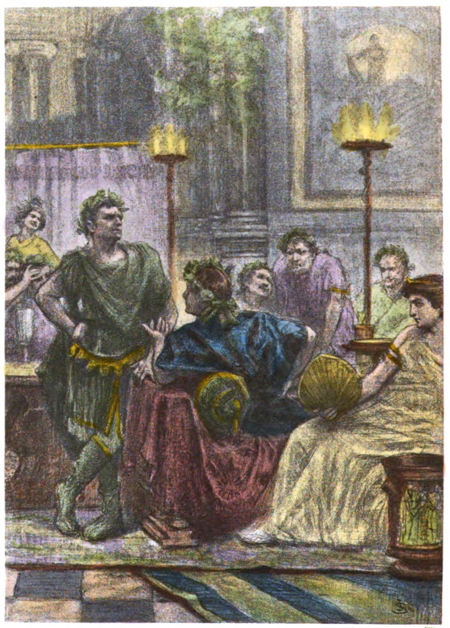
A Roman Levee. Frontispiece. From a drawing by Jan Styka.
LIST OF ILLUSTRATIONS↩
- A Roman Levee. Frontispiece. From a drawing by Jan Styka.
- Map of Europe in 450 ad, page 50
- Venice, p. 70. From a painting by Turner.
- Triumphal Archway at Rheims, p. 214. From a photograph.
- Mausoleum of Theodoric, at Ravenna, p. 300. From a photograph.
- Interior of the Church of the Holy Spirit, Ravenna, p. 330. From a photograph.
[VI-1]
CHAPTER XXXIV↩
The Character, Conquests, and Court of Attila, King of the Huns — Death of Theodosius the Younger — Elevation of Marcian to the Empire of the East
The Western world was oppressed by the Goths and Vandals, who fled before the Huns; but the achievements of the Huns themselves were not adequate to their power and prosperity. Their victorious hordes had spread from the Volga to the Danube; but the public force was exhausted by the discord of independent chieftains; their valour was idly consumed in obscure and predatory excursions; and they often degraded their national dignity by condescending, for the hopes of spoil, to enlist under the banners of their fugitive enemies. In the reign of Attila, [1] the Huns again became the terror of the world; and I shall now describe the character and actions of that formidable Barbarian, who [VI-2] alternately insulted and invaded the East and the West, and urged the rapid downfall of the Roman empire.
In the tide of emigration which impetuously rolled from the confines of China to those of Germany, the most powerful and populous tribes may commonly be found on the verge of the Roman provinces. The accumulated weight was sustained for a while by artificial barriers; and the easy condescension of the emperors invited, without satisfying, the insolent demands of the Barbarians, who had acquired an eager appetite for the luxuries of civilised life. The Hungarians, who ambitiously insert the name of Attila among their native kings, may affirm with truth that the hordes which were subject to his uncle Roas, or Rugilas, had formed their encampments within the limits of modern Hungary, [2] in a fertile country which liberally supplied the wants of a nation of hunters and shepherds. In this advantageous situation, Rugilas and his valiant brothers, who continually added to their power and reputation, commanded the alternative of peace or war with the two empires. His alliance with the Romans of the West was cemented by his personal friendship for the great Aetius; who was always secure of finding in the Barbarian camp a hospitable reception and a powerful support. At his solicitation, in the name of John the usurper, sixty thousand Huns advanced to the confines of Italy; their march and their retreat were alike expensive to the state; and the grateful policy of Aetius abandoned the possession of Pannonia to his faithful confederates. The Romans of the East were not less apprehensive of the arms of Rugilas, which threatened the provinces, or even the [VI-3] capital. Some ecclesiastical historians have destroyed the Barbarians with lightning and pestilence; [3] but Theodosius was reduced to the more humble expedient of stipulating an annual payment of three hundred and fifty pounds of gold, and of disguising this dishonourable tribute by the title of general, which the king of the Huns condescended to accept. The public tranquillity was frequently interrupted by the fierce impatience of the Barbarians and the perfidious intrigues of the Byzantine court. Four dependent nations, among whom we may distinguish the Bavarians, disclaimed the sovereignty of the Huns; and their revolt was encouraged and protected by a Roman alliance; till the just claims and formidable power of Rugilas were effectually urged by the voice of Eslaw, his ambassador. Peace was the unanimous wish of the senate; their decree was ratified by the emperor; and two ambassadors were named, Plinthas, a general of Scythian extraction, but of consular rank, and the quæstor Epigenes, a wise and experienced statesman, who was recommended to that office by his ambitious colleague.
The death of Rugilas suspended the progress of the treaty. His two nephews, Attila and Bleda, who succeeded to the throne of their uncle, consented to a personal interview with the ambassadors of Constantinople; but, as they proudly refused to dismount, the business was transacted on horseback, in a spacious plain near the city of Margus in the Upper Mæsia. The kings of the Huns assumed the solid benefits, as well as the vain honours, of the negotiation. They dictated the conditions of peace, and each condition was an insult on the majesty of the empire. Besides the freedom of a safe and plentiful market on the banks of the Danube, they required that the annual contribution should be augmented from three hundred and fifty to seven hundred [VI-4] pounds of gold; that a fine, or ransom, of eight pieces of gold should be paid for every Roman captive who had escaped from his Barbarian master; that the emperor should renounce all treaties and engagements with the enemies of the Huns; and that all the fugitives, who had taken refuge in the court or provinces of Theodosius, should be delivered to the justice of their offended sovereign. This justice was rigorously inflicted on some unfortunate youths of a royal race. They were crucified on the territories of the empire, by the command of Attila: and, as soon as the king of the Huns had impressed the Romans with the terror of his name, he indulged them in a short and arbitrary respite, whilst he subdued the rebellious or independent nations of Scythia and Germany. [4]
Attila, the son of Mundzuk, deduced his noble, perhaps his regal, descent [5] from the ancient Huns, who had formerly contended with the monarchs of China. His features, according to the observation of a Gothic historian, bore the stamp of his national origin; and the portrait of Attila exhibits the genuine deformity of a modern Calmuck: [6] a large head, a swarthy complexion, small, deep-seated eyes, a flat nose, a few hairs in the place of a beard, broad shoulders, and a short square body, of nervous strength, though of a disproportioned form. The haughty step and demeanour of the king of the Huns expressed the consciousness of his superiority above the rest of mankind; and he had a custom of fiercely rolling his eyes, as if he wished to enjoy the terror [VI-5] which he inspired. Yet this savage hero was not inaccessible to pity: his suppliant enemies might confide in the assurance of peace or pardon; and Attila was considered by his subjects as a just and indulgent master. He delighted in war; but, after he had ascended the throne in a mature age, his head, rather than his hand, achieved the conquest of the North; and the fame of an adventurous soldier was usefully exchanged for that of a prudent and successful general. The effects of personal valour are so inconsiderable, except in poetry or romance, that victory, even among Barbarians, must depend on the degree of skill with which the passions of the multitude are combined and guided for the service of a single man. The Scythian conquerors, Attila and Zingis, surpassed their rude countrymen in art rather than in courage; and it may be observed that the monarchies, both of the Huns and of the Moguls, were erected by their founders on the basis of popular superstition. The miraculous conception, which fraud and credulity ascribed to the virgin-mother of Zingis, raised him above the level of human nature; and the naked prophet, who, in the name of the Deity, invested him with the empire of the earth, pointed the valour of the Moguls with irresistible enthusiasm. [7] The religious arts of Attila were not less skilfully adapted to the character of his age and country. It was natural enough that the Scythians should adore, with peculiar devotion, the god of war; but, as they were incapable of forming either an abstract idea or a corporeal representation, they worshipped their tutelar deity under the symbol of an iron cimeter. [8] One of the shepherds [VI-6] of the Huns perceived that a heifer, who was grazing, had wounded herself in the foot, and curiously followed the track of the blood, till he discovered, among the long grass, the point of an ancient sword, which he dug out of the ground and presented to Attila. That magnanimous, or rather that artful, prince accepted, with pious gratitude, this celestial favour; and, as the rightful possessor of the sword of Mars, asserted his divine and indefeasible claim to the dominion of the earth. [9] If the rites of Scythia were practised on this solemn occasion, a lofty altar, or rather pile of faggots, three hundred yards in length and in breadth, was raised in a spacious plain; and the sword of Mars was placed erect on the summit of this rustic altar, which was annually consecrated by the blood of sheep, horses, and of the hundredth captive. [10] Whether human sacrifices formed any part of the worship of Attila, or whether he propitiated the god of war with the victims which he continually offered in the field of battle, the favourite of Mars soon acquired a sacred character, which rendered his conquests more easy, and more permanent; and the Barbarian princes confessed, in the language of devotion and flattery, that they could not presume to gaze, with a steady eye, on the divine majesty of the king of the Huns. [11] His brother Bleda, who reigned over a considerable part of the nation, was compelled to resign his sceptre and his [VI-7] life. Yet even this cruel act was attributed to a supernatural impulse; and the vigour with which Attila wielded the sword of Mars convinced the world that it had been reserved alone for his invincible arm. [12] But the extent of his empire affords the only remaining evidence of the number and importance of his victories; and the Scythian monarch, however ignorant of the value of science and philosophy, might, perhaps, lament that his illiterate subjects were destitute of the art which could perpetuate the memory of his exploits.
If a line of separation were drawn between the civilised and the savage climates of the globe; between the inhabitants of cities, who cultivated the earth, and the hunters and shepherds, who dwelt in tents; Attila might aspire to the title of supreme and sole monarch of the Barbarians. [13] He alone, among the conquerors of ancient and modern times, united the two mighty kingdoms of Germany and Scythia; and those vague appellations, when they are applied to his reign, may be understood with an ample latitude. Thuringia, which stretched beyond its actual limits as far as the Danube, was in the number of his provinces; he interposed, with the weight of a powerful neighbour, in the domestic affairs of the Franks; and one of his lieutenants chastised, and almost exterminated, the Burgundians of the Rhine. He subdued the islands of the ocean, the kingdoms of Scandinavia, encompassed and divided by the waters of the Baltic; and the Huns might derive a tribute of furs from that Northern region which has been protected from all other conquerors by the severity of the climate and the courage of the natives. Towards the east, it is difficult to circumscribe the dominion of [VI-8] Attila over the Scythian deserts; yet we may be assured that he reigned on the banks of the Volga; that the king of the Huns was dreaded, not only as a warrior, but as a magician; [14] that he insulted and vanquished the Khan of the formidable Geougen; and that he sent ambassadors to negotiate an equal alliance with the empire of China. In the proud review of the nations who acknowledged the sovereignty of Attila, and who never entertained, during his lifetime, the thought of a revolt, the Gepidæ and the Ostrogoths were distinguished by their numbers, their bravery, and the personal merit of their chiefs. The renowned Ardaric, king of the Gepidæ, was the faithful and sagacious counsellor of the monarch, who esteemed his intrepid genius, whilst he loved the mild and discreet virtues of the noble Walamir, king of the Ostrogoths. The crowd of vulgar kings, the leaders of so many martial tribes, who served under the standard of Attila, were ranged in the submissive order of guards and domestics, round the person of their master. They watched his nod; they trembled at his frown; and, at the first signal of his will, they executed, without murmur or hesitation, his stern and absolute commands. In time of peace, the dependent princes, with their national troops, attended the royal camp in regular succession; but, when Attila collected his military force, he was able to bring into the field an army of five, or according to another account of seven, hundred thousand Barbarians. [15]
[VI-9]
The ambassadors of the Huns might awaken the attention of Theodosius, by reminding him that they were his neighbours both in Europe and Asia; since they touched the Danube on one hand, and reached, with the other, as far as the Tanais. In the reign of his father Arcadius, a band of adventurous Huns had ravaged the provinces of the East; from whence they brought away rich spoils and innumerable captives. [16]
They advanced, by a secret path, along the shores of the Caspian Sea; traversed the snowy mountains of Armenia; passed the Tigris, the Euphrates, and the Halys; recruited their weary cavalry with the generous breed of Cappadocian horses; occupied the hilly country of Cilicia; and disturbed the festal songs and dances of the citizens of Antioch. Egypt trembled at their approach; and the monks and pilgrims of the Holy Land prepared to escape their fury by a speedy embarkation. The memory of this invasion was still recent in the minds of the Orientals. The subjects of Attila might execute, with superior forces, the design which these adventurers had so boldly attempted; and it soon became the subject of anxious conjecture, whether the tempest would fall on the dominions of Rome or of Persia. Some of the great vassals of the king of the Huns, who were themselves in the rank of powerful princes, had been sent to ratify an alliance [VI-10] and society of arms with the emperor, or rather with the general, of the West. They related, during their residence at Rome, the circumstances of an expedition which they had lately made into the East. After passing a desert and a morass, supposed by the Romans to be the lake Mæotis, they penetrated through the mountains, and arrived, at the end of fifteen days’ march, on the confines of Media; where they advanced as far as the unknown cities of Basic and Cursic. [17] They encountered the Persian army in the plains of Media; and the air, according to their own expression, was darkened by a cloud of arrows. But the Huns were obliged to retire, before the numbers of the enemy. Their laborious retreat was effected by a different road; they lost the greatest part of their booty; and at length returned to the royal camp, with some knowledge of the country, and an impatient desire of revenge. In the free conversation of the Imperial ambassadors, who discussed, at the court of Attila, the character and designs of their formidable enemy, the ministers of Constantinople expressed their hope that his strength might be diverted and employed in a long and doubtful contest with the princes of the house of Sassan. The more sagacious Italians admonished their Eastern brethren of the folly and danger of such a hope, and convinced them that the Medes and Persians were incapable of resisting the arms of the Huns, and that the easy and important acquisition would exalt the pride, as well as power, of the conqueror. Instead of contenting himself with a moderate contribution, and a military title which equalled him only to the generals of Theodosius, Attila would proceed to impose a disgraceful and intolerable yoke on the necks of the prostrate and captive Romans, who would then be encompassed, on all sides, by the empire of the Huns. [18]
[VI-11]
While the powers of Europe and Asia were solicitous to avert the impending danger, the alliance of Attila maintained the Vandals in the possession of Africa. An enterprise had been concerted between the courts of Ravenna and Constantinople, for the recovery of that valuable province; and the ports of Sicily were already filled with the military and naval forces of Theodosius. But the subtle Genseric, who spread his negotiations round the world, prevented their designs by exciting the king of the Huns to invade the Eastern empire; and a trifling incident soon became the motive, or pretence, of a destructive war. [19] Under the faith of the treaty of Margus, a free market was held on the northern side of the Danube, which was protected by a Roman fortress surnamed Constantia. A troop of Barbarians violated the commercial security, killed, or dispersed, the unsuspecting traders, and levelled the fortress with the ground. The Huns justified this outrage as an act of reprisal; alleged that the bishop of Margus had entered their territories, to discover and steal a secret treasure of their kings; and sternly demanded the guilty prelate, the sacrilegious spoil, and the fugitive subjects, who had escaped from the justice of Attila. The refusal of the Byzantine court was the signal of war; and the Mæsians at first applauded the generous firmness of their sovereign. But they were soon intimidated by the destruction of Viminacium and the adjacent towns; and the people were persuaded to adopt the convenient maxim that a private citizen, however innocent [VI-12] or respectable, may be justly sacrificed to the safety of his country. The bishop of Margus, who did not possess the spirit of a martyr, resolved to prevent the designs which he suspected. He boldly treated with the princes of the Huns; secured, by solemn oaths, his pardon and reward; posted a numerous detachment of Barbarians, in silent ambush, on the banks of the Danube; and at the appointed hour opened, with his own hand, the gates of his episcopal city. This advantage, which had been obtained by treachery, served as a prelude to more honourable and decisive victories. The Illyrian frontier was covered by a line of castles and fortresses; and, though the greatest part of them consisted only of a single tower, with a small garrison, they were commonly sufficient to repel, or to intercept, the inroads of an enemy who was ignorant of the art, and impatient of the delay, of a regular siege. But these slight obstacles were instantly swept away by the inundation of the Huns. [20] They destroyed, with fire and sword, the populous cities of Sirmium and Singidunum, of Ratiaria [20a] and Marcianopolis, of Naissus and Sardica; where every circumstance, in the discipline of the people and the construction of the buildings, had been gradually adapted to the sole purpose of defence. The whole breadth of Europe, as it extends above five hundred miles from the Euxine to the Hadriatic, was at once invaded, and occupied, and desolated by the myriads of Barbarians whom Attila led into the field. The public danger and distress could not, however, provoke Theodosius to interrupt his amusements and devotion, or to appear in person at the head of the Roman legions. But the troops which had been sent against Genseric were hastily recalled from Sicily; the garrisons on the side of Persia were exhausted; [VI-13] and a military force was collected in Europe, formidable by their arms and numbers, if the generals had understood the science of command, and their soldiers the duty of obedience. The armies of the Eastern empire were vanquished in three successive engagements; and the progress of Attila may be traced by the fields of battle. The two former, on the banks of the Utus, and under the walls of Marcianopolis, were fought in the extensive plains between the Danube and Mount Hæmus. As the Romans were pressed by a victorious enemy, they gradually, and unskilfully, retired towards the Chersonesus of Thrace; and that narrow peninsula, the last extremity of the land, was marked by their third, and irreparable, defeat. By the destruction of this army, Attila acquired the indisputable possession of the field. From the Hellespont to Thermopylæ and the suburbs of Constantinople, he ravaged, without resistance, and without mercy, the provinces of Thrace and Macedonia. Heraclea and Hadrianople might, perhaps, escape this dreadful irruption of the Huns; but the words the most expressive of total extirpation and erasure are applied to the calamities which they inflicted on seventy cities of the Eastern empire. [21] Theodosius, his court, and the unwarlike people were protected by the walls of Constantinople; but those walls had been shaken by a recent earthquake, and the fall of fifty-eight towers had opened a large and tremendous breach. The damage indeed was speedily repaired; but this accident was aggravated by a superstitious fear that Heaven itself had delivered the Imperial city to the shepherds of Scythia, who were strangers to the laws, the language, and the religion of the Romans. [22]
[VI-14]
In all their invasions of the civilised empires of the South, the Scythian shepherds have been uniformly actuated by a savage and destructive spirit. The laws of war, that restrain the exercise of national rapine and murder, are founded on two principles of substantial interest: the knowledge of the permanent benefits which may be obtained by a moderate use of conquest; and a just apprehension lest the desolation which we inflict on the enemy’s country may be retaliated on our own. But these considerations of hope and fear are almost unknown in the pastoral state of nations. The Huns of Attila may, without injustice, be compared to the Moguls and Tartars, before their primitive manners were changed by religion and luxury; and the evidence of Oriental history may reflect some light on the short and imperfect annals of Rome. After the Moguls had subdued the northern provinces of China, it was seriously proposed, not in the hour of victory and passion, but in calm deliberate council, to exterminate all the inhabitants of that populous country, that the vacant land might be converted to the pasture of cattle. The firmness of a Chinese mandarin, [23] who insinuated some principles of rational policy into the mind of Zingis, diverted him from the execution of this horrid design. But in the cities of Asia, which yielded to the Moguls, the inhuman abuse of the rights of war was exercised, with a regular form of discipline, which may, with equal reason, though not with equal authority, be imputed to the victorious Huns. The inhabitants, who had submitted to their discretion, were ordered to evacuate their houses, and to assemble in some plain adjacent [VI-15] to the city; where a division was made of the vanquished into three parts. The first class consisted of the soldiers of the garrison, and of the young men capable of bearing arms; and their fate was instantly decided: they were either enlisted among the Moguls, or they were massacred on the spot by the troops, who, with pointed spears and bended bows, had formed a circle round the captive multitude. The second class, composed of the young and beautiful women, of the artificers of every rank and profession, and of the more wealthy or honourable citizens, from whom a private ransom might be expected, was distributed in equal or proportionable lots. The remainder, whose life or death was alike useless to the conquerors, were permitted to return to the city; which, in the meanwhile, had been stripped of its valuable furniture; and a tax was imposed on those wretched inhabitants for the indulgence of breathing their native air. Such was the behaviour of the Moguls, when they were not conscious of any extraordinary rigour. [24] But the most casual provocation, the slightest motive of caprice or convenience, often provoked them to involve a whole people in an indiscriminate massacre; and the ruin of some flourishing cities was executed with such unrelenting perseverance that, according to their own expression, horses might run, without stumbling, over the ground where they had once stood. The three great capitals of Khorasan, Maru, Neisabour, and Herat were destroyed by the armies of Zingis; and the exact account which was taken of the slain amounted to four millions three hundred and forty-seven thousand persons. [25] Timur, or Tamerlane, was educated in [VI-16] a less barbarous age, and in the profession of the Mahometan religion; yet, if Attila equalled the hostile ravages of Tamerlane, [26] either the Tartar or the Hun might deserve the epithet of the Scourge of God. [27]
It may be affirmed, with bolder assurance, that the Huns depopulated the provinces of the empire, by the number of Roman subjects whom they led away into captivity. In the hands of a wise legislator, such an industrious colony might have contributed to diffuse, through the deserts of Scythia, the rudiments of the useful and ornamental arts; but these captives, who had been taken in war, were accidentally dispersed among the hordes that obeyed the empire of Attila. The estimate of their respective value was formed by the simple judgment of unenlightened and unprejudiced Barbarians. Perhaps they might not understand the merit of a theologian, profoundly skilled in the controversies of the Trinity and the Incarnation; yet they respected the ministers of every religion; and the active zeal of the Christian missionaries, without approaching the person or the palace of the monarch, successfully laboured in the propagation of the gospel. [28] The pastoral tribes, who were ignorant of the [VI-17] distinction of landed property, must have disregarded the use, as well as the abuse, of civil jurisprudence; and the skill of an eloquent lawyer could excite only their contempt, or their abhorrence. [29] The perpetual intercourse of the Huns and the Goths had communicated the familiar knowledge of the two national dialects; and the Barbarians were ambitious of conversing in Latin, the military idiom even of the Eastern empire. [30] But they disdained the language, and the sciences, of the Greeks; and the vain sophist, or grave philosopher, who had enjoyed the flattering applause of the schools, was mortified to find that his robust servant was a captive of more value and importance than himself. The mechanic arts were encouraged and esteemed, as they tended to satisfy the wants of the Huns. An architect, in the service of Onegesius, one of the favourites of Attila, was employed to construct a bath; but this work was a rare example of private luxury; and the trades of the smith, the carpenter, the armourer, were much more adapted to supply a wandering people with the useful instruments of peace and war. But the merit of the physician was received with universal favour and respect; the Barbarians, who despised death, might be apprehensive of disease; and the haughty conqueror trembled in the presence of a captive, to whom he ascribed, perhaps, an imaginary power of prolonging, or preserving, his life. [31] The Huns might be provoked to insult the misery of their slaves, over whom they exercised a despotic command; [32] [VI-18] but their manners were not susceptible of a refined system of oppression; and the efforts of courage and diligence were often recompensed by the gift of freedom. The historian Priscus, whose embassy is a course of curious instruction, was accosted, in the camp of Attila, by a stranger, who saluted him in the Greek language, but whose dress and figure displayed the appearance of a wealthy Scythian. In the siege of Viminacium, he had lost, according to his own account, his fortune and liberty; he became the slave of Onegesius; but his faithful services, against the Romans and the Acatzires, had gradually raised him to the rank of the native Huns; to whom he was attached by the domestic pledges of a new wife and several children. The spoils of war had restored and improved his private property; he was admitted to the table of his former lord; and the apostate Greek blessed the hour of his captivity, since it had been the introduction to an happy and independent state; which he held by the honourable tenure of military service. This reflection naturally produced a dispute on the advantages, and defects, of the Roman government, which was severely arraigned by the apostate, and defended by Priscus in a prolix and feeble declamation. The freedman of Onegesius exposed, in true and lively colours, the vices of a declining empire, of which he had so long been the victim; the cruel absurdity of the Roman princes, unable to protect their subjects against the public enemy, unwilling to trust them with arms for their own defence; the intolerable weight of taxes, rendered still more oppressive by the intricate or arbitrary modes of collection; the obscurity of numerous and contradictory laws; the tedious and expensive forms of judicial proceedings; the [VI-19] partial administration of justice; and the universal corruption, which increased the influence of the rich, and aggravated the misfortunes of the poor. A sentiment of patriotic sympathy was at length revived in the breast of the fortunate exile; and he lamented, with a flood of tears, the guilt or weakness of those magistrates who had perverted the wisest and most salutary institutions. [33]
The timid, or selfish, policy of the Western Romans had abandoned the Eastern empire to the Huns. [34] The loss of armies, and the want of discipline or virtue, were not supplied by the personal character of the monarch. Theodosius might still affect the style, as well as the title, of Invincible Augustus; but he was reduced to solicit the clemency of Attila, who imperiously dictated these harsh and humiliating conditions of peace. I. The emperor of the East resigned, by an express or tacit convention, an extensive and important territory, which stretched along the southern banks of the Danube, from Singidunum, or Belgrade, as far as Novæ, in the diocese of Thrace. The breadth was defined by the vague computation of fifteen days’ journey; but, from the proposal of Attila to remove the situation of the national market, it soon appeared that he comprehended the ruined city of Naissus within the limits of his dominions. II. The king of the Huns required and obtained, that his tribute or subsidy should be augmented from seven hundred pounds of gold to the annual sum of two thousand one hundred; and he stipulated the immediate payment of six thousand pounds of gold to defray the expenses, or to expiate the guilt, of the war. One might imagine that such a demand, which scarcely equalled the measure of private wealth, would have been readily discharged by the opulent empire of the [VI-20] East; and the public distress affords a remarkable proof of the impoverished, or at least of the disorderly, state of the finances. A large proportion of the taxes, extorted from the people, was detained and intercepted in their passage, through the foulest channels, to the treasury of Constantinople. The revenue was dissipated by Theodosius and his favourites in wasteful and profuse luxury; which was disguised by the names of Imperial magnificence or Christian charity. The immediate supplies had been exhausted by the unforeseen necessity of military preparations. A personal contribution, rigorously, but capriciously, imposed on the members of the senatorian order, was the only expedient that could disarm, without loss of time, the impatient avarice of Attila; but the poverty of the nobles compelled them to adopt the scandalous resource of exposing to public auction the jewels of their wives and the hereditary ornaments of their palaces. [35] III. The king of the Huns appears to have established, as a principle of national jurisprudence, that he could never lose the property which he had once acquired in the persons who had yielded either a voluntary or reluctant submission to his authority. From this principle he concluded, and the conclusions of Attila were irrevocable laws, that the Huns who had been taken prisoners in war should be released without delay and without ransom; that every Roman captive who had presumed to escape should purchase his right to freedom at the price of twelve pieces of gold; and that all the Barbarians who had deserted the standard of Attila should be restored, without any promise, or stipulation, of pardon. In the execution of this cruel and ignominious treaty, the Imperial officers were forced to massacre several loyal and noble deserters, who refused to devote [VI-21] themselves to certain death; and the Romans forfeited all reasonable claims to the friendship of any Scythian people, by this public confession that they were destitute either of faith or power to protect the suppliants who had embraced the throne of Theodosius. [36]
The firmness of a single town, so obscure that, except on this occasion, it has never been mentioned by any historian or geographer, exposed the disgrace of the emperor and empire. Azimus, or Azimuntium, a small city of Thrace on the Illyrian borders, [37] had been distinguished by the martial spirit of its youth, the skill and reputation of the leaders whom they had chosen, and their daring exploits against the innumerable host of the Barbarians. Instead of tamely expecting their approach, the Azimuntines attacked, in frequent and successful sallies, the troops of the Huns, who gradually declined the dangerous neighbourhood; rescued from their hands the spoil and the captives; and recruited their domestic force by the voluntary association of fugitives and deserters. After the conclusion of the treaty, Attila still menaced the empire with implacable war, unless the Azimuntines were persuaded, or compelled, to comply with the conditions which their sovereign had accepted. The ministers of Theodosius confessed with shame, and with [VI-22] truth, that they no longer possessed any authority over a society of men, who so bravely asserted their natural independence; and the king of the Huns condescended to negotiate an equal exchange with the citizens of Azimus. They demanded the restitution of some shepherds, who, with their cattle, had been accidentally surprised. A strict, though fruitless, inquiry was allowed; but the Huns were obliged to swear that they did not detain any prisoners belonging to the city, before they could recover two surviving countrymen, whom the Azimuntines had reserved as pledges for the safety of their lost companions. Attila, on his side, was satisfied, and deceived, by their solemn asseveration that the rest of the captives had been put to the sword; and that it was their constant practice immediately to dismiss the Romans and the deserters, who had obtained the security of the public faith. This prudent and officious dissimulation may be condemned or excused by the casuists, as they incline to the rigid decree of St. Augustin or to the milder sentiment of St. Jerom and St. Chrysostom; but every soldier, every statesman, must acknowledge that, if the race of the Azimuntines had been encouraged and multiplied, the Barbarians would have ceased to trample on the majesty of the empire. [38]
It would have been strange, indeed, if Theodosius had purchased, by the loss of honour, a secure and solid tranquillity; or if his tameness had not invited the repetition of injuries. The Byzantine court was insulted by five or six successive embassies; [39] and the ministers of Attila were uniformly instructed to press the tardy or imperfect execution of the [VI-23] last treaty; to produce the names of fugitives and deserters, who were still protected by the empire; and to declare, with seeming moderation, that, unless their sovereign obtained complete and immediate satisfaction, it would be impossible for him, were it even his wish, to check the resentment of his warlike tribes. Besides the motives of pride and interest which might prompt the king of the Huns to continue this train of negotiation, he was influenced by the less honourable view of enriching his favourites at the expense of his enemies. The Imperial treasury was exhausted, to procure the friendly offices of the ambassadors and their principal attendants, whose favourable report might conduce to the maintenance of peace. The Barbarian monarch was flattered by the liberal reception of his ministers; he computed with pleasure the value and splendour of their gifts, rigorously exacted the performance of every promise which would contribute to their private emolument, and treated as an important business of state the marriage of his secretary Constantius. [40] That Gallic adventurer, who was recommended by Aetius to the king of the Huns, had engaged his service to the ministers of Constantinople, for the stipulated reward of a wealthy and noble wife; and the daughter of Count Saturninus was chosen to discharge the obligations of her country. The reluctance of the victim, some domestic troubles, and the unjust confiscation of her fortune cooled the ardour of her interested lover; but he still demanded, in the name of Attila, an equivalent alliance; and, after many ambiguous delays and excuses, the Byzantine court was compelled to sacrifice to this insolent stranger the widow [VI-24] of Armatius, whose birth, opulence, and beauty placed her in the most illustrious rank of the Roman matrons. For these importunate and oppressive embassies, Attila claimed a suitable return; he weighed, with suspicious pride, the character and station of the Imperial envoys; but he condescended to promise that he would advance as far as Sardica, to receive any ministers who had been invested with the consular dignity. The council of Theodosius eluded this proposal by representing the desolate and ruined condition of Sardica; and even ventured to insinuate that every officer of the army or household was qualified to treat with the most powerful princes of Scythia. Maximin, [41] a respectable courtier, whose abilities had been long exercised in civil and military employments, accepted with reluctance the troublesome and, perhaps, dangerous commission of reconciling the angry spirit of the king of the Huns. His friend, the historian Priscus, [42] embraced the opportunity of observing the Barbarian hero in the peaceful and domestic scenes of life; but the secret of the embassy, a fatal and guilty secret, was entrusted only to the interpreter Vigilius. The two last ambassadors of the Huns, Orestes, a noble subject of the Pannonian province, and Edecon, a valiant chieftain of the tribe of the Scyri, returned at the same time from Constantinople to the royal camp. Their obscure names were afterwards illustrated by the extraordinary fortune and the contrast [VI-25] of their sons; the two servants of Attila became the fathers of the last Roman emperor of the West and of the first Barbarian king of Italy.
The ambassadors, who were followed by a numerous train of men and horses, made their first halt at Sardica, at the distance of three hundred and fifty miles, or thirteen days’ journey, from Constantinople. As the remains of Sardica were still included within the limits of the empire, it was incumbent on the Romans to exercise the duties of hospitality. They provided, with the assistance of the provincials, a sufficient number of sheep and oxen; and invited the Huns to a splendid, or at least a plentiful, supper. But the harmony of the entertainment was soon disturbed by mutual prejudice and indiscretion. The greatness of the emperor and the empire was warmly maintained by their ministers; the Huns, with equal ardour, asserted the superiority of their victorious monarch: the dispute was inflamed by the rash and unseasonable flattery of Vigilius, who passionately rejected the comparison of a mere mortal with the divine Theodosius; and it was with extreme difficulty that Maximin and Priscus were able to divert the conversation, or to soothe the angry minds of the Barbarians. When they rose from table, the Imperial ambassador presented Edecon and Orestes with rich gifts of silk robes and Indian pearls, which they thankfully accepted. Yet Orestes could not forbear insinuating that he had not always been treated with such respect and liberality; the offensive distinction which was implied between his civil office and the hereditary rank of his colleague seems to have made Edecon a doubtful friend, and Orestes an irreconcileable enemy. After this entertainment, they travelled about one hundred miles from Sardica to Naissus. That flourishing city, which had given birth to the great Constantine, was levelled with the ground; the inhabitants were destroyed or dispersed; and the appearance of some sick persons, who were still permitted to exist among the ruins of the churches, served only to increase [VI-26] the horror of the prospect. The surface of the country was covered with the bones of the slain; and the ambassadors, who directed their course to the north-west, were obliged to pass the hills of modern Servia, before they descended into the flat and marshy grounds which are terminated by the Danube. The Huns were masters of the great river; their navigation was performed in large canoes, hollowed out of the trunk of a single tree; the ministers of Theodosius were safely landed on the opposite bank; and their Barbarian associates immediately hastened to the camp of Attila, which was equally prepared for the amusements of hunting or of war. No sooner had Maximin advanced about two miles from the Danube, than he began to experience the fastidious insolence of the conqueror. He was sternly forbid to pitch his tents in a pleasant valley, lest he should infringe the distant awe that was due to the royal mansion. The ministers of Attila pressed him to communicate the business and the instructions, which he reserved for the ear of their sovereign. When Maximin temperately urged the contrary practice of nations, he was still more confounded to find that the resolutions of the Sacred Consistory, those secrets (says Priscus) which should not be revealed to the gods themselves, had been treacherously disclosed to the public enemy. On his refusal to comply with such ignominious terms, the Imperial envoy was commanded instantly to depart; the order was recalled; it was again repeated; and the Huns renewed their ineffectual attempts to subdue the patient firmness of Maximin. At length, by the intercession of Scotta, the brother of Onegesius, whose friendship had been purchased by a liberal gift, he was admitted to the royal presence: but, instead of obtaining a decisive answer, he was compelled to undertake a remote journey towards the North, that Attila might enjoy the proud satisfaction of receiving, in the same camp, the ambassadors of the Eastern and Western empires. His journey was regulated by the guides, who obliged him to halt, to hasten his march, or to deviate from the common [VI-27] road, as it best suited the convenience of the king. The Romans who traversed the plains of Hungary suppose that they passed several navigable rivers, either in canoes or portable boats; but there is reason to suspect that the winding stream of the Theiss, or Tibiscus, might present itself in different places, under different names. From the contiguous villages they received a plentiful and regular supply of provisions; mead instead of wine, millet in the place of bread, and a certain liquor named camus, which, according to the report of Priscus, was distilled from barley. [43] Such fare might appear coarse and indelicate to men who had tasted the luxury of Constantinople: but, in their accidental distress, they were relieved by the gentleness and hospitality of the same Barbarians, so terrible and so merciless in war. The ambassadors had encamped on the edge of a large morass. A violent tempest of wind and rain, of thunder and lightning, overturned their tents, immersed their baggage and furniture in the water, and scattered their retinue, who wandered in the darkness of the night, uncertain of their road, and apprehensive of some unknown danger, till they awakened by their cries the inhabitants of a neighbouring village, the property of the widow of Bleda. A bright illumination, and, in a few moments, a comfortable fire of reeds, was kindled by their officious benevolence; the wants, and even the desires, of the Romans were liberally satisfied; and they seem to have been embarrassed by the singular politeness of Bleda’s widow, who added to her other favours the gift, or at least the loan, of a sufficient number of beautiful and obsequious damsels. The sunshine of the succeeding day was dedicated [VI-28] to repose; to collect and dry the baggage, and to the refreshment of the men and horses: but, in the evening, before they pursued their journey, the ambassadors expressed their gratitude to the bounteous lady of the village, by a very acceptable present of silver cups, red fleeces, dried fruits, and Indian pepper. Soon after this adventure, they rejoined the march of Attila, from whom they had been separated about six days; and slowly proceeded to the capital of an empire which did not contain, in the space of several thousand miles, a single city.
As far as we may ascertain the vague and obscure geography of Priscus, this capital appears to have been seated between the Danube, the Theiss, and the Carpathian hills, in the plains of Upper Hungary, and most probably in the neighbourhood of Jazberin, Agria, or Tokay. [44] In its origin it could be no more than an accidental camp, which, by the long and frequent residence of Attila, had insensibly swelled into a huge village, for the reception of his court, of the troops who followed his person, and of the various multitude of idle or industrious slaves and retainers. [45] The baths, constructed by Onegesius, were the only edifice of stone; the materials had been transported from Pannonia; and, since the adjacent country was destitute even of large timber, it may be presumed that the meaner habitations of the royal [VI-29] village consisted of straw, of mud, or of canvas. The wooden houses of the more illustrious Huns were built and adorned with rude magnificence, according to the rank, the fortune, or the taste of the proprietors. They seem to have been distributed with some degree of order and symmetry; and each spot became more honourable, as it approached the person of the sovereign. The palace of Attila, which surpassed all other houses in his dominions, was built entirely of wood, and covered an ample space of ground. The outward enclosure was a lofty wall, or palisade of smooth square timber, intersected with high towers, but intended rather for ornament than defence. This wall, which seems to have encircled the declivity of a hill, comprehended a great variety of wooden edifices, adapted to the uses of royalty. A separate house was assigned to each of the numerous wives of Attila; and, instead of the rigid and illiberal confinement imposed by Asiatic jealousy, they politely admitted the Roman ambassadors to their presence, their table, and even to the freedom of an innocent embrace. When Maximin offered his presents to Cerca, the principal queen, he admired the singular architecture of her mansion, the height of the round columns, the size and beauty of the wood, which was curiously shaped, or turned, or polished, or carved; and his attentive eye was able to discover some taste in the ornaments, and some regularity in the proportions. After passing through the guards who watched before the gate, the ambassadors were introduced into the private apartment of Cerca. The wife of Attila received their visit sitting, or rather lying, on a soft couch; the floor was covered with a carpet; the domestics formed a circle round the queen; and her damsels, seated on the ground, were employed in working the variegated embroidery which adorned the dress of the Barbaric warriors. The Huns were ambitious of displaying those riches which were the fruit and evidence of their victories: the trappings of their horses, their swords, and even their shoes were studded with gold and precious stones; [VI-30] and their tables were profusely spread with plates, and goblets, and vases of gold and silver, which had been fashioned by the labour of Grecian artists. The monarch alone assumed the superior pride of still adhering to the simplicity of his Scythian ancestors. [46] The dress of Attila, his arms, and the furniture of his horse were plain, without ornament, and of a single colour. The royal table was served in wooden cups and platters; flesh was his only food; and the conqueror of the North never tasted the luxury of bread.
When Attila first gave audience to the Roman ambassadors on the banks of the Danube, his tent was encompassed with a formidable guard. The monarch himself was seated in a wooden chair. His stern countenance, angry gestures, and impatient tone astonished the firmness of Maximin; but Vigilius had more reason to tremble, since he distinctly understood the menace that, if Attila did not respect the law of nations, he would nail the deceitful interpreter to a cross and leave his body to the vultures. The Barbarian condescended, by producing an accurate list, to expose the bold falsehood of Vigilius, who had affirmed that no more than seventeen deserters could be found. But he arrogantly declared that he apprehended only the disgrace of contending with his fugitive slaves; since he despised their impotent efforts to defend the provinces which Theodosius had entrusted to their arms: “For what fortress” (added Attila), “what city, in the wide extent of the Roman empire, can hope to exist, secure and impregnable, if it is our pleasure that it should be erased from the earth?” He dismissed, however, the interpreter, who returned to Constantinople with his peremptory demand of more complete restitution and a more splendid embassy. His anger gradually subsided, [VI-31] and his domestic satisfaction in a marriage which he celebrated on the road with the daughter of Eslam [47] might perhaps contribute to mollify the native fierceness of his temper. The entrance of Attila into the royal village was marked by a very singular ceremony. A numerous troop of women came out to meet their hero, and their king. They marched before him, distributed into long and regular files; the intervals between the files were filled by white veils of thin linen, which the women on either side bore aloft in their hands, and which formed a canopy for a chorus of young virgins, who chanted hymns and songs in the Scythian language. The wife of his favourite Onegesius, with a train of female attendants, saluted Attila at the door of her own house, on his way to the palace; and offered, according to the custom of the country, her respectful homage, by entreating him to taste the wine and meat which she had prepared for his reception. As soon as the monarch had graciously accepted her hospitable gift, his domestics lifted a small silver table to a convenient height, as he sat on horseback; and Attila, when he had touched the goblet with his lips, again saluted the wife of Onegesius, and continued his march. During his residence at the seat of empire, his hours were not wasted in the recluse idleness of a seraglio; and the king of the Huns could maintain his superior dignity, without concealing his person from the public view. He frequently assembled his council, and gave audience to the ambassadors of the nations; and his people might appeal to the supreme tribunal, which he held at stated times, and, according to the Eastern custom, before the principal gate of his wooden palace. The Romans, both of the East and of the West, were twice invited to the banquets, where Attila feasted with the princes and nobles of Scythia. Maximin and his [VI-32] colleagues were stopped on the threshold, till they had made a devout libation to the health and prosperity of the king of the Huns; and were conducted, after this ceremony, to their respective seats in a spacious hall. The royal table and couch, covered with carpets and fine linen, was raised by several steps in the midst of the hall; and a son, an uncle, or perhaps a favourite king, were admitted to share the simple and homely repast of Attila. Two lines of small tables, each of which contained three or four guests, were ranged in order on either hand; the right was esteemed the most honourable, but the Romans ingenuously confess that they were placed on the left; and that Beric, an unknown chieftain, most probably of the Gothic race, preceded the representatives of Theodosius and Valentinian. The Barbarian monarch received from his cup-bearer a goblet filled with wine, and courteously drank to the health of the most distinguished guest, who rose from his seat and expressed, in the same manner, his loyal and respectful vows. This ceremony was successively performed for all, or at least for the illustrious persons of the assembly; and a considerable time must have been consumed, since it was thrice repeated, as each course or service was placed on the table. But the wine still remained after the meat had been removed; and the Huns continued to indulge their intemperance long after the sober and decent ambassadors of the two empires had withdrawn themselves from the nocturnal banquet. Yet before they retired, they enjoyed a singular opportunity of observing the manners of the nation in their convivial amusements. Two Scythians stood before the couch of Attila, and recited the verses which they had composed, to celebrate his valour and his victories. A profound silence prevailed in the hall; and the attention of the guests was captivated by the vocal harmony, which revived and perpetuated the memory of their own exploits: a martial ardour flashed from the eyes of the warriors, who were impatient for battle; and the tears of the old men expressed their generous despair that they could no [VI-33] longer partake the danger and glory of the field. [48] This entertainment, which might be considered as a school of military virtue, was succeeded by a farce that debased the dignity of human nature. A Moorish and a Scythian buffoon successively excited the mirth of the rude spectators, by their deformed figure, ridiculous dress, antic gestures, absurd speeches, and the strange unintelligible confusion of the Latin, the Gothic, and the Hunnic languages; and the hall resounded with loud and licentious peals of laughter. In the midst of this intemperate riot, Attila alone, without a change of countenance, maintained his stedfast and inflexible gravity; which was never relaxed, except on the entrance of Irnac, the youngest of his sons: he embraced the boy with a smile of paternal tenderness, gently pinched him by the cheek, and betrayed a partial affection, which was justified by the assurance of his prophets that Irnac would be the future support of his family and empire. Two days afterwards, the ambassadors received a second invitation; and they had reason to praise the politeness as well as the hospitality of Attila. The king of the Huns held a long and familiar conversation with Maximin; but his civility was interrupted by rude expressions, and haughty reproaches; and he was provoked, by a motive of interest, to support, with unbecoming zeal, the private claims of his secretary Constantius. “The emperor” (said Attila) “has long promised him a rich wife; Constantius must not be disappointed; nor should a Roman emperor deserve the name of liar.” On the third day, the ambassadors were dismissed; the freedom of several captives was granted, for a moderate ransom, to their pressing entreaties; and, besides the royal presents, they were permitted to accept from each of the Scythian nobles the honourable and useful gift of a horse. [VI-34] Maximin returned, by the same road, to Constantinople; and though he was involved in an accidental dispute with Beric, the new ambassador of Attila, he flattered himself that he had contributed, by the laborious journey, to confirm the peace and alliance of the two nations. [49]
But the Roman ambassador was ignorant of the treacherous design, which had been concealed under the mask of the public faith. The surprise and satisfaction of Edecon, when he contemplated the splendour of Constantinople, had encouraged the interpreter Vigilius to procure for him a secret interview with the eunuch Chrysaphius, [50] who governed the emperor and the empire. After some previous conversation, and a mutual oath of secrecy, the eunuch, who had not, from his own feelings or experience, imbibed any exalted notions of ministerial virtue, ventured to propose the death of Attila, as an important service, by which Edecon might deserve a liberal share of the wealth and luxury which he admired. The ambassador of the Huns listened to the tempting offer, and professed, with apparent zeal, his ability, as well as readiness, to execute the bloody deed; the design was communicated to the master of the offices, and the devout Theodosius consented to the assassination of his invincible enemy. But this perfidious conspiracy was defeated by the dissimulation, or the repentance, of Edecon; and, though he might exaggerate his inward abhorrence for the treason, which he [VI-35] seemed to approve, he dexterously assumed the merit of an early and voluntary confession. If we now review the embassy of Maximin, and the behaviour of Attila, we must applaud the Barbarian, who respected the laws of hospitality, and generously entertained and dismissed the minister of a prince who had conspired against his life. But the rashness of Vigilius will appear still more extraordinary, since he returned, conscious of his guilt and danger, to the royal camp; accompanied by his son, and carrying with him a weighty purse of gold, which the favourite eunuch had furnished, to satisfy the demands of Edecon, and to corrupt the fidelity of the guards. The interpreter was instantly seized, and dragged before the tribunal of Attila, where he asserted his innocence with specious firmness, till the threat of inflicting instant death on his son extorted from him a sincere discovery of the criminal transaction. Under the name of ransom or confiscation, the rapacious king of the Huns accepted two hundred pounds of gold for the life of a traitor, whom he disdained to punish. He pointed his just indignation against a nobler object. His ambassadors Eslaw and Orestes were immediately despatched to Constantinople with a peremptory instruction, which it was much safer for them to execute than to disobey. They boldly entered the Imperial presence, with the fatal purse hanging down from the neck of Orestes; who interrogated the eunuch Chrysaphius, as he stood beside the throne, whether he recognised the evidence of his guilt. But the office of reproof was reserved for the superior dignity of his colleague Eslaw, who gravely addressed the Emperor of the East in the following words: “Theodosius is the son of an illustrious and respectable parent; Attila likewise is descended from a noble race; and he has supported, by his actions, the dignity which he inherited from his father Mundzuk. But Theodosius has forfeited his paternal honours, and, by consenting to pay tribute, has degraded himself to the condition of a slave. It is therefore just that he should reverence the man whom fortune and merit have placed above [VI-36] him; instead of attempting, like a wicked slave, clandestinely to conspire against his master.” The son of Arcadius, who was accustomed only to the voice of flattery, heard with astonishment the severe language of truth; he blushed and trembled; nor did he presume directly to refuse the head of Chrysaphius, which Eslaw and Orestes were instructed to demand. A solemn embassy, armed with full powers and magnificent gifts, was hastily sent to deprecate the wrath of Attila; and his pride was gratified by the choice of Nomius and Anatolius, two ministers of consular or patrician rank, of whom the one was great treasurer, and the other was master-general of the armies of the East. He condescended to meet these ambassadors on the banks of the river Drenco; and, though he at first affected a stern and haughty demeanour, his anger was insensibly mollified by their eloquence and liberality. He condescended to pardon the emperor, the eunuch, and the interpreter; bound himself by an oath to observe the conditions of peace; to release a great number of captives; abandoned the fugitives and deserters to their fate; and resigned a large territory to the south of the Danube, which he had already exhausted of its wealth and its inhabitants. But this treaty was purchased at an expense which might have supported a vigorous and successful war; and the subjects of Theodosius were compelled to redeem the safety of a worthless favourite by oppressive taxes, which they would more cheerfully have paid for his destruction. [51]
The emperor Theodosius did not long survive the most humiliating circumstance of an inglorious life. As he was riding, or hunting, in the neighbourhood of Constantinople, he was thrown from his horse into the river Lycus; the spine of [VI-37] the back was injured by the fall; and he expired some days afterwards, in the fiftieth year of his age, and the forty-third of his reign. [52] His sister Pulcheria, whose authority had been controlled both in civil and ecclesiastical affairs by the pernicious influence of the eunuchs, was unanimously proclaimed empress of the East; and the Romans, for the first time, submitted to a female reign. No sooner had Pulcheria ascended the throne than she indulged her own and the public resentment by an act of popular justice. Without any legal trial, the eunuch Chrysaphius was executed before the gates of the city; and the immense riches which had been accumulated by the rapacious favourite served only to hasten and to justify his punishment. [53] Amidst the general acclamations of the clergy and people, the empress did not forget the prejudice and disadvantage to which her sex was exposed; and she wisely resolved to prevent their murmurs by the choice of a colleague, who would always respect the superior rank and virgin chastity of his wife. She gave her hand to Marcian, a senator, about sixty years of age, and the nominal husband of Pulcheria was solemnly invested with the Imperial purple. The zeal which he displayed for the orthodox creed, as it was established by the council of Chalcedon, would alone have inspired the grateful eloquence of the Catholics. But the behaviour of Marcian in a private life, and afterwards on the throne, may support a more rational belief that he was qualified to restore and invigorate an empire which had been almost dissolved by the successive weakness of two hereditary monarchs. He was born in Thrace, and educated to the profession of arms; but Marcian’s [VI-38] youth had been severely exercised by poverty and misfortune, since his only resource, when he first arrived at Constantinople, consisted in two hundred pieces of gold, which he had borrowed of a friend. He passed nineteen years in the domestic and military service of Aspar and his son Ardaburius; followed those powerful generals to the Persian and African wars; and obtained, by their influence, the honourable rank of tribune and senator. His mild disposition, and useful talents, without alarming the jealousy, recommended Marcian to the esteem and favour, of his patrons; he had seen, perhaps he had felt, the abuses of a venal and oppressive administration; and his own example gave weight and energy to the laws which he promulgated for the reformation of manners. [54]
[VI-39]
CHAPTER XXXV↩
Invasion of Gaul by Attila — He is repulsed by Aetius and the Visigoths — Attila invades and evacuates Italy — The deaths of Attila, Aetius, and Valentinian the Third
It was the opinion of Marcian that war should be avoided, as long as it is possible to preserve a secure and honourable peace; but it was likewise his opinion that peace cannot be honourable or secure, if the sovereign betrays a pusillanimous aversion to war. This temperate courage dictated his reply to the demands of Attila, who insolently pressed the payment of the annual tribute. The emperor signified to the Barbarians that they must no longer insult the majesty of Rome, by the mention of a tribute; that he was disposed to reward with becoming liberality the faithful friendship of his allies; but that if they presumed to violate the public peace, they should feel that he possessed troops, and arms, and resolution, to repel their attacks. The same language, even in the camp of the Huns, was used by his ambassador Apollonius, whose bold refusal to deliver the presents, till he had been admitted to a personal interview, displayed a sense of dignity, and a contempt of danger, which Attila was not prepared to expect from the degenerate Romans. [1] He threatened to chastise the rash successor of Theodosius; but he hesitated whether he should first direct his invincible arms against the Eastern or the Western empire. While mankind awaited his decision with awful suspense, he sent an equal defiance to the courts of Ravenna and Constantinople, and his ministers saluted the two emperors with the same haughty declaration. “Attila, my Lord, and thy lord, commands thee to provide a palace for [VI-40] his immediate reception.” [2] But, as the Barbarian despised, or affected to despise, the Romans of the East, whom he had so often vanquished, he soon declared his resolution of suspending the easy conquest, till he had achieved a more glorious and important enterprise. In the memorable invasions of Gaul and Italy, the Huns were naturally attracted by the wealth and fertility of those provinces; but the particular motives and provocations of Attila can only be explained by the state of the Western empire under the reign of Valentinian, or, to speak more correctly, under the administration of Aetius. [3]
After the death of his rival Boniface, Aetius had prudently retired to the tents of the Huns; and he was indebted to their alliance for his safety and his restoration. Instead of the suppliant language of a guilty exile, he solicited his pardon at the head of sixty thousand Barbarians; and the empress Placidia confessed, by a feeble resistance, that the condescension, which might have been ascribed to clemency, was the effect of weakness or fear. She delivered herself, her son Valentinian, and the Western empire into the hands of an insolent subject; nor could Placidia protect the son-in-law of Boniface, the virtuous and faithful Sebastian, [4] from the [VI-41] implacable persecution, which urged him from one kingdom to another, till he miserably perished in the service of the Vandals. The fortunate Aetius, who was immediately promoted to the rank of patrician, and thrice invested with the honours of the consulship, assumed, with the title of master of the cavalry and infantry, the whole military power of the state; and he is sometimes styled, by contemporary writers, the Duke, or General, of the Romans of the West. His prudence, rather than his virtue, engaged him to leave the grandson of Theodosius in the possession of the purple; and Valentinian was permitted to enjoy the peace and luxury of Italy, while the patrician appeared in the glorious light of a hero and a patriot who supported near twenty years the ruins of the Western empire. The Gothic historian ingenuously confesses that Aetius was born for the salvation of the Roman republic; [5] and the following portrait, though it is drawn in the fairest colours, must be allowed to contain a much larger proportion of truth than of flattery. “His mother was a wealthy and noble Italian, and his father Gaudentius, who held a distinguished rank in the province of Scythia, gradually rose from the station of a military domestic to the dignity of master of the cavalry. Their son, who was enrolled almost in his infancy in the guards, was given as a hostage, first to Alaric, and afterwards to the Huns; and he successively obtained the civil and military honours of the palace, for which he was equally qualified by superior merit. The graceful figure of Aetius was not above the middle stature; but his manly limbs were admirably formed for strength, beauty, and agility; and he excelled in the martial exercises of managing a horse, drawing the bow, and darting the javelin. He could patiently endure the want of food or of sleep; and his mind and body were alike capable of the most laborious [VI-42] efforts. He possessed the genuine courage that can despise not only dangers but injuries; and it was impossible either to corrupt, or deceive, or intimidate the firm integrity of his soul.” [6] The Barbarians who had seated themselves in the Western provinces were insensibly taught to respect the faith and valour of the patrician Aetius. He soothed their passions, consulted their prejudices, balanced their interests, and checked their ambition. A seasonable treaty, which he concluded with Genseric, protected Italy from the depredations of the Vandals; the independent Britons implored and acknowledged his salutary aid; the Imperial authority was restored and maintained in Gaul and Spain; and he compelled the Franks and the Suevi, whom he had vanquished in the field, to become the useful confederates of the republic.
From a principle of interest, as well as gratitude, Aetius assiduously cultivated the alliance of the Huns. While he resided in their tents as a hostage or an exile, he had familiarly conversed with Attila himself, the nephew of his benefactor; and the two famous antagonists appear to have been connected by a personal and military friendship, which they afterwards confirmed by mutual gifts, frequent embassies, and the education of Carpilio, the son of Aetius, in the camp of Attila. By the specious professions of gratitude and voluntary attachment, the patrician might disguise his apprehensions of the Scythian conqueror, who pressed the two empires with his innumerable armies. His demands were obeyed or eluded. When he claimed the spoils of a vanquished city, some vases of gold, which had been fraudulently embezzled, the civil and military governors of Noricum were immediately [VI-43] despatched to satisfy his complaints; [7] and it is evident from their conversation with Maximin and Priscus in the royal village, that the valour and prudence of Aetius had not saved the Western Romans from the common ignominy of tribute. Yet his dexterous policy prolonged the advantages of a salutary peace, and a numerous army of Huns and Alani, whom he had attached to his person, was employed in the defence of Gaul. Two colonies of these Barbarians were judiciously fixed in the territories of Valence and Orleans; [8] and their active cavalry secured the important passages of the Rhone and of the Loire. These savage allies were not indeed less formidable to the subjects than to the enemies of Rome. Their original settlement was enforced with the licentious violence of conquest; and the province through which they marched was exposed to all the calamities of an hostile invasion. [9] Strangers to the emperor or the republic, the Alani of [VI-44] Gaul were devoted to the ambition of Aetius; and, though he might suspect that, in a contest with Attila himself, they would revolt to the standard of their national king, the patrician laboured to restrain, rather than to excite, their zeal and resentment against the Goths, the Burgundians, and the Franks.
The kingdom established by the Visigoths in the southern provinces of Gaul had gradually acquired strength and maturity; and the conduct of those ambitious Barbarians, either in peace or war, engaged the perpetual vigilance of Aetius. After the death of Wallia the Gothic sceptre devolved to Theodoric, the son of the great Alaric; [10] and his prosperous reign, of more than thirty years, over a turbulent people may be allowed to prove that his prudence was supported by uncommon vigour, both of mind and body. Impatient of his narrow limits, Theodoric aspired to the possession of Arles, the wealthy seat of government and commerce; but the city was saved by the timely approach of Aetius; and the Gothic king, who had raised the siege with some loss and disgrace, was persuaded, for an adequate subsidy, to divert the martial valour of his subjects in a Spanish war. Yet Theodoric still watched, and eagerly seized, the favourable moment of renewing his hostile attempts. The Goths besieged Narbonne, while the Belgic provinces were invaded by the Burgundians; and the public safety was threatened on [VI-45] every side by the apparent union of the enemies of Rome. On every side, the activity of Aetius, and his Scythian cavalry, opposed a firm and successful resistance. Twenty thousand Burgundians were slain in battle; and the remains of the nation humbly accepted a dependent seat in the mountains of Savoy. [11] The walls of Narbonne had been shaken by the battering engines, and the inhabitants had endured the last extremities of famine, when Count Litorius, approaching in silence, and directing each horseman to carry behind him two sacks of flour, cut his way through the entrenchments of the besiegers. The siege was immediately raised; and the more decisive victory, which is ascribed to the personal conduct of Aetius himself, was marked with the blood of eight thousand Goths. But in the absence of the patrician, who was hastily summoned to Italy by some public or private interest, Count Litorius succeeded to the command; and his presumption soon discovered that far different talents are required to lead a wing of cavalry, or to direct the operations of an important war. At the head of an army of Huns, he rashly advanced to the gates of Toulouse, full of careless contempt for an enemy whom his misfortunes had rendered prudent and his situation made desperate. The predictions of the augurs had inspired Litorius with the profane confidence that he should enter the Gothic capital in triumph; and the trust which he reposed in his Pagan allies encouraged him to reject the fair conditions of peace, which were repeatedly proposed by the bishops in the name of Theodoric. The king of the Goths exhibited in his distress the edifying contrast of Christian piety and moderation; nor did he lay aside his sackcloth and ashes till he was [VI-46] prepared to arm for the combat. His soldiers, animated with martial and religious enthusiasm, assaulted the camp of Litorius. The conflict was obstinate; the slaughter was mutual. The Roman general, after a total defeat, which could be imputed only to his unskilful rashness, was actually led through the streets of Toulouse, not in his own, but in a hostile triumph; and the misery which he experienced, in a long and ignominious captivity, excited the compassion of the Barbarians themselves. [12] Such a loss, in a country whose spirit and finances were long since exhausted, could not easily be repaired; and the Goths, assuming, in their turn, the sentiments of ambition and revenge, would have planted their victorious standards on the banks of the Rhone, if the presence of Aetius had not restored strength and discipline to the Romans. [13] The two armies expected the signal of a decisive action; but the generals, who were conscious of each other’s force, and doubtful of their own superiority, prudently sheathed their swords in the field of battle; and their reconciliation was permanent and sincere. Theodoric, king of the Visigoths, appears to have deserved the love of his subjects, the confidence of his allies, and the esteem of mankind. His throne was surrounded by six valiant sons, who were educated with equal care in the exercises of the Barbarian camp and in those of the Gallic schools; from the study of the Roman [VI-47] jurisprudence, they acquired the theory, at least, of law and justice; and the harmonious sense of Virgil contributed to soften the asperity of their native manners. [14] The two daughters of the Gothic king were given in marriage to the eldest sons of the kings of the Suevi and of the Vandals, who reigned in Spain and Africa; but these illustrious alliances were pregnant with guilt and discord. The queen of the Suevi bewailed the death of an husband, inhumanly massacred by her brother. The princess of the Vandals was the victim of a jealous tyrant, whom she called her father. The cruel Genseric suspected that his son’s wife had conspired to poison him; the supposed crime was punished by the amputation of her nose and ears; and the unhappy daughter of Theodoric was ignominiously returned to the court of Toulouse in that deformed and mutilated condition. This horrid act, which must seem incredible to a civilised age, drew tears from every spectator; but Theodoric was urged, by the feelings of a parent and a king, to revenge such irreparable injuries. The Imperial ministers, who always cherished the discord of the Barbarians, would have supplied the Goths with arms and ships and treasures for the African war; and the cruelty of Genseric might have been fatal to himself, if the artful Vandal had not armed, in his cause, the formidable power of the Huns. His rich gifts and pressing solicitations inflamed the ambition of Attila; and the designs of Aetius and Theodoric were prevented by the invasion of Gaul. [15]
[VI-48]
The Franks, whose monarchy was still confined to the neighbourhood of the Lower Rhine, had wisely established the right of hereditary succession in the noble family of the Merovingians. [16] These princes were elevated on a buckler, the symbol of military command; [17] and the royal fashion of long hair was the ensign of their birth and dignity. Their flaxen locks, which they combed and dressed with singular care, hung down in flowing ringlets on their back and shoulders; while the rest of the nation were obliged, either by law or custom, to shave the hinder part of their head, to comb their hair over the forehead, and to content themselves with the ornament of two small whiskers. [18] The lofty stature of the Franks, and their blue eyes, denoted a Germanic origin; their close apparel accurately expressed the figure of their limbs; a weighty sword was suspended from a broad belt; their bodies were protected by a large shield; and these [VI-49] warlike Barbarians were trained, from their earliest youth, to run, to leap, to swim; to dart the javelin or battle-axe with unerring aim; to advance, without hesitation, against a superior enemy; and to maintain, either in life or death, the invincible reputation of their ancestors. [19] Clodion, the first of the long-haired kings whose name and actions are mentioned in authentic history, held his residence at Dispargum, [20] a village or fortress whose place may be assigned between Louvain and Brussels. From the report of his spies the king of the Franks was informed that the defenceless state of the second Belgic must yield, on the slightest attack, to the valour of his subjects. He boldly penetrated through the thickets and morasses of the Carbonarian forest; [21] occupied Tournay and Cambray, the only cities which existed in the fifth century; and extended his conquests as far as the river Somme, over a desolate country, whose cultivation and populousness are the effects of more recent industry. [22] While Clodion lay encamped in the plains of Artois, [23] and celebrated with vain and ostentatious security the marriage, perhaps, [VI-50] of his son, the nuptial feast was interrupted by the unexpected and unwelcome presence of Aetius, who had passed the Somme at the head of his light cavalry. The tables, which had been spread under the shelter of a hill, along the banks of a pleasant stream, were rudely overturned; the Franks were oppressed before they could recover their arms, or their ranks; and their unavailing valour was fatal only to themselves. The loaded waggons which had followed their march afforded a rich booty; and the virgin bride, with her female attendants, submitted to the new lovers who were imposed on them by the chance of war. This advantage, which had been obtained by the skill and activity of Aetius, might reflect some disgrace on the military prudence of Clodion; but the king of the Franks soon regained his strength and reputation, and still maintained the possession of his Gallic kingdom from the Rhine to the Somme. [24] Under his reign, and most probably from the enterprising spirit of his subjects, the three capitals, Mentz, Treves, and Cologne, experienced the effects of hostile cruelty and avarice. The distress of Cologne was prolonged by the perpetual dominion of the same Barbarians, who evacuated the ruins of Treves; and Treves, which, in the space of forty years, had been four times besieged and pillaged, was disposed to lose the memory of her afflictions in the vain amusements of the circus. [25] The death of Clodion, after a reign of twenty years, exposed his kingdom to the discord and ambition of his [VI-none] [VI-51] two sons. Meroveus, the younger, [26] was persuaded to implore the protection of Rome; he was received at the Imperial court as the ally of Valentinian and the adopted son of the patrician Aetius; and dismissed to his native country with splendid gifts and the strongest assurances of friendship and support. During his absence, his elder brother had solicited, with equal ardour, the formidable aid of Attila: and the king of the Huns embraced an alliance which facilitated the passage of the Rhine and justified, by a specious and honourable pretence, the invasion of Gaul. [27]
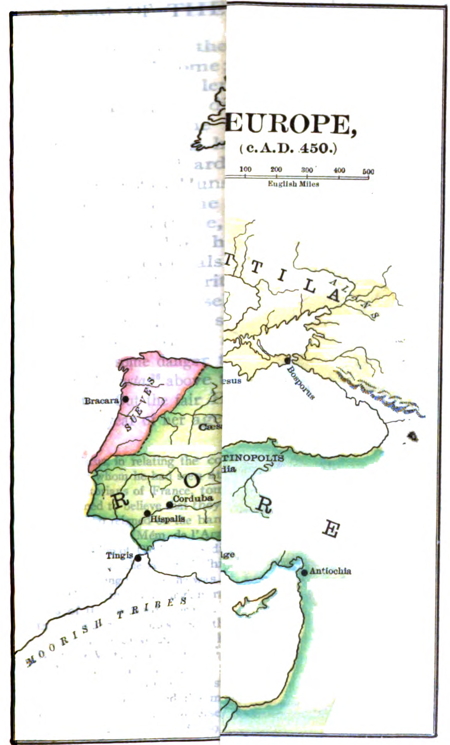
Map of Europe in 450 AD, page 50.
When Attila declared his resolution of supporting the cause of his allies, the Vandals and the Franks, at the same time, and almost in the spirit of romantic chivalry, the savage monarch professed himself the lover and the champion of the princess Honoria. The sister of Valentinian was educated in the palace of Ravenna; and, as her marriage might be productive of some danger to the state, she was raised, by the title of Augusta, [28] above the hopes of the most presumptuous subject. But the fair Honoria had no sooner attained the sixteenth year of her age than she detested the importunate [VI-52] greatness which must for ever exclude her from the comforts of honourable love; in the midst of vain and unsatisfactory pomp, Honoria sighed, yielded to the impulse of nature, and threw herself into the arms of her chamberlain Eugenius. Her guilt and shame (such is the absurd language of imperious man) were soon betrayed by the appearances of pregnancy; but the disgrace of the royal family was published to the world by the imprudence of the empress Placidia; who dismissed her daughter, after a strict and shameful confinement, to a remote exile at Constantinople. The unhappy princess passed twelve or fourteen years in the irksome society of the sisters of Theodosius, and their chosen virgins; to whose crown Honoria could no longer aspire, and whose monastic assiduity of prayer, fasting, and vigils she reluctantly imitated. Her impatience of long and hopeless celibacy urged her to embrace a strange and desperate resolution. The name of Attila was familiar and formidable at Constantinople; and his frequent embassies entertained a perpetual intercourse between his camp and the Imperial palace. In the pursuit of love, or rather of revenge, the daughter of Placidia sacrificed every duty and every prejudice; and offered to deliver her person into the arms of a Barbarian, of whose language she was ignorant, whose figure was scarcely human, and whose religion and manners she abhorred. By the ministry of a faithful eunuch, she transmitted to Attila a ring, the pledge of her affection; and earnestly conjured him to claim her as a lawful spouse, to whom he had been secretly betrothed. These indecent advances were received, however, with coldness and disdain; and the king of the Huns continued to multiply the number of his wives, till his love was awakened by the more forcible passions of ambition and avarice. The invasion of Gaul was preceded, and justified, by a formal demand of the princess Honoria, with a just and equal share of the Imperial patrimony. His predecessors, the ancient Tanjous, had often addressed, in the same hostile and peremptory manner, the daughters of China; and the [VI-53] pretensions of Attila were not less offensive to the majesty of Rome. A firm, but temperate, refusal was communicated to his ambassadors. The right of female succession, though it might derive a specious argument from the recent examples of Placidia and Pulcheria, was strenuously denied; and the indissoluble engagements of Honoria were opposed to the claims of her Scythian lover. [29] On the discovery of her connection with the king of the Huns, the guilty princess had been sent away, as an object of horror, from Constantinople to Italy; her life was spared; but the ceremony of her marriage was performed with some obscure and nominal husband, before she was immured in a perpetual prison, to bewail those crimes and misfortunes which Honoria might have escaped, had she not been born the daughter of an emperor. [30]
A native of Gaul and a contemporary, the learned and eloquent Sidonius, who was afterwards bishop of Clermont, had made a promise to one of his friends that he would compose a regular history of the war of Attila. If the modesty of Sidonius had not discouraged him from the prosecution of this interesting work, [31] the historian would have related, with the simplicity of truth, those memorable events to which the poet, in vague and doubtful metaphors, has concisely alluded. [32] [VI-54] The kings and nations of Germany and Scythia, from the Volga perhaps to the Danube, obeyed the warlike summons of Attila. From the royal village, in the plains of Hungary, his standard moved towards the West; and, after a march of seven or eight hundred miles, he reached the conflux of the Rhine and the Necker; where he was joined by the Franks, who adhered to his ally, the elder of the sons of Clodion. A troop of light Barbarians, who roamed in quest of plunder, might choose the winter for the convenience of passing the river on the ice; but the innumerable cavalry of the Huns required such plenty of forage and provisions, as could be procured only in a milder season; the Hercynian forest supplied materials for a bridge of boats; and the hostile myriads were poured, with resistless violence, into the Belgic provinces. [33] The consternation of Gaul was universal; and the various fortunes of its cities have been adorned by tradition with martyrdom and miracles. [34] Troyes was [VI-55] saved by the merits of St. Lupus; St. Servatius was removed from the world, that he might not behold the ruin of Tongres; and the prayers of St. Genevieve diverted the march of Attila from the neighbourhood of Paris. But, as the greatest part of the Gallic cities were alike destitute of saints and soldiers, they were besieged and stormed by the Huns; who practised, in the example of Metz, [35] their customary maxims of war. They involved, in a promiscuous massacre, the priests who served at the altar, and the infants, who, in the hour of danger, had been providently baptised by the bishop; the flourishing city was delivered to the flames, and a solitary chapel of St. Stephen marked the place where it formerly stood. From the Rhine and the Moselle, Attila advanced into the heart of Gaul; crossed the Seine at Auxerre; and, after a long and laborious march, fixed his camp under the walls of Orleans. He was desirous of securing his conquests by the possession of an advantageous post, which commanded the passage of the Lorie; and he depended on the secret invitation of Sangiban, king of the Alani, who had promised to betray the city, and to revolt from the service of the empire. But this treacherous conspiracy was detected and disappointed; Orleans had been strengthened with recent fortifications; and the assaults of the Huns were vigorously repelled by the faithful valour of the soldiers, or citizens, who defended the place. The pastoral [VI-56] diligence of Anianus, a bishop of primitive sanctity and consummate prudence, exhausted every art of religious policy to support their courage, till the arrival of the expected succours. [36] After an obstinate siege, the walls were shaken by the battering-rams; the Huns had already occupied the suburbs; and the people, who were incapable of bearing arms, lay prostrate in prayer. Anianus, who anxiously counted the days and hours, despatched a trusty messenger to observe, from the rampart, the face of the distant country. He returned twice without any intelligence that could inspire hope or comfort; but, in his third report, he mentioned a small cloud, which he had faintly descried at the extremity of the horizon. “It is the aid of God!” exclaimed the bishop, in a tone of pious confidence; and the whole multitude repeated after him, “It is the aid of God.” The remote object, on which every eye was fixed, became each moment larger and more distinct; the Roman and Gothic banners were gradually perceived; and a favourable wind, blowing aside the dust, discovered, in deep array, the impatient squadrons of Aetius and Theodoric, who pressed forwards to the relief of Orleans.
The facility with which Attila had penetrated into the heart of Gaul may be ascribed to his insidious policy as well as to the terror of his arms. His public declarations were skilfully mitigated by his private assurances; he alternately soothed and threatened the Romans and the Goths; and the courts of Ravenna and Toulouse, mutually suspicious of each other’s intentions, beheld with supine indifference the approach of their common enemy. Aetius was the sole guardian of the public safety; but his wisest measures were embarrassed by a faction which, since the death of Placidia, infested the Imperial palace; the youth of Italy trembled at the sound of the trumpet; and the Barbarians who, from fear or affection, were inclined to the cause of Attila awaited, with doubtful and venal faith, the event of the war. The patrician passed the [VI-57] Alps at the head of some troops, whose strength and numbers scarcely deserved the name of an army. [37] But on his arrival at Arles, or Lyons, he was confounded by the intelligence that the Visigoths, refusing to embrace the defence of Gaul, had determined to expect, within their own territories, the formidable invader, whom they professed to despise. The senator Avitus, who, after the honourable exercise of the Prætorian prefecture, had retired to his estate in Auvergne, was persuaded to accept the important embassy, which he executed with ability and success. He represented to Theodoric that an ambitious conqueror, who aspired to the dominion of the earth, could be resisted only by the firm and unanimous alliance of the powers whom he laboured to oppress. The lively eloquence of Avitus inflamed the Gothic warriors, by the description of the injuries which their ancestors had suffered from the Huns; whose implacable fury still pursued them from the Danube to the foot of the Pyrenees. He strenuously urged that it was the duty of every Christian to save from sacrilegious violation the churches of God and the relics of the saints; that it was the interest of every Barbarian who had acquired a settlement in Gaul to defend the fields and vineyards, which were cultivated for his use, against the desolation of the Scythian shepherds. Theodoric yielded to the evidence of truth; adopted the measure at once the most prudent and the most honourable; and declared that, as the faithful ally of Aetius and the Romans, he was ready to expose his life and kingdom for the common safety of Gaul. [38] [VI-58] The Visigoths, who at that time were in the mature vigour of their fame and power, obeyed with alacrity the signal of war, prepared their arms and horses, and assembled under the standard of their aged king, who was resolved, with his two eldest sons, Torismond and Theodoric, to command in person his numerous and valiant people. The example of the Goths determined several tribes or nations that seemed to fluctuate between the Huns and the Romans. The indefatigable diligence of the patrician gradually collected the troops of Gaul and Germany, who had formerly acknowledged themselves the subjects or soldiers of the republic, but who now claimed the rewards of voluntary service and the rank of independent allies; the Læti, the Armoricans, the Breones, the Saxons, the Burgundians, the Sarmatians or Alani, the Ripuarians, and the Franks who followed Meroveus as their lawful prince. Such was the various army, which, under the conduct of Aetius and Theodoric, advanced, by rapid marches, to relieve Orleans, and to give battle to the innummerable host of Attila. [39]
On their approach the king of the Huns immediately raised the siege, and sounded a retreat to recall the foremost of his troops from the pillage of a city which they had already [VI-59] entered. [40] The valour of Attila was always guided by his prudence; and, as he foresaw the fatal consequences of a defeat in the heart of Gaul, he repassed the Seine and expected the enemy in the plains of Châlons, whose smooth and level surface was adapted to the operations of his Scythian cavalry. But in this tumultuary retreat the vanguard of the Romans and their allies continually pressed, and sometimes engaged the troops whom Attila had posted in the rear; the hostile columns, in the darkness of the night, and the perpexity of the roads, might encounter each other without design; and the bloody conflict of the Franks and Gepidæ, in which fifteen thousand [41] Barbarians were slain, was a prelude to a more general and decisive action. The Catalaunian fields [42] spread themselves round Châlons, and extend, according to the vague measurement of Jornandes, to the length of one hundred and fifty, and the breadth of one hundred, miles, over the whole province, which is entitled to the appellation of a champaign country. [43] This spacious plain was distinguished, however, by some inequalities of ground; and the importance of an height, which commanded the camp of Attila, was understood, and disputed, by the two generals. The young and valiant Torismond first occupied the summit; the Goths rushed with irresistible weight on the Huns, who laboured to ascend from the opposite side; and the possession of this advantageous post inspired both the [VI-60] troops and their leaders with a fair assurance of victory. The anxiety of Attila prompted him to consult his priests and haruspices. It was reported that, after scrutinising the entrails of victims and scraping their bones, they revealed, in mysterious language, his own defeat, with the death of his principal adversary; and that the Barbarian, by accepting the equivalent, expressed his involuntary esteem for the superior merit of Aetius. But the unusual despondency, which seemed to prevail among the Huns, engaged Attila to use the expedient, so familiar to the generals of antiquity, of animating his troops by a military oration; and his language was that of a king who had often fought and conquered at their head. [44] He pressed them to consider their past glory, their actual danger, and their future hopes. The same fortune which opened the deserts and morasses of Scythia to their unarmed valour, which had laid so many warlike nations prostrate at their feet, had reserved the joys of this memorable field for the consummation of their victories. The cautious steps of their enemies, their strict alliance, and their advantageous posts, he artfully represented as the effects, not of prudence, but of fear. The Visigoths alone were the strength and nerves of the opposite army; and the Huns might securely trample on the degenerate Romans, whose close and compact order betrayed their apprehensions, and who were equally incapable of supporting the dangers or the fatigues of a day of battle. The doctrine of predestination, so favourable to martial virtue, was carefully inculcated by the king of the Huns, who assured his subjects that the warriors, protected by Heaven, were safe and invulnerable amidst the darts of the enemy; but that the unerring Fates would strike their victims in the bosom of inglorious peace. “I myself,” [VI-61] continued Attila, “will throw the first javelin, and the wretch who refuses to imitate the example of his sovereign is devoted to inevitable death.” The spirit of the Barbarians was rekindled by the presence, the voice, and the example of their intrepid leader; and Attila, yielding to their impatience, immediately formed his order of battle. At the head of his brave and faithful Huns he occupied in person the centre of the line. The nations subject to his empire, the Rugians, the Heruli, the Thuringians, the Franks, the Burgundians, were extended, on either hand, over the ample space of the Catalaunian fields; the right wing was commanded by Ardaric, king of the Gepidæ; and the three valiant brothers who reigned over the Ostrogoths were posted on the left to oppose the kindred tribes of the Visigoths. The disposition of the allies was regulated by a different principle. Sangiban, the faithless king of the Alani, was placed in the centre; where his motions might be strictly watched, and his treachery might be instantly punished. Aetius assumed the command of the left, and Theodoric of the right wing; while Torismond still continued to occupy the heights which appear to have stretched on the flank, and perhaps the rear, of the Scythian army. The nations from the Volga to the Atlantic were assembled on the plain of Châlons; but many of these nations had been divided by faction, or conquest, or emigration; and the appearance of similar arms and ensigns, which threatened each other, presented the image of a civil war.
The discipline and tactics of the Greeks and Romans form an interesting part of their national manners. The attentive study of the military operations of Xenophon, or Cæsar, or Frederic, when they are described by the same genius which conceived and executed them, may tend to improve (if such improvement can be wished) the art of destroying the human species. But the battle of Châlons can only excite our curiosity by the magnitude of the object; since it was decided by the blind impetuosity of Barbarians, and has [VI-62] been related by partial writers, whose civil or ecclesiastical profession secluded them from the knowledge of military affairs. Cassiodorius, however, had familiarly conversed with many Gothic warriors, who served in that memorable engagement; “a conflict,” as they informed him, “fierce, various, obstinate and bloody; such as could not be paralleled either in the present or in past ages.” The number of the slain amounted to one hundred and sixty-two thousand, or, according to another account, three hundred thousand persons; [45] and these incredible exaggerations suppose a real and effective loss, sufficient to justify the historian’s remark that whole generations may be swept away, by the madness of kings, in the space of a single hour. After the mutual and repeated discharge of missile weapons, in which the archers of Scythia might signalise their superior dexterity, the cavalry and infantry of the two armies were furiously mingled in closer combat. The Huns, who fought under the eyes of their king, pierced through the feeble and doubtful centre of the allies, separated their wings from each other, and wheeling, with a rapid effort, to the left, directed their whole force against the Visigoths. As Theodoric rode along the ranks to animate his troops, he received a mortal stroke from the javelin of Andages, a noble Ostrogoth, and immediately fell from his horse. The wounded king was oppressed in the general disorder, and trampled under the feet of his own cavalry; and this important death served to explain the ambiguous prophecy of the haruspices. Attila already exulted in the confidence of victory, when the valiant Torismond [VI-63] descended from the hills, and verified the remainder of the prediction. The Visigoths, who had been thrown into confusion by the flight, or defection, of the Alani, gradually restored their order of battle; and the Huns were undoubtedly vanquished, since Attila was compelled to retreat. He had exposed his person with the rashness of a private soldier; but the intrepid troops of the centre had pushed forwards beyond the rest of the line; their attack was faintly supported; their flanks were unguarded; and the conquerors of Scythia and Germany were saved by the approach of the night from a total defeat. They retired within the circle of waggons that fortified their camp; and the dismounted squadrons prepared themselves for a defence, to which neither their arms nor their temper were adapted. The event was doubtful; but Attila had secured a last and honourable resource. The saddles and rich furniture of the cavalry were collected by his order into a funeral pile; and the magnanimous Barbarian had resolved, if his intrenchments should be forced, to rush headlong into the flames, and to deprive his enemies of the glory which they might have acquired by the death or captivity of Attila. [46]
But his enemies had passed the night in equal disorder and anxiety. The inconsiderate courage of Torismond was tempted to urge the pursuit, till he unexpectedly found himself, with a few followers, in the midst of the Scythian waggons. In the confusion of a nocturnal combat, he was thrown from his horse; and the Gothic prince must have perished like his father, if his youthful strength, and the intrepid zeal of his companions, had not rescued him from this dangerous situation. In the same manner, but on the left of the line, Aetius himself, separated from his allies, ignorant of their [VI-64] victory, and anxious for their fate, encountered and escaped the hostile troops that were scattered over the plains of Châlons; and at length reached the camp of the Goths, which he could only fortify with a slight rampart of shields, till the dawn of day. The Imperial general was soon satisfied of the defeat of Attila, who still remained inactive within his intrenchments; and, when he contemplated the bloody scene, he observed, with secret satisfaction, that the loss had principally fallen on the Barbarians. The body of Theodoric, pierced with honourable wounds, was discovered under a heap of the slain: his subjects bewailed the death of their king and father; but their tears were mingled with songs and acclamations, and his funeral rites were performed in the face of a vanquished enemy. The Goths, clashing their arms, elevated on a buckler his eldest son Torismond, to whom they justly ascribed the glory of their success; and the new king accepted the obligation of revenge as a sacred portion of his paternal inheritance. Yet the Goths themselves were astonished by the fierce and undaunted aspect of their formidable antagonist; and their historian has compared Attila to a lion encompassed in his den, and threatening his hunters with redoubled fury. The kings and nations, who might have deserted his standard in the hour of distress, were made sensible that the displeasure of their monarch was the most imminent and inevitable danger. All his instruments of martial music incessantly sounded a loud and animating strain of defiance; and the foremost troops who advanced to the assault were checked, or destroyed, by showers of arrows from every side of the intrenchments. It was determined in a general council of war, to besiege the king of the Huns in his camp, to intercept his provisions, and to reduce him to the alternative of a disgraceful treaty or an unequal combat. But the impatience of the Barbarians soon disdained these cautious and dilatory measures; and the mature policy of Aetius was apprehensive that, after the extirpation of the [VI-65] Huns, the republic would be oppressed by the pride and power of the Gothic nation. The patrician exerted the superior ascendant of authority and reason, to calm the passions which the son of Theodoric considered as a duty; represented, with seeming affection, and real truth, the dangers of absence and delay; and persuaded Torismond to disappoint, by his speedy return, the ambitious designs of his brothers, who might occupy the throne and treasures of Toulouse. [47] After the departure of the Goths and the separation of the allied army, Attila was surprised at the vast silence that reigned over the plains of Châlons; the suspicion of some hostile stratagem detained him several days within the circle of his waggons; and his retreat beyond the Rhine confessed the last victory which was achieved in the name of the Western empire. Meroveus and his Franks, observing a prudent distance, and magnifying the opinion of their strength by the numerous fires which they kindled every night, continued to follow the rear of the Huns, till they reached the confines of Thuringia. The Thuringians served in the army of Attila; they traversed, both in their march and in their return, the territories of the Franks; and it was perhaps in this war that they exercised the cruelties which, about fourscore years afterwards, were revenged by the son of Clovis. They massacred their hostages, as well as their captives: two hundred young maidens were tortured with exquisite and unrelenting rage; their bodies were torn asunder by wild horses, or their bones were crushed under the weight of rolling waggons; and their unburied limbs were abandoned on the public roads, as a prey to dogs and vultures. Such were [VI-66] those savage ancestors, whose imaginary virtues have sometimes excited the praise and envy of civilised ages. [48]
Neither the spirit nor the forces nor the reputation of Attila were impaired by the failure of the Gallic expedition. In the ensuing spring, he repeated his demand of the princess Honoria and her patrimonial treasures. [48a] The demand was again rejected, or eluded; and the indignant lover immediately took the field, passed the Alps, invaded Italy, and besieged Aquileia with an innumerable host of Barbarians. Those Barbarians were unskilled in the methods of conducting a regular siege, which, even among the ancients, required some knowledge, or at least some practice, of the mechanic arts. But the labour of many thousand provincials and captives, whose lives were sacrificed without pity, might execute the most painful and dangerous work. The skill of the Roman artists might be corrupted to the destruction of their country. The walls of Aquileia were assaulted by a formidable train of battering-rams, moveable turrets, and engines, that threw stones, darts, and fire; [49] and the monarch of the Huns employed the forcible impulse of hope, fear, emulation, and interest, to subvert the only barrier which delayed the conquest of Italy. Aquileia was at that period [VI-67] one of the richest, the most populous, and the strongest of the maritime cities of the Hadriatic coast. The Gothic auxiliaries, who appear to have served under their native princes Alaric and Antala, communicated their intrepid spirit; and the citizens still remembered the glorious and successful resistance, which their ancestors had opposed to a fierce, inexorable Barbarian, who disgraced the majesty of the Roman purple. Three months were consumed without effect in the siege of Aquileia; till the want of provisions, and the clamours of his army, compelled Attila to relinquish the enterprise, and reluctantly to issue his orders that the troops should strike their tents the next morning and begin their retreat. But, as he rode round the walls, pensive, angry, and disappointed, he observed a stork preparing to leave her nest, in one of the towers, and to fly with her infant family towards the country. He seized, with the ready penetration of a statesman, this trifling incident, which chance had offered to superstition; and exclaimed, in a loud and cheerful tone, that such a domestic bird, so constantly attached to human society, would never have abandoned her ancient seats, unless those towers had been devoted to impending ruin and solitude. [50] The favourable omen inspired an assurance of victory; the siege was renewed, and prosecuted with fresh vigour; a large breach was made in the part of the wall from whence the stork had taken her flight; the Huns mounted to the assault with irresistible fury; and the succeeding generation could scarcely discover the ruins of Aquileia. [51] After [VI-68] this dreadful chastisement, Attila pursued his march; and, as he passed, the cities of Altinum, Concordia, and Padua were reduced into heaps of stones and ashes. The inland towns, Vicenza, Verona, and Bergamo, were exposed to the rapacious cruelty of the Huns. Milan and Pavia submitted, without resistance, to the loss of their wealth; and applauded the unusual clemency, which preserved from the flames the public, as well as private, buildings; and spared the lives of the captive multitude. The popular traditions of Comum, Turin, or Moderna may justly be suspected; yet they concur with more authentic evidence to prove that Attila spread his ravages over the rich plains of modern Lombardy: which are divided by the Po, and bounded by the Alps and Apennine. [52] When he took possession of the royal palace of Milan, he was surprised, and offended, at the sight of a picture, which represented the Cæsars seated on their throne and the princes of Scythia prostrate at their feet. The revenge which Attila inflicted on this monument of Roman vanity was harmless and ingenious. He commanded a painter to reverse the figures and the attitudes; and the emperors were delineated on the same canvas, approaching in a suppliant posture to empty their bags of tributary gold before the throne of the Scythian monarch. [53] The spectators must have cofessed the truth and propriety of the alteration; and were perhaps tempted to apply, on this singular occasion, the well-known fable of the dispute between the lion and the man. [54]
[VI-69]
It is a saying worthy of the ferocious pride of Attila, that the grass never grew on the spot where his horse had trod. Yet the savage destroyer undesignedly laid the foundations of a republic which revived, in the feudal state of Europe, the art and spirit of commercial industry. The celebrated name of Venice, or Venetia, [55] was formerly diffused over a large and fertile province of Italy, from the confines of Pannonia to the river Addua, and from the Po to the Rhætian and Julian Alps. Before the irruption of the Barbarians, fifty Venetian cities flourished in peace and prosperity; Aquileia was placed in the most conspicuous station; but the ancient dignity of Padua was supported by agriculture and manufactures; and the property of five hundred citizens, who were entitled to the equestrian rank, must have amounted, at the strictest computation, to one million seven hundred thousand pounds. Many families of Aquileia, Padua, and the adjacent towns, who fled from the sword of the Huns, found a safe, though obscure, refuge in the neighbouring islands. [56] At the extremity of the Gulf, where the Hadriatic feebly imitates the tides of the ocean, near an hundred small islands are separated by shallow water from [VI-70] the continent, and protected from the waves by several long slips of land, which admit the entrance of vessels through some secret and narrow channels. [57] Till the middle of the fifth century, these remote and sequestered spots remained without cultivation, with few inhabitants, and almost without a name. But the manners of the Venetian fugitives, their arts and their government, were gradually formed by their new situation; and one of the epistles of Cassiodorius, [58] which describes their condition about seventy years afterwards, may be considered as the primitive monument of the republic. The minister of Theodoric compares them, in his quaint declamatory style, to water-fowl, who had fixed their nests on the bosom of the waves; and, though he allows that the Venetian provinces had formerly contained many noble families, he insinuates that they were now reduced by misfortune to the same level of humble poverty. Fish was the common, and almost the universal, food of every rank; their only treasure consisted in the plenty of salt, which they extracted from the sea; and the exchange of that commodity, so essential to human life, was substituted in the neighbouring markets to the currency of gold and silver. A people, whose habitations might be doubtfully assigned to the earth or water, soon became alike familiar with the two elements; and the demands of avarice succeeded to those of necessity. The islanders, who, from Grado to Chiozza, were intimately connected with each other, penetrated into the heart of Italy [VI-none] [VI-71] by the secure, though laborious, navigation of the rivers and inland canals. Their vessels, which were continually increasing in size and number, visited all the harbours of the Gulf; and the marriage, which Venice annually celebrates with the Hadriatic, was contracted in her early infancy. The epistle of Cassiodorius, the Prætorian prefect, is addressed to the maritime tribunes; and he exhorts them, in a mild tone of authority, to animate the zeal of their countrymen for the public service, which required their assistance to transport the magazines of wine and oil from the province of Istria to the royal city of Ravenna. The ambiguous office of these magistrates is explained by the tradition that, in the twelve principal islands, twelve tribunes, or judges, were created by an annual and popular election. The existence of the Venetian republic under the Gothic kingdom of Italy is attested by the same authentic record, which annihilates their lofty claim of original and perpetual independence. [59] The Italians, who had long since renounced the exercise of arms, were surprised, after forty years’ peace, by the approach of a formidable Barbarian, whom they abhorred, as the enemy of their religion as well as of their republic. Amidst the general consternation, Aetius alone was incapable of fear; but it was impossible that he should achieve, alone and unassisted, any military exploits worthy of his former renown. The Barbarians who had defended Gaul refused to march to the relief of Italy; and the succours promised by the Eastern emperor were distant and doubtful. Since Aetius, at the head of his domestic troops, still maintained the field, and harassed or retarded the march of Attila, he never shewed himself more truly great than at the time when his conduct [VI-72] was blamed by an ignorant and ungrateful people. [60] If the mind of Valentinian had been susceptible of any generous sentiments, he would have chosen such a general for his example and his guide. But the timid grandson of Theodosius, instead of sharing the dangers, escaped from the sound, of war; and his hasty retreat from Ravenna to Rome, from an impregnable fortress to an open capital, betrayed his secret intention of abandoning Italy as soon as the danger should approach his Imperial person. This shameful abdication was suspended, however, by the spirit of doubt and delay, which commonly adheres to pusillanimous counsels, and sometimes corrects their pernicious tendency. The Western emperor, with the senate and people of Rome, embraced the more salutary resolution of deprecating, by a solemn and suppliant embassy, the wrath of Attila. This important commission was accepted by Avienus, who, from his birth and riches, his consular dignity, the numerous train of his clients, and his personal abilities, held the first rank in the Roman senate. The specious and artful character of Avienus [61] was admirably qualified to conduct a negotiation either of public or private interest; his colleague Trigetius had exercised the Prætorian prefecture of Italy; and Leo, bishop of Rome, consented to expose his life for the safety of his flock. The genius of Leo [62] was exercised and displayed [VI-73] in the public misfortunes; and he has deserved the appellation of Great by the successful zeal with which he laboured to establish his opinions and his authority, under the venerable names of orthodox faith and ecclesiastical discipline. The Roman ambassadors were introduced to the tent of Attila, as he lay encamped at the place where the slowwinding Mincius is lost in the foaming waves of the lake Benacus, [63] and trampled, with his Scythian cavalry, the farms of Catullus and Virgil. [64] The Barbarian monarch listened with favourable, and even respectful attention; and the deliverance of Italy was purchased by the immense ransom, or dowry, of the princess Honoria. The state of his army might facilitate the treaty, and hasten his retreat. Their martial spirit was relaxed by the wealth and indolence of a warm climate. The shepherds of the North, whose ordinary food consisted of milk and raw flesh, indulged themselves too freely in the use of bread, of wine, and of meat prepared and seasoned by the arts of cookery; and the progress of disease revenged in some measure the injuries of the Italians. [65] When Attila declared his resolution of carrying his victorious arms to the gates of Rome, he was admonished [VI-74] by his friends, as well as by his enemies, that Alaric had not long survived the conquest of the eternal city. His mind, superior to real danger, was assaulted by imaginary terrors; nor could he escape the influence of superstition, which had so often been subservient to his designs. [66] The pressing eloquence of Leo, his majestic aspect and sacerdotal robes, excited the veneration of Attila for the spiritual father of the Christians. The apparition of the two apostles, St. Peter and St. Paul, who menaced the Barbarian with instant death, if he rejected the prayer of their successor, is one of the noblest legends of ecclesiastical tradition. The safety of Rome might deserve the interposition of celestial beings; and some indulgence is due to a fable which has been represented by the pencil of Raphael and the chisel of Algardi. [67]
Before the king of the Huns evacuated Italy, he threatened to return more dreadful and more implacable, if his bride, the princess Honoria, were not delivered to his ambassadors within the term stipulated by the treaty. Yet, in the meanwhile, Attila relieved his tender anxiety by adding a beautiful maid, whose name was Ildico, to the list of his innumerable wives. [68] Their marriage was celebrated with barbaric pomp [VI-75] and festivity at his wooden palace beyond the Danube; and the monarch, oppressed with wine and sleep, retired, at a late hour, from the banquet to the nuptial bed. His attendants continued to respect his pleasures, or his repose, the greatest part of the ensuing day, till the unusual silence alarmed their fears and suspicions; and, after attempting to awaken Attila by loud and repeated cries, they at length broke into the royal apartment. They found the trembling bride sitting by the bedside, hiding her face with her veil, and lamenting her own danger as well as the death of the king, who had expired during the night. [69] An artery had suddenly burst; and, as Attila lay in a supine posture, he was suffocated by a torrent of blood, which, instead of finding a passage through the nostrils, regurgitated into the lungs and stomach. His body was solemnly exposed in the midst of the plain, under a silken pavilion; and the chosen squadrons of the Huns, wheeling round in measured evolutions, chanted a funeral song to the memory of a hero, glorious in his life, invincible in his death, the father of his people, the scourge of his enemies, and the terror of the world. According to their national custom, the Barbarians cut off a part of their hair, gashed their faces with unseemly wounds, and bewailed their valiant leader as he deserved, not with the tears of women, but with the blood of warriors. The remains of Attila were enclosed within three coffins, of gold, of silver, and of iron, and privately buried in the night: the spoils of nations were thrown into his grave; the captives who had opened the ground were [VI-76] inhumanly massacred; and the same Huns, who had indulged such excessive grief, feasted, with dissolute and intemperate mirth, about the recent sepulchre of their king. It was reported at Constantinople that on the fortunate night in which he expired Marcian beheld in a dream the bow of Attila broken asunder; and the report may be allowed to prove how seldom the image of that formidable Barbarian was absent from the mind of a Roman emperor. [70]
The revolution which subverted the empire of the Huns established the fame of Attila, whose genius alone had sustained the huge and disjointed fabric. After his death, the boldest chieftains aspired to the rank of kings; the most powerful kings refused to acknowledge a superior; and the numerous sons, whom so many various mothers bore to the deceased monarch, divided and disputed, like a private inheritance, the sovereign command of the nations of Germany and Scythia. The bold Ardaric felt and represented the disgrace of this servile partition; and his subjects, the warlike Gepidæ, with the Ostrogoths, under the conduct of three valiant brothers, encouraged their allies to vindicate the rights of freedom and royalty. In a bloody and decisive conflict on the banks of the river Netad, in Pannonia, the lance of the Gepidæ, the sword of the Goths, the arrows of the Huns, the Suevic infantry, the light arms of the Heruli, and the heavy weapons of the Alani encountered or supported each other, and the victory of Ardaric was accompanied with the slaughter of thirty thousand of his enemies. Ellac, the eldest son of Attila, lost his life and crown in the memorable battle of Netad: his early valour had raised him to the throne of the Acatzires, a Scythian people, whom he subdued; and his father, who loved the superior merit, would have envied the death, of Ellac. [71] His brother Dengisich with an [VI-77] army of Huns, still formidable in their flight and ruin, maintained his ground above fifteen years on the banks of the Danube. The palace of Attila, with the old country of Dacia, from the Carpathian hills to the Euxine, became the seat of a new power, which was erected by Ardaric, king of the Gepidæ. The Pannonian conquests, from Vienna to Sirmium, were occupied by the Ostrogoths; and the settlements of the tribes, who had so bravely asserted their native freedom, were irregularly distributed, according to the measure of their respective strength. Surrounded and oppressed by the multitude of his father’s slaves, the kingdom of Dengisich was confined to the circle of his waggons; his desperate courage urged him to invade the Eastern empire; he fell in battle; and his head, ignominiously exposed in the Hippodrome, exhibited a grateful spectacle to the people of Constantinople. Attila had fondly or superstitiously believed that Irnac, the youngest of his sons, was destined to perpetuate the glories of his race. The character of that prince, who attempted to moderate the rashness of his brother Dengisich, was more suitable to the declining condition of the Huns, and Irnac, with his subject hordes, retired into the heart of the Lesser Scythia. They were soon overwhelmed by a torrent of new Barbarians, who followed the same road which their own ancestors had formerly discovered. The Geougen, or Avares, whose residence is assigned by the Greek writers to the shores of the ocean, impelled the adjacent tribes; till at length the Igours of the North, issuing from the cold Siberian regions, which produce the most valuable furs, spread themselves over the desert, as far as the Borysthenes [VI-78] and Caspian gates; and finally extinguished the empire of the Huns. [72]
Such an event might contribute to the safety of the Eastern empire, under the reign of a prince who conciliated the friendship, without forfeiting the esteem, of the Barbarians. But the emperor of the West, the feeble and dissolute Valentinian, who had reached his thirty-fifth year without attaining the age of reason or courage, abused this apparent security, to undermine the foundations of his own throne by the murder of the patrician Aetius. From the instinct of a base and jealous mind, he hated the man who was universally celebrated as the terror of the Barbarians and the support of the republic; and his new favourite, the eunuch Heraclius, awakened the emperor from the supine lethargy, which might be disguised, during the life of Placidia, [73] by the excuse of filial piety. The fame of Aetius, his wealth and dignity, the numerous and martial train of Barbarian followers, his powerful dependents, who filled the civil offices of the state, and the hopes of his son Gaudentius, [74] who was already contracted to Eudoxia, the emperor’s daughter, had raised him above the rank of a subject. The ambitious designs, of which he was secretly accused, excited the fears, as well as the resentment, of Valentinian. [VI-79] Aetius himself, supported by the consciousness of his merit, his services, and perhaps his innocence, seems to have maintained a haughty and indiscreet behaviour. The patrician offended his sovereign by an hostile declaration; he aggravated the offence by compelling him to ratify, with a solemn oath, a treaty of reconciliation and alliance; he proclaimed his suspicions, he neglected his safety; and, from a vain confidence that the enemy, whom he despised, was incapable even of a manly crime, he rashly ventured his person in the palace of Rome. Whilst he urged, perhaps with intemperate vehemence, the marriage of his son, Valentinian, drawing his sword, the first sword he had ever drawn, plunged it in the breast of a general who had saved his empire; his courtiers and eunuchs ambitiously struggled to imitate their master; and Aetius, pierced with an hundred wounds, fell dead in the royal presence. Boethius, the Prætorian prefect, was killed at the same moment; and, before the event could be divulged, the principal friends of the patrician were summoned to the palace, and separately murdered. The horrid deed, palliated by the specious names of justice and necessity, was immediately communicated by the emperor to his soldiers, his subjects, and his allies. The nations, who were strangers or enemies to Aetius, generously deplored the unworthy fate of a hero; the Barbarians, who had been attached to his service, dissembled their grief and resentment; and the public contempt which had been so long entertained for Valentinian was at once converted into deep and universal abhorrence. Such sentiments seldom pervade the walls of a palace; yet the emperor was confounded by the honest reply of a Roman, whose approbation he had not disdained to solicit: “I am ignorant, sir, of your motives or provocations; I only know that you have acted like a man who cuts off his right hand with his left.” [75]
[VI-80]
The luxury of Rome seems to have attracted the long and frequent visits of Valentinian; who was consequently more despised at Rome than in any other part of his dominions. A republican spirit was insensibly revived in the senate, as their authority, and even their supplies, became necessary for the support of his feeble government. The stately demeanour of an hereditary monarch offended their pride; and the pleasures of Valentinian were injurious to the peace and honour of noble families. The birth of the empress Eudoxia was equal to his own, and her charms and tender affection deserved those testimonies of love which her inconstant husband dissipated in vague and unlawful amours. Petronius Maximus, a wealthy senator of the Anician family, who had been twice consul, was possessed of a chaste and beautiful wife: her obstinate resistance served only to irritate the desires of Valentinian; and he resolved to accomplish them either by strategem or force. Deep gaming was one of the vices of the court; the emperor, who, by chance or contrivance, had gained from Maximus a considerable sum, uncourteously exacted his ring as a security for the debt; and sent it by a trusty messenger to his wife, with an order, in her husband’s name, that she should immediately attend the empress Eudoxia. The unsuspecting wife of Maximus was conveyed in her litter to the Imperial palace; the emissaries of her impatient lover conducted her to a remote and silent bed-chamber; and Valentinian violated, without remorse, the laws of hospitality. Her tears, when she returned home, her deep affliction, and her bitter reproaches against her husband, whom she considered as the accomplice of his own shame, excited Maximus to a just revenge; the desire of revenge was stimulated by ambition; and he might reasonably aspire, by the free suffrage of the Roman senate, to the throne of a detested and despicable rival. Valentinian, who supposed that every human breast was devoid, like his own, of friendship and [VI-81] gratitude, had imprudently admitted among his guards several domestics and followers of Aetius. Two of these, of Barbarian race, were persuaded to execute a sacred and honourable duty, by punishing with death the assassin of their patron; and their intrepid courage did not long expect a favourable moment. Whilst Valentinian amused himself in the field of Mars with the spectacle of some military sports, they suddenly rushed upon him with drawn weapons, despatched the guilty Heraclius, and stabbed the emperor to the heart, without the least opposition from his numerous train, who seemed to rejoice in the tyrant’s death. Such was the fate of Valentinian the Third, [76] the last Roman emperor of the family of Theodosius. He faithfully imitated the hereditary weakness of his cousin and his two uncles, without inheriting the gentleness, the purity, the innocence, which alleviate, in their characters, the want of spirit and ability. Valentinian was less excusable, since he had passions, without virtues; even his religion was questionable; and, though he never deviated into the paths of heresy, he scandalised the pious Christians by his attachment to the profane arts of magic and divination.
As early as the time of Cicero and Varro, it was the opinion of the Roman augurs that the twelve vultures, which Romulus had seen, represented the twelve centuries, assigned for the fatal period of his city. [77] This prophecy, disregarded perhaps in the season of health and prosperity, inspired the people with gloomy apprehensions, when the twelfth century, [VI-82] clouded with disgrace and misfortune, was almost elapsed; [78] and even posterity must acknowledge with some surprise that the arbitrary interpretation of an accidental or fabulous circumstance has been seriously verified in the downfall of the Western empire. But its fall was announced by a clearer omen than the flight of vultures: the Roman government appeared every day less formidable to its enemies, more odious and oppressive to its subjects. [79] The taxes were multiplied with the public distress; economy was neglected in proportion as it became necessary; and the injustice of the rich shifted the unequal burden from themselves to the people, whom they defrauded of the indulgencies that might sometimes have alleviated their misery. The severe inquisition, which confiscated their goods and tortured their persons, compelled the subjects of Valentinian to prefer the more simple tyranny of the Barbarians, to fly to the woods and mountains, or to embrace the vile and abject condition of mercenary servants. They abjured and abhorred the name of Roman citizens, which had formerly excited the ambition of mankind. The Armorican provinces of Gaul, and the greatest part of Spain, were thrown into a state of disorderly independence, by the confederations of the Bagaudæ; and the Imperial ministers pursued with proscriptive laws, and ineffectual arms, the [VI-83] rebels whom they had made. [80] If all the Barbarian conquerors had been annihilated in the same hour, their total destruction would not have restored the empire of the West; and, if Rome still survived, she survived the loss of freedom, of virtue, and of honour.
[VI-84]
CHAPTER XXXVI↩
Sack of Rome by Genseric, King of the Vandals — His naval Depredations — Succession of the last Emperors of the West, Maximus, Avitus, Majorian, Severus, Anthemius, Olybrius, Glycerius, Nepos, Augustulus — Total Extinction of the Western Empire — Reign of Odoacer, the first Barbarian King of Italy
The loss or desolation of the provinces, from the ocean to the Alps, impaired the glory and greatness of Rome; her internal prosperity was irretrievably destroyed by the separation of Africa. The rapacious Vandals confiscated the patrimonial estates of the senators, and intercepted the regular subsidies which relieved the poverty, and encouraged the idleness, of the plebeians. The distress of the Romans was soon aggravated by an unexpected attack; and the province, so long cultivated for their use by industrious and obedient subjects, was armed against them by an ambitious Barbarian. The Vandals and Alani, who followed the successful standard of Genseric, had acquired a rich and fertile territory, which stretched along the coast above ninety days’ journey from Tangier to Tripoli; but their narrow limits were pressed and confined, on either side, by the sandy desert and the Mediterranean. The discovery and conquest of the Black nations, that might dwell beneath the torrid zone, could not tempt the rational ambition of Genseric; but he cast his eyes towards the sea; he resolved to create a naval power; and his bold resolution was executed with steady and active perseverance. The woods of Mount Atlas afforded an inexhaustible nursery of timber; his new subjects were skilled in the arts of navigation and shipbuilding; [VI-85] he animated his daring Vandals to embrace a mode of warfare which would render every maritime country accessible to their arms; the Moors and Africans were allured by the hopes of plunder; and, after an interval of six centuries, the fleets that issued from the port of Carthage again claimed the empire of the Mediterranean. The success of the Vandals, the conquest of Sicily, the sack of Palermo, and the frequent descents on the coast of Lucania awakened and alarmed the mother of Valentinian and the sister of Theodosius. Alliances were formed; and armaments, expensive and ineffectual, were prepared, for the destruction of the common enemy, who reserved his courage to encounter those dangers which his policy could not prevent or elude. The designs of the Roman government were repeatedly baffled by his artful delays, ambiguous promises, and apparent concessions; and the interposition of his formidable confederate, the king of the Huns, recalled the emperors from the conquest of Africa to the care of their domestic safety. The revolutions of the palace, which left the Western empire without a defender and without a lawful prince, dispelled the apprehensions, and stimulated the avarice, of Genseric. He immediately equipped a numerous fleet of Vandals and Moors, and cast anchor at the mouth of the Tiber, about three months after the death of Valentinian and the elevation of Maximus to the Imperial throne.
The private life of the senator Petronius Maximus [1] was often alleged as a rare example of human felicity. His birth was noble and illustrious, since he descended from the Anician family; his dignity was supported by an adequate patrimony in land and money; and these advantages of fortune were accompanied with liberal arts and decent manners, which [VI-86] adorn or imitate the inestimable gifts of genius and virtue. The luxury of his palace and table was hospitable and elegant. Whenever Maximus appeared in public, he was surrounded by a train of grateful and obsequious clients; [2] and it is possible that among these clients he might deserve and possess some real friends. His merit was rewarded by the favour of the prince and senate; he thrice exercised the office of Prætorian prefect of Italy; [3] he was twice invested with the consulship, and he obtained the rank of patrician. These civil honours were not incompatible with the enjoyment of leisure and tranquillity; his hours, according to the demands of pleasure or reason, were accurately distributed by a water-clock; and this avarice of time may be allowed to prove the sense which Maximus entertained of his own happiness. The injury which he received from the emperor Valentinian appears to excuse the most bloody revenge. Yet a philosopher might have reflected that, if the resistance of his wife had been sincere, her chastity was still inviolate, and that it could never be restored if she had consented to the will of the adulterer. A patriot would have hesitated before he plunged himself and his country into those inevitable calamities which must follow the extinction of the royal house of Theodosius. The imprudent Maximus disregarded these salutary considerations: he gratified his resentment and ambition; he saw the bleeding corpse of Valentinian at his feet; and he heard himself saluted emperor by the unanimous voice of the senate and people. But the day of his inauguration was the last day of his happiness. He was imprisoned (such is the lively expression of Sidonius) in the palace; and, after passing a sleepless night, he sighed that he had attained the summit of his wishes, and aspired only [VI-87] to descend from the dangerous elevation. Oppressed by the weight of the diadem, he communicated his anxious thoughts to his friend and quæstor Fulgentius; and, when he looked back with unavailing regret on the secure pleasures of his former life, the emperor exclaimed, “O fortunate Damocles, [4] thy reign began and ended with the same dinner”: a wellknown allusion, which Fulgentius afterwards repeated as an instructive lesson for princes and subjects.
The reign of Maximus continued about three months. [5] His hours, of which he had lost the command, were disturbed by remorse, or guilt, or terror; and his throne was shaken by the seditions of the soldiers, the people, and the confederate Barbarians. The marriage of his son Palladius with the eldest daughter of the late emperor might tend to establish the hereditary succession of his family; but the violence which he offered to the empress Eudoxia could proceed only from the blind impulse of lust or revenge. His own wife, the cause of these tragic events, had been seasonably removed by death; and the widow of Valentinian was compelled to violate her decent mourning, perhaps her real grief, and to submit to the embraces of a presumptuous usurper, whom she suspected as the assassin of her deceased husband. These suspicions were soon justified by the indiscreet confession of Maximus himself; and he wantonly provoked the hatred of his reluctant bride, who was still conscious that she descended from a line of emperors. From the East, however, Eudoxia could not hope to obtain any effectual [VI-88] assistance; her father and her aunt Pulcheria were dead; her mother languished at Jerusalem in disgrace and exile; and the sceptre of Constantinople was in the hands of a stranger. She directed her eyes towards Carthage; secretly implored the aid of the king of the Vandals; and persuaded Genseric to improve the fair opportunity of disguising his rapacious designs by the specious names of honour, justice, and compassion. [6] Whatever abilities Maximus might have shown in a subordinate station, he was found incapable of administering an empire; and, though he might easily have been informed of the naval preparations which were made on the opposite shores of Africa, he expected with supine indifference the approach of the enemy, without adopting any measures of defence, of negotiation, or of a timely retreat. When the Vandals disembarked at the mouth of the Tiber, the emperor was suddenly roused from his lethargy by the clamours of a trembling and exasperated multitude. The only hope which presented itself to his astonished mind was that of a precipitate flight, and he exhorted the senators to imitate the example of their prince. But no sooner did Maximus appear in the streets than he was assaulted by a shower of stones; a Roman, or a Burgundian, soldier claimed the honour of the first wound; his mangled body was ignominiously cast into the Tiber; the Roman people rejoiced in the punishment which they had inflicted on the author of the public calamities; and the domestics of Eudoxia signalised their zeal in the service of their mistress. [7]
[VI-89]
On the third day after the tumult, Genseric boldly advanced from the port of Ostia to the gates of the defenceless city. Instead of a sally of the Roman youth, there issued from the gates an unarmed and venerable procession of the bishop at the head of his clergy. [8] The fearless spirit of Leo, his authority and eloquence, again mitigated the fierceness of a Barbarian conqueror: the king of the Vandals promised to spare the unresisting multitude, to protect the buildings from fire, and to exempt the captives from torture; and, although such orders were neither seriously given nor strictly obeyed, the mediation of Leo was glorious to himself and in some degree beneficial to his country. But Rome and its inhabitants were delivered to the licentiousness of the Vandals and Moors, whose blind passions revenged the injuries of Carthage. The pillage lasted fourteen days and nights; [9] and all that yet remained of public or private wealth, of sacred or profane treasure, was diligently transported to the vessels of Genseric. Among the spoils, the splendid relics of two temples, or rather of two religions, exhibited a memorable example of the vicissitude of human and divine things. Since the abolition of Paganism, the Capitol had been violated and abandoned; yet the statues of the gods and heroes were still respected, and the curious roof of gilt bronze was reserved for the rapacious hands of Genseric. [10] The holy instruments [VI-90] of the Jewish worship, [11] the gold table, and the gold candlestick with seven branches, originally framed according to the particular instructions of God himself, and which were placed in the sanctuary of his temple, had been ostentatiously displayed to the Roman people in the triumph of Titus. They were afterwards deposited in the temple of Peace; and at the end of four hundred years the spoils of Jerusalem were transferred from Rome to Carthage, by a Barbarian who derived his origin from the shores of the Baltic. These ancient monuments might attract the notice of curiosity, as well as of avarice. But the Christian churches, enriched and adorned by the prevailing superstition of the times, afforded more plentiful materials for sacrilege; and the pious liberality of Pope Leo, who melted six silver vases, the gift of Constantine, each of an hundred pounds weight, is an evidence of the damage which he attempted to repair. In the forty-five years that had elapsed since the Gothic invasion the pomp and luxury of Rome were in some measure restored; and it was difficult either to escape or to satisfy the avarice of a conqueror who possessed leisure to collect, and ships to transport, the wealth of the capital. The Imperial ornaments of the palace, the magnificent furniture and wardrobe, the sideboards of massy plate, were accumulated with disorderly rapine; the gold and silver amounted to several thousand talents; yet even the brass and copper were laboriously removed. Eudoxia herself, who advanced to meet [VI-91] her friend and deliverer, soon bewailed the imprudence of her own conduct. She was rudely stripped of her jewels: and the unfortunate empress, with her two daughters, the only surviving remains of the great Theodosius, was compelled, as a captive, to follow the haughty Vandal; who immediately hoisted sail, and returned with a prosperous navigation to the port of Carthage. [12] Many thousand Romans of both sexes, chosen for some useful or agreeable qualifications, reluctantly embarked on board the fleet of Genseric; and their distress was aggravated by the unfeeling Barbarians, who, in the division of the booty, separated the wives from their husbands, and the children from their parents. The charity of Deogratias, bishop of Carthage, [13] was their only consolation and support. He generously sold the gold and silver plate of the church to purchase the freedom of some, to alleviate the slavery of others, and to assist the wants and infirmities of a captive multitude, whose health was impaired by the hardships which they had suffered in their passage from Italy to Africa. By his order, two spacious churches were converted into hospitals; the sick were distributed in convenient beds, and liberally supplied with food and medicines; and the aged prelate repeated his visits both in the day and night, with an assiduity that surpassed his strength, and a tender sympathy which enhanced the value of his services. Compare this scene with the field of Cannæ; and judge between Hannibal and the successor of St. Cyprian. [14]
[VI-92]
The deaths of Aetius and Valentinian had relaxed the ties which held the Barbarians of Gaul in peace and subordination. The sea-coast was infested by the Saxons; the Alemanni and the Franks advanced from the Rhine to the Seine; and the ambition of the Goths seemed to meditate more extensive and permanent conquests. The emperor Maximus relieved himself, by a judicious choice, from the weight of these distant cares; he silenced the solicitations of his friends, listened to the voice of fame, and promoted a stranger to the general command of the forces in Gaul. Avitus, [15] the stranger whose merit was so nobly rewarded, descended from a wealthy and honourable family in the diocese of Auvergne. The convulsions of the times urged him to embrace, with the same ardour, the civil and military professions; and the indefatigable youth blended the studies of literature and jurisprudence with the exercise of arms and hunting. Thirty years of his life were laudably spent in the public service; he alternately displayed his talents in war and negotiation; and the soldier of Aetius, after executing the most important embassies, was raised to the station of Prætorian prefect of Gaul. Either the merit of Avitus excited envy, or his moderation was desirous of repose, since he calmly retired to an estate which he possessed in the neighbourhood of Clermont. A copious stream, issuing from the mountain, and falling headlong in many a loud and foaming cascade, discharged its waters into a lake about two miles in length, and the villa was pleasantly seated on the margin of the lake. The baths, the porticoes, the summer and winter apartments, were adapted to the purposes of luxury and use; and the adjacent country afforded the various prospects of [VI-93] woods, pastures, and meadows. [16] In this retreat, where Avitus amused his leisure with books, rural sports, the practice of husbandry, and the society of his friends, [17] he received the Imperial diploma, which constituted him master-general of the cavalry and infantry of Gaul. He assumed the military command; the Barbarians suspended their fury; and, whatever means he might employ, whatever concessions he might be forced to make, the people enjoyed the benefits of actual tranquillity. But the fate of Gaul depended on the Visigoths; and the Roman general, less attentive to his dignity than to the public interest, did not disdain to visit Toulouse in the character of an ambassador. He was received with courteous hospitality by Theodoric, the king of the Goths; but, while Avitus laid the foundation of a solid alliance with that powerful nation, he was astonished by the intelligence that the emperor Maximus was slain and that Rome had been pillaged by the Vandals. A vacant throne, which he might ascend without guilt or danger, tempted his ambition; [18] and the Visigoths were easily persuaded to support his claim by their irresistible suffrage. They loved the person of Avitus; they respected his virtues; and they were not insensible of the advantage, as well as honour, of [VI-94] giving an emperor to the West. The season was now approaching in which the annual assembly of the seven provinces was held at Arles; their deliberations might perhaps be influenced by the presence of Theodoric and his martial brothers; but their choice would naturally incline to the most illustrious of their countrymen. Avitus, after a decent resistance, accepted the Imperial diadem from the representatives of Gaul; and his election was ratified by the acclamations of the Barbarians and provincials. [19] The formal consent of Marcian, emperor of the East, was solicited and obtained; but the senate, Rome, and Italy, though humbled by their recent calamities, submitted with a secret murmur to the presumption of the Gallic usurper. [20]
Theodoric, to whom Avitus was indebted for the purple, had acquired the Gothic sceptre by the murder of his elder brother Torismond; and he justified this atrocious deed by the design which his predecessor had formed of violating his alliance with the empire. [21] Such a crime might not be incompatible with the virtues of a Barbarian; but the manners of Theodoric were gentle and humane; and posterity may contemplate without terror the original picture of a Gothic king, whom Sidonius had intimately observed in the hours of peace and of social intercourse. In an epistle, dated from the court of Toulouse, the orator satisfies the curiosity of one of his friends, in the following description: [22] [VI-95] “By the majesty of his appearance, Theodoric would command the respect of those who are ignorant of his merit; and, although he is born a prince, his merit would dignify a private station. He is of a middle stature, his body appears rather plump than fat, and in his well-proportioned limbs agility is united with muscular strength. [23] If you examine his countenance, you will distinguish a high forehead, large shaggy eyebrows, an aquiline nose, thin lips, a regular set of white teeth, and a fair complexion that blushes more frequently from modesty than from anger. The ordinary distribution of his time, as far as it is exposed to the public view, may be concisely represented. Before daybreak, he repairs, with a small train, to his domestic chapel, where the service is performed by the Arian clergy; but those who presume to interpret his secret sentiments consider this assiduous devotion as the effect of habit and policy. The rest of the morning is employed in the administration of his kingdom. His chair is surrounded by some military officers of decent aspect and behaviour; the noisy crowd of his Barbarian guards occupies the hall of audience; but they are not permitted to stand within the veils or curtains that conceal the councilchamber from vulgar eyes. The ambassadors of the nations are successively introduced: Theodoric listens with attention, answers them with discreet brevity, and either announces or delays, according to the nature of their business, his final resolution. About eight (the second hour) he rises from his throne, and visits either his treasury or his stables. If he chooses to hunt, or at least to exercise himself on horseback, his bow is carried by a favourite youth; but, when the game [VI-96] is marked, he bends it with his own hand, and seldom misses the object of his aim: as a king, he disdains to bear arms in such ignoble warfare; but, as a soldier, he would blush to accept any military service which he could perform himself. On common days his dinner is not different from the repast of a private citizen; but every Saturday many honourable guests are invited to the royal table, which, on these occasions, is served with the elegance of Greece, the plenty of Gaul, and the order and diligence of Italy. [24] The gold or silver plate is less remarkable for its weight than for the brightness and curious workmanship; the taste is gratified without the help of foreign and costly luxury; the size and number of the cups of wine are regulated with a strict regard to the laws of temperance; and the respectful silence that prevails is interrupted only by grave and instructive conversation. After dinner, Theodoric sometimes indulges himself in a short slumber; and, as soon as he wakes, he calls for the dice and tables, encourages his friends to forget the royal majesty, and is delighted when they freely express the passions which are excited by the incidents of play. At this game, which he loves as the image of war, he alternately displays his eagerness, his skill, his patience, and his cheerful temper. If he loses, he laughs; he is modest and silent if he wins. Yet, notwithstanding this seeming indifference, his courtiers choose to solicit any favour in the moments of victory; and I myself, in my applications to the king, have derived some benefit from my losses. [25] About the ninth hour (three o’clock) the tide of business again returns, and flows incessantly till after sunset, when the signal of the royal supper dismisses the weary crowd of suppliants and pleaders. At [VI-97] the supper, a more familiar repast, buffoons and pantomimes are sometimes introduced, to divert, not to offend, the company by their ridiculous wit; but female singers and the soft effeminate modes of music are severely banished, and such martial tunes as animate the soul to deeds of valour are alone grateful to the ear of Theodoric. He retires from table; and the nocturnal guards are immediately posted at the entrance of the treasury, the palace, and the private apartments.”
When the king of the Visigoths encouraged Avitus to assume the purple, he offered his person and his forces, as a faithful soldier of the republic. [26] The exploits of Theodoric soon convinced the world that he had not degenerated from the warlike virtues of his ancestors. After the establishment of the Goths in Aquitain and the passage of the Vandals into Africa, the Suevi, who had fixed their kingdom in Gallicia, aspired to the conquest of Spain, and threatened to extinguish the feeble remains of the Roman dominion. The provincials of Carthagena and Tarragona, afflicted by an hostile invasion, represented their injuries and their apprehensions. Count Fronto was despatched, in the name of the emperor Avitus, with advantageous offers of peace and alliance; and Theodoric interposed his weighty mediation, to declare that, unless his brother-in-law, the king of the Suevi, immediately retired, he should be obliged to arm in the cause of justice and of Rome. “Tell him,” replied the haughty Rechiarius, “that I despise his friendship and his arms; but that I shall soon try whether he will dare to expect my arrival under the walls of Toulouse.” Such a challenge urged Theodoric to prevent the bold designs of his enemy: he passed the Pyrenees at the head of the Visigoths; the Franks and Burgundians served under his standard; and, though he [VI-98] professed himself the dutiful servant of Avitus, he privately stipulated, for himself and his successors, the absolute possession of his Spanish conquests. The two armies, or rather the two nations, encountered each other on the banks of the river Urbicus, about twelve miles from Astorga; and the decisive victory of the Goths appeared for a while to have extirpated the name and kingdom of the Suevi. From the field of battle Theodoric advanced to Braga, their metropolis, which still retained the splendid vestiges of its ancient commerce and dignity. [27] His entrance was not polluted with blood, and the Goths respected the chastity of their female captives, more especially of the consecrated virgins; but the greatest part of the clergy and people were made slaves, and even the churches and altars were confounded in the universal pillage. The unfortunate king of the Suevi had escaped to one of the ports of the ocean; but the obstinacy of the winds opposed his flight; he was delivered to his implacable rival; and Rechiarius, who neither desired nor expected mercy, received, with manly constancy, the death which he would probably have inflicted. After this bloody sacrifice to policy or resentment, Theodoric carried his victorious arms as far as Merida, the principal town of Lusitania, without meeting any resistance, except from the miraculous powers of St. Eulalia; but he was stopped in the full career of success, and recalled from Spain, before he could provide for the security of his conquests. In his retreat towards the Pyrenees, he revenged his disappointment on the country through which he passed; and, in the sack of Pollentia and Astorga, he shewed himself a faithless ally, as well as a cruel enemy. Whilst the king of the Visigoths fought and vanquished in [VI-99] the name of Avitus, the reign of Avitus had expired; and both the honour and the interest of Theodoric were deeply wounded by the disgrace of a friend, whom he had seated on the throne of the Western empire. [28]
The pressing solicitations of the senate and people persuaded the emperor Avitus to fix his residence at Rome and to accept the consulship for the ensuing year. On the first day of January, his son-in-law, Sidonius Apollinaris, celebrated his praises in a panegyric of six hundred verses; but this composition, though it was rewarded with a brass statue, [29] seems to contain a very moderate proportion either or genius or of truth. The poet, if we may degrade that sacred name, exaggerates the merit of a sovereign and a father; and his prophecy of a long and glorious reign was soon contradicted by the event. Avitus, at a time when the Imperial dignity was reduced to a pre-eminence of toil and danger, indulged himself in the pleasures of Italian luxury; age had not extinguished his amorous inclinations; and he is accused of insulting, with indiscreet and ungenerous raillery, the husbands whose wives he had seduced or violated. [30] But the Romans were not inclined either to excuse his faults or to acknowledge his virtues. The several parts of the empire became every day more alienated from each other; and the stranger of Gaul was the object of popular hatred and [VI-100] contempt. The senate asserted their legitimate claim in the election of an emperor; and their authority, which had been originally derived from the old constitution, was again fortified by the actual weakness of a declining monarchy. Yet even such a monarchy might have resisted the votes of an unarmed senate, if their discontent had not been supported, or perhaps inflamed, by Count Ricimer, one of the principal commanders of the Barbarian troops, who formed the military defence of Italy. The daughter of Wallia, king of the Visigoths, was the mother of Ricimer; but he was descended, on the father’s side, from the nation of the Suevi; [31] his pride, or patriotism, might be exasperated by the misfortunes of his countrymen; and he obeyed, with reluctance, an emperor in whose elevation he had not been consulted. His faithful and important services against the common enemy rendered him still more formidable; [32] and, after destroying, on the coast of Corsica, a fleet of Vandals, which consisted of sixty galleys, Ricimer returned in triumph with the appellation of the Deliverer of Italy. He chose that moment to signify to Avitus that his reign was at an end; and the feeble emperor, at a distance from his Gothic allies, was compelled, after a short and unavailing struggle, to abdicate the purple. By the clemency, however, or the contempt, of Ricimer, [33] he was [VI-101] permitted to descend from the throne to the more desirable station of bishop of Placentia; but the resentment of the senate was still unsatisfied, and their inflexible severity pronounced the sentence of his death. He fled towards the Alps, with the humble hope, not of arming the Visigoths in his cause, but of securing his person and treasures in the sanctuary of Julian, one of the tutelar saints of Auvergne. [34] Disease, or the hand of the executioner, arrested him on the road; yet his remains were decently transported to Brivas, or Brioude, in his native province, and he reposed at the feet of his holy patron. [35] Avitus left only [36] one daughter, the wife of Sidonius Apollinaris, who inherited the patrimony of his father-in-law; lamenting, at the same time, the disappointment of his public and private expectations. His resentment prompted him to join, or at least to countenance, the measures of a rebellious faction in Gaul; and the poet had contracted some guilt, which it was incumbent on him to expiate by a new tribute of flattery to the succeeding emperor. [37]
The successor of Avitus presents the welcome discovery of a [VI-102] great and heroic character, such as sometimes arise in a degenerate age, to vindicate the honour of the human species. The emperor Majorian has deserved the praises of his contemporaries, and of posterity; and these praises may be strongly expressed in the words of a judicious and disinterested historian: “That he was gentle to his subjects; that he was terrible to his enemies; and that he excelled in every virtue all his predecessors who had reigned over the Romans.” [38] Such a testimony may justify at least the panegyric of Sidonius; and we may acquiesce in the assurance that, although the obsequious orator would have flattered, with equal zeal, the most worthless of princes, the extraordinary merit of his object confined him, on this occasion, within the bounds of truth. [39] Majorian derived his name from his maternal grandfather, who in the reign of the great Theodosius had commanded the troops of the Illyrian frontier. He gave his daughter in marriage to the father of Majorian, a respectable officer, who administered the revenues of Gaul with skill and integrity, and generously preferred the friendship of Aetius to the tempting offers of an insidious court. His son, the future emperor, who was educated in the profession of arms, displayed, from his early youth, intrepid courage, premature wisdom, and unbounded liberality in a scanty fortune. He followed the standard of Aetius, contributed to his success, shared and sometimes eclipsed his glory, and at last excited the jealousy of the patrician, or rather of his wife, who forced him [VI-103] to retire from the service. [40] Majorian, after the death of Aetius, was recalled, and promoted; and his intimate connection with Count Ricimer was the immediate step by which he ascended the throne of the Western empire. During the vacancy that succeeded the abdication of Avitus, the ambitious Barbarian, whose birth excluded him from the Imperial dignity, governed Italy, with the title of Patrician; resigned, to his friend, the conspicuous station of master-general of the cavalry and infantry; and, after an interval of some months, consented to the unanimous wish of the Romans, whose favour Majorian had solicited by a recent victory over the Alemanni. [41] He was invested with the purple at Ravenna, and the epistle which he addressed to the senate will best describe his situation and his sentiments. “Your election, Conscript Fathers! and the ordinance of the most valiant army, have made me your emperor. [42] May the propitious Deity direct and prosper the consuls and events of my administration, to your advantage, and to the public welfare! For my own part, I did not aspire, I have submitted, to reign; nor should I have discharged the obligations of a citizen, if I had refused, with base and selfish ingratitude, to support the [VI-104] weight of those labours which were imposed by the republic. Assist, therefore, the prince whom you have made; partake the duties which you have enjoined; and may our common endeavours promote the happiness of an empire which I have accepted from your hands. Be assured that, in our times, justice shall resume her ancient vigour, and that virtue shall become not only innocent but meritorious. Let none, except the authors themselves, be apprehensive of delations, [43] which, as a subject, I have always condemned, and, as a prince, will severely punish. Our own vigilance, and that of our father, the patrician Ricimer, shall regulate all military affairs, and provide for the safety of the Roman world, which we have saved from foreign and domestic enemies. [44] You now understand the maxims of my government: you may confide in the faithful love and sincere assurances of a prince who has formerly been the companion of your life and dangers, who still glories in the name of senator, and who is anxious that you should never repent of the judgment which you have pronounced in his favour.” The emperor, who, amidst the ruins of the Roman world, revived the ancient language of law and liberty which Trajan would not have disclaimed, must have derived those generous sentiments from his own heart; since they were not suggested to his imitation by the customs of his age, or the example of his predecessors. [45]
The private and public actions of Majorian are very imperfectly [VI-105] known; but his laws, remarkable for an original cast of thought and expression, faithfully represent the character of a sovereign who loved his people, who sympathised in their distress, who had studied the causes of the decline of the empire, and who was capable of applying (as far as such reformation was practicable) judicious and effectual remedies to the public disorders. [46] His regulations concerning the finances manifestly tended to remove, or at least to mitigate, the most intolerable grievances. I. From the first hour of his own reign, he was solicitous (I translate his own words) to relieve the weary fortunes of the provincials, oppressed by the accumulated weight of indictions and superindictions. [47] With this view he granted an universal amnesty, a final and absolute discharge of all arrears [48] of tribute, of all debts, which, under any pretence, the fiscal officers might demand from the people. This wise dereliction of obsolete, vexatious, and unprofitable claims improved and purified the sources of the public revenue; and the subject who could now look back without despair might labour with hope and gratitude for himself and for his country. II. In the assessment and collection of taxes Majorian restored the ordinary jurisdiction of the provincial magistrates, and suppressed the extraordinary commissions which had been introduced in the name of the emperor himself or of the Prætorian prefects. The favourite servants, who obtained such irregular powers, were insolent in their behaviour and arbitrary in their demands; they affected to despise the subordinate tribunals, and they were discontented if their fees and profits did not twice exceed the sum which they condescended to pay into the treasury. One [VI-106] instance of their extortion would appear incredible, were it not authenticated by the legislator himself. They exacted the whole payment in gold; but they refused the current coin of the empire, and would accept only such ancient pieces as were stamped with the names of Faustina or the Antonines. The subject who was unprovided with these curious medals had recourse to the expedient of compounding with their rapacious demands; or, if he succeeded in the research, his imposition was doubled, according to the weight and value of the money of former times. [49] III. “The municipal corporations (says the emperor), the lesser senates (so antiquity has justly styled them), deserve to be considered as the heart of the cities and the sinews of the republic. And yet so low are they now reduced, by the injustice of magistrates and the venality of collectors, that many of their members, renouncing their dignity and their country, have taken refuge in distant and obscure exile.” He urges, and even compels, their return to their respective cities; but he removes the grievance which had forced them to desert the exercise of their municipal functions. They are directed, under the authority of the provincial magistrates, to resume their office of levying the tribute; but, instead of being made responsible for the whole sum assessed on their district, they are only required to produce a regular account of the payments which they have actually received, and of the defaulters who are still indebted to the public. IV. But Majorian was not ignorant that these corporate bodies were too much inclined to retaliate the injustice and oppression which they had suffered; and he therefore revives the useful office of the defenders of cities. He exhorts the people to elect, in a full and free assembly, some man of discretion and integrity, who would dare to assert their privileges, [VI-107] to represent their grievances, to protect the poor from the tyranny of the rich, and to inform the emperor of the abuses that were committed under the sanction of his name and authority.
The spectator, who casts a mournful view over the ruins of ancient Rome, is tempted to accuse the memory of the Goths and Vandals, for the mischief which they had neither leisure, nor power, nor perhaps inclination, to perpetrate. The tempest of war might strike some lofty turrets to the ground; but the destruction which undermined the foundations of those massy fabrics was prosecuted, slowly and silently, during a period of ten centuries; and the motives of interest that afterwards operated without shame or control were severely checked by the taste and spirit of the emperor Majorian. The decay of the city had gradually impaired the value of the public works. The circus and theatres might still excite, but they seldom gratified, the desires of the people; the temples, which had escaped the zeal of the Christians, were no longer inhabited either by gods or men; the diminished crowds of the Romans were lost in the immense space of their baths and porticoes; and the stately libraries and halls of justice became useless to an indolent generation, whose repose was seldom disturbed either by study or business. The monuments of consular, or Imperial, greatness were no longer revered as the immortal glory of the capital; they were only esteemed as an inexhaustible mine of materials, cheaper and more convenient than the distant quarry. Specious petitions were continually addressed to the easy magistrates of Rome, which stated the want of stones or bricks for some necessary service; the fairest forms of architecture were rudely defaced for the sake of some paltry, or pretended, repairs; and the degenerate Romans, who converted the spoil to their own emolument, demolished with sacrilegious hands the labours of their ancestors. Majorian, who had often sighed over the desolation of the city, applied a severe remedy [VI-108] to the growing evil. [50] He reserved to the prince and senate the sole cognisance of the extreme cases which might justify the destruction of an ancient edifice; imposed a fine of fifty pounds of gold (two thousand pounds sterling) on every magistrate who should presume to grant such illegal and scandalous licence; and threatened to chastise the criminal obedience of their subordinate officers, by a severe whipping and the amputation of both their hands. In the last instance, the legislature might seem to forget the proportion of guilt and punishment; but his zeal arose from a generous principle, and Majorian was anxious to protect the monuments of those ages in which he would have desired and deserved to live. The emperor conceived that it was his interest to increase the number of his subjects; that it was his duty to guard the purity of the marriage-bed; but the means which he employed to accomplish these salutary purposes are of an ambiguous, and perhaps exceptionable, kind. The pious maids, who consecrated their virginity to Christ, were restrained from taking the veil till they had reached their fortieth year. Widows under that age were compelled to form a second alliance within the term of five years, by the forfeiture of half their wealth to their nearest relations or to the state. Unequal marriages were condemned or annulled. The punishment of confiscation and exile was deemed so inadequate to the guilt of adultery, that, if the criminal returned to Italy, he might, by the express declaration of Majorian, be slain with impunity. [51]
[VI-109]
While the emperor Majorian assiduously laboured to restore the happiness and virtue of the Romans, he encountered the arms of Genseric, from his character and situation their most formidable enemy. A fleet of Vandals and Moors landed at the mouth of the Liris, or Garigliano; but the Imperial troops surprised and attacked the disorderly Barbarians, who were encumbered with the spoils of Campania; they were chased with slaughter to their ships, and their leader, the king’s brother-in-law, was found in the number of the slain. [52] Such vigilance might announce the character of the new reign; but the strictest vigilance and the most numerous forces were insufficient to protect the long-extended coast of Italy from the depredations of a naval war. The public opinion had imposed a nobler and more arduous task on the genius of Majorian. Rome expected from him alone the restitution of Africa; and the design which he formed, of attacking the Vandals in their new settlements, was the result of bold and judicious policy. If the intrepid emperor could have infused his own spirit into the youth of Italy; if he could have revived, in the field of Mars, the manly exercises in which he had always surpassed his equals; he might have marched against Genseric at the head of a Roman army. Such a reformation of national manners might be embraced by the rising generation; but it is the misfortune of those princes who laboriously sustain a declining monarchy that, to obtain some immediate advantage, or to avert some impending danger, they are forced to countenance, and even to multiply, the most pernicious abuses. Majorian, like the weakest of his predecessors, was reduced to the disgraceful expedient of substituting Barbarian auxiliaries in the place of his unwarlike subjects; and his superior abilities could only be displayed in the vigour and dexterity with which he [VI-110] wielded a dangerous instrument, so apt to recoil on the hand that used it. Besides the confederates, who were already engaged in the service of the empire, the fame of his liberality and valour attracted the nations of the Danube, the Borysthenes, and perhaps of the Tanais. Many thousands of the bravest subjects of Attila, the Gepidæ, the Ostrogoths, the Rugians, the Burgundians, the Suevi, the Alani, assembled in the plains of Liguria; and their formidable strength was balanced by their mutual animosities. [53] They passed the Alps in a severe winter. The emperor led the way on foot, and in complete armour; sounding, with his long staff, the depth of the ice, or snow, and encouraging the Scythians, who complained of the extreme cold, by the cheerful assurance that they should be satisfied with the heat of Africa. The citizens of Lyons had presumed to shut their gates: they soon implored, and experienced, the clemency of Majorian. He vanquished Theodoric in the field; and admitted to his friendship and alliance a king whom he had found not unworthy of his arms. The beneficial, though precarious, reunion of the greatest part of Gaul and Spain was the effect of persuasion, as well as of force; [54] and the independent Bagaudæ, who had escaped, or resisted, the oppression of former reigns, were disposed to confide in the virtues of Majorian. His camp was filled with Barbarian allies; his throne was supported by the zeal of an affectionate people; [VI-111] but the emperor had foreseen that it was impossible, without a maritime power, to achieve the conquest of Africa. In the first Punic war, the republic had exerted such incredible diligence that, within sixty days after the first stroke of the axe had been given in the forest, a fleet of one hundred and sixty galleys proudly rode at anchor in the sea. [55] Under circumstances much less favourable, Majorian equalled the spirit and perseverance of the ancient Romans. The woods of the Apennine were felled; the arsenals and manufactures of Ravenna and Misenum were restored; Italy and Gaul vied with each other in liberal contributions to the public service; and the Imperial navy, of three hundred large galleys, with an adequate proportion of transports and smaller vessels, was collected in the secure and capacious harbour of Carthagena in Spain. [56] The intrepid countenance of Majorian animated his troops with a confidence of victory; and, if we might credit the historian Procopius, his courage sometimes hurried him beyond the bounds of prudence. Anxious to explore, with his own eyes, the state of the Vandals, he ventured, after disguising the colour of his hair, to visit Carthage in the character of his own ambassador; and Genseric was afterwards mortified by the discovery that he had entertained and dismissed the emperor of the Romans. Such an anecdote may be rejected as an improbable fiction; but it is a fiction which would not have been imagined, unless in the life of a hero. [57]
[VI-112]
Without the help of a personal interview, Genseric was sufficiently acquainted with the genius and designs of his adversary. He practised his customary arts of fraud and delay, but he practised them without success. His applications for peace became each hour more submissive, and perhaps more sincere; but the inflexible Majorian had adopted the ancient maxim that Rome could not be safe as long as Carthage existed in a hostile state. The king of the Vandals distrusted the valour of his native subjects, who were enervated by the luxury of the South; [58] he suspected the fidelity of the vanquished people, who abhorred him as an Arian tyrant; and the desperate measure, which he executed, of reducing Mauritania into a desert, [59] could not defeat the operations of the Roman emperor, who was at liberty to land his troops on any part of the African coast. But Genseric was saved from impending and inevitable ruin by the treachery of some powerful subjects, envious, or apprehensive, of their master’s success. Guided by their secret intelligence, he surprised the unguarded fleet in the bay of Carthagena; many of the ships were sunk, or taken, or burnt; and the preparations of three years were destroyed in a single day. [60] After this event, the behaviour of the two antagonists shewed [VI-113] them superior to their fortune. The Vandal, instead of being elated by this accidental victory, immediately renewed his solicitations for peace. The emperor of the West, who was capable of forming great designs, and of supporting heavy disappointments, consented to a treaty, or rather to a suspension of arms; in the full assurance that, before he could restore his navy, he should be supplied with provocations to justify a second war. Majorian returned to Italy, to prosecute his labours for the public happiness; and, as he was conscious of his own integrity, he might long remain ignorant of the dark conspiracy which threatened his throne and his life. The recent misfortune of Carthagena sullied the glory which had dazzled the eyes of the multitude; almost every description of civil and military officers were exasperated against the Reformer, since they all derived some advantage from the abuses which he endeavoured to suppress; and the patrician Ricimer impelled the inconstant passions of the Barbarians against a prince whom he esteemed and hated. The virtues of Majorian could not protect him from the impetuous sedition which broke out in the camp near Tortona, at the foot of the Alps. He was compelled to abdicate the Imperial purple: five days after his abdication, it was reported that he died of a dysentery; [61] and the humble tomb, which covered his remains, was consecrated by the respect and gratitude of succeeding generations. [62] The private character [VI-114] of Majorian inspired love and respect. Malicious calumny and satire excited his indignation, or, if he himself were the object, his contempt; but he protected the freedom of wit, and, in the hours which the emperor gave to the familiar society of his friends, he could indulge his taste for pleasantry, without degrading the majesty of his rank. [63]
It was not perhaps without some regret that Ricimer sacrificed his friend to the interest of his ambition; but he resolved, in a second choice, to avoid the imprudent preference of superior virtue and merit. At his command the obsequious senate of Rome bestowed the Imperial title on Libius Severus, who ascended the throne of the West without emerging from the obscurity of a private condition. History has scarcely deigned to notice his birth, his elevation, his character, or his death. Severus expired, as soon as his life became inconvenient to his patron; [64] and it would be useless to discriminate his nominal reign in the vacant interval of six years, between the death of Majorian and the elevation of Anthemius. During that period, the government was in the hands of Ricimer alone; and, although the modest Barbarian disclaimed the name of king, he accumulated treasures, formed a separate army, negotiated private alliances, and ruled Italy with the same independent and despotic authority which was afterwards exercised by Odoacer and Theodoric. But his dominions were bounded by the Alps; and two Roman generals, [VI-115] Marcellinus and Ægidius, maintained their allegiance to the republic, by rejecting, with disdain, the phantom which he styled an emperor. Marcellinus still adhered to the old religion; and the devout Pagans, who secretly disobeyed the laws of the church and state, applauded his profound skill in the science of divination. But he possessed the more valuable qualifications of learning, virtue, and courage; [65] the study of the Latin literature had improved his taste; and his military talents had recommended him to the esteem and confidence of the great Aetius, in whose ruin he was involved. By a timely flight, Marcellinus escaped the rage of Valentinian, and boldly asserted his liberty amidst the convulsions of the Western empire. His voluntary, or reluctant, submission to the authority of Majorian was rewarded by the government of Sicily and the command of an army, stationed in that island to oppose, or to attack, the Vandals; but his Barbarian mercenaries, after the emperor’s death, were tempted to revolt by the artful liberality of Ricimer. At the head of a band of faithful followers, the intrepid Marcellinus occupied the province of Dalmatia, assumed the title of Patrician of the West, secured the love of his subjects by a mild and equitable reign, built a fleet which claimed the dominion of the Hadriatic, and alternately alarmed the coasts of Italy and of Africa. [66] Ægidius, the master-general of Gaul, who equalled, or at least who imitated, the heroes of ancient Rome, [67] proclaimed his immortal resentment against the [VI-116] assassins of his beloved master. A brave and numerous army was attached to his standard; and, though he was prevented by the arts of Ricimer, and the arms of the Visigoths, from marching to the gates of Rome, he maintained his independent sovereignty beyond the Alps, and rendered the name of Ægidius respectable both in peace and war. The Franks, who had punished with exile the youthful follies of Childeric, elected the Roman general for their king; his vanity, rather than his ambition, was gratified by that singular honour; and, when the nation, at the end of four years, repented of the injury which they had offered to the Merovingian family, he patiently acquiesced in the restoration of the lawful prince. The authority of Ægidius ended only with his life; and the suspicions of poison and secret violence, which derived some countenance from the character of Ricimer, were eagerly entertained by the passionate credulity of the Gauls. [68]
The kingdom of Italy, a name to which the Western empire was gradually reduced, was afflicted, under the reign of Ricimer, by the incessant depredations of the Vandal pirates. [69] [VI-117] In the spring of each year they equipped a formidable navy in the port of Carthage; and Genseric himself, though in a very advanced age, still commanded in person the most important expeditions. His designs were concealed with impenetrable secrecy, till the moment that he hoisted sail. When he was asked by his pilot, what course he should steer: “Leave the determination to the winds (replied the Barbarian with pious arrogance); they will transport us to the guilty coast, whose inhabitants have provoked the divine justice;” but, if Genseric himself deigned to issue more precise orders, he judged the most wealthy to be the most criminal. The Vandals repeatedly visited the coasts of Spain, Liguria, Tuscany, Campania, Lucania, Bruttium, Apulia, Calabria, Venetia, Dalmatia, Epirus, Greece, and Sicily; they were tempted to subdue the island of Sardinia, so advantageously placed in the centre of the Mediterranean; and their arms spread desolation, or terror, from the columns of Hercules to the mouth of the Nile. As they were more ambitious of spoil than of glory, they seldom attacked any fortified cities or engaged any regular troops in the open field. But the celerity of their motions enabled them, almost at the same time, to threaten and to attack the most distant objects which attracted their desires; and, as they always embarked a sufficient number of horses, they had no sooner landed than they swept the dismayed country with a body of light cavalry. Yet, notwithstanding the example of their king, the native Vandals and Alani insensibly declined this toilsome and perilous warfare; the hardy generation of the first conquerors was almost extinguished, and their sons, who were born in Africa, enjoyed the delicious baths and gardens which had been acquired by the valour of their fathers. Their place [VI-118] was readily supplied by a various multitude of Moors and Romans, of captives and outlaws; and those desperate wretches who had already violated the laws of their country were the most eager to promote the atrocious acts which disgrace the victories of Genseric. In the treatment of his unhappy prisoners, he sometimes consulted his avarice, and sometimes indulged his cruelty; and the massacre of five hundred noble citizens of Zant or Zacynthus, whose mangled bodies he cast into the Ionian sea, was imputed, by the public indignation, to his latest posterity.
Such crimes could not be excused by any provocations; but the war which the king of the Vandals prosecuted against the Roman empire was justified by a specious and reasonable motive. The widow of Valentinian, Eudoxia, whom he had led captive from Rome to Carthage, was the sole heiress of the Theodosian house; her elder daughter, Eudocia, became the reluctant wife of Hunneric, his eldest son; and the stern father, asserting a legal claim, which could not easily be refuted or satisfied, demanded a just proportion of the Imperial patrimony. An adequate, or at least a valuable, compensation was offered by the Eastern emperor, to purchase a necessary peace. Eudoxia and her younger daughter, Placidia, were honourably restored, and the fury of the Vandals was confined to the limits of the Western empire. The Italians, destitute of a naval force, which alone was capable of protecting their coasts, implored the aid of the more fortunate nations of the East; who had formerly acknowledged, in peace and war, the supremacy of Rome. But the perpetual division of the two empires had alienated their interest and their inclinations; the faith of a recent treaty was alleged; and the Western Romans, instead of arms and ships, could only obtain the assistance of a cold and ineffectual mediation. The haughty Ricimer, who had long struggled with the difficulties of his situation, was at length reduced to address the throne of Constantinople, in the humble language of a subject; and Italy submitted, as the price and security [VI-119] of the alliance, to accept a master from the choice of the emperor of the East. [70] It is not the purpose of the present chapter [or even of the present volume] [70a] to continue the distinct series of the Byzantine history; but a concise view of the reign and character of the emperor Leo may explain the last efforts that were attempted to save the falling empire of the West. [71]
Since the death of the younger Theodosius, the domestic repose of Constantinople had never been interrupted by war or faction. Pulcheria had bestowed her hand, and the sceptre of the East, on the modest virtue of Marcian; he gratefully reverenced her august rank and virgin chastity; and, after her death, he gave his people the example of the religious worship that was due to the memory of the Imperial saint. [72] Attentive to the prosperity of his own dominions, Marcian seemed to behold with indifference the misfortunes of Rome; and the obstinate refusal of a brave and active prince to draw his sword against the Vandals was ascribed to a secret promise, which had formerly been exacted from him when he was a captive in the power of Genseric. [73] The death of Marcian, [VI-120] after a reign of seven years, would have exposed the East to the danger of a popular election, if the superior weight of a single family had not been able to incline the balance in favour of the candidate whose interest they supported. The patrician Aspar might have placed the diadem on his own head, if he would have subscribed the Nicene creed. [74] During three generations the armies of the East were successively commanded by his father, by himself, and by his son Ardaburius; his Barbarian guards formed a military force that overawed the palace and the capital; and the liberal distribution of his immense treasures rendered Aspar as popular as he was powerful. He recommended the obscure name of Leo of Thrace, a military tribune, and the principal steward of his household. His nomination was unanimously ratified by the senate; and the servant of Aspar received the Imperial crown from the hands of the patriarch or bishop, who was permitted to express, by this unusual ceremony, the suffrage of the Deity. [75] This emperor, the first of the name of Leo, has been distinguished by the title of the Great, from a succession of princes, who gradually fixed, in the opinion of the Greeks, a very humble standard of heroic, or at least of royal, perfection. Yet the temperate firmness with which Leo resisted the oppression of his benefactor shewed that he was conscious of his duty and of his prerogative. Aspar was astonished to find that his influence could no longer appoint a prefect of Constantinople: he presumed to reproach his sovereign with a breach of promise, and, insolently shaking his purple, “It is not proper (said he) that the man who is invested with this garment should be guilty of lying.” “Nor [VI-121] is it proper (replied Leo) that a prince should be compelled to resign his own judgment, and the public interest, to the will of a subject.” [76] After this extraordinary scene, it was impossible that the reconciliation of the emperor and the patrician could be sincere; or, at least, that it could be solid and permanent. An army of Isaurians [77] was secretly levied, and introduced into Constantinople; and, while Leo undermined the authority, and prepared the disgrace, of the family of Aspar, his mild and cautious behaviour restrained them from any rash and desperate attempts, which might have been fatal to themselves or their enemies. The measures of peace and war were affected by this internal revolution. As long as Aspar degraded the majesty of the throne, the secret correspondence of religion and interest engaged him to favour the cause of Genseric. When Leo had delivered himself from that ignominious servitude, he listened to the complaints of the Italians; resolved to extirpate the tyranny of the Vandals; and declared his alliance with his colleague, Anthemius, whom he solemnly invested with the diadem and purple of the West.
The virtues of Anthemius have perhaps been magnified, since the Imperial descent, which he could only deduce from the usurper Procopius, has been swelled into a line of emperors. [78] But the merit of his immediate parents, their [VI-122] honours, and their riches rendered Anthemius one of the most illustrious subjects of the East. His father Procopius obtained, after his Persian embassy, the rank of general and patrician; and the name of Anthemius was derived from his maternal grandfather, the celebrated prefect, who protected, with so much ability and success, the infant reign of Theodosius. The grandson of the prefect was raised above the condition of a private subject, by his marriage with Euphemia, the daughter of the emperor Marcian. This splendid alliance, which might supersede the necessity of merit, hastened the promotion of Anthemius to the successive dignities of count, of master-general, of consul, and of patrician; and his merit or fortune claimed the honours of a victory which was obtained on the banks of the Danube over the Huns. Without indulging an extravagant ambition, the son-in-law of Marcian might hope to be his successor; but Anthemius supported the disappointment with courage and patience; and his subsequent elevation was universally approved by the public, who esteemed him worthy to reign, till he ascended the throne. [79] The emperor of the West marched from Constantinople, attended by several counts of high distinction, and a body of guards, almost equal to the strength and numbers of a regular army; he entered Rome in triumph, and the choice of Leo was confirmed by the senate, the people, and the Barbarian confederates of Italy. [80] The solemn inauguration of Anthemius was followed by the nuptials of his daughter and the patrician Ricimer: a fortunate event which was considered as the firmest security of the union and happiness of the state. The wealth of two empires was ostentatiously displayed; and many senators completed their ruin by an [VI-123] expensive effort to disguise their poverty. All serious business was suspended during this festival; the courts of justice were shut; the streets of Rome, the theatres, the places of public and private resort, resounded with hymenæal songs and dances; and the royal bride, clothed in silken robes, with a crown on her head, was conducted to the palace of Ricimer, who had changed his military dress for the habit of a consul and a senator. On this memorable occasion, Sidonius, whose early ambition had been so fatally blasted, appeared as the orator of Auvergne, among the provincial deputies who addressed the throne with congratulations or complaints. [81] The calends of January were now approaching, and the venal poet, who had loved Avitus and esteemed Majorian, was persuaded by his friends to celebrate, in heroic verse, the merit, the felicity, the second consulship and the future triumphs of the emperor Anthemius. Sidonius pronounced, with assurance and success, a panegyric which is still extant; and, whatever might be the imperfections either of the subject or of the composition, the welcome flatterer was immediately rewarded with the prefecture of Rome; a dignity which placed him among the illustrious personages of the empire, till he wisely preferred the more respectable character of a bishop and a saint. [82]
The Greeks ambitiously commend the piety and Catholic faith of the emperor whom they gave to the West; nor do they forget to observe that, when he left Constantinople, he converted his palace into the pious foundation of a public [VI-124] bath, a church, and an hospital for old men. [83] Yet some suspicious appearances are found to sully the theological fame of Anthemius. From the conversation of Philotheus, a Macedonian sectary, he had imbibed the spirit of religious toleration; and the heretics of Rome would have assembled with impunity, if the bold and vehement censure which Pope Hilary pronounced in the church of St. Peter had not obliged him to abjure the unpopular indulgence. [84] Even the Pagans, a feeble and obscure remnant, conceived some vain hopes from the indifference or partiality of Anthemius; and his singular friendship for the philosopher Severus, whom he promoted to the consulship, was ascribed to a secret project of reviving the ancient worship of the gods. [85] These idols were crumbled into dust, and the mythology which had once been the creed of nations was so universally disbelieved that it might be employed without scandal, or at least without suspicion, by Christian poets. [86] Yet the vestiges of superstition were not absolutely obliterated, and the festival of the Lupercalia, whose origin had preceded the foundation of Rome, was still celebrated under the reign of Anthemius. [VI-125] The savage and simple rites were expressive of an early state of society before the invention of arts and agriculture. The rustic deities who presided over the toils and pleasures of the pastoral life, Pan, Faunus, and their train of satyrs, were such as the fancy of shepherds might create, sportive, petulant, and lascivious; whose power was limited, and whose malice was inoffensive. A goat was the offering the best adapted to their character and attributes; the flesh of the victim was roasted on willow spits; and the riotous youths who crowded to the feast ran naked about the fields, with leather thongs in their hands, communicating, as it was supposed, the blessing of fecundity to the women whom they touched. [87] The altar of Pan was erected, perhaps by Evander the Arcadian, in a dark recess in the side of the Palatine hill, watered by a perpetual fountain, and shaded by an hanging grove. A tradition that, in the same place, Romulus and Remus were suckled by the wolf rendered it still more sacred and venerable in the eyes of the Romans; and this sylvan spot was gradually surrounded by the stately edifices of the Forum. [88] After the conversion of the Imperial city, the Christians still continued, in the month of February, the annual celebration of the Lupercalia; to which they ascribed a secret and mysterious influence on the genial powers of the animal and vegetable world. The bishops of Rome were solicitous to abolish a profane custom, so repugnant to the spirit of Christianity; but their zeal was not supported by the authority of the civil magistrate: the inveterate abuse subsisted till the end of the fifth century, and Pope Gelasius, who purified the capital from the last stain of idolatry, [VI-126] appeased, by a formal apology, the murmurs of the senate and people. [89]
In all his public declarations, the emperor Leo assumes the authority, and professes the affection, of a father for his son Anthemius, with whom he had divided the administration of the universe. [90] The situation, and perhaps the character, of Leo dissuaded him from exposing his person to the toils and dangers of an African war. But the powers of the Eastern empire were strenuously exerted to deliver Italy and the Mediterranean from the Vandals; and Genseric, who had so long oppressed both the land and the sea, was threatened from every side with a formidable invasion. The campaign was opened by a bold and successful enterprise of the prefect Heraclius. [91] The troops of Egypt, Thebais, and Libya were embarked under his command; and the Arabs, with a train of horses and camels, opened the roads of the desert. Heraclius landed on the coast of Tripoli, surprised and subdued the cities of that province, and prepared, by a laborious march, which Cato had formerly executed, [92] to join the [VI-127] Imperial army under the walls of Carthage. The intelligence of this loss extorted from Genseric some insidious and ineffectual propositions of peace; but he was still more seriously alarmed by the reconciliation of Marcellinus with the two empires. The independent patrician had been persuaded to acknowledge the legitimate title of Anthemius, whom he accompanied in his journey to Rome; the Dalmatian fleet was received into the harbours of Italy; the active valour of Marcellinus expelled the Vandals from the island of Sardinia; and the languid efforts of the West added some weight to the immense preparations of the Eastern Romans. The expense of the naval armament, which Leo sent against the Vandals, has been distinctly ascertained; and the curious and instructive account displays the wealth of the declining empire. The royal demesnes, or private patrimony of the prince, supplied seventeen thousand pounds of gold; forty-seven thousand pounds of gold, and seven hundred thousand of silver, were levied and paid into the treasury by the Prætorian prefects. But the cities were reduced to extreme poverty; and the diligent calculation of fines and forfeitures, as a valuable object of the revenue, does not suggest the idea of a just or merciful administration. The whole expense, by whatever means it was defrayed, of the African campaign amounted to the sum of one hundred and thirty thousand pounds of gold, about five millions two hundred thousand pounds sterling, at a time when the value of money appears, from the comparative price of corn, to have been somewhat higher than in the present age. [93] The fleet that sailed from [VI-128] Constantinople to Carthage, consisted of eleven hundred and thirteen ships, and the number of soldiers and mariners exceeded one hundred thousand men. Basiliscus, the brother of the empress Verina, was entrusted with this important command. His sister, the wife of Leo, had exaggerated the merit of his former exploits against the Scythians. But the discovery of his guilt, or incapacity, was reserved for the African war; and his friends could only save his military reputation by asserting that he had conspired with Aspar to spare Genseric and to betray the last hope of the Western empire.
Experience has shewn that the success of an invader most commonly depends on the vigour and celerity of his operations. The strength and sharpness of the first impression are blunted by delay; the health and spirit of the troops insensibly languish in a distant climate; the naval and military force, a mighty effort which perhaps can never be repeated, is silently consumed; and every hour that is wasted in negotiation accustoms the enemy to contemplate and examine those hostile terrors which, on their first appearance, he deemed irresistible. The formidable navy of Basiliscus pursued its prosperous navigation from the Thracian Bosphorus to the coast of Africa. He landed his troops at Cape Bona, or the promontory of Mercury, about forty miles from Carthage. [94] The army of Heraclius and the fleet of Marcellinus either joined or seconded the Imperial lieutenant; and the Vandals, who opposed his progress by sea or land, were successively vanquished. [95] If Basiliscus had seized the moment of consternation and boldly advanced to the [VI-129] capital, Carthage must have surrendered, and the kingdom of the Vandals was extinguished. Genseric beheld the danger with firmness, and eluded it with his veteran dexterity. He protested, in the most respectful language, that he was ready to submit his person and his dominions to the will of the emperor; but he requested a truce of five days to regulate the terms of his submission; and it was universally believed that his secret liberality contributed to the success of this public negotiation. Instead of obstinately refusing whatever indulgence his enemy so earnestly solicited, the guilty, or the credulous, Basiliscus consented to the fatal truce; and his imprudent security seemed to proclaim that he already considered himself as the conqueror of Africa. During this short interval, the wind became favourable to the designs of Genseric. He manned his largest ships of war with the bravest of the Moors and Vandals, and they towed after them many large barques filled with combustible materials. In the obscurity of the night these destructive vessels were impelled against the unguarded and unsuspecting fleet of the Romans, who were awakened by the sense of their instant danger. Their close and crowded order assisted the progress of the fire, which was communicated with rapid and irresistible violence; and the noise of the wind, the crackling of the flames, the dissonant cries of the soldiers and mariners, who could neither command nor obey, increased the horror of the nocturnal tumult. Whilst they laboured to extricate themselves from the fire-ships, and to save at least a part of the navy, the galleys of Genseric assaulted them with temperate and disciplined valour; and many of the Romans, who escaped the fury of the flames, were destroyed or taken by the victorious Vandals. Among the events of that disastrous night the heroic, or rather desperate, courage of John, one of the principal officers of Basiliscus, has rescued his name [VI-130] from oblivion. When the ship, which he had bravely defended, was almost consumed, he threw himself in his armour into the sea, disdainfully rejected the esteem and pity of Genso, the son of Genseric, who pressed him to accept honourable quarter, and sunk under the waves; exclaiming, with his last breath, that he would never fall alive into the hands of those impious dogs. Actuated by a far different spirit, Basiliscus, whose station was the most remote from danger, disgracefully fled in the beginning of the engagement, returned to Constantinople with the loss of more than half of his fleet and army, and sheltered his guilty head in the sanctuary of St. Sophia, till his sister, by her tears and entreaties, could obtain his pardon from the indignant emperor. Heraclius effected his retreat through the desert; Marcellinus retired to Sicily, where he was assassinated, perhaps at the instigation of Ricimer, by one of his own captains; and the king of the Vandals expressed his surprise and satisfaction that the Romans themselves should remove from the world his most formidable antagonists. [96] After the failure of this great expedition, Genseric again became the tyrant of the sea: the coasts of Italy, Greece, and Asia were again exposed to his revenge and avarice; Tripoli and Sardinia returned to his obedience; he added Sicily to the number of his provinces; and, before he died; in the fulness of years and of glory, he beheld the final extinction of the empire of the West. [97]
During his long and active reign, the African monarch had studiously cultivated the friendship of the Barbarians of [VI-131] Europe, whose arms he might employ in a seasonable and effectual diversion against the two empires. After the death of Attila, he renewed his alliance with the Visigoths of Gaul; and the sons of the elder Theodoric, who successively reigned over that warlike nation, were easily persuaded, by the sense of interest, to forget the cruel affront which Genseric had inflicted on their sister. [98] The death of the emperor Majorian delivered Theodoric the second from the restraint of fear, and perhaps of honour; he violated his recent treaty with the Romans; and the ample territory of Narbonne, which he firmly united to his dominions, became the immediate reward of his perfidy. The selfish policy of Ricimer encouraged him to invade the provinces which were in the possession of Ægidius, his rival; but the active count, by the defence of Arles and the victory of Orleans, saved Gaul, and checked, during his lifetime, the progress of the Visigoths. Their ambition was soon rekindled; and the design of extinguishing the Roman empire in Spain and Gaul was conceived, and almost completed, in the reign of Euric, who assassinated his brother Theodoric, and displayed, with a more savage temper, superior abilities both in peace and war. He passed the Pyrenees at the head of a numerous army, subdued the cities of Saragossa and Pampeluna, vanquished in battle the martial nobles of the Tarragonese province, carried his victorious arms into the heart of Lusitania, and permitted the Suevi to hold the kingdom of Gallicia under the Gothic monarchy of Spain. [99] The efforts of Euric were not less vigorous or less successful in Gaul; and, throughout the country that extends from the Pyrenees to the Rhone and the [VI-132] Loire, Berry and Auvergne were the only cities, or dioceses, which refused to acknowledge him as their master. [100] In the defence of Clermont, their principal town, the inhabitants of Auvergne sustained with inflexible resolution the miseries of war, pestilence, and famine; and the Visigoths, relinquishing the fruitless siege, suspended the hopes of that important conquest. The youth of the province were animated by the heroic and almost incredible valour of Ecdicius, the son of the emperor Avitus, [101] who made a desperate sally with only eighteen horsemen, boldly attacked the Gothic army, and, after maintaining a flying skirmish, retired safe and victorious within the walls of Clermont. His charity was equal to his courage: in a time of extreme scarcity four thousand poor were fed at his expense, and his private influence levied an army of Burgundians for the deliverance of Auvergne. From his virtues alone the faithful citizens of Gaul derived any hopes of safety or freedom; and even such virtues were insufficient to avert the impending ruin of their country, since they were anxious to learn from his authority and example, whether they should prefer the alternative of exile or servitude. [102] The public confidence was lost; the resources of the state were exhausted; and the Gauls had too much reason to believe that Anthemius, who reigned in Italy, was incapable of protecting his distressed subjects beyond the Alps. The feeble emperor could only procure for their [VI-133] defence the service of twelve thousand British auxiliaries. Riothamus, one of the independent kings, or chieftains, of the island, was persuaded to transport his troops to the continent of Gaul; he sailed up the Loire, and established his quarters in Berry, where the people complained of these oppressive allies, till they were destroyed, or dispersed, by the arms of the Visigoths. [103]
One of the last acts of jurisdiction, which the Roman senate exercised over their subjects of Gaul, was the trial and condemnation of Arvandus the Prætorian prefect. Sidonius, who rejoices that he lived under a reign in which he might pity and assist a state criminal, has expressed with tenderness and freedom, the faults of his indiscreet and unfortunate friend. [104] From the perils which he had escaped, Arvandus imbibed confidence rather than wisdom; and such was the various, though uniform, imprudence of his behaviour that his prosperity must appear much more surprising than his downfall. The second prefecture, which he obtained within the term of five years, abolished the merit and popularity of his preceding administration. His easy temper was corrupted by flattery and exasperated by opposition; he was forced to satisfy his importunate creditors with the spoils of the province; his capricious insolence offended the nobles of Gaul, and he sunk under the weight of the public hatred. The mandate of his disgrace summoned him to justify his conduct before the senate; and he passed the sea of Tuscany with a favourable wind, the presage, as he vainly imagined, of his future fortunes. A decent respect [VI-134] was still observed for the Præfectorian rank; and, on his arrival at Rome, Arvandus was committed to the hospitality, rather than to the custody, of Flavius Asellus, the count of the sacred largesses, who resided in the Capitol. [105] He was eagerly pursued by his accusers, the four deputies of Gaul, who were all distinguished by their birth, their dignities, or their eloquence. In the name of a great province, and according to the forms of Roman jurisprudence, they instituted a civil and criminal action, requiring such a restitution as might compensate the losses of individuals, and such punishment as might satisfy the justice of the state. Their charges of corrupt oppression were numerous and weighty; but they placed their secret dependence on a letter, which they had intercepted, and which they could prove, by the evidence of his secretary, to have been dictated by Arvandus himself. The author of this letter seemed to dissuade the king of the Goths from a peace with the Greek emperor; he suggested the attack of the Britons on the Loire; and he recommended a division of Gaul, according to the law of nations, between the Visigoths and the Burgundians. [106] These pernicious schemes, which a friend could only palliate by the reproaches of vanity and indiscretion, were susceptible of a treasonable interpretation; and the deputies had artfully resolved not to produce their most formidable weapons till the decisive moment of the contest. But their intentions were discovered by the zeal of Sidonius. He immediately apprised the unsuspecting criminal of his danger; and sincerely lamented, without any mixture of anger, the haughty presumption of Arvandus, who rejected, and even resented, the salutary [VI-135] advice of his friends. Ignorant of his real situation, Arvandus shewed himself in the Capitol in the white robe of a candidate, accepted indiscriminate salutations and offers of service, examined the shops of the merchants, the silks and gems, sometimes with the indifference of a spectator, and sometimes with the attention of a purchaser; and complained of the times, of the senate, of the prince, and of the delays of justice. His complaints were soon removed. An early day was fixed for his trial; and Arvandus appeared, with his accusers, before a numerous assembly of the Roman senate. The mournful garb which they affected excited the compassion of the judges, who were scandalised by the gay and splendid dress of their adversary; and, when the prefect Arvandus, with the first of the Gallic deputies, were directed to take their places on the senatorial benches, the same contrast of pride and modesty was observed in their behaviour. In this memorable judgment, which presented a lively image of the old republic, the Gauls exposed, with force and freedom, the grievances of the province; and, as soon as the minds of the audience were sufficiently inflamed, they recited the fatal epistle. The obstinacy of Arvandus was founded on the strange supposition that a subject could not be convicted of treason, unless he had actually conspired to assume the purple. As the paper was read, he repeatedly, and with a loud voice, acknowledged it for his genuine composition; and his astonishment was equal to his dismay, when the unanimous voice of the senate declared him guilty of a capital offence. By their decree, he was degraded from the rank of a prefect to the obscure condition of a plebeian, and ignominiously dragged by servile hands to the public prison. After a fortnight’s adjournment, the senate was again convened to pronounce the sentence of his death; but, while he expected, in the island of Æsculapius, the expiration of the thirty days allowed by an ancient law to the vilest malefactors, [107] his [VI-136] friends interposed, the emperor Anthemius relented, and the prefect of Gaul obtained the milder punishment of exile and confiscation. The faults of Arvandus might deserve compassion; but the impunity of Seronatus accused the justice of the republic, till he was condemned, and executed, on the complaint of the people of Auvergne. That flagitious minister, the Catiline of his age and country, held a secret correspondence with the Visigoths, to betray the province which he oppressed; his industry was continually exercised in the discovery of new taxes and obsolete offences; and his extravagant vices would have inspired contempt, if they had not excited fear and abhorrence. [108]
Such criminals were not beyond the reach of justice; but whatever might be the guilt of Ricimer, that powerful Barbarian was able to contend or to negotiate with the prince whose alliance he had condescended to accept. The peaceful and prosperous reign which Anthemius had promised to the West was soon clouded by misfortune and discord. Ricimer, apprehensive, or impatient, of a superior, retired from Rome, and fixed his residence at Milan, an advantageous situation either to invite or to repel the warlike tribes that were seated between the Alps and the Danube. [109] Italy was gradually divided into two independent and hostile kingdoms; and the nobles of Liguria, who trembled at the near approach of a civil war, fell prostrate at the feet of the patrician, and conjured him to spare their unhappy country. “For my own part,” replied Ricimer in a tone of insolent [VI-137] moderation, “I am still inclined to embrace the friendship of the Galatian; [110] but who will undertake to appease his anger, or to mitigate the pride which always rises in proportion to our submission?” They informed him that Epiphanius, bishop of Pavia, [111] united the wisdom of the serpent with the innocence of the dove; and appeared confident that the eloquence of such an ambassador must prevail against the strongest opposition either of interest or passion. Their recommendation was approved; and Epiphanius, assuming the benevolent office of mediation, proceeded without delay to Rome, where he was received with the honours due to his merit and reputation. The oration of a bishop in favour of peace may be easily supposed: he argued, that in all possible circumstances the forgiveness of injuries must be an act of mercy, or magnanimity, or prudence; and he seriously admonished the emperor to avoid a contest with a fierce Barbarian, which might be fatal to himself, and must be ruinous to his dominions. Anthemius acknowledged the truth of his maxims; but he deeply felt, with grief and indignation, the behaviour of Ricimer, and his passion gave eloquence and energy to his discourse. “What favours,” he warmly exclaimed, “have we refused to this ungrateful man? What provocations have we not endured? Regardless of the majesty of the purple, I gave my daughter to a Goth; I sacrificed my own blood to the safety of the republic. The liberality which ought to have secured the eternal attachment of Ricimer has exasperated him against his benefactor. What wars has he not excited against the empire? How [VI-138] often has he instigated and assisted the fury of hostile nations? Shall I now accept his perfidious friendship? Can I hope that he will respect the engagements of a treaty, who has already violated the duties of a son?” But the anger of Anthemius evaporated in these passionate exclamations; he insensibly yielded to the proposals of Epiphanius; and the bishop returned to his diocese with the satisfaction of restoring the peace of Italy, by a reconciliation, [112] of which the sincerity and continuance might be reasonably suspected. The clemency of the emperor was extorted from his weakness; and Ricimer suspended his ambitious designs, till he had secretly prepared the engines with which he resolved to subvert the throne of Anthemius. The mask of peace and moderation was then thrown aside. The army of Ricimer was fortified by a numerous reinforcement of Burgundians and Oriental Suevi; he disclaimed all allegiance to the Greek emperor, marched from Milan to the gates of Rome, and, fixing his camp on the banks of the Anio, impatiently expected the arrival of Olybrius, his Imperial candidate.
The senator Olybrius, of the Anician family, might esteem himself the lawful heir of the Western empire. He had married Placidia, the younger daughter of Valentinian, after she was restored by Genseric; who still detained her sister Eudoxia, as the wife, or rather as the captive, of his son. The king of the Vandals supported, by threats and solicitations, the fair pretensions of his Roman ally; and assigned, as one of the motives of the war, the refusal of the senate and people to acknowledge their lawful prince, and the unworthy preference which they had given to a stranger. [113] [VI-139] The friendship of the public enemy might render Olybrius still more unpopular to the Italians; but, when Ricimer meditated the ruin of the emperor Anthemius, he tempted with the offer of a diadem the candidate who could justify his rebellion by an illustrious name and a royal alliance. The husband of Placidia, who, like most of his ancestors, had been invested with the consular dignity, might have continued to enjoy a secure and splendid fortune in the peaceful residence of Constantinople; nor does he appear to have been tormented by such a genius as cannot be amused or occupied unless by the administration of an empire. Yet Olybrius yielded to the importunities of his friends, perhaps of his wife; rashly plunged into the dangers and calamities of a civil war; and, with the secret connivance of the emperor Leo, accepted the Italian purple, which was bestowed and resumed at the capricious will of a Barbarian. He landed without obstacle (for Genseric was master of the sea) either at Ravenna or the port of Ostia, and immediately proceeded to the camp of Ricimer, where he was received as the sovereign of the Western world. [114]
The patrician, who had extended his posts from the Anio to the Milvian bridge, already possessed two quarters of Rome, the Vatican and the Janiculum, which are separated by the Tiber from the rest of the city; [115] and it may be conjectured that an assembly of seceding senators imitated, in [VI-140] the choice of Olybrius, the forms of a legal election. But the body of the senate and people firmly adhered to the cause of Anthemius; and the more effectual support of a Gothic army enabled him to prolong his reign, and the public distress, by a resistance of three months, which produced the concomitant evils of famine and pestilence. At length Ricimer made a furious assault on the bridge of Hadrian, or St. Angelo; and the narrow pass was defended with equal valour by the Goths, till the death of Gilimer, their leader. The victorious troops, breaking down every barrier, rushed with irresistible violence into the heart of the city, and Rome (if we may use the language of a contemporary pope) was subverted by the civil fury of Anthemius and Ricimer. [116] The unfortunate Anthemius was dragged from his concealment and inhumanly massacred by the command of his son-in-law; who thus added a third, or perhaps a fourth, emperor to the number of his victims. The soldiers, who united the rage of factious citizens with the savage manners of Barbarians, were indulged, without control, in the licence of rapine and murder; the crowd of slaves and plebeians, who were unconcerned in the event, could only gain by the indiscriminate pillage; and the face of the city exhibited the strange contrast of stern cruelty and dissolute intemperance. [117] Forty days after this calamitous event, the subject not of glory but of guilt, Italy was delivered, by a painful [VI-141] disease, from the tyrant Ricimer, who bequeathed the command of his army to his nephew Gundobald, one of the princes of the Burgundians. In the same year, all the principal actors in this great revolution were removed from the stage; and the whole reign of Olybrius, whose death does not betray any symptoms of violence, is included within the term of seven months. He left one daughter, the offspring of his marriage with Placidia; and the family of the great Theodosius, transplanted from Spain to Constantinople, was propagated in the female line as far as the eighth generation. [118]
Whilst the vacant throne of Italy was abandoned to lawless Barbarians, [119] the election of a new colleague was seriously agitated in the council of Leo. The empress Verina, studious to promote the greatness of her own family, had married one of her nieces to Julius Nepos, who succeeded his uncle Marcellinus in the sovereignty of Dalmatia, a more solid possession than the title which he was persuaded to accept, of Emperor of the West. But the measures of the Byzantine court were so languid and irresolute that many months elapsed after the death of Anthemius, and even of Olybrius, before their destined successor could shew himself, with a respectable force, to his Italian subjects. During that interval, Glycerius, an obscure soldier, was invested with the purple by his patron Gundobald; but the Burgundian prince was unable, or unwilling, to support his nomination by a civil war: the pursuits of domestic ambition recalled [VI-142] him beyond the Alps, [120] and his client was permitted to exchange the Roman sceptre for the bishopric of Salona. After extinguishing such a competitor, the emperor Nepos was acknowledged by the senate, by the Italians, and by the provincials of Gaul; his moral virtues and military talents were loudly celebrated; and those who derived any private benefit from his government announced, in prophetic strains, the restoration of the public felicity. [121] Their hopes (if such hopes had been entertained) were confounded within the term of a single year; and the treaty of peace, which ceded Auvergne to the Visigoths, is the only event of his short and inglorious reign. The most faithful subjects of Gaul were sacrificed by the Italian emperor to the hope of domestic security; [122] but his repose was soon invaded by a furious sedition of the Barbarian confederates, who, under the command of Orestes, their general, were in full march from Rome to Ravenna. Nepos trembled at their approach; and, instead of placing a just confidence in the strength of Ravenna, he hastily escaped to his ships, and retired to his Dalmatian principality, on the opposite coast of the Hadriatic. By this shameful abdication, he protracted his life about five years, in a very ambiguous state, between an emperor and an exile, [VI-143] till he was assassinated at Salona by the ungrateful Glycerius, who was translated, perhaps as the reward of his crime, to the archbishopric of Milan. [123]
The nations who had asserted their independence after the death of Attila were established, by the right of possession or conquest, in the boundless countries to the north of the Danube, or in the Roman provinces between the river and the Alps. But the bravest of their youth enlisted in the army of confederates, who formed the defence and the terror of Italy; [124] and in this promiscuous multitude, the names of the Heruli, the Scyri, the Alani, the Turcilingi, and the Rugians appear to have predominated. The example of these warriors was imitated by Orestes, [125] the son of Tatullus, and the father of the last Roman emperor of the West. Orestes, who has been already mentioned in this history, had never deserted his country. His birth and fortunes rendered him one of the most illustrious subjects of Pannonia. When that province was ceded to the Huns, he entered into the service of Attila, his lawful sovereign, obtained the office of his secretary, and was repeatedly sent ambassador to Constantinople, to represent the person, and signify the commands, of the imperious monarch. The death of that conqueror restored him to his freedom; and Orestes might honourably refuse either to follow the sons of Attila into the Scythian desert or to obey the Ostrogoths, who had usurped the dominion of Pannonia. [VI-144] He preferred the service of the Italian princes, the successors of Valentinian; and, as he possessed the qualifications of courage, industry, and experience, he advanced with rapid steps in the military profession, till he was elevated, by the favour of Nepos himself, to the dignities of patrician and master-general of the troops. These troops had been long accustomed to reverence the character and authority of Orestes, who affected their manners, conversed with them in their own language, and was intimately connected with their national chieftains, by long habits of familiarity and friendship. At his solicitation they rose in arms against the obscure Greek, who presumed to claim their obedience; and, when Orestes, from some secret motive, declined the purple, they consented, with the same facility, to acknowledge his son Augustulus as the emperor of the West. By the abdication of Nepos, Orestes had now attained the summit of his ambitious hopes; but he soon discovered, before the end of the first year, that the lessons of perjury and ingratitude, which a rebel must inculcate, will be retorted against himself; and that the precarious sovereign of Italy was only permitted to choose whether he would be the slave or the victim of his Barbarian mercenaries. The dangerous alliance of these strangers had oppressed and insulted the last remains of Roman freedom and dignity. At each revolution, their pay and privileges were augmented; but their insolence increased in a still more extravagant degree; they envied the fortune of their brethren in Gaul, Spain, and Africa, whose victorious arms had acquired an independent and perpetual inheritance; and they insisted on their peremptory demand that a third part of the lands of Italy should be immediately divided among them. Orestes, with a spirit which, in another situation, might be entitled to our esteem, chose rather to encounter the rage of an armed multitude than to subscribe the ruin of an innocent people. He rejected the audacious demand; and his refusal was favourable to the ambition of Odoacer; a bold Barbarian, who assured his fellow-soldiers [VI-145] that, if they dared to associate under his command, they might soon extort the justice which had been denied to their dutiful petitions. From all the camps and garrisons of Italy, the confederates, actuated by the same resentment and the same hopes, impatiently flocked to the standard of this popular leader; and the unfortunate patrician, overwhelmed by the torrent, hastily retreated to the strong city of Pavia, the episcopal seat of the holy Epiphanius. [125a] Pavia was immediately besieged, the fortifications were stormed, the town was pillaged; and, although the bishop might labour, with much zeal and some success, to save the property of the church and the chastity of female captives, the tumult could only be appeased by the execution of Orestes. [126] His brother Paul was slain in an action near Ravenna; and the helpless Augustulus, who could no longer command the respect, was reduced to implore the clemency, of Odoacer.
That successful Barbarian was the son of Edecon: who, in some remarkable transactions, particularly described in a preceding chapter, had been the colleague of Orestes himself. The honour of an ambassador should be exempt from suspicion; and Edecon had listened to a conspiracy against the life of his sovereign. But this apparent guilt was expiated by his merit or repentance; his rank was eminent and conspicuous; he enjoyed the favour of Attila; and the troops under his command, who guarded in their turn the royal village, consisted in a tribe of Scyrri, his immediate and hereditary subjects. In the revolt of the nations, they still adhered to the Huns; and, more than twelve years afterwards, the name of Edecon is honourably mentioned, in their unequal contest with the Ostrogoths; which was terminated, [VI-146] after two bloody battles, by the defeat and dispersion of the Scyrri. [127] Their gallant leader, who did not survive this national calamity, left two sons, Onulf and Odoacer, to struggle with adversity, and to maintain as they might, by rapine or service, the faithful followers of their exile. Onulf directed his steps towards Constantinople, where he sullied, by the assassination of a generous benefactor, the fame which he had acquired in arms. His brother Odoacer led a wandering life among the Barbarians of Noricum, with a mind and a fortune suited to the most desperate adventures; and, when he had fixed his choice, he piously visited the cell of Severinus, the popular saint of the country, to solicit his approbation and blessing. The lowness of the door would not admit the lofty stature of Odoacer: he was obliged to stoop: but in that humble attitude the saint could discern the symptoms of his future greatness; and, addressing him in a prophetic tone, “Pursue” (said he) “your design; proceed to Italy; you will soon cast away this coarse garment of skins; and your wealth will be adequate to the liberality of your mind.” [128] The Barbarian, whose daring spirit accepted and ratified the prediction, was admitted into the service of the Western empire, and soon obtained an honourable rank in the guards. His manners were gradually polished, his military skill was improved, and the confederates of Italy would not have elected him for [VI-147] their general, unless the exploits of Odoacer had established a high opinion of his courage and capacity. [129] Their military acclamations saluted him with the title of King; but he abstained, during his whole reign, from the use of the purple and diadem, [130] lest he should offend those princes whose subjects, by their accidental mixture, had formed the victorious army which time and policy might insensibly unite into a great nation.
Royalty was familiar to the Barbarians, and the submissive people of Italy was prepared to obey, without a murmur, the authority which he should condescend to exercise as the vicegerent of the emperor of the West. But Odoacer had resolved to abolish that useless and expensive office; and such is the weight of antique prejudice that it required some boldness and penetration to discover the extreme facility of the enterprise. The unfortunate Augustulus was made the instrument of his own disgrace; he signified his resignation to the senate; and that assembly, in their last act of obedience to a Roman prince, still affected the spirit of freedom and the forms of the constitution. An epistle was addressed, by their unanimous decree, to the emperor Zeno, the son-in-law and successor of Leo; who had lately been restored, after a short rebellion, to the Byzantine throne. They solemnly “disclaim the necessity, or even the wish, of continuing any longer the Imperial succession in Italy; since, in their opinion, [VI-148] the majesty of a sole monarch is sufficient to pervade and protect, at the same time, both the East and the West. In their own name, and in the name of the people, they consent that the seat of universal empire shall be transferred from Rome to Constantinople; and they basely renounce the right of choosing their master, the only vestige that yet remained of the authority which had given laws to the world. The republic (they repeat that name without a blush) might safely confide in the civil and military virtues of Odoacer; and they humbly request that the emperor would invest him with the title of Patrician and the administration of the diocese of Italy.” The deputies of the senate were received at Constantinople with some marks of displeasure and indignation; and, when they were admitted to the audience of Zeno, he sternly reproached them with their treatment of the two emperors, Anthemius and Nepos, whom the East had successively granted to the prayers of Italy. “The first” (continued he) “you have murdered; the second you have expelled; but the second is still alive, and whilst he lives he is your lawful sovereign.” But the prudent Zeno soon deserted the hopeless cause of his abdicated colleague. His vanity was gratified by the title of sole emperor and by the statues erected to his honour in the several quarters of Rome; he entertained a friendly, though ambiguous, correspondence with the patrician Odoacer; and he gratefully accepted the Imperial ensigns, the sacred ornaments of the throne and palace, which the Barbarian was not unwilling to remove from the sight of the people. [131]
In the space of twenty years since the death of Valentinian, nine emperors had successively disappeared; and the son of Orestes, a youth recommended only by his beauty, would be the least entitled to the notice of posterity, if his reign, which [VI-149] was marked by the extinction of the Roman empire in the West, did not leave a memorable era in the history of mankind. [132] The patrician Orestes had married the daughter of count Romulus, of Petovio, in Noricum; the name of Augustus, notwithstanding the jealousy of power, was known at Aquileia as a familiar surname; and the appellations of the two great founders, of the city and of the monarchy, were thus strangely united in the last of their successors. [133] The son of Orestes assumed and disgraced the names of Romulus Augustus; but the first was corrupted into Momyllus, by the Greeks, and the second has been changed by the Latins into the contemptible diminutive Augustulus. The life of this inoffensive youth was spared by the generous clemency of Odoacer; who dismissed him, with his whole family, from the Imperial palace, fixed his annual allowance at six thousand pieces of gold, and assigned the castle of Lucullus, in Campania, for the place of his exile or retirement. [134] As soon as the Romans breathed from the toils of the Punic war, they were attracted by the beauties and the pleasures of Campania; and the country house of the elder Scipio at Liternum [VI-150] exhibited a lasting model of their rustic simplicity. [135] The delicious shores of the bay of Naples were crowded with villas; and Sylla applauded the masterly skill of his rival, who had seated himself on the lofty promontory of Misenum, that commands, on every side, the sea and land, as far as the boundaries of the horizon. [136] The villa of Marius was purchased, within a few years, by Lucullus, and the price had increased from two thousand five hundred to more than fourscore thousand pounds sterling. [137] It was adorned by the new proprietor with Grecian arts, and Asiatic treasures; and the houses and gardens of Lucullus obtained a distinguished rank in the list of Imperial palaces. [138] When the Vandals became formidable to the sea-coast, the Lucullan villa, on the promontory of Misenum, gradually assumed the strength and appellation of a strong castle, the obscure retreat of the last emperor of the West. About twenty years after that great revolution it was converted into a church and monastery, to receive the bones of St. Severinus. They securely reposed, amidst the broken trophies of Cimbric and Armenian victories, till the beginning of the tenth century; when the fortifications, which might afford a dangerous [VI-151] shelter to the Saracens, were demolished by the people of Naples. [139]
Odoacer was the first Barbarian who reigned in Italy, over a people who had once asserted their just superiority above the rest of mankind. The disgrace of the Romans still excites our respectful compassion, and we fondly sympathise with the imaginary grief and indignation of their degenerate posterity. But the calamities of Italy had gradually subdued the proud consciousness of freedom and glory. In the age of Roman virtue, the provinces were subject to the arms, and the citizens to the laws, of the republic; till those laws were subverted by civil discord, and both the city and the provinces became the servile property of a tyrant. The forms of the constitution, which alleviated or disguised their abject slavery, were abolished by time and violence; the Italians alternately lamented the presence or the absence of the sovereigns, whom they detested or despised; and the succession of five centuries inflicted the various evils of military licence, capricious despotism, and elaborate oppression. During the same period, the Barbarians had emerged from obscurity and contempt, and the warriors of Germany and Scythia were introduced into the provinces, as the servants, the allies, and at length the masters of the Romans, whom they insulted or protected. The hatred of the people was suppressed by fear; they respected the spirit and splendour of the martial chiefs who were invested with the honours of the empire; and the fate of Rome had long depended on the sword of those formidable strangers. The stern Ricimer, who trampled on the ruins of [VI-152] Italy, had exercised the power, without assuming the title, of a king; and the patient Romans were insensibly prepared to acknowledge the royalty of Odoacer and his Barbaric successors.
The King of Italy was not unworthy of the high station to which his valour and fortune had exalted him; his savage manners were polished by the habits of conversation; and he respected, though a conqueror and a Barbarian, the institutions, and even the prejudices, of his subjects. After an interval of seven years, Odoacer restored the consulship of the West. For himself, he modestly, or proudly, declined an honour which was still accepted by the emperors of the East; but the curule chair was successively filled by eleven of the most illustrious senators; [140] and the list is adorned by the respectable name of Basilius, whose virtues claimed the friendship and grateful applause of Sidonius, his client. [141] The laws of the emperors were strictly enforced, and the civil administration of Italy was still exercised by the Prætorian prefect and his subordinate officers. Odoacer devolved on the Roman magistrates the odious and oppressive task of collecting the public revenue; but he reserved for himself the merit of seasonable and popular indulgence. [142] Like the rest of the Barbarians, he had been instructed in the Arian heresy; but he revered the monastic and episcopal characters; and the silence of the Catholics attests the toleration [VI-153] which they enjoyed. The peace of the city required the interposition of his prefect Basilius in the choice of a woman pontiff; the decree which restrained the clergy from alienating the lands was ultimately designed for the benefit of the people, whose devotion would have been taxed to repair the dilapidations of the church. [143] Italy was protected by the arms of its conqueror; and its frontiers were respected by the Barbarians of Gaul and Germany, who had so long insulted the feeble race of Theodosius. Odoacer passed the Hadriatic, to chastise the assassins of the emperor Nepos, and to acquire the maritime province of Dalmatia. He passed the Alps, to rescue the remains of Noricum from Fava, or Feletheus, king of the Rugians, who held his residence beyond the Danube. The king was vanquished in battle, and led away prisoner; a numerous colony of captives and subjects was transplanted into Italy; and Rome, after a long period of defeat and disgrace, might claim the triumph of her Barbarian master. [144]
Notwithstanding the prudence and success of Odoacer, his kingdom exhibited the sad prospect of misery and desolation. Since the age of Tiberius, the decay of agriculture had been felt in Italy; and it was a subject of complaint that the life of the Roman people depended on the accidents of the winds and waves. [145] In the division and the decline of the empire, the tributary harvests of Egypt and Africa were withdrawn; the numbers of the inhabitants continually diminished with [VI-154] the means of subsistence; and the country was exhausted by the irretrievable losses of war, famine, [146] and pestilence. St. Ambrose has deplored the ruin of a populous district, which had been once adorned with the flourishing cities of Bologna, Modena, Regium, and Placentia. [147] Pope Gelasius was a subject of Odoacer, and he affirms, with strong exaggeration, that in Æmilia, Tuscany, and the adjacent provinces, the human species was almost extirpated. [148] The plebeians of Rome, who were fed by the hand of their master, perished or disappeared, as soon as his liberality was suppressed; the decline of the arts reduced the industrious mechanic to idleness and want; and the senators, who might support with patience the ruin of their country, bewailed their private loss of wealth and luxury. One third of those ample estates, to which the ruin of Italy is originally imputed, [149] was extorted for the use of the conquerors. Injuries were aggravated by insults; the sense of actual sufferings was embittered by the fear of more dreadful evils; and, as new lands were allotted to new swarms of Barbarians, each senator was apprehensive lest the arbitrary surveyors should approach his favourite villa or his most profitable farm. The least unfortunate were those who submitted without a murmur to the power which it was impossible to resist. Since they desired to live, they owed some gratitude to the tyrant who had spared their lives; [VI-155] and, since he was the absolute master of their fortunes, the portion which he left must be accepted as his pure and voluntary gift. [150] The distress of Italy was mitigated by the prudence and humanity of Odoacer, who had bound himself, as the price of his elevation, to satisfy the demands of a licentious and turbulent multitude. The kings of the Barbarians were frequently resisted, deposed, or murdered by their native subjects; and the various bands of Italian mercenaries, who associated under the standard of an elective general, claimed a larger privilege of freedom and rapine. A monarchy destitute of national union, and hereditary right, hastened to its dissolution. After a reign of fourteen years, Odoacer was oppressed by the superior genius of Theodoric, king of the Ostrogoths, a hero alike excellent in the arts of war and of government, who restored an age of peace and prosperity, and whose name still excites and deserves the attention of mankind.
[VI-156]
CHAPTER XXXVII↩
Origin, Progress, and Effects of the Monastic Life — Conversion of the Barbarians to Christianity and Arianism — Prosecution of the Vandals in Africa — Extinction of Arianism among the Barbarians
The indissoluble connection of civil and ecclesiastical affairs has compelled and encouraged me to relate the progress, the persecutions, the establishment, the divisions, the final triumph, and the gradual corruption of Christianity. I have purposely delayed the consideration of two religious events, interesting in the study of human nature, and important in the decline and fall of the Roman empire: I. The institution of the monastic life; [1] and, II. The conversion of the Northern Barbarians.
I. Prosperity and peace introduced the distinction of the vulgar and the Ascetic Christians. [2] The loose and imperfect practice of religion satisfied the conscience of the multitude. The prince or magistrate, the soldier or merchant, reconciled their fervent zeal, and implicit faith, with the exercise of their profession, the pursuit of their interest, and the indulgence of [VI-157] their passions; but the Ascetics, who obeyed and abused the rigid precepts of the gospel, were inspired by the savage enthusiasm which represents man as a criminal and God as a tyrant. They seriously renounced the business, and the pleasures, of the age; abjured the use of wine, of flesh, and of marriage; chastised their body, mortified their affections, and embraced a life of misery, as the price of eternal happiness. In the reign of Constantine, the Ascetics fled from a profane and degenerate world, to perpetual solitude, or religious society. Like the first Christians of Jerusalem, [3] they resigned the use, or the property, of their temporal possessions; established regular communities of the same sex, and a similar disposition; and assumed the names of Hermits, Monks, and Anachorets, expressive of their lonely retreat in a natural or artificial desert. They soon acquired the respect of the world, which they despised; and the loudest applause was bestowed on this Divine Philosophy, [4] which surpassed, without the aid of science or reason, the laborious virtues of the Grecian schools. The monks might indeed contend with the Stoics in the contempt of fortune, of pain, and of death; the Pythagorean silence and submission were revived in their servile discipline; and they disdained, as firmly as the Cynics themselves, all the forms and decencies of civil society. But the votaries of this Divine Philosophy aspired to imitate a purer and more perfect model. They trod in the footsteps of the prophets, who had retired to the [VI-158] desert; [5] and they restored the devout and contemplative life, which had been instituted by the Essenians, in Palestine and Egypt. The philosophic eye of Pliny had surveyed with astonishment a solitary people, who dwelt among the palmtrees near the Dead Sea; who subsisted without money, who were propagated without women; and who derived from the disgust and repentance of mankind a perpetual supply of voluntary associates. [6]
Egypt, the fruitful parent of superstition, afforded the first example of the monastic life. Antony, [7] an illiterate [8] youth of the lower parts of Thebais, distributed his patrimony, [9] [VI-159] deserted his family and native home, and executed his monastic penance with original and intrepid fanaticism. After a long and painful novitiate among the tombs and in a ruined tower, he boldly advanced into the desert three days’ journey to the eastward of the Nile; discovered a lonely spot, which possessed the advantages of shade and water; and fixed his last residence on Mount Colzim near the Red Sea, where an ancient monastery still preserves the name and memory of the saint. [10] The curious devotion of the Christians pursued him to the desert; and, when he was obliged to appear at Alexandria, in the face of mankind, he supported his fame with discretion and dignity. He enjoyed the friendship of Athanasius, whose doctrine he approved; and the Egyptian peasant respectfully declined a respectful invitation from the emperor Constantine. The venerable patriarch (for Antony attained the age of one hundred and five years) beheld the numerous progeny which had been formed by his example and his lessons. The prolific colonies of monks multiplied with rapid increase on the sands of Libya, upon the rocks of Thebais, and in the cities of the Nile. To the south of Alexandria, the mountain, and adjacent desert, of Nitria were peopled by 5000 anachorets; and the traveller may still investigate the ruins of fifty monasteries, which were planted in that barren soil by the disciples of Antony. [11] In the Upper Thebais, the vacant Island of Tabenne [12] [VI-160] was occupied by Pachomius, and fourteen hundred of his brethren. That holy abbot successively founded nine monasteries of men, and one of women; and the festival of Easter sometimes collected fifty thousand religious persons, who followed his angelic rule of discipline. [13] The stately and populous city of Oxyrinchus, the seat of Christian orthodoxy, had devoted the temples, the public edifices, and even the ramparts, to pious and charitable uses; and the bishop, who might preach in twelve churches, computed ten thousand females, and twenty thousand males, of the monastic profession. [14] The Egyptians, who gloried in this marvellous revolution, were disposed to hope, and to believe, that the number of the monks was equal to the remainder of the people; [15] and posterity might repeat the saying, which had formerly been applied to the sacred animals of the same country, That, in Egypt, it was less difficult to find a god than a man.
Athanasius introduced into Rome the knowledge and practice of the monastic life; and a school of this new philosophy was opened by the disciples of Antony, who accompanied their primate to the holy threshold of the Vatican. The strange and savage appearance of these Egyptians excited, at first, horror and contempt, and at length applause and zealous imitation. The senators, and more especially the matrons, transformed their palaces and villas into religious houses; and the narrow institution of six Vestals was eclipsed by the frequent monasteries, which were seated on the ruins of ancient temples, and in the midst of the Roman [VI-161] Forum. [16] Inflamed by the example of Antony, a Syrian youth, whose name was Hilarion, [17] fixed his dreary abode on a sandy beach, between the sea and a morass, about seven miles from Gaza. The austere penance, in which he persisted forty-eight years, diffused a similar enthusiasm; and the holy man was followed by a train of two or three thousand anachorets, whenever he visited the innumerable monasteries of Palestine. The fame of Basil [18] is immortal in the monastic history of the East. With a mind that had tasted the learning and eloquence of Athens, with an ambition scarcely to be satisfied by the archbishopric of Cæsarea, Basil retired to a savage solitude in Pontus; and deigned, for a while, to give laws to the spiritual colonies which he profusely scattered along the coast of the Black Sea. In the West, Martin of Tours, [19] [VI-162] a soldier, an hermit, a bishop, and a saint, established the monasteries of Gaul; two thousand of his disciples followed him to the grave; and his eloquent historian challenges the deserts of Thebais to produce, in a more favourable climate, a champion of equal virtue. The progress of the monks was not less rapid or universal than that of Christianity itself. Every province, and at last every city, of the empire was filled with their increasing multitudes; and the bleak and barren isles, from Lerins to Lipari, that arise out of the Tuscan sea, were chosen by the anachorets, for the place of their voluntary exile. An easy and perpetual intercourse by sea and land connected the provinces of the Roman world; and the life of Hilarion displays the facility with which an indigent hermit of Palestine might traverse Egypt, embark for Sicily, escape to Epirus, and finally settle in the island of Cyprus. [20] The Latin Christians embraced the religious institutions of Rome. The pilgrims, who visited Jerusalem, eagerly copied, in the most distant climates of the earth, the faithful model of the monastic life. The disciples of Antony spread themselves beyond the tropic, over the Christian empire of Ethiopia. [21] The monastery of Banchor, [22] in Flintshire, which contained above two thousand brethren, dispersed a numerous colony among the Barbarians of Ireland; [23] and Iona, one of the Hebrides, which was planted [VI-163] by the Irish monks, diffused over the Northern regions a doubtful ray of science and superstition. [24]
These unhappy exiles from social life were impelled by the dark and implacable genius of superstition. Their mutual resolution was supported by the example of millions, of either sex, of every age, and of every rank; and each proselyte, who entered the gates of a monastery, was persuaded that he trod the steep and thorny path of eternal happiness. [25] But the operation of these religious motives was variously determined by the temper and situation of mankind. Reason might subdue, or passion might suspend, their influence; but they acted most forcibly on the infirm minds of children and females; they were strengthened by secret remorse or accidental misfortune; and they might derive some aid from the temporal considerations of vanity or interest. It was naturally supposed that the pious and humble monks, who had renounced the world to accomplish the work of their salvation, were the best qualified for the spiritual government of the Christians. The reluctant hermit was torn from his cell, and seated, amidst the acclamations of the people, on the episcopal throne; the monasteries of Egypt, of Gaul, and of the East supplied a regular succession of saints and [VI-164] bishops; and ambition soon discovered the secret road which led to the possession of wealth and honours. [26] The popular monks, whose reputation was connected with the fame and success of the order, assiduously laboured to multiply the number of their fellow-captives. They insinuated themselves into noble and opulent families; and the specious arts of flattery and seduction were employed to secure those proselytes who might bestow wealth or dignity on the monastic profession. The indignant father bewailed the loss, perhaps, of an only son; [27] the credulous maid was betrayed by vanity to violate the laws of nature; and the matron aspired to imaginary perfection, by renouncing the virtues of domestic life. Paula yielded to the persuasive eloquence of Jerom; [28] and the profane title of mother-in-law of God [29] tempted that illustrious widow to consecrate the virginity of her daughter Eustochium. By the advice, and in the company, of her spiritual guide, Paula abandoned Rome and her infant son; retired to the holy village of Bethlem; founded an hospital and four monasteries; and acquired, by her alms and penance, an eminent and conspicuous station in the Catholic church. Such rare and illustrious penitents were celebrated as the glory and example of their age; but the monasteries were filled [VI-165] by a crowd of obscure and abject plebeians, [30] who gained in the cloister much more than they had sacrificed in the world. Peasants, slaves, and mechanics might escape from poverty and contempt to a safe and honourable profession, whose apparent hardships are mitigated by custom, by popular applause, and by the secret relaxation of discipline. [31] The subjects of Rome, whose persons and fortunes were made responsible for unequal and exorbitant tributes, retired from the oppression of the Imperial government; and the pusillanimous youth preferred the penance of a monastic, to the dangers of a military, life. The affrighted provincials, of every rank, who fled before the Barbarians, found shelter and subsistence; whole legions were buried in these religious sanctuaries; and the same cause, which relieved the distress of individuals, impaired the strength and fortitude of the empire. [32]
The monastic profession of the ancients [33] was an act of voluntary devotion. The inconstant fanatic was threatened with the eternal vengeance of the God whom he deserted; but [VI-166] the doors of the monastery were still open for repentance. Those monks, whose conscience was fortified by reason or passion, were at liberty to resume the character of men and citizens; and even the spouses of Christ might accept the legal embraces of an earthly lover. [34] The examples of scandal and the progress of superstition suggested the propriety of more forcible restraints. After a sufficient trial, the fidelity of the novice was secured by a solemn and perpetual vow; and his irrevocable engagement was ratified by the laws of the church and state. A guilty fugitive was pursued, arrested, and restored to his perpetual prison; and the interposition of the magistrate oppressed the freedom and merit which had alleviated, in some degree, the abject slavery of the monastic discipline. [35] The actions of a monk, his words and even his thoughts, were determined by an inflexible rule, [36] or a capricious superior; the slightest offences were corrected by disgrace or confinement, extraordinary fasts or bloody flagellation; and disobedience, murmur, or delay were ranked in the catalogue of the most heinous sins. [37] A blind submission to [VI-167] the commands of the abbot, however absurd, or even criminal, they might seem, was the ruling principle, the first virtue of the Egyptian monks; and their patience was frequently exercised by the most extravagant trials. They were directed to remove an enormous rock; assiduously to water a barren staff, that was planted in the ground, till, at the end of three years, it should vegetate and blossom like a tree; to walk into a fiery furnace; or to cast their infant into a deep pond: and several saints, or madmen, have been immortalised in monastic story by their thoughtless and fearless obedience. [38] The freedom of the mind, the source of every generous and rational sentiment, was destroyed by the habits of credulity and submission; and the monk, contracting the vices of a slave, devoutly followed the faith and passions of his ecclesiastical tyrant. The peace of the Eastern church was invaded by a swarm of fanatics, incapable of fear, or reason, or humanity; and the Imperial troops acknowledged, without shame, that they were much less apprehensive of an encounter with the fiercest Barbarians. [39]
Superstition has often framed and consecrated the fantastic garments of the monks; [40] but their apparent singularity sometimes proceeds from their uniform attachment to a simple and primitive model, which the revolutions of fashion [VI-168] have made ridiculous in the eyes of mankind. The father of the Benedictines expressly disclaims all idea of choice or merit, and soberly exhorts his disciples to adopt the coarse and convenient dress of the countries which they may inhabit. [41] The monastic habits of the ancients varied with the climate and their mode of life; and they assumed, with the same indifference, the sheepskin of the Egyptian peasants or the cloak of the Grecian philosophers. They allowed themselves the use of linen in Egypt, where it was a cheap and domestic manufacture; but in the West they rejected such an expensive article of foreign luxury. [42] It was the practice of the monks either to cut or shave their hair; [43] they wrapped their heads in a cowl, to escape the sight of profane objects; their legs and feet were naked, except in the extreme cold of winter; and their slow and feeble steps were supported by a long staff. The aspect of a genuine anachoret was horrid and disgusting; every sensation that is offensive to man was thought acceptable to God; and the angelic rule of Tabenne condemned the salutary custom of bathing the limbs in water and of anointing them with oil. [44] The austere monks slept on the ground, on a hard mat or a rough blanket, and the same bundle of palm-leaves served them as a seat in the day and a pillow in the night. Their original cells were low narrow huts, built of the slightest materials; which formed, by the regular distribution of the streets, a large and populous village, enclosing within the common wall a church, an hospital, perhaps a library, some necessary offices, a garden, [VI-169] and a fountain or reservoir of fresh water. Thirty or forty brethren composed a family of separate discipline and diet; and the great monasteries of Egypt consisted of thirty or forty families.
Pleasure and guilt are synonymous terms in the language of the monks; and they had discovered, by experience, that rigid fasts and abstemious diet are the most effectual preservatives against the impure desires of the flesh. [45] The rules of abstinence, which they imposed, or practised, were not uniform or perpetual: the cheerful festival of the Pentecost was balanced by the extraordinary mortification of Lent; the fervour of new monasteries was insensibly relaxed; and the voracious appetite of the Gauls could not imitate the patient and temperate virtue of the Egyptians. [46] The disciples of Antony and Pachomius were satisfied with their daily pittance [47] of twelve ounces of bread, or rather biscuit, [48] which they divided into two frugal repasts, of the afternoon and of the evening. It was esteemed a merit, and almost a [VI-170] duty, to abstain from the boiled vegetables which were provided for the refectory; but the extraordinary bounty of the abbot sometimes indulged them with the luxury of cheese, fruit, salad, and the small dried fish of the Nile. [49] A more ample latitude of sea and river fish was gradually allowed or assumed; but the use of flesh was long confined to the sick or travellers; and, when it gradually prevailed in the less rigid monasteries of Europe, a singular distinction was introduced; as if birds, whether wild or domestic, had been less profane than the grosser animals of the field. Water was the pure and innocent beverage of the primitive monks; and the founder of the Benedictines regrets the daily portion of half a pint of wine, which had been extorted from him by the intemperance of the age. [50] Such an allowance might be easily supplied by the vineyards of Italy; and his victorious disciples, who passed the Alps, the Rhine, and the Baltic, required, in the place of wine, an adequate compensation of strong beer or cyder.
The candidate who aspired to the virtue of evangelical poverty abjured, at his first entrance into a regular community, the idea, and even the name, of all separate or exclusive possession. [51] The brethren were supported by their manual labour; and the duty of labour was strenuously recommended as a penance, as an exercise, and as the most laudable means of securing their daily sustenance. [52] The garden and fields, [VI-171] which the industry of the monks had often rescued from the forest or the morass, were diligently cultivated by their hands. They performed, without reluctance, the menial offices of slaves and domestics; and the several trades that were necessary to provide their habits, their utensils, and their lodging were exercised within the precincts of the great monasteries. The monastic studies have tended, for the most part, to darken, rather than to dispel, the cloud of superstition. Yet the curiosity or zeal of some learned solitaries has cultivated the ecclesiastical, and even the profane, sciences; and posterity must gratefully acknowledge that the monuments of Greek and Roman literature have been preserved and multiplied by their indefatigable pens. [53] But the more humble industry of the monks, especially in Egypt, was contented with the silent, sedentary occupation of making wooden sandals or of twisting the leaves of the palm-trees into mats and baskets. The superfluous stock, which was not consumed in domestic use, supplied, by trade, the wants of the community; the boats of Tabenne, and the other monasteries of Thebais, descended the Nile as far as Alexandria; and, in a Christian market, the sanctity of the workmen might enhance the intrinsic value of the work.
But the necessity of manual labour was insensibly superseded. The novice was tempted to bestow his fortune on the saints, in whose society he was resolved to spend the remainder of his life; and the pernicious indulgence of the laws permitted him to receive, for their use, any future accessions [VI-172] of legacy or inheritance. [54] Melania contributed her plate, three hundred pounds weight of silver, and Paula contracted an immense debt, for the relief of their favourite monks; who kindly imparted the merits of their prayers and penance to a rich and liberal sinner. [55] Time continually increased, and accidents could seldom diminish, the estates of the popular monasteries, which spread over the adjacent country and cities; and, in the first century of their institution, the infidel Zosimus has maliciously observed that, for the benefit of the poor, the Christian monks had reduced a great part of mankind to a state of beggary. [56] As long as they maintained their original fervour, they approved themselves, however, the faithful and benevolent stewards of the charity which was entrusted to their care. But their discipline was corrupted by prosperity: they gradually assumed the pride of wealth, and at last indulged the luxury of expense. Their public luxury might be excused by the magnificence of religious worship and the decent motive of erecting durable habitations for an immortal society. But every age of the church has accused the licentiousness of the degenerate monks; who no longer remembered the object of their institution, embraced the vain and sensual pleasures of the world which they had renounced, [57] and scandalously abused [VI-173] the riches which had been acquired by the austere virtues of their founders. [58] Their natural descent from such painful and dangerous virtue to the common vices of humanity will not, perhaps, excite much grief or indignation in the mind of a philosopher.
The lives of the primitive monks were consumed in penance and solitude, undisturbed by the various occupations which fill the time, and exercise the faculties, of reasonable, active, and social beings. Whenever they were permitted to step beyond the precincts of the monastery, two jealous companions were the mutual guards and spies of each other’s actions; and, after their return, they were condemned to forget, or, at least, to suppress, whatever they had seen or heard in the world. Strangers, who professed the orthodox faith, were hospitably entertained in a separate apartment; but their dangerous conversation was restricted to some chosen elders of approved discretion and fidelity. Except in their presence, the monastic slave might not receive the visits of his friends or kindred; and it was deemed highly meritorious if he afflicted a tender sister or an aged parent by the obstinate refusal of a word or look. [59] The monks themselves passed their lives, without personal attachments, among a crowd, which had been formed by accident and was detained, in the same prison, by force or prejudice. Recluse fanatics have few ideas or sentiments to communicate; a special licence of the abbot regulated the time and duration [VI-174] of their familiar visits; and, at their silent meals, they were enveloped in their cowls, inaccessible, and almost invisible, to each other. [60] Study is the resource of solitude; but education had not prepared and qualified for any liberal studies the mechanics and peasants, who filled the monastic communities. They might work; but the vanity of spiritual perfection was tempted to disdain the exercise of manual labour, and the industry must be faint and languid which is not excited by the sense of personal interest.
According to their faith and zeal, they might employ the day, which they passed in their cells, either in vocal or mental prayer; they assembled in the evening, and they were awakened in the night, for the public worship of the monastery. The precise moment was determined by the stars, which are seldom clouded in the serene sky of Egypt; and a rustic horn or trumpet, the signal of devotion, twice interrupted the vast silence of the desert. [61] Even sleep, the last refuge of the unhappy, was rigorously measured; the vacant hours of the monk heavily rolled along, without business or pleasure; and, before the close of each day, he had repeatedly accused the tedious progress of the Sun. [62] In this comfortless state, superstition still pursued and tormented her wretched votaries. [63] The repose which they had sought in the cloister [VI-175] was disturbed by tardy repentance, profane doubts, and guilty desires; and, while they considered each natural impulse as an unpardonable sin, they perpetually trembled on the edge of a flaming and bottomless abyss. From the painful struggles of disease and despair these unhappy victims were sometimes relieved by madness or death; and, in the sixth century, an hospital was founded at Jerusalem for a small portion of the austere penitents, who were deprived of their senses. [64] Their visions, before they attained this extreme and acknowledged term of frenzy, have afforded ample materials of supernatural history. It was their firm persuasion that the air which they breathed was peopled with invisible enemies; with innumerable demons, who watched every occasion, and assumed every form, to terrify, and above all to tempt, their unguarded virtue. The imagination, and even the senses, were deceived by the illusions of distempered fanaticism; and the hermit, whose midnight prayer was oppressed by involuntary slumber, might easily confound the phantoms of horror or delight which had occupied his sleeping and his waking dreams. [65]
The monks were divided into two classes: the Cænobites, who lived under a common and regular discipline; and the Anachorets, who indulged their unsocial, independent fanaticism. [66] The most devout, or the most ambitious, of the [VI-176] spiritual brethren renounced the convent, as they had renounced the world. The fervent monasteries of Egypt, Palestine, and Syria were surrounded by a Laura, [67] a distant circle of solitary cells; and the extravagant penance of the Hermits was stimulated by applause and emulation. [68] They sunk under the painful weight of crosses and chains; and their emaciated limbs were confined by collars, bracelets, gauntlets, and greaves, of massy and rigid iron. All superfluous incumbrance of dress they contemptuously cast away; and some savage saints of both sexes have been admired, whose naked bodies were only covered by their long hair. They aspired to reduce themselves to the rude and miserable state in which the human brute is scarcely distinguished above his kindred animals; and a numerous sect of Anachorets derived their name from their humble practice of grazing in the fields of Mesopotamia with the common herd. [69] They often usurped the den of some wild beast whom they affected to resemble; they buried themselves in some gloomy cavern which art or nature had scooped out of the rock; and the marble quarries of Thebais are still inscribed with the monuments of their penance. [70] The most perfect hermits are supposed to have passed many days without food, many nights without sleep, and many years without speaking; and glorious was the man (I abuse that name) who contrived any cell, or seat, of a peculiar construction, which might [VI-177] expose him, in the most inconvenient posture, to the inclemency of the seasons.
Among these heroes of the monastic life, the name and genius of Simeon Stylites [71] have been immortalised by the singular invention of an aerial penance. At the age of thirteen, the young Syrian deserted the profession of a shepherd and threw himself into an austere monastery. After a long and painful novitiate, in which Simeon was repeatedly saved from pious suicide, he established his residence on a mountain about thirty or forty miles to the east of Antioch. Within the space of a mandra, or circle of stones, to which he had attached himself by a ponderous chain, he ascended a column, which was successively raised from the height of nine, to that of sixty, feet from the ground. [72] In this last and lofty station, the Syrian Anachoret resisted the heat of thirty summers, and the cold of as many winters. Habit and exercise instructed him to maintain his dangerous situation without fear or giddiness, and successively to assume the different postures of devotion. He sometimes prayed in an erect attitude with his outstreched arms in the figure of a cross; but his most familiar practice was that of bending his meagre skeleton from the forehead to the feet; and a curious spectator, after numbering twelve hundred and forty-four repetitions, at length desisted from the endless account. The progress of an ulcer in his thigh [73] might shorten, but [VI-178] it could not disturb, this celestial life; and the patient Hermit expired without descending from his column. A prince who should capriciously inflict such tortures would be deemed a tyrant; but it would surpass the power of a tyrant to impose a long and miserable existence on the reluctant victims of his cruelty. This voluntary martyrdom must have gradually destroyed the sensibility both of the mind and body; nor can it be presumed that the fanatics, who torment themselves, are susceptible of any lively affection for the rest of mankind. A cruel unfeeling temper has distinguished the monks of every age and country: their stern indifference, which is seldom mollified by personal friendship, is inflamed by religious hatred; and their merciless zeal has strenuously administered the holy office of the Inquisition.
The monastic saints, who excite only the contempt and pity of a philosopher, were respected, and almost adored, by the prince and people. Successive crowds of pilgrims from Gaul and India saluted the divine pillar of Simeon; the tribes of Saracens disputed in arms the honour of his benediction; the queens of Arabia and Persia gratefully confessed his supernatural virtue; and the angelic Hermit was consulted by the younger Theodosius, in the most important concerns of the church and state. His remains were transported from the mountain of Telenissa, by a solemn procession of the patriarch, the master-general of the East, six bishops, twenty-one counts or tribunes, and six thousand soldiers; and Antioch revered his bones, as her glorious ornament and impregnable defence. The fame of the apostles and martyrs was gradually eclipsed by these recent and popular Anachorets; the Christian world fell prostrate before their shrines; and the miracles ascribed to their relics exceeded, at least in number and duration, the spiritual exploits of their lives. But the golden legend of their lives [74] was embellished [VI-179] by the artful credulity of their interested brethren; and a believing age was easily persuaded that the slightest caprice of an Egyptian or a Syrian monk had been sufficient to interrupt the eternal laws of the universe. The favourites of Heaven were accustomed to cure inveterate diseases with a touch, a word, or a distant message; and to expel the most obstinate demons from the souls, or bodies, which they possessed. They familiarly accosted, or imperiously commanded, the lions and serpents of the desert; infused vegetation into a sapless trunk; suspended iron on the surface of the water; passed the Nile on the back of a crocodile, and refreshed themselves in a fiery furnace. These extravagant tales, which display the fiction, without the genius, of poetry, have seriously affected the reason, the faith, and the morals of the Christians. Their credulity debased and vitiated the faculties of the mind; they corrupted the evidence of history; and superstition gradually extinguished the hostile light of philosophy and science. Every mode of religious worship which had been practised by the saints, every mysterious doctrine which they believed, was fortified by the sanction of divine revelation, and all the manly virtues were oppressed by the servile and pusillanimous reign of the monks. If it be possible to measure the interval between the philosophic writings of Cicero and the sacred legend of Theodoret, between the character of Cato and that of Simeon, we may appreciate the memorable revolution which was accomplished in the Roman empire within a period of five hundred years.
II. The progress of Christianity has been marked by two glorious and decisive victories: over the learned and luxurious citizens of the Roman empire; and over the warlike Barbarians of Scythia and Germany, who subverted the empire, [VI-180] and embraced the religion, of the Romans. The Goths were the foremost of these savage proselytes; and the nation was indebted for its conversion to a countryman, or, at least, to a subject, worthy to be ranked among the inventors of useful arts, who have deserved the remembrance and gratitude of posterity. A great number of Roman provincials had been led away into captivity by the Gothic bands who ravaged Asia in the time of Gallienus; and of these captives, many were Christians, and several belonged to the ecclesiastical order. Those involuntary missionaries, dispersed as slaves in the villages of Dacia, successively laboured for the salvation of their masters. The seeds, which they planted, of the evangelic doctrine, were gradually propagated; and before the end of a century, the pious work was achieved by the labours of Ulphilas, whose ancestors had been transported beyond the Danube from a small town of Cappadocia.
Ulphilas, the bishop and apostle of the Goths, [75] acquired their love and reverence by his blameless life and indefatigable zeal; and they received, with implicit confidence, the doctrines of truth and virtue which he preached and practised. He executed the arduous task of translating the Scriptures into their native tongue, a dialect of the German or Teutonic language; but he prudently suppressed the four books of Kings, as they might tend to irritate the fierce and sanguinary spirit of the Barbarians. The rude, imperfect idiom of soldiers and shepherds, so ill-qualified to communicate any spiritual ideas, was improved and modulated by his genius; and Ulphilas, before he could frame his version, was obliged to compose a new alphabet of twenty-four letters; four of which he invented, to express the peculiar sounds that [VI-181] were unknown to the Greek, and Latin, pronunciation. [76] But the prosperous state of the Gothic church was soon afflicted by war and intestine discord, and the chieftains were divided by religion as well as by interest. Fritigern, the friend of the Romans, became the proselyte of Ulphilas; while the haughty soul of Athanaric disdained the yoke of the empire, and of the Gospel. The faith of the new converts was tried by the persecution which he excited. A waggon, bearing aloft the shapeless image of Thor, perhaps, or of Woden, was conducted in solemn procession through the streets of the camp; and the rebels, who refused to worship the God of their fathers, were immediately burned, with their tents and families. The character of Ulphilas recommended him to the esteem of the Eastern court, where he twice appeared as the minister of peace; he pleaded the cause of the distressed Goths, who implored the protection of Valens; and the name of Moses was applied to this spiritual guide, who conducted his people, through the deep waters of the Danube, to the Land of Promise. [77] The devout shepherds, who were attached to his person and tractable to his voice, acquiesced in their settlement, at the foot of the Mæsian mountains, in a country of woodlands and pastures, which supported their flocks and herds and enabled them to purchase the corn and wine of the more plentiful provinces. These harmless Barbarians multiplied in obscure peace and the profession of Christianity. [78]
[VI-182]
Their fiercer brethren, the formidable Visigoths, universally adopted the religion of the Romans, with whom they maintained a perpetual intercourse, of war, of friendship, or of conquest. In their long and victorious march from the Danube to the Atlantic Ocean, they converted their allies; they educated the rising generation; and the devotion which reigned in the camp of Alaric, or the court of Toulouse, might edify, or disgrace, the palaces of Rome and Constantinople. [79] During the same period, Christianity was embraced by almost all the Barbarians, who established their kingdoms on the ruins of the Western empire; the Burgundians in Gaul, the Suevi in Spain, the Vandals in Africa, the Ostrogoths in Pannonia, and the various bands of mercenaries that raised Odoacer to the throne of Italy. The Franks and the Saxons still persevered in the errors of Paganism; but the Franks obtained the monarchy of Gaul by their submission to the example of Clovis; and the Saxon conquerors of Britain were reclaimed from their savage superstition by the missionaries of Rome. These Barbarian proselytes displayed an ardent and successful zeal in the propagation of the faith. The Merovingian kings, and their successors, Charlemagne and the Othos, extended, by their laws and victories, the dominion of the cross. England produced the apostle of Germany; and the evangelic light was gradually diffused from the neighbourhood of the Rhine to the nations of the Elbe, the Vistula, and the Baltic. [80]
The different motives which influenced the reason, or the passions, of the Barbarian converts cannot easily be ascertained. [VI-183] They were often capricious and accidental; a dream, an omen, the report of a miracle, the example of some priest or hero, the charms of a believing wife, and, above all, the fortunate event of a prayer or vow which, in a moment of danger, they had addressed to the God of the Christians. [81] The early prejudices of education were insensibly erased by the habits of frequent and familiar society; the moral precepts of the Gospel were protected by the extravagant virtues of the monks; and a spiritual theology was supported by the visible power of relics and the pomp of religious worship. But the rational and ingenious mode of persuasion which a Saxon bishop [82] suggested to a popular saint might sometimes be employed by the missionaries who laboured for the conversion of infidels. “Admit,” says the sagacious disputant, “whatever they are pleased to assert of the fabulous, and carnal, genealogy of their gods and goddesses, who are propagated from each other. From this principle deduce their imperfect nature, and human infirmities, the assurance they were born, and the probability that they will die. At what time, by what means, from what cause, were the eldest of the gods or goddesses produced? Do they still continue, or have they ceased, to propagate? If they have ceased, summon your antagonists to declare the reason of this strange alteration. If they still continue, the number of the gods must become infinite; and shall we not risk, by the indiscreet worship of some impotent deity, to excite the resentment of his jealous superior? The visible heavens and earth, the whole system of the universe, which may be conceived by the mind, is it created or eternal? If [VI-184] created, how, or where, could the gods themselves exist before the creation? If eternal, how could they assume the empire of an independent and pre-existing world? Urge these arguments with temper and moderation; insinuate, at seasonable intervals, the truth, and beauty, of the Christian revelation; and endeavour to make the unbelievers ashamed, without making them angry.” This metaphysical reasoning, too refined perhaps for the Barbarians of Germany, was fortified by the grosser weight of authority and popular consent. The advantage of temporal prosperity had deserted the Pagan cause, and passed over to the service of Christianity. The Romans themselves, the most powerful and enlightened nation of the globe, had renounced their ancient superstition; and, if the ruin of their empire seemed to accuse the efficacy of the new faith, the disgrace was already retrieved by the conversion of the victorious Goths. The valiant and fortunate Barbarians, who subdued the provinces of the West, successively received, and reflected, the same edifying example. Before the age of Charlemagne, the Christian nations of Europe might exult in the exclusive possession of the temperate climates, of the fertile lands, which produced corn, wine, and oil, while the savage idolaters, and their helpless idols, were confined to the extremities of the earth, the dark and frozen regions of the North. [83]
Christianity, which opened the gates of Heaven to the Barbarians, introduced an important change in their moral and political condition. They received, at the same time, the use of letters, so essential to a religion whose doctrines are contained in a sacred book, and, while they studied the divine truth, their minds were insensibly enlarged by the distant view of history, of nature, of the arts, and of society. The version of the Scriptures into their native tongue, which had [VI-185] facilitated their conversion, must excite, among their clergy, some curiosity to read the original text, to understand the sacred liturgy of the church, and to examine, in the writings of the fathers, the chain of ecclesiastical tradition. These spiritual gifts were preserved in the Greek and Latin languages, which concealed the inestimable monuments of ancient learning. The immortal productions of Virgil, Cicero, and Livy, which were accessible to the Christian Barbarians, maintained a silent intercourse between the reign of Augustus and the times of Clovis and Charlemagne. The emulation of mankind was encouraged by the remembrance of a more perfect state; and the flame of science was secretly kept alive, to warm and enlighten the mature age of the Western world. In the most corrupt state of Christianity, the Barbarians might learn justice from the law, and mercy from the gospel; and, if the knowledge of their duty was insufficient to guide their actions or to regulate their passions, they were sometimes restrained by conscience, and frequently punished by remorse. But the direct authority of religion was less effectual than the holy communion which united them with their Christian brethren in spiritual friendship. The influence of these sentiments contributed to secure their fidelity in the service, or the alliance, of the Romans, to alleviate the horrors of war, to moderate the insolence of conquest, and to preserve, in the downfall of the empire, a permanent respect for the name and institutions of Rome. In the days of Paganism, the priests of Gaul and Germany reigned over the people, and controlled the jurisdiction of the magistrates; and the zealous proselytes transferred an equal, or more ample, measure of devout obedience to the pontiffs of the Christian faith. The sacred character of the bishops was supported by their temporal possessions; they obtained an honourable seat in the legislative assemblies of soldiers and freemen; and it was their interest, as well as their duty, to mollify, by peaceful counsels, the fierce spirit of the Barbarians. The perpetual correspondence of the [VI-186] Latin clergy, the frequent pilgrimages to Rome and Jerusalem, and the growing authority of the popes, cemented the union of the Christian republic; and gradually produced the similar manners, and common jurisprudence, which have distinguished, from the rest of mankind, the independent, and even hostile, nations of modern Europe.
But the operation of these causes was checked and retarded by the unfortunate accident which infused a deadly poison into the cup of Salvation. Whatever might be the early sentiments of Ulphilas, his connections with the empire and the church were formed during the reign of Arianism. The apostle of the Goths subscribed the creed of Rimini; professed with freedom, and perhaps with sincerity, that the Son was not equal or consubstantial to the Father; [84] communicated these errors to the clergy and people; and infected the Barbaric world with an heresy [85] which the great Theodosius proscribed and extinguished among the Romans. The temper and understanding of the new proselytes were not adapted to metaphysical subtleties; but they strenuously maintained what they had piously received, as the pure and genuine doctrines of Christianity. The advantage of preaching and expounding the Scriptures in the Teutonic language promoted the apostolic labours of Ulphilas and his successors; and they ordained a competent number of bishops and presbyters, for the instruction of the kindred tribes. The [VI-187] Ostrogoths, the Burgundians, the Suevi, and the Vandals, who had listened to the eloquence of the Latin clergy, [86] preferred the more intelligible lessons of their domestic teachers; and Arianism was adopted as the national faith of the warlike converts who were seated on the ruins of the Western empire. This irreconcileable difference of religion was a perpetual source of jealousy and hatred; and the reproach of Barbarian was embittered by the more odious epithet of Heretic. The heroes of the North, who had submitted, with some reluctance, to believe that all their ancestors were in hell, [87] were astonished and exasperated to learn that they themselves had only changed the mode of their eternal condemnation. Instead of the smooth applause which Christian kings are accustomed to expect from their loyal prelates, the orthodox bishops and their clergy were in a state of opposition to the Arian courts; and their indiscreet opposition frequently became criminal, and might sometimes be dangerous. [88] The pulpit, that safe and sacred organ of sedition, resounded with the names of Pharaoh and Holofernes; [89] the public discontent was inflamed by the hope or promise of a glorious deliverance; and the seditious saints were tempted to promote the accomplishment of their own predictions. Notwithstanding these provocations, the Catholics of Gaul, Spain, and Italy enjoyed, under the reign of the Arians, the free and peaceful exercise of their religion. Their haughty masters respected the zeal of a numerous people, [VI-188] resolved to die at the foot of their altars; and the example of their devout constancy was admired and imitated by the Barbarians themselves. The conquerors evaded, however, the disgraceful reproach, or confession, of fear, by attributing their toleration to the liberal motives of reason and humanity; and, while they affected the language, they imperceptibly imbibed the spirit, of genuine Christianity.
The peace of the church was sometimes interrupted. The Catholics were indiscreet, the Barbarians were impatient; and the partial acts of severity or injustice which had been recommended by the Arian clergy were exaggerated by the orthodox writers. The guilt of persecution may be imputed to Euric, king of the Visigoths; who suspended the exercise of ecclesiastical, or, at least, of episcopal, functions, and punished the popular bishops of Aquitain with imprisonment, exile, and confiscation. [90] But the cruel and absurd enterprise of subduing the minds of a whole people was undertaken by the Vandals alone. Genseric himself, in his early youth, had renounced the orthodox communion; and the apostate could neither grant nor expect a sincere forgiveness. He was exasperated to find that the Africans who had fled before him in the field still presumed to dispute his will in synods and churches; and his ferocious mind was incapable of fear or of compassion. His Catholic subjects were oppressed by intolerant laws and arbitrary punishments. The language of Genseric was furious and formidable; the knowledge of his intentions might justify the most unfavourable interpretations of his actions; and the Arians were reproached with the frequent executions which stained the palace and the dominions of the tyrant. [91] Arms and ambition were, however, [VI-189] the ruling passions of the monarch of the sea. But Hunneric, his inglorious son, who seemed to inherit only his vices, tormented the Catholics with the same unrelenting fury which had been fatal to his brother, his nephews, and the friends and favourites of his father, and, even to the Arian patriarch, who was inhumanly burnt alive in the midst of Carthage. The religious war was preceded and prepared by an insidious truce; persecution was made the serious and important business of the Vandal court; and the loathsome disease, which hastened the death of Hunneric, revenged the injuries, without contributing to the deliverance, of the church. The throne of Africa was successively filled by the two nephews of Hunneric; by Gundamund, who reigned about twelve, and by Thrasimund, who governed the nation above twenty-seven, years. Their administration was hostile and oppressive to the orthodox party. Gundamund appeared to emulate, or even to surpass, the cruelty of his uncle; and, if at length he relented, if he recalled the bishops and restored the freedom of Athanasian worship, a premature death intercepted the benefits of his tardy clemency. His brother, Thrasimund, was the greatest and most accomplished of the Vandal kings, whom he excelled in beauty, prudence, and magnanimity of soul. But this magnanimous character was degraded by his intolerant zeal and deceitful clemency. Instead of threats and tortures, he employed the gentle but efficacious powers of seduction. Wealth, dignity, and the royal favour were the liberal rewards of apostacy; the Catholics, who had violated the laws, might purchase their pardon by the renunciation of their faith; and, whenever Thrasimund meditated any rigorous measure, he patiently waited till the indiscretion of his adversaries furnished him with a specious opportunity. Bigotry was his last sentiment in the hour of death; and he exacted from [VI-190] his successor a solemn oath that he would never tolerate the sectaries of Athanasius. But his successor, Hilderic, the gentle son of the savage Hunneric, preferred the duties of humanity and justice to the vain obligation of an impious oath; and his accession was gloriously marked by the restoration of peace and universal freedom. The throne of that virtuous, though feeble, monarch was usurped by his cousin Gelimer, a zealous Arian; but the Vandal kingdom, before he could enjoy or abuse his power, was subverted by the arms of Belisarius; and the orthodox party retaliated the injuries which they had endured. [92]
The passionate declamations of the Catholics, the sole historians of this persecution, cannot afford any distinct series of causes and events, any impartial view of characters or counsels; but the most remarkable circumstances, that deserve either credit or notice, may be referred to the following heads: I. In the original law, which is still extant, [93] Hunneric expressly declares, and the declaration appears to be correct, that he had faithfully transcribed the regulations and penalties of the Imperial edicts, against the heretical congregations, the clergy, and the people, who dissented from the established religion. If the rights of conscience had been understood, the Catholics must have condemned their past conduct, or acquiesced in their actual sufferings. But they still persisted to refuse the indulgence which they [VI-191] claimed. While they trembled under the lash of persecution, they praised the laudable severity of Hunneric himself, who burnt or banished great numbers of Manichæans: [94] and they rejected, with horror, the ignominious compromise that the disciples of Arius and of Athanasius should enjoy a reciprocal and similar toleration in the territories of the Romans and in those of the Vandals. [95] II. The practice of a conference, which the Catholics had so frequently used to insult and punish their obstinate antagonists, was retorted against themselves. [96] At the command of Hunneric, four hundred and sixty-six orthodox bishops assembled at Carthage; but, when they were admitted into the hall of audience, they had the mortification of beholding the Arian Cyrila exalted on the patriarchal throne. The disputants were separated, after the mutual and ordinary reproaches of noise and silence, of delay and precipitation, of military force and of popular clamour. One martyr and one confessor were selected among the Catholic bishops; twenty-eight escaped by flight, and eighty-eight by conformity, forty-six were sent into Corsica to cut timber for the royal navy; and three hundred and two were banished to the different parts of Africa, exposed to the insults of their enemies, and carefully deprived of all the temporal and spiritual comforts of life. [97] The hardships of ten years’ exile must have reduced their numbers; and, if they had complied with the law of [VI-192] Thrasimund, which prohibited any episcopal consecrations, the orthodox church of Africa must have expired with the lives of its actual members. They disobeyed; and their disobedience was punished by a second exile of two hundred and twenty bishops into Sardinia; where they languished fifteen years, till the accession of the gracious Hilderic. [98] The two islands were judiciously chosen by the malice of their Arian tyrants. Seneca, from his own experience, has deplored and exaggerated the miserable state of Corsica, [99] and the plenty of Sardinia was over-balanced by the unwholesome quality of the air. [100] III. The zeal of Genseric and his successors for the conversion of the Catholics must have rendered them still more jealous to guard the purity of the Vandal faith. Before the churches were finally shut, it was a crime to appear in a Barbarian dress; and those who presumed to neglect the royal mandate were rudely dragged backwards by their long hair. [101] The Palatine officers who refused to profess the religion of their prince were ignominiously stripped of their honours and employments; banished to Sardinia and Sicily; or condemned to the servile labours of slaves and peasants in the field of Utica. In the districts which had been peculiarly allotted to the Vandals, the exercise [VI-193] of the Catholic worship was more strictly prohibited: and severe penalties were denounced against the guilt both of the missionary and the proselyte. By these arts, the faith of the Barbarians was preserved, and their zeal was inflamed; they discharged, with devout fury, the office of spies informers, or executioners; and, whenever their cavalry took the field, it was the favourite amusement of the march to defile the churches and to insult the clergy of the adverse faction. [102] IV. The citizens who had been educated in the luxury of the Roman province were delivered, with exquisite cruelty, to the Moors of the desert. A venerable train of bishops, presbyters, and deacons, with a faithful crowd of four thousand and ninety-six persons, whose guilt is not precisely ascertained, were torn from their native homes, by the command of Hunneric. During the night, they were confined, like a herd of cattle, amidst their own ordure; during the day, they pursued their march over the burning sands; and, if they fainted under the heat and fatigue, they were goaded or dragged along, till they expired in the hands of their tormentors. [103] These unhappy exiles, when they reached the Moorish huts, might excite the compassion of a people, whose native humanity was neither improved by reason nor corrupted by fanaticism; but, if they escaped the dangers, they were condemned to share the distress, of a savage life. V. It is incumbent on the authors of persecution previously to reflect, whether they are determined to support it in the last extreme. They excite the flame which they strive to extinguish; and it soon becomes necessary to chastise the contumacy, as well as the crime, of the offender. The fine, which he is unable or unwilling to discharge, exposes his person to the severity of the law; and his contempt of lighter [VI-194] penalties suggests the use and propriety of capital punishment. Through the veil of fiction and declamation, we may clearly perceive that the Catholics, more especially under the reign of Hunneric, endured the most cruel and ignominious treatment. [104] Respectable citizens, noble matrons, and consecrated virgins were stripped naked, and raised in the air by pulleys, with a weight suspended at their feet. In this painful attitude their naked bodies were torn with scourges, or burnt in the most tender parts with red-hot plates of iron. The amputation of the ears, the nose, the tongue, and the right hand was inflicted by the Arians; and, although the precise number cannot be defined, it is evident that many persons, among whom a bishop [105] and a proconsul [106] may be named, were entitled to the crown of martyrdom. The same honour has been ascribed to the memory of Count Sebastian, who professed the Nicene creed with unshaken constancy; and Genseric might detest, as an heretic, the brave and ambitious fugitive whom he dreaded as a rival. [107] VI. A new mode of conversion, which might subdue the feeble, and alarm the timorous, was employed by the Arian ministers. They imposed, by fraud or violence, the rites of baptism; and punished the apostacy of the Catholics, if they disclaimed this odious and profane ceremony, which scandalously violated the freedom of the will and the unity of the sacrament. [108] The hostile sects had formerly allowed the [VI-195] validity of each other’s baptism; and the innovation, so fiercely maintained by the Vandals, can be imputed only to the example and advice of the Donatists. VII. The Arian clergy surpassed, in religious cruelty, the king and his Vandals; but they were incapable of cultivating the spiritual vineyard which they were so desirous to possess. A patriarch [109] might seat himself on the throne of Carthage; some bishops, in the principal cities, might usurp the place of their rivals; but the smallness of their numbers and their ignorance of the Latin language [110] disqualified the Barbarians for the ecclesiastical ministry of a great church; and the Africans, after the loss of their orthodox pastors, were deprived of the public exercise of Christianity. VIII. The emperors were the natural protectors of the Homoousian doctrine; and the faithful people of Africa, both as Romans and as Catholics, preferred their lawful sovereignty to the usurpation of the Barbarous heretics. During an interval of peace and friendship, Hunneric restored the cathedral of Carthage, at the intercession of Zeno, who reigned in the East, and of Placidia, the daughter and relict of emperors, and the sister of the queen of the Vandals. [111] But this decent regard was of short duration; and the haughty tyrant displayed his contempt for the religion of the Empire by studiously arranging the bloody images of persecution in all the principal streets through which the Roman ambassador must pass in his way to the palace. [112] An oath was required from the bishops, [VI-196] who were assembled at Carthage, that they would support the succession of his son Hilderic, and that they would renounce all foreign or transmarine correspondence. This engagement, consistent as it should seem with their moral and religious duties, was refused by the more sagacious members [113] of the assembly. Their refusal, faintly coloured by the pretence that it is unlawful for a Christian to swear, must provoke the suspicions of a jealous tyrant.
The Catholics, oppressed by royal and military force, were far superior to their adversaries in numbers and learning. With the same weapons which the Greek [114] and Latin fathers had already provided for the Arian controversy, they repeatedly silenced, or vanquished, the fierce and illiterate successors of Ulphilas. The consciousness of their own superiority might have raised them above the arts and passions of religious warfare. Yet, instead of assuming such honourable pride, the orthodox theologians were tempted, by the assurance of impunity, to compose fictions, which must be stigmatised with the epithets of fraud and forgery. They ascribed their own polemical works to the most venerable names of Christian antiquity; the characters of Athanasius and Augustin were awkwardly personated by Vigilius and his disciples; [115] and the famous creed which so clearly expounds the mysteries of the Trinity and the Incarnation is deduced, [VI-197] with strong probability, from this African school. [116] Even the scriptures themselves were profaned by their rash and sacrilegious hands. The memorable text which asserts the unity of the Three who bear witness in heaven [117] is condemned by the universal silence of the orthodox fathers, ancient versions, and authentic manuscripts. [118] It was first alleged by the Catholic bishops whom Hunneric summoned to the conference of Carthage. [119] An allegorical interpretation, in the form, perhaps, of a marginal note, invaded the text of the Latin Bibles, which were renewed and corrected in a dark period of ten centuries. [120] After the invention of printing, [121] [VI-198] the editors of the Greek Testament yielded to their own prejudices, or those of the times; [122] and the pious fraud, which was embraced with equal zeal at Rome and at Geneva, has been infinitely multiplied in every country and every language of modern Europe.
The example of fraud must excite suspicion; and the specious miracles by which the African Catholics have defended the truth and justice of their cause may be ascribed, with more reason, to their own industry than to the visible protection of Heaven. Yet the historian, who views this religious conflict with an impartial eye, may condescend to mention one preternatural event which will edify the devout and surprise the incredulous. Tipasa, [123] a maritime colony of Mauritania, sixteen miles to the east of Cæsarea, had been distinguished, in every age, by the orthodox zeal of its inhabitants. They had braved the fury of the Donatists; [124] they resisted, or eluded, the tyranny of the Arians. The town was deserted on the approach of an heretical bishop: most of the inhabitants who could procure ships passed over [VI-199] to the coast of Spain; and the unhappy remnant, refusing all communion with the usurper, still presumed to hold their pious, but illegal, assemblies. Their disobedience exasperated the cruelty of Hunneric. A military count was despatched from Carthage to Tipasa; he collected the Catholics in the Forum, and, in the presence of the whole province, deprived the guilty of their right hands and their tongues. But the holy confessors continued to speak without tongues; and this miracle is attested by Victor, an African bishop, who published an history of the persecution within two years after the event. [125] “If any one,” says Victor, “should doubt of the truth, let him repair to Constantinople, and listen to the clear and perfect language of Restitutus, the subdeacon, one of these glorious sufferers, who is now lodged in the palace of the emperor Zeno, and is respected by the devout empress.” At Constantinople we are astonished to find a cool, a learned, an unexceptionable witness, without interest, and without passion. Æneas of Gaza, a Platonic philosopher, has accurately described his own observations on these African sufferers. “I saw them myself: I heard them speak: I diligently enquired by what means such an articulate voice could be formed without any organ of speech: I used my eyes to examine the report of my ears: I opened their mouth, and saw that the whole tongue had been completely torn away by the roots, an operation which the physicians generally suppose to be mortal.” [126] The testimony of Æneas of Gaza might be confirmed by the superfluous evidence of the emperor Justinian, in a perpetual edict; of Count Marcellinus, in his Chronicle of the times; and of Pope Gregory I., who had resided at Constantinople, [VI-200] as the minister of the Roman pontiff. [127] They all lived within the compass of a century; and they all appeal to their personal knowledge, or the public notoriety, for the truth of a miracle which was repeated in several instances, displayed on the greatest theatre of the world, and submitted, during a series of years, to the calm examination of the senses. This supernatural gift of the African confessors, who spoke without tongues, will command the assent of those, and of those only, who already believe that their language was pure and orthodox. But the stubborn mind of an infidel is guarded by secret incurable suspicion; and the Arian, or Socinian, who has seriously rejected the doctrine of the Trinity, will not be shaken by the most plausible evidence of an Athanasian miracle.
The Vandals and the Ostrogoths persevered in the profession of Arianism till the final ruin of the kingdoms which they had founded in Africa and Italy. The Barbarians of Gaul submitted to the orthodox dominion of the Franks; and Spain was restored to the Catholic church by the voluntary conversion of the Visigoths.
This salutary revolution [128] was hastened by the example of a royal martyr, whom our calmer reason may style an ungrateful [VI-201] rebel. Leovigild, the Gothic monarch of Spain, deserved the respect of his enemies, and the love of his subjects: the Catholics enjoyed a free toleration, and his Arian synods attempted, without much success, to reconcile their scruples by abolishing the unpopular rite of a second baptism. His eldest son Hermenegild, who was invested by his father with the royal diadem, and the fair principality of Bætica, contracted an honourable and orthodox alliance with a Merovingian princess, the daughter of Sigibert, king of Austrasia, and of the famous Brunechild. The beauteous Ingundis, who was no more than thirteen years of age, was received, beloved, and persecuted in the Arian court of Toledo; and her religious constancy was alternately assaulted with blandishments and violence by Goisvintha, the Gothic queen, who abused the double claim of maternal authority. [129] Incensed by her resistance, Goisvintha seized the Catholic princess by her long hair, inhumanly dashed her against the ground, kicked her till she was covered with blood, and at last gave orders that she should be stripped, and thrown into a bason, or fish-pond. [130] Love and honour might excite Hermenegild to resent this injurious treatment of his bride; and he was gradually persuaded that Ingundis suffered for the cause of divine truth. Her tender complaints and the weighty arguments of Leander, archbishop of Seville, accomplished his conversion; and the heir of the Gothic monarchy was initiated in the Nicene faith by the solemn rite of confirmation. [131] The rash youth, inflamed [VI-202] by zeal, and perhaps by ambition, was tempted to violate the duties of a son, and a subject; and the Catholics of Spain, although they could not complain of persecution, applauded his pious rebellion against an heretical father. The civil war was protracted by the long and obstinate sieges of Merida, Cordova, and Seville, which had strenuously espoused the party of Hermenegild. He invited the orthodox Barbarians, the Suevi, and the Franks, to the destruction of his native land; he solicited the dangerous aid of the Romans, who possessed Africa and a part of the Spanish coast; and his holy ambassador, the archbishop Leander, effectually negotiated in person with the Byzantine court. But the hopes of the Catholics were crushed by the active diligence of a monarch who commanded the troops and treasures of Spain; and the guilty Hermenegild, after his vain attempts to resist or to escape, was compelled to surrender himself into the hands of an incensed father. Leovigild was still mindful of that sacred character; and the rebel, despoiled of the regal ornaments, was still permitted, in a decent exile, to profess the Catholic religion. His repeated and unsuccessful treasons at length provoked the indignation of the Gothic king; and the sentence of death, which he pronounced with apparent reluctance, was privately executed in the tower of Seville. [132] The inflexible constancy with which he refused to accept the Arian communion, as the price of his safety, may excuse the honours that have been paid to the memory of St. Hermenegild. His wife and infant son were detained by the Romans in ignominious captivity; and this domestic misfortune tarnished the glories of Leovigild, and embittered the last moments of his life.
His son and successor, Recared, the first Catholic king of Spain, had imbibed the faith of his unfortunate brother, which [VI-203] he supported with more prudence and success. Instead of revolting against his father, Recared patiently expected the hour of his death. Instead of condemning his memory, he piously supposed that the dying monarch had abjured the errors of Arianism and recommended to his son the conversion of the Gothic nation. To accomplish that salutary end, Recared convened an assembly of the Arian clergy and nobles, declared himself a Catholic, and exhorted them to imitate the example of their prince. The laborious interpretation of doubtful texts, or the curious pursuit of metaphysical arguments, would have excited an endless controversy; and the monarch discreetly proposed to his illiterate audience two substantial and visible arguments, the testimony of Earth and of Heaven. The Earth had submitted to the Nicene synod: the Romans, the Barbarians, and the inhabitants of Spain unanimously professed the same orthodox creed; and the Visigoths resisted, almost alone, the consent of the Christian world. A superstitious age was prepared to reverence, as the testimony of Heaven, the preternatural cures, which were performed by the skill or virtue of the Catholic clergy; the baptismal fonts of Osset in Bætica, [133] which were spontaneously replenished each year on the vigil of Easter; [134] and the miraculous shrine of St. Martin of Tours, which had already converted the Suevic prince and people of Gallicia. [135] [VI-204] The Catholic king encountered some difficulties on this important change of the national religion. A conspiracy, secretly fomented by the queen-dowager, was formed against his life; and two counts excited a dangerous revolt in the Narbonnese Gaul. But Recared disarmed the conspirators, defeated the rebels, and executed severe justice; which the Arians, in their turn, might brand with the reproach of persecution. Eight bishops, whose names betray their Barbaric origin, abjured their errors; and all the books of Arian theology were reduced to ashes, with the house in which they had been purposely collected. The whole body of the Visigoths and Suevi were allured or driven into the pale of the Catholic communion; the faith, at least of the rising generation, was fervent and sincere; and the devout liberality of the Barbarians enriched the churches and monasteries of Spain. Seventy bishops, assembled in the council of Toledo, received the submission of their conquerors; and the zeal of the Spaniards improved the Nicene creed, by declaring the procession of the Holy Ghost from the Son, as well as from the Father: a weighty point of doctrine, which produced, long afterwards, the schism of the Greek and Latin Churches. [136] The royal proselyte immediately saluted and consulted Pope Gregory, surnamed the Great, a learned and holy prelate, whose reign was distinguished by the conversion of heretics and infidels. The ambassadors of Recared respectfully offered on the threshold of the Vatican his rich presents of gold and gems; they accepted, as a lucrative exchange, the hairs of St. John the Baptist, a cross which enclosed a small piece of the true wood, and a key that contained some particles of iron which had been scraped from the chains of St. Peter. [137]
The same Gregory, the spiritual conqueror of Britain, [VI-205] encouraged the pious Theodelinda, queen of the Lombards, to propagate the Nicene faith among the victorious savages, whose recent Christianity was polluted by the Arian heresy. Her devout labours still left room for the industry and success of future missionaries; and many cities of Italy were still disputed by hostile bishops. But the cause of Arianism was gradually suppressed by the weight of truth, of interest, and of example; and the controversy, which Egypt had derived from the Platonic school, was terminated, after a war of three hundred years, by the final conversion of the Lombards of Italy. [138]
The first missionaries who preached the gospel to the Barbarians appealed to the evidence of reason, and claimed the benefit of toleration. [139] But no sooner had they established their spiritual dominion than they exhorted the Christian kings to extirpate, without mercy, the remains of Roman or Barbaric superstition. The successors of Clovis inflicted one hundred lashes on the peasants who refused to destroy their idols; the crime of sacrificing to the demons was punished by the Anglo-Saxon laws with the heavier penalties of imprisonment and confiscation; and even the wise Alfred adopted, as an indispensable duty, the extreme rigour of the Mosaic institutions. [140] But the punishment, and the crime, were gradually abolished among a Christian people; the theological disputes of the schools were suspended by propitious ignorance; and the intolerant spirit, which could find [VI-206] neither idolaters nor heretics, was reduced to the persecution of the Jews. That exiled nation had founded some synagogues in the cities of Gaul; but Spain, since the time of Hadrian, was filled with their numerous colonies. [141] The wealth which they accumulated by trade, and the management of the finances, invited the pious avarice of their masters; and they might be oppressed without danger, as they had lost the use, and even the remembrance, of arms. Sisebut, a Gothic king, who reigned in the beginning of the seventh century, proceeded at once to the last extremes of persecution. [142] Ninety thousand Jews were compelled to receive the sacrament of baptism; the fortunes of the obstinate infidels were confiscated, their bodies were tortured; and it seems doubtful whether they were permitted to abandon their native country. The excessive zeal of the Catholic king was moderated, even by the clergy of Spain, who solemnly pronounced an inconsistent sentence: that the sacraments should not be forcibly imposed; but that the Jews who had been baptised should be constrained, for the honour of the church, to persevere in the external practice of a religion which they disbelieved and detested. Their frequent relapses provoked one of the successors of Sisebut to banish the whole nation from his dominions; and a council of Toledo published a decree that every Gothic king should swear to maintain this salutary edict. But the tyrants were unwilling to dismiss the victims, whom they delighted to torture, or to deprive themselves of the industrious [VI-207] slaves, over whom they might exercise a lucrative oppression. The Jews still continued in Spain, under the weight of the civil and ecclesiastical laws, which in the same country have been faithfully transcribed in the Code of the Inquisition. The Gothic kings and bishops at length discovered that injuries will produce hatred and that hatred will find the opportunity of revenge. A nation, the secret or professed enemies of Christianity, still multiplied in servitude and distress; and the intrigues of the Jews promoted the rapid success of the Arabian conquerors. [143]
As soon as the Barbarians withdrew their powerful support, the unpopular heresy of Arius sunk into contempt and oblivion. But the Greeks still retained their subtle and loquacious disposition; the establishment of an obscure doctrine suggested new questions and new disputes; and it was always in the power of an ambitious prelate, or a fanatic monk, to violate the peace of the church, and, perhaps, of the empire. The historian of the empire may overlook those disputes which were confined to the obscurity of schools and synods. The Manichæans, who laboured to reconcile the religions of Christ and of Zoroaster, had secretly introduced themselves into the provinces; but these foreign sectaries were involved in the common disgrace of the Gnostics, and the Imperial laws were executed by the public hatred. The rational opinions of the Pelagians were propagated from Britain to Rome, Africa and Palestine, and silently expired in a superstitious age. But the East was distracted by the Nestorian and Eutychian controversies; which attempted to explain the mystery of the incarnation, and hastened the ruin of Christianity in her native land. These controversies were first agitated under the reign of the younger Theodosius; but their important consequences extend far beyond the limits of the [VI-208] present volume. The metaphysical chain of argument, the contests of ecclesiastical ambition, and their political influence on the decline of the Byzantine empire, may afford an interesting and instructive series of history, from the general councils of Ephesus and Chalcedon to the conquest of the East by the successors of Mahomet.
[VI-209]
CHAPTER XXXVIII↩
Reign and Conversion of Clovis — His Victories over the Alemanni, Burgundians, and Visigoths — Establishment of the French Monarchy in Gaul — Laws of the Barbarians — State of the Romans — The Visigoths of Spain — Conquest of Britain by the Saxons
The Gauls, [1] who impatiently supported the Roman yoke, received a memorable lesson from one of the lieutenants of Vespasian, whose weighty sense has been refined and expressed by the genius of Tacitus. [2] “The protection of the republic has delivered Gaul from internal discord and foreign invasions. By the loss of national independence, you have acquired the name and privileges of Roman citizens. You enjoy, in common with ourselves, the permanent benefits of civil government; and your remote situation is less exposed to the accidental mischiefs of tyranny. Instead of exercising the rights of conquest, we have been contented to impose such tributes as are requisite for your own preservation. Peace cannot be secured without armies; and armies must be supported at the expense of the people. It is for your sake, not for our own, that we guard the barrier of the Rhine against [VI-210] the ferocious Germans, who have so often attempted, and who will always desire, to exchange the solitude of their woods and morasses for the wealth and fertility of Gaul. The fall of Rome would be fatal to the provinces; and you would be buried in the ruins of that mighty fabric which has been raised by the valour and wisdom of eight hundred years. Your imaginary freedom would be insulted and oppressed by a savage master; and the expulsion of the Romans would be succeeded by the eternal hostilities of the Barbarian conquerors.” [3] This salutary advice was accepted, and this strange prediction was accomplished. In the space of four hundred years, the hardy Gauls, who had encountered the arms of Cæsar, were imperceptibly melted into the general mass of citizens and subjects; the Western empire was dissolved; and the Germans, who had passed the Rhine, fiercely contended for the possession of Gaul, and excited the contempt or abhorrence of its peaceful and polished inhabitants. With that conscious pride which the pre-eminence of knowledge and luxury seldom fails to inspire, they derided the hairy and gigantic savages of the North, — their rustic manners, dissonant joy, voracious appetite, and their horrid appearance, equally disgusting to the sight and to the smell. The liberal studies were still cultivated in the schools of Autun and Bordeaux; and the language of Cicero and Virgil was familiar to the Gallic youth. Their ears were astonished by the harsh and unknown sounds of the Germanic dialect, and they ingeniously lamented that the trembling muses fled from the harmony of a Burgundian lyre. The Gauls were endowed with all the advantages of art and nature; but, as they wanted courage to defend them, they were justly condemned to obey, and even to flatter, the victorious Barbarians, [VI-211] by whose clemency they held their precarious fortunes and their lives. [4]
As soon as Odoacer had extinguished the Western empire, he sought the friendship of the most powerful of the Barbarians. The new sovereign of Italy resigned to Euric, king of the Visigoths, all the Roman conquests beyond the Alps, as far as the Rhine and the Ocean; [5] and the senate might confirm this liberal gift with some ostentation of power, and without any real loss of revenue or dominion. The lawful pretensions of Euric were justified by ambition and success; and the Gothic nation might aspire, under his command, to the monarchy of Spain and Gaul. Arles and Marseilles surrendered to his arms; he oppressed the freedom of Auvergne; and the bishop condescended to purchase his recall from exile by a tribute of just, but reluctant, praise. Sidonius waited before the gates of the palace among a crowd of ambassadors and suppliants; and their various business at the court of Bordeaux attested the power and the renown of the king of the Visigoths. The Heruli of the distant ocean, who painted their naked bodies with its cærulean colour, implored his protection; and the Saxons respected the maritime provinces of a prince who was destitute of any naval force. The tall Burgundians submitted to his authority; nor did he restore the captive Franks, till he had imposed on that fierce nation the terms of an unequal peace. The Vandals of Africa cultivated his useful friendship; and the Ostrogoths of Pannonia were supported by his powerful aid against the oppression of the neighbouring Huns. The North (such are the lofty strains of the poet) was agitated, or appeased, by [VI-212] the nod of Euric; the great king of Persia consulted the oracle of the West; and the aged god of the Tiber was protected by the swelling genius of the Garonne. [6] The fortune of nations has often depended on accidents; and France may ascribe her greatness to the premature death of the Gothic king, at a time when his son Alaric was an helpless infant, and his adversary Clovis [7] an ambitious and valiant youth.
While Childeric, the father of Clovis, lived an exile in Germany, he was hospitably entertained by the queen as well as by the king of the Thuringians. After his restoration, Basina escaped from her husband’s bed to the arms of her lover; freely declaring that, if she had known a man wiser, stronger, or more beautiful than Childeric, that man should have been the object of her preference. [8] Clovis was the offspring of this voluntary union; and, when he was no more than fifteen years of age, he succeeded, by his father’s death, to the command of the Salian tribe. The narrow limits of his kingdom [9] were confined to the island of the Batavians, [VI-213] with the ancient dioceses of Tournay and Arras; [10] and, at the baptism of Clovis, the number of his warriors could not exceed five thousand. The kindred tribes of the Franks, who had seated themselves along the Belgic rivers, the Scheld, the Meuse, the Moselle, and the Rhine, were governed by their independent kings of the Merovingian race; the equals, the allies, and sometimes the enemies of the Salic prince. [11] But the Germans, who obeyed, in peace, the hereditary jurisdiction of their chiefs, were free to follow the standard of a popular and victorious general; and the superior merit of Clovis attracted the respect and allegiance of the national confederacy. When he first took the field, he had neither gold and silver in his coffers, nor wine and corn in his magazines; [12] but he imitated the example of Cæsar, who, in the same country, had acquired wealth by the sword and purchased soldiers with the fruits of conquest. After each successful battle or expedition, the spoils were accumulated in one common mass; every warrior received his proportionable share, and the royal prerogative submitted to the equal regulations of military law. The untamed spirit of the Barbarians was taught to acknowledge the advantages of regular discipline. [13] At the annual review of the month of March, [VI-214] their arms were diligently inspected; and, when they traversed a peaceful territory, they were prohibited from touching a blade of grass. The justice of Clovis was inexorable; and his careless or disobedient soldiers were punished with instant death. It would be superfluous to praise the valour of a Frank; but the valour of Clovis was directed by cool and consummate prudence. [14] In all his transactions with mankind, he calculated the weight of interest, of passion, and of opinion; and his measures were sometimes adapted to the sanguinary manners of the Germans, and sometimes moderated by the milder genius of Rome and Christianity. He was intercepted in the career of victory, since he died in the forty-fifth year of his age; but he had already accomplished, in a reign of thirty years, the establishment of the French monarchy in Gaul.
The first exploit of Clovis was the defeat of Syagrius, the son of Ægidius; and the public quarrel might, on this occasion, be inflamed by private resentment. The glory of the father still insulted the Merovingian race; the power of the son might excite the jealous ambition of the king of the Franks. Syagrius inherited, as a patrimonial estate, the city and diocese of Soissons, the desolate remnant of the second Belgic, Rheims and Troyes, Beauvais and Amiens, would naturally submit to the count or patrician; [15] and after the [VI-none] [VI-215] dissolution of the Western empire he might reign with the title, or at least with the authority, of king of the Romans. [16] As a Roman, he had been educated in the liberal studies of rhetoric and jurisprudence; but he was engaged by accident and policy in the familiar use of the Germanic idiom. The independent Barbarians resorted to the tribunal of a stranger, who possessed the singular talent of explaining, in their native tongue, the dictates of reason and equity. The diligence and affability of their judge rendered him popular, the impartial wisdom of his decrees obtained their voluntary obedience, and the reign of Syagrius over the Franks and Burgundians seemed to revive the original institution of civil society. [17] In the midst of these peaceful occupations, Syagrius received, and boldly accepted, the hostile defiance of Clovis; who challenged his rival in the spirit, and almost in the language, of chivalry, to appoint the day and the field [18] of battle. In the time of Cæsar, Soissons would have poured forth a body of fifty thousand horse; and such an army might have been plentifully supplied with shields, cuirasses, and military engines, from the three arsenals, or manufactures, of the city. [19] [VI-216] But the courage and numbers of the Gallic youth were long since exhausted; and the loose bands of volunteers, or mercenaries, who marched under the standard of Syagrius, were incapable of contending with the national valour of the Franks. It would be ungenerous, without some more accurate knowledge of his strength and resources, to condemn the rapid flight of Syagrius, who escaped, after the loss of a battle, to the distant court of Toulouse. The feeble minority of Alaric could not assist or protect an unfortunate fugitive; the pusillanimous [20] Goths were intimidated by the menaces of Clovis; and the Roman king, after a short confinement, was delivered into the hands of the executioner. The Belgic cities surrendered to the king of the Franks; [21] and his dominions were enlarged towards the east by the ample diocese of Tongres, [22] which Clovis subdued in the tenth year of his reign.
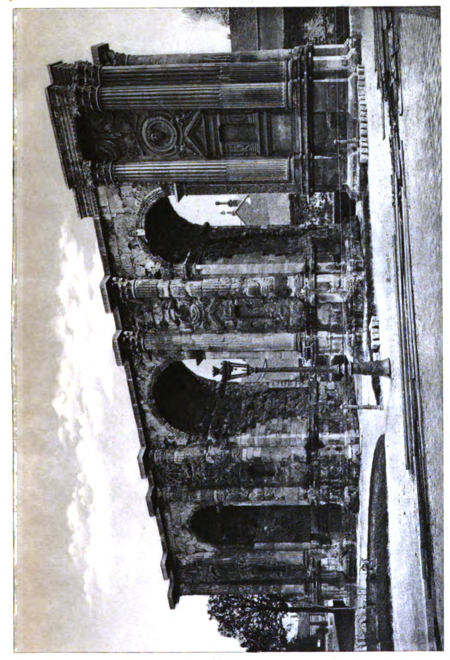
(See this image in horizontal aspect [here].)
Triumphal Archway at Rheims, p. 214. From a photograph.
[VI-217]
The name of the Alemanni has been absurdly derived from their imaginary settlement on the banks of the Leman lake. [23] That fortunate district, from the lake to Avenche and Mount Jura, was occupied by the Burgundians. [24] The northern parts of Helvetia had indeed been subdued by the ferocious Alemanni, who destroyed with their own hands the fruits of their conquest. A province, improved and adorned by the arts of Rome, was again reduced to a savage wilderness; and some vestige of the stately Vindonissa may still be discovered in the fertile and populous valley of the Aar. [25] From the source of the Rhine to its conflux with the Main and the Moselle, the formidable swarms of the Alemanni commanded either side of the river, by the right of ancient possession or recent victory. They had spread themselves into Gaul, over the modern provinces of Alsace and Lorraine; and their bold invasion of the kingdom of Cologne summoned the Salic prince to the defence of his Ripuarian allies. Clovis encountered the invaders of Gaul in the plain of Tolbiac, about twenty-four miles from Cologne; [26] and the two [VI-218] fiercest nations of Germany were mutually animated by the memory of past exploits and the prospect of future greatness. The Franks, after an obstinate struggle, gave way; and the Alemanni, raising a shout of victory, impetuously pressed their retreat. But the battle was restored by the valour, the conduct, and perhaps by the piety of Clovis; and the event of the bloody day decided for ever the alternative of empire or servitude. The last king of the Alemanni was slain in the field, and his people was slaughtered and pursued, till they threw down their arms and yielded to the mercy of the conqueror. Without discipline it was impossible for them to rally; they had contemptuously demolished the walls and fortifications which might have protected their distress; and they were followed into the heart of their forests by an enemy, not less active or intrepid than themselves. The great Theodoric congratulated the victory of Clovis, whose sister Albofleda the king of Italy had lately married; but he mildly interceded with his brother in favour of the suppliants and fugitives who had implored his protection. The Gallic territories, which were possessed by the Alemanni, became the prize of their conqueror; and the haughty nation, invincible or rebellious to the arms of Rome, acknowledged the sovereignty of the Merovingian kings, who graciously permitted them to enjoy their peculiar manners and institutions, under the government of official, and, at length, of hereditary, dukes. After the conquest of the Western provinces, the Franks alone maintained their ancient habitations beyond the Rhine. They gradually subdued and civilised the exhausted countries, as far as the Elbe and the mountains [VI-219] of Bohemia; and the peace of Europe was secured by the obedience of Germany. [27]
Till the thirtieth year of his age, Clovis continued to worship the gods of his ancestors. [28] His disbelief, or rather disregard, of Christianity might encourage him to pillage with less remorse the churches of an hostile territory; but his subjects of Gaul enjoyed the free exercise of religious worship, and the bishops entertained a more favourable hope of the idolater than of the heretics. The Merovingian prince had contracted a fortunate alliance with the fair Clotilda, the niece of the king of Burgundy, who, in the midst of an Arian court, was educated in the profession of the Catholic faith. It was her interest, as well as her duty, to achieve the conversion [29] of a Pagan husband; and Clovis insensibly listened to the voice of love and religion. He consented (perhaps such terms had been previously stipulated) to the baptism of his eldest son; and, though the sudden death of the infant [VI-220] excited some superstitious fears, he was persuaded, a second time, to repeat the dangerous experiment. In the distress of the battle of Tolbiac, Clovis loudly invoked the god of Clotilda and the Christians; and victory disposed him to hear, with respectful gratitude, the eloquent [30] Remigius, [31] bishop of Rheims, who forcibly displayed the temporal and spiritual advantages of his conversion. The king declared himself satisfied of the truth of the Catholic faith; and the political reasons which might have suspended his public profession were removed by the devout or loyal acclamations of the Franks, who showed themselves alike prepared to follow their heroic leader to the field of battle or to the baptismal font. The important ceremony was performed in the cathedral of Rheims, with every circumstance of magnificence and solemnity that could impress an awful sense of religion on the minds of its rude proselytes. [32] The new [VI-221] Constantine was immediately baptised, with three thousand of his warlike subjects; and their example was imitated by the remainder of the gentle Barbarians, who, in obedience to the victorious prelate, adored the cross which they had burnt, and burnt the idols which they had formerly adored. [33] The mind of Clovis was susceptible of transient fervour: he was exasperated by the pathetic tale of the passion and death of Christ; and, instead of weighing the salutary consequences of that mysterious sacrifice, he exclaimed, with indiscreet fury, “Had I been present at the head of my valiant Franks, I would have revenged his injuries.” [34] But the savage conqueror of Gaul was incapable of examining the proofs of a religion which depends on the laborious investigation of historic evidence and speculative theology. He was still more incapable of feeling the mild influence of the gospel, which persuades and purifies the heart of a genuine convert. His ambitious reign was a perpetual violation of moral and Christian duties; his hands were stained with blood, in peace as well as in war; and, as soon as Clovis had dismissed a synod of the Gallican church, he calmly assassinated all the princes of the Merovingian race. [35] Yet the king of the [VI-222] Franks might sincerely worship the Christian God, as a Being more excellent and powerful than his national deities; and the signal deliverance and victory of Tolbiac encouraged Clovis to confide in the future protection of the Lord of Hosts. Martin, the most popular of the saints, had filled the Western world with the fame of those miracles which were incessantly performed at his holy sepulchre of Tours. His visible or invisible aid promoted the cause of a liberal and orthodox prince; and the profane remark of Clovis himself that St. Martin was an expensive friend [36] need not be interpreted as the symptom of any permanent, or rational, scepticism. But earth, as well as heaven, rejoiced in the conversion of the Franks. On the memorable day when Clovis ascended from the baptismal font, he alone, in the Christian world, deserved the name and prerogatives of a Catholic king. The emperor Anastasius entertained some dangerous errors concerning the nature of the divine incarnation; and the Barbarians of Italy, Africa, Spain, and Gaul were involved in the Arian heresy. The eldest, or rather the only, son of the church was acknowledged by the clergy as their lawful sovereign, or glorious deliverer; and the arms of Clovis were strenuously supported by the zeal and favour of the Catholic faction. [37]
Under the Roman empire, the wealth and jurisdiction of the bishops, their sacred character, and perpetual office, their [VI-223] numerous dependents, popular eloquence, and provincial assemblies had rendered them always respectable, and sometimes dangerous. Their influence was augmented with the progress of superstition, and the establishment of the French monarchy may, in some degree, be ascribed to the firm alliance of an hundred prelates, who reigned in the discontented, or independent, cities of Gaul. The slight foundations of the Armorican republic had been repeatedly shaken, or overthrown; [38] but the same people still guarded their domestic freedom; asserted the dignity of the Roman name; and bravely resisted the predatory inroads and regular attacks of Clovis, who laboured to extend his conquests from the Seine to the Loire. Their successful opposition introduced an equal and honourable union. The Franks esteemed the valour of the Armoricans, [39] and the Armoricans were reconciled by the religion of the Franks. The military force which had been stationed for the defence of Gaul consisted of one hundred different bands of cavalry or infantry; and these troops, while they assumed the title and privileges of Roman soldiers, were renewed by an incessant supply of the Barbarian youth. The extreme fortifications, and scattered fragments, of the empire were still defended by their hopeless courage. But their retreat was intercepted, and their communication was impracticable: they were abandoned by the Greek princes of Constantinople, and they piously disclaimed all connection with the Arian usurpers of [VI-224] Gaul. They accepted, without shame or reluctance, the generous capitulation, which was proposed by a Catholic hero; and this spurious, or legitimate, progeny of the Roman legions was distinguished in the succeeding age by their arms, their ensigns, and their peculiar dress and institutions. But the national strength was increased by these powerful and voluntary accessions; and the neighbouring kingdoms dreaded the numbers, as well as the spirit, of the Franks. The reduction of the northern provinces of Gaul, instead of being decided by the chance of a single combat, appears to have been slowly effected by the gradual operation of war and treaty; and Clovis acquired each object of his ambition by such efforts, or such concessions, as were adequate to its real value. His savage character and the virtues of Henry IV. suggest the most opposite ideas of human nature; yet some resemblance may be found in the situation of two princes, who conquered France by their valour, their policy, and the merits of a seasonable conversion. [40]
The kingdom of the Burgundians, which was defined by the course of two Gallic rivers, the Saône and the Rhone, extended from the forest of Vosges to the Alps and the sea of Marseilles. [41] The sceptre was in the hands of Gundobald. [VI-225] That valiant and ambitious prince had reduced the number of royal candidates by the death of two brothers, one of whom was the father of Clotilda; [42] but his imperfect prudence still permitted Godegesil, the youngest of his brothers, to possess the dependent principality of Geneva. [43] The Arian monarch was justly alarmed by the satisfaction, and the hopes, which seemed to animate his clergy and people after the conversion of Clovis; and Gundobald convened at Lyons an assembly of his bishops, to reconcile, if it were possible, their religious and political discontents. A vain conference was agitated between the two factions. The Arians upbraided the Catholics with the worship of three Gods; the Catholics defended their cause by theological distinctions; and the usual arguments, objections, and replies were reverberated with obstinate clamour, till the king revealed his secret apprehensions, by an abrupt but decisive question, which he addressed to the orthodox bishops: “If you truly profess the Christian religion, why do you not restrain the king of the Franks? He has declared war against me, and forms alliances with my enemies for my destruction. A sanguinary and covetous mind is not the symptom of a sincere conversion: let him shew his faith by his works.” The answer of Avitus, bishop of Vienna, who spoke in the name of his brethren, was delivered with the voice and countenance of an angel: “We are ignorant of the motives and intentions of the king of the Franks; but we are taught by scripture that the kingdoms which abandon the divine law are frequently subverted; and that enemies will arise on every side against those who have made God their enemy. Return, with thy people, to the law of God, and he will give [VI-226] peace and security to thy dominions.” The king of Burgundy, who was not prepared to accept the condition which the Catholics considered as essential to the treaty, delayed and dismissed the ecclesiastical conference; after reproaching his bishops, that Clovis, their friend and proselyte, had privately tempted the allegiance of his brother. [44]
The allegiance of his brother was already seduced; and the obedience of Godegesil, who joined the royal standard with the troops of Geneva, more effectually promoted the success of the conspiracy. While the Franks and Burgundians contended with equal valour, his seasonable desertion decided the event of the battle; and, as Gundobald was faintly supported by the disaffected Gauls, he yielded to the arms of Clovis, and hastily retreated from the field, which appears to have been situate between Langres and Dijon. He distrusted the strength of Dijon, a quadrangular fortress, encompassed by two rivers, and by a wall thirty feet high, and fifteen thick, with four gates, and thirty-three towers; [45] he abandoned to the pursuit of Clovis the important cities of Lyons and Vienna; and Gundobald still fled with precipitation, till he had reached Avignon, at the distance of two hundred and fifty miles from the field of battle. A long siege, and an artful negotiation, admonished the king of the Franks of the danger and difficulty of his enterprise. He imposed a tribute on the Burgundian prince, compelled him to pardon [VI-227] and reward his brother’s treachery, and proudly returned to his own dominions, with the spoils and captives of the southern provinces. This splendid triumph was soon clouded by the intelligence that Gundobald had violated his recent obligations, and that the unfortunate Godegesil, who was left at Vienna with a garrison of five thousand Franks [46] had been besieged, surprised, and massacred by his inhuman brother. Such an outrage might have exasperated the patience of the most peaceful sovereign; yet the conqueror of Gaul dissembled the injury, released the tribute, and accepted the alliance and military service of the king of Burgundy. Clovis no longer possessed these advantages which had assured the success of the preceding war; and his rival, instructed by adversity, had found new resources in the affections of his people. The Gauls or Romans applauded the mild and impartial laws of Gundobald, which almost raised them to the same level with their conquerors. The bishops were reconciled and flattered by the hopes, which he artfully suggested, of his approaching conversion; and, though he eluded their accomplishment to the last moment of his life, his moderation secured the peace, and suspended the ruin, of the kingdom of Burgundy. [47]
I am impatient to pursue the final ruin of that kingdom, which was accomplished under the reign of Sigismond, the son of Gundobald. The Catholic Sigismond has acquired [VI-228] the honours of a saint and martyr; [48] but the hands of the royal saint were stained with the blood of his innocent son, whom he inhumanly sacrificed to the pride and resentment of a stepmother. He soon discovered his error, and bewailed the irreparable loss. While Sigismond embraced the corpse of the unfortunate youth, he received a severe admonition from one of his attendants: “It is not his situation, O king! it is thine which deserves pity and lamentation.” The reproaches of a guilty conscience were alleviated, however, by his liberal donations to the monastery of Agaunum, or St. Maurice, in Vallais; which he himself had founded in honour of the imaginary martyrs of the Thebæan legion. [49] A full chorus of perpetual psalmody was instituted by the pious king; he assiduously practised the austere devotion of the monks; and it was his humble prayer that heaven would inflict in this world the punishment of his sins. His prayer was heard; the avengers were at hand; and the provinces of Burgundy were overwhelmed by an army of victorious Franks. After the event of an unsuccessful battle, Sigismond, who wished to protract his life that he might prolong his penance, concealed himself in the desert in a religious habit, till he was discovered and betrayed by his subjects, who solicited the favour of their new masters. The captive monarch, with his wife and two children, were transported to Orleans, and buried alive in a deep well, by the stern command of the sons of Clovis; whose cruelty might derive some excuse from the maxims and examples of their barbarous [VI-229] age. Their ambition, which urged them to achieve the conquest of Burgundy, was inflamed, or disguised, by filial piety; and Clotilda, whose sanctity did not consist in the forgiveness of injuries, pressed them to revenge her father’s death on the family of his assassin. The rebellious Burgundians, for they attempted to break their chains, were still permitted to enjoy their national laws under the obligation of tribute and military service; and the Merovingian princes peaceably reigned over a kingdom whose glory and greatness had been first overthrown by the arms of Clovis. [50]
The first victory of Clovis had insulted the honour of the Goths. They viewed his rapid progress with jealousy and terror; and the youthful fame of Alaric was oppressed by the more potent genius of his rival. Some disputes inevitably arose on the edge of their contiguous dominions; and, after the delays of fruitless negotiation, a personal interview of the two kings was proposed and accepted. This conference of Clovis and Alaric was held in a small island of the Loire, near Amboise. They embraced, familiarly conversed, and feasted together; and separated with the warmest professions of peace and brotherly love. But their apparent confidence concealed a dark suspicion of hostile and treacherous designs; and their mutual complaints solicited, eluded, and disclaimed a final arbitration. At Paris, which he already considered as his royal seat, Clovis declared to an assembly of the princes and warriors the pretence, and the motive, of a Gothic war. “It grieves me to see that the Arians still possess the fairest portion of Gaul. Let us march against them with the aid of God; and, having vanquished the heretics, we will possess, and divide, their fertile provinces.” [51] [VI-230] The Franks, who were inspired by hereditary valour and recent zeal, applauded the generous design of their monarch; expressed their resolution to conquer or die, since death and conquest would be equally profitable; and solemnly protested that they should never shave their beards, till victory would absolve them from that inconvenient vow. The enterprise was promoted by the public, or private, exhortations of Clotilda. She reminded her husband, how effectually some pious foundation would propitiate the Deity and his servants; and the Christian hero, darting his battle-axe with a skilful and nervous hand, “There (said he), on that spot where my Francisca [52] shall fall, will I erect a church in honour of the holy apostles.” This ostentatious piety confirmed and justified the attachment of the Catholics, with whom he secretly corresponded; and their devout wishes were gradually ripened into a formidable conspiracy. The people of Aquitain was alarmed by the indiscreet reproaches of their Gothic tyrants, who justly accused them of preferring the dominion of the Franks; and their zealous adherent Quintianus, bishop of Rodez, [53] preached more forcibly in his exile than in his diocese. To resist these foreign and domestic enemies, who were fortified by the alliance of the Burgundians, Alaric collected his troops, far more numerous than the military powers of Clovis. The Visigoths resumed the exercise of arms, which they had neglected in a long and luxurious [VI-231] peace; [54] a select band of valiant and robust slaves attended their masters to the field; [55] and the cities of Gaul were compelled to furnish their doubtful and reluctant aid. Theodoric, king of the Ostrogoths, who reigned in Italy, had laboured to maintain the tranquillity of Gaul; and he assumed, or affected for that purpose, the impartial character of a mediator. But the sagacious monarch dreaded the rising empire of Clovis, and he was firmly engaged to support the national and religious cause of the Goths.
The accidental, or artificial, prodigies, which adorned the expedition of Clovis, were accepted, by a superstitious age, as the manifest declaration of the Divine favour. He marched from Paris; and, as he proceeded with decent reverence through the holy diocese of Tours, his anxiety tempted him to consult the shrine of St. Martin, the sanctuary and the oracle of Gaul. His messengers were instructed to remark the words of the Psalm, which should happen to be chaunted at the precise moment when they entered the church. Those words most fortunately expressed the valour and victory of the champions of Heaven, and the application was easily transferred to the new Joshua, the new Gideon, who went forth to battle against the enemies of the Lord. [56] Orleans [VI-232] secured to the Franks a bridge on the Loire; but, at the distance of forty miles from Poitiers, their progress was intercepted by an extraordinary swell of the river Vigenna, or Vienne; and the opposite banks were covered by the encampment of the Visigoths. Delay must be always dangerous to Barbarians, who consume the country through which they march; and, had Clovis possessed leisure and materials, it might have been impracticable to construct a bridge, or to force a passage, in the face of a superior enemy. But the affectionate peasants, who were impatient to welcome their deliverer, could easily betray some unknown, or unguarded, ford; the merit of the discovery was enhanced by the useful interposition of fraud or fiction; and a white hart, of singular size and beauty, appeared to guide and animate the march of the Catholic army. The counsels of the Visigoths were irresolute and distracted. A crowd of impatient warriors, presumptuous in their strength, and disdaining to fly before the robbers of Germany, excited Alaric to assert in arms the name and blood of the conqueror of Rome. The advice of the graver chieftains pressed him to elude the first ardour of the Franks, and to expect, in the southern provinces of Gaul, the veteran and victorious Ostrogoths, whom the king of Italy had already sent to his assistance. The decisive moments were wasted in idle deliberation; the Goths too hastily abandoned, perhaps, an advantageous post; and the opportunity of a sure retreat was lost by their slow and disorderly motions. After Clovis had passed the ford, as it is still named, of the Hart, he advanced with bold and hasty steps to prevent the escape of the enemy. His nocturnal march was directed by a flaming meteor, suspended in the air above the cathedral of Poitiers; and this signal, which might be previously concerted with the orthodox successor of St. Hilary, was compared to the column of fire that guided the Israelites in the desert. At the third hour of the day, about ten miles beyond Poitiers, Clovis overtook, and instantly attacked, the Gothic army; whose defeat was already [VI-233] prepared by terror and confusion. Yet they rallied in their extreme distress, and the martial youths, who had clamorously demanded the battle, refused to survive the ignominy of flight. The two kings encountered each other in single combat. Alaric fell by the hand of his rival; and the victorious Frank was saved by the goodness of his cuirass, and the vigour of his horse, from the spears of two desperate Goths, who furiously rode against him to revenge the death of their sovereign. The vague expression of a mountain of the slain serves to indicate a cruel, though indefinite, slaughter; but Gregory has carefully observed that his valiant countryman Apollinaris, the son of Sidonius, lost his life at the head of the nobles of Auvergne. Perhaps these suspected Catholics had been maliciously exposed to the blind assault of the enemy; and perhaps the influence of religion was superseded by personal attachment or military honour. [57]
Such is the empire of Fortune (if we may still disguise our ignorance under that popular name), that it is almost equally difficult to foresee the events of war or to explain their various consequences. A bloody and complete victory has sometimes yielded no more than the possession of the field; and the loss of ten thousand men has sometimes been sufficient to destroy, in a single day, the work of ages. The decisive battle of Poitiers was followed by the conquest of Aquitain. Alaric had left behind him an infant son, a bastard competitor, [VI-234] factious nobles, and a disloyal people; and the remaining forces of the Goths were oppressed by the general consternation, or opposed to each other in civil discord. The victorious king of the Franks proceeded without delay to the siege of Angoulême. At the sound of his trumpets the walls of the city imitated the example of Jericho, and instantly fell to the ground: a splendid miracle which may be reduced to the supposition that some clerical engineers had secretly undermined the foundations of the rampart. [58] At Bordeaux, which had submitted without resistance, Clovis established his winter quarters; and his prudent economy transported from Toulouse the royal treasures, which were deposited in the capital of the monarchy. The conqueror penetrated as far as the confines of Spain; [59] restored the honours of the Catholic church; fixed in Aquitain a colony of Franks; [60] and delegated to his lieutenants the easy task of subduing, or extirpating, the nation of the Visigoths. But the Visigoths were protected by the wise and powerful monarch of Italy. While the balance was still equal, Theodoric had perhaps delayed the march of the Ostrogoths; but their strenuous efforts successfully resisted the ambition of Clovis; and the army of the Franks and their Burgundian allies was compelled [VI-235] to raise the siege of Arles, with the loss, as it is said, of thirty thousand men. These vicissitudes inclined the fierce spirit of Clovis to acquiesce in an advantageous treaty of peace. The Visigoths were suffered to retain the possession of Septimania, a narrow tract of sea-coast, from the Rhone to the Pyrenees; but the ample province of Aquitain, from those mountains to the Loire, was indissolubly united to the kingdom of France. [61]
After the success of the Gothic war, Clovis accepted the honours of the Roman consulship. The emperor Anastasius ambitiously bestowed on the most powerful rival of Theodoric the title and ensigns of that eminent dignity; yet, from some unknown cause, the name of Clovis has not been inscribed in the Fasti either of the East or West. [62] On the [VI-236] solemn day, the monarch of Gaul, placing a diadem on his head, was invested in the church of St. Martin, with a purple tunic and mantle. From thence he proceeded on horseback to the cathedral of Tours; and, as he passed through the streets, profusely scattered, with his own hand, a donative of gold and silver to the joyful multitude, who incessantly repeated their acclamations of Consul and Augustus. The actual, or legal, authority of Clovis could not receive any new accessions from the consular dignity. It was a name, a shadow, an empty pageant; and, if the conqueror had been instructed to claim the ancient prerogatives of that high office, they must have expired with the period of its annual duration. But the Romans were disposed to revere, in the person of their master, that antique title, which the emperors condescended to assume; the Barbarian himself seemed to contract a sacred obligation to respect the majesty of the republic; and the successors of Theodosius, by soliciting his friendship, tacitly forgave, and almost ratified, the usurpation of Gaul.
Twenty-five years after the death of Clovis, this important concession was more formally declared, in a treaty between his sons and the emperor Justinian. The Ostrogoths of Italy, unable to defend their distant acquisitions, had resigned to the Franks the cities of Arles and Marseilles: of Arles, still adorned with the seat of a Prætorian prefect, and of Marseilles, enriched by the advantages of trade and navigation. [63] This transaction was confirmed by the Imperial authority; and Justinian, generously yielding to the Franks [VI-237] the sovereignty of the countries beyond the Alps which they already possessed, absolved the provincials from their allegiance; and established on a more lawful, though not more solid, foundation the throne of the Merovingians. [64] From that era, they enjoyed the right of celebrating, at Arles, the games of the Circus; and by a singular privilege, which was denied even to the Persian monarch, the gold coin, impressed with their name and image, obtained a legal currency in the empire. [65] A Greek historian of that age has praised the private and public virtues of the Franks, with a partial enthusiasm, which cannot be sufficiently justified by their domestic annals. [66] He celebrates their politeness and urbanity, their regular government, and orthodox religion; and boldly asserts that these Barbarians could be distinguished only by their dress and language from the subjects of Rome. Perhaps the Franks already displayed the social disposition and lively graces, which in every age have disguised their vices and sometimes concealed their intrinsic merit. Perhaps Agathias and the Greeks were dazzled by the rapid progress of their arms and the splendour of their empire. Since the conquest of Burgundy, Gaul, except the Gothic [VI-238] province of Septimania, was subject, in its whole extent, to the sons of Clovis. They had extinguished the German kingdom of Thuringia, and their vague dominion penetrated beyond the Rhine into the heart of their native forests. The Alemanni and Bavarians who had occupied the Roman provinces of Rhætia and Noricum, to the south of the Danube, confessed themselves the humble vassals of the Franks; and the feeble barrier of the Alps was incapable of resisting their ambition. When the last survivor of the sons of Clovis united the inheritance and conquests of the Merovingians, his kingdom extended far beyond the limits of modern France. Yet modern France, such has been the progress of arts and policy, far surpasses in wealth, populousness, and power the spacious but savage realms of Clotaire or Dagobert. [67]
The Franks, or French, are the only people of Europe who can deduce a perpetual succession from the conquerors of the Western empire. But their conquest of Gaul was followed by ten centuries of anarchy and ignorance. On the revival of learning, the students who had been formed in the schools of Athens and Rome disdained their Barbarian ancestors; and a long period elapsed before patient labour could provide the requisite materials to satisfy, or rather to excite, the curiosity of more enlightened times. [68] At length the eye of criticism and philosophy was directed to the antiquities of [VI-239] France; but even philosophers have been tainted by the contagion of prejudice and passion. The most extreme and exclusive systems of the personal servitude of the Gauls, or of their voluntary and equal alliance with the Franks, have been rashly conceived and obstinately defended; and the intemperate disputants have accused each other of conspiring against the prerogative of the crown, the dignity of the nobles, or the freedom of the people. Yet the sharp conflict has usefully exercised the adverse powers of learning and genius; and each antagonist, alternately vanquished and victorious, has extirpated some ancient errors, and established some interesting truths. An impartial stranger, instructed by their discoveries, their disputes, and even their faults, may describe, from the same original materials, the state of the Roman provincials, after Gaul had submitted to the arms and laws of the Merovingian kings. [69]
The rudest, or the most servile, condition of human society is regulated however by some fixed and general rules. When Tacitus surveyed the primitive simplicity of the Germans, he discovered some permanent maxims, or customs, of public and private life, which were preserved by faithful tradition till the introduction of the art of writing and of the Latin tongue. [70] Before the election of the Merovingian kings, the most powerful tribe, or nation, of the Franks appointed four venerable chieftains to compose the Salic laws; [71] and their labours were [VI-240] examined and approved in three successive assemblies of the people. After the baptism of Clovis, he reformed several articles that appeared incompatible with Christianity; the Salic law was again amended by his sons; and at length, under the reign of Dagobert, the code was revised and promulgated in its actual form, one hundred years after the establishment of the French monarchy. Within the same period, the customs of the Ripuarians were transcribed and published; and Charlemagne himself, the legislator of his age and country, had accurately studied the two national laws which still prevailed among the Franks. [72] The same care was extended to their vassals; and the rude institutions of the Alemanni and Bavarians were diligently compiled and ratified [VI-241] by the supreme authority of the Merovingian kings. The Visigoths and Burgundians, whose conquests in Gaul preceded those of the Franks, shewed less impatience to attain one of the principal benefits of civilised society. Euric was the first of the Gothic princes who expressed in writing the manners and customs of his people; and the composition of the Burgundian laws was a measure of policy rather than of justice: to alleviate the yoke and regain the affections of their Gallic subjects. [73] Thus, by a singular coincidence, the Germans framed their artless institutions at a time when the elaborate system of Roman jurisprudence was finally consummated. In the Salic laws and the Pandects of Justinian we may compare the first rudiments and the full maturity of civil wisdom; and, whatever prejudices may be suggested in favour of Barbarism, our calmer reflections will ascribe to the Romans the superior advantages, not only of science and reason, but of humanity and justice. Yet the laws of the Barbarians were adapted to their wants and desires, their occupations, and their capacity; and they all contribute to preserve the peace, and promote the improvements, of the society for whose use they were originally established. The Merovingians, instead of imposing an uniform rule of conduct on their various subjects, permitted each people, and each family of their empire, freely to enjoy their domestic institutions; [74] nor were the Romans excluded from the common [VI-242] benefits of this legal toleration. [75] The children embraced the law of their parents, the wife that of her husband, the freedman that of his patron; and, in all causes, where the parties were of different nations, the plaintiff, or accuser, was obliged to follow the tribunal of the defendant, who may always plead a judicial presumption of right or innocence. A more ample latitude was allowed, if every citizen, in the presence of the judge, might declare the law under which he desired to live and the national society to which he chose to belong. Such an indulgence would abolish the partial distinctions of victory, and the Roman provincials might patiently acquiesce in the hardships of their condition; since it depended on themselves to assume the privilege, if they dared to assert the character, of free and warlike Barbarians. [76]
When justice inexorably requires the death of a murderer, each private citizen is fortified by the assurance that the laws, [VI-243] the magistrate, and the whole community are the guardians of his personal safety. But in the loose society of the Germans revenge was always honourable, and often meritorious; the independent warrior chastised, or vindicated, with his own hand, the injuries which he had offered, or received; and he had only to dread the resentment of the sons, and kinsmen, of the enemy whom he had sacrificed to his selfish or angry passions. The magistrate, conscious of his weakness, interposed, not to punish, but to reconcile; and he was satisfied if he could persuade, or compel, the contending parties to pay, and to accept, the moderate fine which had been ascertained as the price of blood. [77] The fierce spirit of the Franks would have opposed a more rigorous sentence; the same fierceness despised these ineffectual restraints; and, when their simple manners had been corrupted by the wealth of Gaul, the public peace was continually violated by acts of hasty or deliberate guilt. In every just government, the same penalty is inflicted, or at least is imposed, for the murder of a peasant or a prince. But the national inequality established by the Franks, in their criminal proceedings, was the last insult and abuse of conquest. [78] In the calm moments of legislation, they solemnly pronounced that the life of a Roman was of smaller value than that of a Barbarian. The Antrustion, [79] a name expressive of the most illustrious birth or [VI-244] dignity among the Franks, was appreciated at the sum of six hundred pieces of gold; while the noble provincial, who was admitted to the king’s table, might be legally murdered at the expense of three hundred pieces. Two hundred were deemed sufficient for a Frank of ordinary condition; but the meaner Romans were exposed to disgrace and danger by a trifling compensation of one hundred, or even fifty, pieces of gold. Had these laws been regulated by any principle of equity or reason, the public protection should have supplied in just proportion the want of personal strength. But the legislator had weighed in the scale, not of justice, but of policy, the loss of a soldier against that of a slave; the head of an insolent and rapacious Barbarian was guarded by an heavy fine; and the slightest aid was afforded to the most defenceless subjects. Time insensibly abated the pride of the conquerors and the patience of the vanquished; and the boldest citizen was taught by experience that he might suffer more injuries than he could inflict. As the manners of the Franks became less ferocious, their laws were rendered more severe; and the Merovingian kings attempted to imitate the impartial rigour of the Visigoths and Burgundians. [80] Under the empire of [VI-245] Charlemagne, murder was universally punished with death; and the use of capital punishments has been liberally multiplied in the jurisprudence of modern Europe. [81]
The civil and military professions, which had been separated by Constantine, were again united by the Barbarians. The harsh sound of the Teutonic appellations was mollified into the Latin titles of Duke, of Count, or of Prefect; [82] and the same officer assumed, within his district, the command of the troops and the administration of justice. [83] But the fierce and illiterate chieftain was seldom qualified to discharge the duties of a judge, which require all the faculties of a philosophic mind, laboriously cultivated by experience and study; and his rude ignorance was compelled to embrace [VI-246] some simple and visible methods of ascertaining the cause of justice. In every religion, the Deity has been invoked to confirm the truth, or to punish the falsehood, of human testimony; but this powerful instrument was misapplied and abused by the simplicity of the German legislators. The party accused might justify his innocence by producing before their tribunal a number of friendly witnesses, who solemnly declared their belief, or assurance, that he was not guilty. According to the weight of the charge, this legal number of compurgators was multiplied; seventy-two voices were required to absolve an incendiary or assassin: and, when the chastity of a queen of France was suspected, three hundred gallant nobles swore, without hesitation, that the infant prince had been actually begotten by her deceased husband. [84] The sin and scandal of manifest and frequent perjuries engaged the magistrates to remove these dangerous temptations; and to supply the defects of human testimony by the famous experiments of fire and water. These extraordinary trials were so capriciously contrived that in some cases guilt, and innocence in others, could not be proved without the interposition of a miracle. Such miracles were readily provided by fraud and credulity; the most intricate causes were determined by this easy and infallible method; and the turbulent Barbarians, who might have disdained the sentence of the magistrate, submissively acquiesced in the judgment of God. [85]
But the trials by single combat gradually obtained superior credit and authority among a warlike people, who could not [VI-247] believe that a brave man deserved to suffer, or that a coward deserved to live. [86] Both in civil and criminal proceedings, the plaintiff, or accuser, the defender, or even the witness, were exposed to mortal challenge from the antagonist who was destitute of legal proofs; and it was incumbent on them either to desert their cause or publicly to maintain their honour in the lists of battle. They fought either on foot or on horseback, according to the custom of their nation; [87] and the decision of the sword or lance was ratified by the sanction of Heaven, of the judge, and of the people. This sanguinary law was introduced into Gaul by the Burgundians; and their legislator Gundobald [88] condescended to answer the complaints and objections of his subject Avitus. “Is it not true,” said the king of Burgundy to the bishop, “that the event of national wars, and private combats, is directed by the judgment of God; and that his providence awards the victory to the juster cause?” By such prevailing arguments, the absurd and cruel practice of judicial duels, which had been peculiar to some tribes of Germany, was propagated and established in all the monarchies of Europe, from Sicily to the Baltic. At the end of ten centuries, the reign of legal violence was not totally extinguished; and the ineffectual censures of saints, of popes, and of synods may [VI-248] seem to prove that the influence of superstition is weakened by its unnatural alliance with reason and humanity. The tribunals were stained with the blood, perhaps, of innocent and respectable citizens; the law, which now favours the rich, then yielded to the strong; and the old, the feeble, and the infirm were condemned either to renounce their fairest claims and possessions, to sustain the dangers of an unequal conflict, [89] or to trust the doubtful aid of a mercenary champion. This oppressive jurisprudence was imposed on the provincials of Gaul, who complained of any injuries in their persons and property. Whatever might be the strength or courage of individuals, the victorious Barbarians excelled in the love and exercise of arms; and the vanquished Roman was unjustly summoned to repeat, in his own person, the bloody contest which had been already decided against his country. [90]
A devouring host of one hundred and twenty thousand Germans had formerly passed the Rhine under the command of Ariovistus. One third part of the fertile lands of the Sequani was appropriated to their use; and the conqueror soon repeated his oppressive demand of another third, for the accommodation of a new colony of twenty-four thousand Barbarians, whom he had invited to share the rich harvest of Gaul. [91] At the distance of five hundred years, the [VI-249] Visigoths and Burgundians, who revenged the defeat of Ariovistus, usurped the same unequal proportion of two thirds of the subject lands. But this distribution, instead of spreading over the province, may be reasonably confined to the peculiar districts where the victorious people had been planted by their own choice or by the policy of their leader. In these districts, each Barbarian was connected by the ties of hospitality with some Roman provincial. To this unwelcome guest, the proprietor was compelled to abandon two thirds of his patrimony; but the German, a shepherd and a hunter, might sometimes content himself with a spacious range of wood and pasture, and resign the smallest, though most valuable, portion to the toil of the industrious husbandman. [92] The silence of ancient and authentic testimony has encouraged an opinion that the rapine of the Franks was not moderated, or disguised, by the forms of a legal division; that they dispersed themselves over the provinces of Gaul, without order or control; and that each victorious robber, according to his wants, his avarice, and his strength, measured, with his sword, the extent of his new inheritance. At a distance from their sovereign, the Barbarians might indeed be tempted to exercise such arbitrary depredation; but the firm and artful policy of Clovis must curb a licentious spirit, which would aggravate the misery of the vanquished, whilst it corrupted the union and discipline of the conquerors. The memorable vase of Soissons is a monument, and a pledge, of the regular distribution of the Gallic spoils. It was the duty, and the interest, of Clovis to provide rewards for a successful [VI-250] army, and settlements for a numerous people; without inflicting any wanton or superfluous injuries on the royal Catholics of Gaul. The ample fund, which he might lawfully acquire, of the Imperial patrimony, vacant lands, and Gothic usurpations, would diminish the cruel necessity of seizure and confiscation; and the humble provincials would more patiently acquiesce in the equal and regular distribution of their loss. [93]
The wealth of the Merovingian princes consisted in their extensive domain. After the conquest of Gaul, they still delighted in the rustic simplicity of their ancestors; the cities were abandoned to solitude and decay; and their coins, their charters, and their synods are still inscribed with the names of the villas, or rural palaces, in which they successively resided. One hundred and sixty of these palaces, a title which need not excite any unseasonable ideas of art or luxury, were scattered through the provinces of their kingdom; and, if some might claim the honours of a fortress, the far greater part could be esteemed only in the light of profitable farms. The mansion of the long-haired kings was surrounded with convenient yards and stables for the cattle and the poultry; the garden was planted with useful vegetables; the various trades, the labours of agriculture, and even the arts of hunting and fishing were exercised by servile hands for the emolument of the sovereign; his magazines were filled with corn and wine, either for sale or consumption; and the whole administration was conducted by the strictest maxims of private economy. [94] This ample patrimony was appropriated [VI-251] to supply the hospitable plenty of Clovis and his successors, and to reward the fidelity of their brave companions, who, both in peace and war, were devoted to their personal service. Instead of an horse, or a suit of armour, each companion, according to his rank or merit or favour, was invested with a benefice, the primitive name, and most simple form, of the feudal possessions. These gifts might be resumed at the pleasure of the sovereign; and his feeble prerogative derived some support from the influence of his liberality. But this dependent tenure was gradually abolished [95] by the independent and rapacious nobles of France, who established the perpetual property, and hereditary succession, of their benefices: a revolution salutary to the earth, which had been injured, or neglected, by its precarious masters. [96] Besides these royal and beneficiary estates, a large proportion had been assigned, in the division of Gaul, of allodial and Salic lands; they were exempt from tribute, and the Salic lands were equally shared among the male descendants of the Franks. [97]
In the bloody discord and silent decay of the Merovingian line, a new order of tyrants arose in the provinces, who, under the appellation of Seniors, or Lords, usurped a right to govern, and a licence to oppress, the subjects of their peculiar [VI-252] territory. Their ambition might be checked by the hostile resistance of an equal: but the laws were extinguished; and the sacrilegious Barbarians, who dared to provoke the vengeance of a saint or bishop, [98] would seldom respect the landmarks of a profane and defenceless neighbour. The common, or public, rights of nature, such as they had always been deemed by the Roman jurisprudence, [99] were severely restrained by the German conquerors, whose amusement, or rather passion, was the exercise of hunting. The vague dominion which Man has assumed over the wild inhabitants of the earth, the air, and the waters, was confined to some fortunate individuals of the human species. Gaul was again overspread with woods; and the animals, who were reserved for the use, or pleasure, of the lord, might ravage, with impunity, the fields of his industrious vassals. The chase was the sacred privilege of the nobles, and their domestic servants. Plebeian transgressors were legally chastised with stripes and imprisonment; [100] but, in an age which admitted a slight composition for the life of a citizen, it was a capital crime to destroy a stag or a wild bull within the precincts of the royal forests. [101]
[VI-253]
According to the maxims of ancient war, the conqueror became the lawful master of the enemy whom he had subdued and spared; [102] and the fruitful cause of personal slavery, which had been almost suppressed by the peaceful sovereignty of Rome, was again revived and multiplied by the perpetual hostilities of the independent Barbarians. The Goth, the Burgundian, or the Frank, who returned from a successful expedition, dragged after him a long train of sheep, of oxen, and of human captives, whom he treated with the same brutal contempt. The youths of an elegant form and ingenuous aspect were set apart for the domestic service: a doubtful situation, which alternately exposed them to the favourable or cruel impulse of passion. The useful mechanics and servants (smiths, carpenters, tailors, shoemakers, cooks, gardeners, dyers, and workmen in gold and silver, &c.) employed their skill for the use or profit of their master. But the Roman captives who were destitute of art, but capable of labour, were condemned, without regard to their former rank, to tend the cattle and cultivate the lands of the Barbarians. The number of the hereditary bondsmen who were attached to the Gallic estates was continually increased by new supplies; and the servile people, according to the situation and temper of their lords, was sometimes raised by precarious indulgence, and more frequently depressed by capricious despotism. [103] An absolute power of life and death was exercised by these lords; and, when they married their daughters, a train of useful servants, chained on the waggons [VI-254] to prevent their escape, was sent as a nuptial present into a distant country. [104] The majesty of the Roman laws protected the liberty of each citizen, against the rash effects of his own distress or despair. But the subjects of the Merovingian kings might alienate their personal freedom; and this act of legal suicide, which was familiarly practised, is expressed in terms most disgraceful and afflicting to the dignity of human nature. [105] The example of the poor, who purchased life by the sacrifice of all that can render life desirable, was gradually imitated by the feeble and the devout, who, in times of public disorder, pusillanimously crowded to shelter themselves under the battlements of a powerful chief, and around the shrine of a popular saint. Their submission was accepted by these temporal, or spiritual, patrons; and the hasty transaction irrecoverably fixed their own condition, and that of their latest posterity. From the reign of Clovis, during five successive centuries, the laws and manners of Gaul uniformly tended to promote the increase, and to confirm the duration, of personal servitude. Time and violence almost obliterated the intermediate ranks of society, and left an obscure and narrow interval between the noble and the slave. This arbitrary and recent division has been transformed by pride and prejudice into a national distinction, universally established by the arms and the laws of the Merovingians. The nobles, who claimed their genuine, or fabulous, descent from the independent and victorious Franks, have asserted, and abused, the indefeasible right of conquest, over a prostrate [VI-255] crowd of slaves and plebeians, to whom they imputed the imaginary disgrace of a Gallic, or Roman, extraction.
The general state and revolutions of France, a name which was imposed by the conquerors, may be illustrated by the particular example of a province, a diocese, or a senatorial family. Auvergne had formerly maintained a just preeminence among the independent states and cities of Gaul. The brave and numerous inhabitants displayed a singular trophy: the sword of Cæsar himself, which he had lost when he was repulsed before the walls of Gergovia. [106] As the common offspring of Troy, they claimed a fraternal alliance with the Romans; [107] and, if each province had imitated the courage and loyalty of Auvergne, the fall of the Western empire might have been prevented, or delayed. They firmly maintained the fidelity which they had reluctantly sworn to the Visigoths; but, when their bravest nobles had fallen in the battle of Poitiers, they accepted, without resistance, a victorious and Catholic sovereign. This easy and valuable conquest was achieved, and possessed, by Theodoric, the eldest son of Clovis; but the remote province was separated from his Austrasian dominions by the intermediate kingdoms of Soissons, Paris, and Orleans, which formed, after their father’s death, the inheritance of his three brothers. The king of Paris, Childebert, was tempted by the neighbourhood and beauty of Auvergne. [108] The Upper country, which [VI-256] rises towards the south into the mountains of the Cevennes, presented a rich and various prospect of woods and pastures; the sides of the hills were clothed with vines; and each eminence was crowned with a villa or castle. In the Lower Auvergne, the river Allier flows through the fair and spacious plain of Limagne; and the inexhaustible fertility of the soil supplied, and still supplies, without any interval of repose, the constant repetition of the same harvests. [109] On the false report that their lawful sovereign had been slain in Germany, the city and diocese of Auvergne were betrayed by the grandson of Sidonius Apollinaris. Childebert enjoyed this clandestine victory; and the free subjects of Theodoric threatened to desert his standard, if he indulged his private resentment while the nation was engaged in the Burgundian war. But the Franks of Austrasia soon yielded to the persuasive eloquence of their king. “Follow me,” said Theodoric, “into Auvergne: I will lead you into a province where you may acquire gold, silver, slaves, cattle, and precious apparel, to the full extent of your wishes. I repeat my promise; I give you the people, and their wealth, as your prey; and you may transport them at pleasure into your own country.” By the execution of this promise, Theodoric justly forfeited the allegiance of a people whom he devoted to destruction. His troops, reinforced by the fiercest Barbarians of Germany, [110] spread desolation over the fruitful face of Auvergne; and two places only, a strong castle and a holy shrine, were saved, or redeemed, from their licentious fury. The castle of Meroliac [111] was seated on a lofty rock, which rose an hundred feet [VI-257] above the surface of the plain; and a large reservoir of fresh water was enclosed, with some arable lands, within the circle of its fortifications. The Franks beheld with envy and despair this impregnable fortress; but they surprised a party of fifty stragglers; and, as they were oppressed by the number of their captives, they fixed, at a trifling ransom, the alternative of life or death for these wretched victims, whom the cruel Barbarians were prepared to massacre on the refusal of the garrison. Another detachment penetrated as far as Brivas, or Brioude, where the inhabitants, with their valuable effects, had taken refuge in the sanctuary of St. Julian. The doors of the church resisted the assault; but a daring soldier entered through a window of the choir and opened a passage to his companions. The clergy and people, the sacred and the profane spoils, were rudely torn from the altar; and the sacrilegious division was made at a small distance from the town of Brioude. But this act of impiety was severely chastised by the devout son of Clovis. He punished with death the most atrocious offenders; left their secret accomplices to the vengeance of St. Julian; released the captives; restored the plunder; and extended the rights of sanctuary five miles round the sepulchre of the holy martyr. [112]
Before the Austrasian army retreated from Auvergne, Theodoric exacted some pledges of the future loyalty of a people whose just hatred could be restrained only by their fear. A select band of noble youths, the sons of the principal senators, was delivered to the conqueror, as the hostages [VI-258] of the faith of Childebert and of their countrymen. On the first rumour of war, or conspiracy, those guiltless youths were reduced to a state of servitude; and one of them, Attalus, [113] whose adventures are more particularly related, kept his master’s horses in the diocese of Treves. After a painful search, he was discovered, in this unworthy occupation, by the emissaries of his grandfather, Gregory bishop of Langres; but his offers of ransom were sternly rejected by the avarice of the Barbarian, who required an exorbitant sum of ten pounds of gold for the freedom of his noble captive. His deliverance was effected by the hardy stratagem of Leo, a slave belonging to the kitchens of the bishop of Langres. [114] An unknown agent easily introduced him into the same family. The Barbarian purchased Leo for the price of twelve pieces of gold; and was pleased to learn that he was deeply skilled in the luxury of an episcopal table. “Next Sunday,” said the Frank, “I shall invite my neighbours and kinsmen. Exert thy art, and force them to confess that they have never seen, or tasted, such an entertainment, even in the king’s house.” Leo assured him that, if he would provide a sufficient quantity of poultry, his wishes should be satisfied. The master, who already aspired to the merit of elegant hospitality, assumed, as his own, the praise which the voracious guests unanimously bestowed on his cook; and the dexterous [VI-259] Leo insensibly acquired the trust and management of his household. After the patient expectation of a whole year, he cautiously whispered his design to Attalus, and exhorted him to prepare for flight in the ensuing night. At the hour of midnight, the intemperate guests retired from table; and the Frank’s son-in-law, whom Leo attended to his apartment with a nocturnal potation, condescended to jest on the facility with which he might betray his trust. The intrepid slave, after sustaining this dangerous raillery, entered his master’s bed-chamber; removed his spear and shield; silently drew the fleetest horses from the stable; unbarred the ponderous gates; and excited Attalus to save his life and liberty by incessant diligence. Their apprehensions urged them to leave their horses on the banks of the Meuse; [115] they swam the river, wandered three days in the adjacent forest, and subsisted only by the accidental discovery of a wild plum-tree. As they lay concealed in a dark thicket, they heard the noise of horses; they were terrified by the angry countenance of their master, and they anxiously listened to his declaration that, if he could seize the guilty fugitives, one of them he would cut in pieces with his sword, and would expose the other on a gibbet. At length Attalus and his faithful Leo reached the friendly habitation of a presbyter of Rheims, who recruited their fainting strength with bread and wine, concealed them from the search of their enemy, and safely conducted them, beyond the limits of the Austrasian kingdom, to the episcopal palace of Langres. Gregory embraced his grandson with tears of joy, gratefully delivered Leo, with his whole family, from the yoke of servitude, and bestowed on him the property of a farm, where he might end his days in happiness and freedom. Perhaps this singular adventure, which is marked with so many circumstances of truth and nature, was related [VI-260] by Attalus himself, to his cousin, or nephew, the first historian of the Franks. Gregory of Tours [116] was born about sixty years after the death of Sidonius Apollinaris; and their situation was almost similar, since each of them was a native of Auvergne, a senator, and a bishop. The difference of their style and sentiments may, therefore, express the decay of Gaul, and clearly ascertain how much, in so short a space, the human mind had lost of its energy and refinement. [117]
We are now qualified to despise the opposite, and perhaps artful, misrepresentations which have softened, or exaggerated, the oppression of the Romans of Gaul under the reign of the Merovingians. [118] The conquerors never promulgated any universal edict of servitude or confiscation; but a degenerate people, who excused their weakness by the specious names of politeness and peace, was exposed to the arms and laws of the ferocious Barbarians, who contemptuously insulted their possessions, their freedom, and their safety. Their personal injuries were partial and irregular; but the great body of the Romans survived the revolution, and still preserved the property and privileges of citizens. A large [VI-261] portion of their lands was exacted for the use of the Franks; but they enjoyed the remainder, exempt from tribute; [119] and the same irresistible violence which swept away the arts and manufactures of Gaul destroyed the elaborate and expensive system of Imperial despotism. The Provincials must frequently deplore the savage jurisprudence of the Salic or Ripuarian laws; but their private life, in the important concerns of marriage, testaments, or inheritance, was still regulated by the Theodosian Code; and a discontented Roman might freely aspire, or descend, to the character and title of a Barbarian. The honours of the state were accessible to his ambition; the education and temper of the Romans more peculiarly qualified them for the offices of civil government; and, as soon as emulation had rekindled their military ardour, they were permitted to march in the ranks, or even at the head, of the victorious Germans. I shall not attempt to enumerate the generals and magistrates, whose names [120] attest the liberal policy of the Merovingians. The supreme command of Burgundy, with the title of Patrician, was successively entrusted to three Romans; and the last and most powerful, Mummolus, [121] who alternately saved and disturbed [VI-262] the monarchy, had supplanted his father in the station of count of Autun, and left a treasure of thirty talents of gold and two hundred and fifty talents of silver. The fierce and illiterate Barbarians were excluded, during several generations, from the dignities, and even from the orders, of the church. [122] The clergy of Gaul consisted almost entirely of native Provincials; the haughty Franks fell prostrate at the feet of their subjects, who were dignified with the episcopal character; and the power and riches which had been lost in war were insensibly recovered by superstition. [123] In all temporal affairs, the Theodosian Code was the universal law of the clergy; but the Barbaric jurisprudence had liberally provided for their personal safety: a sub-deacon was equivalent to two Franks; the antrustion and priest were held in similar estimation; and the life of a bishop was appreciated far above the common standard, at the price of nine hundred pieces of gold. [124] The Romans communicated to their conquerors the use of the Christian religion and Latin language; [125] but their language and their religion had alike degenerated from the simple purity of the Augustan, and Apostolic, age. The progress of superstition and Barbarism was rapid and universal; the [VI-263] worship of the saints concealed from vulgar eyes the God of the Christians; and the rustic dialect of peasants and soldiers was corrupted by a Teutonic idiom and pronunciation. Yet such intercourse of sacred and social communion eradicated the distinctions of birth and victory; and the nations of Gaul were gradually confounded under the name and government of the Franks.
The Franks, after they mingled with their Gallic subjects, might have imparted the most valuable of human gifts, a spirit and system of constitutional liberty. Under a king hereditary but limited, the chiefs and counsellors might have debated, at Paris, in the palace of the Cæsars; the adjacent field, where the emperors reviewed their mercenary legions, would have admitted the legislative assembly of freemen and warriors; and the rude model, which had been sketched in the woods of Germany, [126] might have been polished and improved by the civil wisdom of the Romans. But the careless Barbarians, secure of their personal independence, disdained the labour of government; the annual assemblies of the month of March were silently abolished; and the nation was separated and almost dissolved by the conquest of Gaul. [127] The monarchy was left without any regular establishment of justice, of arms, or of revenue. The successors of Clovis wanted resolution to assume, or strength to exercise, the legislative and executive powers which the people had abdicated; the royal prerogative was distinguished only by a more ample privilege of rapine and murder; and the love of freedom, so often invigorated and disgraced by private ambition, was reduced, among the licentious Franks, to the contempt of order and the desire of impunity. Seventy-five years after the death of Clovis, his grandson, Gontran, king [VI-264] of Burgundy, sent an army to invade the Gothic possessions of Septimania, or Languedoc. The troops of Burgundy, Berry, Auvergne, and the adjacent territories were excited by the hopes of spoil. They marched, without discipline, under the banners of German, or Gallic, counts; their attack was feeble and unsuccessful; but the friendly and hostile provinces were desolated with indiscriminate rage. The corn-fields, the villages, the churches themselves, were consumed by fire; the inhabitants were massacred or dragged into captivity; and, in the disorderly retreat, five thousand of these inhuman savages were destroyed by hunger or intestine discord. When the pious Gontran reproached the guilt, or neglect, of their leaders, and threatened to inflict, not a legal sentence, but instant and arbitrary execution, they accused the universal and incurable corruption of the people. “No one,” they said, “any longer fears or respects his king, his duke, or his count. Each man loves to do evil, and freely indulges his criminal inclinations. The most gentle correction provokes an immediate tumult, and the rash magistrate who presumes to censure or restrain his seditious subjects seldom escapes alive from their revenge.” [128] It has been reserved for the same nation to expose, by their intemperate vices, the most odious abuse of freedom; and to supply its loss by the spirit of honour and humanity, which now alleviates and dignifies their obedience to an absolute sovereign.
The Visigoths had resigned to Clovis the greatest part of their Gallic possessions; but their loss was amply compensated by the easy conquest, and secure enjoyment, of the provinces of Spain. From the monarchy of the Goths, which [VI-265] soon involved the Suevic kingdom of Gallicia, the modern Spaniards still derive some national vanity; but the historian of the Roman Empire is neither invited nor compelled to pursue the obscure and barren series of their annals. [129] The Goths of Spain were separated from the rest of mankind by the lofty ridge of the Pyrenæan mountains; their manners and institutions, as far as they were common to the Germanic tribes, have been already explained. I have anticipated, in the preceding chapter, the most important of their ecclesiastical events, the fall of Arianism and the persecution of the Jews; and it only remains to observe some interesting circumstances which relate to the civil and ecclesiastical constitution of the Spanish kingdom.
After their conversion from idolatry, or heresy, the Franks and the Visigoths were disposed to embrace, with equal submission, the inherent evils, and the accidental benefits, of superstition. But the prelates of France, long before the extinction of the Merovingian race, had degenerated into fighting and hunting Barbarians. They disdained the use of synods; forgot the laws of temperance and chastity; and preferred the indulgence of private ambition and luxury to the general interest of the sacerdotal profession. [130] The bishops of Spain respected themselves and were respected by the public; their indissoluble union disguised their vices and confirmed their authority; and the regular discipline of the church introduced peace, order, and stability into the government of the state. From the reign of Recared, the first Catholic king, to that of Witiza, the immediate predecessor of the unfortunate Roderic, sixteen national councils were [VI-266] successively convened. The six metropolitans, Toledo, Seville, Merida, Braga, Tarragona, and Narbonne, presided according to their respective seniority; the assembly was composed of their suffragan bishops, who appeared in person or by their proxies; and a place was assigned to the most holy or opulent of the Spanish abbots. During the first three days of the convocation, as long as they agitated the ecclesiastical questions of doctrine and discipline, the profane laity was excluded from their debates; which were conducted, however, with decent solemnity. But on the morning of the fourth day, the doors were thrown open for the entrance of the great officers of the palace, the dukes and counts of the provinces, the judges of the cities, and the Gothic nobles; and the decrees of Heaven were ratified by the consent of the people. The same rules were observed in the provincial assemblies, the annual synods which were empowered to hear complaints, and to redress grievances; and a legal government was supported by the prevailing influence of the Spanish clergy. The bishops, who, in each revolution, were prepared to flatter the victorious and to insult the prostrate, laboured, with diligence and success, to kindle the flames of persecution and to exalt the mitre above the crown. Yet the national councils of Toledo, in which the free spirit of the Barbarians was tempered and guided by episcopal policy, have established some prudent laws for the common benefit of the king and people. The vacancy of the throne was supplied by the choice of the bishops and palatines; and, after the failure of the line of Alaric, the regal dignity was still limited to the pure and noble blood of the Goths. The clergy, who anointed their lawful prince, always recommended, and sometimes practised, the duty of allegiance: and the spiritual censures were denounced on the heads of the impious subjects who should resist his authority, conspire against his life, or violate, by an indecent union, the chastity even of his widow. But the monarch himself, when he ascended the throne, was bound by a reciprocal oath to God and his people that he would faithfully [VI-267] execute his important trust. The real or imaginary faults of his administration were subject to the control of a powerful aristocracy; and the bishops and palatines were guarded by a fundamental privilege, that they should not be degraded, imprisoned, tortured, nor punished with death, exile, or confiscation, unless by the free and public judgment of their peers. [131]
One of these legislative councils of Toledo examined and ratified the code of laws which had been compiled by a succession of Gothic kings, from the fierce Euric to the devout Egica. As long as the Visigoths themselves were satisfied with the rude customs of their ancestors, they indulged their subjects of Aquitain and Spain in the enjoyment of the Roman law. Their gradual improvements in arts, in policy, and at length in religion, encouraged them to imitate, and to supersede, these foreign institutions; and to compose a code of civil and criminal jurisprudence, for the use of a great and united people. The same obligations and the same privileges were communicated to the nations of the Spanish monarchy: and the conquerors, insensibly renouncing the Teutonic idiom, submitted to the restraints of equity, and exalted the Romans to the participation of freedom. The merit of this impartial policy was enhanced by the situation of Spain, under the reign of the Visigoths. The Provincials were long separated from their Arian masters, by the irreconcileable difference of religion. After the conversion of Recared had removed the prejudices of the Catholics, the coasts, both of the Ocean and Mediterranean, were still possessed by the Eastern emperors; who secretly excited a discontented people to reject the yoke of the Barbarians and to assert the name and dignity of Roman citizens. The allegiance of doubtful [VI-268] subjects is indeed most effectually secured by their own persuasion that they hazard more in a revolt than they can hope to obtain by a revolution; but it has appeared so natural to oppress those whom we hate and fear, that the contrary system well deserves the praise of wisdom and moderation. [132]
While the kingdoms of the Franks and Visigoths were established in Gaul and Spain, the Saxons achieved the conquest of Britain, the third great diocese of the Prefecture of the West. Since Britain was already separated from the Roman empire, I might, without reproach, decline a story, familiar to the most illiterate, and obscure to the most learned, of my readers. The Saxons, who excelled in the use of the oar or the battle-axe, were ignorant of the art which could alone perpetuate the fame of their exploits; the Provincials, relapsing into barbarism, neglected to describe the ruin of their country; and the doubtful tradition was almost extinguished, before the missionaries of Rome restored the light of science and Christianity. The declamations of Gildas, the fragments or fables of Nennius, the obscure hints of the Saxon laws and chronicles, and the ecclesiastical tales of the venerable Bede [133] have been illustrated by the diligence, and sometimes embellished by the fancy, of succeeding writers, whose works I am not ambitious either to censure or to transcribe. [134] Yet [VI-269] the historian of the empire may be tempted to pursue the revolutions of a Roman province, till it vanishes from his sight; and an Englishman may curiously trace the establishment of the Barbarians from whom he derives his name, his laws, and perhaps his origin.
About forty years after the dissolution of the Roman government, Vortigern appears to have obtained the supreme, though precarious, command of the princes and cities of Britain. That unfortunate monarch has been almost unanimously condemned for the weak and mischievous policy of inviting [135] a formidable stranger to repel the vexatious inroads of a domestic foe. His ambassadors are despatched, by the gravest historians, to the coast of Germany; they address a pathetic oration to the general assembly of the Saxons, and those warlike Barbarians resolve to assist with a fleet and army the suppliants of a distant and unknown island. If Britain had indeed been unknown to the Saxons, the measure of its calamities would have been less complete. But the strength of the Roman government could not always guard the maritime province against the pirates of Germany; the independent and divided states were exposed to their attacks; and the Saxons might sometimes join the Scots and the Picts in a tacit, or express, confederacy of rapine and destruction. Vortigern could only balance the various perils which assaulted on every side his throne and his people; and his policy may deserve either praise or excuse, if he preferred the alliance of those Barbarians whose naval power rendered them the most dangerous enemies and the most serviceable allies. Hengist [VI-270] and Horsa, as they ranged along the eastern coast with three ships, were engaged, by the promise of an ample stipend, to embrace the defence of Britain; and their intrepid valour soon delivered the country from the Caledonian invaders. The isle of Thanet, a secure and fertile district, was allotted for the residence of these German auxiliaries, and they were supplied, according to the treaty, with a plentiful allowance of clothing and provisions. This favourable reception encouraged five thousand warriors to embark with their families in seventeen vessels, and the infant power of Hengist was fortified by this strong and seasonable reinforcement. The crafty Barbarian suggested to Vortigern the obvious advantage of fixing, in the neighbourhood of the Picts, a colony of faithful allies; a third fleet of forty ships, under the command of his son and nephew, sailed from Germany, ravaged the Orkneys, and disembarked a new army on the coast of Northumberland, or Lothian, at the opposite extremity of the devoted land. It was easy to foresee, but it was impossible to prevent, the impending evils. The two nations were soon divided and exasperated by mutual jealousies. The Saxons magnified all that they had done and suffered in the cause of an ungrateful people; while the Britons regretted the liberal rewards which could not testify the avarice of those haughty mercenaries. The causes of fear and hatred were inflamed into an irreconcileable quarrel. The Saxons flew to arms; and, if they perpetrated a treacherous massacre during the security of a feast, they destroyed the reciprocal confidence which sustains the intercourse of peace and war. [136]
Hengist, who boldly aspired to the conquest of Britain, exhorted his countrymen to embrace the glorious opportunity: [VI-271] he painted in lively colours the fertility of the soil, the wealth of the cities, the pusillanimous temper of the natives, and the convenient situation of a spacious, solitary island, accessible on all sides to the Saxon fleets. The successive colonies which issued, in the period of a century, from the mouths of the Elbe, the Weser, and the Rhine, were principally composed of three valiant tribes or nations of Germany: the Jutes, the old Saxons, and the Angles. The Jutes, who fought under the peculiar banner of Hengist, assumed the merit of leading their countrymen in the paths of glory and of erecting in Kent the first independent kingdom. The fame of the enterprise was attributed to the primitive Saxons; and the common laws and language of the conquerors are described by the national appellation of a people which, at the end of four hundred years, produced the first monarchs of South Britain. The Angles were distinguished by their numbers and their success; and they claimed the honour of fixing a perpetual name on the country of which they occupied the most ample portion. The Barbarians, who followed the hopes of rapine either on the land or sea, were insensibly blended with this triple confederacy; the Frisians, who had been tempted by their vicinity to the British shores, might balance, during a short space, the strength and reputation of the native Saxons; the Danes, the Prussians, the Rugians, are faintly described; and some adventurous Huns, who had wandered as far as the Baltic, might embark on board the German vessels, for the conquest of a new world. [137] But this arduous achievement was not prepared or executed by the union of national powers. Each intrepid chieftain, according to the measure of his fame and fortunes, assembled his followers; equipped a fleet of three, or perhaps of sixty, vessels; chose the place of the attack; and conducted his subsequent [VI-272] operations according to the events of the war and the dictates of his private interest. In the invasion of Britain many heroes vanquished and fell; but only seven victorious leaders assumed, or at least maintained, the title of kings. Seven independent thrones, the Saxon Heptarchy, were founded by the conquerors, and seven families, one of which has been continued, by female succession, to our present sovereign, derived their equal and sacred lineage from Woden, the god of war. It has been pretended that this republic of kings was moderated by a general council and a supreme magistrate. But such an artificial scheme of policy is repugnant to the rude and turbulent spirit of the Saxons; their laws are silent; and their imperfect annals afford only a dark and bloody prospect of intestine discord. [138]
A monk, who, in the profound ignorance of human life, has presumed to exercise the office of historian, strangely disfigures the state of Britain at the time of its separation from the Western empire. Gildas [139] describes, in florid language, the improvements of agriculture, the foreign trade which flowed with every tide into the Thames and the Severn, the solid and lofty construction of public and private edifices; he accuses the sinful luxury of the British people; of a people, according to the same writer, ignorant of the most simple arts, and incapable, without the aid of the Romans, of providing walls of stone or weapons of iron for the defence of their native land. [140] Under the long dominion of the emperors, Britain had been insensibly moulded into the elegant and servile form [VI-273] of a Roman province, whose safety was entrusted to a foreign power. The subjects of Honorius contemplated their new freedom with surprise and terror; they were left destitute of any civil or military constitution; and their uncertain rulers wanted either skill, or courage, or authority, to direct the public force against the common enemy. The introduction of the Saxons betrayed their internal weakness and degraded the character both of the prince and people. Their consternation magnified the danger; the want of union diminished their resources; and the madness of civil factions was more solicitous to accuse than to remedy the evils which they imputed to the misconduct of their adversaries. Yet the Britons were not ignorant, they could not be ignorant of the manufacture or the use of arms: the successive and disorderly attacks of the Saxons allowed them to recover from their amazement, and the prosperous or adverse events of the war added discipline and experience to their native valour.
While the continent of Europe and Africa yielded, without resistance, to the Barbarians, the British island, alone and unaided, maintained a long, a vigorous, though an unsuccessful struggle against the formidable pirates who, almost at the same instant, assaulted the northern, the eastern, and the southern coasts. The cities, which had been fortified with skill, were defended with resolution; the advantages of ground, hills, forests, and morasses were diligently improved by the inhabitants; the conquest of each district was purchased with blood; and the defeats of the Saxons are strongly attested by the discreet silence of their annalist. Hengist might hope to achieve the conquest of Britain; but his ambition, in an active reign of thirty-five years, was confined to the possession of Kent; and the numerous colony which he had planted in the north was extirpated by the sword of the Britons. The monarchy of the West Saxons was laboriously founded by the persevering efforts of three martial generations. The life of Cerdic, one of the bravest of the children of Woden, was [VI-274] consumed in the conquest of Hampshire and the Isle of Wight; and the loss which he sustained in the battle of Mount Badon reduced him to a state of inglorious repose. Kenric, his valiant son, advanced into Wiltshire; besieged Salisbury, at that time seated on a commanding eminence; and vanquished an army which advanced to the relief of the city. In the subsequent battle of Marlborough, [141] his British enemies displayed their military science. Their troops were formed in three lines; each line consisted of three distinct bodies, and the cavalry, the archers, and the pikemen were distributed according to the principles of Roman tactics. The Saxons charged in one mighty column, boldly encountered with their short swords the long lances of the Britons, and maintained an equal conflict till the approach of night. Two decisive victories, the death of three British kings, and the reduction of Cirencester, Bath, and Gloucester established the fame and power of Ceaulin, the grandson of Cerdic, who carried his victorious arms to the banks of the Severn.
After a war of an hundred years, the independent Britons still occupied the whole extent of the western coast, from the wall of Antoninus to the extreme promontory of Cornwall; and the principal cities of the inland country still opposed the arms of the Barbarians. Resistance became more languid, as the number and boldness of the assailants continually increased. Winning their way by slow and painful efforts, the Saxons, the Angles, and their various confederates advanced from the north, from the east, and from the south, till their victorious banners were united in the centre of the island. Beyond the Severn the Britons still asserted their national freedom, which survived the heptarchy, and even the monarchy, [VI-275] of the Saxons. The bravest warriors, who preferred exile to slavery, found a secure refuge in the mountains of Wales; the reluctant submission of Cornwall was delayed for some ages; [142] and a band of fugitives acquired a settlement in Gaul, by their own valour or the liberality of the Merovingian kings. [143] The western angle of Armorica acquired the new appellations of Cornwall and the Lesser Britain; and the vacant lands of the Osismii were filled by a strange people, who, under the authority of their counts and bishops, preserved the laws and language of their ancestors. To the feeble descendants of Clovis and Charlemagne, the Britons of Armorica refused the customary tribute, subdued the neighbouring dioceses of Vannes, Rennes, and Nantes, and formed a powerful, though vassal, state, which has been united to the crown of France. [144]
In a century of perpetual, or at least implacable, war, much [VI-276] courage, and some skill, must have been exerted for the defence of Britain. Yet, if the memory of its champions is almost buried in oblivion, we need not repine; since every age, however destitute of science or virtue, sufficiently abounds with acts of blood and military renown. The tomb of Vortimer, the son of Vortigern, was erected on the margin of the sea-shore, as a landmark formidable to the Saxons, whom he had thrice vanquished in the fields of Kent. Ambrosius Aurelian was descended from a noble family of Romans, [145] his modesty was equal to his valour, and his valour, till the last fatal action, [146] was crowned with splendid success. But every British name is effaced by the illustrious name of Arthur, [147] the hereditary prince of the Silures, in South Wales, and the elective king or general of the nation. According to the most rational account, he defeated, in twelve successive battles, the Angles of the north and the Saxons of the west; but the declining age of the hero was embittered by popular ingratitude and domestic misfortunes. The events of his life are less interesting than the singular revolutions of his fame. During a period of five hundred years the tradition of his exploits was preserved, and rudely embellished, by the obscure bards of Wales and Armorica, who were odious [VI-277] to the Saxons and unknown to the rest of mankind. The pride and curiosity of the Norman conquerors prompted them to inquire into the ancient history of Britain: they listened with fond credulity to the tale of Arthur, and eagerly applauded the merit of a prince who had triumphed over the Saxons, their common enemies. His romance, transcribed in the Latin of Jeffrey of Monmouth, and afterwards translated into the fashionable idiom of the times, was enriched with the various, though incoherent, ornaments which were familiar to the experience, the learning, or the fancy of the twelfth century. The progress of a Phrygian colony, from the Tiber to the Thames, was easily engrafted on the fable of the Æneid; and the royal ancestors of Arthur derived their origin from Troy, and claimed their alliance with the Cæsars. His trophies were decorated with captive provinces and Imperial titles; and his Danish victories avenged the recent injuries of his country. The gallantry and superstition of the British hero, his feasts and tournaments, and the memorable institution of his Knights of the Round Table were faithfully copied from the reigning manners of chivalry; and the fabulous exploits of Uther’s son appear less incredible than the adventures which were achieved by the enterprising valour of the Normans. Pilgrimage and the holy wars introduced into Europe the specious miracles of Arabian magic. Fairies and giants, flying dragons and enchanted palaces, were blended with the more simple fictions of the west; and the fate of Britain depended on the art, or the predictions, of Merlin. Every nation embraced and adorned the popular romance of Arthur and the Knights of the Round Table; their names were celebrated in Greece and Italy; and the voluminous tales of Sir Lancelot and Sir Tristram were devoutly studied by the princes and nobles, who disregarded the genuine heroes and historians of antiquity. At length the light of science and reason was rekindled; the talisman was broken; the visionary fabric melted into air; and, by a natural, though unjust, reverse of the public opinion, the severity [VI-278] of the present age is inclined to question the existence of Arthur. [148]
Resistance, if it cannot avert, must increase the miseries of conquest; and conquest has never appeared more dreadful and destructive than in the hands of the Saxons, who hated the valour of their enemies, disdained the faith of treaties, and violated, without remorse, the most sacred objects of the Christian worship. The fields of battle might be traced, almost in every district, by monuments of bones; the fragments of falling towers were stained with blood; the last of the Britons, without distinction of age or sex, were massacred [149] in the ruins of Anderida; [150] and the repetition of such calamities was frequent and familiar under the Saxon heptarchy. The arts and religion, the laws and language, which the Romans had so carefully planted in Britain, were extirpated by their barbarous successors. After the destruction of the principal churches, the bishops, who had declined the crown of martyrdom, retired with the holy relics into Wales and Armorica; the remains of their flocks were left destitute of any spiritual food; the practice, and even the remembrance, of Christianity were abolished; and the British clergy might obtain some comfort from the damnation of the idolatrous strangers. The kings of France maintained the [VI-279] privileges of their Roman subjects; but the ferocious Saxons trampled on the laws of Rome and of the emperors. The proceedings of civil and criminal jurisdiction, the titles of honour, the forms of office, the ranks of society, and even the domestic rights of marriage, testament, and inheritance, were finally suppressed; and the indiscriminate crowd of noble and plebeian slaves was governed by the traditionary customs which had been coarsely framed for the shepherds and pirates of Germany. The language of science, of business, and of conversation, which had been introduced by the Romans, was lost in the general desolation. A sufficient number of Latin or Celtic words might be assumed by the Germans, to express their new wants and ideas; [151] but those illiterate Pagans preserved and established the use of their national dialect. [152] Almost every name, conspicuous either in the church or state, reveals its Teutonic origin; [153] and the geography of England was universally inscribed with foreign characters and appellations. The example of a revolution, so rapid and so complete, may not easily be found; but it will excite a probable suspicion that the arts of Rome were less deeply rooted in Britain than in Gaul or Spain; and that the native rudeness of the country and its inhabitants was covered by a thin varnish of Italian manners.
This strange alteration has persuaded historians, and even philosophers, that the provincials of Britain were totally exterminated; and that the vacant land was again peopled by the perpetual influx and rapid increase of the German [VI-280] colonies. Three hundred thousand Saxons are said to have obeyed the summons of Hengist; [154] the entire emigration of the Angles was attested, in the age of Bede, by the solitude of their native country; [155] and our experience has shown the free propagation of the human race, if they are cast on a fruitful wilderness, where their steps are unconfined and their subsistence is plentiful. The Saxon kingdoms displayed the face of recent discovery and cultivation; the towns were small, the villages were distant; the husbandry was languid and unskilful; four sheep were equivalent to an acre of the best land; [156] an ample space of wood and morass was resigned to the vague dominion of nature: and the modern bishopric of Durham, the whole territory from the Tyne to the Tees, had returned to its primitive state of a savage and solitary forest. [157] Such imperfect population might have been supplied, in some generations, by the English colonies; but neither reason nor facts can justify the unnatural supposition that the Saxons of Britain remained alone in the desert which they had subdued. After the sanguinary Barbarians had secured their dominion, and gratified their revenge, it was their interest to preserve the peasants, as well as the cattle, of the unresisting country. In each successive revolution, the patient herd becomes the property of its new masters; and the salutary [VI-281] compact of food and labour is silently ratified by their mutual necessities. Wilfrid, the apostle of Sussex, [158] accepted from his royal convert the gift of the peninsula of Selsey, near Chichester, with the persons and property of its inhabitants, who then amounted to eighty-seven families. He released them at once from spiritual and temporal bondage, and two hundred and fifty slaves, of both sexes, were baptised by their indulgent master. The kingdom of Sussex, which spread from the sea to the Thames, contained seven thousand families; twelve hundred were ascribed to the Isle of Wight; and, if we multiply this vague computation, it may seem probable that England was cultivated by a million of servants, or villains, who were attached to the estates of their arbitrary landlords. The indigent Barbarians were often tempted to sell their children or themselves into perpetual, and even foreign, bondage; [159] yet the special exemptions which were granted to national slaves [160] sufficiently declare that they were much less numerous than the strangers and captives who had lost their liberty, or changed their masters, by the accidents of war. When time and religion had mitigated the fierce spirit of the Anglo-Saxons, the laws encouraged the frequent practice of manumission; and their subjects, of Welsh or Cambrian extraction, assumed the respectable station of inferior freemen, possessed of lands and entitled to the rights of civil society. [161] Such gentle treatment might [VI-282] secure the allegiance of a fierce people, who had been recently subdued on the confines of Wales and Cornwall. The sage Ina, the legislator of Wessex, united the two nations in the bands of domestic alliance; and four British lords of Somersetshire may be honourably distinguished in the court of a Saxon monarch. [162]
The independent Britons appear to have relapsed into the state of original barbarism, from whence they had been imperfectly reclaimed. Separated by their enemies from the rest of mankind, they soon became an object of scandal and abhorrence to the Catholic world. [163] Christianity was still professed in the mountains of Wales; but the rude schismatics, in the form of the clerical tonsure, and in the day of the celebration of Easter, obstinately resisted the imperious mandates of the Roman pontiffs. The use of the Latin language was insensibly abolished, and the Britons were deprived of the arts and learning which Italy communicated to her Saxon proselytes. In Wales and Armorica, the Celtic tongue, the native idiom of the West, was preserved and propagated; and the Bards, who had been the companions of the Druids, were still protected, in the sixteenth century, by the laws of Elizabeth. Their chief, a respectable officer of the courts of Pengwern, or Aberfraw, or Cærmarthaen, accompanied the king’s servants to war; the monarchy of the Britons, which he sung in the front of battle, excited their courage and justified their depredations; and the songster claimed for his legitimate prize the fairest heifer of the spoil. His subordinate ministers, the masters and disciples of vocal and instrumental Music, visited, in their respective circuits, [VI-283] the royal, the noble, and the plebeian houses; and the public poverty, almost exhausted by the clergy, was oppressed by the importunate demands of the bards. Their rank and merit were ascertained by solemn trials, and the strong belief of supernatural inspiration exalted the fancy of the poet and of his audience. [164] The last retreats of Celtic freedom, the extreme territories of Gaul and Britain, were less adapted to agriculture than to pasturage; the wealth of the Britons consisted in their flocks and herds; milk and flesh were their ordinary food; and bread was sometimes esteemed, or rejected, as a foreign luxury. Liberty had peopled the mountains of Wales and the morasses of Armorica; but their populousness has been maliciously ascribed to the loose practice of polygamy; and the houses of these licentious Barbarians have been supposed to contain ten wives and perhaps fifty children. [165] Their disposition was rash and choleric; they were bold in action and in speech; [166] and, as they were ignorant of the arts of peace, they alternately indulged their passions in foreign and domestic war. The cavalry of Armorica, the spearmen of Gwent, and the archers of Merioneth were equally formidable; but their poverty could seldom procure either shields or helmets; and the inconvenient weight would have retarded the speed and agility of their desultory operations. One of the greatest of [VI-284] the English monarchs was requested to satisfy the curiosity of a Greek emperor concerning the state of Britain; and Henry II. could assert, from his personal experience, that Wales was inhabited by a race of naked warriors, who encountered, without fear, the defensive armour of their enemies. [167]
By the revolution of Britain, the limits of science, as well as of empire, were contracted. The dark cloud, which had been cleared by the Phœnician discoveries and finally dispelled by the arms of Cæsar, again settled on the shores of the Atlantic, and a Roman province was again lost among the fabulous islands of the ocean. One hundred and fifty years after the reign of Honorius, the gravest historian of the times [168] describes the wonders of a remote isle, whose eastern and western parts are divided by an antique wall, the boundary of life and death, or, more properly, of truth and fiction. The east is a fair country, inhabited by a civilised people: the air is healthy, the waters are pure and plentiful, and the earth yields her regular and fruitful increase. In the west, beyond the wall, the air is infectious and mortal; the ground is covered with serpents; and this dreary solitude is the region of departed spirits, who are transported from the opposite shores in substantial boats, and by living rowers. Some families of fishermen, the subjects of the Franks, are excused from tribute, in consideration of the mysterious office which is performed by these Charons of the ocean. Each in his turn is summoned at the hour of midnight, [VI-285] to hear the voices, and even the names, of the ghosts; he is sensible of their weight, and he feels himself impelled by an unknown, but irresistible, power. After this dream of fancy we read with astonishment, that the name of this island is Brittia; that it lies in the ocean, against the mouth of the Rhine, and less than thirty miles from the continent; that it is possessed by three nations, the Frisians, the Angles, and the Britons; and that some Angles had appeared at Constantinople, in the train of the French ambassadors. From these ambassadors Procopius might be informed of a singular, though an improbable, adventure, which announces the spirit, rather than the delicacy, of an English heroine. She had been betrothed to Radiger king of the Varni, a tribe of Germans who touched the ocean and the Rhine; but the perfidious lover was tempted by motives of policy to prefer his father’s widow, the sister of Theodebert king of the Franks. [169] The forsaken princess of the Angles, instead of bewailing, revenged her disgrace. Her warlike subjects are said to have been ignorant of the use, and even of the form, of an horse; but she boldly sailed from Britain to the mouth of the Rhine, with a fleet of four hundred ships and an army of one hundred thousand men. After the loss of a battle, the captive Radiger implored the mercy of his victorious bride, who generously pardoned his offence, dismissed her rival, and compelled the king of the Varni to discharge with honour and fidelity the duties of an husband. [170] This [VI-286] gallant exploit appears to be the last naval enterprise of the Anglo-Saxons. The arts of navigation, by which they had acquired the empire of Britain and of the sea, were soon neglected by the indolent Barbarians, who supinely renounced all the commercial advantages of their insular situation. Seven [171] independent kingdoms were agitated by perpetual discord; and the British world was seldom connected, either in peace or war, with the nations of the continent. [172]
I have now accomplished the laborious narrative of the decline and fall of the Roman empire, from the fortunate age of Trajan and the Antonines to its total extinction in the West about five centuries after the Christian era. At that unhappy period, the Saxons fiercely struggled with the natives for the possession of Britain; Gaul and Spain were divided between the powerful monarchies of the Franks and Visigoths, and the dependent kingdoms of the Suevi and Burgundians; Africa was exposed to the cruel persecution of the Vandals and the savage insults of the Moors; Rome [VI-287] and Italy, as far as the banks of the Danube, were afflicted by an army of Barbarian mercenaries, whose lawless tyranny was succeeded by the reign of Theodoric the Ostrogoth. All the subjects of the empire, who, by the use of the Latin language, more particularly deserved the name and privileges of Romans, were oppressed by the disgrace and calamities of foreign conquest; and the victorious nations of Germany established a new system of manners and government in the western countries of Europe. The majesty of Rome was faintly represented by the princes of Constantinople, the feeble and imaginary successors of Augustus. Yet they continued to reign over the East, from the Danube to the Nile and Tigris; the Gothic and Vandal kingdoms of Italy and Africa were subverted by the arms of Justinian; and the history of the Greek emperors may still afford a long series of instructive lessons and interesting revolutions.
NOTE General Observations on the Fall of the Roman Empire in the West↩
The Greeks, after their country had been reduced into a province, imputed the triumphs of Rome, not to the merit, but to the fortune, of the republic. The inconstant goddess, who so blindly distributes and resumes her favours, had now consented (such was the language of envious flattery) to resign her wings, to descend from her globe, and to fix her firm and immutable throne on the banks of the Tiber. [1] A wiser Greek, who has composed, with a philosophic spirit, the memorable history of his own times, deprived his countrymen of this vain and delusive comfort by opening to their [VI-288] view the deep foundations of the greatness of Rome. [2] The fidelity of the citizens to each other, and to the state, was confirmed by the habits of education and the prejudices of religion. Honour, as well as virtue, was the principle of the republic; the ambitious citizens laboured to deserve the solemn glories of a triumph; and the ardour of the Roman youth was kindled into active emulation, as often as they beheld the domestic images of their ancestors. [3] The temperate struggles of the patricians and plebeians had finally established the firm and equal balance of the constitution; which united the freedom of popular assemblies with the authority and wisdom of a senate and the executive powers of a regal magistrate. When the consul displayed the standard of the republic, each citizen bound himself, by the obligation of an oath, to draw his sword in the cause of his country, till he had discharged the sacred duty by a military service of ten years. This wise institution continually poured into the field the rising generations of freemen and soldiers; and their numbers were reinforced by the warlike and populous states of Italy, who, after a brave resistance, had yielded to the valour, and embraced the alliance, of the Romans. The sage historian, who excited the virtue of the younger Scipio and beheld the ruin of Carthage, [4] has accurately described their military system; their levies, arms, exercises, subordination, marches, encampments; and the invincible legion, [VI-289] superior in active strength to the Macedonian phalanx of Philip and Alexander. From these institutions of peace and war, Polybius has deduced the spirit and success of a people incapable of fear and impatient of repose. The ambitious design of conquest, which might have been defeated by the seasonable conspiracy of mankind, was attempted and achieved; and the perpetual violation of justice was maintained by the political virtues of prudence and courage. The arms of the republic, sometimes vanquished in battle, always victorious in war, advanced with rapid steps to the Euphrates, the Danube, the Rhine, and the Ocean; and the images of gold, or silver, or brass, that might serve to represent the nations and their kings, were successively broken by the iron monarchy of Rome. [5]
The rise of a city, which swelled into an empire, may deserve, as a singular prodigy, the reflection of a philosophic mind. But the decline of Rome was the natural and inevitable effect of immoderate greatness. Prosperity ripened the principle of decay; the causes of destruction multiplied with the extent of conquest; and, as soon as time or accident had removed the artificial supports, the stupendous fabric yielded to the pressure of its own weight. The story of its ruin is simple and obvious; and, instead of inquiring why the Roman empire was destroyed, we should rather be surprised that it had subsisted so long. The victorious legions, who, in distant wars, acquired the vices of strangers and mercenaries, first oppressed the freedom of the republic, and afterwards violated the majesty of the purple. The emperors, anxious for their personal safety and the public peace, were reduced to the base expedient of corrupting the discipline [VI-290] which rendered them alike formidable to their sovereign and to the enemy; the vigour of the military government was relaxed, and finally dissolved, by the partial institutions of Constantine; and the Roman world was overwhelmed by a deluge of Barbarians.
The decay of Rome has been frequently ascribed to the translation of the seat of empire; but this history has already shewn that the powers of government were divided rather than removed. The throne of Constantinople was erected in the East; while the West was still possessed by a series of emperors who held their residence in Italy and claimed their equal inheritance of the legions and provinces. This dangerous novelty impaired the strength, and fomented the vices, of a double reign; the instruments of an oppressive and arbitrary system were multiplied; and a vain emulation of luxury, not of merit, was introduced and supported between the degenerate successors of Theodosius. Extreme distress, which unites the virtue of a free people, embitters the factions of a declining monarchy. The hostile favourites of Arcadius and Honorius betrayed the republic to its common enemies; and the Byzantine court beheld with indifference, perhaps with pleasure, the disgrace of Rome, the misfortunes of Italy, and the loss of the West. Under the succeeding reigns, the alliance of the two empires was restored; but the aid of the Oriental Romans was tardy, doubtful, and ineffectual; and the national schism of the Greeks and Latins was enlarged by the perpetual difference of language and manners, of interest, and even of religion. Yet the salutary event approved in some measure the judgment of Constantine. During a long period of decay, his impregnable city repelled the victorious armies of Barbarians, protected the wealth of Asia, and commanded, both in peace and war, the important straits which connect the Euxine and Mediterranean seas. The foundation of Constantinople more essentially contributed to the preservation of the East than to the ruin of the West.
As the happiness of a future life is the great object of [VI-291] religion, we may hear, without surprise or scandal, that the introduction, or at least the abuse, of Christianity had some influence on the decline and fall of the Roman empire. The clergy successfully preached the doctrines of patience and pusillanimity; the active virtues of society were discouraged; and the last remains of the military spirit were buried in the cloister; a large portion of public and private wealth was consecrated to the specious demands of charity and devotion; and the soldiers’ pay was lavished on the useless multitudes of both sexes, who could only plead the merits of abstinence and chastity. Faith, zeal, curiosity, and the more earthly passions of malice and ambition kindled the flame of theological discord; the church, and even the state, were distracted by religious factions, whose conflicts were sometimes bloody, and always implacable; the attention of the emperors was diverted from camps to synods; the Roman world was oppressed by a new species of tyranny; and the persecuted sects became the secret enemies of their country. Yet party-spirit, however pernicious or absurd, is a principle of union as well as of dissension. The bishops, from eighteen hundred pulpits, inculcated the duty of passive obedience to a lawful and orthodox sovereign; their frequent assemblies, and perpetual correspondence, maintained the communion of distant churches: and the benevolent temper of the gospel was strengthened, though confined, by the spiritual alliance of the Catholics. The sacred indolence of the monks was devoutly embraced by a servile and effeminate age; but, if superstition had not afforded a decent retreat, the same vices would have tempted the unworthy Romans to desert, from baser motives, the standard of the republic. Religious precepts are easily obeyed, which indulge and sanctify the natural inclinations of their votaries; but the pure and genuine influence of Christianity may be traced in its beneficial, though imperfect, effects on the Barbarian proselytes of the North. If the decline of the Roman empire was hastened by the conversion of Constantine, his victorious religion broke [VI-292] the violence of the fall, and mollified the ferocious temper of the conquerors.
This awful revolution may be usefully applied to the instruction of the present age. It is the duty of a patriot to prefer and promote the exclusive interest and glory of his native country; but a philosopher may be permitted to enlarge his views, and to consider Europe as one great republic, whose various inhabitants have attained almost the same level of politeness and cultivation. The balance of power will continue to fluctuate, and the prosperity of our own or the neighbouring kingdoms may be alternately exalted or depressed; but these partial events cannot essentially injure our general state of happiness, the system of arts, and laws, and manners, which so advantageously distinguish, above the rest of mankind, the Europeans and their colonies. The savage nations of the globe are the common enemies of civilised society; and we may inquire with anxious curiosity, whether Europe is still threatened with a repetition of those calamities which formerly oppressed the arms and institutions of Rome. Perhaps the same reflections will illustrate the fall of that mighty empire, and explain the probable causes of our actual security.
I. The Romans were ignorant of the extent of their danger, and the number of their enemies. Beyond the Rhine and Danube, the northern countries of Europe and Asia were filled with innumerable tribes of hunters and shepherds, poor, voracious, and turbulent; bold in arms, and impatient to ravish the fruits of industry. The Barbarian world was agitated by the rapid impulse of war; and the peace of Gaul or Italy was shaken by the distant revolutions of China. The Huns, who fled before a victorious enemy, directed their march towards the West; and the torrent was swelled by the gradual accession of captives and allies. The flying tribes who yielded to the Huns assumed in their turn the spirit of conquest; the endless column of Barbarians pressed on the Roman empire with accumulated weight; and, if the [VI-293] foremost were destroyed, the vacant space was instantly replenished by new assailants. Such formidable emigrations can no longer issue from the North; and the long repose, which has been imputed to the decrease of population, is the happy consequence of the progress of arts and agriculture. Instead of some rude villages, thinly scattered among its woods and morasses, Germany now produces a list of two thousand three hundred walled towns; the Christian kingdoms of Denmark, Sweden, and Poland have been successively established; and the Hanse merchants, with the Teutonic knights, have extended their colonies along the coast of the Baltic, as far as the Gulf of Finland. From the Gulf of Finland to the Eastern Ocean, Russia now assumes the form of a powerful and civilised empire. The plough, the loom, and the forge are introduced on the banks of the Volga, the Oby, and the Lena; and the fiercest of the Tartar hordes have been taught to tremble and obey. The reign of independent Barbarism is now contracted to a narrow span; and the remnant of Calmucks or Uzbecks, whose forces may be almost numbered, cannot seriously excite the apprehensions of the great republic of Europe. [6] Yet this apparent security should not tempt us to forget that new enemies, and unknown dangers, may possibly arise from some obscure people, scarcely visible in the map of the world. The Arabs or Saracens, who spread their conquests from India to Spain, had languished in poverty and contempt, till Mahomet breathed into those savage bodies the soul of enthusiasm.
II. The empire of Rome was firmly established by the singular and perfect coalition of its members. The subject [VI-294] nations, resigning the hope, and even the wish, of independence, embraced the character of Roman citizens; and the provinces of the West were reluctantly torn by the Barbarians from the bosom of their mother-country. [7] But this union was purchased by the loss of national freedom and military spirit; and the servile provinces, destitute of life and motion, expected their safety from the mercenary troops and governors, who were directed by the orders of a distant court. The happiness of an hundred millions depended on the personal merit of one or two men, perhaps children, whose minds were corrupted by education, luxury, and despotic power. The deepest wounds were inflicted on the empire during the minorities of the sons and grandsons of Theodosius; and, after those incapable princes seemed to attain the age of manhood, they abandoned the church to the bishops, the state to the eunuchs, and the provinces to the Barbarians. Europe is now divided into twelve powerful, though unequal, kingdoms, three respectable commonwealths, and a variety of smaller, though independent, states; the chances of royal and ministerial talents are multiplied, at least with the number of its rulers; and a Julian, or Semiramis, may reign in the North, while Arcadius and Honorius again slumber on the thrones of the South. [7a] The abuses of tyranny are restrained by the mutual influence of fear and shame; republics have acquired order and stability; monarchies have imbibed the principles of freedom, or, at least, of moderation; and some sense of honour and justice is introduced into the most defective constitutions by the general manners of the times. In peace, the progress of knowledge and industry is accelerated by the emulation of so many active rivals: in war, the European forces are exercised by temperate and undecisive contests. If a savage [VI-295] conqueror should issue from the deserts of Tartary, he must repeatedly vanquish the robust peasants of Russia, the numerous armies of Germany, the gallant nobles of France, and the intrepid freemen of Britain; who, perhaps, might confederate for their common defence. Should the victorious Barbarians carry slavery and desolation as far as the Atlantic Ocean, ten thousand vessels would transport beyond their pursuit the remains of civilised society; and Europe would revive and flourish in the American world, which is already filled with her colonies and institutions. [8]
III. Cold, poverty, and a life of danger and fatigue fortify the strength and courage of Barbarians. In every age they have oppressed the polite and peaceful nations of China, India, and Persia, who neglected, and still neglect, to counterbalance these natural powers by the resources of military art. The warlike states of antiquity, Greece, Macedonia, and Rome, educated a race of soldiers; exercised their bodies, disciplined their courage, multiplied their forces by regular evolutions, and converted the iron which they possessed, into strong and serviceable weapons. But this superiority insensibly declined with their laws and manners; and the feeble policy of Constantine and his successors armed and instructed, for the ruin of the empire, the rude valour of the Barbarian mercenaries. The military art has been changed by the invention of gunpowder; which enables man to command the two most powerful agents of nature, air and fire. Mathematics, chymistry, mechanics, architecture, have been applied to the service of war; and the adverse parties oppose to each other the most elaborate modes of attack and of defence. Historians may indignantly observe that the preparations of a siege would found and maintain a flourishing [VI-296] colony; [9] yet we cannot be displeased that the subversion of a city should be a work of cost and difficulty, or that an industrious people should be protected by those arts, which survive and supply the decay of military virtue. Cannon and fortifications now form an impregnable barrier against the Tartar horse; and Europe is secure from any future irruption of Barbarians; since, before they can conquer, they must cease to be barbarous. Their gradual advances in the science of war would always be accompanied, as we may learn from the example of Russia, with a proportionable improvement in the arts of peace and civil policy; and they themselves must deserve a place among the polished nations whom they subdue.
Should these speculations be found doubtful or fallacious, there still remains a more humble source of comfort and hope. The discoveries of ancient and modern navigators, and the domestic history, or tradition, of the most enlightened nations, represent the human savage, naked both in mind and body, and destitute of laws, of arts, of ideas, and almost of language. [10] From this abject condition, perhaps the primitive and universal state of man, he has gradually arisen to command [VI-297] the animals, to fertilise the earth, to traverse the ocean, and to measure the heavens. His progress in the improvement and exercise of his mental and corporeal faculties [11] has been irregular and various, infinitely slow in the beginning, and increasing by degrees with redoubled velocity; ages of laborious ascent have been followed by a moment of rapid downfall; and the several climates of the globe have felt the vicissitudes of light and darkness. Yet the experience of four thousand years should enlarge our hopes, and diminish our apprehensions; we cannot determine to what height the human species may aspire in their advances towards perfection; but it may safely be presumed that no people, unless the face of nature is changed, will relapse into their original barbarism. The improvements of society may be viewed under a threefold aspect. 1. The poet or philosopher illustrates his age and country by the efforts of a single mind; but these superior powers of reason or fancy are rare and spontaneous productions, and the genius of Homer, or Cicero, or Newton would excite less admiration, if they could be created by the will of a prince or the lessons of a preceptor. 2. The benefits of law and policy, of trade and manufactures, of arts and sciences, are more solid and permanent; and many individuals may be qualified, by education and discipline, to promote, in their respective stations, the interest of the community. But this general order is the effect of skill and labour; and the complex machinery may be decayed by time or injured by violence. 3. Fortunately for mankind, the more useful, or, at least, more necessary arts can be performed without superior talents or national subordination; without the powers of one or the union of many. Each village, each family, each individual, must always possess both ability and inclination to perpetuate the use of fire [12] [VI-298] and of metals; the propagation and service of domestic animals; the methods of hunting and fishing; the rudiments of navigation; the imperfect cultivation of corn or other nutritive grain; and the simple practice of the mechanic trades. Private genius and public industry may be extirpated; but these hardy plants survive the tempest, and strike an everlasting root into the most unfavourable soil. The splendid days of Augustus and Trajan were eclipsed by a cloud of ignorance; and the Barbarians subverted the laws and palaces of Rome. But the scythe, the invention or emblem of Saturn, [13] still continued annually to mow the harvests of Italy: and the human feasts of the Læstrygons [14] have never been renewed on the coast of Campania.
Since the first discovery of the arts, war, commerce, and religious zeal have diffused, among the savages of the Old and New World, those inestimable gifts: they have been successively propagated; they can never be lost. We may therefore acquiesce in the pleasing conclusion that every age of the world has increased, and still increases, the real wealth, the happiness, the knowledge, and perhaps the virtue of the human race. [15]
[VI-299]
CHAPTER XXXIX↩
Zeno and Anastasius, Emperors of the East — Birth, Education, and first Exploits of Theodoric the Ostrogoth — His Invasion and Conquest of Italy — The Gothic Kingdom of Italy — State of the West — Military and Civil Government — The Senator Boethius — Last Acts and Death of Theodoric
After the fall of the Roman empire in the West, an interval of fifty years, till the memorable reign of Justinian, is faintly marked by the obscure names and imperfect annals of Zeno, Anastasius, and Justin, who successively ascended the throne of Constantinople. During the same period, Italy revived and flourished under the government of a Gothic king, who might have deserved a statue among the best and bravest of the ancient Romans.
Theodoric the Ostrogoth, the fourteenth in lineal descent of the royal line of the Amali, [1] was born in the neighbourhood of Vienna [2] two years after the death of Attila. A recent victory had restored the independence of the Ostrogoths; and the three brothers, Walamir, Theodemir, and Widimir, who [VI-300] ruled that warlike nation with united counsels, had separately pitched their habitations in the fertile though desolate province of Pannonia. [3] The Huns still threatened their revolted subjects, but their hasty attack was repelled by the single forces of Walamir, and the news of his victory reached the distant camp of his brother in the same auspicious moment that the favourite concubine of Theodemir was delivered of a son and heir. In the eighth year of his age, Theodoric was reluctantly yielded by his father to the public interest, as the pledge of an alliance which Leo, emperor of the East, had consented to purchase by an annual subsidy of three hundred pounds of gold. The royal hostage was educated at Constantinople with care and tenderness. His body was formed to all the exercises of war, his mind was expanded by the habits of liberal conversation; he frequented the schools of the most skilful masters; but he disdained or neglected the arts of Greece, and so ignorant did he always remain of the first elements of science that a rude mark was contrived to represent the signature of the illiterate king of Italy. [4] As soon as he had attained the age of eighteen, he was restored to the wishes of the Ostrogoths, whom the emperor aspired to gain by liberality and confidence. Walamir had fallen in [VI-none] [VI-301] battle; the youngest of the brothers, Widimir, had led away into Italy and Gaul an army of Barbarians, and the whole nation acknowledged for their king the father of Theodoric. His ferocious subjects admired the strength and stature of their young prince; [5] and he soon convinced them that he had not degenerated from the valour of his ancestors. At the head of six thousand volunteers he secretly left the camp in quest of adventures, descended the Danube as far as Singidunum or Belgrade, and soon returned to his father with the spoils of a Sarmatian king whom he had vanquished and slain. Such triumphs, however, were productive only of fame, and the invincible Ostrogoths were reduced to extreme distress by the want of clothing and food. They unanimously resolved to desert their Pannonian encampments, and boldly to advance into the warm and wealthy neighbourhood of the Byzantine court, which already maintained in pride and luxury so many bands of confederate Goths. After proving by some acts of hostility that they could be dangerous, or at least troublesome, enemies, the Ostrogoths sold at a high price their reconciliation and fidelity, accepted a donative of lands [6] and money, and were entrusted with the defence of the lower Danube, under the command of Theodoric, who succeeded after his father’s death to the hereditary throne of the Amali. [7]
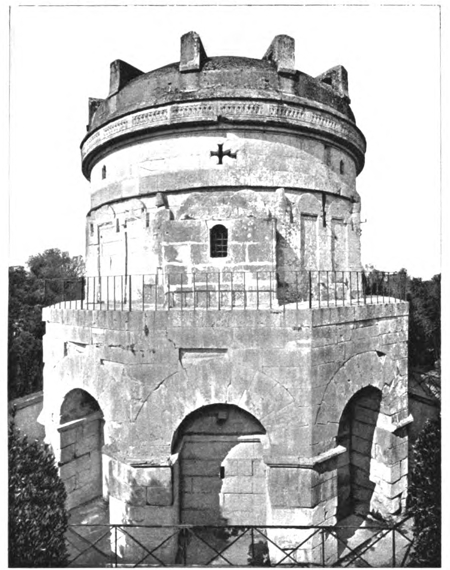
Mausoleum of Theodoric, at Ravenna, p. 300. From a photograph.
An hero, descended from a race of kings, must have depised [VI-302] the base Isaurian who was invested with the Roman purple, without any endowments of mind or body, without any advantages of royal birth or superior qualifications. After the failure of the Theodosian line, the choice of Pulcheria and of the senate might be justified in some measure by the characters of Marcian and Leo, but the latter of these princes confirmed and dishonoured his reign by the perfidious murder of Aspar and his sons, who too rigorously exacted the debt of gratitude and obedience. The inheritance of Leo and of the East was peaceably devolved on his infant grandson, the son of his daughter Ariadne; and her Isaurian husband, the fortunate Trascalisseus, exchanged that barbarous sound for the Grecian appellation of Zeno. After the decease of the elder Leo, he approached with unnatural respect the throne of his son, humbly received, as a gift, the second rank in the empire, and soon excited the public suspicion on the sudden and premature death of his young colleague, whose life could no longer promote the success of his ambition. But the palace of Constantinople was ruled by female influence, and agitated by female passions; and Verina, the widow of Leo, claiming his empire as her own, pronounced a sentence of deposition against the worthless and ungrateful servant on whom she alone had bestowed the sceptre of the East. [8] As soon as she sounded a revolt in the ears of Zeno, he fled with precipitation into the mountains of Isauria, and her brother Basiliscus, already infamous by his African expedition, [9] was unanimously proclaimed by the servile senate. But the reign of the usurper was short and turbulent. Basiliscus presumed to assassinate the lover of his sister; he dared to offend the lover of his wife, the vain and insolent Harmatius, who, in [VI-303] the midst of Asiatic luxury, affected the dress, the demeanour, and the surname of Achilles. [10] By the conspiracy of the malcontents, Zeno was recalled from exile; the armies, the capital, the person, of Basiliscus were betrayed; and his whole family was condemned to the long agony of cold and hunger by the inhuman conqueror, who wanted courage to encounter or to forgive his enemies. The haughty spirit of Verina was still incapable of submission or repose. She provoked the enmity of a favourite general, embraced his cause as soon as he was disgraced, created a new emperor in Syria and Egypt, raised an army of seventy thousand men, and persisted to the last moment of her life in a fruitless rebellion, which, according to the fashion of the age, had been predicted by Christian hermits and Pagan magicians. While the East was afflicted by the passions of Verina, her daughter Ariadne was distinguished by the female virtues of mildness and fidelity; she followed her husband in his exile, and after his restoration she implored his clemency in favour of her mother. On the decease of Zeno, Ariadne, the daughter, the mother, and the widow of an emperor, gave her hand and the Imperial title to Anastasius, an aged domestic of the palace, who survived his elevation above twenty-seven years, and whose character is attested by the acclamation of the people, “Reign as you have lived!” [11]
Whatever fear or affection could bestow, was profusely [VI-304] lavished by Zeno on the king of the Ostrogoths: the rank of patrician and consul, the command of the Palatine troops, an equestrian statue, a treasure in gold and silver of many thousand pounds, the name of son, and the promise of a rich and honourable wife. As long as Theodoric condescended to serve, he supported with courage and fidelity the cause of his benefactor: his rapid march contributed to the restoration of Zeno; and in the second revolt, the Walamirs, as they were called, pursued and pressed the Asiatic rebels, till they left an easy victory to the Imperial troops. [12] But the faithful servant was suddenly converted into a formidable enemy, [VI-305] who spread the flames of war from Constantinople to the Adriatic; many flourishing cities were reduced to ashes, and the agriculture of Thrace was almost extirpated by the wanton cruelty of the Goths, who deprived their captive peasants of the right hand, that guided the plough. [13] On such occasions, Theodoric sustained the loud and specious reproach of disloyalty, of ingratitude, and of insatiate avarice, which could be only excused by the hard necessity of his situation. He reigned, not as the monarch, but as the minister of a ferocious people, whose spirit was unbroken by slavery, and impatient of real or imaginary insults. Their poverty was incurable; since the most liberal donatives were soon dissipated in wasteful luxury, and the most fertile estates became barren in their hands; they despised, but they envied, the laborious provincials; and, when their subsistence had failed, the Ostrogoths embraced the familiar resources of war and rapine. It had been the wish of Theodoric (such at least was his declaration) to lead a peaceful, obscure, obedient life, on the confines of Scythia, till the Byzantine court, by splendid and fallacious promises, seduced him to attack a confederate tribe of Goths, who had been engaged in the party of Basiliscus. He marched from his station in Mæsia, on the solemn assurance that before he reached Hadrianople he should meet a plentiful convoy of provisions and a reinforcement of eight thousand horse and thirty thousand foot, while the legions of Asia were encamped at Heraclea to second his operations. These measures were disappointed by mutual jealousy. As he advanced into Thrace, the son of Theodemir found an inhospitable solitude, and his Gothic [VI-306] followers, with an heavy train of horses, of mules, and of waggons, were betrayed by their guides among the rocks and precipices of Mount Sondis, [14] where he was assaulted by the arms and invectives of Theodoric the son of Triarius. From a neighbouring height, his artful rival harangued the camp of the Walamirs, and branded their leader with the opprobrious names of child, of madman, of perjured traitor, the enemy of his blood and nation. “Are you ignorant,” exclaimed the son of Triarius, “that it is the constant policy of the Romans to destroy the Goths by each other’s swords? Are you insensible that the victor in this unnatural contest will be exposed, and justly exposed, to their implacable revenge? Where are those warriors, my kinsmen and thy own, whose widows now lament that their lives were sacrificed to thy rash ambition? Where is the wealth which thy soldiers possessed when they were first allured from their native homes to enlist under thy standard? Each of them was then master of three or four horses; they now follow thee on foot like slaves, through the deserts of Thrace; those men who were tempted by the hope of measuring gold with a bushel, those brave men who are as free and as noble as thyself.” A language so well suited to the temper of the Goths excited clamour and discontent; and the son of Theodemir, apprehensive of being left alone, was compelled to embrace his brethren, and to imitate the example of Roman perfidy. [15]
In every state of his fortune, the prudence and firmness of Theodoric were equally conspicuous; whether he threatened [VI-307] Constantinople at the head of the confederate Goths, or retreated with a faithful band to the mountains and sea-coast of Epirus. At length the accidental death of the son of Triarius [16] destroyed the balance which the Romans had been so anxious to preserve, the whole nation acknowledged the supremacy of the Amali, and the Byzantine court subscribed an ignominious and oppressive treaty. [17] The senate had already declared that it was necessary to choose a party among the Goths, since the public was unequal to the support of their united forces; a subsidy of two thousand pounds of gold, with the ample pay of thirteen thousand men, were required for the least considerable of their armies; [18] and the Isaurians, who guarded not the empire but the emperor, enjoyed, besides the privilege of rapine, an annual pension of five thousand pounds. The sagacious mind of Theodoric soon perceived that he was odious to the Romans, and suspected by the Barbarians; he understood the popular murmur that his subjects were exposed in their frozen huts to intolerable hardships, while their king was dissolved in the luxury of Greece; and he prevented the painful alternative of encountering the Goths, as the champion, or of leading them to the field as the enemy, of Zeno. Embracing an enterprise worthy of his courage and ambition, Theodoric addressed the emperor in the following words: “Although your servant is maintained in affluence by your liberality, graciously listen to the wishes of my heart! Italy, the inheritance of your predecessors, and Rome itself, the head and mistress of the world, now fluctuate under the violence and oppression of Odoacer the mercenary. Direct me, with [VI-308] my national troops, to march against the tyrant. If I fall, you will be relieved from an expensive and troublesome friend; if, with the Divine permission, I succeed, I shall govern in your name, and to your glory, the Roman senate, and the part of the republic delivered from slavery by my victorious arms.” The proposal of Theodoric was accepted, and perhaps had been suggested, by the Byzantine court. But the forms of the commission or grant appear to have been expressed with a prudent ambiguity, which might be explained by the event; and it was left doubtful, whether the conqueror of Italy should reign as the lieutenant, the vassal, or the ally of the emperor of the East. [19]
The reputation both of the leader and of the war diffused an universal ardour; the Walamirs were multiplied by the Gothic swarms already engaged in the service, or seated in the provinces, of the empire; and each bold Barbarian, who had heard of the wealth and beauty of Italy, was impatient to seek, through the most perilous adventures, the possession of such enchanting objects. The march of Theodoric must be considered as the emigration of an entire people; [20] the wives and children of the Goths, their aged parents, and most precious effects were carefully transported; and some idea may be formed of the heavy baggage that now followed the camp, by the loss of two thousand waggons, which had been sustained in a single action in the war of Epirus. For their subsistence, the Goths depended on the magazines of [VI-309] corn which was ground in portable mills by the hands of their women; on the milk and flesh of their flocks and herds; on the casual produce of the chase, and upon the contributions which they might impose on all who should presume to dispute the passage or to refuse their friendly assistance. Notwithstanding these precautions, they were exposed to the danger, and almost to the distress, of famine, in a march of seven hundred miles, which had been undertaken in the depth of a rigorous winter. Since the fall of the Roman power, Dacia and Pannonia no longer exhibited the rich prospect of populous cities, well-cultivated fields, and convenient highways: the reign of barbarism and desolation was restored, and the tribes of Bulgarians, Gepidæ, and Sarmatians, who had occupied the vacant province, were prompted by their native fierceness, or the solicitations of Odoacer, to resist the progress of his enemy. In many obscure though bloody battles, Theodoric fought and vanquished; till at length, surmounting every obstacle by skilful conduct and persevering courage, he descended from the Julian Alps, and displayed his invincible banners on the confines of Italy. [21]
Odoacer, a rival not unworthy of his arms, had already occupied the advantageous and well-known post of the river Sontius near the ruins of Aquileia; at the head of a powerful host, whose independent kings [22] or leaders disdained the duties of subordination and the prudence of delays. No sooner had Theodoric granted a short repose and refreshment to his wearied cavalry, than he boldly attacked the fortifications of the enemy; the Ostrogoths shewed more ardour to acquire, than the mercenaries to defend, the lands of Italy; [VI-310] and the reward of the first victory was the possession of the Venetian province as far as the walls of Verona. In the neighbourhood of that city, on the steep banks of the rapid Adige, he was opposed by a new army, reinforced in its numbers and not impaired in its courage: the contest was more obstinate, but the event was still more decisive; Odoacer fled to Ravenna, Theodoric advanced to Milan, and the vanquished troops saluted their conqueror with loud acclamations of respect and fidelity. But their want either of constancy or of faith soon exposed him to the most imminent danger; his vanguard, with several Gothic counts, which had been rashly entrusted to a deserter, was betrayed and destroyed near Faenza by his double treachery; Odoacer again appeared master of the field, and the invader, strongly intrenched in his camp of Pavia, was reduced to solicit the aid of a kindred nation, the Visigoths of Gaul. [23] In the course of this history, the most voracious appetite for war will be abundantly satiated; nor can I much lament that our dark and imperfect materials do not afford a more ample narrative of the distress of Italy and of the fierce conflict which was finally decided by the abilities, experience, and valour of the Gothic king. Immediately before the battle of Verona, he visited the tent of his mother [24] and sister, and requested that on a day, the most illustrious festival of his life, they would adorn him with the rich garments which they had worked with their own hands. “Our glory,” said he, “is mutual and inseparable. You are known to the world as the mother of Theodoric; and it becomes me to prove that I am the genuine offspring of those heroes from whom I claim my descent.” The wife or concubine of Theodemir [VI-311] was inspired with the spirit of the German matrons who esteemed their sons’ honour far above their safety; and it is reported that in a desperate action, when Theodoric himself was hurried along by the torrent of a flying crowd, she boldly met them at the entrance of the camp, and, by her generous reproaches, drove them back on the swords of the enemy. [25]
From the Alps to the extremity of Calabria, Theodoric reigned by the right of conquest; [26] the vandal ambassadors surrendered the land of Sicily, as a lawful appendage of his kingdom; and he was accepted as the deliverer of Rome by the senate and people, who had shut their gates against the flying usurper. [27] Ravenna alone, secure in the fortifications of art and nature, still sustained a siege of almost three years; and the daring sallies of Odoacer carried slaughter and dismay into the Gothic camp. At length, destitute of provisions and hopeless of relief, that unfortunate monarch yielded to the groans of his subjects and the clamours of his soldiers. A treaty of peace was negotiated by the bishop of Ravenna; the Ostrogoths were admitted into the city; and the hostile kings consented, under the sanction of an oath, to rule with equal and undivided authority the provinces of Italy. [28] The [VI-312] event of such an agreement may be easily foreseen. After some days had been devoted to the semblance of joy and friendship, Odoacer, in the midst of a solemn banquet, was stabbed by the hand, or at least by the command, of his rival. [29] Secret and effectual orders had been previously despatched; the faithless and rapacious mercenaries, at the same moment and without resistance, were universally massacred; and the royalty of Theodoric was proclaimed by the Goths, with the tardy, reluctant, ambiguous consent of the emperor of the East. The design of a conspiracy was imputed, according to the usual forms, to the prostrate tyrant; but his innocence and the guilt of his conqueror [30] are sufficiently proved by the advantageous treaty which force would not sincerely have granted nor weakness have rashly infringed. The jealousy of power and the mischiefs of discord may suggest a more decent apology, and a sentence less rigorous may be pronounced against a crime which was necessary to introduce into Italy a regeneration of public felicity. The living author of this felicity was audaciously praised in his own presence by sacred and profane orators; [31] but history (in [VI-313] his time she was mute and inglorious) has not left any just representation of the events which displayed, or of the defects which clouded, the virtues of Theodoric. [32] One record of his fame, the volume of public epistles composed by Cassiodorius in the royal name, is still extant, and has obtained more implicit credit than it seems to deserve. [33] They exhibit the forms, rather than the substance, of his government; and we should vainly search for the pure and spontaneous sentiments of the Barbarian amidst the declamation and learning of a sophist, the wishes of a Roman senator, the precedents of office, and the vague professions which, in every court and on every occasion, compose the language of discreet ministers. The reputation of Theodoric may repose with more confidence on the visible peace and prosperity of a reign of thirty-three years, the unanimous esteem of his own times, and the memory of his wisdom and courage, his justice and humanity, which was deeply impressed on the minds of the Goths and Italians.
The partition of the lands of Italy, of which Theodoric assigned the third part to his soldiers, is honourably arraigned as the sole injustice of his life. And even this act may be fairly justified by the example of Odoacer, the rights of conquest, the true interest of the Italians, and the sacred duty of [VI-314] subsisting a whole people, who, on the faith of his promises, had transported themselves into a distant land. [34] Under the reign of Theodoric, and in the happy climate of Italy, the Goths soon multiplied to a formidable host of two hundred thousand men, [35] and the whole amount of their families may be computed by the ordinary addition of women and children. Their invasion of property, a part of which must have been already vacant, was disguised by the generous but improper name of hospitality; these unwelcome guests were irregularly dispersed over the face of Italy, and the lot of each Barbarian was adequate to his birth and office, the number of his followers, and the rustic wealth which he possessed in slaves and cattle. The distinctions of noble and plebeian were acknowledged; [36] but the lands of every freeman were exempt from taxes, and he enjoyed the inestimable privilege of being subject only to the laws of his country. [37] Fashion, and even convenience, soon persuaded the conquerors to assume the more elegant dress of the natives, but they still persisted in the use of their mother-tongue; and their contempt for the Latin schools was applauded by Theodoric himself, who gratified their prejudices, or his own, by declaring that the child who had trembled at a rod would never dare to look upon a sword. [38] Distress might sometimes [VI-315] provoke the indigent Roman to assume the ferocious manners which were insensibly relinquished by the rich and luxurious Barbarian; [39] but these mutual conversions were not encouraged by the policy of a monarch who perpetuated the separation of the Italians and Goths; reserving the former for the arts of peace and the latter for the service of war. To accomplish this design, he studied to protect his industrious subjects, and to moderate the violence without enervating the valour of his soldiers, who were maintained for the public defence. They held their lands and benefices as a military stipend; at the sound of the trumpet they were prepared to march under the conduct of their provincial officers; and the whole extent of Italy was distributed into the several quarters of a well-regulated camp. The service of the palace and of the frontiers was performed by choice or by rotation; and each extraordinary fatigue was recompensed by an increase of pay and occasional donatives. Theodoric had convinced his brave companions that empire must be acquired and defended by the same arts. After his example, they strove to excel in the use, not only of the lance and sword, the instruments of their victories, but of the missile weapons, which they were too much inclined to neglect; and the lively image of war was displayed in the daily exercise and annual reviews of the Gothic cavalry. A firm though gentle discipline imposed the habits of modesty, obedience, and temperance; and the Goths were instructed to spare the people, to reverence the laws, to understand the duties of civil society, and to disclaim the barbarous licence of judicial combat and private revenge. [40]
[VI-316]
Among the Barbarians of the West, the victory of Theodoric had spread a general alarm. But, as soon as it appeared that he was satisfied with conquest and desirous of peace, terror was changed into respect, and they submitted to a powerful mediation, which was uniformly employed for the best purposes of reconciling their quarrels and civilising their manners. [41] The ambassadors who resorted to Ravenna from the most distant countries of Europe, admired his wisdom, magnificence, [42] and courtesy; and, if he sometimes accepted either slaves or arms, white horses or strange animals, the gift of a sundial, a water-clock, or a musician, admonished even the princes of Gaul, of the superior art and industry of his Italian subjects. His domestic alliances, [43] a wife, two daughters, a sister, and a niece, united the family of Theodoric with the kings of the Franks, the Burgundians, the Visigoths, the Vandals, and the Thuringians; and contributed to maintain the harmony, or at least the balance, of the great republic of the West. [44] It is difficult in the dark forests of Germany and Poland to pursue the emigrations of the Heruli, a fierce people who disdained the use of armour, and who condemned their widows and aged parents not to survive the [VI-317] loss of their husbands or the decay of their strength. [45] The king of these savage warriors solicited the friendship of Theodoric, and was elevated to the rank of his son, according to the barbaric rites of a military adoption. [46] From the shores of the Baltic, the Æstians or Livonians laid their offerings of native amber [47] at the feet of a prince whose fame had excited them to undertake an unknown and dangerous journey of fifteen hundred miles. With the country [48] from whence the Gothic nation derived their origin he maintained a frequent and friendly correspondence; the Italians were clothed in the rich sables [49] of Sweden; and one of its sovereigns, after a voluntary or reluctant abdication, found an hospitable retreat in the palace of Ravenna. He had reigned over one of the thirteen populous tribes who cultivated a small portion of the great island or peninsula of Scandinavia, to which the vague appellation of Thule has been sometimes applied. That Northern region was peopled, or had been explored, as high as the sixty-eighth degree of [VI-318] latitude, where the natives of the polar circle enjoy and lose the presence of the sun at each summer and winter solstice during an equal period of forty days. [50] The long night of his absence or death was the mournful season of distress and anxiety, till the messengers who had been sent to the mountain tops descried the first rays of returning light and proclaimed to the plain below the festival of his resurrection. [51]
The life of Theodoric represents the rare and meritorious example of a Barbarian, who sheathed his sword in the pride of victory and the vigour of his age. A reign of three and thirty years was consecrated to the duties of civil government, and the hostilities in which he was sometimes involved were speedily terminated by the conduct of his lieutenants, the discipline of his troops, the arms of his allies, and even by the terror of his name. He reduced, under a strong and regular government, the unprofitable countries of Rhætia, Noricum, Dalmatia, and Pannonia, from the source of the Danube and the territory of the Bavarians, [52] to the petty kingdom erected by the Gepidæ on the ruins of Sirmium. His prudence could not safely entrust the bulwark of Italy to such feeble and turbulent neighbours; and his justice [VI-319] might claim the lands which they oppressed, either as a part of his kingdom or as the inheritance of his father. The greatness of a servant, who was named perfidious because he was successful, awakened the jealousy of the emperor Anastasius; and a war was kindled on the Dacian frontier, by the protection which the Gothic king, in the vicissitude of human affairs, had granted to one of the descendants of Attila. Sabinian, a general illustrious by his own and father’s merit, advanced at the head of ten thousand Romans; and the provisions and arms, which filled a long train of waggons, were distributed to the fiercest of the Bulgarian tribes. But, in the fields of Margus, the Eastern powers were defeated by the inferior forces of the Goths and Huns; [53] the flower, and even the hope, of the Roman armies was irretrievably destroyed; and such was the temperance with which Theodoric had inspired his victorious troops, that, as their leader had not given the signal of pillage, the rich spoils of the enemy lay untouched at their feet. [54] Exasperated by this disgrace, the Byzantine court despatched two hundred ships and eight thousand men to plunder the sea-coast of Calabria and Apulia; they assaulted the ancient city of Tarentum, interrupted the trade and agriculture of an happy country, and sailed back to the Hellespont, proud of their piratical victory over a people whom they still presumed to consider as their Roman brethren. [55] Their retreat was possibly [VI-320] hastened by the activity of Theodoric; Italy was covered by a fleet of a thousand light vessels, [56] which he constructed with incredible despatch; and his firm moderation was soon rewarded by a solid and honourable peace. He maintained with a powerful hand the balance of the West, till it was at length overthrown by the ambition of Clovis; and, although unable to assist his rash and unfortunate kinsman the king of the Visigoths, he saved the remains of his family and people, and checked the Franks in the midst of their victorious career. I am not desirous to prolong or repeat [57] this narrative of military events, the least interesting of the reign of Theodoric; and shall be content to add that the Alemanni were protected, [58] that an inroad of the Burgundians was severely chastised, and that the conquest of Arles and Marseilles opened a free communication with the Visigoths, who revered him both as their national protector and as the guardian of his grandchild, the infant son of Alaric. Under this respectable character, the king of Italy restored the Prætorian prefecture of the Gauls, reformed some abuses in the civil government of Spain, and accepted the annual tribute and apparent submission of its military governor, who wisely [VI-321] refused to trust his person in the palace of Ravenna. [59] The Gothic sovereignty was established from Sicily to the Danube, from Sirmium or Belgrade [60] to the Atlantic Ocean; and the Greeks themselves have acknowledged that Theodoric reigned over the fairest portion of the Western empire. [61]
The union of the Goths and Romans might have fixed for ages the transient happiness of Italy; and the first of nations, a new people of free subjects and enlightened soldiers, might have gradually arisen from the mutual emulation of their respective virtues. But the sublime merit of guiding or seconding such a revolution was not reserved for the reign of Theodoric; he wanted either the genius or the opportunities of a legislator; [62] and, while he indulged the Goths in the [VI-322] enjoyment of rude liberty, he servilely copied the institutions, and even the abuses, of the political system which had been framed by Constantine and his successors. From a tender regard to the expiring prejudices of Rome, the Barbarian declined the name, the purple, and the diadem of the emperors; [63] but he assumed, under the hereditary title of king, the whole substance and plenitude of Imperial prerogative. [64] His addresses to the Eastern throne were respectful and ambiguous; he celebrated in pompous style the harmony of the two republics, applauded his own government as the perfect similitude of a sole and undivided empire, and claimed above the kings of the earth the same pre-eminence which he modestly allowed to the person or rank of Anastasius. The alliance of the East and West was annually declared by the unanimous choice of two consuls; but it should seem that the Italian candidate who was named by Theodoric accepted a formal confirmation from the sovereign of Constantinople. [65] The Gothic palace of Ravenna reflected the image of the court of Theodosius or Valentinian. The Prætorian prefect, the prefect of Rome, the quæstor, the master of the offices, with the public and patrimonial treasures, whose functions are painted in gaudy colours by the rhetoric of Cassiodorius, still continued to act as the ministers of state. And the [VI-323] subordinate care of justice and the revenue was delegated to seven consulars, three correctors, and five presidents, who governed the fifteen regions of Italy, according to the principles and even the forms of Roman jurisprudence. [66] The violence of the conquerors was abated or eluded by the slow artifice of judicial proceedings; the civil administration with its honours and emoluments was confined to the Italians; and the people still preserved their dress and language, their laws and customs, their personal freedom, and two-thirds of their landed property. It had been the object of Augustus to conceal the introduction of monarchy; it was the policy of Theodoric to disguise the reign of a Barbarian. [67] If his subjects were sometimes awakened from this pleasing vision of a Roman government, they derived more substantial comfort from the character of a Gothic prince who had penetration to discern, and firmness to pursue, his own and the public interest. Theodoric loved the virtues which he possessed, and the talents of which he was destitute. Liberius was promoted to the office of Prætorian prefect for his unshaken fidelity to the unfortunate cause of Odoacer. The ministers of Theodoric, Cassiodorius [68] and Boethius, have [VI-324] reflected on his reign the lustre of their genius and learning. More prudent or more fortunate than his colleague, Cassiodorius preserved his own esteem without forfeiting the royal favour; and, after passing thirty years in the honours of the world, he was blessed with an equal term of repose in the devout and studious solitude of Squillace.
As the patron of the republic, it was the interest and duty of the Gothic king to cultivate the affections of the senate [69] and people. The nobles of Rome were flattered by sonorous epithets and formal professions of respect, which had been more justly applied to the merit and authority of their ancestors. The people enjoyed, without fear or danger, the three blessings of a capital, order, plenty, and public amusements. A visible diminution of their numbers may be found even in the measure of liberality; [70] yet Apulia, Calabria, and Sicily poured their tribute of corn into the granaries of Rome; an allowance of bread and meat was distributed to the indigent citizens; and every office was deemed honourable which was consecrated to the care of their health and happiness. The public games, such as a Greek ambassador might politely applaud, exhibited a faint and feeble copy of the magnificence of the Cæsars, yet the musical, the gymnastic, and the pantomime arts had not totally sunk in oblivion; the wild beasts of Africa still exercised in the amphitheatre the courage and dexterity of the hunters; and the indulgent Goth either patiently tolerated or gently restrained the blue and green factions, whose contests so often filled the circus with clamour, and even with blood. [71] In the seventh year [VI-325] of his peaceful reign, Theodoric visited the old capital of the world; the senate and people advanced in solemn procession to salute a second Trajan, a new Valentinian; and he nobly supported that character by the assurance of a just and legal government, [72] in a discourse which he was not afraid to pronounce in public and to inscribe on a tablet of brass. Rome, in this august ceremony, shot a last ray of declining glory; and a saint, the spectator of this pompous scene, could only hope, in his pious fancy, that it was excelled by the celestial splendour of the New Jerusalem. [73] During a residence of six months, the fame, the person, and the courteous demeanour of the Gothic king excited the admiration of the Romans, and he contemplated, with equal curiosity and surprise, the monuments that remained of their ancient greatness. He imprinted the footsteps of a conqueror on the Capitoline hill, and frankly confessed that each day he viewed with fresh wonder the forum of Trajan and his lofty column. The theatre of Pompey appeared, even in its decay, as a huge mountain artificially hollowed and polished, and adorned by human industry; and he vaguely computed, that a river of gold must have been drained to erect the colossal amphitheatre of Titus. [74] From the mouths of fourteen aqueducts, a pure and copious stream was diffused into every part of the [VI-326] city; among these the Claudian water, which arose at the distance of thirty-eight miles in the Sabine mountains, was conveyed along a gentle though constant declivity of solid arches, till it descended on the summit of the Aventine hill. The long and spacious vaults which had been constructed for the purpose of common sewers, subsisted, after twelve centuries, in their pristine strength; and the subterraneous channels have been preferred to all the visible wonders of Rome. [75] The Gothic kings, so injuriously accused of the ruin of antiquity, were anxious to preserve the monuments of the nation whom they had subdued. [76] The royal edicts were framed to prevent the abuses, the neglect, or the depredations of the citizens themselves; and a professed architect, the annual sum of two hundred pounds of gold, twenty-five thousand tiles, and the receipt of customs from the Lucrine port were assigned for the ordinary repairs of the walls and public edifices. A similar care was extended to the statues of metal or marble of men or animals. The spirit of the horses, which have given a modern name to the Quirinal, was applauded by the Barbarians; [77] the brazen elephants of the Via sacra were diligently restored; [78] the famous heifer of Myron deceived the cattle, as they were driven through the [VI-327] forum of Peace; [79] and an officer was created to protect those works of art, which Theodoric considered as the noblest ornament of his kingdom.
After the example of the last emperors, Theodoric preferred the residence of Ravenna, where he cultivated an orchard with his own hands. [80] As often as the peace of his kingdom was threatened (for it was never invaded) by the Barbarians, he removed his court to Verona [81] on the northern frontier, and the image of his palace, still extant, on a coin, represents the oldest and most authentic model of Gothic architecture. These two capitals, as well as Pavia, Spoleto, Naples, and the rest of the Italian cities, acquired under his reign the useful or splendid decorations of churches, aqueducts, baths, porticoes, and palaces. [82] But the happiness of the subject was more truly conspicuous in the busy scene of labour and luxury, in the rapid increase and bold enjoyment of national wealth. From the shades of Tibur and [VI-328] Præneste, the Roman senators still retired in the winter season to the warm sun and salubrious springs of Baiæ; and their villas, which advanced on solid moles into the bay of Naples, commanded the various prospect of the sky, the earth, and the water. On the eastern side of the Hadriatic, a new campania was formed in the fair and fruitful province of Istria, which communicated with the palace of Ravenna by an easy navigation of one hundred miles. The rich productions of Lucania and the adjacent provinces were exchanged at the Marcilian fountain, in a populous fair annually dedicated to trade, intemperance, and superstition. In the solitude of Comum, which had once been animated by the mild genius of Pliny, a transparent bason above sixty miles in length still reflected the rural seats which encompassed the margin of the Larian lake; and the gradual ascent of the hills was covered by a triple plantation of olives, of vines, and of chestnut trees. [83] Agriculture revived under the shadow of peace, and the number of husbandmen was multiplied by the redemption of captives. [84] The iron mines of Dalmatia, a gold mine in Bruttium, were carefully explored, and the Pomptine marshes, as well as those of Spoleto, were drained and cultivated by private undertakers, whose distant reward must depend on the continuance of the public prosperity. [85] Whenever the seasons were less propitious, [VI-329] the doubtful precautions of forming magazines of corn, fixing the price, and prohibiting the exportation attested at least the benevolence of the state; but such was the extraordinary plenty which an industrious people produced from a grateful soil that a gallon of wine was sometimes sold in Italy for less than three farthings, and a quarter of wheat at about five shillings and sixpence. [86] A country possessed of so many valuable objects of exchange soon attracted the merchants of the world, whose beneficial traffic was encouraged and protected by the liberal spirit of Theodoric. The free intercourse of the provinces by land and water was restored and extended; the city gates were never shut either by day or by night; and the common saying, that a purse of gold might be safely left in the fields, was expressive of the conscious security of the inhabitants. [87]
A difference of religion is always pernicious and often fatal to the harmony of the prince and people; the Gothic conqueror had been educated in the profession of Arianism, and Italy was devoutly attached to the Nicene faith. But the persuasion of Theodoric was not infected by zeal, and he piously adhered to the heresy of his fathers, without condescending to balance the subtile arguments of theological metaphysics. Satisfied with the private toleration of his Arian sectaries, he justly conceived himself to be the guardian of the public worship, and his external reverence for a superstition which he despised may have nourished in his mind the salutary indifference of a statesman or philosopher. The Catholics [VI-330] of his dominions acknowledged, perhaps with reluctance, the peace of the church; their clergy, according to the degrees of rank or merit, were honourably entertained in the palace of Theodoric; he esteemed the living sanctity of Cæsarius [88] and Epiphanius, [89] the orthodox bishops of Arles and Pavia; and presented a decent offering on the tomb of St. Peter, without any scrupulous inquiry into the creed of the apostle. [90] His favourite Goths, and even his mother, were permitted to retain or embrace the Athanasian faith, and his long reign could not afford the example of an Italian Catholic who either from choice or compulsion had deviated into the religion of the conqueror. [91] The people, and the Barbarians themselves, were edified by the pomp and order of religious worship; the magistrates were instructed to defend the just immunities of ecclesiastical persons and possessions; the bishops held their synods, the metropolitans exercised their jurisdiction, and the privileges of sanctuary were maintained or moderated according to the spirit of the Roman jurisprudence. With the protection, Theodoric assumed the legal supremacy of the church; and his firm administration restored or extended some useful prerogatives which had been neglected by the feeble emperors of the West. He was [VI-none] [VI-331] not ignorant of the dignity and importance of the Roman pontiff, to whom the venerable name of Pope was now appropriated. The peace or the revolt of Italy might depend on the character of a wealthy and popular bishop, who claimed such ample dominion both in heaven and earth; who had been declared in a numerous synod to be pure from all sin, and exempt from all judgment. [92] When at his summons the chair of St. Peter was disputed by Symmachus and Lawrence, they appeared before the tribunal of an Arian monarch, and he confirmed the election of the most worthy or the most obsequious candidate. [92a] At the end of his life, in a moment of jealousy and resentment, he prevented the choice of the Romans, by nominating a pope in the palace of Ravenna. The danger and furious contests of a schism were mildly restrained, and the last decree of the senate was enacted to extinguish, if it were possible, the scandalous venality of the papal elections. [93]
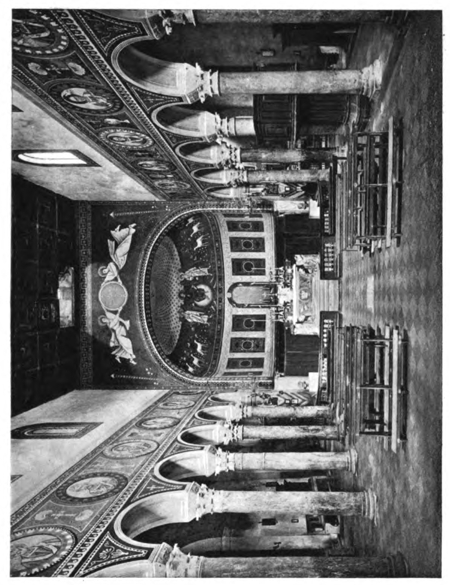
(See this image in horizontal aspect [here].)
Interior of the Church of the Holy Spirit, Ravenna, p. 330. From a photograph.
I have descanted with pleasure on the fortunate condition of Italy; but our fancy must not hastily conceive that the golden age of the poets, a race of men without vice or misery, was realised under the Gothic conquest. The fair prospect was sometimes overcast with clouds; the wisdom of Theodoric might be deceived, his power might be resisted, and the declining age of the monarch was sullied with popular hatred and patrician blood. In the first insolence of victory, he had been tempted to deprive the whole party of Odoacer of the [VI-332] civil and even the natural rights of society; [94] a tax unseasonably imposed after the calamities of war would have crushed the rising agriculture of Liguria; a rigid pre-emption of corn, which was intended for the public relief, must have aggravated the distress of Campania. These dangerous projects were defeated by the virtue and eloquence of Epiphanius and Boethius, who, in the presence of Theodoric himself, successfully pleaded the cause of the people; [95] but, if the royal ear was open to the voice of truth, a saint and a philosopher are not always to be found at the ear of kings. The privileges of rank, or office, or favour were too frequently abused by Italian fraud and Gothic violence, and the avarice of the king’s nephew was publicly exposed, at first by the usurpation, and afterwards by the restitution, of the estates which he had unjustly extorted from his Tuscan neighbours. Two hundred thousand Barbarians, formidable even to their master, were seated in the heart of Italy; they indignantly supported the restraints of peace and discipline; the disorders of their march were always felt and sometimes compensated; and, where it was dangerous to punish, it might be prudent to dissemble, the sallies of their native fierceness. When the indulgence of Theodoric had remitted two thirds of the Ligurian tribute, he condescended to explain the difficulties of his situation, and to lament the heavy though inevitable burdens which he imposed on his subjects for their own defence. [96] These ungrateful subjects could never be cordially reconciled [VI-333] to the origin, the religion, of even the virtues of the Gothic conqueror; past calamities were forgotten, and the sense or suspicion of injuries was rendered still more exquisite by the present felicity of the times.
Even the religious toleration which Theodoric had the glory of introducing into the Christian world was painful and offensive to the orthodox zeal of the Italians. They respected the armed heresy of the Goths; but their pious rage was safely pointed against the rich and defenceless Jews, who had formed their establishments at Naples, Rome, Ravenna, Milan, and Genoa, for the benefit of trade, and under the sanction of the laws. [97] Their persons were insulted, their effects were pillaged, and their synagogues were burnt by the mad populace of Ravenna and Rome, inflamed, as it should seem, by the most frivolous or extravagant pretences. The government which could neglect, would have deserved, such an outrage. A legal inquiry was instantly directed; and, as the authors of the tumult had escaped in the crowd, the whole community was condemned to repair the damage; and the obstinate bigots who refused their contributions were whipped through the streets by the hand of the executioner. This simple act of justice exasperated the discontent of the Catholics, who applauded the merit and patience of these holy confessors; three hundred pulpits deplored the persecution of the church; and, if the chapel of St. Stephen at Verona was demolished by the command of Theodoric, it is probable that some miracle hostile to his name and dignity had been performed on that sacred theatre. At the close of a glorious life, the king of Italy discovered that he had excited the hatred of a people whose happiness he had so assiduously laboured to promote; and his mind was soured by indignation, jealousy, and the bitterness of unrequited love. The Gothic [VI-334] conqueror condescended to disarm the unwarlike natives of Italy, interdicting all weapons of offence, and excepting only a small knife for domestic use. The deliverer of Rome was accused of conspiring with the vilest informers against the lives of senators whom he suspected of a secret and treasonable correspondence with the Byzantine court. [98] After the death of Anastasius, the diadem had been placed on the head of a feeble old man; but the powers of government were assumed by his nephew Justinian, who already meditated the extirpation of heresy, and the conquest of Italy and Africa. A rigorous law which was published at Constantinople, to reduce the Arians by the dread of punishment within the pale of the church, awakened the just resentment of Theodoric, who claimed for his distressed brethren of the East the same indulgence which he had so long granted to the Catholics of his dominions. At his stern command, the Roman pontiff, with four illustrious senators, embarked on an embassy, of which he must have alike dreaded the failure or the success. The singular veneration shewn to the first pope who had visited Constantinople was punished as a crime by his jealous monarch; the artful or peremptory refusal of the Byzantine court might excuse an equal, and would provoke a larger, measure of retaliation; and a mandate was prepared in Italy, to prohibit, after a stated day, the exercise of the Catholic worship. By the bigotry of his subjects and enemies, the most tolerant of princes was driven to the brink of persecution; and the life of Theodoric was too long, since he lived to condemn the virtue of Boethius and Symmachus. [99]
[VI-335]
The senator Boethius [100] is the last of the Romans whom Cato or Tully could have acknowledged for their countryman. As a wealthy orphan, he inherited the patrimony and honours of the Anician family, a name ambitiously assumed by the kings and emperors of the age; and the appellation of Manlius asserted his genuine or fabulous descent from a race of consuls and dictators, who had repulsed the Gauls from the Capitol and sacrificed their sons to the discipline of the republic. In the youth of Boethius, the studies of Rome were not totally abandoned; a Virgil [101] is now extant, corrected by the hand of a consul; and the professors of grammar, rhetoric, and jurisprudence were maintained in their privileges and pensions by the liberality of the Goths. But the erudition of the Latin language was insufficient to satiate his ardent curiosity; and Boethius is said to have employed eighteen laborious years in the schools of Athens, [102] which were supported by the zeal, the learning, and the diligence of Proclus and his disciples. The reason and piety of their [VI-336] Roman pupil were fortunately saved from the contagion of mystery and magic, which polluted the groves of the academy; but he imbibed the spirit, and imitated the method, of his dead and living masters, who attempted to reconcile the strong and subtle sense of Aristotle with the devout contemplation and sublime fancy of Plato. After his return to Rome and his marriage with the daughter of his friend, the patrician Symmachus, Boethius still continued, in a palace of ivory and marble, [103] to prosecute the same studies. [104] The church was edified by his profound defence of the orthodox creed against the Arian, the Eutychian, and the Nestorian heresies; and the Catholic unity was explained or exposed in a formal treatise by the indifference of three distinct though consubstantial persons. [105] For the benefit of his Latin readers, his genius submitted to teach the first elements of the arts and sciences of Greece. The geometry of Euclid, the music of Pythagoras, the arithmetic of Nicomachus, the mechanics of Archimedes, the astronomy of Ptolemy, the theology of Plato, and the logic of Aristotle, with the commentary of Porphyry, were translated and illustrated by the indefatigable pen of the Roman senator. And he alone was esteemed capable of describing the wonders of art, a sundial, a water-clock, or a sphere which represented the motions of the planets. From these abstruse speculations, Boethius stooped, or, to speak more truly, he rose to the social duties of public and private life: the indigent were relieved by his liberality; and his eloquence, which flattery might compare [VI-337] to the voice of Demosthenes or Cicero, was uniformly exerted in the cause of innocence and humanity. Such conspicuous merit was felt and rewarded by a discerning prince; the dignity of Boethius was adorned with the titles of consul and patrician, and his talents were usefully employed in the important station of master of the offices. Notwithstanding the equal claims of the East and West, his two sons were created, in their tender youth, the consuls of the same year. [106] On the memorable day of their inauguration, they proceeded in solemn pomp from their palace to the forum, amidst the applause of the senate and people; and their joyful father, the true consul of Rome, after pronouncing an oration in the praise of his royal benefactor, distributed a triumphal largess in the games of the circus. Prosperous in his fame and fortunes, in his public honours and private alliances, in the cultivation of science and the consciousness of virtue, Boethius might have been styled happy, if that precarious epithet could be safely applied before the last term of the life of man.
A philosopher, liberal of his wealth and parsimonious of his time, might be insensible to the common allurements of ambition, the thirst of gold and employment. And some credit may be due to the asseveration of Boethius, that he had reluctantly obeyed the divine Plato, who enjoins every virtuous citizen to rescue the state from the usurpation of vice and ignorance. For the integrity of his public conduct he appeals to the memory of his country. His authority had restrained the pride and oppression of the royal officers, and his eloquence had delivered Paulianus from the dogs of the palace. He had always pitied, and often relieved, the distress [VI-338] of the provincials, whose fortunes were exhausted by public and private rapine; and Boethius alone had courage to oppose the tyranny of the Barbarians, elated by conquest, excited by avarice, and, as he complains, encouraged by impunity. In these honourable contests, his spirit soared above the consideration of danger, and perhaps of prudence; and we may learn from the example of Cato that a character of pure and inflexible virtue is the most apt to be misled by prejudice, to be heated by enthusiasm, and to confound private enmities with public justice. The disciple of Plato might exaggerate the infirmities of nature and the imperfections of society; and the mildest form of a Gothic kingdom, even the weight of allegiance and gratitude, must be insupportable to the free spirit of a Roman patriot. But the favour and fidelity of Boethius declined in just proportion with the public happiness; and an unworthy colleague was imposed, to divide and control the power of the master of the offices. In the last gloomy season of Theodoric, he indignantly felt that he was a slave; but, as his master had only power over his life, he stood without arms and without fear against the face of an angry Barbarian, who had been provoked to believe that the safety of the senate was incompatible with his own. The senator Albinus was accused and already convicted on the presumption of hoping, as it was said, the liberty of Rome. “If Albinus be criminal,” exclaimed the orator, “the senate and myself are all guilty of the same crime. If we are innocent, Albinus is equally entitled to the protection of the laws.” These laws might not have punished the simple and barren wish of an unattainable blessing; but they would have shewn less indulgence to the rash confession of Boethius that, had he known of a conspiracy, the tyrant never should. [107] The advocate of Albinus was soon involved in the danger and [VI-339] perhaps the guilt of his client; their signature (which they denied as a forgery) was affixed to the original address, inviting the emperor to deliver Italy from the Goths; and three witnesses of honourable rank, perhaps of infamous reputation, attested the treasonable designs of the Roman patrician. [108] Yet his innocence must be presumed, since he was deprived by Theodoric of the means of justification, and rigorously confined in the tower of Pavia, while the senate, at the distance of five hundred miles, pronounced a sentence of confiscation and death against the most illustrious of its members. At the command of the Barbarians, the occult science of a philosopher was stigmatised with the names of sacrilege and magic. [109] A devout and dutiful attachment to the senate was condemned as criminal by the trembling voices of the senators themselves; and their ingratitude deserved the wish or prediction of Boethius, that, after him, none should be found guilty of the same offence. [110]
While Boethius, oppressed with fetters, expected each moment the sentence or the stroke of death, he composed in the tower of Pavia the Consolation of Philosophy; a golden volume not unworthy of the leisure of Plato or Tully, but [VI-340] which claims incomparable merit from the barbarism of the times and the situation of the author. The celestial guide, whom he had so long invoked at Rome and Athens, now condescended to illumine his dungeon, to revive his courage, and to pour into his wounds her salutary balm. She taught him to compare his long prosperity and his recent distress, and to conceive new hopes from the inconstancy of fortune. Reason had informed him of the precarious condition of her gifts; experience had satisfied him of their real value; he had enjoyed them without guilt; he might resign them without a sigh, and calmly disdain the impotent malice of his enemies, who had left him happiness, since they had left him virtue. From the earth, Boethius ascended to heaven in search of the supreme good; explored the metaphysical labyrinth of chance and destiny, of prescience and free-will, of time and eternity; and generously attempted to reconcile the perfect attributes of the Deity with the apparent disorders of his moral and physical government. Such topics of consolation, so obvious, so vague, or so abstruse, are ineffectual to subdue the feelings of human nature. Yet the sense of misfortune may be diverted by the labour of thought; and the sage who could artfully combine in the same work the various riches of philosophy, poetry, and eloquence, must already have possessed the intrepid calmness which he affected to seek. Suspense, the worst of evils, was at length determined by the ministers of death, who executed, and perhaps exceeded, the inhuman mandate of Theodoric. A strong cord was fastened round the head of Boethius and forcibly tightened, till his eyes almost started from their sockets; and some mercy may be discovered in the milder torture of beating him with clubs till he expired. [111] But his genius survived to [VI-341] diffuse a ray of knowledge over the darkest ages of the Latin world; the writings of the philosopher were translated by the most glorious of the English kings; [112] and the third emperor of the name of Otho removed to a more honourable tomb the bones of a Catholic saint, who, from his Arian persecutors, had acquired the honours of martyrdom and the fame of miracles. [113] In the last hours of Boethius, he derived some comfort from the safety of his two sons, of his wife, and of his father-in-law, the venerable Symmachus. But the grief of Symmachus was indiscreet, and perhaps disrespectful: he had presumed to lament, he might dare to revenge, the death of an injured friend. He was dragged in chains from Rome to the palace of Ravenna; and the suspicions of Theodoric could only be appeased by the blood of an innocent and aged senator. [114]
Humanity will be disposed to encourage any report which testifies the jurisdiction of conscience and the remorse of kings; and philosophy is not ignorant that the most horrid [VI-342] spectres are sometimes created by the powers of a disordered fancy and the weakness of a distempered body. After a life of virtue and glory, Theodoric was now descending with shame and guilt into the grave: his mind was humbled by the contrast of the past, and justly alarmed by the invisible terrors of futurity. One evening, as it is related, when the head of a large fish was served on the royal table, [115] he suddenly exclaimed that he beheld the angry countenance of Symmachus, his eyes glaring fury and revenge, and his mouth armed with long sharp teeth which threatened to devour him. The monarch instantly retired to his chamber, and, as he lay trembling with aguish cold, under a weight of bedclothes, he expressed in broken murmurs to his physician Elpidius his deep repentance for the murders of Boethius and Symmachus. [116] His malady increased, and, after a dysentery which continued three days, he expired in the palace of Ravenna, in the thirty-third, or, if we compute from the invasion of Italy, in the thirty-seventh year of his reign. Conscious of his approaching end, he divided his treasures and provinces between his two grandsons, and fixed the Rhone as their common boundary. [117] Amalaric was restored to the throne of Spain. Italy, with all the conquests of the Ostrogoths, was bequeathed to Athalaric; whose age did not exceed ten years, but who was cherished as the last male offspring of the line of Amali, by the short-lived marriage of his mother Amalasuntha with a royal [VI-343] fugitive of the same blood. [118] In the presence of the dying monarch, the Gothic chiefs and Italian magistrates mutually engaged their faith and loyalty to the young prince and to his guardian mother; and received, in the same awful moment, his last salutary advice, to maintain the laws, to love the senate and people of Rome, and to cultivate with decent reverence the friendship of the emperor. [119] The monument of Theodoric was erected by his daughter Amalasuntha, in a conspicuous situation, which commanded the city of Ravenna, the harbour, and the adjacent coast. A chapel of a circular form, thirty feet in diameter, is crowned by a dome of one entire piece of granite: from the centre of the dome four columns arose, which supported, in a vase of porphyry, the remains of the Gothic king, surrounded by the brazen statues of the twelve apostles. [120] His spirit, after some previous expiation, might have been permitted to mingle with the benefactors of mankind, if an Italian hermit had not been witness in a vision to the damnation of Theodoric, [121] whose [VI-344] soul was plunged, by the ministers of divine vengeance, into the vulcano of Lipari, one of the flaming mouths of the infernal world. [122]
[VI-345]
APPENDIX: ADDITIONAL NOTES BY THE EDITOR↩
NOTE 1.: THE BATTLE OF MAURICA, COMMONLY CALLED THE BATTLE OF CHÂLONS — (P. 59)↩
The scene of the battle by which the invasion of Attila was checked has been the subject of some perplexity. The statements which have to be considered are the following: —
1. Idatius: in campis Catalaunicis haud longe de civitate quam effregerant Mettis.
2. An insertion in the text of Prosper, found in the Codex Havniensis, and doubtless representing an entry in the Chronica Italica. Mommsen, Chron. Min. i. p. 302 and 481: pugnatum est in quinto milliario de Trecas, loco numcupato Maurica in Campania.
3. Chron. ad 511 (see above, vol. iv. Appendix 5), Mommsen, Chron. Min. i. p. 663: Tricassis pugnat loco Mauriacos.
4a. Jordanes c. 36: convenitur itaque in campos Catalaunicos, qui et Mauriaci nominantur, centum leuvas ut Galli vocant in longum tenentes et septuaginta in latum. (A Gallic leuva or league = 1½ Roman miles.)
4b. Gregory of Tours, 2, 7: Mauriacum campum adiens se præcingit ad bellum [Attila]. The accounts of the episode in Jordanes and Gregory are not independent; cp. Mommsen, Pref. to Jordanes, p. xxxvi.
The traditional view that the battle was fought near Duro-Catalaunum or Châlons on Marne is not borne out by the data. That town is not mentioned, and the notice of Jordanes shows that its proximity is not implied by the name “Catalaunian Plains,” for Maurica might have been at the other extremity. Setting aside Idatius, whose statement is discredited by the words “not far from Metz,” we find the other notices agreeing in the designation of the battlefield as the Mauriac Plain, or a place named Maurica, and one of them gives the precise distance from Troyes. The name Maurica, Mauriac, has been identified with great probability with Mery (on Seine), about twenty miles from Troyes. There seems therefore every likelihood that the battle was fought between Troyes and Mery, and the solution, for which Mr. Hodgkin well argues (Italy, i. p. 143-5), is confirmed, as he observes, by the strategical importance of Troyes, which was at the centre of many roads.
An interesting discovery was made in 1842 at the village of Pouan, about 10 miles from Mery-on-Seine. A skeleton was found with a two-edged sword and a cutlass, both adorned with gold, and a number of gold ornaments, one of them a ring with the inscription HEVA. They are the subject of a memoir by M. Peigné Delacourt (1860), who claimed the grave as the tomb of the Visigothic king Theodoric. See Hodgkin (ib. p. 140). In any case the remains may well be connected with the great battle.
[VI-346]
NOTE 2.: AUTHORITIES — (C. XXXVI. sqq.) ↩
The history of the reign of Leo I. and Zeno (in three Books) was written by Candidus the Isaurian. He held the post of clerk or secretary to influential Isaurians; such is the vague phrase of Photius, who in the Bibliotheca (cod. 79) gives a short notice of the writer and a summary of the contents of his work. He was an orthodox Christian. Besides the account in Photius (Müller, F.H.G. iv. p. 135), we have probably three fragments in the Lexicon of Suidas: (α) sub χειρίζω (Müller, ib. 137); (β) the first part of the article Ἁρμάτος (assigned by Niebuhr to Malchus but) vindicated for Candidus by Toup and Shestakov; (γ) the first part of the article Βασιλίσκος plausibly assigned to Candidus by Shestakov (β and γ are printed under Malchus in Müller, ib. p. 116, 117). But the work of Candidus can be further traced in the chronicles of later writers, who made use (directly or indirectly) of his history. This has been shown by Shestakov in his paper Candid Isavriski (Lietopis ist.-phil. obschestva, Odessa, 1894, Viz. Otd. 2, p. 124-149), of which he promises a continuation. This is the most important study of Candidus that has yet appeared. Shestakov analyses the account of the great fire in Leo’s reign given by our authorities, and shows that, while Evagrius drew (through Eustathius) from Priscus, Zonaras and Cedrenus drew from Candidus (who probably made use of Priscus too); and he applies the same method to the stories of Aspar’s fall and the expedition of Basiliscus. It had already been recognised that the fragments of John of Antioch numbered 210 and 211 in Müller (F.H.G. iv. 618 sqq.) depended on Candidus; this is also probably true of the Escurial fragment of the same writer, 214 C in Müller (ib. v., cp. Shestakov, p. 125). Shestakov traces Candidus in Zonaras, Cedrenus, Nicephorus Callistus, and makes it probable that his history was consulted by Procopius [1] and Theodore Lector.
Pamprepius, the philosopher, a friend of the general Illus who revolted against Zeno, also wrote a book on Isaurian history; and the same subject was treated by Capito the Lycian, who translated the history of Eutropius into Greek. See Muller, F.H.G. iv. p. 123. It may be added that a notice bearing on the chronology of the revolt of Verina and Illus has been recently discovered in a curious work by a contemporary astrologer named Palchus. An account of this work is given by M. F. Cumont in the Revue de l’instruction publique en Belgique, 1897, vol. xl. p. 1. It contains a horoscope of the coronation of Leontius, the puppet emperor whom the rebels set up in Syria, and who was crowned at Tarsus, ad 483. The date given is the 24th of Epiphi = 19th July, whereas Theophanes gives 27th June.
Malchus of Philadelphia wrote, under Anastasius, a continuation of the history of Priscus, covering the years ad 474 to 480. (So Photius. Bib. Cod. 78; but Suidas gives the work a wider extent — from Constantine I. to Anastasius). He was indifferent to religion, like Priscus and Procopius, but did not attack Christianity, so that Photius charitably regarded him as within [VI-347] the pale of Christendom. He censured the vices of Zeno with great severity. [Fragments (preserved in the Excerpta de legationibus of Constantine Porph., and in Suidas) in Müller’s F.H.G. iv. p. 111 sqq. Also in Dindorf’s Hist. Græc. minores.]
Eustathius of Epiphania wrote, under Anastasius, a history from the earliest times to the 12th year of Anastasius; he died in that year (ad 502). He is known through Evagrius, who used him largely, and through Malalas (p. 398-9, ed. Bonn). For the fifth century he used the work of Priscus. [Müller, F.H.G. iv. p. 138 sqq.]
A Panegyric on the Emperor Anastasius by the rhetor Procopius of Gaza is printed in the same vol. of the Bonn. Script. Byzant., as Dexippus, Eunapius, Malchus, &c. Here will also be found a poetical encomium in Latin on the same Emperor by Priscian. Both these panegyrics laud the financial relief which the government of Anastasius gave to the Empire.
Hesychius illustris, of Miletus, wrote under Justinian: (1) a universal history coming down to the death of Anastasius (ad 518), of which almost nothing has been preserved but a long fragment relating to the early history of Byzantium (πάτρια Κωνσταντινουπόλεως, in Codinus, ed. Bonn, p. 16 sqq.); (2) a history of the reign of Justin and the first years of Justinian; nothing of this survives, a loss deeply to be regretted; (3) a lexicon of famous literary people; some fragments of this are preserved in Photius and Suidas. The short biographical dictionary ascribed to Hesychius is not genuine, but a much later compilation. This pseudo-Hesychius was edited by J. Flach, 1880, and is included in Müller’s ed. of the Fragments (F.H.G. iv. 143 sqq.).
Theodoros Anagnostes (Lector) wrote, under Justin and in the early years of Justinian, (1) a Historia tripartita, founded on Socrates, Sozomen, and Theodoret, coming down to ad 439; and (2) a continuation of this, Historia ecclesiastica, to the beginning of Justinian’s reign. Neither work is extant. Some fragments from (1) are contained in a Paris MS., and have been published by Cramer, Anecd. Paris. ii. p. 87 sqq.; but these fragments were derived not from the original work, but from a Collection of excerpts which was used by the chronographer Theophanes. Other fragments have been found in an Oxford MS. (Barocc. 142) and were used by de Boor for his edition of Theophanes. Of (2), fragments have been edited by Valois (at end of his ed. of Theodoret, Evagrius, and Philostorgius, p. 551 sqq., 1673), Cramer (ib.), Müller (Revue Archéologique, nouv. série, 1873, t. 26, 396 sqq.), and some others have been found in Codinus and the Anonymous Banduri by V. Sarrazin, whose monograph, De Theodoro Lectore (in the Commentationes Philol. Jenenses, 1881, vol. 1), is the most important study of Theodorus, especially as a source of Theophanes. Sarrazin has shown (p. 193 sqq.) that some of the fragments of Valois and Cramer are not from Theodore but from John Diacrinomenos, who was one of the sources of Theodore. He has also given reasons for holding that Theophanes used a Collection of Excerpts in the case of this work too; that the Müller fragments are remains of that Collection; and that the Cramer and Valois fragments represent Excerpts from that Collection, not from the original work.
A treatise on the civil service (περι αρχω̂ν, De magistratibus), written by an official, John of Philadelphia, generally described as “the Lydian” (Lydus), was first published in 1812 by Hase (reprinted in Bonn ed.). His work, which gives a history of the Prætorian prefecture under Anastasius, Justin, and Justinian, is of immense importance for the study of the administration in the sixth century. He bitterly complains of the decline of the service and the reduction of its emoluments. Of Justinian he always speaks in terms of the highest praise; but his account of the career of John of Cappadocia, on [VI-348] whom he throws most of the blame for the degradation of the civil service, bears out the representations of Procopius. But Lydus carefully and repeatedly warns his readers that Justinian was ignorant of the Prefect’s misdeeds. At the end of forty years’ work, having passed successively through the grades of notary, chartulary, augustalis, and finally that of cornicularius (ad 551) — his promotion being facilitated by his knowledge of the Latin language, which was supposed to be exceptional, but was really very slight, — John retired to literary leisure, honoured but impoverished. His other extant works are de Ostentis (ed. Wachsmuth) and de Mensibus. But he was employed by Justinian to write a Panegyric on that Emperor and a history of the Persian war (cp. de Mag. iii. 28); these and his poems have been lost.
To the account which Gibbon has given of the career of Procopius of Cæsarea little need be added except on a few doubtful points. There is no record of the date of his birth, but it must have been before the end of the fifth century (c. 490, Dahn suggests); he was probably in the fifties when he began to write his history. The political sympathies apparent in his writings (noticed by Dahn, and elucidated more fully by Panchenko) suggest that he belonged to the official aristocracy; and there is plausibility in the hypothesis of Haury that his father may have been the Procopius of Edessa, [2] whom he mentions himself in his Edifices (p. 236, ed. Bonn) as governor of the First Palestine in the reign of Anastasius; this receives some support from the interest manifested by Procopius in Edessene affairs.
The exact nature of the post which Procopius occupied in regard to Belisarius has been questioned. Three questions have been raised: (1) in ad 527 was Procopius appointed an assessor or consiliarius by Belisarius himself or by the Emperor? (2) did he occupy in the African and Italian Wars the same official post which he held in the Persian War? (3) are we right in supposing that he was officially a legal adviser to Belisarius at any time? Though the third question has been raised last, it comes logically first. In a recent study on the historian M. Brückner has pointed out [3] (a) that Procopius never displays legal knowledge, and avoids juristic questions, (b) that his contemporary Agathias calls him not ξύμβουλος, but ῥήτωρ (Suidas calls him ὑπογραϕεύς, ῥήτωρ, σοϕιστής, ἀκόλουθος Βελισαρίου), (c) that, if the father of Procopius was an Edessene as Haury suggests, the law that no one could be assessor in his native land would have prevented Procopius from being chosen to that post when Belisarius was general in Mesopotamia, for the law could hardly have been evaded by the accidental birth of Procopius in Cæsarea. Hence he doubts whether Procopius was an official assessor of Belisarius. The second argument does not carry much weight, and the third depends on a hypothesis — a plausible hypothesis, no doubt. Procopius himself states that when Belisarius was appointed commander of the regiments of Daras in 527 he was chosen as his ξύμβουλος (B.P. i. 12); and he describes himself as πήρεδρος of Belisarius on his Vandalic expedition (B.V. i. 14). It is usually assumed that both words designate the same official position, ξύμβουλος corresponding to consiliarius and πάρεδρος to assessor. There can, I think, be no question that πάρεδρος is intended to designate an official post (elsewhere Procopius explains it as quæstor); and, if Brückner were right, Procopius would have made a distinctly false statement about his own position. It is otherwise with ξύμβουλος, which need not imply an official post. The right inference may be that on the first occasion (in the Persian War) Procopius accompanied Belisarius as [VI-349] his private secretary and adviser on civil matters; but that on the second occasion (for the Vandal War) he was appointed official assessor by the Emperor at the wish of Belisarius. It has been well pointed out by Dahn that Procopius is not given to varying his phrases and seeking synonyms, but rather to using the same stereotyped expressions for the same things; and therefore (in absence of other knowledge) the presumption is that ξύμβουλος does not express the same position as πάρεδρος. I may be met by the objection that the passive ἡρέθη in B.P. i. 12 (τότε δὴ αὐτον̂ ξύμβουλος ἡρέθη Προκόπιος) suggests an official appointment independent of Belisarius (cp. Dahn, op. cit. p. 16); but this is sufficiently explained by the impersonal tone which Procopius affects, in imitation of Thucydides. Brückner seems to be far from hitting the point when he says that Procopius “is not wont to hide his light under a bushel”; on the contrary, Procopius imitates the personal reserve of Thucydides. It is impossible, therefore, to attach importance to the negative argument “dass Prokop so ausserordentlich wenig rechtswissenschaftliche Kenntnisse entwickelt,” or that he tells nothing of his own activity as legal assessor. I see no good ground for doubting that in the African and Gothic Wars Procopius was assessor of Belisarius in the full official sense of the term.
The dates of the composition of the historian’s works have undergone an important revision by the investigation of J. Haury. This scholar has proved from two passages [4] that the greatest part of the Military History, Bks. i.-vii., was written in ad 545, the year which offered a suitable terminus for the Persian and the Vandalic Wars. [5] The work was not published till ad 550, in which year a few additions were made, [6] but no alterations. [7]
The Secret History, Haury has shown, was written in ad 550, not, as usually supposed, in ad 558-9. Had it been written in ad 558-9 it is impossible to see why none of the events between ad 550 and ad 558 are used to support the author’s indictment of Justinian’s government. The reason for supposing it to have been composed in ad 558-9 was the explicit statement that thirty-two years had elapsed since Justinian undertook the administration (ἐξ ὅτου ἀνὴρ ὅδε διῳκήσατο τὴν πολιτείαν). Haury has shown that the author counts not from the accession of Justinian but from that of Justin (ad 518), on the principle that Justin was a cipher, and completely in the hands of his nephew. [8]
The eighth book of the Military History, usually counted as the fourth of the Gothic War, was written in ad 553-4. The last work, the Edifices, was not published before ad 560; for it mentions the construction of the bridge over the Sangarius (vol. iii. p. 315), the date of which we know from Theophanes to have been ad 559-60 (under the circumstances, ad 560). [9] It is gratuitous to suppose that this is an interpolation. There is, however, [VI-350] another passage in the Edifices on which Dahn confidently based his view that the Secret History was composed after the Edifices. In mentioning the inundation of Edessa by the river Skirtos, Procopius (Secret Hist. p. 111) refers to his description in his earlier works. Now there is no such description in the Military History, but there is in the Edifices. Haury, however, has pointed to a passage in the Bell. Pers. (vol. i. p. 209) where there is clearly a considerable gap in our text, [10] and plausibly argues that the description referred to in the Secret History occupied this gap. In any case, Dahn’s argument from the Skirtos is met by the counter argument from the Sangarios. [11]
It was probably after the publication of Bk. viii. of the Military History (ad 554) that Justinian became conscious of the existence of the great historian, and engaged him to write the work on the Edifices. There can be no doubt that Procopius wrote it ironically, “with his tongue in his cheek”; the smiles of the court had not altered his political hostility to the government. The very hyperbole of his praise was a mockery. As he invariably in the Edifices cites his Military History as οἱ ὑπὲρ τω̂ν πολέμων λόγοι, it is reasonable to assume that, when he says in the Proœmium that he has related Justinian’s other doings ἐν ὲτέροις λόγοις, he is secretly alluding to the unpublished work, whose publication would have cost him his head. It is probable that Procopius was rewarded for his memorial of Justinian’s Buildings by the office of Prefecture of the City. At all events two years after its publication, in ad 562, a Procopius was made Prefect of Constantinople. [12]
The chronology of the career of Procopius, so far as can be determined, would be as follows: —
| 527 | attached to Belisarius in the East as private secretary. |
| 531 | returns with Belisarius to Constantinople. |
| 532 | in Constantinople at time of the Nika riot. |
| 533 | accompanies Belisarius to Africa as assessor. His mission to Syracuse. |
| 534 | remains behind Belisarius in Africa (as assessor to Solomon (?)). |
| 536 | (end) joins Belisarius in Italy. |
| 539 | returns with Belisarius to Constantinople. |
| 539-546 | at Constantinople. |
| 545-6 | engaged on the composition of his Military History in seven Books. |
| probably proceeds to Italy, to follow the course of the war (cp. Haury, Procopiana, i. p. 9). | |
| 548 | back in Constantinople. |
| 550 | completes and publishes his Military History, Bks. i.-vii.; writes his Secret History. |
| 553-4 | writes and publishes the Eighth Book of the Military History. |
| 560 | publishes his work on Edifices. |
| 562-3 | Prefect of the City (?). |
[VI-351]
This is not the place to speak of the literary character of the works of Procopius except so far as it concerns their historical criticism. Procopius is an imitator of both Herodotus and Thucydides. How largely he used these ancient historians has been shown in two special monographs by H. Braun. [13] In geographical and ethnographical digressions, descriptions of strange incidents, dreams, &c., the influence of Herodotus is apparent; and the Herodotean conception of the supernatural, the power of fortune or fate, the envy of the gods, is adopted by Procopius. In the prefaces to his works, in speeches and letters, in descriptions of sieges, naval battles, plagues, Procopius takes Thucydides as his model. [14] It is curious to find not only John, the son of Vitalian, but Moors and other Barbarians, spouting Thucydidean phrases. When we find incidents at the siege of Amida reproduced from the siege of Platæa, we have reason to doubt whether Procopius confined himself to adapting merely the words of his models.
It was recognised by Gibbon, and has been confirmed by later investigations, that in the history of events previous to his own time Procopius is untrustworthy; he was quite careless in selecting and using sources, and has been convicted of numerous errors. [15] It is hardly too strong to say, as has been said by Brückner, that he shows want both of historical sense and of conscientiousness.
The politics of Procopius are marked by four prominent features: (1) Patriotism, based on the idea of the Roman world embodying a civilisation inaccessible to the Barbarians; (2) Constitutional sm, a worship of law and order; and, closely connected with this, (3) Conservatism, devotion to the old traditional customs of the Empire, and dislike of innovation as such; (4) Class sympathies with the aristocracy (aristocracy, of course, of wealth, not birth). This analysis of the political view of Procopius, which can be clearly traced in his Public History, is due to Panchenko; [16] the two last features had been well developed by Dahn.
As to religion, the historian generally uses the language of a sceptic and fatalist, regarding Christianity as an outsider with tolerant indifference, but never committing himself to any utterance against it. He wrote in fact (as Alemanni observed) as a politicus. But he was intensely superstitious; as diligent a seeker after oracles and dreams as Herodotus himself. I cannot resist the suspicion that the indifference of Procopius was to some extent an affectation, due to his admiration for the old classical writers and the pre-Christian Empire. Certainly in judging his fatalistic utterances we must take into account his imitation of Herodotus.
The must disputed question as to the genuineness of the Secret History has been set at rest by the researches of Dahn and Haury. Dahn’s investigation (op. cit.) into the diction of this work, as compared with the undoubted writings of Procopius, has received greater significance in the light of the elaborate study of B. Panchenko (O tainoi istorii Prokopiia), [17] which contains an exhaustive analysis of the work. The matter was clinched by J. Haury’s (op. cit.) determination of the chronology of the Procopian writings. His argument has been stated briefly above in the Introduction to vol. i. (p. lxv.).
[VI-352]
In regard to the distinct question as to the credibility of the Secret History, it is important to observe that there is no fundamental opposition between it and the Public History. The political attitude of the writer (as described above) is the same in both documents. The result of that political attitude was bitter hostility to the reigning dynasty as (1) barbarian; (2) tyrannical, trampling on the constitution; (3) innovating; (4) oppressing the aristocracy. In the Public History criticisms on the Government had necessarily to be confined within certain limits, but they are often expressed freely enough. Procopius often puts his criticisms dexterously into the mouth of enemies; thus Totila censures the administration of Justinian in Italy. It is noticeable that Procopius never praises Justinian in the Military History; in the only passage in which he approaches commendation the commendation is of an ambiguous kind, and is interpreted as blame in the Secret History. [18] Procopius admired and regretted the government of Anastasius, as we know from the Secret History; and in his account of the Nika Sedition in the Vandalica it is not difficult to read between the lines his veiled sympathy with the nephews of Anastasius.
The first five chapters of the Secret History, relating to Belisarius and Antonina, form a sort of appendix to the Military History, and are distinguished by a relatively large number of references to the Military History. We must assume that between ad 545 and 550 events had occurred which prevented Procopius from any longer seeing in Belisarius a possible leader of a successful opposition to Justinian. The rest of the work deals with the family, the court, and the domestic administration of Justinian; it is a Civil, in contrast with the Military, History. It falls into two parts, of which the first is personal, dealing with the private life of the sovran and his consort (cc. 6-17), [19] while the second treats his political administration. These parts are separated by a lacuna. In the last sentence of cap. 17 Theodora is the subject; in the first sentence of cap. 18 Justinian is the subject. It seems more probable that this break is due to the fact that the work was never revised by the author for publication than to an accidental loss in the course of its transmission. [20] It looks as if Procopius, when he finished c. 17, had started on a new plan, and had never welded the two parts together. It should be observed that there is no literary evidence as to the existence of the Secret History before Suidas (tenth century). There is no proof that it was used by Evagrius (notwithstanding Jeep’s observations), [21] much less that it was known to Agathias.
The publication of the Secret History raised in arms the Jurists who revered the memory of Justinian, and the work was described as Vaticana venena. When it is recognised that there is no essential opposition between [VI-353] the point of view of the Military and that of the Secret History, that the hostility to the government, outspoken in the one, is present and, though veiled, constantly peers out in the other, the argument that the author’s evidence is damaged by inconsistency and contradictions falls to the ground. When we make allowance for the bitter acrimony of the writer, and for his gross superstition, the fact remains that most of his statements as to the administration of Justinian and Theodora are perfectly credible. Many of them are directly supported by the notices of other contemporary writers; and others are indirectly supported by parallels or analogies found in contemporary sources. It is the great merit of the Russian scholar, B. Panchenko, to have examined [22] in detail the statements of the Secret History in the light of the contemporary evidence as to Justinian’s reign; and the general credibility of the objective statements of the Procopian work has strikingly emerged. Of course, Procopius can be frequently convicted of unfairness; he always attributes the worst motives. His description of the profligacy of Theodora only proves his familiarity with the pornography of the stews of Constantinople; but it rests on the solid fact that the youth of Theodora was disreputable. We can appeal to the testimony of John of Ephesus (comment. de beatis orientalibus, ed. van Douwen and Land, p. 68): Stephanum virum egregium duxit ad Theodoram τὴν ἐκ τον̂ πορνείου, quæ illo tempore patricia eral.
[Literature: J. Eichel, Ανέκδοτα seu historia arcana Procopii . . . convicta, 1654; W. S. Teuffel, Procopius (in Studien und Charakteristiken, 1871); Reinkens, Anecdota sintne scripta a Procopio Caesariensi inquiritur, 1858; H. Eckhardt, De Anecdotis Procop. Caes., 1860; Ueber Procop und Agathias als Quellenschriftsteller fur den Gothenkrieg in Italian, 1864; W. Gundlach, Quaestiones Procopianae, 1861; F. Dahn, op. cit.; A. Schulz, Procopius de Bello Vandalico, 1871; A. Auler, De fide Proc. Caes. in secundo bello Persico, &c., 1876; Ranke, Procopius von Cäsarea, in Weltgeschichte, iv. 2, p. 285 sqq.; Débidour, L’impératrice Théodore, 1885; Mallet, the Empress Theodora, in Eng. Hist. Review, 1887, Jan.; Kirchner, Bemerkungen zu Prokops Darstellung der Perserkriege des Anastasius, Justin und Justinian, 1887; H. Braun, opp. citt.; J. Haury, opp. citt.; J. Scheftlein, De praepositionum usu Procopiano, 1893; M. Bruckner, op. cit.; B. Panchenko, op. cit.; M. Krasheninnikov, O rukopisnom predanii Istorii Prokopiia, in Viz. Vrem. ii. p. 416 sqq.; art. on Procopius in Krumbacher’s Gesch. der byz. Litteratur (ed. 2, 1896).
Editions. The Bonn ed. by Dindorf (1833-8) is not much better than the Paris ed. by Maltretus, which Gibbon used. These texts are founded on inferior MSS. Isambert’s separate ed. of the Anecdota is poor (1856). A new much-needed complete ed. is promised by J. Haury, but the first three books of the Gothic War (based on the best MSS., and accompanied by an excellent Italian translation) by D. Comparetti have been issued in the series of Fonti per la storia d’Italia (1895-6).]
Agathias of Myrina (ad 536-582) practised as an advocate (scholastikos) at Constantinople, and combined law with literature. In his earlier years he wrote poems and epigrams; after the death of Justinian he devoted himself to history and continued the work of Procopius. His history “On the Reign of Justinian” embraces in five Books the years ad 552-558, and would have been continued if he had lived. Gibbon well characterises his work and contrasts him with Procopius (see vol. vii. p. 275), and notes the information on Persian affairs which he derived from his friend Sergius (vol. i. c. 8). He [VI-354] seems in general to have depended on oral sources for his narrative; he names most of the old writers whom he used for his digressions. [Ed. in the Bonn series by Niebuhr; in the Hist. Græc. Minores, vol. ii., by L. Dindorf. H. Eckhardt, Agathias und Prokop als Quellenschriftsteller für den Gothenkrieg, 1864; W. S. Teuffel, in Philologus, 1846, Bd. 1, 495 sqq.]
The history of the advocate Agathias was continued by an imperial guardsman, Menander protector. He had, however, the training of a jurist, as he tells us in his very interesting preface, where he describes the wild and idle life of his youth, which he reformed under the beneficent influence of the Emperor Maurice. His work covers the years ad 558-582; we possess very important fragments of it in the Constantinian excerpts de legationibus and de sententiis, and a few in Suidas. Evagrius drew from Menander (probably directly) for his fifth book. He was also used by Theophylactus Simocatta (for an excursus in Bk. iii. on the Persian wars of Justin II. and Tiberius. See below, vol. viii. Appendix 1). [Müller, F.H.G. iv. p. 200 sqq.; L. Dindorf, Hist. Græc. Min. vol. ii.]
Johannes Rhetor, or Malalas (the Syriac equivalent of Rhetor), [23] of Antioch, published between ad 528 and 540 a chronicle beginning with the Creation and ending with the first months of ad 528 (Bks. 1-17). The work was re-edited and brought down (Bk. 18) to the death of Justinian [24] (ad 565). Neither the first edition, which was used by Evagrius (who cites it under the name of Johannes rhetor) nor the second (used by the Paschal Chronist, Theophanes, &c.) has come down to us; but we have materials sufficient for an almost complete restoration of the second edition. (1) The chief of these materials is the abridgment of the whole work; which is preserved in an Oxford MS. of the eleventh century (Barocc. 182). The first pages of the MS., with the title, are lost; and the work was identified by some passages verbally identical with passages which John of Damascus quotes from “John Malalas.” (2) Next best to recovering the original second edition would be the recovery of the Slavonic translation made by the Bulgarian presbyter Gregory (c. ad 900). [25] Luckily, large parts of this, in Russian form, are preserved. (3) Numerous excerpts and fragments have been identified, and enable us to supplement the Oxford text. (a) Four Tusculan fragments, published in Mai’s Spicil. Rom. vol. ii. part 3, and identified by Patzig. (b) Excerpts from an anonymous Chronicler (end of ninth century) who copied Malalas, published in Cramer’s Anecd. Par. 2, p. 165 sqq. (c) Constantinian excerpts περὶ ἐπιβουλω̂ν published from an Escurial MS. by Mommsen in Hermes 6, 366 sqq. (d) The preface of Malalas, with the beginning of Bk. 1, in Cod. Par. 682 (tenth century), publ. by A. Wirth, Chronographische Späne, p. 3 sqq. (1894). (e) Excerpts in Cod. Par. 1336 (Cramer, Anecd. Par. 2, p. 231 sqq.). (4) The Paschal Chronicle (seventh century) and the Chronography of Theophanes (beginning of ninth century) extracted their material largely from Malalas, generally adhering verbally to the original. They are therefore very important for the restoration. (5) Other writers who used Malalas have also to be taken into consideration: [VI-355] John of Ephesus, Evagrius, John of Antioch (see below), John of Nikiu, John of Damascus, George Monachus, Cedrenus (indirectly).
The chronicle of Malalas gives the impression that it was compiled not by a rhetor but by a monk whose abysses of ignorance it would be hard to fathom. But though in itself a pitiable performance, it is, as Prof. Krumbacher observes, enormously important for the history of literature. It is the earliest example of the Byzantine monastic chronicle, not appealing to educated people, but written down to the level of the masses. There is no sense of proportion. The fall of an empire and the juggling of a mountebank are related with the same seriousness. Pages and pages are occupied with minute descriptions of the personal appearance of the hereos of the Trojan war. All manner of trivial gossip is introduced. The blunders are appalling; e.g., Herodotus is placed subsequent to Polybius. The last Books, from Zeno forward, are important, because they are written by a contemporary, and Bk. 18 is one of our chief sources for the reign of Justinian. In this chronicle the conventional style of historic prose is deserted; popular idioms, words, and grammatical forms are used without scruple. Thus it is “the first monument of popular Greek, of any size, that we possess” (Krumbacher). It should be observed, however, that this style is not evenly preserved; in many places Malalas has preserved the better style of his sources. In Bks. 1-17 prominence is always given to events connected with his native city, Antioch.
Malalas-problems. When it was shown that the eighteenth Book of Malalas was added subsequently to the publication of the first seventeen [26] (see Mr. E. W. Brooks, Eng. Hist. Rev., 1892, vol. vii. p. 291 sqq.; cp. S. Shestakov, in the fifth part of the Zapiski of the University of Kazan, 1890), the question arose whether the work was thus revised and continued by Johannes himself or by another. If we adopt the former alternative, we are asked to suppose that Johannes migrated to Constantinople; for part of Bk. 18 appears to have been composed there, not at Antioch, though part of it shows Antiochene influence. The second alternative seems more likely, and, if it be adopted, the question arises whether the editor and continuator may not to a large extent be responsible for the style. He may be certainly considered responsible for obliterating (though not completely) indications of the monophysitic leanings of the original author. For this question see C. E. Gleye’s important article Zur Johannes-frage, in Byz. Ztschrift., 1895, p. 422 sqq.
Bibliography. A full list of the numerous works dealing with the numerous Malalas questions will be found in Krumbacher, Gesch. der byz. Litt. (ed. 2) p. 332-4. Only a few need be mentioned here. (1) Editio princeps, Chilmead-Hody, Oxford, 1691, reproduced in the Bonn Corpus, 1831. The text contains many errors from which the MS. is free and is otherwise inaccurate; see J. B. Bury, Collation of the Codex Baroccianus, Byz. Ztschrift., 1896, Bd. 6, Heft 2. A new edition, based on all the extant material, is expected from Dr. C. E. Gleye. (2) G. Sotiriadis, Zur Kritik von Johannes von Antiochia, 1888. E. Patzig, Unerkannt und unbekannt gebliebene Malalas-fragmente, 1891, and Johannes Antiochenus und Johannes Malalas, 1892. S. Shestakov, op. cit., and a paper on the importance of the Slavonic translation for the Greek text in Viz. Vremennik, 1, p. 503 sqq. E. W. Brooks, op. cit. C. E. Gleye, op. cit., and a paper on the Slavonic Malalas in the Archiv für Slav. Philologie, 16, p. 578 sqq. There is also much on Malalas in Gelzer’s Sextus Julius Africanus (1880-5).
[VI-356]
Quite distinct from the John of Antioch who was distinguished as Malalas is another John of Antioch, to whom a large number of excerpts preserved in various MSS. are ascribed. His existence is confirmed by Tzetzes, but the questions of his date and his literary property are surrounded with the greatest difficulties. It is quite clear that his name covers two distinct chroniclers, of whom the earlier probably lived in the seventh century and the later in the tenth. But it is still a matter of controversy which is which. The matter is of considerable importance indirectly; it has even some bearings on historical questions (cp. above, vol. v. Appendix 14); but the question is much too complicated to be discussed here, and no solution has been reached yet. [27] It will be enough to indicate the fragments in question. (1) The Constantinian fragments (excerpta de virtutibus and de insidiis), of which the last refer to the reign of Phocas; (2) fragments in Cod. Paris, 1630; (3) the “Salmasian” fragments of Cod. Par., 1763, of which the latest refer to Valentinian iii.; (4) fragments of the part relating to the Trojan War preserved in Codex Vindobonensis 99 (historicus), under the name of Johannes Sikeliotes. The first three groups were published by Müller, F.H.G. iv. p. 535 sqq., and v. pp. 27, 28, while (4) is partly published in a gymnasial programme of Graz by A. Heinrich, 1892, p. 2-10. The two chronicles, represented by these fragments, may be distinguished as C and S; and the question is whether C, from which the Constantinian fragments, or S, from which the Salmasian fragments are derived, is the earlier work. S was a chronicle of the same style as that of Malalas or Theophanes, Christian and Byzantine; C was a work of “hellenistic” character and dealt with the Roman republic, which the true monkish chronographer always neglected. Cp. Patzig, Joannes Antiochenus, &c., especially p. 22, who upholds the view that S is the older, and that C was compiled in the ninth or tenth century. (Cp. the works of Sotiriadis, Patzig, Gleye, Gelzer, cited in connection with John Malalas, and C. de Boor Hermes, 1884, B. 19, 123 sqq.; ib. 1885, B. 20, 321 sqq.; Byz. Ztsch., 1893, B. 2, 195 sqq.) [28]
For the Persian wars in the reign of Anastasius we have the valuable Syriac history of Josua Stylites, known to Gibbon through the abridged Latin translation of Assemani (Bibl. Orient. i. 262-283). The work is entitled “A history of the time of affliction at Edessa and Amida and throughout all Mesopotamia,” and was composed in ad 506-7, the last date mentioned being 28 Nov., 506, but was probably not published till after the death of Anastasius. It contains a very graphic diary of the events at Edessa during a period of great distress. The narrative of the Persian invasion begins in c. xlviii. The original text was first published by the Abbé Martin (with French transl.) in Abh. of the Deutsche Morgenl. Gesellschaft, 6, 1 (1876); but this has been superseded by the edition of W. Wright, with an English version, 1882. The position of Josua in regard to the theological controversies of the day is treated by H. Gelzer in a paper in the Byzantinische Zeitschrift, i. p. 34 sqq. (1892). Josua was one of the sources of the Chronicle of Edessa (ad 201-540); see L. Hallier, in Texte und Untersuchungen, ix. 1, 1892.
The ecclesiastical history of Zacharias Rhetor, bishop of Mytilene, composed about ad 518, throws little light on the political history which is the [VI-357] subject of the volume. But it was translated from Greek into Syriac and incorporated in a Syriac work, which was compiled about fifty years later, and goes generally by the name of Zacharias. The genuine Zacharias corresponds to Bks. 3-6 of the compilation, which consisted of twelve Books (Bk. 11 and part of 10 and 12 are lost). The pseudo-Zacharias has records of considerable value on the Persian wars and the founding of Daras, a curious notice on the Nika riot, &c. Fragments of the work, preserved in the Vatican, were published and translated by Mai (Scr. Vet. Coll. vol. x.), but the work in its more complete form was not known till 1870, when it was published by Land from a MS. in the British Museum. (The genuine Zacharias has been translated by Rev. F. J. Hamilton, 1892, printed privately.) An English translation of “The Chronicle known as that of Zachariah of Mytilene,” by Dr. F. J. Hamilton and Mr. E. W. Brooks, has appeared, and likewise a German translation of the same work by Dr. K. Ahrens and Professor G. Kruger, 1899.
C. Sollius Modestus Apollinaris Sidonius was born about 430-433 ad He belonged to a good Lyonese family; his father was Prætorian prefect of Gaul in ad 449, a post which his father had held before him. Sidonius married Papianilla of Arverni, daughter of Avitus. His relations with that emperor and with his successors Majorian and Anthemius are noticed by Gibbon (c. xxxvi.). In ad 469 or 470 Sidonius became bishop of Arverni; he died, before he reached the age of fifty, in 479. The years of his episcopate were troubled, owing to the hostilities between the Visigoths and the Empire. Arverni in Aquitania Prima still, but alone, held out against the Goths, till 475, when Sidonius and Ecdicius his brother-in-law were captured by King Euric, and the bishop was compelled to live for some time in exile from his see, at Tolosa and Burdigala. His literary works consist of a collection of twenty-four poems, and of nine Books of Epistles. These epistles were written evidently with the intention of being published, and each Book appeared separately (Book i. published in 469, ii. in 472, v. in 474-5, vii. in 475 (?)). In many of the Letters original poems are inserted. Books iii. v. vii. and viii. contain letters of great importance for the history of the Visigoths. Sidonius had ceased to write longer poems before ad 469, — that is, before he began to publish letters and before his ecclesiastical career began. It may be convenient to arrange here the most important (most of which are mentioned by Gibbon) chronologically: —
| vii. Paneg. dictus Avito, with } | 456, Jan. 1. |
| vi. preface and } | |
| viii. propempticon } | |
| v. Paneg. dictus Maioriano, with } | 458 end. |
| iv. preface } | |
| xiii. ad Maiorianum. | 458 (?). |
| xxiii. ad Consentium, | between 461 and 466 (after Narbo, which the poem celebrates, had become Gothic, and before Theodoric, whom it also celebrates, died). |
| ii. Paneg. dictus Anthemio, with } | 468, Jan. 1. |
| i. preface and } | |
| iii. propempticon } |
The poetical talent of Sidonius, like that of Claudian and of Merobaudes, was publicly recognised at Rome by a statue in the Forum of Trajan.
inter auctores utriusque fixam
bybliothecae.
[VI-358]
The authoritative edition of his works is that of C. Luetjohann (in the Mon. Germ. Hist.), 1887, to which Mommsen has contributed a short biography of the poet. Mr. Hodgkin (Italy and her Invaders, vol. ii.) has an interesting chapter on Sidonius, with some prose and verse translations from his works.
The state of Noricum in the days of the last Emperors of the West is graphically described in the Life of Saint Severinus by an eye-witness, Eugippius, who was with the saint in Noricum when it was at the mercy of the Rugians and their fellow-barbarians. Severinus was buried in the Lucullan Castle near Naples, by the bounty of the lady Barbaria, and a monastery was established in the same place. Eugippius became its abbot, and wrote the biography of his master in ad 511. [Edition by H. Sauppe, 1877, in the Mon. Germ. Hist.]
The fragment of an Italian (Ravennate) chronicle, known as Anonymus Valesh, Part ii., and recording the reigns of Odovacar and Theodoric, has been noticed already in vol. iv. Appendix 5, p. 353, in connection with the Chronica Italica. The chronicler made use of the Vita Severini of Eugippius. He writes from an Imperial point of view, speaks loyally of Zeno, and constantly describes Theodoric by the title Patricius, which keeps in mind that king’s theoretical dependence on the Roman Empire. The language is full of barbarisms, and there seems very little probability in the conjecture of Waitz that the author is no other than Bishop Maximian of Ravenna, whose portrait has been immortalised in mosaics in the Church of San Vitale. The fragment is perhaps not continuous, but a number of extracts, bearing on Odovacar and Theodoric, strung together from the original chronicle (cp. Cipolla, op. cit. infra, p. 80 sqq.). It seems likely that the anonymous author wrote during the civil wars which followed the fall of the Ostrogothic kingdom. [29] Recently a very complete study, especially of the MSS., has appeared by C. Cipolla, in the Bullettino dell’ Instituto storico italiano, No. ii. (1892, p. 7-98). Cp. especially sect. iv. p. 80 sqq. [For editions see above, vol. iv. p. 353. References to various monographs will be found in the article of Cipolla.]
Ennodius, the son of Gallic parents, was born ad 474, in Liguria, died ad 521. He may have been grandson of Ennodius, proconsul of Africa under Honorius and Theodosius II. His father’s name may have been Firminus. He had a secular education in the Latin classics, and was consecrated by Epiphanius of Ticinum (whose life he wrote) before ad 496. He went to Milan, to fill a clerical post, before ad 499, and from Milan most of his letters are written. The life of Epiphanius was composed between ad 501 and 504 (see Vogel’s preface to his ed. p. xviii.-xix.). All the works of Ennodius are included in the large edition of Vogel in the Mon. Germ. Hist., 1885. They form a very valuable supplement to Cassiodorus for the history of Italy under Theodoric. [Monograph: Fertig, Ennodius und seine Zeit, 1858.]
Cassiodorus has had the misfortune of being called out of his name. His full name was Flavius Magnus Aurelius Cassiodorus Senator, and in accordance with the custom of the time he was always known by the last name, Senator. We do not find him called Cassiodorus till the eighth century (by Paul the Deacon, Hist. Lang. i. 25); and even the name has been corrupted, modern scholars following Maffei in writing Cassiodorius. But Mommsen, who at first approved, has now condemned, this fashion, and adopts the true form in his edition of the works of Cassiodorus. This name points to the [VI-359] derivation of the writer’s family from Syria. They settled at Scyllace and by the middle of the fifth century had become the most influential people in Bruttii. The father of Senator filled financial offices under Odovacar, administered Sicily, and embraced the cause of Theodoric, who rewarded him by the less distinguished post of corrector of Bruttii and Lucania. The inferiority of this post to the posts which he had already occupied may have been compensated for by the circumstance that the appointment was an exception to the rule that no man should be governor of his native province. But he was soon raised to be Prætorian prefect (after ad 500). The son was born c. 490. At an early age (twelve or thirteen?) he became consiliarius to his father, and he became quæstor between the years 507 and 511 (cp. Mommsen, Proœm. p. x.) and drew up state papers for the king. Then, like his father, he was appointed corrector of his native province; became consul ord. in ad 514; and was promoted to be magister officiorum before ad 526. In ad 533 Amalasuentha created him Prætorian prefect, a post which he retained under Theodahat and Witigis. The dates of his chief works are: Chronicle, ad 519; Gothic History in twelve Books, between ad 526 and 533 (so Mommsen; Usener put it earlier, 518-21); publication of his Variæ, ad 537. He also wrote various theological works (including a compilation of Church History from Socrates, Sozomen, and Theodoret, entitled Historia tripartita; in this work he had a collaborator, Epiphanius). He survived ad 573. He had thrown himself thoroughly into the Gothic interest, and both the official and private correspondence contained in his Variæ (epistolæ) are a most valuable mine for the history of the Ostrogothic kingdom. His weak point was inordinate literary vanity, and the tumid pomposity of his style, tricked out with far-fetched metaphors and conceits, renders it often a task of considerable difficulty to elicit the sense. Mr. Hodgkin observes that, next to Rhetoric, “Natural History had the highest place in his affections. He never misses an opportunity of pointing a moral lesson by an allusion to the animal creation, especially to the habits of birds.” A short extract found in a MS. of the Institutiones humanarum rerum of Cassiodorus, at Carlsruhe, and known as the Anecdoton Holderi, was edited with a commentary by H. Usener in 1877. It threw new light on some points connected with the statesman’s biography. The Variæ have been edited in a splendid edition by Mommsen (in Mon. Germ. Hist., 1894). A large volume of selected translations has been published by Mr. Hodgkin.
The Chronicle (or Consularia) of Cassiodorus was drawn up in ad 519, on the occasion of the consulship of Theodoric’s son-in-law, Eutharic Cillica. The sources which he used were: (1) The Chronicle of Jerome; (2) the Chronicle of Prosper, in the edition published in ad 445 (cp. above, vol. iv. Appendix 5, p. 353), for the years subsequent to the end of Jerome’s Chron.; (3) an epitome of Livy; (4) the history of Aufidius Bassus; (5) Eutropius; (6) the Paschale of Victorius; (7) Consularia Italica (see above, vol. iv. Appendix 5). “Written for the use of the city populace,” as Mommsen remarks, it contains many entries relating to games and the buildings in Rome, and it is marked by some interesting blunders in grammatical form. Finding in his source, for instance, Varane et Tertullo conss. (ad 410), Cassiodorus translating this into the nominative case gives Varan et Tertullus. See Mommsen, Chron. Min. ii. p. 112. In the later part of the work he has made several slight additions and changes of his own in the notices which he copies from his authorities, out of regard for Gothic feelings. Thus Prosper recorded that Ambrose of Milan wrote “in defence of the Catholic faith.” But the Goths were Arians; and so Cassiodorus modifies the phrase to “concerning the Christian faith.” Again Prosper simply states that [VI-360] “Rome was taken by the Goths under Alaric”; Cassiodorus adds that “they used their victory with clemency.” The best edition is Mommsen’s in Chron. Min. ii. p. 120 sqq.
Flavius Cresconius Corippus, a native of Africa, seems to have held the office of a tribune or a notary, in that branch of the civil service of which the quæstor of the Sacred Palace was the chief. [30] He was an old man at the death of Justinian. [31] He wrote two poems relating to contemporary history, both of the greatest interest and importance. (1) The Johannid celebrates the Moorish wars of Johannes, who was appointed Magister Militum in ad 546 (see below, vol. vii. Appendix 10). It was unknown to Gibbon and was published for the first time by Mazzucchelli (librarian of the Ambrosian library) from the Codex Trivultianus, the only MS. now known to exist. (Other MSS. known in the Middle Ages and as late as the sixteenth century have disappeared.) The poem contains eight Books; the end of the eighth Book is missing, and there are other lacunæ. [32] Corippus introduces a sketch of the events in Africa which preceded the arrival of John (3, 54-4, 246); describing the career of Antala, the wars of Solomon and Areobindus. The poem must have been composed soon after the decisive victory of John in ad 548. The respect shown for Athanasius, the Prætorian prefect, suggests that he was still in office when Corippus wrote. (2) Towards the end of Justinian’s reign Corippus went to Constantinople, where he was present at the coronation of Justin II. In connection with this Emperor’s accession he wrote his In laudem Justini Augusti minoris, hoping that the sovereign would help him in his need. For he seems to have lost his property in the troubles which broke out in Africa a few years before (see vol. vii. App. 10). Compare Præfatio, 43, nudatus propriis. This poem consists of a preface, a short panegyric on Anastasius the quæstor (who probably undertook to introduce Corippus to the Emperor) and four Books. It has been repeatedly edited, and has been well elucidated by Fogginius (1777). For its contents see Gibbon, c. xlv. The critical edition of Joseph Partsch (in the Mon. Germ. Hist.), 1879, has superseded all previous works. Corippus, it may be observed, though a poor poet compared with Claudian, is far more satisfactory to the historian. He has no scruples about introducing barbarous names into his verse, and is consequently less allusive. His account of the Moorish nations is of great importance for the geography of North Africa. We meet such names as Silcadenit, Naffur, Silvaizan; such a line as,
Astuces, Anacutasur, Celianus, Imaclas.
Count Marcellinus was of Illyrian birth and Latin was his native tongue. He was cancellarius of Justinian, before Justinian ascended the throne and probably when he held the post of magister equitum et peditum in præsenti. Some years later, before the death of Justin, he wrote and edited a chronicle, beginning with the accession of Theodosius I., where Jerome stopped, and coming down to the death of Anastasius; afterwards he continued it to ad 534. (Another contemporary but anonymous author subsequently brought it down to ad 548.) The sources of Marcellinus were Orosius, the Consularia of Constantinople (see above vol. ii. Appendix 10), the Consularia Italica, Gennadius’ continuation of Jerome’s de Viris illustribus, and one or two ecclesiastical works (for instance a life of Chrysostom, similar to that [VI-361] of Palladius). See preface to Mommsen’s edition in Chron. Min. vol. ii. p. 39 sqq. Marcellinus contains some important notices of events in Illyricum; and for Anastasius, Justin, and Justinian, his statements — always provokingly brief — have a very high value.
Victor Tonnennensis, [33] an African bishop, wrote under Justinian and Justin II. a chronicle from the Creation to the year ad 566. We possess the most important part of it from ad 444 forward. For Victor’s life we have some notices in his own chronicle and a notice in Isidore’s De viris illustribus, c. 49, 50. He took part with the western churchmen against Justinian in the Three Chapter Controversy, and was banished, first to the Balearic islands (a certain emendation of Mommsen in Victor, sub ann. ad 555) and after other changes of exile, to Egypt; finally in ad 564-5 he was removed to Constantinople. He wrote his work during his exile. Mommsen has shown that he made use of Western Consularia from ad 444 to 457; of Eastern Consularia from ad 458 to 500 (except for ad 460, 464, 465); but of Western again from ad 501-563. In ad 563 he suddenly and unaccountably ceases to date by consulships, and begins to date by the years of Justinian’s reign. It is to be observed that in marking the years after Basil’s consulate ad 540 he departs from the usual practice; he calls ad 541 not the first but the second year post consulatum Basilii. It is very curious that he makes a mistake about the year of Justinian’s death, which he places in Ind. 15 and the fortieth year of his reign, though it really took place in Ind. 14, ann. regn. 39. [Edition: Mommsen, Chron. Min. 2, p. 178 sqq.]
The chronicle of Victor was continued by a Visigoth, John of Biclarum. He too, like Victor, suffered persecution for his religious opinions. He had gone to Constantinople in his childhood, learned Latin and Greek, and had been brought up in the Catholic faith. At the age of seventeen he returned to Spain, c. ad 576, and was banished to Barcino by the Arian king Leovigild on account of his religious opinions. Exiled for ten years (till ad 586), he was released by Leovigild’s Catholic successor Reccared, and founded the monastery of Biclarum (site unknown). Afterwards he became bishop of Gerunda, and there is evidence that he was still alive in ad 610. His chronicle differs from most others in that it can be studied by itself without any reference to sources. For he derived his knowledge from his own experience and the verbal communications of friends (ex parte quod oculata fide pervidimus et ex parte quæ ex relatu fidelium didicimus). He professes to be the continuator of Eusebius, Jerome, Prosper, and Victor. At the outset he falls into the mistake which, as we saw, Victor made as to the date of Justinian, and places it in the fifteenth indiction. This led to a misdating of the years of Justin II., and he commits other serious chronological blunders. Mommsen, Chron. Min. ii. p. 209. His chronicle ends with the year ad 590. It is worthy of note that John always speaks with the highest appreciation of the Gothic king Leovigild, who banished him. [Ed. Mommsen, Chron. Min. ii. p. 207 sqq.]
Fragments of the Chronicle of Maximus of Cæsaraugusta have been preserved in the margin of MSS. of Victor and John of Biclarum, extending over the years ad 450 to 568 (perhaps to 580). Mommsen, Chron. Min. ii. p. 221-3.
[VI-362]
Marius (c. ad 530-594), bishop of Aventicum (Avenches), wrote a chronicle extending from ad 455 to 581. Mommsen has shown that he made use of the Consularia Italica and the Chronica Gallica (cp. above, vol. iv. Appendix 5, p. 352). [Editions: Arndt, ed. maior, 1875, ed. minor, 1878; Mommsen, Chron. Min. ii. p. 227 sqq.]
Isidorus Junior became bishop of Hispalis (Seville) c. ad 600-3, and died in the year ad 636. He wrote a History of the Goths, Vandals, and Sueves, coming down to the year ad 624. It is preserved in two recensions, in one of which the original form has been abbreviated, in the other augmented. The sources of Isidore were Orosius, Jerome, Prosper (ed. of ad 553), Idatius, Maximus of Saragossa, John of Biclarum. He used the Spanish era (= Christian era + 38); Mommsen has drawn up a most convenient comparative table of the dates (Chron. Min. ii. p. 246-251). Isidore is our main source for the Spanish history of the last hundred years with which he deals. [Ed. Mommsen, Chron. Min. ii. 241 sqq., to which are appended various Additamenta and Continuations. Monograph: H. Hertzberg, Die Historien und die Chroniken des Isidorus von Seville, 1874; Hertzberg’s conclusions have been modified by Mommsen.]
Gregory of Tours in his Historia Francorum (best edition by Arndt and Krusch in the M.G.H.), although he wrote in the last quarter of the sixth century, throws some light on the great Hunnic invasion of Gaul and the career of Aetius, especially by his citations from a lost writer, Renatus Profuturus Frigeridus. For the reigns of the Frank kings Childeric and Chlodwig he is our main guide. The sources of his history have been carefully analysed and its value tested by M. Monod (in his Etudes Critiques sur les sources de l’histoire mérovingienne, 1872) and G.W. Junghans, whose history of the reigns of Childeric and Chlodwig has been translated into French by M. Monod, with additional notes. Gregory’s narrative of these reigns is based in a small part on written documents, — consular annals, — and to a great extent on popular and ecclesiastical traditions. To the first class belong bk. ii. chaps. 18 and 19, on Childeric; the account of the Burgundian war, ad 500, in chaps. 31 and 33; and a few other facts and dates. Such a notice, for instance, as —
Chlodovechus rex cum Alarico rege Gothorum in campo Vogladense decimo ab urbe Pictava miliario convenit —
clearly comes from a chronicle. On the other hand the story of Childeric’s flight to Thuringia and marriage with Basina is clearly from an oral source and has undergone the influence of popular imagination. The Annals which Gregory used in chaps. 18 and 19 are conjectured to have been composed in Angers.
The determination of the chronology of Chlodwig ’s reign would be impossible from Gregory’s data alone; it depends on certain data of his contemporary, Marius of Aventicum, who made use of the lost South-Gallic Annals (see above). Thus Marius gives ad 548 for the death of Theudebert and ad 561 for the death of Chlotachar. We know from Gregory (a) that thirty-seven years elapsed between the death of Chlodwig and that of Theudebert, and (b) that Chlotachar died in the fifty-first year of his reign. These data combined point to ad 510 or 511 as the year of Chlodwig’s death. The date subscribed to the acts of the Council of Orleans (July 10, 511), held when Chlodwig was still alive, proves that the latter is the true date.
Modern Works. Hodgkin, Italy and her Invaders, vol. ii. for the last western emperors, vol. iii. for Odovacar, Theodoric, and events in Africa and Italy up to ad 535, vol. iv. for the Imperial Restoration. Ranke, [VI-363] Weltgeschichte, vol. iv. J. C. Manso, Geschichte des ost-gothischen Reiches in Italien (1824). Dahn, Könige der Germanen. R. Kopke, Die Anfänge des Königthums bei den Gothen. Papencordt, Geschichte der Vandalen. For the overthrow of the Vandals and Imperial settlement of Africa: C. Diehl, L’Afrique Byzantine (1896). For Oriental affairs: Rawlinson, Seventh Oriental Monarchy. For the economic state of the empire under Justinian: Finlay, Hist. of Greece, vol. i.
Monographs: Lord Mahon (afterwards Earl Stanhope), Life of Belisarius; Hodgkin, Theodoric the Goth, 1891; Bryce, Justinian (in the Dictionary of Christian Biography); A. Debidour, L’impératrice Théodora (1885); A. Rose, Anastasius I. (1882). On the military establishment of the Empire in Justinian’s reign, C. Benjamin, De Iustiniani imp. aetate quaestiones militares, 1892. Many others are referred to elsewhere in this volume.
NOTE 3.: ODOVACAR’S GRANT TO PIERIUS↩
An interesting memorial of the administration of Odovacar survives in a deed of donation to his Count of Domestics, Pierius. The papyrus document (dated at Ravenna in ad 489) is preserved in two parts, of which one is at Naples, the other at Vienna. It was published in 1805 in Marini’s Papiri diplomatici, but the English reader will find it convenient to consult the text (with a clear exposition) in Hodgkin’s Italy and her Invaders, iii. note B (p. 165 sqq.). Odovacar granted his minister estates which were to yield an income amounting to the value of about £414. These estates were (1) in the territory of Syracuse, (2) the island of Meleda on the Dalmatian coast. Pierius had already received these lands, but, as these only produced about £390, Odovacar completes in this document the promised revenue by adding some small farms to the Syracusan estate, calculated to yield £24 9s. (so that Pierius gained an additional 9s. or ¾ of a solidus). The document is not signed by Odovacar. It is probable, as Dahn observes (Kön. der Germanen, ii. 48), that he could not write.
NOTE 4.: THE ORIGIN OF MONASTICISM — (C. XXXVII.)↩
For his account of the beginnings of monasticism in Egypt, Gibbon has not given to the Abbot Pachomius his due place, and seems almost to regard him as merely a follower of Antony. Nor has he perhaps brought out with sufficient distinctness the contrast between the hermits and the monks.
The best-known authorities for the origin of Egyptian monasticism are Rufinus, Palladius, and Sozomen. But the accounts of these three writers are, for the most part, not independent. All three, as has been proved by the researches of Lucius and Amélineau, go back to common sources, — works which were written in the Coptic of Upper Egypt, but were probably accessible in a Greek form before the year ad 400. The Historia Lausiaca of Palladius depends entirely on such sources for Upper Egypt; but the account of the monks of Lower Egypt is based on the author’s personal investigations as well as on literary (Coptic) sources.
One of the most important of the sources of Palladius and Sozomen for the monastic foundations of Upper Egypt was the Coptic Life of the great founder himself, the Abbot Pachomius; and this biography is fortunately preserved to us in various recensions. There are (a) some fragments of the original Life, as it was written down in the Coptic of Upper Egypt, after the death of Pachomius, by monks of Phbôou; (b) a late Arabic version; (c) a version in [VI-364] the Coptic of Lower Egypt; (d) three Greek recensions, and a Latin translation of a fourth, by Dionysius Exiguus (a Roman abbot of the sixth century). The two most important Greek recensions were published in the Acta Sanctorum, May, vol. iii. (p. 25 sqq.); the Coptic and Arabic versions (French translation) have been recently given to the world by Amélineau (Annales du Musée Guimet, xvii., 1889). This publication of Amélineau has put the historical investigation of the work of Pachomius on a new footing. The Coptic and Arabic versions bring us much nearer to the original form of the biography of the saint. We have only one Greek source that does not depend on a Coptic original: a Letter of Bishop Ammon to the Patriarch Theophilus of Alexandria (c. 400 ad?), — an important document (Acta Sanctt. May, vol. iii. p. 63 sqq.). The mutual relations of all these sources have been investigated in a valuable monograph by Dr. Grützmacher, Pachomius und das alteste Klosterleben, 1896.
Pachomius was born in ad 285, founded his first cloister at Tabennîsi c. ad 322, afterwards made the cloister of Phbôou his residence, died in ad 345. (These dates have been determined by Gwatkin and Grützmacher.) But in his youth, before he became a Christian, Pachomius lived as a monk of Serapis at Schénésit or Chenoboscium, near Diospolis in the southern Thebaid. His biography states that he occupied himself with growing palms and vegetables, which supplied both his own needs and those of poor neighbours and travellers. We must not indeed derive Egyptian monasticism from the cult of Serapis by the recluses who lived together in his temples; but it can hardly be denied that this heathen institution had a considerable influence on the Christian ascetics, and it is significant that the founder of monastic communities had been a recluse of Serapis. The tonsure seems undoubtedly to have been borrowed from the practice of the votaries of the Egyptian deity.
Between the solitary cell of Antony and the organised monastery of Pachomius, there was the intermediate stage of colonies of hermits. Pachomius joined a colony of this kind, which was under the guidance of Palæmon, south of Chenoboscium. Here he became convinced that life in a society of recluses was a more perfect state than the solitary life of an anachoret; and conceived the idea of a strict organisation.
The clergy were at first bitterly opposed to the monastic spirit. The struggle comes out in the Coptic and Arabic recensions of the Life of Pachomius; it has been softened down and almost disappears in the Greek versions. The bishops and clergy persecuted the monks. The Church, however, soon found it necessary to reconcile itself to a movement which was far too strong to be suppressed and to concede its approval to the monastic ideal. This reconciliation was due to the wisdom of the Patriarch Athanasius. It has been well said that his Life of S. Anthony is the seal which the Church set on its recognition of the new movement (Grützmacher).
[Literature. Helyot’s great Histoire des ordres monastiques was used by Gibbon. German works by Fehr, Biedenfeld, Möhler, and Evelt are cited by H. Richter, das weström. Reich, p. 674; also Mangold, de monachatus origine et causis. Weingarten, Der Ursprung des Mönchtums im nachkonstantinischen Zeitalter, 1877 (advocates the Serapean origin of monasticism). Harnack, Das Mönchtum, seine Ideale und seine Geschichte, 1886. Mayer, Die christliche Askese, ihr Wesen und ihre geschichtliche Entfaltung, 1894. Amélineau, op. cit., and Etude historique sur St. Pachome, 1888. Grützmacher, op. cit. For the monks of Serapis: Revillout, Le reclus du Sérapeum, in the Rev. Egyptol., 1880, vol. i. On the sources of Palladius, &c.: Lucius, Ztschrift. für Kirchengeschichte, 7, p. 163 sqq. (1885). For the [VI-365] Regula of St. Pachomius, we have now (besides Palladius, Sozomen, the version of the Vita Pachomii, by Dionysius Exiguus), as well as the Arabic version of the Vita Pachomii, also an Ethiopic recension. It was published by Dillmann in 1866 (in his Chrestomathia æthiopica) and has been translated by Konig in Studien und Kritiken, 1878.]
The history of monasticism in Palestine, where Hilarion (ad 291-371) occupies somewhat the same position as Pachomius in Egypt, is derived from the lives of the great abbots (Hilarion, Chariton, Euthymius, Sabas, Theodosius, &c.) as well as the ecclesiastical historians. The recent work on the subject by Father Oltarzhevski (Palestinskoe Monashestvo s iv. do vi. vieka, 1896), though it contains a great deal of material, seems to be superficial and unmethodical.
NOTE 5.: THE GOTHIC ALPHABET OF ULFILAS — (P. 181)↩
The statements of Gibbon that the alphabet of Ulfilas consisted of twenty-four letters, and that he invented four new letters, are not quite accurate. The Goths before Ulfilas used the Runic alphabet, or futhorc (so called from the first six letters), consisting of twenty-four signs. Ulfilas based his alphabet on the Greek, adopting the Greek order; and adapted it to the requirements of Gothic speech. But his alphabet has twenty-five letters; five of them are derived from the Runic, one from the Latin (S), and one is of uncertain origin. This uncertain letter has the value of Q, and corresponds, in position in the alphabet, to the Greek numeral sigma (between E and Z). It is remarkable that the letters Θ and Ψ are interchanged. Ψ is adopted to represent th, and occupies ninth place, corresponding to Θ, while Θ is used for the sound W and holds the place corresponding to Ψ. Thus the two additional symbols which Gibbon selects for special mention are Greek, but applied to a different use. The English equivalents of the Gothic letters are as follows, in alphabetical order: —
A, B, G, D, E, Q, Z, H, Th, I, K, L, M, N, J (runic), U (runic), P, R (runic), S, T, V, F (runic), Ch, W, O (runic).
NOTE 6.: THE SAXON CONQUEST OF BRITAIN — (P. 269)↩
In regard to Vortigern’s invitation, Mr. Freeman observes (Norman Conquest, i. 13-14): —
“The southern Britons were now exposed to the attacks of the Picts and Scots who had never submitted to the Roman yoke, and there is no absurdity in the familiar story that a British prince took Teutonic mercenaries into his pay, and that these dangerous allies took advantage of the weakness of their hosts to establish themselves as permanent possessors of part of the island. But if the account be rejected, the general narrative of the Conquest is in no way affected; and, if it be accepted, we may be sure that Vortigern’s imitation of many Roman precedents did but hasten the progress of events. The attempts which had been checked while the Roman power was flourishing were sure to be renewed when the check was withdrawn, and if a Welsh King did invite a Jutish chieftain to defend him, that invitation was only the occasion, and not the cause, of the conquest which now began.”
The conquest began about the middle of the fifth century; but, as Mr. Plummer observes (in his ed. of Bede, vol. ii. p. 27), it is improper to interpret Bede as committing himself (in B. i. 15) to the year ad 449 for the first coming of the Saxons. “Bede never professes to know the exact year . . . [VI-366] he always uses the word ‘circiter’ in reference to it” — and circiter covers ad 446-457.
In earlier times of course the shore of Britain was exposed to the raids of Saxon pirates, against which the Count of the Saxon shore had to guard. For the littus Saxonicum meant the shore exposed to Saxon pirates, not the shore colonised by Saxon settlements. Cp. Freeman, op. cit. p. 11, note 2; Stubbs, Const. Hist. of England, i. p. 64.
For the Saxon conquest in general see Guest, Origines Celticae, vol. ii.; Freeman, op. cit. cap. 2; J. R. Green, Making of England. The Ecclesiastical History of Bede (with his other works) has been edited by Mr. Plummer (1896) — a truly admirable edition; and by Mommsen in the Chronica Minora, vol. iii., which also includes Gildas and Nennius. The chief work on Nennius is H. Zimmer’s Nennius vindicatus, 1893.
NOTE 7.: GIBBON ON THE HOUSE OF BOURBON — (P. 294)↩
“A Julian or Semiramis may reign in the North, while Arcadius and Honorius again slumber on the thrones of the House of Bourbon.”
Thus the passage appeared in the first quarto edition (1781). In his Autobiography (Memoir E, in Mr. Murray’s edition, 1896, p. 324) Gibbon makes the following statement in a footnote: —
“It may not be generally known that Louis XVI. is a great reader, and a reader of English books. On the perusal of a passage of my History (vol. iii. p. 636), which seems to compare him with Arcadius or Honorius, he expressed his resentment to the Prince of B—, from whom the intelligence was conveyed to me. I shall neither disclaim the allusion nor examine the likeness; but the situation of the late King of France excludes all suspicion of flattery, and I am ready to declare that the concluding observations of my third Volume were written before his accession to the throne.”
Gibbon, however, altered the words “House of Bourbon” to “South” in his later edition, thus making the allusion ambiguous.
[VI-367]
NOTE 8.: FAMILY POLICY OF THEODORIC — (P. 316)↩
Theodoric’s system of connecting himself by matrimonial alliances with the Teutonic monarchs of Western Europe will be illustrated by a genealogical table.
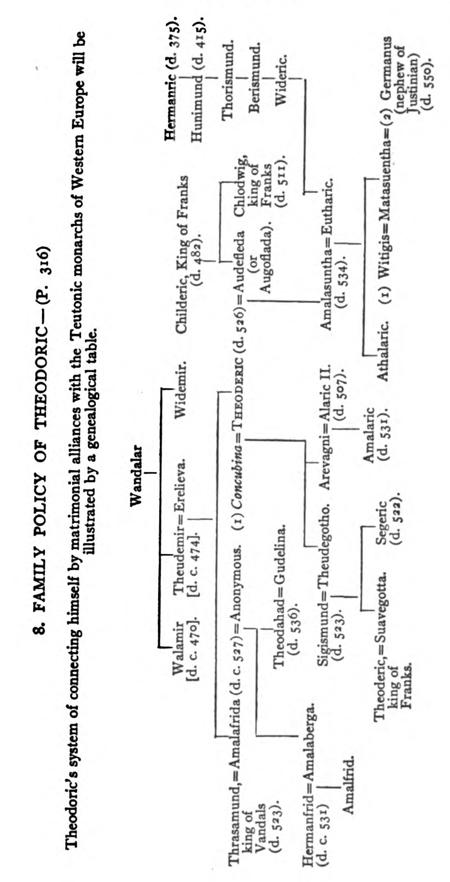
[VI-368]
NOTE 9.: AN INSCRIPTION OF THEODORIC — (P. 329)↩
The inscription on the draining of the Pomptine marshes by Theodoric, preserved at Mesa, is as follows: —
D(ominus) n(oster) glrsmus [= gloriosissimus] adq(ue) inclyt(us) rex Theodericus vict(or) ac triumf(ator), semper Aug(ustus), bono r(ei) p(ublicae) natus, custos libertatis et propagator Rom(ani) nom(inis), domitor gtium [= gentium] Decennovii [1] viae Appiae id(est) a Trip(ontio) usq(ue) Tarric(inam) iter et loca quae confluentib(us) ab utraq(ue) parte palud(ibus) per omn(es) retro princip(es) inundaverant [2] usui pub(li)co et securitate [leg. — ati, Mommsen] viantium admiranda propitio deo felic(ita) te restituit; operi iniuncto naviter insudante adq(ue) clementissimi princip(is) feliciter deserviente p(rae) coniis ex prosapie Deciorum Caec(ina) Mav(ortio ?) Basilio Decio v(iro) c(larissimo) et ill(ustri) ex p(raefecto) u(rbi) ex p(raefecto) p(raetorio), ex cons(ule) ord(inariao) pat(ricio), qui ad perpetuandam tanti domini gloriam per plurimos qui non ante [fuerant suppl. Mommsen] albeos deducta in mare aqua ignotae atavis et nimis antiquae reddidit siccitati.
See Corp. Inscr. Lat. X. p. 690 sqq.
THE DECLINE AND FALL OF THE ROMAN EMPIRE
VOLUME 7↩

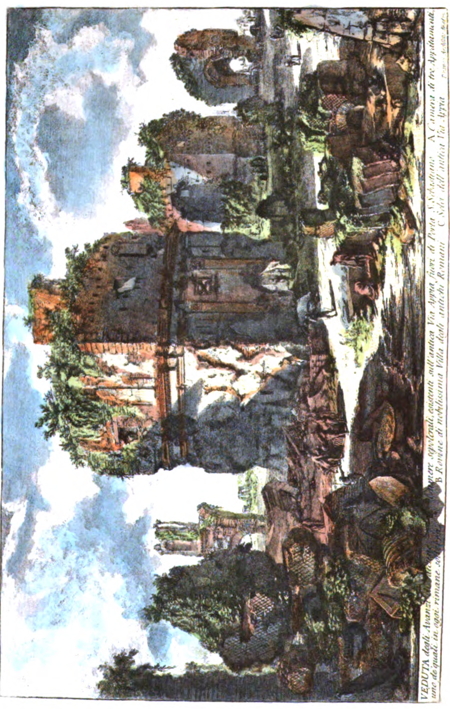
(See this image in horizontal aspect [here].)
Ruins of the Appian Way, from the San Sebastian Gate. Frontispiece. From a rare print.
LIST OF ILLUSTRATIONS↩
- Ruins of the Appian Way, from the San Sebastian Gate. Frontispiece. From a rare print.
- Map of a Part of Constantinople, to illustrate the Nika Riots, page 24
- Justinian, p. 60. From a rare engraving by Pine.
- Palace of Belisarius, Constantinople, p. 164. From an engraving.
- Antioch, p. 208. From an engraving.
- Column of Constantine, Constantinople, p. 290. From a photograph.
[VII-1]
CHAPTER XL↩
Elevation of Justin the Elder — Reign of Justinian: — I. The Empress Theodora — II. Factions of the Circus, and Sedition of Constantinople — III. Trade and Manufacture of Silk — IV. Finances and Taxes — V. Edifices of Justinian — Church of St. Sophia — Fortifications and Frontiers of the Eastern Empire — Abolition of the Schools of Athens and the Consulship of Rome
The emperor Justinian was born [1] near the ruins of Sardica (the modern Sophia), of an obscure race [2] of Barbarians, [3] [VII-2] the inhabitants of a wild and desolate country, to which the names of Dardania, of Dacia, and of Bulgaria have been successively applied. His elevation was prepared by the adventurous spirit of his uncle Justin, who, with two other peasants of the same village, deserted, for the profession of arms, the more useful employment of husbandmen or shepherds. [4] On foot, with a scanty provision of biscuit in their knapsacks, the three youths followed the highroad of Constantinople, and were soon enrolled, for their strength and stature, among the guards of the emperor Leo. Under the two succeeding reigns, the fortunate peasant emerged to wealth and honours; and his escape from some dangers which threatened his life was afterwards ascribed to the guardian angel who watches over the fate of kings. His long and laudable service in the Isaurian and Persian wars would not have preserved from oblivion the name of Justin; yet they might warrant the military promotion which in the course of fifty years he gradually obtained; the rank of tribune, of count, and of general, the dignity of senator, and the command of the guards, who obeyed him as their chief, at the important crisis when the emperor Anastasius was removed from the world. The powerful kinsmen whom he had raised and enriched were excluded from the throne; and the eunuch Amantius, who reigned in the palace, had secretly [VII-3] resolved to fix the diadem on the head of the most obsequious of his creatures. A liberal donative, to conciliate the suffrage of the guards, was entrusted for that purpose in the hands of their commander. But these weighty arguments were treacherously employed by Justin in his own favour; and, as no competitor presumed to appear, the Dacian peasant was invested with the purple, by the unanimous consent of the soldiers who knew him to be brave and gentle, of the clergy and people who believed him to be orthodox, and of the provincials who yielded a blind and implicit submission to the will of the capital. The elder Justin, as he is distinguished from another emperor of the same family and name, ascended the Byzantine throne at the age of sixty-eight years; and, had he been left to his own guidance, every moment of a nine years’ reign must have exposed to his subjects the impropriety of their choice. His ignorance was similar to that of Theodoric; and it is remarkable that, in an age not destitute of learning, two contemporary monarchs had never been instructed in the knowledge of the alphabet. But the genius of Justin was far inferior to that of the Gothic king; the experience of a soldier had not qualified him for the government of an empire [4a] ; and, though personally brave, the consciousness of his own weakness was naturally attended with doubt, distrust, and political apprehension. But the official business of the state was diligently and faithfully transacted by the quæstor Proclus: [5] and the aged emperor adopted the talents and ambition of his nephew Justinian, an aspiring youth, whom his uncle had drawn from the rustic solitude of Dacia, and educated at Constantinople, as the heir of his private fortune, and at length of the Eastern empire.
Since the eunuch Amantius had been defrauded of his [VII-4] money, it became necessary to deprive him of his life. The task was easily accomplished by the charge of a real or fictitious conspiracy; and the judges were informed, as an accumulation of guilt, that he was secretly addicted to the Manichæan heresy. [6] Amantius lost his head; three of his companions, the first domestics of the palace, were punished either with death or exile; and their unfortunate candidate for the purple was cast into a deep dungeon, overwhelmed with stones, and ignominiously thrown, without burial, into the sea. The ruin of Vitalian was a work of more difficulty and danger. That Gothic chief had rendered himself popular by the civil war which he boldly waged against Anastasius for the defence of the orthodox faith, and, after the conclusion of an advantageous treaty, he still remained in the neighbourhood of Constantinople at the head of a formidable and victorious army of Barbarians. By the frail security of oaths, he was tempted to relinquish this advantageous situation, and to trust his person within the walls of a city whose inhabitants, particularly the blue faction, were artfully incensed against him by the remembrance even of his pious hostilities. The emperor and his nephew embraced him as the faithful and worthy champion of the church and state; and gratefully adorned their favourite with the titles of consul and general; but, in the seventh month of his consulship, Vitalian was stabbed with seventeen wounds at the royal banquet; [7] and Justinian, who inherited the spoil, [VII-5] was accused as the assassin of a spiritual brother, to whom he had recently pledged his faith in the participation of the Christian mysteries. [8] After the fall of his rival, he was promoted, without any claim of military service, to the office of master-general of the Eastern armies, whom it was his duty to lead into the field against the public enemy. But, in the pursuit of fame, Justinian might have lost his present dominion over the age and weakness of his uncle; and instead of acquiring by Scythian or Persian trophies the applause of his countrymen, [9] the prudent warrior solicited their favour in the churches, the circus, and the senate of Constantinople. The Catholics were attached to the nephew of Justin, who, between the Nestorian and Eutychian heresies, trod the narrow path of inflexible and intolerant orthodoxy. [10] In the first days of the new reign, he prompted and gratified the popular enthusiasm against the memory of the deceased emperor. After a schism of thirty-four years, he reconciled the proud and angry spirit of the Roman pontiff, and spread among the Latins a favourable report of his pious respect for the apostolic see. The thrones of the East were filled with Catholic bishops devoted to his interest, the clergy and the monks were gained by his liberality, and the people were taught to pray for their future sovereign, the hope and [VII-6] pillar of the true religion. The magnificence of Justinian was displayed in the superior pomp of his public spectacles, an object not less sacred and important in the eyes of the multitude than the creed of Nice or Chalcedon; the expense of his consulship was estimated at two hundred and eighty-eight thousand pieces of gold; twenty lions, and thirty leopards, were produced at the same time in the amphitheatre, and a numerous train of horses, with their rich trappings, was bestowed as an extraordinary gift on the victorious charioteers of the circus. While he indulged the people of Constantinople, and received the addresses of foreign kings, the nephew of Justin assiduously cultivated the friendship of the senate. That venerable name seemed to qualify its members to declare the sense of the nation, and to regulate the succession of the Imperial throne; the feeble Anastasius had permitted the vigour of government to degenerate into the form or substance of an aristocracy; and the military officers who had obtained the senatorial rank were followed by their domestic guards, a band of veterans, whose arms or acclamations might fix in a tumultuous moment the diadem of the East. The treasures of the state were lavished to procure the voices of the senators, and their unanimous wish, that he would be pleased to adopt Justinian for his colleague, was communicated to the emperor. But this request, which too clearly admonished him of his approaching end, was unwelcome to the jealous temper of an aged monarch, desirous to retain the power which he was incapable of exercising; and Justin, holding his purple with both his hands, advised them to prefer, since an election was so profitable, some older candidate. Notwithstanding this reproach, the senate proceeded to decorate Justinian with the royal epithet of nobilissimus; and their decree was ratified by the affection or the fears of his uncle. After some time the languor of mind and body, to which he was reduced by an incurable wound in his thigh, indispensably required the aid of a guardian. He summoned the patriarch and senators; [VII-7] and in their presence solemnly placed the diadem on the head of his nephew, who was conducted from the palace to the circus, and saluted by the loud and joyful applause of the people. The life of Justin was prolonged about four months, but from the instant of this ceremony he was considered as dead to the empire, which acknowledged Justinian, in the forty-fifth year of his age, for the lawful sovereign of the East. [11]
From his elevation to his death, Justinian governed the Roman empire thirty-eight years, seven months, and thirteen days. The events of his reign, which excite our curious attention by their number, variety, and importance, are diligently related by the secretary of Belisarius, a rhetorician whom eloquence had promoted to the rank of senator and prefect of Constantinople. According to the vicissitudes of courage or servitude, of favour or disgrace, Procopius [12] successively composed the history, the panegyric, and the satire of his own times. The eight books of the Persian, Vandalic, and Gothic wars, [13] which are continued in the five books of Agathias, deserve our esteem as a laborious and successful imitation of the Attic, or at least of the Asiatic, [VII-8] writers of ancient Greece. His facts are collected from the personal experience and free conversation of a soldier, a statesman, and a traveller; his style continually aspires, and often attains, to the merit of strength and elegance; his reflections, more especially in the speeches, which he too frequently inserts, contain a rich fund of political knowledge; and the historian, excited by the generous ambition of pleasing and instructing posterity, appears to disdain the prejudices of the people and the flattery of courts. The writings of Procopius [14] were read and applauded by his contemporaries; [15] but, although he respectfully laid them at the foot of the throne, the pride of Justinian must have been wounded by the praise of an hero, who perpetually eclipses the glory of his inactive sovereign. The conscious dignity of independence was subdued by the hopes and fears of a slave; and the secretary of Belisarius laboured for pardon and reward in the six books of the Imperial edifices. He had dexterously chosen a subject of apparent splendour, in which he could loudly celebrate the genius, the magnificence, and the piety of a prince who, both as a conqueror and legislator, had [VII-9] surpassed the puerile virtues of Themistocles and Cyrus. [16] Disappointment might urge the flatterer to secret revenge; and the first glance of favour might again tempt him to suspend and suppress a libel, [17] in which the Roman Cyrus is degraded into an odious and contemptible tyrant, in which both the emperor and his consort Theodora are seriously represented as two demons, who had assumed an human form for the destruction of mankind. [18] Such base inconsistency must doubtless sully the reputation, and detract from the credit, of Procopius; yet, after the venom of his malignity has been suffered to exhale, the residue of the anecdotes, even the most disgraceful facts, some of which had been tenderly hinted in his public history, are established by their internal evidence, or the authentic monuments of the times. [19] From these various materials, I shall now proceed to describe the reign of Justinian, which will deserve and occupy an ample space. The present chapter will explain the elevation and character of Theodora, the factions of the circus, and the peaceful administration of the sovereign of [VII-10] the East. In the three succeeding chapters I shall relate the wars of Justinian which achieved the conquest of Africa and Italy; and I shall follow the victories of Belisarius and Narses, without disguising the vanity of their triumphs, or the hostile virtue of the Persian and Gothic heroes. The series of this and the following volume will embrace the jurisprudence and theology of the emperor; the controversies and sects which still divide the Oriental church; the reformation of the Roman law, which is obeyed or respected by the nations of modern Europe.
I. In the exercise of supreme power, the first act of Justinian was to divide it with the woman whom he loved, the famous Theodora, [20] whose strange elevation cannot be applauded as the triumph of female virtue. Under the reign of Anastasius, the care of the wild beasts maintained by the green faction of Constantinople was entrusted to Acacius, a native of the isle of Cyprus, who, from his employment, was surnamed the master of the bears. This honourable office was given after his death to another candidate, notwithstanding the diligence of his widow, who had already provided a husband and a successor. Acacius had left three daughters, Comito, [21] Theodora, and Anastasia, the eldest of whom did not then exceed the age of seven years. On a solemn festival, these helpless orphans were sent by their distressed and indignant mother, in the garb of suppliants, into the midst of the theatre; the green faction received them with contempt, the blues with compassion; and this difference, which sunk deep into the mind of Theodora, was felt long afterwards in the administration of the empire. As they improved in age and beauty, the three sisters were [VII-11] successively devoted to the public and private pleasures of the Byzantine people; and Theodora, after following Comito on the stage, in the dress of a slave, with a stool on her head, was at length permitted to exercise her independent talents. She neither danced, nor sung, nor played on the flute; her skill was confined to the pantomime arts; she excelled in buffoon characters, and, as often as the comedian swelled her cheeks, and complained with a ridiculous tone and gesture of the blows that were inflicted, the whole theatre of Constantinople resounded with laughter and applause. The beauty of Theodora [22] was the subject of more flattering praise, and the source of more exquisite delight. Her features were delicate and regular; her complexion, though somewhat pale, was tinged with a natural colour; every sensation was instantly expressed by the vivacity of her eyes; her easy motions displayed the graces of a small but elegant figure; and even love or adulation might proclaim that painting and poetry were incapable of delineating the matchless excellence of her form. But this form was degraded by the facility with which it was exposed to the public eye and prostituted to licentious desire. Her venal charms were abandoned to a promiscuous crowd of citizens and strangers, of every rank, and of every profession; the fortunate lover who had been promised a night of enjoyment was often driven from her bed by a stronger or more wealthy favourite; and, when she passed through the streets, her presence was avoided by all who wished to escape either the scandal or the temptation. The satirical historian has not blushed [23] to describe the [VII-12] naked scenes which Theodora was not ashamed to exhibit in the theatre. [24] After exhausting the arts of sensual pleasure, [25] she most ungratefully murmured against the parsimony of Nature; [26] but her murmurs, her pleasures, and her arts must be veiled in the obscurity of a learned language. After reigning for some time, the delight and contempt of the capital, she condescended to accompany Ecebolus, a native of Tyre, who had obtained the government of the African Pentapolis. But this union was frail and transient; Ecebolus soon rejected an expensive or faithless concubine; she was reduced at Alexandria to extreme distress; and, in her laborious return to Constantinople, every city of the East admired and enjoyed the fair Cyprian, whose merit appeared to justify her descent from the peculiar island of Venus. The vague commerce of Theodora, and the most detestable precautions, preserved her from the danger which she feared; yet once, and once only, she became a mother. The infant was saved and educated in Arabia, by his father, who imparted to him on his death-bed that he was the son of an empress. Filled with ambitious hopes, the unsuspecting youth immediately hastened to the palace of Constantinople, [VII-13] and was admitted to the presence of his mother. As he was never more seen, even after the decease of Theodora, she deserves the foul imputation of extinguishing with his life a secret so offensive to her Imperial virtue.
In the most abject state of her fortune and reputation, some vision, either of sleep or of fancy, had whispered to Theodora the pleasing assurance that she was destined to become the spouse of a potent monarch. Conscious of her approaching greatness, she returned from Paphlagonia to Constantinople; assumed, like a skilful actress, a more decent character; relieved her poverty by the laudable industry of spinning wool; and affected a life of chastity and solitude in a small house, which she afterwards changed into a magnificent temple. [27] Her beauty, assisted by art or accident, soon attracted, captivated, and fixed the patrician Justinian, who already reigned with absolute sway under the name of his uncle. Perhaps she contrived to enhance the value of a gift which she had so often lavished on the meanest of mankind; perhaps she inflamed, at first by modest delays, and at last by sensual allurements, the desires of a lover, who from nature or devotion was addicted to long vigils and abstemious diet. When his first transports had subsided, she still maintained the same ascendant over his mind, by the more solid merit of temper and understanding. Justinian delighted to ennoble and enrich the object of his affection; the treasures of the East were poured at her feet; and the nephew of Justin was determined, perhaps by religious scruples, to bestow on his concubine the sacred and legal character of a wife. But the laws of Rome expressly prohibited the marriage of a senator with any female who had been dishonoured by a servile origin or theatrical profession; the empress Lupicina, or Euphemia, a Barbarian of rustic manners but [VII-14] of irreproachable virtue, refused to accept a prostitute for her niece; and even Vigilantia, the superstitious mother of Justinian, though she acknowledged the wit and beauty of Theodora, was seriously apprehensive lest the levity and arrogance of that artful paramour might corrupt the piety and happiness of her son. These obstacles were removed by the inflexible constancy of Justinian. He patiently expected the death of the empress; he despised the tears of his mother, who soon sunk under the weight of her affliction; and a law was promulgated in the name of the emperor Justin, which abolished the rigid jurisprudence of antiquity. A glorious repentance (the words of the edict) was left open for the unhappy females who had prostituted their persons on the theatre, and they were permitted to contract a legal union with the most illustrious of the Romans. [28] This indulgence was speedily followed by the solemn nuptials of Justinian and Theodora; her dignity was gradually exalted with that of her lover; and, as soon as Justin had invested his nephew with the purple, the patriarch of Constantinople placed the diadem on the heads of the emperor and empress of the East. But the usual honours which the severity of Roman manners had allowed to the wives of princes could not satisfy either the ambition of Theodora or the fondness of Justinian. He seated her on the throne as an equal and independent colleague in the sovereignty of the empire, and an oath of allegiance was imposed on the governors of the provinces in the joint names of Justinian and Theodora. [29] The Eastern [VII-15] world fell prostrate before the genius and fortune of the daughter of Acacius. The prostitute, who, in the presence of innumerable spectators, had polluted the theatre of Constantinople, was adored as a queen in the same city, by grave magistrates, orthodox bishops, victorious generals, and captive monarchs. [30]
Those who believe that the female mind is totally depraved by the loss of chastity will eagerly listen to all the invectives of private envy or popular resentment, which have dissembled the virtues of Theodora, exaggerated her vices, and condemned with rigour the venal or voluntary sins of the youthful harlot. From a motive of shame or contempt, she often declined the servile homage of the multitude, escaped from the odious light of the capital, and passed the greatest part of the year in the palaces and gardens which were pleasantly seated on the sea-coast of the Propontis and the Bosphorus. Her private hours were devoted to the prudent as well as grateful care of her beauty, the luxury of the bath and table, and the long slumber of the evening and the morning. Her secret apartments were occupied by the favourite women and eunuchs, whose interests and passions she indulged at the expense of justice; the most illustrious personages of the state were crowded into a dark and sultry antichamber, and when at last, after tedious attendance, they were admitted to kiss the feet of Theodora, they experienced, as her humour might suggest, the silent arrogance of an empress or the capricious levity of a comedian. Her rapacious avarice to accumulate an immense treasure may be excused by the apprehension of her husband’s death, which could leave no [VII-16] alternative between ruin and the throne; and fear as well as ambition might exasperate Theodora against two generals, who, during a malady of the emperor, had rashly declared that they were not disposed to acquiesce in the choice of the capital. But the reproach of cruelty, so repugnant even to her softer vices, has left an indelible stain on the memory of Theodora. Her numerous spies observed, and zealously reported, every action, or word, or look, injurious to their royal mistress. Whomsoever they accused were cast into her peculiar prisons, [31] inaccessible to the inquiries of justice; and it was rumoured that the torture of the rack or scourge had been inflicted in the presence of a female tyrant, insensible to the voice of prayer or of pity. [32] Some of these unhappy victims perished in deep unwholesome dungeons, while others were permitted, after the loss of their limbs, their reason, or their fortune, to appear in the world the living monuments of her vengeance, which was commonly extended to the children of those whom she had suspected or injured. The senator, or bishop, whose death or exile Theodora had pronounced, was delivered to a trusty messenger, and his diligence was quickened by a menace from her own mouth. “If you fail in the execution of my commands, I swear by him who liveth for ever, that your skin shall be flayed from your body.” [33]
If the creed of Theodora had not been tainted with heresy, her exemplary devotion might have atoned, in the opinion of her contemporaries, for pride, avarice, and cruelty. But, if she employed her influence to assuage the intolerant fury of the emperor, the present age will allow some merit to her religion, [VII-17] and much indulgence to her speculative errors. [34] The name of Theodora was introduced, with equal honour, in all the pious and charitable foundations of Justinian; and the most benevolent institution of his reign may be ascribed to the sympathy of the empress for her less fortunate sisters, who had been seduced or compelled to embrace the trade of prostitution. A palace, on the Asiatic side of the Bosphorus, was converted into a stately and spacious monastery, and a liberal maintenance was assigned to five hundred women, who had been collected from the streets and brothels of Constantinople. In this safe and holy retreat, they were devoted to perpetual confinement; and the despair of some, who threw themselves headlong into the sea, was lost in the gratitude of the penitents, who had been delivered from sin and misery by their generous benefactress. [35] The prudence of Theodora is celebrated by Justinian himself; and his laws are attributed to the sage counsels of his most reverend wife, whom he had received as the gift of the Deity. [36] Her courage was displayed amidst the tumult of the people and the terrors of the court. Her chastity, from the moment of her union with Justinian, is founded on the silence of her implacable enemies; and, although the daughter of Acacius might be satiated with love, yet some applause is due to the firmness of a mind which could sacrifice pleasure and habit to the stronger sense either of duty or interest. The wishes and prayers of Theodora could never obtain the blessing of a lawful son, and she buried an infant daughter, the sole offspring of her marriage. [37] Notwithstanding [VII-18] this disappointment, her dominion was permanent and absolute; she preserved, by art or merit, the affections of Justinian; and their seeming dissensions were always fatal to the courtiers who believed them to be sincere. Perhaps her health had been impaired by the licentiousness of her youth; but it was always delicate, and she was directed by her physicians to use the Pythian warm baths. In this journey, the empress was followed by the Prætorian prefect, the great treasurer, several counts and patricians, and a splendid train of four thousand attendants; the highways were repaired at her approach; a palace was erected for her reception; and, as she passed through Bithynia, she distributed liberal alms to the churches, the monasteries, and the hospitals, that they might implore heaven for the restoration of her health. [38] At length, in the twenty-fourth year of her marriage, and the twenty-second of her reign, she was consumed by a cancer; [39] and the irreparable loss was deplored by her husband, who, in the room of a theatrical prostitute, might have selected the purest and most noble virgin of the East. [40]
II. A material difference may be observed in the games of antiquity: the most eminent of the Greeks were actors, the Romans were merely spectators. The Olympic stadium was [VII-19] open to wealth, merit, and ambition; and, if the candidates could depend on their personal skill and activity, they might pursue the footsteps of Diomede and Menelaus, and conduct their own horses in the rapid career. [41] Ten, twenty, forty, chariots were allowed to start at the same instant; a crown of leaves was the reward of the victor; and his fame, with that of his family and country, was chaunted in lyric strains more durable than monuments of brass and marble. But a senator, or even a citizen, conscious of his dignity, would have blushed to expose his person or his horses in the circus of Rome. The games were exhibited at the expense of the republic, the magistrates, or the emperors: but the reins were abandoned to servile hands; and, if the profits of a favourite charioteer sometimes exceeded those of an advocate, they must be considered as the effects of popular extravagance, and the high wages of a disgraceful profession. The race, in its first institution, was a simple contest of two chariots, whose drivers were distinguished by white and red liveries; two additional colours, a light green and a cærulean blue, were afterwards introduced; and, as the races were repeated twenty-five times, one hundred chariots contributed in the same day to the pomp of the circus. The four factions soon acquired a legal establishment, and a mysterious origin; and their fanciful colours were derived from the various appearances of nature in the four seasons of the year: the red dog-star of summer, the snows of winter, the deep shades of autumn, and the cheerful verdure of the spring. [42] Another interpretation [VII-20] preferred the elements to the seasons, and the struggle of the green and blue was supposed to represent the conflict of the earth and sea. Their respective victories announced either a plentiful harvest or a prosperous navigation, and the hostility of the husbandmen and mariners was somewhat less absurd than the blind ardour of the Roman people, who devoted their lives and fortunes to the colour which they had espoused. Such folly was disdained and indulged by the wisest princes; but the names of Caligula, Nero, Vitellius, Verus, Commodus, Caracalla, and Elagabalus were enrolled in the blue or green factions of the circus; they frequented their stables, applauded their favourites, chastised their antagonists, and deserved the esteem of the populace by the natural or affected imitation of their manners. The bloody and tumultuous contest continued to disturb the public festivity till the last age of the spectacles of Rome; and Theodoric, from a motive of justice or affection, interposed his authority to protect the greens against the violence of a consul and a patrician, who were passionately addicted to the blue faction of the circus. [43]
Constantinople adopted the follies, though not the virtues, of ancient Rome; and the same factions which had agitated the circus raged with redoubled fury in the hippodrome. Under the reign of Anastasius, this popular frenzy was inflamed by religious zeal; and the greens, who had treacherously concealed stones and daggers under baskets of fruit, massacred, at a solemn festival, three thousand of their blue adversaries. [44] From the capital, this pestilence was diffused [VII-21] into the provinces and cities of the East, and the sportive distinction of two colours produced two strong and irreconcileable factions, which shook the foundations of a feeble government. [45] The popular dissensions, founded on the most serious interest, or holy pretence, have scarcely equalled the obstinacy of this wanton discord, which invaded the peace of families, divided friends and brothers, and tempted the female sex, though seldom seen in the circus, to espouse the inclinations of their lovers or to contradict the wishes of their husbands. Every law, either human or divine, was trampled underfoot, and, as long as the party was successful, its deluded followers appeared careless of private distress or public calamity. The licence, without the freedom, of democracy was revived at Antioch and Constantinople, and the support of a faction became necessary to every candidate for civil or ecclesiastical honours. A secret attachment to the family or sect of Anastasius was imputed to the greens; the blues were zealously devoted to the cause of orthodoxy and Justinian, [46] and their grateful patron protected, above five years, the disorders of a faction, whose seasonable tumults overawed the palace, the senate, and the capitals of the East. Insolent with royal favour, the blues affected to strike terror by a peculiar and Barbaric dress, the long hair of the Huns, their close sleeves and ample garments, a lofty step, and a sonorous voice. In the day they concealed their two-edged poniards, but in the night they boldly assembled in arms and in numerous bands, prepared for every act of violence and rapine. Their adversaries of the green faction, or even inoffensive [VII-22] citizens, were stripped and often murdered by these nocturnal robbers, and it became dangerous to wear any gold buttons or girdles, or to appear at a late hour in the streets of a peaceful capital. A daring spirit, rising with impunity, proceeded to violate the safeguard of private houses; and fire was employed to facilitate the attack, or to conceal the crimes, of these factious rioters. No place was safe or sacred from their depredations; to gratify either avarice or revenge, they profusely spilt the blood of the innocent; churches and altars were polluted by atrocious murders; and it was the boast of the assassins that their dexterity could always inflict a mortal wound with a single stroke of their dagger. The dissolute youth of Constantinople adopted the blue livery of disorder; the laws were silent, and the bonds of society were relaxed; creditors were compelled to resign their obligations; judges to reverse their sentence; masters to enfranchise their slaves; fathers to supply the extravagance of their children; noble matrons were prostituted to the lust of their servants; beautiful boys were torn from the arms of their parents; and wives, unless they preferred a voluntary death, were ravished in the presence of their husbands. [47] The despair of the greens, who were persecuted by their enemies, and deserted by the magistrate, assumed the privilege of defence, perhaps of retaliation; but those who survived the combat were dragged to execution, and the unhappy fugitives, escaping to woods and caverns, preyed without mercy on the society from whence they were expelled. Those ministers of justice who had courage to punish the crimes, and to brave the resentment, of the blues became the victims of their indiscreet zeal; a prefect of Constantinople fled for refuge to the holy sepulchre, a count of the East was ignominiously whipped, and a governor of Cilicia was hanged, by the order of Theodora, on [VII-23] the tomb of two assassins, whom he had condemned for the murder of his groom and a daring attack upon his own life. [48] An aspiring candidate may be tempted to build his greatness on the public confusion, but it is the interest as well as the duty of a sovereign to maintain the authority of the laws. The first edict of Justinian, which was often repeated and sometimes executed, announced his firm resolution to support the innocent and to chastise the guilty of every denomination and colour. Yet the balance of justice was still inclined in favour of the blue faction, by the secret affection, the habits, and the fears of the emperor; his equity, after an apparent struggle, submitted, without reluctance, to the implacable passions of Theodora, and the empress never forgot, or forgave, the injuries of the comedian. At the accession of the younger Justin, the proclamation of equal and rigorous justice indirectly condemned the partiality of the former reign. “Ye blues, Justinian is no more! ye greens, he is still alive!” [49]
A sedition, which almost laid Constantinople in ashes, was excited by the mutual hatred and momentary reconciliation of the two factions. In the fifth year of his reign, Justinian celebrated the festival of the ides of January: the games were incessantly disturbed by the clamorous discontent of the greens; till the twenty-second race, the emperor maintained his silent gravity; at length, yielding to his impatience, he condescended to hold, in abrupt sentences, and by the voice of a crier, the most singular dialogue [50] that ever passed [VII-24] between a prince and his subjects. Their first complaints were respectful and modest; they accused the subordinate ministers of oppression, and proclaimed their wishes for the long life and victory of the emperor. “Be patient and attentive, ye insolent railers!” exclaimed Justinian; “be mute, ye Jews, Samaritans, and Manichæans!” The greens still attempted to awaken his compassion. “We are poor, we are innocent, we are injured, we dare not pass through the streets: a general persecution is exercised against our name and colour. Let us die, O emperor! but let us die by your command, and for your service!” But the repetition of partial and passionate invectives degraded, in their eyes, the majesty of the purple; they renounced allegiance to the prince who refused justice to his people; lamented that the father of Justinian had been born; and branded his son with the opprobrious names of an homicide, an ass, [51] and a perjured tyrant. “Do you despise your lives?” cried the indignant monarch: the blues rose with fury from their seats; their hostile clamours thundered in the hippodrome; and their adversaries, deserting the unequal contest, spread terror and despair through the streets of Constantinople. At this dangerous moment, seven notorious assassins of both factions, who had been condemned by the prefect, were carried round the city, and afterwards transported to the place of execution in the suburb of Pera. Four were immediately beheaded; a fifth was hanged; but when the same punishment was inflicted on the remaining two, the rope broke, they fell alive to the ground, the populace applauded their escape, and the monks of St. Conon, issuing from the neighbouring convent, conveyed them in a boat to the sanctuary of the church. [52] As [VII-none] [VII-25] one of these criminals was of the blue, and the other of the green, livery, the two factions were equally provoked by the cruelty of their oppressor, or the ingratitude of their patron; and a short truce was concluded, till they had delivered their prisoners and satisfied their revenge. The palace of the prefect, who withstood the seditious torrent, was instantly burnt, his officers and guards were massacred, the prisons were forced open, and freedom was restored to those who could only use it for the public destruction. A military force, which had been despatched to the aid of the civil magistrate, was fiercely encountered by an armed multitude, whose numbers and boldness continually increased; and the Heruli, the wildest Barbarians in the service of the empire, overturned the priests and their relics, which, from a pious motive, had been rashly interposed to separate the bloody conflict. The tumult was exasperated by this sacrilege, the people fought with enthusiasm in the cause of God; the women, from the roofs and windows, showered stones on the heads of the soliders, who darted firebrands against the houses; and the various flames, which had been kindled by the hands of citizens and strangers spread without control over the face of the city. The conflagration involved the cathedral of St. Sophia, the baths of Zeuxippus, a part of the palace, from the first entrance to the altar of Mars, and the long portico from the palace to the forum of Constantine; a large hospital, with the sick patients, was consumed; many churches and stately edifices were destroyed, and an immense treasure of gold and silver was either melted or lost. From such scenes of horror and distress, the wise and wealthy citizens escaped over the Bosphorus to the Asiatic side; and during five days Constantinople was abandoned to the factions, whose watch-word, Nika, vanquish! has given a name to this memorable sedition. [53]
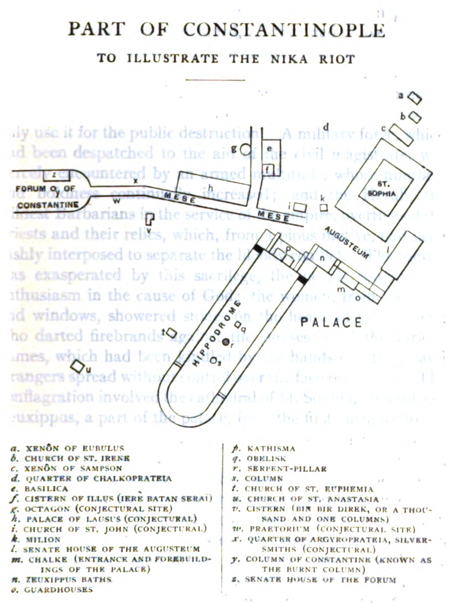
Map of a Part of Constantinople, to illustrate the Nika Riots.
As long as the factions were divided, the triumphant blues [VII-26] and desponding greens appeared to behold with the same indifference the disorders of the state. They agreed to censure the corrupt management of justice and the finance; and the two responsible ministers, the artful Tribonian and the rapacious John of Cappadocia, were loudly arraigned as the authors of the public misery. The peaceful murmurs of the people would have been disregarded: they were heard with respect when the city was in flames; the quæstor and the prefect were instantly removed, and their offices were filled by two senators of blameless integrity. After this popular concession, Justinian proceeded to the hippodrome to confess his own errors and to accept the repentance of his grateful subjects; but they distrusted his assurances, though solemnly pronounced in the presence of the holy gospels; and the emperor, alarmed by their distrust, retreated with precipitation to the strong fortress of the palace. The obstinacy of the tumult was now imputed to a secret and ambitious conspiracy, and a suspicion was entertained that the insurgents, more especially the green faction, had been supplied with arms and money by Hypatius and Pompey, two patricians, who could neither forget with honour, nor remember with safety, that they were the nephews of the emperor Anastasius. Capriciously trusted, disgraced, and pardoned by the jealous levity of the monarch, they had appeared as loyal servants before the throne; and, during five days of the tumult, they were detained as important hostages; till at length, the fears of Justinian prevailing over his prudence, he viewed the two brothers in the light of spies, perhaps of assassins, and sternly commanded them to depart from the palace. After a fruitless representation that obedience might lead to involuntary treason, they retired to their houses, and in the morning of the sixth day Hypatius was surrounded and seized by the people, who, regardless of his virtuous resistance and the tears of his [VII-27] wife, transported their favourite to the forum of Constantine, and, instead of a diadem, placed a rich collar on his head. If the usurper, who afterwards pleaded the merit of his delay, had complied with the advice of his senate, and urged the fury of the multitude, their first irresistible effort might have oppressed or expelled his trembling competitor. The Byzantine palace enjoyed a free communication with the sea; vessels lay ready at the garden-stairs; and a secret resolution was already formed to convey the emperor with his family and treasures to a safe retreat, at some distance from the capital.
Justinian was lost, if the prostitute whom he raised from the theatre had not renounced the timidity, as well as the virtues, of her sex. In the midst of a council, where Belisarius was present, Theodora alone displayed the spirit of an hero; and she alone, without apprehending his future hatred, could save the emperor from the imminent danger and his unworthy fears. “If flight,” said the consort of Justinian, “were the only means of safety, yet I should disdain to fly. Death is the condition of our birth; but they who have reigned should never survive the loss of dignity and dominion. I implore heaven that I may never be seen, not a day, without my diadem and purple; that I may no longer behold the light, when I cease to be saluted with the name of queen. If you resolve, O Cæsar! to fly, you have treasures; behold the sea, you have ships; but tremble lest the desire of life should expose you to wretched exile and ignominious death. For my own part, I adhere to the maxim of antiquity, that the throne is a glorious sepulchre.” The firmness of a woman restored the courage to deliberate and act, and courage soon discovers the resources of the most desperate situation. It was an easy and a decisive measure to revive the animosity of the factions; the blues were astonished at their own guilt and folly, that a trifling injury should provoke them to conspire with their implacable enemies against a gracious and liberal benefactor; they again proclaimed the majesty of Justinian, and the greens, with their upstart emperor, were left alone in the [VII-28] hippodrome. The fidelity of the guards was doubtful; but the military force of Justinian consisted in three thousand veterans, who had been trained to valour and discipline in the Persian and Illyrian wars. Under the command of Belisarius and Mundus, they silently marched in two divisions from the palace, forced their obscure way through narrow passages, expiring flames, and falling edifices, and burst open at the same moment the two opposite gates of the hippodrome. In this narrow space, the disorderly and affrighted crowd was incapable of resisting on either side a firm and regular attack; the blues signalised the fury of their repentance; and it is computed that above thirty thousand persons were slain in the merciless and promiscuous carnage of the day. Hypatius was dragged from his throne, and conducted with his brother Pompey to the feet of the emperor; they implored his clemency; but their crime was manifest, their innocence uncertain, and Justinian had been too much terrified to forgive. The next morning the two nephews of Anastasius, with eighteen illustrious accomplices of patrician or consular rank, were privately executed by the soldiers; their bodies were thrown into the sea, their palaces razed, and their fortunes confiscated. The hippodrome itself was condemned during several years to a mournful silence; with the restoration of the games, the same disorders revived; and the blue and green factions continued to afflict the reign of Justinian, and to disturb the tranquillity of the Eastern empire. [54]
III. That empire, after Rome was Barbarous, still embraced the nations whom she had conquered beyond the Hadriatic and as far as the frontiers of Ethiopia and Persia. [VII-29] Justinian reigned over sixty-four provinces and nine hundred and thirty-five cities; [55] his dominions were blessed by nature with the advantages of soil, situation, and climate; and the improvements of human art had been perpetually diffused along the coast of the Mediterranean and the banks of the Nile, from ancient Troy to the Egyptian Thebes. Abraham [56] had been relieved by the well-known plenty of Egypt; the same country, a small and populous tract, was still capable of exporting each year two hundred and sixty thousand quarters of wheat for the use of Constantinople; [57] and the capital of Justinian was supplied with the manufactures of Sidon, fifteen centuries after they had been celebrated in the poems of Homer. [58] The annual powers of vegetation, instead of being exhausted by two thousand harvests, were renewed and invigorated by skilful husbandry, rich manure, and seasonable repose. The breed of domestic animals was infinitely multiplied. Plantations, buildings, and the instruments of labour and luxury, which are more durable than the term of human life, were accumulated by the care of successive generations. Tradition preserved, and experience simplified, the humble practice of the arts; society was enriched by the division of labour and the facility of exchange; and [VII-30] every Roman was lodged, clothed, and subsisted by the industry of a thousand hands. The invention of the loom and distaff has been piously ascribed to the gods. In every age, a variety of animal and vegetable productions, hair, skins, wool, flax, cotton, and at length silk, have been skilfully manufactured to hide or adorn the human body; they were stained with an infusion of permanent colours; and the pencil was successfully employed to improve the labours of the loom. In the choice of those colours [59] which imitate the beauties of nature, the freedom of taste and fashion was indulged; but the deep purple [60] which the Phœnicians extracted from a shell-fish was restrained to the sacred person and palace of the emperor; and the penalties of treason were denounced against the ambitious subjects who dared to usurp the prerogative of the throne. [61]
I need not explain that silk [62] is originally spun from the [VII-31] bowels of a caterpillar, and that it composes the golden tomb from whence a worm emerges in the form of a butterfly. Till the reign of Justinian, the silk-worms who feed on the leaves of the white mulberry-tree were confined to China; those of the pine, the oak, and the ash were common in the forests both of Asia and Europe; but, as their education is more difficult and their produce more uncertain, they were generally neglected, except in the little island of Ceos, near the coast of Attica. A thin gauze was procured from their webs, and this Cean manufacture, the invention of a woman, for female use, was long admired both in the East and at Rome. Whatever suspicions may be raised by the garments of the Medes and Assyrians, Virgil is the most ancient writer who expressly mentions the soft wool which was combed from the trees of the Seres or Chinese; [63] and this natural error, less marvellous than the truth, was slowly corrected by the knowledge of a valuable insect, the first artificer of the luxury of nations. That rare and elegant luxury was censured, in the reign of Tiberius, by the gravest of the Romans; and Pliny, in affected though forcible language, has condemned the thirst of gain, which explored the last confines of the earth for the pernicious purpose of exposing to the public eye naked draperies and [VII-32] transparent matrons. [64] A dress which shewed the turn of the limbs and colour of the skin might gratify vanity or provoke desire; the silks which had been closely woven in China were sometimes unravelled by the Phœnician women, and the precious materials were multiplied by a looser texture and the intermixture of linen threads. [65] Two hundred years after the age of Pliny, the use of pure or even of mixed silks was confined to the female sex, till the opulent citizens of Rome and the provinces were insensibly familiarised with the example of Elagabalus, the first who, by this effeminate habit, had sullied the dignity of an emperor and a man. Aurelian complained that a pound of silk was sold at Rome for twelve ounces of gold; but the supply increased with the demand, and the price diminished with the supply. If accident or monopoly sometimes raised the value even above the standard of Aurelian, the manufacturers of Tyre and Berytus were sometimes compelled, by the operation of the same causes, to content themselves with a ninth part of that extravagant rate. [66] [VII-33] A law was thought necessary to discriminate the dress of comedians from that of senators; and of the silk exported from its native country the far greater part was consumed by the subjects of Justinian. They were still more intimately acquainted with a shell-fish of the Mediterranean, surnamed the silk-worm of the sea; the fine wool or hair by which the mother-of-pearl affixes itself to the rock is now manufactured for curiosity rather than use; and a robe obtained from the same singular materials was the gift of the Roman emperor to the satraps of Armenia. [67]
A valuable merchandise of small bulk is capable of defraying the expense of land carriage; and the caravans traversed the whole latitude of Asia in two hundred and forty-three days from the Chinese ocean to the sea-coast of Syria. Silk was immediately delivered to the Romans by the Persian merchants, [68] who frequented the fairs of Armenia and Nisibis; but this trade, which in the intervals of truce was oppressed by avarice and jealousy, was totally interrupted by the long wars of the rival monarchies. The great king might proudly number Sogdiana, and even Serica, among the provinces of his empire; but his real dominion was bounded by the Oxus, and his useful intercourse with the Sogdoites, beyond the river, depended on the pleasure of their conquerors, the white Huns and the Turks, who successively reigned over that industrious people. Yet the most savage dominion has not extirpated the seeds of agriculture and commerce in a region [VII-34] which is celebrated as one of the four gardens of Asia; the cities of Samarcand and Bochara are advantageously seated for the exchange of its various productions; and their merchants purchased from the Chinese [69] the raw or manufactured silk which they transported into Persia for the use of the Roman empire. In the vain capital of China, the Sogdian caravans were entertained as the suppliant embassies of tributary kingdoms, and, if they returned in safety, the bold adventure was rewarded with exorbitant gain. But the difficult and perilous march from Samarcand to the first town of Shensi could not be performed in less than sixty, eighty, or one hundred days; as soon as they had passed the Jaxartes, they entered the desert; and the wandering hords, unless they are restrained by armies and garrisons, have always considered the citizen and the traveller as the objects of lawful rapine. To escape the Tartar robbers and the tyrants of Persia, the silk caravans explored a more southern road; they traversed the mountains of Thibet, descended the streams of the Ganges or the Indus, and patiently expected, in the ports of Guzerat and Malabar, the annual fleets of the West. [70] But the dangers of the desert were found less intolerable than toil, hunger, and the loss of time; the attempt was seldom renewed; and the only European who has passed that unfrequented [VII-35] way applauds his own diligence, that in nine months after his departure from Pekin he reached the mouth of the Indus. The ocean, however, was open to the free communication of mankind. From the great river to the tropic of Cancer, the provinces of China were subdued and civilised by the emperors of the North; they were filled about the time of the Christian era with cities and men, mulberry-trees and their precious inhabitants; and, if the Chinese, with the knowledge of the compass, had possessed the genius of the Greeks or Phœnicians, they might have spread their discoveries over the southern hemisphere. I am not qualified to examine, and I am not disposed to believe, their distant voyages to the Persian gulf or the Cape of Good Hope; but their ancestors might equal the labours and success of the present race, and the sphere of their navigation might extend from the isles of Japan to the straits of Malacca, the pillars, if we may apply that name, of an Oriental Hercules. [71] Without losing sight of land, they might sail along the coast to the extreme promontory of Achin, which is annually visited by ten or twelve ships laden with the productions, the manufactures, and even the artificers of China; the island of Sumatra and the opposite peninsula are faintly delineated [72] as the regions of gold and silver; and the trading cities named in the geography of Ptolemy may indicate that this wealth was not solely derived from the mines. The direct interval between Sumatra and Ceylon is about three hundred leagues; the Chinese and [VII-36] Indian navigators were conducted by the flight of birds and periodical winds, and the ocean might be securely traversed in square-built ships, which, instead of iron, were sewed together with the strong thread of the cocoa-nut. Ceylon, Serendib, or Taprobana was divided between two hostile princes; one of whom possessed the mountains, the elephants, and the luminous carbuncle; and the other enjoyed the more solid riches of domestic industry, foreign trade, and the capacious harbour of Trinquemale, which received and dismissed the fleets of the East and West. In this hospitable isle, at an equal distance (as it was computed) from their respective countries, the silk merchants of China, who had collected in their voyages aloes, cloves, nutmegs, and sandal-wood, maintained a free and beneficial commerce with the inhabitants of the Persian gulf. The subjects of the great king exalted, without a rival, his power and magnificence; and the Roman, who confounded their vanity by comparing his paltry coin with a gold medal of the emperor Anastasius, had sailed to Ceylon in an Æthiopian ship, as a simple passenger. [73]
As silk became of indispensable use, the emperor Justinian saw, with concern, that the Persians had occupied by land and sea the monopoly of this important supply, and that the wealth of his subjects was continually drained by a nation of enemies and idolaters. An active government would have restored the trade of Egypt and the navigation of the Red Sea, which had decayed with the prosperity of the empire; and the Roman vessels might have sailed, for the purchase of silk, to the ports of Ceylon, of Malacca, or even of China. Justinian embraced a more humble expedient, and solicited the aid of his Christian allies, the Æthiopians of Abyssinia, who had [VII-37] recently acquired the arts of navigation, the spirit of trade, and the seaport of Adulis, [74] still decorated with the trophies of a Grecian conqueror. Along the African coast, they penetrated to the equator in search of gold, emeralds, and aromatics; but they wisely declined an unequal competition, in which they must be always prevented by the vicinity of the Persians to the markets of India; and the emperor submitted to the disappointment, till his wishes were gratified by an unexpected event. The gospel had been preached to the Indians: a bishop already governed the Christians of St. Thomas on the pepper coast of Malabar; a church was planted in Ceylon; and the missionaries pursued the footsteps of commerce to the extremities of Asia. [75] Two Persian monks had long resided in China, perhaps in the royal city of Nankin, the seat of a monarch addicted to foreign superstitions, and who actually received an embassy from the isle of Ceylon. Amidst their pious occupations, they viewed with a curious eye the common dress of the Chinese, the manufactures of silk, and the myriads of silk-worms, whose education (either on trees or in houses) had once been considered as the labour of queens. [76] They soon discovered that it was impracticable to transport the short-lived insect, but that in the eggs a numerous progeny might be preserved and multiplied in a distant climate. Religion or interest had more power over the Persian monks than the love of their country: after a long [VII-38] journey, they arrived at Constantinople, imparted their project to the emperor, and were liberally encouraged by the gifts and promises of Justinian. To the historians of that prince, a campaign at the foot of Mount Caucasus has seemed more deserving of a minute relation than the labours of these missionaries of commerce, who again entered China, deceived a jealous people by concealing the eggs of the silk-worm in a hollow cane, and returned in triumph with the spoils of the East. Under their direction, the eggs were hatched at the proper season by the artificial heat of dung; the worms were fed with mulberry leaves; they lived and laboured in a foreign climate; a sufficient number of butterflies was saved to propagate the race; and trees were planted to supply the nourishment of the rising generations. Experience and reflection corrected the errors of a new attempt, and the Sogdoite ambassadors acknowledged, in the succeeding reign, that the Romans were not inferior to the natives of China in the education of the insects and the manufactures of silk, [77] in which both China and Constantinople have been surpassed by the industry of modern Europe. I am not insensible of the benefits of elegant luxury; yet I reflect with some pain that, if the importers of silk had introduced the art of printing, already practised by the Chinese, the comedies of Menander and the entire decads of Livy would have been perpetuated in the editions of the sixth century. A larger view of the globe might at least have promoted the improvement of speculative science, but the Christian geography was forcibly extracted from texts of scripture, and the study of nature was the surest symptom of an unbelieving mind. The orthodox faith confined the habitable world to one temperate zone, and represented [VII-39] the earth as an oblong surface, four hundred days’ journey in length, two hundred in breadth, encompassed by the ocean, and covered by the solid crystal of the firmament. [78]
IV. The subjects of Justinian were dissatisfied with the times, and with the government. Europe was over-run by the Barbarians, and Asia by the monks; the poverty of the West discouraged the trade and manufactures of the East; the produce of labour was consumed by the unprofitable servants of the church, the state, and the army; and a rapid decrease was felt in the fixed and circulating capitals which constitute the national wealth. The public distress had been alleviated by the economy of Anastasius, and that prudent emperor accumulated an immense treasure while he delivered his people from the most odious or oppressive taxes. Their gratitude universally applauded the abolition of the gold of affliction, a personal tribute on the industry of the poor, [79] but more intolerable, as it should seem, in the form than in the substance, since the flourishing city of Edessa paid only one hundred [VII-40] and forty pounds of gold, which was collected in four years from ten thousand artificers. [80] Yet such was the parsimony which supported this liberal disposition that, in a reign of twenty-seven years, Anastasius saved, from his annual revenue, the enormous sum of thirteen millions sterling, or three hundred and twenty thousand pounds of gold. [81] His example was neglected, and his treasure was abused, by the nephew of Justin. The riches of Justinian were speedily exhausted by alms and buildings, by ambitious wars, and ignominious treaties. His revenues were found inadequate to his expenses. Every art was tried to extort from the people the gold and silver which he scattered with a lavish hand from Persia to France; [82] his reign was marked by the vicissitudes, or rather by the combat, of rapaciousness and avarice, of splendour and poverty; he lived with the reputation of hidden treasures, [83] and bequeathed to his successor the payment of his debts. [84] Such a character has been justly accused by the voice of the people and of posterity; but public discontent is credulous; private malice is bold; and a lover of truth will peruse with a suspicious eye the instructive anecdotes of Procopius. The secret historian represents only the vices of [VII-41] Justinian, and those vices are darkened by his malevolent pencil. Ambiguous actions are imputed to the worst motives; error is confounded with guilt, accident with design, and laws with abuses; the partial injustice of a moment is dexterously applied as the general maxim of a reign of thirty-two years; the emperor alone is made responsible for the faults of his officers, the disorders of the times, and the corruption of his subjects; and even the calamities of nature, plagues, earthquakes, and inundations are imputed to the prince of the demons, who had mischievously assumed the form of Justinian. [85]
After this precaution I shall briefly relate the anecdotes of avarice and rapine, under the following heads: I. Justinian was so profuse that he could not be liberal. The civil and military officers, when they were admitted into the service of the palace, obtained an humble rank and a moderate stipend; they ascended by seniority to a station of affluence and repose; the annual pensions, of which the most honourable class was abolished by Justinian, amounted to four hundred thousand pounds; and this domestic economy was deplored by the venal or indigent courtiers as the last outrage on the majesty of the empire. The posts, the salaries of physicians, and the nocturnal illuminations were objects of more general concern; and the cities might justly complain that he usurped the municipal revenues which had been appropriated to these useful institutions. Even the soldiers were injured; and such was the decay of military spirit that they were injured with impunity. The emperor refused, at the return of each fifth year, the customary donative of five pieces of gold, reduced his veterans to beg their bread, and suffered unpaid armies to melt away in the wars of Italy and Persia. II. The humanity of his predecessors had always remitted, in some auspicious circumstance of their reign, the arrears of [VII-42] the public tribute; and they dexterously assumed the merit of resigning those claims which it was impracticable to enforce. “Justinian in the space of thirty-two years has never granted a similar indulgence; and many of his subjects have renounced the possession of those lands whose value is insufficient to satisfy the demands of the treasury. To the cities which had suffered by hostile inroads, Anastasius promised a general exemption of seven years: the provinces of Justinian have been ravaged by the Persians and Arabs, the Huns and Sclavonians; but his vain and ridiculous dispensations of a single year have been confined to those places which were actually taken by the enemy.” Such is the language of the secret historian, who expressly denies that any indulgence was granted to Palestine after the revolt of the Samaritans: a false and odious charge, confuted by the authentic record, which attests a relief of thirteen centenaries of gold (fifty-two thousand pounds) obtained for that desolate province by the intercession of St. Sabas. [86] III. Procopius has not condescended to explain the system of taxation, which fell like a hail-storm upon the land, like a devouring pestilence on its inhabitants; but we should become the accomplices of his malignity, if we imputed to Justinian alone the ancient though rigorous principle that a whole district should be condemned to sustain the partial loss of the persons or property of individuals. The Annona, or supply of corn for the use of the army and capital, was a grievous and arbitrary exaction, which exceeded, perhaps in a tenfold proportion, the ability of the farmer; and his distress was aggravated by the partial injustice of weights and measures, and the expense and labour of distant carriage. In a time of scarcity an extraordinary [VII-43] requisition was made to the adjacent provinces of Thrace, Bithynia, and Phrygia; but the proprietors, after a wearisome journey and a perilous navigation, received so inadequate a compensation that they would have chosen the alternative of delivering both the corn and price at the doors of their granaries. These precautions might indicate a tender solicitude for the welfare of the capital; yet Constantinople did not escape the rapacious despotism of Justinian. Till his reign, the straits of the Bosphorus and Hellespont were open to the freedom of trade, and nothing was prohibited except the exportation of arms for the service of the Barbarians. At each of these gates of the city, a prætor was stationed, the minister of Imperial avarice; heavy customs were imposed on the vessels and their merchandise; the oppression was retaliated on the helpless consumer; the poor were afflicted by the artificial scarcity and exorbitant price of the market; and a people, accustomed to depend on the liberality of their prince, might sometimes complain of the deficiency of water and bread. [87] The aerial tribute, without a name, a law, or a definite object, was an annual gift of one hundred and twenty thousand pounds, which the emperor accepted from his Prætorian prefect; and the means of payment were abandoned to the discretion of that powerful magistrate. IV. Even such a tax was less intolerable than the privilege of monopolies, which checked the fair competition of industry, and, for the sake of a small and dishonest gain, imposed an arbitrary burthen on the wants and luxury of the subject. “As soon (I transcribe the Anecdotes) as the exclusive sale of silk was usurped by the Imperial treasurer, a whole people, the manufacturers of Tyre and Berytus, was reduced to extreme misery, and either perished with hunger or fled to the hostile dominions of Persia.” [VII-44] A province might suffer by the decay of its manufactures, but in this example of silk Procopius has partially overlooked the inestimable and lasting benefit which the empire received from the curiosity of Justinian. His addition of one seventh to the ordinary price of copper money may be interpreted with the same candour; and the alteration, which might be wise, appears to have been innocent; since he neither alloyed the purity, nor enhanced the value, of the gold coin, [88] the legal measure of public and private payments. V. The ample jurisdiction required by the farmers of the revenue to accomplish their engagements might be placed in an odious light, as if they had purchased from the emperor the lives and fortunes of their fellow-citizens. And a more direct sale of honours and offices was transacted in the palace, with the permission, or at least with the connivance, of Justinian and Theodora. The claims of merit, even those of favour, were disregarded, and it was almost reasonable to expect that the bold adventurer who had undertaken the trade of a magistrate should find a rich compensation for infamy, labour, danger, the debts which he had contracted, and the heavy interest which he paid. A sense of the disgrace and mischief of this venal practice at length awakened the slumbering virtue of Justinian; and he attempted, by the sanction of oaths [89] and penalties, to guard the integrity of his government; but at the end of a year of perjury his rigorous edict was suspended, and corruption licentiously abused her triumph over the impotence of the laws. VI. The testament of Eulalius, count of the domestics, declared the emperor his [VII-45] sole heir, on condition, however, that he should discharge his debts and legacies, allow to his three daughters a decent maintenance, and bestow each of them in marriage, with a portion of ten pounds of gold. But the splendid fortune of Eulalius had been consumed by fire; and the inventory of his goods did not exceed the trifling sum of five hundred and sixty-four pieces in gold. A similar instance in Grecian history admonished the emperor of the honourable part prescribed for his imitation. He checked the selfish murmurs of the treasury, applauded the confidence of his friend, discharged the legacies and debts, educated the three virgins under the eye of the empress Theodora, and doubled the marriage portion which had satisfied the tenderness of their father. [90] The humanity of a prince (for princes cannot be generous) is entitled to some praise; yet even in this act of virtue we may discover the inveterate custom of supplanting the legal or natural heirs, which Procopius imputes to the reign of Justinian. His charge is supported by eminent names and scandalous examples; neither widows nor orphans were spared; and the art of soliciting, or extorting, or supposing testaments was beneficially practised by the agents of the palace. This base and mischievous tyranny invades the security of private life; and the monarch who has indulged an appetite for gain will soon be tempted to anticipate the moment of succession, to interpret wealth as an evidence of guilt, and to proceed from the claim of inheritance to the power of confiscation. VII. Among the forms of rapine, a philosopher may be permitted to name the conversion of Pagan or heretical riches to the use of the faithful; but in the time of Justinian this holy plunder was condemned by the sectaries alone, who became the victims of his orthodox avarice. [91]
[VII-46]
Dishonour might be ultimately reflected on the character of Justinian; but much of the guilt, and still more of the profit, was intercepted by the ministers, who were seldom promoted for their virtues, and not always selected for their talents. [91a] The merits of Tribonian the quæstor will hereafter be weighed in the reformation of the Roman law; but the economy of the East was subordinate to the Prætorian prefect, and Procopius has justified his Anecdotes by the portrait, which he exposes in his public history, of the notorious vices of John of Cappadocia. [92] His knowledge was not borrowed from the schools, [93] and his style was scarcely legible; but he excelled in the powers of native genius to suggest the wisest counsels and to find expedients in the most desperate situations. The corruption of his heart was equal to the vigour of his understanding. Although he was suspected of magic and Pagan superstition, he appeared insensible to the fear of God or the reproaches of man; and his aspiring fortune was raised on the death of thousands, the poverty of millions, the ruin of cities, and the desolation of provinces. From the dawn of light to the moment of dinner, he assiduously laboured to enrich his master and himself at the expense of the Roman world; the remainder of the day was spent in sensual and obscene pleasures; and the silent hours of the night were interrupted by the perpetual dread of the justice of an assassin. His abilities, perhaps his vices, recommended him to the lasting [VII-47] friendship of Justinian; the emperor yielded with reluctance to the fury of the people; his victory was displayed by the immediate restoration of their enemy; and they felt above ten years, under his oppressive administration, that he was stimulated by revenge rather than instructed by misfortune. Their murmurs served only to fortify the resolution of Justinian; but the prefect in the insolence of favour provoked the resentment of Theodora, disdained a power before which every knee was bent, and attempted to sow the seeds of discord between the emperor and his beloved consort. Even Theodora herself was constrained to dissemble, to wait a favourable moment, and by an artful conspiracy to render John of Cappadocia the accomplice of his own destruction. At a time when Belisarius, unless he had been a hero, must have shewn himself a rebel, his wife Antonina, who enjoyed the secret confidence of the empress, communicated his feigned discontent to Euphemia, the daughter of the prefect; the credulous virgin imparted to her father the dangerous project; and John, who might have known the value of oaths and promises, was tempted to accept a nocturnal, and almost treasonable, interview with the wife of Belisarius. An ambuscade of guards and eunuchs had been posted by the command of Theodora; they rushed with drawn swords to seize or to punish the guilty minister; he was saved by the fidelity of his attendants; but, instead of appealing to a gracious sovereign who had privately warned him of his danger, he pusillanimously fled to the sanctuary of the church. The favourite of Justinian was sacrificed to conjugal tenderness or domestic tranquillity; the conversion of a prefect into a priest extinguished his ambitious hopes; but the friendship of the emperor alleviated his disgrace, and he retained in the mild exile of Cyzicus an ample portion of his riches. Such imperfect revenge could not satisfy the unrelenting hatred of Theodora; the murder of his old enemy, the bishop of Cyzicus, afforded a decent pretence; and John of Cappadocia, whose actions had deserved a thousand deaths, was at last [VII-48] condemned for a crime of which he was innocent. A great minister, who had been invested with the honours of consul and patrician, was ignominiously scourged like the vilest of malefactors; a tattered cloak was the sole remnant of his fortunes; he was transported in a bark to the place of his banishment at Antinopolis in Upper Egypt, and the prefect of the East begged his bread through the cities which had trembled at his name. During an exile of seven years, his life was protracted and threatened by the ingenious cruelty of Theodora; and, when her death permitted the emperor to recall a servant whom he had abandoned with regret, the ambition of John of Cappadocia was reduced to the humble duties of the sacerdotal profession. His successors convinced the subjects of Justinian that the arts of oppression might still be improved by experience and industry; the frauds of a Syrian banker were introduced into the administration of the finances; and the example of the prefect was diligently copied by the quæstor, the public and private treasurer, the governors of provinces, and the principal magistrates of the Eastern empire. [94]
V. The edifices of Justinian were cemented with the blood and treasure of his people; but those stately structures appeared to announce the prosperity of the empire, and actually displayed the skill of their architects. Both the theory and practice of the arts which depend on mathematical science and mechanical power were cultivated under the patronage of the emperors; the fame of Archimedes was rivalled by Proclus and Anthemius; and, if their miracles had been related by intelligent spectators, they might now enlarge the speculations, instead of exciting the distrust, of philosophers. [VII-49] A tradition has prevailed that the Roman fleet was reduced to ashes in the port of Syracuse by the burning-glasses of Archimedes; [95] and it is asserted that a similar expedient was employed by Proclus to destroy the Gothic vessels in the harbour of Constantinople, and to protect his benefactor Anastasius against the bold enterprise of Vitalian. [96] A machine was fixed on the walls of the city, consisting of an hexagon mirror of polished brass, with many smaller and moveable polygons to receive and reflect the rays of the meridian sun; and a consuming flame was darted to the distance, perhaps, of two hundred feet. [97] The truth of these two extraordinary facts is invalidated by the silence of the most authentic historians; and the use of burning-glasses was never adopted in the attack or defence of places. [98] Yet the admirable experiments of a French philosopher [99] [VII-50] have demonstrated the possibility of such a mirror; and, since it is possible, I am more disposed to attribute the art to the greatest mathematicians of antiquity than to give the merit of the fiction to the idle fancy of a monk or a sophist. According to another story, Proclus applied sulphur to the destruction of the Gothic fleet; [100] in a modern imagination, the name of sulphur is instantly connected with the suspicion of gunpowder, and that suspicion is propagated by the secret arts of his disciple Anthemius. [101] A citizen of Tralles in Asia had five sons, who were all distinguished in their respective professions by merit and success. Olympius excelled in the knowledge and practice of the Roman jurisprudence. Dioscorus and Alexander became learned physicians; but the skill of the former was exercised for the benefit of his fellow-citizens, while his more ambitious brother acquired wealth and reputation at Rome. The fame of Metrodorus the grammarian, and of Anthemius the mathematician and architect, reached the ears of the emperor Justinian, who invited them to Constantinople; and, while the one instructed the rising generation in the schools of eloquence, the other filled the capital and provinces with more lasting monuments of his art. In a trifling dispute relative to the walls or windows of their contiguous houses, he had been vanquished by the eloquence of his neighbour Zeno; but the orator was defeated in his turn by the master of mechanics, whose malicious, though harmless, stratagems are darkly represented by the ignorance of Agathias. In a lower room, Anthemius arranged several vessels or cauldrons of water, each of them covered by the wide bottom of a leathern tube, which rose to a narrow top, and was artificially conveyed among the joists and rafters of the [VII-51] adjacent building. A fire was kindled beneath the cauldron; the steam of the boiling water ascended through the tubes; the house was shaken by the efforts of imprisoned air, and its trembling inhabitants might wonder that the city was unconscious of the earthquake which they had felt. At another time, the friends of Zeno, as they sat at table, were dazzled by the intolerable light which flashed in their eyes from the reflecting mirrors of Anthemius; they were astonished by the noise which he produced from a collision of certain minute and sonorous particles; and the orator declared in tragic style to the senate, that a mere mortal must yield to the power of an antagonist who shook the earth with the trident of Neptune and imitated the thunder and lightning of Jove himself. The genius of Anthemius and his colleague Isidore the Milesian was excited and employed by a prince whose taste for architecture had degenerated into a mischievous and costly passion. His favourite architects submitted their designs and difficulties to Justinian, and discreetly confessed how much their laborious meditations were surpassed by the intuitive knowledge or celestial inspiration of an emperor, whose views were always directed to the benefit of his people, the glory of his reign, and the salvation of his soul. [102]
The principal church, which was dedicated by the founder of Constantinople to Saint Sophia, or the eternal wisdom, had been twice destroyed by fire: after the exile of John Chrysostom, and during the Nika of the blue and green factions. No sooner did the tumult subside than the Christian populace deplored their sacrilegious rashness; but they might have rejoiced in the calamity, had they foreseen the glory of the new temple, which at the end of forty days was [VII-52] strenuously undertaken by the piety of Justinian. [103] The ruins were cleared away, a more spacious plan was described, and, as it required the consent of some proprietors of ground, they obtained the most exorbitant terms from the eager desires and timorous conscience of the monarch. Anthemius formed the design, and his genius directed the hands of ten thousand workmen, whose payment in pieces of fine silver was never delayed beyond the evening. The emperor himself, clad in a linen tunic, surveyed each day their rapid progress, and encouraged their diligence by his familiarity, his zeal, and his rewards. The new cathedral of St. Sophia was consecrated by the patriarch, five years, eleven months, and ten days from the first foundation; and, in the midst of the solemn festival, Justinian exclaimed with devout vanity, “Glory be to God who hath thought me worthy to accomplish so great a work; I have vanquished thee, O Solomon!” [104] But the pride of the Roman Solomon, before [VII-53] twenty years had elapsed, was humbled by an earthquake, which overthrew the eastern part of the dome. Its splendour was again restored by the perseverance of the same prince; and in the thirty-sixth year of his reign Justinian celebrated the second dedication of a temple, which remains, after twelve centuries, a stately monument of his fame. The architecture of St. Sophia, which is now converted into the principal mosch, has been imitated by the Turkish sultans, and that venerable pile continues to excite the fond admiration of the Greeks, and the more rational curiosity of European travellers. The eye of the spectator is disappointed by an irregular prospect of half domes and shelving roofs; the western front, the principal approach, is destitute of simplicity and magnificence; and the scale of dimensions has been much surpassed by several of the Latin cathedrals. But the architect who first erected an aerial cupola is entitled to the praise of bold design and skilful execution. The dome of St. Sophia, illuminated by four and twenty windows, is formed with so small a curve that the depth is equal only to one sixth of its diameter; the measure of that diameter is one hundred and fifteen feet; and the lofty centre, where a crescent has supplanted the cross, rises to the perpendicular height of one hundred and eighty feet above the pavement. The circle which encompasses the dome lightly reposes on four strong arches, and their weight is firmly supported by four massy piles whose strength is assisted on the northern and southern sides by four columns of Egyptian granite. A Greek cross, inscribed in a quadrangle, represents the form of the edifice; the exact breadth is two hundred and fortythree feet, and two hundred and sixty-nine may be assigned for the extreme length from the sanctuary in the east to the nine western doors which open into the vestibule, and from thence into the narthex or exterior portico. That portico [VII-54] was the humble station of the penitents. The nave or body of the church was filled by the congregation of the faithful; but the two sexes were prudently distinguished, and the upper and lower galleries were allotted for the more private devotion of the women. Beyond the northern and southern piles, a balustrade, terminated on either side by the thrones of the emperor and the patriarch, divided the nave from the choir; and the space, as far as the steps of the altar, was occupied by the clergy and singers. The altar itself, a name which insensibly became familiar to Christian ears, was placed in the eastern recess, artificially built in the form of a demi-cylinder; and this sanctuary communicated by several doors with the sacristy, the vestry, the baptistery, and the contiguous buildings subservient either to the pomp of worship or the private use of the ecclesiastical ministers. The memory of past calamities inspired Justinian with a wise resolution that no wood, except for the doors, should be admitted into the new edifice; and the choice of the materials was applied to the strength, the lightness, or the splendour of the respective parts. The solid piles which sustained the cupola were composed of huge blocks of freestone, hewn into squares and triangles, fortified by circles of iron, and firmly cemented by the infusion of lead and quicklime; but the weight of the cupola was diminished by the levity of its substance, which consists either of pumice-stone that floats in the water or of bricks from the isle of Rhodes five times less ponderous than the ordinary sort. The whole frame of the edifice was constructed of brick; but those base materials were concealed by a crust of marble; and the inside of St. Sophia, the cupola, the two larger and the six smaller semi-domes, the walls, the hundred columns, and the pavement, delight even the eyes of Barbarians with a rich and variegated picture. A poet, [105] who beheld the primitive lustre of St. Sophia, [VII-55] enumerates the colours, the shades, and the spots of ten or twelve marbles, jaspers, and porphyries, which nature had profusely diversified, and which were blended and contrasted as it were by a skilful painter. The triumph of Christ was adorned with the last spoils of Paganism, but the greater part of these costly stones was extracted from the quarries of Asia Minor, the isles and continent of Greece, Egypt, Africa, and Gaul. Eight columns of porphyry, which Aurelian had placed in the temple of the sun, were offered by the piety of a Roman matron; eight others of green marble were presented by the ambitious zeal of the magistrates of Ephesus: both are admirable by their size and beauty, but every order of architecture disclaims their fantastic capitals. A variety of ornaments and figures was curiously expressed in mosaic; and the images of Christ, of the Virgin, of saints, and of angels, which have been defaced by Turkish fanaticism, were dangerously exposed to the superstition of the Greeks. According to the sanctity of each object, the precious metals were distributed in thin leaves or in solid masses. The balustrade of the choir, the capitals of the pillars, the ornaments of the doors and galleries, were of gilt bronze; the spectator was dazzled by the glittering aspect of the cupola; the sanctuary contained forty thousand pounds weight of silver; and the holy vases and vestments of the altar were of the purest gold, enriched with inestimable gems. Before the structure of the church had risen two cubits above the ground, forty-five thousand two hundred pounds were already consumed; and the whole expense amounted to three hundred [VII-56] and twenty thousand: each reader, according to the measure of his belief, may estimate their value either in gold or silver; but the sum of one million sterling is the result of the lowest computation. A magnificent temple is a laudable monument of national taste and religion, and the enthusiast who entered the dome of St. Sophia might be tempted to suppose that it was the residence, or even the workmanship, of the Deity. Yet how dull is the artifice, how insignificant is the labour, if it be compared with the formation of the vilest insect that crawls upon the surface of the temple!
So minute a description of an edifice which time has respected may attest the truth, and excuse the relation, of the innumerable works, both in the capital and provinces, which Justinian constructed on a smaller scale and less durable foundations. [106] In Constantinople alone, and the adjacent suburbs, he dedicated twenty-five churches to the honour of Christ, the Virgin, and the saints: most of these churches were decorated with marble and gold; and their various situation was skilfully chosen in a populous square or a pleasant grove, on the margin of the sea-shore or on some lofty eminence which overlooked the continents of Europe and Asia. The church of the Holy Apostles at Constantinople and that of St. John at Ephesus appear to have been framed on the same model: their domes aspired to imitate the cupolas of St. Sophia; but the altar was more judiciously placed under the centre of the dome, at the junction of four stately porticoes, which more accurately expressed the figure of the Greek cross. The Virgin of Jerusalem might exult in the temple erected by her Imperial votary on a most ungrateful [VII-57] spot, which afforded neither ground nor materials to the architect. A level was formed, by raising part of a deep valley to the height of the mountain. The stones of a neighbouring quarry were hewn into regular forms; each block was fixed on a peculiar carriage drawn by forty of the strongest oxen; and the roads were widened for the passage of such enormous weights. Lebanon furnished her loftiest cedars for the timbers of the church; and the seasonable discovery of a vein of red marble supplied its beautiful columns, two of which, the supporters of the exterior portico, were esteemed the largest in the world. The pious munificence of the emperor was diffused over the Holy Land; and, if reason should condemn the monasteries of both sexes which were built or restored by Justinian, yet charity must applaud the wells which he sunk, and the hospitals which he founded, for the relief of the weary pilgrims. The schismatical temper of Egypt was ill-entitled to the royal bounty; but in Syria and Africa some remedies were applied to the disasters of wars and earthquakes, and both Carthage and Antioch, emerging from their ruins, might revere the name of their gracious benefactor. [107] Almost every saint in the calendar acquired the honours of a temple; almost every city of the empire obtained the solid advantages of bridges, hospitals, and aqueducts; but the severe liberality of the monarch disdained to indulge his subjects in the popular luxury of baths and theatres. While Justinian laboured for the public service, he was not unmindful of his own dignity and ease. The Byzantine palace, which had been damaged by the conflagration, was restored with new magnificence; and some notion may be conceived of the whole edifice by the vestibule or hall, which, from the doors perhaps or the roof, was surnamed chalce, or the brazen. The dome of a spacious quadrangle [VII-58] was supported by massy pillars; the pavement and walls were encrusted with many-coloured marbles — the emerald green of Laconia, the fiery red, and the white Phrygian stone intersected with veins of a sea-green hue: the mosaic paintings of the dome and sides represented the glories of the African and Italian triumphs. On the Asiatic shore of the Propontis, at a small distance to the east of Chalcedon, the costly palace and gardens of Heræum [108] were prepared for the summer residence of Justinian, and more especially of Theodora. The poets of the age have celebrated the rare alliance of nature and art, the harmony of the nymphs of the groves, the fountains, and the waves; yet the crowd of attendants who followed the court complained of their inconvenient lodgings, [109] and the nymphs were too often alarmed by the famous Porphyrio, a whale of ten cubits in breadth and thirty in length, who was stranded at the mouth of the river Sangarius, after he had infested more than half a century the seas of Constantinople. [110]
The fortifications of Europe and Asia were multiplied by Justinian; but the repetition of those timid and fruitless precautions exposes to a philosophic eye the debility of the empire. [111] From Belgrade to the Euxine, from the conflux [VII-59] of the Save to the mouth of the Danube, a chain of above fourscore fortified places was extended along the banks of the great river. Single watch-towers were changed into spacious citadels; vacant walls, which the engineers contracted or enlarged according to the nature of the ground, were filled with colonies or garrisons; a strong fortress defended the ruins of Trajan’s bridge, [112] and several military stations affected to spread beyond the Danube the pride of the Roman name. But that name was divested of its terrors; the Barbarians, in their annual inroads, passed, and contemptuously repassed, before these useless bulwarks; and the inhabitants of the frontier, instead of reposing under the shadow of the general defence, were compelled to guard, with incessant vigilance, their separate habitations. The solitude of ancient cities was replenished; the new foundations of Justinian acquired, perhaps too hastily, the epithets of impregnable and populous; and the auspicious place of his own nativity attracted the grateful reverence of the vainest of princes. Under the name of Justiniana prima, the obscure village of Tauresium became the seat of an archbishop and a prefect, whose jurisdiction extended over seven warlike provinces of Illyricum; [113] and the corrupt appellation of Giustendil still indicates, about twenty miles to the south of [VII-60] Sophia, the residence of a Turkish sanjak. [114] For the use of the emperor’s countrymen, a cathedral, a palace, and an aqueduct were speedily constructed; the public and private edifices were adapted to the greatness of a royal city; and the strength of the walls resisted, during the life-time of Justinian, the unskilful assaults of the Huns and Sclavonians. Their progress was sometimes retarded, and their hopes of rapine were disappointed, by the innumerable castles, which, in the provinces of Dacia, Epirus, Thessaly, Macedonia, and Thrace, appeared to cover the whole face of the country. Six hundred of these forts were built or repaired by the emperor; but it seems reasonable to believe that the far greater part consisted only of a stone or brick tower, in the midst of a square or circular area, which was surrounded by a wall and ditch, and afforded in a moment of danger some protection [VII-none] [VII-61] to the peasants and cattle of the neighbouring villages. [115] Yet these military works, which exhausted the public treasure, could not remove the just apprehensions of Justinian and his European subjects. The warm baths of Anchialus in Thrace were rendered as safe as they were salutary; but the rich pastures of Thessalonica were foraged by the Scythian cavalry; the delicious vale of Tempe, three hundred miles from the Danube, was continually alarmed by the sound of war; [116] and no unfortified spot, however distant or solitary, could securely enjoy the blessings of peace. The straits of Thermopylæ, which seemed to protect, but which had so often betrayed, the safety of Greece, were diligently strengthened by the labours of Justinian. From the edge of the seashore, through the forests and valleys, and as far as the summit of the Thessalian mountains, a strong wall was continued, which occupied every practicable entrance. Instead of an hasty crowd of peasants, a garrison of two thousand soldiers was stationed along the rampart; granaries of corn and reservoirs of water were provided for their use; and, by a precaution that inspired the cowardice which it foresaw, convenient fortresses were erected for their retreat. The walls of Corinth, overthrown by an earthquake, and the mouldering bulwarks of Athens and Platæa, were carefully restored; the Barbarians were discouraged by the prospect of successive and painful sieges; and the naked cities of Peloponnesus were covered by the fortifications of the isthmus of Corinth. At the extremity of Europe, another peninsula, the Thracian Chersonesus, runs three days’ journey into the sea, to form, with the adjacent shores of Asia, the [VII-62] straits of the Hellespont. The intervals between eleven populous towns were filled by lofty woods, fair pastures, and arable lands; and the isthmus, of thirty-seven stadia or furlongs, had been fortified by a Spartan general nine hundred years before the reign of Justinian. [117] In an age of freedom and valour, the slightest rampart may prevent a surprise; and Procopius appears insensible of the superiority of ancient times, while he praises the solid construction and double parapet of a wall whose long arms stretched on either side into the sea; but whose strength was deemed insufficient to guard the Chersonesus, if each city, and particularly Gallipoli and Sestus, had not been secured by their peculiar fortifications. The long wall, as it was emphatically styled, was a work as disgraceful in the object, as it was respectable in the execution. The riches of a capital diffuse themselves over the neighbouring country, and the territory of Constantinople, a paradise of nature, was adorned with the luxurious gardens and villas of the senators and opulent citizens. But their wealth served only to attract the bold and rapacious Barbarians; the noblest of the Romans, in the bosom of peaceful indolence, were led away into Scythian captivity, and their sovereign might view from his palace the hostile flames which were insolently spread to the gates of the Imperial city. At the distance only of forty miles Anastasius was constrained to establish a last frontier; his long wall, of sixty miles from the Propontis to the Euxine, proclaimed the impotence of his arms; and, as the danger became more imminent, new fortifications were added by the indefatigable prudence of Justinian. [118]
Justinian, p. 60. From a rare engraving by Pine.
Asia Minor, after the submission of the Isaurians, [119] remained [VII-63] without enemies and without fortifications. Those bold savages, who had disdained to be the subjects of Gallienus, persisted two hundred and thirty years in a life of independence and rapine. The most successful princes respected the strength of the mountains and the despair of the natives; their fierce spirit was sometimes soothed with gifts, and sometimes restrained by terror; and a military count, with three legions, fixed his permanent and ignominious station in the heart of the Roman provinces. [120] But no sooner was the vigilance of power relaxed or diverted, than the light-armed squadrons descended from the hills and invaded the peaceful plenty of Asia. Although the Isaurians were not remarkable for stature or bravery, want rendered them bold, and experience made them skilful, in the exercise of predatory war. They advanced with secrecy and speed to the attack of villages and defenceless towns; their flying parties have sometimes touched the Hellespont, the Euxine, and the gates of Tarsus, Antioch, or Damascus; [121] and the spoil was lodged in their inaccessible mountains, before the Roman troops had received their orders, or the distant province had computed its loss. The guilt of rebellion and robbery excluded them from the rights of national enemies; and the magistrates were instructed by an edict, that the trial or punishment of an Isaurian, even on the festival of Easter, was a meritorious act of justice and piety. [122] If the [VII-64] captives were condemned to domestic slavery, they maintained, with their sword or dagger, the private quarrel of their masters; and it was found expedient for the public tranquillity to prohibit the service of such dangerous retainers. When their countryman Tarcalissæus or Zeno ascended the throne, he invited a faithful and formidable band of Isaurians, who insulted the court and city, and were rewarded by an annual tribute of five thousand pounds of gold. But the hopes of fortune depopulated the mountains, luxury enervated the hardiness of their minds and bodies, and, in proportion as they mixed with mankind, they became less qualified for the enjoyment of poor and solitary freedom. After the death of Zeno, his successor Anastasius suppressed their pensions, exposed their persons to the revenge of the people, banished them from Constantinople, and prepared to sustain a war, which left only the alternative of victory or servitude. A brother of the last emperor usurped the title of Augustus, his cause was powerfully supported by the arms, the treasures, and the magazines, collected by Zeno; and the native Isaurians must have formed the smallest portion of the hundred and fifty thousand Barbarians under his standard, which was sanctified, for the first time, by the presence of a fighting bishop. Their disorderly numbers were vanquished in the plains of Phrygia by the valour and discipline of the Goths; but a war of six years almost exhausted the courage of the emperor. [123] The Isaurians retired to their mountains; their fortresses were successively besieged and [VII-65] ruined; their communication with the sea was intercepted; the bravest of their leaders died in arms; the surviving chiefs, before their execution, were dragged in chains through the hippodrome; a colony of their youth was transplanted into Thrace, and the remnant of the people submitted to the Roman government. Yet some generations elapsed before their minds were reduced to the level of slavery. The populous villages of Mount Taurus were filled with horsemen and archers; they resisted the imposition of tributes, but they recruited the armies of Justinian; and his civil magistrates, the proconsul of Cappadocia, the count of Isauria, and the prætors of Lycaonia and Pisidia, were invested with military power to restrain the licentious practice of rapes and assassinations. [124]
If we extend our view from the tropic to the mouth of the Tanais, we may observe, on one hand, the precautions of Justinian to curb the savages of Æthiopia, [125] and, on the other, the long walls which he constructed in Crimea for the protection of his friendly Goths, a colony of three thousand shepherds and warriors. [126] From that peninsula to Trebizond, the eastern curve of the Euxine was secured by forts, [VII-66] by alliance, or by religion; and the possession of Lazica, the Colchos of ancient, the Mingrelia of modern, geography, soon became the object of an important war. Trebizond, in after-times the seat of a romantic empire, was indebted to the liberality of Justinian for a church, an aqueduct, and a castle, whose ditches are hewn in the solid rock. From that maritime city, a frontier-line of five hundred miles may be drawn to the fortress of Circesium, the last Roman station on the Euphrates. [127] Above Trebizond immediately, and five days’ journey to the south, the country rises into dark forests and craggy mountains, as savage though not so lofty as the Alps and the Pyrenees. In this rigorous climate, [128] where the snows seldom melt, the fruits are tardy and tasteless, even honey is poisonous; the most industrious tillage would be confined to some pleasant valleys; and the pastoral tribes obtained a scanty sustenance from the flesh and milk of their cattle. The Chalybians [129] derived their name and temper from the iron quality of the soil; and, since the days of Cyrus, they might produce, under the various appellations of Chaldæans and Zanians, an uninterrupted prescription of [VII-67] war and rapine. Under the reign of Justinian, they acknowledged the God and the emperor of the Romans, and seven fortresses were built in the most accessible passes, to exclude the ambition of the Persian monarch. [130] The principal source of the Euphrates descends from the Chalybian mountains, and seems to flow towards the west and the Euxine; bending to the south-west, the river passes under the walls of Satala and Melitene (which were restored by Justinian as the bulwarks of the lesser Armenia), and gradually approaches the Mediterranean sea; till at length, repelled by Mount Taurus, [131] the Euphrates inclines his long and flexible course to the south-east and the gulf of Persia. Among the Roman cities beyond the Euphrates, we distinguish two recent foundations, which were named from Theodosius and the relics of the Martyrs; and two capitals, Amida and Edessa, which are celebrated in the history of every age. Their strength was proportioned by Justinian to the danger of their situation. A ditch and palisade might be sufficient to resist the artless force of the cavalry of Scythia; but more elaborate works were required to sustain a regular siege against the arms and treasures of the great king. His skilful engineers understood the methods of conducting deep mines, and of raising platforms to the level of the rampart; he shook the strongest battlements with his military engines, and sometimes advanced to the assault with a line of moveable turrets on the backs of elephants. In the great cities of the East, the disadvantage of space, perhaps of position, was compensated by the zeal of the people, who seconded the garrison in the defence of their country and religion; and the fabulous promise of the Son of God, that Edessa should never be taken, filled the citizens with valiant confidence, and chilled [VII-68] the besiegers with doubt and dismay. [132] The subordinate towns of Armenia and Mesopotamia were diligently strengthened, and the posts which appeared to have any command of ground or water were occupied by numerous forts, substantially built of stone, or more hastily erected with the obvious materials of earth and brick. The eye of Justinian investigated every spot; and his cruel precautions might attract the war into some lonely vale, whose peaceful natives, connected by trade and marriage, were ignorant of national discord and the quarrels of princes. Westward of the Euphrates, a sandy desert extends above six hundred miles to the Red Sea. Nature had interposed a vacant solitude between the ambition of two rival empires; the Arabians, till Mahomet arose, were formidable only as robbers; and, in the proud security of peace, the fortifications of Syria were neglected on the most vulnerable side.
But the national enmity, at least the effects of that enmity, had been suspended by a truce, which continued above four-score years. An ambassador from the emperor Zeno accompanied the rash and unfortunate Perozes, in his expedition against the Nepthalites or white Huns, whose conquests had been stretched from the Caspian to the heart of India, whose throne was enriched with emeralds, [133] and whose cavalry was [VII-69] supported by a line of two thousand elephants. [134] The Persians were twice circumvented, in a situation which made valour useless and flight impossible; and the double victory of the Huns was achieved by military stratagem. They dismissed their royal captive after he had submitted to adore the majesty of a Barbarian; and the humiliation was poorly evaded by the casuistical subtilty of the Magi, who instructed Perozes to direct his attention to the rising sun. The indignant successor of Cyrus forgot his danger and his gratitude: he renewed the attack with headstrong fury, and lost both his army and his life. [135] The death of Perozes abandoned Persia to her foreign and domestic enemies; and twelve years of confusion elapsed before his son Cabades or Kobad could embrace any designs of ambition or revenge. The unkind parsimony of Anastasius was the motive or pretence of a Roman war; [136] the Huns and Arabs marched under the [VII-70] Persian standard; and the fortifications of Armenia and Mesopotamia were at that time in a ruinous or imperfect condition. The emperor returned his thanks to the governor and people of Martyropolis for the prompt surrender of a city which could not be successfully defended, and the conflagration of Theodosiopolis might justify the conduct of their prudent neighbours. Amida sustained a long and destructive siege: at the end of three months the loss of fifty thousand of the soldiers of Cabades was not balanced by any prospect of success, and it was in vain that the Magi deduced a flattering prediction from the indecency of the women on the ramparts, who had revealed their most secret charms to the eyes of the assailants. At length, in a silent night, they ascended the most accessible tower, which was guarded only by some monks, oppressed; after the duties of a festival, with sleep and wine. Scaling-ladders were applied at the dawn of day; the presence of Cabades, his stern command, and his drawn sword compelled the Persians to vanquish; and, before it was sheathed, fourscore thousand of the inhabitants had expiated the blood of their companions. After the siege of Amida, the war continued three years, and the unhappy frontier tasted the full measure of its calamities. The gold of Anastasius was offered too late; the number of his troops was defeated by the number of their generals; the country was stripped of its inhabitants; and both the living and the dead were abandoned to the wild beasts of the desert. The resistance of Edessa, and the deficiency of spoil, inclined the mind of Cabades to peace; he sold his conquests for an exorbitant price; and the same line, though marked with slaughter and devastation, still separated the two empires. To avert the repetition of the same evils, Anastasius resolved to form a new colony, so strong that it should defy the power [VII-71] of the Persian, so far advanced towards Assyria that its stationary troops might defend the province by the menace or operation of offensive war. For this purpose, the town of Dara, [137] fourteen miles from Nisibis, and four days’ journey from the Tigris, was peopled and adorned; the hasty works of Anastasius were improved by the perseverance of Justinian; and, without insisting on places less important, the fortifications of Dara may represent the military architecture of the age. The city was surrounded with two walls, and the interval between them, of fifty paces, afforded a retreat to the cattle of the besieged. The inner wall was a monument of strength and beauty: it measured sixty feet from the ground, and the height of the towers was one hundred feet; the loop-holes, from whence an enemy might be annoyed with missile weapons, were small, but numerous; the soldiers were planted along the rampart, under the shelter of double galleries; and a third platform, spacious and secure, was raised on the summit of the towers. The exterior wall appears to have been less lofty, but more solid; and each tower was protected by a quadrangular bulwark. A hard rocky soil resisted the tools of the miners, and on the south-east, where the ground was more tractable, their approach was retarded by a new work, which advanced in the shape of an half-moon. The double and treble ditches were filled with a stream of water; and in the management of the river the most skilful labour was employed to supply the inhabitants, to distress the besiegers, and to prevent the mischiefs of a natural or artificial inundation. Dara continued more than sixty years to fulfil the wishes of its founders, and to provoke the jealousy of the Persians, who incessantly complained that this impregnable fortress had been constructed [VII-72] in manifest violation of the treaty of peace between the two empires.
Between the Euxine and the Caspian, the countries of Colchos, Iberia, and Albania are intersected in every direction by the branches of Mount Caucasus; and the two principal gates or passes from north to south have been frequently confounded in the geography both of the ancients and moderns. The name of Caspian or Albanian gates is properly applied to Derbend, [138] which occupies a short declivity between the mountains and the sea; the city, if we give credit to local tradition, had been founded by the Greeks; and this dangerous entrance was fortified by the kings of Persia with a mole, double walls, and doors of iron. The Iberian gates [139] are formed by a narrow passage of six miles in Mount Caucasus, which opens from the northern side of Iberia or Georgia into the plain that reaches to the Tanais and the Volga. A fortress, designed by Alexander, perhaps, or one of his successors, to command that important pass, had descended by right of conquest or inheritance to a prince of the Huns, who offered it for a moderate price to the emperor; but, while Anastasius paused, while he timorously computed the cost and the distance, a more vigilant rival interposed, and Cabades forcibly occupied the straits of Caucasus. The Albanian and Iberian gates excluded the horsemen of Scythia from the shortest and most practicable roads, and the whole front of the mountains was covered by [VII-73] the rampart of Gog and Magog, the long wall which has excited the curiosity of an Arabian caliph [140] and a Russian conqueror. [141] According to a recent description, huge stones seven feet thick, twenty-one feet in length or height, are artificially joined without iron or cement, to compose a wall which runs above three hundred miles from the shores of Derbend, over the hills and through the valleys of Daghestan and Georgia. Without a vision, such a work might be undertaken by the policy of Cabades; without a miracle, it might be accomplished by his son, so formidable to the Romans under the name of Chosroes, so dear to the Orientals under the appellation of Nushirwan. The Persian monarch held in his hand the keys both of peace and war; but he stipulated, in every treaty, that Justinian should contribute to the expense of a common barrier, which equally protected the two empires from the inroads of the Scythians. [142]
VII. Justinian suppressed the schools of Athens and the consulship of Rome, which had given so many sages and heroes to mankind. Both these institutions had long since degenerated from their primitive glory; yet some reproach may be justly inflicted on the avarice and jealousy of a prince by whose hands such venerable ruins were destroyed.
Athens, after her Persian triumphs, adopted the philosophy of Ionia and the rhetoric of Sicily; and these studies became the patrimony of a city whose inhabitants, about thirty thousand [VII-74] males, condensed, within the period of a single life, the genius of ages and millions. Our sense of the dignity of human nature is exalted by the simple recollection that Isocrates [143] was the companion of Plato and Xenophon; that he assisted, perhaps with the historian Thucydides, at the first representations of the Œdipus of Sophocles and the Iphigenia of Euripides; and that his pupils Æschines and Demosthenes contended for the crown of patriotism in the presence of Aristotle, the master of Theophrastus, who taught at Athens with the founders of the Stoic and Epicurean sects. [144] The ingenuous youth of Attica enjoyed the benefits of their domestic education, which was communicated without envy to the rival cities. Two thousand disciples heard the lessons of Theophrastus; [145] the schools of rhetoric must have been still more populous than those of philosophy; and a rapid succession of students diffused the fame of their teachers as far as the utmost limits of the Grecian language and name. Those limits were enlarged by the victories of Alexander; the arts of Athens survived her freedom and dominion; and the Greek colonies which the Macedonians planted in Egypt, and scattered over Asia, undertook long and frequent pilgrimages to worship the Muses in their favourite temple on the banks of the Ilissus. The Latin conquerors respectfully listened to the instructions of their subjects and captives; the names of Cicero and Horace were [VII-75] enrolled in the schools of Athens; and, after the perfect settlement of the Roman empire, the natives of Italy, of Africa, and of Britain conversed in the groves of the academy with their fellow-students of the East. The studies of philosophy and eloquence are congenial to a popular state, which encourages the freedom of inquiry and submits only to the force of persuasion. In the republics of Greece and Rome, the art of speaking was the powerful engine of patriotism or ambition; and the schools of rhetoric poured forth a colony of statesmen and legislators. When the liberty of public debate was suppressed, the orator, in the honourable profession of an advocate, might plead the cause of innocence and justice; he might abuse his talents in the more profitable trade of panegyric; and the same precepts continued to dictate the fanciful declamations of the sophist and the chaster beauties of historical composition. The systems which professed to unfold the nature of God, of man, and of the universe entertained the curiosity of the philosophic student; and, according to the temper of his mind, he might doubt with the sceptics or decide with the Stoics, sublimely speculate with Plato or severely argue with Aristotle. The pride of the adverse sects had fixed an unattainable term of moral happiness and perfection; but the race was glorious and salutary; the disciples of Zeno, and even those of Epicurus, were taught both to act and to suffer; and the death of Petronius was not less effectual than that of Seneca to humble a tyrant by the discovery of his impotence. The light of science could not indeed be confined within the walls of Athens. Her incomparable writers address themselves to the human race; the living masters emigrated to Italy and Asia; Berytus, in later times, was devoted to the study of the law; astronomy and physic were cultivated in the museum of Alexandria; but the Attic schools of rhetoric and philosophy maintained their superior reputation from the Peloponnesian war to the reign of Justinian. Athens, though situate in a barren soil, possessed a pure air, a free navigation, [VII-76] and the monuments of ancient art. That sacred retirement was seldom disturbed by the business of trade or government; and the last of the Athenians were distinguished by their lively wit, the purity of their taste and language, their social manners, and some traces, at least in discourse, of the magnanimity of their fathers. In the suburbs of the city, the academy of the Platonists, the lyceum of the Peripatetics, the portico of the Stoics, and the garden of the Epicureans were planted with trees and decorated with statues; and the philosophers, instead of being immured in a cloister, delivered their instructions in spacious and pleasant walks, which at different hours were consecrated to the exercises of the mind and body. The genius of the founders still lived in those venerable seats; the ambition of succeeding to the masters of human reason excited a generous emulation; and the merit of the candidates was determined, on each vacancy, by the free voices of an enlightened people. The Athenian professors were paid by their disciples; according to their mutual wants and abilities, the price appears to have varied from a mina to a talent; and Isocrates himself, who derides the avarice of the sophists, required in his school of rhetoric about thirty pounds from each of his hundred pupils. The wages of industry are just and honourable, yet the same Isocrates shed tears at the first receipt of a stipend; the Stoic might blush when he was hired to preach the contempt of money; and I should be sorry to discover that Aristotle or Plato so far degenerated from the example of Socrates, as to exchange knowledge for gold. But some property of lands and houses was settled by the permission of the laws, and the legacies of deceased friends, on the philosophic chairs of Athens. Epicurus bequeathed to his disciples the gardens which he had purchased for eighty minæ or two hundred and fifty pounds, with a fund sufficient for their frugal subsistence and monthly festivals; [146] and the patrimony of Plato afforded [VII-77] an annual rent, which, in eight centuries, was gradually increased from three to one thousand pieces of gold. [147] The schools of Athens were protected by the wisest and most virtuous of the Roman princes. The library which Hadrian founded was placed in a portico adorned with pictures, statues, and a roof of alabaster, and supported by one hundred columns of Phrygian marble. The public salaries were assigned by the generous spirit of the Antonines; and each professor, of politics, of rhetoric, of the Platonic, the Peripatetic, the Stoic, and the Epicurean philosophy, received an annual stipend of ten thousand drachmæ, or more than three hundred pounds sterling. [148] After the death of Marcus, these liberal donations, and the privileges attached to the thrones of science, were abolished and revived, diminished and enlarged; but some vestige of royal bounty may be found under the successors of Constantine; and their arbitrary choice of an unworthy candidate might tempt the philosophers of Athens to regret the days of independence and poverty. [149] It is remarkable that the impartial favour of the Antonines was bestowed on the four adverse sects of philosophy, which they considered as equally useful, or at least as equally innocent. Socrates had formerly been the glory and the reproach of his country; and the first lessons of Epicurus so strangely scandalised the pious ears of the Athenians that by his exile, and that of his antagonists, they silenced all vain disputes concerning the nature of the gods. But in the ensuing year [VII-78] they recalled the hasty decree, restored the liberty of the schools, and were convinced, by the experience of ages, that the moral character of philosophers is not affected by the diversity of their theological speculations. [150]
The Gothic arms were less fatal to the schools of Athens than the establishment of a new religion, whose ministers superseded the exercise of reason, resolved every question by an article of faith, and condemned the infidel or sceptic to eternal flames. In many a volume of laborious controversy, they exposed the weakness of the understanding and the corruption of the heart, insulted human nature in the sages of antiquity, and proscribed the spirit of philosophical inquiry, so repugnant to the doctrine, or at least to the temper, of an humble believer. The surviving sect of the Platonists, whom Plato would have blushed to acknowledge, extravagantly mingled a sublime theory with the practice of superstition and magic; and, as they remained alone in the midst of a Christian world, they indulged a secret rancour against the government of the church and state, whose severity was still suspended over their heads. About a century after the reign of Julian, [151] Proclus [152] was permitted to teach in the philosophic chair of the academy, and such was his industry that [VII-79] he frequently, in the same day, pronounced five lessons and composed seven hundred lines. His sagacious mind explored the deepest questions of morals and metaphysics, and he ventured to urge eighteen arguments against the Christian doctrine of the creation of the world. But in the intervals of study he personally conversed with Pan, Æsculapius, and Minerva, in whose mysteries he was secretly initiated, and whose prostrate statues he adored; in the devout persuasion that the philosopher, who is a citizen of the universe, should be the priest of its various deities. An eclipse of the sun announced his approaching end; and his life, with that of his scholar Isidore, [153] compiled by two of their most learned disciples, exhibits a deplorable picture of the second childhood of human reason. Yet the golden chain, as it was fondly styled, of the Platonic succession, continued forty-four years from the death of Proclus to the edict of Justinian, [154] [VII-80] which imposed a perpetual silence on the schools of Athens, and excited the grief and indignation of the few remaining votaries of Grecian science and superstition. Seven friends and philosophers, Diogenes and Hermias, Eulalius and Priscian, Damascius, Isidore, and Simplicius, who dissented from the religion of their sovereign, embraced the resolution of seeking, in a foreign land, the freedom which was denied in their native country. They had heard, and they credulously believed, that the republic of Plato was realised in the despotic government of Persia, and that a patriotic king reigned over the happiest and most virtuous of nations. They were soon astonished by the natural discovery that Persia resembled the other countries of the globe; that Chosroes, who affected the name of a philosopher, was vain, cruel, and ambitious; that bigotry, and a spirit of intolerance, prevailed among the Magi; that the nobles were haughty, the courtiers servile, and the magistrates unjust; that the guilty sometimes escaped, and that the innocent were often oppressed. The disappointment of the philosophers provoked them to overlook the real virtues of the Persians; and they were scandalised, more deeply perhaps than became their profession, with the plurality of wives and concubines, the incestuous marriages, and the custom of exposing dead bodies to the dogs and vultures, instead of hiding them in the earth or consuming them with fire. Their repentance was expressed by a precipitate return, and they loudly declared that they had rather die on the borders of the empire than enjoy the wealth and favour of the Barbarian. From this journey, however, they derived a benefit which reflects the purest lustre on the [VII-81] character of Chosroes. He required that the seven sages who had visited the court of Persia should be exempted from the penal laws which Justinian enacted against his Pagan subjects; and this privilege, expressly stipulated in a treaty of peace, was guarded by the vigilance of a powerful mediator. [155] Simplicius and his companions ended their lives in peace and obscurity; and, as they left no disciples, they terminate the long list of Grecian philosophers, who may be justly praised, notwithstanding their defects, as the wisest and most virtuous of their contemporaries. The writings of Simplicius are now extant. His physical and metaphysical commentaries on Aristotle have passed away with the fashion of the times; but his moral interpretation of Epictetus is preserved in the library of nations, as a classic book, most excellently adapted to direct the will, to purify the heart, and to confirm the understanding, by a just confidence in the nature both of God and man.
About the same time that Pythagoras first invented the appellation of philosopher, liberty and the consulship were founded at Rome by the elder Brutus. The revolutions of the consular office, which may be viewed in the successive lights of a substance, a shadow, and a name, have been occasionally mentioned in the present history. The first magistrates of the republic had been chosen by the people, to exercise, in the senate and in the camp, the powers of peace and war, which were afterwards translated to the emperors. But the tradition of ancient dignity was long revered by the Romans and Barbarians. A Gothic historian applauds the consulship of Theodoric as the height of all temporal glory and greatness; [156] the king of Italy himself congratulates those [VII-82] annual favourites of fortune who, without the cares, enjoyed the splendour of the throne; and at the end of a thousand years two consuls were created by the sovereigns of Rome and Constantinople, for the sole purpose of giving a date to the year and a festival to the people. But the expenses of this festival, in which the wealthy and the vain aspired to surpass their predecessors, insensibly arose to the enormous sum of fourscore thousand pounds; the wisest senators declined an useless honour, which involved the certain ruin of their families; and to this reluctance I should impute the frequent chasms in the last age of the consular Fasti. The predecessors of Justinian had assisted from the public treasures the dignity of the less opulent candidates; the avarice of that prince preferred the cheaper and more convenient method of advice and regulation. [157] Seven processions or spectacles were the number to which his edict confined the horse and chariot races, the athletic sports, the music and pantomimes of the theatre, and the hunting of wild beasts; and small pieces of silver were discreetly substituted to the gold medals, which had always excited tumult and drunkenness, when they were scattered with a profuse hand among the populace. Notwithstanding these precautions and his own example, the succession of consuls finally ceased in the thirteenth year of Justinian, whose despotic temper might be gratified by the silent extinction of a title which admonished the Romans of their ancient freedom. [158] Yet the annual consulship still lived in the minds of the people; they fondly expected its speedy restoration; they applauded the gracious condescension of successive princes, by whom [VII-83] it was assumed in the first year of their reign; and three centuries elapsed, after the death of Justinian, before that obsolete dignity, which had been suppressed by custom, could be abolished by law. [159] The imperfect mode of distinguishing each year by the name of a magistrate was usefully supplied by the date of a permanent era: the creation of the world, according to the septuagint version, was adopted by the Greeks; [160] and the Latins, since the age of Charlemagne, have computed their time from the birth of Christ. [161]
[VII-84]
CHAPTER XLI↩
Conquests of Justinian in the West — Character and first Campaigns of Belisarius — He invades and subdues the Vandal Kingdom of Africa — His Triumph — The Gothic War — He recovers Sicily, Naples, and Rome — Siege of Rome by the Goths — Their Retreat and Losses — Surrender of Ravenna — Glory of Belisarius — His domestic Shame and Misfortunes
When Justinian ascended the throne, about fifty years after the fall of the Western empire, the kingdom of the Goths and Vandals had obtained a solid and, as it might seem, a legal establishment both in Europe and Africa. The titles which Roman victory had inscribed were erased with equal justice by the sword of the Barbarians; and their successful rapine derived a more venerable sanction from time, from treaties, and from the oaths of fidelity, already repeated by a second or third generation of obedient subjects. Experience and Christianity had refuted the superstitious hope that Rome was founded by the gods to reign for ever over the nations of the earth. But the proud claim of perpetual and indefeasible dominion, which her soldiers could no longer maintain, was firmly asserted by her statesmen and lawyers, whose opinions have been sometimes revived and propagated in the modern schools of jurisprudence. After Rome herself had been stripped of the Imperial purple, the princes of Constantinople assumed the sole and sacred sceptre of the monarchy; demanded, as their rightful inheritance, the provinces which had been subdued by the consuls or possessed by the Cæsars; and feebly aspired to deliver their faithful subjects of the West from the usurpation of heretics [VII-85] and Barbarians. The execution of this splendid design was in some degree reserved for Justinian. During the five first years of his reign, he reluctantly waged a costly and unprofitable war against the Persians; till his pride submitted to his ambition, and he purchased, at the price of four hundred and forty thousand pounds sterling, the benefit of a precarious truce, which, in the language of both nations, was dignified with the appellation of the endless peace. The safety of the East enabled the emperor to employ his forces against the Vandals; and the internal state of Africa afforded an honourable motive, and promised a powerful support, to the Roman arms. [1]
According to the testament of the founder, the African kingdom had lineally descended to Hilderic the eldest of the Vandal princes. A mild disposition inclined the son of a tyrant, the grandson of a conqueror, to prefer the counsels of clemency and peace; and his accession was marked by the salutary edict which restored two hundred bishops to their churches and allowed the free profession of the Athanasian creed. [2] But the Catholics accepted with cold and transient gratitude a favour so inadequate to their pretensions, and the virtues of Hilderic offended the prejudices of his countrymen. The Arian clergy presumed to insinuate that he had renounced the faith, and the soldiers more loudly complained that he had degenerated from the courage, of his ancestors. His ambassadors were suspected of a secret and disgraceful negotiation [VII-86] in the Byzantine court; and his general, the Achilles, [3] as he was named, of the Vandals, lost a battle against the naked and disorderly Moors. The public discontent was exasperated by Gelimer, [4] whose age, descent, and military fame gave him an apparent title to the succession; he assumed, with the consent of the nation, the reins of government; and his unfortunate sovereign sunk without a struggle from the throne to a dungeon, where he was strictly guarded with a faithful counsellor and his unpopular nephew, the Achilles of the Vandals. But the indulgence which Hilderic had shewn to his Catholic subjects had powerfully recommended him to the favour of Justinian, who, for the benefit of his own sect, could acknowledge the use and justice of religious toleration; their alliance, while the nephew of Justin remained in a private station, was cemented by the mutual exchange of gifts and letters; and the emperor Justinian asserted the cause of royalty and friendship. In two successive embassies, he admonished the usurper to repent of his treason, or to abstain, at least, from any further violence, which might provoke the displeasure of God and of the Romans; to reverence the laws of kindred and succession; and to suffer an infirm old man peaceably to end his days either on the throne of Carthage or in the palace of Constantinople. The passions or even the prudence of Gelimer compelled him to reject these requests, which were urged in the haughty tone of menace and command; and he justified his ambition in a language rarely spoken in the Byzantine [VII-87] court, by alleging the right of a free people to remove or punish their chief magistrate, who had failed in the execution of the kingly office. [5] After this fruitless expostulation, the captive monarch was more rigorously treated, his nephew was deprived of his eyes, and the cruel Vandal, confident in his strength and distance, derided the vain threats and slow preparations of the emperor of the East. Justinian resolved to deliver or revenge his friend, Gelimer to maintain his usurpation; and the war was preceded, according to the practice of civilised nations, by the most solemn protestations that each party was sincerely desirous of peace.
The report of an African war was grateful only to the vain and idle populace of Constantinople, whose poverty exempted them from tribute, and whose cowardice was seldom exposed to military service. But the wiser citizens, who judged of the future by the past, revolved in their memory the immense loss both of men and money, which the empire had sustained in the expedition of Basiliscus. The troops, which, after five laborious campaigns, had been recalled from the Persian frontier, dreaded the sea, the climate, and the arms of an unknown enemy. The ministers of the finances computed, as far as they might compute, the demands of an African war; the taxes which must be found and levied to supply those insatiate demands; and the danger lest their own lives, or at least their lucrative employments, should be made responsible for the deficiency of the supply. Inspired by such selfish motives (for we may not suspect him of any zeal for the public good), John of Cappadocia ventured to oppose in full council the inclinations of his master. He confessed that a victory of such importance could not be too dearly purchased; but he represented in a grave discourse the certain difficulties and the uncertain event. “You undertake,” said the prefect, “to besiege Carthage by land, the distance [VII-88] is not less than one hundred and forty days’ journey; on the sea, a whole year [6] must elapse before you can receive any intelligence from your fleet. If Africa should be reduced, it cannot be preserved without the additional conquest of Sicily and Italy. Success will impose the obligation of new labours; a single misfortune will attract the Barbarians into the heart of your exhausted empire.” Justinian felt the weight of this salutary advice; he was confounded by the unwonted freedom of an obsequious servant; and the design of the war would perhaps have been relinquished, if his courage had not been revived by a voice which silenced the doubts of profane reason. “I have seen a vision,” cried an artful or fanatic bishop of the East. “It is the will of heaven, O emperor! that you should not abandon your holy enterprise for the deliverance of the African church. The God of battles will march before your standard, and disperse your enemies, who are the enemies of his Son.” The emperor might be tempted, and his counsellors were constrained, to give credit to this seasonable revelation; but they derived more rational hope from the revolt which the adherents of Hilderic or Athanasius had already excited on the borders of the Vandal monarchy. Pudentius, an African subject, had privately signified his loyal intentions, and a small military aid restored the province of Tripoli to the obedience of the Romans. The government of Sardinia had been entrusted to Godas, a valiant Barbarian; he suspended the payment of tribute, disclaimed his allegiance to the usurper, and gave audience to the emissaries of Justinian, who found him master of that fruitful island, at the head of his guards, and proudly invested with the ensigns of royalty. The forces of the Vandals were diminished by discord and suspicion; the [VII-89] Roman armies were animated by the spirit of Belisarius: one of those heroic names which are familiar to every age and to every nation.
The Africanus of new Rome was born, and perhaps educated, among the Thracian peasants, [7] without any of those advantages which had formed the virtues of the elder and the younger Scipio: a noble origin, liberal studies, and the emulation of a free state. The silence of a loquacious secretary may be admitted to prove that the youth of Belisarius could not afford any subject of praise: he served, most assuredly with valour and reputation, among the private guards of Justinian; and, when his patron became emperor, the domestic was promoted to military command. After a bold inroad into Persarmenia, in which his glory was shared by a colleague and his progress was checked by an enemy, Belisarius repaired to the important station of Dara, where he first accepted the service of Procopius, the faithful companion, and diligent historian, of his exploits. [8] The Mirranes [9] of Persia advanced, with forty thousand of her best troops, to raze the fortifications of Dara; and signified the day and the hour on which the citizens should prepare a bath for his refreshment after the toils of victory. He encountered an adversary equal to himself, by the new title of General of the East: [10] his superior in the science of war, but much inferior in the number and quality of his troops, [VII-90] which amounted only to twenty-five thousand Romans and strangers, relaxed in their discipline, and humbled by recent disasters. As the level plain of Dara refused all shelter to stratagem and ambush, Belisarius protected his front with a deep trench, which was prolonged at first in perpendicular and afterwards in parallel lines, to cover the wings of cavalry advantageously posted to command the flanks and rear of the enemy. [11] When the Roman centre was shaken, their well-timed and rapid charge decided the conflict: the standard of Persia fell; the immortals fled; the infantry threw away their bucklers; and eight thousand of the vanquished were left on the field of battle. In the next campaign, Syria was invaded on the side of the desert; and Belisarius, with twenty thousand men, hastened from Dara to the relief of the province. During the whole summer, the designs of the enemy were baffled by his skilful dispositions: he pressed their retreat, occupied each night their camp of the preceding day, and would have secured a bloodless victory if he could have resisted the impatience of his own troops. Their valiant promise was faintly supported in the hour of battle; the right wing was exposed by the treacherous or cowardly desertion of the Christian Arabs; the Huns, a veteran band of eight hundred warriors, were oppressed by superior numbers; the flight of the Isaurians was intercepted; but the Roman infantry stood firm on the left, for Belisarius himself, dismounting from his horse, shewed them that intrepid despair was their only safety. They turned their backs to the Euphrates, and their faces to the enemy; innumerable arrows glanced without effect from the compact and shelving order of their bucklers; an impenetrable line of pikes was opposed to the repeated assaults of the Persian cavalry; and, after a resistance of many hours, the remaining troops were skilfully [VII-91] embarked under the shadow of the night. The Persian commander retired with disorder and disgrace, to answer a strict account of the lives of so many soldiers which he had consumed in a barren victory. But the fame of Belisarius was not sullied by a defeat, in which he alone had saved his army from the consequences of their own rashness; [12] the approach of peace relieved him from the guard of the eastern frontier, and his conduct in the sedition of Constantinople amply discharged his obligations to the emperor. When the African war became the topic of popular discourse and secret deliberation, each of the Roman generals was apprehensive, rather than ambitious, of the dangerous honour; but, as soon as Justinian had declared his preference of superior merit, their envy was rekindled by the unanimous applause which was given to the choice of Belisarius. The temper of the Byzantine court may encourage a suspicion that the hero was darkly assisted by the intrigues of his wife, the fair and subtle Antonina, who alternately enjoyed the confidence, and incurred the hatred, of the empress Theodora. The birth of Antonina was ignoble, she descended from a family of charioteers; and her chastity has been stained with the foulest reproach. Yet she reigned with long and absolute power over the mind of her illustrious husband; and, if Antonina disdained the merit of conjugal fidelity, she expressed a manly friendship to Belisarius, whom she accompanied with undaunted resolution in all the hardships and dangers of a military life. [13]
The preparations for the African war were not unworthy of the last contest between Rome and Carthage. The pride and flower of the army consisted of the guards of Belisarius, who according to the pernicious indulgence of the times, devoted themselves by a particular oath of fidelity to the [VII-92] service of their patrons. Their strength and stature, for which they had been curiously selected, the goodness of their horses and armour, and the assiduous practice of all the exercises of war, enabled them to act whatever their courage might prompt; and their courage was exalted by the social honour of their rank and the personal ambition of favour and fortune. Four hundred of the bravest of the Heruli marched under the banner of the faithful and active Pharas; their untractable valour was more highly prized than the tame submission of the Greeks and Syrians; and of such importance was it deemed to procure a reinforcement of six hundred Massagetæ, or Huns, that they were allured by fraud and deceit to engage in a naval expedition. Five thousand horse and ten thousand foot were embarked at Constantinople for the conquest of Africa, but the infantry, for the most part levied in Thrace and Isauria, yielded to the more prevailing use and reputation of the cavalry; and the Scythian bow was the weapon on which the armies of Rome were now reduced to place their principal dependence. From a laudable desire to assert the dignity of his theme, Procopius defends the soldiers of his own time against the morose critics who confined that respectable name to the heavy-armed warriors of antiquity and maliciously observed that the word archer is introduced by Homer [14] as a term of contempt. “Such contempt might, perhaps, be due to the naked youths who appeared on foot in the fields of Troy, and, lurking behind a tomb-stone, or the shield of a friend, drew the bow-string to their breast, [15] and dismissed a feeble and lifeless arrow. [VII-93] But our archers (pursues the historian), are mounted on horses, which they manage with admirable skill; their head and shoulders are protected by a cask or buckler; they wear greaves of iron on their legs, and their bodies are guarded by a coat of mail. On their right side hangs a quiver, a sword on their left, and their hand is accustomed to wield a lance or javelin in closer combat. Their bows are strong and weighty; they shoot in every possible direction, advancing, retreating, to the front, to the rear, or to either flank; and, as they are taught to draw the bow-string not to the breast, but to the right ear, firm, indeed, must be the armour that can resist the rapid violence of their shaft.” Five hundred transports, navigated by twenty thousand mariners of Egypt, Cilicia, and Ionia, were collected in the harbour of Constantinople. The smallest of these vessels may be computed at thirty, the largest at five hundred, tons; and the fair average will supply an allowance, liberal but not profuse, of about one hundred thousand tons, [16] for the reception of thirty-five thousand soldiers and sailors, of five thousand horses, of arms, engines, and military stores, and of a sufficient stock of water and provisions for a voyage, perhaps, of three months. The proud galleys, which in former ages swept the Mediterranean with so many hundred oars, had long since disappeared; and the fleet of Justinian was escorted only by ninety-two light brigantines, covered from the missile weapons of the enemy, and rowed by two thousand [VII-94] of the brave and robust youth of Constantinople. Twenty-two generals are named, most of whom were afterwards distinguished in the wars of Africa and Italy; but the supreme command, both by land and sea, was delegated to Belisarius alone, with a boundless power of acting according to his discretion as if the emperor himself were present. The separation of the naval and military professions is at once the effect and the cause of the modern improvements in the science of navigation and maritime war.
In the seventh year of the reign of Justinian, and about the time of the summer solstice, the whole fleet of six hundred ships was ranged in martial pomp before the gardens of the palace. The patriarch pronounced his benediction, the emperor signified his last commands, the general’s trumpet gave the signal of departure, and every heart, according to its fears or wishes, explored with anxious curiosity the omens of misfortune and success. The first halt was made at Perinthus or Heraclea, where Belisarius waited five days to receive some Thracian horses, a military gift of his sovereign. From thence the fleet pursued their course through the midst of the Propontis; but, as they struggled to pass the straits of the Hellespont, an unfavourable wind detained them four days at Abydus, where the general exhibited a memorable lesson of firmness and severity. Two of the Huns, who in a drunken quarrel had slain one of their fellow-soldiers, were instantly shewn to the army suspended on a lofty gibbet. The national indignity was resented by their countrymen, who disclaimed the servile laws of the empire, and asserted the free privilege of Scythia, where a small fine was allowed to expiate the hasty sallies of intemperance and anger. Their complaints were specious, their clamours were loud, and the Romans were not averse to the example of disorder and impunity. But the rising sedition was appeased by the authority and eloquence of the general; and he represented to the assembled troops the obligation of justice, the importance of discipline, the rewards of piety and virtue, and the unpardonable guilt [VII-95] of murder, which, in his apprehension, was aggravated rather than excused by the vice of intoxication. [17] In the navigation from the Hellespont to Peloponnesus, which the Greeks, after the siege of Troy, had performed in four days, [18] the fleet of Belisarius was guided in their course by his master-galley, conspicuous in the day by the redness of the sails, and in the night by the torches blazing from the mast-head. It was the duty of the pilots, as they steered between the islands, and turned the capes of Malea and Tænarum, to preserve the just order and regular intervals of such a multitude of ships; as the wind was fair and moderate, their labours were not unsuccessful, and the troops were safely disembarked at Methone on the Messenian coast, to repose themselves for a while after the fatigues of the sea. In this place they experienced how avarice, invested with authority, may sport with the lives of thousands which are bravely exposed for the public service. According to military practice, the bread or biscuit of the Romans was twice prepared in the oven, and a diminution of one fourth was cheerfully allowed for the loss of weight. To gain this miserable profit, and to save the expense of wood, the prefect John of Cappadocia had given orders that the flour should be slightly baked by the same fire which warmed the baths of Constantinople; and, when the sacks were opened, a soft and mouldy paste was distributed to the army. Such unwholesome food, assisted by the heat of the climate and season, soon produced an epidemical disease, which swept away five hundred soldiers. Their health was restored by the diligence of [VII-96] Belisarius, who provided fresh bread at Methone, and boldly expressed his just and humane indignation; the emperor heard his complaint; the general was praised; but the minister was not punished. From the port of Methone, the pilots steered along the western coast of Peloponnesus, as far as the isle of Zacynthus or Zant, before they undertook the voyage (in their eyes a most arduous voyage) of one hundred leagues over the Ionian sea. As the fleet was surprised by a calm, sixteen days were consumed in the slow navigation; and even the general would have suffered the intolerable hardship of thirst, if the ingenuity of Antonina had not preserved the water in glass bottles, which she buried deep in the sand in a part of the ship impervious to the rays of the sun. At length the harbour of Caucana, [19] on the southern side of Sicily, afforded a secure and hospitable shelter. The Gothic officers who governed the island in the name of the daughter and grandson of Theodoric obeyed their imprudent orders, to receive the troops of Justinian like friends and allies: provisions were liberally supplied, the cavalry was remounted, [20] and Procopius soon returned from Syracuse with correct information of the state and designs of the Vandals. His intelligence determined Belisarius to hasten his operations, and his wise impatience was seconded by the winds. The fleet lost sight of Sicily, passed before the isle of Malta, discovered the capes of Africa, ran along the coast with a strong gale from the north-east, and finally cast anchor at the promontory of Caput Vada, about five days’ journey to the south of Carthage. [21]
[VII-97]
If Gelimer had been informed of the approach of the enemy, he must have delayed the conquest of Sardinia, for the immediate defence of his person and kingdom. A detachment of five thousand soldiers, and one hundred and twenty galleys, would have joined the remaining forces of the Vandals; and the descendant of Genseric might have surprised and oppressed a fleet of deep-laden transports incapable of action, and of light brigantines that seemed only qualified for flight. Belisarius had secretly trembled when he overheard his soldiers, in the passage, emboldening each other to confess their apprehensions: if they were once on shore, they hoped to maintain the honour of their arms; but, if they should be attacked at sea, they did not blush to acknowledge that they wanted courage to contend at the same time with the winds, the waves, and the Barbarians. [22] The knowledge of their sentiments decided Belisarius to seize the first opportunity of landing them on the coast of Africa, and he prudently rejected, in a council of war, the proposal of sailing with the fleet and army into the port of Carthage. Three months after their departure from Constantinople, the men and horses, the arms and military stores, were safely disembarked, and five soldiers were left as a guard on board each of the ships, which were disposed in the form of a semicircle. The remainder of the troops occupied a camp on the sea-shore, which they fortified, according to ancient discipline, with a ditch and rampart; and the discovery of a source of fresh water, while it allayed the thirst, excited the superstitious confidence, of the Romans. The next morning, some of the neighbouring gardens were pillaged; and Belisarius, [VII-98] after chastising the offenders, embraced the slight occasion, but the decisive moment, of inculcating the maxims of justice, moderation, and genuine policy. “When I first accepted the commission of subduing Africa, I depended much less,” said the general, “on the numbers, or even the bravery, of my troops, than upon the friendly disposition of the natives and their immortal hatred to the Vandals. You alone can deprive me of this hope: if you continue to extort by rapine, what might be purchased for a little money, such acts of violence will reconcile these implacable enemies, and unite them in a just and holy league against the invaders of their country.” These exhortations were enforced by a rigid discipline, of which the soldiers themselves soon felt and praised the salutary effects. The inhabitants, instead of deserting their houses, or hiding their corn, supplied the Romans with a fair and liberal market; the civil officers of the province continued to exercise their functions in the name of Justinian; and the clergy, from motives of conscience and interest, assiduously laboured to promote the cause of a Catholic emperor. The small town of Sullecte, [23] one day’s journey from the camp, had the honour of being foremost to open her gates and to resume her ancient allegiance; the larger cities of Leptis and Adrumetum imitated the example of loyalty as soon as Belisarius appeared; and he advanced without opposition as far as Grassé, a palace of the Vandal kings, at the distance of fifty miles from Carthage. The weary Romans indulged themselves in the refreshment of shady groves, cool fountains, and delicious fruits; and the preference which Procopius allows to these gardens over any that he had seen, either in the East or West, may be ascribed either to the taste or the fatigue of [VII-99] the historian. In three generations prosperity and a warm climate had dissolved the hardy virtue of the Vandals, who insensibly became the most luxurious of mankind. In their villas and gardens, which might deserve the Persian name of paradise, [24] they enjoyed a cool and elegant repose; and, after the daily use of the bath, the Barbarians were seated at a table profusely spread with the delicacies of the land and sea. Their silken robes, loosely flowing after the fashion of the Medes, were embroidered with gold; love and hunting were the labours of their life; and their vacant hours were amused by pantomimes, chariot-races, and the music and dances of the theatre.
In a march of ten or twelve days, the vigilance of Belisarius was constantly awake and active against his unseen enemies, by whom, in every place and at every hour, he might be suddenly attacked. An officer of confidence and merit, John the Armenian, led the vanguard of three hundred horse; six hundred Massagetæ covered at a certain distance the left flank; and the whole fleet, steering along the coast, seldom lost sight of the army, which moved each day about twelve miles, and lodged in the evening in strong camps or in friendly towns. The near approach of the Romans to Carthage filled the mind of Gelimer with anxiety and terror. He prudently wished to protract the war till his brother, with his veteran troops, should return from the conquest of Sardinia; and he now lamented the rash policy of his ancestors, who, by destroying the fortifications of Africa, had left him only the dangerous resource of risking a battle in the neighbourhood of his capital. The Vandal conquerors, from their original number of fifty thousand, were multiplied, without including their women and children, to one hundred [VII-100] and sixty thousand [25] fighting men; and such forces, animated with valour and union, might have crushed, at their first landing, the feeble and exhausted bands of the Roman general. But the friends of the captive king were more inclined to accept the invitations, than to resist the progress, of Belisarius; and many a proud Barbarian disguised his aversion to war under the more specious name of his hatred to the usurper. Yet the authority and promises of Gelimer collected a formidable army, and his plans were concerted with some degree of military skill. An order was despatched to his brother Ammatas, to collect all the forces of Carthage and to encounter the van of the Roman army at the distance of ten miles from the city; his nephew Gibamund, with two thousand horse, was destined to attack their left, when the monarch himself, who silently followed, should charge their rear in a situation which excluded them from the aid or even the view of their fleet. But the rashness of Ammatas was fatal to himself and his country. He anticipated the hour of attack, outstripped his tardy followers, and was pierced with a mortal wound, after he had slain, with his own hand, twelve of his boldest antagonists. His Vandals fled to Carthage; the highway, almost ten miles, was strewed with dead bodies; and it seemed incredible that such multitudes could be slaughtered by the swords of three hundred Romans. The nephew of Gelimer was defeated after a slight combat by the six hundred Massagetæ; they did not equal the third part of his numbers; but each Scythian was fired by the example of his chief, who gloriously exercised the privilege of his family by riding foremost and alone to shoot the first arrow against the enemy. In the meanwhile, Gelimer himself, ignorant of the event, and misguided by the windings of the hills, inadvertently passed the Roman army, and [VII-101] reached the scene of action where Ammatas had fallen. He wept the fate of his brother and of Carthage, charged with irresistible fury the advancing squadrons, and might have pursued, and perhaps decided the victory, if he had not wasted those inestimable moments in the discharge of a vain, though pious, duty to the dead. While his spirit was broken by this mournful office, he heard the trumpet of Belisarius, who, leaving Antonina and his infantry in the camp, pressed forwards with his guards and the remainder of the cavalry to rally his flying troops and to restore the fortune of the day. Much room could not be found in this disorderly battle for the talents of a general; but the king fled before the hero; and the Vandals, accustomed only to a Moorish enemy, were incapable of withstanding the arms and discipline of the Romans. Gelimer retired with hasty steps towards the desert of Numidia; but he had soon the consolation of learning that his private orders for the execution of Hilderic and his captive friends had been faithfully obeyed. The tyrant’s revenge was useful only to his enemies. The death of a lawful prince excited the compassion of his people; his life might have perplexed the victorious Romans; and the lieutenant of Justinian, by a crime of which he was innocent, was relieved from the painful alternative of forfeiting his honour or relinquishing his conquests.
As soon as the tumult had subsided, the several parts of the army informed each other of the accidents of the day; and Belisarius pitched his camp on the field of victory, to which the tenth mile-stone from Carthage had applied the Latin appellation of Decimus. From a wise suspicion of the stratagems and resources of the Vandals, he marched the next day in order of battle, halted in the evening before the gates of Carthage, and allowed a night of repose, that he might not in darkness and disorder expose the city to the licentiousness of the soldiers or the soldiers themselves to the secret ambush of the city. But, as the fears of Belisarius were the result of calm and intrepid reason, he was soon [VII-102] satisfied that he might confide, without danger, in the peaceful and friendly aspect of the capital. Carthage blazed with innumerable torches, the signals of the public joy; the chain was removed that guarded the entrance of the port; the gates were thrown open; and the people, with acclamations of gratitude, hailed and invited their Roman deliverers. The defeat of the Vandals and the freedom of Africa were announced to the city on the eve of St. Cyprian, when the churches were already adorned and illuminated for the festival of the martyr, whom three centuries of superstition had almost raised to a local deity. The Arians, conscious that their reign had expired, resigned the temple to the Catholics, who rescued their saint from profane hands, performed the holy rites, and loudly proclaimed the creed of Athanasius and Justinian. One awful hour reversed the fortunes of the contending parties. The suppliant Vandals, who had so lately indulged the vices of conquerors, sought an humble refuge in the sanctuary of the church; while the merchants of the East were delivered from the deepest dungeon of the palace by their affrighted keeper, who implored the protection of his captives, and shewed them, through an aperture in the wall, the sails of the Roman fleet. After their separation from the army, the naval commanders had proceeded with slow caution along the coast, till they reached the Hermæan promontory and obtained the first intelligence of the victory of Belisarius. Faithful to his instructions, they would have cast anchor about twenty miles from Carthage, if the more skilful seamen had not represented the perils of the shore and the signs of an impending tempest. Still ignorant of the revolution, they declined, however, the rash attempt of forcing the chain of the port; and the adjacent harbour and suburb of Mandracium were insulted only by the rapine of a private officer who disobeyed and deserted his leaders. But the Imperial fleet, advancing with a fair wind, steered through the narrow entrance of the Goletta, and occupied in the deep and capacious lake of Tunis a [VII-103] secure station about five miles from the capital. [26] No sooner was Belisarius informed of their arrival than he despatched orders that the greatest part of the mariners should be immediately landed to join the triumph, and to swell the apparent numbers, of the Romans. Before he allowed them to enter the gates of Carthage, he exhorted them, in a discourse worthy of himself and the occasion, not to disgrace the glory of their arms; and to remember that the Vandals had been the tyrants, but that they were the deliverers, of the Africans, who must now be respected as the voluntary and affectionate subjects of their common sovereign. The Romans marched through the streets in close ranks, prepared for battle if an enemy had appeared; the strict order maintained by the general imprinted on their minds the duty of obedience; and, in an age in which custom and impunity almost sanctified the abuse of conquest, the genius of one man repressed the passions of a victorious army. The voice of menace and complaint was silent; the trade of Carthage was not interrupted; while Africa changed her master and her government, the shops continued open and busy; and the soldiers, after sufficient guards had been posted, modestly departed to the houses which were allotted for their reception. Belisarius fixed his residence in the palace; seated himself on the throne of Genseric; accepted and distributed the Barbaric spoil; granted their lives to the suppliant Vandals; and laboured to repair the damage which the suburb of Mandracium had sustained in the preceding night. At supper he entertained his principal officers with the form and magnificence of a royal banquet. [27] The victor was respectfully served by the [VII-104] captive officers of the household; and in the moments of festivity, when the impartial spectators applauded the fortune and merit of Belisarius, his envious flatterers secretly shed their venom on every word and gesture which might alarm the suspicions of a jealous monarch. One day was given to these pompous scenes, which may not be despised as useless, if they attracted the popular veneration; but the active mind of Belisarius, which in the pride of victory could suppose a defeat, had already resolved that the Roman empire in Africa should not depend on the chance of arms or the favour of the people. The fortifications of Carthage had alone been exempted from the general proscription; but in the reign of ninety-five years they were suffered to decay by the thoughtless and indolent Vandals. A wiser conqueror restored with incredible despatch the walls and ditches of the city. His liberality encouraged the workmen; the soldiers, the mariners, and the citizens vied with each other in the salutary labour; and Gelimer, who had feared to trust his person in an open town, beheld with astonishment and despair the rising strength of an impregnable fortress.
That unfortunate monarch, after the loss of his capital, applied himself to collect the remains of an army scattered, rather than destroyed, by the preceding battle; and the hopes of pillage attracted some Moorish bands to the standard of Gelimer. He encamped in the fields of Bulla, four days’ journey from Carthage; insulted the capital, which he deprived of the use of an aqueduct; proposed an high reward for the head of every Roman; affected to spare the persons and property of his African subjects; and secretly negotiated with the Arian sectaries and the confederate Huns. Under these circumstances, the conquest of Sardinia served only to aggravate his distress; he reflected, with the deepest anguish, [VII-105] that he had wasted in that useless enterprise five thousand of his bravest troops; and he read, [28] with grief and shame, the victorious letter of his brother Zano, who expressed a sanguine confidence that the king, after the example of their ancestors, had already chastised the rashness of the Roman invader. “Alas! my brother,” replied Gelimer, “Heaven has declared against our unhappy nation. While you have subdued Sardinia, we have lost Africa. No sooner did Belisarius appear with a handful of soldiers than courage and prosperity deserted the cause of the Vandals. Your nephew Gibamund, your brother Ammatas, have been betrayed to death by the cowardice of their followers. Our horses, our ships, Carthage itself, and all Africa are in the power of the enemy. Yet the Vandals still prefer an ignominious repose at the expense of their wives and children, their wealth and liberty. Nothing now remains, except the field of Bulla and the hope of your valour. Abandon Sardinia; fly to our relief; restore our empire, or perish by our side.” On the receipt of this epistle, Zano imparted his grief to the principal Vandals; but the intelligence was prudently concealed from the natives of the island. The troops embarked in one hundred and twenty galleys at the port of Cagliari, cast anchor the third day on the confines of Mauritania, and hastily pursued their march to join the royal standard in the camp of Bulla. Mournful was the interview: the two brothers embraced; they wept in silence; no questions were asked of the Sardinian victory; no inquiries were made of the African misfortunes; they saw before their eyes the whole extent of their calamities; and the absence of their wives and children afforded a melancholy proof that either death or captivity had been their lot. The languid spirit of the Vandals was at length awakened and united by the entreaties of their king, the example of Zano, and the instant danger which threatened their monarchy [VII-106] and religion. The military strength of the nation advanced to battle; and such was the rapid increase that, before their army reached Tricameron, about twenty miles from Carthage, they might boast, perhaps with some exaggeration, that they surpassed, in a tenfold proportion, the diminutive powers of the Romans. But these powers were under the command of Belisarius; and, as he was conscious of their superior merit, he permitted the Barbarians to surprise him at an unseasonable hour. The Romans were instantly under arms; a rivulet covered their front; the cavalry formed the first line, which Belisarius supported in the centre, at the head of five hundred guards; the infantry, at some distance, was posted in the second line; and the vigilance of the general watched the separate station and ambiguous faith of the Massagetæ, who secretly reserved their aid for the conquerors. The historian has inserted, and the reader may easily supply, the speeches [29] of the commanders, who, by arguments the most apposite to their situation, inculcated the importance of victory and the contempt of life. Zano, with the troops which had followed him to the conquest of Sardinia, was placed in the centre; and the throne of Genseric might have stood, if the multitude of Vandals had imitated their intrepid resolution. Casting away their lances and missile weapons, they drew their swords, and expected the charge; the Roman cavalry thrice passed the rivulet; they were thrice repulsed; and the conflict was firmly maintained, till Zano fell, and the standard of Belisarius was displayed. Gelimer retreated to his camp; the Huns joined the pursuit; and the victors despoiled the bodies of the slain. Yet no more than fifty Romans and eight hundred Vandals were found on the field of battle; so inconsiderable was the carnage of a day which extinguished a nation and transferred the empire of Africa. In the evening Belisarius led his infantry to the attack of the [VII-107] camp; and the pusillanimous flight of Gelimer exposed the vanity of his recent declarations that, to the vanquished, death was a relief, life a burthen, and infamy the only object of terror. His departure was secret; but, as soon as the Vandals discovered that their king had deserted them, they hastily dispersed, anxious only for their personal safety, and careless of every object that is dear or valuable to mankind. The Romans entered the camp without resistance; and the wildest scenes of disorder were veiled in the darkness and confusion of the night. Every Barbarian who met their swords was inhumanly massacred; their widows and daughters, as rich heirs or beautiful concubines, were embraced by the licentious soldiers; and avarice itself was almost satiated with the treasures of gold and silver, the accumulated fruits of conquest or economy in a long period of prosperity and peace. In this frantic search, the troops even of Belisarius forgot their caution and respect. Intoxicated with lust and rapine, they explored, in small parties, or alone, the adjacent fields, the woods, the rocks, and the caverns, that might possibly conceal any desirable prize; laden with booty, they deserted their ranks, and wandered, without a guide, on the high road to Carthage; and, if the flying enemies had dared to return, very few of the conquerors would have escaped. Deeply sensible of the disgrace and danger, Belisarius passed an apprehensive night on the field of victory; at the dawn of day he planted his standard on a hill, recalled his guards and veterans, and gradually restored the modesty and obedience of the camp. It was equally the concern of the Roman general to subdue the hostile, and to save the prostrate, Barbarian; and the suppliant Vandals, who could be found only in churches, were protected by his authority, disarmed, and separately confined, that they might neither disturb the public peace nor become the victims of popular revenge. After despatching a light detachment to tread the footsteps of Gelimer, he advanced with his whole army, about ten days’ march, as far as Hippo Regius, which no longer possessed [VII-108] the relics of St. Augustin. [30] The season, and the certain intelligence that the Vandal had fled to the inaccessible country of the Moors, determined Belisarius to relinquish the vain pursuit and to fix his winter quarters at Carthage. From thence he despatched his principal lieutenant, to inform the emperor that, in the space of three months, he had achieved the conquest of Africa.
Belisarius spoke the language of truth. The surviving Vandals yielded, without resistance, their arms and their freedom; the neighbourhood of Carthage submitted to his presence; and the more distant provinces were successively subdued by the report of his victory. Tripoli was confirmed in her voluntary allegiance; Sardinia and Corsica surrendered to an officer, who carried, instead of a sword, the head of the valiant Zano; and the isles of Majorca, Minorca, and Yvica consented to remain an humble appendage of the African kingdom. Cæsarea, a royal city, which in looser geography may be confounded with the modern Algiers, was situate thirty days’ march to the westward of Carthage; by land the road was infested by the Moors; but the sea was open, and the Romans were now masters of the sea. An active and discreet tribune sailed as far as the Straits, where he occupied Septem or Ceuta, [31] which rises opposite to Gibraltar on [VII-109] the African coast; that remote place was afterwards adorned and fortified by Justinian; and he seems to have indulged the vain ambition of extending his empire to the columns of Hercules. He received the messengers of victory at the time when he was preparing to publish the pandects of the Roman law; and the devout or jealous emperor celebrated the divine goodness, and confessed in silence the merit of his successful general. [32] Impatient to abolish the temporal and spiritual tyranny of the Vandals, he proceeded, without delay, to the full establishment of the Catholic church. Her jurisdiction, wealth, and immunities, perhaps the most essential part of episcopal religion, were restored and amplified with a liberal hand; the Arian worship was suppressed; the Donatist meetings were proscribed; [33] and the synod of Carthage, by the voice of two hundred and seventeen bishops, [34] applauded the just measure of pious retaliation. On such an occasion, it may not be presumed that many orthodox prelates were absent; but the comparative smallness of their number, which in ancient councils had been twice or even thrice multiplied, most clearly indicates the decay both of the church and state. While Justinian approved himself the defender of the faith, he entertained an ambitious hope that his victorious lieutenant would speedily enlarge the narrow limits of his dominion to the space which they occupied before the invasion of the Moors and Vandals; and Belisarius [VII-110] was instructed to establish five dukes or commanders in the convenient stations of Tripoli, Leptis, Cirta, Cæsarea, and Sardinia, and to compute the military force of palatines or borderers that might be sufficient for the defence of Africa. The kingdom of the Vandals was not unworthy of the presence of a prætorian prefect; and four consulars, three presidents, were appointed to administer the seven provinces under his civil jurisdiction. The number of their subordinate officers, clerks, messengers, or assistants was minutely expressed; three hundred and ninety-six for the prefect himself, fifty for each of his vicegerents; and the rigid definition of their fees and salaries was more effectual to confirm the right than to prevent the abuse. These magistrates might be oppressive, but they were not idle; and the subtle questions of justice and revenue were infinitely propagated under the new government, which professed to revive the freedom and equity of the Roman republic. The conqueror was solicitous to extract a prompt and plentiful supply from his African subjects; and he allowed them to claim, even in the third degree, and from the collateral line, the houses and lands of which their families had been unjustly despoiled by the Vandals. After the departure of Belisarius, who acted by an high and special commission, no ordinary provision was made for a master-general of the forces; but the office of Prætorian prefect was entrusted to a soldier; the civil and military powers were united, according to the practice of Justinian, in the chief governor; and the representative of the emperor in Africa, as well as in Italy, was soon distinguished by the appellation of Exarch. [35]
Yet the conquest of Africa was imperfect, till her former sovereign was delivered either alive or dead into the hands of the Romans. Doubtful of the event, Gelimer had given secret [VII-111] orders that a part of his treasure should be transported to Spain, where he hoped to find a secure refuge at the court of the king of the Visigoths. But these intentions were disappointed by accident, treachery, and the indefatigable pursuit of his enemies, who intercepted his flight from the seashore, and chased the unfortunate monarch, with some faithful followers, to the inaccessible mountain of Papua, [36] in the inland country of Numidia. He was immediately besieged by Pharas, an officer whose truth and sobriety were the more applauded, as such qualities could seldom be found among the Heruli, the most corrupt of the Barbarian tribes. To his vigilance Belisarius had entrusted this important charge; and, after a bold attempt to scale the mountain, in which he lost an hundred and ten soldiers, Pharas expected, during a winter siege, the operation of distress and famine on the mind of the Vandal king. From the softest habits of pleasure, from the unbounded command of industry and wealth, he was reduced to share the poverty of the Moors, [37] supportable only to themselves by their ignorance of a happier condition. In their rude hovels of mud and hurdles, which confined the smoke and excluded the light, they promiscuously slept on the ground, perhaps on a sheep-skin, with their wives, their children, and their cattle. Sordid and scanty were their garments; the use of bread and wine was unknown; and their oaten or barley cakes, imperfectly baked in the ashes, were devoured almost in a crude state by the hungry savages. The health of Gelimer must have sunk under these strange and unwonted hardships, from whatsoever cause they had been endured; but his actual [VII-112] misery was embittered by the recollection of past greatness, the daily insolence of his protectors, and the just apprehension that the light and venal Moors might be tempted to betray the rights of hospitality. The knowledge of his situation dictated the humane and friendly epistle of Pharas. “Like yourself,” said the chief of the Heruli, “I am an illiterate Barbarian, but I speak the language of plain sense and an honest heart. Why will you persist in hopeless obstinacy? Why will you ruin yourself, your family, and nation? The love of freedom and abhorrence of slavery? Alas! my dearest Gelimer, are you not already the worst of slaves, the slave of the vile nation of the Moors? Would it not be preferable to sustain at Constantinople a life of poverty and servitude, rather than to reign the undoubted monarch of the mountain of Papua? Do you think it a disgrace to be the subject of Justinian? Belisarius is his subject; and we ourselves, whose birth is not inferior to your own, are not ashamed of our obedience to the Roman emperor. That generous prince will grant you a rich inheritance of lands, a place in the senate, and the dignity of Patrician: such are his gracious intentions, and you may depend with full assurance on the word of Belisarius. So long as heaven has condemned us to suffer, patience is a virtue; but, if we reject the proffered deliverance, it degenerates into blind and stupid despair.” “I am not insensible,” replied the king of the Vandals, “how kind and rational is your advice. But I cannot persuade myself to become the slave of an unjust enemy, who has deserved my implacable hatred. Him I had never injured either by word or deed; yet he has sent against me, I know not from whence, a certain Belisarius, who has cast me headlong from the throne into this abyss of misery. Justinian is a man; he is a prince; does he not dread for himself a similar reverse of fortune? I can write no more: my grief oppresses me. Send me, I beseech you, my dear Pharas, send me a lyre, [38] a spunge, and a loaf [VII-113] of bread.” From the Vandal messenger, Pharas was informed of the motives of this singular request. It was long since the king of Africa had tasted bread; a defluxion had fallen on his eyes, the effect of fatigue or incessant weeping; and he wished to solace the melancholy hours by singing to the lyre the sad story of his own misfortunes. The humanity of Pharas was moved; he sent the three extraordinary gifts; but even his humanity prompted him to redouble the vigilance of his guard, that he might sooner compel his prisoner to embrace a resolution advantageous to the Romans, but salutary to himself. The obstinacy of Gelimer at length yielded to reason and necessity; the solemn assurances of safety and honourable treatment were ratified in the emperor’s name, by the ambassador of Belisarius; and the king of the Vandals descended from the mountain. The first public interview was in one of the suburbs of Carthage; and, when the royal captive accosted his conqueror, he burst into a fit of laughter. The crowd might naturally believe that extreme grief had deprived Gelimer of his senses; but in this mournful state unseasonable mirth insinuated to more intelligent observers that the vain and transitory scenes of human greatness are unworthy of a serious thought. [39]
Their contempt was soon justified by a new example of a vulgar truth; that flattery adheres to power, and envy to superior merit. The chiefs of the Roman army presumed to think themselves the rivals of an hero. Their private despatches maliciously affirmed that the conqueror of Africa, strong in his reputation and the public love, conspired to seat [VII-114] himself on the throne of the Vandals. Justinian listened with too patient an ear; and his silence was the result of jealousy rather than of confidence. An honourable alternative, of remaining in the province or of returning to the capital, was indeed submitted to the discretion of Belisarius; but he wisely concluded, from intercepted letters and the knowledge of his sovereign’s temper, that he must either resign his head, erect his standard, or confound his enemies by his presence and submission. Innocence and courage decided his choice: his guards, captives, and treasures were diligently embarked; and so prosperous was the navigation that his arrival at Constantinople preceded any certain account of his departure from the port of Carthage. Such unsuspecting loyalty removed the apprehensions of Justinian; envy was silenced and inflamed by the public gratitude; and the third Africanus obtained the honours of a triumph, a ceremony which the city of Constantine had never seen, and which ancient Rome, since the reign of Tiberius, had reserved for the auspicious arms of the Cæsars. [40] From the palace of Belisarius, the procession was conducted through the principal streets to the hippodrome; and this memorable day seemed to avenge the injuries of Genseric, and to expiate the shame of the Romans. The wealth of nations was displayed, the trophies of martial or ineffeminate luxury: rich armour, golden thrones, and the chariots of state which had been used by the Vandal queen; the massy furniture of the royal banquet, the splendour of precious stones, the elegant forms of statues and vases, the more substantial treasure of gold, and the holy vessels of the Jewish temple, which, after their long peregrination, were respectfully deposited in the Christian church of Jerusalem. A long train of the noblest Vandals reluctantly exposed their lofty stature and manly countenance. Gelimer slowly advanced: [VII-115] he was clad in a purple robe, and still maintained the majesty of a king. Not a tear escaped from his eyes, not a sigh was heard; but his pride or piety derived some secret consolation from the words of Solomon, [41] which he repeatedly pronounced, vanity! vanity! all is vanity! Instead of ascending a triumphal car drawn by four horses or elephants, the modest conqueror marched on foot at the head of his brave companions: his prudence might decline an honour too conspicuous for a subject; and his magnanimity might justly disdain what had been so often sullied by the vilest of tyrants. The glorious procession entered the gate of the hippodrome; was saluted by the acclamations of the senate and people; and halted before the throne where Justinian and Theodora were seated to receive the homage of the captive monarch and the victorious hero. They both performed the customary adoration, and, falling prostrate on the ground, respectfully touched the footstool of a prince who had not unsheathed his sword, and of a prostitute who had danced on the theatre; some gentle violence was used to bend the stubborn spirit of the grandson of Genseric; and, however, trained to servitude, the genius of Belisarius must have secretly rebelled. He was immediately declared consul for the ensuing year, and the day of his inauguration resembled the pomp of a second triumph: his curule chair was borne aloft on the shoulders of captive Vandals; and the spoils of war, gold cups, and rich girdles were profusely scattered among the populace.
But the purest reward of Belisarius was in the faithful execution of a treaty for which his honour had been pledged to the king of the Vandals. The religious scruples of Gelimer, who adhered to the Arian heresy, were incompatible with [VII-116] the dignity of senator or patrician; but he received from the emperor an ample estate in the province of Galatia, where the abdicated monarch retired with his family and friends, to a life of peace, of affluence, and perhaps of content. [42] The daughters of Hilderic were entertained with the respectful tenderness due to their age and misfortune; and Justinian and Theodora accepted the honour of educating and enriching the female descendants of the great Theodosius. The bravest of the Vandal youth were distributed into five squadrons of cavalry, which adopted the name of their benefactor, and supported in the Persian wars the glory of their ancestors. But these rare exceptions, the reward of birth or valour, are insufficient to explain the fate of a nation, whose numbers, before a short and bloodless war, amounted to more than six hundred thousand persons. After the exile of their king and nobles, the servile crowd might purchase their safety by abjuring their character, religion, and language; and their degenerate posterity would be insensibly mingled with the common herd of African subjects. Yet even in the present age, and in the heart of the Moorish tribes, a curious traveller has discovered the white complexion and long flaxen hair of a Northern race; [43] and it was formerly believed that the boldest of the Vandals fled beyond the power, or even the knowledge, of the Romans, to enjoy their solitary freedom on the shores of the Atlantic ocean. [44] Africa had been their [VII-117] empire, it became their prison; nor could they entertain an hope, or even a wish, of returning to the banks of the Elbe, where their brethren, of a spirit less adventurous, still wandered in their native forests. It was impossible for cowards to surmount the barriers of unknown seas and hostile Barbarians; it was impossible for brave men to expose their nakedness and defeat before the eyes of their countrymen, to describe the kingdoms which they had lost, and to claim a share of the humble inheritance which, in a happier hour, they had almost unanimously renounced. [45] In the country between the Elbe and the Oder, several populous villages of Lusatia are inhabited by the Vandals: they still preserve their language, their customs, and the purity of their blood; support with some impatience, the Saxon or Prussian yoke; and serve with secret and voluntary allegiance the descendant of their ancient kings, who in his garb and present fortune is confounded with the meanest of his vassals. [46] The name and situation of this unhappy people might indicate their descent from one common stock with the conquerors of Africa. But the use of a Scalvonian dialect more clearly represents them as the last remnant of the new colonies, who succeeded to the genuine Vandals, already scattered or destroyed in the age of Procopius. [47]
[VII-118]
If Belisarius had been tempted to hesitate in his allegiance, he might have urged, even against the emperor himself, the indispensable duty of saving Africa from an enemy more barbarous than the Vandals. The origin of the Moors is involved in darkness; they were ignorant of the use of letters. [48] Their limits cannot be precisely defined: a boundless continent was opened to the Libyan shepherds; the change of seasons and pastures regulated their motions; and their rude huts and slender furniture were transported with the same ease as their arms, their families, and their cattle, which consisted of sheep, oxen, and camels. [49] During the vigour of the Roman power, they observed a respectable distance from Carthage and the sea-shore; under the feeble reign of the Vandals they invaded the cities of Numidia, occupied the sea-coast from Tangier to Cæsarea, and pitched their camps, with impunity, in the fertile province of Byzacium. The formidable strength and artful conduct of Belisarius secured the neutrality of the Moorish princes, whose vanity aspired to receive, in the emperor’s name, the ensigns of their regal dignity. [50] They were astonished by the rapid event, and trembled in the presence of their conqueror. But his approaching departure soon relieved the apprehensions of a savage and superstitious people; the number of their wives allowed them to disregard the safety of their infant hostages; [VII-119] and, when the Roman general hoisted sail in the port of Carthage, he heard the cries, and almost beheld the flames, of the desolated province. Yet he persisted in his resolution; and, leaving only a part of his guards to reinforce the feeble garrisons, he entrusted the command of Africa to the eunuch Solomon, [51] who proved himself not unworthy to be the successor of Belisarius. In the first invasion, some detachments, with two officers of merit, were surprised and intercepted; but Solomon speedily assembled his troops, marched from Carthage into the heart of the country, and in two great battles destroyed sixty thousand of the Barbarians. The Moors depended on their multitude, their swiftness, and their inaccessible mountains; and the aspect and smell of their camels are said to have produced some confusion in the Roman cavalry. [52] But, as soon as they were commanded to dismount, they derided this contemptible obstacle; as soon as the columns ascended the hills, the naked and disorderly crowd was dazzled by glittering arms and regular evolutions; and the menace of their female prophets was repeatedly fulfilled, that the Moors should be discomfited by a beardless antagonist. The victorious eunuch advanced thirteen days’ journey from Carthage, to besiege Mount Aurasius, [53] the [VII-120] citadel, and at the same time the garden, of Numidia. That range of hills, a branch of the great Atlas, contains within a circumference of one hundred and twenty miles, a rare variety of soil and climate; the intermediate valleys and elevated plains abound with rich pastures, perpetual streams, and fruits of a delicious taste and uncommon magnitude. This fair solitude is decorated with the ruins of Lambesa, a Roman city, once the seat of a legion, and the residence of forty thousand inhabitants. The Ionic temple of Æsculapius is encompassed with Moorish huts; and the cattle now graze in the midst of an amphitheatre, under the shade of Corinthian columns. A sharp perpendicular rock rises above the level of the mountain, where the African princes deposited their wives and treasures; and a proverb is familiar to the Arabs, that the man may eat fire, who dares to attack the craggy cliffs and inhospitable natives of Mount Aurasius. This hardy enterprise was twice attempted by the eunuch Solomon: from the first he retreated with some disgrace; and in the second, his patience and provisions were almost exhausted; and he must again have retired, if he had not yielded to the impetuous courage of his troops, who audaciously scaled, to the astonishment of the Moors, the mountain, the hostile camp, and the summit of the Geminian Rock. A citadel was erected to secure this important conquest, and to remind the Barbarians of their defeat; and, as Solomon pursued his march to the west, the long-lost province of Mauritanian Sitifi was again annexed to the Roman empire. The Moorish war continued several years after the departure of Belisarius; but the laurels which he resigned to a faithful lieutenant may be justly ascribed to his own triumph.
The experience of past faults, which may sometimes correct the mature age of an individual, is seldom profitable to the successive generations of mankind. The nations of antiquity, careless of each other’s safety, were separately vanquished and enslaved by the Romans. This awful lesson might have instructed the Barbarians of the West to oppose, with timely [VII-121] counsels and confederate arms, the unbounded ambition of Justinian. Yet the same error was repeated, the same consequences were felt, and the Goths, both of Italy and Spain, insensible of their approaching danger, beheld with indifference, and even with joy, the rapid downfall of the Vandals. After the failure of the royal line, Theudes, a valiant and powerful chief, ascended the throne of Spain, which he had formerly administered in the name of Theodoric and his infant grandson. Under his command the Visigoths besieged the fortress of Ceuta on the African coast; but, while they spent the Sabbath-day in peace and devotion, the pious security of their camp was invaded by a sally from the town; and the king himself, with some difficulty and danger, escaped from the hands of a sacrilegious enemy. [54] It was not long before his pride and resentment were gratified by a suppliant embassy from the unfortunate Gelimer, who implored, in his distress, the aid of the Spanish monarch. But, instead of sacrificing these unworthy passions to the dictates of generosity and prudence, Theudes amused the ambassadors, till he was secretly informed of the loss of Carthage, and then dismissed them with obscure and contemptuous advice, to seek in their native country a true knowledge of the state of the Vandals. [55] The long continuance of the Italian war delayed the punishment of the Visigoths; and the eyes of Theudes were closed before they tasted the fruits of his mistaken policy. After his death, the sceptre of Spain was disputed by a civil war. The weaker candidate solicited the protection of Justinian, and ambitiously subscribed a treaty of alliance, which deeply wounded the independence and happiness of his country. Several cities, both on the ocean [VII-122] and the Mediterranean, were ceded to the Roman troops, who afterwards refused to evacuate those pledges, as it should seem, either of safety or payment; and, as they were fortified by perpetual supplies from Africa, they maintained their impregnable stations, for the mischievous purpose of inflaming the civil and religious factions of the Barbarians. Seventy years elapsed before this painful thorn could be extirpated from the bosom of the monarchy; and, as long as the emperors retained any share of these remote and useless possessions, their vanity might number Spain in the list of their provinces, and the successors of Alaric in the rank of their vassals. [56]
The error of the Goths who reigned in Italy was less excusable than that of their Spanish brethren, and their punishment was still more immediate and terrible. From a motive of private revenge, they enabled their most dangerous enemy to destroy their most valuable ally. A sister of the great Theodoric had been given in marriage to Thrasimond the African king: [57] on this occasion, the fortress of Lilybæum [58] in Sicily was resigned to the Vandals; and the princess Amalafrida was attended by a martial train of one thousand nobles, and five thousand Gothic soldiers, who signalised their valour in the Moorish wars. Their merit was over-rated by themselves, and perhaps neglected by the Vandals; they viewed the country with envy, and the conquerors with disdain; but their real or fictitious conspiracy was prevented by a massacre; the Goths were oppressed, and the captivity of [VII-123] Amalafrida was soon followed by her secret and suspicious death. The eloquent pen of Cassiodorius was employed to reproach the Vandal court with the cruel violation of every social and public duty; but the vengeance which he threatened in the name of his sovereign might be derided with impunity, as long as Africa was protected by the sea, and the Goths were destitute of a navy. In the blind impotence of grief and indignation, they joyfully saluted the approach of the Romans, entertained the fleet of Belisarius in the ports of Sicily, and were speedily delighted or alarmed by the surprising intelligence that their revenge was executed beyond the measure of their hopes, or perhaps of their wishes. To their friendship the emperor was indebted for the kingdom of Africa, and the Goths might reasonably think that they were entitled to resume the possession of a barren rock, so recently separated as a nuptial gift from the island of Sicily. They were soon undeceived by the haughty mandate of Belisarius, which excited their tardy and unavailing repentance. “The city and promontory of Lilybæum,” said the Roman general, “belonged to the Vandals, and I claim them by the right of conquest. Your submission may deserve the favour of the emperor; your obstinacy will provoke his displeasure, and must kindle a war that can terminate only in your utter ruin. If you compel us to take up arms, we shall contend, not to regain the possession of a single city, but to deprive you of all the provinces which you unjustly withhold from their lawful sovereign.” A nation of two hundred thousand soldiers might have smiled at the vain menace of Justinian and his lieutenant; but a spirit of discord and disaffection prevailed in Italy, and the Goths supported, with reluctance, the indignity of a female reign. [59]
The birth of Amalasontha, the regent and queen of Italy, [60] [VII-124] united the two most illustrious families of the Barbarians. Her mother, the sister of Clovis, was descended from the long-haired kings of the Merovingian race; [61] and the regal succession of the Amali was illustrated in the eleventh generation by her father, the great Theodoric, whose merit might have ennobled a plebeian origin. The sex of his daughter excluded her from the Gothic throne; but his vigilant tenderness for his family and his people discovered the last heir of the royal line, whose ancestors had taken refuge in Spain; and the fortunate Eutharic was suddenly exalted to the rank of a consul and a prince. He enjoyed only a short time the charms of Amalasontha, and the hopes of the succession; and his widow, after the death of her husband and father, was left the guardian of her son Athalaric, and the kingdom of Italy. At the age of about twenty-eight years, the endowments of her mind and person had attained their perfect maturity. Her beauty, which, in the apprehension of Theodora herself, might have disputed the conquest of an emperor, was animated by manly sense, activity, and resolution. Education and experience had cultivated her talents; her philosophic studies were exempt from vanity; and, though she expressed herself with equal elegance and ease in the Greek, the Latin, and the Gothic tongue, the daughter of Theodoric maintained in her counsels a discreet and impenetrable silence. By a faithful imitation of the virtues, she revived the prosperity, of his reign; while she strove, with pious care, to expiate the faults, and to obliterate the darker memory, of his declining age. The children of Boethius and Symmachus were restored to their paternal inheritance; her extreme lenity never consented to inflict any corporal or pecuniary penalties on her [VII-125] Roman subjects; and she generously despised the clamours of the Goths, who at the end of forty years still considered the people of Italy as their slaves or their enemies. Her salutary measures were directed by the wisdom, and celebrated by the eloquence, of Cassiodorius; she solicited and deserved the friendship of the emperor; and the kingdoms of Europe respected, both in peace and war, the majesty of the Gothic throne. But the future happiness of the queen and of Italy depended on the education of her son, who was destined, by his birth, to support the different and almost incompatible characters of the chief of a Barbarian camp and the first magistrate of a civilised nation. From the age of ten years, [62] Athalaric was diligently instructed in the arts and sciences, either useful or ornamental for a Roman prince; and three venerable Goths were chosen to instil the principles of honour and virtue into the mind of their young king. But the pupil who is insensible of the benefits, must abhor the restraints, of education; and the solicitude of the queen, which affection rendered anxious and severe, offended the untractable nature of her son and his subjects. On a solemn festival, when the Goths were assembled in the palace of Ravenna, the royal youth escaped from his mother’s apartment, and, with tears of pride and anger, complained of a blow which his stubborn disobedience had provoked her to inflict. The Barbarians resented the indignity which had been offered to their king; accused the regent of conspiring against his life and crown; and imperiously demanded that the grandson of Theodoric should be rescued from the dastardly discipline of women and pedants, and educated, like a valiant Goth, in the society of his equals and the glorious ignorance of his ancestors. To this rude clamour, importunately urged as the voice of the nation, Amalasontha was compelled to yield her reason and [VII-126] the dearest wishes of her heart. The king of Italy was abandoned to wine, to women, and to rustic sports; and the indiscreet contempt of the ungrateful youth betrayed the mischievous designs of his favourites and her enemies. Encompassed with domestic foes, she entered into a secret negotiation with the emperor Justinian; obtained the assurance of a friendly reception; and had actually deposited at Dyrrachium in Epirus a treasure of forty thousand pounds of gold. Happy would it have been for her fame and safety, if she had calmly retired from barbarous faction to the peace and splendour of Constantinople. But the mind of Amalasontha was inflamed by ambition and revenge; and, while her ships lay at anchor in the port, she waited for the success of a crime which her passions excused or applauded as an act of justice. Three of the most dangerous malecontents had been separately removed, under the pretence of trust and command, to the frontiers of Italy; they were assassinated by her private emissaries; and the blood of these noble Goths rendered the queen-mother absolute in the court of Ravenna, and justly odious to a free people. But, if she had lamented the disorders of her son, she soon wept his irreparable loss; and the death of Athalaric, who at the age of sixteen was consumed by premature intemperance, left her destitute of any firm support or legal authority. Instead of submitting to the laws of her country, which held as a fundamental maxim that the succession could never pass from the lance to the distaff, the daughter of Theodoric conceived the impracticable design of sharing with one of her cousins the regal title, and of reserving in her own hands the substance of supreme power. He received the proposal with profound respect and affected gratitude; and the eloquent Cassiodorius announced to the senate and the emperor, that Amalasontha and Theodatus had ascended the throne of Italy. His birth (for his mother was the sister of Theodoric) might be considered as an imperfect title; and the choice of Amalasontha was more strongly directed by her contempt of his avarice and pusillanimity, [VII-127] which had deprived him of the love of the Italians and the esteem of the Barbarians. But Theodatus was exasperated by the contempt which he deserved; her justice had repressed and reproached the oppression which he exercised against his Tuscan neighbours; and the principal Goths, united by common guilt and resentment, conspired to instigate his slow and timid disposition. The letters of congratulation were scarcely despatched before the queen of Italy was imprisoned in a small island of the lake of Bolsena, [63] where, after a short confinement, she was strangled in the bath, by the order, or with the connivance, of the new king, who instructed his turbulent subjects to shed the blood of their sovereigns.
Justinian beheld with joy the dissensions of the Goths; and the mediation of an ally concealed and promoted the ambitious views of the conqueror. His ambassadors, in their public audience, demanded the fortress of Lilybæum, ten Barbarian fugitives, and a just compensation for the pillage of a small town on the Illyrian borders; but they secretly negotiated with Theodatus to betray the province of Tuscany, and tempted Amalasontha to extricate herself from danger and perplexity by a free surrender of the kingdom of Italy. A false and servile epistle was subscribed by the reluctant hand of the captive queen; but the confession of the Roman senators, who were sent to Constantinople, revealed the truth of her deplorable situation; and Justinian, by the voice of a new ambassador, most powerfully interceded for her life and liberty. Yet the secret instructions of the same minister were adapted to serve the cruel jealousy of Theodora, who dreaded the presence and superior charms of a rival: he [VII-128] prompted with artful and ambiguous hints the execution of a crime so useful to the Romans; [64] received the intelligence of her death with grief and indignation, and denounced, in his master’s name, immortal war against the perfidious assassin. In Italy, as well as in Africa, the guilt of an usurper appeared to justify the arms of Justinian; but the forces which he prepared were insufficient for the subversion of a mighty kingdom, if their feeble numbers had not been multiplied by the name, the spirit, and the conduct of an hero. A chosen troop of guards, who served on horseback and were armed with lances and bucklers, attended the person of Belisarius; his cavalry was composed of two hundred Huns, three hundred Moors, and four thousand confederates, and the infantry consisted only of three thousand Isaurians. Steering the same course as in his former expedition, the Roman consul cast anchor before Catana in Sicily, to survey the strength of the island, and to decide whether he should attempt the conquest or peaceably pursue his voyage for the African coast. He found a fruitful land and a friendly people. Notwithstanding the decay of agriculture, Sicily still supplied the granaries of Rome; the farmers were graciously exempted from the oppression of military quarters, and the Goths, who trusted the defence of the island to the inhabitants, had some reason to complain that their confidence was ungratefully betrayed. Instead of soliciting and expecting the aid of the king of Italy, they yielded to the first summons a cheerful obedience; and this province, the first fruits of the Punic wars, was again, after a long separation, united to the Roman empire. [65] The [VII-129] Gothic garrison of Palermo, which alone attempted to resist, was reduced, after a short siege, by a singular stratagem. Belisarius introduced his ships into the deepest recess of the harbour; their boats were laboriously hoisted with ropes and pulleys to the topmast head, and he filled them with archers, who from that superior station commanded the ramparts of the city. After this easy though successful campaign, the conqueror entered Syracuse in triumph, at the head of his victorious bands, distributing gold medals to the people, on the day which so gloriously terminated the year of the consulship. He passed the winter season in the palace of ancient kings, amidst the ruins of a Grecian colony, which once extended to a circumference of two and twenty miles; [66] but in the spring, about the festival of Easter, the prosecution of his designs was interrupted by a dangerous revolt of the African forces. Carthage was saved by the presence of Belisarius, who suddenly landed with a thousand guards. [67] Two thousand soldiers of doubtful faith returned to the standard of their old commander; and he marched, without hesitation, above fifty miles, to seek an enemy whom he affected to pity and despise. Eight thousand rebels trembled at his approach; they were routed at the first onset by the dexterity of their master; and this ignoble victory would have restored the peace of Africa, if the conqueror had not been hastily recalled to Sicily, to appease a sedition which was kindled during his absence in his own camp. [68] Disorder and disobedience were the common malady of the times; the genius to command and the virtue to obey resided only in the mind of Belisarius.
[VII-130]
Although Theodatus descended from a race of heroes, he was ignorant of the art, and averse to the dangers, of war. Although he had studied the writings of Plato and Tully, philosophy was incapable of purifying his mind from the basest passions, avarice and fear. He had purchased a sceptre by ingratitude and murder; at the first menace of an enemy he degraded his own majesty, and that of a nation which already disdained their unworthy sovereign. Astonished by the recent example of Gelimer, he saw himself dragged in chains through the streets of Constantinople; the terrors which Belisarius inspired, were heightened by the eloquence of Peter, the Byzantine ambassador; and that bold and subtle advocate persuaded him to sign a treaty, too ignominious to become the foundation of a lasting peace. It was stipulated that in the acclamations of the Roman people the name of the emperor should be always proclaimed before that of the Gothic king; and that, as often as the statue of Theodatus was erected in brass or marble, the divine image of Justinian should be placed on its right hand. Instead of conferring, the king of Italy was reduced to solicit, the honours of the senate; and the consent of the emperor was made indispensable before he could execute, against a priest or senator, the sentence either of death or confiscation. The feeble monarch resigned the possession of Sicily; offered, as the annual mark of his dependence, a crown of gold, of the weight of three hundred pounds; and promised to supply, at the requisition of his sovereign, three thousand Gothic auxiliaries for the service of the empire. Satisfied with these extraordinary concessions, the successful agent of Justinian hastened his journey to Constantinople; but no sooner had he reached the Alban villa [69] than he was recalled by the anxiety [VII-131] of Theodatus; and the dialogue which passed between the king and the ambassador deserves to be represented in its original simplicity. “Are you of opinion that the emperor will ratify this treaty? Perhaps. If he refuses, what consequence will ensue? War. Will such a war be just or reasonable? Most assuredly: every one should act according to his character. What is your meaning? You are a philosopher — Justinian is emperor of the Romans: it would ill become the disciple of Plato to shed the blood of thousands in his private quarrel; the successor of Augustus should vindicate his rights, and recover by arms the ancient provinces of his empire.” This reasoning might not convince, but it was sufficient to alarm and subdue, the weakness of Theodatus; and he soon descended to his last offer, that for the poor equivalent of a pension of forty-eight thousand pounds sterling he would resign the kingdom of the Goths and Italians, and spend the remainder of his days in the innocent pleasures of philosophy and agriculture. Both treaties were entrusted to the hands of the ambassador, on the frail security of an oath not to produce the second till the first had been positively rejected. The event may be easily foreseen: Justinian required and accepted the abdication of the Gothic king. His indefatigable agent returned from Constantinople to Ravenna, with ample instructions; and a fair epistle, which praised the wisdom and generosity of the royal philosopher, granted his pension, with the assurance of such honours as a subject and a Catholic might enjoy, and wisely referred the final execution of the treaty to the presence and authority of Belisarius. But, in the interval of suspense, two Roman generals, who had entered the province of Dalmatia, were defeated and slain by the Gothic troops. From blind and abject despair, Theodatus capriciously rose to groundless and fatal presumption, [70] and [VII-132] dared to receive with menace and contempt the ambassador of Justinian, who claimed his promise, solicited the allegiance of his subjects, and boldly asserted the inviolable privilege of his own character. The march of Belisarius dispelled this visionary pride; and, as the first campaign [71] was employed in the reduction of Sicily, the invasion of Italy is applied by Procopius to the second year of the Gothic War. [72]
After Belisarius had left sufficient garrisons in Palermo and Syracuse, he embarked his troops at Messina, and landed them, without resistance, on the opposite shores of Rhegium. A Gothic prince, who had married the daughter of Theodatus, was stationed with an army to guard the entrance of Italy; but he imitated, without scruple, the example of a sovereign faithless to his public and private duties. The perfidious Ebermor deserted with his followers to the Roman camp, and was dismissed to enjoy the servile honours of the Byzantine court. [73] From Rhegium to Naples, the fleet and army of Belisarius, almost always in view of each other, advanced near three hundred miles along the sea-coast. The people of Bruttium, Lucania, and Campania, who abhorred the name and religion of the Goths, embraced the specious excuse that their ruined walls were incapable of defence; the soldiers paid a just [VII-133] equivalent for a plentiful market; and curiosity alone interrupted the peaceful occupations of the husbandman or artificer. Naples, which has swelled to a great and populous capital, long cherished the language and manners of a Grecian colony; [74] and the choice of Virgil had ennobled this elegant retreat, which attracted the lovers of repose and study, from the noise, the smoke, and the laborious opulence of Rome. [75] As soon as the place was invested by sea and land, Belisarius gave audience to the deputies of the people, who exhorted him to disregard a conquest unworthy of his arms, to seek the Gothic king in a field of battle, and, after his victory, to claim, as the sovereign of Rome, the allegiance of the dependent cities. “When I treat with my enemies,” replied the Roman chief, with an haughty smile, “I am more accustomed to give than to receive counsel; but I hold in one hand inevitable ruin, and in the other, peace and freedom, such as Sicily now enjoys.” The impatience of delay urged him to grant the most liberal terms; his honour secured their performance; but Naples was divided into two factions; and the Greek democracy was inflamed by their orators, who, with much spirit and some truth, represented to the multitude that the Goths would punish their defection and that Belisarius himself must esteem their loyalty and valour. Their deliberations, however, were not perfectly free: the city was commanded by eight hundred Barbarians, whose wives and children were detained at Ravenna as the pledge of their fidelity; and even the Jews, who were rich and numerous, resisted, [VII-134] with desperate enthusiasm, the intolerant laws of Justinian. In a much later period, the circumference of Naples [76] meassured only two thousand three hundred and sixty-three paces: [77] the fortifications were defended by precipices or the sea; when the aqueducts were intercepted, a supply of water might be drawn from wells and fountains; and the stock of provisions was sufficient to consume the patience of the besiegers. At the end of twenty days, that of Belisarius was almost exhausted, and he had reconciled himself to the disgrace of abandoning the siege, that he might march, before the winter season, against Rome and the Gothic king. But his anxiety was relieved by the bold curiosity of an Isaurian, who explored the dry channel of an aqueduct, and secretly reported that a passage might be perforated to introduce a file of armed soldiers into the heart of the city. When the work had been silently executed, the humane general risked the discovery of his secret, by a last and fruitless admonition of the impending danger. In the darkness of the night, four hundred Romans entered the aqueduct, raised themselves by a rope, which they fastened to an olive tree, into the house or garden of a solitary matron, sounded their trumpets, surprised the sentinels, and gave admittance to their companions, who on all sides scaled the walls and burst open the gates of the city. Every crime which is punished by social justice, was practised as the rights of war; the Huns were distinguished by cruelty and sacrilege; and Belisarius alone appeared in the streets and churches of Naples to moderate the calamities which he predicted. “The gold and silver,” [VII-135] he repeatedly exclaimed, “are the just rewards of your valour. But spare the inhabitants, they are Christians, they are suppliants, they are now your fellow-subjects. Restore the children to their parents, the wives to their husbands; and shew them, by your generosity, of what friends they have obstinately deprived themselves.” The city was saved by the virtue and authority of its conqueror, [78] and, when the Neapolitans returned to their houses, they found some consolation in the secret enjoyment of their hidden treasures. The Barbarian garrison enlisted in the service of the emperor; Apulia and Calabria, delivered from the odious presence of the Goths, acknowledged his dominion; and the tusks of the Calydonian boar, which were still shewn at Beneventum, are curiously described by the historian of Belisarius. [79]
The faithful soldiers and citizens of Naples had expected their deliverance from a prince, who remained the inactive and almost indifferent spectator of their ruin. Theodatus secured his person within the walls of Rome, while his cavalry advanced forty miles on the Appian way, and encamped in the Pomptine marshes; which, by a canal of nineteen miles in length, had been recently drained and converted into excellent pastures. [80] But the principal forces of the Goths were dispersed in Dalmatia, Venetia, and Gaul; and the feeble mind of their king was confounded by the unsuccessful event of a divination, which seemed to presage the downfall [VII-136] of his empire. [81] The most abject slaves have arraigned the guilt or weakness of an unfortunate master. The character of Theodatus was rigorously scrutinised by a free and idle camp of Barbarians, conscious of their privilege and power; he was declared unworthy of his race, his nation, and his throne; and their general Vitiges, whose valour had been signalised in the Illyrian war, was raised with unanimous applause on the bucklers of his companions. On the first rumour, the abdicated monarch fled from the justice of his country; but he was pursued by private revenge. A Goth whom he had injured in his love overtook Theodatus on the Flaminian way, and, regardless of his unmanly cries, slaughtered him as he lay prostrate on the ground, like a victim (says the historian) at the foot of the altar. The choice of the people is the best and purest title to reign over them; yet such is the prejudice of every age, that Vitiges impatiently wished to return to Ravenna, where he might seize, with the reluctant hand of the daughter of Amalasontha, some faint shadow of hereditary right. A national council was immediately held, and the new monarch reconciled the impatient spirit of the Barbarians to a measure of disgrace which the misconduct of his predecessor rendered wise and indispensable. The Goths consented to retreat in the presence of a victorious enemy; to delay till the next spring the operations of offensive war; to summon their scattered forces; to relinquish their distant possessions; and to trust even Rome itself to the faith of its inhabitants. Leuderis, an aged warrior, was left in the capital with four thousand soldiers, a feeble garrison, which might have seconded the zeal, though it was incapable of opposing the wishes, of the Romans. But a momentary enthusiasm of religion and patriotism was [VII-137] kindled in their minds. They furiously exclaimed that the apostolic throne should no longer be profaned by the triumph or toleration of Arianism; that the tombs of the Cæsars should no longer be trampled by the savages of the North; and, without reflecting that Italy must sink into a province of Constantinople, they fondly hailed the restoration of a Roman emperor as a new era of freedom and prosperity. The deputies of the pope and clergy, of the senate and people, invited the lieutenant of Justinian to accept their voluntary allegiance, and to enter the city, whose gates would be thrown open for his reception. As soon as Belisarius had fortified his new conquests, Naples and Cumæ, he advanced about twenty miles to the banks of the Vulturnus, contemplated the decayed grandeur of Capua, and halted at the separation of the Latin and Appian ways. The work of the censor, after the incessant use of nine centuries, still preserved its primæval beauty, and not a flaw could be discovered in the large polished stones, of which that solid though narrow road was so firmly compacted. [82] Belisarius, however, preferred the Latin way, which, at a distance from the sea and the marshes, skirted in a space of one hundred and twenty miles along the foot of the mountains. His enemies had disappeared; when he made his entrance through the Asinarian gate, the garrison departed without molestation along the Flaminian way; and the city, after sixty years’ servitude, was delivered from the yoke of the Barbarians. Leuderis alone, from a motive of pride or discontent, refused to accompany the fugitives; and the Gothic chief, himself a trophy of the victory, was sent with the keys of Rome to the throne of the emperor Justinian. [83]
[VII-138]
The first days, which coincided with the old Saturnalia, were devoted to mutual congratulation and the public joy; and the Catholics prepared to celebrate, without a rival, the approaching festival of the nativity of Christ. In the familiar conversation of an hero, the Romans acquired some notion of the virtues which history ascribed to their ancestors; they were edified by the apparent respect of Belisarius for the successor of St. Peter, and his rigid discipline secured in the midst of war the blessings of tranquillity and justice. They applauded the rapid success of his arms, which overran the adjacent country, as far as Narni, Perusia, and Spoleto; but they trembled, the senate, the clergy, and the unwarlike people, as soon as they understood that he had resolved, and would speedily be reduced, to sustain a siege against the powers of the Gothic monarchy. The designs of Vitiges were executed, during the winter season, with diligence and effect. From their rustic habitations, from their distant garrisons, the Goths assembled at Ravenna for the defence of their country; and such were their numbers that, after an army had been detached for the relief of Dalmatia, one hundred and fifty thousand fighting men marched under the royal standard. According to the degrees of rank or merit, the Gothic king distributed arms and horses, rich gifts, and liberal promises; he moved along the Flaminian way, declined the useless sieges of Perusia and Spoleto, respected the impregnable rock of Narni, and arrived within two miles of Rome at the foot of the Milvian bridge. [84] The narrow passage was fortified with a [VII-139] tower, and Belisarius had computed the value of the twenty days which must be lost in the construction of another bridge. But the consternation of the soldiers of the tower, who either fled or deserted, disappointed his hopes, and betrayed his person into the most imminent danger. At the head of one thousand horse, the Roman general sallied from the Flaminian gate to mark the ground of an advantageous position, and to survey the camp of the Barbarians; but, while he still believed them on the other side of the Tiber, he was suddenly encompassed and assaulted by their innumerable squadrons. The fate of Italy depended on his life; and the deserters pointed to the conspicuous horse, a bay, [85] with a white face, which he rode on that memorable day. “Aim at the bay horse,” was the universal cry. Every bow was bent, every javelin was directed, against that fatal object, and the command was repeated and obeyed by thousands who were ignorant of its real motive. The bolder Barbarians advanced to the more honourable combat of swords and spears; and the praise of an enemy has graced the fall of Visandus, the standard-bearer, [86] who maintained his foremost station, till he was pierced with thirteen wounds, perhaps by the hand of Belisarius himself. The Roman general was strong, active, and dexterous; on every side he discharged his weighty and mortal strokes; his faithful guards imitated his valour and defended his person; and the Goths, after the loss of a thousand men, fled before the arms of an hero. They were rashly pursued to their camp; and the Romans, oppressed by multitudes, made a gradual, and at length a precipitate, retreat to the [VII-140] gates of the city; the gates were shut against the fugitives; and the public terror was increased by the report that Belisarius was slain. His countenance was indeed disfigured by sweat, dust, and blood; his voice was hoarse, his strength was almost exhausted; but his unconquerable spirit still remained; he imparted that spirit to his desponding companions; and their last desperate charge was felt by the flying Barbarians, as if a new army, vigorous and entire, had been poured from the city. The Flaminian gate was thrown open to a real triumph; but it was not before Belisarius had visited every post, and provided for the public safety, that he could be persuaded by his wife and friends to taste the needful refreshments of food and sleep. In the more improved state of the art of war, a general is seldom required, or even permitted, to display the personal prowess of a soldier; and the example of Belisarius may be added to the rare examples of Henry IV., of Pyrrhus, and of Alexander.
After this first and unsuccessful trial of their enemies, the whole army of the Goths passed the Tiber, and formed the siege of the city, which continued above a year, till their final departure. Whatever fancy may conceive, the severe compass of the geographer defines the circumference of Rome within a line of twelve miles and three hundred and forty-five paces; and that circumference, except in the Vatican, has invariably been the same from the triumph of Aurelian to the peaceful but obscure reign of the modern popes. [87] But in the day of her greatness, the space within her walls was crowded with habitations and inhabitants; and the populous suburbs, that stretched along the public roads, were darted [VII-141] like so many rays from one common centre. Adversity swept away these extraneous ornaments, and left naked and desolate a considerable part even of the seven hills. Yet Rome in its present state could send into the field above thirty thousand males of a military age; [88] and, notwithstanding the want of discipline and exercise, the far greater part, inured to the hardships of poverty, might be capable of bearing arms for the defence of their country and religion. The prudence of Belisarius did not neglect this important resource. His soldiers were relieved by the zeal and diligence of the people, who watched while they slept, and laboured while they reposed; he accepted the voluntary service of the bravest and most indigent of the Roman youth; and the companies of townsmen sometimes represented, in a vacant post, the presence of the troops which had been drawn away to more essential duties. But his just confidence was placed in the veterans who had fought under his banner in the Persian and African wars; and, although that gallant band was reduced to five thousand men, he undertook, with such contemptible numbers, to defend a circle of twelve miles, against an army of one hundred and fifty thousand Barbarians. In the walls of Rome, which Belisarius constructed or restored, the materials of ancient architecture may be discerned; [89] and the whole fortification was completed, except in a chasm still extant between the Pincian and Flaminian gates, which the prejudices of the Goths and Romans left under the effectual guard of St. Peter the apostle. [90] The battlements or bastions were shaped in sharp angles; a [VII-142] ditch, broad and deep, protected the foot of the rampart; and the archers on the rampart were assisted by military engines: the balista, a powerful cross-bow, which darted short but massy arrows; the onagri, or wild asses, which, on the principle of a sling, threw stones and bullets of an enormous size. [91] A chain was drawn across the Tiber; the arches of the aqueducts were made impervious, and the mole or sepulchre of Hadrian [92] was converted, for the first time, to the uses of a citadel. That venerable structure, which contained the ashes of the Antonines, was a circular turret, rising from a quadrangular basis: it was covered with the white marble of Paros, and decorated by the statues of gods and heroes; and the lover of the arts must read with a sigh that the works of Praxiteles or Lysippus were torn from their lofty pedestals, and hurled into the ditch on the heads of the besiegers. [93] To each of his lieutenants Belisarius assigned the defence of a gate with the wise and peremptory instruction that, whatever might be the alarm, they should steadily adhere to their respective posts and trust their general for the safety of Rome. The formidable host of the Goths was insufficient to embrace the ample measure of the city; of the fourteen gates, seven only were invested from the Prænestine [VII-143] to the Flaminian way; [94] and Vitiges divided his troops into six camps, each of which was fortified with a ditch and rampart. On the Tuscan side of the river, a seventh encampment was formed in the field or circus of the Vatican, for the important purpose of commanding the Milvian bridge and the course of the Tiber; but they approached with devotion the adjacent church of St. Peter; and the threshold of the holy apostles was respected during the siege by a Christian enemy. In the ages of victory, as often as the senate decreed some distant conquest, the consul denounced hostilities, by unbarring in solemn pomp the gates of the temple of Janus. [95] Domestic war now rendered the admonition superfluous, and the ceremony was superseded by the establishment of a new religion. But the brazen temple of Janus was left standing in the forum; of a size sufficient only to contain the statue of the god, five cubits in height, of a human form, but with two faces, directed to the east and west. The double gates were likewise of brass; and a fruitless effort to turn them on their rusty hinges revealed the scandalous secret that some Romans were still attached to the superstition of their ancestors.
Eighteen days were employed by the besiegers to provide all the instruments of attack which antiquity had invented. Fascines were prepared to fill the ditches, scaling ladders to ascend the walls. The largest trees of the forest supplied the [VII-144] timbers of four battering-rams; their heads were armed with iron; they were suspended by ropes, and each of them was worked by the labour of fifty men. The lofty wooden turrets moved on wheels or rollers, and formed a spacious platform of the level of the rampart. On the morning of the nineteenth day, a general attack was made from the Prænestine gate to the Vatican: seven Gothic columns, with their military engines, advanced to the assault; and the Romans who lined the ramparts listened with doubt and anxiety to the cheerful assurances of their commander. As soon as the enemy approached the ditch, Belisarius himself drew the first arrow; and such was his strength and dexterity that he transfixed the foremost of the Barbarian leaders. A shout of applause and victory was re-echoed along the wall. He drew a second arrow, and the stroke was followed with the same success and the same acclamation. The Roman general then gave the word that the archers should aim at the teams of oxen; they were instantly covered with mortal wounds; the towers which they drew remained useless and immoveable, and a single moment disconcerted the laborious projects of the king of the Goths. After this disappointment, Vitiges still continued, or feigned to continue, the assault of the Salarian gate, that he might divert the attention of his adversary, while his principal forces more strenuously attacked the Prænestine gate and the sepulchre of Hadrian, at the distance of three miles from each other. Near the former, the double walls of the Vivarium [96] were low or broken; the fortifications of the latter were feebly guarded; the vigour of the Goths was excited by the hope of victory and spoil; and, if a single post had given way, the Romans, and Rome itself, were irrecoverably lost. This perilous day was the most glorious in the life of Belisarius. Amidst tumult and dismay, the whole [VII-145] plan of the attack and defence was distinctly present to his mind; he observed the changes of each instant, weighed every possible advantage, transported his person to the scenes of danger, and communicated his spirit in calm and decisive orders. The contest was fiercely maintained from the morning to the evening; the Goths were repulsed on all sides, and each Roman might boast that he had vanquished thirty Barbarians, if the strange disproportion of numbers were not counterbalanced by the merit of one man. Thirty thousand Goths, according to the confession of their own chiefs, perished in this bloody action; and the multitude of the wounded was equal to that of the slain. When they advanced to the assault, their close disorder suffered not a javelin to fall without effect; and, as they retired, the populace of the city joined the pursuit, and slaughtered, with impunity, the backs of their flying enemies. Belisarius instantly sallied from the gates; and, while the soldiers chaunted his name and victory, the hostile engines of war were reduced to ashes. Such was the loss and consternation of the Goths hat, from this day, the siege of Rome degenerated into a tedious and indolent blockade; and they were incessantly harassed by the Roman general, who in frequent skirmishes destroyed above five thousand of their bravest troops. Their cavalry was unpractised in the use of the bow; their archers served on foot; and this divided force was incapable of contending with their adversaries, whose lances and arrows, at a distance or at hand, were alike formidable. The consummate skill of Belisarius embraced the favourable opportunities; and, as he chose the ground and the moment, as he pressed the charge or sounded the retreat, [97] the squadrons which he detached were seldom unsuccessful. These partial advantages diffused an impatient [VII-146] ardour among the soldiers and people, who began to feel the hardships of a siege, and to disregard the dangers of a general engagement. Each plebeian conceived himself to be an hero, and the infantry, who, since the decay of discipline, were rejected from the line of battle, aspired to the ancient honours of the Roman legion. Belisarius praised the spirit of his troops, condemned their presumption, yielded to their clamours, and prepared the remedies of a defeat, the possibility of which he alone had courage to suspect. In the quarter of the Vatican, the Romans prevailed; and, if the irreparable moments had not been wasted in the pillage of the camp, they might have occupied the Milvian bridge, and charged in the rear of the Gothic host. On the other side of the Tiber, Belisarius advanced from the Pincian [98] and Salarian gates. But his army, four thousand soldiers perhaps, was lost in a spacious plain; they were encompassed and oppressed by fresh multitudes, who continually relieved the broken ranks of the Barbarians. The valiant leaders of the infantry were unskilled to conquer; they died; the retreat (an hasty retreat) was covered by the prudence of the general, and the victors started back with affright from the formidable aspect of an armed rampart. The reputation of Belisarius was unsullied by a defeat; and the vain confidence of the Goths was not less serviceable to his designs than the repentance and modesty of the Roman troops. [99]
From the moment that Belisarius had determined to sustain a siege, his assiduous care provided Rome against the danger of famine, more dreadful than the Gothic arms. An extraordinary supply of corn was imported from Sicily; the harvests of Campania and Tuscany were forcibly swept for the use of the city; and the rights of private property were infringed by the strong plea of the public safety. It might easily be foreseen [VII-147] that the enemy would intercept the aqueducts; and the cessation of the water-mills was the first inconvenience, which was speedily removed by mooring large vessels, and fixing mill-stones, in the current of the river. The stream was soon embarrassed by the trunks of trees, and polluted with dead bodies; yet so effectual were the precautions of the Roman general that the waters of the Tiber still continued to give motion to the mills and drink to the inhabitants; the more distant quarters were supplied from domestic wells; and a besieged city might support, without impatience, the privation of her public baths. A large portion of Rome, from the Prænestine gate to the church of St. Paul, was never invested by the Goths; their excursions were restrained by the activity of the Moorish troops; the navigation of the Tiber, and the Latin, Appian, and Ostian ways, were left free and unmolested for the introduction of corn and cattle, or the retreat of the inhabitants, who sought a refuge in Campania or Sicily. Anxious to relieve himself from an useless and devouring multitude, Belisarius issued his peremptory orders for the instant departure of the women, the children, and slaves; required his soldiers to dismiss their male and female attendants; and regulated their allowance, that one moiety should be given in provisions and the other in money. His foresight was justified by the increase of the public distress, as soon as the Goths had occupied two important posts in the neighbourhood of Rome. By the loss of the port, or, as it is now called, the city of Porto, he was deprived of the country on the right of the Tiber, and the best communication with the sea; and he reflected with grief and anger, that three hundred men, could he have spared such a feeble band, might have defended its impregnable works. Seven miles from the capital, between the Appian and the Latin ways, two principal aqueducts crossing, and again crossing each other, enclosed within their solid and lofty arches a fortified space, [100] where [VII-148] Vitiges established a camp of seven thousand Goths to intercept the convoys of Sicily and Campania. The granaries of Rome were insensibly exhausted, the adjacent country had been wasted with fire and sword; such scanty supplies as might yet be obtained by hasty excursions were the reward of valour and the purchase of wealth: the forage of the horses and the bread of the soldiers never failed; but in the last months of the siege the people were exposed to the miseries of scarcity, unwholesome food, [101] and contagious disorders. Belisarius saw and pitied their sufferings; but he had foreseen, and he watched, the decay of their loyalty and the progress of their discontent. Adversity had awakened the Romans from the dreams of grandeur and freedom, and taught them the humiliating lesson that it was of small moment to their real happiness whether the name of their master was derived from the Gothic or the Latin language. The lieutenant of Justinian listened to their just complaints, but he rejected with disdain the idea of flight or capitulation; repressed their clamorous impatience for battle; amused them with the prospect of sure and speedy relief; and secured himself and the city from the effects of their despair or treachery. Twice in each month he changed the station of the officers to whom the custody of the gates was committed; the various precautions of patrols, watch-words, lights, and [VII-149] music were repeatedly employed to discover whatever passed on the ramparts; out-guards were posted beyond the ditch, and the trusty vigilance of dogs supplied the more doubtful fidelity of mankind. A letter was intercepted, which assured the king of the Goths that the Asinarian gate, adjoining to the Lateran church, should be secretly opened to his troops. On the proof or suspicion of treason, several senators were banished, and the pope Sylverius was summoned to attend the representative of his sovereign, at his head-quarters in the Pincian palace. [102] The ecclesiastics who followed their bishop were detained in the first or second apartment, [103] and he alone was admitted to the presence of Belisarius. The conqueror of Rome and Carthage was modestly seated at the feet of Antonina, who reclined on a stately couch; the general was silent, but the voice of reproach and menace issued from the mouth of his imperious wife. Accused by credible witnesses, and the evidence of his own subscription, the successor of St. Peter was despoiled of his pontifical ornaments, clad in the mean habit of a monk, and embarked without delay for a distant exile in the East. At the emperor’s command, the clergy of Rome proceeded to the choice of a new bishop; and, after a solemn invocation of the Holy Ghost, elected the deacon Vigilius, who had purchased the papal throne by a bribe of two hundred pounds of gold. The profit, and consequently the guilt, of this simony was imputed to Belisarius; but the hero obeyed the orders of his wife; Antonina served the passions of the empress; and Theodora lavished her treasures, in the vain hope of obtaining [VII-150] a pontiff hostile or indifferent to the council of Chalcedon. [104]
The epistle of Belisarius to the emperor announced his victory, his danger, and his resolution. “According to your commands, we have entered the dominions of the Goths, and reduced to your obedience Sicily, Campania, and the city of Rome; but the loss of these conquests will be more disgraceful than their acquisition was glorious. Hitherto we have successfully fought against the multitude of the Barbarians, but their multitudes may finally prevail. Victory is the gift of Providence, but the reputation of kings and generals depends on the success or the failure of their designs. Permit me to speak with freedom: if you wish that we should live, send us subsistence; if you desire that we should conquer, send us arms, horses, and men. The Romans have received us as friends and deliverers; but, in our present distress, they will be either betrayed by their confidence or we shall be oppressed by their treachery and hatred. For myself, my life is consecrated to your service: it is yours to reflect, whether my death in this situation will contribute to the glory and prosperity of your reign.” Perhaps that reign would have been equally prosperous, if the peaceful master of the East had abstained from the conquest of Africa and Italy; but, as Justinian was ambitious of fame, he made some efforts, they were feeble and languid, to support and rescue his victorious general. A reinforcement of sixteen hundred Sclavonians and Huns was led by Martin and Valerian; and, as they had reposed during the winter season in the harbours of Greece, the strength of the men and horses was not impaired by the fatigues of a sea-voyage; and they distinguished their valour in the first sally against the besiegers. [VII-151] About the time of the summer solstice, Euthalius landed at Terracina with large sums of money for the payment of the troops; he cautiously proceeded along the Appian way, and this convoy entered Rome through the gate Capena, [105] while Belisarius, on the other side, diverted the attention of the Goths by a vigorous and successful skirmish. These seasonable aids, the use and reputation of which were dexterously managed by the Roman general, revived the courage, or at least the hopes, of the soldiers and people. The historian Procopius was despatched with an important commission, to collect the troops and provisions which Campania could furnish or Constantinople had sent; and the secretary of Belisarius was soon followed by Antonina herself, [106] who boldly traversed the posts of the enemy, and returned with the Oriental succours to the relief of her husband and the besieged city. A fleet of three thousand Isaurians cast anchor in the bay of Naples, and afterwards at Ostia. Above two thousand horse, of whom a part were Thracians, landed at Tarentum; and, after the junction of five hundred soldiers of Campania, and a train of waggons laden with wine and flour, they directed their march on the Appian way, from Capua to the neighbourhood of Rome. The forces that arrived by land and sea were united at the mouth of the Tiber. Antonina convened a council of war: it was resolved to surmount, with sails and oars, the adverse stream of the river; and the Goths were apprehensive of disturbing, by any rash hostilities, the negotiation to which Belisarius had craftily listened. They credulously believed that they saw no more than the vanguard of a fleet and [VII-152] army, which already covered the Ionian sea and the plains of Campania; and the illusion was supported by the haughty language of the Roman general, when he gave audience to the ambassadors of Vitiges. After a specious discourse to vindicate the justice of his cause, they declared that, for the sake of peace, they were disposed to announce the possession of Sicily. “The emperor is not less generous,” replied his lieutenant, with a disdainful smile, “in return for a gift which you no longer possess; he presents you with an ancient province of the empire; he resigns to the Goths the sovereignty of the British island.” Belisarius rejected with equal firmness and contempt the offer of a tribute; but he allowed the Gothic ambassadors to seek their fate from the mouth of Justinian himself; and consented, with seeming reluctance, to a truce of three months, from the winter solstice to the equinox of spring. Prudence might not safely trust either the oaths or hostages of the Barbarians, but the conscious superiority of the Roman chief was expressed in the distribution of his troops. As soon as fear or hunger compelled the Goths to evacuate Alba, Porto, and Centumcellæ, their place was instantly supplied; the garrisons of Narni, Spoleto, and Perusia were reinforced, and the seven camps of the besiegers were gradually encompassed with the calamities of a siege. The prayers and pilgrimage of Datius, bishop of Milan, were not without effect; and he obtained one thousand Thracians and Isaurians, to assist the revolt of Liguria against her Arian tyrant. At the same time, John the Sanguinary, [107] the nephew of Vitalian, was detached with two thousand chosen horse, first to Alba on the Fucine lake, and afterwards to the frontiers of Picenum on the Hadriatic sea. “In that province,” said Belisarius, “the Goths have deposited their families and treasures, without a guard or the suspicion of danger. Doubtless they will violate [VII-153] the truce: let them feel your presence, before they hear of your motions. Spare the Italians; suffer not any fortified places to remain hostile in your rear; and faithfully reserve the spoil for an equal and common partition. It would not be reasonable,” he added with a laugh, “that, whilst we are toiling to the destruction of the drones, our more fortunate brethren should rifle and enjoy the honey.”
The whole nation of the Ostrogoths had been assembled for the attack, and was almost entirely consumed in the siege of Rome. If any credit be due to an intelligent spectator, one third at least of their enormous host was destroyed, in frequent and bloody combats under the walls of the city. The bad fame and pernicious qualities of the summer air might already be imputed to the decay of agriculture and population; and the evils of famine and pestilence were aggravated by their own licentiousness and the unfriendly disposition of the country. While Vitiges struggled with his fortune; while he hesitated between shame and ruin; his retreat was hastened by domestic alarms. The king of the Goths was informed by trembling messengers, that John the Sanguinary spread the devastations of war from the Apennine to the Hadriatic; that the rich spoils and innumerable captives of Picenum were lodged in the fortifications of Rimini; and that this formidable chief had defeated his uncle, insulted his capital, and seduced, by secret correspondence, the fidelity of his wife, the imperious daughter of Amalasontha. Yet, before he retired, Vitiges made a last effort either to storm or to surprise the city. A secret passage was discovered in one of the aqueducts; two citizens of the Vatican were tempted by bribes to intoxicate the guards of the Aurelian gate; [108] an attack was meditated on the walls beyond the [VII-154] Tiber in a place which was not fortified with towers; and the Barbarians advanced, with torches and scaling-ladders, to the assault of the Pincian gate. But every attempt was defeated by the intrepid vigilance of Belisarius and his band of veterans, who, in the most perilous moments, did not regret the absence of their companions; and the Goths, alike destitute of hope and subsistence, clamorously urged their departure, before the truce should expire, and the Roman cavalry should again be united. One year and nine days after the commencement of the siege, an army, so lately strong and triumphant, burnt their tents, and tumultuously repassed the Milvian bridge. They repassed not with impunity: their thronging multitudes, oppressed in a narrow passage, were driven headlong into the Tiber, by their own fears and the pursuit of the enemy; and the Roman general, sallying from the Pincian gate, inflicted a severe and disgraceful wound on their retreat. The slow length of a sickly and desponding host was heavily dragged along the Flaminian way; from whence the Barbarians were sometimes compelled to deviate, lest they should encounter the hostile garrisons that guarded the high road to Rimini and Ravenna. Yet so powerful was this flying army that Vitiges spared ten thousand men for the defence of the cities which he was most solicitous to preserve, and detached his nephew Uraias, with an adequate force, for the chastisement of rebellious Milan. At the head of his principal army, he besieged Rimini, only thirty-three miles distant from the Gothic capital. A feeble rampart and a shallow ditch were maintained by the skill and valour of John the Sanguinary, who shared the danger and fatigue of the meanest soldier, and emulated, on a theatre less illustrious, the military virtues of his great commander. The towers and battering engines of the Barbarians were rendered useless; their attacks were repulsed; [VII-155] and the tedious blockade, which reduced the garrison to the last extremity of hunger, afforded time for the union and march of the Roman forces. A fleet, which had surprised Ancona, sailed along the coast of the Hadriatic, to the relief of the besieged city. The enunch Narses landed in Picenum with two thousand Heruli and five thousand of the bravest troops of the East. The rock of the Apennine was forced; ten thousand veterans moved round the foot of the mountains under the command of Belisarius himself; and a new army, whose encampment blazed with innumerable lights, appeared to advance along the Flaminian way. Overwhelmed with astonishment and despair, the Goths abandoned the siege of Rimini, their tents, their standards, and their leaders; [109] and Vitiges, who gave or followed the example of flight, never halted till he found a shelter within the walls and morasses of Ravenna.
To these walls, and to some fortresses destitute of any mutual support, the Gothic monarchy was now reduced. The provinces of Italy had embraced the party of the emperor; and his army, gradually recruited to the number of twenty thousand men, must have achieved an easy and rapid conquest, if their invincible powers had not been weakened by the discord of the Roman chiefs. Before the end of the siege, an act of blood, ambiguous and indiscreet, sullied the fair fame of Belisarius. Presidius, a loyal Italian, as he fled from Ravenna to Rome, was rudely stopped by Constantine, the military governor of Spoleto, and despoiled, even in a church, of two daggers richly inlaid with gold and precious stones. As soon as the public danger had subsided, Presidius complained of the loss and injury; his complaint was heard, but the order of restitution was disobeyed by the pride and avarice of the offender. Exasperated by the delay, Presidius [VII-156] boldly arrested the general’s horse as he passed through the forum; and with the spirit of a citizen demanded the common benefit of the Roman laws. The honour of Belisarius was engaged; he summoned a council; claimed the obedience of his subordinate officer; and was provoked, by an insolent reply, to call hastily for the presence of his guards. Constantine, viewing their entrance as the signal of death, drew his sword, and rushed on the general, who nimbly eluded the stroke, and was protected by his friends; while the desperate assassin was disarmed, dragged into a neighbouring chamber, and executed, or rather murdered, by the guards, at the arbitrary command of Belisarius. [110] In this hasty act of violence, the guilt of Constantine was no longer remembered; the despair and death of that valiant officer were secretly imputed to the revenge of Antonina; and each of his colleagues, conscious of the same rapine, was apprehensive of the same fate. The fear of a common enemy suspended the effects of their envy and discontent; but, in the confidence of approaching victory, they instigated a powerful rival to oppose the conqueror of Rome and Africa. From the domestic service of the palace and the administration of the private revenue, Narses the eunuch was suddenly exalted to [VII-157] the head of an army; and the spirit of an hero, who afterwards equalled the merit and glory of Belisarius, served only to perplex the operations of the Gothic war. To his prudent counsels, the relief of Rimini was ascribed by the leaders of the discontented faction, who exhorted Narses to assume an independent and separate command. The epistle of Justinian had indeed enjoined his obedience to the general; but the dangerous exception, “as far as may be advantageous to the public service,” reserved some freedom of judgment to the discreet favourite, who had so lately departed from the sacred and familiar conversation of his sovereign. In the exercise of this doubtful right, the eunuch perpetually dissented from the opinions of Belisarius; and, after yielding with reluctance to the siege of Urbino, he deserted his colleague in the night, and marched away to the conquest of the Æmilian province. The fierce and formidable bands of the Heruli were attached to the person of Narses; [111] ten thousand Romans and confederates were persuaded to march under his banners; every malecontent embraced the fair opportunity of revenging his private or imaginary wrongs; and the remaining troops of Belisarius were divided and dispersed from the garrisons of Sicily to the shores of the Hadriatic. His skill and perseverance overcame every obstacle: Urbino was taken, [112] the sieges of Fæsulæ, Orvieto, and Auximum were undertaken and vigorously prosecuted; and the eunuch Narses was at length recalled to the domestic cares of the palace. All dissensions were healed, and all opposition was subdued, by the temperate authority of the Roman general, to whom his enemies could not refuse their [VII-158] esteem; and Belisarius inculcated the salutary lesson that the forces of the state should compose one body and be animated by one soul. But in the interval of discord the Goths were permitted to breathe; an important season was lost, Milan was destroyed, and the northern provinces of Italy were afflicted by an inundation of the Franks.
When Justinian first meditated the conquest of Italy, he sent ambassadors to the kings of the Franks, and adjured them, by the common ties of alliance and religion, to join in the holy enterprise against the Arians. The Goths, as their wants were more urgent, employed a more effectual mode of persuasion, and vainly strove, by the gift of lands and money, to purchase the friendship, or at least the neutrality, of a light and perfidious nation. [113] But the arms of Belisarius and the revolt of the Italians had no sooner shaken the Gothic monarchy than Theodebert of Austrasia, the most powerful and warlike of the Merovingian kings, was persuaded to succour their distress by an indirect and seasonable aid. Without expecting the consent of their sovereign, ten thousand Burgundians, his recent subjects, descended from the Alps, and joined the troops which Vitiges had sent to chastise the revolt of Milan. After an obstinate siege, the capital of Liguria was reduced by famine, but no capitulation could be obtained, except for the safe retreat of the Roman garrison. Datius, the orthodox bishop, who had seduced his countrymen to rebellion [114] and ruin, escaped to the luxury and honours of the Byzantine court; [115] but the clergy, perhaps the Arian clergy, were slaughtered at the foot of [VII-159] their own altars by the defenders of the Catholic faith. Three hundred thousand males were reported to be slain; [116] the female sex, and the more precious spoil, was resigned to the Burgundians; and the houses, or at least the walls, of Milan were levelled with the ground. The Goths, in their last moments, were revenged by the destruction of a city, second only to Rome in size and opulence, in the splendour of its buildings, or the number of its inhabitants; and Belisarius sympathised alone in the fate of his deserted and devoted friends. Encouraged by this successful inroad, Theodebert himself, in the ensuing spring, invaded the plains of Italy with an army of one hundred thousand Barbarians. [117] The king and some chosen followers were mounted on horseback and armed with lances: the infantry, without bows or spears, were satisfied with a shield, a sword, and a double-edged battle-axe, which, in their hands, became a deadly and unerring weapon. Italy trembled at the march of the Franks; and both the Gothic prince and the Roman general, alike ignorant of their designs, solicited, with hope and terror, the friendship of these dangerous allies. Till he had secured the passage of the Po on the bridge of Pavia, the grandson of Clovis dissembled his intentions, which he at length declared by assaulting, almost at the same instant, the hostile camps of the Romans and Goths. Instead of uniting their arms, they fled with equal precipitation; and the fertile though desolate provinces of Liguria and Æmilia were abandoned to a licentious host of Barbarians, whose rage was not mitigated [VII-160] by any thoughts of settlement or conquest. Among the cities which they ruined, Genoa, not yet constructed of marble, is particularly enumerated; and the deaths of thousands, according to the regular practice of war, appear to have excited less horror than some idolatrous sacrifices of women and children, which were performed with impunity in the camp of the most Christian king. If it were not a melancholy truth that the first and most cruel sufferings must be the lot of the innocent and helpless, history might exult in the misery of the conquerors, who, in the midst of riches, were left destitute of bread or wine, reduced to drink the waters of the Po, and to feed on the flesh of distempered cattle. The dysentery swept away one third of their army; and the clamours of his subjects, who were impatient to pass the Alps, disposed Theodebert to listen with respect to the mild exhortations of Belisarius. The memory of this inglorious and destructive warfare was perpetuated on the medals of Gaul; and Justinian, without unsheathing his sword, assumed the title of conqueror of the Franks. The Merovingian prince was offended by the vanity of the emperor; he affected to pity the fallen fortunes of the Goths; and his insidious offer of a federal union was fortified by the promise or menace of descending from the Alps at the head of five hundred thousand men. His plans of conquest were boundless and perhaps chimerical. The king of Austrasia threatened to chastise Justinian, and to march to the gates of Constantinople; [118] he was overthrown and slain [119] by a wild bull [120] as he hunted in the Belgic or German forests.
[VII-161]
As soon as Belisarius was delivered from his foreign and domestic enemies, he seriously applied his forces to the final reduction of Italy. In the siege of Osimo, the general was nearly transpierced with an arrow, if the mortal stroke had not been intercepted by one of his guards, who lost, in that pious office, the use of his hand. The Goths of Osimo, four thousand warriors, with those of Fæsulæ and the Cottian Alps, were among the last who maintained their independence; and their gallant resistance, which almost tired the patience, deserved the esteem, of the conqueror. His prudence refused to subscribe the safe-conduct which they asked, to join their brethren of Ravenna; but they saved, by an honourable capitulation, one moiety at least of their wealth, with the free alternative of retiring peaceably to their estates, or enlisting to serve the emperor in his Persian wars. The multitudes which yet adhered to the standard of Vitiges far surpassed the number of the Roman troops; but neither prayers, nor defiance, nor the extreme danger of his most faithful subjects could tempt the Gothic king beyond the fortifications of Ravenna. These fortifications were indeed impregnable to the assaults of art or violence; and, when Belisarius invested the capital, he was soon convinced that famine only could tame the stubborn spirit of the Barbarians. The sea, the land, and the channels of the Po were guarded by the vigilance of the Roman general; and his morality extended the rights of war to the practice of poisoning the waters, [121] and secretly firing the granaries, [122] of a besieged [VII-162] city. [123] While he pressed the blockade of Ravenna, he was surprised by the arrival of two ambassadors from Constantinople, with a treaty of peace which Justinian had imprudently signed without deigning to consult the author of his victory. By this disgraceful and precarious agreement, Italy and the Gothic treasury were divided, and the provinces beyond the Po were left with the regal title to the successor of Theodoric. The ambassadors were eager to accomplish their salutary commission; the captive Vitiges accepted, with transport, the unexpected offer of a crown; honour was less prevalent among the Goths than the want and appetite of food; and the Roman chiefs, who murmured at the continuance of the war, professed implicit submission to the commands of the emperor. If Belisarius had possessed only the courage of a soldier, the laurel would have been snatched from his hand by timid and envious counsels; but, in this decisive moment, he resolved, with the magnanimity of a statesman, to sustain alone the danger and merit of generous disobedience. Each of his officers gave a written opinion that the siege of Ravenna was impracticable and hopeless: the general then rejected the treaty of partition, and declared his own resolution of leading Vitiges in chains to the feet of Justinian. The Goths retired with doubt and dismay; this peremptory refusal deprived them of the only signature which they could trust, and filled their minds with a just apprehension that a sagacious enemy had discovered the full extent of their deplorable state. They compared the [VII-163] fame and fortune of Belisarius with the weakness of their ill-fated king; and the comparison suggested an extraordinary project, to which Vitiges, with apparent resignation, was compelled to acquiesce. Partition would ruin the strength, exile would disgrace the honour, of the nation; but they offered their arms, their treasures, and the fortifications of Ravenna, if Belisarius would disclaim the authority of a master, accept the choice of the Goths, and assume, as he had deserved, the kingdom of Italy. If the false lustre of a diadem could have tempted the loyalty of a faithful subject, his prudence must have foreseen the inconstancy of the Barbarians, and his rational ambition would prefer the safe and honourable station of a Roman general. Even the patience and seeming satisfaction with which he entertained a proposal of treason might be susceptible of a malignant interpretation. But the lieutenant of Justinian was conscious of his own rectitude; he entered into a dark and crooked path, as it might lead to the voluntary submission of the Goths; and his dexterous policy persuaded them that he was disposed to comply with their wishes, without engaging an oath or a promise for the performance of a treaty which he secretly abhorred. The day of the surrender of Ravenna was stipulated by the Gothic ambassadors; a fleet, laden with provisions, sailed as a welcome guest into the deepest recess of the harbour; the gates were opened to the fancied king of Italy; and Belisarius, without meeting an enemy, triumphantly marched through the streets of an impregnable city. [124] The Romans were astonished by their [VII-164] success; the multitude of tall and robust Barbarians were confounded by the image of their own patience; and the masculine females, spitting in the faces of their sons and husbands, most bitterly reproached them for betraying their dominion and freedom to these pygmies of the South, contemptible in their numbers, diminutive in their stature. Before the Goths could recover from the first surprise and claim the accomplishment of their doubtful hopes, the victor established his power in Ravenna, beyond the danger of repentance and revolt. Vitiges, who perhaps had attempted to escape, was honourably guarded in his palace; [125] the flower of the Gothic youth was selected for the service of the emperor; the remainder of the people was dismissed to their peaceful habitations in the southern provinces; and a colony of Italians was invited to replenish the depopulated city. The submission of the capital was imitated in the towns and villages of Italy, which had not been subdued, or even visited, by the Romans; and the independent Goths who remained in arms at Pavia and Verona were ambitious only to become the subjects of Belisarius. But his inflexible loyalty rejected, except as the substitute of Justinian, their oaths of allegiance; and he was not offended by the reproach of their deputies, that he rather chose to be a slave than a king.
After the second victory of Belisarius, envy again whispered, Justinian listened, and the hero was recalled. “The remnant of the Gothic war was no longer worthy of his presence; a gracious sovereign was impatient to reward his services, and to consult his wisdom; and he alone was capable of defending the East against the innumerable armies of Persia.” Belisarius understood the suspicion, accepted the excuse, [VII-none] [VII-165] embarked at Ravenna his spoils and trophies; and proved, by his ready obedience, that such an abrupt removal from the government of Italy was not less unjust than it might have been indiscreet. The emperor received, with honourable courtesy, both Vitiges and his more noble consort; and, as the king of the Goths conformed to the Athanasian faith, he obtained, with a rich inheritance of lands in Asia, the rank of senator and patrician. [126] Every spectator admired, without peril, the strength and stature of the young Barbarians; they adored the majesty of the throne, and promised to shed their blood in the service of their benefactor. Justinian deposited in the Byzantine palace the treasures of the Gothic monarchy. A flattering senate was sometimes admitted to gaze on the magnificent spectacle; but it was enviously secluded from the public view; and the conqueror of Italy renounced, without a murmur, perhaps without a sigh, the well-earned honours of a second triumph. His glory was indeed exalted above all external pomp; and the faint and hollow praises of the court were supplied, even in a servile age, by the respect and admiration of his country. Whenever he appeared in the streets and public places of Constantinople, Belisarius attracted and satisfied the eyes of the people. His lofty stature and majestic countenance fulfilled their expectations of an hero; the meanest of his fellow-citizens were emboldened by his gentle and gracious demeanour; and the martial train which attended his footsteps left his person more accessible than in a day of battle. Seven thousand horsemen, matchless for beauty and valour, were maintained in the service, and at the private expense, of the general. [127] Their prowess was always conspicuous in single [VII-166] combats, or in the foremost ranks; and both parties confessed that in the siege of Rome the guards of Belisarius had alone vanquished the Barbarian host. Their numbers were continually augmented by the bravest and most faithful of the enemy; and his fortunate captives, the Vandals, the Moors, and the Goths, emulated the attachment of his domestic followers. By the union of liberality and justice, he acquired the love of the soldiers, without alienating the affections of the people. The sick and wounded were relieved with medicines and money; and, still more efficaciously, by the healing visits and smiles of their commander. The loss of a weapon or a horse was instantly repaired, and each deed of valour was rewarded by the rich and honourable gifts of a bracelet or a collar, which were rendered more precious by the judgment of Belisarius. He was endeared to the husbandmen by the peace and plenty which they enjoyed under the shadow of his standard. Instead of being injured, the country was enriched, by the march of the Roman armies; and such was the rigid discipline of their camp that not an apple was gathered from the tree, not a path could be traced in the fields of corn. Belisarius was chaste and sober. In the licence of a military life, none could boast that they had seen him intoxicated with wine; the most beautiful captives of Gothic or Vandal race were offered to his embraces; but he turned aside from their charms, and the husband of Antonina was never suspected of violating the laws of conjugal fidelity. The spectator and historian of his exploits has observed that, amidst the perils of war, he was daring without rashness, prudent without fear, slow or rapid according to the exigencies of the moment; that in the deepest distress, he was animated by real or apparent hope; but that he was modest and humble in the [VII-167] most prosperous fortune. By these virtues he equalled, or excelled, the ancient masters of the military art. Victory, by sea and land, attended his arms. He subdued Africa, Italy, and the adjacent islands; led away captives the successors of Genseric and Theodoric; filled Constantinople with the spoils of their palaces; and in the space of six years recovered half the provinces of the Western empire. In his fame and merit, in wealth and power, he remained without a rival, the first of the Roman subjects; the voice of envy could only magnify his dangerous importance; and the emperor might applaud his own discerning spirit which had discovered and raised the genius of Belisarius.
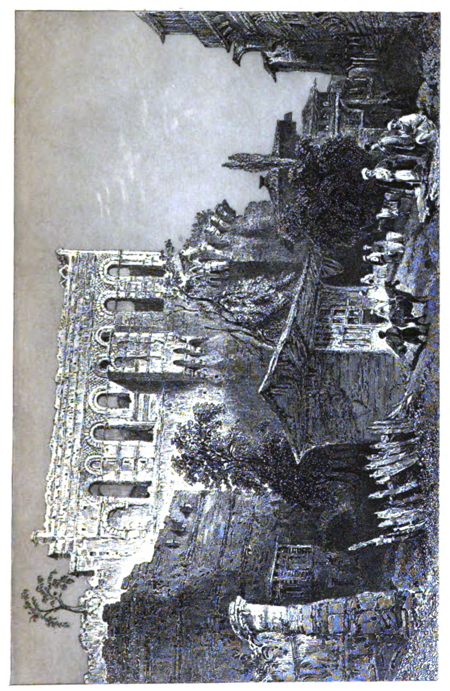
(See this image in horizontal aspect [here].)
Palace of Belisarius, Constantinople, p. 164. From an engraving.
It was the custom of the Roman triumphs that a slave should be placed behind the chariot to remind the conqueror of the instability of fortune and the infirmities of human nature. Procopius, in his Anecdotes, has assumed that servile and ungrateful office. The generous reader may cast away the libel, but the evidence of facts will adhere to his memory; and he will reluctantly confess that the fame, and even the virtue, of Belisarius were polluted by the lust and cruelty of his wife; and that the hero deserved an appellation which may not drop from the pen of the decent historian. The mother of Antonina [128] was a theatrical prostitute, and both her father and grandfather exercised at Thessalonica and Constantinople the vile, though lucrative, profession of charioteers. In the various situations of their fortune, she became the companion, the enemy, the servant, and the favourite of the empress Theodora: these loose and ambitious females had been connected by similar pleasures; they were separated by the jealousy of vice, and at length reconciled by the partnership of guilt. Before her marriage with Belisarius, Antonina had one husband and many lovers; [VII-168] Photius, the son of her former nuptials, was of an age to distinguish himself at the siege of Naples; and it was not till the autumn of her age and beauty [129] that she indulged a scandalous attachment to a Thracian youth. Theodosius had been educated in the Eunomian heresy; the African voyage was consecrated by the baptism and auspicious name of the first soldier who embarked; and the proselyte was adopted into the family of his spiritual parents, [130] Belisarius and Antonina. Before they touched the shores of Africa, this holy kindred degenerated into sensual love; and, as Antonina soon overleaped the bounds of modesty and caution, the Roman general was alone ignorant of his own dishonour. During their residence at Carthage, he surprised the two lovers in a subterraneous chamber, solitary, warm, and almost naked. Anger flashed from his eyes. “With the help of this young man,” said the unblushing Antonina, “I was secreting our most precious effects from the knowledge of Justinian.” The youth resumed his garments, and the pious husband consented to disbelieve the evidence of his own senses. From this pleasing and perhaps voluntary elusion Belisarius was awakened at Syracuse, by the officious information of Macedonia; and that female attendant, after requiring an oath for her security, produced two chamberlains, who, like herself, had often beheld the adulteries of Antonina. An hasty flight into Asia saved Theodosius from the justice of an injured husband, who had signified to one of his guards the order of his death; but the tears of Antonina, and her artful seductions, assured the credulous hero of her innocence; and he stooped, against [VII-169] his faith and judgment, to abandon those imprudent friends who had presumed to accuse or doubt the chastity of his wife. The revenge of a guilty woman is implacable and bloody: the unfortunate Macedonia, with the two witnesses, were secretly arrested by the minister of her cruelty; their tongues were cut out, their bodies were hacked into small pieces, and their remains were cast into the sea of Syracuse. A rash though judicious saying of Constantine, “I would sooner have punished the adulteress than the boy,” was deeply remembered by Antonina; and two years afterwards, when despair had armed that officer against his general, her sanguinary advice decided and hastened his execution. Even the indignation of Photius was not forgiven by his mother; the exile of her son prepared the recall of her lover; and Theodosius condescended to accept the pressing and humble invitation of the conqueror of Italy. In the absolute direction of his household, and in the important commissions of peace and war, [131] the favourite youth most rapidly acquired a fortune of four hundred thousand pounds sterling; and, after their return to Constantinople, the passion of Antonina, at least, continued ardent and unabated. But fear, devotion, and lassitude perhaps, inspired Theodosius with more serious thoughts. He dreaded the busy scandal of the capital and the indiscreet fondness of the wife of Belisarius; escaped from her embraces, and, retiring to Ephesus, shaved his head and took refuge in the sanctuary of a monastic life. The despair of the new Ariadne could scarcely have been excused by the death of her husband. She wept, she tore her hair, she filled the palace with her cries; “she had lost the dearest of friends, a tender, a faithful, a laborious friend!” But her warm entreaties, fortified by the prayers of Belisarius, were insufficient to draw the holy monk from the solitude of [VII-170] Ephesus. It was not till the general moved forward for the Persian war, that Theodosius could be tempted to return to Constantinople; and the short interval before the departure of Antonina herself was boldly devoted to love and pleasure.
In the succeeding campaign, Belisarius was again sent against the Persians: he saved the East, but he offended Theodora, and perhaps the emperor himself. The malady of Justinian had countenanced the rumour of his death; and the Roman general, on the supposition of that probable event, spoke the free language of a citizen and a soldier. His colleague Buzes, who concurred in the same sentiments, lost his rank, his liberty, and his health, by the persecution of the empress; but the disgrace of Belisarius was alleviated by the dignity of his own character, and the influence of his wife, who might wish to humble, but could not desire to ruin, the partner of her fortunes. Even his removal was coloured by the assurance that the sinking state of Italy would be retrieved by the single presence of its conqueror. But no sooner had he returned, alone and defenceless, than an hostile commission was sent to the East, to seize his treasures and criminate his actions; the guards and veterans who followed his private banner were distributed among the chiefs of the army, and even the eunuchs presumed to cast lots for the partition of his martial domestics. When he passed with a small and sordid retinue through the streets of Constantinople, his forlorn appearance excited the amazement and compassion of the people. Justinian and Theodora received him with cold ingratitude; the servile crowd with insolence and contempt; and in the evening he retired with trembling steps to his deserted palace. An indisposition, [VII-173] feigned or real, had confined Antonina to her apartment: and she walked disdainfully silent in the adjacent portico, while Belisarius threw himself on his bed, and expected, in an agony of grief and terror, the death which he had so often braved under the walls of Rome. Long after sun-set a messenger was announced from the empress; he opened, with anxious curiosity, the letter which contained the sentence of his fate. “You cannot be ignorant how much you have deserved my displeasure. I am not insensible of the services of Antonina. To her merits and intercession I have granted your life, and permit you to retain a part of your treasures, which might be justly forfeited to the state. Let your gratitude, where it is due, be displayed, not in words, but in your future behaviour.” I know not how to believe or to relate the transports with which the hero is said to have received this ignominious pardon. He fell prostrate before his wife; he kissed the feet of his saviour; and he devoutly promised to live the grateful and submissive slave of Antonina. A fine of one hundred and twenty thousand pounds sterling was levied on the fortunes of Belisarius; and with the office of count, or master of the royal stables, he accepted the conduct of the Italian war. At his departure from Constantinople, his friends, and even the public, were persuaded that, as soon as he regained his freedom, he would renounce his dissimulation, and that his wife, Theodora, and perhaps the emperor himself, would be sacrificed to the just revenge of a virtuous rebel. Their hopes were deceived; and the unconquerable patience and loyalty of Belisarius appear either below or above the character of a man. [133]
[VII-174]
CHAPTER XLII↩
State of the Barbaric World — Establishment of the Lombards on the Danube — Tribes and Inroads of the Sclavonians — Origin, Empire, and Embassies of the Turks — The Flight of the Avars — Chosroes I. or Nushirvan King of Persia — His prosperous Reign and Wars with the Romans — The Colchian or Lazic War — The Æthiopians
Our estimate of personal merit is relative to the common faculties of mankind. The aspiring efforts of genius or virtue, either in active or speculative life, are measured not so much by their real elevation as by the height to which they ascend above the level of their age or country; and the same stature, which in a people of giants would pass unnoticed, must appear conspicuous in a race of pygmies. Leonidas and his three hundred companions devoted their lives at Thermopylæ; but the education of the infant, the boy, and the man had prepared, and almost ensured, this memorable sacrifice; and each Spartan would approve, rather than admire, an act of duty of which himself and eight thousand of his fellow-citizens were equally capable. [1] The great Pompey might inscribe on his trophies, that he had defeated in battle two millions of enemies and reduced fifteen hundred cities from the lake Mæotis to the Red [VII-175] Sea; [2] but the fortune of Rome flew before his eagles; the nations were oppressed by their own fears; and the invincible legions which he commanded had been formed by the habits of conquest and the discipline of ages. In this view, the character of Belisarius may be deservedly placed above the heroes of the ancient republics. His imperfections flowed from the contagion of the times; his virtues were his own, the free gift of nature or reflection; he raised himself without a master or a rival; and so inadequate were the arms committed to his hand that his sole advantage was derived from the pride and presumption of his adversaries. Under his command, the subjects of Justinian often deserved to be called Romans; but the unwarlike appellation of Greeks was imposed as a term of reproach by the haughty Goths; who affected to blush that they must dispute the kingdom of Italy with a nation of tragedians, pantomimes, and pirates. [3] The climate of Asia has indeed been found less congenial than that of Europe to military spirit; those populous countries were enervated by luxury, despotism, and superstition; and the monks were more expensive and more numerous than the soldiers of the East. The regular force of the empire had once amounted to six hundred and forty-five thousand men: it was reduced, in the time of Justinian, to one hundred and fifty thousand; and this number, large as it may seem, was thinly scattered over the sea and land; in Spain and Italy, in Africa and Egypt, on the banks of the Danube, the coast of the Euxine, and the frontiers of Persia. The citizen was exhausted, yet the soldier was unpaid; his [VII-176] poverty was mischievously soothed by the privilege of rapine and indolence; and the tardy payments were detained and intercepted by the fraud of those agents who usurp, without courage or danger, the emoluments of war. Public and private distress recruited the armies of the state; but in the field, and still more in the presence of the enemy, their numbers were always defective. The want of national spirit was supplied by the precarious faith and disorderly service of Barbarian mercenaries. Even military honour, which has often survived the loss of virtue and freedom, was almost totally extinct. The generals, who were multiplied beyond the example of former times, laboured only to prevent the success, or to sully the reputation, of their colleagues; and they had been taught by experience that, if merit sometimes provoked the jealousy, error or even guilt would obtain the indulgence, of a gracious emperor. [4] In such an age the triumphs of Belisarius, and afterwards of Narses, shine with incomparable lustre; but they are encompassed with the darkest shades of disgrace and calamity. While the lieutenant of Justinian subdued the kingdoms of the Goths and Vandals, the emperor, [5] timid though ambitious, balanced the forces of the Barbarians, fomented their divisions by flattery and falsehood, and invited by his patience and liberality the repetition of injuries. [6] The keys of Carthage, Rome, and Ravenna were presented to their conqueror, while Antioch was destroyed by the Persians and Justinian trembled for the safety of Constantinople.
Even the Gothic victories of Belisarius were prejudicial to [VII-177] the state, since they abolished the important barrier of the Upper Danube, which had been so faithfully guarded by Theodoric and his daughter. For the defence of Italy, the Goths evacuated Pannonia and Noricum, which they left in a peaceful and flourishing condition; the sovereignty was claimed by the emperor of the Romans; the actual possession was abandoned to the boldness of the first invader. On the opposite banks of the Danube, the plains of Upper Hungary and the Transylvanian hills were possessed, since the death of Attila, by the tribes of the Gepidæ, [6a] who respected the Gothic arms, and despised, not indeed the gold of the Romans, but the secret motive of their annual subsidies. The vacant fortifications of the river were instantly occupied by these Barbarians; their standards were planted on the walls of Sirmium and Belgrade; and the ironical tone of their apology aggravated this insult on the majesty of the empire. “So extensive, O Cæsar, are your dominions, so numerous are your cities, that you are continually seeking for nations to whom, either in peace or war, you may relinquish these useless possessions. The Gepidæ are your brave and faithful allies; and, if they have anticipated your gifts, they have shewn a just confidence in your bounty.” Their presumption was excused by the mode of revenge which Justinian embraced. Instead of asserting the rights of a sovereign for the protection of his subjects, the emperor invited a strange people to invade and possess the Roman provinces between the Danube and the Alps; and the ambition of the Gepidæ was checked by the rising power and fame of the Lombards. [7] This corrupt appellation has been [VII-178] diffused in the thirteenth century by the merchants and bankers, the Italian posterity of these savage warriors; but the original name of Langobards is expressive only of the peculiar length and fashion of their beards. I am not disposed either to question or to justify their Scandinavian origin; [8] nor to pursue the migrations of the Lombards through unknown regions and marvellous adventures. About the time of Augustus and Trajan, a ray of historic light breaks on the darkness of their antiquities, and they are discovered, for the first time, between the Elbe and the Oder. Fierce beyond the example of the Germans, they delighted to propagate the tremendous belief that their heads were formed like the heads of dogs and that they drank the blood of their enemies whom they vanquished in battle. The smallness of their numbers was recruited by the adoption of their bravest slaves; and alone, amidst their powerful neighbours, they defended by arms their high-spirited independence. In the tempests of the North, which overwhelmed so many names and nations, this little bark of the Lombards still floated on the surface; they gradually descended towards the south and the Danube; and at the end of four hundred years they again appear with their ancient valour and renown. Their manners were not less ferocious. The assassination of a royal guest was executed in the presence, and by the command, of the king’s daughter, who had been provoked by some words of insult and disappointed by his diminutive stature; and a tribute, the price of blood, was imposed on the Lombards, by his brother the king of the Heruli. Adversity revived a sense of moderation and justice, and the [VII-179] insolence of conquest was chastised by the signal defeat and irreparable dispersion of the Heruli, who were seated in the southern provinces of Poland. [9] The victories of the Lombards recommended them to the friendship of the emperors; and, at the solicitation of Justinian, they passed the Danube, to reduce, according to their treaty, the cities of Noricum and the fortresses of Pannonia. But the spirit of rapine soon tempted them beyond these ample limits; they wandered along the coast of the Hadriatic as far as Dyrrachium, and presumed, with familiar rudeness, to enter the towns and houses of their Roman allies and to seize the captives who had escaped from their audacious hands. These acts of hostility, the sallies, as it might be pretended, of some loose adventurers, were disowned by the nation and excused by the emperor; but the arms of the Lombards were more seriously engaged by a contest of thirty years, which was terminated only by the extirpation of the Gepidæ. The hostile nations often pleaded their cause before the throne of Constantinople; and the crafty Justinian, to whom the Barbarians were almost equally odious, pronounced a partial and ambiguous sentence, and dexterously protracted the war by slow and ineffectual succours. Their strength was formidable, since the Lombards, who sent into the field several myriads of soldiers, still claimed, as the weaker side, the protection of the Romans. Their spirit was intrepid; yet such is the uncertainty of courage that the two armies were suddenly struck with a panic; they fled from each other, and the rival kings remained with their guards in the midst of an empty plain. A short truce was obtained; but their mutual resentment again kindled; and the remembrance of their shame rendered the next encounter more desperate and bloody. Forty thousand of the Barbarians perished in the [VII-180] decisive battle, which broke the power of the Gepidæ, transferred the fears and wishes of Justinian, and first displayed the character of Alboin, the youthful prince of the Lombards, and the future conqueror of Italy. [10]
The wild people who dwelt or wandered in the plains of Russia, Lithuania, and Poland might be reduced, in the age of Justinian, under the two great families of the Bulgarians [11] and the Sclavonians. According to the Greek writers, the former, who touched the Euxine and the lake Mæotis, derived from the Huns their name or descent; and it is needless to renew the simple and well-known picture of Tartar manners. They were bold and dexterous archers, who drank the milk and feasted on the flesh of their fleet and indefatigable horses; whose flocks and herds followed, or rather guided, the motions of their roving camps; to whose inroads no country was remote or impervious, and who were practised in flight, though incapable of fear. The nation was divided into two powerful and hostile tribes, who pursued each other with fraternal hatred. They eagerly disputed the friendship or rather the gifts of the emperor; and the distinction which nature had fixed between the faithful dog and the rapacious wolf was applied by an ambassador who received only verbal instructions from the mouth of his illiterate prince. [12] The [VII-181] Bulgarians, of whatsoever species, were equally attracted by Roman wealth: they assumed a vague dominion over the Sclavonian name, and their rapid marches could only be stopped by the Baltic sea or the extreme cold and poverty of the North. But the same race of Sclavonians appears to have maintained, in every age, the possession of the same countries. Their numerous tribes, however distant or adverse, used one common language (it was harsh and irregular), and were known by the resemblance of their form, which deviated from the swarthy Tartar, and approached without attaining the lofty stature and fair complexion of the German. Four thousand six hundred villages [13] were scattered over the provinces of Russia and Poland, and their huts were hastily built of rough timber, in a country deficient both in stone and iron. Erected, or rather concealed, in the depth of forests, on the banks of rivers, or the edge of morasses, we may not perhaps, without flattery, compare them to the architecture of the beaver; which they resembled in a double issue, to the land and water, for the escape of the savage inhabitant, an animal less cleanly, less diligent, and less social than that marvellous quadruped. The fertility of the soil, rather than the labour of the natives, supplied the rustic plenty of the Sclavonians. Their sheep and horned cattle were large and numerous, and the fields which they sowed with millet and panic [14] afforded, in the place of bread, [VII-182] a coarse and less nutritive food. The incessant rapine of their neighbours compelled them to bury this treasure in the earth; but on the appearance of a stranger, it was freely imparted by a people whose unfavourable character is qualified by the epithets of chaste, patient, and hospitable. As their supreme God, they adored an invisible master of the thunder. The rivers and the nymphs obtained their subordinate honours, and the popular worship was expressed in vows and sacrifice. The Sclavonians disdained to obey a despot, a prince, or even a magistrate; but their experience was too narrow, their passions too headstrong, to compose a system of equal law or general defence. Some voluntary respect was yielded to age and valour; but each tribe or village existed as a separate republic, and all must be persuaded where none could be compelled. They fought on foot, almost naked, and, except an unwieldy shield, without any defensive armour; their weapons of offence were a bow, a quiver of small poisoned arrows, and a long rope, which they dexterously threw from a distance, and entangled their enemy in a running noose. In the field, the Sclavonian infantry was dangerous by their speed, agility, and hardiness; they swam, they dived, they remained under water, drawing their breath through a hollow cane; and a river or lake was often the scene of their unsuspected ambuscade. But these were the achievements of spies or stragglers; the military art was unknown to the Sclavonians; their name was obscure, and their conquests were inglorious. [15]
I have marked the faint and general outline of the Sclavonians and Bulgarians, without attempting to define their [VII-183] intermediate boundaries, which were not accurately known or respected by the Barbarians themselves. Their importance was measured by their vicinity to the empire; and the level country of Moldavia and Walachia was occupied by the Antes, [16] a Sclavonian tribe, which swelled the titles of Justinian with an epithet of conquest. [17] Against the Antes he erected the fortifications of the Lower Danube; and laboured to secure the alliance of a people seated in the direct channel of Northern inundation, an interval of two hundred miles between the mountains of Transylvania and the Euxine sea. But the Antes wanted power and inclination to stem the fury of the torrent; and the light-armed Sclavonians, from an hundred tribes, pursued, with almost equal speed, the footsteps of the Bulgarian horse. The payment of one piece of gold for each soldier procured a safe and easy retreat through the country of the Gepidæ, who commanded the passage of the Upper Danube. [18] The hopes or fears of the Barbarians; their intestine union or discord; the accident of a frozen or shallow stream; the prospect of harvest or vintage; the prosperity or distress of the Romans; were the causes which produced the uniform repetition of annual visits, [19] tedious in the narrative and destructive in the event. The same year, and possibly the same month, in which Ravenna surrendered, was marked by an invasion of the Huns or Bulgarians, so dreadful that it almost effaced the memory of their past inroads. They spread from the [VII-184] suburbs of Constantinople to the Ionian gulf, destroyed thirty-two cities or castles, erased Potidæa, which Athens had built and Philip had besieged, and repassed the Danube, dragging at their horses’ heels one hundred and twenty thousand of the subjects of Justinian. In a subsequent inroad they pierced the wall of the Thracian Chersonesus, extirpated the habitations and the inhabitants, boldly traversed the Hellespont, and returned to their companions, laden with the spoils of Asia. Another party, which seemed a multitude in the eyes of the Romans, penetrated, without opposition, from the straits of Thermopylæ to the isthmus of Corinth; and the last ruin of Greece has appeared an object too minute for the attention of history. The works which the emperor raised for the protection, but at the expense of his subjects, served only to disclose the weakness of some neglected part; and the walls, which by flattery had been deemed impregnable, were either deserted by the garrison or scaled by the Barbarians. Three thousand Sclavonians, who insolently divided themselves into two bands, discovered the weakness and misery of a triumphant reign. They passed the Danube and the Hebrus, vanquished the Roman generals who dared to oppose their progress, and plundered with impunity the cities of Illyricum and Thrace, each of which had arms and numbers to overwhelm their contemptible assailants. Whatever praise the boldness of the Sclavonians may deserve, it is sullied by the wanton and deliberate cruelty which they are accused of exercising on their prisoners. Without distinction of rank, or age, or sex, the captives were impaled, or flayed alive, or suspended between four posts and beaten with clubs till they expired, or enclosed in some spacious building and left to perish in the flames with the spoil and cattle which might impede the march of these savage victors. [20] Perhaps a more impartial [VII-185] narrative would reduce the number, and qualify the nature, of these horrid acts; and they might sometimes be excused by the cruel laws of retaliation. In the siege of Topirus, [21] whose obstinate defence had enraged the Sclavonians, they massacred fifteen thousand males; but they spared the women and children; the most valuable captives were always reserved for labour or ransom; the servitude was not rigorous, and the terms of their deliverance were speedy and moderate. But the subject or the historian of Justinian exhaled his just indignation in the language of complaint and reproach; and Procopius has confidently affirmed that in a reign of thirty-two years each annual inroad of the Barbarians consumed two hundred thousand of the inhabitants of the Roman empire. The entire population of Turkish Europe, which nearly corresponds with the provinces of Justinian, would perhaps be incapable of supplying six millions of persons, the result of this incredible estimate. [22]
In the midst of these obscure calamities, Europe felt the shock of a revolution, which first revealed to the world the name and nation of the Turks. [23] Like Romulus, the founder of that martial people was suckled by a she-wolf, who afterwards made him the father of a numerous progeny; and the representation of that animal in the banners of the Turks preserved the memory, or rather suggested the idea, of a fable, which was invented, without any mutual intercourse, by the shepherds of Latium and those of Scythia. At the equal distance of two thousand miles from the Caspian, the [VII-186] Icy, the Chinese, and the Bengal seas, a ridge of mountains is conspicuous, the centre and perhaps the summit of Asia; which, in the language of different nations, has been styled Imaus, and Caf, [24] and Altai, and the Golden Mountains, and the Girdle of the Earth. The sides of the hills were productive of minerals; and the iron forges, [25] for the purpose of war, were exercised by the Turks, the most despised portion of the slaves of the great khan of the Geougen. But their servitude could only last till a leader, bold and eloquent, should arise, to persuade his countrymen that the same arms which they forged for their masters might become, in their own hands, the instruments of freedom and victory. They sallied from the mountain; [26] a sceptre was the reward of his advice; and the annual ceremony, in which a piece of iron was heated in the fire and a smith’s hammer was successively handled by the prince and his nobles, recorded for ages the humble profession and rational pride of the Turkish nation. [VII-187] Bertezena, [27] their first leader, signalised their valour and his own in successful combats against the neighbouring tribes; but, when he presumed to ask in marriage the daughter of the great khan, the insolent demand of a slave and a mechanic was contemptuously rejected. [28] The disgrace was expiated by a more noble alliance with a princess of China; and the decisive battle, which almost extirpated the nation of Geougen, established in Tartary the new and more powerful empire of the Turks. They reigned over the north; but they confessed the vanity of conquest by their faithful attachment to the mountain of their fathers. The royal encampment seldom lost sight of Mount Altai, from whence the river Irtish descends to water the rich pastures of the Calmucks, [29] which nourish the largest sheep and oxen in the world. The soil is fruitful, and the climate mild and temperate; the happy region was ignorant of earthquake and pestilence; the emperor’s throne was turned towards the east, and a golden wolf, on the top of a spear, seemed to guard the entrance of his tent. One of the successors of Bertezena was tempted by the luxury and superstition of China; but his design of building cities and temples was defeated by the simple wisdom of a Barbarian counsellor. “The Turks,” he said, “are not equal in number to one hundredth part of the inhabitants of China. If we balance their power and elude their armies, it is because we wander without any fixed habitations, in the exercise of war and hunting. Are we strong? we advance and conquer: are we feeble? we retire and are concealed. [VII-188] Should the Turks confine themselves within the walls of cities, the loss of a battle would be the destruction of their empire. The Bonzes preach only patience, humility, and the renunciation of the world. Such, O king! is not the religion of heroes.” They entertained with less reluctance the doctrines of Zoroaster; but the greatest part of the nation acquiesced, without inquiry, in the opinions, or rather in the practice, of their ancestors. The honours of sacrifice were reserved for the supreme deity; they acknowledged, in rude hymns, their obligations to the air, the fire, the water, and the earth; and their priests derived some profit from the art of divination. Their unwritten laws were rigorous and impartial: theft was punished by a tenfold restitution; adultery, treason, and murder, with death; and no chastisement could be inflicted too severe for the rare and inexpiable guilt of cowardice. As the subject nations marched under the standard of the Turks, their cavalry, both men and horses, were proudly computed by millions; one of their effective armies consisted of four hundred thousand soldiers, and in less than fifty years they were connected in peace and war with the Romans, the Persians, and the Chinese. In their northern limits, some vestige may be discovered of the form and situation of Kamtchatka, of a people of hunters and fishermen, whose sledges were drawn by dogs, and whose habitations were buried in the earth. The Turks were ignorant of astronomy; but the observation taken by some learned Chinese, with a gnomon of eight feet, fixes the royal camp in the latitude of forty-nine degrees, and marks their extreme progress within three, or at least ten, degrees of the polar circle. [30] Among their southern conquests, the most splendid was that of the Nephtalites or white Huns, a polite and war-like people, who possessed the commercial cities of Bochara and Samarcand, who had vanquished the [VII-189] Persian monarch, and carried their victorious arms along the banks, and perhaps to the mouth, of the Indus. On the side of the west, the Turkish cavalry advanced to the lake Mæotis. They passed that lake on the ice. The khan, who dwelt at the foot of Mount Altai, issued his commands for the siege of Bosphorus, [31] a city, the voluntary subject of Rome, and whose princes had formerly been the friends of Athens. [32] To the east, the Turks invaded China, as often as the vigour of the government was relaxed; and I am taught to read in the history of the times, that they mowed down their patient enemies like hemp or grass; and that the mandarins applauded the wisdom of an emperor who repulsed these Barbarians with golden lances. This extent of savage empire compelled the Turkish monarch to establish three subordinate princes of his own blood, who soon forgot their gratitude and allegiance. The conquerors were enervated by luxury, which is always fatal except to an industrious people; the policy of China solicited the vanquished nations to resume their independence; and the power of the Turks was limited to a period of two hundred years. The revival of their name and dominion in the southern countries of Asia are the events of a later age; and the dynasties which succeeded to their native realms may sleep in oblivion, since their history bears no relation to the decline and fall of the Roman empire. [33]
In the rapid career of conquest, the Turks attacked and subdued [VII-190] the nation of the Ogors, or Varchonites, [34] on the banks of the river Til, which derived the epithet of black from its dark water or gloomy forests. [35] The khan of the Ogors was slain with three hundred thousand of his subjects, and their bodies were scattered over the space of four days’ journey: their surviving countrymen acknowledged the strength and mercy of the Turks; and a small portion, about twenty thousand warriors, preferred exile to servitude. They followed the well-known road of the Volga, cherished the error of the nations who confounded them with the Avars, and spread the terror of that false though famous appellation, which had not, however, saved its lawful proprietors from the yoke of the Turks. [36] After a long and victorious march, the new Avars arrived at the foot of Mount Caucasus, in the country of the Alani [37] and Circassians, where they first heard of the splendour and weakness of the Roman empire. They humbly requested their confederate, the prince of the Alani, to lead them to this source of riches; and their ambassador, with the permission of the governor of Lazica, was transported [VII-191] by the Euxine sea to Constantinople. The whole city was poured forth to behold with curiosity and terror the aspect of a strange people: their long hair, which hung in tresses down their backs, was gracefully bound with ribbons, but the rest of their habit appeared to imitate the fashion of the Huns. When they were admitted to the audience of Justinian, Candish, the first of the ambassadors, addressed the Roman emperor in these terms: “You see before you, O mighty prince, the representatives of the strongest and most populous of nations, the invincible, the irresistible Avars. We are willing to devote ourselves to your service: we are able to vanquish and destroy all the enemies who now disturb your repose. But we expect, as the price of our alliance, as the reward of our valour, precious gifts, annual subsidies, and fruitful possessions.” At the time of this embassy Justinian had reigned above thirty, he had lived above seventy-five, years; his mind, as well as his body, was feeble and languid; and the conqueror of Africa and Italy, careless of the permanent interest of his people, aspired only to end his days in the bosom even of inglorious peace. In a studied oration he imparted to the senate his resolution to dissemble the insult, and to purchase the friendship, of the Avars; and the whole senate, like the mandarins of China, applauded the incomparable wisdom and foresight of their sovereign. The instruments of luxury were immediately prepared to captivate the Barbarians: silken garments, soft and splendid beds, and chains and collars incrusted with gold. The ambassadors, content with such liberal reception, departed from Constantinople, and Valentin, one of the emperor’s guards, was sent with a similar character to their camp at the foot of Mount Caucasus. As their destruction or their success must be alike advantageous to the empire, he persuaded them to invade the enemies of Rome; and they were easily tempted, by gifts and promises, to gratify their ruling inclinations. These fugitives who fled before the Turkish arms passed the Tanais and Borysthenes, and boldly advanced into the heart [VII-192] of Poland and Germany, violating the law of nations and abusing the rights of victory. Before ten years had elapsed, their camps were seated on the Danube and the Elbe, many Bulgarian and Sclavonian names were obliterated from the earth, and the remainder of their tribes are found as tributaries and vassals under the standard of the Avars. The chagan, the peculiar title of their king, still affected to cultivate the friendship of the emperor; and Justinian entertained some thoughts of fixing them in Pannonia to balance the prevailing power of the Lombards. But the virtue or treachery of an Avar betrayed the secret enmity and ambitious designs of their countrymen; and they loudly complained of the timid though jealous policy of detaining their ambassadors, and denying the arms which they had been allowed to purchase in the capital of the empire. [38]
Perhaps the apparent change in the dispositions of the emperors may be ascribed to the embassy which was received from the conquerors of the Avars. [39] The immense distance which eluded their arms could not extinguish their resentment: the Turkish ambassadors pursued the footsteps of the vanquished to the Jaik, the Volga, Mount Caucasus, the Euxine, and Constantinople, and at length appeared before the successor of Constantine, to request that he would not espouse the cause of rebels and fugitives. Even commerce had some share in this remarkable negotiation; and the Sogdoites, who [VII-193] were now the tributaries of the Turks, embraced the fair occasion of opening, by the north of the Caspian, a new road for the importation of Chinese silk into the Roman empire. The Persian, who preferred the navigation of Ceylon, had stopped the caravans of Bochara and Samarcand; their silk was contemptuously burnt; some Turkish ambassadors died in Persia, with a suspicion of poison; and the great khan permitted his faithful vassal Maniach, the prince of the Sogdoites, to propose, at the Byzantine court, a treaty of alliance against their common enemies. Their splendid apparel and rich presents, the fruit of Oriental luxury, distinguished Maniach and his colleagues from the rude savages of the North; their letters, in the Scythian character and language, announced a people who had attained the rudiments of science; [40] they enumerated the conquests, they offered the friendship and military aid, of the Turks; and their sincerity was attested by direful imprecations (if they were guilty of falsehood) against their own head and the head of Disabul their master. The Greek prince entertained with hospitable regard the ambassadors of a remote and powerful monarch; the sight of silkworms and looms disappointed the hopes of the Sogdoites; the emperor renounced, or seemed to renounce, the fugitive Avars, but he accepted the alliance of the Turks; and the ratification of the treaty was carried by a Roman minister to the foot of Mount Altai. [41] Under the successors of Justinian, the friendship of the two nations was cultivated by frequent and cordial intercourse; the most favoured vassals were permitted to imitate the example of the great khan, and one [VII-194] hundred and six Turks, who, on various occasions, had visited Constantinople, departed at the same time for their native country. The duration and length of the journey from the Byzantine court to Mount Altai are not specified: it might have been difficult to mark a road through the nameless deserts, the mountains, rivers, and morasses of Tartary; but a curious account has been preserved of the reception of the Roman ambassadors at the royal camp. After they had been purified with fire and incense, according to a rite still practised under the sons of Zingis, they were introduced to the presence of Disabul. [42] In a valley of the Golden Mountain, they found the great khan in his tent, seated in a chair with wheels, to which an horse might be occasionally harnessed. As soon as they had delivered their presents, which were received by the proper officers, they exposed, in a florid oration, the wishes of the Roman emperor, that victory might attend the arms of the Turks, that their reign might be long and prosperous, and that a strict alliance, without envy or deceit, might for ever be maintained between the two most powerful nations of the earth. The answer of Disabul corresponded with these friendly professions, and the ambassadors were seated by his side, at a banquet which lasted the greatest part of the day; the tent was surrounded with silk hangings, and a Tartar liquor was served on the table, which possessed at least the intoxicating qualities of wine. The entertainment of the succeeding day was more sumptuous; the silk hangings of the second tent were embroidered in various figures; and the royal seat, the cups, and the vases were of gold. A third pavilion was supported by columns of gilt wood; a bed of pure and massy gold was raised on four peacocks of the same metal; and, before the entrance of the tent, dishes, basons, and statues of solid silver, and admirable art, [VII-195] were ostentatiously piled in waggons, the monuments of valour rather than of industry. When Disabul led his armies against the frontiers of Persia, his Roman allies followed many days the march of the Turkish camp, nor were they dissmissed until they had enjoyed their precedency over the envoy of the great king, whose loud and intemperate clamours interrupted the silence of the royal banquet. The power and ambition of Chosroes cemented the union of the Turks and Romans, who touched his dominions on either side; but those distant nations, regardless of each other, consulted the dictates of interest, without recollecting the obligations of oaths and treaties. While the successor of Disabul celebrated his father’s obsequies, he was saluted by the ambassadors of the emperor Tiberius, who proposed an invasion of Persia, and sustained with firmness the angry, and perhaps the just, reproaches of that haughty Barbarian. “You see my ten fingers,” said the great khan, and he applied them to his mouth. “You Romans speak with as many tongues, but they are tongues of deceit and perjury. To me you hold one language, to my subjects another; and the nations are successively deluded by your perfidious eloquence. You precipitate your allies into war and danger, you enjoy their labours, and you neglect your benefactors. Hasten your return, inform your master that a Turk is incapable of uttering or forgiving falsehood, and that he shall speedily meet the punishment which he deserves. While he solicits my friendship with flattering and hollow words, he is sunk to a confederate of my fugitive Varchonites. If I condescend to march against those contemptible slaves, they will tremble at the sound of our whips; they will be trampled, like a nest of ants, under the feet of my innumerable cavalry. I am not ignorant of the road which they have followed to invade your empire; nor can I be deceived by the vain pretence that Mount Caucasus is the impregnable barrier of the Romans. I know the course of the Dniester, the Danube, and the Hebrus; the most warlike nations have yielded to the arms of the Turks; [VII-196] and, from the rising to the setting sun, the earth is my inheritance.” Notwithstanding this menace, a sense of mutual advantage soon renewed the alliance of the Turks and Romans; but the pride of the great khan survived his resentment; and, when he announced an important conquest to his friend the emperor Maurice, he styled himself the master of the seven races, and the lord of the seven climates, of the world. [43]
Disputes have often arisen between the sovereigns of Asia, for the title of king of the world; while the contest has proved that it could not belong to either of the competitors. The kingdom of the Turks was bounded by the Oxus or Gihon; and Touran was separated by that great river from the rival monarchy of Iran, or Persia, which, in a smaller compass, contained perhaps a larger measure of power and population. The Persians, who alternately invaded and repulsed the Turks and the Romans, were still ruled by the house of Sassan, which ascended the throne three hundred years before the accession of Justinian. His contemporary, Cabades, or Kobad, had been successful in war against the emperor Anastasius; but the reign of that prince was distracted by civil and religious troubles. A prisoner in the hands of his subjects; an exile among the enemies of Persia; he recovered his liberty by prostituting the honour of his wife, and regained his kingdom with the dangerous and mercenary aid of the Barbarians who had slain his father. His nobles were suspicious that Kobad never forgave the authors of his expulsion, or even those of his restoration. The people was deluded and inflamed by the fanaticism of Mazdak, [44] [VII-197] who asserted the community of women [45] and the equality of mankind, whilst he appropriated the richest lands and most beautiful females to the use of his sectaries. The view of these disorders, which had been fomented by his laws and example, [46] embittered the declining age of the Persian monarch; and his fears were increased by the consciousness of his design to reverse the natural and customary order of succession, in favour of his third and most favoured son, so famous under the names of Chosroes and Nushirvan. To render the youth more illustrious in the eyes of the nations, Kobad was desirous that he should be adopted by the emperor Justin; the hope of peace inclined the Byzantine court to accept this singular proposal; and Chosroes might have acquired a specious claim to the inheritance of his Roman parent. But the future mischief was diverted by the advice of the quæstor Proclus: a difficulty was started, whether the adoption should be performed as a civil or military rite; [47] the treaty was abruptly dissolved; and the sense of this indignity sunk deep into the mind of Chosroes, who had already advanced to the Tigris on his road to Constantinople. His father did not long survive the disappointment of his wishes; the testament of their deceased sovereign was read in [VII-198] the assembly of the nobles; and a powerful faction, prepared for the event and regardless of the priority of age, exalted Chosroes to the throne of Persia. He filled that throne during a prosperous period of forty-eight years; [48] and the justice of Nushirvan is celebrated as the theme of immortal praise by the nations of the East.
But the justice of kings is understood by themselves, and even by their subjects, with an ample indulgence for the gratification of passion and interest. The virtue of Chosroes was that of a conqueror, who, in the measures of peace and war, is excited by ambition and restrained by prudence; who confounds the greatness with the happiness of a nation, and calmly devotes the lives of thousands to the fame, or even the amusement, of a single man. In his domestic administration, the just Nushirvan would merit, in our feelings, the appellation of a tyrant. His two elder brothers had been deprived of their fair expectations of the diadem; their future life, between the supreme rank and the condition of subjects, was anxious to themselves and formidable to their master; fear as well as revenge might tempt them to rebel; the slightest evidence of a conspiracy satisfied the author of their wrongs; and the repose of Chosroes was secured by the death of these unhappy princes, with their families and adherents. One guiltless youth was saved and dismissed by the compassion of a veteran general; and this act of humanity, which was revealed by his son, overbalanced the merit of reducing twelve nations to the obedience of Persia. The zeal and prudence of Mebodes [VII-199] had fixed the diadem on the head of Chosroes himself; but he delayed to attend the royal summons, till he had performed the duties of a military review: he was instantly commanded to repair to the iron tripod, which stood before the gate of the palace, [49] where it was death to relieve or approach the victim; and Mebodes languished several days before his sentence was pronounced, by the inflexible pride and calm ingratitude of the son of Kobad. But the people, more especially in the East, is disposed to forgive, and even to applaud, the cruelty which strikes at the loftiest heads; at the slaves of ambition, whose voluntary choice has exposed them to live in the smiles, and to perish by the frown, of a capricious monarch. In the execution of the laws which he had no temptation to violate; in the punishment of crimes which attacked his own dignity, as well as the happiness of individuals; Nushirvan, or Chosroes, deserved the appellation of just. His government was firm, rigorous, and impartial. It was the first labour of his reign to abolish the dangerous theory of common or equal possessions; the lands and women which the sectaries of Mazdak had usurped were restored to their lawful owners; and the temperate chastisement of the fanatics or impostors confirmed the domestic rights of society. [50] Instead of listening with blind confidence to a favourite minister, he established four viziers over the four great provinces of his empire, Assyria, Media, Persia, and Bactriana. In the choice of judges, prefects, and counsellors, he strove to remove the mask which is always worn in the presence of kings; he wished to substitute the natural order of talents for the accidental distinctions of birth and [VII-200] fortune; he professed, in specious language, his intention to prefer those men who carried the poor in their bosoms, and to banish corruption from the seat of justice, as dogs were excluded from the temples of the Magi. The code of laws of the first Artaxerxes was revived and published as the rule of the magistrates; but the assurance of speedy punishment was the best security of their virtue. Their behaviour was inspected by a thousand eyes, their words were overheard by a thousand ears, the secret or public agents of the throne; and the provinces, from the Indian to the Arabian confines, were enlightened by the frequent visits of a sovereign who affected to emulate his celestial brother in his rapid and salutary career. Education and agriculture he viewed as the two objects most deserving of his care. In every city of Persia, orphans and the children of the poor were maintained and instructed at the public expense; the daughters were given in marriage to the richest citizens of their own rank, and the sons, according to their different talents, were employed in mechanic trades or promoted to more honourable service. The deserted villages were relieved by his bounty; to the peasants and farmers who were found incapable of cultivating their lands, he distributed cattle, seed, and the instruments of husbandry; and the rare and inestimable treasure of fresh water was parsimoniously managed and skilfully dispersed over the arid territory of Persia. [51] The prosperity of that kingdom was the effect and the evidence of his virtues; his vices are those of Oriental despotism; but in the long competition between Chosroes and Justinian the advantage both of merit and fortune is almost always on the side of the Barbarian. [52]
[VII-201]
To the praise of justice Nushirvan united the reputation of knowledge; and the seven Greek philosophers, who visited his court, were invited and deceived by the strange assurance that a disciple of Plato was seated on the Persian throne. Did they expect that a prince, strenuously exercised in the toils of war and government, should agitate, with dexterity like their own, the abstruse and profound question which amused the leisure of the schools of Athens? Could they hope that the precepts of philosophy should direct the life, and control the passions, of a despot whose infancy had been taught to consider his absolute and fluctuating will as the only rule of moral obligation? [53] The studies of Chosroes were ostentatious and superficial, but his example awakened the curiosity of an ingenious people, and the light of science was diffused over the dominions of Persia. [54] At Gondi Sapor, [55] in the neighbourhood of the royal city of Susa, an academy of physic was founded, which insensibly became a liberal school of poetry, philosophy, and rhetoric. [56] The annals of the monarchy [57] were composed; and, while recent and authentic [VII-202] history might afford some useful lessons both to the prince and people, the darkness of the first ages was embellished by the giants, the dragons, and the fabulous heroes of Oriental romance. [58] Every learned or confident stranger was enriched by the bounty, and flattered by the conversation, of the monarch: he nobly rewarded a Greek physician, [59] by the deliverance of three thousand captives; and the sophists who contended for his favour, were exasperated by the wealth and insolence of Uranius, their more successful rival. Nushirvan believed, or at least respected, the religion of the Magi; and some traces of persecution may be discovered in his reign. [60] Yet he allowed himself freely to compare the tenets of the various sects; and the theological disputes in which he frequently presided diminished the authority of the priest and enlightened the minds of the people. At his command, the most celebrated writers of Greece and India were translated into the Persian language: a smooth and elegant idiom, recommended by Mahomet to the use of paradise though it is branded with the epithets of savage and unmusical by the [VII-203] ignorance and presumption of Agathias. [61] Yet the Greek historian might reasonably wonder that it should be found possible to execute an entire version of Plato and Aristotle in a foreign dialect, which had not been framed to express the spirit of freedom and the subtleties of philosophic disquisition. And, if the reason of the Stagyrite might be equally dark or equally intelligible in every tongue, the dramatic art and verbal argumentation of the disciple of Socrates [62] appear to be indissolubly mingled with the grace and perfection of his Attic style. In the search of universal knowledge, Nushirvan was informed that the moral and political fables of Pilpay, an ancient Brachman, were preserved with jealous reverence among the treasures of the kings of India. The physician Perozes was secretly despatched to the banks of the Ganges, with instructions to procure, at any price, the communication of this valuable work. His dexterity obtained a transcript, his learned diligence accomplished the translation; and the fables of Pilpay [63] were read and admired in the assembly [VII-204] of Nushirvan and his nobles. The Indian original and the Persian copy have long since disappeared; but this venerable monument has been saved by the curiosity of the Arabian caliphs, revived in the modern Persic, the Turkish, the Syriac, the Hebrew, and the Greek idioms, and transfused through successive versions into the modern languages of Europe. In their present form the peculiar character, the manners and religion of the Hindoos, are completely obliterated; and the intrinsic merit of the fables of Pilpay is far inferior to the concise elegance of Phædrus and the native graces of La Fontaine. Fifteen moral and political sentences are illustrated in a series of apologues; but the composition is intricate, the narrative prolix, and the precept obvious and barren. Yet the Brachman may assume the merit of inventing a pleasing fiction, which adorns the nakedness of truth, and alleviates, perhaps, to a royal ear the harshness of instruction. With a similar design to admonish kings that they are strong only in the strength of their subjects, the same Indians invented the game of chess, which was likewise introduced into Persia under the reign of Nushirvan. [64]
The son of Kobad found his kingdom involved in a war with the successor of Constantine; and the anxiety of his domestic situation inclined him to grant the suspension of arms, which Justinian was impatient to purchase. Chosroes saw the [VII-205] Roman ambassadors at his feet. He accepted eleven thousand pounds of gold, as the price of an endless or indefinite peace; [65] some mutual exchanges were regulated; the Persian assumed the guard of the gates of Caucasus, and the demolition of Dara was suspended, on condition that it should never be made the residence of the general of the East. This interval of repose had been solicited, and was diligently improved, by the ambition of the emperor; his African conquests were the first fruits of the Persian treaty; and the avarice of Chosroes was soothed by a large portion of the spoils of Carthage, which his ambassadors required in a tone of pleasantry and under the colour of friendship. [66] But the trophies of Belisarius disturbed the slumbers of the great king; and he heard with astonishment, envy, and fear that Sicily, Italy, and Rome itself had been reduced in three rapid campaigns to the obedience of Justinian. Unpractised in the art of violating treaties, he secretly excited his bold and subtle vassal Almondar. That prince of the Saracens, who resided at Hira, [67] had not been included in the general peace, and still waged an obscure war against his rival Arethas, the chief of the tribe of Gassan, and confederate of the empire. The subject of their dispute was an extensive sheep-walk in the desert to the south of Palmyra. An immemorial tribute for the licence of pasture appeared to attest the rights of Almondar, [VII-206] while the Gassanite appealed to the Latin name of strata, a paved road, as an unquestionable evidence of the sovereignty and labours of the Romans. [68] The two monarchs supported the cause of their respective vassals; and the Persian Arab, without expecting the event of a slow and doubtful arbitration, enriched his flying camp with the spoil and captives of Syria. Instead of repelling the arms, Justinian attempted to seduce the fidelity, of Almondar, while he called from the extremities of the earth the nations of Æthiopia and Scythia to invade the dominions of his rival. But the aid of such allies was distant and precarious, and the discovery of this hostile correspondence justified the complaints of the Goths and Armenians, who implored, almost at the same time, the protection of Chosroes. The descendants of Arsaces, who were still numerous in Armenia, had been provoked to assert the last relics of national freedom and hereditary rank; and the ambassadors of Vitiges had secretly traversed the empire to expose the instant, and almost inevitable, danger of the kingdom of Italy. Their representations were uniform, weighty, and effectual. “We stand before your throne, the advocates of your interest as well as of our own. The ambitious and faithless Justinian aspires to be the sole master of the world. Since the endless peace, which betrayed the common freedom of mankind, that prince, your ally in words, your enemy in actions, has alike insulted his friends and foes, and has filled the earth with blood and confusion. Has he not violated the privileges of Armenia, the independence of Colchos, and the wild liberty of the Tzanian mountains? Has he not usurped, with equal avidity, the city of Bosphorus on the frozen Mæotis and the vale of palm-trees on the shores of the Red Sea? The Moors, the Vandals, the Goths, have been successively oppressed, and each nation has calmly remained the spectator of their [VII-207] neighbour’s ruin. Embrace, O king! the favourable moment; the East is left without defence, while the armies of Justinian and his renowned general are detained in the distant regions of the West. If you hesitate and delay, Belisarius and his victorious troops will soon return from the Tiber to the Tigris, and Persia may enjoy the wretched consolation of being the last devoured.” [69] By such arguments Chosroes was easily persuaded to imitate the example which he condemned; but the Persian, ambitious of military fame, disdained the inactive warfare of a rival, who issued his sanguinary commands from the secure station of the Byzantine palace.
Whatever might be the provocations of Chosroes, he abused the confidence of treaties; and the just reproaches of dissimulation and falsehood could only be concealed by the lustre of his victories. [70] The Persian army, which had been assembled in the plains of Babylon, prudently declined the strong cities of Mesopotamia, and followed the western bank of the Euphrates, till the small, though populous, town of Dura presumed to arrest the progress of the great king. The gates of Dura, by treachery and surprise, were burst open; and, as soon as Chosroes had stained his scymitar with the blood of the inhabitants, he dismissed the ambassador of Justinian to inform his master in what place he had left the enemy of the Romans. The conqueror still affected the praise of humanity and justice; and, as he beheld a noble matron with her infant rudely dragged along the ground, [VII-208] he sighed, he wept, and implored the divine justice to punish the author of these calamities. Yet the herd of twelve thousand captives was ransomed for two hundred pounds of gold; the neighbouring bishop of Sergiopolis pledged his faith for the payment; and in the subsequent year the unfeeling avarice of Chosroes exacted the penalty of an obligation which it was generous to contract and impossible to discharge. He advanced into the heart of Syria; but a feeble enemy, who vanished at his approach, disappointed him of the honour of victory; and, as he could not hope to establish his dominion, the Persian king displayed in this inroad the mean and rapacious vices of a robber. Hierapolis, Berrhœa or Aleppo, Apamea, and Chalcis were successively besieged; they redeemed their safety by a ransom of gold or silver, proportioned to their respective strength and opulence; and their new master enforced, without observing, the terms of capitulation. Educated in the religion of the Magi, he exercised, without remorse, the lucrative trade of sacrilege; and, after stripping of its gold and gems a piece of the true cross, he generously restored the naked relic to the devotion of the Christians of Apamea. No more than fourteen years had elapsed since Antioch was ruined by an earthquake; but the queen of the East, the new Theopolis, had been raised from the ground by the liberality of Justinian; and the increasing greatness of the buildings and the people already erased the memory of this recent disaster. On one side, the city was defended by the mountain, on the other by the river Orontes; but the most accessible part was commanded by a superior eminence; the proper remedies were rejected, from the despicable fear of discovering its weakness to the enemy; and Germanus, the emperor’s nephew, refused to trust his person and dignity within the walls of a besieged city. The people of Antioch had inherited the vain and satirical genius of their ancestors: they were elated by a sudden reinforcement of six thousand soldiers; they disdained the offers of an easy capitulation; and their intemperate clamours insulted [VII-none] [VII-209] from the ramparts the majesty of the great king. Under his eye the Persian myriads mounted with scaling-ladders to the assault; the Roman mercenaries fled through the opposite gate of Daphne; and the generous resistance of the youth of Antioch served only to aggravate the miseries of their country. As Chosroes, attended by the ambassadors of Justinian, was descending from the mountain, he affected, in a plaintive voice, to deplore the obstinacy and ruin of that unhappy people; but the slaughter still raged with unrelenting fury; and the city, at the command of a Barbarian, was delivered to the flames. The cathedral of Antioch was indeed preserved by the avarice, not the piety, of the conqueror; a more honourable exemption was granted to the church of St. Julian and the quarter of the town where the ambassadors resided; some distant streets were saved by the shifting of the wind; and the walls still subsisted to protect, and soon to betray, their new inhabitants. Fanaticism had defaced the ornaments of Daphne, but Chosroes breathed a purer air amidst her groves and fountains; and some idolaters in his train might sacrifice with impunity to the nymphs of that elegant retreat. Eighteen miles below Antioch, the river Orontes falls into the Mediterranean. The haughty Persian visited the term of his conquests; and, after bathing alone in the sea, he offered a solemn sacrifice of thanksgiving to the sun, or rather to the creator of the sun, whom the Magi adored. If this act of superstition offended the prejudices of the Syrians, they were pleased by the courteous and even eager attention with which he assisted at the games of the circus; and, as Chosroes had heard that the blue faction was espoused by the emperor, his peremptory command secured the victory of the green charioteer. From the discipline of his camp the people derived more solid consolation; and they interceded in vain for the life of a soldier who had too faithfully copied the rapine of the just Nushirvan. At length, fatigued, though unsatiated, with the spoil of Syria, he slowly moved to the [VII-210] Euphrates, formed a temporary bridge in the neighbourhood of Barbalissus, and defined the space of three days for the entire passage of his numerous host. After his return, he founded, at the distance of one day’s journey from the palace of Ctesiphon, a new city, which perpetuated the joint names of Chosroes and of Antioch. [71] The Syrian captives recognised the form and situation of their native abodes; baths and a stately circus were constructed for their use; and a colony of musicians and charioteers revived in Assyria the pleasures of a Greek capital. By the munificence of the royal founder, a liberal allowance was assigned to these fortunate exiles; and they enjoyed the singular privilege of bestowing freedom on the slaves whom they acknowledged as their kinsmen. Palestine and the holy wealth of Jerusalem were the next objects that attracted the ambition, or rather the avarice, of Chosroes. Constantinople and the palace of the Cæsars no longer appeared impregnable or remote; and his aspiring fancy already covered Asia Minor with the troops, and the Black Sea with the navies, of Persia.
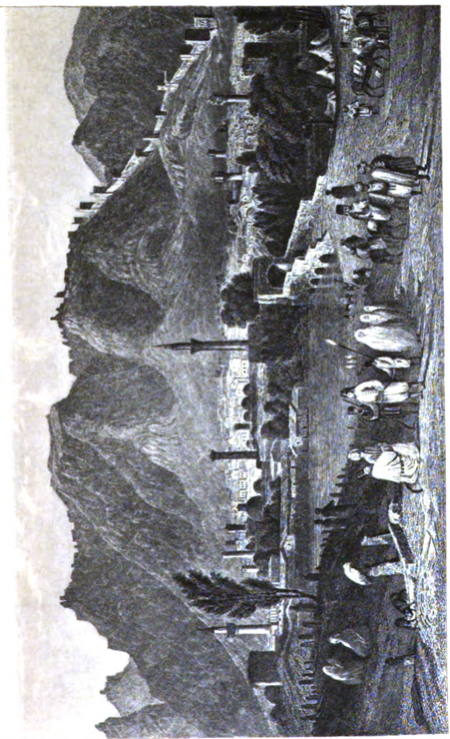
The extreme length of the Euxine sea, [74] from Constantinople to the mouth of the Phasis, may be computed as a voyage of nine days and a measure of seven hundred miles. From the Iberian Caucasus, the most lofty and craggy mountains of Asia, that river descends with such oblique vehemence that in a short space it is traversed by one hundred and twenty bridges. Nor does the stream become placid and navigable till it reaches the town of Sarapana, five days’ [VII-214] journey from the Cyrus, which flows from the same hills, but in a contrary direction, to the Caspian lake. The proximity of these rivers has suggested the practice, or at least the idea, of wafting the precious merchandise of India down the Oxus, over the Caspian, up the Cyrus, and with the current of the Phasis into the Euxine and Mediterranean seas. As it successively collects the streams of the plain of Colchos, the Phasis moves with diminished speed, though accumulated weight. At the mouth it is sixty fathom deep and half a league broad, but a small woody island is interposed in the midst of the channel: the water, so soon as it has deposited an earthy or metallic sediment, floats on the surface of the waves and is no longer susceptible of corruption. In a course of one hundred miles, forty of which are navigable for large vessels, the Phasis divides the celebrated region of Colchos, [75] or Mingrelia, [76] which, on three sides, is fortified by the Iberian and Armenian mountains, and whose maritime coast extends about two hundred miles, from the neighbourhood of Trebizond to Dioscurias, and the confines of Circassia. Both the soil and climate are relaxed by excessive moisture: twenty-eight rivers, besides the Phasis and his dependent streams, convey their waters to the sea; and the hollowness of the ground appears to indicate the subterraneous channels between the Euxine and the Caspian. In the fields where [VII-215] wheat or barley is sown, the earth is too soft to sustain the action of the plough; but the gom, a small grain not unlike the millet or coriander seed, supplies the ordinary food of the people; and the use of bread is confined to the prince and his nobles. Yet the vintage is more plentiful than the harvest; and the bulk of the stems, as well as the quality of the wine, display the unassisted powers of nature. The same powers continually tend to overshadow the face of the country with thick forests; the timber of the hills and the flax of the plains contribute to the abundance of naval stores; the wild and tame animals, the horse, the ox, and the hog, are remarkably prolific, and the name of the pheasant is expressive of his native habitation on the banks of the Phasis. The gold mines to the south of Trebizond, which are still worked with sufficient profit, were a subject of national dispute between Justinian and Chosroes; and it is not unreasonable to believe that a vein of precious metal may be equally diffused through the circle of the hills, although these secret treasures are neglected by the laziness, or concealed by the prudence, of the Mingrelians. The waters, impregnated with particles of gold, are carefully strained through sheep-skins or fleeces; but this expedient, the groundwork perhaps of a marvellous fable, affords a faint image of the wealth extracted from a virgin earth by the power and industry of ancient kings. Their silver palaces and golden chambers surpass our belief; but the fame of their riches is said to have excited the enterprising avarice of the Argonauts. [77] Tradition has affirmed, with some colour of reason, that Egypt planted on the Phasis a learned and polite colony, [78] which manufactured linen, [VII-216] built navies, and invented geographical maps. The ingenuity of the moderns has peopled, with flourishing cities and nations, the isthmus between the Euxine and the Caspian; [79] and a lively writer, observing the resemblance of climate, and, in his apprehension, of trade, has not hesitated to pronounce Colchos the Holland of antiquity. [80]
But the riches of Colchos shine only through the darkness of conjecture or tradition; and its genuine history presents an uniform scene of rudeness and poverty. If one hundred and thirty languages were spoken in the market of Dioscurias, [81] they were the imperfect idioms of so many savage tribes or families, sequestered from each other in the valleys of Mount Caucasus; [82] and their separation, which diminished the importance, must have multiplied the number, of their rustic capitals. In the present state of Mingrelia, a village is an assemblage of huts within a wooden fence; the fortresses are seated in the depth of forests; the princely town of Cyta, or Cotatis, consists of two hundred houses, and a stone edifice appertains only to the magnificence of kings. Twelve ships from Constantinople and about sixty barks, laden with the fruits of industry, annually cast anchor on the coast; and the list of Colchian exports is much increased, since the natives had only slaves and hides to offer in exchange for the corn and salt which they purchased from the subjects of Justinian. Not a vestige can be found of the art, the knowledge, or the navigation of the ancient Colchians; few Greeks desired or dared to pursue the footsteps of the Argonauts; and even [VII-217] the marks of an Egyptian colony are lost on a nearer approach. The rite of circumcision is practised only by the Mahometans of the Euxine; and the curled hair and swarthy complexion of Africa no longer disfigure the most perfect of the human race. It is in the adjacent climates of Georgia, Mingrelia, and Circassia that nature has placed, at least to our eyes, the model of beauty in the shape of the limbs, the colour of the skin, the symmetry of the features, and the expression of the countenance. [83] According to the destination of the two sexes, the men seem formed for action, the women for love; and the perpetual supply of females from Mount Caucasus has purified the blood, and improved the breed, of the southern nations of Asia. The proper district of Mingrelia, a portion only of the ancient Colchos, has long sustained an exportation of twelve thousand slaves. The number of prisoners or criminals would be inadequate to the annual demand; but the common people are in a state of servitude to their lords; the exercise of fraud or rapine is unpunished in a lawless community; and the market is continually replenished by the abuse of civil and paternal authority. Such a trade, [84] which reduces the human species to the level of cattle, may tend to encourage marriage and population; since the multitude of children enriches their sordid and inhuman parent. But this source of impure wealth must inevitably poison the national manners, obliterate the sense of honour and virtue, and almost extinguish the instincts of nature: the Christians of Georgia and Mingrelia are the most dissolute of mankind; and their children, who, in a tender age, are sold into foreign [VII-218] slavery, have already learnt to imitate the rapine of the father and the prostitution of the mother. Yet amidst the rudest ignorance, the untaught natives discover a singular dexterity both of mind and hand; and, although the want of union and discipline exposes them to their more powerful neighbours, a bold and intrepid spirit has animated the Colchians of every age. In the host of Xerxes, they served on foot; and their arms were a dagger or a javelin, a wooden casque, and a buckler of raw hides. But in their own country the use of cavalry has more generally prevailed; the meanest of the peasants disdain to walk; the martial nobles are possessed, perhaps, of two hundred horses; and above five thousand are numbered in the train of the prince of Mingrelia. The Colchian government has been always a pure and hereditary kingdom; and the authority of the sovereign is only restrained by the turbulence of his subjects. Whenever they were obedient, he could lead a numerous army into the field; but some faith is requisite to believe that the single tribe of the Suanians was composed of two hundred thousand soldiers, or that the population of Mingrelia now amounts to four millions of inhabitants. [85]
It was the boast of the Colchians, that their ancestors had checked the victories of Sesostris; and the defeat of the Egyptian is less incredible than his successful progress as far as the foot of Mount Caucasus. They sunk, without any memorable effort, under the arms of Cyrus; followed in distant wars the standard of the great king; and presented him every fifth year with one hundred boys and as many virgins, the fairest produce of the land. [86] Yet he accepted this gift like the gold and ebony of India, the frankincense of the Arabs, or the negroes and ivory of Æthiopia; the Colchians [VII-219] were not subject to the dominion of a satrap, and they continued to enjoy the name as well as substance of national independence. [87] After the fall of the Persian empire, Mithridates, king of Pontus, added Colchos to the wide circle of his dominions on the Euxine; and, when the natives presumed to request that his son might reign over them, he bound the ambitious youth in chains of gold, and delegated a servant in his place. In the pursuit of Mithridates, the Romans advanced to the banks of the Phasis, and their galleys ascended the river till they reached the camp of Pompey and his legions. [88] But the senate, and afterwards the emperors, disdained to reduce that distant and useless conquest into the form of a province. The family of a Greek rhetorician was permitted to reign in Colchos and the adjacent kingdoms from the time of Mark Antony to that of Nero; and after the race of Polemo [89] was extinct, the eastern Pontus, which preserved his name, extended no farther than the neighbourhood of Trebizond. Beyond these limits the fortifications of Hyssus, of Apsarus, of the Phasis, of Dioscurias or Sebastopolis, and of Pityus were guarded by sufficient detachments of horse and foot; and six princes of Colchos received their diadems from the lieutenants of Cæsar. One of these lieutenants, the eloquent and philosophic Arrian, surveyed, and has described, the Euxine coast, under the reign of Hadrian. [VII-220] The garrison which he reviewed at the mouth of the Phasis consisted of four hundred chosen legionaries; the brick walls and towers, the double ditch, and the military engines on the rampart rendered this palace inaccessible to the Barbarians; but the new suburbs, which had been built by the merchants and veterans, required, in the opinion of Arrian, some external defence. [90] As the strength of the empire was gradually impaired, the Romans stationed on the Phasis were either withdrawn or expelled; and the tribe of the Lazi, [91] whose posterity speak a foreign dialect and inhabit the sea-coast of Trebizond, imposed their name and dominion on the ancient kingdom of Colchos. Their independence was soon invaded by a formidable neighbour, who had acquired, by arms and treaties, the sovereignty of Iberia. The dependent king of Lazica received his sceptre at the hands of the Persian monarch, and the successors of Constantine acquiesced in this injurious claim, which was proudly urged as a right of immemorable prescription. In the beginning of the sixth century, their influence was restored by the introduction of Christianity, which the Mingrelians still profess with becoming zeal, without understanding the doctrines, or observing the precepts, of their religion. After the decease of his father, Zathus was exalted to the regal dignity by the favour of the great king; but the pious youth abhorred the ceremonies of the Magi, and sought, in the palace of Constantinople, an orthodox baptism, a noble wife, and the alliance of the emperor Justin. The king of Lazica was [VII-221] solemnly invested with the diadem, and his cloak and tunic of white silk, with a gold border, displayed, in rich embroidery, the figure of his new patron; who soothed the jealousy of the Persian court, and excused the revolt of Colchos, by the venerable names of hospitality and religion. The common interest of both empires imposed on the Colchians the duty of guarding the passes of Mount Caucasus, where a wall of sixty miles is now defended by the monthly service of the musqueteers of Mingrelia. [92]
But this honourable connection was soon corrupted by the avarice and ambition of the Romans. Degraded from the rank of the allies, the Lazi were incessantly reminded, by words and actions, of their dependent state. At the distance of a day’s journey beyond the Apsarus, they beheld the rising fortress of Petra, [93] which commanded the maritime country to the south of the Phasis. Instead of being protected by the valour, Colchos was insulted by the licentiousness, of foreign mercenaries; the benefits of commerce were converted into base and vexatious monopoly; and Gubazes, the native prince, was reduced to a pageant of royalty by the superior influence of the officers of Justinian. Disappointed in their expectations of Christian virtue, the indignant Lazi reposed some confidence in the justice of an unbeliever. After a private assurance that their ambassador should not be delivered to the Romans, they publicly solicited the friendship and aid [VII-222] of Chosroes. The sagacious monarch instantly discerned the use and importance of Colchos, and meditated a plan of conquest, which was renewed at the end of a thousand years by Shah Abbas, the wisest and most powerful of his successors. [94] His ambition was fired by the hope of launching a Persian navy from the Phasis, of commanding the trade and navigation of the Euxine sea, of desolating the coast of Pontus and Bithynia, of distressing, perhaps of attacking, Constantinople, and of persuading the Barbarians of Europe to second his arms and counsels against the common enemy of mankind. Under the pretence of a Scythian war, he silently led his troops to the frontiers of Iberia; the Colchian guides were prepared to conduct them through the woods and along the precipices of Mount Caucasus; and a narrow path was laboriously formed into a safe and spacious highway, for the march of cavalry, and even of elephants. Gubazes laid his person and diadem at the feet of the king of Persia; his Colchians imitated the submission of their prince; and, after the walls of Petra had been shaken, the Roman garrison prevented, by a capitulation, the impending fury of the last assault. But the Lazi soon discovered that their impatience had urged them to choose an evil more intolerable than the calamities which they strove to escape. The monopoly of salt and corn was effectually removed by the loss of those valuable commodities. The authority of a Roman legislator was succeeded by the pride of an Oriental despot, who beheld, with equal disdain, the slaves whom he had exalted and the kings whom he had humbled before the footstool of his throne. The adoration of fire was introduced into Colchos by the zeal of the Magi; their intolerant spirit provoked the fervour of a Christian people; and the prejudice of nature or education was wounded [VII-223] by the impious practice of exposing the dead bodies of their parents, on the summit of a lofty tower, to the crows and vultures of the air. [95] Conscious of the increasing hatred, which retarded the execution of his great designs, the just Nushirvan had secretly given orders to assassinate the king of the Lazi, to transplant the people into some distant land, and to fix a faithful and warlike colony on the banks of the Phasis. The watchful jealousy of the Colchians foresaw and averted the approaching ruin. Their repentance was accepted at Constantinople by the prudence, rather than the clemency, of Justinian; and he commanded Dagisteus, with seven thousand Romans, and one thousand of the Zani, to expel the Persians from the coast of the Euxine.
The siege of Petra, which the Roman general, with the aid of the Lazi, immediately undertook, is one of the most remarkable actions of the age. The city was seated on a craggy rock, which hung over the sea, and communicated by a steep and narrow path with the land. Since the approach was difficult, the attack might be deemed impossible; the Persian conqueror had strengthened the fortifications of Justinian; and the places least inaccessible were covered by additional bulwarks. In this important fortress, the vigilance of Chosroes had deposited a magazine of offensive and defensive arms, sufficient for five times the number, not only of the garrison, but of the besiegers themselves. The stock of flour and salt provisions was adequate to the consumption of five years; the want of wine was supplied by vinegar, and [of] grain from whence a strong liquor was extracted; and a triple aqueduct eluded the diligence, and even the suspicions, of the enemy. [VII-224] But the firmest defence of Petra was placed in the valour of fifteen hundred Persians, who resisted the assaults of the Romans, whilst, in a softer vein of earth, a mine was secretly perforated. The wall, supported by slender and temporary props, hung tottering in the air; but Dagisteus delayed the attack till he had secured a specific recompense; and the town was relieved before the return of his messenger from Constantinople. The Persian garrison was reduced to four hundred men, of whom no more than fifty were exempt from sickness or wounds; yet such had been their inflexible perseverance, that they concealed their losses from the enemy, by enduring, without a murmur, the sight and putrefying stench of the dead bodies of their eleven hundred companions. After their deliverance, the breaches were hastily stopped with sand-bags; the mine was replenished with earth; a new wall was erected on a frame of substantial timber; and a fresh garrison of three thousand men was stationed at Petra to sustain the labours of a second siege. The operations, both of the attack and defence, were conducted with skilful obstinacy; and each party derived useful lessons from the experience of their past faults. A battering-ram was invented, of light construction and powerful effect; it was transported and worked by the hands of forty soldiers; and, as the stones were loosened by its repeated strokes, they were torn with long iron hooks from the wall. From those walls, a shower of darts was incessantly poured on the heads of the assailants, but they were most dangerously annoyed by a fiery composition of sulphur and bitumen, which in Colchos might with some propriety be named the oil of Medea. Of six thousand Romans who mounted the scaling-ladders, their general, Bessas, was the first, a gallant veteran of seventy years of age; the courage of their leader, his fall, and extreme danger animated the irresistible effort of his troops; and their prevailing numbers oppressed the strength, without subduing the spirit, of the Persian garrison. The fate of these valiant men deserves to be more distinctly noticed. Seven hundred had perished [VII-225] in the siege, two thousand three hundred survived to defend the breach. One thousand and seventy were destroyed with fire and sword in the last assault: and, if seven hundred and thirty were made prisoners, only eighteen among them were found without the marks of honourable wounds. The remaining five hundred escaped into the citadel, which they maintained without any hopes of relief, rejecting the fairest terms of capitulation and service, till they were lost in the flames. They died in obedience to the commands of their prince; and such examples of loyalty and valour might excite their countrymen to deeds of equal despair and more prosperous event. The instant demolition of the works of Petra confessed the astonishment and apprehension of the conqueror.
A Spartan would have praised and pitied the virtue of these heroic slaves; but the tedious warfare and alternate success of the Roman and Persian arms cannot detain the attention of posterity at the foot of Mount Caucasus. The advantages obtained by the troops of Justinian were more frequent and splendid; but the forces of the great king were continually supplied, till they amounted to eight elephants and seventy thousand men, including twelve thousand Scythian allies, and above three thousand Dilemites, who descended by their free choice from the hills of Hyrcania, and were equally formidable in close or in distant combat. The siege of Archæopolis, a name imposed or corrupted by the Greeks, was raised with some loss and precipitation; but the Persians occupied the passes of Iberia; Colchos was enslaved by their forts and garrisons; they devoured the scanty sustenance of the people; and the prince of the Lazi fled into the mountains. In the Roman camp, faith and discipline were unknown; and the independent leaders, who were invested with equal power, disputed with each other the pre-eminence of vice and corruption. The Persians followed, without a murmur, the commands of a single chief, who implicitly obeyed the instructions of their [VII-226] supreme lord. Their general was distinguished among the heroes of the East by his wisdom in council and his valour in the field. The advanced age of Mermeroes, and the lameness of both his feet, could not diminish the activity of his mind or even of his body; and, whilst he was carried in a litter in the front of battle, he inspired terror to the enemy, and a just confidence to the troops, who under his banners were always successful. After his death, the command devolved to Nacoragan, a proud satrap, who, in a conference with the Imperial chiefs, had presumed to declare that he disposed of victory as absolutely as of the ring on his finger. Such presumption was the natural cause and forerunner of a shameful defeat. The Romans had been gradually repulsed to the edge of the sea-shore; and their last camp, on the ruins of the Grecian colony of Phasis, was defended on all sides by strong intrenchments, the river, the Euxine, and a fleet of galleys. Despair united their counsels and invigorated their arms; they withstood the assault of the Persians; and the flight of Nacoragan preceded or followed the slaughter of ten thousand of his bravest soldiers. He escaped from the Romans to fall into the hands of an unforgiving master, who severely chastised the error of his own choice; the unfortunate general was flayed alive, and his skin, stuffed into the human form, was exposed on a mountain: a dreadful warning to those who might hereafter be entrusted with the fame and fortune of Persia. [96] Yet the prudence of Chosroes insensibly relinquished the prosecution of the Colchian war, in the just persuasion that it is impossible to reduce or, at least, to hold a distant country against the wishes and efforts of its inhabitants. The fidelity of Gubazes sustained the most rigorous trials. He patiently endured the hardships of a savage life, and rejected, with disdain, the specious temptations of the Persian court. The king [VII-227] of the Lazi had been educated in the Christian religion; his mother was the daughter of a senator; during his youth, he had served ten years a silentiary of the Byzantine palace, [97] and the arrears of an unpaid salary were a motive of attachment as well as of complaint. But the long continuance of his sufferings extorted from him a naked representation of the truth; and truth was an unpardonable libel on the lieutenants of Justinian, who, amidst the delays of a ruinous war, had spared his enemies and trampled on his allies. Their malicious information persuaded the emperor that his faithless vassal already meditated a second defection; an order was issued to send him prisoner to Constantinople; a treacherous clause was inserted, that he might be lawfully killed in case of resistance; and Gubazes, without arms or suspicion of danger, was stabbed in the security of a friendly interview. In the first moments of rage and despair the Colchians would have sacrificed their country and religion to the gratification of revenge. But the authority and eloquence of the wiser few obtained a salutary pause; the victory of the Phasis restored the terror of the Roman arms; and the emperor was solicitous to absolve his own name from the imputation of so foul a murder. A judge of senatorial rank was commissioned to inquire into the conduct and death of the king of the Lazi. He ascended a stately tribunal, encompassed by the ministers of justice and punishment; in the presence of both nations, this extraordinary cause was pleaded according to the forms of civil jurisprudence; and some satisfaction was granted to an injured people, by the sentence and execution of the meaner criminals. [98]
[VII-228]
In peace, the king of Persia continually sought the pretences of a rupture; but no sooner had he taken up arms than he expressed his desire of a safe and honourable treaty. During the fiercest hostilities, the two monarchs entertained a deceitful negotiation; and such was the superiority of Chosroes that, whilst he treated the Roman ministers with insolence and contempt, he obtained the most unprecedented honours for his own ambassadors at the Imperial court. The successor of Cyrus assumed the majesty of the Eastern sun, and graciously permitted his younger brother Justinian to reign over the West, with the pale and reflected splendour of the moon. This gigantic style was supported by the pomp and eloquence of Isdigune, one of the royal chamberlains. His wife and daughters, with a train of eunuchs and camels, attended the march of the ambassador; two satraps with golden diadems were numbered among his followers; he was guarded by five hundred horse, the most valiant of the Persians; and the Roman governor of Dara wisely refused to admit more than twenty of this martial and hostile caravan. When Isdigune had saluted the emperor and delivered his presents, he passed ten months at Constantinople without discussing any serious affairs. Instead of being confined to his palace and receiving food and water from the hands of his keepers, the Persian ambassador, without spies or guards, was allowed to visit the capital; and the freedom of conversation and trade enjoyed by his domestics offended the prejudices of an age which rigorously practised the law of nations without confidence or courtesy. [99] By an unexampled indulgence, his interpreter, a servant below the notice of a Roman magistrate, was seated, at the table of Justinian, by the side of his master; and one thousand pounds of gold mght be assigned for the expense of [VII-229] his journey and entertainment. Yet the repeated labours of Isdigune could procure only a partial and imperfect truce, which was always purchased with the treasures, and renewed at the solicitation, of the Byzantine court. Many years of fruitless desolation elapsed before Justinian and Chosroes were compelled by mutual lassitude to consult the repose of their declining age. At a conference held on the frontier, each party, without expecting to gain credit, displayed the power, the justice, and the pacific intentions of their respective sovereigns; but necessity and interest dictated the treaty of peace, which was concluded for a term of fifty years, diligently composed in the Greek and Persian language, and attested by the seals of twelve interpreters. The liberty of commerce and religion was fixed and defined; the allies of the emperor and the great king were included in the same benefits and obligations; and the most scrupulous precautions were provided to prevent or determine the accidental disputes that might arise on the confines of two hostile nations. After twenty years of destructive though feeble war, the limits still remained without alteration; and Chosroes was persuaded to renounce his dangerous claim to the possession or sovereignty of Colchos and its dependent states. Rich in the accumulated treasures of the East, he extorted from the Romans an annual payment of thirty thousand pieces of gold; and the smallness of the sum revealed the disgrace of a tribute in its naked deformity. In a previous debate, the chariot of Sesostris and the wheel of fortune were applied by one of the ministers of Justinian, who observed that the reduction of Antioch and some Syrian cities had elevated beyond measure the vain and ambitious spirit of the Barbarian. “You are mistaken,” replied the modest Persian: “the king of kings, the lord of mankind, looks down with contempt on such petty acquisitions; and of the ten nations, vanquished by his invincible arms, he esteems the Romans as the least formidable.” [100] [VII-230] According to the Orientals the empire of Nushirvan extended from Ferganah in Transoxiana to Yemen or Arabia Felix. He subdued the rebels of Hyrcania, reduced the provinces of Cabul and Zablestan on the banks of the Indus, broke the power of the Euthalites, terminated by an honourable treaty the Turkish war, and admitted the daughter of the great khan into the number of his lawful wives. Victorious and respected among the princes of Asia, he gave audience, in his palace of Madain, or Ctesiphon, to the ambassadors of the world. Their gifts or tributes, arms, rich garments, gems, slaves, or aromatics, were humbly presented at the foot of his throne; and he condescended to accept from the king of India ten quintals of the wood of aloes, a maid seven cubits in height, and a carpet softer than silk, the skin, as it was reported, of an extraordinary serpent. [101]
Justinian had been reproached for his alliance with the Æthiopians, as if he attempted to introduce a people of savage negroes into the system of civilised society. But the friends of the Roman empire, the Axumites, or Abyssinians, may be always distinguished from the original natives of Africa. [102] The hand of nature has flattened the noses of the negroes, covered their heads with shaggy wool, and tinged their skin with inherent and indelible blackness. But the olive complexion of the Abyssinians, their hair, shape, and features, distinctly mark them as a colony of Arabs; and this descent is confirmed by the resemblance of language and manners, the report of an ancient emigration, and the narrow interval [VII-231] between the shores of the Red Sea. Christianity had raised that nation above the level of African barbarism; [103] their intercourse with Egypt, and the successors of Constantine, [104] had communicated the rudiments of the arts and sciences; their vessels traded to the isle of Ceylon, [105] and seven kingdoms obeyed the Negus or supreme prince of Abyssinia. The independence of the Homerites, who reigned in the rich and happy Arabia, was first violated by an Æthiopian conqueror; he drew his hereditary claim from the queen of Sheba, [106] and his ambition was sanctified by religious zeal. The Jews, powerful and active in exile, had seduced the mind of Dunaan, prince of the Homerites. [107] They urged him to retaliate the persecution inflicted by the Imperial laws on their unfortunate brethren: some Roman merchants were injuriously treated; and several Christians of Negra [108] were honoured [VII-232] with the crown of martyrdom. [109] The churches of Arabia implored the protection of the Abyssinian monarch. The Negus passed the Red Sea with a fleet and army, deprived the Jewish proselyte of his kingdom and life, and extinguished a race of princes, who had ruled above two thousand years the sequestered region of myrrh and frankincense. The conqueror immediately announced the victory of the gospel, requested an orthodox patriarch, and so warmly professed his friendship to the Roman empire that Justinian was flattered by the hope of diverting the silk trade through the channel of Abyssinia, and of exciting the forces of Arabia against the Persian king. Nonnosus, descended from a family of ambassadors, was named by the emperor to execute this important commission. He wisely declined the shorter, but more dangerous, road through the sandy deserts of Nubia; ascended the Nile, embarked on the Red Sea, and safely landed at the African port of Adulis. From Adulis to the royal city of Axume is no more than fifty leagues, in a direct line; but the winding passes of the mountains detained the ambassador fifteen days; and, as he traversed the forests, he saw, and vaguely computed, about five thousand wild elephants. The capital, according to his report, was large and populous; and the village of Axume is still conspicuous by the regal coronations, by the ruins of a Christian temple, and by sixteen or seventeen obelisks inscribed with Grecian characters. [110] But the Negus gave audience in the open field, [VII-233] seated on a lofty chariot, which was drawn by four elephants superbly caparisoned, and surrounded by his nobles and musicians. He was clad in a linen garment and cap, holding in his hand two javelins and a light shield; and, although his nakedness was imperfectly covered, he displayed the Barbaric pomp of gold chains, collars, and bracelets, richly adorned with pearls and precious stones. The ambassador of Justinian knelt; the Negus raised him from the ground, embraced Nonnosus, kissed the seal, persued the letter, accepted the Roman alliance, and, brandishing his weapons, denounced implacable war against the worshippers of fire. But the proposal of the silk trade was eluded; and notwithstanding the assurances, and perhaps the wishes, of the Abyssinians, these hostile menaces evaporated without effect. The Homerites were unwilling to abandon their aromatic groves, to explore a sandy desert, and to encounter, after all their fatigues, a formidable nation from whom they had never received any personal injuries. Instead of enlarging his conquests, the king of Æthiopia was incapable of defending his possessions. Abrahah, the slave of a Roman merchant of Adulis, assumed the sceptre of the Homerites; the troops of Africa were seduced by the luxury of the climate; and Justinian solicited the friendship of the usurper, who honoured, with a slight tribute, the supremacy of his prince. After a long series of prosperity, the power of Abrahah was overthrown before the gates of Mecca; his children were despoiled by the Persian conqueror; and the Æthiopians were finally expelled from the continent of Asia. This narrative of obscure and remote events is not foreign to the decline and fall of the Roman empire. If a Christian power had been maintained in Arabia, Mahomet must have been crushed in his cradle, and Abyssinia would have prevented a revolution [VII-234] which has changed the civil and religious state of the world. [111]
[VII-235]
CHAPTER XLIII↩
Rebellions of Africa — Restoration of the Gothic Kingdom by Totila — Loss and Recovery of Rome — Final Conquest of Italy by Narses — Extinction of the Ostrogoths — Defeat of the Franks and Alemanni — Last Victory, Disgrace, and Death of Belisarius — Death and Character of Justinian — Comet, Earthquakes, and Plague
The review of the nations from the Danube to the Nile has exposed on every side the weakness of the Romans; and our wonder is reasonably excited that they should presume to enlarge an empire whose ancient limits they were incapable of defending. But the wars, the conquests, and the triumphs of Justinian are the feeble and pernicious efforts of old age, which exhaust the remains of strength, and accelerate the decay of the powers of life. He exulted in the glorious act of restoring Africa and Italy to the republic; but the calamities which followed the departure of Belisarius betrayed the impotence of the conqueror and accomplished the ruin of those unfortunate countries.
From his new acquisitions, Justinian expected that his avarice as well as pride should be richly gratified. A rapacious minister of the finances closely pursued the footsteps of Belisarius; and, as the old registers of tribute had been burnt by the Vandals, he indulged his fancy in a liberal calculation and arbitrary assessment of the wealth of Africa. [1] The increase [VII-236] of taxes which were drawn away by a distant sovereign, and a general resumption of the patrimony or crown lands, soon dispelled the intoxication of the public joy; but the emperor was insensible to the modest complaints of the people, till he was awakened and alarmed by the clamours of military discontent. Many of the Roman soldiers had married the widows and daughters of the Vandals. As their own, by the double right of conquest and inheritance, they claimed the estates which Genseric had assigned to his victorious troops. They heard with disdain the cold and selfish representation of their officers, that the liberality of Justinian had raised them from a savage or servile condition; that they were already enriched by the spoils of Africa, the treasure, the slaves, and the moveables of the vanquished Barbarians; and that the ancient and lawful patrimony of the emperors would be applied only to the support of that government on which their own safety and reward must ultimately depend. The mutiny was secretly inflamed by a thousand soldiers, for the most part Heruli, who had imbibed the doctrines, and were instigated by the clergy, of the Arian sect; and the cause of perjury and rebellion was sanctified by the dispensing powers of fanaticism. The Arians deplored the ruin of their church, triumphant above a century in Africa; and they were justly provoked by the laws of the conqueror, which interdicted the baptism of their children and the exercise of all religious worship. Of the Vandals chosen by Belisarius, the far greater part, in the honours of the Eastern service, forgot their country and religion. But a generous band of four hundred obliged the mariners, when they were in sight of the isle of Lesbos, to alter their course: they touched on Peloponnesus, ran ashore on a desert coast of Africa, and boldly erected on Mount Aurasius the standard of independence and revolt. While [VII-237] the troops of the province disclaimed the command of their superiors, a conspiracy was formed at Carthage against the life of Solomon, who filled with honour the place of Belisarius; and the Arians had piously resolved to sacrifice the tyrant at the foot of the altar, during the awful mysteries of the festival of Easter. Fear or remorse restrained the daggers of the assassins, but the patience of Solomon emboldened their discontent; and at the end of ten days a furious sedition was kindled in the Circus, which desolated Africa about ten years. The pillage of the city and the indiscriminate slaughter of its inhabitants were suspended only by darkness, sleep, and intoxication; the governor, with seven companions, among whom was the historian Procopius, escaped to Sicily; two thirds of the army were involved in the guilt of treason; and eight thousand insurgents, assembling in the field of Bulla, elected Stoza [2] for their chief, a private soldier, who possessed in a superior degree the virtues of a rebel. Under the mask of freedom, his eloquence could lead, or at least impel, the passions of his equals. He raised himself to a level with Belisarius and the nephew of the emperor, by daring to encounter them in the field; and the victorious generals were compelled to acknowledge that Stoza deserved a purer cause and a more legitimate command. Vanquished in battle [3] he dexterously employed the arts of negotiation; a Roman army was seduced [VII-238] from their allegiance, and the chiefs who had trusted to his faithless promise were murdered by his order in a church of Numidia. When every resource either of force or perfidy was exhausted, Stoza, with some desperate Vandals, retired to the wilds of Mauritania, obtained the daughter of a Barbarian prince, and eluded the pursuit of his enemies by the report of his death. The personal weight of Belisarius, the rank, the spirit, and the temper of Germanus, the emperor’s nephew, and the vigour and success of the second administration of the eunuch Solomon restored the modesty of the camp, and maintained for a while the tranquillity of Africa. But the vices of the Byzantine court were felt in that distant province; the troops complained that they were neither paid nor relieved, and, as soon as the public disorders were sufficiently mature, Stoza was again alive, in arms, and at the gates of Carthage. He fell in a single combat, but he smiled in the agonies of death, when he was informed that his own javelin had reached the heart of his antagonist. [4] The example of Stoza, and the assurance that a fortunate soldier had been the first king, encouraged the ambition of Gontharis, and he promised, by a private treaty, to divide Africa with the Moors, if, with their dangerous aid, he should ascend the throne of Carthage. The feeble Areobindus, unskilled in the affairs of peace and war, was raised, by his marriage with the niece of Justinian, to the office of Exarch. [5] He was suddenly oppressed by a sedition [VII-239] of the guards, and his abject supplications, which provoked the contempt, could not move the pity, of the inexorable tyrant. After a reign of thirty days, Gontharis himself was stabbed at a banquet by the hand of Artaban; and it is singular enough that an Armenian prince, of the royal family of Arsaces, should re-establish at Carthage the authority of the Roman empire. [6] In the conspiracy which unsheathed the dagger of Brutus against the life of Cæsar, every circumstance is curious and important to the eyes of posterity; but the guilt or merit of these loyal or rebellious assassins could interest only the contemporaries of Procopius, who, by their hopes and fears, their friendship or resentment, were personally engaged in the revolutions of Africa. [7]
That country was rapidly sinking into the state of barbarism, from whence it had been raised by the Phœnician colonies [VII-240] and Roman laws; and every step of intestine discord was marked by some deplorable victory of savage man over civilised society. The Moors, [8] though ignorant of justice, were impatient of oppression; their vagrant life and boundless wilderness disappointed the arms, and eluded the chains, of a conqueror; and experience had shewn that neither oaths nor obligations could secure the fidelity of their attachment. The victory of Mount Auras had awed them into momentary submission; but, if they respected the character of Solomon, they hated and despised the pride and luxury of his two nephews, Cyrus and Sergius, on whom their uncle had imprudently bestowed the provincial governments of Tripoli and Pentapolis. A Moorish tribe encamped under the walls of Leptis, to renew their alliance and receive from the governor the customary gifts. Fourscore of their deputies were introduced as friends into the city; but, on the dark suspicion of a conspiracy, they were massacred at the table of Sergius; and the clamour of arms and revenge was re-echoed through the valleys of Mount Atlas, from both the Syrtes to the Atlantic ocean. A personal injury, the unjust execution or murder of his brother, rendered Antalas the enemy of the Romans. [9] The defeat of the Vandals had formerly signalised his valour; the rudiments of justice and prudence were still more conspicuous in a Moor; and, while he laid Adrumetum in ashes, he calmly admonished the emperor that the peace of Africa might be secured by the recall of Solomon and his unworthy nephews. The exarch led forth his troops from Carthage; but, at the distance of six days’ journey, in the neighbourhood [VII-241] of Tebeste, [10] he was astonished by the superior numbers and fierce aspect of the Barbarians. He proposed a treaty, solicited a reconciliation, and offered to bind himself by the most solemn oaths. “By what oaths can he bind himself?” interrupted the indignant Moors. “Will he swear by the gospels, the divine books of the Christians? It was on those books that the faith of his nephew Sergius was pledged to eighty of our innocent and unfortunate brethren. Before we trust them a second time, let us try their efficacy in the chastisement of perjury and the vindication of their own honour.” Their honour was vindicated in the field of Tebeste, [11] by the [VII-242] death of Solomon and the total loss of his army. The arrival of fresh troops and more skilful commanders soon checked the insolence of the Moors; seventeen of their princes were slain in the same battle; and the doubtful and transient submission of their tribes was celebrated with lavish applause by the people of Constantinople. Successive inroads had reduced the province of Africa to one third of the measure of Italy; yet the Roman emperors continued to reign above a century over Carthage and the fruitful coast of the Mediterranean. But the victories and the losses of Justinian were alike pernicious to mankind; and such was the desolation of Africa that in many parts a stranger might wander whole days without meeting the face either of a friend or an enemy. The nation of the Vandals had disappeared; they once amounted to an hundred and sixty thousand warriors, without including the children, the women, or the slaves. Their numbers were infinitely surpassed by the number of the Moorish families extirpated in a relentless war; and the same destruction was retaliated on the Romans and their allies, who perished by the climate, their mutual quarrels, and the rage of the Barbarians. When Procopius first landed, he admired the populousness of the cities and country, strenuously exercised in the labours of commerce and agriculture. In less than twenty years, that busy scene was converted into a silent solitude; the wealthy citizens escaped to Sicily and Constantinople; and the secret historian has confidently affirmed that five millions of Africans were consumed by the wars and government of the emperor Justinian. [12]
The jealousy of the Byzantine court had not permitted Belisarius to achieve the conquest of Italy; and his abrupt departure revived the courage of the Goths, [13] who respected [VII-243] his genius, his virtue, and even the laudable motive which had urged the servant of Justinian to deceive and reject them. They had lost their king (an inconsiderable loss), their capital, their treasures, the provinces from Sicily to the Alps, and the military force of two hundred thousand Barbarians, magnificently equipped with horses and arms. Yet all was not lost, as long as Pavia was defended by one thousand Goths, inspired by a sense of honour, the love of freedom, and the memory of their past greatness. The supreme command was unanimously offered to the brave Uraias; and it was in his eyes alone that the disgrace of his uncle Vitiges could appear as a reason of exclusion. His voice inclined the election in favour of Hildibald, whose personal merit was recommended by the vain hope that his kinsman Theudes, the Spanish monarch, would support the common interest of the Gothic nation. The success of his arms in Liguria and Venetia seemed to justify their choice; but he soon declared to the world that he was incapable of forgiving or commanding his benefactor. The consort of Hildibald was deeply wounded by the beauty, the riches, and the pride of the wife of Uraias; and the death of that virtuous patriot excited the indignation of a free people. A bold assassin executed their sentence, by striking off the head of Hildibald in the midst of a banquet; the Rugians, a foreign tribe, assumed the privilege of election; and Totila, [14] the nephew of the late king, was tempted, by revenge, to deliver himself and the garrison of Treviso into the hands of the Romans. But the gallant and accomplished youth was easily persuaded to prefer the Gothic throne before [VII-244] the service of Justinian; and, as soon as the palace of Pavia had been purified from the Rugian usurper, he reviewed the national force of five thousand soldiers, and generously undertook the restoration of the kingdom of Italy.
The successors of Belisarius, eleven generals of equal rank, [15] neglected to crush the feeble and disunited Goths, till they were roused to action by the progress of Totila and the reproaches of Justinian. The gates of Verona were secretly opened to Artabazus, at the head of one hundred Persians in the service of the empire. [16] The Goths fled from the city. At the distance of sixty furlongs the Roman generals halted to regulate the division of the spoil. While they disputed, the enemy discovered the real number of the victors; the Persians were instantly overpowered, and it was by leaping from the wall that Artabazus preserved a life which he lost in a few days by the lance of a Barbarian, who had defied him to single combat. Twenty thousand Romans encountered the forces of Totila, near Faenza, and on the hills of Mugello of the Florentine territory. The ardour of freedmen who fought to regain their country was opposed to the languid temper of mercenary troops, who were even destitute of the merits of strong and well-disciplined servitude. On the first attack they abandoned their ensigns, threw down their arms, and dispersed on all sides with an active speed, which abated the loss, whilst it aggravated the shame, of their defeat. [17] The king of the Goths, who blushed [VII-245] for the baseness of his enemies, pursued with rapid steps the path of honour and victory. Totila passed the Po, traversed the Apennine, suspended the important conquest of Ravenna, Florence, and Rome, and marched through the heart of Italy to form the siege, or rather blockade, of Naples. The Roman chiefs, imprisoned in their respective cities and accusing each other of the common disgrace, did not presume to disturb his enterprise. But the emperor, alarmed by the distress and danger of his Italian conquests, despatched to the relief of Naples a fleet of galleys and a body of Thracian and Armenian soldiers. They landed in Sicily, which yielded its copious stores of provisions; but the delays of the new commander, an unwarlike magistrate, protracted the sufferings of the besieged; and the succours, which he dropt with a timid and tardy hand, were successively intercepted by the armed vessels stationed by Totila in the bay of Naples. The principal officer of the Romans was dragged with a rope round his neck to the foot of the wall, from whence, with a trembling voice, he exhorted the citizens to implore, like himself, the mercy of the conqueror. They requested a truce, with a promise of surrendering the city if no effectual relief should appear at the end of thirty days. Instead of one month, the audacious Barbarian granted them three, in the just confidence that famine would anticipate the term of their capitulation. After the reduction of Naples and Cumæ, the provinces of Lucania, Apulia, and Calabria submitted to the king of the Goths. Totila led his army to the gates of Rome, pitched his camp at Tibur, or Tivoli, within twenty miles of the capital, and calmly exhorted the senate and people to compare the tyranny of the Greeks with the blessings of the Gothic reign.
[VII-246]
The rapid success of Totila may be partly ascribed to the revolution which three years’ experience had produced in the sentiments of the Italians. At the command, or at least in the name, of a Catholic emperor, the pope, [18] their spiritual father, had been torn from the Roman church, and either starved or murdered on a desolate island. [19] The virtues of Belisarius were replaced by the various or uniform vices of eleven chiefs, at Rome, Ravenna, Florence, Perugia, Spoleto, &c., who abused their authority for the indulgence of lust or avarice. The improvement of the revenue was committed to Alexander, a subtle scribe, long practised in the fraud and oppression of the Byzantine schools; and whose name of Psalliction, the scissors, [20] was drawn from the dexterous artifice with which he reduced the size, without defacing the figure, of the gold coin. Instead of expecting the restoration of peace and industry, he imposed an heavy assessment on the fortunes of the Italians. Yet his present or future demands were less odious than a prosecution of arbitrary rigour against the persons and property of all those who, under the Gothic kings, had been concerned in the receipt and expenditure of the public money. The subjects of Justinian who escaped these partial vexations were oppressed [VII-247] by the irregular maintenance of the soldiers, whom Alexander defrauded and despised; and their hasty sallies in quest of wealth, or subsistence, provoked the inhabitants of the country to await or implore their deliverance from the virtues of a Barbarian. Totila [21] was chaste and temperate; and none were deceived, either friends or enemies, who depended on his faith or his clemency. To the husbandmen of Italy the Gothic king issued a welcome proclamation, enjoining them to pursue their important labours and to rest assured that, on the payment of the ordinary taxes, they should be defended by his valour and discipline from the injuries of war. The strong towns he successively attacked; and, as soon as they had yielded to his arms, he demolished the fortifications, to save the people from the calamities of a future siege, to deprive the Romans of the arts of defence, and to decide the tedious quarrel of the two nations by an equal and honourable conflict in the field of battle. The Roman captives and deserters were tempted to enlist in the service of a liberal and courteous adversary; the slaves were attracted by the firm and faithful promise that they should never be delivered to their masters; and, from the thousand warriors of Pavia, a new people, under the same appellation of Goths, was insensibly formed in the camp of Totila. He sincerely accomplished the articles of capitulation, without seeking or accepting any sinister advantage from ambiguous expressions or unforeseen events: the garrison of Naples had stipulated, that they should be transported by sea; the obstinacy of the winds prevented their voyage, but they were generously supplied with horses, provisions, and a safe-conduct to the gates of Rome. The wives of the senators, who had been surprised in the villas of Campania, were restored, without a ransom, to their husbands; the violation [VII-248] of female chastity was inexorably chastised with death; and, in the salutary regulation of the diet of the famished Neapolitans, the conqueror assumed the office of an humane and attentive physician. The virtues of Totila are equally laudable, whether they proceeded from true policy, religious principle, or the instinct of humanity: he often harangued his troops; and it was his constant theme that national vice and ruin are inseparably connected; that victory is the fruit of moral as well as military virtue; and that the prince, and even the people, are responsible for the crimes which they neglect to punish.
The return of Belisarius, to save the country which he had subdued, was pressed with equal vehemence by his friends and enemies; and the Gothic war was imposed as a trust or an exile on the veteran commander. An hero on the banks of the Euphrates, a slave in the palace of Constantinople, he accepted, with reluctance, the painful task of supporting his own reputation and retrieving the faults of his successors. The sea was open to the Romans; the ships and soldiers were assembled at Salona, near the palace of Diocletian; he refreshed and reviewed his troops at Pola in Istria, coasted round the head of the Hadriatic, entered the port of Ravenna, and despatched orders rather than supplies to the subordinate cities. His first public oration was addressed to the Goths and Romans, in the name of the emperor, who had suspended for a while the conquest of Persia and listened to the prayers of his Italian subjects. He gently touched on the causes and the authors of the recent disasters; striving to remove the fear of punishment for the past and the hope of impunity for the future, and labouring, with more zeal than success, to unite all the members of his government in a firm league of affection and obedience. Justinian, his gracious master, was inclined to pardon and reward; and it was their interest, as well as duty, to reclaim their deluded brethren, who had been seduced by the arts of the usurper. Not a man was [VII-249] tempted to desert the standard of the Gothic king. Belisarius soon discovered that he was sent to remain the idle and impotent spectator of the glory of a young Barbarian; and his own epistle exhibits a genuine and lively picture of the distress of a noble mind. “Most excellent prince, we are arrived in Italy, destitute of all the necessary implements of war, — men, horses, arms, and money. In our late circuit through the villages of Thrace and Illyricum, we have collected, with extreme difficulty, about four thousand recruits, naked and unskilled in the use of weapons and the exercises of the camp. The soldiers already stationed in the province are discontented, fearful, and dismayed; at the sound of an enemy, they dismiss their horses, and cast their arms on the ground. No taxes can be raised, since Italy is in the hands of the Barbarians: the failure of payment has deprived us of the right of command, or even of admonition. Be assured, dread sir, that the greater part of your troops have already deserted to the Goths. If the war could be achieved by the presence of Belisarius alone, your wishes are satisfied; Belisarius is in the midst of Italy. But, if you desire to conquer, far other preparations are requisite: without a military force, the title of general is an empty name. It would be expedient to restore to my service my own veterans and domestic guards. [22] Before I can take the field, I must receive an adequate supply of light and heavy armed troops; and it is only with ready money that you can procure the indispensable aid of a powerful body of the cavalry of the Huns.” [23] An officer in whom Belisarius confided was sent from Ravenna to hasten and conduct the succours; but the message was neglected, and the messenger was detained at [VII-250] Constantinople by an advantageous marriage. [24] After his patience had been exhausted by delay and disappointment, the Roman general repassed the Hadriatic, and expected at Dyrrachium the arrival of the troops, which were slowly assembled among the subjects and allies of the empire. His powers were still inadequate to the deliverance of Rome, which was closely besieged by the Gothic king. The Appian way, a march of forty days, was covered by the Barbarians; and, as the prudence of Belisarius declined a battle, he preferred the safe and speedy navigation of five days from the coast of Epirus to the mouth of the Tiber.
After reducing, by force or treaty, the towns of inferior note in the midland provinces of Italy, Totila proceeded, not to assault, but to encompass and starve, the ancient capital. [25] Rome was afflicted by the avarice, and guarded by the valour, of Bessas, a veteran chief of Gothic extraction, who filled, with a garrison of three thousand soldiers, the spacious circle of her venerable walls. From the distress of the people he extracted a profitable trade, and secretly rejoiced in the continuance of the siege. It was for his use that the granaries had been replenished; the charity of Pope Vigilius had purchased and embarked an ample supply of Sicilian corn; [26] but the vessels which escaped the Barbarians [27] were seized by a rapacious governor, who imparted a scanty sustenance to the soldiers and sold the remainder to the wealthy Romans. The medimnus, or fifth part of the quarter of wheat, was exchanged for seven pieces of gold; fifty pieces were given for an ox, a rare and accidental prize; the progress of famine enhanced this exorbitant value, and the mercenaries were [VII-251] tempted to deprive themselves of the allowance which was scarcely sufficient for the support of life. A tasteless and unwholesome mixture, in which the bran thrice exceeded the quantity of flour, appeased the hunger of the poor; they were gradually reduced to feed on dead horses, dogs, cats, and mice, and eagerly to snatch the grass and even the nettles which grew among the ruins of the city. A crowd of spectres, pale and emaciated, their bodies oppressed with disease and their minds with despair, surrounded the palace of the governor, urged, with unavailing truth, that it was the duty of a master to maintain his slaves, and humbly requested that he would provide for their subsistence, permit their flight, or command their immediate execution. Bessas replied, with unfeeling tranquillity, that it was impossible to feed, unsafe to dismiss, and unlawful to kill the subjects of the emperor. Yet the example of a private citizen might have shewn his countrymen that a tyrant cannot withhold the privilege of death. Pierced by the cries of five children, who vainly called on their father for bread, he ordered them to follow his steps, advanced with calm and silent despair to one of the bridges of the Tiber, and, covering his face, threw himself headlong into the stream, in the presence of his family and the Roman people. To the rich and pusillanimous, Bessas [28] sold the permission of departure; but the greatest part of the fugitives expired on the public highways, or were intercepted by the flying parties of Barbarians. In the meanwhile, the artful governor soothed the discontent, and revived the hopes, of the Romans, by the vague reports of the fleets and armies which were hastening to their relief from the extremities of the East. They derived more rational comfort from the [VII-252] assurance that Belisarius had landed at the port; and, without numbering his forces, they firmly relied on the humanity, the courage, and the skill of their great deliverer.
The foresight of Totila had raised obstacles worthy of such an antagonist. [29] Ninety furlongs below the city, in the narrowest part of the river, he joined the two banks by strong and solid timbers in the form of a bridge; on which he erected two lofty towers, manned by the bravest of his Goths, and profusely stored with missile weapons and engines of offence. The approach of the bridge and towers was covered by a strong and massy chain of iron; and the chain, at either end, on the opposite sides of the Tiber, was defended by a numerous and chosen detachment of archers. But the enterprise of forcing these barriers and relieving the capital displays a shining example of the boldness and conduct of Belisarius. His cavalry advanced from the port along the public road, to awe the motions, and distract the attention, of the enemy. His infantry and provisions were distributed in two hundred large boats; and each boat was shielded by an high rampart of thick planks, pierced with many small holes for the discharge of missile weapons. In the front, two large vessels were linked together to sustain a floating castle, which commanded the towers of the bridge, and contained a magazine of fire, sulphur, and bitumen. [30] The whole fleet, which the general led in person, was laboriously moved against the current of the river. The chain yielded to their weight, and the enemies who guarded the banks were either slain or scattered. [31] As soon as they touched the principal barrier, [VII-253] the fire-ship was instantly grappled to the bridge; one of the towers, with two hundred Goths, was consumed by the flames; the assailants shouted victory; and Rome was saved, if the wisdom of Belisarius had not been defeated by the misconduct of his officers. He had previously sent orders to Bessas to second his operations by a timely sally from the town; and he had fixed his lieutenant, Isaac, by a peremptory command, to the station of the port. But avarice rendered Bessas immoveable; while the youthful ardour of Isaac delivered him into the hands of a superior enemy. The exaggerated rumour of his defeat was hastily carried to the ears of Belisarius: he paused; betrayed in that single moment of his life some emotions of surprise and perplexity; and reluctantly sounded a retreat to save his wife Antonina, his treasures, and the only harbour which he possessed on the Tuscan coast. The vexation of his mind produced an ardent and almost mortal fever; and Rome was left without protection to the mercy or indignation of Totila. The continuance of hostilities had embittered the national hatred; the Arian clergy was ignominiously driven from Rome; Pelagius, the archdeacon, returned without success from an embassy to the Gothic camp; and a Sicilian bishop, the envoy or nuncio of the pope, was deprived of both of his hands, for daring to utter falsehoods in the service of the church and state. [32]
Famine had relaxed the strength and discipline of the garrison of Rome. They could derive no effectual service from a dying people; and the inhuman avarice of the merchant at length absorbed the vigilance of the governor. Four Isaurian sentinels, while their companions slept and their [VII-254] officers were absent, descended by a rope from the wall, and secretly proposed to the Gothic king to introduce his troops into the city. The offer was entertained with coldness and suspicion; they returned in safety; they twice repeated their visit; the place was twice examined; the conspiracy was known and disregarded; and no sooner had Totila consented to the attempt, than they unbarred the Asinarian gate and gave admittance to the Goths. Till the dawn of day they halted in order of battle, apprehensive of treachery or ambush; but the troops of Bessas, with their leader, had already escaped; and, when the king was pressed to disturb their retreat, he prudently replied that no sight could be more grateful than that of a flying enemy. The patricians who were still possessed of horses, Decius, Basilius, [33] &c., accompanied the governor; their brethren, among whom Olybrius, Orestes, and Maximus are named by the historian, took refuge in the church of St. Peter; but the assertion that only five hundred persons remained in the capital inspires some doubt of the fidelity either of his narrative or of his text. As soon as daylight had displayed the entire victory of the Goths, their monarch devoutly visited the tomb of the prince of the apostles; but, while he prayed at the altar, twenty-five soldiers and sixty citizens were put to the sword in the vestibule of the temple. The archdeacon Pelagius [34] stood before him with the gospels in his hand. “O Lord, be merciful to your servant.” “Pelagius,” said Totila with an insulting smile, “your pride now condescends to become a suppliant.” “I am a suppliant,” replied the prudent archdeacon; “God has now made us your subjects, and, as your subjects, we are [VII-255] entitled to your clemency.” At his humble prayer, the lives of the Romans were spared; and the chastity of the maids and matrons was preserved inviolate from the passions of the hungry soldiers. But they were rewarded by the freedom of pillage, after the most precious spoils had been reserved for the royal treasury. The houses of the senators were plentifully stored with gold and silver; and the avarice of Bessas had laboured with so much guilt and shame for the benefit of the conqueror. In this revolution the sons and daughters of Roman consuls tasted the misery which they had spurned or relieved, wandered in tattered garments through the streets of the city, and begged their bread, perhaps without success, before the gates of their hereditary mansions. The riches of Rusticiana, the daughter of Symmachus and widow of Boethius, had been generously devoted to alleviate the calamities of famine. But the Barbarians were exasperated by the report that she had prompted the people to overthrow the statues of the great Theodoric; and the life of that venerable matron would have been sacrificed to his memory, if Totila had not respected her birth, her virtues, and even the pious motive of her revenge. The next day he pronounced two orations, to congratulate and admonish his victorious Goths, and to reproach the senate, as the vilest of slaves, with their perjury, folly, and ingratitude; sternly declaring that their estates and honours were justly forfeited to the companions of his arms. Yet he consented to forgive their revolt, and the senators repaid his clemency by despatching circular letters to their tenants and vassals in the provinces of Italy, strictly to enjoin them to desert the standard of the Greeks, to cultivate their lands in peace, and to learn from their masters the duty of obedience to a Gothic sovereign. Against the city which had so long delayed the course of his victories he appeared inexorable: one third of the walls, in different parts, were demolished by his command; fire and engines prepared to consume or subvert the most stately works of antiquity; and the world was astonished by the fatal decree, [VII-256] that Rome should be changed into a pasture for cattle. The firm and temperate remonstrance of Belisarius suspended the execution; he warned the Barbarian not to sully his fame by the destruction of those monuments which were the glory of the dead and the delight of the living; and Totila was persuaded by the advice of an enemy to preserve Rome as the ornament of his kingdom or the fairest pledge of peace and reconciliation. When he had signified to the ambassadors of Belisarius his intention of sparing the city, he stationed an army at the distance of one hundred and twenty furlongs, to observe the motions of the Roman general. With the remainder of his forces, he marched into Lucania and Apulia, and occupied on the summit of Mount Garganus [35] one of the camps of Hannibal. [36] The senators were dragged in his train, and afterwards confined in the fortresses of Campania; the citizens, with their wives and children, were dispersed in exile; and during forty days Rome was abandoned to desolate and dreary solitude. [37]
The loss of Rome was speedily retrieved by an action to which, according to the event, the public opinion would apply the names of rashness or heroism. After the departure of Totila, the Roman general sallied from the port at the head of a thousand horse, cut in pieces the enemy who opposed his progress, and visited with pity and reverence the vacant [VII-257] space of the eternal city. Resolved to maintain a station so conspicuous in the eyes of mankind, he summoned the greatest part of his troops to the standard which he erected on the Capitol; the old inhabitants were recalled by the love of their country and the hopes of food; and the keys of Rome were sent a second time to the emperor Justinian. The walls, as far as they had been demolished by the Goths, were repaired with rude and dissimilar materials; the ditch was restored; iron spikes [38] were profusely scattered on the highways to annoy the feet of the horses; and, as new gates could not suddenly be procured, the entrance was guarded by a Spartan rampart of his bravest soldiers. At the expiration of twenty-five days, Totila returned by hasty marches from Apulia, to avenge the injury and disgrace. Belisarius expected his approach. The Goths were thrice repulsed in three general assaults; they lost the flower of their troops; the royal standard had almost fallen into the hands of the enemy; and the fame of Totila sunk, as it had risen, with the fortune of his arms. Whatever skill and courage could achieve had been performed by the Roman general; it remained only that Justinian should terminate, by a strong and seasonable effort, the war which he had ambitiously undertaken. The indolence, perhaps the impotence, of a prince who despised his enemies and envied his servants protracted the calamities of Italy. After a long silence, Belisarius was commanded to leave a sufficient garrison at Rome, and to transport himself into the province of Lucania, whose inhabitants, inflamed by Catholic zeal, had cast away the yoke of their Arian conquerors. In this ignoble warfare, [VII-258] the hero, invincible against the power of the Barbarians, was basely vanquished by the delay, the disobedience, and the cowardice of his own officers. He reposed in his winter-quarters of Crotona, in the full assurance that the two passes of the Lucanian hills were guarded by his cavalry. They were betrayed by treachery or weakness; and the rapid march of the Goths scarcely allowed time for the escape of Belisarius to the coast of Sicily. At length a fleet and army were assembled for the relief of Ruscianum, or Rossano, [39] a fortress, sixty furlongs from the ruins of Sybaris, where the nobles of Lucania had taken refuge. In the first attempt the Roman forces were dissipated by a storm. In the second they approached the shore; but they saw the hills covered with archers, the landing-place defended by a line of spears, and the king of the Goths impatient for battle. The conqueror of Italy retired with a sigh, and continued to languish, inglorious and inactive, till Antonina, who had been sent to Constantinople to solicit succours, obtained, after the death of the empress, the permission of his return.
The five last campaigns of Belisarius might abate the envy of his competitors, whose eyes had been dazzled and wounded by the blaze of his former glory. Instead of delivering Italy from the Goths, he had wandered like a fugitive along the coast, without daring to march into the country or to accept the bold and repeated challenge of Totila. Yet, in the judgment of the few who could discriminate counsels from events and compare the instruments with the execution, he appeared a more consummate master of the art of war, than in the season of his prosperity, when he presented two captive kings before the throne of Justinian. The valour of Belisarius was not chilled by age; his prudence was matured [VII-259] by experience; but the moral virtues of humanity and justice seem to have yielded to the hard necessity of the times. The parsimony or poverty of the emperor compelled him to deviate from the rule of conduct which had deserved the love and confidence of the Italians. The war was maintained by the oppression of Ravenna, Sicily, and all the faithful subjects of the empire; and the rigorous prosecution of Herodian provoked that injured or guilty officer to deliver Spoleto into the hands of the enemy. [40] The avarice of Antonina, which had been sometimes diverted by love, now reigned without a rival in her breast. Belisarius himself had always understood that riches, in a corrupt age, are the support and ornament of personal merit. And it cannot be presumed that he should stain his honour for the public service, without applying a part of the spoil to his private emolument. The hero had escaped the sword of the Barbarians, but the dagger of conspiracy [41] awaited his return. In the midst of wealth and honours, Artaban, who had chastised the African tyrant, complained of the ingratitude of courts. He aspired to Præjecta, the emperor’s niece, [42] who wished to reward her deliverer; but the impediment of his previous marriage was asserted by the piety of Theodora. The pride of royal descent was irritated by flattery; and the service in which he gloried had proved him capable of bold and sanguinary deeds. The death of Justinian was resolved, but the conspirators delayed the execution till they could surprise Belisarius, disarmed and naked, in the palace of Constantinople. Not a hope could be entertained of shaking his long-tried fidelity; and they justly dreaded the revenge, or rather justice, of the veteran general, who might speedily assemble an army in [VII-260] Thrace, to punish the assassins, and perhaps to enjoy the fruits of their crime. Delay afforded time for rash communications and honest confessions; Artaban and his accomplices were condemned by the senate; but the extreme clemency of Justinian detained them in the gentle confinement of the palace, till he pardoned their flagitious attempt against his throne and life. If the emperor forgave his enemies, he must cordially embrace a friend whose victories were alone remembered, and who was endeared to his prince by the recent circumstance of their common danger. Belisarius reposed from his toils, in the high station of general of the East and count of the domestics; and the older consuls and patricians respectfully yielded the precedency of rank to the peerless merit of the first of the Romans. [43] The first of the Romans still submitted to be the slave of his wife; but the servitude of habit and affection became less disgraceful when the death of Theodora had removed the baser influence of fear. Joannina their daughter, and the sole heiress of their fortunes, was betrothed to Anastasius the grandson, or rather the nephew, of the empress, [44] whose kind interposition forwarded the consummation of their youthful loves. But the power of Theodora expired, the parents of Joannina returned, and her honour, perhaps her happiness, were sacrificed to the revenge of an unfeeling mother, who dissolved the imperfect [VII-261] nuptials before they had been ratified by the ceremonies of the church. [45]
Before the departure of Belisarius, Perusia was besieged, and few cities were impregnable to the Gothic arms. Ravenna, Ancona, and Crotona still resisted the Barbarians; and, when Totila asked in marriage one of the daughters of France, [46] he was stung by the just reproach that the king of Italy was unworthy of his title till it was acknowledged by the Roman people. Three thousand of the bravest soldiers had been left to defend the capital. On the suspicion of a monopoly, they massacred the governor, and announced to Justinian, by a deputation of the clergy, that, unless their offence was pardoned and their arrears were satisfied, they should instantly accept the tempting offers of Totila. But the officer who succeeded to the command (his name was Diogenes) deserved their esteem and confidence; and the Goths, instead of finding an easy conquest, encountered a vigorous resistance from the soldiers and people, who patiently endured the loss of the port and of all the maritime supplies. The siege of Rome would perhaps have been raised, if the liberality of Totila to the Isaurians had not encouraged some of their venal countrymen to copy the example of treason. In a dark night, while the Gothic trumpets sounded on another side, they silently opened the gate of St. Paul; the Barbarians rushed into the city; and the flying garrison was intercepted before they could reach the harbour of Centumcellæ. A soldier trained in the school of Belisarius, Paul of Cilicia, retired with four hundred men to the mole of Hadrian. They repelled the Goths; but they felt the approach of [VII-262] famine; and their aversion to the taste of horse-flesh confirmed their resolution to risk the event of a desperate and decisive sally. But their spirit insensibly stooped to the offers of capitulation; they retrieved their arrears of pay, and preserved their arms and horses, by enlisting in the service of Totila; their chiefs, who pleaded a laudable attachment to their wives and children in the East, were dismissed with honour; and above four hundred enemies, who had taken refuge in the sanctuaries, were saved by the clemency of the victor. He no longer entertained a wish of destroying the edifices of Rome, [47] which he now respected as the seat of the Gothic kingdom; the senate and people were restored to their country; the means of subsistence were liberally provided; and Totila, in the robe of peace, exhibited the equestrian games of the circus. Whilst he amused the eyes of the multitude, four hundred vessels were prepared for the embarkation of his troops. The cities of Rhegium and Tarentum were reduced; he passed into Sicily, the object of his implacable resentment; and the island was stripped of its gold and silver, of the fruits of the earth, and of an infinite number of horses, sheep, and oxen. Sardinia and Corsica obeyed the fortune of Italy; and the sea-coast of Greece was visited by a fleet of three hundred galleys. [48] The Goths were landed in Corcyra and the ancient continent of Epirus; they advanced as far as Nicopolis, the trophy of Augustus, and Dodona, [49] once famous by the oracle of Jove. In every [VII-263] step of his victories, the wise Barbarian repeated to Justinian his desire of peace, applauded the concord of their predecessors, and offered to employ the Gothic arms in the service of the empire.
Justinian was deaf to the voice of peace; but he neglected the prosecution of war; and the indolence of his temper disappointed, in some degree, the obstinacy of his passions. From this salutary slumber the emperor was awakened by the pope Vigilius and the patrician Cethegus, who appeared before his throne, and adjured him in the name of God and the people to resume the conquest and deliverance of Italy. In the choice of the generals, caprice, as well as judgment, was shewn. A fleet and army sailed for the relief of Sicily, under the conduct of Liberius; but his want of youth and experience were afterwards discovered, and, before he touched the shores of the island, he was overtaken by his successor. In the place of Liberius the conspirator Artaban was raised from a prison to military honours; in the pious presumption that gratitude would animate his valour and fortify his allegiance. Belisarius reposed in the shade of his laurels, but the command of the principal army was reserved for Germanus, [50] the emperor’s nephew, whose rank and merit had been long depressed by the jealousy of the court. Theodora had injured him in the rights of a private citizen, the marriage of his children, and the testament of his brother; and, although his conduct was pure and blameless, Justinian was displeased that he should be thought worthy of the confidence of the malecontents. The life of Germanus was a lesson of implicit obedience; he nobly refused to prostitute [VII-264] his name and character in the factions of the circus; the gravity of his manners was tempered by innocent cheerfulness; and his riches were lent without interest to indigent or deserving friends. His valour had formerly triumphed over the Sclavonians of the Danube and the rebels of Africa; the first report of his promotion revived the hopes of the Italians; and he was privately assured that a crowd of Roman deserters would abandon, on his approach, the standard of Totila. His second marriage with Malasontha, the grand-daughter of Theodoric, endeared Germanus to the Goths themselves; and they marched with reluctance against the father of a royal infant, the last offspring of the line of Amali. [51] A splendid allowance was assigned by the emperor; the general contributed his private fortune; his two sons were popular and active; and he surpassed, in the promptitude and success of his levies, the expectation of mankind. He was permitted to select some squadrons of Thracian cavalry; the veterans, as well as the youth of Constantinople and Europe, engaged their voluntary service; and as far as the heart of Germany [52] his fame and liberality attracted the aid of the Barbarians. The Romans advanced to Sardica; an army of Sclavonians fled before their march; but within two days of their final departure, the designs of Germanus were terminated by his malady and death. Yet the impulse which he had given to the Italian war still continued to act with energy and effect. The maritime towns, Ancona, Crotona, Centumcellæ, resisted the assaults of Totila. Sicily was reduced by the zeal of Artaban, and the Gothic navy was defeated near the coast of the Hadriatic. The two fleets were almost equal, forty-seven to fifty galleys: the victory was decided by the knowledge and dexterity of the Greeks; but the ships were so closely grappled that only twelve of the [VII-265] Goths escaped from this unfortunate conflict. They affected to depreciate an element in which they were unskilled, but their own experience confirmed the truth of a maxim, that the master of the sea will always acquire the dominion of the land. [53]
After the loss of Germanus, the nations were provoked to smile by the strange intelligence that the command of the Roman armies was given to an eunuch. But the eunuch Narses [54] is ranked among the few who have rescued that unhappy name from the contempt and hatred of mankind. A feeble diminutive body concealed the soul of a statesman and a warrior. His youth had been employed in the management of the loom and distaff, in the cares of the household, and the service of female luxury; but, while his hands were busy, he secretly exercised the faculties of a vigorous and discerning mind. A stranger to the schools and the camp, he studied in the palace to dissemble, to flatter, and to persuade; and, as soon as he approached the person of the emperor, Justinian listened with surprise and pleasure to the manly counsels of his chamberlain and private treasurer. [55] The talents of Narses were tried and improved in frequent embassies; he led an army into Italy, acquired a practical [VII-266] knowledge of the war and the country, and presumed to strive with the genius of Belisarius. Twelve years after his return, the eunuch was chosen to achieve the conquest which had been left imperfect by the first of the Roman generals. Instead of being dazzled by vanity or emulation, he seriously declared that, unless he were armed with an adequate force, he would never consent to risk his own glory and that of his sovereign. Justinian granted to the favourite what he might have denied to the hero: the Gothic war was rekindled from its ashes, and the preparations were not unworthy of the ancient majesty of the empire. The key of the public treasure was put into his hand, to collect magazines, to levy soldiers, to purchase arms and horses, to discharge the arrears of pay, and to tempt the fidelity of the fugitives and deserters. The troops of Germanus were still in arms; they halted at Salona in the expectation of a new leader; and legions of subjects and allies were created by the well-known liberality of the eunuch Narses. The king of the Lombards [56] satisfied or surpassed the obligations of a treaty, by lending two thousand two hundred [57] of his bravest warriors, who were followed by three thousand of their martial attendants. Three thousand Heruli fought on horseback under Philemuth, their native chief; and the noble Aratus, who adopted the manners and discipline of Rome, conducted a band of veterans of the same nation. Dagistheus was released from prison to command the Huns; and Kobad, the grandson and nephew of the Great King, was conspicuous by the regal tiara at the head of his faithful Persians, who had devoted themselves to the fortunes of their prince. [58] [VII-267] Absolute in the exercise of his authority, more absolute in the affection of his troops, Narses led a numerous and gallant army from Philippopolis to Salona, from whence he coasted the eastern side of the Hadriatic as far as the confines of Italy. His progress was checked. The East could not supply vessels capable of transporting such multitudes of men and horses. The Franks, who in the general confusion had usurped the greater part of the Venetian province, refused a free passage to the friends of the Lombards. The station of Verona was occupied by Teias, with the flower of the Gothic forces; and that skilful commander had overspread the adjacent country with the fall of woods and the inundation of waters. [59] In this perplexity, an officer of experience proposed a measure, secure by the appearance of rashness: that the Roman army should cautiously advance along the sea-shore, while the fleet preceded their march, and successively cast a bridge of boats over the mouths of the rivers, the Timavus, the Brenta, Adige, and the Po, that fall into the Hadriatic to the north of Ravenna. Nine days he reposed in the city, collected the fragments of the Italian army, and marched towards Rimini to meet the defiance of an insulting enemy.
The prudence of Narses impelled him to speedy and decisive action. His powers were the last effort of the state: the cost of each day accumulated the enormous account; and the nations, untrained to discipline or fatigue, might be rashly provoked to turn their arms against each other, or against their benefactor. The same considerations might have tempered the ardour of Totila. But he was conscious, [VII-268] that the clergy and people of Italy aspired to a second revolution: he felt or suspected the rapid progress of treason, and he resolved to risk the Gothic kingdom on the chance of a day, in which the valiant would be animated by instant danger and the disaffected might be awed by mutual ignorance. In his march from Ravenna, the Roman general chastised the garrison of Rimini, traversed in a direct line the hills of Urbino, and re-entered the Flaminian way, nine miles beyond the perforated rock, an obstacle of art and nature which might have stopped or retarded his progress. [60] The Goths were assembled in the neighbourhood of Rome, they advanced without delay to seek a superior enemy, and the two armies approached each other at the distance of one hundred furlongs, between Tagina [61] and the sepulchres of [VII-269] the Gauls. [62] The haughty message of Narses was an offer, not of peace, but of pardon. The answer of the Gothic king declared his resolution to die or conquer. “What day,” said the messenger, “will you fix for the combat?” “The eighth day,” replied Totila: but early the next morning he attempted to surprise a foe, suspicious of deceit and prepared for battle. Ten thousand Heruli and Lombards, of approved valour and doubtful faith, were placed in the centre. Each of the wings was composed of eight thousand Romans; the right was guarded by the cavalry of the Huns, the left was covered by fifteen hundred chosen horse, [63] destined, according to the emergencies of action, to sustain the retreat of their friends or to encompass the flank of the enemy. From his proper station at the head of the right wing, [64] the eunuch rode along the line, expressing by his voice and countenance the assurance of victory; exciting the soldiers of the emperor to punish the guilt and madness of a band of robbers; and exposing to their view gold chains, collars, and bracelets, the rewards of military virtue. From the event of a single combat they drew an omen of success; and they beheld with pleasure the courage of fifty archers, who maintained a small eminence against three successive attacks of the Gothic cavalry. [65] At the distance only of two bowshots, [VII-270] the armies spent the morning in dreadful suspense, and the Romans tasted some necessary food, without unloosening the cuirass from their breast, or the bridle from their horses. Narses awaited the charge; and it was delayed by Totila till he had received his last succours of two thousand Goths. While he consumed the hours in fruitless treaty, the king exhibited in a narrow space the strength and agility of a warrior. His armour was enchased with gold; his purple banner floated with the wind: he cast his lance into the air; caught it with the right hand; shifted it to the left; threw himself backwards; recovered his seat; and managed a fiery steed in all the paces and evolutions of the equestrian school. As soon as the succours had arrived, he retired to his tent, assumed the dress and arms of a private soldier, and gave the signal of battle. The first line of cavalry advanced with more courage than discretion, and left behind them the infantry of the second line. They were soon engaged between the horns of a crescent, into which the adverse wings had been insensibly curved, and were saluted from either side by the volleys of four thousand archers. Their ardour, and even their distress, drove them forwards to a close and unequal conflict, in which they could only use their lances against an enemy equally skilled in all the instruments of war. A generous emulation inspired the Romans and their Barbarian allies; and Narses, who calmly viewed and directed their efforts, doubted to whom he should adjudge the prize of superior bravery. The Gothic cavalry was astonished and disordered, pressed and broken; and the line of infantry, instead of presenting their spears or opening their intervals, were trampled under the feet of the flying horse. Six thousand of the Goths were slaughtered, without mercy, in the field of Tagina. Their prince, with five attendants, [VII-271] was overtaken by Asbad, of the race of the Gepidæ; “Spare the king of Italy,” cried a loyal voice, and Asbad struck his lance through the body of Totila. The blow was instantly revenged by the faithful Goths; they transported their dying monarch seven miles [66] beyond the scene of his disgrace; and his last moments were not embittered by the presence of an enemy. Compassion afforded him the shelter of an obscure tomb; but the Romans were not satisfied of their victory, till they beheld the corpse of the Gothic king. His hat, enriched with gems, and his bloody robe were presented to Justinian by the messengers of triumph. [67]
As soon as Narses had paid his devotions to the Author of victory, and the blessed Virgin, his peculiar patroness, [68] he praised, rewarded, and dismissed the Lombards. The villages had been reduced to ashes by these valiant savages; they ravished matrons and virgins on the altar; their retreat was diligently watched by a strong detachment of regular forces, who prevented a repetition of the like disorders. The victorious eunuch pursued his march through Tuscany, accepted the submission of the Goths, heard the acclamations and often the complaints of the Italians, and encompassed the walls of Rome with the remainder of his formidable host. Round the wide circumference, Narses assigned to himself, and to each of his lieutenants, a real or a feigned attack, while he silently marked the place of easy and unguarded entrance. Neither the fortifications of Hadrian’s mole, nor of the port, could long delay the progress of the conqueror; and Justinian once more received the keys of Rome, which, under his reign, had been five times taken and recovered. [69] [VII-272] But the deliverance of Rome was the last calamity of the Roman people. The Barbarian allies of Narses too frequently confounded the privileges of peace and war; the despair of the flying Goths found some consolation in sanguinary revenge; and three hundred youths of the noblest families, who had been sent as hostages beyond the Po, were inhumanly slain by the successor of Totila. The fate of the senate suggests an awful lesson of the vicissitude of human affairs. Of the senators whom Totila had banished from their country, some were rescued by an officer of Belisarius and transported from Campania to Sicily; while others were too guilty to confide in the clemency of Justinian, or too poor to provide horses for their escape to the seashore. Their brethren languished five years in a state of indigence and exile; the victory of Narses revived their hopes; but their premature return to the metropolis was prevented by the furious Goths, and all the fortresses of Campania were stained with patrician [70] blood. After a period of thirteen centuries, the institution of Romulus expired; and, if the nobles of Rome still assumed the title of senators, few subsequent traces can be discovered of a public council or constitutional order. Ascend six hundred years, and contemplate the kings of the earth soliciting an audience as the slaves or freedmen of the Roman senate! [71]
The Gothic war was yet alive. The bravest of the nation retired beyond the Po; and Teias was unanimously chosen to succeed and revenge their departed hero. The new king [VII-273] immediately sent ambassadors to implore, or rather to purchase, the aid of the Franks, and nobly lavished for the public safety the riches which had been deposited in the palace of Pavia. The residue of the royal treasure was guarded by his brother Aligern at Cumæ in Campania; but the strong castle which Totila had fortified was closely besieged by the arms of Narses. From the Alps to the foot of Mount Vesuvius, the Gothic king, by rapid and secret marches, advanced to the relief of his brother, eluded the vigilance of the Roman chiefs, and pitched his camp on the banks of the Sarnus or Draco, [72] which flows from Nuceria into the bay of Naples. The river separated the two armies; sixty days were consumed in distant and fruitless combats, and Teias maintained this important post, till he was deserted by his fleet and the hope of subsistence. With reluctant steps he ascended the Lactarian mount, where the physicians of Rome, since the time of Galen, had sent their patients for the benefit of the air and the milk. [73] But the Goths soon embraced a more generous resolution: to descend the hill, to dismiss their horses, and to die in arms and in the possession of freedom. The king marched at their head, bearing in his right hand a lance, and an ample buckler in his left: with the one he struck dead the foremost of the assailants; with the other he received the weapons which every hand was ambitious to aim against his life. After a combat of many hours, his left arm was fatigued by the weight of twelve javelins which hung from his shield. Without moving from his ground or suspending [VII-274] his blows, the hero called aloud on his attendants for a fresh buckler, but in the moment while his side was uncovered it was pierced by a mortal dart. He fell; and his head, exalted on a spear, proclaimed to the nations that the Gothic kingdom was no more. But the example of his death served only to animate the companions who had sworn to perish with their leader. They fought till darkness descended on the earth. They reposed on their arms. The combat was renewed with the return of light, and maintained with unabated vigour till the evening of the second day. The repose of a second night, the want of water, and the loss of their bravest champions determined the surviving Goths to accept the fair capitulation which the prudence of Narses was inclined to propose. They embraced the alternative of residing in Italy as the subjects and soldiers of Justinian, or departing with a portion of their private wealth, in search of some independent country. [74] Yet the oath of fidelity or exile was alike rejected by one thousand Goths, who broke away before the treaty was signed, and boldly effected their retreat to the walls of Pavia. The spirit as well as the situation of Aligern prompted him to imitate rather than to bewail his brother: a strong and dexterous archer, he transpierced with a single arrow the armour and breast of his antagonist; and his military conduct defended Cumæ [75] above a year against the forces of the Romans. Their industry had scooped the Sibyll’s cave [76] into a prodigious [VII-275] mine; combustible materials were introduced to consume the temporary props; the wall and the gate of Cumæ sunk into the cavern, but the ruins formed a deep and inaccessible precipice. On the fragment of a rock Aligern stood alone and unshaken, till he calmly surveyed the hopeless condition of his country, and judged it more honourable to be the friend of Narses than the slave of the Franks. [77] After the death of Teias, the Roman general separated his troops to reduce the cities of Italy; Lucca sustained a long and vigorous siege; and such was the humanity or the prudence of Narses that the repeated perfidy of the inhabitants could not provoke him to exact the forfeit lives of their hostages. These hostages were dismissed in safety; and their grateful zeal at length subdued the obstinacy of their countrymen. [78]
Before Lucca had surrendered, Italy was overwhelmed by a new deluge of Barbarians. A feeble youth, the grandson of Clovis, reigned over the Austrasians or oriental Franks. [79] The guardians of Theodebald entertained with coldness and reluctance the magnificent promises of the Gothic ambassadors. But the spirit of a martial people outstripped the timid counsels of the court: two brothers, Lothaire and Buccelin, [80] the dukes of the Alemanni, stood forth as the leaders of the Italian war; and seventy-five thousand Germans descended [VII-276] in the autumn from the Rhætian Alps into the plain of Milan. The vanguard of the Roman army was stationed near the Po, under the conduct of Fulcaris, a bold Herulian, who rashly conceived that personal bravery was the sole duty and merit of a commander. As he marched without order or precaution along the Æmilian way, an ambuscade of Franks suddenly rose from the amphitheatre of Parma; his troops were surprised and routed; but their leader refused to fly, declaring to the last moment that death was less terrible than the angry countenance of Narses. [81] The death of Fulcaris, and the retreat of the surviving chiefs, decided the fluctuating and rebellious temper of the Goths; they flew to the standard of their deliverers, and admitted them into the cities which still resisted the arms of the Roman general. The conqueror of Italy opened a free passage to the irresistible torrent of Barbarians. They passed under the walls of Cesena, and answered by threats and reproaches the advice of Aligern [82] that the Gothic treasures could no longer repay the labour of an invasion. Two thousand Franks were destroyed by the skill and valour of Narses himself, who sallied from Rimini at the head of three hundred horse, to chastise the licentious rapine of their march. On the confines of Samnium the two brothers divided their forces. With the right wing, Buccelin assumed the spoil of Campania, Lucania, and Bruttium; with the left, Lothaire accepted the plunder of Apulia and Calabria. They followed the coast of the Mediterranean and the Hadriatic, as far as Rhegium and Otranto, and the extreme lands of Italy were the term of their destructive progress. The Franks, who were Christians and Catholics, contented themselves with simple pillage and occasional murder. But the churches, which their piety had spared, were stripped by the sacrilegious hands of the Alemanni, who sacrificed horses’ heads to their native deities of [VII-277] the woods and rivers; [83] they melted or profaned the consecrated vessels, and the ruins of shrines and altars were stained with the blood of the faithful. Buccelin was actuated by ambition, and Lothaire by avarice. The former aspired to restore the Gothic kingdom; the latter, after a promise to his brother of speedy succours, returned by the same road to deposit his treasure beyond the Alps. The strength of their armies was already wasted by the change of climate and contagion of disease; the Germans revelled in the vintage of Italy; and their own intemperance avenged in some degree the miseries of a defenceless people.
At the entrance of the spring, the Imperial troops, who had guarded the cities, assembled to the number of eighteen thousand men, in the neighbourhood of Rome. Their winter hours had not been consumed in idleness. By the command, and after the example, of Narses they repeated each day their military exercise on foot and on horseback, accustomed their ear to obey the sound of the trumpet, and practised the steps and evolutions of the Pyrrhic dance. From the straits of Sicily, Buccelin, with thirty thousand Franks and Alemanni, slowly moved towards Capua, occupied with a wooden tower the bridge of Casilinum, [84] covered his right by the stream of the Vulturnus, and secured the rest of his encampment by a rampart of sharp stakes and a circle of waggons, whose wheels were buried in the earth. He impatiently expected the return of Lothaire; ignorant, alas! that his brother could never return, and that the chief and his army had been swept away by a strange disease [85] on the banks of the lake [VII-278] Benacus, between Trent and Verona. The banners of Narses soon approached the Vulturnus, and the eyes of Italy were anxiously fixed on the event of this final contest. Perhaps the talents of the Roman general were most conspicuous in the calm operations which precede the tumult of a battle. His skilful movements intercepted the subsistence of the Barbarian, deprived him of the advantage of the bridge and river, and, in the choice of the ground and moment of action, reduced him to comply with the inclination of his enemy. On the morning of the important day, when the ranks were already formed, a servant, for some trivial fault, was killed by his master, one of the leaders of the Heruli. The justice or passion of Narses was awakened: he summoned the offender to his presence, and, without listening to his excuses, gave the signal to the minister of death. If the cruel master had not infringed the laws of his nation, this arbitrary execution was not less unjust than it appears to have been imprudent. The Heruli felt the indignity; they halted; but the Roman general, without soothing their rage or expecting their resolution, called aloud, as the trumpets sounded, that, unless they hastened to occupy their place, they would lose the honour of the victory. His troops were disposed [86] in a long front, the cavalry on the wings; in the centre, the heavy-armed foot; the archers and slingers in the rear. The Germans advanced in a sharp-pointed column, of the form of a triangle or solid wedge. They pierced the feeble centre of Narses, who received them with a smile into the fatal snare and directed his wings of cavalry insensibly to wheel on their flanks and encompass their rear. The host of the Franks and Alemanni consisted of infantry: a sword [VII-279] and buckler hung by their side, and they used as their weapons of offence a weighty hatchet and a hooked javelin, which were only formidable in close combat or at a short distance. The flower of the Roman archers on horseback, and in complete armour, skirmished without peril round this immoveable phalanx; supplied by active speed the deficiency of number; and aimed their arrows against a crowd of Barbarians, who, instead of a cuirass and helmet, were covered by a loose garment of fur or linen. They paused, they trembled, their ranks were confounded, and in the decisive moment the Heruli, preferring glory to revenge, charged with rapid violence the head of the column. Their leader, Sindbal, and Aligern, the Gothic prince, deserved the prize of superior valour; and their example incited the victorious troops to achieve with swords and spears the destruction of the enemy. Buccelin and the greatest part of his army perished on the field of battle, in the waters of the Vulturnus, or by the hands of the enraged peasants; but it may seem incredible that a victory, [87] which no more than five of the Alemanni survived, could be purchased with the loss of fourscore Romans. Seven thousand Goths, the relics of the war, defended the fortress of Campsa till the ensuing spring; and every messenger of Narses announced the reduction of the Italian cities, whose names were corrupted by the ignorance or vanity of the Greeks. [88] After the battle of Casilinum, Narses entered the capital; the arms and treasures of the Goths, the Franks, and the Alemanni were displayed; his soldiers, with garlands in their hands, chanted the praises of [VII-280] the conqueror; and Rome, for the last time, beheld the semblance of a triumph.
After a reign of sixty years, the throne of the Gothic kings was filled by the Exarchs of Ravenna, the representatives in peace and war of the emperor of the Romans. Their jurisdiction was soon reduced to the limits of a narrow province; but Narses himself, the first and most powerful of the Exarchs, [89] administered above fifteen years the entire kingdom of Italy. Like Belisarius, he had deserved the honours of envy, calumny, and disgrace; but the favourite eunuch still enjoyed the confidence of Justinian, or the leader of a victorious army awed and repressed the ingratitude of a timid court. Yet it was not by weak and mischievous indulgence that Narses secured the attachment of his troops. Forgetful of the past and regardless of the future, they abused the present hour of prosperity and peace. The cities of Italy resounded with the noise of drinking and dancing; the spoils of victory were wasted in sensual pleasures; and nothing (says Agathias) remained, unless to exchange their shields and helmets for the soft lute and the capacious hogshead. [90] In a manly oration not unworthy of a Roman censor, the eunuch reproved these disorderly vices, which sullied their fame and endangered their safety. The soldiers blushed and obeyed; discipline was confirmed, the fortifications were restored; a duke was stationed for the defence and military command of each of the principal cities; [91] and the eye of [VII-281] Narses pervaded the ample prospect from Calabria to the Alps. The remains of the Gothic nation evacuated the country or mingled with the people; the Franks, instead of revenging the death of Buccelin, abandoned, without a struggle, their Italian conquests; and the rebellious Sindbal, chief of the Heruli, was subdued, taken, and hung on a lofty gallows by the inflexible justice of the Exarch. [92] The civil state of Italy, after the agitation of a long tempest, was fixed by a pragmatic sanction, which the emperor promulgated at the request of the pope. Justinian introduced his own jurisprudence into the schools and tribunals of the West; he ratified the acts of Theodoric and his immediate successors; but every deed was rescinded and abolished, which force had extorted, or fear had subscribed, under the usurpation of Totila. A moderate theory was framed to reconcile the rights of property with the safety of prescription, the claims of the state with the poverty of the people, and the pardon of offences with the interest of virtue and order of society. Under the Exarchs of Ravenna, Rome was degraded to the second rank. Yet the senators were gratified by the permission of visiting their estates in Italy, and of approaching without obstacle the throne of Constantinople; the regulation of weights and measures was delegated to the pope and senate; and the salaries of lawyers and physicians, of orators and grammarians, were destined to preserve or rekindle the light of science in the ancient capital. Justinian might dictate benevolent edicts, [93] and Narses might second his wishes by [VII-282] the restoration of cities and more especially of churches. But the power of kings is most effectual to destroy; and the twenty years of the Gothic war had consummated the distress and depopulation of Italy. As early as the fourth campaign, under the discipline of Belisarius himself, fifty thousand labourers died of hunger [94] in the narrow region of Picenum; [95] and a strict interpretation of the evidence of Procopius would swell the loss of Italy above the total sum of her present inhabitants. [96]
I desire to believe, but I dare not affirm, that Belisarius sincerely rejoiced in the triumph of Narses. Yet the consciousness of his own exploits might teach him to esteem without jealousy the merit of a rival; and the repose of the aged [97] warrior was crowned by a last victory which saved the emperor and the capital. The Barbarians who annually visited the provinces of Europe were less discouraged by some accidental defeats than they were excited by the double hope of spoil and of subsidy. In the thirty-second winter of Justinian’s reign, the Danube was deeply frozen: Zabergan led the cavalry of the Bulgarians, [98] and his standard was followed by a promiscuous multitude of Sclavonians. The savage chief passed, without opposition, the river and the mountains, spread his troops over Macedonia and Thrace, [VII-283] and advanced with no more than seven thousand horse to the long walls which should have defended the territory of Constantinople. But the works of man are impotent against the assaults of nature: a recent earthquake had shaken the foundations of the wall; and the forces of the empire were employed on the distant frontiers of Italy, Africa, and Persia. The seven schools, [99] or companies, of the guards or domestic troops had been augmented to the number of five thousand five hundred men, whose ordinary station was in the peaceful cities of Asia. But the places of the brave Armenians were insensibly supplied by lazy citizens, who purchased an exemption from the duties of civil life, without being exposed to the dangers of military service. Of such soldiers, few could be tempted to sally from the gates; and none could be persuaded to remain in the field, unless they wanted strength and speed to escape from the Bulgarians. The report of the fugitives exaggerated the numbers and fierceness of an enemy who had polluted holy virgins and abandoned newborn infants to the dogs and vultures; a crowd of rustics, imploring food and protection, increased the consternation of the city; and the tents of Zabergan were pitched at the distance of twenty miles, [100] on the banks of a small river, which encircles Melanthias, and afterwards falls into the Propontis. [101] Justinian trembled; and those who had only [VII-284] seen the emperor in his old age were pleased to suppose that he had lost the alacrity and vigour of his youth. By his command the vessels of gold and silver were removed from the churches in the neighbourhood, and even the suburbs, of Constantinople; the ramparts were lined with trembling spectators; the golden gate was crowded with useless generals and tribunes, and the senate shared the fatigues and the apprehensions of the populace.
But the eyes of the prince and people were directed to a feeble veteran, who was compelled by the public danger to resume the armour in which he had entered Carthage and defended Rome. The horses of the royal stables, of private citizens, and even of the circus were hastily collected; the emulation of the old and young was roused by the name of Belisarius, and his first encampment was in the presence of a victorious enemy. His prudence, and the labour of the friendly peasants, secured, with a ditch and rampart, the repose of the night; innumerable fires and clouds of dust were artfully contrived to magnify the opinion of his strength; his soldiers suddenly passed from despondency to presumption; and, while ten thousand voices demanded the battle, Belisarius dissembled his knowledge that in the hour of trial he must depend on the firmness of three hundred veterans. The next morning the Bulgarian cavalry advanced to the charge. But they heard the shouts of multitudes, they beheld the arms and discipline of the front; they were assaulted on the flanks by two ambuscades which rose from the woods; their foremost warriors fell by the hand of the aged hero and his guards; and the swiftness of their evolutions was rendered useless by the close attack and rapid pursuit of the Romans. In this action (so speedy was their flight) the Bulgarians lost only four hundred horse; but Constantinople was saved; and Zabergan, who felt the hand of a master, withdrew to a respectful distance. But his friends were numerous in the council of the emperor, and Belisarius obeyed with reluctance the commands of envy and Justinian, [VII-285] which forbade him to achieve the deliverance of his country. On his return to the city, the people, still conscious of their danger, accompanied his triumph with acclamations of joy and gratitude, which were imputed as a crime to the victorious general. But, when he entered the palace, the courtiers were silent, and the emperor, after a cold and thankless embrace, dismissed him to mingle with the train of slaves. Yet so deep was the impression of his glory on the minds of men that Justinian, in the seventy-seventh year of his age, was encouraged to advance near forty miles from the capital, and to inspect in person the restoration of the long wall. The Bulgarians wasted the summer in the plains of Thrace; but they were inclined to peace by the failure of their rash attempts on Greece and the Chersonesus. A menace of killing their prisoners quickened the payment of heavy ransoms; and the departure of Zabergan was hastened by the report that doubleprowed vessels were built on the Danube to intercept his passage. The danger was soon forgotten; and a vain question, whether their sovereign had shewn more wisdom or weakness, amused the idleness of the city. [102]
About two years after the last victory of Belisarius, the emperor returned from a Thracian journey of health, or business, or devotion. Justinian was afflicted by a pain in his head; and his private entry countenanced the rumour of his death. Before the third hour of the day, the bakers’ shops were plundered of their bread, the houses were shut, and every citizen, with hope or terror, prepared for the impending tumult. The senators themselves, fearful and suspicious, were convened at the ninth hour; and the prefect received their commands to visit every quarter of the city, and proclaim a general illumination for the recovery of the emperor’s health. The ferment subsided; but every accident betrayed [VII-286] the impotence of the government and the factious temper of the people; the guards were disposed to mutiny as often as their quarters were changed or their pay was withheld; the frequent calamities of fires and earthquakes afforded the opportunities of disorder; the disputes of the blues and greens, of the orthodox and heretics, degenerated into bloody battles; and in the presence of the Persian ambassador Justinian blushed for himself and for his subjects. Capricious pardon and arbitrary punishment embittered the irksomeness and discontent of a long reign; a conspiracy was formed in the palace; and, unless we are deceived by the names of Marcellus and Sergius, [103] the most virtuous and the most profligate of the courtiers were associated in the same designs. They had fixed the time of the execution; their rank gave them access to the royal banquet; and their black slaves [104] were stationed in the vestibule and porticos, to announce the death of the tyrant and to excite a sedition in the capital. But the indiscretion of an accomplice saved the poor remnant of the days of Justinian. The conspirators were detected and seized, with daggers hidden under their garments: Marcellus died by his own hand, and Sergius was dragged from the sanctuary. [105] Pressed by remorse or tempted by the hopes of safety, he accused two officers of the household of Belisarius; and torture forced them to declare that they had acted according to the secret instructions of their patron. [106] Posterity will [VII-287] not hastily believe that an hero, who, in the vigour of life, had disdained the fairest offers of ambition and revenge, should stoop to the murder of his prince, whom he could not long expect to survive. His followers were impatient to fly; but flight must have been supported by rebellion, and he had lived enough for nature and for glory. Belisarius appeared before the council with less fear than indignation; after forty years’ service, the emperor had prejudged his guilt; and injustice was sanctified by the presence and authority of the patriarch. The life of Belisarius was graciously spared; but his fortunes were sequestered, and from December to July he was guarded as a prisoner in his own palace. At length his innocence was acknowledged; his freedom and honours were restored; and death, which might be hastened by resentment and grief, removed him from the world about eight months after his deliverance. The name of Belisarius can never die; but, instead of a funeral, the monuments, the statues, so justly due to his memory, I only read that his treasures, the spoils of the Goths and Vandals, were immediately confiscated by the emperor. Some decent portion was reserved, however, for the use of his widow; and, as Antonina had much to repent, she devoted the last remains of her life and fortune to the foundation of a convent. [107] Such is the simple and genuine narrative of the fall of Belisarius and the ingratitude of Justinian. [108] That he was deprived of his eyes, and reduced by envy to beg his bread, “Give a penny to Belisarius the general!” is a fiction of later times, [109] which has obtained credit, [VII-288] or rather favour, as a strange example of the vicissitudes of fortune. [110]
If the emperor could rejoice in the death of Belisarius, he enjoyed the base satisfaction only eight months, the last period of a reign of thirty-eight and a life of eighty-three years. It would be difficult to trace the character of a prince who is not the most conspicuous object of his own times; but the confessions of an enemy may be received as the safest evidence [VII-289] of his virtues. The resemblance of Justinian to the bust of Domitian is maliciously urged; [111] with the acknowledgment, however, of a well-proportioned figure, a ruddy complexion, and a pleasing countenance. The emperor was easy of access, patient of hearing, courteous and affable in discourse, and a master of the angry passions, which rage with such destructive violence in the breast of a despot. Procopius praises his temper, to reproach him with calm and deliberate cruelty; but, in the conspiracies which attacked his authority and person, a more candid judge will approve the justice or admire the clemency of Justinian. He excelled in the private virtues of chastity and temperance; but the impartial love of beauty would have been less mischievous than his conjugal tenderness for Theodora; and his abstemious diet was regulated, not by the prudence of a philosopher, but the superstition of a monk. His repasts were short and frugal: on solemn fasts, he contented himself with water and vegetables; and such was his strength, as well as fervour, that he frequently passed two days and as many nights without tasting any food. The measure of his sleep was not less rigorous: after the repose of a single hour, the body was awakened by the soul, and, to the astonishment of his chamberlains, Justinian walked or studied till the morning light. Such restless application prolonged his time for the acquisition of knowledge [112] and the despatch of business; and he might seriously deserve the reproach of confounding, by minute and preposterous [VII-290] diligence, the general order of his administration. The emperor professed himself a musician and architect, a poet and philosopher, a lawyer and theologian; and, if he failed in the enterprise of reconciling the Christian sects, the review of the Roman jurisprudence is a noble monument of his spirit and industry. In the government of the empire, he was less wise or less successful; the age was unfortunate; the people was oppressed and discontented; Theodora abused her power; a succession of bad ministers disgraced his judgment; and Justinian was neither beloved in his life nor regretted at his death. The love of fame was deeply implanted in his breast, but he condescended to the poor ambition of titles, honours, and contemporary praise; and, while he laboured to fix the admiration, he forfeited the esteem and affection, of the Romans. The design of the African and Italian wars was boldly conceived and executed; and his penetration discovered the talents of Belisarius in the camp, of Narses in the palace. But the name of the emperor is eclipsed by the names of his victorious generals; and Belisarius still lives, to upbraid the envy and ingratitude of his sovereign. The partial favour of mankind applauds the genius of a conqueror, who leads and directs his subjects in the exercise of arms. The characters of Philip the Second and of Justinian are distinguished by the cold ambition which delights in war and declines the dangers of the field. Yet a colossal statue of bronze represented the emperor on horseback, preparing to march against the Persians in the habit and armour of Achilles. In the great square before the church of St. Sophia, this monument was raised on a brass column and a stone pedestal of seven steps; and the pillar of Theodosius, which weighed seven thousand four hundred pounds of silver, was removed from the same place by the avarice and vanity of Justinian. Future princes were more just or indulgent to his memory; the elder Andronicus, in the beginning of the fourteenth century, repaired and beautified his equestrian statue; since the fall of [VII-none] [VII-291] the empire, it has been melted into cannon by the victorious Turks. [113]
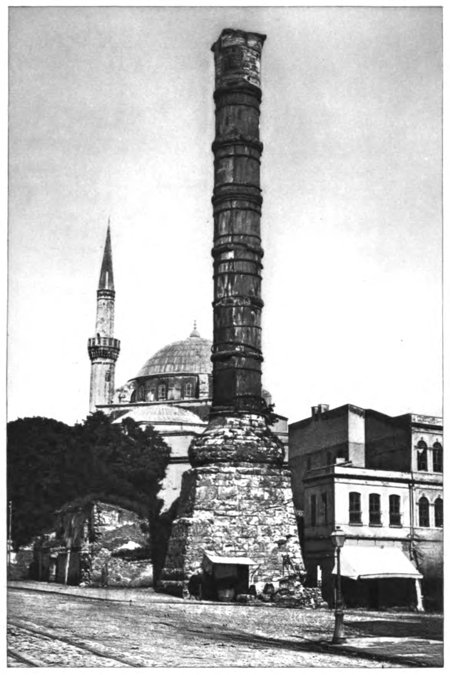
Column of Constantine, Constantinople, p. 290. From a photograph.
I. In the fifth year of his reign, and in the month of September, a comet [114] was seen during twenty days in the western quarter of the heavens, and which shot its rays into the north. Eight years afterwards, while the sun was in Capricorn, another comet appeared to follow in the Sagittary: the size was gradually increasing; the head was in the east, the tail in the west, and it remained visible above forty days. The nations who gazed with astonishment, expected wars and calamities from the baleful influence; and these expectations were abundantly fulfilled. The astronomers dissembled their ignorance of the nature of these blazing stars, which they affected to represent as the floating meteors of the air; and few among them embraced the simple notion of Seneca and the Chaldæans, that they are only planets of a longer period and more eccentric motion. [115] Time and science have justified the conjectures and predictions of the Roman sage; the telescope has opened new worlds to the eyes of astronomers; [116] and, [VII-292] in the narrow space of history and fable, one and the same comet is already found to have revisited the earth in seven equal revolutions of five hundred and seventy-five years. The first, [117] which ascends beyond the Christian era one thousand seven hundred and sixty-seven years, is coeval with Ogyges the father of Grecian antiquity. And this appearance explains the tradition which Varro has preserved, that under his reign the planet Venus changed her colour, size, figure, and course: a prodigy without example either in past or succeeding ages. [118] The second visit, in the year eleven hundred and ninety-three, is darkly implied in the fable of Electra the seventh of the Pleiads, who have been reduced to six since the time of the Trojan war. That nymph, the wife of Dardanus, was unable to support the ruin of her country; she abandoned the dances of her sister orbs, fled from the zodiac to the north pole, and obtained, from her dishevelled locks, the name of the comet. The third period expires in the year six hundred and eighteen, a date that exactly agrees with the tremendous comet of the Sibyll, and perhaps of Pliny, which arose in the west two generations before the reign of Cyrus. The fourth apparition, forty-four years before the birth of Christ, is of all others the most splendid and important. After the death of Cæsar, a long-haired star was conspicuous to Rome and to the nations, during the games which were exhibited by young Octavian in honour of Venus and his uncle. The vulgar opinion, that it conveyed to heaven the divine soul of the dictator, was cherished and consecrated by the piety of a statesman; while his secret superstition referred the comet [VII-293] to the glory of his own times. [119] The fifth visit has been already ascribed to the fifth year of Justinian, which coincides with the five hundred and thirty-first of the Christian era. And it may deserve notice that in this, as in the preceding, instance the comet was followed, though at a longer interval, by a remarkable paleness of the sun. The sixth return, in the year eleven hundred and six, is recorded by the chronicles of Europe and China; and in the first fervour of the Crusades, the Christians and the Mahometans might surmise, with equal reason, that it portended the destruction of the Infidels. The seventh phenomenon of one thousand six hundred and eighty was presented to the eyes of an enlightened age. [120] The philosophy of Bayle dispelled a prejudice which Milton’s muse had so recently adorned, that the comet “from its horrid hair shakes pestilence and war.” [121] Its road in the heavens was observed with exquisite skill by Flamstead and Cassini; and the mathematical science of Bernoulli, Newton, and Halley investigated the laws of its revolutions. At the eighth period, in the year two thousand two hundred and fifty-five, their calculations may perhaps be verified by the astronomers of some future capital in the Siberian or American wilderness.
II. The near approach of a comet may injure or destroy the globe which we inhabit; but the changes on its surface have been hitherto produced by the action of volcanoes and [VII-294] earthquakes. [122] The nature of the soil may indicate the countries most exposed to these formidable concussions, since they are caused by subterraneous fires, and such fires are kindled by the union and fermentation of iron and sulphur. But their times and effects appear to lie beyond the reach of human curiosity, and the philosopher will discreetly abstain from the prediction of earthquakes, till he has counted the drops of water that silently filtrate on the inflammable mineral, and measured the caverns which increase by resistance the explosion of the imprisoned air. Without assigning the cause, history will distinguish the periods in which these calamitous events have been rare or frequent, and will observe that this fever of the earth raged with uncommon violence during the reign of Justinian. [123] Each year is marked by the repetition of earthquakes, of such duration that Constantinople has been shaken above forty days; of such extent that the shock has been communicated to the whole surface of the globe, or at least of the Roman empire. An impulsive or vibratory motion was felt, enormous chasms were opened, huge and heavy bodies were discharged into the air, the sea alternately advanced and retreated beyond its ordinary bounds, and a mountain was torn from Libanus, [124] and cast into the waves, where it protected, as a mole, the new harbour [VII-295] of Botrys [125] in Phœnicia. The stroke that agitates an anthill may crush the insect myriads in the dust; yet truth must extort a confession that man has industriously laboured for his own destruction. The institution of great cities, which include a nation within the limits of a wall, almost realises the wish of Caligula that the Roman people had but one neck. Two hundred and fifty thousand persons are said to have perished in the earthquake of Antioch, whose domestic multitudes were swelled by the conflux of strangers to the festival of the Ascension. The loss of Berytus [126] was of smaller account, but of much greater value. That city, on the coast of Phœnicia, was illustrated by the study of the civil law, which opened the surest road to wealth and dignity; the schools of Berytus were filled with the rising spirits of the age; and many a youth was lost in the earthquake, who might have lived to be the scourge or the guardian of his country. In these disasters, the architect becomes the enemy of mankind. The hut of a savage or the tent of an Arab may be thrown down without injury to the inhabitant; and the Peruvians had reason to deride the folly of their Spanish conquerors, who with so much cost and labour erected their own sepulchres. The rich marbles of a patrician are dashed on his own head; a whole people is buried under the ruins of public and private edifices; and the conflagration is kindled and propagated by the innumerable fires which are necessary for the subsistence and manufactures of a great city. Instead of the mutual sympathy which might comfort and assist the distressed, they dreadfully experience the vices and passions which are released from the fear of punishment: the tottering houses are [VII-296] pillaged by intrepid avarice; revenge embraces the moment, and selects the victim; and the earth often swallows the assassin, or the ravisher, in the consummation of their crimes. Superstition involves the present danger with invisible terrors; and, if the image of death may sometimes be subservient to the virtue or repentance of individuals, an affrighted people is more forcibly moved to expect the end of the world or to deprecate with servile homage the wrath of an avenging Deity.
III. Æthiopia and Egypt have been stigmatised in every age as the original source and seminary of the plague. [127] In a damp, hot, stagnating air, this African fever is generated from the putrefaction of animal substances, and especially from the swarms of locusts, not less destructive to mankind in their death than in their lives. The fatal disease which depopulated the earth in the time of Justinian and his successors [128] first appeared in the neighbourhood of Pelusium, between the Serbonian bog and the eastern channel of the [VII-297] Nile. From thence, tracing as it were a double path, it spread to the East, over Syria, Persia, and the Indies, and penetrated to the West, along the coast of Africa, and over the continent of Europe. In the spring of the second year, Constantinople, during three or four months, was visited by the pestilence; and Procopius, who observed its progress and symptoms with the eyes of a physician, [129] has emulated the skill and diligence of Thucydides in the description of the plague of Athens. [130] The infection was sometimes announced by the visions of a distempered fancy, and the victim despaired as soon as he had heard the menace and felt the stroke of an invisible spectre. But the greater number, in their beds, in the streets, in their usual occupation, were surprised by a slight fever; so slight, indeed, that neither the pulse nor the colour of the patient gave any signs of the approaching danger. The same, the next, or the succeeding day, it was declared by the swelling of the glands, particularly those of the groin, of the arm-pits, and under the ear; and, when these buboes or tumours were opened, they were found to contain a coal, or black substance, of the size of a lentil. If they came to a just swelling and suppuration, the patient was saved by this kind and natural discharge of the morbid humour. But, if they continued hard and dry, a mortification quickly ensued, and the fifth day was commonly the term of his life. The fever was often accompanied with lethargy or delirium; the bodies of the sick were covered with black pustules or carbuncles, the symptoms of [VII-298] immediate death; and, in the constitutions too feeble to produce an eruption, the vomiting of blood was followed by a mortification of the bowels. To pregnant women the plague was generally mortal; yet one infant was drawn alive from his dead mother, and three mothers survived the loss of their infected fœtus. Youth was the most perilous season, and the female sex was less susceptible than the male; but every rank and profession was attacked with indiscriminate rage, and many of those who escaped were deprived of the use of their speech, without being secure from a return of the disorder. [131] The physicians of Constantinople were zealous and skilful, but their art was baffled by the various symptoms and pertinacious vehemence of the disease; the same remedies were productive of contrary effects, and the event capriciously disappointed their prognostics of death or recovery. The order of funerals and the right of sepulchres were confounded; those who were left without friends or servants lay unburied in the streets or in their desolate houses; and a magistrate was authorised to collect the promiscuous heaps of dead bodies, to transport them by land or water, and to inter them in deep pits beyond the precincts of the city. Their own danger and the prospect of public distress awakened some remorse in the minds of the most vicious of mankind; the confidence of health again revived their passions and habits; but philosophy must disdain the observation of Procopius that the lives of such men were guarded by the peculiar favour of fortune or providence. He forgot, or perhaps he secretly recollected, that the plague had touched the person of Justinian himself; but the abstemious diet of the emperor may suggest, as in the case of Socrates, a more rational and honourable cause for his [VII-299] recovery. [132] During his sickness, the public consternation was expressed in the habits of the citizens; and their idleness and despondence occasioned a general scarcity in the capital of the East.
Contagion is the inseparable symptom of the plague; which, by mutual respiration, is transfused from the infected persons to the lungs and stomach of those who approach them. While philosophers believe and tremble, it is singular that the existence of a real danger should have been denied by a people most prone to vain and imaginary terrors. [133] Yet the fellow-citizens of Procopius were satisfied, by some short and partial experience, that the infection could not be gained by the closest conversation; [134] and this persuasion might support the assiduity of friends or physicians in the care of the sick, whom inhuman prudence would have condemned to solitude and despair. But the fatal security, like the predestination of the Turks, must have aided the progress of the contagion, and those salutary precautions to which Europe is indebted for her safety were unknown to the government of Justinian. No restraints were imposed on the free and frequent intercourse of the Roman provinces; from Persia to France, the nations were mingled and infected by wars and emigrations; and the pestilential odour which lurks for years in a bale of cotton was imported, by the abuse of trade, into the most distant regions. [VII-300] The mode of its propagation is explained by the remark of Procopius himself, that it always spread from the sea-coast to the inland country; the most sequestered islands and mountains were successively visited; the places which had escaped the fury of its first passage were alone exposed to the contagion of the ensuing year. The winds might diffuse that subtle venom; but, unless the atmosphere be previously disposed for its reception, the plague would soon expire in the cold or temperate climates of the earth. Such was the universal corruption of the air that the pestilence which burst forth in the fifteenth year of Justinian was not checked or alleviated by any difference of the seasons. In time, its first malignity was abated and dispersed; the disease alternately languished and revived; but it was not till the end of a calamitous period of fifty-two years that mankind recovered their health or the air resumed its pure and salubrious quality. No facts have been preserved to sustain an account, or even a conjecture, of the numbers that perished in this extraordinary mortality. I only find that, during three months, five, and at length ten, thousand persons died each day at Constantinople; that many cities of the East were left vacant; and that in several districts of Italy the harvest and the vintage withered on the ground. The triple scourge of war, pestilence, and famine afflicted the subjects of Justinian, and his reign is disgraced by a visible decrease of the human species, which has never been repaired in some of the fairest countries of the globe. [135]
[VII-301]
CHAPTER XLIV↩
Idea of the Roman Jurisprudence — The Laws of the Kings — The Twelve Tables of the Decemvirs — The Laws of the People — The Decrees of the Senate — The Edicts of the Magistrates and Emperors — Authority of the Civilians — Code, Pandects, Novels, and Institutes of Justinian: — I. Rights of Persons — II. Rights of Things — III. Private Injuries and Actions — IV. Crimes and Punishments
The vain titles of the victories of Justinian are crumbled into dust; but the name of the legislator is inscribed on a fair and everlasting monument. Under his reign, and by his care, the civil jurisprudence was digested in the immortal works of the Code, the Pandects, and the Institutes; [1] the public reason of the Romans has been silently or studiously transfused into the domestic institutions of Europe; [2] and the laws of Justinian still command the respect or obedience of independent [VII-302] nations. Wise or fortunate is the prince who connects his own reputation with the honour and interest of a perpetual order of men. The defence of their founder is the first cause which in every age has exercised the zeal and industry of the civilians. They piously commemorate his virtues; dissemble or deny his failings; and fiercely chastise the guilt or folly of the rebels who presume to sully the majesty of the purple. The idolatry of love has provoked, as it usually happens, the rancour of opposition; the character of Justinian has been exposed to the blind vehemence of flattery and invective; and the injustice of a sect (the Anti-Tribonians) has refused all praise and merit to the prince, his ministers, and his laws. [3] Attached to no party, interested only for the truth and candour of history, and directed by the most temperate and skilful guides, [4] I enter with just diffidence on the subject of civil law, which has exhausted so many learned lives and clothed the walls of such spacious libraries. In a single, if possible in a short, chapter, I shall trace the Roman jurisprudence from Romulus to Justinian, [5] appreciate the labours [VII-303] of that emperor, and pause to contemplate the principles of a science so important to the peace and happiness of society. The laws of a nation form the most instructive portion of its history; and, although I have devoted myself to write the annals of a declining monarchy, I shall embrace the occasion to breathe the pure and invigorating air of the republic.
The primitive government of Rome [6] was composed, with some political skill, of an elective king, a council of nobles, and a general assembly of the people. War and religion were administered by the supreme magistrate; and he alone proposed the laws, which were debated in the senate and finally ratified or rejected by a majority of votes in the thirty curiæ or parishes of the city. Romulus, Numa, and Servius Tullius are celebrated as the most ancient legislators; and each of them claims his peculiar part in the threefold division of Jurisprudence. [7] The laws of marriage, the education of children, and the authority of parents, which may seem to draw their origin from nature itself, are ascribed to the untutored wisdom of Romulus. The law of nations and of religious worship, which Numa introduced, was derived from his nocturnal converse with the nymph Egeria. The civil law is attributed to the experience of Servius; he balanced the rights and fortunes of the seven classes of citizens, and guarded, by fifty new regulations, the observance of contracts and the punishment of crimes. The state, which he had inclined towards a democracy, was changed by the last Tarquin into lawless despotism; and, when the kingly office was abolished, [VII-304] the patricians engrossed the benefits of freedom. The royal laws became odious or obsolete; the mysterious deposit was silently preserved by the priests and nobles; and, at the end of sixty years, the citizens of Rome still complained that they were ruled by the arbitrary sentence of the magistrates. Yet the positive institutions of the kings had blended themselves with the public and private manners of the city; some fragments of that venerable jurisprudence [8] were compiled by the diligence of antiquarians; [9] and above twenty texts still speak the rudeness of the Pelasgic idiom of the Latins. [10]
[VII-305]
I shall not repeat the well-known story of the Decemvirs, [11] who sullied by their actions the honour of inscribing on brass, or wood, or ivory the twelve tables of the Roman laws. [12] They were dictated by the rigid and jealous spirit of an aristocracy, which had yielded with reluctance to the just demands of the people. But the substance of the Twelve Tables was adapted to the state of the city; and the Romans had emerged from barbarism, since they were capable of studying and embracing the institutions of their more enlightened neighbours. A wise Ephesian was driven by envy from his native country; before he could reach the shores of Latium, he had observed the various forms of human nature and civil society; he imparted his knowledge to the legislators of Rome; and a statue was erected in the forum to the perpetual memory of Hermodorus. [13] The names and the divisions of the coppermoney, the sole coin of the infant state, were of Dorian origin; [14] the harvests of Campania and Sicily relieved the wants of a people whose agriculture was often interrupted by war and faction; and, since the trade was established, [15] the deputies who sailed from the Tiber might return from the same harbours with a more precious cargo of political [VII-306] wisdom. The colonies of Great Greece had transported and improved the arts of their mother-country. Cumæ and Rhegium, Crotona and Tarentum, Agrigentum and Syracuse, were in the rank of the most flourishing cities. The disciples of Pythagoras applied philosophy to the use of government; the unwritten laws of Charondas accepted the aid of poetry and music; [16] and Zaleucus framed the republic of the Locrians, which stood without alteration above two hundred years. [17] From a similar motive of national pride, both Livy and Dionysius are willing to believe that the deputies of Rome visited Athens under the wise and splendid administration of Pericles; and the laws of Solon were transfused into the Twelve Tables. If such an embassy had indeed been received from the Barbarians of Hesperia, the Roman name would have been familiar to the Greeks before the reign of Alexander; [18] and the faintest evidence would have been explored [VII-307] and celebrated by the curiosity of succeeding times. But the Athenian monuments are silent; nor will it seem credible that the patricians should undertake a long and perilous navigation to copy the purest model of a democracy. In the comparison of the tables of Solon with those of the Decemvirs, some casual resemblance may be found; some rules which nature and reason have revealed to every society; some proofs of a common descent from Egypt or Phœnicia. [19] But in all the great lines of public and private jurisprudence, the legislators of Rome and Athens appear to be strangers or adverse to each other.
Whatever might be the origin or the merit of the twelve tables, [20] they obtained among the Romans that blind and partial reverence which the lawyers of every country delight to bestow on their municipal institutions. The study is recommended by Cicero [21] as equally pleasant and instructive. “They amuse the mind by the remembrance of old words and the portrait of ancient manners; they inculate the soundest principles of government and morals; and I am not afraid to affirm that the brief composition of the Decemvirs surpasses in genuine value the libraries of Grecian philosophy. How admirable,” says Tully, with honest or affected prejudice, “is the wisdom of our ancestors! We alone are the masters of [VII-308] civil prudence, and our superiority is the more conspicuous, if we deign to cast our eyes on the rude and almost ridiculous jurisprudence of Dracon, of Solon, and of Lycurgus.” The Twelve Tables were committed to the memory of the young and the meditation of the old; they were transcribed and illustrated with learned diligence; they had escaped the flames of the Gauls, they subsisted in the age of Justinian, and their subsequent loss has been imperfectly restored by the labours of modern critics. [22] But, although these venerable monuments were considered as the rule of right and the fountain of justice, [23] they were overwhelmed by the weight and variety of new laws, which, at the end of five centuries, became a grievance more intolerable than the vices of the city. [24] Three thousand brass plates, the acts of the senate and people, were deposited in the Capitol; [25] and some of the acts, as the Julian law against extortion, surpassed the number of an hundred chapters. [26] The Decemvirs had neglected to import the sanction of Zaleucus, which so long maintained the integrity of his republic. A Locrian who proposed any new law stood forth in the assembly of the people with a cord round his neck, and, if the law was rejected, the innovator was instantly strangled.
The Decemvirs had been named, and their tables were approved, by an assembly of the centuries, in which riches preponderated [VII-309] against numbers. To the first class of Romans, the proprietors of one hundred thousand pounds of copper, [27] ninety-eight votes were assigned, and only ninety-five were left for the six inferior classes, distributed according to their substance by the artful policy of Servius. But the tribunes soon established a more specious and popular maxim, that every citizen has an equal right to enact the laws which he is bound to obey. Instead of the centuries, they convened the tribes; and the patricians, after an impotent struggle, submitted to the decrees of an assembly in which their votes were confounded with those of the meanest plebeians. Yet, as long as the tribes successively passed over narrow bridges, [28] and gave their voices aloud, the conduct of each citizen was exposed to the eyes and ears of his friends and countrymen. The insolvent debtor consulted the wishes of his creditor; the client would have blushed to oppose the views of his patron; the general was followed by his veterans; and the aspect of a grave magistrate was a living lesson to the multitude. A new method of secret ballot abolished the influence of fear and shame, of honour and interest, and the abuse of freedom [VII-310] accelerated the progress of anarchy and despotism. [29] The Romans had aspired to be equal; they were levelled by the equality of servitude; and the dictates of Augustus were patiently ratified by the formal consent of the tribes or centuries. Once, and once only, he experienced a sincere and strenuous opposition. His subjects had resigned all political liberty; they defended the freedom of domestic life. A law which enforced the obligation, and strengthened the bonds, of marriage was clamorously rejected; Propertius, in the arms of Delia, applauded the victory of licentious love; and the project of reform was suspended till a new and more tractable generation had arisen in the world. [30] Such an example was not necessary to instruct a prudent usurper of the mischief of popular assemblies; and their abolition, which Augustus had silently prepared, was accomplished without resistance, and almost without notice, on the accession of his successor. [31] Sixty thousand plebeian legislators, whom numbers made formidable and poverty secure, were supplanted by six hundred senators, who held their honours, their fortunes, and their lives by the clemency of the emperor. The loss of executive power was alleviated by the gift of legislative authority; and Ulpian might assert, after the practice of two hundred years, that the decrees of the senate obtained the force and validity of laws. In the times of freedom, the resolves of the people had often been dictated by the passion or error of the moment; the Cornelian, Pompeian, and Julian laws were adapted by a single hand to the prevailing disorders; but the senate, under the reign of the Cæsars, was composed of magistrates and lawyers, and in questions of private jurisprudence [VII-311] the integrity of their judgment was seldom perverted by fear or interest. [32]
The silence or ambiguity of the laws was supplied by the occasional edicts of those magistrates who were invested with the honours of the state. [33] This ancient prerogative of the Roman kings was transferred, in the respective offices, to the consuls and dictators, the censors and prætors; and a similar right was assumed by the tribunes of the people, the ædiles, and the proconsuls. At Rome and in the provinces, the duties of the subject and the intentions of the governor were proclaimed; and the civil jurisprudence was reformed by the annual edicts of the supreme judge, the prætor of the city. As soon as he ascended his tribunal, he announced by the voice of the crier, and afterwards inscribed on a white wall, the rules which he proposed to follow in the decision of doubtful cases, and the relief which his equity would afford from the precise rigour of ancient statutes. A principle of discretion more congenial to monarchy was introduced into the republic; the art of respecting the name, and eluding the efficacy, of the laws was improved by successive prætors; subtleties and fictions were invented to defeat the plainest meaning of the Decemvirs; and, where the end was salutary, the means were frequently absurd. The secret or probable wish of the dead was suffered to prevail over the order of succession and the forms of testaments; and the claimant, who was excluded from the character of heir, accepted with equal pleasure from an indulgent prætor the possession of the goods of his late kinsman or benefactor. In the redress of private wrongs, compensations [VII-312] and fines were substituted to the obsolete rigour of the Twelve Tables; time and space were annihilated by fanciful suppositions; and the plea of youth, or fraud, or violence annulled the obligation, or excused the performance, of an inconvenient contract. A jurisdiction thus vague and arbitrary was exposed to the most dangerous abuse: the substance, as well as the form, of justice were often sacrificed to the prejudices of virtue, the bias of laudable affection, and the grosser seductions of interest or resentment. But the errors or vices of each prætor expired with his annual office; such maxims alone as had been approved by reason and practice were copied by succeeding judges; the rule of proceeding was defined by the solution of new cases; and the temptations of injustice were removed by the Cornelian law, which compelled the prætor of the year to adhere to the letter and spirit of his first proclamation. [34] It was reserved for the curiosity and learning of Hadrian to accomplish the design which had been conceived by the genius of Cæsar; and the prætorship of Salvius Julian, an eminent lawyer, was immortalised by the composition of the perpetual edict. This well-digested code was ratified by the emperor and the senate; the long divorce of law and equity was at length reconciled; and, instead of the Twelve Tables, the Perpetual Edict was fixed as the invariable standard of civil jurisprudence. [35]
From Augustus to Trajan, the modest Cæsars were content [VII-313] to promulgate their edicts in the various characters of a Roman magistrate; and, in the decrees of the senate, the epistles and orations of the prince were respectfully inserted. Hadrian [36] appears to have been the first who assumed, without disguise, the plenitude of legislative power. And this innovation, so agreeable to his active mind, was countenanced by the patience of the times and his long absence from the seat of government. The same policy was embraced by succeeding monarchs, and, according to the harsh metaphor of Tertullian, “the gloomy and intricate forest of ancient laws was cleared away by the axe of royal mandates and constitutions.” [37] During four centuries, from Hadrian to Justinian, the public and private jurisprudence was moulded by the will of the sovereign; and few institutions, either human or divine, were permitted to stand on their former basis. The origin of Imperial legislation was concealed by the darkness of ages and the terrors of armed despotism; and a double fiction was propagated by the servility, or perhaps the ignorance, of the civilians who basked in the sunshine of the Roman and Byzantine courts. 1. To the prayer of the ancient Cæsars, the people or the senate had sometimes granted a personal exemption from the obligation and penalty of particular statutes; and each indulgence was an act of jurisdiction exercised by the republic over the first of her citizens. His humble privilege was at length transformed into the prerogative of a tyrant; and the Latin expression of “released from the laws,” [38] was supposed to exalt the emperor above [VII-314] all human restraints, and to leave his conscience and reason as the sacred measure of his conduct. 2. A similar dependence was implied in the decrees of the senate, which, in every reign, defined the titles and powers of an elective magistrate. But it was not before the ideas, and even the language, of the Romans had been corrupted, that a royal law, [39] and an irrevocable gift of the people, were created by the fancy of Ulpian, or more probably of Tribonian himself; [40] and the origin of Imperial power, though false in fact and slavish in its consequence, was supported on a principle of freedom and justice. “The pleasure of the emperor has the vigour and effect of law, since the Roman people by the royal law have transferred to their prince the full extent of their own power and sovereignty.” [41] The will of a single man, of a child perhaps, was allowed to prevail over the wisdom of ages and the inclinations of millions; and the degenerate Greeks were proud to declare that in his hands alone the arbitrary exercise of legislation could be safely deposited. “What interest or passion,” exclaims Theophilus in the court of Justinian, “can reach the calm and sublime elevation of the monarch? [VII-315] he is already master of the lives and fortunes of his subjects; and those who have incurred his displeasure are already numbered with the dead.” [42] Disdaining the language of flattery, the historian may confess that, in questions of private jurisprudence, the absolute sovereign of a great empire can seldom be influenced by any personal considerations. Virtue, or even reason, will suggest to his impartial mind that he is the guardian of peace and equity, and that the interest of society is inseparably connected with his own. Under the weakest and most vicious reign, the seat of justice was filled by the wisdom and integrity of Papinian and Ulpian; [43] and the purest materials of the Code and Pandects are inscribed with the names of Caracalla and his ministers. [44] The tyrant of Rome was sometimes the benefactor of the provinces. A dagger terminated the crimes of Domitian; but the prudence of Nerva confirmed his acts, which, in the joy of their deliverance, had been rescinded by an indignant senate. [45] Yet in the rescripts, [46] replies to the consultations of the magistrates, the wisest of princes might be deceived by a partial exposition of the case. And this abuse, which placed their hasty decisions on the same level with mature and deliberate acts of legislation, was ineffectually condemned by the sense and example of Trajan. The rescripts of the emperor, his [VII-316] grants and decrees, his edicts and pragmatic sanctions, were subscribed in purple ink, [47] and transmitted to the provinces as general or special laws, which the magistrates were bound to execute, and the people to obey. But, as their number continually multiplied, the rule of obedience became each day more doubtful and obscure, till the will of the sovereign was fixed and ascertained in the Gregorian, the Hermogenian, and the Theodosian codes. The two first, of which some fragments have escaped, were framed by two private lawyers, to preserve the constitutions of the Pagan emperors from Hadrian to Constantine. The third, which is still extant, was digested in sixteen books by the order of the younger Theodosius, to consecrate the laws of the Christian princes from Constantine to his own reign. But the three codes obtained an equal authority in the tribunals; and any act which was not included in the sacred deposit might be disregarded by the judge as spurious or obsolete. [48]
Among savage nations, the want of letters is imperfectly supplied by the use of visible signs, which awaken attention, and perpetuate the remembrance of any public or private transaction. The jurisprudence of the first Romans exhibited the scenes of a pantomime; the words were adapted to the gestures, and the slightest error or neglect in the forms of proceeding was sufficient to annul the substance of the fairest claim. The communion of the marriage-life was denoted by [VII-317] the necessary elements of fire and water; [49] and the divorced wife resigned the bunch of keys, by the delivery of which she had been invested with the government of the family. The manumission of a son, or a slave, was performed by turning him round with a gentle blow on the cheek; a work was prohibited by the casting of a stone; prescription was interrupted by the breaking of a branch; the clenched fist was the symbol of a pledge or deposit; the right hand was the gift of faith and confidence. The indenture of covenants was a broken straw; weights and scales were introduced into every payment; and the heir who accepted a testament was sometimes obliged to snap his fingers, to cast away his garments, and to leap and dance with real or affected transport. [50] If a citizen pursued any stolen goods into a neighbour’s house, he concealed his nakedness with a linen towel, and hid his face with a mask or bason, lest he should encounter the eyes of a virgin or a matron. [51] In a civil action, the plaintiff touched the ear of the witness, seized his reluctant adversary by the neck, and implored, in solemn lamentation, the aid of his fellow-citizens. The two competitors grasped each other’s hand as if they stood prepared for combat before the tribunal of the prætor; he commanded them to produce the object of the dispute; they went, they returned with measured steps, and a clod of earth was cast at his feet to represent the field for [VII-318] which they contended. This occult science of the words and actions of law was the inheritance of the pontiffs and patricians. Like the Chaldean astrologers, they announced to their clients the day of business and repose; these important trifles were interwoven with the religion of Numa; and, after the publication of the Twelve Tables, the Roman people was still enslaved by the ignorance of judicial proceedings. The treachery of some plebeian officers at length revealed the profitable mystery; in a more enlightened age, the legal actions were derided and observed; and the same antiquity which sanctified the practice, obliterated the use and meaning, of this primitive language. [52]
A more liberal art was cultivated, however, by the sages of Rome, who, in a stricter sense, may be considered as the authors of the civil law. The alteration of the idiom and manners of the Romans rendered the style of the Twelve Tables less familiar to each rising generation, and the doubtful passages were imperfectly explained by the study of legal antiquarians. To define the ambiguities, to circumscribe the latitude, to apply the principles, to extend the consequences, to reconcile the real or apparent contradictions, was a much nobler and more important task; and the province of legislation was silently invaded by the expounders of ancient statutes. Their subtle interpretations concurred with the equity of the prætor to reform the tyranny of the darker ages: however strange or intricate the means, it was the aim of artificial jurisprudence to restore the simple dictates of nature and reason, and the skill of private citizens was usefully employed to undermine the public institutions of their country. The revolution of almost one thousand years, from the Twelve Tables to the reign of Justinian, may be divided into three periods almost equal in [VII-319] duration, [53] and distinguished from each other by the mode of instruction and the character of the civilians. [54] Pride and ignorance contributed, during the first period, to confine within narrow limits the science of the Roman law. On the public days of market or assembly, the masters of the art were seen walking in the forum, ready to impart the needful advice to the meanest of their fellow-citizens, from whose votes, on a future occasion, they might solicit a grateful return. As their years and honours increased, they seated themselves at home on a chair or throne, to expect with patient gravity the visits of their clients, who at the dawn of day, from the town and country, began to thunder at their door. The duties of social life and the incidents of judicial proceeding were the ordinary subject of these consultations, and the verbal or written opinion of the jurisconsults was framed according to the rules of prudence and law. The youths of their own order and family were permitted to listen; their children enjoyed the benefit of more private lessons; and the Mucian race was long renowned for the hereditary knowledge of the civil law. The second period, the learned and splendid age of jurisprudence, may be extended from the birth of Cicero to the reign of Severus Alexander. A system was formed, schools were [VII-320] instituted, books were composed, and both the living and the dead became subservient to the instruction of the student. The tripartite of Ælius Pætus, surnamed Catus, or the Cunning, was preserved as the oldest work of jurisprudence. Cato the censor derived some additional fame from his legal studies, and those of his son; the kindred appellation of Mucius Scævola was illustrated by three sages of the law; but the perfection of the science was ascribed to Servius Sulpicius their disciple, and the friend of Tully; and the long succession, which shone with equal lustre under the republic and under the Cæsars, is finally closed by the respectable characters of Papinian, of Paul, and of Ulpian. Their names, and the various titles of their productions, have been minutely preserved, and the example of Labeo may suggest some idea of their diligence and fecundity. That eminent lawyer of the Augustan age divided the year between the city and country, between business and composition; and four hundred books are enumerated as the fruit of his retirement. Of the collections of his rival Capito, the two hundred and fifty-ninth book is expressly quoted; and few teachers could deliver their opinions in less than a century of volumes. In the third period, between the reigns of Alexander and Justinian, the oracles of jurisprudence were almost mute. The measure of curiosity had been filled; the throne was occupied by tyrants and Barbarians; the active spirits were diverted by religious disputes; and the professors of Rome, Constantinople, and Berytus were humbly content to repeat the lessons of their more enlightened predecessors. From the slow advances and rapid decay of these legal studies, it may be inferred that they require a state of peace and refinement. From the multitude of voluminous civilians who fill the intermediate space, it is evident that such studies may be pursued, and such works may be performed, with a common share of judgment, experience, and industry. The genius of Cicero and Virgil was more sensibly felt, as each revolving [VII-321] age had been found incapable of producing a similar or a second; but the most eminent teachers of the law were assured of leaving disciples equal or superior to themselves in merit and reputation.
The jurisprudence which had been grossly adapted to the wants of the first Romans was polished and improved in the seventh century of the city by the alliance of Grecian philosophy. The Scævolas had been taught by use and experience; but Servius Sulpicius was the first civilian who established his art on a certain and general theory. [55] For the discernment of truth and falsehood, he applied, as an infallible rule, the logic of Aristotle and the stoics, reduced particular cases to general principles, and diffused over the shapeless mass the light of order and eloquence. Cicero, his contemporary and friend, declined the reputation of a professed lawyer; but the jurisprudence of his country was adorned by his incomparable genius, which converts into gold every object that it touches. After the example of Plato, he composed a republic; and, for the use of his republic, a treatise of laws, in which he labours to deduce from a celestial origin the wisdom and justice of the Roman constitution. The whole universe, according to his sublime hypothesis, forms one immense commonwealth; gods and men, who participate of the same essence, are members of the same community; reason prescribes the law of nature and nations; and all positive institutions, however modified by accident or custom, are drawn from the rule of right, which the Deity has inscribed on every virtuous mind. From these philosophical mysteries, he mildly excludes the sceptics who refuse to believe, and the epicureans who are unwilling to act. The latter disdain the care of the republic: he advises them to slumber in their [VII-322] shady gardens. But he humbly entreats that the new Academy would be silent, since her bold objections would too soon destroy the fair and well-ordered structure of his lofty system. [56] Plato, Aristotle, and Zeno he represents as the only teachers who arm and instruct a citizen for the duties of social life. Of these, the armour of the stoics [57] was found to be of the firmest temper; and it was chiefly worn, both for use and ornament, in the schools of jurisprudence. From the Portico, the Roman civilians learned to live, to reason, and to die; but they imbibed in some degree the prejudices of the sect; the love of paradox, the pertinacious habits of dispute, and a minute attachment to words and verbal distinctions. The superiority of form to matter was introduced to ascertain the right of property; and the equality of crimes is countenanced by an opinion of Trebatius, [58] that he who touches the ear touches the whole body; and that he who steals from an heap of corn or an hogshead of wine is guilty of the entire theft. [59]
Arms, eloquence, and the study of the civil law promoted a citizen to the honours of the Roman state; and the three professions were sometimes more conspicuous by their union [VII-323] in the same character. In the composition of the edict, a learned prætor gave a sanction and preference to his private sentiments; the opinion of a censor or a consul was entertained with respect; and a doubtful interpretation of the laws might be supported by the virtues or triumphs of the civilian. The patrician arts were long protected by the veil of mystery; and in more enlightened times, the freedom of inquiry established the general principles of jurisprudence. Subtle and intricate cases were elucidated by the disputes of the forum; rules, axioms, and definitions [60] were admitted as the genuine dictates of reason; and the consent of the legal professors was interwoven into the practice of the tribunals. But these interpreters could neither enact nor execute the laws of the republic; and the judges might disregard the authority of the Scævolas themselves, which was often overthrown by the eloquence or sophistry of an ingenious pleader. [61] Augustus and Tiberius were the first to adopt, as an useful engine, the science of the civilians; and their servile labours accommodated the old system to the spirit and views of despotism. Under the fair pretence of securing the dignity of the art, the privilege of subscribing legal and valid opinions was confined to the sages of senatorian or equestrian rank, who had been previously approved by the judgment of the prince; and this monopoly prevailed, till Hadrian restored the freedom of the profession to every citizen conscious of his abilities and knowledge. The discretion of the prætor was now governed by the lessons of his teachers; the judges were enjoined to obey the comment as well as the text of the law; and the use of codicils was a memorable innovation, which Augustus ratified by the advice of the civilians. [62]
[VII-324]
The most absolute mandate could only require that the judges should agree with the civilians, if the civilians agreed among themselves. But positive institutions are often the result of custom and prejudice; laws and language are ambiguous and arbitrary; where reason is incapable of pronouncing, the love of argument is inflamed by the envy of rivals, the vanity of masters, the blind attachment of their disciples; and the Roman jurisprudence was divided by the once famous sects of the Proculians and Sabinians. [63] Two sages of the law, Ateius Capito and Antistius Labeo, [64] adorned the peace of the Augustan age: the former distinguished by the favour of his sovereign; the latter more illustrious by his contempt of that favour, and his stern though harmless opposition to the tyrant of Rome. Their legal studies were influenced by the various colours of their temper and principles. Labeo was attached to the form of the old republic; his rival embraced the more profitable substance of the rising monarchy. But the disposition of a courtier is tame and submissive; and Capito seldom presumed to deviate from the sentiments, or at least from the words, of his predecessors; while the bold republican pursued his independent ideas without fear of paradox or innovations. The freedom of Labeo was enslaved, however, by the rigour of his own conclusions, and he decided according to the letter of the law the same questions which his indulgent competitor [VII-325] resolved with a latitude of equity more suitable to the common sense and feelings of mankind. If a fair exchange had been substituted to the payment of money, Capito still considered the transaction as a legal sale; [65] and he consulted nature for the age of puberty, without confining his definition to the precise period of twelve or fourteen years. [66] This opposition of sentiments was propagated in the writings and lessons of the two founders; the schools of Capito and Labeo maintained their inveterate conflict from the age of Augustus to that of Hadrian; [67] and the two sects derived their appellations from Sabinus and Proculus, their most celebrated teachers. The names of Cassians and Pegasians were likewise applied to the same parties; but, by a strange reverse, the popular cause was in the hands of Pegasus, [68] a timid slave of Domitian, while the favourite of the Cæsars was represented by Cassius, [69] who gloried in his descent from the patriot assassin. By the perpetual edict, the controversies of the sects were in a great measure determined. For that important work, the emperor Hadrian preferred the chief of [VII-326] the Sabinians: the friends of monarchy prevailed; but the moderation of Salvius Julian insensibly reconciled the victors and the vanquished. Like the contemporary philosophers, the lawyers of the age of the Antonines disclaimed the authority of a master, and adopted from every system the most probable doctrines. [70] But their writings would have been less voluminous, had their choice been more unanimous. The conscience of the judge was perplexed by the number and weight of discordant testimonies, and every sentence that his passion or interest might pronounce was justified by the sanction of some venerable name. An indulgent edict of the younger Theodosius excused him from the labour of comparing and weighing their arguments. Five civilians, Caius, Papinian, Paul, Ulpian, and Modestinus, were established as the oracles of jurisprudence; a majority was decisive; but, if their opinions were equally divided, a casting vote was ascribed to the superior wisdom of Papinian. [71]
When Justinian ascended the throne, the reformation of the Roman jurisprudence was an arduous but indispensable task. In the space of ten centuries, the infinite variety of laws and legal opinions had filled many thousand volumes, which no fortune could purchase and no capacity could digest. Books could not easily be found; and the judges, poor in the midst of riches, were reduced to the exercise of their illiterate discretion. The subjects of the Greek provinces were ignorant of the language that disposed of their lives and properties; and the barbarous dialect of the Latins [VII-327] was imperfectly studied in the academies of Berytus and Constantinople. As an Illyrian soldier, that idiom was familiar to the infancy of Justinian; his youth had been instructed by the lessons of jurisprudence, and his Imperial choice selected the most learned civilians of the East, to labour with their sovereign in the work of reformation. [72] The theory of professors was assisted by the practice of advocates and the experience of magistrates; and the whole undertaking was animated by the spirit of Tribonian. [73] This extraordinary man, the object of so much praise and censure, was a native of Side in Pamphylia; and his genius, like that of Bacon, embraced, as his own, all the business and knowledge of the age. Tribonian composed, both in prose and verse, on a strange diversity of curious and abstruse subjects: [74] a double panegyric of Justinian and the life of the philosopher Theodotus; the nature of happiness and the duties of government; Homer’s catalogue and the four-and-twenty sorts of metre; the astronomical canon of Ptolemy; the changes of the months; the houses of the planets; and the harmonic system of the world. To the literature of Greece he added the use of the Latin tongue; the Roman civilians were deposited in his library and in his mind; and he most assiduously cultivated those arts which opened the [VII-328] road of wealth and preferment. From the bar of the prætorian prefects, he raised himself to the honours of quæstor, of consul, and of master of the offices; the council of Justinian listened to his eloquence and wisdom; and envy was mitigated by the gentleness and affability of his manners. The reproaches of impiety and avarice have stained the virtues or the reputation of Tribonian. In a bigoted and persecuting court, the principal minister was accused of a secret aversion to the Christian faith, and was supposed to entertain the sentiments of an Atheist and a Pagan, which have been imputed, inconsistently enough, to the last philosophers of Greece. His avarice was more clearly proved and more sensibly felt. If he were swayed by gifts in the administration of justice, the example of Bacon will again occur; nor can the merit of Tribonian atone for his baseness, if he degraded the sanctity of his profession, and, if laws were every day enacted, modified, or repealed for the base consideration of his private emolument. In the sedition of Constantinople, his removal was granted to the clamours, perhaps to the just indignation, of the people; but the quæstor was speedily restored, and till the hour of his death he possessed, above twenty years, the favour and confidence of the emperor. His passive and dutiful submission has been honoured with the praise of Justinian himself, whose vanity was incapable of discerning how often that submission degenerated into the grossest adulation. Tribonian adored the virtues of his gracious master: the earth was unworthy of such a prince; and he affected a pious fear that Justinian, like Elijah or Romulus, would be snatched into the air and translated alive to the mansions of celestial glory. [75]
[VII-329]
If Cæsar had achieved the reformation of the Roman law, his creative genius, enlightened by reflection and study, would have given to the world a pure and original system of jurisprudence. Whatever flattery might suggest, the emperor of the East was afraid to establish his private judgment as the standard of equity: in the possession of legislative power, he borrowed the aid of time and opinion; and his laborious compilations are guarded by the sages and legislators of past times. Instead of a statue cast in a simple mould by the hand of an artist, the works of Justinian represent a tesselated pavement of antique and costly, but too often of incoherent, fragments. In the first year of his reign, he directed the faithful Tribonian and nine learned associates to revise the ordinances of his predecessors, as they were contained, since the time of Hadrian, in the Gregorian, Hermogenian, and Theodosian codes; to purge the errors and contradictions, to retrench whatever was obsolete or superfluous, and to select the wise and salutary laws best adapted to the practice of the tribunals and the use of his subjects. The work was accomplished in fourteen months; and the twelve books or tables, which the new decemvirs produced, might be designed to imitate the labours of their Roman predecessors. The new code of Justinian was honoured with his name, and confirmed by his royal signature; authentic transcripts were multiplied by the pens of notaries and scribes; they were transmitted to the magistrates of the European, the Asiatic, and afterwards the African provinces; and the law of the empire was proclaimed on solemn festivals at the doors of churches. A more arduous operation was still behind: to extract the spirit of jurisprudence from the decisions and conjectures, the questions and disputes, of the Roman civilians. Seventeen lawyers, with Tribonian at their head, were appointed by the emperor to exercise an [VII-330] absolute jurisdiction over the works of their predecessors. If they had obeyed his commands in ten years, Justinian would have been satisfied with their diligence; and the rapid composition of the digest or pandects, [76] in three years, will deserve praise or censure according to the merit of the execution. From the library of Tribonian they chose forty, the most eminent civilians of former times: [77] two thousand treatises were comprised in an abridgment of fifty books; and it has been carefully recorded that three millions of lines or sentences [78] were reduced, in this abstract, to the moderate number of one hundred and fifty thousand. The edition of this great work was delayed a month after that of the institutes; and it seemed reasonable that the elements should precede the digest of the Roman law. As soon as the emperor had approved their labours, he ratified, by his legislative power, the speculations of these private citizens; their commentaries on the Twelve Tables, the Perpetual Edict, the laws of the people, and the decrees of the senate succeeded to the authority of the text; and the text was abandoned, as an useless, though venerable, relic of antiquity. The Code, [VII-331] the Pandects, and the Institutes were declared to be the legitimate system of civil jurisprudence; they alone were admitted in the tribunals, and they alone were taught in the academies of Rome, Constantinople, and Berytus. Justinian addressed to the senate and provinces his eternal oracles; and his pride, under the mask of piety, ascribed the consummation of this great design to the support and inspiration of the Deity.
Since the emperor declined the fame and envy of original composition, we can only require at his hands method, choice, and fidelity, the humble though indispensable virtues of a compiler. Among the various combinations of ideas, it is difficult to assign any reasonable preference; but, as the order of Justinian is different in his three works, it is possible that all may be wrong, and it is certain that two cannot be right. In the selection of ancient laws, he seems to have viewed his predecessors without jealousy and with equal regard: the series could not ascend above the reign of Hadrian, and the narrow distinction of Paganism and Christianity, introduced by the superstition of Theodosius, had been abolished by the consent of mankind. But the jurisprudence of the Pandects is circumscribed within a period of an hundred years, from the Perpetual Edict to the death of Severus Alexander; the civilians who lived under the first Cæsars are seldom permitted to speak, and only three names can be attributed to the age of the republic. The favourite of Justinian (it has been fiercely urged) was fearful of encountering the light of freedom and the gravity of Roman sages. Tribonian condemned to oblivion the genuine and native wisdom of Cato, the Scævolas, and Sulpicius; while he invoked spirits more congenial to his own, the Syrians, Greeks, and Africans, who flocked to the Imperial court to study Latin as a foreign tongue, and jurisprudence as a lucrative profession. But the ministers of Justinian [79] were [VII-332] instructed to labour, not for the curiosity of antiquarians, but for the immediate benefit of his subjects. It was their duty to select the useful and practical parts of the Roman law; and the writings of the old republicans, however curious or excellent, were no longer suited to the new system of manners, religion, and government. Perhaps, if the preceptors and friends of Cicero were still alive, our candour would acknowledge that, except in purity of language, [80] their intrinsic merit was excelled by the school of Papinian and Ulpian. The science of the laws is the slow growth of time and experience, and the advantage both of method and materials is naturally assumed by the most recent authors. The civilians of the reign of the Antonines had studied the works of their predecessors; their philosophic spirit had mitigated the rigour of antiquity, simplified the forms of proceeding, and emerged from the jealousy and prejudice of the rival sects. The choice of the authorities that compose the Pandects depended on the judgment of Tribonian; but the power of his sovereign could not absolve him from the sacred obligations of truth and fidelity. As a legislator of the empire, Justinian might repeal the acts of the Antonines, or condemn, as seditious, the free principles which were maintained by the last of the Roman lawyers. [81] But the existence of past facts is placed beyond the reach of despotism; and the emperor was guilty [VII-333] of fraud and forgery, when he corrupted the integrity of their text, inscribed with their venerable names the words and ideas of his servile reign, [82] and suppressed, by the hand of power, the pure and authentic copies of their sentiments. The changes and interpolations of Tribonian and his colleagues are excused by the pretence of uniformity; but their cares have been insufficient, and the antinomies or contradictions of the Code and Pandects still exercise the patience and subtlety of modern civilians. [83]
A rumour devoid of evidence has been propagated by the enemies of Justinian: that the jurisprudence of ancient Rome was reduced to ashes by the author of the Pandects, from the vain persuasion that it was now either false or superfluous. Without usurping an office so invidious, the emperor might safely commit to ignorance and time the accomplishment of this destructive wish. Before the invention of printing and paper, the labour and the materials of writing could be purchased only by the rich; and it may reasonably be computed that the price of books was an hundredfold their present value. [84] Copies were slowly multiplied and cautiously renewed; the hopes of profit tempted the sacrilegious scribes to erase the characters of antiquity; and Sophocles or Tacitus were obliged to resign the parchment to missals, homilies, and the golden legend. [85] [VII-334] If such was the fate of the most beautiful compositions of genius, what stability could be expected for the dull and barren works of an obsolete science? The books of jurisprudence were interesting to few and entertaining to none; their value was connected with present use; and they sunk for ever as soon as that use was superseded by the innovations of fashion, superior merit, or public authority. In the age of peace and learning, between Cicero and the last of the Antonines, many losses had been already sustained, and some luminaries of the school, or forum, were known only to the curious by tradition and report. Three hundred and sixty years of disorder and decay accelerated the progress of oblivion; and it may fairly be presumed that of the writings which Justinian is accused of neglecting many were no longer to be found in the libraries of the East. [86] The copies of Papinian or Ulpian, which the reformer had proscribed, were deemed unworthy of future notice; the Twelve Tables and prætorian edict insensibly vanished; and the monuments of ancient Rome were neglected or destroyed by the envy and ignorance of the Greeks. Even the Pandects themselves [VII-335] have escaped with difficulty and danger from the common shipwreck, and criticism has pronounced that all the editions and manuscripts of the West are derived from one original. [87] It was transcribed at Constantinople in the beginning of the seventh century, [88] was successively transported by the accidents of war and commerce to Amalphi, [89] Pisa, [90] and Florence, [91] and is now deposited as a sacred relic [92] in the ancient palace of the republic. [93]
[VII-336]
It is the first care of a reformer to prevent any future reformation. To maintain the text of the Pandects, the Institutes, and the Code, the use of cyphers and abbreviations was rigorously proscribed; and, as Justinian recollected that the Perpetual Edict had been buried under the weight of commentators, he denounced the punishment of forgery against the rash civilians who should presume to interpret or pervert the will of their sovereign. The scholars of Accursius, of Bartolus, of Cujacius, should blush for their accumulated guilt, unless they dare to dispute his right of binding the authority of his successors and the native freedom of the mind. But the emperor was unable to fix his own inconstancy; and, while he boasted of renewing the exchange of Diomede, of transmuting brass into gold, [94] he discovered the necessity of purifying his gold from the mixture of baser alloy. Six years had not elapsed from the publication of the Code, before he condemned the imperfect attempt by a new and more accurate edition of the same work; which he enriched with two hundred of his own laws and fifty decisions of the darkest and most intricate points of jurisprudence. Every year, or, according to Procopius, each day, of his long reign was marked by some legal innovation. Many of his acts were rescinded by himself, many were rejected by his successors, many have been obliterated by time; but the number of sixteen edicts, and one hundred and sixty-eight novels, [95] has been admitted into the authentic body of the civil jurisprudence. In the opinion of a philosopher superior to the prejudices of his profession, these incessant, and for [VII-337] the most part trifling, alterations can be only explained by the venal spirit of a prince who sold without shame his judgments and his laws. [96] The charge of the secret historian is indeed explicit and vehement; but the sole instance which he produces may be ascribed to the devotion as well as to the avarice of Justinian. A wealthy bigot had bequeathed his inheritance to the church of Emesa; and its value was enhanced by the dexterity of an artist, who subscribed confessions of debt and promises of payment with the names of the richest Syrians. They pleaded the established prescription of thirty or forty years; but their defence was overruled by a retrospective edict, which extended the claims of the church to the term of a century: an edict so pregnant with injustice and disorder that, after serving this occasional purpose, it was prudently abolished in the same reign. [97] If candour will acquit the emperor himself and transfer the corruption to his wife and favourites, the suspicion of so foul a vice must still degrade the majesty of his laws; and the advocates of Justinian may acknowledge that such levity, whatsoever be the motive, is unworthy of a legislator and a man.
Monarchs seldom condescend to become the preceptors of their subjects; and some praise is due to Justinian, by whose command an ample system was reduced to a short and elementary treatise. Among the various institutes of the Roman law, [98] those of Caius [99] were the most popular in the [VII-338] East and West; and their use may be considered as an evidence of their merit. They were selected by the Imperial delegates, Tribonian, Theophilus, and Dorotheus: and the freedom and purity of the Antonines was encrusted with the coarser materials of a degenerate age. The same volume which introduced the youth of Rome, Constantinople, and Berytus to the gradual study of the Code and Pandects is still precious to the historian, the philosopher, and the magistrate. The institutes of Justinian are divided into four books; they proceed, with no contemptible method, from I. Persons to II. Things, and from things to III. Actions; and the article IV. of Private Wrongs is terminated by the principles of Criminal Law.
I. The distinction of ranks and persons is the firmest basis of a mixed and limited government. In France, the remains of liberty are kept alive by the spirit, the honours, and even the prejudices of fifty thousand nobles. [100] Two hundred families supply, in lineal descent, the second branch of the English legislature, which maintains, between the king and commons, the balance of the constitution. A gradation of patricians and plebeians, of strangers and subjects, has supported the aristocracy of Genoa, Venice, and ancient Rome. The perfect equality of men is the point in which the extremes of democracy and despotism are confounded; since the majesty of the prince or people would be offended, if any heads were exalted above the level of their fellow-slaves or fellow-citizens. In the decline of the Roman empire, the [VII-339] proud distinctions of the republic were gradually abolished, and the reason or instinct of Justinian completed the simple form of an absolute monarchy. The emperor could not eradicate the popular reverence which always waits on the possession of hereditary wealth or the memory of famous ancestors. He delighted to honour with titles and emoluments his generals, magistrates, and senators; and his precarious indulgence communicated some rays of their glory to the persons of their wives and children. But, in the eye of the law, all Roman citizens were equal, and all subjects of the empire were citizens of Rome. That inestimable character was degraded to an obsolete and empty name. The voice of a Roman could no longer enact his laws or create the annual ministers of his power: his constitutional rights might have checked the arbitrary will of a master; and the bold adventurer from Germany or Arabia was admitted, with equal favour, to the civil and military command, which the citizen alone had been once entitled to assume over the conquests of his fathers. The first Cæsars had scrupulously guarded the distinction of ingenuous and servile birth, which was decided by the condition of the mother; and the candour of the laws was satisfied, if her freedom could be ascertained during a single moment between the conception and the delivery. The slaves, who were liberated by a generous master, immediately entered into the middle class of libertines or freedmen; but they could never be enfranchised from the duties of obedience and gratitude; whatever were the fruits of their industry, their patron and his family inherited the third part; or even the whole of their fortune, if they died without children and without a testament. Justinian respected the rights of patrons; but his indulgence removed the badge of disgrace from the two inferior orders of freedmen: whoever ceased to be a slave obtained, without reserve or delay, the station of a citizen; and at length the dignity of an ingenuous birth, which nature had refused, was created, or supposed, by the omnipotence of the emperor. Whatever [VII-340] restraints of age, or forms, or numbers had been formerly introduced to check the abuse of manumissions and the too rapid increase of vile and indigent Romans, he finally abolished; and the spirit of his laws promoted the extinction of domestic servitude. Yet the Eastern provinces were filled, in the time of Justinian, with multitudes of slaves, either born or purchased for the use of their masters; and the price, from ten to seventy pieces of gold, was determined by their age, their strength, and their education. [101] But the hardships of this dependent state were continually diminished by the influence of government and religion; and the pride of a subject was no longer elated by his absolute dominion over the life and happiness of his bondsman. [102]
The law of nature instructs most animals to cherish and educate their infant progeny. The law of reason inculcates to the human species the returns of filial piety. But the exclusive, absolute, and perpetual dominion of the father over his children is peculiar to the Roman jurisprudence, [103] and [VII-341] seems to be coeval with the foundation of the city. [104] The paternal power was instituted or confirmed by Romulus himself; and after the practice of three centuries it was inscribed on the fourth table of the Decemvirs. In the forum, the senate, or the camp, the adult son of a Roman citizen enjoyed the public and private rights of a person; in his father’s house, he was a mere thing, confounded by the laws with the moveables, the cattle, and the slaves, whom the capricious master might alienate or destroy without being responsible to any earthly tribunal. The hand which bestowed the daily sustenance might resume the voluntary gift, and whatever was acquired by the labour or fortune of the son was immediately lost in the property of the father. His stolen goods (his oxen or his children) might be recovered by the same action of theft; [105] and, if either had been guilty of a trespass, it was in his own option to compensate the damage or resign to the injured party the obnoxious animal. At the call of indigence or avarice, the master of a family could dispose of his children or his slaves. But the condition of the slave was far more advantageous, since he regained by the first manumission his alienated freedom; the son was again restored to his unnatural father; he might be condemned to servitude a second and a third time, and it was not till after the third sale and deliverance [106] that he was enfranchised from the domestic power which had been so repeatedly abused. According to his discretion, a father might chastise [VII-342] the real or imaginary faults of his children, by stripes, by imprisonment, by exile, by sending them to the country to work in chains among the meanest of his servants. The majesty of a parent was armed with the power of life and death; [107] and the examples of such bloody executions, which were sometimes praised and never punished, may be traced in the annals of Rome, beyond the times of Pompey and Augustus. Neither age, nor rank, nor the consular office, nor the honours of a triumph could exempt the most illustrious citizen from the bonds of filial subjection; [108] his own descendants were included in the family of their common ancestor; and the claims of adoption were not less sacred or less rigorous than those of nature. Without fear, though not without danger of abuse, the Roman legislators had reposed an unbounded confidence in the sentiments of paternal love; and the oppression was tempered by the assurance that each generation must succeed in its turn to the awful dignity of parent and master.
The first limitation of paternal power is ascribed to the justice and humanity of Numa; and the maid who, with his father’s consent, had espoused a freeman was protected from the disgrace of becoming the wife of a slave. In the first ages, when the city was pressed and often famished by her Latin and Tuscan neighbours, the sale of children might be a frequent practice; but, as a Roman could not legally purchase the liberty of his fellow-citizen, the market must gradually [VII-343] fail, and the trade would be destroyed by the conquests of the republic. An imperfect right of property was at length communicated to sons; and the threefold distinction of profectitious, adventitious, and professional was ascertained by the jurisprudence of the Code and Pandects. [109] Of all that proceeded from the father, he imparted only the use, and reserved the absolute dominion; yet, if his goods were sold, the filial portion was excepted, by a favourable interpretation, from the demands of the creditors. In whatever accrued by marriage, gift, or collateral succession, the property was secured to the son; but the father, unless he had been specially excluded, enjoyed the usufruct during his life. As a just and prudent reward of military virtue, the spoils of the enemy were acquired, possessed, and bequeathed by the soldier alone; and the fair analogy was extended to the emoluments of any liberal profession, the salary of public service, and the sacred liberality of the emperor or the empress. The life of a citizen was less exposed than his fortune to the abuse of paternal power. Yet his life might be adverse to the interest or passions of an unworthy father; the same crimes that flowed from the corruption, were more sensibly felt by the humanity, of the Augustan age; and the cruel Erixo, who whipt his son till he expired, was saved by the emperor from the just fury of the multitude. [110] The Roman father, from the licence of servile dominion, was reduced to the gravity and moderation of a judge. The presence and opinion of Augustus confirmed the sentence of exile pronounced against an intentional parricide by the domestic tribunal of Arius. Hadrian transported to an island the jealous parent who, like a robber, had seized the opportunity of hunting, to assassinate a youth, the incestuous lover of his stepmother. [111] [VII-344] A private jurisprudence is repugnant to the spirit of monarchy; the parent was again reduced from a judge to an accuser; and the magistrates were enjoined by Severus Alexander to hear his complaints and execute his sentence. He could no longer take the life of a son without incurring the guilt and punishment of murder; and the pains of parricide, from which he had been excepted by the Pompeian law, were finally inflicted by the justice of Constantine. [112] The same protection was due to every period of existence; and reason must applaud the humanity of Paulus for imputing the crime of murder to the father who strangles or starves or abandons his new-born infant, or exposes him in a public place to find the mercy which he himself had denied. But the exposition of children was the prevailing and stubborn vice of antiquity: it was sometimes prescribed, often permitted, almost always practised with impunity, by the nations who never entertained the Roman ideas of paternal power; and the dramatic poets, who appeal to the human heart, represent with indifference a popular custom which was palliated by the motives of economy and compassion. [113] If the father could subdue his own feelings, he might escape, though not the censure, at least the chastisement, of the laws; and the Roman empire was stained with the blood of infants, till such murders were included, by Valentinian and his colleagues, in the letter and spirit of the [VII-345] Cornelian law. The lessons of jurisprudence [114] and Christianity had been insufficient to eradicate this inhuman practice, till their gentle influence was fortified by the terrors of capital punishment. [115]
Experience has proved that savages are the tyrants of the female sex, and that the condition of women is usually softened by the refinements of social life. In the hope of a robust progeny, Lycurgus had delayed the season of marriage; it was fixed by Numa at the tender age of twelve years, that the Roman husband might educate to his will a pure and obedient virgin. [116] According to the custom of antiquity, he bought his bride of her parents, and she fulfilled the coemption by purchasing, with three pieces of copper, a just introduction to his house and household deities. A sacrifice of fruits was offered by the pontiffs in the presence of ten witnesses; the contracting parties were seated on the same sheepskin; they tasted a salt cake of far or rice; and this confarreation, [117] which denoted the ancient food of Italy, served as an emblem of their mystic union of mind and body. But this union on the side of the woman was rigorous and [VII-346] unequal; and she renounced the name and worship of her father’s house to embrace a new servitude decorated only by the title of adoption. A fiction of the law, neither rational nor elegant, bestowed on the mother of a family [118] (her proper appellation) the strange characters of sister to her own children, and of daughter to her husband or master, who was invested with the plenitude of paternal power. By his judgment or caprice her behaviour was approved, or censured, or chastised; he exercised the jurisdiction of life and death; and it was allowed that, in the cases of adultery or drunkenness, [119] the sentence might be properly inflicted. She acquired and inherited for the sole profit of her lord; and so clearly was woman defined, not as a person, but as a thing, that, if the original title were deficient, she might be claimed, like other moveables, by the use and possession of an entire year. The inclination of the Roman husband discharged or withheld the conjugal debt, so scrupulously exacted by the Athenian and Jewish laws; [120] but, as polygamy was unknown, [VII-347] he could never admit to his bed a fairer or more favoured partner.
After the Punic triumphs, the matrons of Rome aspired to the common benefits of a free and opulent republic: their wishes were gratified by the indulgence of fathers and lovers, and their ambition was unsuccessfully resisted by the gravity of Cato the Censor. [121] They declined the solemnities of the old nuptials, defeated the annual prescription by an absence of three days, and, without losing their name or independence, subscribed the liberal and definite terms of a marriage-contract. Of their private fortunes they communicated the use, and secured the property; the estates of a wife could neither be alienated nor mortgaged by a prodigal husband; their mutual gifts were prohibited by the jealousy of the laws; and the misconduct of either party might afford, under another name, a future subject for an action of theft. To this loose and voluntary compact, religious and civil rites were no longer essential; and, between persons of a similar rank, the apparent community of life was allowed as sufficient evidence of their nuptials. The dignity of marriage was restored by the Christians, who derived all spiritual grace from the prayers of the faithful and the benediction of the priest or bishop. The origin, validity, and duties of the holy institution were regulated by the tradition of the synagogue, the precepts of the gospel, and the canons of general or provincial [VII-348] synods; [122] and the conscience of the Christians was awed by the decrees and censures of their ecclesiastical rulers. Yet the magistrates of Justinian were not subject to the authority of the church: the emperor consulted the unbelieving civilians of antiquity, and the choice of matrimonial laws in the Code and Pandects is directed by the earthly motives of justice, policy, and the natural freedom of both sexes. [123]
Besides the agreement of the parties, the essence of every rational contract, the Roman marriage required the previous approbation of the parents. A father might be forced by some recent laws to supply the wants of a mature daughter; but even his insanity was not generally allowed to supersede the necessity of his consent. The causes of the dissolution of matrimony have varied among the Romans; [124] but the most solemn sacrament, the confarreation itself, might always be done away by rites of a contrary tendency. In the first ages, the father of a family might sell his children, and his wife was reckoned in the number of his children; the domestic judge might pronounce the death of the offender, or his mercy might expel her from his bed and house; but the slavery of the wretched female was hopeless and perpetual, unless he asserted for his own convenience the manly prerogative of divorce. The warmest applause has been lavished [VII-349] on the virtue of the Romans, who abstained from the exercise of this tempting privilege above five hundred years; [125] but the same fact evinces the unequal terms of a connection in which the slave was unable to renounce her tyrant and the tyrant was unwilling to relinquish his slave. When the Roman matrons became the equal and voluntary companions of their lords, a new jurisprudence was introduced, that marriage, like other partnerships, might be dissolved by the abdication of one of the associates. In three centuries of prosperity and corruption, this principle was enlarged to frequent practice and pernicious abuse. Passion, interest, or caprice suggested daily motives for the dissolution of marriage; a word, a sign, a message, a letter, the mandate of a freedman, declared the separation; the most tender of human connections was degraded to a transient society of profit or pleasure. According to the various conditions of life, both sexes alternately felt the disgrace and injury: an inconstant spouse transferred her wealth to a new family, abandoning a numerous, perhaps a spurious, progeny to the paternal authority and care of her late husband; a beautiful virgin might be dismissed to the world, old, indigent, and friendless; but the reluctance of the Romans, when they were pressed to marriage by Augustus, sufficiently marks that the prevailing institutions were least favourable to the males. A specious theory is confuted by this free and perfect experiment, which demonstrates that the liberty of divorce does not contribute to happiness and virtue. The facility of separation would destroy all mutual confidence and inflame every trifling dispute; the minute difference between an husband and a stranger, which might so easily be removed, might still more easily be forgotten; and the matron, [VII-350] who in five years can submit to the embraces of eight husbands, must cease to reverence the chastity of her own person. [126]
Insufficient remedies followed with distant and tardy steps the rapid progress of the evil. The ancient worship of the Romans afforded a peculiar goddess to hear and reconcile the complaints of a married life; but her epithet of Viriplaca, [127] the appeaser of husbands, too clearly indicates on which side submission and repentance were always expected. Every act of a citizen was subject to the judgment of the censors; the first who used the privilege of divorce assigned, at their command, the motives of his conduct; [128] and a senator was expelled for dismissing his virgin spouse without the knowledge or advice of his friends. Whenever an action was instituted for the recovery of a marriage-portion, the prætor, as the guardian of equity, examined the cause and the characters, and gently inclined the scale in favour of the guiltless and injured party. Augustus, who united the powers of both magistrates, adopted their different modes of repressing or chastising the licence of divorce. [129] The presence of seven Roman witnesses was required for the validity of this solemn and deliberate act: if any adequate provocation had [VII-351] been given by the husband, instead of the delay of two years, he was compelled to refund immediately, or in the space of six months; but, if he could arraign the manners of his wife, her guilt or levity was expiated by the loss of the sixth or eighth part of her marriage-portion. The Christian princes were the first who specified the just causes of a private divorce; their institutions, from Constantine to Justinian, appear to fluctuate between the custom of the empire and the wishes of the church; [130] and the author of the Novels too frequently reforms the jurisprudence of the Code and Pandects. In the most rigorous laws, a wife was condemned to support a gamester, a drunkard, or a libertine, unless he were guilty of homicide, poison, or sacrilege, in which cases the marriage, as it should seem, might have been dissolved by the hand of the executioner. But the sacred right of the husband was invariably maintained to deliver his name and family from the disgrace of adultery; the list of mortal sins, either male or female, was curtailed and enlarged by successive regulations, and the obstacles of incurable impotence, long absence, and monastic profession were allowed to rescind the matrimonial obligation. Whoever transgressed the permission of the law was subject to various and heavy penalties. The woman was stript of her wealth and ornaments, without excepting the bodkin of her hair; if the man introduced a new bride into his bed, her fortune might be lawfully seized by the vengeance of his exiled wife. Forfeiture was sometimes commuted to a fine; the fine was sometimes aggravated by transportation to an island or imprisonment in a monastery; the injured party was released from the bonds of marriage; but the offender, during life or a term of years, was disabled from the repetition of nuptials. The successor of Justinian yielded to the prayers of his unhappy subjects, [VII-352] and restored the liberty of divorce by mutual consent; the civilians were unanimous, [131] the theologians were divided, [132] and the ambiguous word, which contains the precept of Christ, is flexible to any interpretation that the wisdom of a legislator can demand.
The freedom of love and marriage was restrained among the Romans by natural and civil impediments. An instinct, almost innate and universal, appears to prohibit the incestuous commerce [133] of parents and children in the infinite series of ascending and descending generations. Concerning the oblique and collateral branches, nature is indifferent, reason mute, and custom various and arbitrary. In Egypt, the marriage of brothers and sisters was admitted without scruple or exception; a Spartan might espouse the daughter of his father, an Athenian that of his mother; and the nuptials of an uncle with his niece were applauded at Athens as a happy union of the dearest relations. The profane lawgivers of Rome were never tempted by interest or superstition to multiply the forbidden degrees; but they inflexibly condemned [VII-353] the marriage of sisters and brothers, hesitated whether first-cousins should be touched by the same interdict, revered the paternal character of aunts and uncles, and treated affinity and adoption as a just imitation of the ties of blood. According to the proud maxims of the republic, a legal marriage could only be contracted by free citizens; an honourable, at least an ingenuous, birth was required for the spouse of a senator; but the blood of kings could never mingle in legitimate nuptials with the blood of a Roman; and the name of Stranger degraded Cleopatra and Berenice [134] to live the concubines of Mark Antony and Titus. [135] This appellation, indeed, so injurious to the majesty, cannot without indulgence be applied to the manners, of these Oriental queens. A concubine, in the strict sense of the civilians, was a woman of servile or plebeian extraction, the sole and faithful companion of a Roman citizen, who continued in a state of celibacy. Her modest station below the honours of a wife, above the infamy of a prostitute, was acknowledged and approved by the laws: from the age of Augustus to the tenth century, the use of this secondary marriage prevailed both in the West and East, and the humble virtues of a concubine were often preferred to the pomp and insolence of a noble matron. In this connection, the two Antonines, the best of princes and of men, enjoyed the comforts of domestic love: the example was imitated by many citizens impatient of celibacy, but regardful of their families. If at any time they desired to legitimate their natural children, the conversion was instantly performed by the celebration of their nuptials with a partner whose fruitfulness and fidelity they [VII-354] had already tried. By this epithet of natural, the offspring of the concubine were distinguished from the spurious brood of adultery, prostitution, and incest, to whom Justinian reluctantly grants the necessary aliments of life; and these natural children alone were capable of succeeding to a sixth part of the inheritance of their reputed father. According to the rigour of law, bastards were entitled only to the name and condition of their mother, from whom they might derive the character of a slave, a stranger, or a citizen. The outcasts of every family were adopted without reproach as the children of the state. [136]
The relation of guardian and ward, or in Roman words, of tutor and pupil, which covers so many titles of the Institutes and Pandects, [137] is of a very simple and uniform nature. The person and property of an orphan must always be trusted to the custody of some discreet friend. If the deceased father had not signified his choice, the agnats, or paternal kindred of the nearest degree, were compelled to act as the natural guardians: the Athenians were apprehensive of exposing the infant to the power of those most interested in his death; but an axiom of Roman jurisprudence has pronounced that the charge of tutelage should constantly attend the emolument of succession. If the choice of the father and the line of consanguinity afforded no efficient guardian, the failure was supplied by the nomination of the prætor of the city [138] or the president of the province. But the person whom they [VII-355] named to this public office might be legally excused by insanity or blindness, by ignorance or inability, by previous enmity or adverse interest, by the number of children or guardianships with which he was already burthened, and by the immunities which were granted to the useful labours of magistrates, lawyers, physicians, and professors. Till the infant could speak and think, he was represented by the tutor, whose authority was finally determined by the age of puberty. Without his consent, no act of the pupil could bind himself to his own prejudice, though it might oblige others for his personal benefit. It is needless to observe that the tutor often gave security and always rendered an account, and that the want of diligence or integrity exposed him to a civil and almost criminal action for the violation of his sacred trust. The age of puberty had been rashly fixed by the civilians at fourteen; [139] but, as the faculties of the mind ripen more slowly than those of the body, a curator was interposed to guard the fortunes of a Roman youth from his own inexperience and headstrong passions. Such a trustee had been first instituted by the prætor, to save a family from the blind havoc of a prodigal or madman; and the minor was compelled by the laws to solicit the same protection to give validity to his acts till he accomplished the full period of twenty-five years. Women were condemned to the perpetual tutelage of parents, husbands, or guardians; [140] a sex created to please and to obey was never supposed to have attained the age of reason and experience. Such at least was the stern and haughty spirit of the ancient law, which had been insensibly mollified before the time of Justinian.
II. The original right of property can only be justified by the accident or merit of prior occupancy; and on this foundation [VII-356] it is wisely established by the philosophy of the civilians. [141] The savage who hollows a tree, inserts a sharp stone into a wooden handle, or applies a string to an elastic branch, becomes in a state of nature the just proprietor of the canoe, the bow, or the hatchet. The materials were common to all; the new form, the produce of his time and simple industry, belongs solely to himself. His hungry brethren cannot, without a sense of their own injustice, extort from the hunter the game of the forest overtaken or slain by his personal strength and dexterity. If his provident care preserves and multiplies the tame animals, whose nature is tractable to the arts of education, he acquires a perpetual title to the use and service of their numerous progeny, which derives its existence from him alone. If he encloses and cultivates a field for their sustenance and his own, a barren waste is converted into a fertile soil; the seed, the manure, the labour, create a new value; and the rewards of harvest are painfully earned by the fatigues of the revolving year. In the successive states of society, the hunter, the shepherd, the husbandman, may defend their possessions by two reasons which forcibly appeal to the feelings of the human mind: that whatever they enjoy is the fruit of their own industry; and that every man who envies their felicity may purchase similar acquisitions by the exercise of similar diligence. Such, in truth, may be the freedom and plenty of a small colony cast on a fruitful island. But the colony multiplies, while the space still continues the same; the common rights, the equal inheritance of mankind, are engrossed by the bold and crafty; each field and forest is circumscribed by the landmarks of a jealous master; and it is the peculiar praise of the Roman jurisprudence that it asserts the claim of the first occupant to the wild animals of the earth, the air, and [VII-357] the waters. In the progress from primitive equity to final injustice, the steps are silent, the shades are almost imperceptible, and the absolute monopoly is guarded by positive laws and artificial reason. The active insatiate principle of self-love can alone supply the arts of life and the wages of industry; and, as soon as civil government and exclusive property have been introduced, they become necessary to the existence of the human race. Except in the singular institutions of Sparta, the wisest legislators have disapproved an agrarian law as a false and dangerous innovation. Among the Romans, the enormous disproportion of wealth surmounted the ideal restraints of a doubtful tradition and an obsolete statute: a tradition that the poorest follower of Romulus had been endowed with the perpetual inheritance of two jugera: [142] a statute which confined the richest citizen to the measure of five hundred jugera, or three hundred and twelve acres of land. The original territory of Rome consisted only of some miles of wood and meadow along the banks of the Tiber; and domestic exchange could add nothing to the national stock. But the goods of an alien or enemy were lawfully exposed to the first hostile occupier; the city was enriched by the profitable trade of war; and the blood of her sons was the only price that was paid for the Volscian sheep, the slaves of Britain, or the gems and gold of Asiatic kingdoms. In the language of ancient jurisprudence, which was corrupted and forgotten before the age of Justinian, these spoils were distinguished by the name of manceps or mancipium, taken with the hand; and, whenever they were sold or emancipated, the purchaser required some assurance that they had been the property of an enemy, and not of a fellow-citizen. [143] A citizen could only forfeit his rights by apparent [VII-358] dereliction, and such dereliction of a valuable interest could not easily be presumed. Yet, according to the Twelve Tables, a prescription of one year for moveables, and of two years for immoveables, abolished the claim of the ancient master, if the actual possessor had acquired them by a fair transaction from the person whom he believed to be the lawful proprietor. [144] Such conscientious injustice, without any mixture of fraud or force, could seldom injure the members of a small republic; but the various periods of three, of ten, or of twenty years, determined by Justinian, are more suitable to the latitude of a great empire. [145] It is only in the [VII-359] term of prescription that the distinction of real and personal fortune has been remarked by the civilians, and their general idea of property is that of simple, uniform, and absolute dominion. The subordinate exceptions of use, of usufruct, [146] of servitudes, [147] imposed for the benefit of a neighbour on lands and houses, are abundantly explained by the professors of jurisprudence. The claims of property, as far as they are altered by the mixture, the division, or the transformation of substances, are investigated with metaphysical subtlety by the same civilians.
The personal title of the first proprietor must be determined by his death; but the possession, without any appearance of change, is peaceably continued in his children, the associates of his toil and the partners of his wealth. This natural inheritance has been protected by the legislators of every climate and age, and the father is encouraged to persevere in slow and distant improvements, by the tender hope that a long posterity will enjoy the fruits of his labour. The principle of hereditary succession is universal, but the order has been variously established by convenience or caprice, by the spirit of national institutions, or by some partial example, which was originally decided by fraud or violence. The jurisprudence of the Romans appears to have deviated from the equality of nature much less than the Jewish, [148] the Athenian, [149] [VII-360] or the English institutions. [150] On the death of a citizen, all his descendants, unless they were already freed from his paternal power, were called to the inheritance of his possessions. The insolent prerogative of primogeniture was unknown; the two sexes were placed on a just level; all the sons and daughters were entitled to an equal portion of the patrimonial estate; and, if any of the sons had been intercepted by a premature death, his person was represented, and his share was divided, by his surviving children. On the failure of the direct line, the right of succession must diverge to the collateral branches. The degrees of kindred [151] are numbered by the civilians, ascending from the last possessor to a common parent, and descending from the common parent to the next heir: my father stands in the first degree, my brother in the second, his children in the third, and the remainder of the series may be conceived by fancy, or pictured in a genealogical table. In this computation, a distinction was made, essential to the laws and even the constitution of Rome. The agnats, or persons connected by a line of males, were called, as they stood in the nearest degree, to an equal partition; but a female was incapable of transmitting any legal claims; and the cognats of every rank, without excepting the dear relation of a mother and a son, were disinherited by the Twelve Tables, as strangers and aliens. Among the Romans, a gens or lineage was united by a common name and domestic [VII-361] rites; the various cognomens or surnames of Scipio or Marcellus distinguished from each other the subordinate branches or families of the Cornelian or Claudian race; the default of the agnats of the same surname was supplied by the larger denomination of gentiles; and the vigilance of the laws maintained, in the same name, the perpetual descent of religion and property. A similar principle dictated the Voconian law, [152] which abolished the right of female inheritance. As long as virgins were given or sold in marriage, the adoption of the wife extinguished the hopes of the daughter. But the equal succession of independent matrons supported their pride and luxury, and might transport into a foreign house the riches of their fathers. While the maxims of Cato [153] were revered, they tended to perpetuate in each family a just and virtuous mediocrity: till female blandishments insensibly triumphed, and every salutary restraint was lost in the dissolute greatness of the republic. The rigour of the decemvirs was tempered by the equity of the prætors. Their edicts restored emancipated and posthumous children to the rights of nature; and, upon the failure of the agnats, they preferred the blood of the cognats to the name of the gentiles, whose title and character were insensibly covered with oblivion. The reciprocal inheritance of mothers and sons was established in the Tertullian and Orphitian decrees by the humanity of the senate. A new and more impartial order was introduced by the novels of Justinian, who affected to revive the jurisprudence of the Twelve Tables. The lines of masculine and female kindred were confounded; the descending, ascending, and collateral series was accurately defined; and each degree, [VII-362] according to the proximity of blood and affection, succeeded to the vacant possessions of a Roman citizen. [154]
The order of succession is regulated by nature, or at least by the general and permanent reason of the lawgiver; but this order is frequently violated by the arbitrary and partial wills which prolong the dominion of the testator beyond the grave. [155] In the simple state of society, this last use or abuse of the right of property is seldom indulged: it was introduced at Athens by the laws of Solon; and the private testaments of the father of a family are authorised by the Twelve Tables. Before the time of the decemvirs, [156] a Roman citizen exposed his wishes and motives to the assembly of the thirty curiæ or parishes, and the general law of inheritance was suspended by an occasional act of the legislature. After the permission of the decemvirs each private lawgiver promulgated his verbal or written testament in the presence of five citizens, who represented the five classes of the Roman people; a sixth witness attested their concurrence; a seventh weighed the copper money which was paid by an imaginary purchaser; and the estate was emancipated by a fictitious sale and immediate release. This singular ceremony, [157] [VII-363] which excited the wonder of the Greeks, was still practised in the age of Severus; but the prætors had already approved a more simple testament, for which they required the seals and signatures of seven witnesses, free from all legal exception, and purposely summoned for the execution of that important act. A domestic monarch, who reigned over the lives and fortunes of his children, might distribute their respective shares according to the degrees of their merit or his affection; his arbitrary displeasure chastised an unworthy son by the loss of his inheritance and the mortifying preference of a stranger. But the experience of unnatural parents recommended some limitations of their testamentary powers. A son, or, by the laws of Justinian, even a daughter, could no longer be disinherited by their silence; they were compelled to name the criminal, and to specify the offence; and the justice of the emperor enumerated the sole causes that could justify such a violation of the first principles of nature and society. [158] Unless a legitimate portion, a fourth part, had been reserved for the children, they were entitled to institute an action or complaint of inofficious testament, to suppose that their father’s understanding was impaired by sickness or age, and respectfully to appeal from his rigorous sentence to the deliberate wisdom of the magistrate. In the Roman jurisprudence, an essential distinction was admitted between the inheritance and the legacies. The heirs who succeeded to the entire unity, or to any of the twelve fractions, [VII-364] of the substance of the testator represented his civil and religious character, asserted his rights, fulfilled his obligations, and discharged the gifts of friendship or liberality which his last will had bequeathed under the name of legacies. But, as the imprudence or prodigality of a dying man might exhaust the inheritance and leave only risk and labour to his successor, he was empowered to retain the Falcidian portion; to deduct, before the payment of the legacies, a clear fourth for his own emolument. A reasonable time was allowed to examine the proportion between the debts and the estate, to decide whether he should accept or refuse the testament; and, if he used the benefit of an inventory, the demands of the creditors could not exceed the valuation of the effects. The last will of a citizen might be altered during his life or rescinded after his death: the persons whom he named might die before him, or reject the inheritance, or be exposed to some legal disqualification. In the contemplation of these events, he was permitted to substitute second and third heirs, to replace each other according to the order of the testament; and the incapacity of a madman or an infant to bequeath his property might be supplied by a similar substitution. [159] But the power of the testator expired with the acceptance of the testament; each Roman of mature age and discretion acquired the absolute dominion of his inheritance, and the simplicity of the civil law was never clouded by the long and intricate entails which confine the happiness and freedom of unborn generations.
Conquest and the formalities of law established the use of codicils. If a Roman was surprised by death in a remote province of the empire, he addressed a short epistle to his [VII-365] legitimate or testamentary heir; who fulfilled with honour, or neglected with impunity, this last request, which the judges before the age of Augustus were not authorised to enforce. A codicil might be expressed in any mode, or in any language; but the subscription of five witnesses must declare that it was the genuine composition of the author. His intention, however laudable, was sometimes illegal; and the invention of fidei-commissa, or trusts, arose from the struggle between natural justice and positive jurisprudence. A stranger of Greece or Africa might be the friend or benefactor of a childless Roman; but none, except a fellow-citizen, could act as his heir. The Voconian law, which abolished female succession, restrained the legacy or inheritance of a woman to the sum of one hundred thousand sesterces; [160] and an only daughter was condemned almost as an alien in her father’s house. The zeal of friendship and parental affection suggested a liberal artifice: a qualified citizen was named in the testament, with a prayer or injunction that he would restore the inheritance to the person for whom it was truly intended. Various was the conduct of the trustees in this painful situation: they had sworn to observe the laws of their country, but honour prompted them to violate their oath; and, if they preferred their interest under the mask of patriotism, they forfeited the esteem of every virtuous mind. The declaration of Augustus relieved their doubts, gave a legal sanction to confidential testaments and codicils, and gently unravelled the forms and restraints of the republican jurisprudence. [161] But, as the new practice of trusts degenerated into some abuse, the trustee was enabled, by the Trebellian and Pegasian decrees, to reserve one fourth of the estate, or to transfer on the head of the real heir all the debts and actions of the succession. The interpretation of testaments was strict [VII-366] and literal; but the language of trusts and codicils was delivered from the minute and technical accuracy of the civilians. [162]
III. The general duties of mankind are imposed by their public and private relations; but their specific obligations to each other can only be the effect of 1. a promise, 2. a benefit, or 3. an injury; and, when these obligations are ratified by law, the interested party may compel the performance by a judicial action. On this principle the civilians of every country have erected a similar jurisprudence, the fair conclusion of universal reason and justice. [163]
1. The goddess of faith (of human and social faith) was worshipped, not only in her temples, but in the lives of the Romans; and, if that nation was deficient in the more amiable qualities of benevolence and generosity, they astonished the Greeks by their sincere and simple performance of the most burthensome engagements. [164] Yet among the same people, according to the rigid maxims of the patricians and decemvirs, a naked pact, a promise, or even an oath did not create any civil obligation, unless it was confirmed by the legal form of a stipulation. Whatever might be the etymology of the Latin word, it conveyed the idea of a firm and irrevocable contract, which was always expressed in the mode of a question and answer. Do you promise to pay me one hundred pieces of [VII-367] gold? was the solemn interrogation of Seius. I do promise — was the reply of Sempronius. The friends of Sempronius, who answered for his ability and inclination, might be separately sued at the option of Seius; and the benefit of partition, or order of reciprocal actions, insensibly deviated from the strict theory of stipulation. The most cautious and deliberate consent was justly required to sustain the validity of a gratuitous promise; and the citizen who might have obtained a legal security incurred the suspicion of fraud, and paid the forfeit of his neglect. But the ingenuity of the civilians successfully laboured to convert simple engagements into the form of solemn stipulations. The prætors, as the guardians of social faith, admitted every rational evidence of a voluntary and deliberate act, which in their tribunal produced an equitable obligation, and for which they gave an action and a remedy. [165]
2. The obligations of the second class, as they were contracted by the delivery of a thing, are marked by the civilians with the epithet of real. [166] A grateful return is due to the author of a benefit; and whoever is entrusted with the property of another has bound himself to the sacred duty of restitution. In the case of a friendly loan the merit of generosity is on the [VII-368] side of the lender only, in a deposit on the side of the receiver; but in a pledge, and the rest of the selfish commerce of ordinary life, the benefit is compensated by an equivalent, and the obligation to restore is variously modified by the nature of the transaction. The Latin language very happily expresses the fundamental difference between the commodatum and the mutuum, which our poverty is reduced to confound under the vague and common appellation of a loan. In the former, the borrower was obliged to restore the same individual thing with which he had been accommodated for the temporary supply of his wants; in the latter, it was destined for his use and consumption, and he discharged this mutual engagement by substituting the same specific value, according to a just estimation of number, of weight, and of measure. In the contract of sale, the absolute dominion is transferred to the purchaser, and he repays the benefit with an adequate sum of gold or silver, the price and universal standard of all earthly possessions. The obligation of another contract, that of location, is of a more complicated kind. Lands or houses, labour or talents, may be hired for a definite term; at the expiration of the time, the thing itself must be restored to the owner, with an additional reward for the beneficial occupation and employment. In these lucrative contracts, to which may be added those of partnership and commissions, the civilians sometimes imagine the delivery of the object, and sometimes presume the consent of the parties. The substantial pledge has been refined into the invisible rights of a mortgage or hypotheca; and the agreement of sale, for a certain price, imputes, from that moment, the chances of gain or loss to the account of the purchaser. It may be fairly supposed that every man will obey the dictates of his interest; and, if he accepts the benefit, he is obliged to sustain the expense, of the transaction. In this boundless subject, the historian will observe the location of land and money, the rent of the one and the interest of the other, as they materially affect the prosperity of agriculture and commerce. [VII-369] The landlord was often obliged to advance the stock and instruments of husbandry, and to content himself with a partition of the fruits. If the feeble tenant was oppressed by accident, contagion, or hostile violence, he claimed a proportionable relief from the equity of the laws; five years were the customary term, and no solid or costly improvements could be expected from a farmer who, at each moment, might be ejected by the sale of the estate. [167] Usury, [168] the inveterate grievance of the city, had been discouraged by the Twelve Tables, [169] and abolished by the clamours of the people. It was revived by their wants and idleness, tolerated by the discretion of the prætors, and finally determined by the Code of Justinian. Persons of illustrious rank were [VII-370] confined to the moderate profit of four per cent.; six was pronounced to be the ordinary and legal standard of interest; eight was allowed for the convenience of manufacturers and merchants; twelve was granted to nautical insurance, which the wiser ancients had not attempted to define; but, except in this perilous adventure, the practice of exorbitant usury was severely restrained. [170] The most simple interest was condemned by the clergy of the East and West; [171] but the sense of mutual benefit, which had triumphed over the laws of the republic, has resisted with equal firmness the decrees of the church and even the prejudices of mankind. [172]
3. Nature and society impose the strict obligation of repairing an injury; and the sufferer by private injustice acquires a personal right and a legitimate action. If the property of another be entrusted to our care, the requisite degree of care may rise and fall according to the benefit which we derive from such temporary possession; we are seldom made responsible for inevitable accident, but the consequences of a voluntary fault must always be imputed to the author. [173] A Roman pursued and recovered his stolen goods by a civil action of theft; they might pass through a succession of pure and innocent hands, but nothing less than a prescription of [VII-371] thirty years could extinguish his original claim. They were restored by the sentence of the prætor, and the injury was compensated by double, or threefold, or even quadruple damages, as the deed had been perpetrated by secret fraud or open rapine, as the robber had been surprised in the fact or detected by a subsequent research. The Aquilian law [174] defended the living property of a citizen, his slaves and cattle, from the stroke of malice or negligence; the highest price was allowed that could be ascribed to the domestic animal at any moment of the year preceding his death; a similar latitude of thirty days was granted on the destruction of any other valuable effects. A personal injury is blunted or sharpened by the manners of the times and the sensibility of the individual; the pain or the disgrace of a word or blow cannot easily be appreciated by a pecuniary equivalent. The rude jurisprudence of the decemvirs had confounded all hasty insults, which did not amount to the fracture of a limb, by condemning the aggressor to the common penalty of twenty-five asses. But the same denomination of money was reduced, in three centuries, from a pound to the weight of half an ounce; and the insolence of a wealthy Roman indulged himself in the cheap amusement of breaking and satisfying the law of the Twelve Tables. Veratius ran through the streets striking on the face the inoffensive passengers, and his attendant purse-bearer immediately silenced their clamours by the legal tender of twenty-five pieces of copper, about the value of one shilling. [175] The equity of the prætors examined and estimated the distinct merits of each particular complaint. In the adjudication of civil damages, the magistrate assumed a right to consider the various circumstances of time and place, of age and dignity, which may aggravate the shame and sufferings of the injured person; but, if he [VII-372] admitted the idea of a fine, a punishment, an example, he invaded the province, though, perhaps, he supplied the defects, of the criminal law.
The execution of the Alban dictator, who was dismembered by eight horses, is represented by Livy as the first and the last instance of Roman cruelty in the punishment of the most atrocious crimes. [176] But this act of justice, or revenge, was inflicted on a foreign enemy in the heat of victory, and at the command of a single man. The Twelve Tables afford a more decisive proof of the national spirit, since they were framed by the wisest of the senate and accepted by the free voices of the people; yet these laws, like the statutes of Draco, [177] are written in characters of blood. [178] They approve the inhuman and unequal principle of retaliation; and the forfeit of an eye for an eye, a tooth for a tooth, a limb for a limb, is rigorously exacted, unless the offender can redeem his pardon by a fine of three hundred pounds of copper. The decemvirs distributed with much liberality the slighter chastisements of flagellation and servitude; and nine crimes of a very different complexion are adjudged worthy of death. 1. Any act of treason against the state, or of correspondence with the public enemy. The mode of execution was painful and ignominious: the head of the degenerate Roman was shrouded in a veil, his hands were tied behind his back, and, after he had been scourged by the lictor, he was suspended in the midst of the forum on a cross, or inauspicious tree. [VII-373] 2. Nocturnal meetings in the city; whatever might be the pretence of pleasure, or religion, or the public good. 3. The murder of a citizen; for which the common feelings of mankind demand the blood of the murderer. Poison is still more odious than the sword or dagger; and we are surprised to discover, in two flagitious events, how early such subtle wickedness had infected the simplicity of the republic and the chaste virtues of the Roman matrons. [179] The parricide who violated the duties of nature and gratitude was cast into the river or the sea, enclosed in a sack; and a cock, a viper, a dog, and a monkey were successively added as the most suitable companions. [180] Italy produces no monkeys; but the want could never be felt, till the middle of the sixth century first revealed the guilt of a parricide. [181] 4. The malice of an incendiary. After the previous ceremony of whipping, he himself was delivered to the flames; and in this example alone our reason is tempted to applaud the justice of retaliation. 5. Judicial perjury. The corrupt or malicious witness was thrown headlong from the Tarpeian rock to expiate his falsehood, which was rendered still more fatal by the severity of the penal laws and the deficiency of written evidence. [VII-374] 6. The corruption of a judge who accepted bribes to pronounce an iniquitous sentence. 7. Libels and satires, whose rude strains sometimes disturbed the peace of an illiterate city. The author was beaten with clubs, a worthy chastisement, but it is not certain that he was left to expire under the blows of the executioner. [182] 8. The nocturnal mischief of damaging or destroying a neighbour’s corn. The criminal was suspended as a grateful victim to Ceres. But the sylvan deities were less implacable, and the extirpation of a more valuable tree was compensated by the moderate fine of twenty-five pounds of copper. 9. Magical incantations; which had power, in the opinion of the Latin shepherds, to exhaust the strength of an enemy, to extinguish his life, and to remove from their seats his deep-rooted plantations. The cruelty of the Twelve Tables against insolvent debtors still remains to be told; and I shall dare to prefer the literal sense of antiquity to the specious refinements of modern criticism. [183] After the judicial proof or confession of the debt, thirty days of grace were allowed before a Roman was delivered into the power of his fellow-citizen. In this private prison, twelve ounces of rice were his daily food; he might be bound with a chain of fifteen pounds’ weight; and his misery was thrice exposed in the market-place to solicit the compassion of his friends and countrymen. At the expiration of thirty days, the debt was discharged by the loss of liberty or life; the insolvent debtor was either put to death or sold in foreign slavery beyond the Tiber; but, if several creditors were alike obstinate and unrelenting, they [VII-375] might legally dismember his body, and satiate their revenge by this horrid partition. The advocates for this savage law have insisted that it must strongly operate in deterring idleness and fraud from contracting debts which they were unable to discharge; but experience would dissipate this salutary terror, by proving that no creditor could be found to exact this unprofitable penalty of life or limb. As the manners of Rome were insensibly polished, the criminal code of the decemvirs was abolished by the humanity of accusers, witnesses, and judges; and impunity became the consequence of immoderate rigour. The Porcian and Valerian laws prohibited the magistrates from inflicting on a free citizen any capital, or even corporal, punishment; and the obsolete statutes of blood were artfully, and perhaps truly, ascribed to the spirit, not of patrician, but of regal, tyranny.
In the absence of penal laws and the insufficiency of civil actions, the peace and justice of the city were imperfectly maintained by the private jurisdiction of the citizens. The malefactors who replenish our gaols are the outcasts of society, and the crimes for which they suffer may be commonly ascribed to ignorance, poverty, and brutal appetite. For the perpetration of similar enormities, a vile plebeian might claim and abuse the sacred character of a member of the republic; but, on the proof or suspicion of guilt, the slave or the stranger was nailed to a cross, and this strict and summary justice might be exercised without restraint over the greatest part of the populace of Rome. Each family contained a domestic tribunal, which was not confined, like that of the prætor, to the cognisance of external actions; virtuous principles and habits were inculcated by the discipline of education; and the Roman father was accountable to the state for the manners of his children, since he disposed, without appeal, of their life, their liberty, and their inheritance. In some pressing emergencies, the citizen was authorised to avenge his private or public wrongs. The consent of the Jewish, the Athenian, and the Roman laws [VII-376] approved the slaughter of the nocturnal thief; though in open daylight a robber could not be slain without some previous evidence of danger and complaint. Whoever surprised an adulterer in his nuptial bed might freely exercise his revenge; [184] the most bloody or wanton outrage was excused by the provocation; [185] nor was it before the reign of Augustus that the husband was reduced to weigh the rank of the offender, or that the parent was condemned to sacrifice his daughter with her guilty seducer. After the expulsion of the kings, the ambitious Roman who should dare to assume their title or imitate their tyranny was devoted to the infernal gods; each of his fellow-citizens was armed with a sword of justice; and the act of Brutus, however repugnant to gratitude or prudence, had been already sanctified by the judgment of his country. [186] The barbarous practice of wearing arms in the midst of peace, [187] and the bloody maxims of honour, were unknown to the Romans; and, during the two purest ages, from the establishment of equal freedom to the end of the Punic wars, the city was never disturbed by sedition, and rarely polluted with atrocious crimes. The failure of penal laws was more sensibly felt when every vice was inflamed by faction at home and dominion abroad. In the time of Cicero, [VII-377] each private citizen enjoyed the privilege of anarchy; each minister of the republic was exalted to the temptations of regal power; and their virtues are entitled to the warmest praise as the spontaneous fruits of nature or philosophy. After a triennial indulgence of lust, rapine, and cruelty, Verres, the tyrant of Sicily, could only be sued for the pecuniary restitution of three hundred thousand pounds sterling; and such was the temper of the laws, the judges, and perhaps the accuser himself, [188] that, on refunding a thirteenth part of his plunder, Verres could retire to an easy and luxurious exile. [189]
The first imperfect attempt to restore the proportion of crimes and punishments was made by the dictator Sylla, who, in the midst of his sanguinary triumph, aspired to restrain the licence, rather than to oppress the liberty, of the Romans. He gloried in the arbitrary proscription of four thousand seven hundred citizens. [190] But in the character of a legislator he respected the prejudices of the times; and, instead of pronouncing a sentence of death against the robber or assassin, the general who betrayed an army, or the magistrate who ruined a province, Sylla was content to aggravate the pecuniary damages by the penalty of exile, or, in more constitutional language, by the interdiction of fire and water. The Cornelian, and afterwards the Pompeian and Julian [VII-378] laws introduced a new system of criminal jurisprudence; [191] and the emperors, from Augustus to Justinian, disguised their increasing rigour under the names of the original authors. But the invention and frequent use of extraordinary pains proceeded from the desire to extend and conceal the progress of despotism. In the condemnation of illustrious Romans the senate was always prepared to confound, at the will of their masters, the judicial and legislative powers. It was the duty of the governors to maintain the peace of their province by the arbitrary and rigid administration of justice; the freedom of the city evaporated in the extent of empire, and the Spanish malefactor who claimed the privilege of a Roman was elevated by the command of Galba on a fairer and more lofty cross. [192] Occasional rescripts issued from the throne to decide the questions which, by their novelty or importance, appeared to surpass the authority and discernment of a proconsul. Transportation and beheading were reserved for honourable persons; meaner criminals were either hanged or burnt, or buried in the mines, or exposed to the wild beasts of the amphitheatre. Armed robbers were pursued and extirpated as the enemies of society; the driving away horses or cattle was made a capital offence; [193] but simple theft was [VII-379] uniformly considered as a mere civil and private injury. The degrees of guilt and the modes of punishment were too often determined by the discretion of the rulers, and the subject was left in ignorance of the legal danger which he might incur by every action of his life.
A sin, a vice, a crime, are the objects of theology, ethics, and jurisprudence. Whenever their judgments agree, they corroborate each other; but, as often as they differ, a prudent legislator appreciates the guilt and punishment according to the measure of social injury. On this principle, the most daring attack on the life and property of a private citizen is judged less atrocious than the crime of treason or rebellion, which invades the majesty of the republic; the obsequious civilians unanimously pronounced that the republic is contained in the person of its chief; and the edge of the Julian law was sharpened by the incessant diligence of the emperors. The licentious commerce of the sexes may be tolerated as an impulse of nature, or forbidden as a source of disorder and corruption; but the fame, the fortunes, the family of the husband are seriously injured by the adultery of the wife. The wisdom of Augustus, after curbing the freedom of revenge, applied to this domestic offence the animadversion of the laws; and the guilty parties, after the payment of heavy forfeitures and fines, were condemned to long or perpetual exile in two separate islands. [194] Religion pronounces an equal censure against the infidelity of the husband; but, as it is not accompanied by the same civil effects, the wife was never permitted to vindicate her wrongs; [195] and the distinction [VII-380] of simple or double adultery, so familiar and so important in the canon law, is unknown to the jurisprudence of the Code and Pandects. I touch with reluctance, and despatch with impatience, a more odious vice, of which modesty rejects the name, and nature abominates the idea. The primitive Romans were infected by the example of the Etruscans [196] and Greeks; [197] in the mad abuse of prosperity and power, every pleasure that is innocent was deemed insipid; and the Scatinian law, [198] which had been extorted by an act of violence, was insensibly abolished by the lapse of time and the multitude of criminals. By this law, the rape, perhaps the seduction, of an ingenuous youth was compensated, as a personal injury, by the poor damages of ten thousand sesterces, or fourscore pounds; the ravisher might be slain by the resistance or revenge of chastity; and I wish to believe that at Rome, as in Athens, the voluntary and effeminate deserter of his sex was degraded from the honours and the rights of a citizen. [199] But the practice of vice was not discouraged by the severity of opinion; the indelible stain of manhood was confounded with the more venial transgressions of fornication and adultery; nor was the licentious lover exposed to the same dishonour which he impressed on the male or female partner of his guilt. From [VII-381] Catullus to Juvenal, [200] the poets accuse and celebrate the degeneracy of the times, and the reformation of manners was feebly attempted by the reason and authority of the civilians, till the most virtuous of the Cæsars proscribed the sin against nature as a crime against society. [201]
A new spirit of legislation, respectable even in its error, arose in the empire with the religion of Constantine. [202] The laws of Moses were received as the divine original of justice, and the Christian princes adapted their penal statutes to the degrees of moral and religious turpitude. Adultery was first declared to be a capital offence; the frailty of the sexes was assimilated to poison or assassination, to sorcery or parricide; the same penalties were inflicted on the passive and active guilt of pæderasty; and all criminals of free and servile condition were either drowned or beheaded, or cast alive into the avenging flames. The adulterers were spared by the common sympathy of mankind; but the lovers of their own sex were pursued by general and pious indignation; the impure manners of Greece still prevailed in the cities of Asia, and every vice was fomented by the celibacy of the monks and clergy. Justinian relaxed the punishment at least of female infidelity; the guilty spouse was only condemned to solitude and penance, and at the end of two years she might be recalled to the arms of a forgiving husband. But the same [VII-382] emperor declared himself the implacable enemy of unmanly lust, and the cruelty of his persecution can scarcely be excused by the purity of his motives. [203] In defiance of every principle of justice, he stretched to past as well as future offences the operations of his edicts, with the previous allowance of a short respite for confession and pardon. A painful death was inflicted by the amputation of the sinful instrument, or the insertion of sharp reeds into the pores and tubes of most exquisite sensibility; and Justinian defended the propriety of the execution, since the criminals would have lost their hands, had they been convicted of sacrilege. In this state of disgrace and agony, two bishops, Isaiah of Rhodes and Alexander of Diospolis, were dragged through the streets of Constantinople, while their brethren were admonished, by the voice of a crier, to observe this awful lesson, and not to pollute the sanctity of their character. Perhaps these prelates were innocent. A sentence of death and infamy was often founded on the slight and suspicious evidence of a child or a servant; the guilt of the green faction, of the rich, and of the enemies of Theodora was presumed by the judges, and pæderasty became the crime of those to whom no crime could be imputed. A French philosopher [204] has dared to remark that whatever is secret must be doubtful, and that our natural horror of vice may be abused as an engine of tyranny. But the favourable persuasion of the same writer, that a legislator may confide in the taste and reason of mankind, is impeached by the unwelcome discovery of the antiquity and extent of the disease. [205]
[VII-383]
The free citizens of Athens and Rome enjoyed, in all criminal cases, the invaluable privilege of being tried by their country. [206] 1. The administration of justice is the most ancient office of a prince: it was exercised by the Roman kings, and abused by Tarquin; who alone, without law or council, pronounced his arbitrary judgments. The first consuls succeeded to this regal prerogative; but the sacred right of appeal soon abolished the jurisdiction of the magistrates, and all public causes were decided by the supreme tribunal of the people. But a wild democracy, superior to the forms, too often disdains the essential principles, of justice: the pride of despotism was envenomed by plebeian envy, and the heroes of Athens might sometimes applaud the happiness of the Persian, whose fate depended on the caprice of a single tyrant. Some salutary restraints, imposed by the people on their own passions, were at once the cause and effect of the gravity and temperance of the Romans. The right of accusation was confined to the magistrates. A vote of the thirty-five tribes could inflict a fine; but the cognisance of all capital crimes was reserved by a fundamental law to the assembly of the centuries, in which the weight of influence and property was sure to preponderate. Repeated proclamations and adjournments were interposed to allow time for prejudice and resentment to subside; the whole proceeding might be annulled by a seasonable omen, or the opposition of a tribune; and such popular trials were commonly less formidable to innocence than they were favourable to guilt. But this union of the judicial and [VII-384] legislative powers left it doubtful whether the accused party was pardoned or acquitted; and, in the defence of an illustrious client, the orators of Rome and Athens address their arguments to the policy and benevolence, as well as to the justice, of their sovereign. 2. The task of convening the citizens for the trial of each offender became more difficult, as the citizens and the offenders continually multiplied; and the ready expedient was adopted of delegating the jurisdiction of the people to the ordinary magistrates, or to extraordinary inquisitors. In the first ages these questions were rare and occasional. In the beginning of the seventh century of Rome they were made perpetual: four prætors were annually empowered to sit in judgment on the state offences of treason, extortion, peculation, and bribery; and Sylla added new prætors and new questions for those crimes which more directly injure the safety of individuals. By these inquisitors the trial was prepared and directed; but they could only pronounce the sentence of the majority of judges, who, with some truth and more prejudice, have been compared to the English juries. [207] To discharge this important though burthensome office, an annual list of ancient and respectable citizens was formed by the prætor. After many constitutional struggles, they were chosen in equal numbers from the senate, the equestrian order, and the people; four hundred and fifty were appointed for single questions; and the various rolls or decuries of judges must have contained the names of some thousand Romans, who represented the judicial authority of the state. In each particular cause, a sufficient number was drawn from the urn; their integrity [VII-385] was guarded by an oath; the mode of ballot secured their independence; the suspicion of partiality was removed by the mutual challenges of the accuser and defendant; and the judges of Milo, by the retrenchment of fifteen on each side, were reduced to fifty-one voices or tablets, of acquittal, of condemnation, or of favourable doubt. [208] 3. In his civil jurisdiction, the prætor of the city was truly a judge, and almost a legislator; but, as soon as he had prescribed the action of law, he often referred to a delegate the determination of the fact. With the increase of legal proceedings, the tribunal of the centumvirs, in which he presided, acquired more weight and reputation. But, whether he acted alone or with the advice of his council, the most absolute powers might be trusted to a magistrate who was annually chosen by the votes of the people. The rules and precautions of freedom have required some explanation; the order of despotism is simple and inanimate. Before the age of Justinian, or perhaps of Diocletian, the decuries of Roman judges had sunk to an empty title: the humble advice of the assessors might be accepted or despised; and in each tribunal the civil and criminal jurisdiction was administered by a single magistrate, who was raised and disgraced by the will of the emperor.
A Roman accused of any capital crime might prevent the sentence of the law by voluntary exile, or death. Till his guilt had been legally proved, his innocence was presumed, and his person was free: till the votes of the last century had been counted and declared, he might peaceably secede to any of the allied cities of Italy, or Greece, or Asia. [209] His fame and fortunes were preserved, at least to his children, by this [VII-386] civil death; and he might still be happy in every rational and sensual enjoyment, if a mind accustomed to the ambitious tumult of Rome could support the uniformity and silence of Rhodes or Athens. A bolder effort was required to escape from the tyranny of the Cæsars; but this effort was rendered familiar by the maxims of the stoics, the example of the bravest Romans, and the legal encouragements of suicide. The bodies of condemned criminals were exposed to public ignominy, and their children, a more serious evil, were reduced to poverty by the confiscation of their fortunes. But, if the victims of Tiberius and Nero anticipated the decree of the prince or senate, their courage and despatch were recompensed by the applause of the public, the decent honours of burial, and the validity of their testaments. [210] The exquisite avarice and cruelty of Domitian appears to have deprived the unfortunate of this last consolation, and it was still denied even by the clemency of the Antonines. A voluntary death, which, in the case of a capital offence, intervened between the accusation and the sentence, was admitted as a confession of guilt, and the spoils of the deceased were seized by the inhuman claims of the treasury. [211] Yet the civilians have always respected the natural right of a citizen to dispose of his life; and the posthumous disgrace invented by Tarquin [212] to check the despair of his subjects was never revived or imitated by succeeding tyrants. The powers of this world have indeed lost their dominion over him who is resolved on death; and his arm can only be [VII-387] restrained by the religious apprehension of a future state. Suicides are enumerated by Virgil among the unfortunate rather than the guilty; [213] and the poetical fables of the infernal shades could not seriously influence the faith or practice of mankind. But the precepts of the Gospel, or the church, have at length imposed a pious servitude on the minds of Christians, and condemn them to expect, without a murmur, the last stroke of disease or the executioner.
The penal statutes form a very small proportion of the sixty-two books of the Code and Pandects; and, in all judicial proceeding, the life or death of a citizen is determined with less caution and delay than the most ordinary question of covenant or inheritance. This singular distinction, though something may be allowed for the urgent necessity of defending the peace of society, is derived from the nature of criminal and civil jurisprudence. Our duties to the state are simple and uniform; the law by which he is condemned is inscribed not only on brass and marble but on the conscience of the offender, and his guilt is commonly proved by the testimony of a single fact. But our relations to each other are various and infinite: our obligations are created, annulled, and modified by injuries, benefits, and promises; and the interpretation of voluntary contracts and testaments, which are often dictated by fraud or ignorance, affords a long and laborious exercise to the sagacity of the judge. The business of life is multiplied by the extent of commerce and dominion, and the residence of the parties in the distant provinces of an empire is productive of doubt, delay, and inevitable appeals from the local to the supreme magistrate. Justinian, the Greek emperor of Constantinople and the East, was the legal successor of the Latian shepherd who had planted a colony on the banks of the Tiber. [VII-388] In a period of thirteen hundred years, the laws had reluctantly followed the changes of government and manners; and the laudable desire of conciliating ancient names with recent institutions destroyed the harmony, and swelled the magnitude, of the obscure and irregular system. The laws which excuse on any occasion the ignorance of their subjects confess their own imperfections; the civil jurisprudence, as it was abridged by Justinian, still continued a mysterious science and a profitable trade, and the innate perplexity of the study was involved in tenfold darkness by the private industry of the practitioners. The expense of the pursuit sometimes exceeded the value of the prize, and the fairest rights were abandoned by the poverty or prudence of the claimants. Such costly justice might tend to abate the spirit of litigation, but the unequal pressure serves only to increase the influence of the rich and to aggravate the misery of the poor. By these dilatory and expensive proceedings, the wealthy pleader obtains a more certain advantage than he could hope from the accidental corruption of his judge. The experience of an abuse from which our own age and country are not perfectly exempt may sometimes provoke a generous indignation, and extort the hasty wish of exchanging our elaborate jurisprudence for the simple and summary decrees of a Turkish cadhi. Our calmer reflection will suggest that such forms and delay are necessary to guard the person and property of the citizen, that the discretion of the judge is the first engine of tyranny, and that the laws of a free people should foresee and determine every question that may probably arise in the exercise of power and the transactions of industry. But the government of Justinian united the evils of liberty and servitude; and the Romans were oppressed at the same time by the multiplicity of their laws and the arbitrary will of their master.
[VII-389]
APPENDIX: ADDITIONAL NOTES BY THE EDITOR↩
NOTE 1.: JUSTINIAN’S POSITION IN JUSTIN’S REIGN — (P. 4, 5) ↩
Procopius in his Secret History ascribes to Justinian supreme influence in political affairs during the whole reign of his uncle Justin, and even dates the beginning of Justinian’s rule from ad 518, as has been shown by Haury (Procopiana, 1891). In this connection it may be pointed out that the Codex Ambrosianus, G. 14 sup. (=Cod. Pinellianus) preserves in c. 19 a notice which does not occur in the MSS. on which the text of Alemannus is based. It is given by M. Krasheninnikov in a paper on the MSS. of the Secret History (in Viz. Vremenn. ii. p. 421). After the words διακοσία καὶ τρισχίλια χρυσον̂ κεντηνάρια the original text of Procopius proceeded: ἐν δημοσίῳ ἀπολιπεɩ̂ν ἐπὶ μέντοι Ἰουστίνου ἔτη ἐννέα τὴν αὐτοκράτορα ἀρχὴν ἔχοντος τούτου Ἰουστινιανον̂ ξύγχυσίν τε καὶ ἀκοσμίαν τῃ̑ πολιτείᾳ προστριψαμένου τετρακισχίλια κεντηνάρια κ. τ. λ.
Panchenko (Viz. Vrem. iii. p. 104) calls attention to the statement of Leontius of Byzantium (cp. Loofs, Leontius, p. 146; Migne, P.G. 86, 1229): ἀποθανόντος δὲ Ἀναστασίου γίνεται βασιλεὺς Ἰουστɩ̂νος ὸ πρω̂τος καὶ ὼς μετὰ ἔνα ἤμισυ ἐνιαυτὸν εὐθέως Ἰουστινιανός’ τούτου δὲ βασιλεύοντος . . . ὸ Σεβη̂ρος ϕεύγει εἰς τὴν Ἀλεξάνδρειαν. Does the date refer to the position of Justinian after the death of Vitalian, ad 520?
In regard to the death of Vitalian, it has been urged for Justinian that his guilt rests on the evidence of the Secret History, Evagrius, and Victor Tonn; that Victor does not vouch himself for the charge against Justinian (his words are: Justiniani patricii factione dicitur interfectus esse), and that Evagrius derived his information from the Secret History; thus the statements of the Secret History would be practically unsupported. See Loofs, Leontius von Byzanz, p. 259. There is no proof, however, that Evagrius knew the Secret History; it is certain that Vitalian was slain in the Palace (John Malal., p. 412); and we may, with Panchenko (Viz. Vrem. iii. p. 102), ascribe some slight weight to the principle res profuit.
NOTE 2.: THE DEMES OF CONSTANTINOPLE — (P. 20)↩
The view of Gibbon that the popular dissensions of the demes (δη̂μοι) or parties (μέρη) which distracted Contantinople, Antioch, and other cities of the East in the sixth century had their root and origin in the exuberant licence of the hippodrome; that the acts and demonstrations of the Greens and Blues were purely wanton outbreaks of a dissolute populace; that the four demes had no significance except in connection with the races of the hippodrome; this view has held its ground till the other day, though it is open to serious and by no means recondite objections. The brilliance of Gibbon’s [VII-390] exposition has probably helped to maintain it. The French historian and politician, M. A. Rambaud, wrote a thesis to prove that the “parties” were merely factions of the hippodrome τὰ μἑρη (nihil nisi hippicas fuisse factiones, op. cit. infra). But on this view the name δη̂μοι is quite inexplicable, and the part played by the Blues and Greens (with the Reds and Whites, who were submerged in them respectively as integral subdivisions) in the Ceremonies of the Imperial Court as described by Constantine Porphyrogennetos (in the De Cerimoniis) points to a completely different conclusion. These considerations led Th. Uspenski to the right view of the demes as organised divisions of the population. He worked out this view in a paper in the Vizant. Vremennik (Partii Tsirka i dimy v Konstantinopolie), vol. i. p. 1-16. The data of Constantine’s Book of Ceremonies show that the demes were divided into civil and military parts, which were called respectively Political and Peratic. The Political divisions were under demarchs; while the Peratic were subject to democrats. The democrat of the Blues was the Domestic of the Scholæ; the democrat of the Greens was the Domestic of the Excubiti; and this circumstance proves the original military significance of the Peratics. That the demes had an organisation for military purposes comes out repeatedly in the history of the sixth century. For example, the Emperor Maurice on one occasion “ordered the demes (τοὺς δήμους) to guard the Long Walls.” [1] The Emperor Justinian, when the inhabitants of the country near Constantinople fled into the city before the invasion of Zabergan, is said to have “enrolled many in the demes,” [2] and sent them to the Long Wall. It is highly probable that the dissatisfaction of the people of Constantinople with the Emperor Maurice (against whom both Blues and Greens combined, although they were divided on the question of his successor) was due to his imposing upon them increased military duties.
The political significance of the demes is unmistakable in such a passage as Theophanes’ notice of the accession of Justin (p. 165, ed. de Boor): ὸ δὲ στρατὸς καὶ οἱ δη̂μοι οὐχ εἴλαντο Θεόκριτον βασιλεν̂σαι, ἀλ’ Ἰουστɩ̂νον ἀνεκήρυξαν. Here there can be no question of mere Hippodrome-factions. The true importance of the Demes has been recognised by H. Gelzer, who suggests a comparison with the Macedonian Ecclesia of Alexandria under the elder Ptolemies. [3] The Deme organisation represents a survival of the old Greek polis.
But the problem how the Demes came to be connected with the colours of the circus has still to be solved. We have no clew when or why the Reds and Whites, which were important in Old Rome, came to be lost in the Blues and Greens. In the sixth century the outbreaks of the demes represent a last struggle for municipal independence, on which it is the policy of imperial absolutism to encroach. The power of the demarchs has to give way to the control of the Prefects of the City. We are ignorant when the Peratics were organised separately and placed under the control of the Domestics of the Guards. M. Uspenski guesses that this change may have been contemporaneous with the first organisation of the Theme-system (p. 16).
[Literature: Wilcken, Ueber die Partheyen der Rennbahn, in the Abh. of the Berlin Acad., 1827; Rambaud, De Byzantino hippodromo et circensibus factionibus, 1870; cp. Friedländer, Sittengeschichte, vol. 2. Uspenski, op. cit.]
[VII-391]
NOTE 3.: THE NIKA RIOT↩
Gibbon does not distinguish the days on which the various events of the Nika riot took place, and he has fallen into some errors. Thus, like most other historians, he places the celebrated dialogue between Justinian and the Greens on the Ides of January, whereas it took place two days before. The extrication of the order of events from our various sources is attended with some difficulty. The following diary is based on a study of the subject contributed by me to the Journal of Hellenic Studies, 1897.
Sunday, Jan. 11 (Ἅκτα διὰ Καλαπόδιον). The Greens complain in the Hippodrome to the Emperor of the conduct of Calapodius. Dialogue of Justinian with the Greens (described by Theophanes). The Greens leave the Hippodrome.
In the evening a number of criminals, both Blues and Greens, are executed by the Prefect of the City. This execution was doubtless a consequence of the scene in the Hippodrome, being designed to display the Emperor’s impartiality to Blues and Greens alike.
A Blue and a Green are rescued and taken to the Asylum of St. Laurentius.
Monday, Jan. 12. The interval of a day gives the two factions time to concert joint action for obtaining the pardon of the two rescued criminals.
Tuesday, Jan. 13. Great celebration of horse-races in the Hippodrome (for which the races of Sunday were a sort of rehearsal). Both Demes appeal to the Emperor for mercy in vain. They then declare their union openly (as the Prasinoveneti or Green-Blues).
In the evening they go in a crowd to the Prefect of the City and make a new demand for a reprieve. Receiving no answer they attack the Prætorium and set it on fire; prisoners in the Prætorium prison are let out.
The rioters then march to the Augusteum to attack the Palace. There are conflagrations during the night and ensuing day, and the following buildings are destroyed: the Chalkê or portico of Palace, the Baths of Zeuxippus, the Senatehouse of the Augusteum, the Church of St. Sophia. This is the first conflagration.
Wednesday, Jan. 14. The riot, which had begun with a demand for a reprieve, now develops into an insurrection against the oppression of the administration. The outcry is directed especially against John the Cappadocian, Tribonian, and Eudaemon (Pref. of the City). Justinian yields to the pressure and deposes these ministers. But it is too late; the insurgents are determined to depose him, and the idea is to set in his place a member of the house of Anastasius. As Hypatius and Pompeius were in the Palace the people rush to the house of their brother Probus. But Probus is not found, and they set fire to his house.
Thursday, Jan. 15. Belisarius, at the head of a band of Heruls and Goths, issues from the Palace and attacks the mob. Fighting in the streets. It was, perhaps, on this day that the clergy intervened.
Friday, Jan. 16. A new attack is made on the Prætorium. Fighting in the streets continues, and a second conflagration breaks out in the quarter north of S. Irene and the Hostel of Eubulus. The fire, blown southward by a north wind, consumes this Hostel, the Baths of Alexander, the Church of St. Irene, and the Hostel of Sampson.
Saturday, Jan. 17. The fighting continues. The rioters occupy a building [VII-392] called the Octagon (near the Basilica). The soldiers set fire to it, and a third conflagration ensues. This fire destroys the Octagon, the Church of St. Theodore Sphoracius, the Palace of Lausus, the Porticoes of the Mesê or Middle Street, the Church of St. Aquilina, the arch across the Mesê close to the Forum of Constantine, &c.
Evening, Hypatius and Pompeius leave the Palace.
Sunday, Jan. 18. Before sunrise Justinian appears in the Hippodrome and takes an oath before the assembled people, but does not produce the desired effect. Hypatius is proclaimed; Justinian contemplates flight; a council is held in the Palace, at which Theodora’s view prevails.
The revolt is then suppressed by the massacre in the Hippodrome.
Monday, Jan. 19, before daylight Hypatius and Pompeius are executed.
The final massacre is commonly placed on the Monday, but I have shown that it must have occurred on Sunday (op. cit.).
[Special monographs: W. A. Schmidt, Der Aufstand in Constantinopel unter Kaiser Justinian, 1854; P. Kalligas, περὶ τη̂ς στάσεως τον̂ Νίκα (in Μελέται καὰ λόγοι, p. 329, sqq.) 1882.]
NOTE 4.: ROUTES AND COMMERCE BETWEEN THE EMPIRE AND CHINA — (P. 33 sqq.) ↩
(Reinaud, Relations Politiques et Commerciales de l’Empire romain avec l’Asie orientale, 1863; Pardessus in the Mém. de l’Acad. des Inscr., 1842, see above p. 31; F. von Richthofen, China, i. 1877; Bretschneider in Notes and Queries on China and Japan, vol. iv.; F. Hirth, China and the Roman Orient, researches into their ancient and mediæval relations, as represented in old Chinese Records, 1885; R. von Scala, Ueber die wichtigsten Beziehungen des Orients zum Occidente. The work of Hirth is admirably done; he gives the literal translations of the Chinese texts, and explains their date and character, so that the reader knows what he is dealing with and can test Hirth’s conclusions. But Hirth seems to have no acquaintance with Cosmas Indicopleustes.)
The earliest certain mention of the Roman Empire in Chinese history [1] is in the Hou-han-shu, which, written during the fifth century, covers the period ad 25 to 220. Its sources were the notes made by the court chroniclers from day to day, which were carefully stored in the archives and concealed from the monarch himself, and thus supplied impartial and contemporary material to subsequent historians. We learn from this history that, in the year ad 97, a certain Kan-ying was sent as an ambassador to Ta-ts‘in. He arrived at T‘iao-chih on the coast of the great sea. But when he was going to embark the sailors said to him: “The sea is vast and great; with favourable winds it is possible to cross within three months, but if you meet slow winds, it may also take you two years. It is for this reason that those who go to sea take on board a supply of three years’ provisions. There is something in the sea which is apt to make man homesick, and several have thus lost their lives.” Hearing this, Kan-ying gave up the idea of visiting Ta-ts‘in (Hirth’s translation, op. cit. p. 39).
[VII-393]
It has been fully shown by Hirth that Ta-ts‘in does not mean the whole Roman Empire, but only the eastern part of it, especially Syria, and that the royal city of Ta-ts‘in always means Antioch. In the seventh century we first meet Fu-lin, the mediæval name of Ta-ts‘in. The appearance of this new name has been probably connected with the Nestorian mission in China (see below vol. viii. c. xlvii.); and Hirth thinks it represents Bethlehem — plausibly, if he is right in supposing that the old pronunciation was bat-lim.
The episode of Kan-ying shows that the trade route between China and the west in the first century ad was overland to Parthia; but thence from the city of T‘iao-chih (which Hirth identifies with Hira) by river and sea round Arabia, to Aelana, the port of Petra at the head of the Red Sea, and Myos Hormos on the coast of Egypt. We also see that the carrying-trade between China and the Empire was in the hands of the Parthian merchants, whose interest it was to prevent direct communications. The kings of Ta-ts‘in “always desired to send embassies to China but the An-hsi [Parthians] wished to carry on trade with them in Chinese silks, and it is for this reason that they were cut off from communication” (Hou-han-shu).
This arrangement was changed after the Parthian war of Marcus Aurelius in ad 166, and we now have the satisfaction of meeting the name of a Roman Emperor, in a shape that can be easily recognised, in the Chinese Chronicles. We read in the same document this important historical notice (ib. p. 42): —
“This [the indirect commerce] lasted till the ninth year of the Yen-hsi period during the Emperor Huan-ti’s reign [i.e., ad 166], when the king of Ta-ts‘in, An-tun, sent an embassy who, from the frontier of Jih-nan [An-nam], offered ivory, rhinoceros horns, and tortoise shell. From that dates the [direct] intercourse with this country.”
In view of the date, the most sceptical critic can hardly refuse to recognise in Antun the name of (Marcus) Antoninus. But it is not legitimate to infer that a formal embassy was sent by the Emperor. It is more probable (as Hirth points out) that merchants went on their own account and of course used the Emperor’s name. When the new direct route was established, Taprobane or Ceylon was the entrepôt, where the Chinese and Roman vessels met and the goods were transshipped.
How far the overland routes were still used is not clear. It is supposed that the road from Seleucia to Antioch is described in the Hou-han-shu (p. 43), where mention is made of a flying-bridge which has been identified by Hirth with the Euphrates-bridge at Zeugma. The road is described as safe from robbers, but dangerous from fierce tigers and lions. Nevertheless there is a difficulty in the interpretation of some Chinese words, which makes the identification of this route uncertain. But in the statement that “every ten li [in this country] are marked by a t’ing, thirty li by a chih [resting-place]” we can recognise the thirty stadia, and the three Arabian miles, which were equivalent to a parasang (Hirth, p. 223).
The chief products which went to China from the Roman orient were: precious stones, glass, the textile fabrics of Syria, including silk rewoven and dyed, storax, and other drugs. Syria was famous as a centre of traffic in precious stones. In the Hou-han-shu (p. 43) it is sceptically remarked: “the articles made of rare precious stones produced in this country are sham curiosities and mostly not genuine.”
Antioch, the capital of Ta-ts‘in, is described in several of these Chinese histories, and its name is given (in the Wei-shu, sixth century) as An-tu. We can recognise in this description (p. 49) the tetrapolis, or four cities, of Antioch, and Hirth has shown that the measurements given by the Chinese [VII-394] historians may not be far from the truth. The news of the conquest of Antioch and Syria by the Saracens reached China in ad 643 and is recorded in another history (tenth century; p. 55).
NOTE 5.: JUSTINIAN’S COINAGE — (P. 44)↩
“Anastasius introduced a new copper coinage in the year 498, in order to relieve the people from the inconvenience resulting from the great variety in the weight and value of the coins in circulation, many of which must have been much defaced by the tear and wear of time. The new coinage was composed of pieces with their value marked on the reverse by large numeral letters indicating the number of units they contained. The nummus, which was the smallest copper coin then in circulation, appears to have been taken as this unit, and its weight had already fallen to about 6 grains. The pieces in general circulation were those of 1, 5, 10, 20, and 40 nummi, marked A, E, I, K, and M.
“Justin I. followed the type and standard of Anastasius, but the barbarous fabric of his coins, even when minted at Constantinople, is remarkable. The same system and the same barbarism appear in the copper money of Justinian I. until the twelfth year of his reign, ad 538. He then improved the fabric and added the date, numbering the years of his reign on the reverse. Though the value of copper had been fixed by the code at a higher rate than by the law of 396, since a solidus was exacted where twenty pounds of copper were due to the fisc, Justinian nevertheless increased the size of his copper coins. Now if we suppose the coins to have corresponded with the value of the copper as indicated in the code, the normal weight of the nummus being 10 grains, the piece of 40 nummi would be equal to a Roman ounce, and 240 ought to have been current for a solidus. No piece of 40 nummi has yet been found weighing an ounce, and it has been supposed that these pieces are the coins mentioned by Procopius, who says that previous to the reform the money-changers gave 210 obols, which were called pholles, for a solidus, but that Justinian fixed the value of the solidus at 180 obols, by which he robbed the people of one sixth of the value of every solidus in circulation. It has, however, lately been conjectured that the obolus to which Procopius alludes was a silver coin, and according to the proprotion between silver and gold then observed at the Roman mint, a silver coin current as 1/180 of a solidus ought to have weighed 5.6 grains, and such pieces exist. It is not probable that the copper coinage of Justinian was ever minted at its real metallic value, and it is certain that he made frequent reductions in its weight, and that specimens can be found differing in weight which were issued from the same mint in the same year. An issue of unusually deteriorated money in the twenty-sixth year of his reign caused an insurrection, which was appeased by recalling the debased pieces” (Finlay, History of Greece, vol. i. p. 445-7).
NOTE 6.: ORACLES IN PROCOPIUS — (P. 131)↩
Two Latin oracles, quoted and translated by Procopius in Bell. Got. Bk. i., have perplexed interpreters. The Latin words, copied by Greek scribes ignorant of Latin, underwent corruption. One general principle of the corruption is clear. Those Latin letters which have a different form from the corresponding Greek were assimilated to Greek letters of similar form but different sound. Thus P was taken for Rô, C for Sigma, F was assimilated [VII-395] to E. Thus expedita would appear as ὲχρεδίτα (as we actually find it in the Oxford MS. of John Malalas, p. 427, ed. Bonn). Africa capta would be set down in the form ἀερισα σαρτα.
(1) The oracle concerning Mundus, to which Gibbon refers as obscure, appears thus in the best MS. (ed. Comparetti, i. p. 47): —
αεριϲαϲαρτα mudus cum natu ρερισταλ
(other MSS. give ἀερίσας ἄρτα and ρεριστασι or τζεριστασι).
The interpretation of the first five words is clear: —
Africa capta Mundus cum nato . . .
but the last seven (eight ?) characters can hardly represent peribit or peribunt, though some part of perire (Procop. gives ἀπολεɩ̂ται) seems to lurk in them.
(2) The Sibylline prophecy with which the besieged Romans consoled themselves in the spring of ad 537, that in the month of July a king would arise for the Romans and deliver them from fear of the Goths, is recorded in bk. i. c. 24 (Comparetti, p. 177), and is more difficult. The best MSS. give the Latin in peculiar characters which cannot be here reproduced (see Comparetti); the rest give a Greek transliteration: —
ἠν τι υιοιμεν ζὲ και ιβενυω. και κατε νησι γῥ σοενιπιήυ ἔτι σο πιαπίετα.
The interpretation of Procopius is: χρη̂ναι γὰρ τότε βασιλέα Ῥωμαίοις καταστη̂ναί τινα ἐξ οὒ δὴ Γετικὸν οὐδὲν Ῥώμη τὸ λοιπὸν δείσειε.
Comparetti gives as the original: —
Quintili mense sub novo Romanus rege nihil Geticum iam metuet.
But the words sub novo Romanus rege are not there. By a careful examination of the characters it may, I think, be shown that the oracle ran: —
Quintili mense si regnum stat in urbe nihil Geticum iam —
The last word reads almet (possibly, by an anagrammatic mistake, metuat).
NOTE 7.: KOTRIGURS, UTURGURS, TETRAXITE GOTHS — (P. 180, 282) ↩
It was natural enough for Gibbon to describe the people of Zabergan who invaded the Illyric peninsula in ad 559 as Bulgarians. Victor Tonnennensis ad ann. 560 has the notice: Bulgares Thraciam pervadunt et usque ad Sycas Constantinopolin veniunt; and it is clear that he refers to the same invasion which is described in detail by Agathias. Malalas, in his record of the event (p. 490; March ad 559), describes the invaders as οὶ Οὐννοι καὶ οὶ Σκλα̂βοι, Huns and Slavs (and his notice is copied by Theophanes, p. 233, ed. de Boor). But Agathias does not speak of Bulgarians or Slavs; in his history Zabergan is the chief of the Kotrigur Huns, whom we already knew from Procopius. In the Gothic War, B. 4, c. 4, 5. 18, Procopius explains that the Kotrigurs dwell “on this side of the Maeotic Lake,” the Uturgurs (who appear in Agathias as the Utigurs [1] ) beyond it, on the east side of the Cimmerian Bosporus. The Don was the boundary between their territories. And both Procopius and Agathias represent Kotrigurs and Utigurs as tribes of Huns. There can be no doubt that Kotrigurs, Utigurs, and Bulgarians belonged to the same race as the Huns of Attila and spoke tongues closely related, — were, in fact, Huns. They had all been under Attila’s dominion.
The close relation of kinship, and at the same time a clearly marked political distinction, between the Kotrigurs, Uturgurs, and Bulgarians is shown by the [VII-396] legends which represent (1) Kuturgur and Uturgur as the sons of the same father, who divided his kingdom (Proc. B.G. iv. 5), and (2) Kotragos as a son of Kuvrat, the ancestor of the Bulgarians (Nicephorus Patriarch., Brev. p. 33, ed. de Boor; Theophanes, p. 321, ed. de Boor), along with the notice (ib.) that the Kotragoi near Lake Mæotis are ὁμόϕυλοι of the Bulgarians.
But it is highly improbable that Kotrigur is another name for Bulgarian. It is far safer to keep tribes apart than to identify them. The Kotrigurs (as is clear from Procopius) abode between the Don and the Dnieper; the Bulgarians, whose invasions of Thrace began in the end of the fifth century, as we know from Ennodius and Marcellinus, were probably settled nearer the Danube (in Moldavia and Bessarabia). Compare Jordanes, Getica, c. 37, p. 63, ed. Mommsen.
We must therefore explain the notice of Victor Tonnennensis by the natural supposition that Bulgarians joined in the Kotrigur expedition; and that Slavs, from the regions north of the Danube, also took part in it, is stated by Malalas.
The previous dealings of Justinian with these Huns of the Dnieper and Don are recorded by Procopius (B.G. 4, 18, 19). He adopted the same principles of policy which were afterwards formulated into a system in the De Administratione Imperii of Constantine Porphyrogennetos. The danger to the Empire was from the Kotrigurs who were nearest to it; and so Justinian cultivated friendly relations with the Uturgurs who were farthest from it, gave them yearly presents, and endeavoured to stir up discord between the two peoples. In ad 550, a band of Kotrigurs, invoked by the Gepids against their enemies the Lombards, crossed the Danube and ravaged Imperial territory. Justinian incited Sandichl, the king of the Uturgurs, to invade the Kotrigur territory, where he wrought great destruction (? ad 551). The same policy was repeated after the invasion of Zabergan in ad 559; and Sandichl, having captured their wives and children, met and defeated the warriors of Zabergan on their return from Thrace (see Agathias, 5, 24, 25, and Menander, fr. 3, F.H.G. iv. p. 202).
In the attack upon the Kotrigurs in ad 551, the Uturgurs were assisted by 2000 Tetraxite Goths. The remnant of the Goths who had not accompanied their brethren to new homes in Spain and Italy, remained in the Crimea. The events which followed the fall of Attila’s empire led to their being split up into two parts. The Avars pressed on the Sabiri and other Hunnic peoples between the Caucasus and Lake Mæotis; the consequence was that there was a western movement; the Onogurs and others sought new abodes (Priscus, frag. 30). It is generally assumed, and doubtless justly, that the Onogurs of Priscus (the Hunugurs of Jordanes, and Unnugurs of Theophylactus) are the same as the Uturgurs of Procopius. [2] This being so, the Uturgurs or Onogurs return to their old abode; but instead of travelling round the shores of the Mæotic Sea, they enter the Crimea, which they find occupied by Huns (the Altziagiri [3] ) and Goths. With a portion of the Gothic race they cross over the straits of Kertsch; the Tetraxite Goths, as they were called, establishing their abode near the coast, around the city of Phanagoria (in the peninsula of Taman).
These Goths were Christians, but they do not seem to have learned their Christianity from Ulfilas, for they were not Arians. Procopius says that their religion was primitive and simple. We here touch on a problem which has not been fully cleared up. In the year 547-8 they sent an embassy to [VII-397] Constantinople. Their bishop had died and they asked Justinian to send them a new one. At the same time the ambassadors in a private audience explained the political situation in the regions of Lake Mæotis and set forth the advantages which the Empire could derive from fomenting enmities among the Huns. An inscription has been recently found near Taman, on a stone which may have come from Phanagoria, and it possesses interest as being possibly connected with this negotiation. It was published by V. Latyshev (in the Vizantiski Vremennik, 1894, p. 657 sqq.), who sought to explain it by Justinian’s political relations with Bosporus in ad 527-8 (see below), and dated it ad 533. But the serious objections to this explanation have been set forth by Kulakovski (Viz. Vrem., 1895, 189 sqq.).
We have clearly to do with a building — probably a church — built under the auspices, and at the expense (?) of Justinian, in the 11th indiction. The place where the stone was found indicates prima facie that it was a building at Phanagoria; for why should a stone relating to a building at Bosporus lie in the Taman peninsula? We may admit that Kulakovski may be right in identifying “the eleventh indiction” of the inscription with the year ad 547-8, in which Justinian gave the Tetraxite Goths a bishop. At the same time he may have subscribed money to the erection of a new church or the restoration of an old one. But to whichever of the three eleventh indictions of Justinian’s reign the inscription belongs, it is an interesting monument of his influence in Taman. [4]
To return to the Crimea, it appears from Procopius (B.G. 4, 5) that it came under the power of the Kotrigur Huns. His narrative implies that Kotrigurs and Uturgurs had gone together westward and returned together eastward; and, while the Uturgurs crossed the Cimmerian straits, the Kotrigurs remained in, and north of, the Crimea. [5] The city of Cherson alone defied the Barbarians and remained practically autonomous, though acknowledging allegiance to the Empire. No Roman governor ruled in Cherson until the ninth century.
Bosporus, too, was independent, but in the reign of Justin we find it acknowledging the supremacy of New Rome (Procopius, B.P. i. 12). Near it was settled a small tribe of Huns (? Altziagirs). At the time of Justinian’s succession their king’s name was Grod (Γρώδ, Malalas, Cod. Barocc.; Γορδα̂ς, Theophanes, who took the notice from Malalas); [6] and he, desiring to become a Christian, went to Constantinople and was baptised. His journey had also a political object. Justinian gave him money and he undertook to defend Bosporus. The great importance of Bosporus at this time lay in its being the chief emporium between the Empire and Hunland. It seems pretty clear that Bosporus was at this time threatened by the Kotrigurs, and the journey of Grod may have been rather due to an invitation from Constantinople than spontaneous. That danger threatened at this moment is shown by the fact that Justinian also placed a garrison in Bosporus under a tribune. But Grod’s conversion was not a success. The heathen priests murdered him, and this tragedy was followed by the slaughter of the garrison of Bosporus. We hear no more of Bosporus until it was taken by the Turks (Khazars) in [VII-398] ad 576. Kulakovski has well shown that Justinian had little interest in maintaining in it a garrison or a governor (Viz. Vrem. ii. 1896, 8 sqq.), for it was never a centre for political relations with the lands east of the Euxine. Embassies between Constantinople and the Alans, or the Abasgians, or the Turks of the Golden Mount went overland by the south coast of the Black Sea and Trebizond, and not via Bosporus. After ad 576 Bosporus was subject to the Khazars.
The inscription which was found in the region of Taman in 1803 and is printed in Boeckh’s Corpus Inscr. Gr. 8740, is still mysterious. It has been recently discussed by the two Russian scholars to whom I have already referred, Latyshev (loc. cit.) and Kulakovski (Viz. Vrem., 1896, 1 sqq.). [7] Only the three last letters of the name of “our most pious and god-protected lord” can be deciphered (KIC), and the favourite restoration is Μαυρίκις. But this lord is certainly not the Emperor Maurice, as Kulakovski has shown, for (1) the shores of the Bosporus after ad 576 were under the dominion of the Turks, and (2) an Emperor would not be described by such a title. The inscription shows that an officer named Eupaterios, who styles himself “the most glorious stratelates and duke of Cherson,” restored a kaisarion or palace for a barbarian prince of unknown name, on the east side of the Bosporus, in some eighth indiction in the fifth or sixth century ad (for to such a date the writing points). The Barbarian was clearly a Christian, and it is hard to see who he can have been but a chief of the Tetraxite Goths, who got workmen from Cherson. But it is very strange that an officer of Cherson should describe himself as the “loyal servant” of a Gothic prince. [8]
(The subject of the Tetraxite Goths has been treated by Vasilievski, in the Zhurnal Min. Narod. Prosvieschenia, 195 (1878), p. 105 sqq.), and by R. Loewe in Die Reste der Germanen am schwarzen Meere, 1896 — a book which also deals fully with the Goths of the Crimea.)
NOTE 8.: THE TURKS — (P. 185)↩
The question of the origin of the Turks has been recently discussed by a Chinese scholar, Mr. E. H. Parker (in the English Historical Review, July, 1896, p. 431 sqq.), on the basis of Chinese sources, with reference to the statements of Greek writers.
(1) The Turks were Hiung-nu. A branch of the Hiung-nu, in the central part of the modern province of Kan-suh, was crushed by the Tungusic Tartars; but Asena fled westward with 500 tents to the territory of the Geougen, and his men were employed by them as iron workers in an iron district. Nearly a hundred years after the flight of Asena, his descendant Notur (before ad 543) first introduced the word Turk as the name of his folk. The name Türk occurs in the Turkish inscription which was discovered in 1890 by Heikel near Lake Tsaidam in the Valley of the Upper Orchon, [1] and it is [VII-399] explained by Chinese writers to mean a helmet — referring to a mountain shaped like a casque.
(2) Seat of the Turkish power in the sixth century; the Golden Mountains. There seems little doubt that (as Mr. Parker has shown) the residence of the Turkish Khans, when they overthrew the power of the Geougen, was near the eastern border of the modern Chinese province of Kan-suh, somewhat north of the Kok-o-nor mountains. Here was the iron district where they worked for the Geougen.
It is always assumed that Ektág in Menander’s account of the earlier embassy of ad 568 is to be identified with Ektél in his account of the later embassy of ad 576 (p. 227 and 247, ed. Müller). Of course, the two words are the same and mean “the Golden (White) Mount,” as Menander explains. But do they designate the same mountain? There is considerable difficulty in supposing that they do. The first embassy visits the prince Dizabul in Ektag. The second embassy is also sent to Dizabul, but the envoys find on arriving that Dizabul has just died and that his son Turxanth has succeeded him. It is natural to suppose (as there is no indication to the contrary) that the meeting between Turxanth and the Roman envoys, and the obsequies of Dizabul, took place at Mount Ektag, the residence of Dizabul and Turxanth. After the obsequies Turxanth sent the ambassadors to Turkish potentates who lived farther east or south-east (ἐνδοτέρω), and especially to his relative Tardu who lived at Mount Ektel. This narrative implies that Mount Ektel is a totally different place from Mount Ektag; and the Chinese evidence as to two Golden Mountains is sufficient to remove any scruples we might feel about interpreting Menander’s statements in the most reasonable way. Having identified Ektag with Altai, and distinguished Ektel from Ektag, we can hardly refuse to go further and identify Ektel with the other Kinshan — the residence of the chief khan. At this time, however, the name of the chief khan was Tapur. Tardu has been identified with plausibility, by Mr. Parker, with Tat-t’ou (son of Tumen), who according to Chinese records reigned simultaneously with Shaporo. There is no difficulty in supposing that the residence of Tardu, who was clearly a subordinate khan, was in the neighbourhood of the Southern Golden Mountain and might be described as κατὰ τὸ Ἑκτὲλ δρος.
(3) The succession of Turkish Khans. Tumen, who threw off the yoke of the Geougen, died in ad 553; was succeeded by his eldest son Isiki, who appears to have reigned only for a few months; and then by his second son Mukan, who completed the annihilation of the Geougen and subdued the Ephthalites. The succession is (see Parker, op. cit.): —
Tumen ad 543
Isiki ad 553
Mukan ad 553
Tapur ad 572
Shaporo ad 581
Chulohou ad 587
Tulan ad 588
Durli (or Turri) ad 599
Under the Khan Mukan the Turkish power in its early period seems to have been at its height. He “established a system of government which was [VII-400] practically bounded by Japan and Corea, China and Thibet, Persia and the Eastern Roman Empire.” It appears from Turkish inscriptions that the Turks called the Chinese Tavgas; and it can hardly be questioned that this is the same word as Taugast, a land mentioned by Theophylactus as in the neighbourhood of India. He states that the khan was at peace with Taugast (in the reign of Maurice).
Dizabul (or rather Silzibul) of the Greek sources is of course distinct from Mukan; but I have shown that it is impossible to regard him as a khan subordinate to Mukan, in the face of the statements of Menander (Eng. Hist. Review, July, 1897). There was a split among the Turks, at some time previous to the first embassy described by Menander; and the result was the existence of two supreme khanates. The seat of one was the Northern Golden Mountain (Ektag, Altai); the seat of the other was the Southern Golden Mountain (Ektel, in Kan-suh). During the reign of Justin, Silzibul was chief khan of the northern Turks, Mukan of the southern Turks. (See further: The Turks in the Sixth Century, Eng. Hist. Rev., loc. cit.)
NOTE 9.: THE AXUMITES AND HIMYARITES — (P. 230 sqq.) ↩
The affairs of the kingdom of the Himyarites or Homerites of Yemen (Arabia Felix) always demanded the attention of the Roman sovrans, as the Himyarites had in their hands most of the carrying trade between the Empire and India. This people carried their civilisation to Abyssinia, on the other side of the Red Sea. The capital of the Abyssinian state was Axum, and hence it was known as the kingdom of the Axumites. Our first notice of this state is probably to be found in the Periplus of the Red Sea, which was composed by a merchant in the reign of Vespasian. (Best edition of this work by Fabricius, 1880.) There a King Zoskales is mentioned, and it is almost certain that an inscription which Cosmas Indicopleustes copied at Adulis (C.I.G. 5127 B) refers to him. (See D. H. Müller, Denkschriften of the Vienna Acad., xliii., 1894. In the fourth century we find that the king of Axum has reduced the Homerites under his sway; see C.I.G. 5128, βασιλεὺς Ἀξωμιτω̂ν καὶ Ὁμηριτω̂ν. This does not mean that both nations had only one king; it means that the king of the Homerites acknowledged the overlordship of his more powerful neighbour.
At the same time Christianity was beginning to make its way in these regions. Originally both Axumites and Homerites were votaries of the old Sabaean religion. Then the Jewish diaspora had led to the settlement of Jews in Central Arabia — in the region between the Nabataean kingdom (which reached as far as Leukê Kômê) and Yemen, — and the result was that Judaism took root in the kingdom of the Homerites. The mission of Frumentius to Abyssinia about the middle of the fourth century has been mentioned by Gibbon in a former chapter; the foundations of the Ethiopian Church were laid; but the king himself did not embrace the new doctrine. The name of the king of Axum at that time (c. 346-356 ad) was Aizan, and he was a pagan (C.I.G. 5128). The conversion of the Homerites was also begun under the auspices of the Emperor Constantius. The missionary was Theophlius, either a Homerite or an Axumite by birth, [1] who had been sent as a hostage to the court of Constantine. The Homerite king, though he [VII-401] had not adopted Christianity, built three Christian churches at his own expense and permitted his subjects to be converted if they wished. It was not till much later, in the reign of Anastasius, that Christianity began to spread, and a bishopric was founded (Theodorus Lector, 2, 58). The progress of the Christian faith advanced at least equally in Axum. It has been supposed (though hardly with good reason) that it was before the end of the fifth century that the king (or “negus”) of Abyssinia was converted. [2]
In the reign of Justin, a Homerite prince named Dhû-Novas (Gibbon’s Dunaan) threw off the Axumite yoke, restored the dominance of the Jewish religion, and massacred Christians at Nejrān. The king sent an embassy to Al-Mundir, the chief of the Saracens of Hira, to announce his success against Axum and Christianity. The message happened to come at a moment when envoys of the Emperor Justin had arrived on business to Al-Mundir (Jan. 20, 524). The news of the massacre, which was soon carried to Syria, created a great sensation, and John Psaltes (abbot of a monastery near the Syrian Chalcis) wrote a hymn in honour of the martyrs. (Published by Schröter, Ztsch. der morgenl. Gesellschaft, 31. There is also extant a letter of one Simeon Beth-Arsam, on the massacre: Syriac text with Italian translation, by J. Guidi, in the Memoirs of the Academia dei Lincei, 1880-1. It is also possible, as M. Duchesne thinks, that the Martyrium Arethae, Acta Sanctorum, Oct. x., was drawn up by a contemporary.) On the intervention of Justin, the king of the Axumites, Elesbaas or Chaleb, [3] reconquered Yemen, overthrew Dhû-Novas, and set up Esimphaeus in his stead. [4] But the revolt of a Christian named Abramos soon demanded a second intervention on the part of Elesbaas. This time the negus was unlucky. One Abyssinian army deserted to the rebel, and a second was destroyed. Abramos remained in power, and after the death of Elesbaas recognised the overlordship of his successor.
The embassy of Nonnosus to Elesbaas probably took place in the year ad 530. [5] In the year ad 542-3 we find, according to Theophanes (p. 223, ed. [VII-402] de Boor), Adad, king of the Axumites, and Damian, king of the Homerites. Damian put to death Roman merchants who entered Yemen, on the ground that they injured his Jewish subjects. This policy injured the trade between Abyssinia and the Empire, and Adad and Damian fell out. Then Adad, who was still a heathen, swore that, if he conquered the Homerites, he would become a Christian. He was victorious and kept his vow, and sent to Justinian for a bishop. A man named John was sent from Alexandria.
This notice of Theophanes was derived from John Malalas, who however apparently placed it in the first year of Justinian (ad 527-8). This date cannot be right, as Elesbaas was king of the Axumites in that year. M. Duchesne thinks that the episode of Adad (who in Malalas is called Andan) and Damian (Dimnos, in Malalas, more correctly) was anterior to the reign of Elesbaas. This may seem a hazardous conjecture. There is no reason why a successor of Elesbaas (whether his son or not) must needs have been a Christian; and it is hard to believe that Theophanes acted purely arbitrarily in placing under the year ad 542-3 an event which he found in Malalas under 527-8. [6] It must be observed that Malalas was not the only source of Theophanes. On the other hand Ibn Ishāq (apud Tabari; Nöldeke, p. 219) gives a succession of kings of Yemen which leaves no room for Damian. The succession is Abraha, Yaksūm, Masrūq (who is supposed to be the same as Sanaturkes in Theophanes of Byzantium; which seems doubtful; for Sana in this name seems to correspond to the Homerite town Sana). Ibn Ishāq assigns an impossible number of years to these kings; and I doubt whether his statements are absolutely decisive as against Theophanes. [7]
It is another question whether, as Gutschmid and Nöldeke have suggested, Malalas and Theophanes and John of Ephesus (who has the same story) have interchanged the names of the Axumite and Homerite kings (see Nöldeke, Tabari, p. 175). The reason is that on the obverse of some coins Διμηάν appears as the heathen king of the Axumites; while on the reverse Ἀϕίδας is represented as the vassal king of the Homerites. (Revue Numismat. 1868, t. ii. 1, 2.) This conjecture seems highly probable. In any case the form Diméan explains the Greek variants Δίμνος and Δαμιανός. [8]
The Persian invasion of Yemen took place between 562 and 572 (cp. Nöldeke, p. 224), and formed one of the causes of the war between Justin and Chosroes. Arethas was at this time king of the Axumites, and Justin sent an ambassador named Julian to him, urging him to hostilities against Persia. In noticing this embassy (sub anno 571-2 — a.m. 6064) Theophanes has borrowed the account that is given by Malalas of the reception of the ambassador Nonnosus by Elesbaas; and hence he is always supposed to refer to the same embassy and to have misdated it. But the substitution of the new names (Arethas for Elesbaas, and Julianus for the ambassador whom Malalas does not name) refutes this opinion.
In this note I have derived much help from the valuable article of M.l’abbé Duchesne, Missions chrétiennes au sud de l’empire romain, which is included in his Eglises Séparées, 1896. Here will be found also an account of the conversions of the Blemmyes and the Nobadae of Upper Egypt.
[VII-403]
NOTE 10.: THE WAR IN AFRICA AFTER THE DEATH OF SOLOMON — (P. 238 sqq.) ↩
John — who is distinguished, among the numerous officers who bore the same name, as the “brother of Pappus” (Jordanes calls him Troglita; Rom. 385) — arrived in Africa towards the end of ad 546. He had served under Belisarius in the overthrow of the Vandal kingdom and had remained in Africa during the first military governorship of Solomon (Joh. i. 470). He was then commander of the army in Mesopotamia in the Persian War (Procop. B.P. 2, 14), and was engaged in the battle of Nisibis in which Nabedes was defeated in 541. Procopius (ib. 17) represents him as on this occasion rashly involving the army in extreme peril, which was only avoided by the skill of Belisarius; but Corippus ascribes the victory to his hero: —
expulit ut Persas, stravit quo vulnere Parthos
confisos turbis densisque obstare sagittis
tempore quo late manarunt Nitzibis agri
sanguine Persarum, Parthoque a rege secundus
congressus Nabedes, fretus virtute feroci,
amisit socias ipso superante catervas, &c. (i. 58 sqq.).
John contrived to enter Theodosiopolis, when it was besieged by the host of Mermeroes, and took part in the defeat of that general at Daras (Coripp. ib. 70 sqq.). He brought with him to Africa a trusted councillor named Recinarius — lateri Recinarius haerens (ib. 2, 314), — who had been employed in the negotiations with Chosroes in ad 544.
It would probably have been impossible for the Roman power to hold its own in Africa, if the Moors from the Syrtis Major to Mount Atlas had been united in a solid league. It is highly important to observe that the success of the Empire depended on the discord of the Moorish chiefs, and that the forces upon which John relied in the war were more Moorish than Roman. The three most important chiefs were Antāla, king of the Frexenses (Fraschisch), in Byzacium; Cūsĭna, whose tribe [1] was settled under Mount Aurasius, in the neighbourhood of Lambaesis; and Jaudas, king of the Moors of Mount Aurasius. Cusina and Antala were always on opposite sides. Antala was loyal to Rome, when Cusina rebelled in 535; Cusina was true to Solomon, when Antala took up arms in 544. John was now supported by Cusina, and by Ifisdaias, the chief of another tribe in Numidia. The first battle was fought in the interior regions of Byzacium, in the winter ad 546-7, and Antala was routed. John returned to Carthage, but in the following summer had to face a great coalition of the Syrtic tribes, including the Laguantan and the Marmarides, under the leadership of Carcasan. This league was not joined by Antala. The Romans suffered a complete defeat near Marta, a place about ten Roman miles from Tacape on the Lesser Syrtis (Partsch, Proœm. p. xxxiii.), and John was unable to resume hostilities till the following year. He retired to Laribus in Western Zeugitana, a town which Justinian had fortified: [2] —
urbs Laribus mediis surgit tutissima silvis
et muris munita novis quos condidit ipse
Iustinianus apex, orbis dominator Eoi
occiduique potens Romani gloria regni.
[VII-404]
Here he was close to Numidia and his Moorish confederates, the faithful Cusina and the savage Ifisdaias, and here he spent the winter ad 547-8. He succeeded in obtaining the help of King Jaudas, who was generally hostile to Rome; and the whole army, including the immense forces of Cusina and Ifisdaias, assembled in the plain of Arsuris, an unknown place, probably in Byzacium. The Marmaridae and Southern Moors had now been joined by Antala. His wise advice was not to venture on a battle until they had wearied the enemy out by long marches, and the Moors withdrew to the south of Byzacium. But John declined to pursue them; he fortified himself in a stronghold on the coast of that province, where he would probably have awaited their attack if the event had not been hastened by the impatience of his mutinous soldiers. With the help of his Moorish allies he repressed the sedition, but thought it wise to lead his army down into the plains. He encamped in an unknown region called the “fields of Cato,” and the Moors, pressed by hunger, were soon compelled to leave their camp and take the field. The defeat of Marta was brilliantly retrieved. Carcasan fell, and the Moors were so effectually broken that Africa had rest for about fourteen years. John remained in Africa as magister militum, at least till ad 553, in which year we find him undertaking an expedition to Sardinia. [3]
In ad 562 the Moorish troubles broke out again. Cusina, the faithful adherent to the Roman cause, was treacherously killed by John Rogatinus, the magister militum, and his sons roused the Moors to vengeance, and devastated the provinces. [4]
In this account I have been assisted by the disquisition of J. Partsch, in the Proœmium to his edition of Corippus, and by the narrative of M. Ch. Diehl, in L’Afrique byzantine.
NOTE 11.: THE EXARCHS — (P. 110, 238, 280) ↩
The earliest mention of the name Exarch in connection with the government of Italy is in a letter of Pope Pelagius II. to the deacon Gregory (Migne, Patr. Lat. vol. 82, p. 707; cp. Diehl, Etudes sur l’administration byzantine dans l’exarchat de Ravenne, p. 173), dated Oct. 4, 484. Seven years later we meet the earliest mention of an Exarch of Africa (Gregory the Great, Ep. i. 59), in July, 591. Under the Emperors Justin and Tiberius (ad 565-582) the supreme military governor is entitled magister militum. It is therefore plausible to ascribe to Maurice (Diehl, L’Afrique byzantine, p. 478) the investiture of the military governor with extraordinary powers and a new title designating his new position. Gennadius was the first exarch of Africa.
From the first hour of the Imperial restoration in Africa military and civil governors existed side by side, and the double series of magistri militum (and exarchs) and Prætorian prefects can be imperfectly traced till the middle of the seventh century. [1] On some exceptional occasions the two offices were united in a single individual. Thus Solomon was both magister militum and Prætorian prefect in ad 535, and again in ad 539, &c.; and Theodorus held the same powers in ad 569. Throughout, the tendency was to subordinate the civil to the military governor, and the creation of the exarchate, with its large powers, decisively reduced the importance of the Prætorian prefect.
[VII-405]
NOTE 12.: THE COMET OF ad 531 — (P. 292-3) ↩
The identity of the comet of ad 1680 with the comets of ad 1106, ad 531, bc 44, &c., is merely an ingenious speculation of Halley. See his Synopsis of the Astronomy of Comets, at end of Whiston’s “Sir Isaac Newton’s mathematick Philosophy more easily demonstrated” (1716), p. 440 sqq. The eccentricity of the comet of ad 1680 was calculated by Halley (Philosophical Transactions, 1705, p. 1882), and subsequently by Encke, Euler, and others, — on the basis, of course, of the observations of Flamsteed and Cassini. Newton regarded its orbit as parabolic (Principia, 3, Prop. 41); but it has been calculated that the eccentricity arrived at by Encke, combined with the perihelion distance, would give a period of 8813.9 years (J. C. Houzeau, Vademecum de l’Astronome, 1887, p. 762-3). The observations were probably not sufficiently accurate or numerous to establish whether the orbit was a parabola, or an ellipse with great eccentricity; but in any case there is nothing in the data to suggest 575 years, nor have we material for comparison with the earlier comets which Halley proposed to identify.
For the Chinese observations to which Gibbon refers, see John Williams, Observations of Comets from Chinese Annals, 1871: for comet of bc 44, p. 9, for a doubtful comet (?) of ad 532, p. 33, for comet of ad 1106, p. 60.
NOTE 13.: ROMAN LAW IN THE EAST — (C. XLIV.)↩
New light has been thrown on the development of Imperial legislation from Constantine to Justinian, and on the reception of Roman law in the eastern half of the empire (especially Syria and Egypt), by the investigations of L. Mitteis, in his work “Reichsrecht und Volksrecht in den östlichen Provinzen des römischen Kaiserreichs” (1891). The study is mainly based on Egyptian papyri and on the Syro-Roman Code of the fifth century, which was edited by Bruns and Sachau (1880).
It was only to be expected that considerable resistance should be presented to the Roman law, which became obligatory for the whole empire after the issue of the Constitutio Antoniniana (or Law of Caracalla), among races which had old legal systems of their own, like the Greeks, Egyptians, or Jews. The description which Socrates gives of the survival of old customs at Heliopolis, which were contrary to the law of the empire, indicates that this law was not everywhere and absolutely enforced; the case of Athenais, put off by her brothers with a small portion of the paternal property, points to the survival of the Greek law of inheritance; and the will of Gregory Nazianzen, drawn up in Greek, proves that the theoretical invalidity of a testament, not drawn up in Latin and containing the prescribed formulæ, was not practically applied. Theory and practice were inconsistent. It was found impossible not to modify the application of the Roman principles by national and local customs; and thus there came to be a particular law in Syria (cp. the Syro-Roman law book) and another in Egypt. The old legal systems of the East, still surviving though submitted to the influence of the Roman system, presently had their effect upon Imperial legislation, and modified the Roman law itself. The influence of Greek ideas on the legislation of Constantine the Great can be clearly traced. [1] It can be seen, for instance, in his law concerning the bona materni generis, by which, on a mother’s death, her [VII-406] property belonged to the children, their father having only the administration and usufruct of it, and no right of alienation. The same law is found in the Code of Gortyn (6, 31 sqq.).
The degeneration of Roman law (adulterina doctrina), caused by the tenacity of “Volksrechte” in the eastern provinces, was a motive of the compilation of Justinian’s Digest.
THE DECLINE AND FALL OF THE ROMAN EMPIRE
VOLUME 8↩

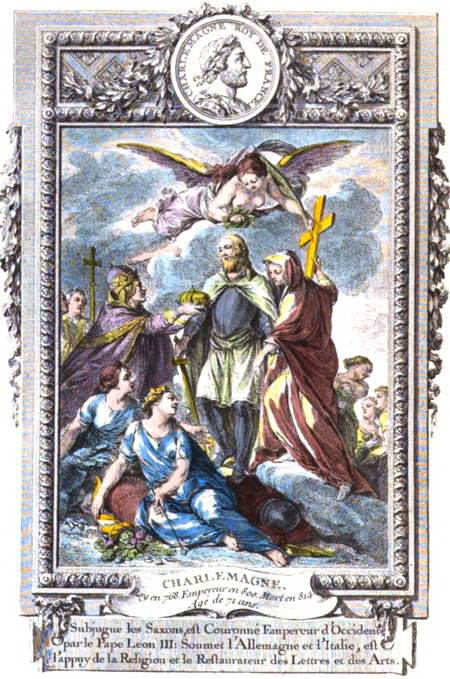
Coronation of Charlemagne, by Pope Leo III. Frontispiece. From a rare engraving.
LIST OF ILLUSTRATIONS↩
- Coronation of Charlemagne, by Pope Leo III. Frontispiece. From a rare engraving.
- Map of Italy, page 30
- Pope Gregory’s Monks converting the King of Kent, p. 44. From a painting.
- Cathedral of St. Sophia, Constantinople, p. 140. From a photograph.
- Old Walls of Rome, showing the “Latin Gate”, p. 326. From a photograph.
- Charlemagne, p. 360. From a painting by Albert Dürer.
[VIII-1]
CHAPTER XLV↩
Reign of the Younger Justin — Embassy of the Avars — Their Settlement on the Danube — Conquest of Italy by the Lombards — Adoption and Reign of Tiberius — of Maurice — State of Italy under the Lombards and the Exarchs of Ravenna — Distress of Rome — Character and Pontificate of Gregory the First
During the last years of Justinian, his infirm mind was devoted to heavenly contemplation, and he neglected the business of the lower world. His subjects were impatient of the long continuance of his life and reign; yet all who were capable of reflection apprehended the moment of his death, which might involve the capital in tumult and the empire in civil war. Seven nephews [1] of the childless monarch, the sons or grandsons of his brother and sister, had been educated in the splendour of a princely fortune; they had been shewn in high commands to the provinces and armies; their characters were known, their followers were zealous; and, as the jealousy of age postponed the declaration of a successor, they might expect with equal hopes the inheritance of their uncle. He expired in his palace after a reign of thirty-eight years; and the decisive opportunity was embraced by the [VIII-2] friends of Justin, the son of Vigilantia. [2] At the hour of midnight his domestics were awakened by an importunate crowd, who thundered at his door, and obtained admittance by revealing themselves to be the principal members of the senate. These welcome deputies announced the recent and momentous secret of the emperor’s decease; reported, or perhaps invented, his dying choice of the best beloved and most deserving of his nephews; and conjured Justin to prevent the disorders of the multitude, if they should perceive, with the return of light, that they were left without a master. After composing his countenance to surprise, sorrow, and decent modesty, Justin, by the advice of his wife Sophia, submitted to the authority of the senate. He was conducted with speed and silence to the palace; the guards saluted their new sovereign; and the martial and religious rites of his coronation were diligently accomplished. By the hands of the proper officers he was invested with the Imperial garments, the red buskins, white tunic, and purple robe. A fortunate soldier, whom he instantly promoted to the rank of tribune, encircled his neck with a military collar; four robust youths exalted him on a shield; he stood firm and erect to receive the adoration of his subjects; and their choice was sanctified by the benediction of the patriarch, who imposed the diadem on the head of an orthodox prince. The hipprodrome was already filled with innumerable multitudes; and no sooner did the emperor appear on his throne than the voices of the blue and the green factions were confounded in the same loyal acclamations. In the speeches which Justin addressed to the senate and people, he promised to correct the abuses which had disgraced the age of his [VIII-3] predecessor, displayed the maxims of a just and beneficent government, and declared that, on the approaching calends of January, [3] he would revive in his own person the name and liberality of a Roman consul. The immediate discharge of his uncle’s debts exhibited a solid pledge of his faith and generosity: a train of porters laden with bags of gold advanced into the midst of the hipprodrome, and the hopeless creditors of Justinian accepted this equitable payment as a voluntary gift. Before the end of three years his example was imitated and surpassed by the empress Sophia, who delivered many indigent citizens from the weight of debt and usury: an act of benevolence the best entitled to gratitude, since it relieves the most intolerable distress; but in which the bounty of a prince is the most liable to be abused by the claims of prodigality and fraud. [4]
On the seventh day of his reign, Justin gave audience to the ambassadors of the Avars, and the scene was decorated to impress the Barbarians with astonishment, veneration, and terror. From the palace gate, the spacious courts and long porticos were lined with the lofty crests and gilt bucklers of the guards, who presented their spears and axes with more confidence than they would have shewn in a field of battle. The officers who exercised the power, or attended the person, of the prince were attired in their richest habits and arranged according to the military and civil order of the hierarchy. When the veil of the sanctuary was withdrawn, the ambassadors beheld the emperor of the East on his throne, beneath a canopy or dome, which was supported by four columns and crowned with a winged figure of victory. In the first emotions [VIII-4] of surprise, they submitted to the servile adoration of the Byzantine court; but, as soon as they rose from the ground, Targetius, [5] the chief of the embassy, expressed the freedom and pride of a Barbarian. He extolled, by the tongue of his interpreter, the greatness of the chagan, by whose clemency the kingdoms of the South were permitted to exist, whose victorious subjects had traversed the frozen rivers of Scythia, and who now covered the banks of the Danube with innumerable tents. [6] The late emperor had cultivated, with annual and costly gifts, the friendship of a grateful monarch, and the enemies of Rome had respected the allies of the Avars. The same prudence would instruct the nephew of Justinian to imitate the liberality of his uncle, and to purchase the blessings of peace from an invincible people, who delighted and excelled in the exercise of war. The reply of the emperor was delivered in the same strain of haughty defiance, and he derived his confidence from the God of the Christians, the ancient glory of Rome, and the recent triumphs of Justinian. “The empire,” said he, “abounds with men and horses, and arms sufficient to defend our frontiers and to chastise the Barbarians. You offer aid, you threaten hostilities: we despise your enmity and your aid. The conquerors of the Avars solicit our alliance: shall we dread their fugitives and exiles? [7] The bounty of [VIII-5] our uncle was granted to your misery, to your humble prayers. From us you shall receive a more important obligation, the knowledge of your own weakness. Retire from our presence; the lives of ambassadors are safe; and, if you return to implore our pardon, perhaps you will taste of our benevolence.” [8] On the report of his ambassadors, the chagan was awed by the apparent firmness of a Roman emperor, of whose character and resources he was ignorant. Instead of executing his threats against the Eastern empire, he marched into the poor and savage countries of Germany, which were subject to the dominion of the Franks. After two doubtful battles he consented to retire, and the Austrasian king relieved the distress of his camp with an immediate supply of corn and cattle. [9] Such repeated disappointments had chilled the spirit of the Avars, and their power would have dissolved away in the Sarmatian desert, if the alliance of Alboin, king of the Lombards, had not given a new object to their arms, and a lasting settlement to their wearied fortunes.
While Alboin served under his father’s standard, he encountered in battle, and transpierced with his lance, the rival prince of the Gepidæ. The Lombards, who applauded such early prowess, requested his father with unanimous acclamations that the heroic youth, who had shared the dangers of [VIII-6] the field, might be admitted to the feast of victory. “You are not unmindful,” replied the inflexible Audoin, “of the wise customs of our ancestors. Whatever may be his merit, a prince is incapable of sitting at table with his father till he has received his arms from a foreign and royal hand.” Alboin bowed with reverence to the institutions of his country, selected forty companions, and boldly visited the court of Turisund king of the Gepidæ, who embraced and entertained, according to the laws of hospitality, the murderer of his son. At the banquet, whilst Alboin occupied the seat of the youth whom he had slain, a tender remembrance arose in the mind of Turisund. “How dear is that place — how hateful is that person!” were the words that escaped, with a sigh, from the indignant father. His grief exasperated the national resentment of the Gepidæ; and Cunimund, his surviving son, was provoked by wine, or fraternal affection, to the desire of vengeance. “The Lombards,” said the rude Barbarian, “resemble, in figure and in smell, the mares of our Sarmatian plains.” And this insult was a coarse allusion to the white bands which enveloped their legs. “Add another resemblance,” replied an audacious Lombard; “you have felt how strongly they kick. Visit the plain of Asfeld, and seek for the bones of thy brother; they are mingled with those of the vilest animals.” The Gepidæ, a nation of warriors, started from their seats, and the fearless Alboin, with his forty companions, laid their hands on their swords. The tumult was appeased by the venerable interposition of Turisund. He saved his own honour, and the life of his guest; and, after the solemn rites of investiture, dismissed the stranger in the bloody arms of his son, the gift of a weeping parent. Alboin returned in triumph; and the Lombards, who celebrated his matchless intrepidity, were compelled to praise the virtues of an enemy. [10] In this extraordinary [VIII-7] visit he had probably seen the daughter of Cunimund, who soon after ascended the throne of the Gepidæ. Her name was Rosamond, an appellation expressive of female beauty, and which our own history or romance has consecrated to amorous tales. The king of the Lombards (the father of Alboin no longer lived) was contracted to the granddaughter of Clovis; but the restraints of faith and policy soon yielded to the hope of possessing the fair Rosamond, and of insulting her family and nation. The arts of persuasion were tried without success; and the impatient lover, by force and stratagem, obtained the object of his desires. War was the consequence which he foresaw and solicited; but the Lombards could not long withstand the furious assault of the Gepidæ, who were sustained by a Roman army. And, as the offer of marriage was rejected with contempt, Alboin was compelled to relinquish his prey, and to partake of the disgrace which he had inflicted on the house of Cunimund. [11]
When a public quarrel is envenomed by private injuries, a blow that is not mortal or decisive can be productive only of a short truce, which allows the unsuccessful combatant to sharpen his arms for a new encounter. The strength of Alboin had been found unequal to the gratification of his love, ambition, and revenge; he condescended to implore the formidable aid of the chagan; and the arguments that he employed are expressive of the art and policy of the Barbarians. In the attack of the Gepidæ he had been prompted by the just desire of extirpating a people whom their alliance with the Roman empire had rendered the common enemies of the nations and the personal adversaries of the chagan. If the forces of the Avars and the Lombards should unite in this glorious quarrel, the victory was secure, and the reward inestimable: the Danube, the Hebrus, Italy, and Constantinople would be exposed, without a barrier, to their invincible [VIII-8] arms. But, if they hesitated or delayed to prevent the malice of the Romans, the same spirit which had insulted, would pursue the Avars to the extremity of the earth. These specious reasons were heard by the chagan with coldness and disdain; he detained the Lombard ambassadors in his camp, protracted the negotiation, and by turns alleged his want of inclination, or his want of ability, to undertake this important enterprise. At length he signified the ultimate price of his alliance, that the Lombards should immediately present him with the tithe of their cattle; that the spoils and captives should be equally divided; but that the lands of the Gepidæ should become the sole patrimony of the Avars. Such hard conditions were eagerly accepted by the passions of Alboin; and, as the Romans were dissatisfied with the ingratitude and perfidy of the Gepidæ, Justin abandoned that incorrigible people to their fate, and remained the tranquil spectator of this unequal conflict. [12] The despair of Cunimund was active and dangerous. He was informed that the Avars had entered his confines; but on the strong assurance that, after the defeat of the Lombards, these foreign invaders would easily be repelled, he rushed forwards to encounter the implacable enemy of his name and family. But the courage of the Gepidæ could secure them no more than an honourable death. The bravest of the nation fell in the field of battle; the king of the Lombards contemplated with delight the head of Cunimund, and his skull was fashioned into a cup to satiate the hatred of the conqueror, or, perhaps, to comply with the savage custom of his country. [13] [VIII-9] After this victory no farther obstacle could impede the progress of the confederates, and they faithfully executed the terms of their agreement. [14] The fair countries of Walachia, Moldavia, Transylvania, and the parts of Hungary beyond the Danube were occupied, without resistance, by a new colony of Scythians; and the Dacian empire of the chagans subsisted with splendour above two hundred and thirty years. [15] The nation of the Gepidæ was dissolved; but, in the distribution of the captives, the slaves of the Avars were less fortunate than the companions of the Lombards, whose generosity adopted a valiant foe, and whose freedom was incompatible with cool and deliberate tyranny. One moiety of the spoil introduced into the camp of Alboin more wealth than a Barbarian could readily compute. The fair Rosamond was persuaded or compelled to acknowledge the rights of her victorious lover; and the daughter of Cunimund appeared to forgive those crimes which might be imputed to her own irresistible charms.
The destruction of a mighty kingdom established the fame of Alboin. In the days of Charlemagne, the Bavarians, the Saxons, and the other tribes of the Teutonic language still repeated the songs which described the heroic virtues, the valour, liberality, and fortune of the king of the Lombards. [16] But his ambition was yet unsatisfied, and the conqueror of [VIII-10] the Gepidæ turned his eyes from the Danube to the richer banks of the Po and the Tiber. Fifteen years had not elapsed since his subjects, the confederates of Narses, had visited the pleasant climate of Italy; the mountains, the rivers, the highways, were familiar to their memory; the report of their success, perhaps the view of their spoils, had kindled in the rising generation the flame of emulation and enterprise. Their hopes were encouraged by the spirit and eloquence of Alboin; and it is affirmed that he spoke to their senses by producing, at the royal feast, the fairest and most exquisite fruits that grew spontaneously in the garden of the world. No sooner had he erected his standard than the native strength of the Lombards was multiplied by the adventurous youth of Germany and Scythia. The robust peasantry of Noricum and Pannonia had resumed the manners of Barbarians; and the names of the Gepidæ, Bulgarians, Sarmatians, and Bavarians may be distinctly traced in the provinces of Italy. [17] Of the Saxons, the old allies of the Lombards, twenty thousand warriors, with their wives and children, accepted the invitation of Alboin. Their bravery contributed to his success; but the accession or the absence of their numbers was not sensibly felt in the magnitude of his host. Every mode of religion was freely practised by its respective votaries. The king of the Lombards had been educated in the Arian heresy; but the Catholics, in their public worship, were allowed to pray for his conversion; while the more stubborn Barbarians sacrificed a she-goat, or perhaps a captive, to the gods of their fathers. [18] The Lombards and their confederates were united by their common attachment to a chief, who excelled in all the virtues and [VIII-11] vices of a savage hero; and the vigilance of Alboin provided an ample magazine of offensive and defensive arms for the use of the expedition. The portable wealth of the Lombards attended the march; their lands they cheerfully relinquished to the Avars, on the solemn promise, which was made and accepted without a smile, that, if they failed in the conquest of Italy, these voluntary exiles should be reinstated in their former possessions.
They might have failed, if Narses had been the antagonist of the Lombards; and the veteran warriors, the associates of his Gothic victory, would have encountered with reluctance an enemy whom they dreaded and esteemed. But the weakness of the Byzantine court was subservient to the Barbarian cause; and it was for the ruin of Italy that the emperor once listened to the complaints of his subjects. The virtues of Narses were stained with avarice; and in his provincial reign of fifteen years he accumulated a treasure of gold and silver which surpassed the modesty of a private fortune. His government was oppressive or unpopular, and the general discontent was expressed with freedom by the deputies of Rome. Before the throne of Justin they boldly declared that their Gothic servitude had been more tolerable than the despotism of a Greek eunuch; and that, unless their tyrant were instantly removed, they would consult their own happiness in the choice of a master. The apprehension of a revolt was urged by the voice of envy and detraction, which had so recently triumphed over the merit of Belisarius. A new exarch, [19] Longinus, was appointed to supersede the conqueror of Italy, and the base motives of his recall were revealed in the insulting mandate of the empress Sophia, “that he should leave to men the exercise of arms, and return to his proper station among the maidens of the palace, where [VIII-12] a distaff should be again placed in the hand of the eunuch.” “I will spin her such a thread, as she shall not easily unravel!” is said to have been the reply which indignation and conscious virtue extorted from the hero. Instead of attending, a slave and a victim, at the gate of the Byzantine palace, he retired to Naples, from whence (if any credit is due to the belief of the times) Narses invited the Lombards to chastise the ingratitude of the prince and people. [20] But the passions of the people are furious and changeable, and the Romans soon recollected the merits, or dreaded the resentment, of their victorious general. By the mediation of the pope, who undertook a special pilgrimage to Naples, their repentance was accepted; and Narses, assuming a milder aspect and a more dutiful language, consented to fix his residence in the Capitol. His death, [21] though in the extreme period of old age, was unseasonable and premature, since his genius alone could [VIII-13] have repaired the last and fatal error of his life. The reality, or the suspicion, of a conspiracy disarmed and disunited the Italians. The soldiers resented the disgrace, and bewailed the loss, of their general. They were ignorant of their new exarch; and Longinus was himself ignorant of the state of the army and the province. In the preceding years Italy had been desolated by pestilence and famine, and a disaffected people ascribed the calamities of nature to the guilt or folly of their rulers. [22]
Whatever might be the grounds of his security, Alboin neither expected nor encountered a Roman army in the field. He ascended the Julian Alps, and looked down with contempt and desire on the fruitful plains to which his victory communicated the perpetual appellation of Lombardy. A faithful chieftain and a select band were stationed at Forum Julii, the modern Friuli, to guard the passes of the mountains. The Lombards respected the strength of Pavia, and listened to the prayers of the Trevisans; their slow and heavy multitudes proceeded to occupy the palace and city of Verona; and Milan, now rising from her ashes, was invested by the powers of Alboin five months after his departure from Pannonia. Terror preceded his march; he found everywhere, or he left, a dreary solitude; and the pusillanimous Italians presumed, without a trial, that the stranger was invincible. Escaping to lakes, or rocks, or morasses, the affrighted crowds concealed some fragments of their wealth, and delayed the moment of their servitude. Paulinus, the patriarch of Aquileia, removed his treasures, sacred and profane, to the isle of Grado, [23] and his successors were adopted by the infant [VIII-14] republic of Venice, which was continually enriched by the public calamities. Honoratus, who filled the chair of St. Ambrose, had credulously accepted the faithless offers of a capitulation; and the archbishop, with the clergy and nobles of Milan, were driven by the perfidy of Alboin to seek a refuge in the less accessible ramparts of Genoa. Along the maritime coast, the courage of the inhabitants was supported by the facility of supply, the hopes of relief, and the power of escape; but, from the Trentine hills to the gates of Ravenna and Rome, the inland regions of Italy became, without a battle or a siege, the lasting patrimony of the Lombards. The submission of the people invited the Barbarian to assume the character of a lawful sovereign, and the helpless exarch was confined to the office of announcing to the emperor Justin the rapid and irretrievable loss of his provinces and cities. [24] One city, which had been diligently fortified by the Goths, resisted the arms of a new invader; and, while Italy was subdued by the flying detachments of the Lombards, the royal camp was fixed above three years before the western gate of Ticinum, or Pavia. The same courage which obtains the esteem of a civilised enemy provokes the fury of a savage, and the impatient besieger had bound himself by a tremendous oath that age, and sex, and dignity should be confounded in a general massacre. The aid of famine at length enabled him to execute his bloody vow; but, as Alboin entered the gate, his horse stumbled, fell, and could not be raised from the ground. One of his attendants was prompted by compassion, or piety, to interpret this miraculous sign of the wrath of Heaven; the conqueror paused and relented; he sheathed [VIII-15] his sword, and, peacefully reposing himself in the palace of Theodoric, proclaimed to the trembling multitude that they should live and obey. Delighted with the situation of a city which was endeared to his pride by the difficulty of the purchase, the prince of the Lombards disdained the ancient glories of Milan; and Pavia, during some ages, was respected as the capital of the kingdom of Italy. [25]
The reign of the founder was splendid and transient; and, before he could regulate his new conquests, Alboin fell a sacrifice to domestic treason and female revenge. In a palace near Verona, which had not been erected for the Barbarians, he feasted the companions of his arms; intoxication was the reward of valour, and the king himself was tempted by appetite, or vanity, to exceed the ordinary measure of his intemperance. After draining many capacious bowls of Rhætian or Falernian wine, he called for the skull of Cunimund, the noblest and most precious ornament of his sideboard. The cup of victory was accepted with horrid applause by the circle of the Lombard chiefs. “Fill it again with wine,” exclaimed the inhuman conqueror, “fill it to the brim; carry this goblet to the queen, and request, in my name, that she would rejoice with her father.” In an agony of grief and rage, Rosamond had strength to utter “Let the will of my lord be obeyed!” and, touching it with her lips, pronounced a silent imprecation, that the insult should be washed away in the blood of Alboin. Some indulgence might be due to the resentment of a daughter, if she had not already violated the duties of a wife. Implacable in her enmity, or inconstant in her love, the queen of Italy had stooped from the throne to the arms of a subject, and Helmichis, the king’s armour-bearer, was the secret minister of her pleasure and [VIII-16] revenge. Against the proposal of the murder, he could no longer urge the scruples of fidelity or gratitude; but Helmichis trembled, when he revolved the danger as well as the guilt, when he recollected the matchless strength and intrepidity of a warrior whom he had so often attended in the field of battle. He pressed, and obtained, that one of the bravest champions of the Lombards should be associated to the enterprise, but no more than a promise of secrecy could be drawn from the gallant Peredeus; and the mode of seduction employed by Rosamond betrays her shameless insensibility both to honour and love. She supplied the place of one of her female attendants who was beloved by Peredeus, and contrived some excuse for darkness and silence, till she could inform her companion that he had enjoyed the queen of the Lombards, and that his own death, or the death of Alboin, must be the consequence of such treasonable adultery. In this alternative, he chose rather to be the accomplice than the victim of Rosamond, [26] whose undaunted spirit was incapable of fear or remorse. She expected and soon found a favourable moment, when the king oppressed with wine had retired from the table to his afternoon slumbers. His faithless spouse was anxious for his health and repose; the gates of the palace were shut, the arms removed, the attendants dismissed; and Rosamond, after lulling him to rest by her tender caresses, unbolted the chamber-door, and urged the reluctant conspirators to the instant execution of the deed. On the first alarm, the warrior started from his couch; his sword, which he attempted to draw, had been fastened to the scabbard by the hand of Rosamond; and a small stool, his only weapon, could not long protect him from the spears of the assassins. The daughter of Cunimund smiled in his fall; [VIII-17] his body was buried under the staircase of the palace; and the grateful posterity of the Lombards revered the tomb and the memory of their victorious leader.
The ambitious Rosamond aspired to reign in the name of her lover; the city and palace of Verona were awed by her power; and a faithful band of her native Gepidæ was prepared to applaud the revenge, and to second the wishes, of their sovereign. But the Lombard chiefs, who fled in the first moments of consternation and disorder, had resumed their courage and collected their powers; and the nation, instead of submitting to her reign, demanded, with unanimous cries, that justice should be executed on the guilty spouse and the murderers of their king. She sought a refuge among the enemies of her country, and a criminal who deserved the abhorrence of mankind was protected by the selfish policy of the exarch. With her daughter, the heiress of the Lombard throne, her two lovers, her trusty Gepidæ, and the spoils of the palace of Verona, Rosamond descended the Adige and the Po, and was transported by a Greek vessel to the safe harbour of Ravenna. Longinus beheld with delight the charms and the treasures of the widow of Alboin; her situation and her past conduct might justify the most licentious proposals; and she readily listened to the passion of a minister, who, even in the decline of the empire, was respected as the equal of kings. The death of a jealous lover was an easy and grateful sacrifice, and, as Helmichis issued from the bath, he received the deadly potion from the hand of his mistress. The taste of the liquor, its speedy operation, and his experience of the character of Rosamond convinced him that he was poisoned: he pointed his dagger to her breast, compelled her to drain the remainder of the cup, and expired in a few minutes, with the consolation that she could not survive to enjoy the fruits of her wickedness. The daughter of Alboin and Rosamond, with the richest spoils of the Lombards, was embarked for Constantinople; the surprising [VIII-18] strength of Peredeus amused and terrified the Imperial court; his blindness and revenge exhibited an imperfect copy of the adventures of Samson. By the free suffrage of the nation, in the assembly of Pavia, Clepho, one of their noblest chiefs, was elected as the successor of Alboin. Before the end of eighteen months, the throne was polluted by a second murder; Clepho was stabbed by the hand of a domestic; the regal office was suspended above ten years, during the minority of his son Autharis; and Italy was divided and oppressed by a ducal aristocracy of thirty tyrants. [27]
When the nephew of Justinian ascended the throne, he proclaimed a new era of happiness and glory. The annals of the second Justin [28] are marked with disgrace abroad and misery at home. In the West, the Roman empire was afflicted by the loss of Italy, the desolation of Africa, and the conquests of the Persians. Injustice prevailed both in the capital and the provinces: the rich trembled for their property, the poor for their safety, the ordinary magistrates were ignorant or venal, the occasional remedies appear to have been arbitrary and violent, and the complaints of the people could no longer be silenced by the splendid names of a legislator and a conqueror. The opinion which imputes to the prince all the calamities of his times may be countenanced by the historian as a serious truth or a salutary prejudice. Yet a candid suspicion will arise that the sentiments of Justin were pure and benevolent, and that he might have filled his station without reproach, if the faculties of his mind had not been impaired by disease, which deprived the emperor of the use of his feet and confined him to the palace, a stranger to the [VIII-19] complaints of the people and the vices of the government. The tardy knowledge of his own impotence determined him to lay down the weight of the diadem; and in the choice of a worthy substitute he shewed some symptoms of a discerning and even magnanimous spirit. The only son of Justin and Sophia died in his infancy; their daughter Arabia was the wife of Baduarius, [29] superintendent of the palace, and afterwards commander of the Italian armies, who vainly aspired to confirm the rights of marriage by those of adoption. While the empire appeared an object of desire, Justin was accustomed to behold with jealousy and hatred his brothers and cousins, the rivals of his hopes; nor could he depend on the gratitude of those who would accept the purple as a restitution rather than a gift. Of these competitors, one had been removed by exile, and afterwards by death; and the emperor himself had inflicted such cruel insults on another, that he must either dread his resentment or despise his patience. This domestic animosity was refined into a generous resolution of seeking a successor, not in his family, but in the republic; and the artful Sophia recommended Tiberius, [30] his faithful captain of the guards, whose virtues and fortune the emperor might cherish as the fruit of his judicious choice. The ceremony of his elevation to the rank of Cæsar, or Augustus, was performed in the portico of the palace, in the presence [VIII-20] of the patriarch and the senate. Justin collected the remaining strength of his mind and body, but the popular belief that his speech was inspired by the Deity betrays a very humble opinion both of the man and of the times. [31] “You behold,” said the emperor, “the ensigns of supreme power. You are about to receive them not from my hand, but from the hand of God. Honour them, and from them you will derive honour. Respect the empress your mother; you are now her son; before, you were her servant. Delight not in blood, abstain from revenge, avoid those actions by which I have incurred the public hatred, and consult the experience rather than the example of your predecessor. As a man, I have sinned; as a sinner, even in this life, I have been severely punished; but these servants (and he pointed to his ministers), who have abused my confidence and inflamed my passions, will appear with me before the tribunal of Christ. I have been dazzled by the splendour of the diadem: be thou wise and modest; remember what you have been, remember what you are. You see around us your slaves and your children; with the authority, assume the tenderness, of a parent. Love your people like yourself; cultivate the affections, maintain the discipline, of the army; protect the fortunes of the rich, relieve the necessities of the poor.” [32] The assembly, in silence and in tears, applauded the counsels, and sympathised with the repentance, of their prince; the patriarch rehearsed the prayers of the church; Tiberius received [VIII-21] the diadem on his knees, and Justin, who in his abdication appeared most worthy to reign, addressed the new monarch in the following words: “If you consent, I live; if you command, I die; may the God of heaven and earth infuse into your heart whatever I have neglected or forgotten.” The four last years of the emperor Justin were passed in tranquil obscurity; his conscience was no longer tormented by the remembrance of those duties which he was incapable of discharging; and his choice was justified by the filial reverence and gratitude of Tiberius.
Among the virtues of Tiberius, [33] his beauty (he was one of the tallest and most comely of the Romans) might introduce him to the favour of Sophia; and the widow of Justin was persuaded that she should preserve her station and influence under the reign of a second and more youthful husband. But, if the ambitious candidate had been tempted to flatter and dissemble, it was no longer in his power to fulfil her expectations or his own promise. The factions of the hippodrome demanded, with some impatience, the name of their new empress; both the people and Sophia were astonished by the proclamation of Anastasia, the secret though lawful wife of the emperor Tiberius. [34] Whatever could alleviate the disappointment of Sophia, Imperial honours, a stately palace, a numerous household, was liberally bestowed by the piety of her adopted son; on solemn occasions he attended and consulted the widow of his benefactor; but her ambition disdained the vain semblance of royalty, and the [VIII-22] respectful appellation of mother served to exasperate, rather than appease, the rage of an injured woman. While she accepted, and repaid with a courtly smile, the fair expressions of regard and confidence, a secret alliance was concluded between the dowager empress and her ancient enemies; and Justinian, the son of Germanus, was employed as the instrument of her revenge. The pride of the reigning house supported, with reluctance, the dominion of a stranger; the youth was deservedly popular; his name, after the death of Justin, had been mentioned by a tumultuous faction; and his own submissive offer of his head, with a treasure of sixty thousand pounds, might be interpreted as an evidence of guilt, or at least of fear. Justinian received a free pardon, and the command of the Eastern army. The Persian monarch fled before his arms; and the acclamations which accompanied his triumph declared him worthy of the purple. His artful patroness had chosen the month of the vintage, while the emperor, in a rural solitude, was permitted to enjoy the pleasures of a subject. On the first intelligence of her designs he returned to Constantinople, and the conspiracy was suppressed by his presence and firmness. From the pomp and honours which she had abused, Sophia was reduced to a modest allowance; Tiberius dismissed her train, intercepted her correspondence, and committed to a faithful guard the custody of her person. But the services of Justinian were not considered by that excellent prince as an aggravation of his offences; after a mild reproof, his treason and ingratitude were forgiven; and it was commonly believed that the emperor entertained some thoughts of contracting a double alliance with the rival of his throne. The voice of an angel (such a fable was propagated) might reveal to the emperor that he should always triumph over his domestic foes; but Tiberius derived a firmer assurance from the innocence and generosity of his own mind.
With the odious name of Tiberius, he assumed the more popular appellation of Constantine and imitated the purer [VIII-23] virtues of the Antonines. After recording the vice or folly of so many Roman princes, it is pleasing to repose, for a moment, on a character conspicuous by the qualities of humanity, justice, temperance, and fortitude; to contemplate a sovereign affable in his palace, pious in the church, impartial on the seat of judgment, and victorious, at least by his generals, in the Persian war. The most glorious trophy of his victory consisted in a multitude of captives whom Tiberius entertained, redeemed, and dismissed to their native homes with the charitable spirit of a Christian hero. The merit or misfortunes of his own subjects had a dearer claim to his beneficence, and he measured his bounty not so much by their expectations as by his own dignity. This maxim, however dangerous in a trustee of the public wealth, was balanced by a principle of humanity and justice, which taught him to abhor, as of the basest alloy, the gold that was extracted from the tears of the people. For their relief, as often as they had suffered by natural or hostile calamities, he was impatient to remit the arrears of the past, or the demands of future taxes; he sternly rejected the servile offerings of his ministers, which were compensated by tenfold oppression; and the wise and equitable laws of Tiberius excited the praise and regret of succeeding times. Constantinople believed that the emperor had discovered a treasure; but his genuine treasure consisted in the practice of liberal economy and the contempt of all vain and superfluous expense. [35] The Romans of the East would have been happy, if the best gift of heaven, a patriot king, had been confirmed as a proper and permanent blessing. But in less than four years after the death of Justin, his worthy successor sunk into a mortal disease, which left him only sufficient time to restore the diadem, according to the tenure by which he [VIII-24] held it, to the most deserving of his fellow-citizens. He selected Maurice from the crowd, a judgment more precious than the purple itself; the patriarch and senate were summoned to the bed of the dying prince; he bestowed his daughter and the empire; and his last advice was solemnly delivered by the voice of the quæstor. Tiberius expressed his hope that the virtues of his son and successor would erect the noblest mausoleum to his memory. His memory was embalmed by the public affliction; but the most sincere grief evaporates in the tumult of a new reign, and the eyes and acclamations of mankind were speedily directed to the rising sun.
The emperor Maurice derived his origin from ancient Rome; [36] but his immediate parents were settled at Arabissus in Cappadocia, and their singular felicity preserved them alive to behold and partake the fortune of their august son. The youth of Maurice was spent in the profession of arms; Tiberius promoted him to the command of a new and favourite legion of twelve thousand confederates; [37] his valour and conduct were signalised in the Persian war; and he returned to Constantinople to accept, as his just reward, the inheritance of the empire. Maurice ascended the throne at the mature age of forty-three years; and he reigned above twenty years over the East and over himself; [38] expelling from his mind the wild democracy of passions, and establishing (according [VIII-25] to the quaint expression of Evagrius) a perfect aristocracy of reason and virtue. Some suspicion will degrade the testimony of a subject, though he protests that his secret praise should never reach the ear of his sovereign, [39] and some failings seem to place the character of Maurice below the purer merit of his predecessor. His cold and reserved demeanour might be imputed to arrogance; his justice was not always exempt from cruelty, nor his clemency from weakness; and his rigid economy too often exposed him to the reproach of avarice. But the rational wishes of an absolute monarch must tend to the happiness of his people; Maurice was endowed with sense and courage to promote that happiness, and his administration was directed by the principles and example of Tiberius. The pusillanimity of the Greeks had introduced so complete a separation between the offices of king and of general that a private soldier who had deserved and obtained the purple seldom or never appeared at the head of his armies. Yet the emperor Maurice enjoyed the glory of restoring the Persian monarch to his throne; his lieutenants waged a doubtful war against the Avars of the [VIII-26] Danube; and he cast an eye of pity, of ineffectual pity, on the abject and distressful state of his Italian provinces.
From Italy the emperors were incessantly tormented by tales of misery and demands of succour, which extorted the humiliating confession of their own weakness. The expiring dignity of Rome was only marked by the freedom and energy of her complaints: “If you are incapable,” she said, “of delivering us from the sword of the Lombards, save us at least from the calamity of famine.” Tiberius forgave the reproach, and relieved the distress: a supply of corn was transported from Egypt to the Tiber; and the Roman people, invoking the name, not of Camillus, but of St. Peter, repulsed the Barbarians from their walls. But the relief was accidental, the danger was perpetual and pressing; and the clergy and senate, collecting the remains of their ancient opulence, a sum of three thousand pounds of gold, despatched the patrician Pamphronius to lay their gifts and their complaints at the foot of the Byzantine throne. The attention of the court, and the forces of the East, were diverted by the Persian war; but the justice of Tiberius applied the subsidy to the defence of the city; and he dismissed the patrician with his best advice, either to bribe the Lombard chiefs or to purchase the aid of the kings of France. Notwithstanding this weak invention, Italy was still afflicted, Rome was again besieged, and the suburb of Classe, only three miles from Ravenna, was pillaged and occupied by the troops of a simple duke of Spoleto. Maurice gave audience to a second deputation of priests and senators; the duties and the menaces of religion were forcibly urged in the letters of the Roman pontiff; and his nuncio, the deacon Gregory, was alike qualified to solicit the powers either of heaven or of the earth. The emperor adopted, with stronger effect, the measures of his predecessor; some formidable chiefs were persuaded to embrace the friendship of the Romans, and one of them, a mild and faithful Barbarian, lived and died in the service of the exarch; the passes of the Alps were [VIII-27] delivered to the Franks; and the pope encouraged them to violate, without scruple, their oaths and engagements to the misbelievers. Childebert, the great-grandson of Clovis, was persuaded to invade Italy by the payment of fifty thousand pieces; but, as he had viewed with delight some Byzantine coin of the weight of one pound of gold, the king of Austrasia might stipulate that the gift should be rendered more worthy of his acceptance by a proper mixture of these respectable medals. The dukes of the Lombards had provoked by frequent inroads their powerful neighbours of Gaul. As soon as they were apprehensive of a just retaliation, they renounced their feeble and disorderly independence; the advantages of regal government, union, secrecy, and vigour were unanimously confessed; and Autharis, the son of Clepho, had already attained the strength and reputation of a warrior. Under the standard of their new king, the conquerors of Italy withstood three successive invasions, one of which was led by Childebert himself, the last of the Merovingian race who descended from the Alps. The first expedition was defeated by the jealous animosity of the Franks and Alemanni. In the second they were vanquished in a bloody battle, with more loss and dishonour than they had sustained since the foundation of their monarchy. Impatient for revenge, they returned a third time with accumulated force, and Autharis yielded to the fury of the torrent. The troops and treasures of the Lombards were distributed in the walled towns between the Alps and the Apennine. A nation less sensible of danger than of fatigue and delay soon murmured against the folly of their twenty commanders; and the hot vapours of an Italian sun infected with disease those tramontane bodies which had already suffered the vicissitudes of intemperance and famine. The powers that were inadequate to the conquest, were more than sufficient for the desolation, of the country; nor could the trembling natives distinguish between their enemies and their deliverers. If the junction of the Merovingian and Imperial forces had been effected in the [VIII-28] neighbourhood of Milan, perhaps they might have subverted the throne of the Lombards; but the Franks expected six days the signal of a flaming village, and the arms of the Greeks were idly employed in the reduction of Modena and Parma, which were torn from them after the retreat of their Transalpine allies. The victorious Autharis asserted his claim to the dominion of Italy. At the foot of the Rhætian Alps, he subdued the resistance, and rifled the hidden treasures, of a sequestered island in the lake of Comum. At the extreme point of Calabria, he touched with his spear a column on the sea-shore of Rhegium, [40] proclaiming that ancient land-mark to stand the immoveable boundary of his kingdom. [41]
During a period of two hundred years, Italy was unequally divided between the kingdom of the Lombards and the exarchate of Ravenna. The offices and professions, which the jealousy of Constantine had separated, were united by the indulgence of Justinian; and eighteen successive exarchs were invested, in the decline of the empire, with the full remains of civil, of military, and even of ecclesiastical power. Their immediate jurisdiction, which was afterwards consecrated as the patrimony of St. Peter, extended over the modern Romagna, the marshes or valleys of Ferrara and Commachio, [42] five maritime cities from Rimini to Ancona, [VIII-29] and a second, inland Pentapolis, [43] between the Hadriatic coast and the hills of the Apennine. Three subordinate provinces, of Rome, of Venice, and of Naples, which were divided by hostile lands from the palace of Ravenna, acknowledged, both in peace and war, the supremacy of the exarch. The duchy of Rome appears to have included the Tuscan, Sabine, and Latian conquests, of the first four hundred years of the city, and the limits may be distinctly traced along the coast, from Civita Vecchia to Terracina, and with the course of the Tiber from Ameria and Narni to the port of Ostia. The numerous islands from Grado to Chiozza composed the infant dominion of Venice; but the more accessible towns on the continent were overthrown by the Lombards, who beheld with impotent fury a new capital rising from the waves. The power of the dukes of Naples was circumscribed by the bay and the adjacent isles, by the hostile territory of Capua, and by the Roman colony of Amalphi, [44] whose industrious citizens, by the invention of the mariner’s compass, have unveiled the face of the globe. The three islands of Sardinia, Corsica, and Sicily still adhered to the empire; and the acquisition of the farther Calabria removed the land-mark of Autharis from the shore of Rhegium to the isthmus of Consentia. In Sardinia, the savage mountaineers preserved the liberty and religion of their ancestors; but the husbandmen of Sicily were chained to their rich and cultivated soil. Rome was oppressed by the iron sceptre of the exarchs, and a Greek, perhaps an eunuch, insulted with impunity the ruins of the Capitol. But Naples soon acquired the privilege of electing her own dukes; [45] the independence of Amalphi was [VIII-30] the fruit of commerce; and the voluntary attachment of Venice was finally ennobled by an equal alliance with the Eastern empire. On the map of Italy, the measure of the exarchate occupies a very inadequate space, but it included an ample proportion of wealth, industry, and population. The most faithful and valuable subjects escaped from the Barbarian yoke; and the banners of Pavia and Verona, of Milan and Padua, were displayed in their respective quarters by the new inhabitants of Ravenna. The remainder of Italy was possessed by the Lombards; and from Pavia, the royal seat, their kingdom was extended to the east, the north, and the west, as far as the confines of the Avars, the Bavarians, and the Franks of Austrasia and Burgundy. In the language of modern geography, it is now represented by the Terra Firma of the Venetian republic, Tyrol, the Milanese, Piedmont, the coast of Genoa, Mantua, Parma, and Modena, the grand duchy of Tuscany, and a large portion of the ecclesiastical state from Perugia to the Hadriatic. The dukes, and at length the princes, of Beneventum survived the monarchy, and propagated the name of the Lombards. From Capua to Tarentum, they reigned near five hundred years over the greatest part of the present kingdom of Naples. [46]
In comparing the proportion of the victorious and the vanquished [VIII-none] [VIII-31] people, the change of language will afford the most probable inference. According to this standard it will appear that the Lombards of Italy, and the Visigoths of Spain, were less numerous than the Franks or Burgundians; and the conquerors of Gaul must yield, in their turn, to the multitude of Saxons and Angles who almost eradicated the idioms of Britain. The modern Italian has been insensibly formed by the mixture of nations; the awkwardness of the Barbarians in the nice management of declensions and conjugations reduced them to the use of articles and auxiliary verbs; and many new ideas have been expressed by Teutonic appellations. Yet the principal stock of technical and familiar words is found to be of Latin derivation; [47] and, if we were sufficiently conversant with the obsolete, the rustic, and the municipal dialects of ancient Italy, we should trace the origin of many terms which might, perhaps, be rejected by the classic purity of Rome. A numerous army constitutes but a small nation, and the powers of the Lombards were soon diminished by the retreat of twenty thousand Saxons, who scorned a dependent situation, and returned, after many bold and perilous adventures, to their native country. [48] The camp of Alboin was of formidable extent, but the extent of a camp would be easily circumscribed within the limits of a city; and its martial inhabitants must be thinly scattered over the face of a large country. When Alboin descended from the Alps, he invested his nephew, the first duke of Friuli, with the command of the province and the people; but the prudent Gisulf would have declined the dangerous office, unless he had been permitted to choose, among the [VIII-32] nobles of the Lombards, a sufficient number of families [49] to form a perpetual colony of soldiers and subjects. In the progress of conquest, the same option could not be granted to the dukes of Brescia or Bergamo, of Pavia or Turin, of Spoleto or Beneventum; but each of these, and each of their colleagues, settled in his appointed district with a band of followers who resorted to his standard in war and his tribunal in peace. Their attachment was free and honourable: resigning the gifts and benefits which they had accepted, they might emigrate with their families into the jurisdiction of another duke; but their absence from the kingdom was punished with death, as a crime of military desertion. [50] The posterity of the first conquerors struck a deeper root into the soil, which, by every motive of interest and honour, they were bound to defend. A Lombard was born the soldier of his king and his duke; and the civil assemblies of the nation displayed the banners, and assumed the appellation, of a regular army. Of this army, the pay and the rewards were drawn from the conquered provinces; and the distribution, which was not effected till after the death of Alboin, is disgraced by the foul marks of injustice and rapine. Many of the most wealthy Italians were slain and banished; the remainder were divided among the strangers, and a tributary obligation was imposed (under the name of hospitality) of paying to the Lombards a third part of the fruits of the earth. Within less than seventy years, this artificial system was abolished by a more simple and solid tenure. [51] Either the Roman landlord was expelled by his strong and insolent guest; or the annual payment, a third of the produce, was [VIII-33] exchanged by a more equitable transaction for an adequate proportion of landed property. Under these foreign masters, the business of agriculture, in the cultivation of corn, vines, and olives, was exercised with degenerate skill and industry by the labour of the slaves and natives. But the occupations of a pastoral life were more pleasing to the idleness of the Barbarians. In the rich meadows of Venetia, they restored and improved the breed of horses for which that province had once been illustrious; [52] and the Italians beheld with astonishment a foreign race of oxen or buffaloes. [53] The depopulation of Lombardy and the increase of forests afforded an ample range for the pleasures of the chase. [54] That marvellous art which teaches the birds of the air to acknowledge the voice, and execute the commands, of their master had been unknown to the ingenuity of the Greeks and Romans. [55] Scandinavia and Scythia produce the boldest [VIII-34] and most tractable falcons; [56] they are tamed and educated by the roving inhabitants, always on horseback and in the field. This favourite amusement of our ancestors was introduced by the Barbarians into the Roman provinces; and the laws of Italy esteem the sword and the hawk as of equal dignity and importance in the hands of a noble Lombard. [57]
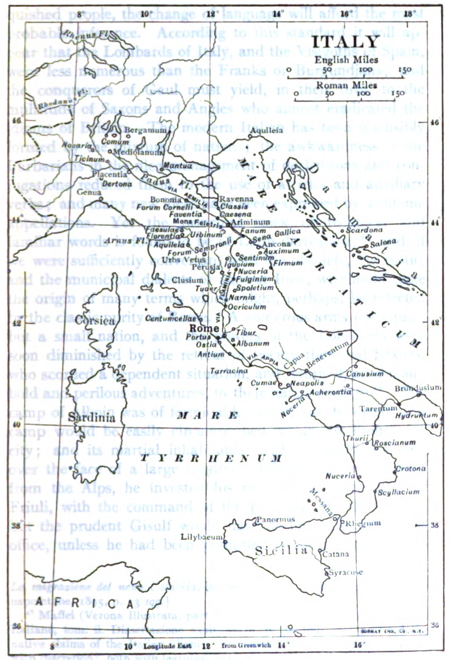
Map of Italy, page 30.
So rapid was the influence of climate and example that the Lombards of the fourth generation surveyed with curiosity and affright the portraits of their savage forefathers. [58] Their heads were shaven behind, but the shaggy locks hung over their eyes and mouth, and a long beard represented the name and character of the nation. Their dress consisted of loose linen garments, after the fashion of the Anglo-Saxons, which were decorated, in their opinion, with broad stripes of variegated colours. The legs and feet were clothed in long hose and open sandals; and even in the security of peace a trusty sword was constantly girt to their side. Yet this strange apparel and horrid aspect often concealed a gentle [VIII-35] and generous disposition; and, as soon as the rage of battle had subsided, the captives and subjects were sometimes surprised by the humanity of the victor. The vices of the Lombards were the effect of passion, of ignorance, of intoxication; their virtues are the more laudable, as they were not affected by the hypocrisy of social manners, nor imposed by the rigid constraint of laws and education. I should not be apprehensive of deviating from my subject if it were in my power to delineate the private life of the conquerors of Italy, and I shall relate with pleasure the adventurous gallantry of Autharis, which breathes the true spirit of chivalry and romance. [59] After the loss of his promised bride, a Merovingian princess, he sought in marriage the daughter of the king of Bavaria; and Garibald accepted the alliance of the Italian monarch. Impatient of the slow progress of negotiation, the ardent lover escaped from his palace and visited the court of Bavaria in the train of his own embassy. At the public audience, the unknown stranger advanced to the throne, and informed Garibald that the ambassador was indeed the minister of state, but that he alone was the friend of Autharis, who had trusted him with the delicate commission of making a faithful report of the charms of his spouse. Theudelinda was summoned to undergo this important examination, and, after a pause of silent rapture, he hailed her as the queen of Italy, and humbly requested that, according to the custom of the nation, she would present a cup of wine to the first of her new subjects. By the command of her father, she obeyed; Autharis received the cup in his turn, and, in restoring it to the princess, he secretly touched her hand, and drew his own finger over his face and lips. In the evening, Theudelinda imparted to her nurse the indiscreet familiarity of the stranger, and was comforted by the assurance that such boldness could [VIII-36] proceed only from the king her husband, who, by his beauty and courage, appeared worthy of her love. The ambassadors were dismissed; no sooner did they reach the confines of Italy than Autharis, raising himself on his horse, darted his battle-axe against a tree with incomparable strength and dexterity: “Such,” said he to the astonished Bavarians, “such are the strokes of the king of the Lombards.” On the approach of a French army, Garibald and his daughter took refuge in the dominions of their ally; and the marriage was consummated in the palace of Verona. At the end of one year, it was dissolved by the death of Autharis; but the virtues of Theudelinda [60] had endeared her to the nation, and she was permitted to bestow, with her hand, the sceptre of the Italian kingdom.
From this fact, as well as from similar events, [61] it is certain that the Lombards possessed freedom to elect their sovereign, and sense to decline the frequent use of that dangerous privilege. The public revenue arose from the produce of land and the profits of justice. When the independent dukes agreed that Autharis should ascend the throne of his father, they endowed the regal office with a fair moiety of their respective domains. The proudest nobles aspired to the honours of servitude near the person of their prince; he rewarded the fidelity of his vassals by the precarious gift of pensions and benefices; and atoned for the injuries of war by the rich foundation of monasteries and churches. In peace a judge, a leader in war, he never usurped the powers of a sole and absolute legislator. The king of Italy convened the national assemblies in the palace, or more probably in the fields, of Pavia; his great council was composed of the [VIII-37] persons most eminent by their birth and dignities; but the validity, as well as the execution, of their decrees depended on the approbation of the faithful people, the fortunate army of the Lombards. About fourscore years after the conquest of Italy, their traditional customs were transcribed in Teutonic Latin, [62] and ratified by the consent of the prince and people; some new regulations were introduced, more suitable to their present condition; the example of Rotharis was imitated by the wisest of his successors; and the laws of the Lombards have been esteemed the least imperfect of the Barbaric codes. [63] Secure by their courage in the possession of liberty, these rude and hasty legislators were incapable of balancing the powers of the constitution or of discussing the nice theory of political government. Such crimes as threatened the life of the sovereign or the safety of the state were adjudged worthy of death; but their attention was principally confined to the defence of the person and property of the subject. According to the strange jurisprudence of the times, the guilt of blood might be redeemed by a fine; yet the high price of nine hundred pieces of gold declares a just sense of the value of a simple citizen. Less atrocious injuries, a wound, a fracture, a blow, an opprobrious word, were measured with scrupulous and almost ridiculous diligence; and the prudence of the legislator encouraged the ignoble practice of bartering honour and revenge for a pecuniary compensation. The ignorance of the Lombards, in the state of Paganism or Christianity, gave implicit credit to the malice and mischief of witchcraft; but the judges of the seventeenth century might have been instructed and confounded by the wisdom [VIII-38] of Rotharis, who derides the absurd superstition, and protects the wretched victims of popular or judicial cruelty. [64] The same spirit of a legislator, superior to his age and country, may be ascribed to Luitprand, who condemns, while he tolerates, the impious and inveterate abuse of duels, [65] observing from his own experience that the juster cause had often been oppressed by successful violence. Whatever merit may be discovered in the laws of the Lombards, they are the genuine fruit of the reason of the Barbarians, who never admitted the bishops of Italy to a seat in their legislative councils. But the succession of their kings is marked with virtue and ability; the troubled series of their annals is adorned with fair intervals of peace, order, and domestic happiness; and the Italians enjoyed a milder and more equitable government than any of the other kingdoms which had been founded on the ruins of the Western empire. [66]
Amidst the arms of the Lombards, and under the despotism of the Greeks, we again inquire into the fate of Rome, [67] which had reached, about the close of the sixth century, the lowest period of her depression. By the removal of the seat of empire, and the successive loss of the provinces, the sources of public and private opulence were exhausted; the lofty [VIII-39] tree, under whose shade the nations of the earth had reposed, was deprived of its leaves and branches, and the sapless trunk was left to wither on the ground. The ministers of command and the messengers of victory no longer met on the Appian or Flaminian way; and the hostile approach of the Lombards was often felt and continually feared. The inhabitants of a potent and peaceful capital, who visit without an anxious thought the garden of the adjacent country, will faintly picture in their fancy the distress of the Romans: they shut or opened their gates with a trembling hand, beheld from the walls the flames of their houses, and heard the lamentations of their brethren, who were coupled together like dogs and dragged away into distant slavery beyond the sea and the mountains. Such incessant alarms must annihilate the pleasures and interrupt the labours of a rural life; and the Campagna of Rome was speedily reduced to the state of a dreary wilderness, in which the land is barren, the waters are impure, and the air is infectious. Curiosity and ambition no longer attracted the nations to the capital of the world: but, if chance or necessity directed the steps of a wandering stranger, he contemplated with horror the vacancy and solitude of the city, and might be tempted to ask, where is the senate, and where are the people? In a season of excessive rains, the Tiber swelled above its banks, and rushed with irresistible violence into the valleys of the seven hills. A pestilential disease arose from the stagnation of the deluge, and so rapid was the contagion that fourscore persons expired in an hour in the midst of a solemn procession, which implored the mercy of heaven. [68] A society in which marriage is encouraged and industry prevails soon repairs the accidental losses of pestilence and war; but, as the [VIII-40] far greater part of the Romans was condemned to hopeless indigence and celibacy, the depopulation was constant and visible, and the gloomy enthusiasts might expect the approaching failure of the human race. [69] Yet the number of citizens still exceeded the measure of subsistence; their precarious food was supplied from the harvests of Sicily or Egypt; and the frequent repetition of famine betrays the inattention of the emperor to a distant province. The edifices of Rome were exposed to the same ruin and decay; the mouldering fabrics were easily overthrown by inundations, tempests, and earthquakes; and the monks, who had occupied the most advantageous stations, exulted in their base triumph over the ruins of antiquity. It is commonly believed that Pope Gregory the First attacked the temples and mutilated the statues of the city; that, by the command of the Barbarian, the Palatine library was reduced to ashes; and that the history of Livy was the peculiar mark of his absurd and mischievous fanaticism. The writings of Gregory himself reveal his implacable aversion to the monuments of classic genius; and he points his severest censure against the profane learning of a bishop who taught the art of grammar, studied the Latin poets, and pronounced, with the same voice, the praises of Jupiter and those of Christ. [70] But the evidence of his destructive rage is doubtful and recent; the Temple of Peace or the Theatre of Marcellus have been demolished by the slow operation of ages; and a formal proscription would have multiplied the copies of Virgil and [VIII-41] Livy in the countries which were not subject to the ecclesiastical dictator. [71]
Like Thebes, or Babylon, or Carthage, the name of Rome might have been erased from the earth, if the city had not been animated by a vital principle, which again restored her to honour and dominion. A vague tradition was embraced, that two Jewish teachers, a tent-maker and a fisherman, had formerly been executed in the circus of Nero; and at the end of five hundred years their genuine or fictitious relics were adored as the palladium of Christian Rome. The pilgrims of the East and West resorted to the holy threshold; but the shrines of the apostles were guarded by miracles and invisible terrors; and it was not without fear that the pious Catholic approached the object of his worship. It was fatal to touch, it was dangerous to behold, the bodies of the saints; and those who from the purest motives presumed to disturb the repose of the sanctuary were affrighted by visions or punished with sudden death. The unreasonable request of an empress, who wished to deprive the Romans of their sacred treasure, the head of St. Paul, was rejected with the deepest abhorrence; and the pope asserted, most probably with truth, that a linen which had been sanctified in the neighbourhood of his body, or the filings of his chain, which it was sometimes easy and sometimes impossible to obtain, possessed an equal degree of miraculous virtue. [72] But the [VIII-42] power as well as virtue of the apostles resided with living energy in the breast of their successors; and the chair of St. Peter was filled under the reign of Maurice by the first and greatest of the name of Gregory. [73] His grandfather Felix had himself been pope, and, as the bishops were already bound by the law of celibacy, his consecration must have been preceded by the death of his wife. The parents of Gregory, Sylvia and Gordian, were the noblest of the senate and the most pious of the church of Rome; his female relations were numbered among the saints and virgins; and his own figure with those of his father and mother were represented near three hundred years in a family portrait, [74] which he offered to the monastery of St. Andrew. The design and colouring of this picture afford an honourable testimony that the art of painting was cultivated by the Italians of the sixth century; but the most abject ideas must be entertained of their taste and learning, since the epistles of Gregory, his sermons, and his dialogues are the work of a man who was [VIII-43] second in erudition to none of his contemporaries; [75] his birth and abilities had raised him to the office of prefect of the city, and he enjoyed the merit of renouncing the pomp and vanities of this world. His ample patrimony was dedicated to the foundation of seven monasteries, [76] one in Rome, [77] and six in Sicily; and it was the wish of Gregory that he might be unknown in this life and glorious only in the next. Yet his devotion, and it might be sincere, pursued the path which would have been chosen by a crafty and ambitious statesman. The talents of Gregory, and the splendour which accompanied his retreat, rendered him dear and useful to the church; and implicit obedience has been always inculcated as the first duty of a monk. As soon as he had received the character of deacon, Gregory was sent to reside at the Byzantine court, the nuncio or minister of the apostolic see; and he boldly assumed, in the name of St. Peter, a tone of independent dignity, which would have been criminal and dangerous in the most illustrious layman of the empire. He returned to Rome with a just increase of reputation, and, after a short exercise of the monastic virtues, he was dragged from the cloister to the papal throne, by the unanimous voice of the clergy, the senate, and the people. He alone resisted, [VIII-44] or seemed to resist, his own elevation; and his humble petition that Maurice would be pleased to reject the choice of the Romans could only serve to exalt his character in the eyes of the emperor and the public. When the fatal mandate was proclaimed, Gregory solicited the aid of some friendly merchants to convey him in a basket beyond the gates of Rome, and modestly concealed himself some days among the woods and mountains, till his retreat was discovered, as it is said, by a celestial light.
The pontificate of Gregory the Great, which lasted thirteen years six months and ten days, is one of the most edifying periods of the history of the church. His virtues, and even his faults, a singular mixture of simplicity and cunning, of pride and humility, of sense and superstition, were happily suited to his station and to the temper of the times. In his rival, the patriarch of Constantinople, he condemned the antichristian title of universal bishop, which the successor of St. Peter was too haughty to concede, and too feeble to assume; and the ecclesiastical jurisdiction of Gregory was confined to the triple character of bishop of Rome, primate of Italy, and apostle of the West. He frequently ascended the pulpit, and kindled, by his rude though pathetic eloquence, the congenial passions of his audience; the language of the Jewish prophets was interpreted and applied; and the minds of the people, depressed by their present calamities, were directed to the hopes and fears of the invisible world. His precepts and example defined the model of the Roman liturgy, [78] the distribution of the parishes, the calendar of festivals, the order of processions, the service of the priests and deacons, the variety and change of sacerdotal garments. [VIII-none] [VIII-45] Till the last days of his life, he officiated in the canon of the mass, which continued above three hours; the Gregorian chant [79] has preserved the vocal and instrumental music of the theatre; and the rough voices of the Barbarians attempted to imitate the melody of the Roman school. [80] Experience had shewn him the efficacy of these solemn and pompous rites, to soothe the distress, to confirm the faith, to mitigate the fierceness, and to dispel the dark enthusiasm of the vulgar, and he readily forgave their tendency to promote the reign of priesthood and superstition. The bishops of Italy and the adjacent islands acknowledged the Roman pontiff as their special metropolitan. Even the existence, the union, or the translation of episcopal seats was decided by his absolute discretion; and his successful inroads into the provinces of Greece, of Spain, and of Gaul might countenance the more lofty pretensions of succeeding popes. He interposed to prevent the abuses of popular elections; his jealous care maintained the purity of faith and discipline; and the apostolic shepherd assiduously watched over the faith and discipline of the subordinate pastors. Under his reign, the Arians of Italy and Spain were reconciled to the Catholic church, and the conquest of Britain reflects less glory on the name of Cæsar than on that of Gregory the First. Instead of six legions, forty monks were embarked for that distant island, and the [VIII-46] pontiff lamented the austere duties which forbade him to partake the perils of their spiritual warfare. In less than two years he could announce to the archbishop of Alexandria that they had baptised the king of Kent with ten thousand of his Anglo-Saxons, and that the Roman missionaries, like those of the primitive church, were armed only with spiritual and supernatural powers. The credulity or the prudence of Gregory was always disposed to confirm the truths of religion by the evidence of ghosts, miracles, and resurrections; [81] and posterity has paid to his memory the same tribute which he freely granted to the virtue of his own or the preceding generation. The celestial honours have been liberally bestowed by the authority of the popes, but Gregory is the last of their own order whom they have presumed to inscribe in the calendar of saints.
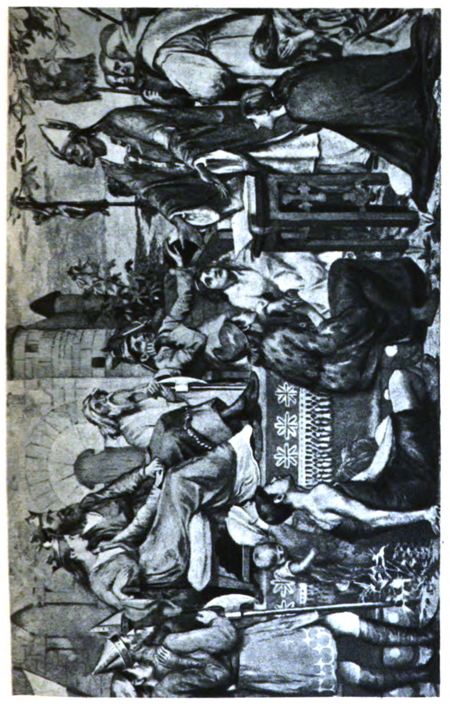
(See this image in horizontal aspect [here].)
Pope Gregory’s Monks converting the King of Kent, p. 44. From a painting..
Their temporal power insensibly arose from the calamities of the times; and the Roman bishops, who have deluged Europe and Asia with blood, were compelled to reign as the ministers of charity and peace. I. The church of Rome, as it has been formerly observed, was endowed with ample possessions in Italy, Sicily, and the more distant provinces; and her agents, who were commonly subdeacons, had acquired a civil, and even criminal, jurisdiction over their tenants and husbandmen. The successor of St. Peter administered his patrimony with the temper of a vigilant and moderate landlord; [82] and the epistles of Gregory are [VIII-47] filled with salutary instructions to abstain from doubtful or vexatious lawsuits, to preserve the integrity of weights and measures, to grant every reasonable delay, and to reduce the capitation of the slaves of the glebe, who purchased the right of marriage by the payment of an arbitrary fine. [83] The rent or the produce of these estates was transported to the mouth of the Tiber, at the risk and expense of the pope; in the use of wealth he acted like a faithful steward of the church and the poor, and liberally applied to their wants the inexhaustible resources of abstinence and order. The voluminous account of his receipts and disbursements was kept above three hundred years in the Lateran, as the model of Christian economy. On the four great festivals, [84] he divided their quarterly allowance to the clergy, to his domestics, to the monasteries, the churches, the places of burial, the alms-houses, and the hospitals of Rome, and the rest of the diocese. On the first day of every month, he distributed to the poor, according to the season, their stated portion of corn, wine, cheese, vegetables, oil, fish, fresh provisions, cloths, and money; and his treasurers were continually summoned to satisfy, in his name, the extraordinary demands of indigence and merit. The instant distress of the sick and helpless, of strangers and pilgrims, was relieved by the bounty of each day, and of every hour; nor would the pontiff indulge himself in a frugal repast, till he had sent the dishes from his own table to some objects deserving of his compassion. The misery of the times had reduced the nobles and matrons of Rome to accept, without a blush, the benevolence of the church; three thousand virgins received their food and raiment from the hand of [VIII-48] their benefactor; and many bishops of Italy escaped from the Barbarians to the hospitable threshold of the Vatican. Gregory might justly be styled the Father of his country; and such was the extreme sensibility of his conscience that, for the death of a beggar who had perished in the streets, he interdicted himself during several days from the exercise of sacerdotal functions. II. The misfortunes of Rome involved the apostolical pastor in the business of peace and war; and it might be doubtful to himself whether piety or ambition prompted him to supply the place of his absent sovereign. Gregory awakened the emperor from a long slumber, exposed the guilt or incapacity of the exarch and his inferior ministers, complained that the veterans were withdrawn from Rome for the defence of Spoleto, encouraged the Italians to guard their cities and altars, and condescended, in the crisis of danger, to name the tribunes and to direct the operations of the provincial troops. But the martial spirit of the pope was checked by the scruples of humanity and religion; the imposition of tribute, though it was employed in the Italian war, he freely condemned as odious and oppressive; whilst he protected, against the Imperial edicts, the pious cowardice of the soldiers who deserted a military for a monastic life. If we may credit his own declarations, it would have been easy for Gregory to exterminate the Lombards by their domestic factions, without leaving a king, a duke, or a count, to save that unfortunate nation from the vengeance of their foes. As a Christian bishop, he preferred the salutary offices of peace; his mediation appeased the tumult of arms; but he was too conscious of the arts of the Greeks, and the passions of the Lombards, to engage his sacred promise for the observance of the truce. Disappointed in the hope of a general and lasting treaty, he presumed to save his country without the consent of the emperor or the exarch. The sword of the enemy was suspended over Rome: it was averted by the mild eloquence and seasonable gifts of [VIII-49] the pontiff, who commanded the respect of heretics and barbarians.
The merits of Gregory were treated by the Byzantine court with reproach and insult; but in the attachment of a grateful people he found the purest reward of a citizen and the best right of a sovereign. [85]
[VIII-50]
CHAPTER XLVI↩
Revolutions of Persia after the Death of Chosroes or Nushirvan — His Son Hormouz, a Tyrant, is deposed — Usurpation of Bahram — Flight and Restoration of Chosroes II. — His Gratitude to the Romans — The Chagan of the Avars — Revolt of the Army against Maurice — His Death — Tyranny of Phocas — Elevation of Heraclius — The Persian War — Chosroes subdues Syria, Egypt, and Asia Minor — Siege of Constantinople by the Persians and Avars — Persian Expeditions — Victories and Triumph of Heraclius
The conflict of Rome and Persia was prolonged from the death of Crassus to the reign of Heraclius. An experience of seven hundred years might convince the rival nations of the impossibility of maintaining their conquests beyond the fatal limits of the Tigris and Euphrates. Yet the emulation of Trajan and Julian was awakened by the trophies of Alexander, and the sovereigns of Persia indulged the ambitious hope of restoring the empire of Cyrus. [1] Such extraordinary efforts of power and courage will always command the attention of posterity; but the events by which the fate of nations is not materially changed leave a faint impression on the page of history, and the patience of the reader would be exhausted by the repetition of the same hostilities, undertaken without cause, prosecuted without glory, and terminated without effect. The arts of negotiation, unknown to [VIII-51] the simple greatness of the senate and the Cæsars, were assiduously cultivated by the Byzantine princes; and the memorials of their perpetual embassies [2] repeat, with the same uniform prolixity, the language of falsehood and declamation, the insolence of the Barbarians, and the servile temper of the tributary Greeks. Lamenting the barren superfluity of materials, I have studied to compress the narrative of these uninteresting transactions; but the just Nushirvan is still applauded as the model of Oriental kings, and the ambition of his grandson Chosroes prepared the revolution of the East, which was speedily accomplished by the arms and the religion of the successors of Mahomet.
In the useless altercations that precede and justify the quarrels of princes, the Greeks and the Barbarians accused each other of violating the peace which had been concluded between the two empires about four years before the death of Justinian. The sovereign of Persia and India aspired to reduce under his obedience the province of Yemen or Arabia [3] Felix, the distant land of myrrh and frankincense, which had escaped, rather than opposed, the conquerors of the East. After the defeat of Abrahah under the walls of Mecca, [4] the discord of his sons and brothers gave an easy entrance to the Persians; they chased the strangers of Abyssinia beyond the Red Sea; and a native prince of the ancient Homerites was restored to the throne as the vassal or viceroy of the great Nushirvan. [5] But the nephew of Justinian declared his [VIII-52] resolution to avenge the injuries of his Christian ally the prince of Abyssinia, as they suggested a decent pretence to discontinue the annual tribute, which was poorly disguised by the name of pension. The churches of Persarmenia were oppressed by the intolerant spirit of the Magi; they secretly invoked the protector of the Christians; and, after the pious murder of their satraps, the rebels were avowed and supported as the brethren and subjects of the Roman emperor. The complaints of Nushirvan were disregarded by the Byzantine court; Justin yielded to the importunities of the Turks, who offered an alliance against the common enemy; and the Persian monarchy was threatened at the same instant by the united forces of Europe, of Æthiopia, and of Scythia. At the age of fourscore, the sovereign of the East would perhaps have chosen the peaceful enjoyment of his glory and greatness; but, as soon as war became inevitable, he took the field with the alacrity of youth, whilst the aggressor trembled in the palace of Constantinople. Nushirvan, or Chosroes, conducted in person the siege of Dara; and, although that important fortress had been left destitute of troops and magazines, the valour of the inhabitants resisted above five months the archers, the elephants, and the military engines of the Great King. In the meanwhile his general Adarman advanced from Babylon, traversed the desert, passed the Euphrates, insulted the suburbs of Antioch, reduced to ashes the city of Apamea, and laid the spoils of Syria at the feet of his master, whose perseverance in the midst of winter at length subverted the bulwark of the East. But these losses, which astonished the provinces and the court, produced a salutary effect in the repentance and abdication of the emperor Justin; a new spirit arose in the Byzantine councils; and a truce of three years was obtained [VIII-53] by the prudence of Tiberius. [6] That seasonable interval was employed in the preparations of war; and the voice of rumour proclaimed to the world that from the distant countries of the Alps and the Rhine, from Scythia, Mæsia, Pannonia, Illyricum, and Isauria, the strength of the Imperial cavalry was reinforced with one hundred and fifty thousand soldiers. Yet the king of Persia, without fear or without faith, resolved to prevent the attack of the enemy; again passed the Euphrates; and, dismissing the ambassadors of Tiberius, arrogantly commanded them to await his arrival at Cæsarea, the metropolis of the Cappadocian provinces. The two armies encountered each other in the battle of Melitene: the Barbarians, who darkened the air with a cloud of arrows, prolonged their line, and extended their wings across the plain; while the Romans, in deep and solid bodies, expected to prevail in closer action, by the weight of their swords and lances. A Scythian chief, who commanded their right wing, suddenly turned the flank of the enemy, attacked their rear-guard in the presence of Chosroes, penetrated to the midst of the camp, pillaged the royal tent, profaned the eternal fire, loaded a train of camels with the spoils of Asia, cut his way through the Persian host, and returned with songs of victory to his friends, who had consumed the day in single combats or ineffectual skirmishes. The darkness of the night and the separation of the Romans afforded the Persian monarch an opportunity of revenge; and one of their camps was swept away by a rapid and impetuous assault. But the review of his loss and the consciousness of his danger determined Chosroes to a speedy retreat; he burnt, in his passage, the vacant town of Melitene; and, without consulting the safety of his troops, boldly swam the Euphrates on the back of an elephant. [7] After this unsuccessful [VIII-54] campaign, the want of magazines, and perhaps some inroad of the Turks, obliged him to disband or divide his forces; the Romans were left masters of the field, and their general Justinian, advancing to the relief of the Persarmenian rebels, erected his standard on the banks of the Araxes. The great Pompey had formerly halted within three days’ march of the Caspian; [8] that inland sea was explored, for the first time, by an hostile fleet, [9] and seventy thousand captives were transplanted from Hyrcania to the isle of Cyprus. On the return of spring, Justinian descended into the fertile plains of Assyria, the flames of war approached the residence of Nushirvan, the indignant monarch sunk into the grave, and his last edict restrained his successors from exposing their person in a battle against the Romans. Yet the memory of this transient affront was lost in the glories of a long reign; and his formidable enemies, after indulging their dream of conquest, again solicited a short respite from the calamities of war. [10]
The throne of Chosroes Nushirvan was filled by Hormouz, or Hormisdas, the eldest or the most favoured of his sons. [VIII-55] With the kingdoms of Persia and India, he inherited the reputation and example of his father, the service, in every rank, of his wise and valiant officers, and a general system of administration, harmonised by time and political wisdom to promote the happiness of the prince and people. But the royal youth enjoyed a still more valuable blessing, the friendship of a sage who had presided over his education, and who always preferred the honour to the interest of his pupil, his interest to his inclination. In a dispute with the Greek and Indian philosophers, Buzurg [11] had once maintained that the most grievous misfortune of life is old age without the remembrance of virtue; and our candour will presume that the same principle compelled him, during three years, to direct the councils of the Persian empire. His zeal was rewarded by the gratitude and docility of Hormouz, who acknowledged himself more indebted to his preceptor than to his parent; but, when age and labour had impaired the strength and perhaps the faculties of this prudent counsellor, he retired from court, and abandoned the youthful monarch to his own passions and those of his favourites. By the fatal vicissitude of human affairs, the same scenes were renewed at Ctesiphon, which had been exhibited in Rome after the death of Marcus Antoninus. The ministers of flattery and corruption, who had been banished by the father, were recalled and cherished by the son; the disgrace and exile of the friends of Nushirvan established their tyranny; and virtue was driven by degrees from the mind of Hormouz, [VIII-56] from his palace, and from the government of the state. [12] The faithful agents, the eyes and ears of the king, informed him of the progress of disorder, that the provincial governors flew to their prey with the fierceness of lions and eagles, and that their rapine and injustice would teach the most loyal of his subjects to abhor the name and authority of their sovereign. The sincerity of this advice was punished with death, the murmurs of the cities were despised, their tumults were quelled by military execution; the intermediate powers between the throne and the people were abolished; and the childish vanity of Hormouz, who affected the daily use of the tiara, was fond of declaring that he alone would be the judge as well as the master of his kingdom. In every word and in every action, the son of Nushirvan degenerated from the virtues of his father. His avarice defrauded the troops; his jealous caprice degraded the satraps; the palace, the tribunals, the waters of the Tigris, were stained with the blood of the innocent; and the tyrant exulted in the sufferings and execution of thirteen thousand victims. As the excuse of his cruelty, he sometimes condescended to observe that the fears of the Persians would be productive of hatred, and that their hatred must terminate in rebellion; but he forgot that his own guilt and folly had inspired the sentiments which he deplored, and prepared the event which he so justly apprehended. Exasperated by long and hopeless oppression, the provinces of Babylon, Susa, and Carmania erected the standard of revolt; and the princes of Arabia, India, and Scythia refused the customary tribute to the unworthy successor of Nushirvan. [VIII-57] The arms of the Romans, in slow sieges and frequent inroads, afflicted the frontiers of Mesopotamia and Assyria; one of their generals professed himself the disciple of Scipio; and the soldiers were animated by a miraculous image of Christ, whose mild aspect should never have been displayed in the front of battle. [13] At the same time, the eastern provinces of Persia were invaded by the great khan, [14] who passed the Oxus at the head of three or four hundred thousand Turks. The imprudent Hormouz accepted their perfidious and formidable aid; the cities of Khorasan or Bactriana were commanded to open their gates; the march of the barbarians towards the mountains of Hyrcania revealed the correspondence of the Turkish and Roman arms; and their union must have subverted the throne of the house of Sassan.
Persia had been lost by a king; it was saved by a hero. After his revolt, Varanes or Bahram is stigmatised by the son of Hormouz as an ungrateful slave: the proud and ambiguous reproach of despotism, since he was truly descended from the ancient princes of Rei, [15] one of the seven families whose splendid as well as substantial prerogatives exalted them above the heads of the Persian nobility. [16] At the siege of [VIII-58] Dara, the valour of Bahram was signalised under the eyes of Nushirvan, and both the father and son successively promoted him to the command of armies, the government of Media, and the superintendence of the palace. The popular prediction which marked him as the deliverer of Persia might be inspired by his past victories and extraordinary figure; the epithet Giubin is expressive of the quality of dry wood; he had the strength and stature of a giant, and his savage countenance was fancifully compared to that of a wild cat. While the nation trembled, while Hormouz disguised his terror by the name of suspicion, and his servants concealed their disloyalty under the mask of fear, Bahram alone displayed his undaunted courage and apparent fidelity; and, as soon as he found that no more than twelve thousand soldiers would follow him against the enemy, he prudently declared that to this fatal number heaven had reserved the honours of the triumph. The steep and narrow descent of the Pule Rudbar [17] or Hyrcanian rock is the only pass through which an army can penetrate into the territory of Rei and the plains of Media. From the commanding heights, a band of resolute men might overwhelm with stones and darts the myriads of the Turkish host: their emperor and his son were transpierced with arrows; and the fugitives were left, without counsel or provisions, to the revenge of an injured people. The patriotism of the Persian general was stimulated by his affection for the city of his forefathers; in the hour of victory [VIII-59] every peasant became a soldier, and every soldier an hero; and their ardour was kindled by the gorgeous spectacle of beds and thrones and tables of massy gold, the spoils of Asia, and the luxury of the hostile camp. A prince of a less malignant temper could not easily have forgiven his benefactor, and the secret hatred of Hormouz was envenomed by a malicious report that Bahram had privately retained the most precious fruits of his Turkish victory. But the approach of a Roman army on the side of the Araxes compelled the implacable tyrant to smile and to applaud; and the toils of Bahram were rewarded with the permission of encountering a new enemy, by their skill and discipline more formidable than a Scythian multitude. Elated by his recent success, he despatched an herald with a bold defiance to the camp of the Romans, requesting them to fix a day of battle, and to choose whether they would pass the river themselves or allow a free passage to the arms of the Great King. The lieutenant of the emperor Maurice preferred the safer alternative, and this local circumstance, which would have enhanced the victory of the Persians, rendered their defeat more bloody and their escape more difficult. But the loss of his subjects and the danger of his kingdom were overbalanced in the mind of Hormouz by the disgrace of his personal enemy; and no sooner had Bahram collected and reviewed his forces than he received from a royal messenger the insulting gift of a distaff, a spinning-wheel, and a complete suit of female apparel. Obedient to the will of his sovereign, he shewed himself to the soldiers in this unworthy disguise; they resented his ignominy and their own; a shout of rebellion ran through the ranks; and the general accepted their oath of fidelity and vows of revenge. A second messenger, who had been commanded to bring the rebel in chains, was trampled under the feet of an elephant, and manifestoes were diligently circulated, exhorting the Persians to assert their freedom against an odious and contemptible tyrant. The defection was rapid and universal; his loyal slaves were sacrificed [VIII-60] to the public fury; the troops deserted to the standard of Bahram; and the provinces again saluted the deliverer of his country.
As the passes were faithfully guarded, Hormouz could only compute the number of his enemies by the testimony of a guilty conscience, and the daily defection of those who, in the hour of his distress, avenged their wrongs or forgot their obligations. He proudly displayed the ensigns of royalty; but the city and palace of Modain had already escaped from the hand of the tyrant. Among the victims of his cruelty, Bindoes, a Sassanian prince, had been cast into a dungeon; his fetters were broken by the zeal and courage of a brother; and he stood before the king at the head of those trusty guards who had been chosen as the ministers of his confinement and perhaps of his death. Alarmed by the hasty intrusion and bold reproaches of the captive, Hormouz looked round, but in vain, for advice or assistance; discovered that his strength consisted in the obedience of others, and patiently yielded to the single arm of Bindoes, who dragged him from the throne to the same dungeon in which he himself had been so lately confined. At the first tumult, Chosroes, the eldest of the sons of Hormouz, escaped from the city; he was persuaded to return by the pressing and friendly invitation of Bindoes, who promised to seat him on his father’s throne, and who expected to reign under the name of an inexperienced youth. In the just assurance that his accomplices could neither forgive nor hope to be forgiven, and that every Persian might be trusted as the judge and enemy of the tyrant, he instituted a public trial without a precedent and without a copy in the annals of the East. The son of Nushirvan, who had requested to plead in his own defence, was introduced as a criminal into the full assembly of the nobles and satraps. [18] He was heard with decent attention as long as he expatiated [VIII-61] on the advantages of order and obedience, the danger of innovation, and the inevitable discord of those who had encouraged each other to trample on their lawful and hereditary sovereign. By a pathetic appeal to their humanity, he extorted that pity which is seldom refused to the fallen fortunes of a king; and, while they beheld the abject posture and squalid appearance of the prisoner, his tears, his chains, and the marks of ignominious stripes, it was impossible to forget how recently they had adored the divine splendour of his diadem and purple. But an angry murmur arose in the assembly as soon as he presumed to vindicate his conduct and to applaud the victories of his reign. He defined the duties of a king, and the Persian nobles listened with a smile of contempt; they were fired with indignation when he dared to vilify the character of Chosroes; and by the indiscreet offer of resigning the sceptre to the second of his sons he subscribed his own condemnation and sacrificed the life of his innocent favourite. The mangled bodies of the boy and his mother were exposed to the people; the eyes of Hormouz were pierced with a hot needle; and the punishment of the father was succeeded by the coronation of his eldest son. Chosroes had ascended the throne without guilt, and his piety strove to alleviate the misery of the abdicated monarch; from the dungeon he removed Hormouz to an apartment of the palace, supplied with liberality the consolations of sensual enjoyment, and patiently endured the furious sallies of his resentment and despair. He might despise the resentment of a blind and unpopular tyrant, but the tiara was trembling on his head, till he could subvert the power, or acquire the friendship, of the great Bahram, who sternly denied the justice of a revolution in which himself and his soldiers, the true representatives of Persia, had never been consulted. The offer of a general amnesty and of the second rank in his kingdom was answered [19] by an epistle from Bahram, friend [VIII-62] of the gods, conqueror of men, and enemy of tyrants, the satrap of satraps, general of the Persian armies, and a prince adorned with the title of eleven virtues. [20] He commands Chosroes, the son of Hormouz, to shun the example and fate of his father, to confine the traitors who had been released from their chains, to deposit in some holy place the diadem which he had usurped, and to accept from his gracious benefactor the pardon of his faults and the government of a province. The rebel might not be proud, and the king most assuredly was not humble; but the one was conscious of his strength, the other was sensible of his weakness; and even the modest language of his reply still left room for treaty and reconciliation. Chosroes led into the field the slaves of the palace and the populace of the capital; they beheld with terror the banners of a veteran army; they were encompassed and surprised by the evolutions of the general; and the satraps who had deposed Hormouz received the punishment of their revolt, or expiated their first treason by a second and more criminal act of disloyalty. The life and liberty of Chosroes were saved, but he was reduced to the necessity of imploring aid or refuge in some foreign land; and the implacable Bindoes, anxious to secure an unquestionable title, hastily returned to the palace, and ended, with a bow-string, the wretched existence of the son of Nushirvan. [21]
While Chosroes despatched the preparations of his retreat, he deliberated with his remaining friends [22] whether he [VIII-63] should lurk in the valleys of Mount Caucasus, or fly to the tents of the Turks, or solicit the protection of the emperor. The long emulation of the successors of Artaxerxes and Constantine increased his reluctance to appear as a suppliant in a rival court; but he weighed the forces of the Romans, and prudently considered that the neighbourhood of Syria would render his escape more easy and their succours more effectual. Attended only by his concubines and a troop of thirty guards, he secretly departed from the capital, followed the banks of the Euphrates, traversed the desert, and halted at the distance of ten miles from Circesium. About the third watch of the night, the Roman prefect was informed of his approach, and he introduced the royal stranger to the fortress at the dawn of day. From thence the king of Persia was conducted to the more honourable residence of Hierapolis; [23] and Maurice dissembled his pride, and displayed his benevolence, at the reception of the letters and ambassadors of the grandson of Nushirvan. They humbly represented the vicissitudes of fortune and the common interest of princes, exaggerated the ingratitude of Bahram, the agent of the evil principle, and urged, with specious argument, that it was for the advantage of the Romans themselves to support the two monarchies which balance the world, the two great luminaries by whose salutary influence it is vivified and adorned. The anxiety of Chosroes was soon relieved by the assurance that the emperor had espoused the cause of justice and royalty; but Maurice prudently declined the expense and delay of his useless visit to Constantinople. In the name of his generous benefactor, a rich diadem was presented to the fugitive prince with an [VIII-64] inestimable gift of jewels and gold; a powerful army was assembled on the frontiers of Syria and Armenia, under the command of the valiant and faithful Narses; [24] and this general, of his own nation and his own choice, was directed to pass the Tigris, and never to sheathe his sword till he had restored Chosroes to the throne of his ancestors. The enterprise, however splendid, was less arduous than it might appear. Persia had already repented of her fatal rashness, which betrayed the heir of the house of Sassan to the ambition of a rebellious subject; and the bold refusal of the Magi to consecrate his usurpation compelled Bahram to assume the sceptre, regardless of the laws and prejudices of the nation. The palace was soon distracted with conspiracy, the city with tumult, the provinces with insurrection; and the cruel execution of the guilty and the suspected served to irritate rather than subdue the public discontent. No sooner did the grandson of Nushirvan display his own and the Roman banners beyond the Tigris than he was joined, each day, by the increasing multitudes of the nobility and people; and, as he advanced, he received from every side the grateful offerings of the keys of his cities and the heads of his enemies. As soon as Modain was freed from the presence of the usurper, the loyal inhabitants obeyed the first summons of Mebodes at the head of only two thousand horse, and Chosroes accepted the sacred and precious ornaments of the palace as the pledge of their truth and a presage of his approaching success. After the junction of the Imperial troops, which Bahram vainly struggled to prevent, the contest was decided [VIII-65] by two battles on the banks of the Zab and the confines of Media. The Romans, with the faithful subjects of Persia, amounted to sixty thousand, while the whole force of the usurper did not exceed forty thousand men; the two generals signalised their valour and ability, but the victory was finally determined by the prevalence of numbers and discipline. With the remnant of a broken army, Bahram fled towards the eastern provinces of the Oxus; [24a] the enmity of Persia reconciled him to the Turks; but his days were shortened by poison, perhaps the most incurable of poisons: the stings of remorse and despair, and the bitter remembrance of lost glory. Yet the modern Persians still commemorate the exploits of Bahram; and some excellent laws have prolonged the duration of his troubled and transitory reign.
The restoration of Chosroes was celebrated with feasts and executions; and the music of the royal banquet was often disturbed by the groans of dying or mutilated criminals. A general pardon might have diffused comfort and tranquillity through a country which had been shaken by the late revolutions; yet, before the sanguinary temper of Chosroes is blamed, we should learn whether the Persians had not been accustomed either to dread the rigour, or to despise the weakness, of their sovereign. The revolt of Bahram and the conspiracy of the satraps were impartially punished by the revenge or justice of the conqueror; the merits of Bindoes himself could not purify his hand from the guilt of royal blood; and the son of Hormouz was desirous to assert his own innocence and to vindicate the sanctity of kings. During the vigour of the Roman power, several princes were seated on the throne of Persia by the arms and the authority of the first Cæsars. But their new subjects were soon disgusted with the vices or virtues which they had imbibed in a foreign land; [VIII-66] the instability of their dominion gave birth to a vulgar observation that the choice of Rome was solicited and rejected with equal ardour by the capricious levity of Oriental slaves. [25] But the glory of Maurice was conspicuous in the long and fortunate reign of his son and his ally. A band of a thousand Romans, who continued to guard the person of Chosroes, proclaimed his confidence in the fidelity of the strangers; his growing strength enabled him to dismiss this unpopular aid, but he steadily professed the same gratitude and reverence to his adopted father; and, till the death of Maurice, the peace and alliance of the two empires were faithfully maintained. Yet the mercenary friendship of the Roman prince had been purchased with costly and important gifts: the strong cities of Martyropolis and Dara were restored, and the Persarmenians became the willing subjects of an empire, whose eastern limit was extended, beyond the example of former times, as far as the banks of the Araxes and the neighbourhood of the Caspian. A pious hope was indulged that the church as well as the state might triumph in this revolution; but, if Chosroes had sincerely listened to the Christian bishops, the impression was erased by the zeal and eloquence of the Magi; if he was armed with philosophic indifference, he accommodated his belief, or rather his professions, to the various circumstances of an exile and a sovereign. The imaginary conversion of the king of Persia was reduced to a local and superstitious veneration for Sergius, [26] one of the saints of Antioch, who heard his prayers and appeared to him in dreams; he enriched the shrine with offerings of gold and silver, and ascribed to this invisible [VIII-67] patron the success of his arms, and the pregnancy of Sira, a devout Christian and the best beloved of his wives. [27] The beauty of Sira, or Schirin, [28] her wit, her musical talents, are still famous in the history or rather in the romances of the East; her own name is expressive, in the Persian tongue, of sweetness and grace; and the epithet of Parviz [29] alludes to the charms of her royal lover. Yet Sira never shared the passion which she inspired, and the bliss of Chosroes was tortured by a jealous doubt that, while he possessed her person, she had bestowed her affections on a meaner favourite. [30]
[VIII-68]
While the majesty of the Roman name was revived in the East, the prospect of Europe is less pleasing and less glorious. By the departure of the Lombards and the ruin of the Gepidæ, the balance of power was destroyed on the Danube; and the Avars spread their permanent dominion from the foot of the Alps to the sea-coast of the Euxine. The reign of Baian is the brightest era of their monarchy; their chagan, who occupied the rustic palace of Attila, appears to have imitated his character and policy; [31] but, as the same scenes were repeated in a smaller circle, a minute representation of the copy would be devoid of the greatness and novelty of the original. [32] The pride of the second Justin, of Tiberius, and Maurice was humbled by a proud Barbarian, more prompt to inflict, than exposed to suffer, the injuries of war; and, as often as Asia was threatened by the Persian arms, Europe [VIII-69] was oppressed by the dangerous inroads, or costly friendship, of the Avars. When the Roman envoys approached the presence of the chagan, they were commanded to wait at the door of his tent, till, at the end perhaps of ten or twelve days, he condescended to admit them. If the substance or the style of their message was offensive to his ear, he insulted, with a real or affected fury, their own dignity and that of their prince; their baggage was plundered, and their lives were only saved by the promise of a richer present and a more respectful address. But his sacred ambassadors enjoyed and abused an unbounded licence in the midst of Constantinople; they urged, with importunate clamours, the increase of tribute, or the restitution of captives and deserters; and the majesty of the empire was almost equally degraded by a base compliance or by the false and fearful excuses with which they eluded such insolent demands. The chagan had never seen an elephant; and his curiosity was excited by the strange, and perhaps fabulous, portrait of that wonderful animal. At his command, one of the largest elephants of the Imperial stables was equipped with stately caparisons, and conducted by a numerous train to the royal village in the plains of Hungary. He surveyed the enormous beast with surprise, with disgust, and possibly with terror; and smiled at the vain industry of the Romans, who, in search of such useless rarities, could explore the limits of the land and sea. He wished, at the expense of the emperor, to repose in a golden bed. The wealth of Constantinople, and the skilful diligence of her artists, were instantly devoted to the gratification of his caprice; but, when the work was finished, he rejected with scorn a present so unworthy the majesty of a great king. [33] These were the casual sallies of his pride, but the avarice of the chagan was a more steady and tractable passion: a rich and regular supply of silk apparel, furniture, and plate introduced the rudiments of [VIII-70] art and luxury among the tents of the Scythians; their appetite was stimulated by the pepper and cinnamon of India; [34] the annual subsidy or tribute was raised from fourscore to one hundred and twenty thousand pieces of gold; and, after each hostile interruption, the payment of the arrears, with exorbitant interest, was always made the first condition of the new treaty. In the language of a Barbarian without guile, the prince of the Avars affected to complain of the insincerity of the Greeks, [35] yet he was not inferior to the most civilised nations in the refinements of dissimulation and perfidy. As the successor of the Lombards, the chagan asserted his claim to the important city of Sirmium, the ancient bulwark of the Illyrian provinces. [36] The plains of the Lower Hungary were covered with the Avar horse, and a fleet of large boats was built in the Hercynian wood, to descend the Danube, and to transport into the Save the materials of a bridge. But, as the strong garrison of Singidunum, which commanded the conflux of the two rivers, might have stopped their passage and baffled his designs, he dispelled their apprehensions by a solemn oath that his views were not hostile to the empire. He swore by his sword, the symbol of the god of war, that he did not, as the enemy of Rome, construct a bridge upon the Save. “If I violate my oath,” pursued the intrepid Baian, “may I myself, and the last of my nation, perish by the sword! may the heavens, and fire, the deity of [VIII-71] the heavens, fall upon our heads! may the forests and mountains bury us in their ruins! and the Save, returning, against the laws of nature, to his source, overwhelm us in his angry waters!” After this Barbarous impercation, he calmly inquired, what oath was most sacred and venerable among the Christians, what guilt of perjury it was most dangerous to incur. The bishop of Singidunum presented the gospel, which the chagan received with devout reverence. “I swear,” said he, “by the God who has spoken in this holy book, that I have neither falsehood on my tongue nor treachery in my heart.” As soon as he rose from his knees, he accelerated the labour of the bridge, and despatched an envoy to proclaim what he no longer wished to conceal. “Inform the emperor,” said the perfidious Baian, “that Sirmium is invested on every side. Advise his prudence to withdraw the citizens and their effects, and to resign a city which it is now impossible to rel eve or defend.” Without the hope of relief, the defence of Sirmium was prolonged above three years; the walls were still untouched; but famine was enclosed within the walls, till a merciful capitulation allowed the escape of the naked and hungry inhabitants. Singidunum, at the distance of fifty miles, experienced a more cruel fate: the buildings were razed, and the vanquished people was condemned to servitude and exile. [37] Yet the ruins of Sirmium are no longer visible; the advantageous situation of Singidunum soon attracted a new colony of Sclavonians; and the conflux of the Save and Danube is still guarded by the fortifications of Belgrade, or the White City, so often and so obstinately disputed by the Christian and Turkish arms. [38] From Belgrade to the walls of Constantinople a line may be measured of six hundred [VIII-72] miles: that line was marked with flames and with blood; the horses of the Avars were alternately bathed in the Euxine and the Adriatic; and the Roman pontiff, alarmed by the approach of a more savage enemy, [39] was reduced to cherish the Lombards as the protectors of Italy. The despair of a captive, whom his country refused to ransom, disclosed to the Avars the invention and practice of military engines; [40] but in the first attempts they were rudely framed and awkwardly managed; and the resistance of Diocletianopolis and Berœa, of Philippopolis and Hadrianople, soon exhausted the skill and patience of the besiegers. The warfare of Baian was that of a Tartar, yet his mind was susceptible of a humane and generous sentiment; he spared Anchialus, whose salutary waters had restored the health of the best beloved of his wives; and the Romans confess that their starving army was fed and dismissed by the liberality of a foe. His empire extended over Hungary, Poland, and Prussia, from the mouth of the Danube to that of the Oder; [41] and his new subjects were divided and transplanted by the jealous policy of the conqueror. [42] The eastern regions of Germany, which had been left vacant by the emigration of the Vandals, were replenished with Sclavonian colonists; the same tribes are discovered in the neighbourhood of the [VIII-73] Adriatic and of the Baltic; and, with the name of Baian himself, the Illyrian cities of Neyss and Lissa are again found in the heart of Silesia. In the disposition both of his troops and provinces, the chagan exposed the vassals, whose lives he disregarded, [43] to the first assault; and the swords of the enemy were blunted before they encountered the native valour of the Avars.
The Persian alliance restored the troops of the East to the defence of Europe; and Maurice, who had supported ten years the insolence of the chagan, declared his resolution to march in person against the Barbarians. In the space of two centuries, none of the successors of Theodosius had appeared in the field, their lives were supinely spent in the palace of Constantinople; and the Greeks could no longer understand that the name of emperor, in its primitive sense, denoted the chief of the armies of the republic. The martial ardour of Maurice was opposed by the grave flattery of the senate, the timid superstition of the patriarch, and the tears of the empress Constantina; and they all conjured him to devolve on some meaner general the fatigues and perils of a Scythian campaign. Deaf to their advice and entreaty, the emperor boldly advanced [44] seven miles from the capital; the sacred ensign of the cross was displayed in the front, and Maurice reviewed, with conscious pride, the arms and numbers of the veterans who had fought and conquered beyond the Tigris. Anchialus was the last term of his progress by sea and land; he solicited, without success, a miraculous answer to his nocturnal prayers; his mind was confounded by the death of a favourite horse, the encounter of a wild [VIII-74] boar, a storm of wind and rain, and the birth of a monstrous child; and he forgot that the best of omens is to unsheathe our sword in the defence of our country. [45] Under the pretence of receiving the ambassadors of Persia, the emperor returned to Constantinople, exchanged the thoughts of war for those of devotion, and disappointed the public hope by his absence and the choice of his lieutenants. The blind partiality of fraternal love might excuse the promotion of his brother Peter, who fled with equal disgrace from the Barbarians, from his own soldiers, and from the inhabitants of a Roman city. That city, if we may credit the resemblance of name and character, was the famous Azimuntium, [46] which had alone repelled the tempest of Attila. The example of her warlike youth was propagated to succeeding generations; and they obtained, from the first or the second Justin, an honourable privilege, that their valour should be always reserved for the defence of their native country. The brother of Maurice attempted to violate this privilege, and to mingle a patriot band with the mercenaries of his camp; they retired to the church, he was not awed by the sanctity of the place; the people rose in their cause, the gates were shut, the ramparts were manned; and the cowardice of Peter was found equal to his arrogance and injustice. The military fame of Commentiolus [47] is the object of satire or comedy rather than of serious history, since he was even deficient in the vile and vulgar qualification of personal courage. His solemn [VIII-75] councils, strange evolutions, and secret orders always supplied an apology for flight or delay. If he marched against the enemy, the pleasant valleys of Mount Hæmus opposed an insuperable barrier; but in his retreat he explored, with fearless curiosity, the most difficult and obsolete paths, which had almost escaped the memory of the oldest native. The only blood which he lost was drawn, in a real or affected malady, by the lancet of a surgeon; and his health, which felt with exquisite sensibility the approach of the Barbarians, was uniformly restored by the repose and safety of the winter season. A prince who could promote and support this unworthy favourite must derive no glory from the accidental merit of his colleague Priscus. [48] In five successive battles, which seem to have been conducted with skill and resolution, seventeen thousand two hundred Barbarians were made prisoners; near sixty thousand, with four sons of the chagan, were slain; the Roman general surprised a peaceful district of the Gepidæ, who slept under the protection of the Avars; and his last trophies were erected on the banks of the Danube and the Theiss. Since the death of Trajan, the arms of the empire had not penetrated so deeply into the old Dacia; yet the success of Priscus was transient and barren; and he was soon recalled by the apprehension that Baian, with dauntless spirit and recruited forces, was preparing to avenge his defeat under the walls of Constantinople. [49]
The theory of war was not more familiar to the camps of Cæsar and Trajan than to those of Justinian and Maurice. [50] The iron of Tuscany or Pontus still received the keenest [VIII-76] temper from the skill of the Byzantine workmen. The magazines were plentifully stored with every species of offensive and defensive arms. In the construction and use of ships, engines, and fortifications, the Barbarians admired the superior ingenuity of a people whom they so often vanquished in the field. The science of tactics, the order, evolutions, and stratagems of antiquity, was transcribed and studied in the books of the Greeks and Romans. But the solitude or degeneracy of the provinces could no longer supply a race of men to handle those weapons, to guard those walls, to navigate those ships, and to reduce the theory of war into bold and successful practice. The genius of Belisarius and Narses had been formed without a master, and expired without a disciple. Neither honour, nor patriotism, nor generous superstition could animate the lifeless bodies of slaves and strangers, who had succeeded to the honours of the legions; it was in the camp alone that the emperor should have exercised a despotic command; it was only in the camps that his authority was disobeyed and insulted; he appeased and inflamed with gold the licentiousness of the troops; but their vices were inherent, their victories were accidental, and their costly maintenance exhausted the substance of a state which they were unable to defend. After a long and pernicious indulgence, the cure of this inveterate evil was undertaken by Maurice; but the rash attempt, which drew destruction on his own head, tended only to aggravate the disease. A reformer should be exempt from the suspicion of interest, and he must possess the confidence and esteem of those whom he proposes to reclaim. The troops of Maurice might listen to the voice of a victorious leader; they disdained the admonitions of statesmen and sophists; and, when they received an edict which deducted from their pay the price of their arms and clothing, they execrated the avarice of a prince [VIII-77] insensible of the dangers and fatigues from which he had escaped. The camps both of Asia and Europe were agitated with frequent and furious seditions; [51] the enraged soldiers of Edessa pursued, with reproaches, with threats, with wounds, their trembling generals; they overturned the statues of the emperor, cast stones against the miraculous image of Christ, and either rejected the yoke of all civil and military laws or instituted a dangerous model of voluntary subordination. The monarch, always distant and often deceived, was incapable of yielding or persisting according to the exigence of the moment. But the fear of a general revolt induced him too readily to accept any act of valour or any expression of loyalty as an atonement for the popular offence; the new reform was abolished as hastily as it had been announced; and the troops, instead of punishment and restraint, were agreeably surprised by a gracious proclamation of immunities and rewards. But the soldiers accepted without gratitude the tardy and reluctant gifts of the emperor; their insolence was elated by the discovery of his weakness and their own strength; and their mutual hatred was inflamed beyond the desire of forgivenes or the hope of reconciliation. The historians of the times adopt the vulgar suspicion that Maurice conspired to destroy the troops whom he had laboured to reform; the misconduct and favour of Commentiolus are imputed to this malevolent design; and every age must condemn the inhumanity or avarice [52] of a prince who, by the trifling ransom of six thousand pieces of gold, might have prevented the [VIII-78] massacre of twelve thousand prisoners in the hands of the chagan. In the just fervour of indignation, an order was signified to the army of the Danube that they should spare the magazines of the province and establish their winter quarters in the hostile country of the Avars. The measure of their grievances was full: they pronounced Maurice unworthy to reign, expelled or slaughtered his faithful adherents, and under the command of Phocas, a simple centurion, returned by hasty marches to the neighbourhood of Constantinople. After a long series of legal succession, the military disorders of the third century were again revived; yet such was the novelty of the enterprise that the insurgents were awed by their own rashness. They hesitated to invest their favourite with the vacant purple, [53] and, while they rejected all treaty with Maurice himself, they held a friendly correspondence with his son Theodosius and with Germanus the father-in-law of the royal youth. So obscure had been the former condition of Phocas that the emperor was ignorant of the name and character of his rival; but, as soon as he learned that the centurion, though bold in sedition, was timid in the face of danger, “Alas!” cried the desponding prince, “if he is a coward, he will surely be a murderer.”
Yet, if Constantinople had been firm and faithful the murderer might have spent his fury against the walls; and the rebel army would have been gradually consumed or reconciled by the prudence of the emperor. In the games of the circus, which he repeated with unusual pomp, Maurice disguised with smiles of confidence the anxiety of his heart, condescended to solicit the applause of the factions, and flattered their pride by accepting from their respective tribunes a list of nine hundred blues and fifteen hundred greens, [VIII-79] whom he affected to esteem as the solid pillars of his throne. Their treacherous or languid support betrayed his weakness and hastened his fall; the green faction were the secret accomplices of the rebels, and the blues recommended lenity and moderation in a contest with their Roman brethren. The rigid and parsimonious virtues of Maurice had long since alienated the hearts of his subjects: as he walked barefoot in a religious procession, he was rudely assaulted with stones, and his guards were compelled to present their iron maces in the defence of his person. A fanatic monk ran through the streets with a drawn sword, denouncing against him the wrath and the sentence of God, and a vile plebeian, who represented his countenance and apparel, was seated on an ass and pursued by the imprecations of the multitude. [54] The emperor suspected the popularity of Germanus with the soldiers and citizens; he feared, he threatened, but he delayed to strike; the patrician fled to the sanctuary of the church; the people rose in his defence, the walls were deserted by the guards, and the lawless city was abandoned to the flames and rapine of a nocturnal tumult. In a small bark, the unfortunate Maurice, with his wife and nine children, escaped to the Asiatic shore, but the violence of the wind compelled him to land at the church of St. Autonomus [55] near Chalcedon, from whence he despatched Theodosius, his eldest son, to implore the gratitude and friendship of the Persian monarch. For himself, he refused to fly: his [VIII-80] body was tortured with sciatic pains, [56] his mind was enfeebled by superstition; he patiently awaited the event of the revolution, and addressed a fervent and public prayer to the Almighty, that the punishment of his sins might be inflicted in this world rather than in a future life. After the abdication of Maurice, the two factions disputed the choice of an emperor; but the favourite of the blues was rejected by the jealousy of their antagonists, and Germanus himself was hurried along by the crowds, who rushed to the palace of Hebdomon, [57] seven miles from the city, to adore the majesty of Phocas the centurion. A modest wish of resigning the purple to the rank and merit of Germanus was opposed by his resolution, more obstinate and equally sincere; the senate and clergy obeyed his summons, and, as soon as the patriarch was assured of his orthodox belief, he consecrated the successful usurper in the church of St. John the Baptist. On the third day, [58] amidst the acclamations of a thoughtless people, Phocas made his public entry in a chariot drawn by four white horses; the revolt of the troops was rewarded by a lavish donative; and the new sovereign, after visiting the palace, beheld from his throne the games of the hippodrome. In a dispute of precedency between the two factions, his partial judgment inclined in favour of the greens. “Remember that Maurice is still alive!” resounded from the opposite side; and the indiscreet clamour of the blues admonished and stimulated the cruelty of the tyrant. The ministers of death were despatched to Chalcedon; they dragged the emperor from his sanctuary; and the five sons of Maurice were successively murdered before the eyes of [VIII-81] their agonising parent. At each stroke which he felt in his heart, he found strength to rehearse a pious ejaculation: “Thou art just, O Lord: and thy judgments are righteous.” And such, in the last moments, was his rigid attachment to truth and justice that he revealed to the soldiers the pious falsehood of a nurse who presented her own child in the place of a royal infant. [59] The tragic scene was finally closed by the execution of the emperor himself, in the twentieth year of his reign, and the sixty-third of his age. The bodies of the father and his five sons were cast into the sea, their heads were exposed at Constantinople to the insults or pity of the multitude, and it was not till some signs of putrefaction had appeared, that Phocas connived at the private burial of these venerable remains. In that grave, the faults and errors of Maurice were kindly interred. His fate alone was remembered; and at the end of twenty years, in the recital of the history of Theophylact, the mournful tale was interrupted by the tears of the audience. [60]
Such tears must have flowed in secret, and such compassion would have been criminal, under the reign of Phocas, who was peaceably acknowledged in the provinces of the East and West. The images of the emperor and his wife Leontia were exposed in the Lateran to the veneration of the clergy and senate of Rome, and afterwards deposited in the palace of the Cæsars, between those of Constantine and Theodosius. As a subject and a Christian, it was the duty of Gregory to acquiesce in the established government, but the joyful applause with which he salutes the fortune of the [VIII-82] assassin has sullied with indelible disgrace the character of the saint. The successor of the apostles might have inculcated with decent firmness the guilt of blood, and the necessity of repentance: he is content to celebrate the deliverance of the people and the fall of the oppressor; to rejoice that the piety and benignity of Phocas have been raised by Providence to the Imperial throne; to pray that his hands may be strengthened against all his enemies; and to express a wish, perhaps a prophecy, that, after a long and triumphant reign, he may be transferred from a temporal to an everlasting kingdom. [61] I have already traced the steps of a revolution so pleasing, in Gregory’s opinion, both to heaven and earth; and Phocas does not appear less hateful in the exercise than in the acquisition of power. The pencil of an impartial historian has delineated the portrait of a monster: [62] his diminutive and deformed person, the closeness of his shaggy eye-brows, his red hair, his beardless chin, and his cheek disfigured and discoloured by a formidable scar. Ignorant of letters, of laws, and even of arms, he indulged in the supreme rank a more ample privilege of lust and drunkenness, and his brutal pleasures were either injurious to his subjects or disgraceful to himself. Without assuming the office of a prince, he renounced the profession of a soldier; and the reign of Phocas afflicted Europe with ignominious peace, and Asia with desolating war. His savage temper was [VIII-83] inflamed by passion, hardened by fear, exasperated by resistance or reproach. The flight of Theodosius to the Persian court had been intercepted by a rapid pursuit or a deceitful message: he was beheaded at Nice, and the last hours of the young prince were soothed by the comforts of religion and the consciousness of innocence. Yet his phantom disturbed the repose of the usurper; a whisper was circulated through the East, that the son of Maurice was still alive; the people expected their avenger, and the widow and daughters of the late emperor would have adopted as their son and brother the vilest of mankind. In the massacre of the Imperial family, [63] the mercy, or rather the discretion, of Phocas had spared these unhappy females, and they were decently confined to a private house. But the spirit of the empress Constantina, still mindful of her father, her husband, and her sons, aspired to freedom and revenge. At the dead of night, she escaped to the sanctuary of St. Sophia; but her tears, and the gold of her associate Germanus, were insufficient to provoke an insurrection. Her life was forfeited to revenge, and even to justice; but the patriarch obtained and pledged an oath for her safety; a monastery was allotted for her prison, and the widow of Maurice accepted and abused the lenity of his assassin. The discovery or the suspicion of a second conspiracy dissolved the engagements and rekindled the fury of Phocas. A matron who commanded the respect and pity of mankind, the daughter, wife, and mother of emperors, was tortured like the vilest malefactor, to force a confession of her designs and associates; and the empress Constantina, with her three innocent daughters, was beheaded at Chalcedon, on the same ground which had been [VIII-84] stained with the blood of her husband and five sons. After such an example, it would be superfluous to enumerate the names and sufferings of meaner victims. Their condemnation was seldom preceded by the forms of trial, and their punishment was embittered by the refinements of cruelty: their eyes were pierced, their tongues were torn from the root, the hands and feet were amputated; some expired under the lash, others in the flames, others again were transfixed with arrows; and a simple speedy death was mercy which they could rarely obtain. The hippodrome, the sacred asylum of the pleasures and the liberty of the Romans, was polluted with heads and limbs and mangled bodies; and the companions of Phocas were the most sensible that neither his favour nor their services could protect them from a tyrant, the worthy rival of the Caligulas and Domitians of the first age of the empire. [64]
A daughter of Phocas, his only child, was given in marriage to the patrician Crispus, [65] and the royal images of the bride and bridegroom were indiscreetly placed in the circus, by the side of the emperor. The father must desire that his posterity should inherit the fruit of his crimes, but the monarch was offended by this premature and popular association; the tribunes of the green faction, who accused the officious error of their sculptors, were condemned to instant death; their lives were granted to the prayers of the people; but Crispus might reasonably doubt whether a jealous usurper could forget and pardon his involuntary competition. The green faction was alienated by the ingratitude of Phocas and the [VIII-85] loss of their privileges; every province of the empire was ripe for rebellion; and Heraclius, exarch of Africa, persisted above two years in refusing all tribute and obedience to the centurion who disgraced the throne of Constantinople. By the secret emissaries of Crispus and the senate, the independent exarch was solicited to save and to govern his country; but his ambition was chilled by age, and he resigned the dangerous enterprise to his son Heraclius, and to Nicetas, the son of Gregory his friend and lieutenant. The powers of Africa were armed by the two adventurous youths; they agreed that the one should navigate the fleet from Carthage to Constantinople, that the other should lead an army through Egypt and Asia, and that the Imperial purple should be the reward of diligence and success. A faint rumour of their undertaking was conveyed to the ears of Phocas, and the wife and mother of the younger Heraclius were secured as the hostages of his faith; but the treacherous art of Crispus extenuated the distant peril, the means of defence were neglected or delayed, and the tyrant supinely slept till the African navy cast anchor in the Hellespont. Their standard was joined at Abydus by the fugitives and exiles who thirsted for revenge; the ships of Heraclius, whose lofty masts were adorned with the holy symbols of religion, [66] steered their triumphant course through the Propontis; and Phocas beheld from the windows of the palace his approaching and inevitable fate. The green faction was tempted, by gifts and promises, to oppose a feeble and fruitless resistance to the landing of the Africans; but the people, and even the guards, were determined by the well-timed defection of Crispus; and the tyrant was seized by a private enemy, who boldly invaded the solitude of the palace. Stripped of the [VIII-86] diadem and purple, clothed in a vile habit, and loaded with chains, he was transported in a small boat to the Imperial galley of Heraclius, who reproached him with the crimes of his abominable reign. “Wilt thou govern better?” were the last words of the despair of Phocas. After suffering each variety of insult and torture, his head was severed from his body, the mangled trunk was cast into the flames, and the same treatment was inflicted on the statues of the vain usurper and the seditious banner of the green faction. The voice of the clergy, the senate, and the people invited Heraclius to ascend the throne which he had purified from guilt and ignominy; after some graceful hesitation, he yielded to their entreaties. His coronation was accompanied by that of his wife Eudoxia; and their posterity, till the fourth generation, continued to reign over the empire of the East. The voyage of Heraclius had been easy and prosperous; the tedious march of Nicetas was not accomplished before the decision of the contest; but he submitted without a murmur to the fortune of his friend, and his laudable intentions were rewarded with an equestrian statue and a daughter of the emperor. It was more difficult to trust the fidelity of Crispus, whose recent services were recompensed by the command of the Cappadocian army. His arrogance soon provoked, and seemed to excuse, the ingratitude of his new sovereign. In the presence of the senate, the son-in-law of Phocas was condemned to embrace the monastic life; and the sentence was justified by the weighty observation of Heraclius that the man who had betrayed his father could never be faithful to his friend. [67]
Even after his death the republic was afflicted by the crimes of Phocas, which armed with a pious cause the most [VIII-87] formidable of her enemies. According to the friendly and equal forms of the Byzantine and Persian courts, he announced his exaltation to the throne; and his ambassador Lilius, who had presented him with the heads of Maurice and his sons, was the best qualified to describe the circumstances of the tragic scene. [68] However it might be varnished by fiction or sophistry, Chosroes turned with horror from the assassin, imprisoned the pretended envoy, disclaimed the usurper, and declared himself the avenger of his father and benefactor. The sentiments of grief and resentment which humanity would feel, and honour would dictate, promoted, on this occasion, the interest of the Persian king; and his interest was powerfully magnified by the national and religious prejudices of the Magi and satraps. In a strain of artful adulation, which assumed the language of freedom, they presumed to censure the excess of his gratitude and friendship for the Greeks: a nation with whom it was dangerous to conclude either peace or alliance; whose superstition was devoid of truth and justice; and who must be incapable of any virtue, since they could perpetrate the most atrocious of crimes, the impious murder of their sovereign. [69] For the crime of an ambitious centurion, the nation which he oppressed was chastised with the calamities of war; and the same calamities, at the end of twenty years, were retaliated and redoubled on the heads of the Persians. [70] The general [VIII-88] who had restored Chosroes to the throne still commanded in the East; and the name of Narses was the formidable sound with which the Assyrian mothers were accustomed to terrify their infants. It is not improbable that a native subject of Persia should encourage his master and his friend to deliver and possess the provinces of Asia. It is still more probable that Chosroes should animate his troops by the assurance that the sword which they dreaded the most would remain in its scabbard or be drawn in their favour. The hero could not depend on the faith of a tyrant, and the tyrant was conscious how little he deserved the obedience of an hero. Narses was removed from his military command; he reared an independent standard at Hierapolis in Syria; he was betrayed by fallacious promises, and burnt alive in the market-place of Constantinople. Deprived of the only chief whom they could fear or esteem, the bands which he had led to victory were twice broken by the cavalry, trampled by the elephants, and pierced by the arrows of the Barbarians; and a great number of the captives were beheaded on the field of battle by the sentence of the victor, who might justly condemn these seditious mercenaries as the authors or accomplices of the death of Maurice. Under the reign of Phocas, the fortifications of Merdin, Dara, Amida, and Edessa were successively besieged, reduced, and destroyed by the Persian monarch; he passed the Euphrates, occupied the Syrian cities, Hierapolis, Chalcis, and Berœa or Aleppo, and soon encompassed the walls of Antioch with his irresistible arms. The rapid tide of success discloses the decay of the empire, the incapacity of Phocas, and the disaffection of his subjects; and Chosroes provided a decent apology for their submission or revolt, by an impostor who attended his camp as [VIII-89] the son of Maurice [71] and the lawful heir of the monarchy.
The first intelligence from the East which Heraclius received [72] was that of the loss of Antioch; but the aged metropolis, so often overturned by earthquakes and pillaged by the enemy, could supply but a small and languid stream of treasure and blood. The Persians were equally successful and more fortunate in the sack of Cæsarea, the capital of Cappadocia; and, as they advanced beyond the ramparts of the frontier, the boundary of ancient war, they found a less obstinate resistance and a more plentiful harvest. The pleasant vale of Damascus has been adorned in every age with a royal city; her obscure felicity has hitherto escaped the historian of the Roman empire; but Chosroes reposed his troops in the paradise of Damascus before he ascended the hills of Libanus or invaded the cities of the Phœnician coast. The conquest of Jerusalem, [73] which had been meditated by Nushirvan, was achieved by the zeal and avarice of his grandson; the ruin of the proudest monument of Christianity was vehemently urged by the intolerant spirit of the Magi; and he could enlist, for this holy warfare, an army of six-and-twenty thousand Jews, whose furious bigotry might compensate, [VIII-90] in some degree, for the want of valour and discipline. After the reduction of Galilee and the region beyond the Jordan, whose resistance appears to have delayed the fate of the capital, Jerusalem itself was taken by assault; the sepulchre of Christ, and the stately churches of Helena and Constantine, were consumed, or at least damaged, by the flames; the devout offerings of three hundred years were rifled in one sacrilegious day; the patriarch Zachariah, and the true cross, were transported into Persia; and the massacre of ninety thousand Christians is imputed to the Jews and Arabs who swelled the disorder of the Persian march. The fugitives of Palestine were entertained at Alexandria by the charity of John the archbishop, who is distinguished among a crowd of saints by the epithet of alms-giver; [74] and the revenues of the church, with a treasure of three hundred thousand pounds, were restored to the true proprietors, the poor of every country and every denomination. But Egypt itself, the only province which had been exempt since the time of Diocletian from foreign and domestic war, was again subdued by the successors of Cyrus. [75] Pelusium, the key of that impervious country, was surprised by the cavalry of the Persians: they passed with impunity the innumerable channels of the Delta, and explored the long valley of the Nile, from the pyramids of Memphis to the confines of [VIII-91] Æthiopia. Alexandria might have been relieved by a naval force, but the archbishop and the prefect embarked for Cyprus; and Chosroes entered the second city of the empire, which still preserved a wealthy remnant of industry and commerce. His western trophy was erected, not on the walls of Carthage, [76] but in the neighbourhood of Tripoli; the Greek colonies of Cyrene were finally extirpated; and the conqueror, treading in the footsteps of Alexander, returned in triumph through the sands of the Libyan desert. In the same campaign, another army advanced from the Euphrates to the Thracian Bosphorus; Chalcedon surrendered after a long siege, and a Persian camp was maintained above ten years in the presence of Constantinople. The sea-coast of Pontus, the city of Ancyra, and the isle of Rhodes are enumerated among the last conquests of the Great King; and, if Chosroes had possessed any maritime power, his boundless ambition would have spread slavery and desolation over the provinces of Europe.
From the long-disputed banks of the Tigris and Euphrates, the reign of the grandson of Nushirvan was suddenly extended to the Hellespont and the Nile, the ancient limits of the Persian monarchy. But the provinces, which had been fashioned by the habits of six hundred years to the virtues and vices of the Roman government, supported with reluctance the yoke of the Barbarians. The idea of a republic was kept alive by the institutions, or at least by the writings, of the Greeks and Romans, and the subjects of Heraclius had [VIII-92] been educated to pronounce the words of liberty and law. But it has always been the pride and policy of Oriental princes to display the titles and attributes of their omnipotence; to upbraid a nation of slaves with their true name and abject condition; and to enforce, by cruel and insolent threats, the rigour of their absolute commands. The Christians of the East were scandalised by the worship of fire and the impious doctrine of the two principles; the Magi were not less intolerant than the bishops; and the martyrdom of some native Persians, who had deserted the religion of Zoroaster, [77] was conceived to be the prelude of a fierce and general persecution. By the oppressive laws of Justinian, the adversaries of the church were made the enemies of the state; the alliance of the Jews, Nestorians, and Jacobites had contributed to the success of Chosroes, and his partial favour to the sectaries provoked the hatred and fears of the Catholic clergy. Conscious of their fear and hatred, the Persian conqueror governed his new subjects with an iron sceptre; and, as if he suspected the stability of his dominion, he exhausted their wealth by exorbitant tributes and licentious rapine, despoiled or demolished the temples of the East, and transported to his hereditary realms the gold, the silver, the precious marbles, the arts, and the artists of the Asiatic cities. In the obscure picture of the calamities of the empire, [78] it is not easy to discern the figure of Chosroes himself, to separate his actions from those of his lieutenants, or to ascertain his personal merit in the general blaze of glory and magnificence. He enjoyed with ostentation the fruits of victory, [VIII-93] and frequently retired from the hardships of war to the luxury of the palace. But in the space of twenty-four years, he was deterred by superstition or resentment from approaching the gates of Ctesiphon; and his favourite residence of Artemita, or Dastagerd, [79] was situate beyond the Tigris, about sixty miles to the north of the capital. [80] The adjacent pastures were covered with flocks and herds; the paradise or park was replenished with pheasants, peacocks, ostriches, roebucks, and wild boars; and the noble game of lions and tigers was sometimes turned loose for the boder pleasures of the chase. Nine hundred and sixty elephants were maintained for the use or splendour of the Great King; his tents and baggage were carried into the field by twelve thousand great camels and eight thousand of a smaller size; [81] and the royal stables were filled with six thousand mules and horses, among whom the names of Shebdiz and Barid are renowned for their speed or beauty. Six thousand guards successively mounted before the palace gate; the service of the interior apartments was performed by twelve thousand slaves; and in the number of three thousand virgins, the fairest of Asia, some happy concubine might console her master for the age or the indifference of Sira. The various treasures of gold, silver, gems, silk, and aromatics were deposited in an hundred subterraneous vaults; and the chamber Badaverd denoted the accidental gift of the winds which had wafted the spoils of Heraclius into one of the Syrian harbours of his rival. The voice of flattery, and perhaps of fiction, is not ashamed to compute the thirty thousand rich hangings [VIII-94] that adorned the walls, the forty thousand columns of silver, or more probably of marble and plated wood, that supported the roof; and the thousand globes of gold suspended in the dome, to imitate the motions of the planets and the constellations of the zodiac. [82] While the Persian monarch contemplated the wonders of his art and power, he received an epistle from an obscure citizen of Mecca, inviting him to acknowledge Mahomet as the apostle of God. He rejected the invitation, and tore the epistle. “It is thus,” exclaimed the Arabian prophet, “that God will tear the kingdom, and reject the supplications, of Chosroes.” [83] Placed on the verge of the two great empires of the East, Mahomet observed with secret joy the progress of their mutual destruction; and, in the midst of the Persian triumphs, he ventured to foretell that, before many years should elapse, victory would again return to the banners of the Romans. [84]
At the time when this prediction is said to have been delivered, no prophecy could be more distant from its accomplishment, since the first twelve years of Heraclius announced the approaching dissolution of the empire. If the motives of Chosroes had been pure and honourable, he [VIII-95] must have ended the quarrel with the death of Phocas, and he would have embraced, as his best ally, the fortunate African who had so generously avenged the injuries of his benefactor Maurice. The prosecution of the war revealed the true character of the Barbarian; and the suppliant embassies of Heraclius to beseech his clemency, that he would spare the innocent, accept a tribute, and give peace to the world, were rejected with contemptuous silence or insolent menace. Syria, Egypt, and the provinces of Asia were subdued by the Persian arms, while Europe, from the confines of Istria to the long wall of Thrace, was oppressed by the Avars, unsatiated with the blood and rapine of the Italian war. They had coolly massacred their male captives in the sacred field of Pannonia; the women and children were reduced to servitude; and the noblest virgins were abandoned to the promiscuous lust of the Barbarians. The amorous matron who opened the gates of Friuli passed a short night in the arms of her royal lover; the next evening, Romilda was condemned to the embraces of twelve Avars; and the third day the Lombard princess was impaled in the sight of the camp, while the chagan observed, with a cruel smile, that such a husband was the fit recompense of her lewdness and perfidy. [85] By these implacable enemies Heraclius, on either side, was insulted and besieged; and the Roman empire was reduced to the walls of Constantinople, with the remnant of Greece, Italy, and Africa, and some maritime cities, from Tyre to Trebizond, of the Asiatic coast. After the loss of Egypt, the capital was afflicted by famine and pestilence; and the emperor, incapable of resistance and hopeless of relief, had resolved to transfer his person and government to the more secure residence of Carthage. [86] His ships were already laden with the treasures of the palace; but his flight [VIII-96] was arrested by the patriarch, who armed the powers of religion in the defence of his country, led Heraclius to the altar of St. Sophia, and extorted a solemn oath that he would live and die with the people whom God had entrusted to his care. The chagan was encamped in the plains of Thrace, but he dissembled his perfidious designs, and solicited an interview with the emperor near the town of Heraclea. Their reconciliation was celebrated with equestrian games, the senate and people in their gayest apparel resorted to the festival of peace, and the Avars beheld, with envy and desire, the spectacle of Roman luxury. On a sudden, the hippodrome was encompassed by the Scythian cavalry, who had pressed their secret and nocturnal march; the tremendous sound of the chagan’s whip gave the signal of the assault; and Heraclius, wrapping his diadem round his arm, was saved, with extreme hazard, by the fleetness of his horse. So rapid was the pursuit that the Avars almost entered the golden gate of Constantinople with the flying crowds; [87] but the plunder of the suburbs rewarded their treason, and they transported beyond the Danube two hundred and seventy thousand captives. On the shore of Chalcedon, the emperor held a safer conference with a more honourable foe, who, before Heraclius descended from his galley, saluted with reverence and pity the majesty of the purple. The friendly [VIII-97] offer of Sain the Persian general, to conduct an embassy to the presence of the Great King, was accepted with the warmest gratitude, and the prayer for pardon and peace was humbly presented by the prætorian prefect, the prefect of the city, and one of the first ecclesiastics of the patriarchal church. [88] But the lieutenant of Chosroes had fatally mistaken the intentions of his master. “It was not an embassy,” said the tyrant of Asia, “it was the person of Heraclius, bound in chains, that he should have brought to the foot of my throne. I will never give peace to the emperor of Rome till he has abjured his crucified God and embraced the worship of the sun.” Sain was flayed alive, according to the inhuman practice of his country; and the separate and rigorous confinement of the ambassadors violated the law of nations and the faith of an express stipulation. Yet the experience of six years at length persuaded the Persian monarch to renounce the conquest of Constantinople and to specify the annual tribute or ransom of the Roman empire: a thousand talents of gold, a thousand talents of silver, a thousand silk robes, a thousand horses, and a thousand virgins. Heraclius subscribed these ignominious terms, but the time and space which he obtained to collect such treasures from the poverty of the East was industriously employed in the preparations of a bold and desperate attack.
Of the characters conspicuous in history, that of Heraclius is one of the most extraordinary and inconsistent. In the first and last years of a long reign, the emperor appears to be the slave of sloth, of pleasure, or of superstition, the careless and impotent spectator of the public calamities. But the languid mists of the morning and evening are separated by the brightness of the meridian sun: the Arcadius of the palace arose the Cæsar of the camp; and the honour of Rome [VIII-98] and Heraclius was gloriously retrieved by the exploits and trophies of six adventurous campaigns. It was the duty of the Byzantine historians to have revealed the causes of his slumber and vigilance. At this distance we can only conjecture that he was endowed with more personal courage than political resolution; that he was detained by the charms, and perhaps the arts, of his niece Martina, with whom, after the death of Eudocia, he contracted an incestuous marriage; [89] and that he yielded to the base advice of the counsellors, who urged, as a fundamental law, that the life of the emperor should never be exposed in the field. [90] Perhaps he was awakened by the last insolent demand of the Persian conqueror; but, at the moment when Heraclius assumed the spirit of a hero, the only hopes of the Romans were drawn from the vicissitudes of fortune, which might threaten the proud prosperity of Chosroes and must be favourable to those who had attained the lowest period of depression. [91] To provide for the expenses of war was the first care of the emperor; and, for the purpose of collecting the tribute, he was allowed to solicit the benevolence of the Eastern provinces. But the revenue no longer flowed in the usual channels; [VIII-99] the credit of an arbitrary prince is annihilated by his power; and the courage of Heraclius was first displayed in daring to borrow the consecrated wealth of churches under the solemn vow of restoring, with usury, whatever he had been compelled to employ in the service of religion and of the empire. The clergy themselves appear to have sympathised with the public distress, and the discreet patriarch of Alexandria, without admitting the precedent of sacrilege, assisted his sovereign by the miraculous or seasonable revelation of a secret treasure. [92] Of the soldiers who had conspired with Phocas, only two were found to have survived the stroke of time and of the Barbarians; [93] the loss, even of these seditious veterans, was imperfectly supplied by the new levies of Heraclius, and the gold of the sanctuary united, in the same camp, the names, and arms, and languages of the East and West. He would have been content with the neutrality of the Avars; and his friendly entreaty that the chagan would act not as the enemy but as the guardian of the empire was accompanied with a more persuasive donative of two hundred thousand pieces of gold. Two days after the festival of Easter, [94] the emperor, exchanging his purple for the simple garb of a penitent and warrior, [95] gave the signal of his departure. To the faith of the people Heraclius [VIII-100] recommended his children; the civil and military powers were vested in the most deserving hands; and the discretion of the patriarch and senate was authorised to save or surrender the city, if they should be oppressed in his absence by the superior forces of the enemy.
The neighbouring heights of Chalcedon were covered with tents and arms; but, if the new levies of Heraclius had been rashly led to the attack, the victory of the Persians in the sight of Constantinople might have been the last day of the Roman empire. As imprudent would it have been to advance into the provinces of Asia, leaving their innumerable cavalry to intercept his convoys, and continually to hang on the lassitude and disorder of his rear. [96] But the Greeks were still masters of the sea; a fleet of galleys, transports and storeships, was assembled in the harbour; the Barbarians consented to embark; a steady wind carried them through the Hellespont; the western and southern coast of Asia Minor lay on their left hand; the spirit of their chief was first displayed in a storm; and even the eunuchs of his train were excited to suffer and to work by the example of their master. He landed his troops on the confines of Syria and Cilicia, in the gulf of Scanderoon, where the coast suddenly turns to the south; and his discernment was expressed in the choice of this important post. [97] From all sides, the scattered garrisons [VIII-101] of the maritime cities and the mountains might repair with speed and safety to his Imperial standard. The natural fortifications of Cilicia protected, and even concealed, the camp of Heraclius, [98] which was pitched near Issus, on the same ground where Alexander had vanquished the host of Darius. The angle which the emperor occupied was deeply indented into a vast semicircle of the Asiatic, Armenian, and Syrian provinces; and, to whatsoever point of the circumference he should direct his attack, it was easy for him to dissemble his own motions and to prevent those of the enemy. In the camp of Issus the Roman general reformed the sloth and disorder of the veterans, and educated the new recruits in the knowledge and practice of military virtue. Unfolding the miraculous image of Christ, he urged them to revenge the holy altars which had been profaned by the worshippers of fire; addressing them by the endearing appellations of sons and brethren, he deplored the public and private wrongs of the republic. The subjects of a monarch were persuaded that they fought in the cause of freedom; [VIII-102] and a similar enthusiasm was communicated to the foreign mercenaries, who must have viewed with equal indifference the interest of Rome and of Persia. Heraclius himself, with the skill and patience of a centurion, inculcated the lessons of the school of tactics, and the soldiers were assiduously trained in the use of their weapons and the exercises and evolutions of the field. The cavalry and infantry in light or heavy armour were divided into two parties; the trumpets were fixed in the centre, and their signals directed the march, the charge, the retreat, or pursuit; the direct or oblique order, the deep or extended phalanx; to represent in fictitious combat the operations of genuine war. Whatever hardship the emperor imposed on the troops, he inflicted with equal severity on himself; their labour, their diet, their sleep, were measured by the inflexible rules of discipline; and, without despising the enemy, they were taught to repose an implicit confidence in their own valour and the wisdom of their leader. Cilicia was soon encompassed with the Persian arms; but their cavalry hesitated to enter the defiles of Mount Taurus, till they were circumvented by the evolutions of Heraclius, who insensibly gained their rear, whilst he appeared to present his front in order of battle. By a false motion, which seemed to threaten Armenia, he drew them against their wishes to a general action. They were tempted by the artful disorder of his camp; but, when they advanced to combat, the ground, the sun, and the expectation of both armies were unpropitious to the Barbarians; the Romans successfully repeated their tactics in a field of battle; [99] and the event of the day declared to the world that the Persians were not invincible and that an hero was invested with the purple. Strong in victory and fame, Heraclius boldly ascended the heights of Mount Taurus, directed his march [VIII-103] through the plains of Cappadocia, and established his troops for the winter season in safe and plentiful quarters on the banks of the river Halys. [100] His soul was superior to the vanity of entertaining Constantinople with an imperfect triumph; but the presence of the emperor was indispensably required to soothe the restless and rapacious spirit of the Avars.
Since the days of Scipio and Hannibal, no bolder enterprise has been attempted than that which Heraclius achieved for the deliverance of the empire. [101] He permitted the Persians to oppress for a while the provinces, and to insult with impunity the capital, of the East; while the Roman emperor explored his perilous way through the Black Sea [102] and the [VIII-104] mountains of Armenia, penetrated into the heart of Persia, [103] and recalled the armies of the Great King to the defence of their bleeding country. With a select band of five thousand soldiers, Heraclius sailed from Constantinople to Trebizond; assembled his forces which had wintered in the Pontic regions; and, from the mouth of the Phasis to the Caspian sea, encouraged his subjects and allies to march with the successor of Constantine under the faithful and victorious banner of the cross. When the legions of Lucullus and Pompey first passed the Euphrates, they blushed at their easy victory over the natives of Armenia. But the long experience of war had hardened the minds and bodies of that effeminate people; their zeal and bravery were approved in the service of a declining empire; they abhorred and feared the usurpation of the house of Sassan, and the memory of persecution envenomed their pious hatred of the enemies of Christ. The limits of Armenia, as it had been ceded to the emperor Maurice, extended as far as the Araxes; the river submitted to the indignity of a bridge; [104] and Heraclius, in [VIII-105] the footsteps of Mark Antony, advanced towards the city of Tauris or Gandzaca, [105] the ancient and modern capital of one of the provinces of Media. At the head of forty thousand men, Chosroes himself had returned from some distant expedition to oppose the progress of the Roman arms; but he retreated on the approach of Heraclius, declining the generous alternative of peace or of battle. Instead of half a million of inhabitants, which have been ascribed to Tauris under the reign of the Sophys, the city contained no more than three thousand houses; but the value of the royal treasures was enhanced by a tradition that they were the spoils of Crœsus, which had been transported by Cyrus from the citadel of Sardes. The rapid conquests of Heraclius were suspended only by the winter season; a motive of prudence, or superstition, [106] determined his retreat into the province of Albania, along the shores of the Caspian; and his tents were most probably pitched in the plains of Mogan, [107] the favourite encampment of Oriental princes. In the course of this successful [VIII-106] inroad, he signalised the zeal and revenge of a Christian emperor: at his command, the soldiers extinguished the fire, and destroyed the temples, of the Magi; the statues of Chosroes, who aspired to divine honours, were abandoned to the flames; and the ruins of Thebarma or Ormia, [108] which had given birth to Zoroaster himself, made some atonement for the injuries of the holy sepulchre. A purer spirit of religion was shewn in the relief and deliverance of fifty thousand captives. Heraclius was rewarded by their tears and grateful acclamations; but this wise measure, which spread the fame of his benevolence, diffused the murmurs of the Persians against the pride and obstinacy of their own sovereign.
Amidst the glories of the succeeding campaign, Heraclius is almost lost to our eyes and to those of the Byzantine historians. [109] From the spacious and fruitful plains of Albania, [VIII-107] the emperor appears to follow the chain of Hyrcanian mountains, to descend into the province of Media or Irak, and to carry his victorious arms as far as the royal cities of Casbin and Ispahan, which had never been approached by a Roman conqueror. Alarmed by the danger of his kingdom, the powers of Chosroes were already recalled from the Nile and the Bosphorus, and three formidable armies [110] surrounded, in a distant and hostile land, the camp of the emperor. The Colchian allies prepared to desert his standard; and the fears of the bravest veterans were expressed, rather than concealed, by their desponding silence. “Be not terrified,” said the intrepid Heraclius, “by the multitude of your foes. With the aid of Heaven, one Roman may triumph over a thousand Barbarians. But, if we devote our lives for the salvation of our brethren, we shall obtain the crown of martyrdom, and our immortal reward will be liberally paid by God and posterity.” These magnanimous sentiments were supported by the vigour of his actions. He repelled the threefold attack of the Persians, improved the divisions of their chiefs, and, by a well-concerted train of marches, retreats, and successful actions, finally chased them from the field into the fortified cities of Media and Assyria. In the severity of the winter season, Sarbaraza deemed himself secure in the walls of Salban; he was surprised by the activity of Heraclius, who divided his troops and performed a laborious march in the silence of the night. The flat roofs of the houses were defended with useless valour against the darts and torches of the Romans; the satraps and nobles of Persia, with their wives and children, and the flower of their martial youth, were either slain or made prisoners. The general escaped by a precipitate flight, but his golden armour was the prize of the conqueror; and the soldiers of Heraclius enjoyed the wealth and repose which they had so nobly deserved. On the return of spring, the emperor traversed in seven days the [VIII-108] mountains of Curdistan, and passed without resistance the rapid stream of the Tigris. Oppressed by the weight of their spoils and captives, the Roman army halted under the walls of Amida; and Heraclius informed the senate of Constantinople of his safety and success, which they had already felt by the retreat of the besiegers. The bridges of the Euphrates were destroyed by the Persians; but, as soon as the emperor had discovered a ford, they hastily retired to defend the banks of the Sarus, [111] in Cilicia. That river, an impetuous torrent, was about three hundred feet broad; the bridge was fortified with strong turrets; and the banks were lined with Barbarian archers. After a bloody conflict, which continued till the evening, the Romans prevailed in the assault, and a Persian of gigantic size was slain and thrown into the Sarus by the hand of the emperor himself. The enemies were dispersed and dismayed; Heraclius pursued his march to Sebaste in Cappadocia; and, at the expiration of three years, the same coast of the Euxine applauded his return from a long and victorious expedition. [112]
Instead of skirmishing on the frontier, the two monarchs who disputed the empire of the East aimed their desperate strokes at the heart of their rival. The military force of Persia was wasted by the marches and combats of twenty years, and many of the veterans, who had survived the perils of the sword and the climate, were still detained in the fortresses of Egypt and Syria. But the revenge and ambition of Chosroes exhausted his kingdom; and the new levies of subjects, strangers, and slaves were divided into three formidable bodies. [113] The first army of fifty thousand men, illustrious [VIII-109] by the ornament and title of the golden spears, was destined to march against Heraclius; the second was stationed to prevent his junction with the troops of his brother Theodorus; and the third was commanded to besiege Constantinople, and to second the operations of the chagan, with whom the Persian king had ratified a treaty of alliance and partition. Sarbar, the general of the third army, penetrated through the provinces of Asia to the well-known camp of Chalcedon, and amused himself with the destruction of the sacred and profane buildings of the Asiatic suburbs, while he impatiently waited the arrival of his Scythian friends on the opposite side of the Bosphorus. On the twenty-ninth of June, thirty thousand Barbarians, the vanguard of the Avars, forced the long wall, and drove into the capital a promiscuous crowd of peasants, citizens, and soldiers. Fourscore thousand [114] of his native subjects, and of the vassal tribes of Gepidæ, Russians, Bulgarians, and Sclavonians, advanced under the standard of the chagan; a month was spent in marches and negotiations; but the whole city was invested on the thirty-first of July, from the suburbs of Pera and Galata to the Blachernæ and seven towers; and the inhabitants descried with terror the flaming signals of the European and Asiatic shores. In the meanwhile the magistrates of Constantinople repeatedly strove to purchase the retreat of the chagan; but their deputies were rejected and insulted; and he suffered the patricians to stand before his throne, while the Persian envoys, in silk robes, were seated by his side. “You see,” said the haughty Barbarian, “the proofs of my perfect union with the Great King; and his lieutenant is ready to send into my camp a select band of three thousand warriors. Presume no longer to tempt your master with a [VIII-110] partial and inadequate ransom; your wealth and your city are the only presents worthy of my acceptance. For yourselves, I shall permit you to depart, each with an undergarment and a shirt; and, at my entreaty, my friend Sarbar will not refuse a passage through his lines. Your absent prince, even now a captive or a fugitive, has left Constantinople to its fate; nor can you escape the arms of the Avars and Persians, unless you could soar into air like birds, unless like fishes you could dive into the waves.” [115] During ten successive days the capital was assaulted by the Avars, who had made some progress in the science of attack; they advanced to sap or batter the wall, under the cover of the impenetrable tortoise; their engines discharged a perpetual volley of stones and darts; and twelve lofty towers of wood exalted the combatants to the height of the neighbouring ramparts. But the senate and people were animated by the spirit of Heraclius, who had detached to their relief a body of twelve thousand cuirassiers; the powers of fire and mechanics were used with superior art and success in the defence of Constantinople; and the galleys, with two and three ranks of oars, commanded the Bosphorus, and rendered the Persians the idle spectators of the defeat of their allies. The Avars were repulsed; a fleet of Sclavonian canoes was destroyed in the harbour; the vassals of the chagan threatened to desert, his provisions were exhausted, and, after burning his engines, he gave the signal of a slow and formidable retreat. The devotion of the Romans ascribed this signal deliverance to the virgin Mary; but the mother of Christ would surely have condemned their inhuman murder of the Persian envoys, who were entitled to the rights of [VIII-111] humanity, if they were not protected by the laws of nations. [116]
After the division of his army, Heraclius prudently retired to the banks of the Phasis, from whence he maintained a defensive war against the fifty thousand gold spears of Persia. His anxiety was relieved by the deliverance of Constantinople; his hopes were confirmed by a victory of his brother Theodorus; [117] and to the hostile league of Chosroes with the Avars the Roman emperor opposed the useful and honourable alliance of the Turks. At his liberal invitation, the horde of Chozars [118] transported their tents from the plains of the Volga to the mountains of Georgia; Heraclius received them in the neighbourhood of Teflis, [119] and the khan with his nobles dismounted from their horses, if we may credit the Greeks, and fell prostrate on the ground, to adore the purple of the Cæsar. Such voluntary homage and important aid were entitled to the warmest acknowledgments; and the emperor, taking off his own diadem, placed it on the head of the Turkish prince, whom he saluted with a tender embrace [VIII-112] and the appellation of son. After a sumptuous banquet, he presented Ziebel with the plate and ornaments, the gold, the gems, and the silk, which had been used at the Imperial table, and, with his own hand, distributed rich jewels and earrings to his new allies. In a secret interview, he produced the portrait of his daughter Eudocia, [120] condescended to flatter the Barbarian with the promise of a fair and august bride, obtained an immediate succour of forty thousand horse, and negotiated a strong diversion of the Turkish arms on the side of the Oxus. [121] The Persians, in their turn, retreated with precipitation; in the camp of Edessa, Heraclius reviewed an army of seventy thousand Romans and strangers; and some months were successfully employed in the recovery of the cities of Syria, Mesopotamia, and Armenia, whose fortifications had been imperfectly restored. Sarbar still maintained the important station of Chalcedon; but the jealousy of Chosroes, or the artifice of Heraclius, soon alienated the mind of that powerful satrap from the service of his king and country. A messenger was intercepted with a real or fictitious mandate to the cadarigan, or second in command, directing him to send, without delay, to the throne the head of a guilty or unfortunate general. The despatches were transmitted to Sarbar himself; and, as soon as he read the sentence of his own death, he deterousxly inserted the names of four hundred officers, assembled a military council, and asked the cadarigan, whether he was prepared to execute the [VIII-113] commands of their tyrant? The Persians unanimously declared that Chosroes had forfeited the sceptre; a separate treaty was concluded with the government of Constantinople; and, if some considerations of honour or policy restrained Sarbar from joining the standard of Heraclius, the emperor was assured that he might prosecute, without interruption, his designs of victory and peace.
Deprived of his firmest support, and doubtful of the fidelity of his subjects, the greatness of Chosroes was still conspicuous in its ruins. The number of five hundred thousand may be interpreted as an Oriental metaphor, to describe the men and arms, the horses and elephants, that covered Media and Assyria against the invasion of Heraclius. Yet the Romans boldly advanced from the Araxes to the Tigris, and the timid prudence of Rhazates was content to follow them by forced marches through a desolate country, till he received a peremptory mandate to risk the fate of Persia in a decisive battle. Eastward of the Tigris, at the end of the bridge of Mosul, the great Nineveh had formerly been erected; [122] the city, and even the ruins of the city, had long since disappeared; [123] the vacant space afforded a spacious field for the operations of the two armies. But these operations are neglected by the Byzantine historians, and, like the authors of epic poetry and romance, they ascribe the victory not to the military conduct, but to the personal valour, of their favourite hero. On this memorable day, Heraclius, [VIII-114] on his horse Phallas, [124] surpassed the bravest of his warriors: his lip was pierced with a spear, the steed was wounded in the thigh, but he carried his master safe and victorious through the triple phalanx of the Barbarians. In the heat of the action, three valiant chiefs were successively slain by the sword and lance of the emperor; among these was Rhazates himself; he fell like a soldier, but the sight of his head scattered grief and despair through the fainting ranks of the Persians. His armour of pure and massy gold, the shield of one hundred and twenty plates, the sword and belt, the saddle and cuirass, adorned the triumph of Heraclius, and, if he had not been faithful to Christ and his mother, the champion of Rome might have offered the fourth opime spoils to the Jupiter of the Capitol. [125] In the battle of Nineveh, which was fiercely fought from daybreak to the eleventh hour, twenty-eight standards, beside those which might be broken or torn, were taken from the Persians; the greatest part of their army was cut in pieces, and the victors, concealing their own loss, passed the night on the field. They acknowledged that on this occasion it was less difficult to kill than to discomfit the soldiers of Chosroes; amidst the bodies of their friends, no more than two bow-shot from the enemy, the remnant of the Persian cavalry stood firm till the seventh hour of the night; about the eighth hour they retired to their unrifled camp, collected their baggage, and dispersed on all sides, from the want of orders rather than of resolution. The diligence of Heraclius was not less admirable in the use [VIII-115] of victory; by a march of forty-eight miles in four-and-twenty hours, his vanguard occupied the bridges of the great and the lesser Zab; and the cities and palaces of Assyria were open for the first time to the Romans. By a just gradation of magnificent scenes, they penetrated to the royal seat of Dastagerd, and, though much of the treasure had been removed, and much had been expended, the remaining wealth appears to have exceeded their hopes, and even to have satiated their avarice. Whatever could not be easily transported they consumed with fire, that Chosroes might feel the anguish of those wounds which he had so often inflicted on the provinces of the empire; and justice might allow the excuse, if the desolation had been confined to the works of regal luxury, if national hatred, military licence, and religious zeal had not wasted with equal rage the habitations and the temples of the guiltless subject. The recovery of three hundred Roman standards, and the deliverance of the numerous captives of Edessa and Alexandria, reflect a purer glory on the arms of Heraclius. From the palace of Dastagerd, [126] he pursued his march within a few miles of Modain or Ctesiphon, till he was stopped, on the banks of the Arba, by the difficulty of the passage, the rigour of the season, and perhaps the fame of an impregnable capital. [126a] The return of the emperor is marked by the modern name of the city of Sherhzour; he fortunately passed Mount Zara before the snow, which fell incessantly thirty-four days; and the citizens of Gandzaca, or Tauris, were compelled to entertain his soldiers and their horses with an hospitable reception. [127]
[VIII-116]
When the ambition of Chosroes was reduced to the defence of his hereditary kingdom, the love of glory, or even the sense of shame, should have urged him to meet his rival in the field. In the battle of Nineveh, his courage might have taught the Persians to vanquish, or he might have fallen with honour by the lance of a Roman emperor. The successor of Cyrus chose rather, at a secure distance, to expect the event, to assemble the relics of the defeat, and to retire by measured steps before the march of Heraclius, till he beheld with a sigh the once loved mansions of Dastagerd. Both his friends and enemies were persuaded that it was the intention of Chosroes to bury himself under the ruins of the city and palace; and, as both might have been equally adverse to his flight, the monarch of Asia, with Sira and three concubines, escaped through an hole in the wall nine days before the arrival of the Romans. The slow and stately procession in which he shewed himself to the prostrate crowd was changed to a rapid and secret journey; and the first evening he lodged in the cottage of a peasant, whose humble door would scarcely give admittance to the Great King. [128] His superstition was subdued by fear; on the third day, he entered with joy the fortifications of Ctesiphon; yet he still doubted of his safety till he had opposed the river Tigris to the pursuit of the Romans. The discovery of his flight agitated with terror and tumult the palace, the city, and the camp of Dastagerd; the satraps hesitated whether they had most to fear from their sovereign or the enemy; and the females of the harem were astonished and pleased by the sight of mankind, till the jealous husbands of three thousand wives again confined them to a more distant castle. At his command the army of Dastagerd retreated to a new camp: the front was covered [VIII-117] by the Arba, and a line of two hundred elephants; the troops of the more distant provinces successively arrived; and the vilest domestics of the king nad satraps were enrolled for the last defence of the throne. It was still in the power of Chosroes to obtain a reasonable peace; and he was repeatedly pressed by the messengers of Heraclius to spare the blood of his subjects, and to relieve an humane conqueror from the painful duty of carrying fire and sword through the fairest countries of Asia. But the pride of the Persian had not yet sunk to the level of his fortune; he derived a momentary confidence from the retreat of the emperor; he wept with impotent rage over the ruins of his Assyrian palaces; and disregarded too long the rising murmurs of the nation, who complained that their lives and fortunes were sacrificed to the obstinacy of an old man. That unhappy old man was himself tortured with the sharpest pains both of mind and body; and, in the consciousness of his approaching end, he resolved to fix a tiara on the head of Merdaza, the most favoured of his sons. But the will of Chosroes was no longer revered, and Siroes, who gloried in the rank and merit of his mother Sira, had conspired with the malecontents to assert and anticipate the rights of primogeniture. [129] Twenty-two satraps, they styled themselves patriots, were tempted by the wealth and honours of a new reign: to the soldiers, the heir of Chosroes promised an increase of pay; to the Christians the free exercise of their religion; to the captives liberty and rewards; and to the nation instant peace and the reduction of taxes. It was determined by the conspirators that Siroes, with the ensigns of royalty, should appear in the camp; and, if the enterprise should fail, his escape was contrived to the Imperial court. But the new monarch was saluted with unanimous acclamations; the flight of Chosroes (yet where [VIII-118] could he have fled?) was rudely arrested, eighteen sons were massacred before his face, and he was thrown into a dungeon, where he expired on the fifth day. The Greeks and modern Persians minutely describe how Chosroes was insulted, and famished, and tortured, by the command of an inhuman son, who so far surpassed the example of his father; but at the time of his death, what tongue could relate the story of the parricide? what eye could penetrate into the tower of darkness? According to the faith and mercy of his Christian enemies, he sunk without hope into a still deeper abyss; [130] and it will not be denied that tyrants of every age and sect are the best entitled to such infernal abodes. The glory of the house of Sassan ended with the life of Chosroes; his unnatural son enjoyed only eight months the fruit of his crimes; and in the space of four years the regal title was assumed by nine candidates, who disputed, with the sword or dagger, the fragments of an exhausted monarchy. Every province and each city of Persia was the scene of independence, of discord, and of blood, and the state of anarchy prevailed about eight years longer, till the factions were silenced and united under the common yoke of the Arabian caliphs. [131]
As soon as the mountains became passable, the emperor received the welcome news of the success of the conspiracy, the death of Chosroes, and the elevation of his eldest son to the throne of Persia. The authors of the revolution, [VIII-119] eager to display their merits in the court or camp of Tauris, preceded the ambassadors of Siroes, who delivered the letters of their master to his brother the emperor of the Romans. [132] In the language of the usurpers of every age, he imputes his own crimes to the Deity, and, without degrading his equal majesty, he offers to reconcile the long discord of the two nations, by a treaty of peace and alliance more durable than brass or iron. The conditions of the treaty were easily defined and faithfully executed. In the recovery of the standards and prisoners which had fallen into the hands of the Persians, the emperor imitated the example of Augustus: their care of the national dignity was celebrated by the poets of the times; but the decay of genius may be measured by the distance between Horace and George of Pisidia: the subjects and brethren of Heraclius were redeemed from persecution, slavery, and exile; but, instead of the Roman eagles, the true wood of the holy cross was restored to the importunate demands of the successor of Constantine. The victor was not ambitious of enlarging the weakness of the empire; the son of Chosroes abandoned without regret the conquests of his father; the Persians who evacuated the cities of Syria and Egypt were honourably conducted to the frontier; and a war which had wounded the vitals of the two monarchies produced no change in their external and relative situation. The return of Heraclius from Tauris to Constantinople was a perpetual triumph; and, after the exploits of six glorious campaigns, he peaceably enjoyed the sabbath of his toils. After a long impatience, the senate, the clergy, and the people went forth to meet their hero, with tears and acclamations, with olive branches and innumerable lamps; he entered the capital in a chariot drawn by four elephants; and, as soon as the emperor could disengage [VIII-120] himself from the tumult of public joy, he tasted more genuine satisfaction in the embraces of his mother and his son. [133]
The succeeding year was illustrated by a triumph of a very different kind, the restitution of the true cross to the holy sepulchre. Heraclius performed in person the pilgrimage of Jerusalem, the identity of the relic was verified by the discreet patriarch, [134] and this august ceremony has been commemorated by the annual festival of the exaltation of the cross. Before the emperor presumed to tread the consecrated ground, he was instructed to strip himself of the diadem and purple, the pomp and vanity of the world; but in the judgment of his clergy the persecution of the Jews was more easily reconciled with the precepts of the gospel. He again ascended his throne to receive the congratulations of the ambassadors of France and India; and the fame of Moses, Alexander, and Hercules [135] was eclipsed, in the popular estimation, by the superior merit and glory of the great Heraclius. Yet the deliverer of the East was indigent and feeble. Of the Persian spoils the most valuable portion had been expended in the war, distributed to the soldiers, or buried, by an unlucky tempest, in the waves of the Euxine. The conscience of the emperor was oppressed by the obligation of restoring the wealth of the clergy, which he had borrowed [VIII-121] for their own defence; a perpetual fund was required to satisfy these inexorable creditors; the provinces, already wasted by the arms and avarice of the Persians, were compelled to a second payment of the same taxes; and the arrears of a simple citizen, the treasurer of Damascus, were commuted to a fine of one hundred thousand pieces of gold. The loss of two hundred thousand soldiers [136] who had fallen by the sword was of less fatal importance than the decay of arts, agriculture, and population, in this long and destructive war; and, although a victorious army had been formed under the standard of Heraclius, the unnatural effort appears to have exhausted rather than exercised their strength. While the emperor triumphed at Constantinople or Jerusalem, an obscure town on the confines of Syria was pillaged by the Saracens, and they cut in pieces some troops who advanced to its relief: an ordinary and trifling occurrence, had it not been the prelude of a mighty revolution. These robbers were the apostles of Mahomet; their fanatic valour had emerged from the desert; and in the last eight years of his reign Heraclius lost to the Arabs the same provinces which he had rescued from the Persians.
[VIII-122]
CHAPTER XLVII↩
Theological History of the Doctrine of the Incarnation — The Human and Divine Nature of Christ — Enmity of the Patriarchs of Alexandria and Constantinople — St. Cyril and Nestorius — Third General Council of Ephesus — Heresy of Eutyches — Fourth General Council of Chalcedon — Civil and Ecclesiastical Discord — Intolerance of Justinian — The Three Chapters — The Monothelite Controversy — State of the Oriental Sects — I. The Nestorians — II. The Jacobites — III. The Maronites — IV. The Armenians — V. The Copts and Abyssinians
After the extinction of paganism, the Christians in peace and piety might have enjoyed their solitary triumph. But the principle of discord was alive in their bosom, and they were more solicitous to explore the nature, than to practise the laws, of their founder. I have already observed that the disputes of the Trinity were succeeded by those of the Incarnation: alike scandalous to the church, alike pernicious to the state, still more minute in their origin, still more durable in their effects. It is my design to comprise in the present chapter a religious war of two hundred and fifty years, to represent the ecclesiastical and political schism of the Oriental sects, and to introduce their clamorous or sanguinary contests by a modest inquiry into the doctrines of the primitive church. [1]
[VIII-123]
I. A laudable regard for the honour of the first proselytes has countenanced the belief, the hope, the wish, that the Ebionites, or at least the Nazarenes, were distinguished only by their obstinate perseverance in the practice of the Mosaic rites. Their churches have disappeared, their books are obliterated; their obscure freedom might allow a latitude of faith, and the softness of their infant creed would be variously moulded by the zeal or prudence of three hundred years. Yet the most charitable criticism must refuse these sectaries any knowledge of the pure and proper divinity of Christ. Educated [VIII-124] in the school of Jewish prophecy and prejudice, they had never been taught to elevate their hopes above an human and temporal Messiah. [2] If they had courage to hail their king when he appeared in a plebeian garb, their grosser apprehensions were incapable of discerning their God, who had studiously disguised his celestial character under the name and person of a mortal. [3] The familiar companions of Jesus of Nazareth conversed with their friend and countryman, who, in all the actions of rational and animal life, appeared of the same species with themselves. His progress from infancy to youth and manhood was marked by a regular increase in stature and wisdom; and, after a painful agony of mind and body, he expired on the cross. He lived and died for the service of mankind; but the life and death of Socrates had likewise been devoted to the cause of religion and justice; and, although the stoic or the hero may disdain the humble virtues of Jesus, the tears which he shed over his friend and country may be esteemed the purest evidence of his humanity. The miracles of the gospel could not astonish a people who held, with intrepid faith, the more splendid prodigies of the Mosaic law. The prophets of ancient days had cured diseases, raised the dead, divided the sea, stopped the sun, and ascended to heaven in a fiery chariot. And the metaphorical style of the Hebrews might ascribe to a saint and martyr the adoptive title of Son of God.
Yet, in the insufficient creed of the Nazarenes and the Ebionites, a distinction is faintly noticed between the heretics, who confounded the generation of Christ in the common [VIII-125] order of nature, and the less guilty schismatics, who revered the virginity of his mother and excluded the aid of an earthly father. The incredulity of the former was countenanced by the visible circumstances of his birth, the legal marriage of his reputed parents, Joseph and Mary, and his lineal claim to the kingdom of David and the inheritance of Judah. But the secret and authentic history has been recorded in several copies of the gospel according to St. Matthew, [4] which these sectaries long preserved in the original Hebrew, [5] as the sole evidence of their faith. The natural suspicions of the husband, conscious of his own chastity, were dispelled by the assurance (in a dream) that his wife was pregnant of the Holy Ghost; and, as this distant and domestic prodigy could not fall under the personal observation of the historian, he must have listened to the same voice which dictated to Isaiah the future conception of a virgin. The son of a virgin, generated by the ineffable operation of the Holy Spirit, was a creature without example or resemblance, superior in every attribute of mind and body to the children of Adam. Since the introduction of the Greek or Chaldean philosophy, [6] the [VIII-126] Jews [7] were persuaded of the pre-existence, transmigration, and immortality of souls; and Providence was justified by a supposition that they were confined in their earthly prisons to expiate the stains which they had contracted in a former state. [8] But the degrees of purity and corruption are almost immeasurable. It may be fairly presumed that the most sublime and virtuous of human spirits was infused into the offspring of Mary and the Holy Ghost; [9] that his abasement was the result of his voluntary choice; and that the object of his mission was to purify, not his own, but the sins of the world. On his return to his native skies, he received the immense reward of his obedience: the everlasting kingdom of the Messiah, which had been darkly foretold by the prophets, under the carnal images of peace, of conquest, and of dominion. Omnipotence could enlarge the human faculties of Christ to the extent of his celestial office. In the language of antiquity, the title of God has not been severely confined to the first parent, and his incomparable minister, his only begotten Son, might claim, without presumption, the religious, though secondary, worship of a subject world.
II. The seeds of the faith, which had slowly arisen in the [VIII-127] rocky and ungrateful soil of Judea, were transplanted, in full maturity, to the happier climes of the Gentiles; and the strangers of Rome or Asia, who never beheld the manhood, were the more readily disposed to embrace the divinity, of Christ. The polytheist and the philosopher, the Greek and the Barbarian, were alike accustomed to conceive a long succession, an infinite chain of angels, or dæmons, or deities, or æons, or emanations, issuing from the throne of light. Nor could it seem strange or incredible that the first of these æons, the Logos, or Word of God, of the same substance with the Father, should descend upon earth to deliver the human race from vice and error and to conduct them in the paths of life and immortality. But the prevailing doctrine of the eternity and inherent pravity of matter infected the primitive churches of the East. Many among the Gentile proselytes refused to believe that a celestial spirit, an undivided portion of the first essence, had been personally united with a mass of impure and contaminated flesh; and, in their zeal for the divinity, they piously abjured the humanity, of Christ. While his blood was still recent on Mount Calvary, [10] the Docetes, a numerous and learned sect of Asiatics, invented the phantastic system, which was afterwards propagated by the Marcionites, the Manichæans, and the various names of the Gnostic heresy. [11] They denied the [VIII-128] truth and authenticity of the gospels, as far as they relate the conception of Mary, the birth of Christ, and the thirty years that preceded the exercise of his ministry. He first appeared on the banks of the Jordan in the form of perfect manhood; but it was a form only, and not a substance: an human figure created by the hand of Omnipotence to imitate the faculties and actions of a man and to impose a perpetual illusion on the senses of his friends and enemies. Articulate sounds vibrated on the ears of the disciples; but the image which was impressed on their optic nerve eluded the more stubborn evidence of the touch, and they enjoyed the spiritual, not the corporeal, presence of the Son of God. The rage of the Jews was idly wasted against an impassive phantom; and the mystic scenes of the passion and death, the resurrection and ascension of Christ, were represented on the theatre of Jerusalem for the benefit of mankind. If it were urged that such ideal mimicry, such incessant deception, was unworthy of the God of truth, the Docetes agreed with too many of their orthodox brethren in the justification of pious falsehood. In the system of the Gnostics, the Jehovah of Israel, the creator of this lower world, was a rebellious, or at least an ignorant, spirit. The Son of God descended upon earth to abolish his temple and his law; and, for the accomplishment of this salutary end, he dexterously transferred to his own person the hope and prediction of a temporal Messiah.
One of the most subtle disputants of the Manichæan school has pressed the danger and indecency of supposing that the God of the Christians, in the state of an human fœtus, emerged at the end of nine months from a female womb. The pious horror of his antagonists provoked them to disclaim all sensual circumstances of conception and delivery; to maintain that the divinity passed through Mary like a [VIII-129] sun-beam through a plate of glass; and to assert that the seal of her virginity remained unbroken even at the moment when she became the mother of Christ. But the rashness of these concessions has encouraged a milder sentiment of those of the Docetes, who taught, not that Christ was a phantom, but that he was clothed with an impassible and incorruptible body. Such, indeed, in the more orthodox system, he has acquired since his resurrection, and such he must have always possessed, if it were capable of pervading, without resistance or injury, the density of intermediate matter. Devoid of its most essential properties, it might be exempt from the attributes and infirmities of the flesh. A fœtus that could increase from an invisible point to its full maturity, a child that could attain the stature of perfect manhood, without deriving any nourishment from the ordinary sources, might continue to exist without repairing a daily waste by a daily supply of external matter. Jesus might share the repasts of his disciples without being subject to the calls of thirst or hunger; and his virgin purity was never sullied by the involuntary stains of sensual concupiscence. Of a body thus singularly constituted, a question would arise, by what means, and of what materials, it was originally framed; and our sounder theology is startled by an answer which was not peculiar to the Gnostics, that both the form and the substance proceeded from the divine essence. The idea of pure and absolute spirit is a refinement of modern philosophy; the incorporeal essence, ascribed by the ancients to human souls, celestial beings, and even the Deity himself, does not exclude the notion of extended space; and their imagination was satisfied with a subtle nature of air, or fire, or æther, incomparably more perfect than the grossness of the material world. If we define the place, we must describe the figure, of the Deity. Our experience, perhaps our vanity, represents the powers of reason and virtue under an human form. The Anthropomorphites, who swarmed among the monks of [VIII-130] Egypt and the Catholics of Africa, could produce the express declaration of Scripture that man was made after the image of his Creator. [12] The venerable Serapion, one of the saints of the Nitrian desert, relinquished, with many a tear, his darling prejudice; and bewailed, like an infant, his unlucky conversion, which had stolen away his God and left his mind without any visible object of faith or devotion. [13]
III. Such were the fleeting shadows of the Docetes. A more substantial, though less simple, hypothesis was contrived by Cerinthus of Asia, [14] who dared to oppose the last of the apostles. Placed on the confines of the Jewish and Gentile world, he laboured to reconcile the Gnostic with the Ebionite, by confessing in the same Messiah the supernatural union of a man and a God; and this mystic doctrine was adopted with many fanciful improvements by Carpocrates, Basilides, and [VIII-131] Valentine, [15] the heretics of the Egyptian school. In their eyes, Jesus of Nazareth was a mere mortal, the legitimate son of Joseph and Mary; but he was the best and wisest of the human race, selected as the worthy instrument to restore upon earth the worship of the true and supreme Deity. When he was baptised in the Jordan, the Christ, the first of the æons, the Son of God himself, descended on Jesus in the form of a dove, to inhabit his mind and direct his actions during the allotted period of his ministry. When the Messiah was delivered into the hands of the Jews, the Christ, an immortal and impassible being, forsook his earthly tabernacle, flew back to the pleroma or world of spirits, and left the solitary Jesus to suffer, to complain, and to expire. But the justice and generosity of such a desertion are strongly questionable; and the fate of an innocent martyr, at first impelled, and at length abandoned, by his divine companion, might provoke the pity and indignation of the profane. Their murmurs were variously silenced by the sectaries who espoused and modified the double system of Cerinthus. It was alleged that, when Jesus was nailed to the cross, he was endowed with a miraculous apathy of mind and body, which rendered him insensible of his apparent sufferings. It was affirmed that these momentary though real pangs would be abundantly repaid by the temporal reign of a thousand years reserved for the Messiah in his kingdom of the new Jerusalem. It was insinuated that, if he suffered, he deserved to suffer; that human nature is never absolutely perfect; and that the cross and passion might serve to expiate the venial [VIII-132] transgressions of the son of Joseph, before his mysterious union with the Son of God. [16]
IV. All those who believe the immateriality of the soul, a specious and noble tenet, must confess, from their present experience, the incomprehensible union of mind and matter. A similar union is not inconsistent with a much higher, or even with the highest degree, of mental faculties; and the incarnation of an æon or archangel, the most perfect of created spirits, does not involve any positive contradiction or absurdity. In the age of religious freedom, which was determined by the council of Nice, the dignity of Christ was measured by private judgment according to the indefinite rule of scripture, or reason, or tradition. But, when his pure and proper divinity had been established on the ruins of Arianism, the faith of the Catholics trembled on the edge of a precipice where it was impossible to recede, dangerous to stand, dreadful to fall; and the manifold inconveniences of their creed were aggravated by the sublime character of their theology. They hesitated to pronounce that God himself, the second person of an equal and consubstantial trinity, was manifested in the flesh; [17] that a being who pervades the universe had been confined in the womb of Mary; that his eternal duration had [VIII-133] been marked by the days and months and years of human existence; that the Almighty had been scourged and crucified; that his impassible essence had felt pain and anguish; that his omniscience was not exempt from ignorance; and that the source of life and immortality expired on Mount Calvary. These alarming consequences were affirmed with unblushing simplicity by Apollinaris, [18] bishop of Laodicea, and one of the luminaries of the church. The son of a learned grammarian, he was skilled in all the sciences of Greece; eloquence, erudition, and philosophy, conspicuous in the volumes of Apollinaris, were humbly devoted to the service of religion. The worthy friend of Athanasius, the worthy antagonist of Julian, he bravely wrestled with the Arians and Polytheists, and, though he affected the rigour of geometrical demonstration, his commentaries revealed the literal and allegorical sense of the scriptures. A mystery which had long floated in the looseness of popular belief was defined by his perverse diligence in a technical form; and he first proclaimed the memorable words, “One incarnate nature of Christ,” which are still re-echoed with hostile clamours in the churches of Asia, Egypt, and Æthiopia. He taught that the Godhead was united or mingled with the body of a man; and that the Logos, the eternal wisdom, supplied in the flesh the place and office of an human soul. Yet, as the profound doctor had been terrified at his own rashness, Apollinaris was heard to mutter some faint accents of excuse and explanation. He acquiesced in the old distinction of the Greek philosophers between the rational and sensitive soul of man; that he might reserve the Logos for intellectual functions, and employ the subordinate human principle in the meaner actions [VIII-134] of animal life. With the moderate Docetes, he revered Mary as the spiritual, rather than as the carnal, mother of Christ, whose body either came from heaven, impassible and incorruptible, or was absorbed, and as it were transformed, into the essence of the Deity. The system of Apollinaris was strenuously encountered by the Asiatic and Syrian divines, whose schools are honoured by the names of Basil, Gregory, and Chrysostom, and tainted by those of Diodorus, Theodore, and Nestorius. But the person of the aged bishop of Laodicea, his character and dignity, remained inviolate; and his rivals, since we may not suspect them of the weakness of toleration, were astonished, perhaps, by the novelty of the argument, and diffident of the final sentence of the Catholic church. Her judgment at length inclined in their favour; the heresy of Apollinaris was condemned, and the separate congregations of his disciples were proscribed by the Imperial laws. But his principles were secretly entertained in the monasteries of Egypt, and his enemies felt the hatred of Theophilus and Cyril, the successive patriarchs of Alexandria.
V. The grovelling Ebionite and the fantastic Docetes were rejected and forgotten; the recent zeal against the errors of Apollinaris reduced the Catholics to a seeming agreement with the double nature of Cerinthus. But, instead of a temporary and occasional alliance, they established, and we still embrace, the substantial, indissoluble, and everlasting union of a perfect God with a perfect man, of the second person of the trinity with a reasonable soul and human flesh. In the beginning of the fifth century, the unity of the two natures was the prevailing doctrine of the church. On all sides it was confessed that the mode of their co-existence could neither be represented by our ideas nor expressed by our language. Yet a secret and incurable discord was cherished between those who were most apprehensive of confounding, and those who were most fearful of separating, the divinity and the humanity of Christ. Impelled by religious frenzy, they fled with adverse haste from the error [VIII-135] which they mutually deemed most destructive of truth and salvation. On either hand they were anxious to guard, they were jealous to defend, the union and the distinction of the two natures, and to invent such forms of speech, such symbols of doctrine, as were least susceptible of doubt or ambiguity. The poverty of ideas and language tempted them to ransack art and nature for every possible comparison, and each comparison misled their fancy in the explanation of an incomparable mystery. In the polemic microscope an atom is enlarged to a monster, and each party was skilful to exaggerate the absurd or impious conclusions that might be extorted from the principles of their adversaries. To escape from each other, they wandered through many a dark and devious thicket, till they were astonished by the horrid phantoms of Cerinthus and Apollinaris, who guarded the opposite issues of the theological labyrinth. As soon as they beheld the twilight of sense and heresy, they started, measured back their steps, and were again involved in the gloom of impenetrable orthodoxy. To purge themselves from the guilt or reproach of damnable error, they disavowed their consequences, explained their principles, excused their indiscretions, and unanimously pronounced the sounds of concord and faith. Yet a latent and almost invisible spark still lurked among the embers of controversy: by the breath of prejudice and passion, it was quickly kindled to a mighty flame, and the verbal disputes [19] of the Oriental sects have shaken the pillars of the church and state.
The name of Cyril of Alexandria is famous in controversial story, and the title of saint is a mark that his opinions and his [VIII-136] party have finally prevailed. In the house of his uncle, the archbishop Theophilus, he imbibed the orthodox lessons of zeal and dominion, and five years of his youth were profitably spent in the adjacent monasteries of Nitria. Under the tuition of the abbot Serapion, he applied himself to ecclesiastical studies with such indefatigable ardour, that in the course of one sleepless night he has perused the four gospels, the catholic epistles, and the epistle to the Romans. Origen he detested; but the writings of Clemens and Dionysius, of Athanasius and Basil, were continually in his hands; by the theory and practice of dispute, his faith was confirmed and his wit was sharpened; he extended round his cell the cobwebs of scholastic theology, and meditated the works of allegory and metaphysics, whose remains, in seven verbose folios, now peaceably slumber by the side of their rivals. [20] Cyril prayed and fasted in the desert, but his thoughts (it is the reproach of a friend [21] ) were still fixed on the world; and the call of Theophilus, who summoned him to the tumult of cities and synods, was too readily obeyed by the aspiring hermit. With the approbation of his uncle, he assumed the office, and acquired the fame, of a popular preacher. His comely person adorned the pulpit, the harmony of his voice resounded in the cathedral, his friends were stationed to lead or second the applause of the congregation, [22] and the hasty notes of the scribes preserved his discourses, which in their effect, though not in their composition, might be compared with [VIII-137] those of the Athenian orators. The death of Theophilus expanded and realised the hopes of his nephew. The clergy of Alexandria was divided; the soldiers and their general supported the claims of the archdeacon; but a resistless multitude, with voices and with hands, asserted the cause of their favourite; and, after a period of thirty-nine years, Cyril was seated on the throne of Athanasius. [23]
The prize was not unworthy of his ambition. At a distance from the court, and at the head of an immense capital, the patriarch, as he was now styled, of Alexandria had gradually usurped the state and authority of a civil magistrate. The public and private charities of the city were managed by his discretion; his voice inflamed or appeased the passions of the multitude; his commands were blindly obeyed by his numerous and fanatic parabolani, [24] familiarised in their daily office with scenes of death; and the prefects of Egypt were awed or provoked by the temporal power of these Christian pontiffs. Ardent in the prosecution of heresy, Cyril auspiciously opened his reign by oppressing the Novatians, the most innocent and harmless of the sectaries. The interdiction of their religious worship appeared in his eyes a just and meritorious act; and he confiscated their holy vessels, without apprehending the guilt of sacrilege. The toleration and even the privileges of the Jews, who had multiplied to the number of forty thousand, were secured by the laws of the Cæsars and Ptolemies [VIII-138] and a long prescription of seven hundred years since the foundation of Alexandria. Without any legal sentence, without any royal mandate, the patriarch, at the dawn of day, led a seditious multitude to the attack of the synagogues. Unarmed and unprepared, the Jews were incapable of resistance; their houses of prayer were levelled with the ground; and the episcopal warrior, after rewarding his troops with the plunder of their goods, expelled from the city the remnant of the unbelieving nation. Perhaps he might plead the insolence of their prosperity, and their deadly hatred of the Christians, whose blood they had recently shed in a malicious or accidental tumult. Such crimes would have deserved the animadversion of the magistrate; but in this promiscuous outrage, the innocent were confounded with the guilty, and Alexandria was impoverished by the loss of a wealthy and industrious colony. The zeal of Cyril exposed him to the penalties of the Julian law; but in a feeble government and a superstitious age he was secure of impunity, and even of praise. Orestes complained; but his just complaints were too quickly forgotten by the ministers of Theodosius, and too deeply remembered by a priest who affected to pardon, and continued to hate, the prefect of Egypt. As he passed through the streets, his chariot was assaulted by a band of five hundred of the Nitrian monks; his guards fled from the wild beasts of the desert; his protestations that he was a Christian and a Catholic were answered by a volley of stones, and the face of Orestes was covered with blood. The loyal citizens of Alexandria hastened to his rescue; he instantly satisfied his justice and revenge against the monk by whose hand he had been wounded, and Ammonius expired under the rod of the lictor. At the command of Cyril, his body was raised from the ground and transported in solemn procession to the cathedral; the name of Ammonius was changed to that of Thaumasius the wonderful; his tomb was decorated with the trophies of martyrdom; and the patriarch ascended the puplit to celebrate the magnanimity of an assassin and a rebel. Such [VIII-139] honours might incite the faithful to combat and die under the banners of the saint; and he soon prompted, or accepted, the sacrifice of a virgin, who professed the religion of the Greeks, and cultivated the friendship of Orestes. Hypatia, the daughter of Theon the mathematician, [25] was initiated in her father’s studies; her learned comments have elucidated the geometry of Apollonius and Diophantus, and she publicly taught, both at Athens and Alexandria, the philosophy of Plato and Aristotle. In the bloom of beauty and in the maturity of wisdom, the modest maid refused her lovers and instructed her disciples; the persons most illustrious for their rank or merit were impatient to visit the female philosopher; and Cyril beheld, with a jealous eye, the gorgeous train of horses and slaves who crowded the door of her academy. A rumour was spread among the Christians that the daughter of Theon was the only obstacle to the reconciliation of the prefect and the archbishop; and that obstacle was speedily removed. On a fatal day, in the holy season of Lent, Hypatia was torn from her chariot, stripped naked, dragged to the church, and inhumanly butchered by the hands of Peter the reader and a troop of savage and merciless fanatics; her flesh was scraped from her bones with sharp oyster shells, [26] and her quivering limbs were delivered to the flames. The just progress of inquiry and punishment was stopped by seasonable gifts; but [VIII-140] the murder of Hypatia has imprinted an indelible stain on the character and religion of Cyril of Alexandria. [27]
Superstition, perhaps, would more gently expiate the blood of a virgin than the banishment of a saint; and Cyril had accompanied his uncle to the iniquitous synod of the Oak. When the memory of Chrysostom was restored and consecrated, the nephew of Theophilus, at the head of a dying faction, still maintained the justice of his sentence; nor was it till after a tedious delay and an obstinate resistance that he yielded to the consent of the Catholic world. [28] His enmity to the Byzantine pontiffs [29] was a sense of interest, not a sally of passion; he envied their fortunate station in the sunshine of the Imperial court; and he dreaded their upstart ambition, which oppressed the metropolitans of Europe and Asia, invaded the provinces of Antioch and Alexandria, and measured their diocese by the limits of the empire. The long moderation of Atticus, the mild usurper of the throne of Chrysostom, suspended the animosities of the Eastern patriarchs; but Cyril was at length awakened by the exaltation of a rival more worthy of his esteem and hatred. After the short and troubled reign of Sisinnius bishop of Constantinople, the factions of the clergy and people were appeased by the choice of the emperor, who, on this occasion, consulted the voice of fame, and invited the merit of a stranger. Nestorius, [30] a native of [VIII-none] [VIII-141] Germanicia and a monk of Antioch, was recommended by the austerity of his life and the eloquence of his sermons; but the first homily which he preached before the devout Theodosius betrayed the acrimony and impatience of his zeal. “Give me, O Cæsar!” he exclaimed, “give me the earth purged of heretics, and I will give you in exchange the kingdom of heaven. Exterminate with me, the heretics; and with you, I will exterminate the Persians.” On the fifth day, as if the treaty had been already signed, the patriarch of Constantinople discovered, surprised, and attacked a secret conventicle of the Arians; they preferred death to submission; the flames that were kindled by their despair soon spread to the neighbouring houses, and the triumph of Nestorius was clouded by the name of incendiary. On either side of the Hellespont, his episcopal vigour imposed a rigid formulary of faith and discipline; a chronological error concerning the festival of Easter was punished as an offence against the church and state. Lydia and Caria, Sardes and Miletus, were purified with the blood of the obstinate Quartodecimans; and the edict of the emperor, or rather of the patriarch, enumerates three and twenty degrees and denominations in the guilt and punishment of heresy. [31] But the sword of persecution, which Nestorius so furiously wielded, was soon turned against his own breast. Religion was the pretence; but, in the judgment of a contemporary saint, ambition was the genuine motive of episcopal warfare. [32]
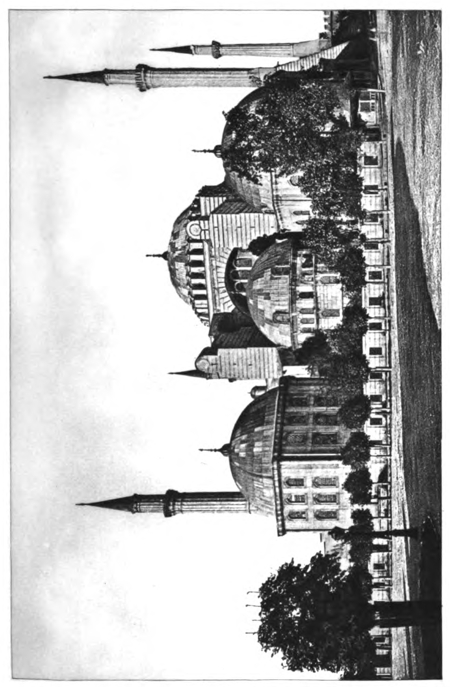
(See this image in horizontal aspect [here].)
Cathedral of St. Sophia, Constantinople, p. 140. From a photograph.
In the Syrian school, Nestorius had been taught to abhor [VIII-142] the confusion of the two natures, and nicely to discriminate the humanity of his master Christ from the divinity of the Lord Jesus. [33] The Blessed Virgin he revered as the mother of Christ, but his ears were offended with the rash and recent title of mother of God, [34] which had been insensibly adopted since the origin of the Arian controversy. From the pulpit of Constantinople, a friend of the patriarch, and afterwards the patriarch himself, repeatedly preached against the use, or the abuse, of a word [35] unknown to the apostles, unauthorised by the church, and which could only tend to alarm the timorous, to mislead the simple, to amuse the profane, and to justify, by a seeming resemblance, the old genealogy of Olympus. [36] In his calmer moments Nestorius confessed that it might be tolerated or excused by the union of the two natures and the communication of their idioms; [37] but he was exasperated, by [VIII-143] contradiction, to disclaim the worship of a new-born, an infant Deity, to draw his inadequate similes from the conjugal or civil partnerships of life, and to describe the manhood of Christ as the robe, the instrument, the tabernacle of his Godhead. At these blasphemous sounds, the pillars of the sanctuary were shaken. The unsuccessful competitors of Nestorius indulged their pious or personal resentments; the Byzantine clergy was secretly displeased with the intrusion of a stranger; whatever is superstitious or absurd, might claim the protection of the monks; and the people were interested in the glory of their virgin patroness. [38] The sermons of the archbishop and the service of the altar were disturbed by seditious clamour; his authority and doctrine were renounced by separate congregations; every wind scattered round the empire the leaves of controversy; and the voice of the combatants on a sonorous theatre re-echoed in the cells of Palestine and Egypt. It was the duty of Cyril to enlighten the zeal and ignorance of his innumerable monks: in the school of Alexandria, he had imbibed and professed the incarnation of one nature; and the successor of Athanasius consulted his pride and ambition when he rose in arms against another Arius, more formidable and more guilty, on the second throne of the hierarchy. After a short correspondence, in which the rival prelates disguised their hatred in the hollow language of respect and charity, the patriarch of Alexandria denounced to the prince and people, to the East and to the West, the damnable errors of the Byzantine pontiff. From the East, more especially from Antioch, he obtained the ambiguous counsels of toleration and silence, which were addressed to both parties while they favoured the cause of Nestorius. But the Vatican received with open arms the messengers of Egypt. The vanity of Celestine was flattered by the appeal; and the [VIII-144] partial version of a monk decided the faith of the pope, who, with his Latin clergy, was ignorant of the language, the arts, and the theology of the Greeks. At the head of an Italian synod, Celestine weighed the merits of the cause, approved the creed of Cyril, condemned the sentiments and person of Nestorius, degraded the heretic from his episcopal dignity, allowed a respite of ten days for recantation and penance, and delegated to his enemy the execution of this rash and illegal sentence. But the patriarch of Alexandria, whilst he darted the thunders of a god, exposed the errors and passions of a mortal; and his twelve anathemas [39] still torture the orthodox slaves who adore the memory of a saint, without forfeiting their allegiance to the synod of Chalcedon. These bold assertions are indelibly tinged with the colours of the Apollinarian heresy; but the serious, and perhaps the sincere, professions of Nestorius have satisfied the wiser and less partial theologians of the present times. [40]
Yet neither the emperor nor the primate of the East were disposed to obey the mandate of an Italian priest; and a synod of the Catholic, or rather of the Greek, church was unanimously demanded as the sole remedy that could appease or decide this ecclesiastical quarrel. [41] Ephesus, on all sides [VIII-145] accessible by sea and land, was chosen for the place, the festival of Pentecost for the day, of the meeting; a writ of summons was despatched to each metropolitan, and a guard was stationed to protect and confine the fathers till they should settle the mysteries of heaven and the faith of the earth. Nestorius appeared, not as a criminal, but as a judge; he depended on the weight rather than the number of his prelates; and his sturdy slaves from the baths of Zeuxippus were armed for every service of injury or defence. But his adversary Cyril was more powerful in the weapons both of the flesh and of the spirit. Disobedient to the letter, or at least to the meaning, of the royal summons, he was attended by fifty Egyptian bishops, who expected from their patriarch’s nod the inspiration of the Holy Ghost. He had contracted an intimate alliance with Memnon bishop of Ephesus. The despotic primate of Asia disposed of the ready succours of thirty or forty episcopal votes; a crowd of peasants, the slaves of the church, was poured into the city to support with blows and clamours a metaphysical argument; and the people zealously asserted the honour of the virgin, whose body reposed within the walls of Ephesus. [42] The fleet which had transported Cyril from Alexandria was laden with the riches of Egypt; and he disembarked a numerous body of mariners, slaves, and fanatics, enlisted with blind obedience under the banner of St. Mark and the mother of God. The fathers, and even the guards, of the council were awed by this martial array; the adversaries of Cyril and Mary were insulted in the [VIII-146] streets or threatened in their houses; his eloquence and liberality made a daily increase in the number of his adherents; and the Eygptian soon computed that he might command the attendance and the voices of two hundred bishops. [43] But the author of the twelve anathemas foresaw and dreaded the opposition of John of Antioch, who with a small, though respectable, train of metropolitans and divines was advancing by slow journeys from the distant capital of the East. Impatient of a delay which he stigmatised as voluntary and culpable, [44] Cyril announced the opening of the synod sixteen days after the festival of Pentecost. Nestorius, who depended on the near approach of his Eastern friends, persisted, like his predecessor Chrysostom, to disclaim the jurisdiction and to disobey the summons of his enemies; they hastened his trial, and his accuser presided in the seat of judgment. Sixty-eight bishops, twenty-two of metropolitan rank, defended his cause by a modest and temperate protest; they were excluded from the counsels of their brethren. Candidian, in the emperor’s name, requested a delay of four days; the profane magistrate was driven with outrage and insult from the assembly of the saints. The whole of this momentous transaction was crowded into the compass of a summer’s day; the bishops delivered their separate opinions; but the uniformity of style reveals the influence or the hand of a master, who had been accused of corrupting the public evidence of their acts and subscriptions. [45] Without a dissenting voice, they recognised [VIII-147] in the epistles of Cyril the Nicene creed and the doctrine of the fathers: but the partial extracts from the letters and homilies of Nestorius were interrupted by curses and anathemas; and the heretic was degraded from his episcopal and ecclesiastical dignity. The sentence, maliciously inscribed to the new Judas, was affixed and proclaimed in the streets of Ephesus; the weary prelates, as they issued from the church of the mother of God, were saluted as her champions; and her victory was celebrated by the illuminations, the songs, and the tumult of the night.
On the fifth day, the triumph was clouded by the arrival and indignation of the Eastern bishops. In a chamber of the inn, before he had wiped the dust from his shoes, John of Antioch gave audience to Candidian the Imperial minister; who related his ineffectual efforts to prevent or to annul the hasty violence of the Egyptian. With equal haste and violence, the Oriental synod of fifty bishops degraded Cyril and Memnon from their episcopal honours, condemned, in the twelve anathemas, the purest venom of the Apollinarian heresy, and described the Alexandrian primate as a monster, born and educated for the destruction of the church. [46] His throne was distant and inaccessible; but they instantly resolved to bestow on the flock of Ephesus the blessing of a faithful shepherd. By the vigilance of Memnon, the churches were shut against them, and a strong garrison was thrown into the cathedral. The troops, under the command of Candidian, advanced to the assault; the outguards were routed and put to the sword; but the place was impregnable: the besiegers retired; their retreat was pursued by a vigorous sally; they lost their horses, and many [VIII-148] of the soldiers were dangerously wounded with clubs and stones. Ephesus, the city of the Virgin, was defiled with rage and clamour, with sedition and blood; the rival synods darted anathemas and excommunications from their spiritual engines; and the court of Theodosius was perplexed by the adverse and contradictory narratives of the Syrian and Egyptian factions. During a busy period of three months, the emperor tried every method, except the most effectual means of indifference and contempt, to reconcile this theological quarrel. He attempted to remove or intimidate the leaders by a common sentence of acquittal or condemnation; he invested his representatives at Ephesus with ample power and military force; he summoned from either party eight chosen deputies to a free and candid conference in the neighbourhood of the capital, far from the contagion of popular frenzy. But the Orientals refused to yield, and the Catholics, proud of their numbers and of their Latin allies, rejected all terms of union or toleration. The patience of the meek Theodosius was provoked, and he dissolved, in anger, this episcopal tumult, which at the distance of thirteen centuries assumes the venerable aspect of the third œcumenical council. [47] “God is my witness,” said the pious prince, “that I am not the author of this confusion. His providence will discern and punish the guilty. Return to your provinces, and may your private virtues repair the mischief and scandal of your meeting.” They returned to their provinces; but the same passions which had distracted the synod of Ephesus were diffused over the Eastern world. After three obstinate and equal campaigns, John of Antioch and Cyril of Alexandria condescended to explain and embrace; but their seeming [VIII-149] re-union must be imputed rather to prudence than to reason, to the mutual lassitude rather than to the Christian charity of the patriarchs.
The Byzantine pontiff had instilled into the royal ear a baleful prejudice against the character and conduct of his Egyptian rival. An epistle of menace and invective, [48] which accompanied the summons, accused him as a busy, insolent, and envious priest, who perplexed the simplicity of the faith, violated the peace of the church and state, and, by his artful and separate addresses to the wife and sister of Theodosius, presumed to suppose, or to scatter, the seeds of discord in the Imperial family. At the stern command of his sovereign, Cyril had repaired to Ephesus, where he was resisted, threatened, and confined by the magistrates in the interest of Nestorius and the Orientals; who assembled the troops of Lydia and Ionia to suppress the fanatic and disorderly train of the patriarch. Without expecting the royal licence, he escaped from his guards, precipitately embarked, deserted the imperfect synod, and retired to his episcopal fortress of safety and independence. But his artful emissaries, both in the court and city, successfully laboured to appease the resentment, and to conciliate the favour, of the emperor. The feeble son of Arcadius was alternately swayed by his wife and sister, by the eunuchs and women of the palace; superstition and avarice were their ruling passions; and the orthodox chiefs were assiduous in their endeavours to alarm the former and to gratify the latter. Constantinople and the suburbs were sanctified with frequent monasteries, and the holy abbots, Dalmatius and Eutyches, [49] had devoted their zeal [VIII-150] and fidelity to the cause of Cyril, the worship of Mary, and the unity of Christ. From the first moment of their monastic life, they had never mingled with the world, or trod the profane ground of the city. But in this awful moment of the danger of the church, their vow was superseded by a more sublime and indispensable duty. At the head of a long order of monks and hermits, who carried burning tapers in their hands and chaunted litanies to the mother of God, they proceeded from their monasteries to the palace. The people was edified and inflamed by this extraordinary spectacle, and the trembling monarch listened to the prayers and adjurations of the saints, who boldly pronounced that none could hope for salvation unless they embraced the person and the creed of the orthodox successor of Athanasius. At the same time every avenue of the throne was assaulted with gold. Under the decent names of eulogies and benedictions, the courtiers of both sexes were bribed according to the measure of their power and rapaciousness. But their incessant demands despoiled the sanctuaries of Constantinople and Alexandria; and the authority of the patriarch was unable to silence the just murmur of his clergy, that a debt of sixty thousand pounds had already been contracted to support the expense of this scandalous corruption. [50] Pulcheria, who relieved her brother from the weight of an empire, was the firmest pillar of orthodoxy; and so intimate was the alliance between the thunders [VIII-151] of the synod and the whispers of the court that Cyril was assured of success if he could displace one eunuch and substitute another in the favour of Theodosius. Yet the Egyptian could not boast of a glorious or decisive victory. The Emperor, with unaccustomed firmness, adhered to his promise of protecting the innocence of the Oriental bishops; and Cyril softened his anathemas, and confessed, with ambiguity and reluctance, a twofold nature of Christ, before he was permitted to satiate his revenge against the unfortunate Nestorius. [51]
The rash and obstinate Nestorius, before the end of the synod, was oppressed by Cyril, betrayed by the court, and faintly supported by his Eastern friends. A sentiment of fear or indignation prompted him, while it was yet time, to affect the glory of a voluntary abdication; [52] his wish, or at least his request, was readily granted; he was conducted with honour from Ephesus to his old monastery of Antioch; and, after a short pause, his successors, Maximian and Proclus, were acknowledged as the lawful bishops of Constantinople. But in the silence of his cell the degraded patriarch could no longer resume the innocence and security of a private monk. The past he regretted, he was discontented with the present, and the future he had reason to dread; the Oriental bishops successively disengaged their cause from his unpopular name; and each day decreased the number of the schismatics who revered Nestorius as the confessor of the faith. After a residence at Antioch of four years, the hand of Theodosius [VIII-152] subscribed an edict, [53] which ranked him with Simon the magician, proscribed his opinions and followers, condemned his writings to the flames, and banished his person first to Petra in Arabia, and at length to Oasis, one of the islands of the Libyan desert. [54] Secluded from the church and from the world, the exile was still pursued by the rage of bigotry and war. A wandering tribe of the Blemmyes, or Nubians, invaded his solitary prison; in their retreat they dismissed a crowd of useless captives; but no sooner had Nestorius reached the banks of the Nile than he would gladly have escaped from a Roman and orthodox city to the milder servitude of the savages. His flight was punished as a new crime; the soul of the patriarch inspired the civil and ecclesiastical powers of Egypt; the magistrates, the soldiers, the monks, devoutly tortured the enemy of Christ and St. Cyril; and, as far as the confines of Æthiopia, the heretic was alternately dragged and recalled, till his aged body was broken by the hardships and accidents of these reiterated journeys. Yet his mind was still independent and erect; the president of Thebais was awed by his pastoral letters; he survived the Catholic tyrant of Alexandria, and, after sixteen years’ banishment, the synod of Chalcedon would perhaps have restored him to the honours, or at least to the communion, of [VIII-153] the church. The death of Nestorius prevented his obedience to their welcome summons; [55] and his disease might afford some colour to the scandalous report that his tongue, the organ of blasphemy, had been eaten by the worms. He was buried in a city of Upper Egypt, known by the names of Chemnis, or Panopolis, or Akmim; [56] but the immortal malice of the Jacobites has persevered for ages to cast stones against his sepulchre, and to propagate the foolish tradition that it was never watered by the rain of heaven, which equally descends on the righteous and the ungodly. [57] Humanity may drop a tear on the fate of Nestorius; yet justice must observe that he suffered the persecution which he had approved and inflicted. [58]
The death of the Alexandrian primate, after a reign of thirty-two years, abandoned the Catholics to the intemperance of zeal and the abuse of victory. [59] The monophysite doctrine [VIII-154] (one incarnate nature) was rigorously preached in the churches of Egypt and the monasteries of the East; the primitive creed of Apollinaris was protected by the sanctity of Cyril; and the name of Eutyches, his venerable friend, has been applied to the sect most adverse to the Syrian heresy of Nestorius. His rival, Eutyches, was the abbot, or archimandrite, or superior of three hundred monks, but the opinions of a simple and illiterate recluse might have expired in the cell, where he had slept above seventy years, if the resentment or indiscretion of Flavian, the Byzantine pontiff, had not exposed the scandal to the eyes of the Christian world. His domestic synod was instantly convened, their proceedings were sullied with clamour and artifice, and the aged heretic was surprised into a seeming confession that Christ had not derived his body from the substance of the Virgin Mary. From their partial decree, Eutyches appealed to a general council; and his cause was vigorously asserted by his godson Chrysaphius, the reigning eunuch of the palace, and his accomplice Dioscorus, who had succeeded to the throne, the creed, the talents, and the vices of the nephew of Theophilus. By the special summons of Theodosius, the second synod of Ephesus was judiciously composed of ten metropolitans and ten bishops from each of the six dioceses of the Eastern empire; some exceptions of favour or merit enlarged the number to one hundred and thirty-five; and the Syrian Barsumas, as the chief and representative of the monks, was invited to sit and vote with the successors of the apostles. But the despotism of the Alexandrian patriarch again oppressed the freedom of debate; the same spiritual and carnal weapons were again drawn from the arsenals of Egypt; the Asiatic veterans, a band of archers, served under the orders of Dioscorus; and the more formidable monks, whose minds were inaccessible to reason or mercy, besieged the doors of the cathedral. The general [VIII-155] and, as it should seem, the unconstrained voice of the fathers accepted the faith and even the anathemas of Cyril; and the heresy of the two natures was formally condemned in the persons and writings of the most learned Orientals. “May those who divide Christ be divided with the sword, may they be hewn in pieces, may they be burnt alive!” were the charitable wishes of a Christian synod. [60] The innocence and sanctity of Eutyches were acknowledged without hesitation; but the prelates, more especially those of Thrace and Asia, were unwilling to depose their patriarch for the use or even the abuse of his lawful jurisdiction. They embraced the knees of Dioscorus, as he stood with a threatening aspect on the footstool of his throne, and conjured him to forgive the offences, and to respect the dignity, of his brother. “Do you mean to raise a sedition?” exclaimed the relentless tyrant. “Where are the officers?” At these words a furious multitude of monks and soldiers, with staves, and swords, and chains, burst into the church; the trembling bishops hid themselves behind the altar, or under the benches; and, as they were not inspired with the zeal of martyrdom, they successively subscribed a blank paper, which was afterwards filled with the condemnation of the Byzantine pontiff. Flavian was instantly delivered to the wild beasts of this spiritual amphitheatre; the monks were stimulated by the voice and example of Barsumas to avenge the injuries of Christ; it is said that the patriarch of Alexandria reviled, and buffeted, and kicked, and trampled his brother of Constantinople: [61] it is certain that the victim, [VIII-156] before he could reach the place of his exile, expired on the third day, of the wounds and bruises which he had received at Ephesus. This second synod has been justly branded as a gang of robbers and assassins; [62] yet the accusers of Dioscorus would magnify his violence, to alleviate the cowardice and inconstancy of their own behaviour.
The faith of Egypt had prevailed; but the vanquished party was supported by the same pope who encountered without fear the hostile rage of Attila and Genseric. The theology of Leo, his famous tome or epistle on the mystery of the incarnation, had been disregarded by the synod of Ephesus; his authority, and that of the Latin church, was insulted in his legates, who escaped from slavery and death to relate the melancholy tale of the tyranny of Dioscorus and the martyrdom of Flavian. His provincial synod annulled the irregular proceedings of Ephesus; but, as this step was itself irregular, he solicited the convocation of a general council in the free and orthodox provinces of Italy. From his independent throne the Roman bishop spoke and acted without danger, as the head of the Christians, and his dictates were obsequiously transcribed by Placidia and her son Valentinian, who addressed their Eastern colleague to restore the peace and unity of the church. But the pageant of Oriental royalty was moved with equal dexterity by the hand of the eunuch; and Theodosius could pronounce, without hesitation, that the church was already peaceful and triumphant, and that the recent flame had been extinguished by the just punishment of the Nestorians. Perhaps the Greeks would be still [VIII-157] involved in the heresy of the Monophysites, if the emperor’s horse had not fortunately stumbled; Theodosius expired; his orthodox sister, Pulcheria, with a nominal husband, succeeded to the throne; Chrysaphius was burnt, Dioscorus was disgraced, the exiles were recalled, and the tome of Leo was subscribed by the Oriental bishops. Yet the pope was disappointed in his favourite project of a Latin council; he disdained to preside in the Greek synod which was speedily assembled at Nice in Bithynia; his legates required in a peremptory tone the presence of the emperor; and the weary fathers were transported to Chalcedon under the immediate eye of Marcian and the senate of Constantinople. A quarter of a mile from the Thracian Bosphorus, the church of St. Euphemia was built on the summit of a gentle though lofty ascent; the triple structure was celebrated as a prodigy of art, and the boundless prospect of the land and sea might have raised the mind of a sectary to the contemplation of the God of the universe. Six hundred and thirty bishops were ranged in order in the nave of the church; but the patriarchs of the East were preceded by the legates, of whom the third was a simple priest; and the place of honour was reserved for twenty laymen of consular or senatorian rank. The gospel was ostentatiously displayed in the centre, but the rule of faith was defined by the papal and Imperial ministers, who moderated the thirteen sessions of the council of Chalcedon. [63] Their partial interposition silenced the intemperate shouts and execrations which degraded the episcopal gravity; but, on the formal accusation of the legates, Dioscorus was [VIII-158] compelled to descend from his throne to the rank of a criminal, already condemned in the opinion of his judges. The Orientals, less adverse to Nestorius than to Cyril, accepted the Romans as their deliverers: Thrace, and Pontus, and Asia were exasperated against the murderer of Flavian, and the new patriarchs of Constantinople and Antioch secured their places by the sacrifice of their benefactor. The bishops of Palestine, Macedonia, and Greece were attached to the faith of Cyril; but in the face of the synod, in the heat of the battle, the leaders, with their obsequious train, passed from the right to the left wing, and decided the victory by this seasonable desertion. Of the seventeen suffragans who sailed from Alexandria, four were tempted from their allegiance, and the thirteen, falling prostrate on the ground, implored the mercy of the council, with sighs and tears and a pathetic declaration that, if they yielded, they should be massacred, on their return to Egypt, by the indignant people. A tardy repentance was allowed to expiate the guilt or error of the accomplices of Dioscorus; but their sins were accumulated on his head; he neither asked nor hoped for pardon, and the moderation of those who pleaded for a general amnesty was drowned in the prevailing cry of victory and revenge. To save the reputation of his late adherents, some personal offences were skilfully detected: his rash and illegal excommunication of the pope, and his contumacious refusal (while he was detained a prisoner) to attend the summons of the synod. Witnesses were introduced to prove the special facts of his pride, avarice, and cruelty; and the fathers heard with abhorrence that the alms of the church were lavished on the female dancers, that his palace, and even his bath, was open to the prostitutes of Alexandria, and that the infamous Pansophia, or Irene, was publicly entertained as the concubine of the patriarch. [64]
[VIII-159]
For these scandalous offences Dioscorus was deposed by the synod and banished by the emperor; but the purity of his faith was declared in the presence, and with the tacit approbation, of the fathers. Their prudence supposed rather than pronounced the heresy of Eutyches, who was never summoned before their tribunal; and they sat silent and abashed, when a bold Monophysite, casting at their feet a volume of Cyril, challenged them to anathematise in his person the doctrine of a saint. If we fairly peruse the acts of Chalcedon as they are recorded by the orthodox party, [65] we shall find that a great majority of the bishops embraced the simple unity of Christ; and the ambiguous concession, that he was formed of or from two natures, might imply either their previous existence, or their subsequent confusion, or some dangerous interval between the conception of the man and the assumption of the God. The Roman theology, more positive and precise, adopted the term most offensive to the ears of the Egyptians, that Christ existed in two natures; and this momentous particle [66] (which the memory, rather than the understanding, [VIII-160] must retain) had almost produced a schism among the Catholic bishops. The tome of Leo had been respectfully, perhaps sincerely, subscribed; but they protested, in two successive debates, that it was neither expedient nor lawful to transgress the sacred landmarks which had been fixed at Nice, Constantinople, and Ephesus, according to the rule of scripture and tradition. At length they yielded to the importunities of their masters, but their infallible decree, after it had been ratified with deliberate votes and vehement acclamations, was overturned in the next session by the opposition of the legates and their Oriental friends. It was in vain that a multitude of episcopal voices repeated in chorus, “The definition of the fathers is orthodox and immutable! The heretics are now discovered! Anathema to the Nestorians! Let them depart from the synod! Let them repair to Rome!” [67] The legates threatened, the emperor was absolute, and a committee of eighteen bishops prepared a new decree, which was imposed on the reluctant assembly. In the name of the fourth general council, the Christ in one person, but in two natures, was announced to the Catholic world; an invisible line was drawn between the heresy of Apollinaris and the faith of St. Cyril; and the road to paradise, a bridge as sharp as a razor, was suspended over the abyss by the master-hand of the theological artist. During ten centuries of blindness and servitude, Europe received her religious opinions from the oracle of the Vatican; and the same doctrine, already varnished with the rust of antiquity, was admitted without dispute into the creed of the reformers, who disclaimed the supremacy of the Roman pontiff. The synod [VIII-161] of Chalcedon still triumphs in the Protestant churches; but the ferment of controversy has subsided, and the most pious Christians of the present day are ignorant or careless of their own belief concerning the mystery of the incarnation.
Far different was the temper of the Greeks and Egyptians under the orthodox reigns of Leo and Marcian. Those pious emperors enforced with arms and edicts the symbol of their faith; [68] and it was declared by the conscience or honour of five hundred bishops that the decrees of the synod of Chalcedon might be lawfully supported, even with blood. The Catholics observed with satisfaction that the same synod was odious both to the Nestorians and the Monophysites; [69] but the Nestorians were less angry, or less powerful, and the East was distracted by the obstinate and sanguinary zeal of the Monophysites. Jerusalem was occupied by an army of monks; in the name of the one incarnate nature, they pillaged, they burnt, they murdered; the sepulchre of Christ was defiled with blood; and the gates of the city were guarded in tumultuous rebellion against the troops of the emperor. After the disgrace and exile of Dioscorus, the Egyptians still regretted their spiritual father, and detested the usurpation of his successor, who was introduced by the fathers of Chalcedon. The throne of Proterius was supported by a guard of two thousand soldiers; he [VIII-162] waged a five years’ war against the people of Alexandria; and, on the first intelligence of the death of Marcian, he became the victim of their zeal. On the third day before the festival of Easter, the patriarch was besieged in the cathedral and murdered in the baptistery. The remains of his mangled corpse were delivered to the flames, and his ashes to the wind; and the deed was inspired by the vision of a pretended angel: an ambitious monk, who, under the name of Timothy the Cat, [70] succeeded to the place and opinions of Dioscorus. This deadly superstition was inflamed, on either side, by the principle and the practice of retaliation: in the pursuit of a metaphysical quarrel, many thousands [71] were slain, and the Christians of every degree were deprived of the substantial enjoyments of social life and of the invisible gifts of baptism and the holy communion. Perhaps an extravagant fable of the times may conceal an allegorical picture of these fanatics, who tortured each other and themselves. “Under the consulship of Venantius and Celer,” says a grave bishop, “the people of Alexandria, and all Egypt, were seized with a strange and diabolical frenzy: great and small, slaves and freedmen, monks and clergy, the natives of the land, who opposed the synod of Chalcedon, lost their speech and reason, barked like dogs, and tore, with their own teeth, the flesh from their hands and arms.” [72]
The disorders of thirty years at length produced the famous Henoticon [73] of the emperor Zeno, which in his reign, and in [VIII-163] that of Anastasius, was signed by all the bishops of the East, under the penalty of degradation and exile, if they rejected or infringed this salutary and fundamental law. The clergy may smile or groan at the presumption of a layman who defines the articles of faith; [74] yet, if he stoops to the humiliating task, his mind is less infected by prejudice or interest, and the authority of the magistrate can only be maintained by the concord of the people. It is in ecclesiastical story that Zeno appears least contemptible; and I am not able to discern any Manichæan or Eutychian guilt in the generous saying of Anastasius, That it was unworthy of an emperor to persecute the worshippers of Christ and the citizens of Rome. The Henoticon was most pleasing to the Egyptians; yet the smallest blemish has not been described by the jealous and even jaundiced eyes of our orthodox schoolmen, and it accurately represents the Catholic faith of the incarnation, without adopting or disclaiming the peculiar terms or tenets of the hostile sects. A solemn anathema is pronounced against Nestorius and Eutyches; against all heretics by whom Christ is divided, or confounded, or reduced to a phantom. Without defining the number or the article of the word nature, the pure system of St. Cyril, the faith of [VIII-164] Nice, Constantinople, and Ephesus, is respectfully confirmed; but, instead of bowing at the name of the fourth council, the subject is dismissed by the censure of all contrary doctrines, if any such have been taught either elsewhere or at Chalcedon. Under this ambiguous expression the friends and the enemies of the last synod might unite in a silent embrace. The most reasonable Christians acquiesced in this mode of toleration; but their reason was feeble and inconstant, and their obedience was despised as timid and servile by the vehement spirit of their brethren. On a subject which engrossed the thoughts and discourses of men, it was difficult to preserve an exact neutrality; a book, a sermon, a prayer, rekindled the flame of controversy; and the bonds of communion were alternately broken and renewed by the private animosity of the bishops. The space between Nestorius and Eutyches was filled by a thousand shades of language and opinion; the acephali [75] of Egypt and the Roman pontiffs, of equal valour though of unequal strength, may be found at the two extremities of the theological scale. The acephali, without a king or a bishop, were separated above three hundred years from the patriarchs of Alexandria, who had accepted the communion of Constantinople, without exacting a formal condemnation of the synod of Chalcedon. For accepting the communion of Alexandria, without a formal approbation of the same synod, the patriarchs of Constantinople were anathematised by the popes. Their inflexible despotism involved the most orthodox of the Greek churches in this spiritual contagion, denied or doubted the validity of their sacraments, [76] and fomented, thirty-five years, the schism of the [VIII-165] East and West, till they finally abolished the memory of four Byzantine pontiffs, who had dared to oppose the supremacy of St. Peter. [77] Before that period, the precarious truce of Constantinople and Egypt had been violated by the zeal of the rival prelates. Macedonius, who was suspected of the Nestorian heresy, asserted, in disgrace and exile, the synod of Chalcedon, while the successor of Cyril would have purchased its overthrow with a bribe of two thousand pounds of gold.
In the fever of the times, the sense, or rather the sound, of a syllable was sufficient to disturb the peace of an empire. The Trisagion [78] (thrice holy), “Holy, holy, holy, Lord God of Hosts!” is supposed by the Greeks to be the identical hymn which the angels and cherubim eternally repeat before the throne of God, and which, about the middle of the fifth century, was miraculously revealed to the church of Constantinople. The devotion of Antioch soon added “who was crucified for us!” and this grateful address, either to Christ alone or to the whole Trinity, may be justified by the rules of theology, and has been gradually adopted by the Catholics of the East and West. But it had been imagined by a Monophysite [VIII-166] bishop; [79] the gift of an enemy was at first rejected as a dire and dangerous blasphemy, and the rash innovation had nearly cost the emperor Anastasius his throne and his life. [80] The people of Constantinople was devoid of any rational principles of freedom; but they held, as a lawful cause of rebellion, the colour of a livery in the races, or the colour of a mystery in the schools. This Trisagion, with and without this obnoxious addition, was chanted in the cathedral by two adverse choirs, and, when their lungs were exhausted, they had recourse to the more solid arguments of sticks and stones; the aggressors were punished by the emperor, and defended by the patriarch; and the crown and mitre were staked on the event of this momentous quarrel. The streets were instantly crowded with innumerable swarms of men, women, and children; the legions of monks, in regular array, marched and shouted, and fought at their head. “Christians! this is the day of martyrdom; let us not desert our spiritual father; anathema to the Manichæan tyrant! he is unworthy to reign.” Such was the Catholic cry; and the galleys of Anastasius lay upon their oars before the palace, till the patriarch had pardoned his penitent and hushed the waves of the troubled multitude. The triumph of Macedonius was checked by a speedy exile; but the zeal of his flock was again exasperated by the same question, “Whether one of the Trinity had been crucified?” On this momentous occasion the blue and green factions of Constantinople suspended their discord, and the civil and military powers were annihilated [VIII-167] in their presence. The keys of the city and the standards of the guards were deposited in the forum of Constantine, the principal station and camp of the faithful. Day and night they were incessantly busied either in singing hymns to the honour of their God or in pillaging and murdering the servants of their prince. The head of his favourite monk, the friend, as they styled him, of the enemy of the Holy Trinity, was borne aloft on a spear; and the firebrands, which had been darted against heretical structures, diffused the undistinguishing flames over the most orthodox buildings. The statues of the emperor were broken, and his person was concealed in a suburb, till, at the end of three days, he dared to implore the mercy of his subjects. Without his diadem and in the posture of a suppliant, Anastasius appeared on the throne of the circus. The Catholics, before his face, rehearsed their genuine Trisagion; they exulted in the offer which he proclaimed by the voice of a herald of abdicating the purple; they listened to the admonition that, since all could not reign, they should previously agree in the choice of a sovereign; and they accepted the blood of two unpopular ministers, whom their master, without hesitation, condemned to the lions. These furious but transient seditions were encouraged by the success of Vitalian, who, with an army of Huns and Bulgarians, for the most part idolaters, declared himself the champion of the Catholic faith. In this pious rebellion he depopulated Thrace, besieged Constantinople, exterminated sixty-five thousand of his fellow-Christians, till he obtained the recall of the bishops, the satisfaction of the pope, and the establishment of the council of Chalcedon, an orthodox treaty, reluctantly signed by the dying Anastasius, and more faithfully performed by the uncle of Justinian. And such was the event of the first of the religious wars which have been waged in the name, and by the disciples, of the God of peace. [81]
[VIII-168]
Justinian has been already seen in the various lights of a prince, a conqueror, and a lawgiver: the theologian [82] still remains, and it affords an unfavourable prejudice that his theology should form a very prominent feature of his portrait. The sovereign sympathised with his subjects in their superstitious reverence for living and departed saints; his Code, and more especially his Novels, confirm and enlarge the privileges of the clergy; and, in every dispute between a monk and a layman, the partial judge was inclined to pronounce that truth and innocence and justice were always on the side of the church. In his public and private devotions the emperor was assiduous and exemplary; his prayers, vigils, and fasts displayed the austere penance of a monk; his fancy was amused by the hope or belief of personal inspiration; he had secured the patronage of the Virgin and St. Michael the archangel; and his recovery from a dangerous disease was ascribed to the miraculous succour of the holy martyrs Cosmas and Damian. The capital and the provinces of the East were decorated with the monuments of his religion; [83] and, though the far greater part of these costly structures may be attributed to his taste or ostentation, the zeal of the royal architect was probably quickened by a genuine sense of love and gratitude towards his invisible benefactors. Among the titles of Imperial greatness, [VIII-169] the name of Pious was most pleasing to his ear; to promote the temporal and spiritual interest of the church was the serious business of his life; and the duty of father of his country was often sacrificed to that of defender of the faith. The controversies of the times were congenial to his temper and understanding; and the theological professors must inwardly deride the diligence of a stranger, who cultivated their art and neglected his own. “What can ye fear,” said a bold conspirator to his associates, “from your bigoted tyrant? Sleepless and unarmed he sits whole nights in his closet, debating with reverend grey-beards, and turning over the pages of ecclesiastical volumes.” [84] The fruits of these lucubrations were displayed in many a conference, where Justinian might shine as the loudest and most subtle of the disputants; in many a sermon, which, under the name of edicts and epistles, proclaimed to the empire the theology of their master. While the Barbarians invaded the provinces, while the victorious legions marched under the banners of Belisarius and Narses, the successor of Trajan, unknown to the camp, was content to vanquish at the head of a synod. Had he invited to these synods a disinterested and rational spectator, Justinian might have learned “that religious controversy is the offspring of arrogance and folly; that true piety is most laudably expressed by silence and submission; that man, ignorant of his own nature, should not presume to scrutinise the nature of his God; and that it is sufficient for us to know that power and benevolence are the perfect attributes of the Deity.” [85]
[VIII-170]
Toleration was not the virtue of the times, and indulgence to rebels has seldom been the virtue of princes. But, when the prince descends to the narrow and peevish character of a disputant, he is easily provoked to supply the defect of argument by the plenitude of power, and to chastise without mercy the perverse blindness of those who wilfully shut their eyes against the light of demonstration. The reign of Justinian was an uniform yet various scene of persecution; and he appears to have surpassed his indolent predecessors both in the contrivance of his laws and the rigour of their execution. The insufficient term of three months was assigned for the conversion or exile of all heretics; [86] and, if he still connived at their precarious stay, they were deprived, under his iron yoke, not only of the benefits of society, but of the common birth-right of men and Christians. At the end of four hundred years, the Montanists of Phrygia [87] still breathed the wild enthusiasm of perfection and prophecy which they had imbibed from their male and female apostles, the special organs of the Paraclete. On the approach of the Catholic priests and soldiers, they grasped with alacrity the crown of martyrdom; the conventicle and the congregation perished in the flames, but these primitive fanatics were not extinguished three hundred years after the death of their tyrant. Under the protection of the Gothic confederates, the church of the Arians at Constantinople had braved the severity of the laws; their clergy equalled the wealth and magnificence of the senate; and the gold and [VIII-171] silver which were seized by the rapacious hand of Justinian might perhaps be claimed as the spoils of the provinces and the trophies of the Barbarians. A secret remnant of pagans, who still lurked in the most refined and most rustic conditions of mankind, excited the indignation of the Christians, who were, perhaps, unwilling that any strangers should be the witnesses of their intestine quarrels. A bishop was named as the inquisitor of the faith, and his diligence soon discovered, in the court and city, the magistrates, lawyers, physicians, and sophists, who still cherished the superstition of the Greeks. They were sternly informed that they must choose without delay between the displeasure of Jupiter or Justinian, and that their aversion to the gospel could no longer be disguised under the scandalous mask of indifference or impiety. The patrician Photius perhaps alone was resolved to live and to die like his ancestors; he enfranchised himself with the stroke of a dagger, and left his tyrant the poor consolation of exposing with ignominy the lifeless corpse of the fugitive. His weaker brethren submitted to their earthly monarch, underwent the ceremony of baptism, and laboured, by their extraordinary zeal, to erase the suspicion, or to expiate the guilt, of idolatry. The native country of Homer, and the theatre of the Trojan war, still retained the last sparks of his mythology: by the care of the same bishop, seventy thousand Pagans were detected and converted in Asia, Phrygia, Lydia, and Caria; ninety-six churches were built for the new proselytes; and linen vestments, bibles and liturgies, and vases of gold and silver were supplied by the pious munificence of Justinan. [88] The Jews, who had been gradually stripped of their immunities, were oppressed by a vexatious law, which compelled them to observe the festival of Easter the same day on which [VIII-172] it was celebrated by the Christians. [89] And they might complain with the more reason, since the Catholics themselves did not agree with the astronomical calculations of their sovereign; the people of Constantinople delayed the beginning of their Lent a whole week after it had been ordained by authority; and they had the pleasure of fasting seven days, while meat was exposed for sale by the command of the emperor. The Samaritans of Palestine [90] were a motley race, an ambiguous sect, rejected as Jews by the pagans, by the Jews as schismatics, and by the Christians as idolaters. The abomination of the cross had already been planted on their holy mount of Garizim, [91] but the persecution of Justinian offered only the alternative of baptism or rebellion. They chose the latter; under the standard of a desperate leader, they rose in arms, and retaliated their wrongs on the lives, the property, and the temples of a defenceless people. The Samaritans were finally subdued by the regular forces of the East: twenty thousand were slain, twenty thousand were sold by the Arabs to the infidels of Persia and India, and the remains of that unhappy nation atoned for the crime of treason by the sin of hypocrisy. It has been computed that one hundred thousand Roman subjects were extirpated in the Samaritan war, [92] which converted the once fruitful province [VIII-173] into a desolate and smoking wilderness. But in the creed of Justinian the guilt of murder could not be applied to the slaughter of unbelievers; and he piously laboured to establish with fire and sword the unity of the Christian faith. [93]
With these sentiments, it was incumbent on him, at least, to be always in the right. In the first years of his administration, he signalised his zeal as the disciple and patron of orthodoxy; the reconciliation of the Greeks and Latins established the tome of St. Leo as the creed of the emperor and the empire; the Nestorians and Eutychians were exposed, on either side, to the double edge of persecution; and the four synods of Nice, Constantinople, Ephesus, and Chalcedon were ratified by the code of a Catholic lawgiver. [94] But, while Justinian strove to maintain the uniformity of faith and worship, his wife Theodora, whose vices were not incompatible with devotion, had listened to the Monophysite teachers; and the [VIII-174] open or clandestine enemies of the church revived and multiplied at the smile of their gracious patroness. The capital, the palace, the nuptial bed, were torn by spiritual discord; yet so doubtful was the sincerity of the royal consorts that their seeming disagreement was imputed by many to a secret and mischievous confederacy against the religion and happiness of their people. [95] The famous dispute of the three chapters, [96] which has filled more volumes than it deserves lines, is deeply marked with this subtle and disingenuous spirit. It was now three hundred years since the body of Origen [97] had been eaten by the worms: his soul, of which he held the pre-existence, was in the hands of its Creator, but his writings were eagerly perused by the monks of Palestine. In these writings the piercing eye of Justinian descried more than ten metaphysical errors; and the primitive doctor, in the company of Pythagoras and Plato, was devoted by the clergy to the eternity of hell-fire, which he had presumed to deny. Under the cover of this precedent, a treacherous blow was aimed at the council of Chalcedon. The fathers had listened without impatience to the praise of Theodore of [VIII-175] Mopsuestia; [98] and their justice or indulgence had restored both Theodoret of Cyrrhus and Ibas of Edessa to the communion of the church. But the characters of these Oriental bishops were tainted with the reproach of heresy; the first had been the master, the two others were the friends, of Nestorius; their most suspicious passages were accused under the title of the three chapters; and the condemnation of their memory must involve the honour of a synod whose name was pronounced with sincere or affected reverence by the Catholic world. If these bishops, whether innocent or guilty, were annihilated in the sleep of death, they would not probably be awakened by the clamour which, after an hundred years, was raised over their grave. If they were already in the fangs of the demon, their torments could neither be aggravated nor assuaged by human industry. If in the company of saints and angels they enjoyed the rewards of piety, they must have smiled at the idle fury of the theological insects who still crawled on the surface of the earth. The foremost of these insects, the emperor of the Romans, darted his sting, and distilled his venom, perhaps without discerning the true motives of Theodora and her ecclesiastical faction. The victims were no longer subject to his power, and the vehement style of his edicts could only proclaim their damnation and invite the clergy of the East to join in a full chorus of curses and anathemas. The East, with some hesitation, consented to the voice of her sovereign: the fifth general council, of three patriarchs and one hundred and sixty-five bishops, was held at Constantinople; and the authors, as well as the defenders, of the three chapters were separated from the communion of the saints and solemnly delivered to the prince of darkness. [VIII-176] But the Latin churches were more jealous of the honour of Leo and the synod of Chalcedon; and, if they had fought as they usually did under the standard of Rome, they might have prevailed in the cause of reason and humanity. But their chief was a prisoner in the hands of the enemy; the throne of St. Peter, which had been disgraced by the simony, was betrayed by the cowardice, of Vigilius, who yielded, after a long and inconsistent struggle, to the despotism of Justinian and the sophistry of the Greeks. His apostacy provoked the indignation of the Latins, and no more than two bishops could be found who would impose their hands on his deacon and successor Pelagius. Yet the perseverance of the popes insensibly transferred to their adversaries the appellation of schismatics: the Illyrian, African, and Italian churches were oppressed by the civil and ecclesiastical powers, not without some effort of military force; [99] the distant Barbarians transcribed the creed of the Vatican; and, in the period of a century, the schism of the three chapters expired in an obscure angle of the Venetian province. [100] But the religious discontent of the Italians had already promoted the conquests of the Lombards, and the Romans themselves were accustomed to suspect the faith, and to detest the government, of their Byzantine tyrant.
Justinian was neither steady nor consistent in the nice process of fixing his volatile opinions and those of his subjects. In his youth, he was offended by the slightest deviation [VIII-177] from the orthodox line; in his old age, he transgressed the measure of temperate heresy, and the Jacobites, not less than the Catholics, were scandalised by his declaration that the body of Christ was incorruptible, and that his manhood was never subject to any wants and infirmities, the inheritance of our mortal flesh. This phantastic opinion was announced in the last edicts of Justinian; and at the moment of his seasonable departure the clergy had refused to subscribe, the prince was prepared to persecute, and the people were resolved to suffer or resist. A bishop of Treves, secure beyond the limits of his power, addressed the monarch of the East in the language of authority and affection. “Most gracious Justinian, remember your baptism and your creed! Let not your grey hairs be defiled with heresy. Recall your fathers from exile, and your followers from perdition. You cannot be ignorant that Italy and Gaul, Spain and Africa, already deplore your fall, and anathematise your name. Unless, without delay, you destroy what you have taught; unless you exclaim with a loud voice, I have erred, I have sinned, anathema to Nestorius, anathema to Eutyches, you deliver your soul to the same flames in which they will eternally burn.” He died and made no sign. [101] His death restored in some [VIII-178] degree the peace of the church, and the reigns of his four successors, Justin, Tiberius, Maurice, and Phocas, are distinguished by a rare, though fortunate, vacancy in the ecclesiastical history of the East. [102]
The faculties of sense and reason are least capable of acting on themselves; the eye is most inaccessible to the sight, the soul to the thought; yet we think, and even feel, that one will, a sole principle of action, is essential to a rational and conscious being. When Heraclius returned from the Persian war, the orthodox hero consulted his bishops, whether the Christ whom he adored, of one person but of two natures, was actuated by a single or a double will. They replied in the singular, and the emperor was encouraged to hope that the Jacobites of Egypt and Syria might be reconciled by the profession of a doctrine, most certainly harmless, and most probably true, since it was taught even by the Nestorians themselves. [103] The experiment was tried without effect, and the timid or vehement Catholics condemned even the semblance of a retreat in the presence of a subtle and audacious enemy. The orthodox (the prevailing) party devised new modes of speech, and argument, and interpretation; to either nature of Christ they speciously applied a proper and distinct energy; but the difference was no longer visible when they allowed that the human and the divine will were invariably the same. [104] [VIII-179] The disease was attended with the customary symptoms; but the Greek clergy, as if satiate with the endless controversy of the incarnation, instilled a healing counsel into the ear of the prince and people. They declared themselves monothelites (asserters of the unity of will); but they treated the words as new, the questions as superfluous, and recommended a religious silence as the most agreeable to the prudence and charity of the gospel. This law of silence was successively imposed by the ecthesis or exposition of Heraclius, the type or model of his grandson Constans; [105] and the Imperial edicts were subscribed with alacrity or reluctance by the four patriarchs of Rome, Constantinople, Alexandria, and Antioch. But the bishop and monks of Jerusalem sounded the alarm; in the language, or even in the silence, of the Greeks, the Latin churches detected a latent heresy; and the obedience of Pope Honorius to the commands of his sovereign was retracted and censured by the bolder ignorance of his successors. They condemned the execrable and abominable heresy of the Monothelites, who revived the errors of Manes, Apollinaris, Eutyches, &c.; they signed the sentence of excommunication on the tomb of St. Peter; the ink was mingled with the sacramental wine, the blood of Christ; and no ceremony was omitted that could fill the superstitious minds with horror and affright. As the representative of the Western church, Pope Martin and his Lateran synod anathematised the perfidious and guilty silence of the Greeks. One hundred and five bishops of Italy, for the most part the subjects of Constans, presumed to reprobate his wicked type and the impious [VIII-180] ecthesis of his grandfather, and to confound the authors and their adherents with the twenty-one notorious heretics, the apostates from the church, and the organs of the devil. Such an insult under the tamest reign could not pass with impunity. Pope Martin ended his days on the inhospitable shore of the Tauric Chersonesus, and his oracle, the abbot Maximus, was inhumanly chastised by the amputation of his tongue and his right hand. [106] But the same invincible spirit survived in their successors, and the triumph of the Latins avenged their recent defeat and obliterated the disgrace of the three chapters. The synods of Rome were confirmed by the sixth general council of Constantinople, in the palace and the presence of a new Constantine, a descendant of Heraclius. The royal convert converted the Byzantine pontiff and a majority of the bishops; [107] the dissenters, with their chief, Macarius of Antioch, were condemned to the spiritual and temporal pains of heresy; [108] the East condescended to accept the lessons of the West; and the creed was finally settled which teaches the Catholics of every age that two wills or energies are harmonised in the person of Christ. The majesty of the pope and the Roman synod was represented by two priests, one deacon, and three bishops; but these obscure Latins had neither arms to compel, nor treasures to bribe, nor language to persuade; and I am ignorant by what arts they could determine the [VIII-181] lofty emperor of the Greeks to abjure the catechism of his infancy and to persecute the religion of his fathers. Perhaps the monks and people of Constantinople [109] were favourable to the Lateran creed, which is indeed the least favourable of the two; and the suspicion is countenanced by the unnatural moderation of the Greek clergy, who appear in this quarrel to be conscious of their weakness. While the synod debated, a fanatic proposed a more summary decision, by raising a dead man to life; the prelates assisted at the trial; but the acknowledged failure may serve to indicate that the passions and prejudices of the multitude were not enlisted on the side of the Monothelites. In the next generation, when the son of Constantine was deposed and slain by the disciple of Macarius, they tasted the feast of revenge and dominion; the image or monument of the sixth council was defaced, and the original acts were committed to the flames. But in the second year their patron was cast headlong from the throne, the bishops of the East were released from their occasional conformity, the Roman faith was more firmly replanted by the orthodox successors of Bardanes, and the fine problems of the incarnation were forgotten in the more popular and visible quarrel of the worship of images. [110]
[VIII-182]
Before the end of the seventh century, the creed of the incarnation, which had been defined at Rome and Constantinople, was uniformly preached in the remote islands of Britain and Ireland; [111] the same ideas were entertained, or rather the same words were repeated, by all the Christians whose liturgy was performed in the Greek or the Latin tongue. Their numbers and visible splendour bestowed an imperfect claim to the appellation of Catholics; but in the East they were marked with the less honourable name of Melchites or Royalists; [112] of men whose faith, instead of resting on the basis of scripture, reason, or tradition, had been established, and was still maintained, by the arbitrary power [VIII-183] of a temporal monarch. Their adversaries might allege the words of the fathers of Constantinople, who profess themselves the slaves of the king; and they might relate, with malicious joy, how the decrees of Chalcedon had been inspired and reformed by the emperor Marcian and his virgin bride. The prevailing faction will naturally inculcate the duty of submission, nor is it less natural that dissenters should feel and assert the principles of freedom. Under the rod of persecution, the Nestorians and Monophysites degenerated into rebels and fugitives; and the most ancient and useful allies of Rome were taught to consider the emperor not as the chief, but as the enemy, of the Christians. Language, the leading principle which unites or separates the tribes of mankind, soon discriminated the sectaries of the East by a peculiar and perpetual badge, which abolished the means of intercourse and the hope of reconciliation. The long dominion of the Greeks, their colonies, and, above all, their eloquence had propagated a language doubtless the most perfect that has been contrived by the art of man. Yet the body of the people, both in Syria and Egypt, still persevered in the use of their national idioms; with this difference, however, that the Coptic was confined to the rude and illiterate peasants of the Nile, while the Syriac, [113] from the mountains of Assyria to the Red Sea, was adapted to the higher topics of poetry and argument. Armenia and Abyssinia were infected by the speech and learning of the Greeks; and their barbaric tongues, which have been revived in the studies of modern Europe, were unintelligible to the inhabitants of the [VIII-184] Roman empire. The Syriac and the Coptic, the Armenian and the Æthiopic, are consecrated in the service of their respective churches; and their theology is enriched by domestic versions [114] both of the scriptures and of the most popular fathers. After a period of thirteen hundred and sixty years, the spark of controversy, first kindled by a sermon of Nestorius, still burns in the bosom of the East, and the hostile communions still maintain the faith and discipline of their founders. In the most abject state of ignorance, poverty, and servitude, the Nestorians and Monophysites reject the spiritual supremacy of Rome, and cherish the toleration of their Turkish masters, which allows them to anathematise, on one hand, St. Cyril and the synod of Ephesus, on the other, Pope Leo and the council of Chalcedon. The weight which they cast into the downfall of the Eastern empire demands our notice, and the reader may be amused with the various prospects of I. The Nestorians; II. The Jacobites; [115] III. The Maronites; IV. The Armenians; V. The Copts; and VI. The Abyssinians. To the three former, the Syriac is common; but of the latter, each is discriminated by the use of a national idiom. Yet the modern natives of Armenia and Abyssinia would be incapable of conversing with their ancestors; and the Christians of [VIII-185] Egypt and Syria, who reject the religion, have adopted the language, of the Arabians. The lapse of time has seconded the sacerdotal arts; and in the East, as well as in the West, the Deity is addressed in an obsolete tongue, unknown to the majority of the congregation.
I. Both in his native and his episcopal province, the heresy of the unfortunate Nestorius was speedily obliterated. The Oriental bishops, who at Ephesus had resisted to his face the arrogance of Cyril, were mollified by his tardy concessions. The same prelates, or their successors, subscribed, not without a murmur, the decrees of Chalcedon; the power of the Monophysites reconciled them with the Catholics in the conformity of passion, of interest, and insensibly of belief; and their last reluctant sigh was breathed in the defence of the three chapters. Their dissenting brethren, less moderate, or more sincere, were crushed by the penal laws; and as early as the reign of Justinian it became difficult to find a church of Nestorians within the limits of the Roman empire. Beyond those limits they had discovered a new world, in which they might hope for liberty and aspire to conquest. In Persia, notwithstanding the resistance of the Magi, Christianity had struck a deep root, and the nations of the East reposed under its salutary shade. The catholic, or primate, resided in the capital; in his synods, and in their dioceses, his metropolitans, bishops, and clergy represented the pomp and honour of a regular hierarchy; they rejoiced in the increase of proselytes, who were converted from the Zendavesta to the Gospel, from the secular to the monastic life; and their zeal was stimulated by the presence of an artful and formidable enemy. The Persian church had been founded by the missionaries of Syria; and their language, discipline, and doctrine were closely interwoven with its original frame. The catholics were elected and ordained by their own suffragans; but their filial dependence on the patriarchs of Antioch is attested by the canons of the Oriental [VIII-186] church. [116] In the Persian school of Edessa, [117] the rising generations of the faithful imbibed their theological idiom; they studied in the Syriac version the ten thousand volumes of Theodore of Mopsuestia; and they revered the apostolic faith and holy martyrdom of his disciple Nestorius, whose person and language were equally unknown to the nations beyond the Tigris. The first indelible lesson of Ibas, bishop of Edessa, taught them to execrate the Egyptians, who, in the synod of Ephesus, had impiously confounded the two natures of Christ. The flight of the masters and scholars, who were twice expelled from the Athens of Syria, dispersed a crowd of missionaries, inflamed by the double zeal of religion and revenge. And the rigid unity of the Monophysites, who, under the reigns of Zeno and Anastasius, had invaded the thrones of the East, provoked their antagonists, in a land of freedom, to avow a moral, rather than a physical, union of the two persons of Christ. Since the first preaching of the gospel, the Sassanian kings beheld with an eye of suspicion a race of aliens and apostates, who had embraced the religion, and who might favour the cause, of the hereditary foes of their country. The royal edicts had often prohibited their [VIII-187] dangerous correspondence with the Syrian clergy; the progress of the schism was grateful to the jealous pride of Perozes, and he listened to the eloquence of an artful prelate, who painted Nestorius as the friend of Persia, and urged him to secure the fidelity of his Christian subjects by granting a just preference to the victims and enemies of the Roman tyrant. The Nestorians composed a large majority of the clergy and people; they were encouraged by the smile, and armed with the sword, of despotism; yet many of their weaker brethren were startled at the thought of breaking loose from the communion of the Christian world, and the blood of seven thousand seven hundred Monophysites, or Catholics, confirmed the uniformity of faith and discipline in the churches of Persia. [118] Their ecclesiastical institutions are distinguished by a liberal principle of reason, or at least of policy; the austerity of the cloister was relaxed and gradually forgotten; houses of charity were endowed for the education of orphans and foundlings; the law of celibacy, so forcibly recommended to the Greeks and Latins, was disregarded by the Persian clergy; and the number of the elect was multiplied by the public and reiterated nuptials of the priests, the bishops, and even the patriarch himself. To this standard of natural and religious freedom myriads of fugitives resorted from all the provinces of the Eastern empire; the narrow bigotry of Justinian was punished by the emigration of his most industrious subjects; they transported into Persia the arts both of peace and war; and those who deserved the favour, were promoted in the service, of a discerning monarch. The arms of Nushirvan, and his fiercer grandson, were assisted with advice, and money, and troops, by the desperate sectaries who still lurked in their [VIII-188] native cities of the East; their zeal was rewarded with the gift of the Catholic churches; but, when those cities and churches were recovered by Heraclius, their open profession of treason and heresy compelled them to seek a refuge in the realm of their foreign ally. But the seeming tranquillity of the Nestorians was often endangered, and sometimes overthrown. They were involved in the common evils of Oriental despotism; their enmity to Rome could not always atone for their attachment to the gospel; and a colony of three hundred thousand Jacobites, the captives of Apamea and Antioch, was permitted to erect an hostile altar in the face of the catholic and in the sunshine of the court. In his last treaty, Justinian introduced some conditions which tended to enlarge and fortify the toleration of Christianity in Persia. The emperor, ignorant of the rights of conscience, was incapable of pity or esteem for the heretics who denied the authority of the holy synods; but he flattered himself that they would gradually perceive the temporal benefits of union with the empire and the church of Rome; and, if he failed in exciting their gratitude, he might hope to provoke the jealousy of their sovereign. In a later age, the Lutherans have been burnt at Paris, and protected in Germany, by the superstition and policy of the most Christian king.
The desire of gaining souls for God, and subjects for the church, has excited in every age the diligence of the Christian priests. From the conquest of Persia they carried their spiritual arms to the north, the east, and the south; and the simplicity of the gospel was fashioned and painted with the colours of the Syriac theology. In the sixth century, according to the report of a Nestorian traveller, [119] [VIII-189] Christianity was successfully preached to the Bactrians, the Huns, the Persians, the Indians, the Persarmenians, the Medes, and the Elamites; the Barbaric churches, from the gulf of Persia to the Caspian sea, were almost infinite; and their recent faith was conspicuous in the number and sanctity of their monks and martyrs. The pepper coast of Malabar, and the isles of the ocean, Socotora and Ceylon, were peopled with an increasing multitude of Christians; and the bishops and clergy of those sequestered regions derived their ordination from the catholic of Babylon. In a subsequent age, the zeal of the Nestorians overleaped the limits which had confined the ambition and curiosity both of the Greeks and Persians. The missionaries of Balch and Samarcand pursued without fear the footsteps of the roving Tartar, and insinuated themselves into the camps of the valleys of Imaus and the banks of the Selinga. They exposed a metaphysical creed to those illiterate shepherds; to those sanguinary warriors they recommended humanity and repose. Yet a khan, whose power they vainly magnified, is said to have received at their hands the rites of baptism, and even of ordination; and the fame of Prester or Presbyter John [120] has [VIII-190] long amused the credulity of Europe. The royal convert was indulged in the use of a portable altar; but he despatched an embassy to the patriarch, to inquire how, in the season of Lent, he should abstain from animal food, and how he might celebrate the Eucharist in a desert that produced neither corn nor wine. In their progress by sea and land, the Nestorians entered China by the port of Canton and the northern residence of Sigan. Unlike the senators of Rome, who assumed with a smile the characters of priests and augurs, the mandarins, who affect in public the reason of philosophers, are devoted in private to every mode of popular superstition. They cherished and they confounded the gods of Palestine and of India; but the propagation of Christianity awakened the jealousy of the state, and, after a short vicissitude of favour and persecution, the foreign sect expired in ignorance and oblivion. [121] Under the reign of the caliphs, the Nestorian church was diffused from China to Jerusalem and Cyprus; and their numbers, with those of the Jacobites, were computed to surpass the Greek and Latin communions. [122] Twenty-five metropolitans or archbishops composed their hierarchy, but several of these were dispensed, by the distance and danger of the way, from the duty of personal attendance, on the easy condition that every six years they should testify their faith and obedience to the [VIII-191] catholic or patriarch of Babylon: a vague appellation, which has been successively applied to the royal seats of Seleucia, Ctesiphon, and Bagdad. These remote branches are long since withered, and the old patriarchal trunk [123] is now divided by the Elijahs of Mosul, the representatives, almost in lineal descent, of the genuine and primitive succession, the Josephs of Amida, who are reconciled to the church of Rome, [124] and the Simeons of Van or Ormia, whose revolt, at the head of forty thousand families, was promoted in the sixteenth century by the Sophis of Persia. The number of three hundred thousand is allowed for the whole body of the Nestorians, who, under the name of Chaldæans or Assyrians, are confounded with the most learned or the most powerful nation of Eastern antiquity.
According to the legend of antiquity, the gospel was preached in India by St. Thomas. [125] At the end of the ninth century, his shrine, perhaps in the neighbourhood of Madras, was devoutly visited by the ambassadors of Alfred, and their return with a cargo of pearls and spices rewarded the zeal of the English monarch, who entertained the largest projects [VIII-192] of trade and discovery. [126] When the Portuguese first opened the navigation of India, the Christians of St. Thomas had been seated for ages on the coast of Malabar, and the difference of their character and colour attested the mixture of a foreign race. In arms, in arts, and possibly in virtue, they excelled the natives of Hindostan; the husbandmen cultivated the palm-tree, the merchants were enriched by the pepper-trade, the soldiers preceded the nairs or nobles of Malabar, and their hereditary privileges were respected by the gratitude or the fear of the king of Cochin and the Zamorin himself. They acknowledged a Gentoo sovereign, but they were governed, even in temporal concerns, by the bishop of Angamala. He still asserted his ancient title of metropolitan of India, but his real jurisdiction was exercised in fourteen hundred churches, and he was entrusted with the care of two hundred thousand souls. Their religion would have rendered them the firmest and most cordial allies of the Portuguese, but the inquisitors soon discerned in the Christians of St. Thomas the unpardonable guilt of heresy and schism. Instead of owning themselves the subjects of the Roman pontiff, the spiritual and temporal monarch of the globe, they adhered, like their ancestors, to the communion of the Nestorian patriarch; and the bishops whom he ordained at Mosul traversed the dangers of the sea and land to reach their diocese on the coast of Malabar. In their Syriac liturgy, the names of Theodore and Nestorius were piously commemorated; they united their adoration of the two persons of Christ; the title of Mother of God was offensive to their ear, [VIII-193] and they measured with scrupulous avarice the honours of the Virgin Mary, whom the superstition of the Latins had almost exalted to the rank of a goddess. When her image was first presented to the disciples of St. Thomas, they indignantly exclaimed, “We are Christians, not idolaters!” and their simple devotion was content with the veneration of the cross. Their separation from the Western world had left them in ignorance of the improvements, or corruptions, of a thousand years; and their conformity with the faith and practice of the fifth century would equally disappoint the prejudices of a Papist or a Protestant. It was the first care of the ministers of Rome to intercept all correspondence with the Nestorian patriarch, and several of his bishops expired in the prisons of the holy office. The flock, without a shepherd, was assaulted by the power of the Portuguese, the arts of the Jesuits, and the zeal of Alexis de Menezes, archbishop of Goa, in his personal visitation of the coast of Malabar. The synod of Diamper, at which he presided, consummated the pious work of the reunion, and rigorously imposed the doctrine and discipline of the Roman church, without forgetting auricular confession, the strongest engine of ecclesiastical torture. The memory of Theodore and Nestorius was condemned, and Malabar was reduced under the dominion of the pope, of the primate, and of the Jesuits who invaded the see of Angamala or Cranganor. Sixty years of servitude and hypocrisy were patiently endured; but, as soon as the Portuguese empire was shaken by the courage and industry of the Dutch, the Nestorians asserted, with vigour and effect, the religion of their fathers. The Jesuits were incapable of defending the power which they had abused; the arms of forty thousand Christians were pointed against their falling tyrants; and the Indian archdeacon assumed the character of bishop, till a fresh supply of episcopal gifts and Syriac missionaries could be obtained from the patriarch of Babylon. Since the expulsion of the Portuguese, the Nestorian creed is [VIII-194] freely professed on the coast of Malabar. The trading companies of Holland and England are the friends of toleration; but, if oppression be less mortifying than contempt, the Christians of St. Thomas have reason to complain of the cold and silent indifference of their brethren of Europe. [127]
II. The history of the Monophysites is less copious and interesting than that of the Nestorians. Under the reigns of Zeno and Anastasius, their artful leaders surprised the ear of the prince, usurped the thrones of the East, and crushed on its native soil the school of the Syrians. The rule of the Monophysite faith was defined with exquisite discretion by Severus, patriarch of Antioch: he condemned, in the style of the Henoticon, the adverse heresies of Nestorius and Eutyches, maintained against the latter the reality of the body of Christ, and constrained the Greeks to allow that he was a liar who spoke truth. [128] But the approximation of ideas could not abate the vehemence of passion; each party was the more astonished that their blind antagonist could dispute on so trifling a difference; the tyrant of Syria enforced the belief of his creed, and his reign was polluted with the blood of three hundred and fifty monks, who were slain, not perhaps [VIII-195] without provocation or resistance, under the walls of Apamea. [129] The successor of Anastasius replanted the orthodox standard in the East; Severus fled into Egypt; and his friend, the eloquent Xenaias, [130] who had escaped from the Nestorians of Persia, was suffocated in his exile by the Melchites of Paphlagonia. Fifty-four bishops were swept from their thrones, eight hundred ecclesiastics were cast into prison, [131] and, notwithstanding the ambiguous favour of Theodora, the Oriental flocks, deprived of their shepherds, must insensibly have been either famished or poisoned. In this spiritual distress, the expiring faction was revived, and united, and perpetuated by the labours of a monk; and the name of James Baradæus [132] has been preserved in the appellation of Jacobites, a familiar sound which may startle the ear of an English reader. From the holy confessors in their prison of Constantinople he received the powers of bishop of Edessa and apostle of the East, and the ordination of fourscore [VIII-196] thousand bishops, priests, and deacons is derived from the same inexhaustible source. The speed of the zealous missionary was promoted by the fleetest dromedaries of a devout chief of the Arabs; the doctrine and discipline of the Jacobites were secretly established in the dominions of Justinian; and each Jacobite was compelled to violate the laws and to hate the Roman legislator. The successors of Severus, while they lurked in convents or villages, while they sheltered their proscribed heads in the caverns of hermits or the tents of the Saracens, still asserted, as they now assert, their indefeasible right to the title, the rank, and the prerogatives of patriarch of Antioch; under the milder yoke of the infidels they reside about a league from Merdin, in the pleasant monastery of Zapharan, which they have embellished with cells, aqueducts, and plantations. The secondary, though honourable, place is filled by the maphrian, who, in his station at Mosul itself, defies the Nestorian catholic, with whom he contests the supremacy of the East. Under the patriarch and the maphrian, one hundred and fifty archbishops and bishops have been counted in the different ages of the Jacobite church; but the order of the hierarchy is relaxed or dissolved, and the greater part of their dioceses is confined to the neighbourhood of the Euphrates and the Tigris. The cities of Aleppo and Amida, which are often visited by the patriarch, contain some wealthy merchants and industrious mechanics, but the multitude derive their scanty sustenance from their daily labour; and poverty, as well as superstition, may impose their excessive fasts: five annual lents, during which both the clergy and laity abstain not only from flesh or eggs, but even from the taste of wine, of oil, and of fish. Their present numbers are esteemed from fifty to fourscore thousand souls, the remnant of a populous church, which has gradually decreased under the oppression of twelve centuries. Yet in that long period some strangers of merit have been converted to the Monophysite faith, and a Jew was the father of Abulpharagius, [133] [VIII-197] primate of the East, so truly eminent both in his life and death. In his life, he was an elegant writer of the Syriac and Arabic tongues, a poet, physician, and historian, a subtle philosopher, and a moderate divine. In his death, his funeral was attended by his rival the Nestorian patriarch, with a train of Greeks and Armenians, who forgot their disputes and mingled their tears over the grave of an enemy. The sect which was honoured by the virtues of Abulpharagius appears, however, to sink below the level of their Nestorian brethren. The superstition of the Jacobites is more abject, their fasts more rigid, [134] their intestine divisions are more numerous, and their doctors (as far as I can measure the degrees of nonsense) are more remote from the precincts of reason. Something may possibly be allowed for the rigour of the Monophysite theology; much more for the superior influence of the monastic order. In Syria, in Egypt, in Æthiopia, the Jacobite monks have ever been distinguished by the austerity of their penance and the absurdity of their legends. Alive or dead, they are worshipped as the favourites of the Deity; the crosier of bishop and patriarch is reserved for their venerable hands; and they assume the government of men, while they are yet reeking with the habits and prejudices of the cloister. [135]
III. In the style of the Oriental Christians, the Monothelites of every age are described under the appellation of [VIII-198] Maronites, [136] a name which has been insensibly transferred from an hermit to a monastery, from a monastery to a nation. Maron, a saint or savage of the fifth century, displayed his religious madness in Syria; the rival cities of Apamea and Emesa disputed his relics, a stately church was erected on his tomb, and six hundred of his disciples united their solitary cells on the banks of the Orontes. In the controversies of the incarnation, they nicely threaded the orthodox line between the sects of Nestorius and Eutyches; but the unfortunate question of one will or operation in the two natures of Christ was generated by their curious leisure. Their proselyte, the emperor Heraclius, was rejected as a Maronite from the walls of Emesa; he found a refuge in the monastery of his brethren; and their theological lessons were repaid with the gift of a spacious and wealthy domain. The name and doctrine of this venerable school were propagated among the Greeks and Syrians, and their zeal is expressed by Macarius, patriarch of Antioch, who declared before the synod of Constantinople that, sooner than subscribe the two wills of Christ, he would submit to be hewn piece-meal and cast into the sea. [137] A similar or a less cruel mode of persecution soon converted the unresisting subjects of the plain, while the glorious title of Mardaites, [138] or rebels, was bravely maintained [VIII-199] by the hardy natives of Mount Libanus. John Maron, one of the most learned and popular of the monks, assumed the character of patriarch of Antioch; his nephew Abraham, at the head of the Maronites, defended their civil and religious freedom against the tyrants of the East. The son of the orthodox Constantine pursued, with pious hatred, a people of soldiers, who might have stood the bulwark of his empire against the common foes of Christ and of Rome. An army of Greeks invaded Syria; the monastery of St. Maron was destroyed with fire; the bravest chieftains were betrayed and murdered; and twelve thousand of their followers were transplanted to the distant frontiers of Armenia and Thrace. Yet the humble nation of the Maronites has survived the empire of Constantinople, and they still enjoy, under their Turkish masters, a free religion and a mitigated servitude. Their domestic governors are chosen among the ancient nobility; the patriarch, in his monastery of Canobin, still fancies himself on the throne of Antioch; nine bishops compose his synod, and one hundred and fifty priests, who retain the liberty of marriage, are entrusted with the care of one hundred thousand souls. Their country extends from the ridge of Mount Libanus to the shores of Tripoli; and the gradual descent affords, in a narrow space, each variety of soil and climate, from the Holy Cedars, erect under the weight of snow, [139] to the vine, the mulberry, and the olive trees of the fruitful valley. In the twelfth century, the Maronites, abjuring the Monothelite error, were reconciled to the Latin churches of Antioch and Rome, [140] and the same alliance has been frequently [VIII-200] renewed by the ambition of the popes and the distress of the Syrians. But it may reasonably be questioned whether their union has ever been perfect or sincere; and the learned Maronites of the college of Rome have vainly laboured to absolve their ancestors from the guilt of heresy and schism. [141]
IV. Since the age of Constantine, the Armenians [142] had signalised their attachment to the religion and empire of the Christians. The disorders of their country, and their ignorance of the Greek tongue, prevented their clergy from assisting at the synod of Chalcedon, and they floated eighty-four years [143] in a state of indifference or suspense, till their vacant faith was finally occupied by the missionaries of Julian of Halicarnassus, [144] who in Egypt, their common exile, had been vanquished by the arguments or the influence of his rival Severus, the Monophysite patriarch of Antioch. The Armenians [VIII-201] alone are the pure disciples of Eutyches, an unfortunate parent, who has been renounced by the greater part of his spiritual progeny. They alone persevere in the opinion that the manhood of Christ was created, or existed without creation, of a divine and incorruptible substance. Their adversaries reproach them with the adoration of a phantom; and they retort the accusation, by deriding or execrating the blasphemy of the Jacobites, who impute to the Godhead the vile infirmities of the flesh, even the natural effects of nutrition and digestion. The religion of Armenia could not derive much glory from the learning or the power of its inhabitants. The royalty expired with the origin of their schism, and their Christian kings, who arose and fell in the thirteenth century on the confines of Cilicia, were the clients of the Latins, and the vassals of the Turkish sultan of Iconium. The helpless nation has seldom been permitted to enjoy the tranquillity of servitude. From the earliest period to the present hour, Armenia has been the theatre of perpetual war; the lands between Tauris and Erivan were dispeopled by the cruel policy of the Sophis; and myriads of Christian families were transplanted, to perish or to propagate in the distant provinces of Persia. Under the rod of oppression, the zeal of the Armenians is fervid and intrepid; they have often preferred the crown of martyrdom to the white turban of Mahomet; they devoutly hate the error and idolatry of the Greeks; and their transient union with the Latins is not less devoid of truth than the thousand bishops whom their patriarch offered at the feet of the Roman pontiff. [145] The catholic, or patriarch of the Armenians, resides in the monastery of Ekmiasin, three leagues from Erivan. Forty-seven archbishops, each of whom may claim the obedience of four or five suffragans, are consecrated by his hand; but the far [VIII-202] greater part are only titular prelates, who dignify with their presence and service the simplicity of his court. As soon as they have performed the liturgy, they cultivate the garden; and our bishops will hear with surprise that the austerity of their life increases in just proportion to the elevation of their rank. In the fourscore thousand towns or villages of his spiritual empire, the patriarch receives a small and voluntary tax from each person above the age of fifteen; but the annual amount of six hundred thousand crowns is insufficient to supply the incessant demands of charity and tribute. Since the beginning of the last century, the Armenians have obtained a large and lucrative share of the commerce of the East; in their return from Europe, the caravan usually halts in the neighbourhood of Erivan, the altars are enriched with the fruits of their patient industry; and the faith of Eutyches is preached in their recent congregations of Barbary and Poland. [146]
V. In the rest of the Roman empire, the despotism of the prince might eradicate or silence the sectaries of an obnoxious creed. But the stubborn temper of the Egyptians maintained their opposition to the synod of Chalcedon, and the policy of Justinian condescended to expect and to seize the opportunity of discord. The Monophysite church of Alexandria [147] was torn by the disputes of the corruptibles and incorruptibles, and, on the death of the patriarch, the two factions upheld their respective candidates. [148] Gaian was the disciple of [VIII-203] Julian, Theodosius had been the pupil of Severus. The claims of the former were supported by the consent of the monks and senators, the city and the province; the latter depended on the priority of his ordination, the favour of the empress Theodora, and the arms of the eunuch Narses, which might have been used in more honourable warfare. The exile of the popular candidate to Carthage and Sardinia inflamed the ferment of Alexandria; and, after a schism of one hundred and seventy years, the Gaianites still revered the memory and doctrine of their founder. The strength of numbers and of discipline was tried in a desperate and bloody conflict; the streets were filled with the dead bodies of citizens and soldiers; the pious women, ascending the roofs of their houses, showered down every sharp or ponderous utensil on the heads of the enemy; and the final victory of Narses was owing to the flames with which he wasted the third capital of the Roman world. But the lieutenant of Justinian had not conquered in the cause of an heretic; Theodosius himself was speedily, though gently, removed; and Paul of Tanis, an orthodox monk, was raised to the throne of Athanasius. The powers of government were strained in his support; he might appoint or displace the dukes and tribunes of Egypt; the allowance of bread which Diocletian had granted was suppressed, the churches were shut, and a nation of schismatics was deprived at once of their spiritual and carnal food. In his turn, the tyrant was excommunicated by the zeal and revenge of the people; and none except his servile Melchites would salute him as a man, a Christian, or a bishop. Yet such is the blindness of ambition that, when Paul was expelled on a charge of murder, he solicited, with a bribe of seven hundred pounds of gold, his restoration to the same station of hatred and ignominy. His successor Apollinaris entered the hostile city in military array, alike qualified for prayer or for battle. His troops, under arms, were distributed through the streets; the gates of the cathedral were guarded; and a chosen band was [VIII-204] stationed in the choir, to defend the person of their chief. He stood erect on his throne, and, throwing aside the upper garment of a warrior, suddenly appeared before the eyes of the multitude in the robes of patriarch of Alexandria. Astonishment held them mute; but no sooner had Apollinaris begun to read the tome of St. Leo than a volley of curses, and invectives, and stones assaulted the odious minister of the emperor and the synod. A charge was instantly sounded by the successor of the apostles; the soldiers waded to their knees in blood; and two hundred thousand Christians are said to have fallen by the sword: an incredible account, even if it be extended from the slaughter of a day to the eighteen years of the reign of Apollinaris. Two succeeding patriarchs, Eulogius [149] and John, [150] laboured in the conversion of heretics, with arms and arguments more worthy of their evangelical profession. The theological knowledge of Eulogius was displayed in many a volume, which magnified the errors of Eutyches and Severus, and attempted to reconcile the ambiguous language of St. Cyril with the orthodox creed of Pope Leo and the fathers of Chalcedon. The bounteous alms of John the Eleemosynary were dictated by superstition, or benevolence, or policy. Seven thousand five hundred poor were maintained at his expense; on his accession, he [VIII-205] found eight thousand pounds of gold in the treasury of the church; he collected ten thousand from the liberality of the faithful; yet the primate could boast in his testament that he left behind him no more than the third part of the smallest of the silver coins. The churches of Alexandria were delivered to the Catholics, the religion of the Monophysites was proscribed in Egypt, and a law was revived which excluded the natives from the honours and emoluments of the state.
A more important conquest still remained, of the patriarch, the oracle and leader of the Egyptian church. Theodosius had resisted the threats and promises of Justinian with the spirit of an apostle or an enthusiast. “Such,” replied the patriarch, “were the offers of the tempter, when he shewed the kingdoms of the earth. But my soul is far dearer to me than life or dominion. The churches are in the hands of a prince who can kill the body; but my conscience is my own; and in exile, poverty, or chains, I will stedfastly adhere to the faith of my holy predecessors, Athanasius, Cyril, and Dioscorus. Anathema to the tome of Leo and the synod of Chalcedon! Anathema to all who embrace their creed! Anathema to them now and for evermore! Naked came I out of my mother’s womb; naked shall I descend into the grave. Let those who love God follow me, and seek their salvation.” After comforting his brethren, he embarked for Constantinople, and sustained in six successive interviews the almost irresistible weight of the royal presence. His opinions were favourably entertained in the palace and the city; the influence of Theodora assured him a safe-conduct and honourable dismission; and he ended his days, though not on the throne, yet in the bosom, of his native country. On the news of his death, Apollinaris indecently feasted the nobles and the clergy; but his joy was checked by the intelligence of a new election; and, while he enjoyed the wealth of Alexandria, his rivals reigned in the monasteries of Thebais, and were maintained by the voluntary oblations of the people. A perpetual succession of patriarchs arose from the ashes of [VIII-206] Theodosius; and the Monophysite churches of Syria and Egypt were united by the name of Jacobites and the communion of the faith. But the same faith, which has been confined to a narrow sect of the Syrians, was diffused over the mass of the Egyptian or Coptic nation, who, almost unanimously, rejected the decrees of the synod of Chalcedon. A thousand years were now elapsed since Egypt had ceased to be a kingdom, since the conquerors of Asia and Europe had trampled on the ready necks of a people whose ancient wisdom and power ascends beyond the records of history. The conflict of zeal and persecution rekindled some sparks of their national spirit. They abjured, with a foreign heresy, the manners and language of the Greeks: every Melchite, in their eyes, was a stranger, every Jacobite a citizen; the alliance of marriage, the offices of humanity, were condemned as a deadly sin; the natives renounced all allegiance to the emperor; and his orders, at a distance from Alexandria, were obeyed only under the pressure of military force. A generous effort might have redeemed the religion and liberty of Egypt, and her six hundred monasteries might have poured forth their myriads of holy warriors, for whom death should have no terrors, since life had no comfort or delight. But experience has proved the distinction of active and passive courage; the fanatic who endures without a groan the torture of the rack or the stake would tremble and fly before the face of an armed enemy. The pusillanimous temper of the Egyptians could only hope for a change of masters; the arms of Chosroes depopulated the land, yet under his reign the Jacobites enjoyed a short and precarious respite. The victory of Heraclius renewed and aggravated the persecution, and the patriarch again escaped from Alexandria to the desert. In his flight, Benjamin was encouraged by a voice which bade him expect, at the end of ten years, the aid of a foreign nation, marked like the Egyptians themselves with the ancient right of circumcision. The character of these deliverers and the nature of the deliverance will be hereafter explained; and I [VIII-207] shall step over the interval of eleven centuries, to observe the present misery of the Jacobites of Egypt. The populous city of Cairo affords a residence, or rather a shelter, for their indigent patriarch and a remnant of ten bishops; forty monasteries have survived the inroads of the Arabs; and the progress of servitude and apostacy has reduced the Coptic nation to the despicable number of twenty-five or thirty thousand families: [151] a race of illiterate beggars, whose only consolation is derived from the superior wretchedness of the Greek patriarch and his diminutive congregation. [152]
VI. The Coptic patriarch, a rebel to the Cæsars, or a slave to the caliphs, still gloried in the filial obedience of the kings of Nubia and Æthiopia. He repaid their homage by magnifying their greatness; and it was boldly asserted that they could bring into the field an hundred thousand horse, with an equal number of camels; [153] that their hand could pour or restrain the waters of the Nile; [154] and the peace and plenty of Egypt [VIII-208] was obtained, even in this world, by the intercession of the patriarch. In exile at Constantinople, Theodosius recommended to his patroness the conversion of the black nations of Nubia, [155] from the tropic of Cancer to the confines of Abyssinia. Her design was suspected, and emulated, by the more orthodox emperor. The rival missionaries, a Melchite and a Jacobite, embarked at the same time; but the empress, from a motive of love or fear, was more effectually obeyed; and the Catholic priest was detained by the president of Thebais while the king of Nubia and his court were hastily baptised in the faith of Dioscorus. The tardy envoy of Justinian was received and dismissed with honour; but, when he accused the heresy and treason of the Egyptians, the negro convert was instructed to reply that he would never abandon his brethren, the true believers, to the persecuting ministers of the synod of Chalcedon. [156] During several ages the bishops of [VIII-209] Nubia were named and consecrated by the Jacobite patriarch of Alexandria; as late as the twelfth century, Christianity prevailed; and some rites, some ruins, are still visible in the savage towns of Sennaar and Dongola. [157] But the Nubians at length executed their threats of returning to the worship of idols; the climate required the indulgence of polygamy; and they have finally preferred the triumph of the Koran to the abasement of the Cross. A metaphysical religion may appear too refined for the capacity of the negro race; yet a black or a parrot might be taught to repeat the words of the Chalcedonian or Monophysite creed.
Christianity was more deeply rooted in the Abyssinian empire; and, although the correspondence has been sometime interrupted above seventy or an hundred years, the mother-church of Alexandria retains her colony in a state of perpetual pupilage. Seven bishops once composed the Æthiopic synod: had their number amounted to ten, they might have elected an independent primate; and one of their kings was ambitious of promoting his brother to the ecclesiastical throne. But the event was foreseen, the increase was denied; the episcopal office has been gradually confined to the abuna, [158] the head and author of the Abyssinian priesthood; the patriarch [VIII-210] supplies each vacancy with an Egyptian monk; and the character of a stranger appears more venerable in the eyes of the people, less dangerous in those of the monarch. In the sixth century, when the schism of Egypt was confirmed, the rival chiefs, with their patrons Justinian and Theodora, strove to outstrip each other in the conquest of a remote and independent province. The industry of the empress was again victorious, and the pious Theodora has established in that sequestered church the faith and discipline of the Jacobites. [159] Encompassed on all sides by the enemies of their religion, the Æthiopians slept near a thousand years, forgetful of the world, by whom they were forgotten. They were awakened by the Portuguese, who, turning the southern promontory of Africa, appeared in India and the Red Sea, as if they had descended through the air from a distant planet. In the first moments of their interview, the subjects of Rome and Alexandria observed the resemblance, rather than the difference, of their faith; and each nation expected the most important benefits from an alliance with their Christian brethren. In their lonely situation, the Æthiopians had almost relapsed into the savage life. Their vessels, which had traded to Ceylon, scarcely presumed to navigate the rivers of Africa; the ruins of Axume were deserted, the nation was scattered in villages, and the emperor (a pompous name) was content, both in peace and war, with the immoveable residence of a camp. Conscious of their own indigence, the Abyssinians had formed the rational project of importing the arts and ingenuity of Europe; [160] and their ambassadors at Rome and Lisbon were instructed to solicit a colony of smiths, [VIII-211] carpenters, tilers, masons, printers, surgeons, and physicians, for the use of their country. But the public danger soon called for the instant and effectual aid of arms and soldiers to defend an unwarlike people from the Barbarians who ravaged the inland country, and the Turks and Arabs who advanced from the sea-coast in more formidable array. Æthiopia was saved by four hundred and fifty Portuguese, who displayed in the field the native valour of Europeans and the artificial powers of the musket and cannon. In a moment of terror, the emperor had promised to reconcile himself and his subjects to the Catholic faith; a Latin patriarch represented the supremacy of the pope; [161] the empire, enlarged in a tenfold proportion, was supposed to contain more gold than the mines of America; and the wildest hopes of avarice and zeal were built on the willing submission of the Christians of Africa.
But the vows which pain had extorted were forsworn on the return of health. The Abyssinians still adhered with unshaken constancy to the Monophysite faith; their languid belief was inflamed by the exercise of dispute; they branded the Latins with the names of Arians and Nestorians, and imputed the adoration of four gods to those who separated the two natures of Christ. Fremona, a place of worship, or rather of exile, was assigned to the Jesuit missionaries. Their skill in the liberal and mechanic arts, their theological learning, and the decency of their manners inspired a barren esteem; but they were not endowed with the gift of miracles, [162] [VIII-212] and they vainly solicited a reinforcement of European troops. The patience and dexterity of forty years at length obtained a more favourable audience, and two emperors of Abyssinia were persuaded that Rome could ensure the temporal and everlasting happiness of her votaries. The first of these royal converts lost his crown and his life; and the rebel army was sanctified by the abuna, who hurled an anathema at the apostate, and absolved his subjects from their oath of fidelity. The fate of Zadenghel was revenged by the courage and fortune of Susneus, who ascended the throne under the name of Segued, and more vigorously prosecuted the pious enterprise of his kinsman. After the amusement of some unequal combats between the Jesuits and his illiterate priests, the emperor declared himself a proselyte to the synod of Chalcedon, presuming that his clergy and people would embrace without delay the religion of their prince. The liberty of choice was succeeded by a law which imposed, under pain of death, the belief of the two natures of Christ: the Abyssinians were enjoined to work and to play on the Sabbath; and Segued, in the face of Europe and Africa, renounced his connection with the Alexandrian church. A Jesuit, Alphonso Mendez, the Catholic patriarch of Æthiopia, accepted in the name of Urban VIII. the homage and abjuration of his penitent. “I confess,” said the emperor on his knees, “I confess that the pope is the vicar of Christ, the successor of St. Peter, and the sovereign of the world. To him I swear true obedience, and at his feet I offer my person and kingdom.” A similar oath was repeated by his son, his brother, the clergy, the nobles, and even the ladies of the court; the Latin patriarch was invested with honours and wealth; and his missionaries erected their churches or citadels in the most convenient stations of [VIII-213] the empire. The Jesuits themselves deplore the fatal indiscretion of their chief, who forgot the mildness of the gospel and the policy of his order, to introduce with hasty violence the liturgy of Rome and the inquisition of Portugal. He condemned the ancient practice of circumcision, which health rather than superstition had first invented in the climate of Æthiopia. [163] A new baptism, a new ordination, was inflicted on the natives; and they trembled with horror when the most holy of the dead were torn from their graves, when the most illustrious of the living were excommunicated by a foreign priest. In the defence of their religion and liberty, the Abyssinians rose in arms, with desperate but unsuccessful zeal. Five rebellions were extinguished in the blood of the insurgents; two abunas were slain in battle, whole legions were slaughtered in the field, or suffocated in their caverns: and neither merit nor rank nor sex could save from an ignominious death the enemies of Rome. But the victorious monarch was finally subdued by the constancy of the nation, of his mother, of his son, and of his most faithful friends. Segued listened to the voice of pity, of reason, perhaps of fear; and his edict of liberty of conscience instantly revealed the tyranny and weakness of the Jesuits. On the death of his father, Basilides expelled the Latin patriarch, and restored to the wishes of the nation the faith and the discipline of Egypt. The Monophysite churches resounded with a song of triumph, “that the sheep of Æthiopia were now delivered from the hyenas of the West;” and the gates of that solitary realm were for ever [VIII-214] shut against the arts, the science, and the fanaticism of Europe. [164]
[VIII-215]
CHAPTER XLVIII↩
Plan of the last two [quarto] Volumes — Succession and Characters of the Greek Emperors of Constantinople, from the Time of Heraclius to the Latin Conquest
I have now deduced from Trajan to Constantine, from Constantine to Heraclius, the regular series of the Roman emperors; and faithfully exposed the prosperous and adverse fortunes of their reigns. Five centuries of the decline and fall of the empire have already elapsed; but a period of more than eight hundred years still separates me from the term of my labours, the taking of Constantinople by the Turks. Should I persevere in the same course, should I observe the same measure, a prolix and slender thread would be spun through many a volume, nor would the patient reader find an adequate reward of instruction or amusement. At every step, as we sink deeper in the decline and fall of the Eastern empire, the annals of each succeeding reign would impose a more ungrateful and melancholy task. These annals must continue to repeat a tedious and uniform tale of weakness and misery; the natural connection of causes and events would be broken by frequent and hasty transitions, and a minute accumulation of circumstances must destroy the light and effect of those general pictures which compose the use and ornament of a remote history. From the time of Heraclius, the Byzantine theatre is contracted and darkened; the line of empire, which had been defined by the laws of Justinian and the arms of Belisarius, recedes on all sides from our view; the Roman name, the proper subject of our inquiries, is reduced to a narrow corner of Europe, to the lonely suburbs of Constantinople; and the fate of the Greek empire has been compared [VIII-216] to that of the Rhine, which loses itself in the sands before its waters can mingle with the ocean. The scale of dominion is diminished to our view by the distance of time and place; nor is the loss of external splendour compensated by the nobler gifts of virtue and genius. In the last moments of her decay, Constantinople was doubtless more opulent and populous than Athens at her most flourishing era, when a scanty sum of six thousand talents, or twelve hundred thousand pounds sterling, was possessed by twenty-one thousand male citizens of an adult age. But each of these citizens was a freeman, who dared to assert the liberty of his thoughts, words, and actions; whose person and property were guarded by equal law; and who exercised his independent vote in the government of the republic. Their numbers seem to be multiplied by the strong and various discriminations of character: under the shield of freedom, on the wings of emulation and vanity, each Athenian aspired to the level of the national dignity; from this commanding eminence some chosen spirits soared beyond the reach of a vulgar eye; and the chances of superior merit in a great and populous kingdom, as they are proved by experience, would excuse the computation of imaginary millions. The territories of Athens, Sparta, and their allies do not exceed a moderate province of France or England; but, after the trophies of Salamis and Platæa, they expand in our fancy to the gigantic size of Asia, which had been trampled under the feet of the victorious Greeks. But the subjects of the Byzantine empire, who assume and dishonour the names both of Greeks and Romans, present a dead uniformity of abject vices, which are neither softened by the weakness of humanity nor animated by the vigour of memorable crimes. The freemen of antiquity might repeat, with generous enthusiasm, the sentence of Homer, “that, on the first day of his servitude, the captive is deprived of one half of his manly virtue.” But the poet had only seen the effects of civil or domestic slavery, nor could he foretell that the second moiety of manhood must be annihilated by the spiritual despotism [VIII-217] which shackles not only the actions but even the thoughts of the prostrate votary. By this double yoke, the Greeks were oppressed under the successors of Heraclius; the tyrant, a law of eternal justice, was degraded by the vices of his subjects; and on the throne, in the camp, in the schools, we search, perhaps with fruitless diligence, the names and characters that may deserve to be rescued from oblivion. Nor are the defects of the subject compensated by the skill and variety of the painters. Of a space of eight hundred years, the four first centuries are overspread with a cloud, interrupted by some faint and broken rays of historic light; in the lives of the emperors, from Maurice to Alexius, Basil the Macedonian has alone been the theme of a separate work; and the absence, or loss, or imperfection of contemporary evidence must be poorly supplied by the doubtful authority of more recent compilers. The four last centuries are exempt from the reproach of penury; and with the Comnenian family the historic muse of Constantinople again revives, but her apparel is gaudy, her motions are without elegance or grace. A succession of priests, or courtiers, treads in each other’s footsteps in the same path of servitude and superstition: their views are narrow, their judgment is feeble or corrupt; and we close the volume of copious barrenness, still ignorant of the causes of events, the characters of the actors, and the manners of the times, which they celebrate or deplore. The observation which has been applied to a man may be extended to a whole people, that the energy of the sword is communicated to the pen; and it will be found, by experience, that the tone of history will rise or fall with the spirit of the age.
From these considerations, I should have abandoned, without regret, the Greek slaves and their servile historians, had I not reflected that the fate of the Byzantine monarchy is passively connected with the most splendid and important revolutions which have changed the state of the world. The space of the lost provinces was immediately replenished with new colonies and rising kingdoms; the active virtues of peace [VIII-218] and war deserted from the vanquished to the victorious nations; and it is in their origin and conquests, in their religion and government, that we must explore the causes and effects of the decline and fall of the Eastern empire. Nor will this scope of narrative, the riches and variety of these materials, be incompatible with the unity of design and composition. As, in his daily prayers, the Musulman of Fez or Delhi still turns his face towards the temple of Mecca, the historian’s eye shall be always fixed on the city of Constantinople. The excursive line may embrace the wilds of Arabia and Tartary, but the circle will be ultimately reduced to the decreasing limit of the Roman monarchy.
On this principle, I shall now establish the plan of the last two volumes of the present work. The first chapter will contain, in a regular series, the emperors who reigned at Constantinople during a period of six hundred years, from the days of Heraclius to the Latin conquest: a rapid abstract, which may be supported by a general appeal to the order and text of the original historians. In this introduction, I shall confine myself to the revolutions of the throne, the successions of families, the personal characters of the Greek princes, the mode of their life and death, the maxims and influence of their domestic government, and the tendency of their reign to accelerate or suspend the downfall of the Eastern empire. Such a chronological review will serve to illustrate the various argument of the subsequent chapters; and each circumstance of the eventful story of the Barbarians will adapt itself in a proper place to the Byzantine annals. The internal state of the empire, and the dangerous heresy of the Paulicians, which shook the East and enlightened the West, will be the subject of two separate chapters; but these inquiries must be postponed till our further progress shall have opened the view of the world in the ninth and tenth centuries of the Christian era. After this foundation of Byzantine history, the following nations will pass before our eyes, and each will occupy the space to which it may be entitled by greatness or [VIII-219] merit, or the degree of connection with the Roman world and the present age. I. The Franks: a general appellation which includes all the Barbarians of France, Italy, and Germany, who were united by the sword and sceptre of Charlemagne. The persecution of images and their votaries separated Rome and Italy from the Byzantine throne, and prepared the restoration of the Roman empire in the West. II. The Arabs or Saracens. Three ample chapters will be devoted to this curious and interesting object. In the first, after a picture of the country and its inhabitants, I shall investigate the character of Mahomet; the character, religion, and success of the prophet. In the second, I shall lead the Arabs to the conquest of Syria, Egypt, and Africa, the provinces of the Roman empire; nor can I check their victorious career till they have overthrown the monarchies of Persia and Spain. In the third, I shall inquire how Constantinople and Europe were saved by the luxury and arts, the division and decay, of the empire of the caliphs. A single chapter will include, III. The Bulgarians, IV. Hungarians, and V. Russians, who assaulted by sea or by land the provinces and the capital; but the last of these, so important in their present greatness, will excite some curiosity in their origin and infancy. VI. The Normans; or rather the private adventurers of that warlike people, who founded a powerful kingdom in Apulia and Sicily, shook the throne of Constantinople, displayed the trophies of chivalry, and almost realised the wonders of romance. VII. The Latins; the subjects of the pope, the nations of the West, who enlisted under the banner of the Cross, for the recovery or relief of the holy sepulchre. The Greek emperors were terrified and preserved by the myriads of pilgrims who marched to Jerusalem with Godfrey of Bouillon and the peers of Christendom. The second and third crusades trod in the footsteps of the first: Asia and Europe were mingled in a sacred war of two hundred years; and the Christian powers were bravely resisted, and finally expelled, by Saladin and the Mamalukes [VIII-220] of Egypt. In these memorable crusades, a fleet and army of French and Venetians were diverted from Syria to the Thracian Bosphorus; they assaulted the capital, they subverted the Greek monarchy; and a dynasty of Latin princes was seated near threescore years on the throne of Constantine. VIII. The Greeks themselves, during this period of captivity and exile, must be considered as a foreign nation, the enemies, and again the sovereigns, of Constantinople. Misfortune had rekindled a spark of national virtue; and the Imperial series may be continued, with some dignity, from their restoration to the Turkish conquest. IX. The Moguls and Tartars. By the arms of Zingis and his descendants the globe was shaken from China to Poland and Greece; the Sultans were overthrown; the caliphs fell; and the Cæsars trembled on their throne. The victories of Timour suspended, above fifty years, the final ruin of the Byzantine empire. X. I have already noticed the first appearance of the Turks; and the names of the fathers, of Seljuk and Othman, discriminate the two successive dynasties of the nation which emerged in the eleventh century from the Scythian wilderness. The former established a potent and splendid kingdom from the banks of the Oxus to Antioch and Nice; and the first crusade was provoked by the violation of Jerusalem and the danger of Constantinople. From an humble origin, the Ottomans arose, the scourge and terror of Christendom. Constantinople was besieged and taken by Mahomet II., and his triumph annihilates the remnant, the image, the title, of the Roman empire in the East. The schism of the Greeks will be connected with their last calamities, and the restoration of learning in the Western world. I shall return from the captivity of the new, to the ruins of ancient, Rome; and the venerable name, the interesting theme, will shed a ray of glory on the conclusion of my labours. [1]
[VIII-221]
The emperor Heraclius had punished a tyrant and ascended his throne; and the memory of his reign is perpetuated by the transient conquest, and irreparable loss, of the Eastern provinces. After the death of Eudocia, his first wife, he disobeyed the patriarch, and violated the laws, by his second marriage with his niece Martina; and the superstition of the Greeks beheld the judgment of heaven in the diseases of the father and the deformity of his offspring. [1] But the opinion of an illegitimate birth is sufficient to distract the choice, and loosen the obedience, of the people; the ambition of Martina was quickened by maternal love, and perhaps by the envy of a step-mother; and the aged husband was too feeble to withstand the arts of conjugal allurements. Constantine, his eldest son, enjoyed in a mature age the title of Augustus; but the weakness of his constitution required a colleague and a guardian, and he yielded with secret reluctance to the partition of the empire. The senate was summoned to the palace to ratify or attest the association of Heracleonas, the son of Martina; [2] the imposition of the diadem was consecrated by the prayer and blessing of the patriarch; the senators and patricians adored the majesty of the great emperor and the partners of his reign; and, as soon as the doors were thrown open, they were hailed by the tumultuary but important voice of the soldiers. After an interval of five months, the pompous ceremonies which formed the essence of the Byzantine state were celebrated in the cathedral and hippodrome; the concord of the royal brothers was affectedly displayed by the younger leaning on the arm of the elder; and the name of Martina was mingled in the reluctant or venal acclamations of the people. Heraclius [VIII-222] survived this association about two years; his last testimony declared his two sons the equal heirs of the Eastern empire, and commanded them to honour his widow Martina as their mother and their sovereign.
When Martina first appeared on the throne with the name and attributes of royalty, she was checked by a firm, though respectful, opposition; and the dying embers of freedom were kindled by the breath of superstitious prejudice. “We reverence,” exclaimed the voice of a citizen, “we reverence the mother of our princes; but to those princes alone our obedience is due; and Constantine, the elder emperor, is of an age to sustain, in his own hands, the weight of the sceptre. Your sex is excluded by nature from the toils of government. How could you combat, how could you answer, the Barbarians, who, with hostile or friendly intentions, may approach the royal city? May heaven avert from the Roman republic this national disgrace, which would provoke the patience of the slaves of Persia!” Martina descended from the throne with indignation, and sought a refuge in the female apartment of the palace. The reign of Constantine the Third lasted only one hundred and three days; he expired in the thirtieth year of his age, and, although his life had been a long malady, a belief was entertained that poison had been the means, and his cruel step-mother the author, of his untimely fate. Martina reaped, indeed, the harvest of his death, and assumed the government in the name of the surviving emperor; but the incestuous widow of Heraclius was universally abhorred; the jealousy of the people was awakened; and the two orphans, whom Constantine had left, became the objects of the public care. It was in vain that the son of Martina, who was no more than fifteen years of age, was taught to declare himself the guardian of his nephews, one of whom he had presented at the baptismal font; it was in vain that he swore on the wood of the true cross to defend them against all their enemies. On his death-bed, the late emperor despatched a trusty servant to arm the troops and provinces of the East in [VIII-223] the defence of his helpless children; the eloquence and liberality of Valentin had been successful, and from his camp of Chalcedon he boldly demanded the punishment of the assassins and the restoration of the lawful heir. The licence of the soldiers, who devoured the grapes and drank the wine of their Asiatic vineyards, provoked the citizens of Constantinople against the domestic authors of their calamities, and the dome of St. Sophia re-echoed, not with prayers and hymns, but with the clamours and imprecations of an enraged multitude. At their imperious command, Heracleonas appeared in the pulpit with the eldest of the royal orphans; Constans alone was saluted as emperor of the Romans; and a crown of gold, which had been taken from the tomb of Heraclius, was placed on his head, with the solemn benediction of the patriarch. But in the tumult of joy and indignation the church was pillaged, the sanctuary was polluted by a promiscuous crowd of Jews and Barbarians; and the Monothelite Pyrrhus, a creature of the empress, after dropping a protestation on the altar, escaped by a prudent flight from the zeal of the Catholics. A more serious and bloody task was reserved for the senate, who derived a temporary strength from the consent of the soldiers and people. The spirit of Roman freedom revived the ancient and awful examples of the judgment of tyrants, and the Imperial culprits were deposed and condemned as the authors of the death of Constantine. But the severity of the conscript fathers was stained by the indiscriminate punishment of the innocent and the guilty: Martina and Heracleonas were sentenced to the amputation, the former of her tongue, the latter of his nose; and after this cruel execution they consumed the remainder of their days in exile and oblivion. The Greeks who were capable of reflection might find some consolation for their servitude, by observing the abuse of power when it was lodged for a moment in the hands of an aristocracy.
We shall imagine ourselves transported five hundred years [VIII-224] backwards to the age of the Antonines, if we listen to the oration which Constans II. [3] pronounced in the twelfth year of his age before the Byzantine senate. After returning his thanks for the just punishment of the assassins who had intercepted the fairest hopes of his father’s reign, “By the divine providence,” said the young emperor, “and by your righteous decree, Martina and her incestuous progeny have been cast headlong from the throne. Your majesty and wisdom have prevented the Roman state from degenerating into lawless tyranny. I therefore exhort and beseech you to stand forth as the counsellors and judges of the common safety.” The senators were gratified by the respectful address and liberal donative of their sovereign; but these servile Greeks were unworthy and regardless of freedom; and, in his mind, the lesson of an hour was quickly erased by the prejudices of the age and the habits of despotism. He retained only a jealous fear lest the senate or people should one day invade the right of primogeniture and seat his brother Theodosius on an equal throne. By the imposition of holy orders, the grandson of Heraclius was disqualified for the purple; but this ceremony, which seemed to profane the sacraments of the church, was insufficient to appease the suspicions of the tyrant, and the death of the deacon Theodosius could alone expiate the crime of his royal birth. His murder was avenged by the imprecations of the people, and the assassin, in the fulness of power, was driven from his capital into voluntary and perpetual exile. Constans embarked for Greece; and, as if he meant to retort the abhorrence which he deserved, he is said, from the Imperial galley, to have spit against the walls of his native city. After passing the winter at Athens, he sailed to Tarentum in Italy, visited Rome, and concluded a long pilgrimage of disgrace [VIII-225] and sacrilegious rapine, by fixing his residence at Syracuse. [4] But, if Constans could fly from his people, he could not fly from himself. The remorse of his conscience created a phantom who pursued him by land and sea, by day and by night; and the visionary Theodosius, presenting to his lips a cup of blood, said, or seemed to say, “Drink, brother, drink:” a sure emblem of the aggravation of his guilt, since he had received from the hands of the deacon the mystic cup of the blood of Christ. [5] Odious to himself and to mankind, Constans perished by domestic, perhaps by episcopal, treason in the capital of Sicily. A servant who waited in the bath, after pouring warm water on his head, struck him violently with the vase. He fell, stunned by the blow and suffocated by the water; and his attendants, who wondered at the tedious delay, beheld with indifference the corpse of their lifeless emperor. The troops of Sicily invested with the purple an obscure youth, whose inimitable beauty eluded, and it might easily elude, the declining art of the painters and sculptors of the age.
[VIII-226]
Constans had left in the Byzantine palace three sons, the eldest of whom had been clothed in his infancy with the purple. When the father summoned them to attend his person in Sicily, these precious hostages were detained by the Greeks, and a firm refusal informed him that they were the children of the state. The news of his murder was conveyed with almost supernatural speed from Syracuse to Constantinople; and Constantine, the eldest of his sons, inherited his throne without being the heir of the public hatred. [6] His subjects contributed with zeal and alacrity, to chastise the guilt and presumption of a province which had usurped the rights of the senate and people; the young emperor sailed from the Hellespont with a powerful fleet; and the legions of Rome and Carthage were assembled under his standard in the harbour of Syracuse. The defeat of the Sicilian tyrant was easy, his punishment just, and his beauteous head was exposed in the hippodrome; but I cannot applaud the clemency of a prince who, among a crowd of victors, condemned the son of a patrician for deploring with some bitterness the execution of a virtuous father. The youth was castrated; he survived the operation; and the memory of this indecent cruelty is preserved by the elevation of Germanus to the rank of a patriarch and saint. After pouring this bloody libation on his father’s tomb, Constantine returned to his capital, and the growth of his young beard during the Sicilian voyage was announced, by the familiar surname of Pogonatus, to the Grecian world. But his reign, like that of his predecessor, was stained with fraternal discord. On his two brothers, Heraclius and Tiberius, he had bestowed the title of Augustus: an empty title, for they continued to languish, without trust or power, in the solitude of the palace. At their secret instigation, the troops of the Anatolian theme [7] [VIII-227] or province approached the city on the Asiatic side, demanded for the royal brothers the partition or exercise of sovereignty, and supported their seditious claim by a theological argument. They were Christians (they cried) and orthodox Catholics; the sincere votaries of the holy and undivided Trinity. Since there are three equal persons in heaven, it is reasonable there should be three equal persons upon earth. The emperor invited these learned divines to a friendly conference, in which they might propose their arguments to the senate; they obeyed the summons; but the prospect of their bodies hanging on the gibbet in the suburb of Galata reconciled their companions to the unity of the reign of Constantine. He pardoned his brothers, and their names were still pronounced in the public acclamations; but, on the repetition or suspicion of a similar offence, the obnoxious princes were deprived of their titles and noses, in the presence of the Catholic bishops who were assembled at Constantinople in the sixth general synod. In the close of his life, Pogonatus was anxious only to establish the right of primogeniture; the hair of his two sons, Justinian and Heraclius, was offered on the shrine of St. Peter, as a symbol of their spiritual adoption by the pope; but the elder was alone exalted to the rank of Augustus and the assurance of the empire.
After the decease of his father, the inheritance of the Roman world devolved to Justinian II.; and the name of a triumphant lawgiver was dishonoured by the vices of a boy, who imitated his namesake only in the expensive luxury of building. His passions were strong; his understanding was feeble; and he was intoxicated with a foolish pride that his birth had given him the command of millions, of whom the smallest community would not have chosen him for their local magistrate. His favourite ministers were two beings the least susceptible of human sympathy, an eunuch and a monk; to the one he abandoned the palace, to the other the finances; the former corrected the emperor’s mother with a scourge, the latter suspended [VIII-228] the insolvent tributaries, with their heads downwards, over a slow and smoky fire. Since the days of Commodus and Caracalla, the cruelty of the Roman princes had most commonly been the effect of their fear; but Justinian, who possessed some vigour of character, enjoyed the sufferings, and braved the revenge, of his subjects about ten years, till the measure was full, of his crimes and of their patience. In a dark dungeon, Leontius, a general of reputation, had groaned above three years with some of the noblest and most deserving of the patricians; he was suddenly drawn forth to assume the government of Greece; and this promotion of an injured man was a mark of the contempt rather than of the confidence of his prince. As he was followed to the port by the kind offices of his friends, Leontius observed, with a sigh, that he was a victim adorned for sacrifice and that inevitable death would pursue his footsteps. They ventured to reply that glory and empire might be the recompense of a generous resolution; that every order of men abhorred the reign of a monster; and that the hands of two hundred thousand patriots expected only the voice of a leader. The night was chosen for their deliverance; and, in the first effort of the conspirators, the prefect was slain and the prisons were forced open; the emissaries of Leontius proclaimed in every street, “Christians, to St. Sophia!”; and the seasonable text of the patriarch, “this is the day of the Lord!” was the prelude of an inflammatory sermon. From the church the people adjourned to the hippodrome; Justinian, in whose cause not a sword had been drawn, was dragged before these tumultuary judges, and their clamours demanded the instant death of the tyrant. But Leontius, who was already clothed with the purple, cast an eye of pity on the prostrate son of his own benefactor, and of so many emperors. The life of Justinian was spared; the amputation of his nose, perhaps of his tongue, was imperfectly performed; the happy flexibility of the Greek language could impose the name of Rhinotmetus; and the mutilated tyrant was banished to [VIII-229] Chersonæ in Crim-Tartary, a lonely settlement, where corn, wine, and oil were imported as foreign luxuries.
On the edge of the Scythian wilderness, Justinian still cherished the pride of his birth and the hope of his restoration. After three years’ exile, he received the pleasing intelligence that his injury was avenged by a second revolution, and that Leontius [8] in his turn had been dethroned and mutilated by the rebel Apsimar, who assumed the more respectable name of Tiberius. But the claim of lineal succession was still formidable to a plebeian usurper; and his jealousy was stimulated by the complaints and charges of the Chersonites, who beheld the vices of the tyrant in the spirit of the exile. With a band of followers, attached to his person by common hope or common despair, Justinian fled from the inhospitable shore to the horde of the Chozars, who pitched their tents between the Tanais and Borysthenes. The khan entertained with pity and respect the royal suppliant; Phanagoria, once an opulent city, on the Asiatic side of the lake Mæotis, was assigned for his residence; and every Roman prejudice was stifled in his marriage with the sister of the Barbarian, who seems, however, from the name of Theodora, to have received the sacrament of baptism. [9] But the faithless Chozar was soon tempted by the gold of Constantinople; and, had not the design been revealed by the conjugal love of Theodora, her husband must have been assassinated or betrayed into the power of his enemies. After strangling, with his own hands, the two emissaries of the khan, Justinian sent back his wife to her brother, and embarked on the Euxine in search of new and more faithful allies. His vessel was assaulted by a violent tempest; and one of his pious companions advised him to deserve the mercy of God by a vow of general forgiveness, if he should be restored to the [VIII-230] throne. “Of forgiveness?” replied the intrepid tyrant; “may I perish this instant — may the Almighty whelm me in the waves — if I consent to spare a single head of my enemies!” He survived this impious menace, sailed into the mouth of the Danube, trusted his person in the royal village of the Bulgarians, and purchased the aid of Terbelis, a Pagan conqueror, by the promise of his daughter and a fair partition of the treasures of the empire. The Bulgarian kingdom [10] extended to the confines of Thrace; and the two princes besieged Constantinople at the head of fifteen thousand horse. Apsimar was dismayed by the sudden and hostile apparition of his rival, whose head had been promised by the Chozar, and of whose evasion he was yet ignorant. After an absence of ten years, the crimes of Justinian were faintly remembered, and the birth and misfortunes of their hereditary sovereign excited the pity of the multitude, ever discontented with the ruling powers; and by the active diligence of his adherents he was introduced into the city and palace of Constantine.
In rewarding his allies and recalling his wife, Justinian displayed some sense of honour and gratitude; and Terbelis retired, after sweeping away an heap of gold coin, which he measured with his Scythian whip. But never was vow more religiously performed than the sacred oath of revenge which he had sworn amidst the storms of the Euxine. The two usurpers, for I must reserve the name of tyrant for the conqueror, were dragged into the hippodrome, the one from his prison, the other from his palace. Before their execution, Leontius and Apsimar were cast prostrate in chains beneath the throne of the emperor; and Justinian, planting a foot on each of their necks, contemplated above an hour the chariotrace, while the inconstant people shouted, in the words of the Psalmist, “Thou shalt trample on the asp and basilisk, [VIII-231] and on the lion and dragon shalt thou set thy foot!” [11] The universal defection which he had once experienced might provoke him to repeat the wish of Caligula, that the Roman people had but one head. Yet I shall presume to observe that such a wish is unworthy of an ingenious tyrant, since his revenge and cruelty would have been extinguished by a single blow, instead of the slow variety of tortures which Justinian inflicted on the victims of his anger. His pleasures were inexhaustible; neither private virtue nor public service could expiate the guilt of active or even passive obedience to an established government; and, during the six years of his new reign, he considered the axe, the cord, and the rack as the only instruments of royalty. [12] But his most implacable hatred was pointed against the Chersonites, who had insulted his exile and violated the laws of hospitality. Their remote situation afforded some means of defence, or at least of escape; and a grievous tax was imposed on Constantinople, to supply the preparations of a fleet and army. “All are guilty, and all must perish,” was the mandate of Justinian; and the bloody execution was entrusted to his favourite Stephen, who was recommended by the epithet of the Savage. Yet even the savage Stephen imperfectly accomplished the intentions of his sovereign. The slowness of his attack allowed the greater part of the inhabitants to withdraw into the country; and the minister of vengeance contented himself with reducing the youth of both sexes to a state of servitude, with roasting alive seven of the principal citizens, with drowning twenty in the sea, and with reserving forty-two in chains to receive their doom from the mouth of the emperor. [VIII-232] In their return, the fleet was driven on the rocky shores of Anatolia, and Justinian applauded the obedience of the Euxine, which had involved so many thousands of his subjects and enemies in a common shipwreck; but the tyrant was still insatiate of blood, and a second expedition was commanded to extirpate the remains of the proscribed colony. In the short interval, the Chersonites had returned to their city, and were prepared to die in arms; the khan of the Chozars had renounced the cause of his odious brother; the exiles of every province were assembled in Tauris; and Bardanes, under the name of Philippicus, was invested with the purple. The Imperial troops, unwilling and unable to perpetrate the revenge of Justinian, escaped his displeasure by abjuring his allegiance; the fleet, under their new sovereign, steered back a more auspicious course to the harbours of Sinope and Constantinople; and every tongue was prompt to pronounce, every hand to execute, the death of the tyrant. [13] Destitute of friends, he was deserted by his Barbarian guards; and the stroke of the assassin was praised as an act of patriotism and Roman virtue. His son Tiberius had taken refuge in a church; his aged grandmother guarded the door; and the innocent youth, suspending round his neck the most formidable relics, embraced with one hand the altar, with the other the wood of the true cross. But the popular fury that dares to trample on superstition is deaf to the cries of humanity; and the race of Heraclius was extinguished after a reign of one hundred years.
[VIII-233]
Between the fall of the Heraclian and the rise of the Isaurian dynasty, a short interval of six years is divided into three reigns. Bardanes, [14] or Philippicus, was hailed at Constantinople as an hero who had delivered his country from a tyrant; and he might taste some moments of happiness in the first transports of sincere and universal joy. Justinian had left behind him an ample treasure, the fruit of cruelty and rapine; but this useful fund was soon and idly dissipated by his successor. On the festival of his birthday, Philippicus entertained the multitude with the games of the hippodrome; from thence he paraded through the streets with a thousand banners and a thousand trumpets; refreshed himself in the baths of Zeuxippus; and, returning to the palace, entertained his nobles with a sumptuous banquet. At the meridian hour he withdrew to his chamber, intoxicated with flattery and wine, and forgetful that his example had made every subject ambitious and that every ambitious subject was his secret enemy. Some bold conspirators introduced themselves in the disorder of the feast; and the slumbering monarch was surprised, bound, blinded, and deposed, before he was sensible of his danger. Yet the traitors were deprived of their reward; and the free voice of the senate and people promoted Artemius from the office of secretary to that of emperor: he assumed the title of Anastasius the Second, and displayed in a short and troubled reign the virtues both of peace and war. But, after the extinction of the Imperial line, the rule of obedience was violated, and every change diffused the seeds of new revolutions. In a mutiny of the fleet, an obscure and reluctant officer of the revenue was forcibly invested with the purple; after some months of a naval war, Anastasius resigned the sceptre; [15] and the conqueror, Theodosius the Third, submitted [VIII-234] in his turn to the superior ascendant of Leo, the general and emperor of the Oriental troops. His two predecessors were permitted to embrace the ecclesiastical profession; the restless impatience of Anastasius tempted him to risk and to lose his life in a treasonable enterprise; but the last days of Theodosius were honourable and secure. The single sublime word, “health,” which he inscribed on his tomb, expresses the confidence of philosophy or religion; and the fame of his miracles was long preserved among the people of Ephesus. This convenient shelter of the church might sometimes impose a lesson of clemency; but it may be questioned whether it is for the public interest to diminish the perils of unsuccessful ambition.
I have dwelt on the fall of a tyrant; I shall briefly represent the founder of a new dynasty, who is known to posterity by the invectives of his enemies, and whose public and private life is involved in the ecclesiastical story of the Iconoclasts. Yet in spite of the clamours of superstition, a favourable prejudice for the character of Leo the Isaurian may be reasonably drawn from the obscurity of his birth and the duration of his reign. [16] — I. In an age of manly spirit, the prospect of an Imperial reward would have kindled every energy of the mind, and produced a crowd of competitors as deserving as they were desirous to reign. Even in the corruption and debility of the modern Greeks, the elevation of a plebeian from the last to the first rank of society supposes some qualifications above the level of the multitude. He would probably be ignorant and disdainful of speculative science; and in the pursuit of fortune he might absolve himself from the obligations of benevolence and justice; but to his character we may ascribe the useful virtues of prudence and fortitude, [VIII-235] the knowledge of mankind, and the important art of gaining their confidence and directing their passions. It is agreed that Leo was a native of Isauria, [17] and that Conon was his primitive name. The writers, whose awkward satire is praise, describe him as an itinerant pedlar, who drove an ass with some paltry merchandise to the country fairs; and foolishly relate that he met on the road some Jewish fortunetellers, who promised him the Roman empire on condition that he should abolish the worship of idols. A more probable account relates the migration of his father from Asia Minor to Thrace, where he exercised the lucrative trade of a grazier; and he must have acquired considerable wealth, since the first introduction of his son was procured by a supply of five hundred sheep to the Imperial camp. His first service was in the guards of Justinian, where he soon attracted the notice, and by degrees the jealousy, of the tyrant. His valour and dexterity were conspicuous in the Colchian war; [18] from Anastasius he received the command of the Anatolian legions; and by the suffrage of the soldiers he was raised to the empire, with the general applause of the Roman world. — II. In this dangerous elevation, Leo the Third supported himself against the envy of his equals, the discontent of a [VIII-236] powerful faction, and the assaults of his foreign and domestic enemies. The Catholics, who accuse his religious innovations, are obliged to confess that they were undertaken with temper and conducted with firmness. Their silence respects the wisdom of his administration and the purity of his manners. After a reign of twenty-four years, he peaceably expired in the palace of Constantinople; and the purple which he had acquired was transmitted, by the right of inheritance, to the third generation.
In a long reign of thirty-four years, the son and successor of Leo, Constantine the Fifth, surnamed Copronymus, [19] attacked, with less temperate zeal, the images or idols of the church. Their votaries have exhausted the bitterness of religious gall in their portrait of this spotted panther, this antichrist, this flying dragon of the serpent’s seed, who surpassed the vices of Elagabalus and Nero. His reign was a long butchery of whatever was most noble, or holy, or innocent in his empire. In person, the emperor assisted at the execution of his victims, surveyed their agonies, listened to their groans, and indulged, without satiating, his appetite for blood; a plate of noses was accepted as a grateful offering, and his domestics were often scourged or mutilated by the royal hand. His surname was derived from his pollution of his baptismal font. [19a] The infant might be excused; but the manly pleasures of Copronymus degraded him below the level of a brute; his lust confounded the eternal distinctions of sex and species; and he seemed to extract some unnatural [VIII-237] delight from the objects most offensive to human sense. In his religion, the Iconoclast was an Heretic, a Jew, a Mahometan, a Pagan, and an Atheist; and his belief of an invisible power could be discovered only in his magic rites, human victims, and nocturnal sacrifices to Venus and the demons of antiquity. His life was stained with the most opposite vices, and the ulcers which covered his body anticipated before his death the sentiment of hell-tortures. Of these accusations, which I have so patiently copied, a part is refuted by its own absurdity; and, in the private anecdotes of the life of princes, the lie is more easy as the detection is more difficult. Without adopting the pernicious maxim that, where much is alleged, something must be true, I can however discern that Constantine the Fifth was dissolute and cruel. Calumny is more prone to exaggerate than to invent; and her licentious tongue is checked in some measure by the experience of the age and country to which she appeals. Of the bishops and monks, the generals and magistrates, who are said to have suffered under his reign, the numbers are recorded, the names were conspicuous, the execution was public, the mutilation visible and permanent. The Catholics hated the person and government of Copronymus; but even their hatred is a proof of their oppression. They dissemble the provocations which might excuse or justify his rigour, but even these provocations must gradually inflame his resentment and harden his temper in the use or the abuse of despotism. Yet the character of the fifth Constantine was not devoid of merit, nor did his government always deserve the curses or the contempt of the Greeks. [20] From the confession [VIII-238] of his enemies, I am informed of the restoration of an ancient aqueduct, of the redemption of two thousand five hundred captives, of the uncommon plenty of the times, and of the new colonies with which he repeopled Constantinople and the Thracian cities. They reluctantly praise his activity and courage; he was on horseback in the field at the head of his legions; and, although the fortune of his arms was various, he triumphed by sea and land, on the Euphrates and the Danube, in civil and barbarian war. Heretical praise must be cast into the scale, to counterbalance the weight of orthodox invective. The Iconoclasts revered the virtues of the prince: forty years after his death, they still prayed before the tomb of the saint. A miraculous vision was propagated by fanaticism or fraud; and the Christian hero appeared on a milk-white steed, brandishing his lance against the Pagans of Bulgaria: “An absurd fable,” says the Catholic historian, “since Copronymus is chained with the demons in the abyss of hell.”
Leo the Fourth, the son of the fifth, and the father of the sixth, Constantine, was of a feeble constitution both of mind and body, and the principal care of his reign was the settlement of the succession. The association of the young Constantine was urged by the officious zeal of his subjects; and the emperor, conscious of his decay, complied, after a prudent hesitation, with their unanimous wishes. The royal infant, at the age of five years, was crowned with his mother Irene; and the national consent was ratified by every circumstance of pomp and solemnity that could dazzle the eyes, or bind the conscience, of the Greeks. An oath of fidelity was administered in the palace, the church, and the hippodrome, to the several orders of the state, who adjured the holy names [VIII-239] of the son, and mother, of God. “Be witness, O Christ! that we will watch over the safety of Constantine the son of Leo, expose our lives in his service, and bear true allegiance to his person and posterity.” They pledged their faith on the wood of the true cross, and the act of their engagement was deposited on the altar of St. Sophia. The first to swear, and the first to violate their oath, were the five sons of Copronymus by a second marriage; and the story of these princes is singular and tragic. The right of primogeniture excluded them from the throne; the injustice of their elder brother defrauded them of a legacy of about two millions sterling; some vain titles were not deemed a sufficient compensation for wealth and power; and they repeatedly conspired against their nephew, before and after the death of his father. Their first attempt was pardoned; for the second offence they were condemned to the ecclesiastical state; and for the third treason Nicephorus, the eldest and most guilty, was deprived of his eyes, and his four brothers, Christopher, Nicetas, Anthimus, and Eudoxus, were punished, as a milder sentence, by the amputation of their tongues. After five years’ confinement, they escaped to the church of St. Sophia, and displayed a pathetic spectacle to the people. “Countrymen and Christians,” cried Nicephorus for himself and his mute brethren, “behold the sons of your emperor, if you can still recognise our features in this miserable state. A life, an imperfect life, is all that the malice of our enemies has spared. It is now threatened, and we now throw ourselves on your compassion.” The rising murmur might have produced a revolution, had it not been checked by the presence of a minister, who soothed the unhappy princes with flattery and hope, and gently drew them from the sanctuary to the palace. They were speedily embarked for Greece, and Athens was allotted for the place of their exile. In this calm retreat, and in their helpless condition, Nicephorus and his brothers were tormented by the thirst of power, and tempted by a Sclavonian chief, who offered to break their prison and to [VIII-240] lead them in arms, and in the purple, to the gates of Constantinople. But the Athenian people, ever zealous in the cause of Irene, prevented their justice or cruelty; and the five sons of Copronymus were plunged in eternal darkness and oblivion.
For himself, that emperor had chosen a Barbarian wife, the daughter of the khan of the Chozars; but in the marriage of his heir he preferred an Athenian virgin, an orphan, seventeen years old, whose sole fortune must have consisted in her personal accomplishments. The nuptials of Leo and Irene were celebrated with royal pomp; she soon acquired the love and confidence of a feeble husband; and in his testament he declared the empress guardian of the Roman world, and of their son Constantine the Sixth, who was no more than ten years of age. During his childhood, Irene most ably and assiduously discharged, in her public administration, the duties of a faithful mother; and her zeal in the restoration of images [21] has deserved the name and honours of a saint, which she still occupies in the Greek calendar. But the emperor attained the maturity of youth; the maternal yoke became more grievous; and he listened to the favourites of his own age, who shared his pleasures, and were ambitious of sharing his power. Their reasons convinced him of his right, their praises of his ability, to reign; and he consented to reward the services of Irene by a perpetual banishment to the isle of Sicily. But her vigilance and penetration easily disconcerted their rash projects; a similar or more severe punishment was retaliated on themselves and their advisers; and Irene inflicted on the ungrateful prince the chastisement of a boy. After this contest, the mother and the son were at the head of two domestic factions; and, instead of mild influence and voluntary obedience, she held in chains a captive and an enemy. The empress was overthrown by the abuse of victory; the oath of fidelity, which she exacted to [VIII-241] herself alone, was pronounced with reluctant murmurs; and the bold refusal of the Armenian guards encouraged a free and general declaration that Constantine the Sixth was the lawful emperor of the Romans. In this character he ascended his hereditary throne, and dismissed Irene to a life of solitude and repose. But her haughty spirit condescended to the arts of dissimulation: she flattered the bishops and eunuchs, revived the filial tenderness of the prince, regained his confidence, and betrayed his credulity. The character of Constantine was not destitute of sense or spirit; but his education had been studiously neglected; and his ambitious mother exposed to the public censure the vices which she had nourished and the actions which she had secretly advised. His divorce and second marriage offended the prejudices of the clergy, [22] and, by his imprudent rigour, he forfeited the attachment of the Armenian guards. A powerful conspiracy was formed for the restoration of Irene; and the secret, though widely diffused, was faithfully kept above eight months, till the emperor, suspicious of his danger, escaped from Constantinople, with the design of appealing to the provinces and armies. By this hasty flight, the empress was left on the brink of the precipice; yet, before she implored the mercy of her son, Irene addressed a private epistle to the friends whom she had placed about his person, with a menace that, unless [VIII-242] they accomplished, she would reveal, their treason. Their fear rendered them intrepid; they seized the emperor on the Asiatic shore, and he was transported to the porphyry apartment of the palace, where he had first seen the light. In the mind of Irene, ambition had stifled every sentiment of humanity and nature; and it was decreed in her bloody council that Constantine should be rendered incapable of the throne. Her emissaries assaulted the sleeping prince, and stabbed their daggers with such violence and precipitation into his eyes, as if they meant to execute a mortal sentence. An ambiguous passage of Theophanes persuaded the annalist of the church that death was the immediate consequence of this barbarous execution. [23] The Catholics have been deceived or subdued by the authority of Baronius; and Protestant zeal has reechoed the words of a cardinal, desirous, as it should seem, to favour the patroness of images. Yet the blind son of Irene survived many years, oppressed by the court, and forgotten by the world; the Isaurian dynasty was silently extinguished; and the memory of Constantine was recalled only by the nuptials of his daughter Euphrosyne with the emperor Michael the Second.
The most bigoted orthodoxy has justly execrated the unnatural mother, who may not easily be paralleled in the history of crimes. To her bloody deed superstition has attributed a subsequent darkness of seventeen days; during which many vessels in mid-day were driven from their course, as if the sun, a globe of fire so vast and so remote, could sympathise with the atoms of a revolving planet. On earth, the crime of Irene was left five years unpunished; her reign was [VIII-243] crowned with external splendour; and, if she could silence the voice of conscience, she neither heard nor regarded the reproaches of mankind. The Roman world bowed to the government of a female; and, as she moved through the streets of Constantinople, the reins of four milk-white steeds were held by as many patricians, who marched on foot before the golden chariot of their queen. But these patricians were for the most part eunuchs; and their black ingratitude justified, on this occasion, the popular hatred and contempt. Raised, enriched, entrusted with the first dignities of the empire, they basely conspired against their benefactress; the great treasurer Nicephorus was secretly invested with the purple; her successor was introduced into the palace, and crowned at St. Sophia by the venal patriarch. In their first interview, she recapitulated, with dignity, the revolutions of her life, gently accused the perfidy of Nicephorus, insinuated that he owed his life to her unsuspicious clemency, and, for the throne and treasures which she resigned, solicited a decent and honourable retreat. His avarice refused this modest compensation; and, in her exile of the isle of Lesbos, the empress earned a scanty subsistence by the labours of her distaff.
Many tyrants have reigned undoubtedly more criminal than Nicephorus, but none perhaps have more deeply incurred the universal abhorrence of their people. His character was stained with the three odious vices of hypocrisy, ingratitude, and avarice; [24] his want of virtue was not redeemed [VIII-244] by any superior talents, nor his want of talents by any pleasing qualifications. Unskilful and unfortunate in war, Nicephorus was vanquished by the Saracens, and slain by the Bulgarians; and the advantages of his death overbalanced, in the public opinion, the destruction of a Roman army. His son and heir Stauracius escaped from the field with a mortal wound; yet six months of an expiring life were sufficient to refute his indecent, though popular, declaration that he would in all things avoid the example of his father. On the near prospect of his decease, Michael, the great master of the palace and the husband of his sister Procopia, was named by every person of the palace and city, except by his envious brother. Tenacious of a sceptre now falling from his hand, he conspired against the life of his successor, and cherished the idea of changing to a democracy the Roman empire. But these rash projects served only to inflame the zeal of the people, and to remove the scruples of the candidate; Michael the First accepted the purple, and, before [VIII-245] he sunk into the grave, the son of Nicephorus implored the clemency of his new sovereign. Had Michael in an age of peace ascended an hereditary throne, he might have reigned and died the father of his people; but his mild virtues were adapted to the shade of private life, nor was he capable of controlling the ambition of his equals or of resisting the arms of the victorious Bulgarians. While his want of ability and success exposed him to the contempt of the soldiers, the masculine spirit of his wife Procopia awakened their indignation. Even the Greeks of the ninth century were provoked by the insolence of a female, who, in the front of their standards, presumed to direct their discipline and animate their valour; and their licentious clamours advised the new Semiramis to reverence the majesty of a Roman camp. After an unsuccessful campaign, the emperor left, in their winter quarters of Thrace, a disaffected army under the command of his enemies; and their artful eloquence persuaded the soldiers to break the dominion of the eunuchs, to degrade the husband of Procopia, and to assert the right of a military election. They marched towards the capital; yet the clergy, the senate, and the people of Constantinople adhered to the cause of Michael; and the troops and treasures of Asia might have protracted the mischiefs of civil war. But his humanity (by the ambitious, it will be termed his weakness) protested that not a drop of Christian blood should be shed in his quarrel, and his messengers presented the conquerors with the keys of the city and the palace. They were disarmed by his innocence and submission; his life and his eyes were spared; and the Imperial monk enjoyed the comforts of solitude and religion above thirty-two years after he had been stripped of the purple and separated from his wife.
A rebel, in the time of Nicephorus, the famous and unfortunate Bardanes, had once the curiosity to consult an Asiatic prophet, who, after prognosticating his fall, announced the fortunes of his three principal officers, Leo the Armenian, [VIII-246] Michael the Phrygian, [25] and Thomas the Cappadocian, [26] the successive reigns of the two former, the fruitless and fatal enterprise of the third. This prediction was verified, or rather was produced, by the event. Ten years afterwards, when the Thracian camp rejected the husband of Procopia, the crown was presented to the same Leo, the first in military rank and the secret author of the mutiny. As he affected to hesitate, “With this sword,” said his companion Michael, “I will open the gates of Constantinople to your Imperial sway; or instantly plunge it into your bosom, if you obstinately resist the just desires of your fellow-soldiers.” The compliance of the Armenian was rewarded with the empire, and he reigned seven years and an half under the name of Leo the Fifth. [27] Educated in a camp, and ignorant both of laws and letters, he introduced into his civil government the rigour and even cruelty of military discipline; but, if his severity was sometimes dangerous to the innocent, it was always formidable to the guilty. His religious inconstancy was taxed by the epithet of Chameleon, but the Catholics have acknowledged, by the voice of a saint and confessors, that the life of the Iconoclast was useful to the republic. The zeal of his companion Michael was repaid with riches, honours, and military command; and his subordinate talents were beneficially employed in the public service. Yet the Phrygian was dissatisfied at receiving as a favour a scanty portion of the Imperial prize which he had bestowed on his equal; and his discontent, which sometimes evaporated in a hasty discourse, at length assumed a more threatening and hostile aspect [VIII-247] against a prince whom he represented as a cruel tyrant. That tyrant, however, repeatedly detected, warned, and dismissed the old companion of his arms, till fear and resentment prevailed over gratitude; and Michael, after a scrutiny into his actions and designs, was convicted of treason and sentenced to be burnt alive in the furnace of the private baths. The devout humanity of the empress Theophano was fatal to her husband and family. A solemn day, the twenty-fifth of December, had been fixed for the execution; she urged that the anniversary of the Saviour’s birth would be profaned by this inhuman spectacle, and Leo consented with reluctance to a decent respite. But on the vigil of the feast his sleepless anxiety prompted him to visit, at the dead of night, the chamber in which his enemy was confined; he beheld him released from his chain, and stretched on his gaoler’s bed in a profound slumber. Leo was alarmed at these signs of security and intelligence; but, though he retired with silent steps, his entrance and departure were noticed by a slave who lay concealed in a corner of the prison. Under the pretence of requesting the spiritual aid of a confessor, Michael informed the conspirators that their lives depended on his discretion, and that a few hours were left to assure their own safety by the deliverance of their friend and country. On the great festivals, a chosen band of priests and chanters was admitted into the palace, by a private gate, to sing matins in the chapel; and Leo, who regulated with the same strictness the discipline of the choir and of the camp, was seldom absent from those early devotions. In the ecclesiastical habit, but with swords under their robes, the conspirators mingled with the procession, lurked in the angles of the chapel, and expected, as the signal of murder, the intonation of the first psalm by the emperor himself. The imperfect light, and the uniformity of dress, might have favoured his escape, while their assault was pointed against an harmless priest; but they soon discovered their mistake, and encompassed on all sides the royal victim. Without a weapon, and [VIII-248] without a friend, he grasped a weighty cross, and stood at bay against the hunters of his life; but, as he asked for mercy, “This is the hour, not of mercy, but of vengeance,” was the inexorable reply. The stroke of a well-aimed sword separated from his body the right arm and the cross, and Leo the Armenian was slain at the foot of the altar.
A memorable reverse of fortune was displayed in Michael the Second, who, from a defect in his speech, was surnamed the Stammerer. He was snatched from the fiery furnace to the sovereignty of an empire; and, as in the tumult a smith could not readily be found, the fetters remained on his legs several hours after he was seated on the throne of the Cæsars. The royal blood which had been the price of his elevation was unprofitably spent; in the purple he retained the ignoble vices of his origin; and Michael lost his provinces with as supine indifference as if they had been the inheritance of his fathers. [28] His title was disputed by Thomas, the last of the military triumvirate, who transported into Europe fourscore thousand Barbarians from the banks of the Tigris and the shores of the Caspian. [29] He formed the siege of Constantinople; but the capital was defended with spiritual and carnal weapons; a Bulgarian king assaulted the camp of the [VIII-249] Orientals, and Thomas had the misfortune, or the weakness, to fall alive into the power of the conqueror. The hands and feet of the rebel were amputated; he was placed on an ass, and, amidst the insults of the people, was led through the streets, which he sprinkled with his blood. The depravation of manners, as savage as they were corrupt, is marked by the presence of the emperor himself. Deaf to the lamentations of a fellow-soldier, he incessantly pressed the discovery of more accomplices, till his curiosity was checked by the question of an honest or guilty minister: “Would you give credit to an enemy against the most faithful of your friends?” After the death of his first wife, the emperor, at the request of the senate, drew from her monastery Euphrosyne, the daughter of Constantine the Sixth. Her august birth might justify a stipulation in the marriage-contract, that her children should equally share the empire with their elder brother. But the nuptials of Michael and Euphrosyne were barren; and she was content with the title of Mother of Theophilus, his son and successor.
The character of Theophilus is a rare example in which religious zeal has allowed, and perhaps magnified, the virtues of an heretic and a persecutor. [30] His valour was often felt by the enemies, and his justice by the subjects, of the monarchy; but the valour of Theophilus was rash and fruitless, and his justice arbitrary and cruel. He displayed the banner of the cross against the Saracens; but his five expeditions [VIII-250] were concluded by a signal overthrow; Amorium, the native city of his ancestors, was levelled with the ground, and from his military toils he derived only the surname of the Unfortunate. The wisdom of a sovereign is comprised in the institution of laws and the choice of magistrates, and, while he seems without action, his civil government revolves round his centre with the silence and order of the planetary system. But the justice of Theophilus was fashioned on the model of the Oriental despots, who, in personal and irregular acts of authority, consult the reason or passion of the moment, without measuring the sentence by the law or the penalty by the offence. A poor woman threw herself at the emperor’s feet, to complain of a powerful neighbour, the brother of the empress, who had raised his palace-wall to such an inconvenient height that her humble dwelling was excluded from light and air! On the proof of the fact, instead of granting, like an ordinary judge, sufficient or ample damages to the plaintiff, the sovereign adjudged to her use and benefit the palace and the ground. Nor was Theophilus content with this extravagant satisfaction: his zeal converted a civil trespass into a criminal act; and the unfortunate patrician was stripped and scourged in the public place of Constantinople. For some venial offences, some defect of equity or vigilance, the principal ministers, a prefect, a quæstor, a captain of the guards, were banished or mutilated, or scalded with boiling pitch, or burnt alive in the hippodrome; and, as these dreadful examples might be the effects of error or caprice, they must have alienated from his service the best and wisest of the citizens. But the pride of the monarch was flattered in the exercise of power, or, as he thought, of virtue; and the people, safe in their obscurity, applauded the danger and debasement of their superiors. This extraordinary rigour was justified, in some measure, by its salutary consequences; since, after a scrutiny of seventeen days, not a complaint or abuse could be found in the court or city; and it might be alleged that the Greeks could be ruled only with a rod of [VIII-251] iron, and that the public interest is the motive and law of the supreme judge. Yet in the crime, or the suspicion, of treason, that judge is of all others the most credulous and partial. Theophilus might inflict a tardy vengeance on the assassins of Leo and the saviours of his father; but he enjoyed the fruits of their crime; and his jealous tyranny sacrificed a brother and a prince to the future safety of his life. A Persian of the race of the Sassanides died in poverty and exile at Constantinople, leaving an only son, the issue of a plebeian marriage. At the age of twelve years, the royal birth of Theophobus was revealed, and his merit was not unworthy of his birth. He was educated in the Byzantine palace, a Christian and a soldier; advanced with rapid steps in the career of fortune and glory; received the hand of the emperor’s sister; and was promoted to the command of thirty thousand Persians, who, like his father, had fled from the Mahometan conquerors. These troops, doubly infected with mercenary and fanatic vices, were desirous of revolting against their benefactor and erecting the standard of their native king; but the loyal Theophobus rejected their offers, disconcerted their schemes, and escaped from their hands to the camp or palace of his royal brother. A generous confidence might have secured a faithful and able guardian for his wife and his infant son, to whom Theophilus, in the flower of his age, was compelled to leave the inheritance of the empire. But his jealousy was exasperated by envy and disease; he feared the dangerous virtues which might either support or oppress their infancy and weakness; and the dying emperor demanded the head of the Persian prince. With savage delight, he recognised the familiar features of his brother: “Thou art no longer Theophobus,” he said; and sinking on his couch he added, with a faltering voice, “Soon, too soon, I shall be no more Theophilus!”
The Russians, who have borrowed from the Greeks the greatest part of their civil and ecclesiastical policy, preserved, till the last century, a singular institution in the marriage of [VIII-252] the Czar. They collected, not the virgins of every rank and of every province, a vain and romantic idea, but the daughters of the principal nobles, who awaited in the palace the choice of their sovereign. It is affirmed that a similar method was adopted in the nuptials of Theophilus. [31] With a golden apple in his hand, he slowly walked between two lines of contending beauties; his eye was detained by the charms of Icasia, [32] and, in the awkwardness of a first declaration, the prince could only observe that, in this world, women had been the cause of much evil: “And surely, Sir,” she pertly replied, “they have likewise been the occasion of much good.” This affectation of unseasonable wit displeased the Imperial lover; he turned aside in disgust; Icasia concealed her mortification in a convent; and the modest silence of Theodora was rewarded with the golden apple. She deserved the love, but did not escape the severity, of her lord. From the palace garden he beheld a vessel deeply laden, and steering [VIII-253] into the port; on the discovery that the precious cargo of Syrian luxury was the property of his wife, he condemned the ship to the flames, with a sharp reproach that her avarice had degraded the character of an empress into that of a merchant. Yet his last choice entrusted her with the guardianship of the empire and her son Michael, who was left an orphan in the fifth year of his age. The restoration of images, and the final extirpation of the Iconoclasts, has endeared her name to the devotion of the Greeks; but in the fervour of religious zeal Theodora entertained a grateful regard for the memory and salvation of her husband. After thirteen years [33] of a prudent and frugal administration, she perceived the decline of her influence; but the second Irene imitated only the virtues of her predecessor. Instead of conspiring against the life or government of her son, she retired, without a struggle, though not without a murmur, to the solitude of private life, deploring the ingratitude, the vices, and the inevitable ruin of the worthless youth.
Among the successors of Nero and Elagabalus, we have not hitherto found the imitation of their vices, the character of a Roman prince who considered pleasure as the object of life and virtue as the enemy of pleasure. Whatever might have been the maternal care of Theodora in the education of Michael the Third, her unfortunate son was a king before he was a man. If the ambitious mother laboured to check the progress of reason, she could not cool the ebullition of passion; and her selfish policy was justly repaid by the contempt and ingratitude of the headstrong youth. At the age of eighteen, he rejected her authority, without feeling his own incapacity to govern the empire and himself. With Theodora, all gravity and wisdom retired from the court; their place was supplied by the alternate dominion of vice and [VIII-254] folly; and it was impossible, without forfeiting the public esteem, to acquire or preserve the favour of the emperor. The millions of gold and silver which had been accumulated for the service of the state were lavished on the vilest of men, who flattered his passions and shared his pleasures; and, in a reign of thirteen years, the richest of sovereigns was compelled to strip the palace and the churches of their precious furniture. Like Nero, he delighted in the amusements of the theatre, and sighed to be surpassed in the accomplishments in which he should have blushed to excel. Yet the studies of Nero in music and poetry betrayed some symptoms of a liberal taste; the more ignoble arts of the son of Theophilus were confined to the chariot-race of the hippodrome. The four factions which had agitated the peace, still amused the idleness, of the capital; for himself, the emperor assumed the blue livery; the three rival colours were distributed to his favourites, and, in the vile though eager contention, he forgot the dignity of his person and the safety of his dominions. He silenced the messenger of an invasion, who presumed to divert his attention in the most critical moment of the race; and by his command the importunate beacons were extinguished, that too frequently spread the alarm from Tarsus to Constantinople. [34] The most skilful charioteers obtained the first place in his confidence and esteem; their merit was profusely rewarded; the emperor feasted in their houses, and presented their children at the baptismal font; and, [VIII-255] while he applauded his own popularity, he affected to blame the cold and stately reserve of his predecessors. The unnatural lusts which had degraded even the manhood of Nero were banished from the world; yet the strength of Michael was consumed by the indulgence of love and intemperance. In his midnight revels, when his passions were inflamed by wine, he was provoked to issue the most sanguinary commands; and, if any feelings of humanity were left, he was reduced, with the return of sense, to approve the salutary disobedience of his servants. But the most extraordinary feature in the character of Michael is the profane mockery of the religion of his country. The superstition of the Greeks might, indeed, excite the smile of a philosopher; but his smile would have been rational and temperate, and he must have condemned the ignorant folly of a youth who insulted the objects of public veneration. A buffoon of the court was invested in the robes of the patriarch; his twelve metropolitans, among whom the emperor was ranked, assumed their ecclesiastical garments; they used or abused the sacred vessels of the altar; and in their bacchanalian feasts the holy communion was administered in a nauseous compound of vinegar and mustard. Nor were these impious spectacles concealed from the eyes of the city. On the day of a solemn festival, the emperor, with his bishops or buffoons, rode on asses through the streets, encountered the true patriarch at the head of his clergy, and by their licentious shouts and obscene gestures disordered the gravity of the Christian procession. The devotion of Michael appeared only in some offence to reason or piety; he received his theatrical crowns from the statue of the Virgin; and an Imperial tomb was violated for the sake of burning the bones of Constantine the Iconoclast. By this extravagant conduct, the son of Theophilus became as contemptible as he was odious; every citizen was impatient for the deliverance of his country; and even the favourites of the moment were apprehensive that a caprice might snatch away what a caprice had bestowed. In the thirtieth year of [VIII-256] his age, and in the hour of intoxication and sleep, Michael the Third was murdered in his chamber by the founder of a new dynasty, whom the emperor had raised to an equality of rank and power.
The genealogy of Basil the Macedonian (if it be not the spurious offspring of pride and flattery) exhibits a genuine picture of the revolution of the most illustrious families. The Arsacides, the rivals of Rome, possessed the sceptre of the East near four hundred years: a younger branch of these Parthian kings continued to reign in Armenia; and their royal descendants survived the partition and servitude of that ancient monarchy. [35] Two of these, Artabanus and Chlienes, escaped or retired to the court of Leo the First; his bounty seated them in a safe and hospitable exile, in the province of Macedonia: Hadrianople was their final settlement. During several generations they maintained the dignity of their birth; and their Roman patriotism rejected the tempting offers of the Persian and Arabian powers, who recalled them to their native country. But their splendour was insensibly clouded by time and poverty; and the father of Basil was reduced to a small farm, which he cultivated with his own hands. Yet he scorned to disgrace the blood of the Arsacides by a plebeian alliance: his wife, a widow of Hadrianople, was pleased to count among her ancestors the great Constantine; and their royal infant was connected by some dark affinity of lineage or country with the Macedonian Alexander. No sooner was he born than the cradle of Basil, his family, and his city were swept away by an inundation of the Bulgarians; he was educated a slave in a foreign land; [VIII-257] and in this severe discipline he acquired the hardiness of body and flexibility of mind which promoted his future elevation. In the age of youth or manhood he shared the deliverance of the Roman captives, who generously broke their fetters, marched through Bulgaria to the shores of the Euxine, defeated two armies of Barbarians, embarked in the ships which had been stationed for their reception, and returned to Constantinople, from whence they were distributed to their respective homes. But the freedom of Basil was naked and destitute; his farm was ruined by the calamities of war; after his father’s death, his manual labour or service could no longer support a family of orphans; and he resolved to seek a more conspicuous theatre, in which every virtue and every vice may lead to the paths of greatness. The first night of his arrival at Constantinople, without friends or money, the weary pilgrim slept on the steps of the church of St. Diomede; he was fed by the casual hospitality of a monk; and was introduced to the service of a cousin and namesake of the emperor Theophilus; who, though himself of a diminutive person, was always followed by a train of tall and handsome domestics. Basil attended his patron to the government of Peloponnesus; eclipsed, by his personal merit, the birth and dignity of Theophilus, and formed an useful connection with a wealthy and charitable matron of Patras. Her spiritual or carnal love embraced the young adventurer, whom she adopted as her son. Danielis presented him with thirty slaves; and the produce of her bounty was expended in the support of his brothers and the purchase of some large estates in Macedonia. His gratitude or ambition still attached him to the service of Theophilus; and a lucky accident recommended him to the notice of the court. A famous wrestler, in the train of the Bulgarian ambassadors, had defied, at the royal banquet, the boldest and most robust of the Greeks. The strength of Basil was praised; he accepted the challenge; and the Barbarian champion was overthrown [VIII-258] at the first onset. A beautiful but vicious horse was condemned to be hamstrung; it was subdued by the dexterity and courage of the servant of Theophilus; and his conqueror was promoted to an honourable rank in the Imperial stables. But it was impossible to obtain the confidence of Michael, without complying with his vices; and his new favourite, the great chamberlain of the palace, was raised and supported by a disgraceful marriage with a royal concubine, and the dishonour of his sister, who succeeded to her place. [36] The public administration had been abandoned to the Cæsar Bardas, [37] the brother and enemy of Theodora; but the arts of female influence persuaded Michael to hate and to fear his uncle; he was drawn from Constantinople, under the pretext of a Cretan expedition, and stabbed in the tent of audience, by the sword of the chamberlain, and in the presence of the emperor. About a month after this execution, Basil was invested with the title of Augustus and the government of the empire. He supported this unequal association till his influence was fortified by popular esteem. His life was endangered by the caprice of the emperor; and his dignity was profaned by a second colleague, who had rowed in the galleys. Yet the murder of his benefactor must be condemned as an act of ingratitude and treason; and the churches which he dedicated to the name of St. Michael were a poor and puerile expiation of his guilt.
The different ages of Basil the First may be compared with those of Augustus. The situation of the Greek did not allow him in his earliest youth to lead an army against his country or to proscribe the noblest of her sons; but his aspiring genius stooped to the arts of a slave; he dissembled his ambition and [VIII-259] even his virtues, and grasped with the bloody hand of an assassin the empire which he ruled with the wisdom and tenderness of a parent. A private citizen may feel his interest repugnant to his duty; but it must be from a deficiency of sense or courage that an absolute monarch can separate his happiness from his glory or his glory from the public welfare. The life or panegyric of Basil has, indeed, been composed and published under the long reign of his descendants; but even their stability on the throne may be justly ascribed to the superior merit of their ancestor. In his character, his grandson Constantine has attempted to delineate a perfect image of royalty; but that feeble prince, unless he had copied a real model, could not easily have soared so high above the level of his own conduct or conceptions. But the most solid praise of Basil is drawn from the comparison of a ruined and a flourishing monarchy, that which he wrested from the dissolute Michael, and that which he bequeathed to the Macedonian dynasty. The evils which had been sanctified by time and example were corrected by his master-hand; and he revived, if not the national spirit, at least the order and majesty of the Roman empire. His application was indefatigable, his temper cool, his understanding vigorous and decisive; and in his practice he observed that rare and salutary moderation, which pursues each virtue at an equal distance between the opposite vices. His military service had been confined to the palace; nor was the emperor endowed with the spirit or the talents of a warrior. Yet under his reign the Roman arms were again formidable to the Barbarians. As soon as he had formed a new army by discipline and exercise, he appeared in person on the banks of the Euphrates, curbed the pride of the Saracens, and suppressed the dangerous though just revolt of the Manichæans. [38] His indignation against a rebel who had long eluded his pursuit [VIII-260] provoked him to wish and to pray that, by the grace of God, he might drive three arrows into the head of Chrysochir. That odious head, which had been obtained by treason rather than by valour, was suspended from a tree, and thrice exposed to the dexterity of the Imperial archer: a base revenge against the dead, more worthy of the times than of the character of Basil. But his principal merit was in the civil administration of the finances and of the laws. To replenish an exhausted treasury, it was proposed to resume the lavish and ill-placed gifts of his predecessor: his prudence abated one moiety of the restitution; and a sum of twelve hundred thousand pounds was instantly procured to answer the most pressing demands and to allow some space for the mature operations of economy. Among the various schemes for the improvement of the revenue, a new mode was suggested of capitation, or tribute, which would have too much depended on the arbitrary discretion of the assessors. A sufficient list of honest and able agents was instantly produced by the minister; but, on the more careful scrutiny of Basil himself, only two could be found who might be safely entrusted with such dangerous powers; and they justified his esteem by declining his confidence. But the serious and successful diligence of the emperor established by degrees an equitable balance of property and payment, of receipt and expenditure; a peculiar fund was appropriated to each service; and a public method secured the interest of the prince and the property of the people. After reforming the luxury, he assigned two patrimonial estates to supply the decent plenty, of the Imperial table; the contributions of the subject were reserved for his defence; and the residue was employed in the embellishment of the capital and provinces. A taste for building, however costly, may deserve some praise and much excuse; from thence industry is fed, art is encouraged, and some object is attained of public emolument or pleasure; the use of a road, an aqueduct, or an hospital is obvious and solid; and the hundred churches that arose by the command [VIII-261] of Basil were consecrated to the devotion of the age. In the character of a judge, he was assiduous and impartial, desirous to save, but not afraid to strike; the oppressors of the people were severely chastised; but his personal foes, whom it might be unsafe to pardon, were condemned, after the loss of their eyes, to a life of solitude and repentance. The change of language and manners demanded a revision of the obsolete jurisprudence of Justinian; the voluminous body of his Institutes, Pandects, Code, and Novels was digested under forty titles, in the Greek idiom; and the Basilics, which were improved and completed by his son and grandson, must be referred to the original genius of the founder of their race. [39] This glorious reign was terminated by an accident in the chase. A furious stag entangled his horns in the belt of Basil, and raised him from his horse; he was rescued by an attendant, who cut the belt and slew the animal; but the fall, or the fever, exhausted the strength of the aged monarch, and he expired in the palace, amidst the tears of his family and people. [40] If he struck off the head of the faithful servant, for presuming to draw his sword against his sovereign, the pride of despotism, which had lain dormant in his life, revived in the last moments of despair, when he no longer wanted or valued the opinion of mankind.
Of the four sons of the emperor, Constantine died before his father, whose grief and credulity were amused by a flattering impostor and a vain apparition. Stephen, the youngest, was content with the honours of a patriarch and a saint; both Leo and Alexander were alike invested with the purple, but the powers of government were solely exercised by the elder brother. The name of Leo VI. [41] has been dignified [VIII-262] with the title of philosopher; and the union of the prince and the sage, of the active and speculative virtues, would indeed constitute the perfection of human nature. But the claims of Leo are far short of this ideal excellence. Did he reduce his passions and appetites under the dominion of reason? His life was spent in the pomp of the palace, in the society of his wives and concubines; and even the clemency which he shewed, and the peace which he strove to preserve, must be imputed to the softness and indolence of his character. Did he subdue his prejudices, and those of his subjects? His mind was tinged with the most puerile superstition; the influence of the clergy and the errors of the people were consecrated by his laws; and the oracles of Leo, which reveal, in prophetic style, the fates of the empire, are founded on the arts of astrology and divination. If we still inquire the reason of his sage appellation, it can only be replied that the son of Basil was less ignorant than the greater part of his contemporaries in church and state; that his education had been directed by the learned Photius; [42] and that several books of profane and ecclesiastical science were composed by the pen, or in the name, of the Imperial philosopher. But the reputation of his philosophy and religion was overthrown by a domestic vice, the repetition of his nuptials. The primitive ideas of the merit and holiness of celibacy were preached by the monks [VIII-263] and entertained by the Greeks. Marriage was allowed as a necessary means for the propagation of mankind; after the death of either party, the survivor might satisfy, by a second union, the weakness or the strength of the flesh; but a third marriage was censured as a state of legal fornication; and a fourth was a sin or scandal as yet unknown to the Christians of the East. In the beginning of his reign, Leo himself had abolished the state of concubines, and condemned, without annulling, third marriages; but his patriotism and love soon compelled him to violate his own laws, and to incur the penance which, in a similar case, he had imposed on his subjects. In his three first alliances, his nuptial bed was unfruitful; [43] the emperor required a female companion, and the empire a legitimate heir. The beautiful Zoe was introduced into the palace as a concubine; and, after a trial of her fecundity and the birth of Constantine, her lover declared his intention of legitimating the mother and the child by the celebration of his fourth nuptials. But the patriarch Nicholas refused his blessing; the Imperial baptism of the young prince was obtained by a promise of separation; and the contumacious husband of Zoe was excluded from the communion of the faithful. Neither the fear of exile, nor the desertion of his brethren, nor the authority of the Latin church, nor the danger of failure or doubt in the succession to the empire could bend the spirit of the inflexible monk. After the death of Leo, he was recalled from exile to the civil and ecclesiastical administration; and the edict of union which was promulgated in the name of Constantine condemned the future [VIII-264] scandal of fourth marriages and left a tacit imputation on his own birth.
In the Greek language purple and porphyry are the same word; and, as the colours of nature are invariable, we may learn that a dark deep red was the Tyrian dye which stained the purple of the ancients. An apartment of the Byzantine palace was lined with porphyry; it was reserved for the use of the pregnant empresses; and the royal birth of their children was expressed by the appellation of porphyrogenite, or born in the purple. Several of the Roman princes had been blessed with an heir; but this peculiar surname was first applied to Constantine the Seventh. His life and titular reign were of equal duration; but of fifty-four years six had elapsed before his father’s death; and the son of Leo was ever the voluntary or reluctant subject of those who oppressed his weakness or abused his confidence. His uncle Alexander, who had long been invested with the title of Augustus, was the first colleague and governor of the young prince; but, in a rapid career of vice and folly, the brother of Leo already emulated the reputation of Michael; and, when he was extinguished by a timely death, he entertained the project of castrating his nephew and leaving the empire to a worthless favourite. The succeeding years of the minority of Constantine were occupied by his mother Zoe, and a succession or council of seven regents, [44] who pursued their interests, gratified their passions, abandoned the republic, supplanted each other, and finally vanished in the presence of a soldier. From an obscure origin, Romanus Lecapenus had raised himself to the command of the naval armies; and in the anarchy of the times had deserved, or at least had obtained, the national esteem. With a victorious and affectionate fleet, he sailed from the mouth of the Danube into the harbour of Constantinople, and was hailed as the deliverer of the people and the guardian of the prince. His supreme office was at first [VIII-265] defined by the new appellation of father of the emperor, [45] but Romanus soon disdained the subordinate powers of a minister, and assumed, with the titles of Cæsar and Augustus, the full independence of royalty, which he held near five and twenty years. His three sons, Christopher, Stephen, and Constantine, were successively adorned with the same honours, and the lawful emperor was degraded from the first to the fifth rank in this college of princes. Yet, in the preservation of his life and crown, he might still applaud his own fortune and the clemency of the usurper. The examples of ancient and modern history would have excused the ambition of Romanus; the powers and the laws of the empire were in his hand; the spurious birth of Constantine would have justified his exclusion; and the grave or the monastery was open to receive the son of the concubine. But Lecapenus does not appear to have possessed either the virtues or the vices of a tyrant. [46] The spirit and activity of his private life dissolved away in the sunshine of the throne; and in his licentious pleasures he forgot the safety both of the republic and of his family. Of a mild and religious character, he respected the sanctity of oaths, the innocence of the youth, the memory of his parents, and the attachment of the people. The studious temper and retirement of Constantine disarmed the jealousy of power; his books and music, his pen and his pencil, were a constant source of amusement; and, if he could improve a scanty allowance by the sale of his pictures, if their price was not enhanced by the name of the artist, he was endowed with a personal talent which few princes could employ in the hour of adversity.
[VIII-266]
The fall of Romanus was occasioned by his own vices and those of his children. After the decease of Christopher, his eldest son, the two surviving brothers quarrelled with each other, and conspired against their father. At the hour of noon, when all strangers were regularly excluded from the palace, they entered his apartment with an armed force, and conveyed him, in the habit of a monk, to a small island in the Propontis, which was peopled by a religious community. The rumour of this domestic revolution excited a tumult in the city; but Porphyrogenitus alone, the true and lawful emperor, was the object of the public care; and the sons of Lecapenus were taught, by tardy experience, that they had achieved a guilty and perilous enterprise for the benefit of their rival. Their sister Helena, the wife of Constantine, revealed, or supposed, their treacherous design of assassinating her husband at the royal banquet. His loyal adherents were alarmed; and the two usurpers were prevented, seized, degraded from the purple, and embarked for the same island and monastery where their father had been so lately confined. Old Romanus met them on the beach with a sarcastic smile, and, after a just reproach of their folly and ingratitude, presented his Imperial colleagues with an equal share of his water and vegetable diet. In the fortieth year of his reign, Constantine the Seventh obtained the possession of the Eastern world, which he ruled, [VIII-267] or seemed to rule, near fifteen years. But he was devoid of that energy of character which could emerge into a life of action and glory; and the studies which had amused and dignified his leisure were incompatible with the serious duties of a sovereign. [47] The emperor neglected the practice, to instruct his son Romanus in the theory, of government; while he indulged the habits of intemperance and sloth, he dropt the reins of administration into the hands of Helena his wife; [48] and, in the shifting scene of her favour and caprice, each minister was regretted in the promotion of a more worthless successor. Yet the birth and misfortunes of Constantine had endeared him to the Greeks; they excused his failings; they respected his learning, his innocence and charity, his love of justice; and the ceremony of his funeral was mourned with the unfeigned tears of his subjects. The body, according to ancient custom, lay in state in the vestibule of the palace; and the civil and military officers, the patricians, the senate, and the clergy, approached in due order to adore and kiss the inanimate corpse of their sovereign. Before the procession moved towards the Imperial sepulchre, an herald proclaimed this awful admonition: “Arise, O king of the world, and obey the summons of the King of kings!”
The death of Constantine was imputed to poison; and his son Romanus, who derived that name from his maternal grandfather, ascended the throne of Constantinople. A prince who, at the age of twenty, could be suspected of anticipating his inheritance must have been already lost in the public esteem; yet Romanus was rather weak than wicked; and the largest share of the guilt was transferred to his wife, Theophano, a woman of base origin, masculine spirit, and flagitious manners. The sense of personal glory and public happiness, the true pleasures of royalty, were unknown to the [VIII-268] son of Constantine; and, while the two brothers, Nicephorus and Leo, triumphed over the Saracens, the hours which the emperor owed to his people were consumed in strenuous idleness. In the morning he visited the circus; at noon he feasted the senators; the greater part of the afternoon he spent in the sphæristerium, or tennis-court, the only theatre of his victories; from thence he passed over to the Asiatic side of the Bosphorus, hunted and killed four wild boars of the largest size, and returned to the palace, proudly content with the labours of the day. In strength and beauty he was conspicuous above his equals; tall and straight as a young cypress, his complexion was fair and florid, his eyes sparkling, his shoulders broad, his nose long and aquiline. Yet even these perfections were insufficient to fix the love of Theophano; and, after a reign of four years, she mingled for her husband the same deadly draught which she had composed for his father.
By his marriage with this impious woman, Romanus the younger left two sons, Basil the Second, and Constantine the Ninth, and two daughters, Theophano and Anne. The eldest sister was given to Otho the Second, [49] emperor of the West; the younger became the wife of Wolodomir, great duke and apostle of Russia; and, by the marriage of her grand-daughter with Henry the First, king of France, the blood of the Macedonians, and perhaps of the Arsacides, still flows in the veins of the Bourbon line. After the death of her husband, the empress aspired to reign in the name of her sons, the elder of whom was five, and the younger only two, years of age; but [VIII-269] she soon felt the instability of a throne, which was supported by a female who could not be esteemed, and two infants who could not be feared. Theophano looked around for a protector, and threw herself into the arms of the bravest soldier; her heart was capricious; but the deformity of the new favourite rendered it more than probable that interest was the motive and excuse of her love. Nicephorus Phocas [50] united, in the popular opinion, the double merit of an hero and a saint. In the former character, his qualifications were genuine and splendid: the descendant of a race, illustrious by their military exploits, he had displayed, in every station and in every province, the courage of a soldier and the conduct of a chief; and Nicephorus was crowned with recent laurels from the important conquest of the isle of Crete. [51] His religion was of a more ambiguous cast; and his hair-cloth, his fasts, his pious idiom, and his wish to retire from the business of the world were a convenient mask for his dark and dangerous ambition. [52] Yet he imposed on an holy patriarch, by whose influence, and by a decree of the senate, he was entrusted, during the minority of the young princes, with the absolute and independent command of the Oriental armies. As soon as he had secured the leaders and the troops, he boldly marched [VIII-270] to Constantinople, trampled on his enemies, avowed his correspondence with the empress, and, without degrading her sons, assumed, with the title of Augustus, the pre-eminence of rank and the plenitude of power. But his marriage with Theophano was refused by the same patriarch who had placed the crown on his head; by his second nuptials he incurred a year of canonical penance; a bar of spiritual affinity was opposed to their celebration; and some evasion and perjury were required to silence the scruples of the clergy and people. The popularity of the emperor was lost in the purple; in a reign of six years he provoked the hatred of strangers and subjects; and the hypocrisy and avarice of the first Nicephorus were revived in his successor. Hypocrisy I shall never justify or palliate; but I will dare to observe that the odious vice of avarice is of all others most hastily arraigned and most unmercifully condemned. In a private citizen, our judgment seldom expects an accurate scrutiny into his fortune and expense; and, in a steward of the public treasure, frugality is always a virtue, and the increase of taxes too often an indispensable duty. In the use of his patrimony, the generous temper of Nicephorus had been proved; and the revenue was strictly applied to the service of the state: each spring the emperor marched in person against the Saracens; and every Roman might compute the employment of his taxes in triumphs, conquests, and the security of the Eastern barrier.
Among the warriors who promoted his elevation and served under his standard, a noble and valiant Armenian had deserved and obtained the most eminent rewards. The stature of John Zimisces was below the ordinary standard; but this diminutive body was endowed with strength, beauty, and the soul of an hero. By the jealousy of the emperor’s brother, he was degraded from the office of general of the East to that of director of the posts, and his murmurs were chastised with disgrace and exile. But Zimisces was ranked among the numerous lovers of the empress; on her intercession, he was permitted to reside at Chalcedon, in the neighbourhood of the [VIII-271] capital; her bounty was repaid in his clandestine and amorous visits to the palace; and Theophano consented with alacrity to the death of an ugly and penurious husband. Some bold and trusty conspirators were concealed in her most private chambers; in the darkness of a winter night, Zimisces, with his principal companions, embarked in a small boat, traversed the Bosphorus, landed at the palace stairs, and silently ascended a ladder of ropes, which was cast down by the female attendants. Neither his own suspicions, nor the warnings of his friends, nor the tardy aid of his brother Leo, nor the fortress which he had erected in the palace could protect Nicephorus from a domestic foe, at whose voice every door was opened to the assassins. As he slept on a bear-skin on the ground, he was roused by their noisy intrusion, and thirty daggers glittered before his eyes. It is doubtful whether Zimisces imbrued his hands in the blood of his sovereign; but he enjoyed the inhuman spectacle of revenge. The murder was protracted by insult and cruelty; and, as soon as the head of Nicephorus was shewn from the window, the tumult was hushed and the Armenian was emperor of the East. On the day of his coronation, he was stopped on the threshold of St. Sophia, by the intrepid patriarch; who charged his conscience with the deed of treason and blood, and required, as a sign of repentance, that he should separate himself from his more criminal associate. This sally of apostolic zeal was not offensive to the prince, since he could neither love nor trust a woman who had repeatedly violated the most sacred obligations; and Theophano, instead of sharing his Imperial fortune, was dismissed with ignominy from his bed and palace. [53] In their last interview, she displayed [VIII-272] a frantic and impotent rage; accused the ingratitude of her lover; assaulted with words and blows her son Basil, as he stood silent and submissive in the presence of a superior colleague; and avowed her own prostitution, in proclaiming the illegitimacy of his birth. The public indignation was appeased by her exile and the punishment of the meaner accomplices; the death of an unpopular prince was forgiven; and the guilt of Zimisces was forgotten in the splendour of his virtues. [54] Perhaps his profusion was less useful to the state than the avarice of Nicephorus; but his gentle and generous behaviour delighted all who approached his person; and it was only in the paths of victory that he trod in the footsteps of his predecessor. The greatest part of his reign was employed in the camp and the field; his personal valour and activity was signalised on the Danube and the Tigris, the ancient boundaries of the Roman world; and by his double triumph over the Russians and the Saracens he deserved the titles of saviour of the empire and conqueror of the East. [55] In his last return from Syria, he observed that the most fruitful lands of his new provinces were possessed by the eunuchs. [56] [VIII-273] “And is it for them,” he exclaimed, with honest indignation, “that we have fought and conquered? Is it for them that we shed our blood and exhaust the treasures of our people?” [57] The complaint was re-echoed to the palace, and the death of Zimisces is strongly marked with the suspicion of poison.
Under this usurpation, or regency, of twelve years, the two lawful emperors, Basil and Constantine, had silently grown to the age of manhood. Their tender years had been incapable of dominion; the respectful modesty of their attendance and salutation was due to the age and merit of their guardians; the childless ambition of those guardians had no temptation to violate their right of succession; their patrimony was ably and faithfully administered; and the premature death of Zimisces was a loss, rather than a benefit, to the sons of Romanus. Their want of experience detained them twelve years longer the obscure and voluntary pupils of a minister, who extended his reign by persuading them to indulge the pleasures of youth and to disdain the labours of government. In this silken web, the weakness of Constantine was for ever entangled; but his elder brother felt the impulse of genius and the desire of action; he frowned, and the minister was no more. Basil was the acknowledged sovereign of Constantinople and the provinces of Europe; but Asia was oppressed by two veteran generals, Phocas and [VIII-274] Sclerus, who, alternately friends and enemies, subjects and rebels, maintained their independence, and laboured to emulate the example of successful usurpation. [58] Against these domestic enemies, the son of Romanus first drew his sword, and they trembled in the presence of a lawful and high-spirited prince. The first, in the front of battle, was thrown from his horse, by the stroke of poison or an arrow; the second, who had been twice loaded with chains, and twice invested with the purple, was desirous of ending in peace the small remainder of his days. As the aged suppliant approached the throne, with dim eyes and faltering steps, leaning on his two attendants, the emperor exclaimed, in the insolence of youth and power, “And is this the man who has so long been the object of our terror?” After he had confirmed [VIII-275] his own authority [59] and the peace of the empire, the trophies of Nicephorus and Zimisces would not suffer their royal pupil to sleep in the palace. His long and frequent expeditions against the Saracens were rather glorious than useful to the empire; but the final destruction of the kingdom of Bulgaria appears, since the time of Belisarius, the most important triumph of the Roman arms. [60] Yet, instead of applauding their victorious prince, his subjects detested the rapacious and rigid avarice of Basil; and in the imperfect narrative of his exploits, we can only discern the courage, patience, and ferociousness of a soldier. A vicious education, which could not subdue his spirit, had clouded his mind; he was ignorant of every science; and the remembrance of his learned and feeble grandsire might encourage a real or affected contempt of laws and lawyers, of artists and arts. Of such a character, in such an age, superstition took a firm and lasting possession; after the first licence of his youth, Basil the Second devoted his life, in the palace and the camp, to the penance of an hermit, wore the monastic habit under his robes and armour, observed a vow of continence, and imposed on his appetites a perpetual abstinence from wine and flesh. In the sixty-eighth year of his age, his martial spirit urged him to embark in person for a holy war against the Saracens of Sicily; he was prevented by death; and Basil, surnamed the Slayer of the Bulgarians, was dismissed from the world with the blessings of the clergy and the curses of the people. After his decease, his brother Constantine enjoyed, about three years, the power, or rather the pleasures, of royalty; and his only care was the settlement of the succession. He had enjoyed, sixty-six years, the title of Augustus; and the reign of the two brothers is the longest and most obscure of the Byzantine history.
A lineal succession of five emperors, in a period of one hundred [VIII-276] and sixty years, had attached the loyalty of the Greeks to the Macedonian dynasty, which had been thrice respected by the usurpers of their power. After the death of Constantine IX., the last male of the royal race, a new and broken scene presents itself, and the accumulated years of twelve emperors do not equal the space of his single reign. His elder brother had preferred his private chastity to the public interest, and Constantine himself had only three daughters: Eudocia, who took the veil, and Zoe and Theodora, who were preserved till a mature age in a state of ignorance and virginity. When their marriage was discussed in the council of their dying father, the cold or pious Theodora refused to give an heir to the empire, but her sister Zoe presented herself a willing victim at the altar. Romanus Argyrus, a patrician of a graceful person and fair reputation, was chosen for her husband, and, on his declining that honour, was informed that blindness or death was the second alternative. The motive of his reluctance was conjugal affection, but his faithful wife sacrificed her own happiness to his safety and greatness; and her entrance into a monastery removed the only bar to the Imperial nuptials. After the decease of Constantine, the sceptre devolved to Romanus the Third; but his labours at home and abroad were equally feeble and fruitless; and the mature age, the forty-eight years of Zoe, were less favourable to the hopes of pregnancy than to the indulgence of pleasure. Her favourite chamberlain was an handsome Paphlagonian of the name of Michael, whose first trade had been that of a money-changer; and Romanus, either from gratitude or equity, connived at their criminal intercourse, or accepted a slight assurance of their innocence. But Zoe soon justified the Roman maxim that every adulteress is capable of poisoning her husband; and the death of Romanus was instantly followed by the scandalous marriage and elevation of Michael the Fourth. The expectations of Zoe were however disappointed: instead of a vigorous and grateful lover, she had placed in her [VIII-277] bed a miserable wretch, whose health and reason were impaired by epileptic fits, and whose conscience was tormented by despair and remorse. The most skilful physicians of the mind and body were summoned to his aid; and his hopes were amused by frequent pilgrimages to the baths, and to the tombs of the most popular saints; the monks applauded his penance, and, except restitution (but to whom should he have restored?), Michael sought every method of expiating his guilt. While he groaned and prayed in sackcloth and ashes, his brother, the eunuch John, smiled at his remorse, and enjoyed the harvest of a crime of which himself was the secret and most guilty author. His administration was only the art of satiating his avarice, [61] and Zoe became a captive in the palace of her fathers and in the hands of her slaves. When he perceived the irretrievable decline of his brother’s health, he introduced his nephew, another Michael, who derived his surname of Calaphates from his father’s occupation in the careening of vessels; at the command of the eunuch, Zoe adopted for her son the son of a mechanic; and this fictitious heir was invested with the title and purple of the Cæsars, in the presence of the senate and clergy. So feeble was the character of Zoe that she was oppressed by the liberty and power which she recovered by the death of the Paphlagonian; and, at the end of four days, she placed the crown on the head of Michael the Fifth, who had protested, with tears and oaths, that he should ever reign the first and most obedient of her subjects. The only act of his short reign was his base ingratitude to his benefactors, the eunuch [VIII-278] and the empress. The disgrace of the former was pleasing to the public; but the murmurs, and at length the clamours, of Constantinople deplored the exile of Zoe, the daughter of so many emperors; her vices were forgotten, and Michael was taught that there is a period in which the patience of the tamest slaves rises into fury and revenge. The citizens of every degree assembled in a formidable tumult, which lasted three days; they besieged the palace, forced the gates, recalled their mothers, Zoe from her prison, Theodora from her monastery, and condemned the son of Calaphates to the loss of his eyes or of his life. For the first time, the Greeks beheld with surprise the two royal sisters seated on the same throne, presiding in the senate, and giving audience to the ambassadors of the nations. But this singular union subsisted no more than two months; the two sovereigns, their tempers, interests, and adherents, were secretly hostile to each other; and, as Theodora was still adverse to marriage, the indefatigable Zoe, at the age of sixty, consented, for the public good, to sustain the embraces of a third husband, and the censures of the Greek church. [62] His name and number were Constantine the Tenth, and the epithet of Monomachus, the single combatant, must have been expressive of his valour and victory in some public or private quarrel. [63] But his health was broken by the tortures of the gout, and his dissolute reign was spent in the alternative of sickness and [VIII-279] pleasure. A fair and noble widow had accompanied Constantine in his exile to the isle of Lesbos, and Sclerena gloried in the appellation of his mistress. After his marriage and elevation, she was invested with the title and pomp of Augusta, and occupied a contiguous apartment in the palace. The lawful consort (such was the delicacy or corruption of Zoe) consented to this strange and scandalous partition; and the emperor appeared in public between his wife and his concubine. He survived them both; but the last measures of Constantine to change the order of succession were prevented by the more vigilant friends of Theodora; and, after his decease, she resumed, with the general consent, the possession of her inheritance. In her name, and by the influence of four eunuchs, the Eastern world was peaceably governed about nineteen months; and, as they wished to prolong their dominion, they persuaded the aged princess to nominate for her successor Michael the Sixth. The surname of Stratioticus declares his military profession; but the crazy and decrepit veteran could only see with the eyes, and execute with the hands, of his ministers. Whilst he ascended the throne, Theodora sunk into the grave, the last of the Macedonian or Basilian dynasty. I have hastily reviewed, and gladly dismiss, this shameful and destructive period of twenty-eight years, in which the Greeks, degraded below the common level of servitude, were transferred like a herd of cattle by the choice or caprice of two impotent females.
From this night of slavery, a ray of freedom, or at least of spirit, begins to emerge: the Greeks either preserved or revived the use of surnames, which perpetuate the fame of hereditary virtue; and we now discern the rise, succession, and alliances of the last dynasties of Constantinople and Trebizond. The Comneni, who upheld for a while the fate of the sinking empire, assumed the honour of a Roman origin; but the family had been long since transported from Italy to Asia. Their patrimonial estate was situate in the district of Castamona in the neighbourhood of the Euxine; [VIII-280] and one of their chiefs, who had already entered the paths of ambition, revisited with affection, perhaps with regret, the modest though honourable dwelling of his fathers. The first of their line was the illustrious Manuel, who, in the reign of the second Basil, contributed by war and treaty to appease the troubles of the East; he left in a tender age two sons, Isaac and John, whom, with the consciousness of desert, he bequeathed to the gratitude and favour of his sovereign. The noble youths were carefully trained in the learning of the monastery, the arts of the palace, and the exercises of the camp; and from the domestic service of the guards they were rapidly promoted to the command of provinces and armies. Their fraternal union doubled the force and reputation of the Comneni, and their ancient nobility was illustrated by the marriage of the two brothers, with a captive princess of Bulgaria, and the daughter of a patrician, who had obtained the name of Charon from the number of enemies whom he had sent to the infernal shades. The soldiers had served with reluctant loyalty a series of effeminate masters; the elevation of Michael the Sixth was a personal insult to the more deserving generals; and their discontent was inflamed by the parsimony of the emperor and the insolence of the eunuchs. They secretly assembled in the sanctuary of St. Sophia, and the votes of the military synod would have been unanimous in favour of the old and valiant Catacalon, if the patriotism or modesty of the veteran had not suggested the importance of birth as well as merit in the choice of a sovereign. Isaac Comnenus was approved by general consent, and the associates separated without delay to meet in the plains of Phrygia, at the head of their respective squadrons and detachments. The cause of Michael was defended in a single battle by the mercenaries of the Imperial guard, who were aliens to the public interest, and animated only by a principle of honour and gratitude. After their defeat, the fears of the emperor solicited a treaty, which was almost accepted by the moderation of the Comnenian. But [VIII-281] the former was betrayed by his ambassadors, and the latter was prevented by his friends. The solitary Michael submitted to the voice of the people; the patriarch annulled their oath of allegiance; and, as he shaved the head of the royal monk, congratulated his beneficial exchange of temporal royalty for the kingdom of heaven: an exchange, however, which the priest, on his own account, would probably have declined. By the hands of the same patriarch, [64] Isaac Comnenus was solemnly crowned; the sword which he inscribed on his coins might be an offensive symbol, if it implied his title by conquest; but this sword would have been drawn against the foreign and domestic enemies of the state. The decline of his health and vigour suspended the operation of active virtue; and the prospect of approaching death determined him to interpose some moments between life and eternity. But, instead of leaving the empire as the marriage portion of his daughter, his reason and inclination concurred in the preference of his brother John, a soldier, a patriot, and the father of five sons, the future pillars of an hereditary succession. His first modest reluctance might be the natural dictates of discretion and tenderness, but his obstinate and successful perseverance, however it may dazzle with the show of virtue, must be censured as a criminal desertion of his duty and a rare offence against his family and country. [65] The purple which he had refused was accepted by Constantine Ducas, a friend of the Comnenian house, and whose noble [VIII-282] birth was adorned with the experience and reputation of civil policy. [66] In the monastic habit, Isaac recovered his health, and survived two years his voluntary abdication. At the command of his abbot, he observed the rule of St. Basil, and executed the most servile offices of the convent; but his latent vanity was gratified by the frequent and respectful visits of the reigning monarch, who revered in his person the character of a benefactor and a saint.
If Constantine the Eleventh were indeed the subject most worthy of empire, we must pity the debasement of the age and nation in which he was chosen. In the labour of puerile declamations he sought, without obtaining, the crown of eloquence, more precious in his opinion than that of Rome; and in the subordinate functions of a judge he forgot the duties of a sovereign and a warrior. [67] Far from imitating the patriotic indifference of the authors of his greatness, Ducas was anxious only to secure, at the expense of the republic, the power and prosperity of his children. His three sons, Michael the Seventh, Andronicus the First, and Constantine the Twelfth, were invested in a tender age with the equal title of Augustus; and the succession was speedily opened by their father’s death. His widow, Eudocia, [68] was entrusted with the administration; but experience had taught the jealousy of the dying monarch to protect his sons from the danger of her second nuptials; and her solemn engagement, attested by the principal senators, was deposited in the hands of the patriarch. Before the end of seven months, the wants of Eudocia, or those of the state, called aloud for the male virtues of a soldier; and her heart had already chosen Romanus Diogenes, whom she raised from the scaffold to the throne. The discovery of a treasonable attempt [VIII-283] had exposed him to the severity of the laws: his beauty and valour absolved him in the eyes of the empress; and Romanus, [69] from a mild exile, was recalled on the second day to the command of the Oriental armies. Her royal choice was yet unknown to the public, and the promise which would have betrayed her falsehood and levity was stolen by a dexterous emissary from the ambition of the patriarch. Xiphilin at first alleged the sanctity of oaths and the sacred nature of a trust; but a whisper that his brother was the future emperor relaxed his scruples, and forced him to confess that the public safety was the supreme law. He resigned the important paper; and, when his hopes were confounded by the nomination of Romanus, he could no longer regain his security, retract his declarations, nor oppose the second nuptials of the empress. Yet a murmur was heard in the palace; and the Barbarian guards had raised their battleaxes in the cause of the house of Ducas, till the young princes were soothed by the tears of their mother and the solemn assurances of the fidelity of their guardian, who filled the Imperial station with dignity and honour. Hereafter I shall relate his valiant but unsuccessful efforts to resist the progress of the Turks. His defeat and captivity inflicted a deadly wound on the Byzantine monarchy of the East; and, after he was released from the chains of the sultan, he vainly sought his wife and his subjects. His wife had been thrust into a monastery, and the subjects of Romanus had embraced the rigid maxim of the civil law that a prisoner in the hands of the enemy is deprived, as by the stroke of death, of all the public and private rights of a citizen. In the general consternation the Cæsar John asserted the indefeasible right of his three nephews: Constantinople listened to his voice; and the Turkish captive was proclaimed in the capital, and received on the frontier, as an enemy of the republic. Romanus was not more fortunate in domestic than in foreign [VIII-284] war: the loss of two battles compelled him to yield, on the assurance of fair and honourable treatment; but his enemies were devoid of faith or humanity; and, after the cruel extinction of his sight, his wounds were left to bleed and corrupt, till in a few days he was relieved from a state of misery. Under the triple reign of the house of Ducas, the two younger brothers were reduced to the vain honours of the purple; but the eldest, the pusillanimous Michael, was incapable of sustaining the Roman sceptre; and his surname of Parapinaces denotes the reproach which he shared with an avaricious favourite who enhanced the price, and diminished the measure, of wheat. In the school of Psellus, and after the example of his mother, the son of Eudocia made some proficiency in philosophy and rhetoric; but his character was degraded, rather than ennobled, by the virtues of a monk and the learning of a sophist. Strong in the contempt of their sovereign and their own esteem, two generals at the head of the European and Asiatic legions assumed the purple at Hadrianople and Nice. Their revolt was in the same month; they bore the same name of Nicephorus; but the two candidates were distinguished by the surnames of Bryennius and Botaniates: the former in the maturity of wisdom and courage, the latter conspicuous only by the memory of his past exploits. While Botaniates advanced with cautious and dilatory steps, his active competitor stood in arms before the gates of Constantinople. The name of Bryennius was illustrious; his cause was popular; but his licentious troops could not be restrained from burning and pillaging a suburb; and the people, who would have hailed the rebel, rejected and repulsed the incendiary of his country. This change of the public opinion was favourable to Botaniates, who at length, with an army of Turks, approached the shores of Chalcedon. A formal invitation, in the name of the patriarch, the synod, and the senate, was circulated through the streets of Constantinople; and the general assembly, in the dome of St. Sophia, debated, with order and calmness, [VIII-285] on the choice of their sovereign. The guards of Michael would have dispersed this unarmed multitude; but the feeble emperor, applauding his own moderation and clemency, resigned the ensigns of royalty, and was rewarded with the monastic habit and the title of archbishop of Ephesus. He left a son, a Constantine, born and educated in the purple; and a daughter of the house of Ducas illustrated the blood, and confirmed the succession, of the Comnenian dynasty.
John Comnenus, the brother of the emperor Isaac, survived in peace and dignity his generous refusal of the sceptre. [70] By his wife Anne, a woman of masculine spirit and policy, he left eight children: the three daughters multiplied the Comnenian alliances with the noblest of the Greeks; of the five sons, Manuel was stopped by a premature death; Isaac and Alexius restored the Imperial greatness of their house, which was enjoyed without toil or danger by the two younger brethren, Hadrian and Nicephorus. Alexius, the third and most illustrious of the brothers, was endowed by nature with the choicest gifts both of mind and body: they were cultivated by a liberal education, and exercised in the school of obedience and adversity. The youth was dismissed from the perils of the Turkish war by the paternal care of the emperor Romanus; but the mother of the Comneni, with her aspiring race, was accused of treason, and banished, by the sons of Ducas, to an island in the Propontis. The two brothers soon emerged into favour and action, fought by each other’s side against the rebels and Barbarians, and adhered to the emperor Michael, till he was deserted by the world and by himself. In his first interview with Botaniates, “Prince,” said Alexius, with a noble frankness, “my duty rendered me your enemy; the decrees of God and of the people have made me your subject. Judge of my future loyalty by my past opposition.” The successor of Michael entertained him with esteem and confidence; his valour was employed [VIII-286] against three rebels, who disturbed the peace of the empire, or at least of the emperors. Ursel, Bryennius, and Basilacius were formidable by their numerous forces and military fame; they were successively vanquished in the field, and led in chains to the foot of the throne; and, whatever treatment they might receive from a timid and cruel court, they applauded the clemency, as well as the courage, of their conqueror. But the loyalty of the Comneni was soon tainted by fear and suspicion; nor is it easy to settle between a subject and a despot the debt of gratitude, which the former is tempted to claim by a revolt and the latter to discharge by an executioner. The refusal of Alexius to march against a fourth rebel, the husband of his sister, destroyed the merit or memory of his past services; the favourites of Botaniates provoked the ambition which they apprehended and accused; and the retreat of the two brothers might be justified by the defence of their life or liberty. The women of the family were deposited in a sanctuary, respected by tyrants: the men, mounted on horseback, sallied from the city and erected the standard of civil war. The soldiers, who had been gradually assembled in the capital and the neighbourhood, were devoted to the cause of a victorious and injured leader; the ties of common interest and domestic alliance secured the attachment of the house of Ducas; and the generous dispute of the Comneni was terminated by the decisive resolution of Isaac, who was the first to invest his younger brother with the name and ensigns of royalty. They returned to Constantinople, to threaten rather than besiege that impregnable fortress; but the fidelity of the guards was corrupted; a gate was surprised, and the fleet was occupied by the active courage of George Palæologus, who fought against his father, without foreseeing that he laboured for his posterity. Alexius ascended the throne; and his aged competitor disappeared in a monastery. An army of various nations was gratified with the pillage of the city; but the public disorders were expiated by the tears and fasts of the Comneni, [VIII-287] who submitted to every penance compatible with the possession of the empire.
The life of the emperor Alexius has been delineated by a favourite daughter, who was inspired by a tender regard for his person and a laudable zeal to perpetuate his virtues. Conscious of the just suspicion of her readers, the princess Anna Comnena repeatedly protests that, besides her personal knowledge, she had searched the discourse and writings of the most respectable veterans; that, after an interval of thirty years, forgotten by, and forgetful of, the world, her mournful solitude was inaccessible to hope and fear; and that truth, the naked perfect truth, was more dear and sacred than the memory of her parent. Yet, instead of the simplicity of style and narrative which wins our belief, an elaborate affectation of rhetoric and science betrays, in every page, the vanity of a female author. The genuine character of Alexius is lost in a vague constellation of virtues; and the perpetual strain of panegyric and apology awakens our jealousy, to question the veracity of the historian and the merit of the hero. We cannot, however, refuse her judicious and important remark that the disorders of the times were the misfortune and the glory of Alexius; and that every calamity which can afflict a declining empire was accumulated on his reign, by the justice of heaven and the vices of his predecessors. In the East, the victorious Turks had spread, from Persia to the Hellespont, the reign of the Koran and the Crescent; the West was invaded by the adventurous valour of the Normans; and, in the moments of peace, the Danube poured forth new swarms, who had gained, in the science of war, what they had lost in the ferociousness of manners. The sea was not less hostile than the land; and, while the frontiers were assaulted by an open enemy, the palace was distracted with secret treason and conspiracy. On a sudden, the banner of the Cross was displayed by the Latins: Europe was precipitated on Asia; and Constantinople had almost been swept away by this impetuous deluge. In the tempest Alexius steered the [VIII-288] Imperial vessel with dexterity and courage. At the head of his armies he was bold in action, skilful in stratagem, patient of fatigue, ready to improve his advantages, and rising from his defeats with inexhaustible vigour. The discipline of the camp was revived, and a new generation of men and soldiers was created by the example and the precepts of their leader. In his intercourse with the Latins, Alexius was patient and artful; his discerning eye pervaded the new system of an unknown world; and I shall hereafter describe the superior policy with which he balanced the interests and passions of the champions of the first crusade. [71] In a long reign of thirty-seven years, he subdued and pardoned the envy of his equals; the laws of public and private order were restored; the arts of wealth and science were cultivated; the limits of the empire were enlarged in Europe and Asia; and the Comnenian sceptre was transmitted to his children of the third and fourth generation. Yet the difficulties of the times betrayed some defects in his character; and have exposed his memory to some just or ungenerous reproach. The reader may possibly smile at the lavish praise which his daughter so often bestows on a flying hero; the weakness or prudence of his situation might be mistaken for a want of personal courage; and his political arts are branded by the Latins with the names of deceit and dissimulation. The increase of the male and female branches of his family adorned the throne and secured the succession; but their princely luxury and pride offended the patricians, exhausted the revenue, and insulted the misery of the people. Anna is a faithful witness that his happiness was destroyed, and his health was broken, by the cares of a public life; the patience of Constantinople was fatigued by the length and severity of his reign; and, before Alexius expired, he had lost the love and reverence [VIII-289] of his subjects. The clergy could not forgive his application of the sacred riches to the defence of the state; but they applauded his theological learning and ardent zeal for the orthodox faith, which he defended with his tongue, his pen, and his sword. His character was degraded by the superstition of the Greeks; and the same inconsistent principle of human nature enjoined the emperor to found an hospital for the poor and infirm, and to direct the execution of an heretic, who was burnt alive in the square of St. Sophia. Even the sincerity of his moral and religious virtues was suspected by the persons who had passed their lives in his familiar confidence. In his last hours, when he was pressed by his wife Irene to alter the succession, he raised his head, and breathed a pious ejaculation on the vanity of this world. The indignant reply of the empress may be inscribed as an epitaph on his tomb, “You die, as you have lived — an hypocrite!”
It was the wish of Irene to supplant the eldest of her surviving sons in favour of her daughter the princess Anna, whose philosophy would not have refused the weight of a diadem. But the order of male succession was asserted by the friends of their country; the lawful heir drew the royal signet from the finger of his insensible or conscious father; and the empire obeyed the master of the palace. Anna Comnena was stimulated by ambition and revenge to conspire against the life of her brother, and, when the design was prevented by the fears or scruples of her husband, she passionately exclaimed that nature had mistaken the two sexes and had endowed Bryennius with the soul of a woman. The two sons of Alexius, John and Isaac, maintained the fraternal concord, the hereditary virtue of their race; and the younger brother was content with the title of Sebastocrator, which approached the dignity, without sharing the power, of the emperor. In the same person, the claims of primogeniture and merit were fortunately united; his swarthy complexion, harsh features, and [VIII-290] diminutive stature had suggested the ironical surname of Calo-Johannes, or John the Handsome, which his grateful subjects more seriously applied to the beauties of his mind. After the discovery of her treason, the life and fortune of Anna were justly forfeited to the laws. Her life was spared by the clemency of the emperor, but he visited the pomp and treasures of her palace, and bestowed the rich confiscation on the most deserving of his friends. That respectable friend, Axuch, a slave of Turkish extraction, presumed to decline the gift and to intercede for the criminal; his generous master applauded and imitated the virtue of his favourite; and the reproach or complaint of an injured brother was the only chastisement of the guilty princess. After this example of clemency, the remainder of his reign was never disturbed by conspiracy or rebellion: feared by his nobles, beloved by his people, John was never reduced to the painful necessity of punishing, or even of pardoning, his personal enemies. During his government of twenty-five years, the penalty of death was abolished in the Roman empire, a law of mercy most delightful to the humane theorist, but of which the practice, in a large and vicious community, is seldom consistent with the public safety. Severe to himself, indulgent to others, chaste, frugal, abstemious, the philosophic Marcus would not have disdained the artless virtues of his successor, derived from his heart, and not borrowed from the schools. He despised and moderated the stately magnificence of the Byzantine court, so oppressive to the people, so contemptible to the eye of reason. Under such a prince, innocence had nothing to fear, and merit had everything to hope; and, without assuming the tyrannic office of a censor, he introduced a gradual, though visible, reformation in the public and private manners of Constantinople. The only defect of this accomplished character was the frailty of noble minds, the love of arms and military glory. Yet the frequent expeditions of John the Handsome may be justified, at least in their principle, by the necessity of repelling the Turks from the Hellespont [VIII-291] and the Bosphorus. The sultan of Iconium was confined to his capital, the Barbarians were driven to the mountains, and the maritime provinces of Asia enjoyed the transient blessings of their deliverance. From Constantinople to Antioch and Aleppo, he repeatedly marched at the head of a victorious army, and, in the sieges and battles of this holy war, his Latin allies were astonished by the superior spirit and prowess of a Greek. As he began to indulge the ambitious hope of restoring the ancient limits of the empire, as he revolved in his mind the Euphrates and Tigris, the dominion of Syria, and the conquest of Jerusalem, the thread of his life and of the public felicity was broken by a singular accident. He hunted the wild boar in the valley of Anazarbus, and had fixed his javelin in the body of the furious animal; but, in the struggle, a poisoned arrow dropped from his quiver, and a slight wound in his hand, which produced a mortification, was fatal to the best and greatest of the Comnenian princes.
A premature death had swept away the two eldest sons of John the Handsome; of the two survivors, Isaac and Manuel, his judgment or affection preferred the younger; and the choice of their dying prince was ratified by the soldiers who had applauded the valour of his favourite in the Turkish war. The faithful Axuch hastened to the capital, secured the person of Isaac in honourable confinement, and purchased, with a gift of two hundred pounds of silver, the leading ecclesiastics of St. Sophia, who possessed a decisive voice in the consecration of an emperor. With his veteran and affectionate troops, Manuel soon visited Constantinople; his brother acquiesced in the title of Sebastocrator; his subjects admired the lofty stature and martial graces of their new sovereign, and listened with credulity to the flattering promise that he blended the wisdom of age with the activity and vigour of youth. By the experience of his government, they were taught that he emulated the spirit, and shared the talents, of his father, whose social virtues were buried in the grave. [VIII-292] A reign of thirty-seven years is filled by a perpetual though various warfare against the Turks, the Christians, and the hordes in the wilderness beyond the Danube. The arms of Manuel were exercised on Mount Taurus, in the plains of Hungary, on the coast of Italy and Egypt, and on the seas of Sicily and Greece; the influence of his negotiations extended from Jerusalem to Rome and Russia; and the Byzantine monarchy, for a while, became an object of respect or terror to the powers of Asia and Europe. Educated in the silk and purple of the East, Manuel possessed the iron temper of a soldier, which cannot easily be paralleled, except in the lives of Richard the First of England, and of Charles the Twelfth of Sweden. Such was his strength and exercise in arms that Raymond, surnamed the Hercules of Antioch, was incapable of wielding the lance and buckler of the Greek emperor. In a famous tournament, he entered the lists on a fiery courser, and overturned in his first career two of the stoutest of the Italian knights. The first in the charge, the last in the retreat, his friends and his enemies alike trembled, the former for his safety and the latter for their own. After posting an ambuscade in a wood, he rode forwards in search of some perilous adventure, accompanied only by his brother and the faithful Axuch, who refused to desert their sovereign. Eighteen horsemen, after a short combat, fled before them; but the numbers of the enemy increased; the march of the reinforcement was tardy and fearful, and Manuel, without receiving a wound, cut his way through a squadron of five hundred Turks. In a battle against the Hungarians, impatient of the slowness of his troops, he snatched a standard from the head of the column, and was the first, almost alone, who passed a bridge that separated him from the enemy. In the same country, after transporting his army beyond the Save, he sent back the boats with an order, under pain of death, to their commander, that he should leave him to conquer or die on that hostile land. In the siege of Corfu, towing after him a captive galley, the emperor stood aloft on the poop, opposing [VIII-293] against the volleys of darts and stones a large buckler and a flowing sail; nor could he have escaped inevitable death, had not the Sicilian admiral enjoined his archers to respect the person of an hero. In one day, he is said to have slain above forty of the Barbarians with his own hand; he returned to the camp, dragging along four Turkish prisoners, whom he had tied to the rings of his saddle; he was ever the foremost to provoke or to accept a single combat; and the gigantic champions, who encountered his arm, were transpierced by the lance, or cut asunder by the sword, of the invincible Manuel. The story of his exploits, which appear as a model or a copy of the romances of chivalry, may induce a reasonable suspicion of the veracity of the Greeks; I will not, to vindicate their credit, endanger my own; yet I may observe that, in the long series of their annals, Manuel is the only prince who has been the subject of similar exaggeration. With the valour of a soldier, he did not unite the skill or prudence of a general; his victories were not productive of any permanent or useful conquest; and his Turkish laurels were blasted in his last unfortunate campaign, in which he lost his army in the mountains of Pisidia, and owed his deliverance to the generosity of the sultan. But the most singular feature in the character of Manuel is the contrast and vicissitude of labour and sloth, of hardiness and effeminacy. In war he seemed ignorant of peace, in peace he appeared incapable of war. In the field he slept in the sun or in the snow, tired in the longest marches the strength of his men and horses, and shared with a smile the abstinence or diet of the camp. No sooner did he return to Constantinople than he resigned himself to the arts and pleasures of a life of luxury; the expense of his dress, his table, and his palace surpassed the measure of his predecessors, and whole summer days were idly wasted in the delicious isles of the Propontis, in the incestuous love of his niece Theodora. The double cost of a warlike and dissolute prince exhausted the revenue and multiplied the taxes; and Manuel, in the distress of his last Turkish camp, endured a bitter reproach [VIII-294] from the mouth of a desperate soldier. As he quenched his thirst, he complained that the water of a fountain was mingled with Christian blood. “It is not the first time,” exclaimed a voice from the crowd, “that you have drank, O emperor! the blood of your Christian subjects.” Manuel Comnenus was twice married, to the virtuous Bertha or Irene of Germany, and to the beauteous Maria, a French or Latin princess of Antioch. The only daughter of his first wife was destined for Bela, an Hungarian prince, who was educated at Constantinople, under the name of Alexius; and the consummation of their nuptials might have transferred the Roman sceptre to a race of free and warlike Barbarians. But, as soon as Maria of Antioch had given a son and heir to the empire, the presumptive rights of Bela were abolished, and he was deprived of his promised bride; but the Hungarian prince resumed his name and the kingdom of his fathers, and displayed such virtues as might excite the regret and envy of the Greeks. The son of Maria was named Alexius; and at the age of ten years he ascended the Byzantine throne, after his father’s decease had closed the glories of the Comnenian line.
The fraternal concord of the two sons of the great Alexius had been sometimes clouded by an opposition of interest and passion. By ambition, Isaac the Sebastocrator was excited to flight and rebellion, from whence he was reclaimed by the firmness and clemency of John the Handsome. The errors of Isaac, the father of the emperors of Trebizond, were short and venial; but John, the elder of his sons, renounced for ever his religion. Provoked by a real or imaginary insult of his uncle, he escaped from the Roman to the Turkish camp; his apostacy was rewarded with the sultan’s daughter, the title of Chelebi, or noble, and the inheritance of a princely estate; and in the fifteenth century Mahomet the Second boasted of his Imperial descent from the Comnenian family. Andronicus, younger brother of John, son of Isaac, and grandson of Alexius Comnenus, is one of the most conspicuous characters of the age; and his genuine adventures might form the subject [VIII-295] of a very singular romance. To justify the choice of three ladies of royal birth, it is incumbent on me to observe that their fortunate lover was cast in the best proportions of strength and beauty; and that the want of the softer graces was supplied by a manly countenance, a lofty stature, athletic muscles, and the air and deportment of a soldier. The preservation, in his old age, of health and vigour was the reward of temperance and exercise. A piece of bread and a draught of water were often his sole and evening repast; and, if he tasted of a wild boar, or a stag, which he had roasted with his own hands, it was the well-earned fruit of a laborious chase. Dexterous in arms, he was ignorant of fear; his persuasive eloquence could bend to every situation and character of life; his style, though not his practice, was fashioned by the example of St. Paul; and, in every deed of mischief, he had a heart to resolve, a head to contrive, and a hand to execute. In his youth, after the death of the emperor John, he followed the retreat of the Roman army; but, in the march through Asia Minor, design or accident tempted him to wander in the mountains; the hunter was encompassed by the Turkish huntsmen, and he remained some time a reluctant or willing captive in the power of the sultan. His virtues and vices recommended him to the favour of his cousin; he shared the perils and the pleasures of Manuel; and, while the emperor lived in public incest with his niece Theodora, the affections of her sister Eudocia were seduced and enjoyed by Andronicus. Above the decencies of her sex and rank, she gloried in the name of his concubine; and both the palace and the camp could witness that she slept, or watched, in the arms of her lover. She accompanied him to his military command of Cilicia, the first scene of his valour and imprudence. He pressed, with active ardour, the siege of Mopsuestia; the day was employed in the boldest attacks; but the night was wasted in song and dance; and a band of Greek comedians formed the choicest part of his retinue. Andronicus was surprised by the sally of a vigilant foe; but, while his troops [VIII-296] fled in disorder, his invincible lance transpierced the thickest ranks of the Armenians. On his return to the Imperial camp in Macedonia, he was received by Manuel with public smiles and a private reproof; but the duchies of Naissus, Braniseba, and Castoria were the reward or consolation of the unsuccessful general. Eudocia still attended his motions; at midnight their tent was suddenly attacked by her angry brothers, impatient to expiate her infamy in his blood; his daring spirit refused her advice, and the disguise of a female habit; and, boldly starting from his couch, he drew his sword and cut his way through the numerous assassins. It was here that he first betrayed his ingratitude and treachery: he engaged in a treasonable correspondence with the king of Hungary and the German emperor; approached the royal tent at a suspicious hour with a drawn sword, and under the mask of a Latin soldier avowed an intention of revenge against a mortal foe; and imprudently praised the fleetness of his horse as an instrument of flight and safety. The monarch dissembled his suspicions; but, after the close of the campaign, Andronicus was arrested and strictly confined in a tower of the palace of Constantinople.
In this prison he was left above twelve years: a most painful restraint, from which the thirst of action and pleasure perpetually urged him to escape. Alone and pensive, he perceived some broken bricks in a corner of the chamber, and gradually widened the passage till he had explored a dark and forgotten recess. Into this hole he conveyed himself and the remains of his provisions, replacing the bricks in their former position, and erasing with care the footsteps of his retreat. At the hour of the customary visit, his guards were amazed by the silence and solitude of the prison, and reported, with shame and fear, his incomprehensible flight. The gates of the palace and city were instantly shut; the strictest orders were despatched into the provinces for the recovery of the fugitive; and his wife, on the suspicion of a pious act, was basely imprisoned in the same tower. At the dead of night, [VIII-297] she beheld a spectre: she recognised her husband; they shared their provisions; and a son was the fruit of these stolen interviews, which alleviated the tediousness of their confinement. In the custody of a woman, the vigilance of the keepers was insensibly relaxed; and the captive had accomplished his real escape, when he was discovered, brought back to Constantinople, and loaded with a double chain. At length he found the moment and the means of his deliverance. A boy, his domestic servant, intoxicated the guards, and obtained in wax the impression of the keys. By the diligence of his friends, a similar key, with a bundle of ropes, was introduced into the prison, in the bottom of a hogshead. Andronicus employed, with industry and courage, the instruments of his safety, unlocked the doors, descended from the tower, concealed himself all day among the bushes, and scaled in the night the garden-wall of the palace. A boat was stationed for his reception; he visited his own house, embraced his children, cast away his chain, mounted a fleet horse, and directed his rapid course towards the banks of the Danube. At Anchialus in Thrace, an intrepid friend supplied him with horses and money; he passed the river, traversed with speed the desert of Moldavia and the Carpathian hills, and had almost reached the town of Halicz, in the Polish Russia, when he was intercepted by a party of Walachians, who resolved to convey their important captive to Constantinople. His presence of mind again extricated him from this danger. Under the pretence of sickness, he dismounted in the night, and was allowed to step aside from the troop; he planted in the ground his long staff; clothed it with his cap and upper garment; and, stealing into the wood, left a phantom to amuse for some time the eyes of the Walachians. From Halicz he was honourably conducted to Kiow, the residence of the great duke; the subtle Greek soon obtained the esteem and confidence of Ieroslaus; his character could assume the manners of every climate; and the Babarians applauded his strength and courage in the chase of the elks and bears of the forest. [VIII-298] In this northern region he deserved the forgiveness of Manuel, who solicited the Russian prince to join his arms in the invasion of Hungary. The influence of Andronicus achieved this important service; his private treaty was signed with a promise of fidelity on one side and of oblivion on the other; and he marched, at the head of the Russian cavalry, from the Borysthenes to the Danube. In his resentment Manuel had ever sympathised with the martial and dissolute character of his cousin; and his free pardon was sealed in the assault of Zemlin, in which he was second, and second only, to the valour of the emperor.
No sooner was the exile restored to freedom and his country, than his ambition revived, at first to his own, and at length to the public, misfortune. A daughter of Manuel was a feeble bar to the succession of the more deserving males of the Comnenian blood; her future marriage with the prince of Hungary was repugnant to the hopes or prejudices of the princes and nobles. But, when an oath of allegiance was required to the presumptive heir, Andronicus alone asserted the honour of the Roman name, declined the unlawful engagement, and boldly protested against the adoption of a stranger. His patriotism was offensive to the emperor, but he spoke the sentiments of the people, and was removed from the royal presence by an honourable banishment, a second command of the Cilician frontier, with the absolute disposal of the revenues of Cyprus. In this station, the Armenians again exercised his courage and exposed his negligence; and the same rebel, who baffled all his operations, was unhorsed and almost slain by the vigour of his lance. But Andronicus soon discovered a more easy and pleasing conquest, the beautiful Philippa, sister of the empress Maria, and daughter of Raymond of Poitou, the Latin prince of Antioch. For her sake he deserted his station, and wasted the summer in balls and tournaments; to his love she sacrificed her innocence, her reputation, and the offer of an advantageous marriage. But the resentment of Manuel for this domestic [VIII-299] affront interrupted his pleasures; Andronicus left the indiscreet princess to weep and to repent; and, with a band of desperate adventurers, undertook the pilgrimage of Jerusalem. His birth, his martial renown, and professions of zeal announced him as the champion of the Cross; he soon captivated both the clergy and the king; and the Greek prince was invested with the lordship of Berytus, on the coast of Phœnicia. In his neighbourhood resided a young and handsome queen, of his own nation and family, great-granddaughter of the emperor Alexius, and widow of Baldwin the Third, king of Jerusalem. She visited and loved her kinsman. Theodora was the third victim of his amorous seduction; and her shame was more public and scandalous than that of her predecessors. The emperor still thirsted for revenge; and his subjects and allies of the Syrian frontier were repeatedly pressed to seize the person, and put out the eyes, of the fugitive. In Palestine he was no longer safe; but the tender Theodora revealed his danger and accompanied his flight. The queen of Jerusalem was exposed to the East, his obsequious concubine; and two illegitimate children were the living monuments of her weakness. Damascus was his first refuge; and in the character of the great Noureddin and his servant Saladin, the superstitious Greek might learn to revere the virtues of the Musulmans. As the friend of Noureddin he visited, most probably, Bagdad and the courts of Persia; and, after a long circuit round the Caspian sea and the mountains of Georgia, he finally settled among the Turks of Asia Minor, the hereditary enemies of his country.
The sultan of Colonia afforded an hospitable retreat to Andronicus, his mistress, and his band of outlaws; the debt of gratitude was paid by frequent inroads in the Roman province of Trebizond; and he seldom returned without an ample harvest of spoil and of Christian captives. In the story of his adventures, he was fond of comparing himself to David, who escaped, by a long exile, the snares of the wicked. But the royal prophet (he presumed to add) was [VIII-300] content to lurk on the borders of Judæa, to slay an Amalekite, and to threaten, in his miserable state, the life of the avaricious Nabal. The excursions of the Comnenian prince had a wider range; and he had spread over the Eastern world the glory of his name and religion. By a sentence of the Greek church, the licentious rover had been separated from the faithful; but even this excommunication may prove that he never abjured the profession of Christianity.
His vigilance had eluded or repelled the open and secret persecution of the emperor; but he was at length ensnared by the captivity of his female companion. The governor of Trebizond succeeded in his attempt to surprise the person of Theodora; the queen of Jerusalem and her two children were sent to Constantinople, and their loss embittered the tedious solitude of banishment. The fugitive implored and obtained a final pardon, with leave to throw himself at the feet of his sovereign, who was satisfied with the submission of this haughty spirit. Prostrate on the ground, he deplored with tears and groans the guilt of his past rebellion; nor would he presume to arise, unless some faithful subject would drag him to the foot of the throne by an iron chain with which he had secretly encircled his neck. This extraordinary penance excited the wonder and pity of the assembly; his sins were forgiven by the church and state; but the just suspicion of Manuel fixed his residence at a distance from the court, at Œnoe, a town of Pontus, surrounded with rich vineyards, and situate on the coast of the Euxine. The death of Manuel and the disorders of the minority soon opened the fairest field to his ambition. The emperor was a boy of twelve or fourteen years of age, without vigour, or wisdom, or experience; his mother, the empress Mary, abandoned her person and government to a favourite of the Comnenian name; and his sister, another Mary, whose husband, an Italian, was decorated with the title of Cæsar, excited a conspiracy, and at length an insurrection, against her odious stepmother. The provinces were forgotten, the capital was in flames, and a [VIII-301] century of peace and order was overthrown in the vice and weakness of a few months. A civil war was kindled in Constantinople; the two factions fought a bloody battle in the square of the palace; and the rebels sustained a regular siege in the cathedral of St. Sophia. The patriarch laboured with honest zeal to heal the wounds of the republic, the most respectable patriots called aloud for a guardian and avenger, and every tongue repeated the praise of the talents and even the virtues of Andronicus. In his retirement he affected to revolve the solemn duties of his oath: “If the safety or honour of the Imperial family be threatened, I will reveal and oppose the mischief to the utmost of my power.” His correspondence with the patriarch and patricians was seasoned with apt quotations from the Psalms of David and the Epistles of St. Paul; and he patiently waited till he was called to her deliverance by the voice of his country. In his march from Œnoe to Constantinople, his slender train insensibly swelled to a crowd and an army; his professions of religion and loyalty were mistaken for the language of his heart; and the simplicity of a foreign dress, which shewed to advantage his majestic stature, displayed a lively image of his poverty and exile. All opposition sunk before him; he reached the straits of the Thracian Bosphorus; the Byzantine navy sailed from the harbour to receive and transport the saviour of the empire; the torrent was loud and irresistible, and the insects who had basked in the sunshine of royal favour disappeared at the blast of the storm. It was the first care of Andronicus to occupy the palace, to salute the emperor, to confine his mother, to punish her minister, and to restore the public order and tranquillity. He then visited the sepulchre of Manuel: the spectators were ordered to stand aloof; but, as he bowed in the attitude of prayer, they heard, or thought they heard, a murmur of triumph and revenge: “I no longer fear thee, my old enemy, who hast driven me a vagabond to every climate of the earth. Thou art safely deposited under a sevenfold dome, from whence [VIII-302] thou canst never arise till the signal of the last trumpet. It is now my turn, and speedily will I trample on thy ashes and thy posterity.” From his subsequent tyranny, we may impute such feelings to the man and the moment; but it is not extremely probable that he gave an articulate sound to his secret thoughts. In the first months of his administration, his designs were veiled by a fair semblance of hypocrisy, which could delude only the eyes of the multitude; the coronation of Alexius was performed with due solemnity, and his perfidious guardian, holding in his hands the body and blood of Christ, most fervently declared that he lived, and was ready to die, for the service of his beloved pupil. But his numerous adherents were instructed to maintain that the sinking empire must perish in the hands of a child, that the Romans could only be saved by a veteran prince, bold in arms, skilful in policy, and taught to reign by the long experience of fortune and mankind; and that it was the duty of every citizen to force the reluctant modesty of Andronicus to undertake the burthen of the public care. The young emperor was himself constrained to join his voice to the general acclamation and to solicit the association of a colleague, who instantly degraded him from the supreme rank, secluded his person, and verified the rash declaration of the patriarch that Alexius might be considered as dead, so soon as he was committed to the custody of his guardian. But his death was preceded by the imprisonment and execution of his mother. After blackening her reputation and inflaming against her the passions of the multitude, the tyrant accused and tried the empress for a treasonable correspondence with the king of Hungary. His own son, a youth of honour and humanity, avowed his abhorrence of this flagitious act, and three of the judges had the merit of preferring their conscience to their safety; but the obsequious tribunal, without requiring any proof or hearing any defence, condemned the widow of Manuel; and her unfortunate son subscribed the sentence of her death. Maria was strangled, her corpse was buried in [VIII-303] the sea, and her memory was wounded by the insult most offensive to female vanity, a false and ugly representation of her beauteous form. The fate of her son was not long deferred; he was strangled with a bowstring, and the tyrant, insensible to pity or remorse, after surveying the body of the innocent youth, struck it rudely with his foot: “Thy father,” he cried, “was a knave, thy mother a whore, and thyself a fool!”
The Roman sceptre, the reward of his crimes, was held by Andronicus about three years and a half, as the guardian or sovereign of the empire. His government exhibited a singular contrast of vice and virtue. When he listened to his passions, he was the scourge, when he consulted his reason, the father, of his people. [72] In the exercise of private justice, he was equitable and rigorous; a shameful and pernicious venality was abolished, and the offices were filled with the most deserving candidates, by a prince who had sense to choose and severity to punish. He prohibited the inhuman practice of pillaging the goods and persons of shipwrecked mariners; the provinces, so long the objects of oppression or neglect, revived in prosperity and plenty; and millions applauded the distant blessings of his reign, while he was cursed by the witnesses of his daily cruelties. The ancient proverb, that bloodthirsty is the man who returns from banishment to power, had been applied with too much truth to Marius and Tiberius; and was now verified for the third time in the life of Andronicus. His memory was stored with a black list of the enemies and rivals, who had traduced his merit, opposed his greatness, or insulted his misfortunes; [VIII-304] and the only comfort of his exile was the sacred hope and promise of revenge. The necessary extinction of the young emperor and his mother imposed the fatal obligation of extirpating the friends who hated and might punish the assassin; and the repetition of murder rendered him less willing, and less able, to forgive. An horrid narrative of the victims whom he sacrificed by poison or the sword, by the sea or the flames, would be less expressive of his cruelty than the appellation of the Halcyon-days, which was applied to a rare and bloodless week of repose. The tyrant strove to transfer, on the laws and the judges, some portion of his guilt; but the mask was fallen, and his subjects could no longer mistake the true author of their calamities. The noblest of the Greeks, more especially those who, by descent or alliance, might dispute the Comnenian inheritance, escaped from the monster’s den; Nice or Prusa, Sicily or Cyprus, were their places of refuge; and, as their flight was already criminal, they aggravated their offence by an open revolt and the Imperial title. Yet Andronicus resisted the daggers and swords of his most formidable enemies; Nice and Prusa were reduced and chastised; the Sicilians were content with the sack of Thessalonica; and the distance of Cyprus was not more propitious to the rebel than to the tyrant. His throne was subverted by a rival without merit and a people without arms. Isaac Angelus, a descendant in the female line from the great Alexius, was marked as a victim by the prudence or superstition of the emperor. In a moment of despair, Angelus defended his life and liberty, slew the executioner, and fled to the church of St. Sophia. The sanctuary was insensibly filled with a curious and mournful crowd, who, in his fate, prognosticated their own. But their lamentations were soon turned to curses, and their curses to threats; they dared to ask, “Why do we fear? why do we obey? We are many, and he is one; our patience is the only bond of our slavery.” With the dawn of day the city burst into a general sedition, the prisons were thrown open, the coldest and most servile were [VIII-305] roused to the defence of their country, and Isaac, the second of the name, was raised from the sanctuary to the throne. Unconscious of his danger, the tyrant was absent, withdrawn from the toils of state, in the delicious islands of the Propontis. He had contracted an indecent marriage with Alice, or Agnes, daughter of Lewis the Seventh of France, and relict of the unfortunate Alexius; and his society, more suitable to his temper than to his age, was composed of a young wife and a favourite concubine. On the first alarm he rushed to Constantinople, impatient for the blood of the guilty; but he was astonished by the silence of the palace, the tumult of the city, and the general desertion of mankind. Andronicus proclaimed a free pardon to his subjects; they neither desired nor would grant forgiveness: he offered to resign the crown to his son Manuel; but the virtues of the son could not expiate his father’s crimes. The sea was still open for his retreat; but the news of the revolution had flown along the coast; when fear had ceased, obedience was no more; the Imperial galley was pursued and taken by an armed brigantine; and the tyrant was dragged to the presence of Isaac Angelus, loaded with fetters, and a long chain round his neck. His eloquence and the tears of his female companions pleaded in vain for his life; but, instead of the decencies of a legal execution, the new monarch abandoned the criminal to the numerous sufferers whom he had deprived of a father, an husband, or a friend. His teeth and hair, an eye and a hand, were torn from him, as a poor compensation for their loss; and a short respite was allowed, that he might feel the bitterness of death. Astride on a camel, without any danger of a rescue, he was carried through the city, and the basest of the populace rejoiced to trample on the fallen majesty of their prince. After a thousand blows and outrages, Andronicus was hung by the feet between two pillars that supported the statues of a wolf and sow; and every hand that could reach the public enemy inflicted on his body some mark of ingenious or [VIII-306] brutal cruelty, till two friendly or furious Italians, plunging their swords into his body, released him from all human punishment. In this long and painful agony, “Lord have mercy upon me!” and “Why will you bruise a broken reed?” were the only words that escaped from his mouth. Our hatred for the tyrant is lost in pity for the man; nor can we blame his pusillanimous resignation, since a Greek Christian was no longer master of his life.
I have been tempted to expatiate on the extraordinary character and adventures of Andronicus; but I shall here terminate the series of the Greek emperors since the time of Heraclius. The branches that sprang from the Comnenian trunk had insensibly withered; and the male line was continued only in the posterity of Andronicus himself, who, in the public confusion, usurped the sovereignty of Trebizond, so obscure in history and so famous in romance. A private citizen of Philadelphia, Constantine Angelus, had emerged to wealth and honours by his marriage with a daughter of the emperor Alexius. His son Andronicus is conspicuous only by his cowardice. His grandson Isaac punished and succeeded the tyrant; but he was dethroned by his own vices and the ambition of his brother; and their discord introduced the Latins to the conquest of Constantinople, the first great period in the fall of the Eastern empire.
If we compute the number and duration of the reigns, it will be found that a period of six hundred years is filled by sixty emperors; including, in the Augustan list, some female sovereigns, and deducting some usurpers who were never acknowledged in the capital, and some princes who did not live to possess their inheritance. The average proportion will allow ten years for each emperor, far below the chronological rule of Sir Isaac Newton, who, from the experience of more recent and regular monarchies, has defined about eighteen or twenty years as the term of an ordinary reign. The Byzantine empire was most tranquil and prosperous, when it could acquiesce in hereditary succession; five dynasties, [VIII-307] the Heraclian, Isaurian, Amorian, Basilian, and Comnenian families, enjoyed and transmitted the royal patrimony during their respective series of five, four, three, six, and four generations; several princes number the years of their reign with those of their infancy; and Constantine the Seventh and his two grandsons occupy the space of an entire century. But in the intervals of the Byzantine dynasties, the succession is rapid and broken, and the name of a successful candidate is speedily erased by a more fortunate competitor. Many were the paths that led to the summit of royalty; the fabric of rebellion was overthrown by the stroke of conspiracy or undermined by the silent arts of intrigue; the favourites of the soldiers or people, of the senate or clergy, of the women and eunuchs, were alternately clothed with the purple; the means of their elevation were base, and their end was often contemptible or tragic. A being of the nature of man, endowed with the same faculties, but with a longer measure of existence, would cast down a smile of pity and contempt on the crimes and follies of human ambition, so eager, in a narrow span, to grasp at a precarious and short-lived enjoyment. It is thus that the experience of history exalts and enlarges the horizon of our intellectual view. In a composition of some days, in a perusal of some hours, six hundred years have rolled away, and the duration of a life or reign is contracted to a fleeting moment; the grave is ever beside the throne; the success of a criminal is almost instantly followed by the loss of his prize; and our immortal reason survives and disdains the sixty phantoms of kings, who have passed before our eyes and faintly dwell on our remembrance. The observation that, in every age and climate, ambition has prevailed with the same commanding energy may abate the surprise of a philosopher; but, while he condemns the vanity, he may search the motive, of this universal desire to obtain and hold the sceptre of dominion. To the greater part of the Byzantine series we cannot reasonably ascribe the love of fame and of mankind. The virtue alone [VIII-308] of John Comnenus was beneficent and pure; the most illustrious of the princes who precede or follow that respectable name have trod with some dexterity and vigour the crooked and bloody paths of a selfish policy; in scrutinising the imperfect characters of Leo the Isaurian, Basil the First, and Alexius Comnenus, of Theophilus, the second Basil, and Manuel Comnenus, our esteem and censure are almost equally balanced; and the remainder of the Imperial crowd could only desire and expect to be forgotten by posterity. Was personal happiness the aim and object of their ambition? I shall not descant on the vulgar topics of the misery of kings; but I may surely observe that their condition, of all others, is the most pregnant with fear and the least susceptible of hope. For these opposite passions, a larger scope was allowed in the revolutions of antiquity than in the smooth and solid temper of the modern world, which cannot easily repeat either the triumph of Alexander or the fall of Darius. But the peculiar infelicity of the Byzantine princes exposed them to domestic perils, without affording any lively promise of foreign conquest. From the pinnacle of greatness, Andronicus was precipitated by a death more cruel and shameful than that of the vilest malefactor; but the most glorious of his predecessors had much more to dread from their subjects than to hope from their enemies. The army was licentious without spirit, the nation turbulent without freedom; the Barbarians of the East and West pressed on the monarchy, and the loss of the provinces was terminated by the final servitude of the capital.
The entire series of Roman emperors, from the first of the Cæsars to the last of the Constantines, extends above fifteen hundred years; and the term of dominion unbroken by foreign conquest surpasses the measure of the ancient monarchies: the Assyrians or Medes, the successors of Cyrus, or those of Alexander.
[VIII-309]
CHAPTER XLIX↩
Introduction, Worship, and Persecution of Images — Revolt of Italy and Rome — Temporal Dominion of the Popes — Conquest of Italy by the Franks — Establishment of Images — Character and Coronation of Charlemagne — Restoration and Decay of the Roman Empire in the West — Independence of Italy — Constitution of the Germanic Body
In the connection of the church and state I have considered the former as subservient only and relative to the latter: a salutary maxim, if in fact, as well as in narrative, it had ever been held sacred. The oriental philosophy of the Gnostics, the dark abyss of predestination and grace, and the strange transformations of the Eucharist from the sign to the substance of Christ’s body, [1] I have purposely abandoned to the curiosity of speculative divines. But I have reviewed, with diligence and pleasure, the objects of ecclesiastical history, by which the decline and fall of the Roman empire were materially affected, the propagation of Christianity, the constitution of the Catholic church, the ruin of Paganism, and the sects that arose from the mysterious controversies concerning the Trinity and incarnation. At the head of this class, we may justly rank the worship of images, so fiercely disputed in the eighth and ninth centuries; since a question of popular superstition produced the revolt of Italy, the temporal power of the popes, and the restoration of the Roman empire in the West.
[VIII-310]
The primitive Christians were possessed with an unconquerable repugnance to the use and abuse of images, and this aversion may be ascribed to their descent from the Jews and their enmity to the Greeks. The Mosaic law had severely proscribed all representations of the Deity; and that precept was firmly established in the principles and practice of the chosen people. The wit of the Christian apologists was pointed against the foolish idolaters, who bowed before the workmanship of their own hands: the images of brass and marble, which, had they been endowed with sense and motion, should have started rather from the pedestal to adore the creative powers of the artist. [2] Perhaps some recent and imperfect converts of the Gnostic tribe might crown the statues of Christ and St. Paul with the profane honours which they paid to those of Aristotle and Pythagoras; [3] but the public religion of the Catholics was uniformly simple and spiritual; and the first notice of the use of pictures is in the censure of the council of Illiberis, three hundred years after the Christian era. [3a] Under the successors of Constantine, in the peace and luxury of the triumphant church, the more prudent bishops condescended to indulge a visible superstition for the benefit of the multitude; and, after the ruin of Paganism, they were no longer restrained by the apprehension of an odious parallel. The first introduction of a symbolic worship was in the veneration of the cross and of relics. The saints and martyrs, whose intercession was implored, were seated on the right hand of God; but the gracious and often supernatural favours, which, [VIII-311] in the popular belief, were showered round their tomb, conveyed an unquestionable sanction of the devout pilgrims, who visited, and touched, and kissed these lifeless remains, the memorials of their merits and sufferings. [4] But a memorial, more interesting than the skull or the sandals of a departed worthy, is a faithful copy of his person and features, delineated by the arts of painting or sculpture. In every age, such copies, so congenial to human feelings, have been cherished by the zeal of private friendship or public esteem; the images of the Roman emperors were adored with civil and almost religious honours; a reverence less ostentatious, but more sincere, was applied to the statues of sages and patriots; and these profane virtues, these splendid sins, disappeared in the presence of the holy men who had died for their celestial and everlasting country. At first, the experiment was made with caution and scruple; and the venerable pictures were discreetly allowed to instruct the ignorant, to awaken the cold, and to gratify the prejudices of the heathen proselytes. By a slow though inevitable progression, the honours of the original were transferred to the copy; the devout Christian prayed before the image of a saint; and the Pagan rites of genuflexion, luminaries, and incense again stole into the Catholic church. The scruples of reason, or piety, were silenced by the strong evidence of visions and miracles; and the pictures which speak, and move, and bleed, must be endowed with a divine energy, and may be considered as the proper objects of religious adoration. The most audacious pencil might tremble in the rash attempt of defining, by forms and colours, the infinite Spirit, the eternal Father, who pervades and sustains the universe. [5] But the [VIII-312] superstitious mind was more easily reconciled to paint and to worship the angels, and, above all, the Son of God, under the human shape which, on earth, they have condescended to assume. The second person of the Trinity had been clothed with a real and mortal body; but that body had ascended into heaven, and, had not some similitude been presented to the eyes of his disciples, the spiritual worship of Christ might have been obliterated by the visible relics and representations of the saints. A similar indulgence was requisite, and propitious, for the Virgin Mary; the place of her burial was unknown; and the assumption of her soul and body into heaven was adopted by the credulity of the Greeks and Latins. The use, and even the worship, of images was firmly established before the end of the sixth century; they were fondly cherished by the warm imagination of the Greeks and Asiatics; the Pantheon and Vatican were adorned with the emblems of a new superstition; but this semblance of idolatry was more coldly entertained by the rude Barbarians and the Arian clergy of the West. The bolder forms of sculpture, in brass or marble, which peopled the temples of antiquity, were offensive to the fancy or conscience of the Christian Greeks; and a smooth surface of colours has ever been esteemed a more decent and harmless mode of imitation. [6]
The merit and effect of a copy depends on its resemblance with the original; but the primitive Christians were ignorant of the genuine features of the Son of God, his mother, and his apostles: the statue of Christ at Paneas in Palestine [7] [VIII-313] was more probably that of some temporal saviour; the Gnostics and their profane monuments were reprobated; and the fancy of the Christian artists could only be guided by the clandestine imitation of some heathen model. In this distress, a bold and dexterous invention assured at once the likeness of the image and the innocence of the worship. A new superstructure of fable was raised on the popular basis of a Syrian legend, on the correspondence of Christ and Abgarus, so famous in the days of Eusebius, so reluctantly deserted by our modern advocates. The bishop of Cæsarea [8] records the epistle, [9] but he most strangely forgets the picture [VIII-314] of Christ, [10] — the perfect impression of his face on a linen, with which he gratified the faith of the royal stranger, who had invoked his healing power and offered the strong city of Edessa to protect him against the malice of the Jews. The ignorance of the primitive church is explained by the long imprisonment of the image, in a niche of the wall, from whence, after an oblivion of five hundred years, it was released by some prudent bishop, and seasonably presented to the devotion of the times. Its first and most glorious exploit was the deliverance of the city from the arms of Chosroes Nushirvan; and it was soon revered as a pledge of the divine promise that Edessa should never be taken by a foreign enemy. It is true, indeed, that the text of Procopius ascribes the double deliverance of Edessa to the wealth and valour of her citizens, who purchased the absence and repelled the assaults of the Persian monarch. He was ignorant, the profane historian, of the testimony which he is compelled to deliver in the ecclesiastical page of Evagrius, that the Palladium was exposed on the rampart, and that the water which had been sprinkled on the holy face, instead of quenching, added new fuel to, the flames of the besieged. After this important service, the image of Edessa was preserved with respect and gratitude; and, if the Armenians rejected the legend, the more credulous Greeks adored the similitude, which was not the work of any mortal pencil, but the immediate creation of the divine original. The style and sentiments of a Byzantine hymn will declare how far their worship was removed from the grossest idolatry. “How can we with [VIII-315] mortal eyes contemplate this image, whose celestial splendour the host of heaven presumes not to behold? He who dwells in heaven condescends this day to visit us by his venerable image; He who is seated on the cherubim visits us this day by a picture, which the Father has delineated with his immaculate hand, which he has formed in an ineffable manner, and which we sanctify by adoring it with fear and love.” Before the end of the sixth century, these images, made without hands (in Greek it is a single word [11] ), were propagated in the camps and cities of the Eastern empire; [12] they were the objects of worship, and the instruments of miracles; and in the hour of danger or tumult their venerable presence could revive the hope, rekindle the courage, or repress the fury of the Roman legions. Of these pictures, the far greater part, the transcripts of a human pencil, could only pretend to a secondary likeness and improper title; but there were some of higher descent, who derived their resemblance from an immediate contact with the original, endowed, for that purpose, with a miraculous and prolific virtue. The most ambitious aspired from a filial to a fraternal relation with the image of Edessa; and such is the veronica of Rome, or Spain, or Jerusalem, which Christ in his agony and bloody sweat applied to his face and delivered to an holy matron. The fruitful precedent was speedily transferred to the Virgin Mary and the saints and martyrs. In the church of Diospolis [VIII-316] in Palestine, the features of the mother of God [13] were deeply inscribed in a marble column; the East and West have been decorated by the pencil of St. Luke; and the evangelist, who was perhaps a physician, has been forced to exercise the occupation of a painter, so profane and odious in the eyes of the primitive Christians. The Olympian Jove, created by the muse of Homer and the chisel of Phidias, might inspire a philosophic mind with momentary devotion; but these Catholic images were faintly and flatly delineated by monkish artists in the last degeneracy of taste and genius. [14]
The worship of images had stolen into the church by insensible degrees, and each petty step was pleasing to the superstitious mind, as productive of comfort and innocent of sin. But in the beginning of the eighth century, in the full magnitude of the abuse, the more timorous Greeks were awakened by an apprehension that, under the mask of Christianity, they had restored the religion of their fathers; they heard, with grief and impatience, the name of idolaters: the incessant charge of the Jews and Mahometans, [15] who derived from the Law and the Koran an immortal hatred to graven images and all relative worship. The servitude of the Jews might curb their zeal and depreciate their authority; but the [VIII-317] triumphant Musulmans, who reigned at Damascus and threatened Constantinople, cast into the scale of reproach the accumulated weight of truth and victory. The cities of Syria, Palestine, and Egypt had been fortified with the images of Christ, his mother, and his saints; and each city presumed on the hope or promise of miraculous defence. In a rapid conquest of ten years, the Arabs subdued those cities and these images; and, in their opinion, the Lord of Hosts pronounced a decisive judgment between the adoration and contempt of these mute and inanimate idols. For a while Edessa had braved the Persian assaults; but the chosen city, the spouse of Christ, was involved in the common ruin; and his divine resemblance became the slave and trophy of the infidels. After a servitude of three hundred years, the Palladium was yielded to the devotion of Constantinople, for a ransom of twelve thousand pounds of silver, the redemption of two hundred Musulmans, and a perpetual truce for the territory of Edessa. [16] In this season of distress and dismay, the eloquence of the monks was exercised in the defence of images; and they attempted to prove that the sin and schism of the greatest part of the Orientals had forfeited the favour, and annihilated the virtue, of these precious symbols. But they were now opposed by the murmurs of many simple or rational Christians, who appealed to the evidence of texts, of facts, and of the primitive times, and secretly desired the reformation of the church. As the worship of images had never been established by any general or positive law, its progress in the Eastern empire had been retarded, or accelerated, by the differences of men and manners, the local degrees of refinement, and the personal characters of the bishops. The splendid devotion was fondly cherished by the [VIII-318] levity of the capital and the inventive genius of the Byzantine clergy, while the rude and remote districts of Asia were strangers to this innovation of sacred luxury. Many large congregations of Gnostics and Arians maintained, after their conversion, the simple worship which had preceded their separation; and the Armenians, the most warlike subjects of Rome, were not reconciled, in the twelfth century, to the sight of images. [17] These various denominations of men afforded a feud of prejudice and aversion, of small account in the villages of Anatolia or Thrace, but which, in the fortune of a soldier, a prelate, or an eunuch, might be often connected with the powers of the church and state.
Of such adventurers, the most fortunate was the emperor Leo the Third, [18] who, from the mountains of Isauria, ascended the throne of the East. He was ignorant of sacred and profane letters; but his education, his reason, perhaps his intercourse with the Jews and Arabs, had inspired the martial peasant with an hatred of images; and it was held to be the duty of a prince to impose on his subjects the dictates of his own conscience. But in the outset of an unsettled reign, during ten years of toil and danger, Leo submitted to the meanness of hypocrisy, bowed before the idols which he despised, and satisfied the Roman pontiff with the annual [VIII-319] professions of his orthodoxy and zeal. In the reformation of religion, his first steps were moderate and cautious: he assembled a great council of senators and bishops, and enacted, with their consent, that all the images should be removed from the sanctuary and altar to a proper height in the churches, where they might be visible to the eyes, and inaccessible to the superstition, of the people. But it was impossible, on either side, to check the rapid though adverse impulse of veneration and abhorrence; in their lofty position, the sacred images still edified their votaries and reproached the tyrant. [18a] He was himself provoked by resistance and invective; and his own party accused him of an imperfect discharge of his duty, and urged for his imitation the example of the Jewish king, who had broken, without scruple, the brazen serpent of the temple. By a second edict, he proscribed the existence as well as the use of religious pictures; the churches of Constantinople and the provinces were cleansed from idolatry; the images of Christ, the Virgin, and the Saints were demolished, or a smooth surface of plaster was spread over the walls of the edifice. The sect of the Iconoclasts was supported by the zeal and despotism of six emperors, and the East and West were involved in a noisy conflict of one hundred and twenty years. It was the design of Leo the Isaurian to pronounce the condemnation of images, as an article of faith, and by the authority of a general council; but the convocation of such an assembly was reserved for his son Constantine; [19] and, though it is stigmatised by triumphant bigotry as a meeting of fools and atheists, their own partial and mutilated acts betray many symptoms of [VIII-320] reason and piety. The debates and decrees of many provincial synods introduced the summons of the general council, which met in the suburbs of Constantinople, and was composed of the respectable number of three hundred and thirty-eight bishops of Europe and Anatolia; for the patriarchs of Antioch and Alexandria were the slaves of the caliph, and the Roman pontiff had withdrawn the churches of Italy and the West from the communion of the Greeks. This Byzantine synod assumed the rank and powers of the seventh general council; yet even this title was a recognition of the six preceding assemblies which had laboriously built the structure of the Catholic faith. After a serious deliberation of six months, the three hundred and thirty-eight bishops pronounced and subscribed an unanimous decree, that all visible symbols of Christ, except in the Eucharist, were either blasphemous or heretical; that image-worship was a corruption of Christianity, and a renewal of Paganism; that all such monuments of idolatry should be broken or erased; and that those who should refuse to deliver the objects of their private superstition were guilty of disobedience to the authority of the church and of the emperor. In their loud and loyal acclamations, they celebrated the merits of their temporal redeemer; and to his zeal and justice they entrusted the execution of their spiritual censures. At Constantinople, as in the former councils, the will of the prince was the rule of episcopal faith; but, on this occasion, I am inclined to suspect that a large majority of the prelates sacrificed their secret conscience to the temptations of hope and fear. In the long night of superstition, the Christians had wandered far away from the simplicity of the gospel; nor was it easy for them to discern the clue, and tread back the mazes, of the labyrinth. The worship of images was inseparably blended, at least to a pious fancy, with the Cross, the Virgin, the saints, and their relics; the holy ground was involved in a cloud of miracles and visions; and the nerves of the mind, curiosity and scepticism, were benumbed by the habits of [VIII-321] obedience and belief. Constantine himself is accused of indulging a royal licence to doubt, or deny, or deride the mysteries of the Catholics, [20] but they were deeply inscribed in the public and private creed of his bishops; and the boldest Iconoclast might assault with a secret horror the monuments of popular devotion, which were consecrated to the honour of his celestial patrons. In the reformation of the sixteenth century, freedom and knowledge had expanded all the faculties of man, the thirst of innovation superseded the reverence of antiquity, and the vigour of Europe could disdain those phantoms which terrified the sickly and servile weakness of the Greeks.
The scandal of an abstract heresy can be only proclaimed to the people by the blast of the ecclesiastical trumpet; but the most ignorant can perceive, the most torpid must feel, the profanation and downfall of their visible deities. The first hostilities of Leo were directed against a lofty Christ on the vestibule, and above the gate, of the palace. [20a] A ladder had been planted for the assault, but it was furiously shaken by a crowd of zealots and women; they beheld, with pious transport, the ministers of sacrilege tumbling from on high and dashed against the pavement; and the honours of the ancient martyrs were prostituted to these criminals, who justly suffered for murder and rebellion. [21] The execution of the Imperial edicts was resisted by frequent tumults in Constantinople and the provinces; the person of Leo was endangered, his officers were massacred, and the popular enthusiasm [VIII-322] was quelled by the strongest efforts of the civil and military power. Of the Archipelago, or Holy Sea, the numerous islands were filled with images and monks; their votaries abjured, without scruple, the enemy of Christ, his mother, and the saints; they armed a fleet of boats and galleys, displayed their consecrated banners, and boldly steered for the harbour of Constantinople, to place on the throne a new favourite of God and the people. They depended on the succour of a miracle; but their miracles were inefficient against the Greek fire; and, after the defeat and conflagration of their fleet, the naked islands were abandoned to the clemency or justice of the conqueror. The son of Leo, in the first year of his reign, had undertaken an expedition against the Saracens; during his absence, the capital, the palace, and the purple were occupied by his kinsman Artavasdes, the ambitious champion of the orthodox faith. The worship of images was triumphantly restored; the patriarch renounced his dissimulation, or dissembled his sentiments; and the righteous claim of the usurper was acknowledged both in the new, and in ancient, Rome. Constantine flew for refuge to his paternal mountains; but he descended at the head of the bold and affectionate Isaurians; and his final victory confounded the arms and predictions of the fanatics. His long reign was distracted with clamour, sedition, conspiracy, and mutual hatred, and sanguinary revenge; the persecution of images was the motive, or pretence, of his adversaries; and, if they missed a temporal diadem, they were rewarded by the Greeks with the crown of martyrdom. In every act of open and clandestine treason, the emperor felt the unforgiving enmity of the monks, the faithful slaves of the superstition to which they owed their riches and influence. They prayed, they preached, they absolved, they inflamed, they conspired; the solitude of Palestine poured forth a torrent of invective; and the pen of St. John Damascenus, [22] [VIII-323] the last of the Greek fathers, devoted the tyrant’s head, both in this world and the next. [23] I am not at leisure to examine how far the monks provoked, nor how much they have exaggerated, their real and pretended sufferings, nor how many lost their lives or limbs, their eyes or their beards, by the cruelty of the emperor. From the chastisement of individuals, he proceeded to the abolition of the order; and, as it was wealthy and useless, his resentment might be stimulated by avarice and justified by patriotism. The formidable name and mission of the Dragon, [24] his visitor-general, excited the terror and abhorrence of the black nation; the religious communities were dissolved, the buildings were converted into magazines, or barracks; the lands, moveables, and cattle were confiscated; and our modern precedents will support the charge that much wanton or malicious havoc was exercised against the relics, and even the books, of the monasteries. With the habit and profession of monks, the public and private worship of images was rigorously proscribed; and it [VIII-324] should seem that a solemn abjuration of idolatry was exacted from the subjects, or at least from the clergy, of the Eastern empire. [25]
The patient East abjured, with reluctance, her sacred images; they were fondly cherished, and vigorously defended, by the independent zeal of the Italians. In ecclesiastical rank and jurisdiction, the patriarch of Constantinople and the pope of Rome were nearly equal. But the Greek prelate was a domestic slave under the eye of his master, at whose nod he alternately passed from the convent to the throne, and from the throne to the convent. A distant and dangerous station, amidst the barbarians of the West, excited the spirit and freedom of the Latin bishops. Their popular election endeared them to the Romans; the public and private indigence was relieved by their ample revenue; and the weakness or neglect of the emperors compelled them to consult, both in peace and war, the temporal safety of the city. In the school of adversity the priest insensibly imbibed the virtues and the ambition of a prince; the same character was assumed, the same policy was adopted, by the Italian, the Greek, or the Syrian, who ascended the chair of St. Peter; and, after the loss of her legions and provinces, the genius and fortune of the popes again restored the supremacy of Rome. It is agreed that in the eighth century their dominion was founded on rebellion, and that the rebellion was produced, and justified, by the heresy of the Iconoclasts; but the conduct of the second and third Gregory, in this memorable contest, is variously interpreted by the wishes of their friends and enemies. The Byzantine writers unanimously declare that, after a fruitless admonition, they pronounced the separation of the East and West, and deprived [VIII-325] the sacrilegious tyrant of the revenue and sovereignty of Italy. Their excommunication is still more clearly expressed by the Greeks, who beheld the accomplishment of the papal triumphs; and, as they are more strongly attached to their religion than to their country, they praise, instead of blaming, the zeal and orthodoxy of these apostolical men. [26] The modern champions of Rome are eager to accept the praise and the precedent: this great and glorious example of the deposition of royal heretics is celebrated by the cardinals Baronius and Bellarmine; [27] and, if they are asked why the same thunders were not hurled against the Neros and Julians of antiquity, they reply that the weakness of the primitive church was the sole cause of her patient loyalty. [28] On this occasion, the effects of love and hatred are the same; and the zealous Protestants, who seek to kindle the indignation, and to alarm the fears, of princes and magistrates, expatiate on the insolence and treason of the two Gregories against their lawful sovereign. [29] They are defended only by the moderate Catholics, for the most part, of the Gallican [VIII-326] church, [30] who respect the saint without approving the sin. These common advocates of the crown and the mitre circumscribe the truth of facts by the rule of equity, scripture, and tradition; and appeal to the evidence of the Latins, [31] and the lives [32] and epistles of the popes themselves.
Two original epistles, from Gregory the Second to the emperor Leo, are still extant; [33] and, if they cannot be praised as the most perfect models of eloquence and logic, they exhibit the portrait, or at least the mask, of the founder of the papal monarchy. “During ten pure and fortunate years,” says Gregory to the emperor, “we have tasted the annual comfort of your royal letters, subscribed in purple [VIII-none] [VIII-327] ink with your own hand, the sacred pledges of your attachment to the orthodox creed of our fathers. How deplorable is the change! how tremendous the scandal! You now accuse the Catholics of idolatry; and, by the accusation, you betray your own impiety and ignorance. To this ignorance we are compelled to adapt the grossness of our style and arguments; the first elements of holy letters are sufficient for your confusion; and, were you to enter a grammar-school and avow yourself the enemy of our worship, the simple and pious children would be provoked to cast their hornbooks at your head.” After this decent salutation, the pope attempts the usual distinction between the idols of antiquity and the Christian images. The former were the fanciful representations of phantoms or demons, at a time when the true God had not manifested his person in any visible likeness. The latter are the genuine forms of Christ, his mother, and his saints, who had approved, by a crowd of miracles, the innocence and merit of this relative worship. He must indeed have trusted to the ignorance of Leo, since he could assert the perpetual use of images from the apostolic age, and their venerable presence in the six synods of the Catholic church. A more specious argument is drawn from present possession and recent practice; the harmony of the Christian world supersedes the demand of a general council; and Gregory frankly confesses that such assemblies can only be useful under the reign of an orthodox prince. To the impudent and inhuman Leo, more guilty than an heretic, he recommends peace, silence, and implicit obedience to his spiritual guides of Constantinople and Rome. The limits of civil and ecclesiastical powers are defined by the pontiff. To the former he appropriates the body; to the latter, the soul: the sword of justice is in the hands of the magistrate; the more formidable weapon of excommunication is entrusted to the clergy; and in the exercise of their divine commission a zealous son will not spare his offending father; the successor of St. Peter may lawfully chastise the kings of the earth. [VIII-328] “You assault us, O tyrant! with a carnal and military hand; unarmed and naked, we can only implore the Christ, the prince of the heavenly host, that he will send unto you a devil, for the destruction of your body and the salvation of your soul. You declare, with foolish arrogance, I will despatch my orders to Rome; I will break in pieces the image of St. Peter; and Gregory, like his predecessor Martin, shall be transported in chains, and in exile, to the foot of the Imperial throne. Would to God that I might be permitted to tread in the footsteps of the holy Martin; but may the fate of Constans serve as a warning to the persecutors of the church! After his just condemnation by the bishops of Sicily, the tyrant was cut off, in the fulness of his sins, by a domestic servant; the saint is still adored by the nations of Scythia, among whom he ended his banishment and his life. But it is our duty to live for the edification and support of the faithful people; nor are we reduced to risk our safety on the event of a combat. Incapable as you are of defending your Roman subjects, the maritime situation of the city may perhaps expose it to your depredation; but we can remove to the distance of four-and-twenty stadia, [34] to the first fortress of the Lombards, and then — you may pursue the winds. Are you ignorant that the popes are the bond of union, the mediators of peace, between the East and West? The eyes of the nations are fixed on our humility; and they revere, as a God upon earth, the apostle St. Peter, whose image you threaten to destroy. [35] The remote and interior kingdoms of the West present their homage to [VIII-329] Christ and his vicegerent; and we now prepare to visit one of their most powerful monarchs, who desires to receive from our hands the sacrament of baptism. [36] The Barbarians have submitted to the yoke of the gospel, while you alone are deaf to the voice of the shepherd. These pious Barbarians are kindled into rage; they thirst to avenge the persecution of the East. Abandon your rash and fatal enterprise; reflect, tremble, and repent. If you persist, we are innocent of the blood that will be spilt in the contest; may it fall on your own head.”
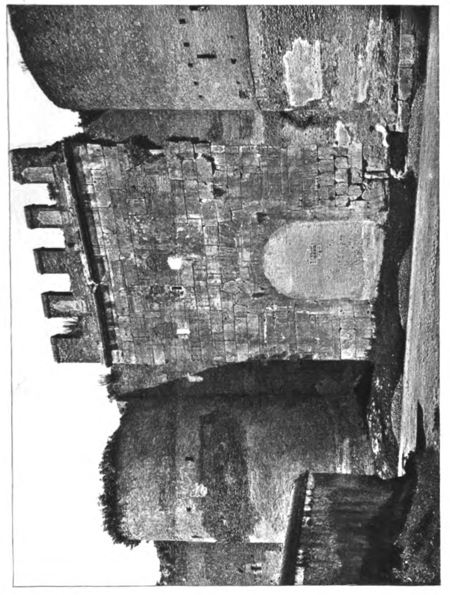
(See this image in horizontal aspect [here].)
Old Walls of Rome, showing the “Latin Gate”, p. 326. From a photograph.
The first assault of Leo against the images of Constantinople had been witnessed by a crowd of strangers from Italy and the West, who related, with grief and indignation, the sacrilege of the emperor. But on the reception of his proscriptive edict they trembled for their domestic deities; the images of Christ and the virgin, of the angels, martyrs, and saints, were abolished in all the churches of Italy; and a strong alternative was proposed to the Roman pontiff, the royal favour as the price of his compliance, degradation and exile as the penalty of his disobedience. Neither zeal nor policy allowed him to hesitate; and the haughty strain in which Gregory addressed the emperor displays his confidence in the truth of his doctrine or the powers of resistance. Without depending on prayers or miracles, he boldly armed against the public enemy, and his pastoral letters admonished the Italians of their danger and their duty. [37] At this signal, [VIII-330] Ravenna, Venice, and the cities of the Exarchate and Pentapolis adhered to the cause of religion; their military force by sea and land consisted, for the most part, of the natives; and the spirit of patriotism and zeal was transfused into the mercenary strangers. The Italians swore to live and die in the defence of the pope and the holy images; the Roman people was devoted to their father, and even the Lombards were ambitious to share the merit and advantage of this holy war. The most treasonable act, but the most obvious revenge, was the destruction of the statues of Leo himself; the most effectual and pleasing measure of rebellion was the withholding the tribute of Italy, and depriving him of a power which he had recently abused by the imposition of a new capitation. [38] A form of administration was preserved by the election of magistrates and governors; and so high was the public indignation that the Italians were prepared to create an orthodox emperor, and to conduct him with a fleet and army to the palace of Constantinople. In that palace, the Roman bishops, the second and third Gregory, were condemned as the authors of the revolt, and every attempt was made, either by fraud or force, to seize their persons and to strike at their lives. The city was repeatedly visited or assaulted by captains of the guards, and dukes and exarchs of high dignity or secret trust; they landed with foreign troops, they obtained some domestic aid, and the superstition of Naples may blush that her fathers were attached to the [VIII-331] cause of heresy. But these clandestine or open attacks were repelled by the courage and vigilance of the Romans; the Greeks were overthrown and massacred, their leaders suffered an ignominious death, and the popes, however inclined to mercy, refused to intercede for these guilty victims. At Ravenna, [39] the several quarters of the city had long exercised a bloody and hereditary feud; in religious controversy they found a new aliment of faction; but the votaries of images were superior in numbers or spirit, and the exarch, who attempted to stem the torrent, lost his life in a popular sedition. To punish this flagitious deed and restore his dominion in Italy, the emperor sent a fleet and army into the Adriatic gulf. After suffering from the winds and waves much loss and delay, the Greeks made their descent in the neighbourhood of Ravenna; they threatened to depopulate the guilty capital and to imitate, perhaps to surpass, the example of Justinian the Second, who had chastised a former rebellion by the choice and execution of fifty of the principal inhabitants. The women and clergy, in sackcloth and ashes, lay prostrate in prayer; the men were in arms for the defence of their country; the common danger had united the factions, and the event of a battle was preferred to the slow miseries of a siege. In a hard-fought day, as the two armies alternately yielded and advanced, a phantom was seen, a voice was heard, and Ravenna was victorious by the assurance of victory. The strangers retreated to their ships, but the populous seacoast poured forth a multitude of boats; the waters of the Po were so deeply infected with blood that during six years the public prejudice abstained from the fish of the river; and [VIII-332] the institution of an annual feast perpetuated the worship of images and the abhorrence of the Greek tyrant. Amidst the triumph of the Catholic arms, the Roman pontiff convened a synod of ninety-three bishops against the heresy of the Iconoclasts. With their consent he pronounced a general excommunication against all who by word or deed should attack the tradition of the fathers and the images of the saints; in this sentence the emperor was tacitly involved; [40] but the vote of a last and hopeless remonstrance may seem to imply that the anathema was yet suspended over his guilty head. No sooner had they confirmed their own safety, the worship of images, and the freedom of Rome and Italy, than the popes appear to have relaxed of their severity and to have spared the relics of the Byzantine dominion. Their moderate counsels delayed and prevented the election of a new emperor, and they exhorted the Italians not to separate from the body of the Roman monarchy. The exarch was permitted to reside within the walls of Ravenna, a captive rather than a master; and, till the Imperial coronation of Charlemagne, the government of Rome and Italy was exercised in the name of the successors of Constantine. [41]
The liberty of Rome, which had been oppressed by the arms and arts of Augustus, was rescued, after seven hundred and fifty years of servitude, from the persecution of Leo the [VIII-333] Isaurian. By the Cæsars, the triumphs of the consuls had been annihilated: in the decline and fall of the empire, the god Terminus, the sacred boundary, had insensibly receded from the ocean, the Rhine, the Danube, and the Euphrates; and Rome was reduced to her ancient territory from Viterbo to Terracina, and from Narni to the mouth of the Tiber. [42] When the kings were banished, the republic reposed on the firm basis which had been founded by their wisdom and virtue. Their perpetual jurisdiction was divided between two annual magistrates; the senate continued to exercise the powers of administration and counsel; and the legislative authority was distributed in the assemblies of the people by a well-proportioned scale of property and service. Ignorant of the arts of luxury, the primitive Romans had improved the science of government and war; the will of the community was absolute; the rights of individuals were sacred; one hundred and thirty thousand citizens were armed for defence or conquest; and a band of robbers and outlaws was moulded into a nation, deserving of freedom and ambitious of glory. [43] When the sovereignty of the Greek emperors was extinguished, the ruins of Rome presented the sad image of depopulation and decay; her slavery was an habit, her liberty an accident: the effect of superstition, and the object of her own amazement and terror. The last vestige of the substance, or even the forms, of the constitution was obliterated from the practice and memory of the Romans; and they were devoid of knowledge, or virtue, again to build the fabric of a commonwealth. Their scanty remnant, the offspring of slaves and [VIII-334] strangers, was despicable in the eyes of the victorious Barbarians. As often as the Franks or Lombards expressed their most bitter contempt of a foe, they called him a Roman; “and in this name,” says the bishop Liutprand, “we include whatever is base, whatever is cowardly, whatever is perfidious, the extremes of avarice and luxury, and every vice that can prostitute the dignity of human nature.” [44] By the necessity of their situation, the inhabitants of Rome were cast into the rough model of a republican government; they were compelled to elect some judges in peace, and some leaders in war; the nobles assembled to deliberate, and their resolves could not be executed without the union and consent of the multitude. The style of the Roman senate and people was revived, [45] but the spirit was fled; and their new independence was disgraced by the tumultuous conflict of licentiousness and oppression. The want of laws could only be supplied by the influence of religion, and their foreign and domestic counsels were moderated by the authority of the bishop. His alms, his sermons, his correspondence with the kings and prelates of the West, his recent services, their gratitude and oath, accustomed the Romans to consider him as the first magistrate or prince of the city. The Christian humility of the popes was not offended by the name of Dominus, or Lord; and their face and inscription are still apparent on [VIII-335] the most ancient coins. [46] Their temporal dominion is now confirmed by the reverence of a thousand years; and their noblest title is the free choice of a people whom they had redeemed from slavery.
In the quarrels of ancient Greece, the holy people of Elis enjoyed a perpetual peace, under the protection of Jupiter, and in the exercise of the Olympic games. [47] Happy would it have been for the Romans, if a similar privilege had guarded the patrimony of St. Peter from the calamities of war; if the Christians who visited the holy threshold would have sheathed their swords in the presence of the apostle and his successor. But this mystic circle could have been traced only by the wand of a legislator and a sage; this pacific system was incompatible with the zeal and ambition of the popes; the Romans were not addicted, like the inhabitants of Elis, to the innocent and placid labours of agriculture; and the Barbarians of Italy, though softened by the climate, were far below the Grecian states in the institutions of public and private life. A memorable example of repentance and piety was exhibited by Liutprand, king of the Lombards. In arms, at the gate of the Vatican, the conqueror listened to the voice of Gregory the Second, [48] withdrew his troops, resigned his conquests, respectfully visited the church of St. Peter, and after performing his devotions, offered his sword and dagger, his cuirass and mantle, his silver cross and his crown of gold, on the tomb of [VIII-336] the apostle. But this religious fervour was the illusion, perhaps the artifice, of the moment; the sense of interest is strong and lasting; the love of arms and rapine was congenial to the Lombards; and both the prince and people were irresistibly tempted by the disorders of Italy, the nakedness of Rome, and the unwarlike profession of her new chief. On the first edicts of the emperor, they declared themselves the champions of the holy images; Liutprand invaded the province of Romagna, which had already assumed that distinctive appellation; the Catholics of the Exarchate yielded without reluctance to his civil and military power; and a foreign enemy was introduced for the first time into the impregnable fortress of Ravenna. That city and fortress were speedily recovered by the active diligence and maritime forces of the Venetians; and those faithful subjects obeyed the exhortation of Gregory himself, in separating the personal guilt of Leo from the general cause of the Roman empire. [49] The Greeks were less mindful of the service than the Lombards of the injury; the two nations, hostile in their faith, were reconciled in a dangerous and unnatural alliance; the king and the exarch marched to the conquest of Spoleto and Rome; the storm evaporated without effect; but the policy of Liutprand alarmed Italy with a vexatious alternative of hostility and truce. His successor Astolphus declared himself the equal enemy of the emperor and the pope; Ravenna was subdued by force or treachery, [50] and this final conquest extinguished the [VIII-337] series of the exarchs, who had reigned with a subordinate power since the time of Justinian and the ruin of the Gothic kingdom. Rome was summoned to acknowledge the victorious Lombard as her lawful sovereign; the annual tribute of a piece of gold was fixed as the ransom of each citizen; and the sword of destruction was unsheathed to exact the penalty of her disobedience. The Romans hesitated; they entreated; they complained; and the threatening Barbarians were checked by arms and negotiations, till the popes had engaged the friendship of an ally and avenger beyond the Alps. [51]
In his distress, the first [51a] Gregory had implored the aid of the hero of the age, of Charles Martel, who governed the French monarchy with the humble title of mayor or duke; and who, by his signal victory over the Saracens, had saved his country, and perhaps Europe, from the Mahometan yoke. The ambassadors of the pope were received by Charles with decent reverence; but the greatness of his occupations and the shortness of his life prevented his interference in the affairs of Italy, except by a friendly and ineffectual mediation. His son Pepin, the heir of his power and virtues, assumed the office of champion of the Roman church; and the zeal of the French prince appears to have been prompted by the love of glory and religion. But the danger was on the banks of the Tiber, the succour on those of the Seine; and our sympathy is cold to the relation of distant misery. Amidst the tears of the city, Stephen the Third embraced the generous resolution of visiting in person the courts of Lombardy and France, to [VIII-338] deprecate the injustice of his enemy, or to excite the pity and indignation of his friend. After soothing the public despair by litanies and orations, he undertook this laborious journey with the ambassadors of the French monarch and the Greek emperor. The king of the Lombards was inexorable; but his threats could not silence the complaints, nor retard the speed, of the Roman pontiff, who traversed the Pennine Alps, reposed in the abbey of St. Maurice, and hastened to grasp the right hand of his protector, a hand which was never lifted in vain, either in war or friendship. Stephen was entertained as the visible successor of the apostle; at the next assembly, the field of March or of May, his injuries were exposed to a devout and warlike nation, and he repassed the Alps, not as a suppliant, but as a conqueror, at the head of a French army, which was led by the king in person. The Lombards, after a weak resistance, obtained an ignominious peace, and swore to restore the possessions, and to respect the sanctity, of the Roman church. But no sooner was Astolphus delivered from the presence of the French arms, than he forgot his promise and resented his disgrace. Rome was again encompassed by his arms; and Stephen, apprehensive of fatiguing the zeal of his Transalpine allies, enforced his complaint and request by an eloquent letter in the name and person of St. Peter himself. [52] The apostle assures his adoptive sons, the king, the clergy, and the nobles of France, that, dead in the flesh, he is still alive in the spirit; that they now hear, and must obey, the voice of the founder and guardian of the Roman church; that the Virgin, the angels, the saints, and the martyrs, and all the host of heaven, unanimously urge the request, and will confess the obligation; that riches, victory, and paradise [VIII-339] will crown their pious enterprise; and that eternal damnation will be the penalty of their neglect, if they suffer his tomb, his temple, and his people to fall into the hands of the perfidious Lombards. The second expedition of Pepin was not less rapid and fortunate than the first: St. Peter was satisfied, Rome was again saved, and Astolphus was taught the lessons of justice and sincerity by the scourge of a foreign master. After this double chastisement, the Lombards languished about twenty years in a state of languor and decay. But their minds were not yet humbled to their condition; and, instead of affecting the pacific virtues of the feeble, they peevishly harassed the Romans with a repetition of claims, evasions, and inroads, which they undertook without reflection and terminated without glory. On either side, their expiring monarchy was pressed by the zeal and prudence of Pope Hadrian the First, by the genius, the fortune, and greatness of Charlemagne the son of Pepin; these heroes of the church and state were united in public and domestic friendship; and, while they trampled on the prostrate, they varnished their proceedings with the fairest colours of equity and moderation. [53] The passes of the Alps, and the walls of Pavia, were the only defence of the Lombards; the former were surprised, the latter were invested, by the son of Pepin; and after a blockade of two years, Desiderius, the last of their native princes, surrendered his sceptre and his capital. Under the dominion of a foreign king, but in the possession of their national laws, the Lombards became the brethren, rather than the subjects, of the Franks; who derived their blood, [VIII-340] and manners, and language from the same Germanic origin. [54]
The mutual obligations of the popes and the Carlovingian family form the important link of ancient and modern, of civil and ecclesiastical, history. In the conquest of Italy, the champions of the Roman church obtained a favourable occasion, a specious title, the wishes of the people, the prayers and intrigues of the clergy. But the most essential gifts of the popes to the Carlovingian race were the dignities of king of France [55] and of patrician of Rome. I. Under the sacerdotal monarchy of St. Peter, the nations began to resume the practice of seeking, on the banks of the Tiber, their kings, their laws, and the oracles of their fate. The Franks were perplexed between the name and substance of their government. All the powers of royalty were exercised by Pepin, mayor of the palace; and nothing, except the regal title, was wanting to his ambition. His enemies were crushed by his valour; his friends were multiplied by his liberality; his father had been the saviour of Christendom; and the claims of personal merit were repeated and ennobled in a descent of four generations. The name and image of royalty was still preserved in the last descendant of Clovis, the feeble Childeric; but his obsolete right could only be used as an instrument of sedition; the nation was desirous of restoring the simplicity of the constitution; and Pepin, a subject and a prince, was ambitious to ascertain his own rank and the fortune of his family. The mayor and the nobles were bound, by an oath of fidelity, to [VIII-341] the royal phantom; the blood of Clovis was pure and sacred in their eyes; and their common ambassadors addressed the Roman pontiff, to dispel their scruples or to absolve their promise. The interest of Pope Zachary, the successor of the two Gregories, prompted him to decide, and to decide in their favour; he pronounced that the nation might lawfully unite, in the same person, the title and authority of king; and that the unfortunate Childeric, a victim of the public safety, should be degraded, shaved, and confined in a monastery for the remainder of his days. An answer so agreeable to their wishes was accepted by the Franks, as the opinion of a casuist, the sentence of a judge, or the oracle of a prophet; the Merovingian race disappeared from the earth; and Pepin was exalted on a buckler by the suffrage of a free people, accustomed to obey his laws and to march under his standard. His coronation was twice performed, with the sanction of the popes, by their most faithful servant St. Boniface, the apostle of Germany, and by the grateful hands of Stephen the Third, who, in the monastery of St. Denys, placed the diadem on the head of his benefactor. The royal unction of the kings of Israel was dexterously applied; [56] the successor of St. Peter assumed the character of a divine ambassador; a German chieftain was transformed into the Lord’s anointed; and this Jewish rite has been diffused and maintained by the superstition and vanity of modern Europe. The Franks were absolved from their ancient oath; but a dire anathema was thundered against them and their posterity, if they should dare to renew the same freedom of choice, or to elect a king, [VIII-342] except in the holy and meritorious race of the Carlovingian princes. Without apprehending the future danger, these princes gloried in their present security; the secretary of Charlemagne affirms that the French sceptre was transferred by the authority of the popes; [57] and in their boldest enterprises they insist, with confidence, on this signal and successful act of temporal jurisdiction.
II. In the change of manners and language, the patricians of Rome [58] were far removed from the senate of Romulus or the palace of Constantine, from the free nobles of the republic or the fictitious parents of the emperor. After the recovery of Italy and Africa by the arms of Justinian, the importance and danger of those remote provinces required the presence of a supreme magistrate; he was indifferently styled the exarch or the patrician; and these governors of Ravenna, who fill their place in the chronology of princes, extended their jurisdiction over the Roman city. Since the revolt of Italy and the loss of the Exarchate, the distress of the Romans had exacted some sacrifice of their independence. Yet, even in this act, they exercised the right of disposing of themselves; and the decrees of the senate and people successively invested Charles Martel and his posterity with the honours of patrician of Rome. The leaders of a powerful nation would have disdained a servile title and subordinate office; but the reign [VIII-343] of the Greek emperors was suspended; and, in the vacancy of the empire, they derived a more glorious commission from the pope and the republic. The Roman ambassadors presented these patricians with the keys of the shrine of St. Peter, as a pledge and symbol of sovereignty; with a holy banner, which it was their right and duty to unfurl in the defence of the church and city. [59] In the time of Charles Martel and of Pepin, the interposition of the Lombard kingdom covered the freedom, while it threatened the safety, of Rome; and the patriciate represented only the title, the service, the alliance, of these distant protectors. The power and policy of Charlemagne annihilated an enemy, and imposed a master. In his first visit to the capital, he was received with all the honours which had formerly been paid to the exarch, the representative of the emperor; and these honours obtained some new decorations from the joy and gratitude of Pope Hadrian the First. [60] No sooner was he informed of the sudden approach of the monarch, than he despatched the magistrates and nobles of Rome to meet him, with the banner, about thirty miles from the city. At the distance of one mile, the Flaminian way was lined with the schools, or national communities, of Greeks, Lombards, Saxons, &c.; the Roman youth was under arms; and the children of a more tender age, with palms and olive branches in their hands, chaunted the praises of their great deliverer. At the aspect of the holy crosses and ensigns of the saints, he [VIII-344] dismounted from his horse, led the procession of his nobles to the Vatican, and, as he ascended the stairs, devoutly kissed each step of the threshold of the apostles. In the portico, Hadrian expected him at the head of his clergy; they embraced, as friends and equals; but, in their march to the altar, the king or patrician assumed the right hand of the pope. Nor was the Frank content with these vain and empty demonstrations of respect. In the twenty-six years that elapsed between the conquest of Lombardy and his Imperial coronation, Rome, which had been delivered by the sword, was subject as his own to the sceptre, of Charlemagne. The people swore allegiance to his person and family; in his name money was coined and justice was administered; and the election of the popes was examined and confirmed by his authority. Except an original and self-inherent claim of sovereignty, there was not any prerogative remaining which the title of emperor could add to the patrician of Rome. [61]
The gratitude of the Carlovingians was adequate to these obligations, and their names are consecrated as the saviours and benefactors of the Roman church. Her ancient patrimony of farms and houses was transformed by their bounty into the temporal dominion of cities and provinces; and the donation of the Exarchate was the first-fruits of the conquests of Pepin. [62] Astolphus with a sigh relinquished his prey; the keys and the hostages of the principal cities were delivered [VIII-345] to the French ambassador; and, in his master’s name, he presented them before the tomb of St. Peter. The ample measure of the Exarchate [63] might comprise all the provinces of Italy which had obeyed the emperor and his vicegerent; but its strict and proper limits were included in the territories of Ravenna, Bologna, and Ferrara; its inseparable dependency was the Pentapolis, which stretched along the Adriatic from Rimini, to Ancona, and advanced into the midland country as far as the ridges of the Apennine. In this transaction, the ambition and avarice of the popes has been severely condemned. Perhaps the humility of a Christian priest should have rejected an earthly kingdom, which it was not easy for him to govern without renouncing the virtues of his profession. Perhaps a faithful subject, or even a generous enemy, would have been less impatient to divide the spoils of the Barbarian; and, if the emperor had entrusted Stephen to solicit in his name the restitution of the Exarchate, I will not absolve the pope from the reproach of treachery and falsehood. But in the rigid interpretation of the laws every one may accept, without injury, whatever his benefactor can bestow without injustice. The Greek emperor had abdicated or forfeited his right to the Exarchate; and the sword of Astolphus was broken by the stronger sword of the Carlovingian. It was not in the cause of the Iconoclast that Pepin had exposed his person and army in a double expedition beyond the Alps; he possessed, and might lawfully alienate, his conquests; and to the importunities of the Greeks he piously replied that no human consideration should tempt him to resume the gift which he had conferred on the Roman pontiff for the remission of his sins and the salvation of his soul. The splendid donation was granted in supreme and absolute dominion, and the world beheld, for the first time, a Christian bishop invested [VIII-346] with the prerogatives of a temporal prince: the choice of magistrates, the exercise of justice, the imposition of taxes, and the wealth of the palace of Ravenna. In the dissolution of the Lombard kingdom, the inhabitants of the duchy of Spoleto [64] sought a refuge from the storm, shaved their heads after the Roman fashion, declared themselves the servants and subjects of St. Peter, and completed, by this voluntary surrender, the present circle of the ecclesiastical state. That mysterious circle was enlarged to an indefinite extent by the verbal or written donation of Charlemagne, [65] who, in the first transports of his victory, despoiled himself and the Greek emperor of the cities and islands which had formerly been annexed to the Exarchate. But, in the cooler moments of absence and reflection, he viewed, with an eye of jealousy and envy, the recent greatness of his ecclesiastical ally. The execution of his own and his father’s promises was respectfully eluded; the king of the Franks and Lombards asserted the inalienable rights of the empire; and, in his life and death, Ravenna, [66] as well as Rome, was numbered in the list of his metropolitan cities. The sovereignty of the Exarchate melted away in the hands [VIII-347] of the popes; they found in the archbishops of Ravenna a dangerous and domestic rival; [67] the nobles and priests disdained the yoke of a priest; and, in the disorders of the times, they could only retain the memory of an ancient claim, which, in a more prosperous age, they have revived and realised.
Fraud is the resource of weakness and cunning; and the strong, though ignorant, Barbarian was often entangled in the net of sacerdotal policy. The Vatican and Lateran were an arsenal and manufacture, which, according to the occasion, have produced or concealed a various collection of false or genuine, of corrupt or suspicious acts, as they tended to promote the interest of the Roman church. Before the end of the eighth century, some apostolical scribe, perhaps the notorious Isidore, composed the decretals, and the donation of Constantine, the two magic pillars of the spiritual and temporal monarchy of the popes. This memorable donation was introduced to the world by an epistle of Hadrian the First, who exhorts Charlemagne to imitate the liberality, and revive the name, of the great Constantine. [68] According to the legend, the first of the Christian emperors was healed of the leprosy, and purified in the waters of baptism, by St. Silvester, the Roman bishop; and never was physician more gloriously recompensed. His royal proselyte withdrew from the seat and patrimony of St. Peter; declared his resolution of founding a new capital in the East; and resigned to the popes the [VIII-348] free and perpetual sovereignty of Rome, Italy, and the provinces of the West. [69] This fiction was productive of the most beneficial effects. The Greek princes were convicted of the guilt of usurpation; and the revolt of Gregory was the claim of his lawful inheritance. The popes were delivered from their debt of gratitude; and the nominal gifts of the Carlovingians were no more than the just and irrevocable restitution of a scanty portion of the ecclesiastical state. The sovereignty of Rome no longer depended on the choice of a fickle people; and the successors of St. Peter and Constantine were invested with the purple and prerogatives of the Cæsars. So deep was the ignorance and credulity of the times that the most absurd of fables was received, with equal reverence, in Greece and in France, and is still enrolled among the decrees of the canon law. [70] The emperors and the Romans were incapable of discerning a forgery that subverted their rights and freedom; and the only opposition proceeded from a Sabine monastery, which, in the beginning of the twelfth century, disputed the truth and validity of the donation of Constantine. [71] In the [VIII-349] revival of letters and liberty this fictitious deed was transpierced by the pen of Laurentius Valla, the pen of an eloquent critic and a Roman patriot. [72] His contemporaries of the fifteenth century were astonished at his sacrilegious boldness; yet such is the silent and irresistible progress of reason that before the end of the next age the fable was rejected by the contempt of historians [73] and poets, [74] and the tacit or modest censure of the advocates of the Roman church. [75] The popes themselves have indulged a smile at the credulity of the vulgar; [76] but a false and obsolete title still sanctifies their reign; and, by the same fortune which has attended the decretals and the Sibylline oracles, the edifice has subsisted after the foundations have been undermined.
[VIII-350]
While the popes established in Italy their freedom and dominion, the images, the first cause of their revolt, were restored in the Eastern empire. [77] Under the reign of Constantine the Fifth, the union of civil and ecclesiastical power had overthrown the tree, without extirpating the root, of superstition. The idols, for such they were now held, were secretly cherished by the order and the sex most prone to devotion; and the fond alliance of the monks and females obtained a final victory over the reason and authority of man. Leo the Fourth maintained with less rigour the religion of his father and grandfather; but his wife, the fair and ambitious Irene, had imbibed the zeal of the Athenians, the heirs of the idolatry, rather than the philosophy, of their ancestors. During the life of her husband, these sentiments were inflamed by danger and dissimulation, and she could only labour to protect and promote some favourite monks, whom she drew from their caverns and seated on the metropolitan thrones of the East. But, as soon as she reigned in her own name and that of her son, Irene more seriously undertook the ruin of the Iconoclasts; and the first step of her future persecution was a general edict for liberty of conscience. In the restoration of the monks, a thousand images were exposed to the public veneration; a thousand legends were invented of their sufferings and miracles. By the opportunities of death or removal the episcopal seats were judiciously filled; the most eager competitors for earthly or celestial favour anticipated and flattered the judgment of their sovereign; and the promotion [VIII-351] of her secretary Tarasius gave Irene the patriarch of Constantinople and the command of the Oriental church. But the decrees of a general council could only be repealed by a similar assembly; [78] the Iconoclasts whom she convened were bold in possession and averse to debate; and the feeble voice of the bishops was re-echoed by the more formidable clamour of the soldiers and people of Constantinople. The delay and intrigues of a year, the separation of the disaffected troops, and the choice of Nice for a second orthodox synod removed these obstacles; and the episcopal conscience was again, after the Greek fashion, in the hands of the prince. No more than eighteen days were allowed for the consummation of this important work; the Iconoclasts appeared, not as judges, but as criminals or penitents; the scene was decorated by the legates of Pope Hadrian and the Eastern patriarchs; [79] the decrees were framed by the president Tarasius, and ratified by the acclamations and subscriptions of three hundred and fifty bishops. They unanimously pronounced that the worship of images is agreeable to scripture and reason, to the fathers and councils of the church: but they hesitate whether that worship be relative or direct; whether the Godhead and the figure of Christ be entitled to the same mode of adoration. Of this second Nicene council, the acts are still extant: a curious monument of superstition and ignorance, of falsehood and folly. I shall only notice the judgment of the bishops on the comparative merit of imageworship and morality. A monk had concluded a truce with [VIII-352] the demon of fornication, on condition of interrupting his daily prayers to a picture that hung in his cell. His scruples prompted him to consult the abbot. “Rather than abstain from adoring Christ and his Mother in their holy images, it would be better for you,” replied the casuist, “to enter every brothel, and visit every prostitute, in the city.” [80]
For the honour of orthodoxy, at least the orthodoxy of the Roman church, it is somewhat unfortunate that the two princes who convened the two councils of Nice are both stained with the blood of their sons. The second of these assemblies was approved and rigorously executed by the despotism of Irene, and she refused her adversaries the toleration which at first she had granted to her friends. During the five succeeding reigns, a period of thirty-eight years, the contest was maintained, with unabated rage and various success, between the worshippers, and the breakers, of the images; but I am not inclined to pursue with minute diligence the repetition of the same events. Nicephorus allowed a general liberty of speech and practice; and the only virtue of his reign is accused by the monks as the cause of his temporal and eternal perdition. Superstition and weakness formed the character of Michael the First, but the saints and images were incapable of supporting their votary on the throne. In the purple, Leo the Fifth asserted the name and religion of an Armenian; and the idols, with their seditious adherents, were condemned to a second exile. Their applause would have sanctified the murder of an impious tyrant, but his assassin and successor, the second Michael, was tainted from his birth with the Phrygian heresies: he attempted to mediate between the contending parties; and the intractable spirit of the Catholics insensibly cast him into [VIII-353] the opposite scale. [81] His moderation was guarded by timidity; but his son Theophilus, alike ignorant of fear and pity, was the last and most cruel of the Iconoclasts. [82] The enthusiasm of the times ran strongly against them; and the emperors, who stemmed the torrent, were exasperated and punished by the public hatred. After the death of Theophilus, the final victory of the images was achieved by a second female, his widow Theodora, whom he left the guardian of the empire. Her measures were bold and decisive. The fiction of a tardy repentance absolved the fame and the soul of her deceased husband; [83] the sentence of the Iconoclast patriarch was commuted from the loss of his eyes to a whipping of two hundred lashes; the bishops trembled, the monks shouted, and the festival of orthodoxy preserves the annual memory of the triumph of the images. [84] A single question yet remained, whether they are endowed with any proper and inherent sanctity; it was agitated by the Greeks of the eleventh century; [85] and, as this opinion has the strongest recommendation of absurdity, I am surprised that it was not more explicitly decided in the affirmative. In the West, Pope Hadrian the First accepted and announced the decrees of the Nicene assembly, which is now revered by the Catholics as the seventh in rank of the general councils. Rome and Italy were docile to the voice of their father; but the greatest part of the Latin Christians were far behind in the race of superstition. [VIII-354] The churches of France, Germany, England, and Spain steered a middle course between the adoration and the destruction of images, which they admitted into their temples, not as objects of worship, but as lively and useful memorials of faith and history. An angry book of controversy was composed and published in the name of Charlemagne; [86] under his authority a synod of three hundred bishops was assembled at Frankfort; [87] they blamed the fury of the Iconoclasts, but they pronounced a more severe censure against the superstition of the Greeks and the decrees of their pretended council, which was long despised by the Barbarians of the West. [88] Among them the worship of images advanced with a silent and insensible progress; but a large atonement is made for their hesitation and delay by the gross idolatry of the ages which precede the reformation, and of the countries, both in Europe and America, which are still immersed in the gloom of superstition.
It was after the Nicene synod, and under the reign of the pious Irene, that the popes consummated the separation of Rome and Italy, by the translation of the empire to the less orthodox Charlemagne. They were compelled to choose between the rival nations; religion was not the sole motive of [VIII-355] their choice; and, while they dissembled the failings of their friends, they beheld, with reluctance and suspicion, the Catholic virtues of their foes. The difference of language and manners had perpetuated the enmity of the two capitals; and they were alienated from each other by the hostile opposition of seventy years. In that schism the Romans had tasted of freedom, and the popes of sovereignty: their submission would have exposed them to the revenge of a jealous tyrant; and the revolution of Italy had betrayed the impotence, as well as the tyranny, of the Byzantine court. The Greek emperors had restored the images, but they had not restored the Calabrian estates [89] and the Illyrian diocese, [90] which the Iconoclasts had torn away from the successors of St. Peter; and Pope Hadrian threatens them with a sentence of excommunication unless they speedily abjure this practical heresy. [91] The Greeks were now orthodox, but their religion might be tainted by the breath of the reigning monarch; the Franks were now contumacious, but a discerning eye might discern their approaching conversion from the use, to the adoration, [VIII-356] of images. The name of Charlemagne was stained by the polemic acrimony of his scribes; but the conqueror himself conformed, with the temper of a statesman, to the various practice of France and Italy. In his four pilgrimages or visits to the Vatican, he embraced the popes in the communion of friendship and piety; knelt before the tomb, and consequently before the image, of the apostle; and joined, without scruple, in all the prayers and processions of the Roman liturgy. Would prudence or gratitude allow the pontiffs to renounce their benefactor? Had they a right to alienate his gift of the Exarchate? Had they power to abolish his government of Rome? The title of patrician was below the merit and greatness of Charlemagne; and it was only by reviving the Western empire that they could pay their obligations or secure their establishment. By this decisive measure they would finally eradicate the claims of the Greeks; from the debasement of a provincial town, the majesty of Rome would be restored; the Latin Christians would be united under a supreme head, in their ancient metropolis; and the conquerors of the West would receive their crown from the successors of St. Peter. The Roman church would acquire a zealous and respectable advocate; and, under the shadow of the Carlovingian power, the bishop might exercise, with honour and safety, the government of the city. [92]
Before the ruin of paganism in Rome, the competition for a wealthy bishopric had often been productive of tumult and bloodshed. The people was less numerous, but the times were more savage, the prize more important, and the chair of St. Peter was fiercely disputed by the leading ecclesiastics who aspired to the rank of sovereign. The reign of Hadrian the [VIII-357] First [93] surpasses the measure of past or succeeding ages; [94] the walls of Rome, the sacred patrimony, the ruin of the Lombards and the friendship of Charlemagne, were the trophies of his fame; he secretly edified the throne of his successors, and displayed in a narrow space the virtues of a great prince. His memory was revered; but in the next election, a priest of the Lateran (Leo the Third) was preferred to the nephew and the favourite of Hadrian, whom he had promoted to the first dignities of the church. Their acquiescence or repentance disguised, above four years, the blackest intention of revenge, till the day of a procession, when a furious band of conspirators dispersed the unarmed multitude and assaulted with blows and wounds the sacred person of the pope. But their enterprise on his life or liberty was disappointed, perhaps by their own confusion and remorse. Leo was left for dead on the ground; on his revival from the swoon, the effect of his loss of blood, he recovered his speech and sight; and this natural event was improved to the miraculous restoration of his eyes and tongue, of which he had been deprived, twice deprived, by the knife of the assassins. [95] From his prison, he escaped to the [VIII-358] Vatican; the duke of Spoleto hastened to his rescue, Charlemagne sympathised in his injury, and in his camp of Paderborn in Westphalia accepted or solicited a visit from the Roman pontiff. Leo repassed the Alps with a commission of counts and bishops, the guards of his safety and the judges of his innocence; and it was not without reluctance that the conqueror of the Saxons delayed till the ensuing year the personal discharge of this pious office. In his fourth and last pilgrimage, he was received at Rome with the due honours of king and patrician; Leo was permitted to purge himself by oath of the crimes imputed to his charge; his enemies were silenced, and the sacrilegious attempt against his life was punished by the mild and insufficient penalty of exile. On the festival of Christmas, the last year of the eighth century, Charlemagne appeared in the church of St. Peter; and, to gratify the vanity of Rome, he had exchanged the simple dress of his country for the habit of a patrician. [96] After the celebration of the holy mysteries, Leo suddenly placed a precious crown on his head, [97] and the dome resounded with the acclamations of the people, “Long life and victory to Charles, the most pious Augustus, crowned by God, the great and pacific emperor of the Romans!” The head and body of Charlemagne were consecrated by the royal unction; after the example of the Cæsars he was saluted or adored by the pontiff; his coronation oath represents a promise to maintain the faith and privileges of the church; and the firstfruits were paid in his rich offerings to the shrine of the [VIII-359] apostle. In his familiar conversation, the emperor protested his ignorance of the intentions of Leo, which he would have disappointed by his absence on that memorable day. But the preparations of the ceremony must have disclosed the secret; and the journey of Charlemagne reveals his knowledge and expectation: he had acknowledged that the Imperial title was the object of his ambition, and a Roman senate had pronounced that it was the only adequate reward of his merit and services. [98]
The appellation of great has been often bestowed and sometimes deserved, but Charlemagne is the only prince in whose favour the title has been indissolubly blended with the name. [99] That name, with the addition of saint, is inserted in the Roman calendar; and the saint, by a rare felicity, is crowned with the praises of the historians and philosophers of an enlightened age. [100] His real merit is doubtless enhanced [VIII-360] by the barbarism of the nation and the times from which he emerged; but the apparent magnitude of an object is likewise enlarged by an unequal comparison; and the ruins of Palmyra derive a casual splendour from the nakedness of the surrounding desert. Without injustice to his fame, I may discern some blemishes in the sanctity and greatness of the restorer of the Western empire. Of his moral virtues, chastity is not the most conspicuous; [101] but the public happiness could not be materially injured by his nine wives or concubines, the various indulgence of meaner or more transient amours, the multitude of his bastards whom he bestowed on the church, and the long celibacy and licentious manners of his daughters, [102] whom the father was suspected of loving with too fond a passion. I shall be scarcely permitted to accuse the ambition of a conqueror; but, in a day of equal retribution, the sons of his brother Carloman, the Merovingian princes of Aquitain, and the four thousand five hundred Saxons who were beheaded on the same spot, would have something to allege against the justice and humanity of Charlemagne. His treatment of the vanquished Saxons [103] was an abuse of [VIII-none] [VIII-361] the right of conquest; his laws were not less sanguinary than his arms; and, in the discussion of his motives, whatever is subtracted from bigotry must be imputed to temper. The sedentary reader is amazed by his incessant activity of mind and body; and his subjects and enemies were not less astonished at his sudden presence, at the moment when they believed him at the most distant extremity of the empire; neither peace nor war, nor summer nor winter, were a season of repose: and our fancy cannot easily reconcile the annals of his reign with the geography of his expeditions. But this activity was a national rather than a personal virtue; the vagrant life of a Frank was spent in the chase, in pilgrimage, in military adventures; and the journeys of Charlemagne were distinguished only by a more numerous train and a more important purpose. His military renown must be tried by the scrutiny of his troops, his enemies, and his actions. Alexander conquered with the arms of Philip, but the two heroes who preceded Charlemagne bequeathed him their name, their examples, and the companions of their victories. At the head of his veteran and superior armies, he oppressed the savage or degenerate nations who were incapable of confederating for their common safety; nor did he ever encounter an equal antagonist in numbers, in discipline, or in arms. The science of war has been lost and revived with the arts of peace; but his campaigns are not illustrated by any siege or battle of singular difficulty and success; and he might behold, with envy, the Saracen trophies of his grandfather. After his Spanish expedition, his rear-guard was defeated in the Pyrenæan mountains; and the soldiers, whose situation was irretrievable and whose valour was useless, might accuse, with their last breath, the want of skill or caution of their general. [104] I touch with reverence the laws of Charlemagne, [VIII-362] so highly applauded by a respectable judge. They compose not a system, but a series, of occasional and minute edicts, for the correction of abuses, the reformation, of manners, the economy of his farms, the care of his poultry, and even the sale of his eggs. He wished to improve the laws and the character of the Franks; and his attempts, however feeble and imperfect, are deserving of praise. The inveterate evils of the times were suspended or mollified by his government; [105] but in his institutions I can seldom discover the general views and the immortal spirit of a legislator, who survives himself for the benefit of posterity. The union and stability of his empire depended on the life of a single man; he imitated the dangerous practice of dividing his kingdoms among his sons; and, after his numerous diets, the whole constitution was left to fluctuate between the disorders of anarchy and despotism. His esteem for the piety and knowledge of the clergy tempted him to entrust that aspiring order with temporal dominion and civil jurisdiction; and his son Lewis, when he was stripped and degraded by the bishops, might accuse, in some measure, the imprudence of his father. His laws enforced the imposition of tithes, because the demons had proclaimed in the air that the default of payment had been the cause of the last scarcity. [106] The literary merits of Charlemagne are attested by the foundation of [VIII-363] schools, the introduction of arts, the works which were published in his name, and his familiar connection with the subjects and strangers whom he invited to his court to educate both the prince and people. His own studies were tardy, laborious, and imperfect; if he spoke Latin and understood Greek, he derived the rudiments of knowledge from conversation rather than from books; and, in his mature age, the emperor strove to acquire the practice of writing, which every peasant now learns in his infancy. [107] The grammar and logic, the music and astronomy, of the times were only cultivated as the handmaids of superstition; but the curiosity of the human mind must ultimately tend to its improvement, and the encouragement of learning reflects the purest and most pleasing lustre on the character of Charlemagne. [108] The dignity of his person, [109] the length of his reign, the prosperity of his arms, the vigour of his government, and the reverence of distant nations distinguish him from the royal crowd; and Europe dates a new era from his restoration of the Western empire.
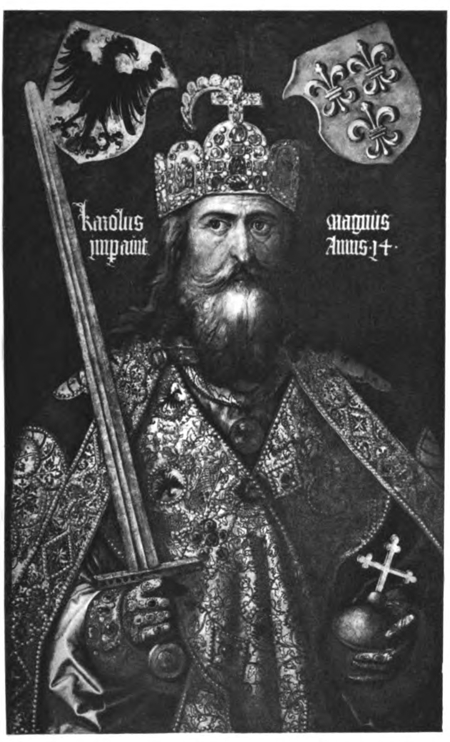
Charlemagne, p. 360. From a painting by Albert Dürer.
That empire was not unworthy of its title; [110] and some of [VIII-364] the fairest kingdoms of Europe were the patrimony or conquest of a prince who reigned at the same time in France, Spain, Italy, Germany, and Hungary. [111] I. The Roman province of Gaul had been transformed into the name and monarchy of France; but, in the decay of the Merovingian line, its limits were contracted by the independence of the Britons and the revolt of Aquitain. Charlemagne pursued, and confined, the Britons on the shores of the ocean; and that ferocious tribe, whose origin and language are so different from the French, was chastised by the imposition of tribute, hostages, and peace. After a long and evasive contest, the rebellion of the dukes of Aquitain was punished by the forfeiture of their province, their liberty, and their lives. Harsh and rigorous would have been such treatment of ambitious governors, who had too faithfully copied the mayors of the palace. But a recent discovery [112] has proved that these unhappy princes were the last and lawful heirs of the blood and sceptre of Clovis, a younger branch, from the brother of Dagobert, of the Merovingian house. Their ancient kingdom was reduced to the duchy of Gascogne, to the counties of Fesenzac and Armagnac, at the foot of the Pyrenees; their race was propagated till the beginning of the sixteenth century; and, after surviving their Carlovingian tyrants, they were reserved to feel the injustice, or the favours, of a third dynasty. By the re-union of Aquitain, France was enlarged to its present boundaries, with the additions of the Netherlands [VIII-365] and Spain, as far as the Rhine. II. The Saracens had been expelled from France by the grandfather and father of Charlemagne; but they still possessed the greatest part of Spain, from the rock of Gibraltar to the Pyrenees. Amidst their civil divisions, an Arabian emir of Saragossa implored his protection in the diet of Paderborn. Charlemagne undertook the expedition, restored the emir, and, without distinction of faith, impartially crushed the resistance of the Christians, and rewarded the obedience and service of the Mahometans. In his absence he instituted the Spanish march, [113] which extended from the Pyrenees to the river Ebro; Barcelona was the residence of the French governor; he possessed the counties of Rousillon and Catalonia; and the infant kingdoms of Navarre and Arragon were subject to his jurisdiction. III. As king of the Lombards, and patrician of Rome, he reigned over the greatest part of Italy, [114] a tract of a thousand miles from the Alps to the borders of Calabria. The duchy of Beneventum, a Lombard fief, had spread, at the expense of the Greeks, over the modern kingdom of Naples. But Arrechis, the reigning duke, refused to be included in the slavery of his country; assumed the independent title of prince; and opposed his sword to the Carlovingian monarchy. His defence was firm, his submission was not inglorious, and the emperor was content with an easy tribute, the demolition of his fortresses, and the acknowledgment, on his coins, of a supreme lord. The artful flattery of his son Grimoald added the appellation of father, but he asserted his dignity with prudence, and Beneventum insensibly escaped from the [VIII-366] French yoke. [115] IV. Charlemagne was the first who united Germany under the same sceptre. The name of Oriental France is preserved in the circle of Franconia; and the people of Hesse and Thuringia were recently incorporated with the victors by the conformity of religion and government. The Alemanni, so formidable to the Romans, were the faithful vassals and confederates of the Franks; and their country was inscribed within the modern limits of Alsace, Swabia, and Switzerland. The Bavarians, with a similar indulgence of their laws and manners, were less patient of a master; the repeated treasons of Tasillo justified the abolition of her hereditary dukes; and their power was shared among the counts, who judged and guarded that important frontier. But the north of Germany, from the Rhine and beyond the Elbe, was still hostile and Pagan; nor was it till after a war of thirty-three years that the Saxons bowed under the yoke of Christ and of Charlemagne. The idols and their votaries were extirpated; the foundation of eight bishoprics, of Munster, Osnaburgh, Paderborn, and Minden, of Bremen, Verden, Hildesheim, and Halberstadt, define, on either side of the Weser, the bounds of ancient Saxony; these episcopal seats were the first schools and cities of that savage land; and the religion and humanity of the children atoned, in some degree, for the massacre of the parents. Beyond the Elbe, the Slavi, or Sclavonians, of similar manners and various denominations, [116] overspread the modern dominions of Prussia, Poland, and Bohemia, and some transient marks of obedience have tempted the French historian to extend the empire to the Baltic and the Vistula. The conquest or conversion of those countries is of a more recent age; but the first union of Bohemia with the Germanic body may be justly [VIII-367] ascribed to the arms of Charlemagne. V. He retaliated on the Avars, or Huns of Pannonia, the same calamities which they had inflicted on the nations. Their rings, the wooden fortifications which encircled their districts and villages, were broken down by the triple effort of a French army, that was poured into their country by land and water, through the Carpathian mountains and along the plain of the Danube. After a bloody conflict of eight years, the loss of some French generals was avenged by the slaughter of the most noble Huns; the relics of the nation submitted; the royal residence of the chagan was left desolate and unknown; and the treasures, the rapine of two hundred and fifty years, enriched the victorious troops or decorated the churches of Italy and Gaul. [117] After the reduction of Pannonia, the empire of Charlemagne was bounded only by the conflux of the Danube with the Theiss and the Save; the provinces of Istria, Liburnia, and Dalmatia were an easy, though unprofitable, accession; and it was an effect of his moderation that he left the maritime cities under the real or nominal sovereignty of the Greeks. But these distant possessions added more to the reputation than to the power of the Latin emperor; nor did he risk any ecclesiastical foundations to reclaim the Barbarians from their vagrant life and idolatrous worship. Some canals of communication between the rivers, the Saône and the Meuse, the Rhine and the Danube, were faintly attempted. [118] Their execution would have vivified the empire; [VIII-368] and more cost and labour were often wasted in the structure of a cathedral.
If we retrace the outlines of this geographical picture, it will be seen that the empire of the Franks extended, between east and west, from the Ebro to the Elbe or Vistula; between the north and south, from the duchy of Beneventum to the river Eyder, the perpetual boundary of Germany and Denmark. The personal and political importance of Charlemagne was magnified by the distress and division of the rest of Europe. The islands of Great Britain and Ireland were disputed by a crowd of princes of Saxon or Scottish origin; and, after the loss of Spain, the Christian and Gothic kingdom of Alphonso the Chaste was confined to the narrow range of the Asturian mountains. These petty sovereigns revered the power or virtue of the Carlovingian monarch, implored the honour and support of his alliance, and styled him their common parent, the sole and supreme emperor of the West. [119] He maintained a more equal intercourse with the caliph Harun al Rashid, [120] whose dominion stretched from Africa to India, and accepted from his ambassadors a tent, a water-clock, an elephant, and the keys of the Holy Sepulchre. It is not easy to conceive the private friendship of a Frank and an Arab, who were strangers to each other’s person, and language, and religion; but their public correspondence was founded on vanity, and their remote situation [VIII-369] left no room for a competition of interest. [121] Two thirds of the Western empire of Rome were subject to Charlemagne, and the deficiency was amply supplied by his command of the inaccessible or invincible nations of Germany. But in the choice of his enemies we may be reasonably surprised that he so often preferred the poverty of the North to the riches of the South. The three-and-thirty campaigns laboriously consumed in the woods and morasses of Germany would have sufficed to assert the amplitude of his title by the expulsion of the Greeks from Italy and the Saracens from Spain. The weakness of the Greeks would have ensured an easy victory; and the holy crusade against the Saracens would have been prompted by glory and revenge, and loudly justified by religion and policy. Perhaps, in his expeditions beyond the Rhine and the Elbe, he aspired to save his monarchy from the fate of the Roman empire, to disarm the enemies of civilised society, and to eradicate the seed of future emigrations. But it has been wisely observed that, in a light of precaution, all conquest must be ineffectual, unless it could be universal; since the increasing circle must be involved in a larger sphere of hostility. [122] The subjugation of Germany withdrew the veil which had so long concealed the continent or islands of Scandinavia from the knowledge of Europe, and awakened the torpid courage of their barbarous natives. The fiercest of the Saxon idolaters escaped from the Christian tyrant to their brethren of the North; the ocean and Mediterranean were covered with their piratical fleets; and Charlemagne beheld with a sigh the destructive [VIII-370] progress of the Normans, who, in less than seventy years, precipitated the fall of his race and monarchy.
Had the pope and the Romans revived the primitive constitution, the titles of emperor and Augustus were conferred on Charlemagne for the term of his life; and his successors, on each vacancy, must have ascended the throne by a formal or tacit election. But the association of his son Lewis the Pious asserts the independent right of monarchy and conquest, and the emperor seems on this occasion to have foreseen and prevented the latent claims of the clergy. The royal youth was commanded to take the crown from the altar, and with his own hands to place it on his head, as a gift which he held from God, his father, and the nation. [123] The same ceremony was repeated, though with less energy, in the subsequent associations of Lothaire and Lewis the Second; the Carlovingian sceptre was transmitted from father to son in a lineal descent of four generations; and the ambition of the popes was reduced to the empty honour of crowning and anointing these hereditary princes who were already invested with their power and dominion. The pious Lewis survived his brothers, and embraced the whole empire of Charlemagne; but the nations and the nobles, his bishops and his children, quickly discerned that this mighty mass was no longer inspired by the same soul; and the foundations were undermined to the centre, while the external surface was yet fair and entire. After a war, or battle, which consumed one hundred thousand Franks, the empire was divided by treaty between his three sons, who had violated every filial and fraternal duty. The kingdoms of Germany and France were for ever separated; the provinces of Gaul, between [VIII-371] the Rhone and the Alps, the Meuse and the Rhine, were assigned, with Italy, to the Imperial dignity of Lothaire. In the partition of his share, Lorraine and Arles, two recent and transitory kingdoms, were bestowed on the younger children; and Lewis the Second, his eldest son, was content with the realm of Italy, the proper and sufficient patrimony of a Roman emperor. On his death without any male issue, the vacant throne was disputed by his uncles and cousins, and the popes most dexterously seized the occasion of judging the claims and merits of the candidates, and of bestowing on the most obsequious or most liberal the Imperial office of advocate of the Roman church. The dregs of the Carlovingian race no longer exhibited any symptoms of virtue or power, and the ridiculous epithets of the bald, the stammerer, the fat, and the simple distinguished the tame and uniform features of a crowd of kings alike deserving of oblivion. By the failure of the collateral branches, the whole inheritance devolved to Charles the Fat, the last emperor of his family; his insanity authorised the desertion of Germany, Italy, and France; he was deposed in a diet, and solicited his daily bread from the rebels, by whose contempt his life and liberty had been spared. According to the measure of their force, the governors, the bishops, and the lords usurped the fragments of the falling empire; and some preference was shewn to the female or illegitimate blood of Charlemagne. Of the greater part the title and possession were alike doubtful, and the merit was adequate to the contracted scale of their dominions. Those who could appear with an army at the gates of Rome were crowned emperors in the Vatican; but their modesty was more frequently satisfied with the appellation of kings of Italy; and the whole term of seventy-four years may be deemed a vacancy, from the abdication of Charles the Fat to the establishment of Otho the First.
Otho [124] was of the noble race of the dukes of Saxony; and, [VIII-372] if he truly descended from Witikind, the adversary and proselyte of Charlemagne, the posterity of a vanquished people was exalted to reign over their conquerors. His father Henry the Fowler was elected, by the suffrage of the nation, to save and institute the kingdom of Germany. Its limits [125] were enlarged on every side by his son, the first and greatest of the Othos. A portion of Gaul to the west of the Rhine, along the banks of the Meuse and the Moselle, was assigned to the Germans, by whose blood and language it has been tinged since the time of Cæsar and Tacitus. Between the Rhine, the Rhone, and the Alps, the successors of Otho acquired a vain supremacy over the broken kingdoms of Burgundy and Arles. [126] In the North, Christianity was propagated by the sword of Otho, the conqueror and apostle of the Slavic nations of the Elbe and Oder; the marches of Brandenburg and Sleswick were fortified with German colonies; and the king of Denmark, the dukes of Poland and Bohemia, confessed themselves his tributary vassals. At the head of a victorious army, he passed the Alps, subdued the kingdom of Italy, delivered the pope, and for ever fixed the Imperial crown in the name and nation of Germany. From that memorable era, two maxims of public jurisprudence were introduced by [VIII-373] force, and ratified by time: I. That the prince who was elected in the German diet acquired from that instant the subject kingdoms of Italy and Rome; II. But that he might not legally assume the titles of emperor and Augustus, till he had received the crown from the hands of the Roman pontiff. [127]
The Imperial dignity of Charlemagne was announced to the East by the alteration of his style; and, instead of saluting his fathers, the Greek emperors, he presumed to adopt the more equal and familiar appellation of brother. [128] Perhaps in his connection with Irene he aspired to the name of husband: his embassy to Constantinople spoke the language of peace and friendship, and might conceal a treaty of marriage with that ambitious princess, who had renounced the most sacred duties of a mother. The nature, the duration, the probable consequences of such an union between two distant and dissonant empires, it is impossible to conjecture; but the unanimous silence of the Latins may teach us to suspect that the report was invented by the enemies of Irene, to charge her with the guilt of betraying the church and state to the strangers of the West. [129] The French ambassadors were the spectators, and had nearly been the victims, of the conspiracy of Nicephorus, and the national hatred. Constantinople was exasperated by the treason and sacrilege of ancient Rome. A proverb, “That the Franks were good friends and bad neighbours,” was in every one’s mouth; but [VIII-374] it was dangerous to provoke a neighbour who might be tempted to reiterate, in the church of St. Sophia, the ceremony of his Imperial coronation. After a tedious journey of circuit and delay, the ambassadors of Nicephorus found him in his camp, on the banks of the river Sala; and Charlemagne affected to confound their vanity by displaying in a Franconian village the pomp, or at least the pride, of the Byzantine palace. [130] The Greeks were successively led through four halls of audience; in the first, they were ready to fall prostrate before a splendid personage in a chair of state, till he informed them that he was only a servant, the constable, or master of the horse, of the emperor. The same mistake and the same answer were repeated in the apartments of the count palatine, the steward, and the chamberlain; and their impatience was gradually heightened, till the doors of the presence-chamber were thrown open, and they beheld the genuine monarch, on his throne, enriched with the foreign luxury which he despised, and encircled with the love and reverence of his victorious chiefs. A treaty of peace and alliance was concluded between the two empires, and the limits of the East and West were defined by the right of present possession. But the Greeks [131] soon forgot this humiliating equality, or remembered it only to hate the Barbarians by whom it was extorted. During the short union of virtue and power, they respectfully saluted the august Charlemagne with the acclamations of basileus and emperor of the Romans. As soon as these qualities were separated in the person of his pious son, the Byzantine letters were inscribed, [VIII-375] “To the king, or, as he styles himself, the emperor, of the Franks and Lombards.” When both power and virtue were extinct, they despoiled Lewis the Second of his hereditary title, and, with the Barbarous appellation of rex or rega, degraded him among the crowd of Latin princes. His reply [132] is expressive of his weakness; he proves, with some learning, that both in sacred and profane history the name of king is synonymous with the Greek word basileus; if, at Constantinople, it were assumed in a more exclusive and Imperial sense, he claims from his ancestors, and from the pope, a just participation of the honours of the Roman purple. The same controversy was revived in the reign of the Othos; and their ambassador describes, in lively colours, the insolence of the Byzantine court. [133] The Greeks affected to despise the poverty and ignorance of the Franks and Saxons; and, in their last decline, refused to prostitute to the kings of Germany the title of Roman emperors.
These emperors, in the election of the popes, continued to exercise the powers which had been assumed by the Gothic and Grecian princes; and the importance of this prerogative increased with the temporal estate and spiritual jurisdiction of the Roman church. In the Christian aristocracy, the principal members of the clergy still formed a senate to assist the administration, and to supply the vacancy, of the bishop. Rome was divided into twenty-eight parishes, and each parish was governed by a cardinal-priest, or presbyter, a title which, however common and modest in its origin, has aspired [VIII-376] to emulate the purple of kings. Their number was enlarged by the association of the seven deacons of the most considerable hospitals, the seven palatine judges of the Lateran, and some dignitaries of the church. This ecclesiastical senate was directed by the seven cardinal-bishops of the Roman province, who were less occupied in the suburb dioceses of Ostia, Porto, Velitræ, Tusculum, Præneste, Tibur, and the Sabines, than by their weekly service in the Lateran, and their superior share in the honours and authority of the apostolic see. On the death of the pope, these bishops recommended a successor to the suffrage of the college of cardinals, [134] and their choice was ratified or rejected by the applause or clamour of the Roman people. But the election was imperfect; nor could the pontiff be legally consecrated till the emperor, the advocate of the church, had graciously signified his approbation and consent. The royal commissioner examined, on the spot, the form and freedom of the proceedings; nor was it till after a previous scrutiny into the qualifications of the candidates that he accepted an oath of fidelity and confirmed the donations which had successively enriched the patrimony of St. Peter. In the frequent schisms, the rival claims were submitted to the sentence of the emperor; and in a synod of bishops he presumed to judge, to condemn, and to punish the crimes of a guilty pontiff. Otho the First imposed a treaty on the senate and people, who engaged to prefer the candidate most acceptable to his majesty; [135] his successors anticipated or prevented their [VIII-377] choice; they bestowed the Roman benefice, like the bishopries of Cologne or Bamberg, on their chancellors or preceptors; and, whatever might be the merit of a Frank or Saxon, his name sufficiently attests the interposition of foreign power. These acts of prerogative were most speciously excused by the vices of a popular election. The competitor who had been excluded by the cardinals appealed to the passions or avarice of the multitude; the Vatican and the Lateran were stained with blood; and the most powerful senators, the marquises of Tuscany and the counts of Tusculum, held the apostolic see in a long and disgraceful servitude. The Roman pontiffs of the ninth and tenth centuries were insulted, imprisoned, and murdered by their tyrants; and such was their indigence after the loss and usurpation of the ecclesiastical patrimonies, that they could neither support the state of a prince nor exercise the charity of a priest. [136] The influence of two sister prostitutes, Marozia and Theodora, was founded on their wealth and beauty, their political and amorous intrigues: the most strenuous of their lovers were rewarded with the Roman mitre, and their reign [137] may have suggested to the darker ages [138] [VIII-378] the fable [139] of a female pope. [140] The bastard son, the grandson, and the great-grandson [140a] of Marozia, a rare genealogy, were seated in the chair of St. Peter, and it was at the age of nineteen years that the second of these became the head of the Latin church. His youth and manhood were of a suitable complexion; and the nations of pilgrims could bear testimony to the charges that were urged against him in a Roman synod, and in the presence of Otho the Great. As John XII. had renounced the dress and decencies of his profession, the soldier may not perhaps be dishonoured by the wine which he drank, the blood that he spilt, the flames that he kindled, or the licentious pursuits of gaming and hunting. His open simony might be the consequence of distress; and his blasphemous invocation of Jupiter and Venus, if it be true, could not possibly be serious. But we read with some surprise that the worthy grandson of [VIII-379] Marozia lived in public adultery with the matrons of Rome; that the Lateran palace was turned into a school for prostitution; and that his rapes of virgins and widows had deterred the female pilgrims from visiting the tomb of St. Peter, lest, in the devout act, they should be violated by his successor. [141] The Protestants have dwelt with malicious pleasure on these characters of antichrist; but to a philosophic eye the vices of the clergy are far less dangerous than their virtues. After a long series of scandal, the apostolic see was reformed and exalted by the austerity and zeal of Gregory VII. That ambitious monk devoted his life to the execution of two projects. I. To fix in the college of cardinals the freedom and independence of election, and for ever to abolish the right or usurpation of the emperors and the Roman people. II. To bestow and resume the Western empire as a fief or benefice [142] of the church, and to extend his temporal dominion over the kings and kingdoms of the earth. After a contest of fifty years, the first of these designs was accomplished by the firm support of the ecclesiastical order, whose liberty was connected with that of their chief. But the second attempt, though it was crowned with some partial and apparent success, has been vigorously resisted by the secular power, and finally extinguished by the improvement of human reason.
In the revival of the empire of Rome, neither the bishop nor the people could bestow on Charlemagne or Otho the provinces which were lost, as they had been won, by the [VIII-380] chance of arms. But the Romans were free to choose a master for themselves; and the powers which had been delegated to the patrician were irrevocably granted to the French and Saxon emperors of the West. The broken records of the times [143] preserve some remembrance of their palace, their mint, their tribunal, their edicts, and the sword of justice, which, as late as the thirteenth century, was derived from Cæsar to the prefect of the city. [144] Between the arts of the popes and the violence of the people, this supremacy was crushed and annihilated. Content with the titles of emperor and Augustus, the successors of Charlemagne neglected to assert this local jurisdiction. In the hour of prosperity, their ambition was diverted by more alluring objects; and in the decay and division of the empire they were oppressed by the defence of their hereditary provinces. Amidst the ruins of Italy, the famous Marozia invited one of the usurpers to assume the character of her third husband; and Hugh, king of Burgundy, was introduced by her faction into the mole of Hadrian or castle of St. Angelo, which commands the principal bridge and entrance of Rome. Her son by the first marriage, Alberic, was compelled to attend at the nuptial banquet; but his reluctant and ungrateful service was chastised with a blow by his new father. The blow was productive of a revolution. “Romans,” exclaimed the youth, “once you were the masters of the world, and these Burgundians the most abject of your slaves. They now reign, these voracious and brutal savages, and my injury is the commencement of your servitude.” [145] The alarum-bell [VIII-381] rung to arms in every quarter of the city; the Burgundians retreated with haste and shame; Marozia was imprisoned by her victorious son; and his brother, Pope John XI., was reduced to the exercise of his spiritual functions. With the title of prince, Alberic possessed above twenty years the government of Rome, and he is said to have gratified the popular prejudice by restoring the office, or at least the title, of consuls and tribunes. His son and heir Octavian assumed, with the pontificate, the name of John XII.; like his predecessor, he was provoked by the Lombard princes to seek a deliverer for the church and republic; and the services of Otho were rewarded with the Imperial dignity. But the Saxon was imperious, the Romans were impatient, the festival of the coronation was disturbed by the secret conflict of prerogative and freedom, and Otho commanded his sword-bearer not to stir from his person, lest he should be assaulted and murdered at the foot of the altar. [146] Before he repassed the Alps, the emperor chastised the revolt of the people and the ingratitude of John XII. The pope was degraded in a synod; the prefect was mounted on an ass, whipped through the city, and cast into a dungeon; thirteen of the most guilty were hanged, others were mutilated or banished; and this severe process was justified by the ancient laws of Theodosius and Justinian. The voice of fame has accused the second Otho of a perfidious and bloody act, the massacre of the senators, whom he had invited to his table under the fair semblance of hospitality and friendship. [147] In the minority [VIII-382] of his son Otho the Third, Rome made a bold attempt to shake off the Saxon yoke, and the consul Crescentius was the Brutus of the republic. From the condition of a subject and an exile, he twice rose to the command of the city, oppressed, expelled, and created the popes, and formed a conspiracy for restoring the authority of the Greek emperors. In the fortress of St. Angelo he maintained an obstinate siege, till the unfortunate consul was betrayed by a promise of safety; his body was suspended on a gibbet, and his head was exposed on the battlements of the castle. By a reverse of fortune, Otho, after separating his troops, was besieged three days, without food, in his palace; and a disgraceful escape saved him from the justice or fury of the Romans. The senator Ptolemy was the leader of the people, and the widow of Crescentius enjoyed the pleasure or the fame of revenging her husband, by a poison which she administered to her Imperial lover. It was the design of Otho the Third to abandon the ruder countries of the North, to erect his throne in Italy, and to revive the institutions of the Roman monarchy. But his successors only once in their lives appeared on the banks of the Tiber, to receive their crown in the Vatican. [148] Their absence was contemptible, their presence odious and formidable. They descended from the Alps, at the head of their Barbarians, who were strangers and enemies to the country; and their transient visit was a scene of tumult and bloodshed. [149] A faint remembrance of their ancestors still tormented the Romans; and they beheld with pious [VIII-383] indignation the succession of Saxons, Franks, Swabians, and Bohemians, who usurped the purple and prerogatives of the Cæsars.
There is nothing perhaps more adverse to nature and reason than to hold in obedience remote countries and foreign nations, in opposition to their inclination and interest. A torrent of Barbarians may pass over the earth, but an extensive empire must be supported by a refined system of policy and oppression: in the centre, an absolute power, prompt in action and rich in resources; a swift and easy communication with the extreme parts; fortifications to check the first effort of rebellion; a regular administration to protect and punish; and a well-disciplined army to inspire fear, without provoking discontent and despair. Far different was the situation of the German Cæsars, who were ambitious to enslave the kingdom of Italy. Their patrimonial estates were stretched along the Rhine, or scattered in the provinces; but this ample domain was alienated by the imprudence or distress of successive princes; and their revenue, from minute and vexatious prerogative, was scarcely sufficient for the maintenance of their household. Their troops were formed by the legal or voluntary service of their feudal vassals, who passed the Alps with reluctance, assumed the licence of rapine and disorder, and capriciously deserted before the end of the campaign. Whole armies were swept away by the pestilential influence of the climate; the survivors brought back the bones of their princes and nobles, [150] and the effects of their own intemperance were often imputed to the treachery and malice of the Italians, who rejoiced at least in the calamities of the Barbarians. This irregular tyranny might contend on equal terms with the petty tyrants of [VIII-384] Italy; nor can the people, or the reader, be much interested in the event of the quarrel. But in the eleventh and twelfth centuries, the Lombards rekindled the flame of industry and freedom; and the generous example was at length imitated by the republics of Tuscany. In the Italian cities a municipal government had never been totally abolished; and their first privileges were granted by the favour and policy of the emperors, who were desirous of erecting a plebeian barrier against the independence of the nobles. But their rapid progress, the daily extension of their power and pretensions, were founded on the numbers and spirit of these rising communities. [151] Each city filled the measure of her diocese or district; the jurisdiction of the counts and bishops, of the marquises and counts, was banished from the land; and the proudest nobles were persuaded or compelled to desert their solitary castles, and to embrace the more honourable character of freemen and magistrates. The legislative authority was inherent in the general assembly; but the executive powers were entrusted to three consuls, annually chosen from the three orders of captains, valvassors, [152] and commons, into which the republic was divided. Under the protection of equal law, the labours of agriculture and commerce were gradually revived; but the martial spirit of the Lombards was nourished by the presence of danger; and, as often as the bell was rung or the standard [153] erected, the gates of the city poured forth a numerous and intrepid band, whose [VIII-385] zeal in their own cause was soon guided by the use and discipline of arms. At the foot of these popular ramparts, the pride of the Cæsars was overthrown; and the invisible genius of liberty prevailed over the two Frederics, the greatest princes of the middle age: the first, superior perhaps in military prowess; the second, who undoubtedly excelled in the softer accomplishments of peace and learning.
Ambitious of restoring the splendour of the purple, Frederic the First invaded the republics of Lombardy, with the arts of a statesman, the valour of a soldier, and the cruelty of a tyrant. The recent discovery of the Pandects had renewed a science most favourable to despotism; and his venal advocates proclaimed the emperor the absolute master of the lives and properties of his subjects. His royal prerogatives, in a less odious sense, were acknowledged in the diet of Roncaglia; and the revenue of Italy was fixed at thirty thousand pounds of silver, [154] which were multiplied to an indefinite demand by the rapine of the fiscal officers. The obstinate cities were reduced by the terror or the force of his arms; his captives were delivered to the executioner, or shot from his military engines; and, after the siege and surrender of Milan, the buildings of that stately capital were razed to the ground, three hundred hostages were sent into Germany, and the inhabitants were dispersed in four villages, under the yoke of the inflexible conqueror. [155] But Milan soon rose from her ashes; and the league of Lombardy was cemented by distress; their cause was espoused by Venice, Pope Alexander the Third, and the Greek emperor; the fabric of oppression was overturned in a day; and in the treaty of Constance, Frederic subscribed, with some reservations, the [VIII-386] freedom of four-and-twenty cities. His grandson contended with their vigour and maturity; but Frederic the Second [156] was endowed with some personal and peculiar advantages. His birth and education recommended him to the Italians; and, in the implacable discord of the two factions, the Ghibelins were attached to the emperor, while the Guelfs displayed the banner of liberty and the church. The court of Rome had slumbered, when his father Henry the Sixth was permitted to unite with the empire the kingdoms of Naples and Sicily; and from these hereditary realms the son derived an ample and ready supply of troops and treasure. Yet Frederic the Second was finally oppressed by the arms of the Lombards and the thunders of the Vatican; his kingdom was given to a stranger, and the last of his family was beheaded at Naples on a public scaffold. During sixty years no emperor appeared in Italy, and the name was remembered only by the ignominious sale of the last relics of sovereignty.
The Barbarian conquerors of the West were pleased to decorate their chief with the title of emperor; but it was not their design to invest him with the despotism of Constantine and Justinian. The persons of the Germans were free, their conquests were their own, and their national character was animated by a spirit which scorned the servile jurisprudence of the new or the ancient Rome. It would have been a vain and dangerous attempt to impose a monarch on the armed freemen, who were impatient of a magistrate; on the bold, who refused to obey; on the powerful, who aspired to command. The empire of Charlemagne and Otho was distributed among the dukes of the nations or provinces, the counts of the smaller districts, and the margraves of the marches or frontiers, who all united the civil and military authority as it had been delegated to the lieutenants of the first Cæsars. The Roman governors, who, for the most part, [VIII-387] were soldiers of fortune, seduced their mercenary legions, assumed the Imperial purple, and either failed or succeeded in their revolt, without wounding the power and unity of government. If the dukes, margraves, and counts of Germany were less audacious in their claims, the consequences of their success were more lasting and pernicious to the state. Instead of aiming at the supreme rank, they silently laboured to establish and appropriate their provincial independence. Their ambition was seconded by the weight of their estates and vassals, their mutual example and support, the common interest of the subordinate nobility, the change of princes and families, the minorities of Otho the Third and Henry the Fourth, the ambition of the popes, and the vain pursuits of the fugitive crowns of Italy and Rome. All the attributes of regal and territorial jurisdiction were gradually usurped by the commanders of the provinces; the right of peace and war, of life and death, of coinage and taxation, of foreign alliance and domestic economy. Whatever had been seized by violence was ratified by favour or distress, was granted as the price of a doubtful vote or a voluntary service; whatever had been granted to one could not, without injury, be denied to his successor or equal; and every act of local or temporary possession was insensibly moulded into the constitution of the Germanic kingdom. In every province, the visible presence of the duke or count was interposed between the throne and the nobles; the subjects of the law became the vassals of a private chief; and the standard, which he received from his sovereign, was often raised against him in the field. The temporal power of the clergy was cherished and exalted by the superstition or policy of the Carlovingian and Saxon dynasties, who blindly depended on their moderation and fidelity; and the bishoprics of Germany were made equal in extent and privilege, superior in wealth and population, to the most ample states of the military order. As long as the emperors retained the prerogative of bestowing on every vacancy these ecclesiastic and secular [VIII-388] benefices, their cause was maintained by the gratitude or ambition of their friends and favourites. But in the quarrel of the investitures they were deprived of their influence over the episcopal chapters; the freedom of election was restored, and the sovereign was reduced, by a solemn mockery, to his first prayers, the recommendation, once in his reign, to a single prebend in each church. The secular governors, instead of being recalled at the will of a superior, could be degraded only by the sentence of their peers. In the first age of the monarchy, the appointment of the son to the duchy or county of his father was solicited as a favour; it was gradually obtained as a custom and extorted as a right; the lineal succession was often extended to the collateral or female branches; the states of the empire (their popular, and at length their legal, appellation) were divided and alienated by testament and sale; and all idea of a public trust was lost in that of a private and perpetual inheritance. The emperor could not even be enriched by the casualties of forfeiture and extinction; within the term of a year he was obliged to dispose of the vacant fief; and in the choice of the candidate it was his duty to consult either the general or the provincial diet.
After the death of Frederic the Second, Germany was left a monster with an hundred heads. A crowd of princes and prelates disputed the ruins of the empire; the lords of innumerable castles were less prone to obey than to imitate their superiors; and, according to the measure of their strength, their incessant hostilities received the names of conquest or robbery. Such anarchy was the inevitable consequence of the laws and manners of Europe; and the kingdoms of France and Italy were shivered into fragments by the violence of the same tempest. But the Italian cities and French vassals were divided and destroyed, while the union of the Germans has produced, under the name of an empire, a great system of a federative republic. In the frequent and at last [VIII-389] the perpetual institution of diets, a national spirit was kept alive, and the powers of a common legislature are still exercised by the three branches or colleges of the electors, the princes, and the free and Imperial cities of Germany. I. Seven of the most powerful feudatories were permitted to assume, with a distinguished name and rank, the exclusive privilege of choosing the Roman emperor; and these electors were the king of Bohemia, the duke of Saxony, the margrave of Brandenburg, the count palatine of the Rhine, and the three archbishops of Mentz, of Treves, and of Cologne. [157] II. The college of princes and prelates purged themselves of a promiscuous multitude: they reduced to four representative votes the long series of independent counts, and excluded the nobles or equestrian order, sixty thousand of whom, as in the Polish diets, had appeared on horseback in the field of election. III. The pride of birth and dominion, of the sword and the mitre, wisely adopted the commons as the third branch of the legislature, and, in the progress of society, they were introduced about the same era into the national assemblies of France, England, and Germany. The Hanseatic league commanded the trade and navigation of the North; the confederates of the Rhine secured the peace and intercourse of the inland country; the influence of the cities has been adequate to their wealth and policy, and their negative [VIII-390] still invalidates the acts of the two superior colleges of electors and princes. [158]
It is in the fourteenth century that we may view, in the strongest light, the state and contrast of the Roman empire of Germany, which no longer held, except on the borders of the Rhine and Danube, a single province of Trajan or Constantine. Their unworthy successors were the counts of Hapsburg, of Nassau, of Luxemburg, and of Schwartzenburg; the emperor Henry the Seventh procured for his son the crown of Bohemia, and his grandson Charles the Fourth was born among a people strange and barbarous in the estimation of the Germans themselves. [159] After the excommunication of Lewis of Bavaria, he received the gift or promise of the vacant empire from the Roman pontiffs, who, in the exile and captivity of Avignon, affected the dominion of the earth. The death of his competitors united the electoral college, and Charles was unanimously saluted king of the Romans, and future emperor; [VIII-391] a title which, in the same age, was prostituted to the Cæsars of Germany and Greece. The German emperor was no more than the elective and impotent magistrate of an aristocracy of princes, who had not left him a village that he might call his own. His best prerogative was the right of presiding and proposing in the national senate, which was convened at his summons; and his native kingdom of Bohemia, less opulent than the adjacent city of Nuremberg, was the firmest seat of his power and the richest source of his revenue. The army with which he passed the Alps consisted of three hundred horse. In the cathedral of St. Ambrose, Charles was crowned with the iron crown, which tradition ascribed to the Lombard monarchy; but he was admitted only with a peaceful train; the gates of the city were shut upon him; and the king of Italy was held a captive by the arms of the Visconti, whom he confirmed in the sovereignty of Milan. In the Vatican he was again crowned with the golden crown of the empire; but, in obedience to a secret treaty, the Roman emperor immediately withdrew, without reposing a single night within the walls of Rome. The eloquent Petrarch, [160] whose fancy revived the visionary glories of the Capitol, deplores and upbraids the ignominious flight of the Bohemian; and even his contemporaries could observe that the sole exercise of his authority was in the lucrative sale of privileges and titles. The gold of Italy secured the election of his son; but such was the shameful poverty of the Roman emperor that his person was arrested by a butcher in the streets of Worms, and was detained in the public inn, as a pledge or hostage for the payment of his expenses.
From this humiliating scene let us turn to the apparent majesty of the same Charles in the diets of the empire. The golden bull, which fixes the Germanic constitution, is promulgated [VIII-392] in the style of a sovereign and legislator. [161] An hundred princes bowed before his throne, and exalted their own dignity by the voluntary honours which they yielded to their chief or minister. At the royal banquet, the hereditary great officers, the seven electors, who in rank and title were equal to kings, performed their solemn and domestic service of the palace. The seals of the triple kingdom were borne in state by the archbishops of Mentz, Cologne, and Treves, the perpetual arch-chancellors of Germany, Italy, and Arles. The great marshal, on horseback, exercised his function with a silver measure of oats, which he emptied on the ground, and immediately dismounted to regulate the order of the guests. The great steward, the count palatine of the Rhine, placed the dishes on the table. The great chamberlain, the margrave of Brandenburg, presented, after the repast, the golden ewer and bason, to wash. The king of Bohemia, as great cup-bearer, was represented by the emperor’s brother, the duke of Luxemburg and Brabant; and the procession was closed by the great huntsmen, who introduced a boar and a stag, with a loud chorus of horns and hounds. [162] Nor was the supremacy of the emperor confined to Germany alone; the hereditary monarchs of Europe confessed the pre-eminence of his rank and dignity; he was the first of the Christian princes, the temporal head of the great republic of the West; [163] to [VIII-393] his person the title of majesty was long appropriated; and he disputed with the pope the sublime prerogative of creating kings and assembling councils. The oracle of the civil law, the learned Bartolus, was a pensioner of Charles the Fourth; and his school resounded with the doctrine that the Roman emperor was the rightful sovereign of the earth, from the rising to the setting sun. The contrary opinion was condemned, not as an error, but as an heresy, since even the gospel had pronounced, “And there went forth a decree from Cæsar Augustus, that all the world should be taxed.” [164]
If we annihilate the interval of time and space between Augustus and Charles, strong and striking will be the contrast between the two Cæsars: the Bohemian, who concealed his weakness under the mask of ostentation, and the Roman, who disguised his strength under the semblance of modesty. At the head of his victorious legions, in his reign over the sea and land, from the Nile and Euphrates to the Atlantic Ocean, Augustus professed himself the servant of the state and the equal of his fellow-citizens. The conqueror of Rome and her provinces assumed the popular and legal form of a censor, a consul, and a tribune. His will was the law of mankind, but, in the declaration of his laws, he borrowed the voice of the senate and people; and, from their decrees, their master accepted and renewed his temporary commission to administer the republic. In his dress, his domestics, [165] his titles, in all the offices of social life, Augustus maintained the character of a private Roman; and his most artful flatterers respected the secret of his absolute and perpetual monarchy.
[VIII-394]
[VIII-395]
APPENDIX: ADDITIONAL NOTES BY THE EDITOR↩
NOTE 1.: AUTHORITIES — (Ch. XLV. sqq. and Vol. IX. Ch. L. sqq.) ↩
Greek (and Other) Sources
For the later part of his history Menander (for whom see above, vol. vi. Appendix 2, p. 354) had access to the direct knowledge of contemporaries who were concerned in the political events. For the earlier years he possibly used Theophanes of Byzantium, who related in ten Books the events from ad 566 to 581. [1] Some extracts from Theophanes have been preserved by Photius (Müller, F.H.G. iv. 270; Dindorf, Hist. Græc. Min. vol. i.).
Johannes of Epiphania (see Evagrius, 5, 24) also wrote a history which overlapped with those of Theophanes and Menander. Beginning with ad 572 it came down to ad 598, and was chiefly concerned with Persian affairs, on which Johannes was well informed, being acquainted with Chosroes II. and other influential Persians, and knowing the geography of the countries in which the wars were waged. One long fragment of Bk. 1 has come down (Müller, F.H.G. iv. 272 sqq.; Dindorf, Hist. Græc. Min. vol. i.), but it is probable that we have much material derived from him in Theophylactus Simocatta, Bks. 4 and 5; and his work was also used by Evagrius (B. 6).
John of Ephesus (or of Asia, as he is also styled) was born about ad 505 at Amida, and brought up by Maron the Stylite in the Monophysitic faith. He came to Constantinople in ad 535, and in the following year was appointed bishop of the Monophysites (Bishop “of Ephesus,” or “of Asia”). He enjoyed the favour of the Emperor and Empress; and Justinian assigned him the mission of converting to Christianity the pagans who were still numerous in Asia, Phrygia, Lydia, and Caria; and afterwards (ad 546) he was appointed to suppress idolatry in Constantinople itself. [2] It is remarkable that the orthodox Emperor should have committed this work to a Monophysite; the circumstance illustrates the policy of the Emperor and the influence of Theodora. John founded a Syrian monastery near Sycae and the Golden Horn; but he was deposed from his dignity of Abbot by the Patriarch John of Sirmium in the reign of Justin II., and imprisoned (ad 571). He [VIII-396] survived the year 585. His Ecclesiastical History, written in Syriac, began with the age of Julius Cæsar and came down to the reign of Maurice. It was divided into three parts (each of six Books), of which the first is lost. Of the second, large fragments are preserved in the chronicle of Dionysius of Tellmahrē (who was Monophysite Patriarch of Antioch from 818 to 845 ad), [3] and have been translated into Latin by Van Douwen and Land (Johannis episc. Ephesi comment. de beatis orientalibus, 1889). Part 3 is extant and is one of our most valuable contemporary sources for the reigns of Justin II. and Tiberius. It has been translated into English by R. Payne Smith, 1860, and into German by J. Schönfelder, 1862. It begins with the year ad 571 — the year of the persecution of the Monophysites by Justin II. John tells us that this part of his history was mostly written during the persecution under great difficulties; the pages of his MS. had to be concealed in various hiding-places. This explains the confused order in part of his narrative. [W. Wright, Syriac Literature (1894; a reprint, with a few additions, of the article under the same title in the Encyclopædia Britannica, vol. xxii.), p. 102 sqq.]
Evagrius (c. 536-600 ad; born at Epiphania), an advocate of Antioch, is the continuer of the continuers (Socrates, &c.) of Eusebius. His Ecclesiastical History, in six Books, begins with the council of Ephesus in ad 431 and comes down to ad 593. Apart from its importance as one of the main authorities for the ecclesiastical history of the long period of which it treats, this work has also some brief but valuable notices concerning secular history. Evagrius had the use of older works which are now lost, such as Eustathius (whose chronicle he used in Bks. 2 and 3; see above, vol. vi. p. 347) and Johannes of Epiphania (whose still unpublished work he was permitted to consult in composing Bk. 6). [4] Evagrius also made use of John Malalas (the first edition; see above, vol. vi. Appendix 2) and Procopius. An attempt [5] has been made to show that he used the work of Menander (directly or indirectly), but the demonstration is not convincing. The accuracy of Evagrius in using those sources which are extant enables us to feel confidence in him when his sources are lost. For the end of Justinian’s reign, for Justin, Tiberius, and Maurice, he has the full value of a contemporary authority. [Ed. H. Valesius, 1673; in Migne, Patr. Gr. vol. 86. A new, much-needed critical edition by MM. Parmentier and Bidez is in the press.]
Theophylactus Simocattes, born in Egypt, lived in the reigns of Maurice and Heraclius, and seems to have held the post of an Imperial secretary. He wrote, in euphemistic style, works on natural history, essays in epistolary form, and a history of the reign of Maurice. Theophylactus — the chief authority for the twenty years which his history deals with — may be said to close a series of historians, which beginning with Eunapius includes the names of Priscus, Procopius, Agathias, and Menander. After Theophylactus we have for more than three hundred years nothing but chronicles. Theophylactus had a narrow view of history and no discernment for the relative importance of facts (cp. Gibbon, c. xlvi., note 49); the affectation of his florid, periphrastic style renders his work disagreeable to read; but he is trustworthy [VIII-397] and honest, according to his lights. Although a Christian, he affects to speak of Christian things with a certain unfamiliarity — as a pagan, like Ammianus or Eunapius, would speak of them. He made use of the works of Menander and John of Epiphania. [Best edition by C. de Boor, 1887.]
Contemporary with Theophylactus was the unknown author of the Chronicon Paschale (or Alexandrinum, as it is also called): a chronicle which had great influence on subsequent chronography. Beginning with Adam it came down to the year ad 629; but, as all our MSS. are derived from one (extant) Vatican MS., which was mutilated at the beginning and at the end, our text ends with ad 627. As far as ad 602 the work is a compilation from sources which are for the most part known (cp. above, vol. ii. Appendix 10, p. 365-6); but from this point forward its character changes, the author writes from personal knowledge, and the chronicle assumes, for the reigns of Phocas and Heraclius, the dignity of an important contemporary source, even containing some original documents (see above, p. 115, n. 127; 117, n. 129; 119, n. 132). From the prominence of the Patriarch Sergius, it has been conjectured that the author belonged, like George of Pisidia (see below), to the Patriarch’s circle. The chronology is based on the era which assigned the creation of the world to March 21, 5507, and is the first case we have of the use of this so-called Roman or Byzantine era. [Best edition by Dindorf in the Bonn series. For an analysis of the chronology, see H. Gelzer, Sextus Julius Africanus, ii. 1, 138 sqq.]
The poems of George Pisides (a native of Pisidia) are another valuable contemporary source for the Persian wars of Heraclius, to whom he was a sort of poet laureate. It is indeed sometimes difficult to extract the historical fact from his poetical circumlocutions. The three works which concern a historian are written in smooth and correct Iambic trimeters, which, though they ignore the canon of the Cretic ending rediscovered by Porson, are subject to a new law, that the last word of the verse shall be barytone. They thus represent a transition to the later “political” verses, which are governed only by laws of accent. (1) On the (first) expedition of Heraclius against the Persians, in three cantos (Akroaseis). (2) On the attack of the Avars on Constantinople and its miraculous deliverance (ad 626). (3) The Heracliad, in two cantos, on the final victory of Heraclius, composed on the news of the death of Chosroes (ad 628). These works were utilised by Theophanes. George is the author of many other poems, epigrams, &c. [See Migne, Patr. Gr. xcii., after Querci’s older edition; L. Sternbach, in Wiener Studien, 13 (1891), 1 sqq. and 14 (1892), 51 sqq. The three historical poems are printed in the Bonn series by Bekker, 1836.]
For the account of the siege of Constantinople in ad 626 (probably by Theodore, private secretary of the Patriarch [6] ) see above, p. 111, n. 116. It is entitled περὶ τω̂ν ἀθέων Ἀβάρων τε καὶ Περσω̂ν κατὰ τη̂ς θεοϕυλάκτου πόλεως μανιώδους κινήσεως καὶ τῃ̑ ϕιλανθρωπίᾳ τον̂ θεον̂ διὰ τη̂ς θεοτόκου μετ’ αὶσχύνης ἀποχωρήσεως. The events of each day of the siege, from Tuesday, July 29, to Thursday, August 7, are related with considerable detail, wrapped up in rhetorical verbiage and contrasting with the straightforward [VIII-398] narrative of the Chronicon Paschale, with which it is in general agreement. The account, however, of the catastrophe of the Slavs and their boats in the Golden Horn differs from that of the Chronicon Paschale. [7]
In connection with this siege, it should be added that the famous ἀκάθιστος ὕμνος — which might be rendered “Standing Hymn”; the singers were to stand while they sang it — is supposed by tradition to have been composed by the Patriarch Sergius in commemoration of the miraculous deliverance of the city. It would be remarkable if Sergius, who fell into disrepute through his Monothelete doctrines, really composed a hymn which won, and has enjoyed to the present day, unparalleled popularity among the orthodox. A recent Greek writer (J. Butyras) has pointed out that expressions in the hymn coincide remarkably with the decisions of the Synod of ad 680 against Monotheletism, and concludes that the hymn celebrates the Saracen siege of Constantinople under Constantine IV. — a siege with which some traditions connect it. (Compare K. Krumbacher, Gesch. der byz. Litt., p. 672.) The hymn was, without due grounds, ascribed to George of Pisidia by Querci. The text will be found in Migne, Patrol. Gr. 92, p. 1335 sqq.; in the Anthol. Graeca of Christ and Paranikas, p. 140 sqq., and elsewhere.
The Life and martyrdom of Anastasius, an apostate to Christianity from the Magian religion, who suffered on Jan. 22, 628, was drawn up at Jerusalem towards the end of the same year, and deserves some attention in connection with the Persian wars of Heraclius. It is published in its original form, distinct from later accretions, by H. Usener, Acta Martyris Anastasii Persae, 1894.
The History of Heraclius by Sebaeos, an Armenian bishop of the seventh century, written in the Armenian tongue, was first brought to light through the discovery of a MS. in the library of Etzmiadzin some years before Brosset visited that library in 1848. The text was edited in 1851, and Patkanian’s Russian translation appeared in 1862. Two passages in the work show that Sebaeos was a contemporary of Heraclius and Constans (c. 30 ad fin., p. 122; and c. 34 ad init., p. 148, tr. Patk.); and this agrees with some brief notices of later writers, who state that Sebaeos was present at the Council of Dovin in ad 645 (of which he gives a full account in c. 33). It is also stated that he was Bishop of Bagratun. The work is not strictly confined to the reign of Heraclius. It begins in the reign of the Persian king Perozes in the fifth century, and briefly touches the reigns of Kobad and of Chosroes I., of whom Sebaeos relates the legend that he was converted to Christianity. The events connected with the revolt of Bahram and the accession of Chosroes II. are told at more length (c. 2-3), and especial prominence is given to the part played by the Armenian prince Musheg, who supported Chosroes. The next seventeen chapters are concerned chiefly with the history of Chosroes and his intrigues in Armenia during the reign of Maurice. It is not till the twenty-first chapter that we meet Heraclius, and not till the twenty-fourth that his history really begins.
In c. 32 we again take leave of him, and the rest of the work (c. 32-38), about a third of the whole, deals with the following twelve years (641-652). The great importance of Sebaeos (apart from his value for domestic and ecclesiastical affairs in Armenia) lies in his account of the Persian campaigns of Heraclius. [Besides the Russian translation, Patkanian published an [VIII-399] account of the contents of the work of Sebaeos in the Journal Asiatique, vii. p. 101 sqq., 1866.]
For the ecclesiastical history of the seventh and eighth centuries we are better furnished than for the political, as we have writings on the great controversies of the times by persons who took part in the struggles. Unluckily the synods which finally closed the Monotheletic and the Iconoclastic questions in favour of the “orthodox” views enjoined the destruction of the controversial works of the defeated parties, so that of Monotheletic and Iconoclastic literature we have only the fragments which are quoted in the Acts of Councils or in the writings of the Dyothelete and Iconodule controversialists.
For the Monotheletic dispute we have (besides the Acts of the Council of Rome in ad 649, and of the Sixth General Council of ad 680) the works of the great defender of the orthodox view, the Abbot Maximus (ad 580-662). He had been a secretary of the Emperor Heraclius, and afterwards became abbot of a monastery at Chrysopolis (Scutari), where we find him ad 630. His opposition to Monotheletism presently drove him to the west, and in Africa he met the Monothelete Patriarch Pyrrhus and converted him from his heretical error (ad 645). But the conversion was not permanent; Pyrrhus returned to his heresy. Maximus then proceeded to Rome, and in ad 653 was carried to Constantinople along with Pope Martin, and banished to Bizya in Thrace. A disputation which he held then with the Bishop of Caesarea led to a second and more distant exile to Lazica, where he died. A considerable number of polemical writings on the question for which he suffered are extant, including an account of his disputation with Pyrrhus. [His works are collected in Migne, Patr. Gr. xc. xci. (after the edition of Combefis, 1675).] Maximus had a dialectical training and a tendency to mysticism. “Pseudo-Dionysius was introduced into the Greek Church by Maximus; he harmonised the Areopagite with the traditional ecclesiastical doctrine, and thereby influenced Greek theology more powerfully than John of Damascus” (Ehrhard, ap. Krumbacher, Gesch. der byz. Litt. p. 63).
Another younger opponent of Monotheletism was Anastasius of the monastery of Mount Sinai. He travelled about in Syria and Egypt, fighting with heresies (second half of seventh century). Three essays of his are extant (περὶ τον̂ κατ’ εἰκόνα) on Monotheletism; the third gives a history of the controversy. [Works in Migne, Patr. Gr. vol. lxxxix.]
John of Damascus was the most important opponent of Iconoclasm in the reigns of Leo III. and Constantine V. The son of a Syrian who was known by the Arabic name of Mansur, and held a financial post under the Saracen government at Damascus, he was born towards the end of the seventh century. He was educated by a Sicilian monk named Cosmas. He withdrew to the monastery of St. Sabas before ad 736 [8] and died before ad 753. What we know of his life is derived from a Biography of the tenth century by John of Jerusalem, who derived his facts from an earlier Arabic biography. (The life is printed in Migne, Patr. Gr. xciv. p. 429 sqq.) The great theological work of John is the Πηγὴ γνώσεως, “Fountain of Knowledge,” a systematical theology founded on the concepts of Aristotelian metaphysics (here John owed much to Leontius of Byzantium). But the works which concern us are the essays against the Iconoclasts, three in number, composed between ad 726 and 736. The first Diatribe was written and published [VIII-400] between the edict of Leo and the deposition of the Patriarch Germanus three years later. The second seems to have been written immediately after the news of this deposition reached Palestine; for John, referring to this, makes no reference to the installation of Anastasius which took place a fortnight later (see c. 12; Migne, Patr. Gr. xciv. p. 1297). The object of this dissertation was to elucidate the propositions of the first, which had excited much discussion and criticism. The third contains much that is in the first and second, and develops a doctrine as to the use of images. [9] The great edition (1712) of Lequien, with valuable prolegomena, is reprinted in Migne’s Patr. Gr. xciv.-xcvi. [Monographs: J. Langen, Johannes von D., 1879; J. H. Lupton, St. John of D., 1884.]
The defence of image-worship addressed “to all Christians and to the Emperor Constantine Kaballinos and to all heretics,” included in John’s works (Migne, vol. xcv. p. 309 sqq.), is not genuine. It contains much abuse of Leo and Constantine. The story of Barlaam and Joasaph — a romance founded on the story of Buddha — assumed its Greek form in the 7th century, in Palestine, and the author of the Greek romance was a monk named John, who perhaps belonged to the monastery of St. Sabbas. This John was taken to be John of Damascus, and hence the story of Barlaam and Joasaph was ascribed to the famous writer of the 8th century and included in his collected works. The most important Christian source of the composition was the Apology of Aristides, which is practically written out in the sermon of Nachor, so that Mr. J. Armitage Robinson was able to restore the original Greek text with help of a Syriac translation (The Apology of Aristides, in Texts and Studies, i. 1, 1891).
When the Paschal Chronicle deserts us in ad 627, we have no contemporary historians or chroniclers for the general course of the Imperial history until we reach the end of the eighth century. There is a gap of more than a century and a half in our series of Byzantine history. The two writers on whom we depend for the reigns of the Heracliad dynasty and of the early Iconoclast sovereigns lived at the end of the eighth and the beginning of the ninth century: the Patriarch Nicephorus and the monk Theophanes. They both used a common source, of which we have no record.
Nicephorus, Patriarch of Constantinople ad 806-815, has his place in history as well as in literature. At the time of the second council of Nicaea, ad 787, he was an Imperial secretary. In ad 806 he succeeded Tarasius in the Patriarchate (see above, p. 243) and stood forth as the opponent of the monastic party. Deposed by Leo V. he was, under this and the following Emperor, the most prominent champion of image-worship. He died in exile ad 829. He was greater as a theological than as an historical writer. His important works on the iconoclastic question were written during exile: (1) the Apologeticus minor, a short treatise defending image-worship; (2) in ad 817, the Apologeticus major, which is specially important as containing a number of quotations from an iconoclastic work by the Emperor Constantine V. These treatises are printed by Mai, Nova Patrum Bibl., i. 1 sqq., ii. 1 sqq., iii. 1 sqq. [For other works see Pitra, Spicilegium Solesmense, i. p. 302 sqq., iv. p. 233 sqq. Cp. Ehrhard, apud Krumbacher, Gesch. der byz. Litt. p. 72.] The historical works are two: (1) the Χρονογραϕικὸν σύντομον — “Concise list of dates,” — a collection of tables of kings, emperors, patriarchs, &c., from Adam to the year of the author’s death; (2) the Ἱστορία [VIII-401] σύντομος — “concise History,” — beginning with the death of Maurice and ending with ad 769. [10] It is a very poor composition; the author selects what is likely to interest an illiterate public and disregards the relative importance of events. The value of the work is entirely due to the paucity of other materials for the period which it covers. Yet Nicephorus seems to have bestowed some pains on the composition of the work. A MS. in the British Museum contains a text which seems to represent the author’s first compilation of his material before he threw it into the form in which it was “published.” See A. Burckhardt, Byz. Zeitsch. v. p. 465 sqq., 1896. [Excellent edition of the historical works by C. de Boor, 1880. This edition includes the life of Nicephorus by the deacon Ignatius written soon after his death.]
George, the syncellus or private secretary of the Patriarch Tarasius, had written a chronicle from the creation of the world, which he intended to bring down to his own time. But when death approached (ad 810-11) he had only reached the accession of Diocletian, and he begged his friend Theophanes to complete the work. Theophanes belonged to a good and wealthy family. [11] He was of ascetic disposition and founded a monastery (ἡ μονὴ τον̂ μεγάλου Ἀγρον̂) called “Great Farm” near Sigriane not far from Cyzicus. [12] Theophanes undertook the charge of his dying friend and wrote his Chronography between ad 811 and 815. When Leo V. came to the throne, he took a strong position against the Emperor’s inconoclastic policy and was imprisoned in the island of Samothrace, where he died (817). The Chronography (from ad 284 to 813) is arranged strictly in the form of annals. The events are arranged under the successive Years of the World, which are equated with the Years of the Incarnation; and the regnal years of the Roman Emperors and of the Persian Kings (in later part, the Saracen caliphs), and the years of the bishops of the five great Sees, are also added in tabular form. Moreover many single events are dated by Indictions, although the indictions do not appear in the table at the head of each year. The awkwardness of dating events on three systems is clear.
Theophanes adopted the Alexandrian era of Anianus (March 25, bc 5493; see above, vol. iii. Appendix 14), and thus his Annus Mundi runs from March 25 to March 24. As the Indiction runs from Sept. 1 to Aug. 31, the only part of the year which is common to the a.m. and the Indiction is March 25 to Aug. 31. It is obvious that, without very careful precautions, the practice of referring to an Indiction under an a.m. which only partly corresponds to it is certain to lead to confusion. And, as it turns out, Theophanes loses a year in the reign of Phocas, whose overthrow he placed in the right Indiction (14th = ad 610-11), but in the wrong a.m. (6102 = ad 609-10). The mistake has set his dates (a.m.) throughout the seventh century a year wrong; we have always to add a year to the a.m. to get the right date (cp. the discrepancies with the Indiction under a.m. 6150 and 6171 [13] ). The true chronology is recovered at the year 6193, and the indiction is found once more in correspondence under a.m. 6207. A new discrepancy arises some years later, for which see below, p. 429. In the earlier part of the work Theophanes used (besides Socrates, &c.) a compilation of excerpts from [VIII-402] Theodorus Lector (see above, vol. vi. Appendix 2, p. 347). For the sixth century he draws upon John Malalas, Procopius, Agathias, John of Epiphania, and Theophylactus; for the seventh George Pisides. It is possible that all these authors were known to him only indirectly through an intermediate source. He had, in any case, before him an unknown source for the seventh and most of the eighth century (if not more than one), and this was also a source of Nicephorus (see above, p. 400). For the reign of Constantine VI. and Irene, Nicephorus and Michael I., Theophanes has the value of a partial and prejudiced contemporary. [Previous editions have been superseded by De Boor’s magnificent edition (1883), vol. i. text; vol. ii. the Latin version of Anastasius, three lives of Theophanes, dissertations by the editor on the material for the text, and splendid Indices. Another Life of Theophanes has been edited by K. Krumbacher, 1897.]
The writings of Theodore of Studion provide us with considerable material for ecclesiastical history as well as for the state of Monasticism at the end of the eighth and beginning of the ninth century. For his prominence in questions of church discipline, which assumed political importance (in connection with the marriage of Constantine VI. and the policy of Nicephorus I.), see above, p. 241 n. and 243 n.; and he was a stout opponent of Leo V. in the matter of image-worship. He was born ad 759 (his father was a tax-collector); under the influence of his uncle Plato, he and his whole family entered the monastery of Saccudion, where in ad 797 he succeeded his uncle as abbot. In the following year, he and his monks took up their abode in the monastery of Studion; and from this time forward Studion was one of the most important cloisters in the Empire. Three times was Theodore banished: (1) ad 795-7, owing to his opposition to the marriage of Constantine; (2) ad 809-11, for his refusal to communicate with Joseph who had performed the marriage ceremony; (3) ad 814-20, for his opposition to Leo V. Under Michael II. he was not formally banished, but did not care to abide at Constantinople. He died ad 826.
The following works of Theodore have historical interest: (1) The three λόγοι ἀντιρρητικοί, and other works in defence of image-worship; (2) the Life of abbot Plato, which gives us a picture of monastic life; (3) the Life of his mother Theoctista, with a most interesting account of his early education, and glimpses of family life; (4) a large collection of letters, of the first importance for the ecclesiastical history of the period; they show the abbot at work, not only in his pastoral duties, but in his ecclesiastical struggles for a quarter of a century. [Collected works in Migne, Patr. Gr. xcix.; but 277 letters, not included, are edited by J. Cozza-Luzi, Nova patrum Bibliotheca, viii. 1, 1 sqq., 1871.] [14]
There are many Lives of Martyrs who suffered at the hands of the iconoclastic Emperors. The most important is that of St. Stephen of Mount Auxentius (distinguished from the protomartyr as “the younger”) who suffered in ad 767; the biography was written in ad 808 by Stephen, deacon of St. Sophia, and furnishes some important material for the history of the iconoclastic policy of Constantine V. For the persecution of Theophilus, we have a life of Theodore Graptus [15] and his brother Theophanes [VIII-403] (ed. Combefis, Orig. rerumque Constantinop. manipulus, p. 191 sqq.), containing a letter of Theodore himself to John of Cyzicus, of which Schlosser has made good use (Gesch. der bilderst. Kaiser, p. 524 sqq.). Other Lives of importance for the history of the iconoclastic movement are those of Germanus the Patriarch (ed. Papadopulos-Kerameus in the Mavrogordateios Bibliothêkê, Appendix, p. 3 sqq.), Theophanes, Confessor (see above); Nicetas, abbot of Medikion in Bithynia (died ad 824; Acta SS. April 1, Appendix, xxxiv.-xli.); Theodore of Studion (see above); Nicephorus, Patriarch (see above, p. 400); Tarasius, by the deacon Ignatius (ed. Heikel, 1889; Latin version in Acta SS. Febr. 25, 576 sqq.); the Patriarch Methodius (Migne, Patr. Gr., vol. c. p. 1244 sqq.). For the ecclesiastical history of the reign of Michael III., the life of Ignatius by Nicetas David Paphlagon is of great importance (Migne, Gr. Patr., cv. 487 sqq.). These and other less important [16] biographies, in most instances composed by younger contemporaries, have great value in three ways: (1) they give us facts passed over by the chroniclers; (2) many of them were used by the chroniclers, and therefore are to be preferred as furnishing information at first hand; (3) they give us material for a social picture of the period (especially valuable in this respect is the Life of Plato by Theodore Studites; see above, p. 402).
The Life of the Empress Theodora, combined with relations of the deathbed repentance of Theophilus and of his good deeds, is highly important. It was the main source of the chronicler George Monachus for the events concerned. Ed. W. Regel, in Analecta Byzantino-Russica, p. 1 sqq. [17]
For Leo the Armenian we have a mysterious fragment of what was clearly a valuable chronicle written by a contemporary, whose name is unknown. The piece which has survived (printed in the vol. of the Bonn series which contains Leo Grammaticus, under the title Scriptor Incertus de Leone Armenio) is of great value for the Bulgarian siege of Constantinople in ad 815.
Apart from this fragment, and the contemporary biographies of saints, the meagre chronicle of George the Monk (sometimes styled George Hamartolus, “the sinner”) is the oldest authority for the thirty years after the point when the chronicle of Theophanes ended (ad 813-842). George wrote in the reign of Michael III., and completed his chronicle, which began with the creation, towards the close of that Emperor’s reign. It is divided into four Books; the fourth, beginning with Constantine the Great and ending with the death of Theophilus, is based mainly on the chronicle of Theophanes. For the last thirty years, the author depends on his own knowledge as a contemporary and on oral information; but also makes use of the Vita Theodorae (see above) and the Vita Nicephori by Ignatius (see above, p. 401). Throughout the ecclesiastical interest predominates.
The chronicle of George became so popular and was re-edited so often with additions and interpolations, that it has become one of the most puzzling problems in literary research to penetrate through the accretions to the original form. Until recently the shape and extent of the chronicle and its author’s identity were obscured by the circumstance that a continuation, reaching down to ad 948 (in some MSS. this continuation is continued to still later epochs), was annexed to the original work of George. The original [VIII-404] continuation to 948 [18] was composed by “the Logothete,” who has been supposed to be identical with Symeon “Magister and Logothete” (for whose chronicle see below). [The only edition of the whole chronicle (with its continuation) is that of Muralt (1859), which is very unsatisfactory. Combefis edited the latter part from 813 to 948, and this has been reprinted in the Bonn series (along with Theophanes Continuatus), 1838. The material for a new critical edition has been collected by Professor C. de Boor. Much has been written on the problems connected with these chronicles; but I need only refer to F. Hirsch, Byzantinische Studien, 1876, which cleared the way to further investigation; and to the most recent study of De Boor on the subject, Die Chronik des Logotheten, in Byz. Zeitsch., vi. 233 sqq.]
The chronicle of Symeon Magister, who is probably the same person as the hagiographer Symeon Metaphrastes, has not yet been published; but for practical purposes it is accessible to the historian in the form of two redactions which go under the name of Leo Grammaticus and Theodosius of Melitene. [19] Beginning with the creation it came down to ad 948. Leo Grammaticus (according to a note in Cod. Par. 1711) “completed” the Chronography (i.e., the original Chronicle of Symeon) in the year 1013; but otherwise he is only a name like Theodosius of Melitene. [Leo is included in the Bonn series, 1842; Theodosius was published by Tafel, 1859.] This chronicle is different in tone from that of George Monachus; the work of a logothete, not of a monk, it exhibits interest in the court as well as in the church.
Another chronicle, which may be conveniently called the Pseudo-Symeon, comes down to the year 963. The last part of the work, ad 813-963, was published by Combefis (1685) and reprinted by Bekker (Bonn, 1838) under the name of Symeon Magister. The mistake was due to a misleading title on the cover of the Paris MS. which contains the chronicle. (On the sources of the unknown author, see F. Hirsch, Byzantinische Studien.)
In respect to these extremely confusing chronicles with their numerous redactions, Krumbacher makes a good remark: “In Byzantium works of this kind were never regarded as completed monuments of literary importance, but as practical handbooks which every possessor and copyist excerpted, augmented, and revised just as he chose” (p. 362).
Joseph Genesius (son of Constantine who held the office of logothete under Michael III.) wrote (between ad 945 and 959) at the suggestion of the Emperor Constantine VII. an Imperial History in four Books, embracing the reigns of Leo V., Michael II., Theophilus, and Michael III.: thus a continuation of Theophanes, who left off at the accession of Leo V. In Bk. iv. Genesius, clearly departing from the original plan, added a brief account of the reign of Basil I., so that his work reaches from ad 813 to 886. Besides oral information and tradition, from which, as he says himself, he derived material, he used the work of George Monachus, and the Life of Ignatius by Nicetas (see above, p. 403). His history is marked by (1) superstition, (2) bigotry (especially against the iconoclasts), (3) partiality to his patron’s grandfather Basil. [Ed. Lachmann in Bonn series, 1834. For the sources, &c., see [VIII-405] Hirsch, Byzantinische Studien; cp. also Wäschke in Philologus, 37, p. 255 sqq., 1878.]
A Sicilian Chronicle, relating briefly the Saracen conquest of the island, from ad 827 to 965 is preserved in Greek and in an Arabic translation. It must have been composed soon after 965. There are three editions: P. Batiffol, 1890 (in Comptes rendus de l’Académie des Inscriptions et Belles-Lettres); Cozza-Luzi and Lagumina, with the Arabic text, 1890, in Documenti p. s. alla storia di Sicilia, 4ta serie, ii.; A. Wirth, Chronographische Späne, 1894.
It is unfortunate that the historical monograph which the grammarian Theognostos, a contemporary of Leo V. and Michael II., dedicated to the revolt of Euphemius and the first successes of the Saracens in Sicily (ad 827), is lost. The work is used by the compilers of Theophanes Continuatus (see p. 82, ed. Bonn).
We have a disappointing account of the siege and capture of Syracuse by the Saracens in 880, from the pen of Theodosius, a monk, who endured the siege and was carried prisoner to Palermo, whence he wrote a letter describing his experiences to a friend. (Published in the Paris ed. of Leo Diaconus, p. 177 sqq.)
Besides stimulating Joseph Genesius to write his work, the Emperor Constantine VII. organised another continuation of Theophanes, written by several compilers who are known as the Scriptores post Theophanem, the Emperor himself being one of the collaborateurs. It seems probable that the original intention was not to go beyond the death of Basil or perhaps of Leo VI., but the work was extended after the death of Constantine, and comes down to ad 961. It falls into six Books: Bk. 1, Leo V.; Bk. 2, Michael II.; Bk. 3, Theophilus; Bk. 4, Michael III.; Bk. 5, Basil I. (this Book was the composition of the Emperor Constantine). So far the work conforms to a uniform plan; but Bk. 6, instead of containing only Leo VI., contains also Alexander, Constantine VII., Romanus I., Romanus II. It has been conjectured that the author of part of this supplement was Theodore Daphnopates, a literary man of the tenth century, known (among other things) by some official letters which he composed for Romanus I. The Continuation of Theophanes shows, up to the death of Basil, its semi-official origin by the marked tendency to glorify the Basilian dynasty by obscuring its Amorian predecessors. The main source of Bks. 1 to 5 is Genesius. Bk. 6 falls into two parts which are markedly distinct: A, Leo VI., Alexander, Constantine, Romanus I., Constantine, caps. 1-7; B, Constantine, 8-end, Romanus II. A is based upon the work of the Logothete (probably Symeon Magister) which has come down to us as a continuation of George Monachus (see above). Now the Logothete was an admirer of Romanus I. and not devoted to the family of Constantine VII.; and the sympathies of the Logothete are preserved by the compiler of A, notwithstanding their inconsistency with the tendencies of Bks. 1-5. The Logothete’s work appeared in the reign of Nicephorus Phocas, and must have been utilised almost immediately after its appearance by the compiler of A. It is probable that B was composed early in the same reign by a different author; it seems not to depend on another work, but to have been written from a contemporary’s knowledge. [Scriptores post Theophanem, ed. Combefis, 1685; Theophanes Continuatus, ed. Bekker, 1838 (Bonn). Analysis of sources, &c., in Hirsch, Byzantinische Studien.]
The circumstances of the capture of Thessalonica by the Cretan pirates in ad 904 are vividly portrayed for us in the well-written narrative of John [VIII-406] Cameniates, a narrow-minded priest, ignorant of the world, but one who had lived through the exciting and terrifying scenes which he records and had the faculty of observation and the power of expressing his impressions. The work is printed in the Paris (1685) and in the Bonn (1838) series along with the Scriptores post Theophanem.
For the ecclesiastical history of the reign of Leo VI. we have a work of great importance in the anonymous Vita Euthymii published by C. de Boor (1888); cp. above, p. 263, note 43. The work was composed soon after the ex-Patriarch’s death (ad 917). Professor E. Kurtz of Riga has since published two Greek texts on the life of Theophano, wife of Leo VI., which he published in the Mémoires of the St. Petersburg Academy, 1898, Classe Hist.-Phil. (Zwei griechische Texte über die Hl. Theophano). One of these documents is by a contemporary (Βίος καὶ πολιτεία τη̂ς . . . Θεοϕανώ). The other is a discourse on the pious lady’s life and merits by Nicephorus Gregoras.
With the history of Leo Diaconus (Leo Asiaticus) we enter upon a new period of historiography. After an interval of more than three hundred years, he seems to re-open the series which closed with Theophylactus Simocatta. His history in ten Books embracing the reigns of Romanus II., Nicephorus Phocas, and John Tzimisces (959-975) is — although written after 992 — a contemporary work in a good sense; depending on personal knowledge and information derived from living peoples, not on previous writers. As Leo was born in 950 he is not a contemporary in quite the same sense for the earlier as for the later part of his work. He afterwards took part in the Bulgarian War of Basil II. [Included in the Paris and the Bonn series.]
[For the poem of Theodosius on the reconquest of Crete by Nicephorus, see below, vol. ix. p. 308, n. 135.]
The work of Leo Diaconus was continued by the most prominent and influential literary figure of the eleventh century, Constantine Psellus (born ad 1018, probably at Nicomedia). He adopted the legal profession; was a judge in Philadelphia under Michael IV.; an Imperial secretary under Michael V. He enjoyed the favour of Constantine IX., who founded a university at Constantinople and appointed Psellus Professor of Philosophy. But his services were required in political life; he became chief secretary (proto-asecretis) of the Emperor and one of his most influential ministers. Presently he left the world to become a monk and assumed the name of Michael, by which he is generally known. But monastic life hardly suited him, and after some years he returned to the world. He played a prominent part under Isaac Comnenus and Constantine Ducas; and was “prime minister” during the regency of Eudocia and the reign of Michael Parapinaces (a pupil who did him small credit). He died probably in 1078. As professor, Psellus had revived an interest in Plato, whose philosophy he set above Aristotle — a novelty which was regarded as a heresy. In this, he was stoutly opposed by his friend John Xiphilin, who was a pronounced Aristotelian. As young men, Psellus had taught Xiphilin philosophy, and Xiphilin had taught Psellus law. It was through the influence or example of Xiphilin (who withdrew to the monastery of Bithynian Olympus) that Psellus had assumed the tonsure. Xiphilin, who had written on law in his youth, wrote homilies in his later years, and became Patriarch of Constantinople in 1064; his old friend Psellus pronounced his funeral oration in 1075.
For success in the courts of the sovereigns whom Psellus served, candour and self-respect would have been fatal qualities. Psellus had neither; his [VIII-407] writings (as well as his career) show that he adapted himself to the rules of the game, and was servile and unscrupulous. His Chronography reflects the tone of the time-serving courtier. Beginning at ad 976, it treats very briefly the long reign of Basil, and becomes fuller as it goes on. It deals chiefly with domestic wars and court intrigues; passing over briefly, and often omitting altogether, the wars with foreign peoples. The last part of the work was written for the eye of Michael Parapinaces, and consequently in what concerns him and his father Constantine X. is very far from being impartial.
The funeral orations which Psellus composed on Xiphilin, on the Patriarch Michael Cerularius (see above, p. 281), and on Lichudes, a prominent statesman of the time, have much historical importance, as well as many of his letters. [The Chronography and these Epitaphioi are published in vol. iv., the letters (along with other works) in vol. v., of the Bibliotheca Graeca medii aevi of C. Sathas.] These works are but a small portion of the encyclopaedic literary output of Psellus, which covered the whole field of knowledge. It has been well said that Psellus is the Photius of the eleventh century. He was an accomplished stylist and exerted a great influence on the writers of the generation which succeeded him. [For his life and writings see (besides Leo Allatius, De Psellis et eorum scriptis, 1634; cp. Fabricius, 10, p. 41 sqq.) Sathas, Introductions in op. cit. vols. iv. and v.; A. Rambaud, Revue Historique, 3, p. 241 sqq.; K. Neumann, Die Weltstellung des byz. Reiches vor den Kreuzzugen, 1894; B. Rhodius, Beitr. zur Lebensgeschichte und zu den Briefen des Psellos, 1892.]
Important for the history, especially the military history, of the eleventh century is a treatise entitled Strategicon by Cecaumenos. Of the author himself we know little; he was witness of the revolution which overthrew Michael V., and he wrote this treatise for his son’s benefit after the death of Romanus Diogenes. The title suggests that it should exclusively concern military affairs, but the greater part of the work consists of precepts of a general kind. Much is told of the author’s grandfather Cecaumenos, who took part in the Bulgarian wars of Basil II. Joined on to the Strategicon is a distinct treatise of different authorship (by a member of the same family; his name was probably Niculitzas): a book of advice to the Emperor “of the day” — perhaps to Alexius Comnenus on the eve of his accession. It contains some interesting historical references. [First published by B. Vasilievski in 1881 (in the Zhurnal Ministerstva narodnago prosviestcheniya; May, June, July), with notes; text re-edited by Vasilievski and Jernstedt (Cecaumeni Strategicon et incerti scriptoris de officiis regiis libellus), 1896.]
The latter part of the period covered in the history of Psellus has had another contemporary, but less partial, historian in Michael Attaleiates, a rich advocate, who founded a monastery and a hostelry for the poor (ptochotropheion). [20] His abilities were recognised by Constantine Ducas and Nicephorus Botaneiates, from whom he received honorary titles (Patrician, Magister, Proedros), and held posts of no political importance. He accompanied Romanus Diogenes on his campaigns as a “military judge.” The history embraces the period 1034-1079, and was completed c. 1080; it is dedicated to Nicephorus III. [First published in the Bonn series, 1873.]
[VIII-408]
Just as Attaleiates overlaps Psellus and funishes important material for correcting and completing his narrative, so the work of the prince Nicephorus Bryennius, son-in-law of Alexius Comnenus, overlaps and supplements the work of Attaleiates. Nicephorus had good opportunities for obtaining authentic information on the history of the times. His father had aspired to the throne and overthrown Michael VII. (see above, p. 284), but had been immediately overthrown by Alexius Comnenus and blinded. But, when Alexius came himself to the throne, Bryennius found favour at court; and his brilliant son was chosen by the Emperor as the husband of Anna and created Caesar. He played a prominent part on several occasions during the reign of Alexius, conducting, for instance, the defence of the capital against Godfrey of Bouillon in 1097. After his father-in-law’s death he refused (cp. above, p. 289) to take part in a conspiracy [21] which his wife organised against her brother John, under whose rule he continued to serve the state until his death in 1037. In his last years, at the suggestion of his mother-in-law Irene, he undertook the composition of a history of Alexius Comnenus, but death hindered him from completing it, and the work covers only nine years, ad 1070-9. He describes it himself as “historical material”; it is, as Seger observes, “less a history of the time than a family chronicle, which, owing to the political position of the families, assumes the value of ‘a historical source.’ ” It has the common defects of the memoirs of an exalted personage, whose interests have been connected intimately with the events he describes and with the people he portrays. Bryennius makes considerable use of the Chronography of Psellus, and also draws on Attaleiates and Scylitzes. [Included in the Bonn series, 1836. Monograph: J. Seger, Nikephoros Bryennios, 1888.] [22]
The incomplete work of Bryennius was supplemented and continued by his wife, the literary princess Anna Comnena, whose Alexiad, beginning with the year 1069, was successfully carried down to 1118, the year of her father’s death. Anna ((born 1083) retired after the unsuccessful conspiracy against her brother (see above, p. 289) to the monastery of Kecharitomene, which had been founded by her mother Irene, who now accompanied her into retreat. The work which has gained her immortal fame was completed in 1148. Anna received the best literary education that the age could afford; she was familiar with the great Greek classics from Homer to Polybius, and she had studied philosophy. She was impregnated with the spirit of the renaissance which had been initiated by Psellus; she affects, though she does not achieve, Attic purism in her artificial and pedantic style. She had fallen far more completely under the spell of the literary ideals of Psellus than her husband, though he too had felt the influence. The book is a glorification of her father; and naturally her account of the crusades is highly unfavourable to the crusaders. But she was conscientious in seeking for information, oral and documentary. [23] [Ed. Bonn, vol. i., ed. Schopen, 1839; vol. ii., ed. Reifferscheid, 1878; complete ed. by Reifferscheid (Teubner), 1884. E. Oster, Anna Comnena (Programmes, 1, 1868; 2, 1870; 3, 1871); C. Neumann, Griech. Geschichtschreiber u. Geschichtsquellen im 12 Jahrh., 1888.]
[VIII-409]
The thread of Imperial history is taken up by John Cinnamus where Anna let it drop. He too, though in a less exalted position, had an opportunity of observing nearly the course of political events. Born in 1143 be became the private secretary of the Emperor Manuel, whom he attended on his military campaigns. His history embraces the reign of John and that of Manuel (all but the last four years [24] ), ad 1118-1180; but the reign of John is treated briefly, and the work is intended to be mainly a history of Manuel. It has been recently proved by Neumann that the text which we possess (in a unique MS.) does not represent the original work, but only a large extract or portion of it. [25] As a historian Cinnamus has some of the same faults as Anna Comnena. He is a panegyrist of Manuel, as she of Alexius; his narrow attitude of hostility and suspicion to Western Europe is the same as hers, and he treats the Second Crusade with that Byzantine one-sidedness which we notice in her treatment of the First; he affects the same purism of style. But he is free from her vice of long-windedness; there is (as Krumbacher has put it) a certain soldier-like brevity both in his way of apprehending and in his way of relating. As a military historian he is excellent; and he rises with enthusiasm to the ideas of his master. [In the Bonn series, 1836. Study of the work in C. Neumann, Gr. Geschichtschreiber und Geschichtsquellen im 12 Jahrhundert, 1888.]
Nicetas Acominatos (of Chonæ). Nicetas filled most important ministerial posts under the Angeli, finally attaining to that of Great Logothete. He was witness of the Latin conquest of Constantinople, and afterwards joined the court of Theodore Lascaris at Nicæa. He was the younger brother of Michael Acominatos, archbishop of Athens, who was also a man of letters. The historical work of Nicetas (in twenty-one Books) begins where Anna Comnena ended, and thus covers the same ground as Cinnamus, but carries the story on to 1206. But he was not acquainted with the work of Cinnamus; and for John and Manuel he is quite independent of other extant sources. He differs remarkably from Anna and Cinnamus in his tone towards the Crusaders, to whom he is surprisingly fair. Nicetas also wrote a well-known little book on the statues destroyed at Constantinople by the Latins in 1204. See further below, vol. x. cap. lx. ad fin. [Ed. Bonn, 1835, including the essay De Signis. Panegyrics addressed to Alexius Comnenus II., Isaac Angelus, Theodore Lascaris, and published in Sathas, Bibl. Gr. med. aevi. vol. i. Monograph by Th. Uspensky (1874). Cp. C. Neumann, op. cit.]
Another continuator of Theophanes arose in the eleventh century in the person of John Scylitzes (a curopalates and drungarios of the guard), a contemporary of Psellus. Beginning with ad 811 (two years before Theophanes ends) he brought his chronicle down to 1079. His chief sources are the Scriptores post Theophanem, Leo Diaconus, and Attaleiates; but he used other sources which are unknown to us, and for his own time oral information. His preface contains an extremely interesting criticism on the historiographers who had dealt with his period. Since Theophanes, he says, there has been no satisfactory epitome of history. The works of “the Siceliot teacher” (a mysterious person whose identity has not been established) [26] and “our [VIII-410] contemporary Psellus” are not serious, and are merely bare records of the succession of the Emperors — who came after whom — and leave out all the important events. This notice is very important; the criticism cannot apply to the Chronography of Psellus which we possess, and therefore suggests that Psellus wrote a brief epitome of history which began at ad 813, and is now lost. Other historians have treated only short periods or episodes, like Genesius, Theodore Daphnopates, Leo Diaconus, and others; and all these have written with a purpose or tendency — one to praise an Emperor, another to blame a Patriarch. The whole text of Scylitzes has not yet been published, but is accessible for historical purposes in the Latin translation of B. Gabius (Venice, 1570), combined with the chronicle of Cedrenus, which (see below) contains practically a second ed. of Scylitzes up to ad 1057. The Greek text of the latter part of the work, ad 1057-1079, is printed in the Paris Byzantine series, and reprinted in the Bonn collection, along with Cedrenus. A complete critical edition is being prepared by J. Seger. [On sources, &c. consult Hirsch, Byzantinische Studien.]
The Historical Synopsis of George Cedrenus (c. 1100 ad), from the creation to ad 1057, is a compilation, in its earlier part, up to ad 811, from Theophanes, George Monachus, Symeon Magister, and above all, the Psuedo-Symeon (see above). From ad 811 to the end Cedrenus merely wrote out Scylitzes word for word. [Bonn edition in two vols., 1838-9. Cp. Hirsch, op. cit.]
John Zonaras, who flourished in the first half of the twelfth century, held important posts in the Imperial service (Great Drungarios of the Guard, and chief of the secretarial staff), and then retired to St. Glyceria (one of the Princes’ Islands), where as a monk he reluctantly yielded to the pressure of his friends to compose a profane history. The work begins with the creation and ends in the year ad 1118. In form it differs completely from such works as the Chronicles of Theophanes or Scylitzes. Zonaras never copies his sources word for word; he always puts their statements in his own way. But this mode of operation is purely formal and not critical; it is merely a question of style; he does not sift his material or bring intelligence to bear on his narrative. Yet he took more pains to collect material than many of his craftsmen; he did not content himself with one or two universal histories such as George Monachus; and he complains of his difficulty in getting books. His work has great importance from the fact that it has preserved the first twenty-one Books of Dion Cassius, otherwise lost. For the second half of the fifth and the first half of the sixth century Zonaras has some important notices derived from a lost source; though for the most part he follows Theophanes. For the last three centuries of his work Zonaras used George Monachus and the Logothete’s Continuation, the Continuation of Theophanes, Scylitzes, Psellus, &c. [The Bonn ed. contained only Bks. 1-12 (1841-4) till 1896, when the third and concluding volume was added by T. Buttner-Wobst. There is also a complete edition by L. Dindorf in six volumes (1868-75). On the sources of Zonaras from ad 450-811 the chief work is P. Sauerbrei, De fontibus Zon. quaestiones selectae (in Comment. phil. Jen. i. 1 sqq.), 1881; on the period ad 813-965, Hirsch, op. cit. For earlier Roman history there is a considerable literature on Zonaras. Cp. Krumbacher, op. cit. p. 375.]
Among the compilations which supplied Zonaras with material is a (nonextant) Chronicle, which is defined as a common source of Zonaras and a work known as the Synopsis Sathas, because M. C. Sathas first edited it [VIII-411] from a Venetian MS. (1894; Bibl. Gr. med. aevi, vol. vii.). This “Chronological Synopsis” reaches from the creation to ad 1261. It is closely related to the (not yet published) chronicle of Theodore of Cyzicus which covers the same ground. On the common source, and the sources of that common source, see E. Patzig, Ueber einige Quellen des Zonaras, in Byz. Zeitsch. 5, p. 24 sqq. The author of the Synopsis lived in the latter part of the thirteenth century. The range of the chronicle will be understood when it is said that more than two thirds of it are devoted to the last two hundred years.
The chronicle which served as common source to both Zonaras and the Synopsis was also used by a contemporary of Zonaras, Constantine Manasses, who treated the history of the world from its creation to the death of Nicephorus III. (1081) in “political” verses. (Other sources: Dionysius of Halicarnassus, John Lydus, John of Antioch, Pseudo-Symeon.) This versified chronicle was very popular, it was translated into Slavonic, and was one of the chief sources of a chronicle written in colloquial Greek (see K. Prächter, Byz. Zeitsch. 4, p. 272 sqq., 1895). Published in the Bonn series along with the worthless chronicle of Joel (thirteenth century; sources: George the Monk, the Logothete’s Continuation, Scylitzes). See Hirsch, op. cit.
Another chronographer contemporary with Zonaras was Michael Glykas. Of his life little is known except that he was a “secretary,” and that for some reason he was imprisoned and “blinded,” though not with fatal consequences to his eyesight. His chronicle (from the creation), of which Part iv. reaches from Constantine the Great to the death of Alexius I. (1118), differs considerably in general conception from other chronicles, and is marked, as Krumbacher has well pointed out, by three original features: digressions on (1) natural history and (2) theology, whereby the thread of the chronicle is often lost, and (3) the didactic form of the work, which is addressed to his son. The sources of the latter part are Zonaras, Scylitzes, Psellus, Manasses, Vita Ignatii. (Cp. Hirsch. op. cit.) On his life, chronicle, and other works, see Krumbacher’s monograph, Michael Glykas, 1895. [Edition, Bonn, 1836.]
Latin Sources
The paucity of other sources renders the Liber Pontificalis of considerable importance for the Imperial history of the seventh and eighth centuries in Italy. M. Duchesne, in the Introduction to his great edition of the work, has shown with admirable acuteness and learning how it grew into its present form. The primitive Liber Pontificalis was compiled at Rome under the pontificates of Hormisdas, John I., Felix IV., and Boniface II., after ad 514, and came down to the death of Felix IV. in ad 530. “For the period between 496 and 530 the author may be regarded as a personal witness of the things he narrates.” The work was continued a few years later by a writer who witnessed the siege of Rome in ad 537-8, and who was hostile to Silverius. He recorded the Lives of Boniface II., John II., and Agapetus, and wrote the first part of the Life of Silverius (ad 536-7). The latter part of this Life is written in quite a different spirit by one who sympathised with Silverius; and it was perhaps this second continuator who brought out a second edition of the whole work (Duchesne, p. ccxxxi.). The Lives of Vigilius and his three successors were probably added in the time of Pelagius II. (ad 579-90). As for the next seven Popes, M. Duchesne thinks that, [VIII-412] if their biographies were not added one by one, they were composed in two groups: (1) Pelagius II. and Gregory I.; (2) the five successors of Gregory. From Honorius (ad 625-38) forward the Lives have been added one by one, and sometimes more than one are by the same hand. Very rarely are historical documents laid under contribution; the speech of Pope Martin before the Lateran Council in ad 649 forms an exception, being used in the Lives of Theodore and Martin. In the eighth century the important Lives of Gregory II., Gregory III., Zacharias, &c., were written successively during their lives. The biographer of Gregory II. seems to have consulted a lost (Constantinopolitan) chronicle which was also used by Theophanes and Nicephorus. (Cp. Duchesne, Lib. Pont. i. p. 411.) The Biography of Hadrian falls into two parts; the first, written in 774, contains the history of his first two years; the second, covering the remaining twenty-two years of his pontificate, is of a totally different nature, being made up of entries derived from vestry-registers, &c. M. Duchesne has shown that most of these biographers to whose successive co-operation the Liber Pontificalis is due belonged to the Vestiarium of the Lateran; and when they were too lazy or too discreet to relate historical events they used to fall back on the entries in the registers of their office. [L. Duchesne, Liber Pontificalis; Texte, Introduction et Commentaire, t. 1 (1886).]
The Letters of Pope Gregory the Great (for whose life and work see above, p. 42 sqq.) are the chief contemporary source for the state of Italy at the end of the sixth century. The Benedictines of St. Maur published in 1705 a complete collection of the Pope’s correspondence, which extends from ad 591 to 604. This edition, used and quoted by Gibbon, is reprinted in Migne’s Patr. Graeca, lxxvii. The arrangement of the letters in this collection was adopted without full intelligence as to the nature of the materials which were used. It depended mainly on a Vatican MS. containing a collection of the letters, put together in the fifteenth century by the order of an archbishop of Milan (John IV.). This collection was compiled from three distinct earlier collections, which had never been put together before to form a single collection. Of these (1) the most important is a selection of 681 letters, made under Pope Hadrian I. towards the end of the eighth century. The letters of Gregory range over fourteen indictions, and the “Hadrianic Register,” as it is called, falls into fourteen Books, according to the indictions. This is our basis of chronology. There is (2) a second collection of 200 letters without dates (except in one case), of which more than a quarter are common to the Hadrianic Register. It has been proved that all these letters belong to a single year (ad 598-9); but in the text of the Benedictines they are scattered over all the years. (3) The third collection (Collectio Pauli) is smaller; it contained 53 letters, of which 21 are peculiar to itself. Here too, though the Benedictine edition distributes these letters over six years, it has been proved that they all belong to three particular years. These results were reached by very long and laborious research by Paul Ewald, whose article in the Neues Archiv of 1878 (iii. 433 sqq.) has revolutionised the study of Gregory’s correspondence and established the order of the letters. A new critical edition, based on Ewald’s researches, has appeared in the Monumenta Germ. Historica, in two vols. Only Bks. 1-4 are the work of Ewald; but on his premature death the work was continued by L. M. Hartmann. Ewald also threw new light on the biographies of Gregory, proving that the oldest was one preserved in a St. Gall MS. (and known to, but not used by, Canisius). See his article: Die älteste Biographie Gregors I. (in “Historische Aufsatze dem Andenken an G. Waitz gewidmet”), 1886. For the Life by Paulus Diac. [VIII-413] cp. above, p. 42, note 73; for the Life by John Diac. cp. p. 42, note 74. [Monographs: G. T. Lau, Gregor I. der Grosse nach seinem Leben und seiner Lehre geschildert (1845); W. Wisbaum, Die wichtigsten Richtungen und Ziele der Thätigkeit des Papstes Gregor des Gr. (1884); C. Wolfsgruber, die Vorpäpstliche Lebensperiode Gregors des Gr., nach seinen Briefen dargestellt (1886) and Gregor der Grosse (1890); Th. Wollschack, Die erhältnisse Italiens, insbesondere des Langobardenreichs nach dem Briefwechsel Gregors I. (1888); F. W. Kellett, Pope Gregory the Great and his relations with Gaul (1889). There is a full account of Gregory’s life and work in Hodgkin’s Italy and her Invaders, vol. v. chap. 7; and a clear summary of Ewald’s arguments as to the correspondence.]
The earliest historian of the Lombards was a bishop of Trient named Secundus, who died in ad 612. He wrote a slight work (historiola) on the Gesta of the Lombards, coming down to his own time; unluckily it is lost. But it was used by our chief authority on the history of the Lombard kingdom, Paul the Deacon, son of Warnefrid; who did for the Lombards what Gregory of Tours did for the Merovingians, Bede for the Anglo-Saxons, Jordanes for the Goths. Paul was born about ad 725 in the duchy of Friuli. In the reign of King Ratchis (ad 744-9) he was at Pavia, and in the palace-hall he saw in the king’s hand the bowl made of Cunimund’s skull. He followed King Ratchis into monastic retirement at Monte Cassino, and we find him there an intimate friend and adviser of Arichis, Duke of Beneventum, and his wife. He guided the historical studies of this lady, Adelperga, and it was her interest in history that stimulated him to edit the history of Eutropius and add to it a continuation of his own in six Books (the compilation known as the Historia Miscella, see above, vol. iv. p. 353-4). Paul’s family was involved in the ruin of the Lombard kingdom (ad 774); his brother was carried into captivity, and Paul undertook a journey to the court of Charles the Great, in order to win the grace of the conqueror. He was certainly successful in his enterprise, and his literary accomplishments were valued by Charles, at whose court he remained several years. When he returned to Italy he resumed his abode at Monte Cassino. His last years were devoted to the Historia Langobardorum. Beginning with the remote period at which his nation lived by the wild shores of the Baltic, Paul should have ended with the year in which the Lombards ceased to be an independent nation; but the work breaks off in the year ad 744; and the interruption can have been due only to the author’s death. Paul’s Life of Gregory the Great has been mentioned above; another extant work is his Lives of the Bishops of Metz.
For the legendary “prehistoric” part of his work, Paul’s chief source (apart from oral traditions) was the Origo gentis Langobardorum. This little work has been preserved in a MS. of the Laws of King Rotharis, to which it is prefixed as an Introduction. [27] It was probably composed c. 670. (There is also a Prologus to the Laws of Rotharis, containing a list of kings; it is important on account of its relative antiquity.) For the early history Paul drew upon Secundus (see above) and Gregory of Tours. When Secundus deserts him (Bk. iv. c. 41) he is lost, and for the greater part of the seventh century his history is very meagre. His chief sources for the period ad 612 to 744 are the Lives of the Popes in the Liber Pontificalis (from John III. to [VIII-414] Gregory II.) and the Ecclesiastical History of Bede. The sources of Paul have been thoroughly investigated by R. Jacobi, Die Quellen der Langobardengeschichte des Paulus Diaconus (1877). [28] [Best edition by Waitz in the M.G.H. (Scr. rer. Lang.), 1878; and small convenient edition by the same editor in the Scr. rer. Germ., 1878. German translation by O. Abel (in the Geschichtschreiber der deutschen Vorzeit), 1849 (second edition, 1878). Three important studies on Paul by L. Bethmann appeared in Pertz’s Archiv, vol. vii. p. 274 sqq.; vol. x. p. 247 sqq. and p. 335 sqq. The most recent edition of the Historia Romana (last six Books of the Hist. Miscella) is that of H. Droysen, 1879.]
The chronicle which goes under the name of Fredegarius, on which we have to fall back for Merovingian History when Gregory of Tours deserts us, has also notices which supplement the Lombard History of Paul the Deacon. The chronicle consists of four Books. Bk. 1 is the Liber Generationis of Hippolytus; Bk. 2 consists of excerpts from the chronicles of Jerome and Idatius; Bk. 3 is taken from the Historia Francorum of Gregory of Tours; Bk. 4, which is alone of importance, continues the history of Gregory (from Bk. vi.; ad 583) up to ad 642. Two compilers can be distinguished; to one is due Bk. 1, Bk. 2, Bk. 4, chaps. 1-39; to the other (= Fredegarius) Bk. 3 and Bk. 4, chaps. 40 to end (ad 613-642). For the last thirty years the work is contemporary. The lack of other sources makes Fredegarius, such as it is, precious. But for this work we should never have known of the existence, during the reign of Heraclius, of the large Slavonic realm of Samo, which united for a decade or two Bohemia and the surrounding Slavonic countries. [Ed. B. Krusch, in the M.G.H. (Scr. Hist. Merov., ii.), 1888, along with the subsequent continuations of the work to ad 568. Articles by Krusch in Neues Archiv, vii., p. 249 sqq. and p. 423 sqq., 1882.]
Oriental Sources
[An excellent list of Arabic historians and their works will be found in Wüstenfeld’s Die Geschichtschreiber der Araber, 1882.]
I.: For the Life of Mohammad
(1) For the life of Mohammad the only contemporary sources, the only sources which we can accept without any reservation, are: (a) the Koran [29] (for the early traditions of the text, see below, vol. ix. p. 41-3). The order of the Sūras has been thoroughly investigated by Nöldeke, Geschichte des Qorâns, 1860, and by Weil; and (from the character and style of the revelations, combined with occasional references to events) they can be arranged in periods, and in some cases assigned to definite years. (Periods: (1) written at Mecca, (α) early, (β) late: (2) Medina, (α) early, (β) middle, (γ) late.) [30]
(b) A collection of treaties: see below.
(2) The other source for the life of Mohammad is tradition (Hadīth). The Ashāb or companions of Mohammad were unimpeachably good authorities as to the events of his life; and they told much of what they knew in [VIII-415] reply to the eager questions of the Tābiūn or Successors, — the younger generation who knew not the Prophet. But it was not till the end of the first century of the Hijra or the beginning of the second that any attempt was made to commit to writing the knowledge of Mohammad’s life, which passed from lip to lip and was ultimately derived from the companions, few of whom can have survived the sixtieth year of the Hijra. The first work on Mohammad that we know of was composed at the court of the later Omayyads by al-Zuhri, who died in the year ad 742. It is deeply to be regretted that the work has not survived, not only on account of its relatively early date, but because a writer under Omayyad patronage had no interest in perverting the facts of history. Zuhri’s book, however, was used by his successors, who wrote under the Abbāsids and had a political cause to serve.
The two sources which formed the chief basis of all that is authentic in later Arabic Lives of the Prophet (such as that of Abū-l-Fidā) are fortunately extant; and, this having been established, we are dispensed from troubling ourselves with those later compilations. (a) The life by Mohammad ibn Ishāk (ob 768, a contemporary of Zuhri) has not indeed been preserved in an independent form; but it survives in Ibn Hishām’s (ob. 823) History of the Prophet, which seems to have been practically a very freely revised edition of Ibn Ishāk, but can be controlled to some extent by the copious quotations from Ibn Ishāk in the work of Tabarī. Ibn Ishāk wrote his book for Mansūr the second Abbāsid caliph (ad 754-775); and it must always be remembered that the tendency of historical works composed under Abbāsid influence was to pervert tradition in the Abbāsid interest by exalting the members of the Prophet’s family, and misrepresenting the forefathers of the Omayyads. This feature appears in the work of Ibn Ishāk, although in the world of Islam he has the reputation of being an eminently and exceptionally trustworthy writer. But it is not difficult to make allowance for this colouring; and otherwise there is no reason to doubt that he reproduced truthfully the fairly trustworthy tradition which had been crystallised under the Omayyads, and which, in its general framework, and so far as the outer life of the Prophet himself was concerned, was preserved both by the supporters of the descendants of Alī and by those who defended the claims of the family of Abbās. [The work of Ibn Hishām has been translated into German by Weil, 1864.]
(b) A contemporary of Ibn Hishām, named (Mohammad ibn Omar al) Wākidī (ob. 823), also wrote a Life of Mohammad, independent of the work of Ibn Ishāk. He was a learned man and a copious writer. His work met with the same fortune as that of Ibn Ishāk. It is not extant in its original form, but its matter was incorporated in a Life of Mohammad by his able secretary Ibn Sad (Kātib al-Wākidī, ob. 845) — a very careful composition, arranged in the form of separate traditions, each traced up to its source. But another work of Wākidī, the History of the Wars of the Prophet (Kitāb al-Maghāzi), is extant (accessible in an abbreviated German version by Wellhausen, 1882), and has considerable interest as containing a large number of doubtless genuine treaties. The author states that he transcribed them from the original documents. [31] Like Ibn Hishām, Wākidī wrote under the caliphate of Mamūn (ad 813-833) at Bagdad, and necessarily lent himself to the perversion of tradition in Abbāsid interests.
Al-Tabarī (see below) included the history of Mohammad in the great work which earned for him the compliment of being called by Gibbon “the [VIII-416] Livy of the Arabians.” The original Arabic of this part of the Annals was recovered by Sprenger at Lucknow. It consists mainly of extracts from Ibn Ishāk and Wākidī, and herein lies its importance for us: both as (1) enabling us to control the compilations of Ibn Hishām and Ibn Sad and (2) proving that Ibn Ishāk and Wākidī contained all the authentic material of value for the Life of the Prophet, that was at the disposal of Tabari. The part of the work (about a third) which is occupied by other material consists of miscellaneous traditions, which throw little new light on the biography.
[For a full discussion of the sources see Muir, Life of Mahomet; essay at the end of edition 2 — introduction at the beginning of edition 3. For the life of the prophet: Weil, Mohammed der Prophet, 1840; Sprenger, Das Leben und die Lehre Mohammads, 1851; Wellhausen’s sketch in the Encyclopædia Britannica (sub nomine). For his spirit and teaching: Stanley Lane-Poole, The Speeches and Table-talk of the Prophet Mohammad, 1882. Observe that Mr. E. W. Brooks has collected and translated the notices in Arabic writers bearing on Saracen invasions of Asia Minor between ad 641 and 750 (including some notices on Syria and Armenia): The Arabs from Asia Minor, from Arabic Sources, in the Journal of Hellenic Studies, xviii. p. 182 sqq., 1898; and in the same Journal, xix. p. 19 sqq., 1899, he has given under the title: The Campaign of 716-718 from Arabic Sources, translations of two accounts of the siege of Constantinople (see Gibbon, vol. ix. p. 242 sqq.) (1) that in the Khitab al-Uyun (an 11th century source); and (2) that of Al-Tabari.]
II.: For the Saracen Conquests
The most important authority for the history of the Saracen conquests is Abū-Jafar Mohammad ibn Jarīr, born in ad 839 at Āmul in Tabaristān and hence called al-Tabarī. He died at Bagdad in ad 923. It is only the immense scale of his chronicle that warrants the comparison with Livy. Tabarī had no historical faculty, no idea of criticising or sifting his sources; he merely puts side by side the statements of earlier writers without reconciling their discrepancies or attempting to educe the truth. Though this mode of procedure lowers our opinion of the chronicler, it has obvious advantages for a modern investigator, as it enables him to see the nature of the now lost materials which were used by Tabarī. Later writers like al-Makīn, Abū-l-Fidā, Ibn al-Athīr, found it very convenient to draw from the compilation of Tabarī, instead of dealing directly with the numerous sources from which Tabarī drew; just as later Greek chronographers used to work on such a compilation as that of George Monachus. Our gratitude to Tabarī for preserving lost material is seriously modified by the consideration that it was largely to his work that the loss of that material in its original form is due. His work was so convenient and popular that the public ceased to want the older books and consequently they ceased to be multiplied.
The Annals of Tabarī were carried down to his own time, into the tenth century, but his notices for the last seventy years are very brief. The whole work has not yet been translated. We have already made the acquaintance of the part of it bearing on Persian history in the translation of Nöldeke (1879). A portion of the history of the Saracen conquests has been edited and translated by Kosegarten (1831). For the history of the caliphate from 670 to 775, Weil had the original work of Tabarī before him (in MS.), in writing his Geschichte der Chalifen. A complete Arabic edition of Tabarī is being published by Prof. de Goeje (1879-97) and is nearly completed.
In the year 963 Mohammad Bilamī “translated” Tabarī into Persian, by [VIII-417] the order of Mansūr I., the Sāmānid sovereign of Transoxiana and Khurāsān. This “translation” (which was subsequently translated into Turkish) has been rendered into French by Zotenberg (1867-74). But the reader will be disappointed if he looks to finding a traduction in our sense of the word. Bilamī’s work is far from being even a free rendering, in the freest sense of the term. It might be rather described as a history founded exclusively on Tabarī’s compilation; — Tabarī worked up into a more artistic form. References to authorities are omitted; the distinction of varying accounts often disappears; and a connected narrative is produced. Such were the ideas of translators at Bagdad and Bukhārā; and Weil properly observes that Ibn al-Athīr, for instance, who does not pretend to be bound to the text of Tabarī, will often reproduce him more truly than the professed translator.
For Persian history, the chief ultimate source of Tabarī was the Khudhāi-nāma or Book of Lords (original title of what was afterwards known as the Shāh-nāma or Book of Kings), officially compiled under Chosroes I. (see above, vol. vii. p. 201), and afterwards carried down to ad 628, in the reign of Yezdegerd III. This work was rhetorical and very far from being impartial; it was written from the standpoint of the nobility and the priests. It was “translated” into Arabic by Ibn Mukaffa in the eighth century; and his version, perhaps less remote from our idea of a translation than most Arabic works of the kind, was used by the Patriarch Eutychius of Alexandria (see below). Tabarī did not consult either the Pehlevi original or the version of Ibn Mukaffa, but a third work which was compiled from Ibn Mukaffa and another version. See the Introduction to Nöldeke’s invaluable work.
For Tabarī’s sources for the history of Mohammad, see above.
For the successors of Mohammad, Tabarī had Ibn Ishāk’s book on the Moslem conquests and Wākidī (see above); and a history of the Omayyads and early Abbāsids by (Alī ibn Mohammad al) Madāinī (ad 753-840).
An independent and somewhat earlier source for the military history of the Saracen conquests is the Book of the Conquests by Abū-l-Hasan Ahmad ibn Yahyā al Bilādhurī, who flourished in the ninth century (ob. ad 892) at the court of Bagdad. Among the sources which he cites are Wākidī, Ibn Hishām, and Madāinī. His work has been printed but not translated; and has been used by Weil and Muir for their histories of the caliphate. Weil has given an abridgment — very convenient for reference in studying the chronology — “Die wichtigsten Kriege und Eroberungen der Araber nach Beladori,” as an Appendix in vol. iii. of his Gesch. der Chalifen.
Another extant historical work is the Book of Sciences by (Abd-Allah ibn Muslim) Ibn Kutaiba (ob. c. 889), a contemporary of Bilādhurī. It is a brief chronicle, but contains some valuable notices.
Contemporary with these was Ibn Abd-al-Hakam, who died in Egypt, ad 871. He wrote a Book of the Conquests in Egypt and Africa. See below, vol. ix. p. 191, note 158.
A much greater man than any of these was the traveller Masūdī (Abū-l-Hasan Alī ibn al-Husain), born c. ad 900, died 956. He travelled in India, visited Madagascar, the shores of the Caspian, Syria, and Palestine, and died in Egypt. He wrote an encyclopaedic work on the history of the past, which he reduced into a shorter form; but even this was immense; and he wrote a compendium of it under the title of The Golden Meadows, which has come down to us (publ. in Arabic with French translation, 1861-77.) It contains valuable information respecting the early history of Islam, and the geography [VIII-418] of Asia. He differs from contemporary Arabic historians in the multiplicity of his interests, and his wide view of history, which for him embraces not merely political events, but literature, religion, and civilisation in general.
The chronicle of Eutychius, patriarch of Alexandria, in the tenth century, is extant in the Arabic version edited and translated by Pocock, frequently cited by Gibbon. [32] It comes down to ad 937. We have seen that Eutychius used Ibn Mukaffa’s version of the Khudhāi-nāma; but a thorough investigation of his sources is still a desideratum. His chronicle was used in the thirteenth century by Makin (Elmacin, ob. 1275), a native of Egypt, whose history (coming down to 1260) was also much used by Gibbon (ed. Erpenius, 1625).
John of Nikiu, Jacobite bishop of Nikiu, in the latter part of the seventh century, composed (in Greek or Coptic?) a chronicle from the creation to his own time. It is extremely important for the history of Egypt in the seventh century, and in fact is the sole contemporary source for the Saracen conquest. It has come down, but not in its original form. It was translated into Arabic, from Arabic into Ethiopian (ad 1601); and it is the Ethiopian version which has been preserved. The work has been rendered generally accessible by the French translation which accompanies Zotenberg’s edition (1883).
Michael of Melitene, patriarch of Antioch in the twelfth century (1166-99), wrote a chronicle in Syriac, from the creation to his own time. The original work is preserved but not yet edited. An Armenian version, however, made (by Ishōk) in the following century (1248) has been translated into French by V. Langlois (1868); and the part of it which deals with the period 573-717 had been already published in French by Dulaurier in the Journal Asiatique, t. 12, Oct., 1848, p. 281 sqq. and t. 13, April to May, 1849, p. 315 sqq. In the preface to his work Michael gives a remarkable list of his sources, some of which are mysterious. He mentions Enanus of Alexandria (Anianos), Eusebīus, John of Alexandria, Jibeghu (?) Theodore Lector, Zacharias of Melitene [from Theodosius to Justinian], John of Asia (John of Ephesus) [up to Maurice], Goria, the learned (Cyrus, a Nestorian of sixth to seventh century) [from Justinian to Heraclius], St. James of Urfa [Edessa] (end of seventh century) [an abridgment of preceding histories], Dionysius the Deacon (of Tellmahrē) [from Maurice to Theophilus and Hārūn], [33] Ignatius of Melitene, Slivea of Melitene, John of Kesun (first half of twelfth century; cp. Assemani, 2, 364). See Dulaurier, J. As. t. 12, p. 288. [Wright, Syriac Literature (1894), p. 250 sqq. H. Gelzer, Sextus Julius Africanus, ii. i. 402 sqq.]
(In connection with Michael of Melitene it may be mentioned that since this notice was written Mr. E. W. Brooks published the text, and an English translation, of A Syriac Chronicle of the Year 846, whose author used partly the same sources as Michael. Zeitschrift der deutschen morgenländischen Gesellschaft, li. p. 569 sqq.)
Mar Gregor of Melitene, known as Bar-Hebraeus or Abulpharagius (Abū-l-Faraj), lived in the thirteenth century. He belonged to the Jacobite [VIII-419] church, of which he was the maphriān (from 1264 to 1286), the dignitary second in rank to the patriarch. (1) He wrote in Syriac a chronicle of universal history, political and ecclesiastical, in three parts: Part 1, a political history of the world down to his own time. This was edited, with a Latin translation, by Bruns and Kirsch, 1789, Wright says that text and translation are equally bad (Syriac Literature, p. 278). Part 2, a history of the Church, which in the post-Apostolic period becomes a history of the Church of Antioch, and after the age of Severus deals exclusively with the monophysitic branch of the Antiochene church. Part 3 is devoted to the eastern division of the Syrian Church, from St. Thomas: “from the time of Mārūtha (629) it becomes the history of the monophysite maphriāns of Taghrīth” (Wright, op. cit. p. 279), up to 1286. These two ecclesiastical parts are edited, with translation, by Abbeloos and Lamy, 1872-7. (2) He also issued a recension of his political history, with references to Mohammadan writers, in Arabic, under the title of a Compendious History of the Dynasties, which, edited and translated by Pocock, 1663, was largely used by Gibbon. Bar-Hebraeus made considerable use of the chronicle of Michael of Melitene. [Best account: Wright, op. cit. p. 265 sqq.]
Modern Works. Finlay, History of Greece, vols. i., ii., iii.; K. Hopf, Geschichte Greiechenlands (in Ersch und Gruber’s Enzyklopädie, B. 85); G. F. Hertzberg, Geschichte Griechenlands, Pt. 1; F. C. Schlosser, Geschichte der bilderstürmenden Kaiser des oström. Reiches (1812); Bury, Later Roman Empire, vol. ii.; Gfrörer, Byzantinische Geschichten, vol. iii. (1877); A. Rambaud, L’empire grec au dixième siècle, 1870; Hodgkin, Italy and her Invaders, vols. v. and vi.; Ranke, Weltgeschichte, vols. iv., v. (H. Gelzer has written an able and original outline of Byzantine history for the second edition of Krumbacher’s Hist. of Byz. Literature. A bright brief sketch of the Byzantine Empire by C. W. C. Oman appeared in the series of the Story of the Nations.) For Chronology: Clinton, Fasti Romani, vol. ii. p. 149 sqq. (579 to ad 641); Muralt, Essai de Chronographie byzantine, two vols. (1855-1871). For Mohammad, see above, p. 416; for the Saracen conquests: Weil’s Geschichte der Chalifen, vol. i., Muir’s Annals of the Early Caliphate, and other works referred to in vol. ix. chapters l. and li. (especially p. 192 and 210). For Italy, besides Hodgkin’s work (see above): Gregorovius, Geschichte der Stadt Rom im Mittelalter (translated into English by Mrs. Hamilton), Diehl, Etudes sur l’administration byzantine dans l’exarchat de Ravenna (1888); M. Hartmann, Untersuchungen zur Geschichte der byzant. Verwaltung in Italien (1889); J. Weise, Italien und die Langobarden-herrscher von 568 bis 628 (1887); C. Hegel, Geschichte der Städteverfassung von Italien (1847).
Special monographs have been mentioned in appropriate places in the notes and in the foregoing appendix.
NOTE 2.: THE AVAR CONQUEST — (P. 9)↩
The Avars having subdued the Uturgurs, Sabiri, and other Hunnic peoples between the Dnieper and Volga (Menander, fr. 5, p. 203, ed. Müller), and having either received the submission of [1] or entered into friendly alliance with, [2] [VIII-420] the Kotrigurs, moved westward, and we find them attacking Austrasia, and fighting on the Elbe, in ad 562 (see above, p. 5). The subjugation of the Antae [3] (ad 560?) was evidently a stage on this march westward. It is clear that their incursions into Frank territory were not made from such a distant basis as south-eastern Russia, the banks of the Dnieper or Don; and it is also certain that they had not reached their ultimate home in Hungary before ad 562 or even before ad 566, for Hungary was at this time occupied by Lombards and Gepids. The question arises: Where were the Avars settled in the intermediate years between their triumphs on the Don and the Dnieper (ad 559-60), and their occupation of Hungary (ad 567)? Whence did they go forth twice against the Austrasian kingdom (ad 562, and 566)? whence did they send the embassy which was rudely received by Justin (ad 565)? whence did they go forth to destroy the Gepids? The statement of the Avar ambassador in Corippus (3,300): —
nunc ripas Scythici victor rex contigit Istri
densaque per latos figens tentoria campos, &c.,
might seem to prove that the Avars had advanced along the shores of the Pontus and stationed themselves in Wallachia. In that case they would have entered Dacia by the passes of Rothenthurm and Buza, and attacked the Gepids on that side. But Schafarik [4] has made it highly probable that they entered Upper Hungary from Galicia, through the passes of Dukla. His arguments are: (1) the Slavs of Dacia and the Lower Danube were independent until ad 581-4, when they were reduced to submission by the Avars; (2) the assumption of an advance through Galicia will explain the reduction of the Dudleby, in Volhynia. The record of this event is preserved only in the Russian Chronicle of Nestor (so called) but there seems no reason not to accept it as a genuine tradition. The passage is as follows (c. 8, ed. Miklosich, p. 6): —
“These Obrs made war on the Slavs, and conquered the Duljebs, who are Slavs, and did violence to the Duljeb women. When an Obr wished to go anywhere, he did not harness a horse or an ox, but ordered three or four women to be harnessed to his carriage, to draw the Obr; and so they vexed the Duljebs.”
The chronicler places this episode in the reign of Heraclius. But Schafarik plausibly argues that it belongs to a much earlier period, before the invasion of Hungary.
To these arguments I may add another. (3) The invasions of Austrasia almost demand more northerly headquarters for the Avars, than Wallachia. Nor does the passage of Corippus contradict the assumption that the Avar nation was settled in Galicia, or thereabouts, in ad 565. For the passage need imply only that an armed contingent had accompanied the embassy, through Moldavia, to the banks of the Danube, and pitched their tents there to await the return of the envoys.
On the whole therefore it seems probable that the Avars in their westward advance followed an inland route from the Dnieper to the Upper Bug (through the Government of Kiev, and Podolia), not coming into hostile contact with the Bulgarians who were between the Dnieper and the Danube (in the Government of Cherson, in Bessarabia and Wallachia).
In regard to the extent of the Avar Empire, after the conquest of Hungary, we must of course distinguish between the settlements of the Avars themselves, [VIII-421] and the territories which acknowledged the lordship of the Chagan. The Avar settlements were entirely in the old Jazygia, between the Theiss and the Danube, where they dispossessed the Gepids, and in Pannonia, where they succeeded to the inheritance of the Lombards. [5] These regions, which correspond to Hungary, were Avaria in the strict sense. But the Chagan extended his power over the Slavonic tribes to the north and east. It is generally agreed that his sway reached into Central Europe and was acknowledged in Bohemia, Moravia, Galicia; but it seems an improbable exaggeration to say that it was bounded on the north by the Baltic. [6] Baian also subjugated, at least temporarily, the Slavs of Wallachia and Moldavia, but I doubt much whether his dominion extended in any sense over the Bulgarians of Southern Russia. We find Bulgarians apparently in his service; but, as Bulgarian settlements were probably scattered from the Danube to the Dnieper, we can draw from this fact no conclusion as to the extent of the Avar empire.
NOTE 3.: GEOGRAPHY OF ITALY IN THE LOMBARD PERIOD, AND CHRONOLOGY OF THE LOMBARD CONQUEST — (P. 14)↩
The following table will explain the divisions of Italy between the Empire and the Lombards about ad 600.
| IMPERIAL. — | (1) | North: — Maritime Liguria; Cremona, Placentia, Vulturina, Mantua, Mons Silicis, Patavium, Brixellum; Venetian Coast; Concordia, Opitergium, Altinum (Mutina, Parma, Rhegium?); Ravenna and the Aemilia; Pentapolis ( = Ariminum, Pisaurum, Fanum, Senegallia, Ancona); the inland Pentapolis (Aesis, Forum Semproni, Urbinum, Callis, Eugubium); Auximum. |
| (2) | Central: — Picenum (coastland south of Ancona, including Firmum, Castrum Truentinum, Castrum Novum); Ortona (farther south on Adriatic coast), Perusia; Rome and the ducatus Romae, from Urbs Vetus (Orvieto) in north to Gaieta and Formiae in south. | |
| (3) | South: — Part of Campania (including Naples, Salernum, Amalphi, Surrentum, Castrum Cumanum, Puteoli), farther south, Acropolis and Paestum; Bruttii, Calabria; Barium; Sipontum. | |
| (4) | Islands: — Sicily with neighbouring islets; Elba. Corsica and Sardinia belonged to the Exarchate of Africa. | |
| FRANK. — | Augusta Praetoria (Aosta) and its valley: Segusia or Seusia (Susa) and its valley. These small regions belonged to Burgundia (kingdom of Guntram) c. 588 (cp. Hodgkin, Italy and her Invaders, v. 223) and probably remained Frankish for some time. | |
| LOMBARD. — | The rest. |
[VIII-422]
The following table exhibits chronologically the progress of Lombard Conquest (so far as it can be discovered from our meagre data) from the first invasion to the reign of Rothari.
| 568 | Forum Julii, Vincentia, Verona; all Venetia (except the coast, Patavium, Mons Silicis, Mantua). |
| 569 | Liguria, including Mediolanum (except the Maritime Coast, and Ticinum = Pavia). Also Cisalpine Gaul, except Cremona and some smaller places. |
| 570-572 | Central and Southern Italy partially conquered, including Tuscany and the duchies of Spoletium and Beneventum. |
| 572 | Ticinum (after a three years’ siege); possibly Mantua and Placentia. |
| 579 | Classis (but lost 588; recovered and surrendered, c. 720; taken by Liutprand, c. 725). |
| 588 | Insula Comacina (in L. Como). |
| 590 | (Lost Mantua, Placentia, Mutina, Parma, Rhegium, Altinum). |
| 592 | Suana (in Tuscany). |
| 601 | Patavium. |
| 602 | Mons Silicis. |
| 603 | Cremona, Mantua (and perhaps about this time most of the other places which the Empire recovered, c. 590), Vulturina (near Brixellum). |
| 605 | Urbs Vetus, Balneus Regis (= Bagnorea). |
| Before 640 | Concordia. |
| Before 642 (?) | Sipontum. |
| 640 | Maritime Liguria, Altinum, Opitergium. |
These tables depend mainly on the notices in Paul’s History of the Lombards and on the notitia of George the Cypriote (ed. Gelzer).
NOTE 4.: THE ARMENIAC PROVINCES OF JUSTINIAN AND MAURICE — (P. 66)↩
Up to the time of Justinian there were two provinces entitled Armenia, forming part of the Pontic Diocese.
Justinian in ad 536 redistributed these districts, creating four provinces of Armenia, which were formed partly out of the two old provinces, partly out of Pontus Polemoniacus, and partly of new territory which had hitherto lain outside the provincial system. [1]
(1) First Armenia = part of old First Armenia (Theodosiopolis, Colonea, Satala, Nicopolis) + part of Pontus Polemoniacus (Trapezus and Cerasus).
(2) Second Armenia = rest of old First Armenia + part of Pontus Polemoniacus (Comana, Zela and Brisa).
(3) Third Armenia = old Second Armenia.
(4) Fourth Armenia = Sophanene, district beyond Euphrates, east of Third Armenia (capital, Martyropolis). [2]
[VIII-423]
The rest of Pontus Polemoniacus was united with the old Helenopontus to form a new Helenopontus under a governor with the title of moderator. Similarly Honorias and the old Paphlagonia were united into a new Paphlagonia under a praetor.
The Armenian provinces were reorganised and the nomenclature changed by Maurice, in consequence of the cessions made by Chosroes II. on his accession.
(1) Maurice’s First Armenia = Justinian’s Third Armenia.
(2) Maurice’s Second Armenia = Justinian’s Second Armenia.
(3) Maurice’s Great Armenia = Justinian’s First Armenia. [3]
(4) Maurice’s Fourth includes the districts of Sophene, Digisene, Anzitene, Orzianine, Muzuron.
(5) Maurice’s Mesopotamia includes Justinian’s Fourth Armenia + Arzanene.
See the Descriptio of George the Cypriote (c. 600 ad), ed. Gelzer, p. 46-49, and Gelzer’s preface, p. l. and p. lix.-lxi., where the notices of Armenian writers are reviewed. The territories handed over to Maurice by Chosroes were (1) Arzanene and the northern part of Mesopotamia (including Daras) as far as Nisibis, and (2) part of Armenia, as far as Dovin. The former districts were added to Justinian’s Fourth Armenia, and the whole province named Mesopotamia; the latter were formed into a new Fourth Armenia. Thus the cities of Nisibis in the south, and Dovin in the north, were just outside the Roman frontiers.
NOTE 5.: THE RACE OF HERACLIUS AND NICETAS — (P. 85, 86) ↩
The story of the friendly race for empire between Heraclius and Nicetas did not awaken the scepticism of Gibbon. It rests on the authority of Nicephorus (p. 3, ed. de Boor) and Theophanes (sub ann. 6101, p. 297, ed. de Boor), who doubtless derived it from the same source. On political grounds, the story seems improbable, but the geographical implications compel us to reject it as a legend. The story requires us to believe that Nicetas, starting from Carthage at the same time as Heraclius and marching overland, had the smallest chance of reaching Constantinople before his competitor’s fleet.
There can be no doubt, I think, that the elevation of Nicetas was not contemplated by the two fathers — if it were not as an “understudy” to Heraclius in case anything befell him. The part assigned to Nicetas in the enterprise was not to race Heraclius, but to occupy Egypt, and then to support Heraclius so far as was necessary; and doubtless Nicetas started to perform his work before Heraclius put forth to sea. The possession of Egypt, the granary of the Empire, was of the utmost importance for a pretender to the throne; and its occupation was probably the first care of the African generals.
In this connection it seems to me that a notice of Sebaeos deserves attention. This historian states that “the general Heraclius revolted against Phocas, with his army, in the regions of Alexandria, and wresting Egypt from him reigned therein” (c. 21, p. 79-80 in Patkanian’s Russ. tr.); and the order of his narrative seems to place this event considerably before the overthrow of Phocas. The statement of course is not strictly correct; Sebaeos himself probably did not distinguish the elder from the younger Heraclius; but the fact that Egypt [VIII-424] was occupied (by Nicetas) at the instance of the elder Heraclius, seems to be preserved in this notice, uncontaminated by the legend of the race for the diadem.
NOTE 6.: PERSIAN KINGS FROM CHOSROES I. TO YEZDEGERD III. — (P. 11)↩
| Chosroes I. Anōsharvān | succeeds | 531, Sept. 13. |
| Hormizd IV. | succeeds | 579, Febr. |
| Chosroes II. Parvēz | succeeds | 590, summer. |
| Chosroes II. Parvēz | dies | 628, Febr. |
| [Bahrām VI. | succeeds | 590, autumn.] |
| Kobad (Kavādh) II. (Shērōe) | succeeds | 628, Febr. 25. |
| Ardashīr III. | succeeds | 628, Sept. |
| Shahrbarāz | succeeds | 630, April 27. |
| Bōrān (queen) | succeeds | 630, summer. |
| Pērōz II. | succeeds | 631. |
| Azarmidocht | succeeds | 631 (?). |
| Hormizd V. | succeeds | 631. |
| Yezdegerd III. | succeeds | 632-3. |
| Yezdegerd III. | dies | 651-2. |
NOTE 7.: THE INSCRIPTION OF SI-NGAN-FU — (P. 190)↩
Gibbon showed his critical perspicacity when he accepted as genuine the famous Nestorian inscription of Si-ngan-fu, which was rejected by the scepticism of Voltaire and has been more recently denounced as a forgery by Stanislas Julien, Renan, and others. All competent specialists, both European and Chinese, now recognise it as a genuine document of the eighth century; and indeed it is impossible to believe that Alvarez Semedo, the Jesuit missionary who first announced the discovery of the stone, or any one else in the seventeenth century, could have composed this remarkable text. The stone was found at Si-ngan-fu, the old capital of the Tang dynasty, in ad 1623 or 1625. The Chinese inscription is surmounted by a cross (of the Maltese shape). Besides the Chinese text, there are some lines of Syriac at the side and at the foot; and the seventy signatures are given in both idioms. The first attempts at translation were those of Athanasius Kircher in his works entitled: “Prodromus Coptus” (1636) and “China illustrata” (1667); and of Father Semedo. [1] There have been several improved translations in the present century. For the following summary, the versions of Huc (Le Christianisme en Chine, en Tartarie et au Thibet, two vols., 1857; in vol. i. chap. 2, p. 52 sqq.); A. Wylie (in the Journal of the American Oriental Society, vol. v. p. 277 sqq., 1856); J. Legge (in Christianity in China, 1888); and, above all, of MM. Lamy and Gueluy (Le monument chrétien de Si-ngan-fou, 1897) have been used. See also Pauthier, L’inscription Syro-Chinoise, and the summaries in Colonel Yule’s Cathay, vol. i. p. xcii. sqq. and in Mr. Raymond Beazley’s Dawn of Modern Geography, p. 169 sqq.
The title at the head of the inscription is: —
“Stone-tablet touching the propagation of the luminous religion of Ta-tsin [VIII-425] in the Middle Empire, with a preface; composed by King-tsing, a monk of the temple of Ta-tsin.”
The Chinese text may be divided into two parts: an exposition of the doctrines of Christianity, and an historical account of the introduction of the religion into China and its propagation there.
1. The nature of the divine Being — the admirable person of the Trinity, the absolute lord, Oloho [i.e. Eloha, Syriac for God] — is set forth; then the work of Sa-tan in propagating heresies, whereof the tale is three hundred and sixty-five; and then the coming of the Mi-chi-lo [Messiah], who is the “other himself of the Trinity,” [2] born of a virgin in Ta-tsin [Syria] through the influence of the Holy Spirit.
2. In the days of the Emperor Tai-tsung, there came from Ta-tsin the Most virtuous Alopen (or Olopan), [3] who was clothed with the qualities of the blue clouds, [4] and possessed the true sacred books. In ad 635 he arrived at Chang-ngan [i.e. Si-ngan-fu]. The Emperor sent his chief minister, Fang-Huen-Ling, who conducted the western guest into the palace. The sacred books which the missionary brought were translated in the Imperial library; and the sovereign gave orders for the diffusion of the doctrine, by which he was deeply impressed. In ad 638 he issued a proclamation to the following effect: —
“Religion has no invariable name, religious observances have no invariable rites; doctrines are established in accordance with the country. Alopen, of the kingdom of Ta-tsin, has brought his sacred books and images from that distant part, and has presented them at our court. Having examined the principles of this religion, we find its object to be the admirable Empyrean and its mysterious action; investigating its original source, we find it expresses the sum of the perfect life.” The Emperor then applies to the new doctrine a quotation from a Chinese classic; and concludes with the command that a Syrian Church should be built in the capital, at E-Ning-fang, and be governed by twenty-one priests.
Then follows a description of Ta-tsin or the Roman Empire, thus given by Hirth: [5] —
“According to the Hsi-yü-t‘u-chi and the historical records of the Hun and Wei dynasties, the country of Ta-ts‘in begins in the south at the Coral Sea [Red Sea], and extends in the north to the Chung-pan-shan [hills of precious stones]; it looks in the west to the ‘region of the immortals’ and ‘the flowery groves’; [6] in the east it bounds on ‘the long winds’ and ‘the weak water.’ [7] This country produces fire-proof cloth, the life-restoring incense; the ming-yüeh-chu [moonshine pearl]; and the yeh-kuang-pi [jewel that shines at night]. [8] Robberies are unknown there, and the people enjoy peace and happiness. Only the king [‘luminous’ = Christian] religion is practised; [VIII-426] only virtuous rulers occupy the throne. This country is vast in extent; its literature is flourishing.” [9]
There is a panegyric of the Roman Empire!
The Emperor Kao-tsung (650-683) succeeded and was still more beneficent towards Christianity. Every city was full of churches. Then “in ad 699 the Buddhists [the children of Che] gaining power raised their voices in the eastern metropolis”; and in ad 713 there was an agitation of Confucianists against Christianity in the western capital. The religion revived under Hiwan-tsung (714-755); the “image of perfection of the five” (which M. Gueluy explains as the quintessence of absolute power) was placed in the church (ad 742). This Emperor established a convent called the Palace of Progress, in which the monks of Ta-tsin were confounded with other ascetics. The patronage of Christianity by the succeeding emperors, Su-tsung (756-762), Tai-tsung (763-777), and Kien-chung (780-783) is then described, and the minister Izdbuzid, governor of a district in Kan-su, who was gracious to the Church although a Buddhist.
After this, follows a metrical summary of the purport of the inscription, and then the date of the inscription: “This stone was erected in the second year of Kien-chung of the great Tang dynasty, in the Tso-yo of the cycle of years, in the month Tai-tsu, on the seventh day [i.e. Sunday], the day of the great Hosannas.” The Sunday of the Great Hosannas meant, in the language of eastern Christians, Palm Sunday; and thus the date is precisely fixed to ad 781, April 8. [10] The name of Ning-chu, i.e. Hanan Jesus the Catholic patriarch of the Nestorians, is added, and the name of the scribe who drew up the document.
On the left of the monument are two lines of Syriac, which run: —
“In the days of the father of fathers, Mar Hanan Jesus [John Joshua], Catholic patriarch;
Adam, priest and chorepiscopos and papashi of Tzinistan [China].”
There is another Syriac inscription at the foot: —
“In the year 1092 of the Greeks, Mar Izdbuzid, [11] Priest and chorepiscopos of Kumdan [that is, Si-ngan-fu], the royal city, son of Milis [Meletius] of blessed memory, priest of Balkh, city of Tokharistan, erected this tablet of stone, where is inscribed the life of our Saviour and the preaching of our fathers to the king of the Chinese.”
There follow the names of signatories in Syriac and Chinese.
Hanan Jesus was the Catholic Patriarch of the Nestorian Church from 775 to 780, as Lamy has proved from the Syrian historian, Elias of Nisibis. His successor Timotheus was appointed on April 11, 780, so that he was dead a year before the erection of the Chinese inscription. Thus a year had elapsed, and the news of his death had not yet reached Si-ngan-fu from Seleucia: a fact which shows at what rate news travelled then in central Asia. Catholic Patriarch was the title of the chief of the Nestorians since the end of the 6th century; in the 5th century the title had been simply Catholic. [12]
The stone of Si-ngan-fu is supposed to have been buried about ad 845, when Wu-tsung issued an edict, aimed at Buddhist and other monks, enjoining the destruction of monasteries, and commanding foreigners who had come from Muhupa [13] or from Ta-tsin to cease corrupting China and return to secular life. In the following century Christianity was almost extinct in China.
[VIII-427]
NOTE 8.: THE LETTER OF NICETIUS TO JUSTINIAN — (P. 177)↩
The extant letter of Nicetius, Bishop of Trèves, to Justinian, of which Gibbon translates a passage, has been generally explained as referring to the Aphthartodocetic heresy which the emperor adopted shortly before the close of his reign. The meaning of the letter I must leave to theologians; but, without venturing to intrude on subtleties which, to adopt Gibbon’s phrase, must be retained in the memory rather than in the understanding, I may express my opinion that there is much force in the view of Rev. W. H. Hutton, who argues in his Lectures on the Church in the Sixth Century (1897), that the letter does not seem to touch upon the incorruptibility of Christ’s body, but to be concerned with some other heresy.
Mr. Hutton maintains a theory (which had been promulgated by Crackanthorpe at the beginning of the seventeenth century, and controverted by Hody towards the end of the same century), that Justinian never fell into the Aphthartodocetic heresy. He is compelled to reject the distinct evidence of contemporary writers (cp. above, p. 177, n. 101); and he rests his case, which he has defended with great ability, on the high character for orthodoxy borne by Justinian and his theological learning, and on the fact that his memory was not condemned by the Church. But the direct evidence is too strong, whatever opinion be held either of the sincerity of Justinian in theological matters, or as to the psychological probability of a theologian of seventy or eighty years of age lapsing into a christological heresy. As the edict was never issued, the Church was not called on to condemn him.
NOTE 9.: PERIODS OF THE LATER EMPIRE, ad 610 TO ad 1204 — (Ch. XLVIII.) ↩
Many readers of the xlviiith chapter, having travelled over the long series of the later Emperors through a period of six hundred years, may come away with a bewildered feeling of having seen much and distinguished little, and with a conviction that it would require an arduous effort of the memory to retain the succession of the princes and the association of each with his own acts. The memory, however, will find the task considerably alleviated, when the whole period is divided into certain lesser periods into which it naturally falls; and it might have been well if Gibbon had added to his lucid exposition of the plan of his own work (in the introduction to this chapter) a brief survey of the six hundred years, according to its divisions. These divisions roughly correspond to dynasties.
(1) Heraclian Dynasty. Seventh century. ad 610-717.
In this period the Empire declines in power, and the boundaries retreat, through the encroachments of the Saracen and Slavonic invaders. It ends with twenty years of anarchy (ad 695-717): Justinian II. being overthrown; followed by two tyrants; restored again to power; killed; and followed by three tyrants.
(2) Iconoclastic Period. Eighth and ninth centuries. ad 717-867.
This is the period of revival The territorial extent of the Empire is still further reduced, but, within its diminished borders, between the Haemus and the Taurus, it is consolidated and renovated. This is mainly the work of the two great Emperors Leo III. and his son Constantine V. (717-775). On the principle of dynastic division, this period falls into three parts: —
(a) Syrian (commonly called Isaurian) Dynasty. ad 717-802.
(b) Three Emperors who did not found dynasties. ad 802-820.
[VIII-428]
(c) Amorian Dynasty. ad 820-867.
But it may be more usefully divided into two parts, representing the two triumphs and defeats of iconoclasm.
(a) ad 717-813. Doctrine of iconoclasm established under the first three Emperors (717-780); reaction against it, and restoration of images, under Irene and Constantine (780-802).
The following Emperor (Nicephorus) is indifferent, and his successor (Michael I.) is an image-worshipper.
(b) ad 813-867. Iconoclasm re-established by three Emperors (813-842); reaction against it, and restoration of images, under Theodora and Michael III. (842-867). Thus the history of iconoclasm in the ninth century is a replica of its history in the eighth; and observe that in both cases the reaction was carried out under a female sovereign.
(3) Basilian, or Armenian (“Macedonian”), Dynasty. ad 867-1057.
This period is marked by a reaction against the policy of the Iconoclasts (cp. Appendix 10), and by a remarkable territorial expansion, rendered possible by the consolidation which had been the work of the great Iconoclasts. We may conveniently distinguish three sub-periods: (a) ad 867-959, marked by great legislative activity, and some attempts to recover lost provinces — successful only in Italy; (b) ad 959-1025, marked by large acquisitions of long-lost territory, both in Asia and Europe; (c) ad 1025-1057, stationary.
The succession of these three periods of decline, renovation, and expansion, is illustrated by an exact parallel in the succession of three corresponding but shorter periods, in the fifth and sixth centuries. There we see the decline and territorial diminution of the Empire, in the reigns of Arcadius and Theodosius II., under the stress of the Gothic and Hunnic invasions; the renovation, with financial retrenchment, under Zeno and Anastasius; the brilliant territorial expansion, under Justinian, rendered possible by the careful policy of his predecessors. It is also remarkable that the third period in both cycles is marked by great legislative activity. Further, the last part of the Basilian period (ad 1025-1057) corresponds to the reigns of Justin II., Tiberius II., and Maurice.
(4) Comnenian Dynasty. ad 1057-1204.
At the very beginning of this period, the Empire, undermined by centuries of a pernicious economic system and strained to the utmost by the ambitious policy of the Basilian period, yields to the invasion of the Seljuk Turks and loses territory which it had never lost before. A series of able, nay, brilliant, princes preserve the fabric for another century and a quarter; but, when it passes into the hands of the incapable Angeli, it collapses at the first touch (ad 1204).
This period of decline, following on the period of expansion, corresponds to the earlier period of decline in the 7th century, following on the expansion of the 6th. The Persian invasion under Phocas and Heraclius corresponds to the Seljuk invasion under Romanus Diogenes; while Heraclius, Constans II., and Constantine IV. correspond to Alexius, John, and Manuel: we have even a parallel to the wayward Justinian II. in the wayward Andronicus.
The two cycles might be presented thus: —
| Revival: | Second half of 5th century. | 8th century. |
| Expansion: | 6th century. | 9th-11th century. |
| Decline: | 7th century. | 11th-12th century. |
| Result: | Anarchy, c. 700. | Fall, c. 1200. |
[VIII-429]
NOTE 10.: A CHRONOLOGICAL QUESTION OF THE EIGHTH CENTURY — (P. 234, 236) ↩
From the year ad 726 to the year ad 774 there is a consistent inconsistency in the dates of the chronicle of Theophanes. The Anni Mundi and the Indictions do not correspond. Thus a.m. 6220 is equated with Ind. 12; but while a.m. 6220 answers to ad 727-8, Ind. 12 should answer to ad 728-9. It has been generally assumed that the Indications are right and the Anni Mundi wrong; and the received chronology (of Baronius, Pagi, Gibbon, Lebeau, Muralt, Finlay, Hopf, &c. &c.) is based on this assumption. But it was pointed out (Bury, Later Roman Empire, ii. 425-7) that the anomaly was not due to an error of Theophanes (of the same kind as that which he perpetrated in his annals of the preceding century, see above, Appendix 1), since a contemporary document (the Ecloga of Leo and Constantine) presents the same inconsistency; and that we must infer that the Anni Mundi are right and the Indictions wrong. For, while the Anni Mundi represented a chronological system based on historical data, with which the government could not conceivably have tampered, the Indictions were part of a financial system which might be manipulated by the Emperor. The conclusion was drawn (Bury, ib.) that Leo III. had packed two indictions into one year of twelve months, for the purpose of raising a double capitation tax; and that, nearly fifty years later, Constantine V. spread one indiction over two years of twelve months (ad 772-4), so restoring the correspondence between Anni Mundi and Indictions according to the previous method of computation. This reasoning was confirmed especially by one fact (Bury, op. cit. p. 426) — the eclipse of the sun noticed by Theophanes under a.m. 6252, on Friday, Aug. 15, clearly the annular eclipse of ad 760 on that day of the month and week. The received chronology would imply that the eclipse took place in ad 761, Aug. 15; but astronomy assures us that there was no eclipse on that day, nor was that day Friday.
It follows that the dates of forty-seven years in the 8th century (from 726-7 to 773-4) are a year wrong. Thus Leo III. died, not in 741, but in 740; the Iconoclastic Synod was held, not in 754, but in 753.
These conclusions have been recently confirmed and developed by M. H. Hubert (Chronologie de Théophane, in Byz. Zeitschrift, vi. p. 491 sqq., 1897), who has gone through the Papal acts and letters of the period. He points out two important consequences of the revised dating. While the Iconoclastic Council of Constantinople was sitting, there were deputies of the Pope in that city, — though not necessarily as his representatives at the Council. More important still is the circumstance that the Council preceded the journey of Pope Stephen II. (in 754) to the court of Pippin and the famous compact which he concluded with the Frank king at Quiersy. The Council would thus appear to be the event which definitely decided the secession of Rome from the Empire.
(The chronological question dealt with in this Appendix has been since discussed by Mr. E. W. Brooks [in Byzantinische Zeitschrift, viii. p. 82 sqq., 1899; The Chronology of Theophanes, 607-775], who arrives at the conclusion that Theophanes has used two different schemes of chronology, and in the period under discussion dates sometimes by the one, sometimes by the other.)
[VIII-430]
NOTE 11.: GRÆCO-ROMAN LAW — (P. 261)↩
The general history of Byzantine law, from Justinian to the fall of the Empire, may be grouped under two epochs easily remembered: the attempt of the first Iconoclastic Emperors to legislate on new Christian principles, and the return to the Roman principles of the Justinianean law by the first “Macedonian” sovereigns.
A word must first be said of the substitution of the Greek for the Latin language in the domain of law. The great legal works of the Illyrian Justinian were composed in Latin, his native tongue. But the fact that to the greater part of the Empire ruled by him, and a still greater part of the Empire ruled by his successors, Latin was unintelligible, rendered a change of vehicle simply inevitable. The work of transformation began in his own reign. He issued most of his later laws (the Novels) in Greek, and in Novel 7 (15, ed. Zach.) expressly recognises the necessity of using “the common Greek tongue”; Theophilus prepared a Greek paraphrase of the Institutes; and Dorotheus translated the Digest. The Code was also, immediately after its publication in Latin, issued (perhaps incompletely) in a Greek form. [1] After Justinian’s time the study of legal texts in Latin seems, at Constantinople and in the Greek part of the Empire, to have soon ceased altogether.
In the troubles of the 7th century the study of law, like many other things, declined; and in the practical administration of justice the prescriptions of the Code and Digest were often ignored, or modified by the alien precepts of Christianity. The religion of the Empire had exerted but very slight influence — no fundamental influence, we may say — on the Justinianean law. Leo III., the founder of the Syrian (vulgarly called Isaurian) dynasty, when he restored the Empire after a generation of anarchy, saw the necessity of legislation to meet the changed circumstances of the time. The settlements of foreigners — Slavs and Mardaites — in the provinces of the Empire created an agrarian question, which he dealt with in his Agrarian Code. The increase of Slavonic and Saracenic piracy demanded increased securities for maritime trade, and this was dealt with in a Navigation Code. But it was not only for special relations that Leo made laws; he legislated also, and in an entirely new way, for the general relations of life. He issued a law book (in ad 740 in the name of himself and his son Constantine), which changed and modified the Roman law, as it had been fixed by Justinian. This Ecloga, as it is called, may be described as a Christian law book. It is a deliberate attempt to change the legal system of the Empire by an application of Christian principles. Examples, to illustrate its tendency, will be given below.
The horror, in which the Iconoclasts were held on account of their heresy by the image-worshippers, cast discredit upon all their works. This feeling had something to do with the great reaction, which was inaugurated by Basil I., against their legal reforms. The Christian Code of Leo prevailed in the empire for less than a century and a half; and then, under the auspices of Basil, the Roman law of Justininan was (partially) restored. In legal activity the Basilian epoch faintly reflected the epoch of Justinian itself. A handbook of extracts from the Institutes, Digest, Code, and Novels was published in ad 879, entitled the Prochiron (or ὀ πρόχειρος νόμος), to diffuse a knowledge of the forgotten system. But the great achievement of the Basilian epoch is the Basilica — begun under Basil, completed under Leo VI. — a huge collection of all the laws of the Empire, not only those still valid, but [VIII-431] those which had become obsolete. It seems that two commissions of experts were appointed to prepare the material for this work. One of these commissions compiled the Prochiron by the way, and planned out the Basilica in sixty Books. The other commission also prepared a handbook, called the Epanagoge, which was never actually published (though a sketch of the work is extant), and planned out the Basilica in forty Books. The Basilica, as actually published, are arranged in sixty Books, compiled from the materials prepared by both commissions.
The Basilian revival of Justinianean law was permanent; and it is oustide our purpose to follow the history further, except to note the importance of the foundation of a school of law at Constantinople in the 11th century by the Emperor Constantine IX. The law enacting the institution of this school, under the direction of a salaried Nomophylax, is extant. [2] John Xiphilin (see above) was the first director. This foundation may have possibly had some influence on the institution of the school at Bologna half a century later.
To illustrate the spirit of the legislation of Leo III., an attempt to reconcile the discrepancies between civil and canonical law, we may glance at his enactments as to marriage, the patria potestas, and the guardianship of minors.
In the law of Justinian marriage had by no means the sacrosanct character which the Church assigned to it. Like all contracts, it could easily be dissolved at the pleasure of the contractors, and concubinage was legally recognised. The Ecloga enacted that a concubinate should be regarded as a marriage, thus legally abolishing the relation; and in this matter the Macedonian Emperors maintained the principle of the Iconoclasts; Leo VI. expressly asserting (Nov. 89) that there is no half-way state between the married and the unmarried.
Roman law had defined a number of hindrances to the contraction of marriage. The tendency of the Church, which regarded marriage as not an admirable thing in itself but only a concession to weakness, was to multiply hindrances. Justinian had forbidden marriages between Christians and Jews; the Ecloga recognises only marriages of Christians (and orthodox Christians are meant). [3] But the chief obstacles lay in degrees of relationship. Justinian’s Code forbade marriage between blood relatives in the direct line of ascent and descent, between brothers and sisters, and between uncle and niece, nephew and aunt. The Trullan synod of 692 extended the prohibition to first cousins; the Ecloga went further and forbade the marriage of second cousins (δισεξάδελϕοι). These prohibitions were preserved by the Macedonian Emperors, and it was generally recognised that marriages within the 6th degree were illegal. It was even regarded as a question whether marriages in the 7th degree were permissible. They were forbidden by the Church in the 11th century, and this decision was confirmed by the Emperor Manuel. A similar progress in strictness can be traced in the case of relationships by adoption, by marriage, and by baptismal sponsorship.
In Justinian’s law “consent” was enough for the legal contraction of a marriage, and further forms were necessary only so far as the dowry was concerned. But under the ecclesiastical influence need was felt of giving greater solemnity and publicity to the marriage contract, and the Iconoclasts prescribed a written form of contract to be filled up and signed by three witnesses, but permitted this to be dispensed with by very poor people, for whom it would be enough to obtain the blessing of the Church (εὐλογία) or join [VIII-432] hands in the presence of friends. The legislation of the Macedonian Emperors maintained the spirit (though not the words) of the Ecloga, in so far as it prescribed public marriages with penalties.
And, if the Church made the contraction of marriage more solemn, it made divorce more difficult. It was here that there was the most striking opposition between the law of the Church and of the State, and here the tendency of the Iconoclastic legislation is most strikingly shown. The Church regards marriage as an indissoluble bond, and for a divorced person to marry again is adultery. On the other hand, Roman law, as accepted and interpreted by Justinian, laid down that no bond between human beings was indissoluble, and that separation of husband and wife was a private act, requiring no judicial permission. And persons who had thus separated could marry again. The only concession that Justinian made in the direction of the ecclesiastical view was his ordinance that persons who separated without a valid reason should be shut up in monasterics, — a measure which effectually hindered them from contracting a new marriage. The spirit of the Ecloga is apparent in its full acceptance of the ecclesiastical doctrine in this point — the indissolubility of marriage. Divorce is permitted only in four cases, and this as a concession to the weakness and wickedness of human nature. The Basilian legislation returned to the Justinianean doctrine, and the antinomy between the canon and the civil law survives to the present day in Greece.
Another question arises when the dissolution of marriage is due to the hand of death; is it lawful for the survivor to enter again into the state of matrimony? More than once this question assumed political significance in the course of Imperial history. The Church always looked upon the marriage of widowers or widows as reprehensible, founding her doctrine on the well-known prescriptions of St. Paul, in 1 Corinthians, chap. vii. A second marriage might be tolerated, but a third was distinctly unlawful, and a fourth — swinishness (so Gregory Nazianzen; see Zachariä, Gr.-rom. Recht, p. 82, note 200). The civil law recognised no such restrictions, and only interfered so far as to protect the interests of the children of the first marriage. But here the ecclesiastical view gained ground. The Ecloga affects not to consider a third marriage conceivable; the Empress Irene distinctly forbade a third marriage. Basil contented himself with recognising the ecclesiastical penalties imposed on persons guilty of a third marriage, but declared a fourth illegal. His son Leo committed this illegality (see above, p. 263); but after Leo’s death the “act of unity” (τόμος τη̂ς ἐνώσεως) of the synod of ad 920 confirmed the ordinance of Basil, with the additional restriction that a third marriage of a person who had children and was over forty years of age was illegal.
The influence of the ecclesiastical view of marriage as a consortium vitae can be seen too in the treatment of the property of the married partners. In the Justinianean law, the principle of the elaborate prescriptions for the property of the wife and the husband, for the dos and the propter nuptias donatio, is the independence and distinction of the property of each. The leading idea of the system developed in the Ecloga is the community of property in marriage, — the equal right of each partner to the common stock, however great the disproportion may have been before the contributions of each. Basil returned to the Justinianean system, but the doctrine of the Ecloga seems to have so firmly established itself in custom that Leo VI. found it necessary to make a compromise, and introduced a new system, which was a mixture of the Iconoclastic and the Justinianean doctrines.
The patria potestas still holds an important place in the Justinianean law, although the rights which it gave the father over the children were small indeed [VIII-433] compared with the absolute control which he had enjoyed in ancient times. The tendency was to diminish these rights and to modify the stern conception of patria potestas by substituting the conception of a natural guardianship; a change corresponding to the change (promoted by Christianity) in the conception of the family, as held together by the duties of affection rather than by legal obligations. The two most important points in the later transformation of the patria potestas were (1) its conversion into a parental potestas, the mother being recognised as having the same rights and duties as the father (thus her consent as well as the father’s is necessary for the contraction of a marriage); and (2) the increased facilities for emancipation when the child came to years of discretion; emancipation seems to have been effected by the act of setting up a separate establishment. These principles were established by the Iconoclasts; but Basil revived the Justinianean legislation. Here, however, as in many other cases, the letter of Basil’s law books was not fully adopted in practice, and was modified by a Novel of Leo VI. which restored partly the law of the Ecloga.
In respect to the guardianship of minors the tendency in the later civil law had been to supersede the tutela by the cura — the tutor who was appointed in the interests of the family by the curator appointed in the interests of the public. The office of guardian came to be regarded as a public office for the good of the ward. Yet the old distinction of cura and tutela still subsisted in the Justinianean law books, though in use it was practically obsolete. The Ecloga logically developed this tendency; here tutela does not appear at all, only cura (κουρατωρεία). And, as on the death of one parent the children were under the care of the surviving parent, there was no question of guardianship except in the case of orphans. The Ecloga provides — and here we see the ecclesiastical influence — that, when the parents have not designated a guardian, the guardianship of orphans is to devolve on ecclesiastical institutions (e.g. the ὀρϕανοτροϕεɩ̂ον at Constantinople), and to last until the wards marry or reach the age of twenty. Here again the Basilica returned to the Justinianean law.
These examples will give some idea of the general character of the development of Byzantine civil law. Two interesting points may be added in connection with the law of inheritance. Constantine VII. enacted [4] that if any one died intestate and childless, only two thirds of his property went to relatives (or the fisc), the remaining third going to the Church for his soul’s benefit. The other point is the institution of testamentary executors, for so we may best translate the word ἐπίτροποι in its Byzantine use. [5] The institution was but incompletely developed, and ultimately fell into disuse, but Zachariä remarks that Byzantine law was “on the highway to an institution similar to the English trustees, executors, and administrators.” [6]
In criminal, as in civil law, the Iconoclastic legislators made striking innovations in the Justinianean system — sometimes entirely departing from it, sometimes developing tendencies which were already distinctly perceptible in the civil code of the 6th century. But, whereas in the case of the civil law the Basilian legislation was characterised as a return to the Justinianean system — a return sometimes complete, sometimes partial, but always tending to subvert, so far as possible, the Iconoclastic legislation, — it is quite [VIII-434] otherwise in the case of the criminal law. Here, the system established by the Ecloga is retained in most cases, and sometimes developed further.
The criminal law of the Ecloga is very remarkable. It was intended to be, and professed to be, more humane than the old Roman law; but a modern reader is at first disposed to denounce it as horribly barbaric. Its distinguishing feature is the use of mutilation as a mode of punishment — a penalty unknown in Roman law. The principle of mutilation was founded on Holy Scripture (see St. Matthew, v. 29, 30: If thine eye offend thee, &c.). Since mutilation was generally ordained in cases where the penalty had formerly been death, the law-givers could certainly claim that their code was more lenient. The penalty of confiscation of property almost entirely disappears. The following table of penalties will exhibit the spirit of the Christian legislation: —
Perjury: amputation of the tongue (γλωσσοκοπεɩ̂σθαι).
High treason: death.
Theft: for the first offence: if solvent, payment of double the value of the thing stolen; if insolvent, flogging and banishment.
Theft: for the second offence: amputation of the hand.
Paederasty: death.
Bestiality: amputation of the offending member (καυλοκοπεɩ̂σθαι).
Fornication: —
- (1) with persons within the forbidden degrees: amputation of the hand (for both);
- (2) when the act involves a further wrong, e.g.: —
- (a) with a nun (a wrong being done thereby to the Church): amputation of the nose (for both);
- (b) with a maiden: the man, if he refuses to marry her, pays a fine if he has property, but if he is penniless, is whipped, tonsured, and banished;
- (c) if the maiden was betrothed to another: amputation of the nose;
- (d) rape: amputation of the nose (and, if the victim was under thirteen years of age, the ravisher had to pay her half his property, besides losing his nose);
- (e) of a man with a married woman: amputation of the nose (for both);
- (3)
- (a) of a married man with an unmarried woman: whipping;
- (b) of an unmarried man with an unmarried woman: lighter whipping; but in these cases the women were not punished, according to the law of the Ecloga.
For murder the penalty was death. But, while the Justinianean law excluded murderers, ravishers, and adulterers from the asylum privileges secured to those who took refuge in churches, the Ecloga does not make this exception; and, though the enactments of the Basilica follow Justinian, practice seems in the meantime to have secured for murderers the right of asylum, which was definitely recognised by Constantine VII. A novel of this Emperor enacts that a murderer who takes refuge in a church shall do penance according to the canon law, shall then be banished for life from the place where the crime was perpetrated, shall become incapable of holding office; and, if the murder was committed with full premeditation, shall be tonsured and thrust into a monastery. His property shall be divided; one part going to the heirs of the murdered man, another to his own relatives, and in case he becomes a monk of his own free will, a portion shall be reserved for the monastic community which receives him.
[VIII-435]
This enactment must have enabled most murderers to escape the capital penalty.
In general we can see that the tendency of the Ecloga was to avoid capital punishment so far as possible, and this tendency increased as time went on. Gibbon mentions the fact that under John Comnenus capital punishment was never inflicted (the authority is Nicetas); but this must not be interpreted in the sense that the death penalty was formally abolished, but rather taken as a striking illustration of the tendency of the Byzantine spirit in that direction. We may question whether this tendency was due so much to the growth of feelings of humanity as to ecclesiastical motives, namely the active maintenance of the asylum privileges of Christian sanctuaries, and the doctrine of repentance. The mutilation punishments at least are discordant with our notions of humane legislation. Zachariä von Lingenthal expresses his opinion that the cruelties practised in modern times in the Balkan peninsula are traceable to the effect produced by the practice of the criminal code of the Ecloga throughout the Middle Ages.
Finally it is worth while to observe in the Ecloga a democratic feature, which marks a real advance, in the interests of justice, on the Justinianean code. The Ecloga metes out the same penalties to poor and rich; whereas the older law had constantly ordained different punishments for the same offence, according to the rank and fortune of the offender.
[Zachariä von Lingenthal, op. cit., on which (ed. 3, 1892) the foregoing account has been mainly based. The same jurist’s Jus Græco-Romanum, pars 3, contains the extant laws of the Emperors after Justinian (1857). Mortreuil, Hist. du droit byzantin, 3 vols. 1843-7. W. E. Heimbach, Griechisch-römisches Recht, in Ersch and Gruber’s Enzyklopädie, part 86. The Ecloga was edited by Zachariä von Lingenthal in 1852; there is a more recent edition by Monferratus (1889). — His edition of the Basilica in 6 vols. (1833-70) is the opus magnum of W. E. Heimbach.]
NOTE 12.: THE LAND QUESTION — (P. 265)↩
In order to comprehend the land question, which comes prominently before us in the 10th century, it is necessary to understand the various ways in which land was held and the legal status of those who cultivated it. The subject has been elucidated by Zachariä von Lingenthal; but the scantiness of our sources leaves much still to be explained.
We have, in the first place, the simple distinction of the peasant proprietors who cultivated their own land, and the peasants who worked on lands which did not belong to them.
(1) The peasant proprietors (χωρɩ̂ται) lived in village communities. The community, as a whole, was taxed, each member paying his proportion, but the community, and not the individual, being responsible to the state. To use technical expressions, the lands of such communities are ὀμόκηνσα, and the proprietors are consortes. If one peasant failed to pay his quota, the deficiency was made up by an ἐπιβολή or additional imposition upon each of the other proprietors. This system, invented for the convenience of the fisc, was never done away with; but its injurious effects in overburdening the land were observed, and it probably was not always strictly enforced. When a piece of land went out of cultivation owing to the incompetence or ill-luck of its proprietor, it bore very hard on his neighbours that their more successful economy should be burdened with an extra charge. We consequently find the Emperor Nicephorus censured for insisting upon this principle [VIII-436] of “solidarity” — the ἀλληλέγγυον as it was called. It seems, although we have not very clear evidence on this point, that the principle was now extended so as to impose the additional tax on neighbouring farms, which did not belong to the ὁμόκηνσα. Basil II. certainly imposed the extra charge on the domains of large neighbouring proprietors, whose lands were quite independent of the village community; but this unpopular measure — part of that Emperor’s warfare against large estates — was repealed by Romanus III.
Under this system of solidarity, each member of the community was directly interested in the honesty and capacity of his neighbours, and could fairly claim some right to interfere for the purpose of hindering any farm from passing into the hands of a person incapable of making it yield enough to pay his quota of taxation. This claim was recognised by Constantine the Great, and afterwards distinctly affirmed in laws of the 5th century which forbade the sale or alienation of a farm to any one except a farmer of the same village (vicanus). When in later times the fiscal responsibility was laid not upon the vicus, but upon the neighbours of the defaulting farm, the neighbours obtained a right of pre-emption; and in the 10th century the rights of pre-emption were strictly defined by a Novel [1] of Romanus I.
(2) Opposed to these groups of small farms and the peasant proprietors who cultivated them, were the large estates (ἰδιόστατα) of rich owners and the dependent coloni who tilled them. Many of these estates belonged to churches and abbeys; others were crown estates (part of the res privata, or the patrimonium, or the divina domus); others were owned by private persons. The peasants who worked on these estates were of two kinds: —
(a) Free tenants (μισθωτοί, liberi coloni), who cultivated their holdings at their own expense, paying a rent (whether in gold or kind) to the proprietor. At the end of thirty years of such tenure, the tenant (and his posterity) became bound to the land in perpetuity; he could not give up his farm, and on the other hand the proprietor could not eject him. But except for this restriction he had no disabilities, and could enter into ordinary legal relations with the proprietor, who had no claims upon his private property.
(b) The labourers (ἐναπόγραϕοι, adscriptitii) were freemen like the tenants, and (like the tenants of over thirty years) were “fixed to the clod.” But their indigence distinguished them from the tenants; they were taken in by a proprietor to labour on his estate, and became his serfs, receiving from him a dwelling and board for their services. Their freedom gave these labourers one or two not very valuable privileges which seemed to raise them above the rural slaves; but we sympathise with Justinian when he found it hard to see the difference between servi and adscriptitii. [2] For good or bad, they were in their master’s power, and the only hold they had on him was the right of not being turned off from his estate. The difference between the rural slave and the serf, which secmed to Justinian microscopic, was gradually obliterated by the elevation of the former class to the dignity of the latter.
As to the origin of the adscriptitii, it seems to have been due to the financial policy of the Constantinian period, which aimed at allowing no man to abandon the state of life to which he or his father before him had been called.
Such were the agricultural classes in the 4th, 5th, and 6th centuries — peasant proprietors on one hand, and on the other the cultivators of great [VIII-437] estates, whether tenants bound to the soil or serf-labourers. And these classes continued to exist till the latest age of the Empire. If the Iconoclastic reformers had had their way, perhaps the history of the agricultural classes would have been widely different. The abolition of the principle which the first Christian Emperor had adopted, of nailing men to the clod, was part of the programme which was carried out by the Iconoclast Emperors and reversed by their successors.
The storms of the 7th century, the invasions of Slavs and Saracens, had made considerable changes in the condition of the provincial lands. The Illyric peninsula had been in many parts occupied by Slavonic settlers; in many cases the dispossessed provincials had fled to other parts of the Empire; and Emperors had transferred whole populations from one place to another, to replenish deserted districts. These changes rendered a revision of the land laws imperative; and, when an able sovereign at length came to the throne, he set himself the task of regulating the conditions of agriculture. The Agricultural Code (νόμος γεωργικός) was issued either by Leo III. or by his son, who worked in the same spirit as the father; it consists chiefly of police provisions in regard to rural crimes and misdemeanours, but it presumes a state of things completely different from that which existed in the 6th century and existed again in the 10th. In this Code no man is nailed to the clod, and we hear nothing of serf-labourers (adscriptitii) or of services owed by freemen to landlords. We cannot ascribe this radical change, the abolition of what we may call serfdom, to any other sovereign than the reformer Leo III.
The Agricultural Code shows us peasant proprietors in their village communities as before; but it shows us, too, — and here we get a glimpse of the new settlements of the barbarians — communities which own the land in common, no member possessing a particular portion as his own.
As for tenants — now fully free, no longer bound to the soil, — of these there are two classes, according to the agreement made with the landlord. There are the tithe-rent tenants, μορτɩ̂ται, and the métayer tenants, ἡμισειασταί. The μορτίτης paid a tenth of the produce to the landlord, as rent for the land. The ἡμισειαστής worked his farm at the landlord’s expense, and the produce was divided equally between landlord and tenant. (Thus the ground rent = 1/10 of the yearly yield; the interest on capital = 4/10; and the labour = 5/10.) The μορτίτης, then, corresponds to the μισθωτός or “free colon” of the Justinianean code, and the ἡμισειαστής corresponds to the ἐναπόγραϕος, in respect of the condition of tenancy; with the important difference that neither μορτίτης nor ἡμισειαστής is bound to the soil.
The abolition of serfdom and service of the Iconoclastic reformers was by no means agreeable to the great landlords, secular or ecclesiastical. Rich lords and abbots made common cause against the new system; and when the reaction came in the second half of the 9th century Basil’s legislation restored the old order of things. The tenants [3] were once more nailed to the soil. Among other things the landlords were not satisfied with the ground rent of 1/10, fixed in the Agricultural Code; it was insufficient, they said, to make the estate pay, when the taxation was allowed for.
The failure of the land reforms of Leo and Constantine, and the reversion to the old system, close the history of the tenants; but there still remains an important chapter in the history of the peasant proprietors. In the 10th century we find the large estates growing still larger at the expense of the small proprietors whose lands they absorb, and these small proprietors passing [VIII-438] by degrees into the condition of tenants. This evil has been briefly touched upon in connection with Romanus I. and Tzimisces; see above, p. 265, n. 46, and p. 273, n. 57. The decline of the class of small farmers was due to two causes: the influence of the ascetic ideal and the defective economical conditions of the time.
The attraction of monastic life induced many proprietors to enter cloisters, and bestow their property on the communities which admitted them, or, if they were rich enough, to found new monastical or ecclesiastical institutions. The cultivation of the lands which thus passed to the church was thereby transferred from peasant proprietors to tenants.
The want of a sound credit system, due to the ignorance of political economy, and the consequent depression of trade, rendered land the only safe investment for capital; and the consequence of this was that landowners who possessed capital were always seeking to get more land into their hands. Hence they took every occasion that presented itself to induce their poor neighbours, who lived from hand to mouth and had no savings, to pledge or sell their land in a moment of need. The farmer who thus sold out would often become the tenant of the holding which had been his own property.
The increase of large estates was regarded by the government with suspicion and disapprobation. [4] The campaign against the great landlords was begun by Romanus I. in ad 922, when, in the law (already mentioned) which fixed the order of pre-emption, he forbade the magnates (οὶ δυνατοί) to buy or receive any land from smaller folk, except in the case of relationship. It was also enacted that only after a possession of ten years could a property acquired in this way become permanently the property of the magnate. But a few years later the magnates had an unusually favourable opportunity and could not resist the temptation of using it. There was a long succession of bad harvests and cold winters (ad 927-932), which produced great distress throughout the country. The small farmers, brought to penury, standing on the brink of starvation, had no resource but to purchase bread for themselves and their families by making over their little farms to rich neighbours. For this was the only condition on which the magnates would give them credit. The distress of these years in the reign of Romanus formed an epoch in the history of peasant proprietorship. It was clear that the farmers who had pledged their land would have no chance of recovering themselves before the ten years, after which their land would be irreclaimable, had expired. The prospect was that the small farmer would wholly disappear, and Romanus attempted to forestall the catastrophe by direct legislation. His Novel of ad 934 (see above, p. 265) ordained that the unfair dealings with the peasants in the past years should be righted, and that for the future no such dealings should take place.
The succeeding Emperors followed up the policy of Romanus. They endeavoured to prevent the extinction of small farmers by prohibiting the rich from acquiring villages and farms from the poor, and even by prohibiting ecclesiastical institutions from receiving gifts of landed property. A series of seven laws [5] on this subject shows what stubborn resistance was offered to the Imperial policy by the rich landlords whose interests were endangered. Though this legislation was never repealed, except so far as the Church was [VIII-439] interested, [6] and though it continued to be the law of the Empire, that the rich landlords should not acquire the lands of peasants, there is little doubt that the law was evaded, and that in the last ages of the Empire peasant farms were rare indeed. In the 11th century Asia Minor consisted chiefly of large domains.
It must be remembered that, though the formation of these large estates gave their proprietors wealth and power which rendered them dangerous subjects, they were formed not with the motive of acquiring political influence, but from the natural tendency of capital to seek the best mode of investment.
In studying the Imperial land legislation and the relations of landlord and tenant in South-eastern Europe and Asia Minor, it is of essential importance for a modern student to bear in mind two facts which powerfully affected that development in a manner which is almost inconceivable to those who are familiar with the land questions in modern states. These facts — both of which were due to the economical inexperience of ancient and mediaeval Europe — are: (1) the legislation was entirely based on fiscal considerations; the laws were directly aimed at filling the treasury with as little inconvenience and trouble as possible on the part of the state: the short-sighted policy of making the treasury full instead of making the Empire rich; (2) the lamentably defective credit-system of the Roman law, discouraging the investment of capital and rendering land almost the only safe speculation, reacted, as we have seen, in a peculiar way on the land question. Something more is said of this economical weakness in the later Empire in the following note.
NOTE 13.: INTEREST, CREDIT, AND COMMERCE — (THE RHODIAN CODE)↩
1. The interest on a loan of money was fixed by the two parties to the transaction, but could not, according to a law of Justinian, exceed (a) in ordinary cases, 6 per cent. per annum, (b) when the lender was a person of illustrious rank, 4 per cent., (c) when the lender was a professional money-changer or merchant, 8 per cent., (d) when the money was to be employed in a transmarine speculation, 12 per cent. (nauticum fænus).
This system of interest was calculated on the basis of a division of the capital into 100 parts, and each part into 12 unciæ. The new coinage, introduced by Constantine, led to a change in the rate of interest, to the disadvantage of the borrower. Seventy-two nomismata were coined to a pound of gold, and 24 keratia went to each nomisma. The practice was introduced of calculating the annual interest by so many keratia to a nomisma, instead of the monthly interest by the fraction of the capital. Thus the old trientes (= ⅓ of 1/100 of the capital per month) = 4 per cent. per annum was replaced by 1 keration per 1 nomisma per annum = 4⅙ per cent. per annum. Similarly 6 per cent. became 6¼, 8 per cent. 8⅓.
In the 10th century the adjustment of the old unit of 100 to the new unit of 72 went farther, to the disadvantage of the borrower. Six per cent. was converted into 6 nomismata per pound, i.e. per 72 nomismata; or in other words, where 6 per cent. had been paid before, 8.33 was paid now. (So 11.11 replaced 8, and 5.55 replaced 4 per cent.) There was thus a considerable elevation of the legal maxima of interest.
2. The free circulation of capital was seriously impeded by the difficulty [VIII-440] in obtaining good securities. The laws respecting mortgage were not calculated to secure the interests of the creditor; and it is significant that in the Ecloga no notice is taken of either mortgage or personal security. Another hindrance to credit was the defectiveness of the mode of proceedings [1] open to a creditor for recovering his money from a defaulting debtor.
The defects of the credit-system of the Empire could not fail to react unfavourably on commerce; and the consequence ultimately was that the trade, which ought to have been carried on by the Greeks of Constantinople and the towns of the Aegean, fell into the hands of Italians. The settlements of Venetian and Genoese merchants in the East were due largely to the defects of the Imperial legislation.
On the condition of Greek commerce in the 8th century we have some slight information from the “Rhodian Nautical Code,” published by the Iconoclast Emperors. [2] From this we learn that at this period it was not usual for a merchant to hire a ship and load it with his own freight, but a merchant and a shipowner used to form a joint-stock company and divide the profit and loss. All accidental injuries befalling ship or cargo were to be borne in common by skipper, merchant, and passengers. It has been remarked that these regulations point to the depression of maritime commerce, easily explained by the fact that from the 7th century forward the Aegean and Mediterranean were infested by Slavonic and Saracen pirates. In such risky conditions men did not care to embark on sea ventures, except in partnership. Although the nautical legislation of the Iconoclasts was not accepted in the Basilica, it seems that it continued to prevail in practice.
It is interesting to observe that a man with a small capital (c. £300 to £1000) could purchase, if he chose, a life-annuity, with a title into the bargain. Certainly titular dignities (even the high title of protospathar) were for sale, and an extra payment entitled the dignitary to a yearly salary (called ῤόγα), which brought him in 10 per cent. on his outlay.
There were also a number of minor posts at the Imperial court, with salaries attached, and these could be purchased outright, the purchasers being able to sell them again or leave them to their heirs. These investments produced about 2½ per cent. It is presumable, however, that there was some limit to the number of these posts, and that, although practically sinecures, they could be assigned only to residents at Constantinople.
These two institutions present the only analogy to a national debt in the Eastern Empire.
Cp. Zachariä von Lingenthal, op. cit. p. 300.
NOTE 14.: THE LETTERS OF GREGORY II. TO THE EMPEROR LEO — (P. 326)↩
It is incorrect to say that “the two epistles of Gregory II. have been preserved in the Acts of the Nicene Council.” In modern collections of the Acts of Ecclesiastical Councils, they have been printed at the end of the Acts of the Second Nicene Council. But they first came to light at the end of the 16th century and were printed for the first time in the Annales Ecclesiastici of Baronius, who had obtained them from Fronton le Duc. This scholar had [VIII-441] copied the text from a Greek MS. at Rheims. Since then other MSS. have been found, the earliest belonging to the 11th, if not the 10th, century.
In another case we should say that the external evidence for the genuineness of the epistles was good. We know on the authority of Theophanes that Gregory wrote one or more letters to Leo (ἐπιστολὴν δογματικήν, sub a.m. 6172, δἰ ἐπιστολω̂ν, sub a.m. 6221); and we should have no external reasons to suspect copies dating from about 300 years later. But the omission of these letters in the Acts of the Nicene Council, though they are stated to have been read at the Council, introduces a shadow of suspicion. If they were preserved, how comes it that they were not preserved in the Acts of the Council, like the letter of Gregory to the Patriarch Germanus? There is no trace anywhere of the Latin originals.
Turning to the contents, we find enough to convert suspicion into a practical certainty that the documents are forgeries. This is the opinion of M. l’Abbé Duchesne (the editor of the Liber Pontificalis), M. L. Guérard (Mélanges d’Archéologie et d’Histoire, p. 44 sqq., 1890), Mr. Hodgkin (Italy and her Invaders, vol. vi. p. 501 sqq.). A false date (the beginning of Leo’s reign is placed in the 14th instead of the 15th indiction), and the false implication that the Imperial territory of the Ducatus Romæ terminated at twenty-four stadia, or three miles, from Rome, point to an author who was neither a contemporary of Leo nor a resident in Rome. But the insolent tone of the letters is enough to condemn them. Gregory II. would never have addressed to his sovereign the crude abuse with which these documents teem. Another objection (which I have never seen noticed) is that in the 1st Letter the famous image of Christ which was pulled down by Leo is stated to have been in the Chalkoprateia (bronzesmiths’ quarter), whereas, according to the trustworthy sources, it was above the Chalkê gate of the Palace.
Rejecting the letters on these grounds — which are supported by a number of smaller points — we get rid of the difficulty about a Lombard siege of Ravenna before ad 727: a siege which is not mentioned elsewhere and was doubtless created by the confused knowledge of the fabricator.
NOTE 15.: THE ICONOCLASTIC EDICTS OF LEO III. — (P. 319, 320) ↩
Leo issued his first edict against the worship of images in ad 725, [1] and began actively to carry it into effect in the following year (ad 726). [2]
Gibbon (who is followed by Finlay) states that the first edict did not enjoin the removal of images, but only the elevation of them to such a height that they could not be kissed or touched by the faithful. He does not give the authority for this statement, but he derived it from Cardinal Baronius (Ann. Eccl. ix., ad. ann., 726, 5), who founded his assertion on a Latin translation of a Vita Stephani Junioris. This document is published in the edition of the Works of John of Damascus, by J. Billius (1603), and differs considerably from the Greek text (and Lat. transl.) published by Montfaucon in his Analecta Graeca towards the end of the same century. [3] The passage in question (p. 483 B) states that Leo, when he saw the strong opposition against his policy, withdrew from his position, changing about like a chameleon, and said that he only wished to have the pictures placed higher, so that no one [VIII-442] should touch them with his mouth. It has been recognised that this notice cannot be accepted (Hefele, Conciliengeschichte, iii. 347; Bury, Later Roman Empire, ii. 432; Hodgkin, Italy and her Invaders, vi. 432; Schwarzlose, der Bilderstreit, p. 52 [4] ). It is obviously inconsistent with the incident of the destruction of the image over the palace-gate, which happened immediately after the first edict (Theophanes, a.m. 6218). [5]
In ad 727 there was a revolt in Greece, but this revolt was probably caused not entirely by the iconoclastic edict, but also by heavy taxation (see Bury, op. cit. ii. p. 437). In the same or the following year we must place the First Oration of John of Damascus on behalf of image-worship. [6] In the first month of ad 730 a silentium was held, the Patriarch Germanus who resisted Leo’s policy was deposed, and a new patriarch, Anastasius, elected in his stead. [7] In the same year the Second Oration of John of Damascus was published. The second edict was issued after the election of Anastasius, and probably differed from the first chiefly in the fact that the Imperial policy was now promulgated under the sanction of the head of the church in Constantinople. [8]
[VIII-443]
Gibbon does not mention the fact that the chief ecclesiastical counsellor of Leo in the inauguration of the iconoclastic policy was Constantine, Bishop of Nacolia in Phrygia. For this prelate see the two letters of the Patriarch Germanus, preserved in the Acts of the Second Council of Nicaea (Mansi, Conc. 13, 99 sqq.).
NOTE 16.: SOME QUESTIONS CONNECTED WITH THE RISE OF THE PAPAL POWER IN THE EIGHTH CENTURY — (P. 337, 338, 342, 343, &c.) ↩
An enormous literature has grown up in connection with the policy of the bishops of Rome and the rise of the papal power in the 8th century, especially concerning (1) the secession of Italy from the Empire, (2) the relations of the Popes to the Frank monarchy, (3) the donations of Pippin and Charles, and the growth of the papal territory. It can hardly be said that any final or generally accepted conclusions have been attained; and here it must be enough to call attention to one or two points which may be regarded as certain.
The attitude of Gregory II. is misrepresented by Gibbon. Gregory, though he stoutly opposed Leo’s iconoclastic policy, did not arm against the Empire; and the disaffection in Italy, which led to the elevation of tyrants under his pontificate, was not due to the iconoclastic decrees, but to the heavy taxation which the Emperor imposed. [1] Gregory, so far from approving of the disaffection, saw that division in Imperial Italy would result in the extension of Lombard dominion, and discouraged the rebellion. [2] This is quite clear from the Liber Pontificalis, V. Greg. II. It was because there was no prospect of help from Constantinople that Gregory III. appealed to Charles Martel in ad 739 to protect the Duchy of Rome against Lombard attacks. But the final breach (not indeed intended at the time to be a final breach) with the Empire did not come till fifteen years later. The exarchate had fallen, and Rome was girt about by the Lombard power; but Pope Stephen would hardly have decided to throw himself entirely into the hands of the Frank king if the Council of Constantinople in ad 753 had not set a seal on the iconoclastic heresy. It was when the news of this Council reached Rome that the Pope went forth on his memorable visit to King Pippin. The revision of the chronology of the 8th century (see above, p. 429) places this visit in a new light. But even now the Pope did not intend to sever Italy from the Empire; the formal authority of the Emperor was still recognised. Pippin made over to the Church the lands which the Lombard king, Aistulf, was forced to surrender, but this bestowal was designated as a restitution — not to the Church, for the Church never possessed them, but to the Empire. This of course was only the formal aspect. Practically the Pope was independent of the Emperor; his position was guaranteed by the Franks. [3]
The attempts to derive the territorial dominion of the Church from the patrimonies of St. Peter have been unsuccessful. [4] The Church as a territorial proprietor is an entirely different thing from the Church as a territorial sovereign. The possession of large estates, in Corsica for instance, might [VIII-444] be urged as a reason for the acquisition of the rights of sovereignty; but there was a distinct and a long step from one position to the other. In the ducatus Romae the Pope possessed the powers of political sovereignty in the 8th century; we have no clear record how this position was won; but it was certainly not the result of the patrimony of St. Peter.
In regard to the donation of Pippin it may be regarded as certain that (1) a document was drawn up at Ponthion or Quiersy in ad 754, in which Pippin undertook to restore certain territories to Peter, [5] and (2) that Pippin did not promise the whole Exarchate and Pentapolis, but only a number of cities and districts, enumerated in the deed.
The fictitious constitution of Constantine the Great, making the Bishop of Rome secular lord of Rome and the west, was drawn up under Pope Paul I. not long after the donation of Pippin. But it is not certain that it was drawn up with the deep design of serving those ends which it was afterwards used to serve; it may have been intended merely to formulate a pious legend. [6]
In regard to the sending of the keys of St. Peter to Charles Martel in ad 739 and to Charles the Great in ad 796 there can be no question that Sickel is right in denying that this was a “pledge or symbol of sovereignty,” as Gibbon says, or of a protectorate. If it were a symbol transferring to the Frank king any rights of sovereignty it would have involved the transference of that which the keys opened. Thus the presentation of the keys of Rome would have made the king lord of the city. And if the presentation of the keys of the tomb of St. Peter had any secular meaning, it could only be that the Pope alienated the tomb from his own possession and made the king its proprietor. The act must have had a purely religious import — the mere bestowal of a relic, intended to augment the interests of the kings in the Holy See. Gregory I. had long ago given a key of the famous sepulchre as a sort of relic (Mansi, Conc. 13, p. 804). See Sickel, op. cit. p. 851-3.
[Some recent literature: Friedrich, die Constantinische Schenkung, 1889; Kehr, op. cit., and art. in Sybel’s Hist., Zeitsch., 1893, 70, p. 388 sqq.; Schaube, ib., 1894, 72, p. 193 sqq.; Schnürer, Die Entstehung des Kirchenstaates, 1894; Sickel, op. cit., and article in Deutsche Zeitsch. für Geschichtswissenschaft, 11, 12, 1894; Sackur, in the Mitteilungen des Inst. für oesterreichische Geschichtsforschung, 16, 1896; T. Lindner, Die sog. Schenkungen Pippins, Karls des grossen und Ottos I. an die Päpste, 1896. See also Oelsner’s Jahrbücher des fränkischen Reiches unter K. Pippin, and Simson’s Jahrb. d. fr. R. unter Karl dem grossen; Gregorovius, Rome in the Middle Ages, Eng. tr., vol. ii.; the notes in Duchesne’s Liber Pontificalis; Duchesne, Les premiers temps de l’Etat pontifical in the Rev. d’hist. et de litt. religieuses, i. (in three parts), 1896; Döllinger, Die Pabstfabeln des Mittelalters (Gregory II. und Leo III., p. 151 sqq.; Die Schenkung Constantius, p. 61 sqq.).]
Since this was written I have received from M. H. Hubert an important study: Etude sur la formation des états de l’église; les papes Grégoire II., Grégoire III., Zacharie et Etienne II., et leurs relations avec les empereurs iconoclastes (726-757). Published in the Revue historique, lxix., 1899.
THE DECLINE AND FALL OF THE ROMAN EMPIRE
VOLUME 9↩

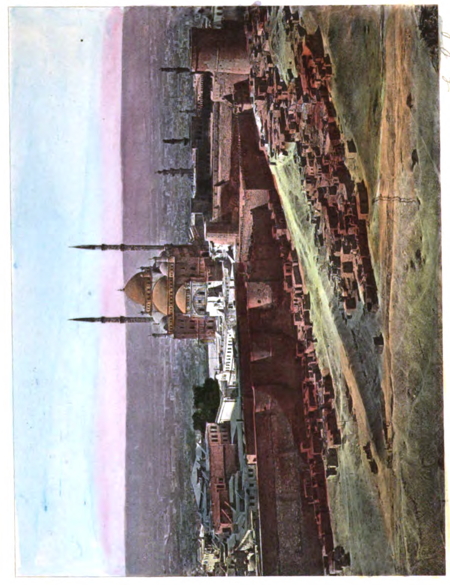
LIST OF ILLUSTRATIONS↩
- Cairo. Frontispiece. From a photograph.
- Mahomet, page 30. From a rare print.
- The Temple at Mecca, p. 60. From a rare print.
- Damascus, p. 146. From an old drawing by Dibdin.
- Map of Western Asia, p. 230
- An Arab Horseman, p. 280. From a painting by Adolph Schreyer.
NOTE↩
In the revision of the proof sheets of Chapters L. to LIII. invaluable help has been received from Mr. Stanley Lane-Poole, who, in the case of the previous volumes also, has been untiringly kind in answering questions and making suggestions.
J. B. B.
[IX-1]
CHAPTER L↩
Description of Arabia and its Inhabitants — Birth, Character, and Doctrine of Mahomet — He preaches at Mecca — Flies to Medina — Propagates his Religion by the Sword — Voluntary or reluctant Submission of the Arabs — His Death and Successors — The Claims and Fortunes of Ali and his Descendants
After pursuing, above six hundred years, the fleeting Cæsars of Constantinople and Germany, I now descend, in the reign of Heraclius, on the eastern borders of the Greek monarchy. While the state was exhausted by the Persian war, and the church was distracted by the Nestorian and Monophysite sects, Mahomet, with the sword in one hand and the Koran in the other, erected his throne on the ruins of Christianity and of Rome. The genius of the Arabian prophet, the manners of his nation, and the spirit of his religion involve the causes of the decline and fall of the Eastern empire; and our eyes are curiously intent on one of the most memorable revolutions which have impressed a new and lasting character on the nations of the globe. [1]
In the vacant space between Persia, Syria, Egypt, and [IX-2] Æthiopia, the Arabian peninsula [2] may be conceived as a triangle of spacious but irregular dimensions. From the northern point of Beles [3] on the Euphrates, a line of fifteen hundred miles is terminated by the straits of Babelmandeb and the land of frankincense. About half this length [4] may be allowed for the middle breadth from east to west, from Bassora to Suez, from the Persian Gulf to the Red Sea. [5] [IX-3] The sides of the triangle are gradually enlarged, and the southern basis presents a front of a thousand miles to the Indian Ocean. The entire surface of the peninsula exceeds in a fourfold proportion that of Germany or France; but the far greater part has been justly stigmatised with the epithets of the stony and the sandy. Even the wilds of Tartary are decked by the hand of nature with lofty trees and luxuriant herbage; and the lonesome traveller derives a sort of comfort and society from the presence of vegetable life. But in the dreary waste of Arabia, a boundless level of sand is intersected by sharp and naked mountains, and the face of the desert, without shade or shelter, is scorched by the direct and intense rays of a tropical sun. Instead of refreshing breezes, the winds, particularly from the south-west, diffuse a noxious and even deadly vapour; the hillocks of sand which they alternately raise and scatter are compared to the billows of the ocean; and whole caravans, whole armies, have been lost and buried in the whirlwind. The common benefits of water are an object of desire and contest; and such is the scarcity of wood that some art is requisite to preserve and propagate the element of fire. Arabia is destitute of navigable rivers, which fertilise the soil and convey its produce to the adjacent regions; the torrents that fall from the hills are imbibed by the thirsty earth; the rare and hardy plants, the tamarind or the acacia, that strike their roots into the clefts of the rocks, are nourished by the dews of the night; a scanty supply of rain is collected in cisterns and aqueducts; the wells and springs are the secret treasure of the desert; and the pilgrim of Mecca, [6] after many a dry and sultry march, is disgusted by the taste of the waters, which have rolled over a [IX-4] bed of sulphur or salt. Such is the general and genuine picture of the climate of Arabia. The experience of evil enhances the value of any local or partial enjoyments. A shady grove, a green pasture, a stream of fresh water, are sufficient to attract a colony of sedentary Arabs to the fortunate spots which can afford food and refreshment to themselves and their cattle, and which encourage their industry in the cultivation of the palm-tree and the vine. The high lands that border on the Indian Ocean are distinguished by their superior plenty of wood and water; the air is more temperate, the fruits are more delicious, the animals and the human race more numerous; the fertility of the soil invites and rewards the toil of the husbandman; and the peculiar gifts of frankincense [7] and coffee have attracted, in different ages, the merchants of the world. If it be compared with the rest of the peninsula, this sequestrated region may truly deserve the appellation of the happy; and the splendid colouring of fancy and fiction has been suggested by contrast and countenanced by distance. It was for this earthly paradise that nature had reserved her choicest favours and her most curious workmanship; the incompatible blessings of luxury and innocence were ascribed to the natives; the soil was impregnated with gold [8] and gems, and both the land and sea were taught to exhale the odours of aromatic sweets. This division of the sandy, the stony, and the happy, so familiar to the Greeks and Latins, is unknown to the Arabians themselves; and it is singular enough that a country, whose language [IX-5] and inhabitants had ever been the same, should scarcely retain a vestige of its ancient geography. The maritime districts of Bahrein and Oman are opposite to the realm of Persia. The kingdom of Yemen displays the limits, or at least the situation, of Arabia Felix; the name Neged is extended over the inland space; and the birth of Mahomet has illustrated the province of Hejaz along the coast of the Red Sea. [9]
The measure of population is regulated by the means of subsistence; and the inhabitants of this vast peninsula might be out-numbered by the subjects of a fertile and industrious province. Along the shores of the Persian Gulf, of the ocean, and even of the Red Sea, the Ichthyophagi, [10] or fish-eaters, continued to wander in quest of their precarious food. In this primitive and abject state, which ill deserves the name of society, the human brute, without arts or laws, almost without sense or language, is poorly distinguished from the rest of the animal creation. Generations and ages might roll away in silent oblivion, and the helpless savage was restrained from multiplying his race by the wants and pursuits which confined his existence to the narrow margin of the sea-coast. But in an early period of antiquity the great body of the Arabs had emerged from this scene of misery; and, as the naked wilderness could not maintain a people of hunters, they rose at once to the more secure and plentiful condition of the pastoral life. The same life is uniformly pursued by the roving [IX-6] tribes of the desert, and in the portrait of the modern Bedoweens we may trace the features of their ancestors, [11] who, in the age of Moses or Mahomet, dwelt under similar tents, and conducted their horses and camels and sheep to the same springs and the same pastures. Our toil is lessened, and our wealth is increased, by our dominion over the useful animals; and the Arabian shepherd had acquired the absolute possession of a faithful friend and a laborious slave. [12] Arabia, in the opinion of the naturalist, is the genuine and original country of the horse; the climate most propitious, not indeed to the size, but to the spirit and swiftness, of that generous animal. The merit of the Barb, the Spanish, and the English breed is derived from a mixture of Arabian blood; [13] the Bedoweens preserve, with superstitious care, the honours and the memory of the purest race; the males are sold at a high price, but the females are seldom alienated; and the birth of a noble foal was esteemed, among the tribes, as a subject of joy and mutual congratulation. These horses are educated in the tents, among the children of the Arabs, [14] with a tender [IX-7] familiarity, which trains them in the habits of gentleness and attachment. They are accustomed only to walk and to gallop; their sensations are not blunted by the incessant abuse of the spur and the whip; their powers are reserved for the moments of flight and pursuit; but no sooner do they feel the touch of the hand or the stirrup than they dart away with the swiftness of the wind; and, if their friend be dismounted in the rapid career, they instantly stop till he has recovered his seat. In the sands of Africa and Arabia the camel is a sacred and precious gift. That strong and patient beast of burthen can perform, without eating or drinking, a journey of several days; [15] and a reservoir of fresh water is preserved in a large bag, a fifth stomach of the animal, whose body is imprinted with the marks of servitude. The larger breed is capable of transporting a weight of a thousand pounds; and the dromedary, of a lighter and more active frame, outstrips the fleetest courser in the race. Alive or dead, almost every part of the camel is serviceable to man; her milk is plentiful and nutritious; the young and tender flesh has the taste of veal; [16] a valuable salt is extracted from the urine; the dung supplies the deficiency of fuel; and the long hair, which falls each year and is renewed, is coarsely manufactured into the garments, the furniture, and the tents of the Bedoweens. In the rainy seasons they consume the rare and insufficient herbage of the desert; during the heats of summer and the scarcity of winter, they remove their encampments to the sea-coast, the hills of Yemen, or the neighbourhood of the Euphrates, and have often extorted the dangerous licence of visiting the banks of the Nile and the villages of Syria and Palestine. The life of a wandering Arab is a life of danger and distress; and, [IX-8] though sometimes, by rapine or exchange, he may appropriate the fruits of industry, a private citizen in Europe is in the possession of more solid and pleasing luxury than the proudest emir who marches in the field at the head of ten thousand horse.
Yet an essential difference may be found between the hordes of Scythia and the Arabian tribes, since many of the latter were collected into towns and employed in the labours of trade and agriculture. A part of their time and industry was still devoted to the management of their cattle; they mingled, in peace and war, with their brethren of the desert; and the Bedoweens derived from their useful intercourse some supply of their wants and some rudiments of art and knowledge. Among the forty-two cities of Arabia, [17] enumerated by Abulfeda, the most ancient and populous were situate in the happy Yemen; the towers of Saana [18] and the marvellous reservoir of Merab [19] were constructed by the kings of the Homerites; but their profane lustre was eclipsed by the prophetic glories of Medina [20] [IX-9] and Mecca, [21] near the Red Sea, and at the distance from each other of two hundred and seventy miles. The last of these holy places was known to the Greeks under the name of Macoraba; and the termination of the word is expressive of its greatness, which has not indeed, in the most flourishing period, exceeded the size and populousness of Marseilles. Some latent motive, perhaps of superstition, must have impelled the founders, in the choice of a most unpromising situation. They erected their habitations of mud or stone in a plain about two miles long and one mile broad, at the foot of three barren mountains; the soil is a rock; the water even of the holy well of Zemzem is bitter or brackish; the pastures are remote from the city; and grapes are transported about seventy miles from the gardens of Tayef. The fame and spirit of the Koreishites, who reigned in Mecca, were conspicuous among the Arabian tribes; but their ungrateful soil refused the labours of agriculture, and their position was favourable to the enterprises of trade. By the sea-port of Gedda, at the distance only of forty miles, they maintained an easy correspondence with Abyssinia; and that Christian kingdom afforded the first refuge to the disciples of Mahomet. The treasures of Africa were conveyed over the peninsula to [IX-10] Gerrha or Katif, in the province of Bahrein, a city built, as it is said, of rock-salt, by the Chaldæan exiles; [22] and from thence, with the native pearls of the Persian Gulf, they were floated on rafts to the mouth of the Euphrates. Mecca is placed almost at an equal distance, a month’s journey, between Yemen on the right, and Syria on the left, hand. The former was the winter, the latter the summer, station of her caravans; and their seasonable arrival relieved the ships of India from the tedious and troublesome navigation of the Red Sea. In the markets of Saana and Merab, in the harbours of Oman and Aden, the camels of the Koreishites were laden with a precious cargo of aromatics; a supply of corn and manufactures was purchased in the fairs of Bostra and Damascus; the lucrative exchange diffused plenty and riches in the streets of Mecca; and the noblest of her sons united the love of arms with the profession of merchandise. [23]
The perpetual independence of the Arabs has been the theme of praise among strangers and natives; and the arts of controversy transform this singular event into a prophecy and a miracle, in favour of the posterity of Ismael. [24] Some exceptions, that can neither be dissembled nor eluded, render this mode of reasoning as indiscreet as it is superfluous: the kingdom of Yemen has been successively subdued by the Abyssinians, the Persians, the sultans of Egypt, [25] and the [IX-11] Turks; [26] the holy cities of Mecca and Medina have repeatedly bowed under a Scythian tyrant; and the Roman province of Arabia [27] embraced the peculiar wilderness in which Ismael and his sons must have pitched their tents in the face of their brethren. Yet these exceptions are temporary or local; the body of the nation has escaped the yoke of the most powerful monarchies; the arms of Sesostris and Cyrus, of Pompey and Trajan, could never achieve the conquest of Arabia; the present sovereign of the Turks [28] may exercise a shadow of jurisdiction, but his pride is reduced to solicit the friendship of a people whom it is dangerous to provoke and fruitless to attack. The obvious causes of their freedom are inscribed on the character and country of the Arabs. Many ages before Mahomet, [29] their intrepid valour had been severely felt by their neighbours in offensive and defensive war. The patient [IX-12] and active virtues of a soldier are insensibly nursed in the habits and discipline of a pastoral life. The care of the sheep and camels is abandoned to the women of the tribe; but the martial youth under the banner of the emir is ever on horseback and in the field, to practise the exercise of the bow, the javelin, and the scymetar. The long memory of their independence is the firmest pledge of its perpetuity, and succeeding generations are animated to prove their descent and to maintain their inheritance. Their domestic feuds are suspended on the approach of a common enemy; and in their last hostilities against the Turks the caravan of Mecca was attacked and pillaged by fourscore thousand of the confederates. When they advance to battle, the hope of victory is in the front; in the rear, the assurance of a retreat. Their horses and camels, who in eight or ten days can perform a march of four or five hundred miles, disappear before the conqueror; the secret waters of the desert elude his search; and his victorious troops are consumed with thirst, hunger, and fatigue, in the pursuit of an invisible foe, who scorns his efforts, and safely reposes in the heart of the burning solitude. The arms and deserts of the Bedoweens are not only the safeguards of their own freedom, but the barriers also of the happy Arabia, whose inhabitants, remote from war, are enervated by the luxury of the soil and climate. The legions of Augustus melted away in disease and lassitude; [30] and it is only by a naval power that the reduction of Yemen has been successfully attempted. When Mahomet erected his holy standard, [31] that kingdom was a province of the Persian empire; [IX-13] yet seven princes of the Homerites still reigned in the mountains; and the vicegerent of Chosroes was tempted to forget his distant country and his unfortunate master. The historians of the age of Justinian represent the state of the independent Arabs, who were divided by interest or affection in the long quarrel of the East: the tribe of Gassan was allowed to encamp on the Syrian territory; the princes of Hira were permitted to form a city about forty miles to the southward of the ruins of Babylon. Their service in the field was speedy and vigorous; but their friendship was venal, their faith inconstant, their enmity capricious: it was an easier task to excite than to disarm these roving Barbarians; and, in the familiar intercourse of war, they learned to see, and to despise, the splendid weakness both of Rome and of Persia. From Mecca to the Euphrates, the Arabian tribes [32] were confounded by the Greeks and Latins under the general appellation of Saracens, [33] a name which every Christian mouth has been taught to pronounce with terror and abhorrence.
The slaves of domestic tyranny may vainly exult in their [IX-14] national independence; but the Arab is personally free; and he enjoys, in some degree, the benefits of society, without forfeiting the prerogatives of nature. In every tribe, superstition, or gratitude, or fortune has exalted a particular family above the heads of their equals. The dignities of sheikh and emir invariably descend in this chosen race; but the order of succession is loose and precarious; and the most worthy or aged of the noble kinsmen are preferred to the simple, though important, office of composing disputes by their advice and guiding valour by their example. Even a female of sense and spirit has been permitted to command the countrymen of Zenobia. [34] The momentary junction of several tribes produces an army; their more lasting union constitutes a nation; and the supreme chief, the emir of emirs, whose banner is displayed at their head, may deserve, in the eyes of strangers, the honours of the kingly name. If the Arabian princes abuse their power, they are quickly punished by the desertion of their subjects, who had been accustomed to a mild and parental jurisdiction. Their spirit is free, their steps are unconfined, the desert is open, and the tribes and families are held together by a mutual and voluntary compact. The softer natives of Yemen supported the pomp and majesty of a monarch; but, if he could not leave his palace without endangering his life, [35] the active powers of government must have been devolved on his nobles and magistrates. The cities of Mecca and Medina present, in the heart of Asia, the form, or rather the substance, of a commonwealth. The grandfather of Mahomet and his lineal [IX-15] ancestors appear in foreign and domestic transactions as the princes of their country; but they reigned, like Pericles at Athens, or the Medici at Florence, by the opinion of their wisdom and integrity; their influence was divided with their patrimony; and the sceptre was transferred from the uncles of the prophet to a younger branch of the tribe of Koreish. On solemn occasions they convened the assembly of the people; and, since mankind must be either compelled or persuaded to obey, the use and reputation of oratory among the ancient Arabs is the clearest evidence of public freedom. [36] But their simple freedom was of a very different cast from the nice and artificial machinery of the Greek and Roman republics, in which each member possessed an undivided share of the civil and political rights of the community. In the more simple state of the Arabs the nation is free, because each of her sons disdains a base submission to the will of a master. His breast is fortified with the austere virtues of courage, patience, and sobriety; the love of independence prompts him to exercise the habits of self-command; and the fear of dishonour guards him from the meaner apprehension of pain, of danger, and of death. The gravity and firmness of the mind is conspicuous in his outward demeanour; his speech is slow, weighty, and concise; he is seldom provoked to laughter; his only gesture is that of stroking his beard, the venerable symbol of manhood; and the sense of his own importance teaches him to accost his equals without levity and his superiors without awe. [37] The liberty of the Saracens survived their conquests; the first caliphs indulged the bold and familiar language of their subjects; they ascended [IX-16] the pulpit to persuade and edify the congregation; nor was it before the seat of empire was removed to the Tigris that the Abbassides adopted the proud and pompous ceremonial of the Persian and Byzantine courts.
In the study of nations and men, we may observe the causes that render them hostile or friendly to each other, that tend to narrow or enlarge, to mollify or exasperate, the social character. The separation of the Arabs from the rest of mankind has accustomed them to confound the ideas of stranger and enemy; and the poverty of the land has introduced a maxim of jurisprudence which they believe and practise to the present hour. They pretend that, in the division of the earth, the rich and fertile climates were assigned to the other branches of the human family; and that the posterity of the outlaw Ismael might recover, by fraud or force, the portion of inheritance of which he had been unjustly deprived. According to the remark of Pliny, the Arabian tribes are equally addicted to theft and merchandise; the caravans that traverse the desert are ransomed or pillaged; and their neighbours, since the remote times of Job and Sesostris, [38] have been the victims of their rapacious spirit. If a Bedoween discovers from afar a solitary traveller, he rides furiously against him, crying, with a loud voice, “Undress thyself, thy aunt (my wife) is without a garment.” A ready submission entitles him to mercy; resistance will provoke the aggressor, and his own blood must expiate the blood which he presumes to shed in legitimate defence. A single robber or a few associates are branded with their genuine name; but the exploits of a numerous band assume [IX-17] the character of a lawful and honourable war. The temper of a people, thus armed against mankind, was doubly inflamed by the domestic licence of rapine, murder, and revenge. In the constitution of Europe, the right of peace and war is now confined to a small, and the actual exercise to a much smaller, list of respectable potentates; but each Arab, with impunity and renown, might point his javelin against the life of his countryman. The union of the nation consisted only in a vague resemblance of language and manners; and in each community the jurisdiction of the magistrate was mute and impotent. Of the time of ignorance which preceded Mahomet, seventeen hundred battles [39] are recorded by tradition; hostility was embittered with the rancour of civil faction; and the recital, in prose or verse, of an absolete feud was sufficient to rekindle the same passions among the descendants of the hostile tribes. In private life, every man, at least every family, was the judge and avenger of its own cause. The nice sensibility of honour, which weighs the insult rather than the injury, sheds its deadly venom on the quarrels of the Arabs; the honour of their women, and of their beards, is most easily wounded; an indecent action, a contemptuous word, can be expiated only by the blood of the offender; and such is their patient inveteracy that they expect whole months and years the opportunity of revenge. A fine or compensation for murder is familiar to the Barbarians of every age; but in Arabia the kinsmen of the dead are at liberty to accept the atonement, or to exercise with their own hands the law of retaliation. The refined malice of the Arabs refuses even the head of the murderer, substitutes an innocent to the guilty person, and transfers the penalty to the best and most considerable of the race by whom they have [IX-18] been injured. If he falls by their hands, they are exposed in their turn to the danger of reprisals; the interest and principal of the bloody debt are accumulated; the individuals of either family lead a life of malice and suspicion, and fifty years may sometimes elapse before the account of vengeance be finally settled. [40] This sanguinary spirit, ignorant of pity or forgiveness, has been moderated, however, by the maxims of honour, which require in every private encounter some decent equality of age and strength, of numbers and weapons. An annual festival of two, perhaps of four, months was observed by the Arabs before the time of Mahomet, during which their swords were religiously sheathed, both in foreign and domestic hostility; and this partial truce is more strongly expressive of the habits of anarchy and warfare. [41]
But the spirit of rapine and revenge was attempered by the milder influence of trade and literature. The solitary peninsula is encompassed by the most civilised nations of the ancient world; the merchant is the friend of mankind; and the annual caravans imported the first seeds of knowledge and politeness into the cities and even the camps of the desert. Whatever may be the pedigree of the Arabs, their language is derived from the same original stock with the Hebrew, the Syriac, and the Chaldæan tongues; the independence of the tribes was marked by their peculiar dialects; [42] but each, after [IX-19] their own, allowed a just preference to the pure and perspicuous idiom of Mecca. In Arabia as well as in Greece, the perfection of language outstripped the refinement of manners; and her speech could diversify the fourscore names of honey, the two hundred of a serpent, the five hundred of a lion, the thousand of a sword, at a time when this copious dictionary was entrusted to the memory of an illiterate people. The monuments of the Homerites were inscribed with an obsolete and mysterious character; but the Cufic letters, the groundwork of the present alphabet, were invented on the banks of the Euphrates; and the recent invention was taught at Mecca by a stranger who settled in that city after the birth of Mahomet. The arts of grammar, of metre, and of rhetoric were unknown to the freeborn eloquence of the Arabians; but their penetration was sharp, their fancy luxuriant, their wit strong and sententious, [43] and their more elaborate compositions were addressed with energy and effect to the minds of their hearers. The genius and merit of a rising poet was celebrated by the applause of his own and the kindred tribes. A solemn banquet was prepared, and a chorus of women, striking their tymbals, and displaying the pomp of their nuptials, sung in the presence of their sons and husbands the felicity of their native tribe; that a champion had now appeared to vindicate their rights; that a herald had raised his voice to immortalise their renown. The distant or hostile tribes resorted to an annual fair, which was abolished by the fanaticism of the first Moslems: a national assembly that must have contributed to refine and harmonise the Barbarians. [IX-20] Thirty days were employed in the exchange, not only of corn and wine, but of eloquence and poetry. The prize was disputed by the generous emulation of the bards; the victorious performance was deposited in the archives of princes and emirs; and we may read in our own language the seven original poems which were inscribed in letters of gold and suspended in the temple of Mecca. [44] The Arabian poets were the historians and moralists of the age; and, if they sympathised with the prejudices, they inspired and crowned the virtues, of their countrymen. The indissoluble union of generosity and valour was the darling theme of their song; and, when they pointed their keenest satire against a despicable race, they affirmed, in the bitterness of reproach, that the men knew not how to give nor the women to deny. [45] The same hospitality which was practised by Abraham and celebrated by Homer is still renewed in the camps of the Arabs. The ferocious Bedoweens, the terror of the desert, embrace, without inquiry or hesitation, the stranger who dares to confide in their honour and to enter their tent. His treatment is kind and respectful; he shares the wealth or the poverty of his host; and, after a needful repose, he is dismissed on his way, with thanks, with blessings, and perhaps with gifts. The heart and hand are more largely expanded by the wants of a brother or a friend; but the heroic acts that could deserve the public applause must have surpassed the narrow measure of discretion and experience. A dispute had arisen, who, among citizens of Mecca, was entitled to the [IX-21] prize of generosity; and a successive application was made to the three who were deemed most worthy of the trial. Abdallah, the son of Abbas, had undertaken a distant journey, and his foot was in the stirrup when he heard the voice of a suppliant, “O son of the uncle of the apostle of God, I am a traveller, and in distress!” He instantly dismounted to present the pilgrim with his camel, her rich caparison, and a purse of four thousand pieces of gold, excepting only the sword, either for its intrinsic value or as the gift of an honoured kinsman. The servant of Kais informed the second suppliant that his master was asleep; but he immediately added, “Here is a purse of seven thousand pieces of gold (it is all we have in the house), and here is an order that will entitle you to a camel and a slave.” The master, as soon as he awoke, praised and enfranchised his faithful steward, with a gentle reproof that by respecting his slumbers he had stinted his bounty. The third of these heroes, the blind Arabah, at the hour of prayer, was supporting his steps on the shoulders of two slaves. “Alas!” he replied, “my coffers are empty! but these you may sell; if you refuse, I renounce them.” At these words, pushing away the youths, he groped along the wall with his staff. The character of Hatem is the perfect model of Arabian virtue; [46] he was brave and liberal, an eloquent poet and a successful robber: forty camels were roasted at his hospitable feast; and at the prayer of a suppliant enemy he restored both the captives and the spoil. The freedom of his countrymen disdained the laws of justice; they proudly indulged the spontaneous impulse of pity and benevolence.
The religion of the Arabs, [47] as well as of the Indians, consisted [IX-22] in the worship of the sun, the moon, and the fixed stars; a primitive and specious mode of superstition. The bright luminaries of the sky display the visible image of a Deity; their number and distance convey to a philosophic, or even a vulgar, eye the idea of boundless space: the character of eternity is marked on these solid globes, that seem incapable of corruption or decay: the regularity of their motions may be ascribed to a principle of reason or instinct; and their real or imaginary influence encourages the vain belief that the earth and its inhabitants are the object of their peculiar care. The science of astronomy was cultivated at Babylon; but the school of the Arabs was a clear firmament and a naked plain. In their nocturnal marches, they steered by the guidance of the stars; their names, and order, and daily station were familiar to the curiosity and devotion of the Bedoween; and he was taught by experience to divide in twenty-eight parts the zodiac of the moon, and to bless the constellations who refreshed with salutary rains the thirst of the desert. The reign of the heavenly orbs could not be extended beyond the visible sphere; and some metaphysical powers were necessary to sustain the transmigration of souls and the resurrection of bodies; a camel was left to perish on the grave, that he might serve his master in another life; and the invocation of departed spirits implies that they were still endowed with consciousness and power. I am ignorant, and I am careless, of the blind mythology of the Barbarians; of the local deities, of the stars, the air, and the earth, of their sex or titles, their attributes or subordination. Each tribe, each family, each independent warrior, created and changed the rites and the object of his fantastic worship; but the nation, in every age, has bowed to the religion, as well as to the language, of [IX-23] Mecca. The genuine antiquity of the Caaba ascends beyond the Christian era: in describing the coast of the Red Sea, the Greek historian Diodorus [48] has remarked, between the Thamudites and the Sabæans, a famous temple, whose superior sanctity was revered by all the Arabians; the linen or silken veil, which is annually renewed by the Turkish emperor, was first offered by a pious king of the Homerites, who reigned seven hundred years before the time of Mahomet. [49] A tent or a cavern might suffice for the worship of the savages, but an edifice of stone and clay has been erected in its place; and the art and power of the monarchs of the East have been confined to the simplicity of the original model. [50] A spacious portico encloses the quadrangle of the Caaba, a square chapel, twenty-four cubits long, twenty-three broad, and twenty-seven high; a door and a window admit the light; the double roof is supported by three pillars of wood; a spout (now of gold) discharges the rain-water, [IX-24] and the well Zemzem is protected by a dome from accidental pollution. The tribe of Koreish, by fraud or force, had acquired the custody of the Caaba: the sacerdotal office devolved through four lineal descents to the grandfather of Mahomet; and the family of the Hashemites, from whence he sprung, was the most respectable and sacred in the eyes of their country. [51] The precincts of Mecca enjoyed the rights of sanctuary; and, in the last month of each year, the city and the temple were crowded with a long train of pilgrims, who presented their vows and offerings in the house of God. The same rites, which are now accomplished by the faithful Musulmman, were invented and practised by the superstition of the idolaters. At an awful distance they cast away their garments; seven times, with hasty steps, they encircled the Caaba, and kissed the black stone; seven times they visited and adored the adjacent mountains; seven times they threw stones into the valley of Mina; and the pilgrimage was achieved, as at the present hour, by a sacrifice of sheep and camels, and the burial of their hair and nails in the consecrated ground. Each tribe either found or introduced in the Caaba their domestic worship; the temple was adorned, or defiled, with three hundred and sixty idols of men, eagles, lions, and antelopes; and most conspicuous was the statue of Hebal, of red agate, holding in his hand seven arrows, without heads or feathers, the instruments and symbols of profane divination. But this statue was a monument of Syrian arts; the devotion of the ruder ages was content with a pillar or a tablet; and the rocks of the desert were hewn into gods or altars, in imitation of the black stone [52] of Mecca, [IX-25] which is deeply tainted with the reproach of an idolatrous origin. From Japan to Peru, the use of sacrifice has universally prevailed; and the votary has expressed his gratitude, or fear, by destroying or consuming, in honour of the gods, the dearest and most precious of their gifts. The life of a man [53] is the most precious oblation to deprecate a public calamity: the altars of Phœnicia and Egypt, of Rome and Carthage, have been polluted with human gore; the cruel practice was long preserved among the Arabs; in the third century, a boy was annually sacrificed by the tribe of the Dumatians; [54] and a royal captive was piously slaughtered by the prince of the Saracens, the ally and soldier of the emperor Justinian. [55] A parent who drags his son to the altar exhibits the most painful and sublime effort of fanaticism; the deed, or the intention, was sanctified by the example of saints and heroes; and the father of Mahomet himself was devoted by a rash vow, and hardly ransomed for the equivalent of an hundred camels. In the time of ignorance, the Arabs, like the Jews and Egyptians, abstained from the taste of swine’s flesh; [56] they [IX-26] circumcised [57] their children at the age of puberty; the same customs, without the censure or the precept of the Koran, have been silently transmitted to their posterity and proselytes. It has been sagaciously conjectured that the artful legislator indulged the stubborn prejudices of his countrymen. It is more simple to believe that he adhered to the habits and opinions of his youth, without foreseeing that a practice congenial to the climate of Mecca might become useless or inconvenient on the banks of the Danube or the Volga.
Arabia was free; the adjacent kingdoms were shaken by the storms of conquest and tyranny, and the persecuted sects fled to the happy land where they might profess what they thought and practise what they professed. The religions of the Sabians and Magians, of the Jews and Christians, were disseminated from the Persian Gulf to the Red Sea. In a remote period of antiquity, Sabianism was diffused over Asia by the science of the Chaldæans [58] and the arms of the Assyrians. From the observations of two thousand years the priests and astronomers of Babylon [59] deduced the eternal [IX-27] laws of nature and providence. They adored the seven gods or angels who directed the course of the seven planets and shed their irresistible influence on the earth. The attributes of the seven planets, with the twelve signs of the zodiac and the twenty-four constellations of the northern and southern hemisphere, were represented by images and talismans; the seven days of the week were dedicated to their respective deities; the Sabians prayed thrice each day; and the temple of the moon at Haran was the term of their pilgrimage. [60] But the flexible genius of their faith was always ready either to teach or to learn; in the tradition of the creation, the deluge, and the patriarchs, they held a singular agreement with their Jewish captives; they appealed to the secret books of Adam, Seth, and Enoch; and a slight infusion of the gospel has transformed the last remnant of the Polytheists into the Christians of St. John, in the territory of Bassora. [61] The altars of Babylon were overturned by the Magians; but the injuries of the Sabians were revenged by the sword of Alexander; Persia groaned above five hundred years under a foreign yoke; and the purest disciples of Zoroaster escaped from the contagion of idolatry, and breathed with their adversaries the freedom of the desert. [62] Seven hundred years before the death of Mahomet, the Jews were settled in Arabia; and a far greater multitude was expelled from the Holy Land in the wars of Titus and Hadrian. The [IX-28] industrious exiles aspired to liberty and power: they erected synagogues in the cities and castles in the wilderness, and their Gentile converts were confounded with the children of Israel, whom they resembled in the outward mark of circumcision. The Christian missionaries were still more active and successful: the Catholics asserted their universal reign; the sects whom they oppressed successively retired beyond the limits of the Roman empire; the Marcionites and the Manichæans dispersed their phantastic opinions and apocryphal gospels; the churches of Yemen, and the princes of Hira and Gassan, were instructed in a purer creed by the Jacobite and Nestorian bishops. [63] The liberty of choice was presented to the tribes: each Arab was free to elect or to compose his own private religion; and the rude superstition of his house was mingled with the sublime theology of saints and philosophers. A fundamental article of faith was inculcated by the consent of the learned strangers: the existence of one supreme God, who is exalted above the powers of heaven and earth, but who has often revealed himself to mankind by the ministry of his angels and prophets, and whose grace or justice has interrupted, by seasonable miracles, the order of nature. The most rational of the Arabs acknowledged his power, though they neglected his worship; [64] and it was habit rather than conviction that still attached them to the relics of idolatry. The Jews and Christians were the people of the book; the Bible was already translated into the Arabic language, [65] and the volume of the [IX-29] Old Testament was accepted by the concord of these implacable enemies. In the story of the Hebrew patriarchs, the Arabs were pleased to discover the fathers of their nation. They applauded the birth and promises of Ismael; revered the faith and virtue of Abraham; traced his pedigree and their own to the creation of the first man, and imbibed with equal credulity the prodigies of the holy text and the dreams and traditions of the Jewish rabbis.
The base and plebeian origin of Mahomet is an unskilful calumny of the Christians, [66] who exalt instead of degrading the merit of their adversary. His descent from Ismael was a national privilege or fable; but, if the first steps of the pedigree [67] are dark and doubtful, he could produce many generations of pure and genuine nobility: he sprung from the tribe of Koreish and the family of Hashem, the most illustrious of the Arabs, the princes of Mecca, and the hereditary guardians of the Caaba. The grandfather of Mahomet was Abdol Motalleb, the son of Hashem, a wealthy and generous citizen, who relieved the distress of famine with the [IX-30] supplies of commerce. Mecca, which had been fed by the liberality of the father, was saved by the courage of the son. The kingdom of Yemen was subject to the Christian princes of Abyssinia; their vassal Abrahah was provoked by an insult to avenge the honour of the cross; and the holy city was invested by a train of elephants and an army of Africans. A treaty was proposed; and in the first audience the grandfather of Mahomet demanded the restitution of his cattle. “And why,” said Abrahah, “do you not rather implore my clemency in favour of your temple, which I have threatened to destroy?” “Because,” replied the intrepid chief, “the cattle is my own; the Caaba belongs to the gods, and they will defend their house from injury and sacrilege.” The want of provisions, or the valour of the Koreish, compelled the Abyssinians to a disgraceful retreat; their discomfiture had been adorned with a miraculous flight of birds, who showered down stones on the heads of the infidels; and the deliverance was along commemorated by the era of the elephant. [68] The glory of Abdol Motalleb was crowned with [IX-none] [IX-31] domestic happiness, his life was prolonged to the age of one hundred and ten years, and he became the father of six daughters and thirteen sons. His best beloved Abdallah was the most beautiful and modest of the Arabian youth; and in the first night, when he consummated his marriage with Amina, of the noble race of the Zahrites, two hundred virgins are said to have expired of jealousy and despair. Mahomet, or more properly Mohammed, the only son of Abdallah and Amina, was born at Mecca, four years after the death of Justinian, and two months after the defeat of the Abyssinians, [69] whose victory would have introduced into the Caaba the religion of the Christians. In his early infancy, he was deprived of his father, his mother, and his grandfather; his uncles were strong and numerous; and, in the division of the inheritance, the orphan’s share was reduced to five camels and an Æthiopian maid-servant. At home and abroad, in peace and war, Abu Taleb, the most respectable of his uncles, was the guide and guardian of his youth; in his twenty-fifth year, he entered into the service of Cadijah, a rich and noble widow of Mecca, who soon rewarded his fidelity with the gift of her hand and fortune. The marriage contract, in the simple style of antiquity, recites the mutual love of Mahomet and Cadijah; describes him as the most accomplished of the tribe of Koreish; and stipulates [IX-32] a dowry of twelve ounces of gold and twenty camels, which was supplied by the liberality of his uncle. [70] By this alliance, the son of Abdallah was restored to the station of his ancestors; and the judicious matron was content with his domestic virtues, till, in the fortieth year of his age, [71] he assumed the title of a prophet, and proclaimed the religion of the Koran.
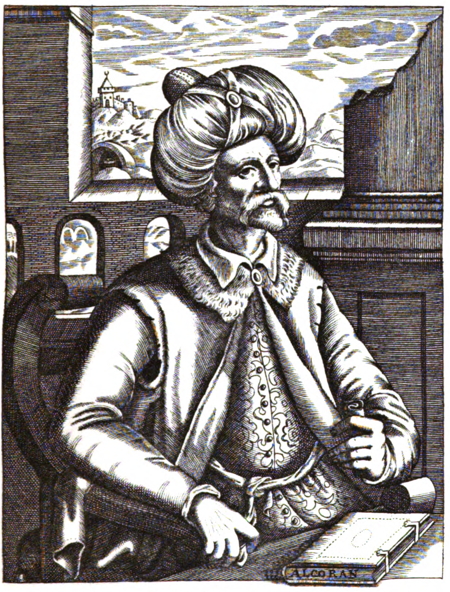
Mahomet, page 30. From a rare print.
According to the tradition of his companions, Mahomet [72] was distinguished by the beauty of his person, an outward gift which is seldom despised, except by those to whom it has been refused. Before he spoke, the orator engaged on his side the affections of a public or private audience. They applauded his commanding presence, his majestic aspect, his piercing eye, his gracious smile, his flowing beard, his countenance that painted every sensation of the soul, and his gestures that enforced each expression of the tongue. In the familiar offices of life he scrupulously adhered to the grave and ceremonious politeness of his country; his respectful attention to the rich and powerful was dignified by his condescension and affability to the poorest citizens of Mecca; the frankness of his manner concealed the artifice of his [IX-33] views; and the habits of courtesy were imputed to personal friendship or universal benevolence. His memory was capacious and retentive, his wit easy and social, his imagination sublime, his judgment clear, rapid, and decisive. He possessed the courage both of thought and action; and, although his designs might gradually expand with his success, the first idea which he entertained of his divine mission bears the stamp of an original and superior genius. The son of Abdallah was educated in the bosom of the noblest race, in the use of the purest dialect of Arabia; and the fluency of his speech was corrected and enhanced by the practice of discreet and seasonable silence. With these powers of eloquence, Mahomet was an illiterate Barbarian; his youth had never been instructed in the arts of reading and writing; [73] the common ignorance exempted him from shame or reproach, but he was reduced to a narrow circle of existence, and deprived of those faithful mirrors which reflect to our mind the minds of sages and heroes. Yet the book of nature and of man was open to his view; and some fancy has been indulged in the [IX-34] political and philosophical observations which are ascribed to the Arabian traveller. [74] He compares the nations and the religions of the earth; discovers the weakness of the Persian and Roman monarchies; beholds, with pity and indignation, the degeneracy of the times; and resolves to unite, under one God and one king, the invincible spirit and primitive virtues of the Arabs. Our more accurate inquiry will suggest that, instead of visiting the courts, the camps, the temples of the East, the two journeys of Mahomet into Syria were confined to the fairs of Bostra and Damascus; that he was only thirteen years of age when he accompanied the caravan of his uncle; and that his duty compelled him to return as soon as he had disposed of the merchandise of Cadijah. In these hasty and superficial excursions, the eye of genius might discern some objects invisible to his grosser companions; some seeds of knowledge might be cast upon a fruitful soil; but his ignorance of the Syriac language must have checked his curiosity; [75] and I cannot perceive, in the life or writings of Mahomet, that his prospect was far extended beyond the limits of the Arabian world. From every region of that solitary world, the pilgrims of Mecca were annually assembled by the calls of devotion and commerce: in the free concourse of multitudes, a simple citizen, in his native tongue, might study the political state and character of the tribes, the theory and practice of the Jews and Christians. Some useful strangers might be tempted, or forced, to implore the rights of hospitality; and the enemies of Mahomet have named the Jew, the Persian, and the Syrian monk, whom [IX-35] they accuse of lending their secret aid to the composition of the Koran. [76] Conversation enriches the understanding, but solitude is the school of genius; and the uniformity of a work denotes the hand of a single artist. From his earliest youth Mahomet was addicted to religious contemplation; [77] each year, during the month of Ramadan, he withdrew from the world and from the arms of Cadijah; in the cave of Hera, three miles from Mecca, [78] he consulted the spirit of fraud or enthusiasm, whose abode is not in the heavens, but in the mind of the prophet. The faith which, under the name of Islam, [78a] he preached to his family and nation is compounded of an eternal truth, and a necessary fiction, That there is only one God, and that Mahomet is the apostle of God.
It is the boast of the Jewish apologists that, while the learned nations of antiquity were deluded by the fables of polytheism, their simple ancestors of Palestine preserved the knowledge and worship of the true God. The moral attributes of Jehovah may not easily be reconciled with the standard of human virtue; his metaphysical qualities are [IX-36] darkly expressed; but each page of the Pentateuch and the Prophets is an evidence of his power; the unity of his name is inscribed on the first table of the law; and his sanctuary was never defiled by any visible image of the invisible essence. After the ruin of the temple, the faith of the Hebrew exiles was purified, fixed, and enlightened, by the spiritual devotion of the synagogue; and the authority of Mahomet will not justify his perpetual reproach that the Jews of Mecca or Medina adored Ezra as the son of God. [79] But the children of Israel had ceased to be a people; and the religions of the world were guilty, at least in the eyes of the prophet, of giving sons, or daughters, or companions to the supreme God. In the rude idolatry of the Arabs, the crime is manifest and audacious; the Sabians are poorly excused by the pre-eminence of the first planet or intelligence in their celestial hierarchy; and in the Magian system the conflict of the two principles betrays the imperfection of the conqueror. The Christians of the seventh century had insensibly relapsed into a semblance of paganism; their public and private vows were addressed to the relics and images that disgraced the temples of the East; the throne of the Almighty was darkened by a cloud of martyrs, and saints, and angels, the objects of popular veneration; and the Collyridian heretics, who flourished in the fruitful soil of Arabia, invested the Virgin Mary with the name and honours of a goddess. [80] The mysteries of the Trinity and Incarnation appear to contradict the principle of the divine unity. In their obvious sense they introduce three equal deities, and transform the [IX-37] man Jesus into the substance of the son of God; [81] an orthodox commentary will satisfy only a believing mind; intemperate curiosity and zeal had torn the veil of the sanctuary; and each of the Oriental sects was eager to confess that all, except themselves, deserved the reproach of idolatry and polytheism. The creed of Mahomet is free from suspicion or ambiguity; and the Koran is a glorious testimony to the unity of God. The prophet of Mecca rejected the worship of idols and men, of stars and planets, on the rational principle that whatever rises must set, that whatever is born must die, that whatever is corruptible must decay and perish. [82] In the author of the universe, his rational enthusiasm confessed and adored an infinite and eternal being, without form or place, without issue or similitude, present to our most secret thoughts, existing by the necessity of his own nature, and deriving from himself all moral and intellectual perfection. These sublime truths, thus announced in the language of the prophet, [83] are firmly held by his disciples, and defined with metaphysical precision by the interpreters of the Koran. A philosophic Atheist might subscribe the popular creed of the Mahometans: [84] a creed too sublime [IX-38] perhaps for our present faculties. What object remains for the fancy, or even the understanding, when we have abstracted from the unknown substance all ideas of time and space, of motion and matter, of sensation and reflection? The first principle of reason and revelation was confirmed by the voice of Mahomet; his proselytes, from India to Morocco, are distinguished by the name of Unitarians; and the danger of idolatry has been prevented by the interdiction of images. The doctrine of eternal decrees and absolute predestination is strictly embraced by the Mahometans; and they struggle with the common difficulties, how to reconcile the prescience of God with the freedom and responsibility of man; how to explain the permission of evil under the reign of infinite power and infinite goodness.
The God of nature has written his existence on all his works, and his law in the heart of man. To restore the knowledge of the one, and the practice of the other, has been the real or pretended aim of the prophets of every age; the liberality of Mahomet allowed to his predecessors the same credit which he claimed for himself; and the chain of inspiration was prolonged from the fall of Adam to the promulgation of the Koran. [85] During that period, some rays of prophetic light had been imparted to one hundred and twenty-four thousand of the elect, discriminated by their respective measure of virtue and grace; three hundred and thirteen apostles were sent with a special commission to recall their country from idolatry and vice; one hundred and four volumes have been dictated by the Holy Spirit; and six legislators of transcendent brightness have announced to [IX-39] mankind the six successive revelations of various rights, but of one immutable religion. The authority and station of Adam, Noah, Abraham, Moses, Christ, and Mahomet rise in just gradation above each other; but whosoever hates or rejects any one of the prophets is numbered with the infidels. The writings of the patriarchs were extant only in the apocryphal copies of the Greeks and Syrians; [86] the conduct of Adam had not entitled him to the gratitude or respect of his children; the seven precepts of Noah were observed by an inferior and imperfect class of the proselytes of the synagogues; [87] and the memory of Abraham was obscurely revered by the Sabians in his native land of Chaldæa; of the myriads of prophets, Moses and Christ alone lived and reigned; and the remnant of the inspired writings was comprised in the books of the Old and the New Testament. The miraculous story of Moses is consecrated and embellished in the Koran; [88] and the captive Jews enjoy the secret revenge of imposing their own belief on the nations whose recent creeds they deride. For the author of Christianity, the Mahometans are taught by the prophet to entertain a high and mysterious reverence. [89] “Verily, Christ Jesus, the son of Mary, is the apostle of God, and his word, which he conveyed unto Mary, and a Spirit proceeding from him: honourable in this world, and in the world to come; and one of those who approach [IX-40] near to the presence of God.” [90] The wonders of the genuine and apocryphal gospels [91] are profusely heaped on his head; and the Latin church has not disdained to borrow from the Koran the immaculate conception [92] of his virgin mother. Yet Jesus was a mere mortal; and, at the day of judgment, his testimony will serve to condemn both the Jews, who reject him as a prophet, and the Christians, who adore him as the Son of God. The malice of his enemies aspersed his reputation and conspired against his life; but their intention only was guilty, a phantom or a criminal was substituted on the cross, and the innocent saint was translated to the seventh heaven. [93] During six hundred years the gospel was the way of truth and salvation; but the Christians insensibly forgot both the laws and the example of their founder; and Mahomet was instructed by the Gnostics to accuse the Church, as well as the synagogue, of corrupting the integrity of the sacred text. [94] The piety of Moses and of [IX-41] Christ rejoiced in the assurance of a future prophet, more illustrious than themselves; the evangelic promise of the Paraclete, or Holy Ghost, was prefigured in the name, and accomplished in the person, of Mahomet, [95] the greatest and the last of the apostles of God.
The communication of ideas requires a similitude of thought and language; the discourse of a philosopher would vibrate, without effect, on the ear of a peasant; yet how minute is the distance of their understandings, if it be compared with the contact of an infinite and a finite mind, with the word of God expressed by the tongue or the pen of a mortal? The inspiration of the Hebrew prophets, of the apostles and evangelists of Christ, might not be incompatible with the exercise of their reason and memory; and the diversity of their genius is strongly marked in the style and composition of the books of the Old and New Testament. But Mahomet was contented with a character more humble, yet more sublime, of a simple editor: the substance of the Koran, [96] according to himself or his disciples, is uncreated and eternal, subsisting in the essence of the Deity, and inscribed with a pen of light on the table of his everlasting decrees. A paper copy in a volume of silk and gems was brought down to the lowest heaven by the angel Gabriel, [IX-42] who, under the Jewish œconomy, had indeed been despatched on the most important errands; and this trusty messenger successively revealed the chapters and verses to the Arabian prophet. Instead of a perpetual and perfect measure of the divine will, the fragments of the Koran were produced at the discretion of Mahomet; each revelation is suited to the emergencies of his policy or passion; and all contradiction is removed by the saving maxim that any text of scripture is abrogated or modified by any subsequent passage. The word of God and of the apostle was diligently recorded by his disciples on palm-leaves and the shoulder-bones of mutton; and the pages, without order or connection, were cast into a domestic chest, in the custody of one of his wives. Two years after the death of Mahomet, the sacred volume was collected and published by his friend and successor Abubeker; [97] the work was revised by the caliph Othman, in the thirtieth year of the Hegira; and the various editions of the Koran assert the same miraculous privilege of an uniform and incorruptible text. In the spirit of enthusiasm or vanity, the prophet rests the truth of his mission on the merit of his book, audaciously challenges both men and angels to imitate the beauties of a single page, and presumes to assert that God alone could dictate this incomparable performance. [98] This argument is most powerfully addressed to a devout Arabian, whose mind is attuned to faith and rapture, whose ear is delighted by the music of sounds, and whose ignorance is incapable of comparing the productions of human genius. [99] The harmony and copiousness of style will not reach, in a version, the European [IX-43] infidel; he will peruse, with impatience, the endless incoherent rhapsody of fable, and precept, and declamation, which seldom excites a sentiment or an idea, which sometimes crawls in the dust and is sometimes lost in the clouds. The divine attributes exalt the fancy of the Arabian missionary; but his loftiest strains must yield to the sublime simplicity of the book of Job, composed in a remote age, in the same country, and in the same language. [100] If the composition of the Koran exceed the faculties of a man, to what superior intelligence should we ascribe the Iliad of Homer or the Philippics of Demosthenes? In all religions, the life of the founder supplies the silence of his written revelation: the sayings of Mahomet were so many lessons of truth; his actions so many examples of virtue; and the public and private memorials were preserved by his wives and companions. At the end of two hundred years, the Sonna, or oral law, was fixed and consecrated by the labours of Al Bochari, who discriminated seven thousand two hundred and seventy-five genuine traditions, from a mass of three hundred thousand reports of a more doubtful or spurious character. Each day the pious author prayed in the temple of Mecca, and performed his ablutions with the water of Zemzem; the pages were successively deposited on the pulpit and the sepulchre of the apostle; and the work has been approved by the four orthodox sects of the Sonnites. [101]
The mission of the ancient prophets, of Moses and of Jesus, had been confirmed by many splendid prodigies; and Mahomet [IX-44] was repeatedly urged, by the inhabitants of Mecca and Medina, to produce a similar evidence of his divine legation: to call down from heaven the angel or the volume of his revelation, to create a garden in the desert, or to kindle a conflagration in the unbelieving city. As often as he is pressed by the demands of the Koreish, he involves himself in the obscure boast of vision and prophecy, appeals to the internal proofs of his doctrine, and shields himself behind the providence of God, who refuses those signs and wonders that would depreciate the merit of faith and aggravate the guilt of infidelity. But the modest or angry tone of his apologies betrays his weakness and vexation; and these passages of scandal establish, beyond suspicion, the integrity of the Koran. [102] The votaries of Mahomet are more assured than himself of his miraculous gifts, and their confidence and credulity increase as they are farther removed from the time and place of his spiritual exploits. They believe or affirm that trees went forth to meet him; that he was saluted by stones; that water gushed from his fingers; that he fed the hungry, cured the sick, and raised the dead; that a beam groaned to him; that a camel complained to him; that a shoulder of mutton informed him of its being poisoned; and that both animate and inanimate nature were equally subject to the apostle of God. [103] His dream of a nocturnal journey is seriously described as a real and corporeal transaction. A mysterious animal, the Borak, conveyed him from the temple of Mecca to that of [IX-45] Jerusalem; with his companion Gabriel, he successively ascended the seven heavens, and received and repaid the salutations of the patriarchs, the prophets, and the angels, in their respective mansions. Beyond the seventh heaven, Mahomet alone was permitted to proceed; he passed the veil of unity, approached within two bow-shots of the throne, and felt a cold that pierced him to the heart, when his shoulder was touched by the hand of God. After this familiar though important conversation, he again descended to Jerusalem, remounted the Borak, returned to Mecca, and performed in the tenth part of a night the journey of many thousand years. [104] According to another legend, the apostle confounded in a national assembly the malicious challenge of the Koreish. His resistless word split asunder the orb of the moon: the obedient planet stooped from her station in the sky, accomplished the seven revolutions round the Caaba, saluted Mahomet in the Arabian tongue, and, suddenly contracting her dimensions, entered at the collar, and issued forth through the sleeve, of his shirt. [105] The vulgar are amused with these [IX-46] marvellous tales; but the gravest of the Musulman doctors imitate the modesty of their master, and indulge a latitude of faith or interpretation. [106] They might speciously allege that, in preaching the religion, it was needless to violate the harmony of nature; that a creed unclouded with mystery may be excused from miracles; and that the sword of Mahomet was not less potent than the rod of Moses.
The polytheist is oppressed and distracted by the variety of superstition: a thousand rites of Egyptian origin were interwoven with the essence of the Mosaic law; and the spirit of the Gospel had evaporated in the pageantry of the church. The prophet of Mecca was tempted by prejudice, or policy, or patriotism, to sanctify the rites of the Arabians and the custom of visiting the holy stone of the Caaba. But the precepts of Mahomet himself inculcate a more simple and rational piety: prayer, fasting, and alms are the religious duties of a Musulman; [107] and he is encouraged to hope that prayer will carry him halfway to God, fasting will bring him to the door of his palace, and alms will gain him admittance. [108] I. According to the tradition of the nocturnal journey, the apostle, in his personal [IX-47] conference with the Deity, was commanded to impose on his disciples the daily obligation of fifty prayers. By the advice of Moses, he applied for an alleviation of this intolerable burthen; the number was gradually reduced to five; without any dispensation of business or pleasure, or time or place: the devotion of the faithful is repeated at daybreak, at noon, in the afternoon, in the evening, and at the first watch of the night; and, in the present decay of religious fervour, our travellers are edified by the profound humility and attention of the Turks and Persians. Cleanliness is the key of prayer: the frequent lustration of the hands, the face, and the body, which was practised of old by the Arabs, is solemnly enjoined by the Koran; and a permission is formally granted to supply with sand the scarcity of water. The words and attitudes of supplication, as it is performed either sitting, or standing, or prostrate on the ground, are prescribed by custom or authority, but the prayer is poured forth in short and fervent ejaculations; the measure of zeal is not exhausted by a tedious liturgy; and each Musulman, for his own person, is invested with the character of a priest. Among the Theists, who reject the use of images, it has been found necessary to restrain the wanderings of the fancy by directing the eye and the thought towards a kebla, or visible point of the horizon. The prophet was at first inclined to gratify the Jews by the choice of Jerusalem; but he soon returned to a more natural partiality; and five times every day the eyes of the nations at Astracan, at Fez, at Delhi, are devoutly turned to the holy temple of Mecca. Yet every spot for the service of God is equally pure; the Mahometans indifferently pray in their chamber or in the street. As a distinction from the Jews and Christians, the Friday in each week is set apart for the useful institution of public worship; the people is assembled in the mosch; and the imam, some respectable elder, ascends the pulpit, to begin the prayer and pronounce the sermon. But the Mahometan religion is destitute of priesthood or sacrifice; [108a] [IX-48] and the independent spirit of fanaticism looks down with contempt on the ministers and the slaves of superstition. II. The voluntary [109] penance of the ascetics, the torment and glory of their lives, was odious to a prophet who censured in his companions a rash vow of abstaining from flesh, and women, and sleep, and firmly declared that he would suffer no monks in his religion. [110] Yet he instituted, in each year, a fast of thirty days; and strenuously recommended the observance, as a discipline which purifies the soul and subdues the body, as a salutary exercise of obedience to the will of God and his apostle. During the month of Ramadan, [111] from the rising to the setting of the sun, the Musulman abstains from eating, and drinking, and women, and baths, and perfumes; from all nourishment that can restore his strength, from all pleasure that can gratify his senses. In the revolution of the lunar year, the Ramadan coincides by turns with the winter cold and the summer heat; and the patient martyr, without assuaging his thirst with a drop of water, must expect the close of a tedious and sultry day. The interdiction of wine, peculiar to some orders of priests or hermits, is converted by Mahomet alone into a positive and general law; [112] and a considerable portion of the globe has abjured, at his [IX-49] command, the use of that salutary though dangerous liquor. These painful restraints are, doubtless, infringed by the libertine and eluded by the hypocrite; but the legislator, by whom they are enacted, cannot surely be accused of alluring his proselytes by the indulgence of their sensual appetites. [112a] III. The charity of the Mahometans descends to the animal creation; and the Koran repeatedly inculcates, not as a merit, but as a strict and indispensable duty, the relief of the indigent and unfortunate. Mahomet, perhaps, is the only lawgiver who has defined the precise measure of charity: the standard may vary with the degree and nature of property, as it consists either in money, in corn or cattle, in fruits or merchandise; but the Musulman does not accomplish the law, unless he bestows a tenth of his revenue; and, if his conscience accuses him of fraud or extortion, the tenth, under the idea of restitution, is enlarged to a fifth. [113] Benevolence is the foundation of justice, since we are forbid to injure those whom we are bound to assist. A prophet may reveal the secrets of heaven and of futurity; but in his moral precepts he can only repeat the lessons of our own hearts.
The two articles of belief and the four practical duties of Islam are guarded by rewards and punishments; and the faith of the Musulman is devoutly fixed on the event of the judgment and the last day. The prophet has not presumed to determine the moment of that awful catastrophe, though [IX-50] he darkly announces the signs, both in heaven and earth, which will precede the universal dissolution, when life shall be destroyed and the order of creation shall be confounded in the primitive chaos. At the blast of the trumpet, new worlds will start into being; angels, genii, and men will arise from the dead, and the human soul will again be united to the body. The doctrine of the resurrection was first entertained by the Egyptians; [114] and their mummies were embalmed, their pyramids were constructed, to preserve the ancient mansion of the soul, during a period of three thousand years. But the attempt is partial and unavailing; and it is with a more philosophic spirit that Mahomet relies on the omnipotence of the Creator, whose word can reanimate the breathless clay, and collect the innumerable atoms that no longer retain their form or substance. [115] The intermediate state of the soul it is hard to decide; and those who most firmly believe her immaterial nature are at a loss to understand how she can think or act without the agency of the organs of sense.
The re-union of the soul and body will be followed by the final judgment of mankind; and, in his copy of the Magian picture, the prophet has too faithfully represented the forms of proceeding, and even the slow and successive operations, of an earthly tribunal. By his intolerate adversaries he is upbraided for extending, even to themselves, the hope of salvation, for asserting the blackest heresy that every man who believes in God, and accomplishes good works, may expect in the last day a favourable sentence. Such rational indifference is ill adapted to the character of a fanatic; nor is it probable that a messenger from heaven should depreciate the value and [IX-51] necessity of his own revelation. In the idiom of the Koran, [116] the belief of God is inseparable from that of Mahomet; the good works are those which he has enjoined; and the two qualifications imply the profession of Islam, to which all nations and all sects are equally invited. Their spiritual blindness, though excused by ignorance and crowned with virtue, will be scourged with everlasting torments; and the tears which Mahomet shed over the tomb of his mother, for whom he was forbidden to pray, display a striking contrast of humanity and enthusiasm. [117] The doom of the infidels is common: the measure of their guilt and punishment is determined by the degree of evidence which they have rejected, by the magnitude of the errors which they have entertained; the eternal mansions of the Christians, the Jews, the Sabians, the Magians, and the idolaters are sunk below each other in the abyss; and the lowest hell is reserved for the faithless hypocrites who have assumed the mask of religion. After the greater part of mankind has been condemned for their opinions, the true believers only will be judged by their actions. The good and evil of each Musulman will be accurately weighed in a real or allegorical balance, and a singular mode of compensation will be allowed for the payment of injuries: the aggressor will refund an equivalent of his own good actions, for the benefit of the person whom he has wronged; and, if he should be destitute of any moral property, the weight of his sins will be loaded with an adequate share of the demerits of the sufferer. According as the shares of guilt or virtue shall preponderate, the sentence will be pronounced, [IX-52] and all, without distinction, will pass over the sharp and perilous bridge of the abyss; but the innocent, treading in the footsteps of Mahomet, will gloriously enter the gates of paradise, while the guilty will fall into the first and mildest of the seven hells. The term of expiation will vary from nine hundred to seven thousand years; but the prophet has judiciously promised that all his disciples, whatever may be their sins, shall be saved, by their own faith and his intercession, from eternal damnation. It is not surprising that superstition should act most powerfully on the fears of her votaries, since the human fancy can paint with more energy the misery than the bliss of a future life. With the two simple elements of darkness and fire we create a sensation of pain, which may be aggravated to an infinite degree by the idea of endless duration. But the same idea operates with an opposite effect on the continuity of pleasure; and too much of our present enjoyments is obtained from the relief, or the comparison, of evil. It is natural enough that an Arabian prophet should dwell with rapture on the groves, the fountains, and the rivers of paradise; but, instead of inspiring the blessed inhabitants with a liberal taste for harmony and science, conversation and friendship, he idly celebrates the pearls and diamonds, the robes of silk, palaces of marble, dishes of gold, rich wines, artificial dainties, numerous attendants, and the whole train of sensual and costly luxury, which becomes insipid to the owner, even in the short period of this mortal life. Seventy-two Houris, or black-eyed girls of resplendent beauty, blooming youth, virgin purity, and exquisite sensibility, will be created for the use of the meanest believer; a moment of pleasure will be prolonged to a thousand years, and his faculties will be increased an hundred-fold, to render him worthy of his felicity. Notwithstanding a vulgar prejudice, the gates of heaven will be open to both sexes; but Mahomet has not specified the male companions of the female elect, lest he should either alarm the jealousy of their former husbands or disturb their felicity by the suspicion of an everlasting [IX-53] marriage. This image of a carnal paradise has provoked the indignation, perhaps the envy, of the monks: they declaim against the impure religion of Mahomet; and his modest apologists are driven to the poor excuse of figures and allegories. But the sounder and more consistent party adhere, without shame, to the literal interpretation of the Koran; useless would be the resurrection of the body, unless it were restored to the possession and exercise of its worthiest faculties; and the union of sensual and intellectual enjoyment is requisite to complete the happiness of the double animal, the perfect man. Yet the joys of the Mahometan paradise will not be confined to the indulgence of luxury and appetite; and the prophet has expressly declared that all meaner happiness will be forgotten and despised by the saints and martyrs, who shall be admitted to the beatitude of the divine vision. [118]
The first and most arduous conquests of Mahomet [119] were [IX-54] those of his wife, his servant, his pupil, and his friend; [120] since he presented himself as a prophet to those who were most conversant with his infirmities as a man. Yet Cadijah believed the words, and cherished the glory, of her husband; the obsequious and affectionate Zeid was tempted by the prospect of freedom; the illustrious Ali, the son of Abu Taleb, embraced the sentiments of his cousin with the spirit of a youthful hero; and the wealth, the moderation, the veracity of Abubeker confirmed the religion of the prophet whom he was destined to succeed. By his persuasion, ten of the most respectable citizens of Mecca were introduced to the private lessons of Islam; they yielded to the voice of reason and enthusiasm; they repeated the fundamental creed: “there is but one God, and Mahomet is the apostle of God”; and their faith, even in this life, was rewarded with riches and honours, with the command of armies and the government of kingdoms. Three years were silently employed in the conversion of fourteen proselytes, the first-fruits of his mission; but in the fourth year he assumed the prophetic office, and, resolving to impart to his family the light of divine truth, he prepared a banquet, a lamb, as it is said, and a bowl of milk, for the entertainment of forty guests of the race of Hashem. “Friends and kinsmen,” said Mahomet to the assembly, “I offer you, and I alone can offer, the most precious of gifts, the treasures of this world and of the world to come. God has [IX-55] commanded me to call you to his service. Who among you will support my burthen? Who among you will be my companion and my vizir?” [121] No answer was returned, till the silence of astonishment, and doubt, and contempt was at length broken by the impatient courage of Ali, a youth in the fourteenth year of his age. “O prophet, I am the man; whosoever rises against thee, I will dash out his teeth, tear out his eyes, break his legs, rip up his belly. O prophet, I will be thy vizir over them.” Mahomet accepted his offer with transport, and Abu Taleb was ironically exhorted to respect the superior dignity of his son. In a more serious tone, the father of Ali advised his nephew to relinquish his impracticable design. “Spare your remonstrances,” replied the intrepid fanatic to his uncle and benefactor; “if they should place the sun on my right hand and the moon on my left, they should not divert me from my course.” He persevered ten years in the exercise of his mission; and the religion which has overspread the East and the West advanced with a slow and painful progress within the walls of Mecca. Yet Mahomet enjoyed the satisfaction of beholding the increase of his infant congregation of Unitarians, who revered him as a prophet, and to whom he seasonably dispensed the spiritual nourishment of the Koran. The number of proselytes may be esteemed by the absence of eighty-three men and eighteen women, who retired to Æthiopia in the seventh year of his mission; and his party was fortified by the timely conversion of his uncle Hamza, and of the fierce and inflexible Omar, who signalised in the cause of Islam the same zeal which he had exerted for its destruction. Nor was the charity of Mahomet confined to the tribe of Koreish or the precincts of Mecca: on solemn festivals, in the days of pilgrimage, he frequented the Caaba, accosted the strangers of every tribe, and urged, both in private [IX-56] converse and public discourse, the belief and worship of a sole Deity. Conscious of his reason and of his weakness, he asserted the liberty of conscience, and disclaimed the use of religious violence; [122] but he called the Arabs to repentance, and conjured them to remember the ancient idolaters of Ad and Thamud, whom the divine justice had swept away from the face of the earth. [123]
The people of Mecca was hardened in their unbelief by superstition and envy. The elders of the city, the uncles of the prophet, affected to despise the presumption of an orphan, the reformer of his country; the pious orations of Mahomet in the Caaba were answered by the clamours of Abu Taleb. [123a] “Citizens and pilgrims, listen not to the tempter, hearken not to his impious novelties. Stand fast in the worship of Al Lâta and Al Uzzah.” [124] Yet the son of Abdallah was ever dear to the aged chief; and he protected the fame and person of his nephew against the assaults of the Koreishites, who had long been jealous of the pre-eminence of the family of Hashem. Their malice was coloured with the pretence of [IX-57] religion; in the age of Job, the crime of impiety was punished by the Arabian magistrate; [125] and Mahomet was guilty of deserting and denying the national deities. But so loose was the policy of Mecca that the leaders of the Koreish, instead of accusing a criminal, were compelled to employ the measures of persuasion or violence. They repeatedly addressed Abu Taleb in the style of reproach and menace. “Thy nephew reviles our religion; he accuses our wise forefathers of ignorance and folly; silence him quickly, lest he kindle tumult and discord in the city. If he persevere, we shall draw our swords against him and his adherents, and thou wilt be responsible for the blood of thy fellow-citizens.” The weight and moderation of Abu Taleb eluded the violence of religious faction; the most helpless or timid of the disciples retired to Æthiopia; and the prophet withdrew himself to various places of strength in the town and country. As he was still supported by his family, the rest of the tribe of Koreish engaged themselves to renounce all intercourse with the children of Hashem, neither to buy nor sell, neither to marry nor to give in marriage, but to pursue them with implacable enmity, till they should deliver the person of Mahomet to the justice of the gods. The decree was suspended in the Caaba before the eyes of the nation; the messengers of the Koreish pursued the Musulman exiles in the heart of Africa; they besieged the prophet and his most faithful followers, intercepted their water, and inflamed their mutual animosity by the retaliation of injuries and insults. A doubtful truce restored the appearances of concord; till the death of Abu Taleb abandoned Mahomet to the power of his enemies, at the moment when he was deprived of his domestic comforts by the loss of his faithful and generous Cadijah. Abu [IX-58] Sophian, the chief of the branch of Ommiyah, succeeded to the principality of the republic of Mecca. A zealous votary of the idols, a mortal foe of the line of Hashem, he convened an assembly of the Koreishites and their allies, to decide the fate of the apostle. His imprisonment might provoke the despair of his enthusiasm; and the exile of an eloquent and popular fanatic would diffuse the mischief through the provinces of Arabia. His death was resolved; and they agreed that a sword from each tribe should be buried in his heart, to divide the guilt of his blood and baffle the vengeance of the Hashemites. An angel or a spy revealed their conspiracy; and flight was the only resource of Mahomet. [126] At the dead of night, accompanied by his friend Abubeker, he silently escaped from his house; the assassins watched at the door; but they were deceived by the figure of Ali, who reposed on the bed, and was covered with the green vestment, of the apostle. The Koreish respected the piety of the heroic youth; but some verses of Ali, which are still extant, exhibit an interesting picture of his anxiety, his tenderness, and his religious confidence. Three days Mahomet and his companion were concealed in the cave of Thor, at the distance of a league from Mecca; and in the close of each evening they received from the son and daughter of Abubeker a secret supply of intelligence and food. The diligence of the Koreish explored every haunt in the neighbourhood of the city; they arrived at the entrance of the cavern; but the providential deceit of a spider’s web and a pigeon’s nest is supposed to convince them that the place was solitary and inviolate. “We are only two,” said the trembling Abubeker. “There is a third,” replied the prophet; “it is God himself.” No sooner was the pursuit abated than the two fugitives issued from the rock and mounted their camels; on the road to Medina, they were overtaken by the emissaries of the Koreish; [IX-59] they redeemed themselves with prayers and promises from their hands. In this eventful moment the lance of an Arab might have changed the history of the world. The flight of the prophet from Mecca to Medina has fixed the memorable era of the Hegira, [127] which, at the end of twelve centuries, still discriminates the lunar years of the Mahometan nations. [128]
The religion of the Koran might have perished in its cradle, had not Medina embraced with faith and reverence the holy outcasts of Mecca. Medina, or the city, known under the name of Yathreb before it was sanctified by the throne of the prophet, was divided between the tribes of the Charegites [128a] and the Awsites, whose hereditary feud was rekindled by the slightest provocations: two colonies of Jews, who boasted a sacerdotal race, were their humble allies, and without converting the Arabs, they introduced the taste of science and religion, which distinguished Medina as the city of the Book. Some of her noblest citizens, in a pilgrimage to the Caaba, were converted by the preaching of Mahomet; on their return, they diffused the belief of God and his prophet, and the new alliance was ratified by their deputies in two secret and nocturnal interviews on a hill in the suburbs of Mecca. In the first, ten Charegites and two [IX-60] Awsites, united in faith and love, protested, in the name of their wives, their children, and their absent brethren, that they would for ever profess the creed, and observe the precepts, of the Koran. The second was a political association, the first vital spark of the empire of the Saracens. [129] Seventy-three men and two women of Medina held a solemn conference with Mahomet, his kinsmen, and his disciples; and pledged themselves to each other by a mutual oath of fidelity. They promised in the name of the city that, if he should be banished, they would receive him as a confederate, obey him as a leader, and defend him to the last extremity, like their wives and children. “But, if you are recalled by your country,” they asked with a flattering anxiety, “will you not abandon your new allies?” “All things,” replied Mahomet with a smile, “are now common between us; your blood is as my blood, your ruin as my ruin. We are bound to each other by the ties of honour and interest. I am your friend, and the enemy of your foes.” “But, if we are killed in your service, what,” exclaimed the deputies of Medina, “will be our reward?” “Paradise,” replied the prophet. “Stretch forth thy hand.” He stretched it forth, and they reiterated the oath of allegiance and fidelity. Their treaty was ratified by the people, who unanimously embraced the profession of Islam; they rejoiced in the exile of the apostle, but they trembled for his safety, and impatiently expected his arrival. After a perilous and rapid journey along the sea-coast, he halted at Koba, two miles from the city, and made his public entry into Medina, sixteen days after his flight from Mecca. Five hundred of the citizens advanced to meet him; he was hailed with acclamations of loyalty and devotion; Mahomet was mounted on a she-camel, an umbrella shaded his head, and a turban was unfurled before him to supply the deficiency of a standard. His bravest disciples, who had been [IX-none] [IX-61] scattered by the storm, assembled round his person; and the equal, though various, merit of the Moslems was distinguished by the names of Mohagerians and Ansars, the fugitives of Mecca, and the auxiliaries of Medina. To eradicate the seeds of jealousy, Mahomet judiciously coupled his principal followers with the rights and obligations of brethren; and, when Ali found himself without a peer, the prophet tenderly declared that he would be the companion and brother of the noble youth. The expedient was crowned with success; the holy fraternity was respected in peace and war, and the two parties vied with each other in a generous emulation of courage and fidelity. Once only the concord was slightly ruffled by an accidental quarrel: a patriot of Medina arraigned the insolence of the strangers, but the hint of their expulsion was heard with abhorrence, and his own son most eagerly offered to lay at the apostle’s feet the head of his father.
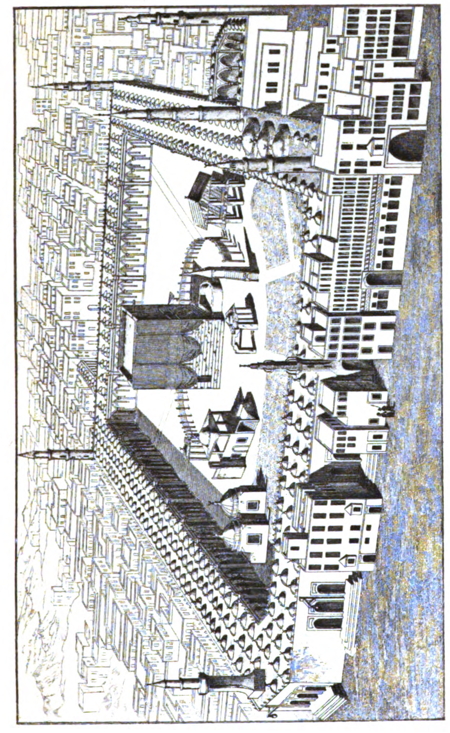
From his establishment at Medina, Mahomet assumed the exercise of the regal and sacerdotal office; and it was impious to appeal from a judge whose decrees were inspired by the divine wisdom. A small portion of ground, the patrimony of two orphans, was acquired by gift or purchase; [130] on that chosen spot he built an house and a mosch, more venerable in their rude simplicity than the palaces and temples of the Assyrian caliphs. His seal of gold, or silver, was inscribed with the apostolic title; when he prayed and preached in the weekly assembly, he leaned against the trunk of a palm-tree; [IX-62] and it was long before he indulged himself in the use of a chair or pulpit of rough timber. [131] After a reign of six years, fifteen hundred Moslems, in arms and in the field, renewed their oath of allegiance; and their chief repeated the assurance of protection, till the death of the last member or the final dissolution of the party. It was in the same camp that the deputy of Mecca was astonished by the attention of the faithful to the words and looks of the prophet, by the eagerness with which they collected his spittle, an hair that dropped on the ground, the refuse water of his lustrations, as if they participated in some degree of the prophetic virtue. “I have seen,” said he, “the Chosroes of Persia and the Cæsar of Rome, but never did I behold a king among his subjects like Mahomet among his companions.” The devout fervour of enthusiasm acts with more energy and truth than the cold and formal servility of courts.
In the state of nature every man has a right to defend, by force of arms, his person and his possessions; to repel, or even to prevent, the violence of his enemies, and to extend his hostilities to a reasonable measure of satisfaction and retaliation. In the free society of the Arabs, the duties of subject and citizen imposed a feeble restraint; and Mahomet, in the exercise of a peaceful and benevolent mission, had been despoiled and banished by the injustice of his countrymen. The choice of an independent people had exalted the fugitive of Mecca to the rank of a sovereign; and he was invested with the just prerogative of forming alliances and of waging offensive or defensive war. The imperfection of human rights was supplied and armed by the plenitude of divine power; the prophet of Medina assumed, in his new revelations, a fiercer and more sanguinary tone, which proves that his former moderation was the effect of weakness; [132] the [IX-63] means of persuasion had been tried, the season of forbearance was elapsed, and he was now commanded to propagate his religion by the sword, to destroy the monuments of idolatry, and, without regarding the sanctity of days or months, to pursue the unbelieving nations of the earth. The same bloody precepts, so repeatedly inculcated in the Koran, are ascribed by the author to the Pentateuch and the Gospel. But the mild tenor of the evangelic style may explain an ambiguous text, that Jesus did not bring peace on the earth, but a sword: his patient and humble virtues should not be confounded with the intolerant zeal of princes and bishops, who have disgraced the name of his disciples. In the prosecution of religious war, Mahomet might appeal with more propriety to the example of Moses, of the judges, and the kings of Israel. The military laws of the Hebrews are still more rigid than those of the Arabian legislator. [133] The Lord of Hosts marched in person before the Jews; if a city resisted their summons, the males, without distinction, were put to the sword; the seven nations of Canaan were devoted to destruction; and neither repentance nor conversion could shield them from the inevitable doom that no creature within their precincts should be left alive. The fair option of friendship, or submission, or battle was proposed to the enemies of Mahomet. If they professed the creed of Islam, they were admitted to all the temporal and spiritual benefits of his primitive disciples, and marched under the same banner to extend the religion which they had embraced. The clemency of the prophet was decided by his interest, yet he seldom trampled on a prostrate enemy; and he seems to [IX-64] promise that, on the payment of a tribute, the least guilty of his unbelieving subjects might be indulged in their worship, or at least in their imperfect faith. In the first months of his reign, he practised the lessons of holy warfare, and displayed his white banner before the gates of Medina; the martial apostle fought in person at nine battles or sieges; [134] and fifty enterprises of war were achieved in ten years by himself or his lieutenants. The Arab continued to unite the professions of a merchant and a robber; and his petty excursions, for the defence or the attack of a caravan, insensibly prepared his troops for the conquest of Arabia. The distribution of the spoil was regulated by a divine law; [135] the whole was faithfully collected in one common mass; a fifth of the gold and silver, the prisoners and cattle, the moveables and immoveables, was reserved by the prophet for pious and charitable uses; the remainder was shared in adequate portions by the soldiers who had obtained the victory or guarded the camp; the rewards of the slain devolved to their widows and orphans; and the increase of cavalry was encouraged by the allotment of a double share to the horse and to the man. From all sides the roving Arabs were allured to the standard of religion and plunder; the apostle sanctified the licence of embracing the female captives as their wives or concubines; and the enjoyment of wealth and beauty was a feeble type of the joys of paradise prepared for the valiant martyrs of the faith. “The sword,” says Mahomet, “is the key of heaven and of hell: a drop of blood shed in the cause of God, a night spent in arms, is of [IX-65] more avail than two months of fasting or prayer: whosoever falls in battle, his sins are forgiven; at the day of judgment his wounds shall be resplendent as vermillion, and odoriferous as musk; and the loss of his limbs shall be supplied by the wings of angels and cherubim.” The intrepid souls of the Arabs were fired with enthusiasm; the picture of the invisible world was strongly painted on their imagination; and the death which they had always despised became an object of hope and desire. The Koran inculcates, in the most absolute sense, the tenets of fate and predestination, which would extinguish both industry and virtue, if the actions of man were governed by his speculative belief. Yet their influence in every age has exalted the courage of the Saracens and Turks. The first companions of Mahomet advanced to battle with a fearless confidence; there is no danger where there is no chance: they were ordained to perish in their beds; or they were safe and invulnerable amidst the darts of the enemy. [136]
Perhaps the Koreish would have been content with the flight of Mahomet, had they not been provoked and alarmed by the vengeance of an enemy who could intercept their Syrian trade as it passed and repassed through the territory of Medina. Abu Sophian himself, with only thirty or forty followers, conducted a wealthy caravan of a thousand camels; the fortune or dexterity of his march escaped the vigilance of Mahomet; but the chief of the Koreish was informed that the holy robbers were placed in ambush to await his return. He despatched a messenger to his brethren of Mecca and they were roused by the fear of losing their merchandise and their provisions, unless they hastened to his relief with the [IX-66] military force of the city. The sacred band of Mahomet was formed of three hundred and thirteen Moslems, of whom seventy-seven were fugitives, and the rest auxiliaries; they mounted by turns a train of seventy camels (the camels of Yathreb were formidable in war); but such was the poverty of his first disciples that only two could appear on horseback in the field. [137] In the fertile and famous vale of Beder, [138] three stations from Medina, he was informed by his scouts of the caravan that approached on one side; of the Koreish, one hundred horse, eight hundred and fifty foot, who advanced on the other. After a short debate, he sacrificed the prospect of wealth to the pursuit of glory and revenge; and a slight intrenchment was formed to cover his troops, and a stream of fresh water that glided through the valley. “O God,” he exclaimed as the numbers of the Koreish descended from the hills, “O God, if these are destroyed, by whom wilt thou be worshipped on the earth? — Courage, my children; close your ranks; discharge your arrows, and the day is your own.” At these words he placed himself, with Abubeker, on a throne or pulpit, [139] and instantly [IX-67] demanded the succour of Gabriel and three thousand angels. His eye was fixed on the field of battle; the Musulmans fainted and were pressed; in that decisive moment the prophet started from his throne, mounted his horse, and cast a handful of sand into the air: “Let their faces be covered with confusion.” Both armies heard the thunder of his voice; their fancy beheld the angelic warriors; [140] the Koreish trembled and fled; seventy of the bravest were slain; and seventy captives adorned the first victory of the faithful. The dead bodies of the Koreish were despoiled and insulted; two of the most obnoxious prisoners were punished with death; and the ransom of the others, four thousand drachms of silver, compensated in some degree the escape of the caravan. But it was in vain that the camels of Abu Sophian explored a new road through the desert and along the Euphrates; they were overtaken by the diligence of the Musulmans; and wealthy must have been the prize, if twenty thousand drachms could be set apart for the fifth of the apostle. The resentment of the public and private loss stimulated Abu Sophian to collect a body of three thousand men, seven hundred of whom were armed with cuirasses, and two hundred were mounted on horseback; three thousand camels attended his march; and his wife Henda, with fifteen matrons of Mecca, incessantly sounded their timbrels to animate the troops, and to magnify the greatness of [IX-68] Hobal, the most popular deity of the Caaba. The standard of God and Mahomet was upheld by nine hundred and fifty believers; the disproportion of numbers was not more alarming than in the field of Beder; and their presumption of victory prevailed against the divine and human sense of the apostle. The second battle was fought on Mount Ohud, six miles to the north of Medina; [141] the Koreish advanced in the form of a crescent; and the right wing of cavalry was led by Caled, the fiercest and most successful of the Arabian warriors. The troops of Mahomet were skilfully posted on the declivity of the hill; and their rear was guarded by a detachment of fifty archers. The weight of their charge impelled and broke the centre of the idolaters; but in the pursuit they lost the advantage of their ground; the archers deserted their station; the Musulmans were tempted by the spoil, disobeyed their general, and disordered their ranks. The intrepid Caled, wheeling his cavalry on their flank and rear, exclaimed with a loud voice, that Mahomet was slain. He was indeed wounded in the face with a javelin; two of his teeth were shattered with a stone; yet, in the midst of tumult and dismay, he reproached the infidels with the murder of a prophet; and blessed the friendly hand that staunched his blood and conveyed him to a place of safety. Seventy martyrs died for the sins of the people; they fell, said the apostle, in pairs, each brother embracing his lifeless companion; [142] their bodies were mangled by the inhuman females of Mecca; and the wife of Abu Sophian tasted the entrails of Hamza, the uncle of Mahomet. They might applaud their superstition and satiate their fury; but the Musulmans soon rallied in the field, and the Koreish wanted [IX-69] strength or courage to undertake the siege of Medina. It was attacked the ensuing year by an army of ten thousand enemies; and this third expedition is variously named from the nations, which marched under the banner of Abu Sophian, from the ditch which was drawn before the city, and a camp of three thousand Musulmans. The prudence of Mahomet declined a general engagement; the valour of Ali was signalised in single combat; and the war was protracted twenty days, till the final separation of the confederates. A tempest of wind, rain, and hail overturned their tents; their private quarrels were fomented by an insidious adversary; and the Koreish, deserted by their allies, no longer hoped to subvert the throne, or to check the conquests, of their invincible exile. [143]
The choice of Jerusalem for the first kebla of prayer discovers the early propensity of Mahomet in favour of the Jews; and happy would it have been for their temporal interest, had they recognised, in the Arabian prophet, the hope of Israel and the promised Messiah. Their obstinacy converted his friendship into implacable hatred, with which he pursued that unfortunate people to the last moment of his life; and, in the double character of an apostle and a conqueror, his persecution was extended to both worlds. [144] The Kainoka dwelt at Medina, under the protection of the city: he seized the occasion of an accidental tumult, and summoned them to embrace his religion or contend with him in battle. “Alas,” replied the trembling Jews, “we are ignorant of the use of arms, but we persevere in the faith and worship of our fathers: [IX-70] why wilt thou reduce us to the necessity of a just defence?” The unequal conflict was terminated in fifteen days; and it was with extreme reluctance that Mahomet yielded to the importunity of his allies and consented to spare the lives of the captives. But their riches were confiscated; their arms became more effectual in the hands of the Musulmans; and a wretched colony of seven hundred exiles was driven with their wives and children to implore a refuge on the confines of Syria. The Nadhirites were more guilty, since they conspired in a friendly interview to assassinate the prophet. He besieged their castle three miles from Medina, but their resolute defence obtained an honourable capitulation; and the garrison, sounding their trumpets and beating their drums, was permitted to depart with the honours of war. The Jews had excited and joined the war of the Koreish: no sooner had the nations retired from the ditch, than Mahomet, without laying aside his armour, marched on the same day to extirpate the hostile race of the children of Koraidha. [144a] After a resistance of twenty-five days, they surrendered at discretion. They trusted to the intercession of their old allies of Medina; they could not be ignorant that fanaticism obliterates the feelings of humanity. A venerable elder, to whose judgment they appealed, pronounced the sentence of their death: seven hundred Jews were dragged in chains to the market-place of the city; they descended alive into the grave prepared for their execution and burial; and the apostle beheld with an inflexible eye the slaughter of his helpless enemies. Their sheep and camels were inherited by the Musulmans; three hundred cuirasses, five hundred pikes, a thousand lances, composed the most useful portion of the spoil. Six days’ journey to the north-east of Medina, the ancient and wealthy town of Chaibar was the seat of the Jewish power in Arabia; the territory, a fertile spot in the desert, was covered with plantations and [IX-71] cattle, and protected by eight castles, some of which were esteemed of impregnable strength. The forces of Mahomet consisted of two hundred horse and fourteen hundred foot: in the succession of eight regular and painful sieges, they were exposed to danger, and fatigue, and hunger; and the most undaunted chiefs despaired of the event. The apostle revived their faith and courage by the example of Ali, on whom he bestowed the surname of the Lion of God: perhaps we may believe that an Hebrew champion of gigantic stature was cloven to the chest by his irresistible scymetar; but we cannot praise the modesty of romance, which represents him as tearing from its hinges the gate of a fortress and wielding the ponderous buckler in his left hand. [145] After the reduction of the castles, the town of Chaibar submitted to the yoke. The chief of the tribe was tortured in the presence of Mahomet, to force a confession of his hidden treasure; the industry of the shepherds and husbandmen was rewarded with a precarious toleration; they were permitted, so long as it should please the conqueror, to improve their patrimony, in equal shares, for his emolument and their own. Under the reign of Omar, the Jews of Chaibar were transplanted to Syria; and the caliph alleged the injunction of his dying master, that one and the true religion should be professed in his native land of Arabia. [146]
Five times each day the eyes of Mahomet were turned towards Mecca, [147] and he was urged by the most sacred and [IX-72] powerful motives to revisit, as a conqueror, the city and the temple from whence he had been driven as an exile. The Caaba was present to his waking and sleeping fancy; an idle dream was translated into vision and prophecy; he unfurled the holy banner; and a rash promise of success too hastily dropped from the lips of the apostle. His march from Medina to Mecca displayed the peaceful and solemn pomp of a pilgrimage: seventy camels, chosen and bedecked for sacrifice, preceded the van; the sacred territory was respected, and the captives were dismissed without ransom to proclaim his clemency and devotion. But no sooner did Mahomet descend into the plain, within a day’s journey of the city, than he exclaimed, “They have clothed themselves with the skins of tigers;” the numbers and resolution of the Koreish opposed his progress; and the roving Arabs of the desert might desert or betray a leader whom they had followed for the hopes of spoil. The intrepid fanatic sunk into a cool and cautious politician: he waived in the treaty his title of apostle of God, concluded with the Koreish and their allies a truce of ten years, engaged to restore the fugitives of Mecca who should embrace his religion, and stipulated only, for the ensuing year, the humble privilege of entering the city as a friend and of remaining three days to accomplish the rites of the pilgrimage. [148] A cloud of shame and sorrow hung on the retreat of the Musulmans, and their disappointment might justly accuse the failure of a prophet who had so often appealed to the evidence of success. The faith and hope of the pilgrims were rekindled by the prospect of Mecca; their swords were sheathed; seven times in the footsteps of the apostle they encompassed the Caaba; the Koreish had retired to the hills, and Mahomet, after the customary sacrifice, evacuated the city on the fourth day. The people was [IX-73] edified by his devotion; the hostile chiefs were awed, or divided, or seduced and both Caled and Amrou, the future conquerors of Syria and Egypt, most seasonably deserted the sinking cause of idolatry. [149] The power of Mahomet was increased by the submission of the Arabian tribes: ten thousand soldiers were assembled for the conquest of Mecca, and the idolaters, the weaker party, were easily convicted of violating the truce. Enthusiasm and discipline impelled the march and preserved the secret, till the blaze of ten thousand fires proclaimed to the astonished Koreish the design, the approach, and the irresistible force of the enemy. The haughty Abu Sophian presented the keys of the city; admired the variety of arms and ensigns that passed before him in review; observed that the son of Abdallah had acquired a mighty kingdom; and confessed, under the scymetar of Omar, that he was the apostle of the true God. The return of Marius and Sylla was stained with the blood of the Romans; the revenge of Mahomet was stimulated by religious zeal, and his injured followers were eager to execute or to prevent the order of a massacre. Instead of indulging their passions and his own, [150] the victorious exile forgave the guilt, and united the factions, of Mecca. His troops in three divisions marched into the city; eight and twenty of the inhabitants were slain by the sword of Caled; eleven men and six women were proscribed by the sentence of Mahomet; but he blamed the cruelty of his lieutenant; and several of the most [IX-74] obnoxious victims were indebted for their lives to his clemency or contempt. The chiefs of the Koreish were prostrate at his feet. “What mercy can you expect from the man whom you have wronged?” “We confide in the generosity of our kinsman.” “And you shall not confide in vain: Begone! you are safe, you are free.” The people of Mecca deserved their pardon by the profession of Islam; and, after an exile of seven years, the fugitive missionary was enthroned as the prince and prophet of his native country. [151] But the three hundred and sixty idols of the Caaba were ignominiously broken; [152] the house of God was purified and adorned; as an example to future times, the apostle again fulfilled the duties of a pilgrim; and a perpetual law was enacted that no unbeliever should dare to set his foot on the territory of the holy city. [153]
The conquest of Mecca determined the faith and obedience of the Arabian tribes; [154] who, according to the vicissitudes [IX-75] of fortune, had obeyed or disregarded the eloquence or the arms of the prophet. Indifference for rites and opinions still marks the character of the Bedoweens; and they might accept, as loosely as they hold, the doctrine of the Koran. Yet an obstinate remnant still adhered to the religion and liberty of their ancestors, and the war of Honain derived a proper appellation from the idols, whom Mahomet had vowed to destroy, and whom the confederates of Tayef had sworn to defend. [155] Four thousand Pagans advanced with secrecy and speed to surprise the conqueror; they pitied and despised the supine negligence of the Koreish, but they depended on the wishes, and perhaps the aid, of a people who had so lately renounced their gods and bowed beneath the yoke of their enemy. The banners of Medina and Mecca were displayed by the prophet; a crowd of Bedoweens increased the strength or numbers of the army, and twelve thousand Musulmans entertained a rash and sinful presumption of their invincible strength. They descended without precaution into the valley of Honain; the heights had been occupied by the archers and slingers of the confederates; their numbers were oppressed, their discipline was confounded, their courage was appalled, and the Koreish smiled at their impending destruction. The prophet, on his white mule, was encompassed by the enemies; he attempted to rush against their spears in search of a glorious death; ten of his faithful companions interposed their weapons and their breasts; three of these fell dead at his feet. “O my brethren,” he repeatedly cried with sorrow and indignation, “I [IX-76] am the son of Abdallah, I am the apostle of truth! O man, stand fast in the faith! O God, send down thy succour!” His uncle Abbas, who, like the heroes of Homer, excelled in the loudness of his voice, made the valley resound with the recital of the gifts and promises of God; the flying Moslems returned from all sides to the holy standard; and Mahomet observed with pleasure that the furnace was again rekindled; his conduct and example restored the battle, and he animated his victorious troops to inflict a merciless revenge on the authors of their shame. From the field of Honain he marched without delay to the siege of Tayef, sixty miles to the south-east of Mecca, a fortress of strength, whose fertile lands produce the fruits of Syria in the midst of the Arabian desert. A friendly tribe, instructed (I know not how) in the art of sieges, supplied him with a train of battering-rams and military engines, with a body of five hundred artificers. But it was in vain that he offered freedom to the slaves of Tayef; that he violated his own laws by the extirpation of the fruit-trees; that the ground was opened by the miners; that the breach was assaulted by the troops. After a siege of twenty days, the prophet sounded a retreat; but he retreated with a song of devout triumph, and affected to pray for the repentance and safety of the unbelieving city. The spoil of this fortunate expedition amounted to six thousand captives, twenty-four thousand camels, forty thousand sheep, and four thousand ounces of silver; a tribe who had fought at Honain, redeemed their prisoners by the sacrifice of their idols; but Mahomet compensated the loss by resigning to the soldiers his fifth of the plunder, and wished for their sake that he possessed as many head of cattle as there were trees in the province of Tehama. Instead of chastising the disaffection of the Koreish, he endeavoured to cut out their tongues (his own expression) and to secure their attachment by a superior measure of liberality: Abu Sophian alone was presented with three hundred camels and twenty ounces of silver; [IX-77] and Mecca was sincerely converted to the profitable religion of the Koran.
The fugitives and auxiliaries complained that they who had borne the burthen were neglected in the season of victory. [155a] “Alas,” replied their artful leader, “suffer me to conciliate these recent enemies, these doubtful proselytes, by the gift of some perishable goods. To your guard I entrust my life and fortunes. You are the companions of my exile, of my kingdom, of my paradise.” He was followed by the deputies of Tayef, who dreaded the repetition of a siege. “Grant us, O apostle of God! a truce of three years, with the toleration of our ancient worship.” “Not a month, not an hour.” “Excuse us at least from the obligation of prayer.” “Without prayer religion is of no avail.” They submitted in silence; their temples were demolished, and the same sentence of destruction was executed on all the idols of Arabia. His lieutenants, on the shores of the Red Sea, the Ocean, and the Gulf of Persia, were saluted by the acclamations of a faithful people; and the ambassadors who knelt before the throne of Medina were as numerous (says the Arabian proverb) as the dates that fall from the maturity of a palm-tree. The nation submitted to the God and the sceptre of Mahomet; the opprobrious name of tribute was abolished; the spontaneous or reluctant oblations of alms and tithes were applied to the service of religion; and one hundred and fourteen thousand Moslems accompanied the last pilgrimage of the apostle. [156]
When Heraclius returned in triumph from the Persian war, he entertained, at Emesa, one of the ambassadors of Mahomet, who invited the princes and nations of the earth to the [IX-78] profession of Islam. On this foundation the zeal of the Arabians has supposed the secret conversion of the Christian emperor; the vanity of the Greeks has feigned a personal visit to the prince of Medina, who accepted from the royal bounty a rich domain and a secure retreat in the province of Syria. [157] But the friendship of Heraclius and Mahomet was of short continuance: the new religion had inflamed rather than assuaged the rapacious spirit of the Saracens; and the murder of an envoy afforded a decent pretence for invading, with three thousand soldiers, the territory of Palestine that extends to the eastward of the Jordan. The holy banner was entrusted to Zeid; and such was the discipline or enthusiasm of the rising sect that the noblest chiefs served without reluctance under the slave of the prophet. On the event of his decease, Jaafar and Abdallah were successively substituted to the command; and, if the three should perish in the war, the troops were authorised to elect their general. The three leaders were slain in the battle of Muta, [158] the first military action which tried the valour of the Moslems against a foreign enemy. Zeid fell, like a soldier, in the foremost ranks; the death of Jaafar was heroic and memorable: he lost his right hand; he shifted the standard to his left; the left was severed from his body; he embraced the standard with his bleeding stumps, till he was transfixed to the ground with fifty honourable wounds. “Advance,” cried Abdallah, who stepped into the vacant place, “advance with confidence: either victory or paradise is our own.” The lance of a Roman decided the alternative; but the falling standard was rescued by Caled, the proselyte of Mecca: [IX-79] nine swords were broken in his hand; and his valour withstood and repulsed the superior numbers of the Christians. In the nocturnal council of the camp he was chosen to command: his skulful evolutions of the ensuing day secured either the victory or the retreat of the Saracens; and Caled is renowned among his brethren and his enemies by the glorious appellation of the Sword of God. In the pulpit, Mahomet described, with prophetic rapture, the crowns of the blessed martyrs; but in private he betrayed the feelings of human nature; he was surprised as he wept over the daughter of Zeid. “What do I see?” said the astonished votary. “You see,” replied the apostle, “a friend who is deploring the loss of his most faithful friend.” After the conquest of Mecca the sovereign of Arabia affected to prevent the hostile preparations of Heraclius; and solemnly proclaimed war against the Romans, without attempting to disguise the hardships and dangers of the enterprise. [159] The Moslems were discouraged: they alleged the want of money, or horses, or provisions; the season of harvest, and the intolerable heat of the summer: “Hell is much hotter,” said the indignant prophet. He disdained to compel their service; but on his return he admonished the most guilty by an excommunication of fifty days. Their desertion enhanced the merit of Abubeker, Othman, and the faithful companions who devoted their lives and fortunes; and Mahomet displayed his banner at the head of ten thousand horse and twenty thousand foot. Painful indeed was the distress of the march; lassitude and thirst were aggravated by the scorching and pestilential winds of the desert; ten men rode by turns on the same camel; and they were reduced to the shameful necessity of drinking the water from the belly of that useful animal. In the midway, ten days’ journey from Medina and Damascus, they reposed [IX-80] near the grove and fountain of Tabuc. Beyond that place, Mahomet declined the prosecution of the war; he declared himself satisfied with the peaceful intentions, he was more probably daunted by the martial array, of the emperor of the East. But the active and intrepid Caled spread around the terror of his name; and the prophet received the submission of the tribes and cities from the Euphrates to Ailah at the head of the Red Sea. To his Christian subjects Mahomet readily granted the security of their persons, the freedom of their trade, the property of their goods, and the toleration of their worship. [160] The weakness of their Arabian brethren had restrained them from opposing his ambition; the disciples of Jesus were endeared to the enemy of the Jews; and it was the interest of a conqueror to propose a fair capitulation to the most powerful religion of the earth.
Till the age of sixty-three years, the strength of Mahomet was equal to the temporal and spiritual fatigues of his mission. His epileptic fits, an absurd calumny of the Greeks, would be an object of pity rather than abhorrence; [161] but he [IX-81] seriously believed that he was poisoned at Chaibar by the revenge of a Jewish female. [162] During four years, the health of the prophet declined; his infirmities increased; but his mortal disease was a fever of fourteen days, which deprived him by intervals of the use of reason. As soon as he was conscious of his danger, he edified his brethren by the humility of his virtue or penitence. “If there be any man,” said the apostle from the pulpit, “whom I have unjustly scourged, I submit my own back to the lash of retaliation. Have I aspersed the reputation of a Musulman? let him proclaim my faults in the face of the congregation. Has any one been despoiled of his goods? the little that I possess shall compensate the principal and the interest of the debt.” “Yes,” replied a voice from the crowd, “I am entitled to three drachms of silver.” Mahomet heard the complaint, satisfied the demand, and thanked his creditor for accusing him in this world rather than at the day of judgment. He beheld with temperate firmness the approach of death; enfranchised his slaves (seventeen men, as they are named, and eleven women); minutely directed the order of his funeral; and moderated the lamentations of his weeping friends, on whom he bestowed the benediction of peace. Till the third day before his death, he regularly performed the function of public prayer. The choice of Abubeker to supply his place appeared to mark that ancient and faithful friend as his successor in the sacerdotal and regal office; but he prudently declined the risk and envy [IX-82] of a more explicit nomination. At a moment when his faculties were visibly impaired, he called for pen and ink, to write, or more properly to dictate, a divine book, the sum and accomplishment of all his revelations: a dispute arose in the chamber whether he should be allowed to supersede the authority of the Koran; and the prophet was forced to reprove the indecent vehemence of his disciples. If the slightest credit may be afforded to the traditions of his wives and companions, he maintained in the bosom of his family, and to the last moments of his life, the dignity of an apostle and the faith of an enthusiast; described the visits of Gabriel, who bid an everlasting farewell to the earth, and expressed his lively confidence not only of the mercy, but of the favour, of the Supreme Being. In a familiar discourse he had mentioned his special prerogative, that the angel of death was not allowed to take his soul till he had respectfully asked the permission of the prophet. The request was granted; and Mahomet immediately fell into the agony of his dissolution: his head was reclined on the lap of Ayesha, the best beloved of all his wives; he fainted with the violence of pain; recovering his spirits, he raised his eyes towards the roof of the house, and, with a steady look, though a faltering voice, uttered the last broken, though articulate, words: “O God! . . . pardon my sins. . . . Yes, . . . I come, . . . among my fellow-citizens on high;” and thus peaceably expired on a carpet spread upon the floor. An expedition for the conquest of Syria was stopped by this mournful event; the army halted at the gates of Medina; the chiefs were assembled round their dying master. The city, more especially the house of the prophet, was a scene of clamorous sorrow, or silent despair: fanaticism alone could suggest a ray of hope and consolation. “How can he be dead, our witness, our intercessor, our mediator with God? By God, he is not dead; like Moses and Jesus, he is wrapt in a holy trance, and speedily will he return to his faithful people.” The evidence of sense was disregarded; and Omar, unsheathing [IX-83] his scymetar, threatened to strike off the heads of the infidels who should dare to affirm that the prophet was no more. The tumult was appeased by the weight and moderation of Abubeker. “Is it Mahomet,” said he to Omar and the multitude, “or the God of Mahomet, whom you worship? The God of Mahomet liveth for ever, but the apostle was a mortal like ourselves, and, according to his own prediction, he has experienced the common fate of mortality.” He was piously interred by the hands of his nearest kinsman, on the same spot on which he expired; [163] Medina has been sanctified by the death and burial of Mahomet; and the innumerable pilgrims of Mecca often turn aside from the way, to bow in voluntary devotion [164] before the simple tomb of the prophet. [165]
At the conclusion of the life of Mahomet, it may perhaps be expected that I should balance his faults and virtues, that I should decide whether the title of enthusiast or impostor more properly belongs to that extraordinary man. Had I been intimately conversant with the son of Abdallah, the task would still be difficult, and the success uncertain: at the [IX-84] distance of twelve centuries, I darkly contemplate his shade through a cloud of religious incense; and, could I truly delineate the portrait of an hour, the fleeting resemblance would not equally apply to the solitary of Mount Hera, to the preacher of Mecca, and to the conqueror of Arabia. The author of a mighty revolution appears to have been endowed with a pious and contemplative disposition: so soon as marriage had raised him above the pressure of want, he avoided the paths of ambition and avarice; and, till the age of forty, he lived with innocence, and would have died without a name. The unity of God is an idea most congenial to nature and reason; and a slight conversation with the Jews and Christians would teach him to despise and detest the idolatry of Mecca. It was the duty of a man and a citizen to impart the doctrine of salvation, to rescue his country from the dominion of sin and error. The energy of a mind incessantly bent on the same object would convert a general obligation into a particular call; the warm suggestings of the understanding or the fancy would be felt as the inspirations of heaven; the labour of thought would expire in rapture and vision; and the inward sensation, the invisible monitor, would be described with the form and attributes of an angel of God. [166] From enthusiasm to imposture the step is perilous and slippery; the demon of Socrates [167] affords a memorable [IX-85] instance, how a wise man may deceive himself, how a good man may deceive others, how the conscience may slumber in a mixed and middle state between self-illusion and voluntary fraud. Charity may believe that the original motives of Mahomet were those of pure and genuine benevolence; but a human missionary is incapable of cherishing the obstinate unbelievers who reject his claims, despise his arguments, and persecute his life; he might forgive his personal adversaries, he may lawfully hate the enemies of God; the stern passions of pride and revenge were kindled in the bosom of Mahomet, and he sighed, like the prophet of Nineveh, for the destruction of the rebels whom he had condemned. The injustice of Mecca and the choice of Medina transformed the citizen into a prince, the humble preacher into the leader of armies; but his sword was consecrated by the example of the saints; and the same God who afflicts a sinful world with pestilence and earthquakes might inspire for their conversion or chastisement the valour of his servants. In the exercise of political government, he was compelled to abate of the stern rigour of fanaticism, to comply in some measure with the prejudices and passions of his followers, and to employ even the vices of mankind as the instruments of their salvation. The use of fraud and perfidy, of cruelty and injustice, were often subservient to the propagation of the faith; and Mahomet commanded or approved the assassination of the Jews and idolaters who had escaped from the field of battle. By the repetition of such acts, the character of Mahomet must have been gradually stained; and the influence of such pernicious habits would be poorly compensated by the practice of the personal and social virtues which are necessary to maintain the reputation of a prophet among his sectaries and friends. [IX-86] Of his last years, ambition was the ruling passion; and a politician will suspect that he secretly smiled (the victorious impostor!) at the enthusiasm of his youth and the credulity of his proselytes. [168] A philosopher will observe that their cruelty and his success would tend more strongly to fortify the assurance of his divine mission, that his interest and religion were inseparably connected, and that his conscience would be soothed by the persuasion that he alone was absolved by the Deity from the obligation of positive and moral laws. If he retained any vestige of his native innocence, the sins of Mahomet may be allowed as an evidence of his sincerity. In the support of truth, the arts of fraud and fiction may be deemed less criminal; and he would have started at the foulness of the means, had he not been satisfied of the importance and justice of the end. Even in a conqueror or a priest, I can surprise a word or action of unaffected humanity; and the decree of Mahomet that, in the sale of captives, the mothers should never be separated from their children may suspend or moderate the censure of the historian. [169]
The good sense of Mahomet [170] despised the pomp of royalty; the apostle of God submitted to the menial offices of the family; he kindled the fire, swept the floor, milked the ewes, and mended with his own hands his shoes and his [IX-87] woollen garment. Disdaining the penance and merit of a hermit, he observed, without effort or vanity, the abstemious diet of an Arab and a soldier. On solemn occasions, he feasted his companions with rustic and hospitable plenty; but in his domestic life many weeks would elapse without a fire being kindled on the hearth of the prophet. The interdiction of wine was confirmed by his example; his hunger was appeased with a sparing allowance of barley bread; he delighted in the taste of milk and honey; but his ordinary food consisted of dates and water. Perfumes and women were the two sensual enjoyments which his nature required and his religion did not forbid; and Mahomet affirmed that the fervour of his devotion was increased by these innocent pleasures. The heat of the climate inflames the blood of the Arabs; and their libidinous complexion has been noticed by the writers of antiquity. [171] Their incontinence was regulated by the civil and religious laws of the Koran; their incestuous alliances were blamed; the boundless licence of polygamy was reduced to four legitimate wives or concubines; their rights both of bed and of dowry were equitably determined; the freedom of divorce was discouraged, adultery was condemned as a capital offence, and fornication, in either sex, was punished with an hundred stripes. [172] Such were the calm and rational precepts of the legislator; but in his private conduct Mahomet indulged the appetites of a man and abused the claims of a prophet. A special revelation dispensed him from the laws which he had imposed on his nation; the female sex, without reserve, was abandoned to his desires; and this singular prerogative excited the envy, [IX-88] rather than the scandal, the veneration, rather than the envy, of the devout Musulmans. If we remember the seven hundred wives and three hundred concubines of the wise Solomon, we shall applaud the modesty of the Arabian, who espoused no more than seventeen or fifteen wives; eleven are enumerated who occupied at Medina their separate apartments round the house of the apostle, and enjoyed in their turns the favour of his conjugal society. What is singular enough, they were all widows, excepting only Ayesha, the daughter of Abubeker. She was doubtless a virgin, since Mahomet consummated his nuptials (such is the premature ripeness of the climate) when she was only nine years of age. The youth, the beauty, the spirit of Ayesha gave her a superior ascendant; she was beloved and trusted by the prophet; and, after his death, the daughter of Abubeker was long revered as the mother of the faithful. Her behaviour had been ambiguous and indiscreet; in a nocturnal march, she was accidentally left behind; and in the morning Ayesha returned to the camp with a man. The temper of Mahomet was inclined to jealousy; but a divine revelation assured him of her innocence: he chastised her accusers, and published a law of domestic peace that no woman should be condemned unless four male witnesses had seen her in the act of adultery. [173] In his adventures with Zeineb, the wife of Zeid, and with Mary, an Egyptian captive, [174] the amorous prophet forgot the interest of his reputation. At the house of Zeid, his freedman and adopted son, he beheld, in a loose undress, the beauty of Zeineb, and burst forth into an ejaculation of devotion and desire. The servile or grateful freedman understood the hint, and yielded, without hesitation, to the love of his benefactor. But, as the filial relation had excited some doubt and scandal, the angel Gabriel descended from [IX-89] heaven to ratify the deed, to annual the adoption, and gently to reprove the apostle for distrusting the indulgence of his God. One of his wives, Hafsa, [174a] the daughter of Omar, surprised him on her own bed in the embraces of his Egyptian captive; she promised secrecy and forgiveness; he swore that he would renounce the possession of Mary. Both parties forgot their engagements; and Gabriel again descended with a chapter of the Koran, to absolve him from his oath, and to exhort him freely to enjoy his captives and concubines without listening to the clamours of his wives. In a solitary retreat of thirty days, he laboured, alone with Mary, to fulfil the commands of the angel. When his love and revenge were satiated, he summoned to his presence his eleven wives, reproached their disobedience and indiscretion, and threatened them with a sentence of divorce both in this world and in the next: a dreadful sentence, since those who had ascended the bed of the prophet were for ever excluded from the hope of a second marriage. Perhaps the incontinence of Mahomet may be palliated by the tradition of his natural or preternatural gifts: [175] he united the manly virtue of thirty of the children of Adam; and the apostle might rival the thirteenth labour [176] of the Grecian Hercules. [177] [IX-90] A more serious and decent excuse may be drawn from his fidelity to Cadijah. During the twenty-four years of their marriage, her youthful husband abstained from the right of polygamy, and the pride or tenderness of the venerable matron was never insulted by the society of a rival. After her death he placed her in the rank of the four perfect women, with the sister of Moses, the mother of Jesus, and Fatima, the best beloved of his daughters. “Was she not old?” said Ayesha, with the insolence of a blooming beauty; “has not God given you a better in her place?” “No, by God,” said Mahomet, with an effusion of honest gratitude, “there never can be a better! she believed in me, when men despised me; she relieved my wants, when I was poor and persecuted by the world.” [178]
In the largest indulgence of polygamy, the founder of a religion and empire might aspire to multiply the chances of a numerous posterity and a lineal succession. The hopes of Mahomet were fatally disappointed. The virgin Ayesha, and his ten widows of mature age and approved fertility, were barren in his potent embraces. The four sons of Cadijah died in their infancy. Mary, his Egyptian concubine, was endeared to him by the birth of Ibrahim. At the end of fifteen months the prophet wept over his grave; but he sustained with firmness the raillery of his enemies, and checked the adulation or credulity of the Moslems, by the assurance that an eclipse of the sun was not occasioned by the death of the infant. Cadijah had likewise given him four daughters, who were married to the most faithful of his disciples; the three eldest died before their father; but Fatima, who possessed his confidence and love, became the wife of her cousin Ali and the mother of an illustrious progeny. The merit and misfortunes of Ali and his descendants [IX-91] will lead me to anticipate, in this place, the series of the Saracen caliphs, a title which describes the commanders of the faithful as the vicars and successors of the apostle of God. [179]
The birth, the alliance, the character of Ali, which exalted him above the rest of his countrymen, might justify his claim to the vacant throne of Arabia. The son of Abu Taleb was, in his own right, the chief of the family of Hashem, and the hereditary prince or guardian of the city and temple of Mecca. The light of prophecy was extinct; but the husband of Fatima might expect the inheritance and blessing of her father; the Arabs had sometimes been patient of a female reign; and the two grandsons of the prophet had often been fondled in his lap and shown in his pulpit, as the hope of his age and the chief of the youth of paradise. The first of the true believers might aspire to march before them in this world and in the next; and, if some were of a graver and more rigid cast, the zeal and virtue of Ali were never outstripped by any recent proselyte. He united the qualifications of a poet, a soldier, and a saint; his wisdom still breathes in a collection of moral and religious sayings; [180] and every antagonist, in the combats of the tongue or of the sword, was subdued by his eloquence and valour. From the first hour of his mission to the last rites of his funeral, the apostle was never forsaken by a generous friend, whom he delighted to [IX-92] name his brother, his vicegerent, and the faithful Aaron of a second Moses. The son of Abu Taleb was afterwards reproached for neglecting to secure his interest by a solemn declaration of his right, which would have silenced all competition and sealed his succession by the decrees of heaven. But the unsuspecting hero confided in himself; the jealousy of empire, and perhaps the fear of opposition, might suspend the resolutions of Mahomet; and the bed of sickness was besieged by the artful Ayesha, the daughter of Abubeker and the enemy of Ali.
The silence and death of the prophet restored the liberty of the people; and his companions convened an assembly to deliberate on the choice of his successor. The hereditary claim and lofty spirit of Ali were offensive to an aristocracy of elders, desirous of bestowing and resuming the sceptre by a free and frequent election; the Koreish could never be reconciled to the proud pre-eminence of the line of Hashem; the ancient discord of the tribes was rekindled; the fugitives of Mecca and the auxiliaries of Medina asserted their respective merits; and the rash proposal of choosing two independent caliphs would have crushed, in their infancy, the religion and empire of the Saracens. The tumult was appeased by the disinterested resolution of Omar, who, suddenly renouncing his own pretensions, stretched forth his hand, and declared himself the first subject of the mild and venerable Abubeker. The urgency of the moment and the acquiescence of the people might excuse this illegal and precipitate measure; but Omar himself confessed from the pulpit that, if any Musulman should hereafter presume to anticipate the suffrage of his brethren, both the elector and the elected would be worthy of death. [181] After the simple inauguration of [IX-93] Abubeker, he was obeyed in Medina, Mecca, and the provinces of Arabia; the Hashemites alone declined the oath of fidelity; and their chief, in his own house, maintained, above six months, a sullen and independent reserve, without listening to the threats of Omar, who attempted to consume with fire the habitation of the daughter of the apostle. The death of Fatima and the decline of his party subdued the indignant spirit of Ali: he condescended to salute the commander of the faithful, accepted his excuse of the necessity of preventing their common enemies, and wisely rejected his courteous offer of abdicating the government of the Arabians. After a reign of two years, the aged caliph was summoned by the angel of death. In his testament, with the tacit approbation of the companions, he bequeathed the sceptre to the firm and intrepid virtue of Omar. “I have no occasion,” said the modest candidate, “for the place.” “But the place has occasion for you,” replied Abubeker; who expired with a fervent prayer that the God of Mahomet would ratify his choice and direct the Musulmans in the way of concord and obedience. The prayer was not ineffectual, since Ali himself, in a life of privacy and prayer, professed to revere the superior worth and dignity of his rival; who comforted him for the loss of empire by the most flattering marks of confidence and esteem. In the twelfth year of his reign, Omar received a mortal wound from the hand of an assassin; he rejected with equal impartiality the names of his son and of Ali, refused to load his conscience with the sins of his successor, and devolved on six of the most respectable companions the arduous task of electing a commander of the faithful. On this occasion Ali was again blamed by his friends [182] for submitting [IX-94] his right to the judgment of men, for recognising their jurisdiction by accepting a place among the six electors. He might have obtained their suffrage, had he deigned to promise a strict and servile conformity, not only to the Koran and tradition, but likewise to the determinations of two seniors. [183] With these limitations, Othman, the secretary of Mahomet, accepted the government; nor was it till after the third caliph, twenty-four years after the death of the prophet, that Ali was invested, by the popular choice, with the regal and sacerdotal office. The manners of the Arabians retained their primitive simplicity, and the son of Abu Taleb despised the pomp and vanity of this world. At the hour of prayer, he repaired to the mosch of Medina, clothed in a thin cotton gown, a coarse turban on his head, his slippers in one hand, and his bow in the other, instead of a walking staff. The companions of the prophet and the chiefs of the tribes saluted their new sovereign, and gave him their right hands as a sign of fealty and allegiance.
The mischiefs that flow from the contests of ambition are usually confined to the times and countries in which they have been agitated. But the religious discord of the friends and enemies of Ali has been renewed in every age of the Hegira, and is still maintained in the immortal hatred of the Persians and Turks. [184] The former, who are branded with the appellation of Shiites or sectaries, have enriched the Mahometan creed with a new article of faith; and, if Mahomet be the [IX-95] apostle, his companion Ali is the vicar, of God. In their private converse, in their public worship, they bitterly execrate the three usurpers who intercepted his indefeasible right to the dignity of Imam and Caliph; and the name of Omar expresses, in their tongue, the perfect accomplishment of wickedness and impiety. [185] The Sonnites, who are supported by the general consent and orthodox tradition of the Musulmans, entertain a more impartial, or at least a more decent, opinion. They respect the memory of Abubeker, Omar, Othman, and Ali, the holy and legitimate successors of the prophet. But they assign the last and most humble place to the husband of Fatima, in the persuasion that the order of succession was determined by the degrees of sanctity. [186] An historian who balances the four caliphs with a hand unshaken by superstition will calmly pronounce that their manners were alike pure and exemplary; that their zeal was fervent, and probably sincere; and that, in the midst of riches and power, their lives were devoted to the practice of moral and religious duties. But the public virtues of Abubeker and Omar, the prudence of the first, the severity of the second, maintained the peace and prosperity of their reigns. The feeble temper and declining age of Othman were incapable of sustaining the weight of conquest and empire. He chose, and he was deceived; he trusted, and he was betrayed: the most deserving of the faithful became useless or hostile to his government, and his lavish bounty was productive only of ingratitude and discontent. The spirit of discord went forth in the provinces, their deputies assembled at Medina, and the [IX-96] Charegites, [187] the desperate fanatics who disclaimed the yoke of subordination and reason, were confounded among the free-born Arabs, who demanded the redress of their wrongs and the punishment of their oppressors. From Cufa, from Bassora, from Egypt, [188] from the tribes of the desert, they rose in arms, encamped about a league from Medina, and despatched a haughty mandate to their sovereign, requiring him to execute justice or to descend from the throne. His repentance began to disarm and disperse the insurgents; but their fury was rekindled by the arts of his enemies; and the forgery of a perfidious secretary was contrived to blast his reputation and precipitate his fall. [189] The caliph had lost the only guard of his predecessors, the esteem and confidence of the Moslems: during a siege of six weeks his water and provisions were intercepted, and the feeble gates of the palace were protected only by the scruples of the more timorous rebels. Forsaken by those who had abused his simplicity, the helpless and venerable caliph expected the approach of death; the brother of Ayesha marched at the head of the assassins; and Othman, with the Koran in his lap, was pierced with a multitude of wounds. A tumultuous anarchy [IX-97] of five days was appeased by the inauguration of Ali; his refusal would have provoked a general massacre. In this painful situation he supported the becoming pride of the chief of the Hashemites; declared that he had rather serve than reign; rebuked the presumption of the strangers; and required the formal, if not the voluntary, assent of the chiefs of the nation. He has never been accused of prompting the assassin of Omar; though Persia indiscreetly celebrates the festival of that holy martyr. The quarrel between Othman and his subjects was assuaged by the early mediation of Ali; and Hassan, the eldest of his sons, was insulted and wounded in the defence of the caliph. Yet it is doubtful whether the father of Hassan was strenuous and sincere in his opposition to the rebels; and it is certain that he enjoyed the benefit of their crime. The temptation was indeed of such magnitude as might stagger and corrupt the most obdurate virtue. The ambitious candidate no longer aspired to the barren sceptre of Arabia: the Saracens had been victorious in the East and West; and the wealthy kingdoms of Persia, Syria, and Egypt were the patrimony of the commander of the faithful.
A life of prayer and contemplation had not chilled the martial activity of Ali; but in a mature age, after a long experience of mankind, he still betrayed in his conduct the rashness and indiscretion of youth. In the first days of his reign, he neglected to secure, either by gifts or fetters, the doubtful allegiance of Telha and Zobeir, two of the most powerful of the Arabian chiefs. They escaped from Medina to Mecca, and from thence to Bassora; erected the standard of revolt; and usurped the government of Irak, or Assyria, which they had vainly solicited as the reward of their services. The mask of patriotism is allowed to cover the most glaring inconsistencies; and the enemies, perhaps the assassins, of Othman now demanded vengeance for his blood. They were accompanied in their flight by Ayesha, the widow of the prophet, who cherished, to the last hour of her life, an implacable [IX-98] hatred against the husband and the posterity of Fatima. The most reasonable Moslems were scandalised that the mother of the faithful should expose in a camp her person and character; but the superstitious crowd was confident that her presence would sanctify the justice, and assure the success, of their cause. At the head of twenty thousand of his loyal Arabs and nine thousand valiant auxiliaries of Cufa, the caliph encountered and defeated the superior numbers of the rebels under the walls of Bassora. Their leaders, Telha and Zobeir, were slain in the first battle that stained with civil blood the arms of the Moslems. After passing through the ranks to animate the troops, Ayesha had chosen her post amidst the dangers of the field. In the heat of the action, seventy men who held the bridle of her camel were successively killed or wounded; and the cage or litter in which she sat was stuck with javelins and darts like the quills of a porcupine. The venerable captive sustained with firmness the reproaches of the conqueror, and was speedily dismissed to her proper station, at the tomb of Mahomet, with the respect and tenderness that was still due to the widow of the apostle. After this victory, which was styled the Day of the Camel, Ali marched against a more formidable adversary: against Moawiyah, the son of Abu Sophian, who had assumed the title of caliph, and whose claim was supported by the forces of Syria and the interest of the house of the Ommiyah. From the passage of Thapsacus, the plain of Siffin [190] extends along the western bank of the Euphrates. On this spacious and level theatre, the two competitors waged a desultory war of one hundred and ten days. In the course of ninety actions or skirmishes, the loss of Ali was estimated at twenty-five, that of Moawiyah at forty-five, thousand soldiers; and the list of the slain was dignified with the names of five and twenty veterans who had fought at Beder [IX-99] under the standard of Mahomet. In this sanguinary contest, the lawful caliph displayed a superior character of valour and humanity. His troops were strictly enjoined to await the first onset of the enemy, to spare their flying brethren, and to respect the bodies of the dead and the chastity of the female captives. He generously proposed to save the blood of the Moslems by a single combat; but his trembling rival declined the challenge as a sentence of inevitable death. The ranks of the Syrians were broken by the charge of a hero who was mounted on a piebald horse, and wielded with irresistible force his ponderous and two-edged sword. As often as he smote a rebel, he shouted the Allah Acbar, “God is victorious;” and in the tumult of a nocturnal battle he was heard to repeat four hundred times that tremendous exclamation. The prince of Damascus already meditated his flight, but the certain victory was snatched from the grasp of Ali by the disobedience and enthusiasm of his troops. Their conscience was awed by the solemn appeal to the books of the Koran which Moawiyah exposed on the foremost lances; and Ali was compelled to yield to a disgraceful truce and an insidious compromise. He retreated with sorrow and indignation to Cufa; his party was discouraged; the distant provinces of Persia, [190a] of Yemen, and of Egypt were subdued or seduced by his crafty rival; and the stroke of fanaticism which was aimed against the three chiefs of the nation was fatal only to the cousin of Mahomet. In the temple of Mecca, three Charegites or enthusiasts discoursed of the disorders of the church and state: they soon agreed that the deaths of Ali, of Moawiyah, and of his friend Amrou, the viceroy of Egypt, would restore the peace and unity of religion. Each of the assassins chose his victim, poisoned his dagger, devoted his life, and secretly repaired to the scene of action. Their resolution was equally desperate; but the first mistook the person of Amrou and stabbed the deputy [IX-100] who occupied his seat; the prince of Damascus was dangerously hurt by the second; the lawful caliph in the mosch of Cufa received a mortal wound from the hand of the third. He expired in the sixty-third year of his age, and mercifully recommended to his children that they would despatch the murderer by a single stroke. The sepulchre of Ali [191] was concealed from the tyrants of the house of Ommiyah; [192] but, in the fourth age of the Hegira, a tomb, a temple, a city, arose near the ruins of Cufa. [193] Many thousands of the Shiites repose in holy ground at the feet of the vicar of God; and the desert is vivified by the numerous and annual visits of the Persians, who esteem their devotion not less meritorious than the pilgrimage of Mecca.
The persecutors of Mahomet usurped the inheritance of his children; and the champions of idolatry became the supreme heads of his religion and empire. The opposition of Abu Sophian had been fierce and obstinate; his conversion was tardy and reluctant; his new faith was fortified by necessity and interest; he served, he fought, perhaps he believed; and the sins of the time of ignorance were expiated by the recent merits of the family of Ommiyah. Moawiyah, the son of Abu Sophian and of the cruel Henda, was dignified in his early youth with the office or title of secretary of the prophet; the judgment of Omar entrusted him with the [IX-101] government of Syria; and he administered that important province about forty years either in a subordinate or supreme rank. Without renouncing the fame of valour and liberality, he affected the reputation of humanity and moderation; a grateful people was attached to their benefactor; and the victorious Moslems were enriched with the spoils of Cyprus and Rhodes. The sacred duty of pursuing the assassins of Othman was the engine and pretence of his ambition. The bloody shirt of the martyr was exposed in the mosch of Damascus; the emir deplored the fate of his injured kinsman; and sixty thousand Syrians were engaged in his service by an oath of fidelity and revenge. Amrou, the conqueror of Egypt, himself an army, was the first who saluted the new monarch, and divulged the dangerous secret that the Arabian caliphs might be created elsewhere than in the city of the prophet. [194] The policy of Moawiyah eluded the valour of his rival; and, after the death of Ali, he negotiated the abdication of his son Hassan, whose mind was either above or below the government of the world, and who retired without a sigh from the palace of Cufa to an humble cell near the tomb of his grandfather. The aspiring wishes of the caliph were finally crowned by the important change of an elective to an hereditary kingdom. Some murmurs of freedom or fanaticism attested the reluctance of the Arabs, and four citizens of Medina refused the oath of fidelity; but the designs of Moawiyah were conducted with vigour and address; and his son Yezid, a feeble and dissolute youth, was proclaimed as the commander of the faithful and the successor of the apostle of God.
A familiar story is related of the benevolence of one of the sons of Ali. In serving at table, a slave had inadvertently dropt a dish of scalding broth on his master; the heedless [IX-102] wretch fell prostrate, to deprecate his punishment, and repeated a verse of the Koran: “Paradise is for those who command their anger:” — “I am not angry:” — “and for those who pardon offences:” — “I pardon your offence:” — “and for those who return good for evil:” — “I give you your liberty, and four hundred pieces of silver.” With an equal measure of piety, Hosein, the younger brother of Hassan, inherited a remnant of his father’s spirit, and served with honour against the Christians in the siege of Constantinople. The primogeniture of the line of Hashem and the holy character of grandson of the apostle had centred in his person, and he was at liberty to prosecute his claim against Yezid the tyrant of Damascus, whose vices he despised, and whose title he had never deigned to acknowledge. A list was secretly transmitted from Cufa to Medina of one hundred and forty thousand Moslems, who professed their attachment to his cause, and who were eager to draw their swords so soon as he should appear on the banks of the Euphrates. Against the advice of his wisest friends, he resolved to trust his person and family in the hands of a perfidious people. He traversed the desert of Arabia with a timorous retinue of women and children; but, as he approached the confines of Irak, he was alarmed by the solitary or hostile face of the country, and suspected either the defection or ruin of his party. His fears were just: Obeidollah, the governor of Cufa, had extinguished the first sparks of an insurrection; and Hosein, in the plain of Kerbela, [195] was encompassed by a body of five thousand horse, who intercepted his communication with the city and the river. He might still have escaped to a fortress in the desert that had defied the power of Cæsar and Chosroes, and confided in the fidelity of the tribe of Tai, which would have armed ten thousand warriors in his defence. In a conference with the chief of the enemy, he proposed the option of three honourable conditions: that he [IX-103] should be allowed to return to Medina, or be stationed in a frontier garrison against the Turks, or safely conducted to the presence of Yezid. But the commands of the caliph, or his lieutenant, were stern and absolute; and Hosein was informed that he must either submit as a captive and a criminal to the commander of the faithful or expect the consequences of his rebellion. “Do you think,” replied he, “to terrify me with death?” And, during the short respite of a night, he prepared with calm and solemn resignation to encounter his fate. He checked the lamentations of his sister Fatima, who deplored the impending ruin of his house. “Our trust,” said Hosein, “is in God alone. All things, both in heaven and earth, must perish and return to their Creator. My brother, my father, my mother, were better than me; and every Musulman has an example in the prophet.” He pressed his friends to consult their safety by a timely flight: they unanimously refused to desert or survive their beloved master; and their courage was fortified by a fervent prayer and the assurance of paradise. On the morning of the fatal day, he mounted on horseback, with his sword in one hand and the Koran in the other; his generous band of martyrs consisted only of thirty-two horse and forty foot; but their flanks and rear were secured by the tent-ropes, and by a deep trench which they had filled with lighted faggots, according to the practice of the Arabs. The enemy advanced with reluctance; and one of their chiefs deserted, with thirty followers, to claim the partnership of inevitable death. In every close onset or single combat, the despair of the Fatimites was invincible; but the surrounding multitudes galled them from a distance with a cloud of arrows, and the horses and men were successively slain: a truce was allowed on both sides for the hour of prayer; and the battle at length expired by the death of the last of the companions of Hosein. Alone, weary and wounded, he seated himself at the door of his tent. As he tasted a drop of water, he was pierced in the mouth with a dart; and his son and nephew, two beautiful [IX-104] youths, were killed in his arms. He lifted his hands to heaven, they were full of blood, and he uttered a funeral prayer for the living and the dead. In a transport of despair his sister issued from the tent, and adjured the general of the Cufians that he would not suffer Hosein to be murdered before his eyes: a tear trickled down his venerable beard; and the boldest of his soldiers fell back on every side as the dying hero threw himself among them. The remorseless Shamer, a name detested by the faithful, reproached their cowardice; and the grandson of Mahomet was slain with three and thirty strokes of lances and swords. After they had trampled on his body, they carried his head to the castle of Cufa, and the inhuman Obeidollah struck him on the mouth with a cane: “Alas!” exclaimed an aged Musulman, “on these lips have I seen the lips of the apostle of God!” In a distant age and climate the tragic scene of the death of Hosein will awaken the sympathy of the coldest reader. [196] On the annual festival of his martyrdom, in the devout pilgrimage to his sepulchre, his Persian votaries abandon their souls to the religious frenzy of sorrow and indignation. [197]
When the sisters and children of Ali were brought in chains to the throne of Damascus, the caliph was advised to extirpate the enmity of a popular and hostile race, whom he had injured beyond the hope of reconciliation. But Yezid preferred the counsels of mercy; and the mourning family was honourably dismissed to mingle their tears with their kindred [IX-105] at Medina. The glory of martyrdom superseded the right of primogeniture; and the twelve imams, [198] or pontiffs, of the Persian creed are Ali, Hassan, Hosein, and the lineal descendants of Hosein to the ninth generation. Without arms or treasures or subjects, they successively enjoyed the veneration of the people and provoked the jealousy of the reigning caliphs; their tombs at Mecca or Medina, on the banks of the Euphrates or in the province of Chorasan, are still visited by the devotion of their sect. Their names were often the pretence of sedition and civil war; but these royal saints despised the pomp of the world, submitted to the will of God and the injustice of man, and devoted their innocent lives to the study and practice of religion. The twelfth and last of the Imams, conspicuous by the title of Mahadi or the Guide, surpassed the solitude and sanctity of his predecessors. He concealed himself in a cavern near Bagdad; the time and place of his death are unknown; and his votaries pretend that he still lives and will appear before the day of judgment to overthrow the tyranny of Dejal or the Antichrist. [199] In the lapse of two or three centuries the posterity of Abbas, the uncle of Mahomet, had multiplied to the number of thirty-three thousand; [200] the race of Ali might be equally prolific; the meanest individual was above the first and greatest of princes; and the most eminent were supposed to excel the perfection of angels. But their adverse fortune and the wide extent of the Musulman empire allowed an ample scope for every bold and artful impostor who claimed affinity with the holy seed; the sceptre of the Almohades in Spain [IX-106] and Afric, of the Fatimites in Egypt and Syria, [201] of the Sultans of Yemen and of the Sophis of Persia, [202] has been consecrated by this vague and ambiguous title. Under their reigns it might be dangerous to dispute the legitimacy of their birth; and one of the Fatimite caliphs silenced an indiscreet question by drawing his scymetar: “This,” said Moez, “is my pedigree; and these,” casting an handful of gold to his soldiers, “and these are my kindred and my children.” In the various conditions of princes, or doctors, or nobles, or merchants, or beggars, a swarm of the genuine or fictitious descendants of Mahomet and Ali is honoured with the appellation of sheiks, or sherifs, or emirs. In the Ottoman empire, they are distinguished by a green turban, receive a stipend from the treasury, are judged only by their chief, and, however debased by fortune or character, still assert the proud pre-eminence of their birth. A family of three hundred persons, the pure and orthodox branch of the caliph Hassan, is preserved without taint or suspicion in the holy cities of Mecca and Medina, and still retains, after the revolutions of twelve centuries, the custody of the temple and the sovereignty of their native land. The fame and merit of Mahomet would ennoble a plebeian race, and the ancient [IX-107] blood of the Koreish transcends the recent majesty of the kings of the earth. [203]
The talents of Mahomet are entitled to our applause, but his success has perhaps too strongly attracted our admiration. Are we surprised that a multitude of proselytes should embrace the doctrine and the passions of an eloquent fanatic? In the heresies of the church, the same seduction has been tried and repeated from the time of the apostles to that of the reformers. Does it seem incredible that a private citizen should grasp the sword and the sceptre, subdue his native country, and erect a monarchy by his victorious arms? In the moving picture of the dynasties of the East, an hundred fortunate usurpers have arisen from a baser origin, surmounted more formidable obstacles, and filled a larger scope of empire and conquest. Mahomet was alike instructed to preach and to fight, and the union of these opposite qualities, while it enhanced his merit, contributed to his success: the operation of force and persuasion, of enthusiasm and fear, continually acted on each other, till every barrier yielded to their irresistible power. His voice invited the Arabs to freedom and victory, to arms and rapine, to the indulgence of their darling passions in this world and the other; the restraints which he imposed were requisite to establish the credit of the prophet and to exercise the obedience of the people; and the only objection to his success was his rational creed of the unity and perfections of God. It is not the propagation but the permanency of his religion that deserves our wonder: the same pure and perfect impression which he engraved at Mecca and Medina is preserved, after the revolutions of twelve centuries, by the Indian, the African, and the Turkish proselytes of the Koran. If the Christian [IX-108] apostles, St. Peter or St. Paul, could return to the Vatican, they might possibly inquire the name of the Deity who is worshipped with such mysterious rites in that magnificent temple: at Oxford or Geneva, they would experience less surprise; but it might still be incumbent on them to peruse the catechism of the church, and to study the orthodox commentators on their own writings and the words of their Master. But the Turkish dome of St. Sophia, with an increase of splendour and size, represents the humble tabernacle erected at Medina by the hands of Mahomet. The Mahometans have uniformly withstood the temptation of reducing the object of their faith and devotion to a level with the senses and imagination of man. “I believe in one God, and Mahomet the apostle of God,” is the simple and invariable profession of Islam. The intellectual image of the Deity has never been degraded by any visible idol; the honours of the prophet have never transgressed the measure of human virtue; and his living precepts have restrained the gratitude of his disciples within the bounds of reason and religion. The votaries of Ali have indeed consecrated the memory of their hero, his wife, and his children; and some of the Persian doctors pretend that the divine essence was incarnate in the person of the Imams; but their superstition is universally condemned by the Sonnites; and their impiety has afforded a seasonable warning against the worship of saints and martyrs. The metaphysical questions on the attributes of God and the liberty of man have been agitated in the schools of the Mahometans as well as in those of the Christians; but among the former they have never engaged the passions of the people or disturbed the tranquillity of the state. The cause of this important difference may be found in the separation or union of the regal and sacerdotal characters. It was the interest of the caliphs, the successors of the prophet and commanders of the faithful, to repress and discourage all religious innovations: the order, the discipline, the temporal and spiritual ambition of the clergy [IX-109] are unknown to the Moslems; and the sages of the law are the guides of their conscience and the oracles of their faith. From the Atlantic to the Ganges, the Koran is acknowledged as the fundamental code, not only of theology but of civil and criminal jurisprudence; and the laws which regulate the actions and the property of mankind are guarded by the infallible and immutable sanction of the will of God. This religious servitude is attended with some practical disadvantage; the illiterate legislator had been often misled by his own prejudices and those of his country; and the institutions of the Arabian desert may be ill adapted to the wealth and numbers of Ispahan and Constantinople. On these occasions, the Cadhi respectfully places on his head the holy volume, and substitutes a dexterous interpretation, more apposite to the principles of equity and the manners and policy of the times.
His beneficial or pernicious influence on the public happiness is the last consideration in the character of Mahomet. The most bitter or most bigoted of his Christian or Jewish foes will surely allow that he assumed a false commission to inculcate a salutary doctrine, less perfect only than their own. He piously supposed, as the basis of his religion, the truth and sanctity of their prior revelations, the virtues and miracles of their founders. The idols of Arabia were broken before the throne of God; the blood of human victims was expiated by prayer and fasting and alms, the laudable or innocent arts of devotion; and his rewards and punishments of a future life were painted by the images most congenial to an ignorant and carnal generation. Mahomet was perhaps incapable of dictating a moral and political system for the use of his countrymen; but he breathed among the faithful a spirit of charity and friendship, recommended the practice of the social virtues, and checked, by his laws and precepts, the thirst of revenge and the oppression of widows and orphans. The hostile tribes were united in faith and obedience, and the valour which had been idly spent in domestic [IX-110] quarrels was vigorously directed against a foreign enemy. Had the impulse been less powerful, Arabia, free at home and formidable abroad, might have flourished under a succession of her native monarchs. Her sovereignty was lost by the extent and rapidity of conquest. The colonies of the nation were scattered over the East and West, and their blood was mingled with the blood of their converts and captives. After the reign of three caliphs the throne was transported from Medina to the valley of Damascus and the banks of the Tigris; the holy cities were violated by impious war; Arabia was ruled by the rod of a subject, perhaps of a stranger; and the Bedoweens of the desert, awakening from their dream of dominion, resumed their old and solitary independence. [204]
[IX-111]
CHAPTER LI↩
The Conquest of Persia, Syria, Egypt, Africa, and Spain, by the Arabs or Saracens — Empire of the Caliphs, or Successors of Mahomet — State of the Christians, &c. under their Government
The revolution of Arabia had not changed the character of the Arabs: the death of Mahomet was the signal of independence; and the hasty structure of his power and religion tottered to its foundations. A small and faithful band of his primitive disciples had listened to his eloquence and shared his distress; had fled with the apostle from the persecution of Mecca or had received the fugitive in the walls of Medina. The increasing myriads, who acknowledged Mahomet as their king and prophet, had been compelled by his arms or allured by his prosperity. The polytheists were confounded by the simple idea of a solitary and invisible God; the pride of the Christians and Jews disdained the yoke of a mortal and contemporary legislator. Their habits of faith and obedience were not sufficiently confirmed; and many of the new converts regretted the venerable antiquity of the law of Moses, or the rites and mysteries of the Catholic church, or the idols, the sacrifices, the joyous festivals, of their pagan ancestors. The jarring interests and hereditary feuds of the Arabian tribes had not yet coalesced in a system of union and subordination; and the Barbarians were impatient of the mildest and most salutary laws that curbed their passions or violated their customs. They submitted with reluctance to the religious precepts of the Koran, the abstinence from wine, the fast of the Ramadan, and the daily repetition of five prayers; and the alms and tithes, which were collected for the [IX-112] treasury of Medina, could be distinguished only by a name from the payment of a perpetual and ignominious tribute. The example of Mahomet had excited a spirit of fanaticism or imposture, and several of his rivals presumed to imitate the conduct and defy the authority of the living prophet. At the head of the fugitives and auxiliaries, the first caliph was reduced to the cities of Mecca, Medina, and Tayef; and perhaps the Koreish would have restored the idols of the Caaba, if their levity had not been checked by a seasonable reproof. “Ye men of Mecca, will ye be the last to embrace and the first to abandon the religion of Islam?” After exhorting the Moslems to confide in the aid of God and his apostle, Abubeker resolved, by a vigorous attack, to prevent the junction of the rebels. The women and children were safely lodged in the cavities of the mountains: the warriors, marching under eleven banners, diffused the terror of their arms; and the appearance of a military force revived and confirmed the loyalty of the faithful. The inconstant tribes accepted, with humble repentance, the duties of prayer and fasting and alms; and, after some examples of success and severity, the most daring apostates fell prostrate before the sword of the Lord and of Caled. In the fertile province of Yemannah, [1] between the Red Sea, and the Gulf of Persia, in a city not inferior to Medina itself, a powerful chief, his name was Moseilama, had assumed the character of a prophet, and the tribe of Hanifa listened to his voice. A female prophetess was attracted by his reputation: the decencies of words and actions were spurned by these favourites of heaven, [2] [IX-113] and they employed several days in mystic and amorous converse. An obscure sentence of his Koran, or book, is yet extant; [3] and, in the pride of his mission, Moseilama condescended to offer a partition of the earth. The proposal was answered by Mahomet with contempt; but the rapid progress of the impostor awakened the fears of his successor: forty thousand Moslems were assembled under the standard of Caled; and the existence of their faith was resigned to the event of a decisive battle. In the first action they were repulsed with the loss of twelve hundred men; but the skill and perseverance of their general prevailed: their defeat was avenged by the slaughter of ten thousand infidels; and Moseilama himself was pierced by an Ethiopian slave with the same javelin which had mortally wounded the uncle of Mahomet. The various rebels of Arabia, without a chief or a cause, were speedily suppressed by the power and discipline of the rising monarchy; and the whole nation again professed, and more steadfastly held, the religion of the Koran. The ambition of the caliphs provided an immediate exercise for the restless spirit of the Saracens; their valour was united in the prosecution of an holy war; and their enthusiasm was equally confirmed by opposition and victory.
[IX-114]
From the rapid conquests of the Saracens, a presumption will naturally arise that the first caliphs commanded in person the armies of the faithful, and sought the crown of martyrdom in the foremost ranks of the battle. The courage of Abubeker, [4] Omar, [5] and Othman [6] had indeed been tried in the persecution and wars of the prophet; and the personal assurance of paradise must have taught them to despise the pleasures and dangers of the present world. But they ascended the throne in a venerable or mature age, and esteemed the domestic cares of religion and justice the most important duties of a sovereign. Except the presence of Omar at the siege of Jerusalem, the longest expeditions were the frequent pilgrimages from Medina to Mecca; and they calmly received the tidings of victory as they prayed or preached before the sepulchre of the prophet. The austere and frugal measure of their lives was the effect of virtue or habit, and the pride of their simplicity insulted the vain magnificence of the kings of the earth. When Abubeker assumed the office of caliph, he enjoined his daughter Ayesha to take a strict account of his private patrimony, that it might be evident whether he were enriched or impoverished by the service of the state. He thought himself entitled to a stipend of three pieces of gold, with the sufficient maintenance of a single camel and a black slave; but on the Friday of each week he distributed the residue of his own and the public money, first to the most worthy, and then to the most indigent, of the Moslems. The remains of his wealth, a coarse garment and five pieces of gold, were delivered to his successor, who lamented with a modest sigh his own inability to equal such an admirable model. Yet the abstinence and humility of Omar were not [IX-115] inferior to the virtues of Abubeker: his food consisted of barley-bread or dates; his drink was water; he preached in a gown that was torn or tattered in twelve places; and a Persian satrap, who paid his homage to the conqueror, found him asleep among the beggars on the steps of the mosch of Medina. Economy is the source of liberality, and the increase of the revenue enabled Omar to establish a just and perpetual reward for the past and present services of the faithful. Careless of his own emolument, he assigned to Abbas, the uncle of the prophet, the first and most ample allowance of twenty-five thousand drachms or pieces of silver. Five thousand were allotted to each of the aged warriors, the relics of the field of Beder, and the last and meanest of the companions of Mahomet was distinguished by the annual reward of three thousand pieces. One thousand was the stipend of the veterans who had fought in the first battles against the Greeks and Persians, and the decreasing pay, as low as fifty pieces of silver, was adapted to the respective merit and seniority of the soldiers of Omar. Under his reign and that of his predecessor, the conquerors of the East were the trusty servants of God and the people; the mass of the public treasure was consecrated to the expenses of peace and war; a prudent mixture of justice and bounty maintained the discipline of the Saracens, and they united, by a rare felicity, the despatch and execution of despotism with the equal and frugal maxims of a republican government. The heroic courage of Ali, [7] the consummate prudence of Moawiyah, [8] excited the emulation of their subjects; and the talents which had been exercised in the schools of civil discord were more usefully applied to propagate the faith and dominion of the prophet. In the sloth and vanity of the palace of Damascus, the succeeding princes of the house of [IX-116] Ommiyah were alike destitute of the qualifications of statesmen and of saints. [9] Yet the spoils of unknown nations were continually laid at the foot of their throne, and the uniform ascent of the Arabian greatness must be ascribed to the spirit of the nation rather than the abilities of their chiefs. A large deduction must be allowed for the weakness of their enemies. The birth of Mahomet was fortunately placed in the most degenerate and disorderly period of the Persians, the Romans, and the Barbarians of Europe: the empires of Trajan, or even of Constantine or Charlemagne, would have repelled the assault of the naked Saracens, and the torrent of fanaticism might have been obscurely lost in the sands of Arabia.
In the victorious days of the Roman republic, it had been the aim of the senate to confine their counsels and legions to a single war, and completely to suppress a first enemy before they provoked the hostilities of a second. These timid maxims of policy were disdained by the magnanimity or enthusiasm of the Arabian caliphs. With the same vigour and success they invaded the successors of Augustus and those of Artaxerxes; and the rival monarchies at the same instant became the prey of an enemy whom they had been so long accustomed to despise. In the ten years of the administration of Omar, the Saracens reduced to his obedience thirty-six thousand cities or castles, destroyed four thousand churches or temples of the unbelievers, and edified fourteen hundred moschs for the exercise of the religion of Mahomet. One hundred years after his flight from Mecca, the arms and the reign of his successors extended from India to the Atlantic Ocean, over the various and distant provinces, [IX-117] which may be comprised under the names of I. Persia; II. Syria; III. Egypt; IV. Africa; and V. Spain. Under this general division, I shall proceed to unfold these memorable transactions; despatching, with brevity, the remote and less interesting conquests of the East, and reserving a fuller narrative for those domestic countries which had been included within the pale of the Roman empire. Yet I must excuse my own defects by a just complaint of the blindness and insufficiency of my guides. The Greeks, so loquacious in controversy, have not been anxious to celebrate the triumphs of their enemies. [10] After a century of ignorance, the first annals of the Musulmans were collected in a great measure from the voice of tradition. [11] Among the numerous productions of Arabic and Persian literature, [12] our interpreters [IX-118] have selected the imperfect sketches of a more recent age. [13] The art and genius of history have ever been unknown to the Asiatics; [14] they are ignorant of the laws of criticism; and our monkish chronicles of the same period may be compared to their most popular works, which are never vivified by the spirit of philosophy and freedom. The Oriental library of a Frenchman [15] would instruct the most learned mufti of the East; and perhaps the Arabs might not find in a single historian so clear and comprehensive a narrative of their own exploits, as that which will be deduced in the ensuing sheets.
[IX-119]
I. In the first year of the first caliph, his lieutenant Caled, the sword of God and the scourge of the infidels, advanced to the banks of the Euphrates, and reduced the cities of Anbar and Hira. Westward of the ruins of Babylon, a tribe of sedentary Arabs had fixed themselves on the verge of the desert; and Hira was the seat of a race of kings who had embraced the Christian religion and reigned above six hundred years under the shadow of the throne of Persia. [16] The last of the Mondars was defeated and slain by Caled; his son was sent a captive to Medina; his nobles bowed before the successor of the prophet; the people was tempted by the example and success of their countrymen; and the caliph accepted as the first fruits of foreign conquest an annual tribute of seventy thousand pieces of gold. [17] The conquerors, and even their historians, were astonished by the dawn of their future greatness: “In the same year,” says Elmacin, “Caled fought many signal battles; an immense multitude of infidels was slaughtered; and spoils, infinite and innumerable, were acquired by the victorious Moslems.” [18] But the invincible Caled was soon transferred to the Syrian war; the invasion of the Persian frontier was conducted by less active, or less prudent, commanders; the Saracens were repulsed with loss in the passage of the Euphrates; and, though they chastised the insolent pursuit of the Magians, [IX-120] their remaining forces still hovered in the desert of Babylon.
The indignation and fears of the Persians suspended for a moment their intestine divisions. By the unanimous sentence of the priests and nobles, their queen Arzema was deposed: the sixth of the transient usurpers who had arisen and vanished in three or four years since the death of Chosroes and the retreat of Heraclius. Her tiara was placed on the head of Yezdegerd, the grandson of Chosroes; and the same era, which coincides with an astronomical period, [19] has recorded the fall of the Sassanian dynasty and the religion of Zoroaster. [20] The youth and inexperience of the prince, he was only fifteen years of age, declined a perilous encounter; the royal standard was delivered into the hands of his general Rustam; and a remnant of thirty thousand regular troops was swelled in truth, or in opinion, to one hundred and twenty thousand subjects, or allies, of the Great King. The Moslems, whose numbers were reinforced from twelve to thirty thousand, had pitched their camp in the plains of [IX-121] Cadesia; [21] and their line, though it consisted of fewer men, could produce more soldiers than the unwieldy host of the infidels. I shall here observe what I must often repeat, that the charge of the Arabs was not like that of the Greeks and Romans, the effort of a firm and compact infantry: their military force was chiefly formed of cavalry and archers; and the engagement, which was often interrupted and often renewed by single combats and flying skirmishes, might be protracted without any decisive event to the continuance of several days. The periods of the battle of Cadesia were distinguished by their peculiar appellations. The first, from the well-timed appearance of six thousand of the Syrian brethren, was denominated the day of succour. [22] The day of concussion might express the disorder of one, or perhaps of both, of the contending armies. The third, a nocturnal tumult, received the whimsical name of the night of barking, from the discordant clamours which were compared to the inarticulate sounds of the fiercest animals. The morning of the succeeding day determined the fate of Persia; and a seasonable whirlwind drove a cloud of dust against the faces of the unbelievers. The clangour of arms was re-echoed to the tent of Rustam, who, far unlike the ancient hero of his name, was gently reclining in a cool and tranquil shade, amidst the baggage of his camp and the train of mules that were laden with gold and silver. On the sound of danger he started from his couch; but his flight was overtaken by a valiant Arab, who caught him by the foot, struck off his head, hoisted it on a lance, and, instantly returning to the field of battle, carried slaughter and dismay among the [IX-122] thickest ranks of the Persians. [23] The Saracens confess a loss of seven thousand five hundred men; and the battle of Cadesia is justly described by the epithets of obstinate and atrocious. [24] The standard of the monarchy was overthrown and captured in the field — a leathern apron of a blacksmith, who, in ancient times, had arisen the deliverer of Persia; but this badge of heroic poverty was disguised and almost concealed by a profusion of precious gems. [25] After this victory, the wealthy province of Irak [26] or Assyria submitted to the caliph, and his conquests were firmly established by the speedy foundation of Bassora, [27] a place which ever commands [IX-123] the trade and navigation of the Persians. At the distance of fourscore miles from the Gulf, the Euphrates and Tigris unite in a broad and direct current, which is aptly styled the river of the Arabs. In the midway, between the junction and the mouth of these famous streams, the new settlement was planted on the western bank; the first colony was composed of eight hundred Moslems; but the influence of the situation soon reared a flourishing and populous capital. The air, though excessively hot, is pure and healthy; the meadows are filled with palm-trees and cattle; and one of the adjacent valleys has been celebrated among the four paradises or gardens of Asia. Under the first caliphs, the jurisdiction of this Arabian colony extended over the southern provinces of Persia; the city has been sanctified by the tombs of the companions and martyrs; and the vessels of Europe still frequent the port of Bassora, as a convenient station and passage of the Indian trade.
After the defeat of Cadesia, a country intersected by rivers and canals might have opposed an insuperable barrier to the victorious cavalry; and the walls of Ctesiphon or Madayn, which had resisted the battering-rams of the Romans, would not have yielded to the darts of the Saracens. But the flying Persians were overcome by the belief that the last day of their religion and empire was at hand; the strongest posts were abandoned by treachery or cowardice; and the king, with a part of his family and treasures, escaped to Holwan at the foot of the Median hills. In the third month after the battle, [28] Said, the lieutenant of Omar, passed the Tigris [IX-124] without opposition; the capital was taken by assault; and the disorderly resistance of the people gave a keener edge to the sabres of the Moslems, who shouted with religious transport, “This is the white palace of Chosroes, this is the promise of the apostle of God!” The naked robbers of the desert were suddenly enriched beyond the measure of their hope or knowledge. Each chamber revealed a new treasure, secreted with art or ostentatiously displayed; the gold and silver, the various wardrobes and precious furniture, surpassed (says Abulfeda) the estimate of fancy or numbers; and another historian defines the untold and almost infinite mass by the fabulous computation of three thousands of thousands of thousands of pieces of gold. [29] Some minute though curious facts represent the contrast of riches and ignorance. From the remote islands of the Indian Ocean, a large provision of camphire [30] had been imported, which is employed with a mixture of wax to illuminate the palaces of the East. Strangers to the name and properties of that odoriferous gum, the Saracens, mistaking it for salt, mingled the camphire in their bread and were astonished at the bitterness of the taste. One of the apartments of the palace was decorated with a carpet of silk, sixty cubits in length and as many in breadth; a paradise or garden was depictured on the ground; the flowers, fruits, and shrubs were imitated by the figures of the gold embroidery and the colours of the precious stones; and the ample square was encircled by [IX-125] a variegated and verdant border. The Arabian general persuaded his soldiers to relinquish their claim in the reasonable hope that the eyes of the caliph would be delighted with the splendid workmanship of nature and industry. Regardless of the merit of art and the pomp of royalty, the rigid Omar divided the prize among his brethren of Medina; the picture was destroyed; but such was the intrinsic value of the materials that the share of Ali alone was sold for twenty thousand drachms. A mule that carried away the tiara and cuirass, the belt and bracelets of Chosroes, was overtaken by the pursuers; the gorgeous trophy was presented to the commander of the faithful; and the gravest of the companions condescended to smile when they beheld the white beard, hairy arms, and uncouth figure of the veteran, who was invested with the spoils of the Great King. [31] The sack of Ctesiphon was followed by its desertion and gradual decay. The Saracens disliked the air and situation of the place; and Omar was advised by his general to remove the seat of government to the western side of the Euphrates. In every age, the foundation and ruin of the Assyrian cities has been easy and rapid; the country is destitute of stone and timber, and the most solid structures [32] are composed of bricks baked in the sun and joined by a cement of the native bitumen. The name of Cufa [33] describes an habitation of reeds and earth; but the importance of the new capital was supported by the numbers, wealth, and spirit of a colony of veterans; and their licentiousness was indulged by the wisest caliphs, who [IX-126] were apprehensive of provoking the revolt of an hundred thousand swords: “Ye men of Cufa,” said Ali, who solicited their aid, “you have been always conspicuous by your valour. You conquered the Persian king and scattered his forces, till you had taken possession of his inheritance.” This mighty conquest was achieved by the battles of Jalula and Nehavend. After the loss of the former, Yezdegerd fled from Holwan, and concealed his shame and despair in the mountains of Farsistan, from whence Cyrus had descended with his equal and valiant companions. The courage of the nation survived that of the monarch; among the hills to the south of Ecbatana or Hamadan, one hundred and fifty thousand Persians made a third and final stand for their religion and country; and the decisive battle of Nehavend was styled by the Arabs the victory of victories. If it be true that the flying general of the Persians was stopped and overtaken in a crowd of mules and camels laden with honey, the incident, however slight or singular, will denote the luxurious impediments of an Oriental army. [34]
[IX-127]
The geography of Persia is darkly delineated by the Greeks and Latins; but the most illustrious of her cities appear to be more ancient than the invasion of the Arabs. By the reduction of Hamadan and Ispahan, of Caswin, Tauris, and Rei, they gradually approached the shores of the Caspian Sea; and the orators of Mecca might applaud the success and spirit of the faithful, who had already lost sight of the northern bear, and had almost transcended the bounds of the habitable world. [35] Again turning towards the west and the Roman empire, they repassed the Tigris over the bridge of Mosul, and, in the captive provinces of Armenia and Mesopotamia, embraced their victorious brethren of the Syrian army. From the palace of Madayn their eastern progress was not less rapid or extensive. They advanced along the Tigris and the Gulf; penetrated through the passes of the mountains into the valley of Estachar or Persepolis; and profaned the last sanctuary of the Magian empire. The grandson of Chosroes was nearly surprised among the falling columns and mutilated figures, — a sad emblem of the past and present fortune of Persia: [36] he fled with accelerated haste [IX-128] over the desert of Kirman, implored the aid of the warlike Segestans, and sought an humble refuge on the verge of the Turkish and Chinese power. [37] But a victorious army is insensible of fatigue; the Arabs divided their forces in the pursuit of a timorous enemy; and the caliph Othman promised the government of Chorasan to the first general who should enter that large and populous country, the kingdom of the ancient Bactrians. The condition was accepted; the prize was deserved; the standard of Mahomet was planted on the walls of Herat, Merou, and Balch; and the successful leader neither halted nor reposed till his foaming cavalry had tasted the waters of the Oxus. In the public anarchy, the independent governors of the cities and castles obtained their separate capitulations; the terms were granted or imposed by the esteem, the prudence, or the compassion of the victors; and a simple profession of faith established the distinction between a brother and a slave. After a noble defence, Harmozan, the prince or satrap of Ahwaz and Susa, was compelled to surrender his person and his state to the discretion of the caliph; and their interview exhibits a portrait of the Arabian manners. In the presence, and by the command, of Omar, the gay Barbarian was despoiled of his silken robes embroidered with gold, and of his tiara bedecked with rubies and emeralds. “Are you now sensible,” said the conqueror to his naked captive, “are you now sensible of the judgment of God and of the different rewards of infidelity and obedience?” “Alas!” replied Harmozan, “I feel them too deeply. In the days of our common ignorance, we fought with the weapons of the flesh, and my nation was superior. God was then neuter: since he has espoused your quarrel, you have subverted our kingdom and religion.” [IX-129] Oppressed by this painful dialogue, the Persian complained of intolerable thirst, but discovered some apprehension lest he should be killed whilst he was drinking a cup of water. “Be of good courage,” said the caliph, “your life is safe till you have drunk this water.” The crafty satrap accepted the assurance, and instantly dashed the vase against the ground. Omar would have avenged the deceit, but his companions represented the sanctity of an oath; and the speedy conversion of Harmozan entitled him not only to a free pardon, but even to a stipend of two thousand pieces of gold. The administration of Persia was regulated by an actual survey of the people, the cattle, and the fruits of the earth; [38] and this monument, which attests the vigilance of the caliphs, might have instructed the philosophers of every age. [39]
The flight of Yezdegerd had carried him beyond the Oxus and as far as the Jaxartes, two rivers [40] of ancient and modern renown, which descend from the mountains of India towards the Caspian Sea. He was hospitably entertained by Tarkhan, [41] [IX-130] prince of Fargana, [42] a fertile province on the Jaxartes; the king of Samarcand, with the Turkish tribes of Sogdiana and Scythia, were moved by the lamentations and promises of the fallen monarch; and he solicited by a suppliant embassy the more solid and powerful friendship of the emperor of China. [43] The virtuous Taitsong, [44] the first of the dynasty of the Tang, may be justly compared with the Antonines of Rome; his people enjoyed the blessings of prosperity and peace; and his dominion was acknowledged by forty-four hordes of the Barbarians of Tartary. His last garrisons of Cashgar and Khoten maintained a frequent intercourse with their neighbours of the Jaxartes and Oxus; a recent colony of Persians had introduced into China the astronomy of the Magi; and Taitsong might be alarmed by the rapid progress and dangerous vicinity of the Arabs. The influence, and perhaps the supplies, of China revived the hopes of Yezdegerd and the zeal of the worshippers of fire; and he returned with an army of Turks to conquer the inheritance of his fathers. The fortunate Moslems, without unsheathing their swords, were the spectators of his ruin and death. The grandson of Chosroes was betrayed by his servant, insulted by the seditious inhabitants of Merou, and oppressed, defeated, and pursued by his Barbarian allies. He reached the banks of a river, and offered his rings and bracelets for an instant passage in a miller’s boat. Ignorant [IX-131] or insensible of royal distress, the rustic replied that four drachms of silver were the daily profit of his mill, and that he would not suspend his work unless the loss were repaid. In this moment of hesitation and delay, the last of the Sassanian kings was overtaken and slaughtered by the Turkish cavalry, in the nineteenth year of his unhappy reign. [45] His son Firuz, an humble client of the Chinese emperor, accepted the station of captain of his guards; and the Magian worship was long preserved by a colony of loyal exiles in the province of Bucharia. His grandson inherited the regal name; but after a faint and fruitless enterprise he returned to China and ended his days in the palace of Sigan. The male line of the Sassanides was extinct; but the female captives, the daughters of Persia, were given to the conquerors in servitude or marriage; and the race of the caliphs and imams was ennobled by the blood of their royal mothers. [46]
After the fall of the Persian kingdom, the river Oxus divided the territories of the Saracens and of the Turks. This narrow boundary was soon overleaped by the spirit of the Arabs; the governors of Chorasan extended their successive inroads; and one of their triumphs was adorned with the buskin of a Turkish queen, which she dropped in her precipitate flight beyond the hills of Bochara. [47] But [IX-132] the final conquest of Transoxiana, [48] as well as of Spain, was reserved for the glorious reign of the inactive Walid; and the name of Catibah, the camel-driver, declares the origin and merit of his successful lieutenant. While one of his colleagues displayed the first Mahometan banner on the banks of the Indus, [49] the spacious regions between the Oxus, the Jaxartes, and the Caspian Sea were reduced by the arms of Catibah to the obedience of the prophet and of the caliph. [50] [IX-133] A tribute of two millions of pieces of gold was imposed on the infidels; their idols were burnt or broken; the Musulman chief pronounced a sermon in the new mosch of Carizme; after several battles, the Turkish hordes were driven back to the desert; and the emperors of China solicited the friendship of the victorious Arabs. To their industry the prosperity of the province, the Sogdiana of the ancients, may in a great measure be ascribed; but the advantages of the soil and climate had been understood and cultivated since the reign of the Macedonian kings. Before the invasion of the Saracens, Carizme, Bochara, and Samarcand were rich and populous under the yoke of the shepherds of the north. [51] [IX-134] These cities were surrounded with a double wall; and the exterior fortification, of a larger circumference, enclosed the fields and gardens of the adjacent district. The mutual wants of India and Europe were supplied by the diligence of the Sogdian merchants; and the inestimable art of transforming linen into paper has been diffused from the manufacture of Samarcand over the Western world. [52]
II. No sooner had Abubeker restored the unity of faith and government than he despatched a circular letter to the Arabian tribes. “In the name of the most merciful God, to the rest of the true believers. Health and happiness, and the [IX-135] mercy and blessing of God, be upon you. I praise the most high God, and I pray for his prophet Mahomet. This is to acquaint you that I intend to send the true believers into Syria [53] to take it out of the hands of the infidels. And I would have you know that the fighting for religion is an act of obedience to God.” His messengers returned with the tidings of pious and martial ardour, which they had kindled in every province; and the camp of Medina was successively filled with the intrepid bands of the Saracens, who panted for action, complained of the heat of the season and the scarcity of provisions, and accused, with impatient murmurs, the delays of the caliph. As soon as their numbers were complete, Abubeker ascended the hill, reviewed the men, the horses, and the arms, and poured forth a fervent prayer for the success of their undertaking. In person and on foot he accompanied the first day’s march; and, when the blushing leaders attempted to dismount, the caliph removed their scruples by a declaration that those who rode and those who walked, in the service of religion, were equally meritorious. His instructions [54] to the chiefs of the Syrian army were inspired by the warlike fanaticism which advances to seize, and effects to despise, the objects of earthly ambition. “Remember,” [IX-136] said the successor of the prophet, “that you are always in the presence of God, on the verge of death, in the assurance of judgment, and the hope of paradise. Avoid injustice and oppression; consult with your brethren, and study to preserve the love and confidence of your troops. When you fight the battles of the Lord, acquit yourselves like men, without turning your backs; but let not your victory be stained with the blood of women or children. Destroy no palm-trees, nor burn any fields of corn. Cut down no fruit-trees, nor do any mischief to cattle, only such as you kill to eat. When you make any covenant or article, stand to it, and be as good as your word. As you go on, you will find some religious persons who live retired in monasteries, and propose to themselves to serve God that way: let them alone, and neither kill them nor destroy their monasteries. [55] And you will find another sort of people that belong to the synagogue of Satan, who have shaven crowns; [56] be sure you cleave their skulls, and give them no quarter, till they either turn Mahometans or pay tribute.” All profane or frivolous conversation, all dangerous recollection of ancient quarrels, was severely prohibited among the Arabs; in the tumult of a camp, the exercises of religion were assiduously practised; and the intervals of action were employed in prayer, meditation, and the study of the Koran. The abuse, or even the use, of wine was chastised by fourscore strokes on the soles [IX-137] of the feet; and in the fervour of their primitive zeal many secret sinners revealed their fault and solicited their punishment. After some hesitation, the command of the Syrian army was delegated to Abu Obeidah, one of the fugitives of Mecca and companions of Mahomet; whose zeal and devotion were assuaged, without being abated, by the singular mildness and benevolence of his temper. But in all the emergencies of war the soldiers demanded the superior genius of Caled; and, whoever might be the choice of the prince, the sword of God was both in fact and fame the foremost leader of the Saracens. He obeyed without reluctance; he was consulted without jealousy; and such was the spirit of the man, or rather of the times, that Caled professed his readiness to serve under the banner of the faith, though it were in the hands of a child or an enemy. Glory and riches and dominion were indeed promised to the victorious Musulman; but he was carefully instructed that, if the goods of this life were his only incitement, they likewise would be his only reward.
One of the fifteen provinces of Syria, the cultivated lands to the eastward of the Jordan, had been decorated by Roman vanity with the name of Arabia; [57] and the first arms of the Saracens were justified by the semblance of a national right. The country was enriched by the various benefits of trade; by the vigilance of the emperors it was covered with a line of forts; and the populous cities of Gerasa, Philadelphia, and Bosra [58] were secure, at least from a surprise, by the solid structure of their walls. The last of these cities was [IX-138] the eighteenth station from Medina; the road was familiar to the caravans of Hejaz and Irak, who annually visited this plenteous market of the province and the desert; the perpetual jealousy of the Arabs had trained the inhabitants to arms; and twelve thousand horse could sally from the gates of Bosra, an appellation which signifies, in the Syriac language, a strong tower of defence. Encouraged by their first success against the open towns and flying parties of the borders, a detachment of four thousand Moslems presumed to summon and attack the fortress of Bosra. They were oppressed by the numbers of the Syrians; they were saved by the presence of Caled, [59] with fifteen hundred horse; he blamed the enterprise, restored the battle, and rescued his friend, the venerable Serjabil, who had vainly invoked the unity of God and the promises of the apostle. After a short repose, the Moslems performed their ablutions with sand instead of water; [60] and the morning prayer was recited by Caled before they mounted on horseback. Confident in their strength, the people of Bosra threw open their gates, drew their forces into the plain, and swore to die in the defence of their religion. But a religion of peace was incapable of withstanding the fanatic cry of “Fight, fight! Paradise, paradise!” that re-echoed in the ranks of the Saracens; and the uproar of the town, the ringing of bells, [61] and the exclamations of the priests and [IX-139] monks increased the dismay and disorder of the Christians. With the loss of two hundred and thirty men, the Arabs remained masters of the field; and the ramparts of Bosra, in expectation of human or divine aid, were crowded with holy crosses and consecrated banners. The governor Romanus had recommended an early submission: despised by the people, and degraded from his office, he still retained the desire and opportunity of revenge. In a nocturnal interview, he informed the enemy of a subterraneous passage from his house under the wall of the city; the son of the caliph, with an hundred volunteers, were committed to the faith of this new ally, and their successful intrepidity gave an easy entrance to their companions. After Caled had imposed the terms of servitude and tribute, the apostate or convert avowed in the assembly of the people his meritorious treason. “I renounce your society,” said Romanus, “both in this world and the world to come. And I deny him that was crucified, and whosoever worships him. And I choose God for my Lord, Islam for my faith, Mecca for my temple, the Moslems for my brethren, and Mahomet for my prophet; who was sent to lead us into the right way, and to exalt the true religion in spite of those who join partners with God.”
The conquest of Bosra, four days’ journey from Damascus, [62] encouraged the Arabs to besiege the ancient capital of Syria. [63] At some distance from the walls, they encamped [IX-140] among the groves and fountains of that delicious territory, [64] and the usual option of the Mahometan faith, of tribute, or of war, was proposed to the resolute citizens, who had been lately strengthened by a reinforcement of five thousand Greeks. In the decline as in the infancy of the military art, an hostile defiance was frequently offered and accepted by the generals themselves: [65] many a lance was shivered in the plain of Damascus, and the personal prowess of Caled was signalised in the first sally of the besieged. After an obstinate combat, he had overthrown and made prisoner one of the Christian leaders, a stout and worthy antagonist. He instantly mounted a fresh horse, the gift of the governor of Palmyra, and pushed forwards to the front of the battle. “Repose yourself for a moment,” said his friend Derar, “and permit me to supply your place; you are fatigued with fighting with this dog.” “O Derar!” replied the indefatigable Saracen, “we shall rest in the world to come. He that labours to-day shall rest to-morrow.” With the same unabated ardour, Caled answered, encountered, and vanquished a second champion; and the heads of his two captives who refused to abandon their religion were indignantly hurled into the midst of the city. The event of some general [IX-141] and partial actions reduced the Damascenes to a closer defence; but a messenger, whom they dropped from the walls, returned with the promise of speedy and powerful succour, and their tumultuous joy conveyed the intelligence to the camp of the Arabs. After some debate it was resolved by the generals to raise, or rather to suspend, the siege of Damascus, till they had given battle to the forces of the emperor. In the retreat, Caled would have chosen the more perilous station of the rear-guard; he modestly yielded to the wishes of Abu Obeidah. But in the hour of danger he flew to the rescue of his companion, who was rudely pressed by a sally of six thousand horse and ten thousand foot, and few among the Christians could relate at Damascus the circumstances of their defeat. The importance of the contest required the junction of the Saracens who were dispersed on the frontiers of Syria and Palestine; and I shall transcribe one of the circular mandates which was addressed to Amrou the future conqueror of Egypt. “In the name of the most merciful God: from Caled to Amrou, health and happiness. Know that thy brethren the Moslems design to march to Aiznadin, where there is an army of seventy thousand Greeks, who purpose to come against us, that they may extinguish the light of God with their mouths; but God preserveth his light in spite of the infidels. [66] As soon, therefore, as this letter of mine shall be delivered to thy hands, come with those that are with thee to Aiznadin, where thou shalt find us, if it please the most high God.” The summons was cheerfully obeyed, and the forty-five thousand Moslems who met on the same day, on the same spot, ascribed to the blessing of providence the effects of their activity and zeal.
About four years after the triumphs of the Persian war, the [IX-142] repose of Heraclius and the empire was again disturbed by a new enemy, the power of whose religion was more strongly felt than it was clearly understood by the Christians of the East. In his palace of Constantinople or Antioch, he was awakened by the invasion of Syria, the loss of Bosra, and the danger of Damascus. An army of seventy thousand veterans, or new levies, was assembled at Hems or Emesa, under the command of his general Werdan; [67] and these troops, consisting chiefly of cavalry, might be indifferently styled either Syrians, or Greeks, or Romans: Syrians, from the place of their birth or warfare; Greeks, from the religion and language of their sovereign; and Romans, from the proud appellation which was still profaned by the successors of Constantine. On the plain of Aiznadin, [68] as Werdan rode on a white mule decorated with gold chains and surrounded with ensigns and standards, he was surprised by the near approach of a fierce and naked warrior, who had undertaken to view the state of the enemy. The adventurous valour of Derar [69] was inspired, and has perhaps been adorned, by the enthusiasm of his age and country. The hatred of the Christians, the love of spoil, and the contempt of danger were the ruling passions of the audacious Saracen; and the prospect of instant death could never shake his religious confidence, or ruffle the calmness of his resolution, or even suspend the frank and martial pleasantry of his humour. In the most hopeless enterprises, he [IX-143] was bold, and prudent, and fortunate: after innumerable hazards, after being thrice a prisoner in the hands of the infidels, he still survived to relate the achievements, and to enjoy the rewards, of the Syrian conquest. On this occasion, his single lance maintained a flying fight against thirty Romans, who were detached by Werdan; and, after killing or unhorsing seventeen of their number, Derar returned in safety to his applauding brethren. When his rashness was mildly censured by the general, he excused himself with the simplicity of a soldier. “Nay,” said Derar, “I did not begin first; but they came out to take me, and I was afraid that God should see me turn my back; and indeed I fought in good earnest, and without doubt God assisted me against them; and, had I not been apprehensive of disobeying your orders, I should not have come away as I did; and I perceive already that they will fall into our hands.” In the presence of both armies, a venerable Greek advanced from the ranks with a liberal offer of peace; and the departure of the Saracens would have been purchased by a gift to each soldier, of a turban, a robe, and a piece of gold; ten robes and an hundred pieces to their leader; one hundred robes and a thousand pieces to the caliph. A smile of indignation expressed the refusal of Caled. “Ye Christian dogs, you know your option: the Koran, the tribute, or the sword. We are a people whose delight is in war rather than in peace; and we despise your pitiful alms, since we shall be speedily masters of your wealth, your families, and your persons.” Notwithstanding this apparent disdain, he was deeply conscious of the public danger: those who had been in Persia, and had seen the armies of Chosroes, confessed that they never beheld a more formidable array. From the superiority of the enemy the artful Saracen derived a fresh incentive of courage: “You see before you,” said he, “the united force of the Romans, you cannot hope to escape, but you may conquer Syria in a single day. The event depends on your discipline and patience. Reserve yourselves till the evening. It was in [IX-144] the evening that the prophet was accustomed to vanquish.” During two successive engagements, his temperate firmness sustained the darts of the enemy, and the murmurs of his troops. At length, when the spirits and quivers of the adverse line were almost exhausted, Caled gave the signal of onset and victory. The remains of the Imperial army fled to Antioch, or Cæsarea, or Damascus; and the death of four hundred and seventy Moslems was compensated by the opinion that they had sent to hell above fifty thousand of the infidels. The spoil was inestimable: many banners and crosses of gold and silver, precious stones, silver and gold chains, and innumerable suits of the richest armour and apparel. The general distribution was postponed till Damascus should be taken; but the seasonable supply of arms became the instrument of new victories. The glorious intelligence was transmitted to the throne of the caliph, and the Arabian tribes, the coldest or most hostile to the prophet’s mission, were eager and importunate to share the harvest of Syria. [70]
The sad tidings were carried to Damascus by the speed of grief and terror; and the inhabitants beheld from their walls the return of the heroes of Aiznadin. Amrou led the van at the head of nine thousand horse; the bands of the Saracens succeeded each other in formidable review; and the rear was closed by Caled in person, with the standard of the black eagle. To the activity of Derar he entrusted the commission of patrolling round the city with two thousand horse, of scouring the plain, and of intercepting all succour or intelligence. The rest of the Arabian chiefs were fixed in their respective stations before the seven gates of Damascus; and the siege was renewed with fresh vigour and confidence. The art, the labour, the military engines, of the Greeks and Romans are seldom to be found in the simple, though successful, operations of the Saracens: it was sufficient for them to invest [IX-145] a city with arms rather than with trenches; to repel the sallies of the besieged; to attempt a stratagem or an assault; or to expect the progress of famine and discontent. Damascus would have acquiesced in the trial of Aiznadin, as a final and peremptory sentence between the emperor and the caliph; her courage was rekindled by the example and authority of Thomas, a noble Greek, illustrious in a private condition by the alliance of Heraclius [71] The tumult and illumination of the night proclaimed the design of the morning sally; and the Christian hero, who affected to despise the enthusiasm of the Arabs, employed the resource of a similar superstition. At the principal gate, in the sight of both armies, a lofty crucifix was erected; the bishop, with his clergy, accompanied the march, and laid the volume of the New Testament before the image of Jesus; and the contending parties were scandalised or edified by a prayer that the Son of God would defend his servants and vindicate his truth. The battle raged with incessant fury; and the dexterity of Thomas, [72] an incomparable archer, was fatal to the boldest Saracens, till their death was revenged by a female heroine. The wife of Aban, who had followed him to the holy war, embraced her expiring husband. “Happy,” said she, “happy art thou, my dear; thou art gone to thy Lord, who first joined us together, and then parted us asunder. I will revenge thy death, and endeavour to the utmost of my power to come to the place where thou art, because I love thee. Henceforth shall no man ever touch me more, for I have dedicated myself to the service of God.” Without [IX-146] a groan, without a tear, she washed the corpse of her husband, and buried him with the usual rites. Then grasping the manly weapons, which in her native land she was accustomed to wield, the intrepid widow of Aban sought the place where his murderer fought in the thickest of the battle. Her first arrow pierced the hand of his standard-bearer; her second wounded Thomas in the eye; and the fainting Christians no longer beheld their ensign or their leader. Yet the generous champion of Damascus refused to withdraw to his palace; his wound was dressed on the rampart; the fight was continued till the evening; and the Syrians rested on their arms. In the silence of the night, the signal was given by a stroke on the great bell; the gates were thrown open, and each gate discharged an impetuous column on the sleeping camp of the Saracens. Caled was the first in arms; at the head of four hundred horse he flew to the post of danger, and the tears trickled down his iron cheeks, as he uttered a fervent ejaculation: “O God! who never sleepest, look upon thy servants, and do not deliver them into the hands of their enemies.” The valour and victory of Thomas were arrested by the presence of the sword of God; with the knowledge of the peril, the Moslems recovered their ranks, and charged the assailants in the flank and rear. After the loss of thousands, the Christian general retreated with a sigh of despair, and the pursuit of the Saracens was checked by the military engines of the rampart.
After a siege of seventy days, [73] the patience, and perhaps [IX-none] [IX-147] the provisions, of the Damascenes were exhausted; and the bravest of their chiefs submitted to the hard dictates of necessity. In the occurrences of peace and war, they had been taught to dread the fierceness of Caled, and to revere the mild virtues of Abu Obeidah. At the hour of midnight, one hundred chosen deputies of the clergy and people were introduced to the tent of that venerable commander. He received and dismissed them with courtesy. They returned with a written agreement, on the faith of a companion of Mahomet, that all hostilities should cease; that the voluntary emigrants might depart in safety, with as much as they could carry away of their effects; and that the tributary subjects of the caliphs should enjoy their lands and houses, with the use and possession of seven churches. On these terms, the most respectable hostages, and the gate nearest to his camp, were delivered into his hands; his soldiers imitated the moderation of their chief; and he enjoyed the submissive gratitude of a people whom he had rescued from destruction. But the success of the treaty had relaxed their vigilance, and in the same moment the opposite quarter of the city was betrayed and taken by assault. A party of an hundred Arabs had opened the eastern gate to a more inexorable foe. “No quarter,” cried the rapacious and sanguinary Caled, “no quarter to the enemies of the Lord;” his trumpets sounded, and a torrent of Christian blood was poured down the streets of Damascus. When he reached the church of St. Mary, he was astonished and provoked by the peaceful aspect of his companions: their swords were in the scabbard, and they were surrounded by a multitude of priests and monks. Abu Obeidah saluted the general: “God,” said he, “has delivered the city into my hands by way of surrender, and has saved the believers the trouble of fighting.” “And am I not,” replied the indignant Caled, “am I not the lieutenant of the commander of the faithful? Have I not taken the city by storm? The unbelievers shall perish by the sword. Fall on.” The hungry and cruel Arabs would have obeyed the [IX-148] welcome command; and Damascus was lost, if the benevolence of Abu Obeidah had not been supported by a decent and dignified firmness. Throwing himself between the trembling citizens and the most eager of the Barbarians, he adjured them by the holy name of God to respect his promise, to suspend their fury, and to wait the determination of their chiefs. The chiefs retired into the church of St. Mary; and, after a vehement debate, Caled submitted in some measure to the reason and authority of his colleague; who urged the sanctity of a covenant, the advantage as well as the honour which the Moslems would derive from the punctual performance of their word, and the obstinate resistance which they must encounter from the distrust and despair of the rest of the Syrian cities. It was agreed that the sword should be sheathed, that the part of Damascus which had surrendered to Abu Obeidah should be immediately entitled to the benefit of his capitulation, and that the final decision should be referred to the justice and wisdom of the caliph. [74] A large majority of the people accepted the terms of toleration and tribute; and Damascus is still peopled by twenty thousand Christians. But the valiant Thomas, and the free-born patriots who had fought under his banner, embraced the alternative of poverty and exile. In the adjacent meadow, a numerous encampment was formed of priests and laymen, of soldiers and citizens, of women and children: they collected with haste and terror their most precious moveables; and abandoned, with loud lamentations or silent anguish, their native homes and the pleasant banks of the Pharphar. The inflexible soul of Caled was not touched by the spectacle [IX-149] of their distress: he disputed with the Damascenes the property of a magazine of corn; endeavoured to exclude the garrison from the benefit of the treaty; consented, with reluctance, that each of the fugitives should arm himself with a sword, or a lance, or a bow; and sternly declared that, after a respite of three days, they might be pursued and treated as the enemies of the Moslems.
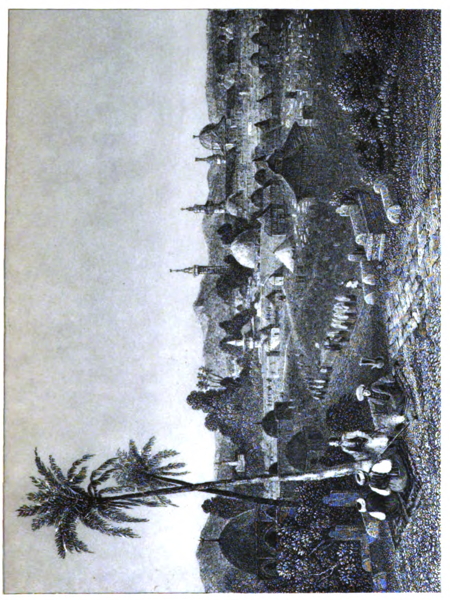
The passion of a Syrian youth completed the ruin of the exiles of Damascus. A nobleman of the city, of the name of Jonas, [75] was betrothed to a wealthy maiden; but her parents delayed the consummation of his nuptials, and their daughter was persuaded to escape with the man whom she had chosen. They corrupted the nightly watchmen of the gate Keisan: the lover, who led the way, was encompassed by a squadron of Arabs; but his exclamation in the Greek tongue, “the bird is taken,” admonished his mistress to hasten her return. In the presence of Caled, and of death, the unfortunate Jonas professed his belief in one God, and his apostle Mahomet; and continued, till the season of his martyrdom, to discharge the duties of a brave and sincere Musulman. When the city was taken, he flew to the monastery, where Eudocia had taken refuge; but the lover was forgotten; the apostate was scorned; she preferred her religion to her country; and the justice of Caled, though deaf to mercy, refused to detain by force a male or female inhabitant of Damascus. Four days was the general confined to the city by the obligation of [IX-150] the treaty and the urgent cares of his new conquest. His appetite for blood and rapine would have been extinguished by the hopeless computation of time and distance; but he listened to the importunities of Jonas, who assured him that the weary fugitives might yet be overtaken. At the head of four thousand horse, in the disguise of Christian Arabs, Caled undertook the pursuit. They halted only for the moments of prayer; and their guide had a perfect knowledge of the country. For a long way the footsteps of the Damascenes were plain and conspicuous: they vanished on a sudden; but the Saracens were comforted by the assurance that the caravan had turned aside into the mountains, and must speedily fall into their hands. In traversing the ridges of the Libanus, they endured intolerable hardships, and the sinking spirits of the veteran fanatics were supported and cheered by the unconquerable ardour of a lover. From a peasant of the country, they were informed that the emperor had sent orders to the colony of exiles, to pursue without delay the road of the sea-coast and of Constantinople; apprehensive, perhaps, that the soldiers and people of Antioch must be discouraged by the sight and the story of their sufferings. The Saracens were conducted through the territories of Gabala [76] and Laodicea, at a cautious distance from the walls of the cities; the rain was incessant, the night was dark, a single mountain separated them from the Roman army; and Caled, ever anxious for the safety of his brethren, whispered an ominous dream in the ear of his companion. With the dawn of day, the prospect again cleared, and they saw before them, in a pleasant valley, the [IX-151] tents of Damascus. After a short interval of repose and prayer, Caled divided his cavalry into four squadrons, committing the first to his faithful Derar, and reserving the last for himself. They successively rushed on the promiscuous multitude, insufficiently provided with arms, and already vanquished by sorrow and fatigue. Except a captive who was pardoned and dismissed, the Arabs enjoyed the satisfaction of believing that not a Christian of either sex escaped the edge of their scymetars. The gold and silver of Damascus was scattered over the camp, and a royal wardrobe of three hundred load of silk might clothe an army of naked Barbarians. In the tumult of the battle, Jonas sought and found the object of his pursuit; but her resentment was inflamed by the last act of his perfidy; and, as Eudocia struggled in his hateful embraces, she struck a dagger to her heart. Another female, the widow of Thomas, and the real or supposed daughter of Heraclius, was spared and released without a ransom; but the generosity of Caled was the effect of his contempt; and the haughty Saracen insulted, by a message of defiance, the throne of the Cæsars. Caled had penetrated above an hundred and fifty miles into the heart of the Roman province: he returned to Damascus with the same secrecy and speed. On the accession of Omar, the sword of God was removed from the command; but the caliph, who blamed the rashness, was compelled to applaud the vigour and conduct, of the enterprise. [77]
Another expedition of the conquerors of Damascus will equally display their avidity and their contempt for the riches of the present world. They were informed that the produce and manufactures of the country were annually collected in the fair of Abyla, [78] about thirty miles from the city; that the [IX-152] cell of a devout hermit was visited at the same time by a multitude of pilgrims; and that the festival of trade and superstition would be ennobled by the nuptials of the daughter of the governor of Tripoli. Abdallah, the son of Jaafar, a glorious and holy martyr, undertook, with a banner of five hundred horse, the pious and profitable commission of despoiling the infidels. As he approached the fair of Abyla, he was astonished by the report of the mighty concourse of Jews and Christians, Greeks and Armenians, of natives of Syria and of strangers of Egypt, to the number of ten thousand, besides a guard of five thousand horse that attended the person of the bride. The Saracens paused: “For my own part,” said Abdallah, “I dare not go back; our foes are many, our danger is great; but our reward is splendid and secure, either in this life or in the life to come. Let every man, according to his inclination, advance or retire.” Not a Musulman deserted his standard. “Lead the way,” said Abdallah to his Christian guide, “and you shall see what the companions of the prophet can perform.” They charged in five squadrons; but, after the first advantage of the surprise, they were encompassed and almost overwhelmed by the multitude of their enemies; and their valiant band is fancifully compared to a white spot in the skin of a black camel. [79] About the hour of sunset, when their weapons dropped from their hands, when they panted on the verge of eternity, they discovered an approaching cloud of dust, they heard the welcome sound of the tecbir, [80] and they soon perceived the [IX-153] standard of Caled, who flew to their relief with the utmost speed of his cavalry. The Christians were broken by his attack, and slaughtered in their flight as far as the river of Tripoli. They left behind them the various riches of the fair: the merchandises that were exposed for sale, the money that was brought for purchase, the gay decorations of the nuptials, and the governor’s daughter, with forty of her female attendants. The fruits, provisions, and furniture, the money, plate, and jewels, were diligently laden on the backs of horses, asses, and mules; and the holy robbers returned in triumph to Damascus. The hermit, after a short and angry controversy with Caled, declined the crown of martyrdom, and was left alive in the solitary scene of blood and devastation.
Syria, [81] one of the countries that have been improved by the most early cultivation, is not unworthy of the preference. [82] The heat of the climate is tempered by the vicinity of the sea and mountains, by the plenty of wood and water; and the [IX-154] produce of a fertile soil affords the subsistence, and encourages the propagation, of men and animals. From the age of David to that of Heraclius, the country was overspread with ancient and flourishing cities: the inhabitants were numerous and wealthy; and, after the slow ravage of despotism and superstition, after the recent calamities of the Persian war, Syria could still attract and reward the rapacious tribes of the desert. A plain, of ten days’ journey, from Damascus to Aleppo and Antioch, is watered, on the western side, by the winding course of the Orontes. The hills of Libanus and Anti-Libanus are planted from north to south, between the Orontes and the Mediterranean, and the epithet of hollow (Cœlesyria) was applied to a long and fruitful valley, which is confined in the same direction by the two ridges of snowy mountains. [83] Among the cities, which are enumerated by Greek and Oriental names in the geography and contest of Syria, we may distinguish Emesa or Hems, Heliopolis or Baalbec, the former as the metropolis of the plain, the latter as the capital of the valley. Under the last of the Cæsars, they were strong and populous: the turrets glittered from afar; an ample space was covered with public and private buildings; and the citizens were illustrious by their spirit, or at least by their pride; by their riches, or at least by their luxury. In the days of Paganism, both Emesa and Heliopolis were addicted to the worship of Baal, or the sun; but the decline of their superstition and splendour has been marked by a singular variety of fortune. Not a vestige remains of the temple of Emesa, which was equalled in poetic style to the summits of Mount Libanus, [84] while the [IX-155] ruins of Baalbec, invisible to the writers of antiquity, excite the curiosity and wonder of the European traveller. [85] The measure of the temple is two hundred feet in length, and one hundred in breadth; the front is adorned with a double portico of eight columns; fourteen may be counted on either side; and each column, forty-five feet in height, is composed of three massy blocks of stone or marble. The proportions and ornaments of the Corinthian order express the architecture of the Greeks; but, as Baalbec has never been the seat of a monarch, we are at a loss to conceive how the expense of these magnificent structures could be supplied by private or municipal liberality. [86] From the conquest of Damascus the Saracens proceeded to Heliopolis and Emesa: but I shall decline the repetition of the sallies and combats which have been already shewn on a larger scale. In the prosecution of the war, their policy was not less effectual than their sword. By short and separate truces they dissolved the union of the enemy; accustomed the Syrians to compare their friendship with their enmity; familiarised the idea of their language, religion, and manners; and exhausted, by clandestine purchase, the magazines and arsenals of the cities which they [IX-156] returned to besiege. They aggravated the ransom of the more wealthy or the more obstinate; and Chalcis alone was taxed at five thousand ounces of gold, five thousand ounces of silver, two thousand robes of silk, and as many figs and olives as would load five thousand asses. But the terms of truce or capitulation were faithfully observed; and the lieutenant of the caliph, who had promised not to enter the walls of the captive Baalbec, remained tranquil and immovable in his tent till the jarring factions solicited the interposition of a foreign master. The conquest of the plain and valley of Syria was achieved in less than two years. [87] Yet the commander of the faithful reproved the slowness of their progress, and the Saracens, bewailing their fault with tears of rage and repentance, called aloud on their chiefs to lead them forth to fight the battles of the Lord. In a recent action, under the walls of Emesa, an Arabian youth, the cousin of Caled, was heard aloud to exclaim, “Methinks I see the black-eyed girls looking upon me; one of whom, should she appear in this world, all mankind would die for love of her. And I see in the hand of one of them an handkerchief of green silk, and a cap of precious stones, and she beckons me, and calls out, Come hither quickly, for I love thee.” With these words, charging the Christians, he made havoc wherever he went, till, observed at length by the governor of Hems, he was struck through with a javelin.
It was incumbent on the Saracens to exert the full powers of their valour and enthusiasm against the forces of the emperor, who was taught by repeated losses that the rovers of the desert had undertaken, and would speedily achieve, a regular and permanent conquest. From the provinces of Europe and Asia, fourscore thousand soldiers were transported by sea and land to Antioch and Cæsarea; the light troops of the army consisted of sixty thousand Christian Arabs [IX-157] of the tribe of Gassan. Under the banner of Jabalah, the last of their princes, they marched in the van; and it was a maxim of the Greeks that, for the purpose of cutting diamond, a diamond was the most effectual. Heraclius withheld his person from the dangers of the field; but his presumption, or perhaps his despondency, suggested a peremptory order that the fate of the province and the war should be decided by a single battle. The Syrians were attached to the standard of Rome and of the cross; but the noble, the citizen, the peasant, were exasperated by the injustice and cruelty of a licentious host who oppressed them as subjects and despised them as strangers and aliens. [88] A report of these mighty preparations was conveyed to the Saracens in their camp of Emesa; and the chiefs, though resolved to fight, assembled a council; the faith of Abu Obeidah would have expected on the same spot the glory of martyrdom; the wisdom of Caled advised an honourable retreat to the skirts of Palestine and Arabia, where they might await the succours of their friends and the attack of the unbelievers. A speedy messenger soon returned from the throne of Medina, with the blessings of Omar and Ali, the prayers of the widows of the prophet, and a reinforcement of eight thousand Moslems. In their way they overturned a detachment of Greeks, and, when they joined at Yermuk the camp of their brethren, they found the pleasing intelligence that Caled had already defeated and scattered the Christian Arabs of the tribe of Gassan. In the neighbourhood of Bosra, the springs of Mount Hermon descend in a torrent to the plain of Decapolis, or ten cities; and the Hieromax, a name which has been corrupted to Yermuk, is lost after a short course in the lake of Tiberias. [89] The banks of this obscure stream were [IX-158] illustrated by a long and bloody encounter. On this momentous occasion, the public voice, and the modesty of Abu Obeidah, restored the command to the most deserving of the Moslems. Caled assumed his station in the front, his colleague was posted in the rear, that the disorder of the fugitives might be checked by his venerable aspect and the sight of the yellow banner which Mahomet had displayed before the walls of Chaibar. The last line was occupied by the sister of Derar, with the Arabian women who had enlisted in this holy war, who were accustomed to wield the bow and the lance, and who in a moment of captivity had defended, against the uncircumcised ravishers, their chastity and religion. [90] The exhortation of the generals was brief and forcible; “Paradise is before you, the devil and hell-fire in your rear.” Yet such was the weight of the Roman cavalry that the right wing of the Arabs was broken and separated from the main body. Thrice did they retreat in disorder, and thrice were they driven back to the charge by the reproaches and blows of the women. In the intervals of action, Abu Obeidah visited the tents of his brethren; prolonged their repose by repeating at once the prayers of two different hours; bound up their wounds with his own hands, and administered the comfortable reflection that the infidels partook of their sufferings without partaking of their reward. Four thousand and thirty of the Moslems were buried in the [IX-159] field of battle; and the skill of the Armenian archers enabled seven hundred to boast that they had lost an eye in that meritorious service. The veterans of the Syrian war acknowledged that it was the hardest and most doubtful of the days which they had seen. But it was likewise the most decisive: many thousands of the Greeks and Syrians fell by the swords of the Arabs; many were slaughtered, after the defeat in the woods and mountains; many, by mistaking the ford, were drowned in the waters of the Yermuk; and, however the loss may be magnified, [91] the Christian writers confess and bewail the bloody punishment of their sins. [92] Manuel, the Roman general, was either killed at Damascus or took refuge in the monastery of Mount Sinai. An exile in the Byzantine court, Jabalah lamented the manners of Arabia and his unlucky preference of the Christian cause. [93] He had once inclined to the profession of Islam; but, in the pilgrimage of Mecca, Jabalah was provoked to strike one of his brethren, and fled with amazement from the stern and equal justice of the caliph. The victorious Saracens enjoyed at Damascus a month of pleasure and repose; the spoil [IX-160] was divided by the discretion of Abu Obeidah; an equal share was allotted to a soldier and to his horse, and a double portion was reserved for the noble coursers of the Arabian breed.
After the battle of Yermuk the Roman army no longer appeared in the field; and the Saracens might securely choose among the fortified towns of Syria the first object of their attack. They consulted the caliph whether they should march to Cæsarea or Jerusalem; and the advice of Ali determined the immediate siege of the latter. To a profane eye, Jerusalem was the first or second capital of Palestine; but, after Mecca and Medina, it was revered and visited by the devout Moslems, as the temple of the Holy Land, which had been sanctified by the revelation of Moses, of Jesus, and of Mahomet himself. The son of Abu Sophian was sent with five thousand Arabs to try the first experiment of surprise or treaty; but on the eleventh day the town was invested by the whole force of Abu Obeidah. He addressed the customary summons to the chief commanders and people of Ælia. [94] “Health and happiness to every one that follows the right way! We require of you to testify that there is but one God and that Mahomet is his apostle. If you refuse this, consent to pay tribute, and be under us forthwith. Otherwise I shall bring men against you who love death better than you do the drinking of wine or eating hogs’ flesh. Nor will I ever stir from you, if it please God, till I have destroyed those that fight for you, and made slaves of your children.” But the city was defended on every side by deep valleys and steep ascents; since the invasion of Syria, [IX-161] the walls and towers had been anxiously restored; the bravest of the fugitives of Yermuk had stopped in the nearest place of refuge; and in the defence of the sepulchre of Christ the natives and strangers might feel some sparks of the enthusiasm which so fiercely glowed in the bosoms of the Saracens. The siege of Jerusalem lasted four months; not a day was lost without some action of sally or assault; the military engines incessantly played from the ramparts; and the inclemency of the winter was still more painful and destructive to the Arabs. The Christians yielded at length to the perseverance of the besiegers. The patriarch Sophronius appeared on the walls, and by the voice of an interpreter demanded a conference. After a vain attempt to dissuade the lieutenant of the caliph from his impious enterprise, he proposed, in the name of the people, a fair capitulation, with this extraordinary clause, that the articles of security should be ratified by the authority and presence of Omar himself. The question was debated in the council of Medina; the sanctity of the place, and the advice of Ali, persuaded the caliph to gratify the wishes of his soldiers and enemies, and the simplicity of his journey is more illustrious than the royal pageants of vanity and oppression. The conqueror of Persia and Syria was mounted on a red camel, which carried, besides his person, a bag of corn, a bag of dates, a wooden dish, and a leathern bottle of water. Wherever he halted, the company, without distinction, was invited to partake of his homely fare, and the repast was consecrated by the prayer and exhortation of the commander of the faithful. [95] But in this expedition or pilgrimage his power was exercised in the administration of justice; he reformed the licentious polygamy of the Arabs, relieved the tributaries from extortion and cruelty, and chastised the luxury of the Saracens by despoiling them of their rich silks and dragging them on their [IX-162] faces in the dirt. When he came within sight of Jerusalem, the caliph cried with a loud voice, “God is victorious. O Lord, give us an easy conquest;” and, pitching his tent of coarse hair, calmly seated himself on the ground. After signing the capitulation, he entered the city without fear or precaution; and courteously discoursed with the patriarch concerning its religious antiquities. [96] Sophronius bowed before his new master, and secretly muttered, in the words of Daniel, “The abomination of desolation is in the holy place.” [97] At the hour of prayer they stood together in the church of the Resurrection; but the caliph refused to perform his devotions, and contented himself with praying on the steps of the church of Constantine. To the patriarch he disclosed his prudent and honourable motive. “Had I yielded,” said Omar, “to your request, the Moslems of a future age would have infringed the treaty under colour of imitating my example.” By his command the ground of the temple of Solomon was prepared for the foundation of a mosch; [98] and, during a residence of ten days, he regulated the present and future state of his Syrian conquests. Medina might be jealous lest the caliph should be detained by [IX-163] the sanctity of Jerusalem or the beauty of Damascus; her apprehensions were dispelled by his prompt and voluntary return to the tomb of the apostle. [99]
To achieve what yet remained of the Syrian war, the caliph had formed two separate armies: a chosen detachment, under Amrou and Yezid, was left in the camp of Palestine; while the larger division, under the standard of Abu Obeidah and Caled, marched away to the north against Antioch and Aleppo. [100] The latter of these, the Berœa of the Greeks, was not yet illustrious as the capital of a province or a kingdom; and the inhabitants, by anticipating their submission and pleading their poverty, obtained a moderate composition for their lives and religion. But the castle of Aleppo, [101] distinct from the city, stood erect on a lofty artificial mound: the sides were sharpened to a precipice, and faced with freestone; and the breadth of the ditch might be filled with water from the neighbouring springs. After a loss of three thousand men, the garrison was still equal to the defence; and Youkinna, their valiant and hereditary chief, had murdered his brother, an holy monk, for daring to pronounce the name of peace. In a siege of four or five months, the hardest of the Syrian war, great numbers of the Saracens were killed and wounded; their removal to the distance of a [IX-164] mile could not seduce the vigilance of Youkinna; nor could the Christians be terrified by the execution of three hundred captives, whom they beheaded before the castle-wall. The silence, and at length the complaints, of Abu Obeidah informed the caliph that their hope and patience were consumed at the foot of this impregnable fortress. “I am variously affected,” replied Omar, “by the difference of your success; but I charge you by no means to raise the siege of the castle. Your retreat would diminish the reputation of our arms, and encourage the infidels to fall upon you on all sides. Remain before Aleppo till God shall determine the event, and forage with your horse round the adjacent country.” The exhortation of the commander of the faithful was fortified by a supply of volunteers from all the tribes of Arabia, who arrived in the camp on horses or camels. Among these was Dames, of a servile birth, but of gigantic size and intrepid resolution. The forty-seventh day of his service he proposed, with only thirty men, to make an attempt on the castle. The experience and testimony of Caled recommended his offer; and Abu Obeidah admonished his brethren not to despise the baser origin of Dames, since he himself, could he relinquish the public care, would cheerfully serve under the banner of the slave. His design was covered by the appearance of a retreat; and the camp of the Saracens was pitched about a league from Aleppo. The thirty adventurers lay in ambush at the foot of the hill; and Dames at length succeeded in his inquiries, though he was provoked by the ignorance of his Greek captives. “God curse these dogs,” said the illiterate Arab, “what a strange barbarous language they speak!” At the darkest hour of the night, he scaled the most accessible height, which he had diligently surveyed, a place where the stones were less entire, or the slope less perpendicular, or the guard less vigilant. Seven of the stoutest Saracens mounted on each other’s shoulders, and the weight of the column was sustained on the broad and sinewy back of the gigantic slave. The foremost [IX-165] in this painful ascent could grasp and climb the lowest part of the battlements; they silently stabbed and cast down the sentinels; and the thirty brethren, repeating a pious ejaculation, “O apostle of God, help and deliver us!” were successively drawn up by the long folds of their turbans. With bold and cautious footsteps, Dames explored the palace of the governor, who celebrated, in riotous merriment, the festival of his deliverance. From thence returning to his companions, he assaulted on the inside the entrance of the castle. They overpowered the guard, unbolted the gate, let down the drawbridge, and defended the narrow pass, till the arrival of Caled, with the dawn of day, relieved their danger and assured their conquest. Youkinna, a formidable foe, became an active and useful proselyte; and the general of the Saracens expressed his regard for the most humble merit by detaining the army at Aleppo till Dames was cured of his honourable wounds. The capital of Syria was still covered by the castle of Aazaz and the iron bridge of the Orontes. After the loss of those important posts and the defeat of the last of the Roman armies, the luxury of Antioch [102] trembled and obeyed. Her safety was ransomed with three hundred thousand pieces of gold; but the throne of the successors of Alexander, the seat of the Roman government in the East, which had been decorated by Cæsar with the titles of free, and holy, and inviolate, was degraded under the yoke of the caliphs to the secondary rank of a provincial town. [103]
[IX-166]
In the life of Heraclius, the glories of the Persian war are clouded on either hand by the disgrace and weakness of his more early and his later days. When the successors of Mahomet unsheathed the sword of war and religion, he was astonished at the boundless prospect of toil and danger; his nature was indolent, nor could the infirm and frigid age of the emperor be kindled to a second effort. The sense of shame, and the importunities of the Syrians, prevented his hasty departure from the scene of action; but the hero was no more; and the loss of Damascus and Jerusalem, the bloody fields of Aiznadin and Yermuk, may be imputed in some degree to the absence or misconduct of the sovereign. Instead of defending the sepulchre of Christ, he involved the church and state in a metaphysical controversy for the unity of his will; and, while Heraclius crowned the offspring of his second nuptials, he was tamely stripped of the most valuable part of their inheritance. In the cathedral of Antioch, in the presence of the bishops, at the foot of the crucifix, he bewailed the sins of the prince and people; but his confession instructed the world that it was vain, and perhaps impious, to resist the judgment of God. The Saracens were invincible in fact, since they were invincible in opinion; and the desertion of Youkinna, his false repentance and repeated perfidy, might justify the suspicion of the emperor that he was encompassed by traitors and apostates who conspired to betray his person and their country to the enemies of Christ. In the hour of adversity, his superstition was agitated by the omens and dreams of a falling crown; and, after bidding an eternal farewell to Syria, he secretly embarked with a few attendants and absolved the faith of his subjects. [104] Constantine, his [IX-167] eldest son, had been stationed with forty thousand men at Cæsarea, the civil metropolis of the three provinces of Palestine. But his private interest recalled him to the Byzantine court; and, after the flight of his father, he felt himself an unequal champion to the united force of the caliph. His vanguard was boldly attacked by three hundred Arabs and a thousand black slaves, who, in the depth of winter, had climbed the snowy mountains of Libanus, and who were speedily followed by the victorious squadrons of Caled himself. From the north and south, the troops of Antioch and Jerusalem advanced along the sea-shore, till their banners were joined under the walls of the Phœnician cities: Tripoli and Tyre were betrayed; and a fleet of fifty transports, which entered without distrust the captive harbours, brought a seasonable supply of arms and provisions to the camp of the Saracens. Their labours were terminated by the unexpected surrender of Cæsarea: [105] the Roman prince had embarked in the night; [106] and the defenceless citizens solicited their pardon with an offering of two hundred thousand pieces of [IX-168] gold. The remainder of the province, Ramlah, [107] Ptolemais or Acre, Sichem or Neapolis, Gaza, Ascalon, Berytus, Sidon, Gabala, Laodicea, Apamea, Hierapolis, no longer presumed to dispute the will of the conqueror; and Syria bowed under the sceptre of the caliphs seven hundred years after Pompey had despoiled the last of the Macedonian kings. [108]
The sieges and battles of six campaigns had consumed many thousands of the Moslems. They died with the reputation and the cheerfulness of martyrs; and the simplicity of their faith may be expressed in the words of an Arabian youth, when he embraced, for the last time, his sister and mother: “It is not,” said he, “the delicacies of Syria, or the fading delights of this world, that have prompted me to devote my life in the cause of religion. But I seek the favour of God and his apostle; and I have heard, from one of the companions of the prophet, that the spirits of the martyrs will be lodged in the crops of green birds, who shall taste the fruits, and drink of the rivers, of paradise. Farewell; we shall meet again among the groves and fountains which God has provided for his elect.” The faithful captives might exercise a passive and more arduous resolution; and a cousin of Mahomet is celebrated for refusing, after an abstinence of three days, the wine and pork, the only nourishment that was allowed by the malice of the infidels. The frailty of some weaker brethren exasperated the implacable spirit of fanaticism; and the father of Amer deplored, in pathetic strains, the apostacy and damnation of a son, who had renounced the promises of God and the intercession of the prophet, to occupy, with the priests and deacons, the lowest mansions of [IX-169] hell. The more fortunate Arabs, who survived the war and persevered in the faith, were restrained by their abstemious leader from the abuse of prosperity. After a refreshment of three days, Abu Obeidah withdrew his troops from the pernicious contagion of the luxury of Antioch, and assured the caliph that their religion and virtue could only be preserved by the hard discipline of poverty and labour. But the virtue of Omar, however rigorous to himself, was kind and liberal to his brethren. After a just tribute of praise and thanksgiving, he dropped a tear of compassion; and, sitting down on the ground, wrote an answer, in which he mildly censured the severity of his lieutenant: “God,” said the successor of the prophet, “has not forbidden the use of the good things of this world to faithful men, and such as have performed good works: therefore, you ought to have given them leave to rest themselves, and partake freely of those good things which the country affordeth. If any of the Saracens have no family in Arabia, they may marry in Syria; and, whosoever of them wants any female slaves, he may purchase as many as he hath occasion for.” The conquerors prepared to use, or to abuse, this gracious permission; but the year of their triumph was marked by a mortality of men and cattle; and twenty-five thousand Saracens were snatched away from the possession of Syria. The death of Abu Obeidah might be lamented by the Christians; but his brethren recollected that he was one of the ten elect whom the prophet had named as the heirs of paradise. [109] Caled survived his brethren about three years; and the tomb of the Sword of God is shewn in the neighbourhood of Emesa. His valour, which founded in Arabia and Syria the empire of the caliphs, was fortified by the opinion of a special providence; and, as long as he wore a cap which had been blessed by Mahomet, [IX-170] he deemed himself invulnerable amidst the darts of the infidels.
The place of the first conquerors was supplied by a new generation of their children and countrymen: Syria became the seat and support of the house of Ommiyah; and the revenue, the soldiers, the ships, of that powerful kingdom were consecrated to enlarge on every side the empire of the caliphs. But the Saracens despise a superfluity of fame; and their historians scarcely condescend to mention the subordinate conquests which are lost in the splendour and rapidity of their victorious career. To the north of Syria, they passed Mount Taurus, and reduced to their obedience the province of Cilicia, with its capital Tarsus, the ancient monument of the Assyrian kings. Beyond a second ridge of the same mountains, they spread the flame of war, rather than the light of religion, as far as the shores of the Euxine and the neighbourhood of Constantinople. To the east, they advanced to the banks and sources of the Euphrates and Tigris: [110] the long-disputed barrier of Rome and Persia was for ever confounded; the walls of Edessa and Amida, of Dara and Nisibis, which had resisted the arms and engines of Sapor or Nushirvan, were levelled in the dust; and the holy city of Abgarus might vainly produce the epistle of the image of Christ to an unbelieving conqueror. To the west, the Syrian kingdom is bounded by the sea; and the ruin of Aradus, a small island or peninsula on the coast, was postponed [IX-171] during ten years. But the hills of Libanus abounded in timber, the trade of Phœnicia was populous in mariners; and a fleet of seventeen hundred barks was equipped and manned by the natives of the desert. The Imperial navy of the Romans fled before them from the Pamphylian rocks to the Hellespont; but the spirit of the emperor, a grandson of Heraclius, had been subdued before the combat by a dream and a pun. [111] The Saracens rode masters of the sea; and the islands of Cyprus, Rhodes, and the Cyclades were successively exposed to their rapacious visits. Three hundred years before the Christian era, the memorable though fruitless siege of Rhodes [112] by Demetrius had furnished that maritime republic with the materials and the subject of a trophy. A gigantic statue of Apollo, or the sun, seventy cubits in height, was erected at the entrance of the harbour, a monument of the freedom and the arts of Greece. After standing fifty-six years, the colossus of Rhodes was overthrown by an earthquake; but the massy trunk and huge fragments lay scattered eight centuries on the ground, and are often described as one of the wonders of the ancient world. They were collected by the diligence of the Saracens, and sold to a Jewish merchant of Edessa, who is said to have laden nine hundred camels with the weight of the brass metal: an enormous weight, though we should include the [IX-172] hundred colossal figures [113] and the three thousand statues which adorned the prosperity of the city of the sun.
III. The conquest of Egypt may be explained by the character of the victorious Saracen, one of the first of his nation, in an age when the meanest of the brethren was exalted above his nature by the spirit of enthusiasm. The birth of Amrou was at once base and illustrious: his mother, a notorious prostitute, was unable to decide among five of the Koreish; but the proof of resemblance adjudged the child to Aasi, the oldest of her lovers. [114] The youth of Amrou was impelled by the passions and prejudices of his kindred: his poetic genius was exercised in satirical verses against the person and doctrine of Mahomet; his dexterity was employed by the reigning faction to pursue the religious exiles who had taken refuge in the court of the Œthiopian king [115] yet he returned from this embassy a secret proselyte; his reason or his interest determined him to renounce the worship of idols; he escaped from Mecca with his friend Caled, and the prophet of Medina enjoyed at the same moment the satisfaction of embracing the two firmest champions of his cause. The impatience of Amrou to lead the armies of the faithful was checked by the reproof of Omar, who advised him not to seek power and dominion, since he who is a subject to-day may be a prince to-morrow. Yet his merit was not overlooked by the two first successors of Mahomet; they were indebted to his arms for the conquest of Palestine; and in all the battles and sieges of Syria he united with the temper of a chief the valour of an adventurous soldier. In a visit to [IX-173] Medina, the caliph expressed a wish to survey the sword which had cut down so many Christian warriors: the son of Aasi unsheathed a short and ordinary scymetar; and, as he perceived the surprise of Omar, “Alas,” said the modest Saracen, “the sword itself, without the arm of its master, is neither sharper nor more weighty than the sword of Pharezdak the poet.” [116] After the conquest of Egypt, he was recalled by the jealousy of the caliph Othman; but, in the subsequent troubles, the ambition of a soldier, a statesman, and an orator emerged from a private station. His powerful support, both in council and in the field, established the throne of the Ommiades; the administration and revenue of Egypt were restored by the gratitude of Moawiyah to a faithful friend, who had raised himself above the rank of a subject; and Amrou ended his days in the palace and city which he had founded on the banks of the Nile. His dying speech to his children is celebrated by the Arabians as a model of eloquence and wisdom: he deplored the errors of his youth; but, if the penitent was still infected by the vanity of a poet, he might exaggerate the venom and mischief of his impious compositions. [117]
From his camp, in Palestine, Amrou had surprised or anticipated the caliph’s leave for the invasion of Egypt. [118] The magnanimous Omar trusted in his God and his sword, which had shaken the thrones of Chosroes and Cæsar; but, [IX-174] when he compared the slender force of the Moslems with the greatness of the enterprise, he condemned his own rashness and listened to his timid companions. The pride and the greatness of Pharaoh were familiar to the readers of the Koran; and a tenfold repetition of prodigies had been scarcely sufficient to effect, not the victory, but the flight of six hundred thousand of the children of Israel. The cities of Egypt were many and populous; their architecture was strong and solid; the Nile, with its numerous branches, was alone an insuperable barrier; and the granary of the Imperial city would be obstinately defended by the Roman powers. In this perplexity, the commander of the faithful resigned himself to the decision of chance, or, in his opinion, of providence. At the head of only four thousand Arabs, the intrepid Amrou had marched away from his station of Gaza, when he was overtaken by the messenger of Omar. “If you are still in Syria,” said the ambiguous mandate, “retreat without delay; but if, at the receipt of this epistle, you have already reached the frontiers of Egypt, advance with confidence, and depend on the succour of God and of your brethren.” The experience, perhaps the secret intelligence, of Amrou had taught him to suspect the mutability of courts; and he continued his march till his tents were unquestionably pitched on Egyptian ground. He there assembled his officers, broke the seal, perused the epistle, gravely inquired the name and situation of the place, and declared his ready obedience to the commands of the caliph. After a siege of thirty days, he took possession of Farmah or Pelusium; and that key of Egypt, as it has been justly named, unlocked the entrance of the country, as far as the ruins of Heliopolis and the neighbourhood of the modern Cairo.
On the western side of the Nile, at a small distance to the east of the Pyramids, at a small distance to the south of the Delta, Memphis, one hundred and fifty furlongs in circumference, displayed the magnificence of ancient kings. Under the reign of the Ptolemies and Cæsars, the seat of government [IX-175] was removed to the sea-coast; the ancient capital was eclipsed by the arts and opulence of Alexandria; the palaces, and at length the temples, were reduced to a desolate and ruinous condition: yet in the age of Augustus, and even in that of Constantine, Memphis was still numbered among the greatest and most populous of the provincial cities. [119] The banks of the Nile, in this place of the breadth of three thousand feet, were united by two bridges of sixty and of thirty boats, connected in the middle stream by the small island of Rouda, which was covered with gardens and habitations. [120] The eastern extremity of the bridge was terminated by the town of Babylon and the camp of a Roman legion, which protected the passage of the river and the second capital of Egypt. This important fortress, which might fairly be described as a part of Memphis, or Misrah, was invested by the arms of the lieutenant of Omar: a reinforcement of four thousand Saracens soon arrived in his camp; and the military engines, which battered the walls, may be imputed to the art and labour of his Syrian allies. Yet the siege was protracted to seven months; and the rash invaders were encompassed and threatened by the inundation of the Nile. [121] Their last assault was bold and successful: they [IX-176] passed the ditch, which had been fortified with iron spikes, applied their scaling-ladders, entered the fortress with the shout of “God is victorious!” and drove the remnant of the Greeks to their boats and the isle of Rouda. The spot was afterwards recommended to the conqueror by the easy communication with the gulf and the peninsula of Arabia: the remains of Memphis were deserted; the tents of the Arabs were converted into permanent habitations; and the first mosch was blessed by the presence of fourscore companions of Mahomet. [122] A new city arose in their camp on the eastward bank of the Nile; and the contiguous quarters of Babylon and Fostat are confounded in their present decay by the appellation of old Misrah or Cairo, of which they form an extensive suburb. But the name of Cairo, the town of victory, more strictly belongs to the modern capital, which was founded in the tenth century by the Fatimite caliphs. [123] It has gradually receded from the river, [123a] but the continuity of buildings may be traced by an attentive eye from the monuments of Sesostris to those of Saladin. [124]
Yet the Arabs, after a glorious and profitable enterprise, [IX-177] must have retreated to the desert, had they not found a powerful alliance in the heart of the country. The rapid conquest of Alexander was assisted by the superstition and revolt of the natives; they abhorred their Persian oppressors, the disciples of the Magi, who had burnt the temples of Egypt, and feasted with sacrilegious appetite on the flesh of the god Apis. [125] After a period of ten centuries the same revolution was renewed by a similar cause; and, in the support of an incomprehensible creed, the zeal of the Coptic Christians was equally ardent. I have already explained the origin and progress of the Monophysite controversy, and the persecution of the emperors, which converted a sect into a nation and alienated Egypt from their religion and government. The Saracens were received as the deliverers of the Jacobite church; and a secret and effectual treaty was opened during the siege of Memphis between a victorious army and a people of slaves. A rich and noble Egyptian, of the name of Mokawkas, had dissembled his faith to obtain the administration of his province: in the disorders of the Persian war he aspired to independence; the embassy of Mahomet ranked him among princes; but he declined, with rich gifts and ambiguous compliments, the proposal of a new religion. [126] The abuse of his trust exposed him to the resentment of Heraclius; his submission was delayed by arrogance and fear; and his conscience was prompted by interest to throw himself on the favour of the nation and the support of the [IX-178] Saracens. In his first conference with Amrou, he heard without indignation the usual option of the Koran, the tribute, or the sword. “The Greeks,” replied Mokawkas, “are determined to abide the determination of the sword; but with the Greeks I desire no communion, either in this world or in the next, and I abjure for ever the Byzantine tyrant, his synod of Chalcedon, and his Melchite slaves. For myself and my brethren, we are resolved to live and die in the profession of the gospel and unity of Christ. It is impossible for us to embrace the revelations of your prophet; but we are desirous of peace, and cheerfully submit to pay tribute and obedience to his temporal successors.” The tribute was ascertained at two pieces of gold for the head of every Christian; [127] but old men, monks, women, and children of both sexes under sixteen years of age were exempted from this personal assessment; the Copts above and below Memphis swore allegiance to the caliph, and promised an hospitable entertainment of three days to every Musulman who should travel through their country. By this charter of security the ecclesiastical and civil tyranny of the Melchites was destroyed; [128] the anathemas of St. Cyril were thundered from every pulpit; and the sacred edifices, with the patrimony of the church, were restored to the national communion of the Jacobites, who enjoyed without moderation the moment of triumph and revenge. At the pressing summons of Amrou, their patriarch Benjamin emerged from his desert; and, after the first interview, the courteous Arab affected to declare that he had never conversed with a Christian priest of more [IX-179] innocent manners and a more venerable aspect. [129] In the march from Memphis to Alexandria, the lieutenant of Omar entrusted his safety to the zeal and gratitude of the Egyptians; the roads and bridges were diligently repaired; and, in every step of his progress, he could depend on a constant supply of provisions and intelligence. The Greeks of Egypt, whose numbers could scarcely equal a tenth of the natives, were overwhelmed by the universal defection; they had ever been hated, they were no longer feared; the magistrate fled from his tribunal, the bishop from his altar; and the distant garrisons were surprised or starved by the surrounding multitudes. Had not the Nile afforded a safe and ready conveyance to the sea, not an individual could have escaped who by birth, or language, or office, or religion was connected with their odious name.
By the retreat of the Greeks from the provinces of Upper Egypt, a considerable force was collected in the island of Delta: the natural and artificial channels of the Nile afforded a succession of strong and defensible posts; and the road to Alexandria was laboriously cleared by the victory of the Saracens in two and twenty days of general or partial combat. In their annals of conquest, the siege of Alexandria [130] is perhaps the most arduous and important enterprise. The first trading city in the world was abundantly replenished with the means of subsistence and defence. Her numerous inhabitants fought for the dearest of human rights, religion and property; and the enmity of the natives seemed to exclude them from the common benefit of peace and toleration. The sea was continually open; and, if Heraclius had been awake to the public distress, fresh armies of Romans and Barbarians might have been poured into the harbour to save [IX-180] the second capital of the empire. A circumference of ten miles would have scattered the forces of the Greeks and favoured the stratagems of an active enemy; but the two sides of an oblong square were covered by the sea and the lake Maræotis, and each of the narrow ends exposed a front of no more than ten furlongs. The efforts of the Arabs were not inadequate to the difficulty of the attempt and the value of the prize. From the throne of Medina, the eyes of Omar were fixed on the camp and city: his voice excited to arms the Arabian tribes and the veterans of Syria; and the merit of an holy war was recommended by the peculiar fame and fertility of Egypt. Anxious for the ruin or expulsion of their tyrants, the faithful natives devoted their labours to the service of Amrou; some sparks of martial spirit were perhaps rekindled by the example of their allies; and the sanguine hopes of Mokawkas had fixed his sepulchre in the church of St. John of Alexandria. Eutychius the patriarch observes that the Saracens fought with the courage of lions; they repulsed the frequent and almost daily sallies of the besieged, and soon assaulted in their turn the walls and towers of the city. In every attack, the sword, the banner of Amrou glittered in the van of the Moslems. On a memorable day, he was betrayed by his imprudent valour: his followers who had entered the citadel were driven back; and the general, with a friend and a slave, remained a prisoner in the hands of the Christians. When Amrou was conducted before the prefect, he remembered his dignity and forgot his situation; a lofty demeanour and resolute language revealed the lieutenant of the caliph, and the battle-axe of [IX-181] a soldier was already raised to strike off the head of the audacious captive. His life was saved by the readiness of his slave, who instantly gave his master a blow on the face, and commanded him, with an angry tone, to be silent in the presence of his superiors. The credulous Greek was deceived: he listened to the offer of a treaty, and his prisoners were dismissed in the hope of a more respectable embassy, till the joyful acclamations of the camp announced the return of their general and insulted the folly of the infidels. [131] At length, after a siege of fourteen months [132] and the loss of three and twenty thousand men, the Saracens prevailed; the Greeks embarked their dispirited and diminished numbers, and the standard of Mahomet was planted on the walls of the capital of Egypt. “I have taken,” said Amrou to the caliph, “the great city of the West. It is impossible for me to enumerate the variety of its riches and beauty; and I shall content myself with observing that it contains four thousand palaces, four thousand baths, four hundred theatres or places of amusement, twelve thousand shops for the sale of vegetable food, and forty thousand tributary Jews. The town has been subdued by force of arms, without treaty or capitulation, and the Moslems are impatient to seize the fruits of their victory.” [133] The commander of the faithful rejected with [IX-182] firmness the idea of pillage, and directed his lieutenant to reserve the wealth and revenue of Alexandria for the public service and the propagation of the faith. The inhabitants were numbered; a tribute was imposed; the zeal and resentment of the Jacobites were curbed, and the Melchites who submitted to the Arabian yoke were indulged in the obscure but tranquil exercise of their worship. The intelligence of this disgraceful and calamitous event afflicted the declining health of the emperor; and Heraclius died of a dropsy about seven weeks after the loss of Alexandria. [134] Under the minority of his grandson, the clamours of a people, deprived of their daily sustenance, compelled the Byzantine court to undertake the recovery of the capital of Egypt. In the space of four years, the harbour and fortifications of Alexandria were twice occupied by a fleet and army of Romans. They were twice expelled by the valour of Amrou, who was recalled by the domestic peril from the distant wars of Tripoli and Nubia. But the facility of the attempt, the repetition of the insult, and the obstinacy of the resistance provoked him to swear that, if a third time he drove the infidels into the sea, he would render Alexandria as accessible on all sides as the house of a prostitute. Faithful to his promise, he dismantled several parts of the walls and towers, but the people was spared in the chastisement of the city, and the mosch of Mercy was erected on the spot where the victorious general had stopped the fury of his troops.
I should deceive the expectation of the reader, if I passed in silence the fate of the Alexandrian library, as it is described by the learned Abulpharagius. The spirit of Amrou was more curious and liberal than that of his brethren, and in [IX-183] his leisure hours the Arabian chief was pleased with the conversation of John, the last disciple of Ammonius, and who derived the surname of Philoponus from his laborious studies of grammar and philosophy. [135] Emboldened by this familiar intercourse, Philoponus presumed to solicit a gift, inestimable in his opinion, contemptible in that of the Barbarians: the royal library, which alone, among the spoils of Alexandria, had not been appropriated by the visit and the seal of the conqueror. Amrou was inclined to gratify the wish of the grammarian, but his rigid integrity refused to alienate the minutest object without the consent of the caliph; and the well-known answer of Omar was inspired by the ignorance of a fanatic. “If these writings of the Greeks agree with the book of God, they are useless and need not be preserved; if they disagree, they are pernicious and ought to be destroyed.” The sentence was executed with blind obedience; the volumes of paper or parchment were distributed to the four thousand baths of the city; and such was their incredible multitude that six months were barely sufficient for the consumption of this precious fuel. Since the Dynasties of Abulpharagius [136] have been given to the world in a Latin version, the tale has been repeatedly transcribed; and every scholar, with pious indignation, has deplored the irreparable shipwreck [IX-184] of the learning, the arts, and the genius of antiquity. For my own part, I am strongly tempted to deny both the fact and the consequences. The fact is indeed marvellous; “Read and wonder!” says the historian himself; and the solitary report of a stranger who wrote at the end of six hundred years on the confines of Media is overbalanced by the silence of two annalists of a more early date, both Christians, both natives of Egypt, and the most ancient of whom, the patriarch Eutychius, has amply described the conquest of Alexandria. [137] The rigid sentence of Omar is repugnant to the sound and orthodox precept of the Mahometan casuists: they expressly declare that the religious books of the Jews and Christians, which are acquired by the right of war, should never be committed to the flames; and that the works of profane science, historians or poets, physicians or philosophers, may be lawfully applied to the use of the faithful. [138] A more destructive zeal may perhaps be attributed to the first successors of Mahomet; yet in this instance the conflagration would have speedily expired in the deficiency of materials. I shall not recapitulate the disasters of the Alexandrian library, the involuntary flame that was kindled by Cæsar in his own defence, [139] or the mischievous bigotry of the Christians who studied to destroy the monuments of idolatry. [140] But, if we gradually descend from the age of the [IX-185] Antonines to that of Theodosius, we shall learn from a chain of contemporary witnesses that the royal palace and the temple of Serapis no longer contained the four, or the seven, hundred thousand volumes which had been assembled by the curiosity and magnificence of the Ptolemies. [141] Perhaps the church and seat of the patriarchs might be enriched with a repository of books; but, if the ponderous mass of Arian and Monophysite controversy were indeed consumed in the public baths, [142] a philosopher may allow, with a smile, that it was ultimately devoted to the benefit of mankind. I sincerely [IX-186] regret the more valuable libraries which have been involved in the ruin of the Roman empire; but, when I seriously compute the lapse of ages, the waste of ignorance, and the calamities of war, our treasures, rather than our losses, are the object of my surprise. Many curious and interesting facts are buried in oblivion: the three great historians of Rome have been transmitted to our hands in a mutilated state, and we are deprived of many pleasing compositions of the lyric, iambic, and dramatic poetry of the Greeks. Yet we should gratefully remember that the mischances of time and accident have spared the classic works to which the suffrage of antiquity [143] had adjudged the first place of genius and glory; the teachers of ancient knowledge, who are still extant, had persued and compared the writings of their predecessors; [144] nor can it fairly be presumed that any important truth, any useful discovery in art or nature, has been snatched away from the curiosity of modern ages.
In the administration of Egypt, [145] Amrou balanced the demands of justice and policy; the interest of the people of the law, who were defended by God, and of the people of the alliance, who were protected by man. In the recent tumult of conquest and deliverance, the tongue of the Copts and the sword of the Arabs were most adverse to the tranquillity of the province. To the former, Amrou declared that faction and falsehood would be doubly chastised: by the punishment [IX-187] of the accusers, whom he should detest as his personal enemies, and by the promotion of their innocent brethren, whom their envy had laboured to injure and supplant. He excited the latter by the motives of religion and honour to sustain the dignity of their character, to endear themselves by a modest and temperate conduct to God and the caliph, to spare and protect a people who had trusted to their faith, and to content themselves with the legitimate and splendid rewards of their victory. In the management of the revenue he disapproved the simple but oppressive mode of capitation, and preferred with reason a proportion of taxes, deducted on every branch from the clear profits of agriculture and commerce. A third part of the tribute was appropriated to the annual repairs of the dykes and canals, so essential to the public welfare. Under his administration the fertility of Egypt supplied the dearth of Arabia; and a string of camels, laden with corn and provisions, covered almost without an interval the long road from Memphis to Medina. [146] But the genius of Amrou soon renewed the maritime communication which had been attempted or achieved by the Pharaohs, the Ptolemies, or the Cæsars; and a canal, at least eighty miles in length, was opened from the Nile to the Red Sea. This inland navigation, which would have joined the Mediterranean and the Indian Ocean, was soon discontinued as useless and dangerous; the throne was removed from Medina to Damascus; and the Grecian fleets might have explored a passage to the holy cities of Arabia. [147]
[IX-188]
Of his new conquest, the caliph Omar had an imperfect knowledge from the voice of fame and the legends of the Koran. He requested that his lieutenant would place before his eyes the realm of Pharaoh and the Amalekites; and the answer of Amrou exhibits a lively and not unfaithful picture of that singular country. [148] “O commander of the faithful, Egypt is a compound of black earth and green plants, between a pulverised mountain and a red sand. The distance from Syene to the sea is a month’s journey for an horseman. Along the valley descends a river, on which the blessing of the Most High reposes both in the evening and morning, and which rises and falls with the revolutions of the sun and moon. When the annual dispensation of Providence unlocks the springs and fountains that nourish the earth, the Nile rolls his swelling and sounding waters through the realm of Egypt; the fields are overspread by the salutary flood; and the villages communicate with each other in their painted barks. The retreat of the inundation deposits a fertilising mud for the reception of the various seeds; the crowds of husbandmen who blacken the land may be compared to a swarm of industrious ants; and their native indolence is quickened by the lash of the task-master and the promise of the flowers and fruits of a plentiful increase. Their hope is seldom deceived; but the riches which they extract from the wheat, the barley, and the rice, the legumes, the fruit-trees, and the cattle, are unequally shared between those who labour and those who possess. According to the vicissitudes of the seasons, the [IX-189] face of the country is adorned with a silver wave, a verdant emerald, and the deep yellow of a golden harvest.” [149] Yet this beneficial order is sometimes interrupted; and the long delay and sudden swell of the river in the first year of the conquest might afford some colour to an edifying fable. It is said that the annual sacrifice of a virgin [150] had been interdicted by the piety of Omar; and that the Nile lay sullen and inactive in his shallow bed, till the mandate of the caliph was cast into the obedient stream, which rose in a single night to the height of sixteen cubits. The admiration of the Arabs for their new conquest encouraged the licence of their romantic spirit. We may read, in the gravest authors, that Egypt was crowded with twenty thousand cities or villages; [151] that, exclusive of the Greeks and Arabs, the Copts alone were found, on the assessment, six millions of tributary subjects, [152] or twenty millions of either sex and of [IX-190] every age; that three hundred millions of gold or silver were annually paid to the treasury of the caliph. [153] Our reason must be startled by these extravagant assertions; and they will become more palpable, if we assume the compass and measure the extent of habitable ground: a valley from the tropic to Memphis, seldom broader than twelve miles, and the triangle of the Delta, a flat surface of two thousand one hundred square leagues, compose a twelfth part of the magnitude of France. [154] A more accurate research will justify a more reasonable estimate. The three hundred millions, created by the error of a scribe, are reduced to the decent revenue of four millions three hundred thousand pieces of gold, of which nine hundred thousand were consumed by the pay of the soldiers. [155] Two authentic lists, of the present and of the twelfth century, are circumscribed within the respectable number of two thousand seven hundred villages and towns. [156] After a long residence at Cairo, a French [IX-191] consul has ventured to assign about four millions of Mahometans, Christians, and Jews for the ample, though not incredible, scope of the population of Egypt. [157]
IV. The conquest of Africa, from the Nile to the Atlantic Ocean, [158] was first attempted by the arms of the caliph [IX-192] Othman. [159] The pious design was approved by the companions of Mahomet and the chiefs of the tribes; and twenty thousand Arabs marched from Medina, with the gifts and the blessing of the commander of the faithful. They were joined in the camp of Memphis by twenty thousand of their countrymen; and the conduct of the war was entrusted to Abdallah, [160] the son of Said, and the foster-brother of the caliph, who had lately supplanted the conqueror and lieutenant of Egypt. Yet the favour of the prince and the merit of his favourite could not obliterate the guilt of his apostasy. The early conversion of Abdallah and his skilful pen had recommended him to the important office of transcribing the sheets of the Koran; he betrayed his trust, corrupted the text, derided the errors which he had made, and fled to Mecca to escape the justice, and expose the ignorance, of the apostle. After the conquest of Mecca, he fell prostrate at the feet of Mahomet; his tears and the entreaties of Othman extorted a reluctant pardon; but the prophet declared that he had so long hesitated to allow time for some zealous disciple to avenge his injury in the blood of the apostate. With apparent fidelity and effective merit, he served the religion which it was no longer his interest to desert: his birth and talents gave him an honourable rank among the Koreish; and, in a nation of cavalry, Abdallah was renowned as the boldest and most dexterous horseman of Arabia. At the head of forty thousand Moslems, he advanced from Egypt into the unknown countries of the West. The sands of Barca might be impervious to a Roman legion; but the Arabs were attended by their faithful camels; and the natives of the desert beheld without terror the familiar aspect of the soil and [IX-193] climate. After a painful march, they pitched their tents before the walls of Tripoli, [161] a maritime city, in which the name, the wealth, and the inhabitants of the province had gradually centred, and which now maintains the third rank among the states of Barbary. A reinforcement of Greeks was surprised and cut in pieces on the sea-shore; but the fortifications of Tripoli resisted the first assaults; and the Saracens were tempted by the approach of the prefect Gregory [162] to relinquish the labours of the siege for the perils and the hopes of a decisive action. If his standard was followed by one hundred and twenty thousand men, the regular bands of the empire must have been lost in the naked and disorderly crowd of Africans and Moors, who formed the strength, or rather the numbers, of his host. He rejected with indignation the option of the Koran or the tribute; and during several days the two armies were fiercely engaged from the dawn of light to the hour of noon, when their fatigue and [IX-194] the excessive heat compelled them to seek shelter and refreshment in their respective camps. The daughter of Gregory, a maid of incomparable beauty and spirit, is said to have fought by his side; from her earliest youth she was trained to mount on horseback, to draw the bow, and to wield the scymetar; and the richness of her arms and apparel was conspicuous in the foremost ranks of the battle. Her hand, with an hundred thousand pieces of gold, was offered for the head of the Arabian general, and the youths of Africa were excited by the prospect of the glorious prize. At the pressing solicitation of his brethren, Abdallah withdrew his person from the field; but the Saracens were discouraged by the retreat of their leader and the repetition of these equal or unsuccessful conflicts.
A noble Arabian, who afterwards became the adversary of Ali and the father of a caliph, had signalised his valour in Egypt, and Zobeir [163] was the first who planted the scaling-ladder against the walls of Babylon. In the African war he was detached from the standard of Abdallah. On the news of the battle, Zobeir, with twelve companions, cut his way through the camp of the Greeks, and pressed forwards, without tasting either food or repose, to partake of the dangers of his brethren. He cast his eyes round the field: “Where,” said he, “is our general?” “In his tent.” “Is the tent a station for the general of the Moslems?” Abdallah represented with a blush the importance of his own life, and the temptation that was held forth by the Roman prefect. “Retort,” said Zobeir, “on the infidels their ungenerous attempt. Proclaim through the ranks that the head of Gregory shall be repaid with his captive daughter and the equal sum of one hundred thousand pieces of gold.” [164] [IX-195] To the courage and discretion of Zobeir the lieutenant of the caliph entrusted the execution of his own stratagem, which inclined the long-disputed balance in favour of the Saracens. Supplying by activity and artifice the deficiency of numbers, a part of their forces lay concealed in their tents, while the remainder prolonged an irregular skirmish with the enemy, till the sun was high in the heavens. On both sides they retired with fainting steps; their horses were unbridled, their armour was laid aside, and the hostile nations prepared, or seemed to prepare, for the refreshment of the evening and the encounter of the ensuing day. On a sudden, the charge was sounded; the Arabian camp poured forth a swarm of fresh and intrepid warriors; and the long line of the Greeks and Africans was surprised, assaulted, overturned by new squadrons of the faithful, who, to the eye of fanaticism, might appear as a band of angels descending from the sky. The prefect himself was slain by the hand of Zobeir: his daughter, who sought revenge and death, was surrounded and made prisoner; and the fugitives involved in their disaster the town of Sufetula, to which they escaped from the sabres and lances of the Arabs. Sufetula was built one hundred and fifty miles to the south of Carthage: a gentle declivity is watered by a running stream, and shaded by a grove of Juniper trees; and, in the ruins of a triumphal arch, a portico, and three temples of the Corinthian order, curiosity may yet admire the magnificence of the Romans. [165] After the fall of this opulent city, the provincials and Barbarians implored on all sides the mercy of the conqueror. His vanity or his zeal might be flattered by offers of tribute or professions of faith; but his losses, his fatigues, and the progress of an epidemical disease prevented a solid establishment; and the Saracens, after a campaign of fifteen months, retreated to the confines of Egypt, with the captives and the [IX-196] wealth of their African expedition. The caliph’s fifth was granted to a favourite, on the nominal payment of five hundred thousand pieces of gold; [166] but the state was doubly injured by this fallacious transaction, if each foot-soldier had shared one thousand, and each horseman three thousand, pieces in the real division of the plunder. The author of the death of Gregory was expected to have claimed the most precious reward of the victory: from his silence it might be presumed that he had fallen in the battle, till the tears and exclamations of the prefect’s daughter at the sight of Zobeir revealed the valour and modesty of that gallant soldier. The unfortunate virgin was offered, and almost rejected, as a slave, by her father’s murderer, who coolly declared that his sword was consecrated to the service of religion; and that he laboured for a recompense far above the charms of mortal beauty or the riches of this transitory life. [167] A reward congenial to his temper was the honourable commission of announcing to the caliph Othman the success of his arms. The companions, the chiefs, and the people were assembled in the mosch of Medina, to hear the interesting narrative of Zobeir; and, as the orator forgot nothing except the merit of his own counsels and actions, the name of Abdallah was joined by the Arabians with the heroic names of Caled and Amrou. [168]
[IX-197]
The Western conquests of the Saracens were suspended near twenty years, till their dissensions were composed by the establishment of the house of Ommiyah; and the caliph Moawiyah was invited by the cries of the Africans themselves. The successors of Heraclius had been informed of the tribute which they had been compelled to stipulate with the Arabs; but, instead of being moved to pity and relieve their distress, they imposed, as an equivalent or a fine, a second tribute of a similar amount. The ears of the Byzantine ministers were shut against the complaints of their poverty and ruin; their despair was reduced to prefer the dominion of a single master; and the extortions of the patriarch [169] of Carthage, who was invested with civil and military power, provoked the sectaries, and even the Catholics, of the Roman province to abjure the religion as well as the authority of their tyrants. The first lieutenant [170] of Moawiyah acquired a just renown, subdued an important city, defeated an army of thirty thousand Greeks, swept away fourscore thousand captives, and enriched with their spoils the bold adventurers of Syria and Egypt. [171] But the title of conqueror of Africa is more justly [IX-198] due to his successor Akbah. He marched from Damascus at the head of ten thousand of the bravest Arabs; and the genuine force of the Moslems was enlarged by the doubtful aid and conversion of many thousand Barbarians. It would be difficult, nor is it necessary, to trace the accurate line of the progress of Akbah. The interior regions have been peopled by the Orientals with fictitious armies and imaginary citadels. [172] In the warlike province of Zab or Numidia, fourscore thousand of the natives might assemble in arms; but the number of three hundred and sixty towns is incompatible with the ignorance or decay of husbandry; [173] and a circumference of three leagues will not be justified by the ruins of Erbe or Lambesa, the ancient metropolis of that inland country. As we approach the sea-coast the well-known cities of Bugia [174] and Tangier [175] define the more certain limits of the Saracen victories. A remnant of trade still adheres to the commodious harbour of Bugia, which, in a more prosperous age, is said to have contained about twenty thousand houses; and the plenty of iron, which is dug from the adjacent mountains, might have supplied a braver people with the instruments of defence. The remote position and venerable antiquity of Tingi, or Tangier, have been decorated by the Greek and Arabian fables; but the figurative expressions of the latter, that the walls were constructed of brass, and that the roofs were covered with gold and silver, may be interpreted as the emblems of strength and opulence. The province of Mauritania Tingitana, [176] [IX-199] which assumed the name of the capital, had been imperfectly discovered and settled by the Romans; the five colonies were confined to a narrow pale, and the more southern parts were seldom explored except by the agents of luxury, who searched the forests for ivory and the citron-wood, [177] and the shores of the ocean for the purple shell-fish. The fearless Akbah plunged into the heart of the country, traversed the wilderness in which his successors erected the splendid capitals of Fez and Morocco, [178] and at length penetrated to the verge of the Atlantic and the great desert. The river Sus descends from the western sides of Mount Atlas, fertilises, like the Nile, the adjacent soil, and falls into the sea at a moderate distance from the Canary, or Fortunate, islands. Its banks were inhabited by the last of the Moors, a race of savages, without laws, or discipline, or religion: they were [IX-200] astonished by the strange and irresistible terrors of the Oriental arms; and, as they possessed neither gold nor silver, the richest spoil was the beauty of the female captives, some of whom were afterwards sold for a thousand pieces of gold. The career, though not the zeal, of Akbah was checked by the prospect of a boundless ocean. He spurred his horse into the waves, and, raising his eyes to heaven, exclaimed with the tone of a fanatic: “Great God! if my course were not stopped by this sea, I would still go on, to the unknown kingdoms of the West, preaching the unity of thy holy name, and putting to the sword the rebellious nations who worship any other gods than thee.” [179] Yet this Mahometan Alexander, who sighed for new worlds, was unable to preserve his recent conquests. By the universal defection of the Greeks and Africans, he was recalled from the shores of the Atlantic, and the surrounding multitudes left him only the resource of an honourable death. The last scene was dignified by an example of national virtue. An ambitious chief, who had disputed the command and failed in the attempt, was led about as a prisoner in the camp of the Arabian general. The insurgents had trusted to his discontent and revenge; he disdained their offers, and revealed their designs. In the hour of danger the grateful Akbah unlocked his fetters and advised him to retire; he chose to die under the banner of his rival. Embracing as friends and martyrs, they unsheathed their scymetars, broke their scabbards, and maintained an obstinate combat, till they fell by each other’s side on the last of their slaughtered countrymen. [180] The third general or governor of Africa, Zuheir, avenged and encountered the fate of his predecessor. He vanquished the natives in many battles; he was overthrown by a powerful [IX-201] army which Constantinople had sent to the relief of Carthage.
It had been the frequent practice of the Moorish tribes to join the invaders, to share the plunder, to profess the faith, and to revolt to their savage state of independence and idolatry on the first retreat or misfortune of the Moslems. The prudence of Akbah had proposed to found an Arabian colony in the heart of Africa: a citadel that might curb the levity of the Barbarians, a place of refuge to secure, against the accidents of war, the wealth and the families of the Saracens. With this view, and under the modest title of the station of a caravan, he planted this colony in the fiftieth year of the Hegira. In its present decay, Cairoan [181] still holds the second rank in the kingdom of Tunis, from which it is distant about fifty miles to the south: [182] its inland situation, twelve miles westward of the sea, has protected the city from the Greek and Sicilian fleets. When the wild beasts and serpents were extirpated, when the forest, or rather wilderness, was cleared, the vestiges of a Roman town were discovered in a sandy plain; the vegetable food of Cairoan is brought from afar; and the scarcity of springs constrains the inhabitants to collect in cisterns and reservoirs a precarious supply of rain-water. These obstacles were subdued by the industry of Akbah: he traced a circumference of three [IX-202] thousand and six hundred paces, which he encompassed with a brick wall; in the space of five years, the governor’s palace was surrounded with a sufficient number of private habitations; a spacious mosch was supported by five hundred columns of granite, porphyry, and Numidian marble; and Cairoan became the seat of learning as well as of empire. But these were the glories of a later age; the new colony was shaken by the successive defeats of Akbah and Zuheir, and the Western expeditions were again interrupted by the civil discord of the Arabian monarchy. [183] The son of the valiant Zobeir maintained a war of twelve years, a siege of seven months, against the house of Ommiyah. Abdallah was said to unite the fierceness of the lion with the subtlety of the fox; but, if he inherited the courage, he was devoid of the generosity, of his father. [184]
The return of domestic peace allowed the caliph Abdalmalek to resume the conquest of Africa; the standard was delivered to Hassan governor of Egypt, and the revenue of that kingdom, with an army of forty thousand men, was [IX-203] consecrated to the important service. In the vicissitudes of war, the interior provinces had been alternately won and lost by the Saracens. But the sea-coast still remained in the hands of the Greeks; the predecessors of Hassan had respected the name and fortifications of Carthage; and the number of its defenders was recruited by the fugitives of Cabes and Tripoli. The arms of Hassan were bolder and more fortunate; he reduced and pillaged the metropolis of Africa; and the mention of scaling-ladders may justify the suspicion that he anticipated, by a sudden assault, the more tedious operations of a regular siege. But the joy of the conquerors was soon disturbed by the appearance of the Christian succours. The prefect and patrician John, a general of experience and renown, embarked at Constantinople the forces of the Eastern empire; [185] they were joined by the ships and soldiers of Sicily, and a powerful reinforcement of Goths [186] was obtained from the fears and religion of the Spanish monarch. The weight of the confederate navy broke the chain that guarded the entrance of the harbour; the Arabs retired to Cairoan, or Tripoli; the Christians landed; the citizens hailed the ensign of the cross, and the winter was idly wasted in the dream of victory or deliverance. But Africa was irrecoverably lost: the zeal and resentment of the commander of the faithful [187] prepared [IX-204] in the ensuing spring a more numerous armament by sea and land; and the patrician in his turn was compelled to evacuate the post and fortifications of Carthage. A second battle was fought in the neighbourhood of Utica: the Greeks and Goths were again defeated; and their timely embarkation saved them from the sword of Hassan, who had invested the slight and insufficient rampart of their camp. Whatever yet remained of Carthage was delivered to the flames, and the colony of Dido [188] and Cæsar lay desolate above two hundred years, till a part, perhaps a twentieth, of the old circumference was repeopled by the first of the Fatimite caliphs. In the beginning of the sixteenth century, the second capital of the West was represented by a mosch, a college without students, twenty-five or thirty shops, and the huts of five hundred peasants, who, in their abject poverty, displayed the arrogance of the Punic senators. Even that paltry village was swept away by the Spaniards whom Charles the Fifth had stationed in the fortress of the Goletta. The ruins of Carthage have perished; and the place might be unknown, if some broken arches of an aqueduct did not guide the footsteps of the inquisitive traveller. [189]
The Greeks were expelled, but the Arabians were not yet masters of the country. In the interior provinces, the Moors [IX-205] or Berbers, [190] so feeble under the first Cæsars, so formidable to the Byzantine princes, maintained a disorderly resistance to the religion and power of the successors of Mahomet. Under the standard of their queen Cahina the independent tribes acquired some degree of union and discipline; and, as the Moors respected in their females the character of a prophetess, they attacked the invaders with an enthusiasm similar to their own. The veteran bands of Hassan were inadequate to the defence of Africa; the conquests of an age were lost in a single day, [191] and the Arabian chief, overwhelmed by the torrent, retired to the confines of Egypt, and expected, five years, the promised succours of the caliph. After the retreat of the Saracens, the victorious prophetess assembled the Moorish chiefs, and recommended a measure of strange and savage policy. “Our cities,” said she, “and the gold and silver which they contain, perpetually attract the arms of the Arabs. These vile metals are not the objects of our ambition; we content ourselves with the simple productions [IX-206] of the earth. Let us destroy these cities; let us bury in their ruins those pernicious treasures; and, when the avarice of our foes shall be destitute of temptation, perhaps they will cease to disturb the tranquillity of a warlike people.” The proposal was accepted with unanimous applause. From Tangier to Tripoli the buildings, or at least the fortifications, were demolished, the fruit-trees were cut down, the means of subsistence were extirpated, a fertile and populous garden was changed into a desert, and the historians of a more recent period could discern the frequent traces of the prosperity and devastation of their ancestors. Such is the tale of the modern Arabians. Yet I strongly suspect that their ignorance of antiquity, the love of the marvellous, and the fashion of extolling the philosophy of Barbarians has induced them to describe, as one voluntary act, the calamities of three hundred years since the first fury of the Donatists and Vandals. In the progress of the revolt Cahina had most probably contributed her share of destruction; and the alarm of universal ruin might terrify and alienate the cities that had reluctantly yielded to her unworthy yoke. They no longer hoped, perhaps they no longer wished, the return of their Byzantine sovereigns: their present servitude was not alleviated by the benefits of order and justice; and the most zealous Catholic must prefer the imperfect truths of the Koran to the blind and rude idolatry of the Moors. The general of the Saracens was again received as the saviour of the province; the friends of civil society conspired against the savages of the land; and the royal prophetess was slain in the first battle, which overturned the baseless fabric of her superstition and empire. The same spirit revived under the successor of Hassan; it was finally quelled by the activity of Musa [192] and his two sons; but the number of the rebels may [IX-207] be presumed from that of three hundred thousand captives; sixty thousand of whom, the caliph’s fifth, were sold for the profit of the public treasury. Thirty thousand of the Barbarian youth were enlisted in the troops; and the pious labours of Musa, to inculcate the knowledge and practice of the Koran, accustomed the Africans to obey the apostle of God and the commander of the faithful. In their climate and government, their diet and habitation, the wandering Moors resembled the Bedoweens of the desert. With the religion, they were proud to adopt the language, name, and origin of Arabs; the blood of the strangers and natives was insensibly mingled; and from the Euphrates to the Atlantic the same nation might seem to be diffused over the sandy plains of Asia and Africa. Yet I will not deny that fifty thousand tents of pure Arabians might be transported over the Nile, and scattered through the Libyan desert; and I am not ignorant that five of the Moorish tribes still retain their Barbarous idiom, with the appellation and character of white Africans. [193]
V. In the progress of conquest from the north and south, the Goths and the Saracens encountered each other on the confines of Europe and Africa. In the opinion of the latter, the difference of religion is a reasonable ground of enmity and warfare. [194]
As early as the time of Othman [195] their piratical squadrons had ravaged the coast of Andalusia; [196] nor had they forgotten [IX-208] the relief of Carthage by the Gothic succours. In that age, as well as in the present, the kings of Spain were possessed of the fortress of Ceuta: one of the columns of Hercules, which is divided by a narrow strait from the opposite pillar or point of Europe. [197] A small portion of Mauritania was still wanting to the African conquest; but Musa, in the pride of victory, was repulsed from the walls of Ceuta by the vigilance and courage of Count Julian, the general of the Goths. From his disappointment and perplexity Musa was relieved by an unexpected message of the Christian chief, who offered his place, his person, and his sword to the successors of Mahomet, and solicited the disgraceful honour of introducing their arms into the heart of Spain. [198] If we inquire into the cause of his treachery, the Spaniards will repeat the popular [IX-209] story of his daughter Cava; [199] of a virgin who was seduced, or ravished, by her sovereign; of a father who sacrificed his religion and country to the thirst of revenge. The passions of princes have often been licentious and destructive; but this well-known tale, romantic in itself, is indifferently supported by external evidence; and the history of Spain will suggest some motives of interest and policy, more congenial to the breast of a veteran statesman. [200] After the decease or deposition of Witiza, his two sons were supplanted by the ambition of Roderic, a noble Goth, whose father, the duke or governor of a province, had fallen a victim to the preceding tyranny. The monarchy was still elective; but the sons of Witiza, educated on the steps of the throne, were impatient of a private station. Their resentment was the more dangerous, as it was varnished with the dissimulation of courts; their followers were excited by the remembrance of favours and the promise of a revolution; and their uncle Oppas, archbishop of Toledo and Seville, was the first person in the church, and the second in the state. It is probable that Julian was involved in the disgrace of the unsuccessful faction; that he had little to hope and much to fear from the new reign; and that the imprudent king could not forget or forgive the injuries which Roderic and his family had sustained. [IX-210] The merit and influence of the count rendered him an useful or formidable subject; his estates were ample, his followers bold and numerous; and it was too fatally shewn that, by his Andalusian and Mauritanian commands, he held in his hand the keys of the Spanish monarchy. Too feeble, however, to meet his sovereign in arms, he sought the aid of a foreign power; and his rash invitation of the Moors and Arabs produced the calamities of eight hundred years. In his epistles, or in a personal interview, he revealed the wealth and nakedness of his country; the weakness of an unpopular prince; the degeneracy of an effeminate people. The Goths were no longer the victorious Barbarians who had humbled the pride of Rome, despoiled the queen of nations, and penetrated from the Danube to the Atlantic ocean. Secluded from the world by the Pyrenean mountains, the successors of Alaric had slumbered in a long peace; the walls of the cities were mouldered into dust; the youth had abandoned the exercise of arms; and the presumption of their ancient renown would expose them in a field of battle to the first assault of the invaders. The ambitious Saracen was fired by the ease and importance of the attempt; but the execution was delayed till he had consulted the commander of the faithful; and his messenger returned with the permission of Walid to annex the unknown kingdoms of the West to the religion and throne of the caliphs. In his residence of Tangier, Musa, with secrecy and caution, continued his correspondence and hastened his preparations. But the remorse of the conspirators was soothed by the fallacious assurance that he should content himself with the glory and spoil, without aspiring to establish the Moslems beyond the sea that separates Africa from Europe. [201]
[IX-211]
Before Musa would trust an army of the faithful to the traitors and infidels of a foreign land, he made a less dangerous trial of their strength and veracity. One hundred Arabs, [202] and four hundred Africans, passed over, in four vessels, from Tangier or Ceuta; the place of their descent on the opposite shore of the strait is marked by the name of Tarif their chief; and the date of this memorable event [203] is fixed to the month of Ramadan, of the ninety-first year of the Hegira, to the month of July, seven hundred and forty-eight years from the Spanish era of Cæsar, [204] seven hundred [IX-212] and ten after the birth of Christ. From their first station, they marched eighteen miles through an hilly country to the castle and town of Julian; [205] on which (it is still called Algezire) they bestowed the name of the Green Island, from a verdant cape that advances into the sea. Their hospitable entertainment, the Christians who joined their standard, their inroad into a fertile and unguarded province, the richness of their spoil and the safety of their return, announced to their brethren the most favourable omens of victory. In the ensuing spring, five thousand veterans and volunteers were embarked under the command of Tarik, a dauntless and skilful soldier, who surpassed the expectation of his chief; and the necessary transports were provided by the industry of their too faithful ally. The Saracens landed [206] at the pillar or point of Europe; the corrupt and familiar appellation of Gibraltar (Gebel al Tarik) describes the mountain of Tarik; and the intrenchments of his camp were the first outline of those fortifications which, in the hands of our countrymen, have resisted the art and power of the house of Bourbon. The adjacent governors informed the court of Toledo of the descent and progress of the Arabs; and the defeat of his lieutenant Edeco, who had been commanded to seize and bind the presumptuous strangers, admonished Roderic of the magnitude of the danger. At the royal summons the dukes and counts, the bishops and nobles of the Gothic monarchy, assembled at the head of their followers; [IX-213] and the title of King of the Romans, which is employed by an Arabic historian, may be excused by the close affinity of language, religion, and manners, between the nations of Spain. His army consisted of ninety or an hundred thousand men: a formidable power, if their fidelity and discipline had been adequate to their numbers. The troops of Tarik had been augmented to twelve thousand Saracens; but the Christian malcontents were attracted by the influence of Julian, and a crowd of Africans most greedily tasted the temporal blessings of the Koran. In the neighbourhood of Cadiz, the town of Xeres [207] has been illustrated by the encounter which determined the fate of the kingdom; the stream of the Guadalete, which falls into the bay, divided the two camps, and marked the advancing and retreating skirmishes of three successive and bloody days. On the fourth day the two armies joined a more serious and decisive issue; but Alaric would have blushed at the sight of his unworthy successor, sustaining on his head a diadem of pearls, encumbered with a flowing robe of gold and silken embroidery, and reclining on a litter or car of ivory, drawn by two white mules. Notwithstanding the valour of the Saracens, they fainted under the weight of multitudes, and the plain of Xeres was overspread with sixteen thousand of their dead bodies. “My brethren,” said Tarik to his surviving companions, “the enemy is before you, the sea is behind; whither would ye fly? Follow your general: I am resolved either to lose my life or to trample on the prostrate king of the Romans.” Besides the resource of despair, he confided in the secret correspondence and nocturnal interviews of Count Julian with the sons and the [IX-214] brother of Witiza. The two princes and the archbishop of Toledo occupied the most important post; their well-timed defection broke the ranks of the Christians; each warrior was prompted by fear or suspicion to consult his personal safety; and the remains of the Gothic army were scattered or destroyed in the flight and pursuit of the three following days. Amidst the general disorder, Roderic started from his car, and mounted Orelia, the fleetest of his horses; but he escaped from a soldier’s death to perish more ignobly in the waters of the Baetis or Guadalquivir. His diadem, his robes, and his courser were found on the bank; but, as the body of the Gothic prince was lost in the waves, the pride and ignorance of the caliph must have been gratified with some meaner head, which was exposed in triumph before the palace of Damascus. “And such,” continues a valiant historian of the Arabs, “is the fate of those kings who withdraw themselves from a field of battle.” [208]
Count Julian had plunged so deep into guilt and infamy that his only hope was in the ruin of his country. After the battle of Xeres he recommended the most effectual measures to the victorious Saracen. “The king of the Goths is slain; their princes have fled before you, the army is routed, the nation is astonished. Secure with sufficient detachments the cities of Baetica; but in person, and without delay, march to the royal city of Toledo, and allow not the distracted Christians either time or tranquillity for the election of a new monarch.” Tarik listened to his advice. A Roman captive and proselyte, who had been enfranchised by the caliph himself, assaulted Cordova with seven hundred horse; he swam the river, surprised the town, and drove the Christians into [IX-215] the great church, where they defended themselves above three months. Another detachment reduced the sea-coast of Baetica, which in the last period of the Moorish power has comprised in a narrow space the populous kingdom of Grenada. The march of Tarik from the Baetis to the Tagus [209] was directed through the Sierra Morena, that separates Andalusia and Castile till he appeared in arms under the walls of Toledo. [210] The most zealous of the Catholics had escaped with the relics of their saints; and, if the gates were shut, it was only till the victor had subscribed a fair and reasonable capitulation. The voluntary exiles were allowed to depart with their effects; seven churches were appropriated to the Christian worship; the archbishop and his clergy were at liberty to exercise their functions, the monks to practise or neglect their penance; and the Goths and Romans were left in all civil and criminal cases to the subordinate jurisdiction of their own laws and magistrates. But, if the justice of Tarik protected the Christians, his gratitude and policy rewarded the Jews, to whose secret or open aid he was indebted for his most important acquisitions. Persecuted by the kings and synods of Spain, who had often pressed the alternative of banishment or baptism, that outcast nation embraced the moment of revenge; the comparison of their past and present state was the pledge of their fidelity; and the alliance between the disciples of Moses and of Mahomet was maintained till the final era of their common expulsion. From the royal seat of Toledo, the Arabian leader spread his conquests to the north, over the modern realms of Castile [IX-216] and Leon; but it is needless to enumerate the cities that yielded on his approach, or again to describe the table of emerald, [211] transported from the East by the Romans, acquired by the Goths among the spoils of Rome, and presented by the Arabs to the throne of Damascus. Beyond the Asturian mountains, the maritime town of Gijon was the term [212] of the lieutenant of Musa, who had performed, with the speed of a traveller, his victorious march, of seven hundred miles, from the rock of Gibraltar to the bay of Biscay. The failure of land compelled him to retreat; and he was recalled to Toledo, to excuse his presumption of subduing a kingdom in the absence of his general. Spain, which, in a more savage and disorderly state, had resisted, two hundred years, the arms of the Romans, was overrun in a few months by those of the Saracens; and such was the eagerness of submission and treaty that the governor of Cordova is recorded as the only chief who fell, without conditions, a prisoner into their hands. The cause of the Goths had been irrevocably judged in the field of Xeres; and, in the national dismay, each part of the monarchy declined a contest with the antagonist who had vanquished the united strength of the whole. [213] That strength [IX-217] had been wasted by two successive seasons of famine and pestilence; and the governors, who were impatient to surrender, might exaggerate the difficulty of collecting the provisions of a siege. To disarm the Christians, superstition likewise contributed her terrors; and the subtle Arab encouraged the report of dreams, omens, and prophecies, and of the portraits of the destined conquerors of Spain, that were discovered on breaking open an apartment of the royal palace. Yet a spark of the vital flame was still alive; some invincible fugitives preferred a life of poverty and freedom in the Asturian valleys; the hardy mountaineers repulsed the slaves of the caliph; and the sword of Pelagius has been transformed into the sceptre of the Catholic kings. [214]
On the intelligence of this rapid success, the applause of Musa degenerated into envy; and he began, not to complain, but to fear, that Tarik would leave him nothing to subdue. At the head of ten thousand Arabs and eight thousand Africans, he passed over in person from Mauritania to Spain; the first of his companions were the noblest of the Koreish; his eldest son was left in the command of Africa; the three younger brethren were of an age and spirit to second the boldest enterprises of their father. At his landing in Algezire, he was respectfully entertained by Count Julian, who stifled his inward remorse, and testified, both in words and actions, that the victory of the Arabs had not impaired his attachment to their cause. Some enemies yet remained for the sword of Musa. The tardy repentance of the Goths had compared their own numbers and those of the invaders; the cities from which the march of Tarik had declined considered themselves as impregnable; and the bravest patriots defended the fortifications of Seville and Merida. They were successively besieged and reduced by the labour of Musa, who transported his camp from the Baetis to the Anas, from the Guadalquivir [IX-218] to the Guadiana. When he beheld the works of Roman magnificence, the bridge, the aqueducts, the triumphal arches, and the theatre of the ancient metropolis of Lusitania, “I should imagine,” said he to his four companions, “that the human race must have united their art and power in the foundation of this city; happy is the man who shall become its master!” He aspired to that happiness, but the Emeritans sustained on this occasion the honour of their descent from the veteran legionaries of Augustus. [215] Disdaining the confinement of their walls, they gave battle to the Arabs on the plain; but an ambuscade rising from the shelter of a quarry, or a ruin, chastised their indiscretion and intercepted their return. The wooden turrets of assault were rolled forwards to the foot of the rampart; but the defence of Merida was obstinate and long; and the castle of the martyrs was a perpetual testimony of the losses of the Moslems. The constancy of the besieged was at length subdued by famine and despair; and the prudent victor disguised his impatience under the names of clemency and esteem. The alternative of exile or tribute was allowed; the churches were divided between the two religions; and the wealth of those who had fallen in the siege, or retired to Gallicia, was confiscated as the reward of the faithful. In the midway between Merida and Toledo, the lieutenant of Musa saluted the vicegerent of the caliph, and conducted him to the palace of the Gothic kings. Their first interview was cold and formal; a rigid account was exacted of the treasures of Spain; the character of Tarik was exposed to suspicion and obloquy; and the hero was imprisoned, reviled, and ignominiously scourged by the hand or the command of Musa. Yet so strict was the discipline, so [IX-219] pure the zeal, or so tame the spirit of the primitive Moslems that, after this public indignity, Tarik could serve and be trusted in the reduction of the Tarragonese province. A mosch was erected at Saragossa, by the liberality of the Koreish; the port of Barcelona was opened to the vessels of Syria; and the Goths were pursued beyond the Pyrenean mountains into their Gallic province of Septimania or Languedoc. [216] In the church of St. Mary at Carcassonne, Musa found, but it is improbable that he left, seven equestrian statues of massy silver; and from his term or column of Narbonne he returned on his footsteps to the Gallician and Lusitanian shores of the ocean. During the absence of the father, his son Abdelaziz chastised the insurgents of Seville, and reduced, from Malaga to Valentia, the sea-coast of the Mediterranean: his original treaty with the discreet and valiant Theodemir [217] will represent the manners and policy of the times. “The conditions of peace agreed and sworn between Abdelaziz, the son of Musa, the son of Nassir, and Theodemir, prince of the Goths. In the name of the most merciful God, Abdelaziz makes peace on these conditions: That Theodemir shall not be disturbed in his principality; nor any injury be offered to the life or property, the wives and children, the religion and temples, of the Christians: That Theodemir shall freely deliver his seven [IX-220] cities, Orihuela, Valentola, Alicant, Mola, Vacasora, Bigerra (now Bejar), Ora (or Opta), and Lorca: That he shall not assist or entertain the enemies of the caliph, but shall faithfully communicate his knowledge of their hostile designs: That himself, and each of the Gothic nobles, shall annually pay one piece of gold, four measures of wheat, as many of barley, with a certain proportion of honey, oil, and vinegar; and that each of their vassals shall be taxed at one moiety of the said imposition. Given the fourth of Regeb, in the year of the Hegira ninety-four, and subscribed with the names of four Musulman witnesses.” [218] Theodemir and his subjects were treated with uncommon lenity; but the rate of tribute appears to have fluctuated from a tenth to a fifth, according to the submission or obstinacy of the Christians. [219] In this revolution, many partial calamities were inflicted by the carnal or religious passions of the enthusiasts; some churches were profaned by the new worship; some relics or images were confounded with idols; the rebels were put to the sword; and one town (an obscure place between Cordova and Seville) was razed to its foundations. Yet, if we compare the invasion of Spain by the Goths, or its recovery by the kings of Castile and Arragon, we must applaud the moderation and discipline of the Arabian conquerors.
[IX-221]
The exploits of Musa were performed in the evening of life, though he affected to disguise his age by colouring with a red powder the whiteness of his beard. But in the love of action and glory his breast was still fired with the ardour of youth; and the possession of Spain was considered only as the first step to the monarchy of Europe. With a powerful armament by sea and land, he was preparing to repass the Pyrenees, to extinguish in Gaul and Italy the declining kingdoms of the Franks and Lombards, and to preach the unity of God on the altar of the Vatican. From thence, subduing the Barbarians of Germany, he proposed to follow the course of the Danube from its source to the Euxine Sea, to overthrow the Greek or Roman empire of Constantinople, and, returning from Europe to Asia, to unite his new acquisitions with Antioch and the provinces of Syria. [220] But his vast enterprise, perhaps of easy execution, must have seemed extravagant to vulgar minds; and the visionary conqueror was soon reminded of his dependence and servitude. The friends of Tarik had effectually stated his services and wrongs: at the court of Damascus, the proceedings of Musa were blamed, his intentions were suspected, and his delay in complying with the first invitation was chastised by an harsher and more peremptory summons. An intrepid messenger of the caliph entered his camp at Lugo in Gallicia, and in the presence of the Saracens and Christians arrested the bridle of his horse. His own loyalty, or that of his troops, inculcated the duty of obedience; and his disgrace was alleviated by the recall of his rival, and the permission of investing with his two governments his two sons, Abdallah and Abdelaziz. His long triumph from Ceuta to Damascus displayed the spoils of Africa and the treasures of Spain; four hundred [IX-222] Gothic nobles, with gold coronets and girdles, were distinguished in his train: and the number of male and female captives, selected for their birth or beauty, was computed at eighteen, or even at thirty, thousand persons. As soon as he reached Tiberias in Palestine, he was apprised of the sickness and danger of the caliph, by a private message from Soliman, his brother and presumptive heir; who wished to reserve for his own reign the spectacle of victory. Had Walid recovered, the delay of Musa would have been criminal: he pursued his march, and found an enemy on the throne. In his trial before a partial judge, against a popular antagonist, he was convicted of vanity and falsehood; and a fine of two hundred thousand pieces of gold either exhausted his poverty or proved his rapaciousness. The unworthy treatment of Tarik was revenged by a similar indignity; and the veteran commander, after a public whipping, stood a whole day in the sun before the palace gate, till he obtained a decent exile, under the pious name of a pilgrimage to Mecca. The resentment of the caliph might have been satiated with the ruin of Musa; but his fears demanded the extirpation of a potent and injured family. A sentence of death was intimated with secrecy and speed to the trusty servants of the throne both in Africa and Spain; and the forms, if not the substance, of justice were superseded in this bloody execution. In the mosch or palace of Cordova, Abdelaziz was slain by the swords of the conspirators; they accused their governor of claiming the honours of royalty; and his scandalous marriage with Egilona, the widow of Roderic, offended the prejudices both of the Christians and Moslems. By a refinement of cruelty, the head of the son was presented to the father, with an insulting question, whether he acknowledged the features of the rebel? “I know his features,” he exclaimed with indignation: “I assert his innocence; and I imprecate the same, a juster fate, against the authors of his death.” The age and despair of Musa raised him above the power of kings; and he expired at Mecca of the anguish of a broken heart. [IX-223] His rival was more favourably treated; his services were forgiven; and Tarik was permitted to mingle with the crowd of slaves. [221] I am ignorant whether Count Julian was rewarded with the death which he deserved indeed, though not from the hands of the Saracens; but the tale of their ingratitude to the sons of Witiza is disproved by the most unquestionable evidence. The two royal youths were reinstated in the private patrimony of their father; but on the decease of Eba the elder, his daughter was unjustly despoiled of her portion by the violence of her uncle Sigebut. The Gothic maid pleaded her cause before the caliph Hashem, and obtained the restitution of her inheritance; but she was given in marriage to a noble Arabian, and their two sons, Isaac and Ibrahim, were received in Spain with the consideration that was due to their origin and riches.
A province is assimilated to the victorious state by the introduction of strangers and the imitative spirit of the natives; and Spain, which had been successively tinctured with Punic, and Roman, and Gothic blood, imbibed, in a few generations, the name and manners of the Arabs. The first conquerors, and the twenty successive lieutenants of the caliphs, were attended by a numerous train of civil and military followers, who preferred a distant fortune to a narrow home; the private and public interest was promoted by the establishment of faithful colonies; and the cities of Spain were proud to commemorate the tribe or country of their Eastern progenitors. The victorious though motley bands of Tarik and [IX-224] Musa asserted, by the name of Spaniards, their original claim of conquest; yet they allowed their brethren of Egypt to share their establishments of Murcia and Lisbon. The royal legion of Damascus was planted at Cordova; that of Emesa at Seville; that of Kinnisrin or Chalcis at Jaen; that of Palestine at Algezire and Medina Sidonia. The natives of Yemen and Persia were scattered round Toledo and the inland country; and the fertile seats of Grenada were bestowed on ten thousand horsemen of Syria and Irak, the children of the purest and most noble of the Arabian tribes. [222] A spirit of emulation, sometimes beneficial, more frequently dangerous, was nourished by these hereditary factions. Ten years after the conquest, a map of the province was presented to the caliph: the seas, the rivers, and the harbours, the inhabitants and cities, the climate, the soil, and the mineral productions of the earth. [223] In the space of two centuries, the gifts of nature were improved by the agriculture, [224] the manufactures, and the commerce of an industrious people; and the effects of their diligence have been magnified by the idleness of their fancy. The first of the Ommiades who reigned in Spain solicited the support of the Christians; and, in his edict of peace and protection, he contents himself with a modest imposition of ten thousand ounces of gold, ten thousand pounds of silver, ten thousand horses, as many mules, one thousand cuirasses, with an equal number of [IX-225] helmets and lances. [225] The most powerful of his successors derived from the same kingdom the annual tribute of twelve millions and forty-five thousand dinars or pieces of gold, about six millions of sterling money: [226] a sum which, in the tenth century, most probably surpassed the united revenues of the Christian monarchs. His royal seat of Cordova contained six hundred moschs, nine hundred baths, and two hundred thousand houses: he gave laws to eighty cities of the first, to three hundred of the second and third order; and the fertile banks of the Guadalquivir were adorned with twelve thousand villages and hamlets. The Arabs might exaggerate the truth, but they created and they describe the most prosperous era of the riches, the cultivation, and the populousness of Spain. [227]
[IX-226]
The wars of the Moslems were sanctified by the prophet; but, among the various precepts and examples of his life, the caliphs selected the lessons of toleration that might tend to disarm the resistance of the unbelievers. Arabia was the temple and patrimony of the God of Mahomet; but he beheld with less jealousy and affection the nations of the earth. The polytheists and idolaters who were ignorant of his name might be lawfully extirpated by his votaries; [228] but a wise policy supplied the obligation of justice; and, after some acts of intolerant zeal, the Mahometan conquerors of Hindostan have spared the pagods of that devout and populous country. The disciples of Abraham, of Moses, and of Jesus were solemnly invited to accept the more perfect revelation of Mahomet; but, if they preferred the payment of a moderate tribute, they were entitled to the freedom of conscience and religious worship. [229] In a field of battle, the forfeit lives of the prisoners were redeemed by the profession of Islam; the females were bound to embrace the religion of their masters, and a race of sincere proselytes was gradually multiplied by the education of the infant captives. But the millions of African and Asiatic converts, who swelled the native band of the faithful Arabs, must have been allured, rather than constrained, to declare their belief in one God and the apostle of God. By the repetition of a sentence and the loss of a foreskin, the subject or the slave, the captive or the criminal, arose in a moment the free and equal companion of the victorious Moslems. Every sin was expiated, every engagement [IX-227] was dissolved: the vow of celibacy was superseded by the indulgence of nature; the active spirits who slept in the cloister were awakened by the trumpet of the Saracens; and, in the convulsion of the world, every member of a new society ascended to the natural level of his capacity and courage. The minds of the multitude were tempted by the invisible as well as temporal blessings of the Arabian prophet; and charity will hope that many of his proselytes entertained a serious conviction of the truth and sanctity of his revelation. In the eyes of an inquisitive polytheist, it must appear worthy of the human and the divine nature. More pure than the system of Zoroaster, more liberal than the law of Moses, the religion of Mahomet might seem less inconsistent with reason than the creed of mystery and superstition which, in the seventh century, disgraced the simplicity of the gospel.
In the extensive provinces of Persia and Africa, the national religion has been eradicated by the Mahometan faith. The ambiguous theology of the Magi stood alone among the sects of the East: but the profane writings of Zoroaster [230] might, under the reverend name of Abraham, be dexterously connected with the chain of divine revelation. Their evil principle, the demon Ahriman, might be represented as the rival, or as the creature, of the God of light. The temples of Persia were devoid of images; but the worship of the sun and of fire might be stigmatised as a gross and criminal idolatry. [231] [IX-228] The milder sentiment was consecrated by the practice of Mahomet [232] and the prudence of the caliphs; the Magians, or Ghebers, were ranked with the Jews and Christians among the people of the written law; [233] and, as late as the third century of the Hegira, the city of Herat will afford a lively contrast of private zeal and public toleration. [234] Under the payment of an annual tribute, the Mahometan law secured to the Ghebers of Herat their civil and religious liberties; but the recent and humble mosch was overshadowed by the antique splendour of the adjoining temple of fire. A fanatic Imam deplored, in his sermons, the scandalous neighbourhood, and accused the weakness or indifference of the faithful. Excited by his voice, the people assembled in tumult; the two houses of prayer were consumed by the flames, but the vacant ground was immediately occupied by the foundations of a new mosch. The injured Magi appealed to the sovereign of Chorasan; he promised justice and relief; when, behold! four thousand citizens of Herat, of a grave character and mature age, unanimously swore that the idolatrous fane had never existed; the inquisition was silenced, and their conscience was satisfied (says the historian Mirchond [235] ) with this holy and meritorious perjury. [236] [IX-229] But the greatest part of the temples of Persia were ruined by the insensible and general desertion of their votaries. It was insensible, since it is not accompanied with any memorial of time or place, of persecution or resistance. It was general, since the whole realm, from Shiraz to Samarcand, imbibed the faith of the Koran; and the preservation of the native tongue reveals the descent of the Mahometans of Persia. [237] In the mountains and deserts, an obstinate race of unbelievers adhered to the superstition of their fathers; and a faint tradition of the Magian theology is kept alive in the province of Kirman, along the banks of the Indus, among the exiles of Surat, and in the colony, which, in the last century, was planted by Shaw Abbas at the gates of Ispahan. The chief pontiff has retired to Mount Elbourz, eighteen leagues from [IX-230] the city of Yezd; the perpetual fire (if it continue to burn) is inaccessible to the profane; but his residence is the school, the oracle, and the pilgrimage of the Ghebers, whose hard and uniform features attest the unmingled purity of their blood. Under the jurisdiction of their elders, eighty thousand families maintain an innocent and industrious life; their subsistence is derived from some curious manufactures and mechanic trades; and they cultivate the earth with the fervour of a religious duty. Their ignorance withstood the despotism of Shaw Abbas, who demanded with threats and tortures the prophetic books of Zoroaster; and this obscure remnant of the Magians is spared by the moderation or contempt of their present sovereigns. [238]
The northern coast of Africa is the only land in which the light of the gospel, after a long and perfect establishment, has been totally extinguished. The arts, which had been taught by Carthage and Rome, were involved in a cloud of ignorance; the doctrine of Cyprian and Augustine was no longer studied. Five hundred episcopal churches were overturned by the hostile fury of the Donatists, the Vandals, and the Moors. The zeal and numbers of the clergy declined; and the people, without discipline, or knowledge, or hope, submissively sunk under the yoke of the Arabian prophet. Within fifty years after the expulsion of the Greeks, a lieutenant of Africa informed the caliph that the tribute of the infidels was abolished by their conversion; [239] and, though he sought to disguise his fraud and rebellion, his specious pretence was drawn from the rapid and extensive [IX-none] [IX-231] progress of the Mahometan faith. In the next age an extraordinary mission of five bishops was detached from Alexandria to Cairoan. They were ordained by the Jacobite patriarch to cherish and revive the dying embers of Christianity. [240] But the interposition of a foreign prelate, a stranger to the Latins, an enemy to the Catholics, supposes the decay and dissolution of the African hierarchy. It was no longer the time when the successor of St. Cyprian, at the head of a numerous synod, could maintain an equal contest with the ambition of the Roman pontiff. In the eleventh century, the unfortunate priest who was seated on the ruins of Carthage, implored the arms and the protection of the Vatican; and he bitterly complains that his naked body had been scourged by the Saracens, and that his authority was disputed by the four suffragans, the tottering pillars of his throne. Two epistles of Gregory the Seventh [241] are destined to soothe the distress of the Catholics and the pride of a Moorish prince. The pope assures the sultan that they both worship the same God and may hope to meet in the bosom of Abraham; but the complaints that three bishops could no longer be found to consecrate a brother, announces the speedy and inevitable ruin of the episcopal order. The Christians of Africa and Spain had long since submitted to the practice of circumcision and the legal abstinence from wine and pork; and the name of Mozarabes [242] (adoptive Arabs) was applied to their civil [IX-232] or religious conformity. [243] About the middle of the twelfth century, the worship of Christ and the succession of pastors were abolished along the coast of Barbary, and in the kingdoms of Cordova and Seville, of Valencia and Grenada. [244] The throne of the Almohades, or Unitarians, was founded on the blindest fanaticism, and their extraordinary rigour might be provoked or justified by the recent victories and intolerant zeal of the princes of Sicily and Castile, of Arragon and Portugal. The faith of the Mozarabes was occasionally revived by the papal missionaries; and, on the landing of Charles the Fifth, some families of Latin Christians were encouraged to rear their heads at Tunis and Algiers. But the seed of the gospel was quickly eradicated, and the long province from Tripolito the Atlantic has lost all memory of the language and religion of Rome. [245]
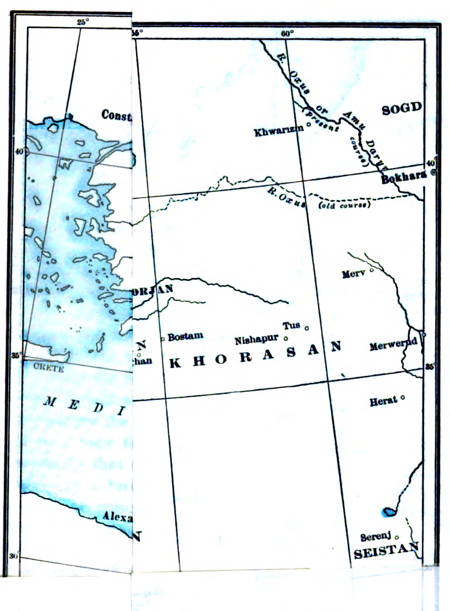
Map of Western Asia, p. 230.
After the revolution of eleven centuries, the Jews and Christians of the Turkish empire enjoy the liberty of conscience, which was granted by the Arabian caliphs. During the first age of the conquest, they suspected the loyalty of the Catholics, whose name of Melchites betrayed their secret attachment to the Greek emperor, while the Nestorians and [IX-233] Jacobites, his inveterate enemies, approved themselves the sincere and voluntary friends of the Mahometan government. [246] Yet this partial jealousy was healed by time and submission; the churches of Egypt were shared with the Catholics; [247] and all the Oriental sects were included in the common benefits of toleration. The rank, the immunities, the domestic jurisdiction, of the patriarchs, the bishops, and the clergy, were protected by the civil magistrate; the learning of individuals recommended them to the employments of secretaries and physicians; they were enriched by the lucrative collection of the revenue; and their merit was sometimes raised to the command of cities and provinces. A caliph of the house of Abbas was heard to declare that the Christians were most worthy of trust in the administration of Persia. “The Moslems,” said he, “will abuse their present fortune; the Magians regret their fallen greatness; and the Jews are impatient for their approaching deliverance.” [248] But the slaves of despotism are exposed to the alternatives of favour and disgrace. The captive churches of the East have been afflicted in every age by the avarice or bigotry of their rulers; and the ordinary and legal restraints must be offensive to the pride or the zeal of the Christians. [249] About two hundred years after Mahomet, they were separated from their fellow-subjects by a turban or girdle of a less honourable colour; [IX-234] instead of horses or mules, they were condemned to ride on asses, in the attitude of women. Their public and private buildings were measured by a diminutive standard; in the streets or the baths, it is their duty to give way or bow down before the meanest of the people; and their testimony is rejected, if it may tend to the prejudice of a true believer. The pomp of processions, the sound of bells or of psalmody, is interdicted in their worship; a decent reverence for the national faith is imposed on their sermons and conversations; and the sacrilegious attempt to enter a mosch or to seduce a Musulman will not be suffered to escape with impunity. In a time, however, of tranquillity and justice, the Christians have never been compelled to renounce the Gospel or to embrace the Koran; but the punishment of death is inflicted upon [249a] the apostates who have professed and deserted the law of Mahomet. The martyrs of Cordova provoked the sentence of the cadhi by the public confession of their inconstancy, or their passionate invectives against the person and religion of the prophet. [250]
At the end of the first century of the Hegira, the caliphs were the most potent and absolute monarchs of the globe. Their prerogative was not circumscribed, either in right or in fact, by the power of the nobles, the freedom of the commons, the privileges of the church, the votes of a senate, or the memory of a free constitution. The authority of the companions [IX-235] of Mahomet expired with their lives; and the chiefs or emirs of the Arabian tribes left behind, in the desert, the spirit of equality and independence. The regal and sacerdotal characters were united in the successors of Mahomet; and, if the Koran was the rule of their actions, they were the supreme judges and interpreters of that divine book. They reigned by the right of conquest over the nations of the East, to whom the name of liberty was unknown, and who were accustomed to applaud in their tyrants the acts of violence and severity that were exercised at their own expense. Under the last of the Ommiades, the Arabian empire extended two hundred days’ journey from east to west, from the confines of Tartary and India to the shores of the Atlantic Ocean. And, if we retrench the sleeve of the robe, as it is styled by their writers, the long and narrow province of Africa, the solid and compact dominion from Fargana to Aden, from Tarsus to Surat, will spread on every side to the measure of four or five months of the march of a caravan. [251] We should vainly seek the indissoluble union and easy obedience that pervaded the government of Augustus and the Antonines; but the progress of the Mahometan religion diffused over this ample space a general resemblance of manners and opinions. The language and laws of the Koran were studied with equal devotion at Samarcand and Seville: the Moor and the Indian embraced as countrymen and brothers in the pilgrimage of Mecca; and the Arabian language was adopted as the popular idiom in all the provinces to the westward of the Tigris. [252]
[IX-236]
CHAPTER LII↩
The two Sieges of Constantinople by the Arabs — Their Invasion of France, and Defeat by Charles Martel — Civil War of the Ommiades and Abbassides — Learning of the Arabs — Luxury of the Caliphs — Naval Enterprises on Crete, Sicily, and Rome — Decay and Division of the Empire of the Caliphs — Defeats and Victories of the Greek Emperors
When the Arabs first issued from the desert, they must have been surprised at the ease and rapidity of their own success. But, when they advanced in the career of victory to the banks of the Indus and the summit of the Pyrenees, when they had repeatedly tried the edge of their scymetars and the energy of their faith, they might be equally astonished that any nation could resist their invincible arms, that any boundary should confine the dominion of the successor of the prophet. The confidence of soldiers and fanatics may indeed be excused, since the calm historian of the present hour, who strives to follow the rapid course of the Saracens, must study to explain by what means the church and state were saved from this impending and, as it should seem, from this inevitable danger. The deserts of Scythia and Sarmatia might be guarded by their extent, their climate, their poverty, and the courage of the Northern shepherds; China was remote and inaccessible; but the greatest part of the temperate zone was subject to the Mahometan conquerors, the Greeks were exhausted by the calamities of war and the loss of their fairest provinces, and the barbarians of Europe might justly tremble at the precipitate fall of the Gothic monarchy. In this inquiry I shall unfold the events that rescued our [IX-237] ancestors of Britain, and our neighbours of Gaul, from the civil and religious yoke of the Koran; that protected the majesty of Rome, and delayed the servitude of Constantinople; that invigorated the defence of the Christians, and scattered among their enemies the seeds of division and decay.
Forty-six years after the flight of Mahomet from Mecca, his disciples appeared in arms under the walls of Constantinople. [1] They were animated by a genuine or fictitious saying of the prophet, that, to the first army which besieged the city of the Cæsars, their sins were forgiven; the long series of Roman triumphs would be meritoriously transferred to the conquerors of New Rome; and the wealth of nations was deposited in this well-chosen seat of royalty and commerce. No sooner had the caliph Moawiyah suppressed his rivals and established his throne than he aspired to expiate the guilt of civil blood by the success and glory of his holy expedition; [2] his preparations by sea and land were adequate [IX-238] to the importance of the object; his standard was entrusted to Sophian, [3] a veteran warrior, but the troops were encouraged by the example and presence of Yezid, the son and presumptive heir of the commander of the faithful. The Greeks had little to hope, nor had their enemies any reasons of fear, from the courage and vigilance of the reigning emperor, who disgraced the name of Constantine, and imitated only the inglorious years of his grandfather Heraclius. Without delay or opposition, the naval forces of the Saracens passed through the unguarded channel of the Hellespont, which even now, under the feeble and disorderly government of the Turks, is maintained as the natural bulwark of the capital. [4] The Arabian fleet cast anchor, and the troops were disembarked near the palace of Hebdomon, seven miles from the city. During many days, from the dawn of light to the evening, the line of assault was extended from the golden gate to the eastern promontory, and the foremost warriors were impelled by the weight and effort of the succeeding columns. But the besiegers had formed an insufficient estimate of the strength and resources of Constantinople. The solid and lofty walls were guarded by numbers and discipline; the spirit of the Romans was rekindled by the last danger of their religion and empire; the fugitives from the conquered provinces more successfully renewed the defence of Damascus and Alexandria; and the Saracens [IX-239] were dismayed by the strange and prodigious effects of artificial fire. This firm and effectual resistance diverted their arms to the more easy attempts of plundering the European and Asiatic coasts of the Propontis; and, after keeping the sea from the month of April to that of September, on the approach of winter they retreated fourscore miles from the capital, to the isle of Cyzicus, in which they had established their magazine of spoil and provisions. So patient was their perseverance, or so languid were their operations, that they repeated in the six following summers the same attack and retreat, with a gradual abatement of hope and vigour, till the mischances of shipwreck and disease, of the sword and of fire, compelled them to relinquish the fruitless enterprise. They might bewail the loss or commemorate the martyrdom of thirty thousand Moslems, who fell in the siege of Constantinople; and the solemn funeral of Abu Ayub, or Job, excited the curiosity of the Christians themselves. That venerable Arab, one of the last of the companions of Mahomet, was numbered among the ansars, or auxiliaries, of Medina, who sheltered the head of the flying prophet. In his youth he fought, at Bedar and Ohud, under the holy standard; in his mature age he was the friend and follower of Ali; and the last remnant of his strength and life was consumed in a distant and dangerous war against the enemies of the Koran. His memory was revered; but the place of his burial was neglected and unknown, during a period of seven hundred and eighty years, till the conquest of Constantinople by Mahomet the Second. A seasonable vision (for such are the manufacture of every religion) revealed the holy spot at the foot of the walls and the bottom of the harbour; and the mosch of Ayub has been deservedly chosen for the simple and martial inauguration of the Turkish sultans. [5]
[IX-240]
The event of the siege revived, both in the East and West, the reputation of the Roman arms, and cast a momentary shade over the glories of the Saracens. The Greek ambassador was favourably received at Damascus, in a general council of the emirs of Koreish; a peace, or truce, of thirty years was ratified between the two empires; and the stipulation of an annual tribute, fifty horses of a noble breed, fifty slaves, and three thousand pieces of gold, degraded the majesty of the commander of the faithful. [6] The aged caliph was desirous of possessing his dominions, and ending his days, in tranquillity and repose; while the Moors and Indians trembled at his name, his palace and city of Damascus was insulted by the Mardaites, or Maronites, of Mount Libanus, the firmest barrier of the empire, till they were disarmed and transplanted by the suspicious policy of the Greeks. [7] After the revolt of Arabia and Persia, the house of Ommiyah [8] was reduced to the kingdoms of Syria and Egypt; their distress and fear enforced their compliance with the pressing demands of the Christians; and the tribute was increased to a slave, an horse, and a thousand pieces of gold, for each of the three hundred and sixty-five days of the solar year. But as [IX-241] soon as the empire was again united by the arms and policy of Abdalmalek, he disclaimed a badge of servitude not less injurious to his conscience than to his pride; he discontinued the payment of the tribute; and the resentment of the Greeks was disabled from action by the mad tyranny of the second Justinian, the just rebellion of his subjects, and the frequent change of his antagonists and successors. Till the reign of Abdalmalek, the Saracens had been content with the free possession of the Persian and Roman treasures, in the coin of Chosroes and Cæsar. By the command of that caliph, a national mint was established, both of silver and gold, and the inscription of the Dinar, though it might be censured by some timorous casuists, proclaimed the unity of the God of Mahomet. [9] Under the reign of the caliph Waled, the Greek language and characters were excluded from the accounts of the public revenue. [10] If this change was productive of the invention or familiar use of our present numerals, the Arabic or Indian cyphers, as they are commonly styled, a regulation of office has promoted the most important discoveries of arithmetic, algebra, and the mathematical sciences. [11]
[IX-242]
Whilst the caliph Waled sat idle on the throne of Damascus, while his lieutenants achieved the conquest of Transoxiana and Spain, a third army of Saracens overspread the provinces of Asia Minor, and approached the borders of the Byzantine capital. But the attempt and disgrace of the second siege was reserved for his brother Soliman, whose ambition appears to have been quickened by a more active and martial spirit. In the revolutions of the Greek empire, after the tyrant Justinian had been punished and avenged, an humble secretary, Anastasius or Artemius, was promoted by chance or merit to the vacant purple. He was alarmed by the sound of war; and his ambassador returned from Damascus with the tremendous news that the Saracens were preparing an armament by sea and land, such as would transcend the experience of the past, or the belief of the present, age. The precautions of Anastasius were not unworthy of his station or of the impending danger. He issued a peremptory mandate that all persons who were not provided with the means of subsistence for a three years’ siege should evacuate the city; the public granaries and arsenals were abundantly replenished; the walls were restored and strengthened; and the engines for casting stones, or darts, or fire were stationed along the ramparts, or in the brigantines of war, of which an additional number was hastily constructed. To prevent is safer, as well as more honourable, than to repel an attack; and a design was meditated, above the usual spirit of the Greeks, of burning the naval stores of the enemy, the cypress timber that had been hewn in Mount Libanus, and was piled along the seashore of Phœnicia, for the service of the Egyptian fleet. This [IX-243] generous enterprise was defeated by the cowardice or treachery of the troops who, in the new language of the empire, were styled of the Obsequian Theme. [12] They murdered their chief, deserted their standard in the isle of Rhodes, dispersed themselves over the adjacent continent, and deserved pardon or reward by investing with the purple a simple officer of the revenue. The name of Theodosius might recommend him to the senate and people; but, after some months, he sunk into a cloister, and resigned, to the firmer hand of Leo the Isaurian, the urgent defence of the capital and empire. The most formidable of the Saracens, Moslemah the brother of the caliph, was advancing at the head of one hundred and twenty thousand Arabs and Persians, the greater part mounted on horses or camels; and the successful sieges of Tyana, Amorium, and Pergamus were of sufficient duration to exercise their skill and to elevate their hopes. At the well-known passage of Abydus, on the Hellespont, the Mahometan arms were transported, for the first time, [13] from Asia to Europe. From thence, wheeling round the Thracian cities of the Propontis, Moslemah invested Constantinople on the land side, surrounded his camp with a ditch and rampart, prepared and planted his engines of assault, and declared, by words and actions, a patient resolution of expecting the return of seed-time and harvest, should the obstinacy of the [IX-244] besieged prove equal to his own. The Greeks would gladly have ransomed their religion and empire, by a fine or assessment of a piece of gold on the head of each inhabitant of the city; but the liberal offer was rejected with disdain, and the presumption of Moslemah was exalted by the speedy approach and invincible force of the navies of Egypt and Syria. They are said to have amounted to eighteen hundred ships; the number betrays their inconsiderable size; and of the twenty stout and capacious vessels, whose magnitude impeded their progress, each was manned with no more than one hundred heavy-armed soldiers. This huge armada proceeded on a smooth sea and with a gentle gale, towards the mouth of the Bosphorus; the surface of the strait was overshadowed, in the language of the Greeks, with a moving forest, and the same fatal night had been fixed by the Saracen chief for a general assault by sea and land. To allure the confidence of the enemy, the emperor had thrown aside the chain that usually guarded the entrance of the harbour; but, while they hesitated whether they should seize the opportunity or apprehend the snare, the ministers of destruction were at hand. The fire-ships of the Greeks were launched against them; the Arabs, their arms, and vessels were involved in the same flames, the disorderly fugitives were dashed against each other or overwhelmed in the waves; and I no longer find a vestige of the fleet that had threatened to extirpate the Roman name. A still more fatal and irreparable loss was that of the caliph Soliman, who died of an indigestion [14] in his camp near Kinnisrin, or Chalcis in Syria, as he was preparing to lead [IX-245] against Constantinople the remaining forces of the East. The brother of Moslemah was succeeded by a kinsman and an enemy; and the throne of an active and able prince was degraded by the useless and pernicious virtues of a bigot. While he started and satisfied the scruples of a blind conscience, the siege was continued through the winter by the neglect rather than by the resolution of the caliph Omar. [15] The winter proved uncommonly rigorous; above an hundred days the ground was covered with deep snow, and the natives of the sultry climes of Egypt and Arabia lay torpid and almost lifeless in their frozen camp. They revived on the return of spring; a second effort had been made in their favour; and their distress was relieved by the arrival of two numerous fleets, laden with corn, and arms, and soldiers; the first from Alexandria, of four hundred transports and galleys; the second of three hundred and sixty vessels from the ports of Africa. But the Greek fires were again kindled, and, if the destruction was less complete, it was owing to the experience which had taught the Moslems to remain at a safe distance, or to the perfidy of the Egyptian mariners, who deserted with their ships to the emperor of the Christians. The trade and navigation of the capital were restored; and the produce of the fisheries supplied the wants, and even the luxury, of the inhabitants. But the calamities of famine and disease were soon felt by the troops of Moslemah, and, as the former was miserably assuaged, so the latter was dreadfully [IX-246] propagated, by the pernicious nutriment which hunger compelled them to extract from the most unclean or unnatural food. The spirit of conquest, and even of enthusiasm, was extinct: the Saracens could no longer straggle beyond their lines, either single or in small parties, without exposing themselves to the merciless retaliation of the Thracian peasants. An army of Bulgarians was attracted from the Danube by the gifts and promises of Leo; and these savage auxiliaries made some atonement for the evils which they had inflicted on the empire, by the defeat and slaughter of twenty-two thousand Asiatics. A report was dexterously scattered that the Franks, the unknown nations of the Latin world, were arming by sea and land in the defence of the Christian cause, and their formidable aid was expected with far different sensations in the camp and city. At length, after a siege of thirteen months, [16] the hopeless Moslemah received from the caliph the welcome permission to retreat. The march of the Arabian cavalry over the Hellespont and through the provinces of Asia was executed without delay or molestation; but an army of their brethren had been cut to pieces on the side of Bithynia, and the remains of the fleet was so repeatedly damaged by tempest and fire that only five galleys entered the port of Alexandria to relate the tale of their various and almost incredible disasters. [17]
[IX-247]
In the two sieges, the deliverance of Constantinople may be chiefly ascribed to the novelty, the terrors, and the real efficacy of the Greek fire. [18] The important secret of compounding and directing this artificial flame was imparted by Callinicus, a native of Heliopolis in Syria, who deserted from the service of the caliph to that of the emperor. [19] The skill of a chymist and engineer was equivalent to the succour of fleets and armies; and this discovery or improvement of the military art was fortunately reserved for the distressful period, when the degenerate Romans of the East were incapable of contending with the warlike enthusiasm and youthful vigour of the Saracens. The historian who presumes to analyse this extraordinary composition should suspect his own ignorance and that of his Byzantine guides, so prone to the marvellous, so careless, and in this instance so jealous, of the truth. From their obscure and perhaps fallacious hints, it should seem that the principal ingredient of the Greek fire was the naptha, [20] or liquid bitumen, a light, tenacious, and inflammable oil, [21] which springs from the earth and catches [IX-248] fire as soon as it comes in contact with the air. The naptha was mingled, I know not by what methods or in what proportions, with sulphur and with the pitch that is extracted from evergreen firs. [22] From this mixture, which produced a thick smoke and a loud explosion, proceeded a fierce and obstinate flame, which not only rose in perpendicular ascent, but likewise burnt with equal vehemence in descent or lateral progress; instead of being extinguished, it was nourished and quickened, by the element of water; and sand, urine, or vinegar were the only remedies that could damp the fury of this powerful agent, which was justly denominated by the Greeks the liquid or the maritime fire. For the annoyance of the enemy it was employed with equal effect, by sea and land, in battles or in sieges. It was either poured from the rampart in large boilers, or launched in red-hot balls of stone and iron, or darted in arrows and javelins, twisted round with flax and tow, which had deeply imbibed the inflammable oil: sometimes it was deposited in fire-ships, the victims and instruments of a more ample revenge, and was most commonly blown through long tubes of copper, [IX-249] which were planted on the prow of a galley, and fancifully shaped into the mouths of savage monsters, that seemed to vomit a stream of liquid and consuming fire. This important art was preserved at Constantinople, as the palladium of the state; the galleys and artillery might occasionally be lent to the allies of Rome; but the composition of the Greek fire was concealed with the most jealous scruple, and the terror of the enemies was increased and prolonged by their ignorance and surprise. In the treatise of the Administration of the Empire the royal author [23] suggests the answers and excuses that might best elude the indiscreet curiosity and importunate demands of the Barbarians. They should be told that the mystery of the Greek fire had been revealed by an angel to the first and greatest of the Constantines, with a sacred injunction that this gift of heaven, this peculiar blessing of the Romans, should never be communicated to any foreign nation; that the prince and subject were alike bound to religious silence under the temporal and spiritual penalties of treason and sacrilege; and that the impious attempt would provoke the sudden and supernatural vengeance of the God of the Christians. By these precautions, the secret was confined, above four hundred years, to the Romans of the East; and, at the end of the eleventh century, the Pisans, to whom every sea and every art were familiar, suffered the effects, without understanding the composition, of the Greek fire. It was at length either discovered or stolen by the Mahometans; and, in the holy wars of Syria and Egypt, they retorted an invention, contrived against themselves, on the heads of the Christians. A knight, who despised the swords and lances of the Saracens, relates, with heartfelt sincerity, his own fears, and those of his companions, at the sight and sound of the mischievous engine that discharged a torrent of the Greek fire, the feu Gregeois, as it is styled by the more early [IX-250] of the French writers. It came flying through the air, says Joinville, [24] like a winged long-tailed dragon, about the thickness of an hogshead, with the report of thunder and the velocity of lightning; and the darkness of the night was dispelled by this deadly illumination. The use of the Greek, or, as it might now be called, of the Saracen, fire was continued to the middle of the fourteenth century, [25] when the scientific or casual compound of nitre, sulphur, and charcoal effected a new revolution in the art of war and the history of mankind. [26]
Constantinople and the Greek fire might exclude the Arabs from the Eastern entrance of Europe; but in the West, on the side of the Pyrenees, the provinces of Gaul were threatened and invaded by the conquerors of Spain. [27] The decline of [IX-251] the French monarchy invited the attack of these insatiate fanatics. The descendants of Clovis had lost the inheritance of his martial and ferocious spirit; and their misfortune or demerit has affixed the epithet of lazy to the last kings of the Merovingian race. [28] They ascended the throne without power, and sunk into the grave without a name. A country palace, in the neighbourhood of Compiègne, [29] was allotted for their residence or prison; but each year, in the month of March or May, they were conducted in a waggon drawn by oxen to the assembly of the Franks, to give audience to foreign ambassadors, and to ratify the acts of the mayor of the palace. That domestic officer was become the minister of the nation, and the master of the prince. A public employment was converted into the patrimony of a private family; the elder Pepin left a king of mature years under the guardianship of his own widow and her child; and these feeble regents were forcibly dispossessed by the most active of his bastards. A government, half savage and half corrupt, was almost dissolved; and the tributary dukes, the provincial [IX-252] counts, and the territorial lords were tempted to despise the weakness of the monarch and to imitate the ambition of the mayor. Among these independent chiefs, one of the boldest and most successful was Eudes, duke of Aquitain, who, in the southern provinces of Gaul, usurped the authority and even the title of king. The Goths, the Gascons, and the Franks assembled under the standard of this Christian hero; he repelled the first invasion of the Saracens; and Zama, lieutenant of the caliph, lost his army and his life under the walls of Toulouse. [30] The ambition of his successors was stimulated by revenge; they repassed the Pyrenees with the means and the resolution of conquest. The advantageous situation which had recommended Narbonne [31] as the first Roman colony was again chosen by the Moslems: they claimed the province of Septimania, or Languedoc, as a just dependence of the Spanish monarchy: the vineyards of Gascony and the city of Bordeaux were possessed by the sovereign of Damascus and Samarcand; and the south of France, from the mouth of the Garonne to that of the Rhone, assumed the manners and religion of Arabia.
But these narrow limits were scorned by the spirit of Abdalrahman, or Abderame, who had been restored by the caliph Hashem [32] to the wishes of the soldiers and people of Spain. That veteran and daring commander adjudged to the obedience of the prophet whatever yet remained of France [IX-253] or of Europe; and prepared to execute the sentence, at the head of a formidable host, in the full confidence of surmounting all opposition, either of nature or of man. His first care was to suppress a domestic rebel, who commanded the most important passes of the Pyrenees: Munuza, a Moorish chief, had accepted the alliance of the duke of Aquitain; and Eudes, from a motive of private or public interest, devoted his beauteous daughter to the embraces of the African misbeliever. But the strongest fortresses of Cerdagne were invested by a superior force; the rebel was overtaken and slain in the mountains; and his widow was sent a captive to Damascus, to gratify the desires, or more probably the vanity, of the commander of the faithful. From the Pyrenees Abderame proceeded without delay to the passage of the Rhone and the siege of Arles. An army of Christians attempted the relief of the city; the tombs of their leaders were yet visible in the thirteenth century; and many thousands of their dead bodies were carried down the rapid stream into the Mediterranean sea. The arms of Abderame were not less successful on the side of the ocean. He passed without opposition the Garonne and Dordogne, which unite their waters in the gulf of Bordeaux; but he found, beyond those rivers, the camp of the intrepid Eudes, who had formed a second army, and sustained a second defeat, so fatal to the Christians that, according to their sad confession, God alone could reckon the number of the slain. The victorious Saracen overran the provinces of Aquitain, whose Gallic names are disguised, rather than lost, in the modern appellations of Périgord, Saintonge, and Poitou: his standards were planted on the walls, or at least before the gates, of Tours and of Sens; and his detachments overspread the kingdom of Burgundy, as far as the well-known cities of Lyons and Besançon. The memory of these devastations, for Abderame did not spare the country or the people, was long preserved by tradition; and the invasion of France by the Moors or Mahometans affords the groundwork of those fables which [IX-254] have been so wildly disfigured in the romances of chivalry and so elegantly adorned by the Italian muse. In the decline of society and art, the deserted cities could supply a slender booty to the Saracens; their richest spoil was found in the churches and monasteries, which they stripped of their ornaments and delivered to the flames; and the tutelar saints, both Hilary of Poitiers and Martin of Tours, forgot their miraculous powers in the defence of their own sepulchres. [33] A victorious line of march had been prolonged above a thousand miles from the rock of Gibraltar to the banks of the Loire; the repetition of an equal space would have carried the Saracens to the confines of Poland and the Highlands of Scotland: the Rhine is not more impassable than the Nile or Euphrates, and the Arabian fleet might have sailed without a naval combat into the mouth of the Thames. Perhaps the interpretation of the Koran would now be taught in the schools of Oxford, and her pulpits might demonstrate to a circumcised people the sanctity and truth of the revelation of Mahomet. [34]
From such calamities was Christendom delivered by the genius and fortune of one man. Charles, the illegitimate son of the elder Pepin, was content with the titles of mayor or duke of the Franks, but he deserved to become the father of a line of kings. [35] In a laborious administration of twenty-four [IX-255] years, he restored and supported the dignity of the throne, and the rebels of Germany and Gaul were successively crushed by the activity of a warrior, who, in the same campaign, could display his banner on the Elbe, the Rhone, and the shores of the ocean. In the public danger, he was summoned by the voice of his country; and his rival, the duke of Aquitain, was reduced to appear among the fugitives and suppliants. “Alas!” exclaimed the Franks, “what a misfortune! what an indignity! We have long heard of the name and conquests of the Arabs: we were apprehensive of their attack from the East; they have now conquered Spain, and invade our country on the side of the West. Yet their numbers, and (since they have no buckler) their arms, are inferior to our own.” “If you follow my advice,” replied the prudent mayor of the palace, “you will not interrupt their march, nor precipitate your attack. They are like a torrent, which it is dangerous to stem in its career. The thirst of riches, and the consciousness of success, redouble their valour, and valour is of more avail than arms or numbers. Be patient till they have loaded themselves with the encumbrance of wealth. The possession of wealth will divide their counsels and assure your victory.” This subtle policy is perhaps a refinement of the Arabian writers; and the situation of Charles will suggest a more narrow and selfish motive of procrastination: the secret desire of humbling the pride, and wasting the provinces, of the rebel duke of Aquitain. It is yet more probable that the delays of Charles were inevitable and reluctant. A standing army was unknown under the first and second race; more than half the kingdom was now in the hands of the Saracens; according to their respective situation, the Franks of Neustria and Austrasia were too conscious or too careless of the impending danger; and the voluntary aids of the Gepidæ and Germans were separated by a long interval from the standard of the Christian general. No sooner had he collected his forces than he sought and found the enemy in the centre of France, between Tours [IX-256] and Poitiers. His well-conducted march was covered by a range of hills, and Abderame appears to have been surprised by his unexpected presence. The nations of Asia, Africa, and Europe advanced with equal ardour to an encounter which would change the history of the whole world. In the six first days of desultory combat, the horsemen and archers of the East maintained their advantage; but in the closer onset of the seventh day the Orientals were oppressed by the strength and stature of the Germans, who, with stout hearts and iron hands, [36] asserted the civil and religious freedom of their posterity. The epithet of Martel, the Hammer, which has been added to the name of Charles, is expressive of his weighty and irresistible strokes: the valour of Eudes was excited by resentment and emulation; and their companions, in the eye of history, are the true Peers and Paladins of French chivalry. After a bloody field, in which Abderame was slain, the Saracens, in the close of the evening, retired to their camp. In the disorder and despair of the night, the various tribes of Yemen and Damascus, of Africa and Spain, were provoked to turn their arms against each other: the remains of their host was suddenly dissolved, and each emir consulted his safety by an hasty and separate retreat. At the dawn of day, the stillness of an hostile camp was suspected by the victorious Christians: on the report of their spies, they ventured to explore the riches of the vacant tents; but, if we except some celebrated relics, a small portion of the spoil was restored to the innocent and lawful owners. The joyful tidings were soon diffused over the Catholic world, and the monks of Italy could affirm and believe that three hundred and fifty, or three hundred and seventy-five, thousand of the Mahometans had been crushed by the hammer of Charles; [37] while no more than fifteen hundred Christians [IX-257] were slain in the field of Tours. But this incredible tale is sufficiently disproved by the caution of the French general, who apprehended the snares and accidents of a pursuit, and dismissed his German allies to their native forests. The inactivity of a conqueror betrays the loss of strength and blood, and the most cruel execution is inflicted, not in the ranks of battle, but on the backs of a flying enemy. Yet the victory of the Franks was complete and final; Aquitain was recovered by the arms of Eudes; the Arabs never resumed the conquest of Gaul, [38] and they were soon driven beyond the Pyrenees by Charles Martel and his valiant race. [39] It might have been expected that the saviour of Christendom would have been canonised, or at least applauded, by the gratitude of the clergy, who are indebted to his sword for their present existence. But in the public distress the mayor of the palace had been compelled to apply the riches, or at least the revenues, of the bishops and abbots to the relief of the state and the reward of the soldiers. His merits were forgotten, his sacrilege alone was remembered, and, in an epistle to a Carlovingian prince, a Gallic synod presumes [IX-258] to declare that his ancestor was damned; that on the opening of his tomb the spectators were affrighted by a smell of fire and the aspect of a horrid dragon; and that a saint of the times was indulged with a pleasant vision of the soul and body of Charles Martel burning, to all eternity, in the abyss of hell. [40]
The loss of an army, or a province, in the Western world was less painful to the court of Damascus than the rise and progress of a domestic competitor. Except among the Syrians, the caliphs of the house of Ommiyah had never been the objects of the public favour. The life of Mahomet recorded their perseverance in idolatry and rebellion; their conversion had been reluctant, their elevation irregular and factious, and their throne was cemented with the most holy and noble blood of Arabia. The best of their race, the pious Omar, was dissatisfied with his own title; their personal virtues were insufficient to justify a departure from the order of succession; and the eyes and wishes of the faithful were turned towards the line of Hashem and the kindred of the apostle of God. Of these the Fatimites were either rash or pusillanimous; but the descendants of Abbas cherished, with courage and discretion, the hopes of their rising fortunes. From an obscure residence in Syria, they secretly despatched their agents and missionaries, who preached in the eastern provinces their hereditary indefeasible right; and Mohammed, the son of Ali, the son of Abdallah, the son of Abbas, the uncle of the prophet, gave audience to the deputies of Chorasan, and accepted their free gift of four hundred thousand pieces of gold. After the death of Mohammed, the oath of allegiance was administered in the name [IX-259] of his son Ibrahim to a numerous band of votaries, who expected only a signal and a leader; and the governor of Chorasan continued to deplore his fruitless admonitions and the deadly slumber of the caliphs of Damascus, till he himself, with all his adherents, was driven from the city and palace of Meru, by the rebellious arms of Abu Moslem. [41] That maker of kings, the author, as he is named, of the call of the Abbassides, was at length rewarded for his presumption of merit with the usual gratitude of courts. A mean, perhaps a foreign, extraction could not repress the aspiring energy of Abu Moslem. Jealous of his wives, liberal of his wealth, prodigal of his own blood, and of that of others, he could boast with pleasure, and possibly with truth, that he had destroyed six hundred thousand of his enemies; and such was the intrepid gravity of his mind and countenance that he was never seen to smile except on a day of battle. In the visible separation of parties, the green was consecrated to the Fatimites; the Ommiades were distinguished by the white; and the black, as the most adverse, was naturally adopted by the Abbassides. Their turbans and garments were stained with that gloomy colour; two black standards, on pike-staves nine cubits long, were borne aloft in the van of Abu Moslem; and their allegorical names of the night and the shadow obscurely represented the indissoluble union and perpetual succession of the line of Hashem. From the Indus to the Euphrates, the East was convulsed by the quarrel of the white and the black factions; the Abbassides were most frequently victorious; but their public success was clouded by the personal misfortune of their chief. The court of Damascus, awakening from a long slumber, resolved to prevent the pilgrimage of Mecca, which Ibrahim had undertaken [IX-260] with a splendid retinue, to recommend himself at once to the favour of the prophet and of the people. A detachment of cavalry intercepted his march and arrested his person; and the unhappy Ibrahim, snatched away from the promise of untasted royalty, expired in iron fetters in the dungeons of Haran. His two younger brothers, Saffah [42] and Almansor, [43] eluded the search of the tyrant, and lay concealed at Cufa, till the zeal of the people and the approach of his eastern friends allowed them to expose their persons to the impatient public. On Friday, in the dress of a caliph, in the colours of the sect, Saffah proceeded with religious and military pomp to the mosch; ascending the pulpit, he prayed and preached as the lawful successor of Mahomet; and, after his departure, his kinsmen bound a willing people by an oath of fidelity. But it was on the banks of the Zab, and not in the mosch of Cufa, that this important controversy was determined. Every advantage appeared to be on the side of the white faction: the authority of established government; an army of an hundred and twenty thousand soldiers, against a sixth part of that number; [43a] and the presence and merit of the caliph Mervan, the fourteenth and last of the house of Ommiyah. Before his accession to the throne, he had deserved, by his Georgian warfare, the honourable epithet of the ass of Mesopotamia; [44] and he might have been ranked among the greatest princes, had not, says Abulfeda, the eternal order decreed that moment for the ruin of his family: a decree against which all human prudence and fortitude must struggle in vain. The orders of Mervan [IX-261] were mistaken or disobeyed; the return of his horse, from which he had dismounted on a necessary occasion, [45] impressed the belief of his death; and the enthusiasm of the black squadrons was ably conducted by Abdallah, the uncle of his competitor. After an irretrieveable defeat, the caliph escaped to Mosul; but the colours of the Abbassides were displayed from the rampart; he suddenly repassed the Tigris, cast a melancholy look on his palace of Haran, crossed the Euphrates, abandoned the fortifications of Damascus, and, without halting in Palestine, pitched his last and fatal camp at Busir on the banks of the Nile. [46] His speed was urged by the incessant diligence of Abdallah, who in every step of the pursuit acquired strength and reputation; the remains of the white faction were finally vanquished in Egypt; and the lance, which terminated the life and anxiety of Mervan, was not less welcome perhaps to the unfortunate than to the victorious chief. The merciless inquisition of the conqueror eradicated the most distant branches of the hostile race: their bones were scattered, their memory was accursed, and the martyrdom of Hossein was abundantly revenged on the posterity of his tyrants. Fourscore of the Ommiades, who had yielded to the faith or clemency of their foes, were invited to a banquet at Damascus. The laws of hospitality [IX-262] were violated by a promiscuous massacre; the board was spread over their fallen bodies; and the festivity of the guests was enlivened by the music of their dying groans. By the event of the civil war the dynasty of the Abbassides was firmly established; but the Christians only could triumph in the mutual hatred and common loss of the disciples of Mahomet. [47]
Yet the thousands who were swept away by the sword of war might have been speedily retrieved in the succeeding generation, if the consequences of the revolution had not tended to dissolve the power and unity of the empire of the Saracens. In the proscription of the Ommiades, a royal youth of the name of Abdalrahman alone escaped the rage of his enemies, who hunted the wandering exile from the banks of the Euphrates to the valleys of Mount Atlas. His presence in the neighbourhood of Spain revived the zeal of the white faction. The name and cause of the Abbassides had been first vindicated by the Persians; the West had been pure from civil arms; and the servants of the abdicated family still held, by a precarious tenure, the inheritance of their lands and the offices of government. Strongly prompted by gratitude, indignation, and fear, they invited the grandson of the caliph Hashem to ascend the throne of his ancestors; and, in his desperate condition, the extremes of rashness and prudence were almost the same. The acclamations of the people saluted his landing on the coast of Andalusia; and, after a [IX-263] successful struggle, Abdalrahman established the throne of Cordova, and was the father of the Ommiades of Spain, who reigned above two hundred and fifty years from the Atlantic to the Pyrenees. [48] He slew in battle a lieutenant of the Abbassides, who had invaded his dominions with a fleet and army: the head of Ala, in salt and camphire, was suspended by a daring messenger before the palace of Mecca; [49] and the caliph Almansor rejoiced in his safety, that he was removed by seas and lands from such a formidable adversary. Their mutual designs or declarations of offensive war evaporated without effect; but, instead of opening a door to the conquest of Europe, Spain was dissevered from the trunk of the monarchy, engaged in perpetual hostility with the East, and inclined to peace and friendship with the Christian sovereigns of Constantinople and France. The example of the Ommiades was imitated by the real or fictitious progeny of Ali, the Edrissites of Mauritania, and the more powerful Fatimites of Africa and Egypt. In the tenth century, the chair of Mahomet was disputed by three caliphs or commanders of the faithful, who reigned at Bagdad, Cairoan, and Cordova, excommunicated each other, and agreed only in a principle of discord, that a sectary is more odious and criminal than an unbeliever. [50]
[IX-264]
Mecca was the patrimony of the line of Hashem, yet the Abbassides were never tempted to reside either in the birthplace or the city of the prophet. Damascus was disgraced by the choice, and polluted with the blood, of the Ommiades; and, after some hesitation, Almansor, the brother and successor of Saffah, laid the foundations of Bagdad, [51] the Imperial seat of his posterity during a reign of five hundred years. [52] The chosen spot is on the eastern bank of the Tigris, about fifteen miles above the ruins of Modain; the double wall was of a circular form; and such was the rapid increase of a capital, now dwindled to a provincial town, that the funeral of a popular saint might be attended by eight hundred thousand men and sixty thousand women of Bagdad and the adjacent villages. In this city of peace, [53] amidst the riches of the [IX-265] East, the Abbassides soon disdained the abstinence and frugality of the first caliphs, and aspired to emulate the magnificence of the Persian kings. After his wars and buildings, Almansor left behind him in gold and silver about thirty millions sterling; [54] and this treasure was exhausted in a few years by the vices or virtues of his children. His son Mahadi, in a single pilgrimage to Mecca, expended six millions of dinars of gold. A pious and charitable motive may sanctify the foundation of cisterns and caravanseras, which he distributed along a measured road of seven hundred miles; but his train of camels, laden with snow, could serve only to astonish the natives of Arabia, and to refresh the fruits and liquors of the royal banquet. [55] The courtiers would surely praise the liberality of his grandson Almamon, who gave away four fifths of the income of a province, a sum of two millions four hundred thousand gold dinars, before he drew his foot from the stirrup. At the nuptials of the same prince, a thousand pearls of the largest size were showered [IX-266] on the head of the bride, [56] and a lottery of lands and houses displayed the capricious bounty of fortune. The glories of the court were brightened rather than impaired in the decline of the empire; and a Greek ambassador might admire or pity the magnificence of the feeble Moctader. “The caliph’s whole army,” says the historian Abulfeda, “both horse and foot, was under arms, which together made a body of one hundred and sixty thousand men. His state-officers, the favourite slaves, stood near him in splendid apparel, their belts glittering with gold and gems. Near them were seven thousand eunuchs, four thousand of them white, the remainder black. The porters or door-keepers were in number seven hundred. Barges and boats, with the most superb decorations, were seen swimming upon the Tigris. Nor was the palace itself less splendid, in which were hung up thirty-eight thousand pieces of tapestry, twelve thousand five hundred of which were of silk embroidered with gold. The carpets on the floor were twenty-two thousand. An hundred lions were brought out, with a keeper to each lion. [57] Among the other spectacles of rare and stupendous luxury, was a tree of gold and silver spreading into eighteen large branches, on which, and on the lesser boughs, sat a variety of birds made of the same precious metals, as well as the leaves of the tree. While the machinery affected spontaneous motions, the several birds warbled their natural harmony. Through this scene of magnificence, the Greek ambassador was led by the [IX-267] visir to the foot of the caliph’s throne.” [58] In the West, the Ommiades of Spain supported, with equal pomp, the title of commander of the faithful. Three miles from Cordova, in honour of his favourite sultana, the third and greatest of the Abdalrahmans constructed the city, palace, and gardens of Zehra. Twenty-five years, and above three millions sterling, were employed by the founder: his liberal taste invited the artists of Constantinople, the most skilful sculptors and architects of the age; and the buildings were sustained or adorned by twelve hundred columns of Spanish and African, of Greek and Italian marble. The hall of audience was encrusted with gold and pearls, and a great bason in the centre was surrounded with the curious and costly figures of birds and quadrupeds. In a lofty pavilion of the gardens, one of these basons and fountains, so delightful in a sultry climate, was replenished not with water, but with the purest quicksilver. The seraglio of Abdalrahman, his wives, concubines, and black eunuchs, amounted to six thousand three hundred persons; and he was attended to the field by a guard of twelve thousand horse, whose belts and scymetars were studded with gold. [59]
In a private condition, our desires are perpetually repressed by poverty and subordination; but the lives and labours of millions are devoted to the service of a despotic prince, whose [IX-268] laws are blindly obeyed, and whose wishes are instantly gratified. Our imagination is dazzled by the splendid picture; and, whatever may be the cool dictates of reason, there are few among us who would obstinately refuse a trial of the comforts and the cares of royalty. It may therefore be of some use to borrow the experience of the same Abdalrahman, whose magnificence has perhaps excited our admiration and envy, and to transcribe an authentic memorial which was found in the closet of the deceased caliph. “I have now reigned above fifty years in victory or peace; beloved by my subjects, dreaded by my enemies, and respected by my allies. Riches and honours, power and pleasure, have waited on my call, nor does any earthly blessing appear to have been wanting to my felicity. In this situation I have diligently numbered the days of pure and genuine happiness which have fallen to my lot: they amount of Fourteen: — O man! place not thy confidence in this present world!” [60] The luxury of the caliphs, so useless to their private happiness, relaxed the nerves, and terminated the progress, of the Arabian empire. Temporal and spiritual conquest had been the sole occupation of the first successors of Mahomet; and, after supplying themselves with the necessaries of life, the whole revenue was scrupulously devoted to that salutary work. The Abbassides were impoverished by the multitude of their wants and their contempt of economy. Instead of pursuing the great object of ambition, their leisure, their affections, the powers of their mind, were diverted by pomp and pleasure; the rewards of valour were embezzled by women and eunuchs, [IX-269] and the royal camp was encumbered by the luxury of the palace. A similar temper was diffused among the subjects of the caliph. Their stern enthusiasm was softened by time and prosperity: they sought riches in the occupations of industry, fame in the pursuits of literature, and happiness in the tranquillity of domestic life. War was no longer the passion of the Saracens; and the increase of pay, the repetition of donatives, were insufficient to allure the posterity of those voluntary champions who had crowded to the standard of Abubeker and Omar for the hopes of spoil and of paradise.
Under the reign of the Ommiades, the studies of the Moslems were confined to the interpretation of the Koran, and the eloquence and poetry of their native tongue. A people continually exposed to the dangers of the field must esteem the healing powers of medicine or rather of surgery; but the starving physicians of Arabia murmured a complaint that exercise and temperance deprived them of the greatest part of their practice. [61] After their civil and domestic wars, the subjects of the Abbassides, awakening from this mental lethargy, found leisure and felt curiosity for the acquisition of profane science. This spirit was first encouraged by the caliph Almansor, who, besides his knowledge of the Mahometan law, had applied himself with success to the study of astronomy. But, when the sceptre devolved to Almamon, the seventh of the Abbassides, he completed the designs of his grandfather, and invited the muses from their ancient seats. His ambassadors at Constantinople, his agents in Armenia, Syria, and Egypt, collected the volumes of Grecian science; at his command they were translated by the most skilful interpreters into the Arabic language; his subjects [IX-270] were exhorted assiduously to peruse these instructive writings; and the successor of Mahomet assisted with pleasure and modesty at the assemblies and disputations of the learned. “He was not ignorant,” says Abulpharagius, “that they are the elect of God, his best and most useful servants, whose lives are devoted to the improvement of their rational faculties. The mean ambition of the Chinese or the Turks may glory in the industry of their hands or the indulgence of their brutal appetites. Yet these dexterous artists must view, with hopeless emulation, the hexagons and pyramids of the cells of a bee-hive: [62] these fortitudinous heroes are awed by the superior fierceness of the lions and tigers; and in their amorous enjoyments they are much inferior to the vigour of the grossest and most sordid quadrupeds. The teachers of wisdom are the true luminaries and legislators of a world which, without their aid, would again sink in ignorance and barbarism.” [63] The zeal and curiosity of Almamon were imitated by succeeding princes of the line of Abbas; their rivals, the Fatimites of Africa and the Ommiades of Spain, were the patrons of the learned, as well as the commanders of the faithful; the same royal prerogative was claimed by their independent emirs of the provinces; and their emulation [IX-271] diffused the taste and the rewards of science from Samarcand and Bochara to Fez and Cordova. The visir of a sultan consecrated a sum of two hundred thousand pieces of gold to the foundation of a college at Bagdad, which he endowed with an annual revenue of fifteen thousand dinars. The fruits of instruction were communicated, perhaps at different times, to six thousand disciples of every degree, from the son of the noble to that of the mechanic; a sufficient allowance was provided for the indigent scholars; and the merit or industry of the professors was repaid with adequate stipends. In every city the productions of Arabic literature were copied and collected by the curiosity of the studious and the vanity of the rich. A private doctor refused the invitation of the sultan of Bochara, because the carriage of his books would have required four hundred camels. The royal library of the Fatimites consisted of one hundred thousand manuscripts, elegantly transcribed and splendidly bound, which were lent, with jealousy or avarice, to the students of Cairo. Yet this collection must appear moderate, if we can believe that the Ommiades of Spain had formed a library of six hundred thousand volumes, forty-four of which were employed in the mere catalogue. Their capital, Cordova, with the adjacent towns of Malaga, Almeria, and Murcia, had given birth to more than three hundred writers, and above seventy public libraries were opened in the cities of the Andalusian kingdom. The age of Arabian learning continued about five hundred years, till the great irruption of the Moguls, and was coeval with the darkest and most slothful period of European annals; but, since the sun of science has arisen in the West, it should seem that the Oriental studies have languished and declined. [64]
[IX-272]
In the libraries of the Arabians, as in those of Europe, the far greater part of the innumerable volumes were possessed only of local value or imaginary merit. [65] The shelves were crowded with orators and poets, whose style was adapted to the taste and manners of their countrymen; with general and partial histories, which each revolving generation supplied with a new harvest of persons and events; with codes and commentaries of jurisprudence, which derived their authority from the law of the prophet; with the interpreters of the Koran and orthodox tradition; and with the whole theological tribe, polemics, mystics, scholastics, and moralists, the first or the last of writers, according to the different estimate of sceptics or believers. The works of speculation or science may be reduced to the four classes of philosophy, mathematics, astronomy, and physic. The sages of Greece were translated and illustrated in the Arabic language, and some treatises, now lost in the original, have been recovered in the versions of the East, [66] which possessed and studied the writings of Aristotle and Plato, of Euclid and Apollonius, of Ptolemy, Hippocrates, and Galen. [67] Among the ideal systems, which [IX-273] have varied with the fashion of the times, the Arabians adopted the philosophy of the Stagirite, alike intelligible or alike obscure for the readers of every age. Plato wrote for the Athenians, and his allegorical genius is too closely blended with the language and religion of Greece. After the fall of that religion, the Peripatetics, emerging from their obscurity, prevailed in the controversies of the Oriental sects, and their founder was long afterwards restored by the Mahometans of Spain to the Latin schools. [68] The physics both of the Academy and the Lyceum, as they are built, not on observation, but on argument, have retarded the progress of real knowledge. The metaphysics of infinite or finite spirit have too often been enlisted in the service of superstition. But the human faculties are fortified by the art and practice of dialectics; the ten predicaments of Aristotle collect and methodise our ideas, [69] and his syllogism is the keenest weapon of dispute. It was dexterously wielded in the schools of the Saracens, but, as it is more effectual for the detection of error than for the investigation of truth, it is not surprising that new generations of masters and disciples should still revolve in the same circle of logical argument. The mathematics are distinguished by a peculiar privilege that, in the course of ages, they may always advance and can never recede. But the ancient geometry, if I am not misinformed, [IX-274] was resumed in the same state by the Italians of the fifteenth century; and, whatever may be the origin of the name, the science of algebra is ascribed to the Grecian Diophantus by the modest testimony of the Arabs themselves. [70] They cultivated with more success the sublime science of astronomy, which elevates the mind of man to disdain his diminutive planet and momentary existence. The costly instruments of observation were supplied by the caliph Almamon, and the land of the Chaldeans still afforded the same spacious level, the same unclouded horizon. In the plains of Sinaar, and a second time in those of Cufa, his mathematicians accurately measured a degree of the great circle of the earth, and determined at twenty-four thousand miles the entire circumference of our globe. [71] From the reign of the Abbassides to that of the grandchildren of Tamerlane, the stars, without the aid of glasses, were diligently observed; and the astronomical tables of Bagdad, Spain, and Samarcand [72] correct some minute errors, without daring to renounce the hypothesis [IX-275] of Ptolemy, without advancing a step towards the discovery of the solar system. In the Eastern courts, the truths of science could be recommended only by ignorance and folly, and the astronomer would have been disregarded, had he not debased his wisdom or honesty by the vain predictions of astrology. [73] But in the science of medicine, the Arabians have been deservedly applauded. [74] The names of Mesua and Geber, of Razis and Avicenna, are ranked with the Grecian masters; in the city of Bagdad, eight hundred and sixty physicians were licensed to exercise their lucrative profession; [75] in Spain, the life of the Catholic princes was entrusted to the skill of the Saracens, [76] and the school of Salerno, their legitimate offspring, revived in Italy and Europe the precepts of the healing art. [77] The success of each professor must have been influenced by personal and accidental causes; but we may form a less fanciful estimate of their general knowledge of anatomy, [78] botany, [79] and chemistry, [80] the threefold [IX-276] basis of their theory and practice. A superstitious reverence for the dead confined both the Greeks and the Arabians to the dissection of apes and quadrupeds; the more solid and visible parts were known in the time of Galen, and the finer scrutiny of the human frame was reserved for the microscope and the injections of modern artists. Botany is an active science, and the discoveries of the torrid zone might enrich the herbal of Dioscorides with two thousand plants. Some traditionary knowledge might be secreted in the temples and monasteries of Egypt; much useful experience had been acquired in the practice of arts and manufactures; but the science of chemistry owes its origin and improvement to the industry of the Saracens. They first invented and named the alembic for the purpose of distillation, analysed the substances of the three kingdoms of nature, tried the distinction and affinities of alcalis and acids, and converted the poisonous minerals into soft and salutary medicines. But the most eager search of Arabian chemistry was the transmutation of metals and the elixir of immortal health; the reason and the fortunes of thousands were evaporated in the crucibles of alchymy, and the consummation of the great work was promoted by the worthy aid of mystery, fable, and superstition.
But the Moslems deprived themselves of the principal benefits of a familiar intercourse with Greece and Rome, the knowledge of antiquity, the purity of taste, and the freedom of thought. Confident in the riches of their native tongue, the Arabians disdained the study of any foreign idiom. The Greek interpreters were chosen among their Christian subjects; [IX-277] they formed their translations, sometimes on the original text, more frequently perhaps on a Syriac version; and in the crowd of astronomers and physicians there is no example of a poet, an orator, or even an historian being taught to speak the language of the Saracens. [81] The mythology of Homer would have provoked the abhorrence of those stern fanatics; they possessed in lazy ignorance the colonies of the Macedonians, and the provinces of Carthage and Rome: the heroes of Plutarch and Livy were buried in oblivion; and the history of the world before Mahomet was reduced to a short legend of the patriarchs, the prophets, and the Persian kings. Our education in the Greek and Latin schools may have fixed in our minds a standard of exclusive taste; and I am not forward to condemn the literature and judgment of nations of whose language I am ignorant. Yet I know that the classics have much to teach, and I believe that the Orientals have much to learn; the temperate dignity of style, the graceful proportions of art, the forms of visible and intellectual beauty, the just delineation of character and passion, the rhetoric of narrative and argument, the regular fabric of epic and dramatic poetry. [82] The influence of truth and reason is of a less ambiguous complexion. The philosophers of Athens and Rome enjoyed the blessings, and asserted the rights, of civil and religious freedom. Their moral and political writings might have gradually unlocked the fetters of Eastern despotism, diffused a liberal spirit of inquiry and toleration, [IX-278] and encouraged the Arabian sages to suspect that their caliph was a tyrant and their prophet an impostor. [83] The instinct of superstition was alarmed by the introduction even of the abstract sciences; and the more rigid doctors of the law condemned the rash and pernicious curiosity of Almamon. [84] To the thirst of martyrdom, the vision of paradise, and the belief of predestination, we must ascribe the invincible enthusiasm of the prince and people. And the sword of the Saracens became less formidable, when their youth was drawn away from the camp to the college, when the armies of the faithful presumed to read and to reflect. Yet the foolish vanity of the Greeks was jealous of their studies, and reluctantly imparted the sacred fire to the barbarians of the East. [85]
In the bloody conflict of the Ommiades and Abbassides, the Greeks had stolen the opportunity of avenging their wrongs and enlarging their limits. But a severe retribution was exacted by Mohadi, [86] the third caliph of the new dynasty, who seized in his turn the favourable opportunity, while a woman and a child, Irene and Constantine, were seated on the Byzantine throne. An army of ninety-five thousand Persians and Arabs was sent from the Tigris to the Thracian Bosphorus, under the command of Harun, [87] or Aaron, the [IX-279] second son of the commander of the faithful. His encampment on the opposite heights of Chrysopolis, or Scutari, informed Irene, in her palace of Constantinople, of the loss of her troops and provinces. With the consent or connivance of their sovereign, her ministers subscribed an ignominious peace; and the exchange of some royal gifts could not disguise the annual tribute of seventy thousand dinars of gold, which was imposed on the Roman empire. The Saracens had too rashly advanced into the midst of a distant and hostile land; their retreat was solicited by the promise of faithful guides and plentiful markets; and not a Greek had courage to whisper that their weary forces might be surrounded and destroyed in their necessary passage between a slippery mountain and the river Sangarius. Five years after this expedition, Harun ascended the throne of his father and his elder brother; [88] the most powerful and vigorous monarch of his race, illustrious in the West as the ally of Charlemagne, and familiar to the most childish readers as the perpetual hero of the Arabian tales. His title to the name of Al Rashid (the Just) is sullied by the extirpation of the generous, perhaps the innocent, Barmecides; yet he could listen to the complaint of a poor widow who had been pillaged by his troops, and who dared, in a passage of the Koran, to threaten the inattentive despot with the judgment of God and posterity. His court was adorned with luxury and science; but, in a reign of three-and-twenty years, Harun repeatedly visited his provinces from Chorasan to Egypt; nine times he performed the pilgrimage of Mecca; eight times he invaded the territories of the Romans; and, as often as they declined the payment of the tribute, they were taught to feel that a month of depredation was more costly than a year of submission. But, when the unnatural mother of Constantine [IX-280] was deposed and banished, her successor Nicephorus resolved to obliterate this badge of servitude and disgrace. The epistle of the emperor to the caliph was pointed with an allusion to the game of chess, which had already spread from Persia to Greece. “The Queen (he spoke of Irene) considered you as a rook and herself as a pawn. That pusillanimous female submitted to pay a tribute, the double of which she ought to have exacted from the Barbarians. Restore therefore the fruits of your injustice, or abide the determination of the sword.” At these words the ambassadors cast a bundle of swords before the foot of the throne. The caliph smiled at the menace, and drawing his scymetar, samsamah, a weapon of historic or fabulous renown, [88a] he cut asunder the feeble arms of the Greeks, without turning the edge or endangering the temper of his blade. He then dictated an epistle of tremendous brevity: “In the name of the most merciful God, Harun al Rashid, commander of the faithful, to Nicephorus, the Roman dog. I have read thy letter, O thou son of an unbelieving mother. Thou shalt not hear, thou shalt behold, my reply.” It was written in characters of blood and fire on the plains of Phrygia; and the warlike celerity of the Arabs could only be checked by the arts of deceit and the show of repentance. The triumphant caliph retired, after the fatigues of the campaign, to his favourite palace of Racca, on the Euphrates; [89] but the distance of five hundred miles, and the inclemency of the season, encouraged his adversary to violate the peace. Nicephorus [IX-none] [IX-281] was astonished by the bold and rapid march of the commander of the faithful, who repassed, in the depth of winter, the snows of Mount Taurus: his stratagems of policy and war were exhausted; and the perfidious Greek escaped with three wounds from a field of battle overspread with forty thousand of his subjects. [90] Yet the emperor was ashamed of submission, and the caliph was resolved on victory. One hundred and thirty-five thousand regular soldiers received pay, and were inscribed in the military roll; and above three hundred thousand persons of every denomination marched under the black standard of the Abbassides. They swept the surface of Asia Minor far beyond Tyana and Ancyra, and invested the Pontic Heraclea, [91] once a flourishing state, now a paltry town; at that time capable of sustaining in her antique walls a month’s siege against the forces of the East. The ruin was complete, the spoil was ample; but, if Harun had been conversant with Grecian story, he would have regretted the statue of Hercules, whose attributes, the club, the bow, the quiver, and the lion’s hide, were sculptured in massy gold. The progress of desolation by sea and land, from the Euxine to the isle of Cyprus, compelled the emperor Nicephorus to retract his haughty defiance. In the new treaty, the ruins of Heraclea were left for ever as a lesson and a trophy; and the coin of the tribute was marked with the image and superscription of Harun and his three [IX-282] sons. [92] Yet this plurality of lords might contribute to remove the dishonour of the Roman name. After the death of their father, the heirs of the caliph were involved in civil discord, and the conqueror, the liberal Almamon, was sufficiently engaged in the restoration of domestic peace and the introduction of foreign science.
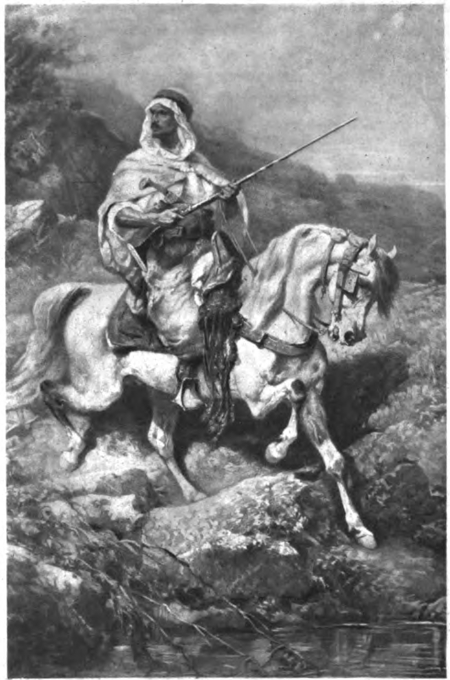
An Arab Horseman, p. 280. From a painting by Adolph Schreyer.
Under the reign of Almamon at Bagdad, of Michael the Stammerer at Constantinople, the islands of Crete [93] and Sicily were subdued by the Arabs. The former of these conquests is disdained by their own writers, who were ignorant of the fame of Jupiter and Minos, but it has not been overlooked by the Byzantine historians, who now begin to cast a clearer light on the affairs of their own times. [94] A band [IX-283] of Andalusian volunteers, discontented with the climate or government of Spain, explored the adventures of the sea; but, as they sailed in no more than ten or twenty galleys, their warfare must be branded with the name of piracy. As the subjects and sectaries of the white party, they might lawfully invade the dominions of the black caliphs. A rebellious faction introduced them into Alexandria; [95] they cut in pieces both friends and foes, pillaged the churches and the moschs, sold above six thousand Christian captives, and maintained their station in the capital of Egypt, till they were oppressed by the forces and the presence of Almamon himself. From the mouth of the Nile to the Hellespont, the islands and sea-coasts, both of the Greeks and Moslems, were exposed to their depredations; they saw, they envied, they tasted the fertility of Crete, and soon returned with forty galleys to a more serious attack. The Andalusians wandered over the land fearless and unmolested; but, when they descended with their plunder to the sea-shore, their vessels were in flames, and their chief, Abu Caab, confessed himself the author of the mischief. Their clamours accused his madness or treachery. “Of what do you complain?” replied the crafty emir. “I have brought you to a land flowing with milk and honey. Here is your true country; repose from your toils, and forget the barren place of your nativity.” “And our wives and children?” “Your beauteous captives will supply the place of your wives, and in their embraces you will soon become the fathers of a new progeny.” The first habitation was their camp, with a ditch and rampart, in the bay of Suda; but an apostate monk led them to a more desirable position in the eastern parts; and the name of Candax, their fortress and colony, had been extended to the whole island, under the corrupt and [IX-284] modern appellation of Candia. The hundred cities of the age of Minos were diminished to thirty; and of these, only one, most probably Cydonia, had courage to retain the substance of freedom and the profession of Christianity. The Saracens of Crete soon repaired the loss of their navy; and the timbers of Mount Ida were launched into the main. During an hostile period, of one hundred and thirty-eight years, the princes of Constantinople attacked these licentious corsairs with fruitless curses and ineffectual arms.
The loss of Sicily [96] was occasioned by an act of superstitious rigour. An amorous youth, who had stolen a nun from her cloister, was sentenced by the emperor to the amputation of his tongue. Euphemius [97] appealed to the reason and policy of the Saracens of Africa; and soon returned with the Imperial purple, a fleet of one hundred ships, and an army of seven hundred horse and ten thousand foot. They landed at Mazara near the ruins of the ancient Selinus; but, after some partial victories, Syracuse [98] was delivered by the [IX-285] Greeks, the apostate was slain before her walls, and his African friends were reduced to the necessity of feeding on the flesh of their own horses. In their turn they were relieved by a powerful [99] reinforcement of their brethren of Andalusia; the largest and western part of the island was gradually reduced, and the commodious harbour of Palermo was chosen for the seat of the naval and military power of the Saracens. Syracuse preserved about fifty years the faith which she had sworn to Christ and to Cæsar. In the last and fatal siege, her citizens displayed some remnant of the spirit which had formerly resisted the powers of Athens and Carthage. They stood about twenty days against the batteringrams and catapultæ, the mines and tortoises, of the besiegers; and the place might have been relieved, if the mariners of the Imperial fleet had not been detained at Constantinople in building a church to the Virgin Mary. The deacon Theodosius, with the bishop and clergy, was dragged in chains from the altar to Palermo, cast into a subterraneous dungeon, and exposed to the hourly peril of death or apostacy. His pathetic, and not inelegant, complaint may be read as the epitaph of his country. [100] From the Roman conquest to this final calamity, Syracuse, now dwindled to the primitive isle of Ortygia, had insensibly declined. Yet the relics were still [IX-286] precious; the plate of the cathedral weighed five thousand pounds of silver; the entire spoil was computed at one million of pieces of gold (about four hundred thousand pounds sterling); and the captives must out-number the seventeen thousand Christians who were transported from the sack of Tauromenium into African servitude. In Sicily the religion and language of the Greeks were eradicated; and such was the docility of the rising generation that fifteen thousand boys were circumcised and clothed on the same day with the son of the Fatimite caliph. The Arabian squadrons issued from the harbours of Palermo, Biserta, and Tunis; an hundred and fifty towns of Calabria and Campania were attacked and pillaged; nor could the suburbs of Rome be defended by the name of the Cæsars and Apostles. Had the Mahometans been united, Italy must have fallen an easy and glorious accession to the empire of the prophet. But the caliphs of Bagdad had lost their authority in the West; the Aglabites and Fatimites usurped the provinces of Africa; their emirs of Sicily aspired to independence; and the design of conquest and dominion was degraded to a repetition of predatory inroads. [101]
In the sufferings of prostrate Italy, the name of Rome awakens a solemn and mournful recollection. A fleet of Saracens from the African coast presumed to enter the mouth of the Tiber, and to approach a city which even yet, in her fallen state, was revered as the metropolis of the Christian world. The gates and ramparts were guarded by a trembling people; but the tombs and temples of St. Peter and St. Paul were left exposed in the suburbs of the Vatican and of the Ostian way. Their invisible sanctity had protected them against the Goths, the Vandals, and the Lombards; but the Arabs disdained both the gospel and the legend; and their [IX-287] rapacious spirit was approved and animated by the precepts of the Koran. The Christian idols were stripped of their costly offerings; a silver altar was torn away from the shrine of St. Peter; and, if the bodies or the buildings were left entire, their deliverance must be imputed to the haste, rather than the scruples, of the Saracens. [102] In their course along the Appian way, they pillaged Fundi and besieged Gayeta; but they had turned aside from the walls of Rome, and, by their divisions, the Capitol was saved from the yoke of the prophet of Mecca. The same danger still impended on the heads of the Roman people; and their domestic force was unequal to the assault of an African emir. They claimed the protection of their Latin sovereign; but the Carlovingian standard was overthrown by a detachment of the Barbarians; they meditated the restoration of the Greek emperors; but the attempt was treasonable, and the succour remote and precarious. [103] Their distress appeared to receive some aggravation from the death of their spiritual and temporal chiefs; but the pressing emergency superseded the forms and intrigues of an election; and the unanimous choice of Pope Leo the Fourth [104] was the safety of the church and city. This pontiff was born a Roman; the courage of the first ages of the republic glowed in his breast; and, amidst the ruins of his country, he stood erect, like one of the firm and lofty columns that rear their heads above the fragments of the [IX-288] Roman forum. The first days of his reign were consecrated to the purification and removal of relics, to prayers and processions, and to all the solemn offices of religion, which served at least to heal the imagination, and restore the hopes, of the multitude. The public defence had been long neglected, not from the presumption of peace, but from the distress and poverty of the times. As far as the scantiness of his means and the shortness of his leisure would allow, the ancient walls were repaired by the command of Leo; fifteen towers, in the most accessible stations, were built or renewed; two of these commanded on either side the Tiber; and an iron chain was drawn across the stream, to impede the ascent of an hostile navy. The Romans were assured of a short respite by the welcome news that the siege of Gayeta had been raised and that a part of the enemy, with their sacrilegious plunder, had perished in the waves.
But the storm which had been delayed, soon burst upon them with redoubled violence. The Aglabite, [105] who reigned in Africa, and had inherited from his father a treasure and an army: a fleet of Arabs and Moors, after a short refreshment in the harbours of Sardinia, cast anchor before the mouth of the Tiber, sixteen miles from the city; and their discipline and numbers appeared to threaten, not a transient inroad, but a serious design of conquest and dominion. But the vigilance of Leo had formed an alliance with the vassals of the Greek empire, the free and maritime states of Gayeta, Naples, and Amalfi; and in the hour of danger their galleys appeared in the port of Ostia, under the command of Cæsarius, the son of the Neapolitan duke, a noble and valiant youth, who had already vanquished the fleets of the Saracens. With [IX-289] his principal companions, Cæsarius was invited to the Lateran palace, and the dexterous pontiff affected to inquire their errand, and to accept, with joy and surprise, their providential succour. The city bands, in arms, attended their father at Ostia, where he reviewed and blessed his generous deliverers. They kissed his feet, received the communion with martial devotion, and listened to the prayer of Leo, that the same God who had supported St. Peter and St. Paul on the waves of the sea would strengthen the hands of his champions against the adversaries of his holy name. After a similar prayer, and with equal resolution, the Moslems advanced to the attack of the Christian galleys, which preserved their advantageous station along the coast. The victory inclined to the side of the allies, when it was less gloriously decided in their favour by a sudden tempest, which confounded the skill and courage of the stoutest mariners. The Christians were sheltered in a friendly harbour, while the Africans were scattered and dashed in pieces among the rocks and islands of an hostile shore. Those who escaped from shipwreck and hunger neither found nor deserved mercy at the hands of their implacable pursuers. [106] The sword and the gibbet reduced the dangerous multitude of captives; and the remainder was more usefully employed, to restore the sacred edifices which they had attempted to subvert. The pontiff, at the head of the citizens and allies, paid his grateful devotion at the shrines of the apostles; and, among the spoils of this naval victory, thirteen Arabian bows of pure and massy silver were suspended round the altar of the fishermen of Galilee. The reign of Leo the Fourth was employed in the defence and ornament of the Roman state: the churches were renewed and embellished; near four thousand pounds of silver were consecrated to repair the losses of St. Peter; and his sanctuary was decorated with a plate of gold the weight of two hundred and sixteen pounds; embossed with the portraits of the pope [IX-290] and emperor, and encircled with a string of pearls. Yet this vain magnificence reflects less glory on the character of Leo than the paternal care with which he rebuilt the walls of Horta and Ameria; and transported the wandering inhabitants of Centumcellæ to his new foundation of Leopolis, twelve miles from the sea-shore. [107] By his liberality a colony of Corsicans, with their wives and children, was planted in the station of Porto at the mouth of the Tiber; the falling city was restored for their use, the fields and vineyards were divided among the new settlers; their first efforts were assisted by a gift of horses and cattle; and the hardy exiles, who breathed revenge against the Saracens, swore to live and die under the standard of St. Peter. The nations of the West and North, who visited the threshold of the apostles, had gradually formed the large and populous suburb of the Vatican, and their various habitations were distinguished, in the language of the times, as the schools of the Greeks and Goths, of the Lombards and Saxons. But this venerable spot was still open to sacrilegious insult; the design of inclosing it with walls and towers exhausted all that authority could command or charity would supply; and the pious labour of four years was animated in every season, and at every hour, by the presence of the indefatigable pontiff. The love of fame, a generous but worldly passion, may be detected in the name of the Leonine city, which he bestowed on the Vatican; yet the pride of the dedication was tempered with Christian penance and humility. The boundary [IX-291] was trod by the bishop and his clergy, barefoot, in sackcloth and ashes; the songs of triumph were modulated to psalms and litanies; the walls were besprinkled with holy water; and the ceremony was concluded with a prayer that, under the guardian care of the apostles and the angelic host, both the old and the new Rome might ever be preserved pure, prosperous, and impregnable. [108]
The emperor Theophilus, son of Michael the Stammerer, was one of the most active and high-spirited princes who reigned at Constantinople during the middle age. In offensive or defensive war, he marched in person five times against the Saracens, formidable in his attack, esteemed by the enemy in his losses and defeats. In the last of these expeditions he penetrated into Syria, and besieged the obscure town of Sozopetra: the casual birth-place of the caliph Motassem, whose father Harun was attended in peace or war by the most favourite of his wives and concubines. The revolt of a Persian impostor employed at that moment the arms of the Saracen, and he could only intercede in favour of a place for which he felt and acknowledged some degree of filial affection. These solicitations determined the emperor to wound his pride in so sensible a part. Sozopetra was levelled with the ground, the Syrian prisoners were marked or mutilated with ignominious cruelty, and a thousand female captives were forced away from the adjacent territory. Among these a matron of the house of Abbas invoked, in an agony of despair, the name of Motassem; and the insults of the Greeks engaged the honour of her kinsman to avenge his indignity and to answer her appeal. Under the reign of [IX-292] the two elder brothers, the inheritance of the youngest had been confined to Anatolia, Armenia, Georgia, and Circassia; this frontier station had exercised his military talents; and, among his accidental claims to the name of Octonary, [109] the most meritorious are the eight battles which he gained or fought against the enemies of the Koran. In this personal quarrel, the troops of Irak, Syria, and Egypt were recruited from the tribes of Arabia and the Turkish hordes: his cavalry might be numerous, though we should deduct some myriads from the hundred and thirty thousand horses of the royal stables; and the expense of the armament was computed at four millions sterling, or one hundred thousand pounds of gold. From Tarsus, the place of assembly, the Saracens advanced in three divisions along the high road of Constantinople: Motassem himself commanded the centre, and the vanguard was given to his son Abbas, who, in the trial of the first adventures, might succeed with the more glory, or fail with the least reproach. In the revenge of his injury, the caliph prepared to retaliate a similar affront. The father of Theophilus was a native of Amorium [110] in Phrygia; the original seat of the Imperial house had been adorned with privileges and monuments; and, whatever might be the indifference of the people, Constantinople itself was scarcely of more value in the eyes of the sovereign and his court. The name of Amorium was inscribed on the shields of the Saracens; and their three armies were again united under the [IX-293] walls of the devoted city. It had been proposed by the wisest counsellors to evacuate Amorium, to remove the inhabitants, and to abandon the empty structures to the vain resentment of the Barbarians. The emperor embraced the more generous resolution of defending, in a siege and battle, the country of his ancestors. When the armies drew near, the front of the Mahometan line appeared to a Roman eye more closely planted with spears and javelins; but the event of the action was not glorious on either side to the national troops. The Arabs were broken, but it was by the swords of thirty thousand Persians, who had obtained service and settlement in the Byzantine empire. The Greeks were repulsed and vanquished, but it was by the arrows of the Turkish cavalry; and, had not their bow-strings been damped and relaxed by the evening rain, very few of the Christians could have escaped with the emperor from the field of battle. They breathed at Dorylæum, at the distance of three days; and Theophilus, reviewing his trembling squadrons, forgave the common flight both of the prince and people. After this discovery of his weakness, he vainly hoped to deprecate the fate of Amorium: the inexorable caliph rejected with contempt his prayers and promises; and detained the Roman ambassadors to be the witnesses of his great revenge. They had nearly been the witnesses of his shame. The vigorous assaults of fifty-five days were encountered by a faithful governor, a veteran garrison, and a desperate people; and the Saracens must have raised the siege if a domestic traitor had not pointed to the weakest part of the wall, a place which was decorated with the statues of a lion and a bull. The vow of Motassem was accomplished with unrelenting rigour; tired, rather than satiated, with destruction, he returned to his new palace of Samara, in the neighbourhood of Bagdad, while the unfortunate [111] Theophilus implored the tardy and [IX-294] doubtful aid of his Western rival, the emperor of the Franks. Yet in the siege of Amorium above seventy thousand Moslems had perished; their loss had been revenged by the slaughter of thirty thousand Christians, and the sufferings of an equal number of captives, who were treated as the most atrocious criminals. Mutual necessity could sometimes extort the exchange or ransom of prisoners; [112] but in the national religious conflict of the two empires peace was without confidence, and war without mercy. Quarter was seldom given in the field; those who escaped the edge of the sword were condemned to hopeless servitude or exquisite torture; and a Catholic emperor relates, with visible satisfaction, the execution of the Saracens of Crete, who were flayed alive, or plunged into caldrons of boiling oil. [113] To a point of honour Motassem had sacrificed a flourishing city, two hundred thousand lives, and the property of millions. The same caliph descended from his horse and dirtied his robe to relieve the distress of a decrepit old man, who with his laden ass [IX-295] had tumbled into a ditch. On which of these actions did he reflect with the most pleasure, when he was summoned by the angel of death? [114]
With Motassem, the eighth of the Abbassides, the glory of his family and nation expired. When the Arabian conquerors had spread themselves over the East, and were mingled with the servile crowds of Persia, Syria, and Egypt, they insensibly lost the freeborn and martial virtues of the desert. The courage of the South is the artificial fruit of discipline and prejudice; the active power of enthusiasm had decayed, and the mercenary forces of the caliphs were recruited in those climates of the North, of which valour is the hardy and spontaneous production. Of the Turks [115] who dwelt upon the Oxus and Jaxartes, the robust youths, either taken in war or purchased in trade, were educated in the exercises of the field and the profession of the Mahometan faith. The Turkish guards stood in arms round the throne of their benefactor, and their chiefs usurped the dominion of the palace and the provinces. Motassem, the first author of this dangerous example, introduced into the capital above fifty thousand Turks: their licentious conduct provoked the public indignation, and the quarrels of the soldiers and people induced the caliph to retire from Bagdad, and establish his own residence and the camp of his Barbarian favourites at Samara on the Tigris, about twelve leagues above the city of Peace. [116] His son Motawakkel was a jealous and cruel [IX-296] tyrant; odious to his subjects, he cast himself on the fidelity of the strangers, and these strangers, ambitious and apprehensive, were tempted by the rich promise of a revolution. At the instigation, or at least in the cause, of his son, they burst into his apartment at the hour of supper, and the caliph was cut into seven pieces by the same swords which he had recently distributed among the guards of his life and throne. To this throne, yet streaming with a father’s blood, Montasser was triumphantly led; but in a reign of six months he found only the pangs of a guilty conscience. If he wept at the sight of an old tapestry which represented the crime and punishment of the son of Chosroes; if his days were abridged by grief and remorse, we may allow some pity to a parricide, who exclaimed, in the bitterness of death, that he had lost both this world and the world to come. After this act of treason, the ensigns of royalty, the garment and walking staff of Mahomet, were given and torn away by the foreign mercenaries, who in four years created, deposed, and murdered three commanders of the faithful. As often as the Turks were inflamed by fear, or rage, or avarice, these caliphs were dragged by the feet, exposed naked to the scorching sun, beaten with iron clubs, and compelled to purchase, by the abdication of their dignity, a short reprieve of inevitable fate. [117] At length, however, the fury of the tempest was spent or diverted; the Abbassides returned to the less turbulent residence of Bagdad; the insolence of the Turks was curbed with [IX-297] a firmer and more skilful hand, and their numbers were divided and destroyed in foreign warfare. But the nations of the East had been taught to trample on the successors of the prophet; and the blessings of domestic peace were obtained by the relaxation of strength and discipline. So uniform are the mischiefs of military despotism that I seem to repeat the story of the prætorians of Rome. [118]
While the flame of enthusiasm was damped by the business, the pleasure, and the knowledge of the age, it burned with concentrated heat in the breasts of the chosen few, the congenial spirits, who were ambitious of reigning either in this world or in the next. How carefully soever the book of prophecy had been sealed by the apostle of Mecca, the wishes, and (if we may profane the word) even the reason, of fanaticism might believe that, after the successive missions of Adam, Noah, Abraham, Moses, Jesus, and Mahomet, the same God, in the fulness of time, would reveal a still more perfect and permanent law. In the two hundred and seventy-seventh year of the Hegira, and in the neighbourhood of Cufa, an Arabian preacher, of the name of Carmath, [119] [IX-298] assumed the lofty and incomprehensible style of the Guide, the Director, the Demonstration, the Word, the Holy Ghost, the Camel, the Herald of the Messiah, who had conversed with him in a human shape, and the representative of Mohammed the son of Ali, of St. John the Baptist, and of the angel Gabriel. In his mystic volume, the precepts of the Koran were refined to a more spiritual sense; he relaxed the duties of ablution, fasting, and pilgrimage; allowed the indiscriminate use of wine and forbidden food; and nourished the fervour of his disciples by the daily repetition of fifty prayers. The idleness and ferment of the rustic crowd awakened the attention of the magistrates of Cufa; a timid persecution assisted the progress of the new sect; and the name of the prophet became more revered after his person had been withdrawn from the world. His twelve apostles dispersed themselves among the Bedoweens, “a race of men,” says Abulfeda, “equally devoid of reason and of religion;” and the success of their preaching seemed to threaten Arabia with a new revolution. The Carmathians were ripe for rebellion, since they disclaimed the title of the house of Abbas and abhorred the worldly pomp of the caliphs of Bagdad. They were susceptible of discipline, since they vowed a blind and absolute submission to their imam, who was called to the prophetic office by the voice of God and the people. Instead of the legal tithes, he claimed the fifth of their substance and spoil; the most flagitious sins were no more than the type of disobedience; and the brethren were united and concealed by an oath of secrecy. After a bloody conflict, they prevailed in the province of Bahrein, along the Persian Gulf; far and wide, the tribes of the desert were subject to the sceptre, or rather to the sword, of Abu Said and his son Abu Taher; and these rebellious imams could muster in the field an hundred and seven thousand fanatics. The mercenaries [IX-299] of the caliph were dismayed at the approach of an enemy who neither asked nor accepted quarter; and the difference between them in fortitude and patience is expressive of the change which three centuries of prosperity had effected in the character of the Arabians. Such troops were discomfited in every action; the cities of Racca and Baalbec, of Cufa and Bassora, were taken and pillaged; Bagdad was filled with consternation; and the caliph trembled behind the veils of his palace. In a daring inroad beyond the Tigris, Abu Taher advanced to the gates of the capital with no more than five hundred horse. By the special order of Moctader, the bridges had been broken down, and the person or head of the rebel was expected every hour by the commander of the faithful. His lieutenant, from a motive of fear or pity, apprised Abu Taher of his danger, and recommended a speedy escape. “Your master,” said the intrepid Carmathian to the messenger, “is at the head of thirty thousand soldiers: three such men as these are wanting in his host:” at the same instant, turning to three of his companions, he commanded the first to plunge a dagger into his breast, the second to leap into the Tigris, and the third to cast himself headlong down a precipice. They obeyed without a murmur. “Relate,” continued the imam, “what you have seen: before the evening your general shall be chained among my dogs.” Before the evening, the camp was surprised and the menace was executed. The rapine of the Carmathians was sanctified by their aversion to the worship of Mecca: they robbed a caravan of pilgrims, and twenty thousand devout Moslems were abandoned on the burning sands to a death of hunger and thirst. [120] Another year they suffered the pilgrims to proceed without interruption; but, in the festival of devotion, Abu Taher stormed the holy city and trampled on the most venerable relics of the Mahometan faith. Thirty thousand citizens and strangers were put to the sword; the sacred precincts [IX-300] were polluted by the burial of three thousand dead bodies; the well of Zemzem overflowed with blood; the golden spout was forced from its place; the veil of the Caaba was divided among these impious sectaries; and the black stone, the first monument of the nation, was borne away in triumph to their capital. After this deed of sacrilege and cruelty, they continued to infest the confines of Irak, Syria, and Egypt; but the vital principle of enthusiasm had withered at the root. Their scruples or their avarice again opened the pilgrimage of Mecca and restored the black stone of the Caaba; and it is needless to inquire into what factions they were broken, or by whose swords they were finally extirpated. The sect of the Carmathians may be considered as the second visible cause of the decline and fall of the empire of the caliph. [121]
The third and most obvious cause was the weight and magnitude of the empire itself. The caliph Almamon might proudly assert that it was easier for him to rule the East and the West than to manage a chess-board of two feet square; [122] yet I suspect that in both those games he was guilty of many fatal mistakes; and I perceive that in the distant provinces the authority of the first and most powerful of the Abbassides was already impaired. The analogy of despotism invests the representative with the full majesty of the prince; the division and balance of powers might relax the habits of obedience, might encourage the passive subject to inquire into the origin and administration of civil government. He who is born in the purple is seldom worthy to reign; but the elevation of a private man, of a peasant perhaps, or a slave, [IX-301] affords a strong presumption of his courage and capacity. The viceroy of a remote kingdom aspires to secure the property and inheritance of his precarious trust; the nations must rejoice in the presence of their sovereign; and the command of armies and treasures are at once the object and the instrument of his ambition. A change was scarcely visible as long as the lieutenants of the caliph were content with their vicarious title; while they solicited for themselves or their sons a renewal of the Imperial grant, and still maintained on the coin, and in the public prayers, the name and prerogative of the commander of the faithful. But in the long and hereditary exercise of power, they assumed the pride and attributes of royalty; the alternative of peace or war, of reward or punishment, depended solely on their will; and the revenues of their government were reserved for local services or private magnificence. Instead of a regular supply of men and money, the successors of the prophet were flattered with the ostentatious gift of an elephant, or a cask of hawks, a suit of silk hangings, or some pounds of musk and amber. [123]
After the revolt of Spain from the temporal and spiritual supremacy of the Abbassides, the first symptoms of disobedience broke forth in the province of Africa. Ibrahim, the son of Aglab, the lieutenant of the vigilant and rigid Harun, bequeathed to the dynasty of the Aglabites the inheritance of his name and power. The indolence or policy of the caliphs dissembled the injury and loss, and pursued only with poison the founder of the Edrisites, [124] who erected the kingdom and [IX-302] city of Fez on the shores of the western ocean. [125] In the East, the first dynasty was that of the Taherites, [126] the posterity of the valiant Taher, who, in the civil wars of the sons of Harun, had served with too much zeal and success the cause of Almamon the younger brother. He was sent into honourable exile, to command on the banks of the Oxus; and the independence of his successors, who reigned in Chorasan till the fourth generation, was palliated by their modest and respectful demeanour, the happiness of their subjects, and the security of their frontier. They were supplanted by one of those adventurers so frequent in the annals of the East, who left his trade of a brazier (from whence the name of Soffarides) for the profession of a robber. In a nocturnal visit to the treasure of the prince of Sistan, Jacob, the son of Leith, [127] stumbled over a lump of salt, which he unwarily tasted with [IX-303] his tongue. Salt, among the Orientals, is the symbol of hospitality, and the pious robber immediately retired without spoil or damage. The discovery of this honourable behaviour recommended Jacob to pardon and trust; he led an army at first for his benefactor, at last for himself, subdued Persia, and threatened the residence of the Abbassides. On his march towards Bagdad, the conqueror was arrested by a fever. He gave audience in bed to the ambassador of the caliph; and beside him on a table were exposed a naked scymetar, a crust of brown bread, and a bunch of onions. “If I die,” said he, “your master is delivered from his fears. If I live, this must determine between us. If I am vanquished, I can return without reluctance to the homely fare of my youth.” From the height where he stood, the descent would not have been so soft or harmless: a timely death secured his own repose and that of the caliph, who paid with the most lavish concessions the retreat of his brother Amrou to the palaces of Shiraz and Ispahan. The Abbassides were too feeble to contend, too proud to forgive: they invited the powerful dynasty of the Samanides, [128] who passed the Oxus with ten thousand horse, so poor, that their stirrups were of wood; so brave, that they vanquished the Soffarian army, eight times more numerous than their own. The captive Amrou was sent in chains, a grateful offering to the court of Bagdad; and, as the victor was content with the inheritance of Transoxiana and Chorasan, the realms of Persia returned for a while to the allegiance of the caliphs. The provinces of Syria and Egypt were twice dismembered by their Turkish slaves, of the race of Toulun and Ikshid. [129] These Barbarians, in religion and manners [IX-304] the countrymen of Mahomet, emerged from the bloody factions of the palace to a provincial command and an independent throne: their names became famous and formidable in their time; but the founders of these two potent dynasties confessed, either in words or actions, the vanity of ambition. The first on his deathbed implored the mercy of God to a sinner, ignorant of the limits of his own power: the second, in the midst of four hundred thousand soldiers and eight thousand slaves, concealed from every human eye the chamber where he attempted to sleep. Their sons were educated in the vices of kings; and both Egypt and Syria were recovered and possessed by the Abbassides during an interval of thirty years. In the decline of their empire, Mesopotamia, with the important cities of Mosul and Aleppo, was occupied by the Arabian princes of the tribe of Hamadan. The poets of their court could repeat without a blush, that nature had formed their countenances for beauty, their tongues for eloquence, and their hands for liberality and valour; but the genuine tale of the elevation and reign of the Hamadanites exhibits a scene of treachery, murder, and parricide. At the same fatal period, the Persian kingdom was again usurped by the dynasty of the Bowides, by the sword of three brothers, who, under various names, were styled the support and columns of the state, and who, from the Caspian sea to the ocean, would suffer no tyrants but themselves. Under their reign, the language and genius of Persia revived, and the Arabs, three hundred [IX-305] and four years after the death of Mahomet, were deprived of the sceptre of the East. [130]
Rahdi, the twentieth of the Abbassides, and the thirty-ninth of the successors of Mahomet, was the last who deserved the title of commander of the faithful: [131] the last (says Abulfeda) who spoke to the people, or conversed with the learned; the last who, in the expense of his household, represented the wealth and magnificence of the ancient caliphs. After him, the lords of the Eastern world were reduced to the most abject misery, and exposed to the blows and insults of a servile condition. The revolt of the provinces circumscribed their dominions within the walls of Bagdad; but that capital still contained an innumerable multitude, vain of their past fortune, discontented with their present state, and oppressed by the demands of a treasury which had formerly been replenished by the spoil and tribute of nations. Their idleness was exercised by faction and controversy. Under the mask of piety, the rigid followers of Hanbal [132] invaded the pleasures [IX-306] of domestic life, burst into the houses of plebeians and princes, spilt the wine, broke the instruments, beat the musicians, and dishonoured, with infamous suspicions, the associates of every handsome youth. In each profession, which allowed room for two persons, the one was a votary, the other an antagonist, of Ali; and the Abbassides were awakened by the clamorous grief of the sectaries, who denied their title and cursed their progenitors. A turbulent people could only be repressed by a military force; but who could satisfy the avarice or assert the discipline of the mercenaries themselves? The African and the Turkish guards drew their swords against each other, and the chief commanders, the emirs al Omra, [133] imprisoned or deposed their sovereigns, and violated the sanctuary of the mosch and harem. If the caliphs escaped to the camp or court of any neighbouring prince, their deliverance was a change of servitude, till they were prompted by despair to invite the Bowides, the sultans of Persia, who silenced the factions of Bagdad by their irresistible arms. The civil and military powers were assumed by Moezaldowlat, the second of the three brothers, and a stipend of sixty thousand pounds sterling was assigned by his generosity for the private expense of the commander of the faithful. But on the fortieth day, at the audience of the ambassadors of Chorasan, and in the presence of a trembling multitude, the caliph was dragged from his throne to a dungeon, by the command of the stranger, and the rude hands of his Dilemites. His palace was pillaged, his eyes were put out, and the mean [IX-307] ambition of the Abbassides aspired to the vacant station of danger and disgrace. In the school of adversity, the luxurious caliphs resumed the grave and abstemious virtues of the primitive times. Despoiled of their armour and silken robes, they fasted, they prayed, they studied the Koran and the tradition of the Sonnites; they performed with zeal and knowledge the functions of their ecclesiastical character. The respect of nations still waited on the successors of the apostle, the oracles of the law and conscience of the faithful; and the weakness or division of their tyrants sometimes restored the Abbassides to the sovereignty of Bagdad. But their misfortunes had been embittered by the triumph of the Fatimites, the real or spurious progeny of Ali. Arising from the extremity of Africa, these successful rivals extinguished in Egypt and Syria both the spiritual and temporal authority of the Abbassides; and the monarch of the Nile insulted the humble pontiff on the banks of the Tigris.
In the declining age of the caliphs, in the century which elapsed after the war of Theophilus and Motassem, the hostile transactions of the two nations were confined to some inroads by sea and land, the fruits of their close vicinity and indelible hatred. But, when the Eastern world was convulsed and broken, the Greeks were roused from their lethargy by the hopes of conquest and revenge. The Byzantine empire, since the accession of the Basilian race, had reposed in peace and dignity; and they might encounter with their entire strength the front of some petty emir, whose rear was assaulted and threatened by his national foes of the Mahometan faith. The lofty titles of the morning star, and the death of the Saracens, [134] were applied in the public acclamations to Nicephorus Phocas, a prince as renowned in the camp as he was [IX-308] unpopular in the city. In the subordinate station of great domestic, or general of the East, he reduced the island of Crete, and extirpated the nest of pirates who had so long defied, with impunity, the majesty of the empire. [135] His military genius was displayed in the conduct and success of the enterprise, which had so often failed with loss and dishonour. The Saracens were confounded by the landing of his troops on safe and level bridges, which he cast from the vessels to the shore. Seven months were consumed in the siege of Candia; the despair of the native Cretans was stimulated by the frequent aid of their brethren of Africa and Spain; and, after the massy wall and double ditch had been stormed by the Greeks, an hopeless conflict was still maintained in the streets and houses of the city. The whole island was subdued in the capital, and a submissive people accepted, without resistance, the baptism of the conqueror. [136] Constantinople [IX-309] applauded the long-forgotten pomp of a triumph; but the Imperial diadem was the sole reward that could repay the services, or satisfy the ambition, of Nicephorus.
After the death of the younger Romanus, the fourth in lineal descent of the Basilian race, his widow Theophania [136a] successively married Phocas and his assassin John Zimisces, the two heroes of the age. They reigned as the guardians and colleagues of her infant sons; and the twelve years of their military command form the most splendid period of the Byzantine annals. The subjects and confederates, whom they led to war, appeared, at least in the eyes of an enemy, two hundred thousand strong; and of these about thirty thousand were armed with cuirasses. [137] A train of four thousand mules attended their march; and their evening camp was regularly fortified with an enclosure of iron spikes. A series of bloody and undecisive combats is nothing more than an anticipation of what would have been effected in a few years by the course of nature; but I shall briefly prosecute the conquests of the two emperors from the hills of Cappadocia to the desert of Bagdad. [138] The sieges of Mopsuestia and Tarsus in Cilicia first expressed the skill and perseverance of their troops, on whom, at this moment, I shall not hesitate to bestow the name of Romans. In the double city of Mopsuestia, which is divided by the river Sarus, two hundred thousand Moslems were predestined to death or slavery, [139] a surprising degree of population, which must at [IX-310] least include the inhabitants of the dependent districts. They were surrounded and taken by assault; but Tarsus was reduced by the slow progress of famine; and no sooner had the Saracens yielded on honourable terms than they were mortified by the distant and unprofitable view of the naval succours of Egypt. They were dismissed with a safe-conduct to the confines of Syria; a part of the Christians had quietly lived under their dominion; and the vacant habitations were replenished by a new colony. But the mosch was converted into a stable; the pulpit was delivered to the flames; many rich crosses of gold and gems, the spoils of Asiatic churches, were made a grateful offering to the piety or avarice of the emperor; and he transported the gates of Mopsuestia and Tarsus, which were fixed in the wall of Constantinople, an eternal monument of his victory. After they had forced and secured the narrow passes of Mount Amanus, the two Roman princes repeatedly carried their arms into the heart of Syria. Yet, instead of assaulting the walls of Antioch, the humanity or superstition of Nicephorus appeared to respect the ancient metropolis of the East: he contented himself with drawing round the city a line of circumvallation; left a stationary army; and instructed his lieutenant to expect, without impatience, the return of spring. But in the depth of winter, in a dark and rainy night, an adventurous subaltern, with three hundred soldiers, approached the rampart, applied his scaling-ladders, occupied two adjacent towers, stood firm against the pressure of multitudes, and bravely maintained his post till he was relieved by the tardy, though effectual, support of his reluctant chief. The first tumult of slaughter and rapine subsided; the reign of Cæsar and of Christ was restored; and the efforts of an hundred thousand Saracens, of the armies of Syria and the fleets of Afric, were consumed without effect before the walls of Antioch. [IX-311] The royal city of Aleppo was subject to Seifeddowlat, of the dynasty of Hamadan, who clouded his past glory by the precipitate retreat which abandoned his kingdom and capital to the Roman invaders. In his stately palace, that stood without the walls of Aleppo, they joyfully seized a well-furnished magazine of arms, a stable of fourteen hundred mules, and three hundred bags of silver and gold. But the walls of the city withstood the strokes of their battering-rams; and the besiegers pitched their tents on the neighbouring mountain of Jaushan. Their retreat exasperated the quarrel of the townsmen and mercenaries; the guard of the gates and ramparts was deserted; and, while they furiously charged each other in the market-place, they were surprised and destroyed by the sword of a common enemy. The male sex was exterminated by the sword; ten thousand youths were led into captivity; the weight of the precious spoil exceeded the strength and number of the beasts of burthen; the superfluous remainder was burnt; and, after a licentious possession of ten days, the Romans marched away from the naked and bleeding city. In their Syrian inroads they commanded the husbandmen to cultivate their lands, that they themselves, in the ensuing season, might reap the benefit: more than an hundred cities were reduced to obedience; and eighteen pulpits of the principal moschs were committed to the flames, to expiate the sacrilege of the disciples of Mahomet. The classic names of Hierapolis, Apamea, and Emesa revive for a moment in the list of conquest: the emperor Zimisces encamped in the Paradise of Damascus, and accepted the ransom of a submissive people; and the torrent was only stopped by the impregnable fortress of Tripoli, on the sea-coast of Phœnicia. Since the days of Heraclius, the Euphrates, below the passage of Mount Taurus, had been impervious, and almost invisible, to the Greeks. The river yielded a free passage to the victorious Zimisces; and the historian may imitate the speed with which he overran the once famous cities of Samosata, Edessa, Martyropolis, [IX-312] Amida, [140] and Nisibis, the ancient limit of the empire in the neighbourhood of the Tigris. His ardour was quickened by the desire of grasping the virgin treasures of Ecbatana, [141] a well-known name, under which the Byzantine writer has concealed the capital of the Abbassides. The consternation of the fugitives had already diffused the terror of his name; but the fancied riches of Bagdad had already been dissipated by the avarice and prodigality of domestic tyrants. The prayers of the people, and the stern demands of the lieutenant of the Bowides, required the caliph to provide for the defence of the city. The helpless Mothi replied that his arms, his revenues, and his provinces had been torn from his hands, and that he was ready to abdicate a dignity which he was unable to support. The emir was inexorable; the furniture of the palace was sold; and the paltry price of forty thousand pieces of gold was instantly consumed in private luxury. But the apprehensions of Bagdad were relieved by the retreat of the Greeks; thirst and hunger guarded the desert of Mesopotamia; and the emperor, satiated with glory, and laden with Oriental spoils, returned to Constantinople, and displayed, in his triumph, the silk, the aromatics, and three hundred myriads of gold and silver. Yet the powers of the East had been bent, not broken, by this transient hurricane. [IX-313] After the departure of the Greeks, the fugitive princes returned to their capitals; the subjects disclaimed their involuntary oaths of allegiance; the Moslems again purified their temples, and overturned the idols of the saints and martyrs; the Nestorians and Jacobites preferred a Saracen to an orthodox master; and the numbers and spirit of the Melchites were inadequate to the support of the church and state. Of these extensive conquests, Antioch, with the cities of Cilicia and the isle of Cyprus, was alone restored, a permanent and useful accession to the Roman empire. [142]
[IX-314]
CHAPTER LIII↩
State of the Eastern Empire in the Tenth Century — Extent and Division — Wealth and Revenue — Palace of Constantinople — Titles and Offices — Pride and Power of the Emperors — Tactics of the Greeks, Arabs, and Franks — Loss of the Latin Tongue — Studies and Solitude of the Greeks
A ray of historic light seems to beam from the darkness of the tenth century. We open with curiosity and respect the royal volumes of Constantine Porphyrogenitus, [1] which he composed, at a mature age, for the instruction of his son, and which promise to unfold the state of the Eastern empire, both in peace and war, both at home and abroad. In the first of these works he minutely describes the pompous ceremonies of the church and palace of Constantinople, according to his own practice and that of his predecessors. [2] In the [IX-315] second he attempts an accurate survey of the provinces, the themes, as they were then denominated, both of Europe and Asia. [3] The system of Roman tactics, the discipline and order of troops, and the military operations by land and sea are explained in the third of these didactic collections, which may be ascribed to Constantine or his father Leo. [4] In the fourth, of the administration of the empire, he reveals the secrets of the Byzantine policy, in friendly or hostile intercourse with the nations of the earth. The literary labours of the age, the practical systems of law, agriculture, and history, might redound to the benefit of the subject and the honour of the Macedonian princes. The sixty books of the Basilics, [5] the code and pandects of civil jurisprudence, were gradually framed in the three first reigns of that prosperous dynasty. The art of agriculture had amused the leisure, and exercised the pens, of the best and wisest of the ancients; and their chosen precepts are comprised in the twenty books of [IX-316] the Geoponics [6] of Constantine. At his command, the historical examples of vice and virtue were methodised in fifty-three books, [7] and every citizen might apply, to his contemporaries or himself, the lesson or the warning of past times. From the august character of a legislator, the sovereign of the East descends to the more humble office of a teacher and a scribe; and, if his successors and subjects were regardless of his paternal cares, we may inherit and enjoy the everlasting legacy.
A closer survey will indeed reduce the value of the gift, and the gratitude of posterity: in the possession of these Imperial treasures, we may still deplore our poverty and ignorance; and the fading glories of their authors will be obliterated by indifference or contempt. The Basilics will sink to a broken copy, a partial and mutilated version in the Greek language, of the laws of Justinian; but the sense of the old civilians is often superseded by the influence of bigotry; and the absolute prohibition of divorce, concubinage, and interest for money enslaves the freedom of trade and the happiness of private life. In the historical book, a subject of Constantine might [IX-317] admire the inimitable virtues of Greece and Rome; he might learn to what a pitch of energy and elevation the human character had formerly aspired. But a contrary effect must have been produced by a new edition of the lives of the saints, which the great logothete, or chancellor of the empire, was directed to prepare; and the dark fund of superstition was enriched by the fabulous and florid legends of Simon the Metaphrast. [8] The merits and miracles of the whole calendar are of less account in the eyes of a sage than the toil of a single husbandman, who multiplies the gifts of the Creator and supplies the food of his brethren. Yet the royal authors of the Geoponics were more seriously employed in expounding the precepts of the destroying art, which has been taught since the days of Xenophon [9] as the art of heroes and kings. [IX-318] But the Tactics of Leo and Constantine are mingled with the baser alloy of the age in which they lived. It was destitute of original genius; they implicitly transcribe the rules and maxims which had been confirmed by victories. It was unskilled in the propriety of style and method; they blindly confound the most distant and discordant institutions, the phalanx of Sparta and that of Macedon, the legions of Cato and Trajan, of Augustus and Theodosius. Even the use, or at least the importance, of these military rudiments may be fairly questioned: their general theory is dictated by reason; but the merit, as well as difficulty, consists in the application. The discipline of a soldier is formed by exercise rather than by study; the talents of a commander are appropriated to those calm though rapid minds, which nature produces to decide the fate of armies and nations: the former is the habit of a life, the latter the glance of a moment; and the battles won by lessons of tactics may be numbered with the epic poems created from the rules of criticism. The book of ceremonies is a recital, tedious yet imperfect, of the despicable pageantry which had infected the church and state since the gradual decay of the purity of the one and the power of the other. A review of the themes or provinces might promise such authentic and useful information as the curiosity of government only can obtain, instead of traditionary fables on the origin of the cities, and malicious epigrams on the vices of their inhabitants. [10] Such information the historian would [IX-319] have been pleased to record; nor should his silence be condemned if the most interesting objects, the population of the capital and provinces, the amount of the taxes and revenues, the numbers of subjects and strangers who served under the Imperial standard, have been unnoticed by Leo the Philosopher and his son Constantine. His treatise of the public administration is stained with the same blemishes; yet it is discriminated by peculiar merit; the antiquities of the nations may be doubtful or fabulous; but the geography and manners of the Barbaric world are delineated with curious accuracy. Of these nations, the Franks alone were qualified to observe in their turn, and to describe, the metropolis of the East. The ambassador of the great Otho, a bishop of Cremona, has painted the state of Constantinople about the middle of the tenth century; his style is glowing, his narrative lively, his observation keen; and even the prejudices and passions of Liutprand are stamped with an original character of freedom and genius. [11] From this scanty fund of foreign and domestic materials I shall investigate the form and substance of the Byzantine empire: the provinces and wealth, the civil government and military force, the character and literature, of the Greeks, in a period of six hundred years, from the reign of Heraclius to the successful invasion of the Franks or Latins.
[IX-320]
After the final division between the sons of Theodosius, the swarms of Barbarians from Scythia and Germany overspread the provinces, and extinguished the empire, of ancient Rome. The weakness of Constantinople was concealed by extent of dominion; her limits were inviolate, or at least entire; and the kingdom of Justinian was enlarged by the splendid acquisition of Africa and Italy. But the possession of these new conquests was transient and precarious; and almost a moiety of the Eastern empire was torn away by the arms of the Saracens. Syria and Egypt were oppressed by the Arabian caliphs; and, after the reduction of Africa, their lieutenants invaded and subdued the Roman province which had been changed into the Gothic monarchy of Spain. The islands of the Mediterranean were not inaccessible to their naval powers; and it was from their extreme stations, the harbours of Crete and the fortresses of Cilicia, that the faithful or rebel emirs insulted the majesty of the throne and capital. The remaining provinces, under the obedience of the emperors, were cast into a new mould; and the jurisdiction of the presidents, the consulars, and the counts was superseded by the institution of the themes, [12] or military governments, which prevailed under the successors of Heraclius, and are described by the pen of the royal author. Of the twenty-nine themes, twelve in Europe and seventeen in Asia, the origin is obscure, the etymology doubtful or capricious, the limits were arbitrary and fluctuating; but some particular names that sound the most strangely to our ear were derived from the character and attributes of the troops that were maintained at the expense, and for the guard, of the respective divisions. The vanity of the Greek princes most eagerly grasped the shadow [IX-321] of conquest and the memory of lost dominion. A new Mesopotamia was created on the western side of the Euphrates; the appellation and prætor of Sicily were transferred to a narrow slip of Calabria; and a fragment of the duchy of Beneventum was promoted to the style and title of the theme of Lombardy. In the decline of the Arabian empire, the successors of Constantine might indulge their pride in more solid advantages. The victories of Nicephorus, John Zimisces, and Basil the Second revived the fame and enlarged the boundaries of the Roman name; the province of Cilicia, the metropolis of Antioch, the islands of Crete and Cyprus, were restored to the allegiance of Christ and Cæsar; one third of Italy was annexed to the throne of Constantinople; the kingdom of Bulgaria was destroyed; and the last sovereigns of the Macedonian dynasty extended their sway from the sources of the Tigris to the neighbourhood of Rome. In the eleventh century, the prospect was again clouded by new enemies and new misfortunes; the relics of Italy were swept away by the Norman adventurers; and almost all the Asiatic branches were dissevered from the Roman trunk by the Turkish conquerors. After these losses, the emperors of the Comnenian family continued to reign from the Danube to Peloponnesus, and from Belgrade to Nice, Trebizond, and the winding stream of the Meander. The spacious provinces of Thrace, Macedonia, and Greece were obedient to their sceptre; the possession of Cyprus, Rhodes, and Crete was accompanied by the fifty islands of the Ægean or Holy Sea; [13] and the remnant of their empire transcends the measure of the largest of the European kingdoms.
[IX-322]
The same princes might assert with dignity and truth that of all the monarchs of Christendom they possessed the greatest city, [14] the most ample revenue, the most flourishing and populous state. With the decline and fall of the empire, the cities of the West had decayed and fallen; nor could the ruins of Rome, or the mud walls, wooden hovels, and narrow precincts of Paris and London, prepare the Latin stranger to contemplate the situation and extent of Constantinople, her stately palaces and churches, and the arts and luxury of an innumerable people. Her treasures might attract, but her virgin strength had repelled, and still promised to repel, the audacious invasion of the Persian and Bulgarian, the Arab and the Russian. The provinces were less fortunate and impregnable; and few districts, few cities, could be discovered which had not been violated by some fierce Barbarian, impatient to despoil, because he was hopeless to possess. From the age of Justinian the Eastern empire was sinking below its former level; the powers of destruction were more active than those of improvement; and the calamities of war were embittered by the more permanent evils of civil and ecclesiastical tyranny. The captive who had escaped from the Barbarians was often stripped and imprisoned by the ministers of his sovereign: the Greek superstition relaxed the mind by prayer and emaciated the body by fasting; and the multitude of convents and festivals diverted many hands and many days from the temporal service of mankind. Yet the subjects of the Byzantine empire were still the more dexterous and diligent of nations; their country was blessed by nature with every advantage of soil, climate, and situation; and, in the support [IX-323] and restoration of the arts, their patient and peaceful temper was more useful than the warlike spirit and feudal anarchy of Europe. The provinces that still adhered to the empire were repeopled and enriched by the misfortunes of those which were irrecoverably lost. From the yoke of the caliphs, the Catholics of Syria, Egypt, and Africa retired to the allegiance of their prince, to the society of their brethren: the moveable wealth, which eludes the search of oppression, accompanied and alleviated their exile; and Constantinople received into her bosom the fugitive trade of Alexandria and Tyre. The chiefs of Armenia and Scythia, who fled from hostile or religious persecution, were hospitably entertained; their followers were encouraged to build new cities and to cultivate waste lands; and many spots, both in Europe and Asia, preserved the name, the manners, or at least the memory of these national colonies. Even the tribes of Barbarians, who had seated themselves in arms on the territory of the empire, were gradually reclaimed to the laws of the church and state; and, as long as they were separated from the Greeks, their posterity supplied a race of faithful and obedient soldiers. Did we possess sufficient materials to survey the twenty-nine themes of the Byzantine monarchy, our curiosity might be satisfied with a chosen example: it is fortunate enough that the clearest light should be thrown on the most interesting province, and the name of Peloponnesus will awaken the attention of the classic reader.
As early as the eighth century, in the troubled reign of the Iconoclasts, Greece, and even Peloponnesus, [15] were overrun [IX-324] by some Sclavonian bands, who outstripped the royal standard of Bulgaria. The strangers of old, Cadmus, and Danaus, and Pelops, had planted in that fruitful soil the seeds of policy and learning; but the savages of the North eradicated what yet remained of their sickly and withered roots. In this irruption, the country and the inhabitants were transformed; the Grecian blood was contaminated; and the proudest nobles of Peloponnesus were branded with the names of foreigners and slaves. By the diligence of succeeding princes, the land was in some measure purified from the Barbarians; and the humble remnant was bound by an oath of obedience, tribute, and military service, which they often renewed and often violated. The siege of Patras was formed by a singular concurrence of the Sclavonians of Peloponnesus and the Saracens of Africa. In their last distress, a pious fiction of the approach of the prætor of Corinth revived the courage of the citizens. Their sally was bold and successful; the strangers embarked, the rebels submitted, and the glory of the day was ascribed to a phantom or a stranger, who fought in the foremost ranks under the character of St. Andrew the Apostle. The shrine which contained his relics was decorated with the trophies of victory, and the captive race was for ever devoted to the service and vassalage of the metropolitan church of Patras. By the revolt of two Sclavonian tribes in the neighbourhood of Helos and Lacedæmon, the peace of the peninsula was often disturbed. They sometimes insulted the weakness, and sometimes resisted the oppression, of the Byzantine government, till at length the approach of their hostile brethren extorted a golden bull to define the rights and obligations of the Ezzerites and Milengi, whose annual tribute was defined at twelve hundred pieces of gold. From these strangers the Imperial geographer has accurately distinguished a domestic and perhaps original race, who, in [IX-325] some degree, might derive their blood from the much-injured Helots. The liberality of the Romans, and especially of Augustus, had enfranchised the maritime cities from the dominion of Sparta; and the continuance of the same benefit ennobled them with the title of Eleuthero- or Free-Laconians. [16] In the time of Constantine Porphyrogenitus they had acquired the name of Mainotes, under which they dishonour the claim of liberty by the inhuman pillage of all that is shipwrecked on their rocky shores. Their territory, barren of corn, but fruitful of olives, extended to the Cape of Malea; they accepted a chief or prince from the Byzantine prætor, and a light tribute of four hundred pieces of gold was the badge of their immunity rather than of their dependence. The freemen of Laconia assumed the character of Romans, and long adhered to the religion of the Greeks. By the zeal of the emperor Basil, they were baptised in the faith of Christ; but the altars of Venus and Neptune had been crowned by these rustic votaries five hundred years after they were proscribed in the Roman world. In the theme of Peloponnesus [17] forty cities were still numbered, and the declining state of Sparta, Argos, and Corinth may be suspended in the tenth century, at an equal distance, perhaps, between their antique splendour and their present desolation. The duty of military service, either in person or by substitute, was imposed on the lands or benefices of the province; a sum of five pieces of gold was assessed on each of the substantial tenants; and the same capitation was shared among several heads of inferior value. On the proclamation of an Italian war, the Peloponnesians excused themselves by a voluntary oblation of one hundred pounds of gold (four thousand pounds sterling) and a thousand horses with their arms and trappings. The churches and monasteries [IX-326] furnished their contingent; a sacrilegious profit was extorted from the sale of ecclesiastical honours; and the indigent bishop of Leucadia [18] was made responsible for a pension of one hundred pieces of gold. [19]
But the wealth of the province, and the trust of the revenue, were founded on the fair and plentiful produce of trade and manufactures; and some symptoms of liberal policy may be traced in a law which exempts from all personal taxes the mariners of Peloponnesus and the workmen in parchment and purple. This denomination may be fairly applied or extended to the manufactures of linen, woollen, and more especially of silk: the two former of which had flourished in Greece since the days of Homer; and the last was introduced perhaps as early as the reign of Justinian. These arts, which were exercised at Corinth, Thebes, and Argos, afforded food and occupation to a numerous people; the men, women, and children were distributed according to their age and strength; and, if many of these were domestic slaves, their masters, who directed the work and enjoyed the profit, were of a free and honourable condition. The gifts which a rich and generous matron of Peloponnesus presented to the emperor Basil, her adopted son, were doubtless fabricated in the Grecian looms. Danielis bestowed a carpet of fine wool, of a pattern which imitated the spots of a peacock’s tail, of a magnitude to overspread the floor of a new church, erected in the triple name of Christ, of Michael the archangel, and the prophet Elijah. She gave six hundred pieces of silk and linen, of various use and denomination: the silk was painted with the Tyrian dye, and adorned by the labours of the needle; [IX-327] and the linen was so exquisitely fine that an entire piece might be rolled in the hollow of a cane. [20] In his description of the Greek manufactures, an historian of Sicily discriminates their price according to the weight and quality of the silk, the closeness of the texture, the beauty of the colours, and the taste and materials of the embroidery. A single, or even a double or treble, thread was thought sufficient for ordinary sale; but the union of six threads composed a piece of stronger and more costly workmanship. Among the colours, he celebrates, with affectation of eloquence, the fiery blaze of the scarlet, and the softer lustre of the green. The embroidery was raised either in silk or gold; the more simple ornament of stripes or circles was surpassed by the nicer imitation of flowers; the vestments that were fabricated for the palace or the altar often glittered with precious stones; and the figures were delineated in strings of Oriental pearls. [21] Till the twelfth century, Greece alone, of all the countries of Christendom, was possessed of the insect who is taught by nature, and of the workmen who are instructed by art, to prepare this elegant luxury. But the secret had been stolen by the dexterity and diligence of the Arabs; the caliphs of the East and West scorned to borrow from the unbelievers their furniture and apparel; and two cities of Spain, Almeria and Lisbon, were famous for the manufacture, the use, and perhaps the exportation of silk. It was first introduced into Sicily by the Normans; and this emigration of trade distinguishes the victory of Roger from the uniform and fruitless hostilities of [IX-328] every age. After the sack of Corinth, Athens, and Thebes, his lieutenant embarked with a captive train of weavers and artificers of both sexes, a trophy glorious to their master and disgraceful to the Greek emperor. [22] The king of Italy was not insensible of the value of the present; and, in the restitution of the prisoners, he exempted only the male and female manufacturers of Thebes and Corinth, who labour, says the Byzantine historian, under a Barbarous lord, like the old Eretrians in the service of Darius. [23] A stately edifice, in the palace of Palermo, was erected for the use of this industrious colony; [24] and the art was propagated by their children and disciples to satisfy the increasing demand of the Western world. The decay of the looms of Sicily may be ascribed to the troubles of the island and the competition of the Italian cities. In the year thirteen hundred and fourteen, Lucca alone, among her sister republics, enjoyed the lucrative [IX-329] monopoly. [25] A domestic revolution dispersed the manufactures of Florence, Bologna, Venice, Milan, and even the countries beyond the Alps; and, thirteen years after this event, the statutes of Modena enjoin the planting of mulberry trees and regulate the duties on raw silk. [26] The northern climates are less propitious to the education of the silk-worm; but the industry of France and England [27] is supplied and enriched by the productions of Italy and China.
I must repeat the complaint that the vague and scanty memorials of the times will not afford any just estimate of the taxes, the revenue, and the resources of the Greek empire. From every province of Europe and Asia the rivulets of gold and silver discharged into the Imperial reservoir a copious and perennial stream. [28] The separation of the branches from the trunk increased the relative magnitude of Constantinople; and the maxims of despotism contracted the state to the capital, the capital to the palace, and the palace to the royal person. A Jewish traveller, who visited the East in the twelfth century, is lost in his admiration of the Byzantine riches. “It is here,” says Benjamin of Tudela, “in the queen of cities, that the tributes of the Greek empire are annually deposited, and the lofty towers are filled with precious magazines of silk, purple, and gold. It is said that Constantinople pays each day to her sovereign twenty thousand pieces of gold; which are levied on the shops, taverns, and markets, on the merchants of Persia and Egypt, of Russia [IX-330] and Hungary, of Italy and Spain, who frequent the capital by sea and land.” [29] In all pecuniary matters, the authority of a Jew is doubtless respectable; but, as the three hundred and sixty-five days would produce a yearly income exceeding seven millions sterling, I am tempted to retrench at least the numerous festivals of the Greek calendar. The mass of treasure that was saved by Theodora and Basil the Second will suggest a splendid though indefinite idea of their supplies and resources. The mother of Michael, before she retired to a cloister, attempted to check or expose the prodigality of her ungrateful son by a free and faithful account of the wealth which he inherited: one hundred and nine thousand pounds of gold, and three hundred thousand of silver, the fruits of her own economy and that of her deceased husband. [30] The avarice of Basil is not less renowned than his valour and fortune: his victorious armies were paid and rewarded without breaking into the mass of two hundred thousand pounds of gold (about eight millions sterling) which he had buried in the subterraneous vaults of the palace. [31] Such accumulation of treasure is rejected by the theory and practice of modern policy; and we are more apt to compute the national riches by the use and abuse of the public credit. Yet the maxims of antiquity are still embraced by a monarch formidable to his enemies; by a republic respectable to her allies; and both have attained their respective ends, of military power and domestic tranquillity.
[IX-331]
Whatever might be consumed for the present wants, or reserved for the future use, of the state, the first and most sacred demand was for the pomp and pleasure of the emperor; and his discretion only could define the measure of his private expense. The princes of Constantinople were far removed from the simplicity of nature; yet, with the revolving seasons, they were led by taste or fashion to withdraw to a purer air from the smoke and tumult of the capital. They enjoyed, or affected to enjoy, the rustic festival of the vintage; their leisure was amused by the exercise of the chase, and the calmer occupation of fishing; and in the summer heats they were shaded from the sun and refreshed by the cooling breezes from the sea. The coasts and islands of Asia and Europe were covered with their magnificent villas; but, instead of the modest art which secretly strives to hide itself and to decorate the scenery of nature, the marble structure of their gardens served only to expose the riches of the lord and the labours of the architect. The successive casualties of inheritance and forfeiture had rendered the sovereign proprietor of many stately houses in the city and suburbs, of which twelve were appropriated to the ministers of state; but the great palace, [32] [IX-332] the centre of the Imperial residence, was fixed during eleven centuries to the same position, between the hippodrome, the cathedral of St. Sophia, and the gardens, which descended by many a terrace to the shores of the Propontis. The primitive edifice of the first Constantine was a copy or rival of ancient Rome; the gradual improvements of his successors aspired to emulate the wonders of the old world, [33] and in the tenth century the Byzantine palace excited the admiration, at least of the Latins, by an unquestionable pre-eminence of strength, size, and magnificence. [34] But the toil and treasure of so many ages had produced a vast and irregular pile; each separate building was marked with the character of the times and of the founder; and the want of space might excuse the reigning monarch who demolished, perhaps with secret satisfaction, the works of his predecessors. The economy of the emperor Theophilus allowed a more free and ample scope for his domestic luxury and splendour. A favourite ambassador, who had astonished the Abbassides themselves by his pride and liberality, presented on his return the model of a palace, which the caliph of Bagdad had recently constructed on the banks of the Tigris. The model was instantly [IX-333] copied and surpassed; the new buildings of Theophilus [35] were accompanied with gardens, and with five churches, one of which was conspicuous for size and beauty; it was crowned with three domes, the roof, of gilt brass, reposed on columns of Italian marble, and the walls were encrusted with marbles of various colours. In the face of the church, a semi-circular portico, of the figure and name of the Greek sigma, was supported by fifteen columns of Phrygian marble, and the subterraneous vaults were of a similar construction. The square before the sigma was decorated with a fountain, and the margin of the bason was lined and encompassed with plates of silver. In the beginning of each season, the bason, instead of water, was replenished with the most exquisite fruits, which were abandoned to the populace for the entertainment of the prince. He enjoyed this tumultuous spectacle from a throne resplendent with gold and gems, which was raised by a marble staircase to the height of a lofty terrace. Below the throne were seated the officers of his guards, the magistrates, the chiefs of the factions of the circus; the inferior steps were occupied by the people, and the place below was covered with troops of dancers, singers, and pantomimes. The square was surrounded by the hall of justice, the arsenal, and the various offices of business and pleasure; and the purple chamber was named from the annual distribution of robes of scarlet and purple by the hand of the empress herself. The long series of the apartments was adapted to the [IX-334] seasons, and decorated with marble and porphyry, with painting, sculpture, and mosaics, with a profusion of gold, silver, and precious stones. His fanciful magnificence employed the skill and patience of such artists as the times could afford; but the taste of Athens would have despised their frivolous and costly labours: a golden tree, with its leaves and branches, which sheltered a multitude of birds, warbling their artificial notes, and two lions of massy gold, and of the natural size, who looked and roared like their brethren of the forest. The successors of Theophilus, of the Basilian and Comnenian dynasties, were not less ambitious of leaving some memorial of their residence; and the portion of the palace most splendid and august was dignified with the title of the golden triclinium. [36] With becoming modesty, the rich and noble Greeks aspired to imitate their sovereign, and, when they passed through the streets on horseback, in their robes of silk and embroidery, they were mistaken by the children for kings. [37] A matron of Peloponnesus, [38] who had cherished the infant fortunes of Basil the Macedonian, was [IX-335] excited by tenderness or vanity to visit the greatness of her adopted son. In a journey of five hundred miles from Patras to Constantinople, her age or indolence declined the fatigue of an horse or carriage; the soft litter or bed of Danielis was transported on the shoulders of ten robust slaves; and, as they were relieved at easy distances, a band of three hundred was selected for the performance of this service. She was entertained in the Byzantine palace with filial reverence and the honours of a queen; and, whatever might be the origin of her wealth, her gifts were not unworthy of the regal dignity. I have already described the fine and curious manufactures of Peloponnesus, of linen, silk, and woollen; but the most acceptable of her presents consisted in three hundred beautiful youths, of whom one hundred were eunuchs; [39] “for she was not ignorant,” says the historian, “that the air of the palace is more congenial to such insects than a shepherd’s dairy to the flies of the summer.” During her lifetime, she bestowed the greater part of her estates in Peloponnesus, and her testament instituted Leo, the son of Basil, her universal heir. After the payment of the legacies, fourscore villas or farms were added to the Imperial domain; and three thousand slaves of Danielis were enfranchised by their new lord, and transplanted as a colony to the Italian coast. From this example of a private matron, we may estimate the wealth and magnificence of the emperors. Yet our enjoyments are confined by a narrow circle; and, whatsoever may be its value, the luxury of life is possessed with more innocence and safety by the master of his own, than by the steward of the public, fortune.
In an absolute government, which levels the distinctions of [IX-336] noble and plebeian birth, the sovereign is the sole fountain of honour; and the rank, both in the palace and the empire, depends on the titles and officers which are bestowed and resumed by his arbitrary will. Above a thousand years, from Vespasian to Alexius Comnenus, [40] the Cæsar was the second person, or at least the second degree, after the supreme title of Augustus was more freely communicated to the sons and brothers of the reigning monarch. To elude without violating his promise to a powerful associate, the husband of his sister, and, without giving himself an equal, to reward the piety of his brother Isaac, the crafty Alexius interposed a new and supereminent dignity. The happy flexibility of the Greek tongue allowed him to compound the names of Augustus and emperor (Sebastos and Autocrator), and the union produced the sonorous title of Sebastocrator. He was exalted above the Cæsar on the first step of the throne; the public acclamations repeated his name; and he was only distinguished from the sovereign by some peculiar ornaments of the head and feet. The emperor alone could assume the purple or red buskins, and the close diadem or tiara, which imitated the fashion of the Persian kings. [41] It was an high [IX-337] pyramidal cap of cloth or silk, almost concealed by a profusion of pearls and jewels: the crown was formed by an horizontal circle and two arches of gold; at the summit, the point of their intersection, was placed a globe or cross, and two strings or lappets of pearl depended on either cheek. Instead of red, the buskins of the Sebastocrator and Cæsar were green; and on their open coronets or crowns the precious gems were more sparingly distributed. Beside and below the Cæsar, the fancy of Alexius created the Panhypersebastos and the Protosebastos, whose sound and signification will satisfy a Grecian ear. They imply a superiority and a priority above the simple name of Augustus; and this sacred and primitive title of the Roman prince was degraded to the kinsmen and servants of the Byzantine court. The daughter of Alexius applauds, with fond complacency, this artful gradation of hopes and honours; but the science of words is accessible to the meanest capacity; and this vain dictionary was easily enriched by the pride of his successors. To their favourite sons or brothers, they imparted the more lofty appellation of Lord or Despot, which was illustrated with new ornaments and prerogatives, and placed immediately after the person of the emperor himself. The five titles of 1. Despot; 2. Sebastocrator; 3. Cæsar; 4. Panhypersebastos; and, 5. Protosebastos; were usually confined to the princes of his blood; they were the emanations of his majesty; but, [IX-338] as they exercised no regular functions, their existence was useless, and their authority precarious.
But in every monarchy the substantial powers of government must be divided and exercised by the ministers of the palace and treasury, the fleet and army. The titles alone can differ; and in the revolution of ages, the counts and prefects, the prætor and quæstor, insensibly descended, while their servants rose above their heads to the first honours of the state. 1. In a monarchy, which refers every object to the person of the prince, the care and ceremonies of the palace form the most respectable department. The Curopalata, [42] so illustrious in the age of Justinian, was supplanted [IX-339] by the Protovestiare, whose primitive functions were limited to the custody of the wardrobe. From thence his jurisdiction was extended over the numerous menials of pomp and luxury; and he presided with his silver wand at the public and private audience. 2. In the ancient system of Constantine, the name of Logothete, or accountant, was applied to the receivers of the finances: the principal officers were distinguished as the Logothetes of the domain, of the posts, the army, the private and public treasure; and the great Logothete, the supreme guardian of the laws and revenues, is compared with the chancellor of the Latin monarchies. [43] His discerning eye pervaded the civil administration; and he was assisted, in due subordination, by the eparch or prefect of the city, the first secretary, and the keepers of the privy seal, the archives, and the red or purple ink which was reserved for the sacred signature of the emperor alone. [44] The introductor and interpreter of foreign ambassadors were the great Chiauss [45] and the Dragoman, [46] [IX-340] two names of Turkish origin, and which are still familiar to the Sublime Porte. 3. From the humble style and service of guards, the Domestics insensibly rose to the station of generals; the military themes of the East and West, the legions of Europe and Asia, were often divided, till the great Domestic was finally invested with the universal and absolute command of the land forces. [47] The Protostrator, in his original functions, was the assistant of the emperor when he mounted on horseback; he gradually became the lieutenant of the great Domestic in the field; and his jurisdiction extended over the stables, the cavalry, and the royal train of hunting and hawking. The Stratopedarch was the great judge of the camp; the Protospathaire [48] commanded the guards; the Constable, [49] the great Æteriarch, [50] and the Acolyth [51] were the separate chiefs of the Franks, the Barbarians, and the Varangi, or English, the mercenary strangers, who in the decay of the national spirit, formed the nerve of the Byzantine armies. 4. The naval powers were under the command of the great Duke; in his absence they obeyed the great Drungaire of the fleet; and, in his place, the Emir, or admiral, a name of Saracen extraction, [52] [IX-341] but which has been naturalised in all the modern languages of Europe. Of these officers, and of many more whom it would be useless to enumerate, the civil and military hierarchy was framed. Their honours and emoluments, their dress and titles, their mutual salutations and respective pre-eminence, were balanced with more exquisite labour than would have fixed the constitution of a free people; and the code was almost perfect when this baseless fabric, the monument of pride and servitude, was for ever buried in the ruins of the empire. [53]
The most lofty titles and the most humble postures, which devotion has applied to the Supreme Being, have been prostituted by flattery and fear to creatures of the same nature with ourselves. The mode of adoration, [54] of falling prostrate on the ground and kissing the feet of the emperor, was borrowed by Diocletian from Persian servitude; but it was continued and aggravated till the last age of the Greek monarchy. Excepting only on Sundays, when it was waved, from a motive of religious pride, this humiliating reverence was exacted from all who entered the royal presence, from the princes invested [IX-342] with the diadem and purple, and from the ambassadors who represented their independent sovereigns, the caliphs of Asia, Egypt, or Spain, the kings of France and Italy, and the Latin emperors of ancient Rome. In his transactions of business, Liutprand, bishop of Cremona, [55] asserted the free spirit of a Frank and the dignity of his master Otho. Yet his sincerity cannot disguise the abasement of his first audience. When he approached the throne, the birds of the golden tree began to warble their notes, which were accompanied by the roarings of the two lions of gold. With his two companions, Liutprand was compelled to bow and to fall prostrate; and thrice he touched the ground with his forehead. He arose; but, in the short interval, the throne had been hoisted by an engine from the floor to the ceiling, the Imperial figure appeared in new and more gorgeous apparel, and the interview was concluded in haughty and majestic silence. In this honest and curious narrative, the bishop of Cremona represents the ceremonies of the Byzantine court, which are still practised in the Sublime Porte, and which were preserved in the last age by the dukes of Moscovy or Russia. After a long journey by the sea and land, from Venice to Constantinople, the ambassador halted at the golden gate, till he was conducted by the formal officers to the hospitable palace prepared for his reception; but this palace was a prison, and his jealous keepers prohibited all social intercourse, either with strangers or natives. At his first audience, he offered the gifts of his master, slaves, and golden vases, and costly armour. The ostentatious payment of the officers and troops displayed before his eyes the riches of the empire: he was entertained at a royal banquet, [56] in which the ambassadors of the nations [IX-343] were marshalled by the esteem or contempt of the Greeks: from his own table, the emperor, as the most signal favour, sent the plates which he had tasted; and his favourites were dismissed with a robe of honour. [57] In the morning and evening of each day, his civil and military servants attended their duty in the palace; their labour was repaid by the sight, perhaps by the smile, of their lord; his commands were signified by a nod or a sign; but all earthly greatness stood silent and submissive in his presence. In his regular or extraordinary processions through the capital, he unveiled his person to the public view; the rites of policy were connected with those of religion, and his visits to the principal churches were regulated by the festivals of the Greek calendar. On the eve of these processions, the gracious or devout intention of the monarch was proclaimed by the heralds. The streets were cleared and purified; the pavement was strewed with flowers; the most precious furniture, the gold and silver plate, and silken hangings were displayed from the windows and balconies, and a severe discipline restrained and silenced the tumult of the populace. The march was opened by the military officers at the head of their troops; they were followed in long order by the magistrates and ministers of the civil government: the person of the emperor was guarded by his eunuchs and domestics, and at the church door he was solemnly received by the patriarch and his clergy. The task of applause was not abandoned to the rude and spontaneous voices of the crowd. The most convenient stations were occupied by the bands of the blue and green [IX-344] factions of the circus; [58] and their furious conflicts, which had shaken the capital, were insensibly sunk to an emulation of servitude. From either side they echoed in responsive melody the praises of the emperor; their poets and musicians directed the choir, and long life [59] and victory were the burden of every song. The same acclamations were performed at the audience, the banquet, and the church; and, as an evidence of boundless sway, they were repeated in the Latin, [60] Gothic, Persian, French, and even English language, [61] by the mercenaries who sustained the real or fictitious character of those nations. By the pen of Constantine Porphyrogenitus this science of form and flattery has been reduced into a pompous and trifling volume, [62] which the vanity of succeeding times might enrich with an ample supplement. Yet the calmer reflection of a prince would surely suggest that the same acclamations were applied to every character and every reign; and, if he had risen from a private rank, he might remember that his own voice had been the loudest and most eager in applause, at the very moment when he envied the [IX-345] fortune, or conspired against the life, of his predecessor. [63]
The princes of the North, of the nations, says Constantine, without faith or fame, were ambitious of mingling their blood with the blood of the Cæsars, by their marriage with a royal virgin, or by the nuptials of their daughters with a Roman prince. [64] The aged monarch, in his instructions to his son, reveals the secret maxims of policy and pride; and suggests the most decent reasons for refusing these insolent and unreasonable demands. Every animal, says the discreet emperor, is prompted by nature to seek a mate among the animals of his own species; and the human species is divided into various tribes, by the distinction of language, religion, and manners. A just regard to the purity of descent preserves the harmony of public and private life; but the mixture of foreign blood is the fruitful source of disorder and discord. Such has ever been the opinion and practice of the sage Romans; their jurisprudence proscribed the marriage of a citizen and a stranger; in the days of freedom and virtue, a senator would have scorned to match his daughter with a king; the glory of Mark Anthony was sullied by an Egyptian wife; [65] and the emperor Titus was compelled, by popular censure, to dismiss with reluctance the reluctant Bernice. [66] This perpetual interdict was ratified by the fabulous sanction of the [IX-346] great Constantine. The ambassadors of the nations, more especially of the unbelieving nations, were solemnly admonished that such strange alliances had been condemned by the founder of the church and city. The irrevocable law was inscribed on the altar of St. Sophia; and the impious prince who should stain the majesty of the purple was excluded from the civil and ecclesiastical communion of the Romans. If the ambassadors were instructed by any false brethren in the Byzantine history, they might produce three memorable examples of the violation of this imaginary law: the marriage of Leo, or rather of his father, Constantine the Fourth, with the daughter of the king of the Chozars, the nuptials of the grand-daughter of Romanus with a Bulgarian prince, and the union of Bertha of France or Italy with young Romanus, the son of Constantine Porphyrogenitus himself. To these objections three answers were prepared, which solved the difficulty and established the law. I. The deed and the guilt of Constantine Copronymus were acknowledged. The Isaurian heretic, who sullied the baptismal font and declared war against the holy images, had indeed embraced a Barbarian wife. By this impious alliance he accomplished the measure of his crimes, and was devoted to the just censure of the church and of posterity. II. Romanus could not be alleged as a legitimate emperor; he was a plebeian usurper, ignorant of the laws, and regardless of the honour, of the monarchy. His son Christopher, the father of the bride, was the third in rank in the college of princes, at once the subject and the accomplice of a rebellious parent. The Bulgarians were sincere and devout Christians; and the safety of the empire, with the redemption of many thousand captives, depended on this preposterous alliance. Yet no consideration could dispense from the law of Constantine: the clergy, the senate, and the people disapproved the conduct of Romanus; and he was reproached, both in his life and death, as the author of the public disgrace. III. For the marriage of his own son with the daughter of Hugo, king of Italy, a [IX-347] more honourable defence is contrived by the wise Porphyrogenitus. Constantine, the great and holy, esteemed the fidelity and valour of the Franks; [67] and his prophetic spirit beheld the vision of their future greatness. They alone were excepted from the general prohibition: Hugo king of France was the lineal descendant of Charlemagne; [68] and his daughter Bertha inherited the prerogatives of her family and nation. The voice of truth and malice insensibly betrayed the fraud or error of the Imperial court. The patrimonial estate of Hugo was reduced from the monarchy of France to the simple county of Arles; though it was not denied that, in the confusion of the times, he had usurped the sovereignty of Provence and invaded the kingdom of Italy. His father was a private noble: and, if Bertha derived her female descent from the Carlovingian line, every step was polluted with illegitimacy or vice. The grandmother of Hugo was the famous Valdrada, the concubine, rather than the wife, of the second Lothair; whose adultery, divorce, and second nuptials had provoked against him the thunders of the Vatican. His mother, as she was styled, the great Bertha, was successively the wife of the count of Arles and the marquis of Tuscany: France and Italy were scandalised by her gallantries; and, till the age of threescore, her lovers, of every degree, were the zealous servants of her ambition. The example of maternal incontinence was copied by the king of Italy; and the three favourite concubines of Hugo were decorated with the classic [IX-348] names of Venus, Juno, and Semele. [69] The daughter of Venus was granted to the solicitations of the Byzantine court; her name of Bertha was changed to that of Eudoxia; and she was wedded, or rather betrothed, to young Romanus, the future heir of the empire of the East. The consummation of this foreign alliance was suspended by the tender age of the two parties; and, at the end of five years, the union was dissolved by the death of the virgin spouse. The second wife of the emperor Romanus was a maiden of plebeian, but of Roman birth; and their two daughters, Theophano and Anne, were given in marriage to the princes of the earth. The eldest was bestowed, as the pledge of peace, on the eldest son of the great Otho, who had solicited this alliance with arms and embassies. It might legally be questioned how far a Saxon was entitled to the privilege of the French nation; but every scruple was silenced by the fame and piety of a hero who had restored the empire of the West. After the death of her father-in-law and husband, Theophano governed Rome, Italy, and Germany during the minority of her son, the third Otho; and the Latins have praised the virtues of an empress, who sacrificed to a superior duty the remembrance of her country. [70] In the nuptials of her sister Anne, every prejudice was lost, and every consideration of dignity was [IX-349] superseded, by the stronger argument of necessity and fear. A Pagan of the North, Wolodomir, great prince of Russia, aspired to a daughter of the Roman purple; and his claim was enforced by the threats of war, the promise of conversion, and the offer of a powerful succour against a domestic rebel. A victim of her religion and country, the Grecian princess was torn from the palace of her fathers, and condemned to a savage reign and an hopeless exile on the banks of the Borysthenes, or in the neighbourhood of the Polar circle. [71] Yet the marriage of Anne was fortunate and fruitful; the daughter of her grandson Jeroslaus was recommended by her Imperial descent; and the king of France, Henry I., sought a wife on the last borders of Europe and Christendom. [72]
In the Byzantine palace, the emperor was the first slave of the ceremonies which he imposed, of the rigid forms which regulated each word and gesture, besieged him in the palace, and violated the leisure of his rural solitude. But the lives and fortunes of millions hung on his arbitrary will; and the firmest minds, superior to the allurements of pomp and luxury, may be seduced by the more active pleasure of commanding their equals. The legislative and executive power were centred in the person of the monarch, and the last remains of the authority of the senate were finally eradicated [IX-350] by Leo the Philosopher. [73] A lethargy of servitude had benumbed the minds of the Greeks; in the wildest tumults of rebellion they never aspired to the idea of a free constitution; and the private character of the prince was the only source and measure of their public happiness. Superstition riveted their chains; in the church of St. Sophia, he was solemnly crowned by the patriarch; at the foot of the altar, they pledged their passive and unconditional obedience to his government and family. On his side he engaged to abstain as much as possible from the capital punishments of death and mutilation; his orthodox creed was subscribed with his own hand, and he promised to obey the decrees of the seven synods, and the canons of the holy church. [74] But the assurance of mercy was loose and indefinite: he swore, not to his people, but to an invisible judge, and, except in the inexpiable guilt of heresy, the ministers of heaven were always prepared to preach the indefeasible right, and to absolve the venial transgressions, of their sovereign. The Greek ecclesiastics were themselves the subjects of the civil magistrate; at the nod of a tyrant, the bishops were created, or transferred, or deposed, or punished with an ignominious death: whatever might be their wealth or influence, they could never succeed like the Latin clergy in the establishment of an independent republic; and the patriarch of Constantinople condemned, what he secretly envied, the temporal greatness of his Roman brother. Yet the exercise of boundless despotism is happily checked by the laws of nature and necessity. In proportion to his wisdom and virtue, the [IX-351] master of an empire is confined to the path of his sacred and laborious duty. In proportion to his vice and folly, he drops the sceptre too weighty for his hands; and the motions of the royal image are ruled by the imperceptible thread of some minister or favourite, who undertakes for his private interest to exercise the task of the public oppression. In some fatal moment, the most absolute monarch may dread the reason or the caprice of a nation of slaves; and experience has proved that whatever is gained in the extent, is lost in the safety and solidity, of regal power.
Whatever titles a despot may assume, whatever claims he may assert, it is on the sword that he must ultimately depend to guard him against his foreign and domestic enemies. From the age of Charlemagne to that of the Crusades, the world (for I overlook the remote monarchy of China) was occupied and disputed by the three great empires or nations of the Greeks, the Saracens, and the Franks. Their military strength may be ascertained by a comparison of their courage, their arts and riches, and their obedience to a supreme head, who might call into action all the energies of the state. The Greeks, far inferior to their rivals in the first, were superior to the Franks, and at least equal to the Saracens, in the second and third of these warlike qualifications.
The wealth of the Greeks enabled them to purchase the service of the poorer nations, and to maintain a naval power for the protection of their coasts and the annoyance of their enemies. [75] A commerce of mutual benefit exchanged the gold of Constantinople for the blood of the Sclavonians and Turks, the Bulgarians and Russians: their valour contributed [IX-352] to the victories of Nicephorus and Zimisces; and, if an hostile people pressed too closely on the frontier, they were recalled to the defence of their country and the desire of peace by the well-managed attack of a more distant tribe. [76] The command of the Mediterranean, from the mouth of the Tanais to the columns of Hercules, was always claimed, and often possessed, by the successors of Constantine. Their capital was filled with naval stores and dexterous artifices; the situation of Greece and Asia, the long coasts, deep gulfs, and numerous islands, accustomed their subjects to the exercise of navigation; and the trade of Venice and Amalfi supplied a nursery of seamen to the Imperial fleet. [77] Since the time of the Peloponnesian and Punic wars, the sphere of action had not been enlarged; and the science of naval architecture appears to have declined. The art of constructing those stupendous machines which displayed three, or six, or ten ranges of oars, rising above, or falling behind, each other, was unknown to the ship-builders of Constantinople, as well as to the mechanicians of modern days. [78] The Dromones [79] or light galleys of the Byzantine empire were content with two tier of oars; each tier was composed of five and twenty [IX-353] benches; and two rowers were seated on each bench, who plied their oars on either side of the vessel. To these we must add the captain or centurion, who, in time of action, stood erect with his armour-bearer on the poop, two steersmen at the helm, and two officers at the prow, the one to manage the anchor, the other to point and play against the enemy the tube of liquid fire. The whole crew, as in the infancy of the art, performed the double service of mariners and soldiers; they were provided with defensive and offensive arms, with bows and arrows, which they used from the upper deck, with long pikes, which they pushed through the portholes of the lower tier. Sometimes, indeed, the ships of war were of a larger and more solid construction; and the labours of combat and navigation were more regularly divided between seventy soldiers and two hundred and thirty mariners. But for the most part they were of the light and manageable size; and, as the cape of Malea in Peloponnesus was still clothed with its ancient terrors, an Imperial fleet was transported five miles over land across the Isthmus of Corinth. [80] The principles of maritime tactics had not undergone any change since the time of Thucydides: a squadron of galleys still advanced in a crescent, charged to the front, and strove to impel their sharp beaks against the feeble sides of their antagonists. A machine for casting stones and darts was built of strong timbers in the midst of the deck; and the operation of boarding was effected by a crane that hoisted baskets of armed men. The language of signals, so clear and copious in the naval grammar of the moderns, was imperfectly expressed by the various positions and colours of a commanding flag. In the darkness of the night the same orders to chase, to attack, to halt, to retreat, to break, to form, were conveyed by the lights of the leading [IX-354] galley. By land, the fire-signals were repeated from one mountain to another; a chain of eight stations commanded a space of five hundred miles; and Constantinople in a few hours was apprised of the hostile motions of the Saracens of Tarsus. [81] Some estimate may be formed of the power of the Greek emperors, by the curious and minute detail of the armament which was prepared for the reduction of Crete. A fleet of one hundred and twelve galleys, and seventy-five vessels of the Pamphylian style, was equipped in the capital, the islands of the Ægean sea, and the sea-ports of Asia, Macedonia, and Greece. It carried thirty-four thousand mariners, seven thousand three hundred and forty soldiers, seven hundred Russians, and five thousand and eighty-seven Mardaites, whose fathers had been transplanted from the mountains of Libanus. Their pay, most probably of a month, was computed at thirty-four centenaries of gold, about one hundred and thirty-six thousand pounds sterling. Our fancy is bewildered by the endless recapitulation of arms and engines, of clothes and linen, of bread for the men and forage for the horses, and of stores and utensils of every description, inadequate to the conquest of a petty island, but amply sufficient for the establishment of a flourishing colony. [82]
[IX-355]
The invention of the Greek fire did not, like that of gunpowder, produce a total revolution in the art of war. To these liquid combustibles the city and empire of Constantinople owed their deliverance; and they were employed in sieges and sea-fights with terrible effect. But they were either less improved or less susceptible of improvement; the engines of antiquity, the catapultæ, balistæ, and battering-rams, were still of most frequent and powerful use in the attack and defence of fortifications; nor was the decision of battles reduced to the quick and heavy fire of a line of infantry, whom it were fruitless to protect with armour against a similar fire of their enemies. Steel and iron were still the common instruments of destruction and safety; and the helmets, cuirasses, and shields of the tenth century did not, either in form or substance, essentially differ from those which had covered the companions of Alexander or Achilles. [83] But, instead of accustoming the modern Greeks, like the legionaries of old, to the constant and easy use of this salutary weight, their armour was laid aside in light chariots, which followed the march, till, on the approach of an enemy, they resumed with haste and reluctance the unusual incumbrance. Their offensive weapons consisted of swords, battleaxes, and spears; but the Macedonian pike was shortened a fourth of its length, and reduced to the more convenient measure of twelve cubits or feet. The sharpness of the Scythian and Arabian arrows had been severely felt; and the emperors lament the decay of archery as a cause of the public misfortunes, and recommend, as an advice and a command, that the military youth, till the age of forty, should assiduously practise the exercise of the bow. [84] The bands, or regiments, [IX-356] were usually three hundred strong; and, as a medium between the extremes of four and sixteen, the foot-soldiers of Leo and Constantine were formed eight deep; but the cavalry charged in four ranks, from the reasonable consideration that the weight of the front could not be increased by any pressure of the hindmost horses. If the ranks of the infantry or cavalry were sometimes doubled, this cautious array betrayed a secret distrust of the courage of the troops, whose numbers might swell the appearance of the line, but of whom only a chosen band would dare to encounter the spears and swords of the Barbarians. The order of battle must have varied according to the ground, the object, and the adversary; but their ordinary disposition, in two lines and a reserve, presented a succession of hopes and resources most agreeable to the temper as well as the judgment of the Greeks. [85] In case of a repulse, the first line fell back into the intervals of the second; and the reserve, breaking into two divisions, wheeled round the flanks to improve the victory or cover the retreat. Whatever authority could enact was accomplished, at least in theory, by the camps and marches, the exercises and evolutions, the edicts and books, of the Byzantine monarch. [86] Whatever art could produce from the forge, the loom, or the laboratory was abundantly supplied by the riches of the prince and the industry of his numerous workmen. But neither authority nor art could frame the most important machine, the soldier himself; and, if the ceremonies of Constantine always suppose the safe and triumphal [IX-357] return of the emperor, [87] his tactics seldom soar above the means of escaping a defeat and procrastinating the war. [88] Notwithstanding some transient success, the Greeks were sunk in their own esteem and that of their neighbours. A cold hand and a loquacious tongue was the vulgar description of the nation; the author of the Tactics was besieged in his capital; and the last of the Barbarians, who trembled at the name of the Saracens or Franks, could proudly exhibit the medals of gold and silver which they had extorted from the feeble sovereign of Constantinople. What spirit their government and character denied, might have been inspired in some degree by the influence of religion; but the religion of the Greeks could only teach them to suffer and to yield. The emperor Nicephorus, who restored for a moment the discipline and glory of the Roman name, was desirous of bestowing the honours of martyrdom on the Christians, who lost their lives in an holy war against the infidels. But this political law was defeated by the opposition of the patriarch, the bishops, and the principal senators; and they strenuously urged the canons of St. Basil, that all who were polluted by the bloody trade of a soldier should be separated, during three years, from the communion of the faithful. [89]
These scruples of the Greeks have been compared with the tears of the primitive Moslems when they were held back from battle; and this contrast of base superstition and highspirited enthusiasm unfolds to a philosophic eye the history [IX-358] of the rival nations. The subjects of the last caliphs [90] had undoubtedly degenerated from the zeal and faith of the companions of the prophet. Yet their martial creed still represented the Deity as the author of war; [91] the vital though latent spark of fanaticism still glowed in the heart of their religion, and among the Saracens who dwelt on the Christian borders it was frequently rekindled to a lively and active flame. Their regular force was formed of the valiant slaves who had been educated to guard the person and accompany the standard of their lord; but the Musulman people of Syria and Cilicia, of Africa and Spain, was awakened by the trumpet which proclaimed an holy war against the infidels. The rich were ambitious of death or victory in the cause of God; the poor were allured by the hopes of plunder; and the old, the infirm, and the women assumed their share of meritorious service by sending their substitutes, with arms and horses, into the field. These offensive and defensive arms were similar in strength and temper to those of the Romans, whom they far excelled in the management of the horse and the bow; the massy silver of their belts, their bridles, and their swords displayed the magnificence of a prosperous nation, and, except some black archers of the South, the Arabs disdained the naked bravery of their ancestors. Instead of waggons, they were attended by a long train of camels, mules, and asses; the multitude of these animals, whom they bedecked with flags and streamers, appeared to swell the pomp and magnitude of their host; and the horses of the enemy were often disordered by the uncouth [IX-359] figure and odious smell of the camels of the East. Invincible by their patience of thirst and heat, their spirits were frozen by a winter’s cold, and the consciousness of their propensity to sleep exacted the most rigorous precautions against the surprises of the night. Their order of battle was a long square of two deep and solid lines: the first of archers, the second of cavalry. In their engagements by sea and land, they sustained with patient firmness the fury of the attack, and seldom advanced to the charge till they could discern and oppress the lassitude of their foes. But, if they were repulsed and broken, they knew not how to rally or renew the combat; and their dismay was heightened by the superstitious prejudice that God had declared himself on the side of their enemies. The decline and fall of the caliphs countenanced this fearful opinion; nor were there wanting, among the Mahometans and Christians, some obscure prophecies [92] which prognosticated their alternate defeats. The unity of the Arabian empire was dissolved, but the independent fragments were equal to populous and powerful kingdoms; and in their naval and military armaments an emir of Aleppo or Tunis might command no despicable fund of skill and industry and treasure. In their transactions of peace and war with the Saracens, the princes of Constantinople too often felt that these Barbarians had nothing barbarous in their discipline; and that, if they were destitute of original genius, they had been endowed with a quick spirit of curiosity and imitation. The model was indeed more perfect than the copy; their ships, and engines, and fortifications were of a less skilful construction; and they confess, without shame, that the same God, who has given a tongue to the Arabians, [IX-360] had more nicely fashioned the hands of the Chinese and the heads of the Greeks. [93]
A name of some German tribes between the Rhine and the Weser had spread its victorious influence over the greatest part of Gaul, Germany, and Italy; and the common appellation of Franks [94] was applied by the Greeks and Arabians to the Christians of the Latin church, the nations of the West, who stretched beyond their knowledge to the shores of the Atlantic Ocean. The vast body had been inspired and united by the soul of Charlemagne; but the division and degeneracy of his race soon annihilated the Imperial power, which would have rivalled the Cæsars of Byzantium and revenged the indignities of the Christian name. The enemies no longer feared, nor could the subjects any longer trust, the application of a public revenue, the labours of trade and manufactures in the military service, the mutual aid of provinces and armies, and the naval squadrons which were regularly stationed from the mouth of the Elbe to that of the Tiber. In the beginning of the tenth century, the family of Charlemagne had almost disappeared; his monarchy was broken into many hostile and independent states; the regal title was assumed by the most ambitious chiefs; their revolt was imitated in a long subordination of anarchy and discord; and the nobles of every province disobeyed their sovereign, oppressed their vassals, and exercised perpetual hostilities against their equals and neighbours. Their private wars, which overturned the fabric of government, fomented the martial spirit of the nation. In the system of modern Europe, the power of the [IX-361] sword is possessed, at least in fact, by five or six mighty potentates; their operations are conducted on a distant frontier by an order of men who devote their lives to the study and practice of the military art; the rest of the country and community enjoys in the midst of war the tranquillity of peace, and is only made sensible of the change by the aggravation or decrease of the public taxes. In the disorders of the tenth and eleventh centuries, every peasant was a soldier, and every village a fortification; each wood or valley was a scene of murder and rapine; and the lords of each castle were compelled to assume the character of princes and warriors. To their own courage and policy they boldly trusted for the safety of their family, the protection of their lands, and the revenge of their injuries; and, like the conquerors of a larger size, they were too apt to transgress the privilege of defensive war. The powers of the mind and body were hardened by the presence of danger and the necessity of resolution; the same spirit refused to desert a friend and to forgive an enemy; and, instead of sleeping under the guardian care of the magistrate, they proudly disdained the authority of the laws. In the days of feudal anarchy, the instruments of agriculture and art were converted into the weapons of bloodshed: the peaceful occupations of civil and ecclesiastical society were abolished or corrupted; and the bishop who exchanged his mitre for an helmet was more forcibly urged by the manners of the times than by the obligation of his tenure. [95]
The love of freedom and of arms was felt, with conscious pride, by the Franks themselves, and is observed by the Greeks [IX-362] with some degree of amazement and terror. “The Franks,” says the emperor Constantine, “are bold and valiant to the verge of temerity; and their dauntless spirit is supported by the contempt of danger and death. In the field and in close onset, they press to the front, and rush headlong against the enemy, without deigning to compute either his numbers or their own. Their ranks are formed by the firm connections of consanguinity and friendship; and their martial deeds are prompted by the desire of saving or revenging their dearest companions. In their eyes a retreat is a shameful flight, and flight is indelible infamy.” [96] A nation endowed with such high and intrepid spirit must have been secure of victory, if these advantages had not been counterbalanced by many weighty defects. The decay of their naval power left the Greeks and Saracens in possession of the sea, for every purpose of annoyance and supply. In the age which preceded the institution of knighthood, the Franks were rude and unskilful in the service of cavalry; [97] and in all perilous emergencies their warriors were so conscious of their ignorance that they chose to dismount from their horses and fight on foot. Unpractised in the use of pikes or of missile weapons, they were encumbered by the length of their swords, the weight of their armour, the magnitude of their shields, and, if I may repeat the satire of the meagre Greeks, by their unwieldy intemperance. Their independent spirit disdained the yoke of subordination, and abandoned the standard of their chief, if he attempted to keep the field beyond the term of their stipulation or service. On all sides they were open to the [IX-363] snares of an enemy, less brave, but more artful, than themselves. They might be bribed, for the Barbarians were venal; or surprised in the night, for they neglected the precautions of a close encampment or vigilant sentinels. The fatigues of a summer’s campaign exhausted their strength and patience, and they sunk in despair if their voracious appetite was disappointed of a plentiful supply of wine and of food. This general character of the Franks was marked with some national and local shades, which I should ascribe to accident rather than to climate, but which were visible both to natives and to foreigners. An ambassador of the great Otho declared, in the palace of Constantinople, that the Saxons could dispute with swords better than with pens; and that they preferred inevitable death to the dishonour of turning their backs to an enemy. [98] It was the glory of the nobles of France that, in their humble dwellings, war and rapine were the only pleasure, the sole occupation, of their lives. They affected to deride the palaces, the banquets, the polished manners, of the Italians, who, in the estimate of the Greeks themselves, had degenerated from the liberty and valour of the ancient Lombards. [99]
[IX-364]
By the well-known edict of Caracalla, his subjects, from Britain to Egypt, were entitled to the name and privilege of Romans, and their national sovereign might fix his occasional or permanent residence in any province of their common country. In the division of the East and West an ideal unity was scrupulously preserved, and in their titles, laws, and statutes the successors of Arcadius and Honorius announced themselves as the inseparable colleagues of the same office, as the joint sovereigns of the Roman world and city, which were bounded by the same limits. After the fall of the Western monarchy, the majesty of the purple resided solely in the princes of Constantinople; and of these Justinian was the first, who, after a divorce of sixty years, regained the dominion of ancient Rome and asserted, by the right of conquest, the august title of Emperor of the Romans. [100] A motive of vanity or discontent solicited one of his successors, Constans the Second, to abandon the Thracian Bosphorus and to restore the pristine honours of the Tiber: an extravagant project (exclaims the malicious Byzantine), as if he had despoiled a beautiful and blooming virgin, to enrich, or rather to expose, the deformity of a wrinkled and decrepit matron. [101] But the sword of the Lombards opposed his settlement in Italy; he entered Rome, not as a conqueror, but as a fugitive, and, after a visit of twelve days, he pillaged, and for ever [IX-365] deserted, the ancient capital of the world. [102] The final revolt and separation of Italy was accomplished about two centuries after the conquests of Justinian, and from his reign we may date the gradual oblivion of the Latin tongue. That legislator had composed his Institutes, his Code, and his Pandects in a language which he celebrates as the proper and public style of the Roman government, the consecrated idiom of the palace and senate of Constantinople, of the camps and tribunals of the East. [103] But this foreign dialect was unknown to the people and soldiers of the Asiatic provinces, it was imperfectly understood by the greater part of the interpreters of the laws and the ministers of the state. After a short conflict, nature and habit prevailed over the obsolete institutions of human power: for the general benefit of his subjects, Justinian promulgated his novels in the two languages; the several parts of his voluminous jurisprudence were successively translated; [104] the original was forgotten, the version was studied, and the Greek, whose intrinsic merit deserved indeed the preference, obtained a legal as well as popular establishment in the Byzantine monarchy. The birth and residence of succeeding princes estranged them from the Roman idiom: Tiberius by the Arabs, [105] [IX-366] and Maurice by the Italians, [106] are distinguished as the first of the Greek Cæsars, as the founders of a new dynasty and empire; the silent revolution was accomplished before the death of Heraclius; and the ruins of the Latin speech were darkly preserved in the terms of jurisprudence and the acclamations of the palace. After the restoration of the Western empire by Charlemagne and the Othos, the names of Franks and Latins acquired an equal signification and extent; and these haughty Barbarians asserted, with some justice, their superior claim to the language and dominion of Rome. They insulted the aliens of the East who had renounced the dress and idiom of Romans; and their reasonable practice will justify the frequent appellation of Greeks. [107] But this contemptuous appellation was indignantly rejected by the prince and people to whom it is applied. Whatsoever changes had been introduced by the lapse of ages, they alleged a lineal and unbroken succession from Augustus and Constantine; and, in the lowest period of degeneracy and decay, the name of Romans adhered to the last fragments of the empire of Constantinople. [108]
[IX-367]
While the government of the East was transacted in Latin, the Greek was the language of literature and philosophy; nor could the masters of this rich and perfect idiom be tempted to envy the borrowed learning and imitative taste of their Roman disciples. After the fall of paganism, the loss of Syria and Egypt, and the extinction of the schools of Alexandria and Athens, the studies of the Greeks insensibly retired to some regular monasteries, and above all to the royal college of Constantinople, which was burnt in the reign of Leo the Isaurian. [109] In the pompous style of the age, the president of that foundation was named the Sun of Science: his twelve associates, the professors in the different arts and faculties, were the twelve signs of the zodiac; a library of thirty-six thousand five hundred volumes was open to their inquiries; and they could shew an ancient manuscript of Homer, on a roll of parchment one hundred and twenty feet in length, the intestines, as it was fabled, of a prodigious serpent. [110] But the seventh and eighth centuries were a period of discord and darkness; the library was burnt, the college was abolished, the Iconoclasts are represented as the foes of antiquity; and a savage ignorance and contempt of letters has disgraced the princes of the Heraclean and Isaurian dynasties. [111]
In the ninth century we trace the first dawnings of the [IX-368] restoration of science. [112] After the fanaticism of the Arabs had subsided, the caliphs aspired to conquer the arts, rather than the provinces, of the empire: their liberal curiosity rekindled the emulation of the Greeks, brushed away the dust from their ancient libraries, and taught them to know and reward the philosophers, whose labours had been hitherto repaid by the pleasure of study and the pursuit of truth. The Cæsar Bardas, the uncle of Michael the Third, was the generous protector of letters, a title which alone has preserved his memory and excused his ambition. A particle of the treasures of his nephew was sometimes diverted from the indulgence of vice and folly; a school was opened in the palace of Magnaura; and the presence of Bardas excited the emulation of the masters and students. At their head, was the philosopher Leo, archbishop of Thessalonica; his profound skill in astronomy and the mathematics was admired by the strangers of the East; and this occult science was magnified by vulgar credulity, which modestly supposes that all knowledge superior to its own must be the effect of inspiration or magic. At the pressing entreaty of the Cæsar, his friend, the celebrated Photius, [113] renounced the freedom of a secular and studious life, ascended the patriarchal throne, and was alternately excommunicated and absolved by the synods of the East and West. By the confession even of priestly hatred, no art or science, except poetry, was foreign to this universal scholar, who was deep in thought, indefatigable [IX-369] in reading, and eloquent in diction. Whilst he exercised the office of protospathaire, or captain of the guards, Photius was sent ambassador to the caliph of Bagdad. [114] The tedious hours of exile, perhaps of confinement, were beguiled by the hasty composition of his Library, a living monument of erudition and criticism. Two hundred and fourscore writers, historians, orators, philosophers, theologians, are reviewed without any regular method: he abridges their narrative or doctrine, appreciates their style and character, and judges even the fathers of the church with a discreet freedom, which often breaks through the superstition of the times. The emperor Basil, who lamented the defects of his own education, entrusted to the care of Photius his son and successor Leo the Philosopher; and the reign of that prince and of his son Constantine Porphyrogenitus forms one of the most prosperous eras of the Byzantine literature. By their munificence the treasures of antiquity were deposited in the Imperial library; by their pens, or those of their associates, they were imparted in such extracts and abridgments as might amuse the curiosity, without oppressing the indolence, of the public. Besides the Basilics, or code of laws, the arts of husbandry and war, of feeding or destroying the human species, were propagated with equal diligence; and the history of Greece and Rome was digested into fifty-three heads or titles, of which two only (of embassies, and of virtues and vices) have escaped the injuries of time. In every station, the reader might contemplate the image of the past world, apply the lesson or warning of each page, and learn to admire, perhaps to imitate, the examples of a brighter [IX-370] period. I shall not expatiate on the works of the Byzantine Greeks, who, by the assiduous study of the ancients, have deserved in some measure the remembrance and gratitude of the moderns. The scholars of the present age may still enjoy the benefit of the philosophical common-place book of Stobæus, the grammatical and historical lexicon of Suidas, the Chiliads of Tzetzes, which comprise six hundred narratives in twelve thousand verses, and the commentaries on Homer of Eustathius, archbishop of Thessalonica, who, from his horn of plenty, has poured the names and authorities of four hundred writers. From these originals, and from the numerous tribe of scholiasts and critics, [115] some estimate may be formed of the literary wealth of the twelfth century; Constantinople was enlightened by the genius of Homer and Demosthenes, of Aristotle and Plato; and in the enjoyment or neglect of our present riches, we must envy the generation [IX-371] that could still peruse the history of Theopompus, the orations of Hyperides, the comedies of Menander, [116] and the odes of Alcæus and Sappho. The frequent labour of illustration attests not only the existence but the popularity of the Grecian classics; the general knowledge of the age may be deduced from the example of two learned females, the empress Eudocia, and the princess Anna Comnena, who cultivated, in the purple, the arts of rhetoric and philosophy. [117] The vulgar dialect of the city was gross and barbarous: a more correct and elaborate style distinguished the discourse, or at least the compositions, of the church and palace, which sometimes affected to copy the purity of the Attic models.
In our modern education, the painful though necessary attainment of two languages, which are no longer living, may consume the time and damp the ardour of the youthful student. The poets and orators were long imprisoned in the barbarous dialects of our Western ancestors, devoid of harmony or grace; and their genius, without precept or [IX-372] example, was abandoned to the rude and native powers of their judgment and fancy. But the Greeks of Constantinople, after purging away the impurities of their vulgar speech, acquired the free use of their ancient language, the most happy composition of human art, and a familiar knowledge of the sublime masters who had pleased or instructed the first of nations. But these advantages only tend to aggravate the reproach and shame of a degenerate people. They held in their lifeless hands the riches of their fathers, without inheriting the spirit which had created and improved that sacred patrimony: they read, they praised, they compiled, but their languid souls seemed alike incapable of thought and action. In the revolution of ten centuries, not a single discovery was made to exalt the dignity or promote the happiness of mankind. Not a single idea has been added to the speculative systems of antiquity, and a succession of patient disciples became in their turn the dogmatic teachers of the next servile generation. Not a single composition of history, philosophy, or literature, has been saved from oblivion by the intrinsic beauties of style or sentiment, of original fancy, or even of successful imitation. In prose, the least offensive of the Byzantine writers are absolved from censure by their naked and unpresuming simplicity; but the orators, most eloquent [118] in their own conceit, are the farthest removed from the models whom they affect to emulate. In every page our taste and reason are wounded by the choice of gigantic and obsolete words, a stiff and intricate phraseology, the discord of images, the childish play of false or unseasonable ornament, and the painful attempt to elevate themselves, to astonish the reader, and to involve a trivial meaning in the smoke of obscurity and exaggeration. Their prose is soaring to the vicious affectation of poetry: their poetry is sinking below the flatness and insipidity of prose. The tragic, epic, [IX-373] and lyric muses were silent and inglorious; the bards of Constantinople seldom rose above a riddle or epigram, a panegyric or tale; they forgot even the rules of prosody; and, with the melody of Homer yet sounding in their ears, they confound all measure of feet and syllables in the impotent strains which have received the name of political or city verses. [119] The minds of the Greeks were bound in the fetters of a base and imperious superstition, which extends her dominion round the circle of profane science. Their understandings were bewildered in metaphysical controversy; in the belief of visions and miracles, they had lost all principles of moral evidence; and their taste was vitiated by the homilies of the monks, an absurd medley of declamation and scripture. Even these contemptible studies were no longer dignified by the abuse of superior talents; the leaders of the Greek church were humbly content to admire and copy the oracles of antiquity, nor did the schools or pulpit produce any rivals of the fame of Athanasius and Chrysostom. [120]
In all the pursuits of active and speculative life, the emulation of states and individuals is the most powerful spring of the efforts and improvements of mankind. The cities of [IX-374] ancient Greece were cast in the happy mixture of union and independence, which is repeated on a larger scale, but in a looser form, by the nations of modern Europe: the union of language, religion, and manners, which renders them the spectators and judges of each other’s merit; [121] the independence of government and interest, which asserts their separate freedom, and excites them to strive for pre-eminence in the career of glory. The situation of the Romans was less favourable; yet in the early ages of the republic, which fixed the national character, a similar emulation was kindled among the states of Latium and Italy; and, in the arts and sciences, they aspired to equal or surpass their Grecian masters. The empire of the Cæsars undoubtedly checked the activity and progress of the human mind; its magnitude might, indeed, allow some scope for domestic competition; but, when it was gradually reduced, at first to the East, and at last to Greece and Constantinople, the Byzantine subjects were degraded to an abject and languid temper, the natural effect of their solitary and insulated state. From the North they were oppressed by nameless tribes of Barbarians, to whom they scarcely imparted the appellation of men. The language and religion of the more polished Arabs were an unsurmountable bar to all social intercourse. The conquerors of Europe were their brethren in the Christian faith; but the speech of the Franks or Latins was unknown, their manners were rude, and they were rarely connected, in peace or war, with the successors of Heraclius. Alone in the universe, the self-satisfied pride of the Greeks was not disturbed by the comparison of foreign merit; and it is no wonder if they fainted in the race, since they had neither competitors to urge their speed nor judges to crown their victory. The nations of Europe and Asia were mingled by the expeditions to the Holy Land; and it is under the Comnenian dynasty that a faint emulation of knowledge and military virtue was rekindled in the Byzantine empire.
[IX-375]
APPENDIX: ADDITIONAL NOTES BY THE EDITOR↩
NOTE 1.: GOLD IN ARABIA — (P. 4)↩
Gibbon states that no gold mines are at present known in Arabia, on the authority of Niebuhr. Yet gold mines seem to have existed in the Hijāz under the caliphate, for M. Casanova has described some gold dīnārs bearing the date 105 a.h. (723-4 ad) and inscriptions containing the words: “Mine of the commander of the Faithful in the Hijāz” (Casanova, Inventaire sommaire de la coll. des monnaies musulmanes de S. A. la Princesse Ismaīl, p. iv., v., 1896).
For this note I am indebted to the kindness of Mr. S. Lane-Poole.
NOTE 2.: THE SABIANS — (P. 26, 27) ↩
Vague and false ideas prevailed concerning Sabianism, until the obscure subject was illuminated by the labours of Chwolsohn and Petermann in the present century. Gibbon does not fall into the grosser, though formerly not uncommon, error of confusing the Sabians with the Sabaeans (of Yemen); the two names begin with different Arabic letters. But in his day the distinction had not been discovered between the true Sabians of Babylonia and the false Sabians of Harran. The first light on the matter was thrown by Norberg’s publication of the Sacred Book of the Sabians entitled Sidra Rabba, “Great Book,” which he edited under the name of the Book of Adam (or Codex Nasiraeus). But the facts about the two Sabianisms were first clearly established in Chwolsohn’s work, Ssabier und Ssabismus (1856).
This book is mainly concerned with an account of the false Sabians of Harran. It was in the 9th century ad that this spurious Sabianism was so named. The people of Harran, in order not to be accounted heathen by their Abbāsid lords, but that they might be reckoned among the unbelievers to whom a privileged position is granted by the Koran — Jews, Christians, and Sabians — as they could not pretend to be Christians or Jews, professed Sabianism, a faith to which no exact idea was attached. The religion, which thus assumed the Sabian name, was the native religion of the country, with Greek and Syrian elements super-imposed. It is to this spurious Sabianism, with its star-worship, that Gibbon’s description applies.
The true Sabianism sprang up in Babylonia in the 1st and 2nd centuries of the Christian era, and probably contains as its basis misunderstood gnostic doctrines. Its nature was first clearly explained by Petermann, who travelled for the purpose of studying it, and then re-edited the Sidra Rabba, which is written in a Semitic dialect known as Mandaean. There were two original principles: matter, and a creative mind (“the lord of glory”). This primal mental principle creates Hayya Kadmaya (“first life”), and then [IX-376] retires from the scene of operations; and the souls of very holy Sabians have the joy of once beholding the lord of glory, after death. The emanation Hayya Kadmaya is the deity who is worshipped; from him other emanations proceed. (For the ceremonies and customs of modern Sabians see M. Siouffi’s Etudes sur la religion des Soubbas, 1880. For a good account of the whole subject, Mr. Stanley Lane-Poole’s Studies in a Mosque, c. viii.)
NOTE 3.: TWO TREATIES OF MOHAMMAD — (P. 72, 80) ↩
The text of the treaty of Hudaibiya between Mohammad and the Koreish in ad 628, is preserved by Wākidī, and is thus translated by Sir W. Muir (Life of Mahomet, p. 346-7): —
“In thy name, O God! These are the conditions of peace between Mohammad, son of Abdallah, and Suhail, son of Amr [deputy of the Koreish]. War shall be suspended for ten years. Whosoever wisheth to join Mohammad or enter into treaty with him, shall have liberty to do so; and likewise whosoever wisheth to join the Koreish or enter into treaty with them. If one goeth over to Mohammad without the permission of his guardian, he shall be sent back to his guardian; but should any of the followers of Mohammad return to the Koreish, they shall not be sent back. Mohammad shall retire this year without entering the City. In the coming year Mohammad may visit Mecca, he and his followers, for three days, during which the Koreish shall retire and leave the City to them. But they may not enter it with any weapons, save those of the traveller, namely to each a sheathed sword.” This was signed by Abū Bekr, Omar, Abd ar-Rahmān, and six other witnesses.
As another example of the treaties of Mohammad, I take that which he concluded with the Christian prince of Aila, — the diploma securitatis, mentioned by Gibbon; who refrains from pronouncing an opinion as to its authenticity. It too is preserved by Wākidī and there is no fair reason for suspecting it. Here again I borrow the translation of Sir W. Muir (p. 428): —
“In the name of God the Gracious and Merciful! A compact of peace from God and from Mohammad the Prophet and Apostle of God, granted unto Yuhanna [John], son of Rubah, and unto the people of Aila. For them who remain at home and for those that travel by sea and by land there is the guarantee of God and of Mohammad, the Apostle of God, and for all that are with them, whether of Syria or of Yemen or of the sea-coast. Whoso contraveneth this treaty, his wealth shall not save him; it shall be the fair prize of him that taketh it. Now it shall not be lawful to hinder the men of Aila from any springs which they have been in the habit of frequenting, nor from any journey they desire to make, whether by sea or by land. The writing of Juhaim and Sharāhbil by command of the Apostle of God.”
NOTE 4.: MOKAUKAS — (P. 88, 177) ↩
Papyri discovered in Egypt throw some interesting light on the position of the Copt Mokaukas (al-Mukaukis), famous for his correspondence with Mohammad and for the part he played in the Saracen conquest. Mokaukas had been the subject of a monography by the Dutch orientalist de Goeje (1885), and had engaged the special attention of Ranke (Weltgeschichte, vol. v. p. 140 sqq.); but the investigation of Prof. J. Karabacek, the editor of the Mittheilungen from the collection of the Archduke Rainer’s papyri, [IX-377] puts new evidence at our disposal (Der Mokaukis von Aegypten; Mittheil., pt. i. p. 1 sqq.). The results briefly are: —
The proper name of Mokaukas (al-Mukaukis) was George, and he was the son of Menas Parkabios, an instance of a Copt with a double name (Greek and Coptic), of which there are constant examples in papyri. At this time Egypt had three eparchies, each under a dux; each eparchy was divided into several nomes under stratêgoi. The financial administration of the nome was in the hands of a pagarch. Sometimes the offices of the stratêgos and pagarch were united; and Mokaukas combined the double functions. But it seems that though he was always connected with the eparchy of Lower Egypt, he was not throughout his whole career pagarch of the same nome. For we find him at Alexandria as well as at Misr (Babylon). In ad 628 Hātib, the envoy of Mohammad, found him governor of Alexandria. In Bilādhurī he appears as governor first of Alexandria and afterwards of Misr. Eutychius and Elmacin represent him as an Āmil set by Heraclius over the taxes in Misr. There is no question that at the time of the Saracen invasion his official residence was Misr. Karabacek thinks that the name Mokaukis is a corruption of μεγαυχής, which might have been one of his titles, since we find applied to pagarchs such titles as μεγαλοπρεπέστατος, ἐνδοξότατος. But μεγαυχής seems a very unlikely titular epithet.
We can now see what is meant by the “prefects” mentioned by John of Nikiu (p. 559, 577), according to Zotenberg’s translation. Thus John’s Abākīrī can be identified with Ἅππα κν̂ρος, who is found in a papyrus as pagarch of Heracleopolis magna.
For the position of Mokaukas as head of the Copts see John of Nikiu.
NOTE 5.: CHRONOLOGY OF THE SARACEN CONQUEST OF SYRIA AND EGYPT — (P. 134-182)↩
The discrepancies in the original authorities (Greek and Arabic) for the Saracen conquests in the caliphates of Abū Bekr and Omar have caused considerable uncertainty as to the dates of such leading events as the battles of the Yermūk and Cadesia, the captures of Damascus and Alexandria, and have led to most divergent chronological schemes.
I. Conquest of Syria. Gibbon follows Ockley, who, after the false Wākidī, gives the following arrangement: —
| 633. | Siege and capture of Bosra. Siege of Damascus. Battle of Ajnādain (July). |
| 634. | Capture of Damascus. |
| 635. | Siege of Emesa. |
| 636. | Battle of Cadesia. Battle of the Yermūk. |
| 637. | Capture of Heliopolis and Emesa. Conquest of Jerusalem. |
| 638. | Conquest of Aleppo and Antioch. Flight of Heraclius. |
Clinton (Fasti Romani, ii. p. 173-5) has also adopted this scheme. But it must certainly be rejected. (1) Gibbon has himself noticed a difficulty concerning the length of the siege of Damascus, in connection with the battle of Ajnādain (see p. 146, n. 73). (2) The date given for that battle, Friday, July 13, ad 633 (Ockley, i. p. 65), is inconsistent with the fact that July 13 in that year fell on Tuesday. (3) The battle of the Yermūk took place without any doubt in August, 634. This is proved by the notice of Arabic authors that it was synchronous with the death of Abū Bekr; combined with the date of Theophanes (sub a.m. 6126), “Tuesday, the 23rd of Lous (that [IX-378] is, August),” which was the day after Abū Bekr’s death. The chronology of Theophanes is confused in this period; there is a discrepancy between the Anni Incarnationis and Indications on one hand, and the Anni Mundi on the other; and the Anni Mundi are generally a year wrong. So in this case, the Annus Mundi 6126 (= March 25, ad 633 to 634) ought to be 6127; the 23rd of Lous fell on Tuesday in 634, not in 633 or 635 or 636. There is no question about the reading Λώου, which appears in de Boor’s edition (p. 338) instead of the old corruption Ἰουλίου; it is in the oldest of the MSS., and is confirmed by the Latin translation. [1] (4) The capture of Damascus in Gibbon’s chronology precedes the battle of the Yermūk. But it was clearly a consequence, as Theophanes represents, as well as the best Arabic authorities. Khālid who arrived from Irāk just in time to take part in the battle of the Yermūk led the siege of Damascus. See Tabarī, ed. Kosegarten, ii. p. 161 sqq. (5) The date of the capture of Damascus was Ann. Hij 13 according to Masūdī and Abū-l-Fidā, in winter (Tabarī); hence Weil deduces Jan. ad 635 (see Weil, i. p. 47).
On these grounds Weil revised the chronology, in the light of better Arabic sources. He rightly placed the battle of the Yermūk in Aug. 634, and the capture of Damascus subsequent to it. The engagement of Ajnādain he placed shortly before that of the Yermūk, on July 30, ad 634, but had to assume that Khālid was not present. As to the battle of Cadesia, he accepts the year given by Tabarī (tr. Zotenberg, iii., p. 400) and Masūdī (a.h. 14, ad 535) as against that alleged by the older authority Ibn Ishāk (ap. Masūdī) as well as by Abū-l-Fidā and others (op. cit. p. 71). Finlay follows this revision of Weil: —
| 634. | Battle of Ajnādain (July 30). Battle of the Yermūk (Aug. 23). |
| 635. | Capture of Damascus (Jan.). Battle of Cadesia (spring). |
| 636. | Capture of Emesa (Feb.). Capture of Madāīn. |
| 637-8. | Conquest of Palestine. |
As to the main points Weil is undoubtedly right. That the conquest of Syria began in ad 634 and not (as Gibbon gives) ad 633, is asserted by Tabarī [2] and strongly confirmed by the notice in Χρονογρ. σύντομον of Nicephorus (p. 99, ed. de Boor): οἱ Σαρακηνοὶ ἤρξαντο τη̂ς τον̂ παντὸς ἐρημώσεως τῷ [Editor: Illegible Greek character]ρκς′ ἔτει ἰνδ. ζ′. Mr. Milne, in his History of Egypt under Roman Rule (1898), thinks that Mokaukas was prefect, perhaps of Augustamnica, p. 225. The Saracens began their devastation in a.m. 6126 = Ind. 7. a.m. 6126 is current from ad 633 March 25 to ad 634 March 25, and the 7th Indiction from ad 633 Sept. 1 to ad 634 Sept. 1; the common part is Sept. 1 ad 633 to March 25 ad 634; so that we are led to the date Feb., March 634 for the advance against the Empire. In regard to the capture of Damascus it seems safer to accept the date a.h. 14, which is assigned both by Ibn Ishāk and Wākidī (quoted by Tabarī, ed. Kosegarten, ii. p. 169), and therefore place it later in the year ad 635.
The weak point in Weil’s reconstruction would be the date for the battle of Ajnādain, as contradicting the natural course of the campaign marked out by geography, if it were certain that Ajnādain lay west of the Jordan, as is [IX-379] usually supposed (see map in this volume, where it is indicated in the commonly accepted position). The battle of the Yermūk on the east of the Jordan naturally preceded operations west of the Jordan. This has been pointed out by Sir W. Muir (Annals of the Early Caliphate, p. 206-7), who observes that the date ad 634 (before the Yermūk) “is opposed to the consistent though very summary narrative of the best authorities, as well as to the natural course of the campaign, which began on the east side of the Jordan, all the eastern province being reduced before the Arabs ventured to cross over to the well-garrisoned country west of the Jordan.” Muir accordingly puts the battle in ad 636. [3] But there seems to be no certainty as to the geographical position of Ajnādain, and it must therefore be regarded as possible that it lay east of the Jordan, and was the scene of a battle either shortly before or shortly after the battle of the Yermūk. The reader may like to have before him the order of events in Tabarī; Mr. Stanley Lane-Poole has kindly supplied me with the references to the original text (ed. de Goeje): —
Abū Bekr sends troops into Syria (a.h. 13), i. 2079.
Khālid brings up reinforcements in time for the Yermūk, i. 2089.
Battle of the Yermūk, i. 2090 sqq.
Battle of Ajnādain (end of July, 634), i. 2126-7.
Battle of Fihl (Jan., Feb., 635), i. 2146.
Capture of Damascus (Aug., Sept., 635), i. 2146.
As to the date of the capture of Jerusalem, Weil does not commit himself; Muir places it at the end of ad 636 (so Tabarī, followed by Abū-l-Fidā, while other Arabic sources place it in the following year). Theophanes, under a.m. 6127, says: “In this year Omar made an expedition against Palestine; he besieged the Holy City, and took it by capitulation at the end of two years.” a.m. 6127 = March 634-635; but, as the Anni Mundi are here a year late (see above), the presumption is that we must go by the Anni Incarnationis and interpret the a.m. as March, 635-636. In that case, the capitulation would have taken place at earliest in March, 637 — if the two years were interpreted strictly as twelve months. But διετη̂ χρόνον might be used for two military years, 635 and 636; so that the notice of Theophanes is quite consistent with Sir Wm. Muir’s date. The same writer agrees with Weil in setting the battle of Cadesia in a.h. 14, with Tabarī, but sets it in Nov. 635, instead of near the beginning of the year. Nöldeke (in his article on Persian History in the Encyc. Brit.) gives 636 or 637 for Cadesia. Muir’s arrangement of the chronology is as follows: —
| 634. | April, the opposing armies posted near the Yermūk. May and June, skirmishing on the Yermūk. August (23), battle of the Yermūk. |
| 635. | Summer, Damascus capitulated; battle of Fihl. November, battle of Cadesia. |
| 636 | Spring, Emesa taken. Other Syrian towns, including Antioch, taken. Heraclius returns to Constantinople. Spring, battle of Ajnādain. End of the year, Jerusalem capitulates. Summer, siege of Madāīn begins. |
| 637. | March, capture of Madāīn. |
| 638. | Capture of Caesarea. Foundation of Basra and Kūfa. |
II. Conquest of Egypt. Our Greek authorities give us no help as to the date of the conquest of Egypt, and the capture of Alexandria; and the [IX-380] Arabic sources conflict. The matter, however, has been cleared up by Mr. E. W. Brooks (Byz. Zeitschrift, iv. p. 435 sqq.), who has brought on the scene an earlier authority than Theophanes, Nicephorus, and all the Arabic histories, — John of Nikiu, a contemporary of the event. (For his work see above, vol. viii. Appendix 1.) This chronicler implies (Mr. Brooks has shown) that Alexandria capitulated on October 17, ad 641 (towards the end of a.h. 20). This date agrees with the notice of Abū-l-Fidā, who places the whole conquest within a.h. 20, and is presumably following Tabarī (here abridged by the Persian translator); and it is borne out by a notice of the 9th century historian Ibn Abd al Hakam (cp. Weil, i. p. 115, note). Along with the correct tradition that Alexandria fell after the death of Heraclius, there was concurrent an inconsistent tradition that it fell on the 1st of the first month of a.h. 20 (Dec. 21, ad 640); a confusion of the elder Heraclius with the younger (Heraclonas) caused more errors (Books, loc. cit. p. 437); and there was yet another source of error in the confusion of the first capture of the city with its recapture, after Manuel had recovered it, in ad 645 (loc. cit. p. 443). [4] Mr. Brooks’ chronology is as follows: —
| 639. | Dec., Amru enters Egypt. |
| 640. | c. July, battle of Heliopolis. |
| c. Sept. Alexandria and Babylon besieged. | |
| 641. | April 9, Babylon captured. |
| Oct. 17, Alexandria capitulates. |
As to the digressive notice of Theophanes sub anno 6126, which places an invasion of Egypt by the Saracens in ad 638, it would be rash, without some further evidence, to infer that there was any unsuccessful attempt made on Egypt either in that year, or before ad 639.
NOTE 6.: AUTHORITIES — (Ch. LII. sqq.) ↩
Greek Sources
Photius was born at Constantinople about ad 820. He was related by blood to the Patriarch Tarasius, and by marriage to the Empress Theodora (wife of Theophilus). He had enjoyed an excellent training in grammar and philology, and devoted his early years to teaching, a congenial employment which he did not abandon after he had been promoted to the Patriarchate (ad 858). “His house was still a salon of culture, the resort of the curious who desired instruction. Books were read aloud and the master of the house criticised their style and their matter.” [1] He was an indefatigable collector of books, and his learning probably surpassed that of any of the mediaeval Greeks (not excepting Psellus). For his historical importance and public career see vol. x. p. 331-2.
Of his profane works the most famous — which Gibbon singles out — was his Myriobiblon or Bibliotheca, written (before ad 858) for his brother Tarasius, who had been absent in the East and desired information about the books which had been read and discussed in the circle of Photius while he was away. It contains most valuable extracts from historians whose works [IX-381] are no longer extant, and the criticisms of Photius are marked by acuteness and independence. The Lexicon, compiled doubtless by a secretary or pupil, is a later work. [2] There are about 260 extant letters (in Migne, P.G. vol. 102; and edition by Valettas, 1864).
A recent critic has said that the importance of Photius as a theologian has been often exaggerated. [3] Of his theological writings only those pertaining to the controversy of the day need be mentioned here. In the treatise On the Mystagogia of the Holy Ghost he has put together all the evidence from scripture and the Fathers in favour of the Greek doctrine, but assigns more weight to theological argument than to authority. This is characteristic of the man. It is also to be observed (as Ehrhard remarks) that he does not attack the Roman church directly; but he appeals to previous Popes as supporters of the true view, in opposition to Jerome, Augustine, &c.
Two of the homilies of Photius have historical importance as sources for the Russian invasion of ad 860. They were edited by P. Uspenski in 1864, and with improved text by A. Nauck in Lexicon Vindobonense, p. 201-232 (1867); reprinted in Müller’s Frag. Hist. Gr. 5, p. 162 sqq.
The works of Photius (except the Lexicon) are collected in Migne’s Patr. Gr. vols. 101-104. The chief work on Photius is that of J. Hergenröther, in 3 volumes: Photius, Patriarch von Konstantinopel, sein Leben, seine Schriften, und das griechische Schisma (1867-9), a learned, thorough, and impartial work.
The Tactica of the Emperor Leo VI. contains a great deal that is merely a re-edition of the Strategicon ascribed to the Emperor Maurice. The general organisation, the drill, the rules for marching and camping, the arms, are still the same as in the 6th century. But there is a great deal that is new. A good account and criticism of the work will be found in Mr. Oman’s History of the Art of War, vol. 2, p. 184 sqq. “The reader is distinctly prepossessed in favour of Leo by the frank and handsome acknowledgment which he makes of the merits and services of his general, Nicephorus Phocas, whose successful tactics and new military devices are cited again and again with admiration. The best parts of his book are the chapters on organisation, recruiting, the services of transport and supply, and the methods required for dealing with the various Barbarian neighbours of the empire. . . . The weakest point, on the other hand, — as is perhaps natural, — is that which deals with strategy. . . . Characteristic, too, of the author’s want of aggressive energy, and of the defensive system which he made his policy, is the lack of directions for campaigns of invasion in an enemy’s country. Leo contemplates raids on hostile soil, but not permanent conquests. . . . Another weak point is his neglect to support precept by example; his directions would be much the clearer if he would supplement them by definite historical cases in which they had led to success” (ib. p. 184-5).
Zachariä von Lingenthal propounded [4] the theory that the Leo to whom the title of the Tactics ascribes the authorship was not Leo VI. but Leo III., and that consequently the work belongs to the first half of the eighth century. But internal evidence is inconsistent with this theory. [5] Besides the references to Nicephorus Phocas mentioned above, the author speaks of “our father the Emperor Basil,” and describes his dealings with the Slavs, 18, [IX-382] § 101; the Bulgarians who were still heathen in the reign of Leo the Iconoclast appear as Christians in this treatise, 18, § 42, 44, and 61; the capture of Theodosiopolis from the Saracens (under Leo VI., cp. Const. Porph., de Adm. Imp. c. 45, p. 199-200, ed. Bonn) is mentioned.
The most interesting chapters of the work are c. 18, which contains an account of the military customs of the nations with which the empire was brought into hostile contact (Saracens, Bulgarians, Hungarians, Slavs, Franks), and c. 19, on naval warfare (see below, Appendix 10). [The edition of Meursius used by Gibbon is reprinted in Migne’s Patr. Gr. 107, p. 671 sqq.]
Only a part of the two Books De Cerimoniis aulae Byzantinae which pass under the name of Constantine Porphyrogennetos is really due to that Emperor.
The first 83 chapters of Bk. I. represent the treatise on the Court Ceremonies which he complied by putting together existing documents which prescribed the order of the various ceremonies. The work is arranged as follows: Chaps. 1-37, religious ceremonies (thus chap. 1 gives the order of processions to the Great Church — St. Sophia; chap. 2, the ceremonies on Christmas Day; chap. 3, those on the Epiphany, &c., in the order of the calendar); chaps. 38-44, the ceremonies on great secular occasions, such as the coronation of the Emperor and the Empress; chaps. 45-59, ceremonies on the promotions of ministers and palace functionaries; chaps. 60-64, an Emperor’s funeral, and other solemnities; chaps. 65-83, palace banquets, public games, and other ceremonies. [6]
The remaining chapters of Bk. I. are an excrescence and were added at a later date. Chaps. 84-95 are an extract from the work of Peter the Patrician who wrote under Justinian I. (cp. headings to chaps. 84 and 95). Chap. 96 contains an account of the inauguration of Nicephorus Phocas, and chap. 97 perhaps dates from the reign of Tzimisces.
There are two Appendices to Bk. I. concerning the proceedings to be adopted when an Emperor goes forth on a military expedition. Both date from the reign of Constantine VII.; and the second (p. 455 sqq. ed. Bonn) is from the pen of Constantine himself.
The second Book is a much later compilation (perhaps put together in the early part of the eleventh century) in which some documents drawn up in the time of Constantine VII. have been incorporated. It professes (in the Preface, p. 516) to contain matters which had never been committed to writing. It contains the descriptions of many ceremonies; but written documents have been interpolated, contrary to the intention of the writer of the Preface. Thus chaps. 44 and 45 contain the returns of the expenses, &c., of naval armaments; chap. 50 contains a list of themes which belongs to the reign of Leo VI.; chap. 52, a separate treatise on the order of precedence at Imperial banquets composed by Philotheus protospatharius in ad 900; chap. 54 is a list of patriarchs and metropolitans drawn up by Epiphanius of Cyprus.
The Ceremonies are included in the Bonn ed. of the Byzantine writers (1829), with Reiske’s notes in a separate volume. On the composition of the work see A. Rambaud, L’empire grec au xme siècle, p. 128 sqq., also Krumbacher, Byz. Litt. p. 254-5; for the elucidation of the ceremonies, &c., D. Bieliaiev, Byzantina, vol. 2 (1893).
[IX-383]
The work on the Themes (in 2 Books, see above, p. 320 sqq.) was composed while Romanus I. was still alive, and after, probably not very long after, ad 934 (see Rambaud, L’empire grec au dixième siècle, p. 165). For an Armenian general Melias is mentioned, who was alive in 934, as recently dead; and the theme of Seleucia is noticed, which seems to have been formed after 934. For the contents of the book cp. below, Appendix 8.
The treatise on the Administration of the Empire is dealt with in a separate note below, Appendix 9.
George Codinus (probably 15th century) is merely a name, associated with three works: a short, worthless chronicle (ed. Bonn, 1843); an account of the offices of the Imperial Court and of St. Sophia, generally quoted as De Officiis (ed. Bonn, 1839); the Patria of Constantinople (ed. Bonn, 1843). But it is only with the third of these works that Codinus, whoever he was, can have any connection. The Chronicle is anonymous in the MSS., and there is no reason for ascribing it to Codinus. The De Officiis is likewise anonymous, and the attribution of it to Codinus was due to the blunder of an editor; it is a composition of the end of the 14th and beginning of the 15th century. As for the Πάτρια Κωνσταντινοπόλεως, Codinus may have been connected with it in the capacity of a copyist. Later MSS. give the work under his name. But he was no more than a copyist. The other MSS. do not know him, and the original anonymous work belongs to the end of the tenth century [7] — to the reign of Basil II.
The compilation, entitled the Πάτρια, consists of five distinct works: (1) on the founding of Constantinople and the origin of its various parts; (2) the topography of the city; (3) its works of art; (4) its buildings (churches, palaces, hospitals, &c.); (5) the building of St. Sophia. In the reign of Alexius Comnenus the compilation was arranged in sections on a topographical plan; and the famous “Anonymus,” edited by Banduri (in the Imperium Orientale, vol. i), is simply a copy of this Comnenian edition. The chief sources of the Patria are: (a) the Patria of Hesychius of Miletus; (b) Παραστάσεις σύντομοι χρονικαί, an anonymous work composed between the reigns of Leo III. and Theophilus; it has been edited recently (Munich, 1898) by Th. Preger, who is preparing an edition of the Patria, (c) an anonymous narrative concerning St. Sophia (source of the last part of the treatise); (d) a lost chronicle.
Eustathius, educated at Constantinople, became Archbishop of Thessalonica in 1175; he died c. 1193. Besides his famous commentaries on Homer, his commentary on Pindar, and his paraphrase of the geographical poem of Dionysius, he composed an account of the Norman siege of Thessalonica in ad 1185. This original work was published by L. F. Tafel in ad 1832 (Eustathii Opuscula, i. p. 267-307) and reprinted by Bekker at the end of the Bonn ed. of Leo Grammaticus. There are also extant various speeches (e.g. a funeral oration by the Emperor Manuel) which have been published by Tafel either in his edition of the lesser works of Eustathius or in his treatise De Thessalonica ejusque agro (1839). A collection of letters (some not by Eustathius but by Psellus) is also published by Tafel (Eustathii Op. p. 507 sqq.) and some others by Regel, Font. rer. Byz. i. (1892).
George Acropolites, born in 1217 at Constantinople, migrated to Nicaea at the age of eighteen, and studied there under the learned Nicephorus [IX-384] Blemmydes. He was appointed (1244) to the office of Grand Logothete, and instructed the young prince Theodore Lascaris who afterwards became Emperor. Unsuccessful as a general in the war with the Despot of Epirus (1257), he was made prisoner, and after his release he was employed by Michael Palæologus as a diplomatist. He represented the Greek Emperor at the Council of Lyons, for the purpose of bringing about a reunion of the Greek and Latin Churches. He died in 1282. His history embraces the period from 1203 to the recovery of Constantinople in 1261, and is thus a continuation of Nicetas. For the second half of the period treated it is not only a contemporary work, but the work of one who was in a good position for observing political events. [The Χρονικὴ συγγραϕή in its original form was published by Leo Allatius 1651, and is reprinted in the Venice and Bonn collections. An abridgment was published by Dousa in 1614. There is also, in a MS. at Milan, a copy of the work with interpolations (designated as such) by a contemporary of Acropolites (see Krumbacher, Gesch. der byz. Litt., p. 287; A. Heisenberg, Studien zur Textgeschichte des Georgios Akropolites, 1894).]
George Pachymeres (ad 1242-1310) carries us on from the point where Acropolites deserts us. He is the chief literary figure of the first fifty years of the restored Empire. His work in 13 Books begins at ad 1255 and comes down to 1308. His chief interest was in the theological controversies of the day, and there is far too much theology and disputation about dogma in his history; but this was what absorbed the attention of the men of his time. “Pachymeres, by his culture and literary activity, overtops his contemporaries, and may be designated as the greatest Byzantine Polyhistor of the 13th century. We see in him the lights and shadows of the age of the Palæologi. He is not wanting in learning, originality, and wit. But he does not achieve the independence of view and expression, which distinguishes a Photius or a Psellus.” Other works of Pachymeres are extant, but only his autobiography in hexameter verses need be mentioned here (it was suggested by Gregory Nazianzen’s περὶ ὲαυτον̂). It is worthy of note — as a symptom of the approaching renaissance — that Pachymeres adopted the Attic, instead of the Roman, names of the months. [The edition of Possinus, used by Gibbon, was reprinted in the Bonn collection, 1835.]
Nicephorus Gregoras (1295-c. 1359) of Heraclea in Pontus was educated at Constantinople, and enjoyed the teaching of Theodore Metochites, who was distinguished not only as a trusted councillor of the Emperor Andronicus, but as a man of encyclopaedic learning. [8] Nicephorus won the favour of Andronicus, but on that Emperor’s deposition in 1328 his property was confiscated and he had to live in retirement. He came forth from his retreat to do theological battle with the pugnacious Barlaam of Calabria, who was forming a sort of school in Constantinople (see vol. xi. p. 119-120); and his victory in this controversy was rewarded by reinstatement in his property and offices. Subsequently he played a prominent part in the renewed attempts at reuniting the eastern and western churches. He fell into disfavour with Cantacuzenus and was banished to a monastery. His Roman History in 37 Books begins with the Latin capture of Constantinople in 1204, and reaches to 1359. But the greater part of this period, 1204-1320, [IX-385] is treated briefly in the first 7 Books, which may be regarded as an introduction to the main subject of his work, namely his own times (1320-1359). This history, like that of Pachymeres, is disproportionately occupied with theological disputation, and is, as Krumbacher says, “eine memoirenhafte Parteischrift im vollsten Sinne des Wortes.” In style, Gregoras essays to imitate Plato; for such base uses has Platonic prose been exploited. [Only Books 1-24 were accessible to Gibbon, as he complains (ed. Boivin, 1702). The remaining Books 25-37 (numbered 23-36) were first edited by Bekker in the Bonn ed. vol. 3, 1855. Among other works of Gregoras may be mentioned his funeral oration on Theodore Metochites, ed. by Meursius, 1618 (Th. Metochitae hist. Rom., liber singularis).]
For the Emperor Cantacuzenus and his history see vol. xi. cap. lxiii. and cp. vol. xi. p. 104, n. 21. [In the Bonn series, ed. by Schopen in 3 vols., 1828-32.]
Nicephorus Blemmydes was, beside George Acropolites, the most important literary figure at the court of the Emperor of Nicaea. He was born at Constantinople (c. 1198), and soon after the Latin Conquest migrated to Asia, and in Prusa, Nicaea, Smyrna, and Scamander he received a liberal education under the best masters of the day. He became proficient in logic, rhetoric, and mathematics, and studied medicine. He finally embraced a clerical career; he took an active part in the controversies with the Latins in the reign of John Vatatzes, and was a teacher of the young prince Theodore Lascaris. The extant (not yet published) correspondence of Theodore and Blemmydes testifies their friendly intimacy. But Blemmydes was an opinionated man; he was constantly offending and taking offence; and he finally became a monk and retired to a monastery at Ephesus which he built himself. He had the refusal of the Patriarchate in 1255, and he died c. 1272. His autobiography and his letters (monuments of pedantry and conceit) have importance for the history of his time. Besides theological, scientific, and other works, he composed an icon basilike (βασιλικός ανδριάς) for his royal pupil. [9] [The autobiography (in two parts) has been edited by A. Heisenberg, 1896. An edition of the Letters is a desideratum.]
In the first quarter of the 14th century, a native of the Morea, certainly half a Frank, and possibly half a Greek, by birth, composed a versified chronicle of the Latin conquest of the Peloponnesus and its history during the 13th century. This work is generally known as the Chronicle of Morea. [10] The author is thoroughly Grecised, so far as language is concerned; he writes the vulgar tongue as a native; but feels toward the Greeks the dislike and contempt of a ruling stranger for the conquered population. He may have been a Gasmul (Γασμον̂λος, supposed to be derived from gas (garçon) and mulus), as the offspring of a Frank father by a Greek mother was called. It is a thoroughly prosaic work, thrown into the form of wooden political verses; and what it loses in literary interest through its author’s lack of talent, it gains in historical objectivity. A long prologue relates the events of the first and the fourth crusades; the main part of the work embraces the history of the Principality of Achaea from 1205 to 1292. The book appealed to the Franks, not to the Greeks, of the Peloponnesus; and shows how Greek had become the language of the conquerors. It was freely [IX-386] translated into French soon after its composition; and this version (with a continuation down to 1304), which was made before the year 1341, is preserved (under the title “The Book of the Conquest of Constantinople and the Empire of Roumania and the country of the Principality of Morea”). J. A. Buchon was the first to edit both the Greek and the French; but he sought to show that the French was the original and the Greek the version. The true relation of the two texts has been established by the researches of Dr. John Schmitt (Die Chronik von Morea, 1889), who is now the chief authority on the work.
As an example of the style of this famous work, I quote a few lines from the description of the investiture of Geoffrey (Ντζεϕρές) Villehardouin with Morea.
Μὲ δακτυλίδιον χρυσὸν εὐθὑς τὸν ῥεβεστίζει (invests),
κ’ αϕον̂ τὸν ἐπαράδωσε κ’ ἐποɩ̂κε του τὸ ὁμάντζιο (homage),
τότε τὸν μετελάλησε καὶ λέγει πρὸς ἐκεɩ̂νον ·
“Μισὲρ Ντζεϕρὲ, ἀπὸ τον̂ νν̂ν ἄνθρωπος μ’ εɩ̂̓σαι λίζιος (liege),
ἀϕον̂ τὸν τόπον σου κρατεɩ̂ς ἀπὸ τὴν αὐθεντειάν μου ·
κ’ ἀρμόζει νὰ εɩ̂̓σαι εἰς ἐμὲ ἁληθινὸς εἰς πάντα
κ’ ἐγὼ πάλιν ν’ ἀποθαρρω̂ τὰ πάντα μου’ς ἐσένα ·
ἑπεὶ όϕείλω νὰ διαβω̂ ἑκεɩ̂σ’ εἰς τὴν Φραγκίαν,
παρακαλω̂ καὶ ὁρίζω σε διὰ τὴν ἐμὴν ἀγάπην,
τὸν τόπον, τὸν ἐκέρδισα ἐδω̂ εἰς τὸν Μωρέαν,
παράλαβε καὶ κράτειε τον, δι’ ἐμένα τὸν ϕυλάττῃς
εἰς τέτοιον τρόπον κ’ ἀϕορμὴν δίκαιός μου νἀσαι μπάϊλος (bailiff)
τον̂ νὰ κρατῃ̑ς τὴν αὐθεντειὰν ὤσπερ ἐγὼ αὐτός μου κ.τ.λ.”
. . . . . . . . . .
κ’ ὄσον ταɩ̂ς ἐκατεστησε ταɩ̂ς συμϕωνιαɩ̂ς ἐκείναις
ὁ Καμπανέσης ὤρθωσεν, ἐδιάβηκεν ἐκεɩ̂θεν ·
οὐδὲν ἠθέλησε ποσω̂ς μετ’ αὐτὸν νὰ ἐπάρῃ
μόνον δύο καβαλλαρίους καὶ δώδεκα σεργένταις.
μὲ κάτεργον (galley) ἐπέρασεν, ὑπάει [11] τη̂ς Βενετἰας,
κ’ ἐδιάβη ὁλόρθα ’ς τὴν Φραγκιὰν ἐκεɩ̂σε ’ς τὴν Τζαμπάνια
κ’ ἔμεινεν ὁ μισὲρ Ντζεϕρὲς αὐθέντης εἰς τὸν τόπον.
[Of the Greek original there are two widely different redactions, of which one, preserved in a Paris MS., was published by Buchon in his Chroniques étrangères relatives aux expeditions françaises pendant le xiii. siècle, in 1840; the other, preserved in a Copenhagen MS., was published in the second volume of his Recherches historiques sur la principauté française de Morée et ses hautes baronies (1845), while in the first vol. of this latter work he edited the French text. A final edition, with the Paris and Copenhagen texts on opposite pages, by Dr. John Schmitt, is in preparation.] [12]
Slavonic Sources
The old Russian chronicle, which goes by the name of Nestor and comprises the history of Russia and the neighbouring countries from the middle of the ninth century to the year 1110, has come down in two redactions: (1) the Laurentian MS., written by Laurence of Souzdal in 1377, and (2) the Hypatian, written in the monastery of St. Hypatius at Kostroma in the 15th century. All other MSS. can be traced back to either of these two. [IX-387] In neither of them does the old chronicle stand alone; it is augmented by continuations which are independent.
The work was compiled apparently in the year 1114-1115, [13] and it can be divided into two parts. [14] (1) Caps. 1-12, without chronological arrangement. It is to this part alone that the title refers: “History of old times by the monk of the monastery of Theodosius Peshtcherski, of the making of Russia, and who reigned first at Kiev (cp. c. 6), and of the origin of the Russian land.” (2) The rest of the works, chaps. 13-89, is arranged in the form of annals. It falls into three parts, indicated by the compiler in cap. 13. (a) Caps. 14-36, from the year 852 to death of Sviatoslav, 972; (b) caps. 37-58, to the death of Jaroslav, 1054; (c) caps. 59-89, to the death of Sviatopolk, 1114. [15]
Sources of the chronicle: [16] (1) George the monk, in an old Bulgarian translation of 10th century (cp. chap. 11; see also chaps. 24, 65). (2) A work ascribed to Methodius of Patara (3rd cent.): “On the things which happened from the creation and the things which will happen in the future” — also doubtless through a Slavonic translation. [17] (3) Lives of the apostles of the Slavs, Cyril and Methodius. (4) The Bible. (5) The Palaia (collection of Bible-stories), in Slavonic form. (6) The Symbolum Fidei of Michael Syncellus in Slavonic version (c. 42). (7) Oral information indicated by the chronicler; communications of (a) the monk Jeremiah, who was old enough to remember the conversion of the Russians, c. 68; (b) Gurata Rogovich of Novgorod, c. 80; (c) John, an old man of ninety, from whose mouth the chronicler received many notices. (8) A relation of the murder of Boris and Gleb by their brother Sviatopolk; an account which does not agree with the biography of these saints by the monk Nestor, but does agree with the relation of the monk Jacob. [18] (9) A paschal calendar in which there were a few notices entered opposite to some of the years. (10) Written and dated notices preserved at Kiev, beginning with ad 882, the year in which the centre of the Russian realm was transferred from Novgorod to Kiev. Srkulj conjectures that these notices were drawn up in the Norse language by a Norman who had learned to write in England or Gaul, and perhaps in Runic characters. (11) Local chronicles, cp. a chronicle of Novgorod, of the existence of which we are otherwise certified. (12) Possibly a relation of the story of Vasilko, c. 82.
The traditional view that the monk Nestor, who wrote the biography of Boris and Gleb, and a life of Theodosius of Peshtcherski (see vol. x, p. 73), was the author of the chronicle is generally rejected. Nestor lived in the latter part of the 11th century, and, as we do not know the date of his death, so far as chronology is concerned, he might have compiled the chronicle in 1115. But not only does the account of Boris and Gleb (as noticed above) [IX-388] not agree with Nestor’s biography of those sainted princes, but there are striking discrepancies between the chronicler’s and Nestor’s accounts of Theodosius. And, while the chronicler expressly says that he was an eyewitness, Nestor expressly says that he derived his information from others. It is very hard to get over this. There are two other candidates for the authorship: (1) Sylvester, abbot of St. Michael, who states, at the end of the Chronicle in the Laurentian MS., that he “wrote these books of annals” in ad 1116; as long as Nestor was regarded as the author, the word for wrote was interpreted as copied (though a different compound is usually employed in that sense), but Golubinski and Kostomarov have proposed to regard the abbot as the author and not a mere copyist; (2) the monk Basil who is mentioned in the story of Vasilko (c. 82), and speaks there in the first person: “I went to find Vasilko.” But this may be explained by supposing that the compiler of the chronicle has mechanically copied, without making the necessary change of person, a relation of the episode of Vasilko written by this Basil. The authorship of the chronicle is not solved; we can only say that the compiler was a monk of the Peshtcherski monastery of Kiev.
[For a minute study of Nestor the editions of the Laurentian (1846 and 1872) and the Hypatian (1846 and 1871) MSS. published by the Archæographical Commission must be used. For ordinary purposes the text of Miklosich (1860) is still convenient. Excellent French translation by L. Leger, Chronique dite de Nestor, 1884, with an index [19] which is half a commentary.]
Latin and other Western Sources
Amatus of Salerno, monk of Monte Cassino and bishop of an unknown see, wrote about ad 1080 a history of the Norman conquest of southern Italy, taking as a model the Historia Langobardorum of Paul the Deacon. We do not possess the work in its original shape, but only in a faulty French translation, made perhaps c. 1300 ad, which has survived in a single MS. It was edited for the first time, and not well, by Champollion-Figeac in 1835 (L’Ystoire de li Normant et la Chronique de Robert Viscart, par Aimé, moine de Mont-Cassin), but has been recently edited by O. Delarc, 1892. The work is divided into 8 Books, and embraces the history of the Normans from their first appearance in Italy to ad 1078. “It is,” says Giesebrecht, “no dry monosyllabic annalistic account, but a full narrative of the conquest with most attractive details, told with charming naiveté. Yet Amatus does not overlook the significance of the events which he relates, in their ecumenical context. His view grasps the contemporary Norman conquest of England, the valiant feats of the French knights against the Saracens of Spain, and the influence of Norman mercenaries in the Byzantine empire. In beginning his work (which he dedicates to the Abbot Desiderius, Robert Guiscard’s intimate friend) he is conscious that a red thread runs through all these undertakings of the knight-errants and that God has some special purpose in His dealings with this victorious race.” [For criticism of the work, the most important study is that of F. Hirsch in Forschungen zur deutschen Geschichte, 8, p. 205 sqq. (1868).]
Amatus was unknown to Gibbon, but he was a source of the most important works which Gibbon used. He was one of the sources of the poem of William of Apulia (begun c. ad 1099, finished by ad 1111), who also utilised the Annals of Bari. Now that we have Amatus (as well as the Annals of [IX-389] Bari) the value of William lies in the circumstance that he used also a lost biography of Robert Guiscard. [New ed. by Wilmans, in Pertz, Mon. ix. p. 239 sqq.]
Amatus was also a source of Geoffrey Malaterra, who wrote the history of the Normans in Sicily (up to 1099) at the instance of Count Roger (see above, Gibbon’s notes in chap. lvi.). [For the relation of this to the Anonymi Vaticani Historia Sicula, see A. Heskel, Die Hist. Sic. des Anon. Vat. und des Gaufredus Malaterra, 1891.]
Leo, monk and librarian of Monte Cassino, afterwards Cardinal-bishop of Ostia (died 1115), wrote a chronicle of his monastery, which he carried down to ad 1075. It is a laudable work, for which ample material (discreetly used by Leo) lay in the library of the monastery. [Ed. by Wattenbach in Pertz, Mon. vii. p. 574 sqq. Cp. Balzani, Le cronache Italiane nel medio evo, p. 150 sqq. (1884).] The work was continued (c. 1140) by the Deacon Peter, who belonged to the family of the Counts of Tusculum, as far as the year 1137. [Ed. Wattenbach, ib. p. 727 sqq.]
Other sources (Annales Barenses, Chron. breve Nortmannicum, &c.) are mentioned in the notes of chap lvi. It should be observed that there is no good authority for the name “Lupus protospatharius,” under which name one of the Bari chronicles is always cited. Contemporary Beneventane annals are preserved in (1) Annales Beneventani, in Pertz, Mon. iii. p. 173 sqq. and (2) the incomplete Chronicon of the Beneventane Falco (in Del Re’s Cronisti, vol i. p. 161 sqq.); both of which up to 1112 have a common origin. Cp. Giesebrecht, Gesch. der deutschen Kaiserzeit, iii. 1069.
The credibility of the history of Hugo Falcandus has been exhibited in some detail by F Hillger (Das Verhältniss des Hugo Falcandus zu Romuald von Salerno, 1878), and Gibbon’s high estimate seems to be justified. Gibbon is also right in rejecting the guess of Clément the Benedictine that the historian is to be identified with Hugo Foucault, Abbot of St. Denis (from 1186-1197). In the first place Foucault would never be Latinised as Falcandus. In the second place, the only plausible evidence for the identification does not bear examination. It is a letter of Peter of Blois to an abbot H. of St. Denys (Opera. ed. Giles, ep. 116, i. p. 178), in which Peter asks his correspondent to send him a tractatus quem de statu aut potius de casu vestro in Sicilia descripsistis. But this description does not apply to the Historia Sicula of Falcandus, and it has been shown by Schroter that the correspondent of Peter is probably not Hugo Foucault, but his successor in the abbacy, Hugo of Mediolanum. Schroter has fully refuted this particular identification, and has also refuted the view (held by Amari, Freeman, and others) that Falcandus was a Norman or Frank. On the contrary Falcandus was probably born in Sicily, which he knew well, especially Palermo, and when he wrote his history, he was living not north of the Alps (for he speaks of the Franks, &c., as transalpini, transmontani) but in southern Italy. He wrote his Historia Sicula, which reaches from 1154 to 1169, later than 1169, probably (in part at least) after 1181, for he speaks (p. 272, ed. Muratori) of Alexander III. as qui tunc Romanae praesidebat ecclesiae, and Alexander died in 1181 (F. Schroter, Über die Heimath des Hugo Falcandus, 1880). The letter to Peter of Palermo which is prefixed to the History as a sort of dedication seems to have been a perfectly independent composition, written immediately after the death of William the Good in November, 1189, and before the election of Tancred two months later. [Opera cit. of Schroter and Hillger; Freeman, Historical Essays, 3rd ser.; and cp. Holzach, [IX-390] op. cit. vol. x. p. 141, note 145; Del Re, preface to his edition (cp. vol. x. p. 141, note 145).]
Compared with Falcandus, Romuald, Archbishop of Salerno, is by no means so ingenuous. Although he does not directly falsify facts, his deliberate omissions have the effect of falsifying history; and these omissions were due to the desire of placing the Sicilian court in a favourable light. He is in fact a court historian, and his Annals clearly betray it. The tendency is shown in his cautious reserve touching the deeds and policy of the cruel and ambitious Chancellor Majo. Romuald was related to the royal family and was often entrusted with confidential and important missions. He was a strong supporter of the papacy, but it has been remarked that he entertained “national” ideas — Italy for the Italians, not for the trans-Alpines. He was a learned man and skilled in medicine. [Cp. vol. x. p. 126, n. 111; p. 128, n. 116.]
The name of the author of the Gesta Francorum was unknown even to those contemporary writers who made use of the work. Whatever his name was, he seems to have been a native of southern Italy; he accompanied the Norman crusaders who were led by Boemund, across the Illyric peninsula, and shared their fortunes till the end of 1098, when he separated from them at Antioch and attached himself to the Provençals, with whom he went on to Jerusalem. He was not an ecclesiastic like most authors of the age, but a knight. He wrote his history from time to time, during the crusade, according as he had leisure. It falls into eight divisions, each concluded by Amen; and these divisions seem to mark the various stages of the composition; they do not correspond to any artistic or logical distribution of the work. Having finished his book at Jerusalem, the author deposited it there — perhaps in the Church of the Holy Sepulchre — where it could be, and was, consulted or copied by pilgrims of an inquiring turn of mind. The author was a pious and enthusiastic crusader, genuinely interested in the religious object of the enterprise; he entirely sinks his own individuality, and identifies himself with the whole company of his fellows. Up to the autumn of 1098 he is devoted to his own leader Boemund; but after c. 29 it has been noticed that the laudatory epithets which have hitherto attended Boemund’s name disappear, and, although no criticism is passed, the author thus, almost unintentionally, shows his dissatisfaction with the selfish quarrels between Boemund and Raymond, and has clearly ceased to regard Boemund as a disinterested leader. No written sources were used by the author of the Gesta except the Bible and Sibylline Oracles. [See the edition by H. Hagenmeyer, 1889, with full introduction and exegetical notes.]
Tudebod of Sivrai, who himself took part in the First Crusade, incorporated (before ad 1111) almost the whole of the Gesta in his Historia de Hierosolymitano itinere; and it used to be thought that the Gesta was merely an abridged copy of his work. The true relation of the two works was shown by H. von Sybel.
The Historia belli Sacri, an anonymous work, was compiled after ad 1131, from the Gesta and Tudebod The works of Raymond of Agiles and Radulf of Caen were also used. [Ed. in the Recueil, iii. p. 169 sqq.] The Expeditio contra Turcos, c. 1094, is also for the most part an excerpt from the Gesta.
Raymond of Agiles, in his Historia Francorum qui ceperunt Jerusalem, gives the history of the First Crusade from the Provençal side. It has been shown by Hagenmeyer (Gesta Francorum, p. 50 sqq.) that he made use of the [IX-391] Gesta; and Sybel, who held that the two works were entirely independent, remarks on the harmony of the narratives. Raymond is impulsive and gushing, he is superstitious in the most vulgar sense; but his good faith is undoubted, and he reproduces truly his impressions of events. In details he seems to be very accurate. (See the criticism of Sybel, Gesch. des ersten Kreuzzuges, ed. 2, p. 15 sqq., C. Klein, Raimund von Aguilers, 1892.)
Fulcher of Chartres accompanied the host of Robert of Normandy and Stephen of Blois through Apulia and Bulgaria to Nicaea. At Marash he went off with Baldwin against Edessa, and for events in Edessa he is the only eye-witness among the western historians; but from the moment when he begins to be of unique value for Edessa, he becomes of minor importance for the general course of the Crusade. After Godfrey’s death he accompanied Baldwin, the new king, to Jerusalem, and remained at his court. His work, which seems to have been written down as a sort of diary, from day to day or month to month, is of the highest importance for the kingdom of Jerusalem from the accession of Baldwin down to 1127, where it ends. Fulcher consulted the Gesta for the events of the First Crusade, of which he was not an eye-witness. (Cp. Sybel, op. cit. p. 46 sqq.; Hagenmeyer, op. cit. p. 58 sqq.)
Guibert (born ad 1153), of good family, became abbot of Nogent in 1104. In his Historia quae dicitur Gesta per Francos, he has thrown the Gesta Francorum into a literary form and added a good deal from other sources. The history of the First Crusade ceases with Bk. 6, and in Bk. 7 he has cast together a variety of notices connected with the kingdom of Jerusalem up to 1104. He had been present at the Council of Clermont, he was personally acquainted with Count Robert of Flanders, from whom he derived some pieces of information, and he had various connections throughout France which were useful to him in the composition of his book. He is conscious of his own importance, and proud of his literary style; he writes with the air of a well-read dignitary of the Church. (Cp. Sybel, op. cit. p. 33-4.)
Baldric, who became Archbishop of Dol in 1107, was of a very different character and temper from Guibert, and has been taken under the special protection of Sybel, who is pleased “to meet such a pure, peaceful, and cheerful nature in times so stern and warlike.” Baldric was opposed to the fashionable asceticism, he lived in literary retirement, enjoying his books and garden, taking as little a part as he could in the ecclesiastical strife which raged around, and exercising as mildly as possible his archiepiscopal powers. He died in 1130. His Historia Jerusalem, composed in 1108, is entirely founded on the Gesta, — the work, as he says, of nescio quis compilator (in the Prologue). See Sybel, op. cit. p. 35 sqq.
Of little value is the compilation of Robert the Monk of Reims, who (sometime in the first two decades of the 12th century) undertook the task of translating the Gesta into a better Latin style and adding a notice on the Council of Clermont. It has been shown by Sybel that there is no foundation for the opinion that Robert took part in the Crusade or visited the Holy Land; had he done so, he would certainly have stated the circumstance in his Prologue. (Sybel, op. cit. p. 44-6.)
Of Fulco, who wrote an account in hexameters of the events of the First Crusade up to the siege of Nicaea, we know nothing more than that he was a contemporary and was acquainted with Gilo who continued the work. His account has no historical value; he used the Gesta, but did not rifle that [IX-392] source in such a wholesale manner as Gilo of Toucy, his collaborator, who took up the subject at the siege of Nicaea. Gilo, who calls himself —
o nomine Parisiensis
incola Tuciaci non inficiandus alumnus,
was appointed in 1121 bishop of Tusculum, and composed his Libellus de via Hierosolymitana between 1118 and 1121. For the first four Books he used Robert the Monk and Albert of Aachen as well as the Gesta; for Bks. 5 and 6 he simply paraphrased the Gesta. (Cp. Hagenmeyer, op. cit. p. 74-6.) [Complete ed. in Migne, P.L. vol. 155.]
Radulf of Caen took no part in the Crusade, but he went to Palestine soon afterwards and stood in intimate relations with Tancred. After Tancred’s death he determined to write an account of that leader’s exploits, Gesta Tancredi in expeditione Hierosolymitana, which he dedicated to Arnulf, Patriarch of Jerusalem. For all that concerns Tancred personally his statements are of great value, but otherwise he has the position merely of a second-hand writer in regard to the general history of the First Crusade. The importance of his information about the capture of Antioch has been pointed out by Sybel. Hagenmeyer has made it probable that he used the Gesta. [Ed. in Muratori, Scr. rer. It., vol. 5, p. 285 sqq.; Recueil, iii. p. 603 sqq.]
The chronicle of Albert of Aachen contains one of the most remarkable of the narratives of the First Crusade. From this book, says Sybel, we hear the voice not of a single person, but of regiments speaking with a thousand tongues; we get a picture of western Europe as it was shaken and affected by that ecumenical event. The story is told vividly, uninterrupted by any reflections on the part of the author; who is profoundly impressed by the marvellous character of the tale which he has to tell; has no scruple in reporting inconsistent statements; and does not trouble himself much about chronology and topography. But the canon of Aachen, who compiled the work as we have it, in the third decade of the 12th century, is not responsible for the swing of the story. He was little more than the copyist of the history of an unknown writer, who belonged to the Lotharingian crusaders and settled in the kingdom of Jerusalem after the First Crusade. Thus we have, in Albert of Aachen, the history of the Crusade from the Lotharingian side. The unknown author probably composed his history some time after the events; Hagenmeyer has shown that he has made use of the Gesta. [The most important contribution to the criticism of Albert is the monograph of Kugler, Albert von Aachen, 1885, which is to be supplemented by Kühn’s article in the Neues Archiv, 12, p. 545 sqq., 1887.]
The Hierosolymita (or Libellus de expugnatione Hierosolymitana) of Ekkehard, of the Benedictine abbey of Aura near Kissingen, was published in the Amplissima Collectio of Martene and Durand (vol. 5, p. 511 sqq.), where it might have been consulted by Gibbon, but he does not seem to have known of it. Ekkehard went overland to Constantinople with a company of German pilgrims in 1101, sailed from the Imperial city to Joppa, remained six weeks in Palestine, and started on his return journey before the year was out. He became abbot of his monastery and died in 1125. His Chronicon Universale is a famous work and is the chief authority for German history from ad 1080 to the year of the author’s death. The Hierosolymita has the value of a contemporary work by one who had himself seen the Holy Land and the Greek Empire. [Edited in Pertz, Mon. vi. p. 265 sqq.; and [IX-393] by Riant in the Recueil, vol. 5, p. 1 sqq.; but most convenient is the separate edition of Hagenmeyer, 1877.]
Another contemporary writer on the First Crusade, who had himself visited Palestine, is Cafaro di Caschifelone, of Genoa. He went out with the Genoese squadron which sailed to the help of the Crusaders in 1100. He was at jerusalem at Easter 1101 and took part in the sieges of Arsuf and Caesarea in the same year. He became afterwards a great person in his native city, was five times consul, composed Annales Genuenses, and died in 1166. His work De Liberatione civitatum Orientis was not accessible to Gibbon; for it was first published in 1859 by L. Ansaldo (Cronaca della prima Crociata, in vol. i. of the Acts of the Società Ligure di storia patria). It was then edited by Pertz, Mon. xviii p. 40 sqq.; and in vol. v. of the Recueil des historiens des croisades. Contents: chaps. 1-10 give the events of the First Crusade before the author’s arrival on the scene; c 11 relates the arrival of the Genoese fleet at Laodicea, and the defeat of the Lombard Expedition in Asia Minor in 1101; chaps. 12-18 (in the edition of the Recueil) are an extract from the Annales Genuenses, inserted in this place by the editor Riant, and describing the events of the year, 1100-1101; chaps. 19-27 enumerate the towns of Syria and their distances from one another; describe the capture of Margat in 1140 by the Crusaders; a naval battle between the Genoese and Greeks; and the capture of Tortosa, Tripolis, and other places. The work seems never to have been completed.
For the authorship of the Itinerarium Peregrinorum et Gesta regis Ricardi, see vol. x. p. 310, note 89. It remains to be added that in its Latin form the work is not an original composition, but is a very free elaboration of a French poem written by a Norman named Ambrose, in rhyming verses of seven syllables. In the prologue to the Latin work (p. 4, ed. Stubbs) the writer says nos in castris fuisse cum scripsimus; but we should expect him to mention the fact that he had first written his account in Franco-Gallic. Nicholas Trivet (at the beginning of the 14th cent ) distinctly ascribes the Itinerarium to Richard of London, Canon of the Holy Trinity (qui itinerarium regis prosa et metro scripsit); [20] but the contemporary Chronicon Terrae Sanctae (see below) states that the Prior of the Holy Trinity of London caused it to be translated from French into Latin (ex Gallica lingua in Latinum transferri fecit). [21] The natural inference is that Richard the Canon transformed the rhymed French of Ambrose into a Latin prose dress; but it is not evident why the name of Ambrose is suppressed. Nor is it quite clear whether Trivet, when he says prosa et metro, meant the French verse and the Latin prose, or whether metro refers to the Latin rhymes which are occasionally introduced (chiefly in Bk I.) in the Itinerarium. [Extracts from the Carmen Ambrosii are edited by F. Liebermann (1885) in Pertz, Mon. 27, 532 sqq. See Wattenbach, Deutschlands Geschichtsquellen, ed. 6, ii. p. 316 ]
For the crusade of Richard I Ralph of Coggeshall’s Chronicon Anglicanum (ad 1066-1223) is an important authority, and it was the source of the account in Matthew Paris. Ralph, who was abbot of the Cistercian Monastery of Coggeshall, in Essex, died about 1228, was not in the Holy Land himself, but he obtained his information from eye-witnesses (e.g., from Hugh de Neville, who described for him the episode of Joppa in Aug., 1192, and from Anselm, the king’s chaplain). [Edited in the Rolls series by J. Stevenson, 1875.]
Another contemporary account of the Third Crusade is contained in the [IX-394] Chronicon Terrae Sanctae, ascribed without any reason to Ralph of Coggeshall, and printed along with his Chronicle in Martene and Durand, Ampl. Coll. vol. 5, and in the Rolls series (p. 209 sqq.). An independent narrative, derived apparently from a crusader’s journal, [22] is incorporated in the Gesta Henrici II. et Ricardi I., which goes under the name of Benedict of Peterborough (who, though he did not compose the work, caused it to be compiled). [Edited by Stubbs in the Rolls series, 1867.] Material for Richard’s Crusade will also be found in other contemporary English historians, such as Ralph de Diceto, William of Newburgh, &c.
William of Tyre is the greatest of the historians of the Crusades and one of the greatest historians of the Middle Ages. He was born in Palestine in 1127 and became archbishop of Tyre in 1174. A learned man, who had studied ancient Latin authors (whom he often cites), he had the advantage of being acquainted with Arabic, and he used Arabic books to compose a history of the Saracens from the time of Mohammad (see his Prologue to the History of the Crusades). He was always in close contact with the public affairs of the kingdom of Jerusalem, political as well as ecclesiastical. He was the tutor of Baldwin IV., and was made Chancellor of the kingdom by that king. His great work (Historia rerum in partibus transmarinis gestarum) falls into two parts: (1) Books 1-15, to ad 1144: so far his narrative depends on “the relation of others” (Bk. 16, c. 1), and he has used (though he does not say so) the works of earlier writers (such as Fulcher of Chartres, and Albert of Aachen), as well as the memories of older men with whom he was acquainted; but his judgment is throughout entirely independent. (2) Books 16-23, to ad 1184: here he writes as a contemporary eye-witness, but he is careful and conscientious in informing himself, from every possible source, concerning the events which he relates; and he is remarkably cautious in his statements of facts. The miraculous seldom plays a part in his story; he is unfeignedly pious, but he seeks an earthly explanation of every earthly event. [23] His history, along with the Book of the Assises, is the chief material for forming a picture of the Latin colonies in Palestine. Chronology, Sybel remarks, is the weak side of his work; and we may add that it is often spoiled by too much rhetoric. It was translated into French in the second quarter of the 13th century. [Included in the Recueil, Hist. Occ. vol. i. (1844).]
The work of William of Tyre was continued in French by Ernoul (squire of Balian, lord of Ibelin; he had taken part in the battle of Hittin and the siege of Jerusalem) down to 1229; and by Bernard (the Treasurer of St. Peter at Corbie) down to 1231. These continuations were continued by anonymous writers down to 1277; and the French translation of William along with the continuations was current as a single work under the title of the Chronique d’Outremer, or L’Estoire de Éracles [24] [The Continuations were first critically examined and analysed by M. de Mas-Latrie, [25] who edited the works of Ernoul and Bernard (1871). Edition of Guillaume de Tyr et ses Continuateurs, by P. Paris, 2 vols., 1879-80.]
It may be added here that the charters and letters pertaining to the Kingdom of Jerusalem have been edited under the title Regesta Regni Hierosolymitani, [IX-395] by Röhricht, 1893. The numismatic material has been collected and studied by M. G. Schlumberger: Numismatique de l’Orient Latin, 1878.
Marshal Villehardouin’s Conquest of Constantinople is, along with Nicetas, the main guide of Gibbon in his account of the Fourth Crusade. Gibbon thought, and it has been generally thought till late years, that this famous book, composed by one of the wisest and most moderate of the Crusaders, was a perfectly naīve and candid narrative, partial indeed to the conduct of the conquerors, but still — when allowance has been made for the point of view — a faithful relation of facts without an arrière pensée. But, though there are some, like his editor M. de Wailly, who still maintain the unblemished candour of Villehardouin as an author, recent criticism in the light of new evidence leaves hardly room for reasonable doubt that Villehardouin’s work was deliberately intended to deceive the European public as to the actual facts of the Fourth Crusade. There can be no question that Villehardouin was behind the scenes; he represents the expedition against Constantinople as an accidental diversion, which was never intended when the Crusade was organised; and therefore his candour can be rescued only by proving that the episode of Constantinople was really nothing more than a diversion. But the facts do not admit of such an interpretation. During the year which elapsed between the consent of the Venetian Republic to transport the Crusaders and the time when the Crusaders assembled at Venice (ad 1201-2), the two most important forces concerned in the enterprise — Venice and Boniface of Montferrat — had determined to divert the Crusade from its proper and original purpose. Venice had determined that, wherever the knights sailed, they should not sail to the place whither she had undertaken to transport them, namely to the shores of Egypt. For in the course of that eventful year she made a treaty with the Sultan of Egypt, pledging herself that Egypt should not be invaded. And on his part, Boniface of Montferrat had arranged with the Emperor Philip and Alexius that the swords of the Crusaders should be employed at Constantiople. (For all this see vol. x. p. 350-1, n. 51 and 53, and p. 354, n. 63.) On these facts, which were of the first importance, Villehardouin says not a word; and one cannot hesitate to conclude that his silence is deliberate. In fact, his book is, as has been said, an “official” version of the disgraceful episode. The Fourth Crusade shocked public opinion in Europe; men asked how such a thing had befallen, how the men who had gone forth to do battle against the infidels had been drawn aside from their pious purpose to attack Christian states. The story of Villehardouin, a studied suppression of the truth, was the answer. [Mm. Mas-Latrie and Riant take practically this point of view, which has been presented well and moderately by Mr. Pears in his Fall of Constantinople (an excellent work). M. J. Tessier, La diversion sur Zara et Constantinople (1884), defends Villehardouin. Cp. also L. Streit’s Venedig und die Wendung des vierten Kreuzzuges gegen Constantinopel. — Editions: by N. de Wailly, 3rd ed., 1882; E. Bouchet, 2 vols., 1891.]
Besides Gunther’s work, which Gibbon used (see vol. x. p 352, note 54), some new sources on the Fourth Crusade have been made accessible. The most important of these is the work of Robert de Clary, Li estoires de chiaus qui conquisent Constantinoble; which, being “non-official,” supplies us with the check on Villehardouin. [Printed by Riant in 1868 and again in 1871, but in so few copies that neither issue could be properly called an edition. Edited (1873) by Hopf in his Chroniques Gréco-romaines, p. 1 sqq.]
Another contemporary account is preserved, the Devastatio Constantinopolitana, by an anonymous Frank, and is an official diary of the [IX-396] Crusade. [Pertz, Mon. xvi. p. 9 sqq.; Hopf, Chron. Gréco-romaines, p. 86 sqq.]
The work of Moncada, which Ducange and Gibbon used for the history of the Catalan expedition, is merely a loose compilation of the original Chronicle of Ramon Muntaner, who was not only a contemporary but one of the most prominent members of the Catalan Grand Company. A Catalonian of good family, born at Peralada, in 1255, he went to reside at Valencia in 1276, witnessed the French invasion of Philip the Bold in 1285, and in 1300 set sail for Sicily and attached himself to the fortunes of Roger de Flor, whom he accompanied to the east. He returned to the west in 1308; died and was buried at Valencia about 1336. The account of the doings of the Catalans in the east is of course written from their point of view; and the adventurer passes lightly over their pillage and oppression. It is one of the most interesting books of the period. [Most recent edition of the original Catalan, by J. Corolen, 1886; conveniently consulted in Buchon’s French version, in Chroniques étrangères (1860). Monographs: A. Rubió y Lluch, La expedicion y dominacion de los Catalanes en oriente juzgedas por los Griegos, 1883, and Los Navarros en Grecia y el ducado Catalan de Atenas en la época de su invasion, 1886 (this deals with a later period).]
[To works on the Fourth Crusade may now be added W. Norden’s Der vierte Kreuzzug im Rahmen der Beziehungen des Abendlandes zu Byzanz, 1898.]
Oriental Sources
[Extracts from the writers mentioned below, and others, will be found in vol. iv. of Michaud’s Bibliothèque des Croisades (1829), translated and arranged by M. Reinaud.]
Imād ad-Dīn al-Kātib al-Ispahāni was born at Ispahan in ad 1125, and studied at Baghdad. He obtained civil service appointments, but fell into disfavour and was imprisoned; after which he went to Damascus, where Nūr ad-Dīn was ruling. He became the friend of Prince Saladin, and was soon appointed secretary of state under Nūr ad-Dīn, but after this potentate’s death his position was precarious, and he set out to return to Baghdad. But hearing of Saladin’s successes in Egypt he went back to Damascus and attached himself to his old friend. After Saladin’s death (ad 1193) he withdrew into private life. He wrote a history of the Crusades with the affected title: Historia Cossica [Coss was a contemporary of Mohammad] de expugnatione Codsica [that is, Hierosolymitana], of which extracts were published by Schultens; he also wrote a History of the Seljūks. See Wüstenfeld, Arabische Geschichtschreiber, no. 284.
Bahā ad-Dīn (the name is often corrupted to Bohadin) was born in 1145 at Mōsil, and became professor there in 1174 in the college founded by Kamāl ad-Dīn. In 1188 he made the pilgrimage to Mecca, and on his way back visited Damascus, where Saladin sent for him and offered him a professorship at Cairo. This he declined, but he afterwards took service under Saladin and was appointed judge of the army and to a high official post at Jerusalem. After Saladin’s death he was made judge of Aleppo, where he founded a college and mosque, and a school for teaching the traditions of the Prophet. He died in 1234. His biography of Saladin is one of the most important sources for the Third Crusade, and the most important source for the life of Saladin. [Edited with French translation in vol. iii. of the Recueil des historiens des Croisades, Hist. Or. (Here too will be found a notice of [IX-397] the author’s life by Ibn Khallikān.) Translation (unscholarly) published by the Palestine Exploration Fund, 1897.]
Abū-l-Hasan Alī Ibn al-Athīr was born ad 1160. He studied at Mōsil and was there when Saladin besieged it in 1186. He was in Syria about 1189, so that he saw something of the Third Crusade. But he was a man of letters and took little part in public affairs. He wrote (1) a history of the Atābegs of Mōsil and (2) a universal history from the creation of the world to ad 1231. The part of this second work bearing on the Crusades, from ad 1098 to 1190, will be found in the Recueil, Hist. Or. vol. i. p. 189 sqq.; and on the author’s life see ib. p. 752 sqq. The history of the Atābegs is published in the 2nd part of vol. ii.
Kamāl ad-Dīn ibn al-Adīm, born c. ad 1192, belonged to the family of the cadhis of Aleppo. Having studied at Baghdad and visited Damascus, Jerusalem, &c., he became judge of Aleppo himself, and afterwards vizier. When the Tartars destroyed the place in ad 1260, he fled to Egypt. He wrote a History of his native city, and part of this is the Récit de la première croisade et des quatorze années suivantes, published in Defrêmery, Mémoires d’histoire orientale, 1854. [Recueil des hist. des Croisades, Hist. Or. vol. iii. p. 577 sqq.]
Abū-l-Kāsim Abd ar-Rahmān (called Abū Shāma, “father of moles”) was born in Damascus ad 1202 and assassinated ad 1266. He wrote Liber duorum hortorum de historia duorum regnorum, a history of the reigns of Nūr ad-Dīn and Saladin, which is edited by Quatremère in vol. iv. of the Recueil des hist. des Croisades, Hist. Or.
Jalāl ad-Dīn (ad 1207-1298) was born at Hamāh in Syria and afterwards went to Egypt, where he was a witness of the invasion of Louis IX. He visited Italy (1260) as the ambassador of the Sultan Baybars to King Manfred. He was a teacher of Abū-l-Fidā, who lauds his wide knowledge. He wrote a history of the Ayyūbid lords of Egypt. The work which Reinaud used for Michaud’s Bibliothèque des Croisades is either part of this history or a separate work.
Abū-l-Fida, born at Damascus ad 1273, belonged to the family of the lords of Hamāh (a side branch of the Ayyūbids). He was present at the conquest of Tripolis in ad 1289 and at the siege of Acre (which fell ad 1291); and he joined in the military expeditions of his cousin Mahmūd II. of Hamāh. He took part also in the expeditions of the Egyptian Sultan, to whom he was always loyal. In ad 1310 he received himself the title of sultan, as lord of Hamāh. But in this new dignity, which he was reluctant to accept, he used to go every year to Cairo to present gifts to his liege lord. He died in ad 1332, having ruled Hamāh for eleven years. His great work, Compendium historiae generis humani, came down to ad 1329. (The first or pre-Mohammadan part has been edited with Lat. tr. by Fleischer in 1831; the second, or Life of Mohammad — ed. by Gagnier, 1723 — was translated into French by M. des Vergers, 1837.) The post-Mohammadan part of this work was edited by Reiske in 5 vols. under the title Annales Moslemici, with Lat. transl. (1789-1794); Gibbon had access to extracts in the Auctarium to the Vita Saladini of Schultens (1732). A résumé of Abū-l-Fidā’s account of the Crusades will be found in vol. i. of the Recueil, Hist. Or. [F. Wilken, Commentatio de bellorum cura ex Abulf. hist. 1798.]
[IX-398]
A large number of extracts from Armenian writers, bearing on the Crusades, are published with French translation by Dulaurier in the Recueil des historiens des Croisades, Doc. Arm. tome i. Among these is the Chronological Table (ad 1076-1307) of Haitum (p. 469 sqq.), who belonged to the family of the princes of Lampron, and became Count of Courcy (Gorigos). He became a monk of the Praemonstratensian order in 1305 and went to Cyprus. He visited Clement V. at Avignon, and Gibbon refers to the History of the Tartars, which he dictated, at the Pope’s request, in French to Nicolas Falconi, who immediately translated it into Latin. This work of “Haythonus” is extant in both forms. Among the other sources included in this collection of Dulaurier may be mentioned: a rhymed chronicle on the kings of Little Armenia, by Vahram of Edessa, of the 13th cent. (p. 493 sqq.); works of St. Narses of Lampron (born 1153); extracts from Cyriac (Guiragos) of Gantzac (born 1201-2), who wrote a history of Armenia [26] from the time of Gregory Illuminator to 1269-70. There are also extracts from the chronicle of Samuel of Ani, which reached from the beginning of the world to 1177-8 (p. 447 sqq.), and from its continuation up to 1339-40: this chronicle was published in a Latin translation by Mai and Zohrab, 1818, which is reprinted in Migne’s Patr. Gr. 19, p. 599 sqq. But the best known of these Armenian authors is Matthew of Edessa, whose chronicle covers a century and three quarters (ad 963-1136). We know nothing of the author’s life, except that he flourished in the first quarter of the 12th century. His work is interesting as well as valuable; his style simple, without elegance and art; for he was a man without much culture and had probably read little. He depended much on oral information (derived from “old men”); but he has preserved a couple of original documents (one of them is a letter of the Emperor Tzimisces to an Armenian king, c. 16). He is an ardent Armenian patriot; he hates the Greeks as well as the Turks, and he is, not without good cause, bitter against the Frank conquerors. [French translation by Dulaurier (along with the Continuation by the priest Gregory to ad 1164), 1858, in the Bibliothèque hist. Arménienne. Extracts in the Recueil, p. 1 sqq.]
Modern Works. Finaly, History of Greece, vols. ii.-iv.; Hopf, Griechische Geschichte (in Ersch und Gruber, Enzyklopädie, sub Griechenland); Gregorovius Geschichte der Stadt Athen im Mittelalter, 1897; Ranke, Weltgeschichte, vol. 8. For military history, C. Oman, History of the Art of War, vol. 2, books iv. and v.
For the Normans: G. de Blasiis, La insurrezione pugliese e la conquista Normanna nel secolo xi., 1864; J. W. Barlow, The Normans in Southern Italy, 1886; O. Delarc, Les Normands en Italie, 1883; L. von Heinemann, Geschichte der Normannen in Unter-Italien und Sizilien, vol. i., 1893.
For the Crusades: F. Wilken, Geschichte der Kreuzzüge, 1807-32; Michaud, Histoire des Croisades (in 6 vols.), 1825 (Eng. tr. in 3 vols., by W. Robson, 1852); H. von Sybel, Geschichte des ersten Kreuzzuges, 1881 (ed. 2); B. von Kugler, Geschichte der Kreuzzüge, 1880, and Studien zur Gesch. des 2ten Kreuzzuges, 1866; Röhricht, Geschichte des Königreichs Jerusalem, 1898; H. Prutz, Kulturgeschichte der Kreuzzüge, 1883; Archer and Kingsford, The Crusades; G. Le Strange, Palestine under the Muslims, 1890. For the institutions and organisation of the Kingdom: G. Dodu, Hist. des institutions monarchiques dans le royaume latin de Jér., 1894.
[IX-399]
NOTE 7.: SARACEN COINAGE — (P. 241)↩
The following account of the introduction of a separate coinage by the Omayyads is taken from Mr. Stanley Lane-Poole’s Coins and Medals, p. 164 sqq.
“It took the Arabs half a century to discover the need of a separate coinage of their own. At first they were content to borrow their gold and copper currency from the Byzantine Empire, which they had driven out of Syria, and their silver coins from the Sassanian kings of Persia, whom they had overthrown at the battles of Kadisia and Nehavend. The Byzantine gold served them till the seventy-sixth year of the Flight, when a new, but theologically unsound and consequently evanescent, type was invented, bearing the effigy of the reigning Khalif instead of that of Heraclius, and Arabic instead of Greek inscriptions. So, too, the Sassanian silver pieces were left unaltered, save for the addition of a governor’s name in Pehlvi letters. The Khalif ’Aly or one of his lieutenants seems to have attempted to inaugurate a purely Muslim coinage, exactly resembling that which was afterwards adopted, but only one example of this issue is known to exist, in the Paris collection, together with three other silver coins struck at Damascus and Merv between a.h. 60 and 70, of a precisely similar type. These four coins are clearly early and ephemeral attempts at the introduction of a distinctive Mohammadan coinage, and their recent discovery in no way upsets the received Muslim tradition that it was the Khalif ’Abd-El-Melik who, in the year of the Flight 76 (or, on the evidence of the coins themselves, 77), inaugurated the regular Muslim coinage which was thenceforward issued from all the mints of the empire, so long as the dynasty endured, and which gave its general character to the whole currency of the kingdoms of Islam. The copper coinage founded on the Byzantine passed through more and earlier phases than the gold and silver, but it always held [an] insignificant place in the Muslim currency. . . . ”
The gold and silver coins of ’Abd-El-Melik “both bear the same formulae of faith: on the obverse, in the area, ‘There is no god but God alone, He hath no partner’; around which is arranged a marginal inscription, ‘Mohammad is the apostle of God, who sent him with the guidance and religion of truth, that he might make it triumph over all other religions in spite of the idolaters,’ the gold stopping at ‘other religions.’ This inscription occurs on the reverse of the silver instead of the obverse, while the date inscription, which is found on the reverse of the gold, appears on the obverse of the silver. The reverse area declares that ‘God is One, God is the Eternal: He begetteth not, nor is begotten’; here the gold ends, but the silver continues, ‘and there is none like unto Him.’ The margin of the gold runs, ‘In the name of God: the Dînâr was struck in the year seven and seventy’; the silver substituting ‘Dirhem’ for ‘Dînâr,’ and inserting the place of issue immediately after the word Dirhem, e.g., ‘El-Andalus (i.e., Andalusia) in the year 116.’ The mint is not given on the early gold coins, probably because they were usually struck at the Khalif’s capital, Damascus.
“These original dînârs (a name formed from the Roman denarius) and dirhems (drachma) of the Khalif of Damascus formed the model of all Muslim coinages for many centuries; and their respective weights — 65 and 43 grains — served as the standard of all subsequent issues up to comparatively recent times. The fineness was about ·979 gold in the dînârs, and ·960 to ·970 silver in the dirhem. The Mohammadan coinage was generally [IX-400] very pure. . . . At first ten dirhems went to the dînâr, but the relation varied from age to age.”
Thus the dīnār of the Omayyad Caliphs, weighing on the average 65·3 grains of almost pure gold, was worth about 11s. 6d. In later times there were double dīnārs, and under the Omayyads there were thirds of a dīnār, which weighed less than half a dirhem.
As to a coin which Gibbon supposes (p. 241, note 9) to be preserved in the Bodleian Library, Mr. S. Lane-Poole kindly informs me that no such coin exists there. “The Wāsit coins there preserved were acquired long after Gibbon’s time and none has the date 88 a.h. There is a dirhem of that year in the British Museum weighing 44·6 grains. [S. Lane-Poole, Catalogue of Mohammadan Coins in the Bodleian Library, 1888; Catalogue of Oriental Coins in the British Museum, vol. i. no. 174 (1875).]”
NOTE 8.: THE THEMES OF THE ROMAN EMPIRE — (P. 243, 315, 320 sqq.) ↩
In the tenth century we find the Empire divided into a number of themes, each of which is governed by a stratêgos. Not only the title of the governor, but the word theme (θέμα, a regiment) shows their military origin. These themes existed in the eighth and ninth centuries; they originated in the seventh. In the latter part of the seventh century we find the empire consisting of a number of large military provinces, not yet called themes, but probably known as στρατηγίαι. We have no official list of them; but from literary notices we can reconstruct an approximate list of the provinces c. 700 ad: [1] —
| 1. | The Armeniacs. |
| 2. | The Anatolics. |
| 3. | The Opsikion. |
| 4. | The Marines. |
| 5. | Thrace. |
| 6. | The Helladics. |
| 7. | Italy. |
| 8. | Sicily. |
| 9. | Africa. |
We have to consider first how this system originated, and secondly how it developed into the system of themes which we find two centuries later.
The identification of the stratêgoi of the seventh century with the magistri militum of the sixth century gives the clue to the origin of the thematic system. (This was pointed out in Bury’s Later Roman Empire, ii. 346-8.) The stratêgos of the Armeniacs is the magister militum of Armenia, instituted by Justinian; the stratêgos of the Anatolics is the magister militum per Orientem; the “count” of the Opsikians corresponds to the mag. mil. praesentalis; [2] the stratêgos of Thrace is the mag. mil. per Thraciam; the stratêgos of the Helladics is probably the representative of the mag. mil. per Illyricum. The magistri militum of Africa and Italy remain under the title of exarchs. The maritime provinces arose probably, as M. Diehl attractively suggests, from the province of Caria, Cyprus, Rhodes, the Cyclades and Scythia, instituted by Justinian, and placed by him under a quaestor Justinianus.
Thus, what happened was this. In the seventh century the old system of dioceses and provinces was swept away. Its place was taken by the already existing division of the Empire into military provinces — the spheres of the magistri militum; and a new Greek nomenclature was [IX-401] introduced. The cause of the change was the extreme peril of the Empire from the Saracens. The needs of defence suggested a military organisation; when the frontier was reduced and every province was exposed to the attacks of the enemy, there was a natural tendency to unite civil and military power. In the west, the exarch of Africa and the exarch of Italy are the magistri militum who have got into their hands the power of the Praetorian prefects of Africa and Italy respectively; and in the same way in the east, the stratêgoi of Thrace, the Anatolics, the Armeniacs, and the Opsikians have each a parcel of the prerogatives of the Praetorian Prefect of the East.
During the eighth and ninth centuries the provinces came to be generally called themes, and the list was modified in several ways. (1) It was reduced by losses of territory; thus Africa was lost. (2) Some of the large provinces were broken up into a number of smaller. (3) Some small frontier districts, which were called clisurarchies (κλεισον̂ρα, a mountain pass), and had been dependent on one of the large districts, were raised to the dignity of independent themes. Thus the Bucellarian theme was formed in the north of Asia Minor between the Opsikian and the Armeniac themes. Then Paphlagonia was cut out as a separate province. The Thracesian theme was cut off the Anatolic. The Marine theme ultimately became three: the Cibyrrhaeot, [3] the theme of Samos, and the Aegean Sea. The Helladic province was divided into three (at least): Hellas, Nicopolis, and the Peloponnesus. The Dalmatian towns were constituted into a separate district; a separate theme seems to have been formed out of Calabria and the Ionian islands; but these islands were subsequently detached and constituted as the theme of Cephallenia. In the east of Asia Minor: Colonea, Lycandos, Sebastea, &c. The Armeniac and Anatolic provinces were abridged by the creation of the themes of Charsianon and Cappadocia.
We can trace in the chronicles some changes of this kind which were carried out between the seventh and the tenth centuries But it is not till the beginning of the tenth century that we get any official list to give us a general view of the divisions of the Empire. The treatise on the themes by the Emperor Constantine (see above, p. 320 sqq.), composed about ad 934, is generally taken as the basis of investigation, and, when historians feel themselves called upon to give a list of the Byzantine themes, they always quote his. In my opinion this is a mistake. We possess better lists than Constantine’s, of a somewhat earlier date. Emperor though Constantine was, his list is not official; it is a concoction, in which actual facts are blended with unmethodical antiquarian research. His treatise is valuable indeed; but it should be criticised in the light of the official lists which we possess.
(1) The earliest list is one included in the Cletorologion of Philotheus (see above, p. 383): Const. Porph. De Cer. Bk. ii. c. 52, p. 713-14 and 727-8. The stratêgoi of the themes are enumerated with other officials in their order of precedence. The list used by Philotheus must date from the first years of the tenth century; it does not mention the themes of Langobardia and Sebastea, which existed before the death of Leo VI., but Cephallenia, which he created, appears in the enumeration. [4]
(2) The second list is a table of the salaries of the governors of themes [IX-402] [IX-403] and clisurae, in the reign of Leo VI., and is included in c. 50 of the Second Book of the De Cerimoniis. But its editor lived in the reign of Romanus I. For he speaks of the governors of Sebastea, Lycandos, Seleucia, Leontocomis, as having been at that time, that is in Leo’s reign, clisurarchs (ὡς ὣν τότε κλεισουράρχης). In other words, a list was used in which these four districts appeared as clisurarchies. Subsequently they were made themes (strategiai) and the editor brought them up to date. But the list on which he worked seems to be later than the list used by Philotheus, for it includes the theme of Langobardia.
(3) Incomplete enumerations of the themes, in the reign of Romanus I., are given by some Arabic writers, especially by Ibn Khordadbeh (see M. Rambaud, L’empire grec, p. 182).
(4) The Treatise on the Themes. We must criticise Constantine for including Sicily and Cyprus, which did not belong to the Empire, and at the same time omitting Dalmatia, where there was the semblance of a province. Constantine raises the Optimaton to the dignity of a theme, but apologises for doing so; it is only a quasi-theme. In this he was justified; for, though the Optimaton was not governed by a stratêgos but by a domesticus, and was not in a line with the other themes, it was a geographical province.
But the most serious matter that calls for criticism is Constantine’s inconsistency in stating definitely that Charsianon and Cappadocia are themes, and yet not enumerating them in his list. He discusses them under the heading of the Armeniac theme, but they should have headings of their own. This unaccountable procedure has led to the supposition that these two themes were temporarily merged in the Armeniac, out of which they had originally been evolved.
(5) A number of notices in the treatise de Administratione supply material for reconstructing a list of the themes c. ad 950-2.
(6) To these sources must be added, the seals of the various military and civil officers of the themes. M. Gustave Schlumberger’s important work, Sigillographie byzantine (1884), illustrates the lists.
Sardinia passed away from the empire in the 9th century, but it seems to have never formed a regular theme. We have however traces of its East-Roman governors in the 9th cent. A seal of Theodotus, who was “hypatos and dux of Sardinia,” has been preserved; and also seals of archons of Cagliari, with the curious style ΑΡΧΟΝΤΙ ΜΕΡΕΙΑΣ ΚΑΛΑΡΕΟΣ.
[Rambaud, L’empire grec au dixième siècle, p. 175 sqq.; Bury, Later Roman Empire, vol. ii. p. 339 sqq.; Diehl, L’origine du régime des thèmes dans l’empire byzantin (in Etudes d’histoire du moyen âge, dédiées à Gabriel Monod, 1896); Schlumberger, Sigillographie byzantine, passim (1884). All studies on the Byzantine themes are now susperseded by Professor H. Gelzer’s memoir, Die Genesis der byzantinischen Themenverfassung (in vol. xviii. of the Abhandlungen of the Kon. Sächsische Gesellschaft der Wissenschaften), 1899.]
NOTE 9.: CONSTANTINE PORPHYROGENNETOS ON THE ADMINISTRATION OF THE EMPIRE — (P. 315-351)↩
The treatise of Constantine Porphyrogennetos on the Administration of the Roman Empire is one of the most interesting books of the Middle Ages, and one of the most precious for the early mediæval history of south-eastern Europe. The author wrote it as a handbook for the guidance of his son [IX-404] Romanus. Internal evidence allows us to infer the exact date of its composition. Chaps. 1-29 were composed between ad 948 and 950; chap. 45 was composed in 952. The work was probably published in 953.
In his preface [1] Constantine promises his son instruction on four subjects. He will explain (1) which of the neighbouring nations may be a source of danger to the Empire, and what nations may be played off against those formidable neighbours; (2) how the unreasonable demands of neighbouring peoples may be eluded. (3) He will give a geographical and ethnographical description of the various nations and an account of their relations with the Empire; and (4) enumerate recent changes and innovations in the condition and administration of the Empire. This programme is followed. A summary of the contents of the book will probably interest readers of Gibbon, and it may be divided under these four heads.
I. (Chaps. 1-12)
| Chap. 1. | Concerning the Patzinaks, and the importance of being at peace with them. |
| c. 2. | The relations of the Patzinaks with the Russians (Ῥω̂ς). |
| c. 3. | The relations of the Patzinaks with the Hungarians (Τον̂ρκοι). |
| c. 4. | Conclusion, drawn from c. 3 and c. 4, that, if the Empire is on good terms with the Patzinaks, it need not fear Russian or Hungarian invasions, since the Russians and Hungarians cannot leave their countries exposed to the depredations of the Patzinaks. |
| c. 5. | Relations of the Patzinaks with the Bulgarians. |
| c. 6. | Relations of the Patzinaks with the Chersonites. |
| c. 7. | The sending of Imperial ambassadors to the Patzinaks via Cherson. |
| c. 8. | The route of Imperial ambassadors to the Patzinaks via the Danube and the Dnieper. |
| c. 9. | The route of Russians coming by water from Russia to Constantinople. An account of the Dnieper waterfalls (cp. below, vol. x. Appendix 9). |
| c. 10. | Concerning Chazaria. War can be made on the Chazars with the help of their neighbours the Uzes, or of the Alans. |
| c. 11. | Concerning the forts of Cherson and Bosporus, and how the Alans can attack the Chazars. |
| c. 12. | Black Bulgaria (i.e. Bulgaria on the Volga) can also attack the Chazars. [Thus there are three checks on the Chazars: the Uzes, the Alans, and the Eastern Bulgarians.] |
| c. 13a. | The nations which march on the Hungarians. |
II. (c. 13) [2]
| c. 13b. | Showing how unreasonable requests on the part of Barbarian nations are to be met. Three such requests, which an Emperor must never grant, are dealt with: (1) for Imperial robes and crowns (of the kind called καμελαύκια); (2) for Greek fire; (3) for a bride of the Imperial family. The authority of Constantine the Great is in all cases to be quoted as a reason for refusal. For the exceptions to (3) see above, p. 347. |
III. (c. 14-46)
| c. 14. | The genealogy of Mohammad. |
| c. 15. | The race of the Fātimids. |
| c. 16. | The date of the Hijra (ἔξοδος of the Saracens). |
| c. 17. | An extract from the Chronicle of Theophanes on the death of Mohammad and his doctrine. |
| c. 18. | Abū Bekr. |
| c. 19. | Omar (at Jerusalem). |
| c. 20. | Othmān. |
| c. 21, c. 22. | Extracts from the Chronicle of Theophanes on the caliphates of Muāwia and some of his successors. |
| c. 23, c. 24. | Iberia and Spain. (Quotations from old geographers.) |
| c. 25a. | Extract from Theophanes on Aetius and Boniface (in the reign of Valentinian III.). |
| c. 25b. | On the divisions of the Caliphate. [3] |
| c. 26. | The genealogy of King Hugo of Burgundy (whose daughter married Romanus II.). |
| c. 27. | The theme of Lombardy, its principates, and governments. (An account of Italy, containing strange mistakes and curious transliterations.) |
| c. 28. | The founding of Venice. |
| c. 29. | Dalmatia and the adjacent peoples. Gives an account of the Croats and Serbs; enumerates the coast cities of Dalmatia, names the islands off the coast, &c., &c. |
| c. 30. | Account of the themes of Dalmatia. Historical and geographical information about the Croatian and Servian settlements. |
| c. 31. | More about the Croatians (Χρωβάτοι). |
| c. 32. | More about the Serbs (Σέρβλοι). |
| c. 33. | The Zachlums. |
| c. 34. | The Terbuniates and Kanalites. |
| c. 35. | The people of Dioclea. |
| c. 36. | The Paganoi or Arentans. |
| c. 37. | The Patzinaks, their country, history, and social organisation. |
| c. 38. | The Hungarians, their migrations. |
| c. 39. | The Kabars (a tribe of the Khazars). |
| c. 40. | The tribes of the Kabars and Hungarians. More about the Hungarians and their later history. |
| c. 41. | Moravia and its prince Sphendoplok. |
| c. 42. | Geography of the regions from Thessalonica to the Danube and Belgrade: of Hungary and the Patzinak land, as far as Sarkel (fort on the Don) and Russia; of Cherson and Bosporus. Also of Zichia, Papagia, Kazachia, Alania, Abasgia up to Soteriupolis [the lands between Chazaria and the Caucasus]. |
| c. 43. | The land of Taron, and its relations with Leo VI. and Romanus I. |
| c. 44. | About Armenia and the principality of Manzikert. |
| c. 45. | About the Iberians, and the history of their recent relations with the Empire. |
| c. 46. | About the genealogy of the Iberians and the fort of Adrunutzion. |
| c. 47. | About Cyprus and how it was repopulated. |
| c. 48a. | Canon of the sixth General Council about Cyprus. |
IV. (c. 48-53)
| c. 48b. | Transition to part iv. |
| c. 48c. | A note about the invention of Greek Fire. |
| c. 49. | How the Slavs of the Peloponnese were made subject to the church of Patrae. |
| c. 50a. | The Slavs of the Peloponnese; the Melingi and the Ezerites, and their tribute. Likewise concerning the Mainotes and their tribute. |
| c. 50b. | Information concerning (1) changes in some of the themes, (2) the catapans or governors of the Mardaites, (3) the succession of Imperial chamberlains. |
| c. 51. | Concerning the galleys (δρομώνια), first introduced by Leo VI., for Imperial excursions, instead of the old barges (ἀγράρια); concerning their crews; concerning the protospathars of the Phiale (a part of the Palace) to whom the superintendence of this Imperial yacht service was entrusted; and concerning some remarkable naval officers who distinguished themselves in the reigns of Leo VI., Romanus I., and Constantine VII. |
| c. 52. | The tribute of horses imposed on the Peloponnesus in the reign of Romanus. |
| c. 53. | A history of Cherson, beginning with the time of Diocletian. Contains the story of [4] Gycia. |
NOTE 10.: THE BYZANTINE NAVY — (P. 248, 351 sqq.) ↩
The history of the Byzantine sea-power has still to be written. The chief sources (up to the tenth century) are Leo’s Tactics, c. 19 (περὶ ναυμαχίας); the official returns of two expeditions to Crete in the tenth century, included in “Constantine’s” de Cerimoniis, ii. c. 44 and 45; and (on naval commands under Basil I. and Leo VI.) Constantine, De Adm. Inp. c. 51. The chief modern studies that treat the subject are: Gfrorer, Das byzantinische Seewesen (c. 22 in his Byzantinische Geschichten, Bd. ii. p. 401 sqq.); C. de la Roncière, Charlemagne et la civilisation maritime au ixe siècle (in Moyen Age, 2e sér. t. i. p. 201 sqq., 1897); C. Neumann, Die byzantinische Marine; Ihre Verfassung und ihr Verfall. Studien zur Geschichte des 10 bis 12 Jahrhunderts (in Hist. Zeitschrift, B. 45, p. 1 sqq. 1898). Add G. Schlumberger, Nicéphore Phocas, p. 52-66.
In the 6th century, after the fall of the Vandal kingdom, the Empire had no sea-foes to fear, and there was therefore no reason to maintain a powerful navy. The Mediterranean, though all its coasts were not part of the Empire, was practically once more an Imperial lake. This circumstance is a sufficient defence against the indictment which Gfrorer [1] brought against Justinian for neglecting the navy. The scene changed in the second half of the seventh century, when the Saracens took to the sea. The Emperors had to [IX-407] defend their coasts and islands against a hostile maritime power. Consequently a new naval organisation was planned and carried out; and we must impute the merit of this achievement to the successors of Heraclius. We have indeed no notices, in any of our authorities, of the creation of the Imperial navies, but it is clear that the new system had been established before the days of Anastasius III. and Leo III. Under Basil I. and his son the naval organisation was remodelled and improved; the settlement of the Saracens in Crete, and their incursions in the Aegean, were facts which urgently forced the Emperors to look to their ships. From this time till the latter part of the eleventh century, the fleets of the Empire were the strongest in the Mediterranean.
There were two fleets, the Imperial and the Provincial (Thematic). Until the time of Basil, the Imperial fleet seems not to have been organised as a standing force. A system seems to have been established whereby, in case Constantinople itself were threatened, a squadron of vessels could be got together for its defence without much delay. This was managed by an arrangement with the shipowners of the capital; but as to the nature of this arrangement (it seems to have been a sort of “indenture” system) we have only some obscure hints. [2] On the other hand, the several contingents of the provincial fleet, supplied by the themes of the Cibyrrhaeots, Samos, and the Aegean, [3] were always ready for action, like the thematic armies. A standing Imperial fleet seems to have been created by Basil, and to him we may probably ascribe the institution of the Imperial Admiral (δρουγγάριος τω̂ν πλοΐμων). [4] This admiral, the great Drungarios, was strictly commander of the Imperial fleet, but on occasions when the Imperial and Provincial fleets acted together he would naturally be the commander in chief. The admirals of the three divisions of the Provincial fleet had the title of drungarios, when they were first instituted. [5] But they were promoted to the title of stratêgos, which they continued to hold, after Basil had raised the name drungarios to new honour by conferring it upon the commander of the Imperial fleet. There can be little doubt, it seems to me, that τὰ πλόιμα in this connection means the Imperial fleet, and not (as Gfrorer maintained) both the Imperial and Provincial fleets. [6]
The Imperial fleet in the tenth century was larger than the Provincial. Thus in the Cretan expedition of ad 902 — for which Gibbon gives the total figures (p. 354) — the contingents of the fleets were as follows: —
| Imperial Fleet | { 60 dromonds. | |
| { 40 pamphylians. | ||
| Provincial Fleet | { Cibyrrh. Theme | { 15 dromonds. |
| { 16 pamphylians. | ||
| { Samos Theme | { 10 dromonds. | |
| { 12 pamphylians. | ||
| { Aegean Theme | { 10 dromonds. | |
| { 7 pamphylians. | ||
| { Total | { 35 dromonds. | |
| { 35 pamphylians. | ||
| (Helladic Theme, 10 dromonds.) |
[IX-408]
But, though the provincial squadrons formed a smaller armament, they had the advantage of being always prepared for war.
The causes of the decay of the Byzantine navy in the eleventh century have been studied by C. Neumann, in the essay cited above. He shows that the antimilitary policy of the emperors in the third quarter of that century affected the navy as well as the army (cp. above, vol. viii. p. 282, n. 67). But the main cause was the Seljūk conquest. It completely disorganised the themes which furnished the contingents of the Provincial fleet. In the 12th century the Emperors depended on the navy of Venice, which they paid by commercial privileges.
The dromonds or biremes were of different sizes and builds. Thus the largest size might be manned by a crew of 300 or 290. Those of a medium size might hold, like the old Greek triremes, about 200 men. There were still smaller ones, which, besides a hundred oarsmen who propelled them, contained only a few officers, steersmen, &c. (perhaps twenty in all). Then there were a special kind of biremes, distinguished by build, not by size, called Pamphylians, and probably remarkable for their swiftness. The Emperor Leo in his Tactics directs that the admiral’s ship should be very large and swift and of Pamphylian build. [7] The pamphylians in the Cretan expedition of ad 902 were of two sizes: the larger manned by 160 men, the smaller by 130. The importance of these Pamphylian vessels ought, I think, to be taken in connection with the importance of the Cibyrrhaeot theme (see above, Appendix 8), which received its name from Pamphylian Cibyra. We may suspect that Cibyra was a centre of shipbuilding.
Besides the biremes, ships with single banks of oars were used, especially for scouting purposes. They were called galleys. [8] The name dromond or “runner” was a general name for a warship and could be applied to the galleys [9] as well as to the biremes; but in common use it was probably restricted to biremes, and even to those biremes which were not of Pamphylian build.
Gibbon describes the ξυλόκαστρον, an erection which was built above the middle deck of the largest warships, to protect the soldiers who cast stones and darts against the enemy. There was another wooden erection at the prow, which was also manned by soldiers, but it served the special purpose of protecting the fire-tube which was placed at the prow.
The combustible substances on which the Byzantines relied so much, and apparently with good reason, in their naval warfare, were of various kinds and were used in various ways; and the confusion of them under the common name of Greek or marine fire has led to some misapprehensions. The simplest fire weapon was probably the “hand tube” (χειροσίϕων), [10] a tube full of combustibles, which was flung by the hand like a “squib” and exploded on board the enemy’s vessel. The marines who cast these weapons were the “grenadiers” of the Middle Ages. [11] “Artificial fire” — probably [IX-409] in a liquid state — was also kept in pots (χύτραι), which may have been cast upon the hostile ships by engines. Such pots are represented in pictures of warships in an old Arabic MS. preserved in the Bibliothèque Nationale, and reproduced by M. Schlumberger in his work on Nicephorus Phocas. [12] But there was another, and more interesting, method of hurling “artificial fire.” This method anticipated the principle of later firearms: gunpowder was used to propel the missiles of destruction through a tube (σίϕων). This is the only reasonable inference from the two certain facts that gunpowder was one of the artificial explosives used by the Byzantines in their naval warfare (see above, p. 248, note 22), and that combustibles which exploded when they reached the enemy’s ships were propelled through tubes, which were managed by a gunner (siphonator). Thus the Byzantines just fell short of revolutionising warfare, by failing to apply their propelling powder to leaden missiles.
NOTE 11.: THE SLAVS IN THE PELOPONNESUS — (P. 323-4)↩
All unprejudiced investigators now admit the cogency of the evidence which shows that by the middle of the eighth century there was a very large Slavonic element in the population of the Peloponnesus [1] The Slavonic settlements began in the latter half of the sixth century, and in the middle of the eighth century the depopulation caused by the great plague invited the intrusion of large masses. The general complexion of the peninsula was so Slavonic that it was called Sclavonia. The only question to be determined is, how were these strangers distributed, and what parts of the Peloponnesus were Slavised? For answering these questions, the names of places are our chief evidence. Here, as in the Slavonic districts which became part of Germany, the Slavs ultimately gave up their own language and exerted hardly any sensible influence on the language which they adopted; but they introduced new local names which survived. It was just the reverse, as has been well remarked by Philippson, in the case of the Albanese settlers, who in the fourteenth century brought a new ethnical element into the Peloponnesus. The Albanians preserved their own language, but the old local names were not altered.
Now we find Slavonic names scattered about in all parts of the Peloponnesus; but they are comparatively few on the Eastern side, in Argolis and Eastern Laconia. They are numerous in Arcadia and Achaia, in Elis, Messenia and Western Laconia. But the existence of Slavonic settlements does not prove that the old Hellenic inhabitants were abolished in these districts. In fact we can only say that a large part of Elis, the slopes of Taygetus, and a district in the south of Laconia, were exclusively given over to the Slavs. Between Megalopolis and Sparta there was an important town, which has completely disappeared, called Veligosti; and this region was probably a centre of Slavonic settlers.
See the impartial investigation of Dr. A. Philippson, Zur Ethnographie des Peloponnes in Petermann’s Mittheilungen, vol. 36, p. 1 sqq. and 33 sqq., 1890.
[IX-410]
The conversion and Hellenisation of the Slavs went on together from the ninth century, and, with the exception of the settlements in Taygetus and the Arcadian mountains, were completed by the twelfth century. At the time of the conquest of the Peloponnesus by Villehardouin, four ethnical elements are distinguished by Philippson: (1) Remains of the old Hellenes, mixed with Slavs, in Maina and Tzakonia, (2) Byzantine Greeks (i.e., Byzantinised Hellenes, and settlers from other parts of the Empire) in the towns. (3) Greek-speaking Slavo-Greeks (sprung from unions of Slavs and Greeks). (4) Almost pure Slavs in Arcadia and Taygetus. The 2nd and 3rd classes tend to coalesce and ultimately become indistinguishable (except in physiognomy).
The old Greek element lived on purest perhaps in the district between Mt. Parnon and the Sea — Eastern Laconia. The inhabitants came to be called Tzakones and the district Tzakonia; and they developed a remarkable dialect of their own. They were long supposed to be Slavs. See A. Thumb, Die ethnographische Stellung der Zakonen (Indogerm. Forschungen, iv. 195 sqq., 1894).
Fallmerayer, in harmony with his Slavonic theory, proposed to derive the name Morea from the Slavonic more, sea. This etymology defied the linguistic laws of Slavonic word-formation. Other unacceptable derivations have been suggested, but we have at last got back to the old mulberry, but in a new sense. ὁ Μορέας is formed from μορέα, “mulberry tree,” with the meaning “plantation or region of mulberry trees” (= μορεών). We find the name first applied to Elis, whence it spread to the whole Peloponnesus; and it is a memorial of the extensive cultivation of mulberries for the manufacture of silk. This explanation is due to the learned and scientific Greek philologist, M. G. N. Hatzidakês (Byz. Zeitsch. vol. 2, p. 283 sqq., and vol. 5, p. 341, sqq.).
THE DECLINE AND FALL OF THE ROMAN EMPIRE
VOLUME 10↩

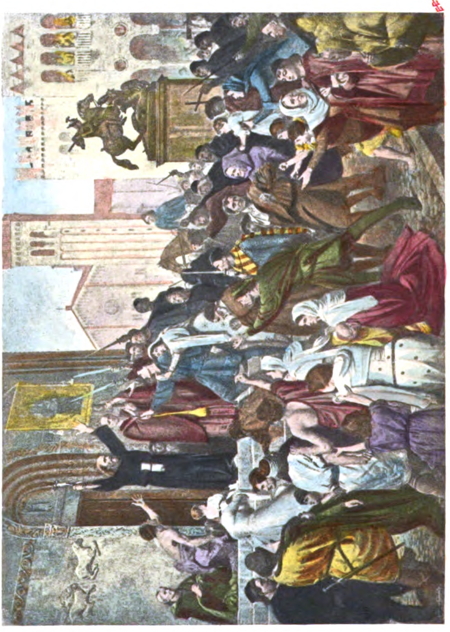
(See this image in horizontal aspect [here].)
Peter the Hermit preaching the First Crusade Frontispiece. From a painting by James Archer, R.S.A.
LIST OF ILLUSTRATIONS↩
- Peter the Hermit preaching the First Crusade Frontispiece. From a painting by James Archer, R.S.A.
- Map of Southern Italy, page 80
- Peter the Hermit, p. 192. From a painting by Léon d’Estang.
- Godfrey of Bouillon, p. 216. From a painting by J. Boilly.
- Jerusalem, p. 300. From a rare engraving.
- A Doge of Venice, p. 344. From a painting by B. Strozzi.
NOTE↩
I am fortunate enough to have again received generous help from my friend Mr. Stanley Lane-Poole in the revision of chapters in this volume which deal with oriental history.
J. B. B.
[X-1]
CHAPTER LIV↩
Origin and Doctrine of the Paulicians — Their Persecution by the Greek Emperors — Revolt in Armenia, &c. — Transplantation into Thrace — Propagation in the West — The Seeds, Character, and Consequences of the Reformation
In the profession of Christianity, the variety of national characters may be clearly distinguished. The natives of Syria and Egypt abandoned their lives to lazy and contemplative devotion; Rome again aspired to the dominion of the world; and the wit of the lively and loquacious Greeks was consumed in the disputes of metaphysical theology. The incomprehensible mysteries of the Trinity and Incarnation, instead of commanding their silent submission, were agitated in vehement and subtle controversies, which enlarged their faith, at the expense, perhaps, of their charity and reason. From the council of Nice to the end of the seventh century, the peace and unity of the church was invaded by these spiritual wars; and so deeply did they affect the decline and fall of the empire that the historian has too often been compelled to attend the synods, to explore the creeds, and to enumerate the sects of this busy period of ecclesiastical annals. From the beginning of the eighth century to the last ages of the Byzantine empire the sound of controversy was seldom heard; curiosity was exhausted, zeal was fatigued, and, in [X-2] the decrees of six councils, the articles of the Catholic faith had been irrevocably defined. The spirit of dispute, however vain and pernicious, requires some energy and exercise of the mental faculties; and the prostrate Greeks were content to fast, to pray, and to believe, in blind obedience to the patriarch and his clergy. During a long dream of superstition, the Virgin and the Saints, their visions and miracles, their relics and images, were preached by the monks and worshipped by the people; and the appellation of people might be extended without injustice to the first ranks of civil society. At an unseasonable moment the Isaurian emperors attempted somewhat rudely to awaken their subjects: under their influence, reason might obtain some proselytes, a far greater number was swayed by interest or fear; but the Eastern world embraced or deplored their visible deities, and the restoration of images was celebrated as the feast of orthodoxy. In this passive and unanimous state the ecclesiastical rulers were relieved from the toil, or deprived of the pleasure, of persecution. The Pagans had disappeared; the Jews were silent and obscure; the disputes with the Latins were rare and remote hostilities against a national enemy; and the sects of Egypt and Syria enjoyed a free toleration, under the shadow of the Arabian caliphs. About the middle of the seventh century, a branch of Manichæans was selected as the victims of spiritual tyranny: their patience was at length exasperated to despair and rebellion; and their exile has scattered over the West the seeds of reformation. These important events will justify some inquiry into the doctrine and story of the Paulicians: [1] and, as they cannot plead for themselves, [X-3] our candid criticism will magnify the good, and abate or suspect the evil, that is reported by their adversaries.
The Gnostics, who had distracted the infancy, were oppressed by the greatness and authority, of the church. Instead of emulating or surpassing the wealth, learning, and numbers of the Catholics, their obscure remnant was driven from the capitals of the East and West, and confined to the villages and mountains along the borders of the Euphrates. Some vestige of the Marcionites may be detected in the fifth century; [2] but the numerous sects were finally lost in the odious name of the Manichæans; and these heretics, who presumed to reconcile the doctrines of Zoroaster and Christ, were pursued by the two religions with equal and unrelenting hatred. Under the grandson of Heraclius, in the neighbourhood of Samosata, more famous for the birth of Lucian than for the title of a Syrian kingdom, a reformer arose, esteemed by the Paulicians as the chosen messenger of truth. In his humble dwelling of Mananalis, [3] Constantine entertained a deacon, who returned from Syrian captivity, and received the inestimable gift of the New Testament, which was already concealed from the vulgar by the prudence of the Greek, and perhaps of the Gnostic, clergy. [4] These books became the measure of his studies and the rule of his faith; and the Catholics, who dispute his interpretation, acknowledge that his text was genuine and sincere. But he attached himself [X-4] with peculiar devotion to the writings and character of St. Paul: the name of the Paulicians is derived by their enemies from some unknown and domestic teacher; but I am confident that they gloried in their affinity to the apostle of the Gentiles. [5] His disciples, Titus, Timothy, Sylvanus, Tychicus, were represented by Constantine and his fellow-labourers: the names of the apostolic churches were applied to the congregations which they assembled in Armenia and Cappadocia; and this innocent allegory revived the example and memory of the first ages. [6] In the gospel, and the epistles [X-5] of St. Paul, his faithful follower investigated the creed of primitive Christianity; and, whatever might be the success, a Protestant reader will applaud the spirit of the inquiry. But, if the scriptures of the Paulicians were pure, they were not perfect. Their founders rejected the two epistles of St. Peter, [7] the apostle of the circumcision, whose dispute with their favourite for the observance of the law could not easily be forgiven. [8] They agreed with their Gnostic brethren in the universal contempt for the Old Testament, the books of Moses and the prophets, which have been consecrated by the decrees of the Catholic church. With equal boldness, and doubtless with more reason, Constantine, the new Sylvanus, disclaimed the visions which, in so many bulky and splendid volumes, had been published by the Oriental sects; [9] the fabulous productions of the Hebrew patriarchs and the sages of the East; the spurious gospels, epistles, and acts, which in the first age had overwhelmed the orthodox code; the theology of Manes and the authors of the kindred heresies; and the thirty generations, or æons, which had been created by the fruitful fancy of Valentine. The Paulicians sincerely condemned the memory and opinions of the Manichæan sect, and complained of the injustice which [X-6] impressed that invidious name on the simple votaries of St. Paul and of Christ. [10]
Of the ecclesiastical chain, many links have been broken by the Paulician reformers; and their liberty was enlarged, as they reduced the number of masters at whose voice profance reason must bow to mystery and miracle. The early separation of the Gnostics had preceded the establishment of the Catholic worship; and against the gradual innovations of discipline and doctrine they were as strongly guarded by habit and aversion as by the silence of St. Paul and the evangelists. The objects which had been transformed by the magic of superstition appeared to the eyes of the Paulicians in their genuine and naked colours. An image made without hands was the common workmanship of a mortal artist, to whose skill alone the wood and canvas must be indebted for their merit or value. The miraculous relics were an heap of bones and ashes, destitute of life or virtue, or of any relation, perhaps, with the person to whom they were ascribed. The true and vivifying cross was a piece of sound or rotten timber; the body and blood of Christ, a loaf of bread and a cup of wine, the gifts of nature and the symbols of grace. The mother of God was degraded from her celestial honours and immaculate virginity; and the saints and angels were no longer solicited to exercise the laborious office of mediation in heaven and ministry upon earth. In the practice, or at least in the theory, of the sacraments, the Paulicians were inclined to abolish all visible objects of worship, and the words of the gospel were, in their judgment, the baptism and communion of the faithful. They indulged a convenient latitude for the interpretation of scripture; and, as often as they were pressed by the literal sense, they could escape to the intricate mazes of figure and allegory. Their [X-7] utmost diligence must have been employed to dissolve the connection between the Old and the New Testament; since they adored the latter as the oracles of God, and abhorred the former as the fabulous and absurd invention of men or demons. We cannot be surprised that they should have found in the gospel the orthodox mystery of the Trinity; but, instead of confessing the human nature and substantial sufferings of Christ, they amused their fancy with a celestial body that passed through the virgin like water through a pipe; with a fantastic crucifixion that eluded the vain and impotent malice of the Jews. A creed thus simple and spiritual was not adapted to the genius of the times; [11] and the rational Christian, who might have been contented with the light yoke and easy burthen of Jesus and his apostles, was justly offended that the Paulicians should dare to violate the unity of God, the first article of natural and revealed religion. Their belief and their trust was in the Father of Christ, of the human soul, and of the invisible world. But they likewise held the eternity of matter: a stubborn and rebellious substance, the origin of a second principle, of an active being, who has created this visible world and exercises his temporal reign till the final consummation of death and sin. [12] The appearances of moral and physical evil had established the two principles in the ancient philosophy and religion of [X-8] the East; from whence this doctrine was transfused to the various swarms of the Gnostics. A thousand shades may be devised in the nature and character of Ahriman, from a rival god to a subordinate demon, from passion and frailty to pure and perfect malevolence: but, in spite of our efforts, the goodness and the power of Ormusd are placed at the opposite extremities of the line; and every step that approaches the one must recede in equal proportion from the other. [13]
The apostolic labours of Constantine-Sylvanus soon multiplied the number of his disciples, the secret recompense of spiritual ambition. The remnant of the Gnostic sects, and especially the Manichæans of Armenia, were united under his standard; many Catholics were converted or seduced by his arguments; and he preached with success in the regions of Pontus [14] and Cappadocia, which had long since imbibed the religion of Zoroaster. The Paulician teachers were distinguished only by their scriptural names, by the modest title of fellow-pilgrims, by the austerity of their lives, their zeal or knowledge, and the credit of some extraordinary gifts of the Holy Spirit. But they were incapable of desiring, or at least of obtaining, the wealth and honours of the Catholic prelacy: such antichristian pride they bitterly censured; and even the rank of elders or presbyters was condemned as an institution of the Jewish synagogue. The new sect was loosely spread over the provinces of Asia Minor to the westward of the Euphrates; six of their principal congregations represented the churches to which St. Paul had addressed his epistles; and their founder chose his residence [X-9] in the neighbourhood of Colonia, [15] in the same district of Pontus which had been celebrated by the altars of Bellona [16] and the miracles of Gregory. [17] After a mission of twenty-seven years, Sylvanus, who had retired from the tolerating government of the Arabs, fell a sacrifice to Roman persecution. The laws of the pious emperors, which seldom touched the lives of less odious heretics, proscribed without mercy or disguise the tenets, the books, and the persons of the Montanists and Manichæans: the books were delivered to the flames; and all who should presume to secrete such writings, or to profess such opinions, were devoted to an ignominious death. [18] A Greek minister, armed with legal and military powers, appeared at Colonia to strike the shepherd, and to reclaim, if possible, the lost sheep. By a refinement of cruelty, Simeon placed the unfortunate Sylvanus before a line of his disciples, who were commanded, as the [X-10] price of their pardon and the proof of their repentance, to massacre their spiritual father. They turned aside from the impious office; the stones dropped from their filial hands; and of the whole number only one executioner could be found, a new David, as he is styled by the Catholics, who boldly overthrew the giant of heresy. This apostate, Justus was his name, again deceived and betrayed his unsuspecting brethren, and a new conformity to the acts of St. Paul may be found in the conversion of Simeon: like the apostle, he embraced the doctrine which he had been sent to persecute, renounced his honours and fortunes, and acquired among the Paulicians the fame of a missionary and a martyr. They were not ambitious of martyrdom, [19] but, in a calamitous period of one hundred and fifty years, their patience sustained whatever zeal could inflict; and power was insufficient to eradicate the obstinate vegetation of fanaticism and reason. From the blood and ashes of the first victims, a succession of teachers and congregations repeatedly arose; amidst their foreign hostilities, they found leisure for domestic quarrels; they preached, they disputed, they suffered; and the virtues, the apparent virtues, of Sergius, in a pilgrimage of thirty-three years, are reluctantly confessed by the orthodox historians. [20] [X-11] The native cruelty of Justinian the Second was stimulated by a pious cause; and he vainly hoped to extinguish, in a single conflagration, the name and memory of the Paulicians. By their primitive simplicity, their abhorrence of popular superstition, the Iconoclast princes might have been reconciled to some erroneous doctrines; but they themselves were exposed to the calumnies of the monks, and they chose to be the tyrants, lest they should be accused as the accomplices, of the Manichæans. Such a reproach has sullied the clemency of Nicephorus, who relaxed in their favour the severity of the penal statutes, nor will his character sustain the honour of a more liberal motive. The feeble Michael the First, the rigid Leo the Armenian, were foremost in the race of persecution; but the prize must doubtless be adjudged to the sanguinary devotion of Theodora, who restored the images to the Oriental church. Her inquisitors explored the cities and mountains of the lesser Asia, and the flatterers of the empress have affirmed that, in a short reign, one hundred thousand Paulicians were extirpated by the sword, the gibbet, or the flames. Her guilt or merit has perhaps been stretched beyond the measure of truth; but, if the account be allowed, it must be presumed that many simple Iconoclasts were punished under a more odious name; and that some, who were driven from the church, unwillingly took refuge in the bosom of heresy.
The most furious and desperate of rebels are the sectaries of a religion long persecuted, and at length provoked. In an holy cause they are no longer susceptible of fear or remorse: the justice of their arms hardens them against the feelings of humanity; and they revenge their fathers’ wrongs on the children of their tyrants. Such have been the Hussites of Bohemia and the Calvinists of France, and such, in the ninth century, were the Paulicians of Armenia and the adjacent [X-12] provinces. [21] They were first awakened to the massacre of a governor and bishop, who exercised the Imperial mandate of converting or destroying the heretics; and the deepest recesses of Mount Argæus protected their independence and revenge. A more dangerous and consuming flame was kindled by the persecution of Theodora, and the revolt of Carbeas, a valiant Paulician, who commanded the guards of the general of the East. His father had been impaled by the Catholic inquisitors; and religion, or at least nature, might justify his desertion and revenge. Five thousand of his brethren were united by the same motives; they renounced the allegiance of anti-christian Rome; a Saracen emir introduced Carbeas to the caliph; and the commander of the faithful extended his sceptre to the implacable enemy of the Greeks. In the mountains between Siwas [22] and Trebizond he founded or fortified the city of Tephrice, [23] which is still occupied by a fierce and licentious people, and the neighbouring hills were covered with the Paulician fugitives, who now reconciled the use of the Bible and the sword. During [X-13] more than thirty years, Asia was afflicted by the calamities of foreign and domestic war; in their hostile inroads the disciples of St. Paul were joined with those of Mahomet; and the peaceful Christians, the aged parent and tender virgin, who were delivered into Barbarous servitude, might justly accuse the intolerant spirit of their sovereign. So urgent was the mischief, so intolerable the shame, that even the dissolute Michael, the son of Theodora, was compelled to march in person against the Paulicians: he was defeated under the walls of Samosata; and the Roman emperor fled before the heretics whom his mother had condemned to the flames. [24] The Saracens fought under the same banners, but the victory was ascribed to Carbeas; and the captive generals, with more than an hundred tribunes, were either released by his avarice or tortured by his fanaticism. The valour and ambition of Chrysocheir, [25] his successor, embraced a wider circle of rapine and revenge. In alliance with his faithful Moslems, he boldly penetrated into the heart of Asia; the troops of the frontier and the palace were repeatedly overthrown; the edicts of persecution were answered by the pillage of Nice and Nicomedia, of Ancyra and Ephesus; nor could the apostle St. John protect from violation his city and sepulchre. The cathedral of Ephesus was turned into a stable for mules and horses; and the Paulicians vied with the Saracens in their contempt and abhorrence of images and relics. It is not unpleasing to observe the triumph of rebellion over the same despotism which has disdained the prayers of an injured people. The emperor Basil, the Macedonian, was reduced to sue for peace, to offer a ransom for the captives, and to request, in the language of moderation [X-14] and charity, that Chrysocheir would spare his fellow-Christians, and content himself with a royal donative of gold and silver and silk-garments. “If the emperor,” replied the insolent fanatic, “be desirous of peace, let him abdicate the East, and reign without molestation in the West. If he refuse, the servants of the Lord will precipitate him from the throne.” The reluctant Basil suspended the treaty, accepted the defiance, and led his army into the land of heresy, which he wasted with fire and sword. The open country of the Paulicians was exposed to the same calamities which they had inflicted; but, when he had explored the strength of Tephrice, the multitude of the Barbarians, and the ample magazines of arms and provisions, he desisted with a sigh from the hopeless siege. [26] On his return to Constantinople he laboured, by the foundation of convents and churches, to secure the aid of his celestial patrons, of Michael the archangel and the prophet Elijah; and it was his daily prayer that he might live to transpierce, with three arrows, the head of his impious adversary. Beyond his expectations, the wish was accomplished: after a successful inroad, Chrysocheir was surprised and slain in his retreat; and the rebel’s head was triumphantly presented at the foot of the throne. On the reception of this welcome trophy, Basil instantly called for his bow, discharged three arrows with unerring aim, and accepted the applause of the court, who hailed the victory of the royal archer. With Chrysocheir, the glory of the Paulicians faded and withered; [27] on the second expedition of the [X-15] emperor, the impregnable Tephrice was deserted by the heretics, who sued for mercy or escaped to the borders. The city was ruined, but the spirit of independence survived in the mountains; the Paulicians defended, above a century, their religion and liberty, infested the Roman limits, and maintained their perpetual alliance with the enemies of the empire and the gospel.
About the middle of the eighth century, Constantine, surnamed Copronymus by the worshippers of images, had made an expedition into Armenia, and found, in the cities of Melitene and Theodosiopolis, a great number of Paulicians, his kindred heretics. As a favour or punishment, he transplanted them from the banks of the Euphrates to Constantinople and Thrace; and by this emigration their doctrine was introduced and diffused in Europe. [28] If the sectaries of the metropolis were soon mingled with the promiscuous mass, those of the country struck a deep root in a foreign soil. The Paulicians of Thrace resisted the storms of persecution, maintained a secret correspondence with their Armenian brethren, and gave aid and comfort to their preachers, who solicited, not without success, the infant faith of the Bulgarians. [29] In the tenth century, they were restored and multiplied by a more powerful colony, which John Zimisces [30] transported from [X-16] the Chalybian hills to the valleys of Mount Hæmus. The Oriental clergy, who would have preferred the destruction, impatiently sighed for the absence, of the Manichæans; the warlike emperor had felt and esteemed their valour; their attachment to the Saracens was pregnant with mischief; but, on the side of the Danube, against the Barbarians of Scythia, their service might be useful and their loss would be desirable. Their exile in a distant land was softened by a free toleration; the Paulicians held the city of Philippopolis and the keys of Thrace; the Catholics were their subjects; the Jacobite emigrants their associates: they occupied a line of villages and castles in Macedonia and Epirus; and many native Bulgarians were associated to the communion of arms and heresy. As long as they were awed by power and treated with moderation, their voluntary bands were distinguished in the armies of the empire; and the courage of these dogs, ever greedy of war, ever thirsty of human blood, is noticed with astonishment, and almost with reproach, by the pusillanimous Greeks. The same spirit rendered them arrogant and contumacious: they were easily provoked by caprice or injury; and their privileges were often violated by the faithless bigotry of the government and clergy. In the midst of the Norman war, two thousand five hundred Manichæans deserted the standard of Alexius Comnenus, [31] and retired to their native homes. He dissembled till the moment of revenge; invited the chiefs to a friendly conference; and punished the innocent and guilty by imprisonment, confiscation, and baptism. In an interval of peace, the emperor undertook the pious office of reconciling them to the church and state: his winter quarters were fixed at Philippopolis; [X-17] and the thirteenth apostle, as he is styled by his pious daughter, consumed whole days and nights in theological controversy. His arguments were fortified, their obstinacy was melted, by the honours and rewards which he bestowed on the most eminent proselytes; and a new city, surrounded with gardens, enriched with immunities, and dignified with his own name, was founded by Alexius, for the residence of his vulgar converts. The important station of Philippopolis was wrested from their hands; the contumacious leaders were secured in a dungeon or banished from their country; and their lives were spared by the prudence, rather than the mercy, of an emperor at whose command a poor and solitary heretic was burnt alive before the church of St. Sophia. [32] But the proud hope of eradicating the prejudices of a nation was speedily overturned by the invincible zeal of the Paulicians, who ceased to dissemble or refused to obey. After the departure and death of Alexius, they soon resumed their civil and religious laws. In the beginning of the thirteenth century, their pope or primate (a manifest corruption) resided on the confines of Bulgaria, Croatia, and Dalmatia, and governed by his vicars the filial congregations of Italy and France. [33] From that era, a minute scrutiny might prolong and perpetuate the chain of tradition. At the end [X-18] of the last age, the sect or colony still inhabited the valleys of Mount Hæmus, where their ignorance and poverty were more frequently tormented by the Greek clergy than by the Turkish government. The modern Paulicians have lost all memory of their origin; and their religion is disgraced by the worship of the cross, and the practice of bloody sacrifice, which some captives have imported from the wilds of Tartary. [34]
In the West, the first teachers of the Manichæan theology had been repulsed by the people, or suppressed by the prince. The favour and success of the Paulicians in the eleventh and twelfth centuries must be imputed to the strong, though secret, discontent which armed the most pious Christians against the church of Rome. Her avarice was oppressive, her despotism odious; less degenerate perhaps than the Greeks in the worship of saints and images, her innovations were more rapid and scandalous; she had rigorously defined and imposed the doctrine of transubstantiation: the lives of the Latin clergy were more corrupt, and the Eastern bishops might pass for the successors of the apostles, if they were compared with the lordly prelates who wielded by turns the crosier, the sceptre, and the sword. Three different roads might introduce the Paulicians into the heart of Europe. After the conversion of Hungary, the pilgrims who visited Jerusalem might safely follow the course of the Danube; in their journey and return they passed through Philippopolis; and the sectaries, disguising their name and heresy, might accompany the French or German caravans to their respective countries. The trade and dominion of Venice pervaded the coast of the Adriatic, and the hospitable republic opened her bosom to foreigners of every climate and religion. Under the Byzantine standard, the Paulicians were often transported to the Greek provinces of Italy and Sicily; in peace and war they freely conversed with strangers and natives, [X-19] and their opinions were silently propagated in Rome, Milan, and the kingdoms beyond the Alps. [35] It was soon discovered that many thousand Catholics of every rank, and of either sex, had embraced the Manichæan heresy; and the flames which consumed twelve canons of Orleans was the first act and signal of persecution. The Bulgarians, [36] a name so innocent in its origin, so odious in its application, spread their branches over the face of Europe. United in common hatred of idolatry and Rome, they were connected by a form of episcopal and presbyterian government; their various sects were discriminated by some fainter or darker shades of theology; but they generally agreed in the two principles: the contempt of the Old Testament, and the denial of the body of Christ, either on the cross or in the eucharist. A confession of simple worship and blameless manners is extorted from their enemies; and so high was their standard of perfection that the increasing congregations were divided into two classes of disciples, of those who practised and of those who aspired. It was in the country of the Albigeois, [37] [X-20] in the southern provinces of France, that the Paulicians were most deeply implanted; and the same vicissitudes of martyrdom and revenge which had been displayed in the neighbourhood of the Euphrates were repeated in the thirteenth century on the banks of the Rhone. The laws of the Eastern emperors were revived by Frederic the Second. The insurgents of Tephrice were represented by the barons and cities of Languedoc: Pope Innocent III. surpassed the sanguinary fame of Theodora. It was in cruelty alone that her soldiers could equal the heroes of the crusades, and the cruelty of her priests was far excelled by the founders of the inquisition: [38] an office more adapted to confirm, than to refute, the belief of an evil principle. The visible assemblies of the Paulicians, or Albigeois, were extirpated by fire and sword; and the bleeding remnant escaped by flight, concealment, or Catholic conformity. But the invincible spirit which they had kindled still lived and breathed in the Western world. In the state, in the church, and even in the cloister, a latent succession was preserved of the disciples of St. Paul; who protested against the tyranny of Rome, embraced the Bible as the rule of faith, and purified their creed from all the visions of the Gnostic theology. The struggles of Wickliff in England, of Huss in Bohemia, were premature and ineffectual; but the names of Zuinglius, Luther, and Calvin are pronounced with gratitude as the deliverers of nations.
[X-21]
A philosopher, who calculates the degree of their merit and the value of their reformation, will prudently ask from what articles of faith, above or against our reason, they have enfranchised the Christians; for such enfranchisement is doubtless a benefit so far as it may be compatible with truth and piety. After a fair discussion we shall rather be surprised by the timidity, than scandalised by the freedom, of our first reformers. [39] With the Jew, they adopted the belief and defence of all the Hebrew scriptures, with all their prodigies, from the garden of Eden to the visions of the prophet Daniel; and they were bound, like the Catholics, to justify against the Jews the abolition of a divine law. In the great mysteries of the Trinity and Incarnation the reformers were severely orthodox: they freely adopted the theology of the four or the six first councils; and, with the Athanasian creed, they pronounced the eternal damnation of all who did not believe the Catholic faith. Transubstantiation, the invisible change of the bread and wine into the body and blood of Christ, is a tenet that may defy the power of argument and pleasantry; but, instead of consulting the evidence of their senses, of their sight, their feeling, and their taste, the first Protestants were entangled in their own scruples, and awed by the words of Jesus in the institution of the sacrament. Luther maintained a corporeal, and Calvin a real, presence of Christ in the eucharist; and the opinion of Zuinglius, that it is no more than a spiritual communion, a simple memorial, has slowly prevailed in the reformed churches. [40] But the [X-22] loss of one mystery was amply compensated by the stupendous doctrines of original sin, redemption, faith, grace, and predestination, which have been strained from the epistles of St. Paul. These subtle questions had most assuredly been prepared by the fathers and schoolmen; but the final improvement and popular use may be attributed to the first reformers, who enforced them as the absolute and essential terms of salvation. Hitherto the weight of supernatural belief inclines against the Protestants; and many a sober Christian would rather admit that a wafer is God, than that God is a cruel and capricious tyrant.
Yet the services of Luther and his rival are solid and important; and the philosopher must own his obligations to these fearless enthusiasts. [41] I. By their hands the lofty fabric of superstition, from the abuse of indulgences to the intercession of the Virgin, has been levelled with the ground. Myriads of both sexes of the monastic profession were restored to the liberty and labours of social life. An hierarchy of saints and angels, of imperfect and subordinate deities, were stripped of their temporal power, and reduced to the enjoyment of celestial happiness; their images and relics were banished from the church; and the credulity of the people was no longer nourished with the daily repetition of miracles and visions. The imitation of Paganism was supplied by a pure and spiritual worship of prayer and thanksgiving, the most worthy of man, the least unworthy of the Deity. It only remains to observe whether such sublime simplicity be consistent with popular devotion; whether the vulgar, in the absence of all visible objects, will not be inflamed [X-23] by enthusiasm, or insensibly subside in languor and indifference. II. The chair of authority was broken, which restrains the bigot from thinking as he pleases, and the slave from speaking as he thinks; the popes, fathers, and councils were no longer the supreme and infallible judges of the world; and each Christian was taught to acknowledge no law but the scriptures, no interpreter but his own conscience. This freedom, however, was the consequence, rather than the design, of the Reformation. The patriot reformers were ambitious of succeeding the tyrants whom they had dethroned. They imposed with equal rigour their creeds and confessions; they asserted the right of the magistrate to punish heretics with death. The pious or personal animosity of Calvin proscribed in Servetus [42] the guilt of his own rebellion; [43] and the flames of Smithfield, in which he was afterwards consumed, had been kindled for the Anabaptists by the zeal of [X-24] Cranmer. [44] The nature of the tiger was the same, but he was gradually deprived of his teeth and fangs. A spiritual and temporal kingdom was possessed by the Roman pontiff; the Protestant doctors were subjects of an humble rank, without revenue or jurisdiction. His decrees were consecrated by the antiquity of the Catholic church; their arguments and disputes were submitted to the people; and their appeal to private judgment was accepted, beyond their wishes, by curiosity and enthusiasm. Since the days of Luther and Calvin, a secret reformation has been silently working in the bosom of the reformed churches; many weeds of prejudice were eradicated; and the disciples of Erasmus [45] diffused a spirit of freedom and moderation. The liberty of conscience has been claimed as a common benefit, an inalienable right; [46] the free governments of Holland [47] and England [48] introduced the practice of toleration; and the narrow allowance of the laws has been enlarged by the prudence and humanity of the times. In the exercise, the mind has understood the limits of its powers, and the words and shadows that might amuse the child can no longer satisfy his manly reason. The volumes [X-25] of controversy are overspread with cobwebs; the doctrine of a Protestant church is far removed from the knowledge or belief of its private members; and the forms of orthodoxy, the articles of faith, are subscribed with a sigh or a smile by the modern clergy. Yet the friends of Christianity are alarmed at the boundless impulse of inquiry and scepticism. The predictions of the Catholics are accomplished; the web of mystery is unravelled by the Arminians, Arians, and Socinians, whose numbers must not be computed from their separate congregations; and the pillars of revelation are shaken by those men who preserve the name without the substance of religion, who indulge the licence without the temper of philosophy. [49]
[X-26]
CHAPTER LV↩
The Bulgarians — Origin, Migrations, and Settlement of the Hungarians — Their inroads in the East and West — The monarchy of Russia — Geography and Trade — Wars of the Russians against the Greek Empire — Conversion of the Barbarians
Under the reign of Constantine the grandson of Heraclius, the ancient barrier of the Danube, so often violated and so often restored, was irretrievably swept away by a new deluge of Barbarians. Their progress was favoured by the caliphs, their unknown and accidental auxiliaries: the Roman legions were occupied in Asia; and, after the loss of Syria, Egypt, and Africa, the Cæsars were twice reduced to the danger and disgrace of defending their capital against the Saracens. If, in the account of this interesting people, I have deviated from the strict and original line of my undertaking, the merit of the subject will hide my transgression or solicit my excuse. In the East, in the West, in war, in religion, in science, in their prosperity, and in their decay, the Arabians press themselves on our curiosity: the first overthrow of the church and empire of the Greeks may be imputed to their arms; and the disciples of Mahomet still hold the civil and religious sceptre of the Oriental world. But the same labour would be unworthily bestowed on the swarms of savages who, between the seventh and the twelfth century, descended from the plains of Scythia, in transient inroad or perpetual emigration. [1] Their names are uncouth, their origins doubtful, [X-27] their actions obscure, their superstition was blind, their valour brutal, and the uniformity of their public and private lives was neither softened by innocence nor refined by policy. The majesty of the Byzantine throne repelled and survived their disorderly attacks; the greater part of these Barbarians has disappeared without leaving any memorial of their existence, and the despicable remnant continues, and may long continue, to groan under the dominion of a foreign tyrant. From the antiquities of, I. Bulgarians, II. Hungarians, and III. Russians, I shall content myself with selecting such facts as yet deserve to be remembered. The conquests of the, IV., Normans, and the monarchy of the, V., Turks, will naturally terminate in the memorable Crusades to the Holy Land, and the double fall of the city and empire of Constantine.
I. In his march to Italy, Theodoric [2] the Ostrogoth had trampled on the arms of the Bulgarians. After this defeat, the name and the nation are lost during a century and a half; [3] and it may be suspected that the same or a similar appellation was revived by strange colonies from the Borysthenes, the Tanais, or the Volga. A king of the ancient Bulgaria [4] bequeathed to his five sons a last lesson of moderation and concord. It was received as youth has ever received [X-28] the counsels of age and experience: the five princes buried their father; divided his subjects and cattle; forgot his advice; separated from each other; and wandered in quest of fortune, till we find the most adventurous in the heart of Italy, under the protection of the exarch of Ravenna. [5] But the stream of emigration was directed or impelled towards the capital. The modern Bulgaria, along the southern banks of the Danube, was stamped with the name and image which it has retained to the present hour; the new conquerors successively acquired, by war or treaty, the Roman provinces of Dardania, Thessaly, and the two Epirus’; [6] the ecclesiastical supremacy was translated from the native city of Justinian; and, in their prosperous age, the obscure town of Lychnidus, or Achrida, was honoured with the throne of a king and a patriarch. [7] The unquestionable evidence of language attests the descent of the Bulgarians from the original stock of the Sclavonian, or more properly Slavonian, race; [8] [X-29] and the kindred bands of Servians, Bosnians, Rascians, Croatians, Walachians, [9] &c. followed either the standard or the example of the leading tribe. From the Euxine to the Adriatic, in the state of captives or subjects, or allies or enemies, of the Greek empire, they overspread the land; and the national appellation of the slaves [10] has been degraded by chance or malice from the signification of glory to that of [X-30] servitude. [11] Among these colonies, the Chrobatians, [12] or Croats, who now attend the motions of an Austrian army, are the descendants of a mighty people, the conquerors and sovereigns of Dalmatia. The maritime cities, and of these the infant republic of Ragusa, implored the aid and instructions of the Byzantine court: they were advised by the magnanimous Basil to reserve a small acknowledgment of their fidelity to the Roman empire, and to appease, by an annual tribute, the wrath of these irresistible Barbarians. The kingdom of Croatia was shared by eleven Zoupans, or feudatory lords; and their united forces were numbered at sixty thousand horse and one hundred thousand foot. A long sea-coast, indented with capacious harbours, covered with a string of islands, and almost in sight of the Italian shores, disposed both the natives and strangers to the practice of navigation. The boats or brigantines of the Croats were constructed after the fashion of the old Liburnians; one hundred and eighty vessels may excite the idea of a respectable navy; but our seamen will smile at the allowance of ten, or twenty, or forty men for each of these ships of war. They were gradually converted to the more honourable service of commerce; yet the Sclavonian pirates were still frequent and dangerous; and it was not before the close of the tenth [X-31] century that the freedom and sovereignty of the Gulf were effectually vindicated by the Venetian republic. [13] The ancestors of these Dalmatian kings were equally removed from the use and abuse of navigation; they dwelt in the White Croatia, in the inland regions of Silesia and Little Poland, thirty days’ journey, according to the Greek computation, from the sea of darkness.
The glory of the Bulgarians [14] was confined to a narrow scope both of time and place. In the ninth and tenth centuries they reigned to the south of the Danube; but the more powerful nations that had followed their emigration repelled all return to the north and all progress to the west. Yet, in the obscure catalogue of their exploits, they might boast an honour which had hitherto been appropriated to the Goths: that of slaying in battle one of the successors of Augustus and Constantine. The emperor Nicephorus had lost his fame in the Arabian, he lost his life in the Sclavonian, war. In his first operations he advanced with boldness and success into the centre of Bulgaria, and burnt the royal court, which was probably no more than an edifice and village of timber. But, while he searched the spoil and refused all offers of treaty, his enemies collected their spirits and their forces; the passes of retreat were insuperably barred; and the trembling Nicephorus was heard to exclaim: “Alas, alas! unless we could assume the wings of birds, we cannot hope to escape.” Two days he waited his fate in the inactivity [X-32] of despair; but, on the morning of the third, the Bulgarians surprised the camp; and the Roman prince, with the great officers of the empire, were slaughtered in their tents. The body of Valens had been saved from insult; but the head of Nicephorus was exposed on a spear, and his skull, enchased with gold, was often replenished in the feasts of victory. The Greeks bewailed the dishonour of the throne; but they acknowledged the just punishment of avarice and cruelty. This savage cup was deeply tinctured with the manners of the Scythian wilderness; but they were softened before the end of the same century by a peaceful intercourse with the Greeks, the possession of a cultivated region, and the introduction of the Christian worship. [15] The nobles of Bulgaria were educated in the schools and palace of Constantinople; and Simeon, [16] a youth of the royal line, was instructed in the [X-33] rhetoric of Demosthenes and the logic of Aristotle. He relinquished the profession of a monk for that of a king and warrior; and in his reign, of more than forty years, [17] Bulgaria assumed a rank among the civilised powers of the earth. The Greeks, whom he repeatedly attacked, derived a faint consolation from indulging themselves in the reproaches of perfidy and sacrilege. They purchased the aid of the Pagan Turks; but Simeon, in a second battle, redeemed the loss of the first, at a time when it was esteemed a victory to elude the arms of that formidable nation. The Servians [18] were overthrown, made captive, and dispersed; and those who visited the country before their restoration could discover no more than fifty vagrants, without women or children, who extorted a precarious subsistence from the chase. On classic ground, on the banks of the Achelöus, the Greeks were defeated; their horn was broken by the strength of the barbaric Hercules. [19] He formed the siege of Constantinople; and, in a personal conference with the emperor, Simeon imposed the conditions of peace. They met with the most jealous precautions; the royal gallery was drawn close to an artificial and well-fortified [X-34] platform; and the majesty of the purple was emulated by the pomp of the Bulgarian. “Are you a Christian?” said the humble Romanus. “It is your duty to abstain from the blood of your fellow-Christians. Has the thirst of riches seduced you from the blessings of peace? Sheathe your sword, open your hand, and I will satiate the utmost measure of your desires.” The reconciliation was sealed by a domestic alliance; [20] the freedom of trade was granted or restored; the first honours of the court were secured to the friends of Bulgaria, above the ambassadors of enemies or strangers; [21] and her princes were dignified with the high and invidious title of basileus, or emperor. But this friendship was soon disturbed: after the death of Simeon, the nations were again in arms; his feeble successors were divided [22] [X-35] and extinguished; and, in the beginning of the eleventh century, the second Basil, who was born in the purple, deserved the appellation of conqueror of the Bulgarians. [23] His avarice [X-36] was in some measure gratified by a treasure of four hundred thousand pounds sterling (ten thousand pounds weight of gold) which he found in the palace of Lychnidus. His cruelty inflicted a cool and exquisite vengeance on fifteen thousand captives who had been guilty of the defence of their country: they were deprived of sight; but to one of each hundred a single eye was left, that he might conduct his blind century to the presence of their king. Their king is said to have expired of grief and horror; the nation was awed by this terrible example; the Bulgarians were swept away from their settlements, and circumscribed within a narrow province; the surviving chiefs bequeathed to their children the advice of patience and the duty of revenge.
II. When the black swarm of Hungarians first hung over Europe, about nine hundred years after the Christian era, they were mistaken by fear and superstition for the Gog and Magog of the Scriptures, the signs and forerunners of the end of the world. [24] Since the introduction of letters, they have explored their own antiquities with a strong and laudable impulse of patriotic curiosity. [25] Their rational criticism can no longer be amused with a vain pedigree of Attila and the Huns; but they complain that their primitive records have perished in the Tartar war; that the truth or fiction of their rustic songs is long since forgotten; and that the fragments of a rude chronicle [26] must be painfully reconciled with the [X-37] contemporary though foreign intelligence of the Imperial geographer. [27] Magiar is the national and Oriental denomination of the Hungarians; but, among the tribes of Scythia, they are distinguished by the Greeks under the proper and peculiar name of Turks, as the descendants of that mighty people who had conquered and reigned from China to the Volga. The Pannonian colony preserved a correspondence of trade and amity with the eastern Turks on the confines of Persia; and, after a separation of three hundred and fifty years, the missionaries of the king of Hungary discovered and visited their ancient country near the banks of the Volga. They were hospitably entertained by a people of pagans and savages, who still bore the name of Hungarians; conversed in their native tongue, recollected a tradition of their long-lost brethren, and listened with amazement to the marvellous tale of their new kingdom and religion. The zeal of conversion was animated by the interest of consanguinity; and one of the greatest of their princes had formed the generous, though fruitless, design of replenishing the solitude of Pannonia by this domestic colony from the heart of Tartary. [28] From this primitive country they were driven to the West by the tide of war and emigration, by the weight of the more distant tribes, who at the same time were fugitives and conquerors. [X-38] Reason or fortune directed their course towards the frontiers of the Roman empire; they halted in the usual stations along the banks of the great rivers; and in the territories of Moscow, Kiow, and Moldavia some vestiges have been discovered of their temporary residence. In this long and various peregrination, they could not always escape the dominion of the stronger; and the purity of their blood was improved or sullied by the mixture of a foreign race; from a motive of compulsion or choice, several tribes of the Chazars were associated to the standard of their ancient vassals; introduced the use of a second language; [29] and obtained by their superior renown the most honourable place in the front of battle. The military force of the Turks and their allies marched in seven equal and artificial divisions; each division was formed of thirty thousand eight hundred and fifty-seven warriors, and the proportion of women, children, and servants supposes and requires at least a million of emigrants. Their public counsels were directed by seven vayvods, [30] or hereditary chiefs; but the experience of discord and weakness recommended the more simple and vigorous administration of a single person. The sceptre which had been declined by the modest Lebedias, was granted to the birth or merit of Almus and his son Arpad, and the authority of the supreme khan of the Chazars confirmed the engagement of the prince and people: of the people to obey his commands, of the prince to consult their happiness and glory.
With this narrative we might be reasonably content, if the penetration of modern learning had not opened a new and larger prospect of the antiquities of nations. The Hungarian language stands alone, and as it were insulated, among the Sclavonian dialects; but it bears a close and clear affinity to the idioms of the Fennic race, [31] of an obsolete and savage race, [X-39] which formerly occupied the northern regions of Asia and Europe. The genuine appellation of Ugri or Igours is found on the western confines of China, [32] their migration to the banks of the Irtish is attested by Tartar evidence, [33] a similar name and language are detected in the southern parts of Siberia, [34] and the remains of the Fennic tribes are widely, though thinly, scattered from the sources of the Oby to the shores of Lapland. [35] The consanguinity of the Hungarians and Laplanders would display the powerful energy of climate on the children of a common parent; the lively contrast between the bold adventurers who are intoxicated with the wines of the Danube, and the wretched fugitives who are immersed beneath the snows of the polar circle. Arms and freedom have ever been the ruling, though too often the unsuccessful, passion of the Hungarians, who are endowed by nature with a vigorous constitution of soul and body. [36] [X-40] extreme cold has diminished the stature and congealed the faculties of the Laplanders; and the Arctic tribes, alone among the sons of men, are ignorant of war and unconscious of human blood: an happy ignorance, if reason and virtue were the guardians of their peace! [37]
It is the observation of the Imperial author of the Tactics [38] that all the Scythian hordes resembled each other in their pastoral and military life, that they all practised the same means of subsistence, and employed the same instruments of destruction. But he adds that the two nations of Bulgarians and Hungarians were superior to their brethren, and similar to each other, in the improvements, however rude, of their discipline and government; their visible likeness determines Leo to confound his friends and enemies in one common description; and the picture may be heightened by some strokes from their contemporaries of the tenth century. Except the merit and fame of military prowess, all that is valued by mankind appeared vile and contemptible to these Barbarians, whose native fierceness was stimulated by the consciousness of numbers and freedom. The tents of the Hungarians were of leather, their garments of fur; they shaved their hair and scarified their faces; in speech they were slow, in action prompt, in treaty perfidious; and they shared the common reproach of Barbarians, too ignorant [X-41] to conceive the importance of truth, too proud to deny or palliate the breach of their most solemn engagements. Their simplicity has been praised; yet they abstained only from the luxury they had never known; whatever they saw, they coveted; their desires were insatiate, and their sole industry was the hand of violence and rapine. By the definition of a pastoral nation, I have recalled a long description of the economy, the warfare, and the government that prevail in that stage of society; I may add that to fishing as well as to the chase the Hungarians were indebted for a part of their subsistence; and, since they seldom cultivated the ground, they must, at least in their new settlements, have sometimes practised a slight and unskilful husbandry. In their emigrations, perhaps in their expeditions, the host was accompanied by thousands of sheep and oxen, which increased the cloud of formidable dust, and afforded a constant and wholesome supply of milk and animal food. A plentiful command of forage was the first care of the general, and, if the flocks and herds were secure of their pastures, the hardy warrior was alike insensible of danger and fatigue. The confusion of men and cattle that overspread the country exposed their camp to a nocturnal surprise, had not a still wider circuit been occupied by their light cavalry, perpetually in motion to discover and delay the approach of the enemy. After some experience of the Roman tactics, they adopted the use of the sword and spear, the helmet of the soldier, and the iron breast-plate of his steed; but their native and deadly weapon was the Tartar bow; from the earliest infancy, their children and servants were exercised in the double science of archery and horsemanship; their arm was strong; their aim was sure; and, in the most rapid career, they were taught to throw themselves backwards, and to shoot a volley of arrows into the air. In open combat, in secret ambush, in flight or pursuit, they were equally formidable; an appearance of order was maintained in the foremost ranks, but their charge was driven forwards by the impatient pressure of succeeding [X-42] crowds. They pursued, headlong and rash, with loosened reins and horrific outcries; but if they fled, with real or dissembled fear, the ardour of a pursuing foe was checked and chastised by the same habits of irregular speed and sudden evolution. In the abuse of victory, they astonished Europe, yet smarting from the wounds of the Saracen and the Dane; mercy they rarely asked, and more rarely bestowed; both sexes were accused as equally inaccessible to pity, and their appetite for raw flesh might countenance the popular tale that they drank the blood and feasted on the hearts of the slain. Yet the Hungarians were not devoid of those principles of justice and humanity which nature has implanted in every bosom. The licence of public and private injuries was restrained by laws and punishments; and in the security of an open camp theft is the most tempting and most dangerous offence. Among the Barbarians, there were many whose spontaneous virtue supplied their laws and corrected their manners, who performed the duties, and sympathised with the affections, of social life.
After a long pilgrimage of flight or victory, the Turkish hordes approached the common limits of the French and Byzantine empires. Their first conquests and final settlements extended on either side of the Danube above Vienna, below Belgrade, and beyond the measure of the Roman province of Pannonia, or the modern kingdom of Hungary. [39] That ample and fertile land was loosely occupied by the Moravians, a Sclavonian name and tribe, which were driven by the invaders into the compass of a narrow province. Charlemagne had stretched a vague and nominal empire as far as the edge of Transylvania; but, after the failure of his legitimate [X-43] line, the dukes of Moravia forgot their obedience and tribute to the monarchs of Oriental France. [40] The bastard Arnulph was provoked to invite the arms of the Turks; they rushed through the real or figurative wall which his indiscretion had thrown open; and the king of Germany has been justly reproached as a traitor to the civil and ecclesiastical society of the Christians. During the life of Arnulph, the Hungarians were checked by gratitude or fear; but in the infancy of his son Lewis they discovered and invaded Bavaria; and such was their Scythian speed that, in a single day, a circuit of fifty miles was stripped and consumed. In the battle of Augsburg, the Christians maintained their advantage till the seventh hour of the day; they were deceived and vanquished by the flying stratagems of the Turkish cavalry. The conflagration spread over the provinces of Bavaria, Swabia, and Franconia; and the Hungarians [41] promoted the reign of anarchy by forcing the stoutest barons to discipline their vassals and fortify their castles. The origin of walled towns is ascribed to this calamitous period; nor could any distance be secure against an enemy who, almost at the same [X-44] instant, laid in ashes the Helvetian monastery of St. Gall, and the city of Bremen on the shores of the Northern ocean. Above thirty years the Germanic empire, or kingdom, was subject to the ignominy of tribute; and resistance was disarmed by the menace, the serious and effectual menace, of dragging the women and children into captivity and of slaughtering the males above the age of ten years. I have neither power nor inclination to follow the Hungarians beyond the Rhine; but I must observe with surprise that the southern provinces of France were blasted by the tempest, and that Spain, behind her Pyrenees, was astonished at the approach of these formidable strangers. [42] The vicinity of Italy had tempted their early inroads; but, from their camp on the Brenta, they beheld with some terror the apparent strength and populousness of the new-discovered country. They requested leave to retire; their request was proudly rejected by the Italian king; and the lives of twenty thousand Christians paid the forfeit of his obstinacy and rashness. Among the cities of the West, the royal Pavia was conspicuous in fame and splendour; and the pre-eminence of Rome itself was only derived from the relics of the apostles. The Hungarians appeared; Pavia was in flames; forty-three churches were consumed; and, after the massacre of the people, they spared about two hundred wretches who had gathered some bushels of gold and silver (a vague exaggeration) from the smoking ruins of their country. In these annual excursions from the Alps to the neighbourhood of Rome and Capua, the churches, that yet escaped, resounded with a fearful litany: “Oh! save and deliver us from the arrows of the Hungarians!” But the saints were deaf or inexorable; and the torrent rolled forwards, till it was stopped [X-45] by the extreme land of Calabria. [43] A composition was offered and accepted for the head of each Italian subject; and ten bushels of silver were poured forth in the Turkish camp. But falsehood is the natural antagonist of violence; and the robbers were defrauded both in the numbers of the assessment and the standard of the metal. On the side of the East the Hungarians were opposed in doubtful conflict by the equal arms of the Bulgarians, whose faith forbade an alliance with the Pagans, and whose situation formed the barrier of the Byzantine empire. The barrier was overturned; the emperor of Constantinople beheld the waving banners of the Turks; and one of their boldest warriors presumed to strike a battle-axe into the golden gate. The arts and treasures of the Greeks diverted the assault; but the Hungarians might boast, on their retreat, that they had imposed a tribute on the spirit of Bulgaria and the majesty of the Cæsars. [44] The remote and rapid operations of the same campaign appear to magnify the powers and numbers of the Turks; but [X-46] their courage is most deserving of praise, since a light troop of three or four hundred horse would often attempt and execute the most daring inroads to the gates of Thessalonica and Constantinople. At this disastrous era of the ninth and tenth centuries, Europe was afflicted by a triple scourge from the North, the East, and the South; the Norman, the Hungarian, and the Saracen sometimes trod the same ground of desolation; and these savage foes might have been compared by Homer to the two lions growling over the carcase of a mangled stag. [45]
The deliverance of Germany and Christendom was achieved by the Saxon princes, Henry the Fowler and Otho the Great, who, in two memorable battles, for ever broke the power of the Hungarians. [46] The valiant Henry was roused from a bed of sickness by the invasion of his country; but his mind was vigorous and his prudence successful. “My companions,” said he on the morning of the combat, “maintain your ranks, receive on your bucklers the first arrows of the Pagans, and prevent their second discharge by the equal and rapid career of your lances.” They obeyed, and conquered; and the historical picture of the castle of Merseburg expressed the features, or at least the character, of Henry, who, in an age of ignorance, entrusted to the finer arts the perpetuity of his name. [47] At the end of twenty years, the [X-47] children of the Turks who had fallen by his sword invaded the empire of his son; and their force is defined, in the lowest estimate, at one hundred thousand horse. They were invited by domestic faction; the gates of Germany were treacherously unlocked; and they spread, far beyond the Rhine and the Meuse, into the heart of Flanders. But the vigour and prudence of Otho dispelled the conspiracy; the princes were made sensible that, unless they were true to each other, their religion and country were irrecoverably lost; and the national powers were reviewed in the plains of Augsburg. They marched and fought in eight legions, [48] according to the division of provinces and tribes; the first, second, and third were composed of Bavarians; the fourth of Franconians; the fifth of Saxons, under the immediate command of the monarch; the sixth and seventh consisted of Swabians; and the eighth legion, of a thousand Bohemians, closed the rear of the host. The resources of discipline and valour were fortified by the arts of superstition, which, on this occasion, may deserve the epithets of generous and salutary. The soldiers were purified with a fast; the camp was blessed with the relics of saints and martyrs; and the Christian hero girded on his side the sword of Constantine, grasped the invincible spear of Charlemagne, and waved the banner of St. Maurice, the prefect of the Thebæan legion. But his firmest confidence was placed in the holy lance, [49] [X-48] whose point was fashioned of the nails of the cross, and which his father had extorted from the king of Burgundy by the threats of war and the gift of a province. The Hungarians were expected in the front; [50] they secretly passed the Lech, a river of Bavaria that falls into the Danube; turned the rear of the Christian army; plundered the baggage and disordered the legions of Bohemia and Swabia. The battle was restored by the Franconians, whose duke, the valiant Conrad, was pierced with an arrow as he rested from his fatigues; the Saxons fought under the eyes of their king; and his victory surpassed, in merit and importance, the triumphs of the last two hundred years. The loss of the Hungarians was still greater in the flight than in the action; they were encompassed by the rivers of Bavaria; and their past cruelties excluded them from the hope of mercy. Three captive princes were hanged at Ratisbon, the multitude of prisoners was slain or mutilated, and the fugitives, who presumed to appear in the face of their country, were condemned to everlasting poverty and disgrace. [51] Yet the spirit of the nation was humbled, and the most accessible passes of Hungary were fortified with a ditch and rampart. Adversity suggested the counsels of moderation and peace; the robbers of the West acquiesced in a sedentary life; and the next generation was taught, by a discerning prince, that far more might be gained by multiplying and exchanging the produce of a fruitful soil. The native race, the Turkish or Fennic blood, was mingled with new colonies of Scythian or Sclavonian origin; [52] [X-49] many thousands of robust and industrious captives had been imported from all the countries of Europe; [53] and, after the marriage of Geisa with a Bavarian princess, he bestowed honours and estates on the nobles of Germany. [54] The son of Geisa was invested with the regal title, and the house of Arpad reigned three hundred years in the kingdom of Hungary. But the freeborn Barbarians were not dazzled by the lustre of the diadem, and the people asserted their indefeasible right of choosing, deposing, and punishing the hereditary servant of the state.
III. The name of Russians [55] was first divulged, in the [X-50] ninth century, by an embassy from Theophilus, emperor of the East, to the emperor of the West, Lewis, the son of Charlemagne. The Greeks were accompanied by the envoys of the great duke, or chagan, or czar, of the Russians. In their journey to Constantinople, they had traversed many hostile nations; and they hoped to escape the dangers of their return by requesting the French monarch to transport them by sea to their native country. A closer examination detected their origin: they were the brethren of the Swedes and Normans, whose name was already odious and formidable in France; and it might justly be apprehended that these Russian strangers were not the messengers of peace but the emissaries of war. They were detained, while the Greeks were dismissed; and Lewis expected a more satisfactory account, that he might obey the laws of hospitality or prudence, according to the interest of both empires. [56] The Scandinavian origin of the people, or at least the princes of Russia, may be confirmed and illustrated by the national annals [57] and the general history of the North. The Normans, who had so long been concealed by a veil of impenetrable darkness, suddenly [X-51] burst forth in the spirit of naval and military enterprise. The vast, and, as it is said, the populous, regions of Denmark, Sweden, and Norway were crowded with independent chieftains and desperate adventurers, who sighed in the laziness of peace, and smiled in the agonies of death. Piracy was the exercise, the trade, the glory, and the virtue of the Scandinavian youth. Impatient of a bleak climate and narrow limits, they started from the banquet, grasped their arms, sounded their horn, ascended their vessels, and explored every coast that promised either spoil or settlement. The Baltic was the first scene of their naval achievements; they visited the eastern shores, the silent residence of Fennic and Sclavonian tribes, and the primitive Russians of the lake Ladoga paid a tribute, the skins of white squirrels, to these strangers, whom they saluted with the title of Varangians, [58] or Corsairs. Their superiority in arms, discipline, and renown commanded the fear and reverence of the natives. In their wars against the more inland savages, the Varangians condescended to serve as friends and auxiliaries, and gradually, by choice or conquest, obtained the dominion of a people whom they were qualified to protect. Their tyranny was expelled, their valour was again recalled, till at length Ruric, [59] [X-52] a Scandinavian chief, became the father of a dynasty which reigned above seven hundred years. His brothers extended his influence; the example of service and usurpation was imitated by his companions [60] in the southern provinces of Russia; and their establishments, by the usual methods of war and assassination, were cemented into the fabric of a powerful monarchy.
As long as the descendants of Ruric were considered as aliens and conquerors, they ruled by the sword of the Varangians, distributed estates and subjects to their faithful captains, and supplied their numbers with fresh streams of adventurers from the Baltic coast. [61] But, when the Scandinavian chiefs had struck a deep and permanent root into the soil, they mingled with the Russians in blood, religion, and language, and the first Waladimir had the merit of delivering his country from these foreign mercenaries. They had seated him on the throne; his riches were insufficient to satisfy their demands; but they listened to his pleasing advice that they should seek, not a more grateful, but a more wealthy master; that they should embark for Greece, where, instead of the skins of squirrels, silk and gold would be the recompense of their service. At the same time, the Russian prince admonished his Byzantine ally to disperse and employ, to recompense and restrain, these impetuous children of the North. Contemporary writers have recorded the introduction, name, and character of the Varangians: each day they rose [X-53] in confidence and esteem; the whole body was assembled at Constantinople to perform the duty of guards; and their strength was recruited by a numerous band of their countrymen from the island of Thule. On this occasion the vague appellation of Thule is applied to England; and the new Varangians were a colony of English and Danes who fled from the yoke of the Norman conqueror. The habits of pilgrimage and piracy had approximated the countries of the earth; these exiles were entertained in the Byzantine court; and they preserved, till the last age of the empire, the inheritance of spotless loyalty and the use of the Danish or English tongue. With their broad and double-edged battle-axes on their shoulders, they attended the Greek emperor to the temple, the senate, and the hippodrome; he slept and feasted under their trusty guard; and the keys of the palace, the treasury, and the capital were held by the firm and faithful hands of the Varangians. [62]
In the tenth century, the geography of Scythia was extended far beyond the limits of ancient knowledge; and the monarchy of the Russians obtains a vast and conspicuous place in the map of Constantine. [63] The sons of Ruric were masters of the spacious province of Wolodomir, or Moscow; and, if [X-54] they were confined on that side by the hordes of the East, their western frontier in those early days was enlarged to the Baltic Sea and the country of the Prussians. Their northern reign ascended above the sixtieth degree of latitude, over the Hyperborean regions, which fancy had peopled with monsters, or clouded with eternal darkness. To the south they followed the course of the Borysthenes, and approached with that river the neighbourhood of the Euxine Sea. The tribes that dwelt, or wandered, in this ample circuit were obedient to the same conqueror, and insensibly blended into the same nation. The language of Russia is a dialect of the Sclavonian; but, in the tenth century, these two modes of speech were different from each other; and, as the Sclavonian prevailed in the South, it may be presumed that the original Russians of the North, the primitive subjects of the Varangian chief, were a portion of the Fennic race. [64] With the emigration, union, or dissolution of the wandering tribes, the loose and indefinite picture of the Scythian desert has continually shifted. But the most ancient map of Russia affords some places which still retain their name and position; and the two capitals, Novogorod [65] and Kiow, [66] are coeval with the [X-55] first age of the monarchy. Novogorod had not yet deserved the epithet of great, nor the alliance of the Hanseatic league, which diffused the streams of opulence and the principles of freedom. Kiow could not yet boast of three hundred churches, an innumerable people, and a degree of greatness and splendour, which was compared with Constantinople by those who had never seen the residence of the Cæsars. In their origin, the two cities were no more than camps or fairs, the most convenient stations in which the Barbarians might assemble for the occasional business of war or trade. Yet even these assemblies announce some progress in the arts of society; a new breed of cattle was imported from the southern provinces; and the spirit of commercial enterprise pervaded the sea and land from the Baltic to the Euxine, from the mouth of the Oder to the port of Constantinople. In the days of idolatry and barbarism, the Sclavonic city of Julin was frequented and enriched by the Normans, who had prudently secured a free mart of purchase and exchange. [67] From this harbour, at the entrance of the Oder, the corsair, or merchant, sailed in forty-three days to the eastern shores of the Baltic, the most distant nations were intermingled, and the holy groves of Curland are said to have been decorated with Grecian and Spanish gold. [68] Between the sea and Novogorod an easy [X-56] intercourse was discovered: in the summer, through a gulf, a lake, and a navigable river; in the winter season, over the hard and level surface of boundless snows. From the neighbourhood of that city, the Russians descended the streams that fall into the Borysthenes; their canoes, of a single tree, were laden with slaves of every age, furs of every species, the spoil of their beehives, and the hides of their cattle; and the whole produce of the North was collected and discharged in the magazines of Kiow. The month of June was the ordinary season of the departure of the fleet; the timber of the canoes was framed into the oars and benches of more solid and capacious boats; and they proceeded without obstacle down the Borysthenes, as far as the seven or thirteen ridges of rocks, which traverse the bed, and precipitate the waters, of the river. At the more shallow falls it was sufficient to lighten the vessels; but the deeper cataracts were impassable; and the mariners, who dragged their vessels and their slaves six miles over land, were exposed in this toilsome journey to the robbers of the desert. [69] At the first island below the falls, the Russians celebrated the festival of their escape; at a second, near the mouth of the river, they repaired their shattered vessels for the longer and more perilous voyage of the Black Sea. If they steered along the coast, the Danube was accessible; with a fair wind they could reach in thirty-six or forty [X-57] hours the opposite shores of Anatolia; and Constantinople admitted the annual visit of the strangers of the North. They returned at the stated season with a rich cargo of corn, wine, and oil, the manufactures of Greece, and the spices of India. Some of their countrymen resided in the capital and provinces; and the national treaties protected the persons, effects, and privileges of the Russian merchant. [70]
But the same communication which had been opened for the benefit, was soon abused for the injury, of mankind. In a period of one hundred and ninety years, the Russians made four attempts to plunder the treasures of Constantinople; the event was various, but the motive, the means, and the object were the same in these naval expeditions. [71] The Russian traders had seen the magnificence and tasted the [X-58] luxury of the city of the Cæsars. A marvellous tale, and a scanty supply, excited the desires of their savage countrymen: they envied the gifts of nature which their climate denied; they coveted the works of art which they were too lazy to imitate and too indigent to purchase: the Varangian princes unfurled the banners of piratical adventure, and their bravest soldiers were drawn from the nations that dwelt in the northern isles of the ocean. [72] The image of their naval armaments was revived in the last century in the fleets of the Cossacks, which issued from the Borysthenes to navigate the same seas for a similar purpose. [73] The Greek appellation of monoxyla, or single canoes, might be justly applied to the bottom of their vessels. It was scooped out of the long stem of a beech or willow, but the slight and narrow foundation was raised and continued on either side with planks, till it attained the length of sixty, and the height of about twelve, feet. These boats were built without a deck, but with two rudders and a mast; to move with sails and oars; and to contain from forty to seventy men, with their arms, and provisions of fresh water and salt fish. The first trial of the Russians was made with two hundred boats; but, when the national force was exerted, they might arm against Constantinople a thousand or twelve hundred vessels. Their fleet was not much inferior to the royal navy of Agamemnon, but it was magnified in the eyes of fear to ten or fifteen times the real proportion of its strength and numbers. Had the Greek emperors been endowed with foresight to discern, and vigour to prevent, perhaps they might have sealed with a maritime force the mouth of the Borysthenes. Their indolence abandoned the coast of Anatolia to the calamities of a [X-59] piratical war, which, after an interval of six hundred years, again infested the Euxine; but, as long as the capital was respected, the sufferings of a distant province escaped the notice both of the prince and the historian. The storm, which had swept along from the Phasis and Trebizond, at length burst on the Bosphorus of Thrace: a strait of fifteen miles, in which the rude vessels of the Russian might have been stopped and destroyed by a more skilful adversary. In their first enterprise [74] under the prince of Kiow, they passed without opposition, and occupied the port of Constantinople in the absence of the emperor Michael, the son of Theophilus. Through a crowd of perils he landed at the palace stairs, and immediately repaired to a church of the Virgin Mary. [75] By [X-60] the advice of the patriarch, her garment, a precious relic, was drawn from the sanctuary and dipped in the sea; and a seasonable tempest, which determined the retreat of the Russians, was devoutly ascribed to the Mother of God. [76] The silence of the Greeks may inspire some doubt of the truth, or at least of the importance, of the second attempt of Oleg, the guardian of the sons of Ruric. [77] A strong barrier of arms and fortifications defended the Bosphorus: they were eluded by the usual expedient of drawing the boats over the isthmus; and this simple operation is described in the national chronicles as if the Russian fleet had sailed over dry land with a brisk and favourable gale. The leader of the third armament, Igor, the son of Ruric, had chosen a moment of weakness and decay, when the naval powers of the empire were employed against the Saracens. But, if courage be not wanting, the instruments of defence are seldom deficient. Fifteen broken and decayed galleys were boldly launched against the enemy; but, instead of the single tube of Greek fire usually planted on the prow, the sides and stern of each vessel were abundantly supplied with that liquid combustible. The engineers were dexterous; the weather was propitious; many thousand Russians, who chose rather to be drowned than burnt, leaped into the sea; and those who escaped to the Thracian shore were inhumanly slaughtered by the peasants and soldiers. Yet one third of the canoes escaped into shallow water; and the next spring Igor was again prepared to retrieve his disgrace and claim his revenge. [78] After [X-61] a long peace, Jaroslaus, the great-grandson of Igor, resumed the same project of a naval invasion. A fleet, under the command of his son, was repulsed at the entrance of the Bosphorus by the same artificial flames. But in the rashness of pursuit the vanguard of the Greeks was encompassed by an irresistible multitude of boats and men; their provision of fire was probably exhausted; and twenty-four galleys were either taken, sunk, or destroyed. [79]
Yet the threats or calamities of a Russian war were more frequently diverted by treaty than by arms. In these naval hostilities every disadvantage was on the side of the Greeks; their savage enemy afforded no mercy; his poverty promised no spoil; his impenetrable retreat deprived the conqueror of the hopes of revenge; and the pride or weakness of empire indulged an opinion that no honour could be gained or lost in the intercourse with Barbarians. At first their demands were high and inadmissible, three pounds of gold for each soldier or mariner of the fleet; the Russian youth adhered to the design of conquest and glory; but the counsels of moderation were recommended by the hoary sages. “Be content,” they said, “with the liberal offers of Cæsar; is it not far better to obtain without a combat the possession of gold, silver, silks, and all the objects of our desires? Are we sure of victory? Can we conclude a treaty with the sea? We do not tread on the land; we float on the abyss of water, and a common death hangs over our heads.” [80] The memory of [X-62] these Arctic fleets that seemed to descend from the Polar circle left a deep impression of terror on the Imperial city. By the vulgar of every rank, it was asserted and believed that an equestrian statue in the square of Taurus was secretly inscribed with a prophecy, how the Russians, in the last days, should become masters of Constantinople. [81] In our own time, a Russian armament, instead of sailing from the Borysthenes, has circumnavigated the continent of Europe; and the Turkish capital has been threatened by a squadron of strong and lofty ships of war, each of which, with its naval science and thundering artillery, could have sunk or scattered an hundred canoes, such as those of their ancestors. Perhaps the present generation may yet behold the accomplishment of the prediction, of a rare prediction, of which the style is unambiguous and the date unquestionable.
By land the Russians were less formidable than by sea; and, as they fought for the most part on foot, their irregular legions must often have been broken and overthrown by the cavalry of the Scythian hordes. Yet their growing towns, however slight and imperfect, presented a shelter to the subject and a barrier to the enemy: the monarchy of Kiow, till a fatal partition, assumed the dominion of the North; and the nations from the Volga to the Danube were subdued or repelled by the arms of Swatoslaus, [82] the son of Igor, the [X-63] son of Oleg, the son of Ruric. The vigour of his mind and body was fortified by the hardships of a military and savage life. Wrapt in a bear-skin Swatoslaus usually slept on the ground, his head reclining on a saddle; his diet was coarse and frugal, and, like the heroes of Homer, [83] his meat (it was often horse-flesh) was broiled or roasted on the coals. The exercise of war gave stability and discipline to his army; and it may be presumed that no soldier was permitted to transcend the luxury of his chief. By an embassy from Nicephorus, the Greek emperor, he was moved to undertake the conquest of Bulgaria, and a gift of fifteen hundred pounds of gold was laid at his feet to defray the expense, or reward the toils, of the expedition. [84] An army of sixty thousand men was assembled [X-64] and embarked; they sailed from the Borysthenes to the Danube; their landing was effected on the Mæsian shore; and, after a sharp encounter, the swords of the Russians prevailed against the arrows of the Bulgarian horse. The vanquished king sunk into the grave; his children were made captive; [85] and his dominions as far as Mount Hæmus were subdued or ravaged by the Northern invaders. But, instead of relinquishing his prey and performing his engagements, the Varangian prince was more disposed to advance than to retire; and, had his ambition been crowned with success, the seat of empire in that early period might have been transferred to a more temperate and fruitful climate. Swatoslaus enjoyed and acknowledged the advantages of his new position, in which he could unite, by exchange or rapine, the various productions of the earth. By an easy navigation he might draw from Russia the native commodities of furs, wax, and hydromel; Hungary supplied him with a breed of horses and the spoils of the West; and Greece abounded with gold, silver, and the foreign luxuries which his poverty had [X-65] affected to disdain. The bands of Patzinacites, Chozars, and Turks repaired to the standard of victory; and the ambassador of Nicephorus betrayed his trust, assumed the purple, and promised to share with his new allies the treasures of the Eastern world. From the banks of the Danube the Russian prince pursued his march as far as Hadrianople; a formal summons to evacuate the Roman province was dismissed with contempt; and Swatoslaus fiercely replied that Constantine might soon expect the presence of an enemy and a master.
Nicephorus could no longer expel the mischief which he had introduced; [86] but his throne and wife were inherited by John Zimisces, [87] who, in a diminutive body, possessed the spirit and abilities of an hero. The first victory of his lieutenants deprived the Russians of their foreign allies, twenty thousand of whom were either destroyed by the sword [X-66] or provoked to revolt or tempted to desert. [88] Thrace was delivered, but seventy thousand Barbarians were still in arms; and the legions that had been recalled from the new conquests of Syria prepared, with the return of the spring, to march under the banners of a warlike prince, who declared himself the friend and avenger of the injured Bulgaria. The passes of Mount Hæmus had been left unguarded; they were instantly occupied; the Roman vanguard was formed of the immortals (a proud imitation of the Persian style); the emperor led the main body of ten thousand five hundred foot; [89] and the rest of his forces followed in slow and cautious array with the baggage and military engines. The first exploit of Zimisces was the reduction of Marcianopolis, or Peristhlaba, [90] in two days: the trumpets sounded; the walls were scaled; eight thousand five hundred Russians were put to the sword; [91] and the sons of the Bulgarian king were [X-67] rescued from an ignominious prison, and invested with a nominal diadem. After these repeated losses, Swatoslaus retired to the strong post of Dristra, on the banks of the Danube, and was pursued by an enemy who alternately employed the arms of celerity and delay. The Byzantine galleys ascended the river; the legions completed a line of circumvallation; [92] and the Russian prince was encompassed, assaulted, and famished in the fortifications of the camp and city. Many deeds of valour were performed; several desperate sallies were attempted; nor was it till after a siege of sixty-five days that Swatoslaus yielded to his adverse fortune. The liberal terms which he obtained announce the prudence of the victor, who respected the valour, and apprehended the despair, of an unconquered mind. The great duke of Russia bound himself by solemn imprecations to relinquish all hostile designs; a safe passage was opened for his return; the liberty of trade and navigation was restored; a measure of corn was distributed to each of his soldiers; and the allowance of twenty-two thousand measures attests the loss and the remnant of the Barbarians. [93] After a painful voyage, they again reached the mouth of the Borysthenes; but their provisions were exhausted; the season was unfavourable; they passed the winter on the ice; and, before they could prosecute their march, Swatoslaus was surprised and oppressed by the neighbouring tribes, with whom the Greeks entertained a perpetual and useful correspondence. [94] Far different was the return of Zimisces, who was received in his capital like Camillus or Marius, the saviours of ancient Rome. But the merit of the victory was attributed by the pious [X-68] emperor to the Mother of God; and the image of the Virgin Mary, with the divine infant in her arms, was placed on a triumphal car, adorned with the spoils of war and the ensigns of Bulgarian royalty. Zimisces made his public entry on horseback; the diadem on his head, a crown of laurel in his hand; and Constantinople was astonished to applaud the martial virtues of her sovereign. [95]
Photius of Constantinople, a patriarch whose ambition was equal to his curiosity, congratulates himself and the Greek church on the conversion of the Russians. [96] Those fierce and bloody Barbarians had been persuaded by the voice of reason and religion, to acknowledge Jesus for their God, the Christian missionaries for their teachers, and the Romans for their friends and brethren. His triumph was transient and premature. In the various fortune of their piratical adventures, some Russian chiefs might allow themselves to be sprinkled with the waters of baptism; and a Greek bishop, with the name of metropolitan, might administer the sacraments in the church of Kiow to a congregation of slaves and natives. But the seed of the Gospel was sown on a barren soil: many were the apostates, the converts were few; and the baptism of Olga may be fixed as the era of Russian Christianity. [97] A female, perhaps of the basest origin, who [X-69] could revenge the death, and assume the sceptre, of her husband Igor, must have been endowed with those active virtues which command the fear and obedience of Barbarians. In a moment of foreign and domestic peace, she sailed from Kiow to Constantinople; and the emperor Constantine Porphyrogenitus has described with minute diligence the ceremonial of her reception in his capital and palace. The steps, the titles, the salutations, the banquet, the presents, were exquisitely adjusted, to gratify the vanity of the stranger, with due reverence to the superior majesty of the purple. [98] In the sacrament of baptism, she received the venerable name of the empress Helena; and her conversion might be preceded or followed by her uncle, two interpreters, sixteen damsels of an higher, and eighteen of a lower, rank, twenty-two domestics or ministers, and forty-four Russian merchants, who composed the retinue of the great princess Olga. After her return to Kiow and Novogorod, she firmly persisted in her new religion; but her labours in the propagation of the Gospel were not crowned with success; and both her family and nation adhered with obstinacy or indifference to the gods of their fathers. Her son Swatoslaus was apprehensive of the scorn and ridicule of his companions; and her grandson Wolodomir devoted his youthful zeal to multiply and decorate the monuments of ancient worship. The savage deities of the North were still propitiated with human sacrifices: in the choice of the victim, a citizen was preferred to a stranger, a Christian to an idolater; and the father who defended his son from the sacerdotal knife was involved in the same doom by the rage of a fanatic tumult. Yet the lessons and example of the pious Olga had made a deep though [X-70] secret impression on the minds of the prince and people: the Greek missionaries continued to preach, to dispute, and to baptise; and the ambassadors or merchants of Russia compared the idolatry of the woods with the elegant superstition of Constantinople. They had gazed with admiration on the dome of St. Sophia: the lively pictures of saints and martyrs, the riches of the altar, the number and vestments of the priests, the pomp and order of the ceremonies; they were edified by the alternate succession of devout silence and harmonious song; nor was it difficult to persuade them that a choir of angels descended each day from heaven to join in the devotion of the Christians. [99] But the conversion of Wolodomir was determined, or hastened, by his desire of a Roman bride. At the same time, and in the city of Cherson, the rites of baptism and marriage were celebrated by the Christian pontiff; the city he restored to the emperor Basil, the brother of his spouse; but the brazen gates were transported, as it is said, to Novogorod, and erected before the first church as a trophy of his victory and faith. [100] At his [X-71] despotic command, Peroun, the god of thunder, whom he had so long adored, was dragged through the streets of Kiow; and twelve sturdy Barbarians battered with clubs the misshapen image, which was indignantly cast into the waters of the Borysthenes. The edict of Wolodomir had proclaimed that all who should refuse the rites of baptism would be treated as the enemies of God and their prince; and the rivers were instantly filled with many thousands of obedient Russians, who acquiesced in the truth and excellence of a doctrine which had been embraced by the great duke and his boyars. [101] In the next generation the relics of paganism were finally extirpated; but, as the two brothers of Wolodomir had died without baptism, their bones were taken from the grave and sanctified by an irregular and posthumous sacrament.
In the ninth, tenth, and eleventh centuries of the Christian era, the reign of the gospel and of the church was extended over Bulgaria, Hungary, Bohemia, Saxony, Denmark, Norway, Sweden, Poland, and Russia. [102] The triumphs of [X-72] apostolic zeal were repeated in the iron age of Christianity; and the northern and eastern regions of Europe submitted to a religion more different in theory than in practice from the worship of their native idols. A laudable ambition excited the monks, both of Germany and Greece, to visit the tents and huts of the Barbarians; poverty, hardships, and dangers were the lot of the first missionaries; their courage was active and patient; their motive pure and meritorious; their present reward consisted in the testimony of their conscience and the respect of a grateful people; but the fruitful harvest of their toils was inherited and enjoyed by the proud and wealthy prelates of succeeding times. The first conversions were free and spontaneous: an holy life and an eloquent tongue were the only arms of the missionaries; but the domestic fables of the Pagans were silenced by the miracles and visions of the strangers; and the favourable temper of the chiefs was accelerated by the dictates of vanity and interest. The leaders of nations, who were saluted with the titles of kings and saints, [103] held it lawful and pious to impose the Catholic faith on their subjects and neighbours: the coast of the Baltic, from Holstein to the gulf of Finland, was invaded under the standard of the cross; and the reign of idolatry was closed by the conversion of Lithuania in the fourteenth century. Yet truth and candour must acknowledge that the conversion of the North imparted many temporal benefits both to the old and the new Christians. The rage of war, inherent to the human species, could not be healed by the evangelic precepts of charity and peace; and the ambition of Catholic princes has renewed in every age the calamities of hostile contention. But the admission of the Barbarians into the pale of civil and ecclesiastical society [X-73] delivered Europe from the depredations, by sea and land, of the Normans, the Hungarians, and the Russians, who learned to spare their brethren and cultivate their possessions. [104] The establishment of law and order was promoted by the influence of the clergy; and the rudiments of art and science were introduced into the savage countries of the globe. The liberal piety of the Russian princes engaged in their service the most skilful of the Greeks, to decorate the cities and instruct the inhabitants; the dome and the paintings of St. Sophia were rudely copied in the churches of Kiow [105] and Novogorod; the writings of the fathers were translated into the Sclavonic idiom; and three hundred noble youths were invited or compelled to attend the lessons of the college of Jaroslaus. [106] It should appear that Russia might have derived an early and rapid improvement from her peculiar connection with the church and state of Constantinople [107] which in that age so justly despised the ignorance of the Latins. But the Byzantine nation was servile, solitary, and verging to an hasty decline; after the fall of Kiow, the navigation of the Borysthenes was forgotten; the great princes of Wolodomir and Moscow were separated from the sea and [X-74] Christendom; and the divided monarchy was oppressed by the ignominy and blindness of Tartar servitude. [108] The Sclavonic and Scandinavian kingdoms, which had been converted by the Latin missionaries, were exposed, it is true, to the spiritual jurisdiction and temporal claims of the popes; [109] but they were united, in language and religious worship, with each other, and with Rome; they imbibed the free and generous spirit of the European republic, and gradually shared the light of knowledge which arose on the Western world.
[X-75]
CHAPTER LVI↩
The Saracens, Franks, and Greeks in Italy — First Adventures and Settlement of the Normans — Character and Conquests of Robert Guiscard, Duke of Apulia — Deliverance of Sicily by his Brother Roger — Victories of Robert over the Emperors of the East and West — Roger, king of Sicily, invades Africa and Greece — The Emperor Manuel Comnenus — Wars of the Greeks and Normans — Extinction of the Normans
The three great nations of the world, the Greeks, the Saracens, and the Franks, encountered each other on the theatre of Italy. [1] The southern provinces, which now compose the kingdom of Naples, were subject, for the most part, to the Lombard dukes and princes of Beneventum: [2] so powerful in war that they checked for a moment the genius of Charlemagne; so liberal in peace that they maintained in [X-76] their capital an academy of thirty-two philosophers and grammarians. The division of this flourishing state produced the rival principalities of Benevento, Salerno, and Capua; [3] and the thoughtless ambition or revenge of the competitors invited the Saracens to the ruin of their common inheritance. During a calamitous period of two hundred years Italy was exposed to a repetition of wounds, which the invaders were not capable of healing by the union and tranquillity of a perfect conquest. Their frequent and almost annual squadrons issued from the port of Palermo, and were entertained with too much indulgence by the Christians of Naples; the more formidable fleets were prepared on the African coast; and even the Arabs of Andalusia were sometimes tempted to assist or oppose the Moslems of an adverse sect. In the revolution of human events, a new ambuscade was concealed in the Caudine forks, the fields of Cannæ were bedewed a second time with the blood of the Africans, and the sovereign of Rome again attacked or defended the walls of Capua and Tarentum. A colony of Saracens had been planted at Bari, which commands the entrance of the Adriatic gulf; and their impartial depredations provoked the resentment, and conciliated the union, of the two emperors. An offensive alliance was concluded between Basil the Macedonian, the first of his race, and Lewis, the great-grandson of Charlemagne; [4] and each party supplied the deficiencies of his associate. It would have been imprudent in the Byzantine monarch to transport his stationary troops of Asia to an Italian campaign; and the Latin arms would have been [X-77] insufficient, if his superior navy had not occupied the mouth of the gulf. The fortress of Bari was invested by the infantry of the Franks, and by the cavalry and galleys of the Greeks; and, after a defence of four years, the Arabian emir submitted to the clemency of Lewis, who commanded in person the operations of the siege. This important conquest had been achieved by the concord of the East and West; but their recent amity was soon embittered by the mutual complaints of jealousy and pride. The Greeks assumed as their own the merit of the conquest and the pomp of the triumph; extolled the greatness of their powers, and affected to deride the intemperance and sloth of the handful of Barbarians who appeared under the banners of the Carlovingian prince. His reply is expressed with the eloquence of indignation and truth: “We confess the magnitude of your preparations,” says the great-grandson of Charlemagne. “Your armies were indeed as numerous as a cloud of summer locusts, who darken the day, flap their wings, and, after a short flight, tumble weary and breathless to the ground. Like them, ye sunk after a feeble effort; ye were vanquished by your own cowardice; and withdrew from the scene of action to injure and despoil our Christian subjects of the Sclavonian coast. We were few in number, and why were we few? Because, after a tedious expectation of your arrival, I had dismissed my host, and retained only a chosen band of warriors to continue the blockade of the city. If they indulged their hospitable feasts in the face of danger and death, did these feasts abate the vigour of their enterprise? Is it by your fasting that the walls of Bari have been overturned? Did not these valiant Franks, diminished as they were by languor and fatigue, intercept and vanquish the three most powerful emirs of the Saracens? and did not their defeat precipitate the fall of the city? Bari is now fallen; Tarentum trembles; Calabria will be delivered; and, if we command the sea, the island of Sicily may be rescued from the hands of the infidels. My brother (a name most offensive to the vanity of [X-78] the Greek), accelerate your naval succours, respect your allies, and distrust your flatterers.” [5]
These lofty hopes were soon extinguished by the death of Lewis, and the decay of the Carlovingian house; and, whoever might deserve the honour, the Greek emperors, Basil and his son Leo, secured the advantage, of the reduction of Bari. The Italians of Apulia and Calabria were persuaded or compelled to acknowledge their supremacy, and an ideal line from Mount Garganus to the bay of Salerno leaves the far greater part of the kingdom of Naples under the dominion of the Eastern empire. Beyond that line, the dukes or republics of Amalphi [6] and Naples, who had never forfeited their voluntary allegiance, rejoiced in the neighbourhood of their lawful sovereign; and Amalphi was enriched by supplying Europe with the produce and manufactures of Asia. But the Lombard princes of Benevento, Salerno, and Capua [7] [X-79] were reluctantly torn from the communion of the Latin world, and too often violated their oaths of servitude and tribute. The city of Bari rose to dignity and wealth, as the metropolis of the new theme or province of Lombardy; the title of patrician, and afterwards the singular name of Catapan, [8] was assigned to the supreme governor; and the policy both of the church and state was modelled in exact subordination to the throne of Constantinople. As long as the sceptre was disputed by the princes of Italy, their efforts were feeble and adverse; and the Greeks resisted or eluded the forces of Germany, which descended from the Alps under the Imperial standard of the Othos. The first and greatest of those Saxon princes was compelled to relinquish the siege of Bari: the second, after the loss of his stoutest bishops and barons, escaped with honour from the bloody field of Crotona. On that day the scale of war was turned against the Franks by the valour of the Saracens. [9] These corsairs had indeed been driven by the Byzantine fleets from the fortresses and coasts [X-80] of Italy; but a sense of interest was more prevalent than superstition or resentment, and the caliph of Egypt had transported forty thousand Moslems to the aid of his Christian ally. The successors of Basil amused themselves with the belief that the conquest of Lombardy had been achieved, and was still preserved, by the justice of their laws, the virtues of their ministers, and the gratitude of a people whom they had rescued from anarchy and oppression. A series of rebellions might dart a ray of truth into the palace of Constantinople; and the illusions of flattery were dispelled by the easy and rapid success of the Norman adventurers.
The revolution of human affairs had produced in Apulia and Calabria a melancholy contrast between the age of Pythagoras and the tenth century of the Christian era. At the former period, the coast of Great Greece (as it was then styled) was planted with free and opulent cities: these cities were peopled with soldiers, artists, and philosophers; and the military strength of Tarentum, Sybaris, or Crotona was not inferior to that of a powerful kingdom. At the second era, these once-flourishing provinces were clouded with ignorance, impoverished by tyranny, and depopulated by Barbarian war; nor can we severely accuse the exaggeration of a contemporary that a fair and ample district was reduced to the same desolation which had covered the earth after the general deluge. [10] Among the hostilities of the Arabs, the Franks, and the Greeks, in the southern Italy, I shall select two or three anecdotes expressive of their national manners. 1. It was the amusement of the Saracens to profane, as well [X-d] [X-81] as to pillage, the monasteries and churches. At the siege of Salerno, a Musulman chief spread his couch on the communion-table, and on that altar sacrificed each night the virginity of a Christian nun. As he wrestled with a reluctant maid, a beam in the roof was accidentally or dexterously thrown down on his head; and the death of the lustful emir was imputed to the wrath of Christ, which was at length awakened to the defence of his faithful spouse. [11] 2. The Saracens besieged the cities of Beneventum and Capua: after a vain appeal to the successors of Charlemagne, the Lombards implored the clemency and aid of the Greek emperor. [12] A fearless citizen dropped from the walls, passed the intrenchments, accomplished his commission, and fell into the hands of the Barbarians, as he was returning with the welcome news. They commanded him to assist their enterprise, and deceive his countrymen, with the assurance that wealth and honours should be the reward of his falsehood, and that his sincerity would be punished with immediate death. He affected to yield, but, as soon as he was conducted within hearing of the Christians on the rampart, “Friends and brethren,” he cried with a loud voice, “be bold and patient, maintain the city; your sovereign is informed of your distress, and your deliverers are at hand. I know my doom, and commit my wife and children to your gratitude.” The rage of the Arabs confirmed his evidence; and the self-devoted patriot was transpierced with an hundred [X-82] spears. He deserves to live in the memory of the virtuous, but the repetition of the same story in ancient and modern times may sprinkle some doubts on the reality of this generous deed. [13] 3. The recital of the third incident may provoke a smile amidst the horrors of war. Theobald, marquis of Camerino and Spoleto, [14] supported the rebels of Beneventum; and his wanton cruelty was not incompatible in that age with the character of an hero. His captives of the Greek nation or party were castrated without mercy, and the outrage was aggravated by a cruel jest, that he wished to present the emperor with a supply of eunuchs, the most precious ornaments of the Byzantine court. The garrison of the castle had been defeated in a sally, and the prisoners were sentenced to the customary operation. But the sacrifice was disturbed by the intrusion of a frantic female, who, with bleeding cheeks, dishevelled hair, and importunate clamours, compelled the marquis to listen to her complaint. “It is thus,” she cried, “ye magnanimous heroes, that ye wage war against women, against women who have never injured ye, and whose only arms are the distaff and the loom?” Theobald denied the charge, and protested that, since the Amazons, he had never heard of a female war. “And how,” she furiously exclaimed, “can you attack us more directly, how can you wound us in a more vital part, than by robbing [X-83] our husbands of what we most dearly cherish, the source of our joys, and the hope of our posterity? The plunder of our flocks and herds I have endured without a murmur, but this fatal injury, this irreparable loss, subdues my patience, and calls aloud on the justice of heaven and earth.” A general laugh applauded her eloquence; the savage Franks, inaccessible to pity, were moved by her ridiculous, yet rational despair; and, with the deliverance of the captives, she obtained the restitution of her effects. As she returned in triumph to the castle, she was overtaken by a messenger, to inquire, in the name of Theobald, what punishment should be inflicted on her husband, were he again taken in arms? “Should such,” she answered without hesitation, “be his guilt and misfortune, he has eyes, and a nose, and hands, and feet. These are his own, and these he may deserve to forfeit by his personal offences. But let my lord be pleased to spare what his little handmaid presumes to claim as her peculiar and lawful property.” [15]
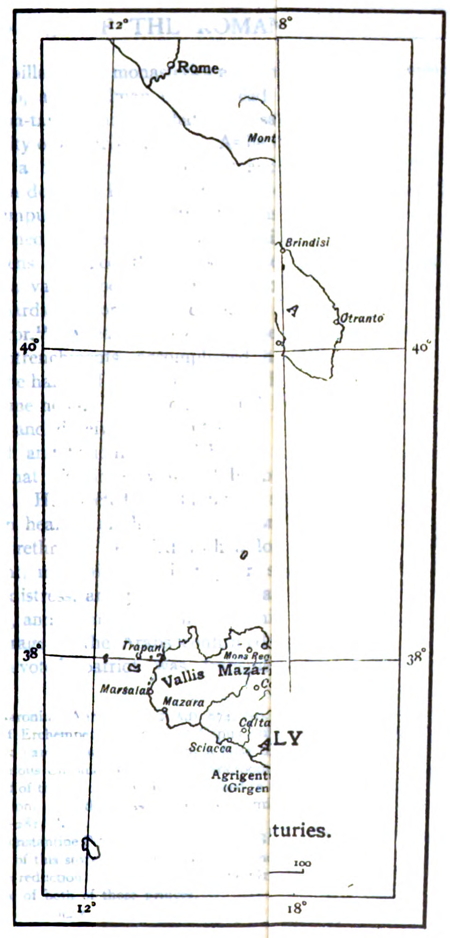
Map of Southern Italy, page 80.
The establishment of the Normans in the kingdoms of Naples and Sicily [16] is an event most romantic in its origin, and in its consequences most important both to Italy and the Eastern empire. The broken provinces of the Greeks, Lombards, and Saracens were exposed to every invader, and every sea and land were invaded by the adventurous spirit of the Scandinavian pirates. After a long indulgence of rapine [X-84] and slaughter, a fair and ample territory was accepted, occupied, and named, by the Normans of France; they renounced their gods for the God of the Christians; [17] and the dukes of Normandy acknowledged themselves the vassals of the successors of Charlemagne and Capet. The savage fierceness which they had brought from the snowy mountains of Norway was refined, without being corrupted, in a warmer climate; the companions of Rollo insensibly mingled with the natives; they imbibed the manners, language, [18] and gallantry of the French nation; and, in a martial age, the Normans might claim the palm of valour and glorious achievements. Of the fashionable superstitions, they embraced with ardour the pilgrimages of Rome, Italy, and the Holy Land. In this active devotion, their minds and bodies were invigorated by exercise: danger was the incentive, novelty the recompense; and the prospect of the world was decorated by wonder, credulity, and ambitious hope. They confederated for their mutual defence; and the robbers of the Alps, who had been allured by the garb of a pilgrim, were often chastised by the arm of a warrior. In one of these pious visits [19] to the cavern of Mount Garganus in Apulia, which [X-85] had been sanctified by the apparition of the archangel Michael, [20] they were accosted by a stranger in the Greek habit, but who soon revealed himself as a rebel, a fugitive, and a mortal foe of the Greek empire. His name was Melo: [21] a noble citizen of Bari, who, after an unsuccessful revolt, was compelled to seek new allies and avengers of his country. The bold appearance of the Normans revived his hopes and solicited his confidence: they listened to the complaints, and still more to the promises, of the patriot. The assurance of wealth demonstrated the justice of his cause; and they viewed, as the inheritance of the brave, the fruitful land which was oppressed by effeminate tyrants. On their return to Normandy, they kindled a spark of enterprise; and a small but intrepid band was freely associated for the deliverance of Apulia. They passed the Alps by separate roads, and in the disguise of pilgrims; but in the neighbourhood of Rome they were saluted by the chief of Bari, who supplied the more indigent with arms and horses, and instantly led them to the field of action. In the first conflict, their valour prevailed; [22] but, in the second engagement, they were overwhelmed by the [X-86] numbers and military engines of the Greeks, and indignantly retreated with their faces to the enemy. The unfortunate Melo ended his life, a suppliant at the court of Germany: his Norman followers, excluded from their native and their promised land, wandered among the hills and valleys of Italy, and earned their daily subsistence by the sword. To that formidable sword the princes of Capua, Beneventum, Salerno, and Naples alternately appealed in their domestic quarrels; the superior spirit and discipline of the Normans gave victory to the side which they espoused; and their cautious policy observed the balance of power, lest the preponderance of any rival state should render their aid less important and their service less profitable. Their first asylum was a strong camp in the depth of the marshes of Campania; but they were soon endowed by the liberality of the duke of Naples with a more plentiful and permanent seat. Eight miles from his residence, as a bulwark against Capua, the town of Aversa was built and fortified for their use; [23] and they enjoyed as their own the corn and fruits, the meadows and groves, of that fertile district. The report of their success attracted every year new swarms of pilgrims and soldiers; the poor were urged by necessity; the rich were excited by hope; and the brave and active spirits of Normandy were impatient of ease and ambitious of renown. The independent standard of Aversa afforded shelter and encouragement to the outlaws of the province, to every fugitive [X-87] who had escaped from the injustice or justice of his superiors; and these foreign associates were quickly assimilated in manners and language to the Gallic colony. The first leader of the Normans was Count Rainulf; and, in the origin of society, pre-eminence of rank is the reward and the proof of superior merit. [24]
Since the conquest of Sicily by the Arabs, the Grecian emperors had been anxious to regain that valuable possession; but their efforts, however strenuous, had been opposed by the distance and the sea. Their costly armaments, after a gleam of success, added new pages of calamity and disgrace to the Byzantine annals; twenty thousand of their best troops were lost in a single expedition; and the victorious Moslems derided the policy of a nation, which entrusted eunuchs not only with the custody of their women, but with the command of their men. [25] After a reign of two hundred years, the Saracens were ruined by their divisions. [26] The emir disclaimed the authority of the king of Tunis; the people rose against the emir; the cities were usurped by the chiefs; each meaner rebel was independent in his village or castle; and the weaker of two rival brothers implored the friendship of the Christians. [27] In every service of danger [X-88] the Normans were prompt and useful: and five hundred knights, or warriors on horseback, were enrolled by Arduin, the agent and interpreter of the Greeks, under the standard of Maniaces, governor of Lombardy. [28] Before their landing, the brothers were reconciled; the union of Sicily and Africa were restored; and the Island was guarded to the water’s edge. The Normans led the van, and the Arabs of Messina felt the valour of an untried foe. In a second action, the emir of Syracuse was unhorsed and transpierced by the iron arm of William of Hauteville. In a third engagement, his intrepid companions discomfited the host of sixty thousand Saracens, and left the Greeks no more than the labour of the pursuit: a splendid victory; but of which the pen of the historian may divide the merit with the lance of the Normans. It is, however, true that they essentially promoted the success of Maniaces, who reduced thirteen cities, and the greater part of Sicily, under the obedience of the emperor. But his military fame was sullied by ingratitude and tyranny. In the division of the spoil the deserts of his brave auxiliaries were forgotten; and neither their avarice nor their pride could brook this injurious treatment. They complained by the mouth of their interpreter; their complaint was disregarded; [X-89] their interpreter was scourged; the sufferings were his; the insult and resentment belonged to those whose sentiments he had delivered. Yet they dissembled till they had obtained, or stolen, a safe passage to the Italian continent; their brethren of Aversa sympathised in their indignation, and the province of Apulia was invaded as the forfeit of the debt. [29] Above twenty years after the first emigration, the Normans took the field with no more than seven hundred horse and five hundred foot; and, after the recall of the Byzantine legions [30] from the Sicilian war, their numbers are magnified to the amount of threescore thousand men. Their herald proposed the option of battle or retreat; “Of battle,” was the unanimous cry of the Normans; and one of their stoutest warriors, with a stroke of his fist, felled to the ground the horse of the Greek messenger. He was dismissed with a fresh horse; the insult was concealed from the Imperial troops; but in two successive battles [31] they were more fatally instructed of the prowess of their adversaries. In the plains of Cannæ, the Asiatics fled from the adventurers of France; the duke of Lombardy was made prisoner; the Apulians acquiesced in a new dominion; and the four places of Bari, Otranto, Brundusium, and Tarentum were alone [X-90] saved in the shipwreck of the Grecian fortunes. From this era we may date the establishment of the Norman power, which soon eclipsed the infant colony of Aversa. Twelve counts [32] were chosen by the popular suffrage; and age, birth, and merit were the motives of their choice. The tributes of their peculiar districts were appropriated to their use; and each count erected a fortress in the midst of his lands, and at the head of his vassals. In the centre of the province, the common habitation of Melphi was reserved as the metropolis and citadel of the republic; an house and separate quarter was allotted to each of the twelve counts; and the national concerns were regulated by this military senate. The first of his peers, their president and general, was entitled count of Apulia; and this dignity was conferred on William of the Iron Arm, who, in the language of the age, is styled a lion in battle, a lamb in society, and an angel in council. [33] The [X-91] manners of his countrymen are fairly delineated by a contemporary and national historian. [34] “The Normans,” says Malaterra, “are a cunning and revengeful people; eloquence and dissimulation appear to be their hereditary qualities: they can stoop to flatter; but, unless they are curbed by the restraint of law, they indulge the licentiousness of nature and passion. Their princes affect the praise of popular munificence; the people observe the medium, or rather blend the extremes, of avarice and prodigality; and, in their eager thirst of wealth and dominion, they despise whatever they possess, and hope whatever they desire. Arms and horses, the luxury of dress, the exercises of hunting and hawking, [35] are the delight of the Normans; but on pressing occasions they can endure with incredible patience the inclemency of every climate and the toil and abstinence of a military life.” [36]
The Normans of Apulia were seated on the verge of the two empires; and, according to the policy of the hour, they accepted the investiture of their lands from the sovereigns of Germany or Constantinople. [37] But the firmest title of these [X-92] adventurers was the right of conquest: they neither loved nor trusted; they were neither trusted nor beloved; the contempt of the princes was mixed with fear, and the fear of the natives was mingled with hatred and resentment. Every object of desire, an horse, a woman, a garden, tempted and gratified the rapaciousness of the strangers; [38] and the avarice of their chiefs was only coloured by the more specious names of ambition and glory. The twelve counts were sometimes joined in a league of injustice: in their domestic quarrels, they disputed the spoils of the people; the virtues of William were buried in his grave; and Drogo, his brother and successor, was better qualified to lead the valour, than to restrain the violence, of his peers. Under the reign of Constantine Monomachus, the policy, rather than benevolence, of the Byzantine court attempted to relieve Italy from this adherent mischief, more grievous than a flight of Barbarians; [39] and Argyrus, the son of Melo, was invested for this purpose with the most lofty titles [40] and the most ample commission. The memory of his father might recommend him to the Normans; [X-93] and he had already engaged their voluntary service to quell the revolt of Maniaces, and to avenge their own and the public injury. It was the design of Constantine to transplant this warlike colony from the Italian provinces to the Persian war; and the son of Melo distributed among the chiefs the gold and manufactures of Greece, as the first fruits of the Imperial bounty. But his arts were baffled by the sense and spirit of the conquerors of Apulia: his gifts, or at least his proposals, were rejected; and they unanimously refused to relinquish their possessions and their hopes for the distant prospect of Asiatic fortune. After the means of persuasion had failed, Argyrus resolved to compel or to destroy: the Latin powers were solicited against the common enemy; and an offensive alliance was formed of the pope and the two emperors of the East and West. The throne of St. Peter was occupied by Leo the Ninth, a simple saint, [41] of a temper most apt to deceive himself and the world, and whose venerable character would consecrate with the name of piety the measures least compatible with the practice of religion. His humanity was affected by the complaints, perhaps the calumnies, of an injured people; the impious Normans had interrupted the payment of tithes; and the temporal sword might be lawfully unsheathed against the sacrilegious robbers, who were deaf to the censures of the church. As a German of noble birth and royal kindred, Leo had free access to the court and confidence of the emperor Henry the Third; and in search of arms and allies his ardent zeal transported him from Apulia to Saxony, from the Elbe to the Tiber. During these hostile preparations, Argyrus indulged himself in the use of secret [X-94] and guilty weapons; a crowd of Normans became the victims of public or private revenge; and the valiant Drogo was murdered in a church. But his spirit survived in his brother Humphrey, the third Count of Apulia. The assassins were chastised; and the son of Melo, overthrown and wounded, was driven from the field to hide his shame behind the walls of Bari, and to await the tardy succour of his allies.
But the power of Constantine was distracted by a Turkish war; the mind of Henry was feeble and irresolute; and the pope, instead of passing the Alps with a German army, was accompanied only by a guard of seven hundred Swabians and some volunteers of Lorraine. In his long progress from Mantua to Beneventum, a vile and promiscuous multitude of Italians was enlisted under the holy standard; [42] the priest and the robber slept in the same tent; the pikes and crosses were intermingled in the front; and the natural saint repeated the lessons of his youth in the order of march, of encampment, and of combat. The Normans of Apulia could muster in the field no more than three thousand horse, with an handful of infantry; the defection of the natives intercepted their provisions and retreat; and their spirit, incapable of fear, was chilled for a moment by superstitious awe. On the hostile approach of Leo, they knelt without disgrace or reluctance before their spiritual father. But the pope was inexorable; his lofty Germans affected to deride the diminutive stature of their adversaries; and the Normans were informed that death or exile was their only alternative. Flight they disdained, and, as many of them had been three days without tasting food, they embraced the assurance of a more easy and honourable death. They climbed the hill of Civitella, descended into the plain, and charged in three [X-95] divisions the army of the pope. On the left and in the centre, Richard, Count of Aversa, and Robert the famous Guiscard, attacked, broke, routed, and pursued the Italian multitudes, who fought without discipline and fled without shame. A harder trial was reserved for the valour of Count Humphrey, who led the cavalry of the right wing. The Germans [43] have been described as unskilful in the management of the horse and lance; but on foot they formed a strong and impenetrable phalanx; and neither man nor steed nor armour could resist the weight of their long and two-handed swords. After a severe conflict, they were encompassed by the squadrons returning from the pursuit; and died in their ranks with the esteem of their foes and the satisfaction of revenge. The gates of Civitella were shut against the flying pope, and he was overtaken by the pious conquerors, who kissed his feet, to implore his blessing and the absolution of their sinful victory. The soldiers beheld in their enemy and captive the vicar of Christ; and, though we may suppose the policy of the chiefs, it is probable that they were infected by the popular superstition. In the calm of retirement, the well-meaning pope deplored the effusion of Christian blood, which must be imputed to his account; he felt, that he had been the author of sin and scandal; and, as his undertaking had failed, the indecency of his military character was universally condemned. [44] With these dispositions, he listened to the offers [X-96] of a beneficial treaty; [45] deserted an alliance which he had preached as the cause of God; and ratified the past and future conquests of the Normans. By whatever hands they had been usurped, the provinces of Apulia and Calabria were a part of the donation of Constantine and the patrimony of St. Peter; the grant and the acceptance confirmed the mutual claims of the pontiff and the adventurers. They promised to support each other with spiritual and temporal arms; a tribute or quit-rent of twelvepence was afterwards stipulated for every plough-land; and since this memorable transaction the kingdom of Naples has remained above seven hundred years a fief of the Holy See. [46]
The pedigree of Robert Guiscard [47] is variously deduced from the peasants and the dukes of Normandy: from the peasants, by the pride and ignorance of a Grecian princess; [48] [X-97] from the dukes by the ignorance and flattery of the Italian subjects. [49] His genuine descent may be ascribed to the second or middle order of private nobility. [50] He sprang from a race of valvassors or bannerets of the diocese of the Coutances, in the lower Normandy; the castle of Hauteville was their honourable seat; his father Tancred was conspicuous in the court and army of the duke; and his military service was furnished by ten soldiers or knights. Two marriages, of a rank not unworthy of his own, made him the father of twelve sons, who were educated at home by the impartial tenderness of his second wife. But a narrow patrimony was insufficient for this numerous and daring progeny; they saw around the neighbourhood the mischiefs of poverty and discord, and resolved to seek in foreign wars a more glorious inheritance. Two only remained to perpetuate the race and cherish their father’s age; their ten brothers, as they successively attained the vigour of manhood, departed from the castle, passed the Alps, and joined the Apulian camp of the Normans. The elder were prompted by native spirit; their success encouraged their younger brethren; and the three first in seniority, William, Drogo, and Humphrey, deserved to be the chiefs of their nation, and the founders of [X-98] the new republic. Robert was the eldest of the seven sons of the second marriage; and even the reluctant praise of his foes has endowed him with the heroic qualities of a soldier and a statesman. His lofty stature surpassed the tallest of his army; his limbs were cast in the true proportion of strength and gracefulness; and to the decline of life he maintained the patient vigour of health and the commanding dignity of his form. His complexion was ruddy, his shoulders were broad, his hair and beard were long and of a flaxen colour, his eyes sparkled with fire, and his voice, like that of Achilles, could impress obedience and terror amidst the tumult of battle. In the ruder ages of chivalry, such qualifications are not below the notice of the poet or historian; they may observe that Robert, at once, and with equal dexterity, could wield in the right hand his sword, his lance in the left; that in the battle of Civitella, he was thrice unhorsed; and that in the close of that memorable day he was adjudged to have borne away the prize of valour from the warriors of the two armies. [51] His boundless ambition was founded on the consciousness of superior worth; in the pursuit of greatness, he was never arrested by the scruples of justice and seldom moved by the feelings of humanity; though not insensible of fame, the choice of open or clandestine means was determined only by his present advantage. The surname of Guiscard [52] was [X-99] applied to this master of political wisdom, which is too often confounded with the practice of dissimulation and deceit; and Robert is praised by the Apulian poet for excelling the cunning of Ulysses and the eloquence of Cicero. Yet these arts were disguised by an appearance of military frankness: in his highest fortune, he was accessible and courteous to his fellow-soldiers; and, while he indulged the prejudices of his new subjects, he affected in his dress and manners to maintain the ancient fashion of his country. He grasped with a rapacious, that he might distribute with a liberal, hand; his primitive indigence had taught the habits of frugality; the gain of a merchant was not below his attention; and his prisoners were tortured with slow and unfeeling cruelty to force a discovery of their secret treasure. According to the Greeks, he departed from Normandy with only five followers on horseback and thirty on foot; yet even this allowance appears too bountiful; the sixth son of Tancred of Hauteville passed the Alps as a pilgrim; and his first military band was levied among the adventurers of Italy. His brothers and countrymen had divided the fertile lands of Apulia; but they guarded their shares with the jealousy of avarice; the aspiring youth was driven forwards to the mountains of Calabria, and in his first exploits against the Greeks and the natives it is not easy to discriminate the hero from the robber. To surprise a castle or a convent, to ensnare a wealthy citizen, to plunder the adjacent villages for necessary food, were the obscure labours which formed and exercised the powers of his mind and body. The volunteers of Normandy adhered to his standard; and, under his command, the peasants of Calabria assumed the name and character of Normans.
As the genius of Robert expanded with his fortune, he awakened the jealousy of his elder brother, by whom, in a transient quarrel, his life was threatened and his liberty restrained. After the death of Humphrey, the tender age of his sons excluded them from the command; they were [X-100] reduced to a private estate by the ambition of their guardian and uncle; and Guiscard was exalted on a buckler, and saluted count of Apulia and general of the republic. With an increase of authority and of force, he resumed the conquest of Calabria, and soon aspired to a rank that should raise him for ever above the heads of his equals. By some acts of rapine or sacrilege he had incurred a papal excommunication: but Nicholas the Second was easily persuaded that the divisions of friends could terminate only in their mutual prejudice; that the Normans were the faithful champions of the Holy See; and it was safer to trust the alliance of a prince than the caprice of an aristocracy. A synod of one hundred bishops was convened at Melphi; and the count interrupted an important enterprise to guard the person and execute the decrees of the Roman pontiff. His gratitude and policy conferred on Robert and his posterity the ducal title, [53] with the investiture of Apulia, Calabria, and all the lands, both in Italy and Sicily, which his sword could rescue from the schismatic Greeks and the unbelieving Saracens. [54] This apostolic sanction might justify his arms; but the obedience of a free and victorious people could not be transferred without their consent; and Guiscard dissembled his elevation till the ensuing campaign had been illustrated by the conquest of Consenza and Reggio. In the hour of triumph, he assembled [X-101] his troops, and solicited the Normans to confirm by their suffrage the judgment of the vicar of Christ; the soldiers hailed with joyful acclamations their valiant duke; and the counts, his former equals, pronounced the oath of fidelity, with hollow smiles and secret indignation. After this inauguration, Robert styled himself, “By the grace of God and St. Peter, duke of Apulia, Calabria, and hereafter of Sicily”; and it was the labour of twenty years to deserve and realise these lofty appellations. Such tardy progress, in a narrow space, may seem unworthy of the abilities of the chief and the spirit of the nation; but the Normans were few in number; their resources were scanty; their service was voluntary and precarious. The bravest designs of the Duke were sometimes opposed by the free voice of his parliament of barons; the twelve counts of popular election conspired against his authority; and against their perfidious uncle the sons of Humphrey demanded justice and revenge. By his policy and vigour, Guiscard discovered their plots, suppressed their rebellions, and punished the guilty with death or exile; but in these domestic feuds his years, and the national strength, were unprofitably consumed. After the defeat of his foreign enemies, the Greeks, Lombards, and Saracens, their broken forces retreated to the strong and populous cities of the sea-coast. They excelled in the arts of fortification and defence; the Normans were accustomed to serve on horseback in the field, and their rude attempts could only succeed by the efforts of persevering courage. The resistance of Salerno was maintained above eight months; the siege or blockade of Bari lasted near four years. [55] In these actions the Norman duke was the foremost in every danger; in every fatigue the last and most patient. As he pressed the citadel of Salerno, an huge stone from the rampart shattered one of his military [X-102] engines; and by a splinter he was wounded in the breast. Before the gates of Bari, he lodged in a miserable hut or barrack, composed of dry branches, and thatched with straw: a perilous station, on all sides open to the inclemency of the winter and the spears of the enemy. [56]
The Italian conquests of Robert correspond with the limits of the present kingdom of Naples; and the countries united by his arms have not been dissevered by the revolutions of seven hundred years. [57] The monarchy has been composed of the Greek provinces Calabria and Apulia, of the Lombard principality of Salerno, the republic of Amalphi, [58] and the inland dependencies of the large and ancient duchy of Beneventum. Three districts only were exempted from the common law of subjection: the first for ever, and the two last till the middle of the succeeding century. The city and immediate territory of Benevento had been transferred, by gift or exchange, from the German emperor to the Roman pontiff; and, although this holy land was sometimes invaded, the name of St. Peter was finally more potent than the sword of the Normans. Their first colony of Aversa subdued and held the state of Capua; and her princes were reduced to beg their bread before the palace of their fathers. The dukes of Naples, the present metropolis, maintained the popular freedom, under the shadow of the Byzantine empire. Among the new acquisitions of Guiscard, the science of Salerno, [59] [X-103] and the trade of Amalphi, [60] may detain for a moment the curiosity of the reader. I. Of the learned faculties jurisprudence implies the previous establishment of laws and property; and theology may perhaps be superseded by the full light of religion and reason. But the savage and the sage must alike implore the assistance of physic; and, if our diseases are inflamed by luxury, the mischiefs of blows and wounds would be more frequent in the ruder ages of society. The treasures of Grecian medicine had been communicated to the Arabian colonies of Africa, Spain, and Sicily; and in the intercourse of peace and war a spark of knowledge had been kindled and cherished at Salerno, an illustrious city, in which the men were honest and the women beautiful. [61] A school, the first that arose in the darkness of Europe, was consecrated to the healing art; [62] the conscience of monks [X-104] and bishops were reconciled to that salutary and lucrative profession; and a crowd of patients, of the most eminent rank and most distant climates, invited or visited the physicians of Salerno. They were protected by the Norman conquerors; and Guiscard, though bred in arms, could discern the merit and value of a philosopher. After a pilgrimage of thirty-nine years, Constantine, an African Christian, returned from Bagdad, a master of the language and learning of the Arabians; and Salerno was enriched by the practice, the lessons, and the writings of the pupil of Avicenna. The school of medicine has long slept in the name of an university; [63] but her precepts are abridged in a string of aphorisms, bound together in the Leonine verses, or Latin rhymes, of the twelfth century. [64] II. Seven miles to the west of Salerno, and thirty to the south of Naples, the obscure town of Amalphi displayed the power and rewards of industry. The land, however fertile, was of narrow extent; but the sea was accessible and open; the inhabitants first assumed the office of supplying the Western world with the manufactures and [X-105] productions of the East; and this useful traffic was the source of their opulence and freedom. The government was popular under the administration of a duke and the supermacy of the Greek emperor. Fifty thousand citizens were numbered in the walls of Amalphi; nor was any city more abundantly provided with gold, silver, and the objects of precious luxury. The mariners who swarmed in her port excelled in the theory and practice of navigation and astronomy; and the discovery of the compass, which has opened the globe, is due to their ingenuity or good fortune. Their trade was extended to the coasts, or at least to the commodities, of Africa, Arabia, and India; and their settlements in Constantinople, Antioch, Jerusalem, and Alexandria acquired the privileges of independent colonies. [65] After three hundred years of prosperity, Amalphi was oppressed by the arms of the Normans, and sacked by the jealousy of Pisa; but the poverty of one thousand fishermen is yet dignified by the remains of an arsenal, a cathedral, and the palaces of royal merchants.
Roger, the twelfth and last of the sons of Tancred, had been long detained in Normandy by his own and his father’s age. He accepted the welcome summons; hastened to the Apulian camp; and deserved at first the esteem, and afterwards the envy, of his elder brother. Their valour and ambition were equal; but the youth, the beauty, the elegant manners, of Roger engaged the disinterested love of his soldiers and people. So scanty was his allowance, for himself and forty [X-106] followers, that he descended from conquest to robbery, and from robbery to domestic theft; and so loose were the notions of property that, by his own historian, at his special command, he is accused of stealing horses from a stable at Melphi. [66] His spirit emerged from poverty and disgrace; from these base practices he rose to the merit and glory of a holy war; and the invasion of Sicily was seconded by the zeal and policy of his brother Guiscard. After the retreat of the Greeks, the idolaters, a most audacious reproach of the Catholics, had retrieved their losses and possessions; but the deliverance of the island, so vainly undertaken by the forces of the Eastern empire, was achieved by a small and private band of adventurers. [67] In the first attempt Roger braved, in an open boat, the real and fabulous dangers of Scylla and Charybdis; landed with only sixty soldiers on a hostile shore; drove the Saracens to the gates of Messina; and safely returned with the spoils of the adjacent country. In the fortress of Trani, his active and patient courage were equally conspicuous. In his old age he related with pleasure, that, by the distress of the siege, himself and the countess his wife had been reduced to a single cloak or mantle, which they wore alternately; that in a sally his horse had been slain, and he [X-107] was dragged away by the Saracens; but that he owed his rescue to his good sword, and had retreated with his saddle on his back, lest the meanest trophy might be left in the hands of the miscreants. In the siege of Trani, three hundred Normans withstood and repulsed the forces of the island. In the field of Ceramio, [68] fifty thousand horse and foot were overthrown by one hundred and thirty-six Christian soldiers, without reckoning St. George, who fought on horseback in the foremost ranks. The captive banners, with four camels, were reserved for the successors of St. Peter; and had these Barbaric spoils been exposed not in the Vatican, but in the Capitol, they might have revived the memory of the Punic triumphs. These insufficient numbers of the Normans most probably denote their knights, the soldiers of honourable and equestrian rank, each of whom was attended by five or six followers in the field; [69] yet, with the aid of this interpretation, and after every fair allowance on the side of valour, arms, and reputation, the discomfiture of so many myriads will reduce the prudent reader to the alternative of a miracle or a fable. The Arabs of Sicily derived a frequent and powerful succour from their countrymen of Africa: in the siege of Palermo, the Norman cavalry was assisted by the galleys of Pisa; and, in the hour of action, the envy of the two brothers was sublimed to a generous and invincible emulation. After a war of thirty years, [70] Roger, with the title of great count, obtained the sovereignty of the largest and most fruitful island of the Mediterranean; and his administration displays [X-108] a liberal and enlightened mind above the limits of his age and education. The Moslems were maintained in the free enjoyment of their religion and property; [71] a philosopher and physician of Mazara, of the race of Mahomet, harangued the conqueror, and was invited to court; his geography of the seven climates was translated into Latin; and Roger, after a diligent perusal, preferred the work of the Arabian to the writings of the Grecian Ptolemy. [72] A remnant of Christian natives had promoted the success of the Normans; they were rewarded by the triumph of the cross. The island was restored to the jurisdiction of the Roman pontiff; new bishops were planted in the principal cities; and the clergy was satisfied by a liberal endowment of churches and monasteries. Yet the Catholic hero asserted the rights of the civil magistrate. Instead of resigning the investiture of benefices, he dexterously applied to his own profit the papal claims: the supremacy of the crown was secured and enlarged by the singular bull which declares the princes of Sicily hereditary and perpetual legates of the Holy See. [73]
To Robert Guiscard, the conquest of Sicily was more glorious than beneficial; the possession of Apulia and Calabria was inadequate to his ambition; and he resolved to embrace or create the first occasion of invading, perhaps of [X-109] subduing, the Roman empire of the East. [74] From his first wife, the partner of his humble fortunes, he had been divorced under the pretence of consanguinity; and her son Bohemond was destined to imitate, rather than to succeed, his illustrious father. The second wife of Guiscard was the daughter of the princes of Salerno; the Lombards acquiesced in the lineal succession of their son Roger; their five daughters were given in honourable nuptials, [75] and one of them was betrothed, in a tender age, to Constantine, a beautiful youth, the son and heir of the emperor Michael. [76] But the throne of Constantinople was shaken by a revolution; the Imperial family of Ducas was confined to the palace or the cloister; and Robert deplored, and resented, the disgrace of his daughter and the expulsion of his ally. A Greek, who styled himself the father of Constantine, soon appeared at Salerno, and related the adventures of his fall and flight. That unfortunate friend was acknowledged by the duke, and adorned with the pomp [X-110] and titles of Imperial dignity: in his triumphal progress through Apulia and Calabria, Michael [77] was saluted with the tears and acclamations of the people; and Pope Gregory the Seventh exhorted the bishops to preach, and the Catholics to fight, in the pious work of his restoration. [78] His conversations with Robert were frequent and familiar; and their mutual promises were justified by the valour of the Normans and the treasures of the East. Yet this Michael, by the confession of the Greeks and Latins, was a pageant and an impostor: a monk who had fled from his convent, or a domestic who had served in the palace. The fraud had been contrived by the subtle Guiscard; [79] and he trusted that, after this pretender had given a decent colour to his arms, he would sink, at the nod of the conqueror, into his primitive obscurity. But victory was the only argument that could determine the belief of the Greeks; and the ardour of the Latins was much inferior to their credulity: the Norman veterans wished to enjoy the harvest of their toils, and the unwarlike Italians trembled at the known and unknown dangers of a transmarine expedition. In his new levies, Robert exerted the influence of gifts and promises, the terrors of civil and ecclesiastical authority; and some acts of violence might justify the reproach that age and infancy were pressed without distinction into the service of their unrelenting prince. After two years’ incessant preparations, the land and naval [X-111] forces were assembled at Otranto, at the heel or extreme promontory of Italy; and Robert was accompanied by his wife, who fought by his side, his son Bohemond, and the representative of the emperor Michael. Thirteen hundred knights [80] of Norman race or discipline formed the sinews of the army, which might be swelled to thirty thousand [81] followers of every denomination. The men, the horses, the arms, the engines, the wooden towers, covered with raw hides, were embarked on board one hundred and fifty vessels; the transports had been built in the ports of Italy, and the galleys were supplied by the alliance of the republic of Ragusa.
At the mouth of the Adriatic gulf, the shores of Italy and Epirus incline towards each other. The space between Brundusium and Durazzo, the Roman passage, is no more than one hundred miles; [82] at the last station of Otranto, it is contracted to fifty; [83] and this narrow distance had suggested to Pyrrhus and Pompey the sublime or extravagant idea of a bridge. Before the general embarkation, the Norman duke despatched Bohemond with fifteen galleys to seize or threaten the isle of Corfu, to survey the opposite coast, and to secure [X-112] an harbour in the neighbourhood of Vallona for the landing of the troops. They passed and landed without perceiving an enemy; and this successful experiment displayed the neglect and decay of the naval power of the Greeks. The islands of Epirus and the maritime towns were subdued by the arms or the name of Robert, who led his fleet and army from Corfu (I use the modern appellation) [84] to the siege of Durazzo. That city, the western key of the empire, was guarded by ancient renown and recent fortifications, by George Palæologus, a patrician, victorious in the Oriental wars, and a numerous garrison of Albanians and Macedonians, who, in every age, have maintained the character of soldiers. In the prosecution of his enterprise, the courage of Guiscard was assailed by every form of danger and mischance. In the most propitious season of the year, as his fleet passed along the coast, a storm of wind and snow unexpectedly arose: the Adriatic was swelled by the raging blast of the south, and a new shipwreck confirmed the old infamy of the Acroceraunian rocks. [85] The sails, the masts, and the oars were shattered or torn away; the sea and shore were covered with the fragments of vessels, with arms and dead bodies; and the greatest part of the provisions were either drowned or damaged. The ducal galley was laboriously rescued from the waves, and Robert halted seven days on the adjacent cape, to collect the relics of his loss and revive the drooping spirits of his soldiers. The Normans were no longer the bold and experienced mariners who had explored the ocean from Greenland to Mount Atlas, and who smiled at the petty dangers of the Mediterranean. They had wept during the [X-113] tempest; they were alarmed by the hostile approach of the Venetians, who had been solicited by the prayers and promises of the Byzantine court. The first day’s action was not disadvantageous to Bohemond, a beardless youth, [86] who led the naval powers of his father. All night the galleys of the republic lay on their anchors in the form of a crescent; and the victory of the second day was decided by the dexterity of their evolutions, the station of their archers, the weight of their javelins, and the borrowed aid of the Greek fire. The Apulian and Ragusian vessels fled to the shore, several were cut from their cables and dragged away by the conqueror; and a sally from the town carried slaughter and dismay to the tents of the Norman duke. A seasonable relief was poured into Durazzo, and, as soon as the besiegers had lost the command of the sea, the islands and maritime towns withdrew from the camp the supply of tribute and provision. That camp was soon afflicted with a pestilential disease; five hundred knights perished by an inglorious death; and the list of burials (if all could obtain a decent burial) amounted to ten thousand persons. Under these calamities, the mind of Guiscard alone was firm and invincible: and, while he collected new forces from Apulia and Sicily, he battered, or scaled, or sapped the walls of Durazzo. But his industry and valour were encountered by equal valour and more perfect industry. A moveable turret, of a size and capacity to contain five hundred soldiers, had been rolled forwards to the foot of the rampart; but the descent of the door or drawbridge was checked by an enormous beam, and the wooden structure was instantly consumed by artificial flames.
While the Roman empire was attacked by the Turks in the East and the Normans in the West, the aged successor of Michael surrendered the sceptre to the hands of Alexius, [X-114] an illustrious captain, and the founder of the Comnenian dynasty. The princess Anne, his daughter and historian, observes, in her affected style, that even Hercules was unequal to a double combat; and, on this principle, she approves an hasty peace with the Turks, which allowed her father to undertake in person the relief of Durazzo. On his accession, Alexius found the camp without soldiers, and the treasury without money; yet such were the vigour and activity of his measures that, in six months, he assembled an army of seventy thousand men, [87] and performed a march of five hundred miles. His troops were levied in Europe and Asia, from Peloponnesus to the Black Sea; his majesty was displayed in the silver arms and rich trappings of the companies of horseguards; and the emperor was attended by a train of nobles and princes, some of whom, in rapid succession, had been clothed with the purple, and were indulged by the lenity of the times in a life of affluence and dignity. Their youthful ardour might animate the multitude; but their love of pleasure and contempt of subordination were pregnant with disorder and mischief; and their importunate clamours for speedy and decisive action disconcerted the prudence of Alexius, who might have surrounded and starved the besieging army. The enumeration of provinces recalls a sad comparison of the past and present limits of the Roman world: the raw levies were drawn together in haste and terror; and the garrisons of Anatolia, or Asia Minor, had been purchased by the evacuation of the cities which were immediately occupied by the Turks. [X-115] The strength of the Greek army consisted in the Varangians, the Scandinavian guards, whose numbers were recently augmented by a colony of exiles and volunteers from the British island of Thule. Under the yoke of the Norman conqueror, the Danes and English were oppressed and united: a band of adventurous youths resolved to desert a land of slavery; the sea was open to their escape; and, in their long pilgrimage, they visited every coast that afforded any hope of liberty and revenge. They were entertained in the service of the Greek emperor; and their first station was in a new city on the Asiatic shore: but Alexius soon recalled them to the defence of his person and palace; and bequeathed to his successors the inheritance of their faith and valour. [88] The name of a Norman invader revived the memory of their wrongs: they marched with alacrity against the national foe, and panted to regain in Epirus the glory which they had lost in the battle of Hastings. The Varangians were supported by some companies of Franks or Latins; and the rebels, who had fled to Constantinople from the tyranny of Guiscard, were eager to signalise their zeal and gratify their revenge. In this emergency, the emperor had not disdained the impure aid of the Paulicians or Manichæans of Thrace and Bulgaria; and these heretics united with the patience of martyrdom the spirit and discipline of active valour. [89] The treaty with the sultan had procured a supply of some thousand Turks; and the arrows of the Scythian horse were opposed to the lances of the Norman cavalry. On the report and distant prospect of these formidable numbers, Robert assembled a council of his principal officers. “You behold,” [X-116] said he, “your danger; it is urgent and inevitable. The hills are covered with arms and standards; and the emperor of the Greeks is accustomed to wars and triumphs. Obedience and union are our only safety; and I am ready to yield the command to a more worthy leader.” The vote and acclamation, even of his secret enemies, assured him, in that perilous moment, of their esteem and confidence; and the duke thus continued: “Let us trust in the rewards of victory, and deprive cowardice of the means of escape. Let us burn our vessels and our baggage, and give battle on this spot, as if it were the place of our nativity and our burial.” The resolution was unanimously approved; and, without confining himself to his lines, Guiscard awaited in battle-array the nearer approach of the enemy. His rear was covered by a small river; his right wing extended to the sea; his left to the hills; nor was he conscious, perhaps, that on the same ground Cæsar and Pompey had formerly disputed the empire of the world. [90]
Against the advice of his wisest captains, Alexius resolved to risk the event of a general action, and exhorted the garrison of Durazzo to assist their own deliverance by a well-timed sally from the town. He marched in two columns to surprise the Normans before day-break on two different sides: his light cavalry was scattered over the plain; the archers formed the second line; and the Varangians claimed the honours of the vanguard. In the first onset, the battleaxes of the strangers made a deep and bloody impression on the army of Guiscard, which was now reduced to fifteen thousand men. The Lombards and Calabrians ignominiously turned their backs; they fled towards the river and the sea; but the bridge had been broken down to check the sally [X-117] of the garrison, and the coast was lined with the Venetian galleys, who played their engines among the disorderly throng. On the verge of ruin, they were saved by the spirit and conduct of their chiefs. Gaita, the wife of Robert, is painted by the Greeks as a warlike Amazon, a second Pallas; less skilful in arts, but not less terrible in arms, than the Athenian goddess: [91] though wounded by an arrow, she stood her ground, and strove, by her exhortation and example, to rally the flying troops. [92] Her female voice was seconded by the more powerful voice and arm of the Norman duke, as calm in action as he was magnanimous in council: “Whither,” he cried aloud, “whither do ye fly? your enemy is implacable; and death is less grievous than servitude.” The moment was decisive: as the Varangians advanced before the line, they discovered the nakedness of their flanks; the main battle of the duke, of eight hundred knights, stood firm and entire; they couched their lances, and the Greeks deplore the furious and irresistible shock of the French cavalry. [93] Alexius was not deficient in the duties of a soldier [X-118] or a general; but he no sooner beheld the slaughter of the Varangians and the flight of the Turks, than he despised his subjects and despaired of his fortune. The princess Anne, who drops a tear on this melancholy event, is reduced to praise the strength and swiftness of her father’s horse, and his vigorous struggle, when he was almost overthrown by the stroke of a lance, which had shivered the Imperial helmet. His desperate valour broke through a squadron of Franks who opposed his flight; and, after wandering two days and as many nights in the mountains, he found some repose of body, though not of mind, in the walls of Lychnidus. The victorious Robert reproached the tardy and feeble pursuit which had suffered the escape of so illustrious a prize; but he consoled his disappointment by the trophies and standards of the field, the wealth and luxury of the Byzantine camp, and the glory of defeating an army five times more numerous than his own. A multitude of Italians had been the victims of their own fears; but only thirty of his knights were slain in this memorable day. In the Roman host, the loss of Greeks, Turks, and English amounted to five or six thousand: [94] the plain of Durazzo was stained with noble and royal blood; and the end of the impostor Michael was more honourable than his life.
It is more than probable that Guiscard was not afflicted by the loss of a costly pageant, which had merited only the contempt and derision of the Greeks. After their defeat, they still persevered in the defence of Durazzo; and a Venetian commander supplied the place of George Palæologus, who had been imprudently called away from his station. The tents of the besiegers were converted into barracks, to sustain the inclemency of the winter; and in answer to the defiance of the garrison Robert insinuated that his patience [X-119] was at least equal to their obstinacy. [95] Perhaps he already trusted to his secret correspondence with a Venetian noble, who sold the city for a rich and honourable marriage. At the dead of night several rope-ladders were dropped from the walls; the light Calabrians ascended in silence; and the Greeks were awakened by the name and trumpets of the conqueror. Yet they defended the street three days against an enemy already master of the rampart; and near seven months elapsed between the first investment and the final surrender of the place. From Durazzo the Norman duke advanced into the heart of Epirus or Albania; traversed the first mountains of Thessaly; surprised three hundred English in the city of Castoria; approached Thessalonica; and made Constantinople tremble. A more pressing duty suspended the prosecution of his ambitious designs. By shipwreck, pestilence, and the sword, his army was reduced to a third of the original numbers; and, instead of being recruited from Italy, he was informed, by plaintive epistles, of the mischiefs and dangers which had been produced by his absence: the revolt of the cities and barons of Apulia; the distress of the pope; and the approach or invasion of Henry king of Germany. Highly presuming that his person was sufficient for the public safety, he repassed the sea in a single brigantine, and left the remains of the army under the command of his son and the Norman counts, exhorting Bohemond to respect the freedom of his peers, and the counts to obey the authority of their leader. The son of Guiscard trod in the footsteps of his father; and the two destroyers are compared, by the Greeks, to the caterpillar and the locust, the last of whom devours whatever has escaped the teeth of the former. [96] After winning [X-120] two battles against the emperor, he descended into the plain of Thessaly, and besieged Larissa, the fabulous realm of Achilles, [97] which contained the treasure and magazines of the Byzantine camp. Yet a just praise must not be refused to the fortitude and prudence of Alexius, who bravely struggled with the calamities of the times. In the poverty of the state, he presumed to borrow the superfluous ornaments of the churches; the desertion of the Manichæans was supplied by some tribes of Moldavia; a reinforcement of seven thousand Turks replaced and revenged the loss of their brethren; and the Greek soldiers were exercised to ride, to draw the bow, and to the daily practice of ambuscades and evolutions. Alexius had been taught by experience that the formidable cavalry of the Franks on foot was unfit for action, and almost incapable of motion; [98] his archers were directed to aim their arrows at the horse rather than the man; and a variety of spikes and snares was scattered over the ground on which he might expect an attack. In the neighbourhood of Larissa the events of war were protracted and balanced. The courage of Bohemond was always conspicuous, and often successful; but his camp was pillaged by a stratagem of the Greeks; the city was impregnable; and the venal or discontented counts deserted his standard, betrayed their trusts, and enlisted in the service of the emperor. Alexius [X-121] returned to Constantinople with the advantage, rather than the honour, of victory. After evacuating the conquests which he could no longer defend, the son of Guiscard embarked for Italy, and was embraced by a father who esteemed his merit and sympathised in his misfortune.
Of the Latin princes, the allies of Alexius and enemies of Robert, the most prompt and powerful was Henry, the Third or Fourth, king of Germany and Italy, and future emperor of the West. The epistle of the Greek monarch [99] to his brother is filled with the warmest professions of friendship, and the most lively desire of strengthening their alliance by every public and private tie. He congratulates Henry on his success in a just and pious war, and complains that the prosperity of his own empire is disturbed by the audacious enterprises of the Norman Robert. The list of his presents expresses the manners of the age, a radiated crown of gold, a cross set with pearls to hang on the breast, a case of relics with the names and titles of the saints, a vase of crystal, a vase of sardonyx, some balm, most probably of Mecca, and one hundred pieces of purple. To these he added a more solid present, of one hundred and forty-four thousand Byzantines of gold, with a further assurance of two hundred and sixteen thousand, so soon as Henry should have entered in arms the Apulian territories, and confirmed by an oath the league against the common enemy. The German, [100] who was already in Lombardy at the head of an army and a faction, [X-122] accepted these liberal offers and marched towards the south: his speed was checked by the sound of the battle of Durazzo; but the influence of his arms or name, in the hasty return of Robert, was a full equivalent for the Grecian bribe. Henry was the severe adversary of the Normans, the allies and vassals of Gregory the Seventh, his implacable foe. The long quarrel of the throne and mitre had been recently kindled by the zeal and ambition of that haughty priest: [101] the king and the pope had degraded each other; and each had seated a rival on the temporal or spiritual throne of his antagonist. After the defeat and death of his Swabian rebel, Henry descended into Italy, to assume the Imperial crown, and to drive from the Vatican the tyrant of the church. [102] But the Roman people adhered to the cause of Gregory: their resolution was fortified by supplies of men and money from Apulia; and the city was thrice ineffectually besieged by the king of Germany. In the fourth year he corrupted, as it is said, with Byzantine gold the nobles of Rome whose estates and castles had been ruined by the war. The gates, the [X-123] bridges, and fifty hostages were delivered into his hands: the antipope, Clement the Third, was consecrated in the Lateran: the grateful pontiff crowned his protector in the Vatican; and the emperor Henry fixed his residence in the Capitol, as the lawful successor of Augustus and Charlemagne. The ruins of the Septizonium were still defended by the nephew of Gregory: the pope himself was invested in the castle of St. Angelo; and his last hope was in the courage and fidelity of his Norman vassal. Their friendship had been interrupted by some reciprocal injuries and complaints; but, on this pressing occasion, Guiscard was urged by the obligation of his oath, by his interest, more potent than oaths, by the love of fame, and his enmity to the two emperors. Unfurling the holy banner, he resolved to fly to the relief of the prince of the apostles: the most numerous of his armies, six thousand horse and thirty thousand foot, was instantly assembled; and his march from Salerno to Rome was animated by the public applause and the promise of the divine favour. Henry, invincible in sixty-six battles, trembled at his approach; recollected some indispensable affairs that required his presence in Lombardy; exhorted the Romans to persevere in their allegiance; and hastily retreated three days before the entrance of the Normans. In less than three years, the son of Tancred of Hauteville enjoyed the glory of delivering the pope, and of compelling the two emperors of the East and West to fly before his victorious arms. [103] But the triumph of Robert was clouded by the calamities of Rome. By the aid of the friends of Gregory, the walls had been perforated or scaled; but the Imperial faction was still powerful and [X-124] active; on the third day, the people rose in a furious tumult; and an hasty word of the conqueror, in his defence or revenge, was the signal of fire and pillage. [104] The Saracens of Sicily, the subjects of Roger, and auxiliaries of his brother, embraced this fair occasion of rifling and profaning the holy city of the Christians: many thousands of the citizens, in the sight, and by the allies, of their spiritual father, were exposed to violation, captivity, or death; and a spacious quarter of the city, from the Lateran to the Coliseum, was consumed by the flames and devoted to perpetual solitude. [105] From a city, where he was now hated and might be no longer feared, Gregory retired to end his days in the palace of Salerno. The artful pontiff might flatter the vanity of Guiscard with the hope of a Roman or Imperial crown; but this dangerous measure, which would have inflamed the ambition of the Norman, must for ever have alienated the most faithful princes of Germany.
The deliverer and scourge of Rome might have indulged himself in a season of repose; but, in the same year of the flight of the German emperor, the indefatigable Robert resumed the design of his Eastern conquests. The zeal or gratitude of Gregory had promised to his valour the kingdoms of Greece and Asia; [106] his troops were assembled in [X-125] arms, flushed with success, and eager for action. Their numbers, in the language of Homer, are compared by Anna to a swarm of bees; [107] yet the utmost and moderate limits of the powers of Guiscard have been already defined; they were contained on this second occasion in one hundred and twenty vessels; and, as the season was far advanced, the harbour of Brundusium [108] was preferred to the open road of Otranto. Alexius, apprehensive of a second attack, had assiduously laboured to restore the naval forces of the empire; and obtained from the republic of Venice an important succour of thirty-six transports, fourteen galleys, and nine galeots or ships of extraordinary strength and magnitude. Their services were liberally paid by the licence or monopoly of trade, a profitable gift of many shops and houses in the port of Constantinople, and a tribute to St. Mark, the more acceptable, as it was the produce of a tax on their rivals of Amalphi. [109] By the union of the Greeks and Venetians, the Adriatic was covered with an hostile fleet; but their own neglect, or the vigilance of Robert, the change of a wind, or the shelter of a mist, opened a free passage; and the Norman troops were safely disembarked on the coast of Epirus. With twenty strong and well-appointed galleys, their intrepid duke immediately fought the enemy, and, though more accustomed to fight on horseback, he trusted his own life, and the lives [X-126] of his brother and two sons, to the event of a naval combat. The dominion of the sea was disputed in three engagements, in sight of the island of Corfu; in the two former, the skill and numbers of the allies were superior; but in the third the Normans obtained a final and complete victory. [110] The light brigantines of the Greeks were scattered in ignominious flight; the nine castles of the Venetians maintained a more obstinate conflict; seven were sunk, two were taken; two thousand five hundred captives implored in vain the mercy of the victor; and the daughter of Alexius deplores the loss of thirteen thousand of his subjects or allies. The want of experience had been supplied by the genius of Guiscard; and each evening, when he had sounded a retreat, he calmly explored the causes of his repulse, and invented new methods how to remedy his own defects and to baffle the advantages of the enemy. The winter season suspended his progress; with the return of spring he again aspired to the conquest of Constantinople; but, instead of traversing the hills of Epirus, he turned his arms against Greece and the islands, where the spoils would repay the labour, and where the land and sea forces might pursue their joint operations with vigour and effect. But, in the isle of Cephalonia, his projects were fatally blasted by an epidemical disease; Robert himself, in the seventieth year of his age, expired in his tent; and a suspicion of poison was imputed, by public rumour, to his wife, or to the Greek emperor. [111] This premature death [X-127] might allow a boundless scope for the imagination of his future exploits: and the event sufficiently declares that the Norman greatness was founded on his life. [112] Without the appearance of an enemy, a victorious army dispersed or retreated in disorder and consternation; and Alexius, who had trembled for his empire, rejoiced in his deliverance. The galley which transported the remains of Guiscard was shipwrecked on the Italian shore; but the duke’s body was recovered from the sea, and deposited in the sepulchre of Venusia, [113] a place more illustrious for the birth of Horace [114] than for the burial of the Norman heroes. Roger, his second son and successor, immediately sunk to the humble station [X-128] of a duke of Apulia: the esteem or partiality of his father left the valiant Bohemond to the inheritance of his sword. The national tranquillity was disturbed by his claims, till the first crusade against the infidels of the East opened a more splendid field of glory and conquest. [115]
Of human life the most glorious or humble prospects are alike and soon bounded by the sepulchre. The male line of Robert Guiscard was extinguished, both in Apulia and at Antioch, in the second generation; but his younger brother became the father of a line of kings; and the son of the great count was endowed with the name, the conquests, and the spirit of the first Roger. [116] The heir of that Norman adventurer was born in Sicily: and, at the age of only four years, he succeeded to the sovereignty of the island, a lot which reason might envy, could she indulge for a moment the visionary, though virtuous, wish of dominion. Had Roger been content with his fruitful patrimony, an happy and grateful people might have blessed their benefactor; and, if a wise administration could have restored the prosperous times of the Greek colonies, [117] the opulence and power of Sicily alone might have equalled the widest scope that could be acquired [X-129] and desolated by the sword of war. But the ambition of the great count was ignorant of these noble pursuits; it was gratified by the vulgar means of violence and artifice. He sought to obtain the undivided possession of Palermo, of which one moiety had been ceded to the elder branch; struggled to enlarge his Calabrian limits beyond the measure of former treaties; and impatiently watched the declining health of his cousin William of Apulia, the grandson of Robert. On the first intelligence of his premature death, Roger sailed from Palermo with seven galleys, cast anchor in the bay of Salerno, received, after ten days’ negotiation, an oath of fidelity from the Norman capital, commanded the submission of the barons, and extorted a legal investiture from the reluctant popes, who could not long endure either the friendship or enmity of a powerful vassal. The sacred spot of Benevento was respectfully spared, as the patrimony of St. Peter; but the reduction of Capua and Naples completed the design of his uncle Guiscard; and the sole inheritance of the Norman conquests was possessed by the victorious Roger. A conscious superiority of power and merit prompted him to disdain the titles of duke and of count; and the isle of Sicily, with a third perhaps of the continent of Italy, might form the basis of a kingdom [118] which would only yield to the monarchies of France and England. The chiefs of the nation who attended his coronation at Palermo might doubtless pronounce under what name he should reign over them; but the example of a Greek tyrant or a Saracen emir were insufficient to justify his regal character; and the nine kings of the Latin world [119] might disclaim their new [X-130] associate, unless he were consecrated by the authority of the supreme pontiff. The pride of Anacletus was pleased to confer a title which the pride of the Norman had stooped to solicit; [120] but his own legitimacy was attacked by the adverse election of Innocent the Second; and, while Anacletus sat in the Vatican, the successful fugitive was acknowledged by the nations of Europe. The infant monarchy of Roger was shaken, and almost overthrown, by the unlucky choice of an ecclesiastical patron; and the sword of Lothaire the Second of Germany, the excommunications of Innocent, the fleets of Pisa, and the zeal of St. Bernard were united for the ruin of the Sicilian robber. After a gallant resistance, the Norman prince was driven from the continent of Italy; a new duke of Apulia was invested by the pope and the emperor, each of whom held one end of the gonfanon, or flag-staff, as a token that they asserted their right and suspended their quarrel. But such jealous friendship was of short and precarious duration; the German armies soon vanished in disease and desertion; [121] the Apulian duke, with all his adherents, was exterminated by a conqueror who seldom forgave either the dead or the living; like his predecessor Leo the Ninth, the feeble though haughty pontiff became the captive and friend of the Normans; and their reconciliation was celebrated by [X-131] the eloquence of Bernard, who now revered the title and virtues of the king of Sicily.
As a penance for his impious war against the successor of St. Peter, that monarch might have promised to display the banner of the cross, and he accomplished with ardour a vow so propitious to his interest and revenge. The recent injuries of Sicily might provoke a just retaliation on the heads of the Saracens; the Normans, whose blood had been mingled with so many subject streams, were encouraged to remember and emulate the naval trophies of their fathers, and in the maturity of their strength they contended with the decline of an African power. When the Fatimite caliph departed for the conquest of Egypt, he rewarded the real merit and apparent fidelity of his servant Joseph with a gift of his royal mantle and forty Arabian horses, his palace, with its sumptuous furniture, and the government of the kingdoms of Tunis and Algiers. The Zeirides, [122] the descendants of Joseph, forgot their allegiance and gratitude to a distant benefactor, grasped and abused the fruits of prosperity; and, after running the little course of an Oriental dynasty, were now fainting in their own weakness. On the side of the land, they were pressed by the Almohades, the fanatic princes of Morocco, while the sea-coast was open to the enterprises of the Greeks and Franks, who, before the close of the eleventh century, had extorted a ransom of two hundred thousand pieces of gold. By the first arms of Roger, the island or rock of Malta, which has been since ennobled by a military and religious colony, was inseparably annexed to the crown of Sicily. Tripoli, [123] a strong and maritime city, was the next object of his attack; and the slaughter of the males, the captivity [X-132] of the females, might be justified by the frequent practice of the Moslems themselves. The capital of the Zeirides was named Africa from the country, and Mahadia [124] from the Arabian founder; it is strongly built on a neck of land, but the imperfection of the harbour is not compensated by the fertility of the adjacent plain. Mahadia was besieged by George the Sicilian admiral, with a fleet of one hundred and fifty galleys, amply provided with men and the instruments of mischief; the sovereign had fled, the Moorish governor refused to capitulate, declined the last and irresistible assault, and, secretly escaping with the Moslem inhabitants, abandoned the place and its treasures to the rapacious Franks. In successive expeditions, the king of Sicily or his lieutenants reduced the cities of Tunis, Safax, Capsia, Bona, and a long tract of the sea-coast; [125] the fortresses were garrisoned, the country was tributary, and a boast, that it held Africa in subjection, might be inscribed with some flattery on the sword of Roger. [126] After his death, that sword was broken; and these transmarine possessions were neglected, evacuated, or lost, under the troubled reign of his successor. [127] The triumphs of Scipio and Belisarius have proved that the African continent is neither inaccessible nor invincible; yet the great princes and powers of Christendom have repeatedly failed in their armaments against the Moors, who may still glory in the easy conquest and long servitude of Spain.
[X-133]
Since the decease of Robert Guiscard, the Normans had relinquished, above sixty years, their hostile designs against the empire of the East. The policy of Roger solicited a public and private union with the Greek princes, whose alliance would dignify his regal character; he demanded in marriage a daughter of the Comnenian family, and the first steps of the treaty seemed to promise a favourable event. But the contemptuous treatment of his ambassadors exasperated the vanity of the new monarch; and the insolence of the Byzantine court was expiated, according to the laws of nations, by the sufferings of a guiltless people. [128] With a fleet of seventy galleys George the admiral of Sicily appeared before Corfu; and both the island and city were delivered into his hands by the disaffected inhabitants, who had yet to learn that a siege is still more calamitous than a tribute. In this invasion, of some moment in the annals of commerce, the Normans spread themselves by sea, and over the provinces of Greece; and the venerable age of Athens, Thebes, and Corinth was violated by rapine and cruelty. Of the wrongs of Athens, no memorial remains. The ancient walls, which encompassed, without guarding, the opulence of Thebes, were scaled by the Latin Christians; but their sole use of the gospel was to sanctify an oath that the lawful owners had not secreted any relic of their inheritance or industry. On the approach of the Normans the lower town of Corinth was evacuated: the Greeks retired to the citadel, which was seated on a lofty eminence abundantly watered by the classic fountain of Pirene: an impregnable fortress, if the want of courage could be balanced by any advantages of art or nature. As soon as the besiegers had surmounted the labour (their sole labour) of climbing the hill, their general, from the [X-134] commanding eminence, admired his own victory, and testified his gratitude to heaven by tearing from the altar the precious image of Theodore the tutelary saint. The silk weavers of both sexes, whom George transported to Sicily, composed the most valuable part of the spoil, and, in comparing the skilful industry of the mechanic with the sloth and cowardice of the soldier, he was heard to exclaim that the distaff and loom were the only weapons which the Greeks were capable of using. The progress of this naval armament was marked by two conspicuous events, the rescue of the king of France and the insult of the Byzantine capital. In his return by sea from an unfortunate crusade, Louis the Seventh was intercepted by the Greeks, who basely violated the laws of honour and religion. The unfortunate encounter of the Norman fleet delivered the royal captive; and, after a free and honourable entertainment in the court of Sicily, Louis continued his journey to Rome and Paris. [129] In the absence of the emperor, Constantinople and the Hellespont were left without defence and without the suspicion of danger. The clergy and people, for the soldiers had followed the standard of Manuel, were astonished and dismayed at the hostile appearance of a line of galleys, which boldly cast anchor in the front of the Imperial city. The forces of the Sicilian admiral were inadequate to the siege or assault of an immense and populous metropolis; but George enjoyed the glory of humbling the Greek arrogance, and of marking the path of conquest to the navies of the West. He landed some soldiers to rifle the fruits of the royal gardens, and pointed with silver, or more probably with fire, the arrows which he discharged [X-135] against the palace of the Cæsars. [130] This playful outrage of the pirates of Sicily, who had surprised an unguarded moment, Manuel affected to despise, while his martial spirit and the forces of the empire were awakened to revenge. The Archipelago and Ionian sea were covered with his squadrons and those of Venice; but I know not by what favourable allowance of transports, victuallers, and pinnaces, our reason, or even fancy, can be reconciled to the stupendous account of fifteen hundred vessels, which is proposed by a Byzantine historian. These operations were directed with prudence and energy; in his homeward voyage George lost nineteen of his galleys, which were separated and taken; after an obstinate defence, Corfu implored the clemency of her lawful sovereign; nor could a ship, a soldier of the Norman prince, be found, unless as a captive, within the limits of the Eastern empire. The prosperity and the health of Roger were already in a declining state; while he listened in his palace of Palermo to the messengers of victory or defeat, the invincible Manuel, the foremost in every assault, was celebrated by the Greeks or Latins as the Alexander or Hercules of the age.
A prince of such a temper could not be satisfied with having repelled the insolence of a Barbarian. It was the right and duty, it might be the interest and glory, of Manuel to restore the ancient majesty of the empire, to recover the provinces of Italy and Sicily, and to chastise this pretended king, the grandson of a Norman vassal. [131] The natives of Calabria were still attached to the Greek language and worship, which [X-136] had been inexorably proscribed by the Latin clergy: after the loss of her dukes, Apulia was chained as a servile appendage to the crown of Sicily; the founder of the monarchy had ruled by the sword; and his death had abated the fear, without healing the discontent, of his subjects; the feudal government was always pregnant with the seeds of rebellion; and a nephew of Roger himself invited the enemies of his family and nation. The majesty of the purple, and a series of Hungarian and Turkish wars, prevented Manuel from embarking his person in the Italian expedition. To the brave and noble Palæologus, his lieutenant, the Greek monarch entrusted a fleet and army; the siege of Bari was his first exploit; and, in every operation, gold as well as steel was the instrument of victory. Salerno, and some places along the Western coast, maintained their fidelity to the Norman king; but he lost in two campaigns the greater part of his continental possessions; and the modest emperor, disdaining all flattery and falsehood, was content with the reduction of three hundred cities or villages of Apulia and Calabria, whose names and titles were inscribed on all the walls of the palace. The prejudices of the Latins were gratified by a genuine or fictitious donation under the seal of the German Cæsars; [132] but the successor of Constantine soon renounced this ignominious pretence, claimed the indefeasible dominion of Italy, and professed his design of chasing the Barbarians beyond the Alps. By the artful speeches, liberal gifts, and unbounded promises of their Eastern ally, the free cities were encouraged to persevere in their generous struggle against the despotism of Frederic Barbarossa; the walls of Milan were rebuilt by the contributions of Manuel; and he poured, says the historian, a river of gold into the bosom of Ancona, whose attachment [X-137] to the Greeks was fortified by the jealous enmity of the Venetians. [133] The situation and trade of Ancona rendered it an important garrison in the heart of Italy; it was twice besieged by the arms of Frederic; the Imperial forces were twice repulsed by the spirit of freedom; that spirit was animated by the ambassador of Constantinople; and the most intrepid patriots, the most faithful servants, were rewarded by the wealth and honours of the Byzantine court. [134] The pride of Manuel disdained and rejected a Barbarian colleague; his ambition was excited by the hope of stripping the purple from the German usurpers, and of establishing, in the West, as in the East, his lawful title of sole emperor of the Romans. With this view, he solicited the alliance of the people and the bishop of Rome. Several of the nobles embraced the cause of the Greek monarch; the splendid nuptials of his niece with Odo Frangipani secured the support of that powerful family, [135] and his royal standard or image was entertained with due reverence in the ancient metropolis. [136] During the quarrel between Frederic and Alexander the Third, the pope twice received in the Vatican the ambassadors of Constantinople. They flattered his piety by the long-promised union of the two churches, tempted the avarice of his venal court, and exhorted the Roman pontiff to seize the just provocation, [X-138] the favourable moment, to humble the savage insolence of the Alemanni, and to acknowledge the true representative of Constantine and Augustus. [137]
But these Italian conquests, this universal reign, soon escaped from the hand of the Greek emperor. His first demands were eluded by the prudence of Alexander the Third, who paused on this deep and momentous revolution, [138] nor could the pope be seduced by a personal dispute to renounce the perpetual inheritance of the Latin name. After his re-union with Frederic, he spoke a more peremptory language, confirmed the acts of his predecessors, excommunicated the adherents of Manuel, and pronounced the final separation of the churches, or at least the empires, of Constantinople and Rome. [139] The free cities of Lombardy no longer remembered their foreign benefactor, and, without preserving the friendship of Ancona, he soon incurred the enmity of Venice. [140] By his own avarice, or the complaints of his subjects, the Greek emperor was provoked to arrest the persons, and confiscate the effects, of the Venetian merchants. This violation of the public faith exasperated a free and commercial people: one hundred galleys were launched and armed in as many days; they swept the coasts of Dalmatia and Greece; but, after some mutual wounds, the war was terminated by an agreement, inglorious to the empire, insufficient [X-139] for the republic; and a complete vengeance of these and of fresh injuries was reserved for the succeeding generation. The lieutenant of Manuel had informed his sovereign that he was strong enough to quell any domestic revolt of Apulia and Calabria; but that his forces were in adequate to resist the impending attack of the king of Sicily. His prophecy was soon verified; the death of Palæologus devolved the command on several chiefs, alike eminent in rank, alike defective in military talents; the Greeks were oppressed by land and sea; and a captive remnant, that escaped the swords of the Normans and Saracens, abjured all future hostility against the person or dominions of their conqueror. [141] Yet the king of Sicily esteemed the courage and constancy of Manuel, who had landed a second army on the Italian shore; he respectfully addressed the new Justinian, solicited a peace or truce of thirty years, accepted as a gift the regal title, and acknowledged himself the military vassal of the Roman empire. [142] The Byzantine Cæsars acquiesced in this shadow of dominion, without expecting, perhaps without desiring, the service of a Norman army; and the truce of thirty years was not disturbed by any hostilities between Sicily and Constantinople. About the end of that period, the throne of Manuel was usurped by an inhuman tyrant, who had deserved the abhorrence of his country and mankind: the sword of William the Second, the grandson of Roger, was drawn by a fugitive of the Comnenian race; and the subjects of Andronicus might salute the strangers as friends, since they detested their sovereign as the worst of [X-140] enemies. The Latin historians [143] expatiate on the rapid progress of the four counts who invaded Romania with a fleet and army, and reduced many castles and cities to the obedience of the king of Sicily. The Greeks [144] accuse and magnify the wanton and sacrilegious cruelties that were perpetrated in the sack of Thessalonica, the second city of the empire. The former deplore the fate of those invincible but unsuspecting warriors, who were destroyed by the arts of a vanquished foe. The latter applaud, in songs of triumph, the repeated victories of their countrymen on the sea of Marmora or Propontis, on the banks of the Strymon, and under the walls of Durazzo. A revolution, which punished the crimes of Andronicus, had united against the Franks the zeal and courage of the successful insurgents: ten thousand were slain in battle, and Isaac Angelus, the new emperor, might indulge his vanity or vengeance in the treatment of four thousand captives. Such was the event of the last contest between the Greeks and Normans: before the expiration of twenty years, the rival nations were lost or degraded in foreign servitude; and the successors of Constantine did not long survive to insult the fall of the Sicilian monarchy.
The sceptre of Roger successively devolved to his son and grandson: they might be confounded under the name of William; they are strongly discriminated by the epithets of the bad and the good; but these epithets, which appear to [X-141] describe the perfection of vice and virtue, cannot strictly be applied to either of the Norman princes. When he was roused to arms by danger and shame, the first William did not degenerate from the valour of his race; but his temper was slothful; his manners were dissolute; his passions headstrong and mischievous; and the monarch is responsible, not only for his personal vices, but for those of Majo, the great admiral, who abused the confidence, and conspired against the life, of his benefactor. From the Arabian conquest, Sicily had imbibed a deep tincture of Oriental manners; the despotism, the pomp, and even the harem of a sultan; and a Christian people was oppressed and insulted by the ascendant of the eunuchs, who openly professed, or secretly cherished, the religion of Mahomet. An eloquent historian of the times [145] has delineated the misfortunes of his country: [146] the ambition and fall of the ungrateful Majo; the revolt and punishment of his assassins; the imprisonment and deliverance of the king himself; the private feuds that arose from the public confusion; and the various forms of calamity and [X-142] discord which afflicted Palermo, the island, and the continent during the reign of William the First, and the minority of his son. The youth, innocence, and beauty of William the Second [147] endeared him to the nation: the factions were reconciled; the laws were revived; and, from the manhood to the premature death of that amiable prince, Sicily enjoyed a short season of peace, justice, and happiness, whose value was enhanced by the remembrance of the past and the dread of futurity. The legitimate male posterity of Tancred of Hauteville was extinct in the person of the second William; but his aunt, the daughter of Roger, had married the most powerful prince of the age; and Henry the Sixth, the son of Frederic Barbarossa, descended from the Alps, to claim the Imperial crown and the inheritance of his wife. Against the unanimous wish of a free people, this inheritance could only be acquired by arms; and I am pleased to transcribe the style and sense of the historian Falcandus, who writes at the moment and on the spot, with the feelings of a patriot, and the prophetic eye of a statesman. “Constantia, the daughter of Sicily, nursed from her cradle in the pleasures and plenty, and educated in the arts and manners, of this fortunate isle, departed long since to enrich the Barbarians with our treasures, and now returns with her savage allies, to contaminate the beauties of her venerable parent. Already I behold the swarms of angry Barbarians; our opulent cities, the places flourishing in a long peace, are shaken with fear, desolated by slaughter, consumed by rapine, and polluted by intemperance and lust. I see the massacre or captivity of our citizens, the rapes of our virgins and matrons. [148] In this extremity [X-143] (he interrogates a friend) how must the Sicilians act? By the unanimous election of a king of valour and experience, Sicily and Calabria might yet be preserved; [149] for in the levity of the Apulians, ever eager for new revolutions, I can repose neither confidence nor hope. [150] Should Calabria be lost, the lofty towers, the numerous youth, and the naval strength of Messina [151] might guard the passage against a foreign invader. If the savage Germans coalesce with the pirates of Messina; if they destroy with fire the fruitful region, so often wasted by the fires of Mount Ætna, [152] what resource will be left for the interior parts of the island, these noble cities which should never be violated by the hostile footsteps of a Barbarian? [153] Catana has again been overwhelmed by an earthquake; the ancient virtue of Syracuse expires in poverty and solitude; [154] but Palermo is still crowned with a diadem, and her triple walls enclose the active multitudes of Christians and Saracens. If the two nations, under [X-144] one king, can unite for their common safety, they may rush on the Barbarians with invincible arms. But, if the Saracens, fatigued by a repetition of injuries, should now retire and rebel; if they should occupy the castles of the mountains and sea-coast, the unfortunate Christians, exposed to a double attack, and placed as it were between the hammer and the anvil, must resign themselves to hopeless and inevitable servitude.” [155] We must not forget that a priest here prefers his country to his religion; and that the Moslems, whose alliance he seeks, were still numerous and powerful in the state of Sicily.
The hopes, or at least the wishes, of Falcandus were at first gratified by the free and unanimous election of Tancred, the grandson of the first king, whose birth was illegitimate, but whose civil and military virtues shone without a blemish. During four years, the term of his life and reign, he stood in arms on the farthest verge of the Apulian frontier, against the powers of Germany; and the restitution of a royal captive, of Constantia herself, without injury or ransom, may appear to surpass the most liberal measure of reason. After his decease, the kingdom of his widow and infant son fell without a struggle; and Henry pursued his victorious march from Capua to Palermo. The political balance of Italy was destroyed by his success; and, if the pope and the free cities had consulted their obvious and real interest, they would have combined the powers of earth and heaven to prevent the [X-145] dangerous union of the German empire with the kingdom of Sicily. But the subtle policy, for which the Vatican has so often been praised or arraigned, was on this occasion blind and inactive; and, if it were true that Celestine the Third had kicked away the Imperial crown from the head of the prostrate Henry, [156] such an act of impotent pride could serve only to cancel an obligation and provoke an enemy. The Genoese, who enjoyed a beneficial trade and establishment in Sicily, listened to the promise of his boundless gratitude and speedy departure; [157] their fleet commanded the straits of Messina, and opened the harbour of Palermo; and the first act of this government was to abolish the privileges, and to seize the property, of these imprudent allies. The last hope of Falcandus was defeated by the discord of the Christians and Mahometans: they fought in the capital; several thousands of the latter were slain; but their surviving brethren fortified the mountains, and disturbed above thirty years the peace of the island. By the policy of Frederic the Second, sixty thousand Saracens were transplanted to Nocera in Apulia. In their wars against the Roman church, the emperor and his son Mainfroy were strengthened and disgraced by the service of the enemies of Christ; and this national colony maintained their religion and manners in the heart of Italy, till they were extirpated, at the end of the thirteenth century, by the zeal and revenge of the house of Anjou. [158] All the calamities which the prophetic orator had deplored [X-146] were surpassed by the cruelty and avarice of the German conqueror. He violated the royal sepulchres, and explored the secret treasures of the palace, Palermo, and the whole kingdom: the pearls and jewels, however precious, might be easily removed; but one hundred and sixty horses were laden with the gold and silver of Sicily. [159] The young king, his mother and sisters, and the nobles of both sexes were separately confined in the fortresses of the Alps; and, on the slightest rumour of rebellion, the captives were deprived of life, of their eyes, or of the hope of posterity. Constantia herself was touched with sympathy for the miseries of her country; and the heiress of the Norman line might struggle to check her despotic husband, and to save the patrimony of her new-born son, of an emperor so famous in the next age under the name of Frederic the Second. Ten years after this revolution, the French monarchs annexed to their crown the duchy of Normandy; the sceptre of her ancient dukes had been transmitted, by a grand-daughter of William the Conqueror, to the house of Plantagenet; and the adventurous Normans, who had raised so many trophies in France, England, and Ireland, in Apulia, Sicily, and the East, were lost, either in victory or servitude, among the vanquished nations.
[X-147]
CHAPTER LVII↩
The Turks of the House of Seljuk — Their Revolt against Mahmud, Conqueror of Hindostan — Togrul subdues Persia, and protects the Caliphs — Defeat and Captivity of the Emperor Romanus Diogenes by Alp Arslan — Power and Magnificence of Malek Shah — Conquest of Asia Minor and Syria — State and Oppression of Jerusalem — Pilgrimages to the Holy Sepulchre
From the isle of Sicily the reader must transport himself beyond the Caspian Sea, to the original seat of the Turks or Turkmans, against whom the first crusade was principally directed. Their Scythian empire of the sixth century was long since dissolved; but the name was still famous among the Greeks and Orientals; and the fragments of the nation, each a powerful and independent people, were scattered over the desert from China to the Oxus and the Danube: the colony of Hungarians was admitted into the republic of Europe, and the thrones of Asia were occupied by slaves and soldiers of Turkish extraction. While Apulia and Sicily were subdued by the Norman lance, a swarm of these Northern shepherds overspread the kingdoms of Persia: their princes of the race of Seljuk erected a splendid and solid empire from Samarcand to the confines of Greece and Egypt; and the Turks have maintained their dominion in Asia Minor till the victorious crescent has been planted on the dome of St. Sophia.
One of the greatest of the Turkish princes was Mamood or Mahmud, [1] the Gaznevide, who reigned in the eastern provinces [X-148] of Persia one thousand years after the birth of Christ. His father Sebectagi was the slave of the slave of the slave of the commander of the faithful. But in this descent of servitude, the first degree was merely titular, since it was filled by the sovereign of Transoxiana and Chorasan, who still paid a nominal allegiance to the caliph of Bagdad. The second rank was that of a minister of state, a lieutenant of the Samanides, [2] who broke, by his revolt, the bonds of political slavery. But the third step was a state of real and domestic servitude in the family of that rebel; from which Sebectagi, by his courage and dexterity, ascended to the supreme command of the city and province of Gazna, [3] as the son-in-law and successor of his grateful master. The falling dynasty of the Samanides was at first protected, and at last overthrown, by their servants; and, in the public disorders, the fortune of Mahmud continually increased. For him, the title of sultan [4] was first [X-149] invented; and his kingdom was enlarged from Transoxiana to the neighbourhood of Ispahan, from the shores of the Caspian to the mouth of the Indus. But the principal source of his fame and riches was the holy war which he waged against the Gentoos of Hindostan. In this foreign narrative I may not consume a page; and a volume would scarcely suffice to recapitulate the battles and sieges of his twelve expeditions. Never was the Musulman hero dismayed by the inclemency of the seasons, the height of the mountains, the breadth of the rivers, the barrenness of the desert, the multitudes of the enemy, or the formidable array of their elephants of war. [5] The sultan of Gazna surpassed the limits of the conquests of Alexander; after a march of three months, over the hills of Cashmir and Thibet, he reached the famous city of Kinnoge, [6] on the Upper Ganges; and, in a [X-150] naval combat on one of the branches of the Indus, he fought and vanquished four thousand boats of the natives. Delhi, Lahor, and Multan were compelled to open their gates; the fertile kingdom of Guzarat attracted his ambition and tempted his stay; and his avarice indulged the fruitless project of discovering the golden and aromatic isles of the Southern ocean. On the payment of a tribute, the rajahs preserved their dominions; the people, their lives and fortunes; but to the religion of Hindostan the zealous Musulman was cruel and inexorable; many hundred temples, or pagodas, were levelled with the ground; many thousand idols were demolished; and the servants of the prophet were stimulated and rewarded by the precious materials of which they were composed. The pagoda of Sumnat was situated on the promontory of Guzarat, in the neighbourhood of Diu, one of the last remaining possessions of the Portuguese. [7] It was endowed with the revenue of two thousand villages; two thousand Brahmins were consecrated to the service of the deity, whom they washed each morning and evening in water from the distant Ganges: the subordinate ministers consisted of three hundred musicians, three hundred barbers, and five hundred dancing girls, conspicuous for their birth and beauty. Three sides of the temple were protected by the ocean, the narrow isthmus was fortified by a natural or artificial precipice; and the city and adjacent country were peopled by a nation of fanatics. They confessed the sins and the punishment of Kinnoge and Delhi; but, if the impious stranger should presume to approach their holy precincts, he would surely be overwhelmed by a blast of the divine vengeance. By this challenge the faith of Mahmud was animated to a personal trial of the strength of this Indian deity. Fifty thousand of his worshippers were pierced by the spear of the Moslems: the walls were scaled; the sanctuary [X-151] was profaned; and the conqueror aimed a blow of his iron mace at the head of the idol. The trembling Brahmins are said to have offered ten millions sterling [8] for his ransom; and it was urged by the wisest counsellors that the destruction of a stone image would not change the hearts of the Gentoos, and that such a sum might be dedicated to the relief of the true believers. “Your reasons,” replied the sultan, “are specious and strong; but never in the eyes of posterity shall Mahmud appear as a merchant of idols.” He repeated his blows, and a treasure of pearls and rubies, concealed in the belly of the statue, explained in some degree the devout prodigality of the Brahmins. The fragments of the idol were distributed to Gazna, Mecca, and Medina. Bagdad listened to the edifying tale; and Mahmud was saluted by the caliph with the title of guardian of the fortune and faith of Mahomet.
From the paths of blood, and such is the history of nations, I cannot refuse to turn aside to gather some flowers of science or virtue. The name of Mahmud the Gaznevide is still venerable in the East: his subjects enjoyed the blessings of prosperity and peace; his vices were concealed by the veil of religion; and two familiar examples will testify his justice and magnanimity. I. As he sat in the Divan, an unhappy subject bowed before the throne to accuse the insolence of a Turkish soldier who had driven him from his house and bed. “Suspend your clamours,” said Mahmud, “inform me of his next visit, and ourself in person will judge and punish the offender.” The sultan followed his guide, invested the house with his guards, and, extinguishing the torches, pronounced the death of the criminal, who had been seized in the act of rapine and adultery. After the execution of his sentence, the lights were rekindled, Mahmud fell prostrate in prayer, and, rising from the ground, demanded some [X-152] homely fare, which he devoured with the voraciousness of hunger. The poor man, whose injury he had avenged, was unable to suppress his astonishment and curiosity; and the courteous monarch condescended to explain the motives of this singular behaviour. “I had reason to suspect that none except one of my sons could dare to perpetrate such an outrage; and I extinguished the lights, that my justice might be blind and inexorable. My prayer was a thanksgiving on the discovery of the offender; and so painful was my anxiety that I had passed three days without food since the first moment of your complaint.” II. The sultan of Gazna had declared war against the dynasty of the Bowides, the sovereigns of the western Persia; he was disarmed by an epistle of the sultana mother, and delayed his invasion till the manhood of her son. [9] “During the life of my husband,” said the artful regent, “I was ever apprehensive of your ambition; he was a prince and a soldier worthy of your arms. He is now no more; his sceptre has passed to a woman and a child, and you dare not attack their infancy and weakness. How inglorious would be your conquest, how shameful your defeat! and yet the event of war is in the hand of the Almighty.” Avarice was the only defect that tarnished the illustrious character of Mahmud; and never has that passion been more richly satisfied. The Orientals exceed the measure of credibility in the account of millions of gold and silver, such as the avidity of man has never accumulated; in the magnitude of pearls, diamonds, and rubies, such as have never been produced by the workmanship of nature. [10] [X-153] Yet the soil of Hindostan is impregnated with precious minerals; her trade, in every age, has attracted the gold and silver of the world; and her virgin spoils were rifled by the first of the Mahometan conquerors. His behaviour, in the last days of his life, evinces the vanity of these possessions, so laboriously won, so dangerously held, and so inevitably lost. He surveyed the vast and various chambers of the treasury of Gazna; burst into tears; and again closed the doors, without bestowing any portion of the wealth which he could no longer hope to preserve. The following day he reviewed the state of his military force: one hundred thousand foot, fifty-five thousand horse, and thirteen hundred elephants of battle. [11] He again wept the instability of human greatness; and his grief was embittered by the hostile progress of the Turkmans, whom he had introduced into the heart of his Persian kingdom.
In the modern depopulation of Asia, the regular operation of government and agriculture is confined to the neighbourhood of cities; and the distant country is abandoned to the pastoral tribes of Arabs, Curds, and Turkmans. [12] Of the last-mentioned people, two considerable branches extend on either side of the Caspian Sea: the western colony can muster forty thousand soldiers; the eastern, less obvious to the traveller, but more strong and populous, has increased to the number of one hundred thousand families. In the midst of civilised nations, they preserve the manners of the Scythian desert, remove their encampments with the change of seasons, and feed their cattle among the ruins of palaces and [X-154] temples. Their flocks and herds are their only riches; their tents, either black or white, according to the colour of the banner, are covered with felt, and of a circular form; their winter apparel is a sheep-skin; a robe of cloth or cotton their summer garment: the features of the men are harsh and ferocious; the countenance of their women is soft and pleasing. Their wandering life maintains the spirit and exercise of arms; they fight on horseback; and their courage is displayed in frequent contests with each other and with their neighbours. For the licence of pasture they pay a slight tribute to the sovereign of the land; but the domestic jurisdiction is in the hands of the chiefs and elders. The first emigration of the eastern Turkmans, the most ancient of their race, may be ascribed to the tenth century of the Christian era. [13] In the decline of the caliphs, and the weakness of their lieutenants, the barrier of the Jaxartes was often violated: in each invasion, after the victory or retreat of their countrymen, some wandering tribe, embracing the Mahometan faith, obtained a free encampment in the spacious plains and pleasant climate of Transoxiana and Carizme. The Turkish slaves who aspired to the throne encouraged these emigrations, which recruited their armies, awed their subjects and rivals, and protected the frontier against the wilder natives of Turkestan; and this policy was abused by Mahmud the Gaznevide beyond the example of former times. He was admonished of his error by a chief of the race of Seljuk, who dwelt in the territory of Bochara. The sultan had inquired what supply of men he could furnish for military service. “If you send,” replied Ismael, “one of these arrows into our camp, fifty thousand of your servants will mount on horseback.” “And if that number,” continued Mahmud, [X-155] “should not be sufficient?” “Send this second arrow to the horde of Balik, and you will find fifty thousand more.” “But,” said the Gaznevide, dissembling his anxiety, “if I should stand in need of the whole force of your kindred tribes?” “Despatch my bow,” was the last reply of Ismael, “and, as it is circulated around, the summons will be obeyed by two hundred thousand horse.” The apprehension of such formidable friendship induced Mahmud to transport the most obnoxious tribes into the heart of Chorasan, where they would be separated from their brethren by the river Oxus, and enclosed on all sides by the walls of obedient cities. But the face of the country was an object of temptation rather than terror; and the vigour of government was relaxed by the absence and death of the sultan of Gazna. The shepherds were converted into robbers; the bands of robbers were collected into an army of conquerors; as far as Ispahan and the Tigris, Persia was afflicted by their predatory inroads; and the Turkmans were not ashamed or afraid to measure their courage and numbers with the proudest sovereigns of Asia. Massoud, the son and successor of Mahmud, had too long neglected the advice of his wisest Omrahs. “Your enemies,” they repeatedly urged, “were in their origin a swarm of ants; they are now little snakes; and, unless they be instantly crushed, they will acquire the venom and magnitude of serpents.” After some alternatives of truce and hostility, after the repulse or partial success of his lieutenants, the sultan marched in person against the Turkmans, who attacked him on all sides with Barbarous shouts and irregular onset. “Massoud,” says the Persian historian, [14] “plunged [X-156] singly to oppose the torrent of gleaming arms, exhibiting such acts of gigantic force and valour as never king had before displayed. A few of his friends, roused by his words and actions, and that innate honour which inspires the brave, seconded their lord so well that, wheresoever he turned his fatal sword, the enemies were mowed down or retreated before him. But now, when victory seemed to blow on his standard, misfortune was active behind it; for, when he looked round, he beheld almost his whole army, excepting that body he commanded in person, devouring the paths of flight.” The Gaznevide was abandoned by the cowardice or treachery of some generals of Turkish race; and this memorable day of Zendecan [15] founded in Persia the dynasty of the shepherd kings. [16]
The victorious Turkmans immediately proceeded to the election of a king; and, if the probable tale of a Latin historian [17] deserves any credit, they determined by lot the choice of their new master. A number of arrows were successively inscribed with the name of a tribe, a family, and a candidate; they were drawn from the bundle by the hand of a child; and the important prize was obtained by Togrul Beg, the son of Michael, the son of Seljuk, whose surname was immortalised [X-157] in the greatness of his posterity. The sultan Mahmud, who valued himself on his skill in national genealogy, professed his ignorance of the family of Seljuk; yet the father of that race appears to have been a chief of power and renown. [18] For a daring intrusion into the harem of his prince, Seljuk was banished from Turkestan; with a numerous tribe of his friends and vassals, he passed the Jaxartes, encamped in the neighbourhood of Samarcand, embraced the religion of Mahomet, [19] and acquired the crown of martyrdom in a war against the infidels. His age, of an hundred and seven years, surpassed the life of his son, and Seljuk adopted the care of his two grandsons, Togrul and Jaafar; the eldest of whom, at the age of forty-five, was invested with the title of sultan, in the royal city of Nishabur. The blind determination of chance was justified by the virtues of the successful candidate. It would be superfluous to praise the valour of a Turk; and the ambition of Togrul [20] was equal to his valour. By his arms, the Gaznevides were expelled from the eastern kingdoms of Persia, and gradually driven to the banks of the Indus, in search of a softer and more wealthy conquest. In the West he annihilated the dynasty of the Bowides; and the sceptre of Irak passed from the Persian to the Turkish nation. The princes who had felt, or who feared, [X-158] the Seljukian arrows, bowed their heads in the dust; by the conquest of Aderbijan, or Media, he approached the Roman confines; and the shepherd presumed to despatch an ambassador, or herald, to demand the tribute and obedience of the emperor of Constantinople. [21] In his own dominions, Togrul was the father of his soldiers and people; by a firm and equal administration Persia was relieved from the evils of anarchy; and the same hands which had been imbrued in blood became the guardians of justice and the public peace. The more rustic, perhaps the wisest, portion of the Turkmans [22] continued to dwell in the tents of their ancestors; and, from the Oxus to the Euphrates, these military colonies were protected and propagated by their native princes. But the Turks of the court and city were refined by business and softened by pleasure; they imitated the dress, language, and manners of Persia; and the royal palaces of Nishabur and Rei displayed the order and magnificence of a great monarchy. The most deserving of the Arabians and Persians were promoted to the honours of the state; and the whole body of the Turkish nation embraced with fervour and sincerity the religion of Mahomet. The Northern swarms of Barbarians, who overspread both Europe and Asia, have been irreconcileably separated by the consequences of a similar conduct. Among the Moslems, as among the Christians, their vague and local traditions have yielded to the reason and authority of the prevailing system, to the fame of antiquity, and the consent of nations. But the triumph of the Koran [X-159] is more pure and meritorious, as it was not assisted by any visible splendour of worship which might allure the Pagans by some resemblance of idolatry. The first of the Seljukian sultans was conspicuous by his zeal and faith: each day he repeated the five prayers which are enjoined to the true believers; of each week, the two first days were consecrated by an extraordinary fast; and in every city a mosch was completed, before Togrul presumed to lay the foundations of a palace. [23]
With the belief of the Koran, the son of Seljuk imbibed a lively reverence for the successor of the prophet. But that sublime character was still disputed by the caliphs of Bagdad and Egypt, and each of the rivals was solicitous to prove his title in the judgment of the strong, though illiterate, Barbarians. Mahmud the Gaznevide had declared himself in favour of the line of Abbas; and had treated with indignity the robe of honour which was presented to the Fatimite ambassador. Yet the ungrateful Hashemite had changed with the change of fortune; he applauded the victory of Zendecan, and named the Seljukian sultan his temporal vicegerent over the Moslem world. As Togrul executed and enlarged this important trust, he was called to the deliverance of the caliph Cayem, and obeyed the holy summons, which gave a new kingdom to his arms. [24] In the palace of Bagdad, the commander of the faithful still slumbered, a venerable phantom. His servant or master, the prince of the Bowides, could no longer protect him from the insolence of meaner tyrants; and the Euphrates and Tigris were oppressed by the revolt of the Turkish and Arabian emirs. The presence of a conqueror was implored as a blessing; and the transient mischiefs of fire and sword were excused as the sharp but salutary remedies which alone could [X-160] restore the health of the republic. At the head of an irresistible force, the sultan of Persia marched from Hamadan: the proud were crushed, the prostrate were spared; the prince of the Bowides disappeared; the heads of the most obstinate rebels were laid at the feet of Togrul; and he inflicted a lesson of obedience on the people of Mosul and Bagdad. After the chastisement of the guilty and the restoration of peace, the royal shepherd accepted the reward of his labours; and a solemn comedy represented the triumph of religious prejudice over Barbarian power. [25] The Turkish sultan embarked on the Tigris, landed at the gate of Racca, and made his public entry on horseback. At the palace-gate he respectfully dismounted, and walked on foot, preceded by his emirs without arms. The caliph was seated behind his black veil; the black garment of the Abbassides was cast over his shoulders, and he held in his hand the staff of the apostle of God. The conqueror of the East kissed the ground, stood some time in a modest posture, and was led towards the throne by the vizir and an interpreter. After Togrul had seated himself on another throne, his commission was publicly read, which declared him the temporal lieutenant of the vicar of the prophet. He was successively invested with seven robes of honour, and presented with seven slaves, the natives of the seven climates of the Arabian empire. His mystic veil was perfumed with musk; two crowns were placed on his head; two scymetars were girded on his side, as the symbols of a double reign over the East and West. After this inauguration, the sultan was prevented from prostrating himself a second time; but he twice kissed the hand of the commander of the faithful, and his titles were proclaimed by the voice of heralds and the applause of the Moslems. [26] In a second [X-161] visit to Bagdad, the Seljukian prince again rescued the caliph from his enemies; and devoutly, on foot, led the bridle of his mule from the prison to the palace. Their alliance was cemented by the marriage of Togrul’s sister with the successor of the prophet. Without reluctance he had introduced a Turkish virgin into his harem; but Cayem proudly refused his daughter to the sultan, disdained to mingle the blood of the Hashemites with the blood of a Scythian shepherd; and protracted the negotiation many months, till the gradual diminution of his revenue admonished him that he was still in the hands of a master. The royal nuptials were followed by the death of Togrul himself; [27] as he left no children, his nephew Alp Arslan succeeded to the title and prerogatives of sultan; and his name, after that of the caliph, was pronounced in the public prayers of the Moslems. Yet in this revolution the Abbassides acquired a larger measure of liberty and power. On the throne of Asia, the Turkish monarchs were less jealous of the domestic administration of Bagdad; and the commanders of the faithful were relieved from the ignominious vexations to which they had been exposed by the presence and poverty of the Persian dynasty.
Since the fall of the caliphs, the discord and degeneracy of the Saracens respected the Asiatic provinces of Rome; which, by the victories of Nicephorus, Zimisces, and Basil, had been extended as far as Antioch and the eastern boundaries of Armenia. Twenty-five years after the death of Basil, his successors were suddenly assaulted by an unknown race of Barbarians, who united the Scythian valour with the fanaticism of new proselytes and the art and riches of a powerful monarchy. [28] The myriads of Turkish horse overspread a frontier [X-162] of six hundred miles from Taurus to Arzeroum, and the blood of one hundred and thirty thousand Christians was a grateful sacrifice to the Arabian prophet. Yet the arms of Togrul did not make any deep or lasting impression on the Greek empire. The torrent rolled away from the open country; the sultan retired without glory or success from the siege of an Armenian city; the obscure hostilities were continued or suspended with a vicissitude of events; and the bravery of the Macedonian legions renewed the fame of the conqueror of Asia. [29] The name of Alp Arslan, the valiant lion, is expressive of the popular idea of the perfection of man; and the successor of Togrul displayed the fierceness and generosity of the royal animal. He passed the Euphrates at the head of the Turkish cavalry, and entered Cæsarea, the metropolis of Cappadocia, to which he had been attracted by the fame and wealth of the temple of St. Basil. The solid structure resisted the destroyer; but he carried away the doors of the shrine incrusted with gold and pearls, and profaned the relics of the tutelar saint, whose mortal frailties were now covered by the venerable rust of antiquity. The final conquest of Armenia and Georgia was achieved by Alp Arslan. In Armenia, the title of a kingdom and the spirit of a nation [30] were annihilated; the artificial fortifications were yielded by [X-163] the mercenaries of Constantinople; by strangers without faith, veterans without pay or arms, and recruits without experience or discipline. The loss of this important frontier was the news of a day; and the Catholics were neither surprised nor displeased that a people so deeply infected with the Nestorian and Eutychian errors had been delivered by Christ and his mother into the hands of the infidels. [31] The woods and valleys of Mount Caucasus were more strenuously defended by the native Georgians [32] or Iberians: but the Turkish sultan and his son Malek were indefatigable in this holy war; their captives were compelled to promise a spiritual as well as temporal obedience; and, instead of their collars and bracelets, an iron horse-shoe, a badge of ignominy, was imposed on the infidels who still adhered to the worship of their fathers. The change, however, was not sincere or universal; and, through ages of servitude, the Georgians have maintained the succession of their princes and bishops. But a race of men, whom Nature has cast in her most perfect mould, is degraded by poverty, ignorance, and vice; their profession, and still more their practice, of Christianity is an empty name; and, if they have emerged from heresy, it is only because they are too illiterate to remember a metaphysical creed. [33]
[X-164]
The false or genuine magnanimity of Mahmud the Gaznevide was not imitated by Alp Arslan; and he attacked, without scruple, the Greek empress Eudocia and her children. His alarming progress compelled her to give herself and her sceptre to the hand of a soldier; and Romanus Diogenes was invested with the Imperial purple. His patriotism, and perhaps his pride, urged him from Constantinople within two months after his accession; and the next campaign he most scandalously took the field during the holy festival of Easter. In the palace, Diogenes was no more than the husband of Eudocia; in the camp, he was the emperor of the Romans, and he sustained that character with feeble resources and invincible courage. By his spirit and success, the soldiers were taught to act, the subjects to hope, and the enemies to fear. The Turks had penetrated into the heart of Phrygia; but the sultan himself had resigned to his emirs the prosecution of the war; and their numerous detachments were scattered over Asia in the security of conquest. Laden with spoil and careless of discipline, they were separately surprised and defeated by the Greeks; the activity of the emperor seemed to multiply his presence; and, while they heard of his expedition to Antioch, the enemy felt his sword on the hills of Trebizond. In three laborious campaigns, the Turks were driven beyond the Euphrates; [34] in the fourth and last, Romanus undertook the deliverance of Armenia. The desolation of the land obliged him to transport a supply of two months’ provisions; and he marched forwards to the siege of Malazkerd, [35] an important fortress in the midway [X-165] between the modern cities of Arzeroum and Van. His army amounted, at the least, to one hundred thousand men. The troops of Constantinople were reinforced by the disorderly multitudes of Phrygia and Cappadocia; but the real strength was composed of the subjects and allies of Europe, the legions of Macedonia, and the squadrons of Bulgaria; the Uzi, a Moldavian horde, who were themselves of the Turkish race; [36] and, above all, the mercenary and adventurous bands of French and Normans. Their lances were commanded by the valiant Ursel of Baliol, the kinsman or father of the Scottish kings, [37] and were allowed to excel in the exercise of arms, [X-166] or, according to the Greek style, in the practice of the Pyrrhic dance.
On the report of this bold invasion, which threatened his hereditary dominions, Alp Arslan flew to the scene of action at the head of forty thousand horse. [38] His rapid and skilful evolutions distressed and dismayed the superior numbers of the Greeks; and in the defeat of Basilacius, one of their principal generals, he displayed the first example of his valour and clemency. The imprudence of the emperor had separated his forces after the reduction of Malazkerd. It was in vain that he attempted to recall the mercenary Franks: they refused to obey his summons; he disdained to await their return; the desertion of the Uzi filled his mind with anxiety and suspicion; and against the most salutary advice he rushed forward to speedy and decisive action. Had he listened to the fair proposals of the sultan, Romanus might have secured a retreat, perhaps a peace; but in these overtures he supposed the fear or weakness of the enemy, and his answer was conceived in the tone of insult and defiance. “If the Barbarian wishes for peace, let him evacuate the ground which he occupies for the encampment of the Romans, and surrender his city and palace of Rei as a pledge of his sincerity.” Alp Arslan smiled at the vanity of the demand, but he wept the death of so many faithful Moslems; and, [X-167] after a devout prayer, proclaimed a free permission to all who were desirous of retiring from the field. With his own hands he tied up his horse’s tail, exchanged his bow and arrow for a mace and scymetar, clothed himself in a white garment, perfumed his body with musk, and declared that, if he were vanquished, that spot should be the place of his burial. [39] The sultan himself had affected to cast away his missile weapons; but his hopes of victory were placed in the arrows of the Turkish cavalry, whose squadrons were loosely distributed in the form of a crescent. Instead of the successive lines and reserves of the Grecian tactics, Romanus led his army in a single and solid phalanx, and pressed with vigour and impatience the artful and yielding resistance of the Barbarians. In this desultory and fruitless combat, he wasted the greater part of a summer’s day, till prudence and fatigue compelled him to return to his camp. But a retreat is always perilous in the face of an active foe; and no sooner had the standard been turned to the rear than the phalanx was broken by the base cowardice, or the baser jealousy, of Andronicus, a rival prince, who disgraced his birth and the purple of the Cæsars. [40] The Turkish squadrons poured a cloud of arrows on this moment of confusion and lassitude; and the horns of their formidable crescent were closed in the rear of the Greeks. In the destruction of the army and pillage of the camp, it would be needless to mention the number of the slain or captives. The Byzantine writers deplore the loss of an inestimable pearl: they forget to mention that, in this fatal day, the Asiatic provinces of Rome were irretrievably sacrificed.
[X-168]
As long as a hope survived, Romanus attempted to rally and save the relics of his army. When the centre, the Imperial station, was left naked on all sides, and encompassed by the victorious Turks, he still, with desperate courage, maintained the fight till the close of day, at the head of the brave and faithful subjects who adhered to his standard. They fell around him; his horse was slain; the emperor was wounded; yet he stood alone and intrepid, till he was oppressed and bound by the strength of multitudes. The glory of this illustrious prize was disputed by a slave and a soldier: a slave who had seen him on the throne of Constantinople, and a soldier whose extreme deformity had been excused on the promise of some signal service. Despoiled of his arms, his jewels, and his purple, Romanus spent a dreary and perilous night on the field of battle, amidst a disorderly crowd of the meaner Barbarians. In the morning the royal captive was presented to Alp Arslan, who doubted of his fortune, till the identity of the person was ascertained by the report of his ambassadors, and by the more pathetic evidence of Basilacius, who embraced with tears the feet of his unhappy sovereign. The successor of Constantine, in a plebeian habit, was led into the Turkish divan, and commanded to kiss the ground before the lord of Asia. He reluctantly obeyed; and Alp Arslan, starting from his throne, is said to have planted his foot on the neck of the Roman emperor. [41] But the fact is doubtful; and, if, in this moment of insolence, the sultan complied with a national custom, the rest of his conduct has extorted the praise of his bigoted foes, and may afford a lesson to the most civilised ages. He instantly raised the royal captive from the ground; and, thrice clasping his hand with tender sympathy, assured him that his life and dignity [X-169] should be inviolate in the hands of a prince who had learned to respect the majesty of his equals and the vicissitudes of fortune. From the divan Romanus was conducted to an adjacent tent, where he was served with pomp and reverence by the officers of the sultan, who, twice each day, seated him in the place of honour at his own table. In a free and familiar conversation of eight days, not a word, not a look, of insult escaped from the conqueror; but he severely censured the unworthy subjects who had deserted their valiant prince in the hour of danger, and gently admonished his antagonist of some errors which he had committed in the management of the war. In the preliminaries of negotiation, Alp Arslan asked him what treatment he expected to receive, and the calm indifference of the emperor displays the freedom of his mind. “If you are cruel,” said he, “you will take my life; if you listen to pride, you will drag me at your chariot wheels; if you consult your interest, you will accept a ransom, and restore me to my country.” — “And what,” continued the sultan, “would have been your own behaviour, had fortune smiled on your arms?” The reply of the Greek betrays a sentiment, which prudence, and even gratitude, should have taught him to suppress. “Had I vanquished,” he fiercely said, “I would have inflicted on thy body many a stripe.” The Turkish conqueror smiled at the insolence of his captive; observed that the Christian law inculcated the love of enemies and forgiveness of injuries; and nobly declared that he would not imitate an example which he condemned. After mature deliberation, Alp Arslan dictated the terms of liberty and peace, a ransom of a million, an annual tribute of three hundred and sixty thousand pieces of gold, [42] the marriage of the royal children, and the deliverance of all the Moslems who were in the power of the Greeks. Romanus, with a sigh, subscribed [X-170] this treaty, so disgraceful to the majesty of the empire; he was immediately invested with a Turkish robe of honour; his nobles and patricians were restored to their sovereign; and the sultan, after a courteous embrace, dismissed him with rich presents and a military guard. No sooner did he reach the confines of the empire than he was informed that the palace and provinces had disclaimed their allegiance to a captive: a sum of two hundred thousand pieces was painfully collected; and the fallen monarch transmitted this part of his ransom, with a sad confession of his impotence and disgrace. The generosity, or perhaps the ambition, of the sultan prepared to espouse the cause of his ally; but his designs were prevented by the defeat, imprisonment, and death of Romanus Diogenes. [43]
In the treaty of peace it does not appear that Alp Arslan extorted any province or city from the captive emperor; and his revenge was satisfied with the trophies of his victory, and the spoils of Anatolia from Antioch to the Black Sea. The fairest part of Asia was subject to his laws; twelve hundred princes, or the sons of princes, stood before his throne; and two hundred thousand soldiers marched under his banners. The sultan disdained to pursue the fugitive Greeks; but he meditated the more glorious conquest of Turkestan, the original [X-171] seat of the house of Seljuk. He moved from Bagdad to the banks of the Oxus; a bridge was thrown over the river; and twenty days were consumed in the passage of his troops. But the progress of the great king was retarded by the governor of Berzem; and Joseph the Carizmian presumed to defend his fortress against the powers of the East. When he was produced a captive in the royal tent, the sultan, instead of praising his valour, severely reproached his obstinate folly; and the insolent replies of the rebel provoked a sentence, that he should be fastened to four stakes and left to expire in that painful situation. At this command the desperate Carizmian, drawing a dagger, rushed headlong towards the throne: the guards raised their battle-axes; their zeal was checked by Alp Arslan, the most skilful archer of the age; he drew his bow, but his foot slipped, the arrow glanced aside, and he received in his breast the dagger of Joseph, who was instantly cut in pieces. The wound was mortal; and the Turkish prince bequeathed a dying admonition to the pride of kings. “In my youth,” said Alp Arslan, “I was advised by a sage to humble myself before God; to distrust my own strength; and never to despise the most contemptible foe. I have neglected these lessons; and my neglect has been deservedly punished. Yesterday, as from an eminence I beheld the numbers, the discipline, and the spirit of my armies, the earth seemed to tremble under my feet; and I said in my heart, surely thou art the king of the world, the greatest and most invincible of warriors. These armies are no longer mine; and, in the confidence of my personal strength, I now fall by the hand of an assassin.” [44] Alp Arslan possessed the virtues of a Turk and a Musulman; his voice and stature commanded the reverence of mankind; his face was shaded with long whiskers; and his ample turban was fashioned [X-172] in the shape of a crown. The remains of the sultan were deposited in the tomb of the Seljukian dynasty; and the passenger might read and meditate this useful inscription: [45] “O ye who have seen the glory of Alp Arslan exalted to the heavens, repair to Maru, and you will behold it buried in the dust!” The annihilation of the inscription, and the tomb itself, more forcibly proclaims the instability of human greatness.
During the life of Alp Arslan, his eldest son had been acknowledged as the future sultan of the Turks. On his father’s death, the inheritance was disputed by an uncle, a cousin, and a brother: they drew their scymetars, and assembled their followers; and the triple victory of Malek Shah [46] established his own reputation and the right of primogeniture. In every age, and more especially in Asia, the thirst of power has inspired the same passions and occasioned the same disorders; but, from the long series of civil war, it would not be easy to extract a sentiment more pure and magnanimous than is contained in a saying of the Turkish prince. On the eve of the battle, he performed his devotions at Thous, before the tomb of the Imam Riza. As the sultan rose from the ground, he asked his vizir Nizam, who had knelt beside him, what had been the object of his secret petition: “That your arms may be crowned with victory,” was the prudent and most probably the sincere answer of the minister. “For my part,” replied the generous Malek, “I implored the Lord of Hosts that he would take from me my life and crown, if my brother be more worthy than myself [X-173] to reign over the Moslems.” The favourable judgment of heaven was ratified by the caliph; and for the first time the sacred title of Commander of the Faithful was communicated to a Barbarian. [46a] But this Barbarian, by his personal merit and the extent of his empire, was the greatest prince of his age. After the settlement of Persia and Syria, he marched at the head of innumerable armies to achieve the conquest of Turkestan, which had been undertaken by his father. In his passage of the Oxus, the boatmen, who had been employed in transporting some troops, complained that their payment was assigned on the revenues of Antioch. The sultan frowned at this preposterous choice, but he smiled at the artful flattery of his vizir. “It was not to postpone their reward that I selected those remote places, but to leave a memorial to posterity that under your reign Antioch and the Oxus were subject to the same sovereign.” But this description of his limits was unjust and parsimonious: beyond the Oxus, he reduced to his obedience the cities of Bochara, Carizme, and Samarcand, and crushed each rebellious slave, or independent savage, who dared to resist. Malek passed the Sihon or Jaxartes, the last boundary of Persian civilisation: the lords of Turkestan yielded to his supremacy; his name was inserted on the coins, and in the prayers, of Cashgar, a Tartar kingdom on the extreme borders of China. From the Chinese frontier, he stretched his immediate jurisdiction or feudatory sway to the west and south, as far as the mountains of Georgia, the neighbourhood of Constantinople, the holy city of Jerusalem, and the spicy groves of Arabia Felix. Instead of resigning himself to the luxury of his harem, the shepherd king, both in peace and war, was in action and in the field. By the perpetual motion of the royal camp, each province was successively blessed with his presence; and he is said to have perambulated twelve times [X-174] the wide extent of his dominions, which surpassed the Asiatic reign of Cyrus and the caliphs. Of these expeditions, the most pious and splendid was the pilgrimage of Mecca; the freedom and safety of the caravans were protected by his arms; the citizens and pilgrims were enriched by the profusion of his alms; and the desert was cheered by the places of relief and refreshment, which he instituted for the use of his brethren. Hunting was the pleasure, and even the passion, of the sultan, and his train consisted of forty-seven thousand horses; but, after the massacre of a Turkish chase, for each piece of game, he bestowed a piece of gold on the poor, a slight atonement, at the expense of the people, for the cost and mischief of the amusement of kings. In the peaceful prosperity of his reign, the cities of Asia were adorned with palaces and hospitals, with moschs and colleges; few departed from his divan without reward, and none without justice. The language and literature of Persia revived under the house of Seljuk; [47] and, if Malek emulated the liberality of a Turk less potent than himself, [48] his palace might resound with the songs of an hundred poets. The sultan bestowed a more serious and learned care on the reformation of the calendar, which was effected by a general assembly of the astronomers of the East. By a law of the prophet, the Moslems are confined to the irregular course of the lunar months; in Persia, since the age of Zoroaster, the revolution of the sun has been known and celebrated as an annual [X-175] festival; [49] but, after the fall of the Magian empire, the intercalation had been neglected; the fractions of minutes and hours were multiplied into days; and the date of the Spring was removed from the sign of Aries to that of Pisces. The reign of Malek was illustrated by the Gelalæan era; and all errors, either past or future, were corrected by a computation of time, which surpasses the Julian, and approaches the accuracy of the Gregorian, style. [50]
In a period when Europe was plunged in the deepest barbarism, the light and splendour of Asia may be ascribed to the docility rather than the knowledge of the Turkish conquerors. An ample share of their wisdom and virtue is due to a Persian vizir, who ruled the empire under the reign of Alp Arslan and his son. Nizam, one of the most illustrious ministers of the East, was honoured by the caliph as an oracle of religion and science; [51] he was trusted by the sultan as the faithful vicegerent of his power and justice. After an administration of thirty years, the fame of the vizir, his wealth, and even his services were transformed into crimes. He was overthrown by the insidious arts of a woman and a rival; and his fall was hastened by a rash declaration that his cap and ink-horn, the badges of his office, were connected [X-176] by the divine decree with the throne and diadem of the sultan. At the age of ninety-three years, the venerable statesman was dismissed by his master, accused by his enemies, and murdered by a fanatic: the last words of Nizam attested his innocence, and the remainder of Malek’s life was short and inglorious. From Ispahan, the scene of this disgraceful transaction, the sultan moved to Bagdad, with the design of transplanting the caliph, and of fixing his own residence in the capital of the Moslem world. The feeble successor of Mahomet obtained a respite of ten days; and, before the expiration of the term, the Barbarian was summoned by the angel of death. His ambassadors at Constantinople had asked in marriage a Roman princess; but the proposal was decently eluded; and the daughter of Alexius, who might herself have been the victim, expresses her abhorrence of this unnatural conjunction. [52] The daughter of the sultan was bestowed on the caliph Moctadi, with the imperious condition that, renouncing the society of his wives and concubines, he should for ever confine himself to this honourable alliance.
The greatness and unity of the Turkish empire expired in the person of Malek Shah. His vacant throne was disputed by his brother and his four sons; and, after a series of civil wars, the treaty which reconciled the surviving candidates confirmed a lasting separation in the Persian dynasty, the eldest and principal branch of the house of Seljuk. The three younger dynasties were those of Kerman, of Syria, and of Roum: the first of these commanded an extensive, though obscure, [53] dominion on the shores of the Indian [X-177] Ocean; [54] the second expelled the Arabian princes of Aleppo and Damascus; and the third, our peculiar care, invaded the Roman provinces of Asia Minor. The generous policy of Malek contributed to their elevation; he allowed the princes of his blood, even those whom he had vanquished in the field, to seek new kingdoms worthy of their ambition; nor was he displeased that they should draw away the more ardent spirits who might have disturbed the tranquillity of his reign. As the supreme head of his family and nation, the great sultan of Persia commanded the obedience and tribute of his royal brethren; the throne of Kerman and Nice, of Aleppo and Damascus; the Atabeks, and emirs of Syria and Mesopotamia, erected their standards under the shadow of his sceptre; [55] and the hordes of Turkmans overspread the plains of the western Asia. After the death of Malek, the bands of union and subordination were relaxed and finally dissolved; the indulgence of the house of Seljuk invested their slaves with the inheritance of kingdoms; and, in the Oriental style, a crowd of princes arose from the dust of their feet. [56]
A prince of the royal line, Cutulmish, the son of Izrail, the son of Seljuk, had fallen in a battle against Alp Arslan; and the humane victor had dropped a tear over his grave. His five sons, strong in arms, ambitious of power, and eager for [X-178] revenge, unsheathed their scymetars against the son of Alp Arslan. The two armies expected the signal, when the caliph, forgetful of the majesty which secluded him from vulgar eyes, interposed his venerable mediation. “Instead of shedding the blood of your brethren, your brethren both in descent and faith, unite your forces in an holy war against the Greeks, the enemies of God and his apostle.” They listened to his voice; the sultan embraced his rebellious kinsmen; and the eldest, the valiant Soliman, accepted the royal standdard, which gave him the free conquest and hereditary command of the provinces of the Roman empire, from Arzeroum to Constantinople and the unknown regions of the West. [57] Accompanied by his four brothers, he passed the Euphrates: the Turkish camp was soon seated in the neighbourhood of Kutaieh, in Phrygia; and his flying cavalry laid waste the country as far as the Hellespont and the Black Sea. Since the decline of the empire, the peninsula of Asia Minor had been exposed to the transient though destructive inroads of the Persians and Saracens; but the fruits of a lasting conquest were reserved for the Turkish sultan; and his arms were introduced by the Greeks, who aspired to reign on the ruins of their country. Since the captivity of Romanus, six years the feeble son of Eudocia had trembled under the weight of the Imperial crown, till the provinces of the East and West were lost in the same month by a double rebellion: of either chief Nicephorus was the common name; but the surnames of Bryennius and Botoniates distinguish the European and Asiatic candidates. Their reasons, or rather their promises, were weighed in the divan; and, after some hesitation, Soliman [X-179] declared himself in favour of Botoniates, opened a free passage to his troops in their march from Antioch to Nice, and joined the banner of the crescent to that of the cross. After his ally had ascended the throne of Constantinople, the sultan was hospitably entertained in the suburb of Chrysopolis or Scutari; and a body of two thousand Turks was transported into Europe, to whose dexterity and courage the new emperor was indebted for the defeat and captivity of his rival Bryennius. But the conquest of Europe was dearly purchased by the sacrifice of Asia: Constantinople was deprived of the obedience and revenue of the provinces beyond the Bosphorus and Hellespont; and the regular progress of the Turks, who fortified the passes of the rivers and mountains, left not a hope of their retreat or expulsion. Another candidate implored the aid of the sultan: [58] Melissenus, in his purple robes and red buskins, attended the motions of the Turkish camp; and the desponding cities were tempted by the summons of a Roman prince, who immediately surrendered them into the hands of the Barbarians. These acquisitions were confirmed by a treaty of peace with the emperor Alexius; his fear of Robert compelled him to seek the friendship of Soliman; and it was not till after the sultan’s death that he extended as far as Nicomedia, about sixty miles from Constantinople, the eastern boundary of the Roman world. Trebizond alone, defended on either side by the sea and mountains, preserved at the extremity of the Euxine the ancient character of a Greek colony, and the future destiny of a Christian empire.
Since the first conquests of the caliphs, the establishment of the Turks in Anatolia, or Asia Minor, was the most deplorable loss which the church and empire had sustained. By the propagation of the Moslem faith, Soliman deserved the name of Gazi, a holy champion; and his new kingdom of the Romans, or of Roum, was added to the tables of Oriental [X-180] geography. It is described as extending from the Euphrates to Constantinople, from the Black Sea to the confines of Syria; pregnant with mines of silver and iron, of alum and copper, fruitful in corn and wine, and productive of cattle and excellent horses. [59] The wealth of Lydia, the arts of the Greeks, the splendour of the Augustan age, existed only in books and ruins, which were equally obscure in the eyes of the Scythian conquerors. Yet, in the present decay, Anatolia still contains some wealthy and populous cities; and, under the Byzantine empire, they were far more flourishing in numbers, size, and opulence. By the choice of the sultan, Nice, the metropolis of Bithynia, was preferred for his palace and fortress: the seat of the Seljukian dynasty of Roum was planted one hundred miles from Constantinople; and the divinity of Christ was denied and derided in the same temple in which it had been pronounced by the first general synod of the Catholics. The unity of God and the mission of Mahomet were preached in the moschs; the Arabian learning was taught in the schools; the Cadhis judged according to the law of the Koran; the Turkish manners and language prevailed in the cities; and Turkman camps were scattered over the plains and mountains of Anatolia. On the hard conditions of tribute and servitude, the Greek Christians might enjoy the exercise of their religion; but their most holy churches were profaned; their priests and bishops were insulted; [60] they were compelled to suffer the triumph of the [X-181] Pagans and the apostacy of their brethren; many thousand children were marked by the knife of circumcision; and many thousand captives were devoted to the service or the pleasures of their masters. [61] After the loss of Asia, Antioch still maintained her primitive allegiance to Christ and Cæsar; but the solitary province was separated from all Roman aid, and surrounded on all sides by the Mahometan powers. The despair of Philaretus the governor prepared the sacrifice of his religion and loyalty, had not his guilt been prevented by his son, who hastened to the Nicene palace, and offered to deliver this valuable prize into the hands of Soliman. The ambitious sultan mounted on horseback, and in twelve nights (for he reposed in the day) performed a march of six hundred miles. Antioch was oppressed by the speed and secrecy of his enterprise; and the dependent cities, as far as Laodicea and the confines of Aleppo, [62] obeyed the example of the metropolis. From Laodicea to the Thracian Bosphorus, or arm of St. George, the conquests and reign of Soliman extended thirty days’ journey in length, and in breadth about ten or fifteen, between the rocks of Lycia and the Black Sea. [63] The Turkish ignorance of navigation protected, for a while, the inglorious safety of the emperor; but no sooner had a fleet of two hundred ships been constructed by the hands of the captive Greeks, than Alexius trembled behind the walls of his capital. His plaintive epistles were dispersed over Europe, to excite the compassion of the Latins, and to paint [X-182] the danger, the weakness, and the riches of the city of Constantine. [64]
But the most interesting conquest of the Seljukian Turks was that of Jerusalem, [65] which soon became the theatre of nations. In their capitulation with Omar, the inhabitants had stipulated the assurance of their religion and property; but the articles were interpreted by a master against whom it was dangerous to dispute; and in the four hundred years of the reign of the caliphs, the political climate of Jerusalem was exposed to the vicissitudes of storms and sunshine. [66] [X-183] By the increase of proselytes and population, the Mahometans might excuse their usurpation of three fourths of the city; but a peculiar quarter was reserved for the patriarch with his clergy and people; a tribute of two pieces of gold was the price of protection; and the sepulchre of Christ, with the church of the Resurrection, was still left in the hands of his votaries. Of these votaries, the most numerous and respectable portion were strangers to Jerusalem: the pilgrimages to the Holy Land had been stimulated, rather than suppressed, by the conquest of the Arabs; and the enthusiasm which had always prompted these perilous journeys was nourished by the congenial passions of grief and indignation. A crowd of pilgrims from the East and West continued to visit the holy sepulchre and the adjacent sanctuaries, more especially at the festival at Easter; and the Greeks and Latins, the Nestorians and Jacobites, the Copts and Abyssinians, the Armenians and Georgians, maintained the chapels, the clergy, and the poor of their respective communions. The harmony of prayer in so many various tongues, the worship of so many nations in the common temple of their religion, might have afforded a spectacle of edification and peace; but the zeal of the Christian sects was embittered by hatred and revenge; and in the kingdom of a suffering Messiah, who had pardoned his enemies, they aspired to command and persecute their spiritual brethren. The pre-eminence was asserted by the spirit and numbers of the Franks; and the greatness of Charlemagne [67] protected both the Latin pilgrims, and the Catholics of the East. The poverty of Carthage, Alexandria, and Jerusalem was relieved by the alms of that pious emperor; and many monasteries of Palestine were founded or restored by his liberal devotion. Harun Alrashid, the greatest of the Abbassides, [X-184] esteemed in his Christian brother a similar supremacy of genius and power; their friendship was cemented by a frequent intercourse of gifts and embassies; and the caliph, without resigning the substantial dominion, presented the emperor with the keys of the holy sepulchre, and perhaps of the city of Jerusalem. In the decline of the Carlovingian monarchy, the republic of Amalphi promoted the interest of trade and religion in the East. Her vessels transported the Latin pilgrims to the coasts of Egypt and Palestine, and deserved, by their useful imports, the favour and alliance of the Fatimite caliphs: [68] an annual fair was instituted on Mount Calvary; and the Italian merchants founded the convent and hospital of St. John of Jerusalem, the cradle of the monastic and military order, which has since reigned in the isles of Rhodes and of Malta. Had the Christian pilgrims been content to revere the tomb of a prophet, the disciples of Mahomet, instead of blaming, would have imitated, their piety; but these rigid Unitarians were scandalised by a worship which represents the birth, death, and resurrection of a God; the Catholic images were branded with the name of idols; and the Moslems smiled with indignation [69] at the miraculous flame, which was kindled on the eve of Easter in the holy sepulchre. [70] This pious fraud, first devised in the ninth century, [71] was devoutly cherished by the Latin crusaders, and is annually repeated by the clergy of the Greek, [X-185] Armenian, and Coptic sects, [72] who impose on the credulous spectators [73] for their own benefit and that of their tyrants. In every age, a principle of toleration has been fortified by a sense of interest; and the revenue of the prince and his emir was increased each year by the expense and tribute of so many thousand strangers.
The revolution which transferred the sceptre from the Abbassides to the Fatimites was a benefit, rather than an injury, to the Holy Land. A sovereign resident in Egypt was more sensible of the importance of Christian trade; and the emirs of Palestine were less remote from the justice and power of the throne. But the third of these Fatimite caliphs was the famous Hakem, [74] a frantic youth, who was delivered by his impiety and despotism from the fear either of God or man; and whose reign was a wild mixture of vice and folly. Regardless of the most ancient customs of Egypt, he imposed on the women an absolute confinement: the restraint excited the clamours of both sexes; their clamours provoked his fury; a part of Old Cairo was delivered to the flames; and the guards and citizens were engaged many days in a bloody conflict. At first the caliph declared himself a zealous Musulman, the founder or benefactor of moschs and colleges; twelve hundred and ninety copies of the Koran were [X-186] transcribed at his expense in letters of gold; and his edict extirpated the vineyards of the Upper Egypt. But his vanity was soon flattered by the hope of introducing a new religion; he aspired above the fame of a prophet, and styled himself the visible image of the Most High God, who, after nine apparitions on earth, was at length manifest in his royal person. At the name of Hakem, the lord of the living and the dead, every knee was bent in religious adoration: his mysteries were performed on a mountain near Cairo; sixteen thousand converts had signed his profession of faith; and at the present hour, a free and warlike people, the Druses of Mount Libanus, are persuaded of the life and divinity of a madman and tyrant. [75] In his divine character, Hakem hated the Jews and Christians, as the servants of his rivals; while some remains of prejudice or prudence still pleaded in favour of the law of Mahomet. [76] Both in Egypt and Palestine, his cruel and wanton persecution made some martyrs and many apostates: the common rights and special privileges of the sectaries were equally disregarded; and a general interdict was laid on the devotion of strangers and natives. The temple of the Christian world, the church of the Resurrection, [X-187] was demolished to its foundations; the luminous prodigy of Easter was interrupted, and much profane labour was exhausted to destroy the cave in the rock, which properly constitutes the holy sepulchre. At the report of this sacrilege, the nations of Europe were astonished and afflicted; but, instead of arming in the defence of the Holy Land, they contented themselves with burning or banishing the Jews, as the secret advisers of the impious Barbarian. [77] Yet the calamities of Jerusalem were in some measure alleviated by the inconstancy or repentance of Hakem himself; and the royal mandate was sealed for the restitution of the churches, when the tyrant was assassinated by the emissaries of his sister. The succeeding caliphs resumed the maxims of religion and policy; a free toleration was again granted; with the pious aid of the emperor of Constantinople the holy sepulchre arose from its ruins; and, after a short abstinence, the pilgrims returned with an increase of appetite to the spiritual feast. [78] In the sea-voyage of Palestine, the dangers were frequent and the opportunities rare: but the conversion of Hungary opened a safe communication between Germany and Greece. The charity of St. Stephen, the apostle of his kingdom, relieved and conducted his itinerant brethren; [79] and from Belgrade to Antioch they traversed fifteen hundred miles of a Christian empire. Among the Franks, the zeal of pilgrimage prevailed beyond the example of former times; and the roads were covered with multitudes of either sex and of every rank, who professed their contempt of life, so soon as they should have kissed the tomb of their Redeemer. [X-188] Princes and prelates abandoned the care of their dominions; and the numbers of these pious caravans were a prelude to the armies which marched in the ensuing age under the banner of the cross. About thirty years before the first crusade, the archbishop of Mentz, with the bishops of Utrecht, Bamberg, and Ratisbon, undertook this laborious journey from the Rhine to the Jordan; and the multitude of their followers amounted to seven thousand persons. At Constantinople, they were hospitably entertained by the emperor; but the ostentation of their wealth provoked the assault of the wild Arabs; they drew their swords with scrupulous reluctance, and sustained a siege in the village of Capernaum, till they were rescued by the venal protection of the Fatimite emir. After visiting the holy places, they embarked for Italy, but only a remnant of two thousand arrived in safety in their native land. Ingulphus, a secretary of William the Conqueror, was a companion of this pilgrimage; he observes that they sallied from Normandy, thirty stout and well-appointed horsemen; but that they repassed the Alps, twenty miserable palmers, with the staff in their hand, and the wallet at their back. [80]
After the defeat of the Romans, the tranquillity of the Fatimite caliphs was invaded by the Turks. [81] One of the lieutenants of Malek Shah, Atsiz the Carizmian, marched into Syria at the head of a powerful army, and reduced Damascus by famine and the sword. Hems, and the other cities of the province, acknowledged the caliph of Bagdad and the sultan of Persia; and the victorious emir advanced without resistance to the banks of the Nile; the Fatimite [X-189] was preparing to fly into the heart of Africa; but the negroes of his guard and the inhabitants of Cairo made a desperate sally, and repulsed the Turk from the confines of Egypt. In his retreat, he indulged the licence of slaughter and rapine; the judge and notaries of Jerusalem were invited to his camp; and their execution was followed by the massacre of three thousand citizens. The cruelty or the defeat of Atsiz was soon punished by the sultan Toucush, the brother of Malek Shah, who, with a higher title and more formidable powers, asserted the dominion of Syria and Palestine. The house of Seljuk reigned about twenty years in Jerusalem; [82] but the hereditary command of the holy city and territory was entrusted or abandoned to the emir Ortok, the chief of a tribe [82a] of Turkmans, whose children, after their expulsion from Palestine, formed two dynasties on the borders of Armenia and Assyria. [83] The Oriental Christians and the Latin pilgrims deplored a revolution, which, instead of the regular government and old alliance of the caliphs, imposed on their necks the iron yoke of the strangers of the North. [84] In his court and camp the great sultan had adopted in some degree the arts and manners of Persia; but the body of the [X-190] Turkish nation, and more especially the pastoral tribes, still breathed the fierceness of the desert. From Nice to Jerusalem, the western countries of Asia were a scene of foreign and domestic hostility; and the shepherds of Palestine, who held a precarious sway on a doubtful frontier, had neither leisure nor capacity to await the slow profits of commercial and religious freedom. The pilgrims, who, through innumerable perils, had reached the gates of Jerusalem, were the victims of private rapine or public oppression, and often sunk under the pressure of famine and disease, before they were permitted to salute the holy sepulchre. A spirit of native barbarism, or recent zeal, prompted the Turkmans to insult the clergy of every sect; the patriarch was dragged by the hair along the pavement and cast into a dungeon, to extort a ransom from the sympathy of his flock; and the divine worship in the church of the Resurrection was often disturbed by the savage rudeness of its masters. The pathetic tale excited the millions of the West to march under the standard of the Cross to the relief of the Holy Land; and yet how trifling is the sum of these accumulated evils, if compared with the single act of the sacrilege of Hakem, which had been so patiently endured by the Latin Christians! A slighter provocation inflamed the more irascible temper of their descendants: a new spirit had arisen of religious chivalry and papal dominion; a nerve was touched of exquisite feeling; and the sensation vibrated to the heart of Europe.
[X-191]
CHAPTER LVIII↩
Origin and Numbers of the First Crusade — Characters of the Latin Princes — Their March to Constantinople — Policy of the Greek Emperor Alexius — Conquest of Nice, Antioch, and Jerusalem, by the Franks — Deliverance of the Holy Sepulchre — Godfrey of Bouillon, first King of Jerusalem — Institutions of the French or Latin Kingdom
About twenty years after the conquest of Jerusalem by the Turks, the holy sepulchre was visited by an hermit of the name of Peter, a native of Amiens, in the province of Picardy [1] in France. His resentment and sympathy were excited by his own injuries and the oppression of the Christian name; he mingled his tears with those of the patriarch, and earnestly inquired if no hopes of relief could be entertained from the Greek emperors of the East. The patriarch exposed the vices and weakness of the successors of Constantine. “I will rouse,” exclaimed the hermit, “the martial nations of Europe in your cause;” and Europe was obedient to the call of the hermit. The astonished patriarch dismissed him with epistles of credit and complaint; and no sooner did he land at Bari than Peter hastened to kiss the feet of the Roman Pontiff. His stature was small, his appearance contemptible; but his eye was keen and lively; and he possessed that vehemence of speech which seldom fails to impart [X-192] the persuasion of the soul. [2] He was born of a gentleman’s family (for we must now adopt a modern idiom), and his military service was under the neighbouring counts of Boulogne, the heroes of the first crusade. But he soon relinquished the sword and the world; and, if it be true that his wife, however noble, was aged and ugly, he might withdraw, with the less reluctance, from her bed to a convent, and at length to an hermitage. In this austere solitude, his body was emaciated, his fancy was inflamed; whatever he wished, he believed; whatever he believed, he saw in dreams and revelations. From Jerusalem the pilgrim returned an accomplished fanatic; but, as he excelled in the popular madness of the times, Pope Urban the Second received him as a prophet, applauded his glorious design, promised to support it in a general council, and encouraged him to proclaim the deliverance of the Holy Land. Invigorated by the approbation of the Pontiff, his zealous missionary traversed, with speed and success, the provinces of Italy and France. His diet was abstemious, his prayers long and fervent, and the alms which he received with one hand, he distributed with the other; his head was bare, his feet naked, his meagre body was wrapt in a coarse garment; he bore and displayed a weighty crucifix; and the ass on which he rode was sanctified in the public eye by the service of the man of God. He preached to innumerable crowds in the churches, the streets, and the highways: the hermit entered with equal confidence [X-e] [X-f] [X-193] the palace and the cottage; and the people, for all was people, were impetuously moved by his call to repentance and arms. When he painted the sufferings of the natives and pilgrims of Palestine, every heart was melted to compassion; every breast glowed with indignation, when he challenged the warriors of the age to defend their brethren and rescue their Saviour: his ignorance of art and language was compensated by sighs, and tears, and ejaculations; and Peter supplied the deficiency of reason by loud and frequent appeals to Christ and his mother, to the saints and angels of paradise, with whom he had personally conversed. The most perfect orator of Athens might have envied the success of his eloquence: the rustic enthusiast inspired the passions which he felt, and Christendom expected with impatience the counsels and decrees of the supreme Pontiff.
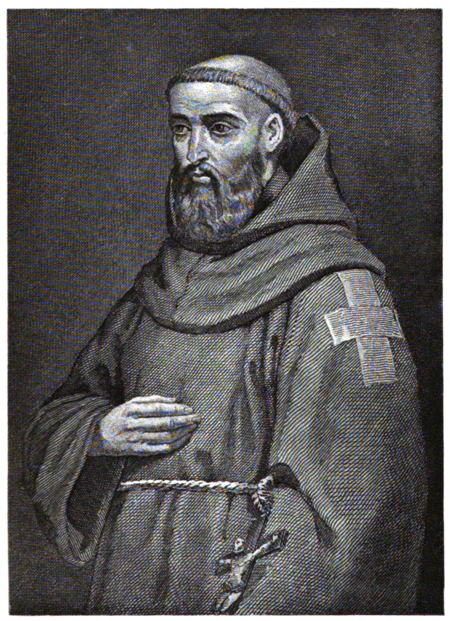
Peter the Hermit, p. 192. From a painting by Léon d’Estang.
The magnanimous spirit of Gregory the Seventh had already embraced the design of arming Europe against Asia; the ardour of his zeal and ambition still breathes in his epistles. From either side of the Alps, fifty thousand Catholics had enlisted under the banner of St. Peter; [3] and his successor reveals his intention of marching at their head against the impious sectaries of Mahomet. But the glory or reproach of executing, though not in person, this holy enterprise was reserved for Urban the Second, [4] the most faithful [X-194] of his disciples. He undertook the conquest of the East, whilst the larger portion of Rome was possessed and fortified by his rival, Guibert of Ravenna, who contended with Urban for the name and honours of the pontificate. He attempted to unite the powers of the West, at a time when the princes were separated from the church, and the people from their princes, by the excommunication which himself and his predecessors had thundered against the emperor and the king of France. Philip the First, of France, supported with patience the censures which he had provoked by his scandalous life and adulterous marriage. Henry the Fourth, of Germany, asserted the right of investitures, the prerogative of confirming his bishops by the delivery of the ring and crosier. But the emperor’s party was crushed in Italy by the arms of the Normans and the Countess Mathilda; and the long quarrel had been recently envenomed by the revolt of his son Conrad, and the shame of his wife, [5] who, in the synods of Constance and Placentia, confessed the manifold prostitutions to which she had been exposed by an husband regardless of her honour and his own. [6] So popular was the [X-195] cause of Urban, so weighty was his influence, that the council which he summoned at Placentia [7] was composed of two hundred bishops of Italy, France, Burgundy, Swabia, and Bavaria. Four thousand of the clergy, and thirty thousand of the laity, attended this important meeting; and, as the most spacious cathedral would have been inadequate to the multitude, the session of seven days was held in a plain adjacent to the city. The ambassadors of the Greek emperor, Alexius Comnenus, were introduced to plead the distress of their sovereign, and the danger of Constantinople, which was divided only by a narrow sea from the victorious Turks, the common enemy of the Christian name. In their suppliant address, they flattered the pride of the Latin princes; and, appealing at once to their policy and religion, exhorted them to repel the Barbarians on the confines of Asia rather than to expect them in the heart of Europe. At the sad tale of the misery and perils of their Eastern brethren, the assembly burst into tears; the most eager champions declared their readiness to march; and the Greek ambassadors were dismissed with the assurance of a speedy and powerful succour. The relief of Constantinople was included in the larger and most distant project of the deliverance of Jerusalem; but the prudent Urban adjourned the final decision to a second synod, which he proposed to celebrate in some city of France in the autumn of the same year. The short delay would propagate the flame of enthusiasm; and his firmest hope was in a nation of soldiers, [8] still proud of the pre-eminence of their name, and [X-196] ambitious to emulate their hero Charlemagne, [9] who, in the popular romance of Turpin, [10] had achieved the conquest of the Holy Land. A latent motive of affection or vanity might influence the choice of Urban. He was himself a native of France, a monk of Clugny, and the first of his countrymen who ascended the throne of St. Peter. The pope had illustrated his family and province. Nor is there perhaps a more exquisite gratification than to revisit, in a conspicuous dignity, the humble and laborious scenes of our youth.
It may occasion some surprise that the Roman pontiff should erect, in the heart of France, the tribunal from whence he hurled his anathemas against the king; but our surprise will vanish, so soon as we form a just estimate of a king of France of the eleventh century. [11] Philip the First was the great-grandson of Hugh Capet, the founder of the present race, who, in the decline of Charlemagne’s posterity, added the regal title to his patrimonial estates of Paris and Orleans. [X-197] In this narrow compass he was possessed of wealth and jurisdiction; but, in the rest of France, Hugh and his first descendants were no more than the feudal lords of about sixty dukes and counts, of independent and hereditary power, [12] who disdained the control of laws and legal assemblies, and whose disregard of their sovereign was revenged by the disobedience of their inferior vassals. At Clermont, in the territories of the Count of Auvergne, [13] the pope might brave with impunity the resentment of Philip; and the council which he convened in that city was not less numerous or respectable than the synod of Placentia. [14] Besides his court and council of Roman cardinals, he was supported by thirteen archbishops and two hundred and twenty-five bishops; [15] the number of mitred prelates was computed at four hundred; and the fathers of the church were blessed by the saints, and enlightened by the doctors, of the age. From the adjacent kingdoms a martial train of lords and knights of power and renown attended the council, [16] in high expectation of its resolves; and such was the ardour of zeal and curiosity that the city was filled, and many thousands, in the month of November, erected their tents or huts in the open field. A session of eight days produced some useful or edifying canons [X-198] for the reformation of manners; a severe censure was pronounced against the licence of private war; the Truce of God [17] was confirmed, a suspension of hostilities during four days of the week; women and priests were placed under the safeguard of the church; and a protection of three years was extended to husbandmen and merchants, the defenceless victims of military rapine. But a law, however venerable be the sanction, cannot suddenly transform the temper of the times; and the benevolent efforts of Urban deserve the less praise, since he laboured to appease some domestic quarrels that he might spread the flames of war from the Atlantic to the Euphrates. From the synod of Placentia the rumour of his great design had gone forth among the nations; the clergy, on their return, had preached in every diocese the merit and glory of the deliverance of the Holy Land; and, when the pope ascended a lofty scaffold in the market-place of Clermont, his eloquence was addressed to a well-prepared and impatient audience. His topics were obvious, his exhortation was vehement, his success inevitable. The orator was interrupted by the shout of thousands, who with one voice, and in their rustic idiom, exclaimed aloud, “God wills it, God wills it!” [18] “It is indeed the will of God,” replied the pope; “and let this memorable word, the inspiration surely of the Holy Spirit, be for ever adopted as your cry of battle, to animate the devotion and courage of the champions of [X-199] Christ. His cross is the symbol of your salvation; wear it, a red, a bloody cross, as an external mark on your breasts or shoulders, as a pledge of your sacred and irrevocable engagement.” The proposal was joyfully accepted; great numbers both of the clergy and laity impressed on their garments the sign of the cross, [19] and solicited the pope to march at their head. This dangerous honour was declined by the more prudent successor of Gregory, who alleged the schism of the church, and the duties of his pastoral office, recommending to the faithful, who were disqualified by sex or profession, by age or infirmity, to aid, with their prayers and alms, the personal service of their robust brethren. The name and powers of his legate he devolved on Adhemar, bishop of Puy, the first who had received the cross at his hands. The foremost of the temporal chiefs was Raymond, Count of Toulouse, whose ambassadors in the council excused the absence, and pledged the honour, of their master. After the confession and absolution of their sins, the champions of the cross were dismissed with a superfluous admonition to invite their countrymen and friends; and their departure for the Holy Land was fixed to the festival of the assumption, the fifteenth of August, of the ensuing year. [20]
[X-200]
So familiar, and as it were so natural, to man is the practice of violence that our indulgence allows the slightest provocation, the most disputable right, as a sufficient ground of national hostility. But the name and nature of an holy war demands a more rigorous scrutiny; nor can we hastily believe that the servants of the Prince of Peace would unsheath the sword of destruction, unless the motives were pure, the quarrel legitimate, and the necessity inevitable. The policy of an action may be determined from the tardy lessons of experience; but, before we act, our conscience should be satisfied of the justice and propriety of our enterprise. In the age of the crusades, the Christians, both of the East and West, were persuaded of their lawfulness and merit; their arguments are clouded by the perpetual abuse of scripture and rhetoric; but they seem to insist on the right of natural and religious defence, their peculiar title to the Holy Land, and the impiety of their Pagan and Mahometan foes. [21] I. The right of a just defence may fairly include our civil and spiritual allies: it depends on the existence of danger; and that danger must be estimated by the twofold consideration of the malice [X-201] and the power of our enemies. A pernicious tenet has been imputed to the Mahometans, the duty of extirpating all other religions by the sword. This charge of ignorance and bigotry is refuted by the Koran, by the history of the Musulman conquerors, and by their public and legal toleration of the Christian worship. But it cannot be denied that the Oriental churches are depressed under their iron yoke; that, in peace and war, they assert a divine and indefeasible claim of universal empire; and that, in their orthodox creed, the unbelieving nations are continually threatened with the loss of religion or liberty. In the eleventh century, the victorious arms of the Turks presented a real and urgent apprehension of these losses. They had subdued, in less than thirty years, the kingdoms of Asia, as far as Jerusalem and the Hellespont; and the Greek empire tottered on the verge of destruction. Besides an honest sympathy for their brethren, the Latins had a right and interest in the support of Constantinople, the most important barrier of the West; and the privilege of defence must reach to prevent, as well as to repel, an impending assault. But this salutary purpose might have been accomplished by a moderate succour; and our calmer reason must disclaim the innumerable hosts and remote operations which overwhelmed Asia and depopulated Europe. II. Palestine could add nothing to the strength or safety of the Latins; and fanaticism alone could pretend to justify the conquest of that distant and narrow province. The Christians affirmed that their inalienable title to the promised land had been sealed by the blood of their divine Saviour: it was their right and duty to rescue their inheritance from the unjust possessors, who profaned his sepulchre and oppressed the pilgrimage of his disciples. Vainly would it be alleged that the pre-eminence of Jerusalem and the sanctity of Palestine have been abolished with the Mosaic law; that the God of the Christians is not a local deity; and that the recovery of Bethlehem or Calvary, his cradle or his tomb, will not atone for the violation of the moral precepts of [X-202] the gospel. Such arguments glance aside from the leaden shield of superstition; and the religious mind will not easily relinquish its hold on the sacred ground of mystery and miracle. III. But the holy wars which have been waged in every climate of the globe, from Egypt to Livonia, and from Peru to Hindostan, require the support of some more general and flexible tenet. It has been often supposed, and sometimes affirmed, that a difference of religion is a worthy cause of hostility; that obstinate unbelievers may be slain or subdued by the champions of the cross; and that grace is the sole fountain of dominion as well as of mercy. Above four hundred years before the first crusade, the Eastern and Western provinces of the Roman empire had been acquired about the same time, and in the same manner, by the Barbarians of Germany and Arabia. Time and treaties had legitimated the conquests of the Christian Franks: but, in the eyes of their subjects and neighbours, the Mahometan princes were still tyrants and usurpers, who, by the arms of war or rebellion, might be lawfully driven from their unlawful possession. [22]
As the manners of the Christians were relaxed, their discipline of penance [23] was enforced; and, with the multiplication of sins, the remedies were multiplied. In the primitive church, a voluntary and open confession prepared the work of atonement. In the middle ages, the bishops and priests interrogated the criminal; compelled him to account for his thoughts, words, and actions; and prescribed the terms of his reconciliation with God. But, as this discretionary power [X-203] might alternately be abused by indulgence and tyranny, a rule of discipline was framed, to inform and regulate the spiritual judges. This mode of legislation was invented by the Greeks; their penitentials [24] were translated, or imitated, in the Latin church; and, in the time of Charlemagne, the clergy of every diocese were provided with a code, which they prudently concealed from the knowledge of the vulgar. In this dangerous estimate of crimes and punishments, each case was supposed, each difference was remarked, by the experience or penetration of the monks; some sins are enumerated which innocence could not have suspected, and others which reason cannot believe; and the more ordinary offences of fornication and adultery, of perjury and sacrilege, of rapine and murder, were expiated by a penance which, according to the various circumstances, was prolonged from forty days to seven years. During this term of mortification, the patient was healed, the criminal was absolved, by a salutary regimen of fasts and prayers; the disorder of his dress was expressive of grief and remorse; and he humbly abstained from all the business and pleasure of social life. But the rigid execution of these laws would have depopulated the palace, the camp, and the city; the Barbarians of the West believed and trembled; but nature often rebelled against principle; and the magistrate laboured without effect to enforce the jurisdiction of the priest. A literal accomplishment of penance was indeed impracticable: the guilt of adultery was multiplied by daily repetition; that of homicide might involve the massacre of a whole people; each act was separately numbered; and, in those times of anarchy and vice, a modest sinner might easily incur a debt of three hundred years. His insolvency was relieved by a commutation, [X-204] or indulgence: a year of penance was appreciated at twenty-six solidi [25] of silver, about four pounds sterling, for the rich; at three solidi, or nine shillings, for the indigent: and these alms were soon appropriated to the use of the church, which derived, from the redemption of sins, an inexhaustible source of opulence and dominion. A debt of three hundred years, or twelve hundred pounds, was enough to impoverish a plentiful fortune; the scarcity of gold and silver was supplied by the alienation of land; and the princely donations of Pepin and Charlemagne are expressly given for the remedy of their soul. It is a maxim of the civil law, That whosoever cannot pay with his purse must pay with his body; and the practice of flagellation was adopted by the monks, a cheap, though painful, equivalent. By a fantastic arithmetic, a year of penance was taxed at three thousand lashes; [26] and such was the skill and patience of a famous hermit, St. Dominic of the Iron Cuirass, [27] that in six days he could discharge an entire century, by a whipping of three hundred thousand stripes. His example was followed by many penitents of both sexes; and, as a vicarious sacrifice was accepted, a sturdy disciplinarian might expiate on his own back the sins of his benefactors. [28] These compensations of the purse and the person [X-205] introduced, in the eleventh century, a more honourable mode of satisfaction. The merit of military service against the Saracens of Africa and Spain had been allowed by the predecessors of Urban the Second. In the council of Clermont, that pope proclaimed a plenary indulgence to those who should enlist under the banner of the cross: the absolution of all their sins, and a full receipt for all that might be due of canonical penance. [29] The cold philosophy of modern times is incapable of feeling the impression that was made on a sinful and fanatic world. At the voice of their pastor, the robber, the incendiary, the homicide, arose by thousands to redeem their souls, by repeating on the infidels the same deeds which they had exercised against their Christian brethren; and the terms of atonement were eagerly embraced by offenders of every rank and denomination. None were pure; none were exempt from the guilt and penalty of sin; and those who were the least amenable to the justice of God and the church were the best entitled to the temporal and eternal recompense of their pious courage. If they fell, the spirit of the Latin clergy did not hesitate to adorn their tomb with the crown of martyrdom; [30] and, should they survive, they could expect without impatience the delay and increase of their heavenly reward. They offered their blood to the Son of God, who had laid down his life for their salvation: they took up the cross, and entered with confidence into the way of the Lord. His providence would watch over their safety; perhaps his visible and miraculous power would smooth the difficulties of their holy enterprise. The cloud and pillar of Jehovah [X-206] had marched before the Israelites into the promised land. Might not the Christians more reasonably hope that the rivers would open for their passage; that the walls of the strongest cities would fall at the sound of their trumpets; and that the sun would be arrested in his mid-career, to allow them time for the destruction of the infidels?
Of the chiefs and soldiers who marched to the holy sepulchre, I will dare to affirm that all were prompted by the spirit of enthusiasm, the belief of merit, the hope of reward, and the assurance of divine aid. But I am equally persuaded that in many it was not the sole, that in some it was not the leading, principle of action. The use and abuse of religion are feeble to stem, they are strong and irresistible to impel, the stream of national manners. Against the private wars of the Barbarians, their bloody tournaments, licentious loves, and judicial duels, the popes and synods might ineffectually thunder. It is a more easy task to provoke the metaphysical disputes of the Greeks, to drive into the cloister the victims of anarchy or despotism, to sanctify the patience of slaves and cowards, or to assume the merit of the humanity and benevolence of modern Christians. War and exercise were the reigning passions of the Franks or Latins; they were enjoined, as a penance, to gratify those passions, to visit distant lands, and to draw their swords against the nations of the East. Their victory, or even their attempt, would immortalise the names of the intrepid heroes of the cross; and the purest piety could not be insensible to the most splendid prospect of military glory. In the petty quarrels of Europe, they shed the blood of their friends and countrymen, for the acquisition perhaps of a castle or a village. They could march with alacrity against the distant and hostile nations who were devoted to their arms: their fancy already grasped the golden sceptres of Asia; and the conquest of Apulia and Sicily by the Normans might exalt to royalty the hopes of the most private adventurer. Christendom, in her rudest state, must have yielded to the climate and cultivation of the [X-207] Mahometan countries; and their natural and artificial wealth had been magnified by the tales of pilgrims and the gifts of an imperfect commerce. The vulgar, both the great and small, were taught to believe every wonder, of lands flowing with milk and honey, of mines and treasures, of gold and diamonds, of palaces of marble and jasper, and of odoriferous groves of cinnamon and frankincense. In this earthly paradise each warrior depended on his sword to carve a plenteous and honourable establishment, which he measured only by the extent of his wishes. [31] Their vassals and soldiers trusted their fortunes to God and their master: the spoils of a Turkish emir might enrich the meanest follower of the camp; and the flavour of the wines, the beauty of the Grecian women, [32] were temptations more adapted to the nature, than to the profession, of the champions of the cross. The love of freedom was a powerful incitement to the multitudes who were oppressed by feudal or ecclesiastical tyranny. Under this holy sign, the peasants and burghers, who were attached to the servitude of the glebe, might escape from an haughty lord, and transplant themselves and their families to a land of liberty. The monk might release himself from the discipline of his convent; the debtor might suspend the accumulation of usury and the pursuit of his creditors; and outlaws and malefactors of every cast might continue to brave the laws and elude the punishment of their crimes. [33]
[X-208]
These motives were potent and numerous: when we have singly computed their weight on the mind of each individual, we must add the infinite series, the multiplying powers of example and fashion. The first proselytes became the warmest and most effectual missionaries of the cross: among their friends and countrymen they preached the duty, the merit, and the recompense of their holy vow; and the most reluctant hearers were insensibly drawn within the whirlpool of persuasion and authority. The martial youths were fired by the reproach or suspicion of cowardice; the opportunity of visiting with an army the sepulchre of Christ was embraced by the old and infirm, by women and children, who consulted rather their zeal than their strength; and those who in the evening had derided the folly of their companions were the most eager, the ensuing day, to tread in their footsteps. The ignorance, which magnified the hopes, diminished the perils, of the enterprise. Since the Turkish conquest, the paths of pilgrimage were obliterated; the chiefs themselves had an imperfect notion of the length of the way and the state of their enemies; and such was the stupidity of the people that, at the sight of the first city or castle beyond the limits of their knowledge, they were ready to ask, whether that was not the Jerusalem, the term and object of their labours. Yet the more prudent of the crusaders, who were not sure that they should be fed from heaven with a shower of quails or manna, provided themselves with those precious metals which, in every country, are the representatives of every commodity. To defray, according to their rank, the expenses of the road, princes alienated their provinces, nobles their lands and castles, peasants their cattle and the instruments of husbandry. The value of property was depreciated by the eager competition of multitudes; while the price of arms and horses was raised to an exorbitant height, by the wants and impatience of the buyers. [34] Those who remained at home, with [X-209] sense and money, were enriched by the epidemical disease: the sovereigns acquired at a cheap rate the domains of their vassals; and the ecclesiastical purchasers completed the payment by the assurance of their prayers. The cross, which was commonly sewed on the garment, in cloth or silk, was inscribed by some zealots on their skin; an hot iron, or indelible liquor, was applied to perpetuate the mark; and a crafty monk, who showed the miraculous impression on his breast, was repaid with the popular veneration and the richest benefices of Palestine. [35]
The fifteenth of August had been fixed in the council of Clermont for the departure of the pilgrims; but the day was anticipated by the thoughtless and needy crowd of plebeians; and I shall briefly despatch the calamities which they inflicted and suffered, before I enter on the more serious and successful enterprise of the chiefs. Early in the spring, from the confines of France and Lorraine, about sixty thousand of the populace of both sexes flocked round the first missionary of the crusade, and pressed him with clamorous importunity to lead them to the holy sepulchre. The hermit, assuming the character, without the talents or authority, of a general, impelled or obeyed the forward impulse of his votaries along the banks of the Rhine and Danube. Their wants and numbers soon compelled them to separate, and his lieutenant, Walter the Pennyless, [36] a valiant though needy soldier, conducted a vanguard of pilgrims, whose condition may be determined from the proportion of eight horsemen to fifteen thousand foot. The example and footsteps of Peter were closely pursued by another fanatic, the monk Godescal, whose sermons had swept away fifteen or twenty thousand peasants from the [X-210] villages of Germany. Their rear was again pressed by an herd of two hundred thousand, the most stupid and savage refuse of the people, who mingled with their devotion a brutal licence of rapine, prostitution, and drunkenness. Some counts and gentlemen, at the head of three thousand horse, attended the motions of the multitude to partake in the spoil; but their genuine leaders (may we credit such folly?) were a goose and a goat, who were carried in the front, and to whom these worthy Christians ascribed an infusion of the divine Spirit. [37] Of these and of other bands of enthusiasts, the first and most easy warfare was against the Jews, the murderers of the Son of God. In the trading cities of the Moselle and the Rhine, their colonies were numerous and rich; and they enjoyed, under the protection of the emperor and the bishops, the free exercise of their religion. [38] At Verdun, Treves, Mentz, Spires, Worms, many thousands of that unhappy people were pillaged and massacred; [39] nor had they felt a more bloody stroke since the persecution of Hadrian. A remnant was saved by the firmness of their bishops, who accepted a reigned and transient conversion; but the more obstinate Jews opposed their fanaticism to the fanaticism of the Christians, barricadoed their houses, and, precipitating [X-211] themselves, their families, and their wealth into the rivers or the flames, disappointed the malice, or at least the avarice, of their implacable foes.
Between the frontiers of Austria and the seat of the Byzantine monarchy, the crusaders were compelled to traverse an interval of six hundred miles; the wild and desolate countries of Hungary [40] and Bulgaria. The soil is fruitful, and intersected with rivers; but it was then covered with morasses and forests, which spread to a boundless extent, whenever man has ceased to exercise his dominion over the earth. Both nations had imbibed the rudiments of Christianity; the Hungarians were ruled by their native princes; the Bulgarians by a lieutenant of the Greek emperor; but on the slightest provocation, their ferocious nature was rekindled, and ample provocation was afforded by the disorders of the first pilgrims. Agriculture must have been unskilful and languid among a people, whose cities were built of reeds and timber, which were deserted in the summer season for the tents of hunters and shepherds. A scanty supply of provisions was rudely demanded, forcibly seized, and greedily consumed; and, on the first quarrel, the crusaders gave a loose to indignation and revenge. But their ignorance of the country, of war, and of discipline exposed them to every snare. The Greek prefect of Bulgaria commanded a regular force; at the trumpet of the Hungarian king, the eighth or the tenth of his martial subjects bent their bows and mounted on horseback; their policy was insidious, and their retaliation on these pious robbers was unrelenting and bloody. [41] About a third of the [X-212] naked fugitives, and the hermit Peter was of the number, escaped to the Thracian mountains; and the emperor, who respected the pilgrimage and succour of the Latins, conducted them by secure and easy journeys to Constantinople, and advised them to wait the arrival of their brethren. For a while they remembered their faults and losses; but no sooner were they revived by the hospitable entertainment than their venom was again inflamed; they stung their benefactor, and neither gardens nor palaces nor churches [41a] were safe from their depredations. For his own safety, Alexius allured them to pass over to the Asiatic side of the Bosphorus; but their blind impetuosity soon urged them to desert the station which he had assigned, [41b] and to rush headlong against the Turks, who occupied the road of Jerusalem. The hermit, conscious of his shame, had withdrawn from the camp to Constantinople; and his lieutenant, Walter the Pennyless, who was worthy of a better command, attempted, without success, to introduce some order and prudence among the herd of savages. They separated in quest of prey, and themselves fell an easy prey to the arts of the sultan. By a rumour that their foremost companions were rioting in the spoils of his capital, Soliman tempted the main body to descend into the plain of Nice; they were overwhelmed by the Turkish arrows; and a pyramid of bones [42] informed their companions of the place [X-213] of their defeat. Of the first crusaders, three hundred thousand had already perished, before a single city was rescued from the infidels, before their graver and more noble brethren had completed the preparations of their enterprise. [43]
[X-214]
[X-215]
None of the great sovereigns of Europe embarked their persons in the first crusade. The emperor Henry the Fourth was not disposed to obey the summons of the pope; Philip the First of France was occupied by his pleasures; William Rufus of England by a recent conquest; the kings of Spain were engaged in a domestic war against the Moors; and the Northern monarchs of Scotland, Denmark, [44] Sweden, and Poland were yet strangers to the passions and interests of the South. The religious ardour was more strongly felt by the princes of the second order, who held an important place in the feudal system. Their situation will naturally cast, under four distinct heads, the review of their names and characters; but I may escape some needless repetition by observing at once that courage and the exercise of arms are the common attribute of these Christian adventurers. I. The first rank both in war and council is justly due to Godfrey of Bouillon; and happy would it have been for the crusaders, if they had trusted themselves to the sole conduct of that accomplished hero, a worthy representative of Charlemagne, from whom he was descended in the female line. His father was of the noble race of the counts of Boulogne: Brabant, the lower province of Lorraine, [45] was the inheritance of his mother; and, by the emperor’s bounty, he was himself invested with that ducal title, which has been improperly transferred to his lordship of Bouillon in the Ardennes. [46] [X-216] In the service of Henry the Fourth he bore the great standard of the empire, and pierced with his lance the breast of Rodolph, the rebel king: Godfrey was the first who ascended the walls of Rome; and his sickness, his vow, perhaps his remorse for bearing arms against the pope, confirmed an early resolution of visiting the holy sepulchre, not as a pilgrim, but a deliverer. His valour was matured by prudence and moderation; his piety, though blind, was sincere; and, in the tumult of a camp, he practised the real and fictitious virtues of a convent. Superior to the private factions of the chiefs, he reserved his enmity for the enemies of Christ; and, though he gained a kingdom by the attempt, his pure and disinterested zeal was acknowledged by his rivals. Godfrey of Bouillon [47] was accompanied by his two brothers, by Eustace the elder, who had succeeded to the county of Boulogne, and by the younger, Baldwin, a character of more ambiguous virtue. The Duke of Lorraine was alike celebrated on either side of the Rhine; from birth and education, he was equally conversant with the French and Teutonic languages: the barons of France, Germany, and Lorraine assembled their vassals; and the confederate force that marched under his banner was composed of fourscore thousand foot and about ten thousand horse. II. In the parliament that was held at Paris, in the king’s presence, about two months after the council of Clermont, Hugh, Count of Vermandois, was the most conspicuous of the princes who assumed the cross. But the appellation of the Great was applied, not so much to his merit or possessions (though neither were contemptible), as to the royal birth of the brother of the king of France. [48] Robert, Duke of [X-g] [X-217] Normandy, was the eldest son of William the Conqueror; but on his father’s death he was deprived of the kingdom of England, by his own indolence and the activity of his brother Rufus. The worth of Robert was degraded by an excessive levity and easiness of temper; his cheerfulness seduced him to the indulgence of pleasure; his profuse liberality impoverished the prince and people; his indiscriminate clemency multiplied the number of offenders; and the amiable qualities of a private man became the essential defects of a sovereign. For the trifling sum of ten thousand marks he mortgaged Normandy during his absence to the English usurper; [49] but his engagement and behaviour in the holy war announced in Robert a reformation of manners, and restored him in some degree to the public esteem. Another Robert was count of Flanders, a royal province, which, in this century, gave three queens to the thrones of France, England, and Denmark. He was surnamed the Sword and Lance of the Christians; but in the exploits of a soldier he sometimes forgot the duties of a general. Stephen, count of Chartres, of Blois, and of Troyes, was one of the richest princes of the age; and the number of his castles has been compared to the three hundred and sixty-five days of the year. His mind was improved by literature; and, in the council of the chiefs, the eloquent Stephen [50] was chosen to discharge the office of their president. These four were the principal leaders of the French, the Normans, and the pilgrims of the British Isles; but the list [X-218] of the barons, who were possessed of three or four towns, would exceed, says a contemporary, the catalogue of the Trojan war. [51] III. In the south of France, the command was assumed by Adhemar, bishop of Puy, the pope’s legate, and by Raymond, count of St. Giles and Toulouse, who added the prouder titles of duke of Narbonne and marquis of Provence. The former was a respectable prelate, alike qualified for this world and the next. The latter was a veteran warrior, who had fought against the Saracens of Spain, and who consecrated his declining age, not only to the deliverance, but to the perpetual service, of the holy sepulchre. His experience and riches gave him a strong ascendant in the Christian camp, whose distress he was often able, and sometimes willing, to relieve. But it was easier for him to extort the praise of the infidels than to preserve the love of his subjects and associates. His eminent qualities were clouded by a temper, haughty, envious, and obstinate; and, though he resigned an ample patrimony for the cause of God, his piety, in the public opinion, was not exempt from avarice and ambition. [52] A mercantile rather than a martial spirit prevailed among his provincials, [53] a common name, which included the natives of Auvergne and Languedoc, [54] the vassals [X-219] of the kingdom of Burgundy or Arles. From the adjacent frontier of Spain he drew a band of hardy adventurers; as he marched through Lombardy, a crowd of Italians flocked to his standard; and his united force consisted of one hundred thousand horse and foot. If Raymond was the first to enlist, and the last to depart, the delay may be excused by the greatness of his preparation and the promise of an everlasting farewell. IV. The name of Bohemond, the son of Robert Guiscard, was already famous by his double victory over the Greek emperor; but his father’s will had reduced him to the principality of Tarentum and the remembrance of his Eastern trophies, till he was awakened by the rumour and passage of the French pilgrims. It is in the person of this Norman chief that we may seek for the coolest policy and ambition, with a small allay of religious fanaticism. His conduct may justify a belief that he had secretly directed the design of the pope, which he affected to second with astonishment and zeal. At the siege of Amalphi, his example and discourse inflamed the passions of a confederate army; he instantly tore his garment, to supply crosses for the numerous candidates, and prepared to visit Constantinople and Asia at the head of ten thousand horse and twenty thousand foot. Several princes of the Norman race accompanied this veteran general; and his cousin Tancred [55] was the partner, rather than the servant, of the war. In the accomplished character of Tancred we discover all the virtues of a perfect knight, [56] [X-220] the true spirit of chivalry, which inspired the generous sentiments and social offices of man far better than the base philosophy, or the baser religion, of the times.
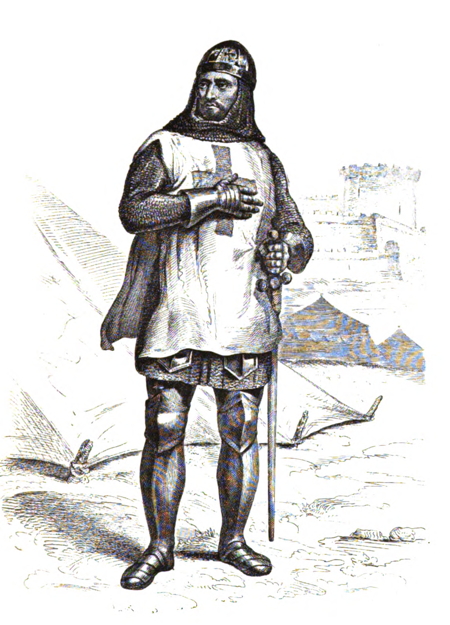
Godfrey of Bouillon, p. 216. From a painting by J. Boilly.
Between the age of Charlemagne and that of the crusades, a revolution had taken place among the Spaniards, the Normans, and the French, which was gradually extended to the rest of Europe. The service of the infantry was degraded to the plebeians; the cavalry formed the strength of the armies, and the honourable name of miles, or soldier, was confined to the gentlemen [57] who served on horseback and were invested with the character of knighthood. The dukes and counts, who had usurped the rights of sovereignty, divided the provinces among their faithful barons: the barons distributed among their vassals the fiefs or benefices of their jurisdiction; and these military tenants, the peers of each other and of their lord, composed the noble or equestrian order, which disdained to conceive the peasant or burgher as of the same species with themselves. The dignity of their birth was preserved by pure and equal alliances; their sons alone, who could produce four quarters or lines of ancestry, without spot or reproach, might legally pretend to the honour of knighthood; but a valiant plebeian was sometimes enriched and ennobled by the sword, and became the father of a new race. A single knight could impart, according to his judgment, the character which he received; and the warlike sovereigns of Europe derived more glory from this personal [X-221] distinction than from the lustre of their diadem. This ceremony, of which some traces may be found in Tacitus and the woods of Germany, [58] was in its origin simple and profane; the candidate, after some previous trial, was invested with the sword and spurs; and his cheek or shoulder was touched with a slight blow, as an emblem of the last affront which it was lawful for him to endure. But superstition mingled in every public and private action of life; in the holy wars, it sanctified the profession of arms; and the order of chivalry was assimilated in its rights and privileges to the sacred orders of priesthood. The bath and white garment of the novice were an indecent copy of the regeneration of baptism; his sword, which he offered on the altar, was blessed by the ministers of religion; his solemn reception was preceded by fasts and vigils; and he was created a knight, in the name of God, of St. George, and of St. Michael the archangel. He swore to accomplish the duties of his profession; and education, example, and the public opinion were the inviolable guardians of his oath. As the champion of God and the ladies (I blush to unite such discordant names), he devoted himself to speak the truth; to maintain the right; to protect the distressed; to practise courtesy, a virtue less familiar to the ancients; to pursue the infidels; to despise the allurements of ease and safety; and to vindicate in every perilous adventure the honour of his character. The abuse of the same spirit provoked the illiterate knight to disdain the arts of industry and peace; to esteem himself the sole judge and avenger of his own injuries; and proudly to neglect the laws of civil society and military discipline. Yet the benefits of this institution, to refine the temper of Barbarians, and to infuse some principles of faith, justice, and humanity, were strongly felt, and have been often observed. The asperity of national prejudice was softened; and the community of religion and arms spread a similar colour and generous emulation over [X-222] the face of Christendom. Abroad in enterprise and pilgrimage, at home in martial exercise, the warriors of every country were perpetually associated; and impartial taste must prefer a Gothic tournament to the Olympic games of classic antiquity. [59] Instead of the naked spectacles which corrupted the manners of the Greeks and banished from the stadium the virgins and the matrons, the pompous decoration of the lists was crowned with the presence of chaste and high-born beauty, from whose hands the conqueror received the prize of his dexterity and courage. The skill and strength that were exerted in wrestling and boxing bear a distant and doubtful relation to the merit of a soldier; but the tournaments, as they were invented in France and eagerly adopted both in the East and West, presented a lively image of the business of the field. The single combats, the general skirmish, the defence of a pass or castle, were rehearsed as in actual service; and the contest, both in real and mimic war, was decided by the superior management of the horse and lance. The lance was the proper and peculiar weapon of the knight; his horse was of a large and heavy breed; but this charger, till he was roused by the approaching danger, was usually led by an attendant, and he quietly rode a pad or palfrey of a more easy pace. His helmet and sword, his greaves and buckler, it would be superfluous to describe; but I may remark that at the period of the crusades the armour was less ponderous than in later times; and that, instead of a massy cuirass, his breast was defended by an hauberk or coat of mail. When their long lances were fixed in the rest, the warriors furiously spurred their horses against the foe; and the light cavalry of the Turks and Arabs could seldom stand against the direct and impetuous weight of their charge. Each knight was [X-223] attended to the field by his faithful squire, a youth of equal birth and similar hopes; he was followed by his archers and men at arms, and four, or five, or six soldiers were computed as the furniture of a complete lance. In the expeditions to the neighbouring kingdoms or the Holy Land, the duties of the feudal tenure no longer subsisted; the voluntary service of the knights and their followers was either prompted by zeal or attachment, or purchased with rewards and promises; and the numbers of each squadron were measured by the power, the wealth, and the fame of each independent chieftain. They were distinguished by his banner, his armorial coat, and his cry of war; and the most ancient families of Europe must seek in these achievements the origin and proof of their nobility. In this rapid portrait of chivalry, I have been urged to anticipate on the story of the crusades, at once an effect, and a cause, of this memorable institution. [60]
Such were the troops, and such the leaders, who assumed the cross for the deliverance of the holy sepulchre. As soon as they were relieved by the absence of the plebeian multitude, they encouraged each other, by interviews and messages, to accomplish their vow and hasten their departure. Their wives and sisters were desirous of partaking the danger and merit of the pilgrimage; their portable treasures were conveyed in bars of silver and gold; and the princes and barons were attended by their equipage of hounds and hawks, to amuse their leisure and to supply their table. The difficulty of procuring subsistence for so many myriads of men and horses engaged them to separate their forces; their choice or situation determined the road; and it was agreed [X-224] to meet in the neighbourhood of Constantinople, and from thence to begin their operations against the Turks. From the banks of the Meuse and the Moselle, Godfrey of Bouillon followed the direct way of Germany, Hungary, and Bulgaria; and, as long as he exercised the sole command, every step afforded some proof of his prudence and virtue. On the confines of Hungary he was stopped three weeks by a Christian people, to whom the name, or at least the abuse, of the cross was justly odious. The Hungarians still smarted with the wounds which they had received from the first pilgrims; in their turn they had abused the right of defence and retaliation; and they had reason to apprehend a severe revenge from an hero of the same nation, and who was engaged in the same cause. But, after weighing the motives and the events, the virtuous duke was content to pity the crimes and misfortunes of his worthless brethren; and his twelve deputies, the messengers of peace, requested in his name a free passage and an equal market. To remove their suspicions, Godfrey trusted himself, and afterwards his brother, to the faith of Carloman, king of Hungary, who treated them with a simple but hospitable entertainment: the treaty was sanctified by their common gospel; and a proclamation, under pain of death, restrained the animosity and licence of the Latin soldiers. From Austria to Belgrade, they traversed the plains of Hungary, without enduring or offering an injury; and the proximity of Carloman, who hovered on their flanks with his numerous cavalry, was a precaution not less useful for their safety than for his own. They reached the banks of the Save; and no sooner had they passed the river than the king of Hungary restored the hostages and saluted their departure with the fairest wishes for the success of their enterprise. With the same conduct and discipline, Godfrey pervaded the woods of Bulgaria and the frontiers of Thrace; and might congratulate himself that he had almost reached the first term of his pilgrimage without drawing his sword against a Christian adversary. After an easy and pleasant journey [X-225] through Lombardy, from Turin to Aquileia, Raymond and his provincials marched forty days through the savage country of Dalmatia. [61] and Sclavonia. The weather was a perpetual fog; the land was mountainous and desolate; the natives were either fugitive or hostile; loose in their religion and government, they refused to furnish provisions or guides; murdered the stragglers; and exercised by night and day the vigilance of the count, who derived more security from the punishment of some captive robbers than from his interview and treaty with the prince of Scodra. [62] His march between Durazzo and Constantinople was harassed, without being stopped, by the peasants and soldiers of the Greek emperor; and the same faint and ambiguious hostility was prepared for the remaining chiefs, who passed the Adriatic from the coast of Italy. Bohemond had arms and vessels, and foresight and discipline; and his name was not forgotten in the provinces of Epirus and Thessaly. Whatever obstacles he encountered were surmounted by his military conduct and the valour of Tancred; and, if the Norman prince affected to spare the Greeks, he gorged his soldiers with the full plunder of an heretical castle. [63] The nobles of France pressed forwards [X-226] with the vain and thoughtless ardour of which their nation has been sometimes accused. From the Alps to Apulia, the march of Hugh the Great, of the two Roberts, and of Stephen of Chartres, through a wealthy country, and amidst the applauding Catholics, was a devout or triumphant progress: they kissed the feet of the Roman pontiff; and the golden standard of St. Peter was delivered to the brother of the French monarch. [64] But in this visit of piety and pleasure they neglected to secure the season and the means of their embarkation: the winter was insensibly lost; their troops were scattered and corrupted in the towns of Italy. They separately accomplished their passage, regardless of safety or dignity: and within nine months from the feast of the Assumption, the day appointed by Urban, all the Latin princes had reached Constantinople. But the Count of Vermandois was produced as a captive; his foremost vessels were scattered by a tempest; and his person, against the law of nations, was detained by the lieutenants of Alexius. Yet the arrival of Hugh had been announced by four-and-twenty knights in golden armour, who commanded the emperor to revere the general of the Latin Christians, the brother of the King of kings. [65]
In some Oriental tale I have read the fable of a shepherd, who was ruined by the accomplishment of his own wishes: he had prayed for water; the Ganges was turned into his grounds; and his flock and cottage were swept away by the [X-227] inundation. Such was the fortune, or at least the apprehension, of the Greek emperor, Alexius Comnenus, whose name has already appeared in this history, and whose conduct is so differently represented by his daughter Anna [66] and by the Latin writers. [67] In the council of Placentia, his ambassadors had solicited a moderate succour, perhaps of ten thousand soldiers; but he was astonished by the approach of so many potent chiefs and fanatic nations. The emperor fluctuated between hope and fear, between timidity and courage; but in the crooked policy which he mistook for wisdom I cannot believe, I cannot discern, that he maliciously conspired against the life or honour of the French heroes. The promiscuous multitudes of Peter the Hermit were savage beasts, alike destitute of humanity and reason; nor was it possible for Alexius to prevent or deplore their destruction. The troops of Godfrey and his peers were less contemptible, but not less suspicious, to the Greek emperor. Their motives might be pure and pious; but he was equally alarmed by his knowledge of the ambitious Bohemond and his ignorance of the Transalpine chiefs: the courage of the French was blind and headstrong; they might be tempted by the luxury and wealth of Greece, and elated by the view and opinion of their invincible strength; and Jerusalem might be forgotten in the prospect of Constantinople. After a long march and painful abstinence, the troops of Godfrey encamped in the plains of [X-228] Thrace; they heard with indignation that their brother, the Count of Vermandois, was imprisoned by the Greeks; and their reluctant duke was compelled to indulge them in some freedom of retaliation and rapine. They were appeased by the submission of Alexius; he promised to supply their camp; and, as they refused, in the midst of winter, to pass the Bosphorus, their quarters were assigned among the gardens and palaces on the shores of that narrow sea. But an incurable jealousy still rankled in the minds of the two nations, who despised each other as slaves and Barbarians. Ignorance is the ground of suspicion, and suspicion was inflamed into daily provocations; prejudice is blind, hunger is deaf; and Alexius is accused of a design to starve or assault the Latins on a dangerous post, on all sides encompassed with the waters. [68] Godfrey sounded his trumpets, burst the net, overspread the plain, and insulted the suburbs; but the gates of Constantinople were strongly fortified; the ramparts were lined with archers; and, after a doubtful conflict, both parties listened to the voice of peace and religion. The gifts and promises of the emperor insensibly soothed the fierce spirit of the Western strangers; as a Christian warrior, he rekindled their zeal for the prosecution of their holy enterprise, which he engaged to second with his troops and treasures. On the return of spring, Godfrey was persuaded to occupy a pleasant and plentiful camp in Asia; and no sooner had he passed the Bosphorus, than the Greek vessels were suddenly recalled to the opposite shore. The same policy was repeated with the succeeding chiefs, who were swayed by the example, and weakened by the departure, of their foremost companions. By his skill and diligence, Alexius prevented the union of [X-229] any two of the confederate armies at the same moment under the walls of Constantinople; and, before the feast of the Pentecost, not a Latin pilgrim was left on the coast of Europe.
The same arms which threatened Europe might deliver Asia and repel the Turks from the neighbouring shores of the Bosphorus and Hellespont. The fair provinces from Nice to Antioch were the recent patrimony of the Roman emperor; and his ancient and perpetual claim still embraced the kingdoms of Syria and Egypt. In his enthusiasm, Alexius indulged, or affected, the ambitious hope of leading his new allies to subvert the thrones of the East; but the calmer dictates of reason and temper dissuaded him from exposing his royal person to the faith of unknown and lawless Barbarians. His prudence, or his pride, was content with extorting from the French princes an oath of homage and fidelity, and a solemn promise that they would either restore, or hold, their Asiatic conquests as the humble and loyal vassals of the Roman empire. Their independent spirit was fired at the mention of this foreign and voluntary servitude; they successively yielded to the dextrous application of gifts and flattery; and the first proselytes became the most eloquent and effectual missionaries to multiply the companions of their shame. The pride of Hugh of Vermandois was soothed by the honours of his captivity; and in the brother of the French king the example of submission was prevalent and weighty. In the mind of Godfrey of Bouillon, every human consideration was subordinate to the glory of God and the success of the crusade. He had firmly resisted the temptations of Bohemond and Raymond, who urged the attack and conquest of Constantinople. Alexius esteemed his virtues, deservedly named him the champion of the empire, and dignified his homage with the filial name and the rights of adoption. [69] The hateful Bohemond was received as a true [X-230] and ancient ally; and, if the emperor reminded him of former hostilities, it was only to praise the valour that he had displayed, and the glory that he had acquired, in the fields of Durazzo and Larissa. The son of Guiscard was lodged and entertained, and served with Imperial pomp: one day, as he passed through the gallery of the palace, a door was carelessly left open to expose a pile of gold and silver, of silk and gems, of curious and costly furniture, that was heaped in seeming disorder from the floor to the roof of the chamber. “What conquests,” exclaimed the ambitious miser, “might not be achieved by the possession of such a treasure!” “It is your own,” replied a Greek attendant, who watched the motions of his soul; and Bohemond, after some hesitation, condescended to accept this magnificent present. The Norman was flattered by the assurance of an independent principality; and Alexius eluded, rather than denied, his daring demand of the office of great domestic, or general, of the East. The two Roberts, the son of the conqueror of England and the kinsman of three queens, [70] bowed in their turn before the Byzantine throne. A private letter of Stephen of Chartres attests his admiration of the emperor, the most excellent and liberal of men, who taught him to believe that he was a favourite, and promised to educate and establish his youngest son. In his southern province, the Count of St. Giles and Toulouse faintly recognised the supremacy of the king of France, a prince of a foreign nation and language. At the head of an hundred thousand men, he declared that he was the soldier and servant of Christ alone, and that the Greek might be satisfied with an equal treaty of alliance and friendship. His obstinate resistance enhanced the value and the price of his submission; and he shone, says [X-231] the princess Anne, among the Barbarians, as the sun amidst the stars of heaven. His disgust of the noise and insolence of the French, his suspicions of the designs of Bohemond, the emperor imparted to his faithful Raymond; and that aged statesman might clearly discern that, however false in friendship, he was sincere in his enmity. [71] The spirit of chivalry was last subdued in the person of Tancred; and none could deem themselves dishonoured by the imitation of that gallant knight. He disdained the gold and flattery of the Greek monarch; assaulted in his presence an insolent patrician; escaped to Asia in the habit of a private soldier; and yielded with a sigh to the authority of Bohemond and the interest of the Christian cause. The best and most ostensible reason was the impossibility of passing the sea and accomplishing their vow, without the licence and the vessels of Alexius; but they cherished a secret hope that, as soon as they trode the continent of Asia, their swords would obliterate their shame, and dissolve the engagement, which on his side might not be very faithfully performed. The ceremony of their homage was grateful to a people who had long since considered pride as the substitute of power. High on his throne, the emperor sat mute and immoveable: his majesty was adored by the Latin princes; and they submitted to kiss either his feet or his knees, an indignity which their own writers are ashamed to confess and unable to deny. [72]
Private or public interest suppressed the murmurs of the dukes and counts; but a French baron (he is supposed to be Robert of Paris [73] ) presumed to ascend the throne, and to [X-232] place himself by the side of Alexius. The sage reproof of Baldwin provoked him to exclaim, in his Barbarous idiom, “Who is this rustic, that keeps his seat, while so many valiant captains are standing round him?” The emperor maintained his silence, dissembled his indignation, and questioned his interpreter concerning the meaning of the words, which he partly suspected from the universal language of gesture and countenance. Before the departure of the pilgrims, he endeavoured to learn the name and condition of the audacious baron. “I am a Frenchman,” replied Robert, “of the purest and most ancient nobility of my country. All that I know is, that there is a church in my neighbourhood, [74] the resort of those who are desirous of approving their valour in single combat. Till an enemy appears, they address their prayers to God and his saints. That church I have frequently visited, but never have I found an antagonist who dared to accept my defiance.” Alexius dismissed the challenger with some prudent advice for his conduct in the Turkish warfare; and history repeats with pleasure this lively example of the manners of his age and country.
The conquest of Asia was undertaken and achieved by Alexander, with thirty-five thousand Macedonians and Greeks; [75] and his best hope was in the strength and discipline of his phalanx of infantry. The principal force of [X-233] the crusaders consisted in their cavalry; and, when that force was mustered in the plains of Bithynia, the knights and their martial attendants on horseback amounted to one hundred thousand fighting men completely armed with the helmet and coat of mail. The value of these soldiers deserved a strict and authentic account; and the flower of European chivalry might furnish, in a first effort, this formidable body of heavy horse. A part of the infantry might be enrolled for the service of scouts, pioneers, and archers; but the promiscuous crowd were lost in their own disorder; and we depend not on the eyes or knowledge, but on the belief and fancy, of a chaplain of Count Baldwin, [76] in the estimate of six hundred thousand pilgrims able to bear arms, besides the priests and monks, the women and children, of the Latin camp. The reader starts; and, before he is recovered from his surprise, I shall add, on the same testimony, that if all who took the cross had accomplished their vow, above six millions would have migrated from Europe to Asia. Under this oppression of faith, I derive some relief from a more sagacious and thinking writer, [77] who, after the same review of the cavalry, accuses the credulity of the priest of Chartres, and even doubts whether the Cisalpine regions (in the geography of a Frenchman) were sufficient to produce and pour forth such incredible multitudes. The coolest scepticism will remember that of these religious volunteers great numbers never beheld Constantinople and Nice. Of enthusiasm the influence is irregular and transient; many were detained at home by reason or cowardice, by poverty or weakness; and many were repulsed by the obstacles of the way, the more insuperable as [X-234] they were unforeseen to these ignorant fanatics. The savage countries of Hungary and Bulgaria were whitened with their bones; their vanguard was cut in pieces by the Turkish sultan; and the loss of the first adventure, by the sword, or climate, or fatigue, has already been stated at three hundred thousand men. Yet the myriads that survived, that marched, that pressed forwards on the holy pilgrimage, were a subject of astonishment to themselves and to the Greeks. The copious energy of her language sinks under the efforts of the princess Anne; [78] the images of locusts, of leaves and flowers, of the sands of the sea, or the stars of heaven, imperfectly represent what she had seen and heard; and the daughter of Alexius exclaims that Europe was loosened from its foundations and hurled against Asia. The ancient hosts of Darius and Xerxes labour under the same doubt of a vague and indefinite magnitude; but I am inclined to believe that a larger number has never been contained within the lines of a single camp than at the siege of Nice, the first operation of the Latin princes. Their motives, their characters, and their arms have been already displayed. Of their troops, the most numerous portion were natives of France; the Low Countries, the banks of the Rhine, and Apulia sent a powerful reinforcement; some bands of adventurers were drawn from Spain, Lombardy, and England; [79] and from the [X-235] distant bogs and mountains of Ireland or Scotland [80] issued some naked and savage fanatics, ferocious at home, but unwarlike abroad. Had not superstition condemned the sacrilegious prudence of depriving the poorest or weakest Christian of the merit of the pilgrimage, the useless crowd, with mouths but without hands, might have been stationed in the Greek empire, till their companions had opened and secured the way of the Lord. A small remnant of the pilgrims, who passed the Bosphorus, was permitted to visit the holy sepulchre. Their Northern constitution was scorched by the rays, and infected by the vapours, of a Syrian sun. They consumed, with heedless prodigality, their stores of water and provisions; their numbers exhausted the inland country; the sea was remote, the Greeks were unfriendly, and the Christians of every sect fled before the voracious and cruel rapine of their brethren. In the dire necessity of famine, they sometimes roasted and devoured the flesh of their infant or adult captives. Among the Turks and Saracens, the idolaters of Europe were rendered more odious by the name and reputation of cannibals; the spies who introduced themselves into the kitchen of Bohemond were shewn several human bodies turning on the spit; and the artful Norman encouraged a report, which increased at the same time the abhorrence and the terror of the infidels. [81]
[X-236]
I have expatiated with pleasure on the first steps of the crusaders, as they paint the manners and character of Europe; but I shall abridge the tedious and uniform narrative of their blind achievements, which were performed by strength and are described by ignorance. From their first station in the neighbourhood of Nicomedia, they advanced in successive divisions, passed the contracted limit of the Greek empire, opened a road through the hills, and commenced, by the siege of his capital, their pious warfare against the Turkish sultan. His kingdom of Roum extended from the Hellespont to the confines of Syria and barred the pilgrimage of Jerusalem; his name was Kilidge-Arslan, or Soliman, [82] of the race of Seljuk, and son of the first conqueror; and, in the defence of a land which the Turks considered as their own, he deserved the praise of his enemies, by whom alone he is known to posterity. Yielding to the first impulse of the torrent, he deposited his family and treasure in Nice, retired to the mountains with fifty thousand horse, and twice descended to assault the camps or quarters of the Christian besiegers, which formed an imperfect circle of above six miles. The lofty and solid walls of Nice were covered by a deep ditch, and flanked by three hundred and seventy towers; and on the verge of Christendom the Moslems were trained in arms and inflamed by religion. Before this city, the French princes occupied their stations, and prosecuted their attacks without [X-237] correspondence or subordination; emulation prompted their valour; but their valour was sullied by cruelty, and their emulation degenerated into envy and civil discord. In the siege of Nice the arts and engines of antiquity were employed by the Latins; the mine and the battering-ram, the tortoise, and the belfry or moveable turret, artificial fire, and the catapult and balist, the sling, and the cross-bow for the casting of stones and darts. [83] In the space of seven weeks much labour and blood were expended, and some progress, especially by Count Raymond, was made on the side of the besiegers. But the Turks could protract their resistance and secure their escape, as long as they were masters of the lake Ascanius, [84] which stretches several miles to the westward of the city. The means of conquest were supplied by the prudence and industry of Alexius; a great number of boats was transported on sledges from the sea to the lake; they were filled with the most dextrous of his archers; the flight of the sultana was intercepted; Nice was invested by land and water; and a Greek emissary persuaded the inhabitants to accept his master’s protection, and to save themselves, by a timely surrender, from the rage of the savages of Europe. In the moment of victory, or at least of hope, the crusaders, thirsting for blood and plunder, were awed by the Imperial banner that streamed from the citadel, and Alexius guarded with jealous vigilance this important conquest. The murmurs of the chiefs were stifled by honour or interest; and, after an halt of nine days, [X-238] they directed their march towards Phrygia, under the guidance of a Greek general, whom they suspected of secret connivance with the sultan. The consort and the principal servants of Soliman had been honourably restored without ransom, and the emperor’s generosity to the miscreants [85] was interpreted as treason to the Christian cause.
Soliman was rather provoked than dismayed by the loss of his capital; he admonished his subjects and allies of this strange invasion of the Western Barbarians; the Turkish emirs obeyed the call of loyalty or religion; the Turkman hordes encamped round his standard; and his whole force is loosely stated by the Christians at two hundred, or even three hundred and sixty, thousand horse. Yet he patiently waited till they had left behind them the sea and the Greek frontier, and, hovering on the flanks, observed their careless and confident progress in two columns, beyond the view of each other. Some miles before they could reach Dorylæum in Phrygia, the left and least numerous division was surprised, and attacked, and almost oppressed, by the Turkish cavalry. [86] The heat of the weather, the clouds of arrows, and the Barbarous onset overwhelmed the crusaders; they lost their order and confidence, and the fainting fight was sustained by the personal valour, rather than by the military conduct, of Bohemond, Tancred, and Robert of Normandy. They were revived by the welcome banners of Duke Godfrey, who flew to their succour, with the count of Vermandois and sixty thousand horse, and was followed by Raymond of Toulouse, the bishop of Puy, and the remainder of the sacred army. [X-239] Without a moment’s pause they formed in new order, and advanced to a second battle. They were received with equal resolution; and, in their common disdain for the unwarlike people of Greece and Asia, it was confessed on both sides that the Turks and the Franks were the only nations entitled to the appellation of soldiers. [87] Their encounter was varied and balanced by the contrast of arms and discipline; of the direct charge, and wheeling evolutions; of the couched lance, and the brandished javelin; of a weighty broad-sword, and a crooked sabre; of cumbrous armour, and thin flowing robes; [87a] and of the long Tartar bow, and the arbalist or cross-bow, a deadly weapon, yet unknown to the Orientals. [88] As long as the horses were fresh and the quivers full, Soliman maintained the advantage of the day; and four thousand Christians were pierced by the Turkish arrows. In the evening, swiftness yielded to strength; on either side, the numbers were equal, or at least as great as any ground could hold or any generals could manage; but in turning the hills the last division of Raymond and his provincials was led, perhaps without design, on the rear of an exhausted enemy; and the long contest was determined. Besides a nameless and unaccounted multitude, three thousand [X-240] Pagan knights were slain in the battle and pursuit; the camp of Soliman was pillaged; and in the variety of precious spoil the curiosity of the Latins was amused with foreign arms and apparel, and the new aspect of dromedaries and camels. The importance of the victory was proved by the hasty retreat of the sultan: reserving ten thousand guards of the relics of his army, Soliman evacuated the kingdom of Roum, and hastened to implore the aid, and kindle the resentment, of his Eastern brethren. In a march of five hundred miles, the crusaders traversed the Lesser Asia, through a wasted land and deserted towns, without either finding a friend or an enemy. The geographer [89] may trace the position of Dorylæum, Antioch of Pisidia, Iconium, Archelais, and Germanicia, and may compare those classic appellations with the modern names of Eskishehr the old city, Akshehr the white city, Cogni, Erekli, [89a] and Marash. As the pilgrims passed over a desert, where a draught of water is exchanged for silver, they were tormented by intolerable thirst; and on the banks of the first rivulet their haste and intemperance were still more pernicious to the disorderly throng. They climbed with toil and danger the steep and slippery sides of Mount Taurus; many of the soldiers cast away their arms to secure their footsteps; and, had not terror preceded their van, the long and trembling file might have been driven down the precipice by an handful of resolute enemies. Two of their most respectable chiefs, the duke of Lorraine and the count of Toulouse, were carried in litters; Raymond was raised, as it is said, by miracle, from an hopeless malady; and Godfrey [X-241] had been torn by a bear, as he pursued that rough and perilous chase in the mountains of Pisidia.
To improve the general consternation, the cousin of Bohemond and the brother of Godfrey were detached from the main army, with their respective squadrons of five and of seven hundred knights. They over-ran, in a rapid career, the hills and sea-coast of Cilicia, from Cogni to the Syrian gates; the Norman standard was first planted on the walls of Tarsus and Malmistra; but the proud injustice of Baldwin at length provoked the patient and generous Italian, and they turned their consecrated swords against each other in a private and profane quarrel. Honour was the motive, and fame the reward, of Tancred; but fortune smiled on the more selfish enterprise of his rival. [90] He was called to the assistance of a Greek or Armenian tyrant, who had been suffered under the Turkish yoke to reign over the Christians of Edessa. Baldwin accepted the character of his son and champion; but no sooner was he introduced into the city than he inflamed [91] the people to the massacre of his father, occupied the throne and treasure, extended his conquests over the hills of Armenia and the plain of Mesopotamia, and founded the first principality of the Franks or Latins, which subsisted fifty-four years beyond the Euphrates. [92]
Before the Franks could enter Syria, the summer, and even the autumn, were completely wasted: the siege of [X-242] Antioch, or the separation and repose of the army during the winter season, was strongly debated in their council; the love of arms and the holy sepulchre urged them to advance, and reason perhaps was on the side of resolution, since every hour of delay abates the fame and force of the invader and multiplies the resources of defensive war. The capital of Syria was protected by the river Orontes, and the iron bridge of nine arches derives its name from the massy gates of the two towers which are constructed at either end. [93] They were opened by the sword of the duke of Normandy: his victory gave entrance to three hundred thousand crusaders, an account which may allow some scope for losses and desertion, but which clearly detects much exaggeration in the review of Nice. In the description of Antioch [94] it is not easy to define a middle term between her ancient magnificence, under the successors of Alexander and Augustus, and the modern aspect of Turkish desolation. The Tetrapolis, or four cities, if they retained their name and position, must have left a large vacuity in a circumference of twelve miles; and that measure, as well as the number of four hundred towers, are not perfectly consistent with the five gates, so often mentioned in the history of the siege. Yet Antioch must have still flourished as a great and populous capital. At the head of the Turkish emirs, Baghisian, a veteran chief, commanded in the place; his garrison was composed of six or seven thousand horse and fifteen or twenty thousand foot: one hundred thousand Moslems are said to have fallen by the sword, and their numbers were probably inferior to the Greeks, Armenians, and Syrians, who had been no more than fourteen [X-243] years the slaves of the house of Seljuk. From the remains of a solid and stately wall it appears to have arisen to the height of threescore feet in the valleys; and wherever less art and labour had been applied, the ground was supposed to be defended by the river, the morass, and the mountains. Notwithstanding these fortifications, the city had been repeatedly taken by the Persians, the Arabs, the Greeks, and the Turks; [95] so large a circuit must have yielded many pervious points of attack; and, in a siege that was formed about the middle of October, the vigour of the execution could alone justify the boldness of the attempt. Whatever strength and valour could perform in the field, was abundantly discharged by the champions of the cross: in the frequent occasions of sallies, of forage, of the attack and defence of convoys, they were often victorious; and we can only complain that their exploits are sometimes enlarged beyond the scale of probability and truth. The sword of Godfrey [96] divided a Turk from the shoulder to the haunch, and one half of the infidel fell to the ground, while the other was transported by his horse to the city gate. As Robert of Normandy rode against his antagonist, “I devote thy head,” he piously exclaimed, “to the demons of hell,” and that head was instantly cloven to the breast by the resistless stroke of his descending faulchion. But the reality or report of such [X-244] gigantic prowess [97] must have taught the Moslems to keep within their walls, and against those walls of earth or stone the sword and the lance were unavailing weapons. In the slow and successive labours of a siege the crusaders were supine and ignorant, without skill to contrive, or money to purchase, or industry to use the artificial engines and implements of assault. In the conquest of Nice they had been powerfully assisted by the wealth and knowledge of the Greek emperor: his absence was poorly supplied by some Genoese and Pisan vessels that were attracted by religion or trade to the coast of Syria; the stores were scanty, the return precarious, and the communication difficult and dangerous. Indolence or weakness had prevented the Franks from investing the entire circuit; and the perpetual freedom of two gates relieved the wants, and recruited the garrison, of the city. At the end of seven months, after the ruin of their cavalry, and an enormous loss by famine, desertion, and fatigue, the progress of the crusaders was imperceptible, and their success remote, if the Latin Ulysses, the artful and ambitious Bohemond, had not employed the arms of cunning and deceit. The Christians of Antioch were numerous and discontented: Phirouz, a Syrian renegado, had acquired the favour of the emir, and the command of three towers; and the merit of his repentance disguised to the Latins, and perhaps to himself, the foul design of perfidy and treason. A secret correspondence, for their mutual interest, was soon established between Phirouz and the prince of Tarento; and Bohemond declared in the council of the chiefs that he could deliver the city into their hands. But he claimed the sovereignty of Antioch as the reward of his service; and the proposal which had been rejected by the envy, was at length extorted from the distress, of his equals. The nocturnal surprise was executed by the French and Norman princes, who ascended in person the [X-245] scaling-ladders that were thrown from the walls; their new proselyte, after the murder of his too scrupulous brother, embraced and introduced the servants of Christ: the army rushed through the gates; and the Moslems soon found that, although mercy was hopeless, resistance was impotent. But the citadel still refused to surrender; and the victors themselves were speedily encompassed and besieged by the innumerable forces of Kerboga, prince of Mosul, who, with twenty-eight Turkish emirs, advanced to the deliverance of Antioch. Five and twenty days the Christians spent on the verge of destruction; and the proud lieutenant of the caliph and the sultan left them only the choice of servitude or death. [98] In this extremity they collected the relics of their strength, sallied from the town, and in a single memorable day annihilated or dispersed the host of Turks and Arabians, which they might safely report to have consisted of six hundred thousand men. [99] Their supernatural allies I shall proceed to consider: the human causes of the victory of Antioch were the fearless despair of the Franks; and the surprise, the discord, perhaps the errors, of their unskilful and presumptuous adversaries. The battle is described with as much disorder as it was fought; but we may observe the tent of Kerboga, a moveable and spacious palace, enriched [X-246] with the luxury of Asia, and capable of holding above two thousand persons; we may distinguish his three thousand guards, who were cased, the horses as well as men, in complete steel.
In the eventful period of the siege and defence of Antioch, the crusaders were, alternately, exalted by victory or sunk in despair; either swelled with plenty or emaciated with hunger. A speculative reasoner might suppose that their faith had a strong and serious influence on their practice; and that the soldiers of the cross, the deliverers of the holy sepulchre, prepared themselves by a sober and virtuous life for the daily contemplation of martyrdom. Experience blows away this charitable illusion; and seldom does the history of profane war display such scenes of intemperance and prostitution as were exhibited under the walls of Antioch. The grove of Daphne no longer flourished; but the Syrian air was still impregnated with the same vices; the Christians were seduced by every temptation [100] that nature either prompts or reprobates; the authority of the chiefs was despised; and sermons and edicts were alike fruitless against those scandalous disorders, not less pernicious to military discipline than repugnant to evangelic purity. In the first days of the siege and the possession of Antioch, the Franks consumed with wanton and thoughtless prodigality the frugal subsistence of weeks and months; the desolate country no longer yielded a supply; and from that country they were at length excluded by the arms of the besieging Turks. Disease, the faithful companion of want, was envenomed by the rains of the winter, the summer heats, unwholesome food, and the close imprisonment of multitudes. The pictures of famine and pestilence are always the same, and always disgustful; and our imagination may suggest the nature of their sufferings and their resources. The remains [X-247] of treasure or spoil were eagerly lavished in the purchase of the vilest nourishment; and dreadful must have been the calamities of the poor, since, after paying three marks of silver for a goat, and fifteen for a lean camel, [101] the count of Flanders was reduced to beg a dinner, and Duke Godfrey to borrow an horse. Sixty thousand horses had been reviewed in the camp; before the end of the siege they were diminished to two thousand, and scarcely two hundred fit for service could be mustered on the day of battle. Weakness of body and terror of mind extinguished the ardent enthusiasm of the pilgrims; and every motive of honour and religion was subdued by the desire of life. [102] Among the chiefs three heroes may be found without fear or reproach: Godfrey of Bouillon was supported by his magnanimous piety; Bohemond by ambition and interest; and Tancred declared, in the true spirit of chivalry, that, as long as he was at the head of forty knights, he would never relinquish the enterprise of Palestine. But the count of Toulouse and Provence was suspected of a voluntary indisposition; the duke of Normandy was recalled from the sea-shore by the censures of the church; Hugh the Great, though he led the vanguard of the battle, embraced an ambiguous opportunity of returning to France; and Stephen, count of Chartres, basely deserted the standard which he bore, and the council in which he presided. The soldiers were discouraged by the flight of William, viscount of Melun, surnamed the Carpenter, from the weighty strokes of his axe; and the saints were scandalised by the fall of Peter the Hermit, who, after [X-248] arming Europe against Asia, attempted to escape from the penance of a necessary fast. Of the multitude of recreant warriors, the names (says an historian) are blotted from the book of life; and the opprobrious epithet of the rope-dancers was applied to the deserters who dropt in the night from the walls of Antioch. The emperor Alexius, [103] who seemed to advance to the succour of the Latins, was dismayed by the assurance of their hopeless condition. They expected their fate in silent despair; oaths and punishments were tried without effect; and, to rouse the soldiers to the defence of the walls, it was found necessary to set fire to their quarters.
For their salvation and victory, they were indebted to the same fanaticism which had led them to the brink of ruin. In such a cause, and in such an army, visions, prophecies, and miracles were frequent and familiar. In the distress of Antioch, they were repeated with unusual energy and success; St. Ambrose had assured a pious ecclesiastic that two years of trial must precede the season of deliverance and grace; the deserters were stopped by the presence and approaches of Christ himself; the dead had promised to arise and combat with their brethren; the Virgin had obtained the pardon of their sins; and their confidence was revived by a visible sign, the seasonable and splendid discovery of the holy lance. The policy of their chiefs has on this occasion been admired and might surely be excused; but a pious fraud is seldom produced by the cool conspiracy of many persons; and a voluntary impostor might depend on the support of the wise and the credulity of the people. Of the diocese of Marseilles, there was a priest of low cunning and loose manners, and his name was Peter Bartholemy. He presented himself at the door of the council-chamber, to disclose an apparition of St. [X-249] Andrew, which had been thrice reiterated in his sleep, with a dreadful menace if he presumed to suppress the commands of Heaven. “At Antioch,” said the apostle, “in the church of my brother St. Peter, near the high altar, is concealed the steel head of the lance that pierced the side of our Redeemer. In three days, that instrument of eternal, and now of temporal, salvation will be manifested to his disciples. Search, and ye shall find; bear it aloft in battle; and that mystic weapon shall penetrate the souls of the miscreants.” The pope’s legate, the bishop of Puy, affected to listen with coldness and distrust; but the revelation was eagerly accepted by Count Raymond, whom his faithful subject, in the name of the apostle, had chosen for the guardian of the holy lance. The experiment was resolved; and on the third day, after a due preparation of prayer and fasting, the priest of Marseilles introduced twelve trusty spectators, among whom were the count and his chaplain; and the church doors were barred against the impetuous multitude. The ground was opened in the appointed place; but the workmen, who relieved each other, dug to the depth of twelve feet without discovering the object of their search. In the evening, when Count Raymond had withdrawn to his post, and the weary assistants began to murmur, Bartholemy, in his shirt and without his shoes, boldly descended into the pit; the darkness of the hour and of the place enabled him to secrete and deposit the head of a Saracen lance, and the first sound, the first gleam, of the steel was saluted with a devout rapture. The holy lance was drawn from its recess, wrapt in a veil of silk and gold, and exposed to the veneration of the crusaders; their anxious suspense burst forth in a general shout of joy and hope, and the desponding troops were again inflamed with the enthusiasm of valour. Whatever had been the arts, and whatever might be the sentiments of the chiefs, they skilfully improved this fortunate revolution by every aid that discipline and devotion could afford. The soldiers were dismissed to their quarters, with an injunction to fortify their minds [X-250] and bodies for the approaching conflict, freely to bestow their last pittance on themselves and their horses, and to expect with the dawn of day the signal of victory. On the festival of St. Peter and St. Paul, the gates of Antioch were thrown open; a martial psalm, “Let the Lord arise, and let his enemies be scattered!” was chaunted by a procession of priests and monks; the battle array was marshalled in twelve divisions, in honour of the twelve apostles; and the holy lance, in the absence of Raymond, was entrusted to the hands of his chaplain. The influence of this relic or trophy was felt by the servants, and perhaps by the enemies, of Christ; [104] and its potent energy was heightened by an accident, a stratagem, or a rumour, of a miraculous complexion. Three knights, in white garments and resplendent arms, either issued, or seemed to issue, from the hills: the voice of Adhemar, the pope’s legate, proclaimed them as the martyrs St. George, St. Theodore, and St. Maurice; the tumult of battle allowed no time for doubt or scrutiny; and the welcome apparition dazzled the eyes or the imagination of a fanatic army. In the season of danger and triumph, the revelation of Bartholemy of Marseilles was unanimously asserted; but, as soon as the temporary service was accomplished, the personal dignity and liberal alms which the count of Toulouse derived from the custody of the holy lance provoked the envy, and awakened the reason, of his rivals. A Norman clerk presumed to sift, with a philosophic spirit, the truth of the legend, the circumstances of the discovery, and the character of the prophet; and the pious Bohemond ascribed their deliverance to the merits and intercession of Christ alone. For a while the provincials defended their national palladium with clamours and arms; and new visions condemned to death and hell the profane [X-251] sceptics who presumed to scrutinise the truth and merit of the discovery. The prevalence of incredulity compelled the author to submit his life and veracity to the judgment of God. A pile of faggots, four feet high and fourteen feet long, was erected in the midst of the camp; the flames burnt fiercely to the elevation of thirty cubits; and a narrow path of twelve inches was left for the perilous trial. The unfortunate priest of Marseilles traversed the fire with dexterity and speed: but his thighs and belly were scorched by the intense heat; he expired the next day, and the logic of believing minds will pay some regard to his dying protestations of innocence and truth. Some efforts were made by the provincials to substitute a cross, a ring, or a tabernacle in the place of the holy lance, which soon vanished in contempt and oblivion. [105] Yet the revelation of Antioch is gravely asserted by succeeding historians; and such is the progress of credulity that miracles, most doubtful on the spot and at the moment, will be received with implicit faith at a convenient distance of time and space.
The prudence or fortune of the Franks had delayed their invasion till the decline of the Turkish empire. [106] Under the manly government of the three first sultans, the kingdoms of Asia were united in peace and justice; and the innumerable armies which they led in person were equal in courage, and superior in discipline, to the Barbarians of the West. But at the time of the crusade, the inheritance of Malek Shah was disputed by his four sons; their private ambition was insensible of the public danger; and, in the vicissitudes of their fortune, the royal vassals were ignorant, or regardless, of the true object of their allegiance. The twenty-eight emirs who marched [X-252] with the standard of Kerboga were his rivals or enemies; their hasty levies were drawn from the towns and tents of Mesopotamia and Syria; and the Turkish veterans were employed or consumed in the civil wars beyond the Tigris. The caliph of Egypt embraced this opportunity of weakness and discord to recover his ancient possessions; and his sultan Aphdal besieged Jerusalem and Tyre, expelled the children of Ortok, and restored in Palestine the civil and ecclesiastical authority of the Fatimites. [107] They heard with astonishment of the vast armies of Christians that had passed from Europe to Asia, and rejoiced in the sieges and battles which broke the power of the Turks, the adversaries of their sect and monarchy. But the same Christians were the enemies of the prophet; and from the overthrow of Nice and Antioch, the motive of their enterprise, which was gradually understood, would urge them forward to the banks of the Jordan, or perhaps of the Nile. An intercourse of epistles and embassies, which rose and fell with the events of war, was maintained between the throne of Cairo and the camp of the Latins; and their adverse pride was the result of ignorance and enthusiasm. The ministers of Egypt declared in an haughty, or insinuated in a milder, tone that their sovereign, the true and lawful commander of the faithful, had rescued Jerusalem from the Turkish yoke; and that the pilgrims, if they would divide their numbers and lay aside their arms, should find a safe and hospitable reception at the sepulchre of Jesus. In the belief of their lost condition, the caliph Mostali despised their arms and imprisoned their deputies: the conquest and victory of Antioch prompted him to solicit those formidable champions with gifts of horses and silk robes, of vases, and purses of gold and silver; and, in his estimate of their merit or power, the first place was assigned to [X-253] Bohemond, and the second to Godfrey. In either fortune the answer of the crusaders was firm and uniform: they disdained to inquire into the private claims or possessions of the followers of Mahomet: whatsoever was his name or nation, the usurper of Jerusalem was their enemy; and, instead of prescribing the mode and terms of their pilgrimage, it was only by a timely surrender of the city and province, their sacred right, that he could deserve their alliance or deprecate their impending and irresistible attack. [108]
Yet this attack, when they were within the view and reach of their glorious prize, was suspended above ten months after the defeat of Kerboga. The zeal and courage of the crusaders were chilled in the moment of victory: and, instead of marching to improve the consternation, they hastily dispersed to enjoy the luxury, of Syria. The causes of this strange delay may be found in the want of strength and subordination. In the painful and various service of Antioch the cavalry was annihilated; many thousands of every rank had been lost by famine, sickness, and desertion; the same abuse of plenty had been productive of a third famine; and the alternative of intemperance and distress had generated a pestilence, which swept away above fifty thousand of the pilgrims. Few were able to command and none were willing to obey: the domestic feuds, which had been stifled by common fear, were again renewed in acts, or at least in sentiments, of hostility; the future of Baldwin and Bohemond excited the envy of their companions; the bravest knights were enlisted for the defence of their new principalities; and Count Raymond exhausted his troops and treasures in an idle expedition into the heart of Syria. [109] The winter was consumed in discord and disorder; [X-254] a sense of honour and religion was rekindled in the spring; and the private soldiers, less susceptible of ambition and jealousy, awakened with angry clamours the indolence of their chiefs. In the month of May, the relics of this mighty host proceeded from Antioch to Laodicea: about forty thousand Latins, of whom no more than fifteen hundred horse and twenty thousand foot were capable of immediate service. Their easy march was continued between Mount Libanus and the sea-shore; their wants were liberally supplied by the coasting traders of Genoa and Pisa; and they drew large contributions from the emirs of Tripoli, Tyre, Sidon, Acre, and Cæsarea, who granted a free passage and promised to follow the example of Jerusalem. From Cæsarea [110] they advanced into the midland country; their clerks recognised the sacred geography of Lydda, Ramla, Emaus, and Bethlem; and, as soon as they descried the holy city, the crusaders forgot their toils, and claimed their reward. [111]
Jerusalem has derived some reputation from the number and importance of her memorable sieges. It was not till after a long and obstinate contest that Babylon and Rome could prevail against the obstinacy of the people, the craggy ground that might supersede the necessity of fortifications, and the walls and towers that would have fortified the most accessible plain. [112] These obstacles were diminished in the age of the crusades. The bulwarks had been completely destroyed, and imperfectly restored; the Jews, their nation and worship, were for ever banished; but nature is less changeable than man, [X-255] and the site of Jerusalem, though somewhat softened and somewhat removed, was still strong against the assaults of an enemy. By the experience of a recent siege, and a three years’ possession, the Saracens of Egypt had been taught to discern, and in some degree to remedy, the defects of a place which religion, as well as honour, forbade them to resign. Aladin, or Iftikhar, the caliph’s lieutenant, was entrusted with the defence; his policy strove to restrain the native Christians by the dread of their own ruin and that of the holy sepulchre; to animate the Moslems by the assurance of temporal and eternal rewards. His garrison is said to have consisted of forty thousand Turks and Arabians; and, if he could muster twenty thousand of the inhabitants, it must be confessed that the besieged were more numerous than the besieging army. [113] Had the diminished strength and numbers of the Latins allowed them to grasp the whole circumference of four thousand yards (about two English miles and a half), [114] to what useful purpose should they have descended into the valley of Ben Hinnom and torrent of Kedron, [115] or approached the [X-256] precipices of the south and east, from whence they had nothing either to hope or fear? Their siege was more reasonably directed against the northern and western sides of the city. Godfrey of Bouillon erected his standard on the first swell of Mount Calvary; to the left, as far as St. Stephen’s gate, the line of attack was continued by Tancred and the two Roberts; and Count Raymond established his quarters from the citadel to the foot of Mount Sion, which was no longer included within the precincts of the city. On the fifth day, the crusaders made a general assault, in the fanatic hope of battering down the walls without engines, and of scaling them without ladders. By the dint of brutal force they burst the first barrier, but they were driven back with shame and slaughter to the camp; the influence of vision and prophecy was deadened by the too frequent abuse of those pious stratagems; and time and labour were found to be the only means of victory. The time of the siege was indeed fulfilled in forty days, but they were forty days of calamity and anguish. A repetition of the old complaint of famine may be imputed in some degree to the voracious or disorderly appetite of the Franks; but the stony soil of Jerusalem is almost destitute of water; the scanty springs and hasty torrents were dry in the summer season; nor was the thirst of the besiegers relieved, as in the city, by the artificial supply of cisterns and aqueducts. The circumjacent country is equally destitute of trees for the uses of shade or building; but some large beams were discovered in a cave by the crusaders: a wood near Sichem, the enchanted grove of Tasso, [116] was cut down; the necessary timber was transported to the camp, by the vigour and dexterity of Tancred; and the engines were framed by some Genoese artists, who had fortunately landed in the harbour of Jaffa. Two moveable turrets were constructed at the expense, and in the stations, of the duke of Lorraine and the count of Toulouse, and [X-257] rolled forwards with devout labour, not to the most accessible, but to the most neglected, parts of the fortification. Raymond’s tower was reduced to ashes by the fire of the besieged; but his colleague was more vigilant and successful; the enemies were driven by his archers from the rampart; the draw-bridge was let down; and on a Friday, at three in the afternoon, the day and hour of the Passion, Godfrey of Bouillon stood victorious on the walls of Jerusalem. His example was followed on every side by the emulation of valour; and, about four hundred and sixty years after the conquest of Omar, the holy city was rescued from the Mahometan yoke. In the pillage of public and private wealth, the adventurers had agreed to respect the exclusive property of the first occupant; and the spoils of the great mosch, seventy lamps and massy vases of gold and silver, rewarded the diligence, and displayed the generosity, of Tancred. A bloody sacrifice was offered by his mistaken votaries to the God of the Christians; resistance might provoke, but neither age nor sex could mollify, their implacable rage; they indulged themselves three days in a promiscuous massacre; [117] and the infection of the dead bodies produced an epidemic disease. After seventy thousand Moslems had been put to the sword, and the harmless Jews had been burnt in their synagogue, they could still reserve a multitude of captives whom interest or lassitude persuaded them to spare. Of these savage heroes of the cross, Tancred alone betrayed some sentiments of compassion; yet we may praise the more selfish lenity of Raymond, who granted a capitulation and safe-conduct to the garrison of the citadel. [118] The holy [X-258] sepulchre was now free; and the bloody victors prepared to accomplish their vow. Bareheaded and barefoot, with contrite hearts, and in an humble posture, they ascended the hill of Calvary, amidst the loud anthems of the clergy; kissed the stone which had covered the Saviour of the world; and bedewed with tears of joy and penitence the monument of their redemption. This union of the fiercest and most tender passions has been variously considered by two philosophers: by the one, [119] as easy and natural; by the other, [120] as absurd and incredible. Perhaps it is too rigorously applied to the same persons and the same hour: the example of the virtuous Godfrey awakened the piety of his companions; while they cleansed their bodies, they purified their minds; nor shall I believe that the most ardent in slaughter and rapine were the foremost in the procession to the holy sepulchre.
Eight days after this memorable event, which Pope Urban did not live to hear, the Latin chiefs proceeded to the election of a king, to guard and govern their conquests in Palestine. Hugh the Great and Stephen of Chartres had retired with some loss of reputation, which they strove to regain by a second crusade and an honourable death. Baldwin was established at Edessa, and Bohemond at Antioch; and the two Roberts, the duke of Normandy [121] and the count of Flanders, preferred their fair inheritance in the West to a doubtful competition or a barren sceptre. The jealousy and ambition of Raymond were condemned by his own followers, and the free, the just, the unanimous voice of the army proclaimed Godfrey of Bouillon the first and most worthy of the champions of Christendom. His magnanimity [X-259] accepted a trust as full of danger as of glory; but in a city where his Saviour had been crowned with thorns the devout pilgrim rejected the name and ensigns of royalty; and the founder of the kingdom of Jerusalem contented himself with the modest title of Defender and Baron of the Holy Sepulchre. His government of a single year, [122] too short for the public happiness, was interrupted in the first fortnight by a summons to the field, by the approach of the vizir or sultan of Egypt, who had been too slow to prevent, but who was impatient to avenge, the loss of Jerusalem. His total overthrow in the battle of Ascalon sealed the establishment of the Latins in Syria, and signalised the valour of the French princes, who, in this action, bade a long farewell to the holy wars. Some glory might be derived from the prodigious inequality of numbers, though I shall not count the myriads of horse and foot on the side of the Fatimites; but, except three thousand Ethiopians or Blacks, who were armed with flails or scourges of iron, the Barbarians of the South fled on the first onset, and afforded a pleasing comparison between the active valour of the Turks and the sloth and effeminacy of the natives of Egypt. After suspending before the holy sepulchre the sword and standard of the sultan, the new king (he deserves the title) embraced his departing companions, and could retain only with the gallant Tancred three hundred knights and two thousand foot-soldiers for the defence of Palestine. His sovereignty was soon attacked by a new enemy, the only one against whom Godfrey was a coward. Adhemar, bishop of Puy, who excelled both in council and action, had been swept away in the last plague of Antioch; the remaining ecclesiastics preserved only the pride and avarice of their character; and their seditious clamours had required that the choice of a bishop should precede that of a king. The revenue and jurisdiction of the lawful patriarch were usurped by the Latin [X-260] clergy; the exclusion of the Greeks and Syrians was justified by the reproach of heresy or schism; [123] and, under the iron yoke of their deliverers, the Oriental Christians regretted the tolerating government of the Arabian caliphs. Daimbert, Archbishop of Pisa, had long been trained in the secret policy of Rome: he brought a fleet of his countrymen to the succour of the Holy Land, and was installed, without a competitor, the spiritual and temporal head of the church. The new patriarch [124] immediately grasped the sceptre which had been acquired by the toil and blood of the victorious pilgrims; and both Godfrey and Bohemond submitted to receive at his hands the investiture of their feudal possessions. Nor was this sufficient; Daimbert claimed the immediate property of Jerusalem and Jaffa: instead of a firm and generous refusal, the hero negotiated with the priest; a quarter of either city was ceded to the church; and the modest bishop was satisfied with an eventual reversion of the rest, on the death of Godfrey without children, or on the future acquisition of a new seat at Cairo or Damascus.
Without this indulgence, the conqueror would have almost been stripped of his infant kingdom, which consisted only of Jerusalem and Jaffa, with about twenty villages and towns of the adjacent country. [125] Within this narrow verge, the [X-261] Mahometans were still lodged in some impregnable castles; and the husbandman, the trader, and the pilgrims were exposed to daily and domestic hostility. By the arms of Godfrey himself, and of the two Baldwins, his brother and cousin, who succeeded to the throne, the Latins breathed with more ease and safety; and at length they equalled, in the extent of their dominions, though not in the millions of their subjects, the ancient princes of Judah and Israel. [126] After the reduction of the maritime cities of Laodicea, Tripoli, Tyre, and Ascalon, [127] which were powerfully assisted by the fleets of Venice, Genoa, and Pisa, and even of Flanders and Norway, [128] the range of sea-coast from Scanderoon to the borders of Egypt was possessed by the Christian pilgrims. If the prince of Antioch [129] disclaimed his supremacy, the counts of Edessa [X-262] and Tripoli owned themselves the vassals of the king of Jerusalem: the Latins reigned beyond the Euphrates; and the four cities of Hems, Hamah, Damascus, and Aleppo were the only relics of the Mahometan conquests in Syria. [130] The laws and language, the manners and titles, of the French nation and Latin church, were introduced into these transmarine colonies. According to the feudal jurisprudence, the principal states and subordinate baronies descended in the line of male and female succession; [131] but the children of the first conquerors, [132] a motley and degenerate race, were dissolved by luxury of the climate; the arrival of new crusaders from Europe was a doubtful hope and a casual event. The service of the feudal tenures [133] was performed by six hundred and sixty-six knights, who might expect the aid of two hundred more under the banner of the count of Tripoli; and each knight was attended to the field by four squires or archers on horseback. [134] Five thousand and seventy-five [X-263] serjeants, most probably foot-soldiers, were supplied by the churches and the cities; and the whole legal militia of the kingdom could not exceed eleven thousand men, a slender defence against the surrounding myriads of Saracens and Turks. [135] But the firmest bulwark of Jerusalem was founded on the knights of the Hospital of St. John, [136] and of the temple of Solomon; [137] on the strange association of a monastic and military life, which fanaticism might suggest, but which policy must approve. The flower of the nobility of Europe aspired to wear the cross, and to profess the vows, of these respectable [X-264] orders; their spirit and discipline were immortal; and the speedy donation of twenty-eight thousand farms, or manors, [138] enabled them to support a regular force of cavalry and infantry for the defence of Palestine. The austerity of the convent soon evaporated in the exercise of arms; the world was scandalised by the pride, avarice, and corruption of these Christian soldiers; their claims of immunity and jurisdiction disturbed the harmony of the church and state; and the public peace was endangered by their jealous emulation. But in their most dissolute period, the knights of the Hospital and Temple maintained their fearless and fanatic character; they neglected to live, but they were prepared to die, in the service of Christ; and the spirit of chivalry, the parent and offspring of the crusades, has been transplanted by this institution from the holy sepulchre to the isle of Malta. [139]
The spirit of freedom, which pervades the feudal institutions, was felt in its strongest energy by the volunteers of the cross, who elected for their chief the most deserving of his peers. Amidst the slaves of Asia, unconscious of the lesson or example, a model of political liberty was introduced; and the laws of the French kingdom are derived from the purest source of equality and justice. Of such laws, the first and indispensable condition is the assent of those whose obedience they require, and for whose benefit they are designed. No sooner had Godfrey of Bouillon accepted the office of supreme magistrate than he solicited the public and private advice of the Latin pilgrims who were the best skilled in the [X-265] statutes and customs of Europe. From these materials, with the counsel and approbation of the patriarch and barons, of the clergy and laity, Godfrey composed the Assise of Jerusalem, [140] a precious monument of feudal jurisprudence. The new code, attested by the seals of the king, the patriarch, and the viscount of Jerusalem, was deposited in the holy sepulchre, enriched with the improvements of succeeding times, and respectfully consulted as often as any doubtful question arose in the tribunals of Palestine. With the kingdom and city all was lost; [141] the fragments of the written law were preserved by jealous tradition, [142] and variable practice, till the middle of the thirteenth century; the code was restored by the pen of John d’Ibelin, count of Jaffa, one of the principal feudatories; [143] and the final revision was [X-266] accomplished in the year thirteen hundred and sixty-nine, for the use of the Latin kingdom of Cyprus. [144]
The justice and freedom of the constitution were maintained by two tribunals of unequal dignity, which were instituted by Godfrey of Bouillon after the conquest of Jerusalem. The king, in person, presided in the upper court, the court of the barons. Of these the four most conspicuous were the prince of Galilee, the lord of Sidon and Cæsarea, and the counts of Jaffa and Tripoli, who, perhaps with the constable and marshal, [145] were in a special manner the compeers and judges of each other. But all the nobles, who held their lands immediately of the crown, were entitled and bound to attend the king’s court; and each baron exercised a similar jurisdiction in the subordinate assemblies of his own feudatories. The connection of lord and vassal was honourable and voluntary: reverence was due to the benefactor, protection to the dependant; but they mutually pledged their faith to each other, and the obligation on either side might be suspended by neglect or dissolved by injury. The cognisance of marriages and testaments was blended with religion and usurped by the clergy; but the civil and criminal causes of the nobles, the inheritance and tenure of their fiefs, formed the proper occupation of the supreme court. Each member was the judge and guardian both of public and private rights. It was his duty to assert with his tongue and sword the lawful claims of the lord; but, if an unjust superior presumed to violate the freedom or property of a vassal, the [X-267] confederate peers stood forth to maintain his quarrel by word and deed. They boldly affirmed his innocence and his wrongs; demanded the restitution of his liberty or his lands; suspended, after a fruitless demand, their own service; rescued their brother from prison; and employed every weapon in his defence, without offering direct violence to the person of their lord, which was ever sacred in their eyes. [146] In their pleadings, replies, and rejoinders, the advocates of the court were subtile and copious; but the use of argument and evidence was often superseded by judicial combat; and the Assise of Jerusalem admits in many cases this barbarous institution, which has been slowly abolished by the laws and manners of Europe.
The trial by battle was established in all criminal cases which affected the life or limb or honour of any person; and in all civil transactions of or above the value of one mark of silver. It appears that in criminal cases the combat was the privilege of the accuser, who, except in a charge of treason, avenged his personal injury or the death of those persons whom he had a right to represent; but, wherever, from the nature of the charge, testimony could be obtained, it was necessary for him to produce witnesses of the fact. In civil cases, the combat was not allowed as the means of establishing the claim of the demandant; but he was obliged to produce [X-268] witnesses who had, or assumed to have, knowledge of the fact. The combat was then the privilege of the defendant; because he charged the witness with an attempt by perjury to take away his right. He came, therefore, to be in the same situation as the appellant in criminal cases. It was not, then, as a mode of proof that the combat was received, nor as making negative evidence (according to the supposition of Montesquieu); [147] but in every case the right to offer battle was founded on the right to pursue by arms the redress of an injury; and the judicial combat was fought on the same principle, and with the same spirit, as a private duel. Champions were only allowed to women, and to men maimed or past the age of sixty. The consequence of a defeat was death to the person accused, or to the champion or witness, as well as to the accuser himself; but in civil cases the demandant was punished with infamy and the loss of his suit, while his witness and champion suffered an ignominious death. In many cases, it was in the option of the judge to award or to refuse the combat; but two are specified in which it was the inevitable result of the challenge: if a faithful vassal gave the lie to his compeer, who unjustly claimed any portion of their lord’s demesnes; or if an unsuccessful suitor presumed to impeach the judgment and veracity of the court. He might impeach them, but the terms were severe and perilous: in the same day he successively fought all the members of the tribunal, even those who had been absent; a single defeat was followed by death and infamy; and, where none could hope for victory, it is highly probable that none would adventure the trial. In the Assise of Jerusalem, the legal subtlety of the count of Jaffa is more laudably employed to elude, than to facilitate, the judicial combat, which he derives from a principle of honour rather than of superstition. [148]
[X-269]
Among the causes which enfranchised the plebeians from the yoke of feudal tyranny, the institution of cities and corporations is one of the most powerful; and, if those of Palestine are coeval with the first crusade, they may be ranked with the most ancient of the Latin world. Many of the pilgrims had escaped from their lords under the banner of the cross; and it was the policy of the French princes to tempt their stay by the assurance of the rights and privileges of freemen. It is expressly declared in the Assise of Jerusalem that, after instituting, for his knights and barons, the court of Peers, in which he presided himself, Godfrey of Bouillon established a second tribunal, in which his person was represented by his viscount. The jurisdiction of this inferior court extended over the burgesses of the kingdom; and it was composed of a select number of the most discreet and worthy citizens, who were sworn to judge, according to the laws, of the actions and fortunes of their equals. [149] In the conquest and settlement of new cities, the example of Jerusalem was imitated by the kings and their great vassals; and above thirty similar corporations were founded before the loss of the Holy Land. Another class of subjects, the Syrians, [150] or Oriental Christians, were oppressed by the zeal of the clergy, and protected by the toleration of the state. Godfrey listened to their reasonable prayer that they might be judged [X-270] by their own national laws. A third court was instituted for their use, of limited and domestic jurisdiction; the sworn members were Syrians, in blood, language, and religion; but the office of the president (in Arabic, of the rais) was sometimes exercised by the viscount of the city. At an immeasureable distance below the nobles, the burgesses, and the strangers, the Assise of Jerusalem condescends to mention the villains and slaves, the peasants of the land and the captives of war, who were almost equally considered as the objects of property. The relief or protection of these unhappy men was not esteemed worthy of the care of the legislator; but he diligently provides for the recovery, though not indeed for the punishment, of the fugitives. Like hounds, or hawks, who had strayed from the lawful owner, they might be lost and claimed; the slave and falcon were of the same value; but three slaves, or twelve oxen, were accumulated to equal the price of the war-house; and a sum of three hundred pieces of gold was fixed, in the age of chivalry, as the equivalent of the more noble animal. [151]
[X-271]
CHAPTER LIX↩
Preservation of the Greek Empire — Numbers, Passage, and Event of the Second and Third Crusades — St. Bernard — Reign of Saladin in Egypt and Syria — His Conquest of Jerusalem — Naval Crusades — Richard the First of England — Pope Innocent the Third; and the Fourth and Fifth Crusades — The Emperor Frederic the Second — Louis the Ninth of France; and the two last Crusades — Expulsion of the Latins or Franks by the Mamalukes
In a style less grave than that of history, I should perhaps compare the emperor Alexius [1] to the jackal, who is said to follow the steps, and to devour the leavings, of the lion. Whatever had been his fears and toils in the passage of the first crusade, they were amply recompensed by the subsequent benefits which he derived from the exploits of the Franks. His dexterity and vigilance secured their first conquest of Nice; and from this threatening station the Turks were compelled to evacuate the neighbourhood of Constantinople. While the crusaders, with blind valour, advanced into the midland countries of Asia, the crafty Greek improved the favourable occasion when the emirs of the sea-coast were recalled to the standard of the sultan. The Turks were driven from the isles of Rhodes and Chios: the cities of Ephesus and Smyrna, of Sardes, Philadelphia, and Laodicea, [X-272] were restored to the empire, which Alexius enlarged from the Hellespont to the banks of the Mæander and the rocky shores of Pamphylia. The churches resumed their splendour; the towns were rebuilt and fortified; and the desert country was peopled with colonies of Christians, who were gently removed from the more distant and dangerous frontier. In these paternal cares, we may forgive Alexius, if he forgot the deliverance of the holy sepulchre; but, by the Latins, he was stigmatised with the foul reproach of treason and desertion. They had sworn fidelity and obedience to his throne; but he had promised to assist their enterprise in person, or, at least, with his troops and treasures; his base retreat dissolved their obligations; and the sword, which had been the instrument of their victory, was the pledge and title of their just independence. It does not appear that the emperor attempted to revive his obsolete claims over the kingdom of Jerusalem; [2] but the borders of Cilicia and Syria were more recent in his possession, and more accessible to his arms. The great army of the crusaders was annihilated or dispersed; the principality of Antioch was left without a head, by the surprise and captivity of Bohemond: his ransom had oppressed him with a heavy debt; and his Norman followers were insufficient to repel the hostilities of the Greeks and Turks. In this distress, Bohemond embraced a magnanimous resolution, of leaving the defence of Antioch to his kinsman, the faithful Tancred, of arming the West against the Byzantine empire, and of executing the design which he inherited from the lessons and example of his father Guiscard. His embarkation was clandestine; and, if we may credit a tale of the princess Anne, he passed the hostile sea closely secreted in a coffin. [3] [X-273] But his reception in France was dignified by the public applause and his marriage with the king’s daughter; his return was glorious, since the bravest spirits of the age enlisted under his veteran command; and he repassed the Adriatic at the head of five thousand horse and forty thousand foot, assembled from the most remote climates of Europe. [4] The strength of Durazzo and prudence of Alexius, the progress of famine and approach of winter, eluded his ambitious hopes; and the venal confederates were seduced from his standard. A treaty of peace [5] suspended the fears of the Greeks; and they were finally delivered by the death of an adversary whom neither oaths could bind nor dangers could appall nor prosperity could satiate. His children succeeded to the principality of Antioch; but the boundaries were strictly defined, the homage was clearly stipulated, and the cities of Tarsus and Malmistra [6] were restored to the Byzantine emperors. Of the coast of Anatolia, they possessed the entire circuit from Trebizond to the Syrian gates. The Seljukian dynasty of Roum [7] was separated on all sides from the sea and their Musulman brethren; the power of the sultans was shaken by the victories, and even the defeats, of the Franks; and after the loss of Nice they removed their throne to Cogni or Iconium, an obscure and inland town above [X-274] three hundred miles from Constantinople. [8] Instead of trembling for their capital, the Comnenian princes waged an offensive war against the Turks, and the first crusade prevented the fall of the declining empire.
In the twelfth century, three great emigrations marched by land from the West to the relief of Palestine. The soldiers and pilgrims of Lombardy, France, and Germany were excited by the example and success of the first crusade. [9] Forty-eight years after the deliverance of the holy sepulchre, the emperor and the French king, Conrad the Third and Louis the Seventh, undertook the second crusade to support the falling fortunes of the Latins. [10] A grand division of the third crusade was led by the emperor Frederic Barbarossa, [11] [X-275] who sympathised with his brothers of France and England in the common loss of Jerusalem. These three expeditions may be compared in their resemblance of the greatness of numbers, their passage through the Greek empire, and the nature and event of their Turkish warfare; and a brief parallel may save the repetition of a tedious narrative. However splendid it may seem, a regular story of the crusades would exhibit a perpetual return of the same causes and effects; and the frequent attempts for the defence and recovery of the Holy Land would appear so many faint and unsuccessful copies of the original.
I. Of the swarms that so closely trod in the footsteps of the first pilgrims, the chiefs were equal in rank, though unequal in fame and merit, to Godfrey of Bouillon and his fellow-adventurers. At their head were displayed the banners of the dukes of Burgundy, Bavaria, and Aquitain: the first a descendant of Hugh Capet, the second a father of the Brunswick line; the archbishop of Milan, a temporal prince, transported, for the benefit of the Turks, the treasures and ornaments of his church and palace; and the veteran crusaders, Hugh the Great and Stephen of Chartres, returned to consummate their unfinished vow. The huge and disorderly bodies of their followers moved forwards in two columns; and, if the first consisted of two hundred and sixty thousand persons, the second might possibly amount to sixty thousand horse and one hundred thousand foot. [12] The armies of the second crusade might have claimed the conquest of Asia: the nobles of France and Germany were animated by the presence of their sovereigns; and both the rank and personal characters of Conrad and Louis gave a dignity to their cause and a discipline to their force, which might be vainly expected from the feudatory chiefs. The cavalry of the emperor, and [X-276] that of the king, was each composed of seventy thousand knights and their immediate attendants in the field, [13] and, if the light-armed troops, the peasant infantry, the women and children, the priests and monks, be rigorously excluded, the full account will scarcely be satisfied with four hundred thousand souls. The West, from Rome to Britain, was called into action; the kings of Poland and Bohemia obeyed the summons of Conrad; and it is affirmed by the Greeks and Latins that, in the passage of a strait or river, the Byzantine agents, after a tale of nine hundred thousand, desisted from the endless and formidable computation. [14] In the third crusade, as the French and English preferred the navigation of the Mediterranean, the host of Frederic Barbarossa was less numerous. Fifteen thousand knights, and as many squires, were the flower of the German chivalry; sixty thousand horse and one hundred thousand foot were mustered by the emperor in the plains of Hungary; and after such repetitions we shall no longer be startled at the six hundred thousand pilgrims which credulity has ascribed to this last emigration. [15] Such extravagant reckonings prove only the [X-277] astonishment of contemporaries; but their astonishment most strongly bears testimony to the existence of an enormous though indefinite multitude. The Greeks might applaud their superior knowledge of the arts and stratagems of war, but they confessed the strength and courage of the French cavalry and the infantry of the Germans; [16] and the strangers are described as an iron race, of gigantic stature, who darted fire from their eyes, and spilt blood like water on the ground. Under the banners of Conrad, a troop of females rode in the attitude and armour of men; and the chief of these Amazons, from their gilt spurs and buskins, obtained the epithet of the Golden-footed Dame.
II. The numbers and character of the strangers was an object of terror to the effeminate Greeks, and the sentiment of fear is nearly allied to that of hatred. This aversion was suspended or softened by the apprehension of the Turkish power; and the invectives of the Latins will not bias our more candid belief that the emperor Alexius dissembled their insolence, eluded their hostilities, counselled their rashness, and opened to their ardour the road of pilgrimage and conquest. But, when the Turks had been driven from Nice and the sea-coast, when the Byzantine princes no longer dreaded the distant sultans of Cogni, they felt with purer indignation the free and frequent passage of the Western Barbarians, who violated the majesty, and endangered the safety, of the empire. The second and third crusades were undertaken under the reign of Manuel Comnenus and Isaac Angelus. Of the former, the passions were always impetuous and often malevolent; and the natural union of a cowardly and a mischievous temper was exemplified in the latter, who, without merit or mercy, could punish a tyrant and occupy [X-278] his throne. It was secretly, and perhaps tacitly, resolved by the prince and people to destroy, or at least to discourage, the pilgrims by every species of injury and oppression; and their want of prudence and discipline continually afforded the pretence or the opportunity. The Western monarchs had stipulated a safe passage and fair market in the country of their Christian brethren; the treaty had been ratified by oaths and hostages; and the poorest soldier of Frederic’s army was furnished with three marks of silver to defray his expenses on the road. But every engagement was violated by treachery and injustice; and the complaints of the Latins are attested by the honest confession of a Greek historian, who has dared to prefer truth to his country. [17] Instead of an hospitable reception, the gates of the cities, both in Europe and Asia, were closely barred against the crusaders; and the scanty pittance of food was let down in baskets from the walls. Experience or foresight might excuse this timid jealousy; but the common duties of humanity prohibited the mixture of chalk, or other poisonous ingredients, in the bread; and, should Manuel be acquitted of any foul connivance, he is guilty of coining base money for the purpose of trading with the pilgrims. In every step of their march they were stopped or misled: the governors had private orders to fortify the passes, and break down the bridges against them: the stragglers were pillaged and murdered; the soldiers and horses were pierced in the woods by arrows from an invisible hand; the sick were burnt in their beds; and the dead bodies were hung on gibbets along the highways. These injuries exasperated the champions of the cross, who were not endowed with evangelical patience; and the Byzantine princes, who had provoked the unequal conflict, promoted the embarkation and march of these formidable guests. On the verge of [X-279] the Turkish frontiers, Barbarossa spared the guilty Philadelphia, [18] rewarded the hospitable Laodicea, and deplored the hard necessity that had stained his sword with any drops of Christian blood. In their intercourse with the monarchs of Germany and France, the pride of the Greeks was exposed to an anxious trial. They might boast that on the first interview the seat of Louis was a low stool beside the throne of Manuel; [19] but no sooner had the French king transported his army beyond the Bosphorus than he refused the offer of a second conference, unless his brother would meet him on equal terms, either on the sea or land. With Conrad and Frederic the ceremonial was still nicer and more difficult: like the successors of Constantine, they styled themselves Emperors of the Romans, [20] and firmly maintained the purity of their title and dignity. The first of these representatives of Charlemagne would only converse with Manuel on horseback in the open field; the second, by passing the Hellespont rather than the Bosphorus, declined the view of Constantinople and its sovereign. An emperor who had been crowned at Rome was reduced in the Greek epistles to the humble appellation of Rex, or prince of the Alemanni; and the vain and feeble Angelus affected to be ignorant of the name of one of the greatest men and monarchs of the age. While they viewed with hatred and suspicion the Latin pilgrims, the Greek emperors maintained a strict, though secret, alliance [X-280] with the Turks and Saracens. Isaac Angelus complained that by his friendship for the great Saladin he had incurred the enmity of the Franks; and a mosch was founded at Constantinople for the public exercise of the religion of Mahomet. [21]
III. The swarms that followed the first crusade were destroyed in Anatolia by famine, pestilence, and the Turkish arrows: and the princes only escaped with some squadrons of horse to accomplish their lamentable pilgrimage. A just opinion may be formed of their knowledge and humanity: of their knowledge, from the design of subduing Persia and Chorasan in their way to Jerusalem; of their humanity, from the massacre of the Christian people, a friendly city, who came out to meet them with palms and crosses in their hands. The arms of Conrad and Louis were less cruel and imprudent; but the event of the second crusade was still more ruinous to Christendom; and the Greek Manuel is accused by his own subjects of giving seasonable intelligence to the sultan, and treacherous guides to the Latin princes. Instead of crushing the common foe, by a double attack at the same time but on different sides, the Germans were urged by emulation, and the French were retarded by jealousy. Louis had scarcely passed the Bosphorus when he was met by the returning emperor, who had lost the greatest part of his army in glorious, but unsuccessful, actions on the banks of the Mæander. [22] The contrast of the pomp of his rival hastened the retreat of Conrad: the desertion of his independent vassals reduced him to his hereditary troops; and he borrowed some Greek [X-281] vessels to execute by sea the pilgrimage of Palestine. [23] Without studying the lessons of experience or the nature of war, the king of France advanced through the same country to a similar fate. The vanguard, which bore the royal banner and the oriflamme of St. Denys, [24] had doubled their march with rash and inconsiderate speed; and the rear, which the king commanded in person, no longer found their companions in the evening camp. In darkness and disorder, they were encompassed, assaulted, and overwhelmed by the innumerable host of Turks, who, in the art of war, were superior to the Christians of the twelfth century. Louis, who climbed a tree in the general discomfiture, was saved by his own valour and the ignorance of his adversaries; and with the dawn of day he escaped alive, but almost alone, to the camp of the vanguard. But, instead of pursuing his expedition by land, he was rejoiced to shelter the relics of his army in the friendly seaport of Satalia. [25] From thence he embarked for Antioch; but so penurious was the supply of Greek vessels that they could only afford room for his knights and nobles; and the plebeian crowd of infantry was left to perish at the foot of [X-282] the Pamphylian hills. The emperor and the king embraced and wept at Jerusalem; their martial trains, the remnant of mighty armies, were joined to the Christian powers of Syria, and a fruitless siege of Damascus was the final effort of the second crusade. Conrad and Louis embarked for Europe with the personal fame of piety and courage; but the Orientals had braved these potent monarchs of the Franks, with whose names and military forces they had been so often threatened. [26] Perhaps they had still more to fear from the veteran genius of Frederic the First, who in his youth had served in Asia under his uncle Conrad. Forty campaigns in Germany and Italy had taught Barbarossa to command; and his soldiers, even the princes of the empire, were accustomed under his reign to obey. As soon as he lost sight of Philadelphia and Laodicea, the last cities of the Greek frontier, he plunged into the salt and barren desert, a land (says the historian) of horror and tribulation. [27] During twenty days, every step of his fainting and sickly march was besieged by the innumerable hordes of Turkmans, [28] whose numbers and fury seemed after each defeat to multiply and inflame. The emperor continued to struggle and to suffer; and such was the measure of his calamities that, when he reached the gates of Iconium, no more than one thousand [X-283] knights were able to serve on horseback. By a sudden and resolute assault, he defeated the guards, and stormed the capital, of the sultan, [29] who humbly sued for pardon and peace. The road was now open, and Frederic advanced in a career of triumph, till he was unfortunately drowned in a petty torrent of Cilicia. [30] The remainder of his Germans was consumed by sickness and desertion, and the emperor’s son expired with the greatest part of his Swabian vassals at the siege of Acre. Among the Latin heroes, Godfrey of Bouillon and Frederic Barbarossa alone could achieve the passage of the Lesser Asia; yet even their success was a warning, and in the last and most experienced ages of the crusades every nation preferred the sea to the toils and perils of an inland expedition. [31]
The enthusiasm of the first crusade is a natural and simple event, while hope was fresh, danger untried, and enterprise congenial to the spirit of the times. But the obstinate perseverance of Europe may indeed excite our pity and admiration; that no instruction should have been drawn from constant and adverse experience; that the same confidence should have repeatedly grown from the same failures; that six succeeding generations should have rushed headlong down the precipice that was open before them; and that men of every condition should have staked their public and private [X-284] fortunes on the desperate adventure of possessing or recovering a tomb-stone two thousand miles from their country. In a period of two centuries after the council of Clermont, each spring and summer produced a new emigration of pilgrim warriors for the defence of the Holy Land; but the seven great armaments or crusades were excited by some impending or recent calamity: the nations were moved by the authority of their pontiffs, and the example of their kings: their zeal was kindled, and their reason was silenced, by the voice of their holy orators; and among these Bernard, [32] the monk or the saint, may claim the most honourable place. About eight years before the first conquest of Jerusalem, he was born of a noble family in Burgundy; at the age of three-and-twenty, he buried himself in the monastery of Citeaux, then in the primitive fervour of the institution; at the end of two years he led forth her third colony, or daughter, to the valley of Clairvaux [33] in Champagne; and was content, till the hour of his death, with the humble station of abbot of his own community. A philosophic age has abolished, with too liberal and indiscriminate disdain, the honours of these spiritual heroes. The meanest amongst them are distinguished by some energies of the mind; they were at least [X-285] superior to their votaries and disciples; and in the race of superstition they attained the prize for which such numbers contended. In speech, in writing, in action, Bernard stood high above his rivals and contemporaries; his compositions are not devoid of wit and eloquence; and he seems to have preserved as much reason and humanity as may be reconciled with the character of a saint. In a secular life he would have shared the seventh part of a private inheritance; by a vow of poverty and penance, by closing his eyes against the visible world, [34] by the refusal of all ecclesiastical dignities, the abbot of Clairvaux became the oracle of Europe and the founder of one hundred and sixty convents. Princes and pontiffs trembled at the freedom of his apostolical censure: France, England, and Milan consulted and obeyed his judgment in a schism of the church; the debt was repaid by the gratitude of Innocent the Second; and his successor Eugenius the Third was the friend and disciple of the holy Bernard. It was in the proclamation of the second crusade that he shone as the missionary and prophet of God, who called the nations to the defence of his holy sepulchre. [35] At the parliament of Vézelay he spoke before the king; and Louis the Seventh, with his nobles, received their crosses from his hand. The abbot of Clairvaux then marched to the less easy conquest of the emperor Conrad: a phlegmatic people, ignorant of his language, was transported by the pathetic vehemence of his tone and gestures; and his progress from Constance to Cologne was the triumph of eloquence [X-286] and zeal. Bernard applauds his own success in the depopulation of Europe; affirms that cities and castles were emptied of their inhabitants; and computes that only one man was left behind for the consolation of seven widows. [36] The blind fanatics were desirous of electing him for their general; but the example of the hermit Peter was before his eyes; and, while he assured the crusaders of the divine favour, he prudently declined a military command, in which failure and victory would have been almost equally disgraceful to his character. [37] Yet, after the calamitous event, the abbot of Clairvaux was loudly accused as a false prophet, the author of the public and private mourning; his enemies exulted, his friends blushed, and his apology was slow and unsatisfactory. He justifies his obedience to the commands of the pope; expatiates on the mysterious ways of Providence; imputes the misfortunes of the pilgrims to their own sins; and modestly insinuates that his mission had been approved by signs and wonders. [38] Had the fact been certain, the argument would be decisive; and his faithful disciples, who enumerate twenty or thirty miracles in a day, appeal to the public assemblies of France and Germany, in which they were performed. [39] [X-287] At the present hour such prodigies will not obtain credit beyond the precincts of Clairvaux; but in the preternatural cures of the blind, the lame, or the sick, who were presented to the man of God, it is impossible for us to ascertain the separate shares of accident, of fancy, of imposture, and of fiction.
Omnipotence itself cannot escape the murmurs of its discordant votaries; since the same dispensation which was applauded as a deliverance in Europe was deplored, and perhaps arraigned, as a calamity in Asia. After the loss in Jerusalem the Syrian fugitives diffused their consternation and sorrow: Bagdad mourned in the dust; the Cadhi Zeineddin of Damascus tore his beard in the caliph’s presence; and the whole divan shed tears at his melancholy tale. [40] But the commanders of the faithful could only weep; they were themselves captives in the hands of the Turks; some temporal power was restored to the last age of the Abbassides; but their humble ambition was confined to Bagdad and the adjacent province. Their tyrants, the Seljukian sultans, had followed the common law of the Asiatic dynasties, the unceasing round of valour, greatness, discord, degeneracy, and decay: their spirit and power were unequal to the defence of religion; and, in his distant realm of Persia, the Christians were strangers to the name and the arms of Sangiar, the last hero of his race. [41] While the sultans were involved in the silken web of the harem, the pious task was undertaken by [X-288] their slaves, the Atabeks, [42] a Turkish name, which like the Byzantine patricians, may be translated by Father of the Prince. Ascansar, a valiant Turk, had been the favourite of Malek Shah, from whom he received the privilege of standing on the right hand of the throne; but, in the civil wars that ensued on the monarch’s death, he lost his head and the government of Aleppo. His domestic emirs persevered in their attachment to his son Zenghi, who proved his first arms against the Franks in the defeat of Antioch; thirty campaigns in the service of the caliph and sultan established his military fame; and he was invested with the command of Mosul, as the only champion that could avenge the cause of the prophet. The public hope was not disappointed: after a siege of twenty-five days, he stormed the city of Edessa, and recovered from the Franks their conquests beyond the Euphrates: [43] the martial tribes of Curdistan were subdued by the independent sovereign of Mosul and Aleppo: his soldiers were taught to behold the camp as their only country; they trusted to his liberality for their rewards; and their absent families were protected by the vigilance of Zenghi. At the head of these veterans, his son Noureddin gradually united the Mahometan powers; added the kingdom of Damascus to that of Aleppo, and waged a long and successful war against the Christians of Syria: he spread his ample reign from the Tigris to the Nile, and the Abbassides rewarded their faithful [X-289] servant with all the titles and prerogatives of royalty. The Latins themselves were compelled to own the wisdom and courage, and even the justice and piety, of this implacable adversary. [44] In his life and government, the holy warrior revived the zeal and simplicity of the first caliphs. Gold and silk were banished from his palace; the use of wine from his dominions; the public revenue was scrupulously applied to the public service; and the frugal household of Noureddin was maintained from the legitimate share of the spoil, which he vested in the purchase of a private estate. His favourite sultana sighed for some female object of expense: “Alas,” replied the king, “I fear God, and am no more than the treasurer of the Moslems. Their property I cannot alienate; but I still possess three shops in the city of Hems: these you may take, and these alone can I bestow.” His chamber of justice was the terror of the great and the refuge of the poor. Some years after the sultan’s death, an oppressed subject called aloud in the streets of Damascus, “O Noureddin, Noureddin, where art thou now? Arise, arise, to pity and protect us!” A tumult was apprehended, and a living tyrant blushed and trembled at the name of a departed monarch.
By the arms of the Turks and Franks, the Fatimites had been deprived of Syria. In Egypt the decay of their character and influence was still more essential. Yet they were still revered as the descendants and successors of the prophet; they maintained their visible state in the palace of Cairo; and their person was seldom violated by the profane eyes [X-290] of subjects or strangers. The Latin ambassadors [45] have described their own introduction through a series of gloomy passages, and glittering porticoes; the scene was enlivened by the warbling of birds and the murmur of fountains; it was enriched by a display of rich furniture and rare animals; of the Imperial treasures, something was shown, and much was supposed; and the long order of unfolding doors was guarded by black soldiers and domestic eunuchs. The sanctuary of the presence-chamber was veiled with a curtain; and the vizir, who conducted the ambassadors, laid aside his scymetar, and prostrated himself three times on the ground; the veil was then removed; and they beheld the commander of the faithful, who signified his pleasure to the first slave of the throne. But this slave was his master; the vizirs or sultans had usurped the supreme administration of Egypt; the claims of the rival candidates were decided by arms; and the name of the most worthy, of the strongest, was inserted in the royal patent of command. The factions of Dargham and Shawer [46] alternately expelled each other from the capital and country; and the weaker side implored the dangerous protection of the sultan of Damascus, or the king of Jerusalem, the perpetual enemies of the sect and monarchy of the Fatimites. By his arms and religion the Turk was most formidable; but the Frank, in an easy direct march, could advance from Gaza to the Nile; while the intermediate situation of his realm compelled the troops of Noureddin to wheel round the skirts of Arabia, a long and painful circuit, which exposed them to thirst, fatigue, and the burning winds of the desert. The secret zeal and ambition of the [X-291] Turkish prince aspired to reign in Egypt under the name of the Abbassides; but the restoration of the suppliant Shawer was the ostensible motive of the first expedition; and the success was entrusted to the emir Shiracouh, [47] a valiant and veteran commander. Dargham was oppressed and slain; but the ingratitude, the jealousy, the just apprehensions, of his more fortunate rival, soon provoked him to invite the king of Jerusalem to deliver Egypt from his insolent benefactors. To this union, the forces of Shiracouh were unequal; he relinquished the premature conquest; and the evacuation of Belbeis, or Pelusium, was the condition of his safe retreat. As the Turks defiled before the enemy, and their general closed the rear, with a vigilant eye, and a battle-axe in his hand, a Frank presumed to ask him if he were not afraid of an attack? “It is doubtless in your power to begin the attack,” replied the intrepid emir, “but rest assured that not one of my soldiers will go to paradise till he has sent an infidel to hell.” His report of the riches of the land, the effeminacy of the natives, and the disorders of the government revived the hopes of Noureddin; the caliph of Bagdad applauded the pious design; and Shiracouh descended into Egypt a second time with twelve thousand Turks and eleven thousand Arabs. [47a] Yet his forces were still inferior to the confederate armies of the Franks and Saracens; and I can discern an unusual degree of military art in his passage of the Nile, his retreat into Thebais, his masterly evolutions in the battle of Babain, the surprise of Alexandria, and his marches and counter-marches in the flats and valley of Egypt, from the tropic to the sea. His conduct was seconded by the courage of his troops, and on the eve of action a Mamaluke [48] exclaimed, [X-292] “If we cannot wrest Egypt from the Christian dogs, why do we not renounce the honours and rewards of the sultan, and retire to labour with the peasants, or to spin with the females of the harem?” Yet after all his efforts in the field, [49] after the obstinate defence of Alexandria [50] by his nephew Saladin, an honourable capitulation and retreat concluded the second enterprise of Shiracouh; and Noureddin reserved his abilities for a third and more propitious occasion. It was soon offered by the ambition and avarice of Amalric, or Amaury, king of Jerusalem, who had imbibed the pernicious maxim that no faith should be kept with the enemies of God. [50a] A religious warrior, the great master of the hospital, encouraged him to proceed; the emperor of Constantinople either gave, or promised, a fleet to act with the armies of Syria; and the perfidious Christian, unsatisfied with spoil and subsidy, aspired to the conquest of Egypt. In this emergency the Moslems turned their eyes towards the sultan of Damascus; the vizir, whom danger encompassed on all sides, yielded to their unanimous wishes, and Noureddin seemed to be tempted by the fair offer of one third of the revenue of the kingdom. [50b] The Franks were already at the gates of Cairo; but the suburbs, the old city, were burnt on [X-293] their approach; they were deceived by an insidious negotiation; and their vessels were unable to surmount the barriers of the Nile. They prudently declined a contest with the Turks in the midst of an hostile country; [50c] and Amaury retired into Palestine, with the shame and reproach that always adhere to unsuccessful injustice. After this deliverance, Shiracouh was invested with a robe of honour, which he soon stained with the blood of the unfortunate Shawer. For a while, the Turkish emirs condescended to hold the office of vizir; but this foreign conquest precipitated the fall of the Fatimites themselves; and the bloodless change was accomplished by a message and a word. The caliphs had been degraded by their own weakness and the tyranny of the vizirs: their subjects blushed, when the descendant and successor of the prophet presented his naked hand to the rude grip of a Latin ambassador; they wept when he sent the hair of his women, a sad emblem of their grief and terror, to excite the pity of the sultan of Damascus. By the command of Noureddin, and the sentence of the doctors, the holy names of Abubeker, Omar, and Othman were solemnly restored; the caliph Mosthadi, of Bagdad, was acknowledged in the public prayers as the true commander of the faithful; and the green livery of the sons of Ali was exchanged for the black colour of the Abbassides. The last of his race, the caliph Adhed, [51] who survived only ten days, expired in happy ignorance of his fate; his treasures secured the loyalty of the soldiers, and silenced the murmurs of the sectaries; and in all subsequent revolutions Egypt has never departed from the orthodox tradition of the Moslems. [52]
[X-294]
The hilly country beyond the Tigris is occupied by the pastoral tribes of the Curds; [53] a people hardy, strong, savage, impatient of the yoke, addicted to rapine, and tenacious of the government of their national chiefs. The resemblance of name, situation, and manners seem to identify them with the Carduchians of the Greeks; [54] and they still defend against the Ottoman Porte the antique freedom which they asserted against the successors of Cyrus. Poverty and ambition prompted them to embrace the profession of mercenary soldiers: the service of his father and uncle prepared the reign of the great Saladin; [55] and the son of Job or Ayub, a simple Curd, magnanimously smiled at his pedigree, which flattery deduced from the Arabian caliphs. [56] So unconscious was Noureddin of the impending ruin of his house that he constrained the reluctant youth to follow his uncle Shiracouh into Egypt; his military character was established by the defence of Alexandria; and, if we may believe the Latins, he solicited and obtained from the Christian general the [X-295] profane honours of knighthood. [57] On the death of Shiracouh, the office of grand vizir was bestowed on Saladin, as the youngest and least powerful of the emirs; but with the advice of his father, whom he invited to Cairo, his genius obtained the ascendant over his equals, and attached the army to his person and interest. While Noureddin lived, these ambitious Curds were the most humble of his slaves; and the indiscreet murmurs of the divan were silenced by the prudent Ayub, who loudly protested that at the command of the sultan he himself would lead his son in chains to the foot of the throne. “Such language,” he added in private, “was prudent and proper in an assembly of your rivals; but we are now above fear and obedience; and the threats of Noureddin shall not extort the tribute of a sugar-cane.” His seasonable death relieved them from the odious and doubtful conflict: his son, a minor of eleven years of age, was left for a while to the emirs of Damascus; and the new lord of Egypt was decorated by the caliph with every title [58] that could sanctify his usurpation in the eyes of the people. Nor was Saladin long content with the possession of Egypt; he despoiled the Christians of Jerusalem, and the Atabeks of Damascus, Aleppo, and Diarbekir; Mecca and Medina acknowledged him for their temporal protector; his brother subdued the distant regions of Yemen, or the Happy Arabia; and at the hour of his death his empire was spread from the [X-296] African Tripoli to the Tigris, and from the Indian Ocean to the mountains of Armenia. In the judgment of his character, the reproaches of treason and ingratitude strike forcibly on our minds, impressed as they are with the principle and experience of law and loyalty. But his ambition may in some measure be excused by the revolutions of Asia, [59] which had erased every notion of legitimate succession; by the recent example of the Atabeks themselves; by his reverence to the son of his benefactor; his humane and generous behaviour to the collateral branches; by their incapacity and his merit; by the approbation of the caliph, the sole source of all legitimate power; and, above all, by the wishes and interest of the people, whose happiness is the first object of government. In his virtues, and in those of his patron, they admired the singular union of the hero and the saint; for both Noureddin and Saladin are ranked among the Mahometan saints; and the constant meditation of the holy wars appears to have shed a serious and sober colour over their lives and actions. The youth of the latter [60] was addicted to wine and women; but his aspiring spirit soon renounced the temptations of pleasure for the graver follies of fame and dominion. The garment of Saladin was of coarse woollen; water was his only drink; and, while he emulated the temperance, he surpassed the chastity, of his Arabian prophet. Both in faith and practice he was a rigid Musulman; he ever deplored that the defence of religion had not allowed him to accomplish the pilgrimage of Mecca; but at the stated hours, five times each day, the sultan devoutly prayed with his brethren; the involuntary omission of fasting was scrupulously repaid; and his perusal of the [X-297] Koran on horseback, between the approaching armies, may be quoted as a proof, however ostentatious, of piety and courage. [61] The superstitious doctrine of the sect of Shafei was the only study that he deigned to encourage; the poets were safe in his contempt; but all profane science was the object of his aversion; and a philosopher, who had vented some speculative novelties, was seized and strangled by the command of the royal saint. The justice of his divan was accessible to the meanest suppliant against himself and his ministers; and it was only for a kingdom that Saladin would deviate from the rule of equity. While the descendants of Seljuk and Zenghi held his stirrup, and smoothed his garments, he was affable and patient with the meanest of his servants. So boundless was his liberality, that he distributed twelve thousand horses at the siege of Acre; and, at the time of his death, no more than forty-seven drams of silver, and one piece of gold coin, were found in the treasury; yet in a martial reign, the tributes were diminished, and the wealthy citizens enjoyed, without fear or danger, the fruits of their industry. Egypt, Syria, and Arabia were adorned by the royal foundations of hospitals, colleges, and moschs; and Cairo was fortified with a wall and citadel; but his works were consecrated to public use; [62] nor did the sultan indulge himself in a garden or palace of private luxury. In a fanatic age, himself a fanatic, the genuine virtues of Saladin commanded the esteem of the Christians; the emperor of Germany gloried in his friendship; [63] the Greek emperor solicited his alliance; [64] and the conquest of Jerusalem diffused, and perhaps magnified, his fame both in the East and West.
[X-298]
During its short existence, the kingdom of Jerusalem [65] was supported by the discord of the Turks and Saracens; and both the Fatimite caliphs and the sultans of Damascus were tempted to sacrifice the cause of their religion to the meaner considerations of private and present advantage. But the powers of Egypt, Syria, and Arabia were now united by an hero, whom nature and fortune had armed against the Christians. All without now bore the most threatening aspect; and all was feeble and hollow in the internal state of Jerusalem. [66] After the two first Baldwins, the brother and cousin of Godfrey of Bouillon, the sceptre devolved by female succession to Melisenda, daughter of the second Baldwin, and her husband Fulk, count of Anjou, the father, by a former marriage, of our English Plantagenets. Their two sons, Baldwin [X-299] the Third and Amaury, waged a strenuous and not unsuccessful war against the infidels; but the son of Amaury, Baldwin the Fourth, was deprived by the leprosy, a gift of the crusades, of the faculties both of mind and body. His sister, Sybilla, the mother of Baldwin the Fifth, was his natural heiress. After the suspicious death of her child, she crowned her second husband, Guy of Lusignan, a prince of a handsome person, but of such base renown that his brother Jeffrey was heard to exclaim, “Since they have made him a king, surely they would have made me a god!” The choice was generally blamed; and the most powerful vassal, Raymond, count of Tripoli, who had been excluded from the succession and regency, entertained an implacable hatred against the king, and exposed his honour and conscience to the temptations of the sultan. Such were the guardians of the holy city: a leper, a child, a woman, a coward, and a traitor; yet its fate was delayed twelve years by some supplies from Europe, by the valour of the military orders, and by the distant or domestic avocations of their great enemy. At length, on every side the sinking state was encircled and pressed by an hostile line; and the truce was violated by the Franks, whose existence it protected. A soldier of fortune, Reginald of Chatillon, had seized a fortress on the edge of the desert, from whence he pillaged the caravans, insulted Mahomet, and threatened the cities of Mecca and Medina. Saladin condescended to complain; rejoiced in the denial of justice; and, at the head of fourscore thousand horse and foot, invaded the Holy Land. The choice of Tiberias for his first siege was suggested by the count of Tripoli, to whom it belonged; and the king of Jerusalem was persuaded to drain his garrisons, and to arm his people, for the relief of that important place. [67] By the advice of the perfidious Raymond, [X-300] the Christians were betrayed into a camp destitute of water; he fled on the first onset, with the curses of both nations; [68] Lusignan was overthrown, with the loss of thirty thousand men; and the wood of the true cross, a dire misfortune! was left in the power of the infidels. The royal captive was conducted to the tent of Saladin; and, as he fainted with thirst and terror, the generous victor presented him with a cup of sherbet cooled in snow, without suffering his companion, Reginald of Chatillon, to partake of this pledge of hospitality and pardon. “The person and dignity of a king,” said the sultan, “are sacred; but this impious robber must instantly acknowledge the prophet, whom he has blasphemed, or meet the death which he has so often deserved.” On the proud or conscientious refusal of the Christian warrior, Saladin struck him on the head with his scymetar, and Reginald was despatched by the guards. [69] The trembling Lusignan was sent to Damascus to an honourable prison, and speedy ransom; but the victory was stained by the execution of two hundred and thirty knights of the hospital, the intrepid champions and martyrs of their faith. [X-300] [X-301] The kingdom was left without a head; and of the two grand masters of the military orders, the one was slain, and the other was made a prisoner. From all the cities, both of the sea-coast and the inland country, the garrisons had been drawn away for this fatal field. Tyre and Tripoli alone could escape the rapid inroad of Saladin; and three months after the battle of Tiberias he appeared in arms before the gates of Jerusalem. [70]
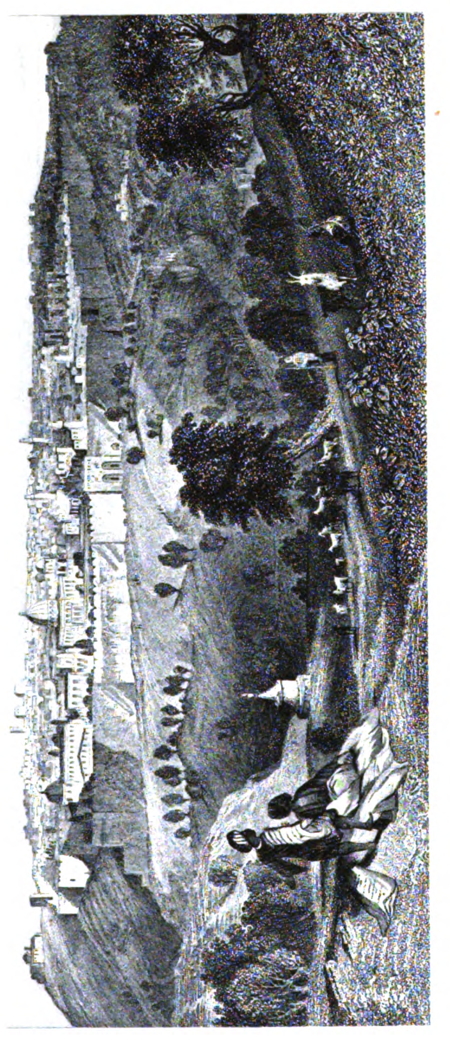
He might expect that the siege of a city so venerable on earth and in heaven, so interesting to Europe and Asia, would rekindle the last sparks of enthusiasm; and that, of sixty thousand Christians, every man would be a soldier, and every soldier a candidate for martyrdom. But Queen Sybilla trembled for herself and her captive husband; and the barons and knights, who had escaped from the sword and the chains of the Turks, displayed the same factious and selfish spirit in the public ruin. The most numerous portion of the inhabitants were composed of the Greek and Oriental Christians, whom experience had taught to prefer the Mahometan before the Latin yoke; [71] and the holy sepulchre attracted a base and needy crowd, without arms or courage, who subsisted only on the charity of the pilgrims. Some feeble and hasty efforts were made for the defence of Jerusalem; but in the space of fourteen days a victorious army drove back the sallies of the besieged, planted their engines, opened the wall to the breadth of fifteen cubits, applied their scaling-ladders, and erected on the breach twelve banners of the prophet and the sultan. It was in vain that a bare-foot procession of the queen, the women, and the monks implored the Son of God to save his tomb and his inheritance from impious violation. Their sole hope was in the mercy of the conqueror, and to their first suppliant deputation that mercy was sternly denied. “He had sworn to avenge the patience [X-302] and long-suffering of the Moslems; the hour of forgiveness was elapsed, and the moment was now arrived to expiate in blood, the innocent blood which had been spilt by Godfrey and the first crusaders.” But a desperate and successful struggle of the Franks admonished the sultan that his triumph was not yet secure; he listened with reverence to a solemn adjuration in the name of the common Father of mankind; and a sentiment of human sympathy mollified the rigour of fanaticism and conquest. He consented to accept the city, and to spare the inhabitants. The Greek and Oriental Christians were permitted to live under his dominion; but it was stipulated, that in forty days all the Franks and Latins should evacuate Jerusalem, and be safely conducted to the sea-ports of Syria and Egypt; that ten pieces of gold should be paid for each man, five for each woman, and one for every child; and that those who were unable to purchase their freedom should be detained in perpetual slavery. Of some writers it is a favourite and invidious theme to compare the humanity of Saladin with the massacre of the first crusade. The difference would be merely personal; but we should not forget that the Christians had offered to capitulate, and that the Mahometans of Jerusalem sustained the last extremities of an assault and storm. Justice is indeed due to the fidelity with which the Turkish conqueror fulfilled the conditions of the treaty; and he may be deservedly praised for the glance of pity which he cast on the misery of the vanquished. Instead of a rigorous exaction of his debt, he accepted a sum of thirty thousand byzants, for the ransom of seven thousand poor; two or three thousand more were dismissed by his gratuitous clemency; and the number of slaves was reduced to eleven or fourteen thousand persons. In his interview with the queen, his words, and even his tears, suggested the kindest consolations; his liberal alms were distributed among those who had been made orphans or widows by the fortune of war; and, while the knights of the hospital were in arms against him, he allowed their more pious brethren to continue, [X-303] during the term of a year, the care and service of the sick. In these acts of mercy, the virtue of Saladin deserves our admiration and love: he was above the necessity of dissimulation; and his stern fanaticism would have prompted him to dissemble, rather than to affect, this profane compassion for the enemies of the Koran. After Jerusalem had been delivered from the presence of the strangers, the sultan made his triumphant entry, his banners waving in the wind, and to the harmony of martial music. The great mosch of Omar, which had been converted into a church, was again consecrated to one God and his prophet Mahomet; the walls and pavement were purified with rose-water; and a pulpit, the labour of Noureddin, was erected in the sanctuary. But, when the golden cross that glittered on the dome was cast down, and dragged through the streets, the Christians of every sect uttered a lamentable groan, which was answered by the joyful shouts of the Moslems. In four ivory chests the patriarch had collected the crosses, the images, the vases, and the relics of the holy place: they were seized by the conqueror, who was desirous of presenting the caliph with the trophies of Christian idolatry. He was persuaded, however, to entrust them to the patriarch and prince of Antioch; and the pious pledge was redeemed by Richard of England, at the expense of fifty-two thousand byzants of gold. [72]
The nations might fear and hope the immediate and final expulsion of the Latins from Syria; which was yet delayed above a century after the death of Saladin. [73] In the career [X-304] of victory, he was first checked by the resistance of Tyre; the troops and garrisons, which had capitulated, were imprudently conducted to the same port: their numbers were adequate to the defence of the place; and the arrival of Conrad of Montferrat inspired the disorderly crowd with confidence and union. His father, a venerable pilgrim, had been made prisoner in the battle of Tiberias; but that disaster was unknown in Italy and Greece, when the son was urged by ambition and piety to visit the inheritance of his royal nephew, the infant Baldwin. The view of the Turkish banners warned him from the hostile coast of Jaffa; [73a] and Conrad was unanimously hailed as the prince and champion of Tyre, which was already besieged by the conqueror of Jerusalem. The firmness of his zeal, and perhaps his knowledge of a generous foe, enabled him to brave the threats of the sultan, and to declare that, should his aged parent be exposed before the walls, he himself would discharge the first arrow, and glory in his descent from a Christian martyr. [74] The Egyptian fleet was allowed to enter the harbour of Tyre; but the chain was suddenly drawn, and five galleys were either sunk or taken; a thousand Turks were slain in a sally; and Saladin, after burning his engines, concluded a glorious campaign by a disgraceful retreat to Damascus. He was soon assailed by a more formidable tempest. The pathetic narratives, and even the pictures, that represented in lively colours the servitude and profanation of Jerusalem, awakened the torpid sensibility of Europe; the emperor, Frederic Barbarossa, and the kings of France and England assumed the cross; and the tardy magnitude of their armaments was anticipated by the maritime states of the Mediterranean and the Ocean. The skilful and provident Italians first embarked in the ships of Genoa, Pisa, and Venice. They were [X-305] speedily followed by the most eager pilgrims of France, Normandy, and the Western Isles. The powerful succour of Flanders, Frise, and Denmark filled near an hundred vessels; and the Northern warriors were distinguished in the field by a lofty stature and a ponderous battle-axe. [75] Their increasing multitudes could no longer be confined within the walls of Tyre, or remain obedient to the voice of Conrad. They pitied the misfortunes, and revered the dignity, of Lusignan, who was released from prison, perhaps to divide the army of the Franks. He proposed the recovery of Ptolemais, or Acre, thirty miles to the south of Tyre: and the place was first invested by two thousand horse and thirty thousand foot under his nominal command. I shall not expatiate on the story of this memorable siege, which lasted near two years, and consumed, in a narrow space, the forces of Europe and Asia. Never did the flame of enthusiasm burn with fiercer and more destructive rage; nor could the true believers, a common appellation, who consecrated their own martyrs, refuse some applause to the mistaken zeal and courage of their adversaries. At the sound of the holy trumpet, the Moslems of Egypt, Syria, Arabia, and the Oriental provinces assembled under the servant of the prophet: [76] his camp was pitched and removed within a few miles of Acre; and he laboured, night and day, for the relief of his brethren and the annoyance of the Franks. Nine battles, not unworthy of the name, were fought in the neighbourhood of Mount Carmel, with such vicissitude of fortune that in one attack the sultan forced his way into the city; [76a] that in one sally the Christians penetrated to the royal tent. By the [X-306] means of divers and pigeons a regular correspondence was maintained with the besieged; and, as often as the sea was left open, the exhausted garrison was withdrawn, and a fresh supply was poured into the place. The Latin camp was thinned by famine, the sword, and the climate; but the tents of the dead were replenished with new pilgrims, who exaggerated the strength and speed of their approaching countrymen. The vulgar was astonished by the report that the pope himself, with an innumerable crusade, was advanced as far as Constantinople. The march of the emperor filled the East with more serious alarms; the obstacles which he encountered in Asia, and perhaps in Greece, were raised by the policy of Saladin; his joy on the death of Barbarossa was measured by his esteem; and the Christians were rather dismayed than encouraged at the sight of the duke of Swabia and his wayworn remnant of five thousand Germans. At length, in the spring of the second year, the royal fleets of France and England cast anchor in the bay of Acre, and the siege was more vigorously prosecuted by the youthful emulation of the two kings, Philip Augustus and Richard Plantagenet. After every resource had been tried, and every hope was exhausted, the defenders of Acre submitted to their fate; a capitulation was granted, but their lives and liberties were taxed at the hard conditions of a ransom of two hundred thousand pieces of gold, the deliverance of one hundred nobles and fifteen hundred inferior captives, and the restoration of the wood of the holy cross. Some doubts in the agreement, and some delay in the execution, rekindled the fury of the Franks, and three thousand Moslems, almost in the sultan’s view, were beheaded by the command of the sanguinary Richard. [77] By the conquest of Acre the Latin powers [X-307] acquired a strong town and a convenient harbour; but the advantage was most dearly purchased. The minister and historian of Saladin computes, from the report of the enemy, that their numbers, at different periods, amounted to five or six hundred thousand; that more than one hundred thousand Christians were slain; that a far greater number was lost by disease or shipwreck; and that a small portion of this mighty host could return in safety to their native countries. [78]
Philip Augustus and Richard the First are the only kings of France and England who have fought under the same banners; but the holy service in which they were enlisted was incessantly disturbed by their national jealousy; and the two factions which they protected in Palestine were more averse to each other than to the common enemy. In the eyes of the Orientals the French monarch was superior in dignity and power; and, in the emperor’s absence, the Latins revered him as their temporal chief. [79] His exploits were not adequate to his fame. Philip was brave, but the statesman predominated in his character; he was soon weary of sacrificing his health and interest on a barren coast; the surrender of Acre became the signal of his departure: nor could he justify this unpopular desertion by leaving the duke of Burgundy, with five hundred knights and ten thousand foot, for the service of the Holy Land. The king of England, though inferior in dignity, surpassed his rival in wealth and military renown; [80] and, if heroism be confined to brutal [X-308] and ferocious valour, Richard Plantagenet will stand high among the heroes of the age. The memory of Cæur de Lion, of the lion-hearted prince, was long dear and glorious to his English subjects; and, at the distance of sixty years, it was celebrated in proverbial sayings by the grandsons of the Turks and Saracens against whom he had fought: his tremendous name was employed by the Syrian mothers to silence their infants; and, if an horse suddenly started from the way, his rider was wont to exclaim, “Dost thou think King Richard is in that bush?” [81] His cruelty to the Mahometans was the effect of temper and zeal; but I cannot believe that a soldier, so free and fearless in the use of his lance, would have descended to whet a dagger against his valiant brother, Conrad of Montferrat, who was slain at Tyre by some secret assassins. [82] After the surrender of Acre and the departure of Philip, the king of England led the crusaders to the recovery of the sea-coast; and the cities of Cæsarea and Jaffa were added to the fragments of the kingdom of Lusignan. A march of one hundred miles from Acre at Ascalon was a great and perpetual battle of eleven days. [83] In the disorder of his troops, Saladin remained on the field with seventeen guards, without lowering his standard or suspending the sound of [X-309] his brazen kettle-drum: he again rallied and renewed the charge; and his preachers or heralds called aloud on the Unitarians manfully to stand up against the Christian idolaters. But the progress of these idolaters was irresistible; and it was only by demolishing the walls and buildings of Ascalon that the sultan could prevent them from occupying an important fortress on the confines of Egypt. During a severe winter the armies slept; but in the spring the Franks advanced within a day’s march of Jerusalem, under the leading standard of the English king; and his active spirit intercepted a convoy, or caravan, of seven thousand camels. Saladin [84] had fixed his station in the holy city; but the city was struck with consternation and discord: he fasted; he prayed; he preached; he offered to share the dangers of the siege; but his Mamalukes, who remembered the fate of their companions at Acre, pressed the sultan with loyal or seditious clamours to preserve his person and their courage for the future defence of the religion and empire. [85] The Moslems were delivered by the sudden or, as they deemed, the miraculous retreat of the Christians; [86] and the laurels of Richard were blasted by the prudence or envy of his companions. The hero, ascending an hill, and veiling his face, exclaimed with an indignant voice, “Those who are unwilling to rescue, are unworthy to view, the sepulchre of Christ!” After his return to Acre, on the news that Jaffa was surprised [X-310] by the sultan, he sailed with some merchant vessels, and leaped foremost on the beach; the castle was relieved by his presence; and sixty thousand Turks and Saracens fled before his arms. The discovery of his weakness provoked them to return in the morning; [86a] and they found him carelessly encamped before the gates with only seventeen knights and three hundred archers. Without counting their numbers, he sustained their charge; and we learn from the evidence of his enemies, that the king of England, grasping his lance, rode furiously along their front, from the right to the left wing, without meeting an adversary who dared to encounter his career. [87] Am I writing the history of Orlando or Amadis?
During these hostilities a languid and tedious negotiation [88] between the Franks and the Moslems was started, and continued, and broken, and again resumed, and again broken. Some acts of royal courtesy, the gift of snow and fruit, the exchange of Norway hawks and Arabian horses, softened the asperity of religious war: from the vicissitude of success the monarchs might learn to suspect that Heaven was neutral in the quarrel; nor, after the trial of each other, could either hope for a decisive victory. [89] The health both of Richard [X-311] and Saladin appeared to be in a declining state; and they respectively suffered the evils of distant and domestic warfare: Plantagenet was impatient to punish a perfidious rival who had invaded Normandy in his absence; and the indefatigable sultan was subdued by the cries of the people, who was the victim, and of the soldiers, who were the instruments, of his martial zeal. The first demands of the king of England were the restitution of Jerusalem, Palestine, and the true cross; and he firmly declared, that himself and his brother-pilgrims would end their lives in the pious labour, rather than return to Europe with ignominy and remorse. But the conscience of Saladin refused, without some weighty compensation, to restore the idols, or promote the idolatry, of the Christians: he asserted, with equal firmness, his religious and civil claim to the sovereignty of Palestine; descanted on the importance and sanctity of Jerusalem; and rejected all terms of the establishment, or partition, of the Latins. The marriage which Richard proposed, of his sister with the sultan’s brother, was defeated by the difference of faith; the princess abhorred the embraces of a Turk; and Adel, or Saphadin, would not easily renounce a plurality of wives. A personal interview was declined by Saladin, who alleged their mutual ignorance of each other’s language; [89a] and the negotiation was managed with much art and delay by their interpreters and envoys. The final agreement was equally disapproved by the zealots [X-312] of both parties, by the Roman pontiff, and the caliph of Bagdad. It was stipulated that Jerusalem and the holy sepulchre should be open, without tribute or vexation, to the pilgrimage of the Latin Christians; that after the demolition of Ascalon, they should inclusively possess the sea-coast from Jaffa to Tyre; that the count of Tripoli and the prince of Antioch should be comprised in the truce; and that, during three years and three months, all hostilities should cease. The principal chiefs of the two armies swore to the observance of the treaty; but the monarchs were satisfied with giving their word and their right hand; and the royal Majesty was excused from an oath, which always implies some suspicion of falsehood and dishonour. Richard embarked for Europe, to seek a long captivity and a premature grave; and the space of a few months concluded the life and glories of Saladin. The Orientals describe his edifying death, which happened at Damascus; but they seem ignorant of the equal distribution of his alms among the three religions, [90] or of the display of a shroud, instead of a standard, to admonish the East of the instability of human greatness. The unity of empire was dissolved by his death; his sons were oppressed by the stronger arm of their uncle Saphadin; the hostile interests of the sultans of Egypt, Damascus, and Aleppo [91] were again revived; and the Franks or Latins stood, and breathed, and hoped, in their fortresses along the Syrian coast.
The noblest monument of a conqueror’s fame, and of the terror which he inspired, is the Saladine tenth, a general tax, which was imposed on the laity, and even the clergy, of the Latin church, for the service of the holy war. The practice was too lucrative to expire with the occasion; and this tribute became the foundation of all the tithes and tenths [X-313] on ecclesiastical benefices which have been granted by the Roman pontiffs to Catholic sovereigns, or reserved for the immediate use of the apostolic see. [92] This pecuniary emolument must have tended to increase the interest of the popes in the recovery of Palestine; after the death of Saladin they preached the crusade by their epistles, their legates, and their missionaries; and the accomplishment of the pious work might have been expected from the zeal and talents of Innocent the Third. [93] Under that young and ambitious priest the successors of St. Peter attained the full meridian of their greatness; and in a reign of eighteen years he exercised a despotic command over the emperors and kings, whom he raised and deposed; over the nations, whom an interdict of months or years deprived, for the offence of their rulers, of the exercise of Christian worship. In the council of the Lateran he acted as the ecclesiastical, almost as the temporal, sovereign of the East and West. It was at the feet of his legate that John of England surrendered his crown; and Innocent may boast of the two most signal triumphs over sense and humanity, the establishment of transubstantiation and the origin of the inquisition. At his voice, two crusades, the fourth and the fifth, were undertaken; but, except a king of Hungary, the princes of the second order were at the head of the pilgrims; the forces were inadequate to the design; nor did the effects correspond with the hopes and wishes of the pope and the people. The fourth crusade was diverted from Syria to Constantinople; and the conquest of the Greek or Roman empire by the Latins will form the proper and important subject of the next chapter. In the fifth, [94] two hundred [X-314] thousand Franks were landed at the eastern mouth of the Nile. They reasonably hoped that Palestine must be subdued in Egypt, the seat and storehouse of the sultan; and, after a siege of sixteen months, the Moslems deplored the loss of Damietta. But the Christian army was ruined by the pride and insolence of the legate Pelagius, who, in the pope’s name, assumed the character of general; the sickly Franks were encompassed by the waters of the Nile and the Oriental forces; and it was by the evacuation of Damietta that they obtained a safe retreat, some concessions for the pilgrims, and the tardy restitution of the doubtful relic of the true cross. The failure may in some measure be ascribed to the abuse and multiplication of the crusades, which were preached at the same time against the pagans of Livonia, the Moors of Spain, the Albigeois of France, and the kings of Sicily of the Imperial family. [95] In these meritorious services the volunteers might acquire at home the same spiritual indulgence and a larger measure of temporal rewards; and even the popes, in their zeal against a domestic enemy, were sometimes tempted to forget the distress of their Syrian brethren. From the last age of the crusades they derived the occasional command of an army and revenue; and some deep reasoners have suspected that the whole enterprise, from the first synod of Placentia, was contrived and executed by the policy of Rome. The suspicion is not founded either in nature or in fact. [X-315] The successors of St. Peter appear to have followed, rather than guided, the impulse of manners and prejudice; without much foresight of the seasons or cultivation of the soil, they gathered the ripe and spontaneous fruits of the superstition of the times. They gathered these fruits without toil or personal danger: in the council of the Lateran, Innocent the Third declared an ambiguous resolution of animating the crusaders by his example; but the pilot of the sacred vessel could not abandon the helm; nor was Palestine ever blessed with the presence of a Roman pontiff. [96]
The persons, the families, and estates of the pilgrims were under the immediate protection of the popes; and these spiritual patrons soon claimed the prerogative of directing their operations, and enforcing, by commands and censures, the accomplishment of their vow. Frederic the Second, [97] the grandson of Barbarossa, was successively the pupil, the enemy, and the victim of the church. At the age of twenty-one years, and in obedience to his guardian Innocent the Third, he assumed the cross; the same promise was repeated at his royal and imperial coronations; and his marriage with the heiress of Jerusalem [98] for ever bound him to defend the kingdom of his son Conrad. But, as Frederic advanced in age and authority, he repented of the rash engagements of his youth; his liberal sense and knowledge taught him to despise the phantoms of superstition and the crowns of Asia; [X-316] he no longer entertained the same reverence for the successors of Innocent; and his ambition was occupied by the restoration of the Italian monarchy from Sicily to the Alps. But the success of this project would have reduced the popes to their primitive simplicity; and, after the delays and excuses of twelve years, they urged the emperor, with entreaties and threats, to fix the time and place of his departure for Palestine. In the harbours of Sicily and Apulia, he prepared a fleet of one hundred galleys, and of one hundred vessels, that were framed to transport and land two thousand five hundred knights, with their horses and attendants; his vassals of Naples and Germany formed a powerful army; and the number of English crusaders was magnified to sixty thousand by the report of fame. But the inevitable or affected slowness of these mighty preparations consumed the strength and provisions of the more indigent pilgrims; the multitude was thinned by sickness and desertion, and the sultry summer of Calabria anticipated the mischiefs of a Syrian campaign. At length the emperor hoisted sail at Brundusium, with a fleet and army of forty thousand men; but he kept the sea no more than three days; and his hasty retreat, which was ascribed by his friends to a grievous indisposition, was accused by his enemies as a voluntary and obstinate disobedience. For suspending his vow was Frederic excommunicated by Gregory the Ninth; for presuming, the next year, to accomplish his vow, he was again excommunicated by the same pope. [99] While he served under the banner of the cross, a crusade was preached against him in Italy; and after his return he was compelled to ask pardon for the injuries which he had suffered. The clergy and military orders of Palestine were previously instructed to renounce his communion and dispute his commands; and in his own kingdom the emperor was forced to consent that the orders of the camp [X-317] should be issued in the name of God and of the Christian republic. Frederic entered Jerusalem in triumph; and with his own hands (for no priest would perform the office) he took the crown from the altar of the holy sepulchre. But the patriarch cast an interdict on the church which his presence had profaned; and the knights of the hospital and temple informed the sultan [100] how easily he might be surprised and slain in his unguarded visit to the river Jordan. In such a state of fanaticism and faction, victory was hopeless and defence was difficult; but the conclusion of an advantageous peace may be imputed to the discord of the Mahometans, and their personal esteem for the character of Frederic. The enemy of the church is accused of maintaining with the miscreants an intercourse of hospitality and friendship, unworthy of a Christian; of despising the barrenness of the land; and of indulging a profane thought that, if Jehovah had seen the kingdom of Naples, he never would have selected Palestine for the inheritance of his chosen people. Yet Frederic obtained from the sultan the restitution of Jerusalem, of Bethlem and Nazareth, of Tyre and Sidon; the Latins were allowed to inhabit and fortify the city; an equal code of civil and religious freedom was ratified for the sectaries of Jesus, and those of Mahomet; and, while the former worshipped at the holy sepulchre, the latter might pray and preach in the mosch of the temple, [101] from whence the prophet undertook his nocturnal journey to heaven. The clergy deplored this scandalous toleration; and the weaker Moslems were gradually expelled; but every rational object of the crusades was accomplished without bloodshed; the churches were restored, the monasteries were replenished; and, in the space of fifteen years, the Latins of Jerusalem exceeded the number of six thousand. This peace and [X-318] prosperity, for which they were ungrateful to their benefactor, was terminated by the irruption of the strange and savage hordes of Carizmians. [102] Flying from the arms of the Moguls, those shepherds of the Caspian rolled headlong on Syria; [103] and the union of the Franks with the sultans of Aleppo, Hems, and Damascus was insufficient to stem the violence of the torrent. Whatever stood against them was cut off by the sword or dragged into captivity; the military orders were almost exterminated in a single battle; and in the pillage of the city, in the profanation of the holy sepulchre, the Latins confess and regret the modesty and discipline of the Turks and Saracens.
Of the seven crusades, the two last were undertaken by Louis the Ninth, king of France, who lost his liberty in Egypt, and his life on the coast of Africa. Twenty-eight years after his death, he was canonised at Rome; and sixty-five miracles were readily found, and solemnly attested, to justify the claim of the royal saint. [104] The voice of history renders a more honourable testimony, that he united the virtues of a king, an hero, and a man; that his martial spirit was tempered by the love of private and public justice; and that Louis was the father of his people, the friend of his neighbours, and the terror of the infidels. Superstition alone, in all the extent of her baleful influence, [105] corrupted his understanding and his heart; his devotion stooped to admire and imitate the begging friars of Francis and Dominic; he pursued with [X-319] blind and cruel zeal the enemies of the faith; and the best of kings twice descended from his throne to seek the adventures of a spiritual knight-errant. A monkish historian would have been content to applaud the most despicable part of his character; but the noble and gallant Joinville, [106] who shared the friendship and captivity of Louis, has traced with the pencil of nature the free portrait of his virtues, as well as of his failings. From this intimate knowledge we may learn to suspect the political views of depressing their great vassals, which are so often imputed to the royal authors of the crusades. Above all the princes of the middle age, Louis the Ninth successfully laboured to restore the prerogatives of the crown; but it was at home, and not in the East, that he acquired for himself and his posterity; his vow was the result of enthusiasm and sickness; and, if he were the promoter, he was likewise the victim, of this holy madness. For the invasion of Egypt, France was exhausted of her troops and treasures; he covered the sea of Cyprus with eighteen hundred sails; the most modest enumeration amounts to fifty thousand men; and, if we might trust his own confession, as it is reported by Oriental vanity, he disembarked nine thousand five hundred horse, and one hundred and thirty thousand foot, who performed their pilgrimage under the shadow of his power. [107]
In complete armour, the oriflamme waving before him, Louis leaped foremost on the beach; and the strong city of [X-320] Damietta, which had cost his predecessors a siege of sixteen months, was abandoned on the first assault by the trembling Moslems. But Damietta was the first and last of his conquests; and in the fifth and sixth crusades the same causes, almost on the same ground, were productive of similar calamities. [108] After a ruinous delay, which introduced into the camp the seeds of an epidemical disease, the Franks advanced from the sea-coast towards the capital of Egypt, and strove to surmount the unseasonable inundation of the Nile, which opposed their progress. Under the eye of their intrepid monarch, the barons and knights of France displayed their invincible contempt of danger and discipline: his brother, the count of Artois, stormed with inconsiderate valour the town of Massoura; and the carrier-pigeons announced to the inhabitants of Cairo, that all was lost. But a soldier, who afterwards usurped the sceptre, rallied the flying troops; the main body of the Christians was far behind their vanguard; and Artois was overpowered and slain. A shower of Greek fire was incessantly poured on the invaders; the Nile was commanded by the Egyptian galleys, the open country by the Arabs; all provisions were intercepted; each day aggravated the sickness and famine; and about the same time a retreat was found to be necessary and impracticable. The Oriental writers confess that Louis might have escaped, if he would have deserted his subjects: he was made prisoner, with the greatest part of his nobles; all who could not redeem their lives by service or ransom were inhumanly massacred; and the walls of Cairo were decorated [X-321] with a circle of Christian heads. [109] The king of France was loaded with chains; but the generous victor, a great grandson of the brother of Saladin, sent a robe of honour to his royal captive; and his deliverance, with that of his soldiers, was obtained by the restitution of Damietta [110] and the payment of four hundred thousand pieces of gold. In a soft and luxurious climate, the degenerate children of the companions of Noureddin and Saladin were incapable of resisting the flower of European chivalry; they triumphed by the arms of their slaves or Mamalukes, the hardy natives of Tartary, who at a tender age had been purchased of the Syrian merchants, and were educated in the camp and palace of the sultan. But Egypt soon afforded a new example of the danger of Prætorian bands; and the rage of these ferocious animals, who had been let loose on the strangers, was provoked to devour their benefactor. In the pride of conquest, Touran Shah, [111] the last of his race, was murdered by his Mamalukes; and the most daring of the assassins entered the chamber of the captive king, with drawn scymetars, and their hands imbrued in the blood of their sultan. The firmness of Louis commanded their respect; [112] their avarice prevailed over [X-322] cruelty and zeal; the treaty was accomplished; and the king of France, with the relics of his army, was permitted to embark for Palestine. He wasted four years within the walls of Acre, unable to visit Jerusalem, and unwilling to return without glory to his native country.
The memory of his defeat excited Louis, after sixteen years of wisdom and repose, to undertake the seventh and last of the crusades. His finances were restored, his kingdom was enlarged; a new generation of warriors had arisen, and he embarked with fresh confidence at the head of six thousand horse and thirty thousand foot. The loss of Antioch had provoked the enterprise; a wild hope of baptising the king of Tunis tempted him to steer for the African coast; and the report of an immense treasure reconciled his troops to the delay of their voyage to the Holy Land. Instead of a proselyte he found a siege; the French panted and died on the burning sands; St. Louis expired in his tent; and no sooner had he closed his eyes than his son and successor gave the signal of the retreat. [113] “It is thus,” says a lively writer, “that a Christian king died near the ruins of Carthage, waging war against the sectaries of Mahomet, in a land to which Dido had introduced the deities of Syria.” [114]
A more unjust and absurd constitution cannot be devised than that which condemns the natives of a country to perpetual [X-323] servitude, under the arbitrary dominion of strangers and slaves. Yet such has been the state of Egypt above five hundred years. The most illustrious sultans of the Baharite and Borgite dynasties [115] were themselves promoted from the Tartar and Circassian bands; and the four-and-twenty beys, or military chiefs, have ever been succeeded not by their sons but by their servants. They produce the great charter of their liberties, the treaty of Selim the First with the republic; [116] and the Othman emperor still accepts from Egypt a slight acknowledgment of tribute and subjection. [117] With some breathing intervals of peace and order, the two dynasties are marked as a period of rapine and bloodshed; [118] but their throne, however shaken, reposed on the two pillars of discipline and valour; their sway extended over Egypt, Nubia, Arabia, and Syria; their Mamalukes were multiplied from eight hundred to twenty-five thousand horse; and their numbers were increased by a provincial militia of one hundred and seven thousand foot, and the occasional aid of sixty-six thousand Arabs. [119] Princes of such power and [X-324] spirit could not long endure on their coast an hostile and independent nation; and, if the ruin of the Franks was postponed about forty years, they were indebted to the cares of an unsettled reign, to the invasion of the Moguls, and to the occasional aid of some warlike pilgrims. Among these, the English reader will observe the name of our first Edward, who assumed the cross in the lifetime of his father Henry. At the head of a thousand soldiers, the future conqueror of Wales and Scotland delivered Acre from a siege; marched as far as Nazareth with an army of nine thousand men; emulated the fame of his uncle Richard; extorted, by his valour, a ten years’ truce; and escaped, with a dangerous wound, from the dagger of a fanatic assassin. [120] Antioch, [121] whose situation had been less exposed to the calamities of the holy war, was finally occupied and ruined by Bondocdar, or Bibars, [122] sultan of Egypt and Syria; the Latin principality was extinguished; and the first seat of the Christian name was dispeopled by the slaughter of seventeen, and the captivity of one hundred thousand, of her inhabitants. The maritime towns of Laodicea, Gabala, Tripoli, Berytus, Sidon, Tyre, and Jaffa, and the stronger castles of the Hospitallers and Templars, successively fell; and the whole existence of the Franks was confined to the city and colony of St. John of Acre, which is sometimes described by the more classic title of Ptolemais.
[X-325]
After the loss of Jerusalem, Acre, [123] which is distant about seventy miles, became the metropolis of the Latin Christians, and was adorned with strong and stately buildings, with aqueducts, an artificial port, and a double wall. The population was increased by the incessant streams of pilgrims and fugitives; in the pauses of hostility the trade of the East and West was attracted to this convenient station; and the market could offer the produce of every clime and the interpreters of every tongue. But in this conflux of nations every vice was propagated and practised; of all the disciples of Jesus and Mahomet, the male and female inhabitants of Acre were esteemed the most corrupt; nor could the abuse of religion be corrected by the discipline of law. The city had many sovereigns, and no government. The kings of Jerusalem and Cyprus, of the house of Lusignan, the princes of Antioch, the counts of Tripoli and Sidon, the great masters of the Hospital, the Temple, and the Teutonic order, the republics of Venice, Genoa, and Pisa, the pope’s legate, the kings of France and England, assumed an independent command; seventeen tribunals exercised the power of life and death; every criminal was protected in the adjacent quarter; and the perpetual jealousy of the nations often burst forth in acts of violence and blood. Some adventurers, who disgraced the ensign of the cross, compensated their want of pay by the plunder of the Mahometan villages; nineteen Syrian merchants who traded under the public faith, were despoiled and hanged by the Christians; and the denial of satisfaction justified the arms of the sultan Khalil. He marched against Acre, at the head of sixty thousand horse and one hundred and forty thousand foot; his train of artillery (if I may use the word) was numerous and weighty; the separate timbers of a single engine were transported in one hundred waggons; and the [X-326] royal historian, Abulfeda, who served with the troops of Hamah, was himself a spectator of the holy war. Whatever might be the vices of the Franks, their courage was rekindled by enthusiasm and despair; but they were torn by the discord of seventeen chiefs, and overwhelmed on all sides by the power of the sultan. After a siege of thirty-three days, the double wall was forced by the Moslems; the principal tower yielded to their engines; the Mamalukes made a general assault; the city was stormed; and death or slavery was the lot of sixty thousand Christians. The convent, or rather fortress, of the Templars resisted three days longer; but the great master was pierced with an arrow; and, of five hundred knights, only ten were left alive, less happy than the victims of the sword, if they lived to suffer on a scaffold in the unjust and cruel proscription of the whole order. The king of Jerusalem, the patriarch, and the great master of the Hospital effected their retreat to the shore; but the sea was rough, the vessels were insufficient; and great numbers of the fugitives were drowned before they could reach the isle of Cyprus, which might comfort Lusignan for the loss of Palestine. By the command of the sultan, the churches and fortifications of the Latin cities were demolished; a motive of avarice or fear still opened the holy sepulchre to some devout and defenceless pilgrims; and a mournful and solitary silence prevailed along the coast which had so long resounded with the world’s debate. [124]
[X-327]
CHAPTER LX↩
Schism of the Greeks and Latins — State of Constantinople — Revolt of the Bulgarians — Isaac Angelus dethroned by his brother Alexius — Origin of the Fourth Crusade — Alliance of the French and Venetians with the son of Isaac — Their naval expedition to Constantinople — The two Sieges and final Conquest of the City by the Latins
The restoration of the Western empire by Charlemagne was speedily followed by the separation of the Greek and Latin churches. [1] A religious and national animosity still divides the two largest communions of the Christian world; and the schism of Constantinople, by alienating her most useful allies and provoking her most dangerous enemies, has precipitated the decline and fall of the Roman empire in the East.
In the course of the present history the aversion of the Greeks for the Latins has been often visible and conspicuous. It was originally derived from the disdain of servitude, inflamed, after the time of Constantine, by the pride of equality or dominion, and finally exasperated by the preference which their rebellious subjects had given to the alliance of the Franks. In every age the Greeks were proud of their superiority in profane and religious knowledge; they had first received the light of Christianity; they had pronounced the decrees of the seven general councils; they alone possessed the language [X-328] of Scripture and philosophy; nor should the Barbarians, immersed in the darkness of the West, [2] presume to argue on the high and mysterious questions of theological science. These Barbarians despised, in their turn, the restless and subtle levity of the Orientals, the authors of every heresy; and blessed their own simplicity, which was content to hold the tradition of the apostolic church. Yet, in the seventh century, the synods of Spain, and afterwards of France, improved or corrupted the Nicene creed, on the mysterious subject of the third person of the Trinity. [3] In the long controversies of the East, the nature and generation of the Christ had been scrupulously defined; and the well-known relation of Father and Son seemed to convey a faint image to the human mind. The idea of birth was less analogous to the Holy Spirit, who, instead of a divine gift or attribute, was considered by the Catholics as a substance, a person, a God; he was not begotten, but, in the orthodox style, he proceeded. Did he proceed from the Father alone, perhaps by the Son? or from the Father and the Son? The first of these opinions was asserted by the Greeks, the second by the Latins; and the addition to the Nicene creed of the word filioque kindled the flame of discord between the Oriental and the Gallic churches. In the origin of the dispute the Roman pontiffs affected a character of neutrality and moderation; [4] they condemned [X-329] the innovation, but they acquiesced in the sentiment of their Transalpine brethren; they seemed desirous of casting a veil of silence and charity over the superfluous research; and, in the correspondence of Charlemagne and Leo the Third, the pope assumes the liberality of a statesman, and the prince descends to the passions and prejudices of a priest. [5] But the orthodoxy of Rome spontaneously obeyed the impulse of her temporal policy; and the filioque, which Leo wished to erase, was transcribed in the symbol, and chaunted in the liturgy, of the Vatican. The Nicene and Athanasian creeds are held as the Catholic faith, without which none can be saved; and both Papists and Protestants must now sustain and return the anathemas of the Greeks, who deny the procession of the Holy Ghost from the Son, as well as from the Father. Such articles of faith are not susceptible of treaty; but the rules of discipline will vary in remote and independent churches; and the reason, even of divines, might allow that the difference is inevitable and harmless. The craft or superstition of Rome has imposed on her priests and deacons the rigid obligation of celibacy; among the Greeks, it is confined to the bishops; the loss is compensated by dignity or annihilated by age; and the parochial clergy, the papas, enjoy the conjugal society of the wives whom they have married before their entrance into holy orders. A question concerning the Azyms was fiercely debated in the eleventh century, and the essence of the Eucharist was supposed, in the East and West, to depend on the use of leavened or unleavened bread. Shall I mention in a serious history the furious reproaches that were urged against the Latins, who, for a long while, remained on the defensive? They neglected to abstain, according to the apostolical decree, from things strangled [X-330] and from blood; they fasted, a Jewish observance! on the Saturday of each week; during the first week of Lent they permitted the use of milk and cheese; [6] their infirm monks were indulged in the taste of flesh; and animal grease was substituted for the want of vegetable oil; the holy chrism or unction in baptism was reserved to the episcopal order; the bishops, as the bridegrooms of their churches, were decorated with rings; their priests shaved their faces, and baptised by a single immersion. Such were the crimes which provoked the zeal of the patriarchs of Constantinople; and which were justified with equal zeal by the doctors of the Latin church. [7]
Bigotry and national aversion are powerful magnifiers of every object of dispute; but the immediate cause of the schism of the Greeks may be traced in the emulation of the leading prelates, who maintained the supremacy of the old metropolis superior to all, and of the reigning capital inferior to none, in the Christian world. About the middle of the ninth century, Photius, [8] an ambitious layman, the captain of the guards and principal secretary, was promoted by merit and favour to the more desirable office of patriarch of Constantinople. [9] In science, even ecclesiastical science, he surpassed the clergy of the age; [10] and the purity of his morals has never been [X-331] impeached; but his ordination was hasty, his rise was irregular; and Ignatius, his abdicated predecessor, was yet supported by the public compassion and the obstinacy of his adherents. They appealed to the tribunal of Nicholas the First, one of the proudest and most aspiring of the Roman pontiffs, who embraced the welcome opportunity of judging and condemning his rival of the East. Their quarrel was embittered by a conflict of jurisdiction over the king and nation of the Bulgarians; nor was their recent conversion to Christianity of much avail to either prelate, unless he could number the proselytes among the subjects of his power. With the aid of his court, the Greek patriarch was victorious; but in the furious contest he deposed, in his turn, the successor of St. Peter, and involved the Latin church in the reproach of heresy and schism. Photius sacrificed the peace of the world to a short and precarious reign; he fell with his patron, the Cæsar Bardas; and Basil the Macedonian performed an act of justice in the restoration of Ignatius, whose age and dignity had not been sufficiently respected. From his monastery, or prison, Photius solicited the favour of the emperor by pathetic complaints and artful flattery; and the eyes of his rival were scarcely closed when he was again restored to the throne of Constantinople. After the death of Basil, he experienced the vicissitudes of courts and the ingratitude of a royal pupil; the patriarch was again deposed, and in his last solitary hours he might regret the freedom of a secular and studious life. In each revolution, the breath, the nod, of the sovereign had been accepted by a submissive clergy; and a synod of three hundred bishops was always prepared to hail the triumph, or to stigmatise the fall, of the holy or the execrable Photius. [11] By a delusive promise of succour or [X-332] reward, the popes were tempted to countenance these various proceedings, and the synods of Constantinople were ratified by their epistles or legates. But the court and the people, Ignatius and Photius, were equally adverse to their claims; their ministers were insulted or imprisoned; the procession of the Holy Ghost was forgotten; Bulgaria was for ever annexed to the Byzantine throne; and the schism was prolonged by the rigid censure of all the multiplied ordinations of an irregular patriarch. The darkness and corruption of the tenth century suspended the intercourse, without reconciling the minds, of the two nations. But, when the Norman sword restored the churches of Apulia to the jurisdiction of Rome, the departing flock was warned, by a petulant epistle of the Grecian patriarch, to avoid and abhor the errors of the Latins. The rising majesty of Rome could no longer brook the insolence of a rebel; and Michael Cerularius was excommunicated in the heart of Constantinople by the pope’s legates. Shaking the dust from their feet, they deposited on the altar of St. Sophia a direful anathema, [12] which enumerates the seven mortal heresies of the Greeks, and devotes the guilty teachers, and their unhappy sectaries, to the eternal society of the devil and his angels. According to the emergencies of the church and state a friendly correspondence was sometimes resumed; the language of charity and concord was sometimes affected; but the Greeks have never recanted their errors; the popes have never repealed their sentence; and from this thunderbolt we may date the consummation of the schism. It was enlarged by each ambitious step of the Roman pontiffs; the emperors blushed and trembled at the ignominious fate of their royal brethren of Germany; and the people was scandalised by the temporal power and military life of the Latin clergy. [13]
[X-333]
The aversion of the Greeks and Latins [14] was nourished and manifested in the three first expeditions to the Holy Land. Alexius Comnenus contrived the absence at least of the formidable pilgrims; his successors, Manuel and Isaac Angelus, conspired with the Moslems for the ruin of the greatest princes of the Franks; and their crooked and malignant policy was seconded by the active and voluntary obedience of every order of their subjects. Of this hostile temper a large portion may doubtless be ascribed to the difference of language, dress, and manners, which severs and alienates the nations of the globe. The pride, as well as the prudence, of the sovereign was deeply wounded by the intrusion of foreign armies, that claimed a right of traversing his dominions and passing under the walls of his capital; his subjects were insulted and plundered by the rude strangers of the West; and the hatred of the pusillanimous Greeks was sharpened by secret envy of the bold and pious enterprises of the Franks. But these profane causes of national enmity were fortified and inflamed by the venom of religious zeal. Instead of a kind embrace, an hospitable reception from their Christian brethren of the East, every tongue was taught to repeat the names of schismatic and heretic, more odious to an orthodox ear than those of pagan and infidel; instead of being loved for the general conformity of faith and worship, they were abhorred for some rules of discipline, some questions of theology, in which themselves or their teachers might differ from the Oriental church. In the crusade of Louis the Seventh, the Greek clergy washed and purified the altars which had been defiled by the sacrifice of a French priest. The companions of Frederic Barbarossa [X-334] deplore the injuries which they endured, both in word and deed, from the peculiar rancour of the bishops and monks. Their prayers and sermons excited the people against the impious Barbarians; and the patriarch is accused of declaring that the faithful might obtain the redemption of all their sins by the extirpation of the schismatics. [15] An enthusiast, named Dorotheus, alarmed the fears, and restored the confidence, of the emperor, by a prophetic assurance that the German heretic, after assaulting the gate of Blachernes, would be made a signal example of the divine vengeance. The passage of these mighty armies were rare and perilous events; but the crusades introduced a frequent and familiar intercourse between the two nations, which enlarged their knowledge without abating their prejudices. The wealth and luxury of Constantinople demanded the productions of every climate; these imports were balanced by the art and labour of her numerous inhabitants; her situation invites the commerce of the world; and, in every period of her existence, that commerce has been in the hands of foreigners. After the decline of Amalphi, the Venetians, Pisans, and Genoese introduced their factories and settlements into the capital of the empire; their services were rewarded with honours and immunities; they acquired the possession of lands and houses; their families were multiplied by marriages with the natives; and, after the toleration of a Mahometan mosch, it was impossible to interdict the churches [X-335] of the Roman rite. [16] The two wives of Manuel Comnenus [17] were of the race of the Franks: the first, a sister-in-law of the Emperor Conrad; the second, a daughter of the prince of Antioch; he obtained for his son Alexius, a daughter of Philip Augustus, king of France; and he bestowed his own daughter on a marquis of Montferrat, who was educated and dignified in the palace of Constantinople. The Greek encountered the arms, and aspired to the empire, of the West; [18] he esteemed the valour, and trusted the fidelity, of the Franks; their military talents were unfitly recompensed by the lucrative offices of judges and treasurers; the policy of Manuel had solicited the alliance of the pope; and the popular voice accused him of a partial bias to the nation and religion of the Latins. [19] During his reign, and that of his successor Alexius, they were exposed at Constantinople to the reproach of foreigners, heretics, and favourites; and this triple guilt was severely expiated in the tumult which announced the return and elevation of Andronicus. [20] The people rose in arms; from the Asiatic shore the tyrant despatched his troops and galleys to assist the national revenge; and the hopeless resistance of the strangers served only to justify the rage, [X-336] and sharpen the daggers, of the assassins. Neither age nor sex nor the ties of friendship or kindred could save the victims of national hatred and avarice and religious zeal; the Latins were slaughtered in their houses and in the streets; their quarter was reduced to ashes; the clergy were burnt in their churches, and the sick in their hospitals; and some estimate may be formed of the slain from the clemency which sold above four thousand Christians in perpetual slavery to the Turks. The priests and monks were the loudest and most active in the destruction of the schismatics; and they chaunted a thanksgiving to the Lord, when the head of a Roman cardinal, the pope’s legate, was severed from his body, fastened to the tail of a dog, and dragged with savage mockery through the city. The more diligent of the strangers had retreated, on the first alarm, to their vessels, and escaped through the Hellespont from the scene of blood. In their flight they burned and ravaged two hundred miles of the sea-coast; inflicted a severe revenge on the guiltless subjects of the empire; marked the priests and monks as their peculiar enemies; and compensated, by the accumulation of plunder, the loss of their property and friends. On their return, they exposed to Italy and Europe the wealth and weakness, the perfidy and malice, of the Greeks, whose vices were painted as the genuine characters of heresy and schism. The scruples of the first crusaders had neglected the fairest opportunities of securing, by the possession of Constantinople, the way to the Holy Land; a domestic revolution invited and almost compelled the French and Venetians to achieve the conquest of the Roman empire of the East.
In the series of the Byzantine princes, I have exhibited the hypocrisy and ambition, the tyranny and fall, of Andronicus, the last male of the Comnenian family who reigned at Constantinople. The revolution, which cast him headlong from the throne, saved and exalted Isaac Angelus, [21] who descended [X-337] by the females from the same Imperial dynasty. The successor of a second Nero might have found it an easy task to deserve the esteem and affection of his subjects; they sometimes had reason to regret the administration of Andronicus. The sound and vigorous mind of the tyrant was capable of discerning the connection between his own and the public interest; and, while he was feared by all who could inspire him with fear, the unsuspected people and the remote provinces might bless the inexorable justice of their master. But his successor was vain and jealous of the supreme power, which he wanted courage and abilities to exercise; his vices were pernicious, his virtues (if he possessed any virtues) were useless, to mankind; and the Greeks, who imputed their calamities to his negligence, denied him the merit of any transient or accidental benefits of the times. Isaac slept on the throne, and was awakened only by the sound of pleasure; his vacant hours were amused by comedians and buffoons, and even to these buffoons the emperor was an object of contempt; his feasts and buildings exceeded the examples of royal luxury; the number of his eunuchs and domestics amounted to twenty thousand; and a daily sum of four thousand pounds of silver would swell to four millions sterling the annual expense of his household and table. His poverty was relieved by oppression; and the public discontent was inflamed by equal abuses in the collection and the application of the revenue. While the Greeks numbered the days of their servitude, a flattering prophet, whom he rewarded with the dignity of patriarch, assured him of a long and victorious reign of thirty-two years; during which he should extend his sway to Mount Libanus, and his conquests beyond the Euphrates. But his only step towards the accomplishment of the prediction was a splendid and scandalous embassy to [X-338] Saladin, [22] to demand the restitution of the holy sepulchre, and to propose an offensive and defensive league with the enemy of the Christian name. In these unworthy hands, of Isaac and his brother, the remains of the Greek empire crumbled into dust. The island of Cyprus, whose name excites the ideas of elegance and pleasure, was usurped by his namesake, a Comnenian prince; and, by a strange concatenation of events, the sword of our English Richard bestowed that kingdom on the house of Lusignan, a rich compensation for the loss of Jerusalem. [23]
The honour of the monarchy and the safety of the capital were deeply wounded by the revolt of the Bulgarians and Wallachians. Since the victory of the second Basil, they had supported, above an hundred and seventy years, the loose dominion of the Byzantine princes; but no effectual measures had been adopted to impose the yoke of laws and manners on these savage tribes. [24] By the command of Isaac, their sole means of subsistence, their flocks and herds, were driven away, to contribute towards the pomp of the royal nuptials; and their fierce warriors were exasperated by the denial of equal rank and pay in the military service. Peter and Asan, two powerful chiefs, of the race of the ancient kings, [25] asserted their own rights and the national freedom; [X-339] their demoniac impostors proclaimed to the crowd that their glorious patron, St. Demetrius, had for ever deserted the cause of the Greeks; and the conflagration spread from the banks of the Danube to the hills of Macedonia and Thrace. After some faint efforts, Isaac Angelus and his brother acquiesced in their independence; and the Imperial troops were soon discouraged by the bones of their fellow-soldiers, that were scattered along the passes of Mount Hæmus. By the arms and policy of John or Joannices, the second kingdom of Bulgaria was firmly established. The subtle Barbarian sent an embassy to Innocent the Third, to acknowledge himself a genuine son of Rome in descent and religion, [26] and humbly received from the pope the licence of coining money, the royal title, and a Latin archbishop or patriarch. The Vatican exulted in the spiritual conquest of Bulgaria, the first object of the schism; and, if the Greeks could have preserved the prerogatives of the church, they would gladly have resigned the rights of the monarchy.
[X-340]
The Bulgarians were malicious enough to pray for the long life of Isaac Angelus, the surest pledge of their freedom and prosperity. Yet their chiefs could involve in the same indiscriminate contempt the family and nation of the emperor. “In all the Greeks,” said Asan to his troops, “the same climate and character and education will be productive of the same fruits. Behold my lance,” continued the warrior, “and the long streamers that float in the wind. They differ only in colour; they are formed of the same silk, and fashioned by the same workman; nor has the stripe that is stained in purple any superior price or value above its fellows.” [27] Several of these candidates for the purple successively rose and fell under the empire of Isaac: a general who had repelled the fleets of Sicily was driven to revolt and ruin by the ingratitude of the prince; and his luxurious repose was disturbed by secret conspiracies and popular insurrections. The emperor was saved by accident, or the merit of his servants: he was at length oppressed by an ambitious brother, who, for the hope of a precarious diadem, forgot the obligations of nature, of loyalty, and of friendship. [28] While Isaac in the Thracian valleys pursued the idle and solitary pleasures of the chase, his brother, Alexius Angelus, was invested with the purple by the unanimous suffrage of the camp; the capital and the clergy subscribed to their choice; and the vanity of the new sovereign rejected the name of his fathers for the lofty and royal appellation of the Comnenian race. On the despicable character of Isaac I have exhausted the language of contempt; and can only add that in a reign of eight years the baser [X-341] Alexius [29] was supported by the masculine vices of his wife Euphrosyne. The first intelligence of his fall was conveyed to the late emperor by the hostile aspect and pursuit of the guards, no longer his own; he fled before them above fifty miles, as far as Stagyra in Macedonia; but the fugitive, without an object or a follower, was arrested, brought back to Constantinople, deprived of his eyes, and confined in a lonesome tower, on a scanty allowance of bread and water. At the moment of the revolution, his son Alexius, whom he educated in the hope of empire, was twelve years of age. [30] He was spared by the usurper, and reduced to attend his triumph both in peace and war; but, as the army was encamped on the sea-shore, an Italian vessel facilitated the escape of the royal youth; and, in the disguise of a common sailor, he eluded the search of his enemies, passed the Hellespont, and found a secure refuge in the isle of Sicily. After saluting the threshold of the apostles, and imploring the protection of Pope Innocent the Third, Alexius accepted the kind invitation of his sister Irene, the wife of Philip of Swabia, king of the Romans. But in his passage through Italy he heard that the flower of Western chivalry was assembled at Venice for the deliverance of the Holy Land; and a ray of hope was kindled in his bosom, that their invincible swords might be employed in his father’s restoration.
About ten or twelve years after the loss of Jerusalem, the nobles of France were again summoned to the holy war by the voice of a third prophet, less extravagant, perhaps, than Peter the hermit, but far below St. Bernard in the merit of an orator and a statesman. An illiterate priest of the neighbourhood of Paris, Fulk of Neuilly, [31] forsook his parochial duty, to assume [X-342] the more flattering character of a popular and itinerant missionary. The fame of his sanctity and miracles was spread over the land; he declaimed with severity and vehemence against the vices of the age; and his sermons, which he preached in the streets of Paris, converted the robbers, the usurpers, the prostitutes, and even the doctors and scholars of the university. No sooner did Innocent the Third ascend the chair of St. Peter than he proclaimed, in Italy, Germany, and France, the obligation of a new crusade. [32] The eloquent pontiff described the ruin of Jerusalem, the triumph of the Pagans, and the shame of Christendom; his liberality proposed the redemption of sins, a plenary indulgence to all who should serve in Palestine, either a year in person or two years by a substitute; [33] and, among his legates and orators who blew the sacred trumpet, Fulk of Neuilly was the loudest and most successful. The situation of the principal monarchs was averse to the pious summons. The emperor Frederic the Second was a child; and his kingdom of Germany was disputed by the rival houses of Brunswick and Swabia, the memorable factions of the Guelphs and Ghibelines. Philip Augustus of France had performed, and could not be persuaded to renew, the perilous vow; but, as he was not less ambitious of praise than of power, he cheerfully instituted a perpetual fund for the defence of the Holy Land. Richard of England was satiated with the glory and misfortunes of his first adventure, and he presumed to deride the exhortations of Fulk of Neuilly, who was not abashed in the presence of kings. “You advise [X-343] me,” said Plantagenet, “to dismiss my three daughters, pride, avarice, and incontinence: I bequeath them to the most deserving; my pride to the knights-templars, my avarice to the monks of Cisteaux, and my incontinence to the prelates.” But the preacher was heard and obeyed by the great vassals, the princes of the second order; and Theobald, or Thibaut, count of Champagne, was the foremost in the holy race. The valiant youth, at the age of twenty-two years, was encouraged by the domestic examples of his father, who marched in the second crusade, and of his elder brother, who had ended his days in Palestine with the title of King of Jerusalem: two thousand two hundred knights owed service and homage to his peerage; [34] the nobles of Champagne excelled in all the exercises of war; [35] and, by his marriage with the heiress of Navarre, Thibaut could draw a band of hardy Gascons from either side of the Pyrenæan mountains. His companion in arms was Louis, count of Blois and Chartres; like himself of regal lineage, for both the princes were nephews, at the same time, of the kings of France and England. In a crowd of prelates and barons, who imitated their zeal, I distinguish the birth and merit of Matthew of Montmorency; the famous Simon of Montfort, the scourge of the Albigeois; and a valiant noble, Jeffrey of Villehardouin, [36] marshal of Champagne, [37] [X-344] who has condescended, in the rude idiom of his age and country, [38] to write or dictate [39] an original narrative of the councils and actions in which he bore a memorable part. At the same time, Baldwin, count of Flanders, who had married the sister of Thibaut, assumed the cross at Bruges, with his brother Henry and the principal knights and citizens of that rich and industrious province. [40] The vow which the chiefs had pronounced in churches, they ratified in tournaments; the operations of war were debated in full and frequent assemblies; and it was resolved to seek the deliverance of Palestine in Egypt, a country, since Saladin’s death, which was almost ruined by famine and civil war. But the fate of so many royal armies displayed the toils and perils of a land expedition; and, if the Flemings dwelt along the ocean, the French barons were destitute of ships and ignorant of navigation. They embraced the wise resolution of choosing six deputies or representatives, of whom Villehardouin was one, with a discretionary trust to direct the motions, and to pledge the faith, of the whole confederacy. The maritime states of Italy were alone possessed of the means of transporting the holy warriors with their arms and horses; and the six deputies proceeded to Venice, to solicit, on motives of piety or interest, the aid of that powerful republic.
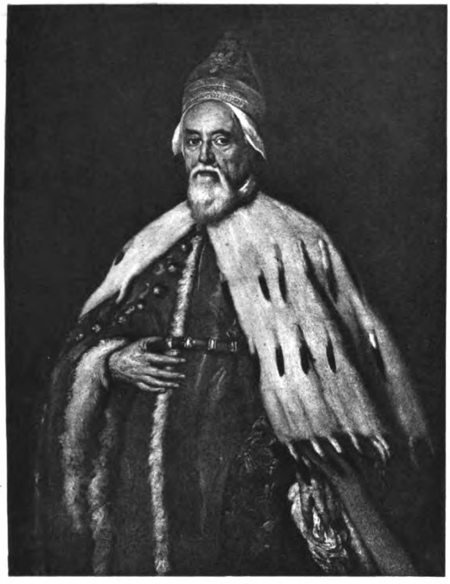
A Doge of Venice, p. 344. From a painting by B. Strozzi.
In the invasion of Italy by Attila, I have mentioned [41] the [X-i] [X-345] flight of the Venetians from the fallen cities of the continent, and their obscure shelter in the chain of islands that line the extremity of the Adriatic gulf. In the midst of the waters, free, indigent, laborious, and inaccessible, they gradually coalesced into a republic; the first foundations of Venice were laid in the island of Rialto; and the annual election of the twelve tribunes was superseded by the permanent office of a duke or doge. On the verge of the two empires, the Venetians exult in the belief of primitive and perpetual independence. [42] Against the Latins, their antique freedom has been asserted by the sword, and may be justified by the pen. Charlemagne himself resigned all claim of sovereignty to the islands of the Adriatic gulf; his son Pepin was repulsed in the attacks of the lagunas, or canals, too deep for the cavalry, and too shallow for the vessels; and in every age, under the German Cæsars, the lands of the republic have been clearly distinguished from the kingdom of Italy. But the inhabitants of Venice were considered by themselves, by strangers, and by their sovereigns as an inalienable portion of the Greek empire; [43] in the [X-346] ninth and tenth centuries, the proofs of their subjection are numerous and unquestionable; and the vain titles, the servile honours, of the Byzantine court, so ambitiously solicited by their dukes, would have degraded the magistrates of a free people. But the bands of this dependence, which was never absolute or rigid, were imperceptibly relaxed by the ambition of Venice and the weakness of Constantinople. Obedience was softened into respect, privilege ripened into prerogative, and the freedom of domestic government was fortified by the independence of foreign dominion. The maritime cities of Istria and Dalmatia bowed to the sovereigns of the Adriatic; and, when they armed against the Normans in the cause of Alexius, the emperor applied, not to the duty of his subjects, but to the gratitude and generosity of his faithful allies. The sea was their patrimony; [44] the western parts of the Mediterranean, from Tuscany to Gibraltar, were indeed abandoned [X-347] to their rivals of Pisa and Genoa; but the Venetians acquired an early and lucrative share of the commerce of Greece and Egypt. Their riches increased with the increasing demand of Europe; their manufactures of silk and glass, perhaps the institution of their bank, are of high antiquity; and they enjoyed the fruits of their industry in the magnificence of public and private life. To assert her flag, to avenge her injuries, to protect the freedom of navigation, the republic could launch and man a fleet of an hundred galleys; and the Greeks, the Saracens, and the Normans were encountered by her naval arms. The Franks of Syria were assisted by the Venetians in the reduction of the sea-coast; but their zeal was neither blind nor disinterested; and, in the conquest of Tyre, they shared the sovereignty of a city, the first seat of the commerce of the world. The policy of Venice was marked by the avarice of a trading, and the insolence of a maritime, power; yet her ambition was prudent; nor did she often forget that, if armed galleys were the effect and safeguard, merchant-vessels were the cause and supply, of her greatness. In her religion she avoided the schism of the Greeks, without yielding a servile obedience to the Roman pontiff; and a free intercourse with the infidels of every clime appears to have allayed betimes the fever of superstition. Her primitive government was a loose mixture of democracy and monarchy; the doge was elected by the votes of the general assembly: as long as he was popular and successful, he reigned with the pomp and authority of a prince; but in the frequent revolutions of the state he was deposed, or banished, or slain, by the justice or injustice of the multitude. The twelfth century produced the first rudiments of the wise and jealous aristocracy, which has reduced the doge to a pageant, and the people to a cypher. [45]
[X-348]
When the six ambassadors of the French pilgrims arrived at Venice, they were hospitably entertained in the palace of St. Mark by the reigning duke: his name was Henry Dandolo; [46] and he shone in the last period of human life as one of the most illustrious characters of the time. Under the weight of years, and after the loss of his eyes, [47] Dandolo retained a sound understanding and a manly courage; the spirit of an hero, ambitious to signalise his reign by some memorable exploits; and the wisdom of a patriot, anxious to build his fame on the glory and advantage of his country. He praised the bold enthusiasm and liberal confidence of the barons and their deputies: in such a cause, and with such associates, he should aspire, were he a private man, to terminate his life; but he was the servant of the republic, and some delay was requisite to consult, on this arduous business, the judgment of his colleagues. The proposal of the French was first debated by the six sages who had been recently appointed to control the administration of the doge; it was next disclosed to the forty members of the council of state; and finally communicated [X-349] to the legislative assembly of four hundred and fifty representatives, who were annually chosen in the six quarters of the city. In peace and war, the doge was still the chief of the republic; his legal authority was supported by the personal reputation of Dandolo; his arguments of public interest were balanced and approved; and he was authorised to inform the ambassadors of the following conditions of the treaty. [48] It was proposed that the crusaders should assemble at Venice, on the feast of St. John of the ensuing year; that flat-bottomed vessels should be prepared for four thousand five hundred horses, and nine thousand squires, with a number of ships sufficient for the embarkation of four thousand five hundred knights and twenty thousand foot; that during a term of nine months they should be supplied with provisions, and transported to whatsoever coast the service of God and Christendom should require; and that the republic should join the armament with a squadron of fifty galleys. It was required that the pilgrims should pay, before their departure, a sum of eighty-five thousand marks of silver; and that all conquests, by sea and land, should be equally divided among the confederates. The terms were hard; but the emergency was pressing, and the French barons were not less profuse of money than of blood. A general assembly was convened to ratify the treaty; the stately chapel and palace of St. Mark were filled with ten thousand citizens; and the noble deputies were taught a new lesson of humbling themselves before the majesty of the people. “Illustrious Venetians,” said the marshal of Champagne, “we are sent by the greatest and most powerful barons of France, to implore the aid of the masters of the sea for the deliverance of Jerusalem. They have enjoined us to fall prostrate at your feet; nor will we rise from [X-350] the ground till you have promised to avenge with us the injuries of Christ.” The eloquence of their words and tears, [49] their martial aspect and suppliant attitude, were applauded by an universal shout; as it were, says Jeffrey, by the sound of an earthquake. The venerable doge ascended the pulpit, to urge their request by those motives of honour and virtue which alone can be offered to a popular assembly; the treaty was transcribed on parchment, attested with oaths and seals, mutually accepted by the weeping and joyful representatives of France and Venice, and despatched to Rome for the approbation of Pope Innocent the Third. [50] Two thousand marks were borrowed of the merchants for the first expenses of the armament. Of the six deputies, two repassed the Alps to announce their success, while their four companions made a fruitless trial of the zeal and emulation of the republics of Genoa and Pisa.
The execution of the treaty was still opposed by unforeseen difficulties and delays. [51] The marshal, on his return to [X-351] Troyes, was embraced and approved by Thibaut, count of Champagne, who had been unanimously chosen general of the confederates. But the health of that valiant youth already declined, and soon became hopeless; and he deplored the untimely fate which condemned him to expire, not in a field of battle, but on a bed of sickness. To his brave and numerous vassals the dying prince distributed his treasures; they swore in his presence to accomplish his vow and their own; but some there were, says the marshal, who accepted his gifts and forfeited their word. The more resolute champions of the cross held a parliament at Soissons for the election of a new general; but such was the incapacity, or jealousy, or reluctance of the princes of France that none could be found both able and willing to assume the conduct of the enterprise. They acquiesced in the choice of a stranger, of Boniface, marquis of Montferrat, descended of a race of heroes, and himself of conspicuous fame in the wars and negotiations of the times; [52] nor could the piety or ambition of the Italian chief decline this honourable invitation. After visiting the French court, where he was received as a friend and kinsman, the marquis, in the church of Soissons, was invested with the cross of a pilgrim and the staff of a general; and immediately repassed the Alps, to prepare for the distant expedition of the East. [53] About the festival of the Pentecost, he displayed his banner, and marched towards Venice at the head of the Italians: he was preceded or followed by the counts of Flanders and Blois, and the most respectable barons of France; and their numbers were swelled by the pilgrims of [X-352] Germany, [54] whose object and motives were similar to their own. The Venetians had fulfilled, and even surpassed, their engagements; stables were constructed for the horses, and barracks for the troops; the magazines were abundantly replenished with forage and provisions; and the fleet of transports, ships, and galleys was ready to hoist sail, as soon as the republic had received the price of the freight and armament. [55] But that price far exceeded the wealth of the crusaders who were assembled at Venice. The Flemings, whose obedience to their court was voluntary and precarious, had embarked in their vessels for the long navigation of the ocean and Mediterranean; and many of the French and Italians had preferred a cheaper and more convenient passage from Marseilles and Apulia to the Holy Land. Each pilgrim might complain that, after he had furnished his own contribution, he was made responsible for the deficiency of his absent brethren: the gold and silver plate of the chiefs, which they freely delivered to the treasury of St. Mark, was a generous but inadequate sacrifice; and, after all their efforts, thirty-four thousand marks were still wanting to complete the stipulated sum. The obstacle was removed by the policy and patriotism of the doge, [56] who proposed to the barons [X-353] that, if they would join their arms in reducing some revolted cities of Dalmatia, he would expose his person in the holy war, and obtain from the republic a long indulgence, till some wealthy conquest should afford the means of satisfying the debt. After much scruple and hesitation, they chose rather to accept the offer than to relinquish the enterprise; and the first hostilities of the fleet and army were directed against Zara, [57] a strong city of the Sclavonian coast, which had renounced its allegiance to Venice and implored the protection of the king of Hungary. [58] The crusaders burst the chain or boom of the harbour; landed their horses, troops, and military engines; and compelled the inhabitants, after a defence of five days, to surrender at discretion; their lives were spared, but the revolt was punished by the pillage of their houses and the demolition of their walls. The season was far advanced; the French and Venetians resolved to pass the winter in a secure harbour and plentiful country; but their repose was disturbed by national and tumultuous quarrels of the soldiers and mariners. The conquest of Zara had scattered the seeds of discord and scandal; the arms of the allies had been stained in their outset with the blood, not of infidels, but of Christians; the king of Hungary and his new subjects were themselves enlisted under the banner of the cross, and the scruples [X-354] of the devout were magnified by the fear or lassitude of the reluctant pilgrims. The pope had excommunicated the false crusaders, who had pillaged and massacred their brethren; [59] and only the marquis Boniface and Simon of Montfort escaped these spiritual thunders; the one by his absence from the siege, the other by his final departure from the camp. Innocent might absolve the simple and submissive penitents of France; but he was provoked by the stubborn reason of the Venetians, who refused to confess their guilt, to accept their pardon, or to allow, in their temporal concerns, the interposition of a priest.
The assembly of such formidable powers by sea and land had revived the hopes of young [60] Alexius; and, both at Venice and Zara, he solicited the arms of the crusaders for his own restoration and his father’s [61] deliverance. The royal youth was recommended by Philip, king of Germany; [62] his prayers and presence excited the compassion of the camp; and his cause was embraced and pleaded by the marquis of Montferrat [63] and the doge of Venice. A double alliance and the [X-355] dignity of Cæsar had connected with the Imperial family the two elder brothers of Boniface; [64] he expected to derive a kingdom from the important service; and the more generous ambition of Dandolo was eager to secure the inestimable benefits of trade and dominion that might accrue to his country. [65] Their influence procured a favourable audience for the ambassadors of Alexius; and, if the magnitude of his offers excited some suspicion, the motives and rewards which he displayed might justify the delay and diversion of those forces which had been consecrated to the deliverance of Jerusalem. He promised, in his own and his father’s name, that, as soon as they should be seated on the throne of Constantinople, they would terminate the long schism of the Greeks, and submit themselves and their people to the lawful supremacy of the Roman church. He engaged to recompense the labours and merits of the crusaders by the immediate payment of two hundred thousand marks of silver; to accompany them in person to Egypt; or, if it should be judged more advantageous, to maintain, during a year, ten thousand men, and, during his life, five hundred knights, for the service of the Holy Land. These tempting conditions were accepted by the republic of Venice; and the eloquence of the doge and marquis persuaded the counts of Flanders, Blois, and St. Pol, with eight barons of France, to join in the glorious enterprise. A treaty of offensive and defensive alliance was confirmed by their oaths [X-356] and seals; and each individual, according to his situation and character, was swayed by the hope of public or private advantage; by the honour of restoring an exiled monarch; or by the sincere and probable opinion that their efforts in Palestine would be fruitless and unavailing, and that the acquisition of Constantinople must precede and prepare the recovery of Jerusalem. But they were the chiefs or equals of a valiant band of freemen and volunteers, who thought and acted for themselves; the soldiers and clergy were divided; and, if a large majority subscribed to the alliance, the numbers and arguments of the dissidents were strong and respectable. [66] The boldest hearts were appalled by the report of the naval power and impregnable strength of Constantinople; and their apprehensions were disguised to the world, and perhaps to themselves, by the more decent objections of religion and duty. They alleged the sanctity of a vow, which had drawn them from their families and homes to rescue the holy sepulchre; nor should the dark and crooked counsels of human policy divert them from a pursuit, the event of which was in the hands of the Almighty. Their first offence, the attack of Zara, had been severely punished by the reproach of their conscience and the censures of the pope; nor would they again imbrue their hands in the blood of their fellow-Christians. The apostle of Rome had pronounced; nor would they usurp the right of avenging with the sword the schism of the Greeks and the doubtful usurpation of the Byzantine monarch. On these principles or pretences, many pilgrims, the most distinguished for their valour and piety, withdrew from the camp; and their retreat was less pernicious than the open or secret opposition of a discontented party, that laboured, on every occasion, to separate the army and disappoint the enterprise.
[X-357]
Notwithstanding this defection, the departure of the fleet and army was vigorously pressed by the Venetians, whose zeal for the service of the royal youth concealed a just resentment to his nation and family. They were mortified by the recent preference which had been given to Pisa, the rival of their trade; they had a long arrear of debt and injury to liquidate with the Byzantine court; and Dandolo might not discourage the popular tale that he had been deprived of his eyes by the emperor Manuel, who perfidiously violated the sanctity of an ambassador. A similar armament, for ages, had not rode the Adriatic; it was composed of one hundred and twenty flat-bottomed vessels or palanders for the horses; two hundred and forty transports filled with men and arms; seventy storeships laden with provisions; and fifty stout galleys, well prepared for the encounter of an enemy. [67] While the wind was favourable, the sky serene, and the water smooth, every eye was fixed with wonder and delight on the scene of military and naval pomp which overspread the sea. The shields of the knights and squires, at once an ornament and a defence, were arranged on either side of the ships; the banners of the nations and families were displayed from the stern; our modern artillery was supplied by three hundred engines for casting stones and darts; the fatigues of the way were cheered with the sound of music; and the spirits of the adventurers were raised by the mutual assurance that forty thousand Christian heroes were equal to the conquest of the world. [68] In the navigation [69] from Venice and Zara, the fleet was successfully [X-358] steered by the skill and experience of the Venetian pilots; at Durazzo the confederates first landed on the territory of the Greek empire; the isle of Corfu afforded a station and repose; [70] they doubled, without accident, the perilous cape of Malea, the southern point of Peloponnesus, or the Morea; made a descent in the islands of Negropont and Andros; and cast anchor at Abydus, on the Asiatic side of the Hellespont. These preludes of conquest were easy and bloodless; the Greeks of the provinces, without patriotism or courage, were crushed by an irresistible force; the presence of the lawful heir might justify their obedience; and it was rewarded by the modesty and discipline of the Latins. As they penetrated through the Hellespont, the magnitude of their navy was compressed in a narrow channel; and the face of the waters was darkened with innumerable sails. They again expanded in the bason of the Propontis, and traversed that placid sea, till they approached the European shore, at the abbey of St. Stephen, three leagues to the west of Constantinople. The prudent doge dissuaded them from dispersing themselves in a populous and hostile land; and, as their stock of provisions was reduced, it was resolved, in the season of harvest, to replenish their store-ships in the fertile islands of the Propontis. With this resolution they directed their course; but a strong gale and their own impatience drove them to the eastward; and so near did they run to the shore [X-359] and city that some volleys of stones and darts were exchanged between the ships and the rampart. As they passed along, they gazed with admiration on the capital of the East, or, as it should seem, of the earth, rising from her seven hills, and towering over the continents of Europe and Asia. The swelling domes and lofty spires of five hundred palaces and churches were gilded by the sun and reflected in the waters; the walls were crowded with soldiers and spectators, whose numbers they beheld, of whose temper they were ignorant; and each heart was chilled by the reflection that, since the beginning of the world, such an enterprise had never been undertaken by such an handful of warriors. But the momentary apprehension was dispelled by hope and valour; and every man, says the marshal of Champagne, glanced his eye on the sword or lance which he must speedily use in the glorious conflict. [71] The Latins cast anchor before Chalcedon; the mariners only were left in the vessels; the soldiers, horses, and arms were safely landed; and, in the luxury of an Imperial palace, the barons tasted the first-fruits of their success. On the third day, the fleet and army moved towards Scutari, the Asiatic suburb of Constantinople; a detachment of Greek horse was surprised and defeated by fourscore French knights; and, in a halt of nine days, the camp was plentifully supplied with forage and provisions.
In relating the invasion of a great empire, it may seem strange that I have not described the obstacles which should have checked the progress of the strangers. The Greeks, in truth, were an unwarlike people; but they were rich, industrious, and subject to the will of a single man, had that man been capable of fear when his enemies were at a distance, or of courage when they approached his person. The first rumour of his nephew’s alliance with the French and Venetians was despised by the [X-360] usurper Alexius; his flatterers persuaded him that in his contempt he was bold and sincere; and each evening, in the close of the banquet, he thrice discomfited the Barbarians of the West. These Barbarians had been justly terrified by the report of his naval power; and the sixteen hundred fishing-boats of Constantinople [72] could have manned a fleet to sink them in the Adriatic, or stop their entrance in the mouth of the Hellespont. But all force may be annihilated by the negligence of the prince and the venality of his ministers. The great duke, or admiral, made a scandalous, almost a public auction of the sails, the masts, and the rigging; the royal forests were reserved for the more important purpose of the chase; and the trees, says Nicetas, were guarded by the eunuchs like the groves of religious worship. [73] From this dream of pride Alexius was awakened by the siege of Zara and the rapid advances of the Latins: as soon as he saw the danger was real, he thought it inevitable, and his vain presumption was lost in abject despondency and despair. He suffered these contemptible Barbarians to pitch their camp in the sight of the palace; and his apprehensions were thinly disguised by the pomp and menace of a suppliant embassy. The sovereign of the Romans was astonished (his ambassadors were instructed to say) at the hostile appearance of the strangers. If these pilgrims were sincere in their vow for the deliverance of Jerusalem, his voice must applaud, and his treasures should assist, their pious design; but, should they dare to invade the sanctuary of empire, their numbers, were they ten times more considerable, should not protect them from his just resentment. The answer of the doge and barons was simple and magnanimous: “In the cause of honour and [X-361] justice,” they said, “we despise the usurper of Greece, his threats, and his offers. Our friendship and his allegiance are due to the lawful heir, to the young prince who is seated among us, and to his father, the emperor Isaac, who has been deprived of his sceptre, his freedom, and his eyes by the crime of an ungrateful brother. Let that brother confess his guilt and implore forgiveness, and we ourselves will intercede that he may be permitted to live in affluence and security. But let him not insult us by a second message; our reply will be made in arms, in the palace of Constantinople.”
On the tenth day of their encampment at Scutari, the crusaders prepared themselves, as soldiers and as Catholics, for the passage of the Bosphorus. Perilous indeed was the adventure; the stream was broad and rapid; in a calm the current of the Euxine might drive down the liquid and unextinguishable fires of the Greeks; and the opposite shores of Europe were defended by seventy thousand horse and foot in formidable array. On this memorable day, which happened to be bright and pleasant, the Latins were distributed in six battles, or divisions; the first, or vanguard, was led by the count of Flanders, one of the most powerful of the Christian princes in the skill and number of his cross-bows. The four successive battles of the French were commanded by his brother Henry, the counts of St. Pol and Blois, and Matthew of Montmorency, the last of whom was honoured by the voluntary service of the marshal and nobles of Champagne. The sixth division, the rear-guard and reserve of the army, was conducted by the marquis of Montferrat, at the head of the Germans and Lombards. The chargers, saddled, with their long caparisons dragging on the ground, were embarked in the fiat palanders; [74] and the knights stood by the sides of their [X-362] horses, in complete armour, their helmets laced, and their lances in their hands. Their numerous train of serjeants [75] and archers occupied the transports; and each transport was towed by the strength and swiftness of a galley. The six divisions traversed the Bosphorus, without encountering an enemy or an obstacle; to land the foremost was the wish, to conquer or die was the resolution, of every division and of every soldier. Jealous of the pre-eminence of danger, the knights in their heavy armour leaped into the sea, when it rose as high as their girdle; the serjeants and archers were animated by their valour; and the squires, letting down the drawbridges of the palanders, led the horses to the shore. Before the squadrons could mount, and form, and couch their lances, the seventy thousand Greeks had vanished from their sight; the timid Alexius gave the example to his troops; and it was only by the plunder of his rich pavilions that the Latins were informed that they had fought against an emperor. In the first consternation of the flying enemy, they resolved, by a double attack, to open the entrance of the harbour. The tower of Galata, [76] in the suburb of Pera, was attacked and stormed by the French, while the Venetians assumed the more difficult task of forcing the boom or chain that was stretched from that tower to the Byzantine shore. After some fruitless [X-363] attempts, their intrepid perseverance prevailed; twenty ships of war, the relics of the Grecian navy, were either sunk or taken; the enormous and massy links of iron were cut asunder by the shears, or broken by the weight of the galleys; [77] and the Venetian fleet, safe and triumphant, rode at anchor in the port of Constantinople. By these daring achievements, a remnant of twenty thousand Latins solicited the licence of besieging a capital which contained above four hundred thousand inhabitants, [78] able, though not willing, to bear arms in the defence of their country. Such an account would indeed suppose a population of near two millions; but, whatever abatement may be required in the numbers of the Greeks, the belief of those numbers will equally exalt the fearless spirit of their assailants.
In the choice of the attack, the French and Venetians were divided by their habits of life and warfare. The former affirmed with truth that Constantinople was most accessible on the side of the sea and the harbour. The latter might assert with honour that they had long enough trusted their lives and fortunes to a frail bark and a precarious element, and loudly demanded a trial of knighthood, a firm ground, and a close onset, either on foot or horseback. After a prudent compromise, of employing the two nations by sea and land in the service best suited to their character, the fleet covering [X-364] the army, they both proceeded from the entrance to the extremity of the harbour; the stone-bridge of the river was hastily repaired; and the six battles of the French formed their encampment against the front of the capital, the basis of the triangle which runs about four miles from the port to the Propontis. [79] On the edge of a broad ditch, at the foot of a lofty rampart, they had leisure to contemplate the difficulties of their enterprise. The gates to the right and left of their narrow camp poured forth frequent sallies of cavalry and light infantry, which cut off their stragglers, swept the country of provisions, sounded the alarm five or six times in the course of each day, and compelled them to plant a palisade, and sink an entrenchment, for their immediate safety. In the supplies and convoys the Venetians had been too sparing, or the Franks too voracious; the usual complaints of hunger and scarcity were heard, and perhaps felt; their stock of flour would be exhausted in three weeks; and their disgust of salt meat tempted them to taste the flesh of their horses. The trembling usurper was supported by Theodore Lascaris, his son-in-law, a valiant youth, who aspired to save and to rule his country; the Greeks, regardless of that country, were awakened to the defence of their religion; but their firmest hope was in the strength and spirit of the Varangian guards, of the Danes and English, as they are named in the writers of the times. [80] After ten days’ incessant labour the ground was levelled, the ditch filled, the approaches of the besiegers were regularly made, and two hundred and fifty engines of assault exercised their various powers to clear the [X-365] rampart, to batter the walls, and to sap the foundations. On the first appearance of a breach the scaling-ladders were applied; the numbers that defended the vantage-ground repulsed and oppressed the adventurous Latins; but they admired the resolution of fifteen knights and serjeants, who had gained the ascent, and maintained their perilous station till they were precipitated or made prisoners by the Imperial guards. On the side of the harbour, the naval attack was more successfully conducted by the Venetians; and that industrious people employed every resource that was known and practised before the invention of gun-powder. A double line, three bow-shots in front, was formed by the galleys and ships; and the swift motion of the former was supported by the weight and loftiness of the latter, whose decks and poops and turret were the platforms of military engines, that discharged their shot over the heads of the first line. The soldiers, who leapt from the galleys on shore, immediately planted and ascended their scaling-ladders, while the large ships, advancing more slowly into the intervals, and lowering a drawbridge, opened a way through the air from their masts to the rampart. In the midst of the conflict, the doge, a venerable and conspicuous form, stood aloft, in complete armour, on the prow of his galley. The great standard of St. Mark was displayed before him; his threats, promises, and exhortations urged the diligence of the rowers; his vessel was the first that struck; and Dandolo was the first warrior on the shore. The nations admired the magnanimity of the blind old man, without reflecting that his age and infirmities diminished the price of life and enhanced the value of immortal glory. On a sudden, by an invisible hand (for the standard-bearer was probably slain), the banner of the republic was fixed on the rampart; twenty-five towers were rapidly occupied; and, by the cruel expedient of fire, the Greeks were driven from the adjacent quarter. The doge had despatched the intelligence of his success, when he was checked by the danger of his confederates. Nobly declaring [X-366] that he would rather die with the pilgrims than gain a victory by their destruction, Dandolo relinquished his advantage, recalled his troops, and hastened to the scene of action. He found the six weary diminutive battles of the French encompassed by sixty squadrons of the Greek cavalry, the least of which was more numerous than the largest of their divisions. Shame and despair had provoked Alexius to the last effort of a general sally; but he was awed by the firm order and manly aspect of the Latins; and, after skirmishing at a distance, withdrew his troops in the close of the evening. The silence or tumult of the night exasperated his fears; and the timid usurper, collecting a treasure of ten thousand pounds of gold, basely deserted his wife, his people, and his fortune; threw himself into a bark, stole through the Bosphorus, and landed in shameful safety in an obscure harbour of Thrace. As soon as they were apprised of his flight, the Greek nobles sought pardon and peace in the dungeon where the blind Isaac expected each hour the visit of the executioner. Again saved and exalted by the vicissitudes of fortune, the captive in his Imperial robes was replaced on the throne, and surrounded with prostrate slaves, whose real terror and affected joy he was incapable of discerning. At the dawn of day hostilities were suspended; and the Latin chiefs were surprised by a message from the lawful and reigning emperor, who was impatient to embrace his son and to reward his generous deliverers. [81]
But these generous deliverers were unwilling to release their hostage, till they had obtained from his father the payment, or at least the promise, of their recompense. They chose four ambassadors, Matthew of Montmorency, our historian [X-367] the marshal of Champagne, and two Venetians, to congratulate the emperor. The gates were thrown open on their approach, the streets on both sides were lined with the battle-axes of the Danish and English guard: the presence chamber glittered with gold and jewels, the false substitutes of virtue and power; by the side of the blind Isaac his wife was seated, the sister of the king of Hungary; and by her appearance the noble matrons of Greece were drawn from their domestic retirement and mingled with the circle of senators and soldiers. The Latins, by the mouth of the marshal, spoke like men conscious of their merits, but who respected the work of their own hands; and the emperor clearly understood that his son’s engagement with Venice and the pilgrims must be ratified without hesitation or delay. Withdrawing into a private chamber with the empress, a chamberlain, an interpreter, and the four ambassadors, the father of young Alexius inquired with some anxiety into the nature of his stipulations: the submission of the Eastern empire to the pope, the succour of the Holy Land, and a present contribution of two hundred thousand marks of silver. — “These conditions are weighty,” was his prudent reply; “they are hard to accept and difficult to perform. But no conditions can exceed the measure of your services and deserts.” After this satisfactory assurance, the barons mounted on horseback, and introduced the heir of Constantinople to the city and palace: his youth and marvellous adventures engaged every heart in his favour, and Alexius was solemnly crowned with his father in the dome of St. Sophia. In the first days of his reign, the people, already blessed with the restoration of plenty and peace, was delighted by the joyful catastrophe of the tragedy; and the discontent of the nobles, their regret, and their fears, were covered by the polished surface of pleasure and loyalty. The mixture of two discordant nations in the same capital might have been pregnant with mischief and danger; and the suburb of Galata, or Pera, was assigned for the quarters of the French and Venetians. But the liberty [X-368] of trade and familiar intercourse was allowed between the friendly nations; and each day the pilgrims were tempted by devotion or curiosity to visit the churches and palaces of Constantinople. Their rude minds, insensible perhaps of the finer arts, were astonished by the magnificent scenery; and the poverty of their native towns enhanced the populousness and riches of the first metropolis of Christendom. [82] Descending from his state, young Alexius was prompted by interest and gratitude to repeat his frequent and familiar visits to his Latin allies; and in the freedom of the table, the gay petulance of the French sometimes forgot the emperor of the East. [83] In their more serious conferences, it was agreed that the re-union of the two churches must be the result of patience and time; but avarice was less tractable than zeal; and a large sum was instantly disbursed to appease the wants, and silence the importunity, of the crusaders. [84] Alexius was alarmed by the approaching hour of their departure; their absence might have relieved him from the engagement which he was yet incapable of performing; but his friends would have left him, naked and alone, to the caprice and prejudice of a perfidious nation. He wished to bribe their stay, the delay of a year, by undertaking to defray their expense and to satisfy, in their name, the freight of the Venetian vessels. [X-369] The offer was agitated in the council of the barons; and, after a repetition of their debates and scruples, a majority of votes again acquiesced in the advice of the doge and the prayer of the young emperor. At the price of sixteen hundred pounds of gold, he prevailed on the marquis of Montferrat to lead him with an army round the provinces of Europe; to establish his authority, and pursue his uncle, while Constantinople was awed by the presence of Baldwin and his confederates of France and Flanders. The expedition was successful: the blind emperor exulted in the success of his arms, and listened to the predictions of his flatterers, that the same Providence which had raised him from the dungeon to the throne would heal his gout, restore his sight, and watch over the long prosperity of his reign. Yet the mind of the suspicious old man was tormented by the rising glories of his son; nor could his pride conceal from his envy that, while his own name was pronounced in faint and reluctant acclamations, the royal youth was the theme of spontaneous and universal praise. [85]
By the recent invasion the Greeks were awakened from a dream of nine centuries; from the vain presumption that the capital of the Roman empire was impregnable to foreign arms. The strangers of the West had violated the city, and bestowed the sceptre, of Constantine: their Imperial clients soon became as unpopular as themselves: the well-known vices of Isaac were rendered still more contemptible by his infirmities; and the young Alexius was hated as an apostate, who had renounced the manners and religion of his country. His secret covenant with the Latins was divulged or suspected; the people, and especially the clergy, were devoutly attached to their faith and superstition; and every convent and every shop resounded with the danger of the church and the tyranny of the pope. [86] An empty treasury could ill supply [X-370] the demands of regal luxury and foreign extortion; the Greeks refused to avert, by a general tax, the impending evils of servitude and pillage; the oppression of the rich excited a more dangerous and personal resentment; and, if the emperor melted the plate, and despoiled the images, of the sanctuary, he seemed to justify the complaints of heresy and sacrilege. During the absence of Marquis Boniface and his Imperial pupil, Constantinople was visited with a calamity which might be justly imputed to the zeal and indiscretion of the Flemish pilgrims. [87] In one of their visits to the city they were scandalised by the aspect of a mosch or synagogue, in which one God was worshipped, without a partner or a son. [88] Their effectual mode of controversy was to attack the infidels with the sword, and their habitation with fire; but the infidels, and some Christian neighbours, presumed to defend their lives and properties; and the flames which bigotry had kindled consumed the most orthodox and innocent structures. During eight days and nights the conflagration spread above a league in front, from the harbour to the Propontis, over the thickest and most populous regions of the city. It is not easy to count the stately churches and palaces that were reduced to a smoking ruin, to value the merchandise that perished in the trading streets, or to number the families that were involved in the common destruction. By this outrage, which the doge and the barons in vain affected to disclaim, the name of the Latins became still more unpopular; and the colony of that nation, above fifteen thousand persons, consulted [X-371] their safety in a hasty retreat from the city to the protection of their standard in the suburb of Pera. The emperor returned in triumph; but the firmest and most dexterous policy would have been insufficient to steer him through the tempest which overwhelmed the person and government of that unhappy youth. His own inclination and his father’s advice attached him to his benefactors; but Alexius hesitated between gratitude and patriotism, between the fear of his subjects and of his allies. [89] By his feeble and fluctuating conduct he lost the esteem and confidence of both; and, while he invited the marquis of Montferrat to occupy the palace, he suffered the nobles to conspire, and the people to arm, for the deliverance of their country. Regardless of his painful situation, the Latin chiefs repeated their demands, resented his delays, suspected his intentions, and exacted a decisive answer of peace or war. The haughty summons was delivered by three French knights and three Venetian deputies, who girded their swords, mounted their horses, pierced through the angry multitude, and entered with a fearless countenance the palace and presence of the Greek emperor. In a peremptory tone they recapitulated their services and his engagements; and boldly declared that, unless their just claims were fully and immediately satisfied, they should no longer hold him either as a sovereign or a friend. After this defiance, the first that had ever wounded an Imperial ear, they departed without betraying any symptoms of fear; but their escape from a servile palace and a furious city astonished the ambassadors themselves; and their return to the camp was the signal of mutual hostility.
Among the Greeks, all authority and wisdom were overborne by the impetuous multitude, who mistook their rage for valour, their numbers for strength, and their fanaticism [X-372] for the support and inspiration of Heaven. In the eyes of both nations, Alexius was false and contemptible; the base and spurious race of the Angeli was rejected with clamorous disdain; and the people of Constantinople encompassed the senate, to demand at their hands a more worthy emperor. To every senator, conspicuous by his birth or dignity, they successively presented the purple; by each senator the deadly garment was repulsed; the contest lasted three days; and we may learn from the historian Nicetas, one of the members of the assembly, that fear and weakness were the guardians of their loyalty. A phantom, who vanished in oblivion, was forcibly proclaimed by the crowd; [90] but the author of the tumult, and the leader of the war, was a prince of the house of Ducas; and his common appellation of Alexius must be discriminated by the epithet of Mourzoufle, [91] which in the vulgar idiom expressed the close junction of his black and shaggy eye-brows. At once a patriot and a courtier, the perfidious Mourzoufle, who was not destitute of cunning and courage, opposed the Latins both in speech and action, inflamed the passions and prejudices of the Greeks, and insinuated himself into the favour and confidence of Alexius, who trusted him with the office of Great Chamberlain and tinged his buskins with the colours of royalty. At the dead of night he rushed into the bed-chamber with an affrighted aspect, exclaiming that the palace was attacked by the people and betrayed by the guards. Starting from his couch, the unsuspecting prince threw himself into the arms of his enemy, who had contrived his escape by a private staircase. But that staircase terminated in a prison; Alexius was seized, stripped, and loaded with chains; and, after tasting some [X-373] days the bitterness of death, he was poisoned, or strangled, or beaten with clubs, at the command, and in the presence, of the tyrant. The emperor Isaac Angelus soon followed his son to the grave, and Mourzoufle, perhaps, might spare the superflouus crime of hastening the extinction of impotence and blindness.
The death of the emperors, and the usurpation of Mourzoufle, had changed the nature of the quarrel. It was no longer the disagreement of allies who over-valued their services or neglected their obligations: the French and Venetians forgot their complaints against Alexius, dropt a tear on the untimely fate of their companion, and swore revenge against the perfidious nation who had crowned his assassin. Yet the prudent doge was still inclined to negotiate; [92] he asked as a debt, a subsidy, or a fine, fifty thousand pounds of gold, about two millions sterling; nor would the conference have been abruptly broken, if the zeal or policy of Mourzoufle had not refused to sacrifice the Greek church to the safety of the state. [93] Amidst the invectives of his foreign and domestic enemies, we may discern that he was not unworthy of the character which he had assumed, of the public champion: the second siege of Constantinople was far more laborious than the first; the treasury was replenished, the discipline was restored, by a severe inquisition into the abuses of the former reign; and Mourzoufle, an iron mace in his hand, visiting the posts and affecting the port and aspect of a warrior, was an object of terror to his soldiers, at least, and to his kinsmen. Before and after the death of Alexius, the Greeks made two vigorous and well-conducted attempts to burn the navy in the harbour; but the skill and courage of [X-374] the Venetians repulsed the fire-ships; and the vagrant flames wasted themselves without injury in the sea. [94] In a nocturnal sally the Greek emperor was vanquished by Henry, brother of the count of Flanders; the advantages of number and surprise aggravated the shame of his defeat; his buckler was found on the field of battle; and the Imperial standard, [95] a divine image of the Virgin, was presented, as a trophy and a relic, to the Cistercian monks, the disciples of St. Bernard. Near three months, without excepting the holy season of Lent, were consumed in skirmishes and preparations, before the Latins were ready or resolved for a general assault. The land-fortifications had been found impregnable; and the Venetian pilots represented that, on the shore of the Propontis, the anchorage was unsafe, and the ships must be driven by the current far away to the straits of the Hellespont: a prospect not unpleasing to the reluctant pilgrims, who sought every opportunity of breaking the army. From the harbour, therefore, the assault was determined by the assailants and expected by the besieged; and the emperor had placed his scarlet pavilions on a neighbouring height, to direct and animate the efforts of his troops. A fearless spectator, whose mind could entertain the ideas of pomp and pleasure, might have admired the long array of two embattled armies, which extended above half a league, the one on the ships and galleys, the other on the walls and towers, raised above the ordinary level by several stages of wooden turrets. Their first fury was spent in the discharge of darts, stones, and fire from the engines; but the water was deep; the French were bold; the Venetians were skilful: they approached the walls; [X-375] and a desperate conflict of swords, spears, and battle-axes was fought on the trembling bridges that grappled the floating to the stable batteries. In more than an hundred places the assault was urged and the defence was sustained; till the superiority of ground and numbers finally prevailed, and the Latin trumpets sounded a retreat. On the ensuing days the attack was renewed with equal vigour and a similar event; and in the night the doge and the barons held a council, apprehensive only for the public danger; not a voice pronounced the words of escape or treaty; and each warrior, according to his temper, embraced the hope of victory or the assurance of a glorious death. [96] By the experience of the former siege, the Greeks were instructed, but the Latins were animated; and the knowledge that Constantinople might be taken was of more avail than the local precautions which that knowledge had inspired for its defence. In the third assault two ships were linked together to double their strength; a strong north wind drove them on the shore; the bishops of Troyes and Soissons led the van; and the auspicious names of the Pilgrim and the Paradise resounded along the line. [97] The episcopal banners were displayed on the walls; an hundred marks of silver had been promised to the first adventurers; and, if their reward was intercepted by death, their names have been immortalised by fame. Four towers were scaled; three gates were burst open; and the French knights, who might tremble on the waves, felt themselves invincible on horseback on the solid ground. Shall I relate that the thousands who guarded the emperor’s person fled on the approach, and before the lance, of a single warrior? Their ignominious flight is attested by their countryman [X-376] Nicetas; an army of phantoms marched with the French hero, and he was magnified to a giant in the eyes of the Greeks. [98] While the fugitives deserted their posts and cast away their arms, the Latins entered the city under the banners of their leaders; the streets and gates opened for their passage; and either design or accident kindled a third conflagration, which consumed in a few hours the measure of three of the largest cities of France. [99] In the close of the evening, the barons checked their troops and fortified their stations; they were awed by the extent and populousness of the capital, which might yet require the labour of a month, if the churches and palaces were conscious of their internal strength. But in the morning a suppliant procession, with crosses and images, announced the submission of the Greeks and deprecated the wrath of the conquerors: the usurper escaped through the golden gate; the palaces of Blachernæ and Boucoleon were occupied by the count of Flanders and the marquis of Montferrat; and the empire, which still bore the name of Constantine and the title of Roman, was subverted by the arms of the Latin pilgrims. [100]
Constantinople had been taken by storm; and no restraints, except those of religion and humanity, were imposed on the [X-377] conquerors by the laws of war. Boniface, marquis of Montferrat, still acted as their general; and the Greeks, who revered his name as their future sovereign, were heard to exclaim in a lamentable tone, “Holy marquis-king, have mercy upon us!” His prudence or compassion opened the gates of the city to the fugitives; and he exhorted the soldiers of the cross to spare the lives of their fellow-Christians. The streams of blood that flow down the pages of Nicetas may be reduced to the slaughter of two thousand of his unresisting countrymen; [101] and the greater part was massacred, not by the strangers, but by the Latins who had been driven from the city, and who exercised the revenge of a triumphant faction. Yet of these exiles, some were less mindful of injuries than of benefits; and Nicetas himself was indebted for his safety to the generosity of a Venetian merchant. Pope Innocent the Third accuses the pilgrims of respecting, in their lust, neither age nor sex nor religious profession; and bitterly laments that the deeds of darkness, fornication, adultery, and incest were perpetrated in open day; and that noble matrons and holy nuns were polluted by the grooms and peasants of the Catholic camp. [102] It is indeed probable that the licence of victory prompted and covered a multitude of sins; but it is certain that the capital of the East contained a stock of venal or willing beauty, sufficient to satiate the desires of twenty thousand pilgrims; and female prisoners were no longer subject to the right or abuse of domestic slavery. The marquis of Montferrat was the patron of discipline and decency; the count of Flanders was the mirror of chastity: they had forbidden, under pain of death, the rape of married women, or [X-378] virgins, or nuns; and the proclamation was sometimes invoked by the vanquished [103] and respected by the victors. Their cruelty and lust were moderated by the authority of the chiefs and feelings of the soldiers; for we are no longer describing an irruption of the Northern savages; and, however ferocious they might still appear, time, policy, and religion had civilised the manners of the French, and still more of the Italians. But a free scope was allowed to their avarice, which was glutted, even in the holy week, by the pillage of Constantinople. The right of victory, unshackled by any promise or treaty, had confiscated the public and private wealth of the Greeks; and every hand, according to its size and strength, might lawfully execute the sentence, and seize the forfeiture. A portable and universal standard of exchange was found in the coined and uncoined metals of gold and silver, which each captor at home or abroad might convert into the possessions most suitable to his temper and situation. Of the treasures which trade and luxury had accumulated, the silks, velvets, furs, the gems, spices, and rich moveables, were the most precious, as they could not be procured for money in the ruder countries of Europe. An order of rapine was instituted; nor was the share of each individual abandoned to industry or chance. Under the tremendous penalties of perjury, excommunication, and death, the Latins were bound to deliver their plunder into the common stock: three churches were selected for the deposit and distribution of the spoil; a single share was allowed to a foot soldier; two for a serjeant on horseback; four to a knight; and larger proportions according to the rank and merit of the barons and princes. For violating this sacred engagement, a knight, belonging to the count of St. Paul, was hanged, with his shield and coat of arms round his neck: his example [X-379] might render similar offenders more artful and discreet; but avarice was more powerful than fear; and it is generally believed that the secret far exceeded the acknowledged plunder. Yet the magnitude of the prize surpassed the largest scale of experience or expectation. [104] After the whole had been equally divided between the French and Venetians, fifty thousand marks were deducted to satisfy the debts of the former, and the demands of the latter. The residue of the French amounted to four hundred thousand marks of silver, [105] about eight hundred thousand pounds sterling; nor can I better appreciate the value of that sum in the public and private transactions of the age than by defining it at seven times the annual revenue of the kingdom of England. [106]
In this great revolution, we enjoy the singular felicity of comparing the narratives of Villehardouin and Nicetas, the opposite feelings of the marshal of Champagne and the Byzantine senator. [107] At the first view, it should seem that the wealth of Constantinople was only transferred from one nation to another, and that the loss and sorrow of the Greeks is exactly balanced by the joy and advantage of the Latins. But in the miserable account of war the gain is never equivalent [X-380] to the loss, the pleasure to the pain; the smiles of the Latins were transient and fallacious; the Greeks for ever wept over the ruins of their country; and their real calamities were aggravated by sacrilege and mockery. What benefits accrued to the conquerors from the three fires which annihilated so vast a portion of the buildings and riches of the city? What a stock of such things as could neither be used or transported was maliciously or wantonly destroyed! How much treasure was idly wasted in gaming, debauchery, and riot! And what precious objects were bartered for a vile price by the impatience or ignorance of the soldiers, whose reward was stolen by the base industry of the last of the Greeks! These alone who had nothing to lose might derive some profit from the revolution; but the misery of the upper ranks of society is strongly painted in the personal adventures of Nicetas himself. His stately palace had been reduced to ashes in the second conflagration; and the senator, with his family and friends, found an obscure shelter in another house which he possessed near the church of St. Sophia. It was the door of this mean habitation that his friend, the Venetian merchant, guarded, in the disguise of a soldier, till Nicetas could save, by a precipitate flight, the relics of his fortune and the chastity of his daughter. In a cold wintry season these fugitives, nursed in the lap of prosperity, departed on foot; his wife was with child; the desertion of their slaves compelled them to carry their baggage on their own shoulders; and their women, whom they placed in the centre, were exhorted to conceal their beauty with dirt, instead of adorning it with paint and jewels. Every step was exposed to insult and danger; the threats of the strangers were less painful than the taunts of the plebeïans, with whom they were now levelled; nor did the exiles breathe in safety till their mournful pilgrimage was concluded at Selymbria, above forty miles from the capital. On the way they overtook the patriarch, without attendance, and almost without apparel, riding on an ass, and reduced to a state of apostolical poverty, which, [X-381] had it been voluntary, might perhaps have been meritorious. In the meanwhile his desolate churches were profaned by the licentiousness and party-zeal of the Latins. After stripping the gems and pearls, they converted the chalices into drinking-cups; their tables, on which they gamed and feasted, were covered with the pictures of Christ and the saints; and they trampled under foot the most venerable objects of the Christian worship. In the cathedral of St. Sophia the ample veil of the sanctuary was rent asunder for the sake of the golden fringe; and the altar, a monument of art and riches, was broken in pieces and shared among the captors. [108] Their mules and horses were laden with the wrought silver and gilt carvings, which they tore down from the doors and pulpit; and, if the beasts stumbled under the burden, they were stabbed by their impatient drivers, and the holy pavement streamed with their impure blood. A prostitute was seated on the throne of the patriarch; and that daughter of Belial, as she is styled, sung and danced in the church, to ridicule the hymns and processions of the Orientals. Nor were the repositories of the royal dead secure from violation; in the church of the Apostles the tombs of the emperors were rifled; and it is said that after six centuries the corpse of Justinian was found without any signs of decay or putrefaction. In the streets the French and Flemings clothed themselves and their horses in painted robes and flowing head-dresses of linen; and the coarse intemperance of their feasts [109] insulted the splendid sobriety of the East. To expose the arms of a people of scribes and scholars, they affected to display a pen, an ink-horn, and a sheet of paper, without discerning that the instruments of science and valour were alike feeble and useless in the hands of the modern Greeks.
[X-382]
Their reputation and their language encouraged them, however, to despise the ignorance, and to overlook the progress, of the Latins. [110] In the love of the arts the national difference was still more obvious and real; the Greeks preserved with reverence the works of their ancestors, which they could not imitate; and, in the destruction of the statues of Constantinople, we are provoked to join in the complaints and invectives of the Byzantine historian. [111] We have seen how the rising city was adorned by the vanity and despotism of the Imperial founder; in the ruins of paganism some gods and heroes were saved from the axe of superstition; and the forum and hippodrome were dignified with the relics of a better age. Several of these are described by Nicetas, [112] in a florid and affected style; and from his descriptions I shall select some interesting particulars. 1. The victorious charioteers were cast in bronze, at their own or the public charge, and fitly placed in the hippodrome; they stood aloft in their chariots, wheeling round the goal; the spectators could admire their attitude, and judge of the resemblance; and of these figures the most perfect might have been transported from the Olympic stadium. 2. The sphynx, river-horse, and crocodile denote the climate and manufacture of Egypt and [X-383] the spoils of that ancient province. 3. The she-wolf suckling Romulus and Remus: a subject alike pleasing to the old and the new Romans, but which could rarely be treated before the decline of the Greek sculpture. 4. An eagle holding and tearing a serpent in his talons: a domestic monument of the Byzantines, which they ascribed, not to a human artist, but to the magic power of the philosopher Apollonius, who, by his talisman, delivered the city from such venomous reptiles. 5. An ass and his driver, which were erected by Augustus in his colony of Nicopolis, to commemorate a verbal omen of the victory of Actium. 6. An equestrian statue, which passed, in the vulgar opinion, for Joshua, the Jewish conqueror, stretching out his hand to stop the course of the descending sun. A more classical tradition recognised the figures of Bellerophon and Pegasus; and the free attitude of the steed seemed to mark that he trode on air rather than on the earth. 7. A square and lofty obelisk of brass: the sides were embossed with a variety of picturesque and rural scenes: birds singing; rustics labouring or playing on their pipes; sheep bleating; lambs skipping; the sea, and a scene of fish and fishing; little naked Cupids laughing, playing, and pelting each other with apples; and, on the summit, a female figure turning with the slightest breath, and thence denominated the wind’s attendant. 8. The Phrygian shepherd presenting to Venus the prize of beauty, the apple of discord. 9. The incomparable statue of Helen, which is delineated by Nicetas in the words of admiration and love: her well-turned feet, snowy arms, rosy lips, bewitching smiles, swimming eyes, arched eye-brows, the harmony of her shape, the lightness of her drapery, and her flowing locks that waved in the wind: a beauty that might have moved her Barbarian destroyers to pity and remorse. 10. The manly or divine form of Hercules, [113] [X-384] as he was restored to life by the master-hand of Lysippus, of such magnitude that his thumb was equal to the waist, his leg to the stature, of a common man; [114] his chest ample, his shoulders broad, his limbs strong and muscular, his hair curled, his aspect commanding. Without his bow, or quiver, or club, his lion’s skin thrown carelessly over him, he was seated on an osier basket, his right leg and arm stretched to the utmost, his left knee bent, and supporting his elbow, his head reclining on his left hand, his countenance indignant and pensive. 11. A colossal statue of Juno, which had once adorned her temple of Samos; the enormous head by four yoke of oxen was laboriously drawn to the palace. 12. Another colossus, of Pallas or Minerva, thirty feet in height, and representing, with admirable spirit, the attributes and character of the martial maid. Before we accuse the Latins, it is just to remark that this Pallas was destroyed after the first siege by the fear and superstition of the Greeks themselves. [115] The other statues of brass which I have enumerated were broken and melted by the unfeeling avarice of the crusaders; the cost and labour were consumed in a moment; the soul of genius evaporated in smoke; and the remnant of base metal was coined into money for the payment of the troops. Bronze is not the most durable of monuments: from the marble form of Phidias and Praxiteles the Latins might turn aside with stupid contempt; [116] but, unless they were crushed by some [X-385] accidental injury, those useless stones stood secure on their pedestals. [117] The most enlightened of the strangers, above the gross and sensual pursuits of their countrymen, more piously exercised the right of conquest in the search and seizure of the relics of the saints. [118] Immense was the supply of heads and bones, crosses and images, that were scattered by this revolution over the churches of Europe; and such was the increase of pilgrimage and oblation that no branch, perhaps, of more lucrative plunder was imported from the East. [119] Of the writings of antiquity many that still existed in the twelfth century are now lost. But the pilgrims were not solicitous to save or transport the volumes of an unknown tongue; the perishable substance of paper or parchment can only be preserved by the multiplicity of copies; the literature of the Greeks had almost centred in the metropolis; and, without computing the extent of our loss, we may drop a tear over the libraries that have perished in the triple fire of Constantinople. [120]
[X-386]
[X-387]
APPENDIX: ADDITIONAL NOTES BY THE EDITOR↩
NOTE 1.: THE PAULICIAN HERESY — (Ch. LIV.)↩
In Gibbon’s day the material for the origin, early history, and tenets of the Paulicians consisted of Bk. i. of the work of Photius on the Manichaeans, and the History of the Manichaeans by Petros Sikeliotes. The work of Photius was edited by J. C. Wolf in his Anecdota Graeca, i., ii. (1722); [1] but Gibbon did not consult it (above, chap. liv. note 1). There was further the account of the Bogomils in the Panoplia of Euthymius Zigabenus, a monk who lived under Alexius Comnenus and is celebrated in the Alexiad of Anna. A Latin translation was published by P. F. Zinos in 1555; the Greek text edited by a Greek monk (Metrophanes) in 1710. It may be read in Migne, P.G. vol. 130. The section on the Bogomils was edited separately by Gieseler in 1841-2.
The documents which have come to light since are closely connected with the accounts of Photius and Peter; they bring few new facts or fictions, but they bring material for criticising the facts and fictions already known. (1) In 1849 Gieseler published a tract [2] of a certain Abbot Peter, containing an account of the Paulicians similar to that of Photius and Peter Sikeliotes (with whom Gieseler identified the author). (2) The publication of the chronicle of George Monachus by Muralt in 1859 showed that this chronicler had incorporated a similar account in his work.
We have then four documents, which presume one original account whereon all depend, directly or indirectly, if indeed one of them is not itself the original source. The problem of determining their relations to one another and the common original is complicated by (1) the nature of Photius, Bk. i., and (2) the variations in the MSS. of George Monachus.
The “First Book” of Photius falls into two parts: I. chaps. 1-15, which contains (a) a history of the Paulicians, chaps. 1-10; and (b) an account of earlier Manichaean movements, chaps. 11-14; II. chaps. 15-27, a history of the Paulicians, going over the same ground, but differently, and adding a brief notice of the revolt of Chrysocheir. Part I. (a) corresponds closely to the accounts of Abbot Peter, Peter Sik., [3] and George Mon.; and its Photian authorship seems assured by the testimony of Euthymius Zigabenus. Part II. was a distinct composition originally, and was tacked on to the Photian work. Thus “Photius” resolves itself into two documents, one Photian, the other Pseudo-Photian.
The credit of having made this clear belongs to Karapet Ter-Mkrttschian, who published in 1893 a treatise entited “Die Paulikianer in byzantinischen [X-388] Kaiserreiche und verwandte ketzerische Erscheinungen in Armenien.” This investigation, although it is ill arranged and leads to no satisfactory conclusion, has yet been of great use in opening up the whole question, as well as by publishing out-of-the-way evidence on various obscure Armenian sects. While Gieseler held that the treatise of the “Abbot Peter” was simply an extract from the work of Peter Sikeliotes, Ter-Mkrttschian tries to prove that the Abbot Peter is the oldest of our existing sources — the source of George Monachus, and Photius (Bk. 1 (a)). [The Armenian scholar further propounded (p. 122 sqq.) the impossible theory that Peter Sikeliotes wrote in the time of Alexius Comnenus — when the Paulician and Bogomil question was engaging the attention of the court and the public. It is impossible, because the date of the Vatican MS. of the treatise of Peter is earlier. As to the Pseudo-Photian account, Ter-Mkrttschian holds that its author utilised the work of Euthymius Zigabenus (p. 8-9).]
After Ter-Mkrttschian came J. Friedrich (Der ursprüngliche bei Georgios Monachos nur theilweise erhaltene Bericht über die Paulikianer, published in the Sitzungsberichte of the Bavarian Academy, 1896, p. 67 sqq.). Friedrich denied that the Abbot Peter’s tract was the source used by George Monachus; and he published (p. 70-81), as the original source of all the extant accounts, the passage of George Monachus as it appears in the Madrid MS. of the chronicle. In this MS. the passage is more than twice as long as in other MSS., the additional matter consisting chiefly of directions to Christians how they were to refute a Paulician heretic when they met one. According to Friedrich, the work of the Abbot Peter is an extract from this treatise, preserved in the Madrid MS.; and the accounts in the other MSS. of George Monachus are likewise extracts.
But the view of Friedrich has been upset conclusively by C. de Boor, the only scholar who is thoroughly master of the facts about the MSS. of George Monachus. In a short paper in the Byzantinische Zeitschrift, vii. p. 40 sqq. (1898), de Boor has shown that the additional matter in the Madrid MS. comes from an interpolator. George seems to have made a second version of his chronicle, and in revising it he consulted his sources, or some of them, again. This seems to be the only hypothesis on which the peculiarities of one MS., Coislin. 305, can be explained. In the case of the Paulician passage, de Boor points out that in the first form of his work (represented by Coislin. 305) he used an original source; from which he again drew at more length on a second revision (represented by the other MSS.). It is therefore the second revision which we must compare with the work of the Abbot Peter in order to determine whether the Abbot Peter is the original source. De Boor does not decide this; but calls attention to two passages which might seem to show that the Abbot used the second revision of George the Monk, and one passage which rather points to the independence of the Abbot. On the whole, the second alternative seems more probable.
The present state of the question may be summed up as follows: The (1) original sketch of the Paulician heresy, its origin and history — whereon all our extant accounts ultimately depend — is lost. This original work was used by (2) George the Monk (in the 9th century) for his chronicle; (a) in Coislin. 305 we have a shorter extract, (b) in the other MSS. (and Muralt’s text) we have a fuller extract. (3) The tract of the Abbot Peter was either taken from the second edition of George the Monk, or was independently extracted from the original work; but it was not the original work itself. (4) It is not quite certain whether the treatise of Photius was derived from the derivative work of the Abbot Peter (so Ter-Mkrttschian; and this is also the opinion of Ehrhard, ap. Krumbacher’s Byz. Litt. p. 76; but [X-389] Friedrich argues against this view, op. cit. p. 85-6); perhaps it is more likely that Photius also used the original work. (5) The position of Peter Sikeliotes is quite uncertain (see below). (6) The interpolation in the Madrid MS. of George the Monk (see above) was added not later than the 10th century, in which period the MS. was written. Then come (7) Euthymius Zigabenus in the Panoplia, c. 1100 ad, and (8) Pseudo-Photius.
The unsolved problem touching Peter Sikeliotes would have no historical importance, except for his statements about his own mission to Tephrice, and the intention of the Paulicians of the east to send missionaries to Bulgaria, and the dedication of his work to an Archbishop of Bulgaria. He says that he himself was sent to Tephrice by Michael III. for the ransom of captives. But the title of the treatise is curious: Πέτρου Σικελιώτου ἱστορία . . . προσωποποιηθει̑σα ὡς πρὸς τὸν Ἀρχιεπίσκοπον Βουλγαρίας. The word προσωποποιηθει̑σα suggests that the historical setting of the treatise is fictitious. In denying the historical value of this evidence as to the propagation of Paulicianism in Bulgaria at such an early date, Ter-Mkrttschian (p. 13 sqq.) and Friedrich (p. 101-2) are agreed. According to the life of St. Clement of Bulgaria (ed. Miklorich, p. 34) the heresy did not enter the country till after Cement’s death in ad 916 (Friedrich, ib.).
Ter-Mkrttschian endeavours to prove that the Paulicians were simply Marcionites. Friedrich argues against this view, on the ground of some statements in the text which he published from the Madrid MS., where the creator of the visible world is identified with the devil. But these statements may have been interpolated in the tenth century from a Bogomil source.
On the Armenian Paulicians and cognate sects, see Döllinger’s Beiträge zur Sektengeschichte des Mittelalters; Ter-Mkrttschian’s work, already cited; and Conybeare’s Key of Truth (see below). The basis of Döllinger’s study was the treatise “Against the Paulicians” of the Armenian Patriarch John Ozniensis (published in his works, 1834, ed. Archer). Cp. Conybeare, op. cit. App. iv. Ter-Mkrttschian has rendered new evidence accessible.
In his History of the Bulgarians, [4] Jireček gives the result of the investigations of Rački and other Slavonic scholars into the original doctrines of the Bogomils. (1) They rejected the Old Testament, the Fathers, and ecclesiastical tradition. They accepted the New Testament, and laid weight on a number of old apocryphal works. (2) They held two principles, equal in age and power: one good (a triune being = God); the other bad (= Satan); who created the visible world, caused the Fall, governed the world during the period of the Old Testament. (3) The body of Christ the Redeemer was only an apparent, not a real body (for everything corporeal is the work of Satan); Mary was an angel. The sacraments are corporeal, and therefore Satanic, symbols. (4) They rejected the use of crucifixes and icons, and regarded churches as the abodes of evil spirits. (5) Only adults were received into their church; the ceremony consisted of fasting and prayer — not baptism, for water is created by Satan. (6) They had no hierarchy; but an executive, consisting of a senior or bishop, and two grades of Apostles. (7) Besides the ordinary Christians there was a special order of the Perfect or the Good, who renounced all earthly possessions, marriage, and the use of animal food. These chosen few dressed in black, lived like hermits, and were not allowed to speak to an unbeliever except for the purpose of converting him. (8) No Bogomil was allowed to drink wine. (9) The Bulgarian Bogomils prayed four times every day and four times every [X-390] night; the Greek seven times every day, five times every night. They prayed whenever they crossed a bridge or entered a village. They had no holy days. (10) They had a death-bed ceremony (called in the west la convenensa). Whoever died without the advantage of this ceremony went to hell, the ultimate a bode of all unbelievers. They did not believe in a purgatory.
We cannot, however, feel certain that this is a fair presentation of the Bogomil doctrines. It is unfortunate that none of their books of ritual, &c., are known to exist.
As early as the tenth century a schism arose in the Bogomil church. A view was promulgated that Satan was not coeval with God, but only a later creation, a fallen angel. This view prevailed in the Bulgarian church, but the Dragoviči clung to the old dualism. The modified doctrine was adopted for the most part by the Bogomils of the west (Albigenses, &c.) except at Toulouse and Albano on Lake Garda (Jireček, op. cit. p. 213).
The kinship of the Bogomil doctrines to the Paulician is obvious. But it has not been proved that they are historically derived from the Paulician; though there are historical reasons for supposing Paulician influence.
Since the above was written, Mr. Conybeare published (1898) the Armenian text and an English translation of the book of the Paulicians of Thonrak in Armenia. This book is entitled the Key of Truth and seems to have been drawn up by the beginning of the ninth century. This liturgy considerably modifies our views touching the nature of Paulicianism, which appears to have had nothing to do with Marcionism, but to have been a revival of the old doctrine of Adoptionism according to which Jesus was a man and nothing more until in his thirtieth year he was baptised by John and the Spirit of God came down and entered into him; then and thereby he became the Son of God. Of this Adoptionist view we have two ancient monuments, the Shepherd of Hermas and the Acts of Archelaus. The doctrine survived in Spain until the 8th and 9th centuries; and this fact suggests the conjecture that it also lingered on in southern France, so that the heresy of the Cathars and Albigenses would not have been a mere imported Bogomilism, but an ancient local survival. Mr. Conybeare thinks that it lived on from early times in the Balkan peninsula “where it was probably the basis of Bogomilism.”
There can be no doubt that Mr. Conybeare’s discovery brings us nearer to the true nature of Paulicianism. In this book the Paulicians speak for themselves, and free themselves from the charges of Manichaeism and dualism which have been always brought against them. Mr. Conybeare thinks that Paulician, the Armenian form of Paulian, is derived from Paul of Samosata, whose followers were known to the Greeks of the 4th century as Pauliani. Gregory Magistros [5] (who in the 11th century was commissioned by the Emperor Constantine IX. to drive the Paulicians or Thonraki out of Imperial Armenia) states that the Paulicians “got their poison from Paul of Samosata,” the last great representative of the Adoptionist doctrine. Mr. Conybeare suggests that, the aim of the Imperial government having been to drive the Adoptionist Church outside the Empire, the Paulians “took refuge in Mesopotamia and later in the Mohammedan dominions generally, where they were tolerated and where their own type of belief, as we see from the Acts of Archalaus, had never ceased to be accounted orthodox. They were thus lost sight of almost for centuries by the Greek theologians of Constantinople and other great centres. When at last they again made themselves [X-391] felt as the extreme left wing of the iconoclasts — the great party of revolt against the revived Greek paganism of the eighth century — it was the orthodox or Grecised Armenians that, as it were, introduced them afresh to the notice of the Greeks” (Introduction, p. cvi.).
NOTE 2.: EARLY HISTORY OF THE BULGARIANS — (P. 27 sqq.)↩
Bulgaria and Russia are Slavonic countries, Bulgarian and Russian are Slavonic languages; but it is an important historical fact that the true Bulgarians and the true Russians, who created these Slavonic states, were not Slavs themselves and did not speak Slavonic tongues. The Russian invader was a Teuton; he belonged, at all events, to the same Indo-European family as the Slavs whom he conquered. But the Bulgarian invader was a Tartar, of wholly different ethnic affinities from the people whom he subdued. In both cases the conqueror was assimilated, gradually forgot his own tongue, and learned the language of his subjects; in both cases he gave the name of his own race to the state which he founded. And both cases point to the same truth touching the Slavs: their strong power of assimilation, and their lack of the political instinct and force which are necessary for creating and organising a political union. Both Bulgaria and Russia were made by strangers.
(1) We first met Bulgarians in the fifth century, after the break-up of the Empire of Attila. We then saw them settled somewhere north of the Danube — it is best to say roughly between the Danube and the Dnieper — and sometimes appearing south of the Danube. (2) We saw them next, a century later, as subjects of the Avar empire. We saw also (above, vol. vii. Appendix 7) that they were closely connected with the tribes of the Uturgurs and Kotrigurs. (3) The next important event in the history of the Bulgarians is the break-up of the Avar empire. In this break-up they themselves assisted. In the reign of Heraclius, the Bulgarian king Kurt revolts against the chagan of the Avars and makes an alliance with Heraclius, towards the close of that emperor’s reign (c. 635-6). [1] At this time the Bulgarians and their fellows the Utigurs seem to have been united under a common king; Kurt is designated as lord of the Utigurs. (4) The next movement seems to have been a westward migration of part of the Bulgarians. Crossing the Danube, some of the emigrants settled in Pannonia, in the now reduced realm of the Avars; and others went farther afield and found their final abodes in Italy on the shores of the Adriatic (see above, p. 28, note 5). (5) Kurt died in the reign of Constans II. His successor Bezmêr reigned only three years, and was succeeded by Isperich, who crossed the Danube and established the Bulgarian kingdom in Moesia in the reign of Constantine IV. (c. ad 679).
The Bulgarians on the Danube had kinsfolk far to the east, who in the tenth century lived between the Volga and the Kama. They are generally known as the Bulgarians of the Volga; their country was distinguished as Black Bulgaria [2] from White Bulgaria on the Danube. The city of the eastern [X-392] Bulgarians was destroyed by Timour, but their name is still preserved in the village of Bolgary in the province of Kasan. They must have migrated northwards to these regions from the shores of the Lake of Azov, between the Dnieper and Don. For in the eighth century they were certainly in the neighbourhood of the Lake of Azov, [3] and were on the west side of the Don, while the kindred tribe of the Kotrags or Kotrigurs were over against them on the east bank. Towards the end of the ninth century the Mohammedan religion began to take root among the Bulgarians of the Volga, and the conversion was completed in the year ad 922. We have a good account of their country and their customs from the Arabic traveller Ibn Foslan. [4]
Thus, about the end of the seventh century, there were five settlements of the Bulgarians and their kinspeople in Europe. (1) The Bulgarians between the Don and Dnieper. (2) The Kotrags or Kotrigurs, their neighbours on the other side of the Don. (3) The Bulgarian kingdom of the Danube, in which the Utigurs had been merged. (4) The Bulgarian settlement in Pannonia. (5) The Bulgarian settlements in Italy.
The existence of these five lots of Bulgarians was accounted for by a legend which must have arisen soon after the foundation of the Bulgarian kingdom in Moesia. According to this legend King Kuvrat (Kurt) had five sons. When his death approached he enjoined upon them not to separate. But they did not obey his command. The first, Batbaian, remained in his native land, according to his father’s will; the second, Kotrag, crossed the Don and dwelled over against his brother; the third, Isperich, settled in Bessarabia; [5] the fourth migrated to Pannonia; the fifth to Italy. This story had been written down in some Greek book in the course of the eighth century; for Theophanes and Nicephorus derived it independently from the same written source. [6]
It is easy to separate the fact from the fiction. Both Kurt and Isperich are historical; Isperich may well have been Kurt’s son (for only one short reign intervened between them); and their chronological relation corresponds to fact. Moreover the westward migration to Pannonia and Italy probably happened after Kurt’s death, about the middle of the 7th century. The legendary parts of the tale are: (1) the five sons of Kurt and his deathbed commands; (2) the representation of the eponymous Kotragos as a son of Kurt, and the belief that the people of Kotragos branched off from the Bulgarians in the 7th century; (3) the chronological error of making the Bulgarians first come to the regions between the Dniester and the Danube under Isperich in the 7th century; and thus representing Kurt as a king reigning over Bulgarians east of the Dnieper.
Roesler, Hunfalvy, and others have sustained that the Bulgarians were not of Turkish, but of Finnish race. But they have not proved their case. [7]
For the customs of the Danubian Bulgarians, which point to their Tartar origin, see the Responses of Pope Nicholas (in the ninth century) to the matters on which they consulted him. [8]
[X-393]
NOTE 3.: LIST OF ANCIENT BULGARIAN PRINCES — (P. 29, 31)↩
A curious fragment of an old list of Bulgarian princes from the earliest times up to ad 765, was edited by A. Popov in 1866 (Obzor Chronographov russkoi redaktsii). It is reproduced by Jireček (Geschichte der Bulgaren, p. 127). The list is drawn up in the language of the Slavs of Bulgaria, but contains non-Slavonic words, belonging to the tongue of the Bulgarian conquerors. It may be translated as follows, with the exception of the Bulgarian words:—
| [124-424.] | “Avitochol lived 300 years; he belonged to the race of Dulo; and his years were dilom tvirem. |
| [424-574.] | “Irnik lived 100 years and 50; he belonged to the race of Dulo; and his years were dilom tvirem. |
| [574-576.] | “Gostun ruled as viceroy for 2 years; he belonged to the race of Jermi; and his years were dochs tvirem. |
| [576-636.] | “Kur’t reigned for 60 years; he was of the race of Dulo; but his years were šegor vêčem. |
| [636-639.] | “Bezmêr 3 years; he was of the race of Dulo; but his years were šegor vêčem. |
| “These 5 princes (k’nȩz) held the principality on the other side of the Danube for 515 years, with shorn heads. | |
| [679.] | “And then Isperich, prince, came to (this) side of the Danube, where (they are) till this day. |
| [639-700.] | “Esperich, prince, 61 years; he was of the race of Dulo; his years were verenialem. [Ἀσπαρουχ.] |
| [700-720.] | “Tervel 21 years; he was of the race of Dulo; his years were tekučetem tvirem. [Τερβέλης.] |
| [720-748.] | “. . . [1] 28 years; he was of the race of Dulo; his years were dvanšechtem. |
| [748-753.] | “Sevar 5 years; he was of the race of Dulo; his years were tochal’tom. |
| [753-760.] | “Kormisoš 17 years; [2] he was of the race of Vokil; his years were šegor tvirim. [Κορμέσιος.] |
| “This prince changed the race of Dulo — that is to say Vichtun (?). | |
| [?] | “Vinech [?] 7 years; he was of the race of Ukil; his name was šegoralem (?). |
| [760-763.] | “Telec 3 years; he was of the race of Ugain; and his years were somor altem. He too was of another race. [Τελέτζης.] |
| [“Umor 40 days; he was of the race of Ugil; his (years were) dilom tutom.” [Οὔμαρος.] |
Various attempts have been made to explain the Bulgarian words (which ought to be numerals, [3] but which clearly do not correspond in all cases to the Slavonic numbers) from Turkish dialects, or even from the Hungarian [X-394] language, by Hilferding, Kunik, and Radlov; [4] but none of these attempts are convincing. [5]
The last three reigns cause a difficulty, when we compare them with the notices of Nicephorus (p. 69 and p. 70, ed. de Boor) and Theophanes (a.m. 6254 and 6256). There seems to be no room for a reign of 7 years between Kormisoš and Telec; it is indeed considered uncertain whether vinech represents the name of a prince or belongs closely to the preceding vichtun. The murder of Telec happened, according to Nicephorus and Theophanes, in ad 762 (after his defeat by Constantine V. in June of that year); but Theophanes relates the elevation of Telec under the same year. Then, according to the Greek historians, Sabinos, son-in-law of Kormisoš, is elected prince; he makes peace with Constantine, but is presently deposed and flies to Constantinople, Paganos (= Baian) being elevated in his place. We then find Umar set up by Sabinos, as a rival of Baian apparently, and deposed by the Bulgarians, who set up in his stead Toktu, brother of Baian, in ad 764 — Baian being apparently dead; this is the account of Nicephorus. But Theophanes says nothing of Umar; but brings Baian (Paganos) to Constantinople, where Constantine and Sabinos receive him. Both the Greek writers agree that Constantine invaded Bulgaria in this year, but Nicephorus implies that it was in the interests of Sabinos and Umar. Now in the Bulgarian list Sabinos and Baian do not appear.
The Greek historians are far more likely to have made a mistake in regard to these events than the Bulgarian list. The confusion probably arises from the simultaneous reigns of rival princes. If Vinech was the natural successor of Kormisoš, his reign, lasting seven years from the death of Kormisoš, was mainly titular; and the three years of Telec were synchronous with part of the seven years of Vinech, and also with the reign of Baian, an usurper whom the list entirely omits.
It would then turn out that Sabinos of the Greek historians corresponds to Vinech of the list. As Sabinos raised up Umar (of his own Ukil family) to take his place as prince in ad 764, the seven years of Sabinos would come to an end in that year and we should place the death of Kormisoš in 758. As the years of the Bulgarian list need not all be full years, and as Tervel may have died in 719 (he was still alive in 718-19, see Theophanes, sub ann.), there is no difficulty in this supposition. We thus get: —
- Kormisoš, c. ad 751-758.
- Binech (Savinos), ad 758-764.
- Telec, ad 759-760 to 762.
- [Baian, ad 762 to 764.]
- Umar, ad 764.
- Toktu, ad 764.
NOTE 4.: OMORTAG’S INSCRIPTION — (P. 32)↩
Readers of Gibbon may be interested in seeing the text of the remarkable inscription of a Greek architect employed by prince Omortag; it was engraved on a pillar of red marble found at Trnovo. I take it from Jireček, Gesch. der Bulgaren (p. 148).
[X-395]
Γιωμ Ομορταγ ις τον παλεον υκον αυτου μενον επυησεν υπερθυμον υκον ις τον Δανουβην, κ’ανα μεσα τον δυο υκο τον πανθυμον . Καταμετρησας ις τον μεσον επυησα τουμβαν. Κε απο την αυτην μεσην της τουμβας εος την αυλιν μου την αρχεαν ισιν οργηε(ς) μυριαδες : β : κ’επι τον Δανουβιν ισην οργϊες μυριαδες : β : το δε αυτο τουβι εστιν πανθυμον. μετριστε ’ς τιν γιν. επυις‘ τα γραματα ταυτα ο ανθροπος κκ αλαζον αποθνισκι κε αλος γενατε κε ινα ο εσχατον γηνομενος. ταυτα θεορον υπομνησκετε τον πυισαντα αυτο. το δε ονομα τον αρχοντος εστην Ωμορταγ καν . να συ βιβη ο θς ανοσϊ αυτον . ζισσετ . η : ρ.
This document states that Giom Omortag built a new palace on the Danube, and also a tomb, exactly halfway between this new palace and his old palace. Observe that he is called by the Bulgarian title khan, not by the Slavonic knez.
There are several difficulties in the interpretation of the inscription. This is not the place to discuss them, but in one point I may correct the interpretation and punctuation of Jirecek. The second clause (κ’ανα μεσα, &c.) he translates freely “und in der Mitte beider ein (drittes) Haus, das gross-artigste. Nach einer Vermessung errichtete ich in der Mitte ein Grabmal (jenes dritte Haus?).” This will not do. Obviously the punctuation before καταμετρήσας should be removed, and the sentence is quite simple (equal to καὶ ἀνὰ μέσα τω̑ν δύο οἴκω(ν) τω̑ν πανθύμων καταμετρήσας εἰς τὴν μέσην ἐποίησα τύμβον), “and between those two magnificent houses, having measured the ground, I made a tomb in the middle (halfway).”
NOTE 5.: THE NORTHERN LIMITS OF THE FIRST BULGARIAN KINGDOM — (P. 34)↩
There is evidence to show that the kingdom over which Isperich and Crum ruled was not confined to the Lower Moesia, the country between the Danube and the Balkan range. There is no doubt that their sway extended over the lands which form the modern kingdom of Roumania; and it is possible that the sway of Crum extended over Siebenbürgen or Transylvania.
The extension of Bulgaria north of the Danube in the time of Crum is proved by a passage in the Anonymous writer of the ninth century, of whose work a fragment on the reign of Leo V. is preserved (see above, vol. viii. Appendix, p. 403). There we find “Bulgaria beyond the Danube” (ἑκει̑θεν του̑ Ἱστρου ποταμου̑, in the Bonn ed. of Leo Grammaticus, p. 345); Crum transported a multitude of prisoners thither. This is borne out by the Bavarian geographer of the ninth century, who mentions the country of the Bulgarians as one of the countries north of the Danube. [1]
The chief evidence cited for Bulgarian dominion over Transylvania in the ninth century is the enumeration of a number of Dacian towns as belonging to the regions occupied by the Bulgarians, in the Ravennate Geographer; [2] and the circumstance that the Bulgarians used to sell salt to the Moravians [3] (there being salt mines in Transylvania, and none in Bulgaria south of the Danube).
[X-396]
To an unbiassed inquirer the evidence certainly renders it probable that during the 8th century when the Avar monarchy was weak and soon about to yield to the arms of Charles the Great, the Bulgarians extended their power over the Slavs and Vlachs of Siebenbürgen. This was certainly what under the circumstances was likely to happen; and the scanty evidence seems to point to the conclusion that it did happen. There is no reason to suppose that a part of the Bulgarian people settled in Siebenbürgen; only that Siebenbürgen was subject to the princes of Bulgaria during the ninth century until the Magyar invasion. Unfortunately, this question is mixed up with the burning Roumanian question; and the Hungarians firmly reject the idea of a Bulgarian period in Siebenbürgen. The first active promulgator of the view seems to have been Engel, [4] and Hunfalvy devotes several pages to the task of demolishing the “képzelt tiszai Bolgárság,” as he calls it, “the imaginary Bulgaria on the Theiss.” [5] The Roumanians welcome the notion of a northern Bulgaria, because it would explain the existence of the Bulgarian rite in the Roumanian church, and deprive the Hungarians of an argument for their doctrine, that the Roumanians are late intruders in Transylvania and carried the Bulgarian rite with them from the country south of the Danube.
But, apart from the Transylvanian question, there can be no doubt that Bulgaria included Walachia and extended to the Dniester under the early kings. There is no reason to suppose that when Isperich passed south of the Danube he gave up his dominion in Bessarabia. That Bessarabia was Bulgarian in the 8th century seems a permissible inference from the statement in the legend of the five sons of Kuvrat (see last note). And the fact that there was no other rival power to hold these regions seems to me to be almost conclusive. I am ready even to hazard the hypothesis that the influence of the Bulgarian kings in the 8th century extended as far as the Dnieper. Until the Hungarians came and took possession of Atelkuzu (see Appendix 7, p. 398), there was no other great power nearer than the Khazars. On the Dnieper, during the first half of the 8th century, the Bulgarians would have been in contact with their own kinsfolk.
NOTE 6.: THE CONVERSION OF THE SLAVS↩
It is remarkable that Gibbon has given no account of the Apostles of the Slavs, the brothers Constantine and Methodius; whose work was far more important for the conversion of the Slavonic world to the Christian faith than that of Ulfilas for the conversion of the Germans. Little enough is known of the lives of these men, and their names were soon surrounded with discrepant traditions and legends in various countries — in Moravia and Bohemia, Pannonia and Bulgaria.
There seems no reason to doubt that they were born in Thessalonica, and the date of the birth of Constantine, at least, the elder of the two, probably falls between ad 820 and 830. In Thessalonica they were in the midst of Slavonic districts and had opportunities of becoming acquainted with the Slavonic language in their youth. Perhaps they both became monks when they were still young. [1] Constantine went to Constantinople and became a [X-397] priest. His learning won him the title of Philosopher and the friendship of Photius; [2] but, when Photius started the doctrine of two souls in man, Constantine opposed him. It was probably soon after the elevation of Photius to the Patriarchate (ad 857) that Constantine, who had a gift for languages, was sent as a missionary to the Chazars (perhaps ad 860-1), who had begged the Emperor to send them a learned instructor. While he was at Cherson, learning the Chazaric language, he “discovered” the remains of the martyr Pope Clement I., which he afterwards brought to Rome. [3] On his return from Chazaria (ad 862) he received a new call. Christianity had already made some way among the Slavs of Moravia, through the missionary activity of the bishops of Passau. Thus Moravia seemed annexed to the Latin Church. But the Moravian king Rastislav quarrelled with his German and Bulgarian neighbours, and, seeking the political support of the Eastern Emperor, he determined to bring Moravia into spiritual connection with Constantinople. He sent ambassadors to Michael III., asking for a man who would be able to teach his flock the Christian faith in their own tongue. Constantine, by his knowledge of Slavonic and his missionary experience, was marked out as the suitable apostle; and he went to Moravia, taking with him his brother Methodius (ad 863). They worked among the Moravians for four and a half years, having apparently obtained the reluctant recognition of the bishop of Passau. But Prince Rastislav was fully resolved that the church of his country should not remain a dependency on the German see of Passau. A new bishopric should be founded and Constantine should be the first bishop. If Ignatius had been still Patriarch, Constantine would probably have sought episcopal ordination at his hands. But the heretic Photius was in the Patriarchal chair; there was schism between Rome and Constantinople; and so it came about that Rastislav and Constantine had recourse to the Bishop of Rome. Pope Nicholas invited the two brothers (ad 867), but died before their arrival; and his successor Hadrian II. ordained them bishops (ad 868). On this occasion Constantine changed his name to Cyril, by which he has become generally known. But a premature death carried him away at Rome (Feb. 14, ad 869). Methodius then went to Blatno on the Platten See in Pannonia (where Kocel, prince of the Slavs of those regions, held his court) as bishop of Pannonia — an ancient see which was now reconstituted. Here he exercised missionary influence upon neighbouring Croatia. But presently he returned to Moravia, where Svatopluk had become king. He died in ad 885.
The great achievement of Constantine or Cyril was the invention of a Slavonic alphabet. His immediate missionary work was in Moravia; but by framing an alphabet and translating the gospels into Slavonic he affected, as no other single man has ever done, every Slavonic people. He did what Ulfilas did for the Goths, what Mesrob did for the Armenians, but his work was destined to have incomparably greater ecumenical importance than that of either. The alphabet which he invented (doubtless in ad 863) is known as the glagolitic; and we have a good many early documents written in this character in various parts of the Slavonic world. But ultimately the use of it became confined to Istria and the Croatian coast; for it was superseded by [X-398] another alphabet, clearer and more practical, which was perhaps invented about half a century later by Bishop Clement of Drenoviza. [4] This later alphabet is known as the cyrillic; and has been supposed — and is still supposed — by many to be the alphabet which Cyril invented. But a study of the two characters makes it quite clear that the cyrillic is the later and was formed upon the glagolitic. It was the framer of the glagolitic who possessed the creative genius; and it was not unfair that, when the second form of the alphabet, with all its improvements, superseded the older, the name of the original inventor should be attached to the improved script.
Directly neither Cyril nor Methodius had anything to do with the conversion of Bulgaria. But the conversion of Bulgaria took place in their days; the invention of the alphabet facilitated the conversion; and the application of the Moravian monarch to Constantinople probably induced the Bulgarian prince, Boris, to resolve, from political considerations, to abandon heathendom. Making peace with the emperor, with whom he had been at war, he was baptised at the place where the peace was concluded, and the Emperor himself was his sponsor (probably ad 864). He then introduced Christianity forcibly among his people, executing fifty-two persons who resisted. But it was not long before he turned away from Constantinople and sought to connect the Bulgarian Church with Rome. He sent envoys (ad 866) to Pope Nicholas I., with 106 questions, and the answers of the Pope, [5] which are preserved, throw some interesting light on Bulgarian customs. If the successor of Nicholas had shown tact and discretion, Bulgaria might have been won for the Latin Church; but Hadrian II. tried the patience of Boris, and in ad 870 Bulgaria received an archbishop from Constantinople and ten bishoprics were founded. Boris sent his son Simeon to be educated at New Rome. It was not long before Slavonic books and the Slavonic liturgy were introduced into Bulgaria.
[Only a few works out of the enormous literature on the apostles of the Slavs can be quoted. J. A. Ginzel, Geschichte der Slawenapostel Cyrill und Method, und der Slawischen Liturgie (1857). L. Leger, Cyrille et Méthode (1868). Bonwetsch, Kyrillus und Methodius (1885). V. Jagič, article in the Zapiski of the Imperial Acad. of St. Petersburg, vol. li. (1886). L. K. Goetz, Gesch. der Slavenapostel Konstantinus und Methodius (1897). Cp. also the accounts in Golubinski’s Hist. of the Bulgarian, Servian and Romanian Church, and in Bretholz’s Geschichte Mahrens.]
NOTE 7.: THE HUNGARIANS — (P. 36 sqq.)↩
The chief sources for the history of the Hungarians, before they took up their abode in Hungary, are (1) Leo, Tactics, c. 18, § 45 sqq.; and Constantine Porphyrogennetos, De Adm. Imp., c. 38, 39, 40; (2) the account of Ibn Rusta, an Arabic writer who wrote ad 912-13; (3) some notices in western chronicles of the ninth century; (4) traditions in the native chronicles of Hungary. It has been proved that the chronicle of the Anonymous Scribe of King Béla, [1] which used to be regarded as a trustworthy source for early Hungarian history, is a “Machwerk” of the 13th century; [2] but the author as well as Simon de Kéza (for his Chronicon Hungaricum) had some old [X-399] sources, from which they derived some genuine traditions, which criticism can detect and may use with discretion.
The main questions in dispute with regard to the Hungarians and their early antiquity are two: concerning their ethnical affinity, and concerning the course of their wanderings from the most primitive habitation, to which they can be traced, up to their appearance between the Dnieper and the Danube. It may be said, I think, that we have not sufficient data to justify dogmatism in regard to either of these questions.
As to their ethnical position, are the Hungarians Turkish or Finnic? Their language shows both elements; and the two rival theories appeal to it. Those who maintain that the Hungarians are Turkish explain the Finnic part of the vocabulary by a long sojourn in the neighbourhood of the Voguls and Ostjaks; while those who hold that they were brethren of the Voguls, Ostjaks, and Finns, explain the Turkish element by borrowings in the course of their subsequent wanderings. For the latter theory it must be said that the most elementary portion of the Hungarian vocabulary is undoubtedly related to the Vogul, Ostjak, and their kindred languages. This comes out clearly in the numerals, and in a large number of common words. [3] If we set side by side lists of Hungarian words which are clearly Turkish or clearly Finnic, leaving out all the unconvincing etymologies which the rival theorists serve up, it is difficult to avoid concluding that the primitive element is the Finnic. But the conclusion is far from certain; and the wanderings of the Hungarians may suggest rather a people like the Patzinaks and Kumans, than like the Voguls and Finns. [4]
It seems most probable that the Magyars at one time dwelled in Jugria, in the regions of the Irtish, where they were neighbours of the Voguls. They migrated southward and in the beginning of the 9th century they had taken up their abode within the empire of the Chazars, and they amalgamated with themselves a Chazaric tribe called the Kabars (Const. Porph. c. 39), who became part of the Hungarian nation. These Kabars, according to Constantine, taught the Hungarians the tongue of the Chazars. Hence the upholders of the Finnic origin of the Turks can explain the Turkish element in Hungaria by a known cause, the coalition of the Kabars.
According to Constantine, the Hungarians abode only three years in “Lebedia near Chazaria.” This land of Lebedia was probably between the [X-400] Don and the Dnieper; and it is supposed that the date of their sojourn there was between ad 830 and 840. For it is in the reign of Theophilus, c. 837-39, that they first appear upon the horizon of the Eastern Empire (cp. George Mon. p. 818, ed. Bonn, where they are called Ο[Editor: Illegible character]γγροι, Ο[Editor: Illegible character]ννοι, and Του̑ρκοι) and cross the Danube. It cannot be determined whether the Hungarians when they made this expedition were living beyond the Dnieper in Lebedia, or had already left Lebedia and found a new home in the land between the Dnieper and Dniester. But it must have been about this time, a little before, or a little later, that the Patzinaks drove the Hungarians out of Lebedia and the Hungarians established themselves in Atelkuzu, as they called the land between Dnieper and Danube, where they abode about half a century. Here they came under Slavonic influence; and it was here, doubtless, that they adopted the Slavonic title voevod (βοέβοδος, cp. above, p. 38) for their chieftains.
The same enemies, who had driven the Hungarians out of Lebedia, drove them again out of Atelkuzu. The Patzinaks were themselves subdued by a combined attack of the Khazars and the Uzes; they crossed the Dnieper, dislodged the Hungarians, who were thus driven farther west; and this was the cause of their settlement in the modern Hungary. The event happened fifty-five years before Constantine wrote c. 37 of his De Administratione; i.e. probably in ad 896 or 897 (cp. vol. ix. Appendix 9). The notice in Regino’s Chronicle under the year 889 anticipates subsequent events. [5]
It is to the Hungarians as they were when they lived in Atelkuzu, and not to the contemporary Hungarians who were already settled in their final home, that the description of Ibn Rusta (taken from some earlier writer) applies. He describes their land as between the Patzinaks and the Esegel tribe of the Bulgarians (clearly a tribe north of the Danube, in Walachia or Bessarabia). Ibn Rusta further mentions two rivers in the land of the Hungarians, one of them greater than the Oxus. Probably the Dnieper and the Bug are meant. [6] He says that Kende is the title of their king, but there is another dignitary whom all obey in matters connected with attack or defence, and he is entitled jila. The kende clearly corresponds to the prince or ἄρχων of Constantine Porphyrogennetos (c. 40); Arpad, for example, was a kende. The jila is also mentioned by Constantine, as γυλα̑ς; to whom, however, he ascribes the function of a judge. [7] It seems that the title kende was adopted by the Hungarians from the Chazars; for the title of the Chazar viceroy was kenderchagan.
Ibn Rusta says that the Hungarians rule over the Slavs, whom they oppress with heavy burdens; that they worship fire; that they trade in the slaves whom they capture, with Greek merchants at Kertsch. [8]
The reconstruction of Hungarian history between Jugria and Lebedia has [X-401] been attempted, most recently and with great ingenuity by Count Kuun. But, as there is not material sufficient to enable us to decide between various possibilities, it seems unnecessary to discuss here these hypotheses which are entirely in the air. [9]
A word may be said about the name Magyar. It was doubtless the name of a single tribe before it became the name of the whole people; and the third of the 8 tribes enumerated by Constantine (c. 40 ad init.) was that of Megerê (του̑ Μεγέρη). In another place (c. 37) Constantine mentions the Μάζαροι as dwelling in the 9th century near the river Ural, where they were neighbours of the Patzinaks; but without any suggestion that they are identical with the Hungarians, whom he always calls Turks. Hungarian scholars find other traces of the Magyar name between the Black Sea and the Caspian: thus there are two villages called Mājār in the neighbourhood of Derbend; [10] and K. Szabo wished to detect the word in Muager (Μουαγέρην), whom Theophanes mentions as the brother of Gordas, king of the Huns near the Cimmerian Bosporus. It has also been proposed to connect the name of a fortress, τὸ Ματζάρων (mentioned by Theophylactus Simocatta, ii. 18, 7). It was on the confines of the Roman and Persian dominions, but its exact position is unknown. Without committing oneself to these last combinations, there seems to be some evidence, such as it is, associating the Magyar name with the regions between the Caspian and the Euxine. In that case, we might infer that the original Magyars were, like the Kabars, a Turkish tribe (akin to Patzinaks and Uzes) which coalesced with the (Finnic) Ugrians or Hungarians. This inference would be quite in accordance with the apparent probability that the Hungarians are “Mischvolk,” a blend of two elements, Finnic and Turkish.
NOTE 8.: ORIGIN OF RUSSIA — (P. 49 sqq.)↩
No competent critic now doubts that the Russians, who founded states at Nevgorod and Kiev, subdued the Slavonic tribes and organised them into a political power, — who, in short, made Russia — were of Scandinavian or Norse origin. It is therefore unnecessary to treat this matter any longer as a disputed question, though there are still “anti-Normans” in Russia; it will be enough to state briefly the most important evidence. The evidence is indeed insuperable, except to insuperable prejudice.
(1) The early writers, who mention the Russians, attest their identity with the Scandinavians or Normans. The first notice is in the Annales Bertiniani ad ann. 839 (Pertz, Mon. i. 484), Rhos vocari dicebant . . . comperit eos gentis esse Sueonum. Liutprand (Antapodosis, v. 15) says that they were Normans (nos vero a positione loci nominamus Nordmannos). The chronicle of “Nestor” identifies them with the Varangians, or regards them as belonging to the Varangian stock; and for the Scandinavian origin of the Varangians see above, p. 51, note 58. The Continuation of George the Monk (Symeon Magister) states more generally and less accurately their German origin (= Theoph. Contin. p. 423, ed. B., ἐκ Φράγγων γένους). [1]
[X-402]
(2) The Russians spoke Norse, not Slavonic. This is proved by the 9th chapter of Constantine’s de Administratione, where the Russian and Slavonic languages are distinguished (Ῥωσιστί and Σκλαβινιστί), and the Russian names of the waterfalls are unmistakably Scandinavian. See below, Appendix 9.
(3) The names of the first Russian princes and the names of the signatories of the first Russian treaties are Norse. Riurik is the old Norse Hraerikr; Oleg is Helgi; Olga, Helga; Igor (Ἴγγωρ; Inger in Liutprand) is Ingvarr. The boyars who are named in the treaty of ad 912 (Nestor, c. 22) are Kary (Swedish, Kari), Ingeld (O. Norse, Ingialdr), Farlof (Swedish), Vermud (O. Norse, Vermunde), Rulaf (O. Norse, Hrodleifr), Ruald (O. Norse, Hroaldr), Goud (cp. Runic Kudi), Karn (Scandinavian), Frelaf (O. N., Fridleifr), Rouar (O. N., Hroarr), Trouan (O. N., Droandr), Lidoul (O. N., Lidufr?), Fost (Swedish). There remain two uncertain names, Aktevou and Stemid. Similarly the large proportion of the names in the treaty of 945 (c. 27) are Scandinavian.
(4) The Finnish name for Sweden is Ruotsi, the Esthonian is Rôts; and we can hardly hesitate to identify this with the name of Russia; Old Slavonic Rous’, Greek Ῥώς. [2] This name (neither Finnish nor Slavonic) is derived by Thomsen from the Scandinavian rods (rods-menn = rowers, oarsmen); the difficulty is the dropping out of the dental in Rous, Ῥώς.
Thus the current opinion which prevailed when the Russians first appeared on the stage of history; the evidence of their language; the evidence of their names; and the survival of the ancient meaning of the Russian name in Finnic, concur in establishing the Scandinavian origin of the Russians.
For a development of these arguments and other minor evidence see Prof. V. Thomsen’s work, The Relations between Ancient Russia and Scandinavia, and the Origin of the Russian State (Ilchester Lectures), 1877; E. Kunik, Die Berufung der Schwedischen Rodsen durch die Finnen und Slaven, 1844; and see Mémoires of the Imperial Academy of Russia, vii. sér. 22, p. 279 sqq. and 409 sqq.; Bestuzhev-Riumin, Russkaia Istoriia (vol. i.), 1872; Pogodin, O proischoždenii Rusi, 1825, Drevniaia Russkaia Istoriia, 1871, and other works. The two most eminent opposition advocates are: Ilovaiski, Razyskaniia O nachalie Rusi, 1876, and Istoriia Rossii (Part 1, Kiev period), 1876; and Gedeonov, Izsliedovaniia o variazhskom voprosie, 1862, Variagi i Rus’, 1876.
NOTE 9.: THE WATERFALLS OF THE DNIEPER — (P. 56, 57)↩
In the 9th chapter of his Treatise on the Administration of the Empire, Constantine Porphyrogennetos gives a most interesting description of the route of Russian merchants from Novgorod (Νεμογαρδάς) to Constantinople, by way of Kiev and the Dnieper, and enumerates the rapids of this river, giving in each case both its Russian and its Slavonic name. This passage is of high importance, for it shows that the language which Constantine meant by Russian (Ῥωσιστί) was Scandinavian and not Slavonic. Dr. Vilhelm Thomsen of Copenhagen in his Ilchester lectures on “Relations between Ancient Russia and Scandinavia, and the Origin of the Russian State” (1877) has supplied an excellent commentary.
[X-403]
| 1st | waterfall is called Essupê (Ἐσσουπη̑) in both languages, with the meaning sleepless (μὴ κοιμα̑σθαι). It follows that the two names sounded nearly alike to Constantine. The Slavonic for “do not sleep” would be ne spi (and perhaps Ἐσσουπη̑ is an error for Νεσσουπη̑); and Professor Thomsen says that the corresponding phrase in Old Norse would be sofeigi or sofattu. This is not quite satisfactory. |
| 2nd | waterfall is (a) in Russian, Ulvorsi (Οὐλβορσί), and (b) in Slavonic, Ostrovuniprach (Ὀστροβουνίπραχ), with the meaning the islet of the fall; (a) = holm-fors; (b) = ostrov’nii prag (islet-fall). |
| 3rd | waterfall is called Gelandri (Γελανδρί), which in Slavonic means noise of the fall. Only one name is given, and it is said to be Slavonic. But it obviously represents the Norse participle gellandi, “the echoing”; so that the Slavonic name (probably nearly the same as the modern name zvonets with the same meaning) is omitted. Constantine’s usual formula is Ῥωσιστί μὲν . . . Σκλαβανιστὶ δὲ; but in this place he changes it: τὸν λεγόμενον Γελανδρί, ὂ ἑρμηνεύεται Σκλαβινιστὶἠ̑χος ϕραγμου̑. I would suggest that ζβινιτς or σβινιτς or something of the kind fell out after Σκλαβινιστί. |
| 4th | waterfall is Aeifor (Ἀειϕόρ, so in Paris MS. 2009) in Russian, and Neasit (Νεασήτ) in Slavonic, — so called, Constantine says, because pelicans make their nests in the stones. The Old Slavonic for pelican closely resembles Νεασήτ, but the fall cannot have been called pelican; this must have been a misinterpretation. Thomsen very ingeniously suggests that the true name corresponded to the modern Nenasytets and meant insatiable (a name appropriate to the nature of this rapid); while Aeifor (ei-forr) meant ever-forward, ever-precipitate. |
| 5th | waterfall is Varuforos (βαρουϕόρος) in Russian, Vulne prach (βουλνηπράχ) in Slavonic; “because it forms a great lake,” or, if we read δίνην for λίμνην, “because it forms a great vortex.” Both words can be recognised at once as meaning “wave-fall.” |
| 6th | waterfall is Leanti (Λεάντι) in Russian, Verutze (Βερούτζη) in Slavonic, meaning “the seething of water” (βράσμα νερου̑). Verutze is obviously from v’rieti, to boil. Thomsen explains Leanti as the participle hlaejandi, laughing. In this case the meaning of the two names is not identical. |
| 7th | waterfall is Strukun (Στρούκουν, so in Paris MS. 2009) in Russian, Napreze (Ναπρεζή) in Slavonic, meaning a small waterfall. Thomsen identifies Strukun with Norse strok, Swedish struk, a rapid current (especially where narrow — as in the case of this rapid); and suggests that the Slavonic name might be connected with brs, quick. I suspect that (Να-) πρεζή represents a diminutive of porog, prag (waterfall). |
NOTE 10.: THE ASSISES OF JERUSALEM — (P. 265)↩
It is agreed by most competent critics of the present century that Godfrey of Bouillon neither drew up the Assises of Jerusalem as they have come down to us nor put into writing any code of law whatever. This is the opinion of such special students of the Crusades as Wilken, Sybel, Stubbs, Kugler, and Prutz; and recently it has been very forcibly put by M. Gaston Dodu in his Histoire des Institutions monarchiques dans le royaume Latin de Jérusalem [X-404] 1099-1291 (1894). In the first place, we find no mention of such a code in contemporary sources; the earliest authorities who mention it are Ibelin and Philip of Novara in the 13th century. Then, supposing such a code had been compiled, it is hard to understand why it should have been placed in the Holy Sepulchre and why the presence of nine persons should have been necessary to consult it. For the purpose of a code is that it should be referred to without difficulty. Thirdly, the remark of William of Tyre as to the experience of Baldwin III. in judicial matters makes distinctly against the existence of a code. He says: juris consuetudinarii, quo regnum regebatur Orientale, plenam habens experientiam: ita ut in rebus dubiis etiam seniores regni principes eius consulerent experientiam et consulti pectoris eruditionem mirarentur (xvi. 2, cp. on Amalric i. xix. 2). The expression “the customary law by which the kingdom was governed” suggests that no code existed.
Fourthly, if the code existed, what became of it? Ibelin and Philip of Novara say that it was lost when Jerusalem was taken by Saladin in 1187. But the circumstances of that capture are inconsistent with the probability of such a loss. There were no military excesses and Saladin allowed the inhabitants a delay of forty days to sell or save their property before he entered the city (Ernoul, c. 18; cp. Dodu, p. 45). It is highly unlikely that the Christians would have failed to rescue a possession so valuable and portable as their Code. The Patriarch could not have overlooked it when he carried forth the treasures of the churches (as Ibn al-Athīr mentions). And, if it were unaccountably forgotten, we should have to suppose that Saladin caused it to be destroyed afterwards when it was found. And had he done so, it is highly unlikely that the act would not have been mentioned by some of the Frank chroniclers.
The conclusion is that the kings of Jerusalem in the twelfth century did not give decisions according to a code drawn up at the time of the foundation of the kingdom, but themselves helped to build up a structure of Customary Law, which in the following century was collected and compiled in the book of the Assises by John Ibelin, ad 1255.
This book of Ibelin has not come down to us in its original form. There were two redactions: (1) at Nicosia in Cyprus in 1368 under the direction of an assembly of Cypriote lords, and (2) in the same place in 1531, by a commission appointed by the Venetian government. Both these rehandlings introduced a number of corrections into the Assise de la haute cour.
The Assises de la cour des bourgeois stand on a different footing. This work seems to have existed perhaps from the end of the twelfth century. It was not supposed to have been destroyed in 1187; it was not, so far as we know, edited by Ibelin; nor was it revised at Nicosia in 1368. (Cp. Dodu, p. 54, 55.)
The study of the Assises of Jerusalem may now be supplemented by the Assises of Antioch, preserved in an Armenian version, which has been translated into French (published by the Mekhitarist Society, Venice, 1876).
How far is the policy of Godfrey of Bouillon represented in the Assises? In answer to this question, the observations of Bishop Stubbs may be quoted: [1] —
“We trace his hand in the prescribing constant military service (not definite or merely for a certain period of each year), in the non-recognition of representation in inheritance, in the rules designed to prevent the accumulation of fiefs in a single hand, in the stringent regulations for the marriages [X-405] of widows and heiresses. These features all belonged to an earlier age, to a time when every knight represented a knight’s fee, and when no fee could be suffered to neglect its duty; when the maintenance of the conquered country was deemed more important than the inheritances of minors or the will of widows and heiresses. That these provisions were wise is proved by the fact that it was in these very points that the hazard of the Frank kingdom lay. . . . Other portions of the Assizes are to be ascribed to the necessities of the state of things that followed the recovery of Palestine by the Saracens; such, for instance, as the decision how far deforcement by the Turks defeats seisin; and were of importance only in the event of a reconquest.”
THE DECLINE AND FALL OF THE ROMAN EMPIRE
VOLUME 11↩

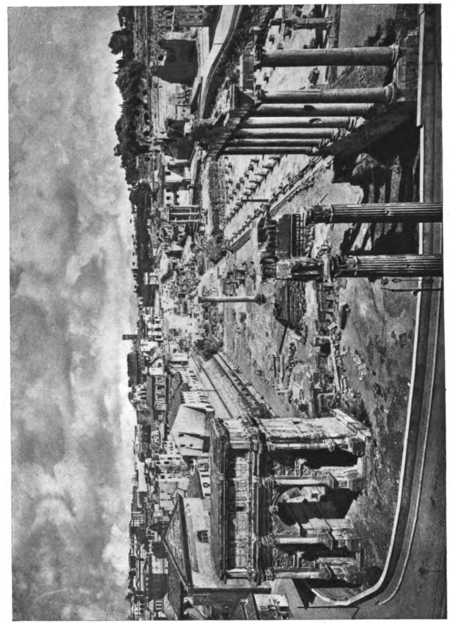
LIST OF ILLUSTRATIONS↩
- Ruins of the Forum Frontispiece. From a photograph.
- Map Illustrating the Crusades, page 38
- The Acropolis, Athens, p. 92. From a photograph.
- The Bosphorus, p. 126. From a photograph.
- Bagdad, p. 200. From a painting by E. Radclyffe.
- Constantinople, p.. 250. From a painting by J. Cousen.
[XI-1]
CHAPTER LXI↩
Partition of the Empire by the French and Venetians — Five Latin Emperors of the Houses of Flanders and Courtenay — Their Wars against the Bulgarians and Greeks — Weakness and Poverty of the Latin Empire — Recovery of Constantinople by the Greeks — General Consequences of the Crusades
After the death of the lawful princes, the French and Venetians, confident of justice and victory, agreed to divide and regulate their future possessions. [1] It was stipulated by treaty, that twelve electors, six of either nation, should be nominated; that a majority should choose the emperor of the East; and that, if the votes were equal, the decision of chance should ascertain the successful candidate. To him, with all the titles and prerogatives of the Byzantine throne, they assigned the two palaces of Boucoleon and Blachernæ, with a fourth part of the Greek monarchy. It was defined that the three remaining portions should be equally shared between the republic of Venice and the barons of France; that each feudatory, with an honourable exception for the [XI-2] doge, should acknowledge and perform the duties of homage and military service to the supreme head of the empire; that the nation which gave an emperor should resign to their brethren the choice of a patriarch; and that the pilgrims, whatever might be their impatience to visit the Holy Land, should devote another year to the conquest and defence of the Greek provinces. After the conquest of Constantinople by the Latins, the treaty was confirmed and executed; and the first and most important step was the creation of an emperor. The six electors of the French nation were all ecclesiastics, the abbot of Loces, the archbishop elect of Acre in Palestine, and the bishops of Troyes, Soissons, Halberstadt, and Bethlehem, the last of whom exercised in the camp the office of pope’s legate; their profession and knowledge were respectable; and, as they could not be the objects, they were best qualified to be authors, of the choice. The six Venetians were the principal servants of the state, and in this list the noble families of Querini and Contarini are still proud to discover their ancestors. The twelve assembled in the chapel of the palace; and, after the solemn invocation of the Holy Ghost, they proceeded to deliberate and vote. A just impulse of respect and gratitude prompted them to crown the virtues of the doge; his wisdom had inspired their enterprise; and the most youthful knights might envy and applaud the exploits of blindness and age. But the patriot Dandolo was devoid of all personal ambition, and fully satisfied that he had been judged worthy to reign. His nomination was overruled by the Venetians themselves; his countrymen, and perhaps his friends, [2] represented, with the eloquence of truth, the mischiefs that might arise to national freedom and the common cause from the union of two incompatible characters, of the first magistrate of a republic and the emperor of the [XI-3] East. The exclusion of the doge left room for the more equal merits of Boniface and Baldwin; and at their names all meaner candidates respectfully withdrew. The marquis of Montferrat was recommended by his mature age and fair reputation, by the choice of the adventurers and the wishes of the Greeks; nor can I believe that Venice, the mistress of the sea, could be seriously apprehensive of a petty lord at the foot of the Alps. [3] But the count of Flanders was the chief of a wealthy and warlike people; he was valiant, pious, and chaste; in the prime of life, since he was only thirty-two years of age; a descendant of Charlemagne, a cousin of the king of France, and a compeer of the prelates and barons who had yielded with reluctance to the command of a foreigner. Without the chapel, these barons, with the doge and marquis at their head, expected the decision of the twelve electors. It was announced by the bishop of Soissons, in the name of his colleagues: “Ye have sworn to obey the prince whom we should choose: by our unanimous suffrage, Baldwin, count of Flanders and Hainault, is now your sovereign, and the emperor of the East.” He was saluted with loud applause, and the proclamation was re-echoed throughout the city by the joy of the Latins and the trembling adulation of the Greeks. Boniface was the first to kiss the hand of his rival, and to raise him on the buckler; and Baldwin was transported to the cathedral and solemnly invested with the purple buskins. At the end of three weeks he was crowned by the legate, in the vacancy of a patriarch; but the Venetian clergy soon filled the chapter of St. Sophia, seated Thomas Morosini on the ecclesiastical throne, and employed every art to perpetuate, in their own nation, the honours and benefices of the Greek church. [4] Without delay, the successor of [XI-4] Constantine instructed Palestine, France, and Rome of this memorable revolution. To Palestine he sent, as a trophy, the gates of Constantinople and the chain of the harbour; [5] and adopted from the Assise of Jerusalem the laws or customs best adapted to a French colony and conquest in the East. [6] In his epistles, the natives of France are encouraged to swell that colony and to secure that conquest, to people a magnificent city and a fertile land, which will reward the labours both of the priest and the soldier. He congratulates the Roman pontiff on the restoration of his authority in the East; invites him to extinguish the Greek schism by his presence in a general council; and implores his blessing and forgiveness for the disobedient pilgrims. Prudence and dignity are blended in the answer of Innocent. [7] In the subversion of the Byzantine empire, he arraigns the vices of man and adores the providence of God; the conquerors will be absolved or condemned by their future conduct; the validity of their treaty depends on the judgment of St. Peter; but he inculcates their most sacred duty of establishing a just subordination of obedience and tribute, from the Greeks to the Latins, from the magistrate to the clergy, and from the clergy to the pope.
In the division of the Greek provinces, [8] the share of the [XI-5] Venetians was more ample than that of the Latin emperor. No more than one fourth was appropriated to his domain; a clear moiety of the remainder was reserved for Venice; and the other moiety was distributed among the adventurers of France and Lombardy. The venerable Dandolo was proclaimed despot of Romania, and invested, after the Greek fashion, with the purple buskins. He ended, at Constantinople, his long and glorious life; and, if the prerogative was personal, the title was used by his successors till the middle of the fourteenth century, with the singular though true addition of lords of one fourth and a half of the Roman empire. [9] The doge, a slave of the state, was seldom permitted to depart from the helm of the republic; but his place was supplied by the bail, or regent, who exercised a supreme jurisdiction over the colony of Venetians; they possessed three of the eight quarters of the city; and his independent tribunal was composed of six judges, four counsellors, two chamberlains, two fiscal advocates, and a constable. Their long experience of the Eastern trade enabled them to select their portion with discernment; they had rashly accepted the dominion and defence of Hadrianople; but it was the more reasonable aim of their policy to form a chain of factories and cities and islands along the maritime coast, from the neighbourhood of Ragusa to the Hellespont and the Bosphorus. The labour and cost of such extensive conquests exhausted their treasury; they abandoned their maxims of government, adopted a feudal system, and contented themselves with the homage of their nobles, [10] for the possessions [XI-6] which these private vassals undertook to reduce and maintain. And thus it was that the family of Sanut acquired the duchy of Naxos, which involved the greatest part of the Archipelago. For the price of ten thousand marks the republic purchased of the marquis of Montferrat the fertile island of Crete, or Candia, with the ruins of an hundred cities; [11] but its improvement was stinted by the proud and narrow spirit of an aristocracy; [12] and the wisest senators would confess that the sea, not the land, was the treasury of St. Mark. In the moiety of the adventurers, the marquis Boniface might claim the most liberal reward; and, besides the isle of Crete, his exclusion from the throne was compensated by the royal title and the provinces beyond the Hellespont. But he prudently exchanged that distant and difficult conquest for the kingdom of Thessalonica, or Macedonia, twelve days’ journey from the capital, where he might be supported by the neighbouring powers of his brother-in-law the king of Hungary. [13] His progress was hailed by the voluntary or reluctant acclamations of the natives; and Greece, the proper and ancient [XI-7] Greece, again received a Latin conqueror, [14] who trod with indifference that classic ground. He viewed with a careless eye the beauties of the valley of Tempe; traversed with a cautious step the straits of Thermopylæ; occupied the unknown cities of Thebes, Athens, and Argos; [15] and assaulted the fortifications of Corinth and Napoli, [16] which resisted his arms. The lots of the Latin pilgrims were regulated by chance, or choice, or subsequent exchange; and they abused, with intemperate joy, the triumph over the lives and fortunes of a great people. After a minute survey of the provinces, they weighed in the scales of avarice the revenue of each district, the advantage of the situation, and the ample or scanty supplies for the maintenance of soldiers and horses. [XI-8] Their presumption claimed and divided the long-lost dependencies of the Roman sceptre; the Nile and Euphrates rolled through their imaginary realms; and happy was the warrior who drew for his prize the palace of the Turkish sultan of Iconium. [17] I shall not descend to the pedigree of families and the rent-rolls of estates, but I wish to specify that the counts of Blois and St. Pol were invested with the duchy of Nice and the lordship of Demotica; [18] the principal fiefs were held by the service of constable, chamberlain, cup-bearer, butler, and chief cook; and our historian, Jeffrey of Villehardouin, obtained a fair establishment on the banks of the Hebrus, and united the double office of marshal of Champagne and Romania. At the head of his knights and archers each baron mounted on horseback to secure the possession of his share, and their first efforts were generally successful. But the public force was weakened by their dispersion; and a thousand quarrels must arise under a law, and among men, whose sole umpire was the sword. Within three months after the conquest of Constantinople, the emperor and the king of Thessalonica drew their hostile followers into the field; they were reconciled by the authority of the doge, the advice of the marshal, and the firm freedom of their peers. [19]
Two fugitives, who had reigned at Constantinople, still asserted the title of emperor; and the subjects of their fallen throne might be moved to pity by the misfortunes of the elder [XI-9] Alexius, or excited to revenge by the spirit of Mourzoufle. A domestic alliance, a common interest, a similar guilt, and a merit of extinguishing his enemies, a brother and a nephew, induced the more recent usurper to unite with the former the relics of his power. Mourzoufle was received with smiles and honours in the camp of his father Alexius; but the wicked can never love, and should rarely trust, their fellow-criminals: he was seized in the bath, deprived of his eyes, stripped of his troops and treasures, and turned out to wander an object of horror and contempt to those who with more propriety could hate, and with more justice could punish, the assassin of the emperor Isaac and his son. As the tyrant, pursued by fear or remorse, was stealing over to Asia, he was seized by the Latins of Constantinople, and condemned, after an open trial, to an ignominious death. His judges debated the mode of his execution, the axe, the wheel, or the stake; and it was resolved that Mourzoufle [20] should ascend the Theodosian column, a pillar of white marble of one hundred and forty-seven feet in height. [21] From the summit he was cast down headlong, and dashed in pieces on the pavement, in the presence of innumerable spectators, who filled the forum of Taurus, and admired the accomplishment of an old prediction, which was explained by this singular event. [22] The fate of Alexius is less tragical: [XI-10] he was sent by the marquis a captive to Italy, and a gift to the king of the Romans; but he had not much to applaud his fortune, if the sentence of imprisonment and exile were changed from a fortress in the Alps to a monastery in Asia. But his daughter, before the national calamity, had been given in marriage to a young hero, who continued the succession, and restored the throne, of the Greek princes. [23] The valour of Theodore Lascaris was signalised in the two sieges of Constantinople. After the flight of Mourzoufle, when the Latins were already in the city, he offered himself as their emperor to the soldiers and people; and his ambition, which might be virtuous, was undoubtedly brave. Could he have infused a soul into the multitude, they might have crushed the strangers under their feet; their abject despair refused his aid; and Theodore retired to breathe the air of freedom in Anatolia, beyond the immediate view and pursuit of the conquerors. Under the title, at first of despot, and afterwards of emperor, he drew to his standard the bolder spirits, who were fortified against slavery by the contempt of life; and, as every means was lawful for the public safety, implored without scruple the alliance of the Turkish sultan. Nice, where Theodore established his residence, Prusa and Philadelphia, Smyrna and Ephesus, opened their gates to their deliverer; he derived strength and reputation from his victories, and even from his defeats; and the successor of Constantine preserved a fragment of the empire from the banks of the Mæander to the suburbs of Nicomedia, and at length of Constantinople. Another portion, distant and obscure, was possessed by the lineal heir of the Comneni, a son of the virtuous Manuel, a grandson of the tyrant Andronicus. His name was Alexius; and the epithet of great was applied perhaps to his stature, rather than to his exploits. By the [XI-11] indulgence of the Angeli, [24] he was appointed governor or duke of Trebizond: [25] his birth gave him ambition, the revolution independence; and, without changing his title, he reigned in peace from Sinope to the Phasis, along the coast of the Black Sea. His nameless son and successor [26] is described as the vassal of the sultan, whom he served with two hundred lances; that Comnenian prince was no more than duke of [XI-12] Trebizond, and the title of emperor was first assumed by the pride and envy of the grandson of Alexius. In the West, a third fragment was saved from the common shipwreck by Michael, a bastard of the house of Angeli, [27] who, before the revolution, had been known as an hostage, a soldier, and a rebel. His flight from the camp of the marquis Boniface secured his freedom; by his marriage with the governor’s daughter he commanded the important place of Durazzo, assumed the title of despot, and founded a strong and conspicuous principality in Epirus, Ætolia, and Thessaly, which have ever been peopled by a warlike race. The Greeks, who had offered their service to their new sovereigns, were excluded by the haughty Latins [28] from all civil and military honours, as a nation born to tremble and obey. Their resentment prompted them to show that they might have been useful friends, since they could be dangerous enemies; their nerves were braced by adversity; whatever was learned or holy, whatever was noble or valiant, rolled away into the independent states of Trebizond, Epirus, and Nice; and a single patrician is marked by the ambiguous praise of attachment and loyalty to the Franks. The vulgar herd of the cities and the country would have gladly submitted to a mild and regular servitude; and the transient disorders of war would have been obliterated by some years of industry and peace. But peace was banished, and industry was crushed, in the disorders of the feudal system. The Roman emperors of Constantinople, if they were endowed with abilities, were armed with power for the protection of their [XI-13] subjects; their laws were wise and their administration was simple. The Latin throne was filled by a titular prince, the chief, and often the servant, of his licentious confederates: the fiefs of the empire, from a kingdom to a castle, were held and ruled by the sword of the barons; and their discord, poverty, and ignorance extended their ramifications of tyranny to the most sequestered villages. The Greeks were oppressed by the double weight of the priest, who was invested with temporal power, and of the soldier, who was inflamed by fanatic hatred: and the insuperable bar of religion and language for ever separated the stranger and the native. As long as the crusaders were united at Constantinople, the memory of their conquest and the terror of their arms imposed silence on the captive land; their dispersion betrayed the smallness of their numbers and the defects of their discipline; and some failures and mischances revealed the secret that they were not invincible. As the fear of the Greeks abated, their hatred increased. They murmured; they conspired; and, before a year of slavery had elapsed, they implored or accepted the succour of a Barbarian, whose power they had felt, and whose gratitude they trusted. [29]
The Latin conquerors had been saluted with a solemn and early embassy from John, or Joannice, or Calo-John, the revolted chief of the Bulgarians and Walachians. He deemed himself their brother, as the votary of the Roman pontiff, from whom he had received the regal title and an holy banner; and in the subversion of the Greek monarchy he might aspire to the name of their friend and accomplice. But Calo-John was astonished to find that the count of Flanders had assumed the pomp and pride of the successors of Constantine; and his ambassadors were dismissed with an haughty message, that the rebel must deserve a pardon by touching with [XI-14] his forehead the footstool of the Imperial throne. His resentment [30] would have exhaled in acts of violence and blood; his cooler policy watched the rising discontent of the Greeks; affected a tender concern for their sufferings; and promised that their first struggles for freedom should be supported by his person and kingdom. The conspiracy was propagated by national hatred, the firmest band of association and secrecy: the Greeks were impatient to sheathe their daggers in the breasts of the victorious strangers; but the execution was prudently delayed, till Henry, the emperor’s brother, had transported the flower of his troops beyond the Hellespont. Most of the towns and villages of Thrace were true to the moment and the signal: and the Latins, without arms or suspicion, were slaughtered by the vile and merciless revenge of their slaves. From Demotica, the first scene of the massacre, the surviving vassals of the count of St. Pol escaped to Hadrianople; but the French and Venetians who occupied that city were slain or expelled by the furious multitude; the garrisons that could effect their retreat fell back on each other towards the metropolis; and the fortresses that separately stood against the rebels were ignorant of each other’s and of their sovereign’s fate. The voice of fame and fear announced the revolt of the Greeks and the rapid approach of their Bulgarian ally; and Calo-John, not depending on the forces of his own kingdom, had drawn from the Scythian wilderness a body of fourteen thousand Comans, who drank, as it was said, the blood of their captives, and sacrificed the Christians on the altars of their gods. [31]
[XI-15]
Alarmed by this sudden and growing danger, the emperor despatched a swift messenger to recall Count Henry and his troops; and, had Baldwin expected the return of his gallant brother, with a supply of twenty thousand Armenians, he might have encountered the invader with equal numbers and a decisive superiority of arms and discipline. But the spirit of chivalry could seldom discriminate caution from cowardice; and the emperor took the field with an hundred and forty knights, and their train of archers and serjeants. The marshal, who dissuaded and obeyed, led the vanguard in their march to Hadrianople; the main body was commanded by the count of Blois; the aged doge of Venice followed with the rear; and their scanty numbers were increased on all sides by the fugitive Latins. They undertook to besiege the rebels of Hadrianople; and such was the pious tendency of the crusades that they employed the holy week in pillaging the country for their subsistence, and in framing engines for the destruction of their fellow-Christians. But the Latins were soon interrupted and alarmed by the light cavalry of the Comans, who boldly skirmished to the edge of their imperfect lines; and a proclamation was issued by the marshal of Romania, that on the trumpet’s sound the cavalry should mount and form, but that none, under pain of death, should abandon themselves to a desultory and dangerous pursuit. This wise injunction was first disobeyed by the count of Blois, who involved the emperor in his rashness and ruin. The Comans, of the Parthian or Tartar school, fled before their first charge; but, after a career of two leagues, when the knights and their horses were almost breathless, they suddenly turned, rallied, and encompassed the heavy squadrons of the Franks. The count was slain on the field; the emperor was made prisoner; and, if the one disdained to fly, if the other refused to yield, their personal bravery made a poor atonement for their ignorance or neglect of the duties of a general. [32]
[XI-16]
Proud of his victory and his royal prize, the Bulgarian advanced to relieve Hadrianople and achieve the destruction of the Latins. They must inevitably have been destroyed, if the marshal of Romania had not displayed a cool courage and consummate skill, uncommon in all ages, but most uncommon in those times, when war was a passion rather than a science. His grief and fears were poured into the firm and faithful bosom of the doge; but in the camp he diffused an assurance of safety, which could only be realised by the general belief. All day he maintained his perilous station between the city and the Barbarians: Villehardouin decamped in silence at the dead of night; and his masterly retreat of three days would have deserved the praise of Xenophon and the ten thousand. In the rear the marshal supported the weight of the pursuit; in the front he moderated the impatience of the fugitives; and, wherever the Comans approached, they were repelled by a line of impenetrable spears. On the third day, the weary troops beheld the sea, the solitary town of Rodosto, [33] and their friends, who had landed from the Asiatic shore. They embraced, they wept; but they united their arms and counsels; and, in his brother’s absence, Count Henry assumed the regency of the empire, at once in a state of childhood and caducity. [34] If the Comans withdrew from the summer-heats, seven thousand Latins, in the hour of danger, deserted Constantinople, their brethren, and their vows. Some partial success was overbalanced by the loss [XI-17] of one hundred and twenty knights in the field of Dusium; and of the Imperial domain no more was left than the capital, with two or three adjacent fortresses on the shores of Europe and Asia. The king of Bulgaria was resistless and inexorable; and Calo-John respectfully eluded the demands of the pope, who conjured his new proselyte to restore peace and the emperor to the afflicted Latins. The deliverance of Baldwin was no longer, he said, in the power of man: that prince had died in prison; and the manner of his death is variously related by ignorance and credulity. The lovers of a tragic legend will be pleased to hear that the royal captive was tempted by the amorous queen of the Bulgarians; that his chaste refusal exposed him to the falsehood of a woman and the jealousy of a savage; that his hands and feet were severed from his body; that his bleeding trunk was cast among the carcases of dogs and horses; and that he breathed three days before he was devoured by the birds of prey. [35] About twenty years afterwards, in a wood of the Netherlands, an hermit announced himself as the true Baldwin, the emperor of Constantinople, and the lawful sovereign of Flanders. He related the wonders of his escape, his adventures, and his penance, among a people prone to believe and to rebel: and, in the first transport, Flanders acknowledged her long-lost sovereign. A short examination before the French court detected the impostor, who was punished with an ignominious death; but the Flemings still adhered to the pleasing error; and the countess Jane is accused by the gravest historians of sacrificing to her ambition the life of an unfortunate father. [36]
In all civilised hostility a treaty is established for the [XI-18] exchange or ransom of prisoners; and, if their captivity be prolonged, their condition is known, and they are treated according to their rank with humanity or honour. But the savage Bulgarian was a stranger to the laws of war; his prisons were involved in darkness and silence; and above a year elapsed before the Latins could be assured of the death of Baldwin, before his brother, the regent Henry, would consent to assume the title of emperor. His moderation was applauded by the Greeks as an act of rare and inimitable virtue. Their light and perfidious ambition was eager to seize or anticipate the moment of a vacancy, while a law of succession, the guardian both of the prince and people, was gradually defined and confirmed in the hereditary monarchies of Europe. In the support of the Eastern empire Henry was gradually left without an associate, as the heroes of the crusade retired from the world or from the war. The doge of Venice, the venerable Dandolo, in the fulness of years and glory, sunk into the grave. The marquis of Montferrat was slowly recalled from the Peloponnesian war to the revenge of Baldwin and the defence of Thessalonica. Some nice disputes of feudal homage and service were reconciled in a personal interview between the emperor and the king; they were firmly united by mutual esteem and the common danger; and their alliance was sealed by the nuptial of Henry with the daughter of the Italian prince. He soon deplored the loss of his friend and father. At the persuasion of some faithful Greeks, Boniface made a bold and successful inroad among the hills of Rhodope: the Bulgarians fled on his approach; they assembled to harass his retreat. On the intelligence that his rear was attacked, without waiting for any defensive armour, he leaped on horseback, couched his lance, and drove the enemies before him; but in the rash pursuit he was pierced with a mortal wound; and the head of the king of Thessalonica was presented to Calo-John, who enjoyed the honours, without the merit, of victory. It is here, at this melancholy event, that the pen or the voice of Jeffrey of Villehardouin [XI-19] seems to drop or to expire; [37] and, if he still exercised his military office of marshal of Romania, his subsequent exploits are buried in oblivion. [38] The character of Henry was not unequal to his arduous situation: in the siege of Constantinople, and beyond the Hellespont, he had deserved the fame of a valiant knight and a skilful commander; and his courage was tempered with a degree of prudence and mildness unknown to his impetuous brother. In the double war against the Greeks of Asia and the Bulgarians of Europe, he was ever the foremost on shipboard or on horseback; and, though he cautiously provided for the success of his arms, the drooping Latins were often roused by his example to save and to second their fearless emperor. But such efforts, and some supplies of men and money from France, were of less avail than the errors, the cruelty, and the death of their most formidable adversary. When the despair of the Greek subjects invited Calo-John as their deliverer, they hoped that he would protect their liberty and adopt their laws; they were soon taught to compare the degrees of national ferocity, and to execrate the savage conqueror, who no longer dissembled his intention of dispeopling Thrace, of demolishing the cities, and of transplanting the inhabitants beyond the Danube. Many towns and villages of Thrace were already evacuated; an heap of ruins marked the place of Philippopolis, and a similar calamity was expected at Demotica and Hadrianople by the first authors of the revolt. They raised a cry of grief and repentance [XI-20] to the throne of Henry; the emperor alone had the magnanimity to forgive and trust them. No more than four hundred knights, with their serjeants and archers, could be assembled under his banner; and with this slender force he fought and repulsed the Bulgarian, who, besides his infantry, was at the head of forty thousand horse. In this expedition, Henry felt the difference between an hostile and a friendly country; the remaining cities were preserved by his arms; and the savage, with shame and loss, was compelled to relinquish his prey. The siege of Thessalonica was the last of the evils which Calo-John inflicted or suffered; he was stabbed in the night in his tent; and the general, perhaps the assassin, who found him weltering in his blood, ascribed the blow, with general applause, to the lance of St. Demetrius. [39] After several victories the prudence of Henry concluded an honourable peace with the successor of the tyrant, and with the Greek princes of Nice and Epirus. If he ceded some doubtful limits, an ample kingdom was reserved for himself and his feudatories; and his reign, which lasted only ten years, afforded a short interval of prosperity and peace. Far above the narrow policy of Baldwin and Boniface, he freely entrusted to the Greeks the most important offices of the state and army; and this liberality of sentiment and practice was the more seasonable, as the princes of Nice and Epirus had already learned to seduce and employ the mercenary valour of the Latins. It was the aim of Henry to unite and reward his deserving subjects of every nation and language; but he appeared less solicitous to accomplish the impracticable union of the two churches. Pelagius, the pope’s legate, who acted as the sovereign of Constantinople, had interdicted the worship of the Greeks, and sternly imposed the payment of tithes, the double procession of the Holy Ghost, and a blind [XI-21] obedience to the Roman pontiff. As the weaker party, they pleaded the duties of conscience, and implored the rights of toleration: “Our bodies,” they said, “are Cæsar’s, but our souls belong only to God.” The persecution was checked by the firmness of the emperor; [40] and, if we can believe that the same prince was poisoned by the Greeks themselves, we must entertain a contemptible idea of the sense and gratitude of mankind. His valour was a vulgar attribute which he shared with ten thousand knights; but Henry possessed the superior courage to oppose, in a superstitious age, the pride and avarice of the clergy. In the cathedral of St. Sophia, he presumed to place his throne on the right hand of the patriarch; and this presumption excited the sharpest censure of Pope Innocent the Third. [41] By a salutary edict, one of the first examples of the laws of mortmain, he prohibited the alienation of fiefs; many of the Latins, desirous of returning to Europe, resigned their estates to the church for a spiritual or temporal reward; these holy lands were immediately discharged from military service; and a colony of soldiers would have been gradually transformed into a college of priests. [42]
The virtuous Henry died at Thessalonica, in the defence of that kingdom, and of an infant, the son of his friend Boniface. In the two first emperors of Constantinople, the male line of the counts of Flanders was extinct. But their sister Yolande was the wife of a French prince, the mother of a numerous progeny; and one of her daughters had married Andrew, king of Hungary, a brave and pious champion of the cross. By [XI-22] seating him on the Byzantine throne, the barons of Romania would have acquired the forces of a neighbouring and warlike kingdom; but the prudent Andrew revered the laws of succession; and the princess Yolande, with her husband, Peter of Courtenay, count of Auxerre, was invited by the Latins to assume the empire of the East. The royal birth of his father, the noble origin of his mother, recommended to the barons of France the first-cousin of their king. His reputation was fair, his possessions were ample, and in the bloody crusade against the Albigeois the soldiers and the priests had been abundantly satisfied of his zeal and valour. Vanity might applaud the elevation of a French emperor of Constantinople; but prudence must pity, rather than envy, his treacherous and imaginary greatness. To assert and adorn his title, he was reduced to sell or mortgage the best of his patrimony. By these expedients, the liberality of his royal kinsman, Philip Augustus, and the national spirit of chivalry, he was enabled to pass the Alps at the head of one hundred and forty knights and five thousand five hundred serjeants and archers. After some hesitation, Pope Honorius the Third was persuaded to crown the successor of Constantine; but he performed the ceremony in a church without the walls, lest he should seem to imply, or to bestow, anyright of sovereignty over the ancient capital of the empire. The Venetians had engaged to transport Peter and his forces beyond the Adriatic, and the empress, with her four children, to the Byzantine palace; but they required, as the price of their service, that he should recover Durazzo from the despot of Epirus. Michael Angelus, or Comnenus, the first of his dynasty, had bequeathed the succession of his power and ambition to Theodore, his legitimate brother, who already threatened and invaded the establishments of the Latins. After discharging his debt by a fruitless assault, the emperor raised the siege to prosecute a long and perilous journey over land from Durazzo to Thessalonica. He was soon lost in the mountains of Epirus; the passes were fortified; his provisions exhausted; he was delayed and [XI-23] deceived by a treacherous negotiation; and, after Peter of Courtenay and the Roman legate had been arrested in a banquet, the French troops, without leaders or hopes, were eager to exchange their arms for the delusive promise of mercy and bread. The Vatican thundered; and the impious Theodore was threatened with the vengeance of earth and heaven; but the captive emperor and his soldiers were forgotten, and the reproaches of the pope are confined to the imprisonment of his legate. No sooner was he satisfied by the deliverance of the priest and a promise of spiritual obedience, than he pardoned and protected the despot of Epirus. His peremptory commands suspended the ardour of the Venetians and the king of Hungary; and it was only by a natural or untimely death [43] that Peter of Courtenay was released from his hopeless captivity. [44]
The long ignorance of his fate, and the presence of the lawful sovereign, of Yolande, his wife or widow, delayed the proclamation of a new emperor. Before her death, and in the midst of her grief, she was delivered of a son, who was named Baldwin, the last and most unfortunate of the Latin princes of Constantinople. His birth endeared him to the barons of Romania; but his childhood would have prolonged the troubles of a minority, and his claims were superseded by the elder claims of his brethren. The first of these, Philip of Courtenay, who derived from his mother the inheritance of Namur, had the wisdom to prefer the substance of a marquisate to the shadow of an empire; and on his refusal, Robert, the second of the sons of Peter and Yolande, was called to the throne of Constantinople. Warned by his [XI-24] father’s mischance, he pursued his slow and secure journey through Germany and along the Danube; a passage was opened by his sister’s marriage with the king of Hungary; and the emperor Robert was crowned by the patriarch in the cathedral of St. Sophia. But his reign was an era of calamity and disgrace; and the colony, as it was styled, of New France yielded on all sides to the Greeks of Nice and Epirus. After a victory, which he owed to his perfidy rather than his courage, Theodore Angelus entered the kingdom of Thessalonica, expelled the feeble Demetrius, the son of the marquis Boniface, erected his standard on the walls of Hadrianople, and added, by his vanity, a third or fourth name to the list of rival emperors. The relics of the Asiatic province were swept away by John Vataces, the son-in-law and successor of Theodore Lascaris, and who, in a triumphant reign of thirty-three years, displayed the virtues both of peace and war. Under his discipline, the swords of the French mercenaries were the most effectual instrument of his conquests, and their desertion from the service of their country was at once a symptom and a cause of the rising ascendant of the Greeks. By the construction of a fleet he obtained the command of the Hellespont, reduced the islands of Lesbos and Rhodes, [45] attacked the Venetians of Candia, and intercepted the rare and parsimonious succours of the West. Once, and once only, the Latin emperor sent an army against Vataces; and, in the defeat of that army, the veteran knights, the last of the original conquerors, were left on the field of battle. But the success of a foreign enemy was less painful to the pusillanimous Robert than the insolence of his Latin subjects, who confounded the weakness of the emperor and of the empire. His personal misfortunes will prove the anarchy of the government and the ferociousness of the times. The amorous youth had neglected his Greek [XI-25] bride, the daughter of Vataces, to introduce into the palace a beautiful maid, of a private, though noble, family of Artois; and her mother had been tempted by the lustre of the purple to forfeit her engagements with a gentleman of Burgundy. His love was converted into rage; he assembled his friends, forced the palace gates, threw the mother into the sea, and inhumanly cut off the nose and lips of the wife or concubine of the emperor. Instead of punishing the offender, the barons avowed and applauded the savage deed, [46] which, as a prince and as a man, it was impossible that Robert should forgive. He escaped from the guilty city to implore the justice or compassion of the pope; the emperor was coolly exhorted to return to his station; before he could obey, he sunk under the weight of grief, shame, and impotent resentment. [47]
It was only in the age of chivalry that valour could ascend from a private station to the thrones of Jerusalem and Constantinople. The titular kingdom of Jerusalem had devolved to Mary, the daughter of Isabella, and Conrad of Montferrat, and the grand-daughter of Almeric or Amaury. She was given to John of Brienne, of a noble family in Champagne, by the public voice, and the judgment of Philip Augustus, who named him as the most worthy champion of the Holy Land. [48] In the fifth crusade, he led an hundred thousand Latins to the conquest of Egypt; by him the siege of Damietta was achieved; and the subsequent failure was [XI-26] justly ascribed to the pride and avarice of the legate. After the marriage of his daughter with Frederic the Second, [49] he was provoked by the emperor’s ingratitude to accept the command of the army of the church; and, though advanced in life, and despoiled of royalty, the sword and spirit of John of Brienne were still ready for the service of Christendom. In the seven years of his brother’s reign Baldwin of Courtenay had not emerged from a state of childhood, and the barons of Romania felt the strong necessity of placing the sceptre in the hands of a man and a hero. The veteran king of Jerusalem might have disdained the name and office of regent; they agreed to invest him for his life with the title and prerogatives of emperor, on the sole condition that Baldwin should marry his second daughter and succeed at a mature age to the throne of Constantinople. [50] The expectation, both of the Greeks and Latins, was kindled by the renown, the choice, and the presence of John of Brienne; and they admired his martial aspect, his green and vigorous age of more than fourscore years, and his size and stature, which surpassed the common measure of mankind. [51] But avarice and the love of ease appear to have chilled the ardour of enterprise; his troops were disbanded, and two years rolled away without action or honour, till he was awakened [52] by the dangerous alliance of Vataces, emperor of Nice, and of Azan, king of Bulgaria. [53] They besieged Constantinople by sea [XI-27] and land, with an army of one hundred thousand men, and a fleet of three hundred ships of war; while the entire force of the Latin emperor was reduced to one hundred and sixty knights and a small addition of serjeants and archers. I tremble to relate that, instead of defending the city, the hero made a sally at the head of his cavalry; and that, of fortyeight squadrons of the enemy, no more than three escaped from the edge of his invincible sword. Fired by his example, the infantry and citizens boarded the vessels that anchored close to the walls; and twenty-five were dragged in triumph into the harbour of Constantinople. At the summons of the emperor, the vassals and allies armed in her defence; broke through every obstacle that opposed their passage; and, in the succeeding year, obtained a second victory over the same enemies. By the rude poets of the age, John of Brienne is compared to Hector, Roland, and Judas Maccabæus; [54] [XI-28] but their credit and his glory receives some abatement from the silence of the Greeks. [55] The empire was soon deprived of the last of her champions; and the dying monarch was ambitious to enter paradise in the habit of a Franciscan friar. [56]
In the double victory of John of Brienne, I cannot discover the name or exploits of his pupil Baldwin, who had attained the age of military service, and who succeeded to the Imperial dignity on the decease of his adopted father. [57] The royal youth was employed on a commission more suitable to his temper; he was sent to visit the Western courts, of the pope more especially, and of the king of France; to excite their pity by the view of his innocence and distress; and to obtain some supplies of men or money for the relief of the sinking empire. He thrice repeated these mendicant visits, in which he seemed to prolong his stay and postpone his return; of the five-and-twenty years of his reign, a greater number were spent abroad than at home; and in no place did the emperor deem himself less free and secure than in his native country and his capital. On some public occasions, his vanity might be soothed by the title of Augustus and by the honours of the purple; and at the general council of Lyons, when Frederic the Second was excommunicated and deposed, his Oriental colleague was enthroned on the right hand of the pope. But how often was the exile, the vagrant, the Imperial beggar humbled with scorn, insulted with pity, and degraded in his own eyes and [XI-29] those of the nations! In his first visit to England he was stopt at Dover by a severe reprimand that he should presume, without leave, to enter an independent kingdom. After some delay, Baldwin, however, was permitted to pursue his journey, was entertained with cold civility, and thankfully departed with a present of seven hundred marks. [58] From the avarice of Rome he could only obtain the proclamation of a crusade, and a treasure of indulgences: a coin whose currency was depreciated by too frequent and indiscriminate abuse. His birth and misfortunes recommended him to the generosity of his cousin, Lewis the Ninth; but the martial zeal of the saint was diverted from Constantinople to Egypt and Palestine; and the public and private poverty of Baldwin was alleviated, for a moment, by the alienation of the marquisate of Namur and the lordship of Courtenay, the last remains of his inheritance. [59] By such shameful or ruinous expedients he once more returned to Romania, with an army of thirty thousand soldiers, whose numbers were doubled in the apprehension of the Greeks. His first despatches to France and England announced his victories and his hopes; he had reduced the country round the capital to the distance of three days’ journey; and, if he succeeded against an important though nameless city (most probably Chiorli), [60] the frontier would be safe and the passage accessible. But these expectations (if Baldwin was sincere) quickly vanished like a dream; the troops and treasures of France melted away in his unskilful [XI-30] hands; and the throne of the Latin emperor was protected by a dishonourable alliance with the Turks and Comans. To secure the former, he consented to bestow his niece on the unbelieving sultan of Cogni; to please the latter, he complied with their Pagan rites: a dog was sacrificed between the two armies; and the contracting parties tasted each other’s blood, as a pledge of their fidelity. [61] In the palace or prison of Constantinople, the successor of Augustus demolished the vacant houses for winter-fuel, and stripped the lead from the churches for the daily expenses of his family. Some usurious loans were dealt with a scanty hand by the merchants of Italy; and Philip, his son and heir, was pawned at Venice as the security for a debt. [62] Thirst, hunger, and nakedness are positive evils; but wealth is relative; and a prince, who would be rich in a private station, may be exposed by the increase of his wants to all the anxiety and bitterness of poverty.
But in this abject distress the emperor and empire were still possessed of an ideal treasure, which drew its fantastic value from the superstition of the Christian world. The merit of the true cross was somewhat impaired by its frequent division; and a long captivity among the infidels might shed some suspicion on the fragments that were produced in the East and West. But another relic of the Passion was preserved in the Imperial chapel of Constantinople; and the crown of thorns, which had been placed on the head of Christ, was equally precious and authentic. It had formerly been the practice of the Egyptian debtors to deposit, as a security, the mummies of their parents; and both their honour and religion were bound for the redemption of the pledge. In the same manner, and in the absence of the emperor, the barons of Romania borrowed the sum of thirteen thousand one hundred and thirty-four [XI-31] pieces of gold, [63] on the credit of the holy crown; they failed in the performance of their contract; and a rich Venetian, Nicholas Querini, undertook to satisfy their impatient creditors, on condition that the relic should be lodged at Venice, to become his absolute property if it were not redeemed within a short and definite term. The barons apprised their sovereign of the hard treaty and impending loss; and, as the empire could not afford a ransom of seven thousand pounds sterling, Baldwin was anxious to snatch the prize from the Venetians, and to vest it with more honour and emolument in the hands of the most Christian king. [64] Yet the negotiation was attended with some delicacy. In the purchase of relics, the saint would have started at the guilt of simony; but, if the mode of expression were changed, he might lawfully repay the debt, accept the gift, and acknowledge the obligation. His ambassadors, two Dominicans, were despatched to Venice, to redeem and receive the holy crown, which had escaped the dangers of the sea and the galleys of Vataces. On opening a wooden box, they recognised the seals of the doge and barons, which were applied on a shrine of silver; and within this shrine the monument of the Passion was enclosed in a golden vase. The reluctant Venetians yielded to justice and power; the emperor Frederic granted a free and honourable passage; the court of France advanced as far as Troyes in Champagne, to meet with devotion this inestimable relic; it was borne in triumph through Paris by the king himself, barefoot, and in his shirt; and a free gift of ten thousand marks of silver reconciled Baldwin to his loss. The success of this transaction tempted the Latin emperor to [XI-32] offer with the same generosity the remaining furniture of his chapel: [65] a large and authentic portion of the true cross; the baby-linen of the Son of God; the lance, the spunge, and the chain of his Passion; the rod of Moses; and part of the scull of St. John the Baptist. For the reception of these spiritual treasures, twenty thousand marks were expended by St. Louis on a stately foundation, the holy chapel of Paris, on which the muse of Boileau has bestowed a comic immortality. The truth of such remote and ancient relics, which cannot be proved by any human testimony, must be admitted by those who believe in the miracles which they have performed. About the middle of the last age, an inveterate ulcer was touched and cured by an holy prickle of the holy crown: [66] the prodigy is attested by the most pious and enlightened Christians of France; nor will the fact be easily disproved, except by those who are armed with a general antidote against religious credulity. [67]
The Latins of Constantinople [68] were on all sides encompassed and pressed: their sole hope, the last delay of their ruin, was in the division of their Greek and Bulgarian enemies; [XI-33] and of this hope they were deprived by the superior arms and policy of Vataces, emperor of Nice. From the Propontis to the rocky coast of Pamphylia, Asia was peaceful and prosperous under his reign; and the events of every campaign extended his influence in Europe. The strong cities of the hills of Macedonia and Thrace were rescued from the Bulgarians; and their kingdom was circumscribed by its present and proper limits, along the southern banks of the Danube. The sole emperor of the Romans could no longer brook that a lord of Epirus, a Comnenian prince of the West, should presume to dispute or share the honours of the purple; and the humble Demetrius changed the colour of his buskins, and accepted with gratitude the appellation of despot. His own subjects were exasperated by his baseness and incapacity: they implored the protection of their supreme lord. After some resistance, the kingdom of Thessalonica was united to the empire of Nice; [69] and Vataces reigned without a competitor from the Turkish borders to the Adriatic gulf. The princes of Europe revered his merit and power; and, had he subscribed an orthodox creed, it should seem that the pope would have abandoned without reluctance the Latin throne of Constantinople. But the death of Vataces, the short and busy reign of Theodore his son, and the helpless infancy of his grandson John suspended the restoration of the Greeks. [XI-34] In the next chapter I shall explain their domestic revolutions; in this place it will be sufficient to observe that the young prince was oppressed by the ambition of his guardian and colleague, Michael Palæologus, who displayed the virtues and vices that belong to the founder of a new dynasty. The emperor Baldwin had flattered himself that he might recover some provinces or cities by an impotent negotiation. His ambassadors were dismissed from Nice with mockery and contempt. At every place which they named, Palæologus alleged some special reason which rendered it dear and valuable in his eyes: in the one he was born; in another he had been first promoted to military command; and in a third he had enjoyed, and hoped long to enjoy, the pleasures of the chase. “And what, then, do you propose to give us?” said the astonished deputies. “Nothing,” replied the Greek, “not a foot of land. If your master be desirous of peace, let him pay me, as an annual tribute, the sum which he receives from the trade and customs of Constantinople. On these terms I may allow him to reign. If he refuses, it is war. I am not ignorant of the art of war, and I trust the event to God and my sword.” [70] An expedition against the despot of Epirus was the first prelude of his arms. If a victory was followed by a defeat; if the race of the Comneni or Angeli survived in those mountains his efforts and his reign; the captivity of Villehardouin, prince of Achaia, deprived the Latins of the most active and powerful vassal of their expiring monarchy. [71] The republics of Venice and Genoa disputed, [XI-35] in the first of their naval wars, the command of the sea and the commerce of the East. Pride and interest attached the Venetians to the defence of Constantinople: their rivals were tempted to promote the designs of her enemies, and the alliance of the Genoese with the schismatic conqueror provoked the indignation of the Latin church. [72]
Intent on his great object, the emperor Michael visited in person and strengthened the troops and fortifications of Thrace. The remains of the Latins were driven from their last possessions; he assaulted without success the suburbs of Galata; [73] and corresponded with a perfidious baron, [74] who proved unwilling, or unable, to open the gates of the metropolis. The next spring, [75] his favourite general, Alexius Strategopulus, whom he had decorated with the title of Cæsar, passed the Hellespont with eight hundred horse and some infantry, [76] on a secret expedition. His instructions enjoined him to approach, to listen, to watch, but not to risk [XI-36] any doubtful or dangerous enterprise against the city. The adjacent territory between the Propontis and the Black Sea was cultivated by an hardy race of peasants and outlaws, exercised in arms, uncertain in their allegiance, but inclined by language, religion, and present advantage to the party of the Greeks. They were styled the volunteers, [77] and by their free service the army of Alexius, with the regulars of Thrace and the Coman auxiliaries, [78] was augmented to the number of five and twenty thousand men. By the ardour of the volunteers, and by his own ambition, the Cæsar was stimulated to disobey the precise orders of his master, in the just confidence that success would plead his pardon and reward. The weakness of Constantinople, and the distress and terror of the Latins, were familiar to the observation of the volunteers; and they represented the present moment as the most propitious to surprise and conquest. A rash youth, the new governor of the Venetian colony, had sailed away with thirty galleys and the best of the French knights, on a wild expedition to Daphnusia, a town on the Black Sea, at a distance of forty leagues; [79] and the remaining Latins were without strength or suspicion. They were informed that Alexius had passed the Hellespont; but their apprehensions were lulled by the smallness of his original numbers, and their imprudence had not watched the subsequent increase of his army. If he left his main body to second and support his operations, he might advance unperceived in the night with a chosen [XI-37] detachment. While some applied scaling-ladders to the lowest part of the walls, they were secure of an old Greek, who would introduce their companions through a subterranean passage into his house; [80] they could soon on the inside break an entrance through the golden gate, which had been long obstructed; and the conqueror would be in the heart of the city, before the Latins were conscious of their danger. After some debate, the Cæsar resigned himself to the faith of the volunteers; they were trusty, bold, and successful; and in describing the plan I have already related the execution and success. [81] But no sooner had Alexius passed the threshold of the golden gate than he trembled at his own rashness; he paused, he deliberated, till the desperate volunteers urged him forwards by the assurance that in retreat lay the greatest and most inevitable danger. Whilst the Cæsar kept his regulars in firm array, the Comans dispersed themselves on all sides; an alarm was sounded, and the threats of fire and pillage compelled the citizens to a decisive resolution. The Greeks of Constantinople remembered their native sovereigns; the Genoese merchants, their recent alliance and Venetian foes; every quarter was in arms; and the air resounded with a general acclamation of “Long life and victory to Michael and John, the august emperors of the Romans!” Their rival Baldwin was awakened by the sound; but the most pressing danger could not prompt him to draw his sword in the defence of a city which he deserted, perhaps, with more pleasure than regret: he fled from the palace to the sea-shore, where he descried the welcome sails of the [XI-38] fleet returning from the vain and fruitless attempt on Daphnusia. Constantinople was irrecoverably lost; but the Latin emperor and the principal families embarked on board the Venetian galleys, and steered for the isle of Eubœa, and afterwards for Italy, where the royal fugitive was entertained by the pope and Sicilian king with a mixture of contempt and pity. From the loss of Constantinople to his death, he consumed thirteen years, soliciting the Catholic powers to join in his restoration: the lesson had been familiar to his youth; nor was his last exile more indigent or shameful than his three former pilgrimages to the courts of Europe. His son Philip was the heir of an ideal empire; and the pretensions of his daughter Catherine were transported by her marriage to Charles of Valois, the brother of Philip the Fair, king of France. The house of Courtenay was represented in the female line by successive alliances, till the title of emperor of Constantinople, too bulky and sonorous for a private name, modestly expired in silence and oblivion. [82]
After this narrative of the expeditions of the Latins to Palestine and Constantinople, I cannot dismiss the subject without revolving the general consequences on the countries that were the scene, and on the nations that were the actors, of these memorable crusades. [83] As soon as the arms of the Franks were withdrawn, the impression, though not the memory, was erased in the Mahometan realms of Egypt and Syria. The faithful disciples of the prophet were never tempted by [XI-none] [XI-39] a profane desire to study the laws or language of the idolaters; nor did the simplicity of their primitive manners receive the slightest alteration from their intercourse in peace and war with the unknown strangers of the West. The Greeks, who thought themselves proud, but who were only vain, shewed a disposition somewhat less inflexible. In the efforts for the recovery of their empire they emulated the valour, discipline, and tactics of their antagonists. The modern literature of the West they might justly despise; but its free spirit would instruct them in the rights of man; and some institutions of public and private life were adopted from the French. The correspondence of Constantinople and Italy diffused the knowledge of the Latin tongue; and several of the fathers and classics were at length honoured with a Greek version. [84] But the national and religious prejudices of the Orientals were inflamed by persecution; and the reign of the Latins confirmed the separation of the two churches.
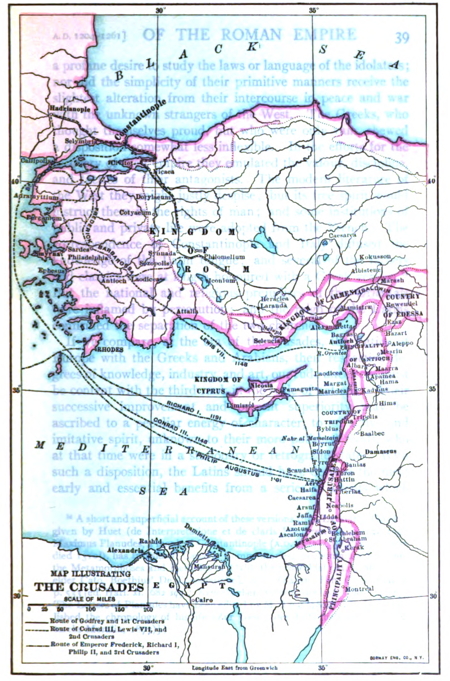
Map Illustrating the Crusades, page 38.
If we compare, at the era of the crusades, the Latins of Europe with the Greeks and Arabians, their respective degrees of knowledge, industry, and art, our rude ancestors must be content with the third rank in the scale of nations. Their successive improvement and present superiority may be ascribed to a peculiar energy of character, to an active and imitative spirit, unknown to their more polished rivals, who at that time were in a stationary or retrograde state. With such a disposition, the Latins should have derived the most early and essential benefits from a series of events which [XI-40] opened to their eyes the prospect of the world, and introduced them to a long and frequent intercourse with the more cultivated regions of the East. The first and most obvious progress was in trade and manufactures, in the arts which are strongly prompted by the thirst of wealth, the calls of necessity, and the gratification of the sense or vanity. Among the crowd of unthinking fanatics, a captive or a pilgrim might sometimes observe the superior refinements of Cairo and Constantinople: the first importer of windmills [85] was the benefactor of nations; and, if such blessings are enjoyed without any grateful remembrance, history has condescended to notice the more apparent luxuries of silk and sugar, which were transported into Italy from Greece and Egypt. But the intellectual wants of the Latins were more slowly felt and supplied; the ardour of studious curiosity was awakened in Europe by different causes and more recent events; and, in the age of the crusades, they viewed with careless indifference the literature of the Greeks and Arabians. Some rudiments of mathematical and medicinal knowledge might be imparted in practice and in figures; necessity might produce some interpreters for the grosser business of merchants and soldiers; but the commerce of the Orientals had not diffused the study and knowledge of their languages in the schools of Europe. [86] If a similar principle of religion repulsed the idiom of the Koran, it should have excited their patience and curiosity to understand the original text of the gospel; and the same grammar would have unfolded the sense of Plato and the beauties of Homer. Yet in a reign of sixty years, the Latins of Constantinople disdained the speech and learning of their subjects; and the manuscripts were the only [XI-41] treasures which the natives might enjoy without rapine or envy. Aristotle was indeed the oracle of the Western universities; but it was a Barbarous Aristotle; and, instead of ascending to the fountain-head, his Latin votaries humbly accepted a corrupt and remote version from the Jews and Moors of Andalusia. The principle of the crusades was a savage fanaticism; and the most important effects were analogous to the cause. Each pilgrim was ambitious to return with his sacred spoils, the relics of Greece and Palestine; [87] and each relic was preceded and followed by a train of miracles and visions. The belief of the Catholics was corrupted by new legends, their practice by new superstitions; and the establishment of the inquisition, the mendicant orders of monks and friars, the last abuse of indulgences, and the final progress of idolatry flowed from the baleful fountain of the holy war. The active spirit of the Latins preyed on the vitals of their reason and religion; and, if the ninth and tenth centuries were the times of darkness, the thirteenth and fourteenth were the age of absurdity and fable.
In the profession of Christianity, in the cultivation of a fertile land, the Northern conquerors of the Roman empire insensibly mingled with the provincials and rekindled the embers of the arts of antiquity. Their settlements about the age of Charlemagne had acquired some degree of order and stability, when they were overwhelmed by new swarms of invaders, the Normans, Saracens, [88] and Hungarians, who replunged the Western countries of Europe into their former state of anarchy and barbarism. About the eleventh century, [XI-42] the second tempest had subsided by the expulsion or conversion of the enemies of Christendom: the tide of civilisation, which had so long ebbed, began to flow with a steady and accelerated course; and a fairer prospect was opened to the hopes and efforts of the rising generations. Great was the success, and rapid the progress, during the two hundred years of the crusades; and some philosophers have applauded the propitious influence of these holy wars, which appear to me to have checked, rather than forwarded, the maturity of Europe. [89] The lives and labours of millions, which were buried in the East, would have been more profitably employed in the improvement of their native country: the accumulated stock of industry and wealth would have overflowed in navigation and trade; and the Latins would have been enriched and enlightened by a pure and friendly correspondence with the climates of the East. In one respect I can indeed perceive the accidental operation of the crusades, not so much in producing a benefit, as in removing an evil. The larger portion of the inhabitants of Europe was chained to the soil, without freedom, or property, or knowledge; and the two orders of ecclesiastics and nobles, whose numbers were comparatively small, alone deserved the name of citizens and men. This oppressive system was supported by the arts of the clergy and the swords of the barons. The authority of the priests operated in the darker ages as a salutary antidote: they prevented the total extinction of letters, mitigated the fierceness of the times, sheltered the poor and defenceless, and preserved or revived the peace and order of civil society. But the independence, rapine, and discord of the feudal lords were unmixed with any semblance of good; and every hope of industry and improvement was crushed by the iron weight of the martial aristocracy. Among the causes that [XI-43] undermined the Gothic edifice, a conspicuous place must be allowed to the crusades. The estates of the barons were dissipated, and their race was often extinguished, in these costly and perilous expeditions. Their poverty extorted from their pride those charters of freedom which unlocked the fetters of the slave, secured the farm of the peasant and the shop of the artificer, and gradually restored a substance and a soul to the most numerous and useful part of the community. The conflagration which destroyed the tall and barren trees of the forest gave air and scope to the vegetation of the smaller and nutritive plants of the soil.
Digression on the Family of Courtenay↩
The purple of three emperors who have reigned at Constantinople will authorise or excuse a digression on the origin and singular fortunes of the house of Courtenay, [90] in the three principal branches: I. Of Edessa; II. Of France; and III. Of England; of which the last only has survived the revolutions of eight hundred years.
I. Before the introduction of trade, which scatters riches, and of knowledge, which dispels prejudice, the prerogative of birth is most strongly felt and most humbly acknowledged. In every age the laws and manners of the Germans have discriminated the ranks of society: the dukes and counts, who shared the empire of Charlemagne, converted their office to an inheritance; and to his children each feudal lord bequeathed his honour and his sword. The proudest families are content to lose, in the darkness of the middle ages, the [XI-44] tree of their pedigree, which, however deep and lofty, must ultimately rise from a plebeian root; and their historians must descend ten centuries below the Christian era, before they can ascertain any lineal succession by the evidence of surnames, of arms, and of authentic records. With the first rays of light [91] we discern the nobility and opulence of Atho, a French knight: his nobility, in the rank and title of a nameless father; his opulence, in the foundation of the castle of Courtenay, in the district of Gatinois, about fifty-six miles to the south of Paris. From the reign of Robert, the son of Hugh Capet, the barons of Courtenay are conspicuous among the immediate vassals of the crown; and Joscelin, the grandson of Atho and a noble dame, is enrolled among the heroes of the first crusade. A domestic alliance (their mothers were sisters) attached him to the standard of Baldwin of Bruges, the second count of Edessa: a princely fief, which he was worthy to receive, and able to maintain, announces the number of his martial followers; and, after the departure of his cousin, Joscelin himself was invested with the county of Edessa on both sides of the Euphrates. By economy in peace his territories were replenished with Latin and Syrian subjects: his magazines with corn, wine, and oil; his castles with gold and silver, with arms and horses. In a holy warfare of thirty years he was alternately a conqueror and a captive; but he died like a soldier, in an horse-litter at the head of his troops; and his last glance beheld the flight of the Turkish invaders who had presumed on his age and infirmities. His son and successor, of the same name, was less deficient in valour than in vigilance; but he sometimes forgot that dominion is acquired and maintained by the same arts. He challenged the hostility of the Turks, without securing the friendship of the prince of Antioch; and, amidst the [XI-45] peaceful luxury of Turbessel, in Syria, [92] Joscelin neglected the defence of the Christian frontier beyond the Euphrates. In his absence, Zenghi, the first of the Atabeks, besieged and stormed his capital, Edessa, which was feebly defended by a timorous and disloyal crowd of Orientals; the Franks were oppressed in a bold attempt for its recovery, and Courtenay ended his days in the prison of Aleppo. He still left a fair and ample patrimony. But the victorious Turks oppressed on all sides the weakness of a widow and orphan; and, for the equivalent of an annual pension, they resigned to the Greek emperor the charge of defending, and the shame of losing, the last relics of the Latin conquest. The countess-dowager of Edessa retired to Jerusalem with her two children: the daughter, Agnes, became the wife and mother of a king; the son, Joscelin the Third, accepted the office of seneschal, the first of the kingdom, and held his new estates in Palestine by the service of fifty knights. His name appears with honour in all the transactions of peace and war; but he finally vanishes in the fall of Jerusalem; and the name of Courtenay, in this branch of Edessa, was lost by the marriage of his two daughters with a French and a German baron. [93]
II. While Joscelin reigned beyond the Euphrates, his elder brother, Milo, the son of Joscelin, the son of Atho, continued, near the Seine, to possess the castle of their fathers, which was at length inherited by Rainaud, or Reginald, the youngest of his three sons. Examples of genius or virtue must be rare in the annals of the oldest families; and, in a remote age, their pride will embrace a deed of rapine and [XI-46] violence; such, however, as could not be perpetrated without some superiority of courage, or at least of power. A descendant of Reginald of Courtenay may blush for the public robber who stripped and imprisoned several merchants, after they had satisfied the king’s duties at Sens and Orleans. He will glory in the offence, since the bold offender could not be compelled to obedience and restitution, till the regent and the count of Champagne prepared to march against him at the head of an army. [94] Reginald bestowed his estates on his eldest daughter, and his daughter on the seventh son of King Louis the Fat; and their marriage was crowned with a numerous offspring. We might expect that a private should have merged in a royal name; and that the descendants of Peter of France and Elizabeth of Courtenay would have enjoyed the title and honours of princes of the blood. But this legitimate claim was long neglected and finally denied; and the causes of their disgrace will represent the story of this second branch. 1. Of all the families now extant, the most ancient, doubtless, and the most illustrious is the house of France, which has occupied the same throne above eight hundred years, and descends, in a clear and lineal series of males, from the middle of the ninth century. [95] In the age of the crusades it was already revered both in the East and West. [XI-47] But from Hugh Capet to the marriage of Peter no more than five reigns or generations had elapsed; and so precarious was their title that the eldest sons, as a necessary precaution, were previously crowned during the lifetime of their fathers. The peers of France have long maintained their precedency before the younger branches of the royal line; nor had the princes of the blood, in the twelfth century, acquired that hereditary lustre which is now diffused over the most remote candidates for the succession. 2. The barons of Courtenay must have stood high in their own estimation, and in that of the world, since they could impose on the son of a king the obligation of adopting for himself and all his descendants the name and arms of their daughter and his wife. In the marriage of an heiress with her inferior or her equal, such exchange was often required and allowed; but, as they continued to diverge from the regal stem, the sons of Louis the Fat were insensibly confounded with their maternal ancestors; and the new Courtenays might deserve to forfeit the honours of their birth, which a motive of interest had tempted them to renounce. 3. The shame was far more permanent than the reward, and a momentary blaze was followed by a long darkness. The eldest son of these nuptials, Peter of Courtenay, had married, as I have already mentioned, the sister of the counts of Flanders, the two first emperors of Constantinople; he rashly accepted the invitation of the barons of Romania; his two sons, Robert and Baldwin, successively held and lost the remains of the Latin empire in the East, and the granddaughter of Baldwin the Second again mingled her blood with the blood of France and of Valois. To support the expenses of a troubled and transitory reign, their patrimonial estates were mortgaged or sold; and the last emperors of Constantinople depended on the annual charity of Rome and Naples.
While the elder brothers dissipated their wealth in romantic [XI-48] adventures, and the castle of Courtenay was profaned by a plebeian owner, the younger branches of that adopted name were propagated and multiplied. But their splendour was clouded by poverty and time: after the decease of Robert, great butler of France, they descended from princes to barons; the next generations were confounded with the simple gentry; the descendants of Hugh Capet could no longer be visible in the rural lords of Tanlay and of Champignelles. The more adventurous embraced, without dishonour, the profession of a soldier; the least active and opulent might sink, like their cousins of the branch of Dreux, into the condition of peasants. Their royal descent, in a dark period of four hundred years, became each day more obsolete and ambiguous; and their pedigree, instead of being enrolled in the annals of the kingdom, must be painfully searched by the minute diligence of heralds and genealogists. It was not till the end of the sixteenth century, on the accession of a family almost as remote as their own, that the princely spirit of the Courtenays again revived; and the question of the nobility provoked them to assert the royalty of their blood. They appealed to the justice and compassion of Henry the Fourth; obtained a favourable opinion from twenty lawyers of Italy and Germany, and modestly compared themselves to the descendants of King David, whose prerogatives were not impaired by the lapse of ages, or the trade of a carpenter. [96] But every ear was deaf, and every circumstance was adverse, to their lawful claims. The Bourbon kings were justified by the neglect [XI-49] of the Valois; the princes of the blood, more recent and lofty, disdained the alliance of this humble kindred; the parliament, without denying their proofs, eluded a dangerous precedent by an arbitrary distinction and established St. Louis as the first father of the royal line. [97] A repetition of complaints and protests was repeatedly disregarded: and the hopeless pursuit was terminated in the present century by the death of the last male of the family. [98] Their painful and anxious situation was alleviated by the pride of conscious virtue; they sternly rejected the temptations of fortune and favour; and a dying Courtenay would have sacrificed his son, if the youth could have renounced, for any temporal interest, the right and title of a legitimate prince of the blood of France. [99]
III. According to the old register of Ford Abbey, the Courtenays of Devonshire are descended from Prince Florus, the second son of Peter, and the grandson of Louis the Fat. [100] This fable of the grateful or venal monks was too respectfully [XI-50] entertained by our antiquaries, Camden [101] and Dugdale; [102] but it is so clearly repugnant to truth and time, that the rational pride of the family now refuses to accept this imaginary founder. Their most faithful historians believe that, after giving his daughter to the king’s son, Reginald of Courtenay abandoned his possessions in France, and obtained from the English monarch a second wife and a new inheritance. It is certain, at least, that Henry the Second distinguished in his camps and councils a Reginald, of the name, arms, and, as it may be fairly presumed, of the genuine race of the Courtenays of France. The right of wardship enabled a feudal lord to reward his vassal with the marriage and estate of a noble heiress; and Reginald of Courtenay acquired a fair establishment in Devonshire, where his posterity has been seated above six hundred years. [103] From a Norman baron, Baldwin de Brioniis, who had been invested by the Conqueror, Hawise, the wife of Reginald, derived the honour of Okehampton, which was held by the service of ninety-three knights; and a female might claim the manly offices of hereditary viscount or sheriff, and of captain of the royal castle of Exeter. Their son Robert married the sister of the earl of Devon; at the end of a century, on the failure of the family of Rivers, [104] his great-grandson, Hugh the Second, succeeded to a title which was still considered as a territorial dignity; and twelve earls of Devonshire, of the name of [XI-51] Courtenay, have flourished in a period of two hundred and twenty years. They were ranked among the chief of the barons of the realm; nor was it till after a strenuous dispute that they yielded to the fief of Arundel the first place in the parliament of England; their alliances were contracted with the noblest families, the Veres, Despensers, St. Johns, Talbots, Bohuns, and even the Plantagenets themselves; and in a contest with John of Lancaster, a Courtenay, bishop of London, and afterwards archbishop of Canterbury, might be accused of profane confidence in the strength and number of his kindred. In peace, the earls of Devon resided in their numerous castles and manors of the west; their ample revenue was appropriated to devotion and hospitality; and the epitaph of Edward, surnamed, from his misfortunes, the blind, from his virtues, the good, earl, inculcates with much ingenuity a moral sentence, which may, however, be abused by thoughtless generosity. After a grateful commemoration of the fifty-five years of union and happiness, which he enjoyed with Mabel his wife, the good earl thus speaks from the tomb: —
What we gave, we have;
What we spent, we had;
What we left, we lost. [105]
But their losses, in this sense, were far superior to their gifts and expenses; and their heirs, not less than the poor, were the objects of their paternal care. The sums which they paid for livery and seisin attest the greatness of their possessions; and several estates have remained in their family since the thirteenth and fourteenth centuries. In war, the Courtenays of England fulfilled the duties, and deserved the honours, of chivalry. They were often entrusted to levy and command the militia of Devonshire and Cornwall; they often attended their supreme lord to the borders of Scotland; and in foreign [XI-52] service, for a stipulated price, they sometimes maintained fourscore men at arms and as many archers. By sea and land they fought under the standard of the Edwards and Henries; their names are conspicuous in battles, in tournaments, and in the original list of the order of the Garter; three brothers shared the Spanish victory of the Black Prince; and in the lapse of six generations the English Courtenays had learned to despise the nation and country from which they derived their origin. In the quarrel of the two Roses, the earls of Devon adhered to the house of Lancaster, and three brothers successively died either in the field or on the scaffold. Their honours and estates were restored by Henry the Seventh; a daughter of Edward the Fourth was not disgraced by the nuptials of a Courtenay; their son, who was created marquis of Exeter, enjoyed the favour of his cousin, Henry the Eighth; and in the camp of Cloth of Gold he broke a lance against the French monarch. But the favour of Henry was the prelude of disgrace; his disgrace was the signal of death; and of the victims of the jealous tyrant, the marquis of Exeter is one of the most noble and guiltless. His son Edward lived a prisoner in the Tower, and died an exile at Padua; and the secret love of Queen Mary, whom he slighted, perhaps for the princess Elizabeth, has shed a romantic colour on the story of this beautiful youth. The relics of his patrimony were conveyed into strange families by the marriages of his four aunts; and his personal honours, as if they had been legally extinct, were revived by the patents of succeeding princes. But there still survived a lineal descendant of Hugh, the first earl of Devon, a younger branch of the Courtenays, who have been seated at Powderham Castle above four hundred years, from the reign of Edward the Third to the present hour. Their estates have been increased by the grant and improvement of lands in Ireland, and they have been recently restored to the honours of the peerage. Yet the Courtenays still retain the plaintive motto, which asserts the innocence, and deplores the fall, of [XI-53] their ancient house. [106] While they sigh for past greatness, they are doubtless sensible of present blessings; in the long series of the Courtenay annals, the most splendid era is likewise the most unfortunate; nor can an opulent peer of Britain be inclined to envy the emperors of Constantinople, who wandered over Europe to solicit alms for the support of their dignity and the defence of their capital.
[XI-54]
CHAPTER LXII↩
The Greek Emperors of Nice and Constantinople — Elevation and Reign of Michael Palæologus — His false Union with the Pope and the Latin Church — Hostile Designs of Charles of Anjou — Revolt of Sicily — War of the Catalans in Asia and Greece — Revolutions and Present State of Athens
The loss of Constantinople restored a momentary vigour to the Greeks. From their palaces the princes and nobles were driven into the field; and the fragments of the falling monarchy were grasped by the hands of the most vigorous or the most skilful candidates. In the long and barren pages of the Byzantine annals, [1] it would not be an easy task to equal the two characters of Theodore Lascaris and John Ducas Vataces, [2] who replanted and upheld the Roman standard at Nice in Bithynia. The difference of their virtues [XI-55] was happily suited to the diversity of their situation. In his first efforts the fugitive Lascaris commanded only three cities and two thousand soldiers; his reign was the season of generous and active despair; in every military operation he staked his life and crown; and his enemies, of the Hellespont and the Mæander, were surprised by his celerity and subdued by his boldness. A victorious reign of eighteen years expanded the principality of Nice to the magnitude of an empire. The throne of his successor and son-in-law, Vataces, was founded on a more solid basis, a larger scope, and more plentiful resources; and it was the temper as well as the interest of Vataces to calculate the risk, to expect the moment, and to ensure the success of his ambitious designs. In the decline of the Latins I have briefly exposed the progress of the Greeks: the prudent and gradual advances of a conqueror, who, in a reign of thirty-three years, rescued the provinces from national and foreign usurpers, till he pressed on all sides the Imperial city, a leafless and sapless trunk, which must fall at the first stroke of the axe. But his interior and peaceful administration is still more deserving of notice and praise. [3] The calamities of the times had wasted the numbers and the substance of the Greeks; the motives and the means of agriculture were extirpated; and the most fertile lands were left without cultivation or inhabitants. A portion of this vacant property was occupied and improved by the command, and for the benefit, of the emperor; a powerful hand and a vigilant eye supplied and surpassed, by a skilful management, the minute diligence of a private farmer; the royal domain became the garden and granary of Asia; and without impoverishing the people the sovereign acquired a fund of innocent and productive wealth. According to the nature of the soil, his lands were sown with corn or planted with vines; [XI-56] the pastures were filled with horses and oxen, with sheep and hogs; and, when Vataces presented to the empress a crown of diamonds and pearls, he informed her with a smile that this precious ornament arose from the sale of the eggs of his innumerable poultry. The produce of his domain was applied to the maintenance of his palace and hospitals, the calls of dignity and benevolence; the lesson was still more useful than the revenue; the plough was restored to its ancient security and honour; and the nobles were taught to seek a sure and independent revenue from their estates, instead of adorning their splendid beggary by the oppression of the people, or (what is almost the same) by the favours of the court. The superfluous stock of corn and cattle was eagerly purchased by the Turks, with whom Vataces preserved a strict and sincere alliance; but he discouraged the importation of foreign manufactures, the costly silks of the East and the curious labours of the Italian looms. “The demands of nature and necessity,” was he accustomed to say, “are indispensable; but the influence of passion may rise and sink at the breath of a monarch”; and both his precept and example recommended simplicity of manners and the use of domestic industry. The education of youth and the revival of learning were the most serious objects of his care; and, without deciding the precedency, he pronounced with truth that a prince and a philosopher [4] are the two most eminent characters of human society. His first wife was Irene, the daughter of Theodore Lascaris, a woman more illustrious by her personal merit, the milder virtues of her sex, than by the blood of the Angeli and Comneni, that flowed in her veins and transmitted the inheritance of the empire. After her death, he was contracted to Anne, or Constance, a natural daughter of the emperor Frederic the Second; [5] but, as the bride had [XI-57] not attained the years of puberty, Vataces placed in his solitary bed an Italian damsel of her train; [6] and his amorous weakness bestowed on the concubine the honours, though not the title, of lawful empress. His frailty was censured as a flagitious and damnable sin by the monks; and their rude invectives exercised and displayed the patience of the royal lover. A philosophic age may excuse a single vice, which was redeemed by a crowd of virtues; and, in the review of his faults, and the more intemperate passions of Lascaris, the judgment of their contemporaries was softened by gratitude to the second founders of the empire. [7] The slaves of the Latins, without law or peace, applauded the happiness of their brethren who had resumed their national freedom; and Vataces employed the laudable policy of convincing the Greeks of every dominion that it was their interest to be enrolled in the number of his subjects.
A strong shade of degeneracy is visible between John Vataces and his son Theodore; between the founder who sustained the weight, and the heir who enjoyed the splendour, of the Imperial crown. [8] Yet the character of Theodore was [XI-58] not devoid of energy; he had been educated in the school of his father, in the exercise of war and hunting: Constantinople was yet spared; but in the three years of a short reign he thrice led his armies into the heart of Bulgaria. [9] His virtues were sullied by a choleric and suspicious temper: the first of these may be ascribed to the ignorance of control; and the second might naturally arise from a dark and imperfect view of the corruption of mankind. On a march in Bulgaria he consulted on a question of policy his principal ministers; and the Greek logothete, George Acropolita, presumed to offend him by the declaration of a free and honest opinion. The emperor half unsheathed his scymetar; but his more deliberate rage reserved Acropolita for a baser punishment. One of the first officers of the empire was ordered to dismount, stripped of his robes, and extended on the ground in the presence of the prince and army. In this posture he was chastised with so many and such heavy blows from the clubs of two guards or executioners that, when Theodore commanded them to cease, the great logothete was scarcely able to rise and crawl away to his tent. After a seclusion of some days, he was recalled by a peremptory mandate to his seat in council; and so dead were the Greeks to the sense of honour and shame that it is from the narrative of the sufferer himself that we acquire the knowledge of his disgrace. [10] The cruelty [XI-59] of the emperor was exasperated by the pangs of sickness, the approach of a premature end, and the suspicion of poison and magic. [11] The lives and fortunes, the eyes and limbs, of his kinsmen and nobles were sacrificed to each sally of passion; and, before he died, the son of Vataces might deserve from the people, or at least from the Court, the appellation of tyrant. A matron of the family of the Palæologi [12] had provoked his anger by refusing to bestow her beauteous daughter on the vile plebeian who was recommended by his caprice. Without regard to her birth or age, her body, as high as the neck, was enclosed in a sack with several cats, who were pricked with pins to irritate their fury against their unfortunate fellow-captive. In his last hours the emperor testified a wish to forgive and be forgiven, a just anxiety for the fate of John, his son and successor, who, at the age of eight years, was condemned to the dangers of a long minority. His last choice entrusted the office of guardian to the sanctity of the patriarch Arsenius, and to the courage of George Muzalon, the great domestic, who was equally distinguished by the royal favour and the public hatred. Since their connection with the Latins, the names and privileges of hereditary rank had insinuated themselves into the Greek monarchy; and the noble families [13] were provoked by the elevation of a worthless [XI-60] favourite, to whose influence they imputed the errors and calamities of the late reign. In the first council after the emperor’s death, Muzalon, from a lofty throne, pronounced a laboured apology of his conduct and intentions: his modesty was subdued by an unanimous assurance of esteem and fidelity; and his most inveterate enemies were the loudest to salute him as the guardian and saviour of the Romans. Eight days were sufficient to prepare the execution of the conspiracy. On the ninth, [14] the obsequies of the deceased monarch were solemnised in the cathedral of Magnesia, [15] an Asiatic city, where he expired, on the banks of the Hermus and at the foot of Mount Sipylus. The holy rites were interrupted by a sedition of the guards: Muzalon, his brothers, and his adherents were massacred at the foot of the altar; and the absent patriarch was associated with a new colleague, with Michael Palæologus, the most illustrious, in birth and merit, of the Greek nobles. [16]
Of those who are proud of their ancestors, the far greater part must be content with local or domestic renown: and few there are who dare trust the memorials of their family to the public annals of their country. As early as the middle of the eleventh century, the noble race of the Palæologi [17] [XI-61] stands high and conspicuous in the Byzantine history: it was the valiant George Palæologus who placed the father of the Comneni on the throne; and his kinsmen or descendants continue, in each generation, to lead the armies and councils of the state. The purple was not dishonoured by their alliance; and, had the law of succession, and female succession, been strictly observed, the wife of Theodore Lascaris must have yielded to her elder sister, the mother of Michael Palæologus, who afterwards raised his family to the throne. In his person, the splendour of birth was dignified by the merit of the soldier and statesman: in his early youth he was promoted to the office of Constable or commander of the French mercenaries; the private expense of a day never exceeded three pieces of gold; but his ambition was rapacious and profuse; and his gifts were doubled by the graces of his conversation and manners. The love of the soldiers and people excited the jealousy of the court; and Michael thrice escaped from the dangers in which he was involved by his own imprudence or that of his friends. I. Under the reign of Justice and Vataces, a dispute arose [18] between two officers, one of whom accused the other of maintaining the hereditary right of the Palæologi. The cause was decided, according to the new jurisprudence of the Latins, by single combat: the defendant was overthrown; but he persisted in declaring that himself alone was guilty; and that he had uttered these rash or treasonable speeches without the approbation or knowledge of his patron. Yet a cloud of suspicion hung over the innocence of the constable; he was still pursued by the whispers of malevolence; and a subtile courtier, the archbishop of Philadelphia, urged him to accept the judgment of God in the fiery proof of the ordeal. [19] Three days before the trial, the [XI-62] patient’s arm was enclosed in a bag and secured by the royal signet; and it was incumbent on him to bear a red-hot ball of iron three times from the altar to the rails of the sanctuary, without artifice and without injury. Palæologus eluded the dangerous experiment with sense and pleasantry. “I am a soldier,” said he, “and will boldly enter the lists with my accusers; but a layman, a sinner like myself, is not endowed with the gift of miracles. Your piety, most holy prelate, may deserve the interposition of Heaven, and from your hands I will receive the fiery globe, the pledge of my innocence.” The archbishop started; the emperor smiled; and the absolution or pardon of Michael was approved by new rewards and new services. II. In the succeeding reign, as he held the government of Nice, he was secretly informed that the mind of the absent prince was poisoned with jealousy; and that death or blindness would be his final reward. Instead of awaiting the return and sentence of Theodore, the constable, with some followers, escaped from the city and the empire; and, though he was plundered by the Turkmans of the desert, he found an hospitable refuge in the court of the sultan. In the ambiguous state of an exile, Michael reconciled the duties of gratitude and loyalty; drawing his sword against the Tartars; admonishing the garrisons of the Roman limit; and promoting, by his influence, the restoration of peace, in which his pardon and recall were honourably included. III. While he guarded the West against the despot of Epirus, Michael was again suspected and condemned in the palace; and such was his loyalty or weakness that he submitted to be led in chains above six hundred miles from Durazzo to Nice. The civility of the messenger alleviated his disgrace; the emperor’s sickness dispelled his danger; and the last breath of Theodore, which recommended his infant son, [XI-63] at once acknowledged the innocence and the power of Palæologus.
But his innocence had been too unworthily treated, and his power was too strongly felt, to curb an aspiring subject in the fair field that was offered to his ambition. [20] In the council after the death of Theodore, he was the first to pronounce, and the first to violate, the oath of allegiance to Muzalon; and so dexterous was his conduct that he reaped the benefit, without incurring the guilt, or at least the reproach, of the subsequent massacre. In the choice of a regent, he balanced the interests and passions of the candidates; turned their envy and hatred from himself against each other, and forced every competitor to own that, after his own claims, those of Palæologus were best entitled to the preference. Under the title of Great Duke, he accepted or assumed, during a long minority, the active powers of government; the patriarch was a venerable name; and the factious nobles were seduced, or oppressed, by the ascendant of his genius. The fruits of the economy of Vataces were deposited in a strong castle on the banks of the Hermus, [21] in the custody of the faithful Varangians; the constable retained his command or influence over the foreign troops; he employed the guards to possess the treasure, and the treasure to corrupt the guards; and, whatsoever might be the abuse of the public money, his character was above the suspicion of private avarice. By himself, or by his emissaries, he strove to persuade every rank of subjects that their own prosperity would rise in just proportion to the establishment of his authority. The weight of taxes was suspended, the perpetual theme of popular complaint; and he prohibited the trials by the ordeal and judicial combat. These [XI-64] barbaric institutions were already abolished or undermined in France [22] and England; [23] and the appeal to the sword offended the sense of a civilised, [24] and the temper of an unwarlike, people. For the future maintenance of their wives and children the veterans were grateful; the priest and the philosopher applauded his ardent zeal for the advancement of religion and learning; and his vague promise of rewarding merit was applied by every candidate to his own hopes. Conscious of the influence of the clergy, Michael successfully laboured to secure the suffrage of that powerful order. Their expensive journey from Nice to Magnesia afforded a decent and ample pretence; the leading prelates were tempted by the liberality of his nocturnal visits; and the incorruptible patriarch was flattered by the homage of his new colleague, who led his mule by the bridle into the town, and removed to a respectful distance the importunity of the crowd. Without renouncing his title by royal descent, Palæologus encouraged a free discussion into the advantages of elective monarchy; and his adherents asked, with the insolence of triumph, What patient would trust his health, or what merchant would abandon his vessel, to the hereditary skill of a physician or a [XI-65] pilot? The youth of the emperor and the impending dangers of a minority required the support of a mature and experienced guardian; of an associate raised above the envy of his equals, and invested with the name and prerogatives of royalty. For the interest of the prince and people, without any views for himself or his family, the Great Duke consented to guard and instruct the son of Theodore; but he sighed for the happy moment when he might restore to his firmer hands the administration of his patrimony, and enjoy the blessings of a private station. He was first invested with the title and prerogatives of despot, which bestowed the purple ornaments, and the second place in the Roman monarchy. It was afterwards agreed that John and Michael should be proclaimed as joint emperors, and raised on the buckler, but that the pre-eminence should be reserved for the birth-right of the former. A mutual league of amity was pledged between the royal partners; and, in case of a rupture, the subjects were bound, by their oath of allegiance, to declare themselves against the aggressor: an ambiguous name, the seed of discord and civil war. Palæologus was content; but on the day of his coronation, and in the cathedral of Nice, his zealous adherents most vehemently urged the just priority of his age and merit. The unseasonable dispute was eluded by postponing to a more convenient opportunity the coronation of John Lascaris; and he walked with a slight diadem in the train of his guardian, who alone received the Imperial crown from the hands of the patriarch. It was not without extreme reluctance that Arsenius abandoned the cause of his pupil; but the Varangians brandished their battle-axes; a sign of assent was extorted from the trembling youth; and some voices were heard, that the life of a child should no longer impede the settlement of the nation. A full harvest of honours and employments was distributed among his friends by the grateful Palæologus. In his own family he created a despot and two sebastocrators; Alexius Strategopulus [XI-66] was decorated with the title of Cæsar; and that veteran commander soon repaid the obligation, by restoring Constantinople to the Greek emperor.
It was in the second year of his reign, while he resided in the palace and gardens of Nymphæum, [25] near Smyrna, that the first messenger arrived at the dead of night; and the stupendous intelligence was imparted to Michael, after he had been gently waked by the tender precaution of his sister Eulogia. The man was unknown or obscure; he produced no letters from the victorious Cæsar; nor could it easily be credited, after the defeat of Vataces and the recent failure of Palæologus himself, that the capital had been surprised by a detachment of eight hundred soldiers. As an hostage, the doubtful author was confined, with the assurance of death or an ample recompense; and the court was left some hours in the anxiety of hope and fear, till the messengers of Alexius arrived with the authentic intelligence, and displayed the trophies of the conquest, the sword and sceptre, [26] the buskins and bonnet, [27] of the usurper Baldwin, which he had dropt in [XI-67] his precipitate flight. A general assembly of the bishops, senators, and nobles was immediately convened, and never perhaps was an event received with more heartfelt and universal joy. In a studied oration, the new sovereign of Constantinople congratulated his own and the public fortune. “There was a time,” said he, “a far-distant time, when the Roman empire extended to the Adriatic, the Tigris, and the confines of Ethiopia. After the loss of the provinces, our capital itself, in these last and calamitous days, has been wrested from our hands by the Barbarians of the West. From the lowest ebb, the tide of prosperity has again returned in our favour; but our prosperity was that of fugitives and exiles; and, when we were asked, Which was the country of the Romans? we indicated with a blush the climate of the globe and the quarter of the heavens. The Divine Providence has now restored to our arms the city of Constantine, the sacred seat of religion and empire; and it will depend on our valour and conduct to render this important acquisition the pledge and omen of future victories.” So eager was the impatience of the prince and people that Michael made his triumphal entry into Constantinople only twenty days after the expulsion of the Latins. The golden gate was thrown open at his approach; the devout conqueror dismounted from his horse; and a miraculous image of Mary, the Conductress, was borne before him, that the divine Virgin in person might appear to conduct him to the temple of her Son, the cathedral of St. Sophia. But, after the first transport of devotion and pride, he sighed at the dreary prospect of solitude and ruin. The palace was defiled with smoke and dirt, and the gross intemperance of the Franks; whole streets had been consumed by fire, or were decayed by the injuries of time; the sacred and profane edifices were stripped of their ornaments; and, as if they were conscious of their approaching exile, the industry of the Latins had been confined to the work of pillage and destruction. Trade had expired under the pressure of anarchy and distress; and the number of [XI-68] inhabitants had decreased with the opulence of the city. It was the first care of the Greek monarch to reinstate the nobles in the palaces of their fathers; and the houses or the ground which they occupied were restored to the families that could exhibit a legal right of inheritance. But the far greater part was extinct or lost; the vacant property had devolved to the lord; he repeopled Constantinople by a liberal invitation to the provinces; and the brave volunteers were seated in the capital which had been recovered by their arms. The French barons and the principal families had retired with their emperor; but the patient and humble crowd of Latins was attached to the country, and indifferent to the change of masters. Instead of banishing the factories of the Pisans, Venetians, and Genoese, the prudent conqueror accepted their oaths of allegiance, encouraged their industry, confirmed their privileges, and allowed them to live under the jurisdiction of their proper magistrates. Of these nations, the Pisans and Venetians preserved their respective quarters in the city; but the services and powers of the Genoese deserved at the same time the gratitude [28] and the jealousy of the Greeks. Their independent colony was first planted at the sea-port town of Heraclea in Thrace. They were speedily recalled, and settled in the exclusive possession of the suburb of Galata, an advantageous post, in which they revived the commerce, and insulted the majesty, of the Byzantine empire. [29]
The recovery of Constantinople was celebrated as the era of a new empire: the conqueror, alone, and by the right of the sword, renewed his coronation in the church of St. Sophia; and the name and honours of John Lascaris, his pupil and lawful sovereign, were insensibly abolished. But his claims still lived in the minds of the people; and the royal youth must speedily attain the years of manhood and ambition. [XI-69] By fear or conscience, Palæologus was restrained from dipping his hands in innocent and royal blood; but the anxiety of an usurper and a parent urged him to secure his throne by one of those imperfect crimes so familiar to the modern Greeks. The loss of sight incapacitated the young prince for the active business of the world: instead of the brutal violence of tearing out his eyes, the visual nerve was destroyed by the intense glare of a red-hot bason, [30] and John Lascaris was removed to a distant castle, where he spent many years in privacy and oblivion. Such cool and deliberate guilt may seem incompatible with remorse; but, if Michael could trust the mercy of Heaven, he was not inaccessible to the reproaches and vengeance of mankind, which he had provoked by cruelty and treason. His cruelty imposed on a servile court the duties of applause or silence; but the clergy had a right to speak in the name of their invisible master; and their holy legions were led by a prelate, whose character was above the temptations of hope or fear. After a short abdication of his dignity, Arsenius [31] had consented to ascend the ecclesiastical throne of Constantinople, and to preside in the restoration of the church. His pious simplicity was long deceived by the arts of Palæologus; and his patience and submission might soothe the usurper, and protect the safety of the young prince. On the news of his inhuman treatment, the patriarch unsheathed the spiritual sword; and superstition, on this occasion, was enlisted in the cause of humanity and justice. [XI-70] In a synod of bishops, who were stimulated by the example of his zeal, the patriarch pronounced a sentence of excommunication; though his prudence still repeated the name of Michael in the public prayers. The Eastern prelates had not adopted the dangerous maxims of ancient Rome; nor did they presume to enforce their censures, by deposing princes, or absolving nations from their oaths of allegiance. But the Christian who had been separated from God and the church became an object of horror; and, in a turbulent and fanatic capital that horror might arm the hand of an assassin or inflame a sedition of the people. Palæologus felt his danger, confessed his guilt, and deprecated his judge: the act was irretrievable; the prize was obtained; and the most rigorous penance, which he solicited, would have raised the sinner to the reputation of a saint. The unrelenting patriarch refused to announce any means of atonement or any hopes of mercy; and condescended only to pronounce that, for so great a crime, great indeed must be the satisfaction. “Do you require,” said Michael, “that I should abdicate the empire?” And at these words he offered, or seemed to offer, the sword of state. Arsenius eagerly grasped this pledge of sovereignty; but, when he perceived that the emperor was unwilling to purchase absolution at so dear a rate, he indignantly escaped to his cell, and left the royal sinner kneeling and weeping before the door. [32]
The danger and scandal of this excommunication subsisted above three years, till the popular clamour was assuaged by time and repentance; till the brethren of Arsenius condemned his inflexible spirit, so repugnant to the unbounded forgiveness of the gospel. The emperor had artfully insinuated that, if he were still rejected at home, he might seek, in the Roman pontiff, a more indulgent judge; but it was far more easy and [XI-71] effectual to find or to place that judge at the head of the Byzantine church. Arsenius was involved in a vague rumour of conspiracy and disaffection; some irregular steps in his ordination and government were liable to censure; a synod deposed him from the episcopal office; and he was transported under a guard of soldiers to a small island of the Propontis. Before his exile, he sullenly requested that a strict account might be taken of the treasures of the church; boasted that his whole riches, three pieces of gold, had been earned by transcribing the Psalms; continued to assert the freedom of his mind; and denied, with his last breath, the pardon which was implored by the royal sinner. [33] After some delay, Gregory, bishop of Hadrianople, was translated to the Byzantine throne; but his authority was found insufficient to support the absolution of the emperor; and Joseph, a reverend monk, was substituted to that important function. This edifying scene was represented in the presence of the senate and people; at the end of six years, the humble penitent was restored to the communion of the faithful; and humanity will rejoice that a milder treatment of the captive Lascaris was stipulated as a proof of his remorse. But the spirit of Arsenius still survived in a powerful faction of the monks and clergy, who preserved above forty-eight years in an obstinate schism. Their scruples were treated with tenderness and respect by Michael and his son; and the reconciliation of the Arsenites was the serious labour of the church and state. In the confidence of fanaticism, they had proposed to try their cause by a miracle; and, when the two papers that contained their own and the adverse cause were cast into a fiery brazier, they expected that the Catholic verity would be respected by the flames. Alas! the two papers were indiscriminately consumed, and this unforeseen accident [XI-72] produced the union of a day, and renewed the quarrel of an age. [34] The final treaty displayed the victory of the Arsenites; the clergy abstained during forty days from all ecclesiastical functions; a slight penance was imposed on the laity; the body of Arsenius was deposited in the sanctuary; and in the name of the departed saint the prince and people were released from the sins of their fathers. [35]
The establishment of his family was the motive, or at least the pretence, of the crime of Palæologus; and he was impatient to confirm the succession, by sharing with his eldest son the honours of the purple Andronicus, afterwards surnamed the Elder, was proclaimed and crowned emperor of the Romans, in the fifteenth year of his age; and, from the first era of a prolix and inglorious reign, he held that august title nine years as the colleague, and fifty as the successor, of his father. Michael himself, had he died in a private station, would have been thought more worthy of the empire; and the assaults of his temporal and spiritual enemies left him few moments to labour for his own fame or the happiness of his subjects. He wrested from the Franks several of the noblest islands of the Archipelago, Lesbos, Chios, and Rhodes; [36] his brother Constantine was sent to command in Malvasia and Sparta; and the eastern side of the Morea, from Argos and Napoli to Cape Tænarus, was repossessed by the Greeks. [37] This effusion of Christian blood was loudly [XI-73] condemned by the patriarch; and the insolent priest presumed to interpose his fears and scruples between the arms of princes. But, in the prosecution of these Western conquests, the countries beyond the Hellespont were left naked to the Turks; and their depredations verified the prophecy of a dying senator, that the recovery of Constantinople would be the ruin of Asia. The victories of Michael were achieved by his lieutenants; his sword rusted in the palace; and, in the transactions of the emperor with the popes and the king of Naples, his political arts were stained with cruelty and fraud. [38]
I. The Vatican was the most natural refuge of a Latin emperor, who had been driven from his throne; and Pope Urban the Fourth appeared to pity the misfortunes, and vindicate the cause, of the fugitive Baldwin. A crusade, with plenary indulgence, was preached by his command against the schismatic Greeks; he excommunicated their allies and adherents; solicited Louis the Ninth in favour of his kinsman; and demanded a tenth of the ecclesiastic revenues of France and England for the service of the holy war. [39] The subtile Greek, who watched the rising tempest of the West, attempted to suspend or soothe the hostility of the pope, by suppliant embassies and respectful letters; but he insinuated that the establishment of peace must prepare the reconciliation and obedience of the Eastern church. The Roman court could not be deceived by so gross an artifice; and Michael was admonished that the repentance of the son should precede the forgiveness of the father; and that faith [XI-74] (an ambiguous word) was the only basis of friendship and alliance. After a long and affected delay, the approach of danger and the importunity of Gregory the Tenth compelled him to enter on a more serious negotiation; he alleged the example of the great Vataces; and the Greek clergy, who understood the intentions of their prince, were not alarmed by the first steps of reconciliation and respect. But, when he pressed the conclusion of the treaty, they strenuously declared that the Latins, though not in name, were heretics in fact, and that they despised those strangers as the vilest and most despicable portion of the human race. [40] It was the task of the emperor to persuade, to corrupt, to intimidate, the most popular ecclesiastics, to gain the vote of each individual, and alternately to urge the arguments of Christian charity and the public welfare. The texts of the fathers and the arms of the Franks were balanced in the theological and political scale; and, without approving the addition to the Nicene creed, the most moderate were taught to confess that the two hostile propositions of proceeding from the Father by the Son, and of proceeding from the Father and the Son, might be reduced to a safe and catholic sense. [41] The supremacy of the pope was a doctrine more easy to conceive, but more painful to acknowledge; yet Michael represented to his monks and prelates that they might submit to name the Roman bishop as the first of the patriarchs, and that their distance and discretion would guard the liberties of the Eastern church from the mischievous consequences of the right of appeal. He protested that he would sacrifice his [XI-75] life and empire rather than yield the smallest point of orthodox faith or national independence; and this declaration was sealed and ratified by a golden bull. The patriarch Joseph withdrew to a monastery, to resign or resume his throne, according to the event of the treaty; the letters of union and obedience were subscribed by the emperor, his son Andronicus, and thirty-five archbishops and metropolitans, with their respective synods; and the episcopal list was multiplied by many dioceses which were annihilated under the yoke of the infidels. An embassy was composed of some trusty ministers and prelates; they embarked for Italy, with rich ornaments and rare perfumes for the altar of St. Peter; and their secret orders authorised and recommended a boundless compliance. They were received in the general council of Lyons, by Pope Gregory the Tenth, at the head of five hundred bishops. [42] He embraced with tears his longlost and repentant children; accepted the oath of the ambassadors, who abjured the schism in the name of the two emperors; adorned the prelates with the ring and mitre; chaunted in Greek and Latin the Nicene creed, with the addition of filioque; and rejoiced in the union of the East and West, which had been reserved for his reign. To consummate this pious work, the Byzantine deputies were speedily followed by the pope’s nuncios; and their instruction discloses the policy of the Vatican, which could not be satisfied with the vain title of supremacy. After viewing the temper of the prince and people, they were enjoined to absolve the schismatic clergy who should subscribe and swear their abjuration and obedience; to establish in all the churches the use of the perfect creed; to prepare the entrance of a cardinal legate, with the full powers and dignity of his office; and to instruct the emperor in the advantages which he [XI-76] might derive from the temporal protection of the Roman pontiff. [43]
But they found a country without a friend, a nation in which the names of Rome and Union were pronounced with abhorrence. The patriarch Joseph was indeed removed; his place was filled by Veccus, [44] an ecclesiastic of learning and moderation; and the emperor was still urged by the same motives, to persevere in the same professions. But, in his private language, Palæologus affected to deplore the pride, and to blame the innovations, of the Latins; and, while he debased his character by this double hypocrisy, he justified and punished the opposition of his subjects. By the joint suffrage of the new and the ancient Rome, a sentence of excommunication was pronounced against the obstinate schismatics; the censures of the church were executed by the sword of Michael; on the failure of persuasion, he tried the arguments of prison and exile, of whipping and mutilation: those touchstones, says an historian, of cowards and the brave. Two Greeks still reigned in Ætolia, Epirus, and Thessaly, with the appellation of despots; they had yielded to the sovereign of Constantinople; but they rejected the chains of the Roman pontiff, and supported their refusal by successful arms. Under their protection, the fugitive monks and bishops assembled in hostile synods, and retorted the name of heretic with the galling addition of apostate; the prince of Trebizond was tempted to assume the forfeit title of emperor; and even the Latins of Negropont, Thebes, Athens, and the Morea forgot the merits of the convert, to join, with open or [XI-77] clandestine aid, the enemies of Palæologus. His favourite generals, of his own blood and family, successively deserted or betrayed the sacrilegious trust. His sister Eulogia, a niece, and two female cousins conspired against him; another niece, Mary queen of Bulgaria, negotiated his ruin with the sultan of Egypt; and in the public eye their treason was consecrated as the most sublime virtue. [45] To the pope’s nuncios, who urged the consummation of the work, Palæologus exposed a naked recital of all that he had done and suffered for their sake. They were assured that the guilty sectaries, of both sexes and every rank, had been deprived of their honours, their fortunes, and their liberty: a spreading list of confiscation and punishment, which involved many persons, the dearest to the emperor, or the best deserving of his favour. They were conducted to the prison, to behold four princes of the royal blood chained in the four corners, and shaking their fetters in an agony of grief and rage. Two of these captives were afterwards released, the one by submission, the other by death; but the obstinacy of their two companions was chastised by the loss of their eyes; and the Greeks, the least adverse to the union, deplore that cruel and inauspicious tragedy. [46] Persecutors must expect the hatred of those whom they oppress; but they commonly find some consolation in the testimony of their conscience, the applause of their party, and, perhaps, the success of their undertaking. But the hypocrisy of Michael, which was prompted only by political motives, must have forced him to hate himself, to despise his followers, and to esteem and envy the rebel champions, by whom he was [XI-78] detested and despised. [47] While his violence was abhorred at Constantinople, at Rome his slowness was arraigned and his sincerity suspected; till at length Pope Martin the Fourth excluded the Greek emperor from the pale of a church into which he was striving to reduce a schismatic people. No sooner had the tyrant expired than the union was dissolved and abjured by unanimous consent; the churches were purified; the penitents were reconciled; and his son Andronicus, after weeping the sins and errors of his youth, most piously denied his father the burial of a prince and a Christian. [48]
II. In the distress of the Latins, the walls and towers of Constantinople had fallen to decay; they were restored and fortified by the policy of Michael who deposited a plenteous store of corn and salt provisions, to sustain the siege which he might hourly expect from the resentment of the Western powers. Of these, the sovereign of the Two Sicilies was the most formidable neighbour; but, as long as they were possessed by Mainfroy, the bastard of Frederic the Second, his monarchy was the bulwark rather than the annoyance of the Eastern empire. The usurper, though a brave and active prince, was sufficiently employed in the defence of his throne; his proscription by successive popes had separated Mainfroy from the common cause of the Latins; and the forces that might have besieged Constantinople were detained in a [XI-79] crusade against the domestic enemy of Rome. The prize of her avenger, the crown of the Two Sicilies, was won and worn by the brother of St. Louis, by Charles, count of Anjou and Provence, who led the chivalry of France on this holy expedition. [49] The disaffection of his Christian subjects compelled Mainfroy to enlist a colony of Saracens, whom his father had planted in Apulia; and this odious succour will explain the defiance of the Catholic hero, who rejected all terms of accommodation: “Bear this message,” said Charles, “to the sultan of Nocera, that God and the sword are umpire between us; and that he shall either send me to paradise, or I will send him to the pit of hell.” The armies met, and, though I am ignorant of Mainfroy’s doom in the other world, in this he lost his friends, his kingdom, and his life, in the bloody battle of Benevento. Naples and Sicily were immediately peopled with a warlike race of French nobles; and their aspiring leader embraced the future conquest of Africa, Greece, and Palestine. The most specious reasons might point his first arms against the Byzantine empire; and Palæologus, diffident of his own strength, repeatedly appealed from the ambition of Charles to the humanity of St. Louis, who still preserved a just ascendant over the mind of his ferocious brother. For a while the attention of that brother was confined at home by the invasion of Conradin, the last heir of the Imperial house of Swabia; but the hapless boy sunk in the unequal conflict; and his execution on a public scaffold taught the rivals of Charles to tremble for their [XI-80] heads as well as their dominions. A second respite was obtained by the last crusade of St. Louis to the African coast; and the double motive of interest and duty urged the king of Naples to assist, with his powers and his presence, the holy enterprise. The death of St. Louis released him from the importunity of a virtuous censor; the king of Tunis confessed himself the tributary and vassal of the crown of Sicily; and the boldest of the French knights were free to enlist under his banner against the Greek empire. A treaty and a marriage united his interest with the house of Courtenay; his daughter, Beatrice, was promised to Philip, son and heir of the emperor Baldwin; a pension of six hundred ounces of gold was allowed for his maintenance; and his generous father distributed among his allies the kingdoms and provinces of the East, reserving only Constantinople, and one day’s journey round the city, for the Imperial domain. [50] In this perilous moment, Palæologus was the most eager to subscribe the creed, and implore the protection, of the Roman pontiff, who assumed, with propriety and weight, the character of an angel of peace, the common father of the Christians. By his voice the sword of Charles was chained in the scabbard; and the Greek ambassadors beheld him, in the pope’s antichamber, biting his ivory sceptre in a transport of fury, and deeply resenting the refusal to enfranchise and consecrate his arms. He appears to have respected the disinterested mediation of Gregory the Tenth; but Charles was insensibly disgusted by the pride and partiality of Nicholas the Third; and his attachment to his kindred, the Ursini family, alienated the most strenuous champion from the service of the church. The hostile league against the Greeks, of Philip the Latin emperor, the king of the Two Sicilies, and the republic of Venice, was ripened into execution; [XI-81] and the election of Martin the Fourth, a French pope, gave a sanction to the cause. Of the allies, Philip supplied his name, Martin, a bull of excommunication, the Venetians, a squadron of forty galleys; and the formidable powers of Charles consisted of forty counts, ten thousand men at arms, a numerous body of infantry, and a fleet of more than three hundred ships and transports. A distant day was appointed for assembling this mighty force in the harbour of Brindisi; and a previous attempt was risked with a detachment of three hundred knights, who invaded Albania and besieged the fortress of Belgrade. Their defeat might amuse with a triumph the vanity of Constantinople; but the more sagacious Michael, despairing of his arms, depended on the effects of a conspiracy; on the secret workings of a rat, who gnawed the bow-string [51] of the Sicilian tyrant.
Among the proscribed adherents of the house of Swabia, John of Procida forfeited a small island of that name in the bay of Naples. His birth was noble, but his education was learned; and, in the poverty of exile, he was relieved by the practice of physic, which he had studied in the school of Salerno. Fortune had left him nothing to lose except life; and to despise life is the first qualification of a rebel. Procida was endowed with the art of negotiation, to enforce his reasons and disguise his motives; and, in his various transactions with nations and men, he could persuade each party that he laboured solely for their interest. The new kingdoms of Charles were afflicted by every species of fiscal and military oppression; [52] and the lives and fortunes of his Italian subjects were sacrificed to the greatness of their [XI-82] master and the licentiousness of his followers. The hatred of Naples was repressed by his presence; but the looser government of his vicegerents excited the contempt, as well as the aversion, of the Sicilians; the island was roused to a sense of freedom by the eloquence of Procida; and he displayed to every baron his private interest in the common cause. In the confidence of foreign aid, he successively visited the courts of the Greek emperor and of Peter, king of Arragon, [53] who possessed the maritime countries of Valentia and Catalonia. To the ambitious Peter a crown was presented, which he might justly claim by his marriage with the sister of Mainfroy, and by the dying voice of Conradin, who from the scaffold had cast a ring to his heir and avenger. Palæologus was easily persuaded to divert his enemy from a foreign war by a rebellion at home; and a Greek subsidy of twenty-five thousand ounces of gold was most profitably applied to arm a Catalan fleet, which sailed under an holy banner to the specious attack of the Saracens of Africa. In the disguise of a monk or beggar, the indefatigable missionary of revolt flew from Constantinople to Rome, and from Sicily to Saragossa; the treaty was sealed with the signet of Pope Nicholas himself, the enemy of Charles; and his deed of gift transferred the fiefs of St. Peter from the house of Anjou to that of Arragon. So widely diffused and so freely circulated, the secret was preserved above two years with impenetrable discretion; and each of the conspirators imbibed the maxim of Peter, who declared that he would cut off his left hand, if it were conscious of the intentions of his right. The mine was prepared with deep and dangerous artifice; but it may be questioned whether the instant explosion of Palermo were the effect of accident or design.
On the vigil of Easter, a procession of the disarmed citizens [XI-83] visited a church without the walls; and a noble damsel was rudely insulted by a French soldier. [54] The ravisher was instantly punished with death; and, if the people was at first scattered by a military force, their numbers and fury prevailed: the conspirators seized the opportunity; the flame spread over the island; and eight thousand French were exterminated in a promiscuous massacre, which has obtained the name of the Sicilian Vespers. [55] From every city the banners of freedom and the church were displayed; the revolt was inspired by the presence or the soul of Procida; and Peter of Arragon, who sailed from the African coast to Palermo, was saluted as the king and saviour of the isle. By the rebellion of a people on whom he had so long trampled with impunity, Charles was astonished and confounded; and in the first agony of grief and devotion he was heard to exclaim, “O God! if thou hast decreed to humble me, grant me at least a gentle and gradual descent from the pinnacle of greatness.” His fleet and army, which already filled the sea-ports of Italy, were hastily recalled from the service of the Grecian war; and the situation of Messina exposed that town to the first storm of his revenge. Feeble in themselves, and yet hopeless of foreign succour, the citizens would have repented and submitted, on the assurance of full pardon and their ancient privileges. But the pride of the monarch was already rekindled; and the most fervent entreaties of the legate could extort no more than a promise, that he would forgive the remainder, after a chosen list of eight hundred rebels had been yielded to his discretion. The despair of [XI-84] the Messinese renewed their courage; Peter of Arragon approached to their relief; [56] and his rival was driven back by the failure of provision, and the terrors of the equinox, to the Calabrian shore. At the same moment, the Catalan admiral, the famous Roger de Loria, swept the channel with an invincible squadron: the French fleet, more numerous in transports than in galleys, was either burnt or destroyed; and the same blow assured the independence of Sicily and the safety of the Greek empire. A few days before his death, the emperor Michael rejoiced in the fall of an enemy whom he hated and esteemed; and perhaps he might be content with the popular judgment that, had they not been matched with each other, Constantinople and Italy must speedily have obeyed the same master. [57] From this disastrous moment, the life of Charles was a series of misfortunes; his capital was insulted, his son was made prisoner, and he sunk into the grave without recovering the isle of Sicily, which, after a war of twenty years, was finally severed from the throne of Naples, and transferred, as an independent kingdom, to a younger branch of the house of Arragon. [58]
I shall not, I trust, be accused of superstition; but I must remark that, even in this world, the natural order of events [XI-85] will sometimes afford the strong appearances of moral retribution. The first Palæologus had saved his empire by involving the kingdoms of the West in rebellion and blood; and from these seeds of discord uprose a generation of iron men, who assaulted and endangered the empire of his son. In modern times our debts and taxes are the secret poison, which still corrodes the bosom of peace; but in the weak and disorderly government of the middle ages it was agitated by the present evil of the disbanded armies. Too idle to work, too proud to beg, the mercenaries were accustomed to a life of rapine: they could rob with more dignity and effect under a banner and a chief; and the sovereign, to whom their service was useless and their presence importunate, endeavoured to discharge the torrent on some neighbouring countries. After the peace of Sicily, many thousands of Genoese, Catalans, [59] &c., who had fought, by sea and land, under the standard of Anjou or Arragon were blended into one nation by the resemblance of their manners and interest. They heard that the Greek provinces of Asia were invaded by the Turks: they resolved to share the harvest of pay and plunder; and Frederic, king of Sicily, most liberally contributed the means of their departure. In a warfare of twenty years, a ship, or a camp, was become their country; arms were their sole profession and property; valour was the only virtue which they knew; their women had imbibed the fearless temper of their lovers and husbands; it was reported that, with a stroke of their broad sword, the Catalans could cleave a horseman and an horse; and the report itself was a powerful weapon. Roger de Flor was the most popular of their chiefs; and his personal merit overshadowed the dignity of his prouder rivals of Arragon. The offspring of a marriage between a [XI-86] German gentleman [60] of the court of Frederic the Second and a damsel of Brindisi, Roger was successively a templar, an apostate, a pirate, and at length the richest and most powerful admiral of the Mediterranean. He sailed from Messina to Constantinople, with eighteen galleys, four great ships, and eight thousand adventurers; and his previous treaty was faithfully accomplished by Andronicus the Elder, who accepted with joy and terror this formidable succour. [61] A palace was allotted for his reception, and a niece of the emperor was given in marriage to the valiant stranger, who was immediately created Great Duke or Admiral of Romania. After a decent repose, he transported his troops over the Propontis, and boldly led them against the Turks; in two bloody battles thirty thousand of the Moslems were slain; he raised the siege of Philadelphia, and deserved the name of the deliverer of Asia. But, after a short season of prosperity, the cloud of slavery and ruin again burst on that unhappy province. The inhabitants escaped (says a Greek historian) from the smoke into the flames; and the hostility of the Turks was less pernicious than the friendship of the Catalans. The lives and fortunes which they had rescued, they considered as their own; the willing or reluctant maid was saved from the race of circumcision for the embraces of a Christian soldier; the exaction of fines and supplies was enforced by licentious rapine and arbitrary executions; and, on the resistance of Magnesia, the Great Duke besieged a city of the Roman empire. [62] These disorders he excused by the wrongs and passions [XI-87] of a victorious army; nor would his own authority or person have been safe, had he dared to punish his faithful followers, who were defrauded of the just and covenanted price of their services. The threats and complaints of Andronicus disclosed the nakedness of the empire. His golden bull had invited no more than five hundred horse and a thousand foot-soldiers; yet the crowd of volunteers, who migrated to the East, had been enlisted and fed by his spontaneous bounty. While his bravest allies were content with three byzants, or pieces of gold, for their monthly pay, an ounce or even two ounces of gold were assigned to the Catalans, whose annual pension would thus amount to near an hundred pounds sterling; one of their chiefs had modestly rated at three hundred thousand crowns the value of his future merits; and above a million had been issued from the treasury for the maintenance of these costly mercenaries. A cruel tax had been imposed on the corn of the husbandman: one third was retrenched from the salaries of the public officers; and the standard of the coin was so shamefully debased that of the four-and-twenty parts only five were of pure gold. [63] At the summons of the emperor, Roger evacuated a province which no longer supplied the materials of rapine; but he refused to disperse his troops; and, while his style was respectful, his conduct was independent and hostile. He protested that, if the emperor should march against him, he would advance forty paces to kiss the ground before him; but, in rising from this prostrate attitude, [XI-88] Roger had a life and sword at the service of his friends. The Great Duke of Romania condescended to accept the title and ornaments of Cæsar; but he rejected the new proposal of the government of Asia, with a subsidy of corn and money, on condition that he should reduce his troops to the harmless number of three thousand men. Assassination is the last resource of cowards. The Cæsar was tempted to visit the royal residence of Hadrianople: in the apartment, and before the eyes, of the empress, he was stabbed by the Alani [63a] guards; [64] and, though the deed was imputed to their private revenge, his countrymen, who dwelt at Constantinople in the security of peace, were involved in the same proscription by the prince or people. The loss of their leader intimidated the crowd of adventurers, who hoisted the sails of flight, and were soon scattered round the coasts of the Mediterranean. But a veteran band of fifteen hundred Catalans or French stood firm in the strong fortress of Gallipoli on the Hellespont, displayed the banners of Arragon, and offered to revenge and justify their chief by an equal combat of ten or an hundred warriors. Instead of accepting this bold defiance, the emperor Michael, the son and colleague of Andronicus, resolved to oppress them with the weight of multitudes: every nerve was strained to form an army of thirteen thousand horse and thirty thousand foot; and the Propontis was covered with the ships of the Greeks and Genoese. In two battles by sea and land, these mighty forces were encountered and overthrown by the despair and discipline of the Catalans; the young emperor fled to the palace; and an insufficient guard of light horse was left for the protection of the open country. Victory renewed the hopes and numbers of the adventurers: [XI-89] every nation was blended under the name and standard of the great company; and three thousand Turkish proselytes deserted from the Imperial service to join this military association. In the possession of Gallipoli, [65] the Catalans intercepted the trade of Constantinople and the Black Sea, while they spread their devastations on either side of the Hellespont over the confines of Europe and Asia. To prevent their approach, the greatest part of the Byzantine territory was laid waste by the Greeks themselves: the peasants and their cattle retired into the city; and myriads of sheep and oxen, for which neither place nor food could be procured, were unprofitably slaughtered on the same day. Four times the emperor Andronicus sued for peace, and four times he was inflexibly repulsed, till the want of provisions, and the discord of the chiefs, compelled the Catalans to evacuate the banks of the Hellespont and the neighbourhood of the capital. After their separation from the Turks, the remains of the great company pursued their march through Macedonia and Thessaly, to seek a new establishment in the heart of Greece. [66]
After some ages of oblivion, Greece was awakened to new misfortunes by the arms of the Latins. In the two hundred and fifty years between the first and the last conquest of Constantinople, that venerable land was disputed by a multitude of petty tyrants; without the comforts of freedom and genius, [XI-90] her ancient cities were again plunged in foreign and intestine war; and, if servitude be preferable to anarchy, they might repose with joy under the Turkish yoke. I shall not pursue the obscure and various dynasties that rose and fell on the continent or in the isles; [67] but our silence on the fate of Athens [68] would argue a strange ingratitude to the first and purest school of liberal science and amusement. In the partition of the empire, the principality of Athens and Thebes was assigned to Otho de la Roche, a noble warrior of Burgundy, [69] with the title of Great Duke, [70] which the Latins understood in their own sense, and the Greeks more foolishly derived from the age of Constantine. [71] Otho followed the standard of the marquis of Montferrat; the ample state, which he acquired by a miracle of conduct or fortune, [72] was [XI-91] peaceably inherited by his son and two grandsons, [73] till the family, though not the nation, was changed, by the marriage of an heiress, into the elder branch of the house of Brienne. The son of that marriage, Walter de Brienne, succeeded to the duchy of Athens; and, with the aid of some Catalan mercenaries, whom he invested with fiefs, reduced above thirty castles of the vassal or neighbouring lords. But, when he was informed of the approach and ambition of the great company, he collected a force of seven hundred knights, six thousand four hundred horse, and eight thousand foot, and boldly met them on the banks of the river Cephisus in Bœotia. [74] The Catalans amounted to no more than three thousand five hundred horse and four thousand foot; but the deficiency of numbers was compensated by stratagem and order. They formed round their camp an artificial inundation: the duke and his knights advanced without fear or precaution on the verdant meadow; their horses plunged into the bog; and he was cut in pieces, with the greatest part of the French cavalry. His family and nation were expelled; and his son, Walter de Brienne, the titular duke of Athens, the tyrant of Florence, and the constable of France, lost his life in the field of Poitiers. Attica and Bœotia were the rewards of the victorious Catalans; they married the widows and daughters of the slain; and during fourteen years the great company was the terror of the Grecian states. Their factions drove them to acknowledge the sovereignty of the house of Arragon; [75] and, during the remainder of the fourteenth century, Athens, as a government [XI-92] or an appanage, was successively bestowed by the kings of Sicily. After the French and Catalans, the third dynasty was that of the Accaioli, a family, plebeian at Florence, potent at Naples, and sovereign in Greece. Athens, which they embellished with new buildings, became the capital of a state that extended over Thebes, Argos, Corinth, Delphi, and a part of Thessaly; and their reign was finally determined by Mahomet the Second, who strangled the last duke, and educated his sons in the discipline and religion of the seraglio. [76]
Athens, [77] though no more than the shadow of her former self, still contains about eight or ten thousand inhabitants: of these, three fourths are Greeks in religion and language; and the Turks, who compose the remainder, have relaxed, in their intercourse with the citizens, somewhat of the pride and gravity of their national character. The olive-tree, the gift of Minerva, flourishes in Attica; nor has the honey of Mount Hymettus lost any part of its exquisite flavour; [78] but the languid trade is monopolised by strangers; and the agriculture of a barren land is abandoned to the vagrant Walachians. The Athenians are still distinguished by the subtlety and acuteness of their understandings; but these qualities, unless ennobled by freedom and enlightened by study, will degenerate into a low and selfish cunning; and it is a proverbial saying of the country, “From the Jews of [XI-none] [XI-93] Thessalonica, the Turks of Negropont, and the Greeks of Athens, good Lord, deliver us!” This artful people has eluded the tyranny of the Turkish bashaws by an expedient which alleviates their servitude and aggravates their shame. About the middle of the last century, the Athenians chose for their protector the Kislar Aga, or chief black eunuch of the seraglio. This Æthiopian slave, who possesses the sultan’s ear, condescends to accept the tribute of thirty thousand crowns; his lieutenant, the Waywode, whom he annually confirms, may reserve for his own about five or six thousand more; and such is the policy of the citizens that they seldom fail to remove and punish an oppressive governor. Their private differences are decided by the archbishop, one of the richest prelates of the Greek church, since he possesses a revenue of one thousand pounds sterling; and by a tribunal of the eight geronti or elders, chosen in the eight quarters of the city. The noble families cannot trace their pedigree above three hundred years; but their principal members are distinguished by a grave demeanour, a fur cap, and the lofty appellation of archon. By some, who delight in the contrast, the modern language of Athens is represented as the most corrupt and barbarous of the seventy dialects of the vulgar Greek; [79] this picture is too darkly coloured; but it would not be easy, in the country of Plato and Demosthenes, to find a reader, or a copy, of their works. The Athenians walk with supine indifference among the glorious ruins of antiquity; and such is the debasement of their character that they are incapable of admiring the genius of their predecessors. [80]
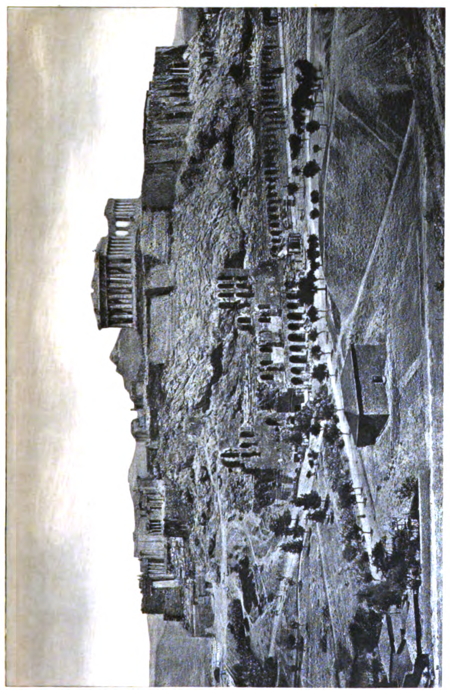
[XI-94]
CHAPTER LXIII↩
Civil Wars, and Ruin of the Greek Empire — Reigns of Andronicus, the Elder and Younger, and John Palæologus — Regency, Revolt, Reign, and Abdication of John Cantacuzene — Establishment of a Genoese Colony at Pera or Galata — Their Wars with the Empire and City of Constantinople
The long reign of Andronicus [1] the Elder is chiefly memorable by the disputes of the Greek church, the invasion of the Catalans, and the rise of the Ottoman power. He is celebrated as the most learned and virtuous prince of the age; but such virtue and such learning contributed neither to the perfection of the individual nor to the happiness of society. A slave of the most abject superstition, he was surrounded on all sides by visible and invisible enemies; nor were the flames of hell less dreadful to his fancy than those of a Catalan or Turkish war. Under the reign of the Palæologi, the choice of the patriarch was the most important business of the state; the heads of the Greek church were ambitious and fanatic monks; and their vices or virtues, their learning or ignorance, were equally mischievous or contemptible. By his intemperate discipline, the patriarch Athanasius [2] excited the hatred [XI-95] of the clergy and people: he was heard to declare that the sinner should swallow the last dregs of the cup of penance; and the foolish tale was propagated of his punishing a sacrilegious ass that had tasted the lettuce of a convent-garden. Driven from the throne by the universal clamour, Athanasius composed, before his retreat, two papers of a very opposite cast. His public testament was in the tone of charity and resignation; the private codicil breathed the direst anathemas against the authors of his disgrace, whom he excluded for ever from the communion of the Holy Trinity, the angels, and the saints. This last paper he enclosed in an earthen pot, which was placed, by his order, on the top of one of the pillars in the dome of St. Sophia, in the distant hope of discovery and revenge. At the end of four years, some youths, climbing by a ladder in search of pigeons’ nests, detected the fatal secret; and, as Andronicus felt himself touched and bound by the excommunication, he trembled on the brink of the abyss which had been so treacherously dug under his feet. A synod of bishops was instantly convened to debate this important question; the rashness of these clandestine anathemas was generally condemned; but, as the knot could be untied only by the same hand, as that hand was now deprived of the crosier, it appeared that this posthumous decree was irrevocable by any earthly power. Some faint testimonies of repentance and pardon were extorted from the author of the mischief; but the conscience of the emperor was still wounded, and he desired, with no less ardour than Athanasius himself, the restoration of a patriarch by whom alone he could be healed. At the dead of night a monk rudely knocked at the door of the royal bed-chamber, announcing a revelation of plague and famine, of inundations and earthquakes. Andronicus started from his bed, and spent the night in prayer, till he felt, or thought that he felt, a slight motion of the earth. The emperor, on foot, led the bishops and monks to the cell of Athanasius; and, after a proper resistance, the saint, from whom this message [XI-96] had been sent, consented to absolve the prince and govern the church of Constantinople. Untamed by disgrace and hardened by solitude, the shepherd was again odious to the flock; and his enemies contrived a singular and, as it proved, a successful mode of revenge. In the night they stole away the foot-stool or foot-cloth of his throne, which they secretly replaced with the decoration of a satirical picture. The emperor was painted with a bridle in his mouth, and Athanasius leading the tractable beast to the feet of Christ. The authors of the libel were detected and punished; but, as their lives had been spared, the Christian priest in sullen indignation retired to his cell; and the eyes of Andronicus, which had been opened for a moment, were again closed by his successor.
If this transaction be one of the most curious and important of a reign of fifty years, I cannot at least accuse the brevity of my materials, since I reduce into some few pages the enormous folios of Pachymer, [3] Cantacuzene, [4] and Nicephorus Gregoras, [5] who have composed the prolix and languid story of the times. The name and situation of the emperor John Cantacuzene might inspire the most lively curiosity. His memorials of forty years extend from the revolt of the younger Andronicus to his own abdication of the empire; and it is observed that, like Moses and Cæsar, he was the principal actor in the scenes which he describes. But in this eloquent work we should vainly seek the sincerity of an hero or a penitent. [XI-97] Retired in a cloister from the vices and passions of the world, he presents not a confession, but an apology, of the life of an ambitious statesman. Instead of unfolding the true counsels and characters of men, he displays the smooth and specious surface of events, highly varnished with his own praises and those of his friends. Their motives are always pure; their ends always legitimate; they conspire and rebel without any views of interest; and the violence which they inflict or suffer is celebrated as the spontaneous effect of reason and virtue.
After the example of the first of the Palæologi, the elder Andronicus associated his son Michael to the honours of the purple; and, from the age of eighteen to his premature death, that prince was acknowledged, above twenty-five years, as the second emperor of the Greeks. [6] At the head of an army, he excited neither the fears of the enemy nor the jealousy of the court; his modesty and patience were never tempted to compute the years of his father; nor was that father compelled to repent of his liberality either by the virtues or vices of his son. The son of Michael was named Andronicus from his grandfather, to whose early favour he was introduced by that nominal resemblance. The blossoms of wit and beauty increased the fondness of the elder Andronicus; and, with the common vanity of the age, he expected to realise in the second, the hope which had been disappointed in the first, generation. The boy was educated in the palace as an heir and a favourite; and, in the oaths and acclamations of the people, the august triad was formed by the names of the father, the son, and the grandson. But the younger Andronicus was speedily corrupted by his infant greatness, while he beheld, with puerile impatience, the double obstacle that hung, and [XI-98] might long hang, over his rising ambition. It was not to acquire fame, or to diffuse happiness, that he so eagerly aspired; wealth and impunity were in his eyes the most precious attributes of a monarch; and his first indiscreet demand was the sovereignty of some rich and fertile island, where he might lead a life of independence and pleasure. The emperor was offended by the loud and frequent intemperance which disturbed his capital; the sums which his parsimony denied were supplied by the Genoese usurers of Pera; and the oppressive debt, which consolidated the interest of a faction, could be discharged only by a revolution. A beautiful female, a matron in rank, a prostitute in manners, had instructed the younger Andronicus in the rudiments of love; but he had reason to suspect the nocturnal visits of a rival; and a stranger passing through the street was pierced by the arrows of his guards, who were placed in ambush at her door. That stranger was his brother, Prince Manuel, who languished and died of his wound; and the emperor Michael, their common father, whose health was in a declining state, expired on the eighth day, lamenting the loss of both his children. [7] However guiltless in his intention, the younger Andronicus might impute a brother’s and a father’s death to the consequence of his own vices; and deep was the sigh of thinking and feeling men, when they perceived, instead of sorrow and repentance, his ill-dissembled joy on the removal of two odious competitors. By these melancholy events, and the increase of his disorders, the mind of the elder emperor was gradually alienated; and, after many fruitless reproofs, he transferred on another grandson [8] his [XI-99] hopes and affection. The change was announced by the new oath of allegiance to the reigning sovereign and the person whom he should appoint for his successor; and the acknowledged heir, after a repetition of insults and complaints, was exposed to the indignity of a public trial. Before the sentence, which would probably have condemned him to a dungeon or a cell, the emperor was informed that the palace courts were filled with the armed followers of his grandson; the judgment was softened to a treaty of reconciliation; and the triumphant escape of the prince encouraged the ardour of the younger faction.
Yet the capital, the clergy, and the senate adhered to the person, or at least to the government, of the old emperor; and it was only in the provinces, by flight, and revolt, and foreign succour, that the malecontents could hope to vindicate their cause and subvert his throne. The soul of the enterprise was the great domestic, John Cantacuzene; the sally from Constantinople is the first date of his actions and memorials; and, if his own pen be most descriptive of his patriotism, an unfriendly historian has not refused to celebrate the zeal and ability which he displayed in the service of the young emperor. That prince escaped from the capital under the pretence of hunting; erected his standard at Hadrianople; and, in a few days, assembled fifty thousand horse and foot, whom neither honour nor duty could have armed against the Barbarians. Such a force might have saved or commanded the empire; but their counsels were discordant, their motions were slow and doubtful, and their progress was checked by intrigue and negotiation. The quarrel of the two Andronici was protracted, and suspended, and renewed, during a ruinous period of seven years. In the first treaty the relics of the Greek empire were divided: Constantinople, Thessalonica, and the islands were left to the elder, while the younger acquired the sovereignty of the greatest part of Thrace, from Philippi to the Byzantine limit. By the second treaty he stipulated the payment of his troops, his immediate coronation, and an [XI-100] adequate share of the power and revenue of the state. The third civil war was terminated by the surprise of Constantinople, the final retreat of the old emperor, and the sole reign of his victorious grandson. The reasons of this delay may be found in the characters of the men and of the times. When the heir of the monarchy first pleaded his wrongs and his apprehensions, he was heard with pity and applause; and his adherents repeated on all sides the inconsistent promise that he would increase the pay of the soldiers and alleviate the burdens of the people. The grievances of forty years were mingled in his revolt; and the rising generation was fatigued by the endless prospect of a reign whose favourites and maxims were of other times. The youth of Andronicus had been without spirit, his age was without reverence; his taxes produced an annual revenue of five hundred thousand pounds; yet the richest of the sovereigns of Christendom was incapable of maintaining three thousand horse and twenty galleys, to resist the destructive progress of the Turks. [9] “How different,” said the younger Andronicus, “is my situation from that of the son of Philip! Alexander might complain that his father would leave him nothing to conquer; alas! my grandsire will leave me nothing to lose.” But the Greeks were soon admonished that the public disorders could not be healed by a civil war; and their young favourite was not destined to be the saviour of a falling empire. On the first repulse, his party was broken by his own levity, their intestine discord, and the intrigues of the ancient court, which tempted each malecontent to desert or betray the cause of rebellion. Andronicus the Younger was touched with remorse, or fatigued with business, or deceived by negotiation; pleasure rather than power was his aim; and the [XI-101] licence of maintaining a thousand hounds, a thousand hawks, and a thousand huntsmen was sufficient to sully his fame and disarm his ambition.
Let us now survey the catastrophe of this busy plot and the final situation of the principal actors. [10] The age of Andronicus was consumed in civil discord; and, amidst the events of war and treaty, his power and reputation continually decayed, till the fatal night in which the gates of the city and palace were opened without resistance to his grandson. His principal commander scorned the repeated warnings of danger; and retiring to rest in the vain security of ignorance, abandoned the feeble monarch, with some priests and pages, to the terrors of a sleepless night. These terrors were quickly realised by the hostile shouts which proclaimed the titles and victory of Andronicus the Younger; and the aged emperor, falling prostrate before an image of the Virgin, despatched a suppliant message to resign the sceptre and to obtain his life at the hands of the conqueror. The answer of his grandson was decent and pious; at the prayer of his friends, the younger Andronicus assumed the sole administration; but the elder still enjoyed the name and pre-eminence of the first emperor, the use of the great palace, and a pension of twenty-four thousand pieces of gold, one half of which was assigned on the royal treasure, and the other on the fishery of Constantinople. But his impotence was soon exposed to contempt and oblivion; the vast silence of the palace was disturbed only by the cattle and poultry of the neighbourhood, which roved with impunity through the solitary courts; and a reduced allowance of ten thousand pieces of gold [11] was all that he [XI-102] could ask and more than he could hope. His calamities were embittered by the gradual extinction of sight: his confinement was rendered each day more rigorous; and during the absence and sickness of his grandson, his inhuman keepers, by the threats of instant death, compelled him to exchange the purple for the monastic habit and profession. The monk Antony had renounced the pomp of the world: yet he had occasion for a coarse fur in the winter-season; and, as wine was forbidden by his confessor, and water by his physician, the sherbet of Egypt was his common drink. It was not without difficulty that the late emperor could procure three or four pieces to satisfy these simple wants; and, if he bestowed the gold to relieve the more painful distress of a friend, the sacrifice is of some weight in the scale of humanity and religion. Four years after his abdication, Andronicus, or Antony, expired in a cell, in the seventy-fourth year of his age; and the last strain of adulation could only promise a more splendid crown of glory in heaven than he had enjoyed upon earth. [12]
Nor was the reign of the younger, more glorious or fortunate than that of the elder, Andronicus. [13] He gathered the fruits of ambition: but the taste was transient and bitter; in the supreme station he lost the remains of his early popularity; and the defects of his character became still more conspicuous to the world. The public reproach urged him to march in person against the Turks; nor did his courage fail in the hour of trial; but a defeat and wound were the only trophies of his expedition in Asia, which confirmed the establishment of the Ottoman monarchy. The abuses of the civil government [XI-103] attained their full maturity and perfection; his neglect of forms, and the confusion of national dresses, are deplored by the Greeks as the fatal symptoms of the decay of the empire. Andronicus was old before his time; the intemperance of youth had accelerated the infirmities of age; and, after being rescued from a dangerous malady by nature, or physic, or the Virgin, he was snatched away before he had accomplished his forty-fifth year. He was twice married; and, as the progress of the Latins in arms and arts had softened the prejudices of the Byzantine court, his two wives were chosen in the princely houses of Germany and Italy. The first, Agnes at home, Irene in Greece, was daughter of the duke of Brunswick. Her father [14] was a petty lord [15] in the poor and savage regions of the north of Germany; [16] yet he derived some revenue from his silver mines; [17] and his family is [XI-104] celebrated by the Greeks as the most ancient and noble of the Teutonic name. [18] After the death of this childless princess, Andronicus sought in marriage Jane, the sister of the count of Savoy; [19] and his suit was preferred to that of the French king. [20] The count respected in his sister the superior majesty of a Roman empress; her retinue was composed of knights and ladies; she was regenerated and crowned in St. Sophia, under the more orthodox appellation of Anne; and, at the nuptial feast, the Greeks and Italians vied with each other in the martial exercises of tilts and tournaments.
The empress Anne of Savoy survived her husband. Their son, John Palæologus, was left an orphan and an emperor, in the ninth year of his age; and his weakness was protected by the first and most deserving of the Greeks. The long and cordial friendship of his father for John Cantacuzene is alike honourable to the prince and the subject. It had been formed amidst the pleasures of their youth; their families were almost equally noble; [21] and the recent lustre of the purple was amply compensated by the energy of a private [XI-105] education. We have seen that the young emperor was saved by Cantacuzene from the power of his grandfather; and, after six years of civil war, the same favourite brought him back in triumph to the palace of Constantinople. Under the reign of Andronicus the Younger, the great domestic ruled the emperor and the empire; and it was by his valour and conduct that the isle of Lesbos and the principality of Ætolia were restored to their ancient allegiance. His enemies confess that, among the public robbers, Cantacuzene alone was moderate and abstemious; and the free and voluntary account which he produces of his own wealth [22] may sustain the presumption that it was devolved by inheritance, and not accumulated by rapine. He does not indeed specify the value of his money, plate, and jewels; yet, after a voluntary gift of two hundred vases of silver, after much had been secreted by his friends and plundered by his foes, his forfeit treasures were sufficient for the equipment of a fleet of seventy galleys. He does not measure the size and number of his estates; but his granaries were heaped with an incredible store of wheat and barley; and the labour of a thousand yoke of oxen might cultivate, according to the practice of antiquity, about sixty-two thousand five hundred acres of arable land. [23] His pastures were stocked with two thousand five hundred brood mares, two hundred camels, three hundred mules, five hundred asses, five thousand horned cattle, fifty thousand hogs, and seventy thousand sheep: [24] a precious record of [XI-106] rural opulence, in the last period of the empire, and in a land, most probably in Thrace, so repeatedly wasted by foreign and domestic hostility. The favour of Cantacuzene was above his fortune. In the moments of familiarity, in the hour of sickness, the emperor was desirous to level the distance between them, and pressed his friend to accept the diadem and purple. The virtue of the great domestic, which is attested by his own pen, resisted the dangerous proposal; but the last testament of Andronicus the Younger named him the guardian of his son and the regent of the empire.
Had the regent found a suitable return of obedience and gratitude, perhaps he would have acted with pure and zealous fidelity in the service of his pupil. [25] A guard of five hundred soldiers watched over his person and the palace; the funeral of the late emperor was decently performed; the capital was silent and submissive; and five hundred letters, which Cantacuzene despatched in the first month, informed the provinces of their loss and their duty. The prospect of a tranquil minority was blasted by the Great Duke or Admiral Apocaucus; and, to exaggerate his perfidy, the Imperial historian is pleased to magnify his own imprudence in raising him to that office against the advice of his more sagacious sovereign. Bold and subtle, rapacious and profuse, the avarice and ambition of Apocaucus were by turns subservient to each other; and his talents were applied to the ruin of his country. His arrogance was heightened by the command of a naval force and an impregnable castle, and, under the mask of oaths and flattery, he secretly conspired against his benefactor. The female court of the empress was bribed and directed; he encouraged Anne of Savoy to assert, [XI-107] by the law of nature, the tutelage of her son; the love of power was disguised by the anxiety of maternal tenderness; and the founder of the Palæologi had instructed his posterity to dread the example of a perfidious guardian. The patriarch John of Apri was a proud and feeble old man, encompassed by a numerous and hungry kindred. He produced an obsolete epistle of Andronicus, which bequeathed the prince and people to his pious care: the fate of his predecessor Arsenius prompted him to prevent, rather than punish, the crimes of an usurper; and Apocaucus smiled at the success of his own flattery, when he beheld the Byzantine priest assuming the state and temporal claims of the Roman pontiff. [26] Between three persons so different in their situation and character, a private league was concluded: a shadow of authority was restored to the senate; and the people was tempted by the name of freedom. By this powerful confederacy, the great domestic was assaulted at first with clandestine, at length with open, arms. His prerogatives were disputed; his opinions slighted; his friends persecuted; and his safety was threatened both in the camp and city. In his absence on the public service, he was accused of treason; proscribed as an enemy of the church and state; and delivered, with all his adherents, to the sword of justice, the vengeance of the people, and the power of the devil: his fortunes were confiscated; his aged mother was cast into prison; all his past services were buried in oblivion; and he was driven by injustice to perpetrate the crime of which he was accused. [27] From the review of his preceding conduct, Cantacuzene appears to have been guiltless of any treasonable designs; and [XI-108] the only suspicion of his innocence must arise from the vehemence of his protestations, and the sublime purity which he ascribes to his own virtue. While the empress and the patriarch still affected the appearance of harmony, he repeatedly solicited the permission of retiring to a private, and even a monastic, life. After he had been declared a public enemy, it was his fervent wish to throw himself at the feet of the young emperor, and to receive without a murmur the stroke of the executioner: it was not without reluctance that he listened to the voice of reason, which inculcated the sacred duty of saving his family and friends, and proved that he could only save them by drawing the sword and assuming the Imperial title.
In the strong city of Demotica, his peculiar domain, the emperor John Cantacuzenus was invested with the purple buskins; his right leg was clothed by his noble kinsmen, the left by the Latin chiefs, on whom he conferred the order of knighthood. But even in this act of revolt he was still studious of loyalty; and the titles of John Palæologus and Anne of Savoy were proclaimed before his own name and that of his wife Irene. Such vain ceremony is a thin disguise of rebellion, nor are there perhaps any personal wrongs that can authorise a subject to take arms against his sovereign; but the want of preparation and success may confirm the assurance of the usurper that this decisive step was the effect of necessity rather than of choice. Constantinople adhered to the young emperor; the king of Bulgaria was invited to the relief of Hadrianople; the principal cities of Thrace and Macedonia, after some hesitation, renounced their obedience to the great domestic; and the leaders of the troops and provinces were induced, by their private interest, to prefer the loose dominion of a woman and a priest. [28] The army of Cantacuzene, in sixteen divisions, was stationed on the [XI-109] banks of the Melas, to tempt or intimidate the capital; it was dispersed by treachery or fear; and the officers, more especially the mercenary Latins, accepted the bribes, and embraced the service, of the Byzantine court. After this loss, the rebel emperor (he fluctuated between the two characters) took the road of Thessalonica with a chosen remnant; but he failed in his enterprise on that important place; and he was closely pursued by the Great Duke, his enemy Apocaucus, at the head of a superior power by sea and land. Driven from the coast, in his march, or rather flight, into the mountains of Servia, Cantacuzene assembled his troops to scrutinise those who were worthy and willing to accompany his broken fortunes. A base majority bowed and retired; and his trusty band was diminished to two thousand, and at last to five hundred, volunteers. The cral, [29] or despot of the Servians, received him with generous hospitality; but the ally was insensibly degraded to a suppliant, an hostage, a captive; and, in this miserable dependence, he waited at the door of the Barbarian, who could dispose of the life and liberty of a Roman emperor. The most tempting offers could not persuade the cral to violate his trust; but he soon inclined to the stronger side; and his friend was dismissed without injury to a new vicissitude of hopes and perils. Near six years the flame of discord burnt with various success and unabated [XI-110] rage: the cities were distracted by the faction of the nobles and the plebeians — the Cantacuzeni and Palæologi; and the Bulgarians, the Servians, and the Turks were invoked on both sides as the instruments of private ambition and the common ruin. The regent deplored the calamities of which he was the author and victim: and his own experience might dictate a just and lively remark on the different nature of foreign and civil war. “The former,” said he, “is the external warmth of summer, always tolerable, and often beneficial; the latter is the deadly heat of a fever, which consumes without a remedy the vitals of the constitution.” [30]
The introduction of barbarians and savages into the contests of civilised nations is a measure pregnant with shame and mischief; which the interest of the moment may compel, but which is reprobated by the best principles of humanity and reason. It is the practice of both sides to accuse their enemies of the guilt of the first alliances; and those who fail in their negotiations are loudest in their censure of the example which they envy and would gladly imitate. The Turks of Asia were less barbarous, perhaps, than the shepherds of Bulgaria and Servia; [31] but their religion rendered them the [XI-111] implacable foes of Rome and Christianity. To acquire the friendship of their emirs, the two factions vied with each other in baseness and profusion; the dexterity of Cantacuzene obtained the preference; but the succour and victory were dearly purchased by the marriage of his daughter with an infidel, the captivity of many thousand Christians, and the passage of the Ottomans into Europe, the last and fatal stroke in the fall of the Roman empire. The inclining scale was decided in his favour by the death of Apocaucus, the just, though singular, retribution of his crimes. A crowd of nobles or plebeians, whom he feared or hated, had been seized by his orders in the capital and the provinces; and the old palace of Constantine was assigned for the place of their confinement. Some alterations in raising the walls and narrowing the cells had been ingeniously contrived to prevent their escape and aggravate their misery; and the work was incessantly pressed by the daily visits of the tyrant. His guards watched at the gate, and, as he stood in the inner court to overlook the architects, without fear or suspicion, he was assaulted and laid breathless on the ground, by two resolute prisoners of the Palæologian race, [32] who were armed [XI-112] with sticks and animated by despair. On the rumour of revenge and liberty, the captive multitude broke their fetters, fortified their prison, and exposed from the battlements the tyrant’s head, presuming on the favour of the people and the clemency of the empress. Anne of Savoy might rejoice in the fall of an haughty and ambitious minister; but, while she delayed to resolve or to act, the populace, more especially the mariners, were excited by the widow of the Great Duke to a sedition, an assault, and a massacre. The prisoners (of whom the far greater part were guiltless or inglorious of the deed) escaped to a neighbouring church; they were slaughtered at the foot of the altar; and in his death the monster was not less bloody and venomous than in his life. Yet his talents alone upheld the cause of the young emperor; and his surviving associates, suspicious of each other, abandoned the conduct of the war, and rejected the fairest terms of accommodation. In the beginning of the dispute, the empress felt and complained that she was deceived by the enemies of Cantacuzene; the patriarch was employed to preach against the forgiveness of injuries; and her promise of immortal hatred was sealed by an oath under the penalty of excommunication. [33] But Anne soon learned to hate without a teacher: she beheld the misfortunes of the empire with the indifference of a stranger: her jealousy was exasperated by the competition of a rival empress; and, on the first symptoms of a more yielding temper, she threatened the patriarch to convene a synod and degrade him from his office. Their incapacity and discord would have afforded the most decisive advantage; but the civil war was protracted by the weakness [XI-113] of both parties; and the moderation of Cantacuzene has not escaped the reproach of timidity and indolence. He successively recovered the provinces and cities; [34] and the realm of his pupil was measured by the walls of Constantinople; but the metropolis alone counterbalanced the rest of the empire; nor could he attempt that important conquest, till he had secured in his favour the public voice and a private correspondence. An Italian, of the name of Facciolati, [35] had [XI-114] succeeded to the office of Great Duke: the ships, the guards, and the golden gate were subject to his command; but his humble ambition was bribed to become the instrument of treachery; and the revolution was accomplished without danger or bloodshed. Destitute of the powers of resistance or the hope of relief, the inflexible Anne would have still defended the palace, and have smiled to behold the capital in flames, rather than in the possession of a rival. She yielded to the prayers of her friends and enemies; and the treaty was dictated by the conqueror, who professed a loyal and zealous attachment to the son of his benefactor. The marriage of his daughter with John Palæologus was at length consummated: the hereditary right of the pupil was acknowledged; but the sole administration during ten years was vested in the guardian. Two emperors and three empresses were seated on the Byzantine throne; and a general amnesty quieted the apprehensions, and confirmed the property, of the most guilty subjects. The festival of the coronation and nuptials was celebrated with the appearance of concord and magnificence, and both were equally fallacious. During the late troubles, the treasures of the state, and even the palace, had been alienated or embezzled: the royal banquet was served in pewter or earthenware; and such was the proud poverty of the times that the absence of gold and jewels was supplied by the paltry artifices of glass and gilt leather. [36]
I hasten to conclude the personal history of John Cantacuzene. [37] He triumphed and reigned; but his reign and triumph were clouded by the discontent of his own and the adverse faction. His followers might style the general amnesty [XI-115] an act of pardon for his enemies and of oblivion for his friends: [38] in his cause their estates had been forfeited or plundered; and, as they wandered naked and hungry through the streets, they cursed the selfish generosity of a leader who, on the throne of the empire, might relinquish without merit his private inheritance. The adherents of the empress blushed to hold their lives and fortunes by the precarious favour of an usurper; and the thirst of revenge was concealed by a tender concern for the succession, and even the safety, of her son. They were justly alarmed by a petition of the friends of Cantacuzene, that they might be released from their oath of allegiance to the Palæologi and entrusted with the defence of some cautionary towns: a measure supported with argument and eloquence; and which was rejected (says the Imperial historian) “by my sublime and almost incredible virtue.” His repose was disturbed by the sound of plots and seditions; and he trembled lest the lawful prince should be stolen away by some foreign or domestic enemy, who would inscribe his name and his wrongs in the banners of rebellion. As the son of Andronicus advanced in the years of manhood, he began to feel and to act for himself; and his rising ambition was rather stimulated than checked by the imitation of his father’s vices. If we may trust his own professions, Cantacuzene laboured with honest industry to correct these sordid and sensual appetites, and to raise the mind of the young prince to a level with his fortune. In the Servian expedition [39] the two emperors showed themselves in cordial harmony to the troops and provinces; and [XI-116] the younger colleague was initiated by the elder in the mysteries of war and government. After the conclusion of the peace, Palæologus was left at Thessalonica, a royal residence and a frontier station, to secure by his absence the peace of Constantinople, and to withdraw his youth from the temptations of a luxurious capital. But the distance weakened the powers of control, and the son of Andronicus was surrounded with artful or unthinking companions, who taught him to hate his guardian, to deplore his exile, and to vindicate his rights. A private treaty with the cral or despot of Servia was soon followed by an open revolt; and Cantacuzene, on the throne of the elder Andronicus, defended the cause of age and prerogative, which in his youth he had so vigorously attacked. At his request, the empress-mother undertook the voyage of Thessalonica, and the office of mediation: she returned without success; and unless Anne of Savoy was instructed by adversity, we may doubt the sincerity, or at least the fervour, of her zeal. While the regent grasped the sceptre with a firm and vigorous hand, she had been instructed to declare that the ten years of his legal administration would soon elapse; and that, after a full trial of the vanity of the world, the emperor Cantacuzene sighed for the repose of a cloister, and was ambitious only of an heavenly crown. Had these sentiments been genuine, his voluntary abdication would have restored the peace of the empire, and his conscience would have been relieved by an act of justice. Palæologus alone was responsible for his future government; and, whatever might be his vices, they were surely less formidable than the calamities of a civil war, in which the Barbarians and infidels were again invited to assist the Greeks in their mutual destruction. By the arms of the Turks, who now struck a [XI-117] deep and everlasting root in Europe, Cantacuzene prevailed in the third conquest in which he had been involved; and the young emperor, driven from the sea and land, was compelled to take shelter among the Latins of the isle of Tenedos. His insolence and obstinacy provoked the victor to a step which must render the quarrel irreconcileable; and the association of his son Matthew, whom he invested with the purple, established the succession in the family of the Cantacuzeni. But Constantinople was still attached to the blood of her ancient princes; and this last injury accelerated the restoration of the rightful heir. A noble Genoese espoused the cause of Palæologus, obtained a promise of his sister, and achieved the revolution with two galleys and two thousand five hundred auxiliaries. Under the pretence of distress they were admitted into the lesser port; a gate was opened, and the Latin shout of “Long life and victory to the emperor John Palæologus!” was answered by a general rising in his favour. A numerous and loyal party yet adhered to the standard of Cantacuzene; but he asserts in his history (does he hope for belief?) that his tender conscience rejected the assurance of conquest: that, in free obedience to the voice of religion and philosophy, he descended from the throne and embraced with pleasure the monastic habit and profession. [40] So soon as he ceased to be a prince, his successor was not unwilling that he should be a saint; the remainder of his life was devoted to piety and learning; in the cells of Constantinople and Mount Athos, the monk Joasaph was respected as the temporal and spiritual father of the emperor; and, if he issued from his retreat, it was as the minister of peace, to subdue the obstinacy, and solicit the pardon, of his rebellious son. [41]
[XI-118]
Yet in the cloister, the mind of Cantacuzene was still exercised by theological war. He sharpened a controversial pen against the Jews and Mahometans; [42] and in every state he defended with equal zeal the divine light of Mount Thabor, a memorable question which consummates the religious follies of the Greeks. The fakirs of India [43] and the monks of the Oriental church were alike persuaded that in total abstraction of the faculties of the mind and body the purer spirit may ascend to the enjoyment and vision of the Deity. The opinion and practice of the monasteries of Mount Athos [44] will be best represented in the words of an abbot who flourished in the eleventh century. “When thou art alone in thy cell,” says the ascetic teacher, “shut thy door, and seat thyself in a corner; raise thy mind above all things vain and transitory; recline thy beard and chin on thy breast; turn thy eyes and thy thoughts towards the middle of thy belly, the region of the navel; and search the place of the heart, the seat of the soul. At first, all will be dark and comfortless; but, if you persevere day and night, you will feel an ineffable joy; and no sooner has the soul discovered the place of the heart than it is involved in a mystic and ethereal light.” This light, the production of a distempered fancy, the creature of an empty stomach and an empty brain, was adored by the Quietists as the pure and [XI-119] perfect essence of God himself; and, as long as the folly was confined to Mount Athos, the simple solitaries were not inquisitive how the divine essence could be a material substance, or how an immaterial substance could be perceived by the eyes of the body. But in the reign of the younger Andronicus these monasteries were visited by Barlaam, [45] a Calabrian monk, who was equally skilled in philosophy and theology; who possessed the languages of the Greeks and Latins; and whose versatile genius could maintain their opposite creeds, according to the interest of the moment. The indiscretion of an ascetic revealed to the curious traveller the secrets of mental prayer; and Barlaam embraced the opportunity of ridiculing the Quietists, who placed the soul in the navel; of accusing the monks of Mount Athos of heresy and blasphemy. His attack compelled the more learned to renounce or dissemble the simple devotion of their brethren; and Gregory Palamas introduced a scholastic distinction between the essence and operation of God. [46] His inaccessible essence dwells in the midst of an uncreated and eternal light; and this beatific vision of the saints had been manifested to the disciples on Mount Thabor, in the transfiguration of Christ. Yet this distinction could not escape the reproach of polytheism; the eternity of the light of Thabor was fiercely denied; and Barlaam still charged the Palamites with holding two eternal substances, a visible and an invisible God. From the rage [XI-120] of the monks of Mount Athos, who threatened his life, the Calabrian retired to Constantinople, where his smooth and specious manners introduced him to the favour of the great domestic and the emperor. The court and the city were involved in this theological dispute, which flamed amidst the civil war; but the doctrine of Barlaam was disgraced by his flight and apostacy; the Palamites triumphed; and their adversary, the patriarch John of Apri, was deposed by the consent of the adverse factions of the state. In the character of emperor and theologian, Cantacuzene presided in the synod of the Greek church, which established, as an article of faith, the uncreated light of Mount Thabor; and, after so many insults, the reason of mankind was slightly wounded by the addition of a single absurdity. Many rolls of paper or parchment have been blotted; and the impenitent sectaries, who refused to subscribe the orthodox creed, were deprived of the honours of Christian burial; but in the next age the question was forgotten; nor can I learn that the axe or the faggot were employed for the extirpation of the Barlaamite heresy. [47]
For the conclusion of this chapter I have reserved the Genoese war, which shook the throne of Cantacuzene and betrayed the debility of the Greek empire. The Genoese, who, after the recovery of Constantinople, were seated in the suburb of Pera or Galata, received that honourable fief from the bounty of the emperor. They were indulged in the use of their laws and magistrates; but they submitted to the duties of vassals and subjects: the forcible word of liegemen [48] was borrowed [XI-121] from the Latin jurisprudence; and their podestà, or chief, before he entered on his office, saluted the emperor with loyal acclamations and vows of fidelity. Genoa sealed a firm alliance with the Greeks; and, in case of a defensive war, a supply of fifty empty galleys, and a succour of fifty galleys completely armed and manned, was promised by the republic to the empire. In the revival of a naval force it was the aim of Michael Palæologus to deliver himself from a foreign aid; and his vigorous government contained the Genoese of Galata within those limits which the insolence of wealth and freedom provoked them to exceed. A sailor threatened that they should soon be masters of Constantinople, and slew the Greek who resented this national affront; and an armed vessel, after refusing to salute the palace, was guilty of some acts of piracy in the Black Sea. Their countrymen threatened to support their cause; but the long and open village of Galata was instantly surrounded by the Imperial troops; till, in the moment of the assault, the prostrate Genoese implored the clemency of their sovereign. The defenceless situation which secured their obedience exposed them to the attack of their Venetian rivals, who, in the reign of the elder Andronicus, presumed to violate the majesty of the throne. On the approach of their fleets, the Genoese, with their families and effects, retired into the city; their empty habitations were reduced to ashes; and the feeble prince, who had viewed the destruction of his suburb, expressed his resentment, not by arms, but by ambassadors. This misfortune, however, was advantageous to the Genoese, who obtained, and imperceptibly abused, the dangerous licence of surrounding Galata with a strong wall; of introducing into the ditch the waters of the sea; of erecting lofty turrets; and of mounting a train of military engines on the rampart. The narrow bounds in which they had been circumscribed were insufficient for the growing colony; each day they acquired some addition of landed property; and the adjacent hills were covered with their villas and castles, which they joined and protected by [XI-122] new fortifications. [49] The navigation and trade of the Euxine was the patrimony of the Greek emperors, who commanded the narrow entrance, the gates, as it were, of that inland sea. In the reign of Michael Palæologus, their prerogative was acknowledged by the sultan of Egypt, who solicited and obtained the liberty of sending an annual ship for the purchase of slaves in Circassia and the Lesser Tartary: a liberty pregnant with mischief to the Christian cause, since these youths were transformed by education and discipline into the formidable Mamalukes. [50] From the colony of Pera the Genoese engaged with superior advantage in the lucrative trade of the Black Sea; and their industry supplied the Greeks with fish and corn, two articles of food almost equally important to a superstitious people. The spontaneous bounty of nature appears to have bestowed the harvests of the Ukraine, the produce of a rude and savage husbandry; and the endless exportation of salt fish and caviar is annually renewed by the enormous sturgeons that are caught at the mouth of the Don, or Tanais, in their last station of the rich mud and shallow water of the Mæotis. [51] The waters of the Oxus, the Caspian, the Volga, and the Don opened a rare and laborious passage for the gems and spices of India; and, after three months’ [XI-123] march, the caravans of Carizme met the Italian vessels in the harbours of Crimea. [52] These various branches of trade were monopolised by the diligence and the power of the Genoese. Their rivals of Venice and Pisa were forcibly expelled; the natives were awed by the castles and cities, which arose on the foundations of their humble factories; and their principal establishment of Caffa [53] was besieged without effect by the Tartar powers. Destitute of a navy, the Greeks were oppressed by these haughty merchants, who fed or famished Constantinople, according to their interest. They proceeded to usurp the customs, the fishery, and even the toll of the Bosphorus; and, while they derived from these objects a revenue of two hundred thousand pieces of gold, a remnant of thirty thousand was reluctantly allowed to the emperor. [54] The colony of Pera or Galata acted, in peace and war, as an independent state; and, as it will happen in distant settlements, the Genoese podestà too often forgot that he was the servant of his own masters.
These usurpations were encouraged by the weakness of the elder Andronicus, and by the civil wars that afflicted his age and the minority of his grandson. The talents of Cantacuzene were employed to the ruin, rather than the restoration, of the empire; and after his domestic victory he was condemned to an ignominious trial, whether the Greeks or the Genoese should reign in Constantinople. The merchants of Pera were offended by his refusal of some contiguous lands, some commanding heights, which they proposed to cover with new fortifications; and in the absence of the emperor, who was detained at Demotica by sickness, they ventured to brave [XI-124] the debility of a female reign. A Byzantine vessel, which had presumed to fish at the mouth of the harbour, was sunk by these audacious strangers; the fishermen were murdered. Instead of suing for pardon, the Genoese demanded satisfaction; required, in an haughty strain, that the Greeks should renounce the exercise of navigation; and encountered, with regular arms, the first sallies of the popular indignation. They instantly occupied the debateable land; and by the labour of a whole people, of either sex and of every age, the wall was raised, and the ditch was sunk, with incredible speed. At the same time they attacked and burnt two Byzantine galleys; while the three others, the remainder of the Imperial navy, escaped from their hand; the habitations without the gates, or along the shore, were pillaged and destroyed; and the care of the regent, of the empress Irene, was confined to the preservation of the city. The return of Cantacuzene dispelled the public consternation: the emperor inclined to peaceful counsels; but he yielded to the obstinacy of his enemies, who rejected all reasonable terms, and to the ardour of his subjects, who threatened, in the style of scripture, to break them in pieces like a potter’s vessel. Yet they reluctantly paid the taxes that he imposed for the construction of ships and the expenses of the war; and, as the two nations were masters, the one of the land, the other of the sea, Constantinople and Pera were pressed by the evils of a mutual siege. The merchants of the colony, who had believed that a few days would terminate the war, already murmured at their losses; the succours from their mother-country were delayed by the factions of Genoa; and the most cautious embraced the opportunity of a Rhodian vessel to remove their families and effects from the scene of hostility. In the spring, the Byzantine fleet, seven galleys and a train of smaller vessels, issued from the mouth of the harbour and steered in a single line along the shore of Pera; unskilfully presenting their sides to the beaks of the adverse squadron. The crews were composed of peasants and mechanics; nor was their ignorance [XI-125] compensated by the native courage of Barbarians. The wind was strong, the waves were rough; and no sooner did the Greeks perceive a distant and inactive enemy, than they leaped headlong into the sea, from a doubtful to an inevitable peril. The troops that marched to the attack of the lines of Pera were struck at the same moment with a similar panic; and the Genoese were astonished, and almost ashamed, at their double victory. Their triumphant vessels, crowned with flowers, and dragging after them the captive galleys, repeatedly passed and repassed before the palace. The only virtue of the emperor was patience, and the hope of revenge his sole consolation. Yet the distress of both parties interposed a temporary agreement; and the shame of the empire was disguised by a thin veil of dignity and power. Summoning the chiefs of the colony, Cantacuzene affected to despise the trivial object of the debate; and, after a mild reproof, most liberally granted the lands, which had been previously resigned to the seeming custody of his officers. [55]
But the emperor was soon solicited to violate the treaty, and to join his arms with the Venetians, the perpetual enemies of Genoa and her colonies. While he compared the reasons of peace and war, his moderation was provoked by a wanton insult of the inhabitants of Pera, who discharged from their rampart a large stone that fell in the midst of Constantinople. On his just complaint, they coldly blamed the imprudence of their engineer; but the next day the insult was repeated, and they exulted in a second proof that the royal city was not beyond the reach of their artillery. Cantacuzene instantly signed his treaty with the Venetians; but the weight of the Roman empire was scarcely felt in the balance of these opulent and powerful republics. [56] From the straits of Gibraltar to the [XI-126] mouth of the Tanais, their fleets encountered each other with various success; and a memorable battle was fought in the narrow sea, under the walls of Constantinople. It would not be an easy task to reconcile the accounts of the Greeks, the Venetians, and the Genoese; [57] and, while I depend on the narrative of an impartial historian, [58] I shall borrow from each nation the facts that redound to their own disgrace and the honour of their foes. The Venetians, with their allies, the Catalans, had the advantage of number; and their fleet, with the poor addition of eight Byzantine galleys, amounted to seventy-five sail; the Genoese did not exceed sixty-four; but in those times their ships of war were distinguished by the superiority of their size and strength. The names and families of their naval commanders, Pisani and Doria, are illustrious in the annals of their country; but the personal merit of the former was eclipsed by the fame and abilities of his rival. They engaged in tempestuous weather; and the tumultuary conflict was continued from the dawn to the extinction of light. The enemies of the Genoese applaud their prowess; the friends of the Venetians are dissatisfied with their behaviour; but all parties agree in praising the skill and boldness of the Catalans, who, with many wounds, sustained the brunt of the action. On the separation of the fleets, the event might appear doubtful; but the thirteen Genoese galleys, that had been sunk or taken, were compensated by a double loss of the allies: of fourteen Venetians, ten Catalans, and two Greeks; and even the grief of the conquerors expressed [XI-none] [XI-127] the assurance and habit of more decisive victories. Pisani confessed his defeat by retiring into a fortified harbour, from whence, under the pretext of the orders of the senate, he steered with a broken and flying squadron for the isle of Candia, and abandoned to his rivals the sovereignty of the sea. In a public epistle, [59] addressed to the doge and senate, Petrarch employs his eloquence to reconcile the maritime powers, the two luminaries of Italy. The orator celebrates the valour and victory of the Genoese, the first of men in the exercise of naval war; he drops a tear on the misfortunes of their Venetian brethren; but he exhorts them to pursue with fire and sword the base and perfidious Greeks; to purge the metropolis of the East from the heresy with which it was infected. Deserted by their friends, the Greeks were incapable of resistance; and, three months after the battle, the emperor Cantacuzene solicited and subscribed a treaty, which for ever banished the Venetians and Catalans, and granted to the Genoese a monopoly of trade and almost a right of dominion. [60] The Roman empire (I smile in transcribing the name) might soon have sunk into a province of Genoa, if the ambition of the republic had not been checked by the ruin of her freedom and naval power. A long contest of one hundred and thirty years was determined by the triumph of Venice; and the factions of the Genoese compelled them to seek for domestic peace under the protection of a foreign lord, the duke of Milan, or the French king. Yet the spirit of commerce survived that of conquest; and the colony of Pera still awed the capital, and navigated the Euxine, till it was involved by the Turks in the final servitude of Constantinople itself.
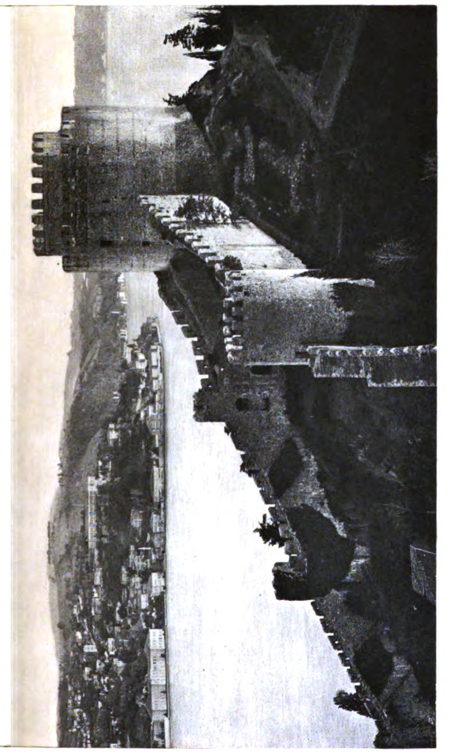
[XI-128]
CHAPTER LXIV↩
Conquests of Zingis Khan and the Moguls from China to Poland — Escape of Constantinople and the Greeks — Origin of the Ottoman Turks in Bithynia — Reigns and Victories of Othman, Orchan, Amurath the First, and Bajazet the First — Foundation and Progress of the Turkish Monarchy in Asia and Europe — Danger of Constantinople and the Greek Empire
From the petty quarrels of a city and her suburbs, from the cowardice and discord of the falling Greeks, I shall now ascend to the victorious Turks, whose domestic slavery was ennobled by martial discipline, religious enthusiasm, and the energy of the national character. The rise and progress of the Ottomans, the present sovereigns of Constantinople, are connected with the most important scenes of modern history; but they are founded on a previous knowledge of the great eruption of the Moguls and Tartars, whose rapid conquests may be compared with the primitive convulsions of nature, which have agitated and altered the surface of the globe. I have long since asserted my claim to introduce the nations, the immediate or remote authors of the fall of the Roman empire; nor can I refuse myself to those events which, from their uncommon magnitude, will interest a philosophic mind in the history of blood. [1]
From the spacious highlands between China, Siberia, and the Caspian Sea, the tide of emigration and war has repeatedly been poured. These ancient seats of the Huns and Turks [XI-129] were occupied in the twelfth century by many pastoral tribes of the same descent and similar manners, which were united and led to conquest by the formidable Zingis. In his ascent to greatness, that Barbarian (whose private appellation was Temugin) had trampled on the necks of his equals. His birth was noble; but it was in the pride of victory that the prince or people deduced his seventh ancestor from the immaculate conception of a virgin. [2] His father had reigned over thirteen hordes, which composed about thirty or forty thousand families; above two-thirds refused to pay tithes or obedience to his infant son; and, at the age of thirteen, Temugin fought a battle against his rebellious subjects. The future conqueror of Asia was reduced to fly and to obey; but he rose superior to his fortune; and, in his fortieth year, he had established his fame and dominion over the circumjacent tribes. In a state of society in which policy is rude and valour is universal, the ascendant of one man must be founded on his power and resolution to punish his enemies and recompense his friends. His first military league was ratified by the simple rites of sacrificing an horse and tasting of a running stream: Temugin pledged himself to divide with his followers the sweets and the bitters of life; and, when he had shared among them his horses and apparel, he was rich in their gratitude and his own hopes. After his first victory, he placed seventy caldrons on the fire, and seventy of the most guilty rebels were cast headlong into the boiling water. The sphere of his attraction was continually enlarged by the ruin of the proud and the submission of the prudent; [XI-130] and the boldest chieftains might tremble, when they beheld, enchased in silver, the skull of the khan of the Keraites, [3] who under the name of Prester John had corresponded with the Roman pontiff and the princes of Europe. The ambition of Tegumin condescended to employ the arts of superstition; and it was from a naked prophet, who could ascend to heaven on a white horse, that he accepted the title of Zingis, [4] the Most Great; and a divine right to the conquest and dominion of the earth. In a general couroultai, or diet, he was seated on a felt, which was long afterwards revered as a relic, and solemnly proclaimed Great Khan or emperor of the Moguls [5] and Tartars. [6] Of these kindred though rival [XI-131] names, the former had given birth to the Imperial race; and the latter has been extended, by accident or error, over the spacious wilderness of the North.
The code of laws which Zingis dictated to his subjects was adapted to the preservation of domestic peace and the exercise of foreign hostility. The punishment of death was inflicted on the crimes of adultery, murder, perjury, and the capital thefts of an horse or ox; and the fiercest of men were mild and just in their intercourse with each other. The future election of the great khan was vested in the princes of his family and the heads of the tribes; and the regulations of the chase were essential to the pleasures and plenty of a Tartar camp. The victorious nation was held sacred from all servile labours, which were abandoned to slaves and strangers; and every labour was servile except the profession of arms. The service and discipline of the troops, who were armed with bows, scymetars, and iron maces, and divided by hundreds, thousands, and ten thousands, were the institutions of a veteran commander. Each officer and soldier was made responsible, under pain of death, for the safety and honour of his companions; and the spirit of conquest breathed in the law that peace should never be granted unless to a vanquished and suppliant enemy. [7] But it is the religion of Zingis that best deserves our wonder and applause. The Catholic inquisitors of Europe, who defended nonsense by cruelty, might have been confounded by the example of a [XI-132] Barbarian, who anticipated the lessons of philosophy [8] and established by his laws a system of pure theism and perfect toleration. His first and only article of faith was the existence of one God, the author of all good, who fills, by his presence, the heavens and earth, which he has created by his power. The Tartars and Moguls were addicted to the idols of their peculiar tribes; and many of them had been converted by the foreign missionaries to the religions of Moses, of Mahomet, and of Christ. These various systems in freedom and concord were taught and practised within the precincts of the same camp; and the Bonze, the Imam, the Rabbi, the Nestorian, and the Latin priest enjoyed the same honourable exemption from service and tribute. In the mosch of Bochara, the insolent victor might trample the Koran under his horse’s feet, but the calm legislator respected the prophets and pontiffs of the most hostile sects. The reason of Zingis was not informed by books; the khan could neither read nor write; and, except the tribe of the Igours, the greatest part of the Moguls and Tartars were as illiterate as their sovereign. [9] The memory of their exploits was preserved by tradition; sixty-eight years after the death of Zingis, these traditions were collected and transcribed; [10] the brevity of their domestic annals [XI-133] may be supplied by the Chinese, [11] Persians, [12] Armenians, [13] [XI-134] Syrians, [14] Arabians, [15] Greeks, [16] Russians, [17] Poles, [18] Hungarians, [19] and Latins; [20] and each nation will deserve credit [XI-135] in the relation of their own disasters and their own defeats. [21]
The arms of Zingis and his lieutenants successively reduced the hordes of the desert, who pitched their tents between the wall of China and the Volga; and the Mogul emperor became the monarch of the pastoral world, the lord of many millions of shepherds and soldiers, who felt their united strength, and were impatient to rush on the mild and wealthy climates of the South. His ancestors had been the tributaries of the Chinese emperors; and Temugin himself had been disgraced by a title of honour and servitude. [22] The court of Pekin was astonished by an embassy from its former vassal, who in the tone of the king of nations exacted the tribute and obedience which he had paid, and who affected to treat the Son of Heaven as the most contemptible of mankind. An haughty answer disguised their secret apprehensions; and their fears were soon justified by the march of innumerable squadrons, who pierced on all sides the feeble rampart of the great wall. Ninety cities were stormed, or starved, by [XI-136] the Moguls; ten only escaped; and Zingis, from a knowledge of the filial piety of the Chinese, covered his vanguard with their captive parents; an unworthy and, by degrees, a fruitless abuse of the virtues of his enemies. His invasion was supported by the revolt of an hundred thousand Khitans, who guarded the frontier; yet he listened to a treaty; and a princess of China, three thousand horses, five hundred youths, and as many virgins, and a tribute of gold and silk, were the price of his retreat. In his second expedition, he compelled the Chinese emperor to retire beyond the yellow river to a more southern residence. The siege of Pekin [23] was long and laborious: the inhabitants were reduced by famine to decimate and devour their fellow-citizens; when their ammunition was spent, they discharged ingots of gold and silver from their engines; but the Moguls introduced a mine to the centre of the capital; and the conflagration of the palace burnt above thirty days. China was desolated by Tartar war and domestic faction; and the five northern provinces were added to the empire of Zingis.
[XI-137]
In the West, he touched the dominions of Mohammed, sultan of Carizme, who reigned from the Persian gulf to the borders of India and Turkestan; and who, in the proud imitation of Alexander the Great, forgot the servitude and ingratitude of his fathers to the house of Seljuk. [24] It was the wish of Zingis to establish a friendly and commercial intercourse with the most powerful of the Moslem princes; nor could he be tempted by the secret solicitations of the caliph of Bagdad, who sacrificed to his personal wrongs the safety of the church and state. A rash and inhuman deed provoked and justified the Tartar arms in the invasion of the southern Asia. A caravan of three ambassadors and one hundred and fifty merchants was arrested and murdered at Otrar, [25] by the command of Mohammed; nor was it till after a demand and denial of justice, till he had prayed and fasted three nights on a mountain, that the Mogul emperor appealed to the judgment of God and his sword. Our European battles, says a philosophic writer, [26] are petty skirmishes, if compared to the numbers that have fought and fallen in the fields of Asia. Seven hundred thousand Moguls and Tartars are said to have marched under the standard of Zingis and his four sons. In the vast plains that extend to the north of [XI-138] the Sihon or Jaxartes, they were encountered by four hundred thousand soldiers of the sultan; and in the first battle, which was suspended by the night, one hundred and sixty thousand Carizmians were slain. Mohammed was astonished by the multitude and valour of his enemies: [27] he withdrew from the scene of danger, and distributed his troops in the frontier towns, trusting that the Barbarians, invincible in the field, would be repulsed by the length and difficulty of so many regular sieges. But the prudence of Zingis had formed a body of Chinese engineers, skilled in the mechanic arts, informed, perhaps, of the secret of gunpowder, and capable, under his discipline, of attacking a foreign country with more vigour and success than they had defended their own. The Persian historians will relate the sieges and reduction of Otrar, Cogende, Bochara, Samarcand, Carizme, Herat, Merou, Nisabour, Balch, and Candahar; and the conquest of the rich and populous countries of Transoxiana, Carizme, and Chorasan. The destructive hostilities of Attila and the Huns have long since been elucidated by the example of Zingis and the Moguls; and in this more proper place I shall be content to observe that, from the Caspian to the Indus, they ruined a tract of many hundred miles, which [XI-139] was adorned with the habitations and labours of mankind, and that five centuries have not been sufficient to repair the ravages of four years. The Mogul emperor encouraged or indulged the fury of his troops; the hope of future possession was lost in the ardour of rapine and slaughter; and the cause of the war exasperated their native fierceness by the pretence of justice and revenge. The downfall and death of the sultan Mohammed, who expired unpitied and alone in a desert island of the Caspian Sea, is a poor atonement for the calamities of which he was the author. Could the Carizmian empire have been saved by a single hero, it would have been saved by his son Gelaleddin, whose active valour repeatedly checked the Moguls in the career of victory. Retreating, as he fought, to the banks of the Indus, he was oppressed by their innumerable host, till, in the last moment of despair, Gelaleddin spurred his horse into the waves, swam one of the broadest and most rapid rivers of Asia, and extorted the admiration and applause of Zingis himself. It was in this camp that the Mogul emperor yielded with reluctance to the murmurs of his weary and wealthy troops, who sighed for the enjoyment of their native land. Incumbered with the spoils of Asia, he slowly measured back his footsteps, betrayed some pity for the misery of the vanquished, and declared his intention of rebuilding the cities which had been swept away by the tempest of his arms. After he had repassed the Oxus and Jaxartes, he was joined by two generals, whom he had detached with thirty thousand horse, to subdue the western provinces of Persia. They had trampled on the nations which opposed their passage, penetrated through the gates of Derbend, traversed the Volga and the desert, and accomplished the circuit of the Caspian Sea, by an expedition which had never been attempted and has never been repeated. The return of Zingis was signalised by the overthrow of the rebellious or independent kingdoms of Tartary; and he died in the fulness of years and glory, with his last breath exhorting and [XI-140] instructing his sons to achieve the conquest of the Chinese empire.
The harem of Zingis was composed of five hundred wives and concubines; and of his numerous progeny, four sons, illustrious by their birth and merit, exercised under their father the principal offices of peace and war. Toushi [28] was his great huntsman, Zagatai [29] his judge, Octai his minister, and Tuli his general; and their names and actions are often conspicuous in the history of his conquests. Firmly united for their own and the public interest, the three brothers and their families were content with dependent sceptres; and Octai, by general consent, was proclaimed Great Khan, or emperor of the Moguls and Tartars. He was succeeded by his son Gayuk, after whose death the empire devolved to his cousins, Mangou and Cublai, the sons of Tuli, and the grandsons of Zingis. [30] In the sixty-eight years of his four first successors, the Moguls subdued almost all Asia and a large portion of Europe. Without confining myself to the order of time, without expatiating on the detail of events, I shall present a general picture of the progress of their arms. I. In the East; II. In the South; III. In the West; and, IV. In the North.
I. Before the invasion of Zingis, China was divided into [XI-141] two empires or dynasties of the North and South; [31] and the difference of origin and interest was smoothed by a general conformity of laws, language, and national manners. The Northern empire, which had been dismembered by Zingis, was finally subdued seven years after his death. After the loss of Pekin, the emperor had fixed his residence at Kaifong, a city many leagues in circumference, and which contained, according to the Chinese annals, fourteen hundred thousand families of inhabitants and fugitives. He escaped from thence with only seven horsemen, and made his last stand in a third capital, till at length the hopeless monarch, protesting his innocence and accusing his fortune, ascended a funeral pile, and gave orders that, as soon as he had stabbed himself, the fire should be kindled by his attendants. The dynasty of the Song, the native and ancient sovereigns of the whole empire, survived above forty-five years the fall of the Northern usurpers; and the perfect conquest was reserved for the arms of Cublai. During this interval, the Moguls were often diverted by foreign wars; and, if the Chinese seldom dared to meet their victors in the field, their passive courage presented an endless succession of cities to storm and of millions to slaughter. In the attack and defence of places, the engines of antiquity and the Greek fire were alternately employed; the use of gunpowder, in cannon and bombs, appears as a familiar practice; [32] and the sieges were conducted by the Mahometans and Franks, who had been liberally invited [XI-142] into the service of Cublai. After passing the great river, the troops and artillery were conveyed along a series of canals, till they invested the royal residence of Hamcheu, or Quinsay, in the country of silk, the most delicious climate of China. The emperor, a defenceless youth, surrendered his person and sceptre; and, before he was sent in exile into Tartary, he struck nine times the ground with his forehead, to adore in prayer or thanksgiving the mercy of the Great Khan. Yet the war (it was now styled a rebellion) was still maintained in the southern provinces from Hamcheu to Canton; and the obstinate remnant of independence and hostility was transported from the land to the sea. But, when the fleet of the Song was surrounded and oppressed by a superior armament, their last champion leaped into the waves with his infant emperor in his arms. “It is more glorious,” he cried, “to die a prince than to live a slave.” An hundred thousand Chinese imitated his example; and the whole empire, from Tonkin to the great wall, submitted to the dominion of Cublai. His boundless ambition aspired to the conquest of Japan; his fleet was twice shipwrecked; and the lives of an hundred thousand Moguls and Chinese were sacrificed in the fruitless expedition. But the circumjacent kingdoms, Corea, Tonkin, Cochinchina, Pegu, Bengal, and Thibet, were reduced in different degrees of tribute and obedience by the effort or terror of his arms. He explored the Indian Ocean with a fleet of a thousand ships; they sailed in sixty-eight days, most probably to the isle of Borneo, under the equinoctial line; and, though they returned not without spoil or [XI-143] glory, the emperor was dissatisfied that the savage king had escaped from their hands.
II. The conquest of Hindostan by the Moguls was reserved in a later period for the house of Timour; but that of Iran, or Persia, was achieved by Holagou [33] Khan, the grandson of Zingis, the brother and lieutenant of the two successive emperors, Mangou and Cublai. I shall not enumerate the crowd of sultans, emirs, and atabeks, whom he trampled into dust; but the extirpation of the Assassins, or Ismaelians [34] of Persia, may be considered as a service to mankind. Among the hills to the south of the Caspian, these odious sectaries had reigned with impunity above an hundred and sixty years; and their prince, or imam, established his lieutenant to lead and govern the colony of Mount Libanus, so famous and formidable in the history of the crusades. [35] With the fanaticism of the Koran, the Ismaelians had blended the Indian transmigration and the visions of their own prophets; and it was their first duty to devote their souls and bodies in blind obedience to the vicar of God. The daggers of his missionaries were felt both in the East and West; the Christians and the Moslems enumerate, and perhaps multiply, the illustrious victims that were sacrificed to the zeal, avarice, or resentment of the old man (as he was corruptly styled) of the mountain. But these daggers, his only arms, were broken [XI-144] by the sword of Holagou, and not a vestige is left of the enemies of mankind, except the word assassin, which, in the most odious sense, has been adopted in the languages of Europe. The extinction of the Abbassides cannot be indifferent to the spectators of their greatness and decline. Since the fall of their Seljukian tyrants, the caliphs had recovered their lawful dominion of Bagdad and the Arabian Irak; but the city was distracted by theological factions, and the commander of the faithful was lost in a harem of seven hundred concubines. The invasion of the Moguls he encountered with feeble arms and haughty embassies. “On the divine decree,” said the caliph Mostasem, “is founded the throne of the sons of Abbas: and their foes shall surely be destroyed in this world and in the next. Who is this Holagou that dares to arise against them? If he be desirous of peace, let him instantly depart from the sacred territory, and perhaps he may obtain from our clemency the pardon of his fault.” This presumption was cherished by a perfidious vizir, who assured his master that, even if the Barbarians had entered the city, the women and children, from the terraces, would be sufficient to overwhelm them with stones. But, when Holagou touched the phantom, it instantly vanished into smoke. After a siege of two months, Bagdad was stormed and sacked by the Moguls; and their savage commander pronounced the death of the caliph Mostasem, the last of the temporal successors of Mahomet; whose noble kinsmen, of the race of Abbas, had reigned in Asia above five hundred years. Whatever might be the designs of the conqueror, the holy cities of Mecca and Medina [36] were protected by the Arabian desert; but the Moguls spread beyond the Tigris and Euphrates, pillaged Aleppo and Damascus, and threatened to join the Franks in the deliverance of Jerusalem. Egypt was lost, [XI-145] had she been defended only by her feeble offspring; but the Mamalukes had breathed in their infancy the keenness of a Scythian air: equal in valour, superior in discipline, they met the Moguls in many a well-fought field; and drove back the stream of hostility to the eastward of the Euphrates. But it overflowed with resistless violence the kingdoms of Armenia and Anatolia, of which the former was possessed by the Christians, and the latter by the Turks. The sultans of Iconium opposed some resistance to the Mogul arms, till Azzadin sought a refuge among the Greeks of Constantinople, and his feeble successors, the last of the Seljukian dynasty, were finally extirpated by the khans of Persia.
III. No sooner had Octai subverted the Northern empire of China, than he resolved to visit with his arms the most remote countries of the West. [37] Fifteen hundred thousand Moguls and Tartars were inscribed on the military roll; of these the Great Khan selected a third [38] which he entrusted to the command of his nephew Batou, the son of Tuli; [39] who reigned over his father’s conquests to the north of the Caspian Sea. After a festival of forty days, Batou set forwards on this great expedition; and such was the speed and ardour of his innumerable squadrons that in less than six years they had measured a line of ninety degrees of longitude, a fourth part of the circumference of the globe. The great rivers of Asia and Europe, the Volga and Kama, the Don and Borysthenes, the Vistula and Danube, they either swam with their horses, or passed on the ice, or traversed in leathern [XI-146] boats, which followed the camp and transported their waggons and artillery. By the first victories of Batou, [40] the remains of national freedom were eradicated in the immense plains of Turkestan and Kipzak. [41] In his rapid progress, he overran the kingdoms, as they are now styled, of Astracan and Cazan; and the troops which he detached towards Mount Caucasus, explored the most secret recesses of Georgia and Circassia. The civil discord of the great dukes or princes of Russia betrayed their country to the Tartars. They spread from Livonia to the Black Sea, and both Moscow and Kiow, the modern and the ancient capitals, were reduced to ashes: a temporary ruin, less fatal than the deep and perhaps indelible mark which a servitude of two hundred years has imprinted on the character of the Russians. [42] The Tartars ravaged with equal fury the countries which they hoped to possess and those which they were hastening to leave. From the permanent conquest of Russia, they made a deadly, though transient, inroad into the heart of Poland and as far as the borders of Germany. The cities of Lublin and Cracow were obliterated; they approached the shores of the Baltic; and in the battle of Lignitz, they defeated the dukes [XI-147] of Silesia, the Polish palatines, and the great master of the Teutonic order, [43] and filled nine sacks with the right ears of the slain. From Lignitz, the extreme point of their western march, they turned aside to the invasion of Hungary; [44] and the presence or spirit of Batou inspired the host of five hundred thousand men: the Carpathian hills could not be long impervious to their divided columns; and their approach had been fondly disbelieved till it was irresistibly felt. The king, Bela the Fourth, assembled the military force of his counts and bishops; but he had alienated the nation by adopting a vagranthorde of forty thousand families of Comans; and these savage guests were provoked to revolt by the suspicion of treachery and the murder of their prince. The whole country north of the Danube was lost in a day, and depopulated in a summer; and the ruins of cities and churches were overspread with the bones of the natives, who expiated the sins of their Turkish ancestors. An ecclesiastic, who fled from the sack of Waradin, describes the calamities which he had seen or suffered; and the sanguinary rage of sieges and battles is far less atrocious than the treatment of the fugitives, who had been allured from the woods under a promise of peace and pardon, and who were coolly slaughtered as soon as they had performed the labours of the harvest and vintage. In the winter, the Tartars passed the Danube on the ice, and advanced to Gran or Strigonium, a German colony, and the metropolis of the kingdom. Thirty engines were planted against the walls; the ditches were filled with sacks of earth and dead bodies; and, after a promiscuous massacre, three hundred noble matrons were slain in the presence of the khan. Of all the cities and fortresses of Hungary, three alone survived the Tartar invasion, and the unfortunate Bela hid his head among the islands of the Adriatic.
[XI-148]
The Latin world was darkened by this cloud of savage hostility; a Russian fugitive carried the alarm to Sweden; and the remote nations of the Baltic and the ocean trembled at the approach of the Tartars, [45] whom their fear and ignorance were inclined to separate from the human species. Since the invasion of the Arabs in the eighth century, Europe had never been exposed to a similar calamity; and, if the disciples of Mahomet would have oppressed her religion and liberty, it might be apprehended that the shepherds of Scythia would extinguish her cities, her arts, and all the institutions of civil society. The Roman pontiff attempted to appease and convert these invincible Pagans by a mission of Franciscan and Dominican friars; but he was astonished by the reply of the khan, that the sons of God and of Zingis were invested with a divine power to subdue or extirpate the nations; and that the pope would be involved in the universal destruction, unless he visited in person, and as a suppliant, the royal horde. The emperor Frederic the Second embraced a more generous mode of defence; and his letters to the kings of France and England and the princes of Germany represented the common danger, and urged them to arm their vassals in this just and rational crusade. [46] The Tartars themselves were awed by the fame and valour of the Franks; the town [XI-149] of Neustadt in Austria was bravely defended against them by fifty knights and twenty crossbows; and they raised the siege on the appearance of a German army. After wasting the adjacent kingdoms of Servia, Bosnia, and Bulgaria, Batou slowly retreated from the Danube to the Volga to enjoy the rewards of victory in the city and palace of Serai, which started at his command from the midst of the desert. [47]
IV. Even the poor and frozen regions of the North attracted the arms of the Moguls: Sheibani Khan, the brother of the great Batou, led an horde of fifteen thousand families into the wilds of Siberia; and his descendants reigned at Tobolskoy above three centuries, till the Russian conquest. The spirit of enterprise which pursued the course of the Oby and Yenisei must have led to the discovery of the Icy Sea. After brushing away the monstrous fables, of men with dogs’ heads and cloven feet, we shall find that, fifteen years after the death of Zingis, the Moguls were informed of the name and manners of the Samoyedes in the neighbourhood of the polar circle, who dwelt in subterraneous huts, and derived their furs and their food from the sole occupation of hunting. [48]
While China, Syria, and Poland were invaded at the same time by the Moguls and Tartars, the authors of the mighty [XI-150] mischief were content with the knowledge and declaration that their word was the sword of death. Like the first caliphs, the first successors of Zingis seldom appeared in person at the head of their victorious armies. On the banks of the Onon and Selinga, the royal or golden horde exhibited the contrast of simplicity and greatness; of the roasted sheep and mare’s milk which composed their banquets; and of a distribution in one day of five hundred waggons of gold and silver. The ambassadors and princes of Europe and Asia were compelled to undertake this distant and laborious pilgrimage; and the life and reign of the great dukes of Russia, the kings of Gregoria and Armenia, the sultans of Iconium, and the emirs of Persia were decided by the frown or smile of the Great Khan. The sons and grandsons of Zingis had been accustomed to the pastoral life; but the village of Caracorum [49] was gradually ennobled by their election and residence. A change of manners is implied in the removal of Octai and Mangou from a tent to an house; and their example was imitated by the princes of their family and the great officers of the empire. Instead of the boundless forest, the enclosure of a park afforded the more indolent pleasures of the chase; their new habitations were decorated with painting and sculpture; their superfluous treasures were cast in fountains, and basons, and statues of massy silver; and the artists of China and Paris vied with each other in the service of the Great Khan. [50] Caracorum contained two streets, the [XI-151] one of Chinese mechanics, the other of Mahometan traders; and the places of religious worship, one Nestorian church, two moschs, and twelve temples of various idols, may represent, in some degree, the number and division of inhabitants. Yet a French missionary declares that the town of St. Denys, near Paris, was more considerable than the Tartar capital; and that the whole palace of Mangou was scarcely equal to a tenth part of that Benedictine abbey. The conquests of Russia and Syria might amuse the vanity of the Great Khans; but they were seated on the borders of China; the acquisition of that empire was the nearest and most interesting object; and they might learn from their pastoral economy that it is for the advantage of the shepherd to protect and propagate his flock. I have already celebrated the wisdom and virtue of a mandarin who prevented the desolation of five populous and cultivated provinces. In a spotless administration of thirty years, this friend of his country and of mankind continually laboured to mitigate or suspend the havoc of war; to save the monuments, and to rekindle the flame, of science; to restrain the military commander by the restoration of civil magistrates; and to instil the love of peace and justice into the minds of the Moguls. He struggled with the barbarism of the first conquerors; but his salutary lessons produced a rich harvest in the second generation. The northern and by degrees the southern empire acquiesced in the government of Cublai, the lieutenant and afterwards the successor of Mangou; and the nation was loyal to a prince who had been educated in the manners of China. He restored the forms of her venerable constitution; and the victors submitted to the laws, the fashions, and even the prejudices of the vanquished people. This peaceful triumph, which has been more than once repeated, may be ascribed, in a great measure, to the numbers and servitude of the Chinese. The Mogul army was dissolved in a vast and populous country; and their emperors adopted with pleasure a political system which gives to the prince the solid substance of despotism and leaves [XI-152] to the subject the empty names of philosophy, freedom, and filial obedience. Under the reign of Cublai, letters and commerce, peace and justice, were restored; the great canal of five hundred miles was opened from Nankin to the capital; he fixed his residence at Pekin, [51] and displayed in his court the magnificence of the greatest monarch of Asia. Yet this learned prince declined from the pure and simple religion of his great ancestor; he sacrificed to the idol Fo; and his blind attachment to the lamas of Thibet and the bonzes of China [52] provoked the censure of the disciples of Confucius. His successors polluted the palace with a crowd of eunuchs, physicians, and astrologers, while thirteen millions of their subjects were consumed in the provinces by famine. One hundred and forty years after the death of Zingis, his degenerate race, the dynasty of the Yuen, was expelled by a revolt of the native Chinese; [53] and the Mogul emperors were lost in the oblivion of the desert. Before this revolution, they had forfeited their supremacy over the dependent branches of their house, the khans of Kipzak and Russia, the khans of Zagatai or Transoxiana, and the khans of Iran or Persia. By their distance and power, these royal lieutenants had soon been released from the duties of obedience; and, after the death of Cublai, they scorned to accept a sceptre or a title from his unworthy successors. According to their respective situation, they maintained the simplicity of the pastoral life or assumed the luxury of the cities of Asia; but the princes and their hordes were alike disposed for the reception of a foreign worship. After some hesitation between the Gospel and the Koran, they [XI-153] conformed to the religion of Mahomet; and, while they adopted for their brethren the Arabs and Persians, they renounced all intercourse with the ancient Moguls, the idolaters of China.
In this shipwreck of nations, some surprise may be excited by the escape of the Roman empire, whose relics, at the time of the Mogul invasion, were dismembered by the Greeks and Latins. Less potent than Alexander, they were pressed, like the Macedonian, both in Europe and Asia, by the shepherds of Scythia; and, had the Tartars undertaken the siege, Constantinople must have yielded to the fate of Pekin, Samarcand, and Bagdad. The glorious and voluntary retreat of Batou from the Danube was insulted by the vain triumph of the Franks and Greeks; [54] and in a second expedition death surprised him in full march to attack the capital of the Cæsars. His brother Borga carried the Tartar arms into Bulgaria and Thrace; but he was diverted from the Byzantine war by a visit to Novogorod, in the fifty-seventh degree of latitude, where he numbered the inhabitants and regulated the tributes of Russia. The Mogul khan formed an alliance with the Mamalukes against his brethren of Persia; three hundred thousand horse penetrated through the gates of Derbend; and the Greeks might rejoice in the first example of domestic war. After the recovery of Constantinople, Michael Palæologus, [55] at a distance from his court and army, was surprised and surrounded in a Thracian castle by twenty thousand Tartars. But the object of their march was a private interest; they came to the deliverance of Azzadin, [56] the Turkish sultan; and were content with his person and [XI-154] the treasure of the emperor. Their general Noga, whose name is perpetuated in the hordes of Astracan, raised a formidable rebellion against Mengo Timour, the third of the khans of Kipzak; obtained in marriage Maria, the natural daughter of Palæologus; and guarded the dominions of his friend and father. The subsequent invasions of a Scythian cast were those of outlaws and fugitives; and some thousands of Alani and Comans, who had been driven from their native seats, were reclaimed from a vagrant life and enlisted in the service of the empire. Such was the influence in Europe of the invasion of the Moguls. The first terror of their arms secured rather than disturbed the peace of the Roman Asia. The sultan of Iconium solicited a personal interview with John Vataces; and his artful policy encouraged the Turks to defend their barrier against the common enemy. [57] That barrier indeed was soon overthrown; and the servitude and ruin of the Seljukians exposed the nakedness of the Greeks. The formidable Holagou threatened to march to Constantinople at the head of four hundred thousand men; and the groundless panic of the citizens of Nice will present an image of the terror which he had inspired. The accident of a procession, and the sound of a doleful litany, “From the fury of the Tartars, good Lord, deliver us,” had scattered the hasty report of an assault and massacre. In the blind credulity of fear, the streets of Nice were crowded with thousands of both sexes, who knew not from what or to whom they fled; and some hours elapsed before the firmness of the military officers could relieve the city from this imaginary foe. But the ambition of Holagou and his successors was fortunately diverted by the conquest of Bagdad and a long vicissitude of Syrian wars; their hostility to the Moslems inclined them to unite with the Greeks and Franks; [58] and their [XI-155] generosity or contempt had offered the kingdom of Anatolia as the reward of an Armenian vassal. The fragments of the Seljukian monarchy were disputed by the emirs who had occupied the cities or the mountains; but they all confessed the supremacy of the khans of Persia; and he often interposed his authority, and sometimes his arms, to check their depredations, and to preserve the peace and balance of his Turkish frontier. The death of Cazan, [59] one of the greatest and most accomplished princes of the house of Zingis, removed this salutary control; and the decline of the Moguls gave a free scope to the rise and progress of the Ottoman Empire. [60]
After the retreat of Zingis, the sultan Gelaleddin of Carisme had returned from India to the possession and defence of his Persian kingdoms. In the space of eleven years, that hero fought in person fourteen battles; and such was his activity that he led his cavalry, in seventeen days, from Teflis to Kerman, a march of a thousand miles. [61] Yet he was oppressed by the jealousy of the Moslem princes and the innumerable armies of the Moguls; and after his last defeat Gelaleddin perished ignobly in the mountains of Curdistan. His death dissolved a veteran and adventurous army, which included under the name of Carizmians, or Corasmins, many Turkman hordes that had attached themselves to the sultan’s fortune. The bolder and more powerful chiefs invaded [XI-156] Syria and violated the holy sepulchre of Jerusalem; the more humble engaged in the service of Aladin, sultan of Iconium; and among these were the obscure fathers of the Ottoman line. [62] They had formerly pitched their tents near the southern banks of the Oxus, in the plains of Mahan and Nesa; and it is somewhat remarkable that the same spot should have produced the first authors of the Parthian and Turkish empires. At the head or in the rear of a Carizmian army, Soliman Shah was drowned in the passage of the Euphrates; his son, Orthogrul, became the soldier and subject of Aladin, and established at Surgut, [63] on the banks of the Sangar, a camp of four hundred families, or tents, whom he governed fifty-two years both in peace and war. He was the father of Thaman, or Athman, whose Turkish name has been melted into the appellation of the caliph Othman; [64] and, if we describe that pastoral chief as a shepherd and a robber, we must separate from those characters all idea of ignominy and baseness. Othman possessed, and perhaps surpassed, the ordinary virtues of a soldier; and the circumstances of time and place were propitious to his independence and success. The Seljukian dynasty was no more; and the distance and decline of the Mogul khans soon enfranchised him from the control of a superior. He was situate on the verge of the Greek empire; the Koran sanctified his gazi, or holy war, against the infidels; and their political errors unlocked the passes of Mount Olympus, and invited him to descend into the plains of Bithynia. Till the reign of Palæologus, these passes had been vigilantly guarded by the militia of the country, who were repaid by their own safety and an exemption [XI-157] from taxes. The emperor abolished their privilege and assumed their office; but the tribute was rigorously collected, the custody of the passes was neglected, and the hardy mountaineers degenerated into a trembling crowd of peasants without spirit or discipline. It was on the twenty-seventh of July, in the year twelve hundred and ninety-nine of the Christian era, that Othman first invaded the territory of Nicomedia; [65] and the singular accuracy of the date seems to disclose some foresight of the rapid and destructive growth of the monster. The annals of the twenty-seven years of his reign would exhibit a repetition of the same inroads; and his hereditary troops were multiplied in each campaign by the accession of captives and volunteers. Instead of retreating to the hills, he maintained the most useful and defensible posts; fortified the towns and castles which he had first pillaged; and renounced the pastoral life for the baths and palaces of his infant capitals. But it was not till Othman was oppressed by age and infirmities that he received the welcome news of the conquest of Prusa, which had been surrendered by famine or treachery to the arms of his son Orchan. The glory of Othman is chiefly founded on that of his descendants; but the Turks have transcribed or composed a royal testament of his last counsels of justice and moderation. [66]
[XI-158]
From the conquest of Prusa we may date the true era of the Ottoman empire. The lives and possessions of the Christian subjects were redeemed by a tribute or ransom of thirty thousand crowns of gold; and the city, by the labours of Orchan, assumed the aspect of a Mahometan capital; Prusa was decorated with a mosch, a college, and an hospital of royal foundation; the Seljukian coin was changed for the name and impression of the new dynasty; and the most skilful professors of human and divine knowledge attracted the Persian and Arabian students from the ancient schools of Oriental learning. The office of vizir was instituted for Aladin, the brother of Orchan; and a different habit distinguished the citizens from the peasants, the Moslems from the infidels. All the troops of Othman had consisted of loose squadrons of Turkman cavalry, who served without pay and fought without discipline; but a regular body of infantry was first established and trained by the prudence of his son. [67] [XI-159] A great number of volunteers was enrolled with a small stipend, but with the permission of living at home, unless they were summoned to the field; their rude manners and seditious temper disposed Orchan to educate his young captives as his soldiers and those of the prophet; but the Turkish peasants were still allowed to mount on horseback and follow his standard, with the appellation and the hopes of freebooters. By these arts he formed an army of twenty-five thousand Moslems; a train of battering engines was framed for the use of sieges; and the first successful experiment was made on the cities of Nice and Nicomedia. Orchan granted a safe-conduct to all who were desirous of departing with their families and effects; but the widows of the slain were given in marriage to the conquerors; and the sacrilegious plunder, the books, the vases, and the images were sold or ransomed at Constantinople. The emperor, Andronicus the Younger, was vanquished and wounded by the son of Othman; [68] he subdued the whole province or kingdom of Bithynia, as far as the shores of the Bosphorus and Hellespont; and the Christians confessed the justice and clemency of a reign which claimed the voluntary attachment of the Turks of Asia. Yet Orchan was content with the modest title of emir; and in the list of his compeers, the princes of Roum or Anatolia, [69] his military forces were surpassed by the emirs of Ghermian and Caramania, each of whom could bring into [XI-160] the field an army of forty thousand men. Their dominions were situate in the heart of the Seljukian kingdom; but the holy warriors, though of inferior note, who formed new principalities on the Greek empire, are more conspicuous in the light of history. The maritime country from the Propontis to the Mæander and the isle of Rhodes, so long threatened and so often pillaged, was finally lost about the thirtieth year of Andronicus the Elder. [70] Two Turkish chieftains, Sarukhan and Aidin, left their names to their conquests and their conquests to their posterity. The captivity or ruin of the seven churches of Asia was consummated; and the Barbarous lords of Ionia and Lydia still trample on the monuments of classic and Christian antiquity. In the loss of Ephesus, the Christians deplored the fall of the first angel, the extinction of the first candlestick of the Revelations; [71] the desolation is complete; and the temple of Diana [XI-161] or the church of Mary will equally elude the search of the curious traveller. The circus and three stately theatres of Laodicea are now peopled with wolves and foxes; Sardes is reduced to a miserable village; the God of Mahomet, without a rival or a son, is invoked in the moschs of Thyatira and Pergamus; and the populousness of Smyrna is supported by the foreign trade of the Franks and Armenians. Philadelphia alone has been saved by prophecy, or courage. At a distance from the sea, forgotten by the emperors, encompassed on all sides by the Turks, her valiant citizens defended their religion and freedom above four-score years, and at length capitulated with the proudest of the Ottomans. Among the Greek colonies and churches of Asia, Philadelphia is still erect, a column in a scene of ruins: a pleasing example that the paths of honour and safety may sometimes be the same. [72] The servitude of Rhodes was delayed above two centuries by the establishment of the knights of St. John of Jerusalem. [73] Under the discipline of the order that island emerged into fame and opulence; the noble and warlike monks were renowned by land and sea; and the bulwark of Christendom provoked and repelled the arms of the Turks and Saracens.
The Greeks, by their intestine divisions, were the authors of their final ruin. [74] During the civil wars of the elder and [XI-162] younger Andronicus, the son of Othman achieved, almost without resistance, the conquest of Bithynia; and the same disorders encouraged the Turkish emirs of Lydia and Ionia to build a fleet, and to pillage the adjacent islands and the sea-coast of Europe. In the defence of his life and honour, Cantacuzene was tempted to prevent or imitate his adversaries by calling to his aid the public enemies of his religion and country. Amir, the son of Aidin, concealed under a Turkish garb the humanity and politeness of a Greek; he was united with the great domestic by mutual esteem and reciprocal services; and their friendship is compared, in the vain rhetoric of the times, to the perfect union of Orestes and Pylades. [75] On the report of the danger of his friend, who was persecuted by an ungrateful court, the prince of Ionia assembled at Smyrna a fleet of three hundred vessels, with an army of twenty-nine thousand men; sailed in the depth of winter, and cast anchor at the mouth of the Hebrus. From thence, with a chosen band of two thousand Turks, he marched along the banks of the river, and rescued the empress, who was besieged in Demotica by the wild Bulgarians. At that disastrous moment the life or death of his beloved Cantacuzene was concealed by his flight into Servia; but the grateful Irene, impatient to behold her deliverer, invited him to enter the city, and accompanied her message with a present of rich apparel and an hundred horses. By a peculiar strain of delicacy the gentle Barbarian refused, in the absence of an unfortunate friend, to visit his wife or to taste the luxuries of the palace, sustained in his tent the rigour of the winter; and rejected the hospitable gift, that he might share the hardships [XI-163] of two thousand companions, all as deserving as himself of that honour and distinction. Necessity and revenge might justify his predatory excursions by sea and land; he left nine thousand five hundred men for the guard of his fleet; and persevered in the fruitless search of Cantacuzene, till his embarkation was hastened by a fictitious letter, the severity of the season, the clamours of his independent troops, and the weight of his spoil and captives. In the prosecution of the civil war, the prince of Ionia twice returned to Europe; joined his arms with those of the emperor; besieged Thessalonica, and threatened Constantinople. Calumny might affix some reproach on his imperfect aid, his hasty departure, and a bribe of ten thousand crowns, which he accepted from the Byzantine court; but his friend was satisfied; and the conduct of Amir is excused by the more sacred duty of defending against the Latins his hereditary dominions. The maritime power of the Turks had united the pope, the king of Cyprus, the republic of Venice, and the order of St. John, in a laudable crusade; their galleys invaded the coast of Ionia; and Amir was slain with an arrow, in the attempt to wrest from the Rhodian knights the citadel of Smyrna. [76] Before his death, he generously recommended another ally of his own nation, not more sincere or zealous than himself, but more able to afford a prompt and powerful succour, by his situation along the Propontis and in the front of Constantinople. By the prospect of a more advantageous treaty, the Turkish prince of Bithynia was detached from his engagements with Anne of Savoy; and the pride of Orchan dictated the most solemn protestations that, if he could obtain the daughter of Cantacuzene, he would invariably fulfil the duties of a subject and a son. Parental tenderness was silenced by the voice of ambition; the Greek clergy connived at the [XI-164] marriage of a Christian princess with a sectary of Mahomet; and the father of Theodora describes, with shameful satisfaction, the dishonour of the purple. [77] A body of Turkish cavalry attended the ambassadors, who disembarked from thirty vessels before his camp of Selybria. A stately pavilion was erected, in which the empress Irene passed the night with her daughters. In the morning, Theodora ascended a throne, which was surrounded with curtains of silk and gold; the troops were under arms; but the emperor alone was on horseback. At a signal the curtains were suddenly withdrawn, to disclose the bride, or the victim, encircled by kneeling eunuchs and hymenæal torches: the sound of flutes and trumpets proclaimed the joyful event; and her pretended happiness was the theme of the nuptial song, which was chaunted by such poets as the age could produce. Without the rites of the church, Theodora was delivered to her Barbarous lord; but it had been stipulated that she should preserve her religion in the harem of Boursa; and her father celebrates her charity and devotion in this ambiguous situation. After his peaceful establishment on the throne of Constantinople, the Greek emperor visited his Turkish ally, who, with four sons, by various wives, expected him at Scutari, on the Asiatic shore. The two princes partook, with seeming cordiality, of the pleasures of the banquet and the chase; and Theodora was permitted to repass the Bosphorus, and to enjoy some days in the society of her mother. But the friendship of Orchan was subservient to his religion and interest; and in the Genoese war he joined without a blush the enemies of Cantacuzene.
In the treaty with the empress Anne, the Ottoman prince [XI-165] had inserted a singular condition, that it should be lawful for him to sell his prisoners at Constantinople or transport them into Asia. A naked crowd of Christians of both sexes and every age, of priests and monks, of matrons and virgins, was exposed in the public market; the whip was frequently used to quicken the charity of redemption; and the indigent Greeks deplored the fate of their brethren, who were led away to the worst evils of temporal and spiritual bondage. [78] Cantacuzene was reduced to subscribe the same terms; and their execution must have been still more pernicious to the empire; a body of ten thousand Turks had been detached to the assistance of the empress Anne; but the entire forces of Orchan were exerted in the service of his father. Yet these calamities were of a transient nature; as soon as the storm had passed away, the fugitives might return to their habitations; and at the conclusion of the civil and foreign wars Europe was completely evacuated by the Moslems of Asia. It was in his last quarrel with his pupil that Cantacuzene inflicted the deep and deadly wound, which could never be healed by his successors, and which is poorly expiated by his theological dialogues against the prophet Mahomet. Ignorant of their own history, the modern Turks confound their first and their final passage of the Hellespont, [79] and describe the son of Orchan as a nocturnal robber, who, with eighty companions, explores by stratagem an hostile and unknown shore. Soliman, [XI-166] at the head of ten thousand horse, was transported in the vessels, and entertained as the friend, of the Greek emperor. In the civil wars of Roumania, he performed some service and perpetrated more mischief; but the Chersonesus was insensibly filled with a Turkish colony; and the Byzantine court solicited in vain the restitution of the fortresses of Thrace. After some artful delays between the Ottoman prince and his son, their ransom was valued at sixty thousand crowns, and the first payment had been made, when an earthquake shook the walls and cities of the provinces; the dismantled places were occupied by the Turks; and Gallipoli, the key of the Hellespont, was rebuilt and repeopled by the policy of Soliman. The abdication of Cantacuzene dissolved the feeble bands of domestic alliance; and his last advice admonished his countrymen to decline a rash contest, and to compare their own weakness with the numbers and valour, the discipline and enthusiasm, of the Moslems. His prudent counsels were despised by the headstrong vanity of youth, and soon justified by the victories of the Ottomans. But, as he practised in the field the exercise of the jerid, Soliman was killed by a fall from his horse; and the aged Orchan wept and expired on the tomb of his valiant son.
But the Greeks had not time to rejoice in the death of their enemies; and the Turkish scymetar was wielded with the same spirit by Amurath the First, the son of Orchan and the brother of Soliman. By the pale and fainting light of the Byzantine annals, [80] we can discern that he subdued without resistance the whole province of Roumania or Thrace, from the Hellespont to Mount Hæmus and the verge of the capital; and that Hadrianople was chosen for the royal seat of his government and religion in Europe. [81] Constantinople, [XI-167] whose decline is almost coeval with her foundation, had often, in the lapse of a thousand years, been assaulted by the Barbarians of the East and West; but never till this fatal hour had the Greeks been surrounded, both in Asia and Europe, by the arms of the same hostile monarchy. Yet the prudence or generosity of Amurath postponed for a while this easy conquest; and his pride was satisfied with the frequent and humble attendance of the emperor John Palæologus and his four sons, who followed at his summons the court and camp of the Ottoman prince. He marched against the Sclavonian nations between the Danube and the Adriatic, the Bulgarians, Servians, Bosnians, and Albanians; and these warlike tribes, who had so often insulted the majesty of the empire, were repeatedly broken by his destructive inroads. Their countries did not abound either in gold or silver; nor were their rustic hamlets and townships enriched by commerce or decorated by the arts of luxury. But the natives of the soil have been distinguished in every age by their hardiness of mind and body; and they were converted by a prudent institution into the firmest and most faithful supporters of the Ottoman greatness. [82] The vizir of Amurath reminded his sovereign that, according to the Mahometan law, he was entitled to a fifth part of the spoil and captives; and that the duty might easily be levied, if vigilant officers were stationed at Gallipoli, to watch the passage, and to select for his use the stoutest and most beautiful of the Christian youth. The advice was followed; the edict was proclaimed; many thousands of the European captives were educated in religion [XI-168] and arms; and the new militia was consecrated and named by a celebrated dervish. Standing in the front of their ranks, he stretched the sleeve of his gown over the head of the foremost soldier, and his blessing was delivered in these words: “Let them be called Janizaries (Yengi cheri, or new soldiers); may their countenance be ever bright! their hand victorious! their sword keen! may their spear always hang over the heads of their enemies; and, wheresoever they go, may they return with a white face!” [83] Such was the origin of these haughty troops, the terror of the nations, and sometimes of the sultans themselves. Their valour has declined, their discipline is relaxed, and their tumultuary array is incapable of contending with the order and weapons of modern tactics; [84] but at the time of their institution, they possessed a decisive superiority in war; since a regular body of infantry, in constant exercise and pay, was not maintained by any of the princes of Christendom. The Janizaries fought with the zeal of proselytes against their idolatrous countrymen; and in the battle of Cossova the league and independence of the Sclavonian tribes was finally crushed. [85] As the conqueror walked over [XI-169] the field, he observed that the greatest part of the slain consisted of beardless youths; and listened to the flattering reply of his vizir, that age and wisdom would have taught them not to oppose his irresistible arms. But the sword of his Janizaries could not defend him from the dagger of despair; a Servian soldier started from the crowd of dead bodies, and Amurath was pierced in the belly with a mortal wound. The grandson of Othman was mild in his temper, modest in his apparel, and a lover of learning and virtue; but the Moslems were scandalised at his absence from public worship; and he was corrected by the firmness of the mufti, who dared to reject his testimony in a civil cause: a mixture of servitude and freedom not unfrequent in Oriental history. [86]
The character of Bajazet, the son and successor of Amurath, is strongly expressed in his surname of Ilderim, or the lightning; and he might glory in an epithet which was drawn from the fiery energy of his soul and the rapidity of his destructive march. In the fourteenth year of his reign, [87] he incessantly moved at the head of his armies, from Boursa to Hadrianople, from the Danube to the Euphrates; and, though he strenuously laboured for the propagation of the law, he invaded, with impartial ambition, the Christian and Mahometan princes of Europe and Asia. From Angora to Amasia and Erzeroum, the northern regions of Anatolia were reduced to his obedience; he stripped of their hereditary possessions his brother emirs, of Ghermian and Caramania, of Aidin and [XI-170] Sarukhan; and after the conquest of Iconium the ancient kingdom of the Seljukians again revived in the Ottoman dynasty. Nor were the conquests of Bajazet less rapid or important in Europe. No sooner had he imposed a regular form of servitude on the Servians and Bulgarians, than he passed the Danube to seek new enemies and new subjects in the heart of Moldavia. [88] Whatever yet adhered to the Greek empire in Thrace, Macedonia, and Thessaly acknowledged a Turkish master. An obsequious bishop led him through the gates of Thermopylæ into Greece; and we may observe, as a singular fact, that the widow of a Spanish chief, who possessed the ancient seat of the oracle of Delphi, deserved his favour by the sacrifice of a beauteous daughter. The Turkish communication between Europe and Asia had been dangerous and doubtful, till he stationed at Gallipoli a fleet of galleys, to command the Hellespont and intercept the Latin succours of Constantinople. While the monarch indulged his passions in a boundless range of injustice and cruelty, he imposed on his soldiers the most rigid laws of modesty and abstinence; and the harvest was peaceably reaped and sold within the precincts of his camp. [89] Provoked by the loose and corrupt administration of justice, he collected, in a house, the judges and lawyers of his dominions, who expected that in a few moments the fire would be kindled to reduce them to ashes. His ministers trembled in silence; but an Æthiopian buffoon presumed to insinuate the true cause of the evil; and future venality was left without excuse by annexing an adequate salary to the office of Cadhi. [90] The [XI-171] humble title of Emir was no longer suitable to the Ottoman greatness; and Bajazet condescended to accept a patent of Sultan from the caliphs who served in Egypt under the yoke of the Mamalukes: [91] a last and frivolous homage that was yielded by force to opinion, by the Turkish conquerors to the house of Abbas and the successors of the Arabian prophet. The ambition of the sultan was inflamed by the obligation of deserving this august title; and he turned his arms against the kingdom of Hungary, the perpetual theatre of the Turkish victories and defeats. Sigismond, the Hungarian king, was the son and brother of the emperors of the West; his cause was that of Europe and the church; and, on the report of his danger, the bravest knights of France and Germany were eager to march under his standard and that of the cross. In the battle of Nicopolis, Bajazet defeated a confederate army of an hundred thousand Christians, who had proudly boasted that, if the sky should fall, they could uphold it on their lances. The far greater part were slain or driven into the Danube; and Sigismond, escaping to Constantinople by the river and the Black Sea, returned after a long circuit to his exhausted kingdom. [92] In the pride of victory, Bajazet threatened that he would besiege Buda; that he would subdue [XI-172] the adjacent countries of Germany and Italy; and that he would feed his horse with a bushel of oats on the altar of St. Peter at Rome. His progress was checked, not by the miraculous interposition of the apostle, not by a crusade of the Christian powers, but by a long and painful fit of the gout. The disorders of the moral, are sometimes corrected by those of the physical, world; and an acrimonious humour falling on a single fibre of one man may prevent or suspend the misery of nations.
Such is the general idea of the Hungarian war; but the disastrous adventure of the French has procured us some memorials which illustrate the victory and character of Bajazet. [93] The duke of Burgundy, sovereign of Flanders, and uncle of Charles the Sixth, yielded to the ardour of his son, John count of Nevers; and the fearless youth was accompanied by four princes, his cousins, and those of the French monarch. Their inexperience was guided by the Sire de Coucy, one of the best and oldest captains of Christendom; [94] but the constable, admiral, and marshal of France [95] commanded [XI-173] an army which did not exceed the number of a thousand knights and squires. Those splendid names were the source of presumption and the bane of discipline. So many might aspire to command that none were willing to obey; their national spirit despised both their enemies and their allies; and in the persuasion that Bajazet would fly or must fall, they began to compute how soon they should visit Constantinople, and deliver the holy sepulchre. When their scouts announced the approach of the Turks, [96] the gay and thoughtless youths were at table, already heated with wine; they instantly clasped their armour, mounted their horses, rode full speed to the vanguard, and resented as an affront the advice of Sigismond, which would have deprived them of the right and honour of the foremost attack. The battle of Nicopolis would not have been lost, if the French would have obeyed the prudence of the Hungarians; but it might have been gloriously won, had the Hungarians imitated the valour of the French. They dispersed the first line, consisting of the troops of Asia; forced a rampart of stakes, which had been planted against the cavalry; broke, after a bloody conflict, the Janizaries themselves; and were at length overwhelmed by the numerous squadrons [97] that issued from the woods, and charged on all sides this handful of intrepid warriors. In the speed and secrecy of his march, in the order and evolutions of the battle, his enemies felt and admired the military talents of Bajazet. They accuse his cruelty in the use of victory. After reserving the count of Nevers, and four-and-twenty lords, whose birth and riches were attested by his Latin interpreters, the remainder of the French captives, who [XI-174] had survived the slaughter of the day, were led before his throne; and, as they refused to abjure their faith, were successively beheaded in his presence. The sultan was exasperated by the loss of his bravest Janizaries; and if it be true that, on the eve of the engagement, the French had massacred their Turkish prisoners, [98] they might impute to themselves the consequences of a just retaliation. A knight, whose life had been spared, was permitted to return to Paris, that he might relate the deplorable tale and solicit the ransom of the noble captives. In the meanwhile the count of Nevers, with the princes and barons of France, were dragged along in the marches of the Turkish camp, exposed as a grateful trophy to the Moslems of Europe and Asia, and strictly confined at Boursa, as often as Bajazet resided in his capital. The sultan was pressed each day to expiate with their blood the blood of his martyrs; but he had pronounced that they should live, and either for mercy or destruction his word was irrevocable. He was assured of their value and importance by the return of the messenger, and the gifts and intercessions of the kings of France and of Cyprus. Lusignan presented him with a gold salt-cellar of curious workmanship and of the price of ten thousand ducats; and Charles the Sixth despatched by the way of Hungary a cast of Norwegian hawks, and six horse-loads of scarlet cloth, of fine linen of Rheims, and of Arras tapestry, representing the battles of the great Alexander. After much delay, the effect of distance rather than of art, Bajazet agreed to accept a ransom of two hundred thousand ducats for the count of Nevers and the surviving princes and barons; the marshal Boucicault, a famous warrior, was of the number of the fortunate; but the admiral of France had been slain in the battle; and the constable, with the Sire de Coucy, died in the prison of Boursa. [XI-175] This heavy demand, which was doubled by incidental costs, fell chiefly on the duke of Burgundy, or rather on his Flemish subjects, who were bound by the feudal laws to contribute for the knighthood and captivity of the eldest son of their lord. For the faithful discharge of the debt, some merchants of Genoa gave security to the amount of five times the sum: a lesson to those warlike times that commerce and credit are the links of the society of nations. It had been stipulated in the treaty that the French captives should swear never to bear arms against the person of their conqueror; but the onerous restraint was abolished by Bajazet himself. “I despise,” said he to the heir of Burgundy, “thy oaths and thy arms. Thou art young, and mayest be ambitious of effacing the disgrace of misfortune of thy first chivalry. Assemble thy powers, proclaim thy design, and be assured that Bajazet will rejoice to meet thee a second time in a field of battle.” Before their departure, they were indulged in the freedom and hospitality of the court of Boursa. The French princes admired the magnificence of the Ottoman, whose hunting and hawking equipage was composed of seven thousand huntsmen, and seven thousand falconers. [99] In their presence, and at his command, the belly of one of his chamberlains was cut open, on a complaint against him for drinking the goat’s milk of a poor woman. The strangers were astonished by this act of justice; but it was the justice of a sultan who disdains to balance the weight of evidence or to measure the degrees of guilt.
After his enfranchisement from an oppressive guardian, John Palæologus remained thirty-six years the helpless and, [XI-176] as it should seem, the careless spectator of the public ruin. [100] Love, or rather lust, was his only vigorous passion; and in the embraces of the wives and virgins of the city the Turkish slave forgot the dishonour. of the emperor of the Romans. Andronicus, his eldest son, had formed, at Hadrianople, an intimate and guilty friendship with Sauzes, the son of Amurath; and the two youths conspired against the authority and lives of their parents. The presence of Amurath in Europe soon discovered and dissipated their rash counsels; and, after depriving Sauzes of his sight, [101] the Ottoman threatened his vassal with the treatment of an accomplice and an enemy, unless he inflicted a similar punishment on his own son. Palæologus trembled and obeyed; and a cruel precaution involved in the same sentence the childhood and innocence of John, the son of the criminal. But the operation was so mildly, or so unskilfully, performed that the one retained the sight of an eye and the other was afflicted only with the infirmity of squinting. Thus excluded from the succession, the two princes were confined in the tower of Anema; and the piety of Manuel, the second son of the reigning monarch, was rewarded with the gift of the Imperial crown. But at the end of two years the turbulence of the Latins and the levity of the Greeks produced a revolution; and the two emperors were buried in the tower from whence the two prisoners were exalted to the throne. Another period of two years afforded Palæologus and Manuel the means of escape. It was contrived by the magic or subtlety of a monk, who was alternately named the angel or the devil. They fled to Scutari; their adherents armed in their cause; and the two Byzantine factions displayed the ambition and animosity with which Cæsar and Pompey had disputed the [XI-177] empire of the world. The Roman world was now contracted to a corner of Thrace, between the Propontis and the Black Sea, about fifty miles in length and thirty in breadth; a space of ground not more extensive than the lesser principalities of Germany or Italy, if the remains of Constantinople had not still represented the wealth and populousness of a kingdom. To restore the public peace, it was found necessary to divide this fragment of the empire; and, while Palæologus and Manuel were left in possession of the capital, almost all that lay without the walls was ceded to the blind princes, who fixed their residence at Rhodosto and Selybria. [102] In the tranquil slumber of royalty, the passions of John Palæologus survived his reason and his strength; he deprived his favourite and heir of a blooming princess of Trebizond; and, while the feeble emperor laboured to consummate his nuptials, Manuel, with an hundred of the noblest Greeks, was sent on a peremptory summons to the Ottoman porte. They served with honour in the wars of Bajazet; but a plan of fortifying Constantinople excited his jealousy; he threatened their lives; the new works were instantly demolished; and we shall bestow a praise, perhaps above the merit of Palæologus, if we impute this last humiliation as the cause of his death.
The earliest intelligence of that event was communicated to Manuel, who escaped with speed and secrecy from the palace of Boursa to the Byzantine throne. Bajazet affected a proud indifference at the loss of this valuable pledge; and, while he pursued his conquests in Europe and Asia, he left the emperor to struggle with his blind cousin, John of Selybria, who, in eight years of civil war, asserted his right of primogeniture. At length the ambition of the victorious sultan pointed to the conquest of Constantinople; but he listened to the advice of his vizir, who represented that such an enterprise might unite the powers of Christendom in a second and more formidable [XI-178] crusade. His epistle to the emperor was conceived in these words: “By the divine clemency, our invincible scymetar has reduced to our obedience almost all Asia, with many and large countries in Europe, excepting only the city of Constantinople; for beyond the walls thou hast nothing left. Resign that city; stipulate thy reward; or tremble for thyself and thy unhappy people at the consequences of a rash refusal.” But his ambassadors were instructed to soften their tone, and to propose a treaty, which was subscribed with submission and gratitude. A truce of ten years was purchased by an annual tribute of thirty thousand crowns of gold; the Greeks deplored the public toleration of the law of Mahomet; and Bajazet enjoyed the glory of establishing a Turkish cadhi and founding a royal mosch in the metropolis of the Eastern church. [103] Yet this truce was soon violated by the restless sultan. In the cause of the prince of Selybria, the lawful emperor, [104] an army of Ottomans again threatened Constantinople; and the distress of Manuel implored the protection of the king of France. His plaintive embassy obtained much pity, and some relief; and the conduct of the succour was entrusted to the marshal Boucicault, [105] whose religious chivalry was inflamed by the desire of revenging his captivity on the infidels. He sailed with four ships of war from Aiguesmortes to the Hellespont; forced the passage, which was guarded by seventeen Turkish galleys; landed at Constantinople a supply of six hundred men at arms and sixteen hundred archers; and reviewed them in the adjacent plain, without condescending to number or array the multitude of Greeks. By his presence, the blockade was raised [XI-179] both by sea and land; the flying squadrons of Bajazet were driven to a more respectful distance; and several castles in Europe and Asia were stormed by the emperor and the marshal, who fought with equal valour by each other’s side. But the Ottomans soon returned with an increase of numbers; and the intrepid Boucicault, after a year’s struggle, resolved to evacuate a country which could no longer afford either pay or provisions for his soldiers. The marshal offered to conduct Manuel to the French court, where he might solicit in person a supply of men and money; and advised in the meanwhile that, to extinguish all domestic discord, he should leave his blind competitor on the throne. The proposal was embraced; the prince of Selybria was introduced to the capital; and such was the public misery that the lot of the exile seemed more fortunate than that of the sovereign. Instead of applauding the success of his vassal, the Turkish sultan claimed the city as his own; and, on the refusal of the emperor John, Constantinople was more closely pressed by the calamities of war and famine. Against such an enemy prayers and resistance were alike unavailing; and the savage would have devoured his prey, if, in the fatal moment, he had not been overthrown by another savage stronger than himself. By the victory of Timour, or Tamerlane, the fall of Constantinople was delayed about fifty years; and this important though accidental service may justly introduce the life and character of the Mogul conqueror.
[XI-180]
CHAPTER LXV↩
Elevation of Timour, or Tamerlane, to the Throne of Samarcand — His Conquests in Persia, Georgia, Tartary, Russia, India, Syria, and Anatolia — His Turkish War — Defeat and Captivity of Bajazet — Death of Timour — Civil War of the Sons of Bajazet — Restoration of the Turkish Monarchy by Mahomet the First — Siege of Constantinople by Amurath the Second
The conquest and monarchy of the world was the first object of the ambition of Timour. To live in the memory and esteem of future ages was the second wish of his magnanimous spirit. All the civil and military transactions of his reign were diligently recorded in the journals of his secretaries; [1] the authentic narrative was revised by the persons best informed of each particular transaction; and it is believed in the empire and family of Timour that the monarch himself composed the commentaries [2] of his [XI-181] life and the institutions [3] of his government. [4] But these cares were ineffectual for the preservation of his fame, and these precious memorials in the Mogul or Persian language were concealed from the world, or at least from the knowledge of Europe. The nations which he vanquished exercised a base and impotent revenge; and ignorance has long repeated the tale of calumny, [5] which had disfigured the birth and character, the person, and even the name of Tamerlane. [6] Yet his real merit would be enhanced, rather than debased, by the elevation of a peasant to the throne of Asia; nor can his lameness be a theme of reproach, unless he had the weakness to blush at a natural, or perhaps an honourable, infirmity.
[XI-182]
In the eyes of the Moguls, who held the indefeasible succession of the house of Zingis, he was doubtless a rebel-subject; yet he sprang from the noble tribe of Berlass: his fifth ancestor, Carashar Nevian, had been the vizir of Zagatai, in his new realm of Transoxiana; and, in the ascent of some generations, the branch of Timour is confounded, at least by the females, [7] with the Imperial stem. [8] He was born forty miles to the south of Samarcand, in the village of Sebzar, [9] in the fruitful territory of Cash, of which his fathers were the hereditary chiefs, as well as of a toman of ten thousand horse. [10] His birth [11] was cast on one of those periods of anarchy which [XI-183] announce the fall of the Asiatic dynasties and open a new field to adventurous ambition. The khans of Zagatai were extinct; the emirs aspired to independence; and their domestic feuds could only be suspended by the conquest and tyranny of the khans of Kashgar, who, with an army of Getes or Calmucks, [12] invaded the Transoxian kingdom. From the twelfth year of his age Timour had entered the field of action; in the twenty-fifth, he stood forth as the deliverer of his country; [13] and the eyes and wishes of the people were turned towards an hero who suffered in their cause. The chiefs of the law and of the army had pledged their salvation to support him with their lives and fortunes; but in the hour of danger they were silent and afraid; and, after waiting seven days on the hills of Samarcand, he retreated to the desert with only sixty horsemen. The fugitives were overtaken by a thousand Getes, whom he repulsed with incredible slaughter, and his enemies were [XI-184] forced to exclaim, “Timour is a wonderful man; fortune and the divine favour are with him.” But in this bloody action his own followers were reduced to ten, a number which was soon diminished by the desertion of three Carizmians. [14] He wandered in the desert with his wife, seven companions, and four horses; and sixty-two days was he plunged in a loathsome dungeon, from whence he escaped by his own courage and the remorse of the oppressor. After swimming the broad and rapid stream of the Jihoon, or Oxus, he led during some months the life of a vagrant and outlaw, on the borders of the adjacent states. But his fame shone brighter in adversity; he learned to distinguish the friends of his person, the associates of his fortune, and to apply the various characters of men for their advantage, and above all for his own. On his return to his native country, Timour was successively joined by the parties of his confederates, who anxiously sought him in the desert; nor can I refuse to describe, in his pathetic simplicity, one of their fortunate encounters. He presented himself as a guide to three chiefs, who were at the head of seventy horse. “When their eyes fell upon me,” says Timour, “they were overwhelmed with joy; and they alighted from their horses; and they came and kneeled; and they kissed my stirrup. I also came down from my horse, and took each of them in my arms. And I put my turban on the head of the first chief; and my girdle, rich in jewels and wrought with gold, I bound on the loins of the second; and the third I clothed in my own coat. And they wept, and I wept also; and the hour of prayer was arrived, and we prayed. And we mounted our horses and came to my dwelling; and I collected my people and made a feast.” His trusty bands were soon increased by the bravest of the tribes; he led them against a superior foe; and after some vicissitudes of war the Getes were [XI-185] finally driven from the kingdom of Transoxiana. He had done much for his own glory; but much remained to be done, much art to be exerted, and some blood to be spilt, before he could teach his equals to obey him as their master. The birth and power of emir Houssein compelled him to accept a vicious and unworthy colleague, whose sister was the best beloved of his wives. Their union was short and jealous; but the policy of Timour, in their frequent quarrels, exposed his rival to the reproach of injustice and perfidy; and, after a small defeat, Houssein was slain by some sagacious friends, who presumed, for the last time, to disobey the commands of their lord. At the age of thirty-four, [15] and in a general diet, or couroultai, he was invested with Imperial command; but he affected to revere the house of Zingis; and, while the emir Timour reigned over Zagatai and the East, a nominal khan served as a private officer in the armies of his servant. A fertile kingdom, five hundred miles in length and in breadth, might have satisfied the ambition of a subject; but Timour aspired to the dominion of the world; and before his death the crown of Zagatai was one of the twenty-seven crowns which he had placed on his head. Without expatiating on the victories of thirty-five campaigns; without describing the lines of march, which he repeatedly traced over the continent of Asia; I shall briefly represent his conquests in I. Persia, II. Tartary, and III. India; [16] and from thence proceed to the more interesting narrative of his Ottoman war.
I. For every war, a motive of safety or revenge, of honour or zeal, of right or convenience, may be readily found in the [XI-186] jurisprudence of conquerors. No sooner had Timour reunited to the patrimony of Zagatai the dependent countries of Carizme and Candahar, than he turned his eyes towards the kingdoms of Iran or Persia. From the Oxus to the Tigris that extensive country was left without a lawful sovereign since the death of Abousaid, the last of the descendants of the great Holacou. [17] Peace and justice had been banished from the land above forty years; and the Mogul invader might seem to listen to the cries of an oppressed people. Their petty tyrants might have opposed him with confederate arms; they separately stood, and successively fell; and the difference of their fate was only marked by the promptitude of submission or the obstinacy of resistance. Ibrahim, prince of Shirwan or Albania, kissed the footstool of the Imperial throne. His peace-offerings of silks, horses, and jewels were composed, according to the Tartar fashion, each article of nine pieces; but a critical spectator observed that there were only eight slaves. “I myself am the ninth,” replied Ibrahim, who was prepared for the remark; and his flattery was rewarded by the smile of Timour. [18] Shah Mansour, prince of Fars or the proper Persia, was one of the least powerful, but most dangerous, of his enemies. In a battle under the walls of Shiraz, he broke, with three or four thousand soldiers, the coul or main body of thirty thousand horse, where the emperor fought in person. No more than fourteen or fifteen guards remained near the standard of Timour; he stood firm as a rock, and received on his helmet two weighty strokes of a scymetar; [19] the Moguls rallied; the head of Mansour was thrown at his feet, [XI-187] and he declared his esteem of the valour of a foe by extirpating all the males of so intrepid a race. From Shiraz, his troops advanced to the Persian Gulf; and the richness and weakness of Ormuz [20] were displayed in an annual tribute of six hundred thousand dinars of gold. Bagdad was no longer the city of peace, the seat of the caliphs; but the noblest conquest of Houlacou could not be overlooked by his ambitious successor. The whole course of the Tigris and Euphrates, from the mouth to the sources of those rivers, was reduced to his obedience. He entered Edessa; and the Turkmans of the black sheep were chastised for the sacrilegious pillage of a caravan of Mecca. In the mountains of Georgia, the native Christians still braved the law and the sword of Mahomet; by three expeditions he obtained the merit of the gazie, or holy war; and the Prince of Teflis became his proselyte and friend.
II. A just retaliation might be urged for the invasion of Turkestan, or the Eastern Tartary. The dignity of Timour could not endure the impunity of the Getes; he passed the Sihoon, subdued the kingdom of Cashgar, and marched seven times into the heart of their country. His most distant camp was two months’ journey, or four hundred and eighty leagues to the north-east of Samarcand; and his emirs, who traversed the river Irtish, engraved in the forests of Siberia a rude memorial of their exploits. The conquest of Kipzak, or the Western Tartary, [21] was founded on the double motive of aiding the distressed [XI-188] and chastising the ungrateful. Toctamish, a fugitive prince, was entertained and protected in his court; the ambassadors of Auruss Khan were dismissed with an haughty denial, and followed on the same day by the armies of Zagatai; and their success established Toctamish in the Mogul empire of the North. But, after a reign of ten years, the new khan forgot the merits and the strength of his benefactor, the base usurper, as he deemed him, of the sacred rights of the house of Zingis. Through the gates of Derbend, he entered Persia at the head of ninety thousand horse; with the innumerable forces of Kipzak, Bulgaria, Circassia, and Russia, he passed the Sihoon, burnt the palaces of Timour, and compelled him, amidst the winter snows, to contend for Samarcand and his life. After a mild expostulation, and a glorious victory, the emperor resolved on revenge; and by the east and the west of the Caspian and the Volga, he twice invaded Kipzak with such mighty [22] powers that thirteen miles were [XI-189] measured from his right to his left wing. In a march of five months, they rarely beheld the footsteps of man; and their daily subsistence was often trusted to the fortune of the chase. At length the armies encountered each other; but the treachery of the standard-bearer, who, in the heat of action, reversed the Imperial standard of Kipzak, determined the victory of the Zagatais; and Toctamish (I speak the language of the Institutions) gave the tribe of Toushi to the wind of desolation. [23] He fled to the Christian duke of Lithuania; again returned to the banks of the Volga; and, after fifteen battles with a domestic rival, at last perished in the wilds of Siberia. The pursuit of a flying enemy carried Timour into the tributary provinces of Russia; a duke of the reigning family was made prisoner amidst the ruins of his capital; and Yeletz, by the pride and ignorance of the Orientals, might easily be confounded with the genuine metropolis of the nation. Moscow trembled at the approach of the Tartar, and the resistance would have been feeble, since the hopes of the Russians were placed in a miraculous image of the Virgin, to whose protection they ascribed the casual and voluntary retreat of the conqueror. Ambition and prudence recalled him to the south, the desolate country was exhausted, and the Mogul soldiers were enriched with an immense spoil of precious furs, of linen of Antioch, [24] and of ingots of gold and silver. [25] On the banks of the Don, or Tanais, he received an humble deputation from the consuls [XI-190] and merchants of Egypt, [26] Venice, Genoa, Catalonia, and Biscay, who occupied the commerce and city of Tana, or Azoph, at the mouth of the river. They offered their gifts, admired his magnificence, and trusted his royal word. But the peaceful visit of an emir, who explored the state of the magazines and harbour, was speedily followed by the destructive presence of the Tartars. The city was reduced to ashes; the Moslems were pillaged and dismissed; but all the Christians who had not fled to their ships were condemned either to death or slavery. [27] Revenge prompted him to burn the cities of Serai and Astrachan, the monuments of rising civilisation; and his vanity proclaimed that he had penetrated to the region of perpetual daylight, a strange phenomenon, which authorised his Mahometan doctors to dispense with the obligation of evening prayer. [28]
III. When Timour first proposed to his princes and emirs the invasion of India or Hindostan, [29] he was answered by a murmur of discontent: “The rivers! and the mountains and [XI-191] deserts! and the soldiers clad in armour! and the elephants, destroyers of men!” But the displeasure of the emperor was more dreadful than all these terrors; and his superior reason was convinced that an enterprise of such tremendous aspect was safe and easy in the execution. He was informed by his spies of the weakness and anarchy of Hindostan; the soubahs of the provinces had erected the standard of rebellion; and the perpetual infancy of Sultan Mahmoud was despised even in the harem of Delhi. The Mogul army moved in three great divisions; and Timour observes with pleasure that the ninety-two squadrons of a thousand horse most fortunately corresponded with the ninety-two names or epithets of the prophet Mahomet. Between the Jihoon and the Indus, they crossed one of the ridges of mountains, which are styled by the Arabian geographers the Stony Girdles of the Earth. The highland robbers were subdued or extirpated; but great numbers of men and horses perished in the snow; the emperor himself was let down a precipice on a portable scaffold, the ropes were one hundred and fifty cubits in length; and, before he could reach the bottom, this dangerous operation was five times repeated. Timour crossed the Indus at the ordinary passage of Attok; and successively traversed, in the footsteps of Alexander, the Punjab, or five rivers, [30] that fall into the master-stream. From Attok to Delhi the high-road measures no more than six hundred miles; but the two conquerors deviated to the south-east; and the motive of Timour was to join his grandson who had achieved by his command the conquest of Moultan. On the eastern bank of the Hyphasis, on the edge of the desert, the Macedonian hero halted and wept; the Mogul entered the desert, reduced the fortress of Batnir, and stood in arms before the gates of Delhi, a great and flourishing city, which had subsisted three centuries under the [XI-192] dominion of the Mahometan kings. The siege, more especially of the castle, might have been a work of time; but he tempted, by the appearance of weakness, the sultan Mahmoud and his vizir to descend into the plain, with ten thousand cuirassiers, forty thousand of his foot-guards, and one hundred and twenty elephants, whose tusks are said to have been armed with sharp and poisoned daggers. Against these monsters, or rather against the imagination of his troops, he condescended to use some extraordinary precautions of fire and a ditch, of iron spikes and a rampart of bucklers; but the event taught the Moguls to smile at their own fears; and, as soon as these unwieldy animals were routed, the inferior species (the men of India) disappeared from the field. Timour made his triumphal entry into the capital of Hindostan; and admired, with a view to imitate, the architecture of the stately mosch; but the order or licence of a general pillage and massacre polluted the festival of his victory. He resolved to purify his soldiers in the blood of the idolaters, or Gentoos, who still surpass, in the proportion of ten to one, the numbers of the Moslems. In this pious design, he advanced one hundred miles to the north-east of Delhi, passed the Ganges, fought several battles by land and water, and penetrated to the famous rock of Coupele, the statue of the cow, that seems to discharge the mighty river, whose source is far distant among the mountains of Thibet. [31] His return was along the skirts of the northern hills; nor could this rapid campaign of one year justify the strange foresight of his emirs that their children in a warm climate would degenerate into a race of Hindoos.
[XI-193]
It was on the banks of the Ganges that Timour was informed, by his speedy messengers, of the disturbances which had arisen on the confines of Georgia and Anatolia, of the revolt of the Christians, and the ambitious designs of the sultan Bajazet. His vigour of mind and body was not impaired by sixty-three years and innumerable fatigues; and, after enjoying some tranquil months in the palace of Samarcand, he proclaimed a new expedition of seven years into the western countries of Asia. [32] To the soldiers who had served in the Indian war, he granted the choice of remaining at home or following their prince; but the troops of all the provinces and kingdoms of Persia were commanded to assemble at Ispahan and wait the arrival of the Imperial standard. It was first directed against the Christians of Georgia, who were strong only in their rocks, their castles, and the winter-season; but these obstacles were overcome by the zeal and perseverance of Timour; the rebels submitted to the tribute or the Koran; and, if both religions boasted of their martyrs, that name is more justly due to the Christian prisoners, who were offered the choice of abjuration or death. On his descent from the hills, the emperor gave audience to the first ambassadors of Bajazet, and opened the hostile correspondence of complaints and menaces, which fermented two years before the final explosion. Between two jealous and haughty neighbours, the motives of quarrel will seldom be wanting. The Mogul and Ottoman conquests now touched each other in the neighbourhood of Erzeroum and the Euphrates; nor had the doubtful limit been ascertained by time and treaty. Each of these ambitious monarchs might accuse his rival of violating his territory, of threatening his vassals, and protecting his rebels; and, by the name of rebels, each understood the fugitive princes, whose kingdoms he had usurped and whose life or liberty he implacably pursued. The resemblance of character [XI-194] was still more dangerous than the opposition of interest; and, in their victorious career, Timour was impatient of an equal, and Bajazet was ignorant of a superior. The first epistle [33] of the Mogul emperor must have provoked instead of reconciling the Turkish sultan, whose family and nation he affected to despise. [34] “Dost thou not know that the greatest part of Asia is subject to our arms and our laws? that our invincible forces extend from one sea to the other? that the potentates of the earth form a line before our gate? and that we have compelled Fortune herself to watch over the prosperity of our empire? What is the foundation of thy insolence and folly? Thou hast fought some battles in the woods of Anatolia; contemptible trophies! Thou hast obtained some victories over the Christians of Europe; thy sword was blessed by the apostle of God; and thy obedience to the precept of the Koran, in waging war against the infidels, is the sole consideration that prevents us from destroying thy country, the frontier and bulwark of the Moslem world. Be wise in time; reflect; repent; and avert the thunder of our vengeance, which is yet suspended over thy head. Thou art no more than a pismire; why wilt thou seek to provoke the elephants? Alas! they will trample thee under their feet.” In his replies, Bajazet poured forth the indignation of a soul which was deeply stung by such unusual contempt. After retorting the basest reproaches on the thief and rebel of the desert, the Ottoman recapitulates his boasted victories in Iran, [XI-195] Touran, and the Indies; and labours to prove that Timour had never triumphed, unless by his own perfidy and the vices of his foes. “Thy armies are innumerable: be they so; but what are the arrows of the flying Tartar against the scymetars and battle-axes of my firm and invincible Janizaries? I will guard the princes who have implored my protection; seek them in my tents. The cities of Arzingan and Erzeroum are mine; and, unless the tribute be duly paid, I will demand the arrears under the walls of Tauris and Sultania.” The ungovernable rage of the sultan at length betrayed him to an insult of a more domestic kind: “If I fly from my arms,” said he, “may my wives be thrice divorced from my bed; but, if thou hast not courage to meet me in the field, mayest thou again receive thy wives after they have thrice endured the embraces of a stranger.” [35] Any violation, by word or deed, of the secrecy of the harem is an unpardonable offence among the Turkish nations; [36] and the political quarrel of the two monarchs was embittered by private and personal resentment. Yet in his first expedition Timour was satisfied with the siege and destruction of Suvas, or Sebaste, a strong city on the borders of Anatolia; and he revenged the indiscretion of the Ottoman on a garrison of four thousand Armenians, who were buried alive for the brave and faithful discharge of their duty. [37] As a Musulman, he seemed to respect the pious occupation of Bajazet, who was still engaged in the blockade of Constantinople; and, after this salutary lesson, the Mogul conqueror [XI-196] checked his pursuit, and turned aside to the invasion of Syria and Egypt. In these transactions, the Ottoman prince, by the Orientals, and even by Timour, is styled the Kaissar of Roum, the Cæsar of the Romans: a title which, by a small anticipation, might be given to a monarch who possessed the provinces, and threatened the city, of the successors of Constantine. [38]
The military republic of the Mamalukes still reigned in Egypt and Syria; but the dynasty of the Turks was overthrown by that of the Circassians; [39] and their favourite Barkok, from a slave and a prisoner, was raised and restored to the throne. In the midst of rebellion and discord, he braved the menaces, corresponded with the enemies, and detained the ambassadors of the Mogul, who patiently expected his decease, to revenge the crimes of the father on the feeble reign of his son Farage. The Syrian emirs [40] were assembled at Aleppo to repel the invasion; they confided in the fame and discipline of the Mamalukes, in the temper of their swords and lances, of the purest steel of Damascus, in the strength of their walled cities, and in the populousness of sixty thousand villages; and, instead of sustaining a siege, they threw open their gates and arrayed their forces in the [XI-197] plain. But these forces were not cemented by virtue and union; and some powerful emirs had been seduced to desert or betray their more loyal companions. Timour’s front was covered with a line of Indian elephants, whose turrets were filled with archers and Greek fire; the rapid evolutions of his cavalry completed the dismay and disorder; the Syrian crowds fell back on each other; many thousands were stifled or slaughtered in the entrance of the great street; the Moguls entered with the fugitives; and, after a short defence, the citadel, the impregnable citadel of Aleppo, was surrendered by cowardice or treachery. Among the suppliants and captives, Timour distinguished the doctors of the law, whom he invited to the dangerous honour of a personal conference. [41] The Mogul prince was a zealous Musulman; but his Persian schools had taught him to revere the memory of Ali and Hosein; and he had imbibed a deep prejudice against the Syrians, as the enemies of the son of the daughter of the apostle of God. To these doctors he proposed a captious question, which the casuists of Bochara, Samarcand, and Herat were incapable of resolving. “Who are the true martyrs, of those who are slain on my side, or on that of my enemies?” But he was silenced, or satisfied, by the dexterity of one of the cadhis of Aleppo, who replied, in the words of Mahomet himself, that the motive, not the ensign, constitutes the martyr; and that the Moslems of either party, who fight only for the glory of God, may deserve that sacred appellation. The true succession of the caliphs was a controversy of a still more delicate nature, and the frankness of a doctor, too honest for his situation, provoked the emperor to exclaim, “Ye are as false as those of Damascus: Moawiyah was an usurper, Yezid a tyrant, and Ali alone is the lawful successor of the prophet.” A prudent explanation restored his tranquillity; [XI-198] and he passed to a more familiar topic of conversation. “What is your age?” said he to the cadhi. “Fifty years.” “It would be the age of my eldest son. You see me here (continued Timour) a poor, lame, decrepit mortal. Yet by my arm has the Almighty been pleased to subdue the kindgoms of Iran, Touran, and the Indies. I am not a man of blood; and God is my witness that in all my wars I have never been the aggressor, and that my enemies have always been the authors of their own calamity.” During this peaceful conversation, the streets of Aleppo streamed with blood, and re-echoed with the cries of mothers and children, with the shrieks of violated virgins. The rich plunder that was abandoned to his soldiers might stimulate their avarice; but their cruelty was enforced by the peremptory command of producing an adequate number of heads, which, according to his custom, were curiously piled in columns and pyramids; the Moguls celebrated the feast of victory, while the surviving Moslems passed the night in tears and in chains. I shall not dwell on the march of the destroyer from Aleppo to Damascus, where he was rudely encountered, and almost overthrown, by the armies of Egypt. A retrograde motion was imputed to his distress and despair: one of his nephews deserted to the enemy; and Syria rejoiced in the tale of his defeat, when the sultan was driven, by the revolt of the Mamalukes, to escape with precipitation and shame to his palace of Cairo. Abandoned by their prince, the inhabitants of Damascus still defended their walls; and Timour consented to raise the siege, if they would adorn his retreat with a gift or ransom; each article of nine pieces. But no sooner had he introduced himself into the city, under colour of a truce, than he perfidiously violated the treaty; imposed a contribution of ten millions of gold; and animated his troops to chastise the posterity of those Syrians who had executed or approved the murder of the grandson of Mahomet. A family which had given honourable burial to the head of Hosein, and a colony of artificers whom he sent to labour [XI-199] at Samarcand, were alone reserved in the general massacre; and, after a period of seven centuries, Damascus was reduced to ashes, because a Tartar was moved by religious zeal to avenge the blood of an Arab. [42] The losses and fatigues of the campaign obliged Timour to renounce the conquest of Palestine and Egypt; but in his return to the Euphrates he delivered Aleppo to the flames; and justified his pious motive by the pardon and reward of two thousand sectaries of Ali, who were desirous to visit the tomb of his son. I have expatiated on the personal anecdotes which mark the character of the Mogul hero; but I shall briefly mention [43] that he erected on the ruins of Bagdad a pyramid of ninety thousand heads; again visited Georgia; encamped on the banks of Araxes; and proclaimed his resolution of marching against the Ottoman emperor. Conscious of the importance of the war, he collected his forces from every province; eight hundred thousand men were enrolled on his military list; [44] but the splendid commands of five and ten thousand horse may be rather expressive of the rank and pension of the chiefs than of the genuine number of effective soldiers. [45] In the pillage [XI-200] of Syria, the Moguls had acquired immense riches; but the delivery of their pay and arrears for seven years more firmly attached them to the Imperial standard.
During this diversion of the Mogul arms, Bajazet had two years to collect his forces for a more serious encounter. They consisted of four hundred thousand horse and foot, [46] whose merit and fidelity were of an unequal complexion. We may discriminate the Janizaries, who have been gradually raised to an establishment of forty thousand men; a national cavalry, the Spahis of modern times; twenty thousand cuirassiers of Europe, clad in black and impenetrable armour; the troops of Anatolia, whose princes had taken refuge in the camp of Timour, and a colony of Tartars, whom he had driven from Kipzak, and to whom Bajazet had assigned a settlement in the plains of Hadrianople. The fearless confidence of the sultan urged him to meet his antagonist; and, as if he had chosen that spot for revenge, he displayed his banners near the ruins of the unfortunate Suvas. In the meanwhile, Timour moved from the Araxes through the countries of Armenia and Anatolia: his boldness was secured by the wisest precautions; his speed was guided by order and discipline; and the woods, the mountains, and the rivers were diligently explored by the flying squadrons, who marked his road and preceded his standard. Firm in his plan of fighting in the heart of the Ottoman kingdom, he avoided their camp; dexterously inclined to the left; occupied Cæsarea; traversed the salt desert and the river Halys; and invested Angora: while the sultan, immoveable and ignorant in his post, compared the Tartar swiftness to the crawling of a snail. [47] He returned on the wings of indignation to the [XI-none] [XI-201] relief of Angora; and, as both generals were alike impatient for action, the plains round that city were the scene of a memorable battle, which has immortalised the glory of Timour and the shame of Bajazet. For this signal victory, the Mogul emperor was indebted to himself, to the genius of the moment, and the discipline of thirty years. He had improved the tactics, without violating the manners, of his nation, [48] whose force still consisted in the missile weapons, and rapid evolutions, of a numerous cavalry. From a single troop to a great army, the mode of attack was the same: a foremost line first advanced to the charge, and was supported in a just order by the squadrons of the great vanguard. The general’s eye watched over the field, and at his command the front and rear of the right and left wings successively moved forwards in their several divisions, and in a direct or oblique line; the enemy was pressed by eighteen or twenty attacks; and each attack afforded a chance of victory. If they all proved fruitless or unsuccessful, the occasion was worthy of the emperor himself, who gave the signal of advancing to the standard and main body, which he led in person. [49] But in the battle of Angora, the main body itself was supported, on the flanks and in the rear, by the bravest squadrons of the reserve, commanded by the sons and grandsons of Timour. The conqueror of Hindostan ostentatiously shewed a line of elephants, the trophies, rather than the instruments, of victory: the use of the Greek fire was familiar to the Moguls and Ottomans; but, had they borrowed from Europe the recent invention of gunpowder and cannon, the artificial thunder, [XI-202] in the hands of either nation, must have turned the fortune of the day. [50] In that day, Bajazet displayed the qualities of a soldier and a chief; but his genius sunk under a stronger ascendant; and, from various motives, the greatest part of his troops failed him in the decisive moment. His rigour and avarice had provoked a mutiny among the Turks; and even his son Soliman too hastily withdrew from the field. The forces of Anatolia, loyal in their revolt, were drawn away to the banners of their lawful princes. His Tartar allies had been tempted by the letters and emissaries of Timour; [51] who reproached their ignoble servitude under the slaves of their fathers, and offered to their hopes the dominion of their new, or the liberty of their ancient, country. In the right wing of Bajazet, the cuirassiers of Europe charged with faithful hearts and irresistible arms; but these men of iron were soon broken by an artful flight and headlong pursuit; and the Janizaries, alone, without cavalry or missile weapons, were encompassed by the circle of the Mogul hunters. Their valour was at length oppressed by heat, thirst, and the weight of numbers; and the unfortunate sultan, afflicted with the gout in his hands and feet, was transported from the field on the fleetest of his horses. He was pursued and taken by the titular khan of Zagatai; and after his capture, and the defeat of the Ottoman powers, the kingdom of Anatolia submitted to the conqueror, who planted his standard at Kiotahia, and dispersed on all sides the ministers of rapine and destruction. Mirza Mehemmed Sultan, the eldest and best beloved of his grandsons, was despatched to Boursa with thirty thousand [XI-203] horse; and such was his youthful ardour that he arrived with only four thousand at the gates of the capital, after performing in five days a march of two hundred and thirty miles. Yet fear is still more rapid in its course; and Soliman, the son of Bajazet, had already passed over to Europe with the royal treasure. The spoil, however, of the palace and city was immense; the inhabitants had escaped; but the buildings, for the most part of wood, were reduced to ashes. From Boursa, the grandson of Timour advanced to Nice, even yet a fair and flourishing city; and the Mogul squadrons were only stopped by the waves of the Propontis. The same success attended the other mirzas and emirs in their excursions; and Smyrna, defended by the zeal and courage of the Rhodian knights, alone deserved the presence of the emperor himself. After an obstinate defence, the place was taken by storm; all that breathed was put to the sword; and the heads of the Christian heroes were launched from the engines, on board of two carracks, or great ships of Europe, that rode at anchor in the harbour. The Moslems of Asia rejoiced in their deliverance from a dangerous and domestic foe, and a parallel was drawn between the two rivals, by observing that Timour, in fourteen days, had reduced a fortress which had sustained seven years the siege, or at least the blockade, of Bajazet. [52]
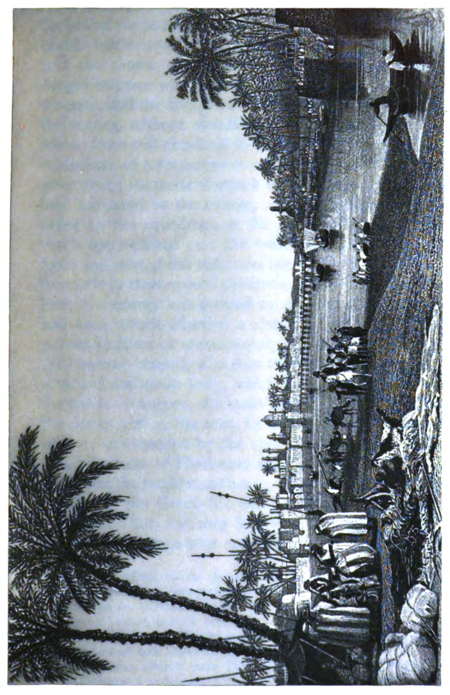
The iron cage in which Bajazet was imprisoned by Tamerlane, so long and so often repeated as a moral lesson, is now rejected as a fable by the modern writers, who smile at the vulgar credulity. [53] They appeal with confidence to the [XI-204] Persian history of Sherefeddin Ali, which has been given to our curiosity in a French version, and from which I shall collect and abridge a more specious narrative of this memorable transaction. No sooner was Timour informed [54] that the captive Ottoman was at the door of his tent, than he graciously stepped forwards to receive him, seated him by his side, and mingled with just reproaches a soothing pity for his rank and misfortune. “Alas!” said the emperor, “the decree of fate is now accomplished by your own fault: it is the web which you have woven, the thorns of the tree which yourself have planted. I wished to spare, and even to assist, the champion of the Moslems; you braved our threats; you despised our friendship; you forced us to enter your kingdom with our invincible armies. Behold the event. Had you vanquished, I am not ignorant of the fate which you reserved for myself and my troops. But I disdain to retaliate; your life and honour are secure; and I shall express my gratitude to God by my clemency to man.” The royal captive shewed some signs of repentance, accepted the humiliation of a robe of honour, and embraced with tears his son Mousa, who, at his request, was sought and found among the captives of the field. The Ottoman princes were lodged in a splendid pavilion; and the respect of the guards could be surpassed only by their vigilance. On the arrival of the harem from Boursa, Timour restored the queen Despina and [XI-205] her daughter to their father and husband; but he piously required that the Servian princess, who had hitherto been indulged in the profession of Christianity, should embrace without delay the religion of the prophet. In the feast of victory, to which Bajazet was invited, the Mogul emperor placed a crown on his head and a sceptre in his hand, with a solemn assurance of restoring him with an increase of glory to the throne of his ancestors. But the effect of this promise was disappointed by the sultan’s untimely death: amidst the care of the most skilful physicians, he expired of an apoplexy at Akshehr, the Antioch of Pisidia, about nine months after his defeat. The victor dropped a tear over his grave; his body, with royal pomp, was conveyed to the mausoleum which he had erected at Boursa; and his son Mousa, after receiving a rich present of gold and jewels, of horses and arms, was invested by a patent in red ink with the kingdom of Anatolia.
Such is the portrait of a generous conqueror, which has been extracted from his own memorials, and dedicated to his son and grandson, nineteen years after his decease; [55] and, at a time when the truth was remembered by thousands, a manifest falsehood would have implied a satire on his real conduct. Weighty, indeed, is this evidence, adopted by all the Persian histories; [56] yet flattery, more especially in the East, is base and audacious; and the harsh and ignominious treatment of Bajazet is attested by a chain of witnesses, some of whom shall be produced in the order of their time and country. 1. The reader has not forgot the garrison of French, whom the marshal Boucicault left behind him for the [XI-206] defence of Constantinople. They were on the spot to receive the earliest and most faithful intelligence of the overthrow of their great adversary; and it is more than probable that some of them accompanied the Greek embassy to the camp of Tamerlane. From their account, the hardships of the prison and death of Bajazet are affirmed by the marshal’s servant and historian, within the distance of seven years. [57] 2. The name of Poggius the Italian [58] is deservedly famous among the revivers of learning in the fifteenth century. His elegant dialogue on the vicissitudes of fortune [59] was composed in his fiftieth year, twenty-eight years after the Turkish victory of Tamerlane, [60] whom he celebrates as not inferior to the illustrious Barbarians of antiquity. Of his exploits and discipline, Poggius was informed by several ocular witnesses; nor does he forget an example so opposite to his theme as the Ottoman monarch, whom the Scythian confined like a wild beast in an iron cage and exhibited a spectacle to Asia. I might add the authority of two Italian chronicles, perhaps of an earlier date, which would prove at least that the same story, whether false or true, was imported into Europe with [XI-207] the first tidings of the revolution. [61] 3. At the time when Poggius flourished at Rome, Ahmed Ebn Arabshah composed at Damascus the florid and malevolent history of Timour, for which he had collected materials in his journeys over Turkey and Tartary. [62] Without any possible correspondence between the Latin and the Arabian writer, they agree in the fact of the iron cage; and their agreement is a striking proof of their common veracity. Ahmed Arabshah likewise relates another outrage, which Bajazet endured, of a more domestic and tender nature. His indiscreet mention of women and divorces was deeply resented by the jealous Tartar. In the feast of victory, the wine was served by female cup-bearers; and the sultan beheld his own concubines and wives confounded among the slaves, and exposed, without a veil, to the eyes of intemperance. To escape a similar indignity, it is said that his successors, except in a single instance, have abstained from legitimate nuptials; and the Ottoman practice and belief, at least in the sixteenth century, is attested by the observing Busbequius, [63] ambassador from the court of Vienna to the great Soliman. 4. Such is the separation of language that the testimony of a Greek is not less independent than that of a Latin or an Arab. I suppress the names of Chalcondyles and Ducas, who flourished in a later period, and who speak in a less positive tone; but more attention is due to George Phranza, [64] protovestiare of the last emperors, and who was born a year before the battle of [XI-208] Angora. Twenty-two years after that event, he was sent ambassador to Amurath the Second; and the historian might converse with some veteran Janizaries, who had been made prisoners with the sultan and had themselves seen him in his iron cage. 5. The last evidence, in every sense, is that of the Turkish annals, which have been consulted or transcribed by Leunclavius, Pocock, and Cantemir. [65] They unanimously deplore the captivity of the iron cage; and some credit may be allowed to national historians, who cannot stigmatise the Tartar without uncovering the shame of their king and country.
From these opposite premises, a fair and moderate conclusion may be deduced. I am satisfied that Sherefeddin Ali has faithfully described the first ostentatious interview, in which the conqueror, whose spirits were harmonised by success, affected the character of generosity. But his mind was insensibly alienated by the unseasonable arrogance of Bajazet; the complaints of his enemies, the Anatolian princes, were just and vehement; and Timour betrayed a design of leading his royal captive in triumph to Samarcand. An attempt to facilitate his escape, by digging a mine under the tent, provoked the Mogul emperor to impose a harsher restraint; and, in his perpetual marches, an iron cage on a waggon might be invented, not as a wanton insult, but as a rigorous precaution. Timour had read in some fabulous history a similar treatment of one of his predecessors, a king of Persia; and Bajazet was condemned to represent the person, and expiate the guilt, of the Roman Cæsar. [66] But the strength of his mind and body [XI-209] fainted under the trial, and his premature death might, without injustice, be ascribed to the severity of Timour. He warred not with the dead; a tear and a sepulchre were all that he could bestow on a captive who was delivered from his power; and, if Mousa, the son of Bajazet, was permitted to reign over the ruins of Boursa, the greatest part of the province of Anatolia had been restored by the conqueror to their lawful sovereigns.
From the Irtish and Volga to the Persian Gulf, and from the Ganges to Damascus and the Archipelago, Asia was in the hand of Timour; his armies were invincible, his ambition was boundless, and his zeal might aspire to conquer and convert the Christian kingdoms of the West, which already trembled at his name. He touched the utmost verge of the land; but an insuperable, though narrow, sea rolled between the two continents of Europe and Asia; [67] and the lord of so many tomans, or myriads of horse, was not master of a single galley. The two passages of the Bosphorus and Hellespont, of Constantinople and Gallipoli, were possessed, the one by the Christians, the other by the Turks. On this great occasion, they forgot the difference of religion, to act with union and firmness in the common cause. The double straits were guarded with ships and fortifications; and they separately withheld the transports which Timour demanded of either nation, under the pretence of attacking their enemy. At the same time, they soothed his pride with tributary gifts and suppliant embassies, and prudently tempted him to retreat with the honours of victory. Soliman, the son of Bajazet, implored his clemency for his father and himself; accepted, by a red patent, the investiture of the kingdom of Romania, which he already held by the sword; and reiterated [XI-210] his ardent wish of casting himself in person at the feet of the king of the world. The Greek emperor [68] (either John or Manuel) submitted to pay the same tribute which he had stipulated with the Turkish sultan, and ratified the treaty by an oath of allegiance, from which he could absolve his conscience as soon as the Mogul arms had retired from Anatolia. But the fears and fancy of nations ascribed to the ambitious Tamerlane a new design of vast and romantic compass: a design of subduing Egypt and Africa, marching from the Nile to the Atlantic Ocean, entering Europe by the Straits of Gibraltar, and, after imposing his yoke on the kingdoms of Christendom, of returning home by the deserts of Russia and Tartary. This remote and perhaps imaginary danger was averted by the submission of the sultan of Egypt; the honours of the prayer and the coin attested at Cairo the supremacy of Timour; and a rare gift of a giraffe, or camelopard, and nine ostriches represented at Samarcand the tribute of the African world. Our imagination is not less astonished by the portrait of a Mogul, who, in his camp before Smyrna, meditates and almost accomplishes the invasion of the Chinese empire. [69] Timour was urged to this enterprise by national honour and religious zeal. The torrents which he had shed of Musulman blood could be expiated only by an equal destruction of the infidels; and, as he now stood at the gates of paradise, he might best secure his glorious entrance by demolishing the idols of China, founding moschs in every city, and establishing the profession of faith in one God and his prophet Mahomet. The recent expulsion of the house of Zingis was an insult on the Mogul [XI-211] name; and the disorders of the empire afforded the fairest opportunity for revenge. The illustrious Hongvou, founder of the dynasty of Ming, died four years before the battle of Angora; and his grandson, a weak and unfortunate youth, was burnt in a palace, after a million of Chinese had perished in the civil war. [70] Before he evacuated Anatolia, Timour despatched beyond the Sihoon a numerous army, or rather colony, of his old and new subjects, to open the road, to subdue the Pagan Calmucks and Mungals, and to found cities and magazines in the desert; and, by the diligence of his lieutenant, he soon received a perfect map and description of the unknown regions from the source of the Irtish to the wall of China. During these preparations, the emperor achieved the final conquest of Georgia; passed the winter on the banks of the Araxes; appeased the troubles of Persia; and slowly returned to his capital, after a campaign of four years and nine months.
On the throne of Samarcand, [71] he displayed, in a short repose, his magnificence and power; listened to the complaints of the people; distributed a just measure of rewards and punishments; employed his riches in the architecture of palaces and temples; and gave audience to the ambassadors of Egypt, Arabia, India, Tartary, Russia, and Spain, the last of whom presented a suit of tapestry which eclipsed the pencil of the Oriental artists. The marriage of six of the emperor’s grandsons was esteemed an act of religion as well as of paternal tenderness; and the pomp of the ancient caliphs was revived in their nuptials. They were celebrated in the gardens of Canighul, decorated with innumerable tents and pavilions, which displayed the luxury of a great city and the [XI-212] spoils of a victorious camp. Whole forests were cut down to supply fuel for the kitchens; the plain was spread with pyramids of meat and vases of every liquor, to which thousands of guests were courteously invited. The orders of the state and the nations of the earth were marshalled at the royal banquet; nor were the ambassadors of Europe (says the haughty Persian) excluded from the feast; since even the casses, the smallest of fish, find their place in the ocean. [72] The public joy was testified by illuminations and masquerades; the trades of Samarcand passed in review; and every trade was emulous to execute some quaint device, some marvellous pageant, with the materials of their peculiar art. After the marriage-contracts had been ratified by the cadhis, the bridegrooms and their brides retired to their nuptial chambers; nine times, according to the Asiatic fashion, they were dressed and undressed; and at each change of apparel pearls and rubies were showered on their heads, and contemptuously abandoned to their attendants. A general indulgence was proclaimed; every law was relaxed, every pleasure was allowed; the people was free, the sovereign was idle; and the historian of Timour may remark that, after devoting fifty years to the attainment of empire, the only happy period of his life were the two months in which he ceased to exercise his power. But he was soon awakened to the cares of government and war. The standard was unfurled for the invasion of China: the emirs made their report of two hundred thousand, the select and veteran soldiers of [XI-213] Iran and Turan; their baggage and provisions were transported by five hundred great waggons, and an immense train of horses and camels; and the troops might prepare for a long absence, since more than six months were employed in the tranquil journey of a caravan from Samarcand to Pekin. Neither age nor the severity of the winter could retard the impatience of Timour; he mounted on horseback, passed the Sihoon on the ice, marched seventy-six parasangs, three hundred miles, from his capital, and pitched his last camp in the neighbourhood of Otrar, where he was expected by the angel of death. Fatigue, and the indiscreet use of iced water, accelerated the progress of his fever; and the conqueror of Asia expired in the seventieth year of his age, thirty-five years after he had ascended the throne of Zagati. His designs were lost; his armies were disbanded; China was saved; and, fourteen years after his decease, the most powerful of his children sent an embassy of friendship and commerce to the court of Pekin. [73]
The fame of Timour has pervaded the East and West; his posterity is still invested with the Imperial title; and the admiration of his subjects, who revered him almost as a deity, may be justified in some degree by the praise or confession of his bitterest enemies. [74] Although he was lame of [XI-214] an hand and foot, his form and stature were not unworthy of his rank; and his vigorous health, so essential to himself and to the world, was corroborated by temperance and exercise. In his familiar discourse he was grave and modest, and, if he was ignorant of the Arabic language, he spoke with fluency and elegance the Persian and Turkish idioms. It was his delight to converse with the learned on topics of history and science; and the amusement of his leisure hours was the game of chess, which he improved or corrupted with new refinements. [75] In his religion, he was a zealous, though not perhaps an orthodox, Musulman; [76] but his sound understanding may tempt us to believe that a superstitious reverence for omens and prophecies, for saints and astrologers, was only affected as an instrument of policy. In the government of a vast empire, he stood alone and absolute, without a rebel to oppose his power, a favourite to seduce his affections, or a minister to mislead his judgment. It was his firmest maxim that, whatever might be the consequence, the word of the prince should never be disputed or recalled; but his foes [XI-215] have maliciously observed that the commands of anger and destruction were more strictly executed than those of beneficence and favour. His sons and grandsons, of whom Timour left six-and-thirty at his decease, were his first and most submissive subjects; and, whenever they deviated from their duty, they were corrected, according to the laws of Zingis, with the bastonade, and afterwards restored to honour and command. Perhaps his heart was not devoid of the social virtues; perhaps he was not incapable of loving his friends and pardoning his enemies; but the rules of morality are founded on the public interest; and it may be sufficient to applaud the wisdom of a monarch, for the liberality by which he is not impoverished, and for the justice by which he is strengthened and enriched. To maintain the harmony of authority and obedience, to chastise the proud, to protect the weak, to reward the deserving, to banish vice and idleness from his dominions, to secure the traveller and merchant, to restrain the depredations of the soldier, to cherish the labours of the husbandman, to encourage industry and learning, and, by an equal and modern assessment, to increase the revenue without increasing the taxes, are indeed the duties of a prince; but, in the discharge of these duties, he finds an ample and immediate recompense. Timour might boast that, at his accession to the throne, Asia was the prey of anarchy and rapine, whilst under his prosperous monarchy, a child, fearless and unhurt, might carry a purse of gold from the East to the West. Such was his confidence of merit that from this reformation he derived excuse for his victories and a title to universal dominion. The four following observations will serve to appreciate his claim to the public gratitude; and perhaps we shall conclude that the Mogul emperor was rather the scourge than the benefactor of mankind. 1. If some partial disorders, some local oppressions, were healed by the sword of Timour, the remedy was far more pernicious than the disease. By their rapine, cruelty, and discord, the petty tyrants of Persia might afflict their subjects; but whole [XI-216] nations were crushed under the footsteps of the reformer. The ground which had been occupied by flourishing cities was often marked by his abominable trophies, by columns or pyramids of human heads. Astracan, Carizme, Delhi, Ispahan, Bagdad, Aleppo, Damascus, Boursa, Smyrna, and a thousand others were sacked, or burnt, or utterly destroyed, in his presence, and by his troops; and perhaps his conscience would have been startled if a priest or philosopher had dared to number the millions of victims whom he had sacrificed to the establishment of peace and order. [77] 2. His most destructive wars were rather inroads than conquests. He invaded Turkestan, Kipzak, Russia, Hindostan, Syria, Anatolia, Armenia, and Georgia, without a hope or a desire of preserving those distant provinces. From thence he departed, laden with spoil; but he left behind him neither troops to awe the contumacious, nor magistrates to protect the obedient, natives. When he had broken the fabric of their ancient government, he abandoned them to the evils which his invasion had aggravated or caused; nor were these evils compensated by any present or possible benefits. 3. The kingdoms of Transoxiana and Persia were the proper field which he laboured to cultivate and adorn as the perpetual inheritance of his family. But his peaceful labours were often interrupted, and sometimes blasted, by the absence of the conqueror. While he triumphed on the Volga or the Ganges, his servants, and even his sons, forgot their master and their duty. The public and private injuries were poorly redressed by the tardy rigour of inquiry and punishment; and we must be content to praise the Institutions of Timour, as the specious [XI-217] idea of a perfect monarchy. 4. Whatsoever might be the blessings of his administration, they evaporated with his life. To reign, rather than to govern, was the ambition of his children and grandchildren, [78] the enemies of each other and of the people. A fragment of the empire was upheld with some glory by Sharokh, his youngest son; but after his decease, the scene was again involved in darkness and blood; and before the end of a century Transoxiana and Persia were trampled by the Uzbeks from the North, and the Turkmans of the black and white sheep. The race of Timour would have been extinct, if an hero, his descendant in the fifth degree, had not fled before the Uzbek arms to the conquest of Hindostan. His successors (the Great Moguls [79] ) extended their sway from the mountains of Cashmir to Cape Comorin, and from Candahar to the Gulf of Bengal. Since the reign of Aurungzebe, their empire has been dissolved; their treasures of Delhi have been rifled by a Persian robber; and the riches of their kingdoms is now possessed by a company of Christian merchants, of a remote island in the Northern Ocean.
Far different was the fate of the Ottoman monarchy. The massy trunk was bent to the ground, but no sooner did the hurricane pass away than it again rose with fresh vigour and more lively vegetation. When Timour, in every sense, had evacuated Anatolia, he left the cities without a palace, a treasure, or a king. The open country was overspread with hordes of shepherds and robbers of Tartar or Turkman origin; the recent conquests of Bajazet were restored to the emirs, one of whom, in base revenge, demolished his sepulchre; and [XI-218] his five sons were eager, by civil discord, to consume the remnant of their patrimony. I shall enumerate their names in the order of their age and actions. [80] 1. It is doubtful, whether I relate the story of the true Mustapha, or of an impostor who personated that lost prince. [81] He fought by his father’s side in the battle of Angora; but, when the captive sultan was permitted to inquire for his children, Mousa alone could be found; and the Turkish historians, the slaves of the triumphant faction, are persuaded that his brother was confounded among the slain. If Mustapha escaped from that disastrous field, he was concealed twelve years from his friends and enemies, till he emerged in Thessaly and was hailed by a numerous party as the son and successor of Bajazet. His first defeat would have been his last, had not the true, or false, Mustapha been saved by the Greeks and restored, after the decease of his brother Mahomet, to liberty and empire. A degenerate mind seemed to argue his spurious birth; and, if, on the throne of Hadrianople, he was adored as the Ottoman sultan, his flight, his fetters, and an ignominious gibbet delivered the impostor to popular contempt. A similar character and claim was asserted by several rival pretenders; thirty persons are said to have suffered under the name of Mustapha; and these frequent executions may perhaps insinuate that the Turkish court was not perfectly secure of the death of the lawful prince. 2. After his father’s captivity, Isa [82] reigned for some time in the neighbourhood of [XI-219] Angora, Sinope, and the Black Sea; and his ambassadors were dismissed from the presence of Timour with fair promises and honourable gifts. But their master was soon deprived of his province and life by a jealous brother, the sovereign of Amasia; and the final event [83] suggested a pious allusion that the law of Moses and Jesus, of Isa and Mousa, had been abrogated by the greater Mahomet. 3. Soliman is not numbered in the list of the Turkish emperors; yet he checked the victorious progress of the Moguls, and after their departure united for a while the thrones of Hadrianople and Boursa. In war, he was brave, active, and fortunate; his courage was softened by clemency; but it was likewise inflamed by presumption, and corrupted by intemperance and idleness. He relaxed the nerves of discipline in a government where either the subject or the sovereign must continually tremble; his vices alienated the chiefs of the army and the law; and his daily drunkenness, so contemptible in a prince and a man, was doubly odious in a disciple of the prophet. In the slumber of intoxication, he was surprised by his brother Mousa; and, as he fled from Hadrianople towards the Byzantine capital, Soliman was overtaken and slain in a bath, after a reign of seven years and ten months. 4. The investiture of Mousa degraded him as the slave of the Moguls; his tributary kingdom of Anatolia was confined within a narrow limit, nor could his broken militia and empty treasury contend with the hardy and veteran bands of the sovereign of Romania. Mousa fled in disguise from the palace of Boursa; traversed the Propontis in an open boat; wandered over the Walachian and Servian hills; and, after some vain attempts, ascended the throne of Hadrianople, so recently stained with the blood of Soliman. In a reign of three years and a half, his troops were victorious against the Christians of Hungary and the Morea; but Mousa was ruined by his timorous disposition [XI-220] and unseasonable clemency. After resigning the sovereignty of Anatolia, he fell a victim to the perfidy of his ministers and the superior ascendant of his brother Mahomet. 5. The final victory of Mahomet was the just recompense of his prudence and moderation. Before his father’s captivity, the royal youth had been entrusted with the government of Amasia, thirty days’ journey from Constantinople and the Turkish frontier against the Christians of Trebizond and Georgia. The castle, in Asiatic warfare, was esteemed impregnable; and the city of Amasia, [84] which is equally divided by the river Iris, rises on either side in the form of an amphitheatre, and represents, on a smaller scale, the image of Bagdad. In his rapid career, Timour appears to have overlooked this obscure and contumacious angle of Anatolia; and Mahomet, without provoking the conqueror, maintained his silent independence, and chased from the province the last stragglers of the Tartar host. He relieved himself from the dangerous neighbourhood of Isa; but in the contests of their more powerful brethren his firm neutrality was respected; till, after the triumph of Mousa, he stood forth the heir and avenger of the unfortunate Soliman. Mahomet obtained Anatolia by treaty and Romania by arms; and the soldier who presented him with the head of Mousa was rewarded as the benefactor of his king and country. The eight years of his sole and peaceful reign were usefully employed in banishing the vices of civil discord, and restoring, on a firmer basis, the fabric of the Ottoman monarchy. [85] His last care was the choice of two vizirs, Bajazet and Ibrahim, [86] who might guide the youth of his son Amurath; and such was their [XI-221] union and prudence that they concealed, above forty days, the emperor’s death, till the arrival of his successor in the palace of Boursa. A new war was kindled in Europe by the prince, or impostor, Mustapha; the first vizir lost his army and his head; but the more fortunate Ibrahim, whose name and family are still revered, extinguished the last pretender to the throne of Bajazet, and closed the scene of domestic hostility.
In these conflicts, the wisest Turks, and indeed the body of the nation, were strongly attached to the unity of the empire; and Romania and Anatolia, so often torn asunder by private ambition, were animated by a strong and invincible tendency of cohesion. Their efforts might have instructed the Christian powers; and, had they occupied, with a confederate fleet, the straits of Gallipoli, the Ottomans, at least in Europe, must have been speedily annihilated. But the schism of the West, and the factions and wars of France and England, diverted the Latins from this generous enterprise; they enjoyed the present respite without a thought of futurity; and were often tempted by a momentary interest to serve the common enemy of their religion. A colony of Genoese, [87] which had been planted at Phocæa [88] on the Ionian coast, was enriched by the lucrative monopoly of alum; [89] and their tranquillity, [XI-222] under the Turkish empire, was secured by the annual payment of tribute. In the last civil war of the Ottomans, the Genoese governor, Adorno, a bold and ambitious youth, embraced the party of Amurath; and undertook, with seven stout galleys, to transport him from Asia to Europe. The sultan and five hundred guards embarked on board the admiral’s ship, which was manned by eight hundred of the bravest Franks. His life and liberty were in their hands; nor can we, without reluctance, applaud the fidelity of Adorno, who, in the midst of the passage, knelt before him, and gratefully accepted a discharge of his arrears of tribute. They landed in sight of Mustapha and Gallipoli; two thousand Italians, armed with lances and battle-axes, attended Amurath to the conquest of Hadrianople; and this venal service was soon repaid by the ruin of the commerce and colony of Phocæa.
If Timour had generously marched at the request, and to the relief of, the Greek emperor, he might be entitled to the praise and gratitude of the Christians. [90] But a Musulman, who carried into Georgia the sword of persecution, and respected the holy warfare of Bajazet, was not disposed to pity or succour the idolaters of Europe. The Tartar followed the impulse of ambition; and the deliverance of Constantinople was the accidental consequence. When Manuel abdicated the government, it was his prayer, rather than his hope, that the ruin of the church and state might be delayed beyond his unhappy days; and, after his return from a Western pilgrimage, he expected every hour the news of the sad catastrophe. On a sudden, he was astonished and rejoiced by the intelligence [XI-223] of the retreat, the overthrow, and the captivity of the Ottoman. Manuel [91] immediately sailed from Modon in the Morea; ascended the throne of Constantinople; and dismissed his blind competitor to an easy exile in the isle of Lesbos. The ambassadors of the son of Bajazet were soon introduced to his presence; but their pride was fallen, their tone was modest; they were awed by the just apprehension lest the Greeks should open to the Moguls the gates of Europe. Soliman saluted the emperor by the name of father; solicited at his hands the government or gift of Romania; and promised to deserve his favour by inviolable friendship, and the restitution of Thessalonica, with the most important places along the Strymon, the Propontis, and the Black Sea. The alliance of Soliman exposed the emperor to the enmity and revenge of Mousa. The Turks appeared in arms before the gates of Constantinople; but they were repulsed by sea and land; and, unless the city was guarded by some foreign mercenaries, the Greeks must have wondered at their own triumph. But, instead of prolonging the division of the Ottoman powers, the policy or passion of Manuel was tempted to assist the most formidable of the sons of Bajazet. He concluded a treaty with Mahomet, whose progress was checked by the insuperable barrier of Gallipoli: the sultan and his troops were transported over the Bosphorus; he was hospitably entertained in the capital; and his successful sally was the first step to the conquest of Romania. The ruin was suspended by the prudence and moderation of the conqueror; he faithfully discharged his own obligations, and those of Soliman; respected the laws of gratitude and peace; and left the emperor guardian of his two younger sons, in the vain hope of saving them from the jealous cruelty of their brother Amurath. But the execution of his last testament would have [XI-224] offended the national honour and religion; and the divan unanimously pronounced that the royal youths should never be abandoned to the custody and education of a Christian dog. On this refusal, the Byzantine councils were divided; but the age and caution of Manuel yielded to the presumption of his son John; and they unsheathed a dangerous weapon of revenge, by dismissing the true or false Mustapha, who had long been detained as a captive and hostage, and for whose maintenance they received an annual pension of three hundred thousand aspers. [92] At the door of his prison, Mustapha subscribed to every proposal; and the keys of Gallipoli, or rather of Europe, were stipulated as the price of his deliverance. But no sooner was he seated on the throne of Romania than he dismissed the Greek ambassadors with a smile of contempt, declaring, in a pious tone, that, at the day of judgment, he would rather answer for the violation of an oath than for the surrender of a Musulman city into the hands of the infidels. The emperor was at once the enemy of the two rivals; from whom he had sustained, and to whom he had offered, an injury; and the victory of Amurath was followed, in the ensuing spring, by the siege of Constantinople. [93]
The religious merit of subduing the city of the Cæsars attracted from Asia a crowd of volunteers, who aspired to the crown of martyrdom. Their military ardour was inflamed [XI-225] by the promise of rich spoils and beautiful females; and the sultan’s ambition was consecrated by the presence and prediction of Seid Bechar, a descendant of the prophet, [94] who arrived in the camp, on a mule, with a venerable train of five hundred disciples. But he might blush, if a fanatic could blush, at the failure of his assurances. The strength of the walls resisted an army of two hundred thousand Turks; [95] their assaults were repelled by the sallies of the Greeks and their foreign mercenaries; the old resources of defence were opposed to the new engines of attack; and the enthusiasm of the dervish, who was snatched to heaven in visionary converse with Mahomet, was answered by the credulity of the Christians, who beheld the Virgin Mary, in a violet garment, walking on the rampart and animating their courage. [96] After a siege of two months, Amurath was recalled to Boursa by a domestic revolt, which had been kindled by Greek treachery, and was soon extinguished by the death of a guiltless brother. While he led his Janizaries to new conquests in Europe and Asia, the Byzantine empire was indulged in a servile and precarious respite of thirty years. Manuel sank into the grave; and John Palæologus was permitted to reign, for an annual tribute of three hundred thousand aspers, and the dereliction of almost all that he held beyond the suburbs of Constantinople.
In the establishment and restoration of the Turkish empire, the first merit must doubtless be assigned to the personal [XI-226] qualities of the sultants; since, in human life, the most important scenes will depend on the character of a single actor. By some shades of wisdom and virtue they may be discriminated from each other; but, except in a single instance, a period of nine reigns and two hundred and sixty-five years is occupied from the elevation of Othman to the death of Soliman, by a rare series of warlike and active princes, who impressed their subjects with obedience and their enemies with terror. Instead of the slothful luxury of the seraglio, the heirs of royalty were educated in the council and the field; from early youth they were entrusted by their fathers with the command of provinces and armies; and this manly institution, which was often productive of civil war, must have essentially contributed to the discipline and vigour of the monarchy. The Ottomans cannot style themselves, like the Arabian caliphs, the descendants or successors of the apostle of God; and the kindred which they claim with the Tartar khans of the house of Zingis appears to be founded in flattery rather than in truth. [97] Their origin is obscure; but their sacred and indefeasible right, which no time can erase and no violence can infringe, was soon and unalterably implanted in the minds of their subjects. A weak or vicious sultan may be deposed and strangled; but his inheritance devolves to an infant or an idiot; nor has the most daring rebel presumed to ascend the throne of his lawful sovereign. [98] While the transient dynasties of Asia have been continually subverted by a crafty vizir in the palace or a victorious general in the [XI-227] camp, the Ottoman succession has been confirmed by the practice of five centuries, and is now incorporated with the vital principle of the Turkish nation.
To the spirit and constitution of that nation a strong and singular influence may, however, be ascribed. The primitive subjects of Othman were the four hundred families of wandering Turkmans, who had followed his ancestors from the Oxus to the Sangar; and the plains of Anatolia are still covered with the white and black tents of their rustic brethren. But this original drop was dissolved in the mass of voluntary and vanquished subjects who, under the name of Turks, are united by the common ties of religion, language, and manners. In the cities, from Erzeroum to Belgrade, that national appellation is common to all the Moslems, the first and most honourable inhabitants; but they have abandoned, at least in Romania, the villages and the cultivation of the land to the Christian peasants. In the vigorous age of the Ottoman government, the Turks were themselves excluded from all civil and military honours; and a servile class, an artificial people, was raised by the discipline of education to obey, to conquer, and to command. [99] From the time of Orchan and the first Amurath, the sultans were persuaded that a government of the sword must be renewed in each generation with new soldiers; and that such soldiers must be sought, not in effeminate Asia, but among the hardy and warlike natives of Europe. The provinces of Thrace, Macedonia, Albania, Bulgaria, and Servia became the perpetual seminary of the Turkish army; and, when the royal fifth of the captives was diminished by conquest, an inhuman tax, of the fifth child, or of every fifth year, was rigorously levied on the Christian families. [100] At the age of twelve or fourteen [XI-228] years, [101] the most robust youths were torn from their parents; their names were enrolled in a book; and from that moment they were clothed, taught, and maintained for the public service. According to the promise of their appearance, they were selected for the royal schools of Boursa, Pera, and Hadrianople, entrusted to the care of the bashaws, or dispersed in the houses of the Anatolian peasantry. It was the first care of their masters to instruct them in the Turkish language; their bodies were exercised by every labour that could fortify their strength; they learned to wrestle, to leap, to run, to shoot with the bow, and afterwards with the musket; till they were drafted into the chambers and companies of the Janizaries, and severely trained in the military or monastic discipline of the order. The youths most conspicuous for birth, talents, and beauty were admitted into the inferior class of Agiamoglans, or the more liberal rank of Ichoglans, of whom the former were attached to the palace, and the latter to the person of the prince. In four successive schools, under the rod of the white eunuchs, the arts of horsemanship and of darting the javelin were their daily exercise, while those of a more studious cast applied themselves to the study of the Koran and the knowledge of the Arabic and Persian tongues. As they advanced in seniority and merit, they were gradually dismissed to military, civil, and even ecclesiastical employments; the longer their stay, the higher was their expectation; till, at a mature period, they were admitted into the number of the forty agas, who stood before the sultan, and were promoted by his choice to the government of provinces and the first honours of the empire. [102] Such a mode of institution was [XI-229] admirably adapted to the form and spirit of a despotic monarchy. The ministers and generals were, in the strictest sense, the slaves of the emperor, to whose bounty they were indebted for their instruction and support. When they left the seraglio, and suffered their beards to grow as the symbol of enfranchisement, they found themselves in an important office, without faction or friendship, without parents and without heirs, dependent on the hand which had raised them from the dust, and which, on the slightest displeasure, could break in pieces these statues of glass, as they are aptly termed by the Turkish proverb. [103] In the slow and painful steps of education, their character and talents were unfolded to a discerning eye: the man, naked and alone, was reduced to the standard of his personal merit; and, if the sovereign had wisdom to choose, he possessed a pure and boundless liberty of choice. The Ottoman candidates were trained by the virtues of abstinence to those of action; by the habits of submission, to those of command. A similar spirit was diffused among the troops; and their silence and sobriety, their patience and modesty, have extorted the reluctant praise of their Christian enemies. [104] Nor can the victory appear doubtful, if we compare the discipline and exercise of the Janizaries with the pride of birth, the independence of chivalry, the ignorance of the new levies, the mutinous temper of the veterans, and the vices of intemperance and disorder which so long contaminated the armies of Europe.
[XI-230]
The only hope of salvation for the Greek empire and the adjacent kingdoms would have been some more powerful weapon, some discovery in the art of war, that should give them a decisive superiority over their Turkish foes. Such a weapon was in their hands; such a discovery had been made in the critical moment of their fate. The chymists of China or Europe had found, by casual or elaborate experiments, that a mixture of saltpetre, sulphur, and charcoal produces, with a spark of fire, a tremendous explosion. It was soon observed that, if the expansive force were compressed in a strong tube, a ball of stone or iron might be expelled with irresistible and destructive velocity. The precise era of the invention and application of gunpowder [105] is involved in doubtful traditions and equivocal language; yet we may clearly discern that it was known before the middle of the fourteenth century; and that, before the end of the same, the use of artillery in battles and sieges, by sea and land, was familiar to the states of Germany, Italy, Spain, France, and England. [106] The priority of nations is of small account; none could derive any exclusive benefit from their previous or superior knowledge; and in the common improvement they stood on the same level of relative power and military science. Nor was it possible to circumscribe the secret within the pale of the church; it was disclosed to the [XI-231] Turks by the treachery of apostates and the selfish policy of rivals; and the sultans had sense to adopt, and wealth to reward, the talents of a Christian engineer. The Genoese who transported Amurath into Europe must be accused as his preceptors; and it was probably by their hands that his cannon was cast and directed at the siege of Constantinople. [107] The first attempt was indeed unsuccessful; but in the general warfare of the age the advantage was on their side who were most commonly the assailants; for a while the proportion of the attack and defence was suspended; and this thundering artillery was pointed against the walls and turrets which had been erected only to resist the less potent engines of antiquity. By the Venetians, the use of gunpowder was communicated without reproach to the sultans of Egypt and Persia, their allies against the Ottoman power. The secret was soon propagated to the extremities of Asia; and the advantage of the European was confined to his easy victories over the savages of the new world. If we contrast the rapid progress of this mischievous discovery with the slow and laborious advances of reason, science, and the arts of peace, a philosopher, according to his temper, will laugh or weep at the folly of mankind.
[XI-232]
CHAPTER LXVI↩
Applications of the Eastern Emperors to the Popes — Visits to the West, of John the First, Manuel, and John the Second, Palæologus — Union of the Greek and Latin Churches, promoted by the Council of Basil, and concluded at Ferrara and Florence — State of Literature at Constantinople — Its Revival in Italy by the Greek Fugitives — Curiosity and Emulation of the Latins
In the four last centuries of the Greek emperors, their friendly or hostile aspect towards the pope and the Latins may be observed as the thermometer of their prosperity or distress, as the scale of the rise and fall of the Barbarian dynasties. [1] When the Turks of the house of Seljuk pervaded Asia and threatened Constantinople, we have seen at the council of Placentia the suppliant ambassadors of Alexius imploring the protection of the common father of the Christians. No sooner had the arms of the French pilgrims removed the sultan from Nice to Iconium than the Greek princes resumed, or avowed, their genuine hatred and contempt for the schismatics of the West, which precipitated the first downfall of their empire. The date of the Mogul invasion is marked in the soft and charitable language of John Vataces. After the recovery of Constantinople, the throne [XI-233] of the first Palæologus was encompassed by foreign and domestic enemies; as long as the sword of Charles was suspended over his head, he basely courted the favour of the Roman pontiff, and sacrificed to the present danger his faith, his virtue, and the affection of his subjects. On the decease of Michael, the prince and people asserted the independence of their church and the purity of their creed; the elder Andronicus neither feared nor loved the Latins; in his last distress, pride was the safeguard of superstition; nor could he decently retract in his age the firm and orthodox declarations of his youth. His grandson, the younger Andronicus, was less a slave in his temper and situation; and the conquest of Bithynia by the Turks admonished him to seek a temporal and spiritual alliance with the Western princes. After a separation and silence of fifty years, a secret agent, the monk Barlaam, was despatched to Pope Benedict the Twelfth; and his artful instructions appear to have been drawn by the master-hand of the great domestic. [2] “Most holy father,” was he commissioned to say, “the emperor is not less desirous than yourself of an union between the two churches; but in this delicate transaction he is obliged to respect his own dignity and the prejudices of his subjects. The ways of union are twofold, force and persuasion. Of force, the inefficacy has been already tried; since the Latins have subdued the empire, without subduing the minds, of the Greeks. The method of persuasion, though slow, is sure and permanent. A deputation of thirty or forty of our doctors would probably agree with those of the Vatican, in the love of truth and the unity of belief; but on their return, what would be the use, the recompense, of such agreement? the [XI-234] scorn of their brethren, and the reproaches of a blind and obstinate nation. Yet that nation is accustomed to reverence the general councils which have fixed the articles of our faith; and, if they reprobate the decrees of Lyons, it is because the Eastern churches were neither heard nor represented in that arbitrary meeting. For this salutary end it will be expedient, and even necessary, that a well-chosen legate should be sent into Greece, to convene the patriarchs of Constantinople, Alexandria, Antioch, and Jerusalem, and, with their aid, to prepare a free and universal synod. But at this moment,” continued the subtle agent, “the empire is assaulted and endangered by the Turks, who have occupied four of the greatest cities of Anatolia. The Christian inhabitants have expressed a wish of returning to their allegiance and religion; but the forces and revenues of the emperor are insufficient for their deliverance; and the Roman legate must be accompanied, or preceded, by an army of Franks, to expel the infidels and open a way to the holy sepulchre.” If the suspicious Latins should require some pledge, some previous effect of the sincerity of the Greeks, the answers of Barlaam were perspicuous and rational. “1. A general synod can alone consummate the union of the churches: nor can such a synod be held till the three Oriental patriarchs, and a great number of bishops, are enfranchised from the Mahometan yoke. 2. The Greeks are alienated by a long series of oppression and injury: they must be reconciled by some act of brotherly love, some effectual succour, which may fortify the authority and arguments of the emperor and the friends of the union. 3. If some difference of faith or ceremonies should be found incurable, the Greeks, however, are the disciples of Christ, and the Turks are the common enemies of the Christian name. The Armenians, Cyprians, and Rhodians are equally attacked; and it will become the piety of the French princes to draw their swords in the general defence of religion. 4. Should the subjects of Andronicus be treated as the worst of schismatics, of heretics, of pagans, [XI-235] a judicious policy may yet instruct the powers of the West to embrace an useful ally, to uphold a sinking empire, to guard the confines of Europe; and rather to join the Greeks against the Turks than to expect the union of the Turkish arms with the troops and treasures of captive Greece.” The reasons, the offers, and the demands of Andronicus were eluded with cold and stately indifference. The kings of France and Naples declined the dangers and glory of a crusade: the pope refused to call a new synod to determine old articles of faith; and his regard for the obsolete claims of the Latin emperor and clergy engaged him to use an offensive superscription: “To the moderator [3] of the Greeks, and the persons who style themselves the patriarchs of the Eastern churches.” For such an embassy, a time and character less propitious could not easily have been found. Benedict the Twelfth [4] was a dull peasant, perplexed with scruples, and immersed in sloth and wine; his pride might enrich with a third crown the papal tiara, but he was alike unfit for the regal and the pastoral office.
After the decease of Andronicus, while the Greeks were distracted by intestine war, they could not presume to agitate a general union of the Christians. But, as soon as Cantacuzene had subdued and pardoned his enemies, he was anxious to justify, or at least to extenuate, the introduction of the Turks into Europe and the nuptials of his daughter with a [XI-236] Musulman prince. Two officers of state, with a Latin interpreter, were sent in his name to the Roman court, which was transplanted to Avignon, on the banks of the Rhone, during a period of seventy years; they represented the hard necessity which had urged him to embrace the alliance of the miscreants, and pronounced by his command the specious and edifying sounds of union and crusade. Pope Clement the Sixth, [5] the successor of Benedict, received them with hospitality and honour, acknowledged the innocence of their sovereign, excused his distress, applauded his magnanimity, and displayed a clear knowledge of the state and revolutions of the Greek empire, which he had imbibed from the honest accounts of a Savoyard lady, an attendant of the empress Anne. [6] If Clement was ill endowed with the virtues of a priest, he possessed, however, the spirit and magnificence of a prince, whose liberal hand distributed benefices and kingdoms with equal facility. Under his reign, Avignon was the seat of pomp and pleasure; in his youth he had surpassed the licentiousness of a baron; and the palace, nay, the bedchamber, of the pope was adorned, or polluted, by the visits of his female favourites. The wars of France and England were adverse to the holy enterprise; but his vanity was amused by the splendid idea; and the Greek ambassadors returned with two Latin bishops, the ministers of the pontiff. On their arrival at Constantinople, the emperor and the nuncios admired each other’s piety and eloquence; and their frequent conferences were filled with mutual praises and promises, [XI-237] by which both parties were amused and neither could be deceived. “I am delighted,” said the devout Cantacuzene, “with the project of our holy war, which must redound to my personal glory as well as to the public benefit of Christendom. My dominions will give a free passage to the armies of France: my troops, my galleys, my treasures, shall be consecrated to the common cause; and happy would be my fate, could I deserve and obtain the crown of martyrdom. Words are insufficient to express the ardour with which I sigh for the re-union of the scattered members of Christ. If my death could avail, I would gladly present my sword and my neck; if the spiritual phœnix could arise from my ashes, I would erect the pile and kindle the flame with my own hands.” Yet the Greek emperor presumed to observe that the articles of faith which divided the two churches had been introduced by the pride and precipitation of the Latins: he disclaimed the servile and arbitrary steps of the first Palæologus; and firmly declared that he would never submit his conscience, unless to the decrees of a free and universal synod. “The situation of the times,” continued he, “will not allow the pope and myself to meet either at Rome or Constantinople; but some maritime city may be chosen on the verge of the two empires, to unite the bishops, and to instruct the faithful, of the East and West.” The nuncios seemed content with the proposition; and Cantacuzene affects to deplore the failure of his hopes, which were soon overthrown by the death of Clement and the different temper of his successor. His own life was prolonged, but it was prolonged in a cloister; and, except by his prayers, the humble monk was incapable of directing the counsels of his pupil or the state. [7]
Yet, of all the Byzantine princes, that pupil, John Palæologus, [XI-238] was the best disposed to embrace, to believe, and to obey the shepherd of the West. His mother, Anne of Savoy, was baptised in the bosom of the Latin church: her marriage with Andronicus imposed a change of name, of apparel, and of worship; but her heart was still faithful to her country and religion; she had formed the infancy of her son, and she governed the emperor, after his mind, or at least his stature, was enlarged to the size of man. In the first year of his deliverance and restoration, the Turks were still masters of the Hellespont; the son of Cantacuzene was in arms at Hadrianople; and Palæologus could depend neither on himself nor on his people. By his mother’s advice, and in the hope of foreign aid, he abjured the rights both of the church and state; and the act of slavery, [8] subscribed in purple ink and sealed with the golden bull, was privately entrusted to an Italian agent. The first article of the treaty is an oath of fidelity and obedience to Innocent the Sixth and his successors, the supreme pontiffs of the Roman and Catholic church. The emperor promises to entertain, with due reverence, their legates and nuncios; to assign a palace for their residence, and a temple for their worship; and to deliver his second son Manuel as the hostage of his faith. For these condescensions, he requires a prompt succour of fifteen galleys, with five hundred men at arms and a thousand archers, to serve against his Christian and Musulman enemies. Palæologus engages to impose on his clergy and people the same spiritual yoke; but, as the resistance of the Greeks might be justly foreseen, he adopts the two effectual methods of corruption and education. The legate was empowered to distribute the vacant benefices among the ecclesiastics who should subscribe the creed of the Vatican; three schools were instituted to instruct the youth of Constantinople in the language and [XI-239] doctrine of the Latins; and the name of Andronicus, the heir of the empire, was enrolled as the first student. Should he fail in the measures of persuasion or force, Palæologus declares himself unworthy to reign; transfers to the pope all regal and paternal authority; and invests Innocent with full power to regulate the family, the government, and the marriage of his son and successor. But this treaty was neither executed nor published. The Roman galleys were as vain and imaginary as the submission of the Greeks; and it was only by the secrecy, that their sovereign escaped the dishonour, of this fruitless humiliation.
The tempest of the Turkish arms soon burst on his head; and, after the loss of Hadrianople and Romania, he was enclosed in his capital, the vassal of the haughty Amurath, with the miserable hope of being the last devoured by the savage. In this abject state, Palæologus embraced the resolution of embarking for Venice and casting himself at the feet of the pope. He was the first of the Byzantine princes who had ever visited the unknown regions of the West, yet in them alone he could seek consolation or relief; and with less violation of his dignity he might appear in the sacred college than at the Ottoman Porte. After a long absence, the Roman pontiffs were returning from Avignon to the banks of the Tiber; Urban the Fifth, [9] of a mild and virtuous character, encouraged or allowed the pilgrimage of the Greek prince; and, within the same year, enjoyed the glory of receiving in the Vatican the two Imperial shadows who represented the majesty of Constantine and Charlemagne. In this suppliant visit, the emperor of Constantinople, whose vanity was lost in his distress, gave more than could be expected of empty sounds and formal submissions. A previous trial was imposed; [XI-240] and, in the presence of four cardinals, he acknowledged, as a true Catholic, the supremacy of the pope and the double procession of the Holy Ghost. After this purification, he was introduced to a public audience in the church of St. Peter: Urban, in the midst of the cardinals, was seated on his throne; the Greek monarch, after three genuflexions, devoutly kissed the feet, the hands, and at length the mouth of the holy father, who celebrated high mass in his presence, allowed him to lead the bridle of his mule, and treated him with a sumptuous banquet in the Vatican. The entertainment of Palæologus was friendly and honourable; yet some difference was observed between the emperors of the East and West; [10] nor could the former be entitled to the rare privilege of chanting the gospel in the rank of a deacon. [11] In favour of his proselyte Urban strove to rekindle the zeal of the French king and the other powers of the West; but he found them cold in the general cause and active only in their domestic quarrels. The last hope of the emperor was in an English mercenary, John Hawkwood, [12] or Acuto, who, with a band of adventurers, the White Brotherhood, had ravaged Italy from the Alps to Calabria; sold his services to the hostile states; and incurred a just excommunication by shooting his [XI-241] arrows against the papal residence. A special licence was granted to negotiate with the outlaw; but the forces, or the spirit, of Hawkwood were unequal to the enterprise; and it was for the advantage perhaps of Palæologus to be disappointed of a succour that must have been costly, that could not be effectual, and which might have been dangerous. [13] The disconsolate Greek [14] prepared for his return, but even his return was impeded by a most ignominious obstacle. On his arrival at Venice, he had borrowed large sums at exorbitant usury; but his coffers were empty, his creditors were impatient, and his person was detained as the best security for the payment. His eldest son Andronicus, the regent of Constantinople, was repeatedly urged to exhaust every resource, and, even by stripping the churches, to extricate his father from captivity and disgrace. But the unnatural youth was insensible of the disgrace, and secretly pleased with the captivity of the emperor; the state was poor, the clergy was obstinate; nor could some religious scruple be wanting to excuse the guilt of his indifference and delay. Such undutiful neglect was severely reproved by the piety of his brother Manuel, who instantly sold or mortgaged all that he possessed, embarked for Venice, relieved his father, and pledged his own freedom to be responsible for the debt. On his return to Constantinople, the parent and king distinguished his two sons with suitable rewards; but the faith and manners of the slothful Palæologus had not been improved by his Roman pilgrimage; and his apostacy or conversion, [XI-242] devoid of any spiritual or temporal effects, was speedily forgotten by the Greeks and Latins. [15]
Thirty years after the return of Palæologus, his son and successor, Manuel, from a similar motive, but on a larger scale, again visited the countries of the West. In a preceding chapter, I have related his treaty with Bajazet, the violation of that treaty, the siege or blockade of Constantinople, and the French succour under the command of the gallant Boucicault. [16] By his ambassadors, Manuel had solicited the Latin powers; but it was thought that the presence of a distressed monarch would draw tears and supplies from the hardest Barbarians; [17] and the marshal who advised the journey, prepared the reception, of the Byzantine prince. The land was occupied by the Turks; but the navigation of Venice was safe and open; Italy received him as the first, or at least as the second, of the Christian princes; Manuel was pitied as the champion and confessor of the faith; and the dignity of his behaviour prevented that pity from sinking into contempt. From Venice he proceeded to Padua and Pavia; and even the duke of Milan, a secret ally of Bajazet, gave him safe and honourable conduct to the verge of his dominions. [18] On the confines of France, [19] the royal officers undertook the care of his person, journey, and expenses; [XI-243] and two thousand of the richest citizens, in arms and on horseback, came forth to meet him as far as Charenton, in the neighbourhood of the capital. At the gates of Paris, he was saluted by the chancellor and the parliament; and Charles the Sixth, attended by his princes and nobles, welcomed his brother with a cordial embrace. The successor of Constantine was clothed in a robe of white silk and mounted on a milkwhite steed — a circumstance, in the French ceremonial, of singular importance. The white colour is considered as the symbol of sovereignty; and, in a late visit, the German emperor, after an haughty demand and a peevish refusal, had been reduced to content himself with a black courser. Manuel was lodged in the Louvre; a succession of feasts and balls, the pleasures of the banquet and the chase, were ingeniously varied by the politeness of the French, to display their magnificence and amuse his grief. He was indulged in the liberty of his chapel; and the doctors of the Sorbonne were astonished, and possibly scandalised, by the language, the rites, and the vestments of his Greek clergy. But the slightest glance on the state of the kingdom must teach him to despair of any effectual assistance. The unfortunate Charles, though he enjoyed some lucid intervals, continually relapsed into furious or stupid insanity; the reins of government were alternately seized by his brother and uncle, the dukes of Orleans and Burgundy, whose factious competition prepared the miseries of civil war. The former was a gay youth, dissolved in luxury and love; the latter was the father of John, count of Nevers, who had so lately been ransomed from Turkish captivity; and, if the fearless son was ardent to revenge his defeat, the more prudent Burgundy was content with the cost and peril of the first experiment. When Manuel had satiated the curiosity, and perhaps fatigued the patience, of the French, he resolved on a visit to the adjacent island. In his progress from Dover, he was entertained at Canterbury with due reverence by the prior and monks of St. Austin; and, on Blackheath, King Henry the Fourth, with the English [XI-244] court, saluted the Greek hero (I copy our old historian), who, during many days, was lodged and treated in London as Emperor of the East. [20] But the state of England was still more adverse to the design of the holy war. In the same year, the hereditary sovereign had been deposed and murdered; the reigning prince was a successful usurper, whose ambition was punished by jealousy and remorse; nor could Henry of Lancaster withdraw his person or forces from the defence of a throne incessantly shaken by conspiracy and rebellion. He pitied, he praised, he feasted, the emperor of Constantinople; but, if the English monarch assumed the cross, it was only to appease his people, and perhaps his conscience, by the merit or semblance of this pious intention. [21] Satisfied, however, with gifts and honours, Manuel returned to Paris; and, after a residence of two years in the West, shaped his course through Germany and Italy, embarked at Venice, and patiently expected, in the Morea, the moment of his ruin or deliverance. Yet he had escaped the ignominious necessity of offering his religion to public or private sale. The Latin church was distracted by the great schism; the kings, the nations, the universities, of Europe were divided in their obedience between the popes of Rome and Avignon; and the emperor, anxious to conciliate the friendship of both parties, abstained from any correspondence with the indigent and unpopular rivals. His journey coincided with the year of the jubilee; but he passed through Italy without desiring or deserving the plenary indulgence which abolished the guilt or penance of the sins [XI-245] of the faithful. The Roman pope was offended by this neglect; accused him of irreverence to an image of Christ; and exhorted the princes of Italy to reject and abandon the obstinate schismatic. [22]
During the period of the crusades, the Greeks beheld, with astonishment and terror, the perpetual stream of emigration that flowed, and continued to flow, from the unknown climates of the West. The visits of their last emperors removed the veil of separation, and they disclosed to their eyes the powerful nations of Europe, whom they no longer presumed to brand with the name of Barbarians. The observations of Manuel and his more inquisitive followers have been preserved by a Byzantine historian of the times; [23] his scattered ideas I shall collect and abridge; and it may be amusing enough, perhaps instructive, to contemplate the rude pictures of Germany, France, and England, whose ancient and modern state are so familiar to our minds. I. Germany (says the Greek Chalcondyles) is of ample latitude from Vienna to the Ocean; and it stretches (a strange geography!) from Prague in Bohemia to the river Tartessus and the Pyrenæan Mountains. [24] The soil, except in figs and olives, is sufficiently fruitful; the air is salubrious; the bodies of the natives are [XI-246] robust and healthy; and these cold regions are seldom visited with the calamities of pestilence or earthquakes. After the Scythians or Tartars, the Germans are the most numerous of nations; they are brave and patient, and, were they united under a single head, their force would be irresistible. By the gift of the pope, they have acquired the privilege of choosing the Roman emperor; [25] nor is any people more devoutly attached to the faith and obedience of the Latin patriarch. The greatest part of the country is divided among the princes and prelates; but Strasburg, Cologne, Hamburg, and more than two hundred free cities are governed by sage and equal laws, according to the will, and for the advantage, of the whole community. The use of duels, or single combats on foot, prevails among them in peace and war; their industry excels in all the mechanic arts; and the Germans may boast of the invention of gunpowder and cannon, which is now diffused over the greatest part of the world. II. The kingdom of France is spread above fifteen or twenty days’ journey from Germany to Spain, and from the Alps to the British Ocean, containing many flourishing cities, and among these Paris, the seat of the king, which surpasses the rest in riches and luxury. Many princes and lords alternately wait in his palace and acknowledge him as their sovereign; the most powerful are the dukes of Bretagne and Burgundy, of whom the latter possesses the wealthy province of Flanders, whose harbours are frequented by the ships and merchants of our own and the more remote seas. The French are an ancient and opulent people; and their language and manners, though somewhat different, are not dissimilar from those of the Italians. Vain of the Imperial dignity of Charlemagne, of their victories over the Saracens, and of the exploits of their [XI-247] heroes, Oliver and Rowland, [26] they esteem themselves the first of the Western nations; but this foolish arrogance has been recently humbled by the unfortunate events of their wars against the English, the inhabitants of the British Island. III. Britain, in the ocean and opposite to the shores of Flanders, may be considered either as one or as three islands; but the whole is united by a common interest, by the same manners, and by a similar government. The measure of its circumference is five thousand stadia: the land is overspread with towns and villages; though destitute of wine, and not abounding in fruit-trees, it is fertile in wheat and barley, in honey and wool; and much cloth is manufactured by the inhabitants. In populousness and power, in riches and luxury, London, [27] the metropolis of the isle, may claim a pre-eminence over all the cities of the West. It is situate on the Thames, a broad and rapid river, which, at the distance of thirty miles, falls into the Gallic Sea; and the daily flow and ebb of the tide affords a safe entrance and departure to the vessels of commerce. The king is the head of a powerful and turbulent aristocracy: his principal vassals hold their estates by a free and unalterable tenure; and the laws define the limits of his authority and their obedience. The kingdom has been often afflicted by foreign conquest and domestic sedition; but the natives are bold and hardy, renowned in arms and victorious in war. The form of their shields or targets is derived from the Italians, that of their swords from [XI-248] the Greeks; the use of the long bow is the peculiar and decisive advantage of the English. Their language bears no affinity to the idioms of the continent; in the habits of domestic life, they are not easily distinguished from their neighbours of France; but the most singular circumstance of their manners is their disregard of conjugal honour and of female chastity. In their mutual visits, as the first act of hospitality, the guest is welcomed in the embraces of their wives and daughters; among friends, they are lent and borrowed without shame; nor are the islanders offended at this strange commerce and its inevitable consequences. [28] Informed as we are of the customs of old England, and assured of the virtue of our mothers, we may smile at the credulity, or resent the injustice, of the Greek, who must have confounded a modest salute [29] with a criminal embrace. But his credulity and injustice may teach an important lesson: to distrust the accounts of foreign and remote nations, and to suspend our belief of every tale that deviates from the laws of nature and the character of man. [30]
After his return, and the victory of Timour, Manuel reigned many years in prosperity and peace. As long as the sons of Bajazet solicited his friendship and spared his dominions, he was satisfied with the national religion; and his leisure was [XI-249] employed in composing twenty theological dialogues for its defence. [31] The appearance of the Byzantine ambassadors at the council of Constance [32] announces the restoration of the Turkish power, as well as of the Latin church; the conquest of the sultans, Mahomet and Amurath, reconciled the emperor to the Vatican; and the siege of Constantinople almost tempted him to acquiesce in the double procession of the Holy Ghost. When Martin the Fifth ascended, without a rival, the chair of St. Peter, a friendly intercourse of letters and embassies was revived between the East and West. Ambition on one side and distress on the other dictated the same decent language of charity and peace. The artful Greek expressed a desire of marrying his six sons to Italian princesses; and the Roman, not less artful, despatched the daughter of the marquis of Montferrat, with a company of noble virgins, to soften, by their charms, the obstinacy of the schismatics. Yet, under this mask of zeal, a discerning eye will perceive that all was hollow and insincere in the court and church of Constantinople. According to the vicissitudes of danger and repose, the emperor advanced or retreated; alternately instructed and disavowed his ministers; and escaped from an importunate pressure by urging the duty of inquiry, the obligation of collecting the sense of his patriarchs and bishops, and [XI-250] the impossibility of convening them at a time when the Turkish arms were at the gates of his capital. From a review of the public transactions, it will appear that the Greeks insisted on three successive measures, a succour, a council, and a final reunion, while the Latins eluded the second, and only promised the first as a consequential and voluntary reward of the third. But we have an opportunity of unfolding the most secret intentions of Manuel, as he explained them in a private conversation without artifice or disguise. In his declining age the emperor had associated John Palæologus, the second of the name and the eldest of his sons, on whom he devolved the greatest part of the authority and weight of government. One day, in the presence only of the historian Phranza, [33] his favourite chamberlain, he opened to his colleague and successor the true principle of his negotiations with the pope. [34] “Our last resource,” said Manuel, “against the Turks is their fear of our union with the Latins, of the warlike nations of the West, who may arm for our relief, and for their destruction. As often as you are threatened by the miscreants, present this danger before their eyes. Propose a council; consult on the means; but ever delay and avoid the convocation of an assembly, which cannot tend either to our spiritual or temporal emolument. The Latins are proud; the Greeks are obstinate: neither party will recede or retract; [XI-none] [XI-251] and the attempt of a perfect union will confirm the schism, alienate the churches, and leave us, without hope or defence, at the mercy of the Barbarians.” Impatient of this salutary lesson, the royal youth arose from his seat and departed in silence; and the wise monarch (continues Phranza) casting his eyes on me, thus resumed his discourse: “My son deems himself a great and heroic prince; but alas! our miserable age does not afford scope for heroism or greatness. His daring spirit might have suited the happier times of our ancestors; but the present state requires not an emperor, but a cautious steward of the last relics of our fortunes. Well do I remember the lofty expectations which he built on our alliance with Mustapha; and much do I fear that his rash courage will urge the ruin of our house, and that even religion may precipitate our downfall.” Yet the inexperience and authority of Manuel preserved the peace and eluded the council; till, in the seventy-eighth year of his age, and in the habit of a monk, he terminated his career, dividing his precious moveables among his children and the poor, his physicians, and his favourite servants. Of his six sons, [35] Andronicus the Second was invested with the principality of Thessalonica, and died of a leprosy soon after the sale of that city to the Venetians and its final conquest by the Turks. Some fortunate incidents had restored Peloponnesus, or the Morea, to the empire; and in his more prosperous days Manuel had fortified the narrow isthmus of six miles [36] with a stone wall and one hundred and fifty-three towers. The wall was overthrown by the first blast of the Ottomans; the fertile peninsula might have been sufficient for the four younger brothers, Theodore and Constantine, Demetrius [XI-252] and Thomas; but they wasted, in domestic contests, the remains of their strength; and the least successful of the rivals were reduced to a life of dependence in the Byzantine palace.
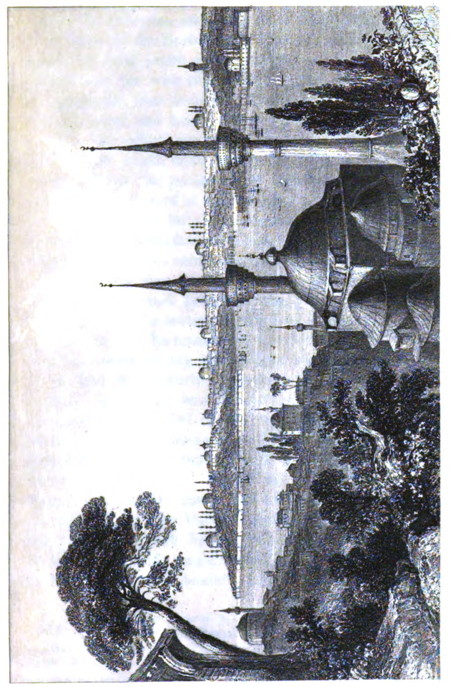
(See this image in horizontal aspect [here].)
Constantinople, p.. 250. From a painting by J. Cousen.
The eldest of the sons of Manuel, John Palæologus the Second, was acknowledged, after his father’s death, as the sole emperor of the Greeks. He immediately proceeded to repudiate his wife and to contract a new marriage with the princess of Trebizond; beauty was in his eye the first qualification of an empress; and the clergy had yielded to his firm assurance that, unless he might be indulged in a divorce, he would retire to a cloister and leave the throne to his brother Constantine. The first, and in truth the only, victory of Palæologus was over a Jew, [37] whom, after a long and learned dispute, he converted to the Christian faith; and this momentous conquest is carefully recorded in the history of the times. But he soon resumed the design of uniting the East and West; and, regardless of his father’s advice, listened, as it should seem, with sincerity to the proposal of meeting the pope in a general council beyond the Adriatic. This dangerous project was encouraged by Martin the Fifth, and coldly entertained by his successor Eugenius, till, after a tedious negotiation, the emperor received a summons from a Latin assembly of a new character, the independent prelates of Basil, who styled themselves the representatives and judges of the Catholic church.
The Roman pontiff had fought and conquered in the cause of ecclesiastical freedom; but the victorious clergy were soon exposed to the tyranny of their deliverer; and his sacred character was invulnerable to those arms which they found so keen and effectual against the civil magistrate. Their great charter, the right of election, was annihilated by appeals, evaded by trusts or commendams, disappointed by reversionary [XI-253] grants, and superseded by previous and arbitrary reservations. [38] A public auction was instituted in the court of Rome: the cardinals and favourites were enriched with the spoils of nations; and every country might complain that the most important and valuable benefices were accumulated on the heads of aliens and absentees. During their residence at Avignon, the ambition of the popes subsided in the meaner passions of avarice [39] and luxury: they rigorously imposed on the clergy the tributes of first-fruits and tenths; but they freely tolerated the impunity of vice, disorder, and corruption. These manifold scandals were aggravated by the great schism of the West, which continued above fifty years. In the furious conflicts of Rome and Avignon, the vices of the rivals were mutually exposed; and their precarious situation degraded their authority, relaxed their discipline, and multiplied their wants and exactions. To heal the wounds, and restore the monarchy, of the church, the synods of Pisa and Constance [40] were successively convened; but these great [XI-254] assemblies, conscious of their strength, resolved to vindicate the privileges of the Christian aristocracy. From a personal sentence against two pontiffs, whom they rejected, and a third, their acknowledged sovereign, whom they deposed, the fathers of Constance proceeded to examine the nature and limits of the Roman supremacy; nor did they separate till they had established the authority, above the pope, of a general council. It was enacted that, for the government and reformation of the church, such assemblies should be held at regular intervals; and that each synod, before its dissolution, should appoint the time and place of the subsequent meeting. By the influence of the court of Rome, the next convocation at Sienna was easily eluded; but the bold and vigorous proceedings of the council of Basil [41] had almost been fatal to the reigning pontiff, Eugenius the Fourth. A just suspicion of his design prompted the fathers to hasten the promulgation of their first decree, that the representatives of the church-militant on earth were invested with a divine and spiritual jurisdiction over all Christians, without excepting the pope; and that a general council could not be dissolved, prorogued, or transferred, unless by their free deliberation and consent. On the notice that Eugenius had fulminated a bull for that purpose, they ventured to summon, to admonish, to threaten, to censure, the contumacious successor of St. Peter. After many delays, to allow time for repentance, they finally declared that, unless he submitted within the term of sixty [XI-255] days, he was suspended from the exercise of all temporal and ecclesiastical authority. And to mark their jurisdiction over the prince as well as the priest, they assumed the government of Avignon, annulled the alienation of the sacred patrimony, and protected Rome from the imposition of new taxes. Their boldness was justified, not only by the general opinion of the clergy, but by the support and power of the first monarchs of Christendom: the emperor Sigismond declared himself the servant and protector of the synod; Germany and France adhered to their cause; the duke of Milan was the enemy of Eugenius; and he was driven from the Vatican by an insurrection of the Roman people. Rejected at the same time by his temporal and spiritual subjects, submission was his only choice; by a most humiliating bull, the pope repealed his own acts and ratified those of the council; incorporated his legates and cardinals with that venerable body; and seemed to resign himself to the decrees of the supreme legislature. Their fame pervaded the countries of the East; and it was in their presence that Sigismond received the ambassadors of the Turkish sultan, [42] who laid at his feet twelve large vases, filled with robes of silk and pieces of gold. The fathers of Basil aspired to the glory of reducing the Greeks, as well as the Bohemians, within the pale of the church; and their deputies invited the emperor and patriarchs of Constantinople to unite with an assembly which possessed the confidence of the Western nations. Palæologus was not averse to the proposal; and his ambassadors were introduced with due honours into the Catholic senate. But the choice of the place appeared to be an insuperable obstacle, since he refused to pass the Alps or the sea of Sicily, and positively required that the synod should be adjourned to some convenient city in Italy, or at least on the Danube. The other articles of this treaty were more readily stipulated: it was [XI-256] agreed to defray the travelling expenses of the emperor, with a train of seven hundred persons, [43] to remit an immediate sum of eight thousand ducats [44] for the accommodation of the Greek clergy; and in his absence to grant a supply of ten thousand ducats, with three hundred archers, and some galleys for the protection of Constantinople. The city of Avignon advanced the funds for the preliminary expenses; and the embarkation was prepared at Marseilles with some difficulty and delay.
In his distress, the friendship of Palæologus was disputed by the ecclesiastical powers of the West; but the dexterous activity of a monarch prevailed over the slow debates and inflexible temper of a republic. The decrees of Basil continually tended to circumscribe the despotism of the pope and to erect a supreme and perpetual tribunal in the church. Eugenius was impatient of the yoke; and the union of the Greeks might afford a decent pretence for translating a rebellious synod from the Rhine to the Po. The independence of the fathers was lost if they passed the Alps; Savoy or Avignon, to which they acceded with reluctance, were described at Constantinople as situate far beyond the Pillars of Hercules; [45] the emperor and his clergy were apprehensive [XI-257] of the dangers of a long navigation; they were offended by an haughty declaration that, after suppressing the new heresy of the Bohemians, the council would soon eradicate the old heresy of the Greeks. [46] On the side of Eugenius, all was smooth and yielding and respectful; and he invited the Byzantine monarch to heal, by his presence, the schism of the Latin, as well as of the Eastern, church. Ferrara, near the coast of the Adriatic, was proposed for their amicable interview; and with some indulgence of forgery and theft a surreptitious decree was procured, which transferred the synod, with its own consent, to that Italian city. Nine galleys were equipped for this service at Venice and in the isle of Candia; their diligence anticipated the slower vessels of Basil. The Roman admiral was commissioned to burn, sink, and destroy; [47] and these priestly squadrons might have encountered each other in the same seas where Athens and Sparta had formerly contended for the pre-eminence of glory. Assaulted by the importunity of the factions, who were ready to fight for the possession of his person, Palæologus hesitated before he left his palace and country on a perilous experiment. His father’s advice still dwelt on his memory; and reason must suggest that, since the Latins were divided among themselves, they could never unite in a foreign cause. Sigismond dissuaded the unseasonable adventure; his advice was impartial, since he adhered to the council; and it was enforced by the strange belief that the German Cæsar would nominate [XI-258] a Greek his heir and successor in the empire of the West. [48] Even the Turkish sultan was a counsellor whom it might be unsafe to trust, but whom it was dangerous to offend. Amurath was unskilled in the disputes, but he was apprehensive of the union, of the Christians. From his own treasures, he offered to relieve the wants of the Byzantine court; yet he declared, with seeming magnanimity, that Constantinople should be secure and inviolate in the absence of her sovereign. [49] The resolution of Palæologus was decided by the most splendid gifts and the most specious promises. He wished to escape, for a while, from a scene of danger and distress; and, after dismissing, with an ambiguous answer, the messengers of the council, he declared his intention of embarking in the Roman galleys. The age of the patriarch Joseph was more susceptible of fear than of hope; he trembled at the perils of the sea, and expressed his apprehension that his feeble voice, with thirty, perhaps, of his orthodox brethren, would be oppressed in a foreign land by the power and numbers of a Latin synod. He yielded to the royal mandate, to the flattering assurance that he would be heard as the oracle of nations, and to the secret wish of learning from his brother of the West to deliver the church from the yoke of kings. [50] The five cross-bearers, or dignitaries of St. Sophia, were bound to attend his person; and one of these, the great ecclesiarch [XI-259] or preacher, Sylvester Syropulus, [51] has composed [52] a free and curious history of the false union. [53] Of the clergy that reluctantly obeyed the summons of the emperor and the patriarch, submission was the first duty, and patience the most useful virtue. In a chosen list of twenty bishops, we discover the metropolitan titles of Heraclea and Cyzicus, Nice and Nicomedia, Ephesus and Trebizond, and the personal merit of Mark and Bessarion, who, in the confidence of their learning and eloquence, were promoted to the episcopal rank. Some monks and philosophers were named to display the science and sanctity of the Greek church; and the service of the choir was performed by a select band of singers and musicians. The patriarchs of Alexandria, Antioch, and Jerusalem appeared by their genuine or fictitious deputies, the primate of Russia represented a national church, and the Greeks might contend with the Latins in the extent of their spiritual empire. The precious vases of St. Sophia were exposed to the winds and waves, that the patriarch might officiate with becoming splendour; whatever gold the [XI-260] emperor could procure was expended in the massy ornaments of his bed and chariot; [54] and, while they affected to maintain the prosperity of their ancient fortune, they quarrelled for the division of fifteen thousand ducats, the first alms of the Roman pontiff. After the necessary preparations, John Palæologus, with a numerous train, accompanied by his brother Demetrius, and the most respectable persons of the church and state, embarked in eight vessels with sails and oars, which steered through the Turkish straits of Gallipoli to the Archipelago, the Morea and the Adriatic Gulf. [55]
After a tedious and troublesome navigation of seventy-seven days, this religious squadron cast anchor before Venice; and their reception proclaimed the joy and magnificence of that powerful republic. In the command of the world, the modest Augustus had never claimed such honours from his subjects as were paid to his feeble successor by an independent state. Seated on the poop, on a lofty throne, he received the visit, or, in the Greek style, the adoration, of the Doge and senators. [56] They sailed in the Bucentaur, which was accompanied by twelve stately galleys; the sea was overspread with innumerable gondolas of pomp and pleasure; the air resounded with music and acclamations; the mariners, and even the vessels, were dressed in silk and gold; and in all the [XI-261] emblems and pageants the Roman eagles were blended with the lions of St. Mark. The triumphal procession, ascending the great canal, passed under the bridge of the Rialto; and the Eastern strangers gazed with admiration on the palaces, the churches, and the populousness of a city that seems to float on the bosom of the waves. [57] They sighed to behold the spoils and trophies with which it had been decorated after the sack of Constantinople. After an hospitable entertainment of fifteen days, Palæologus pursued his journey by land and water, from Venice to Ferrara; and on this occasion the pride of the Vatican was tempered by policy to indulge the ancient dignity of the emperor of the East. He made his entry on a black horse; but a milk-white steed, whose trapings were embroidered with golden eagles, was led before him; and the canopy was borne over his head by the princes of Este, the sons or kinsmen of Nicholas, marquis of the city, and a sovereign more powerful than himself. [58] Palæologus did not alight till he reached the bottom of the staircase; the pope advanced to the door of the apartment; refused his proffered genuflexion; and, after a paternal embrace, conducted the emperor to a seat on his left hand. Nor would the patriarch descend from his galley, till a ceremony, almost equal, had been stipulated between the bishops of Rome and Constantinople. The latter was saluted by his brother with a kiss of union and charity; nor would any of the Greek ecclesiastics submit to kiss the feet of the Western primate. On the opening of the synod, the place of honour in the centre was claimed by the temporal and ecclesiastical [XI-262] chiefs; and it was only by alleging that his predecessors had not assisted in person at Nice or Chalcedon that Eugenius could evade the ancient precedents of Constantine and Marcian. After much debate, it was agreed that the right and left sides of the church should be occupied by the two nations; that the solitary chair of St. Peter should be raised the first of the Latin line; and that the throne of the Greek emperor, at the head of his clergy, should be equal and opposite to the second place, the vacant seat of the emperor of the West. [59]
But, as soon as festivity and form had given place to a more serious treaty, the Greeks were dissatisfied with their journey, with themselves, and with the pope. The artful pencil of his emissaries had painted him in a prosperous state; at the head of the princes and prelates of Europe, obedient, at his voice, to believe and to arm. The thin appearance of the universal synod of Ferrara betrayed his weakness; and the Latins opened the first session with only five archbishops, eighteen bishops, and ten abbots, the greatest part of whom were the subjects or countrymen of the Italian pontiff. Except the duke of Burgundy, none of the potentates of the West condescended to appear in person or by their ambassadors; nor was it possible to suppress the judicial acts of Basil against the dignity and person of Eugenius, which were finally concluded by a new election. Under these circumstances, a truce or delay was asked and granted, till Palæologus could expect from the consent of the Latins some temporal reward for an unpopular union; and, after the first session, the public proceedings were adjourned [XI-263] above six months. The emperor, with a chosen band of his favourites and Janizaries, fixed his summer residence at a pleasant spacious monastery, six miles from Ferrara; forgot, in the pleasures of the chase, the distress of the church and state; and persisted in destroying the game, without listening to the just complaints of the marquis or the husbandman. [60] In the meanwhile, his unfortunate Greeks were exposed to all the miseries of exile and poverty; for the support of each stranger, a monthly allowance was assigned of three or four gold florins; and, although the entire sum did not amount to seven hundred florins, a long arrear was repeatedly incurred by the indigence or policy of the Roman court. [61] They sighed for a speedy deliverance, but their escape was prevented by a triple chain: a passport from their superiors was required at the gates of Ferrara; the government of Venice had engaged to arrest and send back the fugitives; and inevitable punishment awaited them at Constantinople: excommunication, fines, and a sentence which did not respect the sacerdotal dignity, that they should be stripped naked and publicly whipped. [62] It was only by the alternative of hunger or dispute that the Greeks could be persuaded to open the first conference; and they yielded with extreme reluctance to [XI-264] attend, from Ferrara to Florence, the rear of a flying synod. This new translation was urged by inevitable necessity: the city was visited by the plague; the fidelity of the marquis might be suspected; the mercenary troops of the duke of Milan were at the gates; and, as they occupied Romagna, it was not without difficulty and danger that the pope, the emperor, and the bishops explored their way through the unfrequented paths of the Apennine. [63]
Yet all these obstacles were surmounted by time and policy. The violence of the fathers of Basil rather promoted than injured the cause of Eugenius: the nations of Europe abhorred the schism, and disowned the election, of Felix the Fifth, who was successively a duke of Savoy, an hermit, and a pope; and the great princes were gradually reclaimed by his competitor to a favourable neutrality and a firm attachment. The legates, with some respectable members, deserted to the Roman army, which insensibly rose in numbers and reputation: the council of Basil was reduced to thirty-nine bishops and three hundred of the inferior clergy; [64] while the Latins of Florence could produce the subscriptions of the pope himself, eight cardinals, two patriarchs, eight archbishops, fifty-two bishops, and forty-five abbots, or chiefs of religious orders. After the labour of nine months, and the debates of twenty-five sessions, they attained the advantage and glory of the reunion of the Greeks. Four principal questions had been agitated between the two churches: 1. The use of unleavened bread in the communion of Christ’s [XI-265] body; 2. The nature of purgatory; 3. The supremacy of the pope; and 4. The single or double procession of the Holy Ghost. The cause of either nation was managed by ten theological champions: the Latins were supported by the inexhaustible eloquence of Cardinal Julian; and Mark of Ephesus and Bessarion of Nice were the bold and able leaders of the Greek forces. We may bestow some praise on the progress of human reason by observing that the first of these questions was now treated as an immaterial rite, which might innocently vary with the fashion of the age and country. With regard to the second, both parties were agreed in the belief of an intermediate state of purgation for the venal sins of the faithful; and, whether their souls were purified by elemental fire was a doubtful point, which in a few years might be conveniently settled on the spot by the disputants. The claims of supremacy appeared of a more weighty and substantial kind; yet, by the Orientals, the Roman bishop had ever been respected as the first of the five patriarchs; nor did they scruple to admit that his jurisdiction should be exercised agreeable to the holy canons: a vague allowance which might be defined or eluded by occasional convenience. The procession of the Holy Ghost from the Father alone, or from the Father and the Son, was an article of faith which had sunk much deeper into the minds of men; and in the sessions of Ferrara and Florence the Latin addition of filioque was subdivided into two questions, whether it were legal, and whether it were orthodox. Perhaps it may not be necessary to boast on this subject of my own impartial indifference; but I must think that the Greeks were strongly supported by the prohibition of the council of Chalcedon against adding any article whatsoever to the creed of Nice or rather of Constantinople. [65] In earthly affairs, it is not easy to [XI-266] conceive how an assembly of legislators can bind their successors invested with powers equal to their own. But the dictates of inspiration must be true and unchangeable; nor should a private bishop, or a provincial synod, have presumed to innovate against the judgment of the Catholic church. On the substance of the doctrine, the controversy was equal and endless: reason is confounded by the procession of a deity; the gospel, which lay on the altar, was silent; the various texts of the fathers might be corrupted by fraud or entangled by sophistry; and the Greeks were ignorant of the characters and writings of the Latin saints. [66] Of this, at least, we way be sure, that neither side could be convinced by the arguments of their opponents. Prejudice may be enlightened by reason, and a superficial glance may be rectified by a clear and more perfect view of an object adapted to our faculties. But the bishops and monks had been taught from their infancy to repeat a form of mysterious words; their national and personal honour depended on the repetition of the same sounds; and their narrow minds were hardened and inflamed by the acrimony of a public dispute.
While they were lost in a cloud of dust and darkness, the pope and emperor were desirous of a seeming union, which could alone accomplish the purposes of their interview; and the obstinacy of public dispute was softened by the arts of private and personal negotiation. The patriarch Joseph had sunk under the weight of age and infirmities; his dying voice breathed the counsels of charity and concord, and his vacant benefice might tempt the hopes of the ambitious clergy. The ready and active obedience of the archbishops of Russia and Nice, of Isidore and Bessarion, was prompted and recompensed by their speedy promotion to the dignity of cardinals. Bessarion, in the first debates, had stood forth the most [XI-267] strenuous and eloquent champion of the Greek church; and, if the apostate, the bastard, was reprobated by his country, [67] he appears in ecclesiastical story a rare example of a patriot who was recommended to court favour by loud opposition and well-timed compliance. With the aid of his two spiritual coadjutors, the emperor applied his arguments to the general situation and personal characters of the bishops, and each was successively moved by authority and example. Their revenues were in the hands of the Turks, their persons in those of the Latins; an episcopal treasure, three robes and forty ducats, were soon exhausted; [68] the hopes of their return still depended on the ships of Venice and the alms of Rome; and such was their indigence that their arrears, the payment of a debt, would be accepted as a favour and might operate as a bribe. [69] The danger and relief of Constantinople might excuse some prudent and pious dissimulation; and it was insinuated that the obstinate heretics who should resist the consent of the East and West would be abandoned in a hostile land to the revenge or justice of the Roman pontiff. [70] [XI-268] In the first private assembly of the Greeks, the formulary of union was approved by twenty-four, and rejected by twelve, members; but the five cross-bearers of St. Sophia, who aspired to represent the patriarch, were disqualified by ancient discipline; and their right of voting was transferred to an obsequious train of monks, grammarians, and profane laymen. The will of the monarch produced a false and servile unanimity, and no more than two patriots had courage to speak their own sentiments, and those of their country. Demetrius, the emperor’s brother, retired to Venice, that he might not be witness of the union; and Mark of Ephesus, mistaking perhaps his pride for his conscience, disclaimed all communion with the Latin heretics, and avowed himself the champion and confessor of the orthodox creed. [71] In the treaty between the two nations several forms of consent were proposed, such as might satisfy the Latins without dishonouring the Greeks; and they weighed the scruples of words and syllables, till the theological balance trembled with a slight preponderance in favour of the Vatican. It was agreed (I must entreat the attention of the reader), that the Holy Ghost proceeds from the Father and the Son, as from one principle and one substance; that he proceeds by the Son, being of the same nature and substance; and that he proceeds from the Father and the Son, by one spiration and production. It is less difficult to understand the articles of the preliminary treaty: that the pope should defray all the expenses of the Greeks in their return home; that he should annually maintain two galleys and three hundred soldiers for the defence of Constantinople; that all the ships which transported pilgrims to Jerusalem [XI-269] should be obliged to touch at that port; that, as often as they were required, the pope should furnish ten galleys for a year, or twenty-six months; and that he should powerfully solicit the princes of Europe, if the emperor had occasion for landforces.
The same year, and almost the same day, were marked by the deposition of Eugenius at Basil, and, at Florence, by his reunion of the Greeks and Latins. In the former synod (which he styled indeed an assembly of demons), the pope was branded with the guilt of simony, perjury, tyranny, heresy, and schism; [72] and declared to be incorrigible in his vices, unworthy of any title, and incapable of holding any ecclesiastical office. In the latter, he was revered as the true and holy vicar of Christ, who, after a separation of six hundred years, had reconciled the Catholics of the East and West, in one fold and under one shepherd. The act of union was subscribed by the pope, the emperor, and the principal members of both churches; even by those who, like Syropulus, [73] had been deprived of the right of voting. Two copies might have sufficed for the East and West; but Eugenius was not satisfied, unless four authentic and similar transcripts were signed and attested as the monuments of his victory. [74] On a memorable day, the sixth of July, the successors [XI-270] of St. Peter and Constantine ascended their thrones; the two nations assembled in the cathedral of Florence; their representatives, Cardinal Julian, and Bessarion, Archbishop of Nice, appeared in the pulpit, and, after reading, in their respective tongues, the act of union, they mutually embraced, in the name and the presence of their applauding brethren. The pope and his ministers then officiated according to the Roman liturgy; the creed was chanted with the addition of filioque; the acquiescence of the Greeks was poorly excused by their ignorance of the harmonious, but inarticulate, sounds; [75] and the more scrupulous Latins refused any public celebration of the Byzantine rite. Yet the emperor and his clergy were not totally unmindful of national honour. The treaty was ratified by their consent: it was tacitly agreed that no innovation should be attempted in their creed or ceremonies; they spared, and secretly respected, the generous firmness of Mark of Ephesus; and, on the decease of the patriarch, they refused to elect his successor, except in the cathedral of St. Sophia. In the distribution of public and private rewards, the liberal pontiff exceeded their hopes and his promises; the Greeks, with less pomp and pride, returned by the same road of Ferrara and Venice; and their reception at Constantinople was such as will be described in the following chapter. [76] The success of the first trial encouraged Eugenius to repeat the same edifying scenes; and the deputies of the Armenians, the Maronites, the Jacobites of Syria and Egypt, the Nestorians, and the Ethiopians were successively introduced, to kiss the feet of the Roman pontiff, and to announce the obedience and the orthodoxy of the East. These Oriental [XI-271] embassies, unknown in the countries which they presumed to represent, [77] diffused over the West the fame of Eugenius; and a clamour was artfully propagated against the remnant of a schism in Switzerland and Savoy, which alone impeded the harmony of the Christian world. The vigour of opposition was succeeded by the lassitude of despair: the council of Basil was silently dissolved; and Felix, renouncing the tiara, again withdrew to the devout or delicious hermitage of Ripaille. [78] A general peace was secured by mutual acts of oblivion and indemnity; all ideas of reformation subsided; the popes continued to exercise and abuse their ecclesiastical despotism; nor has Rome been since disturbed by the mischiefs of a contested election. [79]
The journeys of three emperors were unavailing for their temporal, or perhaps their spiritual, salvation; but they were productive of a beneficial consequence, the revival of the Greek learning in Italy, from whence it was propagated to the [XI-272] last nations of the West and North. In their lowest servitude and depression, the subjects of the Byzantine throne were still possessed of a golden key that could unlock the treasures of antiquity; of a musical and prolific language, that gives a soul to the objects of sense and a body to the abstractions of philosophy. Since the barriers of the monarchy, and even of the capital, had been trampled under foot, the various Barbarians had doubtless corrupted the form and substance of the national dialect; and ample glossaries have been composed, to interpret a multitude of words of Arabic, Turkish, Sclavonian, Latin, or French origin. [80] But a purer idiom was spoken in the court and taught in the college; and the flourishing state of the language is described, and perhaps embellished, by a learned Italian, [81] who, by a long residence and noble marriage, [82] was naturalised at Constantinople about [XI-273] thirty years before the Turkish conquest. “The vulgar speech,” says Philelphus, [83] “has been depraved by the people, and infected by the multitude of strangers and merchants, who every day flock to the city and mingle with the inhabitants. It is from the disciples of such a school that the Latin language received the versions of Aristotle and Plato, so obscure in sense, and in spirit so poor. But the Greeks who have escaped the contagion are those whom we follow; and they alone are worthy of our imitation. In familiar discourse, they still speak the tongue of Aristophanes and Euripides, of the historians and philosophers of Athens; and the style of their writings are still more elaborate and correct. The persons who, by their birth and offices, are attached to the Byzantine court are those who maintain, with the least alloy, the ancient standard of elegance and purity; and the native graces of language most conspicuously shine among the noble matrons, who are excluded from all intercourse with foreigners. With foreigners do I say? They live retired and sequestered from the eyes of their fellow-citizens. Seldom are they seen in the streets; and, when they leave their houses, it is in the dusk of evening, on visits to the churches and their nearest kindred. On these occasions, they are on horseback, covered with a veil, and encompassed by their parents, their husbands, or their servants.” [84]
Among the Greeks, a numerous and opulent clergy was [XI-274] dedicated to the service of religion; their monks and bishops have ever been distinguished by the gravity and austerity of their manners; nor were they diverted, like the Latin priests, by the pursuits and pleasures of a secular and even military life. After a large deduction for the time and talents that were lost in the devotion, the laziness, and the discord of the church and cloister, the more inquisitive and ambitious minds would explore the sacred and profane erudition of their native language. The ecclesiastics presided over the education of youth; the schools of philosophy and eloquence were perpetuated till the fall of the empire; and it may be affirmed that more books and more knowledge were included within the walls of Constantinople than could be dispersed over the extensive countries of the West. [85] But an important distinction has been already noticed: the Greeks were stationary or retrograde, while the Latins were advancing with a rapid and progressive motion. The nations were excited by the spirit of independence and emulation; and even the little world of the Italian states contained more people and industry than the decreasing circle of the Byzantine empire. In Europe, the lower ranks of society were relieved from the yoke of feudal servitude; and freedom is the first step to curiosity and knowledge. The use, however rude and corrupt, of the Latin tongue had been preserved by supersition; the universities, from Bologna to Oxford, [86] were peopled with thousands [XI-275] of scholars; and their misguided ardour might be directed to more liberal and manly studies. In the resurrection of science, Italy was the first that cast away her shroud; and the eloquent Petrarch, by his lessons and his example, may justly be applauded as the first harbinger of day. A purer style of composition, a more generous and rational strain of sentiment, flowed from the study and imitation of the writers of ancient Rome; and the disciples of Cicero and Virgil approached, with reverence and love, the sanctuary of their Grecian masters. In the sack of Constantinople, the French, and even the Venetians, had despised and destroyed the works of Lysippus and Homer; the monuments of art may be annihilated by a single blow; but the immortal mind is renewed and multiplied by the copies of the pen; and such copies it was the ambition of Petrarch and his friends to possess and understand. The arms of the Turks undoubtedly pressed the flight of the Muses; yet we may tremble at the thought that Greece might have been overwhelmed, with her schools and libraries, before Europe had emerged from the deluge of Barbarism; that the seeds of science might have been scattered by the winds, before the Italian soil was prepared for their cultivation.
The most learned Italians of the fifteenth century have confessed and applauded the restoration of Greek literature, after a long oblivion of many hundred years. [87] Yet in that [XI-276] country, and beyond the Alps, some names are quoted: some profound scholars, who, in the darker ages, were honourably distinguished by their knowledge of the Greek tongue; and national vanity has been loud in the praise of such rare examples of erudition. Without scrutinising the merit of individuals, truth must observe that their science is without a cause and without an effect; that it was easy for them to satisfy themselves and their more ignorant contemporaries; and that the idiom, which they had so marvellously acquired, was transcribed in few manuscripts, and was not taught in any university of the West. In a corner of Italy it faintly existed as the popular, or at least as the ecclesiastical, dialect. [88] The first impression of the Doric and Ionic colonies has never been completely erased; the Calabrian churches were long attached to the throne of Constantinople; and the monks of St. Basil pursued their studies in Mount Athos and the schools of the East. Calabria was the native country of Barlaam, who has already appeared as a sectary and an ambassador; and Barlaam was the first who revived, beyond the Alps, the memory, or at least the writings, of Homer. [89] He is described, by [XI-277] Petrarch and Boccace, [90] as a man of a diminutive stature, though truly great in the measure of learning and genius; of a piercing discernment, though of a slow and painful elocution. For many ages (as they affirm) Greece had not produced his equal in the knowledge of history, grammar, and philosophy; and his merit was celebrated in the attestations of the princes and doctors of Constantinople. One of these attestations is still extant; and the emperor Cantacuzene, the protector of his adversaries, is forced to allow that Euclid, Aristotle, and Plato were familiar to that profound and subtle logician. [91] In the court of Avignon, he formed an intimate connection with Petrarch, [92] the first of the Latin scholars; and the desire of mutual instruction was the principle of their literary commerce. The Tuscan applied himself with eager curiosity and assiduous diligence to the study of the Greek language; and, in a laborious struggle with the dryness and difficulty of the first rudiments, he began to reach the sense, and to feel the spirit, of poets and philosophers whose minds were congenial to his own. But he was soon deprived of the society and lessons of this useful assistant. Barlaam relinquished his fruitless embassy; and, on his return to Greece, he rashly provoked the swarms of fanatic monks by attempting to substitute the light of reason to that of their navel. After a separation of three years, the two friends again met in the court of Naples; but the generous pupil renounced the fairest occasion of improvement; and by his recommendation Barlaam [XI-278] was finally settled in a small bishopric of his native Calabria. [93] The manifold avocations of Petrarch, love and friendship, his various correspondence and frequent journeys, the Roman laurel, and his elaborate compositions in prose and verse, in Latin and Italian, diverted him from a foreign idiom; and, as he advanced in life, the attainment of the Greek language was the object of his wishes rather than of his hopes. When he was about fifty years of age, a Byzantine ambassador, his friend, and a master of both tongues, presented him with a copy of Homer; and the answer of Petrarch is at once expressive of his eloquence, gratitude, and regret. After celebrating the generosity of the donor, and the value of a gift more precious in his estimation than gold or rubies, he thus proceeds: “Your present of the genuine and original text of the divine poet, the fountain of all invention, is worthy of yourself and of me; you have fulfilled your promise and satisfied my desires. Yet your liberality is still imperfect: with Homer you should have given me yourself: a guide, who could lead me into the fields of light, and disclose to my wondering eyes the specious miracles of the Iliad and Odyssey. But, alas! Homer is dumb, or I am deaf; nor is it in my power to enjoy the beauty which I possess. I have seated him by the side of Plato, the prince of poets near the prince of philosophers; and I glory in the sight of my illustrious guests. Of their immortal writings, whatever had been translated into the Latin idiom, I had already acquired; but, if there be no profit, there is some pleasure in beholding these venerable Greeks in their proper and national habit. I am delighted with the aspect of Homer; and, as often as I embrace the silent volume, I exclaim, with a sigh, Illustrious bard! with what pleasure should I listen to thy song, if my sense of hearing were not obstructed and lost [XI-279] by the death of one friend, and in the much lamented absence of another! Nor do I yet despair; and the example of Cato suggests some comfort and hope, since it was in the last period of age that he attained the knowledge of the Greek letters.” [94]
The prize which eluded the efforts of Petrarch was obtained by the fortune and industry of his friend Boccace, [95] the father of the Tuscan prose. That popular writer, who derives his reputation from the Decameron, an hundred novels of pleasantry and love, may aspire to the more serious praise of restoring in Italy the study of the Greek language. In the year one thousand three hundred and sixty, a disciple of Barlaam, whose name was Leo or Leontius Pilatus, was detained in his way to Avignon by the advice and hospitality of Boccace, who lodged the stranger in his house, prevailed on the republic of Florence to allow him an annual stipend, and devoted his leisure to the first Greek professor who taught the language in the Western countries of Europe. The appearance of Leo might disgust the most eager disciple: he was clothed in the mantle of a philosopher, or a mendicant; his countenance was hideous; his face was overshadowed with black hair; his beard long and uncombed; his deportment rustic; his temper gloomy and inconstant; nor could he grace his discourse with the ornaments or even the perspicuity of Latin elocution. But his mind was stored with a treasure of Greek learning; history and fable, philosophy and grammar, were alike at his [XI-280] command; and he read the poems of Homer in the schools of Florence. It was from his explanation that Boccace composed and transcribed a literal prose version of the Iliad and Odyssey, which satisfied the thirst of his friend Petrarch, and which perhaps, in the succeeding century, was clandestinely used by Laurentius Valla, the Latin interpreter. It was from his narratives that the same Boccace collected the materials for his treatise on the genealogy of the heathen gods; a work, in that age, of stupendous erudition, and which he ostentatiously sprinkled with Greek characters and passages, to excite the wonder and applause of his more ignorant readers. [96] The first steps of learning are slow and laborious: no more than ten votaries of Homer could be enumerated in all Italy; and neither Rome nor Venice nor Naples could add a single name to this studious catalogue. But their numbers would have multiplied, their progress would have been accelerated, if the inconstant Leo, at the end of three years, had not relinquished an honourable and beneficial station. In his passage, Petrarch entertained him at Padua a short time: he enjoyed the scholar, but was justly offended with the gloomy and unsocial temper of the man. Discontented with the world and with himself, Leo depreciated his present enjoyments, while absent persons and objects were dear to his imagination. In Italy, he was a Thessalian, in Greece, a native of Calabria; in the company of the Latins, he disdained their language, religion, and manner: no sooner was he landed at Constantinople, than he again sighed for the wealth of Venice and the elegance of Florence. His Italian friends were deaf to his importunity; he depended on their curiosity and indulgence, and embarked on a second voyage; but, on his entrance into the Adriatic, the [XI-281] ship was assailed by a tempest, and the unfortunate teacher, who, like Ulysses, had fastened himself to the mast, was struck dead by a flash of lightning. The humane Petrarch dropped a tear on his disaster; but he was most anxious to learn whether some copy of Euripides or Sophocles might not be saved from the hands of the mariners. [97]
But the faint rudiments of Greek learning, which Petrarch had encouraged and Boccace had planted, soon withered and expired. The succeeding generation was content for a while with the improvement of Latin eloquence; nor was it before the end of the fourteenth century that a new and perpetual flame was rekindled in Italy. [98] Previous to his own journey, the emperor Manuel despatched his envoys and orators to implore the compassion of the Western princes. Of these envoys, the most conspicuous or the most learned was Manuel Chrysoloras, [99] of noble birth, and whose Roman ancestors are supposed to have migrated with the great Constantine. After visiting the courts of France and England, where he obtained some contributions and more promises, the envoy was invited to assume the office of a professor; and Florence had again the honour of this second invitation. By his knowledge, not only of the Greek but of the Latin tongue, Chrysoloras deserved the stipend and surpassed the expectation of the republic; [XI-282] his school was frequented by a crowd of disciples of every rank and age; and one of these, in a general history, has described his motives and his success. “At that time,” says Leonard Aretin, [100] “I was a student of the civil law; but my soul was inflamed with the love of letters; and I bestowed some application on the sciences of logic and rhetoric. On the arrival of Manuel, I hesitated whether I should desert my legal studies or relinquish this golden opportunity; and thus, in the ardour of youth, I communed with my own mind — Wilt thou be wanting to thyself and thy fortune? Wilt thou refuse to be introduced to a familiar converse with Homer, Plato, and Demosthenes? with those poets, philosophers, and orators, of whom such wonders are related, and who are celebrated by every age as the great masters of human science? Of professors and scholars in civil law, a sufficient supply will always be found in our universities; but a teacher, and such a teacher, of the Greek language, if he once be suffered to escape, may never afterwards be retrieved. Convinced by these reasons, I gave myself to Chrysoloras; and so strong was my passion that the lessons which I had imbibed in the day were the constant subject of my nightly dreams.” [101] At the same time and place the Latin classics were explained by John of Ravenna, the domestic pupil of Petrarch; [102] the Italians, who illustrated their age and country, were formed in this double school; and Florence became the fruitful [XI-283] seminary of Greek and Roman erudition. [103] The presence of the emperor recalled Chrysoloras from the college to the court, but he afterwards taught at Pavia and Rome with equal industry and applause. The remainder of his life, about fifteen years, was divided between Italy and Constantinople, between embassies and lessons. In the noble office of enlightening a foreign nation, the grammarian was not unmindful of a more sacred duty to his prince and country; and Emanuel Chrysoloras died at Constance, on a public mission from the emperor to the council.
After his example, the restoration of the Greek letters in Italy was prosecuted by a series of emigrants, who were destitute of fortune, and endowed with learning, or at least with language. From the terror or oppression of the Turkish arms the natives of Thessalonica and Constantinople escaped to a land of freedom, curiosity, and wealth. The synod introduced into Florence the lights of the Greek church and the oracles of the Platonic philosophy; and the fugitives who adhered to the union had the double merit of renouncing their country not only for the Christian but for the Catholic cause. A patriot who sacrifices his party and conscience to the allurements of favour may be possessed, however, of the private and social virtues; he no longer hears the reproachful epithets of slave and apostate; and the consideration which he acquires among his new associates will restore in his own eyes the dignity of his character. The prudent conformity of Bessarion was rewarded with the Roman purple; he fixed his residence in Italy; and the Greek cardinal, the titular [XI-284] patriarch of Constantinople, was respected as the chief and protector of his nation. [104] His abilities were exercised in the legations of Bologna, Venice, Germany, and France; and his election to the chair of St. Peter floated for a moment on the uncertain breath of a conclave. [105] His ecclesiastical honours diffused a splendour and pre-eminence over his literary merit and service: his palace was a school; as often as the cardinal visited the Vatican, he was attended by a learned train of both nations; [106] of men applauded by themselves and the public; and whose writings, now overspread with dust, were popular and useful in their own times. I shall not attempt to enumerate the restorers of Grecian literature in the fifteenth century; and it may be sufficient to mention with gratitude the names of Theodore Gaza, of George of Trebizond, of John Argyropulus, and Demetrius Chalcondyles, who taught their native language in the schools of Florence and Rome. Their labours were not inferior to those of Bessarion, whose purple they revered, and whose fortune was the secret object of their envy. But the lives of these grammarians were humble and obscure; they had declined the lucrative paths of the church; their dress and manners secluded them from the commerce of the world; and, since they were confined to the merit, they might be content with the rewards, of learning. From this character Janus Lascaris [107] [XI-285] will deserve an exception. His eloquence, politeness, and Imperial descent recommended him to the French monarchs; and in the same cities he was alternately employed to teach and to negotiate. Duty and interest prompted them to cultivate the study of the Latin language; and the most successful attained the faculty of writing and speaking with fluency and elegance in a foreign idiom. But they ever retained the inveterate vanity of their country: their praise, or at least their esteem, was reserved for the national writers, to whom they owed their fame and subsistence; and they sometimes betrayed their contempt in licentious criticism or satire on Virgil’s poetry and the oratory of Tully. [108] The superiority of these masters arose from the familiar use of a living language; and their first disciples were incapable of discerning how far they had degenerated from the knowledge, and even the practice, of their ancestors. A vicious pronunciation, [109] which they introduced, was banished from [XI-286] the schools by the reason of the succeeding age. Of the power of the Greek accents they were ignorant; and those musical notes, which, from an Attic tongue and to an Attic ear, must have been the secret soul of harmony, were to their eyes, as to our own, no more than mute or unmeaning marks, in prose superfluous and troublesome in verse. [109a] The art of grammar they truly possessed; the valuable fragments of Apollonius and Herodian were transfused into their lessons; and their treatises of syntax and etymology, though devoid of philosophic spirit, are still useful to the Greek student. In the shipwreck of the Byzantine libraries, each fugitive seized a fragment of treasure, a copy of some author, who, without his industry, might have perished; the transcripts were multiplied by an assiduous, and sometimes an elegant, pen; and the text was corrected and explained by their own comments or those of the elder scholiasts. The sense, though not the spirit, of the Greek classics was interpreted to the Latin world; the beauties of style evaporate in a version; but the judgment of Theodore Gaza selected the more solid works of Aristotle and Theophrastus, and their natural histories of animals and plants opened a rich fund of genuine and experimental science. [110]
Yet the fleeting shadows of metaphysics were pursued with more curiosity and ardour. After a long oblivion, Plato was revived in Italy by a venerable Greek, [111] who taught in the [XI-287] house of Cosmo of Medicis. While the synod of Florence was involved in theological debate, some beneficial consequences might flow from the study of his elegant philosophy; his style is the purest standard of the Attic dialect; and his sublime thoughts are sometimes adapted to familiar conversation, and sometimes adorned with the richest colours of poetry and eloquence. The dialogues of Plato are a dramatic picture of the life and death of a sage; and, as often as he descends from the clouds, his moral system inculcates the love of truth, of our country, and of mankind. The precept and example of Socrates recommended a modest doubt and liberal inquiry; and, if the Platonists, with blind devotion, adored the visions and errors of their divine master, their enthusiasm might correct the dry dogmatic method of the Peripatetic school. So equal, yet so opposite, are the merits of Plato and Aristotle that they may be balanced in endless controversy; but some spark of freedom may be produced by the collision of adverse servitude. The modern Greeks were divided between the two sects; with more fury than skill they fought under the banner of their leaders; and the field of battle was removed in their flight from Constantinople to Rome. But this philosophic debate soon degenerated into an angry and personal quarrel of grammarians; and Bessarion, though an advocate for Plato, protected the national honour, by interposing the advice and authority of a mediator. In the gardens of the Medici, the academical doctrine was enjoyed by the polite and [XI-288] learned; but their philosophic society was quickly dissolved; and, if the writings of the Attic sage were perused in the closet, the more powerful Stagirite continued to reign the oracle of the church and school. [112]
I have fairly represented the literary merits of the Greeks; yet it must be confessed that they were seconded and surpassed by the ardour of the Latins. Italy was divided into many independent states; and at that time it was the ambition of princes and republics to vie with each other in the encouragement and reward of literature. The fame of Nicholas the Fifth [113] has not been adequate to his merits. From a plebeian origin he raised himself by his virtue and learning: the character of the man prevailed over the interest of the pope; and he sharpened those weapons which were soon pointed against the Roman church. [114] He had been the friend of the most eminent scholars of the age; he became their patron; and such was the humility of his manners that the change was scarcely discernible either to them or to himself. If he pressed the acceptance of a liberal gift, it was not as the measure of desert, but as the proof of benevolence; and, when modest merit declined his bounty, “Accept it,” would he say with a consciousness of his own worth; “you will not always have a Nicholas among ye.” The influence of the holy see pervaded Christendom; and he exerted that influence in the search, not of benefices, but of books. From the ruins of the Byzantine libraries, from the darkest monasteries of Germany [XI-289] and Britain, he collected the dusty manuscripts of the writers of antiquity; and, wherever the original could not be removed, a faithful copy was transcribed and transmitted for his use. The Vatican, the old repository for bulls and legends, for superstition and forgery, was daily replenished with more precious furniture; and such was the industry of Nicholas that in a reign of eight years he formed a library of five thousand volumes. To his munificence the Latin world was indebted for the versions of Xenophon, Diodorus, Polybius, Thucydides, Herodotus, and Appian; of Strabo’s Geography, of the Iliad, of the most valuable works of Plato and Aristotle, of Ptolemy and Theophrastus, and of the fathers of the Greek church. The example of the Roman pontiff was preceded or imitated by a Florentine merchant, who governed the republic without arms and without a title. Cosmo of Medicis [115] was a father of a line of princes, whose name and age are almost synonymous with the restoration of learning; his credit was ennobled into fame; his riches were dedicated to the service of mankind; he corresponded at once with Cairo and London; and a cargo of Indian spices and Greek books was often imported in the same vessel. The genius and education of his grandson Lorenzo rendered him, not only a patron, but a judge and candidate, in the literary race. In his palace, distress was entitled to relief, and merit to reward; his leisure-hours were delightfully spent in the Platonic academy; he encouraged the emulation of Demetrius Chalcondyles and Angelo Politian; and his active missionary, Janus Lascaris, returned from the East with a treasure of two hundred manuscripts, fourscore of which were as yet unknown in the libraries of Europe. [116] The rest of [XI-290] Italy was animated by a similar spirit, and the progress of the nation repaid the liberality of her princes. The Latins held the exclusive property of their own literature; and these disciples of Greece were soon capable of transmitting and improving the lessons which they had imbibed. After a short succession of foreign teachers, the tide of emigration subsided; but the language of Constantinople was spread beyond the Alps; and the natives of France, Germany, and England [117] imparted to their country the sacred fire which they had kindled in the schools of Florence and Rome. [118] In the productions of the mind, as in those of the soil, the gifts of nature are excelled by industry and skill; the Greek authors, forgotten on the banks of the Ilissus, have been illustrated on those of the Elbe and the Thames; and Bessarion or Gaza might have envied the superior science of the Barbarians: the accuracy of Budæus, the taste of Erasmus, the copiousness of Stephens, the erudition of Scaliger, the discernment of Reiske or of Bentley. On the side of the Latins, the discovery of printing was a casual advantage; but this useful art has been applied by Aldus, and his innumerable successors, to perpetuate and multiply the works of antiquity. [119] A single manuscript imported from Greece [XI-291] is revived in ten thousand copies; and each copy is fairer than the original. In this form, Homer and Plato would peruse with more satisfaction their own writings; and their scholiasts must resign the prize to the labours of our Western editors.
Before the revival of classic literature, the Barbarians in Europe were immersed in ignorance; and their vulgar tongues were marked with the rudeness and poverty of their manners. The students of the more perfect idioms of Rome and Greece were introduced to a new world of light and science; to the society of the free and polished nations of antiquity; and to a familiar converse with those immortal men who spoke the sublime language of eloquence and reason. Such an intercourse must tend to refine the taste, and to elevate the genius, of the moderns; and yet, from the first experiments, it might appear that the study of the ancients had given fetters, rather than wings, to the human mind. However laudable, the spirit of imitation is of a servile cast; and the first disciples of the Greeks and Romans were a colony of strangers in the midst of their age and country. The minute and laborious diligence which explored the antiquities of remote times might have improved or adorned the present state of society: the critic and metaphysician were the slaves of Aristotle; the poets, historians, and orators were proud to repeat the thoughts and words of the Augustan age; the works of nature were observed with the eyes of Pliny and Theophrastus; and some pagan votaries professed a secret devotion to the gods of Homer and Plato. [120] The Italians [XI-292] were oppressed by the strength and number of their ancient auxiliaries: the century after the deaths of Petrarch and Boccace was filled with a crowd of Latin imitators, who decently repose on our shelves; but in that era of learning it will not be easy to discern a real discovery of science, a work of invention or eloquence, in the popular language of the country. [121] But, as soon as it had been deeply saturated with the celestial dew, the soil was quickened into vegetation and life; the modern idioms were refined; the classics of Athens and Rome inspired a pure taste and a generous emulation; and in Italy, as afterwards in France and England, the pleasing reign of poetry and fiction was succeeded by the light of speculative and experimental philosophy. Genius may anticipate the season of maturity; but in the education of a people, as in that of an individual, memory must be exercised, before the powers of reason and fancy can be expanded; nor may the artist hope to equal or surpass, till he has learned to imitate, the works of his predecessors.
[XI-293]
CHAPTER LXVII↩
Schism of the Greeks and Latins — Reign and Character of Amurath the Second — Crusade of Ladislaus, King of Hungary — His Defeat and Death — John Huniades — Scanderbeg — Constantine Palæologus, last Emperor of the East
The respective merits of Rome and Constantinople are compared and celebrated by an eloquent Greek, the father of the Italian schools. [1] The view of the ancient capital, the seat of his ancestors, surpassed the most sanguine expectations of Emanuel Chrysoloras; and he no longer blamed the exclamation of an old sophist, that Rome was the habitation, not of men, but of gods. Those gods and those men had long since vanished; but, to the eye of liberal enthusiasm, the majesty of ruin restored the image of her ancient prosperity. The monuments of the consuls and Cæsars, of the martyrs and apostles, engaged on all sides the curiosity of the philosopher and the Christian; and he confessed that in every age the arms and religion of Rome were destined to reign over the earth. While Chrysoloras admired the venerable beauties of the mother, he was not forgetful of his native country, her fairest daughter, her Imperial colony; and the Byzantine patriot expatiates with zeal and truth on the eternal advantages of nature and the more transitory glories of art and [XI-294] dominion, which adorned, or had adorned, the city of Constantine. Yet the perfection of the copy still redounds (as he modestly observes) to the honour of the original; and parents are delighted to be renewed, and even excelled, by the superior merit of their children. “Constantinople,” says the orator, “is situate on a commanding point, between Europe and Asia, between the Archipelago and the Euxine. By her interposition, the two seas and the two continents are united for the common benefit of nations; and the gates of commerce may be shut or opened at her command. The harbour, encompassed on all sides by the sea and the continent, is the most secure and capacious in the world. The walls and gates of Constantinople may be compared with those of Babylon; the towers are many; each tower is a solid and lofty structure; and the second wall, the outer fortification, would be sufficient for the defence and dignity of an ordinary capital. A broad and rapid stream may be introduced into the ditches; and the artificial island may be encompassed, like Athens, [2] by land or water.” Two strong and natural causes are alleged for the perfection of the model of new Rome. The royal founder reigned over the most illustrious nations of the globe; and, in the accomplishment of his designs, the power of the Romans was combined with the art and science of the Greeks. Other cities have been reared to maturity by accident and time; their beauties are mingled with disorder and deformity; and the inhabitants, unwilling to remove from their natal spot, are incapable of correcting the errors of their ancestors and the original vices of situation or climate. But the free idea of Constantinople was formed and executed by a single mind; and the primitive model was improved by the obedient zeal of the subjects and successors of the first [XI-295] monarch. The adjacent isles were stored with an inexhaustible supply of marble; but the various materials were transported from the most remote shores of Europe and Asia; and the public and private buildings, the palaces, churches, aqueducts, cisterns, porticoes, columns, baths, and hippodromes, were adapted to the greatness of the capital of the East. The superfluity of wealth was spread along the shores of Europe and Asia; and the Byzantine territory, as far as the Euxine, the Hellespont, and the long wall, might be considered as a populous suburb and a perpetual garden. In this flattering picture, the past and the present, the times of prosperity and decay, are artfully confounded; but a sigh and a confession escape from the orator, that his wretched country was the shadow and sepulchre of its former self. The works of ancient sculpture had been defaced by Christian zeal or Barbaric violence; the fairest structures were demolished; and the marbles of Paros or Numidia were burnt for lime or applied to the meanest uses. Of many a statue, the place was marked by an empty pedestal; of many a column, the size was determined by a broken capital; the tombs of the emperors were scattered on the ground; the stroke of time was accelerated by storms and earthquakes; and the vacant space was adorned, by vulgar tradition, with fabulous monuments of gold and silver. From these wonders, which lived only in memory or belief, he distinguishes, however, the porphyry pillar, the column and colossus of Justinian, [3] and the church, [XI-296] more especially the dome, of St. Sophia: the best conclusion, since it could not be described according to its merits, and after it no other object could deserve to be mentioned. But he forgets that a century before the trembling fabrics of the colossus and the church had been saved and supported by the timely care of Andronicus the Elder. Thirty years after the emperor had fortified St. Sophia with two new buttresses, or pyramids, the eastern hemisphere suddenly gave way; and the images, the altars, and the sanctuary were crushed by the falling ruin. The mischief indeed was speedily repaired; the rubbish was cleared by the incessant labour of every rank and age; and the poor remains of riches and industry were consecrated by the Greeks to the most stately and venerable temple of the East. [4]
The last hope of the falling city and empire was placed in the harmony of the mother and daughter, in the maternal tenderness of Rome and the filial obedience of Constantinople. In the synod of Florence, the Greeks and Latins had embraced, and subscribed, and promised; but these signs of friendship were perfidious or fruitless; [5] and the baseless fabric of the union vanished like a dream. [6] The emperor and his prelates returned in the Venetian galleys; but, as they touched at the Morea and the isles of Corfu and Lesbos, the subjects of the [XI-297] Latins complained that the pretended union would be an instrument of oppression. No sooner did they land on the Byzantine shore than they were saluted, or rather assailed, with a general murmur of zeal and discontent. During their absence, above two years, the capital had been deprived of its civil and ecclesiastical rulers; fanaticism fermented in anarchy; the most furious monks reigned over the conscience of women and bigots; and the hatred of the Latin name was the first principle of nature and religion. Before his departure for Italy, the emperor had flattered the city with the assurance of a prompt relief and a powerful succour; and the clergy, confident in their orthodoxy and science, had promised themselves and their flocks an easy victory over the blind shepherds of the West. The double disappointment exasperated the Greeks; the conscience of the subscribing prelates was awakened; the hour of temptation was past; and they had more to dread from the public resentment than they could hope from the favour of the emperor or the pope. Instead of justifying their conduct, they deplored their weakness, professed their contrition, and cast themselves on the mercy of God and of their brethren. To the reproachful question, What had been the event or use of their Italian synod? they answered, with sighs and tears, “Alas! we have made a new faith; we have exchanged piety for impiety; we have betrayed the immaculate sacrifice; and we are become Azymites.” (The Azymites were those who celebrated the communion with unleavened bread; and I must retract or qualify the praise which I have bestowed on the growing philosophy of the times.) “Alas! we have been seduced by distress, by fraud, and by the hopes and fears of a transitory life. The hand that has signed the union should be cut off; and the tongue that has pronounced the Latin creed deserves to be torn from the root.” The best proof of their repentance was an increase of zeal for the most trivial rites and the most incomprehensible doctrines; and an absolute separation from all, without excepting their prince, who preserved some [XI-298] regard for honour and consistency. After the decease of the patriarch Joseph, the archbishops of Heraclea and Trebizond had courage to refuse the vacant office; and Cardinal Bessarion preferred the warm and comfortable shelter of the Vatican. The choice of the emperor and his clergy was confined to Metrophanes of Cyzicus: he was consecrated in St. Sophia, but the temple was vacant; the cross-bearers abdicated their service; the infection spread from the city to the villages; and Metrophanes discharged, without effect, some ecclesiastical thunders against a nation of schismatics. The eyes of the Greeks were directed to Mark of Ephesus, the champion of his country; and the sufferings of the holy confessor were repaid with a tribute of admiration and applause. His example and writings propagated the flame of religious discord; age and infirmity soon removed him from the world; but the gospel of Mark was not a law of forgiveness; and he requested with his dying breath that none of the adherents of Rome might attend his obsequies or pray for his soul. [7]
The schism was not confined to the narrow limits of the [XI-299] Byzantine empire. Secure under the Mamaluke sceptre, the three patriarchs of Alexandria, Antioch, and Jerusalem assembled a numerous synod; disowned their representatives at Ferrara and Florence; condemned the creed and council of the Latins; and threatened the emperor of Constantinople with the censures of the Eastern church. Of the sectaries of the Greek communion, the Russians were the most powerful, ignorant, and superstitious. Their primate, the cardinal Isidore, hastened from Florence to Moscow, [8] to reduce the independent nation under the Roman yoke. But the Russian bishops had been educated at Mount Athos; and the prince and people embraced the theology of their priests. They were scandalised by the title, the pomp, the Latin cross, of the legate, the friend of those impious men who shaved their beards and performed the divine office with gloves on their hands and rings on their fingers. Isidore was condemned by a synod; his person was imprisoned in a monastery; and it was with extreme difficulty that the cardinal could escape from the hands of a fierce and fanatic people. [9] The Russians refused a passage to the missionaries of Rome, who aspired to convert the pagans beyond the Tanais; [10] and their refusal [XI-300] was justified by the maxim that the guilt of idolatry is less damnable than that of schism. The errors of the Bohemians were excused by their abhorrence for the pope; and a deputation of the Greek clergy solicited the friendship of those sanguinary enthusiasts. [11] While Eugenius triumphed in the union and orthodoxy of the Greeks, his party was contracted to the walls, or rather to the palace, of Constantinople. The zeal of Palæologus had been excited by interest; it was soon cooled by opposition: an attempt to violate the national belief might endanger his life and crown; nor could the pious rebels be destitute of foreign and domestic aid. The sword of his brother Demetrius, who, in Italy, had maintained a prudent and popular silence, was half unsheathed in the cause of religion; and Amurath, the Turkish sultan, was displeased and alarmed by the seeming friendship of the Greeks and Latins.
“Sultan Murad, or Amurath, lived forty-nine, and reigned thirty years, six months, and eight days. He was a just and valiant prince, of a great soul, patient of labours, learned, merciful, religious, charitable; a lover and encourager of the studious, and of all who excelled in any art or science; a good emperor, and a great general. No man obtained more or greater victories than Amurath; Belgrade alone withstood his attacks. Under his reign, the soldier was ever victorious, the citizen rich and secure. If he subdued any country, his first care was to build moschs and caravanseras, hospitals, and colleges. Every year he gave a thousand pieces of gold to the sons of the Prophet; and sent two thousand five hundred to the religious persons of Mecca, Medina, and Jerusalem.” [12] This portrait is transcribed from the historian of the [XI-301] Othman empire; but the applause of a servile and superstitious people has been lavished on the worst of tyrants; and the virtues of a sultan are often the vices most useful to himself, or most agreeable to his subjects. A nation ignorant of the equal benefits of liberty and law must be awed by the flashes of arbitrary power: the cruelty of a despot will assume the character of justice; his profusion, of liberality; his obstinacy, of firmness. If the most reasonable excuse be rejected, few acts of obedience will be found impossible; and guilt must tremble where innocence cannot always be secure. The tranquillity of the people and the discipline of the troops were best maintained by perpetual action in the field; war was the trade of the Janizaries; and those who survived the peril and divided the spoil applauded the generous ambition of their sovereign. To propagate the true religion was the duty of a faithful Musulman: the unbelievers were his enemies, and those of the Prophet; and, in the hands of the Turks, the scymetar was the only instrument of conversion. Under these circumstances, however, the justice and moderation of Amurath are attested by his conduct and acknowledged by the Christians themselves; who consider a prosperous reign and a peaceful death as the reward of his singular merits. In the vigour of his age and military power, he seldom engaged in a war till he was justified by a previous and adequate provocation; the victorious sultan was disarmed by submission; and in the observance of [XI-302] treaties his word was inviolate and sacred. [13] The Hungarians were commonly the aggressors; he was provoked by the revolt of Scanderbeg; and the perfidious Caramanian was twice vanquished and twice pardoned by the Ottoman monarch. Before he invaded the Morea, Thebes had been surprised by the despot; in the conquest of Thessalonica, [14] the grandson of Bajazet might dispute the recent purchase of the Venetians; and, after the first siege of Constantinople, the sultan was never tempted, by the distress, the absence, or the injuries of Palæologus to extinguish the dying light of the Byzantine empire.
But the most striking feature in the life and character of Amurath is the double abdication of the Turkish throne; and, were not his motives debased by an alloy of superstition, we must praise the royal philosopher, [15] who, at the age of forty, could discern the vanity of human greatness. Resigning the sceptre to his son, he retired to the pleasant residence of Magnesia; but he retired to the society of saints and hermits. It was not till the fourth century of the Hegira that the religion of Mahomet had been corrupted by an institution so adverse to his genius; but in the age of the crusades the various orders of Dervishes were multiplied by the example [XI-303] of the Christian, and even the Latin, monks. [16] The lord of nations submitted to fast, and pray, and turn round in endless rotation with the fanatics who mistook the giddiness of the head for the illumination of the spirit. [17] But he was soon awakened from this dream of enthusiasm by the Hungarian invasion; and his obedient son was the foremost to urge the public danger and the wishes of the people. Under the banner of their veteran leader, the Janizaries fought and conquered; but he withdrew from the field of Varna, again to pray, to fast, and to turn round with his Magnesian brethren. These pious occupations were again interrupted by the danger of the state. A victorious army disdained the inexperience of their youthful ruler; the city of Hadrianople was abandoned to rapine and slaughter; and the unanimous divan implored his presence to appease the tumult, and prevent the rebellion, of the Janizaries. At the well-known voice of their master, they trembled and obeyed; and the reluctant sultan was compelled to support his splendid servitude, till, at the end of four years, he was relieved by the angel of death. Age or disease, misfortune or caprice, have tempted several princes to descend from the throne; and they have had leisure to repent of their irretrievable step. But Amurath alone, in the full liberty of choice, after the trial of empire and solitude, has repeated his preference of a private life.
After the departure of his Greek brethren, Eugenius had not been unmindful of their temporal interest; and his tender regard for the Byzantine empire was animated by a just apprehension [XI-304] of the Turks, who approached, and might soon invade, the borders of Italy. But the spirit of the crusades had expired; and the coldness of the Franks was not less unreasonable than their headlong passion. In the eleventh century, a fanatic monk could precipitate Europe on Asia for the recovery of the holy sepulchre; but, in the fifteenth, the most pressing motives of religion and policy were insufficient to unite the Latins in the defence of Christendom. Germany was an inexhaustible storehouse of men and arms; [18] but that complex and languid body required the impulse of a vigorous hand; and Frederic the Third was alike impotent in his personal character and his Imperial dignity. A long war had impaired the strength, without satiating the animosity, of France and England; [19] but Philip, duke of Burgundy, was a vain and magnificent prince; and he enjoyed, without danger or expense, the adventurous piety of his subjects, who sailed, in a gallant fleet, from the coast of Flanders to the Hellespont. The maritime republics of Venice and Genoa were less remote from the scene of action; and their hostile fleets were associated under the standard of St. Peter. The kingdoms of Hungary and Poland, which covered, as it were, the interior pale of the Latin church, were the most nearly concerned to oppose the progress of the Turks. Arms were the patrimony of the Scythians and Sarmatians; and these nations might appear equal to the contest, could they [XI-305] point, against the common foe, those swords that were so wantonly drawn in bloody and domestic quarrels. But the same spirit was adverse to concord and obedience; a poor country and a limited monarch are incapable of maintaining a standing force; and the loose bodies of Polish and Hungarian horse were not armed with the sentiments and weapons which, on some occasions, have given irresistible weight to the French chivalry. Yet, on this side, the designs of the Roman pontiff and the eloquence of Cardinal Julian, his legate, were promoted by the circumstances of the times; [20] by the union of the two crowns on the head of Ladislaus, [21] a young and ambitious soldier; by the valour of an hero, whose name, the name of John Huniades, was already popular among the Christians and formidable to the Turks. An endless treasure of pardons and indulgences were scattered by the legate; many private warriors of France and Germany enlisted under the holy banner; and the crusade derived some strength, or at least some reputation, from the new allies, both of Europe and Asia. A fugitive despot of Servia exaggerated the distress and ardour of the Christians beyond the Danube, who would unanimously rise to vindicate their religion and liberty. The Greek emperor, [22] with a spirit unknown to his fathers, engaged to guard the Bosphorus, and to sally from Constantinople at the head of his national and [XI-306] mercenary troops. The sultan of Caramania [23] announced the retreat of Amurath and a powerful diversion in the heart of Anatolia; and, if the fleets of the West could occupy at the same moment the straits of the Hellespont, the Ottoman monarchy would be dissevered and destroyed. Heaven and earth must rejoice in the perdition of the miscreants; and the legate, with prudent ambiguity, instilled the opinion of the invisible, perhaps the visible, aid of the Son of God and his divine mother.
Of the Polish and Hungarian diets, a religious war was the unanimous cry; and Ladislaus, after passing the Danube, led an army of his confederate subjects as far as Sophia, the capital of the Bulgarian kingdom. [24] In this expedition they obtained two signal victories, which were justly ascribed to the valour and conduct of Huniades. In the first, with a vanguard of ten thousand men, he surprised the Turkish camp; in the second, he vanquished and made prisoner the most renowned of their generals, who possessed the double advantage of ground and numbers. The approach of winter and the natural and artificial obstacles of Mount Hæmus arrested the progress of the hero, who measured a narrow interval of six days’ march from the foot of the mountains to the hostile towers of Hadrianople and the friendly capital of the Greek empire. The retreat was undisturbed; and the entrance into Buda was at once a military and religious triumph. An ecclesiastical procession was followed by the king and his warriors on foot; he nicely balanced the merits and rewards of the two nations; and the pride of conquest [XI-307] was blended with the humble temper of Christianity. Thirteen bashaws, nine standards, and four thousand captives were unquestionable trophies; and, as all were willing to believe and none were present to contradict, the crusaders multiplied, with unblushing confidence, the myriads of Turks whom they had left on the field of battle. [25] The most solid proof and the most salutary consequence of victory was a deputation from the divan to solicit peace, to restore Servia, to ransom the prisoners, and to evacuate the Hungarian frontier. By this treaty, the rational objects of the war were obtained: the king, the despot, and Huniades himself, in the diet of Segedin, were satisfied with public and private emolument; a truce of ten years was concluded; and the followers of Jesus and Mahomet, who swore on the Gospel and the Koran, attested the word of God as the guardian of truth and the avenger of perfidy. In the place of the Gospel, the Turkish ministers had proposed to substitute the Eucharist, the real presence of the Catholic deity; but the Christians refused to profane their holy mysteries; and a superstitious conscience is less forcibly bound by the spiritual energy, than by the outward and visible symbols, of an oath. [26]
During the whole transaction the cardinal-legate had observed a sullen silence, unwilling to approve, and unable to oppose, the consent of the king and people. But the diet was not dissolved before Julian was fortified by the welcome intelligence that Anatolia was invaded by the Caramanian, and Thrace by the Greek emperor; that the fleets of Genoa, Venice, and Burgundy were masters of the Hellespont; and [XI-308] that the allies, informed of the victory, and ignorant of the treaty, of Ladislaus, impatiently waited for the return of his victorious army. “And is it thus,” exclaimed the cardinal, [27] “that you will desert their expectations and your own fortune? It is to them, to your God, and your fellow-Christians, that you have pledged your faith; and that prior obligation annihilates a rash and sacrilegious oath to the enemies of Christ. His vicar on earth is the Roman pontiff; without whose sanction you can neither promise nor perform. In his name I absolve your perjury and sanctify your arms; follow my footsteps in the paths of glory and salvation; and, if still ye have scruples, devolve on my head the punishment and the sin.” This mischievous casuistry was seconded by his respectable character and the levity of popular assemblies. War was resolved on the same spot where peace had so lately been sworn; and, in the execution of the treaty, the Turks were assaulted by the Christians; to whom, with some reason, they might apply the epithet of Infidels. The falsehood of Ladislaus to his word and oath was palliated by the religion of the times; the most perfect, or at least the most popular, excuse would have been the success of his arms and the deliverance of the Eastern church. But the same treaty which should have bound his conscience had diminished his strength. On the proclamation of the peace, the French and German volunteers departed with indignant murmurs; the Poles were exhausted by distant warfare, and perhaps disgusted with foreign command; and their palatines accepted the first licence and hastily retired to their provinces and castles. Even Hungary was divided by faction or restrained by a [XI-309] laudable scruple; and the relics of the crusade that marched in the second expedition were reduced to an inadequate force of twenty thousand men. A Walachian chief, who joined the royal standard with his vassals, presumed to remark that their numbers did not exceed the hunting retinue that sometimes attended the sultan; and the gift of two horses of matchless speed might admonish Ladislaus of his secret foresight of the event. But the despot of Servia, after the restoration of his country and children, was tempted by the promise of new realms; and the inexperience of the king, the enthusiasm of the legate, and the martial presumption of Huniades himself were persuaded that every obstacle must yield to the invincible virtue of the sword and the cross. After the passage of the Danube, two roads might lead to Constantinople and the Hellespont: the one direct, abrupt, and difficult, through the mountains of Hæmus; the other more tedious and secure, over a level country, and along the shores of the Euxine; in which their flanks, according to the Scythian discipline, might always be covered by a moveable fortification of waggons. The latter was judiciously preferred: the Catholics marched through the plains of Bulgaria, burning, with wanton cruelty, the churches and villages of the Christian natives; and their last station was at Warna, near the seashore, on which the defeat and death of Ladislaus have bestowed a memorable name. [28]
It was on this fatal spot that, instead of finding a confederate fleet to second their operations, they were alarmed by the approach of Amurath himself, who had issued from his Magnesian solitude and transported the forces of Asia to the [XI-310] defence of Europe. According to some writers, the Greek emperor had been awed, or seduced, to grant the passage of the Bosphorus; and an indelible stain of corruption is fixed on the Genoese, or the pope’s nephew, the Catholic admiral, whose mercenary connivance betrayed the guard of the Hellespont. [29] From Hadrianople, the sultan advanced, by hasty marches, at the head of sixty thousand men; and, when the cardinal and Huniades had taken a nearer survey of the numbers and order of the Turks, these ardent warriors proposed the tardy and impracticable measure of a retreat. The king alone was resolved to conquer or die; and his resolution had almost been crowned with a glorious and salutary victory. The princes were opposite to each other in the centre; and the Beglerbegs, or generals of Anatolia and Romania, commanded on the right and left against the adverse divisions of the despot and Huniades. The Turkish wings were broken on the first onset; but the advantage was fatal; and the rash victors, in the heat of the pursuit, were carried away far from the annoyance of the enemy or the support of their friends. When Amurath beheld the flight of his squadrons, he despaired of his fortune and that of the empire: a veteran Janizary seized his horse’s bridle; and he had magnanimity to pardon and reward the soldier who dared to perceive the terror, and arrest the flight, of his sovereign. A copy of the treaty, the monument of Christian perfidy, had been displayed in the front of battle; and it is said that the sultan in his distress, lifting his eyes and his hands to heaven, implored the protection of the God of truth; and called on the prophet Jesus himself to avenge the impious mockery of his name and religion. [30] With inferior numbers [XI-311] and disordered ranks, the king of Hungary rushed forwards in the confidence of victory, till his career was stopped by the impenetrable phalanx of the Janizaries. If we may credit the Ottoman annals, his horse was pierced by the javelin of Amurath; [31] he fell among the spears of the infantry; and a Turkish soldier proclaimed with a loud voice, “Hungarians, behold the head of your king!” The death of Ladislaus was the signal of their defeat. On his return from an intemperate pursuit, Huniades deplored his error and the public loss; he strove to rescue the royal body, till he was overwhelmed by the tumultuous crowd of the victors and vanquished; and the last efforts of his courage and conduct were exerted to save the remnant of his Walachian cavalry. Ten thousand Christians were slain in the disastrous battle of Warna. The loss of the Turks, more considerable in numbers, bore a smaller proportion to their total strength; yet the philosophic sultan was not ashamed to confess that his ruin must be the consequence of a second and similar victory. At his command, a column was erected on the spot where Ladislaus had fallen; but the modest inscription, instead of accusing the rashness, recorded the valour, and bewailed the misfortune, of the Hungarian youth. [32]
[XI-312]
Before I lose sight of the field of Warna, I am tempted to pause on the character and story of two principal actors, the cardinal Julian, and John Huniades. Julian [33] Cæsarini was born of a noble family of Rome; his studies had embraced both the Latin and Greek learning, both the sciences of divinity and law; and his versatile genius was equally adapted to the schools, the camp, and the court. No sooner had he been invested with the Roman purple than he was sent into Germany to arm the empire against the rebels and heretics of Bohemia. The spirit of persecution is unworthy of a Christian; the military profession ill becomes a priest; but the former is excused by the times; and the latter was ennobled by the courage of Julian, who stood dauntless and alone in the disgraceful flight of the German host. As the pope’s legate, he opened the council of Basil; but the president soon appeared the most strenuous champion of ecclesiastical freedom; and an opposition of seven years was conducted by his ability and zeal. After promoting the strongest measures against the authority and person of Eugenius, some secret motive of interest or conscience engaged him to desert, on a sudden, the popular party. The cardinal withdrew himself from Basil to Ferrara; and, in the debates of the Greeks and Latins, the two nations admired the dexterity of his arguments and the depth of his theological erudition. [34] In his [XI-313] Hungarian embassy we have already seen the mischievous effects of his sophistry and eloquence, of which Julian himself was the first victim. The cardinal, who performed the duties of a priest and a soldier, was lost in the defeat of Warna. The circumstances of his death are variously related; but it is believed that a weighty incumbrance of gold impeded his flight, and tempted the cruel avarice of some Christian fugitives.
From an humble or at least a doubtful origin, the merit of John Huniades promoted him to the command of the Hungarian armies. His father was a Walachian, his mother a Greek: her unknown race might possibly ascend to the emperors of Constantinople; and the claims of the Walachians, with the surname of Corvinus, from the place of his nativity, might suggest a thin pretence for mingling his blood with the patricians of ancient Rome. [35] In his youth, he served in the wars of Italy, and was retained, with twelve horsemen, by the bishop of Zagrab; the valour of the white knight [36] was soon conspicuous; he increased his fortunes by a noble and wealthy marriage; and in the defence of the Hungarian borders he won, in the same year, three battles against the Turks. By his influence, Ladislaus of Poland obtained the crown of Hungary; and the important service was rewarded by the title and office of Waivod of Transylvania. The [XI-314] first of Julian’s crusades added two Turkish laurels on his brow; and in the public distress the fatal errors of Warna were forgotten. During the absence and minority of Ladislaus of Austria, the titular king, Huniades was elected supreme captain and governor of Hungary; and, if envy at first was silenced by terror, a reign of twelve years supposes the arts of policy as well as of war. Yet the idea of a consummate general is not delineated in his campaigns; the white knight fought with the hand rather than the head, as the chief of desultory Barbarians, who attack without fear and fly without shame; and his military life is composed of a romantic alternative of victories and escapes. By the Turks, who employed his name to frighten their perverse children, he was corruptly denominated Jancus Lain, or the Wicked; their hatred is the proof of their esteem; the kingdom which he guarded was inaccessible to their arms; and they felt him most daring and formidable, when they fondly believed the captain of his country irrecoverably lost. Instead of confining himself to a defensive war, four years after the defeat of Warna he again penetrated into the heart of Bulgaria; and in the plain of Cossova sustained, till the third day, the shock of the Ottoman army, four times more numerous than his own. As he fled alone through the woods of Walachia, the hero was surprised by two robbers; but, while they disputed a gold chain that hung at his neck, he recovered his sword, slew the one, terrified the other; and, after new perils of captivity or death, consoled by his presence an afflicted kingdom. But the last and most glorious action of his life was the defence of Belgrade against the powers of Mahomet the Second in person. After a siege of forty days, the Turks, who had already entered the town, were compelled to retreat; and the joyful nations celebrated Huniades and Belgrade as the bulwarks of Christendom. [37] About a month [XI-315] after this great deliverance, the champion expired; and his most splendid epitaph is the regret of the Ottoman prince, who sighed that he could no longer hope for revenge against the single antagonist who had triumphed over his arms. On the first vacancy of the throne, Matthias Corvinus, a youth of eighteen years of age, was elected and crowned by the grateful Hungarians. His reign was prosperous and long. Matthias aspired to the glory of a conqueror and a saint; but his purest merit is the encouragement of learning; and the Latin orators and historians, who were invited from Italy by the son, have shed the lustre of their eloquence on the father’s character. [38]
In the list of heroes, John Huniades and Scanderbeg are commonly associated; [39] and they are both entitled to our notice, since their occupation of the Ottoman arms delayed the ruin of the Greek empire. John Castriot, the father of [XI-316] Scanderbeg, [40] was the hereditary prince of a small district of Epirus or Albania, between the mountains and the Adriatic Sea. Unable to contend with the sultan’s power, Castriot submitted to the hard conditions of peace and tribute; he delivered his four sons as the pledges of his fidelity; and the Christian youths, after receiving the mark of circumcision, were instructed in the Mahometan religion, and trained in the arms and arts of Turkish policy. [41] The three elder brothers were confounded in the crowd of slaves; and the poison to which their deaths are ascribed cannot be verified or disproved by any positive evidence. Yet the suspicion is in a great measure removed by the kind and paternal treatment of George Castriot, the fourth brother, who, from his tender youth, displayed the strength and spirit of a soldier. The successive overthrow of a Tartar and two Persians, who carried a proud defiance to the Turkish court, recommended him to the favour of Amurath, and his Turkish appellation of Scanderbeg (Iskender beg), or the lord Alexander, is an indelible memorial of his glory and servitude. His father’s principality was reduced into a province; but the loss was compensated by the rank and title of Sanjiak, a command of five thousand horse, and the prospect of the first dignities of [XI-317] the empire. He served with honour in the wars of Europe and Asia; and we may smile at the art or credulity of the historian, who supposes that in every encounter he spared the Christians, while he fell with a thundering arm on his Musulman foes. The glory of Huniades is without reproach: he fought in the defence of his religion and country; but the enemies who applaud the patriot have branded his rival with the name of traitor and apostate. In the eyes of the Christians the rebellion of Scanderbeg is justified by his father’s wrongs, the ambiguous death of his three brothers, his own degradation, and the slavery of his country; and they adore the generous though tardy zeal with which he asserted the faith and independence of his ancestors. But he had imbibed from his ninth year the doctrines of the Koran; he was ignorant of the Gospel; the religion of a soldier is determined by authority and habit; nor is it easy to conceive what new illumination at the age of forty [42] could be poured into his soul. His motives would be less exposed to the suspicion of interest or revenge, had he broken his chain from the moment that he was sensible of its weight; but a long oblivion had surely impaired his original right; and every year of obedience and reward had cemented the mutual bond of the sultan and his subject. If Scanderbeg had long harboured the belief of Christianity and the intention of revolt, a worthy mind must condemn the base dissimulation, that could only serve to betray, that could promise only to be forsworn, that could actively join in the temporal and spiritual perdition of so many thousands of his unhappy brethren. Shall we praise a secret correspondence with Huniades, while he commanded the vanguard of the Turkish army? shall we [XI-318] excuse the desertion of his standard, a treacherous desertion, which abandoned the victory to the enemies of his benefactor? In the confusion of a defeat, the eye of Scanderbeg was fixed on the Reis Effendi, or principal secretary; with a dagger at his breast, he extorted a firman or patent for the government of Albania; and the murder of the guiltless scribe and his train prevented the consequences of an immediate discovery. With some bold companions, to whom he had revealed his design, he escaped in the night, by rapid marches, from the field of battle to his paternal mountains. The gates of Croya were opened to the royal mandate; and no sooner did he command the fortress than George Castriot dropped the mask of dissimulation, abjured the Prophet and the sultan, and proclaimed himself the avenger of his family and country. The names of religion and liberty provoked a general revolt: the Albanians, a martial race, were unanimous to live and die with their hereditary prince; and the Ottoman garrisons were indulged in the choice of martyrdom or baptism. In the assembly of the states of Epirus, Scanderbeg was elected general of the Turkish war; and each of the allies engaged to furnish his respective proportion of men and money. From these contributions, from his patrimonial estate, and from the valuable salt-pits of Selina, he drew an annual revenue of two hundred thousand ducats; [43] and the entire sum, exempt from the demands of luxury, was strictly appropriated to the public use. His manners were popular; but his discipline was severe; and every superfluous vice was banished from his camp; his example strengthened his command; and under his conduct the Albanians were invincible in their own opinion and that of their enemies. The bravest adventurers of France and Germany were allured by his fame and retained in his service; his standing militia consisted of eight thousand horse and seven thousand foot; the horses were small, the men were active; but he viewed with [XI-319] a discerning eye the difficulties and resources of the mountains; and, at the blaze of the beacons, the whole nation was distributed in the strongest posts. With such unequal arms, Scanderbeg resisted twenty-three years the powers of the Ottoman empire; and two conquerors, Amurath the Second and his greater son, were repeatedly baffled by a rebel whom they pursued with seeming contempt and implacable resentment. At the head of sixty thousand horse and forty thousand Janizaries, [44] Amurath entered Albania: he might ravage the open country, occupy the defenceless towns, convert the churches into moschs, circumcise the Christian youths, and punish with death his adult and obstinate captives, but the conquests of the sultan were confined to the petty fortress of Sfetigrade; and the garrison, invincible to his arms, was oppressed by a paltry artifice and a superstitious scruple. [45] Amurath retired with shame and loss from the walls of Croya, the castle and residence of the Castriots; the march, the siege, the retreat, were harassed by a vexatious and almost invisible adversary; [46] and the disappointment might tend to embitter, perhaps to shorten, the last days of the sultan. [47] In the fulness of conquest, Mahomet the Second still felt at his bosom this domestic thorn; his lieutenants [XI-320] were permitted to negotiate a truce; and the Albanian prince may justly be praised as a firm and able champion of his national independence. The enthusiasm of chivalry and religion has ranked him with the names of Alexander and Pyrrhus, nor would they blush to acknowledge their intrepid countryman; but his narrow dominion and slender powers must leave him at an humble distance below the heroes of antiquity, who triumphed over the East and the Roman legions. His splendid achievements, the bashaws whom he encountered, the armies that he discomfited, and the three thousand Turks who were slain by his single hand, must be weighed in the scales of suspicious criticism. Against an illiterate enemy, and in the dark solitude of Epirus, his partial biographers may safely indulge the latitude of romance; but their fictions are exposed by the light of Italian history; and they afford a strong presumption against their own truth by a fabulous tale of his exploits, when he passed the Adriatic with eight hundred horse to the succour of the king of Naples. [48] Without disparagement to his fame, they might have owned that he was finally oppressed by the Ottoman powers; in his extreme danger, he applied to Pope Pius the Second for a refuge in the ecclesiastical state; and his resources were almost exhausted, since Scanderbeg died a fugitive at Lissus, on the Venetian territory. [49] His sepulchre was soon violated [XI-321] by the Turkish conquerors; but the Janizaries, who wore his bones enchased in a bracelet, declared by this superstitious amulet their involuntary reverence for his valour. The instant ruin of his country may redound to the hero’s glory; yet, had he balanced the consequences of submission and resistance, a patriot, perhaps, would have declined the unequal contest which must depend on the life and genius of one man. Scanderbeg might indeed be supported by the rational though fallacious hope that the pope, the king of Naples, and the Venetian republic would join in the defence of a free and Christian people, who guarded the sea-coast of the Adriatic and the narrow passage from Greece to Italy. His infant son was saved from the national shipwreck; the Castriots [50] were invested with a Neapolitan dukedom, and their blood continues to flow in the noblest families of the realm. A colony of Albanian fugitives obtained a settlement in Calabria, and they preserve at this day the language and manners of their ancestors. [51]
In the long career of the decline and fall of the Roman empire, I have reached at length the last reign of the princes of Constantinople, who so feebly sustained the name and majesty of the Cæsars. [52] On the decease of John Palæologus, who survived about four years the Hungarian crusade, [53] the [XI-322] royal family, by the death of Andronicus and the monastic profession of Isidore, was reduced to three princes, Constantine, Demetrius, and Thomas, the surviving sons of the emperor Manuel. Of these the first and the last were far distant in the Morea; but Demetrius, who possessed the domain of Selybria, was in the suburbs, at the head of a party; his ambition was not chilled by the public distress; and his conspiracy with the Turks and the schismatics had already disturbed the peace of his country. The funeral of the late emperor was accelerated with singular and even suspicious haste; the claim of Demetrius to the vacant throne was justified by a trite and flimsy sophism, that he was born in the purple, the eldest son of his father’s reign. But the empress-mother, the senate and soldiers, the clergy and people, were unanimous in the cause of the lawful successor; and the despot Thomas, who, ignorant of the change, accidentally returned to the capital, asserted with becoming zeal the interest of his absent brother. An ambassador, the historian Phranza, was immediately despatched to the court of Hadrianople. Amurath received him with honour, and dismissed him with gifts; but the gracious approbation of the Turkish sultan announced his supremacy, and the approaching downfall of the Eastern empire. By the hands of two illustrious deputies, the Imperial crown was placed at Sparta on the head of Constantine. [54] In the spring, he sailed from the Morea, escaped the encounter of a Turkish squadron, enjoyed the acclamations of his subjects, celebrated the festival of a new reign, and exhausted by his donatives the treasure, or rather the indigence, of the state. The emperor immediately resigned to his brothers the possession of the Morea, and the brittle friendship of the two princes, Demetrius and Thomas, was confirmed in their mother’s presence [XI-323] by the frail security of oaths and embraces. His next occupation was the choice of a consort. A daughter of the doge of Venice had been proposed; but the Byzantine nobles objected the distance between an hereditary monarch and an elective magistrate; and in their subsequent distress the chief of that powerful republic was not unmindful of the affront. Constantine afterwards hesitated between the royal families of Trebizond and Georgia; and the embassy of Phranza represents in his public and private life the last days of the Byzantine empire. [55]
The protovestiare, or great chamberlain, Phranza, sailed from Constantinople as minister of a bridegroom; and the relics of wealth and luxury were applied to his pompous appearance. His numerous retinue consisted of nobles and guards, of physicians and monks; he was attended by a band of music; and the term of his costly embassy was protracted above two years. On his arrival in Georgia or Iberia, the natives from the towns and villages flocked around the strangers; and such was their simplicity that they were delighted with the effects, without understanding the cause, of musical harmony. Among the crowd was an old man, above an hundred years of age, who had formerly been carried away a captive by the Barbarians, [56] and who amused his hearers with a tale of the wonders of India, [57] from whence he had returned to Portugal by an unknown sea. [58] From [XI-324] this hospitable land Phranza proceeded to the court of Trebizond, where he was informed by the Greek prince of the recent decease of Amurath. Instead of rejoicing in the deliverance, the experienced statesman expressed his apprehension that an ambitious youth would not long adhere to the sage and pacific system of his father. After the sultan’s decease, his Christian wife Maria, [59] the daughter of the Servian despot, had been honourably restored to her parents: on the fame of her beauty and merit, she was recommended by the ambassador as the most worthy object of the royal choice; and Phranza recapitulates and refutes the specious objections that might be raised against the proposal. The majesty of the purple would ennoble an unequal alliance; the bar of affinity might be removed by liberal alms and the dispensation of the church; the disgrace of Turkish nuptials had been repeatedly overlooked; and, though the fair Maria was near fifty years of age, she might yet hope to give an heir to the empire. Constantine listened to the advice, which was transmitted in the first ship that sailed from Trebizond; but the factions of the court opposed his marriage; and it was finally prevented by the pious vow of the sultana, who ended her days in the monastic profession. Reduced to the first alternative, the choice of Phranza was decided in favour of a Georgian princess; and the vanity of her father was dazzled by the glorious alliance. Instead of demanding, according to the primitive and national custom, a price for his daughter, [60] he offered a portion of fifty-six thousand, with an annual pension of five thousand, ducats; and the services of the [XI-325] ambassador were repaid by an assurance that, as his son had been adopted in baptism by the emperor, the establishment of his daughter should be the peculiar care of the empress of Constantinople. On the return of Phranza, the treaty was ratified by the Greek monarch, who with his own hand impressed three vermilion crosses on the Golden Bull, and assured the Georgian envoy that in the spring his galleys should conduct the bride to her Imperial palace. But Constantine embraced his faithful servant, not with the cold approbation of a sovereign, but with the warm confidence of a friend, who, after a long absence, is impatient to pour his secrets into the bosom of his friend. “Since the death of my mother and of Cantacuzene, who alone advised me without interest or passion, [61] I am surrounded,” said the emperor, “by men whom I can neither love nor trust nor esteem. You are not a stranger to Lucas Notaras, the great admiral: obstinately attached to his own sentiments, he declares, both in private and public, that his sentiments are the absolute measure of my thoughts and actions. The rest of the courtiers are swayed by their personal or factious views; and how can I consult the monks on questions of policy and marriage? I have yet much employment for your diligence and fidelity. In the spring you shall engage one of my brothers to solicit the succour of the Western powers; from the Morea you shall sail to Cyprus on a particular commission; and from thence proceed to Georgia to receive and conduct the future empress.” “Your commands,” replied Phranza, “are irresistible; but deign, great Sir,” he added, with a serious smile, “to consider that, if I am thus perpetually absent from my family, my wife may be tempted either to seek another husband or to throw herself into a monastery.” After laughing at his apprehensions, the emperor more gravely consoled him [XI-326] by the pleasing assurance that this should be his last service abroad, and that he destined for his son a wealthy and noble heiress; for himself, the important office of great logothete, or principal minister of state. The marriage was immediately stipulated; but the office, however incompatible with his own, had been usurped by the ambition of the admiral. Some delay was requisite to negotiate a consent and an equivalent; and the nomination of Phranza was half declared and half suppressed, lest it might be displeasing to an insolent and powerful favourite. The winter was spent in the preparations of his embassy; and Phranza had resolved that the youth his son should embrace this opportunity of foreign travel, and be left, on the appearance of danger, with his maternal kindred of the Morea. Such were the private and public designs, which were interrupted by a Turkish war, and finally buried in the ruins of the empire. [62]
[XI-327]
APPENDIX: ADDITIONAL NOTES BY THE EDITOR↩
NOTE 1.: AUTHORITIES↩
Laonicus Chalcondyles [1] belonged to a good Athenian family. He went twice as an ambassador to the Sultan Murad, and was on both occasions imprisoned. His History in 10 books covers the period 1298-1463, and thus includes the fall of the Empire of Trebizond. He was a man of great ability, and, though we may wish that he had not set it before himself to imitate Herodotus and Thucydides, we must recognise the talent which he displayed in handling a most intractable period of history. It is very interesting to pass from his predecessors in the series of the Byzantine historians to this writer. We no longer watch events from the single and simple standpoint of Constantinople. The true theme of Chalcondyles is not the decline of the diminished empire, but the growth and development of the Ottoman State. [2] The centre of events shifts with the movements of the sultan. The weakest point of Chalcondyles is his chronology. (Ed. Baumbach (Geneva), 1615; ed. Bekker (Bonn), 1843.)
Ducas was a grandson of Michael Ducas (a scion of the imperial family of that name), who is mentioned as having taken part in the struggle between Cantacuzenus and John Palaeologus in the 14th century. He was secretary of the Genoese podestà at Phocaea, before the siege of Constantinople, and afterwards he was employed by the Gattilusi of Lesbos as an ambassador to the sultan. His connection with the Genoese helped, probably, to determine his ecclesiastical views; he was a hearty supporter of union with the Latin Church, as the great safeguard against the Turks. His History covers the period 1341-1462; he is more accurate than Chalcondyles. In language he is not a purist; his work is full of foreign words. (Ed. Bullialdus (Paris), 1649; ed. Bekker (Bonn), 1834, with a 15th cent. Italian translation, which fills up some gaps in the Greek.)
George Phrantzes (cp. above, p. 250, note 33), born 1401, was secretary of the Emperor Manuel, whose son Constantine he rescued at Palias in 1429. In 1432 Protovestiarios, he was made Prefect of Sparta in 1448, and then elevated to the post of Great Logothete. See further above, p. 250 and p. 322 sqq. Taken prisoner on the capture of Constantinople (cp. vol. xii. p. 47), he fled to the Peloponnesus, visited Italy, and ended his life as Brother Gregory in a monastery of Corfu, where he composed his Chronicle. This work, when Gibbon wrote, was accessible only in the Latin translation of Pontanus (1604). The Greek original was first published by F. K. Alter (Vienna, 1796), from an inferior MS. An improved text was issued by Bekker [XI-328] in the Bonn series, 1838. [3] The history covers a longer period than that of Chalcondyles; beginning ad 1258, it comes down to ad 1476, the year before the work was completed. Bk. 1 comes down to the death of Manuel, Bk. 2, to the death of John; Bk. 3 treats of the reign of Constantine and the capture of the city; Bk. 4 the events of the following twenty-three years. The high position which he held in the State and his opportunities of knowledge render Bks. 2 and 3 especially valuable. He is naturally a good hater of the Turks, from whom he had suffered so much. His style is not pedantic like that of Chalcondyles. (Biographical Monograph by G. Destunis in the Zhurnal Ministerstva narodn. prosv., vol. 287, p. 427 sqq., 1893.)
Critobulus of Imbros wrote a history of the deeds of Mohammad II. from ad 1451 to 1467. Although he is not out of sympathy with his countrymen, he has thrown his lot in with the conquerors, and he writes from the Turkish point of view. This is the interesting feature of his work, which is thus sharply contrasted with the histories of Chalcondyles and Ducas. He inscribes the book, in a dedicatory epistle, to Mohammad himself, whom he compares to Alexander the Great. Like Ducas and Chalcondyles, he describes the siege of Constantinople at second hand; but like theirs his very full description is a most valuable source for comparison with the accounts of the eyewitnesses. He can indeed be convicted of many small inaccuracies. For example, he states that Giustiniani was wounded in the chest, and that Constantine was slain near the Cercoporta; and in other parts of his work, his chronology is at fault. He was an imitator of Thucydides, and puts Thucydidean speeches into the mouth of Mohammad. But he does not scruple to use a “modern” foreign word like τούϕακες, “guns” (from the Turkish; cp. modern Greek τουϕέκι, a gun). The history of Critobulus is extant in an MS. at Constantinople, and it was first published by C. Müller, in the 2nd part of vol. v. of Fragmenta Historicorum Graecorum, p. 40 sqq., 1870, with very useful notes.
The description of Murad’s siege of Constantinople by John Cananus is mentioned above, p. 224, note 93; and that of the siege of Thessalonica in 1430, by John Anagnostes, on p. 302, note 14.
The chronicle of the last years of the empire is briefly told in the anonymous Ekthesis Chronike, a work of the 16th century, published by C. Sathas in Bibl. Graec. Med. Aev. vii. p. 556 sqq. (1894). A new edition of this little work by Prof. Lampros is in preparation.
It remains to mention the Anonymous Dirge concerning Tamurlane, Θρη̂νος περὶ Ταμυρλάγγου, written during the campaign of Timur into Asia Minor. It is published by Papadimitriu in the Lietopis ist.-phil. obschestva of Odessa (Vizant. Otdiel.), ii. p. 173 sqq. (Older, bad ed. in Wagner’s Medieval Greek Texts, p. 105 sqq.) Timur’s name also appears in this poem as Ταμυρλάνης (l. 47) and Τεμύρης (l. 41).
Rashīd ad-Dīn, born 1247 at Hamadān was originally a physician, but became Vizir of Persia, 1298. He was executed by Abū Said in 1318. In the preface to his Jāmi at-Tawārīkh he acknowledges his obligations to a minister of Mongol birth and name, who was versed in Turkish and Mongolian history. He refers to the Altan depter, a book of Mongol annals which was in the Khan’s treasury, text and Russian translation by J. N. Berezin, 1858 sqq.
[XI-329]
Alā ad-Dīn Ata-mulk Juvainī composed a work entitled Jahān Kushāi (a history of the Conqueror of the World) on the last ten years of Chingiz, and coming down as far as ad 1257. Born in Khorāsān in ad 1227-8, he visited the court of Mangū Khān c. ad 1249. His work (of which there is a MS. in the British Museum) has never been printed, though he is one of the best authorities on the history of his time. But it has been largely used by D’Ohsson and others. For his biography see Fundgruben des Orients, i. 220-34.
Minhāj-i-Sirāj Jūzjānī, son of a cadi of the army of Mohammad Ghōrī, lived c. ad 1200-70, and wrote his history, the Tabākāt-i-Nāsirī, about the middle of the century, at the court of Nāsir ad-Dīn Mahmūd, King of Delhi. Beginning with the Patriarchs, he brought his history down to his own day, and Bk. 23 is occupied with the incursions of the Turks and Mongols, — the Karā-Khitāy Chingiz and his successors, to ad 1259. The author writes in a clear straightforward style, and supports his narrative by references to sources. The work was translated by Major Raverty in the Bibliotheca Indica (1848, etc.), and there are large extracts in Elliot and Dowson, History of India as told by its own historians, ii. 266 sqq.
The second and third Books of the Memoirs of Tīmūr are the Institutions and Designs which were translated by Major Davy (1783) and used by Gibbon. Book iv. coming down to 1375 ad has since been translated by Major Charles Stewart, 1830 (The Mulfuzāt Timūry, or autobiographical Memoirs of the Moghul Emperor Timūr). The original memoirs were written in Turkish (in the “Jagtay Tūrky language”) and were rendered into Persian by Abū Tālib Husainī. The English translations are made from the Persian version.
Mirza Haidar lived in the 16th century and was a cousin of the famous Bābar. His Tarīkh-i-Rashīdī (transl. by Elias and Ross, see above p. 133, note 12, with learned apparatus of introduction and notes) is “the history of that branch of the Moghul Khans who separated themselves, about the year 1321, from the main stem of the Chaghatai, which was then the ruling dynasty in Transoxiana; and it is the only history known to exist of this branch of the Moghuls” (Elias, ib. p. 7). There are two parts of the work; the second contains memoirs of the author’s life, etc., which do not concern any events touched upon by Gibbon. In the first part, written in 1544-6 in Cashmir, the author follows the history of two dynasties: the Khans of Moghulistān, beginning with Tughluk Tīmūr; and their vassals the Dughlāt amīrs of Eastern Turkestan, from one of whom Haidar was descended. This part of the work is based largely on oral traditions, but the author also made use of the work of Sharaf ad-Dīn. Mr. Elias criticises “the weakness of the chronology and the looseness with which numbers and measurements are made.”
Of Chinese authorities for the history of the Mongols, the most important is the annals entitled Yuan Shi, of which Bretschneider (Mediaeval Researches for Eastern Asiatic Sources, 1888) gives the following account (vol. i. p. 180 sqq.). In 1369 “the detailed records of the reigns of the thirteen Yüan emperors were procured, and the emperor (Hungwu) gave orders to compile the history of the Yüan [Mongols], under the direction of Sung Lien and Wang Wei. The work, which occupied sixteen scholars, was begun in the second month of 1369 and finished in the eighth month of the same year. But as at that time the record of the reign of Shun ti (the last Mongol emperor in China) was not yet received, the scholar Ou yang Yu and others were sent to Pei p’ing to obtain the required information. In the sixth month of 1370 the Yüan Shi was complete.” There were various subsequent [XI-330] editions. “The Yüan Shi has been compiled from official documents. Perhaps we must except the biographies, for which the information was probably often derived from private sources. It seems that the greater part of the documents on which the Chinese history of the Mongols is based had been drawn up in the Chinese language; but in some cases they appear to have been translated from the Mongol. I conclude this from the fact that in the Yüan Shi places are often mentioned, not, as usually, by their Chinese names, but by their Mongol names represented in Chinese characters” (p. 183). The Yuan Shi (p. 185 sqq.) is divided into four sections: (1) consists of the lives of the 13 Mongol Khans in Mongolia and China, and the annals of their reigns from Chingiz to Shun ti (1368); (2) memoirs (geographical, astronomical, politico-economical notices; regulations on dress, rites, public appointments, etc.; military ordinances, etc.); (3) genealogical tables and lists; (4) about a thousand biographies of eminent men of the period [Bretschneider observes that these biographies “bear evidence to the liberal views of the Mongol emperors as to the acknowledgment of merit. They seem never to have been influenced by national considerations”]; and notices of foreign lands and nations south and east of China (e.g., Korea, Japan, Burma, Sumatra).
An abstract of the annals of the Yüan shi is contained in the first ten chapters of the Yüan shi lei pien (an abbreviated History of the Mongols) which were translated by Gaubil in his Histoire de Gentchiscan (see above p. 133, note 11). From this abstract, and the Yüan shi and another work entitled the Shi Wei (Woof of History), Mr. R. K. Douglas compiled his Life of Jinghiz Khān, 1877.
The Yüan ch‘ao pi shi, Secret History of the Mongol dynasty, is a Chinese translation of a Mongol work, which was completed before 1240. It contains the early history of the Mongols, the reign of Chingiz, and part of the reign of Ogotai; and it was translated into Chinese in the early period of the Ming dynasty. An abridgment of this work was translated into Russian by Palladius, and published in 1866 in the Records of the Russian Ecclesiastical Mission at Peking, vol. 4. It was only six years later that Palladius found that the work was extant in a fuller form. Bretschneider says: This document “corroborates generally Rashid-eddin’s records, and occasionally we find passages in it which sound like a literal translation of the statements of the Persian historiographer. This proves that Rashid had made use of the same source of information as the unknown author of the Yüan ch‘ao pi shi. As to the dates in the latter work, they are generally in accordance with the dates given by the Mohammadan authors; but in a few cases the Yüan ch‘ao pi shi commits great chronological blunders and misplacements of events, as, for instance, with respect to the war in the west.”
In his work cited above Bretschneider has rendered accessible other Chinese documents bearing on Mongol history, especially some relations of Chinese travellers and envoys; for example, an extract (i. p. 9 sqq.) from the Si Yu Lu (Description of Journey to the West) of Ye-lü Ch’u ts‘ai, a minister of Chingiz who attended him to Persia, 1219-24. (There is a biography of this Ye-lü in the Yüan Shi.) Bretschneider makes valuable contributions to the difficult subject of geographical identifications, and discusses among other documents the account of the Armenian prince Haithon’s visit to Mongolia, written by Guiragos Gandsaketsi. This Haithon I. must not be confounded with Haithon, the monk of Prémontré, mentioned by Gibbon (above p. 133, note 13). The account of Guiragos was translated into French by Klaproth (Nouv. Journ. Asiat., p. 273 sqq., 1833) from a Russian [XI-331] version by Argutinski; but the history of Guiragos has since been translated by Brosset.
Ssanang Ssetsen, a prince of the tribe of Ordus and a descendant of Chingiz, born ad 1604, wrote in Turkish a history of the eastern Mongols which he finished in 1662. It was thus written after the Manchus had conquered China and overthrown the Mongols. The earlier part of the book is practically a history of Tibet. The account of the origin of the Mongols is translated from Chinese sources. The author is a zealous Buddhist and dwells at great length on all that concerned the interests of his religion; other matters are often dismissed far too briefly. The relation of the career of Chingiz is marked by many anachronisms and inaccuracies. The work was made accessible by the German translation of I. J. Schmidt, under the title: Geschichte der Ostmongolen und ihres Fürstenhauses, 1829.
Modern Works. Finlay, History of Greece, vol. iii. J. von Hammer, Geschichte des osmanischen Reiches, vol. i. 1834. J. W. Zinkeisen, Geschichte des osmanischen Reiches in Europa, vol. i., 1840. Sir H. H. Howorth, History of the Mongols (see above, p. 133, note 12). Gregorovius, History of the City of Rome in the Middle Ages (see vol. xii. p. 66, note 2).
For a sketch of the history of the Ottoman Turks: S. Lane-Poole, Turkey (Story of the Nations); La Jonquière, Histoire de l’empire Ottoman.
For the laws, constitution, etc., of the Ottoman empire, the chief work is Mouradja d’Ohsson’s Tableau général de l’empire Ottoman, 7 vols. 1788-1824.
NOTE 2.: THE ACCIAJOLI — (P. 92)↩
If Gibbon had been more fully acquainted with the history of the family of the Acciajoli, he would have probably devoted some pages to the rise of their fortunes. They rose to such power and influence in Greece in the 14th century that the subjoined account, taken from Finlay (vol. iv. p. 157 sqq.) — with a few additions in square brackets — will not be out of place.
“Several members of the family of Acciajoli, which formed a distinguished commercial company at Florence in the thirteenth century, settled in the Peloponnesus about the middle of the fourteenth, under the protection of Robert, king of Naples. Nicholas Acciajoli was invested, in the year 334, with the administration of the lands which the company had acquired in payment or in security of the loans it had made to the royal House of Anjou; and he acquired additional possessions in the principality of Achaia, both by purchase and grant, from Catherine of Valois, titular empress of Romania and regent of Achaia for her son prince Robert. [It is disputed whether he was her lover.] The encroachments of the mercantile spirit on the feudal system are displayed in the concessions obtained by Nicholas Acciajoli in the grants he received from Catherine of Valois. He was invested with the power of mortgaging, exchanging, and selling his fiefs, without any previous authorisation from his suzerain. Nicholas acted as principal minister of Catherine during a residence of three years in the Morea; and he made use of his position, like a prudent banker, to obtain considerable grants of territory. He returned to Italy in 1341 and never again visited Greece; but his estates in Achaia were administered by his relations and other members of the banking house at Florence, many of whom obtained considerable fiefs for themselves through his influence.
“Nicholas Acciajoli was appointed hereditary grand seneschal of the kingdom of Naples by Queen Jeanne, whom he accompanied in her flight to Provence when she was driven from her kingdom by Louis of Hungary. [XI-332] On her return he received the rich country of Amalfi, as a reward for his fidelity, and subsequently Malta was added to his possessions. He was an able statesman and a keen political intriguer; and he was almost the first example of the superior position the purse of the moneyed citizen was destined to assume over the sword of the feudal baron and the learning of the politic churchman. Nicholas Acciajoli was the first of that banking aristocracy which has since held an important position in European history. He was the type of a class destined at times to decide the fate of kingdoms and at times to arrest the progress of armies. He certainly deserved to have his life written by a man of genius, but his superciliousness and assumption of princely state, even in his intercourse with the friends of his youth, disgusted Boccaccio, who alone of Florentine contemporaries could have left a vivid sketch of the career which raised him from the partner of a banking-house to the rank of a great feudal baron and to live in the companionship of kings. Boccaccio, offended by his insolence, seems not to have appreciated his true importance as the type of a coming age and a new state of society; and the indignant and satirical record he has left of the pride and presumption of the mercantile noble is by no means a correct portrait of the Neapolitan minister. Yet even Boccaccio records in his usual truthful manner that Nicholas had dispersed powerful armies, though he unjustly depreciates the merit of the success, because the victory was gained by combinations effected by gold, and not by the headlong charge of a line of lances. [Boccaccio dedicated his Donne illustri to Niccolo’s sister Andrea, the countess of Monte Oderisio.]
“Nicholas Acciajoli obtained a grant of the barony and hereditary governorship of the fortress of Corinth in the year 1358. He was already in possession of the castles of Vulcano [at Ithome], Piadha near Epidauros, and large estates in other parts of the Peloponnesus. He died in 1365; [1] and his sons Angelo and Robert succeeded in turn to the barony and government of Corinth. Angelo mortgaged Corinth to his relative [second cousin], Nerio Acciajoli, who already possessed fiefs in Acbaia, and who took up his residence at Corinth on account of the political and military importance of the fortress as well as to enable him to administer the revenues of the barony in the most profitable manner.
“Nerio Acciajoli, though he held the governorship of Corinth only as the deputy of his relation, and the barony only in security of a debt, was nevertheless, from his ability, enterprising character, great wealth, and extensive connections, one of the most influential barons of Achaia; and, from the disorderly state of the principality he was enabled to act as an independent prince.”
“The Catalans were the constant rivals of the Franks of Achaia, and Nerio Acciajoli, as governor of Corinth, was the guardian of the principality against their hostile projects. The marriage of the young countess of Salona [whose father Count Lewis died 1382] involved the two parties in war. The mother of the bride was a Greek lady; she betrothed her daughter to Simeon [Stephen Ducas], son of the prince of Vallachian Thessaly; and the Catalans, with the two Laurias at their head, supported this arrangement. But the barons of Achaia, headed by Nerio Acciajoli, pretended that the Prince of Achaia as feudal suzerain of Athens was entitled to dispose of the hand of the countess. Nerio was determined to bestow the young countess, with all [XI-333] her immense possessions, on a relative of the Acciajoli family, named Peter Sarrasin. [2] The war concerning the countess of Salona and her heritage appears to have commenced about the year 1386 [1385]. The Catalans were defeated; and Nerio gained possession of Athens, Thebes, and Livadea.”
“About the commencement of the year 1394 Ladislas, king of Naples, conferred on him by patent the title of Duke of Athens — Athens forming, as the king pretended, part of the principality of Achaia.”
Nerio died in 1394. His illegitimate son Antonio inherited Thebes and Livadia, and wrested to himself the government of Athens, which Nerio’s will had placed under the protection of Venice on behalf of his daughter (the wife of Count Tocco of Cephalonia). Under Antonio “Athens enjoyed uninterrupted tranquillity for forty years. The republic of Florence deemed it an object worthy of its especial attention to obtain a commercial treaty with the duchy, for the purpose of securing to the citizens of the republic all the privileges enjoyed by the Venetians, Catalans, and Genoese.” The conclusion of this treaty is almost the only event recorded concerning the external relations of Athens during the long reign of Antonio. The Athenians appear to have lived happily under his government; and he himself seems to have spent his time in a joyous manner, inviting his Florentine relations to Greece, and entertaining them with festivals and hunting parties. Yet he was neither a spendthrift nor a tyrant; for Chalcocondylas, whose father lived at his court, records that, while he accumulated great wealth with prudent economy, he at the same time adorned the city of Athens with many new buildings. He died in 1435, and was succeeded by Nerio II., grandson of Donato, the brother of Nerio I.
[Buchon, Nouvelles Recherches, vols. i. and ii.; L. Tanfani, Niccolo Acciajoli, 1863; Hopf, Hist. Duc. Att. Fontes; Gregorovius, Geschichte der Stadt Athen im Mittelalter, vol. ii.]
NOTE 3.: THE ISLAND DYNASTIES AFTER THE LATIN CONQUEST — (P. 89)↩
The facts about the history of the Greek islands during the 13th, 14th and 15th centuries were enveloped in obscurity, and fictions and false hypotheses were current, until the industry of Professor C. Hopf drew the material from the archives of Vienna and Venice. His publications rendered the work of Buchon and Finlay obsolete so far as the islands are concerned. He won the right of referring with contempt to Buchon’s schönrednerische Fabeleien und Finlays geistreich-unkritischer Hypothesenwust. The following list of the island-lordships is taken from his Urkunden und Zusätze zur Geschichte der Insel Andros und ihrer Beherrscher in dem Zeitraume von 1207 to 1566, published in the Sitzungsberichte of the Vienna Academy, 1856, vol. 21, p. 221 sqq.
| Corfu. | Venetian 1207-c. 1214; to Despotate of Epirus c. 1214-1259; King Manfred and Filippo Chinardo 1259-1267; Neapolitan 1267-1386; Venetian 1386-1797. |
| Cefalonia, Zante, Ithaca. | Despotate of Epirus 1205-1337; Greek Empire 1337-1357; the Tocchi 1357-1482. |
| Santa Maura. | Despotate of Epirus 1205-1331; Giorgi 1331-1362; the Tocchi 1362-1482. |
| Paxo. | With Cefalonia 1205-1357; St. Ippolyto 1357-1484; Ugoth (Gotti) 1484-1527. With Cerigotto 1527-1797. |
| Cerigo (Cythera). | The Venieri 1207-1269; the Monojanni 1267-1309; the Venieri 1309-1797. |
| Cerigotto. | The Viari 1207-1655; the Foscarini and Giustiniani 1655-1797. |
| Salamis. | With Athens. |
| Aegina. | With Carystos 1205-1317; Aragonese 1317-c. 1400; Cavopena c. 1400-1451; Venetian 1451-1537. |
| Delos, Gyaros, Cythnos (Patmos). | With Naxos. [Sanudo allowed Patmos, the apostle’s island, to preserve its independence.] |
| Tinos and Miconos. | The Ghisi 1207-1390; Venetian 1390-1718. (Held in fief by Venetian counts belonging to the houses of Bembo, Quirini, and Fabieri 1407-1429.) |
| Andros. | The Dandoli 1207-1233; the Ghisi 1233-c. 1250; the Sanudi c. 1250-1384; the Zeni 1384-1437; the Sommaripa 1437-1566. |
| Syra. | With Naxos. |
| Zia (Ceos). [1] | ¼: The Giustiniani 1207-1366; the da Coronia 1366-1464; the Gozzadini 1464-1537. |
| { ¼: The Michieli 1207-1355; the Premarini 1355 forward. | |
| { ½: The Ghisi 1207-1328; the Premarini 1328-1375. | |
| { 9/16: The Premarini 1375-1537. | |
| { 3/16: The Sanudi 1375-1405; the Gozzadini 1405-1537. | |
| Serfene (Seriphos). [1] | ¼: the Michieli 1207-1537; |
| ¼: the Giustiniani 1207-c. 1412; the Adoldi 1412 forward. | |
| ½: the Ghisi 1207-1334; the Bragadini 1334-1354; the Minotti 1354-1373; the Adoldi 1373-1432; the Michieli 1432-1537. | |
| Thermia (Cythnos). | The Sanudi 1207-c. 1320; the Castelli c. 1322-1331; the Gozzadini 1331-1537. |
| Sifanto (Siphnos), Sikino, Polycandro (Pholegandros). } |
The Sanudi 1207-1269 (titular, 1341; the Grimani titular 1341-1537); Greek Empire 1269-1307; the da Coronia 1307-1464; the Gozzadini 1464-1617. |
| Milos and Cimolos. | The Sanudi 1207-1376; the Crispi 1376-1566. |
| Santorin (Thera) and Therasia. | The Barozzi 1207-1335; with Naxos 1335-1477; the Pisani 1477-1487; with Naxos 1487-1537. |
| Namfio (Anaphe). | The Foscoli 1207-1269; Greek Empire 1269-1307; the Gozzadini 1307-1420; the Crispi 1420-1469; the Barbari 1469-1528; the Pisani 1528-1537. |
| Nio (Anaea). | The Sanudi 1207-1269; Greek Empire 1269-1292; the Schiavi 1292-c. 1320; with Naxos c. 1320-1420; collateral branch of the Crispi 1420-1508; the Pisani 1508-1537. |
| Paros and Nausa. | With Naxos 1207-1389; the Sommaripa 1389-1516; the Venieri 1516-1531; the Sagredi 1531-1537. |
| Antiparos. | With Paros 1207-1439; the Loredani 1439-c. 1490; the Pisani 1490-1537. |
| Naxos. | The Sanudi 1207-1362; the Dalle Carceri 1362-1383; the Crispi 1383-1566. |
| Scyros, Sciathos, } | The Ghisi 1207-1269; Greek Empire 1269-1455; Venetian 1455-1537. |
| Chelidromi. } | |
| Scopelos. | The Ghisi 1207-1262; the Tiepoli 1262-1310; the Greek Empire 1310-1454; Venetian 1454-1538. |
| Negroponte. | ⅓: the dalle Carceri 1205-1254; the da Verona 1254-1383; the Sommaripa 1383-1470. |
| ⅓: the Peccorari 1205-1214; the dalle Carceri 1214-c. 1300; the Ghisi c. 1300-1390; Venetian 1390-1470. | |
| ⅓: The da Verona 1205-1383; the da Noyer 1383-1470. | |
| Carystos (in Negroponte). | The dalle Carceri 1205-c. 1254; the Cicons c. 1254-1292; the da Verona, 1292-1317; Aragonese 1317-1365; Venetian 1365-1386; the Giustiniani 1386-1404; Venetian 1404-1406; the Giorgi 1406-1470. |
| Lemnos. | The Navigajosi (with these, subsequently, the Gradenighi and Foscari) 1207-1269; Greek Empire 1269-1453; the Gattilusj 1453-1462. |
| Lesbos. | The Greek Empire 1205-1355; the Gattilusj 1355-1462. |
| Chios, Samos. | With Constantinople (Empire of Romania) 1205-1247; with Lesbos 1247-1303; the Zaccaria 1303-1333; Greek Empire 1333-1346; the joint stock company of the Giustiniani, in 14 and more branches, 1346-1566. |
| Nikaria (Icaria). | The Beazzani 1205-1333; with Chios 1333-1481; the knights of St. John 1309-1521. |
| Stampali (Astypalaea). | The Quirini 1207-1269; Greek Empire 1269-1310; the Quirini and Grimani 1310-1537. |
| Amorgos. | The Ghisi 1207-1269; Greek Empire 1269-1296 [? 1303]; the Ghisi 1296-1368; |
| ½: the Quirini 1368-1537; | |
| ½: the Grimani 1368-1446; the Quirini 1446-1537. | |
| Nisyros, Piscopia, Calchi. | With Rhodes 1205-1306; the Assanti 1306-1385; with Rhodes 1385-1521. |
| Rhodes. | Gavalas 1204-1246; Greek Empire 1246-1283; the Aidonoghlii 1283-1309; the Knights of St. John 1309-1521. |
| Scarpanto (Carpathos). | With Rhodes 1204-1306; the Moreschi 1306-1309; the Cornari 1309-1522. |
| Candia. | Montferrat 1203-1204; Venetian 1204-1669. |
[See further Hopf’s Griechische Geschichte (cited above, vol. xi. App. 1. ad fin.); on Carystos, his art. in the Sitzungsber. of the Vienna Acad., 11, p. 555 sqq. (1853); on Andros, ib., 16, p. 23 sqq. (1855); on Chios, his article on the Giustiniani in Ersch and Gruber’s Enzyklopädie, vol. 68, p. 290 sqq., 1859 (and see T. Bent, The Lords of Chios, Eng. Hist. Rev. 4, p. 467 sqq., 1889); on the Archipelago his Veneto-byzantinische Analekten, 1860, and his article on the Ghisi in Ersch and Gruber, vol. 64, p. 336 sqq., 1857; on Negroponte, see J. B. Bury, The Lombards and Venetians in Euboea, in Journal of Hellenic Studies, 7, p. 309 sqq., 8, p. 194 sqq., 9, p. 91 sqq. (1886-8); and L. de Mas Latrie in the Rev. de l’Orient Latin, 1, p. 413 sqq. (1893).]
NOTE 4.: MONGOL INVASION OF EUROPE, ad 1241 — (P. 146, 147) ↩
It is only recently that European history has begun to understand that the successes of the Mongol army which overran Poland and occupied Hungary in the spring of ad 1241 were won by consummate strategy and were not due to a mere overwhelming superiority of numbers. But this fact has not yet become a matter of common knowledge; the vulgar opinion which represents the Tartars as a wild horde carrying all before them solely by their multitude, and galloping through Eastern Europe without a strategic plan, rushing at all obstacles and overcoming them by mere weight, still prevails. It will therefore not be amiss to explain very briefly the plan and execution of the Mongol campaign. The nominal commander-in-chief was Batu, but there is no doubt that the management of the expedition was in the hands of Subutai.
[XI-337]
The objective of Subutai was Hungary, — the occupation of Hungary and the capture of Gran (Strigonium), which was then not only the ecclesiastical capital but the most important town in the country. In advancing on Hungary, his right flank was exposed to an attack from the princes of Poland, behind whom were the forces of Bohemia and North Germany. To meet this danger, Subutai divided his host into two parts, which we may call the northern and the southern army. The duty of the northern army was to sweep over Poland, advance to Bohemia, and effectually prevent the princes of the north from interfering with the operations of the southern army in Hungary. Thus strategically the invasion of Poland was subsidiary to the invasion of Hungary, and the northern army, when its work was done, was to meet the southern or main army on the Danube.
The northern army advanced in three divisions. The main force under Baidar marched through the dominions of Boleslaw the Chaste, and took Cracow; then bearing north-westward it reached Oppeln on the Oder, where it defeated Prince Mieczyslaw; and descended the Oder to Breslau. At the same time Kaidu advanced by a more northerly route through the land of Conrad, prince of Mosovia and Cujavia; while on the extreme right a force under Ordu terrified the Lithuanians and Prussians and crossed the Lower Vistula. The three divisions reunited punctually at Breslau, the capital of Henry II. of Lower Silesia; and all took part in the battle of Liegnitz (April 9), for which King Wenzel of Bohemia arrived too late. Just one day too late: the Mongol generals had skilfully managed to force Prince Henry to fight before his arrival. Wenzel discreetly withdrew beyond the mountains into Bohemia; all he could hope to do was to defend his own kingdom. Saxony now lived in dread that its turn had come. But it was no part of the plan of Subutai to launch his troops into Northern Germany. They had annihilated the forces of Poland; it was now time for them to approach the main army in Hungary. The Mongols therefore turned their back upon the north, and marched through Upper Silesia and Moravia, capturing town after town as they went. Upon Wenzel who watched them with a large army, expecting them to invade Bohemia, they played a trick. He was posted near the defile of Glatz and the Mongols were at Ottmachau. They were too wary to attack him in such a position; it was necessary to remove him. Accordingly they marched back as if they purposed to invade Bohemia by the pass of the Königstein in the north. Wenzel marched to the threatened point; and when the Mongols saw him safely there, they rapidly retraced their steps and reached Moravia (end of April, beginning of May).
Meanwhile the main army advanced into Hungary in three columns converging on the Upper Theiss. The right wing was led by Shaiban, a younger brother of Batu, and seems to have advanced on the Porta Hungariae — the north-western entrance to Hungary, in the Little Carpathians. The central column under Subutai himself, with Batu, marched on the Porta Rusciae, the defile which leads from Galicia into the valley of the Theiss. The left column, under Kadan and Buri, moved through Transylvania towards the Körös.
The Porta Rusciae was carried, its defenders annihilated, on March 15; and a flying column of Tartars shot across Hungary, in advance of the main army. On March 15 they were half a day’s journey from Pest, having ridden about 180 miles in less than three days. On the 17th they fought and defeated an Hungarian force, and on the same day Shaiban’s right column captured Waitzen, a fort near the angle where the Danube bends southward. The object of Subutai in sending the advance squadron Pestward [XI-338] was doubtless to multiply difficulties for the Hungarians in organising their preparations. These preparations were already hampered by the conflicts and jealousies between the king and his nobles; and then towards the end of March befell the murder of Kutan, the chief of the Cumans, and the consequent revolt of the Cumans, — mentioned by Gibbon, — which demolished the defence of Eastern Hungary. Meanwhile Kadan’s left column had advanced through Transylvania and passed the Körös and Theiss; in the first days of April it advanced to the Danube, in the neighbourhood of Pest. Subutai had in the meantime arrived himself with the main central column, and the three columns of the central army were now together in position on the left bank of the Danube from Waitzen to Pest. But the Hungarian army with its German allies and Slavonic contingents had united at Pest, about 100,000 strong; and it was impossible for the Mongols to cross in the face of such a host. Accordingly Subutai began a retreat, drawing the enemy after him. He retired behind the Sajó, not far from the confluence of that river with the Theiss, — a central position on the route from Pest to Galicia, where he was in touch with his own base of operations near Unghvar and the Porta Rusciae. The Hungarians took up their position on the opposite bank in the plain of Mohi. By skilful tactics the Mongols surrounded their camp and cut them to pieces on April 11, two days after the northern army had gained the battle of Liegnitz.
It was wonderful how punctually and effectually the arrangements of the commander were carried out in operations extending from the Lower Vistula to Transylvania. Such a campaign was quite beyond the power of any European army of the time; and it was beyond the vision of any European commander. There was no general in Europe, from Frederick II. downward, who was not a tiro in strategy compared to Subutai. It should also be noticed that the Mongols embarked upon the enterprise, with full knowledge of the political situation of Hungary and the condition of Poland; they had taken care to inform themselves by a well-organised system of spies: on the other hand, the Hungarians and Christian powers, like childish Barbarians, knew hardly anything about their enemies.
The foregoing summary is founded on the excellent study of G. Strakosch-Grassmann, Der Einfall der Mongolen, in Mitteleuropa in den Jahren 1241 und 1242, 1893, and the vivid account of L. Cahun, in his Introduction à l’Histoire de l’Asie, p. 352 sqq. The chief defect in Strakosch-Grassmann’s book is that he does not give to Subutai his proper place. The important Chinese biography of Subutai is translated in the first vol. of Bretschneider’s Mediæval Researches from Eastern Asiatic Sources, 1888. All the western authorities have been carefully studied and analysed by Strakosch-Grassmann. (The account of the Mongol campaigns in Köhler’s Die Entwicklung des Kriegswesens und der Kriegführung in der Ritterzeit, vol. 3, pt. 3, 1889, may also be compared.)
THE DECLINE AND FALL OF THE ROMAN EMPIRE
VOLUME 12↩

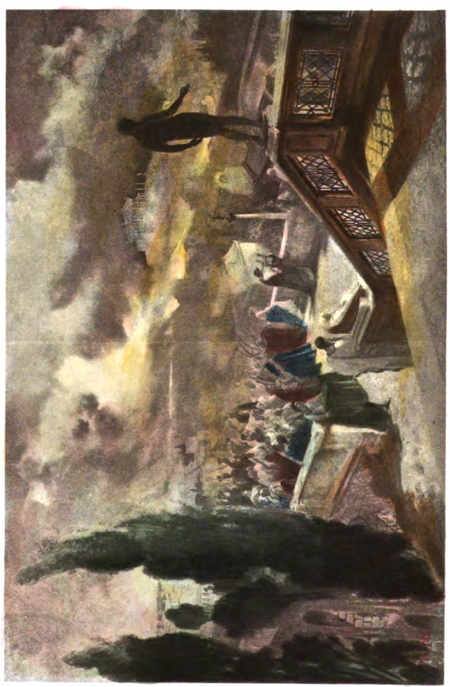
(See this image in horizontal aspect [here].)
The Burning of Rome Frontispiece. From a drawing by Jan Styka.
LIST OF ILLUSTRATIONS↩
- The Burning of Rome - Frontispiece. From a drawing by Jan Styka.
- Avignon, page 60. From a painting by T. Allom.
- Petrarch, p. 124. From a portrait by Tofanelli.
- Pope Clement VII, .p 160. From a portrait by Fra Sebastiano del Piombo.
- Plan of Ancient Rome, p. 180
- The Coliseum, p. 202. From a photograph.
NOTE↩
I have again the pleasure of thanking Professor Stanley Lane-Poole for his assistance. He has helped me to revise chapters of the last two volumes dealing with oriental history.
J. B. B.
[XII-1]
CHAPTER LXVIII↩
Reign and Character of Mahomet the Second — Siege, Assault, and final Conquest of Constantinople by the Turks — Death of Constantine Palæologus — Servitude of the Greeks — Extinction of the Roman Empire in the East — Consternation of Europe — Conquests and Death of Mahomet the Second
The siege of Constantinople by the Turks attracts our first attention to the person and character of the great destroyer. Mahomet the Second [1] was the son of the second Amurath; and, though his mother has been decorated with the titles of Christian and princess, she is more probably confounded with the numerous concubines who peopled from every climate the harem of the sultan. His first education and sentiments were those of a devout Musulman; and, as often as he conversed with an infidel, he purified his hands and face by the legal rites of ablution. Age and empire appear to have relaxed this narrow bigotry; his aspiring genius disdained to acknowledge a power above his own; and in his looser hours [XII-2] he presumed (it is said) to brand the prophet of Mecca as a robber and impostor. Yet the sultan persevered in a decent reverence for the doctrine and discipline of the Koran; [2] his private indiscretion must have been sacred from the vulgar ear; and we should suspect the credulity of strangers and sectaries, so prone to believe that a mind which is hardened against truth must be armed with superior contempt for absurdity and error. Under the tuition of the most skilful masters, Mahomet advanced with an early and rapid progress in the paths of knowledge; and, besides his native tongue, it is affirmed that he spoke or understood five languages, [3] the Arabic, the Persian, the Chaldæan or Hebrew, the Latin, and the Greek. The Persian might, indeed, contribute to his amusement, and the Arabic to his edification; and such studies are familiar to the Oriental youth. In the intercourse of the Greeks and Turks, a conqueror might wish to converse with the people over whom he was ambitious to reign; his own praises in Latin poetry [4] or prose [5] might find a passage [XII-3] to the royal ear; but what use or merit could recommend to the statesman or the scholar the uncouth dialect of his Hebrew slaves? The history and geography of the world were familiar to his memory; the lives of the heroes of the East, perhaps of the West, [6] excited his emulation; his skill in astrology is excused by the folly of the times, and supposes some rudiments of mathematical science; and a profane taste for the arts is betrayed in his liberal invitation and reward of the painters of Italy. [7] But the influence of religion and learning were employed without effect on his savage and licentious nature. I will not transcribe, nor do I firmly believe, the stories of his fourteen pages, whose bellies were ripped open in search of a stolen melon; or of the beauteous slave, whose head he severed from her body, to convince the Janizaries that their master was not the votary of love. [8] His sobriety is attested by the silence of the Turkish annals, [XII-4] which accuse three, and three only, of the Ottoman line of the vice of drunkenness. [9] But it cannot be denied that his passions were at once furious and inexorable; that in the palace, as in the field, a torrent of blood was spilt on the slightest provocation; and that the noblest of the captive youth were often dishonoured by his unnatural lust. In the Albanian war, he studied the lessons, and soon surpassed the example, of his father; and the conquest of two empires, twelve kingdoms, and two hundred cities, a vain and flattering account, is ascribed to his invincible sword. He was doubtless a soldier, and possibly a general; Constantinople has sealed his glory; but, if we compare the means, the obstacles, and the achievements, Mahomet the Second must blush to sustain a parallel with Alexander or Timour. Under his command, the Ottoman forces were always more numerous than their enemies; yet their progress was bounded by the Euphrates and the Adriatic; and his arms were checked by Huniades and Scanderbeg, by the Rhodian knights, and by the Persian king.
In the reign of Amurath, he twice tasted of royalty, and twice descended from the throne; his tender age was incapable of opposing his father’s restoration, but never could he forgive the vizirs who had recommended that salutary measure. His nuptials were celebrated with the daughter of a Turkman emir; and, after a festival of two months, he departed from Hadrianople with his bride to reside in the government of Magnesia. Before the end of six weeks, he was recalled by a sudden message from the divan, which announced the decease of Amurath and the mutinous spirit of the Janizaries. His speed and vigour commanded their obedience; he passed the Hellespont with a chosen guard; [XII-5] and, at the distance of a mile from Hadrianople, the vizirs and emirs, the imams and cadhis, the soldiers and the people, fell prostrate before the new sultan. They affected to weep, they affected to rejoice; he ascended the throne at the age of twenty-one years, and removed the cause of sedition by the death, the inevitable death, of his infant brothers. [10] The ambassadors of Europe and Asia soon appeared to congratulate his accession, and solicit his friendship; and to all he spoke the language of moderation and peace. The confidence of the Greek emperor was revived by the solemn oaths and fair assurances with which he sealed the ratification of the treaty; and a rich domain on the banks of the Strymon was assigned for the annual payment of three hundred thousand aspers, the pension of an Ottoman prince who was detained at his request in the Byzantine court. Yet the neighbours of Mahomet might tremble at the severity with which a youthful monarch reformed the pomp of his father’s household; the expenses of luxury were applied to those of ambition, and an useless train of seven thousand falconers was either dismissed from his service or enlisted in his troops. In the first summer of his reign, he visited with an army the Asiatic provinces; but, after humbling the pride, Mahomet accepted the submission, of the Caramanian, that he might not be diverted by the smallest obstacle from the execution of his great design. [11]
The Mahometan, and more especially the Turkish, casuists have pronounced that no promise can bind the faithful against the interest and duty of their religion; and that the sultan [XII-6] may abrogate his own treaties and those of his predecessors. The justice and magnanimity of Amurath had scorned this immoral privilege; but his son, though the proudest of men, could stoop from ambition to the basest arts of dissimulation and deceit. Peace was on his lips, while war was in his heart: he incessantly sighed for the possession of Constantinople; and the Greeks, by their own indiscretion, afforded the first pretence of the fatal rupture. [12] Instead of labouring to be forgotten, their ambassadors pursued his camp, to demand the payment and even the increase of their annual stipend: the divan was importuned by their complaints, and the vizir, a secret friend of the Christians, was constrained to deliver the sense of his brethren. “Ye foolish and miserable Romans,” said Calil, “we know your devices, and ye are ignorant of your own danger! the scrupulous Amurath is no more; his throne is occupied by a young conqueror, whom no laws can bind and no obstacles can resist; and, if you escape from his hands, give praise to the divine clemency, [XII-7] which yet delays the chastisement of your sins. Why do ye seek to affright us by vain and indirect menaces? Release the fugitive Orchan, crown him sultan of Romania; call the Hungarians from beyond the Danube; arm against us the nations of the West; and be assured that you will only provoke and precipitate your ruin.” But, if the fears of the ambassadors were alarmed by the stern language of the vizir, they were soothed by the courteous audience and friendly speeches of the Ottoman prince; and Mahomet assured them that on his return to Hadrianople he would redress the grievances, and consult the true interests, of the Greeks. No sooner had he repassed the Hellespont than he issued a mandate to suppress their pension and to expel their officers from the banks of the Strymon: in this measure he betrayed an hostile mind; and the second order announced, and in some degree commenced, the siege of Constantinople. In the narrow pass of the Bosphorus, an Asiatic fortress had formerly been raised by his grandfather: in the opposite situation, on the European side, he resolved to erect a more formidable castle; and a thousand masons were commanded to assemble in the spring, on a spot named Asomaton, about five miles from the Greek metropolis. [13] Persuasion is the resource of the feeble; and the feeble can seldom persuade: the ambassadors of the emperor attempted, without success, to divert Mahomet from the execution of his design. They represented, that his grandfather had solicited the permission [XII-8] of Manuel to build a castle on his own territories; but that this double fortification, which would command the strait, could only tend to violate the alliance of the nations, to intercept the Latins who traded in the Black Sea, and perhaps to annihilate the subsistence of the city. “I form no enterprise,” replied the perfidious sultan, “against the city; but the empire of Constantinople is measured by her walls. Have you forgot the distress to which my father was reduced, when you formed a league with the Hungarians; when they invaded our country by land, and the Hellespont was occupied by the French galleys? Amurath was compelled to force the passage of the Bosphorus; and your strength was not equal to your malevolence. I was then a child at Hadrianople; the Moslems trembled; and for a while the Gabours [14] insulted our disgrace. But, when my father had triumphed in the field of Warna, he vowed to erect a fort on the western shore, and that vow it is my duty to accomplish. Have ye the right, have ye the power, to control my actions on my own ground? For that ground is my own: as far as the shores of the Bosphorus, Asia is inhabited by the Turks, and Europe is deserted by the Romans. Return, and inform your king that the present Ottoman is far different from his predecessors; that his resolutions surpass their wishes; and that he performs more than they could resolve. Return in safety; but the next who delivers a similar message may expect to be flayed alive.” After this declaration, Constantine, the first of the Greeks in spirit as in rank, [15] had determined [XII-9] to unsheathe the sword, and to resist the approach and establishment of the Turks on the Bosphorus. He was disarmed by the advice of his civil and ecclesiastical ministers, who recommended a system less generous, and even less prudent, than his own, to approve their patience and long-suffering, to brand the Ottoman with the name and guilt of an aggressor, and to depend on chance and time for their own safety and the destruction of a fort which could not be long maintained in the neighbourhood of a great and populous city. Amidst hope and fear, the fears of the wise and the hopes of the credulous, the winter rolled away; the proper business of each man, and each hour, was postponed; and the Greeks shut their eyes against the impending danger, till the arrival of the spring and the sultan decided the assurance of their ruin.
Of a master who never forgives, the orders are seldom disobeyed. On the twenty-sixth of March, the appointed spot of Asomaton was covered with an active swarm of Turkish artificers; and the materials by sea and land were diligently transported from Europe and Asia. [16] The lime had been burnt in Cataphrygia; the timber was cut down in the woods of Heraclea and Nicomedia; and the stones were dug from the Anatolian quarries. Each of the thousand masons was assisted by two workmen; and a measure of two cubits was marked for their daily task. The fortress [17] was built in a triangular form; each angle was flanked by a strong and [XII-10] massy tower; one on the declivity of the hill, two along the sea-shore; a thickness of twenty-two feet was assigned for the walls, thirty for the towers; and the whole building was covered with a solid platform of lead. Mahomet himself pressed and directed the work with indefatigable ardour; his three vizirs claimed the honour of finishing their respective towers; the zeal of the cadhis emulated that of the Janizaries; the meanest labour was ennobled by the service of God and the sultan; and the diligence of the multitude was quickened by the eye of a despot, whose smile was the hope of fortune, and whose frown was the messenger of death. The Greek emperor beheld with terror the irresistible progress of the work; and vainly strove, by flattery and gifts, to assuage an implacable foe, who sought, and secretly fomented, the slightest occasion of a quarrel. Such occasions must soon and inevitably be found. The ruins of stately churches, and even the marble columns which had been consecrated to St. Michael the archangel, were employed without scruple by the profane and rapacious Moslems; and some Christians, who presumed to oppose the removal, received from their hands the crown of martyrdom. Constantine had solicited a Turkish guard to protect the fields and harvests of his subjects: the guard was fixed; but their first order was to allow free pasture to the mules and horses of the camp, and to defend their brethren if they should be molested by the natives. The retinue of an Ottoman chief had left their horses to pass the night among the ripe corn: the damage was felt; the insult was resented; and several of both nations were slain in a tumultuous conflict. Mahomet listened with joy to the complaint; and a detachment was commanded to exterminate the guilty village: the guilty had fled; but forty innocent and unsuspecting reapers were massacred by the soldiers. Till this provocation, Constantinople had been open to the visits of commerce and curiosity: on the first alarm, the gates were shut; but the emperor, still anxious [XII-11] for peace, released on the third day his Turkish captives, [18] and expressed, in a last message, the firm resignation of a Christian and a soldier. “Since neither oaths, nor treaty, nor submission, can secure peace, pursue,” said he to Mahomet, “your impious warfare. My trust is in God alone: if it should please him to mollify your heart, I shall rejoice in the happy change; if he delivers the city into your hands, I submit without a murmur to his holy will. But, until the Judge of the earth shall pronounce between us, it is my duty to live and die in the defence of my people.” The sultan’s answer was hostile and decisive; his fortifications were completed; and before his departure for Hadrianople he stationed a vigilant Aga and four hundred Janizaries to levy a tribute of the ships of every nation that should pass within the reach of their cannon. A Venetian vessel, refusing obedience to the new lords of the Bosphorus, was sunk with a single bullet. The master and thirty sailors escaped in the boat; but they were dragged in chains to the Porte; the chief was impaled; his companions were beheaded; and the historian Ducas [19] beheld, at Demotica, their bodies exposed to the wild beasts. The siege of Constantinople was deferred till the ensuing spring; but an Ottoman army marched into the Morea to divert the force of the brothers of Constantine. At this era of calamity, one of these princes, the despot Thomas, was blessed or afflicted with the birth of a son, “the last heir,” says the plaintive Phranza, “of the last spark of the Roman empire.” [20]
The Greeks and the Turks passed an anxious and sleepless [XII-12] winter: the former were kept awake by their fears, the latter by their hopes; both by the preparations of defence and attack; and the two emperors, who had the most to lose or to gain, were the most deeply affected by the national sentiment. In Mahomet, that sentiment was inflamed by the ardour of his youth and temper: he amused his leisure with building at Hadrianople [21] the lofty palace of Jehan Numa (the watch-tower of the world); but his serious thoughts were irrevocably bent on the conquest of the city of Cæsar. At the dead of night, about the second watch, he started from his bed, and commanded the instant attendance of his prime vizir. The message, the hour, the prince, and his own situation alarmed the guilty conscience of Calil Basha, who had possessed the confidence, and advised the restoration, of Amurath. On the accession of the son, the vizir was confirmed in his office and the appearances of favour; but the veteran statesman was not insensible that he trode on a thin and slippery ice, which might break under his footsteps and plunge him in the abyss. His friendship for the Christians, which might be innocent under the late reign, had stigmatised him with the name of Gabour Ortachi, or foster brother of the infidels; [22] and his avarice entertained a venal and treasonable correspondence, which was detected and punished after the conclusion of the war. On receiving the royal mandate, he embraced, perhaps for the last time, his wife and children; filled up a cup with pieces of gold, hastened to the palace, adored the sultan, and offered, according to the Oriental custom, the slight tribute of his duty and gratitude. [23] [XII-13] “It is not my wish,” said Mahomet, “to resume my gifts, but rather to heap and multiply them on thy head. In my turn, I ask a present far more valuable and important, — Constantinople.” As soon as the vizir had recovered from his surprise, “The same God,” said he, “who has already given thee so large a portion of the Roman empire, will not deny the remnant, and the capital. His providence and thy power assure thy success; and myself, with the rest of thy faithful slaves, will sacrifice our lives and fortunes.” “Lala” [24] (or preceptor), continued the sultan, “do you see this pillow? all the night, in my agitation, I have pulled it on one side and the other; I have risen from my bed, again have I lain down; yet sleep has not visited these weary eyes. Beware of the gold and silver of the Romans; in arms we are superior; and with the aid of God, and the prayers of the prophet, we shall speedily become masters of Constantinople.” To sound the disposition of his soldiers, he often wandered through the streets alone and in disguise; and it was fatal to discover the sultan, when he wished to escape from the vulgar eye. His hours were spent in delineating the plan of the hostile city; in debating with his generals and engineers, on what spot he should erect his batteries; on which side he should assault the walls; where he should spring his mines; to what place he should apply his scaling-ladders; and the exercises of the day repeated and proved the lucubrations of the night.
Among the implements of destruction, he studied with peculiar care the recent and tremendous discovery of the [XII-14] Latins; and his artillery surpassed whatever had yet appeared in the world. A founder of cannon, a Dane or Hungarian, [25] who had been almost starved in the Greek service, deserted to the Moslems, and was liberally entertained by the Turkish sultan. Mahomet was satisfied with the answer to his first question, which he eagerly pressed on the artist. “Am I able to cast a cannon capable of throwing a ball or stone of sufficient size to batter the walls of Constantinople? I am not ignorant of their strength, but, were they more solid than those of Babylon, I could oppose an engine of superior power; the position and management of that engine must be left to your engineers.” On this assurance, a foundry was established at Hadrianople: the metal was prepared; and, at the end of three months, Urban produced a piece of brass ordnance of stupendous and almost incredible magnitude; a measure of twelve palms is assigned to the bore; and the stone bullet weighed above six hundred pounds. [26] A vacant place before the new palace was chosen for the first experiment; but, to prevent the sudden and mischievous effects of astonishment and fear, a proclamation was issued that the cannon would be discharged the ensuing day. The explosion was felt or heard in the circuit of an hundred furlongs: the ball, by the force of gunpowder, was driven above a mile; and on the spot where it fell, it buried itself a fathom deep in the ground. For the conveyance of this destructive engine, [27] [XII-15] a frame or carriage of thirty waggons was linked together and drawn along by a team of sixty oxen; two hundred men on both sides were stationed to poise and support the rolling weight; two hundred and fifty workmen marched before to smooth the way and repair the bridges; and near two months were employed in a laborious journey of one hundred and fifty miles. A lively [28] philosopher derides, on this occasion, the credulity of the Greeks, and observes, with much reason, that we should always distrust the exaggerations of a vanquished people. He calculates that a ball, even of two hundred pounds, would require a charge of one hundred and fifty pounds of powder; and that the stroke would be feeble and impotent, since not a fifteenth part of the mass could be inflamed at the same moment. A stranger as I am to the art of destruction, I can discern that the modern improvements of artillery prefer the number of pieces to the weight of metal; the quickness of the fire to the sound, or even the consequence, of a single explosion. Yet I dare not reject the positive and unanimous evidence of contemporary writers; nor can it seem improbable that the first artists, in their rude and ambitious efforts, should have transgressed the standard of moderation. A Turkish cannon, more enormous than that of Mahomet, still guards the entrance of the Dardanelles; and, if the use be inconvenient, it has been found on a late trial that the effect was far from contemptible. A stone bullet of eleven hundred pounds’ weight was once discharged with three hundred and thirty pounds of powder; at the distance of six hundred yards, it shivered into three rocky fragments, traversed the strait, and, leaving the waters in a foam, again rose and bounded against the opposite hill. [29]
[XII-16]
While Mahomet threatened the capital of the East, the Greek emperor implored with fervent prayers the assistance of earth and heaven. But the invisible powers were deaf to his supplications; and Christendom beheld with indifference the fall of Constantinople, while she derived at least some promise of supply from the jealous and temporal policy of the sultan of Egypt. Some states were too weak, and others too remote; by some the danger was considered as imaginary, by others as inevitable: the Western princes were involved in their endless and domestic quarrels; and the Roman pontiff was exasperated by the falsehood or obstinacy of the Greeks. Instead of employing in their favour the arms and treasures of Italy, Nicholas the Fifth had foretold their approaching ruin; and his honour was engaged in the accomplishment of his prophecy. Perhaps he was softened by the last extremity of their distress; but his compassion was tardy; his efforts were faint and unavailing; and Constantinople had fallen, before the squadrons of Genoa and Venice could sail from their harbours. [30] Even the princes of the Morea and of the Greek islands affected a cold neutrality: the Genoese colony of Galata negotiated a private treaty; and the sultan indulged them in the delusive hope that by his clemency they might survive the ruin of the empire. A plebeian crowd, and some Byzantine nobles, basely withdrew from the danger of their country; and the avarice of the rich denied the emperor, and reserved for the Turks, the secret treasures which might have raised in their defence whole armies of mercenaries. [31] The indigent and solitary [XII-17] prince prepared, however, to sustain his formidable adversary; but, if his courage were equal to the peril, his strength was inadequate to the contest. In the beginning of the spring, the Turkish vanguard swept the towns and villages as far as the gates of Constantinople: submission was spared and protected; whatever presumed to resist was exterminated with fire and sword. The Greek places on the Black Sea, Mesembria, Acheloum, and Bizon, surrendered on the first summons; Selybria alone [32] deserved the honours of a siege or blockade; and the bold inhabitants, while they were invested by land, launched their boats, pillaged the opposite coast of Cyzicus, and sold their captives in the public market. But on the approach of Mahomet himself all was silent and prostrate; he first halted at the distance of five miles; and from thence advancing in battle-array planted before the gate of St. Romanus the Imperial standard; and, on the sixth day of April, formed the memorable siege of Constantinople.
The troops of Asia and Europe extended on the right and left from the Propontis to the harbour; the Janizaries in the front were stationed before the sultan’s tent; the Ottoman line was covered by a deep entrenchment; and a subordinate army enclosed the suburb of Galata, and watched the doubtful faith of the Genoese. The inquisitive Philelphus, who resided in Greece about thirty years before the siege, is confident that all the Turkish forces, of any name or value, [XII-18] could not exceed the number of sixty thousand horse and twenty thousand foot; and he upbraids the pusillanimity of the nations who had tamely yielded to a handful of Barbarians. Such, indeed, might be the regular establishment of the Capiculi, [33] the troops of the Porte who marched with the prince and were paid from his royal treasury. But the bashaws, in their respective governments, maintained or levied a provincial militia; many lands were held by a military tenure; many volunteers were attracted by the hope of spoil; and the sound of the holy trumpet invited a swarm of hungry and fearless fanatics, who might contribute at least to multiply the terrors, and in a first attack to blunt the swords, of the Christians. The whole mass of the Turkish powers is magnified by Ducas, Chalcondyles, and Leonard of Chios, to the amount of three of four hundred thousand men; but Phranza was a less remote and more accurate judge; and [XII-19] his precise definition of two hundred and fifty-eight thousand does not exceed the measure of experience and probability. [34] The navy of the besiegers was less formidable: the Propontis was overspread with three hundred and twenty sail; but of these no more than eighteen could be rated as galleys of war; and the far greater part must be degraded to the condition of storeships and transports, which poured into the camp fresh supplies of men, ammunition, and provisions. In her last decay, Constantinople was still peopled with more than an hundred thousand inhabitants; but these numbers are found in the accounts, not of war, but of captivity; and they mostly consisted of mechanics, of priests, of women, and of men devoid of that spirit which even women have sometimes exerted for the common safety. I can suppose, I could almost excuse, the reluctance of subjects to serve on a distant frontier, at the will of a tyrant; but the man who dares not expose his life in the defence of his children and his property has lost in society the first and most active energies of nature. By the emperor’s command, a particular inquiry had been made through the streets and houses, how many of the citizens, or even of the monks, were able and willing to bear arms for their country. The lists were entrusted to Phranza; [35] and, after a diligent addition, he informed his master, with grief and surprise, that the national defence was reduced to four thousand nine hundred and seventy Romans. Between Constantine and his faithful minister, this comfortless secret [XII-20] was preserved; and a sufficient proportion of shields, cross-bows, and muskets was distributed from the arsenal to the city-bands. They derived some accession from a body of two thousand strangers, under the command of John Justiniani, a noble Genoese; [36] a liberal donative was advanced to these auxiliaries; and a princely recompense, the isle of Lemnos, was promised to the valour and victory of their chief. A strong chain was drawn across the mouth of the harbour; [37] it was supported by some Greek and Italian vessels of war and merchandise; and the ships of every Christian nation, that successively arrived from Candia and the Black Sea, were detained for the public service. Against the powers of the Ottoman empire, a city of the extent of thirteen, perhaps of sixteen, miles was defended by a scanty garrison of seven or eight thousand soldiers. Europe and Asia were open to the besiegers; but the strength and provisions of the Greeks must sustain a daily decrease; nor could they indulge the expectation of any foreign succour or supply. [38]
The primitive Romans would have drawn their swords in [XII-21] the resolution of death or conquest. The primitive Christians might have embraced each other, and awaited in patience and charity the stroke of martyrdom. But the Greeks of Constantinople were animated only by the spirit of religion, and that spirit was productive only of animosity and discord. Before his death, the emperor John Palæologus had renounced the unpopular measure of an union with the Latins; nor was the idea revived, till the distress of his brother Constantine imposed a last trial of flattery and dissimulation. [39] With the demand of temporal aid, his ambassadors were instructed to mingle the assurance of spiritual obedience: his neglect of the church was excused by the urgent cares of the state; and his orthodox wishes solicited the presence of a Roman legate. The Vatican had been too often deluded; yet the signs of repentance could not decently be overlooked; a legate was more easily granted than an army; and, about six months before the final destruction, the cardinal Isidore of Russia appeared in that character with a retinue of priests and soldiers. The emperor saluted him as a friend and father; respectfully listened to his public and private sermons; and with the most obsequious of the clergy and laymen subscribed the act of union, as it had been ratified in the council of Florence. On the twelfth of December, the two nations, in the church of St. Sophia, joined in the communion of sacrifice and prayer; and the names of the two pontiffs were solemnly commemorated: the names of Nicholas the Fifth, the vicar of Christ, and of the patriarch Gregory, who had been driven into exile by a rebellious people.
But the dress and language of the Latin priest who officiated at the altar were an object of scandal; and it was observed with horror that he consecrated a cake or wafer of unleavened bread and poured cold water into the cup of the sacrament. [XII-22] A national historian acknowledges with a blush that none of his countrymen, not the emperor himself, were sincere in this occasional conformity. [40] Their hasty and unconditional submission was palliated by a promise of future revisal; but the best or the worst of their excuses was the confession of their own perjury. When they were pressed by the reproaches of their honest brethren, “Have patience,” they whispered, “have patience till God shall have delivered the city from the great dragon who seeks to devour us. You shall then perceive whether we are truly reconciled with the Azymites.” But patience is not the attribute of zeal; nor can the arts of a court be adapted to the freedom and violence of popular enthusiasm. From the dome of St. Sophia, the inhabitants of either sex and of every degree rushed in crowds to the cell of the monk Gennadius, [41] to consult the oracle of the church. The holy man was invisible; entranced, as it should seem, in deep meditation or divine rapture; but he had exposed on the door of his cell a speaking tablet; and they successively withdrew, after reading these tremendous words: “O miserable Romans! why will ye abandon the truth? and why, instead of confiding in God, will ye put your trust in the Italians? In losing your faith, you will lose your city. Have mercy on me, O Lord! I protest, in thy presence, that I am innocent of the crime. O miserable Romans! consider, [XII-23] pause, and repent. At the same moment that you renounce the religion of your fathers, by embracing impiety, you submit to a foreign servitude.” According to the advice of Gennadius, the religious virgins, as pure as angels and as proud as demons, rejected the act of union and abjured all communion with the present and future associates of the Latins; and their example was applauded and imitated by the greatest part of the clergy and people. From the monastery, the devout Greeks dispersed themselves in the taverns; drank confusion to the slaves of the pope; [42] emptied their glasses in honour of the image of the holy Virgin; and besought her to defend against Mahomet the city which she had formerly saved from Chosroes and the Chagan. In the double intoxication of zeal and wine, they valiantly exclaimed, “What occasion have we for succour, or union, or Latins? far from us be the worship of the Azymites!” During the winter that preceded the Turkish conquest, the nation was distracted by this epidemical frenzy; and the season of Lent, the approach of Easter, instead of breathing charity and love, served only to fortify the obstinacy and influence of the zealots. The confessors scrutinised and alarmed the conscience of their votaries, and a rigorous penance was imposed on those who had received the communion from a priest who had given an express or tacit consent to the union. His service at the altar propagated the infection to the mute and simple spectators of the ceremony; they forfeited, by the impure spectacle, the virtue of their sacerdotal character; nor was it lawful, even in danger of sudden death, to invoke the assistance of their prayers or absolution. No sooner had the church of St. Sophia been polluted by the Latin sacrifice than it was deserted as a Jewish synagogue, or an heathen temple, by the clergy and people; and a vast and gloomy silence [XII-24] prevailed in that venerable dome, which had so often smoked with a cloud of incense, blazed with innumerable lights, and resounded with the voice of prayer and thanksgiving. The Latins were the most odious of heretics and infidels; and the first minister of the empire, the great duke, was heard to declare that he had rather behold, in Constantinople, the turban of Mahomet than the pope’s tiara or a cardinal’s hat. [43] A sentiment so unworthy of Christians and patriots was familiar and fatal to the Greeks: the emperor was deprived of the affection and support of his subjects; and their native cowardice was sanctified by resignation to the divine decree or the visionary hope of a miraculous deliverance.
Of the triangle which composes the figure of Constantinople, the two sides along the sea were made inaccessible to an enemy: the Propontis by nature, and the harbour by art. Between the two waters, the basis of the triangle, the landside was protected by a double wall and a deep ditch of the depth of one hundred feet. [44] Against this line of fortification, which Phranza, an eye-witness, prolongs to the measure of six miles, [45] the Ottomans directed their principal attack; and the emperor, after distributing the service and command of the most perilous stations, undertook the defence of the external wall. In the first days of the siege, the Greek soldiers descended into the ditch, or sallied into the field; but they soon discovered that, in the proportion of their numbers, one [XII-25] Christian was of more value than twenty Turks; and, after these bold preludes, they were prudently content to maintain the rampart with their missile weapons. Nor should this prudence be accused of pusillanimity. The nation was indeed pusillanimous and base; but the last Constantine deserves the name of an hero; his noble band of volunteers was inspired with Roman virtue; and the foreign auxiliaries supported the honour of the Western chivalry. The incessant volleys of lances and arrows were accompanied with the smoke, the sound, and the fire of their musketry and cannon. Their small arms discharged at the same time either five or even ten balls of lead of the size of a walnut; and, according to the closeness of the ranks and the force of the powder, several breastplates and bodies were transpierced by the same shot. But the Turkish approaches were soon sunk in trenches or covered with ruins. Each day added to the science of the Christians; but their inadequate stock of gun-powder was wasted in the operations of each day. Their ordnance was not powerful either in size or number; and, if they possessed some heavy cannon, they feared to plant them on the walls, lest the aged structure should be shaken and overthrown by the explosion. [46] The same destructive secret had been revealed to the Moslems; by whom it was employed [XII-26] with the superior energy of zeal, riches, and despotism. The great cannon of Mahomet has been separately noticed: an important and visible object in the history of the times; but that enormous engine was flanked by two fellows almost of equal magnitude; [47] the long order of the Turkish artillery was pointed against the walls; fourteen batteries thundered at once on the most accessible places; and of one of these it is ambiguously expressed that it was mounted with one hundred and thirty guns, or that it discharged one hundred and thirty bullets. Yet, in the power and activity of the sultan, we may discern the infancy of the new science. Under a master who counted the moments, the great cannon could be loaded and fired no more than seven times in one day. [48] The heated metal unfortunately burst; several workmen were destroyed; and the skill of an artist was admired, who bethought himself of preventing the danger and the accident, by pouring oil, after each explosion, into the mouth of the cannon.
The first random shots were productive of more sound than effect; and it was by the advice of a Christian that the engineers were taught to level their aim against the two opposite sides of the salient angles of a bastion. [49] However imperfect, the weight and repetition of the fire made some impression on the walls; and the Turks, pushing their approaches to the edge of the ditch, attempted to fill the enormous [XII-27] chasm and to build a road to the assault. [50] Innumerable fascines and hogsheads and trunks of trees were heaped on each other; and such was the impetuosity of the throng that the foremost and the weakest were pushed headlong down the precipice and instantly buried under the accumulated mass. To fill the ditch was the toil of the besiegers; to clear away the rubbish was the safety of the besieged; and, after a long and bloody conflict, the web that had been woven in the day was still unravelled in the night. The next resource of Mahomet was the practice of mines; but the soil was rocky; in every attempt he was stopped and undermined by the Christian engineers; nor had the art been yet invented of replenishing those subterraneous passages with gunpowder and blowing whole towers and cities into the air. [51] A circumstance that distinguishes the siege of Constantinople is the reunion of the ancient and modern artillery. The cannon were intermingled with the mechanical engines for casting stones and darts; [52] the bullet and the battering-ram were directed against the same walls; nor had the discovery of gunpowder superseded the use of the liquid and unextinguishable fire. A wooden turret of the largest size was advanced on rollers; this portable magazine of ammunition and fascines was protected by a threefold covering of bulls’ hides; incessant volleys were securely discharged from the loop-holes; in the front, three doors were contrived for the alternate sally [XII-28] and retreat of the soldiers and workmen. They ascended by a staircase to the upper platform, and, as high as the level of that platform, a scaling-ladder could be raised by pulleys to form a bridge and grapple with the adverse rampart. By these various arts of annoyance, some as new as they were pernicious to the Greeks, the tower of St. Romanus was at length overturned; after a severe struggle, the Turks were repulsed from the breach and interrupted by darkness; but they trusted that with the return of light they should renew the attack with fresh vigour and decisive success. Of this pause of action, this interval of hope, each moment was improved by the activity of the emperor and Justiniani, who passed the night on the spot, and urged the labours which involved the safety of the church and city. At the dawn of day, the impatient sultan perceived, with astonishment and grief, that his wooden turret had been reduced to ashes: the ditch was cleared and restored; and the tower of St. Romanus was again strong and entire. He deplored the failure of his design; and uttered a profane exclamation that the word of the thirty-seven thousand prophets should not have compelled him to believe that such a work, in so short a time, should have been accomplished by the infidels.
The generosity of the Christian princes was cold and tardy; but, in the first apprehension of a siege, Constantine had negotiated, in the isles of the Archipelago, the Morea, and Sicily, the most indispensable supplies. As early as the beginning of April, five [53] great ships, equipped for merchandise [XII-29] and war, would have sailed from the harbour of Chios, had not the wind blown obstinately from the north. [54] One of these ships bore the Imperial flag; the remaining four belonged to the Genoese; and they were laden with wheat and barley, with wine, oil, and vegetables, and, above all, with soldiers and mariners, for the service of the capital. After a tedious delay, a gentle breeze, and, on the second day, a strong gale from the south, carried them through the Hellespont and the Propontis; but the city was already invested by sea and land; and the Turkish fleet, at the entrance of the Bosphorus, was stretched from shore to shore, in the form of a crescent, to intercept, or at least to repel, these bold auxiliaries. [55] The reader who has present to his mind the geographical picture of Constantinople, will conceive and admire the greatness of the spectacle. The five Christian ships continued to advance with joyful shouts, and a full press both of sails and oars, against an hostile fleet of three hundred vessels; [56] and the rampart, the camp, the coasts of Europe and Asia were lined with innumerable spectators, who anxiously awaited the event of this momentous succour. At the first view, that event could not appear doubtful: the superiority of the Moslems was beyond all measure or account; and, in a calm, their numbers and valour must inevitably have prevailed. But their hasty and imperfect navy had been created, not by the genius of the people, but [XII-30] by the will of the sultan. In the height of their prosperity, the Turks have acknowledged that, if God had given them the earth, he had left the sea to the infidels; [57] and a series of defeats, a rapid progress of decay, has established the truth of their modest confession. Except eighteen galleys of some force, the rest of their fleet consisted of open boats, rudely constructed and awkwardly managed, crowded with troops and destitute of cannon; and, since courage arises in a great measure from the consciousness of strength, the bravest of the Janizaries might tremble on a new element. In the Christian squadron, five stout and lofty ships were guided by skilful pilots, and manned with the veterans of Italy and Greece, long practised in the arts and perils of the sea. Their weight was directed to sink or scatter the weak obstacles that impeded their passage; their artillery swept the waters; their liquid fire was poured on the heads of the adversaries who, with the design of boarding, presumed to approach them; and the winds and waves are always on the side of the ablest navigators. In this conflict, the Imperial vessel, which had been almost overpowered, was rescued by the Genoese; but the Turks, in a distant and closer attack, were twice repulsed with considerable loss. Mahomet himself sat on horseback on the beach, to encourage their valour by his voice and presence, by the promise of reward, and by fear more potent than the fear of the enemy. The passions of his soul, and even the gestures of his body, [58] [XII-31] seemed to imitate the actions of the combatants; and, as if he had been the lord of nature, he spurred his horse with a fearless and impotent effort into the sea. His loud reproaches, and the clamours of the camp, urged the Ottomans to a third attack, more fatal and bloody than the two former; and I must repeat, though I cannot credit, the evidence of Phranza, who affirms, from their own mouth, that they lost above twelve thousand men in the slaughter of the day. [59] They fled in disorder to the shores of Europe and Asia, while the Christian squadron, triumphant and unhurt, steered along the Bosphorus and securely anchored within the chain of the harbour. In the confidence of victory, they boasted that the whole Turkish power must have yielded to their arms; but the admiral, or captain-bashaw, found some consolation for a painful wound in his eye, by representing that accident as the cause of his defeat. Baltha Ogli was a renegade of the race of the Bulgarian princes; his military character was tainted with the unpopular vice of avarice; and, under the despotism of the prince or people, misfortune is a sufficient evidence of guilt. His rank and services were annihilated by the displeasure of Mahomet. In the royal presence, the captain-bashaw was extended on the ground by four slaves, and received one hundred strokes with a golden rod; [60] his death had been pronounced; and he adored the clemency of the sultan, who was satisfied with the milder punishment of confiscation and exile. The introduction of this supply revived the hopes of the Greeks, and accused the supineness of their Western allies. Amidst the deserts of [XII-32] Anatolia and the rocks of Palestine, the millions of the crusades had buried themselves in a voluntary and inevitable grave; but the situation of the Imperial city was strong against her enemies, and accessible to her friends; and a rational and moderate armament of the maritime states might have saved the relics of the Roman name and maintained a Christian fortress in the heart of the Ottoman empire. Yet this was the sole and feeble attempt for the deliverance of Constantinople; the more distant powers were insensible of its danger; and the ambassador of Hungary, or at least of Huniades, resided in the Turkish camp, to remove the fears, and to direct the operations, of the sultan. [61]
It was difficult for the Greeks to penetrate the secret of the divan; yet the Greeks are persuaded that a resistance, so obstinate and surprising, had fatigued the perseverance of Mahomet. He began to meditate a retreat, and the siege would have been speedily raised, if the ambition and jealousy of the second vizir had not opposed the perfidious advice of Calil Bashaw, who still maintained a secret correspondence with the Byzantine court. The reduction of the city appeared to be hopeless, unless a double attack could be made from the harbour as well as from the land; but the harbour was inaccessible: an impenetrable chain was now defended by eight large ships, more than twenty of a smaller size, with several galleys and sloops; and, instead of forcing this barrier, the Turks might apprehend a naval sally and a second encounter in the open sea. In this perplexity, the genius of Mahomet conceived and executed a plan of a bold [XII-33] and marvellous cast, [62] of transporting by land his lighter vessels and military stores from the Bosphorus into the higher part of the harbour. The distance is about ten miles; the ground is uneven, and was overspread with thickets; and, as the road must be opened behind the suburb of Galata, their free passage or total destruction must depend on the option of the Genoese. [63] But these selfish merchants were ambitious of the favour of being the last devoured; and the deficiency of art was supplied by the strength of obedient myriads. A level way was covered with a broad platform of strong and solid planks; and to render them more slippery and smooth, they were anointed with the fat of sheep and oxen. Fourscore [64] light galleys and brigantines of fifty and thirty oars were disembarked on the Bosphorus shore; arranged successively on rollers; and drawn forwards by the power of men and pulleys. Two guides or pilots were stationed at the helm and the prow of each vessel; the sails were unfurled to the winds; and the labour was cheered by song and acclamation. In the course of a single night, this Turkish fleet painfully climbed the hill, steered over the plain, and was launched from the declivity into the shallow waters of the harbour, far above the molestation of the deeper vessels of the Greeks. The real importance of this operation was magnified by the consternation and confidence which it inspired; but the notorious, unquestionable fact was displayed [XII-34] before the eyes, and is recorded by the pens, of the two nations. [65] A similar stratagem had been repeatedly practised by the ancients; [66] the Ottoman galleys (I must again repeat) should be considered as large boats; and, if we compare the magnitude and the distance, the obstacles and the means, the boasted miracle [67] has perhaps been equalled by the industry of our own times. [68] As soon as Mahomet had occupied the upper harbour with a fleet and army, he constructed, in the narrowest part, a bridge, or rather mole, of fifty cubits in breadth and one hundred in length; it was formed of casks and hogsheads, joined with rafters linked with iron, and covered with a solid floor. On this floating battery he planted one of his largest cannon, while the fourscore galleys, with troops and scaling-ladders, approached the most accessible side, which had formerly been stormed by the Latin conquerors. The indolence of the Christians has been accused for not destroying these unfinished works; but their fire, by a superior fire, was controlled and silenced; nor were they wanting in a nocturnal attempt to burn the vessels as well as the bridge [69] of the [XII-35] sultan. His vigilance prevented their approach; their foremost galliots were sunk or taken; forty youths, the bravest of Italy and Greece, were inhumanly massacred at his command; nor could the emperor’s grief be assuaged by the just though cruel retaliation of exposing from the walls the heads of two hundred and sixty Musulman captives. After a siege of forty days, the fate of Constantinople could no longer be averted. The diminutive garrison was exhausted by a double attack; the fortifications, which had stood for ages against hostile violence, were dismantled on all sides by the Ottoman cannon; many breaches were opened; and near the gate of St. Romanus four towers had been levelled with the ground. [70] For the payment of his feeble and mutinous troops, Constantine was compelled to despoil the churches, with the promise of a fourfold restitution; and his sacrilege offered a new reproach to the enemies of the union. A spirit of discord impaired the remnant of the Christian strength; the Genoese and Venetian auxiliaries asserted the preeminence of their respective service; and Justiniani and the Great Duke, whose ambition was not extinguished by the common danger, accused each other of treachery and cowardice.
During the siege of Constantinople, the words of peace and capitulation had been sometimes pronounced; and several [XII-36] embassies had passed between the camp and the city. [71] The Greek emperor was humbled by adversity; and would have yielded to any terms compatible with religion and royalty. [72] The Turkish sultan was desirous of sparing the blood of his soldiers; still more desirous of securing for his own use the Byzantine treasures; and he accomplished a sacred duty in presenting to the Gabours the choice of circumcision, of tribute, or of death. [73] The avarice of Mahomet might have been satisfied with an annual sum of one hundred thousand ducats; but his ambition grasped the capital of the East; to the prince he offered a rich equivalent, to the people a free toleration or a safe departure; but, after some fruitless treaty, he declared his resolution of finding either a throne or a grave under the walls of Constantinople. A sense of honour and the fear of universal reproach forbade Palæologus to resign the city into the hands of the Ottomans; and he determined to abide the last extremities of war. Several days were employed by the sultan in the preparations of the assault; and a respite was [XII-37] granted by his favourite science of astrology, which had fixed on the twenty-ninth of May as the fortunate and fatal hour. On the evening of the twenty-seventh, he issued his final orders; assembled in his presence the military chiefs; and dispersed his heralds through the camp to proclaim the duty and the motives of the perilous enterprise. Fear is the first principle of a despotic government; and his menaces were expressed in the Oriental style, that the fugitives and deserters, had they the wings of a bird, [74] should not escape from his inexorable justice. The greatest part of his bashaws and Janizaries were the offspring of Christian parents; but the glories of the Turkish name were perpetuated by successive adoption; and, in the gradual change of individuals, the spirit of a legion, a regiment, or an oda is kept alive by imitation and discipline. In this holy warfare, the Moslems were exhorted to purify their minds with prayer, their bodies with seven absolutions; and to abstain from food till the close of the ensuing day. A crowd of dervishes visited the tents, to instil the desire of martyrdom, and the assurance of spending an immortal youth amidst the rivers and gardens of paradise and in the embraces [XII-38] of the black-eyed virgins. Yet Mahomet principally trusted to the efficacy of temporal and visible rewards. A double pay was promised to the victorious troops: “The city and the buildings,” said Mahomet, “are mine; but I resign to your valour the captives and the spoil, the treasures of gold and beauty; be rich and be happy. Many are the provinces of my empire: the intrepid soldier who first ascends the walls of Constantinople shall be rewarded with the government of the fairest and most wealthy; and my gratitude shall accumulate his honours and fortunes above the measure of his own hopes.” Such various and potent motives diffused among the Turks a general ardour, regardless of life and impatient for action; the camp re-echoed with the Moslem shouts of “God is God, there is but one God, and Mahomet is the apostle of God”; [75] and the sea and land, from Galata to the seven towers, were illuminated by the blaze of their nocturnal fires.
Far different was the state of the Christians; who, with loud and impotent complaints, deplored the guilt, or the punishment, of their sins. The celestial image of the Virgin had been exposed in solemn procession; but their divine patroness was deaf to their entreaties: they accused the obstinacy of the emperor for refusing a timely surrender; anticipated the horrors of their fate; and sighed for the repose and security of Turkish servitude. The noblest of the Greeks, and the bravest of the allies, were summoned to the palace, to prepare them, on the evening of the twenty-eighth, for the duties and dangers of the general assault. The last speech of Palæologus was the funeral oration of the Roman empire: [76] he promised, [XII-39] he conjured, and he vainly attempted to infuse the hope which was extinguished in his own mind. In this world all was comfortless and gloomy; and neither the gospel nor the church have proposed any conspicuous recompense to the heroes who fall in the service of their country. But the example of their prince and the confinement of a siege had armed these warriors with the courage of despair; and the pathetic scene is described by the feelings of the historian Phranza, who was himself present at this mournful assembly. They wept, they embraced; regardless of their families and fortunes, they devoted their lives; and each commander, departing to his station, maintained all night a vigilant and anxious watch on the rampart. The emperor, and some faithful companions, entered the dome of St. Sophia, which in a few hours was to be converted into a mosch; and devoutly received, with tears and prayers, the sacrament of the holy communion. He reposed some moments in the palace, which resounded with cries and lamentations; solicited the pardon of all whom he might have injured; [77] and mounted on horseback to visit the guards and explore the motions of the enemy. The distress and fall of the last Constantine are more glorious than the long prosperity of the Byzantine Cæsars.
In the confusion of darkness an assailant may sometimes succeed; but, in this great and general attack, the military judgment and astrological knowledge of Mahomet advised him to expect the morning, [78] the memorable twenty-ninth of May, in the fourteen hundred and fifty-third year of the Christian era. The preceding night had been strenuously [XII-40] employed: the troops, the cannon, and the fascines were advanced to the edge of the ditch, which, in many parts, presented a smooth and level passage to the breach; and his fourscore galleys almost touched, with the prows and their scaling-ladders, the less defensible walls of the harbour. Under pain of death, silence was enjoined; but the physical laws of motion and sound are not obedient to discipline or fear; each individual might suppress his voice and measure his footsteps; but the march and labour of thousands must inevitably produce a strange confusion of dissonant clamours, which reached the ears of the watchmen of the towers. At daybreak, without the customary signal of the morning-gun, the Turks assaulted the city by sea and land; and the similitude of a twined or twisted thread has been applied to the closeness and continuity of their line of attack. [79] The foremost ranks consisted of the refuse of the host, a voluntary crowd, who fought without order or command; of the feebleness of age or childhood, of peasants and vagrants, and of all who had joined the camp in the blind hope of plunder and martyrdom. The common impulse drove them onwards to the wall; the most audacious to climb were instantly precipitated; and not a dart, not a bullet, of the Christians was idly wasted on the accumulated throng. But their strength and ammunition were exhausted in this laborious defence; the ditch was filled with the bodies of the slain; they supported the footsteps of their companions; and of this devoted vanguard the death was more serviceable than the life. Under their respective bashaws and sanjaks, the troops of Anatolia and Romania were successively led to the charge: their progress was various and doubtful; but, after a conflict of two hours, the Greeks still maintained and improved their advantage; and the voice of the emperor was heard, encouraging his soldiers to achieve, by a last effort, the deliverance of [XII-41] their country. In that fatal moment, the Janizaries arose, fresh, vigorous, and invincible. The sultan himself on horseback, with an iron mace in his hand, was the spectator and judge of their valour; he was surrounded by ten thousand of his domestic troops, whom he reserved for the decisive occasion; and the tide of battle was directed and impelled by his voice and eye. His numerous ministers of justice were posted behind the line, to urge, to restrain, and to punish; and, if danger was in the front, shame and inevitable death were in the rear of the fugitives. The cries of fear and of pain were drowned in the martial music of drums, trumpets, and attaballs; and experience has proved that the mechanical operation of sounds, by quickening the circulation of the blood and spirits, will act on the human machine more forcibly than the eloquence of reason and honour. From the lines, the galleys, and the bridge, the Ottoman artillery thundered on all sides; and the camp and city, the Greeks and the Turks, were involved in a cloud of smoke, which could only be dispelled by the final deliverance or destruction of the Roman empire. The single combats of the heroes of history or fable amuse our fancy and engage our affections; the skilful evolutions of war may inform the mind, and improve a necessary though pernicious science. But, in the uniform and odious pictures of a general assault, all is blood, and horror, and confusion; nor shall I strive, at the distance of three centuries and a thousand miles, to delineate a scene of which there could be no spectators, and of which the actors themselves were incapable of forming any just or adequate idea.
The immediate loss of Constantinople may be ascribed to the bullet, or arrow, which pierced the gauntlet of John Justiniani. [80] The sight of his blood, and the exquisite pain, [XII-42] appalled the courage of the chief, whose arms and counsel were the firmest rampart of the city. As he withdrew from his station in quest of a surgeon, his flight was perceived and stopped by the indefatigable emperor. “Your wound,” exclaimed Palæologus, “is slight; the danger is pressing; your presence is necessary; and whither will you retire?” “I will retire,” said the trembling Genoese, “by the same road which God has opened to the Turks;” and at these words he hastily passed through one of the breaches of the inner wall. By this pusillanimous act, he stained the honours of a military life; and the few days which he survived in Galata, or the isle of Chios, were embittered by his own and the public reproach. [81] His example was imitated by the greatest part of the Latin auxiliaries, and the defence began to slacken when the attack was pressed with redoubled vigour. The number of the Ottomans was fifty, perhaps an hundred, times superior to that of the Christians; the double walls were reduced by the cannon to an heap of ruins; in a circuit of several miles, some places must be found more easy of access or more feebly guarded; and, if the besiegers could penetrate in a [XII-43] single point, the whole city was irrecoverably lost. The first who deserved the sultan’s reward was Hassan, the Janizary, of gigantic stature and strength. With his scymetar in one hand and his buckler in the other, he ascended the outward fortification; of the thirty Janizaries, who were emulous of his valour, eighteen perished in the bold adventure. Hassan and his twelve companions had reached the summit: the giant was precipitated from the rampart; he rose on one knee, and was again oppressed by a shower of darts and stones. But his success had proved that the achievement was possible: the walls and towers were instantly covered with a swarm of Turks; and the Greeks, now driven from the vantage-ground, were overwhelmed by increasing multitudes. [82] Amidst these multitudes, the emperor, [83] who accomplished all the duties [XII-44] of a general and a soldier, was long seen, and finally lost. The nobles who fought round his person sustained, till their last breath, the honourable names of Palæologus and Cantacuzene: his mournful exclamation was heard, “Cannot there be found a Christian to cut off my head?” [84] and his last fear was that of falling alive into the hands of the infidels. [85] The prudent despair of Constantine cast away the purple; amidst the tumult, he fell by an unknown hand, and his body was buried under a mountain of the slain. After his death, resistance and order were no more; the Greeks fled towards the city; and many were pressed and stifled in the narrow pass of the gate of St. Romanus. The victorious Turks rushed through the breaches of the inner wall; and, as they advanced into the streets, they were soon joined by their brethren, who had forced the gate Phenar on the side of the harbour. [86] In the first heat of the pursuit, about two thousand Christians were put to the sword; but avarice soon prevailed [XII-45] over cruelty; and the victors acknowledged that they should immediately have given quarter, if the valour of the emperor and his chosen bands had not prepared them for a similar opposition in every part of the capital. It was thus, after a siege of fifty-three days, that Constantinople, which had defied the power of Chosroes, the Chagan, and the caliphs, was irretrievably subdued by the arms of Mahomet the Second. Her empire only had been subverted by the Latins; her religion was trampled in the dust by the Moslem conquerors. [87]
The tidings of misfortune fly with a rapid wing; yet such was the extent of Constantinople that the more distant quarters might prolong, some moments, the happy ignorance of their ruin. [88] But in the general consternation, in the feelings of selfish or social anxiety, in the tumult and thunder of the assault, a sleepless night and morning must have elapsed; nor can I believe that many Grecian ladies were awakened by the Janizaries from a sound and tranquil slumber. On the assurance of the public calamity, the houses and convents were instantly deserted; and the trembling inhabitants flocked together in the streets, like an herd of timid animals, as if accumulated weakness could be productive of strength, or in the vain hope that amid the crowd each individual might be safe and invisible. From every part of the capital, they flowed into the church of St. Sophia: in the space of an hour, the sanctuary, the choir, the nave, the upper and lower galleries, were filled with the multitudes of fathers and husbands, of women and children, of priests, monks, and religious [XII-46] virgins; the doors were barred on the inside, and they sought protection from the sacred dome which they had so lately abhorred as a profane and polluted edifice. Their confidence was founded on the prophecy of an enthusiast or impostor, that one day the Turks would enter Constantinople, and pursue the Romans as far as the column of Constantine in the square before St. Sophia; but that this would be the term of their calamities; that an angel would descend from heaven, with a sword in his hand, and would deliver the empire, with that celestial weapon, to a poor man seated at the foot of the column. “Take this sword,” would he say, “and avenge the people of the Lord.” At these animating words, the Turks would instantly fly, and the victorious Romans would drive them from the West, and from all Anatolia, as far as the frontiers of Persia. It is on this occasion that Ducas, with some fancy and much truth, upbraids the discord and obstinacy of the Greeks. “Had that angel appeared,” exclaims the historian, “had he offered to exterminate your foes if you would consent to the union of the church, even then, in that fatal moment, you would have rejected your safety or have deceived your God.” [89]
While they expected the descent of the tardy angel, the doors were broken with axes; and, as the Turks encountered no resistance, their bloodless hands were employed in selecting and securing the multitude of their prisoners. Youth, beauty, and the appearance of wealth attracted their choice; and the right of property was decided among themselves by a [XII-47] prior seizure, by personal strength, and by the authority of command. In the space of an hour, the male captives were bound with cords, the females with their veils and girdles. The senators were linked with their slaves; the prelates with the porters of the church; and young men of a plebeian class with noble maids, whose faces had been invisible to the sun and their nearest kindred. In this common captivity, the ranks of society were confounded; the ties of nature were cut asunder; and the inexorable soldier was careless of the father’s groans, the tears of the mother, and the lamentations of the children. The loudest in their wailings were the nuns, who were torn from the altar with naked bosoms, outstretched hands, and dishevelled hair; and we should piously believe that few could be tempted to prefer the vigils of the harem to those of the monastery. Of these unfortunate Greeks, of these domestic animals, whole strings were rudely driven through the streets; and, as the conquerors were eager to return for more prey, their trembling pace was quickened with menaces and blows. At the same hour, a similar rapine was exercised in all the churches and monasteries, in all the palaces and habitations of the capital; nor could any palace, however sacred or sequestered, protect the persons or the property of the Greeks. Above sixty thousand [90] of this devoted people were transported from the city to the camp and fleet; exchanged or sold according to the caprice or interest of their masters, and dispersed in remote servitude through the provinces of the Ottoman empire. Among these we may notice some remarkable characters. The historian Phranza, first chamberlain and principal secretary, was involved with his family in the common lot. After suffering four months the hardships of slavery, he recovered his freedom; in the ensuing winter he ventured to Hadrianople, and ransomed his [XII-48] wife from the mir bashi, or master of horse; but his two children, in the flower of youth and beauty, had been seized for the use of Mahomet himself. The daughter of Phranza died in the seraglio, perhaps a virgin; his son, in the fifteenth year of his age, preferred death to infamy, and was stabbed by the hand of the royal lover. [91] A deed thus inhuman cannot surely be expiated by the taste and liberality with which he released a Grecian matron and her two daughters, on receiving a Latin ode from Philelphus, who had chosen a wife in that noble family. [92] The pride or cruelty of Mahomet would have been most sensibly gratified by the capture of a Roman legate; but the dexterity of Cardinal Isidore eluded the search, and he escaped from Galata in a plebeian habit. [93]
The chain and entrance of the outward harbour was still occupied by the Italian ships of merchandise and war. They had signalised their valour in the siege; they embraced the moment of retreat, while the Turkish mariners were dissipated in the pillage of the city. When they hoisted sail, the beach was covered with a suppliant and lamentable crowd; but the means of transportation were scanty; the Venetians and Genoese selected their countrymen; and, notwithstanding the fairest promises of the sultan, the inhabitants of Galata evacuated their houses and embarked with their most precious effects.
[XII-49]
In the fall and the sack of great cities, an historian is condemned to repeat the tale of uniform calamity; the same effects must be produced by the same passions; and, when those passions may be indulged without control, small, alas! is the difference between civilised and savage man. Amidst the vague exclamations of bigotry and hatred, the Turks are not accused of a wanton or immoderate effusion of Christian blood; but, according to their maxims (the maxims of antiquity), the lives of the vanquished were forfeited; and the legitimate reward of the conqueror was derived from the service, the sale, or the ransom of his captives of both sexes. [94] The wealth of Constantinople had been granted by the sultan to his victorious troops; and the rapine of an hour is more productive than the industry of years. But, as no regular division was attempted of the spoil, the respective shares were not determined by merit; and the rewards of valour were stolen away by the followers of the camp, who had declined the toil and danger of the battle. The narrative of their depredations could not afford either amusement or instruction; the total amount, in the last poverty of the empire, has been valued at four millions of ducats; [95] and of this sum a small part was the property of the Venetians, the Genoese, the Florentines, and the merchants of Ancona. Of these foreigners, the stock was improved in quick and perpetual circulation; but the riches of the Greeks were displayed in the idle ostentation of palaces and wardrobes, or deeply buried in treasures of ingots and old coin, lest it should be demanded at their hands for the defence of their country. The profanation and [XII-50] plunder of the monasteries and churches excited the most tragic complaints. The dome of St. Sophia itself, the earthly heaven, the second firmament, the vehicle of the cherubim, the throne of the glory of God, [96] was despoiled of the oblations of ages; and the gold and silver, the pearls and jewels, the vases and sacerdotal ornaments, were most wickedly converted to the service of mankind. After the divine images had been stripped of all that could be valuable to a profane eye, the canvas, or the wood, was torn, or broken, or burnt, or trod under foot, or applied, in the stables or the kitchen, to the vilest uses. The example of sacrilege was imitated, however, from the Latin conquerors of Constantinople; and the treatment which Christ, the Virgin, and the saints had sustained from the guilty Catholic might be inflicted by the zealous Musulman on the monuments of idolatry. Perhaps, instead of joining the public clamour, a philosopher will observe that in the decline of the arts the workmanship could not be more valuable than the work, and that a fresh supply of visions and miracles would speedily be renewed by the craft of the priest and the credulity of the people. He will more seriously deplore the loss of the Byzantine libraries, which were destroyed or scattered in the general confusion: one hundred and twenty thousand manuscripts are said to have disappeared; [97] ten volumes might be purchased for a single ducat; and the same ignominious price, too high perhaps for a shelf of theology, included the whole works of Aristotle and Homer, the noblest productions of the science and literature of ancient Greece. We may reflect with pleasure that an inestimable portion of our classic treasures was safely deposited in Italy; and that the mechanics of a German town had invented an art which derides the havoc of time and barbarism.
[XII-51]
From the first hour [98] of the memorable twenty-ninth of May, disorder and rapine prevailed in Constantinople till the eighth hour of the same day; when the sultan himself passed in triumph through the gate of St. Romanus. He was attended by his vizirs, bashaws, and guards, each of whom (says a Byzantine historian) was robust as Hercules, dexterous as Apollo, and equal in battle to any ten of the race of ordinary mortals. The conqueror [99] gazed with satisfaction and wonder on the strange though splendid appearance of the domes and palaces, so dissimilar from the style of Oriental architecture. In the hippodrome, or atmeidan, his eye was attracted by the twisted column of the three serpents; and, as a trial of his strength, he shattered with his iron mace or battle-axe the under-jaw of one of these monsters, [100] which in the eye of the Turks were the idols or talismans of the city. At the principal door of St. Sophia, he alighted from his horse and entered the dome; [101] and such was his jealous regard for that monument of his glory that, on observing a zealous Musulman in the act of breaking the marble pavement, he admonished him with his scymetar that, if the spoil and captives were granted to the soldiers, the public and private buildings had been reserved for the prince. By his command the metropolis of the Eastern church was transformed into a mosch: the rich and portable instruments of superstition had been removed; the crosses were thrown [XII-52] down; and the walls, which were covered with images and mosaics, were washed and purified and restored to a state of naked simplicity. [102] On the same day, or on the ensuing Friday, the muezin or crier ascended the most lofty turret, and proclaimed the ezan, or public invitation, in the name of God and his prophet; the imam preached; and Mahomet the Second performed the namaz of prayer and thanksgiving on the great altar, where the Christian mysteries had so lately been celebrated before the last of the Cæsars. [103] From St. Sophia he proceeded to the august but desolate mansion of an hundred successors of the great Constantine; but which, in a few hours, had been stripped of the pomp of royalty. A melancholy reflection on the vicissitudes of human greatness forced itself on his mind; and he repeated an elegant distich of Persian poetry, “The spider has wove his web in the imperial palace; and the owl hath sung her watch-song on the towers of Afrasiab.” [104]
Yet his mind was not satisfied, nor did the victory seem complete, till he was informed of the fate of Constantine; whether he had escaped, or been made prisoner, or had fallen in the battle. Two Janizaries claimed the honour and reward of his death: the body, under a heap of slain, was discovered by the golden eagles embroidered on his shoes; the Greeks acknowledged with tears the head of their late emperor; and, after exposing the bloody trophy, [105] Mahomet bestowed on [XII-53] his rival the honours of a decent funeral. After his decease, Lucas Notaras, great duke, [106] and first minister of the empire, was the most important prisoner. When he offered his person and his treasures at the foot of the throne, “And why,” said the indignant sultan, “did you not employ these treasures in the defence of your prince and country?” “They were yours,” answered the slave; “God had reserved them for your hands.” “If he reserved them for me,” replied the despot, “how have you presumed to withhold them so long by a fruitless and fatal resistance?” The great duke alleged the obstinacy of the strangers, and some secret encouragement from the Turkish vizir; and from this perilous interview he was at length dismissed with the assurance of pardon and protection. Mahomet condescended to visit his wife, a venerable princess, oppressed with sickness and grief; and his consolation for her misfortunes was in the most tender strain of humanity and filial reverence. A similar clemency was extended to the principal officers of state, of whom several were ransomed at his expense; and during some days he declared himself the friend and father of the vanquished people. But the scene was soon changed; and before his departure the hippodrome streamed with the blood of his noblest captives. His perfidious cruelty is execrated by the Christians. They adorn with the colours of heroic martyrdom the execution of the great duke and his two sons; and his death is ascribed to the generous refusal of delivering his children to the tyrant’s lust. [107] Yet a Byzantine historian has dropt an unguarded word of conspiracy, deliverance, [XII-54] and Italian succour: such treason may be glorious; but the rebel who bravely ventures has justly forfeited his life; nor should we blame a conqueror for destroying the enemies whom he can no longer trust. On the eighteenth of June, the victorious sultan returned to Hadrianople; and smiled at the base and hollow embassies of the Christian princes, who viewed their approaching ruin in the fall of the Eastern empire.
Constantinople had been left naked and desolate, without a prince or a people. But she could not be despoiled of the incomparable situation which marks her for the metropolis of a great empire; and the genius of the place will ever triumph over the accidents of time and fortune. Boursa and Hadrianople, the ancient seats of the Ottomans, sunk into provincial towns; and Mahomet the Second established his own residence, and that of his successors, on the same commanding spot which had been chosen by Constantine. [108] The fortifications of Galata, which might afford a shelter to the Latins, were prudently destroyed; but the damage of the Turkish cannon was soon repaired; and before the month of August great quantities of lime had been burnt for the restoration of the walls of the capital. As the entire property of the soil and buildings, whether public or private, or profane or sacred, was now transferred to the conqueror, he first separated a space of eight furlongs from the point of the triangle for the establishment of his seraglio, or palace. It is here, in the bosom of luxury, that the grand Signor (as he has been emphatically named by the Italians) appears to reign over Europe and Asia; but his person on the shores [XII-55] of the Bosphorus may not always be secure from the insults of an hostile navy. In the new character of a mosch, the cathedral of St. Sophia was endowed with an ample revenue, crowned with lofty minarets, and surrounded with groves and fountains, for the devotion and refreshment of the Moslems. The same model was imitated in the jami, or royal moschs; and the first of these was built by Mahomet himself, on the ruins of the church of the Holy Apostles and the tombs of the Greek emperors. On the third day after the conquest, the grave of Abu Ayub, or Job, who had fallen in the first siege of the Arabs, was revealed in a vision; and it is before the sepulchre of the martyr that the new sultans are girded with the sword of empire. [109] Constantinople no longer appertains to the Roman historian; nor shall I enumerate the civil and religious edifices that were profaned or erected by its Turkish masters: the population was speedily renewed; and before the end of September five thousand families of Anatolia and Romania had obeyed the royal mandate, which enjoined them, under pain of death, to occupy their new habitations in the capital. [110] The throne of Mahomet was guarded by the numbers and fidelity of his Moslem subjects; but his rational policy aspired to collect the remnant of the Greeks; and they returned in crowds, as soon as they were assured of their lives, their liberties, and the free exercise of their religion. [111] In the election and investiture of a patriarch, the ceremonial of the Byzantine [XII-56] court was revived and imitated. With a mixture of satisfaction and horror, they beheld the sultan on his throne, who delivered into the hands of Gennadius the crosier, or pastoral staff, the symbol of his ecclesiastical office; who conducted the patriarch to the gate of the seraglio, presented him with an horse richly caparisoned, and directed the vizirs and bashaws to lead him to the palace which had been allotted for his residence. [112] The churches of Constantinople were shared between the two religions: their limits were marked; and, till it was infringed by Selim, the grandson of Mahomet, the Greeks [113] enjoyed above sixty years the benefit of this equal partition. Encouraged by the ministers of the divan, who wished to elude the fanaticism of the sultan, the Christian advocates presumed to allege that this division had been an act, not of generosity but of justice; not a concession, but a compact; and that, if one half of the city had been taken by storm, the other moiety had surrendered on the faith of a sacred capitulation. The original grant had indeed been consumed by fire; but the loss was supplied by the testimony of three aged Janizaries who remembered the transaction; and their venal oaths are of more weight in the opinion of Cantemir than the positive and unanimous consent of the history of the times. [114]
[XII-57]
The remaining fragments of the Greek kingdom in Europe and Asia I shall abandon to the Turkish arms; but the final extinction of the two last dynasties [115] which have reigned in Constantinople should terminate the decline and fall of the Roman empire in the East. The despots of the Morea, Demetrius and Thomas, [116] the two surviving brothers of the name of Palæologus, were astonished by the death of the emperor Constantine and the ruin of the monarchy. Hopeless of defence, they prepared, with the noble Greeks who adhered to their fortune, to seek a refuge in Italy, beyond the reach of the Ottoman thunder. Their first apprehensions were dispelled by the victorious sultan, who contented himself with a tribute of twelve thousand ducats; and, while his ambition explored the continent and the islands in search of prey, he indulged the Morea in a respite of seven years. But this respite was a period of grief, discord, and misery. The hexamilion, the rampart of the Isthmus, so often raised and so often subverted, could not long be defended by three hundred Italian archers: the keys of Corinth were seized [XII-58] by the Turks; they returned from their summer excursions with a train of captives and spoil; and the complaints of the injured Greeks were heard with indifference and disdain. [117] The Albanians, a vagrant tribe of shepherds and robbers, filled the peninsula with rapine and murder; the two despots implored the dangerous and humiliating aid of a neighbouring bashaw; and, when he had quelled the revolt, his lessons inculcated the rule of their future conduct. Neither the ties of blood, nor the oaths which they repeatedly pledged in the communion and before the altar, nor the stronger pressure of necessity, could reconcile or suspend their domestic quarrels. They ravaged each other’s patrimony with fire and sword; the alms and succours of the West were consumed in civil hostility; and their power was only exerted in savage and arbitrary executions. The distress and revenge of the weaker rival invoked their supreme lord; and, in the season of maturity and revenge, Mahomet declared himself the friend of Demetrius, and marched into the Morea with an irresistible force. When he had taken possession of Sparta, “You are too weak,” said the sultan, “to control this turbulent province. I will take your daughter to my bed; and you shall pass the remainder of your life in security and honour.” Demetrius sighed, and obeyed; surrendered his daughter and his castles; followed to Hadrianople his sovereign and son; and received, for his own maintenance, and that of his followers, a city in Thrace, and the adjacent isles of Imbros, Lemnos, and Samothrace. He was joined the next year by a companion of misfortune, the last of the Comnenian race, who, after the taking of Constantinople by the Latins, had founded a new empire on the coast of the [XII-59] Black Sea. [118] In the progress of his Anatolian conquests, Mahomet invested, with a fleet and army, the capital of David, who presumed to style himself Emperor of Trebizond; [119] and the negotiation was comprised in a short and peremptory question, “Will you secure your life and treasures by resigning your kingdom? or had you rather forfeit your kingdom, your treasures, and your life?” The feeble Comnenus was subdued by his own fears, and the example of a Musulman neighbour, the prince of Sinope, [120] who, on a similar summons, had yielded a fortified city with four hundred cannon and ten or twelve thousand soldiers. The capitulation of Trebizond was faithfully performed; and the emperor, with his family, was transported to a castle in Romania; but on a slight suspicion of corresponding with the Persian king, David and the whole Comnenian race were sacrificed to the jealousy or avarice of the conqueror. Nor could the name of father long protect the unfortunate Demetrius from exile and confiscation: his abject submission moved the pity and contempt of the sultan; his followers were transplanted to Constantinople; and his poverty was alleviated by a pension of fifty thousand aspers, till a monastic habit and a tardy death released Palæologus from an [XII-60] earthly master. It is not easy to pronounce whether the servitude of Demetrius or the exile of his brother Thomas [121] be the most inglorious. On the conquest of the Morea, the despot escaped to Corfu, and from thence to Italy, with some naked adherents; his name, his sufferings, and the head of the apostle St. Andrew entitled him to the hospitality of the Vatican; and his misery was prolonged by a pension of six thousand ducats from the pope and cardinals. His two sons, Andrew and Manuel, were educated in Italy; but the eldest, contemptible to his enemies and burdensome to his friends, was degraded by the baseness of his life and marriage. A title was his sole inheritance; and that inheritance he successively sold to the kings of France and Arragon. [122] During this transient prosperity, Charles the Eighth was ambitious of joining the empire of the East with the kingdom of Naples: in a public festival, he assumed the appellation and the purple of Augustus: the Greeks rejoiced, and the Ottoman already trembled, at the approach of the French chivalry. [123] Manuel Palæologus, the second son, was tempted to revisit his native country: his return might be grateful, and could not be dangerous, to the Porte; he was maintained at Constantinople in safety and ease; and an honourable train of Christians and Moslems attended him to the grave. If there be some animals of so generous a nature that they refuse to propagate in a domestic state, the last of the Imperial race must be [XII-none] [XII-61] ascribed to an inferior kind: he accepted from the sultan’s liberality two beautiful females; and his surviving son was lost in the habit and religion of a Turkish slave.
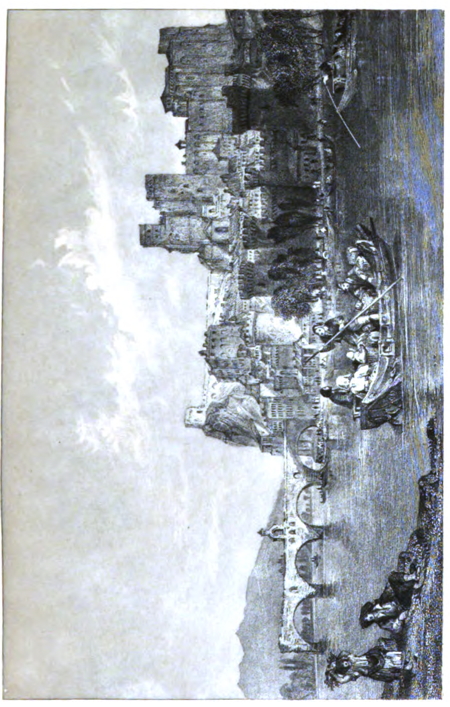
The importance of Constantinople was felt and magnified in its loss: the pontificate of Nicholas the Fifth, however peaceful and prosperous, was dishonoured by the fall of the Eastern empire; and the grief and terror of the Latins revived, or seemed to revive, the old enthusiasm of the crusades. In one of the most distant countries of the West, Philip, duke of Burgundy, entertained, at Lisle in Flanders, an assembly of his nobles; and the pompous pageants of the feast were skilfully adapted to their fancy and feelings. [124] In the midst of the banquet, a gigantic Saracen entered the hall, leading a fictitious elephant with a castle on his back; a matron in a mourning robe, the symbol of religion, was seen to issue from the castle; she deplored her oppression and accused the slowness of her champions; the principal herald of the golden fleece advanced, bearing on his fist a live pheasant, which, according to the rites of chivalry, he presented to the duke. At this extraordinary summons, Philip, a wise and aged prince, engaged his person and powers in the holy war against the Turks; his example was imitated by the barons and knights of the assembly; they swore to God, the Virgin, the ladies, and the pheasant; and their particular vows were not less extravagant than the general sanction of their oath. But the performance was made to depend on some future and foreign contingency; and, during twelve years, till the last hour of his life, the duke of Burgundy might be scrupulously, and perhaps sincerely, on the eve of his departure. Had every breast glowed with the same ardour; had the union of the Christians corresponded with their bravery; [XII-62] had every country, from Sweden [125] to Naples, supplied a just proportion of cavalry and infantry, of men and money, it is indeed probable that Constantinople would have been delivered, and that the Turks might have been chased beyond the Hellespont or the Euphrates. But the secretary of the emperor, who composed every epistle and attended every meeting, Æneas Sylvius, [126] a statesman and orator, describes from his own experience the repugnant state and spirit of Christendom. “It is a body,” says he, “without an head; a republic without laws or magistrates. The pope and the emperor may shine as lofty titles, as splendid images; but they are unable to command, and none are willing to obey; every state has a separate prince, and every prince has a separate interest. What eloquence could unite so many discordant and hostile powers under the same standard? Could they be assembled in arms, who would dare to assume the office of general? What order could be maintained? — what military discipline? Who would undertake to feed such an enormous multitude? Who would understand their various languages, or direct their stranger and incompatible manners? What mortal could reconcile the English with the French, Genoa with Arragon, the Germans with the natives of Hungary and Bohemia? If a small number enlisted in the holy war, they must be overthrown by the infidels; if many, by their own weight and confusion.” Yet the same Æneas, when he was raised to the papal throne, [XII-63] under the name of Pius the Second, devoted his life to the prosecution of the Turkish war. In the council of Mantua, he excited some sparks of a false or feeble enthusiasm; but, when the pontiff appeared at Ancona, to embark in person with the troops, engagements vanished in excuses; a precise day was adjourned to an indefinite term; and his effective army consisted of some German pilgrims, whom he was obliged to disband with indulgences and alms. Regardless of futurity, his successors and the powers of Italy were involved in the schemes of present and domestic ambition; and the distance or proximity of each object determined, in their eyes, its apparent magnitude. A more enlarged view of their interest would have taught them to maintain a defensive and naval war against the common enemy; and the support of Scanderbeg and his brave Albanians might have prevented the subsequent invasion of the kingdom of Naples. The siege and sack of Otranto by the Turks diffused a general consternation; and Pope Sixtus was preparing to fly beyond the Alps, when the storm was instantly dispelled by the death of Mahomet the Second, in the fifty-first year of his age. [127] His lofty genius aspired to the conquest [XII-64] of Italy: he was possessed of a strong city and a capacious harbour; and the same reign might have been decorated with the trophies of the New and the Ancient Rome. [128]
[XII-65]
CHAPTER LXIX↩
State of Rome from the Twelfth Century — Temporal Dominion of the Popes — Seditions of the City — Political Heresy of Arnold of Brescia — Restoration of the Republic — The Senators — Pride of the Romans — Their Wars — They are deprived of the Election and Presence of the Popes, who retire to Avignon — The Jubilee — Noble Families of Rome — Feud of the Colonna and Ursini.
In the first ages of the decline and fall of the Roman empire our eye is invariably fixed on the royal city which had given laws to the fairest portion of the globe. We contemplate her fortunes, at first with admiration, at length with pity, always with attention; and, when that attention is diverted from the capital to the provinces, they are considered as so many branches which have been successively severed from the Imperial trunk. The foundation of a second Rome on the shores of the Bosphorus has compelled the historian to follow the successors of Constantine; and our curiosity has been tempted to visit the most remote countries of Europe and Asia, to explore the causes and the authors of the long decay of the Byzantine monarchy. By the conquest of Justinian we have been recalled to the banks of the Tiber, to the deliverance of the ancient metropolis; but that deliverance was a change, or perhaps an aggravation, of servitude. Rome had been already stripped of her trophies, her gods, and her Cæsars; nor was the Gothic dominion more inglorious and oppressive than the tyranny of the Greeks. In the eighth century of the Christian era, a religious quarrel, the worship of images, provoked the Romans to assert their [XII-66] independence; their bishop became the temporal as well as the spiritual father of a free people; and of the Western empire, which was restored by Charlemagne, the title and image still decorate the singular constitution of modern Germany. [1] The name of Rome must yet command our involuntary respect; the climate (whatsoever may be its influence) was no longer the same; [2] the purity of blood had been contaminated through a thousand channels; but the venerable aspect of her ruins, and the memory of past greatness, rekindled a spark of the national character. The darkness of the middle ages exhibits some scenes not unworthy of our notice. Nor shall I dismiss the present work till I have reviewed the state and revolutions of the Roman city, which acquiesced under the absolute dominion of the popes about the same time that Constantinople was enslaved by the Turkish arms.
In the beginning of the twelfth century, [3] the era of the first crusade, Rome was revered by the Latins, as the metropolis of the world, as the throne of the pope and the emperor, who, from the eternal city, derived their title, their honours, and the right or exercise of temporal dominion. After so long an interruption, it may not be useless to repeat that the successors of Charlemagne and the Othos were chosen beyond [XII-67] the Rhine in a national diet; but that these princes were content with the humble names of kings of Germany and Italy, till they had passed the Alps and the Apennine, to seek their Imperial crown on the banks of the Tiber. [4] At some distance from the city, their approach was saluted by a long procession of the clergy and people with palms and crosses; and the terrific emblems of wolves and lions, of dragons and eagles, that floated in the military banners, represented the departed legions and cohorts of the republic. The royal oath to maintain the liberties of Rome was thrice reiterated, at the bridge, [5] the gate, and on the stairs of the Vatican; and the distribution of a customary donative feebly imitated the magnificence of the first Cæsars. In the church of St. Peter, [6] the coronation was performed by his successor; [7] the voice [XII-68] of God was confounded with that of the people; and the public consent was declared in the acclamations of “Long life and victory to our lord the pope! Long life and victory to our lord the emperor! Long life and victory to the Roman and Teutonic armies!” [8] The names of Cæsar and Augustus, the laws of Constantine and Justinian, the example of Charlemagne and Otho, established the supreme dominion of the emperors; their title and image was engraved on the papal coins; [9] and their jurisdiction was marked by the sword of [XII-69] justice, which they delivered to the prefect of the city. But every Roman prejudice was awakened by the name, the language, and the manners of a Barbarian lord. The Cæsars of Saxony or Franconia were the chiefs of a feudal aristocracy; nor could they exercise the discipline of civil and military power, which alone secures the obedience of a distant people, impatient of servitude, though perhaps incapable of freedom. Once, and once only, in his life, each emperor, with an army of Teutonic vassals, descended from the Alps. I have described the peaceful order of his entry and coronation; but that order was commonly disturbed by the clamour and sedition of the Romans, who encountered their sovereign as a foreign invader: his departure was always speedy, and often shameful; and, in the absence of a long reign, his authority was insulted, and his name was forgotten. The progress of independence in Germany and Italy undermined the foundations of the Imperial sovereignty, and the triumph of the popes was the deliverance of Rome.
Of her two sovereigns, the emperor had precariously reigned by the right of conquest; but the authority of the pope was founded on the soft, though more solid, basis of opinion and habit. The removal of a foreign influence restored and endeared the shepherd to his flock. Instead of the arbitrary or venal nomination of a German court, the vicar of Christ was freely chosen by the college of cardinals, most of whom were either natives or inhabitants of the city. The applause of the magistrates and people confirmed his election; and the ecclesiastical power that was obeyed in Sweden and Britain had been ultimately derived from the suffrage of the Romans. The same suffrage gave a prince, as well as a pontiff, to the capital. It was universally believed that Constantine had invested the popes with the temporal dominion of Rome; and the boldest civilians, the most profane [XII-70] sceptics, were satisfied with disputing the right of the emperor and the validity of his gift. The truth of the fact, the authenticity of his donation, was deeply rooted in the ignorance and tradition of four centuries; and the fabulous origin was lost in the real and permanent effects. The name of Dominus, or Lord, was inscribed on the coin of the bishops; their title was acknowledged by acclamations and oaths of allegiance; and, with the free or reluctant consent of the German Cæsars, they had long exercised a supreme or subordinate jurisdiction over the city and patrimony of St. Peter. The reign of the popes, which gratified the prejudices, was not incompatible with the liberties of Rome; and a more critical inquiry would have revealed a still nobler source of their power: the gratitude of a nation, whom they had rescued from the heresy and oppression of the Greek tyrant. In an age of superstition, it should seem that the union of the royal and sacerdotal characters would mutually fortify each other, and that the keys of paradise would be the surest pledge of earthly obedience. The sanctity of the office might indeed be degraded by the personal vices of the man; but the scandals of the tenth century were obliterated by the austere and more dangerous virtues of Gregory the Seventh and his successors; and, in the ambitious contests which they maintained for the rights of the church, their sufferings or their success must equally tend to increase the popular veneration. They sometimes wandered in poverty and exile, the victims of persecution; and the apostolic zeal with which they offered themselves to martyrdom must engage the favour and sympathy of every Catholic breast. And sometimes, thundering from the Vatican, they created, judged, and deposed the kings of the world; nor could the proudest Roman be disgraced by submitting to a priest whose feet were kissed, and whose stirrup was held, by the successors of Charlemagne. [10] [XII-71] Even the temporal interest of the city should have protected in peace and honour the residence of the popes; from whence a vain and lazy people derived the greatest part of their subsistence and riches. The fixed revenue of the popes was probably impaired: many of the old patrimonial estates, both in Italy and the provinces, had been invaded by sacrilegious hands; nor could the loss be compensated by the claim rather than the possession of the more ample gifts of Pepin and his descendants. But the Vatican and Capitol were nourished by the incessant and increasing swarms of pilgrims and suppliants; the pale of Christianity was enlarged, and the pope and cardinals were overwhelmed by the judgment of ecclesiastical and secular causes. A new jurisprudence had established in the Latin church the right and practice of appeals; [11] and, from the North and West, the bishops and abbots were invited or summoned to solicit, to complain, to accuse, or to justify before the threshold of the apostles. A rare prodigy is once recorded, that two horses, belonging to the Archbishops of Mentz and Cologne, repassed the Alps, yet laden with gold and silver; [12] but it was soon understood that the success, both of the pilgrims and clients, depended much less on the justice of their cause than on the value of their offering. The wealth and piety of these strangers were ostentatiously displayed; and their expenses, sacred or profane, circulated in various channels for the emolument of the Romans.
[XII-72]
Such powerful motives should have firmly attached the voluntary and pious obedience of the Roman people to their spiritual and temporal father. But the operation of prejudice and interest is often disturbed by the sallies of ungovernable passion. The Indian who fells the tree that he may gather the fruit, [13] and the Arab who plunders the caravans of commerce, are actuated by the same impulse of savage nature, which overlooks the future in the present, and relinquishes for momentary rapine the long and secure possession of the most important blessings. And it was thus that the shrine of St. Peter was profaned by the thoughtless Romans, who pillaged the offerings, and wounded the pilgrims, without computing the number and value of similar visits, which they prevented by their inhospitable sacrilege. Even the influence of superstition is fluctuating and precarious; and the slave, whose reason is subdued, will often be delivered by his avarice or pride. A credulous devotion for the fables and oracles of the priesthood most powerfully acts on the mind of a Barbarian; yet such a mind is the least capable of preferring imagination to sense, of sacrificing to a distant motive, to an invisible, perhaps an ideal, object, the appetites and interests of the present world. In the vigour of health and youth, his practice will perpetually contradict his belief; till the pressure of age, or sickness, or calamity awakens his terrors and compels him to satisfy the double debt of piety and remorse. I have already observed that the modern times of religious indifference are the most favourable to the peace and security of the clergy. Under the reign of superstition they had much to hope from the ignorance, and much to fear from the violence, of mankind. The wealth, whose constant increase must have rendered them the sole proprietors of the earth, was alternately bestowed by [XII-73] the repentant father and plundered by the rapacious son; their persons were adored or violated; and the same idol, by the hands of the same votaries, was placed on the altar or trampled in the dust. In the feudal system of Europe, arms were the title of distinction and the measure of allegiance; and amidst their tumult the still voice of law and reason was seldom heard or obeyed. The turbulent Romans disdained the yoke, and insulted the impotence, of their bishop; [14] nor would his education or character allow him to exercise, with decency or effect, the power of the sword. The motives of his election and the frailties of his life were exposed to their familiar observation; and proximity must diminish the reverence which his name and his decrees impressed on a Barbarous world. This difference has not escaped the notice of our philosophic historian: “Though the name and authority of the court of Rome were so terrible in the remote countries of Europe, which were sunk in profound ignorance, and were entirely unacquainted with its character and conduct, the pope was so little revered at home that his inveterate enemies surrounded the gates of Rome itself and even controlled his government in that city; and the ambassadors, who, from a distant extremity of Europe, carried to him the humble, or rather abject, submissions of the greatest potentate of the age, found the utmost difficulty to make their way to him and to throw themselves at his feet.” [15]
[XII-74]
Since the primitive times, the wealth of the popes was exposed to envy, their power to opposition, and their persons to violence. But the long hostility of the mitre and the crown increased the numbers, and inflamed the passions, of their enemies. The deadly factions of the Guelphs and Ghibelines, so fatal to Italy, could never be embraced with truth or constancy by the Romans, the subjects and adversaries both of the bishop and emperor; but their support was solicited by both parties; and they alternately displayed in their banners the keys of St. Peter and the German eagle. Gregory the Seventh, who may be adored or detested as the founder of the papal monarchy, was driven from Rome, and died in exile at Salerno. Six-and-thirty of his successors, [16] till their retreat to Avignon, maintained an unequal contest with the Romans; their age and dignity were often violated; and the churches, in the solemn rites of religion, were polluted with sedition and murder. A repetition [17] of such capricious [XII-75] brutality, without connection or design, would be tedious and disgusting; and I shall content myself with some events of the twelfth century, which represent the state of the popes and the city. On Holy Thursday, while Paschal officiated before the altar, he was interrupted by the clamours of the multitude, who imperiously demanded the confirmation of a favourite magistrate. [18] His silence exasperated their fury; his pious refusal to mingle the affairs of earth and heaven was encountered with menaces and oaths, that he should be the cause and the witness of the public ruin. During the festival of Easter, while the bishop and the clergy, barefoot and in procession, visited the tombs of the martyrs, they were twice assaulted, at the bridge of St. Angelo and before the Capitol, with volleys of stones and darts. The houses of his adherents were levelled with the ground; Paschal escaped with difficulty and danger; he levied an army in the patrimony of St. Peter; and his last days were embittered by suffering and inflicting the calamities of civil war. The scenes that followed the election of his successor Gelasius the Second were still more scandalous to the church and city. Cencio Frangipani, [19] a potent and factious baron, burst into the assembly furious, and in arms: the cardinals were stripped, beaten, and trampled under foot; and he seized, without pity or respect, the vicar of Christ by the throat. Gelasius was dragged by his hair along the ground, buffeted [XII-76] with blows, wounded with spurs, and bound with an iron chain in the house of his brutal tyrant. An insurrection of the people delivered their bishop; the rival families opposed the violence of the Frangipani; and Cencio, who sued for pardon, repented of the failure rather than of the guilt of his enterprise. Not many days had elapsed when the pope was again assaulted at the altar. While his friends and enemies were engaged in a bloody contest, he escaped in his sacerdotal garments. In this unworthy flight, which excited the compassion of the Roman matrons, his attendants were scattered or unhorsed; and, in the fields behind the church of St. Peter, his successor was found alone and half dead with fear and fatigue. Shaking the dust from his feet, the apostle withdrew from a city in which his dignity was insulted and his person was endangered; and the vanity of sacerdotal ambition is revealed in the involuntary confession that one emperor was more tolerable than twenty. [20] These examples might suffice; but I cannot forget the sufferings of two pontiffs of the same age, the second and third of the name of Lucius. The former, as he ascended in battle-array to assault the Capitol, was struck on the temple by a stone, and expired in a few days; [21] the latter was severely wounded in the persons of his servants. [22] In a civil commotion several of his priests had been made prisoners; and the inhuman Romans, reserving one as a guide for his brethren, put out their eyes, crowned them with ludicrous mitres, [XII-77] mounted them on asses, with their faces to the tail, and extorted an oath that in this wretched condition they should offer themselves as a lesson to the head of the church. Hope or fear, lassitude or remorse, the characters of the men and the circumstances of the times, might sometimes obtain an interval of peace and obedience; and the pope was restored with joyful acclamations to the Lateran or Vatican, from whence he had been driven with threats and violence. But the root of mischief was deep and perennial; [23] and a momentary calm was preceded and followed by such tempests as had almost sunk the bark of St. Peter. Rome continually presented the aspect of war and discord; the churches and palaces were fortified and assaulted by the factions and families; and, after giving peace to Europe, Calixtus the Second alone had resolution and power to prohibit the use of private arms in the metropolis. [24] Among the nations who revered the apostolic throne, the tumults of Rome provoked a general indignation; and, in a letter to his disciple Eugenius the Third, St. Bernard, with the sharpness of his wit and zeal, has stigmatised the vices of the rebellious people. [25] “Who is ignorant,” says the monk of Clairvaux, “of the vanity and arrogance of the Romans? a nation nursed in sedition, cruel, untractable, and scorning to obey, unless they are too feeble to resist. When they promise to serve, they aspire to reign; if they swear allegiance, they watch the opportunity of revolt; yet they vent their discontent in loud clamours, if your doors or your councils are shut against [XII-78] them. Dexterous in mischief, they have never learned the science of doing good. Odious to earth and heaven, impious to God, seditious among themselves, jealous of their neighbours, inhuman to strangers, they love no one, by no one are they beloved; and, while they wish to inspire fear, they live in base and continual apprehension. They will not submit; they know how to govern; faithless to their superiors, intolerable to their equals, ungrateful to their benefactors, and alike imprudent in their demands and their refusals. Lofty in promise, poor in execution: adulation and calumny, perfidy and treason, are the familiar arts of their policy.” Surely this dark portrait is not coloured by the pencil of Christian charity; [26] yet the features, however harsh and ugly, express a lively resemblance of the Romans of the twelfth century. [27]
The Jews had rejected the Christ when he appeared among them in a plebeian character; and the Romans might plead their ignorance of his vicar when he assumed the pomp and pride of a temporal sovereign. In the busy age of the crusades, some sparks of curiosity and reason were rekindled in the Western world; the heresy of Bulgaria, the Paulician sect, was successfully transplanted into the soil of Italy and France; the Gnostic visions were mingled with the simplicity of the Gospel; and the enemies of the clergy reconciled their passions with their conscience, the desire of freedom with the profession of piety. [28] The trumpet of Roman liberty [XII-79] was first sounded by Arnold of Brescia, [29] whose promotion in the church was confined to the lowest rank, and who wore the monastic habit rather as a garb of poverty than as an uniform of obedience. His adversaries could not deny the wit and eloquence which they severely felt; they confess with reluctance the specious purity of his morals; and his errors were recommended to the public by a mixture of important and beneficial truths. In his theological studies, he had been the disciple of the famous and unfortunate Abelard, [30] who was likewise involved in the suspicion of heresy; but the lover of Eloisa was of a soft and flexible nature; and his ecclesiastic judges were edified and disarmed by the humility of his repentance. From this master Arnold most probably imbibed some metaphysical definitions of the Trinity, repugnant to the taste of the times; his ideas of baptism and the eucharist are loosely censured; but a political heresy was the source of his fame and misfortunes. He presumed to quote the declaration of Christ that his kingdom is not of this world: he boldly maintained that the sword and the sceptre were entrusted to the civil magistrate; [XII-80] that temporal honours and possessions were lawfully vested in secular persons; that the abbots, the bishops, and the pope himself must renounce either their state or their salvation; and that, after the loss of their revenues, the voluntary tithes and oblations of the faithful would suffice, not indeed for luxury and avarice, but for a frugal life in the exercise of spiritual labours. During a short time the preacher was revered as a patriot; and the discontent, or revolt, of Brescia against her bishop was the first-fruits of his dangerous lessons. But the favour of the people is less permanent than the resentment of the priest; and, after the heresy of Arnold had been condemned by Innocent the Second [31] in the general council of the Lateran the magistrates themselves were urged by prejudice and fear to execute the sentence of the church. Italy could no longer afford a refuge; and the disciple of Abelard escaped beyond the Alps, till he found a safe and hospitable shelter in Zurich, now the first of the Swiss cantons. From a Roman station, [32] a royal villa, a chapter of noble virgins, Zurich had gradually increased to a free and flourishing city, where the appeals of the Milanese were sometimes tried by the Imperial commissaries. [33] In an [XII-81] age less ripe for reformation, the precursor of Zuinglius was heard with applause; a brave and simple people imbibed, and long retained, the colour of his opinions; and his art, or merit, seduced the bishop of Constance, and even the pope’s legate, who forgot, for his sake, the interest of their master and their order. Their tardy zeal was quickened by the fierce exhortations of St. Bernard; [34] and the enemy of the church was driven by persecution to the desperate measure of erecting his standard in Rome itself, in the face of the successor of St. Peter.
Yet the courage of Arnold was not devoid of discretion: he was protected, and had perhaps been invited, by the nobles and people; and in the service of freedom his eloquence thundered over the seven hills. Blending in the same discourse the texts of Livy and St. Paul, uniting the motives of gospel and of classic enthusiasm, he admonished the Romans how strangely their patience and the vices of the clergy had degenerated from the primitive times of the church and the city. He exhorted them to assert the inalienable rights of men and Christians; to restore the laws and magistrates of the republic; to respect the name of the emperor; but to confine their shepherd to the spiritual government of his flock. [35] Nor could his spiritual government escape the censure and control of the reformer; and the inferior clergy were [XII-82] taught by his lessons to resist the cardinals, who had usurped a despotic command over the twenty-eight regions or parishes of Rome. [36] The revolution was not accomplished without rapine and violence, the effusion of blood, and the demolition of houses; the victorious faction was enriched with the spoils of the clergy and the adverse nobles. Arnold of Brescia enjoyed or deplored the effects of his mission; his reign continued above ten years, while two popes, Innocent the Second and Anastasius the Fourth, either trembled in the Vatican or wandered as exiles in the adjacent cities. They were succeeded by a more vigorous and fortunate pontiff, Adrian the Fourth, [37] the only Englishman who has ascended the throne of St. Peter; and whose merit emerged from the mean condition of a monk, and almost a beggar, in the monastery of St. Albans. On the first provocation, of a cardinal killed or wounded in the streets, he cast an interdict on the guilty people; and, from Christmas to Easter, Rome was deprived of the real or imaginary comforts of religious worship. The Romans had despised their temporal prince: they submitted with grief and terror to the censures of their spiritual father; their guilt was expiated by penance, and the banishment of the seditious preacher was the price of their absolution. But the revenge of Adrian was yet unsatisfied, and the approaching coronation of Frederic Barbarossa was fatal to the bold reformer, who had offended, though not in an equal degree, the heads of the church and state. In their interview at Viterbo, [38] the pope represented to the emperor the furious ungovernable spirit of the Romans; the insults, the injuries, the fears, to which his person and his clergy [XII-83] were continually exposed; and the pernicious tendency of the heresy of Arnold, which must subvert the principles of civil as well as ecclesiastical subordination. Frederic was convinced by these arguments, or tempted by the desire of the Imperial crown; in the balance of ambition, the innocence or life of an individual is of small account; and their common enemy was sacrificed to a moment of political concord. After his retreat from Rome, Arnold had been protected by the viscounts of Campania, from whom he was extorted by the power of Cæsar: the prefect of the city pronounced his sentence; the martyr of freedom was burnt alive in the presence of a careless and ungrateful people; and his ashes were cast into the Tiber, lest the heretics should collect and worship the relics of their master. [39] The clergy triumphed in his death; with his ashes, his sect was dispersed; his memory still lived in the minds of the Romans. From his school they had probably derived a new article of faith, that the metropolis of the Catholic church is exempt from the penalties of excommunication and interdict. Their bishops might argue that the supreme jurisdiction, which they exercised over kings and nations, more specially embraced the city and diocese of the prince of the apostles. But they preached to the winds, and the same principle that weakened the effect, must temper the abuse, of the thunders of the Vatican.
The love of ancient freedom has encouraged a belief that [XII-84] as early as the tenth century, in their first struggles against the Saxon Othos, the commonwealth was vindicated and restored by the senate and people of Rome; that two consuls were annually elected among the nobles; and that ten or twelve plebeian magistrates revived the name and office of the tribunes of the commons. [40] But this venerable structure disappears before the light of criticism. In the darkness of the middle ages, the appellations of senators, of consuls, of the sons of consuls, may sometimes be discovered. [41] They were bestowed by the emperors, or assumed by the most powerful citizens, to denote their rank, their honours, [42] and [XII-85] perhaps the claim of a pure and patrician descent; but they float on the surface, without a series or a substance, the titles of men, not the orders of government; [43] and it is only from the year of Christ one thousand one hundred and forty-four, that the establishment of the senate is dated as a glorious era, in the acts of the city. [44] A new constitution was hastily framed by private ambition or popular enthusiasm; nor could Rome, in the twelfth century, produce an antiquary to explain, or a legislator to restore, the harmony and proportions of the ancient model. The assembly of a free, of an armed people will ever speak in loud and weighty acclamations. But the regular distribution of the thirty-five tribes, the nice balance of the wealth and numbers of the centuries, the debates of the adverse orators, and the slow operation of votes and ballots could not easily be adapted by a blind [XII-86] multitude, ignorant of the arts, and insensible of the benefits, of legal government. It was proposed by Arnold to revive and discriminate the equestrian order; but what could be the motive or measure of such distinction? [45] The pecuniary qualification of the knights must have been reduced to the poverty of the times: those times no longer required their civil functions of judges and farmers of the revenue; and their primitive duty, their military service on horseback, was more nobly supplied by feudal tenures and the spirit of chivalry. The jurisprudence of the republic was useless and unknown; the nations and families of Italy, who lived under the Roman and Barbaric laws, were insensibly mingled in a common mass; and some faint tradition, some imperfect fragments, preserved the memory of the Code and Pandects of Justinian. With their liberty, the Romans might doubtless have restored the appellation and office of consuls, had they not disdained a title so promiscuously adopted in the Italian cities that it has finally settled on the humble station of the agents of commerce in a foreign land. But the rights of the tribunes, the formidable word that arrested the public counsels, suppose, or must produce, a legitimate democracy. The old patricians were the subjects, the modern barons the tyrants, of the state; nor would the enemies of peace and order, who insulted the vicar of Christ, have long respected the unarmed sanctity of a plebeian magistrate. [46]
[XII-87]
In the revolution of the twelfth century, which gave a new existence and era to Rome, we may observe the real and important events that marked or confirmed her political independence. I. The Capitoline hill, one of her seven eminences, [47] is about four hundred yards in length and two hundred in breadth. A flight of an hundred steps led to the summit of the Tarpeian rock; and far steeper was the ascent before the declivities had been smoothed and the precipices filled by the ruins of fallen edifices. From the earliest ages, the Capitol had been used as a temple in peace, a fortress in war: after the loss of the city, it maintained a siege against the victorious Gauls; and the sanctuary of empire was occupied, assaulted, and burnt in the civil wars of Vitellius and Vespasian. [48] The temples of Jupiter and his kindred deities had crumbled into dust; their place was supplied by monasteries and houses; and the solid walls, the long and shelving porticoes, were decayed or ruined by the lapse of time. It was the first act of the Romans, an act of freedom, to restore the strength, though not the beauty, of the Capitol; [49] to fortify the seat of their arms and counsels; and, as often as [XII-88] they ascended the hill, the coldest minds must have glowed with the remembrance of their ancestors. II. The first Cæsars had been invested with the exclusive coinage of the gold and silver; to the senate they abandoned the baser metal of bronze or copper; [50] the emblems and legends were inscribed on a more ample field by the genius of flattery; and the prince was relieved from the care of celebrating his own virtues. The successors of Diocletian despised even the flattery of the senate: their royal officers at Rome, and in the provinces, assumed the sole direction of the mint; and the same prerogative was inherited by the Gothic kings of Italy, and the long series of the Greek, the French, and the German dynasties. After an abdication of eight hundred years, the Roman senate asserted this honourable and lucrative privilege; which was tacitly renounced by the popes, from Paschal the Second to the establishment of their residence beyond the Alps. Some of these republican coins of the twelfth and thirteenth centuries are shewn in the cabinets of the curious. On one of these, a gold medal, Christ is depictured, holding in his left hand a book with this inscription, “The vow of the Roman senate and people: Rome, the capital of the world”; on the reverse, St. Peter delivering a banner to a kneeling senator in his cap and gown, with the name and arms of his family impressed on a shield. [51] III. With the empire, the prefect of the city had [XII-89] declined to a municipal officer; yet he still exercised in the last appeal the civil and criminal jurisdiction; and a drawn sword, which he received from the successors of Otho, was the mode of his investiture and the emblem of his functions. [52] The dignity was confined to the noble families of Rome; the choice of the people was ratified by the pope; but a triple oath of fidelity must have often embarrassed the prefect in the conflict of adverse duties. [53] A servant, in whom they possessed but a third share, was dismissed by the independent Romans; in his place they elected a patrician; but this title, which Charlemagne had not disdained, was too lofty for a citizen or a subject; and, after the first fervour of rebellion, they consented without reluctance to the restoration of the prefect. About fifty years after this event, Innocent the Third, the most ambitious, or at least the most fortunate, of the pontiffs, delivered the Romans and himself from this badge of foreign dominion; he invested the prefect with a banner instead of a sword, and absolved him from all dependence of oaths or service to the German emperors. [54] In his place an ecclesiastic, a present or future cardinal, was named by the pope to the civil government of Rome; but his jurisdiction has been reduced to a narrow compass; [XII-90] and in the days of freedom the right or exercise was derived from the senate and people. IV. After the revival of the senate, [55] the conscript fathers (if I may use the expression) were invested with the legislative and executive power; but their views seldom reached beyond the present day; and that day was most frequently disturbed by violence and tumult. In its utmost plenitude, the order or assembly consisted of fifty-six senators, [56] the most eminent of whom were distinguished by the title of counsellors; they were nominated, perhaps annually, by the people; and a previous choice of their electors, ten persons in each region or parish, might afford a basis for a free and permanent constitution. The popes, who in this tempest submitted rather to bend than to break, confirmed by treaty the establishment and privileges of the senate, and expected from time, peace, and religion the restoration of their government. The motives of public and private interest might sometimes draw from the Romans an occasional and temporary sacrifice of their claims; and they renewed their oath of allegiance to the successor of St. Peter and Constantine, the lawful head of the church and the republic. [57]
[XII-91]
The union and vigour of a public council was dissolved in a lawless city; and the Romans soon adopted a more strong and simple mode of administration. They condensed the name and authority of the senate in a single magistrate or two colleagues; and, as they were changed at the end of a year or of six months, the greatness of the trust was compensated by the shortness of the term. But in this transient reign, the senators of Rome indulged their avarice and ambition; their justice was perverted by the interest of their family and faction; and, as they punished only their enemies, they were obeyed only by their adherents. Anarchy, no longer tempered by the pastoral care of their bishop, admonished the Romans that they were incapable of governing themselves; and they sought abroad those blessings which they were hopeless of finding at home. In the same age, and from the same motives, most of the Italian republics were prompted to embrace a measure, which, however strange it may seem, was adapted to their situation, and productive of the most salutary effects. [58] They chose, in some foreign but friendly city, an impartial magistrate, of noble birth and unblemished character, a soldier and a statesman, recommended by the voice of fame and his country, to whom they delegated for a time the supreme administration of peace and war. The compact between the governor and the governed was sealed with oaths and subscriptions; and the duration of his power, the measure of his stipend, the nature of their mutual obligations, [XII-92] were defined with scrupulous precision. They swore to obey him as their lawful superior; he pledged his faith to unite the indifference of a stranger with the zeal of a patriot. At his choice, four or six knights and civilians, his assessors in arms and justice, attended the Podestà, [59] who maintained at his own expense a decent retinue of servants and horses; his wife, his son, his brother, who might bias the affections of the judge, were left behind; during the exercise of his office, he was not permitted to purchase land, to contract an alliance, or even to accept an invitation in the house of a citizen; nor could he honourably depart till he had satisfied the complaints that might be urged against his government.
It was thus, about the middle of the thirteenth century, that the Romans called from Bologna the senator Brancaleone, [60] whose ame and merit have been rescued from oblivion by the pen of an English historian. A just anxiety for his reputation, a clear foresight of the difficulties of the task, had engaged him to refuse the honour of their choice; the statutes of Rome were suspended, and his office prolonged to the term of three years. By the guilty and licentious [XII-93] he was accused as cruel; by the clergy he was suspected as partial; but the friends of peace and order applauded the firm and upright magistrate by whom those blessings were restored. No criminals were so powerful as to brave, so obscure as to elude, the justice of the senator. By his sentence, two nobles of the Annibaldi family were executed on a gibbet; and he inexorably demolished, in the city and neighbourhood, one hundred and forty towers, the strong shelters of rapine and mischief. The bishop, as a simple bishop, was compelled to reside in his diocese; and the standard of Brancaleone was displayed in the field with terror and effect. His services were repaid by the ingratitude of a people unworthy of the happiness which they enjoyed. By the public robbers, whom he had provoked for their sake, the Romans were excited to depose and imprison their benefactor; nor would his life have been spared, if Bologna had not possessed a pledge for his safety. Before his departure, the prudent senator had required the exchange of thirty hostages of the noblest families of Rome: on the news of his danger, and at the prayer of his wife, they were more strictly guarded; and Bologna, in the cause of honour, sustained the thunders of a papal interdict. This generous resistance allowed the Romans to compare the present with the past; and Brancaleone was conducted from the prison to the Capitol amidst the acclamations of a repentant people. The remainder of his government was firm and fortunate; and, as soon as envy was appeased by death, his head, enclosed in a precious vase, was deposited on a lofty column of marble. [61]
The impotence of reason and virtue recommended in Italy [XII-94] a more effectual choice: instead of a private citizen, to whom they yielded a voluntary and precarious obedience, the Romans elected for their senator some prince of independent power, who could defend them from their enemies and themselves. Charles of Anjou and Provence, the most ambitious and warlike monarch of the age, accepted at the same time the kingdom of Naples from the pope and the office of senator from the Roman people. [62] As he passed through the city, in his road to victory, he received their oath of allegiance, lodged in the Lateran palace, and smoothed, in a short visit, the harsh features of his despotic character. Yet even Charles was exposed to the inconstancy of the people, who saluted with the same acclamations the passage of his rival, the unfortunate Conradin; and a powerful avenger, who reigned in the Capitol, alarmed the fears and jealousy of the popes. The absolute term of his life was superseded by a renewal every third year; and the enmity of Nicholas the Third obliged the Sicilian king to abdicate the government of Rome. In his bull, a perpetual law, the imperious pontiff asserts the truth, validity, and use of the donation of Constantine, not less essential to the peace of the city than to the independence of the church; establishes the annual election of the senator; and formally disqualifies all emperors, kings, princes, and persons of an eminent and conspicuous rank. [63] This prohibitory clause was repealed in his own behalf by Martin the Fourth, who humbly solicited the suffrage of the Romans. In the presence, and by the authority, of the people, two electors conferred, not on the pope, but on the noble and [XII-95] faithful Martin, the dignity of senator and the supreme administration of the republic, [64] to hold during his natural life, and to exercise at pleasure by himself or his deputies. About fifty years afterwards, the same title was granted to the emperor Lewis of Bavaria; and the liberty of Rome was acknowledged by her two sovereigns, who accepted a municipal office in the government of their own metropolis.
In the first moments of rebellion, when Arnold of Brescia had inflamed their minds against the church, the Romans artfully laboured to conciliate the favour of the empire, and to recommend their merit and services in the cause of Cæsar. The style of their ambassadors to Conrad the Third and Frederic the First is a mixture of flattery and pride, the tradition and ignorance of their own history. [65] After some complaint of his silence and neglect, they exhort the former of these princes to pass the Alps and assume from their hands the Imperial crown. “We beseech your Majesty not to disdain the humility of your sons and vassals, not to listen to the accusations of our common enemies; who calumniate the [XII-96] senate as hostile to your throne, who sow the seeds of discord, that they may reap the harvest of destruction. The pope and the Sicilian are united in an impious league to oppose our liberty and your coronation. With the blessing of God, our zeal and courage has hitherto defeated their attempts. Of their powerful and factious adherents, more especially the Frangipani, we have taken by assault the houses and turrets; some of these are occupied by our troops, and some are levelled with the ground. The Milvian bridge, which they had broken, is restored and fortified for your safe passage; and your army may enter the city without being annoyed from the castle of St. Angelo. All that we have done, and all that we design, is for your honour and service, in the loyal hope that you will speedily appear in person to vindicate those rights which have been invaded by the clergy, to revive the dignity of the empire, and to surpass the fame and glory of your predecessors. May you fix your residence in Rome, the capital of the world; give laws to Italy and the Teutonic kingdom; and imitate the example of Constantine and Justinian, [66] who, by the vigour of the senate and people, obtained the sceptre of the earth.” [67] But these splendid and fallacious wishes were not cherished by Conrad the Franconian, whose eyes were fixed on the Holy Land, and who died without visiting Rome soon after his return from the Holy Land.
His nephew and successor, Frederic Barbarossa, was more ambitious of the Imperial crown; nor had any of the successors of Otho acquired such absolute sway over the kingdom of Italy. Surrounded by his ecclesiastical and secular princes, he gave audience in his camp at Sutri [68] to the ambassadors of Rome, who thus addressed him in a free and florid oration: [XII-97] “Incline your ear to the queen of cities; approach with a peaceful and friendly mind the precincts of Rome, which has cast away the yoke of the clergy and is impatient to crown her legitimate emperor. Under your auspicious influence, may the primitive times be restored. Assert the prerogatives of the eternal city, and reduce under her monarchy the insolence of the world. You are not ignorant that, in former ages, by the wisdom of the senate, by the valour and discipline of the equestrian order, she extended her victorious arms to the East and West, beyond the Alps, and over the islands of the ocean. By our sins, in the absence of our princes, the noble institution of the senate has sunk in oblivion; and, with our prudence, our strength has likewise decreased. We have revived the senate and the equestrian order; the counsels of the one, the arms of the other, will be devoted to your person and the service of the empire. Do you not hear the language of the Roman matron? You were a guest, I have adopted you as a citizen; a Transalpine stranger, I have elected you for my sovereign; [69] and given you myself, and all that is mine. Your first and most sacred duty is, to swear and subscribe that you will shed your blood for the republic; that you will maintain in peace and justice the laws of the city and the charters of your predecessors; and that you will reward with five thousand pounds of silver the faithful senators who shall proclaim your titles in the Capitol. With the name, assume the character, of Augustus.” The flowers of Latin rhetoric were not yet exhausted; but Frederic, impatient of their vanity, interrupted the orators in the high tone of royalty and conquest. “Famous, indeed, have been the fortitude and wisdom of the ancient Romans; but your speech is not seasoned with wisdom, and I could wish that fortitude were conspicuous in your actions. Like all sublunary things, Rome has felt the vicissitudes of time and [XII-98] fortune. Your noblest families were translated to the East, to the royal city of Constantine; and the remains of your strength and freedom have long since been exhausted by the Greeks and Franks. Are you desirous of beholding the ancient glory of Rome, the gravity of the senate, the spirit of the knights, the discipline of the camp, the valour of the legions? you will find them in the German republic. It is not empire, naked and alone, the ornaments and virtues of empire have likewise migrated beyond the Alps to a more deserving people; [70] they will be employed in your defence, but they claim your obedience. You pretend that myself or my predecessors have been invited by the Romans: you mistake the word; they were not invited, they were implored. From its foreign and domestic tyrants, the city was rescued by Charlemagne and Otho, whose ashes repose in our country; and their dominion was the price of your deliverance. Under that dominion your ancestors lived and died. I claim by the right of inheritance and possession, and who shall dare to extort you from my hands? Is the hand of the Franks [71] and Germans enfeebled by age? Am I vanquished? Am I a captive? Am I not encompassed with the banners of a potent and invincible army? You impose conditions on your master; you require oaths: if the conditions are just, an oath is superfluous; if unjust, it is criminal. Can you doubt my equity? It is extended to the meanest of my subjects. Will not my sword be unsheathed in the defence of the Capitol? By that sword the Northern kingdom of Denmark has been restored to the Roman empire. You prescribe the measure and the objects of my bounty, which flows in a copious but a [XII-99] voluntary stream. All will be given to patient merit; all will be denied to rude importunity.” [72] Neither the emperor nor the senate could maintain these lofty pretensions of dominion and liberty. United with the pope, and suspicious of the Romans, Frederic continued his march to the Vatican: his coronation was disturbed by a sally [73] from the Capitol; and, if the numbers and valour of the Germans prevailed in the bloody conflict, he could not safely encamp in the presence of a city of which he styled himself the sovereign. About twelve years afterwards he besieged Rome, to seat an antipope in the chair of St. Peter; and twelve Pisan galleys were introduced into the Tiber; but the senate and people were saved by the arts of negotiation and the progress of disease; nor did Frederic or his successors reiterate the hostile attempt. Their laborious reigns were exercised by the popes, the crusades, and the independence of Lombardy and Germany; they courted the alliance of the Romans; and Frederic the Second offered in the Capitol the great standard, the Caroccio of Milan. [74] After the extinction of the house of Swabia, they were banished beyond the Alps; and their last coronations betrayed the impotence and poverty of the Teutonic Cæsars. [75]
[XII-100]
Under the reign of Hadrian, when the empire extended from the Euphrates to the ocean, from Mount Atlas to the Grampian Hills, a fanciful historian [76] amused the Romans with the picture of their infant wars. “There was a time,” says Florus, “when Tibur and Præneste, our summer-retreats, were the objects of hostile vows in the Capitol, when we dreaded the shades of the Arician groves, when we could triumph without a blush over the nameless villages of the Sabines and Latins, and even Corioli could afford a title not unworthy of a victorious general.” The pride of his contemporaries was gratified by the contrast of the past and the present: they would have been humbled by the prospect of futurity; by the prediction that after a thousand years Rome, despoiled of empire and contracted to her primeval limits, would renew the same hostilities on the same ground which was then decorated with her villas and gardens. The adjacent territory on either side of the Tiber was always claimed, and sometimes possessed, as the patrimony of St. Peter; but the barons assumed a lawless independence, and the cities too faithfully copied the revolt and discord of the metropolis. In the twelfth and thirteenth centuries the Romans incessantly laboured to reduce or destroy the contumacious vassals of the church and senate; and, if their headstrong and selfish ambition was moderated by the pope, he often encouraged their zeal by the alliance of his spiritual arms. Their warfare was that of the first consuls and dictators, who were taken from the plough. They assembled in arms at the foot of the Capitol; sallied from the gates, plundered or burnt the harvests of their neighbours, [XII-101] engaged in tumultuary conflict, and returned home after an expedition of fifteen or twenty days. Their sieges were tedious and unskilful: in the use of victory, they indulged the meaner passions of jealousy and revenge; and, instead of adopting the valour, they trampled on the misfortunes, of their adversaries. The captives, in their shirts, with a rope round their necks, solicited their pardon. The fortifications and even the buildings of the rival cities were demolished, and the inhabitants were scattered in the adjacent villages. It was thus that the seats of the cardinal bishops, Porto, Ostia, Albanum, Tusculum, Præneste, and Tibur, or Tivoli, were successively overthrown by the ferocious hostility of the Romans. [77] Of these, [78] Porto and Ostia, the two keys of the Tiber, are still vacant and desolate: the marshy and unwholesome banks are peopled with herds of buffaloes, and the river is lost to every purpose of navigation and trade. The hills, which afford a shady retirement from the autumnal heats, have again smiled with the blessings of peace; Frascati has arisen near the ruins of Tusculum; Tibur, or Tivoli, has resumed the honours of a city; [79] and the meaner towns of Albano and Palestrina are decorated with the villas of the cardinals and princes of Rome. In the work of destruction, the ambition of the Romans was often checked and repulsed by the neighbouring cities and their allies; in the first siege of Tibur, they were driven from their camp; and the battles [XII-102] of Tusculum [80] and Viterbo [81] might be compared, in their relative state, to the memorable fields of Thrasymene and Cannæ. In the first of these petty wars, thirty thousand Romans were overthrown by a thousand German horse, whom Frederic Barbarossa had detached to the relief of Tusculum; and, if we number the slain at three, the prisoners at two, thousand, we shall embrace the most authentic and moderate account. Sixty-eight years afterward, they marched against Viterbo, in the ecclesiastical state, with the whole force of the city; by a rare coalition, the Teutonic eagle was blended, in the adverse banners, with the keys of St. Peter; and the pope’s auxiliaries were commanded by a count of Toulouse and a bishop of Winchester. [82] The Romans were discomfited with shame and slaughter; but the English prelate must have indulged the vanity of a pilgrim, if he multiplied their numbers to one hundred, and their loss in the field to thirty, thousand men. Had the policy of the senate and the discipline of the legions been restored with the Capitol, the divided condition of Italy would have offered the fairest opportunity of a second conquest. But in arms the modern Romans were not above, and in arts they were far below, the common level of the neighbouring republics. Nor was their warlike spirit of any long continuance; after some irregular sallies, they subsided in the national apathy, in the [XII-103] neglect of military institutions, and in the disgraceful and dangerous use of foreign mercenaries.
Ambition is a weed of quick and early vegetation in the vineyard of Christ. Under the first Christian princes, the chair of St. Peter was disputed by the votes, the venality, the violence, of a popular election; the sanctuaries of Rome were polluted with blood; and, from the third to the twelfth century, the church was distracted by the mischief of frequent schisms. As long as the final appeal was determined by the civil magistrate, these mischiefs were transient and local; the merits were tried by equity or favour; nor could the unsuccessful competitor long disturb the triumph of his rival. But, after the emperors had been divested of their prerogatives, after a maxim had been established that the vicar of Christ is amenable to no earthly tribunal, each vacancy of the holy see might involve Christendom in controversy and war. The claims of the cardinals and inferior clergy, of the nobles and people, were vague and litigious; the freedom of choice was over-ruled by the tumults of a city that no longer owned or obeyed a superior. On the decease of a pope, two factions proceeded, in different churches, to a double election: the number and weight of votes, the priority of time, the merit of the candidates, might balance each other; the most respectable of the clergy were divided; and the distant princes who bowed before the spiritual throne could not distinguish the spurious from the legitimate idol. The emperors were often the authors of the schism, from the political motive of opposing a friendly to an hostile pontiff; and each of the competitors was reduced to suffer the insults of his enemies, who were not awed by conscience, and to purchase the support of his adherents, who were instigated by avarice or ambition. A peaceful and perpetual succession was ascertained by Alexander the Third, [83] who finally abolished [XII-104] the tumultuary votes of the clergy and people, and defined the right of election in the sole college of cardinals. [84] The three orders of bishops, priests, and deacons were assimilated to each other by this important privilege; the parochial clergy of Rome obtained the first rank in the hierarchy: they were indifferently chosen among the nations of Christendom; and the possession of the richest benefices, of the most important bishoprics, was not incompatible with their title and office. The senators of the Catholic church, the coadjutors and legates of the supreme pontiff, were robed in purple, the symbol of martyrdom or royalty; they claimed a proud equality with kings; and their dignity was enhanced by the smallness of their number, which, till the reign of Leo the Tenth, seldom exceeded twenty or twenty-five persons. By this wise regulation all doubt and scandal were removed, and the root of schism was so effectually destroyed that in a period of six hundred years a double choice has only once divided the unity of the sacred college. But, as the concurrence of two thirds of the votes had been made necessary, the election was often delayed by the private interest and passions of the cardinals; and, while they prolonged their independent reign, the Christian world was left destitute of an head. A vacancy of almost three years had preceded the elevation of Gregory the Tenth, who resolved to prevent the future abuse; and his bull, after some opposition, has been consecrated in the code of the canon law. [85] Nine days are [XII-105] allowed for the obsequies of the deceased pope and the arrival of the absent cardinals. On the tenth, they are imprisoned, each with one domestic, in a common apartment, or conclave, without any separation of walls or curtains; a small window is reserved for the introduction of necessaries; but the door is locked on both sides, and guarded by the magistrates of the city, to seclude them from all correspondence with the world. If the election be not consummated in three days, the luxury of their tables is contracted to a single dish at dinner and supper; and after the eighth day they were reduced to a scanty allowance of bread, water, and wine. During the vacancy of the holy see, the cardinals are prohibited from touching the revenues, or assuming, unless in some rare emergency, the government of the church; all agreements and promises among the electors are formally annulled; and their integrity is fortified by their solemn oaths and the prayers of the Catholics. Some articles of inconvenient or superfluous rigour have been gradually relaxed, but the principle of confinement is vigorous and entire: they are still urged by the personal motives of health and freedom to accelerate the moment of their deliverance; and the improvement of ballot, or secret votes, has wrapt the struggles of the conclave [86] in the silky veil of charity and politeness. [87] By these institutions the [XII-106] Romans were excluded from the election of their prince and bishop; and in the fever of wild and precarious liberty they seemed insensible of the loss of this inestimable privilege. The emperor Lewis of Bavaria revived the example of the great Otho. After some negotiation with the magistrates, the Roman people was assembled [88] in the square before St. Peter’s; the pope of Avignon, John the Twenty-second, was deposed; the choice of his successor was ratified by their consent and applause. They freely voted for a new law, that their bishop should never be absent more than three months in the year and two days’ journey from the city; and that, if he neglected to return on the third summons, the public servant should be degraded and dismissed. [89] But Lewis forgot his own debility and the prejudices of the times: beyond the precincts of a German camp, his useless phantom was rejected; the Romans despised their own workmanship; the anti-pope implored the mercy of his lawful sovereign; [90] [XII-107] and the exclusive right of the cardinals was more firmly established by this unseasonable attack.
Had the election been always held in the Vatican, the rights of the senate and people would not have been violated with impunity. But the Romans forgot, and were forgotten, in the absence of the successors of Gregory the Seventh, who did not keep, as a divine precept, their ordinary residence in the city and diocese. The care of that diocese was less important than the government of the universal church; nor could the popes delight in a city in which their authority was always opposed and their person was often endangered. From the persecution of the emperors and the wars of Italy, they escaped beyond the Alps into the hospitable bosom of France; from the tumults of Rome they prudently withdrew to live and die in the more tranquil stations of Anagni, Perugia, Viterbo, and the adjacent cities. When the flock was offended or impoverished by the absence of the shepherd, they were recalled by a stern admonition that St. Peter had fixed his chair, not in an obscure village, but in the capital of the world; by a ferocious menace that the Romans would march in arms to destroy the place and people that should dare to afford them a retreat. They returned with timorous obedience; and were saluted with the account of an heavy debt, of all the losses which their desertion had occasioned, the hire of lodgings, the sale of provisions, and the various expenses of servants and strangers who attended the court. [91] After a short interval of peace, and perhaps of authority, they were again banished by new tumults, and again summoned by the imperious or respectful [XII-108] invitation of the senate. In these occasional retreats, the exiles and fugitives of the Vatican were seldom long or far distant from the metropolis; but in the beginning of the fourteenth century, the apostolic throne was transported, as it might seem, for ever, from the Tiber to the Rhône; and the cause of the transmigration may be deduced from the furious contest between Boniface the Eighth and the king of France. [92] The spiritual arms of excommunication and interdict were repulsed by the union of the three estates and the privileges of the Gallican church; but the pope was not prepared against the carnal weapons which Philip the Fair had courage to employ. As the pope resided at Anagni, without the suspicion of danger, his palace and person were assaulted by three hundred horse, who had been secretly levied by William of Nogaret, a French minister, and Sciarra Colonna, of a noble but hostile family of Rome. The cardinals fled; the inhabitants of Anagni were seduced from their allegiance and gratitude; but the dauntless Boniface, unarmed and alone, seated himself in his chair, and awaited, like the conscript fathers of old, the swords of the Gauls. Nogaret, a foreign adversary, was content to execute the orders of his master: by the domestic enmity of Colonna, he was insulted with words and blows; and during a confinement of three days his life was threatened by the hardships which they inflicted on the obstinacy which they provoked. Their strange delay gave time and courage to the adherents of the church, who rescued him from sacrilegious violence; but his imperious soul was wounded in a vital part; and Boniface expired at Rome in a frenzy of rage and revenge. His memory is stained with [XII-109] the glaring vices of avarice and pride; nor has the courage of a martyr promoted this ecclesiastical champion to the honours of a saint: a magnanimous sinner (say the chronicles of the times), who entered like a fox, reigned like a lion, and died like a dog. He was succeeded by Benedict the Eleventh, the mildest of mankind. Yet he excommunicated the impious emissaries of Philip, and devoted the city and people of Anagni by a tremendous curse, whose effects are still visible to the eyes of superstition. [93]
After his decease, the tedious and equal suspense of the conclave was fixed by the dexterity of the French faction. A specious offer was made and accepted, that, in the term of forty days, they would elect one of the three candidates who should be named by their opponents. The archbishop of Bordeaux, a furious enemy of his king and country, was the first on the list; but his ambition was known; and his conscience obeyed the calls of fortune and the commands of a benefactor, who had been informed by a swift messenger that the choice of a pope was now in his hands. The terms were regulated in a private interview; and with such speed and secrecy was the business transacted that the unanimous conclave applauded the elevation of Clement the Fifth. [94] The cardinals of both parties were soon astonished by a summons to attend him beyond the Alps; from whence, as they soon discovered, they must never hope to return. He was engaged, by promise and affection, to prefer the residence of France; and, after dragging his court through Poitou and Gascony, and devouring, by his expense, the cities and convents on the road, he finally reposed at Avignon, [95] [XII-110] which flourished above seventy years [96] the seat of the Roman pontiff and the metropolis of Christendom. By land, by sea, by the Rhône, the position of Avignon was on all sides accessible; the southern provinces of France do not yield to Italy itself; new palaces arose for the accommodation of the pope and cardinals; and the arts of luxury were soon attracted by the treasures of the church. They were already possessed of the adjacent territory, the Venaissin county, [97] a populous and fertile spot; and the sovereignty of Avignon was afterwards purchased from the youth and distress of Jane, the first queen of Naples, and countess of Provence, for the inadequate price of fourscore thousand florins. [98] Under the shadow of the French monarchy, amidst an obedient people, the popes enjoyed an honourable and tranquil state, [XII-111] to which they long had been strangers; but Italy deplored their absence; and Rome, in solitude and poverty, might repent of the ungovernable freedom which had driven from the Vatican the successor of St. Peter. Her repentance was tardy and fruitless; after the death of the old members, the sacred college was filled with French cardinals, [99] who beheld Rome and Italy with abhorrence and contempt, and perpetuated a series of national and even provincial popes, attached by the most indissoluble ties to their native country.
The progress of industry had produced and enriched the Italian republics: the era of their liberty is the most flourishing period of population and agriculture, of manufactures and commerce; and their mechanic labours were gradually refined into the arts of elegance and genius. But the position of Rome was less favourable, the territory less fruitful; the character of the inhabitants was debased by indolence, and elated by pride; and they fondly conceived that the tribute of subjects must for ever nourish the metropolis of the church and empire. This prejudice was encouraged in some degree by the resort of pilgrims to the shrines of the apostles; and the last legacy of the popes, the institution of the holy year, [100] was not less beneficial to the people than to the clergy. Since the loss of Palestine, the gift of plenary indulgences, which had been applied to the crusades, remained without an object; and the most valuable [XII-112] treasure of the church was sequestered above eight years from public circulation. A new channel was opened by the diligence of Boniface the Eighth, who reconciled the vices of ambition and avarice; and the pope had sufficient learning to recollect and revive the secular games, which were celebrated in Rome at the conclusion of every century. To sound, without danger, the depth of popular credulity, a sermon was seasonably pronounced, a report was artfully scattered, some aged witnesses were produced; and on the first of January of the year thirteen hundred the church of St. Peter was crowded with the faithful, who demanded the customary indulgence of the holy time. The pontiff, who watched and irritated their devout impatience, was soon persuaded, by ancient testimony, of the justice of their claim; and he proclaimed a plenary absolution to all Catholics who, in the course of that year, and at every similar period, should respectfully visit the apostolic churches of St. Peter and St. Paul. The welcome sound was propagated through Christendom; and at first from the nearest provinces of Italy, and at length from the remote kingdoms of Hungary and Britain, the highways were thronged with a swarm of pilgrims who sought to expiate their sins in a journey, however costly or laborious, which was exempt from the perils of military service. All exceptions of rank or sex, of age or infirmity, were forgotten in the common transport; and in the streets and churches many persons were trampled to death by the eagerness of devotion. [101] The calculation of [XII-113] their numbers could not be easy nor accurate; and they have probably been magnified by a dexterous clergy, well apprised of the contagion of example; yet we are assured by a judicious historian, who assisted at the ceremony, that Rome was never replenished with less than two hundred thousand strangers; and another spectator has fixed at two millions the total concourse of the year. A trifling oblation from each individual would accumulate a royal treasure; and two priests stood night and day, with rakes in their hands, to collect, without counting, the heaps of gold and silver that were poured on the altar of St. Paul. [102] It was fortunately a season of peace and plenty; and, if forage was scarce, if inns and lodgings were extravagantly dear, an inexhaustible supply of bread and wine, of meat and fish, was provided by the policy of Boniface and the venal hospitality of the Romans. From a city without trade or industry, all casual riches will speedily evaporate; but the avarice and envy of the next generation solicited Clement the Sixth [103] to anticipate the distant period of the century. The gracious pontiff complied with their wishes; afforded Rome this poor consolation for his loss; and justified the change by the name and practice of the Mosaic Jubilee. [104] His summons was obeyed; [XII-114] and the number, zeal, and liberality of the pilgrims did not yield to the primitive festival. But they encountered the triple scourge of war, pestilence, and famine; [105] many wives and virgins were violated in the castles of Italy; and many strangers were pillaged or murdered by the savage Romans, no longer moderated by the presence of their bishop. [106] To the impatience of the popes we may ascribe the successive reduction to fifty, thirty-three, and twenty-five years; although the second of these terms is commensurate with the life of Christ. The profusion of indulgences, the revolt of the Protestants, and the decline of superstition have much diminished the value of the jubilee; yet even the nineteenth and last festival was a year of pleasure and profit to the Romans; and a philosophic smile will not disturb the triumph of the priest or the happiness of the people. [107]
In the beginning of the eleventh century, Italy was exposed to the feudal tyranny, alike oppressive to the sovereign and the people. The rights of human nature were vindicated by her numerous republics, who soon extended their liberty and dominion from the city to the adjacent country. The sword of the nobles was broken; their slaves were enfranchised; their castles were demolished; they assumed the habits of society and obedience; their ambition was confined to municipal honours, and in the proudest aristocracy of Venice or Genoa each patrician was subject to the laws. [108] But the feeble and disorderly government of Rome was unequal to [XII-115] the task of curbing her rebellious sons, who scorned the authority of the magistrate within and without the walls. It was no longer a civil contention between the nobles and the plebeians for the government of the state; the barons asserted in arms their personal independence; their palaces and castles were fortified against a siege; and their private quarrels were maintained by the numbers of their vassals and retainers. In origin and affection, they were aliens to their country; [109] and a genuine Roman, could such have been produced, might have renounced these haughty strangers, who disdained the appellation of citizens and proudly styled themselves the princes of Rome. [110] After a dark series of revolutions, all records of pedigree were lost; the distinction of surnames was abolished; the blood of the nations was mingled in a thousand channels; and the Goths and Lombards, the Greeks and Franks, the Germans and Normans, had obtained the fairest possessions by royal bounty or the prerogative of valour. These examples might be readily presumed; but the elevation of an Hebrew race to the rank of senators and consuls is an event without a parallel in the long captivity of these miserable exiles. [111] In the time of Leo the Ninth, a wealthy and learned Jew was converted to Christianity, and honoured at his baptism with the name of his godfather, the reigning pope. The zeal and courage of [XII-116] Peter, the son of Leo, were signalised in the cause of Gregory the Seventh, who entrusted his faithful adherent with the government of Hadrian’s mole, the tower of Crescentius, or, as it is now called, the castle of St. Angelo. Both the father and the son were the parents of a numerous progeny; their riches, the fruits of usury, were shared with the noblest families of the city; and so extensive was their alliance that the grandson of the proselyte was exalted, by the weight of his kindred, to the throne of St. Peter. A majority of the clergy and people supported his cause; he reigned several years in the Vatican; and it is only the eloquence of St. Bernard, and the final triumph of Innocent the Second, that has branded Anacletus with the epithet of antipope. After his defeat and death, the posterity of Leo is no longer conspicuous; and none will be found of the modern nobles ambitious of descending from a Jewish stock. It is not my design to enumerate the Roman families which have failed at different periods, or those which are continued in different degrees of splendour to the present time. [112] The old consular line of the Frangipani discover their name in the generous act of breaking or dividing bread in a time of famine; and such benevolence is more truly glorious than to have enclosed, with their allies the Corsi, a spacious quarter of the city in the chains of their fortifications; the Savelli, as it should seem a Sabine race, have maintained their original dignity; [113] the obsolete surname of the Capizucchi is inscribed on the coins of the first senators; the Conti preserve the honour, without the estate, of the counts of Signia; [114] and the Annibaldi must [XII-117] have been very ignorant, or very modest, if they had not descended from the Carthaginian hero. [115]
But among, perhaps above, the peers and princes of the city, I distinguish the rival houses of Colonna and Ursini, whose private story is an essential part of the annals of modern Rome. I. The name and arms of Colonna [116] have been the theme of much doubtful etymology; nor have the orators and antiquarians overlooked either Trajan’s pillar, or the columns of Hercules, or the pillar of Christ’s flagellation, or the luminous column that guided the Israelites in the desert. Their first historical appearance in the year eleven hundred and four attests the power and antiquity, while it explains the simple meaning, of the name. By the usurpation of Cavæ, the Colonna provoked the arms of Paschal the Second; but they lawfully held in the Campagna of Rome the hereditary fiefs of Zagarola and Colonna; and the latter of these towns was probably adorned with some lofty pillar, [XII-118] the relic of a villa or temple. [117] They likewise possessed one moiety of the neighbouring city of Tusculum: a strong presumption of their descent from the counts of Tusculum, who in the tenth century were the tyrants of the apostolic see. According to their own and the public opinion, the primitive and remote source was derived from the banks of the Rhine; [118] and the sovereigns of Germany were not ashamed of a real or fabulous affinity with a noble race, which in the revolutions of seven hundred years has been often illustrated by merit and always by fortune. [119] About the end of the thirteenth century, the most powerful branch was composed of an uncle and six brothers, all conspicuous in arms or in the honours of the church. Of these, Peter was elected senator of Rome, introduced to the Capitol in a triumphant car, and hailed in some vain acclamations with the title of Cæsar, while John and Stephen were declared Marquis of Ancona and Count of Romagna, by Nicholas the Fourth, a patron so partial to their family that he has been delineated in satirical portraits imprisoned as it were in a hollow pillar. [120] After his decease, their haughty behaviour provoked the displeasure of the most implacable of mankind. The two cardinals, the uncle [XII-119] and the nephew, denied the election of Boniface the Eighth; and the Colonna were oppressed for a moment by his temporal and spiritual arms. [121] He proclaimed a crusade against his personal enemies: their estates were confiscated; their fortresses on either side of the Tiber were besieged by the troops of St. Peter and those of the rival nobles; and after the ruin of Palestrina or Præneste, their principal seat, the ground was marked with a ploughshare, the emblem of perpetual desolation. Degraded, banished, proscribed, the six brothers, in disguise and danger, wandered over Europe without renouncing the hope of deliverance and revenge. In this double hope, the French court was their surest asylum: they prompted and directed the enterprise of Philip; and I should praise their magnanimity, had they respected the fortune and courage of the captive tyrant. His civil acts were annulled by the Roman people, who restored the honours and possessions of the Colonna; and some estimate may be formed of their wealth by their losses, of their losses by the damages of one hundred thousand gold florins, which were granted them against the accomplices and heirs of the deceased pope. All the spiritual censures and disqualifications were abolished [122] by his prudent successors; and the fortune of the house was more firmly established by this transient hurricane. The boldness of Sciarra Colonna was signalised in the captivity of Boniface, and long afterwards in [XII-120] the coronation of Lewis of Bavaria; and by the gratitude of the emperor the pillar in their arms was encircled with a royal crown. But the first of the family in fame and merit was the elder Stephen, whom Petrarch loved and esteemed as an hero superior to his own times and not unworthy of ancient Rome. Persecution and exile displayed to the nations his abilities in peace and war; in his distress he was an object, not of pity, but of reverence; the aspect of danger provoked him to avow his name and country; and when he was asked, “Where is now your fortress?” he laid his hand on his heart, and answered, “Here.” He supported with the same virtue the return of prosperity; and, till the ruin of his declining age, the ancestors, the character, and the children of Stephen Colonna, exalted his dignity in the Roman republic, and at the court of Avignon. II. The Ursini migrated from Spoleto: [123] the sons of Ursus, as they are styled in the twelfth century, from some eminent person who is only known as the father of their race. But they were soon distinguished among the nobles of Rome, by the number and bravery of their kinsmen, the strength of their towers, the honours of the senate and sacred college, and the elevation of two popes, Celestin the Third and Nicholas the Third, of their name and lineage. [124] Their riches may be accused as an [XII-121] early abuse of nepotism; the estates of St. Peter were alienated in their favour by the liberal Celestin; [125] and Nicholas was ambitious for their sake to solicit the alliance of monarchs; to found new kingdoms in Lombardy and Tuscany; and to invest them with the perpetual office of senators of Rome. All that has been observed of the greatness of the Colonna will likewise redound to the glory of the Ursini, their constant and equal antagonists in the long hereditary feud which distracted above two hundred and fifty years the ecclesiastical state. The jealousy of pre-eminence and power was the true ground of their quarrel; but, as a specious badge of distinction, the Colonna embraced the name of Ghibelines and the party of the empire; the Ursini espoused the title of Guelphs and the cause of the church. The eagle and the keys were displayed in their adverse banners; and the two factions of Italy most furiously raged when the origin and nature of the dispute were long since forgotten. [126] After the retreat of the popes to Avignon, they disputed in arms the vacant republic; and the mischiefs of discord were perpetuated by the wretched compromise of electing each year two rival senators. By their private hostilities, the city and country were desolated, and the fluctuating balance inclined with their alternate success. But none of either family had fallen by the sword, till the most renowned champion of the Ursini was surprised and slain by the younger Stephen Colonna. [127] His triumph [XII-122] is stained with the reproach of violating the truce; their defeat was basely avenged by the assassination, before the church-door, of an innocent boy and his two servants. Yet the victorious Colonna, with an annual colleague, was declared senator of Rome during the term of five years. And the muse of Petrarch inspired a wish, a hope, a prediction, that the generous youth, the son of his venerable hero, would restore Rome and Italy to their pristine glory; that his justice would extirpate the wolves and lions, the serpents and bears, who laboured to subvert the eternal basis of the marble column. [128]
[XII-123]
CHAPTER LXX↩
Character and Coronation of Petrarch — Restoration of the Freedom and Government of Rome by the Tribune Rienzi — His Virtues and Vices, his Expulsion and Death — Return of the Popes from Avignon — Great Schism of the West — Re-union of the Latin Church — Last Struggles of Roman Liberty — Statutes of Rome — Final Settlement of the Ecclesiastical State
In the apprehension of modern times, Petrarch [1] is the Italian songster of Laura and love. In the harmony of his Tuscan rhymes, Italy applauds, or rather adores, the father of her lyric poetry; and his verse, or at least his name, is repeated by the enthusiasm or affectation of amorous sensibility. Whatever may be the private taste of a stranger, his slight and superficial knowledge should humbly acquiesce in the taste of a learned nation; yet I may hope or presume that the Italians do not compare the tedious uniformity of sonnets and elegies with the sublime compositions of their epic muse, the original wildness of Dante, the regular beauties of Tasso, and the boundless variety of the incomparable Ariosto. The merits of the lover I am still less qualified to appreciate; nor am I deeply interested in a metaphysical [XII-124] passion for a nymph so shadowy that her existence has been questioned; [2] for a matron so prolific [3] that she was delivered of eleven legitimate children [4] while her amorous swain sighed and sung at the fountain of Vaucluse. [5] But in the eyes of Petrarch, and those of his graver contemporaries, his love was a sin, and Italian verse a frivolous amusement. His Latin works of philosophy, poetry, and eloquence established his serious reputation, which was soon diffused from Avignon over France and Italy; his friends and disciples were multiplied in every city; and, if the ponderous volume of his writings [6] be now abandoned to a long repose, our gratitude must applaud the man who by precept and example revived the spirit and study of the Augustan age. From his earliest [XII-none] [XII-125] youth, Petrarch aspired to the poetic crown. The academical honours of the three faculties had introduced a royal degree of master or doctor in the art of poetry; [7] and the title of poet-laureat, which custom, rather than vanity, perpetuates in the English court, [8] was first invented by the Cæsars of Germany. In the musical games of antiquity, a prize was bestowed on the victor; [9] the belief that Virgil and Horace had been crowned in the Capitol inflamed the emulation of a Latin bard; [10] and the laurel [11] was endeared to the lover by a verbal resemblance with the name of his mistress. The value of either object was enhanced by the difficulties of the [XII-126] pursuit; and, if the virtue or prudence of Laura was inexorable, [12] he enjoyed, and might boast of enjoying, the nymph of poetry. His vanity was not of the most delicate kind, since he applauds the success of his own labours; his name was popular; his friends were active; the open or secret opposition of envy and prejudice was surmounted by the dexterity of patient merit. In the thirty-sixth year of his age, he was solicited to accept the object of his wishes; and on the same day, in the solitude of Vaucluse, he received a similar and solemn invitation from the senate of Rome and the university of Paris. The learning of a theological school, and the ignorance of a lawless city, were alike unqualified to bestow the ideal, though immortal, wreath which genius may obtain from the free applause of the public and of posterity; but the candidate dismissed this troublesome reflection, and, after some moments of complacency and suspense, preferred the summons of the metropolis of the world.
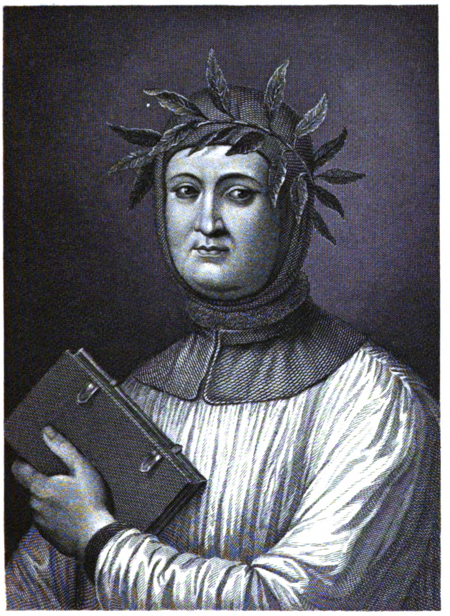
Petrarch, p. 124. From a portrait by Tofanelli.
The ceremony of his coronation [13] was performed in the Capitol, by his friend and patron the supreme magistrate of the republic. Twelve patrician youths were arrayed in scarlet; six representatives of the most illustrious families, in green robes, with garlands of flowers, accompanied the procession; in the midst of the princes and nobles, the senator, count of Anguillara, a kinsman of the Colonna, assumed his throne; and, at the voice of an herald, Petrarch arose. After discoursing on a text of Virgil, [14] and thrice [XII-127] repeating his vows for the prosperity of Rome, he knelt before the throne, and received from the senator a laurel crown, with a more precious declaration, “This is the reward of merit.” The people shouted, “Long life to the Capitol and the poet!” A sonnet in praise of Rome was accepted as the effusion of genius and gratitude; and, after the whole procession had visited the Vatican, the profane wreath was suspended before the shrine of St. Peter. In the act or diploma [15] which was presented to Petrarch, the title and prerogatives of poetlaureat are revived in the Capitol, after the lapse of thirteen hundred years; and he receives the perpetual privilege of wearing, at his choice, a crown of laurel, ivy, or myrtle, of assuming the poetic habit, and of teaching, disputing, interpreting, and composing in all places whatsoever and on all subjects of literature. The grant was ratified by the authority of the senate and people; and the character of citizen was the recompense of his affection for the Roman name. They did him honour, but they did him justice. In the familiar society of Cicero and Livy, he had imbibed the ideas of an ancient patriot; and his ardent fancy kindled every idea to a sentiment and every sentiment to a passion. The aspect of the seven hills and their majestic ruins confirmed these lively impressions; and he loved a country by whose liberal spirit he had been crowned and adopted. The poverty and debasement of Rome excited the indignation and pity of her grateful son: he dissembled the faults of his fellow-citizens; applauded with partial fondness the last of their heroes and matrons; and in the remembrance of the past, in the hope of the future, was pleased to forget the miseries of the present time. Rome was still the lawful mistress of the world; the pope and the emperor, her bishop and general, had abdicated their station by an inglorious retreat to the Rhône and the Danube; but, if she could resume her virtue, the republic [XII-128] might again vindicate her liberty and dominion. Amidst the indulgence of enthusiasm and eloquence, [16] Petrarch, Italy, and Europe were astonished by a revolution which realised, for a moment, his most splendid visions. The rise and fall of the tribune, Rienzi, will occupy the following pages. [17] The subject is interesting, the materials are rich, and the glance of a patriot-bard [18] will sometimes vivify the copious but simple narrative of the Florentine, [19] and more especially of the Roman, [20] historian.
[XII-129]
In a quarter of the city which was inhabited only by mechanics and Jews, the marriage of an innkeeper and a washerwoman produced the future deliverer of Rome. [21] From such parents Nicholas Rienzi Gabrini could inherit neither dignity nor fortune; and the gift of a liberal education, which they painfully bestowed, was the cause of his glory and untimely end. The study of history and eloquence, the writings of Cicero, Seneca, Livy, Cæsar, and Valerius Maximus, elevated above his equals and contemporaries the genius of the young plebeian; he perused with indefatigable diligence the manuscripts and marbles of antiquity; loved to dispense his knowledge in familiar language; and was often provoked to exclaim, “Where are now these Romans? their virtue, their justice, their power? why was I not born in those happy times?” [22] When the republic addressed to the throne of Avignon an embassy of the three orders, the spirit and eloquence of Rienzi recommended him to a place among the thirteen deputies of the commons. The orator had the honour of haranguing Pope Clement the Sixth, and the satisfaction of conversing with Petrarch, a congenial mind; but his aspiring hopes were chilled by disgrace and poverty; and the patriot was reduced to a single garment and the charity of the hospital. From this misery he was relieved by the [XII-130] sense of merit or the smile of favour; and the employment of apostolic notary afforded him a daily [23] stipend of five gold florins, a more honourable and extensive connection, and the right of contrasting, both in words and actions, his own integrity with the vices of the state. The eloquence of Rienzi was prompt and persuasive; the multitude is always prone to envy and censure: he was stimulated by the loss of a brother and the impunity of the assassins; nor was it possible to excuse or exaggerate the public calamities. The blessings of peace and justice, for which civil society has been instituted, were banished from Rome: the jealous citizens, who might have endured every personal or pecuniary injury, were most deeply wounded in the dishonour of their wives and daughters; [24] they were equally oppressed by the arrogance of the nobles and the corruption of the magistrates; and the abuse of arms or of laws was the only circumstance that distinguished the lions from the dogs and serpents of the Capitol. These allegorical emblems were variously repeated in the pictures which Rienzi exhibited in the streets and churches; and, while the spectators gazed with curious wonder, the bold and ready orator unfolded the meaning, applied the satire, inflamed their passions, and announced a distant hope of comfort and deliverance. The privileges of Rome, her eternal sovereignty over her princes and provinces, was the theme of his public and private discourse; and a monument of servitude became in his hands a title and incentive of liberty. The decree of the senate, which granted the most ample prerogatives to the emperor Vespasian, had been inscribed on a copper-plate still extant in the choir of the church of St. John Lateran. [25] A numerous assembly of [XII-131] nobles and plebeians was invited to this political lecture, and a convenient theatre was erected for their reception. The notary appeared in a magnificent and mysterious habit, explained the inscription by a version and commentary, [26] and descanted with eloquence and zeal on the ancient glories of the senate and people, from whom all legal authority was derived. The supine ignorance of the nobles was incapable of discerning the serious tendency of such representations: they might sometimes chastise with words and blows the plebeian reformer; but he was often suffered in the Colonna palace to amuse the company with his threats and predictions; and the modern Brutus [27] was concealed under the mask of folly and the character of a buffoon. While they indulged their contempt, the restoration of the good estate, his favourite expression, was entertained among the people as a desirable, a possible, and at length as an approaching, event; and, while all had the disposition to applaud, some had the courage to assist, their promised deliverer.
A prophecy, or rather a summons, affixed on the churchdoor [XII-132] of St. George, was the first public evidence of his designs; a nocturnal assembly of an hundred citizens on Mount Aventine, the first step to their execution. After an oath of secrecy and aid, he represented to the conspirators the importance and facility of their enterprise; that the nobles, without union or resources, were strong only in the fear of their imaginary strength; that all power, as well as right, was in the hands of the people; that the revenues of the apostolical chamber might relieve the public distress; and that the pope himself would approve their victory over the common enemies of government and freedom. After securing a faithful band to protect his first declaration, he proclaimed through the city, by sound of trumpet, that on the evening of the following day all persons should assemble without arms before the church of St. Angelo, to provide for the re-establishment of the good estate. The whole night was employed in the celebration of thirty masses of the Holy Ghost; and in the morning, Rienzi, bare-headed, but in complete armour, issued from the church, encompassed by the hundred conspirators. The pope’s vicar, the simple bishop of Orvieto, who had been persuaded to sustain a part in this singular ceremony, marched on his right hand; and three great standards were borne aloft as the emblems of their design. In the first, the banner of liberty, Rome was seated on two lions, with a palm in one hand and a globe in the other; St. Paul, with a drawn sword, was delineated in the banner of justice; and in the third, St. Peter held the keys of concord and peace. Rienzi was encouraged by the presence and applause of an innumerable crowd, who understood little and hoped much; and the procession slowly rolled forwards from the castle of St. Angelo to the Capitol. His triumph was disturbed by some secret emotion, which he laboured to suppress: he ascended without opposition, and with seeming confidence, the citadel of the republic; harangued the people from the balcony; and received the most flattering confirmation [XII-133] of his acts and laws. The nobles, as if destitute of arms and counsels, beheld in silent consternation this strange revolution; and the moment had been prudently chosen, when the most formidable, Stephen Colonna, was absent from the city. On the first rumour he returned to his palace, affected to despise this plebeian tumult, and declared to the messenger of Rienzi that at his leisure he would cast the madman from the windows of the Capitol. The great bell instantly rang an alarm, and so rapid was the tide, so urgent was the danger, that Colonna escaped with precipitation to the suburb of St. Lawrence; from thence, after a moment’s refreshment, he continued the same speedy career, till he reached in safety his castle of Palestrina, lamenting his own imprudence, which had not trampled the spark of this mighty conflagration. A general and peremptory order was issued from the Capitol to all the nobles, that they should peaceably retire to their estates: they obeyed; and their departure secured the tranquillity of the free and obedient citizens of Rome.
But such voluntary obedience evaporates with the first transports of zeal; and Rienzi felt the importance of justifying his usurpation by a regular form and a legal title. At his own choice, the Roman people would have displayed their attachment and authority, by lavishing on his head the names of senator or consul, of king or emperor: he preferred the ancient and modest appellation of tribune; [28] the protection of the commons was the essence of that sacred office; and they were ignorant that it had never been invested with any share in the legislative or executive powers of the republic. In this character, and with the consent of the Romans, the tribune enacted the most salutary laws for the restoration and maintenance of the good estate. By the first he fulfils the [XII-134] wish of honesty and inexperience, that no civil suit should be protracted beyond the term of fifteen days. The danger of frequent perjury might justify the pronouncing against a false accuser the same penalty which his evidence would have inflicted; the disorders of the times might compel the legislator to punish every homicide with death and every injury with equal retaliation. But the execution of justice was hopeless till he had previously abolished the tyranny of the nobles. It was formerly provided that none, except the supreme magistrate, should possess or command the gates, bridges, or towers of the state; that no private garrisons should be introduced into the towns or castles of the Roman territory; that none should bear arms or presume to fortify their houses in the city or country; that the barons should be responsible for the safety of the highways and the free passage of provisions; and that the protection of malefactors and robbers should be expiated by a fine of a thousand marks of silver. But these regulations would have been impotent and nugatory, had not the licentious nobles been awed by the sword of the civil power. A sudden alarm from the bell of the Capitol could still summon to the standard above twenty thousand volunteers; the support of the tribune and the laws required a more regular and permanent force. In each harbour of the coast, a vessel was stationed for the assurance of commerce; a standing militia of three hundred and sixty horse and thirteen hundred foot was levied, clothed, and paid in the thirteen quarters of the city; and the spirit of a commonwealth may be traced in the grateful allowance of one hundred florins, or pounds, to the heirs of every soldier who lost his life in the service of his country. For the maintenance of the public defence, for the establishment of granaries, for the relief of widows, orphans, and indigent convents, Rienzi applied, without fear of sacrilege, the revenues of the apostolic chamber; the three branches of hearth-money, the salt-duty, and the customs, were each of the [XII-135] annual produce of one hundred thousand florins; [29] and scandalous were the abuses, if in four or five months the amount of the salt-duty could be trebled by his judicious economy. After thus restoring the forces and finances of the republic, the tribune recalled the nobles from their solitary independence; required their personal appearance in the Capitol; and imposed an oath of allegiance to the new government and of submission to the laws of the good estate. Apprehensive for their safety, but still more apprehensive of the danger of a refusal, the princes and barons returned to their houses at Rome, in the garb of simple and peaceful citizens; the Colonna and Ursini, the Savelli and Frangipani, were confounded before the tribunal of a plebeian, of the vile buffoon whom they had so often derided, and their disgrace was aggravated by the indignation which they vainly struggled to disguise. The same oath was successively pronounced by the several orders of society, the clergy and gentlemen, the judges and notaries, the merchants and artisans, and the gradual descent was marked by the increase of sincerity and zeal. They swore to live and die with the republic and the church, whose interest was artfully united by the nominal association of the bishop of Orvieto, the pope’s vicar, to the office of tribune. It was the boast of Rienzi that he had delivered the throne and patrimony of St. Peter from a rebellious aristocracy; and Clement the Sixth, who rejoiced in its fall, affected to believe the professions, to applaud the merits, and to confirm the title of his trusty servant. The speech, perhaps the mind, of the tribune was inspired with a lively regard for the purity of the faith: he insinuated his [XII-136] claim to a supernatural mission from the Holy Ghost; enforced by an heavy forfeiture the annual duty of confession and communion; and strictly guarded the spiritual as well as temporal welfare of his faithful people. [30]
Never, perhaps, has the energy and effect of a single mind been more remarkably felt than in the sudden, though transient, reformation of Rome by the tribune Rienzi. A den of robbers was converted to the discipline of a camp or convent: patient to hear, swift to redress, inexorable to punish, his tribunal was always accessible to the poor and stranger; nor could birth or dignity or the immunities of the church protect the offender or his accomplices. The privileged houses, the private sanctuaries in Rome, on which no officer of justice would presume to trespass, were abolished; and he applied the timber and iron of their barricades in the fortifications of the Capitol. The venerable father of the Colonna was exposed in his own palace to the double shame of being desirous, and of being unable, to protect a criminal. A mule, with a jar of oil, had been stolen near Capranica; and the lord of the Ursini family was condemned to restore the damage, and to discharge a fine of four hundred florins for his negligence in guarding the highways. Nor were the persons of the barons more inviolate than their lands or houses; and, either from accident or design, the same impartial rigour was exercised against the heads of the adverse factions. Peter Agapet Colonna, who had himself been senator of Rome, was arrested in the street for injury or debt; and justice was appeased by the tardy execution of Martin Ursini, who, among his various acts of violence and rapine, had pillaged a shipwrecked vessel at the mouth of the Tiber. [31] His name, the purple of two [XII-137] cardinals his uncles, a recent marriage, and a mortal disease were disregarded by the inflexible tribune, who had chosen his victim. The public officers dragged him from his palace and nuptial bed: his trial was short and satisfactory; the bell of the Capitol convened the people; stript of his mantle, on his knees, with his hands bound behind his back, he heard the sentence of death; and, after a brief confession, Ursini was led away to the gallows. After such an example, none who were conscious of guilt could hope for impunity, and the flight of the wicked, the licentious, and the idle soon purified the city and territory of Rome. In this time (says the historian) the woods began to rejoice that they were no longer infested with robbers; the oxen began to plough; the pilgrims visited the sanctuaries; the roads and inns were replenished with travellers; trade, plenty, and good faith were restored in the markets; and a purse of gold might be exposed without danger in the midst of the highway. As soon as the life and property of the subject are secure, the labours and rewards of industry spontaneously revive: Rome was still the metropolis of the Christian world; and the fame and fortunes of the tribune were diffused in every country by the strangers who had enjoyed the blessings of his government.
The deliverance of his country inspired Rienzi with a vast, and perhaps visionary, idea of uniting Italy in a great federative republic, of which Rome should be the ancient and lawful head, and the free cities and princes the members and associates. His pen was not less eloquent than his tongue; and his numerous epistles were delivered to swift and trusty messengers. On foot, with a white wand in their hand, they traversed the forests and mountains; enjoyed, in the most [XII-138] hostile states, the sacred security of ambassadors; and reported, in the style of flattery or truth, that the highways along their passage were lined with kneeling multitudes, who implored Heaven for the success of their undertaking. Could passion have listened to reason, could private interest have yielded to the public welfare, the supreme tribunal and confederate union of the Italian republic might have healed their intestine discord and closed the Alps against the Barbarians of the North. [32] But the propitious season had elapsed; and, if Venice, Florence, Sienna, Perugia, and many inferior cities offered their lives and fortunes to the good estate, the tyrants of Lombardy and Tuscany must despise, or hate, the plebeian author of a free constitution. From them, however, and from every part of Italy, the tribune received the most friendly and respectful answers; they were followed by the ambassadors of the princes and republics; and in this foreign conflux, on all the occasions of pleasure or business, the lowborn notary could assume the familiar or majestic courtesy of a sovereign. [33] The most glorious circumstance of his reign was an appeal to his justice from Lewis king of Hungary, [XII-139] who complained that his brother, and her husband, had been perfidiously strangled by Jane queen of Naples: [34] her guilt or innocence was pleaded in a solemn trial at Rome; but, after hearing the advocates, [35] the tribune adjourned this weighty and invidious cause, which was soon determined by the sword of the Hungarian. Beyond the Alps, more especially at Avignon, the revolution was the theme of curiosity, wonder, and applause. Petrarch had been the private friend, perhaps the secret counsellor, of Rienzi: his writings breathe the most ardent spirit of patriotism and joy; and all respect for the pope, all gratitude for the Colonna, was lost in the superior duties of a Roman citizen. The poet-laureat of the Capitol maintains the act, applauds the hero, and mingles with some apprehension and advice the most lofty hopes of the permanent and rising greatness of the republic. [36]
While Petrarch indulged these prophetic visions, the Roman hero was fast declining from the meridian of fame and power; and the people, who had gazed with astonishment on the ascending meteor, began to mark the irregularity of its course and the vicissitudes of light and obscurity. More eloquent than judicious, more enterprising than resolute, the faculties of Rienzi were not balanced by cool and commanding reason; he magnified in a tenfold proportion the objects of hope and fear; and prudence, which could not have erected, did not presume to fortify, his throne. In the blaze of prosperity, [XII-140] his virtues were insensibly tinctured with the adjacent vices: justice with cruelty, liberality with profusion, and the desire of fame with puerile and ostentatious vanity. He might have learned that the ancient tribunes, so strong and sacred in the public opinion, were not distinguished in style, habit, or appearance from an ordinary plebeian; [37] and that, as often as they visited the city on foot, a single viator, or beadle, attended the exercise of their office. The Gracchi would have frowned or smiled, could they have read the sonorous titles and epithets of their successor, “Nicholas, severe and merciful; deliverer of rome; defender of italy; [38] friend of mankind, and of liberty, peace, and justice; tribune august”: his theatrical pageants had prepared the revolution; but Rienzi abused, in luxury and pride, the political maxim of speaking to the eyes as well as the understanding of the multitude. From nature he had received the gift of an handsome person, [39] till it was swelled and disfigured by intemperance; and his propensity to laughter was corrected in the magistrate by the affectation of gravity and sternness. He was clothed, at least on public occasions, in a parti-coloured robe of velvet or satin, lined with fur and embroidered with gold; the rod of justice which he carried [XII-141] in his hand was a sceptre of polished steel, crowned with a globe and cross of gold, and enclosing a small fragment of the true and holy wood. In his civil and religious processions through the city, he rode on a white steed, the symbol of royalty; the great banner of the republic, a sun with a circle of stars, a dove with an olive-branch, was displayed over his head; a shower of gold and silver was scattered among the populace; fifty guards with halberds encompassed his person; a troop of horse preceded his march; and their tymbals and trumpets were of massy silver.
The ambition of the honours of chivalry [40] betrayed the meanness of his birth and degraded the importance of his office; and the equestrian tribune was not less odious to the nobles whom he adopted than to the plebeians whom he deserted. All that yet remained of treasure or luxury or art was exhausted on that solemn day. Rienzi led the procession from the Capitol to the Lateran; the tediousness of the way was relieved with decorations and games; the ecclesiastical, civil, and military orders marched under their various banners; the Roman ladies attended his wife; and the ambassadors of Italy might loudly applaud, or secretly deride, the novelty of the pomp. In the evening, when they had reached the church and palace of Constantine, he thanked and dismissed the numerous assembly, with an invitation to the festival of the ensuing day. From the hands of a venerable knight he received the order of the Holy Ghost; the [XII-142] purification of the bath was a previous ceremony; but in no step of his life did Rienzi excite such scandal and censure as by the profane use of the prophyry vase in which Constantine (a foolish legend) had been healed of his leprosy by Pope Sylvester. [41] With equal presumption the tribune watched or reposed within the consecrated precincts of the baptistery; and the failure of his state-bed was interpreted as an omen of his approaching downfall. At the hour of worship he showed himself to the returning crowds in a majestic attitude, with a robe of purple, his sword, and gilt spurs; but the holy rites was soon interrupted by his levity and insolence. Rising from his throne, and advancing towards the congregation, he proclaimed in a loud voice, “We summon to our tribunal Pope Clement, and command him to reside in his diocese of Rome; we also summon the sacred college of Cardinals. [42] We again summon the two pretenders, Charles of Bohemia and Lewis of Bavaria, who style themselves emperors; we likewise summon all the electors of Germany, to inform us on what pretence they have usurped the unalienable right of the Roman people, the ancient and lawful sovereigns of the empire.” [43] Unsheathing his maiden sword, he thrice [XII-143] brandished it to the three parts of the world, and thrice repeated the extravagant declaration, “And this too is mine!” The pope’s vicar, the bishop of Orvieto, attempted to check this career of folly; but his feeble protest was silenced by martial music; and, instead of withdrawing from the assembly, he consented to dine with his brother tribune, at a table which had hitherto been reserved for the supreme pontiff. A banquet, such as the Cæsars had given, was prepared for the Romans. The apartments, porticoes, and courts of the Lateran were spread with innumerable tables for either sex and every condition; a stream of wine flowed from the nostrils of Constantine’s brazen horse; no complaint, except of the scarcity of water, could be heard; and the licentiousness of the multitude was curbed by discipline and fear. [44] A subsequent day was appointed for the coronation of Rienzi; [45] seven crowns of different leaves or metals were successively placed on his head by the most eminent of the Roman clergy; [46] they represented the seven gifts of the Holy Ghost; and he still professed to imitate the example of the ancient tribunes. These extraordinary spectacles might deceive or flatter the people; and their own vanity was gratified in the vanity of their leader. But in his private life he soon deviated from the strict rule of frugality and abstinence; and the plebeians, who were awed by the [XII-144] splendour of the nobles, were provoked by the luxury of their equal. His wife, his son, his uncle (a barber in name and profession), exposed the contrast of vulgar manners and princely expense; and, without acquiring the majesty, Rienzi degenerated into the vices, of a king.
A simple citizen describes with pity, or perhaps with pleasure, the humiliation of the barons of Rome. “Bare-headed, their hands crossed on their breast, they stood with downcast looks in the presence of the tribune; and they trembled, good God, how they trembled!” [47] As long as the yoke of Rienzi was that of justice and their country, their conscience forced them to esteem the man whom pride and interest provoked them to hate: his extravagant conduct soon fortified their hatred by contempt; and they conceived the hope of subverting a power which was no longer so deeply rooted in the public confidence. The old animosity of the Colonna and Ursini was suspended for a moment by their common disgrace: they associated their wishes, and perhaps their designs; an assassin was seized and tortured; he accused the nobles; and, as soon as Rienzi deserved the fate, he adopted the suspicions and maxims, of a tyrant. On the same day, under various pretences, he invited to the Capitol his principal enemies, among whom were five members of the Ursini, and three of the Colonna, name. But, instead of a council or a banquet, they found themselves prisoners under the sword of despotism or justice; and the consciousness of innocence or guilt might inspire them with equal apprehensions of danger. At the sound of the great bell the people assembled: they were arraigned for a conspiracy against the tribune’s life; and, though some might sympathise in their distress, not a hand nor a voice was raised to rescue the first of the nobility from their impending doom. Their apparent boldness was [XII-145] prompted by despair; they passed in separate chambers a sleepless and painful night; and the venerable hero, Stephen Colonna, striking against the door of his prison, repeatedly urged his guards to deliver him by a speedy death from such ignominious servitude. In the morning they understood their sentence from the visit of a confessor and the tolling of the bell. The great hall of the Capitol had been decorated for the bloody scene with red and white hangings; the countenance of the tribune was dark and severe; the swords of the executioners were unsheathed; and the barons were interrupted in their dying speeches by the sound of trumpets. But in this decisive moment Rienzi was not less anxious or apprehensive than his captives: he dreaded the splendour of their names, their surviving kinsmen, the inconstancy of the people, the reproaches of the world; and, after rashly offering a mortal injury, he vainly presumed that, if he could forgive, he might himself be forgiven. His elaborate oration was that of a Christian and a suppliant; and, as the humble minister of the commons, he entreated his masters to pardon these noble criminals, for whose repentance and future service he pledged his faith and authority. “If you are spared,” said the tribune, “by the mercy of the Romans, will you not promise to support the good estate with your lives and fortunes?” Astonished by this marvellous clemency, the barons bowed their heads; and, while they devoutly repeated the oath of allegiance, might whisper a secret, and more sincere, assurance of revenge. A priest, in the name of the people, pronounced their absolution. They received the communion with the tribune, assisted at the banquet, followed the procession; and, after every spiritual and temporal sign of reconciliation, were dismissed in safety to their respective homes, with the new honours and titles of generals, consuls, and patricians. [48]
[XII-146]
During some weeks they were checked by the memory of their danger rather than of their deliverance, till the more powerful of the Ursini, escaping with the Colonna from the city, erected at Marino the standard of rebellion. The fortifications of the castle were instantly restored; the vassals attended their lord; the outlaws armed against the magistrate; the flocks and herds, the harvests and vineyards, from Marino to the gates of Rome, were swept away or destroyed; and the people arraigned Rienzi as the author of the calamities which his government had taught them to forget. In the camp Rienzi appeared to less advantage than in the rostrum; and he neglected the progress of the rebel barons till their numbers were strong and their castles impregnable. From the pages of Livy he had not imbibed the art, or even the courage, of a general. An army of twenty thousand Romans returned, without honour or effect, from the attack of Marino; and his vengeance was amused by painting his enemies, their heads downwards, and drowning two dogs (at least they should have been bears) as the representatives of the Ursini. The belief of his incapacity encouraged their operations: they were invited by their secret adherents; and the barons attempted, with four thousand foot and sixteen hundred horse, to enter Rome by force or surprise. The city was prepared for their reception; the alarm bell rung all night; the gates were strictly guarded, or insolently open; and after some hesitation they sounded a retreat. The two first divisions had passed along the walls, but the prospect of a free entrance tempted the headstrong valour of the nobles in the rear; and, after a successful skirmish, they were overthrown and massacred without quarter by the crowds of the Roman people. Stephen Colonna the younger, the noble spirit to whom Petrarch ascribed the restoration of Italy, was preceded or accompanied in death by his son John, a gallant youth, by his brother Peter, who might regret the ease and honours of the church, by a nephew of legitimate birth, and by two bastards of the Colonna race; and the number of seven, the [XII-147] seven crowns, as Rienzi styled them, of the Holy Ghost, was completed by the agony of the deplorable parent, of the veteran chief, who had survived the hope and fortune of his house. The vision and prophecies of St. Martin and Pope Boniface had been used by the tribune to animate his troops; [49] he displayed, at least in the pursuit, the spirit of an hero; but he forgot the maxims of the ancient Romans, who abhorred the triumphs of civil war. The conqueror ascended the Capitol; deposited his crown and sceptre on the altar; and boasted with some truth that he had cut off an ear which neither pope nor emperor had been able to amputate. [50] His base and implacable revenge denied the honours of burial; and the bodies of the Colonna, which he threatened to expose with those of the vilest malefactors, were secretly interred by the holy virgins of their name and family. [51] The people sympathised in their grief, repented of their own fury, and detested the indecent joy of Rienzi, who visited the spot where these illustrious victims had fallen. It was on that fatal spot that he conferred on his son the honour of knighthood; and the ceremony was accomplished by a slight blow from each [XII-148] of the horsemen of the guard, and by a ridiculous and inhuman ablution from a pool of water, which was yet polluted with patrician blood. [52]
A short delay would have saved the Colonna, the delay of a single month, which elapsed between the triumph and the exile of Rienzi. In the pride of victory, he forfeited what yet remained of his civil virtues, without acquiring the fame of military prowess. A free and vigorous opposition was formed in the city; and, when the tribune proposed in the public council [53] to impose a new tax and to regulate the government of Perugia, thirty-nine members voted against his measures; repelled the injurious charge of treachery and corruption; and urged him to prove, by their forcible exclusion, that, if the populace adhered to his cause, it was already disclaimed by the most respectable citizens. The pope and the sacred college had never been dazzled by his specious professions; they were justly offended by the insolence of his conduct; a cardinal legate was sent to Italy, and, after some fruitless treaty and two personal interviews, he fulminated a bull of excommunication, in which the tribune is degraded from his office and branded with the guilt of rebellion, sacrilege, and heresy. [54] The surviving barons of Rome were now humbled to a sense of allegiance; their interest and revenge engaged them in the service of the church; but, as the fate of the Colonna was before their eyes, they abandoned to a private [XII-149] adventurer the peril and glory of the revolution. John Pepin, count of Minorbino, [55] in the kingdom of Naples, had been condemned for his crimes, or his riches, to perpetual imprisonment; and Petrarch, by soliciting his release, indirectly contributed to the ruin of his friend. At the head of one hundred and fifty soldiers, the count of Minorbino introduced himself into Rome; barricaded the quarter of the Colonna; and found the enterprise as easy as it had seemed impossible. From the first alarm, the bell of the Capitol incessantly tolled; but, instead of repairing to the well-known sound, the people was silent and inactive; and the pusillanimous Rienzi, deploring their ingratitude with sighs and tears, abdicated the government and palace of the republic.
Without drawing his sword, Count Pepin restored the aristocracy and the church; three senators were chosen, and the legate, assuming the first rank, accepted his two colleagues from the rival families of Colonna and Ursini. The acts of the tribune were abolished, his head was proscribed; yet such was the terror of his name that the barons hesitated three days before they would trust themselves in the city, and Rienzi was left above a month in the castle of St. Angelo, from whence he peaceably withdrew, after labouring, without effect, to revive the affection and courage of the Romans. The vision of freedom and empire had vanished; their fallen spirit would have acquiesced in servitude, had it been smoothed by tranquillity and order; and it was scarcely observed that the new senators derived their authority from the Apostolic See; that four cardinals were appointed to reform, with dictatorial power, the state of the republic. [56] Rome [XII-150] was again agitated by the bloody feuds of the barons, who detested each other and despised the commons; their hostile fortresses, both in town and country, again rose and were again demolished; and the peaceful citizens, a flock of sheep, were devoured, says the Florentine historian, by these rapacious wolves. But, when their pride and avarice had exhausted the patience of the Romans, a confraternity of the Virgin Mary protected or avenged the republic; the bell of the Capitol was again tolled, the nobles in arms trembled in the presence of an unarmed multitude; and of the two senators, Colonna escaped from the window of the palace, and Ursini was stoned at the foot of the altar. The dangerous office of tribune was successively occupied by two plebeians, Cerroni and Baroncelli. The mildness of Cerroni was unequal to the times; and, after a faint struggle, he retired with a fair reputation and a decent fortune to the comforts of rural life. Devoid of eloquence or genius, Baroncelli was distinguished by a resolute spirit: he spoke the language of a patriot, and trod in the footsteps of tyrants; his suspicion was a sentence of death, and his own death was the reward of his cruelties. Amidst the public misfortunes, the faults of Rienzi were forgotten; and the Romans sighed for the peace and prosperity of the good estate. [57]
After an exile of seven years, the first deliverer was again restored to his country. In the disguise of a monk or a pilgrim, he escaped from the castle of St. Angelo, implored the friendship of the king of Hungary at Naples, tempted the ambition of every bold adventurer, mingled at Rome with the pilgrims of the jubilee, lay concealed among the hermits of the [XII-151] Apennine, [58] and wandered through the cities of Italy, Germany, and Bohemia. His person was invisible, his name was yet formidable; and the anxiety of the court of Avignon supposes, and even magnifies, his personal merit. The emperor Charles the Fourth gave audience to a stranger, who frankly revealed himself as the tribune of the republic and astonished an assembly of ambassadors and princes by the eloquence of a patriot and the visions of a prophet, the downfall of tyranny and the kingdom of the Holy Ghost. [59] Whatever had been his hopes, Rienzi found himself a captive; but he supported a character of independence and dignity, and obeyed, as his own choice, the irresistible summons of the supreme pontiff. The zeal of Petrarch, which had been cooled by the unworthy conduct, was rekindled by the sufferings and the presence, of his friend; and he boldly complains of the times in which the saviour of Rome was delivered by her emperor into the hands of her bishop. Rienzi was transported slowly, but in safe custody, from Prague to Avignon; his entrance into the city was that of a malefactor; in his prison he was chained by the leg; and four cardinals were named to inquire into the crimes of heresy and rebellion. But his trial and condemnation would have involved some questions which it was more prudent [XII-152] to leave under the veil of mystery: the temporal supremacy of the popes; the duty of residence; the civil and ecclesiastical privileges of the clergy and people of Rome. The reigning pontiff well deserved the appellation of Clement; the strange vicissitudes and magnanimous spirit of the captive excited his pity and esteem; and Petrarch believes that he respected in the hero the name and sacred character of a poet. [60] Rienzi was indulged with an easy confinement and the use of books; and in the assiduous study of Livy and the Bible he sought the cause and the consolation of his misfortunes.
The succeeding pontificate of Innocent the Sixth opened a new prospect of his deliverance and restoration; and the court of Avignon was persuaded that the successful rebel could alone appease and reform the anarchy of the metropolis. After a solemn profession of fidelity, the Roman tribune was sent into Italy with the title of senator; but the death of Baroncelli appeared to supersede the use of his mission; and the legate, Cardinal Albernoz, [61] a consummate statesman, allowed him, with reluctance, and without aid, to undertake the perilous experiment. His first reception was equal to his wishes: the day of his entrance was a public festival, and his eloquence and authority revived the laws of the good estate. But this momentary sunshine was soon clouded by his own vices and those of the people: in the Capitol, he might often regret the prison of Avignon; and, after a second adminstration [XII-153] of four months, Rienzi was massacred in a tumult which had been fomented by the Roman barons. In the society of the Germans and Bohemians, he is said to have contracted the habits of intemperance and cruelty; adversity had chilled his enthusiasm, without fortifying his reason or virtue; and that youthful hope, that lively assurance, which is the pledge of success, was now succeeded by the cold impotence of distrust and despair. The tribune had reigned with absolute dominion, by the choice and in the hearts of the Romans; the senator was the servile minister of a foreign court; and, while he was suspected by the people, he was abandoned by the prince. The legate Albornoz, who seemed desirous of his ruin, inflexibly refused all supplies of men and money; a faithful subject could no longer presume to touch the revenues of the apostolical chamber; and the first idea of a tax was the signal of clamour and sedition. Even his justice was tainted with the guilt or reproach of selfish cruelty; the most virtuous citizen of Rome was sacrificed to his jealousy; and in the execution of a public robber, from whose purse he had been assisted, the magistrate too much forgot, or too much remembered, the obligations of the debtor. [62] A civil war exhausted his treasures, and the patience of the city; the Colonna maintained their hostile station at Palestrina; and his mercenaries soon despised a leader whose ignorance and fear were envious of all subordinate merit. In the death as in the life of Rienzi, the hero and the coward were strangely mingled. When the Capitol was invested by a furious multitude, when he was basely deserted by his civil and military servant, the intrepid senator, waving the banner of liberty, presented himself on the balcony, addressed his eloquence to the various passions of the Romans, and laboured [XII-154] to persuade them that in the same cause himself and the republic must either stand or fall. His oration was interrupted by a volley of imprecations and stones; and, after an arrow had transpierced his hand, he sunk into abject despair, and fled weeping to the inner chambers, from whence he was let down by a sheet before the windows of the prison. Destitute of aid or hope, he was besieged till the evening: the doors of the Capitol were destroyed with axes and fire; and, while the senator attempted to escape in a plebeian habit, he was discovered and dragged to the platform of the palace, the fatal scene of his judgments and executions. A whole hour, without voice or motion, he stood amidst the multitude, half naked and half dead; their rage was hushed into curiosity and wonder; the last feelings of reverence and compassion yet struggled in his favour; and they might have prevailed, if a bold assassin had not plunged a dagger in his breast. He fell senseless with the first stroke; the impotent revenge of his enemies inflicted a thousand wounds; and the senator’s body was abandoned to the dogs, to the Jews, and to the flames. Posterity will compare the virtues and the failings of this extraordinary man; but in a long period of anarchy and servitude the name of Rienzi has often been celebrated as the deliverer of his country and the last of the Roman patriots. [63]
The first and most generous wish of Petrarch was the restoration of a free republic; but, after the exile and death of his plebeian hero, he turned his eyes from the tribune to the king of the Romans. The Capitol was yet stained with the blood of Rienzi, when Charles the Fourth descended from the Alps to obtain the Italian and Imperial crowns. In his passage through Milan he received the visit, and repaid the flattery, of the poet-laureat; accepted a medal of Augustus; and promised, without a smile, to imitate the founder of the Roman [XII-155] monarchy. A false application of the names and maxims of antiquity was the source of the hopes and disappointments of Petrarch; yet he could not overlook the difference of times and characters: the immeasurable distance between the first Cæsars and a Bohemian prince, who by the favour of the clergy had been elected the titular head of the German aristocracy. Instead of restoring to Rome her glory and her provinces, he had bound himself, by a secret treaty with the pope, to evacuate the city on the day of his coronation; and his shameful retreat was pursued by the reproaches of the patriot bard. [64]
After the loss of liberty and empire, his third and more humble wish was to reconcile the shepherd with his flock; to recall the Roman bishop to his ancient and peculiar diocese. In the fervour of youth, with the authority of age, Petrarch addressed his exhortations to five successive popes, and his eloquence was always inspired by the enthusiasm of sentiment and the freedom of language. [65] The son of a citizen of Florence invariably preferred the country of his birth to that of his education; and Italy, in his eyes, was the queen and garden of the world. Amidst her domestic factions, she was doubtless superior to France both in art and science, in wealth and politeness; but the difference could scarcely support the epithet of barbarous, which he promiscuously bestows on the countries beyond the Alps. Avignon, the mystic Babylon, the sink of vice and corruption, was the object of his hatred and contempt; but he forgets that her scandalous vices [XII-156] were not the growth of the soil, and that in every residence they would adhere to the power and luxury of the papal court. He confesses that the successor of St. Peter is the bishop of the universal church; yet it was not on the banks of the Rhône, but of the Tiber, that the apostle had fixed his everlasting throne; and, while every city in the Christian world was blessed with a bishop, the metropolis alone was desolate and forlorn. Since the removal of the Holy See, the sacred buildings of the Lateran and the Vatican, their altars and their saints, were left in a state of poverty and decay; and Rome was often painted under the image of a disconsolate matron, as if the wandering husband could be reclaimed by the homely portrait of the age and infirmities of his weeping spouse. [66] But the cloud which hung over the seven hills would be dispelled by the presence of their lawful sovereign: eternal fame, the prosperity of Rome, and the peace of Italy would be the recompense of the pope who should dare to embrace this generous resolution. Of the five whom Petrarch exhorted, the three first, John the Twenty-second, Benedict the Twelfth, and Clement the Sixth, were importuned or amused by the boldness of the orator; but the memorable change which had been attempted by Urban the Fifth was finally accomplished by Gregory the Eleventh. The execution of their design was opposed by weighty and almost insuperable obstacles. A king of France, who has deserved the epithet of Wise, was unwilling to release them from a local dependence: the cardinals, for the most part his subjects, were attached to the language, manners, and climate of Avignon; to their stately palaces; above all, to the wines of Burgundy. [67] In their [XII-157] eyes, Italy was foreign or hostile; and they reluctantly embarked at Marseilles, as if they had been sold or banished into the land of the Saracens. Urban the Fifth resided three years in the Vatican with safety and honour; his sanctity was protected by a guard of two thousand horse; and the king of Cyprus, the queen of Naples, and the emperors of the East and West devoutly saluted their common father in the chair of St. Peter. But the joy of Petrarch and the Italians was soon turned into grief and indignation. Some reasons of public or private moment, his own impatience or the prayers of the cardinals, recalled Urban to France; and the approaching election was saved from the tyrannic patriotism of the Romans. The powers of Heaven were interested in their cause: Bridget of Sweden, a saint and pilgrim, disapproved the return, and foretold the death, of Urban the Fifth; the migration of Gregory the Eleventh was encouraged by St. Catherine of Sienna, the spouse of Christ and ambassadress of the Florentines; and the popes themselves, the great masters of human credulity, appear to have listened to these visionary females. [68] Yet those celestial admonitions were supported [XII-158] by some arguments of temporal policy. The residence of Avignon had been invaded by hostile violence: at the head of thirty thousand robbers, an hero had extorted ransom and absolution from the vicar of Christ and the sacred college; and the maxim of the French warriors, to spare the people and plunder the church, was a new heresy of the most dangerous import. [69] While the pope was driven from Avignon, he was strenuously invited to Rome. The senate and people acknowledged him as their lawful sovereign, and laid at his feet the keys of the gates, the bridges, and the fortresses; of the quarter at least beyond the Tiber. [70] But this loyal offer was accompanied by a declaration that they could no longer suffer the scandal and calamity of his absence; and that his obstinacy would finally provoke them to revive and assert the primitive right of election. The abbot of Mount Cassin had been consulted whether he would accept the triple crown [71] from the clergy and people: “I am a citizen [XII-159] of Rome,” [72] replied that venerable ecclesiastic, “and my first law is the voice of my country.” [73]
If superstition will interpret an untimely death, [74] if the merit of councils be judged from the event, the heavens may seem to frown on a measure of such apparent reason and propriety. Gregory the Eleventh did not survive above fourteen months his return to the Vatican; and his decease was followed by the great schism of the West, which distracted the Latin church above forty years. The sacred college was then composed of twenty-two cardinals: six of these had remained at Avignon; eleven Frenchmen, one Spaniard, and four Italians entered the conclave in the usual form. Their choice was not yet limited to the purple; and their unanimous votes acquiesced in the archbishop of Bari, a subject of Naples, conspicuous for his zeal and learning, who ascended the throne of St. Peter under the name of Urban the Sixth. The epistle of the sacred college affirms his free and regular election, [XII-160] which had been inspired, as usual, by the Holy Ghost; he was adored, invested, and crowned with the customary rites; his temporal authority was obeyed at Rome and Avignon, and his ecclesiastical supremacy was acknowledged in the Latin world. During several weeks, the cardinals attended their new master with the fairest professions of attachment and loyalty, till the summer-heats permitted a decent escape from the city. But, as soon as they were united at Anagni and Fundi, in a place of security, they cast aside the mask, accused their own falsehood and hypocrisy, excommunicated the apostate and antichrist of Rome, and proceeded to a new election of Robert of Geneva, Clement the Seventh, whom they announced to the nations as the true and rightful vicar of Christ. Their first choice, an involuntary and illegal act, was annulled by the fear of death and the menaces of the Romans; and their complaint is justified by the strong evidence of probability and fact. The twelve French cardinals, above two thirds of the votes, were masters of the election; and, whatever might be their provincial jealousies, it cannot fairly be presumed that they would have sacrificed their right and interest to a foreign candidate, who would never restore them to their native country. In the various and often inconsistent narratives, [75] the shades of popular violence are more darkly or faintly coloured; but the licentiousness of the seditious Romans was inflamed by a sense of their privileges, and the danger of a second emigration. The conclave was intimidated by the shouts, and encompassed by the arms, of thirty thousand rebels; the bells of the Capitol and St. Peter’s rang an alarm: “Death, or an Italian pope!” was the universal cry; the same threat was repeated by the [XII-none] [XII-161] twelve bannerets or chiefs of the quarters, in the form of charitable advice; some preparations were made for burning the obstinate cardinals; and, had they chosen a Transalpine subject, it is probable that they would never have departed alive from the Vatican. The same constraint imposed the necessity of dissembling in the eyes of Rome and of the world; the pride and cruelty of Urban presented a more inevitable danger; and they soon discovered the features of the tyrant, who could walk in his garden and recite his breviary, while he heard from an adjacent chamber six cardinals groaning on the rack. His inflexible zeal, which loudly censured their luxury and vice, would have attached them to the stations and duties of their parishes at Rome; and, had he not fatally delayed a new promotion, the French cardinals would have been reduced to an helpless minority in the sacred college. For these reasons, and in the hope of repassing the Alps, they rashly violated the peace and unity of the church; and the merits of their double choice are yet agitated in the Catholic schools. [76] The vanity, rather than the interest, of the nation determined the court and clergy of France. [77] The states of Savoy, Sicily, Cyprus, Arragon, Castille, Navarre, and Scotland were inclined by their example and authority to the obedience of Clement the Seventh, and, after his decease, of Benedict the Thirteenth. Rome and the principal states of Italy, Germany, Portugal, England, [78] the Low Countries, [XII-162] and the kingdoms of the North, adhered to the prior election of Urban the Sixth, who was succeeded by Boniface the Ninth, Innocent the Seventh, and Gregory the Twelfth.
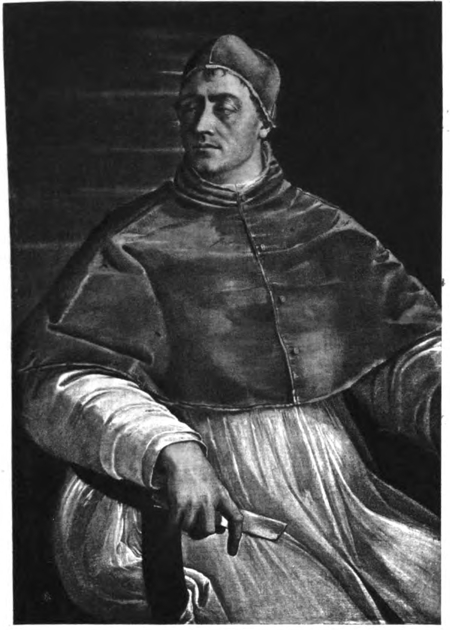
Pope Clement VII, .p 160. From a portrait by Fra Sebastiano del Piombo.
From the banks of the Tiber and the Rhône, the hostile pontiffs encountered each other with the pen and the sword; the civil and ecclesiastical order of society was disturbed; and the Romans had their full share of the mischiefs, of which they may be arraigned as the primary authors. [79] They had vainly flattered themselves with the hope of restoring the seat of the ecclesiastical monarchy, and of relieving their poverty with the tributes and offerings of the nations; but the separation of France and Spain diverted the stream of lucrative devotion; nor could the loss be compensated by the two jubilees which were crowded into the space of ten years. By the avocations of the schism, by foreign arms and popular tumults, Urban the Sixth and his three successors were often compelled to interrupt their residence in the Vatican. The Colonna and Ursini still exercised their deadly feuds; the bannerets of Rome asserted and abused the privileges of a republic; the vicars of Christ, who had levied a military force, chastised their rebellion with the gibbet, the sword, and the dagger; and, in a friendly conference, eleven deputies of the people were perfidiously murdered and cast into the street. Since the invasion of Robert the Norman, the Romans had pursued their domestic quarrels without the dangerous interposition of a stranger. But, in the disorders of the schism, an aspiring neighbour, Ladislaus king of Naples, alternately supported and betrayed the pope and the people; by the former he was declared gonfalonier, or general of the church, while the latter submitted to his choice the nomination of their magistrates. Besieging Rome by land and water, he thrice [XII-163] entered the gates as a Barbarian conqueror; profaned the altars, violated the virgins, pillaged the merchants, performed his devotions at St. Peter’s, and left a garrison in the castle of St. Angelo. His arms were sometimes unfortunate, and to a delay of three days he was indebted for his life and crown; but Ladislaus triumphed in his turn, and it was only his premature death that could save the metropolis and the ecclesiastical state from the ambitious conqueror, who had assumed the title, or at least the powers, of king of Rome. [80]
I have not undertaken the ecclesiastical history of the schism; but Rome, the object of these last chapters, is deeply interested in the disputed succession of her sovereigns. The first counsels for the peace and union of Christendom arose from the university of Paris, from the faculty of the Sorbonne, whose doctors were esteemed, at least in the Gallican church, as the most consummate masters of theological science. [81] Prudently waiving all invidious inquiry into the origin and merits of the dispute, they proposed, as an healing measure, that the two pretenders of Rome and Avignon should abdicate at the same time, after qualifying the cardinals of the adverse factions to join in a legitimate election; and that the nations should subtract [82] their obedience, if either of the competitors [XII-164] preferred his own interest to that of the public. At each vacancy, these physicians of the church deprecated the mischiefs of an hasty choice; but the policy of the conclave and the ambition of its members were deaf to reason and entreaties; and, whatsoever promises were made, the pope could never be bound by the oaths of the cardinal. During fifteen years, the pacific designs of the university were eluded by the arts of the rival pontiffs, the scruples or passions of their adherents, and the vicissitudes of French factions that ruled the insanity of Charles the Sixth. At length a vigorous resolution was embraced; and a solemn embassy, of the titular patriarch of Alexandria, two archbishops, five bishops, five abbots, three knights, and twenty doctors, was sent to the courts of Avignon and Rome, to require, in the name of the church and king, the abdication of the two pretenders, of Peter de Luna, who styled himself Benedict the Thirteenth, and of Angelo Corrario, who assumed the name of Gregory the Twelfth. For the ancient honour of Rome and the success of their commission, the ambassadors solicited a conference with the magistrates of the city, whom they gratified by a positive declaration that the most Christian king did not entertain a wish of transporting the holy see from the Vatican, which he considered as the genuine and proper seat of the successor of St. Peter. In the name of the senate and people, an eloquent Roman asserted their desire to co-operate in the union of the church, deplored the temporal and spiritual calamities of the long schism, and requested the protection of France against the arms of the king of Naples. The answers of Benedict and Gregory were alike edifying and alike deceitful; and, in evading the demand of their abdication, the two rivals were animated by a common spirit. They agreed on the necessity of a previous interview, but the time, the place, and the manner could never be ascertained by [XII-165] mutual consent. “If the one advances,” says a servant of Gregory, “the other retreats; the one appears an animal fearful of the land, the other a creature apprehensive of the water. And thus, for a short remnant of life and power, will these aged priests endanger the peace and salvation of the Christian world.” [83]
The Christian world was at length provoked by their obstinacy and fraud: they were deserted by their cardinals, who embraced each other as friends and colleagues; and their revolt was supported by a numerous assembly of prelates and ambassadors. With equal justice, the council of Pisa deposed the popes of Rome and Avignon; the conclave was unanimous in the choice of Alexander the Fifth, [84] and his vacant seat was soon filled by a similar election of John the Twenty-third, the most profligate of mankind. [85] But, instead of extinguishing the schism, the rashness of the French and Italians had given a third pretender to the chair of St. Peter. Such new claims of the synod and conclave were disputed; three kings, of Germany, Hungary, and Naples, adhered to the cause of Gregory the Twelfth; and Benedict the Thirteenth, himself a Spaniard, was acknowledged by the devotion and patriotism of that powerful nation. The rash proceedings of Pisa were corrected by the council of Constance; the emperor Sigismond acted a conspicuous part as the advocate or protector of the Catholic church; and the number and weight of civil and ecclesiastical members might [XII-166] seem to constitute the states-general of Europe. Of the three popes, John the Twenty-third was the first victim: he fled, and was brought back a prisoner; the most scandalous charges were suppressed; the vicar of Christ was only accused of piracy, murder, rape, sodomy, and incest; and, after subscribing his own condemnation, he expiated in prison the imprudence of trusting his person to a free city beyond the Alps. Gregory the Twelfth, whose obedience was reduced to the narrow precincts of Rimini, descended with more honour from the throne, and his ambassador convened the session in which he renounced the title and authority of lawful pope. To vanquish the obstinacy of Benedict the Thirteenth, or his adherents, the emperor in person undertook a journey from Constance to Perpignan. The kings of Castille, Arragon, Navarre, and Scotland obtained an equal and honourable treaty; with the concurrence of the Spaniards, Benedict was deposed by the council; but the harmless old man was left in a solitary castle to excommunicate twice each day the rebel kingdoms which had deserted his cause. After thus eradicating the remains of the schism, the synod of Constance proceeded, with slow and cautious steps, to elect the sovereign of Rome and the head of the church. On this momentous occasion, the college of twenty-three cardinals was fortified with thirty deputies; six of whom were chosen in each of the five great nations of Christendom, the Italian, the German, the French, the Spanish, and the English: [86] [XII-167] the interference of strangers was softened by their generous preference of an Italian and a Roman; and the hereditary as well as personal merit of Otho Colonna recommended him to the conclave. Rome accepted with joy and obedience the noblest of her sons, the ecclesiastical state was defended by his powerful family, and the elevation of Martin the Fifth is the era of the restoration and establishment of the popes in the Vatican. [87]
The royal prerogative of coining money, which had been exercised near three hundred years by the senate, was first resumed by Martin the Fifth, [88] and his image and superscription introduce the series of the papal medals. Of his two immediate successors, Eugenius the Fourth was the last [XII-168] pope expelled by the tumults of the Roman people, [89] and Nicholas the Fifth, the last who was importuned by the presence of a Roman emperor. [90] I. The conflict of Eugenius with the fathers of Basil, and the weight or apprehension of a new excise, emboldened and provoked the Romans to usurp the temporal government of the city. They rose in arms, selected seven governors of the republic and a constable of the Capitol; imprisoned the pope’s nephews; besieged his person in the palace; and shot volleys of arrows into his bark as he escaped down the Tiber in the habit of a monk. But he still possessed in the castle of St. Angelo a faithful garrison and a train of artillery: their batteries incessantly thundered on the city, and a bullet more dexterously pointed broke down the barricade of the bridge and scattered, with a single shot, the heroes of the republic. Their constancy was exhausted by a rebellion of five months. Under the tyranny of the Ghibeline nobles, the wisest patriots regretted the dominion of the church; and their repentance was unanimous and effectual. The troops of St. Peter again occupied the Capitol; the magistrates departed to their homes; the most guilty were executed or exiled; and the legate, at the head of two thousand foot and four thousand horse, was saluted as the father of the city. The synods of Ferrara and Florence, the fear or resentment of Eugenius, prolonged his absence: he was received by a submissive people; but the pontiff understood from the acclamations of his triumphal entry that, to secure their loyalty and his own repose, he must grant, without delay, the abolition of the odious excise. II. Rome was [XII-169] restored, adorned, and enlightened by the peaceful reign of Nicholas the Fifth. In the midst of these laudable occupations, the pope was alarmed by the approach of Frederic the Third of Austria; though his fears could not be justified by the character or the power of the Imperial candidate. After drawing his military force to the metropolis and imposing the best security of oaths [91] and treaties, Nicholas received, with a smiling countenance, the faithful advocate and vassal of the church. So tame were the times, so feeble was the Austrian, that the pomp of his coronation was accomplished with order and harmony; but the superfluous honour was so disgraceful to an independent nation that his successors have excused themselves from the toilsome pilgrimage to the Vatican, and rest their Imperial title on the choice of the electors of Germany.
A citizen has remarked, with pride and pleasure, that the king of the Romans, after passing with a slight salute the cardinals and prelates who met him at the gate, distinguished the dress and person of the senator of Rome; and, in this last farewell, the pageants of the empire and the republic were clasped in a friendly embrace. [92] According to the laws of Rome, [93] her first magistrate was required to be a doctor of laws, an alien, of a place at least forty miles from the city; with whose inhabitants he must not be connected in the third [XII-170] canonical degree of blood or alliance. The election was annual; a severe scrutiny was instituted into the conduct of the departing senator; nor could he be recalled to the same office till after the expiration of two years. A liberal salary of three thousand florins was assigned for his expense and reward; and his public appearance represented the majesty of the republic. His robes were of gold brocade or crimson velvet, or in the summer season of a lighter silk; he bore in his hand an ivory sceptre; the sound of trumpets announced his approach; and his solemn steps were preceded at least by four lictors or attendants, whose red wands were enveloped with bands or streamers of the golden colour or livery of the city. His oath in the Capitol proclaims his right and duty to observe and assert the laws, to control the proud, to protect the poor, and to exercise justice and mercy within the extent of his jurisdiction. In these useful functions he was assisted by three learned strangers, the two collaterals, and the judge of criminal appeals: their frequent trials of robberies, rapes, and murders are attested by the laws; and the weakness of these laws connives at the licentiousness of private feuds and armed associations for mutual defence. But the senator was confined to the administration of justice; the Capitol, the treasury, and the government of the city and its territory were entrusted to the three conservators, [94] who were changed four times in each year; the militia of the thirteen regions assembled under the banners of their respective chiefs, or caporioni; and the first of these was distinguished by the name and dignity of the prior. The popular [XII-171] legislature consisted of the secret and the common councils of the Romans. The former was composed of the magistrates and their immediate predecessors, with some fiscal and legal officers, and three classes of thirteen, twenty-six, and forty counsellors, amounting in the whole to about one hundred and twenty persons. In the common council, all male citizens had a right to vote; and the value of their privilege was enhanced by the care with which any foreigners were prevented from usurping the title and character of Romans. The tumult of a democracy was checked by wise and jealous precautions: except the magistrates, none could propose a question; none were permitted to speak, except from an open pulpit or tribunal; all disorderly acclamations were suppressed; the sense of the majority was decided by a secret ballot; and their decrees were promulgated in the venerable name of the Roman senate and people. It would not be easy to assign a period in which this theory of government has been reduced to accurate and constant practice, since the establishment of order has been gradually connected with the decay of liberty. But in the year one thousand five hundred and eighty the ancient statutes were collected, methodised in three books, and adapted to present use, under the pontificate, and with the approbation, of Gregory the Thirteenth: [95] this civil and criminal code is the modern law of the city; and, if the popular assemblies have been abolished, a foreign senator, with the three conservators, still resides in the palace of the Capitol. [96] The policy [XII-172] of the Cæsars has been repeated by the popes; and the bishop of Rome affected to maintain the form of a republic, while he reigned with the absolute powers of a temporal as well as spiritual monarch.
It is an obvious truth that the times must be suited to extraordinary characters, and that the genius of Cromwell or Retz might now expire in obscurity. The political enthusiasm of Rienzi had exalted him to a throne; the same enthusiasm, in the next century, conducted his imitator to the gallows. The birth of Stephen Porcaro was noble, his reputation spotless; his tongue was armed with eloquence, his mind was enlightened with learning; and he aspired, beyond the aim of vulgar ambition, to free his country and immortalise his name. The dominion of priests is most odious to a liberal spirit: every scruple was removed by the recent knowledge of the fable and forgery of Constantine’s donation; Petrarch was now the oracle of the Italians; and, as often as Porcaro revolved the ode which describes the patriot and hero of Rome, he applied to himself the visions of the prophetic bard. His first trial of the popular feelings was at the funeral of Eugenius the Fourth: in an elaborate speech, he called the Romans to liberty and arms; and they listened with apparent pleasure, till Porcaro was interrupted and answered by a grave advocate, who pleaded for the church and state. By every law the seditious orator was guilty of treason; but the benevolence of the new pontiff, who viewed his character with pity and esteem, attempted, by an honourable office, to convert the patriot into a friend. The inflexible Roman returned from Anagni with an increase of reputation and zeal; and on the first opportunity, the games of the place Navona, he tried to inflame the casual dispute of some boys and mechanics into a general rising of the people. Yet the humane Nicholas was still averse to accept the forfeit of his life; and the traitor was removed from the scene of temptation to Bologna, with a liberal [XII-173] allowance for his support, and the easy obligation of presenting himself each day before the governor of the city. But Porcaro had learned from the younger Brutus that with tyrants no faith or gratitude should be observed: the exile declaimed against the arbitrary sentence; a party and a conspiracy were gradually formed; his nephew, a daring youth, assembled a band of volunteers; and on the appointed evening a feast was prepared at his house for the friends of the republic. Their leader, who had escaped from Bologna, appeared among them in a robe of purple and gold: his voice, his countenance, his gestures, bespoke the man who had devoted his life or death to the glorious cause. In a studied oration, he expatiated on the motives and the means of their enterprise; the name and liberties of Rome; the sloth and pride of their ecclesiastical tyrants; the active or passive consent of their fellow-citizens; three hundred soldiers and four hundred exiles, long exercised in arms or in wrongs; the licence of revenge to edge their swords, and a million of ducats to reward their victory. It would be easy (he said) on the next day, the festival of the Epiphany, to seize the pope and his cardinals before the doors, or at the altar, of St. Peter’s; to lead them in chains under the walls of St. Angelo; to extort by the threat of their instant death a surrender of the castle; to ascend the vacant Capitol; to ring the alarm-bell; and to restore in a popular assembly the ancient republic of Rome. While he triumphed, he was already betrayed. The senator, with a strong guard, invested the house; the nephew of Porcaro cut his way through the crowd; but the unfortunate Stephen was drawn from a chest, lamenting that his enemies had anticipated by three hours the execution of his design. After such manifest and repeated guilt, even the mercy of Nicholas was silent. Porcaro, and nine of his accomplices, were hanged without the benefit of the sacraments; and, amidst the fears and invectives of the papal court, the Romans pitied, and almost [XII-174] applauded, these martyrs of their country. [97] But their applause was mute, their pity ineffectual, their liberty for ever extinct; and, if they have since risen in a vacancy of the throne or a scarcity of bread, such accidental tumults may be found in the bosom of the most abject servitude.
But the independence of the nobles, which was fomented by discord, survived the freedom of the commons, which must be founded in union. A privilege of rapine and oppression was long maintained by the barons of Rome; their houses were a fortress and a sanctuary; and the ferocious train of banditti and criminals whom they protected from the law repaid the hospitality with the service of their swords and daggers. The private interest of the pontiffs, or their nephews, sometimes involved them in these domestic feuds. Under the reign of Sixtus the Fourth, Rome was distracted by the battles and sieges of the rival houses; after the conflagration of his palace, the proto-notary Colonna was tortured and beheaded; and Savelli, his captive friend, was murdered on the spot, for refusing to join in the acclamations of the victorious Ursini. [98] But the popes no longer trembled in the Vatican: they had strength to command, if they had resolution to claim, the obedience of their subjects; and the strangers, who observed [XII-175] these partial disorders, admired the easy taxes and wise administration of the ecclesiastical state. [99]
The spiritual thunders of the Vatican depend on the force of opinion; and, if that opinion be supplanted by reason or passion, the sound may idly waste itself in the air; and the helpless priest is exposed to the brutal violence of a noble or a plebeian adversary. But after their return from Avignon the keys of St. Peter were guarded by the sword of St. Paul. Rome was commanded by an impregnable citadel; the use of cannon is a powerful engine against popular seditions; a regular force of cavalry and infantry was enlisted under the banners of the pope; his ample revenues supplied the resources of war; and, from the extent of his domain, he could bring down on a rebellious city an army of hostile neighbours and loyal subjects. [100] Since the union of the duchies of Ferrara and Urbino, the ecclesiastical state extends from the Mediterranean to the Adriatic, and from the confines of Naples to the banks of the Po; and, as early as the sixteenth century, the greater part of that spacious and fruitful country acknowledged the lawful claims and temporal sovereignty of the Roman pontiffs. Their claims were readily deduced from the genuine or fabulous donations of the darker ages; the successive steps of their final settlement would engage us too far in the transactions of Italy, and even of Europe: [XII-176] the crimes of Alexander the Sixth, the martial operations of Julius the Second, and the liberal policy of Leo the Tenth, a theme which has been adorned by the pens of the noblest historians of the times. [101] In the first period of their conquests, till the expedition of Charles the Eighth, the popes might successfully wrestle with the adjacent princes and states, whose military force was equal, or inferior, to their own. But, as soon as the monarchs of France, Germany, and Spain contended with gigantic arms for the dominion of Italy, they supplied with art the deficiency of strength, and concealed, in a labyrinth of wars and treaties, their aspiring views and the immortal hope of chasing the Barbarians beyond the Alps. The nice balance of the Vatican was often subverted by the soldiers of the North and West, who were united under the standard of Charles the Fifth; the feeble and fluctuating policy of Clement the Seventh exposed his person and dominions to the conqueror; and Rome was abandoned seven months to a lawless army, more cruel and rapacious than the Goths and Vandals. [102] After this severe lesson, the popes contracted their ambition, which was almost satisfied, resumed the character of a common parent, and abstained from all offensive hostilities, except in an hasty quarrel, when the vicar of Christ and the Turkish sultan were armed at the same time against the kingdom of Naples. [103] The French and Germans at length withdrew from the field of battle: Milan, [XII-177] Naples, Sicily, Sardinia, and the sea-coast of Tuscany were firmly possessed by the Spaniards; and it became their interest to maintain the peace and dependence of Italy, which continued almost without disturbance from the middle of the sixteenth to the opening of the eighteenth century. The Vatican was swayed and protected by the religious policy of the Catholic king; his prejudice and interest disposed him in every dispute to support the prince against the people; and, instead of the encouragement, the aid, and the asylum which they obtained from the adjacent states, the friends of liberty or the enemies of law were enclosed on all sides within the iron circle of despotism. The long habits of obedience and education subdued the turbulent spirit of the nobles and commons of Rome. The barons forgot the arms and factions of their ancestors, and insensibly became the servants of luxury and government. Instead of maintaining a crowd of tenants and followers, the produce of their estates was consumed in the private expenses, which multiply the pleasures, and diminish the power, of the lord. [104] The Colonna and Ursini vied with each other in the decoration of their palaces and chapels; and their antique splendour was rivalled or surpassed by the sudden opulence of the papal families. In Rome the voice of freedom and discord is no longer heard; and, instead of the foaming torrent, a smooth and stagnant lake reflects the image of idleness and servitude.
A Christian, a philosopher, [105] and a patriot will be equally [XII-178] scandalised by the temporal kingdom of the clergy; and the local majesty of Rome, the remembrance of her consuls and triumphs, may seem to embitter the sense, and aggravate the shame, of her slavery. If we calmly weigh the merits and defects of the ecclesiastical government, it may be praised in its present state as a mild, decent, and tranquil system, exempt from the dangers of a minority, the sallies of youth, the expenses of luxury, and the calamities of war. But these advantages are overbalanced by a frequent, perhaps a septennial, election of a sovereign, who is seldom a native of the country; the reign of a young statesman of threescore, in the decline of his life and abilities, without hope to accomplish, and without children to inherit, the labours of his transitory reign. The successful candidate is drawn from the church, and even the convent; from the mode of education and life the most adverse to reason, humanity, and freedom. In the trammels of servile faith, he has learned to believe because it is absurd, to revere all that is contemptible, and to despise whatever might deserve the esteem of a rational being; to punish error as a crime, to reward mortification and celibacy as the first of virtues; to place the saints of the calendar [106] above the heroes of Rome and the sages of Athens; and to consider the missal or the crucifix as more useful instruments than the plough or the loom. In the office of nuncio, or the rank of cardinal, he may acquire some knowledge of the world, but the primitive stain will adhere to his mind and manners: from study and experience he may suspect the mystery of his profession; but the sacerdotal artist will imbibe some portion of the bigotry which he inculcates. The genius of Sixtus the Fifth [107] burst from the gloom of a [XII-179] Franciscan cloister. In a reign of five years, he exterminated the outlaws and banditti, abolished the profane sanctuaries of Rome, [108] formed a naval and military force, restored and emulated the monuments of antiquity, and, after a liberal use and large increase of the revenue, left five millions of crowns in the castle of St. Angelo. But his justice was sullied with cruelty, his activity was prompted by the ambition of conquest: after his decease, the abuses revived; the treasure was dissipated; he entailed on posterity thirty-five new taxes, and the venality of offices; and, after his death, his statue was demolished by an ungrateful or an injured people. [109] The wild and original character of Sixtus the Fifth stands alone in the series of the pontiffs: the maxims and effects of their temporal government may be collected from the positive and comparative view of the arts and philosophy, the agriculture [XII-180] and trade, the wealth and population, of the ecclesiastical state. For myself, it is my wish to depart in charity with all mankind; nor am I willing, in these last moments, to offend even the pope and clergy of Rome. [110]
[XII-none]
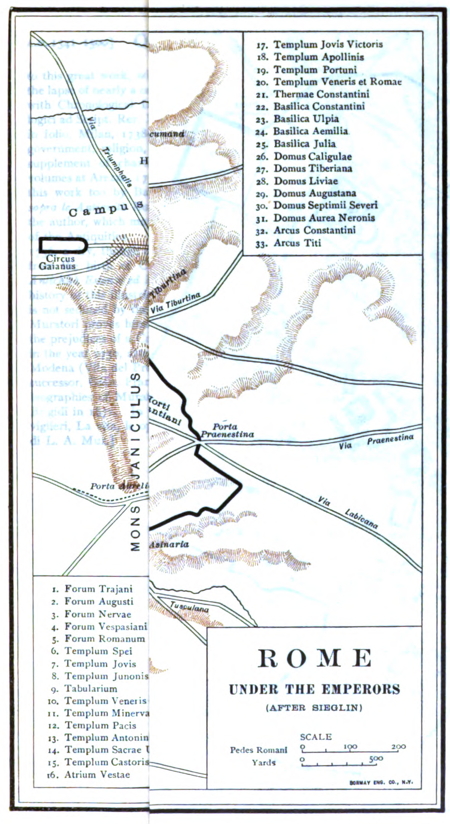
Plan of Ancient Rome, p. 180.
[XII-181]
[XII-182]
CHAPTER LXXI↩
Prospect of the Ruins of Rome in the Fifteenth Century — Four Causes of Decay and Destruction — Example of the Coliseum — Renovation of the City — Conclusion of the whole Work
In the last days of Pope Eugenius the Fourth, two of his servants, the learned Poggius [1] and a friend, ascended the Capitoline Hill; reposed themselves among the ruins of columns and temples; and viewed, from that commanding spot, the wide and various prospect of desolation. [2] The place and the object gave ample scope for moralising on the vicissitudes of fortune, which spares neither man nor the proudest of his works, which buries empires and cities in a common grave; and it was agreed that in proportion to her former greatness the fall of Rome was the more awful and deplorable. “Her primeval state, such as she might appear in a remote age, when Evander entertained the stranger of Troy, [3] has [XII-183] been delineated by the fancy of Virgil. This Tarpeian rock was then a savage and solitary thicket: in the time of the poet, it was crowned with the golden roofs of a temple: the temple is overthrown, the gold has been pillaged, the wheel of fortune has accomplished her revolution, and the sacred ground is again disfigured with thorns and brambles. The hill of the Capitol, on which we sit, was formerly the head of the Roman empire, the citadel of the earth, the terror of kings; illustrated by the footsteps of so many triumphs, enriched with the spoils and tributes of so many nations. This spectacle of the world, how is it fallen! how changed! how defaced! The path of victory is obliterated by vines, and the benches of the senators are concealed by a dunghill. Cast your eyes on the Palatine Hill, and seek, among the shapeless and enormous fragments, the marble theatre, the obelisks, the colossal statues, the porticoes of Nero’s palace: survey the other hills of the city, the vacant space is interrupted only by ruins and gardens. The forum of the Roman people, where they assembled to enact their laws and elect their magistrates, is now enclosed for the cultivation of pot-herbs or thrown open for the reception of swine and buffaloes. The public and private edifices, that were founded for eternity, lie prostrate, naked, and broken, like the limbs of a mighty giant; and the ruin is the more visible, from the stupendous relics that have survived the injuries of time and fortune.” [4]
These relics are minutely described by Poggius, one of the first who raised his eyes from the monuments of legendary, to those of classic, superstition. [5] 1. Besides a bridge, an arch, a [XII-184] sepulchre, and the pyramid of Cestius, he could discern, of the age of the republic, a double row of vaults in the salt-office of the Capitol, which were inscribed with the name and munificence of Catulus. 2. Eleven temples were visible in some degree, from the perfect form of the Pantheon, to the three arches and a marble column [6] of the temple of Peace, which Vespasian erected after the civil wars and the Jewish triumph. 3. Of the number, which he rashly defines, of seven thermæ, or public baths, none were sufficiently entire to represent the use and distribution of the several parts; but those of Diocletian and Antoninus Caracalla still retained the titles of the founders, and astonished the curious spectator, who, in observing their solidity and extent, the variety of marbles, the size and multitude of the columns, compared the labour and expense with the use and importance. Of the baths of Constantine, of Alexander, [7] of Domitian, or rather of Titus, [8] some vestige might yet be found. 4. The triumphal arches of Titus, Severus, [9] and Constantine were entire, both the structure and the inscriptions; a falling fragment was honoured with the name of Trajan; and two arches, then extant in the Flaminian Way, have been ascribed to the baser memory of Faustina and Gallienus. [10] 5. After the wonder of the [XII-185] Coliseum, Poggius might have overlooked a small amphitheatre of brick, most probably for the use of the prætorian camp. The theatres of Marcellus [11] and Pompey were occupied, in a great measure, by public and private buildings; and in the circus, Agonalis and Maximus, little more than the situation and the form could be investigated. 6. The columns of Trajan and Antonine [12] were still erect; but the Egyptian obelisks were broken or buried. [13] A people of gods and heroes, the workmanship of art, was reduced to one equestrian figure of gilt brass, and to five marble statues, of which the most conspicuous were the two horses of Phidias and Praxiteles. 7. The two mausoleums or sepulchres of Augustus [14] and Hadrian could not totally be lost; but the former was only visible as a mound of earth; and the latter, the castle of St. Angelo, had acquired the name and appearance of a modern fortress. With the addition of some separate and nameless [XII-186] columns, such were the remains of the ancient city; for the marks of a more recent structure might be detected in the walls, which formed a circumference of ten miles, included three hundred and seventy-nine turrets, and opened into the country by thirteen gates.
This melancholy picture was drawn above nine hundred years after the fall of the Western empire, and even of the Gothic kingdom of Italy. A long period of distress and anarchy, in which empire, and arts, and riches had migrated from the banks of the Tiber, was incapable of restoring or adorning the city; and, as all that is human must retrograde if it do not advance, every successive age must have hastened the ruin of the works of antiquity. To measure the progress of decay, and to ascertain, at each era, the state of each edifice, would be an endless and a useless labour; and I shall content myself with two observations, which will introduce a short inquiry into the general causes and effects. 1. Two hundred years before the eloquent complaint of Poggius, an anonymous writer composed a description of Rome. [15] His ignorance may repeat the same objects under strange and fabulous names. Yet this Barbarous topographer had eyes and ears: he could observe the visible remains; he could [XII-187] listen to the tradition of the people; and he distinctly enumerates seven theatres, eleven baths, twelve arches, and eighteen palaces, of which many had disappeared before the time of Poggius. It is apparent that many stately monuments of antiquity survived till a late period, [16] and that the principles of destruction acted with vigorous and increasing energy in the thirteenth and fourteenth centuries. 2. The same reflection must be applied to the three last ages; and we should vainly seek the Septizonium of Severus, [17] which is celebrated by Petrarch and the antiquarians of the sixteenth century. While the Roman edifices were still entire, the first blows, however weighty and impetuous, were resisted by the solidity of the mass and the harmony of the parts; but the slightest touch would precipitate the fragments of arches and columns that already nodded to their fall.
After a diligent inquiry, I can discern four principal causes of the ruin of Rome, which continued to operate in a period of more than a thousand years. I. The injuries of time and nature. II. The hostile attacks of the Barbarians and Christians. III. The use and abuse of the materials. And, IV. The domestic quarrels of the Romans.
I. The art of man is able to construct monuments far more permanent than the narrow span of his own existence; yet these monuments, like himself, are perishable and frail; and, in the boundless annals of time, his life and his labours must [XII-188] equally be measured as a fleeting moment. Of a simple and solid edifice, it is not easy, however, to circumscribe the duration. As the wonders of ancient days, the pyramids [18] attracted the curiosity of the ancients: an hundred generations, the leaves of autumn, [19] have dropped into the grave; and, after the fall of the Pharaohs and Ptolemies, the Cæsars and Caliphs, the same pyramids stand erect and unshaken above the floods of the Nile. A complex figure of various and minute parts is more accessible to injury and decay; and the silent lapse of time is often accelerated by hurricanes and earthquakes, by fires and inundations. The air and earth have doubtless been shaken; and the lofty turrets of Rome have tottered from their foundations; but the seven hills do not appear to be placed on the great cavities of the globe; nor has the city, in any age, been exposed to the convulsions of nature which, in the climate of Antioch, Lisbon, or Lima, have crumbled in a few moments the works of ages into dust. Fire is the most powerful agent of life and death: the rapid mischief may be kindled and propagated by the industry or negligence of mankind; and every period of the Roman annals is marked by the repetition of similar calamities. A memorable conflagration, the guilt or misfortune of Nero’s reign, continued, though with unequal fury, either six or nine days. [20] Innumerable buildings, crowded in close and [XII-189] crooked streets, supplied perpetual fuel for the flames; and, when they ceased, four only of the fourteen regions were left entire; three were totally destroyed, and seven were deformed by the relics of smoking and lacerated edifices. [21] In the full meridian of empire, the metropolis arose with fresh beauty from her ashes; yet the memory of the old deplored their irreparable losses, the arts of Greece, the trophies of victory, the monuments of primitive or fabulous antiquity. In the days of distress and anarchy, every wound is mortal, every fall irretrievable; nor can the damage be restored either by the public care of government or the activity of private interest. Yet two causes may be alleged, which render the calamity of fire more destructive to a flourishing than a decayed city. I. The more combustible materials of brick, timber, and metals are first melted or consumed; but the flames may play without injury or effect on the naked walls and massy arches that have been despoiled of their ornaments. 2. It is among the common and plebeian habitations that a mischievous spark is most easily blown to a conflagration; but, as soon as they are devoured, the greater edifices which have resisted or escaped are left as so many islands in a state of solitude and safety. From her situation, Rome is exposed to the danger of frequent inundations. Without excepting the Tiber, the rivers that descend from either side of the Apennine have a short and irregular course; a shallow stream in the summer heats; an impetuous torrent, when it is swelled [XII-190] in the spring or winter by the fall of rain and the melting of the snows. When the current is repelled from the sea by adverse winds, when the ordinary bed is inadequate to the weight of waters, they rise above the banks, and overspread, without limits or control, the plains and cities of the adjacent country. Soon after the triumph of the first Punic war, the Tiber was increased by unusual rains; and the inundation, surpassing all former measure of time and place, destroyed all the buildings that were situate below the hills of Rome. According to the variety of ground, the same mischief was produced by different means; and the edifices were either swept away by the sudden impulse, or dissolved and undermined by the long continuance, of the flood. [22] Under the reign of Augustus, the same calamity was renewed: the lawless river overturned the palaces and temples on its banks; [23] and, after the labours of the emperor in cleansing and widening the bed that was encumbered with ruins, [24] the vigilance of his successors was exercised by similar dangers and designs. The project of diverting into new channels the Tiber itself, or some of the dependent streams, was long opposed by [XII-191] superstition and local interests; [25] nor did the use compensate the toil and cost of the tardy and imperfect execution. The servitude of rivers is the noblest and most important victory which man has obtained over the licentiousness of nature; [26] and, if such were the ravages of the Tiber under a firm and active government, what could oppose, or who can enumerate, the injuries of the city after the fall of the Western empire? A remedy was at length produced by the evil itself: the accumulation of rubbish and the earth that had been washed down from the hills is supposed to have elevated the plain of Rome fourteen or fifteen feet, perhaps, above the ancient level; [27] and the modern city is less accessible to the attacks of the river. [28]
II. The crowd of writers of every nation, who impute the destruction of the Roman monuments to the Goths and the Christians, have neglected to inquire how far they were animated by an hostile principle and how far they possessed the means and the leisure to satiate their enmity. In the preceding volumes of this History, I have described the triumph of Barbarism and religion; and I can only resume, in a few words, their real or imaginary connection with the ruin of ancient Rome. Our fancy may create, or adopt, a pleasing [XII-192] romance, that the Goths and Vandals sallied from Scandinavia, ardent to avenge the flight of Odin, [29] to break the chains, and to chastise the oppressors, of mankind; that they wished to burn the records of classic literature and to found their national architecture on the broken members of the Tuscan and Corinthian orders. But, in simple truth, the Northern conquerors were neither sufficiently savage nor sufficiently refined to entertain such aspiring ideas of destruction and revenge. The shepherds of Scythia and Germany had been educated in the armies of the empire, whose discipline they acquired, and whose weakness they invaded; with the familiar use of the Latin tongue, they had learned to reverence the name and titles of Rome; and, though incapable of emulating, they were more inclined to admire than to abolish, the arts and studies of a brighter period. In the transient possession of a rich and unresisting capital, the soldiers of Alaric and Genseric were stimulated by the passions of a victorious army; amidst the wanton indulgence of lust or cruelty, portable weath was the object of their search; nor could they derive either pride or pleasure from the unprofitable reflection that they had battered to the ground the works of the consuls and Cæsars. Their moments were indeed precious: the Goths evacuated Rome on the sixth, [30] the Vandals on the fifteenth, day; [31] and, though it be far more difficult to build than to destroy, their hasty assault would have made a slight impression on the solid piles of antiquity. We may remember that both Alaric and Genseric affected to spare the buildings of the city; that they subsisted in strength and beauty under the auspicious government of Theodoric; [32] [XII-193] and that the momentary resentment of Totila [33] was disarmed by his own temper and the advice of his friends and enemies. From these innocent Barbarians the reproach may be transferred to the Catholics of Rome. The statues, altars, and houses of the demons were an abomination in their eyes; and in the absolute command of the city they might labour with zeal and perseverance to erase the idolatry of their ancestors. The demolition of the temples in the East [34] affords to them an example of conduct, and to us an argument of belief; and it is probable that a portion of guilt or merit may be imputed with justice to the Roman proselytes. Yet their abhorrence was confined to the monuments of heathen superstition; and the civil structures that were dedicated to the business or pleasure of society might be preserved without injury or scandal. The change of religion was accomplished, not by a popular tumult, but by the decrees of the emperor, of the senate, and of time. Of the Christian hierarchy, the bishops of Rome were commonly the most prudent and least fanatic; nor can any positive charge be opposed to the meritorious act of saving and converting the majestic structure of the Pantheon. [35]
III. The value of any object that supplies the wants or pleasures of mankind is compounded of its substance and [XII-194] its form, of the materials and the manufacture. Its price must depend on the number of persons by whom it may be acquired and used; on the extent of the market; and consequently on the ease or difficulty of remote exportation, according to the nature of the commodity, its local situation, and the temporary circumstances of the world. The Barbarian conquerors of Rome usurped in a moment the toil and treasure of successive ages; but, except the luxuries of immediate consumption, they must view without desire all that could not be removed from the city in the Gothic waggons or the fleet of the Vandals. [36] Gold and silver were the first objects of their avarice; as in every country, and in the smallest compass, they represent the most ample command of the industry and possessions of mankind. A vase or a statue of those precious metals might tempt the vanity of some Barbarian chief; but the grosser multitude, regardless of the form, was tenacious only of the substance; and the melted ingots might be readily divided and stamped into the current coin of the empire. The less active or less fortunate robbers were reduced to the baser plunder of brass, lead, iron, and copper; whatever had escaped the Goths and Vandals was pillaged by the Greek tyrants; and the emperor Constans, in his rapacious visit, stripped the bronze tiles from the roof of the Pantheon. [37] The edifices of Rome might be considered as a vast and various mine: the first labour of extracting the materials was already performed; the metals were purified [XII-195] and cast; the marbles were hewn and polished; and, after foreign and domestic rapine had been satiated, the remains of the city, could a purchaser have been found, were still venal. The monuments of antiquity had been left naked of their precious ornaments, but the Romans would demolish with their own hands the arches and walls, if the hope of profit could surpass the cost of the labour and exportation. If Charlemagne had fixed in Italy the seat of the Western empire, his genius would have aspired to restore, rather than to violate, the works of the Cæsars; but policy confined the French monarch to the forests of Germany; his taste could be gratified only by destruction; and the new palace of Aix la Chapelle was decorated with the marbles of Ravenna [38] and Rome. [39] Five hundred years after Charlemagne, a king of Sicily, Robert, the wisest and most liberal sovereign of the age, was supplied with the same materials by the easy navigation of the Tiber and the sea; and Petrarch sighs an indignant complaint that the ancient capital of the world should adorn, from her own bowels, the slothful luxury of Naples. [40] But these examples of plunder or purchase were [XII-196] rare in the darker ages; and the Romans, alone and unenvied, might have applied to their private or public use the remaining structures of antiquity, if in their present form and situation they had not been useless in a great measure to the city and its inhabitants. The walls still described the old circumference, but the city had descended from the seven hills into the Campus Martius; and some of the noblest monuments which had braved the injuries of time were left in a desert, far remote from the habitations of mankind. The palaces of the senators were no longer adapted to the manners or fortunes of their indigent successors; the use of baths [41] and porticoes was forgotten; in the sixth century, the games of the theatre, amphitheatre, and circus had been interrupted; some temples were devoted to the prevailing worship; but the Christian churches preferred the holy figure of the cross; and fashion or reason had distributed, after a peculiar model, the cells and offices of the cloister. Under the ecclesiastical reign, the number of these pious foundations was enormously multiplied; and the city was crowded with forty monasteries of men, twenty of women, and sixty chapters and colleges of canons and priests, [42] who aggravated, instead of relieving, the depopulation of the tenth century. But, if the forms [XII-197] of ancient architecture were disregarded by a people insensible of their use and beauty, the plentiful materials were applied to every call of necessity or superstition, till the fairest columns of the Ionic and Corinthian orders, the richest marbles of Paros and Numidia, were degraded, perhaps, to the support of a convent or a stable. The daily havoc which is perpetrated by the Turks in the cities of Greece and Asia may afford a melancholy example; and, in the gradual destruction of the monuments of Rome, Sixtus the Fifth may alone be excused for employing the stones of the Septizonium in the glorious edifice of St. Peter’s. [43] A fragment, a ruin, howsoever mangled or profaned, may be viewed with pleasure and regret; but the greater part of the marble was deprived of substance, as well as of place and proportion; it was burnt to lime for the purpose of cement. Since the arrival of Poggius, the temple of Concord [44] and many capital structures had vanished from his eyes; and an epigram of the same age expresses a just and pious fear that the continuance of this practice would finally annihilate all the monuments of antiquity. [45] The smallness of their numbers was the sole check on the demands and depredations of the Romans. The imagination [XII-198] of Petrarch might create the presence of a mighty people; [46] and I hestitate to believe that even in the fourteenth century they could be reduced to a contemptible list of thirty-three thousand inhabitants. From that period to the reign of Leo the Tenth, if they multiplied to the amount of eighty-five thousand, [47] the increase of citizens was in some degree pernicious to the ancient city.
IV. I have reserved for the last the most potent and forcible cause of destruction, the domestic hostilities of the Romans themselves. Under the dominion of the Greek and French emperors, the peace of the city was disturbed by accidental though frequent seditions: it is from the decline of the latter, from the beginning of the tenth century, that we may date the licentiousness of private war, which violated with impunity the laws of the Code and the Gospel, without respecting the majesty of the absent sovereign or the presence and person of the vicar of Christ. In a dark period of five hundred years, Rome was perpetually afflicted by the sanguinary quarrels of the nobles and the people, the Guelphs and Ghibelines, the Colonna and Ursini; and, if much has escaped the knowledge, and much is unworthy of the notice, of history, I have exposed in the two preceding chapters the causes and effects of the public disorders. At such a time, when every quarrel was decided by the sword and none could trust their lives or properties to the impotence of law, the powerful citizens were armed for safety or offence against the domestic enemies whom they feared or hated. Except Venice alone, the same dangers and designs were common [XII-199] to all the free republics of Italy; and the nobles usurped the prerogative of fortifying their houses, and erecting strong towers [48] that were capable of resisting a sudden attack. The cities were filled with these hostile edifices; and the example of Lucca, which contained three hundred towers, her law, which confined their height to the measure of fourscore feet, may be extended, with suitable latitude, to the more opulent and populous states. The first step of the senator Brancaleone in the establishment of peace and justice was to demolish (as we have already seen) one hundred and forty of the towers of Rome; and in the last days of anarchy and discord, as late as the reign of Martin the Fifth, forty-four still stood in one of the thirteen or fourteen regions of the city. [49] To this mischievous purpose, the remains of antiquity were most readily adapted: the temples and arches afforded a broad and solid basis for the new structures of brick and stone; and we can name the modern turrets that were raised on the triumphal monuments of Julius Cæsar, Titus, and the Antonines. [50] With some slight alterations, a theatre, an amphitheatre, a mausoleum, was transformed into a strong and spacious citadel. I need not repeat that the mole of Hadrian has assumed the title and form of the castle of St. Angelo; [51] the Septizonium of Severus was [XII-200] capable of standing against a royal army; [52] the sepulchre of Metella has sunk under its outworks; [53] the theatres of Pompey and Marcellus were occupied by the Savelli [54] and Ursini families; and the rough fortress has been gradually softened to the splendour and elegance of an Italian palace. Even the churches were encompassed with arms and bulwarks, and the military engines on the roof of St. Peter’s were the terror of the Vatican and the scandal of the Christian world. Whatever is fortified will be attacked; and whatever is attacked may be destroyed. Could the Romans have wrested from the popes the castle of St. Angelo, they had resolved, by a public decree, to annihilate that monument of servitude. Every building of defence was exposed to a [XII-201] siege; and in every siege the arts and engines of destruction were laboriously employed. After the death of Nicholas the Fourth, Rome, without a sovereign or a senate, was abandoned six months to the fury of civil war. “The houses,” says a cardinal and poet of the times, [55] “were crushed by the weight and velocity of enormous stones; [56] the walls were perforated by the strokes of the battering-ram; the towers were involved in fire and smoke; and the assailants were stimulated by rapine and revenge.” The work was consummated by the tyranny of the laws; and the factions of Italy alternately exercised a blind and thoughtless vengeance on their adversaries, whose houses and castles they rased to the ground. [57] In comparing the days of foreign, with the ages of domestic, hostility, we must pronounce that the latter have been far more ruinous to the city; and our opinion is confirmed by the evidence of Petrarch. “Behold,” says the laureat, “the relics of Rome, the image of her pristine greatness! neither time nor the Barbarian can boast the merit of this stupendous destruction: it was perpetrated by her own citizens, by the most illustrious of her sons; and your ancestors (he writes to a noble Annibaldi) have done with the [XII-202] battering-ram, what the Punic hero could not accomplish with the sword.” [58] The influence of the two last principles of decay must, in some degree, be multiplied by each other; since the houses and towers, which were subverted by civil war, required a new and perpetual supply from the monuments of antiquity.
These general observations may be separately applied to the amphitheatre of Titus, which has obtained the name of the Coliseum, [59] either from its magnitude or from Nero’s colossal statue: an edifice, had it been left to time and nature, which might, perhaps, have claimed an eternal duration. The curious antiquaries, who have computed the numbers and seats, are disposed to believe that, above the upper row of stone steps, the amphitheatre was encircled and elevated with several stages of wooden galleries, which were repeatedly consumed by fire and restored by the emperors. Whatever was precious, or portable, or profane, the statues of gods and heroes, and the costly ornaments of sculpture, which were cast in brass, or overspread with leaves of silver and gold, became the first prey of conquest or fanaticism, of the avarice of the Barbarians or the Christians. In the massy stones of [XII-none] [XII-203] the Coliseum many holes are discerned; and the two most probable conjectures represent the various accidents of its decay. These stones were connected by solid links of brass or iron, nor had the eye of rapine overlooked the value of the baser metals: [60] the vacant space was converted into a fair or market; the artisans of the Coliseum are mentioned in an ancient survey; and the chasms were perforated or enlarged, to receive the poles that supported the shops or tents of the mechanic trades. [61] Reduced to its naked majesty, the Flavian amphitheatre was contemplated with awe and admiration by the pilgrims of the North; and their rude enthusiasm broke forth in a sublime proverbial expression, which is recorded in the eighth century, in the fragments of the venerable Bede: “As long as the Coliseum stands, Rome shall stand; when the Coliseum falls, Rome will fall; when Rome falls, the world will fall.” [62] In the modern system of war, a situation commanded by three hills would not be chosen for a fortress; but the strength of the walls and arches could resist the engines of assault; a numerous garrison might be lodged in the enclosure; and, while one faction occupied the Vatican and the Capitol, the other was intrenched in the Lateran and the Coliseum. [63]
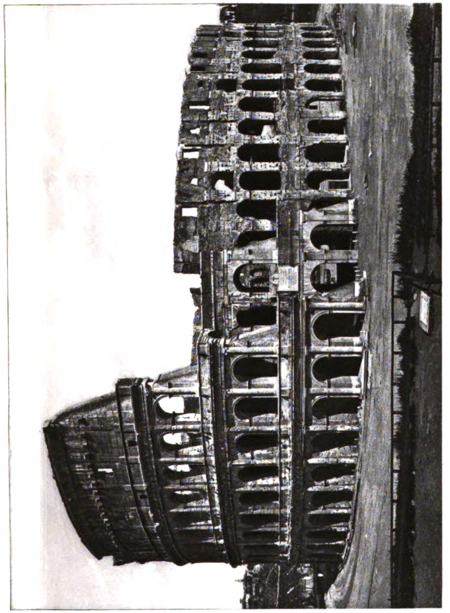
[XII-204]
The abolition at Rome of the ancient games must be understood with some latitude; and the carnival sports of the Testacean Mount and the Circus Agonalis [64] were regulated by the law [65] or custom of the city. The senator presided with dignity and pomp to adjudge and distribute the prizes, the gold ring, or the pallium, [66] as it was styled, of cloth or silk. A tribute on the Jews supplied the annual expense; [67] and the races, on foot, on horseback, or in chariots, were ennobled by a tilt and tournament of seventy-two of the Roman youth. In the year one thousand three hundred and thirty-two, a bull-feast, after the fashion of the Moors and Spaniards, was celebrated in the Coliseum itself; and the living manners are painted in a diary of the times. [68] A convenient order of benches was restored; and a general proclamation, as far as Rimini and Ravenna, invited the nobles to exercise their skill and courage in this perilous adventure. The Roman ladies were [XII-205] marshalled in three squadrons, and seated in three balconies, which on this day, the third of September, were lined with scarlet cloth. The fair Jacova di Rovere led the matrons from beyond the Tiber, a pure and native race, who still represent the features and character of antiquity. The remainder of the city was divided, as usual, between the Colonna and Ursini; the two factions were proud of the number and beauty of their female bands: the charms of Savella Ursini are mentioned with praise; and the Colonna regretted the absence of the youngest of their house, who had sprained her ankle in the garden of Nero’s tower. The lots of the champions were drawn by an old and respectable citizen; and they descended into the arena, or pit, to encounter the wild bulls on foot, as it should seem, with a single spear. Amidst the crowd, our annalist has selected the names, colours, and devices of twenty of the most conspicuous knights. Several of the names are the most illustrious of Rome and the ecclesiastical state; Malatesta, Polenta, della Valle, Cafarello, Savelli, Capoccio, Conti, Annibaldi, Altieri, Corsi; the colours were adapted to their taste and situation; the devices are expressive of hope or despair, and breathe the spirit of gallantry and arms. “I am alone like the youngest of the Horatii,” the confidence of an intrepid stranger; “I live disconsolate,” a weeping widower; “I burn under the ashes,” a discreet lover; “I adore Lavinia, or Lucretia,” the ambiguous declaration of a modern passion; “My faith is as pure,” the motto of a white livery; “Who is stronger than myself?” of a lion’s hide; “If I am drowned in blood, what a pleasant death!” the wish of ferocious courage. The pride or prudence of the Ursini restrained them from the field, which was occupied by three of their hereditary rivals, whose inscriptions denoted the lofty greatness of the Colonna name: “Though sad, I am strong;” “Strong as I am great;” “If I fall,” addressing himself to the spectators, “you fall with me;” — intimating (says the contemporary writer) that, while the other families were the subjects of the Vatican, they [XII-206] alone were the supporters of the Capitol. The combats of the amphitheatre were dangerous and bloody. Every champion successively encountered a wild bull; and the victory may be ascribed to the quadrupeds, since no more than eleven were left on the field, with the loss of nine wounded, and eighteen killed, on the side of their adversaries. Some of the noblest families might mourn, but the pomp of the funerals, in the churches of St. John Lateran and Sta. Maria Maggiore, afforded a second holiday to the people. Doubtless it was not in such conflicts that the blood of the Romans should have been shed; yet, in blaming their rashness, we are compelled to applaud their gallantry; and the noble volunteers, who display their magnificence and risk their lives under the balconies of the fair, excite a more generous sympathy than the thousands of captives and malefactors who were reluctantly dragged to the scene of slaughter. [69]
This use of the amphitheatre was a rare, perhaps a singular, festival: the demand for the materials was a daily and continual want, which the citizens could gratify without restraint or remorse. In the fourteenth century, a scandalous act of concord secured to both factions the privilege of extracting stones from the free and common quarry of the Coliseum; [70] and Poggius laments that the greater part of these stones had been burnt to lime by the folly of the Romans. [71] To check this abuse, and to prevent the nocturnal [XII-207] crimes that might be perpetrated in the vast and gloomy recess, Eugenius the Fourth surrounded it with a wall; and, by a charter long extant, granted both the ground and edifice to the monks of an adjacent convent. [72] After his death, the wall was overthrown in a tumult of the people; and, had they themselves respected the noblest monument of their fathers, they might have justified the resolve that it should never be degraded to private property. The inside was damaged; but, in the middle of the sixteenth century, an era of taste and learning, the exterior circumference of one thousand six hundred and twelve feet was still entire and inviolate; a triple elevation of fourscore arches, which rose to the height of one hundred and eight feet. Of the present ruin the nephews of Paul the Third are the guilty agents; and every traveller who views the Farnese palace may curse the sacrilege and luxury of these upstart princes. [73] A similar reproach is applied to the Barberini; and the repetition of injury might be dreaded from every reign, till the Coliseum was placed under the safeguard of religion by the most liberal of the pontiffs, Benedict the Fourteenth, who consecrated a spot which persecution and fable had stained with the blood of so many Christian martyrs. [74]
[XII-208]
When Petrarch first gratified his eyes with a view of those monuments whose scattered fragments so far surpass the most eloquent descriptions, he was astonished at the supine indifference [75] of the Romans themselves; [76] he was humbled rather than elated by the discovery that, except his friend Rienzi and one of the Colonna, a stranger of the Rhône was more conversant with these antiquities than the nobles and natives of the metropolis. [77] The ignorance and credulity of the Romans are elaborately displayed in the old survey of the city, which was composed about the beginning of the thirteenth century; and, without dwelling on the manifold errors of name and place, the legend of the Capitol [78] may provoke a smile of contempt and indignation. “The Capitol,” says the anonymous writer, “is so named as being the head of the world; where the consuls and senators formerly resided for the government of the city and the globe. The strong and lofty walls were covered with glass and gold, and crowned with a roof of the richest and most curious carving. [XII-209] Below the citadel stood a palace, of gold for the greatest part, decorated with precious stones, and whose value might be estimated at one third of the world itself. The statues of all the provinces were arranged in order, each with a small bell suspended from its neck; and such was the contrivance of art-magic [79] that, if the province rebelled against Rome, the statue turned round to that quarter of the heavens, the bell rang, the prophet of the Capitol reported the prodigy, and the senate was admonished of the impending danger.” A second example of less importance, though of equal absurdity, may be drawn from the two marble horses, led by two naked youths, which have since been transported from the baths of Constantine to the Quirinal Hill. The groundless application of the names of Phidias and Praxiteles may perhaps be excused; but these Grecian sculptors should not have been removed above four hundred years from the age of Pericles to that of Tiberius; they should not have been transformed into two philosophers or magicians, whose nakedness was the symbol of truth and knowledge, who revealed to the emperor his most secret actions, and, after refusing all pecuniary recompense, solicited the honour of leaving this eternal monument of themselves. [80] Thus awake to the power of magic, the Romans were insensible to the beauties of art: no more than five statues were visible to the eyes of Poggius; and, of the multitudes which chance or design had buried under the ruins, the resurrection was fortunately delayed till a safcr and more enlightened age. [81] The Nile, which now adorns [XII-210] the Vatican, had been explored by some labourers in digging a vineyard near the temple, or convent, of the Minerva; but the impatient proprietor, who was tormented by some visits of curiosity, restored the unprofitable marble to its former grave. [82] The discovery of a statue of Pompey, ten feet in length, was the occasion of a law-suit. It had been found under a partition-wall: the equitable judge had pronounced that the head should be separated from the body, to satisfy the claims of the contiguous owners; and the sentence would have been executed, if the intercession of a cardinal and the liberality of a pope had not rescued the Roman hero from the hands of his Barbarous countrymen. [83]
But the clouds of Barbarism were gradually dispelled; and the peaceful authority of Martin the Fifth and his successors restored the ornaments of the city as well as the order of the ecclesiastical state. The improvements of Rome, since the fifteenth century, have not been the spontaneous produce of freedom and industry. The first and most natural root of a great city is the labour and populousness of the adjacent country, which supplies the materials of subsistence, of manufactures, and of foreign trade. But the greater part of the Campagna of Rome is reduced to a dreary and desolate wilderness; the overgrown estates of the princes and the clergy are cultivated by the lazy hands of indigent and hopeless vassals; and the scanty harvests are confined or exported [XII-211] for the benefit of a monopoly. A second and more artificial cause of the growth of a metropolis is the residence of a monarch, the expense of a luxurious court, and the tributes of dependent provinces. Those provinces and tributes had been lost in the fall of the empire; and, if some streams of the silver of Peru and the gold of Brazil have been attracted by the Vatican, the revenues of the cardinals, the fees of office, the oblations of pilgrims and clients, and the remnant of ecclesiastical taxes afford a poor and precarious supply, which maintains, however, the idleness of the court and city. The population of Rome, far below the measure of the great capitals of Europe, does not exceed one hundred and seventy thousand inhabitants; [84] and, within the spacious enclosure of the walls, the largest portion of the seven hills is overspread with vineyards and ruins. The beauty and splendour of the modern city may be ascribed to the abuses of the government, to the influence of superstition. Each reign (the exceptions are rare) has been marked by the rapid elevation of a new family, enriched by the childless pontiff at the expense of the church and country. The palaces of these fortunate nephews are the most costly monuments of elegance and servitude; the perfect arts of architecture, painting, and sculpture have been prostituted in their service; and their galleries and gardens are decorated with the most precious works of antiquity, which taste or vanity has prompted them to collect. The ecclesiastical revenues were more decently employed by the popes themselves in the pomp of the Catholic worship; but it is superfluous to enumerate their pious foundations of altars, chapels, and churches, since these lesser stars are eclipsed by the sun of the Vatican, by the dome of St. Peter, the most glorious structure that ever has [XII-212] been applied to the use of religion. The fame of Julius the Second, Leo the Tenth, and Sixtus the Fifth is accompanied by the superior merit of Bramante and Fontana, of Raphael and Michael-Angelo; and the same munificence which had been displayed in palaces and temples was directed with equal zeal to revive and emulate the labours of antiquity. Prostrate obelisks were raised from the ground and erected in the most conspicuous places; of the eleven aqueducts of the Cæsars and Consuls, three were restored; the artificial rivers were conducted over a long series of old or of new arches, to discharge into marble basons a flood of salubrious and refreshing waters; and the spectator, impatient to ascend the steps of St. Peter’s, is detained by a column of Egyptian granite, which rises between two lofty and perpetual fountains to the height of one hundred and twenty fect. The map, the description, the monuments of ancient Rome have been elucidated by the diligence of the antiquarian and the student; [85] and the footsteps of heroes, the relics, not of superstition, but of empire, are devoutly visited by a new [XII-213] race of pilgrims from the remote, and once savage, countries of the North.
Of these pilgrims, and of every reader, the attention will be excited by an History of the Decline and Fall of the Roman Empire: the greatest, perhaps, and most awful scene in the history of mankind. The various causes and progressive effects are connected with many of the events most interesting in human annals: the artful policy of the Cæsars, who long maintained the name and image of a free republic; the disorder of military despotism; the rise, establishment, and sects of Christianity; the foundation of Constantinople; the division of the monarchy; the invasion and settlements of the Barbarians of Germany and Scythia; the institutions of the civil law; the character and religion of Mahomet; the temporal sovereignty of the popes; the restoration and decay of the Western empire of Charlemagne; the crusades of the Latins in the East; the conquests of the Saracens and Turks; the ruin of the Greek empire; the state and revolutions of Rome in the middle age. The historian may applaud the importance and variety of his subject; but, while he is conscious of his own imperfections, he must often accuse the deficiency of his materials. It was among the ruins of the Capitol that I first conceived the idea of a work which has amused and exercised near twenty years of my life, and which, however inadequate to my own wishes, I finally deliver to the curiosity and candour of the public.
Lausanne,
June 27, 1787.
[XII-214]
[XII-215]
APPENDIX: ADDITIONAL NOTES BY THE EDITOR↩
NOTE 1.: SOURCES FOR THE SIEGE OF CONSTANTINOPLE, ad 1453 — (CHAP. LXVIII) ↩
For the siege of Constantinople, Gibbon had only three accounts by eye-witnesses, that of Phrantzes, that of Leonardus of Chios, and that of Cardinal Isidore (see above, p. 6, note 12). Several other relations by persons who were in the city during the siege have been published during the present century.
Chief among these is the Journal of a Venetian, Nicolò Barbaro: Giornale dell’ assedio di Constantinopoli 1453, edited by E. Cornet, 1856. [1] It is invaluable for determining the diary of the siege; but it is marked by hostility and spite towards the Genoese, especially Giustiniani, and by contempt for the Greeks.
An “Informacion” sent by Francesco de Tresves to the Cardinal d’Avignon, and also by Jehan Blanchin and Jacques Tedardi (or Tedaldi) of Florence, on the capture of Constantinople. Edited in Martene and Durand, Thesaurus, i. p. 1819 sqq. (1717) and in Chartier’s Chroniques de Charles VII., iii. p. 20 sqq., 1858. Tedardi was an eye-witness. He escaped by throwing himself into the water, and was rescued by a Venetian boat.
Ubertino Pusculo of Brescia, who was also fortunate enough to escape, has left an account of the last episode of the history of the Empire in four Books of Latin hexameters. It contributes little enough to our knowledge of facts. The description of the siege does not begin till the middle of the Third book. In the First book there is an account of the battle of Varna, and much about the ecclesiastical antagonism of the Greeks and Latins. The Second begins with the death of John Palacologus and the accession of Constantine, and contains a virulent description of the moral degeneration of the people of Constantinople (v. 117 sqq.): —
obscaena sanctae pietatis in urbe
nec species nec forma fuit, nec gratia recti,
nec virtutis amor (v. 141).
The work is published in Ellissen’s Analekten, vol. iii., as an appendix, 1857.
An anonymous Greek poem, in political verses, under the title of Capture of Constantinople (Ἅλωσις Κωνσταντινουπόλεος), is misnamed, for it touches only incidentally on the facts of the siege and is in this respect of little historical importance. It is really an appeal to the powers of the West —
αὐθένταις εὐγενέστατοι, τη̂ς Δύσης μεγιστα̂νες —
[XII-216]
French and English, Spanish and Germans
Φραζζέζους καὶ Ἀγκέζιδες, Σπανιόλους, Ἀλαμάνους —
to combine and recover Constantinople from the unbelievers. The Venetians are especially encouraged and urged to set the example —
Ὧ Βενετζιάνοι ϕρόνιμοι, πρακταɩ̂οι κ’ ἐπιδέξιοι.
The Hungarians, Servians, and Walachians are incited to avenge the defeat of Varna: —
Ὦ Βλαχία πολύθλιβη, Σερβίαπονεμένη,
θυμεɩ̂σθε ταɩ̂ς αἱχμαλωσιαɩ̂ς, Οὐγκρία λυπημένη.
The author, though orthodox, was not extreme in his ecclesiastical views. He probably lived within reach of Mohammad’s arm, for he will not disclose his name: —
Τώρα σκεπάζω τὄνομα καὶ κρύβω τὅνομά μου,
νὰ μὴ τὸ ’ξεύρουν οἱ πολλοὶ τἱς [Editor: Illegible character] τοιαν̂τα γράψας,
but gives his friends the means of knowing his identity by mentioning two bodily marks — a black mole on the little finger of his right hand, and another of the same size on his left hand (vv. 10, 20 sqq.). The work was first edited by Ellissen in vol. iii. of his Analekten (1857), with introduction, translation, and analysis, under the title Dirge of Constantinople (Θρη̂νος Κωνσταντινοπόλεως — a misnomer, for it is not a dirge but a tearful appeal. Legrand published an improved text in 1880 in vol. i. of his Bibl. grecque vulgairc, p. 169 sqq.
A Slavonic account, written probably by a Slav of some of the Balkan countries, is also preserved, and has been published by Sreznevski under the title: Skazaniia o vziatii Tsargrada bezbozhnym turetskym sultanom, in the Zapiski of the 2nd Division of the St. Petersburg Academy of Science, vol. i. p. 99 sqq., 1854.
We have another Slavonic account, written in a mixture of Polish and Servian, by a Janissary of Mohammad, named Michael, who took part in the siege. He was a Servian of Ostrovića, and in his later years he went to Poland and wrote his Memoirs, which were edited, as “Pamietniki Janiczara,” by Galezowsky in 1828, in vol. v. of his collection of Polish writers (Zbior Pisarzow Polskieh). This relation is especially valuable as written from outside, by one who knew what was going on in the camp of the besiegers. It has been utilised by M. Mijatovich in his account of the siege (see below).
A report by the Father Superior of the Franciscans who was at Galata during the siege was printed by Muratori in vol. 18 (p. 701) of the Scr. Rer. It.: Rapporto del Superiore dei Franciscani presente all’ assedio et alla presa di Constantinopoli. It seems to have escaped the notice of Gibbon.
An account by Christoforo Riccherio (La presa di Constantinopoli) is inserted in Sansovino’s Dell’ Historia Universale dell’ origine et imperio de Turchi (1564), p. 343 sqq.
Abraham, an Armenian monk, who was present at the siege, wrote a “Mélodie élégiaque,” which was translated into French by Brosset and printed in St. Martin’s ed. of Lebeau’s Histoire du Bas-Empire (xxi. p. 307 sqq.) which Brosset completed.
Adam de Montaldo, of Genoa: De Constantinopolitano excidio ad nobilissimum juvenem Melleducam Cicalam, amicum optimum; edited by C. Desimoni, in the Atti della Società Ligure di storia patria, x. p. 325 sqq., 1874.
Besides these relations of eye-witnesses we have some additional contemporary [XII-217] accounts which were not accessible to Gibbon. The most important of these sources, Critobulus, has been spoken of in Appendix 1 of vol. xi.
Zorzi Dolphin wrote an account of the “siege and capture of Constantinople in 1453,” which was published by G. M. Thomas in the Sitzungsberichte of the Bavarian Academy, 1868. His sources were the reports of Leonardo of Chios, Philip da Rimano, and anonymous eye-witnesses. He adds little to the story.
A letter of the Genoese “Podestà of Pera,” written on June 23, 1853, giving a brief account of the capture, was published by Sylvestre de Sacy in Notices et extraits des manuscripts de la bibliothèque du Roi, xi. 1, p. 74, 1827.
Documents throwing light on the policy of the Genoese in the fatal year will be found in Vigna’s Codice diplomatico delle Colonie Tauro-Liguri, durante la Signoria dell’ uficio de S. Georgio (1453-1475), 1868.
Of little importance for the siege is the Amyris of Filelfo— on the life and deeds of Mohammad in 4 Books — published in Hopf’s Chroniques gréco-romanes. The Ἀνάκληματη̂ς Κωνσταντινόπολης (the anonymous writer of these verses was possibly a Cretan) published by Legrand, Collection de monuments, Nouv. sér., v. p. 85 sqq., and the Θρη̂νος on the capture, published by Lampros in Ἑστία, 1886, p. 821 sqq., tell us nothing. A Monody of Andronicus Callistus, in Migne’s Patr. Gr., 161, p. 1124, teaches us, as Paspates has pointed out, that there was water in the ditch outside the western wall.
The final scene of the siege is briefly described in Spandugino Cantacusino’s Della origine de principi Turchi (which is included in Bk. ii. of Sansovino’s Dell’ Historia Universale, p. 187 sqq.), p. 195-6.
There are a number of other documents extant which have not yet been printed. C. Hopf and A. Dethier had designed and prepared the publication of these in the Monumenta Hungar. Hist., along with many sources which had been already published. Four volumes lie in MS.; a description of their contents is given by Krumbacher in his Gesch. der byzantinischen Litteratur2, p. 311-12.
Brosset gathered some material from Armenian and Georgian sources; see the last vol. of St. Martin’s edit. of Lebeau’s Histoire du Bas-Empire.
The Turkish authorities are of very little value for the siege; they were utilised by Hammer. The earliest Ottoman historians belong to the end of the 15th century, viz. the History of the great-grandson of Ashīk-Pasha (who lived under Murad I.); the anonymous chronicle, Tarīkhi Ali Osmān; the World-view of Neshri. See Hammer’s Introduction to his History. These earlier works were used by the most famous of Ottoman historians, Sad ad-Dīn, in his Crown of Histories (written under Murad III., end of 16th cent.).
The following is a list of the chief modern accounts of the siege that have appeared since Gibbon wrote: —
Hammer, Geschichte des osmanischen Reiches, i. p. 398 sqq., 1834.
Zinkeisen, Geschichte des osmanischen Reiches, i. p. 811 sqq., 1840.
Stassulevich (J.), Osada i Vziatie Vizantii Turkami, 1854.
Sreznevski, Poviest o Tsargradie, 1855.
Mordtmann (A. D.), Belagerung und Eroberung Constantinopels durch die Türken im Jahre 1453; 1858. (This had two advantages over previous accounts. Mordtmann knew the ground; and he made use of the diary of Barbaro.)
Finlay, History of Greece, vol. iii. p. 503 sqq.
Broadribb and Besant, Constantinople, a sketch of its history from its foundation to its conquest by the Turks, 1879.
[XII-218]
Vlasto (E. H.), Les derniers jours de Constantinople, 1883.
Paspatês (A. G.), Πολιορκία καὶ ἅλωσις τη̂ς Κωνσταντινουπόλεως ὑπὸ τω̂ν Ὀθωμανω̂ν ὲν ἔτει, 1453; 1890.
Mijatovich (Ch.) Constantine, Last Emperor of the Greeks, 1892.
The sources have been dealt with in an article by P. Pogodin in the Zhurnal min. narod. prosv., vol. 283, August, 1889.
A. van Millingen’s Byzantine Constantinople (1899), which appeared too late to be used in the preparation of this volume, contains much material for the study of the siege, and many difficulties in the episode are discussed. It may be observed that the author argues with considerable force from the view that the route of the Turkish ships across the hills was by the valley of Dolma Bagtchè, a distance of three miles. This is the view adopted above, p. 33, note 63.
Endnotes to the Front Matter in Volume 1
[1] Copyright, 1877, by R. S. Peale and J. A. Hill.
PREFACE OF THE AUTHOR↩
[1] The first volume of the quarto, which is now contained in the two first volumes of the octavo edition.
[1] The Author, as it frequently happens, took an inadequate measure of his growing work. The remainder of the first period has filled two volumes in quarto, being the third, fourth, fifth and sixth volumes of the octavo edition.
[1] [Containing chaps. i. to xxxviii.]
ADVERTISEMENT TO THE NOTES↩
[1] [Which in the first quarto edition of vol. i. were printed at the end of the volume.]
PREFACE TO THE FOURTH VOLUME OF THE QUARTO EDITION↩
[1] See Dr. Robertson’s Preface to his History of America.
INTRODUCTION BY THE EDITOR↩
[1] It is stated that there are also unimportant annotations in vols. iv. and vi.
[2] The influence of Gibbon’s picture of Julian can be discerned in Ibsen’s “Emperor and Galilæan.”
[3] In a footnote to the Autobiography.
[4] In some other cases I have corrected the text in this and the following volume. (1) vol. i. p. 69, n. 109; Sumelpur for Jumelpur, see Appendix 9. (2) vol. ii. p. 29, l. 8 from top; the reading of the received text “public” is surely a printer’s error, which escaped detection, for “republic,” which I have ventured to restore. (3) vol. ii. p. 55, l. 6 from foot, I have assumed an instance of “lipography.” (4) vol. ii. n. 35, “Lycius” had been already corrected (see Smith’s ed.) to “Lydius.” Probably Gibbon had his Zosimus open before him when he wrote this note, and his pen traced Lycius because Lycia happened to occur in the very next line of his authority. I have followed Sir William Smith’s precedent in dealing freely with the punctuation, and in modernising the spelling of a few words.
[5] In the Chronica Minora (M.G.H.), vol. i. 512 sqq. See vol. ii. p. 360.
[6] Gibbon had a notion of this, but did not apply it methodically. See in vol. ii. p. 227, note 59: “but those modern Greeks had the opportunity of consulting many writers which have since been lost.” And see, in general, his Preface to the fourth volume of the quarto ed.
[7] In Mahometan history in general, it may be added, not only has advance been made by access to new literary oriental documents, but its foundations have been more surely grounded by numismatic researches, especially those of Mr. Stanley Lane-Poole. This scholar’s recently published handbook containing tables and lists of the “Mohammadan” Dynasties is a guerdon for which students of history must be most deeply grateful. The special histories of Mahometan Sicily and Spain have been worked out by Amari and Dozy. For the Mongols we have the overwhelming results of Sir Henry Howorth’s learning and devotion to his “vasty” subject.
[8] It may be said for Gibbon, however, that even Mommsen, in his volume on the Provinces, has adopted this practice of blending evidence of different dates. For the historical artist, it is very tempting, when the evidence for any particular period is scanty; but in the eyes of the scientific historian it is indefensible.
[9] Especially the Corpus Ecclesiasticorum Latinorum.
[10] Usener, Der heilige Theodosios, 1890. Krumbacher, Studien zu den Legenden des heiligen Theodosios, 1892. It is worth while to state briefly what the chief problem is. The legends of the saints were collected, rehandled, cleansed of casual heresy, and put into literary form in the tenth century (towards its close according to Vasilievski) by Symeon Metaphrastes. Most of our MSS. are derived from the edition of Symeon; but there are also extant, some, comparatively few, containing the original pre-Symeonic versions, which formed the chief literary recreation of ordinary men and women before the tenth century. The problem is to collect the materials for a critical edition of as many legends as have been preserved in their original form. When that is done, we shall have the data for fully appreciating the methods of Symeon. As for the text Krumbacher points out that what we want is a thoroughgoing study of the Grammar of the MSS.
[11] M. Schlumberger followed up this work by an admirable monograph on Nicephorus Phocas, luxuriously illustrated; and we are looking forward to the appearance of a companion work on Basil II.
[12] The first volume of Mr. Pelham’s history of the Empire, which is expected shortly, will show, when compared with Merivale, how completely our knowledge of Roman institutions has been transformed within a very recent period.
[13] This has been best pointed out by C. Neumann.
[14] Chap. xlviii. ad init., where a full statement of his view of the later Empire will be found.
[15] I need not repeat here what I have said elsewhere, and what many others have said (recently Mr. Frederic Harrison in two essays in his volume entitled The Meaning of History), as to the various services of the Empire to Europe. They are beginning to be generally recognised and they have been brought out in Mr. C. W. Oman’s brief and skilful sketch of the “Byzantine Empire” (1892).
[16] Since then a Greek scholar, K. Paparrigopulos, has covered the whole history of Greece from the earliest times to the present century, in his Ἰστορία τον̂ Ἑλληνικον̂ ἔθνους. The same gigantic task, but in a more popular form, has been undertaken and begun by Professor Lambros, but is not yet finished.
[17] Geschichte der byzantinischen Litteratur (565-1453), 1891.
[18] I was seduced by this hypothesis of Ranke (Later Roman Empire, i. 363), but no longer believe in it.
[19] Procopiana, 1891.
[20] One of the author’s points is that Justinian was the real ruler during the nominal reign of Justin, who was an “ass.” Hence he dates Justinian’s administration (not of course his Imperial years) from 518. The consequence of this important discovery of Haury, which he has proved up to the hilt, is that the work was written in 550 (not, as before believed, in 559) — the thirty-second year of Justinian’s administration.
[21] The Life of Justinian by Theophilus, in the English Historical Review. Vasil’ev has given an account of Mr. Bryce’s article in the Vizantiski Vremennik, i. 469 sqq.
[22] The Persian and Lazic wars have been related in detail in my Later Roman Empire, vol. i.
[23] His new work on the reservoirs of Constantinople may be specially mentioned.
[24] Byzantina. Ocherki, materialy, i. zamietki po Vizantiskim drevnostiam. 1891-3. I must not omit to mention Dr. Mordtmann’s valuable Esquisse topographique (1892), and N. Destunis has made noteworthy contributions to the subject.
[25] With blameworthy indiscretion I accepted this false view of Paspatês, in my Later Roman Empire, without having gone methodically into the sources. I was misled by the fame won by the supposed “topographical discoveries” of this diligent antiquarian and by his undeservedly high reputation; this, however, is no excuse, and unfortunately the error has vitiated my account of the Nika revolt. I have gone into the theory of Paspatês in the Scottish Review (April, 1894), where he is treated too leniently. His misuse of authorities is simply astounding. I may take the opportunity of saying that I hope to rewrite the two volumes of my Later Roman Empire and correct, so far as I may be able, its many faults. A third volume, dealing with the ninth century, will, I hope, appear at a not too distant date.
[26] The Greek and the French versions were published by Buchon, uncritically. A new edition of the Greek text is promised by Dr. John Schmitt.
[27] The history of mediæval Athens has been recorded at length in an attractive work by Gregorovius, the counterpart of his great history of mediæval Rome.
[28] For a full account of Vulgär-griechische Litterature, I may refer to Krumbacher’s Gesch. der Byz. Litt. Here it is unnecessary to do more than indicate its existence and importance. I may add that the historian cannot neglect the development of the language, for which these romances (and other documents) furnish ample data. Here the Greeks themselves have an advantage, and scholars like Hatzidakês, Psicharês, and Jannarês are in this field doing work of the best kind.
[29] Fallmerayer’s thesis that there was no pure Hellenic blood in Greece was triumphantly refuted. No one denies that there was a large Slavonic element in the country parts, especially of the Peloponnesus.
[30] In a paper entitled, The Coming of the Hungarians, in the Scottish Review of July, 1892, I have discussed the questions connected with early Magyar history, and criticised Hunfalvy’s Magyarország Ethnographiája (1876) and Vámbéry’s A magyarok eredete (1882). One of the best works dealing with the subject has been written by a Slav (C. Grot).
[31] Ilovaiski’s work Istorija Rossii, vol. i. (Kiev period), is, though his main thesis is a mistake, most instructive.
[32] Chwolson, Izviestiia o Chozarach, Burtasach, Bolgarach, Madiarach, Slavaniach, i Rusach.
[33] And who regarded history as “little more than the register of the crimes, follies and misfortunes of mankind” (see below, p. 98).
Endnotes to the Chapters in Volume 1
Endnotes to Chapter I↩
[1] Dion Cassius (l. liv. p. 736 [8]) with the annotations of Reimar, who has collected all that Roman vanity has left upon the subject. The marble of Ancyra, on which Augustus recorded his own exploits, asserts that he compelled the Parthians to restore the ensigns of Crassus.
[2] Strabo (l. xvi. p. 780), Pliny the elder (Hist. Natur. l. vi. 32, 35 [28, 29]) and Dion Cassius (l. liii. p. 723 [29], and l. liv. p. 734 [6]) have left us very curious details concerning these wars. The Romans made themselves masters of Mariaba, or Merab, a city of Arabia Felix, well known to the Orientals (see Abulfeda and the Nubian geography, p. 52). They were arrived within three days’ journey of the Spice country, the rich object of their invasion. [See Mommsen, Römische Geschichte, v. p. 608 sqq.]
[3] By the slaughter of Varus and his three legions. See the first book of the Annals of Tacitus. Sueton. in August. c. 23, and Velleius Paterculus, l. ii. c. 117, &c. Augustus did not receive the melancholy news with all the temper and firmness that might have been expected from his character.
[4] Tacit. Annal. l. ii. [i. 11]. Dion Cassius, l. lvi. p. 832 [33], and the speech of Augustus himself, in Julian’s Cæsars. It receives great light from the learned notes of his French translator, M. Spanheim.
[5] Germanicus, Suetonius Paulinus, and Agricola were checked and recalled in the course of their victories. Corbulo was put to death. Military merit, as it is admirably expressed by Tacitus, was, in the strictest sense of the word, imperatoria virtus.
[6] Cæsar himself conceals that ignoble motive; but it is mentioned by Suetonius, c. 47. The British pearls proved, however, of little value, on account of their dark and livid colour. Tacitus observes, with reason (in Agricola, c. 12), that it was an inherent defect. “Ego facilius crediderim, naturam margaritis deesse quam nobis avaritiam.”
[7] Claudius, Nero, and Domitian. A hope is expressed by Pomponius Mela, l. iii. c. 6 (he wrote under Claudius), that, by the success of the Roman arms, the island and its savage inhabitants would soon be better known. It is amusing enough to peruse such passages in the midst of London.
[8] See the admirable abridgment, given by Tacitus, in the Life of Agricola, and copiously, though perhaps not completely, illustrated by our own antiquarians, Camden and Horsley. [See Appendix 2.]
[9] [There is no good ground for the identification of mons Graupius with the Grampian hills. The date of the battle was 84 or 85 ad; the place is quite uncertain.]
[10] The Irish writers, jealous of their national honour, are extremely provoked on this occasion, both with Tacitus and with Agricola. [Agricola’s design was not carried out because Domitian refused to send the additional legion.]
[11] See Horsley’s Britannia Romana, l. i. c. 10.
[12] The poet Buchanan celebrates, with elegance and spirit (see his Sylvæ, v.), the unviolated independence of his native country. But, if the single testimony of Richard of Cirencester was sufficient to create a Roman province of Vespasiana to the north of the wall, that independence would be reduced within very narrow limits.
[13] See Appian (in Prooem. [5]) and the uniform imagery of Ossian’s poems, which, according to every hypothesis, were composed by a native Caledonian.
[14] See Pliny’s Panegyric, which seems founded on facts.
[15] Dion Cassius, l. lxvii. [6 et sqq.].
[16] Herodotus, l. iv. c. 94. Julian in the Cæsars, with Spanheim’s observations.
[17] Plin. Epist. viii. 9.
[18] Dion Cassius, l. lxviii. p. 1123, 1131 [6 and 14]. Julian. in Cæsaribus. Eutropius, viii. 2, 6. Aurelius Victor in Epitome. [See Appendix 3.]
[19] See a Memoir of M. d’Anville, on the Province of Dacia, in the Académie des Inscriptions, tom. xxviii. p. 444-468. [The region east of the Aluta, corresponding to the modern Walachia, was not included in Dacia, but went with the province of Lower Mœsia. See Domaszewski, Epigr. Mittheilungen, xiii. p. 137. The limits of Dacia are incorrect in the map in this volume. They should follow the line of the Carpathians in the south-east and east, excluding Walachia and Moldavia.]
[20] Trajan’s sentiments are represented in a very just and lively manner in the Cæsars of Julian. [The date of the beginning of the Parthian War is 114 ad]
[21] Eutropius and Sextus Rufus have endeavoured to perpetuate the illusion. See a very sensible dissertation of M. Freret, in the Académie des Inscriptions, tom. xxi. p. 55.
[22] Dion Cassius, l. lxviii. [18 et sqq.]; and the Abbreviators.
[23] [117 ad A triumph in honour of this eastern expedition was celebrated after the emperor’s death. On inscriptions he is called Divus Traianus Parthicus, instead of Divus Traianus (Schiller, Gesch. der röm. Kaiser zeit, i. 563).]
[24] Ovid Fast. l. ii. ver. 667. See Livy [i. 55], and Dionysius of Halicarnassus, under the reign of Tarquin.
[25] St. Augustin is highly delighted with the proof of the weakness of Terminus, and the vanity of the Augurs. See De Civitate Dei, iv. 29. [The loss of trans-Rhenane Germany was a previous instance of the retreat of Terminus.]
[26] See the Augustan History, p. 5 [i. 9]. Jerome’s Chronicle, and all the Epitomisers. It is somewhat surprising, that this memorable event should be omitted by Dion, or rather by Xiphilin. [See Appendix 3.]
[27] Dion, l. lxix. p. 115 [9]. Hist. August. p. 5, 8 [i. 10 and 16]. If all our historians were lost, medals, inscriptions, and other monuments would be sufficient to record the travels of Hadrian. [See Dürr, Die Reisen des Kaisers Hadrian, 1881.]
[28] See the Augustan History and the Epitomes. [Date: 138-161 ad]
[29] We must, however, remember that, in the time of Hadrian, a rebellion of the Jews raged with religious fury, though only in a single province. Pausanias (l. viii. c. 43) mentions two necessary and successful wars, conducted by the generals of Pius. 1st, Against the wandering Moors, who were driven into the solitudes of Atlas. 2d, Against the Brigantes of Britain, who had invaded the Roman province. Both these wars (with several other hostilities) are mentioned in the Augustan History, p. 19 [iii. 5].
[30] Appian of Alexandria, in the preface to his History of the Roman Wars [7].
[31] Dion, l. lxxi. Hist. August. in Marco [iv. 9, 12, 17, 20, 22, &c.]. The Parthian victories gave birth to a crowd of contemptible historians, whose memory has been rescued from oblivion, and exposed to ridicule, in a very lively piece of criticism of Lucian.
[32] The poorest rank of soldiers possessed above forty pounds sterling (Dionys. Halicarn. iv. 17), a very high qualification, at a time when money was so scarce, that an ounce of silver was equivalent to seventy pound weight of brass. The populace, excluded by the ancient constitution, were indiscriminately admitted by Marius. See Sallust. de Bell. Jugurth. c. 91 [86].
[33] Cæsar formed his legion Alauda of Gauls and strangers; but it was during the licence of civil war; and after the victory he gave them the freedom of the city, for their reward. [It was really formed, bc 55; Suetonius, Jul. 24.]
[34] See Vegetius de Re Militari, l. i. c. 2-7.
[35] The oath of service and fidelity to the emperor was annually renewed by the troops, on the first of January.
[36] Tacitus calls the Roman Eagles, Bellorum Deos. They were placed in a chapel in the camp, and with the other deities received the religious worship of the troops.
[37] See Gronovius de Pecunia vetere, l. iii. p. 120, &c. The emperor Domitian raised the annual stipend of the legionaries to twelve pieces of gold, which, in his time, was equivalent to about ten of our guineas. This pay, somewhat higher than our own, had been, and was afterwards, gradually increased, according to the progress of wealth and military government. After twenty years’ service, the veteran received three thousand denarii (about one hundred pounds sterling), or a proportionable allowance of land. The pay and advantages of the guards were, in general, about double those of the legions.
[38] Exercitus ab exercitando, Varro de Linguâ Latinâ, l. iv. [v. 87 ed. L. Müller]. Cicero in Tusculan, l. ii. 37. There is room for a very interesting work, which should lay open the connection between the languages and manners of nations.
[39] Vegetius, l. i. c. 11, and the rest of his first book.
[40] The Pyrrhic Dance is extremely well illustrated by M. le Beau, in the Académie des Inscriptions, tom. xxxv. p. 262, &c. That learned academician, in a series of memoirs, has collected all the passages of the ancients that relate to the Roman legion.
[41] Joseph. de Bell. Judaico, l. iii. c. 5. We are indebted to this Jew for some very curious details of Roman discipline.
[42] Plin. Panegyr. c. 13. Life of Hadrian, in the Augustan History [i. 14]. [Fragments of a speech which Hadrian delivered to his soldiers at Lambaesis in Africa have been found in an inscription, C. I. L. viii. 2532.]
[43] See an admirable digression on the Roman discipline, in the sixth book of his history [19-42].
[44] Vegetius de Re Militari, l. ii. c. 5, &c. Considerable part of his very perplexed abridgment was taken from the regulations of Trajan and Hadrian; and the legion, as he describes it, cannot suit any other age of the Roman empire.
[45] Vegetius de Re Militari, l. ii. c. 1. In the purer age of Cæsar and Cicero, the word miles was almost confined to the infantry. Under the Lower Empire, and in the times of chivalry, it was appropriated almost as exclusively to the men at arms, who fought on horseback. [This account of the army demands some corrections. See Appendix 4.]
[46] In the time of Polybius and Dionysius of Halicarnassus (l. v. c. 45) the steel point of the pilum seems to have been much longer. In the time of Vegetius it was reduced to a foot or even nine inches. I have chosen a medium.
[47] For the legionary arms, see Lipsius de Militiâ Romanâ, l. iii. c. 2-7.
[48] See the beautiful comparison of Virgil, Georgic. ii. v. 279.
[49] M. Guichard, Mémoires Militaires, tom. i. c. 4, and Nouveaux Mémoires, tom. i. p. 293-311, has treated the subject like a scholar and an officer.
[50] See Arrian’s Tactics [12]. With the true partiality of a Greek, Arrian rather chose to describe the phalanx of which he had read, than the legions which he had commanded.
[51] Polyb. l. xvii. [xviii. 15].
[52] Veget. de Re Militari, l. ii. c. 6. His positive testimony, which might be supported by circumstantial evidence, ought surely to silence those critics who refuse the Imperial legion its proper body of cavalry. [But his testimony must be treated with great caution.]
[53] See Livy almost throughout, particularly xlii. 61.
[54] Plin. Hist. Natur. xxxiii. 2. The true sense of that very curious passage was first discovered and illustrated by M. de Beaufort, République Romaine, l. ii. c. 2.
[55] As in the instance of Horace and Agricola. This appears to have been a defect in the Roman discipline; which Hadrian endeavoured to remedy by ascertaining the legal age of a tribune. [For the equites, compare Mommsen, Staatsrecht, iii. 476-569.]
[56] See Arrian’s Tactics [4].
[57] Such, in particular, was the state of the Batavians. Tacit. Germanis, c. 29.
[58] Marcus Antoninus obliged the vanquished Quadi and Marcomanni to supply him with a large body of troops, which he immediately sent into Britain. Dion Cassius, l. lxxi. [16].
[59] Tacit. Annal. iv. 5. Those who fix a regular proportion of as many foot, and twice as many horse, confound the auxiliaries of the emperors with the Italian allies of the republic. [See Appendix 4.]
[60] Vegetius, ii. 2. Arrian, in his order of march and battle against the Alani.
[61] The subject of the ancient machines is treated with great knowledge and ingenuity by the Chevalier Folard (Polybe, tom. ii. p. 233-290). He prefers them in many respects to our modern cannon and mortars. We may observe that the use of them in the field gradually became more prevalent, in proportion as personal valour and military skill declined with the Roman empire. When men were no longer found, their place was supplied by machines. See Vegetius, ii. 25. Arrian.
[62] Vegetius finishes his second book, and the description of the legion, with the following emphatic words: “Universa quæ in quoque belli genere necessaria esse creduntur, secum legio debet ubique portare, ut in quovis loco fixerit castra, armatam faciat civitatem.”
[63] For the Roman Castrametation, see Polybius, l. vi. [27 et sqq.] with Lipsius de Militiâ Romanâ, Joseph. de Bell. Jud. l. iii. c. 5. Vegetius, i. 21-25, iii. 9, and Mémoires de Guichard, tom. i. c. 1.
[64] Cicero in Tusculan, ii. 37 [16]. — Joseph. de Bell. Jud. l. iii. 5. Frontinus, iv. 1.
[65] Vegetius, i. 9. See Mémoires de l’Académie des Inscriptions, tom. xxv. p. 187.
[66] See those evolutions admirably well explained by M. Guichard, Nouveaux Mémoires, tom. i. p. 141-234.
[67] Tacitus (Annal. iv. 5) has given us a state of the legions under Tiberius; and Dion Cassius (l. lv. p. 794 [23]) under Alexander Severus. I have endeavoured to fix on the proper medium between these two periods. See likewise Lipsius de Magnitudine Romanâ, l. i. c. 4, 5. [On the author’s procedure here, see Appendix 4. On the Prætorian Guards see below, p. 133.]
[68] The Romans tried to disguise, by the pretence of religious awe, their ignorance and terror. See Tacit. Germania, c. 34.
[69] Plutarch. in Marc. Anton [66]. And yet if we may credit Orosius, these monstrous castles were no more than ten feet above the water, vi. 19. [They had two ranks of oars.]
[70] See Lipsius, de Magnitud. Rom. l. i. c. 5. The sixteen last chapters of Vegetius relate to naval affairs. [See Appendix 5.]
[71] Voltaire, Siècle de Louis XIV, c. 29. It must, however, be remembered, that France still feels that extraordinary effort.
[72] [This list of the provinces is incomplete. For full list see Appendix 6.]
[73] [Bætica was divided from Tarraconensis by the saltus Castulonensis.]
[74] See Strabo, l. ii. [Rather iii. p. 166.] It is natural enough to suppose, that Arragon is derived from Tarraconensis, and several moderns who have written in Latin use those words as synonymous. It is, however, certain, that the Arragon, a little stream which falls from the Pyrenees into the Ebro, first gave its name to a country, and gradually to a kingdom. See d’Anville, Géographie du Moyen Age, p. 181.
[75] One hundred and fifteen cities appear in the Notitia of Gaul; and it is well known that this appellation was applied not only to the capital town, but to the whole territory of each state. But Plutarch and Appian increase the number of tribes to three or four hundred.
[76] D’Anville, Notice de l’Ancienne Gaule. [These frontier districts received their names when the true province of Germany, between Rhine and Elbe, which had been won by Drusus, was lost by the defeat of Varus in 9 ad]
[77] Whitaker’s History of Manchester, vol. i. c. 3.
[78] [A rampart from the Clyde to the Forth built in the reign of Antoninus Pius by the prefect Lollius Urbicus. For this wall see Stuart’s Caledonia.]
[79] [We shall find late Greek historians calling the Genoese Ligurians (Λιγοόριοι). It sounds odd, but serves to remind us that the great city of Liguria did not preserve the ancient name of the territory like her eastern rival, the great city of Venetia.]
[80] The Italian Veneti, though often confounded with the Gauls, were more probably of Illyrian origin. See M. Freret, Mémoires de l’Académie des Inscriptions, tom. xviii.
[81] See Maffei, Verona illustrata.
[82] The first contrast was observed by the ancients. See Florus, i. 11. The second must strike every modern traveller.
[83] Pliny (Hist. Natur. l. iii. [6]) follows the division of Italy, by Augustus.
[84] Tournefort, Voyages en Grèce et Asie Mineure, lettre xviii.
[85] The name of Illyricum originally belonged to the sea-coast of the Adriatic, and was gradually extended by the Romans from the Alps to the Euxine Sea. See Severini Pannonia, l. i. c. 3.
[86] A Venetian traveller, the Abbate Fortis, has lately given us some account of those very obscure countries. But the geography and antiquities of the western Illyricum can be expected only from the munificence of the emperor, its sovereign. [See Mr. Jackson’s work entitled Dalmatia, the Quarnero, and Istria.]
[87] The Save rises near the confines of Istria, and was considered by the more early Greeks as the principal stream of the Danube.
[88] [Thrace is Eastern Roumelia; Macedonia and Greece, Western Roumelia. Since Greece became independent, one hears less of Western Roumelia, but the name is still applicable to Macedonia; Greece has severed her connection with the usurped inheritance of New Rome. Only the Eastern Roumelia will as a rule be found marked on maps. See Appendix 7.]
[89] See the Periplus of Arrian. He examined the coasts of the Euxine, when he was governor of Cappadocia.
[90] The progress of religion is well known. The use of letters was introduced among the savages of Europe about fifteen hundred years before Christ; and the Europeans carried them to America, about fifteen centuries after the Christian era. But in a period of three thousand years, the Phœnician alphabet received considerable alterations, as it passed through the hands of the Greeks and Romans. [The date here given for the introduction of the Phœnician alphabet to Europe, that is, among the Greeks, is much too early. The earliest date that can be plausibly maintained is the tenth century, the latest, the eighth. But there are traces of hieroglyphic writing at Mycenæ, and Mr. Arthur Evans’s discoveries in Crete point to the use not only of hieroglyphics, but of a syllabary (like the Cyprian) centuries before the introduction of the Phœnician letters.]
[91] Dion Cassius, lxviii. p. 1131 [14].
[92] Ptolemy and Strabo, with the modern geographers, fix the Isthmus of Suez as the boundary of Asia and Africa. Dionysius, Mela, Pliny, Sallust, Hirtius, and Solinus have preferred for that purpose the western branch of the Nile, or even the great Catabathmus, or descent, which last would assign to Asia not only Egypt, but part of Libya. [For Roman Egypt see Mr. J. G. Milne’s History of Egypt under Roman Rule, 1898.]
[93] [The boundary between Maur. Cæs. and Maur. Ting. was the river Mulucha.]
[94] The long range, moderate height, and gentle declivity of Mount Atlas (see Shaw’s Travels, p. 5) are very unlike a solitary mountain which rears its head into the clouds, and seems to support the heavens. The peak of Teneriff, on the contrary, rises a league and a half above the surface of the sea, and, as it was frequently visited by the Phœnicians, might engage the notice of the Greek poets. See Buffon, Histoire Naturelle, tom. i. p. 312. Histoire des Voyages, tom. ii.
[95] M. de Voltaire, tom. xiv. p. 297, unsupported by either fact or probability, has generously bestowed the Canary Islands on the Roman empire. [In recent years the history and geography of the Roman Africa have been explored by French scholars. Tissot, Géographie comparée de la province romaine d’Afrique, 1884-8; Fastes de la province d’Afrique, 1885; Cagnat, L’armée romaine d’Afrique, 1893; may be mentioned.]
[96] Bergier, Hist. des Grands Chemins, l. iii. c. 1, 2, 3, 4: a very useful collection.
[97] See Templeman’s Survey of the Globe; but I distrust both the doctor’s learning and his maps.
Endnotes to Chapter II↩
[1] They were erected about the midway between Lahor and Delhi. The conquests of Alexander in Hindostan were confined to the Punjab, a country watered by the five great streams of the Indus. [Alexander reached the Hyphasis in the eighth summer (bc 326) after his passage of the Hellespont (bc 334).]
[2] See M. de Guignes, Histoire des Huns, l. xv. xvi. and xvii.
[3] There is not any writer who describes in so lively a manner as Herodotus, the true genius of Polytheism. The best commentary may be found in Mr. Hume’s Natural History of Religion; and the best contrast in Bossuet’s Universal History. Some obscure traces of an intolerant spirit appear in the conduct of the Egyptians (see Juvenal, Sat. xv.); and the Christians as well as Jews, who lived under the Roman empire, formed a very important exception; so important indeed, that the discussion will require a distinct chapter of this work.
[4] The rights, power, and pretensions of the sovereign of Olympus are very clearly described in the xvth book of the Iliad: in the Greek original, I mean; for Mr. Pope, without perceiving it, has improved the theology of Homer.
[5] See for instance, Cæsar de Bell. Gall. vi. 17. Within a century or two the Gauls themselves applied to their gods the names of Mercury, Mars, Apollo, &c.
[6] The admirable work of Cicero, de Naturâ Deorum, is the best clue we have to guide us through the dark and profound abyss. He represents with candour, and confutes with subtlety, the opinions of the philosophers.
[7] I do not pretend to assert that, in this irreligious age, the natural terrors of superstition, dreams, omens, apparitions, &c., had lost their efficacy.
[8] Socrates, Epicurus, Cicero, and Plutarch, always inculcated a decent reverence for the religion of their own country, and of mankind. The devotion of Epicurus was assiduous and exemplary. Diogen. Laert. x. 10. [In this passage nothing is said of the devotion of Epicurus. τη̂ς μὲν γὰρ πρὸς θεοὺς ὸσιότητος . . . ἄλεκτος ὴ διάθεσις seems to have been mistranslated.]
[9] Polybius, l. vi. c. 56. Juvenal, Sat. xiii., laments that in his time this apprehension had lost much of its effect.
[10] See the fate of Syracuse, Tarentum, Ambracia, Corinth, &c., the conduct of Verres, in Cicero (Actio ii. Orat. 4), and the usual practice of governors, in the viiith Satire of Juvenal.
[11] Sueton. in Claud. [25] — Plin. Hist. Nat. xxx. i.
[12] Pelloutier, Histoire des Celtes, tom. vi. p. 230-252.
[13] Seneca Consolat. ad Helviam, p. 74 [6]. Edit. Lips.
[14] Dionysius Halicarn. Antiquitat. Roman., l. ii. [i. p. 275, Reiske].
[15] In the year of Rome 701, the temple of Isis and Serapis was demolished by the order of the senate (Dion Cassius, l. xl. p. 252 [47]), and even by the hands of the consul (Valerius Maximus, 1, 3). [But this passage in Valerius refers to the first demolition in bc 219.] After the death of Cæsar, it was restored at the public expense (Dion, l. xlvii. p. 501 [15]). When Augustus was in Egypt, he revered the majesty of Serapis (Dion, l. li. p. 647 [16]); but in the Pomærium of Rome, and a mile round it, he prohibited the worship of the Egyptian gods (Dion, l. liii. p. 697 [2], l. liv. p. 735 [6]). They remained, however, very fashionable under his reign (Ovid. de Art. Amand. l. i. [77]) and that of his successor, till the justice of Tiberius was provoked to some acts of severity. (See Tacit. Annal. ii. 85, Joseph. Antiquit. l. xviii. c. 3.)
[16] Tertullian in Apologetic. c. 6, p. 74. Edit. Havercamp. I am inclined to attribute their establishment to the devotion of the Flavian family.
[17] See Livy, l. xi. [12] and xxix. [11].
[18] Macrob. Saturnalia, l. iii. c. 9. He gives us a form of evocation.
[19] Minucius Felix in Octavio, p. 54. Arnobius, l. vi. p. 115.
[20] Tacit. Annal. xi. 24. The Orbis Romanus of the learned Spanhcim is a complete history of the progressive admission of Latium, Italy, and the provinces to the freedom of Rome.
[21] Herodotus, v. 97. It should seem, however, that he followed a large and popular estimation.
[22] Athenæus Deipnosophist. l. vi. p. 272, Edit. Casaubon. Meursius de Fortunâ Atticâ, c. 4. [For the population of Athens, see Clinton’s Fasti Hellenici, vol. i. p. 381, and Boeckh’s Staatshaushaltung der Athener. But new light has been thrown on the Athenian as on other ancient populations by Beloch. He estimates the population of Athens c. 431 bc at 35,000.]
[23] [Perhaps about 20,000. See Mommsen, Hist. of Rome, i. 436, Eng. Tr.]
[24] See a very accurate collection of the numbers of each Lustrum in M. de Beaufort, République Romaine, l. iv. c. 4.
[25] Appian de Bell. civil. l. i. [53]. Velleius Paterculus, l. ii. c. 15, 16, 17.
[26] Mæcenas had advised him to declare, by one edict, all his subjects citizens. But we may justly suspect that the Historian Dion was the author of a counsel, so much adapted to the practice of his own age and so little to that of Augustus.
[27] The senators were obliged to have one-third of their own landed property in Italy. See Plin. l. vi. ep. 19. The qualification was reduced by Marcus to one-fourth. Since the reign of Trajan, Italy had sunk nearer to the level of the provinces.
[28] [This statement is too strong. The municipal constitutions of the Italian towns were hardly created in a day. The old constitutions were modified by the new relation with Rome, but not abolished.]
[29] The first part of the Verona Illustrata of the Marquis Maffei gives the clearest and most comprehensive view of the state of Italy under the Cæsars.
[30] See Pausanias, l. vii. [16]. The Romans condescended to restore the names of those assemblies, when they could no longer be dangerous.
[31] They are frequently mentioned by Cæsar. The Abbé Dubos attempts, with very little success, to prove that the assemblies of Gaul were continued under the emperors. Histoire de l’Etablissement de la Monarchie Françoise, l. i. c. 4. [These assemblies did exist in Gaul as well as in other provinces. See E. Carette, Les assemblées provinciales de la Gaule romaine, 1895.]
[32] Seneca in Consolat. ad Helviam, c. 6.
[33] Memnon apud Photium, c. 33 [c. 31; Müller, F.H.G., iii. p. 542]. Valer. Maxim. ix. 2. Plutarch [Sulla, 24] and Dion Cassius [fr. 99; vol. i. p. 342, ed. Melber] swell the massacre to 150,000 citizens; but I should esteem the smaller number to be more than sufficient.
[34] Twenty-five colonies were settled in Spain (see Plin. Hist. Natur. iii. 3, 4, iv. 35): and nine in Britain, of which London, Colchester, Lincoln, Chester, Gloucester, and Bath, still remain considerable cities (see Richard of Cirencester, p. 36, and Whitaker’s History of Manchester, l. i. c. 3). [The authority of Richard of Cirencester on Roman Britain is of no value. See Appendix 2.]
[35] Aul. Gell. Noctes Atticæ, xvi. 13. The Emperor Hadrian expressed his surprise that the cities of Utica, Gades, and Italica, which already enjoyed the rights of Municipia, should solicit the title of colonies. Their example, however, became fashionable, and the empire was filled with honorary colonies. See Spanheim, de Usu Numismatum, Dissertat. xiii. [For colonies, municipal towns and the right of Latium, see Appendix 8.]
[36] Spanheim, Orbis Roman. c. 8. p. 62.
[37] Aristid. in Romæ Encomio, tom. i. p. 218. Edit. Jebb.
[38] Tacit. Annal. xi. 23, 24. Hist. iv. 74.
[39] See Plin. Hist. Natur. iii. 5. Augustin. de Civitate Dei, xix. 7. Lipsius de pronunciatione Linguæ Latinæ, c. 3.
[40] Apuleius and Augustin will answer for Africa; Strabo for Spain and Gaul; Tacitus, in the life of Agricola, for Britain; and Velleius Paterculus, for Pannonia. To them we may add the language of the Inscriptions. [The statement in the text needs modification especially in regard to Britain.]
[41] The Celtic was preserved in the mountains of Wales, Cornwall, and Armorica. We may observe that Apuleius reproaches an African youth, who lived among the populace, with the use of the Punic; whilst he had almost forgot Greek, and neither could nor would speak Latin. (Apolog. p. 596.) The greater part of St. Austin’s congregations were strangers to the Punic.
[42] Spain alone produced Columella, the Senecas, Lucan, Martial, and Quintilian [but not, as far as we know, Silius Italicus, who, if his name really connected him with Italica, must have been Italicanus].
[43] There is not, I believe, from Dionysius to Libanius, a single Greek critic who mentions Virgil or Horace. They seem ignorant that the Romans had any good writers.
[44] The curious reader may see in Dupin (Bibliothèque Ecclésiastique, tom. xix. p. 1, c. 8) how much the use of the Syriac and Egyptian languages was still preserved.
[45] See Juvenal, Sat. iii. and xv. Ammian. Marcellin. xxii. 16.
[46] Dion Cassius, l. lxxvi. p. 1275 [5]. The first instance happened under the reign of Septimius Severus.
[47] See Valerius Maximus, l. ii. c. 2, n. 2. The Emperor Claudius disfranchised an eminent Grecian for not understanding Latin. He was probably in some public office. Suetonius in Claud. c. 16.
[48] In the camp of Lucullus, an ox sold for a drachma, and a slave for four drachmæ, or about three shillings. Plutarch, in Lucull. p. 580 [14]. [Compare Dureau de la Malle, Econ. Pol. des Romains, i. 15.]
[49] Diodorus Siculus in Eclog. Hist. l. xxxiv. and xxxvi. Florus, iii. 19, 20.
[50] See a remarkable instance of severity, in Cicero in Verrem, v. 3.
[51] See in Gruter, and the other collectors, a great number of inscriptions addressed by slaves to their wives, children, fellow-servants, masters, &c. They are all most probably of the Imperial age.
[52] See the Augustan History [1, 18], and a dissertation of M. de Burigny, in the xxxvth volume of the Academy of Inscriptions, upon the Roman slaves.
[53] See another dissertation of M. de Burigny in the xxxviith volume, on the Roman freedmen.
[54] Spanheim, Orbis Roman. l. i. c. 16. p. 124, &c.
[55] Seneca de Clementiâ, l. i. c. 24. The original is much stronger, “Quantum periculum immineret si servi nostri numerare nos cœpissent.”
[56] See Pliny (Hist. Natur. l. xxxiii.) and Athenæus (Deipnosophist, l. vi. p. 272). The latter boldly asserts that he knew very many (πάμπολλοι) Romans who possessed, not for use, but ostentation, ten and even twenty thousand slaves.
[57] In Paris there are not more than 43,700 domestics of every sort, and not a twelfth part of the inhabitants. Messange, Recherches sur la Population, p. 186.
[58] A learned slave sold for many hundred pounds sterling; Atticus always bred and taught them himself. Cornel. Nepos in Vit. c. 13.
[59] Many of the Roman physicians were slaves. See Dr. Middleton’s Dissertation and Defence. [On the state of Physicians among the Old Romans, 1734.]
[60] Their ranks and offices are very copiously enumerated by Pignorius de Servis. [For whole subject cp. Wallon, Hist. de l’Esclavage.]
[61] Tacit. Annal. xiv. 43. They all were executed for not preventing their master’s murder.
[62] Apuleius in Apolog. p. 548. Edit. Delphin.
[63] Plin. Hist. Natur. l. xxxiii. 47.
[64] [The subject of the population of the Roman empire has been discussed in detail in Dureau de la Malle’s Economie Politique, on which work Merivale’s investigation is based (History of the Romans under the Empire, chap. 39). Merivale reckons the entire population under Augustus, “including both sexes, all ages and every class of inhabitants,” at eighty-five millions, of which forty fall to the European, forty-five to the Asiatic provinces. In the present day the total population of these European lands is two and a half times as great. Gibbon’s calculation is, on any theory, far too large.]
[65] Compute twenty millions in France, twenty-two in Germany, four in Hungary, ten in Italy with its islands, eight in Great Britain and Ireland, eight in Spain and Portugal, ten or twelve in the European Russia, six in Poland, six in Greece and Turkey, four in Sweden, three in Denmark and Norway, four in the Low Countries. The whole would amount to one hundred and five or one hundred and seven millions. See Voltaire, de l’Histoire Générale. [The present population of Europe is somewhat about three hundred and fifty millions.]
[66] Joseph. de Bell. Judaico, l. ii. c. 16. The oration of Agrippa, or rather of the historian, is a fine picture of the Roman empire.
[67] Sueton. in August. c. 28. Augustus built in Rome the temple and forum of Mars the Avenger; the Temple of Jupiter Tonans in the capitol; that of Apollo Palatine, with public libraries; the portico and basilica of Caius and Lucius; the porticos of Livia and Octavia, and the theatre of Marcellus. The example of the sovereign was imitated by his ministers and generals; and his friend Agrippa left behind him the immortal monument of the Pantheon.
[68] See Maffei, Verona illustrata, l. iv. p. 68.
[69] See the xth book of Pliny’s Epistles. He mentions the following works, carried on at the expense of the cities. At Nicomedia, a new forum, an aqueduct, and a canal, left unfinished by a king; at Nice, a Gymnasium and a theatre, which had already cost near ninety thousand pounds; baths at Prusa and Claudiopolis; and an aqueduct of sixteen miles in length for the use of Sinope.
[70] Hadrian afterwards made a very equitable regulation, which divided all treasure trove between the right of property and that of discovery. Hist. August. p. 9 [i. 18].
[71] Philostrat. in Vit. Sophist. l. ii. p. 548. [We cannot implicitly trust the statements of Philostratus, the biographer of Herodes, for he was also the biographer of Apollonius of Tyana.]
[72] Aulus Gellius, in Noct. Attic. i. 2, ix. 2, xviii. 10, xix. 12. Philostrat. p. 564 [ii. 14].
[73] [The Odeum of Herodes is here wrongly distinguished from his theatre and confounded with the Odeum of Pericles. The latter, which has disappeared, was close to the Theatre of Dionysus, but on the east side; that of Herodes, of which there are still ample remains, was on the west (S. W. of the Acropolis).]
[74] See Philostrat. l. ii. p. 548, 560 [3 sqq.]. Pausanias l. i. [19] and vii. 20. The life of Herodes, in the xxxth volume of the Memoirs of the Academy of Inscriptions.
[75] It is particularly remarked of Athens by Dicæarchus, de Statu Græciæ, p. 8, inter Geographos Minores, edit. Hudson.
[76] Donatus de Roma Vetere, l. iii. c. 4, 5, 6, Nardini Roma Antica, l. iii. 11, 12, 13, and a MS. description of ancient Rome, by Bernardus Oricellarius, or Rucellas, of which I obtained a copy from the library of the Canon Ricardi at Florence. Two celebrated pictures of Timanthes and of Protogenes are mentioned by Pliny [xxxv. 36] as in the Temple of Peace; and the Laocoon was found in the Baths of Titus. [The Temple of Peace was erected by Vespasian.]
[77] Montfaucon, l’Antiquité Expliquée, tom. iv. p. 2. l. i. c. 9. Fabretti has composed a very learned treatise on the aqueducts of Rome. [The chief work on the aqueducts now is Lanciani’s Le acque egli acquedotti di Roma antica, 1890. There is a good account in Hodgkin’s Italy and her Invaders, vol. iv. bk. v. c. vi.]
[78] Ælian Hist. Var. l. ix. c. 16. He lived in the time of Alexander Severus. See Fabricius, Biblioth. Græca, l. iv. c. 21.
[79] Joseph. de Bell. Jud. ii. 16. The number, however, is mentioned and should be received with a degree of latitude.
[80] Plin. Hist. Natur. iii. 5.
[81] Plin. Hist. Natur. iii. 3, 4. iv. 35. The list seems authentic and accurate: the division of the provinces and the different condition of the cities are minutely distinguished.
[82] Strabon. Geograph. l. xvii. p. 1189.
[83] Joseph. de Bell. Jud. ii. 16. Philostrat. in Vit. Sophist. l. ii. p. 548. Edit. Olear. [Life of Herodes, 3.]
[84] Tacit. Annal. iv. 55. I have taken some pains in consulting and comparing modern travellers, with regard to the fate of those eleven cities of Asia; seven or eight are totally destroyed, Hypæpe, Tralles, Laodicea, Ilium, Halicarnassus, Miletus, Ephesus, and we may add Sardis. Of the remaining three, Pergamus is a straggling village of two or three thousand inhabitants; Magnesia, under the name of Guzel-hissar, a town of some consequence; and Smyrna, a great city, peopled by a hundred thousand souls. But even at Smyrna, while the Franks have maintained commerce, the Turks have ruined the arts.
[85] See a very exact and pleasing description of the ruins of Laodicea, in Chandler’s Travels through Asia Minor, p. 225, &c.
[86] Strabo, l. xii. p. 866. He had studied at Tralles.
[87] See a dissertation of M. de Bose, Mem. de l’Académie, tom. xviii. Aristides pronounced an oration which is still extant, to recommend concord to the rival cities.
[88] The inhabitants of Egypt, exclusive of Alexandria, amounted to seven millions and a half (Joseph. de Bell. Jud. ii. 16). Under the military government of the Mamelukes, Syria was supposed to contain sixty thousand villages (Histoire de Timur Bec, l. v. c. 20).
[89] The following Itinerary may serve to convey some idea of the direction of the road, and of the distance between the principal towns. I. From the wall of Antoninus to York, 222 Roman miles. II. London 227. III. Rhutupiæ or Sandwich 67. IV. The navigation to Boulogne 45. V. Rheims 174. VI. Lyons 330. VII. Milan 324. VIII. Rome 426. IX. Brundusium 360. X. The navigation to Dyrrachium 40. XI. Byzantium 711. XII. Ancyra 283. XIII. Tarsus 301. XIV. Antioch 141. XV. Tyre 252. XVI. Jerusalem 168. In all 4080 Roman, or 3740 English miles. See the Itineraries published by Wesseling, his annotations; Gale and Stukeley for Britain, and M. d’Anville for Gaul and Italy.
[90] Montfaucon (l’Antiquité Expliquée, tom. iv. p. 2. l. i. c. 5) has described the bridges of Narni, Alcantara, Nismes, &c.
[91] Bergier. Histoire des grands Chemins de l’Empire Romain, I. ii. c. 1-28.
[92] Procopius in Hist. Arcanâ, c. 30. Bergier, Hist. des grands Chemins, I. iv. Codex Theodosian, l. viii. tit. v. vol. ii. p. 506-563, with Godefroy’s learned commentary.
[93] In the time of Theodosius, Cæsarius, a magistrate of high rank, went post from Antioch to Constantinople. He began his journey at night, was in Cappadocia (165 miles from Antioch) the ensuing evening, and arrived at Constantinople the sixth day about noon. The whole distance was 725 Roman, or 665 English miles. See Libanius Orat. xxii. and the Itineraria, p. 572-581. [For the post-system or cursus publicus see the article under this title in Smith’s Dict. of Antiquities; and Hudemann’s Gesch. des röm. Postwesens.]
[94] Pliny, though a favourite and a minister, made an apology for granting post horses to his wife on the most urgent business, Epist. x. 121, 122.
[95] Bergier, Hist. des grands Chemins, l. iv. c. 49.
[96] Plin. Hist. Natur. xix. 1. [From Puteoli, Pliny says.]
[97] It is not improbable that the Greeks and Phœnicians introduced some new arts and productions into the neighbourhood of Marseilles and Gades.
[98] See Homer, Odyss. l. ix. v. 358.
[99] Plin. Hist. Natur. l. xiv. [11].
[100] Strab. Geograph. l. iv. p. 223. The intense cold of a Gallic winter was almost proverbial among the ancients. [Compare Cicero, de Rep., iii. 9.]
[101] In the beginning of the ivth century, the orator Eumenius (Panegyric. Veter. viii. 6. edit. Delphin. [Incerti, Grat. Actio Constantino Aug., viii. 6 ed. Bährens]) speaks of the vines in the territory of Autun, which were decayed through age, and the first plantation of which was totally unknown. The Pagus Arebrignus is supposed by M. d’Anville to be the district of Beaune, celebrated, even at present, for one of the first growths of Burgundy.
[102] Plin. Hist. Natur. l. xv. [1].
[103] Ibid. l. xix. [1, 2].
[104] See the agreeable Essays on Agriculture by Mr. Harte, in which he has collected all that the ancients and moderns have said of lucerne.
[105] Tacit. Germania, c. 45. Plin. Hist. Natur. xxxvii. 11 [7]. The latter observed, with some humour, that even fashion had not yet found out the use of amber. Nero sent a Roman knight to purchase great quantities on the spot, where it was produced, the coast of modern Prussia.
[106] Called Taprobana by the Romans, and Screndib by the Arabs. It was discovered under the reign of Claudius, and gradually became the principal mart of the East.
[107] Plin. Hist. Natur. l. vi. [23]. Strabo, l. xvii. [p. 798].
[108] Hist. August. p. 224 [xxvi. 45]. A silk garment was considered as an ornament to a woman, but as a disgrace to a man.
[109] The two great pearl fisheries were the same as at present, Ormuz and Cape Comorin. As well as we can compare ancient with modern geography, Rome was supplied with diamonds from the mine of Sumelpur, in Bengal, which is described in the Voyages de Tavernier, tom. ii. p. 281. [See Appendix 9.]
[110] [But the use of aromatic spices among the Romans was by no means confined to these purposes.]
[111] Tacit. Annal. iii. 53. In a speech of Tiberius. [The statement in the text is an exaggeration and must be considerably modified, as also the subsequent remark about the plentifulness of the precious metals. Silver was not the only, though it seems to have been the chief, commodity sent to the East; and there was certainly, as Merivale admits, a distinct though gradual diminution in the amount of gold and silver in circulation in the second century. Yet in regard to the first question, Gibbon had grasped facts; the spirit of his observation is right. “Two texts of Pliny assert the constant drain of specie to the East; and the assertion is confirmed by the circumstances of the case, for the Indians and the nations beyond India, who transmitted to the West their silks and spices, cared little for the wines and oils of Europe, still less for the manufactures in wool and leather which formed the staples of commerce in the Mediterranean. . . . The difficulty of maintaining the yield of the precious metals is marked in the severe regulations of the late emperors, and is further attested by the progressive debasement of the currency.” (Merivale, Hist. of the Romans, cap. 68, vol. viii. p. 352.) Cp. Finley, History of Greece, i. 49, 50.]
[112] Plin. Hist. Natur. xii. 18. In another place he computes half that sum, Quingenties HS., for India exclusive of Arabia.
[113] The proportion which was 1 to 10, and 12½, rose to 14 2/3, the legal regulation of Constantine. See Arbuthnot’s Table of ancient Coins, c. v.
[114] Among many other passages, see Pliny (Hist. Natur. iii. 5), Aristides (de Urbe Româ) and Tertullian (de Animâ, c. 30).
[115] Herodes Atticus gave the sophist Polemo above eight thousand pounds for three declamations. See Philostrat. l. i. p. 558 [Life of Herodes, 7]. The Antonines founded a school at Athens, in which professors of grammar, rhetoric, politics, and the four great sects of philosophy were maintained at the public expense for the instruction of youth. The salary of a philosopher was ten thousand drachmæ, between three and four hundred pounds a year. Similar establishments were formed in the other great cities of the empire. See Lucian in Eunuch. tom. ii. p. 353. edit. Reitz. Philostrat. l. ii. p. 566. Hist. August. p. 21 [iii., 11]. Dion Cassius, l. lxxxi. p. 1195 [31]. Juvenal himself, in a morose satire, which in every line betrays his own disappointment and envy, is obliged, however, to say — O Juvenes, circumspicit et agitat [leg. stimulat] vos, Materiamque sibi Ducis indulgentia quaerit. — Satir. vii. 20. [Vespasian was the first to appoint salaried professors in Rome; Suetonius, in Vespas. 18.]
[116] Longin. de Sublim. c. 43, p. 229 edit. Toll. Here too we may say of Longinus, “his own example strengthens all his laws.” Instead of proposing his sentiments with a manly boldness, he insinuates them with the most guarded caution, puts them into the mouth of a friend, and, as far as we can collect from a corrupted text, makes a show of refuting them himself. [The author calls him “sublime” in allusion to the work On Sublimity, παρὶ [Editor: illegible character]ψους. But the authorship of this able and striking treatise is very doubtful; it is certain that it was not written by Zenobia’s Longinus.]
Endnotes to Chapter III↩
[1] [His original name was C. Octavius, hence Merivale usually (incorrectly) speaks of him as Octavius. For he ceased to be an Octavius, and became a Julius, by his uncle’s adoption; his full name in 44 bc was C. Julius Cæsar Octavianus. The title Augustus was conferred Jan. 16, 27 bc]
[2] Orosius, vi. 18.
[3] Julius Cæsar introduced soldiers, strangers and half-barbarians, into the senate. (Sueton. in Cæsar. c. 80.) The abuse became still more scandalous after his death.
[4] [But Dion, as Milman pointed out, says that he erased no senator’s name from the list; see next note.]
[5] Dion Cassius, l. iii. p. 693 [42], Suetonius in August. c. 35. [But see Appendix 10.]
[6] Dion, l. liii. p. 6983 [3], gives us a prolix and bombastic speech on this great occasion. I have borrowed from Suetonius and Tacitus the general language of Augustus.
[7] Imperator (from which we have derived emperor) signified under the republic no more than general, and was emphatically bestowed by the soldiers, when on the field of battle they proclaimed their victorious leader worthy of that title. When the Roman emperors assumed it in that sense, they placed it after their name, and marked how often they had taken it. [Thus, as an imperial title imperator preceded the emperor’s name, but Imp. iii. after his name meant that he was saluted Imperator by his troops for the third time, on the occasion of his second victory after his accession.]
[8] Dion, l. liii. p. 703, etc. [11, cp. 16].
[9] Liv. Epitom. l. xiv. Valer. Maxim. vi. 3.
[10] See in the viiith book of Livy, the conduct of Manlius Torquatus and Papirius Cursor. They violated the laws of nature and humanity, but they asserted those of military discipline; and the people, who abhorred the action, were obliged to respect the principle.
[11] By the lavish but unconstrained suffrages of the people, Pompey had obtained a military command scarcely inferior to that of Augustus. Among the extraordinary acts of power executed by the former, we may remark the foundation of twenty-nine cities, and the distribution of three or four millions sterling to his troops. The ratification of his acts met with some opposition and delays in the senate. See Plutarch, Appian, Dion Cassius, and the first book of the epistles to Atticus.
[12] Under the commonwealth, a triumph could only be claimed by the general, who was authorised to take the Auspices in the name of the people. By an exact consequence, drawn from this principle of policy and religion, the triumph was reserved to the emperor, and his most successful lieutenants were satisfied with some marks of distinction, which, under the name of triumphal honours, were invented in their favour. [On the provincial governors see Appendix 10.]
[13] [The prætorian guards and the fleets (at Ravenna and Misenum) were the two exceptions to the principle that Italy was outside the jurisdiction of the Imperator.]
[14] Cicero (de Legibus, iii. 3) gives the consular office the name of Regia potestas: and Polybius (l. vi. c. 3) observes three powers in the Roman constitution. The monarchical was represented and exercised by the consuls. [But see Appendix 10.]
[15] As the tribunitian power (distinct from the annual office) was first invented for the dictator Cæsar (Dion, l. xliv. p. 384 [5]), we may easily conceive that it was given as a reward for having so nobly asserted, by arms, the sacred rights of the tribunes and people. See his own commentaries, de Bell. Civil. l. i.
[16] Augustus exercised nine annual consulships without interruption. He then most artfully refused that magistracy as well as the dictatorship, absented himself from Rome, and waited till the fatal effects of tumult and faction forced the senate to invest him with a perpetual consulship. Augustus, as well as his successors, affected, however, to conceal so invidious a title. [See Appendix 10, p. 318.]
[17] [But observe that the tribunate (as the author afterwards points out) was not discontinued, though, overshadowed by the tribunicia potestas of the emperor, it lost all political significance.]
[18] [See Appendix 10.]
[19] See a fragment of a Decree of the Senate, conferring on the Emperor Vespasian all the powers granted to his predecessors, Augustus, Tiberius, and Claudius. This curious and important monument is published in Gruter’s Inscriptions, No. ccxlii. [Corp. Insc. Lat. vi. 930. This document is known as the lex de imperio Vespasiani.]
[20] Two consuls were created on the Calends of January; but in the course of the year others were substituted in their places, till the annual number seems to have amounted to no less than twelve. The prætors were usually sixteen or eighteen (Lipsius in Excurs. D. ad. Tacit. Annal. l. i.). I have not mentioned the Ædiles or Quæstors. Officers of the police or revenue easily adapt themselves to any form of government. In the time of Nero the tribunes legally possessed the right of intercession, though it might be dangerous to exercise it (Tacit. Annal. xvi. 26). In the time of Trajan, it was doubtful whether the tribuneship was an office or a name (Plin. Epist. 123). [But it still existed in the 5th century, being mentioned in the Theodosian Code.]
[21] [See above, note 11.]
[22] The tyrants themselves were ambitious of the consulship. The virtuous princes were moderate in the pursuit, and exact in the discharge, of it. Trajan revived the ancient oath, and swore before the consul’s tribunal that he would observe the laws (Plin. Panegyric. c. 64).
[23] Quoties Magistratuum Comitiis interesset, tribus cum candidatis suis circuibat; supplicabatque more solemni. Ferebat et ipse suffragium in tribubus, ut unus e populo. Suetonius in August. c. 56.
[24] Tum primum Comitia e campo ad patres translata sunt. Tacit. Annal. i. 15. The word primum seems to allude to some faint and unsuccessful efforts, which were made towards restoring them to the people. [One formality was still left to the popular assembly — the renuntiatio of the elected candidates. Gibbon’s inference from primum is hardly tenable; but he is right in so far that Augustus had prepared the way for the change of Tiberius.]
[25] Dion Cassius (l. liii. p. 703-714 [12-18]) has given a very loose and partial sketch of the Imperial system. To illustrate and often to correct him, I have mentioned Tacitus, examined Suetonius, and consulted the following moderns: the Abbé de la Bléterie in the Mémoires de l’Académie des Inscriptions, tom. xix. xxi. xxiv. xxv. xxvii. Beaufort, République Romaine, tom. i. p. 255-275. The dissertations of Noodt and Gronovius, de lege Regia: printed at Leyden, in the year 1731. Gravina de Imperio Romano, p. 479-544 of his Opuscula. Maffei, Verona Illustrata, i. p. 245, &c.
[26] A weak prince will always be governed by his domestics. The power of slaves aggravated the shame of the Romans; and the senate paid court to a Pallas or a Narcissus. There is a chance that a modern favourite may be a gentleman.
[27] See a treatise of Van Dale de Consecratione Principum. It would be easier for me to copy, than it has been to verify, the quotations of that learned Dutchman.
[28] [And Alexander himself.]
[29] See a dissertation of the Abbé Mongault in the first volume of the Academy of Inscriptions. [For the whole subject see the admirable article of Mr. Purser on Apotheosis, in the new edit. of Smith’s Dictionary of Greek and Roman Antiquities.]
[30] Jurandasque tuum per nomen ponimus aras, says Horace to the emperor himself, and Horace was well acquainted with the court of Augustus.
[31] See Cicero in Philippic, i. 6. Julian in Cæsaribus, Inque Deûm templis jurabit Roma per umbras, is the indignant expression of Lucan; but it is a patriotic rather than a devout indignation.
[32] Dion Cassius, l. liii. p. 710 [16] with the curious Annotations of Reimar. [Augustus, rendered in Greek by Σεβαστός, cast a certain religious halo over the head of the emperor; cp. Dion loc. cit.]
[33] As Octavianus advanced to the banquet of the Cæsars, his colour changed like that of the chameleon; pale at first, then red, afterwards black, he at last assumed the mild livery of Venus and the Graces (Cæsars, p. 309). This image, employed by Julian in his ingenious fiction, is just and elegant; but, when he considers this change of character as real, and ascribes it to the power of philosophy, he does too much honour to philosophy and to Octavianus.
[34] Two centuries after the establishment of monarchy, the emperor Marcus Antoninus recommends the character of Brutus as a perfect model of Roman virtue.
[35] It is much to be regretted that we have lost the part of Tacitus which treated of that transaction. We are forced to content ourselves with the popular rumours of Josephus, and the imperfect hints of Dion and Suetonius.
[36] Augustus restored the ancient severity of discipline. After the civil wars, he dropped the endearing name of Fellow-Soldiers, and called them only Soldiers (Sueton. in August. c. 25). See the use Tiberius made of the senate in the mutiny of the Pannonian legions (Tacit. Annal. i. [25]).
[37] [Caligula was slain by officers of the prætorian guards.]
[38] These words seem to have been the constitutional language. See Tacit. Annal. xiii. 4.
[39] The first was Camillus Scribonianus, who took up arms in Dalmatia against Claudius, and was deserted by his own troops in five days; the second, L. Antonius, in Germany, who rebelled against Domitian; and the third, Avidius Cassius, in the reign of M. Antoninus. The two last reigned but a few months and were cut off by their own adherents. We may observe, that both Camillus and Cassius coloured their ambition with the design of restoring the republic, a task, said Cassius, peculiarly reserved for his name and family.
[40] Velleius Paterculus, lii. c. 121. Sueton. in Tiber. c. 20.
[41] Sueton. in Tit. c. 6. Plin. in Præfat. Hist. Natur.
[42] This idea is frequently and strongly inculcated by Tacitus. See Hist. i. 5. 16. ii. 76.
[43] The emperor Vespasian, with his usual good sense, laughed at the Genealogists, who deduced his family from Flavius, the founder of Reate (his native country), and one of the companions of Hercules. Sueton. in Vespasian. i. 12.
[44] Dio. l. lxviii. p. 1121 [3]. Plin. Secund. in Panegyric. [7].
[45] Felicior Augusto, melior Trajano. Eutrop. viii. 5.
[46] Dion (l. lxix. p. 1249 [1]) affirms the whole to have been a fiction, on the authority of his father, who, being governor of the province where Trajan died, had very good opportunities of sifting this mysterious transaction. Yet Dodwell (Prælect. Camden. xvii.) has maintained, that Hadrian was called to the certain hope of the empire during the lifetime of Trajan.
[47] Dion, l. lxx. p. 1171 [1]. Aurel. Victor [13].
[48] The deification of Antinous, his medals, statues, temples, city, oracles, and constellation, are well known, and still dishonour the memory of Hadrian. Yet we may remark, that of the first fifteen emperors Claudius was the only one whose taste in love was entirely correct. For the honours of Antinous, see Spanheim, Commentaires sur les Cæsars de Julien, p. 80.
[49] Hist. August. p. 13 [ii. 1]. Aurelius Victor in Epitom. [9].
[50] Without the help of medals and inscriptions, we should be ignorant of this fact, so honourable to the memory of Pius. [But see Hist. Aug. iii. i. 7. We have their names from coins.]
[51] During the twenty-three years of Pius’s reign, Marcus was only two nights absent from the palace, and even those were at different times. Hist. August. p. 25 [iv. 7].
[52] He was fond of the theatre and not insensible to the charms of the fair sex. Marcus Antoninus, i. 16. Hist. August. p. 20. 21 [iii. 8 and 11]. Julian in Cæsar.
[53] The enemies of Marcus charged him with hypocrisy and with a want of that simplicity which distinguished Pius and even Verus (Hist. Aug. p. 34 [iii. 29]). This suspicion, unjust as it was, may serve to account for the superior applause bestowed upon personal qualifications, in preference to the social virtues. Even Marcus Antoninus has been called a hypocrite; but the wildest scepticism never insinuated that Cæsar might possibly be a coward, or Tully a fool. Wit and valour are qualifications more easily ascertained than humanity or the love of justice.
[54] Tacitus has characterised, in a few words, the principles of the Portico: Doctores sapientiæ secutus est, qui sola bona quæ honesta, mala tantum quæ turpia; potentiam, nobilitatem, cæteraque extra animum, neque bonis neque malis adnumerant. Tacit. Hist. iv. 5.
[55] Before he went on the second expedition against the Germans, he read lectures of philosophy to the Roman people, during three days. He had already done the same in the cities of Greece and Asia. Hist. August. p. 41, in Cassio, c. 3.
[56] Dio. l. lxxi. p. 1190 [23]. Hist. August. in Avid. Cassio [8].
[57] Hist. August. in Marc. Antonin. c. 18.
[58] Vitellius consumed in mere eating at least six millions of our money, in about seven months. It is not easy to express his vices with dignity, or even decency. Tacitus fairly calls him a hog; but it is by substituting for a coarse word a very fine image. “At Vitellius, umbraculis hortorum abditus, ut ignava animalia, quibus si cibum suggeras jacent torpentque, præterita, instantia, futura, pari oblivione dimiserat. Atque illum nemore Aricino desidem et marcentem,” &c. Tacit. Hist. iii. 36, ii. 95. Sueton. in Vitell. c. 13. Dio. Cassius, l. lxv. p. 1062 [3].
[59] The execution of Helvidius Priscus and of the virtuous Eponina disgraced the reign of Vespasian.
[60] [But there is another side to this picture, which may be seen by studying Mommsen’s volume on the provinces.]
[61] Voyage de Chardin en Perse, vol. iii. p. 293.
[62] The practice of raising slaves to the great offices of state is still more common among the Turks than among the Persians. The miserable countries of Georgia and Circassia supply rulers to the greatest part of the East.
[63] Chardin says that European travellers have diffused among the Persians some ideas of the freedom and mildness of our governments. They have done them a very ill office.
[64] They alleged the example of Scipio and Cato (Tacit. Annal. iii. 66). Marcellus Eprius and Crispius Vibius had acquired two millions and a half under Nero. Their wealth, which aggravated their crimes, protected them under Vespasian. See Tacit. Hist. iv. 43. Dialog. de Orator. c. 8. For one accusation, Regulus, the just object of Pliny’s satire, received from the senate the consular ornaments, and a present of sixty thousand pounds.
[65] The crime of majesty was formerly a treasonable offence against the Roman people. As tribunes of the people, Augustus and Tiberius applied it to their own persons, and extended it to an infinite latitude.
[66] After the virtuous and unfortunate widow of Germanicus had been put to death, Tiberius received the thanks of the senate for his clemency. She had not been publicly strangled; nor was the body drawn with a hook to the Gemoniæ, where those of common malefactors were exposed. See Tacit. Annal. vi. 25. Sueton. in Tiberio. c. 53.
[67] Seriphus was a small rocky island in the Ægean Sea, the inhabitants of which were despised for their ignorance and obscurity. The place of Ovid’s exile is well known by his just but unmanly lamentations. It should seem that he only received an order to leave Rome in so many days, and to transport himself to Tomi. Guards and gaolers were unnecessary.
[68] Under Tiberius, a Roman knight attempted to fly to the Parthians. He was stopt in the straits of Sicily; but so little danger did there appear in the example, that the most jealous of tyrants disdained to punish it. Tacit. Annal. vi. 14.
[69] Cicero ad Familiares, iv. 7.
Endnotes to Chapter IV↩
[1] See the complaints of Avidius Cassius. Hist. August. p. 45 [vi. 14]. These are, it is true, the complaints of faction; but even faction exaggerates, rather than invents.
[2] [L. Verus, his brother by adoption.]
[3] [Siquidem] Faustinam satis constat [constet] apud Cayetam, conditiones sibi et nauticas et gladiatorias elegisse. Hist. August. p. 30 [iv. 19]. Lampridius explains the sort of merit which Faustina chose, and the conditions which she exacted. Hist. August. p. 102 [xvii. 5]. [There is no trustworthy evidence for the truth of these charges.]
[4] Hist. August. p. 34 [iv. 29].
[5] Meditat. l. i. [17]. The world has laughed at the credulity of Marcus; but Madame Dacier assures us (and we may credit a lady) that the husband will always be deceived, if the wife condescends to dissemble.
[6] Dio. Cassius, l. lxxi. p. 1195 [31]. Hist. August. p. 33 [iv. 26]. Commentaire de Spanheim sur les Cæsars de Julien, p. 289. The deification of Faustina is the only defect which Julian’s criticism is able to discover in the all-accomplished character of Marcus.
[7] Commodus was the first Porphyrogenitus (born since his father’s accession to the throne). By a new strain of flattery, the Egyptian medals date by the years of his life; as if they were synonymous to those of his reign. Tillemont. Hist. des Empereurs, tom. ii. p. 752. [The claim of Commodus to be nobilissimus omnium principum (Corp. Insc. Lat. v. 4867) was well grounded. He could point to five emperors as his ancestors. His imperial name was M. Aurelius Commodus Antoninus. He had been made a Cæsar in 166, and Imperator in 176 ad at the age of 15.]
[8] Hist. August. p. 46 [vii. 1].
[9] Dion Cassius, l. lxxii. p. 1203 [1].
[10] According to Tertullian (Apolog. c. 25) he died at Sirmium. But the situation of Vindobona, or Vienna, where both the Victors place his death, is better adapted to the operations of the war against the Marcomanni and Quadi. [Date 17th March, 180 ad]
[11] Herodian, l. i. p. 12 [6].
[12] Herodian, l. i. p. 16 [7].
[13] This universal joy is well described (from the medals as well as historians) by Mr. Wotton, Hist. of Rome, p. 192, 193. [The terms of the peace were that the Marcomanni and Quadi should not approach nearer than 150 Roman miles to the Danube, should pay a tribute of corn, and furnish a contingent of recruits, and should not make war on the Vandals, Buri, and Jazyges, who were Roman subjects. The treaty was a good one if Commodus had been strong enough to insist on its execution. Its articles were not carried out, yet the peace was not disturbed.]
[14] Manilius, the confidential secretary of Avidius Cassius, was discovered after he had lain concealed for several years. The emperor nobly relieved the public anxiety by refusing to see him, and burning his papers without opening them. Dion Cassius, l. lxxii. p. 1209.
[15] See Maffei degli Amphitheatri, p. 126.
[16] Dio. l. lxxii. p. 1205 [4]. Herodian, l. i. p. 16 [8]. Hist. August. p. 46 [vii. 4]. [The would-be assassin was Claudius Pompeianus Quintianus, Lucilla’s stepson.]
[17] [On agriculture.]
[18] In a note upon the Augustan History, Casaubon has collected a number of particulars concerning these celebrated brothers. See p. 94 of his learned commentary.
[19] Dio. l. lxxii. p. 1210 [9]. Herodian, l. i. p. 22 [9]. Hist. August. p. 48 [vii. 6. 1-5]. Dion gives a much less odious character of Perennis, than the other historians. His moderation is almost a pledge of his veracity. [The policy of Perennis, which caused his fall, aimed at ousting the senators from military appointments and substituting men of the Equestrian order. The intervention of the Britannic legions rests on Dion. Date 185, cp. Müller, Hermes, 18, p. 623 sqq.]
[20] During the second Punic war, the Romans imported from Asia the worship of the mother of the gods. Her festival, the Megalesia, began on the fourth of April, and lasted six days. The streets were crowded with mad processions, the theatres with spectators, and the public tables with unbidden guests. Order and police were suspended, and pleasure was the only serious business of the city. See Ovid de Fastis, l. iv. 189, &c.
[21] Herodian, l. i. p. 23, 28 [10].
[22] Cicero pro Flacco, c. 27.
[23] One of these dear-bought promotions occasioned a current bon mot, that Julius Solon was banished into the senate. [In one year there were no less than twenty-five consuls.]
[24] Dion (l. lxxii. p. 1213 [12]) observes that no freedman had possessed riches equal to those of Cleander. The fortune of Pallas amounted, however, to upwards of five and twenty hundred thousand pounds — ter millies.
[25] Dion, l. lxxii. p. 1213 [12]. Herodian, l. i. p. 29 [12]. Hist. August. p. 52 [vii. 17]. These baths were situated near the Porta Capena. See Nardini Roma Antica, p. 79.
[26] Hist. August. p. 48.
[27] Herodian, l. i. p. 28 [12]. Dion, l. lxxii. p. 1215 [14]. The latter says, that two thousand persons died every day at Rome, during a considerable length of time. [The pestilence was probably a new outbreak of the same plague which had ravaged the Empire under Marcus.]
[28] Tuncque primum tres præfecti prætorio fuere: inter quos libertinus. From some remains of modesty, Cleander declined the title, whilst he assumed the powers, of Prætorian Prefect. As the other freedmen were styled, from their several departments, a rationibus, ab epistolis, Cleander called himself a pugions, as entrusted with the defence of his master’s person. Salmasius and Casaubon seem to have talked very idly upon this passage.
[29] Οἰ τη̂ς πόλεωτ πέζοι ετρατιω̂ται. Herodian, l. i. p. 31 [12]. It is doubtful whether he means the Prætorian infantry, or the cohortes urbanæ, a body of six thousand men, but whose rank and discipline were not equal to their numbers. Neither Tillemont nor Wotton choose to decide this question. [Doubtless the cohortes urbanæ.]
[30] Dion Cassius, l. lxxii. p. 1215 [13]. Herodian, l. i. p. 32 [13]. Hist. August. p. 48 [vii. 7].
[31] Sororibus suis constupratis. Ipsas concubinas suas sub oculis suis stuprari jubebat. Nec irruentium in se juvenum carebat infamiâ, omni parte corporis atque ore in sexum utrumque pollutus. Hist. August. p. 47 [vii. 5].
[32] The African lions, when pressed by hunger, infested the open villages and cultivated country; and they infested them with impunity. The royal beast was reserved for the pleasures of the emperor and the capital; and the unfortunate peasant who killed one of them, though in his own defence, incurred a very heavy penalty. This extraordinary game law was mitigated by Honorius, and finally repealed by Justinian. Codex Theodos. tom. v. p. 92, et Comment. Gothofred.
[33] Spanheim de Numismat. Dissertat. xii. tom. ii. 493. [Horc. Comm., and on Alexandrine coins Ῥωμαɩ̂ον Ἡρακλέα].
[34] Dion, l. lxxii. p. 1216 [15]. Hist. August. p. 49 [vii. 8].
[35] The ostrich’s neck is three feet long, and composed of seventeen vertebræ. See Buffon, Hist. Naturelle.
[36] Commodus killed a camelopardalis or giraffe (Dion, l. lxxii. p. 1211 [10]), the tallest, the most gentle, and the most useless of the large quadrupeds. This singular animal, a native only of the interior parts of Africa, has not been seen in Europe since the revival of letters, and though M. de Buffon (Hist. Naturelle, tom. xiii.) has endeavoured to describe, he has not ventured to delineate, the giraffe.
[37] Herodian, l. i. p. 37 [15]. Hist. August. p. 50 [vii. 11].
[38] The virtuous, and even the wise, princes forbade the senators and knights to embrace this scandalous profession, under pain of infamy, or what was more dreaded by those profligate wretches, of exile. The tyrants allured them to dishonour by threats and rewards. Nero once produced, in the arena, forty senators and sixty knights. See Lipsius, Saturnalia, l. ii. c. 2. He has happily corrected a passage of Suetonius, in Nerone, c. 12.
[39] Lipsius, l. ii. c. 7, 8. Juvenal in the eighth satire gives a picturesque description of this combat.
[40] Hist. August. p. 50 [vii. 11]. Dion, l. lxxii. p. 1220 [19]. He received, for each time, decies, about £8000 sterling.
[41] Victor tells us that Commodus only allowed his antagonists a leaden weapon, dreading most probably the consequences of their despair. [Cæsar. 4.]
[42] They were obliged to repeat six hundred and twenty-six times, Paulus, first of the Secutors, &c.
[43] Dion, l. lxxii. p. 1221 [20]. He speaks of his own baseness and danger.
[44] He mixed however some prudence with his courage, and passed the greatest part of his time in a country retirement; alleging his advanced age, and the weakness of his eyes. “I never saw him in the senate,” says Dion, “except during the short reign of Pertinax.” All his infirmities had suddenly left him, and they returned as suddenly upon the murder of that excellent prince. Dion, l. lxxiii. p. 1227 [3].
[45] The prefects were changed almost hourly or daily; and the caprice of Commodus was often fatal to his most favoured chamberlains. Hist. August. 46, 51 [vii. 14 and 15].
[46] Dion, l. lxxii. p. 1222 [22]. Herodian, l. i. p. 43. Hist. August, p. 52 [vii. 17]. [The situation on the death of Commodus has been well compared with the situation on the death of Nero. The general joy at deliverance from tyranny, the measures taken by the senate in branding the memory of the fallen tyrant, were alike; and Pertinax, the successor of Commodus, closely resembled Galba, the successor of Nero, in age, respectability, good intentions, and unfitness for the imperial power (Schiller, i. 668).]
[47] Pertinax was a native of Alba Pompeia, in Piedmont, and son of a timber merchant. The order of his employments (it is marked by Capitolinus) well deserves to be set down as expressive of the form of government and manners of the age. 1. He was a centurion. 2. Prefect of a cohort in Syria, in the Parthian war, and in Britain. 3. He obtained an Ala, or squadron of horse, in Mæsia. 4. He was commissary of provisions on the Æmilian way. [This refers to the distribution of alimentary state charity. Alimentary institutions had been founded by Nerva and Trajan. See Desjardins, De tabulis alimentariis, 1854; Hirschfeld, Römische Verwaltungageschichte, 113 sqq.] 5. He commanded the fleet upon the Rhine. 6. He was procurator of Dacia, with a salary of about 1600l. a year. 7. He commanded the Veterans of a legion. 8. He obtained the rank of senator. 9. Of prætor. 10. With the command of the first legion in Rhætia and Noricum. 11. He was consul about the year 175. 12. He attended Marcus into the East. 13. He commanded an army on the Danube. 14. He was consular legate of Mæsia. 15. Of Dacia. 16. Of Syria. 17. Of Britain. 18. He had the care of the public provisions at Rome. 19. He was proconsul of Africa. 20. Prefect of the city. Herodian (l. i. p. 48 [ii. 1]) does justice to his disinterested spirit; but Capitolinus, who collected every popular rumour, charges him with a great fortune acquired by bribery and corruption. [He is a favourite with the historian Dion Cassius. His full name was P. Helvius Pertinax, and he was born in 126 ad]
[48] Julian, in the Cæsars, taxes him with being accessory to the death of Commodus.
[49] [By this epithet Gibbon alludes to the rhythmical acclamations which were the usage in the proceedings of the senate. In the adclamationes graves recorded here by Lampridius, the words hostis and parricide recur as a sort of refrain.]
[50] Capitolinus gives us the particulars of these tumultuary votes, which were moved by one senator, and repeated, or rather chaunted, by the whole body. Hist. August. p. 52 [vii. 18].
[51] The senate condemned Nero to be put to death more majorum. Sueton. c. 49.
[52] [This act has considerable significance in the history of the exchequer of the Roman empire. Antoninus Pius had already acted in the same way, making over his private property to his daughter Faustina. The principle involved was the separation of the Emperor’s private purse from the fiscus, or public money which came to him as Emperor. This separation was systematically carried out by Septimius Severus.]
[53] [The note of the policy of Pertinax was the restoration of the authority of the senate, which, during the preceding century, had been gradually becoming less and less. He assumed the title princeps senatus, and things looked like a return of the system of Augustus.]
[54] Dion (l. lxxiii. p. 122 [3]) speaks of these entertainments, as a senator who had supped with the emperor; Capitolinus (Hist. August. p. 58 [viii. 12]) like a slave who had received his intelligence from one of the scullions.
[55] Decies. The blameless economy of Pius left his successors a treasure of vicies septies millies, above two and twenty millions sterling. Dion, l. lxxiii. p. 1231 [8].
[56] Besides the design of converting these useless ornaments into money, Dion (l. lxxiii. p. 1229 [5]) assigns two secret motives of Pertinax. He wished to expose the vices of Commodus, and to discover by the purchasers those who most resembled him.
[57] Though Capitolinus has picked up many idle tales of the private life of Pertinax, he joins with Dion and Herodian in admiring his public conduct [viii. 13].
[58] Leges, rem surdam, inexorabilem esse. T. Liv. ii. 3.
[59] If we credit Capitolinus (which is rather difficult) Falco behaved with the most petulant indecency to Pertinax on the day of his accession. The wise emperor only admonished him of his youth and inexperience. Hist. August. p. 55 [viii. 5].
[60] The modern bishopric of Liege. This soldier probably belonged to the Batavian horse-guards, who were mostly raised in the Duchy of Gueldres and the neighbourhood, and were distinguished by their valour, and by the boldness with which they swam their horses across the broadest and most rapid rivers. Tacit. Hist. iv. 12. Dion, l. lv. p. 797 [24]. Lipsius de magnitudine Romanâ, l. i. c. 4.
[61] Dion, l. lxxiii. p. 1232 [10]. Herodian, l. ii. p. 60 [5]. Hist. August. p. 58 [viii. 11]. Victor in Epitom, and in Cæsarib. Eutropius, viii. 16.
Endnotes to Chapter V↩
[1] [*] They were originally nine or ten thousand men (for Tacitus and Dion are not agreed upon the subject), divided into as many cohorts. Vitellius increased them to sixteen thousand, and, as far as we can learn from inscriptions, they never afterwards sunk much below that number. See Lipsius de magnitudine Romanâ, i. 4. [The last statement must be modified. The Prætorian guard was a reorganisation of the bodyguard of the generals of the republic. Augustus fixed the Prætorium in Rome, and determined, as the number of the guard, nine cohorts, each cohort consisting of a thousand men. A tenth cohort was subsequently added, but the exact date of this addition is not clear. Vitellius, as Gibbon says (Tacitus, Hist. ii. 93), increased the number to sixteen; but Vespasian restored the original nine (Aurelius Victor, Cæs. 40, 24, cp. Zosimus ii. 17). There is some evidence in inscriptions suggesting that there were twelve cohorts between the reign of Gaius and that of Vitellius. For number of prefects, see Appendix 11.]
[*] Since this note was written, the work of Borghesi on the history of the Prætorian Prefects has been completed (mainly by E. Cuq) and published as vol. x. of his collected works, in two parts, 1897. It contains a list of the prefects, both before and after Constantine, with the evidence set out in full.
[2] Sueton. in August. c. 49.
[3] Tacit. Annal. iv. 2. Suet. in Tiber. c. 37. Dion Cassius, l. lvii. p. 867 [19].
[4] In the civil war between Vitellius and Vespasian, the Prætorian camp was attacked and defended with all the machines used in the siege of the best-fortified cities. Tacit. Hist. iii. 84.
[5] Close to the walls of the city, on the broad summit of the Quirinal and Viminal hills. See Nardini, Roma Antica, p. 174. Donatus de Româ Antiquâ, p. 46. [Not on the hills, but to the east of them.]
[6] Claudius, raised by the soldiers to the empire, was the first who gave a donative. He gave quina dena, 120l. (Sueton. in Claud. c. 10): when Marcus, with his colleague Lucius Verus, took quiet possession of the throne, he gave vicena, 160l., to each of the guards. Hist. August. p. 25 [iv. 7]. (Dion, lxxiii. p. 1231 [8].) We may form some idea of the amount of these sums, by Hadrian’s complaint, that the promotion of a Cæsar had cost him ter millies, two millions and a half sterling.
[7] Cicero de Legibus, iii. 3. The first book of Livy, and the second of Dionysius of Halicarnassus, show the authority of the people, even in the election of the kings.
[8] They were originally recruited in Latium, Etruria, and the old colonies (Tacit. Annal. iv. 5). The emperor Otho compliments their vanity, with the flattering titles of Italiæ Alumni, Romana vere juventus. Tacit. Hist. i. 84.
[9] In the siege of Rome by the Gauls. See Livy, v. 48. Plutarch. in Camill. p. 143 [29].
[10] Dion, l. lxxiii. p. 1234 [11]. Herodian, l. ii. p. 63 [6]. Hist. August. p. 60 [ix. 2]. Though the three historians agree that it was in fact an auction, Herodian alone affirms that it was proclaimed as such by the soldiers.
[11] Spartianus softens the most odious parts of the character and elevation of Julian.
[12] Dion Cassius, at that time prætor, had been a personal enemy to Julian, l. lxxiii. p. 1235 [12].
[13] Hist. August. p. 61 [ix. 3, 3]. We learn from thence one curious circumstance, that the new emperor, whatever had been his birth, was immediately aggregated to the number of Patrician families. [His imperial name was M. Didius Severus Julianus. His wife, Mallia Scantilla, and his daughter, Didia Clara, received the title of Augusta (Hist. Aug. ix. 3). Pertinax had declined that honour for his consort.]
[14] Dion, l. lxxiii. p. 1235 [13]. Hist. August. p. 61 [ix. 3, 10]. I have endeavoured to blend into one consistent story, the seeming contradictions of the two writers.
[15] Dion, l. lxxiii. p. 1235 [14].
[16] [D. Clodius Septimus Albinus.]
[17] The Postumian and the Cejonian; the former of whom was raised to the consulship in the fifth year after its institution.
[18] Spartianus in his undigested collections, mixes up all the virtues and all the vices that enter into the human composition, and bestows them on the same object. Such, indeed, are many of the characters in the Augustan history.
[19] Hist. August. p. 80, 84 [xii. 2, and 6, 4, 5].
[20] Pertinax, who governed Britain a few years before, had been left for dead in a mutiny of the soldiers. Hist. August. p. 54 [viii. 3]. Yet they loved and regretted him; admirantibus eam virtutem cui irascebantur.
[21] Sueton. in Galb. c. 10. [Legatum se senatus ac pop. R. professus est.]
[22] [C. Pescennius Niger Justus.]
[23] Hist. August. p. 76 [xi. 7].
[24] Herod. l. ii. p. 68 [7]. The Chronicle of John Malala, of Antioch, shows the zealous attachment of his countrymen to these festivals, which at once gratified their superstition, and their love of pleasure.
[25] A king of Thebes, in Egypt, is mentioned in the Augustan History, as an ally, and, indeed, as a personal friend of Niger. If Spartianus is not, as I strongly suspect, mistaken, he has brought to light a dynasty of tributary princes totally unknown to history.
[26] Dion, l. lxxiii. p. 1238 [15]. Herod, l. ii. p. 67 [7]. A verse in everyone’s mouth at that time, seems to express the general opinion of the three rivals; Optimus est Niger, bonus Afer. pessimus Albus. Hist. August. p. 75 [xi. 8]. [The verse was originally in Greek, but the Latin of Spartianus was innocent of the false quantity which Gibbon ascribes to it. It ran optimus est Fuscus, &c.]
[27] Herodian, l. ii. p. 71 [8].
[28] See an account of that memorable war in Velleius Paterculus, ii. 119, &c., who served in the army of Tiberius.
[29] Such is the reflection of Herodian, l. ii. p. 74 [9]. Will the modern Austrians allow the influence?
[30] In the letter to Albinus, already mentioned, Commodus accuses Severus as one of the ambitious generals who censured his conduct, and wished to occupy his place. Hist. August. p. 80 [xii. 2].
[31] Pannonia was too poor to supply such a sum. It was probably promised in the camp, and paid at Rome, after the victory. In fixing the sum, I have adopted the conjecture of Casaubon. See Hist. August. p. 65 [x. 5]. Comment. p. 115.
[32] Herodian, l. ii. p. 78 [11]. Severus was declared emperor on the banks of the Danube, either at Carnuntum, according to Spartianus (Hist. August. p. 65 [x. 5]) or else at Sabaria, according to Victor [Cæs. xx. 1]. Mr. Hume, in supposing that the birth and dignity of Severus were too much inferior to the Imperial crown, and that he marched into Italy as general only, has not considered this transaction with his usual accuracy. (Essay on the original contract.) [The date in Hist. Aug. is idibus Augustis, but Baronius (followed by Pagi, Gibbon, Clinton, and De Ceuleneer) amended idibus April., 13th April.]
[33] Velleius Paterculus, l. ii. c. 111. We must reckon the march from the nearest verge of Pannonia, and extend the sight of the city, as far as two hundred miles.
[34] [Schiller remarks that the events which attended the elevation of Vespasian repeat themselves in that of Severus. His march recalls the march of Antonius Primus with the Pannonian legions. Julianus neglected to occupy the Alpine passes.]
[35] This is not a puerile figure of rhetoric, but an allusion to a real fact recorded by Dion, l. lxxi. p. 1181 [7]. It probably happened more than once.
[36] Dion, l. lxxiii. p. 1238 [16]. Herodian, l. ii. p. 81 [11]. There is no super proof of the military skill of the Romans, than their first surmounting the idle terror, and afterwards disdaining the dangerous use, of elephants in war.
[37] Hist. August. p. 62, 63 [ix. 5, 6].
[38] Victor [Cæs. 19] and Eutropius, viii. 17, mention a combat near the Milvian Bridge, the Ponte Molle, unknown to the better and more ancient writers.
[39] Dion, l. lxxiii. p. 1240 [17]. Herodian, l. ii. p. 83 [12]. Hist. August. p. 63 [ix. 9].
[40] From these sixty-six days, we must first deduct sixteen, as Pertinax was murdered on the 28th of March, and Severus most probably elected on the 13th of April. (See Hist. August. p. 65, and Tillemont Hist. des Empereurs, tom. iii. p. 393, note 7.) We cannot allow less than ten days after his election, to put a numerous army in motion. Forty days remain for this rapid march, and, as we may compute about eight hundred miles from Rome to the neighbourhood of Vienna, the army of Severus marched twenty miles every day, without halt or intermission.
[41] Dion, l. lxxiv. p. 1241 [1]. Herodian, l. ii. p. 84 [13].
[42] Dion, l. lxxiv. p. 1244 [4], who assisted at the ceremony as a senator gives a most pompous description of it.
[43] Herodian, l. iii. p. 112 [7, 7].
[44] Though it is not, most assuredly, the intention of Lucan to exalt the character of Cæsar, yet the idea he gives of that hero, in the tenth book of the Pharsalia, where he describes him, at the same time, making love to Cleopatra, sustaining a siege against the power of Egypt, and conversing with the sages of the country, is, in reality, the noblest panegyric.
[45] Reckoning from his election, April 13, 193, to the death of Albinus, February 19, 197. See Tillemont’s Chronology.
[46] Herodian, l. ii. p. 85 [13].
[47] Whilst Severus was very dangerously ill, it was industriously given out that he intended to appoint Niger and Albinus his successors. As he could not be sincere with respect to both, he might not be so with regard to either. Yet Severus carried his hypocrisy so far as to profess that intention in the memoirs of his own life.
[48] Hist. August. p. 65 [x. 8, 7; and cp. 6].
[49] This practice, invented by Commodus, proved very useful to Severus. He found, at Rome, the children of many of the principal adherents of his rivals; and he employed them more than once to intimidate, or seduce, the parents.
[50] Herodian, l. iii. p. 96. Hist. August. p. 67, 68 [x. 8, 9].
[51] Hist. August. p. 81 [xii. 7]. Spartianus has inserted this curious letter at full length.
[52] Consult the third book of Herodian, and the seventy-fourth book of Dion Cassius.
[53] Dion, l. lxxv. p. 1260 [6].
[54] Dion, l. lxxv. p. 1261 [6]. Herodian, l. iii. p. 110 [7]. Hist. August. p. 68 [x. 11]. The battle was fought in the plain of Trevoux, three or four leagues from Lyons. See Tillemont, tom. iii. p. 406, note 18.
[55] Montesquieu, Considérations sur la Grandeur et la Décadence des Romains, c. xii.
[56] Most of these, as may be supposed, were small open vessels; some, however, were galleys of two, and a few of three, ranks of oars.
[57] The engineer’s name was Priscus. His skill saved his life, and he was taken into the service of the conqueror. For the particular facts of the siege consult Dion Cassius (l. lxx[i]v. p. 1251 [11-13]) and Herodian (l. iii. p. 95 [6]): for the theory of it, the fanciful Chevalier de Folard may be looked into. See Polybe, tom. i. p. 76.
[58] Notwithstanding the authority of Spartianus and some modern Greeks, we may be assured, from Dion and Herodian, that Byzantium, many years after the death of Severus, lay in ruins. [But the statement of Spartianus (xiii. 1), that Severus repented of his harshness, owing (ostensibly?) to the intercession of Caracalla, is confirmed by the legend ἀντωνείνια Σεβαστά, on Byzantine coins; Eckbel, ii. 32 (cp. Schiller, i. 713). Not Byzantium, but its fortifications, were demolished.]
[59] Dion, l. lxxiv. p. 1250 [8].
[60] Dion (l. lxxv. p. 1262 [8]), only twenty-nine senators are mentioned by him, but forty-one are named in the Augustan History, p. 69 [x. 13], among whom were six of the name of Pescennius. Herodian (l. iii. p. 115 [8]) speaks in general of the cruelties of Severus. [It is safer here to follow Dion.]
[61] Aurelius Victor [Cæs. 20, 13].
[62] Dion, l. lxxvi. p. 1272 [1]. Hist. August. p. 67 [x. 8]. Severus celebrated the secular games with extraordinary magnificence, and he left in the public granaries a provision of corn for seven years, at the rate of 75,000 modii, or about 2500 quarters per day. I am persuaded that the granaries of Severus were supplied for a long term, but I am not less persuaded that policy on one hand, and admiration on the other, magnified the hoard far beyond its true contents.
[63] See Spanheim’s treatise of ancient medals, the inscriptions, and our learned travellers Spon and Wheeler, Shaw, Pocock, &c., who, in Africa, Greece, and Asia, have found more monuments of Severus, than of any other Roman emperor whatsoever.
[64] He carried his victorious arms to Seleucia and Ctesiphon, the capitals of the Parthian monarchy. I shall have occasion to mention this war in its proper place.
[65] Etiam in Britannis, was his own just and emphatic expression. Hist. August. 73 [x. 23].
[66] Herodian, l. iii. p. 115 [8]. Hist. August. p. 68 [x. 12]. [The popularity of Severus and his son Caracalla with the soldiers is illustrated by the vast number of inscriptions in their honour. It is true that discipline was in some respects relaxed; but in other respects the efficacy of the army was improved.]
[67] Upon the insolence and privileges of the soldiers [prætorian guards], the 16th satire, falsely ascribed to Juvenal, may be consulted; the style and circumstances of it would induce me to believe that it was composed under the reign of Severus or that of his son. [The opinion of modern scholars inclines to regard it as genuine.]
[68] Hist. August. p. 75 [xi. 3].
[69] Herodian, l. iii. p. 131 [13].
[70] Dion, l. lxxiv. p. 1243 [2]. [It was the policy of Severus (the African) to level the distinctions which had subsisted between Italy and the provinces. Some acts of Hadrian had already pointed in the same direction. See Appendix 11. Caracalla, as we shall see, carried the policy to its logical end.]
[71] One of his most daring and wanton acts of power was the castration of a hundred free Romans, some of them married men, and even fathers of families; merely that his daughter, on her marriage with the young emperor, might be attended by a train of eunuchs worthy of an Eastern queen. Dion, l. lxxvi. p. 1271 [1]. [The daughter’s name was Fulvia Plautilla. Caracalla hated her.]
[72] Dion, l. lxxvi. p. 1274 [4]. Herodian, l. iii. p. 122, 129 [12]. The grammarian of Alexandria seems, as it is not unusual, much better acquainted with this mysterious transaction; and more assured of the guilt of Plautianus than the Roman senator ventures to be. [Date 205 ad]
[73] [But not alone. He shared the office with Mæcius Lætus.]
[74] Appian in Prooem. [6].
[75] Dion Cassius seems to have written with no other view, than to form these opinions into an historical system. The Pandects will show how assiduously the lawyers, on their side, laboured in the cause of prerogative.
[76] [Cp. Appendix 11.]
Endnotes to Chapter VI↩
[1] Hist. August. p. 71 [x. 18]. “Omnia fui, et nihil expedit.”
[2] Dion Cassius, l. lxxvi. p. 1284 [16].
[3] About the year 186. M. de Tillemont is miserably embarrassed with a passage of Dion, in which the Empress Faustina, who died in the year 175, is introduced as having contributed to the marriage of Severus and Julia (l. lxxiv. p. 1243 [3]). The learned compiler forgot that Dion is relating, not a real fact, but a dream of Severus; and dreams are circumscribed to no limits of time or space. Did M. de Tillemont imagine that marriages were consummated in the Temple of Venus at Rome? Hist. des Empereurs, tom. iii. p. 389. Note 6.
[4] Hist. August. p. 65 [x. 3].
[5] Ibid. p. 85 [xiii. 10].
[6] Dion Cassius, l. lxxvii. p. 1304, 1312 [18 and lxxviii. 4].
[7] See a Dissertation of Menage, at the end of his edition of Diogenes Laertius, de Fœminis Philosophis.
[8] Dion, l. lxxvi. p. 1285 [16]. Aurelius Victor [Cæsar, xx. 23].
[9] Bassianus was his first name, as it had been that of his maternal grandfather. During his reign he assumed the appellation of Antoninus, which is employed by lawyers and ancient historians. [But see next note.] After his death, the public indignation loaded him with the nick-names of Tarantus and Caracalla. The first was borrowed from a celebrated Gladiator, the second from a long Gallic gown which he distributed to the people of Rome. [Hist. Aug. x. 11.]
[10] The elevation of Caracalla is fixed by the accurate M. de Tillemont to the year 198; the association of Geta, to the year 208. [Caracalla (the proper form is Caracallus) was made Cæsar in 196 at Viminacium, imperator under the name M. Aurelius Antoninus in 197, and finally Augustus with “tribunician power” in 198 (in the tenth year of his age). It is to be observed that on his first elevation Severus associated his name with the memory of Pertinax, and he appears on inscriptions as L. Septimius Severus Pertinax Augustus. But afterwards he resolved to affiliate his family to the more august house of the Antonines. In Imperial style he was the son of Marcus and brother of Commodus; both he and his sons were Antonines. He even thought of perpetuating Antoninus (like Augustus) as a synonym of the Imperial title. See Spartianus, Geta, ii. 2, in animo habuit Severus ut omnes doinceps principes quemadmodum Augusti, ita etiam Antonini dicerentur idque amore Marci, &c. As for the association of Geta as Augustus, it must be placed in Sept. or Oct. 209 ad; cp. Corp. Ins. Att. iii. p. 9.]
[11] Herodian, l. iii. p. 130 [13]. The lives of Caracalla and Geta, in the Augustan History.
[12] [An exaggeration of Dion Cassius, lxxvi. 13. That some battles of importance were fought is proved by an inscription discovered some years ago (Ephem. Epig. iv. p. 327).]
[13] [The wall of Antoninus Pius had been abandoned; but Severus seems to have renewed the wall of Hadrian from Tunnocelum to Segedunum. Hist. Aug. x. 18, 2. Muro per transversam insulam ducto utrinque ad finem oceani munivit. Whence he got the name Britannicus Maximus.]
[14] Dion, l. lxxvi. p. 1280, &c. [12]. Herodian, l. iii. p. 132, &c. [14].
[15] Ossian’s Poems, vol. i. p. 175.
[16] That the Caracul of Ossian is the Caracalla of the Roman history, is, perhaps, the only point of British antiquity in which Mr. Macpherson and Mr. Whitaker are of the same opinion; and yet the opinion is not without difficulty. In the Caledonian war, the son of Severus was known only by the appellation of Antoninus; and it may seem strange that the Highland bard should describe him by a nickname, invented four years afterwards, scarcely used by the Romans till after the death of that emperor, and seldom employed by the most ancient historians. See Dion, l. lxxviii. p. 1317 [9]. Hist. August. p. 89 [xiii. 9]. Aurel. Victor [epit. 21]. Euseb. in Chron. ad ann. 214.
[17] Dion, l. lxxvi. p. 1282 [14]. Hist. August. p. 72 [x. 20]. Aurel. Victor.
[18] Dion, l. lxxvi. p. 1283 [14]. Hist. August. p. 89 [xiii. 11, 3].
[19] Dion, l. lxxvi. p. 1284 [15]. Herodian, l. iii. p. 135 [15]. [The title Pont. Max. seems to have been reserved for the elder brother; Geta is only Pont. on coins and inscriptions. Eckbel, vii. 230.]
[20] Mr. Hume is justly surprised at a passage of Herodian (l. iv. p. 139 [1]), who, on this occasion, represents the Imperial palace as equal in extent to [greater than] the rest of Rome. The whole region of the Palatine Mount on which it was built occupied, at most, a circumference of eleven or twelve thousand feet. (See the Notitia and Victor, in Nardini’s Roma Antica.) But we should recollect that the opulent senators had almost surrounded the city with their extensive gardens and suburb palaces, the greatest part of which had been gradually confiscated by the emperors. If Geta resided in the gardens that bore his name on the Janiculum and if Caracalla inhabited the gardens of Mæcenas on the Esquiline, the rival brothers were separated from each other by the distance of several miles; and yet the intermediate space was filled by the Imperial gardens of Sallust, of Lucullus, of Agrippa, of Domitian, of Caius, &c., all skirting round the city, and all connected with each other, and with the palace, by bridges thrown over the Tiber and the streets. But this explanation of Herodian would require, though it ill deserves, a particular dissertation, illustrated by a map of ancient Rome. [See Hume, Essay on Populousness of Ancient Nations. — Milman.]
[21] Herodian, l. iv. p. 139 [1].
[22] Herodian, l. iv. p. 144 [4]. [Yet, in this proposal, we can see foreshadowed the geographical division of the empire among two or more emperors, which was made a principle of government by Diocletian. The tendency to disruption between the eastern and western groups of provinces had been already seen in the revolt of Avidius Cassius, and the “tyranny” of Pescennius Niger. In fact, at the elevation of Severus, the four sovereignties of Diocletian, — the four Prefectures of Constantine — are shadowed forth. (1) Albinus in Gaul; (2) Julianus in Italy; (3) Severus in the Illyrian Peninsula; (4) Niger in Asia, are, in a sense, forerunners of Constantine, Maximian, Galerius, and Diocletian respectively.]
[23] Caracalla consecrated, in the temple of Serapis, the sword with which, as he boasted, he had slain his brother Geta. Dion, l. lxxvii. p. 1307 [23].
[24] Herodian, l. iv. p. 147 [4]. In every Roman camp there was a small chapel near the headquarters, in which the statues of the tutelar deities were preserved and adored; and we may remark that the eagles, and other military ensigns, were in the first rank of these deities; an excellent institution, which confirmed discipline by the sanction of religion. See Lipsius de Militiâ Romanâ, iv. 5, v. 2.
[25] Herodian, l. iv. p. 148 [4]. Dion, l. lxxvii. p. 1289 [3].
[26] Geta was placed among the gods. Sit divus, dum non sit vivus, said his brother. Hist. August. p. 91 [xiv. 2, 8]. Some marks of Geta’s consecration are still found upon medals.
[27] Dion, l. lxxvii. p. 1301 [15].
[28] Dion, l. lxxvii. p. 1290 [4]. Herodian, l. iv. p. 150 [6]. Dion (p. 1298 [lxxvii. 12]) says that the comic poets no longer durst employ the name of Geta in their plays, and that the estates of those who mentioned it in their testaments were confiscated.
[29] Caracalla had assumed the names of several conquered nations; Pertinax observed, that the name of Geticus (he had obtained some advantage over the Goths or Getæ) would be a proper addition to Parthicus, Alemannicus, &c. Hist. August. p. 89 [xiii. 10, 6].
[30] Dion, l. lxxvii. p. 1291 [5]. He was probably descended from Helvidius Priscus, and Thrasea Pætus, those patriots whose firm, but useless and unseasonable, virtue has been immortalised by Tacitus.
[31] [Dion says that Caracalla, on his accession, had deposed Papinian from this office; and Dion was in a position to know.]
[32] It is said that Papinian was himself a relation of the empress Julia.
[33] Tacit. Annal. xiv. 2.
[34] Hist. August. p. 88 [xiii. 8, 5].
[35] With regard to Papinian, see Heineccius’s Historia Juris Romani, l. 330, &c. [The true cause of Papinian’s execution was probably that he was highly unpopular with the soldiers, whose wishes Caracalla was always ready to humour.]
[36] Tiberius and Domitian never moved from the neighbourhood of Rome. Nero made a short journey into Greece. “Et laudatorum Principum usus ex sequo quamvis procul agentibus. Sævi proximis ingruunt.” Tacit. Hist. iv. 75.
[37] [There is a coin, however, which suggests that Caracalla returned to Italy and Rome in 214 ad, after his successful campaigns on the Rhine and Neckar. Eckbel, vii. 211.]
[38] Dion, l. lxxvii. p. 1294 [9].
[39] Ibid. p. 1307 [23]. Herodian, l. iv. p. 158 [9]. The former represents it as a cruel massacre, the latter as a perfidious one too. It seems probable that the Alexandrians had irritated the tyrant by their railleries, and perhaps by their tumults. [The punishment of Alexandria, which was given over to the soldiers to plunder, was hardly such an act of caprice as Gibbon represents it. The harshness of Caracalla to that city was inherited from Severus; under both reigns Alexandrine coins are very rare. There seem to have been serious conspiracies in Egypt, which demanded summary dealing.]
[40] Dion, l. lxxvii. p. 1296 [11].
[41] Ibid, l. lxxvi. p. 1284 [15]. M. Wotton (Hist. of Rome, p. 330) suspects that this maxim was invented by Caracalla himself and attributed to his father.
[42] Dion (l. lxxviii. p. 1343 [36]) informs us that the extraordinary gifts of Caracalla to the army amounted annually to seventy millions of drachmæ (about two million three hundred and fifty thousand pounds). There is another passage in Dion, concerning the military pay, infinitely curious; were it not obscure, imperfect, and probably corrupt. The best sense seems to be, that the Prætorian guards received twelve hundred and fifty drachmæ (forty pounds) a year. (Dion, l. lxxvii. p. 1307 [24].) Under the reign of Augustus, they were paid at the rate of two drachmæ, or denarii, per day, 720 a year (Tacit. Annal. i. 17). Domitian, who increased the soldiers’ pay one-fourth, must have raised the Prætorians to 960 drachmæ (Gronovius de Pecuniâ Veteri, l. iii. c. 2). These successive augmentations ruined the empire, for, with the soldiers’ pay, their numbers too were increased. We have seen the Prætorians alone increased from 10,000 to 50,000 men. [It has been pointed out by Guizot that Gibbon misunderstood the passage of Dion, which refers not to the annual pay of soldiers, but to the recompense given at the end of their term of service. But, as Valois saw, the numbers seem to be transposed, for the prætorians received a larger sum than the legionaries.]
[43] ad 217, 8th March [8th April; see Clinton ad ann.].
[44] Dion, l. lxxviii. p. 1312 [5, 4]. Herodian, l. iv. p. 168 [13]. [Gibbon does not give this emperor due credit for his ability as an administrator (carrying out his father’s policy) and his important military works.]
[45] [Those who have studied the question say that Caracalla’s development of the phalanx was, under the circumstances of the empire, a benefit and a necessity. Hadrian had already pointed the way to this tactical change.]
[46] The fondness of Caracalla for the name and ensigns of Alexander is still preserved on the medals of that emperor. See Spanheim de Usu Numismatum. Dissertat. xii. Herodian (l. iv. p. 154 [8]) had seen very ridiculous pictures, in which a figure was drawn with one side of the face like Alexander, and the other like Caracalla. [Admiration for Alexander as an ideal was a feature of the age. Sulla and Hannibal were also special favourites of Caracalla.]
[47] Herodian, l. iv. p. 169 [14]. Hist. August. p. 94 [xv. 4].
[48] [M. Opellius (Opilius in Hist. Aug.) Antoninus Diadumenianus nobiliss. Cæsar. Macrinus himself took the name of Severus.]
[49] Dion, l. lxxxix. p. 1350 [1]. Elagabalus reproached his predecessor with daring to seat himself on the throne; though, as Prætorian prefect, he could not have been admitted into the senate after the voice of the crier had cleared the house. The personal favour of Plautianus and Sejanus had broken through the established rule. They rose indeed from the equestrian order; but they preserved the prefecture with the rank of senator, and even with the consulship. [Macrinus was the first man of equestrian order who became emperor.]
[50] He was a native of Cæsarea, in Numidia, and began his fortune by serving in the household of Plautian, from whose ruin he narrowly escaped. His enemies asserted that he was born a slave, and had exercised, among other infamous professions, that of Gladiator. The fashion of aspersing the birth and condition of an adversary seems to have lasted from the time of the Greek orators to the learned grammarians of the last age.
[51] Both Dion and Herodian speak of the virtues and vices of Macrinus with candour and impartiality; but the author of his Life, in the Augustan History, seems to have implicitly copied some of the venal writers employed by Elagabalus to blacken the memory of his predecessor.
[52] Dion, l. lxxviii. p. 1336 [28]. The sense of the author is as clear as the intention of the emperor; but M. Wotton has mistaken both, by understanding the distinction, not of veterans and recruits, but of old and new legions. History of Rome, p. 347.
[53] Dion, l. lxxviii. p. 1330 [23]. The abridgment of Xiphilin, though less particular, is in this place clearer than the original.
[54] [The temple of the Sun was rich.]
[55] According to Lampridius (Hist. August. p. 135 [xviii. 60]) Alexander Severus lived twenty-nine years, three months, and seven days. As he was killed March 19, 235, he was born December 12, 205, and was consequently about this time thirteen years old, as his elder cousin might be about seventeen. This computation suits much better the history of the young princes than that of Herodian (l. v. p. 181 [3]), who represents them as three years younger; whilst, by an opposite error of chronology, he lengthens the reign of Elagabalus two years beyond its real duration. For the particulars of the conspiracy, see Dion, l. lxxviii. p. 1339 [31]. Herodian, l. v. p. 184 [3]. [The author’s conclusion is probably mistaken. Alexander was born October 1, 208, and was thus thirteen and a half years old on his elevation in March, 222 (Aur. Victor, Cæs. 24, 1). The statement of Lampridius may well be a slip.]
[56] By a most dangerous proclamation of the pretended Antoninus, every soldier who brought in his officer’s head became entitled to his private estate, as well as to his military commission.
[57] Dion, l. lxxviii. p. 1344 [37]. Herodian, l. v. p. 186 [4]. The battle was fought near the village of Immæ, about two and twenty miles from Antioch.
[58] [In this episode, the opposition between East and West was probably an important element.]
[59] [Pius felix proconsul trib. pot. was the form stereotyped by Caracalla. The senate conferred the title Augusta on Julia Mæsa.]
[60] Dion, l. lxxix. p. 1353 [4].
[61] Ibid. p. 1363 [14]. Herodian, l. v. p. 189 [5].
[62] This name is derived by the learned, from two Syriac words, Ela, a god, and Gabal, to form, the forming, or plastic God; a proper, and even happy epithet for the Sun. Wotton’s History of Rome, p. 378. [The newer derivation is al gebal, “the mountain.” The Greeks made the name into Helio-gabalos by a tempting popular etymology.]
[63] [His imperial name was M. Aurelius Antoninus, that of his reputed father.]
[64] Herodian, l. v. 190 [5].
[65] He broke into the sanctuary of Vesta, and carried away a statue, which he supposed to be the Palladium; but the vestals boasted that, by a pious fraud, they had imposed a counterfeit image on the profane intruder. Hist. August. p. 103 [xvii. 6].
[66] [That is, the Phœnician settlers in Africa; for Astarte was a Syrian goddess.]
[67] Dion, l. lxxix. p. 1360 [12]. Herodian, l. v. p. 193 [6]. The subjects of the empire were obliged to make liberal presents to the newly-married couple; and whatever they had promised during the life of Elagabalus was carefully exacted under the administration of Mamæa.
[68] The invention of a new sauce was liberally rewarded: but if it was not relished, the inventor was confined to eat of nothing else, till he had discovered another more agreeable to the Imperial palate. Hist. August. p. 111 [xvii. 29].
[69] He never would eat sea-fish except at a great distance from the sea; he then would distribute vast quantities of the rarest sorts, brought at an immense expense, to the peasants of the inland country. Hist. August. p. 109 [xvii. 23].
[70] Dion, l. lxxix. p. 1358 [9]. Herodian, l. v. p. 192 [6].
[71] Hierocles enjoyed that honour; but he would have been supplanted by one Zoticus, had he not contrived, by a potion, to enervate the powers of his rival, who, being found on trial unequal to his reputation, was driven with ignominy from the palace. Dion, l. lxxix. p. 1363, 1364 [15, 16]. A dancer was made prefect of the city, a charioteer prefect of the watch, a barber prefect of the provisions. These three ministers, with many inferior officers, were all recommended enormitate membrorum. Hist. August. p. 105 [xvii. 12].
[72] Even the credulous compiler of his Life, in the Augustan History (p. 111 [ib. 30]), is inclined to suspect that his vices may have been exaggerated.
[73] Dion, l. lxxix. p. 1366 [19]. Herodian, l. v. p. 195-201 [8]. Hist. August. p. 105 [xvii. 13]. The last of the three historians [Lampridius] seems to have followed the best authors in his account of the revolution. [His chief authority was Marius Maximus.]
[74] The era of the death of Elagabalus, and of the accession of Alexander, has employed the learning and ingenuity of Pagi, Tillemont, Valsecchi, Vignoli, and Torre, bishop of Adria. The question is most assuredly intricate; but I still adhere to the authority of Dion, the truth of whose calculations is undeniable, and the purity of whose text is justified by the agreement of Xiphilin, Zonaras, and Cedrenus. Elagabalus reigned three years, nine months, and four days, from his victory over Macrinus, and was killed March 10, 222. But what shall we reply to the medals, undoubtedly genuine, which reckon the fifth year of his tribunitian power? We shall reply, with the learned Valsecchi, that the usurpation of Macrinus was annihilated, and that the son of Caracalla dated his reign from his father’s death. After resolving this great difficulty, the smaller knots of this question may be easily untied, or cut asunder. [Exact date uncertain, but probably falls in the first half of March, 222; cp., however, Clinton, Fasti Romani, i. 234, 236. Eckbel, 8, 430.]
[75] [M. Aurelius Severus Alexander.]
[76] Hist. August. p. 114 [xvii. 1]. By this unusual precipitation, the senate meant to confound the hopes of pretenders, and prevent the factions of the armies.
[77] Metellus Numidicus, the censor, acknowledged to the Roman people, in a public oration, that, had kind Nature allowed us to exist without the help of woman, we should be delivered from a very troublesome companion; and he could recommend matrimony only as the sacrifice of private pleasure to public duty. Aulus Gellius, i. 6.
[78] Tacit. Annal. xiii. 5. [After Agrippina, the title Augusta had no political significance.]
[79] Hist. August. p. 102, 107 [xvii. 4 and 18].
[80] [Sallustia Barbia Orbiana, daughter of Sallustius Macrinus, who conspired against the life of Alexander. Gibbon is too ready to assume that Mamæa was to blame.]
[81] Dion, l. lxxx. p. 1369 [2]. Herodian, l. vi. p. 206 [1]. Hist. August. p. 131 [xviii. 49]. Herodian represents the patrician as innocent. The Augustan History, on the authority of Dexippus, condemns him as guilty of a conspiracy against the life of Alexander. It is impossible to pronounce between them: but Dion is an irreproachable witness of the jealousy and cruelty of Mamæa towards the young empress, whose hard fate Alexander lamented, but durst not oppose.
[82] Herodian, l. vi. p. 203 [1]. Hist. August. p. 119 [xviii. 15]. The latter insinuates that, when any law was to be passed, the council was assisted by a number of able lawyers and experienced senators, whose opinions were separately given and taken down in writing.
[83] See his life in the Augustan History. The undistinguishing compiler has buried these interesting anecdotes under a load of trivial and unmeaning circumstances.
[84] See the 13th Satire of Juvenal.
[85] Hist. August. p. 119 [xviii. 18].
[86] See in the Hist. August. p. 116, 117 [xviii. 6-11], the whole contest between Alexander and the senate, extracted from the journals of that assembly. It happened on the sixth of March, probably of the year 223, when the Romans had enjoyed, almost a twelvemonth, the blessings of his reign. Before the appellation of Antoninus was offered him as a title of honour, the senate waited to see whether Alexander would not assume it as a family name.
[87] It was a favourite saying of the emperor’s, Se milites magis servare, quam seipsum; quod salus publica in his esset. Hist. August. p. 130 [xviii. 47].
[88] [Gibbon has fallen into error by confusing different occasions. There is no reason to suppose that Ulpian’s life was in danger during the street battles between the populace and guards. They disobeyed his discipline then, but it was in a later mutiny, directed against himself, that he was slain. See Zonaras, xii. 15, and Dion, lxxx. 2.]
[89] Though the author of the life of Alexander (Hist. August. p. 132 [xviii. 51]), mentions the sedition raised against Ulpian by the soldiers, he conceals the catastrophe, as it might discover a weakness in the administration of his hero. From this designed omission, we may judge of the weight and candour of that author.
[90] For an account of Ulpian’s fate and his own danger, see the mutilated conclusion of Dion’s History, l. lxxx. p. 1371 [4].
[91] Annotat. Reimar. ad Dion Cassius, l. lxxx. p. 1369 [2].
[92] Julius Cæsar had appeased a sedition with the same word, Quirites: which, thus opposed to Soldiers, was used in a sense of contempt, and reduced the offenders to the less honourable condition of mere citizens. Tacit. Annal. i. 43. [The truth of this anecdote of Alexander’s firmness has been suspected by recent historians, and Schiller suggests that it may have been due to the ambiguity of the name Severus. It is clear that, if the story is true, Alexander was consciously imitating Julius.]
[93] Hist. August. p. 132 [xviii. 54].
[94] From the Metelli. Hist. August. p. 129 [xviii. 44]. The choice was judicious. In one short period of twelve years, the Metelli could reckon seven consulships, and five triumphs. See Velleius Paterculus, ii. 11, and the Fasti.
[95] The life of Alexander, in the Augustan History, is the mere idea of a perfect prince, an awkward imitation of the Cyropædia. The account of his reign, as given by Herodian, is rational and moderate, consistent with the general history of the age; and, in some of the most invidious particulars, confirmed by the decisive fragments of Dion. Yet from a very paltry prejudice, the greater number of our modern writers abuse Herodian, and copy the Augustan History. See Mess. de Tillemont and Wotton. From the opposite prejudice, the emperor Julian (in Cæsarib. p. 315) dwells with a visible satisfaction on the effeminate weakness of the Syrian, and the ridiculous avarice of his mother.
[96] [Schiller is possibly right in his view (i. 751) that military, not financial, considerations were the chief motive in determining Caracalla’s edict. Italy was no longer able to recruit the legions, and the auxilia were gradually taking their place, while the Germans were stepping into the place of the auxilia. The extension of citizenship was also expedient, in face of the barbarians who were pressing into the empire.]
[97] According to the more accurate Dionysius, the city itself was only an hundred stadia, or twelve miles and a half, from Rome; though some outposts might be advanced farther on the side of Etruria. Nardini, in a professed treatise, has combated the popular opinion and the authority of two popes, and has removed Veii from Cività Castellana, to a little spot called Isola, in the midway between Rome and the lake Bracciano. [It is now known to be Isola Farnese.]
[98] See the 4th [c. 59] and 5th [c. 7] books of Livy. In the Roman census, property, power, and taxation were commensurate with each other.
[99] Plin. Hist. Natur. l. xxxiii. c. 3. Cicero de Officiis, ii. 22. Plutarch. in P. Æmil. p. 275 [38].
[100] See a fine description of this accumulated wealth of ages, in Lucan’s Phars. l. iii. v. 155, &c.
[101] Tacit. in Annal. i. 11. It seems to have existed in the time of Appian. [The Breviarium Imperii; cp. Dion, lvi. 33.]
[102] Plutarch. in Pompeio, p. 642 [45. There is little doubt that Plutarch means they were raised to eighty-five millions.]
[103] Strabo, l. xvii. p. 798.
[104] Velleius Paterculus, l. ii. c. 39. He seems to give the preference to the revenue of Gaul.
[105] The Euboic, the Phœnician, and Alexandrian talents were double in weight to the Attic. See Hooper on ancient weights and measures, p. iv. c. 5. It is very probable that the same talent was carried from Tyre to Carthage. [The ratio of the Euboic to the Attic talent after the time of Solon was about 4 to 3.]
[106] Polyb. l. xv. c. 2.
[107] Appian in Punicis, p. 84.
[108] Diodorus Siculus, l. v. [37]. Cadiz was built by the Phœnicians a little more than a thousand years before Christ. See Vell. Patercul. i. 2.
[109] Strabo, l. iii. p. 148.
[110] Plin. Hist. Natur. l. xxxiii. c. 3. He mentions likewise a silver mine in Dalmatia, that yielded every day fifty pounds to the state.
[111] Strabo, l. x. p. 485. Tacit. Annal. iii. 69, and iv. 30. See in Tournefort (Voyages au Levant, Lettre viii.) a very lively picture of the actual misery of Gyarus.
[112] Lipsius de magnitudine Romanâ (l. ii. c. iii.) computes the revenue at one hundred and fifty millions of gold crowns; but his whole book, though learned and ingenious, betrays a very heated imagination. [For the inquiry touching the revenue of the empire we have not sufficient data to make even an approximate estimate.]
[113] [But also in force before.]
[114] Tacit. Annal. xiii. 31.
[115] See Pliny (Hist. Natur. l. vi. c. 28, l. xii. c. 18). His observation, that the Indian commodities were sold at Rome at a hundred times their original price, may give us some notion of the produce of the customs, since that original price amounted to more than eight hundred thousand pounds.
[116] The ancients were unacquainted with the art of cutting diamonds.
[117] M. Bouchaud, in his treatise de l’Impôt chez les Romains, has transcribed this catalogue from the Digest, and attempts to illustrate it by a very prolix commentary.
[118] [It was imposed in Rome and Italy, but cannot be proved for the provinces.]
[119] Tacit. Annal. i. 78. Two years afterwards, the reduction of the poor kingdom of Cappadocia gave Tiberius a pretence for diminishing the excise to one half; but the relief was of a very short duration.
[120] Dion Cassius, l. lv. p. 799 [25], l. lvi. p. 825 [28]. [This tax was introduced 6 ad]
[121] The sum is only fixed by conjecture.
[122] As the Roman law subsisted for many ages, the Cognati, or relations on the mother’s side, were not called to the succession. This harsh institution was gradually undermined by humanity, and finally abolished by Justinian.
[123] Plin. Panegyric. c. 37. [The tax was known as vicesima hereditatium, = 5 per cent.]
[124] See Heineccius in the Antiquit. Juris Romani, l. ii.
[125] Horat. l. ii. Sat. v. Petron. c. 116, &c. Plin. l. ii. Epist. 20.
[126] Cicero in Philipp. ii. c. 16.
[127] See his epistles. Every such will gave him an occasion of displaying his reverence to the dead, and his justice to the living. He reconciled both, in his behaviour to a son who had been disinherited by his mother (v. 1).
[128] Tacit. Annal. xiii. 50. Esprit des Loix, l. xii. c. 19.
[129] See Pliny’s Panegyric, the Augustan History, and Burman. de Vectigal. passim.
[130] The tributes (properly so called) were not farmed, since the good princes often remitted many millions of arrears.
[131] The situation of the new citizens is minutely described by Pliny (Panegyric. c. 37, 38, 39). Trajan published a law very much in their favour.
[132] Dion, l. lxxvii. p. 1295 [9]. [The tax was reduced again to 5 per cent. by Macrinus. By the sixth century it had altogether disappeared.]
[133] He who paid ten aurei, the usual tribute, was charged with no more than the third part of an aureus, and proportional pieces of gold were coined by Alexander’s order. Hist. August. p. 127 [xviii. 39], with the commentary of Salmasius.
[134] See the lives of Agricola, Vespasian, Trajan, Severus, and his three competitors; and indeed of all the eminent men of those times.
Endnotes to Chapter VII↩
[1] There had been no example of three successive generations on the throne; only three instances of sons who succeeded their fathers. The marriages of Cæsars (notwithstanding the permission, and the frequent practice, of divorces) were generally unfruitful.
[2] Hist. August. p. 138 [xix. 1].
[3] [His father’s name was Micca, his mother’s Hababa.]
[4] Hist. August. p. 140 [xix. 6]. Herodian, l. vi. p. 223 [8]. Aurelius Victor. By comparing these authors, it should seem, that Maximin had the particular command of the Triballian horse, with the general commission of disciplining the recruits of the whole army. His biographer ought to have marked, with more care, his exploits, and the successive steps of his military promotions.
[5] See the original letter of Alexander Severus, Hist. August. p. 149 [xix. 29].
[6] Hist. August. p. 135 [xviii. 61]. I have softened some of the most improbable circumstances of this wretched biographer. From this ill-worded narration, it should seem that, the prince’s buffoon having accidentally entered the tent, and awakened the slumbering monarch, the fear of punishment urged him to persuade the disaffected soldiers to commit the murder. [The place of the event was doubtless Mainz or its neighbourhood (so the Chronicle of Jerome, based on the Canon of Eusebius), but Lampridius, Hist. Aug. xviii. 59, and Aurelius Victor, Cæsar xxiv. 4, strangely place the assassination at Sicilia in Britain. I do not profess to understand either Britain or Sicilia. Schiller guesses a confusion with Vicus Britannicus, Bretzenheim near Mainz.]
[7] Herodian, l. vi. p. 223-227 [8 and 9. The date of Alexander’s death is March (18, or 19 according to Borghesi) 235. Maximin was acknowledged by the senate on the 25th. J. Löhrer (de C. Julio Vero Maximino, 1883) has sought to fix the date as Feb. 10.].
[8] Caligula, the eldest of the four, was only twenty-five years of age when he ascended the throne; Caracalla was twenty-three, Commodus nineteen, and Nero no more than seventeen.
[9] [His imperial name is C. Julius Verus Maximinus.]
[10] It appears that he was totally ignorant of the Greek language; which, from its universal use in conversation and letters, was an essential part of every liberal education. [His Latin was very imperfect.]
[11] Hist. August. p. 141 [xix. 8]. Herodian, l. vii. p. 237 [1]. The latter of these historians has been most unjustly censured for sparing the vices of Maximin. [Gibbon is unfair to Maximin (though afterwards indeed, p. 183, in the name of “the candid severity of history,” he partially retracts his harsh judgment). Maximin was a rude soldier, but he was thoroughly well meaning and capable. He was equal to the emergencies of the empire, and able to cope with the dangers on the Rhine and the Danube, with which Alexander had not the strength to deal. Like Septimius Severus, he had no sympathy with the senate, with Italy, or with the populace of Rome. For him the army was the populus Romanus. The intense hatred, however, which the senate conceived for him was chiefly due to the somewhat tyrannical rule of his prætorian prefect, Vitalian, who governed at Rome while the emperor defended the frontiers. Numerous inscriptions testify to Maximin’s activity in every province in repairing and extending roads.]
[12] The wife of Maximin, by insinuating wise counsels with female gentleness, sometimes brought back the tyrant to the way of truth and humanity. See Ammianus Marcellinus, xiv. 1 [8], where he alludes to the fact which he had more fully related under the reign of the Gordians. We may collect from the medals, that Paullina was the name of this benevolent empress; and from the title of Diva, that she died before Maximin. (Valesius ad loc. cit. Ammian.) Spanheim de U. et P. N. tom. ii. p. 300.
[13] He was compared to Sparticus and Athenio. Hist. August. p. 141 [xix. 9].
[14] [This is put rather unfairly. Money was wanted for the military operations on the frontiers; and one can feel little indignation that the amusements of the populace should have been postponed for the defence of the empire. Gibbon hardly seems to realise that Maximin’s warfare was serious, and that his organisation of the frontier defences was of capital importance.]
[15] Herodian, l. vii. p. 238 [3]. Zosimus, l. i. p. 15 [13].
[16] In the fertile territory of Byzacium, one hundred and fifty miles to the south of Carthage. This city was decorated, probably by the Gordians, with the title of colony, and with a fine amphitheatre, which is still in a very perfect state. See Itinerar. Wesseling, p. 59, and Shaw’s Travels, p. 117. [Thysdrus is now El-Djemm. This revolt took place in spring 238. Eckbel, vii. 293. The chronology of the events of this year is hopelessly perplexing and uncertain. See App. 12.]
[17] [M. Antonius Gordianus.]
[18] Herodian, l. vii. p. 239 [4]. Hist. August. p. 153 [xx. 7].
[19] Hist. August. p. 152 [xx. 3]. The celebrated house of Pompey in corinis was usurped by Marc Antony, and consequently became, after the Triumvir’s death, a part of the Imperial domain. The emperor Trajan allowed and even encouraged the rich senators to purchase those magnificent and useless palaces (Plin. Panegyric. c. 50); and it may seem probable, that on this occasion, Pompey’s house came into the possession of Gordian’s great-grandfather.
[20] The Claudian, the Numidian, the Carystian, and the Synnadian. The colours of Roman marbles have been faintly described and imperfectly distinguished. It appears, however, that the Carystian was a sea-green, and that the marble of Synnada was white mixed with oval spots of purple [rose-red]. See Salmasius ad Hist. August. p. 164 [xx. 32, 2]. [The Numidian was a yellow crocus.]
[21] Hist. August. p. 151, 152 [xx. 3 and 4]. He sometimes gave five hundred pair of gladiators, never less than one hundred and fifty. He once gave for the use of the Circus one hundred Sicilian, and as many Cappadocian horses. The animals designed for hunting were chiefly bears, boars, bulls, stags, elks, wild asses, &c. Elephants and lions seem to have been appropriated to Imperial magnificence.
[22] See the original letter, in the Augustan History, p. 152 [xx. 5], which at once shows Alexander’s respect for the authority of the senate, and his esteem for the proconsul appointed by that assembly.
[23] By each of his concubines, the younger Gordian left three or four children. His literary productions, though less numerous, were by no means contemptible.
[24] Herodian, l. vii. p. 243 [6]. Hist. August. p. 144 [xix. 14].
[25] Quod tamen patres, dum periculosum existimant inermes armato registere, approbaverunt. Aurelius Victor [Cæsar. 25].
[26] Even the servants of the house, the scribes, &c., were excluded, and their office was filled by the senators themselves. We are obliged to the Augustan History, p. 157 [xx. 12], for preserving this curious example of the old discipline of the commonwealth.
[27] [The true text has a confident future; di facient ut esse iam desinat. Gibbon renders it faciant, which stood in the edition which he used.]
[28] This spirited speech, translated from the Augustan historian, p. 156 [xx. 11], seems transcribed by him from the original registers of the senate.
[29] Herodian, l. vii. p. 244 [6].
[30] [Compare Herodian, viii. 5, 5, with Zosimus, i. 14, and Hist. Aug. xxi. 10.]
[31] Herodian, l. vii. p. 247 [7], l. viii. p. 277 [6]. Hist. August. p. 156-158 [xx. 13 sqq.]. [See Corp. Insc. Lat. iii. 1422, 1423, 1456.]
[32] [Not of Mauritania, but of Numidia. See C. I. L. viii. 2170.]
[33] [The legion iii. Augusta.]
[34] Herodian, l. vii. p. 254 [9]. Hist. August. p. 158-160 [xx. 15 sqq.]. We may observe that one month and six days for the reign of Gordian is a just correction of Casaubon and Panvinius, instead of the absurd reading of one year and six months. See Commentar. p. 193. Zosimus relates, l. i. p. 17 [16], that the two Gordians perished by a tempest in the midst of their navigation. A strange ignorance of history, or a strange abuse of metaphors! [The date of the death of the Gordians is now known to be 238, but the month is uncertain. See Appendix 12. The meeting of the senate is stated to have taken place on the 9th June or July (see next note). It is clear that this meeting followed quickly on the news from Africa; the words of Capitolinus are — senatus praetrepidus in aedem Concordiae concurrit. Thus the view of Eckbel and Clinton that the Gordians fell in April, or March, 238, implies the rejection of this date.]
[35] See the Augustan History, p. 166 [xxi. 1], from the registers of the senate; the date is confessedly faulty, but the coincidence of the Apollinarian games enables us to correct it. [Iunias in Hist. Aug. xxi. 1, is supposed to be a mere slip of the pen for Iulias.]
[36] He was descended from Cornelius Balbus, a noble Spaniard, and the adopted son of Theophanes the Greek historian. Balbus obtained the freedom of Rome by the favour of Pompey, and preserved it by the eloquence of Cicero (see Orat. pro Cornel. Balbo). The friendship of Cæsar (to whom he rendered the most important secret services in the civil war) raised him to the consulship and the pontificate, honours never yet possessed by a stranger. The nephew of this Balbus triumphed over the Garamantes. See Dictionnaire de Bayle, au mot Balbus, where he distinguishes the several persons of that name, and rectifies, with his usual accuracy, the mistakes of former writers concerning them. [The full name of Balbinus was D. Cælius Calvinus Balbinus.]
[37] [M. Clodius Pupienus Maximus (on coins Pupienus, in African inscriptions Pupienius).]
[38] Zonaras, l. xii. p. 622 [17]. But little dependence is to be had on the authority of a modern Greek, so grossly ignorant of the history of the third century that he creates several imaginary emperors, and confounds those who really existed.
[39] Herodian, l. vii. p. 256 [10], supposes that the senate was at first convoked in the Capitol, and is very eloquent on the occasion. The Augustan History, p. 166 [xxi. 3], seems much more authentic.
[40] [It is worthy of notice that he was not adopted as son by either of the Augusti, as was usual in such cases.]
[41] [On the Rhine against the Germans 235 and 236, on the Danube against Sarmatians and Dacians in 237. Hence the titles Germanicus, Dacicus, Sarmaticus, which his son also bore.]
[42] In Herodian, l. vii. p. 249 [8], and in the Augustan History [xix. 18; xx. 14] we have three several orations of Maximin to his army, on the rebellion of Africa and Rome: M. de Tillemont has very justly observed, that they neither agree with each other, nor with truth. Histoire des Empereurs, tom. iii. p. 799.
[43] The carelessness of the writers of that age leaves us in a singular perplexity. 1. We know that Maximus and Balbinus were killed during the Capitoline games. Herodian, l. viii. p. 285 [8]. The authority of Censorinus (de Die Natali, c. 18) enables us to fix those games with certainty to the year 238, but leaves us in ignorance of the month or day. 2. The election of Gordian by the senate is fixed, with equal certainty, to the 27th of May; but we are at a loss to discover, whether it was in the same or the preceding year. Tillemont and Muratori, who maintain the two opposite opinions, bring into the field a desultory troop of authorities, conjectures, and probabilities. The one seems to draw out, the other to contract, the series of events, between those periods, more than can be well reconciled to reason and history. Yet it is necessary to choose between them. [See further Appendix 12.]
[44] Velleius Paterculus, l. ii. c. 24. The president de Montesquieu (in his dialogue between Sylla and Eucrates) expresses the sentiments of the dictator in a spirited and even sublime manner.
[45] [From Sirmium.]
[46] Muratori (Annali d’Italia, tom. ii. p. 294) thinks the melting of the snows suits better with the months of June or July, than with that of February. The opinion of a man who passed his life between the Alps and the Apennines is undoubtedly of great weight; yet I observe, 1. That the long winter, of which Muratori takes advantage, is to be found only in the Latin version, and not in the Greek text, of Herodian. 2. That the vicissitude of suns and rains, to which the soldiers of Maximin were exposed (Herodian, l. viii. p. 277 [5]), denotes the spring rather than the summer. We may observe likewise, that these several streams, as they melted into one, composed the Timavus, so poetically (in every sense of the word) described by Virgil. They are about twelve miles to the east of Aquileia. See Cluver. Italia Antiqua, tom. i. p. 189, &c.
[47] Herodian, l. viii. p. 272 [3]. The Celtic deity was supposed to be Apollo, and received under that name the thanks of the senate. A temple was likewise built to Venus the Bald, in honour of the women of Aquileia, who had given up their hair to make ropes for the military engines.
[48] Herodian, l. viii. p. 279 [5]. Hist. August. p. 146 [xix. 23]. The duration of Maximin’s reign has not been defined with much accuracy, except by Eutropius, who allows him three years and a few days (l. ix. 1); we may depend on the integrity of the text, as the Latin original is checked by the Greek version of Pænius (see Appendix 1).
[49] Eight Roman feet and one third, which are equal to above eight English feet, as the two measures are to each other in the proportion of 967 to 1000. See Graves’s discourse on the Roman foot. We are told that Maximin could drink in a day an amphora (or about seven gallons) of wine and eat thirty or forty pounds of meat. He could move a loaded waggon, break a horse’s leg with his fist, crumble stones in his hand, and tear up small trees by the roots. See his Life in the Augustan History.
[50] See the congratulatory letter of Claudius Julianus the consul, to the two emperors, in the Augustan History [xxi. 17].
[51] Hist. August. p. 171 [xxi. 15].
[52] Herodian, l. viii. p. 258 [12].
[53] Herodian, l. viii. p. 213 [7].
[54] The observation had been made imprudently enough in the acclamations of the senate, and with regard to the soldiers it carried the appearance of a wanton insult. Hist. August. p. 170 [xxi. 12].
[55] Discordiæ tacitæ et quæ intelligerentur potius quam viderentur. Hist. August. p. 170 [xxi. 14]. This well-chosen expression is probably stolen from some better writer. [On the coins, however, we see amor mutuus, concordia Augg., &c. It was arranged that Balbinus should undertake the war on the Danube, Pupienus that on the Euphrates.]
[56] Herodian, l. viii. p. 287, 288 [8]. [The date is probably August; see Appendix 12. Gibbon accepted 15th July.]
[57] Quia non alius erat in præsenti, is the expression of the Augustan History [xxi. 14].
[58] [Before 29th August, as is proved by Alexandrine coins.]
[59] Quintus Curtius (l. x. c. 9) pays an elegant compliment to the emperor of the day, for having, by his happy accession, extinguished so many fire-brands, sheathed so many swords, and put an end to the evils of a divided government. After weighing with attention every word of the passage, I am of opinion that it suits better with the elevation of Gordian than with any other period of the Roman History. In that case, it may serve to decide the age of Quintus Curtius. Those who place him under the first Cæsars argue from the purity of his style, but are embarrassed by the silence of Quintilian in his accurate list of Roman historians. [It is now generally agreed to place Curtius in the reign of Nero; but of his life we know nothing.]
[60] [The true name of this minister was C. Furius Sabinius Aquila Timesitheus. His name occurs on inscriptions. Gibbon calls him Misitheus after the Augustan History. The marriage of Gordian with his daughter, Tranquillina, is placed too early by Gibbon (240 ad). Alexandrine coins prove that it took place in the fourth tribunate of the emperor, between 30th August 241 and 29th August 242.]
[61] Hist. August. p. 161 [xx. 24 and 25]. From some hints in the two letters, I should expect that the eunuchs were not expelled the palace without some degree of gentle violence, and that young Gordian rather approved of, than consented to, their disgrace.
[62] Duxit uxorem filiam Misithei, quem causâ eloquentiæ dignum parentelâ suâ putavit; et præfectum statim fecit; post quod non puerile jam et contemptibile videbatur imperium [ib. 23].
[63] [The army of Gordian halted on its way and cleared Thrace of barbarian invaders, Alans, Goths, and Sarmatians. It has been conjectured that on this occasion Viminacium was made a colonia.]
[64] [The successes were due to the abilities of Timesitheus. Carrhæ and Nisibis, which, along with Hatra, had been taken by Sapor in his invasion of 241 ad, were recovered, and the Roman army, having defeated the Persians at Resaina, prepared to march on Ctesiphon.]
[65] Hist. August. p. 162 [xx. 27]. Aurelius Victor [Cæsar. 27]. Porphyrius in Vit. Plotin. ap. Fabricium Biblioth. Græc. l. iv. c. 36 [c. 3, p. 103, ed. Westermann and Boissonade]. The philosopher Plotinus accompanied the army, prompted by the love of knowledge, and by the hope of penetrating as far as India.
[66] About twenty miles from the little town of Circesium, on the frontier of the two empires. [Eutropius, ix. 2, 3.]
[67] The inscription (which contained a very singular pun) was erased by the order of Licinius, who claimed some degree of relationship to Philip (Hist. August. p. 165 [xx. 34]); but the tumulus or mound of earth which formed the sepulchre, still subsisted in the time of Julian. See Ammian. Marcellin. xxiii. 5. [The pun to which Gibbon refers was on the name of Philip. Gordian is described as the conqueror of various peoples. “Victori Persarum, victori, &c. — sed non victori Philipporum.” It seems that Gordian had suffered a reverse in some skirmish with the Alans near Philippi.]
[68] Aurelius Victor. Eutrop. ix. 2. Orosius, vii. 20. Ammianus Marcellinus, xxiii. 5. Zosimus, l. i. p. 19 [19]. Philip, who was a native of Bostra, was about forty years of age. [His name was M. Julius Philippus.]
[69] Can the epithet of Aristocracy be applied, with any propriety, to the government of Algiers? Every military government floats between the extremes of absolute monarchy and wild democracy.
[70] The military republic of the Mamelukes in Egypt would have afforded M. de Montesquieu (see Considérations sur la Grandeur et la Décadence des Romains, c. 16) a juster and more noble parallel.
[71] The Augustan History (p. 163, 164 [xx. 30]) cannot, in this instance, be reconciled with itself or with probability. How could Philip condemn his predecessor, and yet consecrate his memory? How could he order his public execution, and yet, in his letters to the senate, exculpate himself from the guilt of his death? Philip, though an ambitious usurper, was by no means a mad tyrant. Some chronological difficulties have likewise been discovered by the nice eyes of Tillemont and Muratori, in this supposed association of Philip to the empire.
[72] The account of the last supposed celebration, though in an enlightened period of history, was so very doubtful and obscure, that the alternative seems not doubtful. When the popish jubilees, the copy of the secular games, were invented by Boniface VIII., the crafty pope pretended that he only revived an ancient institution. See M. le Chais, Lettres sur les Jubilés. [The celebrations of the secular games under Augustus in bc 17, and under Severus in ad 204, are fully discussed by Mommsen in the Ephemeris Epigraphica, viii. p. 225 sqq., 1899 (Commentaria ludreum sæcularium quintorum et septimorum), on the basis of large fragments of the Acta of both these festivals, discovered in excavations in 1890.]
[73] Either of a hundred, or a hundred and ten years. Varro and Livy adopted the former opinion, but the infallible authority of the Sybil consecrated the latter (Censorinus de Die Natal. c. 17). The emperors Claudius and Philip, however, did not treat the oracle with implicit respect.
[74] The idea of the secular games is best understood from the poem of Horace, and the description of Zosimus, l. ii. p. 167 [5], &c. [Milliarium Sæculum is on the coins.]
[75] The received calculation of Varro assigns to the foundation of Rome an era that corresponds with the 754th year before Christ. But so little is the chronology of Rome to be depended on in the more early ages, that Sir Isaac Newton has brought the same event as low as the year 627.
Endnotes to Chapter VIII↩
[1] [On the sources for Eastern affairs see Appendix 13; on the Zendavesta and Persian religion, Appendix 14.]
[2] An ancient chronologist quoted by Velleius Paterculus (l. i. c. 6) observes that the Assyrians, the Medes, the Persians, and the Macedonians, reigned over Asia one thousand nine hundred and ninety-five years, from the accession of Ninus to the defeat of Antiochus by the Romans. As the latter of these great events happened 189 years before Christ, the former may be placed 2184 years before the same era. The Astronomical Observations, found at Babylon by Alexander, went fifty years higher. [Babylonian history begins in the fourth chiliad bc; Assyrian barely in the 14th century. The second and greater Assyrian empire was founded by Assur-nâsir-pal and Salmanassar II., his son, in the ninth century.]
[3] [Ardeshîr is the approved transliteration.]
[4] In the five hundred and thirty-eighth year of the era of Seleucus. See Agathias, l. ii. p. 63 [27]. This great event (such is the carelessness of the Orientals) is placed by Eutychius as high as the tenth year of Commodus, and by Moses of Chorene as low as the reign of Philip. Ammianus Marcellinus has so servilely copied (xxiii. 6) his ancient materials, which are indeed very good, that he describes the family of the Arsacides as still seated on the Persian throne in the middle of the fourth century.
[5] The tanner’s name was Babec; the soldier’s, Sassan; from the former Artaxerxes obtained the surname of Babegan; from the latter all his descendants have been styled Sassanides. [Ardeshîr IV. was the son of Bâbag, the eleventh prince of Pars or Persis. Bâbagân means “son of Bâbag.”]
[6] D’Herbelot, Bibliothèque Orientale, Ardshir.
[7] Dion Cassius, l. lxxx. [3]. Herodian, l. vi. p. 207 [2]. Abulpharagius Dynast. p. 80. [The battle was fought at Hormuz, between Behbehan and Schuschter. The approved spelling of Artaban is Ardevân. He was the fifth Parthian king of that name.]
[8] See Moses Chorenensis, l. ii. c. 65-71.
[9] [Ardeshîr IV. of the small kingdom of Persis became, when he overthrew the Parthian monarchy, Ardeshîr I. of the great kingdom of Persia. His title was “King of Kings of Eran and Turan.” The Parthians were not completely quelled, though they had lost their king, till 232 ad]
[10] Hyde and Prideaux, working up the Persian legends and their own conjectures into a very agreeable story, represent Zoroaster as a contemporary of Darius Hystaspis. But it is sufficient to observe that the Greek writers, who lived almost in the same age, agree in placing the era of Zoroaster many hundred, or even thousand, years before their own time. The judicious criticism of Mr. Moyle perceived, and maintained against his uncle Dr. Prideaux, the antiquity of the Persian prophet. See his work, vol. ii. [Of Zarathustra or Zoroaster himself we know nothing. All the stories about him are mere fables; and it cannot be determined whether he was a god made into a man, or a man who really lived.]
[11] That ancient idiom was called the Zend. The language of the commentary, the Pehlvi, though much more modern, has ceased many ages ago to be a living tongue. [It was spoken in the western regions of Iran, Zend in the eastern.] This fact alone (if it is allowed as authentic) sufficiently warrants the antiquity of those writings, which M. d’Anquetil has brought into Europe, and translated into French. [On the Zendavesta see Appendix 14.]
[12] Hyde de Religione veterum Pers. c. 21.
[13] I have principally drawn this account from the Zendavesta of M. d’Anquetil and the Sadder, subjoined to Dr. Hyde’s treatise. It must, however, be confessed, that the studied obscurity of a prophet, the figurative style of the East, and the deceitful medium of a French or Latin version, may have betrayed us into error and heresy, in this abridgment of Persian theology. [Unfortunately the Sadder is a late compilation, — post-Mahometan.]
[14] [This doctrine is not Zoroastrian. Late systems endeavoured to overcome the dualism, and unify the two principles by assuming a higher principle — space, or time, or fate — from which both sprang.]
[15] [Ahura Mazda and Angra Mainya. The law was revealed by Ahura Mazda to Zarathustra (Zoroaster).]
[16] The modern Parsees (and in some degree the Sadder) exalt Ormusd into the first and omnipotent cause, whilst they degrade Ahriman into an inferior but rebellious spirit. Their desire of pleasing the Mahometans may have contributed to refine their theological system. [The doctrine of the future triumph of Ormusd is not in the Zendavesta.]
[17] Herodotus, l. i. c. 131. But Dr. Prideaux thinks, with reason, that the use of temples was afterwards permitted in the Magian religion.
[18] Hyde de Relig. Pers. c. 8. Notwithstanding all their distinctions and protestations, which seem sincere enough, their tyrants, the Mahometans, have constantly stigmatised them as idolatrous worshippers of the fire.
[19] See the Sadder, the smallest part of which consists of moral precepts. The ceremonies enjoined are infinite and trifling. Fifteen genuflexions, prayers, &c., were required whenever the devout Persian cut his nails or made water; or as often as he put on the sacred girdle. Sadder, Art. 14, 50, 60.
[20] Zendavesta, tom. i. p. 224, and Précis du Système de Zoroastre, tom. iii.
[21] Hyde de Religione Persarum, c. 19.
[22] Id. c. 28. Both Hyde and Prideaux affect to apply to the Magian the terms consecrated to the Christian hierarchy.
[23] Ammian. Marcellin. xxiii. 6. He informs us (as far as we may credit him) of two curious particulars: 1, that the Magi derived some of their most secret doctrines from the Indian Brachmans; and, 2, that they were a tribe or family, as well as order.
[24] The divine institution of tithes exhibits a singular instance of conformity between the law of Zoroaster and that of Moses. Those who cannot otherwise account for it may suppose, if they please, that the Magi of the latter times inserted so useful an interpolation into the writings of their prophet.
[25] Sadder, Art. 8.
[26] Plato in Alcibiad [37].
[27] Pliny (Hist. Natur. l. xxx. c. 1) observes that magic held mankind by the triple chain of religion, of physic, and of astronomy.
[28] Agathias, l. iv. p. 134 [24. As nothing is said here of the Magi, it has been supposed by Sir Wm. Smith that Gibbon meant to refer to ii. 26.]
[29] Mr. Hume, in the Natural History of Religion, sagaciously remarks that the most refined and philosophic sects are constantly the most intolerant.
[30] Cicero de Legibus, ii. 10. Xerxes, by the advice of the Magi, destroyed the temples of Greece.
[31] Hyde de Rel. Persar. c. 23, 24. D’Herbelot, Bibliothèque Orientale, Zordusht Life of Zoroaster in tom. ii. of the Zendavesta.
[32] Compare Moses of Chorene, l. ii. c. 74, with Ammian. Marcellin. xxiii. 6. Hereafter I shall make use of these passages.
[33] Rabbi Abraham, in the Tarikh Schickard, p. 108, 109.
[34] Basnage, Histoire des Juifs, l. viii. c. 3. Sozomen, l. i. c. 1 [leg. 9; this passage refers to the persecution of Sapor II.]. Manes, who suffered an ignominious death, may be deemed a Magian, as well as a Christian, heretic.
[35] Hyde de Religione Persar. c. 21.
[36] These colonies were extremely numerous. Seleucus Nicator founded thirty-nine cities, all named from himself, or some of his relations (see Appian in Syriac. p. 124 [57]). The era of Seleucus (still in use among the Eastern Christians) appears as late as the year 508, of Christ 196, on the medals of the Greek cities within the Parthian empire. See Moyle’s works, vol. i. p. 273, &c., and M. Freret. Mém. de l’Académie, tom. xix.
[37] The modern Persians distinguish that period as the dynasty of the kings of the nations. See Plin. Hist. Nat. vi. 25.
[38] Eutychius (tom. i. p. 367, 371, 375) relates the siege of the Island of Mesene in the Tigris, with some circumstances not unlike the story of Nisus and Scylla.
[39] Agathias, ii. p. 64 [26]. The princes of Segestan defended their independence during many years. As romances generally transport to an ancient period the events of their own time, it is not impossible that the fabulous exploits of Rustan Prince of Segestan may have been grafted on this real history.
[40] We can scarcely attribute to the Persian monarchy the sea coast of Gedrosia or Macran, which extends along the Indian Ocean from Cape Jask (the promontory Capella) to Cape Goadel. In the time of Alexander, and probably many ages afterwards, it was thinly inhabited by a savage people of Ichthyophagi, or Fishermen, who knew no arts, who acknowledged no master, and who were divided by inhospitable deserts from the rest of the world. (See Arrian de Reb. Indicis [26].) In the twelfth century, the little town of Taiz (supposed by M. d’Anville to be the Tesa of Ptolemy) was peopled and enriched by the resort of the Arabian merchants. (See Geographia Nubiens. p. 58, and d’Anville Géographie Ancienne, tom. ii. p. 283.) In the last age the whole country was divided between three princes, one Mahometan and two Idolaters, who maintained their independence against the successors of Shaw Abbas. [(Voyages de Tavernier, part i. l. v. p. 635.)
[41] Chardin, tom. iii. c. 1, 2, 3. [The number seems too high. At the present time the population of Iran and Turan (including Afghanistan, Beluchistan, &c.) is said to be between fifteen and sixteen millions.]
[42] Dion, l. xxviii. p. 1335 [27. Two hundred million sesterces. Yet the coins of 218 ad boast of a Victoria Parthica.]
[43] For the precise situation of Babylon, Seleucia, Ctesiphon, Modain, and Bagdad, cities often confounded with each other, see an excellent Geographical Tract of M. d’Anville, in Mém. de l’Académie, tom. xxx.
[44] Tacit. Annal. vi. 42. Plin. Hist. Nat. vi. 26.
[45] This may be inferred from Strabo, l. xvi. p. 743.
[46] That most curious traveller, Bernier (see Hist. de Voyages, tom. x.), who followed the camp of Aurengzebe from Delhi to Cashmir, describes with great accuracy the immense moving city. The guard of cavalry consisted of 35,000 men, that of infantry of 10,000. It was computed that the camp contained 150,000 horses, mules, and elephants; 50,000 camels, 50,000 oxen, and between 300,000 and 400,000 persons. Almost all Delhi followed the court, whose magnificence supported its industry.
[47] [These successes were achieved by Avidius Cassius. He took Nisibis, and Dausara near Edessa. The Parthians were defeated at Europos in Cyrrhestica.]
[48] Dion, l. lxxi. p. 1178 [2]. Hist. August. p. 38 [v. 8]. Eutrop. viii. 10. Euseb. in Chronic. [ann. 2180]. Quadratus (quoted in the Augustan History) attempted to vindicate the Romans by alleging that the citizens of Seleucia had first violated their faith.
[49] Dion, l. lxxv. p. 1263 [9]. Herodian, l. iii. p. 120 [9]. Hist. August. p. 70 [x. 16. Hiemali prope tempore, which fixes the capture to end of 197 or beginning of 198 ad]
[50] [Ctesiphon was restored by Sapor II.]
[51] The polished citizens of Antioch called those of Edessa mixed barbarians. It was, however, some praise, that, of the three dialects of the Syriac, the purest and most elegant (the Aramæan) was spoken at Edessa. This remark M. Bayer (Hist. Edess. p. 5) has borrowed from George of Malatia, a Syrian writer.
[52] [Compare Eckbel, iii. 514.]
[53] Dion, l. lxxv. p. 1248, 1249, 1250 [1, 2, 3]. M. Bayer has neglected to use this most important passage.
[54] [Basileus was the title.]
[55] [Caracalla promoted Carrhæ to be a Roman colony. Eckbel, iii. 508. He seems to have formed the design of annexing Armenia as a province.]
[56] This kingdom, from Osrhoes, who gave a new name to the country, to the last Abgarus, had lasted 353 years. See the learned work of M. Bayer, Historia Osrhoena et Edessena.
[57] Xenophon, in the preface to the Cyropædia, gives a clear and magnificent idea of the extent of the empire of Cyrus. Herodotus (l. iii. c. 79, &c.) enters into a curious and particular description of the twenty great Satrapies into which the Persian empire was divided by Darius Hystaspis.
[58] [Dion, lxxx. 4, 1.]
[59] Herodian, vi. 209, 212 [2 and 4].
[60] There were two hundred scythed chariots at the battle of Arbela, in the host of Darius. In the vast army of Tigranes, which was vanquished by Lucullus, seventeen thousand horse only were completely armed. Antiochus brought fifty-four elephants into the field against the Romans: by his frequent wars and negotiations with the princes of India, he had once collected an hundred and fifty of those great animals; but it may be questioned, whether the most powerful monarch of Hindostan ever formed a line of battle of seven hundred elephants. Instead of three or four thousand elephants, which the Great Mogul was supposed to possess, Tavernier (Voyages, part ii. l. i. p. 198) discovered, by a more accurate inquiry, that he had only five hundred for his baggage, and eighty or ninety for the service of war. The Greeks have varied with regard to the number which Porus brought into the field; but Quintus Curtius (viii. 13), in this instance judicious and moderate, is contented with eighty-five elephants, distinguished by their size and strength. In Siam, where these animals are the most numerous and the most esteemed, eighteen elephants are allowed as a sufficient proportion for each of the nine brigades into which a just army is divided. The whole number, of one hundred and sixty-two elephants of war, may sometimes be doubled. Hist. des Voyages, tom. ix. p. 260. [See below, vol. vi. p. 229, note11.]
[61] Hist. August. p. 133 [xviii. 55].
[62] M. de Tillemont has already observed that Herodian’s geography is somewhat confused.
[63] Moses of Chorene (Hist. Armen. l. ii. c. 71) illustrates this invasion of Media, by asserting that Chosroes, King of Armenia, defeated Artaxerxes, and pursued him to the confines of India. The exploits of Chosroes have been magnified, and he acted as a dependent ally to the Romans. [But Chosroes really inflicted a serious defeat on Ardeshîr in 228, drove him back from Armenia, and invaded his realm, pressing as far as Ctesiphon, if not to the borders of Arabia. The Romans had not yet appeared on the scene.]
[64] For the account of this war, see Herodian, l. vi. p. 209, 212 [5]. The old abbreviators and modern compilers have blindly followed the Augustan History. [Though no very glorious exploit was wrought in this campaign of Alexander, it is clear that the Persians were completely checked in their advance westward, and that the Romans gained some victories. Cp. Aurelius Victor, Cæsar. 24, 2, and Eutropius, viii. 23. Not an inch of ground was lost to the empire.]
[65] Eutychius, tom. ii. p. 180, vers. Pocock. The great Chosroes Noushirwan sent the code of Artaxerxes to all his satraps, as the invariable rule of their conduct.
[66] D’Herbelot, Bibliothèque Orientale, au mot Ardshir. We may observe that, after an ancient period of fables, and a long interval of darkness, the modern histories of Persia begin to assume an air of truth with the dynasty of the Sassanides.
[67] Herodian, l. vi. p. 214 [5]. Ammianus Marcellinus, l. xxiii. c. 6. Some differences may be observed between the two historians, the natural effects of the changes produced by a century and a half.
[68] The Persians are still the most skilful horsemen, and their horses the finest, in the East.
[69] From Herodotus, Xenophon, Herodian, Ammianus, Chardin, &c., I have extracted such probable accounts of the Persian nobility, as seem either common to every age, or particular to that of the Sassanides.
Endnotes to Chapter IX↩
[1] [Though the author exaggerates the extent of ancient Germany towards the east, he is not so far wrong as has sometimes been supposed. Speaking roughly, German tribes occupied the whole of Europe between the Rhine and the Vistula, the Northern Sea and the Danube. Vandals, Burgundians, Turcilingi, Skiri, and Gutones held the land between the Oder and Vistula.]
[2] The modern philosophers of Sweden seem agreed that the waters of the Baltic gradually sink in a regular proportion, which they have ventured to estimate at half an inch every year. Twenty centuries ago, the flat country of Scandinavia must have been covered by the sea; while the high lands rose above the waters, as so many islands of various forms and dimensions. Such indeed is the notion given us by Mela, Pliny, and Tacitus, of the vast countries round the Baltic. See in the Bibliothèque Raisonnée, tom. xl. and xlv., a large abstract of Dalin’s History of Sweden, composed in the Swedish language.
[3] In particular, Mr. Hume, and the Abbé du Bos, and M. Pelloutier, Hist. des Celtes, tom. i.
[4] Diodorus Siculus, l. v. p. 340, edit. Wessel [25]. Herodian, l. vi. p. 221 [7]. Jornandes, c. 55. On the banks of the Danube, the wine, when brought to table, was frequently frozen into great lumps, frusta vini. Ovid Epist. ex Ponto, l. iv. 7, 7-10. Virgil Georgic. l. iii. 355. The fact is confirmed by a soldier and a philosopher, who had experienced the intense cold of Thrace. See Xenophon, Anabasis, l. vii. p. 560, edit. Hutchinson [4]. [Milman in his note on this passage refers to an incident in the Thirty Years’ War. In 1635 “Jan van Werth, an Imperialist partisan, crossed the Rhine from Heidelberg on the ice with 5000 men, and surprised Spires.”]
[5] Buffon, Historie Naturelle, tom. xii. p. 79, 116.
[6] Cæsar de Bell. Gallic. vi. 23, &c. The most inquisitive of the Germans were ignorant of its utmost limits, although some of them had travelled in it more than sixty days’ journey.
[7] Cluverius (Germania Antiqua, l. iii. c. 47) investigates the small and scattered remains of the Hercynian Wood.
[8] Charlevoix, Histoire du Canada.
[9] Olaus Rudbeck asserts that the Swedish women often bear ten or twelve children, and not uncommonly twenty or thirty; but the authority of Rudbeck is much to be suspected.
[10] In hos artus, in hæc corpora, quæ miramur, excrescunt. Tacit. Germania, c. 20. Cluver. l. i. c. 14.
[11] Plutarch. in Mario. The Cimbri, by way of amusement, often slid down mountains of snow on their broad shields.
[12] The Romans made war in all climates, and by their excellent discipline were in a great measure preserved in health and vigour. It may be remarked that man is the only animal which can live and multiply in every country from the equator to the poles. The hog seems to approach the nearest to our species in that privilege.
[13] Tacit. German. c. 3. The emigration of the Gauls followed the course of the Danube, and discharged itself on Greece and Asia. Tacitus could discover only one inconsiderable tribe that retained any traces of a Gallic origin. [The Cotini, c. 43. They were certainly not Gallic.]
[14] According to Dr. Keating (History of Ireland, p. 13, 14), the giant Partholanus, who was the son of Seara, the son of Esra, the son of Sru, the son of Framant, the son of Fathaclan, the son of Magog, the son of Japhet, the son of Noah, landed on the coast of Munster, the 14th day of May, in the year of the world one thousand nine hundred and seventy-eight. Though he succeeded in his great enterprise, the loose behaviour of his wife rendered his domestic life very unhappy, and provoked him to such a degree, that he killed — her favourite greyhound. This, as the learned historian very properly observes, was the first instance of female falsehood and infidelity ever known in Ireland.
[15] Genealogical History of the Tartars by Abulghazi Bahadur Khan.
[16] His work, entitled Atlantica, is uncommonly scarce. Bayle has given two most curious extracts from it. République des Lettres, Janvier et Février, 1685.
[17] Tacit. Germ. ii. 19. Literarum secreta viri pariter ac fœminæ ignorant. We may rest contented with this decisive authority, without entering into the obscure disputes concerning the antiquity of the Runic characters. The learned Celsius, a Swede, a scholar and a philosopher, was of opinion, that they were nothing more than the Roman letters, with the curves changed into straight lines for the ease of engraving. See Pelloutier, Histoire des Celtes, l. ii. c. 11. Dictionnaire Diplomatique, tom. i. p. 223. We may add, that the oldest Runic inscriptions are supposed to be of the third century, and the most ancient writer who mentions the Runic characters, is Venantius Fortunatus (Carm. vii. 18), who lived towards the end of the sixth century.
Barbara fraxineis pingatur R u n a tabellis. [See Zacher, Das Gothische Alphabet Vulfilas und das Runenalphabet; Mr. Isaac Taylor, Greeks and Goths; Stephen’s Runic Monuments. Mr. Taylor’s theory that the Runic alphabet was originally derived from the Greeks by the trade route, which existed at a very early age between the Euxine and the Baltic, is gaining ground. It was certainly developed in Scandinavia, not in Germany. The number of Runic inscriptions found in Germany is very small.]
[18] Recherches Philosophiques sur les Américains, tom. iii. p. 228. The author of that very curious work is, if I am not misinformed, a German by birth. [De Pauw.]
[19] The Alexandrian Geographer is often criticised by the accurate Cluverius.
[20] See Cæsar, and the learned Mr. Whitaker in his History of Manchester, vol. i.
[21] Tacit. Germ. 16.
[22] When the Germans commanded the Ubii of Cologne to cast off the Roman yoke, and with their new freedom to resume their ancient manners, they insisted on the immediate demolition of the walls of the colony. “Postulamus a vobis, muros coloniæ, munimenta servitii, detrahatis; etiam fera animalia, si clausa teneas, virtutis obliviscuntur.” Tacit. Hist. iv. 64.
[23] The straggling villages of Silesia are several miles in length. See Cluver. l. i. c. 13.
[24] One hundred and forty years after Tacitus a few more regular structures were erected near the Rhine and Danube. Herodian l. vii. p. 234.
[25] Tacit. Germ. 17.
[26] Tacit. Germ. 5.
[27] Cæsar de Bell. Gall. vi. 21.
[28] Tacit. Germ. 26. Cæsar, vi. 22.
[29] Tacit. Germ. 5.
[30] It is said that the Mexicans and Peruvians, without the use of either money or iron, had made a very great progress in the arts. Those arts, and the monuments they produced, have been strangely magnified. See Recherches sur les Américains, tom. ii. p. 153, &c.
[31] Tacit. Germ. 15.
[32] Tacit. Germ. 22, 23.
[33] Id. 24. The Germans might borrow the arts of play from the Romans, but the passion is wonderfully inherent in the human species.
[34] Id. 14.
[35] Plutarch. in Camillo. T. Liv. v. 33.
[36] Dubos, Hist. de la Monarchie Françoise, tom. i. p. 193.
[37] The Helvetian nation, which issued from the country called Switzerland, contained, of every age and sex, 368,000 persons (Cæsar de Bell. Gall. i. 29). At present, the number of people in the Pays de Vaud (a small district on the banks of the Leman Lake, much more distinguished for politeness than for industry) amounts to 112,591. See an excellent Tract of M. Muret, in the Mémoires de la Société de Berne.
[38] Paul Diaconus, c. 1, 2, 3. Machiavel, Davila, and the rest of Paul’s followers represent these emigrations too much as regular and concerted measures.
[39] Sir William Temple and Montesquieu have indulged, on this subject, the usual liveliness of their fancy.
[40] Machiavel, Hist. di Firenze, l. i. Mariana, Hist. Hispan. l. v. c. 1.
[41] Robertson’s Cha. V. Hume’s Politic. Ess.
[42] Tacit. Germ. 44, 45. Freinshemius (who dedicated his supplement to Livy, to Christina of Sweden) thinks proper to be very angry with the Roman who expressed so very little reverence for Northern queens.
[43] May we not suspect that superstition was the parent of despotism? The descendants of Odin (whose race was not extinct till the year 1060) are said to have reigned in Sweden above a thousand years. The temple of Upsal was the ancient seat of religion and empire. In the year 1153 I find a singular law prohibiting the use and possession of arms to any, except the king’s guards. Is it not probable that it was coloured by the pretence of reviving an old institution? See Dalin’s History of Sweden in the Bibliothèque Raisonnée, tom. xl. and xlv.
[44] Tacit. Germ. c. 43. [The Gotones, that is, the Goths, who in the time of Tacitus lived on the right bank of the lower Vistula; but in the third century we find them on the Black Sea. Pliny also mentions the Guttones, Nat. Hist. iv. 14.]
[45] Id. c. 11, 12, 13, &c.
[46] Grotius changes an expression of Tacitus, pertractantur, into praetractantur. The correction is equally just and ingenious. [Germ. 11, apud principes pertractentur No change is necessary; pertractentur means “be thoroughly discussed.” But the general meaning is the same.]
[47] Even in our ancient parliament, the barons often carried a question not so much by the number of votes as by that of their armed followers.
[48] Cæsar de Bell. Gall. vi. 23.
[49] Minuunt controversias, is a very happy expression of Cæsar’s.
[50] Reges ex nobilitate, duces ex virtute sumunt. Tacit. Germ. 7.
[51] Cluver. Germ. Ant. l. i. c. 38.
[52] Cæsar, vi. 22. Tacit. Germ. 26.
[53] Tacit. Germ. 7.
[54] Tacit. Germ. 13, 14.
[55] Esprit des Loix, l. xxx. c. 3. The brilliant imagination of Montesquieu is corrected, however, by the dry cold reason of the Abbé de Mably. Observations sur l’Histoire de France, tom. i. p. 356.
[56] Gaudent muneribus, sed nec data imputant, nec acceptis obligantur. Tacit. Germ. c. 21.
[57] The adulteress was whipped through the village. Neither wealth nor beauty could inspire compassion, or procure her a second husband. [Tacit. Germ.] 18, 19.
[58] Ovid employs two hundred lines in the research of places the most favourable to love. Above all he considers the theatre as the best adapted to collect the beauties of Rome, and to melt them into tenderness and sensuality.
[59] Tacit. Hist. iv. 61, 65.
[60] The marriage present was a yoke of oxen, horses, and arms. See Germ. c. 18. Tacitus is somewhat too florid on the subject.
[61] The change of exigere into exugere is a most excellent correction [c. 7. Exugere plagas would hardly be possible. Exigere plagas is right, “to examine, probe the wounds.”]
[62] Tacit. Germ. c. 7. Plutarch. in Mario. Before the wives of the Teutones destroyed themselves and their children, they had offered to surrender, on condition that they should be received as the slaves of the vestal virgins.
[63] Tacitus has employed a few lines, and Cluverius one hundred and twenty-four pages, on this obscure subject. The former discovers in Germany the gods of Greece and Rome. The latter is positive that, under the emblems of the sun, the moon, and the fire, his pious ancestors worshipped the Trinity in unity.
[64] The sacred wood, described with such sublime horror by Lucan, was in the neighbourhood of Marseilles; but there were many of the same kind in Germany.
[65] Tacit. Germania, c. 7.
[66] Tacit. Germania, c. 40.
[67] See Dr. Robertson’s History of Charles V. vol. i. note 10.
[68] Tacit. Germ. c. 7. These standards were only the heads of wild beasts.
[69] See an instance of this custom, Tacit. Annal. xiii. 57.
[70] Cæsar, Diodorus, and Lucan seem to ascribe this doctrine to the Gauls, but M. Pelloutier (Histoire des Celtes, l. iii. c. 18) labours to reduce their expressions to a more orthodox sense.
[71] Concerning this gross but alluring doctrine of the Edda, see Fable xx. in the curious version of that book, published by M. Mallet, in his Introduction to the History of Denmark.
[72] See Tacit. Germ. c. 3. Diodor. Sicul. l. v. [29]. Strabo, l. iv. p. 197. The classical reader may remember the rank of Demodocus in the Phæacian court, and the ardour infused by Tyrtæus into the fainting Spartans. Yet there is little probability that the Greeks and the Germans were the same people. Much learned trifling might be spared, if our antiquarians would condescend to reflect that similar manners will naturally be produced by similar situations.
[73] Missilia spargunt, Tacit. Germ. c. 6. Either that historian used a vague expression, or he meant that they were thrown at random.
[74] It was the principal distinction from the Sarmatians, who generally fought on horseback.
[75] The relation of this enterprise occupies a great part of the fourth and fifth books of the History of Tacitus, and is more remarkable for its eloquence than perspicuity. Sir Henry Saville has observed several inaccuracies.
[76] Tacit. Hist. iv. 13. Like them, he had lost an eye.
[77] It was contained between the two branches of the old Rhine, as they subsisted before the face of the country was changed by art and nature. See Cluver. German. Antiq. l. iii. c. 30, 37.
[78] Cæsar de Bell. Gall. l. vi. 23.
[79] They are mentioned however in the ivth and vth centuries by Nazarius, Ammianus, Claudian, &c., as a tribe of Franks. See Cluver. Germ. Antiq. l. iii. c. 13.
[80] Urgentibus is the common reading, but good sense, Lipsius, and some MSS. declare for Vergentibus. [An unnecessary correction.]
[81] Tacit. Germania, c. 33. The pious Abbé de la Bléterie is very angry with Tacitus, talks of the devil who was a murderer from the beginning, &c., &c.
[82] Many traces of this policy may be discovered in Tacitus and Dion; and many more may be inferred from the principles of human nature.
[83] Hist. August. p. 31 [iv. 22]. Ammian. Marcellin. l. xxxi. c. 5. Aurel. Victor. [Cæs. 16]. The emperor Marcus was reduced to sell the rich furniture of the palace, and to enlist slaves and robbers. [This war is generally called the Marcomannic, but its proper name, at first, was the Bellum Germanicum. At a later stage, when the Sarmatians made common cause with the Germans, it was called the Bellum Germanicum Sarmaticum. The Romans took the field in 167, and hostilities lasted, with a short interval of peace, till the accession of Commodus, 180. The following German peoples took part in it: — Marcomanni, Quadi, Narisci, Victovali, Hermunduri, Vandals, Buri; also the (Sarmatian) Jazyges, who dwelt between the Theiss and Danube. Large settlements of the conquered barbarians were made within the limits of the Empire, so that this period has importance for the history of the Roman colonatus. It has been well treated by Heisterbergk in his work, Die Entstehung des Colonats.]
[84] The Marcomanni, a colony, who, from the banks of the Rhine, occupied Bohemia and Moravia, had once erected a great and formidable monarchy under their king Maroboduus. See Strabo, l. vii. [290]. Vell. Pat. ii. 105 [108]. Tacit. Annal. ii. 63.
[85] Mr. Wotton (History of Rome, p. 166) increases the prohibition to ten times the distance. His reasoning is specious but not conclusive. Five miles were sufficient for a fortified barrier.
[86] Dion, l. lxxi. [11 et sqq.] and lxxii. [2].
[87] [He intended to form two new provinces, Marcomannia and Sarmatis.]
[88] [For our authorities on early German History, see vol. ii. App. 1.]
[89] See an excellent dissertation on the origin and migrations of nations, in the Mémoires de l’Académie des Inscriptions, tom. xviii. p. 48-71. It is seldom that the antiquarian and the philosopher are so happily blended.
[90] Should we suspect that Athens contained only 21,000 citizens, and Sparta no more than 39,000? See Hume and Wallace on the number of mankind in ancient and modern times. [See above, chap. ii. note 22.]
Endnotes to the Appendix to Volume 1
Endnotes to NOTE 1.: AUTHORITIES↩
[1] The Excerpts de Sententiis contain not direct extracts from Dion, but passages founded on his work. The Planudean Excerpts (fifteenth century) are spurious. See preface to Melber’s edition.
[1] Cp. xxvii. 8, 1, where an “ivory volume in the sixth armarium” is referred to. Decrees of the Senate, relating to the Emperors, used to be written in ivory books, as we learn in the same place.
[1] For the De Mortibus Persecutorum compare vol. ii. Appendix 10, p. 357-358.
Endnotes to the Chapters in Volume 2
Endnotes to Chapter X↩
[1] [We have almost no sources for Philip’s reign. Gibbon mentions no events during the years between his accession in 244 and the secular games in 248. An expedition led by Philip himself against the Carpi seems to have been the most important occurrence.]
[2] The expression used by Zosimus [i. 20] and Zonaras [xii. 19] may signify that Marinus commanded a century, a cohort, or a legion.
[3] His birth at Bubalia, a little village in Pannonia (Eutrop. ix. [4], Victor. in Cæsarib. [29] et Epitom. [29]), seems to contradict, unless it was merely accidental, his supposed descent from the Decii. Six hundred years had bestowed nobility on the Decii; but at the commencement of that period, they were only plebeians of merit, and among the first who shared the consulship with the haughty patricians. Plebeiæ Deciorum animæ, &c. Juvenal, Sat. viii. 254. See the spirited speech of Decius in Livy, x. 9, 10 [7, 8]. [C. Messius Quintus Traianus Decius. The date of his elevation fell in the last days of 248 (Schiller, i. 803).]
[4] [Also named Philip.]
[5] Zosimus, l. i. p. 20 [22]. Zonaras, l. xii. p. 624 [19]. Edit. Louvre.
[6] [He conferred the rank of Cæsar on his two sons, Q. Herennius Etruscus Messius Decius and C. Valens Hostilianus Messius Quintus.]
[7] See the prefaces of Cassiodorus and Jornandes: it is surprising that the latter should be omitted in the excellent edition, published by Grotius, of the Gothic writers. [Jordanes is now recognised as the correct spelling of the Gothic writer whom Gibbon calls Jornandes. See Appendix 1.]
[8] On the authority of Ablavius, Jornandes quotes some old Gothic chronicles in verse. De Reb. Geticis, c. 4. [The Scandinavian origin of the Goths was a legend believed by themselves, but there is no historical evidence for it.]
[9] Jornandes, c. 3.
[10] See, in the Prolegomena of Grotius [to Hist. Gotth., Vand. et Lang.], some large extracts from Adam of Bremen [98 sqq.], and Saxo-Grammaticus [124 sqq.]. The former wrote in the year 1077, the latter flourished about the year 1200.
[11] Voltaire, Histoire de Charles XII. l. iii. When the Austrians desired the aid of the court of Rome against Gustavus Adolphus, they always represented that conqueror as the lineal successor of Alaric. Harte’s History of Gustavus, vol. ii. p. 123.
[12] See Adam of Bremen in Grotii Prolegomenis, p. 104 [105]. The temple of Upsal was destroyed by Ingo King of Sweden, who began his reign in the year 1075, and about fourscore years afterwards a Christian Cathedral was erected on its ruins. See Dalin’s History of Sweden in the Bibliothèque Raisonnée.
[13] Mallet, Introduction à l’Histoire du Dannemarc.
[14] Mallet, c. iv. p. 55, has collected from Strabo, Pliny, Ptolemy, and Stephanus Byzantinus, the vestiges of such a city and people.
[15] This wonderful expedition of Odin, which, by deducing the enmity of the Goths and Romans from so memorable a cause, might supply the noble groundwork of an Epic Poem, cannot safely be received as authentic history. According to the obvious sense of the Edda, and the interpretation of the most skilful critics, As-gard, instead of denoting a real city of the Asiatic Sarmatia, is the fictitious appellation of the mystic abode of the gods, the Olympus of Scandinavia; from whence the prophet was supposed to descend when he announced his new religion to the Gothic nations, who were already seated in the southern parts of Sweden. [See below, chap. lxxi. note 29.]
[16] Tacit. Germania, c. 44.
[17] Tacit. Annal. ii. 62. If we could yield a firm assent to the navigations of Pytheas of Marseilles, we must allow that the Goths had passed the Baltic at least three hundred years before Christ.
[18] Ptolemy, l. ii.
[19] By the German colonies who followed the arms of the Teutonic knights. The conquest and conversion of Prussia were completed by those adventurers in the xiiith century.
[20] Pliny (Hist. Natur. iv. 14) and Procopius (in Bell. Vandal. l. i. c. 1 [2]) agree in this opinion. They lived in distant ages, and possessed different means of investigating the truth. [Resemblances in proper names point to a close kinship.]
[21] The Ostro and Visi, the Eastern and Western Goths, obtained those denominations from their original seats in Scandinavia. In all their future marches and settlements they preserved, with their names, the same relative situation. When they first departed from Sweden, the infant colony was contained in three vessels. The third being a heavy sailer lagged behind, and the crew, which afterwards swelled into a nation, received from that circumstance the appellation of Gepidæ or Loiterers. Jornandes, c. 17. [On this division and the early migrations of the Goths, see Appendix 1, 2.]
[22] See a fragment of Peter Patricius in the Excerpta Legationum; and with regard to its probable date, see Tillemont, Hist. des Empereurs, tom. iii. p. 346. [Fr. 8, F.H.G., iv. p. 186.]
[23] Omnium harum gentium insigne, rotunda scuta, breves gladii, et erga reges obsequium. Tacit. Germania, c. 43. The Goths probably acquired their iron by the commerce of amber.
[24] Jornandes, c. 13, 14. [Theodoric was not “King of Italy,” as we shall see; the expression is a loose one.]
[25] The Heruli, and the Uregundi or Burgundi, are particularly mentioned. See Mascou’s History of the Germans, l. v. A passage in the Augustan History, p. 28 [iv. 14], seems to allude to this great emigration. The Marcomannic war was partly occasioned by the pressure of barbarous tribes, who fled before the arms of more northern barbarians.
[26] D’Anville, Géographie Ancienne, and the third part of his incomparable map of Europe.
[27] Tacit. Germania, c. 46. [The Bastarnæ were certainly a Germanic people.]
[28] Cluver. Germ. Antiqua, l. iii. c. 43.
[29] The Venedi, the Slavi, and the Antes, were the three great tribes of the same people. Jornandes, c. 24 [xxiii. 119, ed. Mommsen].
[30] Tacitus most assuredly deserves that title, and even his cautious suspense is a proof of his diligent inquiries.
[31] Genealogical History of the Tartars, p. 593. Mr. Bell (vol. ii. p. 379) traversed the Ukraine in his journey from Petersburgh to Constantinople. The modern face of the country is a just representation of the ancient, since, in the hands of the Cossacks, it still remains in a state of nature.
[32] [Ostrogotha is said to have been h s name. Compare the eponymous ancestors of the Greek tribes — Dorus, Æolus, Ion, Achæus, &c.]
[33] In the sixteenth chapter of Jornandes, instead of secundo Mæsiam, we may venture to substitute secundam, the second Mæsia, of which Marcianopolis was certainly the capital (see Hierocles de Provinciis, and Wesseling ad locum, p. 636 Itinerar.). It is surprising how this palpable error of the scribe could escape the judicious correction of Grotius. [Et secundo Mæsiam populati. But the Laurentian MS. has die before secundo, hence the true correction is de secundo; see Mommsen’s edition, p. 81. The siege of Marcianopolis is described at length in frag. 18 of Dexippus, first published by Müller, F. H. G. iii. p. 675.]
[34] The place is still called Nicop. The little stream [Iantra], on whose banks it stood, falls into the Danube. D’Anville, Géographie Ancienne, tom. i. p. 307.
[35] Stephan. Byzant. de Urbibus, p. 740. Wesseling Itinerar. p. 136. Zonaras, by an odd mistake, ascribes the foundation of Philippopolis to the immediate predecessor of Decius.
[36] Ammian. xxxi. 5. [A fragment of Dexippus, first edited by Müller (F. H. G. iii. p. 678, fr. 20), gives a long description of an ineffectual siege of Philippopolis by the Goths. Müller concludes that there were two sieges: the first unsuccessful, before the defeat and death of Decius; the second successful, after that disaster. This is supported by the words of Ammianus, xxxi. 5.]
[37] Aurel. Victor [Cæsar.], c. 29. [Dexippus, frags. 19, 20; Zos. i. 19.]
[38] Victoriæ Carpicæ, on some medals of Decius, insinuate these advantages.
[39] Claudius (who afterwards reigned with so much glory) was posted in the pass of Thermopylæ with 200 Dardanians, 100 heavy and 160 light horse, 60 Cretan archers, and 1000 well-armed recruits. See an original letter from the emperor to his officers in the Augustan History, p. 200 [xxv. 16].
[40] Jornandes, c. 16-18. Zosimus, l. i. p. 22 [23]. In the general account of this war, it is easy to discover the opposite prejudices of the Gothic and the Grecian writer. In carelessness alone they are alike.
[41] Montesquieu, Grandeur et Décadence des Romains, c. 8. He illustrates the nature and use of the censorship with his usual ingenuity and with uncommon precision. [It is hard to suppose that Decius was so unsophisticated as really to imagine that the revival of the censorship would be likely to promote a revival of morals. It has been conjectured that the measure was a concession to the senate.]
[42] Vespasian and Titus were the last censors (Pliny, Hist. Natur. vii. 49. Censorinus de Die Natali). The modesty of Trajan refused an honour which he deserved, and his example became a law to the Antonines. See Pliny’s Panegyric, c. 45 and 60. [The author apparently thought that Domitian held only the censoria potestas. At first indeed he was content with this; it was conferred on him in 84 or 85 ad; but soon afterwards he assumed the censorship for life. His object was to control the senate. Martial (vi. 4) addresses him as Censor maxime.]
[43] Yet in spite of this exemption Pompey appeared before that tribunal, during his consulship. The occasion indeed was equally singular and honourable. Plutarch in Pomp. p. 630 [22].
[44] See the original speech in the Augustan Hist. p. 173, 174 [xxii. 6 (2)].
[45] This transaction might deceive Zonaras, who supposes that Valerian was actually declared the colleague of Decius, l. xii. p. 625 [20].
[46] Hist. August. p. 174 [ib.]. The emperor’s reply is omitted.
[47] Such as the attempts of Augustus towards a reformation of manners. Tacit. Annal. iii. 24.
[48] Tillemont, Histoire des Empereurs, tom. iii. 598. As Zosimus and some of his followers mistake the Danube for the Tanais, they place the field of battle in the plains of Scythia. [Forum Trebonii or Abrittus is in the province of Scythia, which is the modern Dobrudža, but the site has not been discovered.]
[49] Aurelius Victor allows two distinct actions for the deaths of the two Decii; but I have preferred the account of Jornandes. [And so Dexippus, fr. 16.]
[50] I have ventured to copy from Tacitus (Annal. i. 64) the picture of a similar engagement between a Roman army and a German tribe.
[51] Jornandes, c. 18. Zosimus, l. i. p. 22 [23]. Zonaras, l. xii. p. 627 [20]. Aurelius Victor [Cæs. 29, 5, and Victor. epit. 29].
[52] The Decii were killed before the end of the year two hundred and fifty-one, since the new princes took possession of the consulship on the ensuing calends of January. [Tillemont has argued for end of November 251, and is followed by Hodgkin, i. p. 56, but Alexandrian coins prove that it must be earlier than August 29, 251. See Schiller, i. 807.]
[53] Hist. August. p. 223 [xxvi. 42] gives them a very honourable place among the small number of good emperors who reigned between Augustus and Diocletian.
[54] [C. Vibius Trebonianus Gallus, governor of the two Mœsias.]
[55] Hæc, ubi Patres comperere . . . decernunt. Victor in Cæsaribus [30].
[56] Zonaras, l. xii. p. 628 [21. Zosimus, i. 24].
[57] A Sella, a Toga, and a golden Patera of five pounds’ weight, were accepted with joy and gratitude by the wealthy king of Egypt (Livy, xxvii. 4). Quina millia Æris, a weight of copper in value about eighteen pounds sterling, was the usual present made to foreign ambassadors (Livy, xxxi. 9).
[58] See the firmness of a Roman general so late as the time of Alexander Severus, in the Excerpta Legationum, p. 25. Edit. Louvre.
[59] For the plague see Jornandes, c. 19, and Victor in Cæsaribus [30, 2. John of Antioch, frag. 151].
[60] These improbable accusations are alleged by Zosimus, l. i. p. 23, 24 [24].
[61] Jornandes, c. 19. The Gothic writer at least observed the peace which his victorius countrymen had sworn to Gallus.
[62] [M. Æmilius Æmilianus.]
[63] Zosimus, l. i. p. 25, 26 [28].
[64] Victor in Cæsaribus [31, 2, states that Gallus and his son were slain at Interamna].
[65] [Veldumnianus Volusianus became Cæsar on the accession of his father, and Augustus on the death of Hostilianus (before end of 251).]
[66] Zonaras, l. xii. p. 628 [22].
[67] Banduri Numismata, p. 94.
[68] Eutropius, l. ix. c. 6, says tertio mense. Eusebius omits this emperor. [Valerian and Gallienus were emperors before 22nd October 253; see Wilmanns, 1472. Alexandrian coins, which are so useful in determining limits, prove that Æmilianus must have overthrown Gallus before 29th August 253, and that he was not slain himself earlier than 30th August 253. Aurelius Victor and Zonaras agree that the reign of Æmilianus lasted not quite four months; Jordanes, like Eutropius, says tertio mense. If, then, we place the death of Æmilianus early in September, we must place that of Gallus late in May or early in June. See Schiller, i. 810.]
[69] Zosimus, l. i. p. 28 [29]. Eutropius and Victor station Valerian’s army in Rhætia [where they proclaimed him emperor].
[70] He was about seventy at the time of his accession, or, as it is more probable, of his death. Hist. August. p. 173 [xxii. 5 (1)]. Tillemont, Hist. des Empereurs, tom. iii. p. 893, note 1.
[71] Inimicus Tyrannorum, Hist. August. p. 173 [ib.]. In the glorious struggle of the senate against Maximin, Valerian acted a very spirited part. Hist. August. p. 156 [xx. 9].
[72] According to the distinction of Victor, he seems to have received the title of Imperator from the army, and that of Augustus from the senate.
[73] From Victor and from the medals, Tillemont (tom. iii. p. 710) very justly infers that Gallienus was associated to the empire about the month of August of the year 253. [This date is too early. Æmilianus was not slain till after August 29. We can only say that Gallienus was associated as Augustus before October 22.]
[74] [P. Licinius Egnatius Gallienus. The son of Gallienus was also associated in the empire — P. Licinius Cornelius Valerianus.]
[75] Various systems have been formed to explain difficult passages in Gregory of Tours, l. ii. c. 9.
[76] The Geographer of Ravenna, i. 11, by mentioning Mauringania on the confines of Denmark, as the ancient seat of the Franks, gave birth to an ingenious system of Leibnitz.
[77] See Cluver. Germania Antiqua, l. iii. c. 20. M. Freret, in the Mémoires de l’Académie des Inscriptions, tom. xviii. [The Franks were the descendants of the Sugambri and Chamavi and in the third century had been increased by the Chatti. The Amsivarii, Chattuarii, and some of the Bructeri also joined their “league.”]
[78] Most probably under the reign of Gordian, from an accidental circumstance fully canvassed by Tillemont, tom. iii. p. 710, 1181.
[79] Plin. Hist. Natur. xvi. 1. The panegyrists frequently allude to the morasses of the Franks.
[80] Tacit. Germania, c. 30, 37.
[81] In a subsequent period most of those old names are occasionally mentioned. See some vestiges of them in Cluver. Germ. Antiq. l. iii.
[82] Simler de Republicâ Helvet, cum notis Fuselin.
[83] Zosimus, l. i. p. 27 [30].
[84] [Zonaras, xii. 14.]
[85] [M. Cassianius Latinius Postumus.]
[86] [He was proclaimed emperor by the soldiers in 258, shortly after Gallienus had hastened from the Rhine frontier to the defence of the Danube. The emperor’s elder son and colleague, Valerian the Younger, who had been left at Köln to represent him, was slain by the rebels in 259. The reign of Postumus, one of the “thirty tyrants,” lasted till 268. Gibbon omits to mention the elder son of Gallienus, Valerian. Saloninus was the younger, but he was called Valerian after his brother’s death.]
[87] M. de Brequigny (in the Mémoires de l’Académie, tom. xxx.) has given us a very curious life of Posthumus. A series of the Augustan History from Medals and Inscriptions has been more than once planned, and is still much wanted. [See Eckhel, vii. 439.]
[88] [256-268 ad]
[89] Aurel. Victor [Cæs.], c. 33 [§ 3]. Instead of Pæne direpto, both the sense and the expression require deleto, though, indeed, for different reasons, it is alike difficult to correct the text of the best and of the worst writers.
[90] In the time of Ausonius (the end of the fourth century) Ilerda or Lerida was in a very ruinous state (Auson. Epist. xxv. 58), which probably was the consequence of this invasion. [See Orosius, vii. 22, 8.]
[91] Valesius is therefore mistaken in supposing that the Franks had invaded Spain by sea.
[92] Aurel. Victor [Cæs. 33]. Eutrop. ix. 6.
[93] Tacit. Germania, 38 [39].
[94] Cluver. German. Antiq. iii. 25.
[95] Sic Suevi a ceteris Germanis, sic Suevorum ingenui a servis separantur. A proud separation!
[96] Cæsar in Bello Gallico, iv. 7.
[97] Victor in Caracal. [Cæs. 21]. Dion Cassius, lxxvii. p. 1350 [13]. [The invaders were defeated by Caracalla, 213 ad]
[98] This etymology (far different from those which amuse the fancy of the learned) is preserved by Asinius Quadratus, an original historian, quoted by Agathias, i. c. 5. [Another derivation is Alah-mannen, “men of the sanctuary,” referring to the wood of the Semnones. The identification of the Alamanni with the Suevians is very uncertain.]
[99] The Suevi engaged Cæsar in this manner and the manœuvre deserved the approbation of the conqueror (in Bello Gallico, i. 48).
[100] Hist. August. p. 215, 216 [xxvi. 18, 21]. Dexippus in the Excerpta Legationum, p. 8 [p. 11, ed. Bonn; F.H.G. iii. p. 682]. Hieronym. Chron. Orosius, vii. 22. [The first campaigns of Gallienus against the Alamanni were in 256 and 257. The invasion of Italy took place 259-260. Simultaneously another band invaded Gaul, and was subdued near Arelate; Gregory of Tours, i. 32.]
[101] Zosimus, l. i. p. 34 [37].
[a] [The original text has public. I have ventured to amend. Ed.]
[102] Aurel. Victor in Gallieno et Probo [Cæsar. 34, 37]. His complaints breathe an uncommon spirit of freedom.
[103] Zonaras, l. xii. p. 631 [24. This victory was probably gained in the same invasion which has been already described; Gallienus fell upon them as they were retreating. We need not assume two invasions, or doubt the statement of Zonaras.]
[104] One of the Victors calls him King of the Marcomanni, the other, of the Germans.
[105] See Tillemont, Hist. des Empereurs, tom. iii. p. 398, &c. [She was only a concubine and must not be confounded with the empress Salonina.]
[106] See the lives of Claudius, Aurelian, and Probus, in the Augustan History. [Dacia was lost to the Goths about 255 or 256. The event is not recorded, but it is inferred from the fact that no coins or inscriptions in the province date from a later year than 255; see Mommsen, Römische Geschichte, v. 220, Hodgkin, i. 57.]
[107] It is about half a league in breadth. Genealogical History of the Tartars, p. 598.
[108] M. de Peyssonal, who had been French consul at Caffa, in his Observations sur les Peuples Barbares, qui ont habité les bords du Danube.
[109] Euripides in Iphigenia in Taurid.
[110] Strabo, l. vii. p. 309. The first kings of Bosphorus were the allies of Athens.
[111] Appian in Mithridat. [67].
[112] It was reduced by the arms of Agrippa. Orosius, vi. 21. Eutropius, vii. 9. The Romans once advanced within three days’ march of the Tanais. Tacit. Annal. xii. 17.
[113] See the Toxaris of Lucian, if we credit the sincerity and the virtues of the Scythian, who relates a great war of his nation against the kings of Bosphorus.
[114] Zosimus, l. i. p. 28 [31. Coins prove that the lineal succession did not cease before 267 at the earliest.]
[115] Strabo, l. xi. [p. 495]. Tacit. Hist. iii. 47. They were called Camaræ.
[116] See a very natural picture of the Euxine navigation, in the xvith letter of Tournefort.
[117] Arrian places the frontier garrison at Dioscurias, or Sebastopolis, forty-four miles to the east of Pityus. The garrison of Phasis consisted in his time of only four hundred foot. See the Periplus of the Euxine. [For the Gothic invasions see Hodgkin, Italy and her Invaders, i. ch. 1.]
[118] Zosimus, l. i. p. 30. [256 ad]
[119] Arrian (in Periplo Maris Euxin. p. 130 [27]) calls the distance 2610 stadia.
[120] Xenophon, Anabasis, l. iv. p. 348. Edit. Hutchinson [c. 8].
[121] Arrian, p. 129 [26]. The general observation is Tournefort’s.
[122] See an epistle of Gregory Thaumaturgus, bishop of Neo-Cæsarea, quoted by Mascou, v. 37.
[123] Zosimus, l. i. p. 32, 33 [35].
[124] Itiner. Hierosolym, p. 572. Wesseling.
[125] Zosimus, l. i. p. 32, 33 [35].
[126] He besieged the place with 400 galleys, 150,000 foot, and a numerous cavalry. See Plutarch in Lucul. [9]. Appian in Mithridat. [72]. Cicero pro Lege Maniliâ, c. 8.
[127] Strabo, l. xii. p. 573.
[128] Pocock’s Descriptions of the East, l. ii. c. 23, 24.
[129] Zosimus, l. i. p. 33 [35].
[130] Syncellus [i. p. 717, ed. Bonn] tells an unintelligible story of Prince Odenathus, who defeated the Goths, and who was killed by Prince Odenathus.
[131] Voyages de Chardin, tom. i. p. 45. He sailed with the Turks from Constantinople to Caffa.
[132] Syncellus (p. 382) [ib.] speaks of this expedition as undertaken by the Heruli.
[133] Strabo, l. xi. p. 495.
[134] [Gibbon omits to mention that the Goths sustained a severe naval defeat, before they entered the Propontis, at the hands of Venerianus. Hist. August. xxiii. 13.]
[135] Plin. Hist. Natur. iii. 7 [error for iv. 7].
[136] [The renewed wall was known as the wall of Valerian. See Zosimus, i. 29. A wall was built at the same time across the Isthmus. For this invasion of Greece, see Gregorovius, Geschichte der Stadt Athen im Mittelalter, i. 16 sqq.]
[137] [The monuments of Athens seem on this occasion to have been spared.]
[138] Hist. August. p. 181 [xxiii. 13]. Victor [Cæsar.], c. 33. Orosius, vii. 42. Zosimus, l. i. p. 35 [39]. Zonaras, l. xii. 635 [26]. Syncellus, p. 382 [i. p. 717, ed. Bonn]. It is not without some attention that we can explain and conciliate their imperfect hints. We can still discover some traces of the partiality of Dexippus, in the relation of his own and his countrymen’s exploits. [Frag. 21. An epigram on Dexippus as a scholar, not as a deliverer, has been preserved. C.I.A. iii. 1, No. 716.]
[139] [Gibbon has omitted to mention the attack of the Goths on Thessalonica, which almost proved fatal to that city. This incident spread terror throughout the Illyric peninsula, and thoroughly frightened the government. It was probably the immediate cause of the restoration of the walls of Athens and the other fortifications in Greece. See Zosimus, i. 29, and perhaps Eusebius in Müller, F.H.G. v. 1, 21.]
[140] Syncellus, p. 382 [ib.]. This body of Heruli was for a long time faithful and famous.
[141] Claudius, who commanded on the Danube, thought with propriety and acted with spirit. His colleague was jealous of his fame. Hist. August. p. 181 [xxiii. 14].
[142] Jornandes, c. 20.
[143] Zosimus, and the Greeks (as the author of the Philopatris [see below, p. 131, note 81]), give the name of Scythians to those whom Jornandes, and the Latin writers, constantly represent as Goths.
[144] Hist. August. p. 178 [xxiii. 6]. Jornandes, c. 20. [The chronology is extremely doubtful. It seems more probable that Ephesus suffered in an earlier invasion. See Hodgkin, i. 62.]
[145] Strabo, l. xiv. p. 640. Vitruvius, l. i. c. 1, præfat. l. vii. Tacit. Annal. iii. 71. Plin. Hist. Nat. xxxvi. 14.
[146] The length of St. Peter’s is 840 Roman palms; each palm is a very little short of nine English inches. See Greave’s Miscellanies, vol. i. p. 233, On the Roman foot.
[147] The policy however of the Romans induced them to abridge the extent of the sanctuary or asylum, which by successive privileges had spread itself two stadia round the temple. Strabo, l. xiv. p. 641. Tacit. Annal. iii. 60, &c.
[148] They offered no sacrifices to the Grecians’ gods. See Epistol. Gregor. Thaumat.
[149] Zonaras, l. xii. p. 635 [26]. Such an anecdote was perfectly suited to the taste of Montaigne. He makes use of it in his agreeable Essay on Pedantry, l. i. c. 24. [Compare Anon. Continuation of Dion Cassius, in Müller, F.H.G. iv. p. 196.]
[150] Moses Chorenensis, l. ii. c. 71, 73, 74. Zonaras, l. xii. p. 628 [21]. The authentic relation of the Armenian historian serves to rectify the confused account of the Greek. The latter talks of the children of Tiridates, who at that time was himself an infant. [The succession of Tiridates was resisted by his uncle Artavasdes, who then ruled in Armenia as vassal of Sapor.]
[151] Hist. August. p. 191 [xxiv. 11]. As Macrianus was an enemy to the Christians, they charged him with being a magician. [There seems no reason to impute any fault to Macrianus in this disaster. He appears to have been an able officer but unfortunately an invalid. For the defeat of Valerian and the chronology, see Appendix 3.]
[152] Zosimus, l. i. p. 33 [36].
[153] Hist. August. p. 174 [xxii. 32].
[154] Victor in Cæsar. [32]. Eutropius, ix. 7.
[155] Zosimus, l. i. p. 33 [36]. Zonaras, l. xii. p. 630 [23]. Peter Patricius in the Excerpta Legat. p. 29.
[156] Hist. August. p. 185 [xxiv. 1]. The reign of Cyriades appears in that collection prior to the death of Valerian; but I have preferred a probable series of events to the doubtful chronology of a most inaccurate writer. [But see Appendix 3.]
[157] The sack of Antioch, anticipated by some historians, is assigned, by the decisive testimony of Ammianus Marcellinus, to the reign of Gallienus, xxiii. 5.
[158] Zosimus, l. i. p. 35 [36].
[159] John Malala, tom. i. p. 391 [p. 296, ed. Bonn]. He corrupts this probable event by some fabulous circumstances.
[160] Zonaras, l. xii. p. 630 [23]. Deep valleys were filled up with the slain. Crowds of prisoners were driven to water like beasts, and many perished for want of food.
[161] Zosimus, l. i. p. 25 [28], asserts that Sapor, had he not preferred spoil to conquest, might have remained master of Asia.
[162] Peter Patricius in Excerpt. Leg. p. 29 [frag. 10, Müller, F.H.G. iv. Septimius Odænathus had been made a consularis by Valerian before April 258. See Waddington-Le Bas, iii. 2602].
[163] Syrorum agrestium manû. Sextus Rufus, c. 23. Rufus, Victor, the Augustan History (p. 192 [xxiv. 14]) and several inscriptions agree in making Odenathus a citizen of Palmyra. [Palmyra had been made a colonia by Severus. As a great commercial town, its policy was to preserve neutrality between the powers of the East and the West, and, while the Parthian realm lasted, this was feasible. But the ambition of the new Persian monarchy forced Palmyra to take a decided step, and either attach itself to the empire or submit to Sapor. This step was taken by Odænathus.]
[164] He possessed so powerful an interest among the wandering tribes, that Procopius (Bell. Persic. l. ii. c. 5) and John Malala (tom. i. p. 391 [392; p. 297, ed. Bonn]) style him Prince of the Saracens.
[165] Peter Patricius, p. 25 [frag. 11. See also Zonaras, xii. 23; Zosimus, i. 39; Syncellus, i. 716 (ed. Bonn)].
[166] The Pagan writers lament, the Christian insult, the misfortunes of Valerian. Their various testimonies are accurately collected by Tillemont, tom. iii. p. 739, &c. So little has been preserved of Eastern history before Mahomet, that the modern Persians are totally ignorant of the victory of Sapor, an event so glorious to their nation. See Bibliothèque Orientale.
[167] One of these epistles is from Artavasdes, king of Armenia: since Armenia was then a province to Persia, the king, the kingdom, and the epistle must be fictitious.
[168] See his life in the Augustan History.
[169] There is still extant a very pretty Epithalamium, composed by Gallienus, for the nuptials of his nephews [Hist. August. xxiii. 11]: —
Ite ait, O Juvenes, pariter sudate medullis
Omnibus, inter vos; non murmura vestra columbæ,
Brachia non hederæ, non vincant oscula conchæ.
[170] He was on the point of giving Plotinus a ruined city of Campania to try the experiment of realising Plato’s Republic. See the Life of Plotinus, by Porphyry, in Fabricius’s Biblioth. Græc. l. iv.
[171] A medal which bears the head of Gallienus has perplexed the antiquarians by its legend and reverse; the former Gallienæ Augustæ, the latter Ubique Pax [Eckhel, vii. 413]. M. Spanheim supposes that the coin was struck by some of the enemies of Gallienus, and was designed as a severe satire on that effeminate prince. But, as the use of irony may seem unworthy of the gravity of the Roman mint, M. de Vallemont has deduced from a passage of Trebellius Pollio (Hist. August. p. 198) an ingenious and natural solution. Galliena was first cousin to the emperor. By delivering Africa from the usurper Celsus, she deserved the title of Augusta. [Recent authorities however accept the explanation of Spanheim.] On a medal in the French king’s collection, we read a similar inscription of Faustina Augusta round the head of Marcus Aurelius. With regard to the Ubique Pax, it is easily explained by the vanity of Gallienus, who seized, perhaps, the occasion of some momentary calm. See Nouvelles de la République des Lettres Janvier, 1700, p. 21-34.
[172] This singular character has, I believe, been fairly transmitted to us. The reign of his immediate successor was short and busy, and the historians who wrote before the elevation of the family of Constantine could not have the most remote interest to misrepresent the character of Gallienus. [But see vol. i. Appendix 1.]
[173] Pollio expresses the most minute anxiety to complete the number.
[174] The place of his reign is somewhat doubtful; but there was a tyrant in Pontus, and we are acquainted with the seat of all the others. [Hist. Aug. xxiv. 29, 1 is here referred to. See Appendix 4.]
[175] Tillemont, tom. iii. p. 1163, reckons them somewhat differently.
[176] See the speech of Marius, in the Augustan History, p. 187 [xxiv. 7]. The accidental identity of names was the only circumstance that could tempt Pollio to imitate Sallust.
[177] Vos O Pompilius sanguis! is Horace’s address to the Pisos. See Art. Poet. v. 292, with Dacier’s and Sanadon’s notes.
[178] Tacit. Annal. xv. 48, Hist. i. 15. In the former of these passages we may venture to change paterna into materna. In every generation from Augustus to Alexander Severus, one or more Pisos appear as consuls. A Piso was deemed worthy of the throne by Augustus (Tacit. Annal. i. 13). A second headed a formidable conspiracy against Nero; and a third was adopted, and declared Cæsar by Galba.
[179] Hist. August. p. 195 [xxiv. 20]. The senate, in a moment of enthusiasm, seems to have presumed on the approbation of Gallienus.
[180] Hist. August. p. 196 [xxiv. 22].
[181] The association of the brave Palmyrenian was the most popular act of the whole reign of Gallienus. Hist. August. p. 180 [xxiii. 12, 1. The statement is certainly erroneous. See Appendix 5.]
[182] Gallienus had given the titles of Cæsar and Augustus to his son Saloninus, slain at Cologne by the usurper Posthumus. A second son of Gallienus succeeded to the name and rank of his elder brother. Valerian, the brother of Gallienus, was also associated to the empire: several other brothers, sisters, nephews, and nieces of the emperor formed a very numerous royal family. See Tillemont, tom. iii. and M. de Brequigny in the Mémoires de l’Académie, tom. xxxii. p. 262.
[183] Hist. August. p. 188 [xxiv. 8].
[184] Regillianus had some bands of Roxolani in his service; Posthumus a body of Franks. It was perhaps in the character of auxiliaries that the latter introduced themselves into Spain.
[185] The Augustan History, p. 177 [xxiii. 4], calls it servile bellum. See Diodor. Sicul. l. xxxiv.
[186] Plin. Hist. Natur. v. 10.
[187] Diodor. Sicul. l. xvii. p. 590. Edit. Wesseling [52].
[a] [The original text omits, presumably by accident, after again. Ed.]
[188] See a very curious letter of Hadrian in the Augustan History, p. 245 [xxix. 8. Cp. Student’s Roman Empire, p. 520.]
[189] Such as the sacrilegious murder of a divine cat. See Diodor. Sicul. l. 1.
[190] Hist. August. p. 195. This long and terrible sedition was first occasioned by a dispute between a soldier and a townsman about a pair of shoes. [Compare the description of Mommsen, Röm. Gesch. v. 582 sqq.]
[191] Dionysius apud Euseb. Hist. Eccles. vol. vii. p. [leg. c.] 21. Ammian. xxii. 16.
[192] Scaliger Animadver. ad Euseb. Chron. p. 258. Three dissertations of M. Bonamy, in the Mém. de l’Académie, tom. ix.
[193] Strabo, l. xii. p. 569.
[194] Hist. August. p. 197 [xxiv. 25].
[195] See Cellarius, Geog. Antiq. tom. ii. p. 137, upon the limits of Isauria.
[196] Hist. August. p. 177 [xxiii. 5].
[197] Ibid. [ib.]. Zosimus, l. i. p. 24 [26]. Zonaras, l. xii. p. 623 [21]. Euseb. Chronicon. Victor in Epitom. Victor in Cæsar. [33]. Eutropius, ix. 5. Orosius, vii. 21. [One of the most significant proofs of the distress of the empire in the reign of Gallienus is the bankruptcy of the government, which resorted to the old expedient of shameless depreciation of the coinage. At the end of his reign the argenteus was merely a coin of base metal washed over with silver. See Finlay, History of Greece, ed. Tozer, vol. 1. Appendix ii.]
[198] Euseb. Hist. Eccles. vii. 21. The fact is taken from the Letters of Dionysius, who in the time of those troubles was bishop of Alexandria.
[199] In a great number of parishes 11,000 persons were found between fourteen and eighty; 5365 between forty and seventy. See Buffon, Histoire Naturelle, tom. ii. p. 590.
Endnotes to Chapter XI↩
[1] Pons Aureoli, thirteen miles from Bergamo, and thirty-two from Milan. See Cluver. Italia Antiq. tom. 1, p. 245. Near this place, in the year 1703, the obstinate battle of Cassano was fought between the French and Austrians. The excellent relation of the Chevalier de Folard, who was present, gives a very distinct idea of the ground. See Polybe de Folard, tom. 3, p. 223-248.
[2] [Cecropius is the name, Hist. Aug. xxiii. 14.]
[3] On the death of Gallienus, see Trebellius Pollio in Hist. August. p. 181 [xxiii. 14]. Zosimus, l. i. p. 37 [40]. Zonaras, l. xii. p. 634 [25]. Eutropius, ix. 11. Aurelius Victor in Epitom. [33]. Victor in Cæsar. [33]. I have compared and blended them all, but have chiefly followed Aurelius Victor, who seems to have had the best memoirs. [Cecropius slew him according to Hist. Aug.; but another story named Heraclian, John of Antioch 152, 3 (Müller, F.H.G. iv.), and Zonaras, xii. 25. Zosimus, i. 40 is probably right in saying that Heraclian instigated the Dalmatian officer to strike the blow. There is a further confusion in John of Antioch, who makes Heraclian the Dalmatian captain.]
[4] Some supposed him, oddly enough, to be a bastard of the younger Gordian. Others took advantage of the province of Dardania, to deduce his origin from Dardanus and the ancient kings of Troy. [M. Aurelius Claudius was his name.]
[5] Notoria, a periodical and official despatch which the emperors received from the frumentarii or agents dispersed through the provinces. Of these we may speak hereafter.
[6] Hist. August. p. 208 [xxv. 17]. Gallienus describes the plate, vestments, &c., like a man who loved and understood those splendid trifles.
[7] Julian (Orat. i. p. 6) affirms that Claudius acquired the empire in a just and even holy manner. But we may distrust the partiality of a kinsman.
[8] Hist. August. p. 203 [ib. 5]. There are some trifling differences concerning the circumstances of the last defeat and death of Aureolus. [The inscription in Boeckh (C.I.G. 6761) seems to have no independent value, but to have been composed on the basis of the account of Zosimus. See Schiller, i. 846.]
[9] Aurelius Victor in Galien. The people loudly prayed for the damnation of Gallienus. The senate decreed that his relations and servants should be thrown down headlong from the Gemonian stairs. An obnoxious officer of the revenue had his eyes torn out whilst under examination.
[10] Zonaras, l. xii. p. 137 [leg. 635; c. 26].
[11] Zonaras on this occasion mentions Posthumus; but the registers of the senate (Hist. August. p. 203 [ib. 4]) prove that Tetricus was already emperor of the western provinces.
[12] [The author does not mention the coalition of Grethungi, Tervingi, Alamanni, and other nations, which Claudius had to face in 268. The Alamanni crossed the Brenner and were defeated by Claudius near Lake Garda. Aurelius Victor, epit. 34, 2; Eckhel, vii. 474; C.I.L. iii. 3521.]
[13] The Augustan History mentions the smaller, Zonaras [Zosimus, i. 42] the larger, number; the lively fancy of Montesquieu induced him to prefer the latter. [For these invasions see Hodgkin, i. c. 1.]
[14] Trebell. Pollio in Hist. August. p. 204 [xxv. 7].
[15] Hist. August. in Claud. Aurelian. et Prob. Zosimus, l. i. p. 38-42 [c. 42]. Zonaras, l. xii. p. 638 [c. 26]. Aurel. Victor in Epitom. Victor Junior in Cæsar. Eutrop. ix. 11. Euseb. in Chron. [The skill with which Claudius planned the campaign is well brought out in the account of Schiller, i. 848.]
[16] According to Zonaras (l. xii. p. 636 [ib.]) Claudius, before his death, invested him with the purple; but this singular fact is rather contradicted than confirmed by other writers. [Zonaras says that Claudius recommended Aurelian to his officers, and that, according to some, he even proclaimed him emperor on the spot.]
[17] [L. Domitius Aurelianus.]
[18] See the life of Claudius by Pollio, and the orations of Mamertinus, Eumenius, and Julian. See likewise the Cæsars of Julian, p. 313. In Julian it was not adulation, but superstition and vanity.
[19] Zosimus, l. i. p. 42 [47]. Pollio (Hist. August. p. 206 [xxv. 12, 5]) allows him virtues, and says that like Pertinax he was killed by licentious soldiers. According to Dexippus [quoted by Pollio, Hist. Aug., but what he said was (not occisum but) mortuum ἀποθανεɩ̂ν nec tamen addit morbo, thus leaving it doubtful] he died of a disease. [M. Aurelius Claudius Quintillus (this is the form of his name on coins, and in best MSS. of Hist. Aug.; Eckhel, vii. 478). It is to be noted that the Senate favoured his claims. He had been stationed to guard the Julian Alps and Aquileia, to cover the rear of Claudius in his Gothic war. He seems to have gained some victory, Cohen, 52.]
[20] [This seems to be an invention of Vopiscus. Such an office did not exist.]
[21] Theoclius [Cæsareanorum temporum scriptor] (as quoted in the Augustan History, p. 211 [xxvi. 6]) affirms that in one day he killed, with his own hand, forty-eight Sarmatians, and in several subsequent engagements nine hundred and fifty. This heroic valour was admired by the soldiers, and celebrated in their rude songs, the burthen of which was mille mille mille occidit.
[22] Acholius (ap. Hist. August. p. 213 [xxvi. 12]) describes the ceremony of the adoption, as it was performed at Byzantium, in the presence of the emperor and his great officers. [Grave doubts are felt as to the truth of these statements which Vopiscus professes to quote from Acholius. (1) Aurelian was consul for the first time in 271, according to the consular Fasti (see Klein, Fasti consulares, 110), and therefore cannot have been consul in 258. (2) Had he been adopted by Ulpius Crinitus, he must have assumed the name of his adopted father; but he never did so. (3) Some of the persons present at the ceremony held offices of whose existence before Diocletian’s time there is no other trace. See Rothkegel, Die Regierung des Kaisers Gallienus, p. 10.]
[23] Hist. August. p. 211 [xxvi. 7]. This laconic epistle is truly the work of a soldier; it abounds with military phrases and words, some of which cannot be understood without difficulty. Ferramenta samiata is well explained by Salmasius. The former of the words means all weapons of offence, and is contrasted with Arma, defensive armour. The latter signifies keen and well sharpened. [He is called restitutor exerciti on coins, Cohen, 175, as well as by the more ambitious title restitutor orbis, Cohen, 164 sqq.]
[24] Zosim. l. 1, p. 45 [48].
[25] Dexippus (ap. Excerpta Legat. p. 12 [p. 19, ed. Bonn]) relates the whole transaction under the name of Vandals. Aurelian married one of the Gothic ladies to his general Bonosus, who was able to drink with the Goths and discover their secrets. Hist. August. p. 247 [xxix. 14, 15]. [The author is mistaken in applying the account of Dexippus to the Goths: the negotiations were with the Vandals.]
[26] Hist. August. p. 222 [xxvi. 39]. Eutrop. ix. 15. Sextus Rufus, c. 9. Lactantius de mortibus Persecutorum, c. 9. [But see above, chap. x. note 106.]
[27] [Dacia felix on coins, Eckhel, vii. 481. Unfortunately this new province, unlike the old, had no strategic importance.]
[28] The Walachians still preserve many traces of the Latin language, and have boasted in every age of their Roman descent. They are surrounded by, but not mixed with, the barbarians. See a Memoir of M. d’Anville, on ancient Dacia, in the Academy of Inscriptions, tom. xxx. [The Roumanian boast as to their descent was challenged about twenty years ago by Roesler, whose book led to a notable controversy, which will claim our attention at a later stage.]
[29] See the first chapter of Jornandes. The Vandals however (c. 22) maintained a short independence between the rivers Marisia and Crissia (Maros and Keres) which fell into the Theiss.
[30] Dexippus, p. 7-12 [fr. 25]. Zosimus, l. i. p. 43 [49]. Vopiscus in Aurelian. in Hist. August. [c. 18]. However these historians differ in names (Alemanni, Juthungi, and Marcomanni) it is evident that they mean the same people, and the same war; but it requires some care to conciliate and explain them. [Aurelius Victor, 35, 2, says Alamanni. But the whole narrative in the text is vitiated by the author’s deliberate confusion of the Juthungi, Alamanni, and Vandals.]
[31] Cantoclarus, with his usual accuracy, chooses to translate three hundred thousand; his version is equally repugnant to sense and to grammar.
[32] We may remark, as an instance of bad taste, that Dexippus applies to the light infantry of the Alemanni the technical terms proper only to the Grecian Phalanx.
[33] In Dexippus we at present read Rhodanus; M. de Valois very judiciously alters the word to Eridanus. [This narrative of Dexippus refers to the Juthungi, not to the Alamanni.]
[34] [Really the Juthungi, Dexippus, p. 25. ad 270. A treaty was also made with the Vandals, ib.]
[35] The emperor Claudius was certainly of the number; but we are ignorant how far this mark of respect was extended; if to Cæsar and Augustus, it must have produced a very awful spectacle; a long line of the masters of the world.
[36] Vopiscus in Hist. August. p. 210 [xxvi. 6].
[37] Dexippus gives them a subtle and prolix oration, worthy of a Grecian Sophist.
[38] Hist. August. p. 215 [xxvi. 18, where the invaders are called Marcomanni. The second invasion of the Juthungi (Dexippus, ib. ad fin.) may have been connected with this Alamannic invasion.]
[39] Dexippus, p. 12 [fr. 25 ad fin.].
[40] Victor Junior in Aurelian. [Epit. 35].
[41] Vopiscus in Hist. August. p. 216 [xxvi. 21, 1].
[42] The little river or rather torrent of Metaurus, near Fano, has been immortalised, by finding such an historian as Livy, and such a poet as Horace.
[43] It is recorded by an inscription found at Pezaro. See Gruter. cclxxvi. 3 [Orelli, 1031].
[44] One should imagine, he said, that you were assembled in a Christian church, not in the temple of all the gods.
[45] Vopiscus in Hist. Aug. p. 215, 216 [xxvi. 19 and 20] gives a long account of these ceremonies, from the Registers of the senate.
[46] Plin. Hist. Natur. iii. 5. To confirm our idea, we may observe that for a long time Mount Cælius was a grove of oaks, and Mount Viminal was overrun with osiers; that in the fourth century, the Aventine was a vacant and solitary retirement; that, till the time of Augustus, the Esquiline was an unwholesome burying ground; and that the numerous inequalities remarked by the ancients in the Quirinal sufficiently prove that it was not covered with buildings. Of the seven hills, the Capitoline and Palatine only, with the adjacent valleys, were the primitive habitations of the Roman people. But this subject would require a dissertation. [It is now generally admitted that Pliny must have meant the circumference of the city as divided by Augustus into 14 regions.]
[47] Expatiantia tecta multas addidere urbes, is the expression of Pliny.
[48] Hist. August. p. 222 [xxvi. 39, 2]. Both Lipsius and Isaac Vossius have eagerly embraced this measure.
[49] See Nardini, Roma Antica, l. i. c. 8. [Compare Jordan, Topographie der Stadt Rom in Alterthum, i. 340 sqq.]
[50] Tacit. Hist. iv. 23.
[51] For Aurelian’s walls, see Vopiscus in Hist. August. p. 216, 222 [xxvi. 21; 39]. Zosimus, l. i. p. 43 [49]. Eutropius, ix. 15. Aurel. Victor in Aurelian., Victor Junior in Aurelian., Euseb. Hieronym. et Idatius in Chronic.
[52] His competitor was Lollianus, or Ælianus, if indeed these names mean the same person. See Tillemont, tom. iii. p. 1177. [Lælianus. See Appendix 4.]
[53] The character of this prince by Julius Aterianus (ap. Hist. August. p. 187 [xxiv. 6]) is worth transcribing, as it seems fair and impartial. Victorino qui post Junium Posthumum Gallias [G. post J. p.] rexit neminem existimo [æstimo] præferendum: non in virtute Trajanum; non Antoninum in clementia; non in gravitate Nervam; non in gubernando ærario Vespasianum; non in censura totius vitæ ac severitate militari Pertinacem vel Severum. Sed omnia hæc libido, et cupiditas voluptatis mulierariæ [mul. vol.] sic perdidit, ut nemo audeat virtutes ejus in literas mittere quem constat omnium judicio meruisse puniri. [The right readings are inserted in brackets.]
[54] He ravished the wife of Attitianus, an actuary, or army agent. Hist. August. p. 186 [ib.]. Aurel. Victor in Aurelian.
[55] Pollio assigns her an article among the thirty tyrants. Hist. Aug. p. 200 [xxvi. 31. As for Marius, see Appendix 4.]
[56] [Gaius Pius (?) Esuvius Tetricus. He made his son his colleague, compare Mommsen, Staatsrecht, ii. 1106, and Burdigala (owing to his Aquitanian connections) his capital.]
[57] Pollio in Hist. August. p. 196. Vopiscus in Hist. August. p. 220 [xxiv. 24; xxvi. 32]. The two Victors, in the lives of Gallienus and Aurelian. Eutropius, ix. 13. Euseb. in Chron. Of all these writers, only the two last (but with strong probability) place the fall of Tetricus before that of Zenobia. M. de Boze (in the Academy of Inscriptions, tom. xxx.) does not wish, and Tillemont (tom. iii. p. 1189) does not dare, to follow them. I have been fairer than the one, and bolder than the other. [The sources leave no doubt that Aurelian had to deal with Zenobia and the East before he turned to Tetricus and Gaul. Tillemont’s caution was justified.]
[58] Victor Junior in Aurelian. Eumenius mentions Batavicæ; some critics, without any reason, would fain alter the word to Bagaudicæ.
[59] Eumen. in Vet. Panegyr. iv. 8 [pro restaur. schol. ed. Bährens, p. 119].
[60] Vopiscus in Hist. August. p. 246 [xxix. 13]. Autun was not restored till the reign of Diocletian. See Eumenius de restaurandis scholis. [On Autun (Augustodunum) see the elaborate essay of Mr. Freeman, Historical Essays, 4th series.]
[61] Almost everything that is said of the manners of Odenathus and Zenobia is taken from their lives in the Augustan History, by Trebellius Pollio, see p. 192, 198 [xxiv. 15 and 30].
[62] She never admitted her husband’s embraces but for the sake of posterity. If her hopes were baffled, in the ensuing month she reiterated the experiment.
[63] Hist. August. p. 192, 193 [xxiv. 15]. Zosimus, l. i. p. 36 [39]. Zonaras, l. xii. p. 633 [c. 24]. The last is clear and probable, the others confused and inconsistent. The text of Syncellus [i. p. 717, ed. Bonn], if not corrupt, is absolute nonsense.
[64] Odenathus and Zenobia often sent him, from the spoils of the enemy, presents of gems and toys, which he received with infinite delight.
[65] Some very unjust suspicions have been cast on Zenobia, as if she was accessory to her husband’s death.
[66] Hist. August. p. 180, 181 [xxiii. 13. See Appendix 5.]
[67] See in Hist. August. p. 198 [xxiv. 30] Aurelian’s testimony to her merit; and for the conquest of Egypt, Zosimus, l. i. p. 39, 40 [44].
[68] Timolaus, Herennianus, and Vaballathus. It is supposed that the two former were already dead before the war. On the last, Aurelian bestowed a small province of Armenia, with the title of king; several of his medals are still extant. See Tillemont, tom. iii. p. 1190. [See Appendix 5.]
[69] Zosimus, l. i. p. 44 [50].
[70] Vopiscus (in Hist. August. p. 217 [xxvi. 23, 24]) gives us an authentic letter, and a doubtful vision, of Aurelian. Apollonius of Tyana was born about the same time as Jesus Christ. His life (that of the former) is related in so fabulous a manner by his disciples, that we are at a loss to discover whether he was a sage, an impostor, or a fanatic.
[71] Zosimus, l. i. p. 46 [52].
[72] At a place called Immæ. Eutropius, Sextus Rufus, and Jerome mention only this first battle.
[73] Vopiscus in Hist. August. p. 217 [xxvi. 25] mentions only the second.
[74] Zosimus, l. i. p. 44-48 [50-53]. His account of the two battles is clear and circumstantial.
[75] It was five hundred and thirty-seven miles from Seleucia, and two hundred and three from the nearest coast of Syria, according to the reckoning of Pliny, who in a few words (Hist. Natur. v. 21) gives an excellent description of Palmyra.
[76] Some English travellers from Aleppo discovered the ruins of Palmyra, about the end of the last century. Our curiosity has since been gratified in a more splendid manner by Messieurs Wood and Dawkins. For the history of Palmyra, we may consult the masterly dissertation of Dr. Halley in the Philosophical Transactions; Lowthorp’s Abridgment, vol. iii. p. 518.
[77] Vopiscus in Hist. August. p. 218 [xxvi. 26].
[78] From a very doubtful chronology I have endeavoured to extract the most probable date. [The death of Sapor (Shâhpûr I.) is variously placed in 269 and 272; his son was involved in a war with a pretender.]
[79] Hist. August. p. 218 [xxvi. 28]. Zosimus, l. i. p. 50 [55]. Though the camel is a heavy beast of burden, the dromedary, who is either of the same or of a kindred species, is used by the natives of Asia and Africa, on all occasions which require celerity. The Arabs affirm that he will run over as much ground in one day as their fleetest horses can perform in eight or ten. See Buffon, Hist. Naturelle, tom. xi. p. 222, and Shaw’s Travels, p. 167.
[80] Pollio in Hist. August. p. 199 [xxiv. 30, 23].
[81] Vopiscus in Hist. August. p. 219 [xxvi. 30]. Zosimus, l. i. p. 51 [56].
[82] Hist. August. p. 219 [xxvi. 31].
[83] See Vopiscus in Hist. August. p. 220, 242 [xxvi. 32, xxix. 5]. As an instance of luxury, it is observed that he had glass windows. He was remarkable for his strength and appetite, his courage and dexterity. From the letter of Aurelian we may justly infer that Firmus was the last of the rebels, and consequently that Tetricus was already suppressed.
[84] See the triumph of Aurelian, described by Vopiscus. He relates the particulars with his usual minuteness; and on this occasion they happen to be interesting. Hist. August. 220 [xxvi. 33].
[85] Among barbarous nations, women have often combated by the side of their husbands. But it is almost impossible that a society of Amazons should ever have existed either in the old or new world.
[86] The use of Braccæ, breeches, or trowsers, was still considered in Italy as a Gallic and barbarian fashion. The Romans, however, had made great advances towards it. To encircle the legs and thighs with fasciæ, or bands, was understood in the time of Pompey and Horace to be a proof of ill-health or effeminacy. In the age of Trajan, the custom was confined to the rich and luxurious. It gradually was adopted by the meanest of the people. See a very curious note of Casaubon, ad Sueton. in August. c. 82.
[87] Most probably the former: the latter, seen on the medals of Aurelian, only denote (according to the learned Cardinal Norris [Noris]) an oriental victory.
[88] The expression of Calphurnius (Eclog. i. 50), Nullos ducet captiva triumphos, as applied to Rome, contains a very manifest allusion and censure. [Gibbon supposed Calpurnius to have been a contemporary of Carus. It is now established that Calpurnius wrote under Nero, and that the games which he describes were celebrated by that prince. Some of the idylls however which were ascribed to Calpurnius were really written (as Haupt has proved) by Nemesianus, the author of the Cynegetica, who lived in the time of Carus.]
[89] Vopiscus in Hist. August. p. 199 [xxiv. 29]. Hieronym. in Chron. Prosper in Chron. Baronius supposes that Zenobius, bishop of Florence in the time of St. Ambrose, was of her family.
[90] Vopisc. in Hist. August. p. 222 [xxvi. 39, 1]. Eutropius, ix. 13. Victor Junior. But Pollio in Hist. August. p. 196, says that Tetricus [xxiv. 24] was made corrector of all Italy. [See Appendix 6.]
[91] Hist. August. p. 197 [xxiv. 25].
[92] Vopiscus in Hist. August. p. 222 [xxvi. 39]. Zosimus, l. i. p. 56 [61]. He placed in it the images of Belus and of the Sun, which he had brought from Palmyra. It was dedicated in the fourth year of his reign (Euseb. in Chron.), but was most assuredly begun immediately on his accession.
[93] See in the Augustan History, p. 210 [xxvi. 4], the omens of his fortune. His devotion to the sun appears in his letters, on his medals, and is mentioned in the Cæsars of Julian. Commentaire de Spanheim, p. 107 [108, 109].
[94] Vopiscus in Hist. August. p. 221 [xxvi. 37].
[95] Hist. August. p. 222 [xxvi. 38]. Aurelian calls those soldiers Hiberi [in best MSS. the name is corrupt — Iembariorum], Riparienses, Castriani, and Dacisci.
[96] Zosimus, l. i. 56 [61]. Eutropius, ix. 14. Aurel. Victor.
[97] Hist. August. p. 222 [xxvi. 38]. Aurel. Victor. [Aurelian’s monetary reform does not seem to have passed much beyond the stage of excellent intentions.]
[98] It already raged before Aurelian’s return from Egypt. See Vopiscus, who quotes an original letter. Hist. August. p. 244 [xxix. 5].
[99] Vopiscus in Hist. August. p. 222 [xxvi. 38]. The two Victors. Eutropius, ix. 14. Zosimus (l. i. p. 43) mentions only three senators, and places their death before the Eastern war.
[100
Nulla catenati feralis pompa senatûs
Carnificum lassabit opus; nec carcere pleno
Infelix raros numerabit curia Patres.
— Calphurn. Eclog. i. 60.
[See above, note 88.]
[101] According to the younger Victor, he sometimes wore the diadem [Epit. 35]. Deus and Dominus appear on his medals.
[102] It was the observation of Diocletian. See Vopiscus in Hist. August. p. 224 [xxvi. 44].
[103] Vopiscus in Hist. August. p. 221 [xxvi. 35]. Zosimus, l. i. p. 57 [62]. Eutrop. ix. 15. The two Victors. [Lactantius, de mort. pers. 6, John of Antioch, fr. 156 (F.H.G. iv.). The date of Aurelian’s murder is uncertain, but Gibbon puts it at least eight months too early. Alexandrian coins prove that he was alive on, or shortly before (the coins, as Herzog suggests, might have been struck in advance and circulated notwithstanding the emperor’s death) 29th August, 275. Herzog (who deals with the problem in his Gesch. und System der röm. Staatsverf. ii. p. 585) accepts the date 25th Sept. (Hist. Aug. xxvii. 3), for the election of Tacitus by the senate, rejecting (1) the date Feb. 3 (xxvi. 41, 3), and (2) the statements as to an interregnum of six or eight months; and (3) condemning the evidence of an inscription on an Orleans milestone (in Henzen’s collection 5551) which would place Aurelian’s death at the end of 275. This is confirmed by the statement that he reigned about five and a half years (cp. Hist. Aug. xxvi. 37, 4, as amended by Giambelli, after Eutropius, ix. 15); he did not become emperor before spring 270. See next chapter, note 2. Cp. Schiller, i. 871-2.]
Endnotes to Chapter XII↩
[1] Vopiscus in Hist. August. p. 222 [xxvi. 40]. Aurelius Victor mentions a formal deputation from the troops to the senate.
[2] Vopiscus, our principal authority, wrote at Rome sixteen years only after the death of Aurelian; and, besides the recent notoriety of the facts, constantly draws his materials from the Journals of the Senate, and the original papers of the Ulpian library. [See vol. i. App. 1.] Zosimus and Zonaras appear as ignorant of this transaction as they were in general of the Roman constitution. [The interregnum was six months, according to Vopiscus, xxvii. 1, 1, and xxvi. 40, 4. Eight months results from combining the date 3rd February (xxvi. 41, 3) with 25th September (xxvii. 3, 2). But see last chapter, note 103.]
[3] Liv. i. 17. Dionys. Halicarn. l. ii. p. 115 [57]. Plutarch. in Numa, p. 60. The first of these writers relates the story like an orator, the second like a lawyer, and the third like a moralist, and none of them probably without some intermixture of fable.
[4] [This date is confirmed by xxvii. 13, 6, whereas that of the former meeting of the senate, 3rd February, is probably false.]
[5] Vopiscus (in Hist. August. p. 227 [xxvii. 4]) calls him “primæ sententiæ consularis”; and soon afterwards, Princeps senatûs. It is natural to suppose that the monarchs of Rome, disdaining that humble title, resigned it to the most ancient of the senators.
[6] The only objection to this genealogy is that the historian was named Cornelius, the emperor, Claudius [M. Claudius Tacitus]. But under the Lower Empire surnames were extremely various and uncertain.
[7] Zonaras, l. xii. p. 637 [28]. The Alexandrian Chronicle, by an obvious mistake, transfers that age to Aurelian.
[8] In the year 273 he was ordinary consul. But he must have been Suffectus many years before, and most probably under Valerian.
[9] Bis millies octingenties. Vopiscus in Hist. August. p. 229 [xxvii. 10]. This sum, according to the old standard, was equivalent to eight hundred and forty thousand Roman pounds of silver, each of the value of three pounds sterling. But in the age of Tacitus the coin had lost much of its weight and purity.
[10] After his accession, he gave orders that ten copies of the historian should be annually transcribed and placed in the public libraries. The Roman libraries have long since perished, and the most valuable part of Tacitus was preserved in a single MS. and discovered in a monastery of Westphalia. See Bayle, Dictionnaire, Art. Tacite, Landipsius ad Annal. ii. 9.
[11] Vopiscus in Hist. August. p. 227 [xxvii. 4].
[12] Hist. August. p. 228 [xxvii. 7]. Tacitus addressed the Prætorians by the appellation of sanctissimi milites, and the people by that of sacratissimi Quirites.
[13] In his manumissions he never exceeded the number of an hundred, as limited by the Caninian law, which was enacted under Augustus, and at length repealed by Justinian. See Casaubon ad locum Vopisci. [S.C. appears on his coins.]
[14] See the lives of Tacitus, Florianus, and Probus, in the Augustan History; we may be well assured that whatever the soldier gave the senator had already given.
[15] Vopiscus in Hist. August. p. 216 [xxvi. 20]. The passage is perfectly clear: yet both Casaubon and Salmasius wish to correct it. [Est præterea vestræ auctoritatis arca publica.]
[16] Ibid. p. 230, 232, 233 [xxvii. 18, 19]. The senators celebrated the happy restoration with hecatombs and public rejoicings.
[17] Hist. August. p. 228 [xxvii. 8].
[18] Vopiscus in Hist. August. p. 230 [xxvii. 13]. Zosimus, l. i. p 57 [63]. Zonaras, l. xii. p. 637 [28]. Two passages in the life of Probus (p. 236, 238 [8 and 12]) convince me that these Scythian invaders of Pontus were Alani. [Rather, Goths; cp. Victoria Gothica, Cohen, 6, 236; title Gothicus Maximus, Wilmanns, 1046.] If we may believe Zosimus (l. i. p. 58 [64]), Florianus pursued them as far as the Cimmerian Bosphorus. But he had scarcely time for so long and difficult an expedition.
[19] Eutropius [xv. 9] and Aurelius Victor [Cæs. 36] only say that he died; Victor Junior adds that it was of a fever. Zosimus. [i. 63] and Zonaras [ib.] affirm that he was killed by the soldiers. Vopiscus [xxvii. 13] mentions both accounts, and seems to hesitate. Yet surely these jarring opinions are easily reconciled.
[20] According to the two Victors, he reigned exactly two hundred days.
[21] [M. Annius Florianus.]
[22] [Vix duobus mensibus, Hist. Aug. xxvii. 14; 2 months, 20 days, Eutropius.]
[23] Hist. August. p. 231 [xxvii. 14]. Zosimus, l. i. p. 58, 59 [64, 65]. Zonaras, l. xii. p. 637 [28]. Aurelius Victor says that Probus assumed the empire in Illyricum, an opinion which (though adopted by a very learned man) would throw that period of history into inextricable confusion. [Probus was dux totius orientis, but the army seems to have summoned him from Illyricum.]
[24] Hist. August. p. 229 [xxvii. 10, 1].
[25] He was to send judges to the Parthians, Persians, and Sarmatians, a president to Taprobana, and a proconsul to the Roman island (supposed by Casaubon and Salmasius to mean Britain). Such a history as mine (says Vopiscus with proper modesty) will not subsist a thousand years to expose or justify the prediction.
[26] For the private life of Probus, see Vopiscus in Hist. August. p. 234-237 [xxviii. 3 sqq. M. Aurelius Probus, Eckhel, vii. 500.]
[27] [Semper victorioso which appears on coins was thus deserved before his elevation.]
[28] According to the Alexandrian Chronicle, he was fifty at the time of his death.
[29] The letter was addressed to the Prætorian prefect, whom (on condition of his good behaviour) he promised to continue in his great office. See Hist. Aug. p. 237 [xxviii. 10].
[30] Vopiscus in Hist. August. p. 237 [ib. 11]. The date of the letter is assuredly faulty. Instead of Non. Februar. we may read Non. August. [So Tillemont and Clinton. The evidence of Alexandrian coins shows that Probus ascended the throne before 29th August, 276.]
[31] Hist. August. p. 238 [ib. 12, 8]. It is odd that the senate should treat Probus less favourably than Marcus Antoninus. That prince had received, even before the death of Pius, Jus quinta relationis. See Capitolin. in Hist. August. p. 24.
[32] See the dutiful letter of Probus to the senate, after his German victories. Hist. August. p. 239 [xxviii. 15].
[33] The date and duration of the reign of Probus are very correctly ascertained by Cardinal Noris, in his learned work, De Epochis Syro-Macedonum, p. 96-105. A passage of Eusebius connects the second year of Probus with the eras of several of the Syrian cities.
[34] Vopiscus in Hist. August. p. 239 [xxviii. 16, 3, omnes Geticos populos].
[35] Zosimus (l. i. p. 62-65 [69]) tells a very long and trifling story of Lydius the Isaurian robber.
[36] Zosim. l. i. p. 65 [71]. Vopiscus in Hist. August. p. 239, 240 [xxviii. 17, 4 and 18, 1]. But it seems incredible that the defeat of the savages of Æthiopia could affect the Persian monarch. [There is no proof that Probus was in Egypt during his reign; but he celebrated the successes against the Blemmyes and the annexation of Ptolemais with a costly triumph.]
[37] Besides these well-known chiefs, several others are named by Vopiscus (Hist. August. p. 241 [ib. 22]), whose actions have not reached our knowledge.
[38] See the Cæsars of Julian, and Hist. August. p. 238, 240, 241 [ib. 15, 18].
[39] Zosimus, l. i. p. 62 [67, 68]. Hist. August. p. 240 [leg. 238, ib. 14]. But the latter supposes the punishment inflicted with the consent of their kings; if so, it was partial, like the offence. [In 277 Probus himself drove back the Alamanni “beyond the Neckar and the Alba” (= Rauhe Alp of Swabia) while his generals repelled the Franks. The Burgundian victory was perhaps in 278.]
[40] See Cluver. Germania Antiqua, l. iii. Ptolemy places in their country the city of Calisia, probably Calish in Silesia. [The author has made too much of the Λογίωνες mentioned by Zosimus (ib.). It is quite uncertain who this people was.]
[41] Feralis umbra is the expression of Tacitus: it is surely a very bold one. [A misapprehension. Umbra is ablative and feralis agrees with exercitus.]
[42] Tacit. Germania (c. 43).
[43] Vopiscus in Hist. August. p. 238 [ib. 15].
[44] [These events belong to the year 277, and the reduction of the Alamanni. See above, note 39, where Albam, which Gibbon took for Albim, is explained.]
[45] Hist. August. p. 238, 239 [ib. 14, 15]. Vopiscus quotes a letter from the emperor to the senate, in which he mentions his design of reducing Germany into a province.
[46] Strabo, l. vii. [p. 290]. According to Velleius Paterculus (ii. 108) Maroboduus led his Marcomanni into Bohemia: Cluverius (Germ. Antiq. iii. 8) proves that it was from Swabia.
[47] These settlers, from the payment of tithes, were denominated Decumates. [Tacit. Germania, c. 29.]
[48] See notes de l’Abbé de la Bléterie à la Germanie de Tacite, p. 183. His account of the wall is chiefly borrowed (as he says himself) from the Alsatia Illustrata of Schoepflin. [For the Germanic limes see Appendix 7.]
[49] See Recherches sur les Chinois et les Egyptiens, tom. ii. p. 81-102. The anonymous author [de Pauw] is well acquainted with the globe in general, and with Germany in particular: with regard to the latter, he quotes a work of M. Hanselman; but he seems to confound the wall of Probus, designed against the Alemanni, with the fortification of the Mattiaci, constructed in the neighbourhood of Frankfort against the Catti.
[50] He distributed about fifty or sixty barbarians to a Numerus, as it was then called, a corps with whose established number we are not exactly acquainted.
[51] Camden’s Britannia, Introduction, p. 136; but he speaks from a very doubtful conjecture.
[52] Zosimus, l. i. p. 62 [68]. According to Vopiscus, another body of Vandals was less faithful.
[53] Hist. August. p. 240 [ib. 18]. They were probably expelled by the Goths. Zosim. l. i. p. 66 [71].
[54] Hist. August. p. 240 [ib.].
[55] Panegyr. Vet. v. 18 [ed. Bährens, p. 145]. Zosimus, l. i. p. 66 [71].
[56] Vopiscus in Hist. August. p. 245, 246 [xxix. 10]. The unfortunate orator had studied rhetoric at Carthage, and was therefore more probably a Moor (Zosim. l. i. p. 60 [66]) than a Gaul, as Vopiscus calls him.
[57] Zonaras, l. xii. p. 638 [29].
[58] A very surprising instance is recorded of the prowess of Proculus. He had taken one hundred Sarmatian virgins. The rest of the story we must relate in his own language. Ex his unâ nocte decem inivi: omnes tamen, quod in me erat, mulieres intra dies quindecim reddidi. Vopiscus in Hist. August. p. 246 [ib. 12].
[59] Proculus, who was a native of Albengue on the Genoese coast, armed two thousand of his own slaves. His riches were great, but they were acquired by robbery. It was afterwards a saying of his family, Nec latrones esse, nec principes sibi placere. Vopiscus in Hist. August. p. 247 [ib. 13: sibi non placere esse vel principes vel latrones].
[60] Hist. August. p. 240 [xxviii. 19].
[61] Zosim. l. i. p. 66 [71].
[62] Hist. August. p. 236 [ib. 9].
[63] Aurel. Victor in Prob. But the policy of Hannibal, unnoticed by any more ancient writer, is irreconcilable with the history of his life. He left Africa when he was nine years old, returned to it when he was forty-five, and immediately lost his army in the decisive battle of Zama. Livius, xxx. 37 [leg. 35].
[64] Hist. August. p. 240 [ib. 18, 8]. Eutrop. ix. 17. Aurel. Victor in Prob. Victor Junior [ep. 37, 3]. He revoked the prohibition of Domitian, and granted a general permission of planting vines to the Gauls, the Britons, and the Pannonians.
[65] Julian bestows a severe, and indeed excessive, censure on the rigour of Probus, who, as he thinks, almost deserved his fate. [In the Cæsars.]
[66] Vopiscus in Hist. August. p. 241 [ib. 20, 3-6]. He lavishes on this idle hope a large stock of very foolish eloquence.
[67] Turris ferrata. It seems to have been a movable tower, and cased with iron. [Carus (according to Greek sources) was proclaimed Imperator in Rætia before the death of Probus. In fact the hesitation of Probus about proceeding to quell the rebellion seems to have been the immediate cause of his fall. See Anon. Contin. of Dio, 5, and John of Antioch, fr. 160 (F.H.G. iv.).]
[68] Probus, et vere probus situs est: Victor omnium gentium Barbararum; victor etiam tyrannorum. [He survived the 29th August, 276, we know by Alexandrian coins. There is some variation in the sources as to the length of his reign. Hist. Aug. xxviii. 21, he was killed in the fifth year of his reign; Aurelius Victor, Cæs. 37, 4, he reigned somewhat less than six years, epit. 37, 1, six years; Cassiodorus, Chron., he reigned six years, three months; Orosius, 7, 24, gives him six years, four months.]
[69] Yet all this may be conciliated. He was born at Narbonne [Narona] in Illyricum, confounded by Eutropius with the more famous city of that name in Gaul. His father might be an African, and his mother a noble Roman. [M. Aurelius] Carus himself was educated in the capital. See Scaliger, Animadversion. ad Euseb. Chron. p. 241.
[70] Probus had requested of the senate an equestrian statue and a marble palace, at the public expense, as a just recompense of the singular merit of Carus. Vopiscus in Hist. August. p. 249 [xxx. 6].
[71] Vopiscus in Hist. August. p. 242, 249 [xxix. 1, xxx. 3]. Julian excludes the emperor Carus and both his sons from the banquet of the Cæsars.
[72] John Malala, tom. i. p. 401. But the authority of that ignorant Greek is very slight. He ridiculously derives from Carus the city of Carrhæ, and the province of Caria, the latter of which is mentioned by Homer. [The names of the sons were M. Aurelius Carinus and M. Aurelius Numerianus.]
[73] Hist. Aug. p. 249 [xxx. 5]. Carus congratulated the senate, that one of their own order was made emperor.
[74] Ibid. p. 242 [xxviii. 24].
[75] See the first eclogue of Calphurnius. The design of it is preferred by Fontenelle to that of Virgil’s Pollio. See tom. iii. p. 148. [See above, chap. xi. note 88.]
[76] Hist. August. p. 250 [xxx. 7]. Eutropius, ix. 18. Pagi, Annal.
[77] [And Quadi, see Eckhel, 7, 522.]
[78] Agathias, l. iv. p. 135. We find one of his sayings in the Bibliothèque Orientale of M. d’Herbelot. “The definition of humanity includes all other virtues.” [The Persian king was Varahran II.]
[79] Synesius tells this story of Carinus: and it is much more natural to understand it of Carus than (as Petavius and Tillemont choose to do) of Probus.
[80] Vopiscus in Hist. August. p. 250 [ib.]. Eutropius, ix. 18. The two Victors.
[81] To the Persian victory of Carus, I refer the dialogue of the Philopatris, which has so long been an object of dispute among the learned. But to explain and justify my opinion would require a dissertation. [This dialogue, always printed with Lucian’s works, has been held to belong to the reign of Heraclius, by R. Crampe, Philopatris, 1894.] But cp. below, Appendix 10.
[82] Hist. August. p. 250 [xxx. 8]. Yet Eutropius, Festus, Rufus, the two Victors, Jerome, Sidonius Apollinaris, Syncellus, and Zonaras, all ascribe the death of Carus to lightning. [It took place before Aug. 29, 283.]
[83] See Nemesian. Cynegeticon, v. 71, &c.
[84] See Festus and his commentators, on the word Scribonianum. Places struck with lightning were surrounded with a wall; things were buried with mysterious ceremony.
[85] Vopiscus in Hist. August. p. 250 [xxx. 9]. Aurelius Victor seems to believe the prediction, and to approve the retreat.
[86] Nemesian. Cynegeticon, v. 69. He was a contemporary, but a poet.
[87] [The name of one of his wives, Magnia Urbica, is now known; C.I.L. 8, 2384.]
[88] Cancellarius. This word, so humble in its origin, has, by a singular fortune, risen into the title of the first great office of state in the monarchies of Europe. See Casaubon and Salmasius, ad Hist. August. p. 253 [xxx. 16].
[89] Vopiscus in Hist. August. p. 253, 254 [xxx. 16, 17]. Eutropius, ix. 19. Victor Junior. The reign of Diocletian, indeed, was so long and prosperous, that it must have been very unfavourable to the fame of Carinus.
[90] Vopiscus in Hist. August. p. 254 [xxx. 17]. He calls him Carus, but the sense is sufficiently obvious, and the words were often confounded.
[91] See Calphurnius. Eclog. vii. 43. We may observe that the spectacles of Probus were still recent, and that the poet is seconded by the historian. [See chap. xi. note 88.]
[92] The philosopher Montaigne (Essais, l. iii. 6) gives a very just and lively view of Roman magnificence in these spectacles.
[93] Vopiscus in Hist. August. p. 240 [xxviii. 19].
[94] They are called Onagri; but the number is too inconsiderable for mere wild asses. Cuper (de Elephantis Exercitat. ii. 7) has proved from Oppian, Dion, and an anonymous Greek, that zebras had been seen at Rome. They were brought from some island of the ocean, perhaps Madagascar.
[95] Carinus gave an hippopotamus (see Calphurn. Eclog. vii. 66). In the later spectacles, I do not recollect any crocodiles, of which Augustus once exhibited thirty-six. Dion Cassius, l. lv. p. 781 [10].
[96] Capitolin. in Hist. August. p. 164, 165 [xx. 32, 33]. We are not acquainted with the animals whom he calls archeleontes, some read argoleontes [Salmasius], others agrioleontes [Scaliger]: both corrections are very nugatory.
[97] Plin. Hist. Natur. viii. 6, from the annals of Piso.
[98] See Maffei, Verona Illustrata, P. iv. l. i. c. 2.
[99] Maffei, l. ii. c. 2. The height was very much exaggerated by the ancients. It reached almost to the heavens, according to Calphurnius (Eclog. vii. 23), and surpassed the ken of human sight, according to Ammianus Marcellinus (xvi. 10). Yet how trifling to the great pyramid of Egypt, which rises five hundred feet perpendicular!
[100] According to different copies of Victor, we read seventy-seven thousand, or eighty-seven thousand spectators; but Maffei (l. ii. c. 12) finds room on the open seats for no more than thirty-four thousand. The remainder were contained in the upper covered galleries.
[101] See Maffei, l. ii. c. 5-12. He treats the very difficult subject with all possible clearness, and like an architect, as well as an antiquarian.
[102] Calphurn. Eclog. vii. 64, 73. These lines are curious, and the whole Eclogue has been of infinite use to Maffei. Calphurnius, as well as Martial (see his first book), was a poet, but when they described the amphitheatre, they both wrote from their own senses, and to those of the Romans.
[103] Consult Plin. Hist. Natur. xxxiii. 16, xxxvii. 11.
[104
Balteus en gemmis, en inlita porticus auro.
Certatim radiant, &c.
—Calphurn. vii. [47].
[105] Et Martis vultus et Apollinis esse putavi, says Calphurnius; but John Malala, who had perhaps seen pictures of Carinus, describes him as thick, short, and white, tom. i. p. 403.
[106] With regard to the time when these Roman games were celebrated, Scaliger, Salmasius, and Cuper have given themselves a great deal of trouble to perplex a very clear subject.
[107] Nemesianus (in the Cynegeticon) seems to anticipate in his fancy that auspicious day [80 sqq.].
[108] He won all the crowns from Nemesianus, with whom he vied in didactic poetry. [Nam et cum Olympio Nemesiano contendit qui ἁλιευτικὰ κυνηγετικὰ et ναυτικὰ scripsit inque omnibus colonis inlustratus emicuit.] The senate erected a statue to the son of Carus, with a very ambiguous inscription, “To the most powerful of orators.” See Vopiscus in Hist. August. p. 251 [xxx. 11].
[109] A more natural cause at least, than that assigned by Vopiscus (Hist. August. p. 251 [ib. 12]), incessant weeping for his father’s death.
[110] In the Persian war, Aper was suspected of a design to betray Carus. Hist. August, p. 250 [xxx. 8].
[111] We are obliged to the Alexandrian Chronicle, p. 274, for the knowledge of the time and place where Diocletian was elected emperor. [Chronicon Pasch. i. 510, ed. Bonn.]
[112] Hist. August. p. 251 [xxx. 12]. Eutrop. ix. 18. Hieronym. in Chron. According to these judicious writers, the death of Numerian was discovered by the stench of his dead body. Could no aromatics be found in the Imperial household?
[113] [C. Aurelius Valerius Diocletianus. He was comes domesticorum.]
[114] Aurel. Victor [Cæs. 39]. Eutropius, ix. 20. Hieronym. in Chron.
[115] [Vopiscus was informed by his grandfather, an eye-witness of this scene, that Diocletian uttered the famous words of Æneas: Æneæ magni dextra cadis (Virg. Æn. x. 830).]
[116] Vopiscus in Hist. August. p. 252 [ib. 14, 15]. The reason why Diocletian killed A per (a wild boar) was founded on a prophecy and a pun, as foolish as they are well known.
[117] [And also a certain measure of energy. In his struggle against Diocletian he gained successes before his final defeat. See Hist. Aug. ib. 18, 2. And he suppressed a tyrant in Pannonia, one M. Aurelius Julianus (perhaps corrector of Venetia). Aur. Vict. Cæs. 39. John of Antioch, 163.]
[118] Eutropius marks its situation very accurately; it was between the Mons Aureus and Viminacium. M. d’Anville (Géographie Ancienne, tom. i. p. 304) places Margus at Kastolatz in Servia, a little below Belgrade and Semendria. [It is where the river Margus, now Morawa, joins the Danube. Cp. Chron. of 354, p. 648, and Jordanes, Rom. 295. Diocletian called the province of Upper Mœsia Margensis in memory of this victory.]
[119] Hist. August. p. 254 [ib. 18]. Eutropius, ix. 20. Aurelius Victor [Cæs. 39]. Victor in Epitome [38].
Endnotes to Chapter XIII↩
[1] Eutrop. ix. 19. Victor in Epitom. [39, 1]. The town seems to have been properly Doclia, from the small tribe of Illyrians (see Cellarius, Geograph. Antiqua, tom. i. p. 393); and the original name of the fortunate slave was probably Docles; he first lengthened it to the Grecian harmony of Diocles, and at length to the Roman majesty of Diocletianus. He likewise assumed the patrician name of Valerius, and it is usually given him by Aurelius Victor.
[2] See Dacier on the sixth satire of the second book of Horace. Cornel. Nepos, in Vit. Eumen. c. 1.
[3] Lactantius (or whoever was the author of the little treatise De Mortibus Persecutorum [see vol. i. App. 1]) accuses Diocletian of timidity in two places, c. 7, 8. In chap. 9, he says of him, “erat in omni tumultu meticulosus et animi disjectus.”
[4] [It is usual to express this fact by saying that the Principate founded by Augustus was transformed by Diocletian into an absolute Monarchy.]
[5] In this encomium, Aurelius Victor [Cæs. 39, 5] seems to convey a just, though indirect, censure of the cruelty of Constantius. It appears from the Fasti, that Aristobulus remained prefect of the city, and that he ended with Diocletian the consulship which he had commenced with Carinus.
[6] Aurelius Victor [Cæs. 39] styles Diocletian, “Parentem potius quam Dominum.” See Hist. August. p. 30 [iv. 19].
[7] The question of the time when Maximian received the honours of Cæsar and Augustus has divided modern critics, and given occasion to a great deal of learned wrangling. I have followed M. de Tillemont (Histoire des Empereurs, tom. iv. p. 500-505), who has weighed the several reasons and difficulties with his scrupulous accuracy. [The question has been since discussed by Mommsen (Abhandlungen of the Berlin Academy for 1860). Maximian seems to have been named Cæsar, with tribunician power, soon after 17th Sept. 285, and to have become Augustus with full imperial powers 1st April, 286.]
[8] In an oration delivered before him (Panegyr. Vet. ii. 8), Mamertinus expresses a doubt whether his hero, in imitating the conduct of Hannibal and Scipio, had ever heard of their names. From thence we may fairly infer that Maximian was more desirous of being considered as a soldier, than as a man of letters, and it is in this manner that we can often translate the language of flattery into that of truth. [We can still trace his rough features on coins.]
[9] Lactantius de M. P. c. 8. Aurelius Victor [ib.]. As among the Panegyrics we find orations pronounced in praise of Maximian, and others which flatter his enemies at his expense, we derive some knowledge from the contrast.
[10] See the second and third Panegyrics, particularly iii. 3, 10, 14, but it would be tedious to copy the diffuse and affected expressions of their false eloquence. With regard to the titles, consult Aurel. Victor, Lactantius de M. P. c. 52. Spanheim de Usu Numismatum, &c. Dissertat. xii. 8. [The titles have importance as showing that, though the colleagues were formally co-equal, Diocletian held a certain primacy.]
[11] Aurelius Victor. Victor in Epitome. Eutrop. ix. 22. Lactant. de M. P. c. 8. Hieronym. in Chron. [For date cp. Diocletian’s edict de pretiis; the two Cæsars have trib. pot. ix. in 301 ad See Incert. Paneg. Constantio Cæs. 2-4. Chron. Pasch. i. 512. Mommsen, loc. cit. Also C.I.L. 2, 1439.]
[12] It is only among the modern Greeks that Tillemont can discover his appellation of Chlorus. Any remarkable degree of paleness seems inconsistent with the rubor mentioned in Panegyric. v. 19. [Their names on their elevation became: C. Galerius Valerius Maximianus, and M. Flavius Valerius Constantius.]
[13] Julian, the grandson of Constantius, boasts that his family was derived from the warlike Mæsians. Misopogon, p. 348. The Dardanians dwelt on the [southern] edge of Mæsia.
[14] Galerius married Valeria, the daughter of Diocletian; if we speak with strictness, Theodora, the wife of Constantius, was daughter only to the wife of Maximian. Spanheim Dissertat. xi. 2.
[15] This division agrees with that of the four prefectures; yet there is some reason to doubt whether Spain was not a province of Maximian. See Tillemont, tom. iv. p. 517. [Lactantius, 8, says that Maximian had Spain, and he is probably right. On the contrary Aurelius Victor, Cæs. 39, 30, gives him only Africa and Italy; and so Julian, Or. 2, 51, D, who distinctly assigns Spain to Constantius.]
[16] [This statement must be qualified in regard to the Cæsars, who had no legislative power, no control over the Imperial revenue, no consistorium. Nor had they the right of appointing the officials in their dominions. Their military powers were dependent on the Augusti, to whom all their victories were ascribed. They wore the purple, but not the diadem.]
[17] Julian in Cæsarib. p. 315. Spanheim’s notes to the French translation, p. 122.
[18] The general name of Bagaudæ (in the signification of Rebels) continued till the fifth century in Gaul. Some critics derive it from a Celtic word, Bagad, a tumultuous assembly. Scaliger ad Euseb. Du Cange Glossar. [For the social state of Gaul, and the action of the priests, cp. Salvian, de Gubern. Dei, v. 5, 6.]
[19] Chronique de Froissart, vol. i. c. 182, ii. 73-79. The naïveté of his story is lost in our best modern writers.
[20] Cæsar de Bell. Gallic. vi. 13. Orgetorix, the Helvetian, could arm for his defence a body of ten thousand slaves.
[21] Their oppression and misery are acknowledged by Eumenius (Panegyr. vi. 8). Gallias efferatas injuriis.
[22] Panegyr. Vet. ii. 4. Aurelius Victor [Cæs. 39].
[23] Ælianus and Amandus. We have medals coined by them. Goltzius in Thes. R. A. p. 117, 121. [See Eckhel, 8, 41, but they are condemned as spurious by Cohen.]
[24] Levibus præliis domuit. Eutrop. ix. 20.
[25] The fact rests indeed on very slight authority, a life of St. Babolinus, which is probably of the seventh century. See Duchesne, Scriptores Rer. Francicar. tom. i. p. 662.
[26] Aurelius Victor calls them Germans. Eutropius (ix. 21) gives them the name of Saxons [(Mare) quod Franci et Saxones infestabant]. But Eutropius lived in the ensuing century, and seems to use the language of his time.
[27] The three expressions of Eutropius, Aurelius Victor, and Eumenius, “vilissime natus,” “Bataviæ alumnus,” and “Menapiæ civis,” give us a very doubtful account of the birth of Carausius. Stukely, however (Hist. of Carausius, p. 62), chooses to make him a native of St. David’s and a prince of the blood royal of Britain. The former idea he had found in Richard of Cirencester, p. 44.
[28] Panegyr. v. 12. Britain at this time was secure, and slightly guarded. [For coins with Exspeciate veni and Genius Britanniæ see Eckhel, 8, 45.]
[29] Panegyr. Vet. v. 11, vii. 9. The orator Eumenius wished to exalt the glory of the hero (Constantius), with the importance of the conquest. Not withstanding our laudable partiality for our native country, it is difficult to conceive that in the beginning of the fourth century England deserved all these commendations. A century and a half before, it hardly paid its own establishment. See Appian in Proœm.
[30] [Six. See Appendix 8.]
[31] As a great number of medals of Carausius are still preserved, he is become a very favourite object of antiquarian curiosity, and every circumstance of his life and actions has been investigated with sagacious accuracy. Dr. Stukely in particular has devoted a large volume to the British emperor. I have used his materials, and rejected most of his fanciful conjectures.
[32] When Mamertinus pronounced his first Panegyric [21st April, 289], the naval preparations of Maximian were completed: and the orator presaged an assured victory. His silence in the second Panegyric might alone inform us that the expedition had not succeeded.
[33] Aurelius Victor [Cæs. 39, 39], Eutropius [ix. 22], and the medals (Pax Aug.) inform us of the temporary reconciliation: though I will not presume (as Dr. Stukely has done, Medallic History of Carausius, p. 86, &c.) to insert the identical articles of the treaty. [See Eckhel, 8, 47. Carausius et fraires sui appeared on his coins, as well as other manifestations of the unity of the empire.]
[34] With regard to the recovery of Britain, we obtain a few hints from Aurelius Victor and Eutropius. [Chief source: Incerti Paneg. Constantio.]
[35] John Malala, in Chron. Antiochen. tom. i. p. 408, 409 [p. 308, ed. Bonn].
[36] Zosimus, l. i. p. 3 [error for ii. cap.34]. That partial historian seems to celebrate the vigilance of Diocletian, with the design of exposing the negligence of Constantine; we may, however, listen to an orator: “Nam quid ego alarum et cohortium castra percenseam, toto Rheni et Istri et Euphratis limite restituta?” Panegyr. Vet. iv. 18.
[37] Ruunt omnes in sanguinem suum populi, quibus non contigit esse Romanis, obstinatæque feritatis pœnas nunc sponte persolvunt. Panegyr. Vet. iii. 16, Mamertinus illustrates the fact by the example of almost all the nations of the world.
[38] He complained, though not with the strictest truth: “Jam fluxisse annos quindecim in quibus, in Illyrico, ad ripam Danubii relagatus cum gentibus barbaris luctaret.” Lactant. de M. P. c. 18.
[39] In the Greek text of Eusebius, we read six thousand, a number which I have preferred to the sixty thousand of Jerome, Orosius, Eutropius, and his Greek translator Pæanius. [For the distinction of the various campaigns against the German nations in early years of Diocletian’s reign see Appendix 8.]
[40] Panegyr. Vet. vii. 21. [The pagus Chamavorum near Langres was probably settled at this time.]
[41] There was a settlement of the Sarmatians in the neighbourhood of Treves, which seems to have been deserted by those lazy barbarians: Ausonius speaks of them in his Moselle [5 sqq.].
Unde iter ingrediens nemorosa per avia solum,
Et nulla humani spectans vestigia cultus
. . . . . . . .
Arvaque Sauromatûm nuper metata colonis.
There was a town of the Carpi in the Lower Mæsia. [In Gaul Constantius had to rebuild the ruined Autun and Trier.]
[42] See the rhetorical exultation of Eumenius. Panegyr. vii. 9.
[43] Scaliger (Animadvers. ad Euseb. p. 243) decides, in his usual manner, that the Quinque gentiani, or five African nations, were the five great cities, the Pentapolis of the inoffensive province of Cyrene. [The Quinquegentanei had, along with the Bavares, invaded Numidia in 260 ad, and were routed by the legatus, Macrinius Decianus, C.I.L. viii. 2615. Again about ten years before Maximian’s expedition the same peoples were crushed by Aurelius Litua, the præses of Mauretania Cæsariensis.]
[44] After this defeat, Julian stabbed himself with a dagger, and immediately leaped into the flames. Victor in Epitome [39, 3. John of Antioch, fr. 164.]
[45] [A correction has been made here in the punctuation of the text. See Introduction, p. xlix.]
[46] Tu ferocissimos Mauritaniæ populos inaccessis montium jugis et naturali munitione fidentes, expugnasti, recepisti, transtulisti. Panegyr. Vet. vi. 8. [Incert. Pan. Max. et Const. Aug. 8. Maximian was still in Africa on 10 March 298. Frag. Vat. 41.]
[47] See the description of Alexandria in Hirtius de Bel. Alexandrin. c. 5.
[48] Eutrop. ix. 24. Orosius, vii. 25. John Malala in Chron. Antioch. p. 409, 410 [p. 309, ed. Bonn]. Yet Eumenius assures us that Egypt was pacified by the clemency of Diocletian. [Achilleus seems to have been preceded by another tyrant, L. Domitius Domitianus, whose reign was so short that he is not mentioned by any writer, and his existence is only known by some coins, which puzzle numismatists. It has been conjectured, but not proved, that he and Achilleus were one and the same person. Compare Eckhel, 8, 41; Cohen, 5, 549, also Schiller, ii. 138.]
[49] Eusebius (in Chron.) places their destruction several years sooner, and at a time when Egypt itself was in a state of rebellion against the Romans. [Diocletian left Nicomedia at end of March, 295; seems to have begun siege of Alexandria in July, for it lasted eight months, and a rescript is dated from it on 31 March, 296. See Mommsen, loc. cit.]
[50] Strabo, l. xvii. p. 1, 172 [leg. 819]. Pomponius Mela. l. i. c. 4. His words are curious, “Intra, si credere libet, vix homines magisque semiferi; Ægipanes, et Blemmyes, et Satyri.”
[51] Ausus sese inserere fortunæ et provocare arma Romana.
[52] See Procopius de Bell. Persic. l. i. c. 19.
[53] He fixed the public allowance of corn for the people of Alexandria, at two millions of medimni; about four hundred thousand quarters. Chron. Paschal. p. 276. Procop. Hist. Arcan. c. 26.
[54] John Antioch. in Excerp. Valesian. p. 834 [F.H.G. iv. p. 601]. Suidas in Diocletian.
[55] See a short history and confutation of Alchymy, in the works of that philosophical compiler, La Mothe le Vayer, tom. i. p. 327-353.
[56] See the education and strength of Tiridates in the Armenian history of Moses of Chorene, l. ii. c. 76. He could seize two wild bulls by the horns, and break them off with his hands.
[57] If we give credit to the younger Victor [Epit. 41], who supposes that, in the year 323, Licinius was only sixty years of age, he could scarcely be the same person as the patron of Tiridates; but we know from much better authority (Euseb. Hist. Ecclesiast. l. x. c. 8) that Licinius was at that time in the last period of old age: sixteen years before, he is represented with grey hairs, and as the contemporary of Galerius. See Lactant. c. 32. Licinius was probably born about the year 250.
[58] See the sixty-second and sixty-third books of Dion Cassius [cp. lxiii. 5].
[59] Moses of Chorene, Hist. Armen. l. ii. c. 74. The statues had been erected by Valarsaces, who reigned in Armenia about 130 years before Christ, and was the first king of the family of Arsaces (see Moses, Hist. Armen. l. ii. 2, 3). The deification of the Arsacides is mentioned by Justin (xli. 5) and by Ammianus Marcellinus (xxiii. 6).
[60] The Armenian nobility was numerous and powerful. Moses mentions many families which were distinguished under the reign of Valarsaces (l. ii. 7) and which still subsisted in his own time, about the middle of the fifth century. See the preface of his Editors.
[61] She was named Chosroiduchta, and had not the os patulum like other women. (Hist. Armen. l. ii. c. 79.) I do not understand the expression.
[62] In the Armenian history (l. ii. 78) as well as in the Geography (p. 367) China is called Zenia, or Zenastan. It is characterised by the production of silk, by the opulence of the natives, and by their love of peace, above all the other nations of the earth.
[63] Vou-ti, the first emperor of the seventh dynasty, who then reigned in China, had political transactions with Fergana, a province of Sogdiana, and is said to have received a Roman embassy. (Histoire des Huns, tom. i. p. 38.) In those ages the Chinese kept a garrison at Kashgar, and one of their generals, about the time of Trajan, marched as far as the Caspian Sea. With regard to the intercourse between China and the Western countries, a curious memoir of M. de Guignes may be consulted in the Académie des Inscriptions, tom. xxxii. p. 355.
[64] See Hist. Armen. l. ii. c. 81.
[65] Ipsos Persas ipsumque Regem ascitis Sacis, et Rufiis, et Gellis, petit frater Ormies. Panegyric. Vet. iii. 1 [leg. 17; Genethl. Max. p. 114, ed. Bährens]. The Sacæ were a nation of wandering Scythians, who encamped towards the sources of the Oxus and the Jaxartes. The Gelli were the inhabitants of Ghilan along the Caspian Sea, and who so long, under the name of Dilemites, infested the Persian monarchy. See d’Herbelot, Bibliothèque Orientale.
[66] Moses of Chorene takes no notice of this second revolution, which I have been obliged to collect from a passage of Ammianus Marcellinus (l. xxiii. 5). Lactantius speaks of the ambition of Narses: “Concitatus domesticis exemplis avi sui Saporis ad occupandum orientem magnis copiis inhiabat.” De Mort. Persecut. c. 9. [Narses, son of Varahrâm II., succeeded after Sept. 13, 293; Nöldeke, 416.]
[67] We may readily believe that Lactantius ascribes to cowardice the conduct of Diocletian. Julian, in his oration, says that he remained with all the forces of the empire; a very hyperbolical expression. [In the early part of the year, at least till April, Diocletian was in Egypt.]
[68] Our five abbreviators, Eutropius, Festus, the two Victors, and Orosius, all relate the last and great battle; but Orosius [vii. 25] is the only one who speaks of the two former.
[69] The nature of the country is finely described by Plutarch, in the life of Crassus, and by Xenophon, in the first book of the Anabasis. [The mistake of Galerius was similar to that of Crassus.]
[70] See Foster’s Dissertation, in the second volume of the translation of the Anabasis by Spelman; which I will venture to recommend as one of the best versions extant.
[71] Hist. Armen. l. ii. c. 76. I have transferred this exploit of Tiridates from an imaginary defeat to the real one of Galerius.
[72] Ammian. Marcellin. l. xiv. [11]. The mile, in the hands of Eutropius (ix. 24), of Festus (c. 25), and of Orosius (vii. 25), easily increased to several miles.
[73] Aurelius Victor. Jornandes de rebus Geticis, c. 21.
[74] Aurelius Victor [Cæs. 39] says, “Per Armeniam in hostes contendit, quæ ferme sola, seu facilior vincendi via est.” He followed the conduct of Trajan, and the idea of Julius Cæsar.
[75] Xenophon’s Anabasis, l. iii. [c. 4]. For that reason, the Persian cavalry encamped sixty stadia from the enemy.
[76] The story is told by Ammianus, l. xxii. [4, 8]. Instead of saccum some read scutum [sacculum is the true reading, the MSS. having saccutum and sæculum].
[77] The Persians confessed the Roman superiority in morals as well as in arms. Eutrop. ix. 24. But this respect and gratitude of enemies is very seldom to be found in their own accounts.
[78] The account of the negotiation is taken from the fragments of Peter the Patrician, in the Excerpta Legationum, published in the Byzantine Collection [also in vol. iv. of Müller’s Fragm. Hist. Græc.]. Peter lived under Justinian; but it is very evident, by the nature of his materials, that they are drawn from the most authentic and respectable writers.
[79] Adeo Victor (says Aurelius) ut ni Valerius, cujus mutu omnia gerebantur, abnuisset, Romani fasces in provinciam novam ferrentur. Verum pars terrarum tamen nobis utilior quæsita.
[80] He had been governor of Sumium. (Pet. Patricius in Excerpt. Legat. p. 30 [F.H.G. iv. p. 189].) This province seems to be mentioned by Moses of Chorene (Geograph. p. 360), and lay to the east of Mount Ararat.
[81] By an error of the geographer Ptolemy, the position of Singara is removed from the Aboras to the Tigris, which may have produced the mistake of Peter in assigning the latter river for the boundary, instead of the former. The line of the Roman frontier traversed, but never followed, the course of the Tigris. [The Aboras rises a long way to the west of the Tigris; and Nisibis is situated on the Mygdonius.]
[82] Procopius de Ædificiis, l. ii. c.
[83] Three of the provinces, Zabdicene, Arzanene, and Carduene [Corduene], are allowed on all sides. But instead of the other two, Peter (in Excerpt. Leg. p. 30 [ib.]) inserts Rehimene and Sophene. I have preferred Ammianus (l. xxv. 7), because it might be proved, that Sophene was never in the hand of the Persians, either before the reign of Diocletian, or after that of Jovian. For want of correct maps, like those of M. d’Anville, almost all the moderns, with Tillemont and Valesius at their head, have imagined that it was in respect to Persia, and not to Rome, that the five provinces were situate beyond the Tigris. [Intilene and Moxoene are the same. Gibbon’s statements are not correct. Peter gives Intêlene and Sophene; Ammianus, Moxoene and Rehimene. Thus the question is between Rehimene and Sophene.]
[84] Xenophon’s Anabasis, l. iv. [3]. Their bows were three cubits in length, their arrows two; they rolled down stones that were each a waggon load. The Greeks found a great many villages in that rude country.
[85] According to Eutropius (vi. 9, as the text is represented by the best MSS.) the city of Tigranocerta was in Arzanene. The names and situation of the other three may be faintly traced.
[86] Compare Herodotus, l. i. c. 97, with Moses Chorenens. Hist. Armen. l. ii. c. 84, and the map of Armenia given by his editors.
[87] Hiberi, locorum potentes, Caspiâ viâ Sarmatum in Armenios raptim effundunt. Tacit. Annal. vi. 33. See Strabon. Geograph. l. xi. p. 764 [500].
[88] Peter Patricius (in Excerpt. Leg. p. 30 [F.H.G. iv. p. 189]) is the only writer who mentions the Iberian article of the treaty.
[89] Eusebius in Chron. Pagi ad annum. Till the discovery of the treatise de Mortibus Persecutorum, it was not certain that the triumph and the Vicennalia were celebrated at the same time. [Date still uncertain. The triumph, acc. to Clinton, was in the year before the Vicennalia, but Preuss agrees with Gibbon.]
[90] At the time of the Vicennalia, Galerius seems to have kept his station on the Danube. See Lactant. de M. P. c. 38.
[91] [The remarkable edict of 301 ad, in which Diocletian attempted to fix maximum prices (see Appendix 9), records the number of victories of which each emperor could boast. Diocletian counted six German, four Sarmatian victories; Maximian, five German and four Sarmatian; both Cæsars, two German and two Sarmatian. To all four fell equally, two Persian, one Britannic, one Caspian, one Armenian, one Median, and one Adiabenic victory.]
[92] Eutropius (ix. 27) mentions them as a part of the triumph. As the persons had been restored to Narses, nothing more than their images could be exhibited.
[93] Livy gives us a speech of Camillus on that subject (v. 51-55 [54]), full of eloquence and sensibility, in opposition to a design of removing the seat of government from Rome to the neighbouring city of Veii.
[94] Julius Cæsar was reproached with the intention of removing the empire to Ilium or Alexandria. See Sueton. in Cæsar. c. 79. According to the ingenious conjecture of Le Fèvre and Dacier, the third ode of the third book of Horace was intended to divert Augustus from the execution of a similar design.
[95] See Aurelius Victor [Cæs. 39], who likewise mentions the buildings erected by Maximian at Carthage, probably during the Moorish war. We shall insert some verses of Ausonius de Clar. urb. v.
Et Mediolani mira omnia: copia rerum:
Innumeræ cultæque domus; fecunda virorum
Ingenia, et mores læti; tum duplice muro
Amplificata loci species; populique voluptas
Circus; et inclusi moles cuneata Theatri;
Templa, Palatinæque arces, opulensque Moneta,
Et regio Herculei celebris sub honore lavacri.
Cunctaque marmoreis ornata Peristyla signis;
Mœniaque in valli formam circumdata labro,
Omnia quæ magnis operum velut æmula formis
Excellunt: nec juncta premit vicinia Romæ.
[96] Lactant. de M. P. c. 7. Libanius Orat. viii. p. 203.
[97] Lactant. de M. P. c. 17. On a similar occasion Ammianus mentions the dicacitas plebis, as not very agreeable to an Imperial ear. (See l. xvi. c. 10) [dicacitate plebis oblectabatur are the words of Ammian.].
[98] Lactantius accuses Maximian of destroying fictis criminationibus lumina senatûs (De M. P. c. 8). Aurelius Victor speaks very doubtfully of the faith of Diocletian towards his friends.
[99] Truncatæ vires urbis, imminuto prætoriarum cohortium atque in armis vulgi numero. Aurelius Victor [ib.]. Lactantius attributes to Galerius the prosecution of the same plan (c. 26).
[100] They were old corps stationed in Illyricum; and, according to the ancient establishment, they each consisted of six thousand men. They had acquired much reputation by the use of the plumbatæ, or darts loaded with lead. Each soldier carried five of these, which he darted from a considerable distance, with great strength and dexterity. See Vegetius, i. 17.
[101] See the Theodosian Code, l. vi. tit. ii. with Godefroy’s commentary.
[102] See the 12th dissertation in Spanheim’s excellent work De Usu Numismatum. From medals, inscriptions, and historians, he examines every title separately, and traces it from Augustus to the moment of its disappearing.
[103] Pliny (in Panegyr. c. 3, 55, &c.) speaks of Dominus with execration, as synonymous to Tyrant, and opposite to Prince. And the same Pliny regularly gives that title (in the tenth book of his epistles) to his friend rather than master, the virtuous Trajan. This strange expression puzzles the commentators who think, and the translators who can write.
[104] Synesius de Regno, Edit. Petav. p. 15. I am indebted for this quotation to the Abbé de la Bléterie.
[105] See Van Dale de Consecratione, p. 534, &c. It was customary for the emperors to mention (in the preamble of laws) their numen, sacred majesty, divine oracles, &c. According to Tillemont, Gregory of Nazianzen complains most bitterly of the profanation, especially when it was practised by an Arian emperor. [“Gregory of Nazianzen” is as incorrect an expression as “Thomas of Aquinate” would be. The name of Gregory’s birthplace is Nazianzus, so that he may be distinguished from his namesake of Nyssa, either as Gregory of Nazianzus, or as Gregory Nazianzene.]
[106] See Spanheim de Usu Numismat. Dissert. xii.
[107] [Aurelian wore the diadem (Aurel. Victor, Epit. 35, 5), and is styled domino et deo on coins. The senate was rigidly excluded from all share in the government; and the mark S.C. no longer appears on the copper coinage. He was popularly called “the schoolmaster of the senators.” Thus Aurelian may be said to have begun the “absolutism,” which Diocletian elaborated.]
[108] Aurelius Victor. Eutropius, ix. 26. It appears by the Panegyrists that the Romans were soon reconciled to the name and ceremony of adoration.
[109] The innovations introduced by Diocletian are chiefly deduced, — 1st, from some very strong passages in Lactantius; and 2dly, from the new and various offices, which, in the Theodosian code, appear already established in the beginning of the reign of Constantine. [It is only in some cases that we can distinguish with probability, and only in a few with certainty, between the work of Diocletian and that of Constantine in organising the new constitution of the Empire. An editor must follow the author’s judicious example and reserve his supplementary remarks for the fuller picture in chap. xvii.]
[110] [The consulate was in the fourth and fifth centuries the chief symbol of the theoretical unity of the Empire. Before the end of the fourth century the custom was established that one consul was appointed by the Eastern, the other by the Western, Augustus.]
[111] Lactant. de M. P. c. 7.
[112] Indicta lex nova quæ sane illorum temporum modestiâ tolerabilis, in perniciem processit. Aurel. Victor [Cæs. 39], who has treated the character of Diocletian with good sense, though in bad Latin.
[113] Solus omnium post conditum Romanum Imperium, qui ex tanto fastigio sponte ad privatæ vitæ statum civilitatemque remearet. Eutrop. ix. 28. [The expression of Eutropius is more accurate than that of Gibbon. We have an instance of an earlier resignation in the case of Ptolemy Sôtêr (abdicated 285, died 283, bc).]
[114] The particulars of the journey and illness are taken from Lactantius (c. 17), who may sometimes be admitted as an evidence of public facts, though very seldom of private anecdotes.
[115] Aurelius Victor [ib.] ascribes the abdication, which had been so variously accounted for, to two causes: 1st, Diocletian’s contempt of ambition; and 2dly, His apprehension of impending troubles. One of the panegyrists (vi. 9) mentions the age and infirmities of Diocletian as a very natural reason for his retirement. [His illness was doubtless the chief cause of his abdication.]
[116] The difficulties as well as mistakes attending the dates both of the year and of the day of Diocletian’s abdication are perfectly cleared up by Tillemont, Hist. des Empereurs, tom. iv. p. 525, note 19, and by Pagi ad annum.
[117] See Panegyr. Veter. vi. 9 [8]. The oration was pronounced after Maximian had reassumed the purple.
[118] Eumenius pays him a very fine compliment, “At enim divinum illum virum, qui primus imperium et participavit et posuit, consilii et facti sui non pœnitet; nec amisisse se putat quod sponte transcripsit. Felix beatusque vere quem vestra, tantorum principum, colunt obsequia privatum.” Panegyr. Vet. vii. 15.
[119] We are obliged to the younger Victor [Epit. 39] for this celebrated bon mot. Eutropius [ix. 28] mentions the thing in a more general manner.
[120] Hist. August. p. 223, 224 [xxvi. 43]. Vopiscus had learned this conversation from his father.
[121] The younger Victor [ib.] slightly mentions the report. But, as Diocletian had disobliged a powerful and successful party, his memory has been loaded with every crime and misfortune. It has been affirmed that he died raving mad, that he was condemned as a criminal by the Roman senate, &c.
[122] See the Itiner. p. 269, 272, edit. Wessel.
[123] The Abate Fortis, in his Viaggio in Dalmazia, p. 43 (printed at Venice, in the year 1774, in two small volumes in quarto), quotes a MS. account of the antiquities of Salona, composed by Giambattista Giustiniani about the middle of the xvith century. [See Mr. Jackson’s work on Dalmatia (cp. vol. 1. p. 28); and Mr. Freeman’s essay in Historical Essays, 2nd series.]
[124] Adam’s Antiquities of Diocletian’s Palace at Spalatro, p. 6. We may add a circumstance or two from the Abate Fortis; the little stream of the Hyader, mentioned by Lucan, produces most exquisite trout, which a sagacious writer, perhaps a monk, supposes to have been one of the principal reasons that determined Diocletian in the choice of his retirement. Fortis, p. 45. The same author (p. 38) observes that a taste for agriculture is reviving at Spalatro; and that an experimental farm has lately been established near the city, by a society of gentlemen.
[125] Constantin. Orat. ad Cœtum Sanct. c. 25. In this sermon, the emperor, or the bishop who composed it for him, affects to relate the miserable end of all the persecutors of the church.
[126] Constantin. Porphyr. de Statu Imper. p. 86 [iii. p. 125, ed. Bonn].
[127] [Tragurium is the name; now Traü.]
[128] D’Anville, Géographie Ancienne, tom. i. p. 162.
[129] Messieurs Adam and Clerisseau, attended by two draughtsmen, visited Spalatro in the month of July, 1757. The magnificent work which their journey produced was published in London seven years afterwards.
[130] I shall quote the words of the Abate Fortis. “E’bastevolmente nota agli amatori dell’ Architettura, e dell’ Antichità, l’opera del Signor Adams, che a donato molto a que’ superbi vestigi coll’abituale eleganza del suo toccalapis e del bulino. In generale la rozzezza del scalpello, e’l cattivo gusto del secolo vi gareggiano colla magnificenza del fabricato.” See Viaggio in Dalmazia, p. 40.
[131] The orator Eumenius was secretary to the emperors Maximian and Constantius, and Professor of Rhetoric in the College of Autun. His salary was six hundred thousand sesterces, which, according to the lowest computation of that age, must have exceeded three thousand pounds a year. He generously requested the permission of employing it in rebuilding the college. See his Oration De restaurandis scholis; which, though not exempt from vanity, may atone for his panegyrics.
[132] Porphyry died about the time of Diocletian’s abdication. The life of his master Plotinus, which he composed, will give us the most complete idea of the genius of the sect, and the manners of its professors. This very curious piece is inserted in Fabricius, Bibliotheca Græca. tom. iv. p. 88-148 [and is included in the volume of Didot’s library, which contains Diogenes Laertius].
Endnotes to Chapter XIV↩
[1] M. de Montesquieu (Considérations sur la Grandeur et la Décadence des Romains, c. 17) supposes, on the authority of Orosius and Eusebius, that, on this occasion, the empire, for the first time, was really divided into two parts. It is difficult, however, to discover in what respect the plan of Galerius differed from that of Diocletian.
[2] [See below, note 19.]
[3] Hic non modo amabilis, sed etiam venerabilis Gallis fuit; præcipue quòd Diocletiani suspectam prudentiam, et Maximiani sanguinariam violentiam imperio ejus evaserant. Eutrop. Breviar. x. i.
[4] Divitiis Provincialium (mel. provinciarum) ac privatorum studens, fisci commoda non admodum affectans; ducensque melius publicas opes a privatis haberi, quam intra unum claustrum reservari. Id. ibid. He carried this maxim so far, that whenever he gave an entertainment he was obliged to borrow a service of plate.
[5] Lactantius de Mort. Persecutor. c. 18. Were the particulars of this conference more consistent with truth and decency, we might still ask how they came to the knowledge of an obscure rhetorician. But there are many historians who put us in mind of the admirable saying of the great Condé to Cardinal de Retz: “Ces coquins nous font parler et agir, comme ils auroient fait eux-mêmes à notre place.”
[6] [Galerius Valerius Maximinus.]
[7] Sublatus nuper a pecoribus et silvis (says Lactantius, de M. P. c. 19) statim Scutarius, continuo Protector, mox Tribunus, postridie Cæsar, accepit Orientem. Aurelius Victor is too liberal in giving him the whole portion of Diocletian.
[8] His diligence and fidelity are acknowledged even by Lactantius, de M. P. c. 18. [Name: Flavius Valerius Severus.]
[9] These schemes, however, rest only on the very doubtful authority of Lactantius, de M. P. c. 20.
[10] This tradition, unknown to the contemporaries of Constantine, was invented in the darkness of monasteries, was embellished by Jeffrey of Monmouth and the writers of the xiith century, has been defended by our antiquarians of the last age, and is seriously related in the ponderous history of England, compiled by Mr. Carte (vol. i. p. 147). He transports, however, the kingdom of Coil, the imaginary father of Helena, from Essex to the wall of Antoninus.
[11] Eutropius (x. 2) expresses, in a few words, the real truth, and the occasion of the error, “ex obscuriori malrimonio ejus filius.” Zosimus (l. ii. p. 78 [8]) eagerly seized the most unfavourable report, and is followed by Orosius (vii. 25), whose authority is oddly enough overlooked by the indefatigable but partial Tillemont. By insisting on the divorce of Helena, Diocletian acknowledged her marriage.
[12] There are three opinions with regard to the place of Constantine’s birth. 1. Our English antiquarians were used to dwell with rapture on the words of his panegyrist: “Britannias illic oriendo nobiles fecisti.” But this celebrated passage may be referred with as much propriety to the accession as to the nativity of Constantine. 2. Some of the modern Greeks have ascribed the honour of his birth to Drepanum, a town on the gulf of Nicomedia (Cellarius, tom. ii. p. 174) which Constantine dignified with the name of Helenopolis and Justinian adorned with many splendid buildings (Procop. de Edificiis, v. 2). It is indeed probable enough that Helena’s father kept an inn at Drepanum; and that Constantius might lodge there when he returned from a Persian embassy in the reign of Aurelian. But in the wandering life of a soldier, the place of his marriage, and the place where his children are born, have very little connection with each other. 3. The claim of Naissus is supported by the anonymous writer, published at the end of Ammianus, p. 710 [Anonymous Valesii, 2], and who in general copied very good materials; and it is confirmed by Julius Firmicus (de Astrologiâ, l. i. c. 4), who flourished under the reign of Constantine himself. [Mathesis was the name which the author himself, Julius Firmicus Maternus junior Siculus, gave to this work in eight Books.] Some objections have been raised against the integrity of the text, and the application, of the passage of Firmicus; but the former is established by the best MSS., and the latter is very ably defended by Lipsius de Magnitudine Romanâ, l. iv. c. 11, et Supplement.
[13] Literis minus instructus. Anonym. ad Ammian. p. 710 [2, 2 (edited by Gardthausen with Ammianus, ii. p. 280 sqq.)].
[14] Galerius, or perhaps his own courage, exposed him to single combat with a Sarmatian (Anonym. p. 710 [2, 3]) and with a monstrous lion. See Praxagoras apud Photium, p. 63 [F.H.G. iv. p. 2]. Praxagoras, an Athenian philosopher, had written a life of Constantine, in two books, which are now lost. He was a contemporary.
[15] Zosimus, l. ii. p. 78, 79 [8]. Lactantius de M. P. c. 24. The former tells a very foolish story, that Constantine caused all the post horses, which he had used, to be hamstrung. Such a bloody execution, without preventing a pursuit, would have scattered suspicions and might have stopped his journey. [The question arises why Constantine remained so long in the East as he did. Schiller thinks that it was Diocletian’s purpose, one day to invest him with the purple. There is even numismatic evidence that he was recognised in Alexandria as Cæsar before the nomination of Severus. Schiller, ii. 167.]
[16] Anonym. p. 710 [2, 4]. Panegyr. Veter. vii. 4. But Zosimus, l. ii. p. 79 [9], Eusebius de Vit. Constan. l. i. c. 21, and Lactantius de M. P. c. 24 suppose, with less accuracy, that he found his father on his death-bed [cp. Aurel. Victor, Cæs. 40].
[17] [A metrical epitaph (which Rossi supposed to be on Constans), found in two MSS., has been vindicated for Constantius by Mommsen in Hermes, vol. xxviii.]
[18] Cunctis qui aderant annitentibus, sed præcipue Croco (alii Eroco.) Alamannorum Rege, auxilli gratiâ Constantium comitato, imperium capit. Victor Junior, [epit.] c. 41. This is perhaps the first instance of a barbarian king who assisted the Roman arms with an independent body of his own subjects. The practice grew familiar, and at last became fatal.
[19] [Spain was hardly in the dominion of Constantius, or of Constantine before his victory over Maxentius. It went at this time with Africa and Italy.]
[20] His panegyrist Eumenius (vii. 8) ventures to affirm, in the presence of Constantine, that he put spurs to his horse, and tried, but in vain, to escape from the hands of his soldiers.
[21] Lactantius de M. P. c. 25. Eumenius (vii. 8) gives a rhetorical turn to the whole transaction.
[22] The choice of Constantine by his dying father, which is warranted by reason, and insinuated by Eumenius, seems to be confirmed by the most unexceptionable authority, the concurring evidence of Lactantius (de M. P. c. 24) and of Libanius (Oration i.), of Eusebius (in Vit. Constantin, l. i. c. 18, 21) and of Julian (Oration i. [p. 7]).
[23] Of the three sisters of Constantine, Constantia married the emperor Licinius, Anastasia the Cæsar Bassianus, and Eutropia the consul Nepotianus. The three brothers were, Dalmatius, Julius Constantius, Annibalianus, of whom we shall have occasion to speak hereafter.
[24] See Gruter Inscrip. p. 178 [C. I. L. vi. 1130]. The six princes are all mentioned, Diocletian and Maximian as the senior Augusti and fathers of the emperors. They jointly dedicate, for the use of their own Romans, this magnificent edifice. The architects have delineated the ruins of these Thermæ; and the antiquarians, particularly Donatus and Nardini, have ascertained the ground which they covered. One of the great rooms is now the Carthusian church; and even one of the porter’s lodges is sufficient to form another church, which belongs to the Feuillans.
[25] See Lactantius de M. P. c. 26, 31.
[26] [But as Cæsar, not as Augustus.]
[27] The vith Panegyric represents the conduct of Maximian in the most favourable light, and the ambiguous expression of Aurelius Victor, “retractante diu,” may signify, either that he contrived, or that he opposed, the conspiracy. See Zosimus, l. ii. p. 79 [9] and Lactantius de M. P. c. 26.
[28] The circumstances of this war, and the death of Severus, are very doubtfully and variously told in our ancient fragments (see Tillemont, Hist. des Empereurs, tom. iv. part i. p. 555). I have endeavoured to extract from them a consistent and probable narration. [It is probable that the death of Severus was due to the orders of Maxentius, not of Maximian. As to the mode of his death Gibbon follows Lactantius, de M. P. 26. Otherwise Zosimus, ii. 10. Date doubtful.]
[29] The vith Panegyric was pronounced to celebrate the elevation of Constantine; but the prudent orator avoids the mention either of Galerius or of Maxentius. He introduces only one slight allusion to the actual troubles, and to the majesty, of Rome. [The narrative in the text must be corrected in two respects. Following Lactantius the author has placed the first visit of Maximian to Gaul out of its proper order, and he has wholly omitted to mention the Congress of Carnuntum. Maximian was in Italy during the invasion of Galerius. The latter, when he retired, appealed to Diocletian, who consented to be present at a conclave at Carnuntum and exert his influence over Maximian Herculius, in order to maintain the system which he had himself instituted. The congress met in November, 307; Maximian and Galerius were present. Diocletian for the second time induced Maximian to abdicate, and the vacant throne of the Augustus was filled by Licinius (who had probably been made Cæsar shortly before this). Maxentius was entirely excluded from the succession. Maximian then (before the end of the year) paid his first visit to Constantine, who had probably already assumed the title of Augustus, which his father-in-law now confirmed. See Eutropius, x. 3. Socrates, Hist. Ecc. i. 2. Schiller, ii. 177.]
[30] With regard to this negotiation, see the fragments of an anonymous Historian, published by Valesius at the end of his edition of Ammianus Marcellinus, p. 711 [3, 7]. These fragments have furnished us with several curious, and as it should seem authentic, anecdotes.
[31] Lactantius de M. P. c. 28 [leg. 27]. The former of these reasons is probably taken from Virgil’s Shepherd: “Illam . . . ego huic nostræ similem Melibœe putavi, &c.” Lactantius delights in these poetical allusions.
[32
Castra super Tusci si ponere Tybridis undas (jubeas),
Hesperios audax veniam metator in agros.
Tu quoscunque voles in planum effundere muros,
His aries actus disperget saxa lacertis;
Illa licet penitus tolli quam jusseris urbem
Roma sit.
—Lucan. Pharsal. i. 381.
[33] Lactantius de M. P. c. 27. Zosim. l. ii. p. 82 [10]. The latter insinuates that Constantine, in his interview with Maximian, had promised to declare war against Galerius.
[34] [Valerius Licinianus Licinius.]
[35] M. de Tillemont (Hist. des Empereurs, tom. iv. part. i. p. 559) has proved that Licinius, without passing through the intermediate rank of Cæsar, was declared Augustus, the 11th of November, ad 307, after the return of Galerius from Italy. [It is however possible and probable that Licinius was made Cæsar after the death of Severus.]
[36] Lactantius de M. P. c. 32. When Galerius declared Licinius Augustus with himself, he tried to satisfy his younger associates, by inventing for Constantine and Maximin (not Maxentius, see Baluze, p. 81) the new title of sons of the Augusti. But, when Maximin acquainted him that he had been saluted Augustus by the army, Galerius was obliged to acknowledge him, as well as Constantine, as equal associates in the Imperial dignity. [Date uncertain.]
[37] See Panegyr. Vet. vi. 9. Audi doloris nostri liberam vocem, &c. The whole passage is imagined with artful flattery, and expressed with an easy flow of eloquence.
[38] Lactantius de M. P. c. 28. Zosim. l. ii. p. 82 [11]. A report was spread, that Maxentius was the son of some obscure Syrian, and had been substituted by the wife of Maximian as her own child. See Aurelius Victor, Anonym. Valesian [3, 6], and Panegyr. Vet. ix. 3, 4. [Maxentius declared himself sole Augustus in April, 308. See Chronogr. of 354, ed. Mommsen in Abh. of the Saxon Ges. der Wissensch. 1850, p. 628.] [See vol. i. Appendix 1.]
[39] Ab urbe pulsum, ab Italia fugatum, ab Illyrico repudiatum, tuis provinciis, tuis copiis, tuo palatio recepisti. Eumen. in Panegyr. Vet. vii. 14.
[40] Lactantius de M. P. c. 29. Yet, after the resignation of the purple, Constantine still continued to Maximian the pomp and honours of the Imperial dignity; and on the public occasions gave the right-hand place to his father-in-law. Panegyr. Vet. vii. 15.
[41] Zosim. l. ii. p. 82 [11]. Eumenius in Panegyr. Vet. vii. 16-21. The latter of these has undoubtedly represented the whole affair in the most favourable light for his sovereign. Yet even from this partial narrative we may conclude that the repeated clemency of Constantine, and the reiterated treasons of Maximian, as they are described by Lactantius (de M. P. c. 29, 30) and copied by the moderns, are destitute of any historical foundation. [A hazardous conclusion.]
[42] Aurelius Victor, [Cæs.] c. 40. But that lake was situated on the Upper Pannonia, near the borders of Noricum; and the province of Valeria (a name which the wife of Galerius gave to the drained country) undoubtedly lay between the Drave and the Danube (Sextus Rufus, c. 9). I should therefore suspect that Victor has confounded the lake Pelso, with the Volocean marshes, or, as they are now called, the lake Sabaton. It is placed in the heart of Valeria, and its present extent is not less than 12 Hungarian miles (about 70 English) in length, and two in breadth. See Severini Pannonia, l. i. c. 9.
[43] Lactantius (de M. P. c. 33) and Eusebius ([Hist. Ecc.] l. viii. c. 16) describe the symptoms and progress of his disorder with singular accuracy and apparent pleasure.
[44] If any (like the late Dr. Jortin, Remarks of Ecclesiastical History, vol. ii. p. 307-356) still delight in recording the wonderful deaths of the persecutors, I would recommend to their perusal an admirable passage of Grotius Hist. l. vii. p. 332) concerning the last illness of Philip II. of Spain.
[45] [He died at Sardica. Anon. Val. 3, 8. (Salona, Chron. Pasch.)]
[46] [But Maxentius was not recognised by the other three Augusti.]
[47] See Eusebius, l. ix. 6, 10. Lactantius de M. P. c. 36. Zosimus is less exact, and evidently confounds Maximian with Maximin.
[48] See the viiith Panegyr. in which Eumenius displays, in the presence of Constantine, the misery and the gratitude of the city of Autun.
[49] Eutropius, x. 2. Panegyr. Veter. vii. 10, 11, 12. A great number of the French youth were likewise exposed to the same cruel and ignominious death.
[50] [Spain was also in the dominion of Maxentius. This is proved by the copper coins struck for him at Tarraco (and for his son Romulus). No coins were struck for him in Gaul and Britain.]
[51] Julian excludes Maxentius from the banquet of the Cæsars with abhorrence and contempt; and Zosimus (l. ii. p. 85 [14]) accuses him of every kind of cruelty and profligacy.
[52] Zosimus, l. ii. p. 83-85. Aurelius Victor [Cæs. 40].
[53] The passage of Aurelius Victor [ib.] should be read in the following manner: Primus instituto pessimo, munerum specie, Patres Oratoresque pecuniam conferre prodigenti sibi cogeret.
[54] Panegyr. Vet. ix. 3. Euseb. Hist. Eccles. viii. 14, et in Vit. Constant. i. 33, 34. Rufinus, c. 17. The virtuous matron, who stabbed herself to escape the violence of Maxentius, was a Christian, wife to the prefect of the city, and her name was Sophronia. It still remains a question among the casuists, whether, on such occasions, suicide is justifiable.
[55] Prætorianis cædem vulgi quondam annueret, is the vague expression of Aurelius Victor [ib.]. See more particular, though somewhat different, accounts of a tumult and massacre which happened at Rome, in Eusebius (l. viii. c. 14) and in Zosimus (l. ii. p. 84 [13]).
[56] See in the Panegyrics (ix. 14) a lively description of the indolence and vain pride of Maxentius. In another place [ix. 3], the orator observes that the riches which Rome had accumulated in a period of 1060 years were lavished by the tyrant on his mercenary bands; redemptis ad civile latrocinium manibus ingesserat.
[57] After the victory of Constantine, it was universally allowed that the motive of delivering the republic from a detested tyrant would, at any time, have justified his expedition into Italy. Euseb. in Vit. Constantin. l. i. c. 26. Panegyr. Vet. ix. 2.
[58] Zosimus, l. ii. p. 84, 85 [14]. Nazarius in Panegyr. x. 7-13.
[59] See Panegyr. Vet. ix. 2. Omnibus fere tuis Comitibus et Ducibus non solum tacite mussantibus, sed etiam aperte timentibus; contra consilia hominum, contra Haruspicum monita, ipse per temet liberandæ urbis tempus venisse sentires. The embassy of the Romans is mentioned only by Zonaras (l. xiii. [1]) and by Cedrenus (in Compend. Hist. p. 270 [i. p. 474, ed. Bonn]): but those modern Greeks had the opportunity of consulting many writers which have since been lost, among which we may reckon the life of Constantine by Praxagoras. Photius (p. 63) has made a short extract from that historical work.
[60] Zosimus (l. ii. p. 86 [15]) has given us this curious account of the forces on both sides. He makes no mention of any naval armaments, though we are assured (Panegyr. Vet. ix. 25) that the war was carried on by sea as well as by land; and that the fleet of Constantine took possession of Sardinia, Corsica, and the ports of Italy.
[61] Panegyr. Vet. ix. 3. It is not surprising that the orator should diminish the numbers with which his sovereign achieved the conquest of Italy; but it appears somewhat singular, that he should esteem the tyrant’s army at no more than 100,000 men.
[62] [Twice superior would probably be nearer the truth.]
[63] The three principal passages of the Alps between Gaul and Italy are those of Mount St. Bernard, Mount Cenis, and Mount Genevre. Tradition, and a resemblance of names (Alpes Penninæ), had assigned the first of these for the march of Hannibal (see Simler de Alpibus). The Chevalier de Folard (Polybe, tom. iv.) and M. d’Anville have led him over Mount Genevre. But, notwithstanding the authority of an experienced officer and a learned geographer, the pretensions of Mount Cenis are supported in a specious, not to say a convincing manner, by M. Grosley, Observations sur l’Italie, tom. i. p. 40, &c.
[64] La Brunette near Suse, Demont, Exiles, Fenestrelles, Coni, &c.
[65] See Ammian. Marcellin. xv. 10. His description of the roads over the Alps is clear, lively, and accurate.
[66] [This is not certain; some think, Mount Génèvre.]
[67] Zosimus as well as Eusebius hasten from the passage of the Alps to the decisive action near Rome. We must apply to the two Panegyrics for the intermediate actions of Constantine.
[68] The Marquis Maffei has examined the siege and battle of Verona with that degree of attention and accuracy which was due to a memorable action that happened in his native country. The fortifications of that city, constructed by Gallienus, were less extensive than the modern walls, and the Amphitheatre was not included within their circumference. See Verona Illustrata, part i. p. 142, 150.
[69] They wanted chains for so great a multitude of captives; and the whole council was at a loss; but the sagacious conqueror imagined the happy expedient of converting into fetters the swords of the vanquished. Panegyr. Vet. ix. 11.
[70] Panegyr. Vet. ix. 10.
[71] Literas calamitatum suarum indices supprimebat. Panegyr. Vet. ix. 15.
[72] Remedia malorum potius quam mala differebat, is the fine censure which Tacitus passes on the supine indolence of Vitellius.
[73] The Marquis Maffei has made it extremely probable that Constantine was still at Verona, the 1st of September, ad 312, and that the memorable era of the Indictions was dated from his conquest of the Cisalpine Gaul.
[74] See Panegyr. Vet. xi. 16 [leg. ix. 16]. Lactantius de M. P. c. 44.
[75] Illo die hostem Romanorum esse periturum. The vanquished prince became of course the enemy of Rome.
[76] See Panegyr. Vet. ix. 16, x. 27. The former of these orators magnifies the hoards of corn, which Maxentius had collected from Africa and the islands. And yet, if there is any truth in the scarcity mentioned by Eusebius (in Vit. Constantin. l. i. c. 36), the Imperial granaries must have been open only to the soldiers.
[77] Maxentius . . . tandem urbe in Saxa Rubra, millia ferme novem ægerrime progressus. Aurelius Victor [Cæs. 40]. See Cellarius Geograph. Antiq. tom. i. p. 463. Saxa Rubra was in the neighbourhood of the Cremera, a trifling rivulet, illustrated by the valour and glorious death of the three hundred Fabii.
[78] The post which Maxentius had taken, with the Tiber in his rear, is very clearly described by the two Panegyrists, ix. 16, x. 28.
[79] Exceptis latrocinii illius primis auctoribus, qui, desperatâ veniâ, locum quem pugnæ sumpserant texere corporibus. Panegyr. Vet. ix. 17.
[80] A very idle rumour soon prevailed, that Maxentius, who had not taken any precaution for his own retreat, had contrived a very artful snare to destroy the army of the pursuers; but that the wooden bridge, which was to have been loosened on the approach of Constantine, unluckily broke down under the weight of the flying Italians. M. de Tillemont (Hist. des Empereurs, tom. iv. part i. p. 576) very seriously examines whether, in contradiction to common sense, the testimony of Eusebius and Zosimus ought to prevail over the silence of Lactantius, Nazarius, and the anonymous, but contemporary orator, who composed the ninth Panegyric.
[81] Zosimus, l. ii. p. 86-88 [15-17], and the two Panegyrics, the former of which was pronounced a few months afterwards, afford the clearest notion of this great battle. Lactantius, Eusebius, and even the Epitomes, supply several useful hints.
[82] Zosimus, the enemy of Constantine, allows (l. ii. p. 88 [17]) that only a few of the friends of Maxentius were put to death, but we may remark the expressive passage of Nazarius (Panegyr. Vet. x. 6): Omnibus qui labefactare statum ejus poterant cum stirpe deletis. The other orator (Panegyr. Vet. ix. 20, 21) contents himself with observing that Constantine, when he entered Rome, did not imitate the cruel massacres of Cinna, of Marius, or of Sylla.
[83] See the two Panegyrics, and the laws of this and the ensuing year, in the Theodosian Code.
[84] Panegyr. Vet. ix. 20. Lactantius de M. P. c. 44. Maximin, who was confessedly the eldest Cæsar, claimed, with some show of reason, the first rank among the Augusti.
[85] Adhuc cuncta opera quæ magnifice construxerat, urbis fanum, atque basilicam, Flavii meritis patres sacravere. Aurelius Victor [ib.]. With regard to the theft of Trajan’s trophies, consult Flaminius Vacca, apud Montfaucon, Diarium Italicum, p. 250, and l’Antiquité Expliquée of the latter, tom. iv. p. 171.
[86] Prætoriæ legiones ac subsidia factionibus aptiora quam urbi Romæ, sublata penitus; simul arma atque usus indumenti militaris. Aurelius Victor. Zosimus (l. 11, p. 89 [17]) mentions this fact as an historian; and it is very pompously celebrated in the ninth Panegyric.
[87] [This senatorial tax was known as the follis (also gleba, or descriptio). The senator had further to pay an aurum oblaticium to the emperor on such festal occasions as the celebration of the Quinquennalia.]
[88] Ex omnibus provinciis optimates viros Curiæ tuæ pigneraveris; ut Senatûs dignitas . . . ex totius Orbis flore consisteret. Nazarius in Panegyr. Vet. x. 35. The word pigneraveris might almost seem maliciously chosen. Concerning the senatorial tax, see Zosimus, l. ii. p. 115 [38], the second title of the sixth book of the Theodosian Code, with Godefroy’s Commentary, and Mémoires de l’Académie des Inscriptions, tom. xxviii. p. 726.
[89] From the Theodosian Code, we may now begin to trace the motions of the emperors; but the dates both of time and place have frequently been altered by the carelessness of transcribers.
[90] Zosimus (l. ii. p. 89 [17]) observes that, before the war, the sister of Constantine had been betrothed to Licinius. According to the younger Victor, Diocletian was invited to the nuptials; but, having ventured to plead his age and infirmities, he received a second letter filled with reproaches for his supposed partiality to the cause of Maxentius and Maximin. [Epit. 39.]
[91] Zosimus mentions the defeat and death of Maximin as ordinary events; but Lactantius expatiates on them (de M. P. c. 45-50), ascribing them to the miraculous interposition of Heaven. Licinius at that time was one of the protectors of the church.
[92] Lactantius de M. P. c. 50. Aurelius Victor touches on the different conduct of Licinius, and of Constantine, in the use of victory.
[93] The sensual appetites of Maximin were gratified at the expense of his subjects. His eunuchs, who forced away wives and virgins, examined their naked charms with anxious curiosity, lest any part of their body should be found unworthy of the royal embraces. Coyness and disdain were considered as treason, and the obstinate fair one was condemned to be drowned. A custom was gradually introduced, that no person should marry a wife without the permission of the emperor, “ut ipse in omnibus nuptiis prægustator esset.” Lactantius de M. P. c. 38.
[94] Lactantius de M. P. c. 39.
[95] Diocletian at last sent cognatum suum, quendam militarem ac potentem virum, to intercede in favour of his daughter (Lactantius de M. P. c. 41). We are not sufficiently acquainted with the history of these times, to point out the person who was employed.
[96] Valeria quoque per varias provincias quindecim mensibus plebeio cultû pervagata. Lactantius de M. P. c. 51. There is some doubt whether we should compute the fifteen months from the moment of her exile, or from that of her escape. The expression of pervagata seems to denote the latter; but in that case we must suppose that the treatise of Lactantius was written after the first civil war between Licinius and Constantine. See Cuper, p. 254.
[97] Ita illis pudicitia et conditio exitio fuit. Lactantius de M. P. c. 51. He relates the misfortunes of the innocent wife and daughter of Diocletian with a very natural mixture of pity and exultation.
[98] The curious reader, who consults the Valesian Fragment, p. 713, will perhaps accuse me of giving a bold and licentious paraphrase; but, if he considers it with attention, he will acknowledge that my interpretation is probable and consistent.
[99] The situation of Æmona, or as it is now called Laybach, in Carniola (d’Anville, Géographie Ancienne, tom. i. p. 187), may suggest a conjecture. As it lay to the north-east of the Julian Alps, that important territory became a natural object of dispute between the sovereigns of Italy and of Illyricum.
[100] Cibalis or Cibalæ [now Vinkovce] (whose name is still preserved in the obscure ruins of Swilei) was situated about fifty miles from Sirmium, the capital of Illyricum, and about one hundred from Taurunum, or Belgrade, and the conflux of the Danube and the Save. The Roman garrisons and cities on those rivers are finely illustrated by M. d’Anville, in a memoir inserted in l’Académie des Inscriptions, tom. xxviii.
[101] Zosimus (l. ii. p. 90, 91 [18]) gives a very particular account of this battle; but the descriptions of Zosimus are rhetorical rather than military.
[102] Zosimus, l. ii. p. 92, 93 [19]. Anonym. Valesian. p. 713 [5; 17, 18]. The Epitomes furnish some circumstances; but they frequently confound the two wars between Licinius and Constantine.
[103] Petrus Patricius in the Excerpt. Legat. p. 27 [F.G.H. iv. p. 190]. If it should be thought that γάμβρος signifies more properly a son-in-law we might conjecture, that Constantine, assuming the name as well as the duties of a father, had adopted his younger brothers and sisters, the children of Theodora. But in the best authors γάμβρος sometimes signifies a husband, sometimes a father-in-law, and sometimes a kinsman in general. See Spanheim Observat. ad Julian. Orat. i. p. 72.
[104] Zosimus, l. ii. p. 93 [20]. Anonym. Valesian. p. 713. Eutropius, x. 5. Aurelius Victor. Euseb. in Chron. Sozomen. l. i. c. 2. Four of these writers affirm that the promotion of the Cæsars was an article of the treaty. It is however certain that the younger Constantine and Licinius were not yet born; and it is highly probable that the promotion was made the 1st of March, ad 317. The treaty had probably stipulated that two Cæsars might be created by the Western, and one only by the Eastern, emperor; but each of them reserved to himself the choice of the persons.
[105] Codex Theodosian. l. xi. tit. 27. tom. iv. p. 188, with Godefroy’s observations. See likewise, l. v. tit. 7-8.
[106] Omnia foris placita, domi prospera, annonæ ubertate, fructuum copiâ, &c. Panegyr. Vet. x. 38. This oration of Nazarius was pronounced on the day of the Quinquennalia of the Cæsars, the 1st of March, ad 321.
[107] See the edict of Constantine, addressed to the Roman people in the Theodosian Code, l. ix. tit. 24, tom. iii. p. 189. [Date: ad 320, April 1, Aquileia.]
[108] His son very fairly assigns the true reason of the repeal: “Ne sub specie atrocioris judicii aliqua in ulciscendo crimine dilatio nasceretur.” Cod. Theod. tom. iii. p. 193.
[109] Eusebius (in Vitâ Constant. l. iii. c. 1) chooses to affirm that in the reign of his hero the sword of justice hung idle in the hands of the magistrates. Eusebius himself (l. iv. c. 29, 54) and the Theodosian Code will inform us that this excessive lenity was not owing to the want either of atrocious criminals or of penal laws.
[110] Nazarius in Panegyr. Vet. x. [36]. The victory of Crispus over the Alemanni is expressed on some medals.
[111] See Zosimus, l. ii. p. 93, 94 [21]; though the narrative of that historian is neither clear nor consistent. The Panegyric of Optatianus (c. 23 [in Epigr. Vet. 1596, p. 355]) mentions the alliance of the Sarmatians with the Carpi and Getæ, and points out the several fields of battle. It is supposed that the Sarmatian games, celebrated in the month of November, derived their origin from the success of this war [and also the ludi Gothici, 9th February: Corp. Inscr. Lat. i. p. 386].
[112] In the Cæsars of Julian (p. 329. Commentaire de Spanheim, p. 252.) Constantine boasts that he had recovered the province (Dacia), which Trajan had subdued. But it is insinuated by Silenus that the conquests of Constantine were like the gardens of Adonis, which fade and wither almost the moment they appear.
[113] Jornandes de Rebus Geticis, c. 21. I know not whether we may entirely depend on his authority. Such an alliance has a very recent air, and scarcely is suited to the maxims of the beginning of the fourth century.
[114] Eusebius in Vit. Constantin. l. i. c. 8. This passage, however, is taken from a general declamation on the greatness of Constantine, and not from any particular account of the Gothic war.
[115] Constantinus tamen vir ingens, et omnia efficere nitens quæ animo præparasset simul principatum totius orbis affectans, Licinio bellum intulit. Eutropius, x. 5. Zosimus, l. ii. p. 89 [18]. The reasons which they have assigned for the first civil war may, with more propriety, be applied to the second.
[116] Zosimus, l. ii. p. 94, 95 [22].
[117] Constantine was very attentive to the privileges and comforts of his fellow-veterans (Conveterani), as he now began to style them. See the Theodosian Code, l. vii. tit. 20, tom. ii. p. 419-429.
[118] Whilst the Athenians maintained the empire of the sea, their fleet consisted of three, and afterwards of four, hundred galleys of three ranks of oars, all completely equipped and ready for immediate service. The arsenal in the port of Piræus had cost the republic a thousand talents, about two hundred and sixteen thousand pounds. See Thucydides de Bel. Peloponn. l. ii. c. 13, and Meursius de Fortunâ Atticâ, c. 19.
[119] Zosimus, l. ii. p. 95, 96 [21 sqq.]. This great battle is described in the Valesian fragment (p. 714), in a clear though concise manner. “Licinius vero circum Hadrianopolin maximo exercitu latera ardui montis impleverat: illuc toto agmine Constantinus inflexit. Cum bellum terrâ marique traheretur, quamvis per arduum suis nitentibus, attamen disciplinâ militari et felicitate, Constantinus Licinii confusum et sine ordine agentem vicit exercitum; leviter femore sauciatus.”
[120] Zosimus, l. ii. p. 97, 98 [24]. The current always sets out of the Hellespont; and, when it is assisted by a north wind, no vessel can attempt the passage. A south wind renders the force of the current almost imperceptible. See Tournefort’s Voyage au Levant, Let. xi.
[121] Aurelius Victor [Cæs. 41]. Zosimus, l. ii. p. 98 [25]. According to the latter, Martinianus was Magister Officiorum (he uses the Latin appellation in Greek). Some medals [struck at Nicomedia] seem to intimate that during his short reign he received the title of Augustus.
[122] Eusebius (in Vitâ Constantin. l. ii. c. 16, 17) ascribes this decisive victory to the pious prayers of the emperor. The Valesian fragment (p. 714) mentions a body of Gothic auxiliaries, under their chief Aliquaca, who adhered to the party of Licinius.
[123] Zosimus, l. ii. p. 102 [28]. Victor Junior in Epitome [41]. Anonym. Valesian. p. 714.
[124] Contra religionem sacramenti Thessalonicæ privatus occisus est. Eutropius x. 6; and his evidence is confirmed by St. Jerome (in Chronic.) as well as by Zosimus, l. ii. p. 102 [28]. The Valesian writer is the only one who mentions the soldiers, and it is Zonaras alone [xiii. 1] who calls in the assistance of the senate. Eusebius prudently slides over this delicate transaction. But Sozomen, a century afterwards, ventures to assert the treasonable practices of Licinius.
[125] See the Theodosian Code, l. xv. tit. 15, tom. v. p. 404, 405. These edicts of Constantine betray a degree of passion and precipitancy very unbecoming of the character of a lawgiver.
Endnotes to Chapter XV↩
[1] Dum Assyrios penes, Medosque, et Persas Oriens fuit, despectissima pars servientium. Tacit. Hist. v. 8. Herodotus, who visited Asia whilst it obeyed the last of those empires, slightly mentions the Syrians of Palestine, who, according to their own confession, had received from Egypt the rite of circumcision. See l. ii. c. 104.
[2] Diodorus Siculus, l. xl. [2 sqq.]. Dion Cassius, l. xxxvii. p. 121 [c. 17]. Tacit. Hist. v. 1-9. Justin, xxxvi. 2, 3.
[3
Tradidit arcano quæcunque volumine Moses.
Non monstrare vias eadem nisi sacra colenti,
Quæsitum ad fontem solos deducere verpos.
[Juvenal, xiv. 102.]
The letter of this law is not to be found in the present volume of Moses. But the wise, the humane Maimonides openly teaches that, if an idolater fall into the water, a Jew ought not to save him from instant death. See Basnage, Histoire des Juifs, l. vi. c. 28.
[4] A Jewish sect, which indulged themselves in a sort of occasional conformity, derived from Herod, by whose example and authority they had been seduced, the name of Herodians. But their numbers were so inconsiderable, and their duration so short, that Josephus has not thought them worthy of his notice. See Prideaux’s Connection, vol. ii. p. 285.
[5] Cicero pro Flacco, c. 28.
[6] Philo de Legatione. Augustus left a foundation for a perpetual sacrifice. Yet he approved of the neglect which his grandson Caius expressed towards the temple of Jerusalem. See Sueton. in August. c. 93, and Casaubon’s notes on that passage.
[7] See, in particular, Joseph. Antiquitat. xvii. 6 [§ 2], xviii. 3, and de Bel. Judaic. i. 33 [§ 2 sqq.], and ii. 9 [§ 2, 3]. Edit. Havercamp.
[8] Jussi a Caio Cæsare, effigiem ejus in templo locare arma potius sumpsere. Tacit. Hist. v. 9. Philo and Josephus gave a very circumstantial, but a very rhetorical, account of this transaction, which exceedingly perplexed the governor of Syria. At the first mention of this idolatrous proposal, King Agrippa fainted away, and did not recover his senses till the third day.
[9] For the enumeration of the Syrian and Arabian deities, it may be observed that Milton has comprised, in one hundred and thirty very beautiful lines, the two large and learned syntagmas which Selden had composed on that abstruse subject.
[10] “How long will this people provoke me? and how long will it be ere they believe me, for all the signs which I have shewn among them?” (Numbers, xiv. 11). It would be easy, but it would be unbecoming, to justify the complaint of the Deity, from the whole tenor of the Mosaic history.
[11] All that relates to the Jewish proselytes has been very ably treated by Basnage, Hist. des Juifs, l. vi. c. 6, 7.
[12] See Exod. xxiv. 23, Deut. xvi. 16, the commentators, and a very sensible note in the Universal History, vol. i. p. 603, edit. fol.
[13] When Pompey, using or abusing the right of conquest, entered into the Holy of Holies, it was observed with amazement, “Nullâ intus Deûm effigie, vacuam sedem et inania arcana.” Tacit. Hist. v. 9. It was a popular saying, with regard to the Jews,
Nil præter nubes et cæli numen adorant.
[14] A second kind of circumcision was inflicted on a Samaritan or Egyptian proselyte. The sullen indifference of the Talmudists, with respect to the conversion of strangers, may be seen in Basnage, Histoire des Juifs l. vi. c. 6.
[15] These arguments were urged with great ingenuity by the Jew Orobio, and refuted with equal ingenuity and candour by the Christian Limborch. See the Amica Collatio (it well deserves that name) or account of the dispute between them.
[16] Jesus . . . circumcisus erat; cibis utebatur Judaicis; vestitû simili; purgatos scabie mittebat ad sacerdotes; Paschata et alios dies festos religiose observabat: si quos sanavit sabbato, ostendit non tantum ex lege, sed et ex receptis sententiis talia opera sabbato non interdicta. Grotius de veritate Religionis Christianæ, l. v. c. 7. A little afterwards (c. 12) he expatiates on the condescension of the apostles.
[17] Pæne omnes Christum Deum sub legis observatione credebant. Sulpicius Severus, ii. 31. See Eusebius, Hist. Ecclesiast. l. iv. c. 5.
[18] Mosheim de Rebus Christianis ante Constantinum Magnum, p. 153. In this masterly performance, which I shall often have occasion to quote, he enters much more fully into the state of the primitive church than he has an opportunity of doing in his General History.
[19] Eusebius, l. iii. c. 5. Le Clerc, Hist. Ecclesiast. p. 605. [They retired before the capture.] During this occasional absence, the bishop and church of Pella still retained the title of Jerusalem. In the same manner, the Roman pontiffs resided seventy years at Avignon; and the patriarchs of Alexandria have long since transferred their episcopal seat to Cairo. [The Nazarenes still exist in the vicinity of Bussorah in Southern Babylonia. They are generally known as Mandæans. See W. Brandt, Die mandäische Religion, 1889; and Kessler’s articles on Mandæans in Encycl. Britann., and in Herzog and Plitt’s Encyclopädie.]
[20] Dion Cassius, l. lxix. [12]. The exile of the Jewish nation from Jerusalem is attested by Aristo of Pella (apud Euseb. l. iv. c. 6), and is mentioned by several ecclesiastical writers; though some of them too hastily extend this interdiction to the whole country of Palestine.
[21] Eusebius, l. iv. c. 6. Sulpicius Severus, ii. 31. By comparing their unsatisfactory accounts, Mosheim (p. 327, &c.) has drawn out a very distinct representation of the circumstances and motives of this revolution.
[22] Le Clerc (Hist. Ecclesiast. p. 477, 535) seems to have collected from Eusebius, Jerome, Epiphanius, and other writers, all the principal circumstances that relate to the Nazarenes, or Ebionites. The nature of their opinions soon divided them into a stricter and a milder sect; and there is some reason to conjecture that the family of Jesus Christ remained members, at least, of the latter and more moderate party. [The earliest mention of the Ebionites is in Irenæus, Adv. Hær. i. 22. The earlier Ebionites (= Nazarenes) must be distinguished from the later, Gnostic Ebionites. For the former see the anti-heretical treatises of Tertullian and Hippolytus, for the latter that of Epiphanius.]
[23] Some writers have been pleased to create an Ebion, the imaginary author of their sect and name. But we can more safely rely on the learned Eusebius than on the vehement Tertullian or the credulous Epiphanius. According to Le Clerc, the Hebrew word Ebjonim may be translated into Latin by that of Pauperes. See Hist. Ecclesiast. p. 477. [The name was assumed by themselves in reference to the poverty of their condition; the Fathers contemptuously referred it to their understanding.]
[24] See the very curious Dialogue of Justin Martyr with the Jew Tryphon. The conference between them was held at Ephesus, in the reign of Antoninus Pius, and about twenty years after the return of the church of Pella to Jerusalem. For this date consult the accurate note of Tillemont, Mémoires Ecclésiastiques, tom. ii. p. 511.
[25] Of all the systems of Christianity, that of Abyssinia is the only one which still adheres to the Mosaic rites (Geddes’s Church History of Æthiopia, and dissertations de La Grand sur la Relation du P. Lobo). The eunuch of the queen Candace might suggest some suspicions; but, as we are assured (Socrates, i. 19, Sozomen, ii. 24, Ludolphus [Hist. Eth.], p. 281) that the Æthiopians were not converted till the fourth century, it is more reasonable to believe that they respected the Sabbath, and distinguished the forbidden meats, in imitation of the Jews, who, in a very early period, were seated on both sides of the Red Sea. Circumcision had been practised by the most ancient Æthiopians, from motives of health and cleanliness, which seem to be explained in the Recherches Philosophiques sur les Américains, tom. ii. p. 117. [Cp. Art. “Ethiopic Church” in Dict. Chr. Biography.]
[26] Beausobre, Histoire du Manichéisme, l. i. c. 3, has stated their objections, particularly those of Faustus, the adversary of Augustin, with the most learned impartiality. [Perhaps the best introduction to the study of Gnosticism (and of Ebionism) is the work of R. A. Lipsius, Quellenkritik des Epiphanios, and his article on Gnosticismus in Ersch and Gruber’s Encyclopædia. The theories of Harnack and Hilgenfeld as to the origin of Gnosticism are briefly stated in App. 2. The chief sources for early Gnosticism are: Irenæus, Adv. Hær. (esp. for the Valentinian heresy), Tertullian, Adv. Hær. (esp. for Marcionism), and two works of Hippolytus, of which (a) “Against all Heresies” is formally lost, but has been practically restored, by the ingenuity of Lipsius, from citations of later writers; and (b) the “Refutation of all Heresies,” of which the greater part was recovered in this century, in a MS. found on Mount Athos (the authorship of Hippolytus was finally proved by Döllinger); which discovery led to the identification of the Philosophumena (of “Pseudo-Origen”) as the first book of the same treatise. It is to be observed that both Irenæus and Hippolytus apply the word Gnostic in a wide sense to a whole class of cognate views, not (like Epiphanius) to a special sect; Hippolytus, however, chiefly uses it of the Ophites and Syrian Gnostics.]
[27] Apud ipsos fides obstinata, misericordia in promptû: adversus omnes alios hostile odium. Tacit. Hist. v. 4. Surely Tacitus had seen the Jews with too favourable an eye. The perusal of Josephus must have destroyed the antithesis.
[28] Dr. Burnet (Archæologia, l. ii. c. 7) has discussed the first chapters of Genesis with too much wit and freedom.
[29] The milder Gnostics considered Jehovah, the Creator, as a Being of a mixed nature between God and the Dæmon. Others confounded him with the evil principle. Consult the second century of the general history of Mosheim, which gives a very distinct, though concise, account of their strange opinions on this subject.
[30] See Beausobre, Hist. du Manichéisme, l. i. c. 4. Origen and St. Augustin were among the Allegorists.
[31] Hegesippus, ap. Euseb. l. iii. 32, iv. 22. Clemens, Alexandrin. Stromat. vii. 17.
[32] [It is not necessary to suppose that Gnosticism is referred to in the first Epistle to Timothy, ad fin.]
[33] In the account of the Gnostics of the second and third centuries, Mosheim is ingenious and candid; Le Clerc dull, but exact; Beausobre almost always an apologist; and it is much to be feared that the primitive fathers are very frequently calumniators. [Gnosticism originated in Syria, and entered upon a second stage when it passed to Egypt, and came under the influence of Greek philosophy (Basilides, for instance, was affected by the doctrines of the Stoics, Valentinus by Platonism). A later development is presented in the treatise Pistis Sophia, a precious relic of Gnostic literature, preserved in Coptic, edited by Schwartze and Petermann, with Latin translation, in 1851. See Appendix 11.]
[34] See the catalogues of Irenæus and Epiphanius. It must indeed be allowed that those writers were inclined to multiply the number of sects which opposed the unity of the church.
[35] Eusebius, l. iv. c. 15. So Zomen, l. ii. c. 32. See in Bayle, in the article of Marcion, a curious detail of a dispute on that subject. It should seem that some of the Gnostics (the Basilidians) declined, and even refused, the honour of martyrdom. Their reasons were singular and abstruse. See Mosheim, p. 359.
[36] See a very remarkable passage of Origen (Proem. ad Lucam). That indefatigable writer, who had consumed his life in the study of the scriptures, relies for their authenticity on the inspired authority of the church. It was impossible that the Gnostics could receive our present gospels, many parts of which (particularly in the resurrection of Christ) are directly, and as it might seem designedly, pointed against their favourite tenets. It is therefore somewhat singular that Ignatius (Epist. ad Smyrn. Patr. Apostol. tom. ii. p. 34 [§iii. 2]) thould choose to employ a vague and doubtful tradition, instead of quoting the certain testimony of the evangelists.
[37] Faciunt favos et vespæ; faciunt ecclesias et Marcionitæ, is the strong expression of Tertullian, which I am obliged to quote from memory. [Adv. Marc. iv. 5.] In the time of Epiphanius (advers. Hæreses, p. 302), the Marcionites were very numerous in Italy, Syria, Egypt, Arabia, and Persia.
[38] Augustin is a memorable instance of this gradual progress from reason to faith. He was, during several years, engaged in the Manichæan sect.
[39] The unanimous sentiment of the primitive church is very clearly explained by Justin Martyr, Apolog. Major [c. 25], by Athenagoras Legat. c. 22 [25. πρεσβεία περὶ Χριστιανω̂ν is the title: best ed. by E. Schwartz, 1891], &c., and by Lactantius, Institut. Divin. ii. 14-19. [See also Athanasius de incarn. v. 47.]
[40] Tertullian (Apolog. c. 23 [22]) alleges the confession of the Dæmons themselves as often as they were tormented by the Christian exorcists.
[41] Tertullian has written a most severe treatise against idolatry, to caution his brethren against the hourly danger of incurring that guilt. Recogita silvam, et quantæ latitant spinæ. De Coronâ Militis, c. 10.
[42] The Roman senate was always held in a temple or consecrated place (Aulus Gellius, xiv. 7). Before they entered on business, every senator dropped some wine and frankincense on the altar. Sueton. in August. c. 35.
[43] See Tertullian, De Spectaculis. This severe reformer shews no more indulgence to a tragedy of Euripides than to a combat of gladiators. The dress of the actors particularly offends him. By the use of the lofty buskin, they impiously strive to add a cubit to their stature, c. 23. [Cp. Nöldechen, Z. f. Kirchengesch. xv. 1895, 161 sqq.]
[44] The ancient practice of concluding the entertainment with libations may be found in every classic. Socrates and Seneca, in their last moments, made a noble application of this custom. Postquam [leg. postremo] stagnum calidæ aquæ introiit, respergens proximos servorum, additâ voce, libare se liquorem illum Jovi Liberatori, Tacit. Annal. xv. 64.
[45] See the elegant but idolatrous hymn of Catullus, on the nuptials of Manlius and Julia. O Hymen, Hymenæe iö! Quis huic Deo compararier ausit?
[46] The ancient funerals (in those of Misenus and Pallas) are no less accurately described by Virgil than they are illustrated by his commentator Servius. The pile itself was an altar, the flames were fed with the blood of victims, and all the assistants were sprinkled with lustral water.
[47] Tertullian de Idololatria, c. 11.
[48] See every part of Montfaucon’s Antiquities. Even the reverses of the Greek and Roman coins were frequently of an idolatrous nature. Here indeed the scruples of the Christian were suspended by a stronger passion.
[49] Tertullian de Idoloatria, c. 20, 21, 22. If a Pagan friend (on the occasion perhaps of sneezing) used the familiar expression of “Jupiter bless you,” the Christian was obliged to protest against the divinity of Jupiter.
[50] Consult the most laboured work of Ovid, his imperfect Fasti. He finished no more than the first six months of the year. The compilation of Macrobius is called the Saturnalia, but it is only a small part of the first book that bears any relation to the title.
[51] Tertullian has composed a defence, or rather panegyric, of the rash action of a Christian soldier who, by throwing away his crown of laurel, had exposed himself and his brethren to the most imminent danger. By the mention of the emperors (Severus and Caracalla) it is evident, notwithstanding the wishes of M. de Tillemont, that Tertullian composed his treatise De Coronâ long before he was engaged in the errors of the Montanists. See Mémoires Ecclesiastiques, tom. iii. p. 384. [Date rather 211; he joined Montanists, 207. Cp. Nöldechen, Brieger’s Ztschr. f. Kirchengeschichte, xi. 1890, p. 352 sqq.]
[52] In particular, the first book of the Tusculan Questions, and the treatise De Senectute, and the Somnium Scipionis contain, in the most beautiful language, everything that Grecian philosophy, or Roman good sense, could possibly suggest on this dark but important object.
[53] The pre-existence of human souls, so far at least as that doctrine is compatible with religion, was adopted by many of the Greek and Latin fathers. See Beausobre, Hist. du Manichéisme, l. vi. c. 4.
[54] See Cicero pro Cluent. c. 61. Cæsar ap. Sallust. de Bell. Catilin. c. 50. Juvenal. Satir. ii. 149.
Esse aliquos manes, et subterranea regna,
. . . . . . . .
Nec pueri creount, nisi qui nondum ære lavantur.
[55] The xith book of the Odyssey gives a very dreary and incoherent account of the infernal shades. Pindar and Virgil have embellished the picture; but even those poets, though more correct than their great model, are guilty of very strange inconsistencies. See Bayle, Responses aux Questions d’un Provincial, part iii. c. 22.
[56] See the xvith epistle of the first book of Horace, the xiiith Satire of Juvenal, and the iid Satire of Persius: these popular discourses express the sentiment and language of the multitude.
[57] If we confine ourselves to the Gauls, we may observe that they entrusted, not only their lives, but even their money, to the security of another world. Vetus ille mos Gallorum occurrit (says Valerius Maximus, l. ii. c. 6, p. 10), quos, memoria proditum est, pecunias mutuas, quæ his apud inferos redderentur, dare solitos. The same custom is more darkly insinuated by Mela, l. iii. c. 2. It is almost needless to add that the profits of trade hold a just proportion to the credit of the merchant, and that the Druids derived from their holy profession a character of responsibility which could scarcely be claimed by any other order of men.
[58] The right reverend author of the Divine Legation of Moses assigns a very curious reason for the omission, and most ingeniously retorts it on the unbelievers.
[59] See Le Clerc (Prolegomena ad Hist. Ecclesiast. sect. 1, c. 8). His authority seems to carry the greater weight, as he has written a learned and judicious commentary on the books of the Old Testament.
[60] Joseph. Antiquitat. l. xiii. c. 10. De Bell. Jud. ii. 8. According to the most natural interpretation of his words, the Sadducees admitted only the Pentateuch; but it has pleased some modern critics to add the prophets to their creed, and to suppose that they contented themselves with rejecting the traditions of the Pharisees. Dr. Jortin has argued that point in his Remarks on Ecclesiastical History, vol. ii. p. 103.
[61] This expectation was countenanced by the twenty-fourth chapter of St. Matthew, and by the first epistle of St. Paul to the Thessalonians. Erasmus removes the difficulty by the help of allegory and metaphor; and the learned Grotius ventures to insinuate that, for wise purposes, the pious deception was permitted to take place.
[62] See Burnet’s Sacred Theory, part iii. c. 5. This tradition may be traced as high as the author of the Epistle of Barnabas, who wrote in the first century, and who seems to have been half a Jew.
[63] The primitive church of Antioch computed almost 6000 years from the creation of the world to the birth of Christ. Africanus, Lactantius, and the Greek church have reduced that number to 5500, and Eusebius has contented himself with 5200 years. These calculations were formed on the Septuagint, which was universally received during the six first centuries. The authority of the Vulgate and of the Hebrew text has determined the moderns, Protestants as well as Catholics, to prefer a period of about 4000 years; though, in the study of profane antiquity, they often find themselves straitened by those narrow limits. [Cp. App. 12.]
[64] Most of these pictures were borrowed from a misinterpretation of Isaiah, Daniel, and the Apocalypse. One of the grossest images may be found in Irenæus (l. 5, p. 455 [c. 33]), the disciple of Papias, who had seen the apostle St. John.
[65] See the second dialogue of Justin with Tryphon and the seventh book of Lactantius. It is unnecessary to allege all the intermediate fathers, as the fact is not disputed. Yet the curious reader may consult Daillé de Usu Patrum, l. iii. c. 4.
[66] The testimony of Justin, of his own faith and that of his orthodox brethren, in the doctrine of a Millennium, is delivered in the clearest and most solemn manner (Dialog. cum. Tryphonte Jud. p. 177, 178, edit. Benedictin.). If in the beginning of this important passage there is anything like an inconsistency, we may impute it, as we think proper, either to the author or to his transcribers.
[67] Dupin, Bibliothèque Ecclésiastique, tom. i. p. 223, tom. ii. p. 366, and Mosheim, p. 720; though the latter of these learned divines is not altogether candid on this occasion.
[68] In the Council of Laodicea (about the year 360) the Apocalypse was tacitly excluded from the sacred canon, by the same churches of Asia to which it is addressed; and we may learn from the complaint of Sulpicius Severus that their sentence had been ratified by the greater number of Christians of his time. From what causes, then, is the Apocalypse at present so generally received by the Greek, the Roman, and the Protestant churches? The following ones may be assigned. 1. The Greeks were subdued by the authority of an impostor who, in the sixth century, assumed the character of Dionysius the Areopagite. 2. A just apprehension, that the grammarians might become more important than the theologians, engaged the Council of Trent to fix the seal of their infallibility on all the books of Scripture, contained in the Latin Vulgate, in the number of which the Apocalypse was fortunately included (Fra Paolo, Istoria del Concilio Tridentino, l. ii.). 3. The advantage of turning those mysterious prophecies against the See of Rome inspired the Protestants with uncommon veneration for so useful an ally. See the ingenious and elegant discourses of the present bishop of Lichfield on that unpromising subject. [It may be considered certain that the Apocalypse of “John” was composed under Domitian (as Mommsen holds), to whose persecution of Christians there are allusions. But there is nothing in the work to show that it was written by the author of the Gospel.]
[69] Lactantius (Institut. Divin. vii. 15, &c.) relates the dismal tale of futurity with great spirit and eloquence.
[70] On this subject every reader of taste will be entertained with the third part of Burnet’s Sacred Theory. He blends philosophy, scripture, and tradition into one magnificent system, in the description of which he displays a strength of fancy not inferior to that of Milton himself.
[71] And yet, whatever may be the language of individuals, it is still the public doctrine of all the Christian churches; nor can even our own refuse to admit the conclusions which must be drawn from the viiith and the xviiith of her Articles. The Jansenists, who have so diligently studied the works of the fathers, maintain this sentiment with distinguished zeal; and the learned M. de Tillemont never dismisses a virtuous emperor without pronouncing his damnation. Zuinglius is perhaps the only leader of a party who has ever adopted the milder sentiment, and he gave no less offence to the Lutherans than to the Catholics. See Bossuet, Histoire des Variations des Eglises Protestantes, l. ii. c. 19-22.
[72] Justin and Clemens of Alexandria allow that some of the philosophers were instructed by the Logos; confounding its double signification of the human reason and of the Divine Word.
[73] Tertullian, De Spectaculis, c. 30. In order to ascertain the degree of authority which the zealous African had acquired, it may be sufficient to allege the testimony of Cyprian, the doctor and guide of all the Western churches. (See Prudent. Hymn. xiii. 100.) As often as he applied himself to his daily study of the writings of Tertullian, he was accustomed to say, “Da mihi magistrum; Give me my master.” (Hieronym. de Viris Illustribus, tom. i. p. 284 [c. 53; leg. da magistrum].)
[74] Notwithstanding the evasions of Dr. Middleton, it is impossible to overlook the clear traces of visions and inspiration, which may be found in the apostolic fathers.
[75] Irenæus adv. Hæres. Proem. p. 3. Dr. Middleton (Free Inquiry, p. 96, &c.) observes that, as this pretension of all others was the most difficult to support by art, it was the soonest given up. The observation suits his hypothesis.
[76] Athenagoras in Legatione. Justin Martyr, Cohort. ad Gentes. Tertullian advers. Marcionit. l. iv. These descriptions are not very unlike the prophetic fury for which Cicero (de Divinat. ii. 54) expresses so little reverence.
[77] Tertullian (Apolog. c. 23) throws out a bold defiance to the Pagan magistrates. Of the primitive miracles, the power of exorcising is the only one which has been assumed by Protestants.
[78] Irenæus adv. Hæreses, l. ii. 56, 57; l. v. c. 6. Mr. Dodwell (Dissertat. ad Irenæum, ii. 42) concludes that the second century was still more fertile in miracles than the first.
[79] Theophilus ad Autolycum, l. i. p. 345. Edit. Benedictin. Paris, 1742 [c. 13; ed. Migne, vol. 7, p. 1041.]
[80] Dr. Middleton sent out his Introduction in the year 1747, published his Free Inquiry in 1749, and before his death, which happened in 1750, he had prepared a vindication of it against his numerous adversaries.
[81] The university of Oxford conferred degrees on his opponents. From the indignation of Mosheim (p. 221), we may discover the sentiments of Lutheran divines.
[82] It may seem somewhat remarkable that Bernard of Clairvaux, who records so many miracles of his friend St. Malachi, never takes any notice of his own, which, in their turn, however, are carefully related by his companions and disciples. In the long series of ecclesiastical history, does there exist a single instance of a saint asserting that he himself possessed the gift of miracles?
[83] The conversion of Constantine is the era which is most usually fixed by Protestants. The more rational divines are unwilling to admit the miracles of the fourth, whilst the more credulous are unwilling to reject those of the fifth century.
[84] The imputations of Celsus and Julian, with the defence of the fathers, are very fairly stated by Spanheim, Commentaire sur les Césars de Julian, p. 468.
[85] Plin. Epist. x. 97.
[86] Tertullian, Apolog. c. 44. He adds, however, with some degree of hesitation, “Aut si [et] aliud, jam non Christianus.”
[87] The philosopher Peregrinus (of whose life and death Lucian has left us so entertaining an account) imposed, for a long time, on the credulous simplicity of the Christians of Asia.
[88] See a very judicious treatise of Barbeyrac sur la Morale des Pères.
[89] Lactant. Institut. Divin. l. vi. c. 20, 21, 22.
[90] Consult a work of Clemens of Alexandria, entitled the Pædagogue, which contains the rudiments of ethics, as they were taught in the most celebrated of the Christian schools.
[91] Tertullian, de Spectaculis, c. 23. Clemens Alexandrin. Pædagog. l. iii. c. 8.
[92] Beausobre, Hist. Critique du Manichéisme, l. vii. c. 3. Justin, Gregory of Nyssa, Augustin, &c., strongly inclined to this opinion.
[93] Some of the Gnostic heretics were more consistent; they rejected the use of marriage.
[94] See a chain of tradition, from Justin Martyr to Jerome, in the Morale des Pères; c. iv. 6-26.
[95] See a very curious Dissertation on the Vestals, in the Mémoires de l’Académie des Inscriptions, tom. iv. p. 161-227. Notwithstanding the honours and rewards which were bestowed on those virgins, it was difficult to procure a sufficient number; nor could the dread of the most horrible death always restrain their incontinence.
[96] Cupiditatem procreandi aut unam scimus aut nallam. Minucius Felix, c. 31. Justin. Apolog. Major [29]. Athenagoras in Legat. c. 28. Ter tullian de Cultu Femin. l. ii.
[97] Eusebius, l. vi. 8. Before the fame of Origen had excited envy and persecution, this extraordinary action was rather admired than censured. As it was his general practice to allegorise scripture, it seems unfortunate that, in this instance only, he should have adopted the literal sense.
[98] Cyprian Epist. 4, and Dodwell Dissertat. Cyprianic. iii. Something like this rash attempt was long afterwards imputed to the founder of the order of Fontevrault. Bayle has amused himself and his readers on that very delicate subject.
[99] Dupin (Bibliothèque Ecclésiastique, tom. i. p. 195) gives a particular account of the dialogue of the ten virgins, as it was composed by Methodius, bishop of Tyre. The praises of virginity are excessive.
[100] The Ascetics (as early as the second century) made a public profession of mortifying their bodies, and of abstaining from the use of flesh and wine. Mosheim, p. 310.
[101] See the Morale des Pères. The same patient principles have been revived since the Reformation by the Socinians, the modern Anabaptists, and the Quakers. Barclay, the apologist of the Quakers, has protected his brethren by the authority of the primitive Christians, p. 542-549.
[102] Tertullian, Apolog. c. 21, De Idololatriâ, c. 17, 18. Origen contra Celsum, l. v. p. 253, [p. 1232, Migne, Patr. G. xi.,] l. vii. p. 348, [1457,] l. viii. p. 423-428, [1620, sqq.].
[103] Tertullian (De Coronâ Militis, c. 11) suggests to them the expedient of deserting; a counsel which, if it had been generally known, was not very proper to conciliate the favour of the emperors towards the Christian sect.
[104] As well as we can judge from the mutilated representation of Origen (l. viii. p. 423 [1620]), his adversary, Celsus, had urged his objection with great force and candour.
[105] The aristocratical party in France, as well as in England, has strenuously maintained the divine origin of bishops. But the Calvinistical presbyters were impatient of a superior; and the Roman Pontiff refused to acknowledge an equal. See Fra Paolo.
[106] In the history of the Christian hierarchy, I have, for the most part, followed the learned and candid Mosheim.
[107] For the prophets of the primitive church, see Mosheim, Dissertationes ad Hist. Eccles. pertinentes, tom. ii. p. 132-208.
[108] See the Epistles of St. Paul, and of Clemens, to the Corinthians.
[109] Hooker’s Ecclesiastical Polity, l. vii. [On bishops and presbyters, see Appendix 13.]
[110] See Jerome ad Titum, c. 1, and Epistol. 85 (in the Benedictine edition, 101), and the elaborate apology of Blondel, pro sententiâ Hieronymi. The ancient state, as it is described by Jerome, of the bishop and presbyters of Alexandria receives a remarkable confirmation from the patriarch Eutychius (Annal. tom. i. p. 330, Vers. Pocock), whose testimony I know not how to reject, in spite of all the objections of the learned Pearson in his Vindiciæ Ignatianæ, part i. c. 11. [If Ignatius suffered under Trajan, and the Epistles ascribed to him are genuine, it would follow that episcopal government was fully organised in some churches in the East at the beginning of the second century, for those documents assume the institution. See vol. iii. p. 35, and Appendix 13 of this volume]
[111] See the introduction to the Apocalypse. Bishops, under the name of angels, were already instituted in seven cities of Asia. And yet the epistle of Clemens (which is probably of as ancient a date) does not lead us to discover any traces of episcopacy either at Corinth or Rome. [The date of the first letter (the second is spurious) of Clement is generally admitted to be about 100 ad; it is an admonition addressed by the Roman to the Corinthian church. The author is supposed by some to be no other than Flavius Clemens, the cousin of Domitian who was put to death by him for ἀθεότης, by others to be one of his freedmen (so Lightfoot, who has edited the letter in his Apostolic Fathers).]
[112] Nulla Ecclesia sine Episcopo, has been a fact as well as a maxim since the time of Tertullian and Irenæus.
[113] After we have passed the difficulties of the first century, we find the episcopal government universally established, till it was interrupted by the republican genius of the Swiss and German reformers.
[114] See Mosheim in the first and second centuries. Ignatius (ad Smyrnæos, c. 3, &c.) is fond of exalting the episcopal dignity. Le Clerc (Hist. Eccles. p. 569) very bluntly censures his conduct. Mosheim, with a more critical judgment (p. 161), suspects the purity even of the smaller epistles.
[115] Nonne et Laici sacerdotes sumus? Tertullian, Exhort. ad Castitat. c. 7. As the human heart is still the same, several of the observations which Mr. Hume has made on Enthusiasm (Essays, vol. i. p. 76, quarto edit.) may be applied even to real inspiration.
[116] Acta Concil. Carthag. apud Cyprian. Edit. Fell, p. 158. This council was composed of eighty-seven bishops from the provinces of Mauritania, Numidia, and Africa; some presbyters and deacons assisted at the assembly; præsente plebis maximâ parte.
[117] Auguntur præterea per Græcias illas, certis in locis concilia, &c. Tertullian de Jejuniis, c. 13. The African mentions it as a recent and foreign institution. The coalition of the Christian churches is very ably explained by Mosheim, p. 164-170.
[118] Cyprian, in his admired treatise De Unitate Ecclesiæ, p. 75-86.
[119] We may appeal to the whole tenor of Cyprian’s conduct, of his doctrine, and of his Epistles. Le Clerc, in a short life of Cyprian (Bibliothèque Universelle, tom. xii. p. 207-378), has laid him open with great freedom and accuracy.
[120] If Novatus, Felicissimus, &c., whom the bishop of Carthage expelled from his church, and from Africa, were not the most detestable monsters of wickedness, the zeal of Cyprian must occasionally have prevailed over his veracity. For a very just account of these obscure quarrels, see Mosheim, p. 497-512.
[121] Mosheim, p. 269, 574. Dupin, Antiquæ Eccles. Disciplin., p. 19, 20.
[122] Tertullian, in a distinct treatise, has pleaded against the heretics the right of prescription, as it was held by the apostolic churches.
[123] The journey of St. Peter to Rome is mentioned by most of the ancients (see Eusebius, ii. 25), maintained by all the Catholics, allowed by some Protestants (see Pearson and Dodwell de Success. Episcop. Roman.), but has been vigorously attacked by Spanheim (Miscellanea Sacra, iii. 3). According to father Hardouin, the monks of the thirteenth century, who composed the Æneid, represented St. Peter under the allegorical character of the Trojan hero.
[124] It is in French only that the famous allusion to St. Peter’s name is exact. Tu es Pierre et sur cette pierre. — The same is imperfect in Greek, Latin, Italian, &c., and totally unintelligible in our Teutonic languages.
[125] Irenæus adv. Hæreses, iii. 3. Tertullian de Præscription., c. 36, and Cyprian Epistol. 27, 55, 71, 75. Le Clerc (Hist. Eccles. p. 764) and Mosheim (p. 258, 578) labour in the interpretation of these passages. But the loose and rhetorical style of the fathers often appears favourable to the pretensions of Rome.
[126] See the sharp epistle from Firmilianus, bishop of Cæsarea, to Stephen, bishop of Rome, ap. Cyprian Epistol. 75.
[127] Concerning this dispute of the re-baptism of heretics, see the epistles of Cyprian, and the seventh book of Eusebius.
[128] For the origin of these words, see Mosheim, p. 141. Spanheim, Hist. Ecclesiast. p. 633. The distinction of Clerus and Laicus was established before the time of Tertullian.
[129] The community instituted by Plato is more perfect than that which Sir Thomas More had imagined for his Utopia. The community of women, and that of temporal goods, may be considered as inseparable parts of the same system.
[130] Joseph. Antiquitat. xviii. 2. Philo, de Vit. Contemplativ.
[131] See the Acts of the Apostles, c. ii. 4, 5, with Grotius’s Commentary. Mosheim, in a particular dissertation, attacks the common opinion with very inconclusive arguments.
[132] Justin Martyr, Apolog. Major, c. 89. Tertullian, Apolog. c. 39.
[133] Irenæus ad Hæres. l. iv. c. 27, 34. Origen in Num. Hom. ii. Cyprian de Unitat. Eccles. Constitut. Apostol. l. ii. c. 34, 35, with the notes of Cotelerius. The Constitutions introduce this divine precept by declaring that priests are as much above kings, as the soul is above the body. Among the tythable articles, they enumerate corn, wine, oil, and wood. On this interesting subject, consult Prideaux’s History of Tythes, and Fra Paolo delle Materie Beneficiarie; two writers of a very different character.
[134] The same opinion which prevailed about the year 1000 was productive of the same effects. Most of the donations express their motive, “appropinquante mundi fine.” See Mosheim’s General History of the Church, vol. i. p. 457.
[135
Tum summa cura est fratribus,
(Ut sermo testatur loquax)
Offerre, fundis venditis
Sestertiorum millia.
Addicta avorum prædia
Fœdis sub auctionibus,
Successor exheres gemit
Sanctis egens parentibus.
Hæc occuluntur abditis
Ecclesiarum in angulis,
Et summa pietas creditur
Nudare dulces liberos.
Prudent. περὶ στεϕάνων, Hymn 2.
The subsequent conduct of the deacon Laurence only proves how proper a use was made of the wealth of the Roman church; it was undoubtedly very considerable; but Fra Paolo (c. 3) appears to exaggerate when he supposes that the successors of Commodus were urged to persecute the Christians by their own avarice, or that of their Prætorian prefects.
[136] Cyprian. Epistol. 62.
[137] Tertullian. de Præscriptionibus, c. 30. [The stranger was the heretic Marcion.]
[138] Diocletian gave a rescript, which is only a declaration of the old law: “Collegium, si nullo speciali privilegio subnixum sit, hereditatem capere non posse, dubium non est.” Fra Paolo (c. 4) thinks that these regulations had been much neglected since the reign of Valerian.
[139] Hist. August. p. 131 [xviii. 49, 6]. The ground had been public; and was now disputed between the society of Christians and that of butchers.
[140] Constitut. Apostol. ii. 35.
[141] Cyprian. de Lapsis, p. 89, Epistol. 65. The charge is confirmed by the 19th and 20th canon of the council of Illiberis.
[142] See the apologies of Justin, Tertullian, &c.
[143] The wealth and liberality of the Romans to their most distant brethren is gratefully celebrated by Dionysius of Corinth, ap. Euseb. l. iv. c. 23.
[144] See Lucian in Peregrin. Julian (Epist. 49) seems mortified that the Christian charity maintains not only their own, but likewise the heathen poor.
[145] Such, at least, has been the laudable conduct of more modern missionaries, under the same circumstances. Above three thousand new-born infants are annually exposed in the streets of Pekin. See Le Comte, Mémoires sur la Chine, and the Recherches sur les Chinois et les Egyptiens, tom. i. p. 61.
[146] The Montanists and the Novatians, who adhered to this opinion with the greatest rigour and obstinacy, found themselves at last in the number of excommunicated heretics. See the learned and copious Mosheim, Secul. ii. and iii.
[147] Dionysius ap. Euseb. iv. 23. Cyprian, de Lapsis.
[148] Cave’s Primitive Christianity, part iii. c. 5. The admirers of antiquity regret the loss of this public penance.
[149] See in Dupin, Bibliothèque Ecclésiastique, tom. ii. p. 304-313, a short but rational exposition of the canons of those councils, which were assembled in the first moments of tranquillity after the persecution of Diocletian. This persecution had been much less severely felt in Spain than in Galatia; a difference which may, in some measure, account for the contrast of their regulations.
[150] Cyprian, Epist. 69 [59].
[151] The arts, the manners, and the vices of the priests of the Syrian goddess are very humorously described by Apuleius, in the eighth book of his Metamorphoses.
[152] The office of Asiarch was of this nature, and it is frequently mentioned in Aristides, the Inscriptions, &c. It was annual and elective. None but the vainest citizens could desire the honour; none but the most wealthy could support the expense. See in the Patres Apostol. tom. ii. p. 200, with how much indifference Philip the Asiarch conducted himself in the martyrdom of Polycarp. There were likewise Bithyniarchs, Lyciarchs, &c. [Cp. Pauly-Wissowa, Encycl., sub Asiarches.]
[153] The modern critics are not disposed to believe what the fathers almost unanimously assert, that St. Matthew composed a Hebrew gospel, of which only the Greek translation is extant. It seems, however, dangerous to reject their testimony. [Ματθαɩ̂ος μὲν οὐν Ἑβραΐδι δίαλέκτῳ τὰ λόγια συνεγράψατο, Papias ap. Euseb., H. E., iii., 39 and 16. Our Greek Matthew is not a translation of this, but may have been compiled from it and Mark, which is generally believed now to be the earliest of the four gospels.]
[154] Under the reigns of Nero and Domitian, and in the cities of Alexandria, Antioch, Rome, and Ephesus. See Mill, Prolegomena ad Nov. Testament, and Dr. Lardner’s fair and extensive collection, vol. xv.
[155] The Alogians (Epiphanius de Hæres. 51) disputed the genuineness of the Apocalypse, because the church of Thyatira was not yet founded. Epiphanius, who allows the fact, extricates himself from the difficulty by ingeniously supposing that St. John wrote in the spirit of prophecy. See Abauzit, Discours sur l’Apocalypse.
[156] The epistles of Ignatius and Dionysius (ap. Euseb. iv. 23) point out many churches in Asia and Greece. That of Athens seems to have been one of the least flourishing.
[157] Lucian in Alexandro, c. 25. Christianity, however, must have been very unequally diffused over Pontus; since in the middle of the third century there were no more than seventeen believers in the extensive diocese of Neo-Cæsarea. See M. de Tillemont, Mémoires Ecclésiast. tom. iv. p. 675, from Basil and Gregory of Nyssa, who were themselves natives of Cappadocia.
[158] According to the ancients, Jesus Christ suffered under the consulship of the two Gemini, in the year 29 of our present era. Pliny was sent into Bithynia (according to Pagi) in the year 110. [The evening on which the moon was first visible began the Jewish month; and by astronomical calculation of the times of conjunction we can determine that the 15th of Nisan might have fallen on Friday in the years 27, 30, 33, and 34 ad (29 is excluded). But the question is complicated by the uncertainty at what time the Jewish day began. See Wieseler, Synopsis, p. 407.]
[159] Plin. Epist. x. 97.
[160] Chrysostom. Opera, tom. vii. p. 658, 810.
[161] John Malala, tom. ii. p. 144 [p. 420, ed. Bonn]. He draws the same conclusion with regard to the populousness of Antioch.
[162] Chrysostom, tom. i. p. 592. I am indebted for these passages, though not for my inference, to the learned Dr. Lardner. Credibility of the Gospel History, vol. xii. p. 370.
[163] Basnage, Histoire des Juifs, l. 2, c. 20, 21, 22, 23, has examined, with the most critical accuracy, the curious treatise of Philo which describes the Therapeutæ. By proving that it was composed as early as the time of Augustus, Basnage has demonstrated, in spite of Eusebius (l. ii. c. 17), and a crowd of modern Catholics, that the Therapeutæ were neither Christians nor monks. It still remains probable that they changed their name, preserved their manners, adopted some new articles of faith, and gradually became the fathers of the Egyptian Ascetics. [The Therapeutæ were not Essenes (for whom see Grätz Gesch. der Juden. vol. 3), for they did not secede from the synagogues. P. C. Lucius (Die Therapeuten. 1879) tried to prove that they did not exist, and that Philo’s treatise (to which the earliest reference is in Eusebius) is a forgery, c. 300, ad The genuineness is defended by Mr. Conybeare in his recent ed. and P. Wendland, die Therapeuten, 1896.]
[164] See a letter of Hadrian, in the Augustan History, p. 245 [xxix. 8, 1].
[165] For the succession of Alexandrian bishops, consult Renaudot’s History, p. 24, &c. This curious fact is preserved by the patriarch Eutychius (Annal. tom. i. p. 334, Vers. Pocock [date 10th century]), and its internal evidence would alone be a sufficient answer to all the objections which Bishop Pearnos has urged in the Vindiciæ Ignatianæ.
[166] Ammian. Marcellin. xxii. 16.
[167] Origen contra Celsum, l. i. p. 40 [p. 757, Migne].
[168] Ingens multitudo is the expression of Tacitus, xv. 44.
[169] T. Liv. xxxix. 13, 15, 16, 17. Nothing could exceed the horror and consternation of the senate on the discovery of the Bacchanalians, whose depravity is described, and perhaps exaggerated, by Livy.
[170] Eusebius, l. vi. c. 43. The Latin translator (M. de Valois) has thought proper to reduce the number of presbyters to forty-four.
[171] This proportion of the presbyters and of the poor to the rest of the people was originally fixed by Burnet (Travels into Italy, p. 168), and is approved by Moyle (vol. ii. p. 151). They were both unacquainted with the passage of Chrysostom, which converts their conjecture almost into a fact [see above, p. 334. Cp. Appendix 14.].
[172] Serius trans Alpes, religione Dei susceptâ. Sulpicius Severus, l. ii. [32, 1]. These were the celebrated martyrs of Lyons. See Eusebius, v. 1. Tillemont, Mém. Ecclésiast. tom. ii. p. 316. According to the Donatists, whose assertion is confirmed by the tacit acknowledgment of Augustin, Africa was the last of the provinces which received the gospel. Tillemont, Mém. Ecclésiast. tom. i. p. 754.
[173] Tum primum intra Gallias martyria visa. Sulp. Severus, l. ii. [ib.]. With regard to Africa, see Tertullian ad Scapulam, c. 3. It is imagined that the Scyllitan martyrs were the first (Acta Sincera Ruinart. p. 34). One of the adversaries of Apuleius seems to have been a Christian. Apolog. p. 496, 497, edit. Delphin.
[174] Raræ in aliquibus civitatibus ecclesiæ, paucorum Christianorum devotione, resurgerent. Acta Sincera, p. 130. Gregory of Tours, l. i. c. 28. Mosheim, p. 207, 449. There is some reason to believe that, in the beginning of the fourth century, the extensive dioceses of Liège, of Treves, and of Cologne composed a single bishopric, which had been very recently founded. See Mémoires de Tillemont, tom. vi. part i. p. 43, 411. [Duchesne, Mémoires sur l’origine des diocèses episc. dans l’ancienne Gaule, 1890.]
[175] The date of Tertullian’s Apology is fixed, in a dissertation of Mosheim, to the year 198. [197-8. His Ad Nationes, written either just before or just after, or partly before and partly after, the Apologeticum, covers the same ground briefly.]
[176] In the fifteenth century, there were few who had either inclination or courage to question, whether Joseph of Arimathea founded the monastery of Glastonbury, and whether Dionysius the Areopagite preferred the residence of Paris to that of Athens.
[177] The stupendous metamorphosis was performed in the ninth century. See Mariana (Hist. Hispan. l. vii. c. 13, tom. i. p. 285, edit. Hag. Com. 1733), who, in every sense, imitates Livy, and the honest detection of the legend of St. James by Dr. Geddes, Miscellanies, vol. ii. p. 221.
[178] Justin Martyr, Dialog. cum Tryphon, p. 341. Irenæus adv. Hæres. l. i. c. 10. Tertullian adv. Jud. c. 7. See Mosheim, p. 203.
[179] See the fourth century of Mosheim’s History of the Church. Many, though very confused circumstances, that relate to the conversion of Iberia and Armenia, may be found in Moses of Chorene, l. ii. c. 78-89. [Milman notes that Gibbon “had expressed his intention of withdrawing the words ‘of Armenia,’ from the text of future editions” (Vindication, Works, iv. 577). Christianity spread at an early time in Armenia, but its beginnings are enveloped in obscurity, and the traditions are largely legendary. The history of the Armenian church begins with Gregory Lusavoritch (Illuminator), consecrated bishop by Leontius of Cappadocia, to which see the Armenian bishopric was at first subject. The main source for Gregory is an early Life incorporated in the history of Tiridates by Agathangelus (translated by Langlois, Fr. Hist. Græc. vol. v.). See further vol. iii. Appendix 13.]
[180] According to Tertullian, the Christian faith had penetrated into parts of Britain inaccessible to the Roman arms. About a century afterwards, Ossian, the son of Fingal, is said to have disputed, in his extreme old age, with one of the foreign missionaries, and the dispute is still extant, in verse and in the Erse language. See Mr. Macpherson’s Dissertation on the Antiquity of Ossian’s Poems, p. 10.
[181] The Goths, who ravaged Asia in the reign of Gallienus, carried away great numbers of captives; some of whom were Christians, and became missionaries. See Tillemont, Mémoires Ecclésiast. tom. iv. p. 44.
[182] The legend of Abgarus, fabulous as it is, affords a decisive proof that, many years before Eusebius wrote his history, the greatest part of the inhabitants of Edessa had embraced Christianity. Their rivals, the citizens of Carrhæ, adhered, on the contrary, to the cause of Paganism, as late as the sixth century.
[183] According to Bardesanes (ap. Euseb. Præpar. Evangel.), there were some Christians in Persia before the end of the second century. In the time of Constantine (see his Epistle to Sapor, Vit. l. iv. c. 13), they composed a flourishing church. Consult Beausobre, Hist. Critique du Manichéisme, tom. i. p. 180, and the Bibliotheca Orientalis of Assemani.
[184] Origen contra Celsum, l. viii. p. 424 [p. 1621 (πάνυ ὀλίγοι). Cp. App. 14.]
[185] Minucius Felix, c. 8, with Wowerus’s notes. Celsus ap. Origen., l. iii. p. 138, 142 [p. 984, sqq.]. Julian ap. Cyril. l. vi. p. 206. Edit. Spanheim.
[186] Euseb. Hist. Eccles. iv. 3. Hieronym. Epist. 83 [leg. 84. But in Migne’s arrangement, ep. 70, vol. i. p. 667. Since Gibbon wrote there have been discovered, not the Apology of Aristides in its original form, but materials for reconstructing it. These consist of (1) a Syriac version or paraphrase found on Mount Sinai by Mr. J. Rendel Harris (published in Robinson’s Texts and Studies, 1891), (2) a fragment of an Armenian translation (published at Venice by the Mechitarists, 1878), (3) a loose Greek reproduction, incorporated in the Tale of Barlaam and Josaphat (see Robinson, loc. cit.). In the second superscription of the Syriac version, the work is addressed to Antoninus Pius, which is inconsistent with the statement of Eusebius, who, however, had not seen the book.]
[187] The story is prettily told in Justin’s Dialogues. Tillemont (Mém. Ecclésiast. tom. ii. p. 334), who relates it after him, is sure that the old man was a disguised angel.
[188] Eusebius, v. 28. It may be hoped that none, except the heretics, gave occasion to the complaint of Celsus (ap. Origen., l. ii. p. 77) that the Christians were perpetually correcting and altering their Gospels.
[189] Plin. Epist. x. 97. Fuerunt alii similis amentiæ, cives Romani . . . Multi enim omnis ætatis, omnis ordinis, utriusque sexûs, etiam vocantur in periculum et vocabuntur.
[190] Tertullian ad Scapulam. Yet even his rhetoric rises no higher than to claim a tenth part of Carthage.
[191] Cyprian. Epist. 79 [80].
[192] Dr. Lardner, in his first and second volume of Jewish and Christian testimonies, collects and illustrates those of Pliny the younger, of Tacitus, of Galen, of Marcus Antoninus, and perhaps of Epictetus (for it is doubtful whether that philosopher means to speak of the Christians). The new sect is totally unnoticed by Seneca, the elder Pliny, and Plutarch [and Dion Chrysostom].
[193] If the famous prophecy of the Seventy Weeks had been alleged to a Roman philosopher, would he not have replied in the words of Cicero, “Quæ tandem ista auguratio est, annorum potius quam aut mensium aut dierum?” De Divinatione, ii. 30. Observe with what irreverence Lucian (in Alexandro, c. 13), and his friend Celsus ap. Origen. (l. vii. p. 327 [p. 1440, Migne]), express themselves concerning the Hebrew prophets.
[194] The Philosophers, who derided the more ancient predictions of the Sibyls, would easily have detected the Jewish and Christian forgeries, which have been so triumphantly quoted by the fathers, from Justin Martyr to Lactantius. When the Sibylline verses had performed their appointed task, they like the system of the millennium, were quietly laid aside. The Christian Sibyl had unluckily fixed the ruin of Rome for the year 195, a.u.c. 948.
[195] The fathers, as they are drawn out in battle array by Dom Calmet (Dissertations sur la Bible, tom. iii. p. 295-308), seem to cover the whole earth with darkness, in which they are followed by most of the moderns.
[196] Origen ad Matth. c. 27, and a few modern critics, Beza, Le Clerc, Lardner, &c., are desirous of confining it to the land of Judea.
[197] The celebrated passage of Phlegon is now wisely abandoned. When Tertullian assures the Pagans that the mention of the prodigy is found in Arcanis (not Archivis) vestris (see his Apology, c. 21), he probably appeals to the Sibylline verses, which relate it exactly in the words of the gospel [archiuis is in all the MSS. except one, which has arcanis, and is certainly right. See Bindley’s ed. p. 78. The official report of Pilate is said to be meant.]
[198] Seneca Quæst. Natur. i. 1, 15, vi. 1, vii. 17. Plin. Hist. Natur. l. ii.
[199] Plin. Hist. Natur. ii. 30 [a chapter remarkable for its brevity].
[200] Virgil. Georgic. i. 466. Tibullus, l. i. [leg. ii.]. Eleg. v. ver. 75. Ovid. Metamorph. xv. 782. Lucan, Pharsal. i. 540. The last of these poets places this prodigy before the civil war.
[201] See a public epistle of M. Antony in Joseph. Antiquit. xiv. 12. Plutarch in Cæsar. p. 471 [c. 69]. Appian. Bell. Civil. l. iv. Dion Cassius, l. xlv. p. 431 [c. 17]. Julius Obsequens, c. 128. His little treatise is an abstract of Livy’s prodigies.
Endnotes to the Appendix to Volume 2
Endnotes to NOTE 1.: THE ORIGIN OF THE GOTHS; AND THE GOTHIC HISTORY OF JORDANES — (P. 4 sqq.)↩
[1] There are internal confirmations of this conclusion, — signs of a special interest taken by Jordanes in the Alans; see Getica, xv. 83, xxiv. 126-7, xliii. 226. See Mommsen, Proœmium to his edition, p. x.
Endnotes to the Chapters in Volume 3
Endnotes to Chapter XVI↩
[1] In Cyrene they massacred 220,000 Greeks; in Cyprus, 240,000; in Egypt, a very great multitude. Many of these unhappy victims were sawed asunder, according to a precedent to which David had given the sanction of his example. The victorious Jews devoured the flesh, licked up the blood, and twisted the entrails like a girdle round their bodies. See Dion Cassius, l. lxviii. p. 1145 [c. 32].
[2] Without repeating the well-known narratives of Josephus, we may learn from Dion (l. lxix. p. 1162 [c. 14]) that in Hadrian’s war 580,000 Jews were cut off by the sword, besides an infinite number which perished by famine, by disease, and by fire.
[3] For the sect of the Zealots, see Basnage, Histoire des Juifs, l. i. c. 17, for the characters of the Messiah, according to the Rabbis, l. v. c. 11, 12, 13, for the actions of Barchochebas, l. vii. c. 12.
[4] It is to Modestinus, a Roman lawyer (l. vl. regular.), that we are indebted for a distinct knowledge of the Edict of Antoninus. See Casaubon ad Hist. August. p. 27.
[5] See Basnage, Histoire des Juifs, l.iii. c. 2, 3. The office of Patriarch was suppressed by Theodosius the younger.
[6] We need only mention the purim, or deliverance of the Jews from the rage of Haman, which, till the reign of Theodosius, was celebrated with insolent triumph and riotous intemperance. Basnage, Hist. des Juifs, l. vi. c. 17, l. viii. c. 6.
[7] According to the false Josephus, Tsepho, the grandson of Esau, conducted into Italy the army of Æneas, king of Carthage. Another colony of Idumæans, flying from the sword of David, took refuge in the dominions of Romulus. For these, or for other reasons of equal weight, the name of Edom was applied by the Jews to the Roman empire.
[8] From the arguments of Celsus, as they are represented and refuted by Origen (l. v. p. 247-259 [p. 1276, sqq.]), we may clearly discover the distinction that was made between the Jewish people and the Christian sect. See in the Dialogue of Minucius Felix (c. 5, 6) a fair and not inelegant description of the popular sentiments, with regard to the desertion of the established worship.
[9] Cur nullas aras habent? templa nulla? nulla nota simulacra? . . . Unde autem, vel quis ille, aut ubi, Deus unicus, solitarius, destitutus? Minucius Felix, c. 10. The Pagan interlocutor goes on to make a distinction in favour of the Jews, who had once a temple, altars, victims, &c.
[10] It is difficult (says Plato) to attain, and dangerous to publish, the knowledge of the true God. See the Théologie des Philosophes, in the Abbé d’Olivet’s French translation of Tully de Naturâ Deorum, tom. i. p. 275.
[11] The author of the Philopatris [a much later work; cp. vol. ii. App. 10, ad init.] perpetually treats the Christians as a company of dreaming enthusiasts, δαιμόνιοι αίθἑριοι αίθεροβατον̂ντες ἀεροβατον̂ντες, &c., and in one place manifestly alludes to the vision, in which St. Paul was transported to the third heaven. In another place, Triephon, who personates a Christian, after deriding the Gods of Paganism, proposes a mysterious oath,
Ὑψιμέδοντα θεὸν, μέγαν, ἄμβροτον, ούρανίωνα,
ϒίὸν πατρὸς, πνεν̂μα ἑκ πατρὸς ἐκπορευόμενον
Ἓν ἐκ τριω̂ν, καὶ ἐξ ἑνὸς τρία.
Άριθμέειν με διδάσκεις (is the profane answer of Critias) καὶ δρκος ὴ ὰριθμητική οὐκ ο[Editor: illegible character]δα γὰρ τί λέγεις· ἒν τρία, τρία ἒν!
[12] According to Justin Martyr (Apolog. Major, c. 70-85), the dæmon, who had gained some imperfect knowledge of the prophecies, purposely contrived this resemblance, which might deter, though by different means, both the people and the philosophers from embracing the faith of Christ.
[13] In the first and second books of Origen, Celsus treats the birth and character of our Saviour with the most impious contempt. The orator Libanius praises Porphyry and Julian for confuting the folly of a sect which styled a dead man of Palestine God, and the Son of God. Socrates, Hist. Ecclesiast. iii. 23.
[14] The emperor Trajan refused to incorporate a company of 150 firemen, for the use of the city of Nicomedia. He disliked all associations. See Plin. Epist. x. 42, 43.
[15] The proconsul Pliny had published a general edict against unlawful meetings. The prudence of the Christians suspended their Agapæ; but it was impossible for them to omit the exercise of public worship.
[16] As the prophecies of the Antichrist, approaching conflagration, &c., provoked those Pagans whom they did not convert, they were mentioned with caution and reserve; and the Montanists were censured for disclosing too freely the dangerous secret. See Mosheim, p. 413.
[17] Neque enim dubitabam, quodcunque esset quod faterentur (such are the words of Pliny), pervicaciam certe et inflexibilem obstinationem debere puniri.
[18] See Mosheim’s Ecclesiastical History, vol. i. p. 101, and Spanheim, Remarques sur les Césars de Julien, p. 468, &c.
[19] See Justin Martyr, Apolog. i. 35 [c. 26, sqq.], ii. 14 [12]. Athenagoras in Legation. c. 27. Tertullian, Apolog. c. 7, 8, 9. Minucius Felix, c. 9, 10, 30, 31. The last of these writers relates the accusation in the most elegant and circumstantial manner. The answer of Tertullian is the boldest and most vigorous.
[20] In the persecution of Lyons, some Gentile slaves were compelled, by the fear of tortures, to accuse their Christian master. The church of Lyons, writing to their brethren of Asia, treat the horrid charge with proper indignation and contempt. Euseb. Hist. Eccles. v. 1.
[21] See Justin Martyr, Apolog. i. 35 [26]. Irenæus adv. Hæres. i. 24. Clemens Alexandrin., Stromat. l. iii. p. 438 [ed. Paris; ed. Migne, vol. 6, p. 1136]. Euseb. iv. 8. It would be tedious and disgusting to relate all that the succeeding writers have imagined, all that Epiphanius has received, and all that Tillemont has copied. M. de Beausobre (Hist. du Manichéisme, l. ix. c. 8, 9) has exposed, with great spirit, the disingenuous arts of Augustin and Pope Leo I.
[22] When Tertullian became a Montanist, he aspersed the morals of the church which he had so resolutely defended. “Sed majoris est Agape, quia per hanc adolescentes tui cum sororibus dormiunt, appendices scilicet gulæ lascivia et luxuria.” De Jejuniis, c. 17. The 35th canon of the council of Illiberis provides against the scandals which too often polluted the vigils of the church, and disgraced the Christian name in the eyes of unbelievers.
[23] Tertullian (Apolog. c. 2) expatiates on the fair and honourable testimony of Pliny, with much reason, and some declamation.
[24] In the various compilation of the Augustan History (a part of which was composed under the reign of Constantine), there are not six lines which relate to the Christians; nor has the diligence of Xiphilin discovered their name in the large history of Dion Cassius.
[25] An obscure passage of Suetonius (in Claud. c. 25) may seem to offer a proof how strangely the Jews and Christians of Rome were confounded with each other.
[26] See in the xviiith and xxvth chapters of the Acts of the Apostles, the behaviour of Gallio, proconsul of Achaia, and of Festus, procurator of Judæa.
[27] In the time of Tertullian and Clemens of Alexandria, the glory of martyrdom was confined to St. Peter, St. Paul, and St. James. It was gradually bestowed on the rest of the apostles, by the more recent Greeks, who prudently selected for the theatre of their preaching and sufferings, some remote country beyond the limits of the Roman empire. See Mosheim, p. 81, and Tillemont, Mémoires Ecclésiastiques, tom. i. part iii.
[28] Tacit. Annal. xv. 38-44. Sueton. in Neron. c. 38. Dion Cassius, l. lxii. p. 1014 [c. 16]. Orosius, vii. 7
[29] The price of wheat (probably of the modius) was reduced as low as terni nummi; which would be equivalent to about fifteen shillings the English quarter.
[30] We may observe, that the rumour is mentioned by Tacitus with a very becoming distrust and hesitation, whilst it is greedily transcribed by Suetonius, and solemnly confirmed by Dion.
[31] This testimony is alone sufficient to expose the anachronism of the Jews, who place the birth of Christ near a century sooner (Basnage, Histoire des Juifs, l. v. c. 14, 15). We may learn from Josephus (Antiquitat. xviii. 3), that the procuratorship of Pilate corresponded with the last ten years of Tiberius, ad 27-37. As to the particular time of the death of Christ, a very early tradition fixed it to the 25th of March, ad 29, under the consulship of the two Gemini (Tertullian adv. Judæos, c. 8). This date, which is adopted by Pagi, cardinal Noris, and Le Clerc, seems at least as probable as the vulgar era, which is placed (I know not from what conjectures) four years later. [See above, vol. ii. p. 333, n. 158.]
[32] Odio humani generis convicti. These words may either signify the hatred of mankind towards the Christians, or the hatred of the Christians towards mankind. I have preferred the latter sense, as the most agreeable to the style of Tacitus, and to the popular error, of which a precept of the Gospel (see Luke xiv. 26) had been, perhaps, the innocent occasion. My interpretation is justified by the authority of Lipsius; of the Italian, the French, and the English translators of Tacitus; of Mosheim (p. 102), of Le Clerc (Historia Ecclesiast. p. 427), of Dr. Lardner (Testimonies, vol. i. p. 345), and of the bishop of Gloucester (Divine Legation, vol. iii. p. 38). But as the word convicti does not unite very happily with the rest of the sentence, James Gronovius has preferred the reading of conjuncti, which is authorised by the valuable MS. of Florence. [The interpretation adopted by Gibbon is certainly correct, but there is no reason to question the reading convicti.]
[33] Tacit. Annal. xv. 44.
[34] Nardini Roma Antica, p. 487. Donatus de Româ Antiquâ, l. iii. p. 449.
[35] Sueton. in Nerone, c. 16. The epithet of malefica, which some sagacious commentators have translated magical, is considered by the more rational Mosheim as only synonymous to the exitiabilis of Tacitus.
[36] The passage concerning Jesus Christ, which was inserted into the text of Josephus between the time of Origen and that of Eusebius, may furnish an example of no vulgar forgery. The accomplishment of the prophecies, the virtues, miracles, and resurrection of Jesus are distinctly related. Josephus acknowledges that he was the Messiah, and hesitates whether he should call him a man. If any doubt can still remain concerning this celebrated passage, the reader may examine the pointed objections of Le Fevre (Havercamp. Joseph. tom. ii. p. 267-273), the laboured answers of Daubuz (p. 187-232), and the masterly reply (Bibliothèque Ancienne et Moderne, tom. vii. p. 237-288) of an anonymous critic, whom I believe to have been the learned Abbé de Longuerue. [Most unluckily book xviii. of the Antiquities, in which the passage occurs (c. 3, 3), is not contained in the Palatinus, the best MS. of the work. It has found defenders in recent times, and Ewald has given reasons for regarding it as not entirely spurious but tainted with interpolations. There is another noteworthy passage in xx. 9, 1, about the death of St. James, “brother of Jesus, called the Christ.”]
[37] See the lives of Tacitus, by Lipsius and the Abbé de la Bléterie, Dictionnaire de Bayle à l’article Tacite, and Fabricius, Biblioth. Latin. tom. ii. p. 386, edit. Ernest.
[38] Principatum Divi Nervæ et imperium Trajani, uberiorem securioremque materiam senectuti seposui. Tacit. Hist. i. [1].
[39] See Tacit. Annal. ii. 61, iv. 4.
[40] The player’s name was Aliturus. Through the same channel, Josephus (De Vitâ suâ, c. 3), about two years before, had obtained the pardon and release of some Jewish priests, who were prisoners at Rome.
[41] The learned Dr. Lardner (Jewish and Heathen Testimonies, vol. ii. p. 102, 103) has proved that the name of Galilæans was a very ancient and, perhaps, the primitive appellation of the Christians.
[42] Joseph. Antiquitat. xviii. 1, 2. Tillemont, Ruine des Juifs, p. 742. The sons of Judas were crucified in the time of Claudius. His grandson Eleazar, after Jerusalem was taken, defended a strong fortress with 960 of his most desperate followers. When the battering-ram had made a breach, they turned their swords against their wives, their children, and at length against their own breasts. They died to the last man.
[43] See Dodwell. Paucitat. Mart. l. xiii. The Spanish Inscription in Gruter, p. 238, No. 9, is a manifest and acknowledged forgery, contrived by that noted impostor Cyriacus of Ancona, to flatter the pride and prejudices of the Spaniards. See Ferreras, Histoire d’Espagne, tom. i. p. 192. [Gibbon’s conjecture is not happy, and need not be considered seriously.]
[44] The Capitol was burnt during the civil war between Vitellius and Vespasian, the 19th of December, ad 69. On the 10th of August, ad 70, the Temple of Jerusalem was destroyed by the hands of the Jews themselves, rather than by those of the Romans.
[45] The new Capitol was dedicated by Domitian. Sueton. in Domitian. c. 5. Plutarch in Poplicola, tom. i. p. 230, edit. Bryan. The gilding alone cost 12,000 talents (above two millions and a half). It was the opinion of Martial (l. ix. Epigram 3) that, if the emperor had called in his debts, Jupiter himself, even though he had made a general auction of Olympus, would have been unable to pay two shillings in the pound.
[46] With regard to the tribute, see Dion Cassius, l. lxvi. p. 1082 [c. 7], with Reimarus’s notes. Spanheim, de Usû Numismatum, tom. ii. p. 571, and Basnage, Histoire des Juifs, l. vii. c. 2.
[47] Suetonius (in Domitian. c. 12) had seen an old man of ninety publicly examined before the procurator’s tribunal. This is what Martial calls, Mentula tributis damnata.
[48] This appellation was at first understood in the most obvious sense, and it was supposed that the brothers of Jesus were the lawful issue of Joseph and of Mary. A devout respect for the virginity of the Mother of God suggested to the Gnostics, and afterwards to the orthodox Greeks, the expedient of bestowing a second wife on Joseph. The Latins (from the time of Jerome) improved on that hint, asserted the perpetual celibacy of Joseph, and justified, by many similar examples, the new interpretation that Jude, as well as Simon and James, who are styled the brothers of Jesus Christ, were only his first cousins. See Tillemont, Mém. Ecclésiast. tom. i. part iii., and Beausobre, Hist. Critique du Manichéisme, l. ii. c. 2.
[49] Thirty-nine πλέθρα, squares of an hundred feet each, which, if strictly computed, would scarcely amount to nine acres. But the probability of circumstances, the practice of other Greek writers, and the authority of M. de Valois inclined me to believe that the πλέθρον is used to express the Roman jugerum.
[50] Eusebius, iii. 20. The story is taken from Hegesippus.
[51] See the death and character of Sabinus in Tacitus (Hist. iii. 74, 75). Sabinus was the elder brother, and, till the accession of Vespasian, had been considered as the principal support of the Flavian family.
[52] Flavium Clementem patruelem suum contemptissimæ inertæi . . . extenuissimâ suspicione interemit. Sueton. in Domitian. c. 15.
[53] The isle of Pandataria, according to Dion. Bruttius Præsens (apud Euseb. iii. 18) banishes her to that of Pontia, which was not far distant from the other. That difference, and a mistake, either of Eusebius or of his transcribers, have given occasion to suppose two Domitillas, the wife and the niece of Clemens. See Tillemont, Mémoires Ecclésiastiques, tom. ii. p. 224.
[54] Dion, l. lxvii. p. 1112 [c. 14]. If the Bruttius Præsens, from whom it is probable that he collected, this account, was the correspondent of Pliny (Epistol. vii. 3), we may consider him as a contemporary writer.
[55] Suet. in Domit. c. 17. Philostratus in Vit. Apollon, l. viii.
[56] Dion, l. lxviii. p. 1118 [c. 1]. Plin. Epistol. iv. 22.
[57] Plin. Epistol. x. 97. The learned Mosheim expresses himself (p. 147, 232) with the highest approbation of Pliny’s moderate and candid temper. Notwithstanding Dr. Lardner’s suspicions (see Jewish and Heathen Testimonies, vol. ii. p. 46), I am unable to discover any bigotry in his language or proceedings.
[58] Plin. Epist. v. 8. He pleaded his first cause ad 81: the year after the famous eruptions of Mount Vesuvius, in which his uncle lost his life.
[59] Plin. Epist. x. 98. [Tillemont’s date, 104; Mommsen’s, 112.] Tertullian (Apolog. c. 5) considers this rescript as a relaxation of the ancient penal laws, “quas Trajanus ex parte frustratus est”; and yet Tertullian, in another part of his Apology, exposes the inconsistency of prohibiting inquiries and enjoining punishments.
[60] Eusebius (Hist. Ecclesiast. l. iv. c. 9) has preserved the edict of Hadrian. He has likewise (c. 13) given us one still more favourable under the name of Antoninus; the authenticity of which is not so universally allowed. [See Appendix 1.] The second Apology of Justin contains some curious particulars relative to the accusations of Christians.
[61] See Tertullian (Apolog. c. 40). The acts of the martyrdom of Polycarp exhibit a lively picture of these tumults, which were usually fomented by the malice of the Jews.
[62] These regulations are inserted in the above-mentioned edicts of Hadrian and Pius. See the apology of Melito (apud Euseb. l. iv. c. 26).
[63] See the rescript of Trajan, and the conduct of Pliny. The most authentic acts of the martyrs abound in these exhortations.
[64] In particular, see Tertullian (Apolog. c. 2, 3) and Lactantius (Institut. Divin. v. 9). Their reasonings are almost the same; but we may discover that one of these apologists had been a lawyer and the other a rhetorician.
[65] See two instances of this kind of torture in the Acta Sincera Martyrum published by Ruinart, p. 160, 399. Jerome, in his Legend of Paul the Hermit, tells a strange story of a young man, who was chained naked on a bed of flowers, and assaulted by a beautiful and wanton courtesan. He quelled the rising temptation by biting off his tongue.
[66] The conversion of his wife provoked Claudius Herminianus, governor of Cappadocia, to treat the Christians with uncommon severity. Tertullian ad Scapulam, c. 3.
[67] Tertullian, in his epistle to the governor of Africa, mentions several remarkable instances of lenity and forbearance which had happened within his knowledge.
[68] Neque enim in universum aliquid quod quasi certam formam habeat constitui potest: an expression of Trajan which gave a very great latitude to the governors of provinces.
[69] In metalla damnamur, in insulas relegamur. Tertullian, Apolog. c. 12. The mines of Numidia contained nine bishops, with a proportionable number of their clergy and people, to whom Cyprian addressed a pious epistle of praise and comfort. See Cyprian, Epistol. 76, 77.
[70] Though we cannot receive with entire confidence either the epistles or the acts of Ignatius (they may be found in the 2d volume of the Apostolic Fathers), yet we may quote that bishop of Antioch as one of those exemplary martyrs. He was sent in chains to Rome as a public spectacle; and, when he arrived at Troas, he received the pleasing intelligence that the persecution of Antioch was already at an end. [The Acts are certainly spurious; the Epistles are doubtless genuine, though some German critics still question Lightfoot’s conclusions. The question is closely connected with the origin of episcopacy which is assumed in the Letters. They are edited by Lightfoot in his “Apostolic Fathers.” Cp. vol. ii. Appendix 13.]
[71] Among the martyrs of Lyons (Euseb. l. v. c. 1), the slave Blandina was distinguished by more exquisite tortures. Of the five martyrs so much celebrated in the acts of Felicitas and Perpetua, two were of a servile, and two others of a very mean, condition. [Acts of the Martyrdom of Perp. and Felic., Harris and Gifford, 1890.]
[72] Origen. advers. Celsum. l. iii. p. 116 [p. 929]. His words deserve to be transcribed. “Ὀλίγοι κατὰ καιροὺς, καὶ σϕόδρα εὐαρίθμητοι περὶ [leg. ὑπὲρ] τω̂ν Χριστιανω̂ν θεοσεβείας τεθνήκασι.”
[73] If we recollect that all the plebeians of Rome were not Christians, and that all the Christians were not saints and martyrs, we may judge with how much safety religious honours can be ascribed to bones or urns indiscriminately taken from the public burial-place. After ten centuries of a very free and open trade, some suspicions have arisen among the more learned Catholics. They now require, as a proof of sanctity and martyrdom, the letters B. M., a vial full of red liquor, supposed to be blood, or the figure of a palm tree. But the two former signs are of little weight, and with regard to the last it is observed by the critics, 1. That the figure, as it is called, of a palm is perhaps a cypress, and perhaps only a stop, the flourish of a comma, used in the monumental inscriptions. 2. That the palm was the symbol of victory among the Pagans. 3. That among the Christians it served as the emblem, not only of martyrdom, but in general of a joyful resurrection. See the epistle of P. Mabillon, on the worship of unknown saints, and Muratori sopra le Antichità Italiane, Dissertat. lviii.
[74] As a specimen of these legends, we may be satisfied with 10,000 Christian soldiers crucified in one day, either by Trajan or Hadrian, on Mount Ararat. See Baronius ad Martyrologium Romanum; Tillemont, Mém. Ecclésiast. tom. ii. part ii. p. 438; and Geddes’s Miscellanies, vol. ii. p. 203. The abbreviation of Mil. which may signify either soldiers or thousands is said to have occasioned some extraordinary mistakes.
[75] Dionysius ap. Euseb. l. vi. c. 41. One of the seventeen was likewise accused of robbery [falsely].
[76] The letters of Cyprian exhibit a very curious and original picture both of the man and of the times. See likewise the two lives of Cyprian, composed with equal accuracy, though with very different views; the one by Le Clerc (Bibliothèque Universelle, tom. xii. p. 208-378), the other by Tillemont, Mémoires Ecclésiastiques, tom. iv. part i. p. 76-459. [His name was Thascius Cæcilius Cyprianus. The best ed. of his works is that of Hartel in the Vienna Corpus Script. eccl. Lat.]
[77] See the polite but severe epistle of the clergy of Rome to the bishop of Carthage (Cyprian, Epist. 8, 9). Pontius labours with the greatest care and diligence to justify his master against the general censure.
[78] In particular those of Dionysius of Alexandria and Gregory Thaumaturgus of Neo-Cæsarea. See Euseb. Hist. Ecclesiast. l. vi. c. 40, and Mémoires de Tillemont, tom. iv. part ii. p. 685.
[79] See Cyprian, Epist. 16, and his life by Pontius. [Cp. Epp. 7, 12, 14, 43.]
[80] We have an original life of Cyprian by the deacon Pontius, the conpanion of his exile, and the spectator of his death; and we likewise possess the ancient proconsular acts of his martyrdom. These two relations are consistent with each other and with probability; and, what is somewhat remarkable, they are both unsullied by any miraculous circumstances.
[81] It should seem that these were circular orders, sent at the same time to all the governors. Dionysius (ap. Euseb. l. vii. c. 11) relates the history of his own banishment from Alexandria almost in the same manner. But, as he escaped and survived the persecution, we must account him either more or less fortunate than Cyprian.
[82] See Plin. Hist. Natur. v. 3. Cellarius, Geograph. Antiq. part iii. p. 96. Shaw’s Travels, p. 90; and for the adjacent country (which is terminated by Cape Bona, or the promontory of Mercury), l’Afrique de Marmol. tom. ii. p. 494. There are the remains of an aqueduct near Curubis, or Curbis, at present altered into Gurbes [Kurba; Korbes is Col. Iulia Karpis]; and Dr. Shaw read an inscription [C.I.L. 8, 980], which styles that city Colonia Fulvia [not Fulvia, but Iulia]. The deacon Pontius (in Vit. Cyprian. c. 12) calls it “Apricum et competentem locum, hospitium pro voluntate secretum, et quicquid apponi eis ante promissum est, qui regnum et justitiam Dei quærunt.”
[83] See Cyprian, Epistol. 77. Edit. Fell.
[84] Upon his conversion, he had sold those gardens for the benefit of the poor. The indulgence of God (most probably the liberality of some Christian friend) restored them to Cyprian. See Pontius, c. 15.
[85] When Cyprian, a twelvemonth before, was sent into exile, he dreamt that he should be put to death the next day. The event made it necessary to explain that word as signifying a year. Pontius, c. 12.
[86] [But cp. Ep. 83.]
[87] Pontius (c. 15) acknowledges that Cyprian, with whom he supped, passed the night custodiâ delicatâ. The bishop exercised a last and very proper act of jurisdiction, by directing that the younger females who watched in the street should be removed from the dangers and temptations of a nocturnal crowd. Act. Proconsularia, c. 2.
[88] See the original sentence in the Acts, c. 4, and in Pontius, c. 17. The latter expresses it in a more rhetorical manner.
[89] Pontius, c. 19. M. de Tillemont (Mémoires, tom. iv. part i. p. 450, note 50) is not pleased with so positive an exclusion of any former martyrs of the episcopal rank.
[90] Whatever opinion we may entertain of the character or principles of Thomas Becket, we must acknowledge that he suffered death with a constancy not unworthy of the primitive martyrs. See Lord Lyttelton’s History of Henry II. vol. ii. p. 592, &c.
[91] See, in particular, the treatise of Cyprian de Lapsis, p. 87-98, edit. Fell. The learning of Dodwell (Dissertat. Cyprianic. xii. xiii.) and the ingenuity of Middleton (Free Inquiry, p. 162, &c.) have left scarcely anything to add concerning the merit, the honours, and the motives of the martyrs. [In the Decian persecution, many Christians had lapsed or denied their faith; cp. Cyprian Epp. 11, 34, 59, &c. Afterwards the question arose as to their being received back into the church. Some were ready to receive them by indulgences from confessors and martyrs; but there was another party (strong at Rome) which strenuously opposed this policy. Cyprian took a moderate view, and the First Council of Carthage decided that the church could remit all such offences, but that the indulgences of martyrs were ineffectual. The leading representative of the rigorous view was Novatian. The controversy was a precursor of the great Donatist schism, which turned on the same question of church discipline; see c. xxi. Cp. below, n. 101 and n. 104.]
[92] Cyprian. Epistol. 5, 6, 7, 22, 24, and de Unitat. Ecclesiæ. The number of pretended martyrs has been very much multiplied by the custom which was introduced of bestowing that honourable name on confessors.
[93] Certatim gloriosa in certamina ruebatur; multoque avidius tum martyria gloriosis mortibus quærebantur, quam nunc Episcopatus pravis ambitionibus appetuntur. Sulpicius Severus, l. ii. He might have omitted the word nunc.
[94] See Epist. ad Roman. c. 4, 5, ap. Patres Apostol. tom. ii. p. 27. It suited the purpose of Bishop Pearson (see Vindiciæ Ignatianæ, part ii. c. 9) to justify, by a profusion of examples and authorities, the sentiments of Ignatius.
[95] The story of Polyeuctes, on which Corneille has founded a very beautiful tragedy, is one of the most celebrated, though not perhaps the most authentic, instances of this excessive zeal. We should observe that the 60th canon of the council of Illiberis refuses the title of martyrs to those who exposed themselves to death by publicly destroying the idols. [Polyeuctes is first mentioned in Gregory of Tours, Hist. Fr. vii. 6. His Acta are published by Aubé in Polyeucte dans l’histoire, 1882.]
[96] See Epictetus, l. iv. c. 7 (though there is some doubt whether he alludes to the Christians), Marcus Antoninus de Rebus suis, l. xi. c. 3, Lucian. in Peregrin.
[97] Tertullian ad Scapul. c. 5. The learned are divided between three persons of the same name, who were all proconsuls of Asia. I am inclined to ascribe this story to Antoninus Pius, who was afterwards emperor; and who may have governed Asia under the reign of Trajan.
[98] Mosheim, de Rebus Christ. ante Constantin. p. 235.
[99] See the Epistle of the Church at Smyrna, ap. Euseb. Hist. Eccles. l. iv. c. 15.
[100] In the second apology of Justin, there is a particular and very curious instance of this legal delay. The same indulgence was granted to accused Christians in the persecution of Decius; and Cyprian (de Lapsis) expressly mentions the “Dies negantibus præstitutus.”
[101] Tertullian considers flight from persecution as an imperfect, but very criminal apostacy, as an impious attempt to elude the will of God, &c. &c. He has written a treatise on this subject (see p. 536-544, edit. Rigalt.), which is filled with the wildest fanaticism and the most incoherent declamation. It is, however, somewhat remarkable that Tertullian did not suffer martyrdom himself.
[102] The Libellatici, who are chiefly known by the writings of Cyprian, are described, with the utmost precision, in the copious commentary of Mosheim, p. 483-489.
[103] Plin. Epistol. x. 97, Dionysius Alexandrin. ap. Euseb. l. vi. c. 41. Ad prima statim verba minantis inimici maximus fratrum numerus fidem suam prodidit; nec prostratus est persecutionis impetu, sed voluntario lapsu seipsum prostravit. Cyprian. Opera, p. 89. Among these deserters were many priests, and even bishops.
[104] It was on this occasion that Cyprian wrote his treatise De Lapsis and many of his epistles. The controversy concerning the treatment of penitent apostates does not occur among the Christians of the preceding century. Shall we ascribe this to the superiority of their faith and courage or to our less intimate knowledge of their history?
[105] See Mosheim, p. 97. Sulpicius Severus was the first author of this computation; though he seemed desirous of reserving the tenth and greatest persecution for the coming of the Antichrist.
[106] The testimony given by Pontius Pilate is first mentioned by Justin. The successive improvements which the story has acquired (as it passed through the hands of Tertullian, Eusebius, Epiphanius, Chrysostom, Orosius, Gregory of Tours, and the authors of the several editions of the acts of Pilate) are very fairly stated by Dom. Calmet, Dissertat. sur l’Ecriture, tom. iii. p. 651, &c.
[107] On this miracle, as it is commonly called, of the Thundering Legion, see the admirable criticism of Mr. Moyle, in his Works, vol. ii. p. 81-390.
[108] Dion Cassius, or rather his abbreviator Xiphilin, l. lxxii. p. 1206 [4]. Mr. Moyle (p. 266) has explained the condition of the church under the reign of Commodus. [Cp. Görres, Jahrb. für protestantische Theologie X. 401 sqq.]
[109] Compare the life of Caracalla in the Augustan History with the epistle of Tertullian to Scapula. Dr. Jortin (Remarks on Ecclesiastical History, vol. ii. p. 5, &c.) considers the cure of Severus by the means of holy oil, with a strong desire to convert it into a miracle. [Wirth dates Tertullian’s letter 21½ ad]
[110] Tertullian de Fugâ, c. 13. The present was made during the feast of the Saturnalia; and it is a matter of serious concern to Tertullian that the faithful should be confounded with the most infamous professions which purchased the connivance of the government.
[111] Euseb. l. v. c. 23, 24. Mosheim, p. 435-447.
[112] Judæos fieri sub gravi pœna vetuit. Idem etiam de Christianis sanxit. Hist. August. p. 70 [x. 17, 1]. [See A. Wirth, Quaestiones Severianae, 1888.]
[113] Sulpicius Severus, l. ii. p. 384. This computation (allowing for a single exception) is confirmed by the history of Eusebius, and by the writings of Cyprian.
[114] The antiquity of Christian churches is discussed by Tillemont (Mémoires Ecclésiastiques, tom. iii. part ii. p. 68-72), and by Mr. Moyle (vol. i. p. 378-398). The former refers the first construction of them to the peace of Alexander Severus; the latter to the peace of Gallienus.
[115] See the Augustan History, p. 130 [xviii. 45, 7]. The emperor Alexander adopted their method of publicly proposing the names of those persons who were candidates for ordination. It is true that the honour of this practice is likewise attributed to the Jews.
[116] Euseb. Hist. Ecclesiast. l. vi. c. 21. Hieronym. de Script. Eccles. c. 54. Mammæa was styled a holy and pious woman, both by the Christians and the Pagans. From the former, therefore, it was impossible that she should deserve that honourable epithet.
[117] See the Augustan History, p. 123 [xviii. 29, 2]. Mosheim (p. 465) seems to refine too much on the domestic religion of Alexander. His design of building a public temple to Christ (Hist. August. p. 129, [ib. 43, 6]) and the objection which was suggested either to him or in similar circumstances to Hadrian appear to have no other foundation than an improbable report, invented by the Christians and credulously adopted by an historian of the age of Constantine.
[118] Euseb. l. vi. c. 28. It may be presumed that the success of the Christians had exasperated the increasing bigotry of the Pagans. Dion Cassius, who composed his history under the former reign, had most probably intended for the use of his master those counsels of persecution which he ascribes to a better age and to the favourite of Augustus. Concerning this oration of Mæcenas, or rather of Dion, I may refer to my own unbiassed opinion (vol. i. p. 86, Not. 25) and to the Abbé de la Bléterie (Mémoires de l’Académie, tom. xxiv. p. 303, tom. xxv. p. 432).
[119] Orosius, l. vii. c. 19, mentions Origen as the object of Maximin’s resentment; and Firmilianus, a Cappadocian bishop of that age, gives a just and confined idea of this persecution (apud Cyprian. Epist. 75).
[120] The mention of those princes who were publicly supposed to be Christians, as we find it in an epistle of Dionysius of Alexandria (ap. Euseb. l. vii. c. 10), evidently alludes to Philip and his family, and forms a contemporary evidence that such a report had prevailed; but the Egyptian bishop, who lived at an humble distance from the court of Rome, expresses himself with a becoming diffidence concerning the truth of the fact. The epistles of Origen (which were extant in the time of Eusebius, see l. vi. c. 36) would most probably decide this curious, rather than important, question.
[121] Euseb. l. vi. c. 34. The story, as is usual, has been embellished by succeeding writers, and is confuted, with much superfluous learning, by Frederick Spanheim (Opera Varia, tom. ii. p. 400, &c.).
[122] Lactantius, de Mortibus Persecutorum, c. 3, 4. After celebrating the felicity and increase of the church, under a long succession of good princes, he adds, “Extitit post annos plurimos, execrabile animal, Decius, qui vexaret Ecclesiam.” [The object of Decius was to enforce universal observance of the national religion, and he was successful in inducing many Christians to concede external compliance to the pagan ceremonials, by sacrifice and sprinkling incense on the altars of the gods. Many Christians purchased libelli from the magistrates certifying that they were free from the imputation of Christianity, and were hence called libellatici. The chief sources are Cyprian’s Letters and his De Lapsis; fragments of Dionysius, Bishop of Alexandria, who hid himself during the persecution, in Eusebius, H. E., vi. 40-42; and the Vita of Gregory Thaumaturgus by Gregory of Nyssa.]
[123] Euseb. l. vi. c. 39. Cyprian. Epistol. 55. The see of Rome remained vacant from the martyrdom of Fabianus, the 20th of January, ad 250, till the election of Cornelius, the 4th of June, ad 251. Decius had probably left Rome, since he was killed before the end of that year.
[124] Euseb. l. vii. c. 10. Mosheim (p. 548) has very clearly shown that the Prefect Macrianus and the Egyptian Magus are one and the same person.
[125] Eusebius (l. vii. c. 13) gives us a Greek version of this Latin edict, which seems to have been very concise. By another edict he directed that the Cæmeteria should be restored to the Christians.
[126] Euseb. l. vii. c. 30. Lactantius de M. P. c. 6. Hieronym. in Chron. p. 177 [ad ann. 2290]. Orosius, l. vii. c. 23. Their language is in general so ambiguous and incorrect that we are at a loss to determine how far Aurelian had carried his intentions before he was assassinated. [He intended to rescind the edict of Gallienus.] Most of the moderns (except Dodwell, Dissertat. Cyprian. xi. 64) have seized the occasion of gaining a few extraordinary martyrs.
[127] Paul was better pleased with the title of Ducenarius, than with that of bishop. The Ducenarius was an Imperial procurator, so called from his salary of two hundred Sestertia, or 1600l. a year. (See Salmasius ad Hist. August. p. 124.) Some critics suppose that the bishop of Antioch had actually obtained such an office from Zenobia, while others consider it only as a figurative expression of his pomp and insolence.
[128] Simony was not unknown in those times; and the clergy sometimes bought what they intended to sell. It appears that the bishopric of Carthage was purchased by a wealthy matron, named Lucilla, for her servant Majorinus. The price was 400 Folles. (Monument. Antiq. ad calcem Optati, p. 263.) Every Follis contained 125 pieces of silver, and the whole sum may be computed at about 2400l.
[129] If we are desirous of extenuating the vices of Paul, we must suspect the assembled bishops of the East of publishing the most malicious calumnies in circular epistles addressed to all the churches of the empire (ap. Euseb. l. vii. c. 30).
[130] His heresy (like those of Noetus and Sabellius, in the same century) tended to confound the mysterious distinction of the divine persons. See Mosheim, p. 702, &c.
[131] Euseb. Hist. Ecclesiast. l. vii. c. 30. We are entirely indebted to him for the curious story of Paul of Samosata.
[132] The era of Martyrs, which is still in use among the Copts and the Abyssinians, must be reckoned from the 29th of August, ad 284; as the beginning of the Egyptian year was nineteen days earlier than the real accession of Diocletian. See Dissertation Préliminaire à l’Art de vérifier les Dates.
[133] The expression of Lactantius (de M. P. c. 15), “sacrificio pollui coegit,” implies their antecedent conversion to the faith; but does not seem to justify the assertion of Mosheim (p. 912) that they had been privately baptized.
[134] M. de Tillemont (Mémoires Ecclésiastiques, tom. v. part i. p. 11, 12) has quoted, from the Spicilegium of Dom. Luc d’Acheri [iii. 297], a very curious instruction which Bishop Theonas composed for the use of Lucian.
[135] Lactantius de M. P. c. 10.
[136] Eusebius, Hist. Ecclesiast. l. viii. c. i. The reader who consults the original will not accuse me of heightening the picture. Eusebius was about sixteen years of age at the accession of the emperor Diocletian.
[137] We might quote, among a great number of instances, the mysterious worship of Mithras, and the Taurobolia; the latter of which became fashionable in the time of the Antonines (see a Dissertation of M. de Boze, in the Mémoires de l’Académie des Inscriptions, tom. ii. p. 443). The romance of Apuleius is as full of devotion as of satire.
[138] The impostor Alexander very strongly recommended the oracle of Trophonius at Mallos, and those of Apollo at Claros and Miletus (Lucian, tom. ii. p. 236, edit. Reitz). The last of these, whose singular history would furnish a very curious episode, was consulted by Diocletian before he published his edicts of persecution (Lactantius, de M. P. c. 11).
[139] Besides the ancient stories of Pythagoras and Aristeas, the cures performed at the shrine of Æsculapius and the fables related of Apollonius of Tyana were frequently opposed to the miracles of Christ; though I agree with Dr. Lardner (see Testimonies, vol. iii. p. 253, 352) that, when Philostratus composed the life of Apollonius, he had no such intention.
[140] It is seriously to be lamented that the Christian fathers, by acknowledging the supernatural or, as they deem it, the infernal part of Paganism, destroy with their own hands the great advantage which we might otherwise derive from the liberal concessions of our adversaries.
[141] Julian (p. 301, edit. Spanheim) expresses a pious joy that the providence of the gods had extinguished the impious sects, and for the most part destroyed the books of the Pyrrhonians and Epicureans, which had been very numerous, since Epicurus himself composed no less than 300 volumes. See Diogenes Laertius, l. x. c. 26.
[142] Cumque alios audiam mussitare indignanter, et dicere oportere statui per Senatum, aboleantur ut hæc scripta, quibus Christiana Religio comprobetur et vetustatis opprimatur auctoritas. Arnobius adversus Gentes, l. iii. p. 103, 104. He adds very properly, Erroris convincite Ciceronem . . . nam intercipere scripta, et publicatam velle submergere lectionem, non est Deum [Deos] defendere sed veritatis testificationem timere.
[143] Lactantius (Divin. Institut. l. v. c. 2, 3) gives a very clear and spirited account of two of these philosophic adversaries of the faith. The large treatise of Porphyry against the Christians consisted of thirty books, and was composed in Sicily about the year 270.
[144] See Socrates, Hist. Ecclesiast. l. i. c. 9, and Codex Justinian. l. i. tit. l. i. 3.
[145] Eusebius, l. viii. c. 4. c. 17. He limits the number of military martyrs, by a remarkable expression (σπανίως τούτων ε[Editor: illegible character]ς που καὶ δεύτερος), of which neither his Latin nor French translations have rendered the energy. Notwithstanding the authority of Eusebius, and the silence of Lactantius, Ambrose, Sulpicius, Orosius, &c., it has been long believed that the Thebæan legion, consisting of 6000 Christians, suffered martyrdom, by the order of Maximian, in the valley of the Pennine Alps. The story was first published about the middle of the fifth century by Eucherius, bishop of Lyons, who received it from certain persons, who received it from Isaac, bishop of Geneva, who is said to have received it from Theodore, bishop of Octodurum. The abbey of St. Maurice still subsists, a rich monument of the credulity of Sigismund, king of Burgundy. See an excellent Dissertation in the xxxvith volume of the Bibliothèque Raisonnée, p. 427-454.
[146] See the Acta Sincera, p. 299. The accounts of his martyrdom and of that of Marcellus bear every mark of truth and authenticity.
[147] Acta Sincera, p. 302.
[148] De M. P. c. 11. Lactantius (or whoever was the author of this little treatise) was, at that time, an inhabitant of Nicomedia; but it seems difficult to conceive how he could acquire so accurate a knowledge of what passed in the Imperial cabinet. [Cp. vol. ii. Appendix 10 ad init.]
[149] The only circumstance which we can discover is the devotion and jealousy of the mother of Galerius. She is described by Lactantius as Deorum montium cultrix; mulier admodum superstitiosa. She had a great influence over her son, and was offended by the disregard of some of her Christian servants.
[150] The worship and festival of the God Terminus are elegantly illustrated by M de Boze, Mém. de l’Académie des Inscriptions, tom. i. p. 50.
[151] In our only MS. of Lactantius, we read profectus; but reason and the authority of all the critics allow us, instead of that word, which destroys the sense of the passage, to substitue præfectus.
[152] Lactantius de M. P. c. 12, gives a very lively picture of the destruction of the church.
[153] Mosheim (p. 922-926), from many scattered passages of Lactantius and Eusebius, has collected a very just and accurate notion of this edict; though he sometimes deviates into conjecture and refinement.
[154] Many ages afterwards, Edward I. practised with great success the same mode of persecution against the clergy of England. See Hume’s History of England, vol. ii. p. 300, last 4to edition.
[155] Lactantius only calls him quidam, etsi non recte, magno tamen animo, &c. c. 12. Eusebius (l. viii. c. 5) adorns him with secular honours. Neither have condescended to mention his name; but the Greeks celebrate his memory under that of John. See Tillemont, Mémoires Ecclésiastiques, tom. v. part ii. p. 320.
[156] Lactantius de M. P. c. 13, 14. Potentissimi quondam Eunuchi necati, per quos Palatium et ipse constabat. Eusebius (l. viii. c 6) mentions the cruel extortions of the eunuchs, Gorgonius and Dorotheus, and of Anthimus, bishop of Nicomedia; and both those writers describe, in a vague but tragical manner, the horrid scenes which were acted even in the Imperial presence.
[157] See Lactantius, Eusebius, and Constantine, ad Cœtum Sanctorum, c. 25. Eusebius confesses his ignorance of the cause of the fire.
[158] Tillemont, Mémoires Ecclésiast. tom. v. part i. p. 43.
[159] See the Acta Sincera of Ruinart, p. 353; those of Felix of Thibara, or Tibiur, appear much less corrupted than in the other editions, which afford a lively specimen of legendary licence.
[160] See the first book of Optatus of Milevis against the Donatists at Paris, 1700 [leg. 1702], edit. Dupin. He lived under the reign of Valens.
[161] The ancient monuments, published at the end of Optatus, p. 261, &c., describe, in a very circumstantial manner, the proceedings of the governors in the destruction of churches. They made a minute inventory of the plate, &c., which they found in them. That of the Church of Cirta, in Numidia, is still extant. It consisted of two chalices of gold, and six of silver; six urns, one kettle, seven lamps, all likewise of silver; besides a large quantity of brass utensils, and wearing apparel.
[162] Lactantius (Institut. Divin. v. 11) confines the calamity to the conventiculum, with its congregation. Eusebius (viii. 11) extends it to a whole city, and introduces something very like a regular siege. His ancient Latin translator, Rufinus, adds the important circumstance of the permission given to the inhabitants of retiring from thence. As Phrygia reached to the confines of Isauria, it is possible that the restless temper of those independent Barbarians may have contributed to this misfortune.
[163] Eusebius, l. viii. c. 6. M. de Valois (with some probability) thinks that he has discovered the Syrian rebellion in an oration of Libanius; and that it was a rash attempt of the tribune Eugenius, who with only five hundred men seized Antioch, and might perhaps allure the Christians by the promise of religious toleration. From Eusebius (l. ix. c. 8), as well as from Moses of Chorene (Hist. Armen. l. ii. c. 77, &c.), it may be inferred that Christianity was already introduced into Armenia. [See Appendix 13.]
[164] See Mosheim, p. 938; the text of Eusebius very plainly shows that the governors, whose powers were enlarged, not restrained, by the new laws, could punish with death the most obstinate Christians, as an example to their brethren. [For 4th edict, see Euseb. Mart. Pal. c. 3.]
[165] Athanasius, p. 833, ap. Tillemont, Mém. Ecclésiast. tom. v. part i. p. 90.
[166] Eusebius, l. viii. c. 13. Lactantius de M. P. c. 15. Dodwell (Dissertat. Cyprian. xi. 75) represents them as inconsistent with each other. But the former evidently speaks of Constantius in the station of Cæsar, and the latter of the same prince in the rank of Augustus. [On the religious policy of Constantius, see papers of Görres in Zeitschrift für wiss. Theologie, vol. 31, 1888, p. 72 sqq. and 33, 1890, p. 469 sqq.]
[167] Datianus is mentioned in Gruter’s Inscriptions, as having determined the limits between the territories of Pax Julia, and those of Ebora, both cities in the southern part of Lusitania. [This inscription is not genuine. See No. 17 of the False Inscriptions at end of C.I.L., vol. 2.] If we recollect the neighbourhood of those places to Cape St. Vincent, we may suspect that the celebrated deacon and martyr of that name has been inaccurately assigned by Prudentius, &c., to Saragossa, or Valentia. See the pompous history of his sufferings, in the Mémoires de Tillemont, tom. v. part ii. p. 58-85. Some critics are of opinion that the department of Constantius, as Cæsar, did not include Spain, which still continued under the immediate jurisdiction of Maximian. [See vol. ii. p. 149-150.]
[168] Eusebius, l. viii. c. 11. Gruter, Inscript. p. 1171. No. 18. Rufinus has mistaken the office of Adauctus, as well as the place of his martyrdom.
[169] Eusebius, l. viii. c. 14. But, as Maxentius was vanquished by Constantine, it suited the purpose of Lactantius to place his death among those of the persecutors. [On toleration of Maxentius see Görres, Z. f. wiss. Theol. 33, p. 206.]
[170] The epitaph of Marcellus is to be found in Gruter, Inscrip. p. 1172, No. 3, and it contains all that we know of his history. Marcellinus and Marcellus, whose names follow in the list of popes, are supposed by many critics to be different persons; but the learned Abbé de Longuerue was convinced that they were one and the same.
Veridicus rector, lapsis [leg. lapsos] quia crimina fiere
Prædixit, miseris fuit omnibus hostis amarus.
Hinc furor, hinc odium; sequitur discordia, lites,
Seditio, cædes; solvuntur fœdera pacis.
Crimen ob alterius, Christum qui in pace negavit,
Finibus expulsus patriæ est feritate Tyranni.
Hæc breviter Damasus voluit comperta referre:
Marcelli [ut] populus meritum cognoscere posset.
We may observe, that Damasus was made bishop of Rome, ad 366. [Cp. App. 2.]
[171] Optatus contr. Donatist. l. i. c. 17, 18.
[172] The Acts of the Passion of St. Boniface, which abound in miracles and declamation, are published by Ruinart (p. 283-291) both in Greek and Latin, from the authority of very ancient manuscripts.
[173] During the four first centuries there exist few traces of either bishops or bishoprics in the western Illyricum. It has been thought probable that the primate of Milan extended his jurisdiction over Sirmium, the capital of that great province. See the Geographia Sacra of Charles de St. Paul, p. 68-76, with the observations of Lucas Holstenius.
[174] The eighth book of Eusebius, as well as the supplement concerning the martyrs of Palestine, principally relate to the persecution of Galerius and Maximin. The general lamentations with which Lactantius opens the fifth book of his Divine Institutions allude to their cruelty.
[175] Eusebius (l. viii. c. 17) has given us a Greek version, and Lactantius (de M. P. c. 34) the Latin original, of this memorable edict. Neither of these writers seems to recollect how directly it contradicts whatever they have just affirmed of the remorse and repentance of Galerius.
[176] Eusebius, l. ix. c. 1. He inserts the epistle of the prefect.
[177] See Eusebius, l. viii. c. 14, l. ix. c. 2-8. Lactantius de M. P. c. 36. These writers agree in representing the arts of Maximin; but the former relates the execution of several martyrs, while the latter expressly affirms, occidi servos Dei vetuit. [For Maximin’s persecutions, cp. Görres, Brieger’s Z. f. Kirchengesch. xi. 333 sqq.]
[178] A few days before his death, he published a very ample edict of toleration, in which he imputes all the severities which the Christians suffered to the judges and governors, who had misunderstood his intentions. See the Edict. in Eusebius, l. ix. c. 10. [Summer, 313 ad]
[179] Such is the fair deduction from two remarkable passages in Eusebius, [H. E.] l. viii. c. 2, and de Martyr. Palestin. c. 12. The prudence of the historian has exposed his own character to censure and suspicion. It is well known that he himself had been thrown into prison; and it was suggested that he had purchased his deliverance by some dishonourable compliance. The reproach was urged in his lifetime, and even in his presence, at the council of Tyre. See Tillemont, Mémoires Ecclésiastiques, tom. viii. part i. p. 67. [Milman admits that the authority of Eusebius is “loose” and “by no means scrupulous.”]
[180] The ancient, and perhaps authentic, account of the sufferings of Tarachus and his companions (Acta Sincera, Ruinart, p. 419-448) is filled with strong expressions of resentment and contempt, which could not fail of irritating the magistrate. The behaviour of Ædesius to Hierocles, prefect of Egypt, was still more extraordinary, λόγοις τε καὶ ἔργοις τὸν δικαστὴν . . . περιβαλών. Euseb. de Martyr. Palestin. c. 5.
[181] Euseb. de Martyr. Palestin. c. 13.
[182] Augustin. Collat. Carthagin. Dei, iii. c. 13, ap. Tillemont, Mémoires Ecclésiastiques, tom. v. part i. p. 46. The controversy with the Donatists has reflected some, though perhaps a partial, light on the history of the African church.
[183] Eusebius de Martyr. Palestin. c. 13. He closes his narration by assuring us that these were the martyrdoms inflicted in Palestine during the whole course of the persecution. The fifth chapter of his eighth book, which relates to the province of Thebais in Egypt, may seem to contradict our moderate computation; but it will only lead us to admire the artful management of the historian. Choosing for the scene of the most exquisite cruelty the most remote and sequestered country of the Roman empire, he relates that in Thebais from ten to one hundred persons had frequently suffered martyrdom in the same day. But when he proceeds to mention his own journey into Egypt, his language insensibly becomes more cautious and moderate. Instead of a large, but definite number, he speaks of many Christians (πλείους), and most artfully selects two ambiguous words (ιστορησαμεν, and υπομειναντας), which may signify either what he had seen or what he had heard; either the expectation or the execution of the punishment. Having thus provided a secure evasion, he commits the equivocal passage to his readers and translators; justly conceiving that their piety would induce them to prefer the most favourable sense. There was perhaps some malice in the remark of Theodorus Metochita, that all who, like Eusebius, had been conversant with the Egyptians delighted in an obscure and intricate style. (See Valesius ad loc.)
[184] When Palestine was divided into three, the prefecture of the East contained forty-eight provinces. As the ancient distinctions of nations were long since abolished, the Romans distributed the provinces according to a general proportion of their extent and opulence. [Cp. Appendix 6.]
[185] Ut gloriari possint nullum se innocentium peremisse, nam et ipse audivi aliquos gloriantes, quia administratio sua in hâc parte fuerit incruenta. Lactant. Institut. Divin. v. 11.
[186] Grot. Annal. de Rebus Belgicis, l. i. p. 12, edit. fol.
[187] Fra Paolo (Istoria del Concilio Tridentino, l. iii.) reduces the number of Belgic martyrs to 50,000. In learning and moderation, Fra Paolo was not inferior to Grotius. The priority of time gives some advantage to the evidence of the former, which he loses on the other hand by the distance of Venice from the Netherlands.
Endnotes to Chapter XVII↩
[1] Polybius, l. iv. p. 423, edit. Casaubon [c. 45]. He observes that the peace of the Byzantines was frequently disturbed, and the extent of their territory contracted, by the inroads of the wild Thracians.
[2] The navigator Byzas, who was styled the son of Neptune, founded the city 656 [leg. 657] years before the Christian era. His followers were drawn from Argos and Megara. Byzantium was afterwards rebuilt and fortified by the Spartan general Pausanias. See Scaliger Animadvers. ad Euseb. p. 81. Ducange, Constantinopolis, l. i. part i. cap. 15, 16. With regard to the wars of the Byzantines against Philip, the Gauls, and the kings of Bithynia, we should trust none but the ancient writers who lived before the greatness of the Imperial city had excited a spirit of flattery and fiction.
[3] The Bosphorus has been very minutely described by Dionysius of Byzantium, who lived in the time of Domitian (Hudson, Geograph. Minor. tom. iii.), and by Gilles or Gyllius, a French traveller of the XVIth century. Tournefort (Lettre XV.) seems to have used his own eyes and the learning of Gyllius.
[4] There are very few conjectures so happy as that of Le Clerc (Bibliothèque Universelle, tom. i. p. 148), who supposes that the harpies were only locusts. The Syriac or Phœnician name of those insects, their noisy flight, the stench and devastation which they occasion, and the north wind which drives them into the sea, all contribute to form this striking resemblance.
[5] The residence of Amycus was in Asia, between the old and the new castles, at a place called Laurus Insana. That of Phineus was in Europe, near the village of Mauromole and the Black Sea. See Gyllius de Bosph. l. ii. c. 23. Tournefort, Lettre XV.
[6] The deception was occasioned by several pointed rocks, alternately covered and abandoned by the waves. At present there are two small islands, one towards either shore: that of Europe is distinguished by the column of Pompey.
[7] The ancients computed one hundred and twenty stadia, or fifteen Roman miles. They measured only from the new castles, but they carried the straits as far as the town of Chalcedon.
[8] Ducas, Hist. c. 34. Leunclavius, Hist. Turcica Mussulmanica, l. xv. p. 577. Under the Greek empire these castles were used as state prisons, under the tremendous name of Lethe, or towers of oblivion.
[9] Darius engraved in Greek and Assyrian letters on two marble columns the names of his subject nations, and the amazing numbers of his land and sea forces. The Byzantines afterwards transported these columns into the city, and used them for the altars of their tutelar deities. Herodotus, l. iv. c. 87.
[10] Namque artissimo inter Europam Asiamque divortio Byzantium in extremâ Europâ posuere Græci, quibus, Pythium Apollinem consulentibus ubi conderent urbem, redditum oraculum est, quærerent sedem cæcorum terris adversam. Eâ ambage Chalcedonii monstrabantur, quod priores illuc advecti prævisâ locorum utilitate pejora legissent. Tacit. Annal. xii. 62.
[11] Strabo, l. x. p. 492. Most of the antlers are now broken off; or, to speak less figuratively, most of the recesses of the harbour are filled up. See Gyllius de Bosphoro Thracio, l. i. c. 5.
[12] [It flowed into the Propontis. See Plan.]
[13] Procopius de Ædificiis, l. i. c. 5. His description is confirmed by modern travellers. See Thévenot, part i. l. i. c. 15. Tournefort, Lettre XII. Niebuhr, Voyage d’Arabie, p. 22. [The description of Himerius is rhetorical, or. 16.]
[14] See Ducange, C. P. l. i. part i. c. 16, and his Observations sur Villehardouin, p. 289. The chain was drawn from the Acropolis near the modern Kiosk to the tower of Galata, and was supported at convenient distances by large wooden piles.
[15] Thévenot (Voyages au Levant, part i. l. i. c. 14) contracts the measure to 125 small Greek miles. Belon (Observations, l. ii. c. 1) gives a good description of the Propontis, but contents himself with the vague expression of one day and one night’s sail. When Sandys (Travels, p. 21) talks of 150 furlongs in length as well as breadth, we can only suppose some mistake of the press in the text of that judicious traveller.
[16] See an admirable dissertation of M. d’Anville upon the Hellespont or Dardanelles, in the Mémoires de l’Académie des Inscriptions, tom. xxviii. p. 318-346. Yet even that ingenious geographer is too fond of supposing new and perhaps imaginary measures, for the purpose of rendering ancient writers as accurate as himself. The stadia employed by Herodotus in the description of the Euxine, the Bosphorus, &c. (l. iv. c. 85), must undoubtedly be all of the same species; but it seems impossible to reconcile them either with truth or with each other. [Length of Hellespont about 40 miles, breadth 1 mile.]
[17] The oblique distance between Sestus and Abydus was thirty stadia. The improbable tale of Hero and Leander is exposed by M. Mahudel, but is defended on the authority of poets and medals by M. de la Nauze. See the Académie des Inscriptions, tom. vii. Hist. p. 74. Mém. p. 240.
[18] See the seventh book of Herodotus, who has erected an elegant trophy to his own fame and to that of his country. The review appears to have been made with tolerable accuracy; but the vanity, first of the Persians and afterwards of the Greeks, was interested to magnify the armament and the victory. I should much doubt whether the invaders have ever outnumbered the men of any country which they attacked.
[19] See Wood’s observations on Homer, p. 320. I have, with pleasure, selected this remark from an author who in general seems to have disappointed the expectation of the public as a critic, and still more as a traveller. He had visited the banks of the Hellespont; he had read Strabo; he ought to have consulted the Roman itineraries; how was it possible for him to confound Ilium and Alexandria Troas (Observations, p. 340, 341), two cities which were sixteen miles distant from each other?
[20] Demetrius of Scepsis wrote sixty books on thirty lines of Homer’s Catalogue. The XIIIth Book of Strabo is sufficient for our curiosity.
[21] Strabo, l. xiii. p. 595. The disposition of the ships which were drawn up on dry land, and the posts of Ajax and Achilles, are very clearly described by Homer. See Iliad ix. [leg. viii.] 220.
[22] Zosim. l. ii. p. 105 [c. 30]. Sozomen, l. ii. c. 3. Theophanes, p. 18. Nicephorus Callistus, l. vii. p. 48. Zonaras, tom. ii. l. xiii. p. 6 [3]. Zosimus places the new city between Ilium and Alexandria, but this apparent difference may be reconciled by the large extent of its circumference. [There is some doubt about the text of Zosimus, see Mendelssohn ad. loc.] Before the foundation of Constantinople, Thessalonica is mentioned by Cedrenus (p. 283) [i. 496, Bonn], and Sardica by Zonaras, as the intended capital. [Cp. also Anon. Continuator of Dion (prob. Peter the Patrician), Müller, F. H. G. 4, 199.] They both suppose, with very little probability, that the emperor, if he had not been prevented by a prodigy, would have repeated the mistake of the blind Chalcedonians.
[23] Pocock’s Description of the East, vol. ii. part ii. p. 127. His plan of the seven hills is clear and accurate. That traveller is seldom so satisfactory.
[24] See Belon, Observations, c. 72-76. Among a variety of different species, the Pelamides, a sort of Thunnies, were the most celebrated. We may learn from Polybius, Strabo, and Tacitus that the profits of the fishery constituted the principal revenue of Byzantium.
[25] See the eloquent description of Busbequius, epistol. i. p. 64, Est in Europa; habet in conspectu Asiam, Ægyptum, Africamque a dextrâ: quæ tametsi contiguæ non sunt, maris tamen navigandique commoditate veluti junguntur. A sinistra vero Pontus est Euxinus, &c.
[26] Datur hæc venia antiquitati, ut, miscendo humana divinis, primordia urbium augustiora faciat, T. Liv. in proem.
[27] He says in one of his laws, pro commoditate Urbis quam æterno nomine, jubente Deo, donavimus. Cod. Theodos. l. xiii. tit. v. leg. 7.
[28] The Greeks, Theophanes, Cedrenus, and the author of the Alexandrian Chronicle, confine themselves to vague and general expressions. For a more particular account of the vision, we are obliged to have recourse to such Latin writers as William of Malmesbury. See Ducange, C. P. l. i. p. 24, 25.
[29] See Plutarch in Romul. tom. i. p. 49, edit. Bryan. Among other ceremonies, a large hole, which had been dug for that purpose, was filled up with handfuls of earth, which each of the settlers brought from the place of his birth, and thus adopted his new country.
[30] Philostorgius, l. ii. c. 9. This incident, though borrowed from a suspected writer, is characteristic and probable.
[31] See in the Mémoires de l’Académie, tom. xxxv. p. 747-758, a dissertation of M. d’Anville on the extent of Constantinople. He takes the plan inserted in the Imperium Orientale of Banduri as the most complete; but by a series of very nice observations, he reduces the extravagant proportion of the scale, and instead of 9500, determines the circumference of the city as consisting of about 7800 French toises.
[32] Codinus Antiquitat. Const. p. 12. He assigns the church of St. Antony as the boundary on the side of the harbour. It is mentioned in Ducange, l. iv. c. 6; but I have tried, without success, to discover the exact place where it was situated. [The Monastery of St. Antony, Kauleas, near the Neôrion (see Plan). The two hills outside Constantine’s wall are v. and vi.; and the space between the wall and that of Theodosius was never included in the Regions of the city, but was called exokionion and was divided into seven quarters (deuteron, triton, &c.), except Blachernæ, which formed Region xiv. See Plan, and Mordtmann, Esquisse top. de Constantinople, p. 2.]
[33] The new wall of Theodosius was constructed in the year 413. In 447 it was thrown down by an earthquake, and rebuilt in three months by the diligence of the prefect Cyrus. The suburb of the Blachernæ was first taken into the city in the reign of Heraclius. Ducange Const. l. i. c. 10, 11. [The triple defence of Theodosius ii. can be clearly traced: (1) inner wall of Anthemius; (2) the outer wall of Cyrus; (3) a ditch and counterscarp, representing a third wall (Mordtmann, ib. p. 11).]
[34] The measurement is expressed in the Notitia by 14,075 feet. It is reasonable to suppose that these were Greek feet; the proportion of which has been ingeniously determined by M. d’Anville. He compares the 180 feet with the 78 Hashemite cubits which in different writers are assigned for the height of St. Sophia. Each of these cubits was equal to 27 French inches.
[35] The accurate Thévenot (l. i. c. 15) walked in one hour and three quarters round two of the sides of the triangle, from the Kiosk of the Seraglio to the seven towers. D’Anville examines with care, and receives with confidence, this decisive testimony, which gives a circumference of ten or twelve miles. The extravagant computation of Tournefort (Lettre XI.) of thirty-four or thirty miles, without including Scutari, is a strange departure from his usual character.
[36] The scyæ, or fig-trees, formed the thirteenth region, and were very much embellished by Justinian. It has since borne the names of Pera and Galata. The etymology of the former is obvious; that of the latter is unknown. See Ducange Const. l. i. c. 22, and Gyllius de Byzant. l. iv. c. 10. [It seems probable that Galata was the quarter of Celtic mercenaries in 3rd century bc, and hence, like the country of Galatia, derived its name.]
[37] One hundred and eleven stadia, which may be translated into modern Greek miles each of seven stadia, or 660, sometimes only 600, French toises. See d’Anville, Mesures Itinéraires, p. 53.
[38] When the ancient texts which describe the size of Babylon and Thebes are settled, the exaggerations reduced, and the measures ascertained, we find that those famous cities filled the great but not incredible circumference of about twenty-five or thirty miles. Compare d’Anville, Mém. de l’Acad. tom. xxxviii. p. 235, with his Description de l’Egypte, p. 201, 202.
[39] If we divide Constantinople and Paris into equal squares of 50 French toises, the former contains 850, and the latter 1160, of those divisions.
[40] Six hundred centenaries, or sixty thousand pounds weight of gold. This sum is taken from Codinus Antiquit. Const. p. 11; but, unless that contemptible author had derived his information from some purer sources, he would probably have been unacquainted with so obsolete a mode of reckoning.
[41] For the forests of the Black Sea, consult Tournefort, Lettre XVI.; for the marble quarries of Proconnesus, see Strabo, l. xiii. p. 588. The latter had already furnished the materials of the stately buildings of Cyzicus.
[42] See the Codex Theodos. l. xiii. tit. iv. leg. 1. This law is dated in the year 334, and was addressed to the prefect of Italy, whose jurisdiction extended over Africa. The commentary of Godefroy on the whole title well deserves to be consulted.
[43] Constantinopolis dedicatur pœne omnium urbium nuditate. Hieronym. Chron. p. 181. See Codinus, p. 8, 9. The author of the Antiquitat. Const. l. iii. (apud Banduri Imp. Orient. tom. i. p. 41), enumerates Rome, Sicily, Antioch, Athens, and a long list of other cities. The provinces of Greece and Asia Minor may be supposed to have yielded the richest booty.
[44] Hist. Compend. p. 369 [i. 648, Bonn]. He describes the statue, or rather bust, of Homer with a degree of taste which plainly indicates that Cedrenus copied the style of a more fortunate age.
[45] Zosim. l. ii. p. 106 [c. 30]. Chron. Alexandrin. vel Paschal, p. 284 [528, Bonn]. Ducange Const. l. i. c. 24. Even the last of those writers seems to confound the Forum of Constantine with the Augusteum, or court of the palace. I am not satisfied whether I have properly distinguished what belongs to the one and the other. [See App. 4.]
[46] The most tolerable account of this column is given by Pocock. Description of the East, vol. ii. part ii. p. 131. But it is still in many instances perplexed and unsatisfactory.
[47] Ducange Const. l. i. c. 24, p. 76, and his notes ad Alexiad. p. 382. The statue of Constantine or Apollo was thrown down under the reign of Alexis Comnenus.
[48] Tournefort (Lettre XII.) computes the Atmeidan at four hundred paces. If he means geometrical paces of five feet each, it was three hundred toises in length, about forty more than the great Circus of Rome. See d’Anville, Mesures Itinéraires, p. 73. [According to the measurements of M. Paspatês the length was 320 yards long, 79 yards broad.]
[49] The guardians of the most holy relics would rejoice if they were able to produce such a chain of evidence as may be alleged on this occasion. See Banduri ad Antiquitat. Const. p. 668. Gyllius de Byzant. l. ii. c. 13. 1. The original consecration of the tripod and pillar in the temple of Delphi may be proved from Herodotus and Pausanias. 2. The Pagan Zosimus agrees with the three ecclesiastical historians, Eusebius, Socrates, and Sozomen, that the sacred ornaments of the temple of Delphi were removed to Constantinople by the order of Constantine; and among these the serpentine pillar of the Hippodrome is particularly mentioned. 3. All the European travellers who have visited Constantinople, from Buondelmonte to Pocock, describe it in the same place, and almost in the same manner; the differences between them are occasioned only by the injuries which it has sustained from the Turks. Mahomet the Second broke the under-jaw of one of the serpents with a stroke of his battle-axe. Thévenot, l. i. c. 17. [Zosimus mentions only a tripod of Apollo with a statue of the god on it (ii. 31), but not the serpent coils, and therefore (so Mendelssohn) not the Platæan dedication.]
[50] The Latin name Cochlea was adopted by the Greeks, and very frequently occurs in the Byzantine history. Ducange Const. l. ii. c. i. p. 104.
[51] There are three topographical points which indicate the situation of the palace. 1. The staircase, which connected it with the Hippodrome or Atmeidan. 2. A small artificial port on the Propontis, from whence there was an easy ascent, by a flight of marble steps, to the gardens of the palace. 3. The Augusteum was a spacious court, one side of which was occupied by the front of the palace, and another by the church of St. Sophia. [See App. 4.]
[52] Zeuxippus was an epithet of Jupiter, and the baths were a part of old Byzantium. The difficulty of assigning their true situation has not been felt by Ducange. History seems to connect them with St. Sophia and the palace; but the original plan, inserted in Banduri, places them on the other side of the city, near the harbour. [They were close to the Palace and Hippodrome, on south side of the Augusteum, see App. 4.] For their beauties, see Chron. Paschal. p. 285, and Gyllius de Byzant. l. ii. c. 7. Christodorus (see Antiquitat. Const. l. vii.) composed inscriptions in verse for each of the statues. He was a Theban poet in genius as well as in birth:
Bœotum in crasso jurares aëre natum.
[53] See the Notitia. Rome only reckoned 1780 large houses, domus; but the word must have had a more dignified signification. No insulæ are mentioned at Constantinople. The old capital consisted of 424 streets, the new of 322.
[54] Liutprand, Legatio ad Imp. Nicephorum, p. 153 [c. 62]. The modern Greeks have strangely disfigured the antiquities of Constantinople. We might excuse the errors of the Turkish or Arabian writers; but it is somewhat astonishing that the Greeks, who had access to the authentic materials preserved in their own language, should prefer fiction to truth and loose tradition to genuine history. In a single page of Codinus we may detect twelve unpardonable mistakes: the reconciliation of Severus and Niger, the marriage of their son and daughter, the siege of Byzantium by the Macedonians, the invasion of the Gauls, which recalled Severus to Rome, the sixty years which elapsed from his death to the foundation of Constantinople, &c.
[55] Montesquieu, Grandeur et Décadence des Romains, c. 17.
[56] Themist. Orat. iii. p. 48. edit Hardouin. Sozomen. l. ii. c. 3. Zosim. l. ii. p. 107 [32]. Anonym. Valesian. p. 715 [§ 30]. If we could credit Codinus (p. 10), Constantine built houses for the senators on the exact model of their Roman palaces, and gratified them, as well as himself, with the pleasure of an agreeable surprise; but the whole story is full of fictions and inconsistencies.
[57] The law by which the younger Theodosius, in the year 438, abolished this tenure may be found among the Novellæ of that emperor at the end of the Theodosian Code, tom. vi. nov. 12. M. de Tillemont (Hist. des Empereurs, tom. iv. p. 371), has evidently mistaken the nature of these estates. With a grant from the Imperial demesnes, the same condition was accepted as a favour which would justly have been deemed a hardship, if it had been imposed upon private property.
[58] The passages of Zosimus, of Eunapius, of Sozomen, and of Agathias, which relate to the increase of buildings and inhabitants at Constantinople, are collected and connected by Gyllius de Byzant. l. i. c. 3. Sidonius Apollinaris (in Panegyr. Anthem. 56, p. 290, edit. Sirmond) describes the moles that were pushed forwards into the sea; they consisted of the famous Puzzolan sand, which hardens in the water.
[59] Sozomen, l. ii. c. 3, Philostorg. l. ii. c. 9, Codin. Antiq. Const. p. 8. It appears by Socrates, l. ii. c. 13, that the daily allowances of the city consisted of eight myriads of σίτου, which we may either translate with Valesius by the words modii of corn or consider as expressive of the number of loaves of bread. [Cp. also Zosimus, ii. 32; Photius, p. 475, a. 39, ed. Bekker; Codinus, de or cp. p. 16, 4, ed. Bekk. (ἄρτους ὴμερησίους). We must understand loaves, not modii (nor medimni, as Finlay thought; 1 med. = 6 mod.). See E. Gebhardt, das Verpflegungswesen von Rom und Constantinopel, 1881.]
[60] See Cod. Theodos. l. xiii. and xiv. [16] and Cod. Justinian. Edict. xii. tom. ii. p. 648, edit. Genev. See the beautiful complaint of Rome in the poem of Claudian de Bell. Gildonico, ver. 46-64.
Cum subiit par Roma mihi divisaque sumsit
Æquales aurora togas: Ægyptia rura
In partem cessere novam.
[Cp. also Libanius περὶ τω̂ν ὶερ. 184, ed. Reiske; Themistius, Or. 4, p. 52. C.I.L., i. p. 394.]
[61] The regions of Constantinople are mentioned in the code of Justinian, and particularly described in the Notitia of the younger Theodosius; but, as the four last of them are not included within the wall of Constantine, it may be doubted whether this division of the city should be referred to the founder.
[62] Senatum constituit secundi ordinis; Claros vocavit. Anon. Valesian. p. 715 [§ 30]. The senators of old Rome were styled Clarissimi. See a curious not eof Valesius ad Ammian. Marcellin. xxii. 9. From the 11th epistle of Julian, it should seem that the place of senator was considered as a burthen rather than as an honour; but the Abbé de la Bléterie (Vie de Jovien, t. ii. p. 371) has shewn that this epistle could not relate to Constantinople. Might we not read, instead of the celebrated name of Βυζαντίοις, the obscure but more probable word Βισανθήνοις? Bisanthe or Rhœdestus, now Rhodosto, was a small maritime city of Thrace. See Stephan. Byz. de Urbibus, p. 225, and Cellar Geograph. tom. i. p. 849. [Certain gold medallions with Emperor standing and the legend Senatus, on the reverse, have been shown to refer to the foundation of the new senate (Kenner, Wiener numism. Zeit., 3, 117). Hertlein, p. 491, keeps Βυζαντίοις but notices Gibbon’s conjecture.]
[63] Cod. Theodos. l. xiv. 13. The Commentary of Godefroy (t. v. p. 220) is long, but perplexed; nor indeed is it easy to ascertain in what the Jus Italicum could consist, after the freedom of the city had been communicated to the whole empire. [Jus Italicum gave exemption from tributum or landtax, — an exemption which Italy herself had recently lost.]
[64] Julian (Orat. i. p. 8) celebrates Constantinople as not less superior to all other cities than she was inferior to Rome itself. His learned commentator (Spanheim, p. 75, 76), justifies this language by several parallel and contemporary instances. Zosimus, as well as Socrates and Sozomen, flourished after the division of the empire between the two sons of Theodosius, which established a perfect equality between the old and the new capital.
[65] Codinus (Antiquitat. p. 8), affirms that the foundations of Constantinople were laid in the year of the world 5837 (ad 329), on the 26th of September, and that the city was dedicated the 11th of May 5838 (ad 330). He connects these dates with several characteristic epochs, but they contradict each other; the authority of Codinus is of little weight, and the space which he assigns must appear insufficient. The term of ten years is given us by Julian (Orat. i. p. 8), and Spanheim labours to establish the truth of it (p. 69-75), by the help of two passages from Themistius (Orat. iv. p. 58), and of Philostrogius (l. ii. c. 9), which form a period from the year 324 to the year 334. Modern critics are divided concerning this point of chronology, and their different sentiments are very accurately discussed by Tillemont, Hist. des Empereurs, tom. iv. p. 619-625. [The date of dedication, 11th May 330, is certain, see Idatius, Descr. Consul., Chron. Pasch. p. 285, Hesychius, F.H.G. 4, p. 154, cp. Malalas, p. 322, Cedren. i. p. 497. The foundation of the Western Wall was laid Nov. 4, 326, acc. to Anon. Band. i. 3.]
[66] Themistius, Orat. iii. p. 47. Zosim. l. ii. p. 108. Constantine himself, in one of his laws (Cod. Theod. l. xv. tit. 1), betrays his impatience.
[67] Cedrenus and Zonaras, faithful to the mode of superstition which prevailed in their own times, assure us that Constantinople was consecrated to the Virgin Mother of God.
[68] The earliest and most complete account of this extraordinary ceremony may be found in the Alexandrian Chronicle, p. 285 [Chr. Pasch. p. 529-30]. Tillemont, and the other friends of Constantine, who are offended with the air of Paganism which seems unworthy of a Christian Prince, had a right to consider it as doubtful, but they were not authorised to omit the mention of it.
[69] Sozomen, l. ii. c. 2. Ducange, C. P. l. i. c. 6. Velut ipsius Romæ filiam, is the expression of Augustin. de Civitat. Dei, l. v. c. 25.
[70] Eutropius, l. x. c. 8. Julian. Orat. i. p. 8. Ducange, C. P. l. i. c. 5. The name of Constantinople is extant on the medals of Constantine.
[71] The lively Fontenelle (Dialogues des Morts, xii.) affects to deride the vanity of human ambition, and seems to triumph in the disappointment of Constantine, whose immortal name is now lost in the vulgar appellation of Istambol, a Turkish corruption of είς τὴν πόλιν. Yet the original name is still preserved, 1. By the nations of Europe. 2. By the modern Greeks. 3. By the Arabs, whose writings are diffused over the wide extent of their conquests in Asia and Africa. See d’Herbelot Bibliothéque Orientale, p. 275. 4. By the more learned Turks, and by the emperor himself in his public mandates. Cantemir’s History of [Growth and Decay of] the Othman [Ottoman] Empire, p. 51 [Eng. Tr., 1734].
[72] The Theodosian code was promulgated ad 438. See the Prolegomena of Godefroy, c. i. p. 185.
[73] Pancirolus, in his elaborate Commentary, assigns to the Notitia a date almost similar to that of the Theodosian code: but his proofs, or rather conjectures, are extremely feeble. I should be rather inclined to place this useful work between the final division of the empire (ad 395), and the successful invasion of Gaul by the Barbarians (ad 407). See Histoire des anciens Peuples de l’Europe, tom. vii. p. 40. [Cp. App. 6.]
[74] Scilicet externæ superbiæ sueto, non inerat notitia nostri (perhaps nostræ); apud quos vis Imperii valet, inania transmittuntur. Tacit. Annal. xv. 31. The gradation from the style of freedom and simplicity to that of form and servitude may be traced in the Epistles of Cicero, of Pliny, and of Symmachus.
[75] The emperor Gratian, after confirming a law of precedency published by Valentinian, the father of his Divinity, thus continues: Siquis igitur indebitum sibi locum usurpaverit, nulla se ignoratione defendat; sitque plane sacrilegii reus, qui divina præcepta neglexerit. Cod. Theod. l. vi. tit. v. leg. 2.
[76] Consult the Notitia Dignitatum, at the end of the Theodosian Code, tom. vi. p. 316.
[77] Pancirolus ad Notitiam utriusque Imperii, p. 39. But his explanations are obscure, and he does not sufficiently distinguish the painted emblems from the effective ensigns of office.
[78] In the Pandects, which may be referred to the reigns of the Antonines, Clarissimus is the ordinary and legal title of a senator. [Another important title is that of vir consularis (origin uncertain). All clarrissimi who were admitted into the senate had this rank, which must be carefully distinguished from consularis in the old sense of ex-consul. Some provincial governorships could only be held by consulares; hence the Consularis of — &c.]
[79] Pancirol. p. 12-17. I have not taken any notice of the two inferior ranks, Perfectissimus and Egregius, which were given to many persons who were not raised to the senatorial dignity. [For example, the urban prefect was perfectissimus; likewise the governors of dioceses under Diocletian and Constantine. But, as these and lesser officials were promoted to senatorial rank, they became clarissimi or spectabiles. The rank of egregius is not found after Constantine; that of perfectissimus lingered longer and was still borne by the governor of Dalmatia in the early years of the fifth century.]
[80] Cod. Theodos. l. vi. tit. vi. The rules of precedency are ascertained with the most minute accuracy by the emperors and illustrated with equal prolixity by their learned interpreter.
[81] Cod. Theodos. l. vi. tit. xxii.
[82] Ausonius (in Gratiarum Actione) basely expatiates on this unworthy topic, which is managed by Mamertinus (Panegyr. Vet. xi. 16, 19) with somewhat more freedom and ingenuity.
[83] Cum de Consulibus in annum creandis solus mecum volutarem . . . te Consulem et designavi, et declaravi, et priorem nuncupavi; are some of the expressions employed by the emperor Gratian to his preceptor the poet Ausonius.
[84
Immanesque . . . dentes,
Qui secti ferro in tabulas auroque micantes
Inscripti rutilum cælato consule nomen
Per proceres et vulgus eant.
Claud. in ii. Cons. Stilichon. 346.
Montfaucon has represented some of these tablets or diptychs; see Supplément à l’Antiquité expliquée, tom. iii. p. 220.
[85
Consule lætatur post plurima sæcula viso
Pallanteus apex: agnoscunt rostra curules
Auditas quondam proavis: desuetaque cingit
Regius auratis Fora fascibus Ulpia lictor.
Claud. in vi. Cons. Honorii, 643.
From the reign of Carus to the sixth consulship of Honorius, there was an interval of one hundred and twenty years, during which the emperors were always absent from Rome on the first day of January. See the Chronologie de Tillemont, tom. iii. iv. and v.
[86] See Claudian in Cons. Prob. et Olybrii, 178, &c., and in iv. Cons. Honorii, 585, &c.; though in the latter it is not easy to separate the ornaments of the emperor from those of the consul. Ausonius received, from the liberality of Gratian, a vestis palmata, or robe of state, in which the figure of the emperor Constantius was embroidered.
[87
Cernis ut armorum proceres legumque potentes
Patricios sumunt habitus, et more Gabino
Discolor incedit legio positisque parumper
Bellorum signis sequitur vexilla Quirini?
Lictori cedunt aquilæ, ridetque togatus
Miles, et in mediis effulget curia castris.
Claud. in iv. Cons. Honorii, 5.
— strictasque procul radiare secures.
In Cons. Prob. 229 [232].
[88] See Valesius ad Ammian. Marcellin. l. xxii. c. 7.
[89
Auspice mox læto [laetum] sonuit clamore tribunal
Te fastos ineunte quater; sollemnia ludit
Omnia [omina] libertas: deductum Vindice morem
Lex servat [celebrat], famulusque jugo laxatus erili
Ducitur, et grato remeat securior ictu.
Claud. in iv. Cons. Honorii, 611.
[90] Celebrant quidem solemnes istos dies, omnes ubique urbes quæ sub legibus agunt; et Roma de more, et Constantinopolis de imitatione, et Antiochia pro luxu, et discincta Carthago, et domus fluminis Alexandria sed Treviri Principis beneficio. Ausonius in Grat. Actione.
[91] Claudian (in Cons. Mall. Theodori, 279-331) describes, in a lively and fanciful manner, the various games of the circus, the theatre, and the amphitheatre, exhibited by the new consul. The sanguinary combats of gladiators had already been prohibited.
[92] Procopius in Hist. Arcana, c. 26. [20 centenaria = 2000 (not 4000) lbs. of gold.]
[93] In Consulatu honos sine labore suscipitur (Mamertin. in Panegyr. Vet. xi. 2). This exalted idea of the consulship is borrowed from an Oration (iii. p. 107) pronounced by Julian in the servile court of Constantius. See the Abbé de la Bléterie (Mémoires de l’Académie, tom. xxiv. p. 289), who delights to pursue the vestiges of the old constitution, and who sometimes finds them in his copious fancy. [Before the end of the fourth century, the arrangement was made that one consul was appointed by the Western, the other by the Eastern, emperor.]
[94] Intermarriages between the Patricians and Plebeians were prohibited by the laws of the XII. Tables; and the uniform operations of human nature may attest that the custom survived the law. See in Livy (lv. 1-6), the pride of family urged by the consul, and the rights of mankind asserted by the tribune Canuleius.
[95] See the animated pictures drawn by Sallust, in the Jugurthine war, of the pride of the nobles, and even of the virtuous Metellus, who was unable to brook the idea that the honour of the consulship should be bestowed on the obscure merit of his lieutenant Marius (c. 64). Two hundred years before, the race of the Metelli themselves were confounded among the Plebeians of Rome; and from the etymology of their name of Cæcilius, there is reason to believe that those haughty nobles derived their origin from a sutler.
[96] In the year of Rome 800, very few remained not only of the old Patrician families, but even of those which had been created by Cæsar and Augustus (Tacit. Annal. xi. 25). The family of Scaurus (a branch of the Patrician Æmilii) was degraded so low that his father, who exercised the trade of a charcoal merchant, left him only ten slaves, and somewhat less than three hundred pounds sterling (Valerius Maximus, l. iv. c. 4, n. 11, Aurel. Victor in Scauro). The family was saved from oblivion by the merit of the son.
[97] Tacit. Annal. xi. 25, Dion Cassius, l. iii. p. 693 [c. 42]. The virtues of Agricola, who was created a Patrician by the emperor Vespasian, reflected honour on that ancient order; but his ancestors had not any claim beyond an equestrian nobility.
[98] This failure would have been almost impossible, if it were true, as Casaubon compels Aurelius Victor to affirm (ad Sueton. in Cæsar. c. 42. See Hist. August. p. 203 [-c. 3], and Casaubon. Comment. p. 220), that Vespasian created at once a thousand Patrician families. But this extravagant number is too much even for the whole senatorial order, unless we should include all the Roman knights who were distinguished by the permission of wearing the laticlave.
[99] Zosimus, l. ii. p. 118 [c. 40]; and Godefroy ad Cod. Theodos. l. vi. tit. vi. [These Patricians had precedence of all dignitaries except the consuls in office. But they were hardly regarded as adoptive fathers of the emperor.]
[100] [It is probable that the Cæsars had Prætorian prefects as well as the Augusti; but there is not evidence that there were 4 prefects regularly under Constantine. See App. 1 and 10.]
[101] Zosimus, l. ii. p. 109, 110 [c. 33]. If we had not fortunately possessed this satisfactory account of the division of the power and provinces of the Prætorian prefects, we should frequently have been perplexed amidst the copious details of the Code, and the circumstantial minuteness of the Notitia.
[102] [By Constantine; not entirely by Diocletian. The only duty which still connected them with the army was that of providing the supplies for the soldiers; and this was a consequence of their financial functions.]
[103] [The prefect was head of the office for the collection of inland revenue. The emperor only intervened when the ordinary taxes were insufficient or a remission of arrears was expedient.]
[104] [Whom they practically appointed.]
[105] See a law of Constantine himself. A præfectis autem prætorio provocare non sinimus. Cod. Justinian. l. vii. tit. lxii. leg. 19. Charisius, a lawyer of the time of Constantine (Heinec. Hist. Juris Romani, p. 349), who admits this law as a fundamental principle of jurisprudence, compares the Prætorian prefects to the masters of the horse of the ancient dictators. Pandect. l. i. tit. xi.
[106] When Justinian, in the exhausted condition of the empire, instituted a Prætorian prefect for Africa, he allowed him a salary of one hundred pounds of gold. Cod. Justinian. l. i. tit. xxvii. leg. 1.
[107] For this, and the other dignities of the empire, it may be sufficient to refer to the ample commentaries of Pancirolus and Godefroy, who have diligently collected and accurately digested in their proper order all the legal and historical materials. From those authors Dr. Howell (History of the World, vol. ii. p. 24-77) has deduced a very distinct abridgment of the state of the Roman empire.
[108] Tacit. Annal. vi. 11. Euseb. in Chron. p. 155. Dion Cassius, in the oration of Mæcenas (l. lii. p. 675 [21]), describes the prerogatives of the prefect of the city as they were established in his own time.
[109] The fame of Messalla has been scarcely equal to his merit. In the earliest youth he was recommended by Cicero to the friendship of Brutus. He followed the standard of the republic till it was broken in the fields of Philippi: he then accepted and deserved the favour of the most moderate of the conquerors; and uniformly asserted his freedom and dignity in the court of Augustus. The triumph of Messalla was justified by the conquest of Aquitain. As an orator he disputed the palm of eloquence with Cicero himself. Messalla cultivated every muse, and was the patron of every man of genius. He spent his evenings in philosophic conversation with Horace; assumed his place at table between Delia and Tibullus; and amused his leisure by encouraging the poetical talents of young Ovid.
[110] Incivilem esse potestatem contestans, says the translator of Eusebius. Tacitus expresses the same idea in other words: quasi nescius exercendi.
[111] See Lipsius, Excursus D. ad 1 lib. Tacit. Annal.
[112] Heineccii Element. Juris Civilis secund. ordinem Pandect. tom. i. p. 70. See likewise Spanheim de Usu Numismatum, tom. ii. dissertat. x. p. 219. In the year 450, Marcian published a law that three citizens should be annually created Prætors of Constantinople by the choice of the senate, but with their own consent. Cod. Justinian. l. i. tit. xxxix. leg. 2.
[113] Quidquid igitur intra urbem admittitur, ad P. U. videtur pertinere; sed et siquid intra centesimum milliarium. Ulpian in Pandect. l. i. tit. xiii. n. 1. He proceeds to enumerate the various offices of the prefect, who, in the code of Justinian (l. i. tit. xxxix. leg. 3), is declared to precede and command all city magistrates, sine injuriâ ac detrimento honoris alieni.
[114] Besides our usual guides, we may observe that Felix Cantelorius has written a separate treatise, De Præfecto Urbis; and that many curious details concerning the police of Rome and Constantinople are contained in the fourteenth book of the Theodosian Code. [E. Léotard, De præf. urbana quarto p. C. sæculo. 1873.]
[115] Eunapius affirms that the proconsul of Asia was independent of the prefect; which must, however, be understood with some allowance: the jurisdiction of the vice-prefect he most assuredly disclaimed. Pancirolus, p. 161. [The proconsuls of Asia and Africa had precedence of all the other provincial governors, and were subordinate neither to the vicars of Asia and Africa, nor to the Prætorian prefects. (Theodosius I. gave the proconsul of Asia the position of vicar over the Islands and the Hellespont.) The proconsul of Achaia was subordinate to the prefect of Illyricum, but not to the vicar of Macedonia. All three were appointed by the emperor without the intervention of the Prætorian prefect.]
[116] The proconsul of Africa had four hundred apparitors; and they all received large salaries, either from the treasury or the province. See Pancirol. p. 26, and Cod. Justinian. l. xii. tit. lvi. lvii. [The comes orientis seems to be a survival of the diocesan counts who were instituted by Constantine (c. ad 327) to control and check the vicarii, of whom they had precedence. The institution seems not to have survived its author, except in the case of Oriens Aegyptus et Mesopotamia, where the vicar appears in 331 ad (Cod. Theod. i. 16, 6) with the title of count; perhaps the distinction was due (as Schiller has suggested) to the fact that Egypt was part of his province. Sometime between 365 and 386 the administration of Egypt was taken from him, and that country became a separate diocese.]
[117] [Dacia, from Constantine forward, had no vicar but was directly under the Prætorian prefect of Italia et Illyricum, or Illyricum. See Appendix 10.]
[118] In Italy there was likewise the Vicar of Rome. It has been much disputed, whether his jurisdiction measured one hundred miles from the city, or whether it stretched over the ten southern provinces of Italy. [He was vicar of the Prætorian prefect of Italy, not of the præfectus urbis, and he administered the ten provinces, of which the revenue went to Rome. The rest of Italy, under the vicarius Italiæ, was distinguished as annonaria.]
[119] Among the works of the celebrated Ulpian, there was one in ten books concerning the office of a proconsul, whose duties in the most essential articles were the same as those of an ordinary governor of a province.
[120] The presidents, or consulars, could impose only two ounces; the vice-prefects, three; the proconsuls, count of the East, and prefect of Egypt, six. See Heineccii Jur. Civil. tom. i. p. 75. Pandect. l. xlviii. tit. xix. n. 8. Cod. Justinian. l. i. tit. liv. leg. 4, 6. [The name praesides came in when Gallienus excluded senators from governorships of Imperial provinces and appointed knights. The title correctores was first used in Italy. Cp. above, vol. ii., Appendix 6.]
[121] Ut nulli patriæ suæ administratio sine speciali principis permissu permittatur. Cod. Justinian. l. i. tit. xli. This law was first enacted by the emperor Marcus, after the rebellion of Cassius (Dion. l. lxxi.). The same regulation is observed in China, with equal strictness and with equal effect.
[122] Pandect. l. xxiii. tit. ii. n. 38, 57, 63.
[123] In jure continetur, ne quis in administratione constitutus aliquid compararet. Cod. Theod. l. viii. tit. xv. leg. 1. This maxim of common law was enforced by a series of edicts (see the remainder of the title) from Constantine to Justin. From this prohibition, which is extended to the meanest offices of the governor, they except only clothes and provisions. The purchase within five years may be recovered; after which, on information, it devolves to the treasury.
[124] Cessent rapaces jam nunc officialium manus; cessent, inquam; nam si moniti non cessaverint, gladiis præcidentur, &c. Cod. Theod. l. i. tit. vii. leg. 1. Zeno enacted that all governors should remain in the province, to answer any accusations, fifty days after the expiration of their power. Cod. Justinian. l. ii. tit. xlix. leg. 1.
[125] Summâ igitur ope, et alacri studio has leges nostras accipite; et vos metipsos sic eruditos ostendite, ut spes vos pulcherrima foveat; toto legitimo opere perfecto, posse etiam nostram rempublicam in partibus ejus vobis credendis gubernari. Justinian. in proem. Institutionum.
[126] The splendour of the school of Berytus, which preserved in the East the language and jurisprudence of the Romans, may be computed to have lasted from the third to the middle of the sixth century. Heinecc. Jur. Rom. Hist. p. 351-356.
[127] As in a former period I have traced the civil and military promotion of Pertinax, I shall here insert the civil honours of Mallius Theodorus. 1. He was distinguished by his eloquence, while he pleaded as an advocate in the court of the Prætorian prefect. 2. He governed one of the provinces of Africa, either as president or consular, and deserved, by his administration, the honour of a brass statue. 3. He was appointed vicar, or vice-prefect, of Macedonia. 4. Quæstor. 5. Count of the sacred largesses. 6. Prætorian prefect of the Gauls; whilst he might yet be represented as a young man. 7. After a retreat, perhaps a disgrace, of many years, which Mallius (confounded by some critics with the poet Manilius, see Fabricius Bibliothec. Latin. Edit. Ernest. tom. i. c. 18, p. 501) employed in the study of the Grecian philosophy, he was named Prætorian prefect of Italy, in the year 397. 8. While he still exercised that great office, he was created, in the year 399, consul for the West; and his name, on account of the infamy of his colleague, the eunuch Eutropius, often stands alone in the Fasti. 9. In the year 408, Mallius was appointed a second time Prætorian prefect of Italy. Even in the venal panegyric of Claudian, we may discover the merit of Mallius Theodorus, who, by a rare felicity, was the intimate friend both of Symmachus and of St. Augustin. See Tillemont, Hist. des Emp. tom. v. p. 1110-1114. [Inscriptions supply us with more illustrations of official careers under the Constantinian monarchy. The career of Caelius Saturninus (C.I.L. 6, 1704) occasioned an important study by Mommsen in the Memorie d. Institut. d. corr. arch. ii. 299; and that of L. Aradius Valerius Proculus is recorded fully in C.I.L. 6. 1690 and 1691. Proculus began his career apparently as one of the legati subordinate to the proconsul of Africa (this is Mommsen’s explanation of legato pro præt. prov. Numidiae). He was then sent to Gallicia to revise the taxation (as peraequator census); after which he became governor successively of Byzacena; Europe and Thrace (temporarily combined); and Sicily; then proconsul of Africa. He finally attained to the Prætorian prefecture and the prefecture of the city of Rome. We know from other sources that he was præf. urbi in 337, and ordinary consul in 340 ad The career constantly began with the post of advocatus fisci (Caelius Saturninus is an instance) or of advocate in the ordinary law-courts.]
[128] Mamertinus in Panegyr. Vet. xi. 20. Asterius apud Photium, p. 1500.
[129] The curious passage of Ammianus (l. xxx. c. 4), in which he paints the manners of contemporary lawyers, affords a strange mixture of sound sense, false rhetoric, and extravagant satire. Godefroy (Prolegom. ad Cod. Theod. c. i. p. 185) supports the historian by similar complaints and authentic facts. In the fourth century, many camels might have been laden with law-books. Eunapius in Vet. Edesii, p. 72. [The advocate (also called iuris peritus and scholasticus) in the new Monarchy takes the place which under the Principate was filled by the iuris consultus, from whom the old advocatus was carefully distinguished.]
[130] See a very splendid example in the Life of Agricola, particularly c. 20, 21. The lieutenant of Britain was entrusted with the same powers which Cicero, proconsul of Cilicia, had exercised in the name of the senate and people.
[131] The Abbé Dubos, who has examined with accuracy (see Hist. de la Monarchie Françoise, tom. i. p. 41-100, edit. 1742) the institutions of Augustus and of Constantine, observes that, if Otho had been put to death the day before he executed his conspiracy, Otho would now appear in history as innocent as Corbulo.
[132] Zosimus, l. ii. p. 110 [33]. Before the end of the reign of Constantius, the magistri militum were already increased to four. See Valesius ad Ammian. l. xvi. c. 7. [We first meet magistri militum about 315 (Cod. Theod. ii. i. 1). The titles mag. ped. and mag. eq. survived in the West, but were superseded in the East by the titles mag. utriusque militiae or mag. eq. et ped. The masters who were in attendance at the Imperial court were distinguished from those stationed on the frontiers by the addition in praesenti. For the increase of the number of magistri between Constantius and the time of the Notitia cf. Ammianus, xxvi. 5, and Zosimus, iv. 27.]
[133] Though the military counts and dukes are frequently mentioned, both in history and the codes, we must have recourse to the Notitia for the exact knowledge of their number and stations. For the institution, rank, privileges, &c., of the counts in general, see Cod. Theod. l. vi. tit. xii.-xx., with the Commentary of Godefroy. [As a rule the sphere of the dux or comes corresponded to that of the praeses or civil governor of a province, but in some cases was larger, as in that of the dux Libyarum.]
[134] [Derived from the comites who attended the Princeps when he visited the provinces.]
[135] Zosimus, l. ii. p. 111. The distinction between the two classes of Roman troops is very darkly expressed in the historians, the laws, and the Notitia. Consult, however, the copious paratitlon, or abstract, which Godefroy has drawn up of the seventh book, de Re Militari, of the Theodosian Code, l. vii. tit. i. leg. 18, l. viii. tit. i. leg. 10. [Gibbon uses “Palatines” as equivalent to Palatines and Comitatenses — an erroneous use. See Appendix 7.]
[136] Ferox erat in suos miles et rapax, ignavus vero in hostes et fractus. Ammian. l. xxii. c. 4. He observes that they loved downy beds and houses of marble; and that their cups were heavier than their swords.
[137] Cod. Theod. l. vii. tit. i. leg. 1, tit. xii. leg. 1. See Howell’s Hist. of the World, vol. ii. p. 19. That learned historian, who is not sufficiently known, labours to justify the character and policy of Constantine.
[138] Ammian. l. xix. c. 2. He observes (c. 5), that the desperate sallies of two Gallic legions were like an handful of water thrown on a great conflagration.
[139] Pancirolus ad Notitiam, p. 96. Mémoires de l’Académie des Inscriptions, tom. xxv. p. 491. [This is partly true, but not altogether. See Appendix 7. The Notitia gives 62 legions in the West, 70 in the East — Gibbon’s 132.]
[140] Romana acies unius prope formæ erat et hominum et armorum genere. — Regia acies varia magis multis gentibus dissimilitudine armorum auxiliorumque erat. T. Liv. l. xxxvii. c. 39, 40. Flaminius, even before the event, had compared the army of Antiochus to a supper, in which the flesh of one vile animal was diversified by the skill of the cooks. See the life of Flaminius in Plutarch.
[141] Agathias, l. v. p. 157, edit. Louvre [P. 305, ed. Bonn. ad 558. This was the estimate on paper; the actual strength 150,000. For an estimate by Mommsen, see Appendix 7. The number of frontier garrisons, in the Notitia, is 305, not 583.]
[142] Valentinian (Cod. Theodos. l. vii. tit. xiii. leg. 3) fixes the standard at five feet seven inches, about five feet four inches and a half English measure. It had formerly been five feet ten inches, and in the best corps six Roman feet. Sed tunc erat amplior multitudo, et plures sequebantur militiam armatam. Vegetius de Re Militari, l. i. c. 5.
[143] See the two titles, De Veteranis and De Filiis Veteranorum, in the seventh book of the Theodosian Code. The age at which their military service was required varied from twenty-five to sixteen. If the sons of the veterans appeared with a horse, they had a right to serve in the cavalry; two horses gave them some valuable privileges.
[144] Cod. Theod. l. vii. tit. xiii. leg. 7. According to the historian Socrates (see Godefroy ad. loc.), the same emperor Valens sometimes required eighty pieces of gold for a recruit. In the following law it is faintly expressed that slaves shall not be admitted inter optimas lectissimorum militum turmas.
[145] The person and property of a Roman knight, who had mutilated his two sons, were sold by public auction by the order of Augustus (Sueton. in August. c. 27). The moderation of that artful usurper proves that this example of severity was justified by the spirit of the times. Ammianus makes a distinction between the effeminate Italians and the hardy Gauls (l. xv. c. 12). Yet only fifteen years afterwards, Valentinian, in a law addressed to the prefect of Gaul, is obliged to enact that these cowardly deserters shall be burnt alive (Cod. Theod. l. vii. tit. xiii. leg. 5). Their numbers in Illyricum were so considerable that the province complained of a scarcity of recruits (id. leg. 10).
[146] They were called Murci. Murcidus is found in Plautus and Festus, to denote a lazy and cowardly person, who, according to Arnobius and Augustin, was under the immediate protection of the goddess Murcia. From this particular instance of cowardice, murcare is used as synonymous to mutilare, by the writers of the middle Latinity. See Lindenbrogius, and Valesius ad Ammian. Marcellin. l. xv. c. 12.
[147] Malarichus — adhibitis Francis quorum eâ tempestate in palatio multitudo florebat, erectius jam loquebatur tumultuabaturque. Ammian. l. xv. c. 5.
[148] Barbaros omnium primus, ad usque fasces auxerat et trabeas consulares. Ammian. l. xx. c. 10. Eusebius (in Vit. Constantin. l. iv. c. 7) and Aurelius Victor seem to confirm the truth of this assertion; yet in the thirty-two consular Fasti of the reign of Constantine I cannot discover the name of a single Barbarian. I should therefore interpret the liberality of that prince, as relative to the ornaments, rather than to the office, of the consulship.
[149] Cod. Theod. l. vi. tit. 8.
[150] By a very singular metaphor, borrowed from the military character of the first emperors, the steward of their household was styled the count of their camp (comes castrensis). Cassiodorius very seriously represents to him that his own fame, and that of the empire, must depend on the opinion which foreign ambassadors may conceive of the plenty and magnificence of the royal table (Variar. l. vi. epistol. 9).
[151] Gutherius (de Officiis Domûs Augustæ, l. ii. c. 20, l. iii.) has very accurately explained the functions of the master of the offices and the constitution of his subordinate scrinia. But he vainly attempts, on the most doubtful authority, to deduce from the time of the Antonines, or even of Nero, the origin of a magistrate who cannot be found in history before the reign of Constantine. [His importance — if not his origin — probably dated from the reign of Constantine, and gradually developed during the fourth century. The original title was tribunus et mag. off. (Cod. Theod. ii. 9. 1), which further obscures the origin.]
[152] [Scr. dispositionum, of which one duty was to make dispositions in case of an Imperial journey.]
[153] [It should not be overlooked that the mag. off. was head of the school of agentes in rebus; see below, note 170.]
[154] Tacitus (Annal. xi. 22) says that the first quæstors were elected by the people, sixty-four years after the foundation of the republic; but he is of opinion that they had, long before that period, been annually appointed by the consuls, and even by the kings. But this obscure point of antiquity is contested by other writers. [Mommsen (Staatsrecht, 2, p. 525) thinks that the quæstorship originated simultaneously with the consulship.]
[155] Tacitus (Annal. xi. 22) seems to consider twenty [fixed by Sulla] as the highest number of quæstors; and Dion. (l. xliii. p. 374 [c. 47; cp. 51]) insinuates that, if the dictator Cæsar once created forty, it was only to facilitate the payment of an immense debt of gratitude. Yet the augmentation which he made of prætors subsisted under the succeeding reigns.
[156] Sueton. in August. c. 65, and Torrent. ad loc. Dion. Cas. p. 755.
[157] The youth and inexperience of the quæstors, who entered on that important office in their twenty-fifth year (Lips. Excurs. ad Tacit. l. iii. D.), engaged Augustus to remove them from the management of the treasury; and, though they were restored by Claudius, they seem to have been finally dismissed by Nero (Tacit. Annal. xxii. 29. Sueton. in Aug. c. 36, in Claud. c. 24, Dion. p. 696 [liii. 2], 961 [lx. 24], &c.; Plin. Epistol. x. 20, et alib.). In the provinces of the Imperial division, the place of the quæstors was more ably supplied by the procurators (Dion. Cass. p. 707 [liii. 15]; Tacit. in Vit. Agricol. c. 15); or, as they were afterwards called, rationales (Hist. August. p. 130 [xviii. 45, 46]). But in the provinces of the senate we may still discover a series of quæstors till the reign of Marcus Antoninus (see the Inscriptions of Gruter, the Epistles of Pliny, and a decisive fact in the Augustan history, p. 64). From Ulpian we may learn (Pandect. l. i. tit. 13) that, under the government of the house of Severus, their provincial administration was abolished; and in the subsequent troubles the annual or triennial elections of quæstors must have naturally ceased. [The quæstorship continued to exist under the Constantinian monarchy, but it became virtually a municipal office at Rome, and the quæstors were no longer “commended” by the Emperor, but were entirely appointed by the Senate. Their chief function was to defray the cost of games.]
[158] Cum patris nomine et epistolas ipse dictaret, et edicta conscriberet, orationesque in senatu recitaret, etiam quæstoris vice. Sueton. in Tit. c. 6. The office must have acquired new dignity, which was occasionally executed by the heir-apparent of the empire. Trajan entrusted the same care to Hadrian, his quæstor and cousin. See Dodwell, Prælection. Cambden. x. xi. p. 362-394. [It is not at all likely that the quæstor of the new Monarchy can be derived from the quæstor who read the orations of Augustus in the Senate. Mommsen proposes (Ephem. Epig. 5, 625 ff.) to derive him from the vicarius a consiliis sacris, the president (as he believes) of the consistorium. In any case he was probably instituted by Constantine (Zos. v. 32). As a rule, he had precedence of the master of offices. Observe that to both these officials were diverted functions which formerly belonged to the Præt. prefect. The quæstor took his place in the consistorium (cp. App. 5), while the master of offices superseded him as commander of the palace guards.]
[159
— Terris edicta daturus;
Supplicibus responsa. — Oracula regis
Eloquio crevere tuo; nec dignius unquam
Majestas meminit sese Romana locutam.
Claudian in Consulat. Mall. Theodor. 33. See likewise Symmachus (Epistol. i. 17 [= 23, ed. Seeck]) and Cassiodorius (Variar. vi. 5).
[160] Cod. Theod. lv. i. tit. 30. Cod. Justinian. l. xii. tit. 24. [The sacred largesses corresponds to the fiscus of the principate. The title comes sacrarum largitionum came into use about the middle of the fourth century; under Constantine he was called rationalis summœ rei (C.I.L. 6, 1145), and had the rank of a count of the first order. At first a perfectissimus, he finally became an illustris.]
[161] In the departments of the two counts of the treasury, the Eastern part of the Notitia happens to be very defective. It may be observed that we had a treasury-chest in London, and a gyneceum or manufacture [of wool] at Winchester. But Britain was not thought worthy either of a mint or of an arsenal. Gaul alone possessed three of the former, and eight of the latter.
[162] Cod. Theod. l. vi. tit. xxx. leg. 2, and Godefroy ad loc. [With Diocletian there ceased to be any real distinction between the fiscus and the res privata, but the double treasury was maintained. Under Diocletian the title was magister; Constantine changed it to rationalis rei privatae; subsequently this minister is called comes largitionum privatarum.]
[163] Strabon. Geograph. l. xii. p. 809. The other temple of Comana, in Pontus, was a colony from that of Cappadocia, l. xii. p. 825. The president Des Brosses (see his Saluste, tom. ii. p. 21) conjectures that the deity adored in both Comanas was Beltis, the Venus of the East, the goddess of generation; a very different being indeed from the goddess of war.
[164] Cod. Theod. l. x. tit. vi. de Grege Dominico. Godefroy has collected every circumstance of antiquity relative to the Cappadocian horses. One of the finest breeds, the Palmatian, was the forfeiture of a rebel, whose estate lay about sixteen miles from Tyana, near the great road between Constantinople and Antioch.
[165] Justinian (Novell. 30 [44, ed. Zachariä]) subjected the province of the count of Cappadocia to the immediate authority of the favourite eunuch who presided over the sacred bed-chamber. [The divina domus Cappadociae is placed under the praep. sacri cubiculi in the Notitia orientis, x.]
[166] Cod. Theod. l. vi. tit. leg. 4, &c.
[167] Pancirolus, p. 102, 136. The appearance of these military domestics is described in the Latin poem of Corippus, de Laudibus Justin. l. iii. 157-179, p. 419, 420 of the Appendix Hist. Byzantin. Rom. 1777. [See Appendix 8.]
[168] Ammianus Marcellinus, who served so many years, obtained only the rank of a Protector. The first ten among these honourable soldiers were Clarissimi.
[169] Xenophon, Cyropæd. l. viii. Brisson, de Regno Persico, l. i. No. 190, p. 264. The emperors adopted with pleasure this Persian metaphor. [Originally, like the frumentarii, superintendents of the supplies of public corn, the agentes in rebus acted as secret police and became so much detested that Diocletian abolished them. They were revived as a military schola, and employed in the same way as confidential agents.]
[170] For the Agentes in Rebus, see Ammian. l. xv. c. 3, l. xvi. c. 5, l. xxii. c. 7, with the curious annotations of Valesius. Cod. Theod. l. vi. t. xxvii., xxviii., xxix. Among the passages collected in the Commentary of Godefroy, the most remarkable one is from Libanius, in his discourse concerning the death of Julian.
[171] The Pandects (l. xlviii. tit. xviii.) contain the sentiments of the most celebrated civilians on the subject of torture. They strictly confine it to slaves; and Ulpian himself is ready to acknowledge that Res est fragilis, et periculosa, et quæ veritatem fallat.
[172] In the conspiracy of Piso against Nero, Epicharis (libertina mulier) was the only person tortured; the rest were intacti tormentis. It would be superfluous to add a weaker, and it would be difficult to find a stronger, example. Tacit. Annal. xv. 57.
[173] Dicendum . . . de institutis Atheniensium, Rhodiorum, doctissimorum hominum, apud quos etiam (id quod acerbissimum est)liberi civesque torquentur. Cicero. Partit. Orat. c. 34. We may learn from the trial of Philotas the practice of the Macedonians (Diodor. Sicul. l. xvii. p. 604. Q. Curt. l. vi. c. 11).
[174] Heineccius (Element. Jur. Civil. part vii. p. 81) has collected these exemptions into one view.
[175] This definition of the sage Ulpian (Pandect. l. xlviii. tit. iv.) seems to have been adapted to the court of Caracalla rather than to that of Alexander Severus. See the Codes of Theodosius and Justinian ad leg. Juliam majestatis.
[176] Arcadius Charisius is the oldest lawyer quoted in the Pandects to justify the universal practice of torture in all cases of treason; but this maxim of tyranny, which is admitted by Ammianus (l. xix. c. 12) with the most respectful terror, is enforced by several laws of the successors of Constantine. See Cod. Theod. l. ix. tit. xxxv. In majestatis crimine omnibus æqua est conditio.
[177] Montesquieu, Esprit des Loix, l. xii. c. 13.
[178] Mr. Hume (Essays, vol. i. p. 389) has seen this important truth, with some degree of perplexity.
[179] The cycle of indictions, which may be traced as high as the reign of Constantius, or perhaps of his father Constantine, is still employed by the papal court: but the commencement of the year has been very reasonably altered to the first of January. See l’Art de vérifier les Dates, p. xi.; and Dictionnaire Raison. de la Diplomatique, tom. ii. p. 25; two accurate treatises, which come from the workshop of the Benedictines. [A fifteen-yearly valuation of property, for purposes of taxation, was as old as Hadrian (Mommsen, Staatsrecht, ii. 975). The financial year or “indiction” ran from 1st Sept. to 31st Aug., and thus included unequal parts of two calendar years; as a mode of chronology, it came into general use in the course of the fifth century. On this system 312-13 ad was regarded as the first year of the first fifteen-year cycle. Accordingly, if we wish to determine the indiction corresponding to any year, we subtract 312 and divide the difference by 15; the remainder is the indiction to which the first eight months of the given year (and the last four of the preceding year) belong. Take 700 ad: (700-312) ÷ 15 = 25 with a remainder of 13; therefore 1st Sept. 699 ad to 31st Aug. 700 ad is a 13th indiction. (If there is no remainder, the indiction is 15.) It is clear that the converse process requires a knowledge of the approximate period in terms of Anni Domini. Thus, if we know the date of the reign of Justinian ii., we may determine the indiction, say, of the first year in that reign, and so reckon which year corresponds to Ind. 13. — In the twelfth century this usage changed; the period of fifteen years was called the indiction; and the Birth of Christ was adopted as the starting-point. A year was known as the first, second, &c., year of such and such an indiction. — It is also to be observed that in Egypt (under the empire) the indictional year did not begin on 1st Sept. or any fixed date, but varied from year to year. This has been shown by Wilcken (Hermes, 19, 293 sqq.), whereas it had been formerly thought (by Hartel) that the Egyptian ind. began on some day between 11th and 15th June.]
[180] The first twenty-eight titles of the eleventh book of the Theodosian Code are filled with the circumstantial regulations on the important subject of tributes; but they suppose a clearer knowledge of fundamental principles than it is at present in our power to attain.
[181] The title concerning the Decurions (l. xii. tit. i.) is the most ample in the whole Theodosian Code; since it contains not less than one hundred and ninety-two distinct laws to ascertain the duties and privileges of that useful order of citizens.
[182] Habemus enim et hominum numerum qui delati sunt, et agrûm modum. Eumenius in Panegyr. Vet. viii. 6. See Cod. Theod. l. xiii. tit. x., xi., with Godefroy’s Commentary.
[183] Siquis sacrilegâ vitem falce succiderit, aut feracium ramorum fœtus hebetaverit, quo declinet fidem censuum, et mentiatur callide paupertatis ingenium, mox detectus capitale subibit exitium, et bona ejus in fisci jura migrabunt. Cod. Theod. l. xiii. tit. xi. leg. 1. Although this law is not without its studied obscurity, it is, however, clear enough to prove the minuteness of the inquisition, and the disproportion of the penalty.
[184] The astonishment of Pliny would have ceased. Equidem mirror P. R. victis gentibus argentum semper imperitasse non aurum. Hist. Natur. xxxiii. 15.
[185] Some precautions were taken (see Cod. Theod. l. xi. tit. ii. and Cod. Justinian. l. x. tit. xxvii. leg. 1, 2, 3) to restrain the magistrates from the abuse of their authority, either in the exaction or in the purchase of corn: but those who had learning enough to read the orations of Cicero against Verres (iii. de Frumento) might instruct themselves in all the various arts of oppression, with regard to the weight, the price the quality, and the carriage. The avarice of an unlettered governor would supply the ignorance of precept or precedent.
[186] Cod. Theod. l. xi. tit. xxviii. leg. 2, published the 24th of March, ad 395, by the emperor Honorius, only two months after the death of his father Theodosius. He speaks of 528,042 Roman jugera, which I have reduced to the English measure. The jugerum contained 28,800 square Roman feet.
[187] Godefroy (Cod. Theod. tom. vi. p. 116) argues with weight and learning on the subject of the capitation; but, while he explains the caput as a share or measure of property, he too absolutely excludes the idea of a personal assessment. [The old land tax or tributum (so called in imperial provinces; stipendium in senatorial) now became the capitatio terrena (or iugatio), and the assessment was made on a valuation, not of the produce, but of the capital. In the Eastern part of the empire, property was divided into a number of unities which paid the same tax, and consequently differed in size according to the value of the land. (Seven classes of land were distinguished: 1, wine-producing; 2, 3, oil-producing; 4, 5, 6, arable; 7, pasture.) The unity or iugum was valued at 1000 solidi, and might be made up of land of different classes. Under Diocletian this tax was paid in kind, though assessed in money (annonae, measures of corn, and capita, units of hay, &c., being equated with money-values), but after Constantine’s monetary reforms the payment could be made in coin. Landed proprietors had, besides this tax, to supply rations for the support of the government officials and the army. The cap. terrena must be distinguished from the cap. humana or poll-tax, which is very obscure, but possibly fell on the coloni, as it certainly did on widows and orphans (so Schiller). Compare Mommsen’s article in Hermes, 3, 429 sqq.; Schiller, R.G. ii. 68 sqq.]
[188] Quid profuerit (Julianus) anhelantibus extremâ penuriâ Gallis, hinc maxime claret, quod primitus partes eas ingressus, pro capitibus singulis tributi nomine vicenos quinos aureos reperit flagitari; discedens vero septenos tantum munera universa complentes. Ammian. l. xvi. c. 5. [The caput is the iugum.]
[189] In the calculation of any sum of money under Constantine and his successors, we need only refer to the excellent discourse of Mr. Greaves on the Denarius for the proof of the following principles: 1. That the ancient and modern Roman pound, containing 5256 grains of Troy weight, is about one-twelfth lighter than the English pound, which is composed of 5760 of the same grains. 2. That the pound of gold, which had once been divided into forty-eight aurei, was at this time coined into seventy-two smaller pieces of the same denomination. 3. That five of these aurei were the legal tender for a pound of silver, and that consequently the pound of gold was exchanged for fourteen pounds eight ounces of silver according to the Roman, or about thirteen pounds according to the English, weight. 4. That the English pound of silver is coined into sixty-two shillings. From these elements we may compute the Roman pound of gold, the usual method of reckoning large sums, at forty pounds sterling; and we may fix the currency of the aureus at somewhat more than eleven shillings. [Before Diocletian 70 aurei were struck from a pound of gold. Diocletian raised the value of the aureus from 1/70 to 1/60, and Constantine reduced it again, but to 1/72. This new Constantinian aureus was also called Solidus (whence Ital. soldo, French sou). Schiller has shown that from 307 to 323 there was a transitional period in which the 1/72 lb. aureus was struck in the West, but not in the East. Röm. Gesch. ii. p. 222.]
[190
Geryones nos esse puta, monstrumque tribitum,
Hic capita, ut vivam, tu mihi tolle tria.
—Sidon. Apollinar. Carm. xiii.
The reputation of Father Sirmond led me to expect more satisfaction than I have found in his note (p. 144) on this remarkable passage. The words, suo vel suorum nomine, betray the perplexity of the commentator.
[191] This assertion, however formidable it may seem, is founded on the original registers of births, deaths, and marriages, collected by public authority, and now deposited in the Contrôle Général at Paris. The annual average of births throughout the whole kingdom, taken in five years (from 1770 to 1774 (both inclusive), is 479,649 boys and 449,269 girls, in all 928,918 children. The province of French Hainault alone furnishes 9906 births: and we are assured, by an actual enumeration of the people, annually repeated from the year 1773 to the year 1776, that, upon an average, Hainault contains 257,097 inhabitants. By the rules of fair analogy, we might infer that the ordinary proportion of annual births to the whole people, is about 1 to 26; and that the kingdom of France contains 24,151,868 persons of both sexes and of every age. If we content ourselves with the more moderate proportion of 1 to 25, the whole population will amount to 23,222,950. From the diligent researches of the French government (which are not unworthy of our own imitation), we may hope to obtain a still greater degree of certainty on this important subject.
[192] Cod. Theod. l. v. tit. ix., x., xi. Cod. Justinian. l. xi. tit. lxiii. Coloni appellantur qui conditionem debent genitali solo, propter agriculturam sub dominio possessorum. Augustin. de Civitate Dei, l. x. c. 1.
[193] The ancient jurisdiction of (Augustodunum) Autun in Burgundy, the capital of the Ædui, comprehended the adjacent territory of (Noviodunum) Nevers. See d’Anville, Notice de l’ancienne Gaule, p. 491. The two dioceses of Autun and Nevers are now composed, the former of 610, and the latter of 160, parishes. The registers of births, taken during eleven years, in 476 parishes of the same province of Burgundy, and multiplied by the moderate proportion of 25 (see Messance, Recherches sur la Population, p. 142), may authorise us to assign an average number of 656 persons for each parish, which being again multiplied by the 770 parishes of the diocese of Nevers and Autun will produce the sum of 505,120 persons for the extent of country which was once possessed by the Ædui.
[194] We might derive an additional supply of 301,750 inhabitants from the dioceses of Châlons (Cabillonum) and of Macon (Matisco); since they contain, the one 200, and the other 260, parishes. This accession of territory might be justified by very specious reasons. 1. Châlons and Macon were undoubtedly within the original jurisdiction of the Ædui (see d’Anville, Notice, p. 187, 443). 2. In the Notitia of Gaul, they are enumerated not as Civitates, but merely as Castra. 3. They do not appear to have been episcopal seats before the fifth and sixth centuries. Yet there is a passage in Eumenius (Panegyr. Vet. viii. 7) which very forcibly deters me from extending the territory of the Ædui, in the reign of Constantine, along the beautiful banks of the navigable Sâone.
[195] Eumenius in Panegyr. Vet. viii. 11. [The land of the Ædui contained 32,000 capita of land, which the discharge of 7000 reduced to 25,000. The passage of Eumenius was first explained rightly by Savigny. Smith (ed. of Gibbon, ii. 341) has a good note on the errors of Gibbon’s computation.]
[196] L’Abbé du Bos, Hist. Critique de la M. F. tom. i. p. 121.
[197] [Gibbon does not take into account the other taxes in the empire.]
[198] See Cod. Theod. l. xiii. tit. i. and iv.
[199] Zosimus, l. ii. p. 115 [c. 38]. There is probably as much passion and prejudice in the attack of Zosimus as in the elaborate defence of the memory of Constantine by the zealous Dr. Howell. Hist. of the World, vol. ii. p 20. [The lustralis collatio was also called chrysargyron.]
[200] Cod. Theod. l. xi. tit. vii. leg. 3.
[201] See Lipsius de Magnitud. Romana, l. ii. c. 9. The Tarragonese Spain presented the emperor Claudius with a crown of gold of seven, and Gaul with another of nine, hundred pounds’ weight. I have followed the rational emendation of Lipsius.
[202] Cod. Theod. l. xii. tit. xiii. The senators were supposed to be exempt from the Aurum Coronarium; but the Auri Oblatio, which was required at their hands, was precisely of the same nature. [The amount mentioned in the text was that paid on the Decennalia of Valentinian ii. (Symmachus, Relat. 13, 3). The senators had also to pay a regular tax, the follis, paid by the emperor himself as a senator, which did not free him from the land-tax, if he were a proprietor. The follis was of three grades: 8, 4, and 2 pounds of gold.]
[203] The great Theodosius, in his judicious advice to his son (Claudian in iv. Consulat. Honorii, 214, &c.), distinguishes the station of a Roman prince from that of a Parthian monarch. Virtue was necessary for the one; birth might suffice for the other. [In connection with Constantine’s finance, it should be observed that the oppressiveness of taxation in the latter part of his reign, as noticed by Zosimus, ii. 38, was probably caused in a great measure by the enormous expenses connected with the foundation of his new city (cp. Schiller, ii. 226). We must notice too the immunities from taxation which he allowed to certain favoured classes and communities; e.g., to physicians and professors, Cod. Theod. 13, 4, 1; Athens received supplies of corn, Julian. Or. i. 10.]
Endnotes to Chapter XVIII↩
[1] On ne se trompera point sur Constantin, en croyant tout le mal qu’en dit Eusèbe, et tout le bien qu’en dit Zosime. Fleury, Hist. Ecclésiastique, t. iii. p. 233. Eusebius and Zosimus form indeed the two extremes of flattery and invective. The intermediate shades are expressed by those writers whose character or situation variously tempered the influence of their religious zeal.
[2] The virtues of Constantine are collected for the most part from Eutropius and the younger Victor, two sincere Pagans, who wrote after the extinction of his family. Even Zosimus and the emperor Julian acknowledge his personal courage and military achievements.
[3] See Eutropius, x. 6. In primo Imperii tempore optimis principibus, ultimo mediis comparandus. From the ancient Greek version of Pæanius (edit. Havercamp. p. 697), I am inclined to suspect that Eutropius had originally written vix mediis; and that the offensive monosyllable was dropped by the wilful inadvertency of transcribers. Aurelius Victor [Epit. 41] expresses the general opinion by a vulgar and indeed obscure proverb: Trachala decem annis præstantissimus; duodecim sequentibus latro; decem novissimis pupillus ob immodicas profusiones.
[4] Julian. Orat. i. p. 8 [9, ed. Hertl.], in a flattering discourse pronounced before the son of Constantine; and Cæsares, p. 335. Zosimus, p. 114, 115 [ii. 38]. The stately buildings of Constantinople, &c., may be quoted as a lasting and unexceptionable proof of the profuseness of their founder.
[5] The impartial Ammianus deserves all our confidence. Proximorum fauces aperuit primus omnium Constantinus. L. xvi. c. 8. Eusebius himself confesses the abuse (Vit. Constantin. l. iv. c. 29, 54); and some of the Imperial laws feebly point out the remedy. See above, p. 129-130 of this volume.
[6] Julian, in the Cæsars, attempts to ridicule his uncle. His suspicious testimony is confirmed however by the learned Spanheim, with the authority of medals (see Commentaire, p. 156, 299, 397, 459). Eusebius (Orat. c. 5) alleges that Constantine dressed for the public, not for himself. Were this admitted, the vainest coxcomb could never want an excuse.
[7] Zosimus [ii. 20] and Zonaras [13, 2] agree in representing Minervina as the concubine of Constantine; but Ducange has very gallantly rescued her character, by producing a decisive passage from one of the panegyrics: “Ab ipso fine pueritiæ te [ilico] matrimonii legibus dedisti [tradidisti].” Incert. Pan. vi. § 4. [The reference is probably to an early (and childless) marriage of Constantine, not to Minervina, who was doubtless his concubine. Cp. Seeck, Gesch. des Untergangs der ant. Welt, i. p. 442. It has been doubted whether the three younger sons were the children of Fausta; Zosimus denies it (ii. 39). We have to accept the fact that the first eight years of the marriage were fruitless, Constantine being born in 315-16 if Julian’s statement is true, Or. i. 10, p. 25. Mommsen thinks they may have been adopted by Fausta: C.I.L. 10, 678.]
[8] Ducange (Familiæ Byzantinæ, p. 44) bestows on him, after Zonaras, the name of Constantine; a name somewhat unlikely, as it was already occupied by the elder brother. That of Hannibalianus is mentioned in the Paschal Chronicle, and is approved by Tillemont, Hist. des Empereurs, tom. iv. p. 527. [The correct form of the second brother’s name is Delmatius.]
[9] Jerom. in Chron. The poverty of Lactantius may be applied either to the praise of the disinterested philosopher or to the shame of the unfeeling patron. See Tillemont, Mém. Ecclésiast. tom. vi. part i. p. 345. Dupin, Bibliothèque Ecclésiast. tom. i. p. 205. Lardner’s Credibility of the Gospel History, part ii. vol. vii. p. 66.
[10] Euseb. Hist. Ecclesiast. l. x. c. 9. Eutropius (x. 6) styles him “egregium virum”; and Julian (Orat. i.) very plainly alludes to the exploits of Crispus in the civil war. See Spanheim, Comment. p. 92.
[11] Compare Idatius and the Paschal Chronicle with Ammianus, l. xiv. c. 5. The year in which Constantius was created Cæsar seems to be more accurately fixed by the two chronologists; but the historian who lived in his court could not be ignorant of the day of the anniversary. [The day is Nov. 8; so Idatius, confirmed by the Fasti of Philocalus, C.I.L. i. p. 379. Ammian’s Oct. is a slip for Nov.] For the appointment of the new Cæsar to the provinces of Gaul, see Julian. Orat. i. p. 12; Godefroy, Chronol. Legum, p. 26; and Blondel de la Primauté de l’Eglise, p. 1183. [Idatius gives 324 ad, Chron. Pasch. 325 ad The right year is in Jerome, Chron. 323 ad Cp. Stobbe, Philologus, 32, p. 85.]
[12] Cod. Theod. l. ix. tit. iv. [leg. 1, 4]. Godefroy suspected the secret motives of this law. Comment. tom. iii. p. 9. [But it is very doubtful whether such secret motives, and not rather flagrant abuses, led to this edict.]
[13] Ducange, Fam. Byzant. p. 28. Tillemont, tom. iv. p. 610.
[14] His name was Porphyrius Optatianus. The date of his panegyric, written according to the taste of the age in vile acrostics, is settled by Scaliger ad Euseb. p. 250. Tillemont, tom. iv. p. 607 [cp. p. 221], and Fabricius, Biblioth. Latin. l. iv. c. 1. [Clinton gives the date as 325 ad Jerome, Chron., enters it under 329 ad]
[15] Zosim. l. ii. p. 103 [29]. Godefroy, Chronol. Legum, p. 28.
[16] Ακρίτως, without a trial, is the strong, and most probably the just, expression of Suidas. The elder Victor, who wrote under the next reign, speaks with becoming caution. “Natû grandior incertum quâ causâ patris judicio occidisset.” If we consult the succeeding writers, Eutropius, the younger Victor, Orosius, Jerom, Zosimus, Philostorgius, and Gregory of Tours, their knowledge will appear gradually to increase, as their means of information must have diminished; a circumstance which frequently occurs in historical disquisition. [See Appendix 9.]
[17] Ammianus (l. xiv. c. 11) uses the general expression of peremptum. Codinus (p. 34 [63, ed. Bonn]) beheads the young prince; but Sidonius Apollinaris (Epistol. v. 8), for the sake perhaps of an antithesis to Fausta’s warm bath, chooses to administer a draught of cold poison. [All critics are agreed as to the date, 326, though Chron. Alex. gives 325. The true causes of the tragedy are enveloped in a tantalising veil of obscurity. It may be noted that the name of Crispus was often erased on inscriptions; cp. C.I.L. 10, 517, &c.]
[18] Sorosis filium, commodæ indolis juvenem. Eutropius, x. 6 [date, see Jerome, Chron.]. May I not be permitted to conjecture that Crispus had married Helena, the daughter of the emperor Licinius, and that on the happy delivery of the princess, in the year 322, a general pardon was granted by Constantine? [So Seeck.] See Ducange, Fam. Byzant. p. 47, and the law (l. ix. tit. xxxviii. [leg. 1]) of the Theodosian Code, which has so much embarrassed the interpreters. Godefroy, tom. iii. p. 267. [As to the younger Licinius, cp. Appendix 9.]
[19] See the Life of Constantine, particularly l. ii. c. 19, 20. Two hundred and fifty years afterwards, Evagrius (l. iii. c. 41) deduced from the silence of Eusebius a vain argument against the reality of the fact.
[20] Histoire de Pierre le Grand, par Voltaire, part ii. c. x.
[21] In order to prove that the statue was erected by Constantine, and afterwards concealed by the malice of the Arians, Codinus very readily creates (p. 34) two witnesses, Hippolytus and the younger Herodotus, to whose imaginary histories he appeals with unblushing confidence.
[22] Zosimus (l. ii. p. 103 [29]) may be considered as our original. The ingenuity of the moderns, assisted by a few hints from the ancients, has illustrated and improved his obscure and imperfect narrative. [For Seeck’s view, see Appendix 9.]
[23] Philostorgius, l. ii. c. 4. Zosimus (l. ii. p. 104, 116 [29; 39]) imputes to Constantine the death of two wives: of the innocent Fausta, and of an adulteress who was the mother of his three successors. According to Jerom, three or four years elapsed between the death of Crispus and that of Fausta. The elder Victor is prudently silent. [Thus Jerome’s date would be c. 329 ad Greg. of Tours, H.F. i. 36, suggests 326 (so Tillemont, iv. p. 224). Clinton decides for 327.]
[24] If Fausta was put to death, it is reasonable to believe that the private apartments of the palace were the scene of her execution. The orator Chrysostom indulges his fancy by exposing the naked empress on a desert mountain, to be devoured by wild beasts.
[25] Julian. Orat. i. [p. 10, ed. Hertl.]. He seems to call her the mother of Crispus. She might assume that title by adoption. At least, she was not considered as his mortal enemy. Julian compares the fortune [not the fate] of Fausta with that of Parysatis, the Persian queen. A Roman would have more naturally recollected the second Agrippina: —
Et moi, qui sur le trône ai suivi mes ancêtres:
Moi, fille, femme, sœur et mère de vos maîtres.
[26] Monod. in Constantin. Jun. c. 4, ad Calcem. Eutrop. edit. Havercamp. The orator styles her the most divine and pious of queens. [Ranke, Weltgeschichte, iii. 521, accepts the evidence of this document and rejects the execution of Fausta. But the Monodia has nothing to do with Constantine; see vol. ii. Appendix 10.]
[27] Interfecit numerosos amicos. Eutrop. x. 6.
[28
Saturni aurea sæcula quis requirat?
Sunt hæc gemmea, sed Neroniana.
— Sidon. Apollinar. v. 8.
It is somewhat singular, that these satirical lines should be attributed, not to an obscure libeller, or a disappointed patriot, but to Ablavius [Ablabius], prime minister and favourite of the emperor. We may now perceive that the imprecations of the Roman people were dictated by humanity, as well as by superstition. Zosim. l. ii. p. 105 [29 ad fin., 30 ad in.].
[29] Euseb. Orat. in Constantin. c. 3. These dates are sufficiently correct to justify the orator. [The right dates are 317, 323, 333, respectively.]
[30] Zosim. l. ii. p. 117 [c. 39]. Under the predecessors of Constantine, Nobilissimus was a vague epithet rather than a legal and determined title. [Delmatius is named on coins: nob. Cæs. and princ. iuventutis, Cohen, 6.]
[31] Adstruunt nummi veteres ac singulares. Spanheim de Usu Numismat. Dissertat. xii. vol. ii. p. 357 [cp. Eckhel, 8, p. 174]. Ammianus speaks of this Roman king (l. xiv. c. 1) and Valesius ad loc. The Valesian fragment styles him King of kings; and the Paschal Chronicle (p. 286 [p. 532, ed. Bonn]), by employing the word Ῥη̂γα, acquires the weight of Latin evidence. Pontic and Armenian regions were assigned to him in 335 ad with the title of rex regum. He was thus to be a vassal king, subordinate to the emperors. Observe that Ῥη̂γα (not βασιλέα) is used of him in the Paschal Chronicle. Mommsen guesses that Bosporus (in the Chersonesus) was included in this kingdom, from the fact that the last coin of Bosporus dates from 335 ad (Röm. Ges. v. 289).]
[32] His dexterity in martial exercise is celebrated by Julian (Orat. i. p. 11 [12], Orat. ii. p. 53 [67], and allowed by Ammianus (l. xxi. c. 16).
[33] Euseb. in Vit. Constantin. l. iv. c. 51. Julian. Orat. i. p. 11-16, with Spanheim’s elaborate Commentary. Libanius, Orat. iii. p. 109 [ed. Paris, 1627]. Constantius studied with laudable diligence; but the dulness of his fancy prevented him from succeeding in the art of poetry, or even of rhetoric.
[34] Eusebius ([Vita C.] l. iv. c. 51, 52), with a design of exalting the authority and glory of Constantine, affirms that he divided the Roman empire as a private citizen might have divided his patrimony. His distribution of the provinces may be collected from Eutropius, the two Victors, and the Valesian fragment. [On this division see Appendix 10.]
[35] Calocerus, the obscure leader of this rebellion, or rather tumult, was apprehended and burnt alive in the market-place of Tarsus, by the vigilance of Dalmatius. See the elder Victor, the chronicle of Jerom, and the doubtful traditions of Theophanes and Cedrenus.
[36] Cellarius has collected the opinions of the ancients concerning the European and Asiatic Sarmatia; and M. d’Anville has applied them to modern geography with the skill and accuracy which always distinguishes that excellent writer.
[37] Ammian. l. xvii. c. 12. The Sarmatian horses were castrated, to prevent the mischievous accidents which might happen from the noisy and ungovernable passions of the males.
[38] Pausanias, l. i. p. 50, edit. Kuhn [c. 21]. That inquisitive traveller had carefully examined a Sarmatian cuirass, which was preserved in the temple of Æsculapius at Atnens.
[39
Aspicis et mitti sub adunco toxica ferro,
Et telum causas mortis habere duas.
—Ovid. ex Ponto, l. iv. ep. 7, ver. 7.
See in the Recherches sur les Américains, tom. ii. p. 236-271, a very curious dissertation on poisoned darts. The venom was commonly extracted from the vegetable reign; but that employed by the Scythians appears to have been drawn from the viper and a mixture of human blood. The use of poisoned arms, which has been spread over both worlds, never preserved a savage tribe from the arms of a disciplined enemy.
[40] The nine books of Poetical Epistles, which Ovid composed during the seven first years of his melancholy exile, possess, besides the merit of elegance, a double value. They exhibit a picture of the human mind under very singular circumstances; and they contain many curious observations, which no Roman, except Ovid, could have an opportunity of making. Every circumstance which tends to illustrate the history of the Barbarians has been drawn together by the very accurate Count de Buat. Hist. Ancienne des Peuples de l’Europe, tom. iv. c. xvi. p. 286-317. [For Sarmatians cp. Appendix 11.]
[41] The Sarmatians [? leg. Sarmatian] Jazygæ were settled on the banks of the Pathissus or Tibiscus, when Pliny, in the year 79, published his Natural History. See l. iv. c. 25. In the time of Strabo and Ovid, sixty or seventy years before, they appear to have inhabited beyond the Getæ, along the coast of the Euxine.
[42] Principes Sarmatarum Jazygum penes quos civitatis regimen . . . plebem quoque et vim equitum quâ solâ valent offerebant. Tacit. Hist. iii. 5. This offer was made in the civil war between Vitellius and Vespasian.
[43] This hypothesis of a Vandal king reigning over Sarmatian subjects seems necessary to reconcile the Goth Jornandes with the Greek and Latin historians of Constantine. It may be observed that Isidore, who lived in Spain under the dominion of the Goths, gives them for enemies, not the Vandals, but the Sarmatians. See his Chronicle in Grotius, p. 709.
[44] [There seems to be no evidence for this defeat of Constantine. It is a curious error of Gibbon.]
[45] I may stand in need of some apology for having used, without scruple, the authority of Constantine Porphyrogenitus, in all that relates to the wars and negotiations of the Chersonites. I am aware that he was a Greek of the tenth century, and that his accounts of ancient history are frequently confused and fabulous. But on this occasion his narrative is, for the most part, consistent and probable; nor is there much difficulty in conceiving that an emperor might have access to some secret archives, which had escaped the diligence of meaner historians. For the situation and history of Chersone, see Peyssonel des Peuples barbares qui ont habité les Bords du Danube, c. xvi. p. 84-90. [Const. Porph., de Adm. Imp. c. 53. See St. Martin (note on Lebeau, i. 326), who points out that Gibbon has confounded the city of Cherson, to which Constantine Porph. refers, with the whole peninsula. He is also mistaken in describing the Stephanephoros (who was annually elected) as a perpetual magistrate. Milman calls attention to St. Martin’s note.]
[46] [This is a misconception. No such “deduction” is mentioned in the sources.]
[47] The Gothic and Sarmatian wars are related in so broken and imperfect a manner that I have been obliged to compare the following writers, who mutually supply, correct, and illustrate each other. Those who will take the same trouble, may acquire a right of criticising my narrative. Ammianus, l. xvii. c. 12. Anonym. Valesian. p. 715. Eutropius, x. 7. Sextus Rufus de Provinciis, c. 26. Julian. Orat. i. p. 9, and Spanheim, Comment. p. 94. Hieronym. in Chron. Euseb. in Vit. Constantin. l. iv. c 6. Socrates, l. i. c. 18. Sozomen, l. i. c. 8. Zosimus, l. ii. p. 108 [c. 21]. Jornandes de Reb. Geticis, c. 22. Isidorus in Chron. p. 709; in Hist. Gothorum Grotii. Constantin. Porphyrogenitus de administrat. Imperii. c. 53, p. 208, edit. Meursii. [Add John of Antioch, fr. 171 (Müller, F.H.G. 4). It has been conjectured by Böcking that the Sarmatian settlements in Ausonius Mosella 819 were made at this time. Sarmatic games were instituted (C.I.L. i. 407) and Constantine is called Sarmaticus in inscriptions. See Henzen, 5576; Eckhel, 8, 87, 101, 107.]
[48] Eusebius (in Vit. Const. l. iv. c. 50) remarks three circumstances relative to these Indians. 1. They came from the shores of the Eastern ocean; a description which might be applied to the coast of China or Coromandel. 2. They presented shining gems and unknown animals. 3. They protested their kings had erected statues to represent the supreme majesty of Constantine.
[49] Funus relatum in urbem sui nominis, quod sane P. R. ægerrime tulit. Aurelius Victor (Cæs. 41). Constantine had prepared for himself a stately tomb in the church of the Holy Apostles. Euseb. l. iv. c. 60. The best, and indeed almost the only, account of the sickness, death, and funeral of Constantine is contained in the fourth book of his Life, by Eusebius. [The Cæsars did not become Augusti till 9th September, and the dead emperor nominally reigned in the four intervening months.]
[50] Eusebius (l. iv. c. 6) terminates his narrative by this loyal declaration of the troops, and avoids all the invidious circumstances of the subsequent massacre.
[51] The character of Dalmatius is advantageously, though concisely, drawn by Eutropius (x. 9). Dalmatius Cæsar prosperrimâ indole, neque patruo absimilis, haud multo post oppressus est factione militari. As both Jerom and the Alexandrian Chronicle mention the third year of the Cæsar, which did not commence till the 18th or 24th of September, ad 337, it is certain that these military factions continued above four months.
[52] I have related this singular anecdote on the authority of Philostorgius, l. ii. c. 16. But, if such a pretext was ever used by Constantine and his adherents, it was laid aside with contempt, as soon at it had served their immediate purpose. Athanasius (tom. i. p. 856) mentions the oath which Constantius had taken for the security of his kinsmen. [The story is very doubtful.]
[53] Conjugia sobrinarum diu ignorata, tempore addito percrebuisse. Tac. Ann. xii. 6, and Lipsius ad loc. The repeal of the ancient law, and the practice of five hundred years, were insufficient to eradicate the prejudices of the Romans; who still considered the marriages of cousins-german as a species of imperfect incest (Augustin de Civitate Dei, xv. 6); and Julian, whose mind was biassed by superstition and resentment, stigmatises these unnatural alliances between his own cousins with the opprobrious epithet of γάμων τε οὐ γάμων (Orat. vii. p. 228 [296]). The jurisprudence of the canons has since revived and enforced this prohibition, without being able to introduce it either into the civil or the common law of Europe. See on the subject of these marriages, Taylor’s Civil Law, p. 331; Brouer, de Jure Connub. l. ii. c. 12; Hericourt, des Loix Ecclésiastiques, part iii. c. 5; Fleury, Institutions du Droit Canonique, tom. i. p. 331. Paris, 1767; and Fra Paolo, Istoria del Concilio Trident. l. viii.
[54] Julian (ad S. P. Q. Athen. p. 270 [i. p. 348, ed. Hertl.]) charges his cousin Constantius with the whole guilt of a massacre from which he himself so narrowly escaped. His assertion is confirmed by Athanasius, who, for reasons of a very different nature, was not less an enemy of Constantius (tom. i. p. 856 [ad. mon. 69]). Zosimus joins in the same accusation. But the three abbreviators, Eutropius and the Victors, use very qualifying expressions; “sinente potius quam jubente;” “incertum quo suasore;” “vi militum.” [But Julian also says Constantius acted under compulsion; cp. Or. i. p. 19.]
[55] Euseb. in Vit. Constantin. l. iv. c. 69. Zosimus, l. ii. p. 117 [39]. Idat. in Chron. See two notes of Tillemont, Hist. des Empereurs, tom. iv. p. 1086-1091 [p. 666-668]. The reign of the eldest brother at Constantinople is noticed only in the Alexandrian Chronicle. [But see Appendix 10.]
[56] Agathias, who lived in the sixth century, is the author of this story (l. iv. p. 135, edit. Louvre [p. 262, ed. Bonn]). He derived his information from some extracts of the Persian Chronicles, obtained and translated by the interpreter Sergius, during his embassy at that court. The coronation of the mother of Sapor is likewise mentioned by Schikard (Tarikh. p. 116) and d’Herbelot (Bibliothèque Orientale, p. 763). [Tabari does not mention the ceremony; Nöldeke, 51-2.]
[57] D’Herbelot, Bibliothèque Orientale, p. 764.
[58] Sextus Rufus (c. 26), who on this occasion is no contemptible authority, affirms that the Persians sued in vain for peace, and that Constantine was preparing to march against them: yet the superior weight of the testimony of Eusebius obliges us to admit the preliminaries, if not the ratification, of the treaty. See Tillemont, Hist. des Empereurs, tom. iv. p. 420. [An important feature in connection with these wars is Sapor’s persecution of the Christians in his dominion. See Ruinart, Acta sinc. p. 584 sqq., and Görres, Das Christenthum im Sassanidenreiche, in Zeitschr. f. wiss. Theol., vol. 31, 1888, p. 449 sqq.]
[59] Julian. Orat. i. p. 20 [p. 24, ed. Hertl. From some successes gained possibly in the campaign of this year Constantius won the title of Adiabenicus Maximus. C.I.L. 3, 3705].
[60] Julian. Orat. i. p. 20, 21 [24, 25]. Moses of Chorene, l. ii. c. 89, l. iii. c. 1-9, p. 226-240. The perfect agreement between the vague hints of the contemporary orator and the circumstantial narrative of the national historian gives light to the former and weight to the latter. For the credit of Moses it may be likewise observed that the name of Antiochus is found a few years before in a civil office of inferior dignity. See Godefroy, Cod. Theod. tom. vi. p. 350. [For the Armenian affairs see Appendix 13.]
[61] Ammianus (xiv. 4) gives a lively description of the wandering and predatory life of the Saracens, who stretched from the confines of Assyria to the cataracts of the Nile. It appears from the adventures of Malchus, which Jerom has related in so entertaining a manner, that the high road between Berœa and Edessa was infested by these robbers. See Hieronym. tom. i. p. 256.
[62] We shall take from Eutropius the general idea of the war (x. 10). A Persis enim multa et gravia perpessus, sæpe captis oppidis, obsessis urbibus, cæsis exercitibus, nullumque ei contra Saporem prosperum prælium fuit, nisi quod apud Singaram, &c. This honest account is confirmed by the hints of Ammianus, Rufus, and Jerom. The two first orations of Julian and the third oration of Libanius exhibit a more flattering picture; but the recantation of both those orators, after the death of Constantius, while it restores us to the possession of the truth, degrades their own character, and that of the emperor. The commentary of Spanheim on the first oration of Julian is profusely learned. See likewise the judicious observations of Tillemont, Hist. des Empereurs, tom. iv. p. 656. [Julian puts the campaign about six years before the revolt of Magnentius, that would be 344 (Or. i. p. 32, ἕκτον που μάλιστα μετὰ τὸν πόλεμον ἔτος). See Appendix 12.]
[63] [Singara, now called Sinjâr, is situated due west of Nineveh (Môsil), and about the same distance — a geographical degree, roughly — east of the river Chaboras. See map in Sachau’s Reise in Syrien und Mesopotamien, 1883, and p. 327 sqq.; or Mr. Le Strange’s map in Journal of Asiatic Soc., Jan., 1895.]
[64] Acerrimâ nocturnâ concertatione pugnatum est, nostrorum copiis ingenti strage confossis. Ammian. xviii. 5. See likewise Eutropius, x. 10, and S. Rufus [Festus], c. 27.
[65] Libanius, Orat. iii. p. 133, with Julian. Orat. i. p. 24 [29-30], and Spanheim’s Commentary, p. 179.
[66] See Julian. Orat. i. p. 27 [29], Orat. ii. p. 62 [79], &c., with the Commentary of Spanheim (p. 188-202), who illustrates the circumstances, and ascertains the time, of the three sieges of Nisibis. Their dates are likewise examined by Tillemont (Hist. des Empereurs, tom. iv. p. 668, 671, 674). Something is added from Zosimus, l. iii. p. 151 [8], and the Alexandrine Chronicle, p. 290.
[67] Sallust, Fragment. lxxxiv. edit. Brosses, and Plutarch in Lucull. tom. iii. p. 184. Nisibis is now reduced to one hundred and fifty houses; the marshy lands produce rice, and the fertile meadows as far as Mosul and the Tigris are covered with the ruins of towns and villages. See Niebuhr, Voyages, tom. ii. p. 300-309. [Compare Sachau’s description (op. cit. p. 391): “200 poor huts built chiefly of mud and straw,” most of them inhabited by Jews.]
[68] The miracles which Theodoret (l. ii. c. 30) ascribes to St. James, Bishop of Edessa, were at least performed in a worthy cause, the defence of his country. He appeared on the walls under the figure of the Roman emperor, and sent an army of gnats to sting the trunks of the elephants, and to discomfit the host of the new Senacherib.
[69] Julian. Orat. i. p. 27. Though Niebuhr (tom. ii. p. 307) allows a very considerable swell to the Mygdonius, over which he saw a bridge of twelve arches; it is difficult, however, to understand this parallel of a trifling rivulet with a mighty river. There are many circumstances obscure, and almost unintelligible, in the description of these stupendous water-works. [The river (now called Jaghjagha) is split into three arms where the bridge spans it. Sachu, who describes the bridge as old but in tolerably good condition, saw the river very full (viel und reissend fliessendes Wasser, p. 390).]
[70] We are obliged to Zonaras (tom. ii. l. xiii. p. 11 [7]) for this invasion of the Massagetæ, which is perfectly consistent with the general series of events, to which we are darkly led by the broken history of Ammianus. [In memory of the brave resistance and the raising of the siege of Nisibis, Constantius founded “Persian Games” in May 350. See Corp. Ins. Lat. i. p. 393.]
[71] The causes and the events of this civil war are related with much perplexity and contradiction. I have chiefly followed Zonaras, and the younger Victor. The monody (ad calcem Eutrop. edit. Havercamp [but cp. App. 10]) pronounced on the death of Constantine, might have been very instructive; but prudence and false taste engaged the orator to involve himself in vague declamation. [Eutropius and others make Constantine invade his brother’s land without reason or provocation (Zosimus, ii. 41, states that Constans sent soldiers to murder Constantine). The dissatisfaction of Constantine at the territorial division, given as the cause of the quarrel by Victor, Epit. 41, and Zosimus, and adopted by Gibbon, may be right. Schiller thinks it was a “Kompetenzkonflikt,” Constantine claiming a sort of primacy over his brothers, and supports his view by certain coins, which suggest that Constantine held an isolated position among the Augusti (ii. 241).]
[72] Quarum (gentium) obsides pretio quæsitos pueros venustiores, quod cultius habuerat, libidine hujusmodi arsisse pro certo habetur [Cæs. 41]. Had not the depraved tastes of Constants been publicly avowed, the elder Victor, who held a considerable office in his brother’s reign, would not have asserted it in such positive terms.
[73] Julian. Orat. i. and ii. Zosim. l. ii. p. 134 [42]. Victor in Epitome. There is reason to believe that [Fl. Magnus] Magnentius was born in one of those Barbarian Colonies which Constantius Chlorus had established in Gaul (see this History, vol. ii. p. 159-160). His behaviour may remind us of the patriot Earl of Leicester, the famous Simon de Montfort, who could persuade the good people of England that he, a Frenchman by birth, had taken arms to deliver them from foreign favourites.
[74] This ancient city had once flourished under the name of Illiberis (Pomponius Mela, ii. 5). The munificence of Constantine gave it new splendour, and his mother’s name. Helena (it is still called Elne) became the seat of a bishop, who long afterwards transferred his residence to Perpignan, the capital of modern Rousillon. See d’Anville, Notice de l’Ancienne Gaule, p. 380; Longuerue, Description de la France, p. 223, and the Marca Hispanica, l. i. c. 2.
[75] Zosirnus, l. ii. p. 119, 120 [42]; Zonaras, tom. ii. l. xiii. p. 13 [6], and the Abbreviators.
[76] [This fact is confirmed in detail by inscriptions: see list in Schiller, ii. 249. In religion, Magnentius was probably a pagan; he permitted pagan sacrifices. But he professed to be a Christian of Nicene views, sought the support of Athanasius, and issued coins with the anti-Arian symbol Λ ρ Ω.]
[77] Eutropius (x. 10) describes Vetranio with more temper, and probably with more truth, than either of the two Victors. Vetranio was born of obscure parents in the wildest parts of Mæsia; and so much had his education been neglected that, after his elevation, he studied the alphabet. [For the part played by Constantina see Chron. Pasch. i. 539, 540. The coins seem to support the hypothesis that Vetranio was loyal; see next note. Vetranio coins with Concordia militum, and Virtus Augustorum, are referred by Schiller to an understanding between Vetranio and Constantius.]
[78] The doubtful, fluctuating conduct of Vetranio is described by Julian in his first oration [p. 32 sqq., ed. Hertl.] and accurately explained by Spanheim, who discusses the situation and behaviour of Constantina. [Schiller (ii. 250 sqq.) discusses the conduct of Vetranio and concludes that he was loyal throughout to the house of Constantine; that he assumed the purple lest a true rebel should be proclaimed; and that the dramatic scene of his repentance and resignation was prearranged between himself and Constantius.]
[79] See Peter the Patrician, in the Excerpta Legationum, p. 27.
[80] Zonaras, t. ii. l. xiii. p. 16 [c. 7]. The position of Sardica, near the modern city of Sophia, appears better suited to this interview than the situation of either Naissus or Sirmium, where it is placed by Jerom, Socrates, and Sozomen.
[81] See the two first orations of Julian, particularly p. 31; and Zosimus, l. ii. p. 122 [c. 44]. The distinct narrative of the historian serves to illustrate the diffuse, but vague, descriptions of the orator. [Cp. also Them. Orat. 3, p. 45 C, and 4, p. 56 B. — Libanius, Vita, p. 58, Reiske. — Ammian, 21, 8, 1.]
[82] The younger Victor assigns to his exile the emphatical appellation of “Voluptarium otium.” Socrates (l. ii. c. 28) is the voucher for the correspondence with the emperor, which would seem to prove that Vetranio was, indeed, prope ad stultitiam simplicissimus.
[83] Eum Constantius . . . facundiæ vi dejectum Imperio in privatum otium removit. Quæ gloria post natum Imperium soli processit eloquio clementiâque, &c. Aurelius Victor, Julian, and Themistius (Orat. iii. and iv.) adorn this exploit with all the artificial and gaudy colouring of their rhetoric.
[84] Busbequius (p. 112) traversed the Lower Hungary and Sclavonia at a time when they were reduced almost to a desert by the reciprocal hostilities of the Turks and Christians. Yet he mentions with admiration the unconquerable fertility of the soil; and observes that the height of the grass was sufficient to conceal a loaded waggon from his sight. See likewise Browne’s Travels, in Harris’s Collection, vol. ii. p. 762, &c.
[85] Zosimus gives a very large account of the war and the negotiation (l. ii. p. 123-130 [c. 45-49]). But, as he neither shews himself a soldier nor a politician, his narrative must be weighed with attention, and received with caution.
[86] This remarkable bridge, which is flanked with towers, and supported on large wooden piles, was constructed, ad 1566, by Sultan Soliman, to facilitate the march of his armies into Hungary. See Browne’s Travels, and Busching’s System of Geography, vol. ii. p. 90.
[87] This position, and the subsequent evolutions, are clearly, though concisely, described by Julian. Orat. i. p. 36 [p. 44, ed. Hertl.].
[88] Sulpicius Severus, l. ii. p. 405 [ed. Lugd. Bat. 1647; c. 38]. The emperor passed the day in prayer with Valens, the Arian bishop of Mursa, who gained his confidence by announcing the success of the battle. M. de Tillemont (Hist. des Empereurs, tom. iv. p. 1110) very properly remarks the silence of Julian with regard to the personal prowess of Constantius in the battle of Mursa. The silence of flattery is sometimes equal to the most positive and authentic evidence.
[89] Julian Orat. i. p. 36 37 [45, 46, ed. Hertl.]; and Orat. ii. p. 59, 60. Zonaras, tom. ii. l. xiii. p. 17 [8]. Zosimus, l. ii. p. 130-133 [49-52]. The last of these celebrates the dexterity of the archer Menelaus, who could discharge three arrows at the same time; an advantage which, according to his apprehension of military affairs, materially contributed to the victory of Constantius.
[90] According to Zonaras, Constantius, out of 80,000 men, lost 30,000, and Magnentius lost 24,000 out of 36,000. The other articles of this account seem probable and authentic, but the numbers of the tyrant’s army must have been mistaken, either by the author or his transcribers. Magnentius had collected the whole force of the West, Romans and Barbarians, into one formidable body, which cannot fairly be estimated at less than 100,000 men. Julian. Orat. i. p. 34, 35 [75, 76].
[91] Ingentes R. I. vires eâ dimicatione consumptæ sunt, ad quælibet bella externa idoneæ, quæ multum triumphorum possent securitatisque conferre. Eutropius, x. 13. The younger Victor expresses himself to the same effect. [Cp. Sulpicius Severus, Chron. 2, 38.]
[92] On this occasion, we must prefer the unsuspected testimony of Zosimus and Zonaras to the flattering assertions of Julian. The younger Victor paints the character of Magnentius in a singular light: “Sermonis acer animi tumidi, et immodice timidus; artifex tamen ad occultandam audaciæ specie formidinem.” Is it most likely that in the battle of Mursa his behaviour was governed by nature or by art? I should incline for the latter.
[93] Julian. Orat. i. p. 38, 39 [48, 49]. In that place, however, as well as in Oration ii. p. 97 [124], he insinuates the general disposition of the senate, the people, and the soldiers of Italy, towards the party of the emperor.
[94] The elder Victor describes in a pathetic manner the miserable condition of Rome: “Cujus stolidum ingenium adeo P. R. patribusque exitio fuit, uti passim domus, fora, viæ, templaque, cruore, cadaveribusque opplerentur bustorum modo.” Athanasius (tom. i. p. 677) deplores the fate of several illustrious victims, and Julian (Orat. ii. p. 58 [74]) execrates the cruelty of Marcellinus, the implacable enemy of the house of Constantine. [June is given as the date in Idatius and Chron. Pasch.; but Rossi argues for July; Rev. Arch. 6, 375.]
[95] Zosim. l. ii. p. 133 [52]. Victor in Epitome. The panegyrists of Constantius, with their usual candour, forget to mention this accidental defeat.
[96] Zonaras, tom. ii. l. xiii. p. 17. Julian, in several places of the two orations, expatiates on the clemency of Constantius to the rebels.
[97] Zosim. l. ii. p. 133 [ib.]. Julian. Orat. i. p. 40 [50]; ii. p. 74 [95].
[98] Ammian. xv. 6. Zosim. l. ii. p. 133. Julian, who (Orat. i. p. 40) inveighs against the cruel effects of the tyrant’s despair, mentions (Orat. i. p. 34) the oppressive edicts which were dictated by his necessities, or by his avarice. His subjects were compelled to purchase the Imperial demesnes; a doubtful and dangerous species of property, which, in case of a revolution, might be imputed to them as a treasonable usurpation.
[99] The medals of Magnentius celebrate the victories of the two Augusti, and of the Cæsar. The Cæsar was another brother, named Desiderius. See Tillemont, Hist. des Empereurs, tom. iv. p. 757. [Decentius was only Cæsar. The two Augusti (Augustorum) on the coins are Magnentius and Constantius. Magnentius posed as the colleague of Constantius.]
[100] Julian. Orat. i. p. 40, ii. p. 74, with Spanheim, p. 263. His Commentary illustrates the transactions of this civil war. Mons Seleuci was a small place in the Cottian Alps, a few miles distant from Vapincum, or Gap, an episcopal city of Dauphiné. See d’Anville, Notice de la Gaule, p. 464; and Longuerue, Description de la France, p. 327.
[101] Zosimus, l. ii. p. 134 [52]. Liban. Orat. x. p. 268, 269. The latter most vehemently arraigns this cruel and selfish policy of Constantius.
[102] Julian. Orat. i. p. 40. Zosimus, l. ii. p. 134 [53]. Socrates, l. ii. c. 32. Sozomen, l. iv. c. 7. The younger Victor describes his death with some horrid circumstances: Transfosso latere, ut erat vasti corporis, vulnere naribusque et ore cruorem effundens, exspiravit. If we can give credit to Zonaras, the tyrant, before he expired, had the pleasure of murdering with his own hands his mother and his brother Desiderius. [The date 11th Aug. must be accepted from Idatius. Gibbon took 10th Aug. from Chron. Pasch., which gives the wrong year, 354.]
[103] Julian (Orat. i. p. 58, 59) seems at a loss to determine whether he inflicted on himself the punishment of his crimes, whether he was drowned in the Drave, or whether he was carried by the avenging demons from the field of battle to his destined place of eternal tortures.
[104] Ammian. xiv. 5; xxi. 16. [Several inscriptions are extant celebrating the victory of Constantius; e.g., C.I.L. 6, 1158: restitutor urbis Romæ atque orbis et extinctor pestiferæ tyrannidis. Magnentius had been described as liberator orbis terrarum, &c. Cod. Theod. 15, 14, 5, and 9, 38, 2, annul all the acts of the tyrant.]
Endnotes to Chapter XIX↩
[1] Ammianus (l. xiv. c. 6) imputes the first practice of castration to the cruel ingenuity of Semiramis, who was supposed to have reigned above nineteen hundred years before Christ. The use of eunuchs is of high antiquity, both in Asia and Egypt. They are mentioned in the law of Moses, Deuteron. xxiii. 1. See Goguet, Origines des Loix, &c. part i. l. i. c. 3.
[2
Eunuchum dixti velle te;
Quia solæ utuntur his reginæ —
— Terent. Eunuch. Act i. scene 2.
This play is translated from Menander, and the original must have appeared soon after the Eastern conquests of Alexander.
[3
Miles . . . spadonibus
Servire rugosis potest.
— Horat. Carm. v. 9 [Epode 9], and Dacier ad loc.
By the word spado the Romans very forcibly expressed their abhorrence of this mutilated condition. The Greek appellation of eunuchs, which insensibly prevailed, had a milder sound and a more ambiguous sense.
[4] We need only mention Posides, a freedman and eunuch of Claudius, in whose favour the emperor prostituted some of the most honourable rewards of military valour. See Sueton. in Claudio, c. 28. Posides employed a great part of his wealth in building.
Ut spado vincebat Capitolia nostra
Posides.
— Juvenal. Sat. xiv. [91].
[5] Castrari mares vetuit. Sueton. in Domitian. c. 7. See Dion Cassius, l. lxvii. p. 1107 [2]; lxviii. p. 1119 [2].
[6] There is a passage in the Augustan History, p. 137 [xviii. 66], in which Lampridius, whilst he praises Alexander Severus and Constantine for restraining the tyranny of the eunuchs, deplores the mischiefs which they occasioned in other reigns. Huc accedit quod eunuchos nec in consiliis nec in ministeriis habuit; qui soli principes perdunt, dum eos more gentium aut regum Persarum volunt vivere; qui a populo etiam amicissimum semovent; qui internuntii sunt, aliud quam respondetur referentes claudentes; principem suum, et agentes ante omnia ne quid sciat.
[7] Xenophon (Cyropædia, l. viii. [leg. vii.] p. 540 [c. 5, 60]) has stated the specious reasons which engaged Cyrus to entrust his person to the guard of eunuchs. He had observed in animals that, although the practice of castration might tame their ungovernable fierceness, it did not diminish their strength or spirit; and he persuaded himself that those who were separated from the rest of human kind would be more firmly attached to the person of their benefactor. But a long experience has contradicted the judgment of Cyrus. Some particular instances may occur of eunuchs distinguished by their fidelity, their valour, and their abilities; but, if we examine the general history of Persia, India, and China, we shall find that the power of the eunuchs has uniformly marked the decline and fall of every dynasty.
[8] See Ammianus Marcellinus, l. xxi. c. 16, l. xxii. c. 4. The whole tenor of his impartial history serves to justify the invectives of Mamertinus, of Libanius, and of Julian himself, who have insulted the vices of the court of Constantius.
[9] Aurelius Victor censures the negligence of his sovereign in choosing the governors of the provinces and the generals of the army, and concludes his history with a very bold observation, as it is much more dangerous under a feeble reign to attack the ministers than the master himself. “Uti verum absolvam brevi, ut Imperatore ipso clarius ita apparitorum plerisque magis atrox nihil” [Cæs. 42].
[10] Apud que (si vere dici debeat) multum Constantius potuit. Ammian. l. xviii. c. 4.
[11] Gregory Nazianzen (Orat. iii. p. 90) reproaches the apostate with his ingratitude towards Mark, bishop of Arethusa, who had contributed to save his life; and we learn, though from a less respectable authority (Tillemont, Hist. des Empereurs, tom. iv. p. 916), that Julian was concealed in the sanctuary of a church. [Gallus and Julian were step-brothers, being sons of Galla and Basilina respectively. The exact date of Julian’s birth has been recently a subject of discussion. Schwarz (de vita et scr. Jul. imp. p. 16) gives Nov.-Dec., 331; Kellerbauer, Sept., 331; C. Radinger (Philologus, 50, p. 761; 1891), May, 331, comparing lemma to Anth. Pal. 14, 148, — very probably as regards the month. But C. J. Neumann, Das Geburtsjahr K. Julians (ib.), shews that if we accept May from Radinger, the year must be 332; for he died in his thirty-second year (Amm. 25, 3, 23) in June. If born in May, 331, his death must have occurred in his thirty-third year.]
[12] The most authentic account of the education and adventures of Julian is contained in the epistle or manifesto which he himself addressed to the senate and people of Athens. Libanius (Orat. Parentalis), on the side of the Pagans, and Socrates (l. iii. c. 1), on that of the Christians, have preserved several interesting circumstances.
[13] [Flavius Claudius Constantius.]
[14] [Widow of Hannibalianus.]
[15] For the promotion of Gallus, see Idatius [date 15th, not 5th March], Zosimus, and the two Victors. According to Philostorgius (l. iv. c. 1), Theophilus, an Arian bishop, was the witness, and, as it were, the guarantee, of this solemn engagement. He supported that character with generous firmness; but M. de Tillemont (Hist. des Empereurs, tom. iv. p. 1120) thinks it very improbable that an heretic should have possessed such virtue.
[16] Julian was at first permitted to pursue his studies at Constantinople, but the reputation which he acquired soon excited the jealousy of Constantius; and the young prince was advised to withdraw himself to the less conspicuous scenes of Bithynia and Ionia.
[17] See Julian ad S. P. Q. A. p. 271 [350], Jerom. in Chron., Aurelius Victor [Cæs. 42, 8], Eutropius, x. 14 [leg. 13]. I shall copy the words of Eutropius, who wrote his abridgment about fifteen years after the death of Gallus, when there was no longer any motive either to flatter or to depreciate his character. “Multis incivilibus gestis Gallus Cæsar . . . vir naturâ ferox [leg. ferus] et ad tyrannidem pronior, si suo jure imperare licuisset.”
[18] Megæra quidem mortalis, inflammatrix sævientis assidua, humani cruoris avida, &c. Ammian. Marcellin. l. xiv. c. 1. The sincerity of Ammianus would not suffer him to misrepresent facts or characters, but his love of ambitious ornaments frequently betrayed him into an unnatural vehemence of expression.
[19] His name was Clematius of Alexandria, and his only crime was a refusal to gratify the desires of his mother-in-law; who solicited his death, because she had been disappointed of his love. Ammian. l. xiv. c. 1.
[20] See in Ammianus (l. xiv. c. 1 [and c.] 7) a very ample detail of the cruelties of Gallus. His brother Julian (p. 272 [351]) insinuates that a secret conspiracy had been formed against him; and Zosimus names (l. ii. p. 135 [c. 55]) the persons engaged in it; a minister of considerable rank, and two obscure agents, who were resolved to make their fortune.
[21] Zonaras, l. xiii. tom. ii. p. 17, 18 [c. 8]. The assassins had seduced a great number of legionaries; but their designs were discovered and revealed by an old woman in whose cottage they lodged.
[22] [So Schiller (ii. p. 300): “Constantius therefore sent the præf. præt. orientis Domitian, and the minister of justice (quæstor palatii) Montius,” &c. But Ammian only says that Domitian was commissioned (xiv. 7, 9); nothing is said of the sending of Montius, — for the simple reason that he was not sent. Neither Gibbon, nor Schiller, nor Milman (who writes ad hunc loc.: “The commission seems to have been granted to Domitian alone. Montius interfered to support his authority” — but does not explain how Montius came to be there) realised that Montius was the quæstor palatii of the Cæsar, not of Constantius. The Cæsars had a household (like the Augusti) and palace officials; thus we find Nebridius as qu. palat. of Julian (Amm. xx. 9, 5). These officials were probably appointed by the Augustus, as we may infer from Julian’s demand that Constantius should allow him to appoint all officials in his own province except the prætorian prefect. Amm. xx. 8, 14.]
[23] In the present text of Ammianus, we read, Asper quidem sed ad lenitatem propensior; which forms a sentence of contradictory nonsense. With the aid of an old manuscript Valesius has rectified the first of these corruptions, and we perceive a ray of light in the substitution of the word vafer. If we venture to change lenitatem into levitatem, this alteration of a single letter will render the whole passage clear and consistent. [The best MS. (Vatican, ninth cent.) has ajen, whence Kiesaling has restored Afer, which Gardthausen accepts.]
[24] Instead of being obliged to collect scattered and imperfect hints from various sources, we now enter into the full stream of the history of Ammianus, and need only refer to the seventh and ninth chapters of his fourteenth book. Philostorgius, however (l. iii. c. 28), though partial to Gallus, should not be entirely overlooked.
[25] She had preceded her husband; but died of a fever on the road, at a little place in Bithynia, called Cœnum Gallicanum [Cæni Gallicani. There is a good, straightforward narrative of the episode of Gallus in Vita Artemü, Act. Sct., Oct. 20.]
[26] The Thebæan legions, which were then quartered at Hadrianople, sent a deputation to Gallus, with a tender of their services. Ammian. l. xiv. c. 11 [15]. The Notitia (s. 6, 20, 38, edit. Labb.) mentions three several legions which bore the name of Thebæan. The zeal of M. de Voltaire, to destroy a despicable though celebrated legend, has tempted him on the slightest grounds to deny the existence of a Thebæan legion in the Roman armies. See Oeuvres de Voltaire, tom. xv. p. 414, quarto edition.
[27] See the complete narrative of the journey and death of Gallus in Ammianus, l. 14, c. 11. Julian complains that his brother was put to death without a trial; attempts to justify, or at least to excuse, the cruel revenge which he had inflicted on his enemies; but seems at last to acknowledge that he might justly have been deprived of the purple.
[28] Philostorgius, l. iv. c. 1. Zonaras, l. xiii. tom. ii. p. 19 [c. 9]. But the former was partial towards an Arian monarch, and the latter transcribed, without choice or criticism, whatever he found in the writings of the ancients.
[29] See Ammianus Marcellin. l. xv. c. 1, 3, 8. Julian himself, in his epistle to the Athenians, draws a very lively and just picture of his own danger, and of his sentiments. He shews, however, a tendency to exaggerate his sufferings, by insinuating, though in obscure terms, that they lasted above a year; a period which cannot be reconciled with the truth of chronology.
[30] Julian has worked the crimes and misfortunes of the family of Constantine into an allegorical fable, which is happily conceived and agreeably related. It forms the conclusion of the seventh Oration, from whence it has been detached and translated by the Abbé de la Bléterie, Vie de Jovien, tom. ii. p. 385-408.
[31] She was a native of Thessalonica in Macedonia, of a noble family, and the daughter as well as sister of consuls. Her marriage with the emperor may be placed in the year 352 [or beginning of 353]. In a divided age the historians of all parties agree in her praises. See their testimonies collected by Tillemont, Hist. des Empereurs, tom. iv. p. 750-754.
[32] Libanius and Gregory Nazianzen have exhausted the arts as well as the powers of their eloquence, to represent Julian as the first of heroes, or the worst of tyrants. Gregory was his fellow-student at Athens; and the symptoms, which he so tragically describes, of the future wickedness of the apostate amount only to some bodily imperfections and to some peculiarities in his speech and manner. He protests, however, that he then foresaw and foretold the calamities of the church and state (Greg. Nazianzen, Orat. iv. p. 121, 122). [See Libanius, Epitaphios, 526 sqq., ed. Reiske.]
[33] Succumbere tot necessitatibus tamque crebris unum se, quod nunquam fecerat, aperte demonstrans. Ammian. l. xv. c. 8 [2]. He then expresses, in their own words, the flattering assurances of the courtiers.
[34] Tantum a temperatis moribus Juliani differens fratris, quantum inter Vespasiani filios fuit Domitianum et Titum. Amm. l. xiv. c. 11 [28]. The circumstances and education of the two brothers were so nearly the same as to afford a strong example of the innate difference of characters.
[35] Ammianus, l. xv. c. 8. Zosimus, l. iii. p. 137, 138 [2].
[36] Julian. ad S. P. Q. A. p. 275, 276 [354-5]. Libanius, Orat. x. p. 268. Julian did not yield till the gods had signified their will by repeated visions and omens. His piety then forbade him to resist.
[37] Julian himself relates (p. 274 [353]), with some humour, the circumstances of his own metamorphosis, his downcast looks, and his perplexity at being thus suddenly transported into a new world, where every object appeared strange and hostile.
[38] See Ammian. Marcellin. l. xv. c. 8. Zosimus, l. iii. p. 139 [1, 2]. Aurelius Victor [Cæs. 42, 16]. Victor Junior in Epitom. [42, 12]. Eutrop. x. 14.
[39] Militares omnes horrendo fragore scuta genibus illidentes; quod est prosperitatis indicium plenum; nam contra cum hastis clypei feriuntur, iræ documentum est et doloris. . . . Ammianus [xv. 8, 16] adds, with a nice distinction, Eumque ut potiori reverentia servaretur, nec supra modum laudabant nec infra quam decebat.
[40] ἔλλαβε πορϕύρεος θάνατος καὶ μοɩ̂ρα κραταιή. The word purple, which Homer had used as a vague but common epithet for death, was applied by Julian to express, very aptly, the nature and object of his own apprehensions [Amm. xv. 8, 17].
[41] He represents in the most pathetic terms (p. 277 [357]) the distress of his new situation. The provision for his table was, however, so elegant and sumptuous that the young philosopher rejected it with disdain. Quum legeret libellum assidue, quem Constantius ut privignum ad studia mittens manû suâ conscripserat, prælicenter disponens quid in convivio Cæsaris impendi deberet, phasianum et vulvam et sumen exigi vetuit et inferri. Ammian. Marcellin. l. xvi. c. 5.
[42] If we recollect that Constantine, the father of Helena, died above eighteen years before in a mature old age, it will appear probable that the daughter, though a virgin, could not be very young at the time of her marriage. She was soon afterwards delivered of a son, who died immediately, quod obstetrix, corrupta mercede, mox natum præsecto plusquam convenerat umbilico necavit. She accompanied the emperor and empress in their journey to Rome, and the latter, quæsitum venenum bibere per fraudem illexit, ut quotiescunque concepisset, immaturum abjiceret partum. Ammian. l. xvi. c. 10 [18]. Our physicians will determine whether there exists such a poison. For my own part, I am inclined to hope that the public malignity imputed the effects of accident as the guilt of Eusebia. [The charge seems highly improbable.]
[43] Ammianus (xv. 5) was perfectly well informed of the conduct and fate of Sylvanus. He himself was one of the few followers who attended Ursicinus in his dangerous enterprise.
[44] For the particulars of the visit of Constantius to Rome, see Ammianus, l. xvi. c. 10. We have only to add that Themistius was appointed deputy from Constantinople, and that he composed his fourth Oration for this ceremony.
[45] Hormisdas, a fugitive prince of Persia, observed to the emperor that, if he made such a horse, he must think of preparing a similar stable (the Forum of Trajan). Another saying of Hormisdas is recorded, “that one thing only had displeased him, to find that men died at Rome as well as elsewhere.” If we adopt this reading of the text of Ammianus (displicuisse instead of placuisse), we may consider it as a reproof of Roman vanity. The contrary sense would be that of a misanthrope. [There is no authority for displ., a guess of Valesius.]
[46] When Germanicus visited the ancient monuments of Thebes, the eldest of the priests explained to him the meaning of these hieroglyphics. Tacit. Annal. ii. c. 60. But it seems probable that before the useful invention of an alphabet these natural or arbitrary signs were the common characters of the Egyptian nation. See Warburton’s Divine Legation of Moses, vol. iii. p. 69-243.
[47] See Plin. Hist. Natur. l. xxxvi. c. 14, 15.
[48] Ammian. Marœllin. l. xvii. c. 4. He gives us a Greek interpretation of the hieroglyphics, and his commentator Lindenbrogius adds a Latin inscription, which, in twenty verses of the age of Constantius, contain a short history of the obelisk. [The Greek interpretation of Hermapion given by Ammian cannot refer to the obelisk transferred from Heliopolis by Constantius, as may be seen by comparing it with Birch’s translation of the hieroglyphics (see Parker’s Twelve Egyptian Obelisks). This obelisk was erected by Thothmes III., completed by Thothmes IV. and restored by Ramses II. But the words of Ammian (qui autem notarum textus obelisco incisus est ueteri quem uidemus in Circo) rather suggest, I think, the obelisk of Augustus, which he had mentioned above. This obelisk, now in the Piazza del Popolo, begun by Seti, was completed by Ramses; and the στίχος δεύτερος and στίχος τριτός of Hermapion (Amm. ib. 8, 19, 20) correspond sufficiently closely to the “2nd left column, south side,” and the “left column, south side,” in Birch’s translation (Parker, ib. p. 18). The whole question is passed over in Mr. Parker’s work.]
[49] See Donat. Roma Antiqua, l. iii. c. 14, l. iv. c. 12, and the learned, though confused, Dissertation of Bargæus on Obelisks, inserted in the fourth volume of Grævius’s Roman Antiquities, p. 1897-1936. This Dissertation is dedicated to Pope Sixtus V., who erected the obelisk of Constantius in the square before the patriarchal church of St. John Lateran.
[50] The events of this Quadian and Sarmatian war are related by Ammianus, xvi. 10; xvii. 12, 13; xix. 11.
[51] [Rather the Comitatenses. See above, p. 136.]
[52] Genti Sarmatarum magno decore considens apud eos regem dedit. Aurelius Victor [Cæs. 42]. In a pompous oration pronounced by Constantius himself, he expatiates on his own exploits with much vanity, and some truth.
[53] Ammian. xvi. 9.
[54] Ammianus (xvii. 5) transcribes the haughty letter. Themistius (Orat. iv. p. 57, edit. Petav.) takes notice of the silk covering. Idatius and Zonaras mention the journey of the ambassador; and Peter the Patrician (in Excerpt. Legat. p. 28 [fr. 17, in F.H.G., iv.]) has informed us of his conciliating behaviour.
[55] Ammianus, xvii. 5, and Valesius ad loc. The sophist, or philosopher (in that age these words were almost synonymous), was Eustathius the Cappadocian, the disciple of Jamblichus, and the friend of St. Basil. Eunapius (in vit. Ædesii, p. 44-47) fondly attributes to this philosophic ambassador the glory of enchanting the Barbarian king by the persuasive charms of reason and eloquence. See Tillemont, Hist. des Empereurs, tom. iv. p. 828, 1132.
[56] Ammian, xviii. 5, 6, 8. The decent and respectful behaviour of Antoninus towards the Roman general sets him in a very interesting light: and Ammianus himself speaks of the traitor with some compassion and esteem.
[57] This circumstance, as it is noticed by Ammianus, serves to prove the veracity of Herodotus (l. i. c. 133), and the permanency of the Persian manners. In every age the Persians have been addicted to intemperance, and the wines of Shiraz have triumphed over the law of Mahomet. Brisson de Regno Pers. l. ii. p. 462-472, and Chardin, Voyages en Perse, tom. iii. p. 90.
[58] Ammian. l. xviii. 6, 7, 8, 10.
[59] [An uncertain people: some have sought to identify them with the Huns.]
[60] For the description of Amida, see d’Herbelot, Bibliothèque Orientale, p. 108; Histoire de Timur Bec, par Cherefeddin Ali, l. iii. c. 41; Ahmed Arabsiades, tom. i. p. 331, c. 43; Voyages de Tavernier, tom. i. p. 301; Voyages d’Otter, tom. ii. p. 273; and Voyages’ de Niebuhr, tom. ii. p. 324-328. The last of these travellers, a learned and accurate Dane, has given a plan of Amida, which illustrates the operations of the siege.
[61] Diarbekir, which is styled Amid, or Kara-Amid, in the public writings of the Turks, contains above 16,000 houses, and is the residence of a pasha with three tails. The epithet of Kara is derived from the blackness of the stone which composes the strong and ancient wall of Amida.
[62] The operations of the siege of Amida are very minutely described by Ammianus (xix. 1-9), who acted an honourable part in the defence, and escaped with difficulty when the city was stormed by the Persians.
[63] Of these four nations, the Albanians are too well known to require any description. The Segestans inhabited a large and level country, which still preserves their name, to the south of Khorasan, and the west of Hindostan (see Geographia Nubiensis, p. 133, and d’Herbelot, Bibliothèque Orientale, p. 797). Notwithstanding the boasted victory of Bahram (vol. i. p. 410), the Segestans, above fourscore years afterwards, appear as an independent nation, the ally of Persia. We are ignorant of the situation of the Vertæ and Chionites, but I am inclined to place them (at least the latter) towards the confines of India and Scythia. See Ammian. xvi. 9.
[63a] [Gibbon has curiously transferred to Amida (which was taken by the crumbling of a mound) the battering-ram which decided the fate of Singara. Cp. Amm. 19, 8, 2, with 20, 6, 5.]
[64] Ammianus has marked the chronology of this year by three signs, which do not perfectly coincide with each other, or with the series of the history. 1. The corn was ripe when Sapor invaded Mesopotamia; “Cum jam stipulâ flavente turgerent;” a circumstance which, in the latitude of Aleppo, would naturally refer us to the month of April or May. See Harmer’s Observations on Scripture, vol. i. p. 41. Shaw’s Travels, p. 335, edit. 4to. 2. The progress of Sapor was checked by the overflowing of the Euphrates, which generally happens in July and August. Plin. Hist. Nat. v. 21. Viaggi di Pietro della Valle, tom. i. p. 696. 3. When Sapor had taken Amida, after a siege of seventy-three days, the autumn was far advanced. “Autumno præcipiti hædorumque improbo sidere exorto.” To reconcile these apparent contradictions, we must allow for some delay in the Persian king, some inaccuracy in the historian, and some disorder in the seasons. [But see Clinton, Fasti Romani, i. p. 442; we may suppose that Sapor crossed the Tigris early in May, spent two months in Mesopotamia, began siege c. July 27; Amida taken c. Oct. 6-7.]
[65] The account of these sieges is given by Ammianus, xx. 6, 7.
[66] For the identity of Virtha and Tecrit, see d’Anville, Géographie Ancienne, tom. ii. p. 201. For the siege of that castle by Timur Bec, or Tamerlane, see Cherefeddin, l. iii. c. 33. The Persian biographer exaggerates the merit and difficulty of this exploit, which delivered the caravans of Bagdad from a formidable gang of robbers. [The identity of Virta is uncertain.]
[67] Ammianus (xviii. 5, 6, xix. 3, xx. 2) represents the merit and disgrace of Ursicinus with that faithful attention which a soldier owed to his general. Some partiality may be suspected, yet the whole account is consistent and probable.
[68] Ammian. xx. 11. Omisso vano incepto, hiematurus Antiochiæ redit in Syriam ærumnosam, perpessus et ulcerum sed et atrocia, diuque deflenda. It is thus that James Gronovius has restored an obscure passage; and he thinks that this correction alone would have deserved a new edition of his author; whose sense may now be darkly perceived. I expected some additional light from the recent labours of the learned Ernestus (Lipsiæ, 1773). [The MSS. have the unmeaning etulerint sed, for which Eyssenhardt, followed by Gardthausen, reads inulta.]
[69] The ravages of the Germans, and the distress of Gaul, may be collected from Julian himself. Orat. ad S. P. Q. Athen. p. 277. Ammian. xv. 11 [rather 8, 1]. Libanius, Orat. x. Zosimus, l. iii. p. 140 [c. 3]. Sozomen, l. iii. c. 1.
[70] Ammianus (xvi. 8). This name seems to be derived from the Toxandri of Pliny, and very frequently occurs in the histories of the middle age. Toxandria was a country of woods and morasses which extended from the neighbourhood of Tongres to the conflux of the Vahal and the Rhine. See Valesius, Notit. Galliar. p. 558.
[71] The paradox of P. Daniel, that the Franks never obtained any permanent settlement on this side of the Rhine before the time of Clovis, is refuted with much learning and good sense by M. Bief, who has proved, by a chain of evidence, their uninterrupted possession of Toxandria one hundred and thirty years before the accession of Clovis. The Dissertation of M. Biet was crowned by the Academy of Soissons in the year 1736, and seems to have been justly preferred to the discourse of his more celebrated competitor, the Abbé le Bœuf, an antiquarian whose name was happily expressive of his talents.
[72] The private life of Julian in Gaul, and the severe discipline which he embraced, are displayed by Ammianus (xvi. 5), who professes to praise, and by Julian himself, who affects to ridicule (Misopogon, p. 340), a conduct which, in a prince of the house of Constantine, might justly excite the surprise of mankind.
[73] Aderat Latine quoque disserenti [leg. disserendi] sufficiens sermo. Ammianus, xvi. 5. But Julian, educated in the schools of Greece, always considered the language of the Romans as a foreign and popular dialect, which he might use on necessary occasions.
[74] We are ignorant of the actual office of this excellent minister, whom Julian afterwards created prefect of Gaul. Sallust was speedily recalled by the jealousy of the emperor; and we may still read a sensible but pedantic discourse (p. 240-252), in which Julian deplores the loss of so valuable a friend, to whom he acknowledges himself indebted for his reputation. See La Bléterie, Préface à la Vie de Jovien, p. 20.
[75] [Julian was on his way to Decempagi, now Dieuze, in Lothringen.]
[76] Ammianus (xvi. 2, 3) appears much better satisfied with the success of his first campaign than Julian himself; who very fairly owns that he did nothing of consequence, and that he fled before the enemy.
[77] Ammian. xvi. 7. Libanius speaks rather more advantageously of the military talents of Marcellus, Orat. x. p. 272. And Julian insinuates that he would not have been so easily recalled, unless he had given other reasons of offence to the court, p. 278.
[78] Severus, non discors, non arrogans, sed longs militiæ frugalitate compertus; et cum recta præeuntem secuturus, ut ductorem morigerus miles. Ammian. xvi. 11. Zosimus, l. iii. p. 140 [c. 2].
[79] [In Elsass, the German form of the name, Zabern, is now more familiar. On the restoration of the forts cp. Mommsen, Hermes 16, 489.]
[80] [Rather 25,000; see Amm. ib.]
[81] On the design and failure of the co-operation between Julian and Barbatio, see Ammianus, xvi. 11, and Libanius, Orat. x. p. 273. [The “pillagers who passed were Læti; they surprised Lyons.]
[82] Ammianus (xvi. 12) describes with his inflated eloquence the figure and character of Chnodomar. Audax et fidens ingenti robore lacertorum, ubi ardor prœlii sperabatur immanis, equo spumante, sublimior, erectus in jaculum formidandæ vastitatis, armorumque nitore conspicuus: antea strenuus et miles, et utilis præter cæteros ductor. . . . Decentium Cæsarem superavit æquo marte congressus. [For criticism of the sources for the history of this campaign see vol. ii. Appendix 10. It may be noted that a very important hint for the topography of the battle has been missed by Gibbon. Libanius mentions that a part of the enemy was posted ὑπ’ όχετῷ μετεώρῳ, a bit of the old aqueduct of Strasburg where it crosses the Musauthal. See F. Vogel, Hist. Zeitschrift, vol. 24, p. 89, 1888.]
[83] After the battle, Julian ventured to revive the rigour of ancient discipline by exposing these fugitives in female apparel to the derision of the whole camp. In the next campaign, these troops nobly retrieved their honour. Zosimus, l. iii. p. 142 [c. 3].
[84] Julian himself (ad S. P. Q. Athen. p. 279 [359, ed. Hertl.]) speaks of the battle of Strasburg with the modesty of conscious merit; ἐμαχεσάμην οὑκ ἀκλεω̂ς, ἴσως καὶ εἰς ὑμα̂ς ἀϕίκετο ἡ τοιαύτη μάχη. Zosimus compares it with the victory of Alexander over Darius; and yet we are at a loss to discover any of those strokes of military genius which fix the attention of ages on the conduct and success of a single day. [Julian wrote an account of the battle, which is not extant but is mentioned by Eunapius (fr. 9, F.H.G. iv.), and may be the basis of Ammian’s account.]
[85] Ammianus, xvi. 12. Libanius adds 2000 more to the number of the slain (Orat. x. p. 274). But these trifling differences disappear before the 60,000 Barbarians whom Zosimus has sacrificed to the glory of his hero (l. iii. p. 141 [c. 3]). We might attribute this extravagant number to the carelessness of transcribers, if this credulous or partial historian had not swelled the army of 35,000 Alemanni to an innumerable multitude of Barbarians, πλη̂θος ἄπειρον βαρβάρων. It is our own fault if this detection does not inspire us with proper distrust on similar occasions.
[86] Ammian. xvi. 12. Libanius, Orat. x. p. 276.
[87] Libanius (Orat. iii. p. 137) draws a very lively picture of the manners of the Franks.
[88] Ammianus, xvii. 2. Libanius, Orat. x. p. 278. The Greek orator, by misapprehending a passage of Julian, has been induced to represent the Franks as consisting of a thousand men; and, as his head was always full of the Peloponnesian war, he compares them to the Lacedæmonians, who were besieged and taken in the island of Sphacteria.
[89] Julian. ad S. P. Q. Athen. p. 280. Libanius, Orat. x. p. 278. According to the expression of Libanius, the emperor δω̂ρα ὠνόμαζε, which la Bléterie understands (Vie de Julien, p. 118) as an honest confession, and Valesius (ad Ammian. xvii. 2) as a mean evasion, of the truth. Dom. Bouquet (Historiens de France, tom. i. p. 733), by substituting another word, ἐνόμισε, would suppress both the difficulty and the spirit of this passage.
[90] Ammian. xvii. 8. Zosimus, l. iii. p. 146-150 [c. 4-7] (his narrative is darkened by a mixture of fable); and Julian. ad S. P. Q. Athen. p. 280 [361, ed. Hertl.]. His expression, ὑπεδεξάμην μὲν μοίραν τον̂ Σαλίων ἔθνους, Χαμάβους δὲ ἐξήλασα. This difference of treatment confirms the opinion that the Salian Franks were permitted to retain the settlements in Toxandria. [Cp. Eunapius, 12, 13, ap. Müller, F.HG. 4. Zosimus has confused Chnodomar with Vadomar.]
[91] This interesting story, which Zosimus has abridged, is related by Eunapius (in Excerpt. Legationum, p. 15, 16, 17) with all the amplifications of Grecian rhetoric: but the silence of Libanius, of Ammianus, and of Julian himself renders the truth of it extremely suspicious.
[92] Libanius, the friend of Julian, clearly insinuates (Orat. iv. p. 178) that his hero had composed the history of his Gallic campaigns. But Zosimus (l. iii. p. 140 [c. 2]) seems to have derived his information only from the Orations (λόγοι) and the Epistles of Julian. the discourse which is addressed to the Athenians contains an accurate, though general, account of the war against the Germans.
[93] See Ammian. xvii. 1. 10, xviii. 2, and Zosim. l. iii. p. 144. Julian. ad S. P. Q. Athen. p. 280.
[94] [Variously supposed to be Gustavsburg or Lupudunum (Ladenburg).]
[95] [The name is Suomar.]
[96] Ammian. xviii. 2. Libanius, Orat. x. p. 279, 280. Of these seven posts, four are at present towns of some consequence: Bingen, Andernach, Bonn, and Neuss. The other three, Tricesimæ [has been identified with Kellen], Quadriburgium [Schenkenschanz], and Castra Herculis, or Heraclea [Erkelens], no longer subsist; but there is room to believe that, on the ground of Quadriburgium, the Dutch have constructed the fort of Schenk, a name so offensive to the fastidious delicacy of Boileau. See d’Anville, Notice de l’ancienne Gaule, p. 183. Boileau, Epître iv. and the notes.
[97] We may credit Julian himself, Orat. ad S. P. Q. Atheniensem, p. 280 [361, ed. Hertl.], who gives a very particular account of the transaction. Zosimus adds two hundred vessels more, l. iii. p. 145 [c. 5]. If we compute the 600 corn ships of Julian at only seventy tons each, they were capable of exporting 120,000 quarters (see Arbuthnot’s Weights and Measures, p. 237); and the country which could bear so large an exportation must already have attained an improved state of agriculture.
[98] The troops once broke out into a mutiny, immediately before the second passage of the Rhine. Ammian. xvii. 9.
[99] Ammian. xvi. 5, xviii. 1. Mamertinus in Panegyr. Vet. xi. 4.
[100] [The reading and meaning of this sentence of Julian are uncertain.]
[101] Ammian. xvii. 3. Julian. Epistol. xv. [leg. xvii.] edit. Spanheim [497, ed. Hertl.]. Such a conduct almost justifies the encomium of Mamertinus. Ita illi anni spatia divisa sunt, ut aut Barbaros domitet, aut civibus jura restituat; perpetuum professus, aut contra hostem, aut contra vitia, certamen.
[102] Libanius, Orat. Parental. in Imp. Julian. c. 38, in Fabricius Bibliothec. Græc. tom. vii. p. 263, 264.
[103] See Julian. in Misopogon. p. 340, 341 [438, 439, ed. Hertl.]. The primitive state of Paris is illustrated by Henry Valesuis (ad Ammian. xx. 4), his brother Hadrian Valesius, or de Valois, and M. d’Anville (in their respective Notitias of Ancient Gaul), the Abbé de Longuerue, Description de la France, tom. i. p. 12, 13, and M. Bonamy (in the Mém. de l’Académie des Inscriptions, tom. xv. p. 656-691).
[104] Τὴν ϕίλην Λευκετίαν [Λουκετίαν]. Julian. in Misopogon. p. 340 [438, ed. Hertl.]. Leucetia, or Lutetia, was the ancient name of the city which, according to the fashion of the fourth century, assumed the territorial appellation of Parisii.
[105] Julian. in Misopogon. p. 359, 360 [463, 465, ed. Hertl.].
Endnotes to Chapter XX↩
[1] The date of the Divine Institutions of Lactantius has been accurately discussed, difficulties have been started, solutions proposed, and an expedient imagined of two original editions: the former published during the persecution of Diocletian, the latter under that of Licinius. See Dufresnoy, Prefat. p. v. Tillemont, Mém. Ecclésiast. tom. vi. p. 465-470. Lardner’s Credibility, part ii. vol. vii. p. 78-86. For my own part, I am almost convinced that Lactantius dedicated his Institutions to the sovereign of Gaul, at a time when Galerius, Maximin, and even Licinius persecuted the Christians; that is, between the years 306 and 311. [The work was probably begun about 304, and finished perhaps by 308, certainly before 311.]
[2] Lactant. Divin. Institut. i. 1, vii. 27. The first and most important of these passages is indeed wanting in twenty-eight manuscripts; but it is found in nineteen. If we weigh the comparative value of those manuscripts, one of 900 years old, in the king of France’s library, may be alleged in its favour; but the passage is omitted in the correct manuscript of Bologna, which the P. de Montfaucon ascribes to the sixth or seventh century (Diarium Italic. p. 409). The taste of most of the editors (except Isæus, see Lactant. edit. Dufresnoy, tom. i. p. 596) has felt the genuine style of Lactantius. [On these and other minor interpolations, see Brandt’s papers in the Sitzungsberichte of the Vienna Academy, 118 and 119; cp. vol. ii. Appendix 10.]
[3] Euseb. in Vit. Constant. l. i. c. 27-32.
[4] Zosimus, l. ii. p. 104 [c. 29].
[5] That rite was always used in making a catechumen (see Bingham’s Antiquities, l. x. c. 1, p. 419: Dom. Chardon, Hist. des Sacremens, tom. i. p. 62) and Constantine received it for the first time (Euseb. in Vit. Constant. l. iv. c. 61) immediately before his baptism and death. From the connection of these two facts, Valesius (ad loc. Euseb.) has drawn the conclusion, which is reluctantly admitted by Tillemont (Hist. des Empereurs, tom. iv. p. 628), and opposed with feeble arguments by Mosheim (p. 968).
[6] Euseb. in Vit. Constant. l. iv. c. 61, 62, 63. The legend of Constantine’s baptism at Rome, thirteen years before his death, was invented in the eighth century, as a proper motive for his donation. Such has been the gradual progress of knowledge that a story of which Cardinal Baronius (Annal. Ecclesiast. ad 324, No. 43-49) declared himself the unblushing advocate is now feebly supported, even within the verge of the Vatican. See the Antiquitates Christianæ, tom. ii. p. 232; a work published with six approbations at Rome, in the year 1751, by Father Mamachi, a learned Dominican.
[7] The quæstor, or secretary, who composed the law of the Theodosian Code, makes his master say with indifference, “hominibus supradictæ religionis” (l. xvi. tit. ii. leg. 1). The minister of ecclesiastical affairs was allowed a more devout and respectful style, τη̂ς ὲνθέσμου καὶ ἁγιωτάτης καθολικη̂ς θρησκείας, the legal, most holy, and catholic worship. See Euseb. Hist. Eccl. l. x. c. 6.
[8] Cod. Theodos. l. ii. tit. viii. leg. 1. Cod. Justinian. l. iii. tit. xii. leg. iii. Constantine styles the Lord’s day dies solis, a name which could not offend the ears of his Pagan subjects.
[9] Cod. Theod. l. xvi. tit. x. leg. 1. Godefroy, in the character of a commentator, endeavours (tom. vi. p. 257) to excuse Constantine; but the more zealous Baronius (Annal. Eccl. ad 321, No. 18) censures his profane conduct with truth and asperity.
[10] Theodoret (l. i. c. 18) seems to insinuate that Helena gave her son a Christian education; but we may be assured, from the superior authority of Eusebius (in Vit. Constant. l. iii. c. 47), that she herself was indebted to Constantine for the knowledge of Christianity.
[11] See the medals of Constantine in Ducange and Banduri. As few cities had retained the privilege of coining, almost all the medals of that age issued from the mint under the sanction of the Imperial authority.
[12] The panegyric of Eumenius (vii. inter Panegyr. Vet.), which was pronounced a few months before the Italian war, abounds with the most unexceptionable evidence of the Pagan superstition of Constantine, and of his particular veneration for Apollo, or the Sun; to which Julian alludes (Orat. vii. p. 228, ἀπολείπων σε). See Commentaire de Spanheim sur les Césars, p. 317.
[13] Constantin. Orat. ad Sanctos, c. 25. But it might easily be shewn that the Greek translator has improved the sense of the Latin original; and the aged emperor might recollect the persecution of Diocletian with a more lively abhorrence than he had actually felt in the days of his youth and Paganism.
[14] See Euseb. Hist. Eccles. l. viii. 13, l. ix. 9, and in Vit. Const. l. i. c. 16, 17. Lactant. Divin. Institut. i. 1. Cæcilius de Mort. Persecut. c. 25.
[15] Cæcilius (de Mort. Persecut. c. 48) has preserved the Latin original; and Eusebius (Hist. Eccles. l. x. c. 5) has given a Greek translation of this perpetual edict, which refers to some provisional regulations. [O. Seeck holds that there was no such thing as the Edict of Milan, Zeitsch. f. Kirchengesch., 12, p. 181; cp. Gesch. des Untergangs der antiken Welt, i., p. 457.]
[16] A panegyric of Constantine, pronounced seven or eight months after the edict of Milan (see Gothofred. Chronolog. Legum, p. 7, and Tillemont, Hist. des Empereurs, tom. iv. p. 246), uses the following remarkable expression: “Summe rerum sator, cujus tot nomina sunt, quot linguas gentium esse voluisti, quem enim te ipse dicivelis, scire non possumus.” Panegyr. Vet. ix. 26. In explaining Constantine’s progress in the faith, Mosheim (p. 971, &c.) is ingenious, subtle, prolix.
[17] See the elegant description of Lactantius (Divin. Institut. v. 8), who is much more perspicuous and positive than it becomes a discreet prophet.
[18] The political system of the Christians is explained by Grotius, de Jure Belli et Pacis, l. i. c. 3, 4. Grotius was a republican and an exile, but the mildness of his temper inclined him to support the established powers.
[19] Tertullian. Apolog. c. 32, 34, 35, 36. Tamen nunquam Albiniani, nec Nigriani vel Cassiani inveniri potuerunt Christiani. Ad Scapulam, c. 2. If this assertion be strictly true, it excludes the Christians of that age from all civil and military employments, which would have compelled them to take an active part in the service of their respective governors. See Moyle’s Works, vol. ii. p. 349.
[20] See the artful Bossuet (Hist. des Variations des Eglises Protestantes, tom. iii. p. 210-258), and the malicious Bayle (tom. ii. p. 620). I name Bayle, for he was certainly the author of the Avis aux Refugiés; consult the Dictionnaire Critique de Chauffepié, tom. i. part ii. p. 145.
[21] Buchanan is the earliest, or at least the most celebrated, of the reformers, who has justified the theory of resistance. See his Dialogue de Jure Regni apud Scotos, tom. ii. p. 28, 30, edit. fol. Ruddiman.
[22] Lactant. Divin. Institut. i. 1. Eusebius, in the course of his history, his life, and his oration, repeatedly inculcates the divine right of Constantine to the empire.
[23] Our imperfect knowledge of the persecution of Licinius is derived from Eusebius (Hist. Eccles. l. x. c. 8; Vit. Constantin. l. i. c. 49-56, l. ii. c. 1, 2). Aurelius Victor mentions his cruelty in general terms. [Cp. Görres, die Licinianische Christenverfolgung. He has shown that the persecution was not attended with much bloodshed. Some bishops were executed. P. 32 sqq.]
[24] Euseb. in Vit. Constant. l. ii. c. 24-42, 48-60.
[24a] [This seems a necessary correction of “contributes,” which appears in the quarto ed.]
[25] In the beginning of the last century, the Papists of England were only a thirtieth, and the Protestants of France only a fifteenth, part of the respective nations, to whom their spirit and power were a constant object of apprehension. See the relations which Bentivoglio (who was then nuncio at Brussels, and afterwards cardinal) transmitted to the court of Rome (Relazione, tom. ii. p. 211, 241). Bentivoglio was curious, well-informed, but somewhat partial.
[26] This careless temper of the Germans appears almost uniformly in the history of the conversion of each of the tribes. The legions of Constantine were recruited with Germans (Zosimus, l. ii. p. 86 [c. 15]); and the court even of his father had been filled with Christians. See the first book of the Life of Constantine, by Eusebius.
[27] De his qui arma projiciunt in pace, placuit eos abstinere a communione. Concil. Arelat. Canon iii. The best critics apply these words to the peace of the church.
[28] Eusebius always considers the second civil war against Licinius as a sort of religious crusade. At the invitation of the tyrant, some Christian officers had resumed their zones; or, in other words, had returned to the military service. Their conduct was afterwards censured by the 12th canon of the Council of Nice; if this particular application may be received, instead of the loose and general sense of the Greek interpreters, Balsamon, Zonaras, and Alexis Aristenus. See Beveridge, Pandect. Eccles. Græc. tom. i. p. 72, tom. ii. p. 78, Annotation.
[29] Nomen ipsum crucis absit non modo a corpore civium Romanorum, sed etiam a cogitatione, oculis, auribus. Cicero pro Rabirio, c. 5. The Christian writers, Justin, Minucius Felix, Tertullian, Jerom, and Maximus of Turin, have investigated with tolerable success the figure or likeness of a cross in almost every object of nature or art; in the intersection of the meridian and equator, the human face, a bird flying, a man swimming, a mast and yard, a plough, a standard, &c., &c., &c. See Lipsius de Cruce, l. i. c. 9.
[30] See Aurelius Victor, who considers this law as one of the examples of Constantine’s piety. An edict so honourable to Christianity deserved a place in the Theodosian Code, instead of the indirect mention of it, which seems to result from the comparison of the vth and xviiith titles of the ixth book.
[31] Eusebius, in Vit. Constantin. l. i. c. 40. The statue, or at least the cross and inscription, may be ascribed with more probability to the second, or even the third, visit of Constantine to Rome. Immediately after the defeat of Maxentius, the minds of the senate and people were scarcely ripe for this public monument. [See App. 14.]
[32
Agnoscas regina libens mea signa necesse est;
In quibus effigies crucis aut gemmata refulget
Aut longis solido ex auro præfertur in hastis.
Hoc signo invictus, transmissis Alpibus Ultor
Servitium solvit miserabile Constantinus.
* * * * * *
Christus pur pureum gemmanti textus in auro
Signabat Labarum, clypeorum insignia Christus
Scripserat; ardebat summis crux addita cristis.
— Prudentius, in Symmachum, l. ii. 464, 486.
[33] The derivation and meaning of the word Labarum or Laborum, which is employed by Gregory Nazianzen, Ambrose, Prudentius, &c., still remain totally unknown; in spite of the efforts of the critics, who have ineffectually tortured the Latin, Greek, Spanish, Celtic, Teutonic, Illyric, Armenian, &c., in search of an etymology. See Ducange, in Gloss. Med. et infim. Latinitat. sub voce Labarum, and Godefroy, ad Cod. Theodos. tom. ii. p. 143.
[34] Euseb. in Vit. Constant. l. i. c. 30, 31. Baronius (Annal. Eccles. ad 312, No. 26) has engraved a representation of the Labarum.
[35] Transversâ X literâ, summo capite circumflexo, Christum in scutis notat. Cæcilius de M. P. c. 44. Cuper (ad M. P. in edit. Lactant. tom. ii. p. 500) and Baronius (ad 312, No. 25) have engraved from ancient monuments several specimens (as thus P or P) of these monograms, which became extremely fashionable in the Christian world.
[36] Euseb. in Vit. Constantin. l. ii. c. 7, 8, 9. He introduces the Labarum before the Italian expedition; but his narrative seems to indicate that it was never shewn at the head of an army, till Constantine, above ten years afterwards, declared himself the enemy of Licinius and the deliverer of the church.
[37] See Cod. Theod. l. vi. tit. xxv. Sozomen, l. i. c. 2. Theophan. Chronogr. p. 11. Theophanes lived towards the end of the eighth century, almost five hundred years after Constantine. The modern Greeks were not inclined to display in the field the standard of the empire and of Christianity; and, though they depended on every superstitious hope of defence, the promise of victory would have appeared too bold a fiction.
[38] The Abbé du Voisin, p. 103, &c., alleges several of these medals, and quotes a particular dissertation of a Jesuit, the Père de Grainville, on this subject.
[39] Tertullian de Corona, c. 3. Athanasius, tom. i. p. 101. The learned Jesuit Petavius (Dogmata Theolog. l. xv. c. 9, 10) has collected many similar passages on the virtues of the cross, which in the last age embarrassed our Protestant disputants.
[40] Cæcilius, de M. P. c. 44. It is certain that this historical declamation was composed and published while Licinius, sovereign of the East, still preserved the friendship of Constantine and of the Christians. Every reader of taste must perceive that the style is of a very different and inferior character to that of Lactantius; and such indeed is the judgment of Le Clerc and Lardner (Bibliothèque Ancienne et Moderne, tom. iii. p. 438. Credibility of the Gospel, &c., part ii. vol. vii. p. 94). Three arguments from the title of the book, and from the names of Donatus and Cæcilius, are produced by the advocates for Lactantius (see the P. Lestocq, tom. ii. p. 46-60). Each of these proofs is singly weak and defective; but their concurrence has great weight. I have often fluctuated, and shall tamely follow the Colbert MS. in calling the author (whoever he was) Cæcilius. [See vol. ii. Appendix 10.]
[41] Cæcilius, de M. P. c. 46. There seems to be some reason in the observation of M. de Voltaire (Oeuvres, t. xiv. p. 307), who ascribes to the success of Constantine the superior fame of his Labarum above the angel of Licinius. Yet even this angel is favourably entertained by Pagi, Tillemont, Fleury, &c., who are fond of increasing their stock of miracles.
[42] Besides these well-known examples, Tollius (Preface to Boileau’s translation of Longinus) has discovered a vision of Antigonus, who assured his troops that he had seen a pentagon (the symbol of safety) with these words, “In this conquer.” But Tollius has most inexcusably omitted to produce his authority; and his own character, literary as well as moral, is not free from reproach (see Chauffepié, Dictionnaire Critique, t. iv. p. 460). Without insisting on the silence of Diodorus, Plutarch, Justin, &c., it may be observed that Polyænus, who in a separate chapter (l. iv. c. 6) has collected nineteen military stratagems of Antigonus, is totally ignorant of this remarkable vision.
[43] Instinctu Divinitatis, mentis magnitudine. [Seeck thinks this an allusion to the dream.] The inscription on the triumphal arch of Constantine, which has been copied by Baronius, Gruter, &c., may still be perused by every curious traveller.
[44] Habes profecto aliquid cum illâ mente Divinâ secretum; quæ delegatâ nostrâ Diis Minoribus curâ uni se tibi dignatur ostendere. Panegyr. Vet. ix. 2.
[45] M. Freret (Mémoires de l’Académie des Inscriptions, t. iv. p. 411-437) explains, by physical causes, many of the prodigies of antiquity; and Fabricius, who is abused by both parties, vainly tries to introduce the celestial cross of Constantine among the solar halos. Bibliothec. Græc. tom. vi. p. 8-29.
[46] Nazarius inter Panegyr. Vet. x. 14, 15. It is unnecessary to name the moderns, whose undistinguishing and ravenous appetite has swallowed even the Pagan bait of Nazarius.
[47] The apparitions of Castor and Pollux, particularly to announce the Macedonian victory, are attested by historians and public monuments. See Cicero de Naturâ Deorum, ii. 2, iii. 5, 6, Florus, ii. 12. Valerius Maximus, l. i. c. 8, No. 1. Yet the most recent of these miracles is omitted, and indirectly denied, by Livy (xlv. 1).
[47a] [I cannot forbear to mention here the ingenious and plausible suggestion communicated to me by Professor Flinders Petrie that what Constantine saw was the phenomenon of mock-suns (not uncommon in northern, but rare in southern, latitudes). The real sun, with three mock-suns, might have appeared to his eyes as a cross.]
[48] Eusebius, l. i. c. 28, 29, 30. The silence of the same Eusebius, in his Ecclesiastical History, is deeply felt by those advocates for the miracle who are not absolutely callous.
[49] The narrative of Constantine seems to indicate that he saw the cross in the sky before he passed the Alps against Maxentius. The scene has been fixed by provincial vanity at Treves, Besançon, &c. See Tillemont, Hist. des Empereurs, tom. iv. p. 573.
[50] The pious Tillemont (Mém. Ecclés. tom. vii. p. 1317) rejects with a sigh the useful Acts of Artemius, a veteran and a martyr, who attests as an eyewitness the vision of Constantine. [Acta Sanctorum, Oct. 20; cp. App. 10.]
[51] Gelasius Cyzic. in Act. Concil. Nicen. l. i. c. 4.
[52] The advocates for the vision are unable to produce a single testimony from the Fathers of the fourth and fifth centuries, who, in their voluminous writings, repeatedly celebrate the triumph of the church and of Constantine. As these venerable men had not any dislike to a miracle, we may suspect (and the suspicion is confirmed by the ignorance of Jerom) that they were all unacquainted with the life of Constantine by Eusebius. This tract was recovered by the diligence of those who translated or continued his Ecclesiastical History, and who have represented in various colours the vision of the cross.
[53] Godefroy was the first who, in the year 1643 (Not. ad Philostorgium, l. i. c. 6, p. 16), expressed any doubt of a miracle which had been supported with equal zeal by Cardinal Baronius and the Centuriators of Magdeburg. Since that time, many of the Protestant critics have inclined towards doubt and disbelief. The objections are urged, with great force, by M. Chauffepié (Dictionnaire Critique, tom. iv. p. 6-11), and, in the year 1774, a doctor of Sorbonne, the Abbé du Voisin, published an Apology, which deserves the praise of learning and moderation.
[54
Lors Constantin dit ces propres paroles:
J’ai renversé le culte des idoles;
Sur les débris de leurs temples fumans
Au Dieu du Ciel j’ai prodigué l’encens.
Mais tous mes soins pour sa grandeur suprême
N’eurent jamais d’autre objet que moi-même;
Les saints autels n’étoient à mes regards
Qu’un marchepié du trône des Césars.
L’ambition, la fureur, les délices
Etoient mes Dieux, avoient mes sacrifices.
L’or des Chrétiens, leurs intrigues, leur sang
Ont cimenté ma fortune et mon rang.
The poem which contains these lines may be read with pleasure, but cannot be named with decency.
[55] This favourite was probably the great Osius, bishop of Cordova, who preferred the pastoral care of the whole church to the government of a particular diocese. His character is magnificently, though concisely, expressed by Athanasius (tom. i. p. 703). See Tillemont, Mém. Ecclés. tom. vii. p. 524-561. Osius was accused, perhaps unjustly, of retiring from court with a very ample fortune.
[56] See Eusebius (in Vit. Constant. passim), and Zosimus, l. ii. p. 104 [c. 29].
[57] The Christianity of Lactantius was of a moral rather than of a mysterious cast. “Erat pæne rudis (says the orthodox Bull) disciplinæ Christianæ, et in rhetoricâ melius quam in theologiâ versatus.” Defensio Fidei Nicenæ, sect. ii. c. 14.
[58] Fabricius, with his usual diligence, has collected a list of between three and four hundred authors quoted in the Evangelical Preparation of Eusebius. See Bibliothec. Græc. l. v. c. 4, tom. vi. p. 37-56.
[59] See Constantin. Orat. ad Sanctos, c. 19, 20. He chiefly depends on a mysterious acrostic, composed in the sixth age after the Deluge by the Erythræan Sibyl, and translated by Cicero into Latin. The initial letters of the thirty-four Greek verses form this prophetic sentence: Jesus Christ, Son of God, Saviour of the World.
[60] In his paraphrase of Virgil, the emperor has frequently assisted and improved the literal sense of the Latin text. See Blondel des Sybilles, l. i. c. 14, 15, 16.
[61] The different claims of an elder and younger son of Pollio, of Julia, of Drusus, of Marcellus, are found to be incompatible with chronology, history, and the good sense of Virgil.
[62] See Lowth de Sacra Poesi Hebræorum Prælect. xxi. p. 289-293. In the examination of the fourth eclogue, the respectable bishop of London has displayed learning, taste, ingenuity, and a temperate enthusiasm, which exalts his fancy without degrading his judgment.
[63] The distinction between the public and the secret parts of divine service, the missa calechumenorum, and the missa fidelium, and the mysterious veil which piety or policy had cast over the latter, are very judiciously explained by Thiers, Exposition du Saint Sacrement, l. i. c. 8-12, p. 59-91; but as, on this subject, the Papists may reasonably be suspected, a Protestant reader will depend with more confidence on the learned Bingham, Antiquities, l. x. c. 5.
[64] See Eusebius in Vit. Const. l. iv. c. 15-32, and the whole tenor of Constantine’s Sermon. The faith and devotion of the emperor have furnished Baronius with a specious argument in favour of his early baptism.
[65] Zosimus, l. ii. p. 105 [29, ad fin.].
[66] Eusebius in Vit. Constant. l. iv. c. 15, 16.
[67] The theory and practice of antiquity with regard to the sacrament of baptism have been copiously explained by Dom. Chardon, Hist. des Sacremens, tom. i. p. 3-405; Dom. Martenne, de Ritibus Ecclesiæ Antiquis, tom. i.; and by Bingham, in the tenth and eleventh books of his Christian Antiquities. One circumstance may be observed, in which the modern churches have materially departed from the ancient custom. The sacrament of baptism (even when it was administered to infants) was immediately followed by confirmation and the holy communion.
[68] The fathers, who censured this criminal delay, could not deny the certain and victorious efficacy even of a deathbed baptism. The ingenious rhetoric of Chrysostom could find only three arguments against these prudent Christians. 1. That we should love and pursue virtue for her own sake, and not merely for the reward. 2. That we may be surprised by death without an opportunity of baptism. 3. That, although we shall be placed in heaven, we shall only twinkle like little stars, when compared to the suns of righteousness who have run their appointed course with labour, with success, and with glory. Chrysostom in Epist. ad Hebræos Homil. xiii. apud Chardon. Hist. des Sacremens, tom. i. p. 49. I believe that this delay of baptism, though attended with the most pernicious consequences, was never condemned by any general or provincial council, or by any public act or declaration of the church. The zeal of the bishops was easily kindled on much slighter occasions.
[69] Zosimus, l. ii. p. 104 [c. 29]. For this disingenuous falsehood he has deserved and experienced the harshest treatment from all the ecclesiastical writers, except Cardinal Baronius (ad 324, No. 15-28), who had occasion to employ the Infidel on a particular service against the Arian Eusebius.
[70] Eusebius, l. iv. c. 61, 62, 63. The bishop of Cæsarea supposes the salvation of Constantine with the most perfect confidence.
[71] See Tillemont, Hist. des Empereurs, tom. iv. p. 429. The Greeks, the Russians, and, in the darker ages, the Latins themselves have been desirous of placing Constantine in the catalogue of saints.
[72] See the third and fourth books of his life. He was accustomed to say that, whether Christ was preached in pretence or in truth, he should still rejoice (l. iii. c. 58).
[73] M. de Tillemont (Hist. des Empereurs, tom. iv. p. 374, 616) has defended, with strength and spirit, the virgin purity of Constantinople against some malevolent insinuations of the Pagan Zosimus.
[74] The author of the Histoire Politique et Philosophique des deux Indes (tom. i. p. 9) condemns a law of Constantine, which gave freedom to all the slaves who should embrace Christianity. The emperor did indeed publish a law which restrained the Jews from circumcising, perhaps from keeping, any Christian slaves (see Euseb. in Vit. Constant. l. iv. c. 27 and Cod. Theod. l. xvi. tit. ix. with Godefroy’s Commentary, tom. vi. p. 247). But this imperfect exception related only to the Jews; and the great body of slaves, who were the property of Christian or Pagan masters, could not improve their temporal condition by changing their religion. I am ignorant by what guides the Abbé Raynal was deceived; as the total absence of quotations is the unpardonable blemish of his entertaining history.
[75] See Acta Sti Silvestri, and Hist. Eccles. Nicephor. Callist. l. vii. c. 34, ap. Baronium Annal. Eccles. ad 324. No. 67, 74. Such evidence is contemptible enough; but these circumstances are in themselves so probable that the learned Dr. Howell (History of the World, vol. iii. p. 14) has not scrupled to adopt them.
[76] The conversion of the Barbarians under the reign of Constantine is celebrated by the ecclesiastical historians (see Sozomen, l. ii. c. 6, and Theodoret, l. i. c. 23, 24). But Rufinus, the Latin translator of Eusebius, deserves to be considered as an original authority. His information was curiously collected from one of the companions of the Apostle of Æthiopia, and from Bacurius, an Iberian prince, who was count of the domestics. Father Mamachi has given an ample compilation on the progress of Christianity, in the first and second volumes of his great but imperfect work. [Rufinus, at first a friend, afterwards an opponent, of Jerome, also translated some works of Origen.]
[77] See in Eusebius (in Vit. Constant. l. ib. c. 9) the pressing and pathetic epistle of Constantine in favour of his Christian brethren of Persia.
[78] See Basnage, Hist. des Juifs, tom. vii. p. 182, tom. viii. p. 333, tom. ix. p. 810. The curious diligence of this writer pursues the Jewish exiles to the extremities of the globe.
[79] Theophilus had been given in his infancy as a hostage by his countrymen of the isle of Diva, and was educated by the Romans in learning and piety. The Maldives, of which Male, or Diva, may be the capital, are a cluster of 1900 or 2000 minute islands in the Indian Ocean. The ancients were imperfectly acquainted with the Maldives; but they are described in the two Mahometan travellers of the ninth century, published by Renaudot, Geograph. Nubiensis, p. 30, 31. D’Herbelot, Bibliothèque Orientale, p. 704. Hist. Générale des Voyages, tom. viii.
[80] Philostorgius, l. iii. c. 4, 5, 6, with Godefroy’s learned observations. The historical narrative is soon lost in an inquiry concerning the seat of paradise, strange monsters, &c.
[81] See the epistle of Osius, ap. Athanasium, vol. i. p. 840. The public remonstrance which Osius was forced to address to the son contained the same principles of ecclesiastical and civil government which he had secretly instilled into the mind of the father.
[82] M. de la Bastie (Mémoires de l’Académie des Inscriptions, tom. xv. p. 38-61) has evidently proved that Augustus and his successors exercised in person all the sacred functions of pontifex maximus, or high-priest of the Roman empire.
[83] Something of a contrary practice had insensibly prevailed in the church of Constantinople; but the rigid Ambrose commanded Theodosius to retire below the rails, and taught him to know the difference between a king and a priest. See Theodoret, l. v. c. 18.
[84] At the table of the emperor Maximus, Martin, bishop of Tours, received the cup from an attendant, and gave it to the presbyter, his companion, before he allowed the emperor to drink; the empress waited on Martin at table. Sulpicius Severus, in Vit. Sti Martin, c. 23, and Dialogue ii. 7. Yet it may be doubted, whether these extraordinary compliments were paid to the bishop or the saint. The honours usually granted to the former character may be seen in Bingham’s Antiquities, l. ii. c. 9, and Vales. ad Theodoret, l. iv. c. 6. See the haughty ceremonial which Leontius, bishop of Tripoli, imposed on the empress. Tillemont, Hist. des Empereurs, tom. iv. p. 754. Patres Apostol. tom. ii. p. 179.
[85] Plutarch, in his treatise of Isis and Osiris, informs us that the kings of Egypt, who were not already priests, were initiated, after their election, into the sacerdotal order.
[86] The numbers are not ascertained by any ancient writer, or original catalogue; for the partial lists of the Eastern churches are comparatively modern. The patient diligence of Charles a Sto Paolo, of Luke Holstenius, and of Bingham has laboriously investigated all the episcopal sees of the Catholic church, which was almost commensurate with the Roman empire. The ninth book of the Christian Antiquities is a very accurate map of ecclesiastical geography. [Cp. Append. 15.]
[87] On the subject of the rural bishops, or Chorepiscopi, who voted in synods, and conferred the minor orders, see Thomassin, Discipline de l’Eglise, tom. i. p. 447, &c., and Chardon, Hist. des Sacremens, tom. v. p. 395, &c. They do not appear till the fourth century; and this equivocal character, which had excited the jealousy of the prelates, was abolished before the end of the tenth both in the East and the West.
[88] Thomassin (Discipline de l’Eglise, tom. ii. l. ii. c. i.-8, p. 673-721) has copiously treated of the election of bishops during the five first centuries, both in the East and in the West; but he shews a very partial bias in favour of the episcopal aristocracy. Bingham (l. iv. c. 2) is moderate; and Chardon (Hist. des Sacremens, tom. v. p. 108-128) is very clear and consise.
[89] Incredibilis multitudo, non solum ex eo oppido (Tours), sed etiam ex vicinis urbibus ad suffragia ferenda convenerat, &c. Sulpicius Severus, in Vit. Martin. c. 7. The council of Laodicea (canon xiii.) prohibits mobs and tumults; and Justinian confines the right of election to the nobility. Novell. cxxiii. 1.
[90] The epistles of Sidonius Apollinaris (iv. 25, vii. 5, 9) exhibit some of the scandals of the Gallican church; and Gaul was less polished and less corrupt than the East.
[91] A compromise was sometimes introduced by law or by consent: either the bishops or the people chose one of the three candidates who had been named by the other party.
[92] All the examples quoted by Thomassin (Discipline de l’Eglise, tom. ii. l. ii. c. 6, p. 704-714) appear to be extraordinary acts of power, and even of oppression. The confirmation of the bishop of Alexandria is mentioned by Philostorgius as a more regular proceeding (Hist. Eccles. l. ii. 11).
[93] The celibacy of the clergy during the first five or six centuries is a subject of discipline, and indeed of controversy, which has been very diligently examined. See in particular Thomassin, Discipline de l’Eglise, tom. i. l. ii. c. lx. lxi. p. 886-902, and Bingham’s Antiquities, l. iv. c. 5. By each of these learned but partial critics, one half of the truth is produced, and the other is concealed.
[94] Diodorus Siculus attests and approves the hereditary succession of the priesthood among the Egyptians, the Chaldeans, and the Indians (l. i. p. 84 [c. 73], l. ii. p. 142, 153 [29, 40, and 41 ad fin.], edit. Wesseling). The Magi are described by Ammianus as a very numerous family: “Per sæcula multa ad præsens unâ eâdemque prosapiâ multitudo creata, Deorum cultibus dedicata” (xxiii. 6). Ausonius celebrates the Stirps Druidarum (De Professorib. Burdigal. iv.); but we may infer from the remark of Cæsar (vi. 13), that, in the Celtic hierarchy, some room was left for choice and emulation.
[95] The subject of the vocation, ordination, obedience, &c., of the clergy, is laboriously discussed by Thomassin (Discipline de l’Eglise, tom. ii. p. 1-83) and Bingham (in the fourth book of his Antiquities, more especially the fourth, sixth, and seventh chapters). When the brother of St. Jerom was ordained in Cyprus, the deacons forcibly stopped his mouth, lest he should make a solemn protestation which might invalidate the holy rites.
[96] The charter of immunities which the clergy obtained from the Christian emperors is contained in the sixteenth book of the Theodosian Code; and is illustrated with tolerable candour by the learned Godefroy, whose mind was balanced by the opposite prejudices of a civilian and a protestant.
[97] Justinian. Novell. ciii. Sixty presbyters or priests, one hundred deacons, forty deaconesses, ninety sub-deacons, one hundred and ten readers, twenty-five chanters, and one hundred door-keepers; in all, five hundred and twenty-five. This moderate number was fixed by the emperor, to relieve the distress of the church, which had been involved in debt and usury by the expense of a much higher establishment.
[98] Universus clerus ecclesiæ Carthaginiensis . . . fere quinginti vel amplius; inter quos quamplurimi erant lectores infantuli. Victor Vitensis, de Persecut. Vandal, v. 9, p. 78, edit. Ruinart. This remnant of a more prosperous state subsisted under the oppression of the Vandals.
[99] The number of seven orders has been fixed in the Latin church, exclusive of the episcopal character. But the four inferior ranks, the minor orders, are now reduced to empty and useless titles.
[100] See Code. Theodos. l. xvi. tit. 2, leg. 42, 43. Godefroy’s Commentary, and the Ecclesiastical History of Alexandria, shew the danger of these pious institutions, which often disturbed the peace of that turbulent capital.
[101] The edict of Milan (de M. P. c. 48) acknowledges, by reciting, that there existed a species of landed property, ad jus corporis eorum, id est, ecclesiarum non hominum singulorum pertinentia. Such a solemn declaration of the supreme magistrate must have been received in all the tribunals as a maxim of civil law. [Cp. above, p. 284, n. 15.]
[102] Habeat unusquisque licentiam sanctissimo Catholicæ (ecclesiæ) venerabilique concilio, decedens bonorum quod optavit relinquere. Cod. Theodos. l. xvi. tit. ii. leg. 4. This law was published at Rome, ad 321, at a time when Constantine might foresee the probability of a rupture with the emperor of the East.
[103] Eusebius, Hist. Eccles. l. x. 6; in Vit. Constant. l. iv. c. 28. He repeatedly expatiates on the liberality of the Christian hero, which the bishop himself had an opportunity of knowing and even of tasting.
[104] Eusebius, Hist. Eccles. l. x. c. 2, 3, 4. The bishop of Cæsarea, who studied and gratified the taste of his master, pronounced in public an elaborate description of the church of Jerusalem (in Vit. Const. l. iv. c. 46). It no longer exists, but he has inserted in the life of Constantine (l. iii. c. 36) a short account of the architecture and ornaments. He likewise mentions the church of the holy Apostles at Constantinople (l. iv. c. 59).
[105] See Justinian. Novell. cxxiii. 3. The revenue of the patriarchs, and the most wealthy bishops, is not expressed; the highest annual valuation of a bishopric is stated at thirty, and the lowest at two, pounds of gold; the medium might be taken at sixteen, but these valuations are much below the real value.
[106] See Baronius (Annal. Eccles. ad 324, No. 58, 65, 70, 71). Every record which comes from the Vatican is justly suspected; yet these rent-rolls have an ancient and authentic colour; and it is at least evident, that, if forged, they were forged in a period when farms, not kingdoms, were the objects of papal avarice.
[107] See Thomassin, Discipline de l’Eglise, tom. iii. l. ii. c. 13, 14, 15, p. 689-706. The legal division of the ecclesiastical revenue does not appear to have been established in the time of Ambrose and Chrysostom. Simplicius and Gelasius, who were bishops of Rome in the latter part of the fifth century, mention it in their pastoral letters as a general law, which was already confirmed by the custom of Italy.
[108] Ambrose, the most strenuous asserter of ecclesiastical privileges, submits without a murmur to the payment of the land-tax. “Si tributum petit Imperator, non negamus; agri ecclesiæ solvunt tributum; solvimus quæ sunt Cæsaris Cæsari, et quæ sunt Dei Deo: tributum Cæsaris est; non negatur.” Baronius labours to interpret this tribute as an act of charity rather than of duty (Annal. Eccles. ad 387); but the words, if not the intentions, of Ambrose, are more candidly explained by Thomassin, Discipline de l’Eglise, tom. iii. l. i. c. 34, p. 268.
[109] In Ariminense synodo super ecclesiarum et clericorum privilegiis tractatû habito, usque eo dispositio progressa est, ut juga quæ viderentur ad ecclesiam pertinere, a publicâ functione cessarent inquietudine desistente: quod nostra videtur dudum sanctio repulsisse. Cod. Theod. l. xvi. tit. ii. leg. 15. Had the synod of Rimini carried this point, such practical merit might have atoned for some speculative heresies.
[110] From Eusebius (in Vit. Constant. l. iv. c. 27) and Sozomen (l. i. c. 9) we are assured that the episcopal jurisdiction was extended and confirmed by Constantine; but the forgery of a famous edict, which was never fairly inserted in the Theodosian Code (see at the end, tom. vi. p. 303), is demonstrated by Godefroy in the most satisfactory manner. It is strange that M. de Montesquieu, who was a lawyer as well as a philosopher, should allege this edict of Constantine (Esprit des Loix, l. xxix. c. 16) without intimating any suspicion.
[111] The subject of ecclesiastical jurisdiction has been involved in a mist of passion, of prejudice, and of interest. Two of the fairest books which have fallen into my hands are the Institutes of Canon Law, by the Abbé de Fleury, and the Civil History of Naples, by Giannone. Their moderation was the effect of situation as well as of temper. Fleury was a French ecclesiastic, who respected the authority of the parliaments; Giannone was an Italian lawyer, who dreaded the power of the church. And here let me observe that, as the general propositions which I advance are the result of many particular and imperfect facts, I must either refer the reader to those modern authors who have expressly treated the subject or swell these notes to a disagreeable and disproportioned size.
[112] Tillemont has collected from Rufinus, Theodoret, &c., the sentiments and language of Constantine. Mém. Ecclés. t. iii. p. 749, 750.
[113] See Cod. Theod. l. ix. tit. xlv. leg. 4. In the works of Fra Paolo (tom. iv. p. 192, &c.) there is an excellent discourse on the origin, claims, abuses, and limits of sanctuaries. He justly observes that ancient Greece might perhaps contain fifteen or twenty asyla or sanctuaries; a number which at present may be found in Italy within the walls of a single city.
[114] The penitential jurisprudence was continually improved by the canons of the councils. But, as many cases were still left to the discretion of the bishops, they occasionally published, after the example of the Roman Prætor, the rules of discipline which they proposed to observe. Among the canonical epistles of the fourth century, those of Basil the Great were the most celebrated. They are inserted in the Pandects of Beveridge (tom. ii. p. 47-151), and are translated by Chardon, Hist. des Sacremens, tom. iv. p. 210-277.
[115] Basil Epistol. xlvii. in Baronius (Annal. Eccles. ad 370, No. 91), who declares that he purposely relates it, to convince governors that they were not exempt from a sentence of excommunication. In his opinion, even a royal head is not safe from the thunders of the Vatican; and the cardinal shews himself much more consistent than the lawyers and theologians of the Gallican church.
[116] The long series of his ancestors, as high as Eurysthenes, the first Doric king of Sparta, and the fifth in lineal descent from Hercules, was inscribed in the public registers of Cyrene, a Lacedæmonian colony. (Synes. Epist. lvii. p. 197, edit. Petav.) Such a poor and illustrious pedigree of seventeen hundred years, without adding the royal ancestors of Hercules, cannot be equalled in the history of mankind.
[117] Synesius (de Regno, p. 2) pathetically deplores the fallen and ruined state of Cyrene, πόλις Ἑλληνὶς, παλαιὸν ὄνομα καὶ σεμνὸν, καὶ ἐν ᾠδη̂ μυρίᾳ τω̂ν πάλαι σοϕω̂ν, νν̂ν πένης καὶ κατηϕὴς, καὶ μέγα ἐρείπιον. Ptolemais, a new city, 82 miles to the westward of Cyrene, assumed the metropolitan honours of the Pentapolis, or Upper Libya, which were afterwards transferred to Sozusa. See Wesseling, Itinerar. p. 67, 68, 732. Cellarius Géograph. tom. ii. part ii. p. 72, 74. Carolus a Sto Paulo Geograph. Sacra, p. 273. D’Anville, Géographie ancienne, tom. iii. p. 43, 44, Mémoires de l’Acad. des Inscriptions, tom. xxxvii. p. 363-391.
[118] Synesius had previously represented his own disqualifications (Epist. cv. p. 246-250). He loved profane studies and profane sports; he was incapable of supporting a life of celibacy; he disbelieved the resurrection; and he refused to preach fables to the people, unless he might be permitted to philosophise at home. Theophilus, primate of Egypt, who knew his merit, accepted this extraordinary compromise. See the Life of Synesius in Tillemont, Mém. Ecclés. tom. xii. p. 499-554.
[119] See the invective of Synesius, Epist. lvii. p. 191-201. The promotion of Andronicus was illegal; since he was a native of Berenice, in the same province. The instruments of torture are curiously specified, the πιεστήριον, or press, the δακτυλήθρα, the ποδοστράβη, the ῥινολαβίς, the ὠτάγρα, and the χειλοστρόϕιον, that variously pressed or distended the fingers, the feet, the nose, the ears, and the lips of the victims [in Ep. lviii. p. 1399, ed. Migne].
[120] The sentence of excommunication is expressed in a rhetorical style. (Synesius, Epist. lviii. p. 201-203.) The method of involving whole families, though somewhat unjust, was improved into national interdicts.
[121] See Synesius, Epist. xlvii. p. 186, 187. Epist. lxxii. p. 218, 219. Epist. lxxxix. p. 230, 231.
[122] See Thomassin (Discipline de l’Eglise, tom. ii. l. iii. c. 83, p. 1761-1770) and Bingham (Antiquities, vol. i. l. xiv. c. 4, p. 688-717). Preaching was considered as the most important office of the bishop; but this function was sometimes entrusted to such presbyters as Chrysostom and Augustin.
[123] Queen Elizabeth used this expression, and practised this art, whenever she wished to prepossess the minds of her people in favour of any extraordinary measure of government. The hostile effects of this music were apprehended by her successor, and severely felt by his son. “When pulpit, drum ecclesiastic,” &c., see Heylin’s Life of Archbishop Laud, p. 153.
[124] Those modest orators acknowledged that, as they were destitute of the gift of miracles, they endeavoured to acquire the arts of eloquence.
[125] The council of Nice, in the fourth, fifth, sixth, and seventh canons, has made some fundamental regulations concerning synods, metropolitans, and primates. The Nicene canons have been variously tortured, abused, interpolated or forged, according to the interest of the clergy. The Suburbicarian churches, assigned (by Rufinus) to the bishop of Rome, have been made the subject of vehement controversy. See Sirmond. Opera, tom. iv. p. 1-238.
[126] We have only thirty-three or forty-seven episcopal subscriptions: but Ado, a writer indeed of small account, reckons six hundred bishops in the council of Arles. Tillemont, Mém. Ecclés. tom. vi. p. 422.
[127] See Tillemont, tom. vi. p. 915, and Beausobre, Hist. du Manichéisme, tom. i. p. 529. The name of bishop, which is given by Eutychius to the 2048 ecclesiastics (Annal. tom. i. p. 440, vers. Pocock), must be extended far beyond the limits of an orthodox or even episcopal ordination.
[128] See Euseb. in Vit. Constantin. l. iii. c. 6-21. Tillemont, Mém. Ecclésiastiques, tom. vi. p. 669-759.
[129] Sancimus igitur vicem legum obtinere, quæ a quatuor Sanctis Conciliis . . . expositæ sunt aut firmatæ. Prædictarum enim quatuor synodorum dogmata sicut sanctas Scripturas et regulas sicut leges observamus. Justinian. Novell. cxxxi. Beveridge (ad Pandect. proleg. p. 2) remarks that the emperors never made new laws in ecclesiastical matters; and Giannone observes, in a very different spirit, that they gave a legal sanction to the canons of councils. Istoria Civile di Napoli, tom. i. p. 136.
[130] See the article Concile in the Encyclopédie, tom. iii. p. 668-679, édition de Lucques. The author, M. le docteur Bouchaud, has discussed, according to the principles of the Gallican church, the principal questions which relate to the form and constitution of general, national, and provincial councils. The editors (see Preface, p. xvi.) have reason to be proud of this article. Those who consult their immense compilation seldom depart so well satisfied.
Endnotes to Chapter XXI↩
[1] Eusebius in Vit. Constantin. l. iii. c. 63, 64, 65, 66.
[2] After some examination of the various opinions of Tillemont, Beausobre, Lardner, &c., I am convinced that Manes did not propagate this sect, even in Persia, before the year 270. It is strange that a philosophic and foreign heresy should have penetrated so rapidly into the African provinces; yet I cannot easily reject the edict of Diocletian against the Manichæans, which may be found in Baronius. (Annal. Eccl. ad 287.) [The earliest mention of the Manichæans is in Eusebius, H.E. vii. 31. (For Diocletian’s edict, see Cod. Gregorianus, ed. Haenel, 14, 4, where it is said that the doctrine came in hunc mundum de Persica adversaria nobis gente.) For the life and doctrines of Manes, we have now two important Eastern sources: (a) His Life written by Muhammed ben Ishak, towards close of the 10th century and published with a translation by Flugel (in Mani, seine Lekre und seine Schriften), from which we learn that Manes wrote his works (some Persian, some Syriac) in a special “Manichæan” alphabet, derived from Persian and Syriac. (b) Albirûni’s Chronology of Ancient Nations (transl. by Sachau, 1879), written early in 11th cent. at Khiva, which preserves central Asian traditions of Manes, and shows that some of his works existed there then. Of the works of Manes may be mentioned his Gospel, The Treasure of Life, Book of Mysteries. Baur wrote a treatise on Manichæism (das Manick. Religionssystem, 1831). Compare Chwolsohn, Die Ssabier, vol. i., and the excellent article in the Dict. of Christian Biography.]
[3] Constantius enim, cum limatius superstitionum quæreret sectas, Manichæorum et similium, &c. Ammian. xv. 15. Strategius, who from this commission obtained the surname of Musonianus, was a Christian of the Arian sect. He acted as one of the counts at the council of Sardica. Libanius praises his mildness and prudence. Vales. ad locum Ammian.
[4] Cod. Theod. l. xvi. tit. v. leg. 2. As the general law is not inserted in the Theodosian Code, it is probable, that in the year 438 the sects which it had condemned were already extinct.
[5] Sozomen, l. i. c. 22. Socrates, l. i. c. 10. These historians have been suspected, but I think without reason, of an attachment to the Novatian doctrine. The emperor said to the bishop, “Acesius, take a ladder, and get up to Heaven by yourself.” Most of the Christian sects have, by turns, borrowed the ladder of Acesius.
[6] The best materials for this part of ecclesiastical history may be found in the edition of Optatus Milevitanus, published (Paris, 1700 [leg. 1702]) by M. Dupin, who has enriched it with critical notes, geographical discussions, original records, and an accurate abridgment of the whole controversy. M. de Tillemont has bestowed on the Donatists the greatest part of a volume (tom. vi. part i.): and I am indebted to him for an ample collection of all the passages of his favourite St. Augustin which relate to those heretics. [The particular point on which the controversy at first turned is not made quite clear in Gibbon’s text. It was whether Felix, who ordained Cæcilian, was a traditor or not, that is, one of those who in the recent persecution had handed over holy vessels and sacred writings to the officers of the government. Constantine, inquiring into the question in 313, decided in favour of Felix. It is to be observed that his supporters maintained not that consecration by a traditor was allowable but that Felix was not a traditor.]
[7] Schisma igitur illo tempore confusæ mulieris iracundia peperit; ambitus nutrivit, avaritia roboravit. Optatus, l. i. c. 19. The language of Purpurius is that of a furious madman. Dicitur te necasse filios sororis tuæ duos. Purpurius respondit, Putas me terreri a te . . . occidi; et occido eos qui contra me faciunt. Acta Concil. Cirtensis, ad calc. Optat. p. 274. When Cæcilian was invited to an assembly of bishops, Purpurius said to his brethren, or rather to his accomplices, “Let him come hither to receive our imposition of hands; and we will break his head by way of penance.” Optat. l. i. c. 19.
[8] The councils of Arles, of Nice, and of Trent confirmed the wise and moderate practice of the church of Rome. The Donatists, however, had the advantage of maintaining the sentiment of Cyprian, and of a considerable part of the primitive church. Vincentius Lirinensis (p. 332, ap. Tillemont, Mém. Ecclés. tom. vi. p. 138) has explained why the Donatists are eternally burning with the Devil, while St. Cyprian reigns in heaven with Jesus Christ. [Cp. Appendix 14.]
[9] See the sixth book of Optatus Milevitanus, p. 91-100.
[10] Tillemont, Mém. Ecclésiastiques, tom. vi. part i. p. 253. He laughs at their partial credulity. He revered Augustin, the great doctor of the system of predestination.
[11] Plato Ægyptum peragravit ut a sacerdotibus Barbaris numeros et caelestia acciperet. Cicero de Finibus, v. 25. The Egyptians might still preserve the traditional creed of the Patriarchs. Josephus has persuaded many of the Christian fathers that Plato derived a part of his knowledge from the Jews; but this vain opinion cannot be reconciled with the obscure state and unsocial manners of the Jewish people, whose scriptures were not accessible to Greek curiosity till more than one hundred years after the death of Plato. See Marsham, Canon. Chron. p. 144. Le Clerc, Epistol. Critic. vii. p. 177-194.
[12] The modern guides who lead me to the knowledge of the Platonic System are Cudworth (Intellectual System, p. 568-620), Basnage (Hist. des Juifs, l. iv. c. iv. p. 53-86), Le Clerc (Epist. Crit. vii. p. 194-209), and Brucker (Hist. Philos. tom. i. p. 675-706). As the learning of these writers was equal, and their intention different, an inquisitive observer may derive instruction from their disputes, and certainty from their agreement.
[13] Brucker, Hist. Philosoph. tom. i. p. 1349-1357. The Alexandrian school is celebrated by Strabo (l. xvii.) and Ammianus (xxii. 6). [Cp. Vacherot, Ecole d’Alexandrie.]
[14] Joseph. Antiquitat. l. xii. c. 1, 3. Basnage, Hist. des Juifs, l. vii. c. 7.
[15] For the origin of the Jewish philosophy, see Eusebius, Præparat. Evangel. viii. 9, 10. According to Philo, the Therapeutæ studied philosophy; and Brucker has proved (Hist. Philosoph. tom. ii. p. 787) that they gave the preference to that of Plato.
[16] See Calmet, Dissertations sur la Bible, tom. ii. p. 277. The book of the Wisdom of Solomon was received by many of the fathers as the work of that monarch; and, although rejected by the Protestants for want of a Hebrew original, it has obtained, with the rest of the Vulgate, the sanction of the council of Trent.
[17] The Platonism of Philo, which was famous to a proverb, is proved beyond a doubt by Le Clerc (Epist. Crit. viii. p. 211-228). Basnage (Hist. des Juifs, l. iv. c. 5) clearly ascertained that the theological works of Philo were composed before the death, and most probably before the birth, of Christ. In such a time of darkness, the knowledge of Philo is more astonishing than his errors. Bull, Defens. Fid. Nicen. s. i. c. i. p. 12. [Philo may have been about 25 years old at birth of Christ. For chronol. of his works see Massebleau, Le classement des œuvres de Philon.]
[18
Mens agitat molem, et magno se corpore miscet.
Besides this material soul, Cudworth has discovered (p. 562) in Amelius, Porphyry, Plotinus, and, as he thinks, in Plato himself, a superior, spiritual, hupercosmian soul of the universe. But this double soul is exploded by Brucker, Basnage, and Le Clerc, as an idle fancy of the latter Platonists.
[19] Petav. Dogmata Theologica, tom. ii. l. viii. c. 2, p. 791. Bull, Defens. Fid. Nicen. s. i. c. 1, p. 8, 13. This notion, till it was abused by the Arians, was freely adopted in the Christian theology. Tertullian (adv. Praxeam, c. 16) has a remarkable and dangerous passage. After contrasting, with indiscreet wit, the nature of God and the actions of Jehovah, he concludes: Scilicet ut hæc de filio Dei non credenda fuisse si non scripta essent; fortasse non credenda de Patre licet scripta.
[20] The Platonists admired the beginning of the Gospel of St. John, as containing an exact transcript of their own principles. Augustin, de Civitat. Dei, x. 29. Amelius apud Cyril. advers. Julian. l. viii. p. 283. But in the third and fourth centuries, the Platonists of Alexandria might improve their Trinity by the secret study of the Christian theology.
[21] See Beausobre, Hist. Critique du Manichéisme, tom. i. p. 377. The Gospel according to St. John is supposed to have been published about seventy years after the death of Christ. [The controversy as to the date and the authorship is still hot. It betrays the influence of Alexandrian theology. The influence of Plato, which Gibbon dwells on, is more particularly that of the Jew Philo. His view of the Logos as the εἰκὼν θεον̂, image of God, &c., may be considered the origin of the doctrine of the Word, developed by Christian theologians.]
[22] The sentiments of the Ebionites are fairly stated by Mosheim (p. 331) and Le Clerc (Hist. Eccles. p. 535). The Clementines published among the apostolical Fathers, are attributed by the critics to one of these sectaries. [See vol. ii. p. 272, note 22.]
[23] Staunch polemics, like Bull (Judicium Eccles. Cathol. c. 2), insist on the orthodoxy of the Nazarenes; which appears less pure and certain in the eyes of Mosheim (p. 330).
[24] The humble condition and sufferings of Jesus have always been a stumbling-block to the Jews. “Deus . . . contrariis coloribus Messiam depinxerat; futurus erat Rex, Judex, Pastor,” &c. See Limborch et Orobio Amica Collat. p. 8, 19, 53-76, 192-234. But this objection has obliged the believing Christians to lift up their eyes to a spiritual and everlasting kingdom.
[25] Justin. Martyr. Dialog. cum Tryphonte, p. 143, 144. See Le Clerc, Hist. Eccles. p. 615. Bull and his editor Grabe (Judicium Eccles. Cathol. c. 7, and Appendix) attempt to distort either the sentiments or the words of Justin; but their violent correction of the text is rejected even by the Benedictine editors.
[26] The Arians reproached the orthodox party with borrowing their Trinity from the Valentinians and Marcionites. See Beausobre, Hist. du Manichéisme, l. iii. c. 5, 7.
[27] Non dignum est ex utero credere Deum, et Deum Christum . . . non dignum est ut tanta majestas per sordes et squalores mulieris transire credatur. The Gnostics asserted the impurity of matter, and of marriage; and they were scandalised by the gross interpretations of the fathers, and even of Augustin himself. See Beausobre, tom. ii. p. 523. [That Christ was not born was the view of Marcion, not that of the early Docetæ, who accepted the incarnation by Mary, but regarded her as passive, and not contributing her substance, — like a pipe through which water flows.]
[28] Apostolis adhuc in sæculo superstitibus apud Judæam Christi sanguine recente et phantasma corpus Domini asserebatur. Cotelerius thinks (Patres Apostol. tom. ii. p. 24) that those who will not allow the Docetes to have arisen in the time of the Apostles may with equal reason deny that the sun shines at noon-day. These Docetes, who formed the most considerable party among the Gnostics, were so called because they granted only a seeming body to Christ.
[29] Some proofs of the respect which the Christians entertained for the person and doctrine of Plato may be found in De la Mothe le Vayer, tom. v. p. 135, &c., edit. 1757; and Basnage, Hist. des Juifs, tom. iv. p. 29, 79, &c.
[30] Doleo bona fide, Platonen omnium hæreticorum condimentarium factum. Tertullian. de Anima, c. 23. Petavius (Dogm. Theolog. tom. iii. proleg. 2) shews that this was a general complaint. Beausobre (tom. i. l. iii. c. 9, 10) has deduced the Gnostic errors from Platonic principles; and, as in the school of Alexandria those principles were blended with the oriental philosophy (Brucker, tom. i. p. 1356), the sentiment of Beausobre may be reconciled with the opinion of Mosheim (General History of the Church, vol. i. p. 37).
[31] If Theophilus, bishop of Antioch (see Dupin, Bibliothèque Ecclésiastique, tom. i. p. 66), was the first who employed the word Triad, Trinity, that abstract term, which was already familiar to the schools of philosophy, must have been introduced into the theology of the Christians after the middle of the second century.
[32] Athanasius, tom. i. p. 808. His expressions have an uncommon energy; and, as he was writing to monks, there could not be any occasion for him to affect a rational language.
[33] In a treatise which professed to explain the opinions of the ancient philosophers concerning the nature of the gods we might expect to discover the theological Trinity of Plato. But Cicero very honestly confessed that, though he had translated the Timæus, he could never understand that mysterious dialogue. See Hieronym. præf. ad l. xii. in Isaiam, tom. v. p. 154.
[34] Tertullian in Apolog. c. 46. See Bayle, Dictionnaire, au mot Simonids. His remarks on the presumption of Tertullian are profound and interesting.
[35] Lactantius, iv. 8. Yet the Probole, or Prolatio, which the most orthodox divines borrowed without scruple from the Valentinians, and illustrated by the comparisons of a fountain and stream, the sun and its rays, &c., either meant nothing or favoured a material idea of the divine generation. See Beausobre, tom. i. l. iii. c. 7. p. 548.
[36] Many of the primitive writers have frankly confessed that the Son owed his being to the will of the Father. See Clarke’s Scripture Trinity, p. 280-287. On the other hand, Athanasius and his followers seem unwilling to grant what they are afraid to deny. The schoolmen extricate themselves from this difficulty by the distinction of a preceding and a concomitant will. Petav. Dogm. Theolog. tom. ii. l. vi. c. 8, p. 587-603.
[37] See Petav. Dogm. Theolog. tom. ii. l. ii. c. 10, p. 159.
[38] Carmenque Christo quasi Deo dicere secum invicem. Plin. Epist. x. 97. The sense of Deus, Θεὁς, Elohim, in the ancient languages, is critically examined by Le Clerc (Ars Critica, p. 150-156), and the propriety of worshipping a very excellent creature is ably defended by the Socinian Emlyn (Tracts, p. 29-36, 51-145).
[39] See Daillé de Usu Patrum, and Le Clerc, Bibliothèque Universelle, tom. x. p. 409. To arraign the faith of the Ante-Nicene fathers was the object, or at least has been the effect, of the stupendous work of Petavius on the Trinity (Dogm. Theolog. tom. ii.); nor has the deep impression been erased by the learned defence of Bishop Bull.
[40] The most ancient creeds were drawn up with the greatest latitude. See Bull (Judicium Eccles. Cathol.), who tries to prevent Episcopius from deriving any advantage from this observation. [Before the Nicene Council, no creed had been drawn up as a test of orthodoxy. There were various formulæ of Christian belief (πίστεις) in various places for the use of catechumens. This has been emphasised by Mr. Gwatkin.]
[41] The heresies of Praxeas, Sabellius, &c., are accurately explained by Mosheim (p. 425, 680-714). Praxeas, who came to Rome about the end of the second century, deceived, for some time, the simplicity of the bishop, and was confuted by the pen of the angry Tertullian. [These are the Monarchian heresies; see below, p. 353.]
[42] Socrates acknowledges that the heresy of Arius proceeded from his strong desire to embrace an opinion the most diametrically opposite to that of Sabellius. [For the comprehension of the theological import of the Arian controversy, consult Gwatkin’s Arianism, p. 9. “Arianism laid down a merely external, Sabellianism a merely economic, Trinity.” As neither satisfied, it “became necessary to fall back on Scripture to revise the idea of a divine personality, and acknowledge not three individuals but three eternal aspects (ὑποστάσεις) of the divine, facing inward on each other as well as outward on the world.” The earlier conception of God, so far as distinguished from the world, was one of abstract simplicity; the expulsion of this inadequate conception from the doctrine of the Trinity is the chief result won out of the Arian controversy.]
[43] The figure and manners of Arius, the character and numbers of his first proselytes, are painted in very lively colours by Epiphanius (tom. i. Hæres. lxix. 3, p. 729); and we cannot but regret that he should soon forget the historian, to assume the task of controversy.
[44] See Philostorgius (l. i. c. 3) and Godefroy’s ample Commentary. Yet the credibility of Philostorgius is lessened in the eyes of the orthodox by his Arianism; and in those of rational critics by his passion, his prejudice, and his ignorance.
[45] Sozomen (l. i. c. 15) represents Alexander as indifferent, and even ignorant, in the beginning of the controversy; while Socrates (l. i. c. 5) ascribes the origin of the dispute to the vain curiosity of his theological speculations. Dr. Jortin (Remarks on Ecclesiastical History, vol. ii. p. 178) has censured, with his usual freedom, the conduct of Alexander: πρὸς όρτὴν ἐξάπτεται . . . ὁμοίως ϕρονεɩ̂ν ἐκέλευσε.
[46] The flames of Arianism might burn for some time in secret; but there is reason to believe that they burst out with violence as early as the year 319. Tillemont, Mém. Ecclés. tom. vi. p. 774-780.
[47] Quid credidit? Certe, aut tria nomina audiens tres Deos esse credidit, et idololatra effectus est; aut in tribus vocabulis trinominem credens Deum, in Sabelli hæresim incurrit; aut edoctus ab Arianis unum esse verum Deum, Patrem, filium et spiritum sanctum credidit creaturas. Aut extra hæc quid credere potuerit nescio. Hieronym. adv. Luciferianos. Jerom reserves for the last the orthodox system, which is more complicated and difficult.
[48] As the doctrine of absolute creation from nothing was gradually introduced among the Christians (Beausobre, tom. ii. p. 165-215), the dignity of the workman very naturally rose with that of the work. [A statement by Arius of his own doctrine is preserved by Theodoret, H.E. i. 5. “By will and counsel the Son existed (ὑπέστη) before time (πρὸ χρόνων καὶ πρὸ αίωνων), full, God, only begotten, unchangeable; and before his begetting or creation or defining or founding, he was not; for he was not unbegotten.” Another formulation of his doctrine, after his own work Thalia, is given by Athanasius in the Orat. contra Arianos, i. 5. Gibbon brings out the point that the Son was created though he began to be before time.]
[49] The metaphysics of Dr. Clarke (Scripture Trinity, p. 276-280) could digest an eternal generation from an infinite cause.
[50] This profane and absurd simile is employed by several of the primitive fathers, particularly by Athenagoras, in his Apology to the emperor Marcus and his son; and it is alleged, without censure, by Bull himself. See Defens. Fid. Nicen. s. iii. c. 5, No. 4.
[51] See Cudworth’s Intellectual System, p. 559, 579. This dangerous hypothesis was countenanced by the two Gregories of Nyssa and Nazianzen [Nazianzus], by Cyril of Alexandria, John of Damascus, &c. See Cudworth, p. 603. Le Clerc, Bibliothèque Universelle, tom. xviii. p. 97-105. [Observe that Tritheism as the technical name of a heresy does not appear till the sixth century, when it designates a form of Monophysitism.]
[52] Augustin seems to envy the freedom of the philosophers. Liberis verbis loquuntur philosophi. . . . Nos autem non dicimus duo vel tria principia, duos vel tres Deos. De Civitat. Dei, x. 23.
[53] Boetius, who was deeply versed in the philosophy of Plato and Aristotle, explains the unity of the Trinity by the in-difference of the three persons. See the judicious remarks of Le Clerc, Bibliothèque Choisie, tom. xvi. p. 225, &c.
[54] If the Sabellians were startled at this conclusion, they were driven down another precipice into the confession, that the Father was born of a virgin, that he had suffered on the cross; and thus deserved the odious epithet of Patri-passians, with which they were branded by their adversaries [in the West]. See the invectives of Tertullian against Praxeas, and the temperate reflections of Mosheim (p. 423, 681); and Beausobre, tom. i. l. iii. c. 6, p. 533. [Sabellianism was a particular form of the more general heresy of Monarchianism (initiated by Praxeas towards close of second century), which, with the purpose of avoiding the danger of the Gnostic doctrines which seemed by their “emanations” to weaken the absolute unity of God’s government, insisted on the Monarchy of the Father and fell into the other extreme of endangering Christ’s divinity. See Harnack’s article on Monarchianism in Herzog and Plitt’s Realencyclopädie. — Sabellius lived c. 200 ad He used the phrase persons (πρόσωπα) of the Trinity in the literal sense of masks.]
[55] The transactions of the council of Nice are related by the ancients not only in a partial, but in a very imperfect, manner. Such a picture as Fra Paolo would have drawn can never be recovered; but such rude sketches as have been traced by the pencil of bigotry, and that of reason, may be seen in Tillemont (Mém. Ecclés. tom. vi. p. 669-759) and in Le Clerc (Bibliothèque Universelle, tom. x. p. 435-454).
[56] We are indebted to Ambrose (de Fide, l. iii. cap. ult.) for the knowledge of this curious anecdote. Hoc verbum posuerunt Patres, quod viderunt adversariis esse formidini; ut tanquam evaginato ab ipsis gladio, ipsum nefandæ caput hæreseos amputarent.
[57] See Bull, Defens. Fid. Nicen. sect. ii. c. i. p. 25-36. He thinks it his duty to reconcile two orthodox synods.
[58] According to Aristotle, the stars were homoousian to each other. “That Homoousius means of one substance in kind, hath been shown by Petavius, Curcellæus, Cudworth, Le Clerc, &c., and to prove it would be acium agere.” This is the just remark of Dr. Jortin (vol. ii. p. 212), who examines the Arian controversy with learning, candour, and ingenuity.
[59] See Petavius (Dogm. Theolog. tom. ii. l. iv. c. 16, p. 453, &c.), Cudworth (p. 559), Bull (sect. iv. p. 285-290, edit. Grab.). The περιχώρησις or circumincessio is perhaps the deepest and darkest corner of the whole theological abyss.
[60] The third section of Bull’s Defence of the Nicene Faith, which some of his antagonists have called nonsense, and others heresy, is consecrated to the supremacy of the Father.
[61] The ordinary appellation with which Athanasius and his followers chose to compliment the Arians was that of Ariomanites.
[62] Epiphanius, tom. i. Hæres. lxxii. 4, p. 837. See the adventures of Marcellus in Tillemont (Mém. Ecclés. tom. vii. p. 880-899). His work, in one book, of the unity of God, was answered in the three books, which are still extant, of Eusebius. After a long and careful examination, Petavius (tom. ii. l. i. c. 14, p. 78) has reluctantly pronounced the condemnation of Marcellus.
[63] Athanasius in his epistle concerning the synods of Seleucia and Rimini (tom. i. p. 886-905) has given an ample list of Arian creeds, which has been enlarged and improved by the labours of the indefatigable Tillemont (Mém. Ecclés. tom. vi. p. 477).
[64] Erasmus, with admirable sense and freedom, has delineated the just character of Hilary. To revise his text, to compose the annals of his life, and to justify his sentiments and conduct, is the province of the Benedictine editors.
[65] Absque episcopo Eleusio et paucis cum eo, ex majore parte Asianæ decem provinciæ, inter quas consisto, vere Deum nesciunt. Atque utinam penitus nescirent! cum procliviore enim veniâ ignorarent quam obtrectarent. Hilar. de Synodis, sive de Fide Orientalium, c. 63, p. 1186, edit. Benedict. In the celebrated parallel between atheism and superstition, the bishop of Poitiers would have been surprised in the philosophic society of Bayle and Plutarch.
[66] Hilarius ad Constantium, l. ii. c. 4, 5, p. 1227, 1228. This remarkable passage deserved the attention of Mr. Locke, who has transcribed it (vol. iii. p. 470) into the model of his new common-place book.
[67] In Philostorgius (l. iii. c. 15) the character and adventures of Aetius appear singular enough, though they are carefully softened by the hand of a friend. The editor Godefroy (p. 153), who was more attached to his principles than to his author, has collected the odious circumstances which his various adversaries have preserved or invented. [Aetius was honest and downright. He and his party were disgusted by the endless shufflings of the semi-Arians.]
[68] According to the judgment of a man who respected both those sectaries, Aetius had been endowed with a stronger understanding, and Eunomius had acquired more art and learning (Philostorgius, l. viii. c. 18). The confession and apology of Eunomius (Fabricius, Biblioth. Græc. tom. viii. p. 258-305) is one of the few heretical pieces which have escaped.
[69] Yet, according to the opinion of Estius and Bull (p. 297), there is one power, that of creation, which God cannot communicate to a creature. Estius, who so accurately defined the limits of Omnipotence, was a Dutchman by birth, and by trade a scholastic divine. Dupin, Bibliot. Eccles. tom. xvii. p. 45. [The chief leader of the Homœans was Acacius.]
[70] Sabinus (ap. Socrat. l. ii. c. 39) had copied the acts; Athanasius and Hilary have explained the divisions of this Arian synod; the other circumstances which are relative to it are carefully collected by Baronius and Tillemont.
[71] Fideli et piâ intelligentiâ . . . De Synod. c. 77, p. 1193. In his short apologetical notes (first published by the Benedictines from a MS. of Chartres) he observes, that he used this cautious expression, qui intelligerem et impiam, p. 1206. See p. 1146. Philostorgius, who saw those objects through a different medium, is inclined to forget the difference of the important diphthong. See in particular viii. 17, and Godefroy, p. 352.
[72] Testor Deum cæli atque terræ me cum neutrum audissem, semper tamen utrumque sensisse. . . . Regeneratus pridem et in episcopatu aliquantisper manens fidem Nicenam nunquam nisi exsulaturus audivi. Hilar. de Synodis, c. xci. p. 1205. The Benedictines are persuaded that he governed the diocese of Poitiers several years before his exile.
[73] Seneca (Epist. lviii.) complains that even the τὸ ὄν of the Platonists (the ens of the bolder schoolmen) could not be expressed by a Latin noun.
[74] The preference which the fourth council of the Lateran at length gave to a numerical rather than a generical unity (see Petav. tom. ii. l. iv. c. 13, p. 424) was favoured by the Latin language; τριάς seems to excite the idea of substance, trinitas of qualities.
[75] Ingemuit totus orbis, et Arianum se esse miratus est. Hieronym. adv. Lucifer. tom. i. p. 145.
[76] The story of the council of Rimini is very elegantly told by Sulpicius Severus (Hist. Sacra, l. ii. p. 419-430, edit. Ludg. Bat. 1647 [c. 41]), and by Jerom in his dialogue against the Luciferians. The design of the latter is to apologise for the conduct of the Latin bishops, who were deceived, and who repented. [The council of Rimini was a victory for Acacius and his Homœans.]
[77] Eusebius, in Vit. Constantin. l. ii. c. 64-72. The principles of toleration and religious indifference, contained in this epistle, have given great offence to Baronius, Tillemont, &c., who suppose that the emperor had some evil counsellor, either Satan or Eusebius, at his elbow. See Jortin’s Remarks, tom. ii. p. 183.
[78] Eusebius, in Vit. Constantin. l. iii. c. 13.
[79] Theodoret has preserved (l. i. c. 20) an epistle from Constantine to the people of Nicomedia, in which the monarch declares himself the public accuser of one of his subjects; he styles Eusebius, ό τη̂ς τυραννικη̂ς ὠμότητος συμμὐστης and complains of his hostile behaviour during the civil war.
[80] See in Socrates (l. i. c. 8), or rather in Theodoret (l. i. c. 12), an original letter of Eusebius of Cæsarea, in which he attempts to justify his subscribing the Homoousion. The character of Eusebius has always been a problem; but those who have read the second critical epistle of Le Clerc (Ars Crit. tom. iii. p. 30-69) must entertain a very unfavourable opinion of the orthodoxy and sincerity of the bishop of Cæsarea. [It is interesting to remark that Eusebius proposed that the creed (πίστις) in use at Cæsarea, which he had learnt as a catechumen, should be adopted by the council; that the council accepted the suggestion; but so altered the wording, especially by adding the attribute Homoousios, that a Cæsarean could not have recognised it and Eusebius hesitated to subscribe.]
[81] Athanasius, tom. i. p. 727; Philostorgius, l. i. c. 10, and Godefroy, Commentary, p. 41.
[82] Socrates, l. i. c. 9. In his circular letters, which were addressed to the several cities, Constantine employed against the heretics the arms of ridicule and comic raillery. [As to the result of the council: “the triumph was rather a surprise than a solid victory,” Gwatkin (Arian Controversy, p. 39).]
[83] We derive the original story from Athanasius (tom. i. p. 670), who expresses some reluctance to stigmatise the memory of the dead. He might exaggerate; but the perpetual commerce of Alexandria and Constantinople would have rendered it dangerous to invent. Those who press the literal narrative of the death of Arius (his bowels suddenly burst out in a privy) must make their option between poison and miracle.
[84] The change in the sentiments, or at least in the conduct, of Constantine may be traced in Eusebius (in Vit. Constant. l. iii. c. 23, l. iv. c. 41), Socrates (l. i. c. 23-39), Sozomen (l. ii. c. 16-34), Theodoret (l. i. c. 14-34), and Philostorgius (l. ii. c. 1-17). But the first of these writers was too near the scene of action and the others were too remote from it. It is singular enough that the important task of continuing the history of the church should have been left for two laymen and a heretic. [Mr. Gwatkin rejects the view that Constantin turned Arian.]
[85] Quia etiam tum catechumenus sacramentum fidei merito videretur potuisse nescire. Sulp. Sever. Hist. Sacra, l. ii. p. 410 [c. 39].
[86] Socrates, l. ii. c. 2. Sozomen, l. iii. c. 18. Athanas. tom. i. p. 813, 834. He observes that the eunuchs are the natural enemies of the Son. Compare Dr. Jortin’s Remarks on Ecclesiastical History, vol. iv. p. 3, with a certain genealogy in Candide (ch. ix.), which ends with one of the first companions of Christopher Columbus.
[87] [It is important to note that the anti-Nicenes, headed by Eusebius and opposed to Athanasius, did not dare to avow open Arianism till ad 357. The strength of the opposition, as Mr. Gwatkin has well brought out, rested on a “formidable mass of conservative discontent,” including Jews, pagans, &c., and especially strong in the province of Asia.]
[88] Sulpicius Severus, in Hist. Sacra, l. ii. p. 405, 406 [c. 38].
[89] Cyril (apud Baron. ad 353, No. 26) expressly observes that in the reign of Constantine the cross had been found in the bowels of the earth; but that it had appeared, in the reign of Constantius, in the midst of the heavens. This opposition evidently proves that Cyril was ignorant of the stupendous miracle to which the conversion of Constantine is attributed; and this ignorance is the more surprising, since it was no more than twelve years after his death that Cyril was consecrated bishop of Jerusalem by the immediate successor of Eusebius of Cæsarea. See Tillemont, Mém. Ecclés. tom. viii. p. 715.
[90] It is not easy to determine how far the ingenuity of Cyril might be assisted by some natural appearances of a solar halo.
[91] Philostorgius, l. iii. c. 26. He is followed by the author of the Alexandrian Chronicle, by Cedrenus, and by Nicephorus (see Gothofred. Dissert. p. 188). They could not refuse a miracle, even from the hand of an enemy.
[92] So curious a passage well deserves to be transcribed. Christianam religionem absolutam et simplicem, anili superstitione confundens; in quâ scrutandâ perplexius quam componendâ gravius excitaret discidia plurima; quæ progressa fusius aluit concertatione verborum, ut catervis antistitum jumentis publicis ultro citroque discurrentibus, per synodos (quas appellant) dum ritum omnem ad suum trahere conantur ([so best MS.], Valesius reads conatur) rei vehiculariæ concideret nervos. Ammianus, xxi. 16.
[93] Athanas. tom. i. p. 870.
[94] Socrates, l. ii. c. 35-47. Sozomen, l. iv. c. 12-30. Theodoret, l. ii. c. 18-32. Philostorg. l. iv. c. 4-12; l. v. c. 1-4; l. vi. c. 1-5.
[95] Sozomen, l. iv. c. 23, Athanas. tom. i. p. 831. Tillemont (Mém. Ecclés. tom. vii. p. 947) has collected several instances of the haughty fanaticism of Constantius from the detached treatises of Lucifer of Cagliari. The very titles of these treatises inspire zeal and terror; “Moriendum pro Dei Filio,” “De Regibus Apostaticis,” “De non conveniendo cum Hæretico,” “De non parcendo in Deum delinquentibus.” [Exiled 355-361. His strictness led him to renounce communion with Athanasius as tainted by Arianism. His works are printed in Migne, Patrol. xiii., and there is a new ed. by Hartel, 1886.]
[96] Sulp. Sever. Hist. Sacra, l. ii. p. 418-430 [c. 41-44]. The Greek historians were very ignorant of the affairs of the West.
[97] We may regret that Gregory Nazianzen composed a panegyric instead of a life of Athanasius; but we should enjoy and improve the advantage of drawing our most authentic materials from the rich fund of his own epistles and apologies (tom. i. p. 670-951). I shall not imitate the example of Socrates (l. ii. c. 1), who published the first edition of his history without giving himself the trouble to consult the writings of Athanasius. Yet even Socrates, the more curious Sozomen, and the learned Theodoret connect the life of Athanasius with the series of ecclesiastical history. The diligence of Tillemont (tom. viii.) and of the Benedictine editors has collected every fact, and examined every difficulty.
[98] [The Coptic date is 17th April, 326.]
[99] Sulpicius Severus (Hist. Sacra, l. ii. p. 396 [c. 36, ad init.]) calls him a lawyer, a jurisconsult. This character cannot now be discovered either in the life or writings of Athanasius [uirum sanctum is the true reading, not iuris consultum].
[100] Dicebatur enim fatidicarum sortium fidem, quæve augurales portenderent alites scientissime callens aliquoties prædixisse futura. Ammianus, xv. 7. A prophecy, or rather a joke, is related by Sozomen (l. iv. c. 10), which evidently proves (if the crows speak Latin) that Athanasius understood the language of the crows.
[101] The irregular ordination of Athanasius was slightly mentioned in the councils which were held against him. See Philostorg. l. ii. c. 11, and Godefroy, p. 71; but it can scarcely be supposed that the assembly of the bishops of Egypt would solemnly attest a public falsehood. Athanas. tom. i. p. 726.
[102] See the History of the Fathers of the Desert, published by Rosweide; and Tillemont, Mém. Ecclés. tom. vii. in the lives of Anthony, Pachomius, &c. Athanasuis himself, who did not disdain to compose the life of his friend Anthony, has carefully observed how often the holy monk deplored and prophesied the mischiefs of the Arian heresy. Athanas. tom. ii. p. 492, 498, &c.
[103] At first Constantine threatened in speaking, but requested in writing, καὶ ἀγράϕως μὲν ἠπείλει, γράϕων δὲ, ἠξίου. [The first menaces were from Eusebius. Afterwards Constantine wrote threateningly, Socrates, i. 27.] His letters gradually assumed a menacing tone; but, while he required that the entrance of the church should be open to all, he avoided the odious name of Arius. Athanasius, like a skilful politician, has accurately marked these distinctions (tom. i. p. 788), which allowed him some scope for excuse and delay.
[104] The Meletians in Egypt, like the Donatists in Africa, were produced by an episcopal quarrel which arose from the persecution. I have not leisure to pursue the obscure controversy, which seems to have been misrepresented by the partiality of Athanasius, and the ignorance of Epiphanius. See Mosheim’s General History of the Church, vol. i. p. 201.
[105] The treatment of the six bishops is specified by Sozomen (l. ii. c. 25); but Athanasius himself, so copious on the subject of Arsenius and the chalice, leaves this grave accusation without a reply. [Gibbon omits to mention that Athanasius was summoned to Nicomedia (331-2) to answer a first set of charges, and was victorious (cp. Athanasius, Festal letter iv.). The charge as to Arsenius was made subsequently and was to be heard by Dalmatius, but Constantine, hearing from Egypt that Arsenius was alive, stopped the proceedings, and then Athanasius was reconciled with his opponent Arcaph, the leader of the Meletians. Thus there is an interval between this episode and the council of Cæsarea summoned in 334 at the instigation of Eusebius.]
[106] Athanas. tom. i. p. 788. Socrates, l. i. c. 28. Sozomen, l. ii. c. 25. The emperor, in his epistle of Convocation (Euseb. in Vit. Constant. l. iv. c. 42), seems to prejudge some members of the clergy, and it was more than probable that the synod would apply those reproaches to Athanasius.
[107] See, in particular, the second Apology of Athanasius (tom. i. p. 763-808), and his Epistles to the Monks (p. 808-866). They are justified by original and authentic documents; but they would inspire more confidence if he appeared less innocent, and his enemies less absurd. [It is clear from the authorities that the commission was a mere farce.]
[108] Eusebius in Vit. Constantin. l. iv. c. 41-47.
[109] Athanas. tom. i. p. 804. In a church dedicated to St. Athanasius this situation would afford a better subject for a picture than most of the stories of miracles and martyrdoms.
[110] Athanas. tom. i. p. 729. Eunapius has related (in Vit. Sophist. p. 36, 37, edit. Commelin) a strange example of the cruelty and credulity of Constantine on a similar occasion. The eloquent Sopater, a Syrian philosopher, enjoyed his friendship, and provoked the resentment of Ablavius, his Prætorian prefect. The corn-fleet was detained for want of a south wind; the people of Constantinople were discontented; and Sopater was beheaded, on a charge that he had bound the winds by the power of magic. Suidas adds that Constantine wished to prove, by this execution, that he had absolutely renounced the superstition of the Gentiles.
[111] In his return he saw Constantius twice, at Viminiacum and at Cæsarea in Cappadocia (Athanas. tom. i. p. 676). Tillemont supposes that Constantine introduced him to the meeting of the three royal brothers in Pannonia (Mémoires Ecclés. tom. viii. p. 69).
[112] See Beveridge, Pandect. tom. i. p. 429-452, and tom. ii. Annotation. p. 182. Tillemont, Mém. Ecclés. tom. vi. p. 310-324. St. Hilary of Poitiers has mentioned this synod of Antioch with too much favour and respect. He reckons ninety-seven bishops.
[113] This magistrate, so odious to Athanasius, is praised by Gregory Nazianzen, tom. i. Orat. xxi. p. 390, 391.
Sæpe premente Deo fert Deus alter opem.
For the credit of human nature, I am always pleased to discover some good qualities in those men whom party has represented as tyrants and monsters.
[114] The chronological difficulties which perplex the residence of Athanasius at Rome are strenuously agitated by Valesius (Observat. ad Calcem, tom. ii. Hist. Eccles. l. i. c. 1-5) and Tillemont (Mém. Ecclés. tom. viii. p. 674, &c.). I have followed the simple hypothesis of Valesius, who allows only one journey, after the intrusion of Gregory. [Rightly; but the date must be Easter 340. This follows from the true date of the Council of Sardica, fixed by Hefele (Conciliengeschichte, i. p. 503-516) to ad 343, autumn-344, spring (Mansi had put it in 344); which date itself depends on the true date of the return of Athanasius to Alexandria. This had been formerly placed in 349; but the fragment of an anonymous biographer of Athanasius (c. 385 ad), published by Maffei in Osservasioni litterarie, iii. p. 60, in 1738, gave the right date, 346 (21st Oct.), and occasioned an admirable discussion of the chronology by Mansi, Concilia, 3, p. 87 sqq. This was confirmed by one of the Festal Letters (Ep. 19), written after the return of Athanasius, in 347; and agrees with the Historia Acephala, and Jerome’s Chronicle (Migne, 8, 682). Hefele’s correction of Mansi as to the Council takes account of the date 343, given in the Index to the Festal Letters.]
[115] I cannot forbear transcribing a judicious observation of Wetstein (Prolegomen. N. T. p. 19): Si tamen Historiam Ecclesiasticam velimus consulere patebit jam inde a seculo quarto, cum, ortis controversiis, ecclesiæ Græciæ doctores in duas partes scinderentur, ingenio, eloquentiâ, numero, tantum non æquales, eam partem quæ vincere cupiebat Roman confugisse, majestatemque pontificis comiter coluisse, eoque pacto oppressis per pontificem et episcopos Latinos adversariis prævaluisse, atque orthodoxiam in consiliis stabilivisse. Eam ob causam Athanasius, non sine comitatu, Romam petiit, pluresque annos ibi hæsit.
[116] [A letter of Pope Julius, reporting the decision of the Synod to the Easterns, is extant, which Mr. Gwatkin describes as “one of the ablest documents of the entire controversy.”]
[117] Philostor. l. iii. c. 12. If any corruption was used to promote the interest of religion, an advocate of Athanasius might justify or excuse this questionable conduct by the example of Cato and Sidney; the former of whom is said to have given, and the latter to have received, a bribe, in the cause of liberty.
[118] The Canon which allows appeals to the Roman pontiffs [“in honour of the memory of Peter”] has almost raised the council of Sardica to the dignity of a general council; and its acts have been ignorantly or artfully confounded with those of the Nicene synod. See Tillemont, tom. viii. p. 689, and Geddes’s Tracts, vol. ii. p. 419-460.
[119] As Athanasius dispersed secret invectives against Constantius (see the Epistle to the Monks), at the same time that he assured him of his profound respect, we might distrust the professions of the archbishop, tom. i. p. 677.
[120] Notwithstanding the discreet silence of Athanasius, and the manifest forgery of a letter inserted by Socrates, these menaces are proved by the unquestionable evidence of Lucifer of Cagliari, and even of Constantius himself. See Tillemont, tom. viii. p. 693.
[121] I have always entertained some doubts concerning the retractation of Ursacius and Valens (Athanas. tom. i. p. 776). Their epistles to Julius, bishop of Rome, and to Athanasius himself, are of so different a cast from each other that they cannot both be genuine. The one speaks the language of criminals who confess their guilt and infamy; the other of enemies who solicit on equal terms an honourable reconciliation.
[122] The circumstances of his second return may be collected from Athanasius himself, tom. i. p. 769 and 822, 843; Socrates, l. ii. c. 18; Sozomen, l. iii. c. 19; Theodoret, l. ii. c. 11, 12; Philostorgius, l. iii. c. 12.
[123] Athanasius (tom. i. p. 677, 678) defends his innocence by pathetic complaints, solemn assertions, and specious arguments. He admits that letters had been forged in his name, but he requests that his own secretaries, and those of the tyrant, may be examined, whether those letters had been written by the former or received by the latter.
[124] Athanas. tom. i. p. 825-844.
[125] Athanas. tom. i. p. 861. Theodoret, l. ii. c. 16. The emperor declared that he was more desirous to subdue Athanasius than he had been to vanquish Magnentius or Sylvanus.
[126] The affairs of the council of Milan are so imperfectly and erroneously related by the Greek writers that we must rejoice in the supply of some letters of Eusebius, extracted by Baronius from the archives of the church of Vercellæ, and of an old life of Dionysius of Milan, published by Bollandus. See Baronius, ad 355, and Tillemont, tom. vii. p. 1415
[127] The honours, presents, feasts, which seduced so many bishops, are mentioned with indignation by those who were too pure or too proud to accept them. “We combat (says Hilary of Poitiers) against Constantius the antichrist; who strokes the belly instead of scourging the back;” qui non dorsa cædit, sed ventrem palpat. Hilarius contra Constant. c. 5, p. 1240.
[128] Something of this opposition is mentioned by Ammianus (xv. 7), who had a very dark and superficial knowledge of ecclesiastical history. Liberius . . . perseveranter renitebatur, nec visum hominem, nec auditum damnare nefas ultimum sæpe exclamans; aperte scilicet recalcitrans Imperatoris arbitrio. Id enim ille Athanasio semper infestus, &c.
[129] More properly by the orthodox part of the council of Sardica. If the bishops of both parties had fairly voted, the division would have been 94 to 76. M. de Tillemont (see t. viii. p. 1147-1158) is justly surprised that so small a majority should have proceeded so vigorously against their adversaries, the principal of whom they immediately deposed.
[130] Sulp. Severus in Hist. Sacra, l. ii. p. 412 [c. 39].
[131] The exile of Liberius is mentioned by Ammianus, xv. 7. See Theodoret, l. ii. c. 16; Athanas. tom. i. p. 834-837; Hilar. Fragment. i.
[132] The life of Osius is collected by Tillemont (tom. vii. p. 524-561), who in the most extravagant terms first admires, and then reprobates, the bishop of Cordova. In the midst of their lamentations on his fall, the prudence of Athanasius may be distinguished from the blind and intemperate zeal of Hilary.
[133] The confessors of the West were successively banished to the deserts of Arabia, or Thebais, the lonely places of Mount Taurus, the wildest parts of Phrygia, which were in the possession of the impious Montanists, &c. When the heretic Aetius was too favourably entertained at Mopsuestia in Cilicia, the place of his exile was changed, by the advice of Acacius, to Amblada, a district inhabited by savages and infested by war and pestilence. Philostorg. l. v. c. 2.
[134] See the cruel treatment and strange obstinacy of Eusebius, in his own letters, published by Baronius, ad 356, No. 92-102.
[135] Cæterum exules satis constat, totius orbis studiis celebratos pecuniasque eis in sumptum affatim congestas legationibus quoque eos plebis Catholicæ ex omnibus fere provinciis frequentatos. Sulp. Sever. Hist. Sacra, p. 414 [c. 39]. Athanas. tom. i. p. 836, 840.
[136] Ample materials for the history of this third persecution of Athanasius may be found in his own works. See particularly his very able Apology to Constantius (tom. i. p. 673), his first Apology for his flight (p. 701), his prolix Epistle to the Solitaries (p. 808), and the original Protest of the People of Alexandria against the violences committed by Syrianus (p. 866). Sozomen (l. iv. c. 9) has thrown into the narrative two or three luminous and important circumstances.
[137] Athanasius had lately sent for Anthony and some of his chosen Monks. They descended from their mountain, announced to the Alexandrians the sanctity of Athanasius, and were honourably conducted by the archbishop as far as the gates of the city. Athanas. tom. ii. p. 491, 492. See likewise Rufinus, iii. 164, in Vit. Patr. p. 524.
[138] Athanas. tom. i. p. 694. The emperor, or his Arian secretaries, while they express their resentment, betray their fears and esteem of Athanasius.
[139] These minute circumstances are curious, as they are literally transcribed from the protest which was publicly presented three days afterwards by the Catholics of Alexandria. See Athanas. tom. i. p. 867.
[140] The Jansenists have often compared Athanasius and Arnauld, and have expatiated with pleasure on the faith and zeal, the merit and exile, of those celebrated doctors. This concealed parallel is very dexterously managed by the Abbé de la Bléterie, Vie de Jovien, tom. i. p. 130.
[141] Hinc jam toto orbe profugus Athanasius, nec ullus ei tutus ad latendum super erat locus. Tribuni, Præfecti, Comites, exercitus quoque, ad pervestigandum eum moventur edictis imperialibus: præmia delatoribus proponuntur, si quis eum vivum, si id minus, caput certe Athanasii detulisset. Rufin. l. i. c. 16.
[142] Gregor. Nazianzen, tom. i. Orat. xxi. p. 384, 385. See Tillemont, Mém. Ecclés. tom. vii. p. 176-410, 820-880.
[143] Et nulla tormentorum vis inveniri adhuc potuit, quæ obdurato illius tractûs latroni invito elicere potuit, ut nomen proprium dicat. Ammian. xxii. 16 and Valesius ad locum.
[144] Rufin l. i. c. 18. Sozomen, l. iv. c. 10. This and the following story will be rendered impossible, if we suppose that Athanasius always inhabited the asylum which he accidentally or occasionally had used. [Compare the story of the virgin Eudæmonis, tortured to betray Athanasius whom she hid, in the Index to the Festal Letters.]
[145] Palladius (Hist. Lausiac. c. 136, in Vit. Patr. p. 776), the original author of this anecdote, had conversed with the damsel, who in her old age still remembered with pleasure so pious and honourable a connection. I cannot indulge the delicacy of Baronius, Valesius, Tillemont, &c., who almost reject a story so unworthy, as they deem it, of the gravity of ecclesiastical history.
[146] Athanas. tom. i. p. 869. I agree with Tillemont (t. viii. p. 1197), that his expressions imply a personal, though perhaps secret, visit to the synods.
[147] The Epistle of Athanasius to the Monks is filled with reproaches, which the public must feel to be true (vol. i. p. 834, 856); and, in compliment to his readers, he has introduced the comparisons of Pharaoh, Ahab, Belshazzar, &c. The boldness of Hilary was attended with less danger, if he published his invective in Gaul after the revolt of Julian; but Lucifer sent his libels to Constantius, and almost challenged the reward of martyrdom. See Tillemont, tom. vii. p. 905.
[148] Athanasius (tom. i. p. 811) complains in general of this practice, which he afterwards exemplifies (p. 861) in the pretended election of Felix. Three eunuchs represented the Roman people, and three prelates, who followed the court, assumed the functions of the bishops of the Suburbicarian provinces.
[149] Thomassin (Discipline de l’Eglise, tom. i. l. ii. c. 72, 73, p. 966-984) has collected many curious facts concerning the origin and progress of church-singing, both in the East and West.
[150] Philostorgius, l. iii. c. 13. Godefroy has examined this subject with singular accuracy (p. 147, &c.). There were three heterodox forms: “To the Father by the Son, and in the Holy Ghost:” “To the Father and the Son in the Holy Ghost:” and “To the Father in the Son and the Holy Ghost.”
[151] After the exile of Eustathius, under the reign of Constantine, the rigid party of the orthodox formed a separation, which afterwards degenerated into a schism, and lasted above fourscore years. See Tillemont, Mém. Ecclés. tom. vii. p. 35-54, 1137-1158, tom. viii. p. 537-632, 1314-1332. In many churches, the Arians and Homoousians, who had renounced each other’s communion, continued for some time to join in prayer. Philostorgius, l. iii. c. 14.
[152] See, on this ecclesiastical revolution of Rome, Ammianus, xv. 7; Athanas. tom. i. p. 834, 861; Sozomen, l. iv. c. 15; Theodoret, l. ii. c. 17; Sulp. Sever. Hist. Sacra, l. ii. p. 413 [c. 39]; Hieronym. Chron. Marcellin. et Faustin. Libell. p. 3, 4; Tillemont, Mém. Ecclés. tom. vi. p. 336.
[153] Cucusus was the last stage of his life and sufferings. The situation of that lonely town, on the confines of Cappadocia, Cilicia, and the Lesser Armenia, has occasioned some geographical perplexity; but we are directed to the true spot by the course of the Roman road from Cæsarea to Anazarbus. See Cellarii Geograph. tom. ii. p. 213; Wesseling ad Itinerar. p. 179, 703.
[154] Athanasius (t. i. p. 703, 813, 814) affirms, in the most positive terms, that Paul was murdered; and appeals, not only to common fame, but even to the unsuspicious testimony of Philagrius, one of the Arian persecutors. Yet he acknowledges that the heretics attributed to disease the death of the bishop of Constantinople. Athanasius is servilely copied by Socrates (l. ii. c. 26); but Sozomen, who discovers a more liberal temper, presumes (l. iv. c. 2) to insinuate a prudent doubt.
[155] Ammianus (xiv. 10) refers to his own account of this tragic event. But we no longer possess that part of his history.
[156] See Socrates, l. ii. c. 6, 7, 12, 13, 15, 16, 26, 27, 38, and Sozomen, l. iii. 3, 5, 7, 9; l. iv. c. 2, 21. The acts of St. Paul of Constantinople, of which Photius has made an abstract (Phot. Bibliot. p. 1419-1430), are an indifferent copy of these historians; but a modern Greek, who could write the life of a saint without adding fables and miracles, is entitled to some commendation.
[157] Socrates, l. ii. c. 27, 38. Sozomen, l. iv. c. 21. The principal assistants of Macedonius, in the work of persecution, were the two bishops of Nicomedia and Cyzicus, who were esteemed for their virtues, and especially for their charity. I cannot forbear reminding the reader that the difference between the Homoousion and Homoiousion is almost invisible to the nicest theological eye.
[158] We are ignorant of the precise situation of Mantinium. In speaking of these four bands of legionaries, Socrates, Sozomen, and the author of the Acts of St. Paul use the indefinite terms of ἀριθμοί, ϕάλαγγες, τάγματα, which Nicephorus very properly translates thousands. Vales. ad Socrat. l. ii. c. 38. [Mantinium was in Honorias; see Ramsay, Hist. Geogr. of Asia Minor, p. 194, where Acta Sanct. 24th Aug., Mart. S. Tatiani, and ib. 12th Sept., Vit. S. Autonomi, are quoted. The position of the place is still unknown.]
[159] Julian. Epistol. lii. p. 436, edit. Spanheim.
[160] See Optatus Milevitanus (particularly iii. 4), with the Donatist history, by M. Dupin, and the original pieces at the end of his edition. The numerous circumstances which Augustin has mentioned of the fury of the Circumcellions against others, and against themselves, have been laboriously collected by Tillemont, Mém. Ecclés. tom. vi. p. 147-165; and he has often, though without design, exposed the injuries which had provoked those fanatics.
[161] It is amusing enough to observe the language of opposite parties, when they speak of the same men and things. Gratus, bishop of Carthage, begins the acclamations of an orthodox synod, “Gratias Deo omnipotenti et Christo Jesu . . . qui imperavit religiosissimo Constanti Imperatori, ut votum gereret unitatis, et mitteret ministros sancti operis famulos Dei Paulum et Macarium.” Mon. Vet. ad Calcem Optati, p. 313. “Ecce subito” (says the Donatist author of the Passion of Marculus), “de Constantis regis tyrannicâ domo . . . pollutum Macarianæ persecutionis murmur increpuit, et duabus bestiis ad Africam missis, eodem scilicet Macario et Paulo execrandum prorsus ac dirum ecclesiæ certamen indictum est; ut populus Christianus ad unionem cum traditoribus faciendam, nudatis militum gladiis et draconum præsentibus signis, et tubarum vocibus cogeretur.” Monument. p. 304.
[162] The Histoire des Camisards, in 3 vols. 12mo. Villefranche, 1760, may be recommended as accurate and impartial. It requires some attention to discover the religion of the author.
[163] The Donatist suicides alleged in their justification the example of Razias, which is related in the 14th chapter of the second book of the Maccabees.
[164] Nullas infestas hominibus bestias, ut sunt sibi ferales plerique Christianorum expertus. Ammian. xxii. 5.
[165] Gregor. Nazianzen, Orat. i. p. 33. See Tillemont, tom. vi. p. 501, quarto edit.
[166] Histoire Politique et Philosophique des Etablissemens des Européens dans les deux Indes, tom. i. p. 9.
[167] According to Eusebius (in Vit. Constantin. l. ii, c. 45) the emperor prohibited, both in cities and in the country, τὰ μυσαρὰ . . . τη̂ς Είδωλολατρείας; the abominable acts or parts of idolatry. Socrates (l. i. c. 17) and Sozomen (l. ii. c. 4, 5) have represented the conduct of Constantine with a just regard to truth and history; which has been neglected by Theodoret (l. v. c. 21) and Orosius (vii. 28). Tum deinde (says the latter) primus Constantinus justo ordine et pio vicem vertit edicto; siquidem statuit citra ullam hominum cædem paganorum templa claudi.
[168] See Eusebius, in Vit. Constantin. l. ii. c. 56, 60. In the sermon to the assembly of saints, which the emperor pronounced when he was mature in years and piety, he declares to the idolaters (c. xi.) that they are permitted to offer sacrifices and to exercise every part of their religious worship.
[169] See Eusebius, in Vit. Constantin. l. iii. c. 54-58, and l. iv. c. 23, 25. These acts of authority may be compared with the suppression of the Bacchanals, and the demolition of the temple of Isis, by the magistrates of pagan Rome.
[170] Eusebius (in Vit. Constant. l. iii. c. 54) and Libanius (Orat. pro Templis, p. 9, 10, edit. Gothofred.) both mention the pious sacrilege of Constantine, which they viewed in very different lights. The latter expressly declares that “he made use of the sacred money, but made no alteration in the legal worship; the temples indeed were impoverished, but the sacred rites were performed there.” Lardner’s Jewish and Heathen Testimonies, vol. iv. p. 140.
[171] Ammianus (xxii. 4) speaks of some court eunuchs who were spoliis templorum pasti. Libanius says (Orat. pro Templ. p. 23), that the emperor often gave away a temple, like a dog, or a horse, or a slave, or a gold cup: but the devout philosopher takes care to observe that these sacrilegious favourites very seldom prospered.
[172] See Gothofred. Cod. Theodos. tom. vi. p. 262; Liban. Orat. Parental. c. x. in Fabric. Bibl. Græc. tom. vii. p. 235.
[173] Placuit omnibus locis atque urbibus universis claudi protinus templa, et accessu vetitis omnibus licentiam delinquendi perditis abnegari. Volumus etiam cunctos a sacrificiis abstinere. Quod siquis aliquid forte hujusmodi perpetraverit, gladio sternatur: facultates etiam perempti fisco decernimus vindicari: et similiter adfligi rectores provinciarum si facinora vindicare neglexerint. Cod. Theodos. l. xvi. tit. x. leg. 4. Chronology has discovered some contradiction in the date of this extravagant law; the only one, perhaps, by which the negligence of magistrates is punished by death and confiscation. M. de la Bastie (Mém. de l’Académie, tom. xv. p. 98) conjectures, with a show of reason, that this was no more than the minutes of a law, the heads of an intended bill, which were found in Scriniis Memoriæ, among the papers of Constantius, and afterwards inserted, as a worthy model, in the Theodosian Code.
[174] Symmach. Epistol. x. 54.
[175] The fourth Dissertation of M. de la Bastie, sur le Souverain Pontificat des Empereurs Romains (in Mém. de l’Acad. tom. xv. p. 75-144), is a very learned and judicious performance, which explains the state, and proves the toleration, of paganism from Constantine to Gratian. The assertion of Zosimus that Gratian was the first who refused the pontifical robe is confirmed beyond a doubt; and the murmurs of bigotry, on that subject, are almost silenced.
[176] As I have freely anticipated the use of pagans and paganism, I shall now trace the singular revolutions of those celebrated words. 1. Παγή [παγά], in the Doric dialect, so familiar to the Italians, signifies a fountain; and the rural neighbourhood which frequented the same fountain derived the common appellation of pagus and pagans (Festus sub voce, and Servius ad Virgil. Georgic. ii. 382). 2. By an easy extension of the word, pagan and rural became almost synonymous (Plin. Hist. Natur. xxviii. 5); and the meaner rustics acquired that name, which has been corrupted into peasants in the modern languages of Europe. 3. The amazing increase of the military order introduced the necessity of a correlative term (Hume’s Essays, vol. i. p. 555); and all the people who were not enlisted in the service of the prince were branded with the contemptuous epithet of pagans (Tacit. Hist. iii. 24, 43, 77. Juvenal. Satir. xvi. [33]. Tertullian. de Pallio, c. 4). 4. The Christians were the soldiers of Christ; their adversaries, who refused his sacrament, or military oath of baptism, might deserve the metaphorical name of pagans: and this popular reproach was introduced as early as the reign of Valentinian (ad 365) into Imperial laws (Cod. Theodos. l. xvi. tit. ii. leg. 18) and theological writings. 5. Christianity gradually filled the cities of the empire; the old religion, in the time of Prudentius (advers. Symmachum, l. i. ad fin.) and Orosius (in Præfat. Hist.), retired and languished in obscure villages; and the word pagans, with its new signification, reverted to its primitive origin. 6. Since the worship of Jupiter and his family has expired, the vacant title of pagans has been successively applied to all the idolaters and polytheists of the old and new world. 7. The Latin Christians bestowed it, without scruple, on their mortal enemies the Mahometans; and the purest unitarians were branded with the unjust reproach of idolatry and paganism. See Gerard Vossius, Etymologicon Linguæ Latinæ, in his works, tom. i. p. 420. Godefroy’s Commentary on the Theodosian Code, tom. vi. p. 250, and Ducange, mediæ et infimæ Latinitat. Glossar. [Latin pagus, canton or village, has nothing to do with πηγή.]
[177] In the pure language of Ionia and Athens, Εἴδωλον and Λατρεία were ancient and familiar words. The former expressed a likeness, an apparition (Homer, Odyss. xi. 601), a representation, an image, created either by fancy or art. The latter denoted any sort of service or slavery. The Jews of Egypt, who translated the Hebrew scriptures, restrained the use of these words (Exodus xx. 4, 5) to the religious worship of an image. The peculiar idiom of the Hellenists, or Grecian Jews, has been adopted by the sacred and ecclesiastical writers; and the reproach of idolatry (Είδωλολατρεία) has stigmatised that visible and abject mode of superstition which some sects of Christianity should not hastily impute to the polytheists of Greece and Rome.
Endnotes to the Appendix to Volume 3
Endnotes to NOTE 3.: PERSECUTIONS OF THE CHRISTIANS IN THE FIRST AND SECOND CENTURIES, ad — (C. XVI.)↩
[1] It is to be observed that the condemnation of Christians in Bithynia had nothing to do with the general laws or special regulations against collegia.
Endnotes to NOTE 4.: AUGUSTEUM AND FORUM OF CONSTANTINE — (P. 104-106)↩
[1] A new work on the topography of Constantinople, by A. van Millingen (Byzantine Constantinople, the walls of the city and adjoining historical sites, 1899), has reached me in time to be mentioned here. It supersedes all previous works on the walls and gates.
Endnotes to NOTE 6.: DIOCESES AND PROVINCES — (P. 126 sqq.)↩
[1] First published by S. Maffei in 1742.
*** FNs in table p. 426-431 - nos 914-
Endnotes to NOTE 9.: THE TRAGEDY OF FAUSTA AND CRISPUS — (P. 175 sqq.)↩
[1] We may guess that under Diocletian they were still ducenarii, and so profited by his raising the weight of the aureus from 1-170th to 1-60th. Constantine would not have reduced their pay; so that they would no longer be ducenarii.
Endnotes to NOTE 10.: DIVISIONS OF THE EMPIRE, ad 293 to 378 — (P. 183, 196)↩
[1] Chron. Pasch., p. 532, ed. B. gives Mesopotamia to Delmatius (Godefroy accepted the statement). I conjecture that Μεσοποταμίαν may have arisen from Μυσιαν παραποταμιαν = Moesiam ripensem.
[2] He pretends to mark it as it existed at the death of Constantine (before the destruction of Delmatius); though he seems really to give the subsequent division.
[3] The dates in the early edicts of the C. Th. are not certain enough to permit us to draw an inference from xi. 1, 4 (professedly issued by Constantius at Thessalonica in November 337).
Endnotes to NOTE 13.: SOURCES AND CHRONOLOGY OF ARMENIAN HISTORY UNDER TRDAT AND HIS SUCCESSORS — (C. XIX.)↩
[1] My friend Mr. F. C. Conybeare is inclined to believe that Gregory the Illuminator used an Armenian version of New Testament Scriptures made from a pre-Peshito Syriac text, long before the time of Mesrop. This version may have been due to the Church in Vaspurakan. Apparently the non-existence of Mesrop’s alphabet did not prevent literary composition in Armenian.
Endnotes to the Chapters in Volume 4
Endnotes to Chapter XXII↩
[1] Omnes qui plus poterant in palatio, adulandi professores jam docti, recte consulta prospereque completa vertebant in deridiculum: talia sine modo strepentes insulse; in odium venit cum victoriis suis capella, non homo; ut hirsutum Julianum carpentes, appellantesque loquacem talpam, et purpuratam simiam, et litterionem Græcum: et his congruentia plurima atque vernacula [legendum cum Ungero aeque ut tintinnabula] principi resonantes, audire hæc taliaque gestienti, virtutes ejus obruere verbis impudentibus conabantur, ut segnem incessentes et timidum et umbratilem, gestaque secus verbis comptioribus exornantem. Ammianus, xvii. 11.
[2] Ammian. xvi. 12. The orator Themistius (iv. p. 56, 57) believed whatever was contained in the Imperial letters which were addressed to the senate of Constantinople. Aurelius Victor, who published his Abridgment in the last year of Constantius, ascribes the German victories to the wisdom of the emperor, and the fortune of the Cæsar. Yet the historian, soon afterwards, was indebted to the favour or esteem of Julian for the honour of a brass statue, and the important offices of consular of the second Pannonia, and prefect of the city. Ammian. xxi. 10.
[3] Callido nocendi artificio, accusatoriam diritatem laudum titulis peragebant. . . . Hæ voces fuerunt ad inflammanda odia probris omnibus potentiores. See Mamertin in Actione Gratiarum in Vet. Panegyr. xi. 5, 6.
[4] [These are auxilia palatina (not legions; see vol. iii. Appendix 7); the best troops in the army, τέτταρας ἀριθμοὺς (numeros) τω̂ν κρατίστων πεζω̂ν, Julian, ad S. P. Q. Ath. p. 361, ed. Hertl.]
[5] [Ex numeris aliis (Amm. 20, 4, 2), a general expression for “from other troops,” inclusive of the legions.]
[6] The minute interval, which may be interposed, between the hyeme adultâ and the primo vere of Ammianus (xx. 1 [3], 4, [2]), instead of allowing a sufficient space for a march of three thousand miles, would render the orders of Constantius as extravagant as they were unjust. The troops of Gaul could not have reached Syria till the end of autumn. The memory of Ammianus must have been inaccurate, and his language incorrect. [As to this criticism, see vol. ii. Appendix 10.]
[7] Ammianus, xx. l. The valour of Lupicinus, and his military skill, are acknowledged by the historian, who, in his affected language, accuses the general of exalting the horns of his pride, bellowing in a tragic tone, and exciting a doubt whether he was more cruel or avaricious. The danger from the Scots and Picts was so serious that Julian himself had some thoughts of passing over into the island. [Constantius was doubtless ignorant of this danger.]
[8] He granted them the permission of the cursus clavularis, or clabularis. These post-waggons are often mentioned in the Code, and were supposed to carry fifteen hundred pounds’ weight. See Vales. ad Ammian. xx. 4.
[8a] [So quarto rightly (Zos. iii. 9); Smith’s text and others give bows!]
[9] Most probably the palace of the baths (Thermarum), of which a solid and lofty hall still subsists in the rue de la Harpe. The buildings covered a considerable space of the modern quarter of the University; and the gardens, under the Merovingian kings, communicated with the abbey of St. Germain des Prez. By the injuries of time and the Normans, this ancient palace was reduced, in the twelfth century, to a maze of ruins; whose dark recesses were the scene of licentious love.
Explicat aula sinus montemque amplectitur alis;
Multiplici latebrâ scelerum tersura ruborem.
. . . . pereuntis sæpe pudoris
Celatura nefas, Venerisque accommoda furtis.
(These lines are quoted from the Architrenius, l. iv. c. 8, a poetical work of John de Hauteville, or Hanville [Altavilla or Auvilla, near Rouen], a Monk of St. Alban’s about the year 1190 [1184]. See Warton’s Hist. of English Poetry, vol. i. dissert. ii.) Yet such thefts might be less pernicious to mankind than the theological disputes of the Sorbonne, which have been since agitated on the same ground. Bonamy, Mém. de l’Académie, tom. xv. p. 678-682.
[10] Even in this tumultuous moment, Julian attended to the forms of superstitious ceremony, and obstinately refused the inauspicious use of a female necklace, or a horse-collar, which the impatient soldiers would have employed in the room of a diadem.
[11] An equal proportion of gold and silver, five pieces of the former, one pound of the latter; the whole amounting to about five pounds ten shillings of our money.
[12] For the whole narrative of this revolt, we may appeal to authentic and original materials; Julian himself (ad S. P. Q. Atheniensem, p. 282, 283, 284 [p. 362-366, ed. Hertl.]), Libanius (Orat. Parental. c. 44-48, in Fabricius Bibliot. Græc. t. vii. p. 269-273), Ammianus (xx. 4), and Zosimus (l. iii. p. 151, 152, 153 [c. 9]), who, in the reign of Julian, appears to follow the more respectable authority of Eunapius. With such guides we might neglect the abbreviators and ecclesiastical historians.
[13] Eutropius, a respectable witness, uses a doubtful expression, “consensu militum” (x. 15). Gregory Nazianzen, whose ignorance might excuse his fanaticism, directly charges the apostate with presumption, madness, and impious rebellion, αὐθάδεια, ἀπόνοια, ἀσέβεια. Orat. iii. [= iv. ed. Migne] p. 67 [c. 26].
[14] Julian. ad S. P. Q. Athen. p. 284 [p. 365, ed. H.]. The devout Abbé de la Bléterie (Vie de Julien, p. 159) is almost inclined to respect the devout protestations of a Pagan.
[15] Ammian. xx. 5, with a note of Lindenbrogius on the Genius of the empire. Julian himself, in a confidential letter to his friend and physician, Oribasius (Epist. xvii. p. 384 [p. 496, ed. H.]), mentions another dream, to which, before the event, he gave credit; of a stately tree thrown to the ground, of a small plant striking a deep root into the earth. Even in his sleep, the mind of Cæsar must have been agitated by the hopes and fears of his fortune. Zosimus (l. iii. p. 155 [c. 9]) relates a subsequent dream.
[16] The difficult situation of the prince of a rebellious army is finely described by Tacitus (Hist. 1, 80-85). But Otho had much more guilt, and much less abilities, than Julian.
[17] To this ostensible epistle he added, says Ammianus, private letters, objurgatorias et mordaces, which the historian had not seen, and would not have published. Perhaps they never existed.
[18] See the first transactions of his reign, in Julian. ad S. P. Q. Athen. p. 285, 286 [p. 367, 368]. Ammianus, xx. 5, 8. Liban. Orat. Parent. c. 49, 50, p. 273-275.
[19] Liban. Orat. Parent. c. 50, p. 275, 276. A strange disorder, since it continued above seven years. In the factions of the Greek republics, the exiles amounted to 20,000 persons; and Isocrates assures Philip that it would be easier to raise an army from the vagabonds than from the cities. See Hume’s Essays, tom. i. p. 426, 427.
[20] Julian (Epist. xxxviii. p. 414 [p. 535, ed. H.]) gives a short description of Vesontio, or Besançon; a rocky peninsula almost encircled by the river Doux [Doubs]; once a magnificent city, filled with temples, &c., now reduced to a small town, emerging however from its ruins.
[21] Vadomair entered into the Roman service, and was promoted from a Barbarian kingdom to the military rank of duke of Phœnicia. He still retained the same artful character (Ammian. xxi. 4): but, under the reign of Valens, he signalised his valour in the Armenian war (xxix. 1).
[22] Ammian. xx. 10, xxi. 3, 4. Zosimus, l. iii. p. 155 [10].
[23] Her remains were sent to Rome, and interred near those of her sister Constantina, in the suburb of the Via Nomentana, Ammian. xxi. 1. Libanius has composed a very weak apology to justify his hero from a very absurd charge: of poisoning his wife, and rewarding her physician with his mother’s jewels. (See the seventh of seventeen new orations, published at Venice 1754 [by A. Bongiovanni], from a MS. in St. Mark’s library, p. 117-127 [Or. 36, ed. Reiske].) Elpidius, the Prætorian prefect of the East, to whose evidence the accuser of Julian appeals, is arraigned by Libanius as effeminate and ungrateful; yet the religion of Elpidius is praised by Jerom (tom. i. p. 243), and his humanity by Ammianus (xxi. 6) [and Libanius praises him elsewhere, cp. Epp. 176 and 192].
[24] Feriarum die quem celebrantes mense Januario Christiani Epiphania dictitant, progressus in eorum ecclesiam, solemniter numine orato discessit. Ammian. xxi. 2. Zonaras observes that it was on Christmas-day, and his assertion is not inconsistent; since the churches of Egypt, Asia, and perhaps Gaul celebrated on the same day (the sixth of January) the nativity and the baptism of their Saviour. The Romans, as ignorant as their brethren of the real date of his birth, fixed the solemn festival on the 25th of December, the Brumalia, or winter solstice, when the Pagans annually celebrated the birth of the Sun. See Bingham’s Antiquities of the Christian Church, l. xx. c. 4, and Beausobre, Hist. Critique du Manichéisme, tom. ii. p. 690-700.
[25] The public and secret negotiations between Constantius and Julian must be extracted, with some caution, from Julian himself (Orat. ad S. P. Q. Athen. p. 286), Libanius (Orat. Parent. c. 51, p. 276), Ammianus (xx. 9), Zosimus (l. iii. p. 154 [c. 9]) and even Zonaras (tom. ii. l. xiii. p. 20, 21, 22 [c. 10]), who, on this occasion, appears to have possessed and used some valuable materials.
[26] Three hundred myriads or three millions of medimni, a corn-measure familiar to the Athenians, and which contained six Roman modii. Julian explains, like a soldier and a statesman, the danger of his situation, and the necessity and advantages of an offensive war (ad S. P. Q. Athen. p. 286, 287).
[27] See his oration, and the behaviour of the troops, in Ammian. xxi. 5.
[28] He sternly refused his hand to the suppliant prefect, whom he sent into Tuscany (Ammian. xxi. 5). Libanius, with savage fury, insults Nebridius, applauds the soldiers, and almost censures the humanity of Julian (Orat. Parent. c. 53, p. 278).
[29] Ammian. xxi. 8. In this promotion, Julian obeyed the law which he publicly imposed on himself. Neque civilis quisquam judex nec militaris [leg. militiæ] rector, allo quodam præter merita suffragante, ad potiorum [leg. potiorem] veniat gradum (Ammian. xx. 5). Absence did not weaken his regard for Sallust, with whose name (ad 363) he honoured the consulship.
[30] Ammianus (xxi. 8) ascribes the same practice, and the same motive, to Alexander the Great and other skilful generals.
[31] This wood was a part of the great Hercynian forest, which, in the time of Cæsar, stretched away from the country of the Rauraci (Basil) into the boundless regions of the North. See Cluver. Germania Antiqua, l. iii. c. 47.
[32] Compare Libanius, Orat. Parent. c. 53, p. 278, 279, with Gregory Nazianzen, Orat. iii. p. 68 [iv. c. 47]. Even the saint admires the speed and secrecy of this march. A modern divine might apply to the progress of Julian the lines which were originally designed for another apostate:—
— So eagerly the fiend,
O’er bog, or steep, through strait, rough, dense, or rare,
With head, hands, wings, or feet, pursues his way
And swims, or sinks, or wades, or creeps, or flies.
[33] In that interval the Notitia places two or three fleets, the Lauriacensis (at Lauriacum, or Lorch), the Arlapensis, the Maginensis; and mentions five legions, or cohorts, of Liburnarii, who should be a sort of marines. Sect. lviii. edit. Labb.
[34] Zosimus alone (l. iii. p. 156 [c. 10]) has specified this interesting circumstance. Mamertinus (in Panegyr. Vet. xi. 6, 7, 8), who accompanied Julian, as count of the sacred largesses, describes this voyage in a florid and picturesque manner, challenges Triptolemus and the Argonauts of Greece, &c.
[35] The description of Ammianus, which might be supported by collateral evidence, ascertains the precise situation of the Angustiæ Succorum, or passes of Succi. M. d’Anville, from the trifling resemblance of names, has placed them between Sardica and Naissus. For my own justification, I am obliged to mention the only error which I have discovered in the maps or writings of that admirable geographer. [The road from Constantinople crosses here the mountains which form the watershed between the Thracian plain and the basin of Sofia. Jireček, Gesch. der Bulgaren, p. 15.]
[36] Whatever circumstances we may borrow elsewhere, Ammianus (xxi. 8, 9, 10) still supplies the series of the narrative.
[37] Ammian. xxi. 9, 10. Libanius, Orat. Parent. c. 54, p. 279, 280. Zosimus, l. iii. p. 156, 157 [c. 10].
[38] Julian (ad S. P. Q. Athen. p. 286 [p. 368, ed. H.]) positively asserts that he intercepted the letters of Constantius to the Barbarians: and Libanius as positively affirms that he read them on his march to the troops and the cities. Yet Ammianus (xxi. 4) expresses himself with cool and candid hesitation, si famæ solius admittenda est fides. He specifies, however, an intercepted letter from Vadomair to Constantius, which supposes an intimate correspondence between them: “Cæsar tuus disciplinam non habet.”
[39] Zosimus mentions his epistles to the Athenians, the Corinthians, and the Lacedæmonians. The substance was probably the same, though the address was properly varied. The epistle to the Athenians is still extant (p. 268-287), and has afforded much valuable information. It deserves the praises of the Abbé de la Bléterie (Préf. à l’Histoire de Jovien, p. 24, 25), and is one of the best manifestoes to be found in any language.
[40] Auctori tuo reverentiam rogamus. Ammian. xxi. 10. It is amusing enough to observe the secret conflicts of the senate between flattery and fear. See Tacit. Hist. i. 85.
[41] Tanquam venaticiam prædam caperet: hoc enim ad leniendum suorum metum subinde prædicabat. Ammian. xxi. 7.
[42] See the speech and preparations in Ammianus, xxi. 13. The vile Theodotus afterwards implored and obtained his pardon from the merciful conqueror, who signified his wish of diminishing his enemies, and increasing the number of his friends (xxii. 14).
[43] Ammian, xxi. 7, 11, 12. He seems to describe, with superfluous labour, the operations of the siege of Aquileia, which, on this occasion, maintained its impregnable fame. Gregory Nazianzen (Orat. iii. p. 68 [iv. c. 48]) ascribes this accidental revolt to the wisdom of Constantius, whose assured victory he announces with some appearance of truth. Constantio quem credebat procul dubio fore victorem: nemo enim omnium tunc ab hac constanti sententia discrepabat. Ammian. xxi. 7.
[44] His death and character are faithfully delineated by Ammianus (xxi. 14, 15, 16); and we are authorised to despise and detest the foolish calumny of Gregory (Orat. iii. p. 68), who accuses Julian of contriving the death of his benefactor. The private repentance of the emperor that he had spared and promoted Julian (p. 69, and Orat. xxi. p. 389) is not improbable in itself, nor incompatible with the public verbal testament which prudential considerations might dictate in the last moments of his life. [Our text of Ammianus gives 5th Oct. as date of death of Constantius, cp. Ranke, Weltgeschichte, iv. 102. Idatius and Socrates give 3rd Nov. See Büttner Wobst, der Tod des K. Julians (Philologus, 52, p. 561), who points out that the astronomical datum of the oracle in Amm. 21, 2, 2 agrees neither with 5th Oct. nor 3rd Nov. but is rather nearer the latter.]
[45] In describing the triumph of Julian, Ammianus (xxii. 1, 2) assumes the lofty tone of an orator or poet: while Libanius (Orat. Parent. c. 56, p. 281) sinks to the grave simplicity of an historian.
[46] The funeral of Constantius is described by Ammianus (xxi. 16), Gregory Nazianzen (Orat. iv. [v. ed. Migne] p. 119 [c. 17]), Mamertinus in Panegyr. Vet. xi. 27), Libanius (Orat. Parent. c. lvi. p. 283), and Philostorgius (l. vi. c. 6, with Godefroy’s Dissertations, p. 265). These writers, and their followers, Pagans, Catholics, Arians, beheld with very different eyes both the dead and the living emperor.
[47] The day and year of the birth of Julian are not perfectly ascertained. The day is probably the sixth of November, and the year must be either 331 or 332. Tillemont, Hist. des Empereurs, tom. iv. p. 693. Ducange, Fam. Byzantin. p. 50. I have preferred the earlier date.
[48] Julian himself (p. 253-267) has expressed these philosophical ideas with much eloquence, and some affectation, in a very elaborate epistle to Themistius. The Abbé de la Bléterie (tom. ii. p. 146-193), who has given an elegant translation, is inclined to believe that it was the celebrated Themistius, whose orations are still extant.
[49] Julian. ad Themist. p. 258 [p. 334]. Petavius (note, p. 95) observes that this passage is taken from the fourth book de Legibus; but either Julian quoted from memory, or his MSS. were different from ours. Xenophon opens the Cyropædia with a similar reflection.
[50] Ὁ δὲ ἄνθρωπον κελεύων ἄρχειν, προστίθησι καὶ θηρίον. Arist. ap. Julian. p. 261 [338, ed. Hertl.] The MS. of Vossius, unsatisfied with a single beast, affords the stronger reading of θηρία, which the experience of despotism may warrant. [This (Leiden) MS. is the best; θηρία is right.]
[51] Libanius (Orat. Parentalis, c. lxxxiv. lxxxv. p. 310, 311, 312) has given this interesting detail of the private life of Julian. He himself (in Misopogon. p. 350) mentions his vegetable diet, and upbraids the gross and sensual appetite of the people of Antioch.
[52] Lectulus . . . Vestalium toris purior, is the praise which Mamertinus (Panegyr. Vet. xi. 13) addresses to Julian himself. Libanius affirms, in sober peremptory language, that Julian never knew a woman before his marriage or after the death of his wife (Orat. Parent. c. lxxxviii. p. 313). The chastity of Julian is confirmed by the impartial testimony of Ammianus (xxv. 4), and the partial silence of the Christians. Yet Julian ironically urges the reproach of the people of Antioch that he almost always (ὼς ἐπίπαν, in Misopogon. p. 345 [p. 445, ed. H.]) lay alone. This suspicious expression is explained by the Abbé de la Bléterie (Hist. de Jovien, tom. ii. p. 103-109) with candour and ingenuity.
[53] See Salmasius ad Sueton. in Claud. c. xxi. A twenty-fifth race, or missus, was added, to complete the number of one hundred chariots, four of which, the four colours, started each heat.
Centum quadrijugos agitabo ad humina currus.
It appears that they ran five or seven times round the Meta (Sueton. in Domitian. c. 4); and (from the measure of the Circus Maximus at Rome, the Hippodrome at Constantinople, &c.) it might be about a four-mile course.
[54] Julian. in Misopogon. p. 340 [p. 437, ed. H.]. Julius Cæsar had offended the Roman people by reading his despatches during the actual race. Augustus indulged their taste, or his own, by his constant attention to the important business of the circus, for which he professed the warmest inclination. Sueton. in August. c. xlv.
[55] The reformation of the palace is described by Ammianus (xxii. 4), Libanius (Orat. Parent. c. lxii. p. 288, &c.), Mamertinus (in Panegyr. Vet. xi. 11), Socrates (l. iii. c. 1), and Zonaras (tom. ii. l. xiii. p. 24 [c. 12]).
[56] Ego non rationalem jussi sed tonsorem acciri. Zonaras uses the less natural image of a senator. Yet an officer of the finances, who was satiated with wealth, might desire and obtain the honours of the senate.
[57] Μαγείρους μὲν χιλίους, κουρέας δὲ οὐκ ἐλάττους, οἰνοχόους δὲ πλείους, σμήνη τραπεζοποιω̂ν, εὐνούχους ὑπὲρ τὰς μυίας παρὰ τοɩ̂ς ποιμέσι ἐν ἠρι, are the original words of Libanius, which I have faithfully quoted, lest I should be suspected of magnifying the abuses of the royal household.
[58] The expressions of Mamertinus are lively and forcible. Quin etiam prandiorum et cenarum laboratas magnitudines Romanus populus sensit [leg. pop. Rom. sentiebat]; cum quæsitissimæ dapes non gustu sed difficultatibus æstimarentur; miracula avium longinqui maris pisces, alieni temporis poma, æstivæ nives, hibernæ rosæ.
[59] Yet Julian himself was accused of bestowing whole towns on the eunuchs (Orat. vii. against Polyclet. p. 117-127). Libanius contents himself with a cold but positive denial of the fact, which seems indeed to belong more properly to Constantius. This charge however may allude to some unknown circumstance.
[60] In the Misopogon (p. 338, 339 [p. 434-436]) he draws a very singular picture of himself, and the following words are strangely characteristic: αὐτὸς προστέθεικα τὸν βαθὺν τουτονὶ πώγωνα . . . ταν̂τά τοι διαθεόντων ἀνέχομαι τω̂ν ϕθειρω̂ν ὥσπερ ἐν λοχμῃ̑ τω̂ν θηρίων. The friends of the Abbé de la Bléterie adjured him, in the name of the French nation, not to translate this passage, so offensive to their delicacy (Hist. de Jovien, tom. ii. p. 94). Like him, I have contented myself with a transient allusion; but the little animal, which Julian names, is a beast familiar to man, and signifies love.
[61] Julian, Epist. xxiii. p. 389 [p. 503, ed. H.]. He uses the words πολυκέϕαλον [Editor: illegible character]δραν, in writing to his friend Hermogenes, who, like himself, was conversant with the Greek poets.
[62] The two Sallusts, the prefect of Gaul and the prefect of the East, must be carefully distinguished (Hist. des Empereurs, tom. iv. p. 696). I have used the surname of Secundus, as a convenient epithet. The second Sallust extorted the esteem of the Christians themselves; and Gregory Nazianzen, who condemned his religion, has celebrated his virtues (Orat. iii. p. 90 [iv. c. 91]). See a curious note of the Abbé de la Bléterie, Vie de Julien, p. 363.
[63] Mamertinus praises the emperor (xi. 1) for bestowing the offices of Treasurer and Prefect on a man of wisdom, firmness, integrity, &c., like himself. Yet Ammianus ranks him (xxi. 1) among the ministers of Julian, quorum merita nôrat et fidem.
[64] The proceedings of this chamber of justice are related by Ammianus (xxii. 3), and praised by Libanius (Orat. Parent. c. 74, p. 299, 300).
[65] Ursuli vero necem ipsa mihi videtur flêsse justitia. Libanius, who imputes his death to the soldiers, attempts to criminate the count of the largesses.
[66] Such respect was still entertained for the venerable names of the commonwealth that the public was surprised and scandalised to hear Taurus summoned as a criminal under the consulship of Taurus. The summons of his colleague Florentius was probably delayed till the commencement of the ensuing year.
[67] Ammian. xx. 7.
[68] For the guilt and punishment of Artemius, see Julian (Epist. x. p. 379) and Ammianus (xxii. 6, and Vales. ad loc.). The merit of Artemius, who demolished temples, and was put to death by an apostate, has tempted the Greek and Latin churches to honour him as a martyr. But, as ecclesiastical history attests that he was not only a tyrant, but an Arian, it is not altogether easy to justify this indiscreet promotion. Tillemont, Mém. Ecclés. tom. vii. p. 1319.
[69] See Ammian. xxii. 6, and Vales. ad locum; and the Codex Theodosianus, l. ii. tit. xxxix. leg. 1; and Godefroy’s Commentary, tom. i. p. 218, ad locum.
[70] The president Montesquieu (Considérations sur la Grandeur, &c., des Romains, c. xiv., in his works, tom. iii. p. 448, 449) excuses this minute and absurd tyranny, by supposing that actions the most indifferent in our eyes might excite, in a Roman mind, the idea of guilt and danger. This strange apology is supported by a strange misapprehension of the English laws, “chez une nation . . . où il est défendu de boire à la santé d’une certaine personne.”
[71] The clemency of Julian, and the conspiracy which was formed against his life at Antioch, are described by Ammianus (xxii. 9, 10, and Vales. ad loc.), and Libanius (Orat. Parent. c. 99, p. 323).
[72] According to some, says Aristotle (as he is quoted by Julian ad Themist. p. 261 [p. 338, ed. H.]), the form of absolute government, the παμβασίλεια, is contrary to nature. [Politics, iii. 16, 2 = 1287a.] Both the prince and the philosopher choose, however, to involve this eternal truth in artful and laboured obscurity.
[73] That sentiment is expressed almost in the words of Julian himself. Ammian. xxii. 10.
[74] Libanius (Orat. Parent. c. 95, p. 320), who mentions the wish and design of Julian, insinuates, in mysterious language (θεω̂ν οὔτω γνόντων . . . ἀλλ’ [Editor: illegible character]ν ἀμείνων ὁ κωλύων), that the emperor was restrained by some particular revelation.
[75] Julian. in Misopogon. p. 343 [p. 442, ed. H.]. As he never abolished, by any public law, the proud appellations of Despot or Dominus, they are still extant on his medals (Ducange, Fam. Byzantin. p. 38, 39); and the private displeasure which he affected to express only gave a different tone to the servility of the court. The Abbé de la Bléterie (Hist. de Jovien, tom. ii. p. 99-102) has curiously traced the origin and progress of the word Dominus under the Imperial government.
[76] Ammian. xxii. 7. The consul Mamertinus (in Panegyr. Vet. xi. 28, 29, 30) celebrates the auspicious day, like an eloquent slave, astonished and intoxicated by the condescension of his master.
[77] Personal satire was condemned by the laws of the twelve tables:
Si male condiderit in quem quis carmina, jus est
Judiciumque —
Julian (in Misopogon. p. 337 [ad init.]) owns himself subject to the law; and the Abbé de la Bléterie (Hist. de Jovien, tom. ii. p. 92) has eagerly embraced a declaration so agreeable to his own system, and indeed to the true spirit of the Imperial constitution.
[78] Zosimus, l. iii. p. 158.
[79] Ἡ τη̂ς βουλη̂ς ἴσχυς ψύχη πόλεώς ὲστιν. See Libanius (Orat. Parent. c. 71, p. 296), Ammianus (xxii. 9), and the Theodosian Code (l. xii. tit. i. leg. 50-55)., with Godefroy’s Commentary (tom. iv. p. 390-402). Yet the whole subject of the Curiæ, notwithstanding very ample materials, still remains the most obscure in the legal history of the empire.
[80] Quæ paulo ante arida et siti anhelantia visebantur, ea nunc perlui, mundari, madere; Fora, Deambulacra, Gymnasia, lætis et gaudentibus populis frequentari; dies festos, et celebrari veteres, et novos in honorem principis consecrari (Mamertin. xi. 9). He particularly restored the city of Nicopolis, and the Actiac games, which had been instituted by Augustus.
[81] Julian. Epist. xxxv. p. 407-411. This epistle, which illustrates the declining age of Greece, is omitted by the Abbé de la Bléterie; and strangely disfigured by the Latin translator, who, by rendering ἀτέλεια, tributum, and ἰδιω̂ται, populus, directly contradicts the sense of the original.
[82] He reigned in Mycenæ, at the distance of fifty stadia, or six miles, from Argos: but these cities, which alternately flourished, are confounded by the Greek poets. Strabo, l. viii. p. 579, edit. Amstel. p. 1707.
[83] Marsham, Canon. Chron. p. 421. This pedigree from Temenus and Hercules may be suspicious; yet it was allowed, after a strict inquiry by the judges of the Olympic games (Herodot. l. v. c. 22) at a time when the Macedonian kings were obscure and unpopular in Greece. When the Achæan league declared against Philip, it was thought decent that the deputies of Argos should retire (T. Liv. xxxii. 22).
[84] His eloquence is celebrated by Libanius (Orat. Parent. c. 75, 76, p. 300, 301), who distinctly mentions the orators of Homer. Socrates (l. iii. c. 1) has rashly asserted that Julian was the only prince, since Julius Cæsar, who harangued the senate. All the predecessors of Nero (Tacit. Annal. xiii. 3), and many of his successors, possessed the faculty of speaking in public; and it might be proved, by various examples, that they frequently exercised it in the senate.
[85] Ammianus (xxii. 10) has impartially stated the merits and defects of his judicial proceedings. Libanius (Orat. Parent. c. 90, 91, p. 315, &c.) has seen only the fair side, and his picture, if it flatters the person, expresses at least the duties, of the Judge. Gregory Nazianzen (Orat. iv. p. 120), who suppresses the virtues, and exaggerates even the venial faults, of the apostate, triumphantly asks, Whether such a judge was fit to be seated between Minos and Rhadamanthus, in the Elysian fields.
[86] Of the laws which Julian enacted in a reign of sixteen months, fifty-four have been admitted into the Codes of Theodosius and Justinian (Gothofred. Chron. Legum, p. 64-67). The Abbé de la Bléterie (tom. ii. p. 329-336) has chosen one of these laws to give an idea of Julian’s Latin style, which is forcible and elaborate, but less pure than his Greek.
[87
. . . . . . Ductor fortissimus armis;
Conditor et legum celeberrimus; ore manûque
Consultor patriæ; sed non consultor habendæ
Religionis; amans tercentûm millia Divûm.
Perfidus ille Deo, sed non et [leg. quamuis non] perfidus orbi.
— Prudent. Apotheosis, 450, &c.
[ed. Dressel, p. 102].
The consciousness of a generous sentiment seems to have raised the Christian poet above his usual mediocrity.
Endnotes to Chapter XIII↩
[1] I shall transcribe some of his own expressions from a short religious discourse which the Imperial pontiff composed to censure the bold impiety of a Cynic: Ἄλλ’ ὅμως οὕτω δή τι τοὺς θεοὺς πέϕρικα, καὶ ϕιλω̂, καὶ σέβω, καὶ ἄζομαι, καὶ πάνθ’ ἁπλω̂ς τὰ τοιαν̂τα πάσχω, ὄσαπερ ἄν τις καὶ ο[Editor: illegible character]α πρὸς ἀγαθοὺς δεσπότας, πρὸς διδασκάλους, πρὸς πατέρας, πρὸς κηδεμὁνας. Orat. vii. p. 212 [275, ed. Hertl.]. The variety and copiousness of the Greek tongue seem inadequate to the fervour of his devotion.
[2] The orator, with some eloquence, much enthusiasm, and more vanity, addresses his discourse to heaven and earth, to men and angels, to the living and the dead; and above all, to the great Constantius (εἴ τις αἴσθησις, an odd Pagan expression [cp. Isocr. Evagoras, 1, 2]). He concludes with a bold assurance that he has erected a monument not less durable, and much more portable, than the columns of Hercules. See Greg. Nazianzen, Orat. iii. p. 50, iv. p. 134 [iv. c. 3, v. ad fin. c. 42].
[3] See this long invective, which has been injudiciously divided into two orations in Gregory’s Works, tom. i. p. 49-134. Paris, 1630. It was published by Gregory and his friend Basil (iv. p. 133 [v. c. 39]) about six months after the death of Julian, when his remains had been carried to Tarsus (iv. p. 120 [v. c. 18]); but while Jovian was still on the throne (iii. p. 54, iv. p. 117 [v. c. 15]). I have derived much assistance from a French version and remarks, printed at Lyons 1735.
[4] Nicomediæ ab Eusebio educatus Episcopo, quem genere longius contingebat (Ammian. xxii. 9). Julian never expresses any gratitude towards that Arian prelate; but he celebrates his preceptor, the eunuch Mardonius, and describes his mode of education, which inspired his pupil with a passionate admiration for the genius, and perhaps the religion, of Homer. Misopogon. p. 351, 352.
[5] Greg. Naz. iii. p. 70 [iv. c. 52]. He laboured to efface that holy mark in the blood, perhaps, of a Taurobolium. Baron. Annal. Eccles. ad 361, No. 3, 4.
[6] Julian himself (Epist. li. p. 434 [558, ed. Hertl.]) assures the Alexandrians that he had been a Christian (he must mean a sincere one) till the twentieth year of his age.
[7] See his Christian and even ecclesiastical education, in Gregory (iii. p. 58 [iv. c. 23 sqq.]), Socrates (l. iii. c. 1), and Sozomen (l. v. c. 2). He escaped very narrowly from being a bishop, and perhaps a saint.
[8] The share of the work which had been allotted to Gallus was prosecuted with vigour and success; but the earth obstinately rejected and subverted the structures which were imposed by the sacrilegious hand of Julian. Greg. iii. p. 59, 60, 61 [c. 26 sqq.]. Such a partial earthquake, attested by many living spectators, would form one of the clearest miracles in ecclesiastical story.
[9] The philosopher (Fragment, p. 228) ridicules the iron chains, &c., of these solitary fanatics (see Tillemont, Mém Ecclés. tom. ix. p. 661, 662), who had forgot that man is by nature a gentle and social animal, ἀνθρώπου ϕύσει πολιτικον̂ ξώου καὶ ἡμέρου. The Pagan supposes that, because they had renounced the gods, they were possessed and tormented by evil dæmons.
[10] See Julian apud Cyril. l. vi. p. 206, l. viii. p. 253, 262. “You persecute,” says he, “those heretics who do not mourn the dead man precisely in the way which you approve.” He shews himself a tolerable theologian; but he maintains that the Christian Trinity is not derived from the doctrine of Paul, of Jesus, or of Moses.
[11] Libanius, Orat. Parentalis, c. 9, 10, p. 232, &c. Greg. Nazianzen, Orat. iii. p. 61 [iv. c. 31]. Eunap. Vit. Sophist. in Maximo, p. 68, 69, 70, edit. Commelin.
[12] A modern philosopher has ingeniously compared the different operation of theism and polythesim, with regard to the doubt or conviction which they produce in the human mind. See Hume’s Essays, vol. ii. p. 444, 457, in 8vo edit. 1777.
[13] The Idæan mother landed in Italy about the end of the second Punic war. The miracle of Claudia, either virgin or matron, who cleared her fame by disgracing the graver modesty of the Roman ladies, is attested by a cloud of witnesses. Their evidence is collected by Drakenborch (ad Silium Italicum, xvii. 33): but we may observe that Livy (xxix. 14) slides over the transaction with discreet ambiguity.
[14] I cannot refrain from transcribing the emphatical words of Julian: ἐμοὶ δὲ δοκεɩ̂ ταɩ̂ς πόλεσι πιστεύειν μα̂λλον τὰ τοιαν̂τα, ἢ τουτοισὶ τοɩ̂ς κομψοɩ̂ς, ὠν τὸ ψυχάριον δριμὺ μὲν, ὑγιὲς δὲ οὐδὲ ἐν βλέπει. Orat. v. p. 161 [209, ed. Hertl.]. Julian likewise declares his firm belief in the ancilia, the holy shields, which dropt from heaven on the Quirinal hill; and pities the strange blindness of the Christians, who preferred the cross to these celestial trophies. Apud Cyril. l. vi. p. 194.
[15] See the principles of allegory in Julian (Orat. vii. p. 216, 222 [280, 288, ed. Hertl.]). His reasoning is less absurd than that of some modern theologians, who assert that an extravagant or contradictory doctrine must be divine; since no man alive could have thought of inventing it.
[16] Eunapius has made these sophists the subject of a partial and fanatical history; and the learned Brucker (Hist. Philosoph. tom. ii. p. 217-303) has employed much labour to illustrate their obscure lives and incomprehensible doctrines.
[17] Julian, Orat. vii. p. 222 [288]. He swears with the most fervent and enthusiastic devotion; and trembles lest he should betray too much of these holy mysteries, which the profane might deride with an impious sardonic laugh.
[18] See the fifth oration of Julian. But all the allegories which ever issued from the Platonic school are not worth the short poem of Catullus on the same extraordinary subject. The transition of Atys from the wildest enthusiasm to sober pathetic complaint, for his irretrievable loss, must inspire a man with pity, an eunuch with despair.
[19] The true religion of Julian may be deduced from the Cæsars, p. 308 [395, ed. Hertl.], with Spanheim’s notes and illustrations, from the fragments in Cyril, l. ii. p. 57, 58, and especially from the theological oration in Solem Regem, p. 130-158 [168-205, Or. iv.], addressed, in the confidence of friendship, to the prefect Sallust.
[20] Julian adopts this gross conception, by ascribing it to his favourite Marcus Antoninus (Cæsares, p. 333 [428]). The Stoics and Platonists hesitated between the analogy of bodies and the purity of spirits; yet the gravest philosophers inclined to the whimsical fancy of Aristophanes and Lucian that an unbelieving age might starve the immortal gods. See Observations de Spanheim, p. 284, 444, &c.
[21] Ἥλιον λέγω, τὸ ζω̂ν ἄγαλμα καὶ ἔμψυχον, καὶ ἔννουν, καὶ άγαθόεργον τον̂ νοητον̂ πατρός. Julian, Epist. xli. [leg. li.; p. 558, ed. Hertl.]. In another place (apud Cyril. l. ii. p. 69), he calls the Sun, God, and the throne of God. Julian believed the Platonician Trinity; and only blames the Christians for preferring a mortal, to an immortal, Logos.
[22] The sophists of Eunapius perform as many miracles as the saints of the desert; and the only circumstance in their favour is that they are of a less gloomy complexion. Instead of devils with horns and tails, Iamblichus evoked the genii of love, Eros and Anteros, from two adjacent fountains. Two beautiful boys issued from the water, fondly embraced him as their father, and retired at his command, p. 26, 27.
[23] The dexterous management of these sophists, who played their credulous pupil into each other’s hands, is fairly told by Eunapius (p. 69-76), with unsuspecting simplicity. The Abbé de la Bléterie understands, and neatly describes, the whole comedy (Vie de Julien, p. 61-67).
[24] When Julian, in a momentary panic, made the sign of the cross, the dæmons instantly disappeared (Greg. Naz. Orat. iii. p. 71 [iv. c. 55]). Gregory supposes that they were frightened, but the priests declared that they were indignant. The reader, according to the measure of his faith, will determine this profound question.
[25] A dark and distant view of the terrors and joys of initiation is shewn by Dion Chrysostom, Themistius, Proclus, and Stobæus. The learned author of the Divine Legation has exhibited their words (vol. i. p. 239, 247, 248, 280, edit. 1765), which he dexterously or forcibly applies to his own hypothesis.
[26] [Not in caverns at Eleusis, but in a great Hall, the Telesterion.]
[27] Julian’s modesty confined him to obscure and occasional hints; but Libanius expatiates with pleasure on the fasts and visions of the religious hero (Legat. ad Julian. p. 157, and Orat. Parental. c. lxxxiii. p. 309, 310).
[28] Libanius, Orat. Parent. c. x. p. 233, 234. Gallus had some reasons to suspect the secret apostacy of his brother; and in a letter, which may be received as genuine, he exhorts Julian to adhere to the religion of their ancestors; an argument which, as it should seem, was not yet perfectly ripe. See Julian. Op. p. 454 [613, ed. Hertl.], and Hist. de Jovien, tom. ii. p. 141. [The letter of Gallus is rejected by Petavius.]
[29] Gregory (iii. p. 50 [iv. c. 3]), with inhuman zeal, censures Constantius for sparing the infant apostate (κακω̂ς σωθέντα). His French translator (p. 265) cautiously observes that such expressions must not be prises à la lettre. [The phrase implies no censure of the preserver.]
[30] Libanius, Orat. Parental. c. ix. p. 233.
[31] Fabricius (Biblioth. Græc. l. v. c. viii. p. 88-90) and Lardner (Heathen Testimonies, vol. iv. p. 44-47) have accurately compiled all that can now be discovered of Julian’s work against the Christians. [These compilations are superseded by the work of C. J. Neumann; see vol. ii. Appendix 10.]
[32] About seventy years after the death of Julian, he executed a task which had been feebly attempted by Philip of Side, a prolix and contemptible writer. Even the work of Cyril has not entirely satisfied the most favourable judges: and the Abbé de la Bléterie (Préface à l’Hist. de Jovien, p. 30, 32) wishes that some théologien philosophe (a strange centaur) would undertake the refutation of Julian.
[33] Libanius (Orat. Parental. c. lxxxvii. p. 313), who has been suspected of assisting his friend, prefers this divine vindication (Orat. ix. in necem Julian, p. 255, edit. Morel.) to the writings of Porphyry. His judgment may be arraigned (Socrates, l. iii. c. 23), but Libanius cannot be accused of flattery to a dead prince.
[34] Libanius (Orat. Parent. c. lviii. p. 283, 284) has eloquently explained the tolerating principles and conduct of his Imperial friend. In a very remarkable epistle to the people of Bostra, Julian himself (Epist. lii.) professes his moderation, and betrays his zeal; which is acknowledged by Ammianus, and exposed by Gregory, Orat. iii. p. 72 [iv. c. 57].
[35] In Greece the temples of Minerva were opened by his express command, before the death of Constantius (Liban. Orat. Parent. c. 55, p. 280); and Julian declares himself a Pagan in his public manifesto to the Athenians. This unquestionable evidence may correct the hasty assertion of Ammianus, who seems to suppose Constantinople to be the place where he discovered his attachment to the gods.
[36] Ammian. xxii. 5. Sozomen, l. v. c. 5. Bestia moritur, tranquillitas redit . . . omnes episcopi, qui de propriis sedibus fuerant exterminati, per indulgentiam novi principis ad ecclesias redeunt. Jerom. adversus Luciferianos, tom. ii. p. 143. Optatus accuses the Donatists for owing their safety to an apostate (l. ii. c. 16, p. 36, 37 edit. Dupin).
[37] The restoration of the pagan worship is described by Julian (Misopogon, p. 346 [446, ed. Hert.]), Libanius (Orat. Parent. c. 60, p. 286, 287, and Orat. Consular. ad Julian, p. 245, 246, edit. Morel.), Ammianus (xxii. 12), and Gregory Nazianzen (Orat. iv. p. 121). These writers agree in the essential, and even minute, facts; but the different lights in which they view the extreme devotion of Julian are expressive of the gradations of self-applause, passionate admiration, mild reproof, and partial invective.
[38] See Julian. Epistol. xlix. lxii. lxiii. and a long and curious fragment, without beginning or end, p. 288-305 [371-392]. The supreme pontiff derides the Mosaic history and the Christian discipline, prefers the Greek poets to the Hebrew prophets, and palliates, with the skill of a Jesuit, the relative worship of images.
[39] The exultation of Julian (p. 301) that these impious sects, and even their writings, are extinguished may be consistent enough with the sacerdotal character: but it is unworthy of a philosopher to wish that any opinions and arguments the most repugnant to his own should be concealed from the knowledge of mankind.
[40] Yet he insinuates that the Christians, under the pretence of charity, inveigled children from their religion and parents, conveyed them on shipboard, and devoted those victims to a life of poverty or servitude in a remote country (p. 305 [391]). Had the charge been proved, it was his duty, not to complain, but to punish. [It is very questionable whether Julian meant to insinuate this charge. He compares the conduct of the “Galilæans” in looking after the poor for the sake of proselytising to that of kidnappers who inveigle children by giving them a cake; the simile does not seem to be applied literally to the Christians.]
[41] Gregory Nazianzen is facetious, ingenious, and argumentative. Orat. iii. p. 101, 102, &c. [iv., c. 115 sqq.]. He ridicules the folly of such vain imitation; and amuses himself with inquiring, what lessons, moral or theological, could be extracted from the Grecian fables.
[42] He accuses one of his pontiffs of a secret confederacy with the Christian bishops and presbyters. Epist. lxii. [p. 583]. Ὁρω̂ν ο[Editor: illegible character]ν πολλὴν μὲν ὁλιγωρίαν οὔσαν ἡμɩ̂ν πρὸς τοὺς θεοὺς, and again, ἡμα̂ς δὲ οὔτω ῥαθύμως, &c. Epist. lxiii. [p. 587].
[43] He praises the fidelity of Callixene, priestess of Ceres, who had been twice as constant as Penelope, and rewards her with the priesthood of the Phrygian goddess at Pessinus. (Julian. Epist. xxi.) He applauds the firmness of Sopater of Hierapolis, who had been repeatedly pressed by Constantius and Gallus to apostatise. (Epist. xxvii. p. 401 [518].)
[44] Ὁ δὲ νομίζων ὰδελϕὰ λύγους τε καὶ θεω̂ν ὶερά. Orat. Parent. c. 77, p. 302. The same sentiment is frequently inculcated by Julian, Libanius, and the rest of their party.
[45] The curiosity and credulity of the emperor, who tried every mode of divination, are fairly exposed by Ammianus, xxii. 12.
[46] Julian. Epist. xxxviii. Three other epistles (xv. xvi. xxxix.) in the same style of friendship and confidence are addressed to the philosopher Maximus.
[47] Eunapius (in Maximo, p. 77, 78, 79, and in Chrysanthio, p. 147, 148) has minutely related these anecdotes, which he conceives to be the most important events of the age. Yet he fairly confesses the frailty of Maximus. His reception at Constantinople is described by Libanius (Orat. Parent. c. 86, p. 301) and Ammianus (xxii. 7).
[48] Chrysanthius, who had refused to quit Lydia, was created high-priest of the province. His cautious and temperate use of power secured him after the revolution; and he lived in peace; while Maximus, Priscus, &c., were persecuted by the Christian ministers. See the adventures of those fanatic sophists, collected by Brucker, tom. ii. p. 281-293.
[49] See Libanius (Orat. Parent. c. 101, 102, p. 324, 325, 326) and Eunapius (Vit. Sophist. in Proæresio, p. 126). Some students, whose expectations perhaps were groundless or extravagant, retired in disgust. Greg. Naz. Orat. iv. p. 120. It is strange that we should not be able to contradict the title of one of Tillemont’s chapters (Hist. des Empereurs, tom. iv. p. 960): “La Cour de Julien est pleine de philosophes et de gens perdus.”
[50] Under the reign of Lewis XIV. his subjects of every rank aspired to the glorious title of Convertisseur, expressive of their zeal and success in making proselytes. The word and the idea are growing obsolete in France; may they never be introduced into England!
[51] See the strong expressions of Libanius, which were probably those of Julian himself. (Orat. Parent. c. 59, p. 285.)
[52] When Gregory Nazianzen (Orat. x. p. 167) is desirous to magnify the Christian firmness of his brother Cæsarius, physician to the Imperial court, he owns that Cæsarius disputed with a formidable adversary, πόλυν ἐν ὅπλοις, καὶ μέγαν ὲν λόγων δεινότητι. In his invectives he scarcely allows any share of wit or courage to the apostate.
[53] Julian Epist. xxxviii. Ammianus, xxii. 12 [6]. Adeo ut in dies pæne singulos milites carnis distentiore sagina victitantes incultius, potusque aviditate correpti [read, corrupti] humeris impositi transeuntium per plateas, ex publicis ædibus . . . ad sua diversoria portarentur. The devout prince and the indignant historian describe the same scene; and in Illyricum or Antioch similar causes must have produced similar effects.
[54] Gregory (Orat. iii. p. 74, 75, 83-86 [iv., c. 65 sqq., 82 sqq.]) and Libanius (Orat. Parent. c. lxxxi. lxxxii. p. 307, 308), περὶ ταύτην τὴν σπουδὴν, οὐκ ἀρνον̂μαι πλον̂τον ἀνηλω̂σθαι μέγαν. The sophist owns and justifies the expense of these military conversions.
[55] Julian’s epistle (xxv.) is addressed to the community of the Jews. Aldus (Venet. 1499) has branded it with an εἰ γνήσως; but this stigma is justly removed by the subsequent editors, Petavius and Spanheim. The epistle is mentioned by Sozomen (l. v. c. 22), and the purport of it is confirmed by Gregory (Orat. iv. p. 111), and by Julian himself (Fragment. p. 295). [In a Syriac chronicle (early 6th cent.) a story is told that a number of Jews from Palestine met Julian at Tarsus, to ask leave to rebuild their Temple. As it was known that Julian objected to the Jewish monotheism, they exhibited seven idols to propitiate him, and offered incense on the altars of his heathen deities. He acceded to their request, but on their way home the Jews were murdered by Christian soldiers. See Hoffmann, Julianos der Abtrünnige, 1880 (Leiden).]
[56] The Misnah denounced death against those who abandoned the foundation. The judgment of zeal is explained by Marsham (Canon. Chron. p. 161, 162, edit. fol. London, 1672) and Basnage (Hist. des Juifs, tom. viii. p. 120). Constantine made a law to protect Christian converts from Judaism. Cod. Theod. l. xvi. tit. viii. leg. 1. Godefroy, tom. vi. p. 215.
[57] Et interea (during the civil war of Magnentius) Judæorum seditio, qui Patricium nefarie in regni speciem sustulerunt, oppressa. Aurelius Victor, in Constantio, c. xlii. See Tillemont, Hist. des Empereurs, tom. iv. p. 379 in 4to.
[58] The city and synagogue of Tiberias are curiously described by Reland, Palestin. tom. ii. p. 1036-1042.
[59] Basnage has fully illustrated the state of the Jews under Constantine and his successors (tom. viii. c. iv. p. 111-153). [Cp. Grätz, Ges. der Juden, iv., c. 19-21.]
[60] Reland (Palestin. l. i. p. 309, 390, l. iii. p. 838) describes, with learning and perspicuity, Jerusalem, and the face of the adjacent country. [See the article “Jerusalem” by Sir Charles Wilson, in the new ed. of Smith’s Dictionary of the Bible; also the series of memoirs of the Palestine Exploration Fund; the “ordnance survey of Jerusalem,” by Sir Charles Wilson, 1866. Cp. Appendix 3.]
[61] I have consulted a rare and curious treatise of M. d’Anville (sur l’ancienne Jérusalem, Paris, 1747, p. 75). The circumference of the ancient city (Euseb. Præparat. Evangel. l. ix. c. 36) was twenty-seven stadia, or 2550 toises. A plan taken on the spot assigns no more than 1980 for the modern town. The circuit is defined by natural landmarks which cannot be mistaken or removed. [Josephus (B. J. v. 4) gives 33 stadia; Sir C. Wilson calculates not more than 25. The dimensions of the modern town are about 1000 yards from E. to W. and the same from N. to S. A map showing the various theories as to the line of the old walls is given in the book of Mr. T. H. Lewis, The Holy Places of Jerusalem, 1888.]
[62] See two curious passages in Jerom (tom. i. p. 102, t. vi. p. 315), and the ample details of Tillemont (Hist. des Empereurs, tom. i. p. 569, tom. ii. p. 289, 294, 4to edition).
[63] Eusebius, in Vit. Constantin. l. iii. c. 25-47, 51-53. The emperor likewise built churches at Bethlem, the Mount of Olives, and the oak of Mambre. The holy sepulchre is described by Sandys (Travels, p. 125-133), and curiously delineated by Le Bruyn (Voyage au Levant, p. 288-296). [For the churches of Constantine at Jerusalem, see the publication for 1891 of the Palestine Pilgrims’ Text Soc., where the original sources are translated by Mr. J. H. Bernard. Cp. Appendix 3.]
[64] The Itinerary from Bourdeaux to Jerusalem was composed in the year 333, for the use of pilgrims; among whom Jerom (tom. i. p. 126) mentions the Britons and the Indians. The causes of this superstitious fashion are discussed in the learned and judicious preface of Wesseling (Itin. p. 537-545). [A translation of this itinerary by Mr. A. Stewart is published by the Palestine Pilgrims’ Text Soc., 1887.]
[65] Cicero (de Finibus, v. 1) has beautifully expressed the common sense of mankind.
[66] Baronius (Annal. Eccles. ad 326, No. 42-50) and Tillemont (Mém. Ecclés. tom. vii. p. 8-16) are the historians and champions of the miraculous invention of the cross, under the reign of Constantine. Their oldest witnesses are Paulinus, Sulpicius Severus, Rufinus, Ambrose, and perhaps Cyril of Jerusalem. The silence of Eusebius and the Bourdeaux pilgrim, which satisfies those who think, perplexes those who believe. See Jortin’s sensible remarks, vol. ii. p. 238-248. [Cp. Appendix 1.]
[67] This multiplication is asserted by Paulinus (Epist. xxxvii. See Dupin, Biblioth. Ecclés. tom. iii. p. 149), who seems to have improved a rhetorical flourish of Cyril into a real fact. The same supernatural privilege must have been communicated to the Virgin’s milk (Erasmi Opera, tom. i. p. 778. Lug. Bat. 1703, in Colloq. de Peregrinat. Religionis ergo), saints’ heads, &c., and other relics, which were repeated in so many different churches.
[68] Jerom (tom. i. p. 103), who resided in the neighbouring village of Bethlem, describes the vices of Jerusalem from his personal experience.
[69] Gregor. Nyssen, apud Wesseling, p. 539. The whole epistle, which condemns either the use or the abuse of religious pilgrimage, is painful to the Catholic divines, while it is dear and familiar to our Protestant polemics.
[70] He renounced his orthodox ordination, officiated as a deacon, and was reordained by the hands of the Arians. But Cyril afterwards changed with the times, and prudently conformed to the Nicene faith. Tillemont (Mém. Ecclés. tom. viii.), who treats his memory with tenderness and respect, has thrown his virtues into the text, and his faults into the notes, in decent obscurity, at the end of the volume.
[71] Imperii sui memoriam magnitudine operum gestiens propagare. Ammian. xxiii. 1. The temple of Jerusalem had been famous even among the Gentiles. They had many temples in each city (at Sichem five, at Gaza eight, at Rome four hundred and twenty-four); but the wealth and religion of the Jewish nation was centred in one spot.
[72] The secret intentions of Julian are revealed by the late bishop of Gloucester, the learned and dogmatic Warburton; who, with the authority of a theologian, prescribes the motives and conduct of the Supreme Being. The discourse entitled Julian (2d edition, London, 1751) is strongly marked with all the peculiarities which are imputed to the Warburtonian school.
[73] I shelter myself behind Maimonides, Marsham, Spencer, Le Clerc, Warburton, &c., who have fairly derided the fears, the folly, and the falsehood of some superstitious divines. See Divine Legation, vol. iv. p. 25, &c.
[74] Julian (Fragment. p. 295) respectfully styles him μέγας θεός, and mentions him elsewhere (Epist. lxiii.) with still higher reverence. He doubly condemns the Christians: for believing and for renouncing the religion of the Jews. Their Deity was a true, but not the only, God. Apud Cyril. l. ix. p. 305, 306.
[75] 1 Kings viii. 63. 2 Chronicles vii. 5. Joseph. Antiquitat. Judaic. l. viii. c. 4, p. 431, edit. Havercamp. As the blood and smoke of so many hecatombs might be inconvenient, Lightfoot, the Christian Rabbi, removes them by a miracle. Le Clerc (ad loca) is bold enough to suspect the fidelity of the numbers.
[76] Julian, Epist. xxix. xxx. La Bléterie has neglected to translate the second of these epistles.
[77] See the zeal and impatience of the Jews in Gregory Nazianzen (Orat. iv. p. 111 [v., c. 4]) and Theodoret (l. iii. c. 20).
[78] Built by Omar, the second Khalif, who died ad 644. This great mosque covers the whole consecrated ground of the Jewish temple, and constitutes almost a square of 760 toises, or one Roman mile in circumference. See d’Anville, Jérusalem, p. 45.
[79] Ammianus records the consuls of the year 363, before he proceeds to mention the thoughts of Julian. Templum . . . instaurare sumptibus cogitabat immodicis. Warburton has a secret wish to anticipate the design; but he must have understood, from former examples, that the execution of such a work would have demanded many years. [An examination of the evidence, — especially of Julian’s own statement (ep. 25, p. 514, l. 8) that he intends to rebuild Jerusalem when he has finished the Persian War (διορθωσάμενος) — leads us to believe that the work of building was never even begun. The whole story seems to have been (as Dr. Adler concludes in his full discussion of the subject, Jewish Quarterly Review, 1893, p. 615 sqq.) a deliberate fiction of Gregory Nazianzen, from whose Invective against Julian it passed into Ambrose, Chrysostom, and then (embellished with contradictions) into the ecclesiastical historians Socrates, &c. (see next notes). Ammianus, who liked a miracle, can have got the tale from the same source. Dr. Adler has disposed of the late Jewish authorities who are mustered in Wagenseil’s Tela Ignea Satanae.]
[80] The subsequent witnesses, Socrates, Sozomen, Theodoret, Philostorgius, &c., add contradictions rather than authority. Compare the objections of Basnage (Hist. des Juifs, tom. viii. p. 157-168) with Warburton’s answer (Julian, p. 174-258). The bishop has ingeniously explained the miraculous crosses which appeared on the garments of the spectators by a similar instance, and the natural effects of lightning.
[81] Ambros. tom. ii. Epist. xl. p. 946, edit. Benedictin. He composed this fanatic epistle (ad 388) to justify a bishop, who had been condemned by the civil magistrate for burning a synagogue.
[82] Chrysostom, tom. i. p. 580, advers. Judæos et Gentes; tom. ii. p. 574, de Sancto Babylâ, edit. Montfaucon. I have followed the common and natural supposition; but the learned Benedictine, who dates the composition of these sermons in the year 383, is confident they were never pronounced from the pulpit.
[83] Greg. Nazianzen, Orat. iv. p. 110-113 [v., c. 2 sqq.]. Τὸ δὲ ο[Editor: illegible character]ν περιβόητον πα̂σι θαν̂μα, καὶ οὐδὲ τοɩ̂ς ἀθέοις αὐτοɩ̂ς ἀπιστούμενον λέξων ἔρχομαι.
[84] Ammian. xxiii. 1. Cum itaque rei fortiter instaret Alypius, juvaretque provinciæ rector, metuendi globi flammarum prope fundamenta crebris assultibus erumpentes fecere locum exustis aliquoties operantibus inaccessum: hocque modo elemento destinatius repellente, cessavit inceptum. Warburton labours (p. 60-90) to extort a confession of the miracle from the mouths of Julian and Libanius, and to employ the evidence of a rabbi who lived in the fifteenth century. Such witnesses can only be received by a very favourable judge.
[85] Dr. Lardner, perhaps alone of the Christian critics, presumes to doubt the truth of this famous miracle (Jewish and Heathen Testimonies, vol. iv. p. 47-71). The silence of Jerom would lead to a suspicion that the same story, which was celebrated at a distance, might be despised on the spot. [Dr. Adler (loc. cit.) also notices the silence of Prudentius, Orosius (7, 30) and the two Cyrils.]
[86] Greg. Naz. Orat. iii. p. 81. And this law was confirmed by the invariable practice of Julian himself. Warburton has justly observed (p. 35) that the Platonists believed in the mysterious virtue of words; and Julian’s dislike for the name of Christ might proceed from superstition, as well as from contempt.
[87] Fragment. Julian. p. 288 [371, ed. Hertl.]. He derides the μωρία Γαλιλαίων (Epist. vii.), and so far loses sight of the principles of toleration as to wish (Epist. xlii.) ἄκοντας ία̂σθαι.
[88
Οὐ γάρ μοι θέμις ἐστὶ κομιζέμεν [Editor: illegible character] έλεαἱρειν.
Ἅνδρας [leg. ένέρας] οί κε θεοɩ̂[Editor: illegible character]ιν άπέχθωντ’ ἀθανάτοισιν.
These two lines, which Julian has changed and perverted in the true spirit of a bigot. (Epist. xlix.), are taken from the speech of Æolus, when he refuses to grant Ulysses a fresh supply of winds (Odyss. x. 73). Libanius (Orat. Parental. c. lix. p. 286) attempts to justify this partial behaviour by an apology in which persecution peeps through the mask of candour.
[89] These laws which affected the clergy may be found in the slight hints of Julian himself (Epist. lii.), in the vague declamations of Gregory (Orat. iii. p. 86, 87), and in the positive assertions of Sozomen (l. v. c. 5). [See Cod. Theod. 12, 1, 50.]
[90] Inclemens . . . perenni obruendum silentio. Ammian. xxii. 10, xxv. 5.
[91] The edict itself, which is still extant among the epistles of Julian (xlii.), may be compared with the loose invectives of Gregory (Orat. iii. p. 96). Tillemont (Mém. Ecclés. t. vii. p. 1291-1294) has collected the seeming differences of ancients and moderns. They may be easily reconciled. The Christians were directly forbid to teach, they were indirectly forbid to learn; since they would not frequent the schools of the Pagans.
[92] Codex Theodos. l. xiii. tit. iii. de medicis et professoribus, leg. 5 (published the 17th June, received, at Spoleto in Italy, the 29th of July, ad 363), with Godefroy’s Illustrations, tom. v. p. 31.
[93] Orosius celebrates their disinterested resolution, Sicut a majoribus nostris compertum habemus, omnes ubique propemodum . . . officium quam fidem deserere maluerunt, vii. 30. Proæresius, a Christian sophist, refused to accept the partial favour of the emperor, Hieronym. in Chron. p. 185, edit. Scaliger. Eunapius in Proæresio. p. 126.
[94] They had recourse to the expedient of composing books for their own schools. Within a few months Apollinaris produced his Christian imitations of Homer (a sacred history in xxiv books), Pindar, Euripides, and Menander; and Sozomen is satisfied that they equalled, or excelled, the originals.
[95] It was the instruction of Julian to his magistrates (Epist. vii.), προτιμα̂σθαι μεν τοι τοὺς θεοσεβεɩ̂ς καὶ πάνυ ϕημὶ δεɩ̂ν. Sozomen (l. v. c. 18) and Socrates (l. iii. c. 13) must be reduced to the standard of Gregory (Orat. iii. p. 95), not less prone to exaggeration, but more restrained by the actual knowledge of his contemporary readers.
[96] Ψήϕῳ θεω̂ν καὶ διδοὐς καὶ μὴ διδούς. Libanius, Orat. Parent. c. 88, p. 314.
[97] Greg. Naz. Orat. iii. p. 74, 91, 92. Socrates, l. iii. c. 14. Theodoret, l. iii. c. 6. Some drawback may however be allowed for the violence of their zeal, not less partial than the zeal of Julian. [On Julian’s persecutions, compare Mr. Gwatkin’s Arianism, p. 215 sqq.]
[98] If we compare the gentle language of Libanius (Orat. Parent. c. 60, p. 286) with the passionate exclamations of Gregory (Orat. iii. p. 86, 87), we may find it difficult to persuade ourselves that the two orators are really describing the same events.
[99] Restan, or Arethusa, at the equal distance of sixteen miles between Emesa (Hems) and Epiphania (Hamath), was founded, or at least named, by Seleucus Nicator. Its peculiar era dates from the year of Rome 685 according to the medals of the city. In the decline of the Seleucides, Emesa and Arethusa were usurped by the Arab Sampsiceramus, whose posterity, the vassals of Rome, were not extinguished in the reign of Vespasian. See d’Anville’s Maps and Géographie Ancienne, tom. ii. p. 134. Wesseling. Itineraria, p. 188, and Noris. Epoch. Syro-Macedon. p. 80, 481, 482.
[100] Sozomen, l. v. c. 10. It is surprising that Gregory and Theodoret should suppress a circumstance which, in their eyes, must have enhanced the religious merit of the confessor.
[101] The sufferings and constancy of Mark, which Gregory has so tragically painted (Orat. iii. p. 88-91 [iv., c. 88 sqq.]), are confirmed by the unexceptionable and reluctant evidence of Libanius. Μάρκος ἑκεɩ̂νος κρεμάμενος, καὶ μαστιγούμενος, καὶ τον̂ πώγωνος αὐτῷ τιλλομένου πάντα ἑνεγκὼν ἀνδρείως νν̂ν ἰσόθεός ἐστι ταɩ̂ς τιμαɩ̂ς, κ[Editor: illegible character]ν ϕανῃ̑ πουπεριμάχητος εὐθύς. Epist. 730, p. 350, 351, edit. Wolf. Amstel. 1738.
[102] Περιμάχητος, certatim eum sibi (Christiani) vindicant. It is thus that La Croze and Wolfius (ad loc.) have explained a Greek word whose true signification had been mistaken by former interpreters, and even by Le Clerc (Bibliothèque Ancienne et Moderne, tom. iii. p. 371). Yet Tillemont is strangely puzzled to understand (Mém. Ecclés. tom. vii. p. 1309) how Gregory and Theodoret could mistake a Semi-Arian bishop for a saint.
[103] See the probable advice of Sallust (Greg. Nazianzen, Orat. iii. 90, 91). Libanius intercedes for a similar offender, lest they should find many Marks; yet he allows that, if Orion had secreted the consecrated wealth, be deserved to suffer the punishment of Marsyas: to be flayed alive (Epist. 730, p. 349-551).
[104] Gregory (Orat. iii. p. 90 [iv., c. 91]) is satisfied that, by saving the apostate, Mark had deserved still more than he had suffered.
[105] The grove and temple of Daphne are described by Strabo (l. xvi. p. 1089, 1090, edit. Amstel. 1707), Libanius (Nenia, p. 185, 188, Antiochic. Orat. xi. p. 380, 381), and Sozomen (l. v. c. 19). Wesseling (Itinerar. p. 581) and Casaubon (ad Hist. August. p. 64) illustrate this curious subject.
[106] Simulacrum in eo Olympiaci Jovis imitamenti æquiparans magnitudinem. Ammian. xxii. 13. The Olympic Jupiter was sixty feet high, and his bulk was consequently equal to that of a thousand men. See a curious Mémoire of the Abbé Gedoyn (Académie des Inscriptions, tom. ix. p. 198).
[107] Hadrian read the history of his future fortunes on a leaf dipped in the Castalian stream; a trick which, according to the physician Vandale (De Oraculis, p. 281, 282), might be easily performed by chemical preparations. The emperor stopped the source of such dangerous knowledge; which was again opened by the devout curiosity of Julian.
[108] It was purchased, ad 44, in the year 92 of the era of Antioch (Noris. Epoch. Syro-Maced. p. 139-174) for the term of ninety Olympiads. But the Olympic games of Antioch were not regularly celebrated till the reign of Commodus. [Rather, Caracalla, 212 ad; see Clinton, Fasti Rom.] See the curious details in the Chronicle of John Malala (tom. i. p. 293, 320, 372-381), a writer whose merit and authority are confined within the limits of his native city.
[109] Fifteen talents of gold, bequeathed by Sosibius, who died in the reign of Augustus. The theatrical merits of the Syrian cities, in the age of Constantine, are compared in the Expositio totius Mundi, p. 6 (Hudson, Geograph. Minor, tom. iii.).
[110] Avidio Cassio Syriacos legiones dedi luxuriâ diffluentes et Daphnicis moribus. These are the words of the emperor Marcus Antoninus in an original letter preserved by his biographer in Hist. August. p. 41 [vi. 6]. Cassius dismissed or punished every soldier who was seen at Daphne.
[111] Aliquantum agrorum Daphnensibus dedit (Pompey), quo lucus ibi spatiosior fieret; delectatus amœnitate loci et aquarum abundantiâ. Eutropius, vi. 14. Sextus Rufus, de Provinciis, c. 16.
[112] Julian (Misopogon. p. 361, 362) discovers his own character with that naïveté, that unconscious simplicity, which always constitutes genuine humour.
[113] Babylas is named by Eusebius in the succession of the bishops of Antioch (Hist. Eccles. l. vi. c. 29, 39). His triumph over two emperors (the first fabulous, the second historical) is diffusely celebrated by Chrysostom (tom. ii. p. 536-579, edit. Montfaucon). Tillemont (Mém. Ecclés. t. iii. part ii. p. 287-302, 459-465) becomes almost a sceptic. [The history of the remains of Babylas is told, accurately for the most part, by Tillemont, and has been fully discussed by Bishop Lightfoot (in Apostolic Fathers, part ii. vol. i. p. 41 sqq.), who uncovers a nest of errors in the account of Gibbon. (1) From Sozomen, v. 20, it is clear that persecutions intervened between the procession and the outbreak of the fire. Consequently Tillemont and Gibbon are wrong in stating that the fire broke out “during the night which terminated this indiscreet procession” — a false inference from Amm. xxii. 13 (Lightfoot, p. 43, n. 5). (2) Gibbon seems to confound Theodorus, a young man mentioned by Rufinus, x. 36 (to whom he was known), and Socrates, 3, 19, with the presbyter and martyr Theodoret put to death by Julian’s uncle, Count Julian (Soz. v. 8; Ruinart, Acta Mart. Sinc. p. 605 sqq.). (3) Ammian’s expression levissimus rumor relates not to the charge against Christians, but to the story that the fire was accidentally caused by the philosopher Asclepiades. Gibbon wrongly connected hac ex causa with the preceding sentence: Amm. 22, 13, 3. (4) Babylas, removed by Julian’s orders, was placed in his former martyrium within the city (Chrysostom, ii. 564-5); soon afterwards a splendid church was built in his honour, outside the city on the other side of the Orontes, and his bones were placed in it, during the bishopric of Meletius, who died 381 ad (Chrys. de Hier. Bab. p. 535). Gibbon apparently confounds the martyrium in Daphne with this new church, when he says, “A magnificent church was erected over his remains.” (5) “The church of St. Babylas was subsequently demolished” is inconsistent with Chrysostom’s statement (p. 565) that the martyrium in Daphne was left standing after the fire.]
[114] Ecclesiastical critics, particularly those who love relics, exult in the confession of Julian (Misopogon. p. 361) and Libanius (Nenia, p. 185), that Apollo was disturbed by the vicinity of one dead man. Yet Ammianus (xxii. 12) clears and purifies the whole ground, according to the rites which the Athenians formerly practised in the isle of Delos.
[115] Julian (in Misopogon. p. 361) rather insinuates than affirms their guilt. Ammianus (xxii. 13) treats the imputation as levissimus rumor, and relates the story with extraordinary candour. [See above, p. 91, n. 113.]
[116] Quo non atroci casû repente consumpto, ad id usque imperatoris ira provexit, ut quæstiones agitare juberet solito acriores (yet Julian blames the lenity of the magistrates of Antioch), et majorem ecclesiam Antiochiæ claudi. This interdiction was performed with some circumstances of indignity and profanation: and the seasonable death of the principal actor, Julian’s uncle, is related with much superstitious complacency by the Abbé de la Bléterie. Vie de Julien, p. 362-369.
[117] Besides the ecclesiastical historians, who are more or less to be suspected, we may allege the passion of St. Theodore, in the Acta Sincera of Ruinart, p. 591. The complaint of Julian gives it an original and authentic air.
[118] Julian, Misopogon. p. 361.
[119] See Gregory Nazianzen, Orat. iii. p. 87 [iv., c. 86]. Sozomen (l. v. c. 9) may be considered as an original, though not impartial, witness. He was a native of Gaza, and had conversed with the confessor Zeno, who, as bishop of Miauma, lived to the age of an hundred (l. vii. c. 28). Philostorgius (l. vii. c. 4, with Godefroy’s Dissertations, p. 284) adds some tragic circumstances, of Christians who were literally sacrificed at the altars of the gods, &c.
[120] The life and death of George of Cappadocia are described by Am. mianus (xxii. 11), Gregory Nazianzen (Orat. xxi. p. 382, 385, 389, 390 [c. 16 sqq.]) and Epiphanius (Hæres. lxxvi.). The invectives of the two saints might not deserve much credit, unless they were confirmed by the testimony of the cool and impartial infidel.
[121] After the massacre of George, the emperor Julian repeatedly sent orders to preserve the library for his own use, and to torture the slaves who might be suspected of secreting any books. He praises the merit of the collection, from whence he had borrowed and transcribed several manuscripts while he pursued his studies in Cappadocia. He could wish indeed that the works of the Galilæans might perish: but he requires an exact account even of those theological volumes, lest other treatises more valuable should be confounded in their loss. Julian. Epist. ix. xxxvi.
[122] Philostorgius, with cautious malice, insinuates their guilt, καὶ τον̂ Ἀθανασίου γνώμην στρατηγη̂σαι τη̂ς πράξεως, l. vii. c. 2, Godefroy, p. 267.
[123] Cineres projecit in mare, id metuens, ut clamabat, ne, collectis supremis, ædes illis exstruerent [leg. extruerentur] ut reliquis, qui deviare a religione compulsi pertulere cruciabiles pœnas, ad usque gloriosam mortem intemeratâ fide progressi, et nunc Martyres appellantur. Ammian. xxii. 11. Epiphanius proves to the Arians that George was not a martyr.
[124] Some Donatists (Optatus Milev. p. 60, 303, edit. Dupin; and Tillemont, Mém. Ecclés. tom. vi. p. 713, in 4to) and Priscillianists (Tillemont, Mém. Ecclés. tom. viii. p. 517, in 4to) have in like manner usurped the honours of Catholic saints and martyrs.
[125] The saints of Cappadocia, Basil and the Gregories, were ignorant of their holy companion. Pope Gelasius (ad 494), the first Catholic who acknowledges St. George, places him among the martyrs, “qui Deo magis quam hominibus noti sunt.” He rejects his Acts as the composition of heretics. Some, perhaps not the oldest, of the spurious Acts are still extant; and, through a cloud of fiction, we may yet distinguish the combat which St. George of Cappadocia sustained, in the presence of Queen Alexandra, against the magician Athanasius.
[126] This transformation is not given as absolutely certain, but as extremely probable. See the Longueruana, tom. i. p. 194. [Cp. Appendix 2. St. George was made patron saint of England by Edward III.]
[127] A curious history of the worship of St. George, from the sixth century (when he was already revered in Palestine, in Armenia, at Rome, and at Treves in Gaul), might be extracted from Dr. Heylin (History of [that most famous saynt and souldier of Christ Jesus] St. George, 2d edition, London, 1633, in 4to, pp. 429), and the Bollandists (Act. SS. Mens. April. tom. iii. p. 100-163). His fame and popularity in Europe, and especially in England, proceeded from the Crusades. [Add Dr. J. Milner’s Historical and Critical Inquiry into the Existence and Character of St. George, London 1792, attempting to prove that St. George of England was orthodox.]
[128] Julian. Epist. xliii.
[129] Julian. Epist. x. He allowed his friends to assuage his anger. Ammian. xxii. 11.
[130] See Athanas. ad Rufin. tom. ii. p. 40, 41; and Greg. Nazianzen, Orat. iii. [leg. xxi.] p. 395, 396, who justly states the temperate zeal of the primate as much more meritorious than his prayers, his fasts, his persecutions, &c.
[131] I have not leisure to follow the blind obstinacy of Lucifer of Cagliari. See his adventures in Tillemont (Mém. Ecclés. tom. vii. p. 900-916); and observe how the colour of the narrative insensibly changes, as the confessor becomes a schismatic.
[132] Assensus est huic sententiæ Occidens, et, per tam necessarium concilium, Satanæ faucibus mundus ereptus. The lively and artful Dialogue of Jerom against the Luciferians (tom. ii. p. 135-155) exhibits an original picture of the ecclesiastical policy of the times.
[133] Tillemont, who supposes that George was massacred in August, crowds the actions of Athanasius into a narrow space (Mém. Ecclés. tom. viii. p. 360). An original fragment, published by the Marquis Maffei, from the old Chapter-library of Verona (Osservazioni Litterarie, tom. iii. p. 60-92) affords many important dates, which are authenticated by the computation of Egyptian months.
[134] Τὸν μιαρὸν, δς ἑτόλμησεν Ἑλληνίδας, ἐπ’ ὲμον̂, γυναɩ̂κας τω̂ν ἐπισήμων βαπτίσαι διώκεσθαι. I have preserved the ambiguous sense of the last word, the ambiguity of a tyrant who wished to find, or to create, guilt. [P. 485, ed. Hertl. With the reading διώκεσθαι (to which Gibbon seems, by a curious blunder, to give an active meaning) we should have to render “than that Athanasius should be expelled from all Egypt, and persecuted, the abominable wretch, who dared to baptize Greek ladies.” But read with best MS. — βαπτίσαι, διωκέσθω: “let him be persecuted.”]
[135] The three epistles of Julian which explain his intentions and conduct with regard to Athanasius should be disposed in the following chronological order, xxvi., x., vi. See likewise Greg. Nazianzen, xxi. p. 393; Sozomen, l. v. c. 15; Socrates, l. iii. c. 14; Theodoret, l. iii. c. 9, and Tillemont, Mém. Ecclés. tom. viii. p. 361-368, who has used some materials prepared by the Bollandists. [Cp. Schwarz, de Vit. et Scr. Julian. i. p. 20. He assigns Ep. 10 to end of Jan., Ep. 26 to end of March, Ep. 6 to beginning of Oct., 362 ad Rode regards 6 and 26 as written at the same time.]
[136] See the fair confession of Gregory (Orat. iii. p. 61, 62).
[137] Hear the furious and absurd complaint of Optatus (de Schismat. Donatist. l. ii. c. 16, 17).
[138] Greg. Nazianzen. Orat. iii. p. 91, iv. p. 133. He praises the rioters of Cæsarea, τούτων δὲ τω̂ν μεγαλοϕυω̂ν καὶ θερμω̂ν εὶς εὐσέβειαν. See Sozomen, l. v. 4, 11. Tillemont (Mém. Ecclés. tom. vii. p. 649, 650) owns that their behaviour was not dans l’ordre commun; but he is perfectly satisfied, as the great St. Basil always celebrated the festival of these blessed martyrs.
[139] Julian determined a lawsuit against the new Christian city at Maiuma, the port of Gaza; and his sentence, though it might be imputed to bigotry, was never reversed by his successors. Sozomen, l. v. c. 3. Reland, Palestine, tom. ii. p. 791.
[140] Gregory (Orat. iii. p. 93, 94, 95 [iv. c. 93 sqq.]; Orat. iv. p. 114 [v. ad init.]) pretends to speak from the information of Julian’s confidants, whom Orosius (vii. 30) could not have seen.
[141] Gregory (Orat. iii. p. 91) charges the Apostate with secret sacrifices of boys and girls; and positively affirms that the dead bodies were thrown into the Orontes. See Theodoret, l. iii. c. 26, 27; and the equivocal candour of the Abbé de la Bléterie, Vie de Julien, p. 351, 352. Yet contemporary malice could not impute to Julian the troops of martyrs, more especially in the West, which Baronius so greedily swallows, and Tillemont so faintly rejects (Mém. Ecclés. tom. vii. p. 1295-1315).
[142] The resignation of Gregory is truly edifying (Orat. iv. p. 123, 124). Yet, when an officer of Julian attempted to seize the Church of Nazianzus, he would have lost his life, if he had not yielded to the zeal of the bishop and people (Orat. xix. p. 308 [c. 32]). See the reflections of Chrysostom, as they are alleged by Tillemont (Mém. Ecclés. tom. vii. p. 575).
Endnotes to Chapter XXIV↩
[1] See this fable or satire, p. 306-336 of the Leipzig edition of Julian’s works. The French version of the learned Ezekiel Spanheim (Paris, 1683) is coarse, languid, and incorrect; and his notes, proofs, illustrations, &c., are piled on each other till they form a mass of 557 close-printed quarto pages. The Abbé de la Bléterie (Vie de Jovien, tom. i. p. 241-393) has more happily expressed the spirit, as well as the sense, of the original, which he illustrates with some concise and curious notes.
[2] Spanheim (in his preface) has most learnedly discussed the etymology, origin, resemblance, and disagreement of the Greek satyrs, a dramatic piece, which was acted after the tragedy; and the Latin satires (from satura), a miscellaneous composition, either in prose or verse. But the Cæsars of Julian are of such an original cast that the critic is perplexed to which class he should ascribe them.
[3] This mixed character of Silenus is finely painted in the sixth eclogue of Virgil.
[4] Every impartial reader must perceive and condemn the partiality of Julian against his uncle Constantine and the Christian religion. On this occasion, the interpreters are compelled, by a more sacred interest, to renounce their allegiance, and to desert the cause of their author.
[5] Julian was secretly inclined to prefer a Greek to a Roman. But, when he seriously compared a hero with a philosopher, he was sensible that mankind had much greater obligations to Socrates than to Alexander (Orat. ad Themistium, p. 264).
[6] Inde nationibus Indicis certatum cum donis optimates mittentibus . . . ab usque Divis et Serendivis. Ammian. xxii. 7. This island to which the names of Taprobana, Serendib, and Ceylon have been successively applied manifests how imperfectly the seas and lands to the east of Cape Comorin were known to the Romans. 1. Under the reign of Claudius, a freedman, who farmed the customs of the Red Sea, was accidentally driven by the winds upon this strange and undiscovered coast: he conversed six months with the natives; and the king of Ceylon, who heard, for the first time, of the power and justice of Rome, was persuaded to send an embassy to the emperor (Plin. Hist. Nat. vi. 24). 2. The geographers (and even Ptolemy) have magnified, above fifteen times, the real size of this new world, which they extended as far as the equator and the neighbourhood of China.
[7] These embassies had been sent to Constantius. Ammianus, who unwarily deviates into gross flattery, must have forgotten the length of the way, and the short duration of the reign of Julian.
[8] Gothos sæpe fallaces et perfidos; hostes quærere se meliores aiebat: illis enim sufficere mercatores Galatas per quos ubique sine conditionis discrimine venundantur [Amm. loc. cit.]. Within less than fifteen years, these Gothic slaves threatened and subdued their masters.
[9] Alexander reminds his rival Cæsar, who deprecated the fame and merit of an Asiatic victory, that Crassus and Antony had felt the Persian arrows; and that the Romans, in a war of three hundred years, had not yet subdued the single province of Mesopotamia or Assyria (Cæsares, p. 324 [p. 417, ed. Hertl.]).
[10] The design of the Persian war is declared by Ammianus (xxii. 7, 12), Libanius (Orat. Parent. c. 79, 80, p. 305, 306), Zosimus (l. iii. p. 158 [c. 11]), and Socrates (l. iii. c. 19).
[11] The satire of Julian and the Homilies of St. Chrysostom exhibit the same picture of Antioch. The miniature which the Abbé de la Bléterie has copied from thence (Vie de Julien, p. 332) is elegant, and correct. [The date of Julian’s arrival at Antioch has been contested. The first half of July seems most probable (cp. Sievers, Das Leben des Libanius, p. 247, and Gwatkin, Arianism, p. 222). Mücke (Flavius Claudius Julianus, 2, 106) puts it in September.]
[11a] [Sic quarto; should be corrected to reverend.]
[12] Laodicea furnished charioteers; Tyre and Berytus, comedians; Cæsarea, pantomimes; Heliopolis, singers; Gaza, gladiators; Ascalon, wrestlers; and Castabala, rope-dancers. See the Expositio totius Mundi, p. 6, in the third tome of Hudson’s Minor Geographers.
[13] Χριστὸν δὲ ἀγαπω̂ντες, ἔχετε πολιον̂χον ἀντὶ τον̂ Διός. The people of Antioch ingeniously professed their attachment to the Chi (Christ), and the Kappa (Constantius). Julian. in Misopogon. p. 357 [460, ed. Hertl.].
[14] The schism of Antioch, which lasted eighty-five years (ad 330-415), was inflamed, while Julian resided in that city, by the indiscreet ordination of Paulinus. See Tillemont, Mém. Ecclés. tom. vii. p. 803, of the quarto edition (Paris, 1701, &c. [same page in earlier ed.]), which henceforward I shall quote.
[15] Julian states three different proportions of five, ten, or fifteen modii of wheat, for one piece of gold, according to the degrees of plenty and scarcity (in Misopogon. p. 369 [477]). From this fact, and from some collateral examples, I conclude that under the successors of Constantine the moderate price of whest was about thirty-two shillings the English quarter, which is equal to the average price of the sixty-four first years of the present century. See Arbuthnot’s Tables of Coins, Weights, and Measures, p. 88, 89; Plin. Hist. Natur. xviii. 12; Mém. de l’Académie des Inscriptions, t. xxviii. p. 718-721; Smith’s Inquiry into the Nature and Causes of the Wealth of Nations, vol. i. p. 246. This last I am proud to quote, as the work of a sage and a friend.
[16] Nunquam a proposito declinabat, Galli similis fratris, licet incruentus, Ammian. xxii. 14. The ignorance of the most enlightened princes may claim some excuse: but we cannot be satisfied with Julian’s own defence (in Misopogon. p. 368, 369 [p. 475-8, ed. H.]), or the elaborate apology of Libanius (Orat. Parental. c. xcvii. p. 321 [i. 587, ed. Reiske]).
[17] Their short and easy confinement is gently touched by Libanius, Orat. Parental. c. xcviii. p. 322, 323. [Schiller, Gesch. der röm. Kaiserzeit, ii. p. 325, says they were released on the following day. But Libanius, p. 322 (ap. Fabric.), says ἀλλ’ οὐδὲ νὺξ ἐπεγένετο τῷ βραχεɩ̂ τούτῳ καὶ κούϕῳ κ.τ.λ.]
[18] Libanius (ad Antiochenos de Imperatoris irâ, c. 17, 18, 19, in Fabricius Bibliot. Græc. tom. vii. p. 221-223), like a skilful advocate, severely censures the folly of the people, who suffered for the crime of a few obscure and drunken wretches.
[19] Libanius (ad Antiochen. c. vii. p. 213) reminds Antioch of the recent chastisement of Cæsarea: and even Julian (in Misopogon. p. 355 [p. 459, ed. H.]) insinuates how severely Tarentum had expiated the insult to the Roman ambassadors.
[20] On the subject of the Misopogon, see Ammianus (xxii. 14), Libanius (Orat. Parentalis, c. xcix. p. 323), Gregory Nazianzen (Orat. iv. p. 133 [v., c. 41]), and the Chronicle of Antioch, by John Malala (tom. ii. p. 15, 16 [p. 328, ed. Bonn]). I have essential obligations to the translation and notes of the Abbé de la Bléterie (Vie de Jovien, tom. ii. p. 1-138).
[21] Ammianus very justly remarks, Coactus dissimulare pro tempore irâ sufflabatur internâ. The elaborate irony of Julian at length bursts forth into serious and direct invective.
[22] Ipse autem Antiochiam egressurus, Heliopoliten quendam Alexandrum Syriacæ jurisdictioni præfecit, turbulentum et sævum; dicebatque non illum meruisse, sed Antiochensibus avaris et contumeliosis hujusmodi judicem convenire. Ammian. xxiii. 2. Libanius (Epist. 722, p. 346, 347), who confesses to Julian himself that he had shared the general discontent, pretends that Alexander was an useful, though harsh, reformer of the manners and religion of Antioch.
[23] Julian. in Misopogon. p. 364 [p. 470, ed. H.]. Ammian. xxiii. 2, and Valesius ad loc. Libanius, in a professed oration, invites him to return to his loyal and penitent city of Antioch.
[24] Libanius, Orat. Parent. c. vii. p. 230, 231.
[25] Eunapius reports that Libanius refused the honorary rank of Prætorian prefect, as less illustrious than the title of Sophist (in Vit. Sophist. p. 135.) The critics have observed a similar sentiment in one of the epistles (xviii. edit. Wolf) of Libanius himself.
[26] Near two thousand of his letters a mode of composition, in which Libanius was thought to excel, are still extant, and already published. The critics may praise their subtle and elegant brevity; yet Dr. Bentley (Dissertation upon Phalaris, p. 487) might justly, though quaintly, observe that “you feel, by the emptiness and deadness of them, that you converse with some dreaming pedant, with his elbow on his desk.”
[27] His birth is assigned to the year 314. He mentions the seventy-sixth year of his age (ad 390), and seems to allude to some events of a still later date.
[28] Libanius has composed the vain, prolix, but curious narrative of his own life (tom. ii. p. 1-84, edit. Morell.), of which Eunapius (p. 130-135) has left a concise and unfavourable account. Among the moderns, Tillemont (Hist. des Empereurs, tom. iv. p. 571-576), Fabricius (Bibliot. Græc. tom. vii. p. 376-414) and Lardner (Heathen Testimonies, tom. iv. p. 127-163) have illustrated the character and writings of this famous sophist. [See vol. ii. Appendix 10.]
[29] From Antioch to Litarbe, on the territory of Chalcis, the road, over hills and through morasses, was extremely bad; and the loose stones were cemented only with sand. Julian. Epist. xxvii. It is singular enough that the Romans should have neglected the great communication between Antioch and the Euphrates. See Wesseling, Itinerar. p. 190; Bergier, Hist. des Grands Chemins, tom. ii. p. 100.
[30] Julian alludes to this incident (Epist. xxvii.), which is more distinctly related by Theodoret (l. iii. c. 22). The intolerant spirit of the father is applauded by Tillemont (Hist. des Empereurs, tom. iv. p. 534), and even by La Bléterie (Vie de Julien, p. 413).
[31] [Not to be confounded with Batnæ beyond the Euphrates, which was also a halting place of Julian. See map.]
[32] See the curious treatise de Deâ Syriâ, inserted among the works of Lucian (tom. iii. p. 451-490, edit. Reitz). The singular appellation of Ninus vetus (Ammian. xiv. 8) might induce a suspicion that Hierapolis had been the royal seat of the Assyrians.
[33] Julian (Epistle xxviii. [xxvii.]) kept a regular account of all the fortunate omens; but he suppresses the inauspicious signs, which Ammianus (xxiii. 2) has carefully recorded.
[34] Julian, Epistle xxvii. p. 399-402 [515-519].
[35] I take the earliest opportunity of acknowledging my obligations to M. d’Anville, for his recent geography of the Euphrates and Tigris (Paris, 1780, in 4to), which particularly illustrates the expedition of Julian. [Cp. App. 4.]
[36] There are three passages within a few miles of each other: 1. Zeugma, celebrated by the ancients; 2. Bir, frequented by the moderns; and, 3. the bridge of Menbigz, or Hierapolis, at the distance of four parasangs from the city. [Membij is Hierapolis, and the city is more than twenty miles from the river.]
[37] Haran, or Carrhæ, was the ancient residence of the Sabæans and of Abraham. See the Index Geographicus of Schultens (ad calcem Vit. Saladin.), a work from which I have obtained much Oriental knowledge concerning the ancient and modern geography of Syria and the adjacent countries.
[38] See Xenophon. Cyropæd. l. iii. p. 189, edit. Hutchinson [c. 1, § 33, 34]. Artavasdes might have supplied Mark Antony with 16,000 horse, armed and disciplined after the Parthian manner (Plutarch, in M. Antonio, tom. v. p. 117 [c. 50]).
[39] Moses of Chorene (Hist. Armeniac. l. iii. c. 11, p. 242) fixes his accession (ad 357) to the seventeenth year of Constantius. [See vol. iii. App. 13.]
[40] Ammian. xx. 11. Athanasius (tom. i. p. 856) says, in general terms, that Constantius gave his brother’s widow τοɩ̂ς βαρβάροις, an expression more suitable to a Roman than a Christian.
[41] Ammianus (xxiii. 2) uses a word much too soft for the occasion, monuerat. Muratori (Fabricius, Bibliothec. Græc. tom. vii. p. 86) has published an epistle from Julian to the satrap Arsaces; fierce, vulgar, and (though it might deceive Sozomen, l. vi. c. 5), most probably spurious. La Bléterie (Hist. de Jovien, tom. ii. p. 339) translates and rejects it. [The text of this forgery will be found in Hertlein’s ed. of Julian, p. 589.]
[42] [For a description of the locality (now Ar-Rakka) see Sachau, Reise in Syrien und Mesopotamien, p. 241 sqq.]
[43] Latissimum flumem Euphraten artabat. Ammian. xxiii. 3. Somewhat higher, at the fords of Thapsacus, the river is four stadia, or 800 yards, almost half an English mile broad (Xenophon, Anabasis, l. i. p. 41, edit. Hutchinson, with Foster’s Observations, p. 29, &c., in the second volume of Spelman’s translation). If the breadth of the Euphrates at Bir and Zeugma is no more than 130 yards (Voyages de Niebuhr, tom. ii. p. 335), the enormous difference must chiefly arise from the depth of the channel.
[44] Monumentum tutissimum et fabre politum, cujus mœnia Abora (the Orientals aspire Chaboras or Chabour) et Euphrates ambiunt flumina, velut spatium insulare fingentes. Ammian. xxiii. 5.
[45] The enterprise and armament of Julian are described by himself (Epist. xxvii.), Ammianus Marcellinus (xxiii. 3, 4, 5), Libanius (Orat. Parent. c. 108, 109, p. 332, 333), Zosimus (l. iii. p. 160, 161, 162 [c. 12]), Sozomen (l. vi. c. 1), and John Malala (tom. ii. p. 17 [p. 328, ed. Bonn]). [Tabari’s account of the war of Julian has no value (Nöldeke, p. 59 sqq.). It is derived from the Syriac Romance of Julian and Jovian, for which see Nöldeke in Ztsch. d. Morg. Ges., 28, 263 sqq., but also, in one point at least, from a second source which was also used by Malalas (p. 332, cp. Tabari, p. 61); see Büttner-Wobst, Philologus, 51, p. 576.]
[46] Before he enters Persia, Ammianus copiously describes (xxiii. 6, p. 396-419, edit. Gronov. in 4to) the eighteen great satrapies, or provinces (as far as the Seric, or Chinese, frontiers), which were subject to the Sassanides.
[47] Ammianus (xxiv. 1) and Zosimus (l. iii. p. 162, 163 [13]) have accurately expressed the order of march.
[48] The adventures of Hormisdas are related with some mixture of fable (Zosimus, l. ii. p. 100-102 [c. 27]; Tillemont, Hist. des Empereurs, tom. iv. p. 198). It is almost impossible that he should be the brother (frater germanus) of an eldest and posthumous child: nor do I recollect that Ammianus ever gives him that title. [Possibly an elder stepbrother, St. Martin suggests (on Lebeau, ii. 24).]
[49] See the first book of the Anabasis, p. 45, 46 [c. 5, § 1 sqq.]. This pleasing work is original and authentic. Yet Xenophon’s memory, perhaps many years after the expedition, has sometimes betrayed him; and the distances which he marks are often larger than either a soldier or a geographer will allow.
[50] Mr. Spelman, the English translator of the Anabasis (vol. i. p. 51), confounds the antelope with the roe-buck, and the wild ass with the zebra.
[51] See Voyages de Tavernier, part i. l. iii. p. 316, and more especially Viaggi di Pietro della Valle, tom. i. let. xvii. p. 671, &c. He was ignorant of the old name and condition of Annah. Our blind travellers seldom possess any previous knowledge of the countries which they visit. Shaw and Tournefort deserve an honourable exception.
[52] Famosi nominis latro, says Ammianus; an high encomium for an Arab. The tribe of Gassan had settled on the edge of Syria, and reigned some time in Damascus, under a dynasty of thirty-one kings, or emirs, from the time of Pompey to that of the Khalif Omar. D’Herbelot, Bibliothèque Orientale, p. 360. Pocock, Specimen Hist. Arabicæ, p. 75-78. The name of Rodosaces does not appear in the list. [The identification of Ammian’s Assanitarum with the tribe of Gassan has been questioned.]
[53] See Ammianus (xxiv. 1, 2), Libanius (Orat. Parental. c. 110, 111, p. 334), Zosimus (l. iii. p. 164-168).
[54] The description of Assyria is furnished by Herodotus (l. i. c. 192, &c.), who sometimes writes for children, and sometimes for philosophers; by Strabo (l. xvi. p. 1070-1082), and by Ammianus (l. xxiii. c. 6). The most useful of the modern travellers are Tavernier (part i. l. ii. p. 226-258), Otter (tom. ii. p. 35-69, and 189-224), and Niebuhr (tom. ii. p. 172-288). Yet I much regret that the Irak Arabi of Abulfeda has not been translated. [A translation by Reiske appeared in Büsching’s Magazin for modern Hist. and Geogr. (iv. 121 sqq., v. 299 sqq.) in Gibbon’s lifetime.]
[55] Ammianus remarks that the primitive Assyria, which comprehended Ninus (Nineveh) and Arbela, had assumed the more recent and peculiar appellation of Adiabene: and he seems to fix Teredon, Vologesia, and Apollonia as the extreme cities of the actual province of Assyria.
[56] The two rivers unite at Apamea, or Corna (one hundred miles from the Persian Gulf), into the broad stream of the Pasitigris, or Shat-ul-Arab. The Euphrates formerly reached the sea by a separate channel, which was obstructed and diverted by the citizens of Orchoe, about twenty miles to the south-east of modern Basra (d’Anville, in the Mémoires de l’Acad. des Inscriptions, tom. xxx. p. 170-191). [The lower courses of the Tigris and Euphrates underwent considerable changes since the middle ages; see Appendix 4.]
[56a] [Milman has pointed out that this is not so at the present day.]
[57] The learned Kæmpfer, as a botanist, an antiquary, and a traveller, has exhausted (Amœnitat. Exoticæ, Fascicul. iv. p. 660-764) the whole subject of palm-trees.
[58] Assyria yielded to the Persian satrap an artaba of silver each day. The well-known proportion of weights and measures (see Bishop Hooper’s elaborate Inquiry), the specific gravity of water and silver, and the value of that metal, will afford, after a short process, the annual revenue which I have stated. Yet the Great King received no more than 1000 Euboic, or Tyrian, talents (252,000l.) from Assyria. The comparison of two passages in Herodotus (l. i. c. 192, l. iii. c. 89-96) reveals an important difference between the gross, and the net, revenue of Persia; the sums paid by the province, and the gold or silver deposited in the royal treasure. The monarch might annually save three millions six hundred thousand pounds, of the seventeen or eighteen millions raised upon the people.
[59] [The foundation of this place (Anbār — Ἄμβαρα, Ἄβαρα = Pêrôz — Shâpûr) is noticed in the chronicle of Tabari (Nöldeke, p. 67). Al-Anbār means “the granaries,” and is to be sought in the ruins of Sifeyra (acc. to Mr. Le Strange).]
[60] The operations of the Assyrian war are circumstantially related by Ammianus (xxiv. 2, 3, 4, 5), Libanius (Orat. Parent. c. 112-123, p. 335-347), Zosimus (l. iii. p. 168-180), and Gregory Nazianzen (Orat. iv. p. 113, 144). The military criticisms of the saint are devoutly copied by Tillemont, his faithful slave.
[61] Libanius de ulciscendâ Juliani nece, c. 13, p. 162.
[62] The famous examples of Cyrus, Alexander, and Scipio were acts of justice. Julian’s chastity was voluntary, and, in his opinion, meritorious.
[63] Sallust (ap. Vet. Scholiast. Juvenal, Satir. i. 104) observes that nihil corruptius moribus. The matrons and virgins of Babylon freely mingled with the men, in licentious banquets: and, as they felt the intoxication of wine and love, they gradually, and almost completely, threw aside the encumbrance of dress; ad ultimum ima corporum velamenta projiciunt. Q. Curtius, v. 1.
[64] Ex virginibus autem, quæ speciosæ sunt captæ, et in Perside, ubi fœminarum pulchritudo excellit, nec contrectare aliquam voluit nec videre. Ammian. xxiv. 4. The native race of Persians is small and ugly; but it has been improved by the perpetual mixture of Circassian blood (Herodot. l. iii. c. 97. Buffon, Hist. Naturelle, tom. iii. p. 420).
[65] Obsidionalibus coronis donati. Ammian. xxiv. 4. Either Julian or his historian were unskilful antiquaries. He should have given mural crowns. The obsidional were the reward of a general who had delivered a besieged city (Aulus Gellius, Noct. Attic. v. 6).
[66] I give this speech as original and genuine. Ammianus might hear, could transcribe, and was incapable of inventing it. I have used some slight freedoms, and conclude with the most forcible sentence.
[67] Ammian. xxiv. 3. Libanius, Orat. Parent. c. 122, p. 346.
[68] M. d’Anville (Mém. de l’Académie des Inscriptions, tom. xxviii. p. 246-259) has ascertained the true position and distance of Babylon, Seleucia, Ctesiphon, Bagdad, &c. The Roman traveller, Pietro della Valle (tom. i. lett. xvii. p. 650-780), seems to be the most intelligent spectator of that famous province. He is a gentleman and a scholar, but intolerably vain and prolix.
[69] The royal canal (Nahar Malcha) might be successively restored, altered, divided, &c. (Cellarius, Geograph. Antiq. tom. ii. p. 453); and these changes may serve to explain the seeming contradictions of antiquity. In the time of Julian, it must have fallen into the Euphrates [leg. Tigris] below Ctesiphon. [Ibn Serapion describes it as falling into the Tigris three leagues below Al-Madäin. Cp. Appendix 4.]
[70] Καὶ μεγέθεσιν ἐλεϕάντων, οἷς ίσον ἔργον διὰ σταχύων ἐλθεɩ̂ν, καὶ ϕάλαγγος [Ἐπιτάϕ. c. 125]. Rien n’est beau que le vrai; a maxim which should be inscribed on the desk of every rhetorician.
[71] [We are not told that eighty vessels were unladen, but that each unladen vessel was manned with eighty soldiers — octogenis armatis, Amm. xxiv. 6, 4.]
[72] Libanius alludes to the most powerful of the generals. I have ventured to name Sallust. Ammianus says, of all the leaders, quod acri metû territi duces concordi precatû fieri prohibere tentarent.
[73] Hinc Imperator . . . (says Ammianus) ipse cum levis armaturæ auxiliis per prima postremaque discurrens, &c. Yet Zosimus, his friend, does not allow him to pass the river till two days after the battle.
[74] Secundum Homericam dispositionem. A similar disposition is ascribed to the wise Nestor, in the fourth book of the Iliad; and Homer was never absent from the mind of Julian.
[75] Persas terrore subito miscuerunt, versisque agminibus totius gentis apertas Ctesphontis portas victor miles intrâsset, ni major prædarum occasio fuisset, quam cura victoriæ (Sextus Rufus de Provinciis [= Festus, Breviarium], c. 28). Their avarice might dispose them to hear the advice of Victor.
[76] The labour of the canal, the passage of the Tigris, and the victory are described by Ammianus (xxiv. 5, 6), Libanius (Orat. Parent. c. 124-128, p. 347-353), Greg. Nazianzen (Orat. iv. p. 115), Zosimus (l. iii. p. 181-183 [c. 24 sq.]), and Sextus Rufus (de Provinciis, c. 28).
[77] The fleet and army were formed in three divisions, of which the first only had passed during the night (Ammian. xxiv. 6). The πα̂σα δορυϕορία whom Zosimus transports on the third day (l. iii. p. 183), might consist of the protectors, among whom the historian Ammianus, and the future emperor Jovian, actually served, some schools of the domestics, and perhaps the Jovians and Herculians, who often did duty as guards.
[78] Moses of Chorene (Hist. Armen. l. iii. c. 15, p. 246) supplies us with a national tradition, and a spurious letter. I have borrowed only the leading circumstance, which is consistent with truth, probability, and Libanius (Orat. Parent. c. 131, p. 355).
[79] Civitas inexpugnabilis, facinus audax et importunum. Ammianus, xxiv. 7. His fellow-soldier, Eutropius, turns aside from the difficulty, Assyriamque populatus, castra apud Ctesiphontem stativa aliquandiu habuit: remeansque victor, &c. x. 16. Zosimus is artful or ignorant, and Socrates inaccurate.
[80] Libanius, Orat. Parent. c. 130, p. 354, c. 139, p. 361; Socrates, l. iii. c. 21. The ecclesiastical historian imputes the refusal of peace to the advice of Maximus. Such advice was unworthy of a philosopher; but the philosopher was likewise a magician, who flattered the hopes and passions of his master.
[81] The arts of this new Zopyrus (Greg. Nazianzen, Orat. iv. p. 115, 116 [v. c. 11]) may derive some credit from the testimony of two abbreviators (Sextus Rufus and Victor), and the casual hints of Libanius (Orat. Parent. c. 134, p. 357) and Ammianus (xxiv. 7). The course of genuine history is interrupted by a most unseasonable chasm in the text of Ammianus.
[82] See Ammianus (xxiv. 7), Libanius (Orat. Parentalis, c. 132, 133, p. 356,357), Zosimus (l. iii. p. 183), Zonaras (tom. ii. l. xiii. p. 26), Gregory (Orat. iv. p. 116 [c. 12]), Augustin (De Civitate Dei, l. iv. c. 29, l. v. c. 21). Of these, Libanius alone attempts a faint apology for his hero; who, according to Ammianus, pronounced his own condemnation, by a tardy and ineffectual attempt to extinguish the flames.
[83] Consult Herodotus (l. i. c. 194), Strabo (l. xvi. p. 1074), and Tavernier (p. i. l. ii. p. 152).
[84] A celeritate Tigris incipit vocari, ita appellant Medi sagittam. Plin. Hist. Natur. vi. 31.
[85] One of these dikes, which produces an artificial cascade or cataract, is described by Tavernier (part i. l. ii. p. 226), and Thévenot (part ii. l. i. p. 193). The Persians, or Assyrians, laboured to interrupt the navigation of the river (Strabo, l. xv. p. 1075. D’Anville, l’Euphrate et le Tigre, p. 98, 99).
[86] Recollect the successful and applauded rashness of Agathocles and Cortez, who burnt their ships on the coasts of Africa and Mexico.
[87] See the judicious reflections of the author of the Essai sur la Tactique, tom. ii. p. 287-353, and the learned remarks of M. Guichardt (Nouveaux Mémoires Militaires, tom. i. p. 351-382) on the baggage and subsistence of the Roman armies.
[88] The Tigris rises to the south, the Euphrates to the north, of the Armenian mountains. The former overflows in March, the latter in July. These circumstances are well explained in the Geographical Dissertation of Foster, inserted in Spelman’s Expedition of Cyrus, vol. ii. p. 26.
[89] Ammianus (xxiv. 8) describes, as he had felt, the inconveniency of the flood, the heat, and the insects. The lands of Assyria, oppressed by the Turks, and ravaged by the Curds, or Arabs, yield an increase of ten, fifteen, and twenty-fold, for the seed which is cast into the ground by the wretched and unskilful husbandmen. Voyages de Niebuhr, tom. ii. p. 279, 285.
[90] Isidore of Charax (Mansion. Parthic. p. 5, 6, in Hudson, Geograph. Minor. tom. ii.) reckons 129 schœni from Seleucia, and Thévenot (part i. l. i. ii. p. 209-245) 128 hours of march from Bagdad, to Ecbatana, or Hamadam. These measures cannot exceed an ordinary parasang, or three Roman miles.
[91] The march of Julian from Ctesiphon is circumstantially, but not clearly, described by Ammianus (xxiv. 7, 8), Libanius (Orat. Parent. c. 134, p. 357), and Zosimus (l. iii. p. 183). The two last seem ignorant that their conqueror was retreating; and Libanius absurdly confines him to the banks of the Tigris.
[92] Chardin, the most judicious of modern travellers, describes (tom. iii. p. 57, 58, &c., edit. in 4to) the education and dexterity of the Persian horsemen. Brissonius (de Regno Persico, p. 650, 661, &c.) has collected the testimonies of antiquity.
[93] In Mark Antony’s retreat, an attic chœnix sold for fifty drachmæ, or, in other words, a pound of flour for twelve or fourteen shillings: barley bread was sold for its weight in silver. It is impossible to peruse the interesting narrative of Plutarch (tom. v. p. 102-116 [c. 45]) without perceiving that Mark Antony and Julian were pursued by the same enemies and involved in the same distress.
[94] Ammian. xxiv. 8, xxv. 1. Zosimus, l. iii. p. 184, 185, 186. Libanius, Orat. Parent. c. 134, 135, p. 357, 358, 359. The sophist of Antioch appears ignorant that the troops were hungry.
[95] Ammian. xxv. 2. Julian had sworn in a passion, nunquam se Marti sacra facturum (xxiv. 6). Such whimsical quarrels were not uncommon between the gods and their insolent votaries; and even the prudent Augustus, after his fleet had been twice shipwrecked, excluded Naptune from the honours of public processions. See Hume’s Philosophical Reflections. Essays, vol. ii. p. 418.
[96] They still retained the monopoly of the vain, but lucrative, science which had been invented in Etruria; and professed to derive their knowledge of signs and omens from the ancient books of Tarquitius, a Tuscan sage.
[97] Clamabant hinc inde candidati (see the note of Valesius) quos disjecerat terror, ut fugientium molem tanquam ruinam male compositi culminis declinaret. Ammian. xxv. 3. [It was unknown who threw the javelin, according to Ammian (25, 3, 23, incertum unde) and Magnus of Carrhæ (abridged in Malalas, p. 328-330; see vol. ii. App. 10), who were present. Eutropius says hostili manu; on the other hand the tale was soon invented that the dart was from the hand of a Christian in Julian’s army. The question is discussed by Büttner-Wobst in Philologus, 51, p. 561 sqq. (1892). Libanius (ii. 31, Reiske) adopted a rumour that the man whose dart dealt death to the Emperor was Ταϊηνός τις, which was not understood until O. Crusius recently (Philologus, ib. p. 735 sqq.) pointed to a notice in Stephanus (p. 598) that the Taêni were an Arabic tribe to the south of the Saracens. Libanius’ statement would thus prove not that a Taene killed Julian, but that there were Taenes in his army. Nöldeke (Philol. 52, p. 736) has confirmed Crusius, and showed that the name Taene first occurs in a Syriac book (c. 210 ad) and is rendered in the Praepar. Evangel. of Eusebius, vi. 10, 14 (Hein.), by Ταινοɩ̂ς.]
[98] Sapor himself declared to the Romans that it was his practice to comfort the families of his deceased satraps by sending them, as a present, the heads of the guards and officers who had not fallen by their master’s side. Libanius, de nece Julian. ulcis. c. xiii. p. 163.
[99] The character and situation of Julian might countenance the suspicion that he had previously composed the elaborate oration which Ammianus heard and has transcribed. The version of the Abbé de la Bléterie is faithful and elegant. I have followed him in expressing the Platonic idea of emanations, which is darkly insinuated in the original.
[100] Herodotus (l. i. c. 31) has displayed that doctrine in an agreeable tale. Yet the Jupiter (in the 16th book of the Iliad) who laments with tears of blood the death of Sarpedon his son had a very imperfect notion of happiness or glory beyond the grave.
[101] The soldiers who made their verbal, or nuncupatory, testaments upon actual service (in procinctu) were exempted from the formalities of the Roman law. See Heineccius (Antiquit. Jur. Roman. tom. i. p. 504), and Montesquieu (Esprit des Loix, l. xxvii.).
[102] This union of the human soul with the divine ætherial substance of the universe is the ancient doctrine of Pythagoras and Plato; but it seems to exclude any personal or conscious immortality. See Warburton’s learned and rational observations, Divine Legation, vol. ii. p. 199-216.
[103] The whole relation of the death of Julian is given by Ammianus (xxv. 3), an intelligent spectator. Libanius, who turns with horror from the scene, has supplied some circumstances (Orat. Parental. c. 136-140, p. 359-362). The calumnies of Gregory, and the legends of more recent saints, may now be silently despised.
[104] Honoratior aliquis miles; perhaps Ammianus himself. The modest and judicious historian describes the scene of the election, at which he was undoubtedly present (xxv. 5).
[105] The primus, or primicerius, enjoyed the dignity of a senator; and, though only a tribune, he ranked with the military dukes. Cod. Theodosian. l. vi. tit. xxiv. These privileges are perhaps more recent than the time of Jovian.
[106] The ecclesiastical historians, Socrates (l. iii. c. 22), Sozomen (l. vi. c. 3), and Theodoret (l. iv. c. 1), ascribe to Jovian the merit of a confessor under the preceding reign; and piously suppose that he refused the purple, till the whole army unanimously exclaimed that they were Christians. Ammianus, calmly pursuing his narrative, overthrows the legend by a single sentence. Hostiis pro Joviano extisque inspectis pronuntiatum est, &c. xxv. 6.
[107] Ammianus (xxv. 10) has drawn from the life an impartial portrait of Jovian: to which the younger Victor has added some remarkable strokes. The Abbé de la Bléterie (Histoire de Jovien, tom. i. p. 1-238) has composed an elaborate history of his short reign; a work remarkably distinguished by elegance of style, critical disquisition, and religious prejudice.
[108] Regius equitatus. It appears from Procopius that the Immortals, so famous under Cyrus and his successors, were revived, if we may use that improper word, by the Sassanides. Brisson de Regno Persico, p. 268, &c.
[109] The obscure villages of the inland country are irrecoverably lost; nor can we name the field of battle where Julian fell: but M. d’Anville has demonstrated the precise situation of Sumere, Carche, and Dura, along the banks of the Tigris (Géographie Ancienne, tom. ii. p. 248. L’Euphrate et le Tigre, p. 95, 97). In the ninth century, Sumere, or Samara, became, with a slight change of name, the royal residence of the Khalifs of the house of Abbas. [Among the palaces at Samarrā was that of Al-Hārūnī, built by Caliph Al-Wāthik.]
[110] Dura was a fortified place in the wars of Antiochus against the rebels of Media and Persia (Polybius, l. v. c. 48, 52, p. 548, 552, edit. Casaubon, in 8vo).
[111] A similar expedient was proposed to the leaders of the ten thousand, and wisely rejected. Xenophon, Anabasis, l. iii. p. 255, 256, 257. It appears from our modern travellers that rafts floating on bladders performed the trade and navigation of the Tigris. [On the course of the Tigris here cp. Appendix 4.]
[112] The first military acts of the reign of Jovian are related by Ammianus (xxv. 6), Libanius (Orat. Parent. c. 146, p. 364), and Zosimus (l. iii. p. 189, 190, 191 [c. 30]). Though we may distrust the fairness of Libanius, the ocular testimony of Eutropius (uno a Persis atque altero prœlio victus, x. 17) must incline us to suspect that Ammianus has been too jealous of the honour of the Roman arms.
[113] Sextus Rufus (de Provinciis, c. 29) embraces a poor subterfuge of national vanity. Tanta reverentia nominis Romani fuit, ut a Persis primus de pace sermo haberetur.
[114] It is presumptuous to controvert the opinion of Ammianus, a soldier and a spectator. Yet it is difficult to understand how the mountains of Corduene could extend over the plain of Assyria, as low as the conflux of the Tigris and the great Zab; or how an army of sixty thousand men could march one hundred miles in four days.
[115] The treaty of Dura is recorded with grief or indignation by Ammianus (xxv. 7), Libanius (Orat. Parent. c. 142, p. 364), Zosimus (l. iii. p. 190, 191 [c. 31]), Gregory Nazianzen (Orat. iv. p. 117, 118 [v. c. 15], who imputes the distress to Julian, the deliverance to Jovian), and Eutropius (x. 17). The last-mentioned writer, who was present in a military station, styles this peace necessariam quidem sed ignobilem.
[116] Libanius, Orat. Parent. c. 143, p. 364, 365.
[117] Conditionibus . . . dispendiosis Romanæ reipublicæ impositis . . . quibus cupidior regni quam gloriæ Jovianus imperio rudis adquievit. Sextus Rufus de Provinciis, c. 29. La Bléterie has expressed, in a long direct oration, these specious considerations of public and private interest. Hist. de Jovien, tom. i. p. 39, &c.
[118] The generals were murdered on the banks of the Zabatus (Anabasis, l. ii. p. 156, l. iii. p. 226), or great Zab, a river of Assyria, 400 feet broad, which falls into the Tigris [at Al-Hadītha] fourteen hours below Mosul. The error of the Greeks bestowed on the great and lesser Zab the names of the Wolf (Lycus), and the Goat (Capros). They created these animals to attend the Tiger of the East. [Another tributary of the Tigris, the Arzan Sū, is called Nahr-adh-Dhīb or Wolf-river.]
[119] The Cyropædia is vague and languid: the Anabasis circumstantial and animated. Such is the eternal difference between fiction and truth.
[120] According to Rufinus, an immediate supply of provisions was stipulated by the treaty; and Theodoret affirms that the obligation was faithfully discharged by the Persians. Such a fact is probable, but undoubtedly false. See Tillemont, Hist. des Empereurs, tom. iv. p. 702.
[121] We may recollect some lines of Lucan (Pharsal. iv. 95), who describes a similar distress of Cæsar’s army in Spain:
Sæva fames aderat —
Miles eget: toto censû non prodigus emit
Exiguam Cererem. Proh lucri pallida tabes!
Non deest prolato jejunus venditor auro.
See Guichardt (Nouveaux Mémoires Militaires, tom. i. p. 379-382). His Analysis of the two Campaigns in Spain and Africa is the noblest monument that has ever been raised to the fame of Cæsar.
[122] M. d’Anville (see his Maps, and l’Euphrate et le Tigre, p. 92, 93) traces their march, and assigns the true position of Hatra [Al-Hadr], Ur, and Thilsaphata, which Ammianus has mentioned. He does not complain of the Samiel, the deadly hot wind, which Thévenot (Voyages, part ii. li. p. 192) so much dreaded.
[123] The retreat of Jovian is described by Ammianus (xxv. 9), Libanius (Orat. Parent. c. 143, p. 365), and Zosimus (l. iii. p. 194 [c. 33]).
[124] Libanius, Orat. Parent. c. 145, p. 366. Such were the natural hopes and wishes of a rhetorician.
[125] The people of Carrhæ, a city devoted to Paganism, buried the inauspicious messenger under a pile of stones. Zosimus, l. iii. p. 196 [c. 34]. Libanius, when he received the fatal intelligence, cast his eye on his sword; but he recollected that Plato had condemned suicide, and that he must live to compose the panegyric of Julian (Libanius de Vitâ suâ, tom. ii. p. 45, 46).
[126] Ammianus and Eutropius may be admitted as fair and credible witnesses of the public language and opinions. The people of Antioch reviled an ignominious peace, which exposed them to the Persians on a naked and defenceless frontier. (Excerpt. Valesiana, p. 845, ex Johanne Antiocheno.)
[127] The Abbé de la Bléterie (Hist. de Jovien, tom. i. p. 212-227), though a severe casuist, has pronounced that Jovian was not bound to execute his promise; since he could not dismember the empire, nor alienate, without their consent, the allegiance of his people. I have never found much delight or instruction in such political metaphysics.
[128] At Nisibis he performed a royal act. A brave officer, his namesake, who had been thought worthy of the purple, was dragged from supper, thrown into a well, and stoned to death, without any form of trial or evidence of guilt. Ammian. xxv. 8.
[129] See xxv. 9, and Zosimus, l. iii. p. 194, 195 [c. 33].
[130] Chron. Paschal. p. 300 [vol. i. p. 554, ed. Bonn]. The ecclesiastical Notitiæ may be consulted.
[131] Zosimus, l. iii. p. 192, 193 [c. 32]. Sextus Rufus de Provinciis, c. 29. Augustin. de Civitat. Dei, l. iv. c. 29. This general position must be applied and interpreted with some caution.
[132] Ammianus, xxv. 9. Zosimus, l. iii. p. 196 [c. 34]. He might be edax, et vino Venerique indulgens. But I agree with La Bléterie (tom. i. p. 148-154) in rejecting the foolish report of a Bacchanalian riot (ap. Suidam) celebrated at Antioch, by the emperor, his wife, and a troop of concubines.
[133] The Abbé de la Bléterie (tom. i. p. 156, 209) handsomely exposes the brutal bigotry of Baronius, who would have thrown Julian to the dogs, ne cespititiâ quidem sepulturâ dignus.
[134] Compare the sophist and the saint (Libanius, Monod. tom. ii. p. 251 and Orat. Parent. c. 145, p. 367, c. 156, p. 377, with Gregory Nazianzen, Orat. iv. p. 125-132 [v. c. 36-38]). The Christian orator faintly mutters some exhortations to modesty and forgiveness: but he is well satisfied that the real sufferings of Julian will far exceed the fabulous torments of Ixion or Tantalus.
[134a] [A necessary correction of acknowledge, which appears in quarto ed.]
[135] Tillemont (Hist. des Empereurs, tom. iv. p. 549) has collected these visions. Some saint or angel was observed to be absent in the night on a secret expedition, &c.
[136] Sozomen (l. vi. 2) applauds the Greek doctrine of tyrannicide; but the whole passage, which a Jesuit might have translated, is prudently suppressed by the president Cousin.
[137] Immediately after the death of Julian, an uncertain rumour was scattered, telo cecidisse Romano. It was carried, by some deserters, to the Persian camp; and the Romans were reproached as the assassins of the emperor by Sapor and his subjects (Ammian. xxv. 6. Libanius de ulciscendâ Juliani nece, c. xiii. p. 162, 163). It was urged, as a decisive proof, that no Persian had appeared to claim the promised reward (Liban. Orat. Parent. c. 141, p. 363). But the flying horseman, who darted the fatal javelin, might be ignorant of its effect; or he might be slain in the same action. Ammianus neither feels nor inspires a suspicion.
[138] Ὅστις ἐντολὴν πληρω̂ν τῷ σϕω̂ν αὐτ ω̂ν ἄρχοντι. This dark and ambiguous expression may point to Athanasius, the first, without a rival, of the Christian clergy (Libanius de ulcis. Jul. nece, c. 5, p. 149. La Bléterie, Hist. de Jovien, t. i. p. 179).
[139] The Orator (Fabricius, Bibliot. Græc. tom. vii. p. 145-179) scatters suspicions, demands an inquiry, and insinuates that proofs might still be obtained. He ascribes the success of the Huns to the criminal neglect of revenging Julian’s death.
[140] At the funeral of Vespasian, the comedian who personated that frugal emperor anxiously inquired, how much it cost? — Fourscore thousand pounds (centies). — Give me the tenth part of the sum, and throw my body into the Tiber. Sueton. in Vespasian. c. 19, with the notes of Casaubon and Gronovius.
[141] Gregory (Orat. iv. p. 119, 120 [v. c. 16]) compares this supposed ignominy and ridicule to the funeral honours of Constantius, whose body was chaunted over Mount Taurus by a choir of angels.
[142] Quintus Curtius, i. iii. c. 4. The luxuriancy of his descriptions has been often censured. Yet it was almost the duty of the historian to describe a river, whose waters had nearly proved fatal to Alexander.
[143] Libanius, Orat. Parent. c. 156, p. 377. Yet he acknowledges with gratitude the liberality of the two royal brothers in decorating the tomb of Julian (de ulcis. Jul. nece, c. 7, p. 152).
[144] Cujus suprema et cineres, si qui tunc juste consuleret, non Cydnus videre deberet, quamvis gratissimus amnis et liquidus: sed ad perpetuandam gloriam recte factorum praeterlambere Tiberis, intersecans urbem aeternam divorumque veterum monumenta praestringens. Ammian. xxv. 10.
Endnotes to Chapter XXV↩
[1] The medals of Jovian adorn him with victories, laurel crowns, and prostrate captives. Ducange, Famil. Byzantin. p. 52. Flattery is a foolish suicide; she destroys herself with her own hands.
[2] Jovian restored to the church τὸν ἀρχαɩ̂ον κόσμον; a forcible and comprehensive expression (Philostorgius, l. viii. c. 5, with Godefroy’s Dissertations, p. 329. Sozomen, l. vi. c. 3. [The phrase means the policy of Constantius, cp. Schiller, ii. 349.]). The new law which condemned the rape or marriage of nuns (Cod. Theod. l. ix. tit. xxv. leg. 2) is exaggerated by Sozomen, who supposes that an amorous glance, the adultery of the heart, was punished with death by the evangelic legislator. [Jovian’s Corcyræan inscription boasts that he destroyed pagan temples Ἑλλήνων τεμένη καὶ βωμοὺς ἑξαλαπάξας, C.I.G. 8608.]
[3] Compare Socrates, l. iii. c. 25, and Philostorgius, l. viii. c. 6, with Godefroy’s Dissertations, p. 330.
[4] The word celestial faintly expresses the impious and extravagant flattery of the emperor to the archbishop, τη̂ς πρὸς τὸν Θεὸν τω̂ν ὄλων ὁμοιώσεως. See the original epistle in Athanasius, tom. ii. p. 33 [Migne’s Patr. Græc. vol. 26, p. 813]. Gregory Nazianzen (Orat. xxi. p. 392 [Migne, vol. 35, p. 1121]) celebrates the friendship of Jovian and Athanasius. The primate’s journey was advised by the Egyptian monks (Tillemont, Mém. Ecclés. tom. viii. p. 221).
[5] Athanasius, at the court of Antioch, is agreeably represented by La Bléterie (Hist. de Jovien, tom. i. p. 121-148): he translates the singular and original conferences of the emperor, the primate of Egypt, and the Arian deputies. The Abbé is not satisfied with the coarse pleasantry of Jovian; but his partiality for Athanasius assumes, in his eyes, the character of justice.
[6] The true era of his death is perplexed with some difficulties (Tillemont, Mém. Ecclés. tom. viii. p. 719-725). But the date (ad 373, May 2) which seems the most consistent with history and reason is ratified by his authentic life. Maffei, Osservazioni Letterarie, tom. iii. p. 81. [So Index of Heortastic Letters; the Hist. Aceph. gives 3rd May.]
[7] See the observations of Valesius and Jortin (Remarks on Ecclesiastical History, vol. iv. p. 38) on the original letter of Athanasius, which is preserved by Theodoret (l. iv. c. 3. [See Migne’s Patr. Gr. vol. 26, p. 813.]). In some MSS. this indiscreet promise is omitted; perhaps by the Catholics, jealous of the prophetic fame of their leader.
[8] Athanasius (apud Theodoret, l. iv. c. 3) magnifies the number of the orthodox, who composed the whole world, πάρεξ ὀλίγων τω̂ν τὰ Ἀρείου ϕρονούντων. This assertion was verified in the space of thirty or forty years.
[9] Socrates, l. iii. c. 24. Gregory Nazianzen (Orat. iv. p. 131) and Libanius (Orat. Parentalis, c. 148, p. 369) express the living sentiments of their respective factions.
[10] Themistius, Orat. v. p. 63-71, edit. Harduin, Paris, 1684. The Abbé de la Bléterie judiciously remarks (Hist. de Jovien, tom. i. p. 199) that Sozomen has forgot the general toleration, and Themistius the establishment of the Catholic religion. Each of them turned away from the object which he disliked, and wished to suppress the part of the edict the least honourable, in his opinion, to the emperor Jovian. [We cannot infer from Themistius that an edict of toleration was issued; the orator wished to induce Jovian to issue such an edict. Cp. the fears of Libanius, loc. cit., and Epitaph., p. 614. So Schiller, Gesch. der röm. Kaiserzeit, ii. 347.]
[11] Οἱ δὲ Ἀντιοχεɩ̂ς οὐχ ἡδέως διέκειντο πρὸς αὐτόν: ἀλλ’ ἀπέσκωπτον αὐτὸν ᾠδαɩ̂ς καὶ παρῳδίαις, καὶ τοɩ̂ς καλουμένοις ϕαμώσσοις (famosis libellis). Johan. Antiochen. in Excerpt. Valesian. p. 845 [Müller, F.G.H. iv. p. 607]. The libels of Antioch may be admitted on very slight evidence.
[12] Compare Ammianus (xxv. 10), who omits the name of the Batavians, with Zosimus (l. iii. p. 197 [c. 35]), who removes the scene of action from Rheims to Sirmium.
[13] Quos capita scholarum ordo castrensis appellat. Ammian. xxv. 10, and Vales. ad locum.
[14] Cujus vagitus, pertinaciter reluctantis, ne in curuli sellâ veheretur ex more, id quod mox accidit protendebat. Augustus and his successors respectfully solicited a dispensation of age for the sons or nephews whom they raised to the consulship. But the curule chair of the first Brutus had never been dishonoured by an infant.
[15] The Itinerary of Antoninus fixes Dadastana 125 [leg. 117] Roman miles from Nice; 117 [leg. 125] from Ancyra. Wesseling, Itinerar. p. 142. The pilgrim of Bordeaux, by omitting some stages, reduces the whole space from 242 to 181 miles. Wesseling, p. 574. [Dadastana, border town between Bithynia and Galatia, seems before Diocletian to have been in Bithynia, but at this time was in Galatia. See Ramsay, Hist. Geography of Asia Minor, p. 241.]
[16] See Ammianus (xxv. 10), Eutropius (x. 18), who might likewise be present; Jerom (tom. i. p. 26, ad Heliodorum [ep. 60]), Orosius (vii. 31), Sozomen (l. vi. c. 6), Zosimus (l. iii. p. 197, 198 [c. 35]), and Zonaras (tom. ii. l. xiii. p. 28, 29 [c. 14]). We cannot expect a perfect agreement, and we shall not discuss minute differences.
[17] Ammianus, unmindful of his usual candour and good sense, compares the death of the harmless Jovian to that of the second Africanus, who had excited the fears and resentment of the popular faction.
[18] Chrysostom, tom. i. p. 336, 344, edit. Montfaucon. The Christian orator attempts to comfort a widow by the examples of illustrious misfortunes; and observes that, of nine emperors (including the Cæsar Gallus) who had reigned in his time, only two (Constantine and Constantius) died a natural death. Such vague consolations have never wiped away a single tear.
[19] Ten days appeared scarcely sufficient for the march and election. But it may be observed: 1. That the generals might command the expeditious use of the public posts for themselves, their attendants, and messengers. 2. That the troops, for the ease of the cities, marched in many divisions; and that the head of the column might arrive at Nice, when the rear halted at Ancyra.
[20] Ammianus, xxvi. 1. Zosimus, l. iii. p. 198 [c. 36]. Philostorgius, l. viii. c. 8, and Godefroy, Dissertat. p. 334. Philostorgius, who appears to have obtained some curious and authentic intelligence, ascribes the choice of Valentinian to the prefect Sallust [Secundus; not Sallust], the master-general Arintheus, Dagalaiphus count of the domestics, and the Patrician Datianus, whose pressing recommendations from Ancyra had a weighty influence in the election.
[21] Ammianus (xxx. 7, 9), and the younger Victor [Epit. 45], have furnished the portrait of Valentinian; which naturally precedes and illustrates the history of his reign. [Additional material in Symmachus, Or. i; cp. Appendix 5.]
[22] [Inscription in memory of Gratian C.I.L. 8, 7014.]
[23] At Antioch, where he was obliged to attend the emperor to the temple, he struck a priest, who had presumed to purify him with lustral water (Sozomen, l. vi. c. 6. Theodoret, l. iii. c. 15 [leg. 12]). Such public defiance might become Valentinian; but it could leave no room for the unworthy delation of the philosopher Maximus, which supposes some more private offence (Zosimus, l. iv. p. 200, 201 [c. 2]).
[24] Socrates, l. iv. A previous exile to Melitene, or Thebais (the first might be possible), is interposed by Sozomen (l. vi. c. 6) and Philostorgius (l. vii. c. 7, with Godefroy’s Dissertations, p. 293).
[25] Ammianus, in a long, because unseasonable, digression (xxvi. 1 and Valesius ad locum), rashly supposes that he understands an astronomical question of which his readers are ignorant. It is treated with more judgment and propriety by Censorinus (de Die Natali, c. 20) and Macrobius (Saturnal. l. i. cap. 12-16). The appellation of Bissextile, which marks the inauspicious year (Augustin. ad Januarium, Epist. 119), is derived from the repetition of the sixth day of [i.e. before] the calends of March. [Both 24th Feb. and 25th Feb. were called ad vi. Kal. Mart.]
[26] Valentinian’s first speech is full in Ammianus (xxvi. 2); concise and sententious in Philostorgius (l. viii. c. 8).
[27] Si tuos amas, Imperator optime, ha bes fratrem; si Rempublicam, quære quem vestias. Ammian. xxvi. 4. In the division of the empire, Valentinian retained that sincere counsellor for himself (c. 6).
[28] In suburbano, Ammianus, xxvi. 4. The famous Hebdomon, or field of Mars, was distant from Constantinople either seven stadia or seven miles. See Valesius and his brother, ad loc., and Ducange, Const. l. ii. p. 140, 141, 172, 173. [On the Propontis, not at Blachernae, where Ducange put it. See above, vol. iii. Appendix 4.]
[29] Participem quidem legitimum potestatis; sed in modum apparitoris morigerum, ut progrediens aperiet textus. Ammian. xxvi. 4. [Formally Valens was fully co-ordinate, cp. Symmachus, Orat. 1, 11, Augustum pari iure confirmans.]
[30] Notwithstanding the evidence of Zonaras, Suidas, and the Paschal Chronicle, M. de Tillemont (Hist. des Empereurs, tom. v. p. 671) wishes to disbelieve these stories, si avantageuses à un payen.
[31] Eunapius celebrates and exaggerates the sufferings of Maximus (p. 82, 83 [Commelin’s ed. 1616; p. 102, ed. 1596]); yet he allows that this sophist or magician, the guilty favourite of Julian and the personal enemy of Valentinian, was dismissed on the payment of a small fine.
[32] The loose assertions of a general disgrace (Zosimus, l. iv. p. 201 [c. 2]) are detected and refuted by Tillemont (tom. v. p. 21).
[33] Ammianus, xxvi. 5.
[34] Ammianus says, in general terms, subagrestis ingenii, nec bellicis nec liberalibus studiis eruditus. Ammian. xxxi. 14. The orator Themistius, with the genuine impertinence of a Greek, wished for the first time to speak the Latin language, the dialect of his sovereign, τὴν διάλεκτον κρατον̂σαν. Orat. vi. p. 71.
[35] The uncertain degree of alliance, or consanguinity, is expressed by the words ἀνεψιός, cognatus, consobrinus (see Valesius ad Ammian. xxiii. 3). The mother of Procopius might be a sister of Basilina and Count Julian, the mother and uncle of the apostate. Ducange, Fam. Byzantin. p. 49.
[36] Ammian. xxiii. 3, xxvi. 6. He mentions the report with much hesitation: susurravit obscurior fama; nemo enim dicti auctor exstitit verus. It serves, however, to mark that Procopius was a Pagan. Yet his religion does not appear to have promoted, or obstructed, his pretensions.
[37] One of his retreats was a country-house of Eunomius, the heretic. The master was absent, innocent, ignorant; yet he narrowly escaped a sentence of death, and was banished into the remote parts of Mauritania (Philostorg. l. ix. c. 5, 8, and Godefroy’s Dissert. p. 369-378).
[38] [Sister of Constantius. The site seems not to have been determined.]
[39] Hormisdæ maturo juveni, Hormisdæ regalis illius filio, potestatem Proconsulis detulit; et civilia, more veterum, et bella recturo. Ammian. xxvi. 8. The Persian prince escaped with honour and safety, and was afterwards (ad 380) restored to the same extraordinary office of proconsul of Bithynia (Tillemont, Hist. des Empereurs, tom. v. p. 204). I am ignorant whether the race of Sassan was propagated. I find (ad 514) a pope Hormisdas; but he was a native of Frusino, in Italy (Pagi, Brev. Pontific. tom. i. p. 247).
[40] The infant rebel was afterwards the wife of the emperor Gratian; but she died young and childless. See Ducange, Fam. Byzantin. p. 48, 59.
[41] Sequimini culminis summi prosapiam was the language of Procopius, who affected to despise the obscure birth and fortuitous election of the upstart Pannonian. Ammian. xxvi. 7.
[42] Et dedignatus hominem superare certamine despicabilem, auctoritatis et celsi fiduciâ corporis, ipsis hostibus jussit suum vincire rectorem: atque ita turmarum antesignanus umbratilis comprensus suorum manibus. The strength and beauty of Arintheus, the new Hercules, are celebrated by St. Basil, who supposes that God had created him as an inimitable model of the human species. The painters and sculptors could not express his figure: the historians appeared fabulous when they related his exploits (Ammian. xxvi. [8] and Vales. ad loc.).
[43] The same field of battle is placed by Ammianus in Lycia, and by Zosimus at Thyatira, which are at the distance of 150 miles from each other. But Thyatira alluitur Lyco (Plin. Hist. Natur. v. 31. Cellarius, Geograph. Antiq. t. ii. p. 79); and the transcribers might easily convert an obscure river into a well-known province. [Ammianus does not mention the battle of Thyatira, and merely says: ire tendebat ad Lyciam. Nacolia is now Seidi Ghazi.]
[44] The adventures, usurpation, and fall of Procopius are related, in a regular series, by Ammianus (xxvi. 6, 7, 8, 9, 10) and Zosimus (l. iv. p. 203-210 [c. 4-8]). They often illustrate, and seldom contradict, each other. Themistius (Orat. vii. p. 91, 95) adds some base panegyric; and Eunapius (p. 83, 84 [Müller iv. p. 26, 27]) some malicious satire. [For date of defeat see Idatius Fast. cons., ed. Mommsen, Chron. Min. i. p. 241. See also account in Symmachus, Or. i. 17 sqq.]
[45] Libanius de ulciscend. Julian. nece, c. ix. p. 158, 159. The sophist deplores the public frenzy, but he does not (after their deaths) impeach the justice of the emperors. [Milman observes, “The persecution against philosophers and their libraries was carried on with so much fury that from this time (ad 374) the names of the Gentile philosophers became almost extinct, and the Christian philosophy and religion, especially in the East, established their ascendancy.”]
[46] The French and English lawyers of the present age allow the theory, and deny the practice, of witchcraft. Denisart, Recueil des Décisions de Jurisprudence, au mot Sorciers, t. [iv. p. 553. Blackstone’s Commentaries, vol. iv. p. 60. As private reason always prevents or outstrips public wisdom, the president Montesquieu (Esprit des Loix, l. xii. c. 5, 6) rejects the existence of magic.
[47] See Oeuvres de Bayle, tom. iii. p. 567-589. The sceptic of Rotterdam exhibits, according to his custom, a strange medley of loose knowledge and lively wit.
[48] The Pagans distinguished between good and bad magic, the Theurgic and the Goetic (Hist. de l’Académie, &c., t. vii. p. 25). But they could not have defended this obscure distinction against the acute logic of Bayle. In the Jewish and Christian system all demons are infernal spirits, and all commerce with them is idolatry, apostacy, &c., which deserves death and damnation. [For ancient magic, consult L. F. A. Maury, La magie et l’astrologie dans l’antiquité, 1860.]
[49] The Canidia of Horace (Carm. l. v. od. 5 with Dacier’s and Sanadon’s illustrations) is a vulgar witch. The Erichtho of Lucan (Pharsal. vi. 430-830) is tedious, disgusting, but sometimes sublime. She chides the delay of the Furies, and threatens, with tremendous obscurity, to pronounce their real names, to reveal the true infernal countenance of Hecate, to invoke the secret powers that lie below hell, &c.
[50] Genus hominum potentibus infidum, sperantibus fallax, quod in civitate nostrâ et vetabitur semper et retinebitur. Tacit. Hist. i. 22. See Augustin. de Civitate Dei, l. viii. c. 19, and the Theodosian Code, l. ix. tit. xvi. with Godefroy’s Commentary.
[51] The persecution of Antioch was occasioned by a criminal consultation. The twenty-four letters of the alphabet were arranged round a magic tripod; and a dancing ring, which had been placed in the centre, pointed to the first four letters in the name of the future emperor, Θ. Ε. Ο. Δ. Theodorus (perhaps with many others who owned the fatal syllables) was executed. Theodosius succeeded. Lardner (Heathen Testimonies, vol. iv. p. 353-372) has copiously and fairly examined this dark transaction of the reign of Valens.
[52
Limus ut hic durescit, et hæc ut cera liquescit
Uno eodemque igni —
— Virgil. Bucolic. viii. 80.
Devovet absentes, simulacraque cerea figit.
— Ovid. in Epist. Hypsip. ad Jason. [Her. vi.] 91.
Such vain incantations could affect the mind and increase the disease of Germanicus. Tacit. Annal. ii. 69.
[53] See Heineccius Antiquitat. Juris Roman. tom. ii. p. 353, &c. Cod. Theodosian. l. ix. tit. 7 with Godefroy’s Commentary.
[54] The cruel persecution of Rome and Antioch is described, and most probably exaggerated, by Ammianus (xxviii. 1, xxix. 1, 2), and Zosimus (l. iv. p. 216-218 [c. 13]). The philosopher Maximus, with some justice, was involved in the charge of magic (Eunapius in Vit. Sophist. p. 88, 89 [ed. Commelin, 1616]); and young Chrysostom, who had accidentally found one of the proscribed books, gave himself for lost. Tillemont, Hist. des Empereurs, tom. v. p. 340.
[55] Consult the six last books of Ammianus, and more particularly the portraits of the two royal brothers (xxx. 8, 9, xxxi. 14). Tillemont has collected (tom. v. p. 12-18, p. 127-133) from all antiquity their virtues and vices.
[56] The younger Victor asserts [Epit. 46] that he was valde timidus: yet he behaved, as almost every man would do, with decent resolution at the head of an army. The same historian attempts to prove that his anger was harmless. Ammianus observes [31, 14] with more candour and judgment, incidentia crimina ad contemptam vel læsam principis amplitudinem trahens, in sanguinem sæviebat.
[57] Cum esset ad acerbitatem naturæ calore propensior . . . pœnas per ignes augebat et gladios. Ammian. xxx. 8. See xxvii. 7.
[58] I have transferred the reproach of avarice from Valens to his servants. Avarice more properly belongs to ministers than to kings; in whom that passion is commonly extinguished by absolute possession.
[59] He sometimes expressed a sentence of death with a tone of pleasantry: “Abi, Comes, et muta ei caput, qui sibi mutari provinciam cupit.” A boy, who had slipped too hastily a Spartan hound; an armourer, who had made a polished cuirass that wanted some grains of the legitimate weight, &c., were the victims of his fury.
[60] The innocents of Milan were an agent and three apparitors, whom Valentinian condemned for signifying a legal summons. Ammianus (xxvii. 7) strangely supposes that all who had been unjustly executed were worshipped as martyrs by the Christians. His impartial silence does not allow us to believe that the great chamberlain Rhodanus was burnt alive for an act of oppression (Chron. Paschal. p. 302 [i. 558, ed. Bonn]).
[61] Ut bene meritam in silvas jussit abire Innoxiam. Ammian. xxix. 3, and Valesius ad locum.
[62] See the Code of Justinian, l. viii. tit. lii. leg. 2 Unusquisque sobolem suam nutriat. Quod si exponendam putaverit animadversioni quæ constituta est subjacebit. For the present I shall not interfere in the dispute between Noodt and Binkershoek; how far, or how long, this unnatural practice had been condemned or abolished by law, philosophy, and the more civilised state of society. [C. Theod. ix. 14, 1.]
[63] These salutary institutions are explained in the Theodosian Code, l. xiii. t. iii. De professoribus et Medicis, and l. xiv. tit. ix. De Studiis liberalibus Urbis Romæ. Besides our usual guide (Godefroy), we may consult Giannone (Istoria di Napoli. tom. i. p. 105-111), who has treated the interesting subject with the zeal and curiosity of a man of letters who studies his domestic history.
[64] Cod. Theodos. l. i. tit. xi. with Godefroy’s Paratitlon, which diligently gleans from the rest of the Code.
[65] Three lines from Ammianus (xxxi. 14) countenance a whole oration of Themistius (viii. p. 101-120), full of adulation, pedantry, and common-place morality. The eloquent M. Thomas (tom. i. p. 366-396) has amused himself with celebrating the virtues and genius of Themistius, who was not unworthy of the age in which he lived.
[66] Zosimus, l. iv. p. 202 [c. 3]. Ammian. xxx. 9. His reformation of costly abuses might entitle him to the praise of: in provinciales admodum parcus, tributorum ubique molliens sarcinas. By some, his frugality was styled avarice (Jerom. Chron. p. 186).
[67] Testes sunt leges a me in exordio Imperii mei datæ: quibus unicuique quod animo imbibisset colendi libera facultas tributa est. Cod. Theodos. l. ix. tit. xvi. leg. 9. To this declaration of Valentinian we may add the various testimonies of Ammianus (xxx. 9), Zosimus (l. iv. p. 204 [c. 3]), and Sozomen (l. vi. c. 7, 21). Baronius would naturally blame such rational toleration (Annal. Eccles. ad 370, No. 129-132, ad 376, No. 3, 4).
[68] Eudoxus was of a mild and timid disposition. When he baptised Valens (ad 367), he must have been extremely old; since he had studied theology fifty-five years before, under Lucian, a learned and pious martyr. Philostorg. l. ii. c. 14-16, l. iv. c. 4, with Godefroy, p. 82, 206, and Tillemont, Mém. Ecclés. tom. v. p. 474-480, &c.
[69] Gregory Nazianzen (Orat. xxv. [=33] p. 432 [ap. Migne, vol. 36, p. 217 sqq.]) insults the persecuting spirit of the Arians, as an infallible symptom of error and heresy.
[70] This sketch of the ecclesiastical government of Valens is drawn from Socrates (l. iv.), Sozomen (l. vi.), Theodoret (l. iv.), and the immense compilations of Tillemont (particularly tom. vi. viii. and ix.).
[71] Dr. Jortin (Remarks on Ecclesiastical History, vol. iv. p. 78) has already conceived and intimated the same suspicion.
[72] This reflection is so obvious and forcible that Orosius (l. vii. c. 32, 33) delays the persecution till after the death of Valentinian. Socrates, on the other hand, supposes (l. iii. [leg. iv.] c. 32) that it was appeased by a philosophical oration, which Themistius pronounced in the year 374 (Orat. xii. p. 154, in Latin only [Greek in Dindorf’s ed.]). Such contradictions diminish the evidence, and reduce the term, of the persecution of Valens.
[73] Tillemont, whom I follow and abridge, has extracted (Mém. Ecclés. tom. viii. p. 153-167) the most authentic circumstances from the Panegyrics of the two Gregories: the brother, and the friend, of Basil. The letters of Basil himself (Dupin, Bibliothèque Ecclésiastique, tom. ii. p. 155-180) do not present the image of a very lively persecution.
[74] Basilius Cæsariensis episcopus Cappadociæ clarus habetur . . . qui multa continentiæ et ingenii bona uno superbiæ malo perdidit. This irreverent passage is perfectly in the style and character of St. Jerom. It does not appear in Scaliger’s edition of his Chronicle; but Isaac Vossius found it in some old MSS. which had not been reformed by the monks [ad ann. 2392, cp. note in Migne’s edition, 8, p. 699].
[75] This noble and charitable foundation (almost a new city) surpassed in merit, if not in greatness, the pyramids, or the walls of Babylon. It was principally intended for the reception of lepers (Greg. Nazianzen, Orat. xx. [=43] p. 439 [c. 63]).
[76] Cod. Theodos. l. xii. tit. i. leg. 63. Godefroy (tom. iv. p. 409-413) performs the duty of a commentator and advocate. Tillemont (Mém. Ecclés. tom. viii. p. 808) supposes a second law to excuse his orthodox friends, who had misrepresented the edict of Valens and suppressed the liberty of choice.
[77] See D’Anville, Description de l’Egypte, p. 74. Hereafter I shall consider the monastic institutions.
[78] Socrates, l. iv. c. 24, 25. Orosius, l. vii. c. 33. Jerom in Chron. p. 189, and tom. ii. p. 212. The monks of Egypt performed many miracles, which prove the truth of their faith. Right, says Jortin (Remarks, vol. iv. p. 79), but what proves the truth of those miracles?
[79] Cod. Theodos. l. xvi. tit. ii. leg. 20, Godefroy (tom. vi. p. 49), after the example of Baronius, impartially collects all that the fathers have said on the subject of this important law; whose spirit was long afterwards revived by the emperor Frederic II., Edward I. of England, and other Christian princes who reigned after the twelfth century.
[80] The expressions which I have used are temperate and feeble, if compared with the vehement invectives of Jerom (tom. i. p. 13, 45, 144, &c.). In his turn, he was reproached with the guilt which he imputed to his brother monks: and the Sceleratus, the Versipellis, was publicly accused as the lover of the widow Paula (tom. ii. p. 363). He undoubtedly possessed the affections both of the mother and the daughter; but he declares that he never abused his influence to any selfish or sensual purpose.
[81] Pudet dicere, sacerdotes idolorum, mimi et aurigæ, et scorta, hæreditates capiunt; solis clericis ac monachis hâc [hoc] lege prohibetur. Et non prohibetur a persecutoribus, sed a principibus Christianis. Nec de lege queror; sed doleo cur merucrimus hanc legem. Jerom (tom. i. p. 13) discreetly insinuates the secret policy of his patron Damasus.
[82] Three words of Jerom, sanctæ memoriæ Damasus (tom. ii. p. 109), wash away all his stains, and blind the devout eyes of Tillemont (Mém. Ecclés. tom. viii. p. 386-424). [A collection of the epigrams of Damasus has been edited by Ihm.]
[83] [Read Viventius with the MSS.]
[84] Jerom himself is forced to allow, crudelissimæ interfectiones diversi sexus perpetratæ (in Chron. p. 186). But an original libel or petition of two presbyters of the adverse party has unaccountably escaped. They affirm that the doors of the Basilica were burnt, and that the roof was untiled; that Damasus marched at the head of his own clergy, grave-diggers, charioteers, and hired gladiators; that none of his party were killed, but that one hundred and sixty dead bodies were found. This petition is published by the P. Sirmond, in the first volume of his works.
[85] The Basilica of Sicininus, or Liberius, is probably the church of Sancta Maria Maggiore, on the Esquiline hill. Baronius, ad 367, No. 3; and Donatus, Roma Antiqua et Nova, l. iv. c. 3, p. 462. [It is disputed whether the Basilica Liberiana was a new building or a reconstruction of the Basilica Sicinina.]
[86] The enemies of Damasus styled him Auriscalpius Matronarum, the ladies’ ear-scratcher.
[87] Gregory Nazianzen (Orat. xxxii. [=42] p. 526 [c. 24]) describes the pride and luxury of the prelates who reigned in the Imperial cities; their gilt car, fiery steeds, numerous train, &c. The crowd gave way as to a wild beast.
[88] Ammian. xxvii. 3. Perpetuo Numini, verisque ejus cultoribus. The incomparable pliancy of a Polytheist!
[89] Ammianus, who makes a fair report of his prefecture (xxvii. 9), styles him præclaræ indolis gravitatisque senator (xxii. 7, and Vales. ad loc.). A curious inscription (Gruter MCII. No. 2) records, in two columns, his religious and civil honours. In one line he was Pontiff of the Sun, and of Vesta, Augur, Quindecemvir, Hierophant, &c., &c. In the other, 1. Quæstor candidatus, more probably titular. 2. Prætor. 3. Corrector of Tuscany and Umbria. 4. Consular of Lusitania. 5. Proconsul of Achaia. 6. Prefect of Rome. 7. Prætorian prefect of Italy. 8. Of Illyricum. [This is incorrect: the writer states that he was Præt. Præf. Italiae et Illyrici, — which formed one prefecture. See above, vol. iii. Appendix 10.] 9. Consul elect; but he died before the beginning of the year 385. See Tillemont, Hist. des Empereurs, tom. v. p. 241, 736. [See C.I.L. 6, 1778. Cp. 1777 and 1779, of which the latter contains a most remarkable iambic and pagan poem to his wife Paulina.]
[90] Facite me Romanæ urbis episcopum; et ero protinus Christianus (Jerom, tom. ii. p. 165). It is more than probable that Damasus would not have purchased his conversion at such a price.
[91] Ammian. xxvi. 5. Valesius adds a long and good note on the master of the offices. [For the chronology of these campaigns, see Reiche, Chronologie der sechs letzten Bücher des Amm. Marc., 1889.]
[92] Ammian. xxvii. 1. Zosimus, l. iv. p. 208 [c. 9]. The disgrace of the Batavians is suppressed by the contemporary soldier, from a regard for military honour, which could not affect a Greek rhetorician of the succeeding age.
[93] See D’Anville, Notice de l’Ancienne Gaule, p. 587. The name of the Moselle, which is not specified by Ammianus, is clearly understood by Mascou (Hist. of the ancient Germans, vii. 2). [Dagalaiphus did take the command, but was recalled to enter on the consulate as colleague of Gratian.]
[94] The battles are described by Ammianus (xxvii. 2), and by Zosimus (l. iv. p. 209 [c. 9]), who supposes Valentinian to have been present.
[95] Studio solicitante nostrorum, occubuit. Ammian. xxvii. 10. [This murder did not happen in 366, as might be inferred from the text, but (1) beginning of 368 (Sievers), or (2) summer 368 (Reiche), or (3) autumn 368 (Maurer). Tillemont put it at end of 367, and also the surprisal of Mainz, with which it was doubtless connected. But cp. Reiche, p. 23.]
[96] The expedition of Valentinian is related by Ammianus (xxvii. 10); and celebrated by Ausonius (Mosell. 421, &c.), who foolishly supposes that the Romans were ignorant of the sources of the Danube. [As Smith points out, Ausonius only says, “unknown to Roman annals,” Latiis ignotum annalibus.]
[97] Immanis enim natio, jam inde ab incunabulis primis varietate casuum imminuta; ita sæpius adolescit, ut fuisse longis sæculis æstimetur intacta. Ammian. xxviii. 5. The Count de Buat (Hist. des Peuples de l’Europe, tom. vi. p. 370) ascribes the fecundity of the Alemanni to their easy adoption of strangers. [For the activity of Valentinian in the defence of the frontiers cp. an inscription on the construction of the Castra of Salva (365-367 ad) in Ephem. Epig. 2, p. 389, and C.I.L. 3 suppl. 10596; also C.I.L. 3, 5670 a and 3771.]
[98] Ammian. xxviii. 2. Zosimus, l. iv. p. 214 [c. 16]. The younger Victor mentions the mechanical genius of Valentinian, nova arma meditari; fingere terrâ seu limo simulacra [Epit. 45].
[99] Bellicosos et pubis immensæ viribus affluentes; et ideo metuendos finitimis universis. Ammian. xxviii. 5. [Pliny represented them as a subdivision of the Vandalic branch. They were closely allied to the Goths and Vandals.]
[100] I am always apt to suspect historians and travellers of improving extraordinary facts into general laws. Ammianus ascribes a similar custom to Egypt: and the Chinese have imputed it to the Tatsin, or Roman empire (de Guignes, Hist. des Huns, tom. ii. part i. p. 79).
[101] Salinarum finiumque causâ Alemannis sæpe jurgabant. Ammian. xxviii. 5. Possibly they disputed the possession of the Sala, a river which produced salt, and which had been the object of ancient contention. Tacit. Annal. xiii. 57, and Lipsius ad loc.
[102] Jam inde temporibus priscis sobolem se esse Romanam Burgundii sciunt: and the vague tradition gradually assumed a more regular form. Oros. l. vii. c. 32. It is annihilated by the decisive authority of Pliny, who composed the history of Drusus, and served in Germany (Plin. Secund. Epist. iii. 5) within sixty years after the death of that hero. Germanorum genera quinque; Vindili, quorum pars Burgundiones, &c. Hist. Natur. iv. 28.
[103] The wars and negotiations relative to the Burgundians and Alemanni are distinctly related by Ammianus Marcellinus (xxviii. 5, xxix. 4, xxx. 3). Orosius (l. vii. c. 32) and the Chronicles of Jerom and Cassiodorius fix some dates and add some circumstances.
[104] Ἑπὶ τὸν αὐχένα τη̂ς Κιμβρικη̂ς χερσονήσου, Σάξονες. At the northern extremity of the peninsula (the Cimbric promontory of Pliny, iv. 27) Ptolemy fixes the remnant of the Cimbri. He fills the interval between the Saxons and the Cimbri with six obscure tribes, who were united, as early as the sixth century, under the national appellation of Danes. See Cluver. German. Antiq. l. iii. c. 21, 22, 23.
[105] M. d’Anville (Etablissement des Etats de l’Europe, &c., p. 19-26) has marked the extensive limits of the Saxony of Charlemagne.
[106] The fleet [sic] of Drusus had failed in their attempt to pass, or even to approach, the Sound (styled, from an obvious resemblance, the columns of Hercules); and the naval enterprise was never resumed (Tacit. de Moribus German. c. 34). The knowledge which the Romans acquired of the naval powers of the Baltic (c. 44, 45) was obtained by their land journeys in search of amber.
[107
Quin et Aremoricus piratam Saxona tractus
Sperabat; cui pelle salum sulcare Britannum
Ludus et assuto glaucum mare findere lembo.
— Sidon. in Panegyr. Avit. 369.
The genius of Cæsar imitated, for a particular service, these rude, but light vessels, which were likewise used by the natives of Britain (Comment. de Bell. Civil. i. 51, and Guichardt, Nouveaux Mémoires Militaires, tom. ii. p. 41, 42). The British vessels would now astonish the genius of Cæsar.
[108] The best original account of the Saxon pirates may be found in Sidonius Apollinaris (l. viii. epist. 6, p. 223, edit. Sirmond.), and the best commentary in the Abbé du Bos (Hist. Critique de la Monarchie Françoise, &c., tom. i. l. i. c. 16, p. 148-155. See likewise p. 77, 78.). [The Saxons seem to have made a settlement in the north of Gaul.]
[109] Ammian. (xxviii. 5) justifies this breach of faith to pirates and robbers; and Orosius (l. vii. c. 32) more clearly expresses their real guilt; virtute atque agilitate terribiles.
[110] Symmachus (l. ii. epist. 46) still presumes to mention the sacred names of Socrates and philosophy. Sidonius, bishop of Clermont, might condemn (l. viii. epist. 6 [§ 15]) with less inconsistency the human sacrifices of the Saxons.
[111] In the beginning of the last century the learned Cambden was obliged to undermine, with respectful scepticism, the romance of Brutus the Trojan, who is now buried in silent oblivion with Scota, the daughter of Pharaoh, and her numerous progeny. Yet I am informed that some champions of the Milesian colony may still be found among the original natives of Ireland. A people dissatisfied with their present condition grasp at any visions of their past or future glory.
[112] Tactius, or rather his father-in-law Agricola, might remark the German or Spanish complexion of some British tribes. But it was their sober, deliberate opinion: “In universum tamen æstimanti Gallos vicinum solum occupâsse credibile est. Eorum sacra deprehendas . . . sermo haud multum diversus (in Vit. Agricol. c. xi.).” Cæsar had observed their common religion (Comment. de Bello Gallico, vi. 13); and in his time the emigration from the Belgic Gaul was a recent, or at least an historical, event (v. 10). Cambden, the British Strabo, has modestly ascertained our genuine antiquities (Britannia, vol. i. Introduction, p. ii.-xxxi.).
[113] In the dark and doubtful paths of Caledonian antiquity, I have chosen for my guides two learned and ingenious Highlanders, whom their birth and education had peculiarly qualified for that office. See Critical Dissertations on the Origin, Antiquities, &c., of the Caledonians, by Dr. John Macpherson, London, 1768, in 4to; and Introduction to the History of Great Britain and Ireland, by James Macpherson, Esq., London, 1773, in 4to, third edit. Dr. Macpherson was a minister in the Isle of Sky: and it is a circumstance honourable for the present age that a work, replete with erudition and criticism, should have been composed in the most remote of the Hebrides. [See Appendix 6.]
[114] The Irish descent of the Scots has been revived, in the last moments of its decay, and strenuously supported, by the Rev. Mr. Whitaker (Hist. of Manchester, vol. i. p. 430, 431; and Genuine History of the Britons asserted, &c., p. 154-293). Yet he acknowledges, 1. That the Scots of Ammianus Marcellinus (ad 340) were already settled in Caledonia; and that the Roman authors do not afford any hints of their emigration from another country. 2. That all the accounts of such emigrations, which have been asserted, or received, by Irish bards, Scotch historians, or English antiquaries (Buchanan, Cambden, Usher, Stillingfleet, &c.), are totally fabulous. 3. That three of the Irish tribes which are mentioned by Ptolemy (ad 150) were of Caledonian extraction. 4. That a younger branch of Caledonian princes, of the house of Fingal, acquired and possessed the monarchy of Ireland. After these concessions, the remaining difference between Mr. Whitaker and his adversaries is minute and obscure. The genuine history which he produces of a Fergus, the cousin of Ossian, who was transplanted (ad 320) from Ireland to Caledonia, is built on a conjectural supplement to the Erse poetry, and the feeble evidence of Richard of Cirencester, a monk of the fourteenth century. The lively spirit of the learned and ingenious antiquarian has tempted him to forget the nature of a question, which he so vehemently debates, and so absolutely decides. [It is now generally admitted that the Scots of Scotland were immigrants from (the north-east of) Ireland. See Appendix 6.]
[115] Hyeme tumentes ac sævientes undas calcâstis Oceani sub remis vestris; . . . insperatam imperatoris faciem Britannus expavit. Julius Firmicus Maternus de errore Profan. Relig. p. 464, edit. Gronov. ad calcem Minuc. Fel. See Tillemont (Hist. des Empereurs, tom. iv. p. 336).
[116] Libanius, Orat. Parent. c. xxxix. p. 264. This curious passage has escaped the diligence of our British antiquaries.
[117] The Caledonians praised and coveted the gold, the steeds, the lights, &c., of the stranger. See Dr. Blair’s Dissertation on Ossian, vol. ii. p. 343; and Mr. Macpherson’s Introduction, p. 242-286.
[118] Lord Lyttleton has circumstantially related (History of Henry II. vol. i. p. 182), and Sir David Dalrymple has slightly mentioned (Annals of Scotland, vol. i. p. 69), a barbarous inroad of the Scots, at a time (ad 1137) when law, religion, and society must have softened their primitive manners.
[119] Attacotti bellicosa hominum natio. Ammian. xxvii. 8. Cambden (Introduct. p. clii.) has restored their true name in the text of Jerom. The bands of Attacotti, which Jerom had seen in Gaul, were afterwards stationed in Italy and Illyricum (Notitia, S. viii. xxxix. xl.).
[120] Cum ipse adolescentulus in Galliâ viderim Attacottos (or Scotos) gentem Britannicam humanis vesci carnibus; et cum per silvas procorum greges, et armentorum pecudumque reperiant, pastorum nates et feminarum papillas solere abscindere; et has solas ciborum delicias arbitrari. Such is the evidence of Jerom (tom. ii. p. 75), whose veracity I find no reason to question.
[121] [Theodosius had the task too of suppressing a tyrant, Valentinus; Amm. xxxviii. 3.
[122] Ammianus has concisely represented (xx. 1, xxvi. 4, xxvii. 8, xxviii. 3) the whole series of the British war. [It is generally said that the name Valentia was in honour of Valentinian. But would it not, in that case, be Valentiniana? It seems more likely that it was a compliment to Valens on the part of his brother.]
[123
Horrescit . . . ratibus . . . impervia Thule.
Ille . . . nec falso nomine Pictos
Edomuit. Scotumque vago mucrone secutus.
Fregit Hyperboreas remis audacibus undas.
— Claudian, in iii. Cons. Honorii, ver. 53, &c.
— Maduerunt Saxone fuso
Orcades: incaluit Pictorum sanguine Thule.
Scotorum cumulos flevit glacialis Ierne.
— In iv. Cons. Hon. ver. 31, &c.
See likewise Pacatus (in Panegyr. Vet. xii. 5). But it is not easy to appreciate the intrinsic value of flattery and metaphor. Compare the British victories of Bolanus (Statius. Silv. v. 2) with his real character (Tacit. in Vit. Agricol. c. 16).
[124] Ammianus frequently mentions their concilium annuum, legitimum, &c. Leptis and Sabrata are long since ruined; but the city of Oea, the native country of Apuleius, still flourishes under the provincial denomination of Tripoli. See Cellarius (Geograph. Antiqua, tom. ii. part ii. p. 81), D’Anville (Géographie Ancienne, tom. iii. p. 71, 72), and Marmol (Afrique, tom. ii. p. 562).
[125] Ammian. xviii. 6. Tillemont (Hist. des Empereurs, tom. v. p. 25, 676) has discussed the chronological difficulties of the history of Count Romanus. [Attacks of the barbarians on the Tripolitan towns are fixed by Reiche, op. cit., to winter 363 and summer 365; Valentinian despatches Nestorius and others to protect Africa, winter 365 (Amm. xxvi. 5, 14); Tripolis again invaded, summer 366; commission of Palladuis, end of 366; embassy from Leptis, and return of Palladius, winter 367; second visit of Palladius to Africa, spring 368; Firmus rebels, winter 371; Theodosius arrives, summer 372 (between May and June 372 and Feb. 373: Sievers, Studien, p. 288).]
[126] The chronology of Ammianus is loose and obscure: and Orosius (l. vii. c. 33, p. 551, edit. Havercamp.) seems to place the revolt of Firmus after the deaths of Valentinian and Valens. [Not so; Gibbon has misread Orosius.] Tillemont (Hist. des Emp. tom. v. p. 691) endeavours to pick his way. The patient and sure-footed mule of the Alps may be trusted in the most slippery paths. [Sievers and Reiche agree that the revolt was suppressed in 373; Cagnat prefers the date 374, L’armée romaine d’Afrique, p. 78.]
[127] Ammian. xxix. 5. The text of this long chapter (fifteen quarto pages) is broken and corrupted, and the narrative is perplexed by the want of chronological and geographical landmarks. [For the revolt, cp. also Pacatus, 5.]
[128] Ammianus, xxviii. 4. Orosius, l. vii. c. 33, p. 551, 552. Jerom, in Chron. p. 187. [For confusion of Merobaudes and Mellobaudes, cp. p. 257 and Appendix 8.]
[129] Leo Africanus (in the Viaggi di Ramusio, tom. i. fol. 78-83) has traced a curious picture of the people and the country, which are more minutely described in the Afrique de Marmol, tom. iii. p. 1-54.
[130] This uninhabitable zone was gradually reduced, by the improvements of ancient geography, from forty-five to twenty-four, or even sixteen, degrees of latitude. See a learned and judicious note of Dr. Robertson, Hist. of America, vol. i. p. 426.
[131] Intra, si credere libet, vix jam homines et magis semiferi . . . Blemmyes, Satyri, &c. Pomponius Mela, i. 4, p. 26, edit. Voss. in 8vo. Pliny philosophically explains (vi. 35) the irregularities of nature, which he had credulously admitted (v. 8).
[132] If the satyr was the Orang-outang, the great human ape (Buffon, Hist. Nat. tom. xiv. p. 43, &c.), one of that species might actually be shown alive at Alexandria in the reign of Constantine. Yet some difficulty will still remain about the conversation which St. Anthony held with one of these pious savages in the desert of Thebais (Jerom, in Vit. Paul. Eremit. tom. i. p. 238).
[133] St. Anthony likewise met one of these monsters, whose existence was seriously asserted by the emperor Claudius. The public laughed; but his prefect of Egypt had the address to send an artful preparation, the embalmed corpse of an Hippocentaur, which was preserved almost a century afterwards in the Imperial palace. See Pliny (Hist. Natur. vii. 3), and the judicious observations of Fréret (Mémoires de l’Acad. tom. vii. p. 321, &c.).
[134] The fable of the pygmies is as old as Homer (Iliad, iii. 6). The pygmies of India and Æthiopia were (trispithami) twenty-seven inches high. Every spring their cavalry (mounted on rams and goats) marched in battle array to destroy the cranes’ eggs, aliter (says Pliny) futuris gregibus non resisti. Their houses were built of mud, feathers, and egg-shells. See Pliny (vi. 35, vii. 2), and Strabo (l. ii. p. 121 [§ 1, 9]).
[135] The third and fourth volumes of the valuable Histoire des Voyages describe the present state of the negroes. The nations of the sea-coast have been polished by European commerce, and those of the inland country have been improved by Moorish colonies.
[136] Histoire Philosophique et Politique, &c., tom. iv. p. 192.
[137] The evidence of Ammianus is original and decisive (xxvii. 12). Moses of Chorene (l. iii. c. 17, p. 249, and c. 34, p. 269) and Procopius (de Bell Persico, l. i. c. 5, p. 17, edit. Louvre) have been consulted; but those historians, who confound distinct facts, repeat the same events, and introduce strange stories, must be used with diffidence and caution. [The account in the text of the war about Armenia is vitiated by numerous confusions. The only good sources are Faustus and Ammian. See above, vol. iii. Appendix 13.]
[138] [Castle of Aniush (Ammian calls it Agabana), in Susiana; exact locality is uncertain. For the events (Gibbon makes Arshak into Tiran) see Faustus, iv. 54.]
[139] Perhaps Artagera, or Ardis [= Ardakers]; under whose walls Gaius, the grandson of Augustus, was wounded. This fortress was situate above Amida, near one of the sources of the Tigris. See d’Anville, Géographie Ancienne, tom. ii. p. 106.
[140] Tillemont (Hist. des Empereurs, tom. v. p. 701) proves from chronology that Olympias must have been the mother of Para. [The wife was Pharandzēm, not Olympias; Faustus, iv. 55.]
[141] Ammianus (xxvii. 12, xxix. 1, xxx. 1, 2) has described the events, without the dates, of the Persian war. Moses of Chorene (Hist. Armen. l. iii. c. 28, p. 261, c. 31, p. 266, c. 35, p. 271) affords some additional facts; but it is extremely difficult to separate truth from fable.
[142] Artaxerxes was the successor and brother (the cousin-german) of the great Sapor; and the guardian of his son Sapor III. (Agathias, l. iv. p. 136, edit. Louvre [c. 26, p. 263, ed. Bonn]). See the Universal History, vol. xi. p. 86, 161. The authors of that unequal work have compiled the Sassanian dynasty with erudition and diligence: but it is a preposterous arrangement to divide the Roman and Oriental accounts into two distinct histories. [The first year of Ardeshir, successor of Sapor, was reckoned from 19 Aug. 379, Nöldeke, Gesch. der Perser und Araber, &c., p. 418. For dates of his successors see Appendix 9.]
[143] Pacatus in Panegyr. Vet. xii. 22, and Orosius, l. vii. c. 34. Ictumque tum fœdus est, quo universus Oriens usque ad nunc (ad 416) tranquillissimè fruitur.
[144] See in Ammianus (xxx. 1) the adventures of Para. [Pap is the true name, Faustus, B. H. passim. Moses of Chorene calls him Tiridates; and tells a long and not improbable story of his son Gnelus; who afterwards made himself popular in Armenia, and provoked the jealousy of the reigning king (l. iii. c. 21, &c., p. 253, &c.). [Knel was nephew of Arshak, who killed him and married his wife Pharandzēm. Faustus, iv. 15.]
[145] The concise account of the reign and conquests of Hermanric seems to be one of the valuable fragments which Jornandes (c. 28) borrowed from the Gothic histories of Ablavius, or Cassiodorus.
[146] [Dahn agrees that the Visigoths belonged to a (loose) confederacy of which Hermanric was chief, Kön. der Germanen, ii. 90. But he doubts the legitimacy of inferring from the case of Athanaric (called Judge by Themistius, Or. X., and Ammian.) that the other chiefs were called Judges (v. 10).]
[147] M. de Buat (Hist. des Peuples de l’Europe, t. vi. p. 311-329) investigates, with more industry than success, the nations subdued by the arms of Hermanric. He denies the existence of the Vasinobroncæ, on account of the immoderate length of their name. Yet the French envoy to Ratisbon, or Dresden, must have traversed the country of the Mediomatrici.
[148] The edition of Grotius (Jornandes, p. 642 [xxiii. § 120]) exhibits the name of Æstri. But reason and the Ambrosian MS. have restored the Æstii, whose manners and situation are expressed by the pencil of Tacitus (Germania, c. 45).
[149] Ammianus (xxxi. 3) observes, in general terms: Ermenrichi . . . nobilissimi Regis, et, per multa variaque fortiter facta, vicinis gentibus formidati, &c.
[150] Valens . . . docetur relationibus Ducum, gentem Gothorum, ea tempestate intactam ideoque sævissimam conspirantem in unum, ad pervadenda parari collimitia Thraciarum. Ammian. xxvi. 6.
[151] M. de Buat. (Hist. des Peuples de l’Europe, tom. vi. p. 332) has curiously ascertained the real number of these auxiliaries. The 3000 of Ammianus, and the 10,000 of Zosimus, were only the first divisions of the Gothic army.
[152] The march and subsequent negotiation are described in the Fragments of Eunapius (Excerpt. Legat. p. 18, edit. Louvre [fr. 37. F.H.G. iv.]). The provincials, who afterwards became familiar with the Barbarians, found that their strength was more apparent than real. They were tall of stature; but their legs were clumsy, and their shoulders were narrow.
[153] Valens enim, ut consulto placuerat fratri, cujus regebatur arbitrio, arma concussit in Gothos ratione justâ permotus. Ammianus (xxvii. 4) then proceeds to describe, not the country of the Goths, but the peaceful and obedient province of Thrace, which was not affected by the war.
[154] Eunapius, in Excerpt. Legat. p. 18, 19 [ib.]. The Greek sophist must have considered as one and the same war the whole series of Gothic history till the victories and peace of Theodosius.
[155] The Gothic war is described by Ammianus (xxvii. 5), Zosimus (l. iv. p. 211-214 [c. 10]), and Themistius (Orat. x. p. 129-141). The orator Themistius was sent from the senate of Constantinople to congratulate the victorious emperor; and his servile eloquence compares Valens on the Danube to Achilles in the Scamander. Jordandes forgets a war peculiar to the Visi-Goths, and inglorious to the Gothic name (Mascou’s Hist. of the Germans, vii. 3).
[156] [The measures taken for the security of Valeria are illustrated by an inscription found near Gran (C.I.L. 3, 3653), which records the construction of a burgum named Commercium. In 377 ad Frigeridus was dux of Valeria, and his name is preserved inscribed on several tiles, C.I.L. 3, 3761. Cp. also Mommsen, Hermes, 17, p. 523.]
[157] Ammianus (xxix. 6) and Zosimus (l. iv. p. 219, 220 [c. 16]) carefully mark the origin and progress of the Quadic and Sarmatian war. [Cp. Ranke, Weltgeschichte, iv. 1, 168. But the victory of Theodosius was probably won after his recall in 378 ad So Richter, Weström. Reich, 691; Sievers, Stud., 294; Kaufmann, Philologus, 31, 472 sqq. The authority is Theodoret, v. 5, 6, and perhaps Pacatus, Paneg. 9, 10.]
[158] Ammianus (xxx. 5), who acknowledges the merit, has censured, with becoming asperity, the oppressive administration, of Petronius Probus. When Jerom translated and continued the Chronicle of Eusebius (ad 380. See Tillemont, Mém. Ecclés. tom. xii. p. 53, 626.), he expressed the truth, or at least the public opinion of his country, in the following words: “Probus P. P. Illyrici iniquissimis tributorum exactionibus, ante provincias quas regebat, quam a Barbaris vastarentur, erasit” (Chron. edit. Scaliger, p. 187. Animadvers. p. 259). The saint afterwards formed an intimate and tender friendship with the widow of Probus; and the name of Count Equitius, with less propriety, but without much injustice, has been substituted in the text.
[159] Julian (Orat. vi. p. 198) represents his friend Iphicles as a man of virtue and merit, who had made himself ridiculous and unhappy by adopting the extravagant dress and manners of the Cynics.
[160] Ammian. xxx. 5. Jerom, who exaggerates the misfortune of Valentinian, refuses him even this last consolation of revenge. Genitali vastato solo, et inultam patriam derelinquens (tom. i. p. 26 [ep. 60]).
[161] See, on the death of Valentinian, Ammianus (xxx. 6), Zosimus (l. iv. p. 221 [c. 17]), Victor (in Epitom. [45]), Socrates (l. iv. c. 31), and Jerom (in Chron. p. 187, and tom. i. p. 26, ad Heliodor.). There is much variety of circumstances among them, and Ammianus is so eloquent that he writes nonsense.
[162] Socrates (l. iv. c. 31) is the only original witness of this foolish story, so repugnant to the laws and manners of the Romans that it scarcely deserves the formal and elaborate dissertation of M. Bonamy (Mém. de l’Académie, tom. xxx. p. 394-405). Yet I would preserve the natural circumstance of the bath, instead of following Zosimus, who represents Justina as an old woman, the widow of Magnentius. [For the divorce of Valeria Severa Marina, and marriage with Aviana Justina, cp. Richter, Das west-römische Reich, p. 278.]
[163] Ammianus (xxvii. 6) describes the form of this military election and august investiture. Valentinian does not appear to have consulted, or even informed, the senate of Rome. [Date: Idatius, Fast. Cons.]
[163a] [See Appendix 8.]
[164] Ammianus, xxx. 10. Zosimus, l. iv. p. 222, 223 [c. 19]. Tillemont has proved (Hist. des Empereurs, tom. v. p. 707-709) that Gratian reigned in Italy, Africa, and Illyricum. I have endeavoured to express his authority over his brother’s dominions, as he used it, in an ambiguous style.
Endnotes to Chapter XXVI↩
[1] Such is the bad taste of Ammianus (xxvi. 10) that it is not easy to distinguish his facts from his metaphors. Yet he positively affirms that he saw the rotten carcase of a ship, ad secundum lapidem, at Methone, or Modon, in Peloponnesus.
[2] The earthquakes and inundations are variously described by Libanius (Orat. de ulciscendâ Juliani nece, c. x. in Fabricius, Bibl. Græc. tom. vii. p. 158, with a learned note of Olearius), Zosimus (l. iv. p. 221 [c. 18]), Sozomen (l. vi. c. 2), Cedrenus (p. 310, 314), and Jerom (in Chron. p. 186, and t. i. p. 250, in Vit. Hilarion). Epidaurus must have been overwhelmed, had not the prudent citizens placed St. Hilarion, an Egyptian monk, on the beach. He made the sign of the cross; the mountain wave stopped, bowed, and returned. [The earthquakes in Greece mentioned by Zosimus belong to ad 375.]
[3] Dicæarchus, the Peripatetic, composed a formal treatise, to prove this obvious truth; which is not the most honourable to the human species. Cicero, de Officiis, ii. 5.
[4] The original Scythians of Herodotus (l. iv. c. 47-57, 99-101) were confined by the Danube and the Palus Mæotis, within a square of 4000 stadia (400 Roman miles). See d’Anville (Mém. de l’Académie, tom. xxxv. p. 573-591). Diodorus Siculus (tom. i. l. ii. p. 155, edit. Wesseling) has marked the gradual progress of the name and nation.
[5] The Tatars, or Tartars, were a primitive tribe, the rivals, and at length the subjects, of the Moguls. In the victorious armies of Zingis Khan, and his successors, the Tartars formed the vanguard; and the name, which first reached the ears of foreigners, was applied to the whole nation (Fréret, in the Hist. de l’Académie, tom. xviii. p. 60). In speaking of all, or any, of the northern shepherds of Europe, or Asia, I indifferently use the appellations of Scythians or Tartars.
[6] Imperium Asiæ ter quæsivere: ipsi perpetuo ab alieno imperio aut intacti aut invicti mansere. Since the time of Justin (ii. 2), they have multiplied this account. Voltaire, in a few words (tom. x. p. 64, Hist. Générale, c. 156), has abridged the Tartar conquests.
Oft o’er the trembling nations from afar
Has Scythia breath’d the living cloud of war.
[7] The fourth book of Herodotus affords a curious, though imperfect, portrait of the Scythians. Among the moderns, who describe the uniform scene, the Khan of Khowaresm, Abulghazi Bahadur, expresses his native feelings; and his Genealogical History of the Tartars has been copiously illustrated by the French and English editors. Carpin, Ascelin, and Rubruquis (in the Hist. des Voyages, tom. vii.) represent the Moguls of the fourteenth century. To these guides I have added Gerbillon, and the other Jesuits (Description de la Chine, par du Halde, tom. iv.), who accurately surveyed the Chinese Tartary; and that honest and intelligent traveller, Bell of Antermony (two volumes in 4to, Glasgow, 1763).
[8] The Uzbecks are the most altered from their primitive manners: 1, by the profession of the Mahometan religion; and, 2, by the possession of the cities and harvests of the great Bucharia.
[9] Il est certain que les grands mangeurs de viande sont en général cruels et féroces plus que les autres hommes. Cette observation est de tous les lieux, et de tous les tems: la barbare Angloise est connue, &c. Emile de Rousseau, tom. i. p. 274. Whatever we may think of the general observation, we shall not easily allow the truth of his example. The good-natured complaints of Plutarch, and the pathetic lamentations of Ovid, seduce our reason by exciting our sensibility.
[10] These Tartar emigrations have been discovered by M. de Guignes (Histoire des Huns, tom. i. ii.), a skilful and laborious interpreter of the Chinese language; who has thus laid open new and important scenes in the history of mankind. [The account of the Hiung-nu (= “Hiung slaves”) and their relations to China, which Gibbon has derived from De Guignes, is on the whole accurate. I have compared it with the work of a living Chinese scholar, Mr. E. H. Parker, A Thousand Years of the Tartars, 1895. But this episode ceases to be relevant, when we recognise that there is no good ground for identifying the Hiung-nu with the Huns; in fact, that identification rested entirely on the resemblance of name between the two nomad peoples. Sir H. Howorth decided against the theory, on the ground that the Hiung-nu are certainly Turks, while he regards the Huns as Ugrians. But see Appendix 10.]
[11] A plain in the Chinese Tartary, only eighty leagues from the great wall, was found by the missionaries to be three thousand geometrical paces above the level of the sea. Montesquieu, who has used, and abused, the relations of travellers, deduces the revolutions of Asia from this important circumstance that heat and cold, weakness and strength, touch each other without any temperate zone (Esprit des Loix, l. xvii. c. 3).
[12] Petit de la Croix (Vie de Gengiscan, l. iii. c. 7) represents the full glory and extent of the Mogul chase. The Jesuits Gerbillon and Verbiest followed the emperor Kamhi when he hunted in Tartary (Duhalde, Description de la Chine, tom. iv. p. 81, 290, &c., folio edit.). His grandson, Kienlong, who unites the Tartar discipline with the laws and learning of China, describes (Eloge de Moukden, p. 273-285), as a poet, the pleasures which he had often enjoyed as a sportsman.
[13] See the second volume of the Genealogical History of the Tartars, and the list of the Khans, at the end of the life of Gengis, or Zingis. Under the reign of Timur, or Tamerlane, one of his subjects, a descendant of Zingis, still bore the regal appellation of Khan; and the conqueror of Asia contented himself with the title of Emir, or Sultan. Abulghazi, p. v. c. 4. D’Herbelot, Bibliothèque Orientale, p. 878.
[14] See the Diets of the ancient Huns (de Guignes, tom. ii. p. 26), and a curious description of those of Zingis (Vie de Gengiscan, l. i. c. 6, l. iv. c. 11). Such assemblies are frequently mentioned in the Persian history of Timur; though they served only to countenance the resolutions of their master. [“Every New Year the Zenghi (title of the king) held a great religious festival at what the Chinese call Dragon City: it was evidently much the same kind of affair as the Mongol couroultai of Marco Polo’s time.” Parker, p. 19.]
[15] Montesquieu labours to explain a difference which has not existed between the liberty of the Arabs and the perpetual slavery of the Tartars (Esprit des Loix, l. xvii. c. 5; l. xviii. c. 19, &c.).
[16] Abulghazi Khan, in the two first parts of his Genealogical History, relates the miserable fables and traditions of the Uzbek Tartars concerning the times which preceded the reign of Zingis.
[17] In the thirteenth book of the Iliad Jupiter turns away his eyes from the bloody fields of Troy to the plains of Thrace and Scythia. He would not, by changing the prospect, behold a more peaceful or innocent scene.
[18] Thucydides, l. ii. c. 97.
[19] See the fourth book of Herodotus. When Darius advanced into the Moldavian desert, between the Danube and the Dniester, the king of the Scythians sent him a mouse, a frog, a bird, and five arrows; a tremendous allegory!
[20] These wars and heroes may be found under their respective titles in the Bibliothèque Orientale of d’Herbelot. They have been celebrated in an epic poem of sixty thousand rhymed couplets by Ferdusi, the Homer of Persia. See the History of Nadir Shah, p. 145, 165. The public must lament that Mr. Jones has suspended the pursuit of oriental learning.
[21] The Caspian Sea, with its rivers and adjacent tribes, are laboriously illustrated in the Examen Critique des Historiens d’Alexandre, which compares the true geography and the errors produced by the vanity or ignorance of the Greeks.
[22] The original seat of the nation appears to have been in the North-west of China, in the provinces of Chensi and Chansi. Under the two first dynasties, the principal town was still a movable camp; the villages were thinly scattered; more land was employed in pasture than in tillage; the exercise of hunting was ordained to clear the country from wild beasts; Petcheli (where Pekin stands) was a desert, and the southern provinces were peopled with Indian savages. The dynasty of the Han (before Christ 206) gave the empire its actual form and extent.
[23] The era of the Chinese monarchy has been variously fixed, from 2952 to 2132 years before Christ; and the year 2637 has been chosen for the lawful epoch by the authority of the present emperor. The difference arises from the uncertain duration of the two first dynasties; and the vacant space that lies beyond them as far as the real, or fabulous, times of Fohi, or Hoangti. Sematsien dates his authentic chronology from the year 841: the thirty-six eclipses of Confucius (thirty-one of which have been verified) were observed between the years 722 and 480 before Christ. The historical period of China does not ascend above the Greek Olympiads.
[24] After several ages of anarchy and despotism, the dynasty of the Han (before Christ 206) was the era of the revival of learning. The fragments of ancient literature were restored; the characters were improved and fixed, and the future preservation of books was secured by the useful inventions of ink, paper, and the art of printing. Ninety-seven years before Christ Sematsien published the first history of China. His labours were illustrated and continued by a series of one hundred and eighty historians. The substance of their works is still extant, and the most considerable of them are now deposited in the king of France’s library.
[25] China has been illustrated by the labours of the French; of the missionaries at Pekin, and Messrs. Freret and de Guignes at Paris. The substance of the three preceding notes is extracted from the Chou-king with the preface and notes of M. de Guignes, Paris, 1770; the Tong-Kien-Kang-Mou translated by the P. de Mailla, under the name of Hist. Générale de la Chine, tom. i. p. xlix.-cc.; the Mémoires sur la Chine, Paris, 1776, &c., tom. i. p. 1-323, tom. ii. p. 5-364; the Histoire des Huns, tom. i. p. 1-131, tom. v. p. 345-362; and the Mémoires de l’Académie des Inscriptions, tom. x. p. 377-402, tom. xv. p. 495-564, tom. xviii. p. 178-295, tom. xxxvi. p. 164-238.
[26] See the Histoire Générale des Voyages, tom. xviii., and the Genealogical History, vol. ii. p. 620-664.
[27] M. de Guignes (tom. ii. p. 1-124) has given the original history of the ancient Hiong-nou, or Huns. The Chinese geography of their country (tom. i. part ii. p. lv.-lxiii.) seems to comprise a part of their conquests.
[28] See in Duhalde (tom. iv. p. 18-65) a circumstantial description with a correct map of the country of the Mongous.
[29] The Igours, or Vigours [Ouigours], were divided into three branches: hunters, shepherds, and husbandmen; and the last class was despised by the two former. See Abulghazi, part ii. c. 7.
[30] Mémoires de l’Académie des Inscriptions, tom. xxv. p. 17-33. The comprehensive view of M. de Guignes has compared these distant events.
[31] The fame of Sovou, or So-ou, his merit, and his singular adventures are still celebrated in China. See the Eloge de Moukden, p. 20, and notes, p. 241-247; and Mémoires sur la Chine, tom. iii. p. 317-360.
[32] See Isbrand Ives, in Harris’s collection, vol. ii. p. 931; Bell’s Travels, vol. i. p. 247-254; and Gmelin, in the Hist. Générale des Voyages, tom. xviii. p. 283-329. They all remark the vulgar opinion that the holy sea grows angry and tempestuous if any one presumes to call it a lake. This grammatical nicety often excites a dispute between the absurd superstition of the mariners and the absurd obstinacy of travellers.
[33] The construction of the wall of China is mentioned by Duhalde (tom. ii. p. 45) and de Guignes (tom. ii. p. 59).
[34] See the life of Lieoupang, or Kaoti, in the Hist. de la Chine, published at Paris, 1777, &c., tom. i. p. 442-522. This voluminous work is the translation (by the P. de Mailla) of the Tong-Kien-Kang-Mou, the celebrated abridgment of the great History of Semakouang (ad 1084) and his continuators.
[35] See a free and ample memorial presented by a Mandarin to the emperor Venti [Wên Ti] (before Christ 180-157) in Duhalde (tom. ii. p. 412-426); from a collection of State papers marked with the red pencil by Kamhi himself (p. 384-612). Another memorial from the minister of war (Kang Mou, t. ii. p. 555) supplies some curious circumstances of the manners of the Huns.
[36] A supply of women is mentioned as a customary article of treaty and tribute (Hist. de la conquête de la Chine par les Tartares Mantcheoux, tom. i. p. 186, 187, with the note of the editor).
[37] De Guignes, Hist. des Huns, tom. ii. p. 62.
[38] See the reign of the emperor Vouti, in the Kang-Mou, t. iii. p. 1-98. His various and inconsistent character seems to be impartially drawn.
[39] This expression is used in the memorial to the emperor Venti (Duhalde, tom. ii. p. 417). Without adopting the exaggerations of Marco-Polo and Isaac Vossius, we may rationally allow for Pekin two millions of inhabitants. The cities of the South, which contain the manufactures of China, are still more populous.
[40] See the Kang-Mou, tom. iii. p. 150, and the subsequent events under the proper years. This memorable festival is celebrated in the Eloge de Moukden, and explained in a note by the P. Gaubil, p. 89, 90.
[41] This inscription was composed on the spot by Pankou, President of the Tribunal of History (Kang-Mou, tom. iii. p. 392). Similar monuments have been discovered in many parts of Tartary (Histoire des Huns, tom. ii. p. 122). [Parker, p. 100.]
[42] M. de Guignes (tom. i. p. 189) has inserted a short account of the Sienpi.
[43] The era of the Huns is placed, by the Chinese, 1210 years before Christ. But the series of their kings does not commence till the year 230 (Hist. des Huns, tom. ii. p. 21, 123). [The southern Zenghis continued till nearly the end of the second cent. ad; Parker, p. 102.]
[44] The various accidents, the downfall, and flight of the Huns are related in the Khan-Mou, tom. iii. p. 88, 91, 95, 139, &c. The small numbers of each hord may be ascribed to their losses and divisions.
[45] M. de Guignes has skilfully traced the footsteps of the Huns through the vast deserts of Tartary (tom. ii. p. 123, 277, &c., 325, &c.).
[46] [The Ephthalites were not part of the Hiung-nu, but seem to have been the Yüeh-chih, who possessed part of “the long straggling province now known as Kan Suh”; were conquered by Meghder, were driven westward by his successor before 162 bc, and divided Bactria with the Parthians. See Parker, p. 29, 30.]
[47] Mohammed, Sultan of Carizme, reigned in Sogdiana, when it was invaded (ad 1218) by Zingis and his Moguls. The Oriental Historians (see d’Herbelot, Petit de la Croix, &c.) celebrate the populous cities which he ruined, and the fruitful country which he desolated. In the next century, the same provinces of Chorasmia and Mawaralnahr were described by Abulfeda (Hudson, Geograph. Minor. tom. iii.). Their actual misery may be seen in the Genealogical History of the Tartars, p. 423-469.
[48] Justin (xli. 6) has left a short abridgment of the Greek kings of Bactriana. To their industry I should ascribe the new and extraordinary trade, which transported the merchandises of India into Europe, by the Oxus, the Caspian, the Cyrus, the Phasis, and the Euxine. The other ways, both of the land and sea, were possessed by the Seleucides and the Ptolemies. See l’Esprit des Loix, l. xxi.
[49] Procopius de Bell. Persico, l. i. c. 3, p. 9.
[50] [There is no evidence that the Huns of the Volga had migrated from the borders of China.]
[51] In the thirteenth century, the monk Rubruquis (who traversed the immense plain of Kipzak, in his journey to the court of the Great Khan) observed the remarkable name of Hungary, with the traces of a common language and origin. Hist. des Voyages, tom. vii. p. 269.
[52] Bell (vol. i. p. 29-34), and the editors of the Genealogical History (p. 539), have described the Calmucks of the Volga in the beginning of the present century.
[53] This great transmigration of 300,000 Calmucks, or Torgouts, happened in the year 1771. The original narrative of Kien-long, the reigning emperor of China, which was intended for the inscription of a column, has been translated by the missionaries of Pekin (Mémoire sur la Chine, tom. i. p. 401-418). The emperor affects the smooth and specious language of the Son of Heaven and the Father of his People.
[54] The Kang-Mou (tom. iii. p. 447) ascribes to their conquest a space of 14,000 lis. According to the present standard, 200 lis (or more accurately 193) are equal to one degree of latitude; and one English mile consequently exceeds three miles of China. But there are strong reasons to believe that the ancient li scarcely equalled one-half of the modern. See the elaborate researches of M. d’Anville, a geographer who is not a stranger in any age, or climate of the globe. Mémoires de l’Acad. tom. ii. p. 125-502. Mesures Itinéraires, p. 154-167.
[55] See the Histoire des Huns, tom. ii. p. 125-144. The subsequent history (p. 145-277) of three or four Hunnic dynasties evidently proves that their martial spirit was not impaired by a long residence in China.
[56] Utque hominibus quietis et placidis otium est voluptabile, ita illos pericula juvant et bella. Judicatur ibi beatus qui in prœlio profuderit animam: senescentes etiam et fortuitis mortibus mundo digressos, ut degeneres et ignavos conviciis atrocibus insectantur. We must think highly of the conquerors of such men.
[57] On the subject of the Alani, see Ammianus (xxxi. 2), Jornandes (de Rebus Geticis, c. 24), M. de Guignes (Hist. des Huns, tom. ii. p. 279), and the Genealogical History of the Tartars (tom. ii. p. 617).
[58] As we are possessed of the authentic history of the Huns, it would be impertinent to repeat, or to refute, the fables, which misrepresent their origin and progress, their passage of the mud or water of the Mæotis, in pursuit of an ox or stag, les Indes qu’ils avoient découvertes, &c. Zosimus, l. iv. p. 224 [c. 20; after Eunapius], Sozomen, l. vi. c. 37, Procopius [leg. Paulus], Hist. Miscell. c. 5 [leg. Bk. 12 (p. 933, ap. Migne, vol. 95)], Jornandes, c. 24, Grandeur et Décadence, &c., des Romains, c. 17.
[59] Prodigiosæ formæ, et pandi; ut bipedes existimes bestias; vel quales in commarginandis pontibus, effigiati stipites dolantur incompti. Ammian. xxxi. 1. Jornandes (c. 24) draws a strong caricature of a Calmuck face. Species pavendâ nigredine . . . quædam deformis offa, non facies; habensque magis puncta quam lumina. See Buffon, Hist. Naturelle, tom. iii. p. 380.
[60] This execrable origin, which Jornandes (c. 24) describes with the rancour of a Goth, might be originally derived from a more pleasing fable of the Greeks (Herodot. l. iv. c. 9, &c.).
[61] The Roxolani may be the fathers of the Ῥω̂ς, the Russians (d’Anville, Empire de Russie, p. 1-10), whose residence (ad 862) about Novgorod Veliki cannot be very remote from that which the Geographer of Ravenna (i. 12, iv. 4, 46. v. 28, 30) assigns to the Roxolani (ad 886). [Rosomoni is the name in Jordanes, Get. 24. A connection with Ῥω̂ς is utterly wild.]
[62] The text of Ammianus seems to be imperfect or corrupt; but the nature of the ground explains, and almost defines, the Gothic rampart. Mémoires de l’Académie, &c., tom. xxviii. p. 444-462. [The fortification, according to Wietersheim and Hodgkin, was “between the mountains of Transylvania and the river Sereth.”]
[63] M. de Buat (Hist. des Peuples de l’Europe, t. vi. p. 407) has conceived a strange idea that Alavivus was the same person as Ulphilas the Gothic bishop: and that Ulphilas, the grandson of a Cappadocian captive, became a temporal prince of the Goths.
[64] Ammianus (xxxi. 3) and Jornandes (de Rebus Geticis, c. 24) describe the subversion of the Gothic empire by the Huns. [For Caucaland see below, p. 331.]
[65] The chronology of Ammianus is obscure and imperfect. Tillemont has laboured to clear and settle the Annals of Valens. [See Reiche, op. cit. p. 29 sqq.]
[66] Zosimus, l. iv. p. 223 [c. 20]. Sozomen, l. vi. c. 38. The Isaurians, each winter, infested the roads of Asia Minor, as far as the neighbourhood of Constantinople. Basil, Epist. ccl. apud Tillemont, Hist. des Empereurs, tom. v. p. 106.
[67] The passage of the Danube is exposed by Ammianus (xxxi. 3, 4), Zosimus (l. iv. p. 223, 224), Eunapius (in Excerpt. Legat. p. 19, 20), and Jornandes (c. 25, 26). Ammianus declares (c. 5) that he means only ipsas rerum digerere summitates. But he often takes a false measure of their importance; and his superfluous prolixity is disagreeably balanced by his unseasonable brevity.
[68] Chishull, a curious traveller, has remarked the breadth of the Danube, which he passed to the south of Bucharest, near the conflux of the Argish [Agrèche] (p. 77). He admires the beauty and spontaneous plenty of Mæsia, or Bulgaria.
[69
Quem si [leg. qui] scire velit, Libyci velit æquoris idem.
Scire [leg. discere] quam multæ Zephyro truduntur [leg. turbentur] harenæ.
Ammianus has inserted, in his prose, these lines of Virgil (Georgic. l. ii. [105-106]), originally designed by the poet to express the impossibility of numbering the different sorts of vines. See Plin. Hist. Natur. l. xiv.
[70] Eunapius and Zosimus curiously specify these articles of Gothic wealth and luxury. Yet it must be presumed that they were the manufactures of the provinces; which the Barbarians had acquired as the spoils of war, or as the gifts or merchandise of peace. [Another frag. of Eunapius (55) describes a later crossing of Goths, in reign of Theodosius, c. 382 ad]
[71] Decem libras; the word silver must be understood. Jornandes betrays the passions and prejudices of a Goth. The servile Greeks, Eunapius and Zosimus, disguise the Roman oppression and execrate the perfidy of the Barbarians. Ammianus, a patriot historian, slightly, and reluctantly, touches on the odious subject. Jerom, who wrote almost on the spot, is fair, though concise. Per avaritiam Maximi ducis ad rebellionem fame coacti sunt (in Chron.).
[72] Ammian. xxxi. 4, 5.
[73] Vexillis de more sublatis, auditisque triste sonantibus classicis. Ammian. xxxi. 5. These are the rauca cornua of Claudian (in Rufin. ii. 57), the large horns of the Uri, or wild bull; such as have been more recently used by the Swiss Cantons of Uri and Underwald (Simler de Republicâ Helvet. l. ii. p. 201, edit. Fuselin. Tigur. 1734). The military horn is finely, though perhaps casually, introduced in an original narrative of the battle of Nancy (ad 1477). “Attendant le combat le dit cor fut corné par trois fois, tant que le vent du souffleur pouvoit durer: ce qui esbahit fort Monsieur de Bourgoigne; car déjà à Morat l’avoit ouy.” (See the Pièces Justificatives, in the 4to edition of Philippe de Comines, tom. iii. p. 493.)
[74] Jornandes de Rebus Geticis, c. 26, p. 648, edit. Grot. These splendidi panni (they are comparatively such) are undoubtedly transcribed from the larger histories of Priscus, Ablavius, or Cassiodorius.
[75] Cum populis suis longe ante suscepti. We are ignorant of the precise date and circumstances of their transmigration.
[76] An Imperial manufacture of shields, &c., was established at Hadrianople; and the populace were headed by the Fabricenses, or workmen (Vales. ad Ammian. xxxi. 6).
[77] Pacem sibi esse cum parietibus memorans. Amm. xxxi. 7.
[78] These mines were in the country of the Bessi, in the ridge of mountains, the Rhodope, that runs between Philippi and Philippopolis; two Macedonian cities, which derived their name and origin from the father of Alexander. From the mines of Thrace he annually received the value, not the weight, of a thousand talents (200,000l.); a revenue which paid the phalanx, and corrupted the orators of Greece. See Diodor. Siculus, tom. ii. l. xvi. p. 88, edit. Wesseling. Godefroy’s Commentary on the Theodosian Code, tom. iii. p. 496. Cellarius, Geograph. Antiq. tom. i. p. 676, 857. D’Anville, Géographie Ancienne, tom. i. p. 336.
[79] As those unhappy workmen often ran away, Valens had enacted severe laws to drag them from their hiding-places. Cod. Theodosian. l. x. tit. xix. leg. 5, 7.
[80] See Ammianus, xxxi. 5, 6. The historian of the Gothic war loses time and space by an unseasonable recapitulation of the ancient inroads of the Barbarians.
[81] The Itinerary of Antoninus (p. 226, 227, edit. Wesseling) marks the situation of this place about sixty miles north of Tomi, Ovid’s exile: and the name of Salices (the willows) expresses the nature of the soil. [The Romans “succeeded in clearing first the Rhodope country, and then the line of the Balkans, of the Gothic army” (Hodgkin, i. 261).]
[82] This circle of waggons, the Carrago, was the usual fortification of the Barbarians (Vegetius de Re Militari, l. iii. c. 10. Valesius ad Ammian. xxxi. 7). The practice and the name were preserved by their descendants, as late as the fifteenth century. The Charroy, which surrounded the Ost, is a word familiar to the readers of Froissard or Comines.
[83] Statim ut accensi malleoli [ib]. I have used the literal sense of real torches or beacons: but I almost suspect that it is only one of those turgid metaphors, those false ornaments, that perpetually disfigure the style of Ammianus.
[84] Indicant nunc usque albentes ossibus campi. Ammian. xxxi. 7. The historian might have viewed these plains either as a soldier or as a traveller. But his modesty has suppressed the adventures of his own life subsequent to the Persian wars of Constantius and Julian. We are ignorant of the time when he quitted the service and retired to Rome, where he appears to have composed his History of his own Times.
[85] Ammianus, xxxi. 8.
[86] Hanc Taifalorum gentem turpem, et obscenæ vitæ flagitiis ita accipimus mersam; ut apud eos nefandi concubitus fœdere copulentur mares puberes, ætatis viriditatem in eorum pollutis usibus consumpturi. Porro, si qui jam adultus aprum exceperit solus, vel interemit ursum immanem, colluvione liberatur incesti. Ammian. xxxi. 9. Among the Greeks likewise, more especially among the Cretans, the holy bands of friendship were confirmed, and sullied, by unnatural love.
[87] Ammian. xxxi. 8, 9. Jerom (tom. i. p. 26) enumerates the nations, and marks a calamitous period of twenty years. This epistle to Heliodorus was composed in the year 397 (Tillemont, Mém. Ecclés. tom. xii. p. 645). [Ep. 60, ap. Migne, i. p. 600.]
[88] The field of battle, Argentaria or Argentovaria, is accurately fixed by M. d’Anville (Notice de l’Ancienne Gaul, p. 96-99) at twenty-three Gallic leagues, or thirty-four and a half Roman miles, to the south of Strasburg. From its ruins the adjacent town of Colmar has arisen.
[89] The full and impartial narrative of Ammianus (xxxi. 10) may derive some additional light from the Epitome of Victor, the Chronicle of Jerom, and the History of Orosius (l. vii. c. 33, p. 552, edit. Havercamp).
[90] Moratus paucissimos dies, seditione popularium levium pulsus. Ammian. xxxi. 11. Socrates (l. iv. c. 38) supplies the dates and some circumstances. [And cp. Eunapius, p. 46, ed. Müller.]
[91] Vivosque omnes circa Mutinam, Regiumque, et Parmam, Italica oppida, rura culturos exterminavit. Ammianus, xxxi. 9. Those cities and districts, about ten years after the colony of the Taifalæ [Taifali], appear in a very desolate state. See Muratori, Dissertazioni sopra le Antichità Italiana, tom. i. Dissertat. xxi. p. 354. [Frigeridus fortified the pass of Succi (between Sofia and Philippopolis), but his incompetent successor Maurus sustained a defeat there, Amm. xx. 4, 18, Hodgkin, i. 266; see below, p. 318.]
[92] Ammian. xxxi. 11. Zosimus, l. iv. p. 228-230 [23]. The latter expatiates on the desultory exploits of Sebastian, and despatches, in a few lines, the important battle of Hadrianople. According to the ecclesiastical critics, who hate Sebastian, the praise of Zosimus is disgrace (Tillemont, Hist. des Empereurs, tom. v. p. 121). His prejudice and ignorance undoubtedly render him a very questionable judge of merit.
[93] Ammianus (xxxi. 12, 13) almost alone describes the councils and actions which were terminated by the fatal battle of Hadrianople. We might censure the vices of his style, the disorder and perplexity of his narrative; but we must now take leave of this impartial historian, and reproach is silenced by our regret for such an irreparable loss. [The most recent investigation of the Battle of Hadrianople is by Judeich, in the Deutsche Ztsch. f. Geschichtswissenschaft, 1891, p. 1 sqq.]
[94] The difference of the eight miles of Ammianus, and the twelve of Idatius, can only embarrass those critics (Valesius ad loc.) who suppose a great army to be a mathematical point, without space or dimensions. [The Goths had come from N.E. corner of the province of Haemimontus; cp. Hodgkin, i. 269.]
[94n] [See Claudian, B. G., 61, absumptique igne Valentis.]
[95] Nec ulla, annalibus, præter Cannensem pugnam ita ad internecionem res legitur gesta. Ammian. xxxi. 13. According to the grave Polybius, no more than 370 horse and 3000 foot escaped from the field of Cannæ: 10,000 were made prisoners; and the number of the slain amounted to 5630 horse and 70,000 foot (Polyb. l. iii. p. 371, edit. Casaubon, in 8vo [c. 117]). Livy (xxii. 49) is somewhat less bloody: he slaughters only 2700 horse and 40,000 foot. The Roman army was supposed to consist of 87,200 effective men (xxii. 36).
[96] We have gained some faint light from Jerom (t. i. p. 26 [Ep. 60, 16] and in Chron. p. 188 [ad ann. 2393]), Victor (in Epitome [47]), Orosius (l. vii. c. 33, p. 554), Jornandes (c. 27), Zosimus (l. iv. p. 230 [24]), Socrates (l. iv. c. 38), Sozomen (l. vi. c. 40), Idatius (in Chron.). But their united evidence, if weighed against Ammianus alone, is light and unsubstantial.
[96a] [Legendum generals; the original is τω̂ν στρατηγω̂ν.]
[97] Libanius de ulciscend. Julian. Nece, c. 3. in Fabricius, Bibliot. Græc. tom. vii. p. 146-148.
[98] Valens had gained, or rather purchased, the friendship of the Saracens, whose vexatious inroads were felt on the borders of Phœnicia, Palestine, and Egypt. The Christian faith had been lately introduced among a people, reserved, in a future age, to propagate another religion (Tillemont, Hist. des Empereurs, t. v. p. 104, 106, 141. Mém. Eccl. t. vii. p. 593).
[99] Crinitus quidam, nudus omnia præter pubem, subraucum et lugubre strepens. Ammian. xxxi. 16, and Vales, ad loc. The Arabs often fought naked; a custom which may be ascribed to their sultry climate and ostentatious bravery. The description of this unknown savage is the lively portrait of Derar, a name so dreadful to the Christians of Syria. See Ockley’s Hist. of the Saracens, vol. i. p. 72, 84, 87.
[100] The series of events may still be traced in the last pages of Ammianus (xxxi. 15, 16). Zosimus (l. iv. p. 227, 231 [22, 24]), whom we are now reduced to cherish, misplaces the sally of the Arabs before the death of Valens. Eunapius (in Excerpt. Legat. p. 20 [fr. 42, F.H.G. iv. p. 32]) praises the fertility of Thrace, Macedonia, &c.
[101] Observe with how much indifference Cæsar relates, in the Commentaries of the Gallic war: that he put to death the whole senate of the Veneti, who had yielded to his mercy (iii. 16); that he laboured to extirpate the whole nation of the Eburones (vi. 31 sqq.); that forty thousand persons were massacred at Bourges by the just revenge of his soldiers, who spared neither age nor sex (vii. 27), &c.
[102] Such are the accounts of the sack of Magdeburg, by the ecclesiastic and the fisherman, which Mr. Harte has transcribed (Hist. of Gustavus Adolphus, vol. i. p. 313-320), with some apprehension of violating the dignity of history.
[103] Et vastatis urbibus, hominibusque interfectis, solitudinem et raritatem bestiarum quoque fieri, et volatilium, pisciumque: testis Illyricum est, testis Thracia, testis in quo ortus sum solum (Pannonia); ubi præter cælum et terram, et crescentes vepres, et condensa sylvarum cuncta perierunt. Tom. vii. p. 250 ad 1. Cap. Sophonias; and tom. i. p. 26. [Ep. 60, 16.]
[104] Eunapius (in Excerpt. Legat. p. 20 [F.H.G. iv. p. 32]) foolishly supposes a preternatural growth of the young Goths; that he may introduce Cadmus’s armed men, who sprung from the dragon’s teeth, &c. Such was the Greek eloquence of the times.
[105] Ammianus evidently approves this execution, efficacia velox et salutaris, which concludes his work (xxxi. 16). Zosimus, who is curious and copious (l. iv. p. 233-236 [26]), mistakes the date, and labours to find the reason why Julius did not consult the emperor Theodosius, who had not yet ascended the throne of the East.
[106] A life of Theodosius the Great was composed in the last century (Paris, 1679, in 4to; 1680, in 12mo), to inflame the mind of the young Dauphin with Catholic zeal. The author, Fléchier, afterwards bishop of Nismes, was a celebrated preacher; and his history is adorned, or tainted, with pulpiteloquence; but he takes his learning from Baronius, and his principles from St. Ambrose and St. Augustin. [For recent works cp. Appendix 5.]
[107] The birth, character, and elevation of Theodosius are marked in Picatus (in Panegyr. Vet. xii. 10, 11, 12), Themistius (Orat. xiv. p. 182), Zosimus (l. iv. p. 231 [24]), Augustin (de Civitat. Dei, v. 25), Orosius (l. vii. c. 34), Sozomen (l. vii. c. 2), Socrates (l. v. c. 2), Theodoret (l. v. c. 5), Philostorgius (l. ix. c. 17, with Godefroy, p. 393), the Epitome of Victor [48], and the Chronicles of Prosper, Idatius, and Marcellinus, in the Thesaurus Temporum of Scaliger. [Eunap. fr. 48.]
[108] Tillemont, Hist. des Empereurs, tom. v. p. 716, &c. [Soz. vii. 4.]
[109] Italica, founded by Scipio Africanus for his wounded veterans of Italy. The ruins still appear, about a league above Seville, on the opposite bank of the river. See the Hispania Illustrata of Nonius, a short, though valuable treatise. C. xvii. p. 64-67.
[110] I agree with Tillemont (Hist. des Empereurs, tom. v. p. 726) in suspecting the royal pedigree, which remained a secret till the promotion of Theodosius. Even after that event the silence of Pacatus outweighs the venal evidence of Themistius, Victor, and Claudian, who connect the family of Theodosius with the blood of Trajan and Hadrian.
[111] Pacatus compares, and consequently prefers, the youth of Theodosius to the military education of Alexander, Hannibal, and the second Africanus, who, like him, had served under their fathers (xii. 8).
[112] Ammianus (xxix. 6) mentions this victory of Theodosius Junior Dux Mæsiæ, primâ etiam tum lanugine juvenis, princeps postea perspectissimus. The same fact is attested by Themistius and Zosimus; but Theodoret (l. v. c. 5), who adds some curious circumstances, strangely applies it to the time of the interregnum. [Theodoret refers to another campaign in ad 378; see Appendix 11.]
[113] Pacatus (in Panegyr. Vet. xii. 9) prefers the rustic life of Theodosius to that of Cincinnatus; the one was the effect of choice, the other of poverty.
[114] M. d’Anville (Géographie Ancienne, tom. i. p. 25) has fixed the situation of Caucha, or Coca, in the old province of Gallicia, where Zosimus [iv. 24] and Idatius [in Cont. Chron. Hieron.] have placed the birth, or patrimony, of Theodosius.
[115] [Recalled from exile some months before his investiture he won a victory over the Sarmatians; see above, c. xxv. note 157. Cp. Ifland, p. 59.]
[116] Let us hear Ammianus himself. Hæc, ut miles quondam et Græcus, a principatu Cæsaris Nervæ exorsus, adusque Valentis interitum, pro virium explicavi mensurâ: nunquam, ut arbitror, sciens, silentio ausus corrumpere vel mendacio. Scribant reliqua potiores ætate doctrinisque florentes. Quos id, si libuerit, aggressuros, procudere linguas ad majores moneo stilos. Ammian. xxxi. 16. The first thirteen books, a superficial epitome of two hundred and fifty-seven years, are now lost; the last eighteen, which contain no more than twenty-five years, still preserve the copious and authentic history of his own times. [Cp. vol. ii. Appendix 10, p. 362-364.]
[117] Ammianus was the last subject of Rome who composed a profane history in the Latin language. The East, in the next century, produced some rhetorical historians, Zosimus, Olympiodorus, Malchus, Candidus, &c. See Vossius de Historicis Græcis, l. ii. c. 18, de Historicis Latinis, l. ii. c. 10, &c.
[118] Chrysostom, tom. i. p. 344, edit. Montfaucon. I have verified and examined this passage; but I should never, without the aid of Tillemont (Hist. des Emp. tom. v. p. 152), have detected an historical anecdote, in a strange medley of moral and mystic exhortations, addressed by the preacher of Antioch to a young widow.
[119] Eunapius, in Excerpt. Legation. p. 21 [F.H.G. iv. p. 32].
[120] See Godefroy’s Chronology of the Laws. Codex Theodos. tom. i. Prolegomen. p. xcix.-civ. [Cp. Cod. Theod. x. 1, 12.]
[121] [They were assisted by a pestilence. Cp. Ambrose, Epist. 15, ap. Migne, 16, p. 955.]
[122] Most writers insist on the illness and long repose of Theodosius at Thessalonica: Zosimus, to diminish his glory; Jornandes, to favour the Goths; and the ecclesiastical writers, to introduce his baptism.
[123] Compare Themistius (Orat. xiv. p. 181) with Zosimus (l. iv. p. 232 [25]), Jornandes (c. xxvii. p. 649), and the prolix Commentary of M. de Buat (Hist. des Peuples, &c., tom. vi. p. 477-552). The Chronicles of Idatius and Marcellinus allude, in general terms, to magna certamina, magna multaque prælia. The two epithets are not easily reconciled. [For chronology, cp. Appendix 12.]
[124] [Some bands made raids into Epirus (Nicopolis capitulated to them; Eunapius, fr. 50), and Greece (which was defended by one Theodore, C.I.A. iii. 636).]
[125] Zosimus (l. iv. p. 232 [25]) styles him a Scythian, a name which the more recent Greeks seem to have appropriated to the Goths. [See Gregory Naz. Ep. 136; Ifland, Kaiser Theodosios der Grosse, p. 70. There is no authority for the statement that he was “of the royal blood of the Amali.”]
[126] [Hauha-land (= Highland) acc. to Zeuss. Somewhere in Siebenbürgen?]
[127] The reader will not be displeased to see the original words of Jornandes or the author whom he transcribed. Regiam urbem ingressus est, miransque, En, inquit, cerno quod sæpe incredulus audiebam, famam videlicet tantæ urbis. Et huc illuc oculos volvens, nunc situm urbis commeatumque navium, nunc mœnia clara prospectans, miratur; populosque diversarum gentium, quasi fonte in uno e diversis partibus scaturriente undâ, sic quoque militem ordinatum aspiciens. Deus, inquit, est sine dubio terrenus [leg. sine dub. terr. est] imperator, et quisquis adversus eum manum moverit, ipse sui sanguinis reus existit. Jornandes (c. xxviii. p. 650) proceeds to mention his death and funeral.
[128] Jornandes, c. xxviii. p. 650. Even Zosimus (l. iv. p. 246 [34]) is compelled to approve the generosity of Theodosius, so honourable to himself, and so beneficial to the public.
[129] The short, but authentic, hints in the Fasti of Idatius (Chron. Scaliger, p. 52) are stained with contemporary passion. The fourteenth oration of Themistius is a compliment to Peace, and the consul Saturninus (ad 383). [Cp. Seeck, Hermes, xi. p. 67.]
[130] Ἔθνος τὸ [leg. τι] Σκυθικὸν πα̂σιν ἄγνωστον. Zosimus, l. iv. p. 252 [38].
[131] I am justified, by reason and example, in applying this Indian name to the μονόξυλα of the Barbarians, the single trees hollowed into the shape of a boat, πλήθει μονοξύλων ἐμβιβάσαντες. Zosimus, l. iv. p. 253 [38].
Ausi Danuvium quondam tranare Gruthungi
In lintres fregere nemus: ter mille ruebant
Per fluvium plenæ cuneis immanibus alni.
— Claudian, in iv. Cons. Hon. 623.
[132] Zosimus, l. iv. p. 252-255 [38]. He too frequently betrays his poverty of judgment by disgracing the most serious narratives with trifling and incredible circumstances. [He duplicates the invasion of Odothæus, cp. iv. 35 with 38.]
[133
— Odothæi Regis opima
Rettulit —
— Ver. 632 [ib.].
The opima were the spoils which a Roman general could only win from the king, or general, of the enemy whom he had slain with his own hands; and no more than three such examples are celebrated in the victorious ages of Rome. [Had Odothæus been slain by Theodosius, Claudian would not have been content to insinuate it.]
[134] See Themistius, Orat. xvi. p. 211. Claudian (in Eutrop. l. ii. 152) mentions the Phrygian colony: —
— Ostrogothis colitur mistisque Gruthungis
Phryx ager —
and then proceeds to name the rivers of Lydia, the Pactolus and Hermus.
[135] [So Mr. Hodgkin, who discusses the treaty at length; i. p. 312.]
[136] Compare Jornandes (c. xx. 27), who marks the condition and number of the Gothic Fœderati, with Zosimus (l. iv. p. 258 [40]), who mentions their golden collars; and Pacatus (in Panegyr. Vet. xii. 37), who applauds, with false or foolish joy, their bravery and discipline. [The first extant text in which Fœderati is used of the Goths is Cod. Theod. vii. 13, 16 ad 406; cp. Hodgkin, i. 314.]
[137] Amator pacis generisque Gothorum, is the praise bestowed by the Gothic historian (c. xxix.), who represents his nation as innocent, peaceable men, slow to anger, and patient of injuries. According to Livy, the Romans conquered the world in their own defence.
[138] Besides the partial invectives of Zosimus (always discontented with the Christian reigns), see the grave representations which Synesius addresses to the emperor Arcadius (de Regno, p. 25, 26, edit. Petav.). The philosophic bishop of Cyrene was near enough to judge; and he was sufficiently removed from the temptation of fear or flattery.
[139] Themistius (Orat. xvi. p. 211, 212) composes an elaborate and rational apology [partly translated by Mr. Hodgkin, i. 316 sqq.], which is not, however, exempt from the puerilities of Greek rhetoric. Orpheus could only charm the wild beasts of Thrace; but Theodosius enchanted the men and women whose predecessors in the same country had torn Orpheus in pieces, &c.
[140] Constantinople was deprived, half a day, of the public allowance of bread, to expiate the murder of a Gothic soldier: κινον̂ντες τὸ Σκυθικόν was the guilt of the people. Libanius, Orat. xii. p. 394, edit. Morel.
[141] Zosimus, l. iv. p. 267-271 [48, 49]. He tells a long and ridiculous story of the adventurous prince who roved the country with only five horsemen, of a spy whom they detected, whipped, and killed in an old woman’s cottage, &c. [Güldenpenning, p. 196.]
[142] Compare Eunapius (in Excerpt. Legat. p. 21, 22 [fr. 60, F.H.G. iv. p. 41]) with Zosimus (l. iv. p. 279 [56]). The difference of circumstances and names must undoubtedly be applied to the same story. Fravitta, or Travitta, was afterwards consul (ad 401), and still continued his faithful service to the eldest son of Theodosius (Tillemont, Hist. des Empereurs, tom. v. p. 467). [“Priulf” is called Eriulph by Eunapius. The conspiracy seems to have been formed by the Arian Goths. Fravitta was a leader of pagan Goths. The date seems to be during the preparation for the war with Eugenius. Cp. Gūldenpenning, p. 218.]
[143] Les Goths ravagèrent tout depuis le Danube jusqu’au Bosphore; exterminèrent Valens et son armée; et ne repassèrent le Danube que pour abandonner l’affreuse solitude qu’ils avoient faite (Œuvres de Montesquieu, tom. iii. p. 479; Considérations sur les Causes de la Grandeur et de la Décadence des Romains, c. xvii.). The president Montesquieu seems ignorant that the Goths, after the defeat of Valens, never abandoned the Roman territory. It is now thirty years, says Claudian (de Bello Getico [Gothico; Birt and Koch], 166 [leg. 169], &c., ad 404 [rather 402]).
Ex quo jam patrios gens hæc oblita Triones,
Atque Istrum transvecta semel, vestigia fixit
Threicio funesta solo —
The error is inexcusable; since it disguises the principal and immediate cause of the fall of the Western empire of Rome.
Endnotes to the Appendix to Volume 4
Endnotes to NOTE 5.: AUTHORITIES — (C. XXV. sqq.)↩
[1] Among them letters to Hypatia.
[2] His father, L. Aurelius Avianius Symm. (consul 330), was prefect of Rome in ad 364-5. Statues were set up to him both in Rome and Constantinople, as is recorded in an inscription, where the public offices which he held are enumerated. He was princeps senatus. C.I.L., 6, 1698.
[3] For the Panegyric (ad 389) of Drepanius Latinus Pacatus, see vol. v. p. 43.
[4] He attests it himself, Carm. Min., 41, 14, et Latiae accessit Graia Thalia togae.
[5] There was another contemporary poet, Quintianus a Ligurian, who also sang the praises of Aetius. Sidonius, c. ix. 289 sqq.
[6] Cp. Chron. Gall. ad 437 ad (Mommsen, Chron. Min. i. p. 660).
[7] Also Pithoeanum, having been first published (at Paris in 1588) by Petrus Pithoeus. The best MS. is in the British Museum.
[8] Preserved in a MS. at Madrid, under the name of Sulpicius Severus. It has been discussed by O. Holder-Egger, Ueber die Weltchronik des sogenannten Severus Sulpitius, &c., 1875.
[9] For the first fragment see vol. ii. Appendix 10, p. 360.
[10] The new material contained in it was first edited by G. Hille (1866) under the title Prosperi Aquitani Chronici continuator Havniensis.
Endnotes to the Chapters in Volume 5
Endnotes to Chapter XXVII↩
[1] Valentinian was less attentive to the religion of his son, since he entrusted [c. ad 364] the education of Gratian to Ausonius, a professed Pagan (Mém. de l’Académie des Inscriptions, tom. xv. p. 125-138). [But in his poem the Ephemeris (before 367 ad; Schenkl, Pref. to his ed. of Ausonius in M.H.G.) he poses not only as a Christian, but as an orthodox Christian.] The poetical fame of Ausonius condemns the taste of his age.
[2] [Decimus Magnus] Ausonius was successively promoted to the Prætorian prefecture of Italy (ad 377) and of Gaul (ad 378), cp. Aus. ii. 2, 42, præfectus Gallis et Libyæ et Latio, and was at length invested with the consulship (ad 379). He expressed his gratitude in a servile and insipid piece of flattery (Actio Gratiarum, p. 699-736) which has survived more worthy productions. [This statement as to the prefectures of Ausonius is not quite accurate; cp. vol. iv. Appendix 5.]
[3] Disputare de principali judicio non oportet. Sacrilegii enim instar est dubitare, an is dignus sit, quem elegerit imperator. Codex Justinian. l. ix. tit. xxix. leg. 3 [2, ed. Krüger]. This convenient law was revived and promulgated after the death of Gratian by the feeble court of Milan.
[4] Ambrose composed, for his instruction, a theological treatise on the faith of the Trinity; and Tillemont (Hist. des Empereurs, tom. v. p. 158, 169) ascribes to the archbishop the merit of Gratian’s intolerant laws.
[5] Qui divinæ legis sanctitatem [aut] nesciendo omittunt [leg. confundunt] aut negligendo violant et offendunt, sacrilegium committunt. Codex Justinian. l. ix. tit. xxix. leg. 1. Theodosius indeed may claim his share in the merit of this comprehensive law.
[6] Ammianus (xxxi. 10) and the younger Victor [Epit. 47] acknowledge the virtues of Gratian, and accuse, or rather lament, his degenerate taste. The odious parallel of Commodus is saved by “licet incruentus”; and perhaps Philostorgius (l. x. c. 10, and Godefroy, p. 412) had guarded with some similar reserve the comparison of Nero.
[7] Zosimus (l. iv. p. 247 [c. 35]) and the younger Victor [ib.] ascribe the revolution to the favour of the Alani and the discontent of the Roman troops. Dum exercitum negligeret, et paucos ex Alanis, quos ingenti auro ad se transtulerat, anteferret veteri ac Romano militi.
[8] Britannia fertilis provincia tyrannorum, is a memorable expression used by Jerom in the Pelagian controversy, and variously tortured in the disputes of our national antiquaries. The revolutions of the last age appeared to justify the image of the sublime Bossuet, “cette isle, plus orageuse que les mers qui l’environnent.”
[9] Zosimus says of the British soldiers, τω̂ν ἄλλων ἁπάντων πλέον αὐθαδείᾳ καὶ θυμῷ νικωμένους [ib. Ausonius describes Maximus as armigeri sub nomine lixa, Ord. urb. nob. l. 70].
[10] Helena, the daughter of Eudda. Her chapel may still be seen at Caersegont, now Caer-narvon (Carte’s Hist. of England, vol. i. p. 168, from Rowland’s Mona Antiqua). The prudent reader may not perhaps be satisfied with such Welsh evidence.
[11] Cambden (vol. i. introduct. p. ci.) appoints him governor of Britain; and the father of our antiquities is followed, as usual, by his blind progeny. Pacatus and Zosimus had taken some pains to prevent this error, or fable; and I shall protect myself by their decisive testimonies. Regali habitu exulem suum illi exules orbes induerunt (in Panegyr. Vet. xii. 23), and the Greek historian, still less equivocally, αὐτὸς (Maximus) δὲ οὐδὲ εἰς ἀρχὴν ἔντιμον ἔτυχε προελθών (l. iv. p. 248 [c. 35]).
[12] Sulpicius Severus, Dialog. ii. 7, Orosius, l. vii. c. 34, p. 556. They both acknowledge (Sulpicius had been his subject) his innocence and merit. It is singular enough that Maximus should be less favourably treated by Zosimus, the partial adversary of his rival.
[13] Archbishop Usher (Antiquitat. Britan. Eccles. p. 107, 108) has diligently collected the legends of the island and the continent. The whole emigration consisted of 30,000 soldiers, and 100,000 plebeians, who settled in Bretagne. Their destined brides, St. Ursula with 11,000 noble, and 60,000 plebeian, virgins, mistook their way; landed at Cologne, and were all most cruelly murdered by the Huns. But the plebeian sister have been defrauded of their equal honours; and, what is still harder, John Trithemius presumes to mention the children of these British virgins.
[14] Zosimus (l. iv. p. 248, 249 [c. 35]) has transported the death of Gratian from Lugdunum in Gaul (Lyons) to Singidunum in Mæsia. Some hints may be extracted from the Chronicles; some lies may be detected in Sozomen (l. vii. c. 13) and Socrates (l. v. c. 11). Ambrose is our most authentic evidence (tom. i. Enarrat. in Psalm lxi. p. 961 [ed. Migne, i. p. 1173], tom. ii. epist. xxiv. p. 888 [ib. ii. 1035], &c., and de Obitu Valentinian. Consolat. No. 28, p. 1182 [ib. ii. 1368]).
[15] Pacatus (xii. 28) celebrates his fidelity; while his treachery is marked in Prosper’s Chronicle, as the cause of the ruin of Gratian. Ambrose, who has occasion to exculpate himself, only condemns the death of Vallio, a faithful servant of Gratian (tom. ii. epist. xxiv. p. 891, edit. Benedict [Migne, ii. p. 1039]).
[16] He protested, nullum ex adversariis nisi in acie occubuisse. Sulp. Severus, in Vit. B. Martin. c. 23. The orator of Theodosius bestows reluctant, and therefore weighty, praise on his clemency. Si cui ille, pro ceteris sceleribus suis, minus crudelis fuisse videtur (Panegyr. Vet. xii. 28).
[17] Ambrose mentions the laws of Gratian, quas non abrogavit hostis (tom. ii. epist. xvii. p. 827).
[18] Zosimus, l. iv. p. 251, 252 [c. 37]. We may disclaim his odious suspicions; but we cannot reject the treaty of peace which the friends of Theodosius have absolutely forgotten, or slightly mentioned. [His name, afterwards erased, can be discovered along with Valent. ii. and Theodosius on an inscription, C.I.L. 8, 27.]
[19] Their oracle, the archbishop of Milan, assigns to his pupil Gratian an high and respectable place in heaven (tom. ii. de Obit. Val. Consol. p. 1193).
[20] For the baptism of Theodosius, see Sozomen (l. vii. c. 4), Socrates (l. v. c. 6) and Tillemont (Hist. des Empereurs, tom. v. p. 728).
[21] Ascolius, or Acholius [so Ambrose; Ascholius in Socr. and Sozomen], was honoured by the friendship and the praises of Ambrose; who styles him, murus fidei atque sanctitatis (tom. ii. epist. xv. p. 820), and afterwards celebrates his speed and diligence in running to Constantinople, Italy, &c. (epist. xvi. p. 822); a virtue which does not appertain either to a wall, or a bishop.
[22] Codex Theodos. l. xvi. tit. i. leg. 2, with Godefroy’s Commentary, tom. vi. p. 5-9. Such an edict deserved the warmest praises of Baronius, auream sanctionem edictum pium et salutare. — Sic itur ad astra.
[22a] [See above, vol. iv. p. 187, n. 37.]
[23] Sozomen, l. vii. c. 6. Theodoret, l. v. c. 16. Tillemont is displeased (Mém. Ecclés. tom. vi. p. 627, 628) with the terms of “rustic bishop,” “obscure city.” Yet I must take leave to think that both Amphilochius and Iconium were objects of inconsiderable magnitude in the Roman empire.
[24] Sozomen, l. vii. c. 5. Socrates, l. v. c. 7. Marcellin. in Chron. The account of forty years must be dated from the election or intrusion of Eusebius, who wisely exchanged the bishopric of Nicomedia for the throne of Constantinople.
[25] See Jortin’s Remarks on Ecclesiastical History, vol. iv. p. 71. The thirty-third [27th ap. Migne] Oration of Gregory Nazianzen affords indeed some similar ideas, even some still more ridiculous; but I have not yet found the words of this remarkable passage, which I allege on the faith of a correct and liberal scholar. [But see Appendix 1.]
[26] See the thirty-second [42nd ap. Migne] Oration of Gregory Nazianzen, and the account of his own life, which he has composed in 1800 iambics. Yet every physician is prone to exaggerate the inveterate nature of the disease which he has cured.
[27] I confess myself deeply indebted to the two lives of Gregory Nazianzen, composed, with very different views, by Tillemont (Mém. Ecclés. tom. ix. p. 305-560, 692-731) and Le Clerc (Bibliothèque Universelle, tom. xviii. p. 1-128). [Ullmann, Gregor von Nazianz, 1825; Bénoit, S. Grégoire de Nazianze, 1884.]
[28] Unless Gregory Nazianzen mistook thirty years in his own age; he was born, as well as his friend Basil, about the year 329. The preposterous chronology of Suidas has been graciously received; because it removes the scandal of Gregory’s father, a saint likewise, begetting children, after he became a bishop (Tillem. Mém. Ecclés. tom. ix. p. 693-697).
[29] Gregory’s Poem on his own Life contains some beautiful lines (tom. ii. p. 8), which burst from the heart, and speak the pangs of injured and lost friendship: —
. . . πόνοι κοινοὶ λόγων,
Ὁμόστεγός τε καὶ συνέστιος βίος,
Νον̂ς εἰς ἒν ἀμϕοɩ̂ν . . .
Διεσκέδασται πάντα, ἔρριπται χαμαὶ,
Αὐραι ϕέρουσαι τὰς παλαιὰς ἐλπίδας
[477-483].
In the Midsummer Night’s Dream, Helena addresses the same pathetic complaint to her friend Hermia: —
Is all the counsel that we two have shared,
The sister’s vows, &c.
Shakespeare had never read the poems of Gregory Nazianzen, he was ignorant of the Greek language; but his mother-tongue, the language of Nature, is the same in Cappadocia and in Britain.
[30] This unfavourable portrait of Sasima is drawn by Gregory Nazianzen (tom. ii. de Vitâ suâ, p. 7, 8 [Migne, 3, p. 1059]). Its precise situation, forty-nine miles from Archelais [Ak Serai], and thirty-two from Tyana, is fixed in the Itinerary of Antoninus (p. 144, edit. Wesseling).
[31] The name of Nazianzus has been immortalised by Gregory; but his native town, under the Greek or Roman title of Diocæsarea (Tillemont, Mém. Ecclés. tom. ix. p. 692), is mentioned by Pliny (vi. 3), Ptolemy, and Hierocles (Itinerar. Wesseling, p. 709). It appears to have been situate on the edge of Isauria. [ὴ Διοκαισαρέων ὀλίγη πόλις, as Gregory calls Nazianzus, is more northerly than Gibbon supposed, lying on the road from Iconium to Tyana; about six hours due east of Archelais; Ramsay, Asia Minor, 285.]
[32] See Ducange, Constant. Christiana, l. iv. p. 141, 142. The θεία δύναμις of Sozomer. (l. vii. c. 5) is interpreted to mean the Virgin Mary. [The site of the Church of Anastasia, S.W. of the Hippodrome, is marked now by the mosque of Mehmed Pasha Djemi; see Paspatês, Βυζάντιναι Μελέται, 369.]
[33] Tillemont (Mém. Ecclés. tom. ix. p. 432, &c.) diligently collects, enlarges, and explains the oratorical and poetical hints of Gregory himself.
[34] He pronounced an oration (tom. i. Orat. xxiii. p. 409 [= xxv. Migne, p. 1197 sqq.]) in his praise; but after their quarrel the name of Maximus was changed into that of Heron (see Jerom, tom. i. in Catalog. Script. Eccles. p. 301). I touch slightly on these obscure and personal squabbles. [For an account of Maximus, see Hodgkin, i. 346 sqq. Cp. also J. Dräseke, Z. f. Wiss. Theologie, 36 (1893), p. 290 sqq.]
[35] Under the modest emblem of a dream, Gregory (tom. ii. carmen ix. p. 78 [ed. Migne, 3, p. 1254]) describes his own success with some human complacency. Yet it should seem, from his familiar conversation with his auditor St. Jerom (tom. i. Epist. ad Nepotian, p. 14 [ep. 52; Migne, i. p. 534]), that the preacher understood the true value of popular applause.
[36] Lachrymæ auditorum, laudes tuæ sint, is the lively and judicious advice of St. Jerom [ib.].
[37] Socrates (l. v. c. 7) and Sozomen (l. vii. c. 5) relate the evangelical words and actions of Damophilus without a word of approbation. He considered, says Socrates, that it is difficult to resist the powerful; but it was easy, and would have been profitable, to submit. [Date of entry of Theodosius, 14th Nov., Idacius, Fast. C.; but 24th Nov., acc. to Pasch. Chron. and Socrates, v. 6, which Clinton accepts and Hodgkin supports.]
[38] [Not St. Sophia, which was not yet the chief church, but the Church of the Twelve Apostles; see Plan in vol. iii. opposite p. 100.]
[39] See Gregory Nazianzen, tom. ii. de Vitâ suâ, p. 21, 22 [l. 1331 sqq.]. For the sake of posterity, the bishop of Constantinople records a stupendous prodigy. In the month of November, it was a cloudy morning, but the sun broke forth when the procession entered the church.
[40] Of the three ecclesiastical historians, Theodoret alone (l. v. c. 2) has mentioned this important commission of Sapor, which Tillemont (Hist. des Empereurs, tom. v. p. 728) judiciously removes from the reign of Gratian to that of Theodosius.
[41] I do not reckon Philostorgius, though he mentions (l. ix. c. 19) the explusion of Damophilus. The Eunomian historian has been carefully strained through an orthodox sieve.
[42] Le Clerc has given a curious extract (Bibliothèque Universelle, tom. xviii. p. 91-105) of the theological sermons which Gregory Nazianzen pronounced at Constantinople against the Arians, Eunomians, Macedonians, &c. He tells the Macedonians, who deified the Father and the Son, without the Holy Ghost, that they might as well be styled Tritheists as Ditheists. Gregory himself was almost a Tritheist; and his monarchy of heaven resembles a well-regulated aristocracy.
[43] The first general council of Constantinople now triumphs in the Vatican: but the popes had long hesitated, and their hesitation perplexes, and almost staggers, the humble Tillemont (Mém. Ecclés. tom. ix. p. 499, 500). [It had no good claim to be ecumenical, for the 150 bishops present were entirely from the eastern provinces of the Empire. It put forward no new doctrines, but simply reasserted the Nicene Creed. See Gwatkin, Studies of Arianism, p. 262.]
[44] Before the death of Meletius, six or eight of his most popular ecclesiastics, among whom was Flavian, had abjured, for the sake of peace, the bishopric of Antioch (Sozomen, l. vii. c. 3, 11. Socrates, l. v. c. 5). Tillemont thinks it his duty to disbelieve the story; but he owns that there are many circumstances in the life of Flavian which seem inconsistent with the praises of Chrysostom and the character of a saint (Mém. Ecclés. tom. x. p. 541). [Gregory of Nyssa pronounced the funeral oration on Meletius.]
[45] Consult Gregory Nazianzen, de Vitâ suâ, tom. ii. p. 25-28 [1509 sqq.]. His general and particular opinion of the clergy and their assemblies may be seen in verse and prose (tom. i. orat. i. p. 33 [= or. ii. Migne], epist. lv. [= ep. cxxx. Migne, iii. p. 225] p. 814, tom. ii. carmen x. [leg. xi.] p. 81 [Migne, ib. p. 1227]). Such passages are faintly marked by Tillemont, and fairly produced by Le Clerc.
[46] See Gregory, tom. ii. de Vitâ suâ, p. 28-31 [1680 sqq.]. The fourteenth [22nd], twenty-seventh [36th], and thirty-second [42nd] orations were pronounced in the several stages of this business. The peroration of the last (tom. i. p. 528), in which he takes a solemn leave of men and angels, the city and the emperor, the East and the West, &c., is pathetic, and almost sublime.
[47] The whimsical ordination of Nectarius is attested by Sozomen (l. vii. c. 8); but Tillemont observes (Mém. Ecclés. tom. ix. p. 719), Après tout, ce narré de Sozomène est si honteux pour tous ceux qu’il y mêle, et surtout pour Théodose, qu’il vaut mieux travailler à le détruire, qu’à le soutenir; an admirable canon of criticism.
[48] I can only be understood to mean that such was his natural temper; when it was not hardened, or inflamed, by religious zeal. From his retirement [at Arianzus, a farm close to the village of Karbala (now Καλβαρή, Turk. Gelvere), 2½ hours south of Nazianzus, containing “a church full of relics of S. Gregory.” Ramsay, Asia Minor, 285], he exhorts Nectarius to prosecute the heretics of Constantinople.
[49] See the Theodosian Code, l. xvi. tit. v. leg. 6-23, with Godefroy’s commentary on each law, and his general summary, or Paratitlon, tom. vi. p. 104-110.
[50] They always kept their Easter, like the Jewish Passover, on the fourteenth day of the first moon after the vernal equinox; and thus pertinaciously opposed to the Roman church and Nicene synod, which had fixed Easter to a Sunday. Bingham’s Antiquities, l. xx. c. 5, vol. ii. p. 309, fol. edit.
[51] Sozomen, l. vii. c. 12.
[52] See the Sacred History of Sulpicius Severus (l. ii. p. 437-452, edit. Ludg. Bat. 1647 [c. 46-51]), a correct and original writer. Dr. Lardner (Credibility, &c., part ii. vol. ix. p. 256-350) has laboured this article, with pure learning, good sense, and moderation. Tillemont (Mém. Ecclés. tom. viii. p. 491-527) has raked together all the dirt of the fathers; an useful scavenger! [It has been debated how far Priscillian is to be regarded as a heretic. J. H. Lübkert, De haeresi Priscillianistarum, 1840, followed by Bernays, held that he was condemned, not as a heretic, but as a lawbreaker. Since then some remains of his own writings (eleven Tractates) were discovered (1885) in a Würzburg MS. of ⅚ cent., and edited (1889) by G. Schepss. His religious position has been investigated by F. Paret, Priscillianus ein Reformator des vierten Jahrhunderts, 1891. It seems clear that Priscillian’s point of view was undogmatic; and he was certainly heretical in so far as he made use of apocryphal books. See too Schepss, Priscillian, 1886. Cp. Jerome’s notice, de vir. ill. c. 21, and Orosius, Commonitorium de errore Priscillianistarum et Origenistarum, published by Schepss at end of his ed. of Priscillian.]
[53] Sulpicius Severus mentions the arch-heretic with esteem and pity. Felix profecto, si non pravo studio corrupisset optimum ingenium; prorsus multa in eo animi et corporis bona cerneres (Hist. Sacra, l. ii. p. 439 [c. 46]). Even Jerom (tom. i. in Script. Eccles. p. 302) speaks with temper of Priscillian and Latronian. [They suffered in 385, Prosper, Epit. Chron.; but Idatius gives 387.]
[54] The bishopric (in Old Castile) is now worth 20,000 ducats a year (Busching’s Geography, vol. ii. p. 308) and is therefore much less likely to produce the author of a new heresy.
[55] Exprobabatur mulieri viduæ nimia religio, et diligentius culta divinitas (Pacat. in Panegyr. Vet. xii. 29). Such was the idea of a humane, though ignorant, polytheist.
[56] One of them was sent in Syllinam insulam quæ ultra Britanniam est. What must have been the ancient condition of the rocks of Scilly (Cambden’s Britannia, vol. ii. p. 1519)?
[57] The scandalous calumnies of Augustin, Pope Leo, &c., which Tillemont swallows like a child, and Lardner refutes like a man, may suggest some candid suspicions in favour of the older Gnostics.
[58] Ambros. tom. ii. epist. xxiv. p. 891.
[59] In the Sacred History, and the Life of St. Martin, Sulpicius Severus uses some caution; but he declares himself more freely in the Dialogues (iii. 15). Martin was reproved, however, by his own conscience, and by an angel; nor could he afterwards perform miracles with so much ease.
[60] The Catholic Presbyter (Sulp. Sever. l. ii. p. 448 [c. 50]) and the Pagan Orator (Pacat. in Panegyr. Vet. xii. 29) reprobate, with equal indignation, the character and conduct of Ithacius.
[61] The life of St. Martin, and the Dialogues concerning his miracles, contain facts adapted to the grossest barbarism, in a style not unworthy of the Augustan age. So natural is the alliance between good taste and good sense that I am always astonished by this contrast.
[62] The short and superficial life of St. Ambrose by his deacon Paulinus (Appendix ad edit. Benedict. p. i.-xv.) has the merit of original evidence. Tillemont (Mém. Ecclés. tom. x. p. 78-306) and the Benedictine editors (p. xxxi.-lxiii.) have laboured with their usual diligence.
[63] Ambrose himself (tom. ii. epist. xxiv. p. 888-891) gives the emperor a very spirited account of his own embassy.
[64] His own representation of his principles and conduct (tom. ii. epist. xx. xxi. xxii. p. 852-880) is one of the curious monuments of ecclesiastical antiquity. It contains two letters to his sister Marcellina, with a petition of Valentinian, and the sermon de Basilicis non tradendis.
[65] Retz had a similar message from the queen, to request that he would appease the tumult of Paris. It was no longer in his power, &c. A quoi j’ajoutai tout ce que vous pouvez vous imaginer de respect, de douleur, de regret, et de soumission, &c. (Mémoires, tom. i. p. 140). Certainly I do not compare either the causes or the men; yet the coadjutor himself had some idea (p. 84) of imitating St. Ambrose.
[66] Sozomen alone (l. vii. c. 13) throws this luminous fact into a dark and perplexed narrative.
[67] Excubabat pia plebs in ecclesiâ mori parata cum episcopo suo. . . . Nos adhuc frigidi excitabamur tamen civitate attonitâ atque turbatâ. Augustin. Confession l. ix. c. 7.
[68] Tillemont, Mém. Ecclés. tom. ii. p. 78, 498. Many churches in Italy, Gaul, &c., were dedicated to these unknown martyrs, of whom St. Gervase seems to have been more fortunate than his companion.
[69] Invenimus miræ magnitudinis viros duos, ut prisca ætas ferebat. Tom. ii. epist. xxii. p. 875. [Mr. Hodgkin, who discusses the discovery, seems disposed to entertain the idea that Ambrose may have practised a pious fraud; i. 440.] The size of these skeletons was fortunately, or skilfully, suited to the popular prejudice of the gradual increase of the human stature; which has prevailed in every age since the time of Homer.
Grandiaque effossis mirabitur ossa sepulchris.
[70] Ambros. tom. ii. epist. xxii. p. 875. Augustin. Confes. l. ix. c. 7, de Civitat. Dei, l. xxii. c. 8. Paulin. in Vitâ St. Ambros., c. 14, in Append. Benedict. p. 4. The blind man’s name was Severus; he touched the holy garment, recovered his sight, and devoted the rest of his life (at least twenty-five years) to the service of the church. I should recommend this miracle to our divines if it did not prove the worship of relics, as well as the Nicene creed.
[71] Paulin. in Vit. St. Ambros. c. 5 [15], in Append. Benedict. p. 5.
[72] Tillemont, Mém. Ecclés. tom. x. p. 190, 750. He partially allows the mediation of Theodosius; and capriciously rejects that of Maximus, though it is attested by Prosper [not the true Prosper; but Chron. Gall. ap. Mommsen, Chron. Min. i. p. 648; cp. Rufin, 11. 16], Sozomen, and Theodoret.
[73] The modest censure of Sulpicius (Dialog. iii. 15) inflicts a much deeper wound than the feeble declamation of Pacatus (xii. 25, 26).
[74] Esto tutior adversus hominem, pacis involucro tegentem, was the wise caution of Ambrose (tom. ii. p. 891) after his return from his second embassy [ad 386-7].
[75] Baronius (ad 387, No. 63) applies to this season of public distress some of the penitential sermons of the archbishop.
[76] The flight of Valentinian and the love of Theodosius for his sister are related by Zosimus (l. iv. p. 263, 264 [c. 43]). Tillemont produces some weak and ambiguous evidence to antedate the second marriage of Theodosius (Hist. des Empereurs, tom. v. p. 740), and consequently to refute ces contes de Zosime, qui seroient trop contraires à la piété de Théodose.
[77] See Godefroy’s Chronology of the Laws, Cod. Theodos. tom. i. p. 119.
[78] Besides the hints which may be gathered from chronicles and ecclesiastical history, Zos. (l. iv. p. 259-267 [c. 44-47]), Oros. (l. vii. c. 35) and Pacatus (in Pan. Vet. xii. 30-47) supply the loose and scanty materials of this civil war. Ambrose (tom. ii. epist. xl. p. 952, 953) darkly alludes to the well-known events of a magazine surprised, an action at Pœtovio, a Sicilian, perhaps a naval, victory, &c. Ausonius (p. 256, edit. Toll. [Ord. Urb. Nob. 66 sqq.]) applauds the peculiar merit, and good fortune, of Aquileia. [For the son of Maximus, Flavius Victor, see C.I.L. 5, 8032 and Eckhel, 8, 66. The victory in Sicilia must have been on sea, over the fleet of Andragathius; cp. Oros. loc. cit.]
[79] Quam promptum laudare principem, tam tutum siluisse de principe (Pacat. in Pan. Vet. xii. 2). Latinus Pacatus Drepanius, a native of Gaul, pronounced this oration at Rome (ad 388). He was afterwards proconsul of Africa; and his friend Ausonius praises him as a poet, second only to Virgil. See Tillemont, Hist. des Emper. tom. v. p. 303.
[80] See the fair portrait of Theodosius by the younger Victor; the strokes are distinct, and the colours are mixed. The praise of Pacatus is too vague: and Claudian always seems afraid of exalting the father above the son.
[81] Ambros. tom. ii. epist. xl. p. 955. [The interpretation of this passage is not certain. The daughters of an inimicus and the mother of a hostis are mentioned. Are the hostis and inimicus the same, viz., Maximus?] Pacatus. from the want of skill, or of courage, omits this glorious circumstance.
[82] Pacat. in Panegyr. Vet. xii. 20.
[83] Zosimus, l. iv. p. 271, 272 [c. 50]. His partial evidence is marked by an air of candour and truth. He observes these vicissitudes of sloth and activity, not as a vice, but as a singularity, in the character of Theodosius.
[84] This choleric temper is acknowledged, and excused, by Victor [Epit. 48] Sed habes (says Ambrose, in decent and manly language, to his sovereign) naturæ impetum, quem si quis lenire velit, cito vertes ad misericordiam: si quis stimulet, in magis exsuscitas, ut eum revocare vix possis (tom. ii. epist. ii. p. 998). Theod. (Claud. in iv. Cons. Hon. 266, &c.) exhorts his son to moderate his anger.
[85] The Christians and Pagans agreed in believing that the sedition of Antioch was excited by the demons. A gigantic woman (says Sozomen, l. vii. c. 23) paraded the streets with a scourge in her hand. An old man (says Libanius, Orat. xii. p. 396 [or. xix. in Reiske’s ed., vol. 7, p. 626 seq.]) transformed himself into a youth, then a boy, &c.
[86] Zosimus, in his short and disingenuous account (l. iv. p. 258, 259 [c. 41]), is certainly mistaken in sending Libanius himself to Constantinople. His own orations fix him at Antioch.
[87] Libanius (Orat. i. p. 6, edit. Venet.) declares that, under such a reign, the fear of a massacre was groundless and absurd, especially in the emperor’s absence; for his presence, according to the eloquent slave, might have given a sanction to the most bloody acts.
[88] Laodicea, on the sea-coast, sixty-five miles from Antioch (see Noris, Epoch. Syro-Maced. Dissert. iii. p. 230). The Antiochians were offended that the dependent city of Seleucia should presume to intercede for them.
[89] As the days of the tumult depend on the movable festival of Easter, they can only be determined by the previous determination of the year. The year 387 has been preferred, after a laborious inquiry, by Tillemont (Hist. des Emper. tom. v. p. 741-744) and Montfaucon (Chrysostom, tom. xiii. p. 105-110). [So Güldenpenning and Ifland; but Baronius and Clinton give 388. Cp. Arnold Hug, Studien aus dem classischen Alterthum, p. 54.]
[90] Chrysostom opposes their courage, which was not attended with much risk, to the cowardly flight of the Cynics.
[91] The sedition of Antioch is represented in a lively, and almost dramatic, manner by two orators, who had their respective shares of interest and merit. See Libanius (Orat. xiv. xv. [leg. xii. xiii.] p. 389-420, edit. Morel., Orat. i. p. 1-14, Venet. 1754 and the twenty orations of St. Chrysostom, de Statuis (tom. ii. p. 1-225, edit. Montfaucon). I do not pretend to much personal acquaintance with Chrysostom; but Tillem. (Hist. des Emper. tom. v. p. 263-283) and Hermant (Vie de St. Chrysostome, tom. i. p. 137-224) had read him with pious curiosity and diligence. [The dates which A. Hug (Antiochia und der Aufstand des Jahres 387 n. Chr.) has endeavoured to establish are not inserted in the present edition.]
[91a] [“Cause” in sense of occasion. But the true cause was discontent at the practice of quartering barbarian soldiers in Antioch. Cp. John Malalas, p. 347.]
[92] [Theodoret, v. 17; on the authority of Philostorgius?]
[93] The original evidence of Ambrose (tom. ii. epist. li. p. 998), Augustin (de Civitat. Dei, v. 26), and Paulinus (in Vit. Ambros. c. 24) is delivered in vague expressions of horror and pity. It is illustrated by the subsequent and unequal testimonies of Sozomen (l. vii. c. 25), Theodoret (l. v. c. 17), Theophanes (Chronograph. p. 62), Cedrenus (p. 317 [p. 556, ed. Bonn]), and Zonaras (tom. ii. l. xiii. p. 34 [c. 18]). Zosimus alone, the partial enemy of Theodosius, most unaccountably passes over in silence the worst of his actions. [Further, Rufinus, ii. 18; Moses Choren. iii. 37; and Malalas, p. 347.]
[94] See the whole transaction in Ambrose (tom. ii. epist. xl. xli. p. 946-956) and his biographer Paulinus (c. 23). Bayle and Barbeyrac (Morales des Pères, c. xvii. p. 325, &c.) have justly condemned the archbishop. [The sentence was that the bishop should rebuild the synagogue and pay the value of the destroyed treasures.]
[95] His sermon is a strange allegory of Jeremiah’s rod, of an almond-tree, of the woman who washed and anointed the feet of Christ. But the peroration is direct and personal.
[96] Hodie, Episcope, de me proposuisti. Ambrose modestly confessed it: but he sternly reprimanded Timasius, general of the horse and foot, who had presumed to say that the monks of Callinicum deserved punishment.
[97] Yet, five years afterwards, when Theodosius was absent from his spiritual guide, he tolerated the Jews and condemned the destruction of their synagogue. Cod. Theodos. l. xvi. tit. viii. leg. 9, with Godefroy’s commentary, tom. vi. p. 225.
[97a] [A letter from the Bishop of Thessalonica, informing Ambrose, was published (from a Bodl. cod.) by Gaisford in Theodoret, v. 18; genuineness uncertain.]
[98] Ambros. tom. ii. epist. li. p. 997-1001. His Epistle is a miserable rhapsody on a noble subject. Ambrose could act better than he could write. His compositions are destitute of taste, or genius; without the spirit of Tertullian, the copious elegance of Lactantius, the lively wit of Jerom, or the grave energy of Augustin.
[99] According to the discipline of St. Basil (Canon lvi.) the voluntary homicide was four years a mourner; five an hearer; seven in a prostrate state; and four in a standing posture. I have the original (Beveridge, Pandect. tom. ii. p. 47-151) and a translation (Chardon, Hist. des Sacremens, tom. iv. p. 219-277) of the Canonical Epistles of St. Basil.
[100] The penance of Theodosius is authenticated by Ambrose (tom. vi. de Obit. Theodos. c. 34, p. 1207), Augustin (de Civitat. Dei, v. 26), and Paulinus (in Vit. Ambros. c. 24). Socrates is ignorant; Sozomen (l. vii. c. 25) concise [but places it after revolt of Eugenius]; and the copious narrative of Theodoret (l. v. c. 18) must be used with precaution.
[101] Codex Theodos. l. ix. tit. xl. leg. 13. The date and circumstances of this law are perplexed with difficulties; but I feel myself inclined to favour the honest efforts of Tillemont (Hist. des Emp. tom. v. p. 721) and Pagi (Critica, tom. i. p. 578).
[102] Un prince qui aime la religion, et qui la craint, est un lion qui cède à la main qui le flatte, ou à la voix qui l’appaise. Esprit des Lois, l. xxiv. c. 2.
[103] Τον̂το περὶ τοὺς εὐεργέτας καθη̂κον ἔδοξεν ε[Editor: illegible character]ναι, is the niggard praise of Zosimus himself (l. iv. p. 267 [c. 48]). Augustin says, with some happiness of expression, Valentinianum . . . misericordissima veneratione restituit.
[104] Sozomen, l. vii. c. 14. His chronology is very irregular. [She seems to have died just before the defeat of Maximus, Rufinus, Hist. Ecc. ii. 17. Cp. Chron. Gall. (Pseudo-Prosper) 452, ap. Mommsen, Chr. Min. i. p. 648. Otherwise Zosimus, iv. 47.]
[105] See Ambrose (tom. ii. de Obit. Valentinian. c. 15, &c. p. 1178; c. 36, &c. p. 1184). When the young emperor gave an entertainment, he fasted himself; he refused to see an handsome actress, &c. Since he ordered his wild beasts to be killed, it is ungenerous in Philostorgius (l. xi. c. 1) to reproach him with the love of that amusement.
[106] Zosimus (l. iv. p. 275 [c. 53]) praises the enemy of Theodosius. But he is detested by Socrates (l. v. c. 25) and Orosius (l. vii. c. 35). [Acc. to John of Antioch (Müller, F.H.G. iv. fr. 187), Arbogast was son of Bauto, and nephew of Richomer.]
[107] Gregory of Tours (l. ii. c. 9, p. 165, in the second volume of the Historians of France) has preserved a curious fragment of Sulpicius Alexander, an historian far more valuable than himself.
[108] [He tore it in bits with his nails, according to John of Antioch, loc. cit.]
[109] Godefroy (Dissertat. ad Philostorg. p. 429-434) has diligently collected all the circumstances of the death of Valentinian II. The variations and the ignorance of contemporary writers prove that it was secret. [Mr. Hodgkin discusses the evidence (Italy and her Invaders, i. p. 590, note F), which he thinks does not exclude the hypothesis of suicide, though he agrees that there was probably foul play. The passage in Epiphanius, De Mens. 20 (which gives the date), is the most important: εὑρεθεὶς ἄϕνω ἐ ντῷ παλατίῳ πεπνιγημένος, ὡς λόγος.]
[110] De Obitu Valentinian. tom. ii. p. 1173-1196. He is forced to speak a discreet and obscure language; yet he is much bolder than any layman, or perhaps any other ecclesiastic, would have dared to be.
[111] See c. 51, p. 1188; c. 75, p. 1193. Dom. Chardon (Hist. des Sacremens, tom. i. p. 86), who owns that St. Ambrose most strenuously maintains the indispensable necessity of baptism, labours to reconcile the contradiction.
[112] Quem [leg. hunc] sibi Germanus famulum delegerat exul, is the contemptuous expression of Claudian (iv. Cons. Hon. 74). Eugenius professed Christianity; but his secret attachment to Paganism (Sozomen, l. vii. c. 22. Philostorg. l. xi. c. 2) is probable in a grammarian, and would secure the friendship of Zosimus (l. iv. p. 276, 277 [c. 54]). [Gibbon has not sufficiently insisted on the paganism as part of the political programme of Eugenius (cp. chap. xxviii. n. 60).]
[112a] [This inference from Philostorgius (xi. 2, μάγιστρος) is not certain.]
[113] Zosimus (l. iv. p. 278 [c. 55]) mentions this embassy; but he is diverted by another story from relating the event. [But see c. 57 ad init.]
[114] Συνετάραξεν ἡ τούτου γαμετὴ Γάλλα τὰ βασίλεια τὸν ἀδελϕὸν ὀλοϕυρομένη. Zosim. l. iv. p. 277 [ib.]. He afterwards says (p. 280 [c. 57]) that Galla died in childbed; and intimates that the affliction of her husband was extreme, but short.
[115] Lycopolis is the modern Siut, or Osiot, a town of Said, about the size of St. Denys, which drives a profitable trade with the kingdom of Sennaar, and has a very convenient fountain, “cujus potu signa virginitatis eripiuntur.” See D’Anville, Description de l’Egypte, p. 181. Abulfeda, Descript. Ægypt. p. 14, and the curious annotations, p. 25, 92, of his editor Michaelis.
[116] The life of John of Lycopolis is described by his two friends, Rufinus (l. ii. c. i. p. 449) and Palladius (Hist. Lausiac. c. 43, p. 738), in Rosweyde’s great Collection of the Vitæ Patrum. [See Acta Sctorum, 27 Mart. iii. 693 sqq.] Tillemont (Mém. Ecclés. tom. x. p. 718, 720) has settled the Chronology.
[117] Sozomen, l. vii. c. 22. Claudian (in Eutrop. l. i. 312) mentions the eunuch’s journey: but he most contemptuously derides the Egyptian dreams and the oracles of the Nile.
[118] Zosimus, l. iv. p. 280 [c. 57]. Socrates, l. vii. 10. Alaric himself (de Bell. Getico, 524) dwells with more complacency on his early exploits against the Romans.
. . . Tot Augustos Hebro qui teste fugavi.
Yet his vanity could scarcely have proved this plurality of flying emperors.
[119] Claudian (in iv. Cons. Honor. 77, &c.) contrasts the military plans of the two usurpers: —
. . . Novitas audere priorem
Suadebat; cautumque dabant exempla sequentem.
Hic nova moliri præceps: hic quærere tutus
Providus. Hic fusis; collectis viribus ille.
Hic vagus excurrens; hic intra claustra reductus;
Dissimiles, sed morte pares. . . .
[120] The Frigidus, a small though memorable stream in the country of Goretz, now called the Vipao [Wipbach], falls into the Sontius, or Lisonzo, above Aquileia, some miles from the Hadriatic. See D’Anville’s Ancient and Modern Maps, and the Italia Antiqua of Cluverius (tom. i. p. 188). [Mr. Hodgkin thinks the battle was fought near Heidenschafft, i. p. 578.]
[121] Claudian’s wit is intolerable: the snow was dyed red; the cold river smoked; and the channel must have been choked with carcases, if the current had not been swelled with blood.
[122] Theodoret affirms that St. John and St. Philip appeared to the waking, or sleeping, emperor, on horseback, &c. This is the first instance of apostolic chivalry, which afterwards became so popular in Spain and in the Crusades.
[123
Te propter, gelidis Aquilo de monte procellis
Obruit adversas acies; revolutaque tela
Vertit in auctores, et turbine reppulit hastas.
O nimium dilecte Deo, cui fundit ab antris
Æolus armatas hyemes; cui militat Æther,
Et conjurati veniunt ad classica venti.
These famous lines of Claudian (in iii. Cons. Honor. 93, &c. ad 396) are alleged by his contemporaries, Augustin and Orosius; who suppress the Pagan deity of Æolus; and add some circumstances from the information of eye-witnesses. Within four months after the victory, it was compared by Ambrose to the miraculous victories of Moses and Joshua.
[124] The events of this civil war are gathered from Ambrose (tom. ii. epist. lxii. p. 1022 [cp. Ep. 57]), Paulinus (in Vit. Ambros. c. 26-34), Augustin (de Civitat. Dei, v. 26), Orosius (l. vii. c. 35), Sozomen (l. vii. c. 24), Theodoret (l. v. c. 24), Zosimus (l. iv. p. 281, 282 [c. 58]), Claudian (in iii. Cons. Hon. 63-105, in iv. Cons. Hon. 70-117), and the Chronicles published by Scaliger. [See also Philostorg. xi. 2; Socrates, v. 25; Victor, Epit.; and cp. Sievers, Studien, p. 326 sqq. Cp. Appendix 2.]
[125] This disease, ascribed by Socrates (l. v. c. 26) to the fatigues of war, is represented by Philostorgius (l. xi. c. 2) as the effect of sloth and intemperance: for which Photius calls him an impudent liar (Godefroy, Dissert. p. 438).
[126] Zosimus supposes that the boy Honorius accompanied his father (l. iv. p. 280 [c. 58]). Yet the quanto flagrabant pectora voto, is all that flattery would allow to a contemporary poet; who clearly describes the emperor’s refusal and the journey of Honorius, after the victory (Claudian in iii. Cons. 78-125).
[127] Zosimus, l. iv. p. 244 [c. 33].
[128] Vegetius, de Re Militari, l. i. c. 10. The series of calamities which he marks compel us to believe that the Hero to whom he dedicates his book is the last and most inglorious of the Valentinians. [This view is maintained by O. Seeck (Hermes, 11, 61 sqq.), who contests the usual identification with Theodosius i. Theodosius ii. has also been conjectured. The minor limit for the date of the Epitome rei Militaris is ad 450 (determined by the entry in some MSS.: Fl. Eutropius emendavi sine exemplario Constantinopolim Valentiniano Aug. vii. et Abieni). The work is by no means critical or trustworthy. Cp. Förster, de fide Vegetii, 1879.]
Endnotes to Chapter XXVIII↩
[1] [Beugnot, Histoire de la déstruction du paganisme, 1835; Chastel, Hist. de la déstr. du pag. dans l’empire d’orient, 1850; Lasaulx, Der Untergang des Hellenismus, 1854; G. Boissier, La fin du paganisme (2 vols.), 1891.]
[2] St. Ambrose (tom. ii. de Obit. Theodos. p. 1208) expressly praises and recommends the zeal of Josiah in the destruction of idolatry. The language of Julius Firmicus Maternus on the same subject (de Errore Profan. Relig. p. 467, edit. Gronov.) is piously inhuman. Nec filio jubet (the Mosaic Law) parci, nec fratri, et per amatam conjugem gladium vindicem ducit, &c.
[3] Bayle (tom. ii. p. 406, in his Commentaire Philosophique) justifies and limits these intolerant laws by the temporal reign of Jehovah over the Jews. The attempt is laudable.
[4] See the outlines of the Roman hierarchy in Cicero (de Legibus, ii. 7, 8), Livy (i. 20), Dionysius Halicarnassensis (l. ii. p. 119-129, edit. Hudson), Beaufort (République Romaine, tom. i. p. 1-90), and Moyle (vol. i. p. 10-55). The last is the work of an English Whig, as well as of a Roman antiquary. [The number of Pontiffs and Augurs first reached fifteen in the time of Sulla. A sixteenth Augur was added by Julius Cæsar. The emperor (after ad 29) had power to create additional Augurs.]
[5] These mystic and perhaps imaginary symbols have given birth to various fables and conjectures. It seems probable that the Palladium was a small statue (three cubits and a half high) of Minerva, with a lance and distaff; that it was usually enclosed in a seria, or barrel; and that a similar barrel was placed by its side to disconcert curiosity or sacrilege. See Mezeriac (Comment. sur les Epitres d’Ovide, tom. i. p. 60-66) and Lipsius (tom. iii. p. 610, de Vestâ, &c. c. 10).
[6] [Cp. Lucan, i. 602. The Epulo was called Septemvir epulonum.]
[7] [In the later Republic there were also a number of minor Flamens; in all fifteen. For some of the names, see Varro, L.L. vii. 44.]
[8] Cicero frankly (ad Atticum, l. ii. epist. 5) or indirectly (ad Familiar. l. xv. epist. 4) confesses, that the Augurate is the supreme object of his wishes. Pliny is proud to tread in the footsteps of Cicero (l. iv. epist. 8), and the chain of tradition might be continued from history and marbles.
[9] Zosimus, l. iv. p. 249, 250 [c. 36]. I have suppressed the foolish pun about Pontifex and Maximus. [Cp. Hodgkin, i. 400. For probable date (375 ad) see Mommsen, Staatsrecht, ii.2 p. 1108. In an inscr. of 370 ad Gratian is Pont. Max.; C.I.L. vi. 1175.]
[10] [Compare C.I.L. 6, 749: antra facit sumptusque tuos nec Roma requirit.]
[11] This statue was transported from Tarentum to Rome, placed in the Curia Julia by Cæsar, and decorated by Augustus with the spoils of Egypt.
[12] Prudentius ([in Symm.] l. ii. in initio) has drawn a very awkward portrait of Victory; but the curious reader will obtain more satisfaction from Montfaucon’s Antiquities (tom. i. p. 341).
[13] See Suetonius (in August. c. 35) and the Exordium of Pliny’s Panegyric.
[14] These facts are mutually allowed by the two advocates, Symmachus and Ambrose.
[15] The Notitia Urbis, more recent than Constantine, does not find one Christian church worthy to be named among the edifices of the city. Ambrose (tom. ii. epist. xvii. p. 825) deplores the public scandals of Rome, which continually offended the eyes, the ears, and the nostrils of the faithful.
[16] Ambrose repeatedly affirms, in contradiction to common sense (Moyle’s Works, vol. ii. p. 147), that the Christians had a majority in the senate.
[17] The first (ad 382) to Gratian, who refused them audience. The second (ad 384) to Valentinian, when the field was disputed by Symmachus and Ambrose. The third (ad 388 [so Güldenpenning, p. 172 (ad 388-9); but Seeck puts it in 391, Chronol. Symmach. in M.G.H. Auct. Ant. vi. p. lviii. See Prosper, de Prom. Dei, iii. 38]) to Theodosius; and the fourth (ad 392 [Ambrose, ep. 57]) to Valentinian. Lardner (Heathen Testimonies, vol. iv. p. 372-399) fairly represents the whole transaction.
[18] Symmachus, who was invested with all the civil and sacerdotal honours, represented the emperor under the two characters of Pontifex Maximus and Princeps Senatus. See the proud description at the head of his works.
[19] As if any one, says Prudentius (in Symmach. i. 639), should dig in the mud with an instrument of gold and ivory. Even saints, and polemic saints, treat this adversary with respect and civility. [One of the chief pagan Senators was Flavianus, Præt. Præf. of Italy. There is extant a virulent attack on him of unknown authorship printed in the Revue Archéologique, 1868, June. Cp. Mommsen, in Hermes, vol. 4, 1870, p. 350 sqq.]
[20] [Videro.]
[21] See the fifty-fourth epistle of the tenth book of Symmachus [ = x. iii. ed. Seeck]. In the form and disposition of his ten books of epistles, he imitated the younger Pliny; whose rich and florid style he was supposed, by his friends, to equal or excel (Macrob. Saturnal. l. v. c. 1). But the luxuriancy of Symmachus consists of barren leaves, without fruits, and even without flowers. Few facts, and few sentiments, can be extracted from his verbose correspondence.
[22] See Ambrose (tom. ii. epist. xvii. xviii. p. 825-833). The former of these epistles is a short caution; the latter is a formal reply to the petition or libel of Symmachus. The same ideas are more copiously expressed in the poetry, if it may deserve that name, of Prudentius; who composed his two books against Symmachus (ad 404) while that Senator was still alive. It is whimsical enough that Montesquieu (Considérations, &c. c. xix. tom. iii. p. 487) should overlook the two professed antagonists of Symmachus; and amuse himself with descanting on the more remote and indirect confutations of Orosius, St. Augustin, and Salvian.
[23] See Prudentius (in Symmach. l. i. 545, &c.). The Christian agrees with the Pagan Zosimus (l. iv. p. 283 [c. 59]) in placing this visit of Theodosius after the second civil war, gemini bis victor cæde Tyranni (l. i. 410). But the time and circumstances are better suited to his first triumph.
[24] [This can hardly be inferred from the lines of Prudentius.]
[25] Prudentius, after proving that the sense of the senate is declared by a legal majority, proceeds to say (609, &c.):—
Adspice quam pleno subsellia nostra Senatu
Decernant infame Jovis pulvinar, et omne
Idolium longe purgatâ ex urbe fugandum.
Qua vocat egregii sententia Principis, illuc
Libera, cum pedibus, tum corde, frequentia transit.
Zosimus ascribes to the conscript fathers an heathenish courage, which few of them are found to possess.
[26] Jerom specifies the pontiff Albinus, who was surrounded with such a believing family of children and grand-children as would have been sufficient to convert even Jupiter himself; an extraordinary proselyte! (tom. i. ad Lætam, p. 54 [iuvenem is the reading of the MSS.; and the correction Iovem is unwarranted. Ep. 107, Migne, Hieron. i. p. 868]).
[27
Exsultare Patres videas, pulcherrima mundi
Lumina; conciliumque senum gestire Catonum
Candidiore togâ niveum pietatis amictum
Sumere, et exuvias deponere pontificales.
The fancy of Prudentius is warmed and elevated by victory.
[28] Prudentius, after he has described the conversion of the senate and people, asks, with some truth and confidence,
Et dubitamus adhuc Romam, tibi, Christe, dicatam
In leges transisse tuas?
[29] Jerom exults in the desolation of the capitol, and the other temples of Rome (tom. i. p. 54 [ep. 107], tom. ii. p. 95).
[30] Libanius (Orat. pro Templis, p. 10, Genev. 1634, published by James Godefroy, and now extremely scarce) accuses Valentinian and Valens of prohibiting sacrifices. Some partial order may have been issued by the Eastern emperor; but the idea of any general law is contradicted by the silence of the Code and the evidence of ecclesiastical history.
[31] See his laws in the Theodosian Code, l. xvi. tit. x. leg. 7-11.
[32] Homer’s sacrifices are not accompanied with any inquisition of entrails (see Feithius, Antiquitat. Homer. l. i. c. 10, 16). The Tuscans, who produced the first Haruspices, subdued both the Greeks and the Romans (Cicero de Divinatione, ii. 23).
[33] Zosimus, l. iv. p. 245, 249 [c. 37]. Theodoret, l. v. c. 21. Idatius in Chron. Prosper Aquitan. [De promissionibus et prædictionibus Dei] l. iii. c. 38, apud Baronium, Annal. Eccles. ad 389, No. 52. Libanius (pro Templis, p. 10) labours to prove that the commands of Theodosius were not direct and positive.
[34] Cod. Theodos. l. xvi. tit. x. leg. 8, 18. There is room to believe that this temple of Edessa, which Theodosius wished to save for civil uses, was soon afterwards a heap of ruins (Libanius pro Templis, p. 26, 27, and Godefroy’s notes, p. 59).
[35] See this curious oration of Libanius pro Templis, pronounced, or rather composed, about the year 390. I have consulted, with advantage, Dr. Lardner’s version and remarks (Heathen Testimonies, vol. iv. p. 135-163). [περὶ τω̂ν ἱερω̂ν, or. xxviii., Reiske, ii. 155 sqq., composed between 385 (Cod. Th. xvi. 10, 9, cp. Lib. 163, &c.) and 391 (Cod. Th. xvi. 10, 10, cp. Lib. 180, 182). But 388 may be the prior limit, cp. Sievers, Das Leben des Libanius, p. 192.]
[36] See the life of Martin, by Sulpicius Severus, c. 9-14. The saint once mistook (as Don Quixote might have done) an harmless funeral for an idolatrous procession, and imprudently committed a miracle.
[37] Compare Sozomen (l. vii. c. 15) with Theodoret (l. v. c. 21). Between them, they relate the crusade and death of Marcellus.
[38] Libanius pro Templis, p. 10-13. He rails at these black-garbed men, the Christian monks, who eat more than elephants. Poor elephants! they are temperate animals.
[39] Prosper Aquitan. l. iii. c. 38, apud Baronium; Annal. Eccles. ad 389, No. 58, &c. The temple had been shut some time, and the access to it was overgrown with brambles.
[40] Donatus, Roma Antiqua et Nova, l. iv. c. 4, p. 468. This consecration was performed by Pope Boniface IV. I am ignorant of the favourable circumstances which had preserved the Pantheon above two hundred years after the reign of Theodosius.
[41] Sophronius composed a recent and separate history (Jerom, in Script. Eccles. tom. i. p. 303), which had furnished materials to Socrates (l. v. c. 16), Theodoret (l. v. c. 22), and Rufinus (l. ii. c. 22). Yet the last, who had been at Alexandria before and after the event, may deserve the credit of an original witness.
[42] Gerard Vossius (Opera, tom. v. p. 80, and de Idololatriâ, l. i. c. 29) strives to support the strange notion of the Fathers; that the patriarch Joseph was adored in Egypt as the bull Apis and the god Serapis.
[43] Origo dei nondum nostris celebrata. Ægyptiorum antistites sic memorant, &c. Tacit. Hist. iv. 83. The Greeks, who had travelled into Egypt, were alike ignorant of this new deity. [Cp. Mahaffy, Empire of the Ptolemies, p. 72-74.]
[44] Macrobius, Saturnal. l. i. c. 7. Such a living fact decisively proves his foreign extraction.
[45] At Rome Isis and Serapis were united in the same temple. The precedency which the queen assumed may seem to betray her unequal alliance with the stranger of Pontus. But the superiority of the female sex was established in Egypt as a civil and religious institution (Diodor. Sicul. tom. i. l. 1, p. 31, edit. Wesseling), and the same order is observed in Plutarch’s Treatise of Isis and Osiris; whom he identifies with Serapis.
[46] Ammianus (xxii. 16). The Expositio totius Mundi (p. 8, in Hudson’s Geograph. Minor. tom. iii.) and Rufinus (l. ii. c. 22) celebrate the Serapeum, as one of the wonders of the world.
[47] See Mémoires de l’Acad. des Inscriptions, tom. ix. p. 397-416. The old library of the Ptolemies was totally consumed in Cæsar’s Alexandrian war. Marc Antony gave the whole collection of Pergamus (200,000 volumes) to Cleopatra, as the foundation of the new library of Alexandria. [See Appendix 3.]
[48] Libanius (pro Templis, p. 21) indiscreetly provokes his Christian masters by this insulting remark.
[49] We may choose between the date of Marcellinus (ad 389) or that of Prosper (ad 391). Tillemont (Hist. des Emp. tom. v. p. 310, 756) prefers the former, and Pagi the latter [which is probably right; so Gothofredus, ad Cod. Th. xvi. 10, 11; Güldenpenning, p. 189. Clinton decides for end of 390 ad].
[50] Tillemont, Mém. Ecclés. tom. xi. p. 441-500. The ambiguous situation of Theophilus, — a saint, as the friend of Jerom; a devil, as the enemy of Chrysostom — produces a sort of impartiality; yet, upon the whole, the balance is justly inclined against him.
[51] [A Mithreum: cp. Socrates, l. c.]
[52] Lardner (Heathen Testimonies, vol. iv. p. 411) has alleged a beautiful passage from Suidas, or rather from Damascius, which shews the devout and virtuous Olympius, not in the light of a warrior, but of a prophet.
[53] [Unde quamlibet hodieque in templis extent, quae et] nos vidimus, armaria librorum, quibus direptis exinanita ea a nostris hominibus nostris temporibus memorant [memorent]. Orosius, l. vi. c. 15, p. 421, edit. Havercamp [p. 216, ed. Zangemeister]. Though a bigot, and a controversial writer, Orosius seems to blush. [See Appendix 3.]
[54] Eunapius, in the lives of Antonius [leg. Antoninus] and Ædesius, execrates the sacrilegious rapine of Theophilus. Tillemont (Mém. Ecclés. tom. xiii. p. 453) quotes an epistle of Isidore of Pelusium, which reproaches the primate with the idolatrous worship of gold, the auri sacra fames.
[55] Rufinus names the priest of Saturn, who, in the character of the god, familiarly conversed with many pious ladies of quality; till he betrayed himself, in a moment of transport, when he could not disguise the tone of his voice. The authentic and impartial narrative of Æschines (see Bayle, Dictionnaire Critique, Scamandre) and the adventure of Mundus (Joseph. Antiquitat. Judaic. l. xviii. c. 3, p. 877, edit. Havercamp) may prove that such amorous frauds have been practised with success.
[56] See the images of Serapis, in Montfaucon (tom. ii. p. 297), but the description of Macrobius (Saturnal. l. i. c. 20) is much more picturesque and satisfactory.
[57
Sed fortes tremuere manus, motique verendâ
Majestate loci, si robora sacra ferirent
In sua credebant redituras membra secures.
(Lucan. iii. 429.) “Is it true (said Augustus to a veteran of Italy, at whose house he supped) that the man who gave the first blow to the golden statue of Anaitis was instantly deprived of his eyes, and of his life?” “I was that man (replied the clear-sighted veteran), and you now sup on one of the legs of the goddess.” (Plin. Hist. Natur. xxxiii. 24.)
[58] The history of the Reformation affords frequent examples of the sudden change from superstition to contempt.
[59] Sozomen, l. vii. c. 20. I have supplied the measure. The same standard of the inundation, and consequently of the cubit, has uniformly subsisted since the time of Herodotus. See Fréret, in the Mém. de l’Académie des Inscriptions, tom. xvi. p. 344-353. Greaves’s Miscellaneous Works, vol. i. p. 233. The Egyptian cubit is about twenty-two inches of the English measure.
[60] Libanius (pro Templis, p. 15, 16, 17) pleads their cause with gentle and insinuating rhetoric. From the earliest age, such feasts had enlivened the country; and those of Bacchus (Georgic ii. 380) had produced the theatre of Athens. See Godefroy, ad loc. Liban. and Codex Theodos. tom. vi. p. 284.
[61] Honorius tolerated these rustic festivals (ad 399). “Absque ullo sacrificio, atque ullâ superstitione damnabili.” But nine years afterwards he found it necessary to reiterate and enforce the same proviso (Codex Theodos. l. xvi. tit. x. leg. 17, 19). [The ordinance of certain heathen feasts in Campania, published by Imperial sanction in 387 ad, is very instructive, proving that Paganism of a kind was tolerated by Theodosius. See Schiller, ii. p. 435.]
[62] Cod. Theodos. l. xvi. tit. x. leg. 12. Jortin (Remarks on Eccles. History, vol. iv. p. 134) censures, with becoming asperity, the style and sentiments of this intolerant law.
[63] Such a charge should not be lightly made; but it may surely be justified by the authority of St. Augustin, who thus addresses the Donatists: “Quis nostrûm, quis vestrûm non laudat leges ab Imperatoribus datas adversus sacrificia Paganorum? Et certe longe ibi pœna severior constituta est; illius quippe impietatis capitale supplicium est.” Epist. xciii. No. 10, quoted by Le Clerc (Bibliothèque Choisie, tom. viii. p. 277), who adds some judicious reflections on the intolerance of the victorious Christians.
[64] Orosius, l. vii. c. 28, p. 537. Augustin (Enarrat. in Psal. cxl. apud Lardner, Heathen Testimonies, vol. iv. p. 458) insults their cowardice. “Quis eorum comprehensus est in sacrificio (cum his legibus ista prohiberentur) et non negavit?”
[65] Libanius (pro Templis, p. 17, 18) mentions, without censure, the occasional conformity, and as it were theatrical play, of these hypocrites.
[66] Libanius concludes his apology (p. 32) by declaring to the emperor that, unless he expressly warrants the destruction of the temples, ἴσθι τοὺς τω̂ν ἀγρω̂ν δεσπότας, καὶ αὑτοɩ̂ς, καὶ τῷ νόμῳ βοηθήσοντας, the proprietors will defend themselves and the laws.
[67] Paulinus, in Vit. Ambros. c. 26. Augustin de Civitat. Dei, l. v. c. 26. Theodoret, l. v. c. 24.
[68] Libanius suggests the form of a persecuting edict, which Theodosius might enact (pro Templis, p. 32): a rash joke, and a dangerous experiment. Some princes would have taken his advice.
[69
Denique pro meritis terrestribus æqua rependens
Munera, sacricolis summos impertit honores.
. . . . . . . . .
Ipse magistratum tibi consulis, ipse tribunal
Contulit.
— Prudent. in Symmach. i. 617, &c.
[70] Libanius (pro Templis, p. 32) is proud that Theodosius should thus distinguish a man, who even in his presence would swear by Jupiter. Yet this presence seems to be no more than a figure of rhetoric.
[71] Zosimus, who styles himself Count and Ex-advocate of the Treasury, reviles, with partial and indecent bigotry, the Christian princes, and even the father of his sovereign. His work must have been privately circulated, since it escaped the invectives of the ecclesiastical historians prior to Evagrius (l. iii. c. 40-42), who lived towards the end of the sixth century. [For date of Zosimus, see above, vol. ii. Appendix 10, p. 365.]
[72] Yet the Pagans of Africa complained that the times would not allow them to answer with freedom the City of God; nor does St. Augustin (v. 26) deny the charge.
[73] The Moors of Spain, who secretly preserved the Mahometan religion above a century, under the tyranny of the Inquisition, possessed the Koran, with the peculiar use of the Arabic tongue. See the curious and honest story of their expulsion in Geddes (Miscellanies, vol. i. p. 1-198).
[74] Paganos qui supersunt, quanquam jam nullos esse credamus, &c. Cod. Theodos. l. xvi. tit. x. leg. 22, ad 423. The younger Theodosius was afterwards satisfied that his judgment had been somewhat premature.
[75] See Eunapius, in the life of the sophist Ædesius [p. 65, ed. Commelin]; in that of Eustathius he foretells the ruin of Paganism, καί τι μυθω̂δες, καὶ ἀειδὲς σκότος τυραννήσει τὰ ἐπὶ γη̂ς κάλλιστα.
[76] Caius (apud Euseb. Hist. Eccles. l. ii. c. 25), a Roman presbyter, who lived in the time of Zephyrinus (ad 202-219), is an early witness of this superstitious practice.
[77] Chrysostom. Quod Christus sit Deus. Tom. i. nov. edit. No. 9. I am indebted for this quotation to Benedict the XIV.th’s pastoral letter on the jubilee of the year 1750. See the curious and entertaining letters of M. Chais, tom. iii.
[78] Male facit ergo Romanus episcopus? qui, super mortuorum hominum, Petri et Pauli, secundum nos, ossa veneranda . . . offert Domino sacrificia, et tumulos eorum Christi arbitratur altaria. Jerom. tom. ii. advers. Vigilant. p. 153 [c. 8, ed. Migne, ii. p. 346].
[79] Jerom (tom. ii. p. 122 [c. Vigil. c. 5]) bears witness to these translations, which are neglected by the ecclesiastical historians. The passion of St. Andrew at Patræ is described in an epistle from the clergy of Achaia, which Baronius (Annal. Eccles. ad 60, No. 35) wishes to believe and Tillemont is forced to reject. St. Andrew was adopted as the spiritual founder of Constantinople (Mém. Ecclés. tom. i. p. 317-323, 588-594).
[80] Jerom (tom. ii. p. 122) pompously describes the translation of Samuel, which is noticed in the chronicles of the times.
[81] The presbyter Vigilantius, the protestant of his age, firmly, though ineffectually, withstood the superstition of monks, relics, saints, fasts, &c., for which Jerom compares him to the Hydra, Cerberus, the Centaurs, &c., and considers him only as the organ of the demon (tom. ii. p. 120-126). Whoever will peruse the controversy of St. Jerom and Vigilantius, and St. Augustin’s account of the miracles of St. Stephen, may speedily gain some idea of the spirit of the Fathers. [Cp. Appendix 4.]
[82] M. de Beausobre (Hist. du Manichéisme, tom. ii. p. 648) has applied a worldly sense to the pious observation of the clergy of Smyrna who carefully preserved the relics of St. Polycarp the martyr.
[83] Martin of Tours (see his Life, c. 8, by Sulpicius Severus) extorted this confession from the mouth of the dead man. The error is allowed to be natural; the discovery is supposed to be miraculous. Which of the two was likely to happen most frequently?
[84] Lucian composed in Greek his original narrative, which has been translated by Avitus, and published by Baronius (Annal. Eccles. ad 415, No. 7-16). The Benedictine editors of St. Augustin have given (at the end of the work de Civitate Dei) two several copies, with many various readings. It is the character of falsehood to be loose and inconsistent. The most incredible parts of the legend are smoothed and softened by Tillemont (Mém. Ecclés. tom. ii. p. 9, &c.).
[85] A phial of St. Stephen’s blood was annually liquefied at Naples, till he was superseded by St. Januarius (Ruinart. Hist. Persecut. Vandal. p. 529).
[86] Augustin composed the two and twenty books de Civitate Dei in the space of thirteen years, ad 413-426 (Tillemont, Mém. Ecclés. tom. xiv. p. 608, &c.). His learning is too often borrowed, and his arguments are too often his own; but the whole work claims the merit of a magnificent design, vigorously, and not unskilfully, executed.
[87] See Augustin, de Civitat. Dei, l. xxii. c. 22, and the Appendix, which contains two books of St. Stephen’s miracles, by Evodius, bishop of Uzalis. Freculphus (apud Basnage, Hist. des Juifs, tom. viii. p. 249) has preserved a Gallic or Spanish proverb, “Whoever pretends to have read all the miracles of St. Stephen, he lies.”
[88] Burnet (de Statu Mortuorum, p. 56-84) collects the opinions of the fathers, as far as they assert the sleep, or repose, of human souls till the day of judgment. He afterwards exposes (p. 91, &c.) the inconveniencies which must arise, if they possessed a more active and sensible existence.
[89] Vigilantius placed the souls of the prophets and martyrs either in the bosom of Abraham (in loco refrigerii) or else under the altar of God. Nec posse suis tumulis et ubi voluerunt adesse præsentes. But Jerom (tom. ii. p. 122) sternly refutes this blasphemy. Tu Deo leges pones? Tu apostolis vincula injicies, ut usque ad diem judicii teneantur custodiâ, nec sint cum Domino suo; de quibus scriptum est, Sequntur Agnum quocunque vadit. Si Agnus ubique, ergo, et hi, qui cum Agno sunt, ubique esse credendi sunt. Et cum diabolus et dæmones toto vagentur in orbe, &c.
[90] Fleury, Discours sur l’Hist. Ecclésiastique, iii. p. 80.
[91] At Minorca, the relics of St. Stephen converted, in eight days, 540 Jews, with the help, indeed, of some severities, such as burning the synagogue, driving the obstinate infidels to starve among the rocks, &c. See the original letter of Severus, bishop of Minorca (ad calcem St. Augustin. de Civ. Dei), and the judicious remarks of Basnage (tom. viii. p. 245-251).
[92] Mr. Hume (Essays, vol. ii. p. 434) observes, like a philosopher, the natural flux and reflux of polytheism and theism.
[93] D’Aubigné (see his own Mémoires, p. 156-160) frankly offered, with the consent of the Huguenot ministers, to allow the first 400 years as the rule of faith. The Cardinal du Perron haggled for forty years more, which were indiscreetly given. Yet neither party would have found their account in this foolish bargain.
[94] The worship practised and inculcated by Tertullian, Lactantius, Arnobius, &c., is so extremely pure and spiritual that their declamations against the Pagan, sometimes glance against the Jewish, ceremonies.
[95] Faustus the Manichæan accuses the Catholics of idolatry. Vertitis idola in martyres . . . quos votis similibus colitis. M. de Beausobre (Hist. Critique du Manichéisme, tom. ii. p. 629-700), a protestant, but a philosopher, has represented, with candour and learning, the introduction of Christian idolatry in the fourth and fifth centuries.
[96] The resemblance of superstition, which could not be imitated, might be traced from Japan to Mexico. Warburton had seized this idea, which he distorts, by rendering it too general and absolute (Divine Legation, vol. iv. p. 126, &c.).
[97] The imitation of Paganism is the subject of Dr. Middleton’s agreeable letter from Rome. Warburton’s animadversions obliged him to connect (vol. iii. p. 120-132) the history of the two religions, and to prove the antiquity of the Christian copy. [Compare transformation of birthday of Mithra into that of Christ: Momsen, C.I.L. i. p. 409.]
Endnotes to Chapter XXIX↩
[1] Alecto, envious of the public felicity, convenes an infernal synod. Megæra recommends her pupil Rufinus, and excites him to deeds of mischief, &c. But there is as much difference between Claudian’s fury and that of Virgil, as between the characters of Turnus and Rufinus.
[2] It is evident (Tillemont, Hist. des Emp. tom. v. p. 770), though de Marca is ashamed of his countryman, that Rufinus was born at Elusa, the metropolis of Novempopulania, now a small village of Gascony (d’Anville, Notice de l’Ancienne Gaule, p. 219).
[3] Philostorgius, l. xi. c. 3, with Godefroy’s Dissert. p. 440.
[4] A passage of Suidas is expressive of his profound dissimulation: βαθυγνώμων ἄνθρωπος καὶ κρυψίνους. [F.H.G. iv. p. 42.]
[5] Zosimus, l. iv. p. 272, 273 [c. 51].
[6] Zosimus, who describes the fall of Tatian and his son (l. iv. p. 273, 274 [c. 52]), asserts their innocence; and even his testimony may outweigh the charges of their enemies (Cod. Theodos. tom. iv. p. 489), who accuse them of oppressing the Curiæ. The connection of Tatian with the Arians, while he was prefect of Egypt (ad 373), inclines Tillemont to believe that he was guilty of every crime (Hist. des Emp. tom. v. p. 360. Mém. Ecclés. tom. vi. p. 589). [Rufinus was probably not guilty of the death of Promotus. The silence of Claudian outweighs the charge of Zosimus.]
[7
. . . Juvenum rorantia colla
Ante patrum vultus strictâ cecidere securi;
Ibat grandævus nato moriente superstes
Post trabeas exul.
— Claudian in Rufin. i. 248 [246-9].
The facts of Zosimus explain the allusions of Claudian; but his classic interpreters were ignorant of the fourth century. The fatal cord I found, with the help of Tillemont, in a sermon of St. Asterius of Amasea.
[8] This odious law is recited, and repealed, by Arcadius (ad 396), in the Theodosian Code, l. ix. tit. xxxviii. leg. 9. The sense, as it is explained by Claudian (in Rufin. i. 234 [232]) and Godefroy (tom. iii. p. 279), is perfectly clear.
. . . Exscindere cives
Funditus et nomen gentis delere laborat.
The scruples of Pagi and Tillemont can arise only from their zeal for the glory of Theodosius.
[9] Ammonius . . . Rufinum propriis manibus suscepit sacro fonte mundatum. See Rosweyde’s Vitæ Patrum, p. 947 [ed. 2, ad 1628]. Sozomen (l. viii. c. 17) mentions the church and monastery; and Tillemont (Mém. Ecclés. tom. ix. p. 593) records this synod, in which St. Gregory of Nyssa performed a conspicuous part.
[10] Montesquieu (Esprit des Loix, l. xii. c. 12) praises one of the laws of Theodosius, addressed to the prefect Rufinus (l. ix. tit. iv. leg. unic.), to discourage the prosecution of treasonable, or sacrilegious, words. A tyrannical statute always proves the existence of tyranny; but a laudable edict may only contain the specious professions, or ineffectual wishes, of the prince, or his ministers. This, I am afraid, is a just though mortifying canon of criticism.
[11
. . . fluctibus auri
Expleri ille calor nequit . . .
. . . . . . . . . .
Congestæ cumulantur opes; orbisque rapinas [ruinas]
Accipit una domus . . .
This character (Claudian in Rufin. i. 184 [183]-220) is confirmed by Jerom, a disinterested witness (dedecus insatiabilis avaritiæ, tom. i. ad Heliodor. p. 26 [Ep. 60]), by Zosimus (l. v. p. 286 [c. 1]), and by Suidas, who copied the history of Eunapius [fr. 63, F.H.G. iv. p. 42].
[12
. . . Cetera segnis;
Ad facinus velox; penitus regione remotas
Impiger ire vias.
This allusion of Claudian (in Rufin. i. [239-]241) is again explained by the circumstantial narrative of Zosimus (l. v. p. 288, 289 [c. 2]).
[13] Zosimus (l. iv. p. 243 [c. 33]) praises the valour, prudence and integrity of Bauto the Frank. See Tillemont, Hist. des Empereurs, tom. v. p. 771.
[14] Arsenius escaped from the palace of Constantinople, and passed fifty-five years in rigid penance in the monasteries of Egypt. See Tillemont, Mém. Ecclés. tom. xiv. p. 676-702; and Fleury, Hist. Ecclés. tom. v. p. 1, &c., but the latter, for want of authentic materials, has given too much credit to the legend of Metaphrastes.
[15] This story (Zosimus, l. v. p. 290 [c. 3]) proves that the hymeneal rites of antiquity were still practised, without idolatry, by the Christians of the East; and the bride was forcibly conducted from the house of her parents to that of her husband. Our form of marriage requires, with less delicacy, the express and public consent of a virgin.
[16] Zosimus (l. v. p. 290 [c. 4]), Orosius (l. vii. c. 37), and the Chronicle of Marcellinus. [Marcellinus used Orosius; but adds the words in Græciam, and missis clam pecuniis, from some other source.] Claudian (in Rufin. ii. 7-100) paints, in lively colours, the distress and guilt of the prefect.
[17] Stilicho, directly or indirectly, is the perpetual theme of Claudian. The youth and private life of the hero are vaguely expressed in the poem on his first consulship, 35-140.
[18] Vandalorum, imbellis, avaræ, perfidæ, et dolosæ, gentis, genere editus. Orosius, l. vii. c. 38. Jerom (tom. i. ad Gerontiam, p. 93) calls him a Semi-Barbarian.
[19] Claudian, in an imperfect poem, has drawn a fair, perhaps a flattering, portrait of Serena. That favourite niece of Theodosius was born, as well as her sister Thermantia, in Spain; from whence, in their earliest youth, they were honourably conducted to the palace of Constantinople.
[20] Some doubt may be entertained whether this adoption was legal or only metaphorical (see Ducange, Fam. Byzant. p. 75). An old inscription gives Stilicho the singular title of Pro-gener Divi Theodosii. [See Appendix 5.]
[21] Claudian (Laus Serenæ, 190, 193) expresses, in poetic language, the “dilectus equorum,” and the “gemino mox idem culmine [inde e germine] duxit agmina.” The inscription adds, “count of the domestics,” an important command, which Stilicho, in the height of his grandeur, might prudently retain.
[22] The beautiful lines of Claudian (in i. Cons. Stilich. ii. 113) display his genius; but the integrity of Stilicho (in the military administration) is much more firmly established by the unwilling evidence of Zosimus (l. v. p. 345 [c. 34]).
[23
. . . Si bellica moles [nubes]
Ingrueret, quamvis annis et jure minori,
Cedere grandævos equitum peditumque magistros
Adspiceres. —
— Claudian, Laus Seren. p. 196, &c.
A modern general would deem their submission either heroic patriotism or abject servility.
[24] Compare the poem on the first consulship (i. 95 [94]-115) with the Laus Serenæ (227-237 [236], where it unfortunately breaks off). We may perceive the deep inveterate malice of Rufinus.
[25
. . . Quem fratribus ipse
Discedens clipeumque [leg. clipeum] defensoremque dedisti.
Yet the nomination (iv. Cons. Hon. 443) was private (iii. Cons. Hon. 142), cunctos discedere . . . jubet; and may therefore be suspected. Zosimus and Suidas apply to Stilicho and Rufinus the same equal title of Ἐπίτροποι, guardians, or procurators.
[26] The Roman law distinguishes two sorts of minority, which expired at the age of fourteen and of twenty-five. The one was subject to the tutor, or guardian, of the person; the other to the curator, or trustee, of the estate (Heineccius, Antiquitat. Rom. ad Jurisprudent. pertinent. l. i. tit. xxii. xxiii. p. 218-232). But these legal ideas were never accurately transferred into the constitution of an elective monarchy.
[27] See Claudian (i. Cons. Stilich. i. 188-242), but he must allow more than fifteen days for the journey and return between Milan and Leyden.
[28] I. Cons. Stilich. ii. 88-94. Not only the robes and diadems of the deceased emperor, but even the helmets, sword-hilts, belts, cuirasses, &c., were enriched with pearls, emeralds, and diamonds.
[29
. . . Tantoque remoto
Principe, mutatas orbis non sensit habenas.
This high commendation (i. Cons. Stilich. i. 149) may be justified by the fears of the dying emperor (de Bell. Gildon. 292-301), and the peace and good order which were enjoyed after his death (i. Cons. Stilich. i. 150-168).
[30] Stilicho’s march, and the death of Rufinus, are described by Claudian (in Rufin. l. ii. 101-453), Zosimus (l. v. p. 296, 297 [c. 7]), Sozomen (l. viii. c. 1), Socrates (l. vi. c. 1), Philostorgius (l. xi. c. 3, with Godefroy, p. 441), and the Chronicle of Marcellinus. [See Appendix 6.]
[31] [See above, vol. iv. p. 184, n. 28, and vol. iii. Appendix 4.]
[32] The dissection of Rufinus, which Claudian performs with the savage coolness of an anatomist (in Rufin. ii. 405-415), is likewise specified by Zosimus [ib.] and Jerom (tom. i. p. 26).
[33] The Pagan Zosimus mentions their sanctuary and pilgrimage. The sister of Rufinus, Sylvania, who passed her life at Jerusalem, is famous in monastic history. 1. The studious virgin had diligently, and even repeatedly, perused the commentators on the Bible, Origen, Gregory, Basil, &c., to the amount of five millions of lines. 2. At the age of threescore, she could boast that she had never washed her hands, face, or any part of her whole body, except the tips of her fingers to receive communion. See the Vitæ Patrum, p. 779, 977. [For the confiscation of the property of Rufinus, cp. Symmachus, ep. vi. 14.]
[34] See the beautiful exordium of his invective against Rufinus, which is curiously discussed by the sceptic Bayle, Dictionnaire Critique, Rufin. Not. E.
[35] See the Theodosian Code, l. ix. tit. xlii. leg. 14, 15. The new ministers attempted, with inconsistent avarice, to seize the spoils of their predecessor and to provide for their own future security.
[36] See Claudian (i. Cons. Stilich. l. i. 275, 292, 296, l. ii. 83) and Zosimus (l. v. p. 302 [c. 11]).
[37] Claudian turns the consulship of the eunuch Eutropius into a national reflection (l. ii. 134 [135]):—
. . . Plaudentem cerne senatum
Et Byzantinos proceres Graiosque Quirites:
O patribus plebes, O digni consule patres.
It is curious to observe the first symptoms of jealousy and schism between old and new Rome, between the Greeks and Latins.
[38] Claudian may have exaggerated the vices of Gildo; but his Moorish extraction, his notorious actions, and the complaints of St. Augustin may justify the poet’s invectives. Baronius (Annal. Eccles. ad 398, No. 35-56) has treated the African rebellion with skill and learning.
[39
Instat terribilis vivis, morientibus hæres,
Virginibus raptor, thalamis obscænus adulter.
Nulla quies: oritur prædâ cessante libido,
Divitibusque dies et nox metuenda maritis.
. . . Mauris clarissima quæque
Fastidita datur. . . .
[De B. G. 165 sqq. and 189
Baronius condemns, still more severely, the licentiousness of Gildo; as his wife, his daughter, and his sister were examples of perfect chastity. The adulteries of the African soldiers are checked by one of the Imperial laws.
[40] Inque tuam sortem numerosas transtulit urbes. Claudian (de Bell. Gildonico, 220-324) has touched, with political delicacy, the intrigues of the Byzantine court which are likewise mentioned by Zosimus (l. v. p. 302 [c. 11]).
[41] Symmachus (l. iv. epist. 4 [5, Seeck]) expresses the judicial forms of the senate; and Claudian (i. Cons. Stilich. l. i. 325, &c.) seems to feel the spirit of a Roman. [Cp. Seeck, in his ed. of Symmachus, p. lxvii. sqq.]
[42] Claudian finely displays these complaints of Symmachus in a speech of the goddess of Rome before the throne of Jupiter (de Bell. Gildon. 28-128).
[43] See Claudian (in Eutrop. l. i. 401, &c. i. Cons. Stilich. l. i. 306, &c. ii. Cons. Stilich. 91, &c.).
[44] He was of a mature age; since he had formerly (ad 373) served against his brother Firmus (Ammian. xxix. 5). Claudian, who understood the court of Milan, dwells on the injuries, rather than the merits, of Mascezel (de Bell. Gild. 389-414). The Moorish war was not worthy of Honorius or Stilicho, &c.
[45] Claudian, Bell. Gild. 415-423. The change of discipline allowed him to use indifferently the names of Legio, Cohors, Manipulus. See the Notitia Imperii, S. 38, 40.
[46] Orosius (l. vii. c. 36, p. 565) qualifies this account with an expression of doubt (ut aiunt), and it scarcely coincides with the δυνάμεις ἁδράς of Zosimus (l. v. p. 303 [c. 11]). Yet Claudian, after some declamation about Cadmus’s soldiers, frankly owns that Stilicho sent a small army; lest the rebel should fly, ne timeare times (i. Cons. Stilich. l. i. 314, &c.).
[47] Claud. Rutil. Numatian. Itinerar. i. 439-448. He afterwards (515-526) mentions a religious madman on the Isle of Gorgona. For such profane remarks, Rutilius and his accomplices are styled by his commentator Barthius, rabiosi canes diaboli. Tillemont (mém. Ecclés. tom. xii. p. 471) more calmly observes that the unbelieving poet praises where he means to censure.
[48] Orosius, l. vii. c. 36, p. 564. Augustin commends two of these savage saints of the Isle of Goats (epist. lxxxi. apud. Tillemont, Mém. Ecclés. tom. xiii. p. 317, and Baronius, Annal. Eccles. ad 398, No. 51).
[49] Here the first book of the Gildonic war is terminated. The rest of Claudian’s poem has been lost; and we are ignorant how or where the army made good their landing in Africa.
[50] Orosius must be responsible for the account. The presumption of Gildo and his various train of Barbarians is celebrated by Claudian (i. Cons. Stilich. i. 345-355).
[51] St. Ambrose, who had been dead about a year, revealed, in a vision, the time and place of the victory. Mascezel afterwards related his dream to Paulinus, the original biographer of the saint, from whom it might easily pass to Orosius.
[52] Zosimus (l. v. p. 303 [c. 11]) supposes an obstinate combat; but the narrative of Orosius appears to conceal a real fact, under the disguise of a miracle.
[53] Tabraca lay between the two Hippos (Cellarius, tom. ii. p. ii. p. 112; d’Anville, tom. iii. p. 84). Orosius has distinctly named the field of battle, but our ignorance cannot define the precise situation.
[54] The death of Gildo is expressed by Claudian (i. Cons. Stilich. l. 357) and his best interpreters, Zosimus and Orosius.
[55] Claudian (ii. Cons. Stilich. 99-119) describes their trial (tremuit quos Africa nuper, cernunt rostra reos) and applauds the restoration of the ancient constitution. It is here that he introduces the famous sentence, so familiar to the friends of despotism: —
. . . Nunquam libertas gratior exstat
Quam sub rege pio . . .
But the freedom which depends on royal piety scarcely deserves that appellation.
[56] See the Theodosian Code, l. ix. tit. xxxix. leg. 3, tit. xl. leg. 19.
[57] Stilicho, who claimed an equal share in all the victories of Theodosius and his son, particularly asserts that Africa was recovered by the wisdom of his counsels (see an inscription produced by Baronius). [Gruter, p. 412. See Appendix 5.]
[58] I have softened the narrative of Zosimus, which, in its crude simplicity, is almost incredible (l. v. p. 303 [c. 11]). Orosius damns the victorious general (p. 538 [7, 33]) for violating the right of sanctuary.
[59] Claudian, as the poet laureate, composed a serious and elaborate epithalamium of 340 lines: besides some gay Fescennines, which were sung in a more licentious tone on the wedding-night.
[60
. . . Calet obvius re
Jam princeps, tardumque cupit discedere solem.
Nobilis haud aliter sonipes.
(de Nuptiis Honor. et Mariæ, 587) and more freely in the Fescennines (112-126 [iv. 14-29, ed. Koch]).
Dices “O” quotiens, “hoc mihi dulcius
Quam flavos decies vincere Sarmatas.”
. . . . . . . .
Tum victor madido prosilias toro
Nocturni referens vulnera prœlii.
[61] See Zosimus, l. v. p. 333 [c. 28].
[62] Procopius de Bell. Gothico, l. i. c. 2. I have borrowed the general practice of Honorius, without adopting the singular and, indeed, improbable tale which is related by the Greek historian.
[63] The lessons of Theodosius, or rather Claudian (iv. Cons. Honor. 214-418), might compose a fine institution for the future prince of a great and free nation. It was far above Honorius and his degenerate subjects.
Endnotes to Chapter XXX↩
[1] The revolt of the Goths and the blockade of Constantinople are distinctly mentioned by Claudian (in Rufin. l. ii. 7-100), Zosimus (l. v. p. 292 [c. 5]), and Jornandes (de Rebus Geticis, c. 29). [Alaric approached Constantinople, but did not blockade it. Cp. Keller, Stilicho, p. 31.]
[2
— Alii per terga ferocis
Danubii solidata ruunt expertaque remis
Frangunt stagna rotis
[ib. 26].
Claudian and Ovid often amuse their fancy by interchanging the metaphors and properties of liquid water and solid ice. Much false wit has been expended in this easy exercise.
[3] Jerom, tom. i. p. 26 [ep. 60]. He endeavours to comfort his friend Heliodorus, bishop of Altinum, for the loss of his nephew Nepotian, by a curious recapitulation of all the public and private misfortunes of the times. See Tillemont, Mém. Ecclés. tom. xii. p. 200, &c.
[4] Baltha or bold: origo mirifica, says Jornandes (c. 29). [The meaning of the passage of Jordanes may be, as Köpke thinks, that owing to his bravery Alaric was described inter suos as a true Baltha (ὀρθώνυμος).] This illustrious race long continued to flourish in France, in the Gothic province of Septimania or Languedoc; under the corrupted appellation of Baux: and a branch of that family afterwards settled in the kingdom of Naples (Grotius in Prolegom. ad Hist. Gothic. p. 53). The lords of Baux, near Arles, and of seventy-nine subordinate places, were independent of the counts of Provence (Longuerue, Description de la France, tom. i. p. 357).
[5] Zosimus (l. v. p. 293-295 [c. 5]) is our best guide for the conquest of Greece; but the hints and allusion of Claudian are so many rays of historic light.
[6] Compare Herodotus (l. vii. c. 176) and Livy (xxxvi. 15). The narrow entrance of Greece was probably enlarged by each successive ravisher. [The sea has retreated far from the pass.]
[7] He passed, says Eunapius (in Vit. Philosoph. p. 93, edit. Commelin, 1596), through the straits, διὰ τω̂ν πυλω̂ν (of Thermopylæ) παρη̂λθεν, ὥσπερ διὰ σταδίου καὶ ὶπποκρότου πεδίου τρέχων. [On Alaric in Greece, cp. App. 7.]
[8] In obedience to Jerom and Claudian (in Rufin. l. ii. 191), I have mixed some darker colours in the mild representation of Zosimus, who wished to soften the calamities of Athens.
Nec fera Ceropias traxissent vincula matres.
Synesius (Epist. clvi. [leg. 135], p. 272, edit. Petav.) observes that Athens, whose sufferings he imputes to the proconsul’s avarice, was at that time less famous for her schools of philosophy than for her trade of honey.
[9
— Vallata mari Scironia rupes
Et duo continuo connectens æquora muro
Isthmos —
— Claudian de Bell. Getico, 188.
The Scironian rocks are described by Pausanias (l. i. c. 44, p. 107, edit. Kuhn [§10]), and our modern travellers, Wheeler (p. 436), and Chandler (p. 298). Hadrian made the road passable for two carriages.
[10] Claudian (in Rufin. l. ii. 186, and de Bello Getico, 611, &c.) vaguely, though forcibly, delineates the scene of rapine and destruction.
[11] Τρὶς μάκαρες Δαναοὶ καὶ τετράκις, &c. These generous lines of Homer (Odyss. l. v. 306) were transcribed by one of the captive youths of Corinth; and the tears of Mummius may prove that the rude conqueror, though he was ignorant of the value of an original picture, possessed the purest source of good taste, a benevolent heart (Plutarch, Symposiac. l. ix. tom. ii. p. 737, edit. Wechel).
[12] Homer perpetually describes the exemplary patience of those female captives, who gave their charms, and even their hearts, to the murderers of their fathers, brothers, &c. Such a passion (of Eriphile for Achilles) is touched with admirable delicacy by Racine.
[13] Plutarch (in Pyrrho, tom. ii. p. 471, edit. Brian [c. 26, ad fin.]) gives the genuine answer in the Laconic dialect. Pyrrhus attacked Sparta, with 25,000 foot, 2000 horse, and 24 elephants: and the defence of that open town is a fine comment on the laws of Lycurgus, even in the last stage of decay.
[14] Such, perhaps, as Homer (Iliad, xx. 164) has so nobly painted him.
[15] Eunapius (in Vit. Philosoph. p. 90-93) intimates that a troop of Monks betrayed Greece and followed the Gothic camp. [Cp. Appendix 7.]
[16] For Stilicho’s Greek war, compare the honest narrative of Zosimus (l. v. p. 295, 296 [c. 7]) with the curious circumstantial flattery of Claudian (i. Cons. Stilich. l. 172-186; iv. Cons. Hon. 459-487). As the event was not glorious, it is artfully thrown into the shade. [See Appendix 6.]
[17] The troops who marched through Elis delivered up their arms. This security enriched the Eleans, who were lovers of a rural life. Riches begat pride; they disdained their privilege, and they suffered. Polybius advises them to retire once more within their magic circle. See a learned and judicious discourse on the Olympic games, which Mr. West has prefixed to his translation of Pindar.
[18] Claudian (in iv. Cons. Hon. 480) alludes to the fact, without naming the river: perhaps the Alpheus (i. Cons. Stilich. l. i. 185).
——— Et Alpheus Geticis angustus acervis
Tardior ad Siculos etiamnum pergit amores.
Yet I should prefer the Peneus, a shallow stream in a wide and deep bed, which runs through Elis, and falls into the sea below Cyllene. It had been joined with the Alpheus, to cleanse the Augean stable (Cellarius, tom. i. p. 760; Chandler’s Travels, p. 286).
[19] Strabo, l. viii. p. 517; Plin. Hist. Natur. iv. 3; Wheeler, p. 308; Chandler, p. 275. They measured from different points the distance between the two lands.
[20] Synesius passed three years (ad 397-400) at Constantinople, as deputy from Cyrene to the emperor Arcadius. He presented him with a crown of gold, and pronounced before him the instructive oration de Regno (p. 1-32, edit. Petav. Paris, 1612) [ad 399]. The philosopher was made bishop of Ptolemais, ad 410, and died about 430. See Tillemont, Mém. Ecclés. tom. xii. p. 499, 554, 683-685.
[21] Synesius de Regno, p. 21-26.
[22
——— qui fœdera rumpit
Ditatur: qui servat, eget: vastator Achivæ
Gentis, et Epirum nuper populatus inultam
Præsidet Illyrico; jam, quos obsedit, amicos
Ingreditur muros; illis responsa daturus
Quorum conjugibus potitur natosque peremit.
Claudian in Eutrop. l. ii. 212. Alaric applauds his own policy (de Bell Getic. 533-543) in the use which he had made of this Illyrian jurisdiction. [The precise title is uncertain; but Master-General is probable. From de B. G. 534, ducem, Mr. Hodgkin suggests Dux Daciæ ripensis et Mœsiæ primæ.]
[23] Jornandes, c. 29, p. 651. The Gothic historian adds, with unusual spirit, Cum suis deliberans suasit suo labore quærere regna, quam alienis per otium subjacere. [It is much more probable that he was proclaimed king (thiudans) in 395 ad, after the death of Theodosius; see Hodgkin, i. 653. Isidore gives the date 382, which Clinton accepts.]
[24
——— Discors odiisque anceps civibus orbis
Non sua vis tutata diu, dum fœdera fallax
Ludit, et alternæ perjuria venditat aulæ.
—Claudian de Bell. Get. 565.
[25] Alpibus Italiæ ruptis penetrabis ad Urbem. This authentic prediction was announced by Alaric, or at least by Claudian (de Bell. Getico, 547), seven years before the event. But, as it was not accomplished within the term which has been rashly fixed, the interpreters escaped through an ambiguous meaning. [For Claudian’s acrostich in this passage, see Appendix 8.]
[26] Our best materials are 970 verses of Claudian, in the poem on the Getic war, and the beginning of that which celebrates the sixth consulship of Honorius. Zosimus is totally silent; and we are reduced to such scraps, or rather crumbs, as we can pick from Orosius and the Chronicles.
[27] Notwithstanding the gross errors of Jornandes, who confounds the Italian wars of Alaric (c. 29), his date of the consulship of Stilicho and Aurelian (ad 400) is firm and respectable. It is certain from Claudian (Tillemont, Hist. des Emp. tom. v. p. 804) that the battle of Pollentia was fought ad 403; but we cannot easily fill the interval. [The right date is 402; see Appendix 9.]
[28] Tantum Romanæ urbis judicium fugis, ut magis obsidionem barbaricam, quam pacatæ urbis judicium velis sustinere. Jerom, tom. ii. p. 239. Rufinus understood his danger: the peaceful city was inflamed by the beldam Marcella and the rest of Jerom’s faction. [Cp. vol. iv. Appendix 5.]
[29] Jovinian, the enemy of fasts and celibacy, who was persecuted and insulted by the furious Jerom (Jortin’s Remarks, vol. iv. p. 104, &c.). See the original edict of banishment in the Theodosian Code, l. xvi. tit. v. leg. 43.
[30] This epigram (de Sene Veronensi qui suburbium nusquam egressus est) is one of the earliest and most pleasing compositions of Claudian. Cowley’s imitation (Hurd’s edition, vol. ii. p. 241) has some natural and happy strokes: but it is much inferior to the original portrait, which is evidently drawn from the life.
[31
Ingentem meminit parvo qui germine quercum
Æquævum que videt consenuisse nemus.
A neighbouring wood born with himself he sees,
And loves his old contemporary trees.
In this passage, Cowley is perhaps superior to his original; and the English poet, who was a good botanist, has concealed the oaks under a more general expression.
[32] Claudian de Bell. Get. 192-266. He may seem prolix: but fear and superstition occupied as large a space in the minds of the Italians.
[33] From the passages of Paulinus, which Baronius has produced (Annal. Eccles. ad 403, No. 51), it is manifest that the general alarm had pervaded all Italy, as far as Nola in Campania, where that famous penitent had fixed his abode.
[34] Solus erat Stilicho, &c., is the exclusive commendation which Claudian bestows (de Bell. Get. 267) without condescending to except the emperor. How insignificant must Honorius have appeared in his own court!
[35] The face of the country, and the hardiness of Stilicho, are finely described (de Bell. Get. 340-363). [The danger which Stilicho had to meet in Rætia and Vindelicia was an attack of the Goth Radagaisus, who was in league with Alaric; see Prosper, sub anno 400, a notice which has been improperly confounded with that under 505, and cp. Appendix 9.]
[36
Venit et extremis legio prætenta Britannis
Quæ Scoto dat frena truci.
— De Bell. Get. 416.
Yet the most rapid march from Edinburgh, or Newcastle, to Milan must have required a longer space of time than Claudian seems willing to allow for the duration of the Gothic war.
[37] Every traveller must recollect the face of Lombardy (see Fontenelle, tom. v. p. 279), which is often tormented by the capricious and irregular abundance of waters. The Austrians, before Genoa, were encamped in the dry bed of the Polcevera. “Ne sarebbe” (says Muratori) “mai passato per mente a que’ buoni Alemanni, che quel picciolo torrente potesse, per cosi dire, in un instante cangiarsi in un terribil gigante” (Annal. d’Italia, tom. xvi. p. 443. Milan, 1753, 8vo edit.).
[38] Claudian does not clearly answer our question, Where was Honorius himself? Yet the flight is marked by the pursuit; and my idea of the Gothic war is justified by the Italian critics, Sigonius (tom. i. P. ii. p. 369, de Imp. Occident, l. x.) and Muratori (Annali d’Italia, tom. iv. p. 45).
[39] One of the roads may be traced in the Itineraries (p. 98, 288, 294, with Wesseling’s notes). Asta lay some miles on the right hand.
[40] Asta, or Asti, a Roman colony, is now the capital of a pleasant country, which, in the sixteenth century, devolved to the dukes of Savoy (Leandro Alberti, Descrizzione d’Italia, p. 382). [The town meant by Claudian is Milan; see Appendix 9.]
[41] Nec me timor impulit ullus. He might hold this proud language the next year at Rome, five hundred miles from the scene of danger (vi. Cons. Hon. 449).
[42
Hanc ego vel victor regno vel morte tenebo
Victus humum ——
The speeches (de Bell. Get. 479-549) of the Gothic Nestor and Achilles are strong, characteristic, adapted to the circumstances, and possibly not less genuine than those of Livy.
[43] Orosius (l. vii. c. 37) is shocked at the impiety of the Romans who attacked, on Easter Sunday, such pious Christians. Yet, at the same time, public prayers were offered at the shrine of St. Thomas of Edessa, for the destruction of the Arian robber. See Tillemont (Hist. des Emp. tom. v. p. 529), who quotes an homily, which has been erroneously ascribed to St. Chrysostom. [For date see Appendix 9.]
[44] The vestiges of Pollentia are twenty-five miles to the south-east of Turin. Urbs [River Urbis= Borbo; see Tillemont, H. des Emp. v. 530], in the same neighbourhood, was a royal chace of the Kings of Lombardy, and a small river, which excused the prediction, “penetrabis ad urbem.” Cluver. Ital. Antiq. tom. i. p. 83-85.
[45] Orosius wishes, in doubtful words, to insinuate the defeat of the Romans. “Pugnantes vicimus, victores victi sumus.” Prosper (in Chron.) makes it an equal and bloody battle; but the Gothic writers, Cassiodorius (in Chron.) and Jornandes (de Reb. Get. c. 29) claim a decisive victory. [The Goths may have been slightly victorious on the field of battle; but they clearly received a decisive strategic defeat.]
[46
Demens Ausonidum gemmata monilia matrum,
Romanasque alta famulas cervice petebat.
— De Bell. Get. 627.
[The capture of Alaric’s wife is a totally unjustifiable inference from these lines. Cp. Von Wietersheim, Gesch. der Völkerwanderung (ed. Dahn), 2, 189.]
[47] Claudian (de Bell. Get. 586-647) and Prudentius (in Symmach. l. ii. 694-719) celebrate, without ambiguity, the Roman victory of Pollentia. They are poetical and party writers; yet some credit is due to the most suspicious witnesses, who are checked by the recent notoriety of facts.
[48] Claudian’s peroration is strong and elegant; but the identity of the Cimbric and Gothic fields must be understood (like Virgil’s Philippi, Georgic i. 490) according to the loose geography of a poet. Vercellæ and Pollentia are sixty miles from each other; and the latitude is still greater, if the Cimbri were defeated in the wide and barren plain of Verona (Maffei, Verona Illustrata, P. i. p. 54-62).
[49] Claudian and Prudentius must be strictly examined, to reduce the figures, and extort the historic sense of those poets.
[50
Et gravant en airain ses frêles avantages.
De mes états conquis enchaîner les images.
The practice of exposing in triumph the images of kings and provinces was familiar to the Romans. The bust of Mithridates himself was twelve feet high, of massy gold (Freinshem. Supplement. Livian. ciii. 47).
[51] [Alaric was retreating and had no idea of advancing on Rome. He was obliged to retreat towards the Apennines (Claud. de vi. Cons. Hon. 183). Stilicho let him go once more (as before in the Peloponnesus). Cp. von Wietersheim, op. cit. 2, 230.]
[52] [Claudian alone mentions this battle. See for date, Appendix 9.]
[53] The Getic war and the sixth consulship of Honorius obscurely connect the events of Alaric’s retreat and losses.
[54] Taceo de Alarico . . . sæpe victo, sæpe concluso, semperque dimisso. Orosius, l. vii. c. 37, p. 567. Claudian (vi. Cons. Hon. 320) drops the curtain with a fine image.
[55] The remainder of Claudian’s poem on the sixth consulship of Honorius describes the journey, the triumph, and the games (330-660).
[56] See the inscription in Mascou’s History of the Ancient Germans, viii. 12. The words are positive and indiscreet, Getarum nationem in omne ævum domitam [leg. docuere extingui], &c. [C.I.L. 6, 1196. It probably refers to the defeat of Radagaisus, ad 405. See Appendix 5.]
[57] On the curious, though horrid, subject of the gladiators, consult the two books of the Saturnalia of Lipsius, who, as an antiquarian, is inclined to excuse the practice of antiquity (tom. iii. p. 483-545).
[58] Cod. Theodos. l. xv. tit. xii. leg. 1. The commentary of Godefroy affords large materials (tom. v. p. 396) for the history of gladiators.
[59] See the peroration of Prudentius (in Symmach. l. ii. 1121-1131), who had doubtless read the eloquent invective of Lactantius (Divin. Institut. l. vi. c. 20). The Christian apologists have not spared these bloody games, which were introduced in the religious festivals of Paganism.
[60] Theodoret, l. v. c. 26. I wish to believe the story of St. Telemachus. Yet no church has been dedicated, no altar has been erected, to the holy monk who died a martyr in the cause of humanity. [There is evidence for gladiatorial spectacles some years later.]
[61] Crudele gladiatorum spectaculum et inhumanum nonnullis videri solet, et haud scio an ita sit, ut nunc fit. Cic. Tusculan. ii. 17. He faintly censures the abuse and warmly defends the use of these sports; oculis nulla poterat esse fortior contra dolorem et mortem disciplina. Seneca (epist. vii.) shews the feelings of a man.
[62] This account of Ravenna is drawn from Strabo (l. v. p. 327 [c. i. § 7]), Pliny (iii. 20), Stephen of Byzantium (sub voce Ῥάβεννα, p. 651, edit. Berkel), Claudian (in vi. Cons. Honor. 494, &c.), Sidonius Apollinaris (l. i. epist. v. 8), Jornandes (de Reb. Get. c. 29), Procopius (de Bell. Gothic. l. i. c. 1, p. 309, edit. Louvre), and Cluverius (Ital. Antiq. tom. i. p. 301-307). Yet I still want a local antiquarian, and a good topographical map. [C. Ricci, Ravenna e i suoi dintorni.]
[63] Martial (epigram iii. 56, 57) plays on the trick of the knave who had sold him wine instead of water; but he seriously declares that a cistern at Ravenna is more valuable than a vineyard. Sidonius complains that the town is destitute of fountains and aqueducts, and ranks the want of fresh water among the local evils, such as the croaking of frogs, the stinging of gnats, &c.
[64] The fable of Theodore and Honoria, which Dryden has so admirably transplanted from Boccaccio (Giornata, iii. novell. viii.), was acted in the wood of Chiassi, a corrupt word from Classis, the naval station, which, with the intermediate road or suburb, the Via Caesaris, constituted the triple city of Ravenna.
[65] From the year 404, the dates of the Theodosian Code become sedentary at Constantinople and Ravenna. See Godefroy’s Chronology of the Laws, tom. i. p. cxlviii. &c.
[66] See M. de Guignes, Hist. des Huns, tom. i. p. 179-189, tom. ii. p. 295, 334-338. [His empire “extended east and west from Corea to Harashar and south as far as the country of the Tukuhun and the modern Kan Suh province.” “Northwest of Zarun’s empire were the remains of the Hiungnu, and they were all gradually annexed by him. This modest statement, which precedes the distinct limitation of his dominions in a westerly direction to the north of Harashar — at the utmost Tarbagatai or Kuldja — is evidently the ground for Gibbon’s mistaken statement that he ‘vanquished the Huns to the north of the Caspian.’ ” Mr. E. H. Parker, A Thousand Years of the Tartars, p. 161-2.]
[67] Procopius (de Bell. Vandal. l. i. c. iii. p. 182) has observed an emigration from the Palus Mæotis to the north of Germany, which he ascribes to famine. But his views of ancient history are strangely darkened by ignorance and error.
[68] Zosimus (l. v. p. 331 [c. 26]) uses the general description of the nations beyond the Danube and the Rhine. Their situation, and consequently their names, are manifestly shown, even in the various epithets which each ancient writer may have casually added.
[69] The name of Rhadagast was that of a local deity of the Obotrites (in Mecklenburgh). A hero might naturally assume the appellation of his tutelar god; but it is not probable that the Barbarians should worship an unsuccessful hero. See Mascou, Hist. of the Germans, viii. 14. [His name suggested that Radagaisus was a Slav; but he is now generally supposed to be a Goth.]
[70] Olympiodorus (apud Photium, p. 180 [F.H.G. iv. p. 59, fr. 9]) uses the Greek word Ὀπτιμάτοι; which does not convey any precise idea. I suspect that they were the princes and nobles, with their faithful companions; the knights with their squires, as they would have been styled some centuries afterwards.
[71] Tacit. de Moribus Germanorum, c. 37.
[72
— Cujus agendi
Spectator vel causa fui,
—— Claudian, vi. Cons. Hon. 439.
is the modest language of Honorius, in speaking of the Gothic war, which he had seen somewhat nearer.
[73] Zosimus (l. v. p. 331 [c. 26]) transports the war and the victory of Stilicho beyond the Danube. A strange error, which is awkwardly and imperfectly cured by reading Ἄρνον for Ἴστρον (Tillemont, Hist. des Emp. tom. v. p. 807). In good policy, we must use the service of Zosimus, without esteeming or trusting him. [But see Appendix 10.]
[74] Codex Theodos. l. vii. tit. xiii. leg. 16. The date of this law (ad 406, 18th May) satisfies me, as it had done Godefroy (tom. ii. p. 387), of the true year of the invasion of Radagaisus. Tillemont, Pagi, and Muratori prefer the preceding year; but they are bound, by certain obligations of civility and respect, to St. Paulinus of Nola. [ad 405 is the true date, given by our best authority, Prosper.]
[75] Soon after Rome had been taken by the Gauls, the senate, on a sudden emergency, armed ten legions, 3000 horse, and 42,000 foot; a force which the city could not have sent forth under Augustus (Livy, vii. 25). This declaration may puzzle an antiquary, but it is clearly explained by Montesquieu.
[76] Machiavel has explained, at least as a philosopher, the origin of Florence, which insensibly descended, for the benefit of trade, from the rock of Fæsulæ to the banks of the Arno (Istoria Fiorentina, tom. i. l. ii. p. 36, Londra, 1747). The Triumvirs sent a colony to Florence, which, under Tiberius (Tacit. Annal. i. 79), deserved the reputation and name of a flourishing city. See Cluver. Ital. Antiq. tom. i. p. 507, &c.
[77] Yet the Jupiter of Radagaisus who worshipped Thor and Woden was very different from the Olympic or Capitoline Jove. The accommodating temper of Polytheism might unite those various and remote deities, but the genuine Romans abhorred the human sacrifices of Gaul and Germany.
[78] Paulinus (in Vit. Ambros. c. 50) relates this story, which he received from the mouth of Pansophia herself, a religious matron of Florence. Yet the archbishop soon ceased to take an active part in the business of the world, and never became a popular saint.
[79] Augustin de Civitat. Dei, v. 23. Orosius, l. vii. c. 37, p. 567-571. The two friends wrote in Africa, ten or twelve years after the victory; and their authority is implicitly followed by Isidore of Seville (in Chron. p. 713, edit. Grot). How many interesting facts might Orosius have inserted in the vacant space which is devoted to pious nonsense!
[80
Franguntur montes, planumque per ardua Cæsar
Ducit opus: pandit fossas, turritaque summis
Disponit castella jugis, magnoque recessu
Amplexus fines; saltus nemorosaque tesqua
Et silvas vastâque feras indagine claudit.
Yet the simplicity of truth (Cæsar, de Bell. Civ. iii. 44) is far greater than the amplifications of Lucan (Pharsal. l. vi. 29-63).
[81] The rhetorical expressions of Orosius, “In arido et aspero montis jugo,” “in unum ac parvum verticem,” are not very suitable to the encampment of a great army. But Fæsulæ, only three miles from Florence, might afford space for the headquaters of Radagarisus, and would be comprehended within the circuit of the Roman lines.
[82] See Zosimus, l. v. p. 331 [c. 26], and the Chronicles of Prosper and Marcellinus.
[83] Olympiodorus (apud Photium, p. 180) uses an expression (προσηταιρίσατο) which would denote a strict and friendly alliance, and render Stilicho still more criminal [fr. 9, F.H.G. iv. p. 59. The expression refers to Gothic chiefs, not to Radagaisus.]. The paulisper detentus, deinde interfectus, of Orosius is sufficiently odious.
[84] Orosius, piously inhuman, sacrifices the king and people, Agag and the Amalekites, without a symptom of compassion. The bloody actor is less detestable than the cool unfeeling historian.
[85] And Claudian’s muse, was she asleep? had she been ill paid? Methinks the seventh consulship of Honorius (ad 407) would have furnished the subject of a noble poem. [See below, p. 192, and cp. vol. ix. Appendix 5.] Before it was discovered that the state could no longer be saved, Stilicho (after Romulus, Camillus, and Marius) might have been worthily surnamed the fourth founder of Rome.
[86] A luminous passage of Prosper’s Chronicle, “In tres partes, per diversos principes, divisus exercitus,” reduces the miracle of Florence, and connects the history of Italy, Gaul, and Germany.
[87] Orosius and Jerom positively charge him with instigating the invasion. “Excitatæ a Stilichone gentes,” &c. They must mean indirectly. He saved Italy at the expense of Gaul.
[88] The Count de Buat is satisfied that the Germans who invaded Gaul were the two thirds that yet remained of the army of Radagaisus. See the Histoire Ancienne des Peuples de l’Europe (tom. vii. p. 87-121. Paris, 1772); an elaborate work, which I had not the advantage of perusing till the year 1777. As early as 1771, I find the same idea expressed in a rough draught of the present History. I have since observed a similar intimation in Mascou (viii. 15). Such agreement, without mutual communication, may add some weight to our common sentiment. [That the invaders of Gaul went forth from Noricum and Vindelicia seems probable.]
[89
— Provincia missos
Expellet citius fasces quam Francia reges
Quos dederis.
Claudian (i. Cons. Stil. i. 235 [236], &c.) is clear and satisfactory. These kings of France are unknown to Gregory of Tours; but the author of the Gesta Francorum mentions both Sunno and Marcomir, and names the latter as the father of Pharamond (in tom. ii. p. 543). He seems to write from good materials, which he did not understand. [Mr. Hodgkin places this journey of Stilicho in the first half of ad 396 (i. 660). The source for it is Claudian, de iv. Cons. Hon. 439 sqq.]
[90] See Zosimus (l. vi. p. 373 [c. 3]). Orosius (l. vii. c. 40, p. 576), and the Chronicles. Gregory of Tours (l. ii. c. 9, p. 165, in the second volume of the Historians of France) has preserved a valuable fragment of Renatus Profuturus Frigeridus, whose three names denote a Christian, a Roman subject, and a Semi-barbarian.
[91] Claudian (i. Cons. Stil. l. i. 221, &c., l. ii. 186) describes the peace and prosperity of the Gallic frontier. The Abbé Dubos (Hist. Critique, &c., tom. i. p. 174) would read Alba (a nameless rivulet of the Ardennes) instead of Albis, and expatiates on the danger of the Gallic cattle grazing beyond the Elbe. Foolish enough! In poetical geography, the Elbe, and the Hercynian, signify any river, or any wood in Germany. Claudian is not prepared for the strict examination of our antiquaries.
[92
— Geminasque viator
Cum videat ripas, quæ sit Romana requirat.
[93] Jerom, tom. i. p. 93. See in the 1st vol. of the Historians of France, p. 777, 782, the proper extracts from the Carmen de Providentiâ Divinâ, and Salvian. The anonymous poet was himself a captive, with his bishop and fellow-citizens.
[94] The Pelagian doctrine, which was first agitated ad 405, was condemned, in the space of ten years at Rome and Carthage. St. Augustin fought and conquered, but the Greek Church was favourable to his adversaries; and (what is singular enough) the people did not take any part in a dispute which they could not understand.
[95] See Mémoires de Guillaume du Bellay, l. vi. In French the original reproof is less obvious and more pointed, from the double sense of the word journée, which signifies a day’s travel or a battle.
[96] Claudian (i. Cons. Stil. l. ii. 250). It is supposed that the Scots of Ireland invaded, by sea, the whole western coast of Britain; and some slight credit may be given even to Nennius and the Irish traditions (Carte’s Hist. of England, vol. i. p. 169. Whitaker’s Genuine History of the Britons, p. 199). The sixty-six lives of St. Patrick, which were extant in the ninth century, must have contained as many thousand lies; yet we may believe that, in one of these Irish inroads, the future apostle was led away captive (Usher, Antiquit. Eccles. Britann. p. 431, and Tillemont, Mém. Ecclés. tom. xvi. p. 456, 782, &c.).
[97] The British usurpers are taken from Zosimus (l. vi. p. 371-375 [c. 2]), Orosius (l. vii. c. 40, p. 576, 577), Olympiodorus (apud Photium, p. 180, 181 [fr. 12]), the ecclesiastical historians, and the Chronicles. The Latins are ignorant of Marcus. [According to Zosimus, the invasion of Gaul by the Vandals caused the revolt in Britain. For the usurpers see Appendix 11 and 12.]
[98] Cum in Constantino inconstantiam . . . execrarentur (Sidonius Apollinaris, l. v. epist. 9, p. 139, edit. secund. Sirmond.). Yet Sidonius might be tempted, by so fair a pun, to stigmatise a prince who had disgraced his grandfather.
[99] Bagaudæ is the name which Zosimus applies to them [Βακαύδαις. vi. 2]; perhaps they deserved a less odious character (see Dubos, Hist. Critique, tom. i. p. 203, and this History, vol. iii. p. 64). We shall hear of them again. [Here they appear as a sort of national militia. Cp. Freeman, in Eng. Hist. Review, i. 63.]
[100] Verinianus, Didymus, Theodosius, and Lagodius, who, in modern courts, would be styled princes of the blood, were not distinguished by any rank or privileges above the rest of their fellow-subjects.
[101] These Honoriani, or Honoriaci, consisted of two bands of Scots, or Attacotti, two of Moors, two of Marcomanni, the Victores, the Ascarii, and the Gallicani (Notitia Imperii, sect. xxxviii. edit. Lab.). They were part of the sixty-five Auxilia Palatina, and are properly styled ἐν τῃ̑ αὐλῃ̑ τάξεις by Zosimus (l. vi. p. 374 [c. 4]). [Mr. Hodgkin rightly observes that it is a mistake to suppose that the troops of Aux. Pal., called Honoriani, formed a single division, or necessarily acted together. The Honoriani in Gaul had nothing to do with the Honoriani in Illyricum; and Constantine had only to do with the Honoriani in Gaul. Moreover the phrase of Zosimus does not refer to Auxilia Palatina.]
[102
—— Comitatur euntem
Pallor et atra fames, et saucia lividus ora
Luctus, et inferni stridentes agmine morbi.
— Claudian in vi. Cons. Hon. 321, &c.
[103] These dark transactions are investigated by the Count de Buat (Hist. des Peuples de l’Europe, tom. vii. c. iii.-viii. p. 69-206), whose laborious accuracy may sometimes fatigue a superficial reader.
[104] See Zosimus, l. v. p. 334, 335 [c. 29]. He interrupts his scanty narrative, to relate the fable of Æmona, and of the ship Argo, which was drawn over from that place to the Hadriatic. Sozomen (l. viii. c. 25, l. ix. c. 4) and Socrates (l. vii. c. 10) cast a pale and doubtful light; and Orosius (l. vii. c. 38, p. 571) is abominably partial.
[105] Zosimus, l. v. p. 338, 339 [c. 29]. He repeats the words of Lampadius as they were spoke in Latin, “Non est ista pax, sed pactio servitutis,” and then translates them into Greek for the benefit of his readers.
[106] He came from the coast of the Euxine, and exercised a splendid office, λαμπ ρα̂ς δὲ στρατείας ἐν τοɩ̂ς βασιλείοις ἀξιούμενος. His actions justify his character, which Zosimus (l. v. p. 340 [c. 32]) exposes with visible satisfaction. Augustin revered the piety of Olympius, whom he styles a true son of the church (Baronius, Annal. Eccles. ad 408, No. 19, &c. Tillemont, Mém. Ecclés. tom. xiii. p. 467, 468). But these praises, which the African saint so unworthily bestows, might proceed as well from ignorance as from adulation.
[107] Zosimus, l. v. p. 338, 339 [c. 31]. Sozomen, l. ix. c. 4. Stilicho offered to undertake the journey to Constantinople, that he might divert Honorius from the vain attempt. The Eastern empire would not have obeyed, and could not have been conquered.
[108] Zosimus (l. v. p. 336-345 [c. 30]) has copiously, though not clearly, related the disgrace and death of Stilicho. Olympiodorus (apud Phot. p. 177 [fr. 2]), Orosius (l. vii. c. 38, p. 571, 572), Sozomen (l. ix. c. 4), and Philostorgius (l. xi. c. 3, l. xii. c. 2) afford supplemental hints.
[109] Zosimus, l. v. p. 333 [c. 28]. The marriage of a Christian with two sisters scandalises Tillemont (Hist. des Empereurs, tom. v. p. 557), who expects, in vain, that Pope Innocent I. should have done something in the way either of censure or of dispensation.
[110] Two of his friends are honourably mentioned (Zosimus, l. v. p. 346 [c. 35]): Peter, chief of the school of notaries, and the great chamberlain Deuterius. Stilicho had secured the bedchamber, and it is surprising that, under a feeble prince, the bedchamber was not able to secure him.
[111] Orosius (l. vii. c. 38, p. 571, 572) seems to copy the false and furious manifestoes which were dispersed through the provinces by the new administration.
[112] See the Theodosian Code, l. vii. tit. xvi. leg. 1., l. ix. tit. xlii. leg. 22. Stilicho is branded with the name of praedo publicus, who employed his wealth ad omnem ditandam inquietandamque Barbariem. [Especially noteworthy is the measure of Stilicho, mentioned in C. Th. vii. 16, 1, which closed the ports of Italy to all comers from the realm of Arcadius.]
[113] Augustin himself is satisfied with the effectual laws which Stilicho had enacted against heretics and idolaters, and which are still extant in the Code. He only applies to Olympius for their confirmation (Baronius, Annal. Eccles. ad 408, No. 19).
[114] Zosimus, l. v. p. 351 [c. 38]. We may observe the bad taste of the age in dressing their statues with such awkward finery.
[115] See Rutilius Numatianus (Itinerar. l. ii. 41-60), to whom religious enthusiasm has dictated some elegant and forcible lines. Stilicho likewise stripped the gold plates from the doors of the Capitol, and read a prophetic sentence which was engraven under them (Zosimus, l. v. p. 352 [ib.]). These are foolish stories: yet the charge of impiety adds weight and credit to the praise, which Zosimus reluctantly bestows, of his virtues.
[116] At the nuptials of Orpheus (a modest comparison!) all the parts of animated nature contributed their various gifts, and the gods themselves enriched their favourite. Claudian had neither flocks, nor herds, nor vines, nor olives. His wealthy bride was heiress to them all. But he carried to Africa a recommendatory letter from Serena, his Juno, and was made happy (Epist. ii. ad Serenam).
[117] Claudian feels the honour like a man who deserved it (in præfat. Bell. Get.). The original inscription, on marble, was found at Rome, in the fifteenth century, in the house of Pomponius Lætus. [See vol. iv. App. 5, p. 348 sqq., in notices of Claudian.] . The statue of a poet, far superior to Claudian, should have been erected during his lifetime by the men of letters, his countrymen, and contemporaries. It was a noble design! [See Appendix 13.]
[118] See Epigram xxx.
Mallius indulget somno noctesque diesque:
Insomnis Pharius sacra, profana, rapit.
Omnibus, hoc, Italæ gentes, exposcite votis
Mallius ut vigilet, dormiat ut Pharius.
Hadrian was a Pharian (of Alexandria). See his public life in Godefroy, Cod. Theodos. tom. vi. p. 364. [Hadrianus was Pr. Pr. in 405 ad] Mallius did not always sleep. He composed some elegant dialogues on the Greek systems of natural philosophy (Claud. in Mall. Theodore. Cons. 61-112). [This Hadrian episode is very doubtful; see next note.]
[119] See Claudian’s first Epistle. Yet, in some places, an air of irony and indignation betrays his secret reluctance. [“(1) The MSS. greatly vary as to the heading of this epistle some even calling it Deprecatio ad Stilichonem; (2) there is nothing to connect it with the latter rather than the earlier part of Claudian’s career; and (3) the whole piece sounds more like banter than earnest,” Hodgkin, i. 731.]
[120] National vanity has made him a Florentine, or a Spaniard. But the first epistle of Claudian proves him a native of Alexandria (Fabricius, Bibliot. Latin. tom. iii. p. 191-202, edit. Ernest).
[121] His first Latin verses were composed during the consulship of Probinus, ad 395.
Romanos bibimus primum, te consule, fontes,
Et Latiæ cessit [leg. accessit] Graia Thalia togæ.
Besides some Greek epigrams, which are still extant, the Latin poet had composed, in Greek, the antiquities of Tarsus, Anazarbus, Berytus, Nice, &c. It is more easy to supply the loss of good poetry than of authentic history.
[122] Strada (Prolusion v. vi.) allows him to contend with the five heroic poets, Lucretius, Virgil, Ovid, Lucan, and Statius. His patron is the accomplished courtier Balthazar Castiglione. His admirers are numerous and passionate. Yet the rigid critics reproach the exotic weeds, or flowers, which spring too luxuriantly in his Latian soil.
Endnotes to Chapter XXXI↩
[1] The series of events from the death of Stilicho to the arrival of Alaric before Rome can only be found in Zosimus, l. v. p. 347-350 [c. 35-37].
[2] The expression of Zosimus is strong and lively: καταϕρόνησιν ἐμποιη̂σαι τοɩ̂ς πολεμίοις ἀρκον̂ντας, sufficient to excite the contempt of the enemy.
[3] Eos qui catholicæ sectæ sunt inimici intra palatium militare prohibemus. Nullus nobis sit aliquâ ratione conjunctus, qui a nobis fide et religione discordat. Cod. Theodos. l. xvi. tit. v. leg. 42, and Godefroy’s Commentary, tom. vi. p. 164. This law was applied in the utmost latitude, and rigorously executed. Zosimus, l. v. p. 364 [c. 46].
[4] [That he took and plundered these cities is not implied by the phrase of Zosimus (κατατρέχεν). Cp. von Wietersheim, Gesch. der Völkerwanderung, 2, 146.]
[5] Addison (see his Works, vol. ii. p. 54, edit. Baskerville) has given a very picturesque description of the road through the Apennine. The Goths were not at leisure to observe the beauties of the prospect; but they were pleased to find that the Saxa Intercisa, a narrow passage which Vespasian had cut through the rock (Cluver. Italia Antiq. tom. i. p. 618), was totally neglected.
[6
Hinc albi, Clitumne, greges, et maxima taurus
Victima, sæpe tuo perfusi flumine sacro
Romanos ad templa Deum duxere triumphos.
Besides Virgil, most of the Latin poets, Propertius, Lucan, Silius, Italicus, Claudian, &c., whose passages may be found in Cluverius and Addison, have celebrated the triumphal victims of the Clitumnus.
[7] Some ideas of the march of Alaric are borrowed from the journey of Honorius over the same ground (see Claudian in vi. Cons. Hon. 494-522). The measured distance between Ravenna and Rome was 254 Roman miles. Itinerar. Wesseling, p. 126.
[8] The march and retreat of Hannibal are described by Livy, l. xxvi. c. 7, 8, 9, 10, 11; and the reader is made a spectator of the interesting scene.
[9] These comparisons were used by Cineas, the counsellor of Pyrrhus, after his return from his embassy, in which he had diligently studied the discipline and manners of Rome. See Plutarch. in Pyrrho, tom. ii. p. 459 [c. 19].
[10] In the three census, which were made of the Roman people, about the time of the second Punic war, the numbers stand as follows (see Livy, Epitom. l. xx. Hist. l. xxvii. 36, xxix. 37), 270, 213, 137, 108, 214,000. The fall of the second, and the rise of the third, appears so enormous that several critics, notwithstanding the unanimity of the MSS., have suspected some corruption of the text of Livy. (See Drakenborch ad xxvii. 36, and Beaufort, République Romaine, tom. i. p. 325.) They did not consider that the second census was taken only at Rome, and that the numbers were diminished, not only by the death, but likewise by the absence, of many soldiers. In the third census, Livy expressly affirms that the legions were mustered by the care of particular commissaries. From the numbers on the list we must always deduct one twelfth above three score and incapable of bearing arms. See Population de la France, p. 72.
[11] Livy considers these two incidents as the effects only of chance and courage. I suspect that they were both managed by the admirable policy of the senate.
[12] See Jerom, tom. i. p. 169, 170, ad Eustochium [cp. 108, ed. Migne, i. p. 878]; he bestows on Paula the splendid titles of Gracchorum stirps, soboles Scipionum, Pauli hæres, cujus vocabulum trahit, Martiæ Papyriæ Matris Africani vera et germana propago. This particular description supposes a more solid title than the surname of Julius, which Toxotius shared with a thousand families of the Western provinces. See the Index of Tacitus, of Gruter’s Inscriptions, &c.
[13] Tacitus (Annal. iii. 55) affirms that between the battle of Actium and the reign of Vespasian the senate was gradually filled with new families from the Municipia and colonies of Italy.
[14
Nec quisquam Procerum tentet (licet ære vetusto
Floreat et claro cingatur Roma senatu)
Se jactare parem; sed primâ sede relictâ
Aucheniis, de jure licet certare secundo.
— Claud. in Prob. et Olybrii Coss. 18.
Such a compliment paid to the obscure name of the Auchenii has amazed the critics; but they all agree that, whatever may be the true reading, the sense of Claudian can be applied only to the Anician family.
[15] The earliest date in the annals of Pighius is that of M. Anicius Gallus, Trib. Pl. a.u.c. 506. Another Tribune, Q. Anicius, a.u.c. 508, is distinguished by the epithet of Prænestinus. Livy (xlv. 43) places the Anicii below the great families of Rome. [Q. Anicius Prænestinus was curule ædile bc 304.]
[16] Livy, xliv. 30, 31; xlv. 3, 26, 43. He fairly appreciates the merit of Anicius and justly observes that his fame was clouded by the superior lustre of the Macedonian, which preceded the Illyrian, triumph.
[17] The dates of the three consulships are, a.u.c. 593, 818, 967; the two last under the reigns of Nero and Caracalla. The second of these consuls distinguished himself only by his infamous flattery (Tacit. Annal. xv. 74), but even the evidence of crimes, if they bear the stamp of greatness and antiquity, is admitted without reluctance to prove the genealogy of a noble house.
[18] In the sixth century the nobility of the Anician name is mentioned (Cassiodor. Variar. l. x. Ep. 10, 12) with singular respect by the minister of a Gothic king of Italy.
[19
— Fixus in omnes
Cognatos procedit honos; quemcumque requiras
Hâc de stirpe virum, certum est de Consule nasci.
Per fasces numerantur Avi, semperque renata
Nobilitate virent, et prolem fata sequuntur.
(Claudian in Prob. et Olyb. Consulat. 12, &c.) The Annii, whose name seems to have merged in the Anician, mark the Fasti with many consulships, from the time of Vespasian to the fourth century.
[20] The title of first Christian senator may be justified by the authority of Prudentius (in Symmach. i. 553), and the dislike of the pagans to the Anician family. See Tillemont, Hist. des Empereurs, tom. iv. p. 183, v. p. 44. Baron. Annal. ad 312, No. 78, ad 322, No. 2.
[21] Probus . . . claritudine generis et potentia et opum magnitudine cognitus Orbi Romano, per quem universum pœne patrimonia sparsa possedit, juste an secus non judicioli est nostri. Ammian. Marcellin. xxvii. 11. His children and widow erected for him a magnificent tomb in the Vatican, which was demolished in the time of Pope Nicholas V. to make room for the new church of St. Peter. Baronius, who laments the ruin of this Christian monument, has diligently preserved the inscriptions and basso-relievos. See Annal. Eccles. ad 395, No. 5-17.
[22] Two Persian Satraps travelled to Milan and Rome to hear St. Ambrose and to see Probus (Paulin. in Vit. Ambros.). Claudian (in Cons. Probin. et Olybr. 30-60) seems at a loss how to express the glory of Probus.
[23] See the poem which Claudian addressed to the two noble youths.
[24] Secundinus, the Manichæan, ap. Baron. Annal. Eccles. ad 390, No. 34.
[25] See Nardini, Roma Antica, p. 89, 498, 500.
[26
Quid loquar inclusas inter laquearia sylvas;
Vernula quæ vario carmine ludit avis.
— Claud. Rutil. Numatian Itinerar. ver. 111.
The poet lived at the time of the Gothic invasion, A moderate palace would have covered Cincinnatus’s farm of four acres (Val. Max. iv. 4). In laxitatem ruris excurrunt, says Seneca, Epist. 114. See a judicious note of Mr. Hume, Essays, vol. i. p. 562, last 8vo edition.
[27] This curious account of Rome in the reign of Honorius is found in a fragment of the historian Olympiodorus, ap. Photium, p. 197 [fr. 43, 44, F.H.G. iv. p. 67].
[28] The sons of Alypius, of Symmachus, and of Maximus spent during their respective prætorships twelve or twenty or forty centenaries (or hundred-weight of gold). See Olympiodor. ap. Phot. p. 197 [ib.]. This popular estimation allows some latitude; but it is difficult to explain a law in the Theodosian Code (l. vi. leg. 5) which fixes the expense of the first prætor at 25,000, of the second at 20,000, and of the third at 15,000 folles. The name of follis (see Mém. de l’Acad. des Inscriptions, tom. xxviii. p. 727) was equally applied to a purse of 125 pieces of silver, and to a small copper coin of the value of 1/2625 part of that purse. In the former sense the 25,000 folles would be equal to 150,000 l., in the latter to five or six pounds sterling. The one appears extravagant [but is the true amount], the other is ridiculous. There must have existed some third and middle value which is understood: but ambiguity is an inexcusable fault in the language of laws.
[29] Nicopolis . . . in Actiaco littore sita possessionis vestræ nunc pars vel maxima est. Jerom in præfat. comment. ad Epistol. ad Titum, tom. ix. p. 243 [ed. Migne, vii. p. 556]. M. de Tillemont supposes, strangely enough, that it was part of Agamemnon’s inheritance. Mém. Ecclés. tom. xii. p. 85.
[30] Seneca, Epist. lxxxix. His language is of the declamatory kind; but declamation could scarcely exaggerate the avarice and luxury of the Romans. The philosopher himself deserved some share of the reproach; if it be true that his rigorous exaction of Quadragenties, above three hundred thousand pounds, which he had lent at high interest, provoked a rebellion in Britain (Dion Cassius, l. lxii. p. 1003 [c. 2]). According to the conjecture of Gale (Antoninus’s Itinerary in Britain, p. 92) the same Faustinus possessed an estate near Bury in Suffolk, and another in the kingdom of Naples.
[31] Volusius, a wealthy senator (Tacit. Annal. iii. 30), always preferred tenants born on the estate. Columella, who received this maxim from him, argues very judiciously on the subject. De Re Rusticâ, l. i. c. 7, p. 408, edit. Gesner, Leipzig, 1735.
[32] Valesius (ad Ammian. xiv. 6) has proved from Chrysostom and Augustin that the senators were not allowed to lend money at usury. Yet it appears from the Theodosian Code (see Godefroy ad l. ii. tit. xxxiii. tom. i. p. 230-239) that they were permitted to take six per cent. or one half of the legal interest; and, what is more singular, this permission was granted to the young senators.
[33] Plin. Hist. Natur. xxxiii. 50. He states the silver at only 4380 pounds, which is increased by Livy (xxx. 45) to 100,023: the former seems too little for an opulent city, the latter too much for any private sideboard.
[34] The learned Arbuthnot (Tables of Ancient Coins, &c., p. 153) has observed with humour, and I believe with truth, that Augustus had neither glass to his windows nor a shirt to his back. Under the lower empire, the use of linen and glass became somewhat more common. [Glass was used in the age of Augustus.]
[35] It is incumbent on me to explain the liberties which I have taken with the text of Ammianus. 1. I have melted down into one piece the sixth chapter of the fourteenth, and the fourth of the twenty-eighth, book. 2. I have given order and connection to the confused mass of materials. 3. I have softened some extravagant hyperboles and pared away some superfluities of the original. 4. I have developed some observations which were insinuated rather than expressed. With these allowances, my version will be found, not literal indeed, but faithful and exact.
[36] Claudian, who seems to have read the history of Ammianus, speaks of this great revolution in a much less courtly style: —
Postquam jura ferox in se communia Cæsar
Transtulit; et lapsi mores; desuetaque priscis
Artibus in gremium pacis servile recessi.
— De Bell. Gildonico, v. 49.
[37] The minute diligence of antiquarians has not been able to verify these extraordinary names. I am of opinion that they were invented by the historian himself, who was afraid of any personal satire or application. [Not so; Paconius is not uncommon, cp., for example, C.I.L. xiv. 1444, xii. 5038; for Reburrus, cp. xiv. 413; Tarasius is familiar.] It is certain, however, that the simple denominations of the Romans were gradually lengthened to the number of four, five, or even seven pompous surnames; as, for instance, Marcus Mæcius Memmius Furius Balburius Cæcilianus Placidus. See Noris, Cenotaph. Pisan. Dissert. iv. p. 438.
[38] The carrucæ, or coaches, of the Romans were often of solid silver, curiously carved and engraved; and the trappings of the mules or horses were embossed with gold. This magnificence continued from the reign of Nero to that of Honorius; and the Appian way was covered with the splendid equipages of the nobles, who came out to meet St. Melania when she returned to Rome, six years before the Gothic siege (Seneca, epist. lxxxvii.; Plin. Hist. Natur. xxxiii. 49; Paulin. Nolan. apud Baron. Annal. Eccles. ad 397, No. 5). Yet pomp is well exchanged for convenience; and a plain modern coach that is hung upon springs is much preferable to the silver or gold carts of antiquity, which rolled on the axle-tree and were exposed, for the most part, to the inclemency of the weather.
[39] In a homily of Asterius, bishop of Amasia, M. de Valois has discovered (ad Ammian. xiv. 6) that this was a new fashion; that bears, wolves, lions and tigers, woods, hunting-matches, &c., were represented in embroidery; and that the more pious coxcombs substituted the figure or legend of some favourite saint.
[40] See Pliny’s Epistles, i. 6. Three wild boars were allured and taken in the toils, without interrupting the studies of the philosophic sportsman.
[41] The change from the inauspicious word Avernus, which stands in the text, is immaterial. The two lakes, Avernus and Lucrinus, communicated with each other, and were fashioned by the stupendous moles of Agrippa into the Julian port, which opened, through a narrow entrance, into the gulf of Puteoli. Virgil, who resided on the spot, has described (Georgic ii. 161) this work at the moment of its execution; and his commentators, especially Catrou, have derived much light from Strabo, Suetonius, and Dion. Earthquakes and volcanoes have changed the face of the country, and turned the Lucrine lake, since the year 1538, into the Monte Nuovo. See Camillo Pellegrino Discorsi della Campania Felice, p. 239, 244, &c., Antonii Sanfelicii Campania, p. 13, 88.
[42] The regna Cumana et Puteolana; loca cæteroqui valde expetenda, interpellantium autem multitudine pœne fugienda. Cicero ad Attic. xvi. 17.
[43] The proverbial expression of Cimmerian darkness was originally borrowed from the description of Homer (in the eleventh book of the Odyssey), which he applies to a remote and fabulous country on the shores of the ocean. See Erasmi Adagia, in his works, tom. ii. p. 593, the Leyden edition.
[44] We may learn from Seneca, epist. cxxiii., three curious circumstances relative to the journeys of the Romans. 1. They were preceded by a troop of Numidian light horse, who announced, by a cloud of dust, the approach of a great man. 2. Their baggage mules transported not only the precious vases, but even the fragile vessels of crystal and murra, which last is almost proved by the learned French translator of Seneca (tom. iii. p. 402-422) to mean the porcelain of China and Japan. 3. The beautiful faces of the young slaves were covered with a medicated crust or ointment, which secured them against the effects of the sun and frost.
[45] Distributio solemnium sportularum. The sportulæ, or sportellæ, were small baskets, supposed to contain a quantity of hot provisions, of the value of 100 quadrantes, or twelvepence halfpenny, which were ranged in order in the hall, and ostentatiously distributed to the hungry or servile crowd who waited at the door. This indelicate custom is very frequently mentioned in the epigrams of Martial and the satires of Juvenal. See likewise Suetonius in Claud. c. 21, in Neron. c. 16, in Domitian. c. 4, 7. These baskets of provisions were afterwards converted into large pieces of gold and silver coin or plate, which were mutually given and accepted even by the persons of the highest rank (see Symmach. epist. iv. 55, ix. 124, and Miscell. p. 256) on solemn occasions, of consulships, marriages, &c.
[46] The want of an English name obliges me to refer to the common genus of squirrels, the Latin glis, the French loir; a little animal who inhabits the woods, and remains torpid in cold weather. (See Plin. Hist. Natur. viii. 82. Buffon, Hist. Naturelle, tom. viii. p. 158. Pennant’s Synopsis of Quadrupeds, p. 289.) The art of rearing and fattening great numbers of glires was practised in Roman villas, as a profitable article of rural economy (Varro, de Re Rusticâ, iii. 15). The excessive demand of them for luxurious tables was increased by the foolish prohibitions of the Censors; and it is reported that they are still esteemed in modern Rome, and are frequently sent as presents by the Colonna princes. (See Brotier, the last editor of Pliny, tom. ii. p. 458, apud Barbou, 1779.)
[47] This game, which might be translated by the more familiar names of trictrac or backgammon, was a favourite amusement of the gravest Romans; and old Mucius Scævola, the lawyer, had the reputation of a very skilful player. It was called ludus duodecim scriptorum, from the twelve scripta, or lines, which equally divided the alveolus, or table. On these the two armies, the white and the black, each consisting of fifteen men, or calculi, were regularly placed, and alternately moved, according to the laws of the game, and the chances of the tesseræ, or dice. Dr. Hyde, who diligently traces the history and varieties of the nerdiludium (a name of Persic etymology) from Ireland to Japan, pours forth, on this trifling subject, a copious torrent of classic and Oriental learning. See Syntagma Dissertat. tom. ii. p. 217-405.
[48] Marius Maximus, homo omnium verbosissimus, qui et mythistoricis se voluminibus implicavit. Vopiscus, in Hist. August. p. 242 [xxix. 1, 2]. He wrote the lives of the emperors from Trajan to Alexander Severus. See Gerard Vossius de Historicis Latin. l. ii. c. 3, in his works, vol. iv. p. 57.
[49] This satire is probably exaggerated. The Saturnalia of Macrobius and the Epistles of Jerom afford satisfactory proofs that Christian theology and classic literature were studiously cultivated by several Romans of both sexes and of the highest rank.
[50] Macrobius, the friend of these Roman nobles, considered the stars as the cause, or at least the signs, of future events (de Somn. Scipion. l. i. c. 19, p. 68).
[51] The histories of Livy (see particularly vi. 36) are full of the extortions of the rich, and the sufferings of the poor debtors. The melancholy story of a brave old soldier (Dionys. Hal. l. vi. c. 26, p. 347, edit. Hudson, and Livy, ii. 23) must have been frequently repeated in those primitive times, which have been so undeservedly praised.
[52] Non esse in civitate duo millia hominum qui rem haberent. Cicero, Offic. ii. 21, and Comment. Paul. Manut. in edit. Græv. This vague computation was made a.u.c. 649, in a speech of the tribune Philippus, and it was his object, as well as that of the Gracchi (see Plutarch), to deplore, and perhaps to exaggerate, the misery of the common people.
[53] See the third Satire (60-125) of Juvenal, who indignantly complains —
— Quamvis quota portio fæcis Achæi!
Jampridem Syrus in Tiberim defluxit Orontes;
Et linguam et mores, &c.
Seneca, when he proposes to comfort his mother (Consolat. ad Helv. c. 6) by the reflection that a great part of mankind were in a state of exile, reminds her how few of the inhabitants of Rome were born in the city.
[54] Almost all that is said of the bread, bacon, oil, wine, &c., may be found in the fourteenth book of the Theodosian Code, which expressly treats of the police of the great cities. See particularly the titles iii. iv. xv. xvi. xvii. xxiv. The collateral testimonies are produced in Godefroy’s Commentary, and it is needless to transcribe them. According to a law of Theodosius, which appreciates in money the military allowance, a piece of gold (eleven shillings) was equivalent to eighty pounds of bacon, or to eighty pounds of oil, or to twelve modii (or pecks) of salt (Cod. Theod. l. viii. tit. iv. leg. 17). This equation, compared with another, of seventy pounds of bacon for an amphora (Cod. Theod. l. xiv. tit. iv. leg. 4), fixes the price of wine at about sixteen pence the gallon.
[55] The anonymous author of the Description of the World (p. 14 in tom. iii. Geograph. Minor. Hudson) observes of Lucania, in his barbarous Latin, Regio obtima, et ipsa omnibus habundans, et lardum multum foras emittit. Propter quod est in montibus, cujus æscam animalium variam, &c.
[56] See Novell. ad calcem Cod. Theod. D. Valent. l. i. tit. xv. This law was published at Rome, 29th June, ad 452.
[57] Sueton. in August. c. 42. The utmost debauch of the emperor himself, in his favourite wine of Rhætia, never exceeded a sextarius (an English pint). Id. c. 77. Torrentius ad loc. and Arbuthnot’s Tables, p. 86.
[58] His design was to plant vineyards along the sea-coast of Etruria (Vopiscus, in Hist. August. p. 225 [xxvi. 48, 2]), the dreary, unwholesome, uncultivated Maremme of modern Tuscany.
[59] Olympiodor. apud Phot. p. 197 [fr. 43].
[60] Seneca (epistol. lxxxvi.) compares the baths of Scipio Africanus, at his villa of Liternum, with the magnificence (which was continually increasing) of the public baths of Rome, long before the stately Thermæ of Antoninus and Diocletian were erected. The quadrans paid for admission was the quarter of the as, about one eighth of an English penny.
[61] Ammianus (l. xiv. c. 6, and l. xxviii. c. 4), after describing the luxury and pride of the nobles of Rome, exposes, with equal indignation, the vices and follies of the common people.
[62] Juvenal, Satir. xi. 191, &c. The expressions of the historian Ammianus are not less strong and animated than those of the satirist; and both the one and the other painted from the life. The numbers which the great Circus was capable of receiving are taken from the original Notitiæ of the city. The differences between them prove that they did not transcribe each other; but the sum may appear incredible, though the country on these occasions flocked to the city. [On this question cp. Lanciani, Ruins and Excavations of Ancient Rome, p. 92, 381.]
[63] Sometimes indeed they composed original pieces.
— Vestigia Græca
Ausi deserere et celebrare domestica facta.
Horat. Epistol. ad Pisones, 285, and the learned, though perplexed, note of Dacier, who might have allowed the name of tragedies to the Brutus and the Decius of Pacuvius, or to the Cato of Maternus. The Octavia, ascribed to one of the Senecas, still remains a very unfavourable specimen of Roman tragedy. [This play was not the work of one of the Senecas, as it contains a reference to the death of Nero, but it was probably written soon after that event.]
[64] In the time of Quintilian and Pliny, a tragic poet was reduced to the imperfect method of hiring a great room, and reading his play to the company whom he invited for that purpose (see Dialog. de Oratoribus, c. 9, 11, and Plin. Epistol. vii. 17).
[65] See the Dialogue of Lucian, intitled, De Saltatione, tom. ii. p. 265-317 edit. Reitz. The pantomimes obtained the honourable name of χειρόσοϕοι; and it was required that they should be conversant with almost every art and science. Burette (in the Mém. de l’Acad. des Inscrip. tom. i. p. 127, &c.) has given a short history of the art of pantomimes.
[66] Ammianus, l. xiv. c. 6. He complains, with decent indignation, that the streets of Rome were filled with crowds of females, who might have given children to the state, but whose only occupation was to curl and dress their hair, and jactari volubilibus gyris, dum exprimunt innumera simulacra, quæ finxere fabulæ theatrales.
[67] Lipsius (tom. iii. p. 423, de Magnitud. Romanâ, l. iii. c. 3) and Isaac Vossius (Observat. Var. p. 26-34) have indulged strange dreams of four, eight, or fourteen millions in Rome. Mr. Hume (Essays, vol. i. p. 450-457), with admirable good sense and scepticism, betrays some secret disposition to extenuate the populousness of ancient times.
[68] Olympiodor. ap. Phot. p. 197 [fr. 43]. See Fabricius, Bibl. Græc. tom. ix. p. 400.
[69] In eâ autem majestate urbis et civium infinitâ frequentiâ innumerabiles habitationes opus fuit explicare. Ergo, cum recipere non posset area plana tantam multitudinem [ad habitandum] in urbe, ad auxilium altitudinis ædificiorum res ipsa coegit devenire. Vitruv. ii. 8. This passage, which I owe to Vossius, is clear, strong, and comprehensive.
[70] The successive testimonies of Pliny, Aristides, Claudian, Rutilius, &c., prove the insufficiency of these restrictive edicts. See Lipsius, de Magnitud. Romanâ, l. iii. c. 4.
— Tabulata tibi jam tertia fumant;
Tu nescis; nam si gradibus trepidatur ab imis,
Ultimus ardebit quem tegula sola tuetur
A pluviâ.
— Juvenal. Satir. iii. 199.
[71] Read the whole third satire, but particularly 166, 223, &c. The description of a crowded insula or lodging-house in Petronius (c. 95, 97) perfectly tallies with the complaints of Juvenal; and we learn from legal authority that in the time of Augustus (Heineccius, Hist. Juris Roman, c. iv. p. 181) the ordinary rent of the several cenacula, or apartments of an insula, annually produced forty thousand sesterces, between three and four hundred pounds sterling (Pandect. l. xix. tit. ii. No. 30), a sum which proves at once the large extent and high value of those common buildings.
[72] This sum total is composed of 1780 [1790] domus, or great houses, of 46,602 insulæ, or plebeian habitations (see Nardini, Roma Antica, l. iii. p. 88), and these numbers are ascertained by the agreement of the texts of the different Notitiæ. Nardini, l. viii. p. 498, 500.
[73] See that accurate writer M. de Messance, Recherches sur la Population, p. 175-187. From probable or certain grounds, he assigns to Paris 23,565 houses, 71,114 families, and 576,630 inhabitants.
[74] This computation is not very different from that which M. Brotier, the last editor of Tacitus (tom. ii. p. 380), has assumed from similar principles; though he seems to aim at a degree of precision which it is neither possible nor important to obtain. [This computation does not differ much from that of Bunsen, for the age of Augustus: 1,300,000, and that of von Wietersheim (1,350,000). Gregorovius puts the population of Rome at the beginning of fifth century as low as 300,000, Mr. Hodgkin at about 1,000,000, cp. Italy and her Invaders, i. p. 814.]
[75] For the events of the first siege of Rome, which are often confounded with those of the second and third, see Zosimus, l. v. p. 350-354 [c. 38 sqq.]; Sozomen, l. ix. c. 6; Olympiodorus, ap. Phot. p. 180 [fr. 3, F.H.G. iv.]; Philostorgius, l. xii. c. 3; and Godefroy, Dissertat. p. 467-745.
[76] The mother of Læta was named Pissumena. Her father, family, and country are unknown. Ducange, Fam. Byzantin. p. 59.
[77] Ad nefandos cibos erupit esurientium rabies, et sua invicem membra laniarunt, dum mater non parcit lactenti infantiæ; et recipit utero, quem paullo ante effuderat. Jerom ad Principiam, tom. i. p. 221 [ep. 127; Migne, i. p. 1094]. The same horrid circumstance is likewise told of the sieges of Jerusalem and Paris. For the latter compare the tenth book of the Henriade, and the Journal de Henri IV. tom. i. p. 47-83; and observe that a plain narrative of facts is much more pathetic than the most laboured descriptions of epic poetry.
[78] Zosimus (l. v. p. 355, 356 [c. 41]) speaks of these ceremonies like a Greek unacquainted with the national superstition of Rome and Tuscany. I suspect that they consisted of two parts, the secret and the public; the former were probably an imitation of the arts and spells by which Numa had drawn down Jupiter and his thunder on Mount Aventine.
— Quid agant laqueis, quæ carmina dicant,
Quâque trahant superis sedibus arte Jovem,
Scire nefas homini.
The ancilia, or shields of Mars, the pignora Imperii, which were carried in solemn procession on the calends of March, derived their origin from this mysterious event (Ovid. Fast. iii. 259-398). It was probably designed to revive this ancient festival, which had been suppressed by Theodosius. In that case, we recover a chronological date (March the 1st, ad 409) which has not hitherto been observed. [An improbable guess. The siege of Rome was certainly raised in ad 408.]
[79] Sozomen (l. ix. c. 6) insinuates that the experiment was actually, though unsuccessfully, made; but he does not mention the name of Innocent: and Tillemont (Mém. Ecclés. tom. x. p. 645) is determined not to believe that a pope could be guilty of such impious condescension. [The episode of Pompeianus seems to have taken place after the embassy of Basilius and John.]
[80] [Rather, hides dyed scarlet.]
[81] Pepper was a favourite ingredient of the most expensive Roman cookery, and the best sort commonly sold for fifteen denarii, or ten shillings, the pound. See Pliny, Hist. Natur. xii. 14. It was brought from India; and the same country, the coast of Malabar, still affords the greatest plenty: but the improvement of trade and navigation has multiplied the quantity and reduced the price. See Histoire Politique et Philosophique, &c., tom. i. p. 457.
[82] This Gothic chieftain is called, by Jornandes and Isidore, Athaulphus; by Zosimus and Orosius, Ataulphus, and by Olympiodorus, Adaulphus. I have used the celebrated name of Adolphus, which seems to be authorised by the practice of the Swedes, the sons or brothers of the ancient Goths.
[83] The treaty between Alaric and the Romans, &c., is taken from Zosimus, l. v. p. 354, 355, 358, 359, 362, 363 [41, 42]. The additional circumstances are too few and trifling to require any other quotation. [Mr. Hodgkin conjectures that Alaric’s army at this time “ranged between 50,000 and 100,000 men,” i. p. 812.]
[84] Zosimus, l. v. p. 367, 368, 369 [c. 48. See below, note 90].
[85] Zosimus, l. v. p. 360, 361, 392 [45]. The bishop, by remaining at Ravenna, escaped the impending calamities of the city. Orosius, l. vii. c. 39, p. 573.
[86] For the adventures of Olympius and his successors in the ministry, see Zosimus, l. v. p. 363, 365, 366 [45 sqq.] and Olympiodor. ap. Phot. p. 180, 181 [fr. 8, 13].
[87] Zosimus (l. v. p. 364 [46]) relates this circumstance with visible complacency, and celebrates the character of Gennerid as the last glory of expiring paganism. Very different were the sentiments of the council of Carthage, who deputed four bishops to the court of Ravenna to complain of the law which had just been enacted that all conversions to Christianity should be free and voluntary. See Baronius, Annal. Eccles. ad 409, No. 12, ad 410, No. 47, 48.
[88] [The opportunity may be seized to correct the text of Zosimus, v. 46, where the Vatican codex gives: ὄντα στρατηγὸν καὶ τω̂ν ἄλλων ὅσαι Παιονίας τε τὰς ἄνω καὶ Νωρικοὺς καὶ Ῥαιτοὺς ὲϕύλαττον. Mendelssohn well suggests ἰλω̂ν for ἄλλων, but we should keep ἄλλων and read: καὶ τω̂ν ἄλλων ἰλω̂ν ὅσαι Παιονάς τε τοὺς ἄνω καὶ κ.τ.λ.]
[89] Zos. l. v. p. 367, 368, 369 [48, 49]. This custom of swearing by the head, or life, or safety, or genius of the sovereign was of the highest antiquity, both in Egypt (Genesis, xlii. 15) and Scythia. It was soon transferred by flattery to the Cæsars; and Tertullian complains that it was the only oath which the Romans of his time affected to reverence. See an elegant Dissertation of the Abbé Massieu on the Oaths of the Ancients, in the Mém. de l’Académie des Inscriptions, tom. i. p. 208, 209.
[90] Zosimus, l. v. p. 368, 369 [50]. I have softened the expressions of Alaric, who expatiates in too florid a manner on the history of Rome. [It was now that Alaric offered to be content with Noricum, see above, note 84.]
[91] See Sueton. in Claud. c. 20, Dion Cassius, l. lx. p. 949, edit. Reimar [c. 11], and the lively description of Juvenal, Satir. xii. 75, &c. In the sixteenth century, when the remains of this Augustan port were still visible, the antiquarians sketched the plati (see d’Anville, Mém. de l’Académie des Inscriptions, tom. xxx. p. 198) and declared with enthusiasm that all the monarchs of Europe would be unable to execute so great a work (Bergier, Hist. des grands Chemins des Romains, tom. ii. p. 356).
[92] The Ostia Tiberina (see Cluver. Italia Antiq. l. iii. p. 870-879) in the plural number, the two mouths of the Tiber, were separated by the Holy Island, an equilateral triangle, whose sides were each of them computed at about two miles. The colony of Ostia was founded immediately beyond the left or southern, and the Port immediately beyond the right or northern, branch of the river; and the distance between their remains measures something more than two miles on Cingolani’s map. In the time of Strabo, the sand and mud deposited by the Tiber had choked the harbour of Ostia; the progress of the same cause has added much to the size of the Holy Island, and gradually left both Ostia and the Port at a considerable distance from the shore. The dry channels (fiumi morti) and the large estuaries (stagno di Ponente, di Levante) mark the changes of the river and the efforts of the sea. Consult, for the present state of this dreary and desolate tract, the excellent map of the ecclesiastical state by the mathematicians of Benedict XIV.; an actual survey of the Agro Romano, in six sheets, by Cingolani, which contains 113,819 rubbia (about 570,000 acres); and the large topographical map of Ameti in eight sheets. [Cp. Procopius, B.G. i. 26; Cassidorius, vii. 9; and the description of Gregorovius, Rome in the Middle Ages, Eng. tr., i. p. 400.]
[93] As early as the third (Lardner’s Credibility of the Gospel, part ii. vol. iii. p. 89-92), or at least the fourth, century (Carol. a Sancto Paulo, Notit. Eccles. p. 47), the Port of Rome was an episcopal city, which was demolished, as it should seem, in the ninth century, by Pope Gregory IV. during the incursions of the Arabs. It is now reduced to an inn, a church, and the house or palace of the bishop, who ranks as one of six cardinal bishops of the Romish church. See Eschinard, Descrizione di Roma et dell’ Agro Romano, p. 328.
[94] For the elevation of Attalus consult Zosimus, l. vi. p. 377-380 [7 sqq.]; Sozomen, l. ix. c. 8, 9; Olympiodor. ap. Phot. p. 180, 181 [fr. 13]; Philostorg. l. xii. c. 3, and Godefroy, Dissertat. p. 470.
[95] We may admit the evidence of Sozomen for the Arian baptism, and that of Philostorgius for the Pagan education, of Attalus. The visible joy of Zosimus, and the discontent which he imputes to the Anician family, are very unfavourable to the Christianity of the new emperor.
[96] He carried his insolence so far as to declare that he should mutilate Honorius before he sent him into exile. But this assertion of Zosimus is destroyed by the more impartial testimony of Olympiodorus, who attributes the ungenerous proposal (which was absolutely rejected by Attalus) to the baseness, and perhaps the treachery, of Jovius.
[97] Procop. de Bell. Vandal. l. i. c. 2.
[98] [So Sozomen; but the text of Zosimus gives “6 divisions amounting to 40,000,” a number accepted by Mr. Hodgkin, i. 788.]
[99] See the cause and circumstances of the fall of Attalus in Zosimus, l. vi. p. 380-383 [12]; Sozomen, l. ix. c. 8; Philostorg. l. xii. c. 3. The two acts of indemnity in the Theodosian Code, l. ix. tit. xxxviii. leg. 11, 12, which were published the 12th of February and the 8th of August, ad 410, evidently relate to this usurper.
[100] In hoc, Alaricus, imperatore facto, infecto, refecto, ac defecto. . . . Mimum risit, et ludum spectavit imperii. Orosius, l. vii. c. 42, p. 582.
[101] Zosimus, l. vi. p. 384 [13]; Sozomen, l. ix. c. 9; Philostorgius, l. xii. c. 3. In this place the text of Zosimus is mutilated, and we have lost the remainder of his sixth and last book, which ended with the sack of Rome. Credulous and partial as he is, we must take our leave of that historian with some regret.
[102] Adest Alaricus, trepidam Romam obsidet, turbat, irrumpit. Orosius, l. vii. c. 39, p. 573. He despatches this great event in seven words; but he employs whole pages in celebrating the devotion of the Goths. I have extracted from an improbable story of Procopius the circumstances which had an air of probability. Procop. de Bell. Vandal. l. i. c. 2. He supposes that the city was surprised while the senators slept in the afternoon; but Jerom, with more authority and more reason, affirms that it was in the night, nocte Moab capta est; nocte cecidit murus ejus, tom. i. p. 121, ad Principiam [ep. 16]. [The date, Aug. 24, is derived from Theophanes (a.m. 5903; Cedrenus gives Aug. 26). Mr. Hodgkin, laying stress on the word irrumpit in Orosius, rejects the suggestion of treachery, i. 794.]
[103] Orosius (l. vii. c. 39, p. 573-576) applauds the piety of the Christian Goths, without seeming to perceive that the greatest part of them were Arian heretics. Jornandes (c. 30, p. 653) and Isidore of Seville (Chron. p. 714, edit. Grot.), who were both attached to the Gothic cause, have repeated and embellished these edifying tales. According to Isidore, Alaric himself was heard to say that he waged war with the Romans and not with the apostles. Such was the style of the seventh century; two hundred years before, the fame and merit had been ascribed not to the apostles, but to Christ.
[104] See Augustin, de Civitat. Dei. l. i. c. 1-6. He particularly appeals to the example of Troy, Syracuse, and Tarentum.
[105] Jerom (tom. i. p. 121, ad Principiam [ep. 16]) has applied to the sack of Rome all the strong expressions of Virgil:—
Quis cladem illius noctis, quis funera fando,
Explicet, &c.
Procopius (l. i. c. 2) positively affirms that great numbers were slain by the Goths. Augustin (de Civitat. Dei, l. i. c. 12, 13) offers Christian comfort for the death of those whose bodies (multa corpora) had remained (in tantâ strage) unburied. Baronius, from the different writings of the Fathers, has thrown some light on the sack of Rome. Annal. Eccles. ad 410, No. 16-44.
[106] Sozomen, l. ix. c. 10. Augustin (de Civitat. Dei, l. i. c. 17) intimates that some virgins or matrons actually killed themselves to escape violation; and, though he admires their spirit, he is obliged by his theology to condemn their rash presumption. Perhaps the good bishop of Hippo was too easy in the belief, as well as too rigid in the censure, of this act of female heroism. The twenty maidens (if they ever existed) who threw themselves into the Elbe, when Magdeburg was taken by storm, have been multiplied to the number of twelve hundred. See Harte’s History of Gustavus Adolphus, vol. i. p. 308.
[107] See Augustin, de Civitat. Dei, l. i. c. 16, 18. He treats the subject with remarkable accuracy; and, after admitting that there cannot be any crime where there is no consent, he adds, Sed quia non solum quod ad dolorem, verum etiam quod ad libidinem, pertinet in corpore alieno perpetrari potest; quicquid tale factum fuerit, etsi, retentam constantissimo animo pudicitiam non excutit, pudorem tamen incutit, ne credatur factum cum mentis etiam voluntate, quod fieri fortasse sine carnis aliquâ voluptate non potuit. In c. 18 he makes some curious distinctions between moral and physical virginity.
[108] Marcella, a Roman lady, equally respectable for her rank, her age, and her piety, was thrown on the ground, and cruelly beaten and whipped, cæsam fustibus flagellisque, &c. Jerom, tom. i. p. 121, ad Principiam [ep. 16]. See Augustin, de Civitat. Dei, l. i. c. 10. The modern Sacco di Roma, p. 208, gives an idea of the various methods of torturing prisoners for gold.
[109] The historian Sallust, who usefully practised the vices which he has so eloquently censured, employed the plunder of Numidia to adorn his palace and gardens on the Quirinal hill. The spot where the house stood is now marked by the church of St. Susanna, separated only by a street from the baths of Diocletian, and not far distant from the Salarian gate. See Nardini, Roma Antica, p. 192, 193, and the great Plan of Modern Rome, by Nolli.
[110] [The expressions of Procopius are distinct and moderate (de Bell. Vandal. l. i. c. 2). The Chronicle of Marcellinus speaks too strongly, partem urbis Romæ cremavit; and the words of Philostorgius (ἐν ὲρειπίοις δὲ τη̂ς πόλεως κειμένης, l. xii. c. 3) convey a false and exaggerated idea. Bargæus has composed a particular dissertation (see tom. iv. Antiquit. Rom. Græv.) to prove that the edifices of Rome were not subverted by the Goths and Vandals. [On the forbearance of the Goths to Rome, see Gregorovius, Rome in the Middle Ages, i. p. 158 sqq. (Eng. tr.).]
[111] Orosius, l. ii. c. 19, p. 143. He speaks as if he disapproved all statues; vel Deum vel hominem mentiuntur. They consisted of the kings of Alba and Rome from Æneas, the Romans, illustrious either in arms or arts, and the deified Cæsars. The expression which he uses of Forum is somewhat ambiguous, since there existed five principal Fora; but, as they were all contiguous and adjacent, in the plain which is surrounded by the Capitoline, the Quirinal, the Esquiline, and the Palatine hills, they might fairly be considered as one. See the Roma Antiqua of Donatus, p. 162-201, and the Roma Antica of Nardini, p. 212-273. The former is more useful for the ancient descriptions, the latter for the actual topography.
[112] Orosius (l. ii. c. 19, p. 142) compares the cruelty of the Gauls and the clemency of the Goths. Ibi vix quemquam inventum senatorem, qui vel absens evaserit; hic vix quemquam requiri, qui forte ut latens perierit. But there is an air of rhetoric, and perhaps of falsehood, in this antithesis; and Socrates (l. vii. c. 10) affirms, perhaps by an opposite exaggeration, that many senators were put to death with various and exquisite tortures.
[113] Multi . . . Christiani in captivitatem ducti sunt, Augustin, de Civitat. Dei, l. i. c. 14; and the Christians experienced no peculiar hardships.
[114] See Heineccius, Antiquitat. Juris Roman. tom. i. p. 96.
[115] Appendix Cod. Theodos. xvi. in Sirmond. Opera, tom. i. p. 735. This edict was published the 11th December, ad 408, and is more reasonable than properly belonged to the ministers of Honorius.
[116
Eminus Igilii silvosa cacumina miror;
Quem fraudare nefas laudis honore suæ.
Hæc proprios nuper tutata est insula saltus;
Sive loci ingenio seu Domini genio.
Gurgite cum modico victricibus obstitit armis
Tanquam longinquo dissociata mari.
Hæc multos lacerâ suscepit ab urbe fugatos,
Hic fessis posito certa timore salus.
Plurima terreno populaverat æquora bello,
Contra naturam classe timendus eques
Unum, mira fides, vario discrimine portum!
Tam prope Romanis, tam procul esse Getis.
— Rutilius, in Itinerar. l. i. 325.
The island is now called Giglio. See Cluver. Ital. Antiq. l. ii. p. 502.
[117] As the adventures of Proba and her family are connected with the life of St. Augustin, they are diligently illustrated by Tillemont, Mém. Ecclés. tom. xiii. p. 620-635. Some time after their arrival in Africa, Demetrias took the veil, and made a vow of virginity; an event which was considered as of the highest importance to Rome and to the world. All the Saints wrote congratulatory letters to her; that of Jerom is still extant (tom. i. p. 62-73, ad Demetriad. de servandâ Virginitat.) and contains a mixture of absurd reasoning, spirited declamation, and curious facts, some of which relate to the siege and sack of Rome [ep. 130; Migne, i. 1107].
[118] See the pathetic complaint of Jerom (tom. v. p. 400), in his preface to the second book of his Commentaries on the prophet Ezekiel.
[119] Orosius, though with some theological partiality, states this comparison, l. ii. c. 19, p. 142, l. vii. c. 39, p. 575. But in the history of the taking of Rome by the Gauls everything is uncertain, and perhaps fabulous. See Beaufort sur l’Incertitude, &c., de l’Histoire Romaine, p. 356; and Melot, in the Mém. de l’Académie des Inscript. tom. xv. p. 1-21.
[120] The reader who wishes to inform himself of the circumstances of this famous event may peruse an admirable narrative in Dr. Robertson’s History of Charles V. vol. ii. p. 283; or consult the Annali d’Italia of the learned Muratori, tom. xiv. p. 230-244, octavo edition. If he is desirous of examining the originals, he may have recourse to the eighteenth book of the great but unfinished history of Guicciardini. But the account which most truly deserves the name of authentic and original is a little book, intitled, Il Sacco di Roma, composed, within less than a month after the assault of the city, by the brother of the historian Guicciardini, who appears to have been an able magistrate and a dispassionate writer.
[121] The furious spirit of Luther, the effect of temper and enthusiasm, has been forcibly attacked (Bossuet, Hist. des Variations des Eglises Protestantes, livre i. p. 20-36), and feebly defended (Seckendorf, Comment. de Lutheranismo, especially l. i. No. 78, p. 120, and l. iii. No. 122, p. 556).
[122] Marcellinus in Chron. Orosius (l. vii. c. 39, p. 575) asserts that he left Rome on the third day; but this difference is easily reconciled by the successive motions of great bodies of troops.
[123] Socrates (l. vii. c. 10) pretends, without any colour of truth or reason, that Alaric fled on the report that the armies of the Eastern empire were in full march to attack him.
[124] Ausonius de Claris Urbibus, p. 233, edit. Toll. The luxury of Capua had formerly surpassed that of Sybaris itself. See Athenæus, Deipnosophist l. xii. p. 528, edit. Casaubon.
[125] Forty-eight years before the foundation of Rome (about 800 before the Christian era), the Tuscans built Capua and Nola, at the distance of twenty-three miles from each other; but the latter of the two cities never emerged from a state of mediocrity.
[126] Tillemont (Mém. Ecclés. tom. xiv. p. 1-146) has compiled, with his usual diligence, all that relates to the life and writings of Paulinus, whose retreat is celebrated by his own pen, and by the praises of St. Ambrose, St. Jerom, St. Augustin, Sulpicius Severus, &c., his Christian friends and contemporaries.
[127] See the affectionate letters of Ausonius (epist. xix.-xxv. p. 650-698, edit. Toll.) to his colleague, his friend, and his disciple Paulinus. The religion of Ausonius is still a problem (see Mém. de l’Académie des Inscriptions, tom. xv. p. 123-138). I believe that it was such in his own time, and, consequently, that in his heart he was a Pagan. [Cp. vol. iv. App. 5, p. 347.]
[128] The humble Paulinus once presumed to say that he believed St. Felix did love him; at least, as a master loves his little dog.
[129] See Jornandes, de Reb. Get. c. 30, p. 653. Philostorgius, l. xii. c. 3. Augustin, de Civitat. Dei, l. i. c. 10. Baronius, Annal. Eccles. ad 410, No. 45, 46.
[130] The platanus, or plane-tree, was a favourite of the ancients, by whom it was propagated, for the sake of shade, from the East to Gaul, Pliny, Hist. Natur. xiii. 3, 4, 5. He mentions several of an enormous size; one in the Imperial villa at Velitræ, which Caligula called his nest, as the branches were capable of holding a large table, the proper attendants, and the emperor himself, whom Pliny quaintly styles pars umbrae; an expression which might with equal reason be applied to Alaric.
[131
The prostrate South to the destroyer yields
Her boasted titles, and her golden fields:
With grim delight the brood of winter view
A brighter day, and skies of azure hue;
Scent the new fragrance of the opening rose,
And quaff the pendent vintage as it grows.
See Gray’s Poems, published by Mr. Mason, p. 197. Instead of compiling tables of chronology and natural history, why did not Mr. Gray apply the powers of his genius to finish the philosophic poem of which he has left such an exquisite specimen?
[132] For the perfect description of the Straits of Messina, Scylla, Charybdis, &c., see Cluverius (Ital. Antiq. l. iv. p. 1293, and Sicilia Antiq. l. i. p. 60-76), who had diligently studied the ancients and surveyed with a curious eye the actual face of the country.
[133] Jornandes, de Reb. Get. c. 30, p. 654.
[134] Orosius, l. vii. c. 43, p. 584, 585. He was sent by St. Augustin, in the year 415, from Africa to Palestine, to visit St. Jerom, and to consult with him on the subject of the Pelagian controversy.
[135] Jornandes supposes, without much probability, that Adolphus visited and plundered Rome a second time (more locustarum erasit). Yet he agrees with Orosius in supposing that a treaty of peace was concluded between the Gothic prince and Honorius. See Oros. l. vii. c. 43, p. 584, 585. Jornandes, de Reb. Geticis, c. 31, p. 654, 655.
[136] The retreat of the Goths from Italy, and their first transactions in Gaul, are dark and doubtful. I have derived much assistance from Mascou (Hist. of the ancient Germans, l. viii. c. 29, 35, 36, 37), who has illustrated and connected the broken chronicles and fragments of the times.
[137] See an account of Placidia in Ducange, Fam. Byzant. p. 72; and Tillemont, Hist. des Empereurs, tom. i. p. 260, 386, &c. tom. vi. p. 240.
[138] Zosim. l. v. p. 350 [38].
[139] Zosim. l. vi. p. 383 [12]. Orosius (l. vii. c. 40, p. 576) and the Chronicles of Marcellinus and Idatius seem to suppose that the Goths did not carry away Placidia until after the last siege of Rome.
[140] See the pictures of Adolphus and Placidia, and the account of their marriage, in Jornandes, de Reb. Geticis, c. 31, p. 654, 655. With regard to the place where the nuptials were stipulated or consummated or celebrated, the MSS. of Jornandes vary between two neighbouring cities, Forli and Imola (Forum Livii and Forum Cornelii). It is fair and easy to reconcile the Gothic historian with Olympiodorus (see Mascou, l. viii. c. 46), but Tillemont grows peevish, and swears that it is not worth while to try to conciliate Jornandes with any good authors. [All the MSS. of Jordanes have Iuli, which the ed. Basil. corrects to Livii. Idatius and Olympiodorus place the marriage at Narbo.]
[141] The Visigoths (the subjects of Adolphus) restrained by subsequent laws the prodigality of conjugal love. It was illegal for a husband to make any gift or settlement for the benefit of his wife during the first year of their marriage, and his liberality could not exceed the tenth part of his property. The Lombards were somewhat more indulgent; they allowed the morgingcap immediately after the wedding-night; and this famous gift, the reward of virginity, might equal the fourth part of the husband’s substance. Some cautious maidens, indeed, were wise enough to stipulate beforehand a present, which they were too sure of not deserving. See Montesquieu, Esprit des Loix, l. xix. c. 25. Muratori, delle Antichitá Italiane, tom. i. Dissertazione xx. p. 243.
[142] We owe the curious detail of this nuptial feast to the historian Olympiodorus, ap. Photium, p. 185, 188 [fr. 24].
[143] See in the great collection of the Historians of France by Dom. Bouquet, tom. ii., Greg. Turonens, l. iii. c. 10, p. 191; Gesta Regum Franc. c. 23, p. 557. The anonymous writer, with an ignorance worthy of his times, supposes that these instruments of Christian worship had belonged to the temple of Solomon. If he has any meaning, it must be that they were found in the sack of Rome. [Procopius, B.G. i. 12, states that they were taken from Jerusalem by the Romans.]
[144] Consult the following original testimonies in the Historians of France, tom. ii. Fredegarii Scholastici Chron. c. 73, p. 441. Fredegar. Fragment. iii. p. 463. Gesta Regis Dagobert. c. 29, p. 587. The accession of Sisenand to the throne of Spain happened ad 631. The 200,000 pieces of gold were appropriated by Dagobert to the foundation of the church of St. Denys.
[145] The president Goguet (Origine des Loix, &c. tom. ii. p. 239) is of opinion that the stupendous pieces of emerald, the statues and columns which antiquity has placed in Egypt, at Gades, at Constantinople, were in reality artificial compositions of coloured glass. The famous emerald dish which is shown at Genoa is supposed to countenance the suspicion.
[146] Elmacin, Hist. Saracenica, l. i. p. 85. Roderic. Tolet. Hist. Arab. c. 9. Cardonne, Hist. de l’Afrique et de l’Espagne sous les Arabes, tom. i. p. 83. It was called the Table of Solomon according to the custom of the Orientals, who ascribe to that prince every ancient work of knowledge or magnificence.
[147] His three laws are inserted in the Theodosian Code, l. xi. tit. xxviii. leg. 7. L. xiii. tit. xi. leg. 12. L. xv. tit. xiv. leg. 14. The expressions of the last are very remarkable, since they contain not only a pardon but an apology.
[148] Olympiodorus ap. Phot. p. 188 [fr. 25]. Philostorgius (l. xii. c. 5) observes that, when Honorius made his triumphal entry, he encouraged the Romans with his hand and voice (χειρὶ καί γλώττῃ) to rebuild their city; and the Chronicle of Prosper commends Heraclian, qui in Romanæ urbis reparationem strenuum exhibuerat ministerium.
[149] The date of the voyage of Claudius Rutilius Numatianus [Namatianus] is clogged with some difficulties, but Scaliger has deduced from astronomical characters that he left Rome the 24th of September and embarked at Porto the 9th of October, ad 416. See Tillemont, Hist. des Empereurs, tom. v. p. 820. In this political Itinerary Rutilius (l. i. 115, &c.) addresses Rome in a high strain of congratulation: —
Erige crinales lauros, seniumque sacrati
Verticis in virides Roma recinge comas, &c.
[Rutilius had been magister officiorum and præf. urbi of Rome.]
[150] Orosius composed his history in Africa only two years after the event; yet his authority seems to be overbalanced by the improbability of the fact. The Chronicle of Marcellinus gives Heraclian 700 ships and 3000 men: the latter of these numbers is ridiculously corrupt, but the former would please me very much.
[151] The Chronicle of Idatius affirms, without the least appearance of truth, that he advanced as far as Otriculum, in Umbria, where he was overthrown in a great battle, with the loss of fifty thousand men.
[152] See Cod. Theod. l. xv. tit. iv. leg. 13. The legal acts performed in his name, even the manumission of slaves, were declared invalid till they had been formally repealed.
[153] I have disdained to mention a very foolish, and probably a false, report (Procop. de Bell. Vandal. l. i. c. 2) that Honorius was alarmed by the loss of Rome, till he understood that it was not a favourite chicken of that name, but only the capital of the world, which had been lost. Yet even this story is some evidence of the public opinion.
[154] The materials for the lives of all these tyrants are taken from six contemporary historians, two Latins and four Greeks: Orosius, l. vii. c. 42, p. 581, 582, 583; Renatus Profuturus Frigeridus, apud Gregor. Turon. l. ii. c. 9, in the Historians of France, tom. ii. p. 165, 166; Zosimus, l. vi. p. 370, 371, [2 sqq.]; Olympiodorus, apud Phot. p. 180, 181, 184, 185 [fr. 12-19]; Sozomen, l. ix. c. 12, 13, 14, 15; and Philostorgius, l. xii. c. 5, 6, with Godefroy’s Dissertations, p. 477-481; besides the four Chronicles of Prosper Tiro, Prosper of Aquitain, Idatius, and Marcellinus.
[155] [A dependent friend. Olympiodorus, fr. 16, has τὸν ὲαυτον̂ παɩ̂δα, which doubtless means his “servant,” not his “son.”]
[156] The praises which Sozomen has bestowed on this act of despair appear strange and scandalous in the mouth of an ecclesiastical historian. He observes (p. 379) that the wife of Gerontius was a Christian; and that her death was worthy of her religion and of immortal fame. [For death of Maximus, cp. Appendix 14.]
[157] Εɩ̂̓δος ἄξιον τυράννιδος, is the expression of Olympiodorus, which he seems to have borrowed from Æolus, a tragedy of Euripides, of which some fragments only are now extant (Euripid. Barnes, tom. ii. p. 443, ver. 38). This allusion may prove that the ancient tragic poets were still familiar to the Greeks of the fifth century.
[158] Sidonius Apollinaris (l. v. epist. 9, p. 139, and Not. Sirmond, p. 58), after stigmatising the inconstancy of Constantine, the facility of Jovinus, the perfidy of Gerontius, continues to observe that all the vices of these tyrants were united in the person of Dardanus. Yet the prefect supported a respectable character in the world, and even in the church; held a devout correspondence with St. Augustin and St. Jerom; and was complimented by the latter (tom. iii. p. 66) with the epithets of Christianorum Nobilissime and Nobilium Christianissime.
[159] The expression may be understood almost literally; Olympiodorus says [fr. 17], μόλις σάκκοις ἐζώγρησαν. Σάκκος (or σάκος) may signify a sack, or a loose garment; and this method of entangling and catching an enemy, laciniis contortis, was much practised by the Huns (Ammian. xxxi. 2). Il fut pris vif avec des filets, is the translation of Tillemont, Hist. des Empereurs, tom. v. p. 608.
[160] Without recurring to the more ancient writers, I shall quote three respectable testimonies which belong to the fourth and seventh centuries; the Expositio totius Mundi (p. 16 in the third volume of Hudson’s Minor Geographers), Ausonius (de Claris Urbibus, p. 242, edit. Toll.), and Isidore of Seville (Præfat. ad Chron. ap. Grotium, Hist. Goth. p. 707). Many particulars relative to the fertility and trade of Spain may be found in Nonnius, Hispania Illustrata, and in Huet, Hist. du Commerce des Anciens, c. 40, p. 228-234.
[161] The date is accurately fixed in the Fasti and the Chronicle of Idatius. Orosius (l. vii. c. 40, p. 578) imputes the loss of Spain to the treachery of the Honorians, while Sozomen (l. ix. c. 12) accuses only their negligence.
[162] Idatius wishes to apply the prophecies of Daniel to these national calamities; and is therefore obliged to accommodate the circumstances of the event to the terms of the prediction.
[163] Mariana de Rebus Hispanicis, l. v. c. 1, tom. i. p. 148, Hag. Comit. 1733. He had read, in Orosius (l. vii. c. 41, p. 579), that the Barbarians had turned their swords into ploughshares; and that many of the Provincials preferred inter Barbaros pauperem libertatem quam inter Romanos tributariam solicitudinem sustinere.
[164] This mixture of force and persuasion may be fairly inferred from comparing Orosius and Jornandes, the Roman and the Gothic historian. [Force: the words of Orosius (a Narbona expulit, and coegit) are confirmed by Idatius (Chron. ed. Momms. p. 19: pulsatus).]
[165] According to the system of Jornandes (c. 33, p. 659) the true hereditary right to the Gothic sceptre was vested in the Amali; but those princes, who were the vassals of the Huns, commanded the tribes of the Ostrogoths in some distant parts of Germany or Scythia.
[166] The murder is related by Olympiodorus; but the number of children is from an epitaph of suspected authority.
[167] The death of Adolphus was celebrated at Constantinople with illuminations and Circensian games. (See Chron. Alexandrin.) It may seem doubtful whether the Greeks were actuated, on this occasion, by their hatred of the Barbarians or of the Latins.
[168
Quod Tartessiacis avus hujus Vallia terris
Vandalicas turmas, et juncti Martis Alanos
Stravit, et occiduam texere cadavera Calpen.
— Sidon. Apollinar. in Panegyr. Anthem. 363. p. 300, edit. Sirmond.
[169] This supply was very acceptable: the Goths were insulted by the Vandals of Spain with the epithet of Truli, because, in their extreme distress, they had given a piece of gold for a trula, or about half a pound of flour. Olympiod. apud Phot. p. 189. [A trula held somewhat less than ⅓rd of a pint.]
[170] Orosius inserts a copy of these pretended letters. Tu cum omnibus pacem habe, omniumque obsides accipe; nos nobis confligimus, nobis perimus, tibi vincimus; immortalis vero quæstus erit Reipublicæ tuæ, si utrique pereamus. The idea is just; but I cannot persuade myself that it was entertained, or expressed, by the Barbarians.
[171] Romam triumphans ingreditur, is the formal expression of Prosper’s Chronicle. The facts which relate to the death of Adolphus, and the exploits of Wallia, are related from Olympiodorus (apud Phot. p. 188 [26]), Orosius (l. vii. c. 43, p. 584-587), Jornandes (de Rebus Geticis, c. 31, 32), and the Chronicles of Idatius and Isidore.
[172] Ausonius (de Claris Urbibus, p. 257-262) celebrates Bourdeaux with the partial affection of a native. See in Salvian (de Gubern. Dei, p. 228. Paris, 1608) a florid description of the provinces of Aquitain and Novempopulania.
[173] Orosius (l. vii. c. 32, p. 550) commends the mildness and modesty of these Burgundians who treated their subjects of Gaul as their Christian brethren. Mascou has illustrated the origin of their kingdom in the four first annotations at the end of his laborious History of the ancient Germans, vol. ii. p. 555-572, of the English translation. [For the ten Burgundies see Appendix 1 of Mr. Bryce’s Holy Roman Empire.]
[174] See Mascou, l. viii. c. 43, 44, 45. Except in a short and suspicious line of the Chronicle of Prosper (in tom. i. p. 638 [pseudo-Prosper; see Mommsen, Chron. Min. i. p. 656]) the name of Pharamond is never mentioned before the seventh [8th] century. The author of the Gesta Francorum (in tom. ii. p. 543) suggests probably enough, that the choice of Pharamond, or at least of a king, was recommended to the Franks by his father Marcomir, who was an exile in Tuscany.
[175
O Lycida, vivi pervenimus: advena nostri
(Quod nunquam veriti sumus) ut possessor agelli
Diceret: Hæc mea sunt; veteres migrate coloni.
Nunc victi tristes, &c.
See the whole of the ninth Eclogue, with the useful Commentary of Servius. Fifteen miles of the Mantuan territory were assigned to the veterans, with a reservation, in favour of the inhabitants, of three miles round the city. Even in this favour they were cheated by Alfenus Varus, a famous lawyer, and one of the commissioners, who measured eight hundred paces of water and morass.
[176] See the remarkable passage of the Eucharisticon of Paulinus, 575, apud Mascou, l. viii. c. 42. [See vol. iv. Appendix 5.]
[177] This important truth is established by the accuracy of Tillemont (Hist. des Emp. tom. v. p. 641) and by the ingenuity of the Abbé Dubos (Hist. de l’Etablissement de la Monarchie Françoise dans les Gaules, tom. i. p. 259).
[178] Zosimus (l. vi. p. 376, 383 [5 and 10]) relates in a few words the revolt of Britain and Armorica. Our antiquarians, even the great Cambden himself, have been betrayed into many gross errors by their imperfect knowledge of the history of the continent.
[179] The limits of Armorica are defined by two national geographers, Messieurs de Valois and d’Anville, in their Notitias of Ancient Gaul. The word had been used in a more extensive, and was afterwards contracted to a much narrower, signification.
[180
Gens inter geminos notissima clauditur amnes,
Armoricana prius veteri cognomine dicta.
Torva, ferox, ventosa, procax, incauta, rebellis
Inconstans, disparque sibi novitatis amore;
Prodiga verborum, sed non et prodiga facti.
Erricus Monach. in Vit. St. Germani, l. v. apud Vales. Notit. Galliarum, p. 43. Valesius alleges several testimonies to confirm this character; to which I shall add the evidence of the presbyter Constantine (ad 488), who, in the life of St. Germain, calls the Armorican rebels mobilem et indisciplinatum populum. See the Historians of France, tom. i. p. 643.
[181] I thought it necessary to enter my protest against this part of the system of the Abbé Dubos, which Montesquieu has so vigorously opposed. See Esprit des Loix, l. xxx. c. 24.
[182] Βρεταννίαν μέντοι Ῥωμαɩ̂οι ἀνασώσασθαι οὔκετι ε[Editor: illegible character]χον are the words of Procopius (de Bell. Vandal. l. i. c. 2, p. 181, Louvre edition) in a very important passage which has been too much neglected. Even Bede (Hist. Gent. Anglican. l. i. c. 12, p. 50, edit. Smith) acknowledges that the Romans finally left Britain in the reign of Honorius. Yet our modern historians and antiquaries extend the term of their dominion; and there are some who allow only the interval of a few months between their departure and the arrival of the Saxons.
[183] Bede has not forgot the occasional aid of the legions against the Scots and Picts; and more authentic proof will hereafter be produced that the independent Britons raised 12,000 men for the service of the emperor Anthemius in Gaul.
[184] I owe it to myself, and to historic truth, to declare that some circumstances in the paragraph are founded only on conjecture and analogy. The stubbornness of our language has sometimes forced me to deviate from the conditional into the indicative mood.
[185] Πρὸς τὰς ἐν Βρεταννίᾳ πόλεις. Zosimus, l. vi. p. 383 [10].
[186] Two cities of Britain were municipia, nine colonies, ten Latii jure donatæ, twelve stipendiariæ of eminent note. This detail is taken from Richard of Cirencester, de Situ Britanniæ, p. 36; and, though it may not seem probable that he wrote from the MSS. of a Roman general, he shews a genuine knowledge of antiquity, very extraordinary for a monk of the fourteenth century. [The treatise is a forgery of the 18th century, by one Bertram; cp. vol. i. Appendix 2.]
[187] See Maffei, Verona Illustrata, part i. l. v. p. 83-106.
[188
Leges restituit, libertatemque reducit,
Et servos famulis non sinit esse suis.
— Itinerar. Rutil. l. i. 215.
[189] An inscription (apud Sirmond., Not. ad Sidon. Apollinar. p. 59) describes a castle, cum muris et portis, tuitioni omnium, erected by Dardanus [Praet. Praef. of Gaul in 409 and 411-13] on his own estate near Sisteron, in the second Narbonnese, and named by him Theopolis. [See C.I.L. xii. 1524; the stone is on the road from Sisteron to St. Genies in Provence. Dardanus is not stated to have given its name to the village or castle of Theopolis (now hamlet of Théon), but to have given it walls and gates.]
[190] The establishment of their power would have been easy indeed, if we could adopt the impracticable scheme of a lively and learned antiquarian; who supposes that the British monarchs of the several tribes continued to reign, though with subordinate jurisdiction, from the time of Claudius to that of Honorius. See Whitaker’s History of Manchester, vol. i. p. 247-257.
[191] Ἀλλ’ ον̂̔σα ὑπὸ τυράννοις ἀπ’ αὐτον̂ ἔμενε. Procopius, de Bell. Vandal. l. i. c. 2, p. 181. Britannia fertilis provincia tyrannorum, was the expression of Jerom, in the year 415 (tom. ii. p. 255, ad Ctesiphont.). By the pilgrims, who resorted every year to the Holy Land, the Monk of Bethlem received the earliest and most accurate intelligence.
[192] See Bingham’s Eccles. Antiquities, vol. i. l. ix. c. 6, p. 394. [A discreet and important paper on Early British Christianity by Mr. F. Haverfield appeared in Eng. Hist. Review, July, 1896. The archæological evidence is mustered.]
[193] It is reported of three British bishops who assisted at the council of Rimini, ad 359, tam pauperes fuisse ut nihil [proprium] haberent. Sulpicius Severus, Hist. Sacra, l. ii. p. 420 [c. 41]. Some of their brethren, however were in better circumstances.
[194] Consult Usher, de Antiq. Eccles. Britannicar. c. 8-12.
[195] See the correct text of this edict, as published by Sirmond (Not. ad Sidon. Apollin. p. 147). Hincmar of Rheims, who assigns a place to the bishops, had probably seen (in the ninth century) a more perfect copy. Dubos, Hist. Critique de la Monarchie Françoise, tom. i. p. 241-255.
[196] It is evident from the Notitia that the seven provinces were the Viennensis, the maritime Alps, the first and second Narbonnese, Novempopulania, and the first and second Aquitain. In the room of the first Aquitain, the Abbé Dubos, on the authority of Hincmar, desires to introduce the first Lugdunensis, or Lyonnese. [The Seven Provinces are not to be confused with Septimania; cp. Appendix 15.]
[197] [Guizot, in his Histoire de la Civilisation en Europe (c. 2), translates this edict. It interests him as an unsuccessful attempt at representative government and centralisation, which were contrary to the nature of a society in which the municipal spirit was predominant. Châteaubriand had already described the institution of the assembly as ‘un très grand fait historique qui annonce le passage à une nouvelle espèce de liberté.’ These and other writers have exaggerated the importance of the edict and ascribed to Honorius and his ministers ideas which were foreign to them. There was certainly no question of anything like a national representation. For recent discussions of the document, see Guiraud, Les assemblées provinciales dans l’Empire romain, and Carette, Les assemblées provinciales de la Gaule romaine. The main objects of Honorius were probably, as M. Carette says, p. 249, to multiply the points of contact between the chief of his Gallic subjects and his governors; and to facilitate the administrative business of the provinces by centralisation. For diocesan, as distinct from provincial, concilia, see C. Th. 12, 12, 9.]
Endnotes to Chapter XXXII↩
[1] Father Montfaucon, who, by the command of his Benedictine superiors, was compelled (see Longueruana, tom. i. p. 205) to execute the laborious edition of St. Chrysostom, in thirteen volumes in folio (Paris, 1738), amused himself with extracting, from that immense collection of morals, some curious antiquities, which illustrate the manners of the Theodosian age (see Chrysostom. Opera, tom. xiii. p. 192-196, and his French Dissertation, in the Mémoires de l’Acad. des Inscriptions, tom. xiii. p. 474-490). [A. Puech has recently devoted a whole book to the same subject: St. Jean Chrysostome et les mœurs de son temps, 1891.]
[2] According to the loose reckoning that a ship could sail, with a fair wind, 1000 stadia, or 125 miles, in the revolution of a day and night; Diodorus Siculus computes ten days from the Palus Mæotis to Rhodes, and four days from Rhodes to Alexandria. The navigation of the Nile, from Alexandria to Syene, under the tropic of Cancer, required, as it was against the stream, ten days more. Diodor. Sicul. tom. i. l. iii. p. 200, edit. Wesseling. He might, without much impropriety, measure the extreme heat from the verge of the torrid zone; but he speaks of the Mæotis in the 47th degree of northern latitude, as if it lay within the polar circle. [On rates of sea travelling see Appendix 16.]
[3] Barthius, who adored his author with the blind superstition of a commentator, gives the preference to the two books which Claudian composed against Eutropius, above all his other productions (Baillet, Judgemens des Savans, tom. iv. p. 227). They are indeed a very elegant and spirited satire; and would be more valuable in an historical light, if the invective were less vague and more temperate.
[4] After lamenting the progress of the eunuchs in the Roman palace and defining their proper functions, Claudian adds,
— A fronte recedant
Imperii.
— In Eutrop. i. 422.
Yet it does not appear that the eunuch had assumed any of the efficient offices of the empire, and he is styled only Præpositus sacri cubiculi, in the edict of his banishment. See Cod. Theod. l. ix. tit. xl. leg. 17.
[5
Jamque oblita sui, nec sobria divitiis mens
In miseras leges hominumque negotia ludit:
Judicat eunuchus. . . .
Arma etiam violare parat. . . .
Claudian (i. 229-270), with that mixture of indignation and humour which always pleases in a satiric poet, describes the insolent folly of the eunuch, the disgrace of the empire, and the joy of the Goths.
— Gaudet, cum viderit hostis,
Et sentit jam deesse viros.
[6] The poet’s lively description of his deformity (i. 110-125) is confirmed by the authentic testimony of Chrysostom (tom. iii. p. 384, edit. Montfaucon), who observes that, when the paint was washed away, the face of Eutropius appeared more ugly and wrinkled than that of an old woman. Claudian remarks (i. 469), and the remark must have been founded on experience, that there was scarcely any interval between the youth and the decrepid age of an eunuch.
[7] Eutropius appears to have been a native of Armenia or Assyria. His three services, which Claudian more particularly describes, were these: 1. He spent many years as the catamite of Ptolemy, a groom or soldier of the Imperial stables. 2. Ptolemy gave him to the old general Arintheus, for whom he very skilfully exercised the profession of a pimp. 3. He was given, on her marriage, to the daughter of Arintheus; and the future consul was employed to comb her hair, to present the silver ewer, to wash and to fan his mistress in hot weather. See l. i. 31-137.
[8] Claudian (l. i. in Eutrop. 1-22), after enumerating the various prodigies of monstrous birds, speaking animals, showers of blood or stones, double suns, &c., adds, with some exaggeration, — Omnia cesserunt eunucho consule monstra. The first book concludes with a noble speech of the goddess of Rome to her favourite Honorius, deprecating the new ignominy to which she was exposed.
[9] Fl. Mallius Theodorus, whose civil honours, and philosophical works, have been celebrated by Claudian [who by the change of one letter has transformed Mallius into a member of the ancient Manlian family].
[10] Μεθύων δὲ ἤδη τῷ πλούτῳ, drunk with riches, is the forcible expression of Zosimus (l. v. p. 301 [10]); and the avarice of Eutropius is equally execrated in the Lexicon of Suidas and the Chronicle of Marcellinus. Chrysostom had often admonished the favourite, of the vanity and danger of immoderate wealth, tom. iii. p. 381.
[11
— certantum sæpe duorum
Diversum suspendit onus: cum pondere Judex
Vergit, et in geminas nutat provincia lances.
Claudian (i. 192-209) so curiously distinguishes the circumstances of the sale that they all seem to allude to particular anecdotes.
[12] Claudian (i. 154-170) mentions the guilt and exile of Abundantius, nor could he fail to quote the example of the artist who made the first trial of the brazen bull which he presented to Phalaris. See Zosimus, l. v. p. 302 [10]. Jerom. tom. i. p. 26 [ep. 60; Migne, i. 600]. The difference of place is easily reconciled; but the decisive authority of Asterius of Amasia (Orat. iv. p. 76 apud Tillemont, Hist. des Empereurs, tom. v. p. 435) must turn the scale in favour of Pityus.
[13] Suidas (most probably, from the history of Eunapius) has given a very unfavourable picture of Timasius. The account of his accuser, the judges, trial, &c., is perfectly agreeable to the practice of ancient and modern courts. (See Zosimus, l. v. p. 298, 299, 300 [9 sqq.]). I am almost tempted to quote the romance of a great master (Fielding’s Works, vol. iv. p. 49, &c. 8vo edit.), which may be considered as the history of human nature.
[14] The great Oasis was one of the spots in the sands of Libya watered with springs, and capable of producing wheat, barley, and palm-trees. It was about three days’ journey from north to south, about half a day in breadth, and at the distance of about five days’ march to the west of Abydus on the Nile. See d’Anville, Description de l’Egypte, p. 186, 187, 188. The barren desert which encompasses Oasis (Zosimus, l. v. p. 300) has suggested the idea of comparative fertility, and even the epithet of the happy island (Herodot. iii. 26).
[15] The line of Claudian, in Eutrop. l. i. 180: —
Marmaricus claris violatur cædibus Hammon,
evidently alludes to his persuasion of the death of Timasius.
[16] Sozomen, l. viii. c. 7. He speaks from report ὠς τινος έπυθόμην.
[17] Zosimus, l. v. p. 300 [9 ad fin.]. Yet he seems to suspect that this rumour was spread by the friends of Eutropius.
[18] See the Theodosian Code, l. ix. tit. 14, ad legem Corneliam de Sicariis, leg. 3, and the Code of Justinian, l. ix. tit. viii. ad legem Juliam de Majestate, leg. 5. The alteration of the title, from murder to treason, was an improvement of the subtle Tribonian. Godefroy, in a formal dissertation which he has inserted in his Commentary, illustrates this law of Arcadius, and explains all the difficult passages which had been perverted by the jurisconsults of the darker ages. See tom. iii. p. 88-111.
[19] Bartolus understands a simple and naked consciousness, without any sign of approbation or concurrence. For this opinion, says Baldus, he is now roasting in hell. For my own part, continues the discreet Heineccius (Element. Jur. Civil. l. iv. p. 411), I must approve the theory of Bartolus; but in practice I should incline to the sentiments of Baldus. Yet Bartolus was gravely quoted by the lawyers of Cardinal Richelieu; and Eutropius was indirectly guilty of the murder of the virtuous de Thou.
[20] Godefroy, tom. iii. p. 89. It is, however, suspected that this law, so repugnant to the maxims of Germanic freedom, has been surreptitiously added to the golden bull.
[21] A copious and circumstantial narrative (which he might have reserved for more important events) is bestowed by Zosimus (l. v. p. 304-312 [13 sqq.]) on the revolt of Tribigild and Gainas. See likewise Socrates, l. vi. c. 6, and Sozomen, l. viii. c. 4. The second book of Claudian against Eutropius is a fine, though imperfect, piece of history.
[22] Claudian (in Eutrop. l. ii. 237-250) very accurately observes that the ancient name and nation of the Phrygians extended very far on every side, till their limits were contracted by the colonies of the Bithynians of Thrace, of the Greeks, and at last of the Gauls. His description (ii. 257-272) of the fertility of Phrygia, and of the four rivers that produce gold, is just and picturesque.
[23] Xenophon, Anabasis, l. i. p. 11, 12, edit. Hutchinson; Strabo, l. xii. p. 865, edit. Amstel. [8, 15]; Q. Curt. l. iii. c. 1. Claudian compares the junction of the Marsyas and Mæander to that of the Saône and the Rhone; with this difference, however, that the smaller of the Phrygian rivers is not accelerated, but retarded, by the larger.
[24] Selgæ, a colony of the Lacedæmonians, had formerly numbered twenty thousand citizens; but in the age of Zosimus it was reduced to a πολίχνη, or small town. See Cellarius, Geograph. Antiq. tom. ii. p. 117.
[25] The council of Eutropius, in Claudian, may be compared to that of Domitian in the fourth satire of Juvenal. The principal members of the former were: juvenes protervi lascivique senes; one of them had been a cook, a second a wool comber. The language of their original profession exposes their assumed dignity; and their trifling conversation about tragedies, dancers, &c., is made still more ridiculous by the importance of the debate.
[26] Claudian (l. ii. 376-461) has branded him with infamy; and Zosimus, in more temperate language, confirms his reproaches. L. v. p. 305 [14].
[27] The conspiracy of Gainas and Tribigild, which is attested by the Greek historian, had not reached the ears of Claudian, who attributes the revolt of the Ostrogoth to his own martial spirit and the advice of his wife.
[28] This anecdote, which Philostorgius alone has preserved (l. xi. c. 6, and Gothofred. Dissertat. p. 451-456), is curious and important; since it connects the revolt of the Goths with the secret intrigues of the palace.
[29] See the Homily of Chrysostom, tom. iii. p. 381-386, of which the exordium is particularly beautiful. Socrates, l. vi. c. 5; Sozomen, l. viii. c. 7. Montfaucon (in his Life of Chrysostom, tom. xiii. p. 135) too hastily supposes that Tribigild was actually in Constantinople; and that he commanded the soldiers who were ordered to seize Eutropius. Even Claudian, a Pagan poet (Præfat. ad l. ii. in Eutrop. p. 27), has mentioned the flight of the eunuch to the sanctuary.
Suppliciterque pias humilis prostratus ad aras
Mitigat iratas voce tremente nurus.
[30] Chrysostom, in another homily (tom. iii. p. 386), affects to declare that Eutropius would not have been taken, had he not deserted the church. Zosimus (l. v. p. 313 [18]), on the contrary, pretends that his enemies forced him ἐξαρπάσαντες αὐτόν from the sanctuary. Yet the promise is an evidence of some treaty; and the strong assurance of Claudian (Præfat. ad l. ii. 46),
Sed tamen exemplo non feriere tuo,
may be considered as an evidence of some promise.
[31] Cod. Theod. l. ix. tit. xi. leg. 14 [leg. tit. xl., leg. 17]. The date of that law (Jan. 17, ad 399) is erroneous and corrupt; since the fall of Eutropius could not happen till the autumn of the same year. See Tillemont, Hist. des Empereurs, tom. v. p. 780.
[32] Zosimus, l. v. p. 313 [18]. Philostorgius, l. xi. c. 6. [Not using imperial animals (βοσκήμασιν), but imperial decorations (κοσμήμασιν). See note of Valesius, on the passage of Philostorgius (Migne, vol. 65, p. 600).]
[33] Zosimus (l. v. p. 313-323 [18 sqq.]), Socrates (l. vi. c. 4), Sozomen (l. viii. c. 4), and Theodoret (l. v. c. 32, 33) represent, though with some various circumstances, the conspiracy, defeat, and death of Gainas. [Tribigild’s death is only mentioned by Philostorgius (xi. 8): “having crossed over to Thrace he perishes soon after.”]
[34] Ὁσίας Εὐϕημίας μαρτύριον, is the expression of Zosimus himself (l. v. p. 314 [18]), who inadvertently uses the fashionable language of the Christians. Evagrius describes (l. ii. c. 3) the situation, architecture, relics, and miracles of that celebrated church, in which the general council of Chalcedon was rough breathing afterwards held. [See Appendix 19.]
[35] The pious remonstrances of Chrysostom, which do not appear in his own writings, are strongly urged by Theodoret; but his insinuation that they were successful is disproved by facts. Tillemont (Hist. des Empereurs, tom. v. 383) has discovered that the emperor, to satisfy the rapacious demands of Gainas, melted the plate of the church of the Apostles.
[36] The ecclesiastical historians, who sometimes guide, and sometimes follow, the public opinion, most confidently assert that the palace of Constantinople was guarded by legions of angels.
[37] Zosimus (l. v. p. 319 [20, cp. Eunap. fr. 81]) mentions these galleys by the name of Liburnians, and observes that they were as swift (without explaining the difference between them) as the vessels with fifty oars; but that they were far inferior in speed to the triremes, which had been long disused. Yet he reasonably concludes, from the testimony of Polybius, that galleys of a still larger size had been constructed in the Punic wars. Since the establishment of the Roman empire over the Mediterranean, the useless art of building large ships of war had probably been neglected and at length forgotten.
[38] Chishul (Travels, p. 61-63, 72-76) proceeded from Gallipoli, through Hadrianople, to the Danube, in about fifteen days. He was in the train of an English ambassador, whose baggage consisted of seventy-one waggons. That learned traveller has the merit of tracing a curious and unfrequented route.
[39] The narrative of Zosimus, who actually leads Gainas beyond the Danube, must be corrected by the testimony of Socrates and Sozomen, that he was killed in Thrace; and, by the precise and authentic dates of the Alexandrian, or Paschal, Chronicle, p. 307. The naval victory of the Hellespont is fixed to the month Apellæus, the tenth of the calends of January (December 23); the head of Gainas was brought to Constantinople the third of the nones of January (January 3), in the month Audynæus. [These dates imply too short an interval; the second is probably wrong; and we may accept from Marcellinus the notice that Gainas was killed early in February.]
[40] Eusebius Scholasticus acquired much fame by his poem on the Gothic war, in which he had served. Near forty years afterwards, Ammonius recited another poem on the same subject, in the presence of Theodosius. See Socrates, l. vi. c. 6.
[41] The sixth book of Socrates, the eighth of Sozomen, and the fifth of Theodoret afford curious and authentic materials for the life of John Chrysostom. Besides those general historians, I have taken for my guides the four principal biographers of the saint. 1. The author of a partial and passionate Vindication of the Archbishop of Constantinople, composed in the form of a dialogue, and under the name of his zealous partizan Palladius, bishop of Helenopolis (Tillemont, Mém. Ecclés. tom. xi. p. 500-533). It is inserted among the works of Chrysostom, tom. xiii. p. 1-90, edit. Montfaucon. 2. The moderate Erasmus (tom. iii. epist. mcl. p. 1331-1347, edit. Ludg. Bat.). His vivacity and good sense were his own; his errors, in the uncultivated state of ecclesiastical antiquity, were almost inevitable. 3. The learned Tillemont (Mém. Ecclés., tom. xi. p. 1-405, 547-626, &c. &c.); who compiles the lives of the saints with incredible patience and religious accuracy. He has minutely searched the voluminous works of Chrysostom himself. 4. Father Montfaucon, who has perused those works with the curious diligence of an editor, discovered several new homilies, and again reviewed and composed the life of Chrysostom (Opera Chrysostom, tom. xiii. p. 91-177). [For modern works see vol. iv. Appendix 5. p. 355.]
[42] As I am almost a stranger to the voluminous sermons of Chrysostom, I have given my confidence to the two most judicious and moderate of the ecclesiastical critics, Erasmus (tom. iii. p. 1344) and Dupin (Bibliothèque Ecclésiastique, tom. iii. p. 38); yet the good taste of the former is sometimes vitiated by an excessive love of antiquity; and the good sense of the latter is always restrained by prudential considerations.
[43] The females of Constantinople distinguished themselves by their enmity or their attachment to Chrysostom. Three noble and opulent widows, Marsa, Castricia, and Eugraphia, were the leaders of the persecution (Pallad. Dialog. tom. xiii. p. 14). It was impossible that they should forgive a preacher who reproached their affectation to conceal, by the ornaments of dress, their age and ugliness (Pallad. p. 27). Olympias, by equal zeal, displayed in a more pious cause, has obtained the title of saint. See Tillemont, Mém. Ecclés. tom. xi. 416-440.
[44] Sozomen, and more especially Socrates, have defined the real character of Chrysostom with a temperate and impartial freedom, very offensive to his blind admirers. Those historians lived in the next generation, when party violence was abated, and had conversed with many persons intimately acquainted with the virtues and imperfections of the saint.
[45] Palladius (tom. xiii. p. 40, &c.) very seriously defends the archbishop: 1. He never tasted wine. 2. The weakness of his stomach required a peculiar diet. 3. Business, or study, or devotion, often kept him fasting till sunset. 4. He detested the noise and levity of great dinners. 5. He saved the expense for the use of the poor. 6. He was apprehensive, in a capital like Constantinople, of the envy and reproach of partial invitations.
[46] Chrysostom declares his free opinion (tom. ix. hom. iii. in Act. Apostol. p. 29) that the number of bishops who might be saved bore a very small proportion to those who would be damned.
[47] See Tillemont, Mém. Ecclés. tom. xi. p. 441-500.
[48] I have purposely omitted the controversy which arose among the monks of Egypt concerning Origenism and Anthropomorphism; the dissimulation and violence of Theophilus; his artful management of the simplicity of Epiphanius; the persecution and flight of the long, or tall, brothers; the ambiguous support which they received at Constantinople from Chrysostom, &c. &c.
[49] Photius (p. 53-60) has preserved the original acts of the synod of the Oak [Mansi, Concil. iii. p. 1148]; which destroy the false assertion [of Palladius; see Mansi, Concil. iii. 1153] that Chrysostom was condemned by no more than thirty-six bishops, of whom twenty-nine were Egyptians. Forty-five bishops subscribed his sentence. See Tillemont, Mém. Ecclés. tom. xi. p. 595.
[50] Palladius owns (p. 30) that, if the people of Constantinople had found Theophilus, they would certainly have thrown him into the sea. Socrates mentions (l. vi. c. 17) a battle between the mob and the sailors of Alexandria in which many wounds were given and some lives were lost. The massacre of the monks is observed only by the Pagan Zosimus (l. v. p. 324 [23]), who acknowledges that Chrysostom had a singular talent to lead the illiterate multitude, [Editor: illegible character]ν γὰρ ὀ ἄνθρωπος ἄλογον ὄχλον ὑπαγαγέσθαι δεινός.
[51] See Socrates, l. vi. c. 18. Sozomen, l. viii. c. 20. Zosimus (l. v. p. 324, 327 [23, 24] mentions, in general terms, his invectives against Eudoxia. The homily, which begins with those famous words, is rejected as spurious. Montfaucon, tom. xiii. p. 151. Tillemont, Mém. Ecclés. tom. xi. p. 603.
[52] We might naturally expect such a charge from Zosimus (l. v. p. 327 [24]), but it is remarkable enough that it should be confirmed by Socrates, l. vi. c. 18, and the Paschal Chronicle, p. 307. [Cp. Cod. Th. 16, 2. 37.]
[53] He displays those specious motives (Post Reditum, c. 13, 14) in the language of an orator and a politician.
[54] Two hundred and forty-two of the epistles of Chrysostom are still extant (Opera, tom. iii. p. 528-736). They are addressed to a great variety of persons and show a firmness of mind much superior to that of Cicero in his exile. The fourteenth epistle contains a curious narrative of the dangers of his journey.
[55] After the exile of Chrysostom, Theophilus published an enormous and horrible volume against him, in which he perpetually repeats the polite expressions of hostem humanitatis, sacrilegorum principem, immundum dæmonem; he affirms that John Chrysostom had delivered his soul to be adulterated by the devil; and wishes that some farther punishment, adequate (if possible) to the magnitude of his crimes, may be inflicted on him. St. Jerom, at the request of his friend Theophilus, translated this edifying performance from Greek into Latin. See Facundus Hermian. Defens. pro iii. Capitul. l. vi. c. 5, published by Sirmond, Opera, tom. ii. p. 595, 596, 597.
[56] His name was inserted by his successor Atticus in the Diptychs of the church of Constantinople, ad 418. Ten years afterwards he was revered as a saint. Cyril, who inherited the place, and the passions, of his uncle, Theophilus, yielded with much reluctance. See Facund. Hermian. l. iv. c. 1. Tillemont, Mém. Ecclés. tom. xiv. p. 277-283.
[57] Socrates, l. vii. c. 45. Theodoret, l. v. c. 36. This event reconciled the Joannites, who had hitherto refused to acknowledge his successors. During his lifetime the Joannites were respected by the catholics as the true and orthodox communion of Constantinople. Their obstinacy gradually drove them to the brink of schism.
[58] According to some accounts (Baronius, Annal. Eccles. ad 438, No. 9, 10) the emperor was forced to send a letter of invitation and excuses before the body of the ceremonious saint could be moved from Comana.
[59] Zosimus, l. v. p. 315 [18]. The chastity of an empress should not be impeached without producing a witness; but it is astonishing that the witness should write and live under a prince whose legitimacy he dared to attack. We must suppose that his history was a party libel, privately read and circulated by the Pagans. [For date of Zosimus see above, vol. ii. p. 365.] Tillemont (Hist. des Empereurs, tom. v. p. 782) is not averse to brand the reputation of Eudoxia.
[60] Porphyry of Gaza. His zeal was transported by the order which he had obtained for the destruction of eight Pagan temples of that city. See the curious details of his life (Baronius, ad 401, No. 17-51), originally written in Greek, or perhaps in Syriac, by a monk, one of his favourite deacons. [The Greek text was first published by Haupt in the Abhandlungen of the Berlin Academy, 1874; and it has been re-edited by the Soc. Philol. Bonnensis Sodales, 1895. For an account of the visit of Porphyry to Constantinople, see Bury, Later Roman Empire, i. p. 200 sqq.]
[61] Philostorg. l. xi. c. 8, and Godefroy, Dissertat. p. 457.
[62] Jerom (tom. vi. p. 73, 76) describes, in lively colours, the regular and destructive march of the locusts, which spread a dark cloud, between heaven and earth, over the land of Palestine. Seasonable winds scattered them, partly into the Dead Sea, and partly into the Mediterranean.
[63] Procopius, de Bell. Persic. l. i. c. 2, p. 8, edit. Louvre.
[64] Agathias, l. iv. p. 136, 137 [c. 26]. Although he confesses the prevalence of the tradition, he asserts that Procopius was the first who had committed it to writing. Tillemont (Hist. des Empereurs, tom. vi. p. 597) argues very sensibly on the merits of this fable. His criticism was not warped by any ecclesiastical authority: both Procopius and Agathias are half Pagans. [The whole tone of Agathias in regard to the story is sceptical.]
[65] Socr. l. vii. c. 1. Anthemius was the grandson of Philip, one of the ministers of Constantius, and the grandfather of the emperor Anthemius. After his return from the Persian embassy, he was appointed consul and Praetorian prefect of the East, in the year 405; and held the prefecture about ten years. See his honours and praises in Godefroy, Cod. Theod. tom. vi. p. 350. Tillemont, Hist. des Emp. tom. vi. p. 1, &c.
[66] Sozomen, l. ix. c. 5. He saw some Scyrri at work near Mount Olympus, in Bithynia, and cherished the vain hope that those captives were the last of the nation.
[67] Cod. Theod. l. vii. tit. xvii. l. xv. tit. i. leg. 49.
[68] Sozomen has filled three chapters with a magnificent panegyric of Pulcheria (l. ix. c. 1, 2, 3); and Tillemont (Mém. Ecclés. tom. xv. p. 171-184) has dedicated a separate article to the honour of St. Pulcheria, virgin and empress.
[69] Suidas (Excerpta, p. 68 in Script. Byzant.) pretends, on the credit of the Nestorians, that Pulcheria was exasperated against their founder, because he censured their connection with the beautiful Paulinus and her incest with her brother Theodosius.
[70] See Ducange, Famil. Byzantin. p. 70. Flaccilla, the eldest daughter, either died before Arcadius, or, if she lived to the year 431 (Marcellin. Chron.), some defect of mind or body must have excluded her from the honours of her rank.
[71] She was admonished, by repeated dreams, of the place where the relics of the forty martyrs had been buried. The ground had successively belonged to the house and garden of a woman of Constantinople, to a monastery of Macedonian monks, and to a church of St. Thyrsus, erected by Cæsarius, who was consul, ad 397; and the memory of the relics was almost obliterated. Notwithstanding the charitable wishes of Dr. Jortin (Remarks, tom. iv. p. 234) it is not easy to acquit Pulcheria of some share in the pious fraud; which must have been transacted when she was more than five and thirty years of age.
[72] There is a remarkable difference between the two ecclesiastical historians, who in general bear so close a resemblance. Sozomen (l. ix. c. 1) ascribes to Pulcheria the government of the empire and the education of her brother; whom he scarcely condescends to praise. Socrates, though he affectedly disclaims all hopes of favour or fame, composes an elaborate panegyric on the emperor, and cautiously suppresses the merits of his sister (l. vii. c. 22, 42). Philostorgius (l. xii. c. 7) expresses the influence of Pulcheria, in gentle and courtly language, τὰς βασιλικὰς σημειώσεις ὑπηπετουμένη καὶ διευθύνουσα. Suidas (Excerpt. p. 53) gives a true character of Theodosius; and I have followed the example of Tillemont (tom. vi. p. 25) in borrowing some strokes from the modern Greeks.
[73] Theodoret, l. v. c. 37. The bishop of Cyrrhus, one of the first men of his age for his learning and piety, applauds the obedience of Theodosius to the divine laws.
[74] Socrates (l. vii. c. 21) mentions her name (Athenais, the daughter of Leontius, an Athenian sophist), her baptism, marriage, and poetical genius. The most ancient account of her history is in John Malala (part ii. p. 20, 21, edit. Venet. 1743), and in the Paschal Chronicle (p. 311, 312). Those authors had probably seen original pictures of the empress Eudocia. The modern Greeks, Zonaras, Cedrenus, &c., have displayed the love, rather than the talent, of fiction. From Nicephorus, indeed, I have ventured to assume her age. The writer of a romance would not have imagined that Athenais was near twenty-eight years old when she inflamed the heart of a young emperor. [Her story has been told agreeably by Gregorovius in his Athenais (ed. 3, 1892). The same empress is the subject of monograph by W. Wiegand: Eudocia, 1871.]
[75] Socrates, l. vii. c. 21; Photius, p. 413-420. The Homeric cento is still extant, and has been repeatedly printed, but the claim of Eudocia to that insipid performance is disputed by the critics. See Fabricius, Biblioth. Græc. tom. i. p. 357. The Ionia, a miscellaneous dictionary of history and fable, was compiled by another empress of the name of Eudocia, who lived in the eleventh century; and the work is still extant in manuscript. [The Ionia has been edited by H. Flach. The works of the earlier Eudocia have been recently published by A. Ludwich, 1893.]
[76] Baronius (Annal. Eccles. ad 438, 439) is copious and florid; but he is accused of placing the lies of different ages on the same level of authenticity.
[77] In this short view of the disgrace of Eudocia, I have imitated the caution of Evagrius (l. i. c. 21) and Count Marcellinus (in Chron. ad 440 and 444). The two authentic dates assigned by the latter overturn a great part of the Greek fictions; and the celebrated story of the apple, &c., is fit only for the Arabian Nights, where something not very unlike it may be found.
[78] Priscus (in Excerpt. Legat. p. 69 [Müller, F.H.G. iv. p. 94]), a contemporary, and a courtier, dryly mentions her Pagan and Christian names, without adding any title of honour or respect.
[79] For the two pilgrimages of Eudocia, and her long residence at Jerusalem, her devotion, alms, &c., see Socrates (l. vii. c. 47) and Evagrius (l. i. c. 20, 21, 22). The Paschal Chronicle may sometimes deserve regard; and, in the domestic history of Antioch, John Malala becomes a writer of good authority. The Abbé Guenée, in a Memoir on the fertility of Palestine, of which I have only seen an extract, calculates the gifts of Eudocia at 20,488 pounds of gold, above 800,000 pounds sterling.
[80] Theodoret, l. v. c. 39. Tillemont, Mém. Ecclés. tom. xii. p. 356-364. Assemanni, Bibliot. Oriental. tom. iii. p. 396, tom. iv. p. 61. Theodoret blames the rashness of Abdas, but extols the constancy of his martyrdom. Yet I do not clearly understand the casuistry which prohibits our repairing the damage which we have unlawfully committed.
[81] Socrates (l. vii. c. 18, 19, 20, 21) is the best author for the Persian war. We may likewise consult the three Chronicles, the Paschal, and those of Marcellinus and Malala. [For the succession of the Persian kings, see above, vol. iv. Appendix 9.]
[82] This account of the ruin and division of the kingdom of Armenia is taken from the third book of the Armenian history of Moses of Chorene. Deficient as he is of every qualification of a good historian, his local information, his passions, and his prejudices are strongly expressive of a native and contemporary. Procopius (de Ædificiis, l. xiii. c. i. 5) relates the same facts in a very different manner; but I have extracted the circumstances the most probable in themselves and the least inconsistent with Moses of Chorene. [For the division of Armenia see Appendix 17.]
[83] The western Armenians used the Greek language and characters in their religious offices; but the use of that hostile tongue was prohibited by the Persians in the eastern provinces, which were obliged to use the Syriac, till the invention of the Armenian letters by Mesrobes in the beginning of the fifth century and the subsequent version of the Bible into the Armenian language, an event which relaxed the connection of the church and nation with Constantinople.
[84] Moses Choren. l. iii. c. 59, p. 309, and p. 358. Procopius, de Ædificiis, l. iii. c. 5. Theodosiopolis stands, or rather stood, about thirty-five miles to the east of Arzeroum, the modern capital of Turkish Armenia. See d’Anville, Géographie Ancienne, tom. ii. p. 99, 100. [See Ramsay, Asia Minor, p. 305 note: Theodosiopolis = Kamacha Ani.]
[85] Moses Choren. l. iii. c. 63, p. 316. According to the institution of St. Gregory, the apostle of Armenia, the archbishop was always of the royal family; a circumstance which, in some degree, corrected the influence of the sacerdotal character, and united the mitre with the crown.
[86] A branch of the royal house of Arsaces still subsisted with the rank and possessions (as it should seem) of Armenian satraps. See Moses Choren. i. iii. c. 65, p. 321.
[87] Valarsaces was appointed king of Armenia by his brother, the Parthian monarch, immediately after the defeat of Antiochus Sidetes (Moses Choren. l. ii. c. ii. p. 85), one hundred and thirty years before Christ. Without depending on the various and contradictory periods of the reigns of the last kings, we may be assured that the ruin of the Armenian kingdom happened after the council of Chalcedon, ad 431 (l. iii. c. 61, p. 312), and under Veramus or Bahram, king of Persia (l. iii. c. 64, p. 317), who reigned from ad 420 to 440 [see Appendix 17]. See Assemanni, Bibliot. Oriental, tom. iii. p. 396.
Endnotes to Chapter XXXIII↩
[1] See p. 258-275.
[2] Τὰ συνεχη̂ κατὰ στόμα ϕιλήματα, is the expression of Olympiodorus (apud Photium, p. 197 [fr. 40]), who means, perhaps, to describe the same caresses which Mahomet bestowed on his daughter Phatemah. Quando (says the prophet himself) quando subit mihi desiderium Paradisi, osculor eam, et ingero linguam meam in os ejus. But this sensual indulgence was justified by miracle and mystery; and the anecdote has been communicated to the public by the Reverend Father Maracci, in his Version and Confutation of the Koran, tom. i. p. 32.
[2a] [Symptoms in the relative clause seems to have caused the irregular plural.]
[3] For these revolutions of the Western empire, consult Olympiodor. apud Phot. p. 192, 193, 196, 197, 200 [fr. 41, 44, 45, 46]. Sozomen, l. ix. c. 16. Socrates, l. vii. 23, 24. Philostorgius, l. xii. c. 10, 11, and Godefroy, Dissertat. p. 486. Procopius, de Bell. Vandal. l. i. c. 3, p. 182, 183. Theophanes, in Chronograph. p. 72, 73, and the Chronicles.
[4] See Grotius de Jure Belli et Pacis, l. ii. c. 7. He has laboriously, but vainly, attempted to form a reasonable system of jurisprudence, from the various and discordant modes of royal succession, which have been introduced by fraud or force, by time or accident.
[5] The original writers are not agreed (see Muratori, Annali d’Italia, tom. iv. p. 139) whether Valentinian received the Imperial diadem at Rome or Ravenna. In this uncertainty, I am willing to believe that some respect was shown to the senate.
[6] The Count de Buat (Hist. des Peuples de l’Europe, tom. vii. p. 292-300) has established the reality, explained the motives, and traced the consequences of this remarkable cession. [Cp. Appendix 6.]
[7] See the first Novel of Theodosius, by which he ratifies and communicates (ad 438) the Theodosian Code. About forty years before that time, the unity of legislation had been proved by an exception. The Jews, who were numerous in the cities of Apulia and Calabria, produced a law of the East to justify their exemption from municipal offices (Cod. Theod. l. xvi. tit. viii. leg. 13); and the Western emperor was obliged to invalidate, by a special edict, the law, quam constat meis partibus esse damnosam. Cod. Theod. l. xi. [leg. xii.], tit. i. leg. 158.
[8] Cassiodorius (Varior. l. xi. epist. i. p. 238) has compared the regencies of Placidia and Amalasuntha. He arraigns the weakness of the mother of Valentinian, and praises the virtues of his royal mistress. On this occasion flattery seems to have spoken the language of truth.
[9] Philostorgius, l. xii. c. 12, and Godefroy’s Dissertat. p. 493, &c.; and Renatus Frigeridus, apud Gregor. Turon. l. ii. c. 8, in tom. ii. p. 163. The father of Aetius was Gaudentius, an illustrious citizen of the province of Scythia, and master-general of the cavalry; his mother was a rich and noble Italian. From his earliest youth, Aetius, as a soldier and a hostage, had conversed with the Barbarians.
[10] For the character of Boniface, see Olympiodorus, apud Phot. p. 196 F.H.G. iv. fr. 42]; and St. Augustin, apud Tillemont, Mém. Ecclés. tom. xiii. p. 712-715, 886. The bishop of Hippo at length deplored the fall of his friend, who, after a solemn vow of chastity, had married a second wife of the Arian sect, and who was suspected of keeping several concubines in his house.
[11] [From the invasions of Moorish tribes; he went to Africa from Spain in 422 ad, without a regular commission.]
[12] Procopius (de Bell. Vandal. l. i. c. 3, 4, p. 182-186) relates the fraud of Aetius, the revolts of Boniface, and the loss of Africa. This anecdote, which is supported by some collateral testimony (see Ruinart, Hist. Persecut. Vandal. p. 420, 421), seems agreeable to the practice of ancient and modern courts, and would be naturally revealed by the repentance of Boniface.
[13] See the Chronicles of Prosper and Idatius. Salvian (de Gubernat. Dei, l. vii. p. 246, Paris, 1608) ascribes the victory of the Vandals to their superior piety. They fasted, they prayed, they carried a Bible in the front of the Host, with the design, perhaps, of reproaching the perfidy and sacrilege of their enemies.
[14] Gizericus (his name is variously expressed) staturâ mediocris et equi casu claudicans, animo profundus, sermone rarus, luxuriæ contemptor, irâ turbidus, habendi cupidus, ad solicitandas gentes providentissimus, semina contentionum jacere, odia miscere paratus. Jornandes, de Rebus Geticis, c. 33, p. 657. This portrait, which is drawn with some skill, and a strong likeness, must have been copied from the Gothic history of Cassiodorius. [The right form of the name, now universally accepted, is Gaiseric (Idatius; Geiseric, Prosper and Victor Vitensis). The nasalised form appears first in writers of the sixth century. Unfortunately there are no coins of this king; see Friedländer’s Die Münzen der Vandalen.]
[15] [It seems far more probable that the Vandals sailed directly to Cæsarea than that they crossed the straits and undertook the long land march through the deserts of western Mauritania; notwithstanding the statement of Victor Vitensis, i. 1.]
[16] See the Chronicle of Idatius. That bishop, a Spaniard and a contemporary, places the passage of the Vandals in the month of May, of the year of Abraham (which commences in October) 2444. This date, which coincides with ad 429, is confirmed [rather, adopted] by Isidore, another Spanish bishop, and is justly preferred to the opinion of those writers who have marked for that event one of the preceding years. See Pagi, Critica, tom. ii. p. 205, &c. [So too Clinton. But Mr. Hodgkin, ii. 292, makes out a good case for the date 428, given in the Chron. Pasch. and perhaps really implied by Idatius.]
[17] Compare Procopius (de Bell. Vandal. l. i. c. 5, p. 190) and Victor Vitensis (de Persecutione Vandal. l. i. c. 1, p. 3, edit. Ruinart). We are assured by Idatius that Genseric evacuated Spain, cum Vandalis omnibus eorumque familiis; and Possidius (in Vit. Augustin. c. 28, apud Ruinart, p. 427) describes his army as manus ingens immanium gentium Vandalorum et Alanorum, commixtam secum habens Gothorum gentem, aliarumque diversarum personas. [To reconcile the 50,000 fighting men of Procopius with the 80,000 (including old men and parvuli) of Victor, Mr. Hodgkin supposes that females were excluded in Victor’s enumeration (ii. 231).]
[18] For the manners of the Moors, see Procopius (de Bell. Vandal. l. ii. c. 6, p. 249); for their figure and complexion, M. de Buffon (Histoire Naturelle, tom. iii. p. 430). Procopius says in general that the Moors had joined the Vandals before the death of Valentinian (de Bell. Vandal. l. i. c. 5, p. 190), and it is probable that the independent tribes did not embrace any uniform system of policy.
[19] See Tillemont, Mém. Ecclés. tom. xiii. p. 516-558; and the whole series of the persecution in the original monuments, published by Dupin at the end of Optatus, p. 323-515.
[20] The Donatist bishops, at the conference of Carthage, amounted to 279; and they asserted that their whole number was not less than 400. The Catholics had 286 present, 120 absent, besides 64 vacant bishoprics.
[21] The fifth title of the sixteenth book of the Theodosian Code exhibits a series of the Imperial laws against the Donatists, from the year 400 to the year 428. Of these the 54th law, promulgated by Honorius ad 514, is the most severe and effectual.
[22] St. Augustin altered his opinion with regard to the proper treatment of heretics. His pathetic declaration of pity and indulgence for the Manichæans has been inserted by Mr. Locke (vol. iii. p. 469) among the choice specimens of his commonplace book. Another philosopher, the celebrated Bayle (tom. ii. p. 445-496), has refuted, with superfluous diligence and ingenuity, the arguments by which the bishop of Hippo justified, in his old age, the persecution of the Donatists.
[23] See Tillemont, Mém. Ecclés. tom. xiii. p. 586-592, 806. The Donatists boasted of thousands of these voluntary martyrs. Augustin asserts, and probably with truth, that these numbers were much exaggerated; but he sternly maintains that it was better that some should burn themselves in this world than that all should burn in hell flames.
[24] According to St. Augustin and Theodoret the Donatists were inclined to the principles, or at least to the party, of the Arians, which Genseric supported. Tillemont, Mém. Ecclés. tom. vi. p. 68.
[25] See Baronius, Annal. Eccles. ad 428, No. 7, ad 439, No. 35. The cardinal, though more inclined to seek the cause of great events in heaven than on the earth, has observed the apparent connection of the Vandals and the Donatists. Under the reign of the Barbarians, the schismatics of Africa enjoyed an obscure peace of one hundred years; at the end of which, we may again trace them by the light of the Imperial persecutions. See Tillemont, Mém. Ecclés. tom. vi. p. 192, &c.
[26] In a confidential letter to Count Boniface, St. Augustin, without examining the grounds of the quarrel, piously exhorts him to discharge the duties of a Christian and a subject; to extricate himself without delay from his dangerous and guilty situation; and even, if he could obtain the consent of his wife, to embrace a life of celibacy and penance (Tillemont, Mém. Ecclés. tom. xiii. p. 890). The bishop was intimately connected with Darius, the minister of peace (Id. tom. xiii. p. 928).
[27] The original complaints of the desolation of Africa are contained: 1. In a letter from Capreolus, bishop of Carthage, to excuse his absence from the council of Ephesus (ap. Ruinart, p. 429). 2. In the life of St. Augustin, by his friend and colleague Possidius (ap. Ruinart, p. 427). 3. In the History of the Vandalic Persecution, by Victor Vitensis (l. i. c. 1, 2, 3, edit. Ruinart). The last picture, which was drawn sixty years after the event, is more expressive of the author’s passions than of the truth of facts.
[28] See Cellarius, Geograph. Antiq. tom. ii. part ii. p. 112; Leo African. in Ramusio, tom. i. fol. 70; L’Afrique de Marmol. tom. ii. p. 434, 437; Shaw’s Travels, p. 46, 47. The old Hippo Regius was finally destroyed by the Arabs in the seventh century; but a new town, at the distance of two miles, was built with the materials, and it contained, in the sixteenth century, about three hundred families of industrious, but turbulent, manufacturers. The adjacent territory is renowned for a pure air, a fertile soil, and plenty of exquisite fruits.
[29] The life of St. Augustin, by Tillemont, fills a quarto volume (Mém. Ecclés. tom. xiii.) of more than one thousand pages; and the diligence of that learned Jansenist was excited on this occasion by factious and devout zeal for the founder of his sect.
[30] Such at least is the account of Victor Vitensis (de Persecut. Vandal. l. i. c. 3); though Gennadius seems to doubt whether any person had read, or even collected, all the works of St. Augustin (see Hieronym. Opera, tom. i. p. 319, in Catalog. Scriptor. Eccles.). They have been repeatedly printed; and Dupin (Bibliothèque Ecclés. tom. iii. p. 158-257) has given a large and satisfactory abstract of them, as they stand in the last edition of the Benedictines. My personal acquaintance with the bishop of Hippo does not extend beyond the Confessions and the City of God.
[31] In his early youth (Confess. i. 14) St. Augustin disliked and neglected the study of Greek, and he frankly owns that he read the Platonists in a Latin version (Confess. vii. 9). Some modern critics have thought that his ignorance of Greek disqualified him from expounding the Scriptures, and Cicero or Quintilian would have required the knowledge of that language in a professor of rhetoric.
[32] These questions were seldom agitated from the time of St. Paul to that of St. Augustin. I am informed that the Greek fathers maintain the natural sentiments of the Semi-Pelagians; and that the orthodoxy of St. Augustin was derived from the Manichæan school.
[33] The church of Rome has canonised Augustin, and reprobated Calvin. Yet, as the real difference between them is invisible even to a theological microscope, the Molinists are oppressed by the authority of the saint, and the Jansenists are disgraced by their resemblance to the heretic. In the meanwhile the Protestant Arminians stand aloof, and deride the mutual perplexity of the disputants (see a curious Review of the Controversy, by Le Clerc, Bibliothèque Universelle, tom. xiv. p. 144-398). Perhaps a reasoner still more independent may smile in his turn, when he peruses an Arminian Commentary on the Epistle to the Romans.
[34] Ducange, Fam. Byzant. p. 67. On one side the head of Valentinian; on the reverse, Boniface, with a scourge in one hand, and a palm in the other, standing in a triumphal car, which is drawn by four horses, or, in another medal, by four stags: an unlucky emblem! I should doubt whether another example can be found of the head of a subject on the reverse of an Imperial medal. See Science des Médailles, by the Père Jobert, tom. i. p. 132-150, edit. of 1739, by the Baron de la Bastie. [Eckhel, 8, 293, explains these as private medals issued in honour of a charioteer named Bonifatius.]
[35] Procopius (de Bell. Vandal. l. i. c. 3, p. 185) continues the history of Boniface no farther than his return to Italy. His death is mentioned by Prosper [ad. ann. 432] and Marcellinus; the expression of the latter, that Aetius, the day before, had provided himself with a longer spear, implies something like a regular duel. [So Mr. Hodgkin, i. 879, who sees here “the influence of Teutonic usages.” See further, Appendix 18.]
[36] See Procopius, de Bell. Vandal. l. i. c. 4, p. 186. Valentinian published several humane laws, to relieve the distress of his Numidian and Mauritanian subjects; he discharged them, in a great measure, from the payment of their debts, reduced their tribute to one eighth, and gave them a right of appeal from their provincial magistrates to the prefect of Rome. Cod. Theod. tom. vi. Novell. p. 11, 12. [By the treaty of 435 the Vandals seem to have been recognised in the possession of Numidia, Byzacena, and Proconsularis, with the exception of Carthage and the adjacent region. It is doubtful what happened at Hippo.]
[37] Victor Vitensis, de Persecut. Vandal. l. ii. c. 5, p. 26. The cruelties of Genseric towards his subjects are strongly expressed in Prosper’s Chronicle, ad 442.
[38] Possidius, in Vit. Augustin. c. 28, apud Ruinart, p. 428.
[39] See the Chronicles of Idatius, Isidore, Prosper, and Marcellinus [and Chron. Pasch.]. They mark the same year, but different days, for the surprisal of Carthage.
[40] The picture of Carthage, as it flourished in the fourth and fifth centuries, is taken from the Expositio totius Mundi, p. 17, 18, in the third volume of Hudson’s Minor Geographers, from Ausonius de Claris Urbibus, p. 228, 229; and principally from Salvian, de Gubernatione Dei, l. vii. p. 257, 258 [§67 sqq.]. I am surprised that the Notitia should not place either a mint or an arsenal at Carthage, but only a gynæceum or female manufacture.
[41] The anonymous author of the Expositio totius Mundi compares, in his barbarous Latin, the country and the inhabitants; and, after stigmatising their want of faith, he coolly concludes: Difficile autem inter eos invenitur bonus, tamen in multis pauci boni esse possunt. P. 18.
[42] He declares that the peculiar vices of each country were collected in the sink of Carthage (l. vii. 257 [§ 74]). In the indulgence of vice the Africans applauded their manly virtue. Et illi se magis virilis fortitudinis esse crederent, qui maxime viros fœminei usus probrositate fregissent (p. 268 [§ 87]). The streets of Carthage were polluted by effeminate wretches, who publicly assumed the countenance, the dress, and the character of women (p. 264 [§ 83]). If a monk appeared in the city, the holy man was pursued with impious scorn and ridicule; detestantibus ridentium cachinnis ([cachinnis et d. r. sibilis], p. 289 [viii. 22]).
[43] Compare Procopius de Bell. Vandal. l. i. c. 5, p. 189, 190; and Victor Vitensis, de Persecut. Vandal. l. i. c. 4.
[44] Ruinart (p. 444-457) has collected from Theodoret, and other authors, the misfortunes, real and fabulous, of the inhabitants of Carthage.
[45] The choice of fabulous circumstances is of small importance; yet I have confined myself to the narrative which was translated from the Syriac by the care of Gregory of Tours (de Gloriâ Martyrum, l. i. c. 95, in Max. Bibliothecâ Patrum, tom. xi. p. 856), to the Greek acts of their martyrdom (apud Photium, p. 1400, 1401), and to the Annals of the Patriarch Eutychius (tom. i. p. 391, 531, 532, 535. Vers. Pocock).
[46] Two Syriac writers, as they are quoted by Assemanni (Bibliot. Oriental. tom. i. p. 336, 338), place the resurrection of the Seven Sleepers in the year 736 (ad 425) or 748 (ad 437) of the era of the Seleucides. Their Greek acts, which Photius had read, assign the date of the thirty-eighth year of the reign of Theodosius, which may coincide either with ad 439, or 446. The period which had elapsed since the persecution of Decius is easily ascertained; and nothing less than the ignorance of Mahomet, or the legendaries, could suppose an interval of three or four hundred years.
[47] James, one of the orthodox fathers of the Syrian church, was born ad 452; he began to compose his sermons, ad 474; he was made bishop of Batnæ, in the district of Sarug, and province of Mesopotamia, ad 519, and died, ad 521 (Assemanni, tom. i. p. 288, 289). For the homily de Pueris Ephesinis, see p. 335-339: though I could wish that Assemanni had translated the text of James of Sarug, instead of answering the objections of Baronius.
[48] See the Acta Sanctorum of the Bollandists (Mensis Julii, tom. vi. p. 375-397). This immense calendar of saints, in one hundred and twenty-six years (1644-1770), and in fifty volumes in folio, has advanced no farther than the 7th day of October. The suppression of the Jesuits has most probably checked an undertaking, which, through the medium of fable and superstition, communicates much historical and philosophical instruction. [After a long interval, from 1794 to 1845, it was continued, and has now reached November 4rth (1894).]
[49] See Maracci Alcoran; Sura, xviii. tom. ii. p. 420-427, and tom. i. part iv. p. 103. With such an ample privilege, Mahomet has not shewn much taste or ingenuity. He has invented the dog (Al Rakim) of the Seven Sleepers; the respect of the sun, who altered his course twice a day that he might shine into the cavern; and the care of God himself, who preserved their bodies from putrefaction, by turning them to the right and left.
[50] See D’Herbelot, Bibliothèque Orientale, p. 139; and Renaudot, Hist. Patriarch. Alexandrin, p. 39, 40.
[51] Paul, the deacon of Aquileia (de Gestis Langobardorum, l. i. c. 4, p. 745, 746, edit. Grot.), who lived towards the end of the eighth century, has placed in a cavern under a rock, on the shore of the ocean, the Seven Sleepers of the North, whose long repose was respected by the Barbarians. Their dress declared them to be Romans; and the deacon conjectures that they were reserved by Providence as the future apostles of those unbelieving countries.
Endnotes to the Appendix to Volume 5
Endnotes to NOTE 3.: THE LIBRARIES OF ALEXANDRIA — (P. 85, 87)↩
[1] I must note that in the Nation, July 7, 1898, Mr. Frederick I. Teggart has made a good case for Gibbon’s view that the Serapeum Library was burned in ad 391.
[2] The statement of Eunapius in the Vita Aedesii: καὶ τὸ Σαραπεɩ̂ον ἰερὸν διεσκεδάννυτο οὐχ ὴ [Editor: illegible character]εραπεία μόνον ἀλλὰ καὶ τὰ οἰκοδομήματα, cannot be pressed to mean more than that not only was the worship suppressed but the temple itself was demolished.
Endnotes to NOTE 9.: ALARIC’S FIRST INVASION OF ITALY — (P. 148, 151 sqq.)↩
[1] “The date 403 seems to have originally obtained currency from a simple mistake on the part of Baronius, a mistake fully acknowledged by Tillemont (v. 804).” Hodgkin, i. p. 736.
[2] The Additamenta to Prosper in the Cod. Havn. give the date: x. kal. Sept. (Mommsen, Chron. Min. i. p. 299).
[3] Forschungen zur deutschen Geschichte, 24, p. 182 sqq. (1884).
Endnotes to NOTE 10.: RADAGAISUS — (P. 167)↩
[1] Mr. Rushforth points out (in a review of this volume in Eng. Historical Review, xiii. p. 132, 1898) that the statement of Zosimus that the threatened invasion of Radagaisus caused a panic at Rome, taken in connection with the restoration of the walls of Rome in 402 (which Gibbon omits to mention), is a confirmation of the view which I have tried to establish that Zosimus is really relating the campaign of 401.
Endnotes to the Chapters in Volume 6
Endnotes to Chapter XXXIV↩
[1] The authentic materials for the history of Attila may be found in Jornandes (de Rebus Geticis, c. 34-50, p. 660-688, edit. Grot.) and Priscus (Excerpta de Legationibus, p. 33-76, Paris, 1648 [fr. 1 sqq. in F.H.G. vol. iv.]). I have not seen the lives of Attila, composed by Juvencus Cælius Calanus Dalmatinus, in the twelfth century; or by Nicholas Olahus, archbishop of Gran, in the sixteenth. See Mascou’s History of the Germans, ix. 23, and Maffei, Osservazioni Litterarie, tom. i. p. 88, 89. Whatever the modern Hungarians have added, must be fabulous; and they do not seem to have excelled in the art of fiction. They suppose that, when Attila invaded Gaul and Italy, married innumerable wives, &c., he was one hundred and twenty years of age. Thewrocz, Chron. p. i. c. 22, in Script. Hungar. tom. i. p. 76.
[2] Hungary has been successfully occupied by three Scythian colonies: 1, The Huns of Attila; 2, the Abares, in the sixth century; and 3, the Turks or Magyars, ad 889: the immediate and genuine ancestors of the modern Hungarians, whose connection with the two former is extremely faint and remote. The Prodromus and Notitia of Matthew Belius appear to contain a rich fund of information concerning ancient and modern Hungary. I have seen the extracts in Bibliothèque Ancienne et Moderne, tom. xxii. p. 1-51, and Bibliothèque Raisonnée, tom. xvi. p. 127-175.
[3] Socrates, l. vii. c. 43. Theodoret, l. v. c. 36. Tillemont, who always depends on the faith of his ecclesiastical authors, strenuously contends (Hist. des Emp. tom. vi. p. 136, 607) that the wars and personages were not the same.
[4] See Priscus, p. 47, 48 [fr. 1], and Hist. des Peuples de l’Europe, tom. vii. c. xii. xiii. xiv. xv.
[5] Priscus, p. 39 [fr. 12]. The modern Hungarians have deduced his genealogy, which ascends, in the thirty-fifth degree, to Ham the son of Noah; yet they are ignorant of his father’s real name (de Guignes, Hist. des Huns, tom. ii. p. 297).
[6] Compare Jornandes (c. 35, p. 661) with Buffon, Hist. Naturelle, tom. iii. p. 380. The former had a right to observe, originis suæ signa restituens. The character and portrait of Attila are probably transcribed from Cassiodorius.
[7] Abulpharag. Dynast. vers. Pocock, p. 281. Genealogical History of the Tartars, by Abulghazi Bahadar Khan, part iii. c. 15, part iv. c. 3. Vie de Gengiscan, par Petit de la Croix, l. i. c. 1, 6. The relations of the missionaries who visited Tartary in the thirteenth century (see the seventh volume of the Histoire des Voyages) express the popular language and opinions; Zingis is styled the Son of God, &c. &c.
[8] Nec templum apud eos visitur aut delubrum, ne tugurium quidem culmo tectum cerni usquam potest; sed gladius Barbarico ritu humi figitur nudus, eumque ut Martem regionum quas circumcircant præsulum verecundius colunt. Ammian. Marcellin. xxxi. 2, and the learned Notes of Lindenbrogius and Valesius.
[9] Priscus relates this remarkable story, both in his own text (p. 65 [p. 90]) and in the quotation made by Jornandes (c. 35, p. 662). He might have explained the tradition, or fable, which characterised this famous sword, and the name as well as attributes of the Scythian deity, whom he has translated into the Mars of the Greeks and Romans.
[10] Herodot. l. iv. c. 62. For the sake of economy, I have calculated by the smallest stadium. In the human sacrifices, they cut off the shoulder and arm of the victim, which they threw up into the air, and drew omens and presages from the manner of their falling on the pile.
[11] Priscus, p. 55 [F.H.G. iv. p. 83]. A more civilised hero, Augustus himself, was pleased if the person on whom he fixed his eyes seemed unable to support their divine lustre, Sueton. in August. c. 79.
[12] The Count de Buat (Hist. des Peuples de l’Europe, tom. vii. p. 428, 429) attempts to clear Attila from the murder of his brother; and is almost inclined to reject the concurrent testimony of Jornandes and the contemporary Chronicles.
[13] Fortissimarum gentium dominus, qui, inauditâ ante se potentiâ, solus Scythica et Germanica regna possedit. Jornandes, c. 49, p. 684. Priscus, p. 64, 65 [F.H.G. iv. p. 90]. M. de Guignes, by his knowledge of the Chinese, has acquired (tom. ii. p. 295-301) an adequate idea of the empire of Attila.
[14] See Hist. des Huns, tom. ii. p. 296. The Geougen believed that the Huns could excite at pleasure storms of wind and rain. This phenomenon was produced by the stone Gezi; to whose magic power the loss of a battle was ascribed by the Mahometan Tartars of the fourteenth century. See Cherefeddin Ali, Hist. de Timur Bec, tom. i. p. 82, 83.
[15] Jornandes, c. 35, p. 661, c. 37, p. 667. See Tillemont’s Hist. des Empereurs, tom. vi. p. 129, 138. Corneille has represented the pride of Attila to his subject kings; and his tragedy opens with these two ridiculous lines: —
Ils ne sont pas venus, nos deux rois! qu’on leur die
Qu’ils se font trop attendre, et qu’ Attila s’ennuie.
The two kings of the Gepidæ and the Ostrogoths are profound politicians and sentimental lovers; and the whole piece exhibits the defects, without the genius, of the poet.
[16
——— alii per Caspia claustra
Armeniasque nives inopino tramite ducti
Invadunt Orientis opes: jam pascua fumant
Cappadocum, volucrumque parens Argæus equorum.
Jam rubet altus Halys, nec se defendit iniquo
Monte Cilix; Syriæ tractus vastantur amœni;
Assuetumque choris et lætâ plebe canorum
Proterit imbellem sonipes hostilis Orontem.
— Claudian, in Rufin. l. ii. 28-35.
See likewise, in Eutrop. l. i. 243-251, and the strong description of Jerom, who wrote from his feelings, tom. i. p. 26, ad Heliodor. [ep. 60], p. 220, ad Ocean [ep. 77]. Philostorgius (l. ix. c. 8) mentions this irruption.
[17] [Basich and Cursich are not names of cities, but of two men, commanders of large bands of the Huns who invaded Persia. Gibbon misunderstood Priscus.]
[18] See the original conversation in Priscus, p. 64, 65 [p. 90].
[19] Priscus, p. 331 [leg. p. 33, fr. 1; F.H.G. iv. p. 72, fr. 2]. His history contained a copious and elegant account of the war (Evagrius, l. i. c. 17), but the extracts which relate to the embassies are the only parts that have reached our times. The original work was accessible, however, to the writers from whom we borrow our imperfect knowledge: Jornandes, Theophanes, Count Marcellinus, Prosper-Tiro, and the author of the Alexandrian, or Paschal, Chronicle. M. de Buat (Hist. des Peuples de l’Europe, tom. vii. c. xv.) has examined the cause, the circumstances, and the duration of this war; and will not allow it to extend beyond the year four hundred and fortyfour.
[20] Procopius, de Ædificiis, l. iv. c. 5. These fortresses were afterwards restored, strengthened, and enlarged by the emperor Justinian; but they were soon destroyed by the Abares, who succeeded to the power and possessions of the Huns.
[20a] [Ratiaria was near the modern Ardscher below Widdin (Bononia).]
[21] Septuaginta civitates (says Prosper-Tiro) deprædatione vastatæ. The language of Count Marcellinus is still more forcible. Pene totam Europam, invasis excisisque civitatibus atque castellis, conrasit.
[22] Tillemont (Hist. des Empereurs, tom. vi. p. 106, 107) has paid great attention to this memorable earthquake; which was felt as far from Constantinople as Antioch and Alexandria, and is celebrated by all the ecclesiastical writers. In the hands of a popular preacher, an earthquake is an engine of admirable effect.
[23] He represented to the emperor of the Moguls, that the four provinces (Petchlei, Chantong, Chansi, and Leaotong) which he already possessed might annually produce, under a mild administration, 500,000 ounces of silver, 400,000 measures of rice, and 800,000 pieces of silk. Gaubil, Hist. de la Dynastie des Mongous, p. 58, 59. Yelutchousay (such was the name of the mandarin) was a wise and virtuous minister, who saved his country, and civilised the conquerors. See p. 102, 103.
[24] Particular instances would be endless; but the curious reader may consult the life of Gengiscan, by Petit de la Croix, the Histoire des Mongous, and the fifteenth book of the History of the Huns.
[25] At Maru, 1,300,000; at Herat, 1,600,000; at Neisabour, 1,747,000. D’Herbelot, Bibliothèque Orientale, p. 380, 381. I use the orthography of d’Anville’s maps. It must, however, be allowed that the Persians were disposed to exaggerate their losses, and the Moguls to magnify their exploits.
[26] Cherefeddin Ali, his servile panegyrist, would afford us many horrid examples. In his camp before Delhi, Timur massacred 100,000 Indian prisoners, who had smiled when the army of their countrymen appeared in sight (Hist. de Timur Bec, tom. iii. p. 90). The people of Ispahan supplied 70,000 human skulls for the structure of several lofty towers (id. tom. i. p. 434). A similar tax was levied on the revolt of Bagdad (tom. iii. p. 370); and the exact account, which Cherefeddin was not able to procure from the proper officers, is stated by another historian (Ahmed Arabsiada, tom. ii. p. 175 vers. Manger) at 90,000 heads.
[27] The ancients, Jornandes, Priscus, &c., are ignorant of this epithet. The modern Hungarians have imagined that it was applied, by a hermit of Gaul, to Attila, who was pleased to insert it among the titles of his royal dignity. Mascou, ix. 23, and Tillemont, Hist. des Empereurs, tom. vi. p. 143.
[28] The missionaries of St. Chrysostom had converted great numbers of the Scythians, who dwelt beyond the Danube in tents and waggons. Theodoret, l. v. c. 31. Photius, p. 1517. The Mahometans, the Nestorians, and the Latin Christians thought themselves secure of gaining the sons and grandsons of Zingis, who treated the rival missionaries with impartial favour.
[29] The Germans, who exterminated Varus and his legions, had been particularly offended with the Roman laws and lawyers. One of the Barbarians, after the effectual precautions of cutting out the tongue of an advocate and sewing up his mouth, observed with much satisfaction that the viper could no longer hiss. Florus, iv. 12.
[30] Priscus, p. 59 [p. 86]. It should seem that the Huns preferred the Gothic and Latin language to their own; which was probably a harsh and barren idiom.
[31] Philip de Comines, in his admirable picture of the last moments of Lewis XI. (Mémoires, l. vi. c. 12), represents the insolence of his physician, who, in five months, extorted 54,000 crowns, and a rich bishopric, from the stern, avaricious tyrant.
[32] Priscus (p. 61 [p. 88]) extols the equity of the Roman laws, which protected the life of a slave. Occidere solent (says Tacitus of the Germans) non disciplinâ et severitate, sed impetu et irâ, ut inimicum, nisi quod impune. De Moribus Germ. c. 25. The Heruli, who were the subjects of Attila, claimed, and exercised, the power of life and death over their slaves. See a remarkable instance in the second book of Agathias.
[33] See the whole conversation in Priscus, p. 59-62 [p. 86-88].
[34] Nova iterum Orienti assurgit [leg. consurgit] ruina . . . quum nulla ab Occidentalibus ferrentur auxilia. [Chron. Gall. ad 452, ed. Mommsen, Chron. Min. i. p. 662, ad ann. 447.] Prosper-Tiro [see above, vol. iv. Appendix 5, p. 352] composed his Chronicle in the West, and his observation implies a censure.
[35] According to the description or rather invective of Chrysostom, an auction of Byzantine luxury must have been very productive. Every wealthy house possessed a semicircular table of massy silver, such as two men could scarcely lift, a vase of solid gold of the weight of forty pounds, cups, dishes of the same metal.
[36] The articles of the treaty, expressed without much order or precision, may be found in Priscus (p. 34, 35, 36, 37, 53 [&c. fr. 2-4, and fr. 8, p. 81]). Count Marcellinus dispenses some comfort by observing, 1st, That Attila himself solicited the peace and presents which he had formerly refused; and, 2dly, That, about the same time, the ambassadors of India presented a fine large tame tiger to the emperor Theodosius.
[37] Priscus, p. 35, 36 [fr. 5]. Among the hundred and eighty-two forts, or castles, of Thrace, enumerated by Procopius (de Ædificiis, l. iv. c. xi. tom. ii. p. 92, edit. Paris) there is one of the name of Esimontou, whose position is doubtfully marked in the neighbourhood of Anchialus and the Euxine Sea. The name and walls of Azimuntium might subsist till the reign of Justinian, but the race of its brave defenders had been carefully extirpated by the jealousy of the Roman princes. [But the town appears again in the reign of Maurice; and there — c. xlvi. footnote 46 — Gibbon corrects his statement here.]
[38] The peevish dispute of St. Jerom and St. Augustin, who laboured, by different expedients, to reconcile the seeming quarrel of the two apostles St. Peter and St. Paul, depends on the solution of an important question (Middleton’s Works, vol. ii. p. 5-10) which has been frequently agitated by Catholic and Protestant divines, and even by lawyers and philosophers of every age.
[39] Montesquieu (Considérations sur la Grandeur, &c. c. xix.) has delineated, with a bold and easy pencil, some of the most striking circumstances of the pride of Attila, and the disgrace of the Romans. He deserves the praise of having read the Fragments of Priscus, which have been too much disregarded.
[40] See Priscus, p. 69, 71, 72, &c. [F.H.G. iv. p. 93, 97, 98]. I would fain believe that this adventurer was afterwards crucified by the order of Attila, on a suspicion of treasonable practices; but Priscus (p. 57 [p. 84]) has too plainly distinguished two persons of the name of Constantius, who, from the similar events of their lives, might have been easily confounded.
[41] In the Persian treaty, concluded in the year 422, the wise and eloquent Maximin had been the assessor of Ardaburius (Socrates, l. vii. c. 20). When Marcian ascended the throne, the office of Great Chamberlain was bestowed on Maximin, who is ranked, in a public edict, among the four principal ministers of state (Novell. ad Calc. Cod. Theod. p. 31). He executed a civil and military commission in the Eastern provinces; and his death was lamented by the savages of Æthiopia, whose incursions he had repressed. See Priscus, p. 40, 41.
[42] Priscus was a native of Panium in Thrace, and deserved, by his eloquence, an honourable place among the sophists of the age. His Byzantine history, which related to his own times, was comprised in seven books. See Fabricius, Bibliot. Græc. tom. vi. p. 235, 236. Notwithstanding the charitable judgment of the critics, I suspect that Priscus was a Pagan.
[43] The Huns themselves still continued to despise the labours of agriculture; they abused the privilege of a victorious nation; and the Goths, their industrious subjects who cultivated the earth, dreaded their neighbourhood, like that of so many ravenous wolves (Priscus, p. 45 [p. 108]). In the same manner the Sarts and Tadgics provide for their own subsistence, and for that of the Usbec Tartars, their lazy and rapacious sovereigns. See Genealogical History of the Tartars, p. 423, 455, &c.
[44] It is evident that Priscus passed the Danube and the Theiss, and that he did not reach the foot of the Carpathian hills. Agria, Tokay, and Jazberin are situated in the plains circumscribed by this definition. M. de Buat (Histoire des Peuples, &c. tom. vii. p. 461) has chosen Tokay; Otrokosci (p. 180, apud Mascou, ix. 23), a learned Hungarian, has preferred Jazberin, a place about thirty-six miles westward of Buda and the Danube. [Jász-Berény.]
[45] The royal village of Attila may be compared to the city of Karacorum, the residence of the successors of Zingis; which, though it appears to have been a more stable habitation, did not equal the size or splendour of the town and abbeys of St. Denys, in the thirteenth century (see Rubruquis, in the Histoire Générale des Voyages, tom. vii. p. 286). The camp of Aurengzebe, as it is so agreeably described by Bernier (tom. ii. p. 217-235), blended the manners of Scythia with the magnificence and luxury of Hindostan.
[46] When the Moguls displayed the spoils of Asia, in the diet of Toncat, the throne of Zingis was still covered with the original black felt carpet on which he had been seated when he was raised to the command of his warlike countrymen. See Vie de Gengiscan, l. iv. c. 9.
[47] [Eskam. ἐν ἠ γαμεɩ̂ν θυγατέρα Ἐσκὰμ ἐβούλετο. Milman asks whether this means “his own daughter, Eskam,” or “the daughter of Eskam.” The fact that Priscus passes no comment is in favour of the second interpretation.]
[48] If we may believe Plutarch (in Demetrio, tom. v. p. 24 [c. 19]), it was the custom of the Scythians, when they indulged in the pleasures of the table, to awaken their languid courage by the martial harmony of twanging their bowstrings.
[49] The curious narrative of this embassy, which required few observations, and was not susceptible of any collateral evidence, may be found in Priscus, p. 49-70 [fr. 8]. But I have not confined myself to the same order; and I had previously extracted the historical circumstances, which were less intimately connected with the journey, and business, of the Roman ambassadors.
[50] M. de Tillemont has very properly given the succession of Chamberlains who reigned in the name of Theodosius. Chrysaphius was the last and, according to the unanimous evidence of history, the worst of these favourites (see Hist. des Empereurs, tom. vi. p. 117-119. Mém. Ecclés. tom. xv. p. 438). His partiality for his godfather, the heresiarch Eutyches, engaged him to persecute the orthodox party.
[51] This secret conspiracy and its important consequences may be traced in the fragments of Priscus, p. 37, 38, 39 [fr. 7; 8 ad init.], 54 [p. 82], 70, 71, 72 [p. 95, 96, 97]. The chronology of that historian is not fixed by any precise date; but the series of negotiations between Attila and the Eastern empire must be included between the three or four years which are terminated, ad 450, by the death of Theodosius.
[52] Theodorus the Reader (see Vales. Hist. Eccles. tom. iii. p. 563) and the Paschal Chronicle mention the fall, without specifying the injury; but the consequence was so likely to happen, and so unlikely to be invented, that we may safely give credit to Nicephorus Callistus, a Greek of the fourteenth century.
[53] Pulcheriæ nutu (says Count Marcellinus) suâ cum avaritiâ interemptus est. She abandoned the eunuch to the pious revenge of a son whose father had suffered at his instigation.
[54] Procopius, de Bell. Vandal. l. i. c. 4. Evagrius, l. ii. c. 1. Theophanes, p. 90, 91. Novell. ad Calcem Cod. Theod. tom. vi. p. 30. The praises which St. Leo and the Catholics have bestowed on Marcian are diligently transcribed, by Baronius, as an encouragement for future princes.
Endnotes to Chapter XXXV↩
[1] See Priscus, p. 39 [fr. 15], 72 [fr. 18].
[2] The Alexandrian or Paschal Chronicle, which introduces this haughty message during the lifetime of Theodosius, may have anticipated the date; but the dull annalist was incapable of inventing the original and genuine style of Attila. [The story is also mentioned by John Malalas.]
[3] The second book of the Histoire Critique de l’Etablissement de la Monarchie Françoise, tom. i. p. 189-424, throws great light on the state of Gaul, when it was invaded by Attila; but the ingenious author, the Abbé Dubos, too often bewilders himself in system and conjecture.
[4] Victor Vitensis (de Persecut. Vandal. l. i. c. 6, p. 8, edit. Ruinart) calls him, acer consilio et strenuus in bello; but his courage, when he became unfortunate, was censured as desperate rashness, and Sebastian deserved, or obtained, the epithet of præceps (Sidon. Apollinar. Carmen. ix. 181 [leg. 280]). His adventures at Constantinople, in Sicily, Gaul, Spain, and Africa are faintly marked in the Chronicles of Marcellinus and Idatius. In his distress he was always followed by a numerous train; since he could ravage the Hellespont and Propontis and seize the city of Barcelona.
[5] Reipublicæ Romanæ singulariter natus, qui superbiam Suevorum, Francorumque barbariem immensis cædibus servire Imperio Romano coegisset. Jornandes de Rebus Geticis, c. 34, p. 660.
[6] This portrait is drawn by Renatus Profuturus Frigeridus, a contemporary historian, known only by some extracts, which are preserved by Gregory of Tours (l. ii. c. 8, in tom. ii. p. 163). It was probably the duty, or at least the interest, of Renatus to magnify the virtues of Aetius; but he would have shewn more dexterity, if he had not insisted on his patient, forgiving disposition. [See further the panegyric of Aetius by Merobaudes, ed. by Bekker. Cp. above, vol. iv. Appendix 5, p. 350-351.]
[7] The embassy consisted of Count Romulus; of Promotus, president of Noricum; and of Romanus, the military duke. They were accompanied by Tatullus, an illustrious citizen of Petovio [Pettau] in the same province, and father of Orestes, who had married the daughter of Count Romulus. See Priscus, p. 57, 65 [p. 84, 91]. Cassiodorius (Variar. i. 4) mentions another embassy, which was executed by his father and Carpilio, the son of Aetius; and, as Attila was no more, he could safely boast of their manly intrepid behaviour in his presence.
[8] Deserta Valentinæ urbis rura Alanis partienda traduntur. Prosper. Tironis Chron. [ad ann. 440] in Historiens de France, tom. i. p. 639. A few lines afterwards, Prosper observes that lands in the ulterior Gaul were assigned to the Alani. Without admitting the correction of Dubos (tom. i. p. 300), the reasonable supposition of two colonies or garrisons of Alani will confirm his arguments and remove his objections. [Cp. Dahn, Kön. der Germanen, i. 264. Von Wietersheim argues for only one settlement in the neighbourhood of Orleans, Völkerw. ii. p. 213 (ed. Dahn). The gratuitous correction of Dubos was Aurelianae urbis.]
[9] See Prosper Tiro, p. 639. Sidonius (Panegyr. Avit. 246) complains, in the name of Auvergne, his native country,
Litorius Scythicos equites tunc [leg. tum] forte subacto
Celsus Aremorico, Geticum rapiebat in agmen
Per terras, Arverne, tuas, qui proxima quæque
Discursu, flammis, ferro, feritate, rapinis,
Delebant, pacis fallentes nomen inane.
Another poet, Paulinus of Perigord, confirms the complaint: —
Nam socium vix ferre queas, qui durior hoste.
See Dubos, tom. i. p. 330.
[10] Theodoric II., the son of Theodoric I., declares to Avitus his resolution of repairing or expiating the fault which his grandfather had committed.
Quæ noster peccavit avus, quem fuscat id unum,
Quod te, Roma, capit. ——
— Sidon. Panegyric. Avit. 505.
This character, applicable only to the great Alaric, establishes the genealogy of the Gothic kings, which has hitherto been unnoticed. [The reference to Alaric is clear; cp. Luetjohann in his ed. of Sidonius, p. 418. But avus is used loosely. If Theodoric I. were Alaric’s son, the fact must have been otherwise known.]
[11] The name of Sapaudiae, the origin of Savoy, is first mentioned by Ammianus Marcellinus [xv. 11, 17]; and two military posts are ascertained, by the Notitia, within the limits of that province: a cohort was stationed at Grenoble [Gratianopolis] in Dauphiné; and Ebredunum, or Iverdun, sheltered a fleet of small vessels, which commanded the lake of Neufchâtel. See Valesius, Notit. Galliarum, p. 503. D’Anville, Notice de l’Ancienne Gaule, p. 284, 579.
[12] Salvian has attempted to explain the moral government of the Deity; a task which may be readily performed by supposing that the calamities of the wicked are judgments, and those of the righteous, trials.
[13
—— Capto terrarum damna patebant
Litorio; in Rhodanum proprios producere fines,
Theudoridæ fixum; nec erat pugnare necesse,
Sed migrare Getis. Rabidam trux asperat iram
Victor; quod sensit Scythicum sub mœnibus hostem,
Imputat; et nihil est gravius, si forsitan unquam
Vincere contingat, trepido —.
— Panegyr. Avit 300, &c.
Sidonius then proceeds, according to the duty of a panegyrist, to transfer the whole merit from Aetius to his minister Avitus.
[14] Theodoric II. revered, in the person of Avitus, the character of his preceptor.
—— Mihi Romula dudum
Per te jura placent, parvumque ediscere jussit
Ad tua verba pater, docili quo prisca Maronis
Carmine molliret Scythicos mihi pagina mores.
— Sidon. Panegyr. Avit. 495, &c.
[15] Our authorities for the reign of Theodoric I. are: Jornandes de Rebus Geticis, c. 34, 36, and the Chronicles of Idatius, and the two Prospers, inserted in the Historians of France, tom. i. p. 612-640. To these we may add Salvian de Gubernatione Dei, l. vii. p. 243, 244, 245, and the Panegyric of Avitus, by Sidonius.
[16] Reges Crinitos [super] se creavisse de primâ, et ut ita dicam nobiliori suorum familiâ (Greg. Turon. l. ii. c. 9, p. 166, of the second volume of the Historians of France). Gregory himself does not mention the Merovingian name, which may be traced, however, to the beginning of the seventh century as the distinctive appellation of the royal family, and even of the French monarchy. An ingenious critic has deduced the Merovingians from the great Maroboduus; and he has clearly proved that the prince who gave his name to the first race was more ancient than the father of Childeric. See the Mémoires de l’Académie des Inscriptions, tom. xx. p. 52-90, tom. xxx. p. 557-587.
[17] This German custom, which may be traced from Tacitus to Gregory of Tours, was at length adopted by the emperors of Constantinople. From a MS. of the tenth century Montfaucon has delineated the representation of a similar ceremony, which the ignorance of the age had applied to King David. See Monuments de la Monarchie Françoise, tom. i. Discourse Preliminaire.
[18] Cæsaries prolixa . . . crinium flagellis per terga dimissis, &c. See the Preface to the third volume of the Historians of France, and the Abbé Le Bœuf (Dissertat. tom. iii. p. 47-79). This peculiar fashion of the Merovingians has been remarked by natives and strangers; by Priscus (tom. i. p. 608), by Agathias (tom. ii. p. 49 [i. c. 3]) and by Gregory of Tours, l. iii. 18, vi. 24, viii. 10, tom. ii. p. 196, 278, 316. [For the short hair of the other Franks cp. Claudian’s detonsa Sigambria (in Eutr. i. 383) and Sidon. Apoll. Epist. 8, 9.]
[19] See an original picture of the figure, dress, arms, and temper of the ancient Franks in Sidonius Apollinaris (Panegyr. Majorian. 238-254); and such pictures, though coarsely drawn, have a real and intrinsic value. Father Daniel (Hist. de la Milice Françoise, tom. i. p. 2-7) has illustrated the description.
[20] Dubos, Hist. Critique, &c. tom. i. p. 271, 272. Some geographers have placed Dispargum on the German side of the Rhine. See a note of the Benedictine Editors to the Historians of France, tom. ii. p. 166. [Greg. ii. 9 (p. 77, ed. M.G.H.). The site of Dispargum is uncertain. Cp. Longnon, Géogr. de la Gaule, p. 619. Some identify it with Duisburg.]
[21] The Carbonarian wood was that part of the great forest of the Ardennes, which lay between the Escaut, or Scheld, and the Meuse. Vales. Notit. Gall. p. 126. [Cp. Longnon, op. cit. p. 154.]
[22] Gregor. Turon. l. ii. c. 9, in tom. ii. p. 166, 167. Fredegar. Epitom. c. 9, p. 395. Gesta Reg. Francor. c. 5, in tom. ii. p. 544. Vit. St. Remig. ab Hincmar, in tom. iii. p. 373.
[23
——— Francus qua Cloio patentes
Atrebatum terras pervaserat. ——
— Panegyr. Majorian. 212.
The precise spot was a town or village called Vicus Helena [ib. 215]; and both the name and the place are discovered by modern geographers at Lens. [Longnon suggests Hélenne. Sirmond sought the place at Vieil-Hesdin.] See Vales. Notit. Gall. p. 246. Longuerue, Description de la France, tom. ii. p. 88.
[24] See a vague account of the action in Sidonius, Panegyr. Majorian. 212-230. The French critics, impatient to establish their monarchy in Gaul, have drawn a strong argument from the silence of Sidonius, who dares not insinuate that the vanquished Franks were compelled to repass the Rhine. Dubos, tom. i. p. 322.
[25] Salvian (de Gubernat. Dei, l. vi.) has expressed, in vague and declamatory language, the misfortunes of these three cities, which are distinctly ascertained by the learned Mascou, Hist. of the Ancient Germans, ix. 21.
[26] Priscus, in relating the contest, does not name the two brothers; the second of whom he had seen at Rome, a beardless youth, with long flowing hair (Historians of France, tom. i. p. 607, 608). The Benedictine Editors are inclined to believe that they were the sons of some unknown king of the Franks who reigned on the banks of the Necker; but the arguments of M. de Foncemagne (Mém. de l’Académie, tom. viii. p. 464) seem to prove that the succession of Clodion was disputed by his two sons, and that the younger was Meroveus, the father of Childeric. [Of Merovech, Gregory says merely that, according to some, he was of the race of Chlojo (de hujus stirpe).]
[27] Under the Merovingian race the throne was hereditary; but all the sons of the deceased monarch were equally entitled to their share of his treasures and territories. See the Dissertations of M. de Foncemagne in the sixth and eighth volumes of the Mémoires de l’Académie. [Cp. Waitz, Deutsche Verfassungsgeschichte, ii. i. 139 sqq.]
[28] A medal is still extant, which exhibits the pleasing countenance of Honoria, with the title of Augusta; and on the reverse the improper legend of Salus Reipublicæ round the monogram of Christ. See Ducange, Famil. Byzantin. p. 67, 73. [Obverse: D.N. Ivst. Grat. Honoria P.F. Avg.; see Eckhel, Doctr. Mum. 8, 189.]
[29] See Priscus, p. 39, 40 [fr. 15, 16]. It might be fairly alleged that, if females could succeed to the throne, Valentinian himself, who had married the daughter and heiress of the younger Theodosius, would have asserted her right to the Eastern empire.
[30] The adventures of Honoria are imperfectly related by Jornandes, de Successione Regn. c. 97, and de Reb. Get. c. 42, p. 674, and in the Chronicles of Prosper and Marcellinus; but they cannot be made consistent, or probable, unless we separate, by an interval of time and place, her intrigue with Eugenius and her invitation of Attila.
[31] Exegeras mihi, ut promitterem tibi Attilæ bellum stylo me posteris intimaturum . . . cœperam scribere, sed operis arrepti fasce perspecto tæduit inchoasse. Sidon. Apoll. l. viii. epist. 15, p. 246.
[32
—— Subito cum rupta tumultu
Barbaries totas in te transfuderat arctos,
Gallia. Pugnacem Rugum comitante Gelono
Gepida trux sequitur; Scyrum Burgundio cogit:
Chunus, Bellonotus, Neurus, Bastarna, Toringus,
Bructerus, ulvosâ vel quem Nicer alluit undâ
Prorumpit Francus. Cecidit cito secta bipenni
Hercynia in lintres, et Rhenum texuit alno.
Et jam terrificis diffuderat Attila turmis
In campos se, Belga, tuos. ——
— Panegyr. Avit. 319, &c.
[The Bellonoti are unknown. Cp. Valer. Flaccus, vi. 160: Balloniti.]
[33] The most authentic and circumstantial account of this war is contained in Jornandes (de Reb. Geticis, c. 36-41, p. 662-672), who has sometimes abridged, and sometimes transcribed, the larger history of Cassiodorius. Jornandes, a quotation which it would be superfluous to repeat, may be corrected and illustrated by Gregory of Tours, l. 2, c. 5, 6, 7, and the Chronicles of Idatius, Isidore, and the two Prospers. All the ancient testimonies are collected and inserted in the Historians of France; but the reader should be cautioned against a supposed extract from the Chronicle of Idatius (among the fragments of Fredegarius, tom. ii. p. 462), which often contradicts the genuine text of the Gallician bishop.
[34] The ancient legendaries deserve some regard, as they are obliged to connect their fables with the real history of their own times. See the lives of St. Lupus, St. Anianus, the bishops of Metz, St. Genevieve, &c., in the Historians of France, tom. i. p. 644, 645, 649, tom. iii. p. 369. [Mr. Hodgkin places the visit of the Huns to Troyes on their retreat eastward after the relief of Orleans (ii. 122). It is impossible to base any certainty on the vague narrative of our authority (Life of St. Lupus), but he thinks that the words “Rheni etiam fluenta visurum” look “as if Attila’s face was now set Rhinewards.”]
[35] The scepticism of the Count de Buat (Hist. des Peuples, tom. vii. p. 539, 540) cannot be reconciled with any principles of reason or criticism. Is not Gregory of Tours precise and positive in his account of the destruction of Metz? At the distance of no more than 100 years, could he be ignorant, could the people be ignorant, of the fate of a city, the actual residence of his sovereigns, the kings of Austrasia? The learned Count, who seems to have undertaken the apology of Attila and the Barbarians, appeals to the false Idatius, parcens civitatibus Germaniæ et Galliæ, and forgets that the true Idatius had explicitly affirmed, plurimæ civitates effractæ, among which he enumerates Metz. [See Mommsen’s edition, Chron. Min. ii. p. 26. Rheims (Remi) also endured a Hunnic occupation.]
[36] [See Life of St. Anianus in Duchesne, Hist. Fr. Scr., vol. i.]
[37
—— Vix liquerat Alpes
Aetius, tenue et rarum sine milite ducens
Robur in auxiliis, Geticum male credulus agmen
Incassum propriis præsumiens adfore castris.
— Pangyr. Avit. 328, &c.
[38] The policy of Attila, of Aetius, and of the Visigoths is imperfectly described in the Panegyric of Avitus and the thirty-sixth chapter of Jornandes. The poet and the historian were both biassed by personal or national prejudices. The former exalts the merit and importance of Avitus; orbis, Avite, salus, &c.! The latter is anxious to show the Goths in the most favourable light. Yet their agreement, when they are fairly interpreted, is a proof of their veracity.
[39] The review of the army of Aetius is made by Jornandes, c. 36, p. 664, edit. Grot. tom. ii. p. 23, of the Historians of France, with the notes of the Benedictine Editor. The Læti were a promiscuous race of Barbarians, born or naturalised in Gaul; and the Riparii, or Ripuarii, derived their name from their posts on the three rivers, the Rhine, the Meuse, and the Moselle; the Armoricans possessed the independent cities between the Seine and the Loire. A colony of Saxons had been planted in the diocese of Bayeux; the Burgundians were settled in Savoy; and the Breones were a warlike tribe of Rhætians, to the east of the lake of Constance. [The list in Jordanes is: “Franci, Sarmatæ, Armoriciani, Liticiani, Burgundiones, Saxones, Ripari, Olibriones, aliæque nonnulli Celticæ vel Germaniæ nationes.” The Sarmatæ are probably the Alans who were settled round Valence; the Liticiani may be the Læti; the Ripari the Ripuarian Franks. The Olibriones are quite uncertain.]
[40] Aurelianensis urbis obsidio, oppugnatio, irruptio, nec direptio, l. v. Sidon. Apollin. l. viii. epist. 15, p. 246. The preservation of Orleans might be easily turned into a miracle, obtained and foretold by the holy bishop.
[41] The common editions read xcm.; but there is some authority of manuscripts (and almost any authority is sufficient) for the more reasonable number of xvm.
[42] Châlons or Duro-Catalaunum, afterwards Catalauni, had formerly made a part of the territory of Rheims, from whence it is distant only twenty-seven miles. See Vales. Notit. Gall. p. 136. D’Anville, Notice de l’Ancienne Gaule, p. 212, 279. [See Appendix 1.]
[43] The name of Campania, or Champagne, is frequently mentioned by Gregory of Tours; and that great province, of which Rheims was the capital, obeyed the command of a duke. Vales. Notit. p. 120-123.
[44] I am sensible that these military orations are usually composed by the historian; yet the old Ostrogoths, who had served under Attila, might repeat his discourse to Cassiodorius: the ideas, and even the expressions, have an original Scythian cast; and I doubt whether an Italian of the sixth century would have thought of the hujus certaminis gaudia.
[45] The expressions of Jornandes, or rather of Cassiodorius [Mommsen, Pref. to ed. of Jordanes, p. xxxvi., regards Priscus as the source], are extremely strong. Bellum atrox, multiplex, immane, pertinax, cui simili nulla usquam narrat antiquitas: ubi talia gesta referuntur, ut nihil esset quod in vitâ suâ conspicere potuisset egregius, qui hujus miraculi privaretur aspectu. Dubos (Hist. Critique, tom. i. p. 392, 393) attempts to reconcile the 162,000 of Jornandes with the 300,000 of Idatius and Isidore, by supposing that the larger number included the total destruction of the war, the effects of disease, the slaughter of the unarmed people, &c.
[46] The Count de Buat (Hist. des Peuples, &c. tom. vii. p. 554-573), still depending on the false, and again rejecting the true, Idatius, has divided the defeat of Attila into two great battles: the former near Orleans, the latter in Champagne: in the one, Theodoric was slain; in the other, he was revenged.
[47] Jornandes de Rebus Geticis, c. 41, p. 671. The policy of Aetius and the behaviour of Torismond are extremely natural; and the patrician, according to Gregory of Tours (l. ii. c. 7, p. 163), dismissed the prince of the Franks, by suggesting to him a similar apprehension. The false Idatius ridiculously pretends that Aetius paid a clandestine nocturnal visit to the kings of the Huns and of the Visigoths; from each of whom he obtained a bribe of ten thousand pieces of gold as the price of an undisturbed retreat.
[48] These cruelties, which are passionately deplored by Theodoric, the son of Clovis (Gregory of Tours, l. iii. c. 10, p. 190), suit the time and circumstances of the invasion of Attila. His residence in Thuringia was long attested by popular tradition; and he is supposed to have assembled a couroultai, or diet, in the territory of Eisenach. See Mascou, ix. 30, who settles with nice accuracy the extent of ancient Thuringia, and derives its name from the Gothic tribe of the Thervingi.
[48a] [There seems to be no authority for this statement.]
[49] Machinis constructis, omnibusque tormentorum generibus adhibitis. Jornandes, c. 42, p. 673. In the thirteenth century, the Moguls battered the cities of China with large engines constructed by the Mahometans or Christians in their service, which threw stones from 150 to 300 pounds weight. In the defence of their country, the Chinese used gunpowder, and even bombs, above an hundred years before they were known in Europe; yet even those celestial, or infernal, arms were insufficient to protect a pusillanimous nation. See Gaubil, Hist. des Mongous, p. 70, 71, 155, 157, &c.
[50] The same story is told by Jornandes, and by Procopius (de Bell. Vandal. l. i. c. 4, p. 187, 188); nor is it easy to decide which is the original. But the Greek historian is guilty of an inexcusable mistake in placing the siege of Aquileia after the death of Actius.
[51] Jornandes, about an hundred years afterwards, affirms that Aquileia was so completely ruined, ita ut vix ejus vestigia, ut appareant, reliquerint. See Jornandes de Reb. Geticis, c. 42, p. 673. Paul. Diacon. l. ii. c. 14, p. 785. Liutprand, Hist. l. iii. c. 2. The name of Aquileia was sometimes applied to Forum Julii (Cividad del Friuli), the more recent capital of the Venetian province.
[52] In describing this war of Attila, a war so famous, but so imperfectly known, I have taken for my guides two learned Italians, who considered the subject with some peculiar advantages: Sigonius, de Imperio Occidentali, l. xiii. in his works, tom. i. p. 495-502; and Muratori, Annali d’Italia, tom. iv. p. 229-236, 8vo edition.
[53] This anecdote may be found under two different articles (μεδιόλανον and κόρυκος) of the miscellaneous compilation of Suidas.
[54
Leo respondit, humanâ hoc pictum manu:
Videres hominem dejectum, si pingere
Leones scirent.
— Appendix ad Phædrum, Fab. xxv.
The lion in Phædrus very foolishly appeals from pictures to the amphitheatre; and I am glad to observe that the native taste of La Fontaine (l. iii. fable x.) has omitted this most lame and impotent conclusion.
[55] Paul the Deacon (de Gestis Langobard, l. ii. c. 14, p. 784) describes the provinces of Italy about the end of the eighth century. Venetia non solum in paucis insulis quas nunc Venetias dicimus constat; sed ejus terminus a Pannoniæ finibus usque Adduam fluvium protelatur. The history of that province till the age of Charlemagne forms the first and most interesting part of [the Verona Illustrata (p. 1-388), in which the marquis Scipio Maffei has shewn himself equally capable of enlarged views and minute disquisitions.
[56] This emigration is not attested by any contemporary evidence: but the fact is proved by the event, and the circumstances might be preserved by tradition. The citizens of Aquileia retired to the isle of Gradus, those of Padua to Rivus Altus, or Rialto, where the city of Venice was afterwards built, &c. [On the forged decree of the Senate of Patavium and the supposed foundation of a church of St. James on the Rivus Altus in ad 421, see Hodgkin, Italy, ii. 182 sqq.]
[57] The topography and antiquities of the Venetian islands, from Gradus to Clodia, or Chioggia, are accurately stated in the Dissertatio Chronographica de Italiâ Medii Ævi, p. 151-155.
[58] Cassidor. Variar. l. xii. epist. 24. Maffei (Verona Illustrata, part i. p. 240-254) has translated and explained this curious letter, in the spirit of a learned antiquarian and a faithful subject, who considered Venice as the only legitimate offspring of the Roman republic. He fixes the date of the epistle, and consequently the prefecture, of Cassiodorius, ad 523 [? 537 ad]; and the marquis’s authority has the more weight, as he had prepared an edition of his works, and actually published a Dissertation on the true orthography of his name. See Osservazioni Letterarie, tom. ii. p. 290-339.
[59] See, in the second volume of Amelot de la Houssaie, Histoire du Gouvernement de Vénise, a translation of the famous Squittinio. This book, which has been exalted far above its merits, is stained in every line with the disingenuous malevolence of party; but the principal evidence, genuine and apocryphal, is brought together, and the reader will easily choose the fair medium.
[60] Sirmond (Not. ad Sidon. Apollin. p. 19) has published a curious passage from the Chronicle of Prosper. Attila redintegratis viribus, quas in Galliâ amiserat, Italiam ingredi per Pannonias intendit; nihil duce nostro Aetio secundum prioris belli opera prospiciente, &c. He reproaches Aetius with neglecting to guard the Alps, and with a design to abandon Italy; but this rash censure may at least be counterbalanced by the favourable testimonies of Idatius and Isidore. [Isidore, Hist. Goth. 27, merely repeats Idatius, but leaves out the words Aetio duce.]
[61] See the original portraits of Avienus and his rival Basilius, delineated and contrasted in the epistles (i. 9, p. 22) of Sidonius. He had studied the characters of the two chiefs of the senate; but he attached himself to Basilius, as the more solid and disinterested friend.
[62] The character and principles of Leo may be traced in one hundred and forty-one original epistles, which illustrate the ecclesiastical history of his long and busy pontificate, from ad 440 to 461. See Dupin, Bibliothèque Ecclésiastique, tom. iii. part ii. p. 120-165.
[63
—— tardis ingens ubi flexibus errat
Mincius, et tenerâ prætexit arundine ripas
. . . . . . . . .
Anne lacus tantos, te Lari maxime, teque
Fluctibus, et fremitu assurgens Benace marino.
[64] The Marquis Maffei (Verona Illustrata, part i. p. 95, 129, 221, part ii. p. ii. 6) has illustrated with taste and learning this interesting topography. He places the interview of Attila and St. Leo near Ariolica, or Ardelica, now Peschiera, at the conflux of the lake and river; ascertains the villa of Catullus, in the delightful peninsula of Sirmio; and discovers the Andes of Virgil, in the village of Bandes, precisely situate quâ se subducere colles incipiunt, where the Veronese hills imperceptibly slope down into the plain of Mantua. [Muratori (Ann. d’Italia, iii. 154) placed the interview at Governolo, a village situated where the Mincio joins the Po.]
[65] Si statim infesto agmine urbem petiissent, grande discrimen esset: sed in Venetiâ quo fere tractu Italia mollissima est, ipsâ soli cælique clementiâ robur elanguit. Ad hoc panis usu carnisque coctæ, et dulcedine vini mitigatos, &c. This passage of Florus (iii. 3) is still more applicable to the Huns than to the Cimbri, and it may serve as a commentary on the celestial plague, with which Idatius and Isidore have afflicted the troops of Attila.
[66] The historian Priscus had positively mentioned the effect which this example produced on the mind of Attila. Jornandes, c. 42, p. 673.
[67] The picture of Raphael is in the Vatican; the basso (or perhaps the alto) relievo of Algardi, on one of the altars of St. Peter (see Dubos, Reflexions sur la Poésie et sur la Peinture, tom. i. p. 519, 520). Baronius (Annal. Eccles. ad 452, No. 57, 58) bravely sustains the truth of the apparition; which is rejected, however, by the most learned and pious Catholics.
[68] Attila, ut Priscus historicus refert, extinctionis suæ tempore puellam Ildico nomine, decoram valde, sibi [in] matrimonium post innumerabiles uxores . . . socians. Jornandes, c. 49, p. 683, 684. He afterwards adds (c. 50, p. 686): Filii Attilæ, quorum per licentiam libidinis pœne populus fuit. — Polygamy has been established among the Tartars of every age. The rank of plebeian wives is regulated only by their personal charms; and the faded matron prepares, without a murmur, the bed which is destined for her blooming rival. But in royal families the daughters of Khans communicate to their sons a prior right of inheritance. See Genealogical History, p. 406, 407, 408.
[69] The report of her guilt reached Constantinople, where it obtained a very different name; and Marcellinus observes that the tyrant of Europe was slain in the night by the hand and the knife of a woman. Corneille, who has adapted the genuine account to his tragedy, describes the irruption of blood in forty bombast lines, and Attila exclaims with ridiculous fury: —
— S’il ne veut s’arrêter (his blood),
(Dit il) on me payera ce qui m’en va coûter.
[70] The curious circumstances of the death and funeral of Attila are related by Jornandes (c. 49, p. 683, 684, 685), and were probably [those of the death, confessedly] transcribed from Priscus.
[71] See Jornandes, de Rebus Geticis, c. 50, p. 685, 686, 687, 688. His distinction of the national arms is curious and important. Nam ibi admirandum reor fuisse spectaculum, ubi cernere erat cunctis pugnantem Gothum ense furentem, Gepidam in vulnere suorum cuncta tela frangentem, Suevum pede Hunnum sagittâ præsumere, Alanum gravi, Herulum levi, armaturâ aciem instruere. I am not precisely informed of the situation of the river Netad. [The best MSS. give the name Nedao (see Mommsen’s Jordanis, c. 50). It has not been identified.]
[72] Two modern historians have thrown much new light on the ruin and division of the empire of Attila: M. de Buat, by his laborious and minute diligence (tom. viii. p. 3-31, 68-94), and M. de Guignes, by his extraordinary knowledge of the Chinese language and writers. See Hist. des Huns, tom. ii. p. 315-319.
[73] Placidia died at Rome, November 27, ad 450. She was buried at Ravenna, where her sepulchre, and even her corpse, seated in a chair of cypress wood, were preserved for ages. Her Mausoleum (the church of S. Nazario and S. Celso) and her alabaster sarcophagus are still preserved; but her embalmed corpse was accidentally burned by some children in ad 1577.] The empress received many compliments from the orthodox clergy; and St. Peter Chrysologus assured her that her zeal for the Trinity had been recompensed by an august trinity of children. See Tillemont, Hist. des Emp. tom. vi. p. 240.
[74] [Aetius had another son named Carpilio, who was for years a hostage at the court of Attila, as we learn from Priscus.]
[75] Aetium Placidus mactavit semivir amens, is the expression of Sidonius (Panegyr. Avit. 359). The poet knew the world, and was not inclined to flatter a minister who had injured or disgraced Avitus and Majorian, the successive heroes of his song.
[76] With regard to the cause and circumstances of the deaths of Aetius and Valentinian, our information is dark and imperfect. Procopius (de Bell. Vandal. l. i. c. 4, p. 186, 187, 188) is a fabulous writer for the events which precede his own memory. His narrative must therefore be supplied and corrected by five or six Chronicles, none of which were composed in Rome or Italy; and which can only express, in broken sentences, the popular rumours as they were conveyed to Gaul, Spain, Africa, Constantinople, or Alexandria. [John of Antioch is important for these events. See vol. v. Appendix 18.]
[77] This interpretation of Vettius, a celebrated augur, was quoted by Varro, in the xviiith book of his Antiquities. Censorinus, de Die Natali, c. 17, p. 90, 91, edit. Havercamp.
[78] According to Varro, the twelfth century would expire ad 447, but the uncertainty of the true era of Rome might allow some latitude of anticipation or delay. The poets of the age, Claudian (de Bell. Getico, 265) and Sidonius (in Panegyr. Avit. 357), may be admitted as fair witnesses of the popular opinion.
Jam reputant annos, interceptoque volatu
Vulturis incidunt properatis sæcula metis.
. . . . . . . . .
Jam prope fata tui bissenas vulturis alas
Implebant; scis namque tuos, scis, Roma, labores.
See Dubos, Hist. Critique, tom. i. p. 340-346.
[79] The fifth book of Salvian is filled with pathetic lamentations and vehement invectives. His immoderate freedom serves to prove the weakness, as well as the corruption, of the Roman government. His book was published after the loss of Africa (ad 439) and before Attila’s war (ad 451).
[80] The Bagaudæ of Spain, who fought pitched battles with the Roman troops, are repeatedly mentioned in the Chronicle of Idatius. Salvian has described their distress and rebellion in very forcible language. Itaque nomen civium Romanorum . . . nunc ultro repudiatur ac fugitur, nec vile tamen sed etiam abominabile pœne habetur. . . . Et hinc est ut etiam hi qui ad Barbaros non confugiunt Barbari tamen esse coguntur, scilicet ut est pars magna Hispanorum, et non minima Gallorum. . . . De Bagaudis nunc mihi sermo est, qui per malos judices et cruentos spoliati, afflicti, necati, post quam jus Romanæ libertatis amiserant, etiam honorem Romani nominis perdiderunt. . . . Vocamus rebelles, vocamus perditos quos esse compulimus criminosos. De Gubernat. Dei, l. v. p. 158, 159.
Endnotes to Chapter XXXVI↩
[1] Sidonius Apollinaris composed the thirteenth epistle of the second book to refute the paradox of his friend Serranus, who entertained a singular, though generous, enthusiasm for the deceased emperor. This epistle, with some indulgence, may claim the praise of an elegant composition; and it throws much light on the character of Maximus.
[2] Clientum prævia, pedisequa, circumfusa populositas, is the train which Sidonius himself (l. i. epist. 9 [§ 3]) assigns to another senator of consular rank.
[3] [Rather, twice Præt. Præf. of Italy, once Præf. of Rome. See Tillemont, v. 257.]
[4
Districtus ensis cui super impiâ
Cervice pendet, non Siculæ dapes
Dulcem elaborabunt saporem:
Non avium citharæque cantus
Somnum reducent.
— Horat. Carm. iii. 1.
Sidonius concludes his letter with the story of Damocles, which Cicero (Tusculan. v. 20, 21) had so inimitably told.
[5] [Paulo amplius quam bimestris principatus, Sidonius, ib. The date of the death of Maximus is May 31 (Prosper); June 12 is given by Anon. Cuspiniani.]
[6] Notwithstanding the evidence of Procopius, Evagrius, Idatius, Marcellinus, &c., the learned Muratori (Annali d’Italia, tom. iv. p. 249) doubts the reality of this invitation, and observes, with great truth, “Non si può dir quanto sia facile il popolo a sognare e spacciar voci false.” But his argument, from the interval of time and place, is extremely feeble. The figs which grew near Carthage were produced to the senate of Rome on the third day. [John Malalas places the invitation in the reign of Theodosius.]
[7
. . . Infidoque tibi Burgundio ductu
Extorquet trepidas mactandi principis iras.
— Sidon. in Panegyr. Avit. 442.
A remarkable line, which insinuates that Rome and Maximus were betrayed by their Burgundian mercenaries. [Binding, Gesch. des burgundischromanischen Königr. p. 49, conjectures that there had been a recent Burgundian incursion into Italy.]
[8] The apparent success of Pope Leo may be justified by Prosper and the Historia Miscella; but the improbable notion of Baronius (ad 455, No. 13) that Genseric spared the three apostolical churches is not countenanced even by the doubtful testimony of the Liber Pontificalis.
[9] [The phrase of Prosper is noteworthy: per xiv. dies secura et libera scrutatione omnibus opibus suis Roma vacuata est. There was not an indiscriminate pillage, but the treasures were ransacked in a methodical and leisurely way. There is no reason to assume that there was any wanton destruction.]
[10] The profusion of Catulus, the first who gilt the roof of the Capitol, was not universally approved (Plin. Hist. Natur. xxxiii. 18); but it was far exceeded by the emperor’s, and the external gilding of the temple cost Domitian 12,000 talents (2,400,000l.). The expressions of Claudian and Rutilius (luce metalli æmula . . . fastigia astris, and confunduntque vagos delubra micantia visus) manifestly prove that this splendid covering was not removed either by the Christians or the Goths (see Donatus, Roma Antiqua, l. ii. c. p. 125). It should seem that the roof of the Capitol was decorated with gilt statues and chariots drawn by four horses.
[11] The curious reader may consult the learned and accurate treatise of Hadrian Reland, de Spoliis Templi Hierosolymitani in Arcu Titiano Romæ conspicuis, in 12mo. Trajecti ad Rhenum, 1716.
[12] The vessel which transported the relics of the Capitol was the only one of the whole fleet that suffered shipwreck. If a bigoted sophist, a Pagan bigot, had mentioned the accident, he might have rejoiced that this cargo of sacrilege was lost in the sea.
[13] See Victor Vitensis, de Persecut. Vandal. l. i. c. 8, p. 11, 12, edit. Ruinart. Deogratias governed the church of Carthage only three years. If he had not been privately buried, his corpse would have been torn piecemeal by the mad devotion of the people.
[14] The general evidence for the death of Maximus and the sack of Rome by the Vandals is comprised in Sidonius (Panegyr. Avit. 441-450), Procopius (de Bell. Vandal. l. i. c. 4, 5, p. 188, 189, and l. ii. c. 9, p. 255), Evagrius (l. ii. c. 7), Jornandes (de Reb. Geticis, c. 45, p. 677), and the Chronicles of Idatius, Prosper, Marcellinus, and Theophanes under the proper year.
[15] The private life and elevation of Avitus must be deduced, with becoming suspicion, from the panegyric pronounced by Sidonius Apollinaris, his subject and his son-in-law.
[16] After the example of the younger Pliny, Sidonius (l. ii. c. 2) has laboured the florid, prolix, and obscure description of his villa, which bore the name (Avitacum), and had been the property, of Avitus. The precise situation is not ascertained. Consult, however, the notes of Savaron and Sirmond.
[17] Sidonius (l. ii. epist. 9) has described the country life of the Gallic nobles, in a visit which he made to his friends, whose estates were in the neighbourhood of Nismes. The morning hours were spent in the sphæristerium, or tennis-court; or in the library, which was furnished with Latin authors, profane and religious: the former for the men, the latter for the ladies. The table was twice served, at dinner and supper, with hot meat (boiled and roast) and wine. During the intermediate time, the company slept, took the air on horseback, and used the warm bath.
[18] Seventy lines of Panegyric (505-578) which describe the importunity of Theodoric and of Gaul, struggling to overcome the modest reluctance of Avitus, are blown away by three words of an honest historian: Romanum ambisset imperium (Greg. Turon. l. ii. c. 11, in tom. ii. p. 168).
[19] [The assembly was held at Ugernum (Beaucaire) near Arles (Sidon. Carm. 7, 572. Cp. Longnon, Géogr. de la Gaule, p. 437). But it cannot have been the annual assembly of the seven provinces.]
[20] [There is no clear evidence that Marcian acknowledged Avitus. Tillemont conjectured that he refused to do so, and that for this reason the name of Avitus, consul for 456, does not appear in the Consular Fasti.]
[21] Isidore, archbishop of Seville, who was himself of the blood-royal of the Goths, acknowledges and almost justifies (Hist. Goth. p. 718 [p. 279, ed. Mommsen, in Chron. Min. ii.]) the crime which their slave Jornandes had basely dissembled (c. 43, p. 673).
[22] This elaborate description (l. i. ep. ii. p. 2-7) was dictated by some political motive. It was designed for the public eye, and had been shewn by the friends of Sidonius, before it was inserted in the collection of his epistles. The first book was published separately. See Tillemont, Mém. Ecclés. tom. xvi. p. 264.
[23] I have suppressed in this portrait of Theodoric several minute circumstances and technical phrases, which could be tolerable, or indeed intelligible, to those only who, like the contemporaries of Sidonius, had frequented the markets where naked slaves were exposed to sale (Dubos, Hist. Critique, tom. i. p. 404).
[24] Videas ibi elegantiam Græcam, abundantiam Gallicanam, celeritatem Italam; publicam pompam, privatam diligentiam, regiam disciplinam.
[25] Tunc etiam ego aliquid obsecraturus feliciter vincor, et mihi [leg. quando mihi ad hoc] tabula perit ut causa salvetur. Sidonius of Auvergne was not a subject of Theodoric; but he might be compelled to solicit either justice or favour at the court of Toulouse.
[26] Theodoric himself had given a solemn and voluntary promise of fidelity, which was understood both in Gaul and Spain.
— Romæ sum, te duce, amicus,
Principe te, Miles.
— Sidon. Panegyr. Avit. 511.
[27
Quæque sinu pelagi jactat se Bracara dives.
— Auson. de Claris Urbibus, p. 245.
From the design of the king of the Suevi, it is evident that the navigation from the ports of Gallicia to the Mediterranean was known and practised. The ships of Bracara, or Braga, cautiously steered along the coast, without daring to lose themselves in the Atlantic.
[28] The Suevic war is the most authentic part of the Chronicle of Idatius, who, as bishop of Iria Flavia, was himself a spectator and a sufferer. Jornandes (c. 44, p. 675, 676, 677) has expatiated with pleasure on the Gothic victory.
[29] In one of the porticoes or galleries belonging to Trajan’s library, among the statues of famous writers and orators. Sidon. Apoll. l. ix. epist. 16, p. 284. Carm. viii. p. 350.
[30] Luxuriose agere volens a senatoribus projectus est, is the concise expression of Gregory of Tours (l. ii. c. xi. in tom. ii. p. 168). An old Chronicle (in tom. ii. p. 649) mentions an indecent jest of Avitus, which seems more applicable to Rome than to Treves. [There is no other evidence against the moral character of Avitus, and Gibbon does not show his usual judiciousness in accepting it. See Holder-Egger, Neues Archiv, ii. p. 274; Hodgkin, ii. 393-5.]
[31] Sidonius (Panegyr. Anthem. 362, &c.) praises the royal birth of Ricimer, the lawful heir, as he chooses to insinuate, both of the Gothic and Suevic kingdoms.
[32] See the Chronicle of Idatius. Jornandes (c. 44, p. 676) styles him, with some truth, virum egregium, et pene tunc in Italiâ ad exercitum singularem.
[33] Parcens innocentiæ Aviti, is the compassionate but contemptuous language of Victor Tunnunensis (in Chron. apud Scaliger Euseb.). In another place, he calls him, vir totius simplicitatis. This commendation is more humble, but it is more solid and sincere, than the praises of Sidonius. [Some further details as to the fall of Avitus are derived from John of Antioch (Müller, F.H.G. 4, fr. 202, — a “Constantinian” fragment; see Appendix 2.) The Roman populace blamed him for a famine, which broke out in the city; he was compelled to disband his Visigothic bodyguard; to pay whom, having no money, he stripped public edifices of their copper.]
[34] He suffered, as it is supposed, in the persecution of Diocletian (Tillemont, Mém. Ecclés. tom. v. p. 279, 696). Gregory of Tours, his peculiar votary, has dedicated to the glory of Julian the Martyr an entire book (de Gloriâ Martyrum, l. ii. in Max. Bibliot. Patrum, tom. xi. p. 861-871), in which he relates about fifty foolish miracles performed by his relics.
[35] Gregory of Tours (l. ii. c. xi. p. 168) is concise, but correct, in the reign of his countryman. The words of Idatius, “caret imperio, caret, et vitâ,” seem to imply that the death of Avitus was violent; but it must have been secret, since Evagrius (l. ii. c. 7) could suppose that he died of the plague.
[36] [He had also a son Ecdicius, who subsequently distinguished himself in the defence of Auvergne in ad 474.]
[37] After a modest appeal to the examples of his brethren, Virgil and Horace, Sidonius honestly confesses the debt, and promises payment.
Sic mihi diverso nuper sub Marte cadenti
Jussisti placido [Leo reads erecto] victor ut essem animo.
Serviat ergo tibi servati lingua poetæ,
Atque meæ vitæ laus tua sit pretium.
— Sidon. Apoll. carm. iv. p. 308.
See Dubos, Hist. Critique, tom. i. p. 448, &c.
[38] The words of Procopius deserve to be transcribed: ον̂̔τος γὰρ ὸ Μαιορɩ̂νος ξύμπαντας τοὺς πώποτε Ῥωμαίων· βεβασιλευκότας ὑπεραίρων ἀρετῃ̑ πάσῃ; and afterwards, ἀνὴρ τὰ μὲν εἰν τοὺς ὑπηκόους μέτριος γεγονὼς, ϕοβερὸς δὲ τὰ ἐς τοὺς πολεμίους (de Bell. Vandal. l. i. c. 7, p. 194): a concise but comprehensive definition of royal virtue.
[39] The panegyric was pronounced at Lyons before the end of the year 458, while the emperor was still consul. It has more art than genius and more labour than art. The ornaments are false or trivial, the expression is feeble and prolix; and Sidonius wants the skill to exhibit the principal figure in a strong and distinct light. The private life of Majorian occupies about two hundred lines, 107-305.
[40] She pressed his immediate death, and was scarcely satisfied with his disgrace. It should seem that Aetius, like Belisarius and Marlborough, was governed by his wife; whose fervent piety, though it might work miracles (Gregor. Turon. l. ii. c. 7, p. 162), was not incompatible with base and sanguinary counsels.
[41] The Alemanni had passed the Rhætian Alps, and were defeated in the Campi Canini or Valley of Bellinzone, through which the Tesin flows, in its descent from Mount Adula to the Lago Maggiore (Cluver. Italia Antiq. tom. i. p. 100, 101). This boasted victory over nine hundred Barbarians (Panegyr. Majorian. 373, &c.) betrays the extreme weakness of Italy.
[42] Imperatorem me factum, P. C., electionis vestræ arbitrio, et fortissimi exercitus ordinatione agnoscite (Novell. Majorian. tit. iii. p. 34, ad Calcem Cod. Theodos.). Sidonius proclaims the unanimous voice of the empire.
—— Postquam ordine vobis
Ordo omnis regnum dederat; plebs, curia, miles,
Et collega simul.
— [Carm. 5] 386.
This language is ancient and constitutional; and we may observe that the clergy were not yet considered as a distinct order of the state.
[43] Either dilationes or delationes would afford a tolerable reading; but there is much more sense and spirit in the latter, to which I have therefore given the preference.
[44] Ab externo hoste et a domesticâ clade liberavimus; by the latter, Majorian must understand the tyranny of Avitus; whose death he consequently avowed as a meritorious act. On this occasion, Sidonius is fearful and obscure; he describes the twelve Cæsars, the nations of Africa, &c., that he may escape the dangerous name of Avitus (305-369).
[45] See the whole edict or epistle of Majorian to the senate (Novell. tit. iv. p. 34). Yet the expression, regnum nostrum, bears some taint of the age, and does not mix kindly with the word respublica, which he frequently repeats.
[46] See the laws of Majorian (they are only nine, but very long and various) at the end of the Theodosian Code, Novell. l. iv. p. 32-37. Godefroy has not given any commentary on these additional pieces.
[47] Fessas provincialium variâ atque multiplici tributorum exactione fortunas, et extraordinariis fiscalium solutionum oneribus attritas, &c. Novell. Majorian. tit. iv. p. 34.
[48] [Of more than eleven years’ standing.]
[49] The learned Greaves (vol. i. p. 329, 330, 331) has found, by a diligent enquiry, that aurei of the Antonines weighed one hundred and eighteen, and those of the fifth century only sixty-eight, English grains. Majorian gives currency to all gold coin, excepting only the Gallic solidus, from its deficiency, not in the weight, but in the standard.
[50] The whole edict (Novell. Majorian. tit. vi. p. 35) is curious. “Antiquarum ædium dissipatur speciosa constructio; et ut [earum] aliquid reparetur, magna diruuntur. Hinc jam occasio nascitur, ut etiam unusquisque privatum ædificium construens, per gratiam judicum . . . præsumere de publicis locis necessaria, et transferre non dubitet,” &c. With equal zeal, but with less power, Petrarch, in the fourteenth century, repeated the same complaints (Vie de Petrarque, tom. i. p. 326, 327). If I prosecute this History, I shall not be unmindful of the decline and fall of the city of Rome; an interesting object, to which my plan was originally confined. [See chap. lxxi.]
[51] The emperor chides the lenity of Rogatian, consular of Tuscany, in a style of acrimonious reproof, which sounds almost like personal resentment (Novell. tit. ix. p. 47). The law of Majorian, which punished obstinate widows, was soon afterwards repealed by his successor Severus (Novell. Sever. tit. i. p. 37).
[52] Sidon. Panegyr. Majorian. 385-440.
[53] The review of the army, and passage of the Alps, contain the most tolerable passages of the Panegyric (470-552). M. de Buat (Hist. des Peuples, &c. tom. viii. p. 49-55) is a more satisfactory commentator than either Savaron or Sirmond. [The Gepids are not mentioned in the list. But in this passage Sidonius is referring to a campaign in Pannonia, not to the expedition to Africa, which was not organised till ad 460, after Majorian’s successful war with the Visigoths.]
[54] Τὰ μὲν ὅπλοις, τὰ δὲ λόγοις, is the just and forcible distinction of Priscus (Excerpt. Legat. p. 42 [fr. 27]) in a short fragment, which throws much light on the history of Majorian. Jornandes has suppressed the defeat and alliance of the Visigoths, which were solemnly proclaimed in Gallicia, and are marked in the Chronicle of Idatius [§ 197, p. 31, ed. Mommsen].
[55] Florus, l. ii. c. 2. He amuses himself with the poetical fancy that the trees had been transformed into ships; and indeed the whole transaction, as it is related in the first book of Polybius, deviates too much from the probable course of human events.
[56
Interea duplici texis dum littore classem
Inferno superoque mari, cadit omnis in æquor
Silva tibi, &c. ——
— Sidon. Panegyr. Majorian. 441-461.
The number of ships which Priscus fixes at 300 is magnified by an indefinite comparison with the fleets of Agamemnon, Xerxes, and Augustus.
[57] Procopius de Bell. Vandal. l. i. c. 8, p. 194. When Genseric conducted his unknown guest into the arsenal of Carthage, the arms clashed of their own accord. Majorian had tinged his yellow locks with a black colour.
[58
—— Spoliisque potitus
Immensis, robur luxû jam perdidit omne,
Quo valuit dum pauper erat.
— Panegyr. Majorian. 330.
He afterwards applies to Genseric, unjustly as it should seem, the vices of his subjects.
[59] He burnt the villages, and poisoned the springs (Priscus, p. 42). Dubos (Hist. Critique, tom. i. p. 475) observes that the magazines which the Moors buried in the earth might escape his destructive search. Two or three hundred pits are sometimes dug in the same place, and each pit contains at least 400 bushels of corn. Shaw’s Travels, p. 139.
[60] Idatius, who was safe in Gallicia from the power of Ricimer, boldly and honestly declares, Vandali, per proditores admoniti, &c.; he dissembles, however, the name of the traitor.
[61] Procop. de Bell. Vandal. l. i. c. 8, p. 194. The testimony of Idatius is fair and impartial: “Majorianum de Galliis Romam redeuntem et Romano imperio vel nomini res necessarias ordinantem, Richimer livore percitus, et invidorum consilio ultus, fraude interficit circumventum.” Some read Suevorum, and I am unwilling to efface either of the words, as they express the different accomplices who united in the conspiracy of Majorian. [For date of his deposition and death see Fasti Vindob. Priores, in Chron. Minora, i. p. 305. Cp. Appendix 2.]
[62] See the Epigrams of Ennodius, No. cxxxv. inter Sirmond. Opera, tom. i. p. 1903. It is flat and obscure; but Ennodius was made bishop of Pavia fifty years after the death of Majorian, and his praise deserves credit and regard [cccliv., p. 256, ed. Vogel].
[63] Sidonius gives a tedious account (l. i. epist. xi. p. 25-31) of a supper at Arles, to which he was invited by Majorian, a short time before his death. He had no intention of praising a deceased emperor, but a casual disinterested remark [§ 12], “Subrisit Augustus; ut erat, auctoritate servatâ, cum se communioni dedisset joci plenus,” outweighs the six hundred lines of his venal panegyric.
[64] Sidonius (Paneg. Anth. 317) dismisses him to heaven.
Auxerat Augustus naturæ lege Severus
Divorum numerum —
And an old list of the emperors, composed about the time of Justinian, praises his piety, and fixes his residence at Rome (Sirmond, Not. ad Sidon. p. 111, 112). [He was a native of Lucania.]
[65] Tillemont, who is always scandalised by the virtues of Infidels, attributes this advantageous portrait of Marcellinus (which Suidas has preserved) to the partial zeal of some Pagan historian (Hist. des Empereurs, tom. vi. p. 330).
[66] Procopius de Bell. Vandal. l. i. c. 6, p. 191. In various circumstances of the life of Marcellinus, it is not easy to reconcile the Greek historian with the Latin Chronicles of the times.
[67] I must apply to Ægidius the praises which Sidonius (Panegyr. Majorian. 553) bestows on a nameless master-general, who commanded the rear-guard of Majorian. Idatius, from public report, commends his Christian piety; and Priscus mentions (p. 42 [fr. 30]) his military virtues.
[68] Greg. Turon. l. ii. c. 12 in tom. ii. p. 168. The Père Daniel, whose ideas were superficial and modern, has started some objections against the story of Childeric (Hist. de France, tom. i. Préface Historique, p. lxxviii. &c.); but they have been fairly satisfied by Dubos (Hist. Critique, tom. i. p. 460-510) and by two authors who disputed the prize of the Academy of Soissons (p. 131-177, 310-339). With regard to the term of Childeric’s exile, it is necessary either to prolong the life of Ægidius beyond the date assigned by the Chronicle of Idatius, or to correct the text of Gregory, by reading quarto anno, instead of octavo.
[69] The naval war of Genseric is described by Priscus (Excerpta Legation. p. 42 [fr. 29]), Procopius (de Bell. Vandal. l. i. c. 5, p. 189, 190, and c. 22, p. 228), Victor Vitensis (de Persecut. Vandal. l. i. c. 17, and Ruin. p. 467-481), and in the three panegyrics of Sidonius, whose chronological order is absurdly transposed in the editions both of Savaron and Sirmond. (Avit. Carm. vii. 441-451, Majorian. Carm. v. 327-350, 385-440. Anthem. Carm. ii. 348-386.) In one passage the poet seems inspired by his subject, and expresses a strong idea by a lively image [Carm. 2, 348, sqq.]: —
—— Hinc Vandalus hostis
Urget; et in nostrum numerosâ classe quotannis
Militat excidium; conversoque ordine Fati
Torrida Caucaseos infert mihi Byrsa furores.
[Italy was also attacked on another side in the year 464 by an invasion of Alani, repulsed by Ricimer near Bergamo ad Pedem Montis (a phrase which, as Mr. Hodgkin observes, suggests Piedmont). Amon. Cuspin. ad ann.]
[70] The poet himself is compelled to acknowledge the distress of Ricimer [ii. 352]:—
Præterea invictus Ricimer, quem publica fata
Respiciunt, proprio solus vix Marte repellit
Piratam per rura vagum —
Italy addresses her complaint to the Tiber, and Rome, at the solicitation of the river-god, transports herself to Constantinople, renounces her ancient claims, and implores the friendship of Aurora, the goddess of the East. This fabulous machinery, which the genius of Claudian had used and abused, is the constant and miserable resource of the muse of Sidonius.
[70a] [Vol. 3 of the quarto ed. ended with the Fall of the Western Empire; below, p. 298.]
[71] The original authors of the reigns of Marcian, Leo, and Zeno are reduced to some imperfect fragments, whose deficiencies must be supplied from the more recent compilations of Theophanes, Zonaras, and Cedrenus.
[72] St. Pulcheria died ad 453, four years before her nominal husband, and her festival is celebrated on the 10th of September by the modern Greeks; she bequeathed an immense patrimony to pious, or at least to ecclesiastical, uses. See Tillemont, Mém. Ecclés. tom. xv. p. 181-184.
[73] See Procopius, de Bell. Vandal. l. i. c. 4, p. 185.
[74] From this disability of Aspar to ascend the throne, it may be inferred that the stain of Heresy was perpetual and indelible, while that of Barbarism disappeared in the second generation. [Aspar, son of Ardaburius, was of Alanic race. He was consul in ad 434.]
[75] Theophanes, p. 95. This appears to be the first origin of a ceremony which all the Christian princes of the world have since adopted, and from which the clergy have deduced the most formidable consequences.
[76] Cedrenus (p. 345, 346 [leg. p. 346, 347; ed. Bonn. i. p. 607]), who was conversant with the writers of better days, has preserved the remarkable words of Aspar, βασιλεν̂, τὸν ταύτην τὴν ἁλουργίδα περιβεβλημένον οὐ χρὴ διαψεύδεσθαι.
[77] The power of the Isaurians agitated the Eastern empire in the two succeeding reigns of Zeno and Anastasius; but it ended in the destruction of those Barbarians, who maintained their fierce independence about two hundred and thirty years.
[78
— Tali tu civis ab urbe
Procopio genitore micas; cui prisca propago
Augustis venit a proavis.
The poet (Sidon. Panegyr. Anthem. 67-306) then proceeds to relate the private life and fortunes of the future emperor, with which he must have been very imperfectly acquainted.
[79] Sidonius discovers, with tolerable ingenuity, that this disappointment added new lustre to the virtues of Anthemius (210, &c.), who declined one sceptre and reluctantly accepted another (22, &c.).
[80] The poet again celebrates the unanimity of all orders of the state (15-22); and the Chronicle of Idatius mentions the forces which attended his march.
[81] Interveni autem [leg. etenim] nuptiis Patricii Ricimeris, cui filia perennis Augusti in spem publicæ securitatis copulabatur [Epp. i. 5, 10]. The journey of Sidonius from Lyons, and the festival of Rome, are described with some spirit. L. i. epist. 5, p. 9-13. Epist. 9, p. 21. [The name of the daughter of Anthemius is given by John of Antioch, F.H.G. iv. frag. 209.]
[82] Sidonius (l. i. epist. 9, 23, 24) very fairly states his motive, his labour, and his reward. “Hic ipse Panegyricus, si [leg. etsi] non judicium, certe eventum, boni operis, accepit.” He was made bishop of Clermont, ad 471 [or 472], Tillemont, Mém. Ecclés. tom. xvi. p. 750.
[83] The palace of Anthemius stood on the banks of the Propontis. In the ninth century, Alexius, the son-in-law of the emperor Theophilus, obtained permission to purchase the ground; and ended his days in a monastery which he founded on that delightful spot. Ducange, Constantinopolis Christiana, pp. 117, 152.
[84] Papa Hilarus . . . apud beatum Petrum Apostolum, palam ne id fieret, clarâ voce constrinxit, in tantum ut non ea facienda cum interpositione juramenti idem promitteret Imperator. Gelasius, Epistol. ad Andronicum, apud Baron. ad 467, No. 2. The cardinal observes, with some complacency, that it was much easier to plant heretics at Constantinople than at Rome.
[85] Damascius, in the life of the philosopher Isidore, apud Photium, p. 1049 [340]. Damascius, who lived under Justinian, composed another work, consisting of 570 preternatural stories of souls, demons, apparitions, the dotage of Platonic Paganism.
[86] In the poetical works of Sidonius, which he afterwards condemned (l. ix. epist. 16, p. 285), the fabulous deities are the principal actors. If Jerom was scourged by the angels for only reading Virgil, the Bishop of Clermont, for such a vile imitation, deserved an additional whipping from the Muses.
[87] Ovid (Fast. l. ii. 267-452) has given an amusing description of the follies of antiquity, which still inspired so much respect that a grave magistrate, running naked through the streets, was not an object of astonishment or laughter.
[88] See Dionys. Halicarn. l. i. p. 25, 65, edit. Hudson [79]. The Roman antiquaries, Donatus (l. ii. c. 18, p. 173, 174) and Nardini (p. 386, 387), have laboured to ascertain the true situation of the Lupercal.
[89] Baronius published, from the MSS. of the Vatican, this epistle of Pope Gelasius (ad 496, No. 28-45), which is entitled Adversus Andromachum Senatorem, cæterosque Romanos, qui Lupercalia secundum morem pristinum colenda constituebant. Gelasius always supposes that his adversaries are nominal Christians, and, that he may not yield to them in absurd prejudice, he imputes to this harmless festival all the calamities of the age.
[90] Itaque nos quibus totius mundi regimen commisit superna provisio. . . . Pius et triumphator semper Augustus filius noster Anthemius, licet Divina Majestas et nostra creatio pietati ejus plenam Imperii commiserit potestatem, etc. . . . Such is the dignified style of Leo, whom Anthemius respectfully names Dominus et Pater meus Princeps sacratissimus Leo. See Novell. Anthem. tit. ii. iii. p. 38, ad calcem Cod. Theod.
[91] The expedition of Heraclius is clouded with difficulties (Tillemont, Hist. des Empereurs, tom. vi. p. 640), and it requires some dexterity to use the circumstances afforded by Theophanes without injury to the more respectable evidence of Procopius.
[92] The march of Cato from Berenice, in the province of Cyrene, was much longer than that of Heraclius from Tripoli. He passed the deep sandy desert in thirty days, and it was found necessary to provide, besides the ordinary supplies, a great number of skins filled with water, and several Psylli, who were supposed to possess the art of sucking the wounds which had been made by the serpents of their native country. See Plutarch in Caton. Uticens. tom. iv. p. 275 (c. 56). Strabon. Geograph. l. xvii. p. 1193. [Cp. Lucan, Pharsalia, Bk. ix.]
[93] The principal sum is clearly expressed by Procopius (de Bell. Vandal. l. i. c. 6, p. 191); the smaller constituent parts, which Tillemont (Hist. des Empereurs, tom. vi. p. 396) has laboriously collected from the Byzantine writers [Candidus, F.H.G. iv. p. 137], are less certain, and less important. The historian Malchus laments the public misery (Excerpt. ex Suida in Corp. Hist. Byzant. p. 58 [fr. 2a]), but he is surely unjust when he charges Leo with hoarding the treasures which he extorted from the people. [John Lydus, de Mag. 3, 43, computes the cost at 65,000 pounds of gold and 700,000 of silver; which approaches the sum given by Procopius.]
[94] This promontory is forty miles from Carthage (Procop. l. i. c. 6, p. 192) and twenty leagues from Sicily (Shaw’s Travels, p. 89). Scipio landed further in the bay, at the fair promontory; see the animated description of Livy, xxix. 26, 27.
[95] Theophanes (p. 100) affirms that many ships of the Vandals were sunk. The assertion of Jornandes (de Successione Regn.) that Basiliscus attacked Carthage must be understood in a very qualified sense.
[96] Damascius in Vit. Isidor. apud Phot. p. 1048 [342]. It will appear, by comparing the three short chronicles of the times, that Marcellinus had fought near Carthage and was killed in Sicily. [The date of his death is given in Anon. Cusp.]
[97] For the African war, see Procopius (de Bell. Vandal. l. i. c. 6, p. 191, 192, 193), Theophanes (p. 99, 100, 101), Cedrenus (p. 349, 350 [i. 613, ed. Bonn]), and Zonaras (tom. ii. l. xiv. p. 50, 51 [c. 1]). Montesquieu (Considérations sur la Grandeur, &c., c. xx. tom. iii. p. 497) has made a judicious observation on the failure of these great naval armaments.
[98] Jornandes is our best guide through the reigns of Theodoric II. and Euric (de Rebus Geticis, c. 44, 45, 46, 47, p. 675-681). Idatius ends too soon, and Isidore is too sparing of the information which he might have given on the affairs of Spain. The events that relate to Gaul are laboriously illustrated in the third book of the Abbé Dubos, Hist. Critique, tom. i. p. 424-620.
[99] See Mariana, Hist. Hispan. tom. i. l. v. c. 5, p. 162.
[100] An imperfect, but original, picture of Gaul, more especially of Auvergne, is shewn by Sidonius; who, as a senator, and afterwards as a bishop, was deeply interested in the fate of his country. See l. v. [leg. vii.] epist. i. 5, 9, &c.
[101] Sidonius, l. iii. epist. 3, p. 65-68. Greg. Turon. l. ii. c. 24, in tom. ii. p. 174. Jornandes, c. 45, p. 675. Perhaps Ecdicius was only the son-in-law of Avitus, his wife’s son by another husband. [He was the brother of Papianilla, the wife of Sidonius, and daughter of Avitus; see Sidon. ep. v. 16.]
[102] Si nullæ a republicâ vires, nulla præsidia, si nullæ, quantum rumor est, Anthemii principis opes, statuit, te auctore, nobilitas seu patriam dimittere seu capillos (Sidon. l. ii. epist. 1, p. 33). The last words (Sirmond, Not. p. 25) may likewise denote the clerical tonsure, which was indeed the choice of Sidonius himself.
[103] The history of these Britons may be traced in Jornandes (c. [44 and] 45, p. 678), Sidonius (l. iii. epistol. 9 [ad Riothamum], p. 73, 74), and Gregory of Tours (l. ii. c. 18, in tom. ii. p. 170). Sidonius (who styles these mercenary troops argutos, armatos, tumultuosos, virtute, numero, contubernio contumaces) addresses their general in a tone of friendship and familiarity.
[104] See Sidonius, l. i. epist. 7, p. 15-20, with Sirmond’s notes. This letter does honour to his heart, as well as to his understanding. The prose of Sidonius, however vitiated by a false and affected taste, is much superior to his insipid verses.
[105] When the Capitol ceased to be a temple, it was appropriated to the use of the civil magistrate; and it is still the residence of the Roman senator. The jewellers, &c., might be allowed to expose their precious wares in the porticoes.
[106] Hæc ad regem Gothorum charta videbatur emitti, pacem cum Græco Imperatore dissuadens, Britannos super Ligerim sitos impugnari oportere demonstrans, cum Burgundionibus jure gentium Gallias dividi debere confirmans.
[107] Senatusconsultum Tiberianum (Sirmond, Not. p. 17), but that law allowed only ten days between the sentence and execution; the remaining twenty were added in the reign of Theodosius.
[108] Catilina seculi nostri. Sidonius, l. ii. epist. 1, p. 33; l. v. epist. 13, p. 143; l. vii. epist. 7, p. 185. He execrates the crimes, and applauds the punishment, of Seronatus, perhaps with the indignation of a virtuous citizen, perhaps with the resentment of a personal enemy.
[109] Ricimer, under the reign of Anthemius, defeated and slew in battle Beorgor, king of the Alani (Jornandes, c. 45, p. 678). His sister had married the king of the Burgundians, and he maintained an intimate connection with the Suevic colony established in Pannonia and Noricum.
[110] Galatam concitatum. Sirmond (in his notes to Ennodius) applies this application to Anthemius himself. The emperor was probably born in the province of Galatia, whose inhabitants, the Gallo-Grecians, were supposed to unite the vices of a savage, and a corrupted, people.
[111] Epiphanius was thirty years bishop of Pavia (ad 467-497; see Tillemont, Mém. Ecclés. tom. xvi. p. 788). His name and actions would have been unknown to posterity if Ennodius, one of his successors, had not written his life (Sirmond, Opera, tom. i. p. 1647-1692 [cp. Appendix 2]), in which he presents him as one of the greatest characters of the age.
[112] Ennodius (p. 1659-1664) has related this embassy of Epiphanius; and his narrative, verbose and turgid as it must appear, illustrates some curious passages in the fall of the Western empire. [P. 90-93, ed. Vogel.]
[113] Priscus, Excerpt. Legation. p. 74 [fr. 29]. Procopius de Bell. Vandal. l. i. c. 6, p. 191. Eudoxia and her daughter were restored after the death of Majorian. Perhaps the consulship of Olybrius (ad 464) was bestowed as a nuptial present.
[114] The hostile appearance of Olybrius is fixed (notwithstanding the opinion of Pagi) by the duration of his reign. The secret connivance of Leo is acknowledged by Theophanes and the Paschal Chronicle. We are ignorant of his motives; but in this obscure period our ignorance extends to the most public and important facts.
[115] Of the fourteen regions, or quarters, into which Rome was divided by Augustus, only one, the Janiculum, lay on the Tuscan side of the Tiber. But, in the fifth century, the Vatican suburb formed a considerable city; and in the ecclesiastical distribution, which had been recently made by Simplicius, the reigning pope, two of the seven regions, or parishes, of Rome depended on the church of St. Peter. See Nardini, Roma Antica, p. 67. It would require a tedious dissertation to mark the circumstances, in which I am inclined to depart from the topography of that learned Roman.
[116] Nuper Anthemii et Ricimeris civili furore subversa est. Gelasius (in Epist. ad Andromach. apud Baron. ad 496, No. 42), Sigonius (tom. i. l. xiv. de Occidentali Imperio, p. 542, 543), and Muratori (Ann. d’Italia, tom. iv. p. 308, 309), with the aid of a less imperfect MS. of the Historia Miscella, have illustrated this dark and bloody transaction. [Bilimer (not Gilimer) was the name of the defender of the bridge. He is described (Hist. Misc., 15, 3) as ruler of the Gauls; but this does not take us far. Gibbon has followed a guess of Sigonius.]
[117] Such had been the sæva ac deformis urbe totâ facies, when Rome was assaulted and stormed by the troops of Vespasian (see Tacit. Hist. iii. 82, 83); and every cause of mischief had since acquired much additional energy. The revolution of ages may bring round the same calamities; but ages may revolve without producing a Tacitus to describe them.
[118] See Ducange, Familiæ Byzantinæ, p. 74, 75. Areobindus, who appears to have married the niece of the emperor Justinian, was the eighth descendant of the elder Theodosius. [John of Antioch, fr. 209, states that Olybrius died at Rome of dropsy.]
[119] The last revolutions of the Western empire are faintly marked in Theophanes (p. 102), Jornandes (c. 45, p. 679), the Chronicle of Marcellinus, and the fragments of an anonymous writer, published by Valesius at the end of Ammianus (p. 716, 717). If Photius had not been so wretchedly concise, we should derive much information from the contemporary histories of Malchus and Candidus. See his Extracts, p. 172-179.
[120] See Greg. Turon. l. ii. c. 28, in tom. ii. p. 175. Dubos, Hist. Critique, tom. ii. p. 613. By the murder, or death, of his two brothers, Gundobald acquired the sole possession of the kingdom of Burgundy, whose ruin was hastened by their discord.
[121] Julius Nepos armis pariter summus Augustus ac moribus. Sidonius, l. v. ep. 16, p. 146. Nepos had given to Ecdicius the title of Patrician, which Anthemius had promised, decessoris Anthemii fidem absolvit [ib.]. See l. viii. ep. 7, p. 224. [A letter to his friend Audax, who was made prefect of Rome. Cp. Orelli, 1153; Salvo d. n. Iulio Nepote p(io) f(elice) Aug. Audax v. c. præfectus urbi fecit.]
[122] Epiphanius was sent ambassador from Nepos to the Visigoths for the purpose of ascertaining the fines Imperii Italici (Ennodius in Sirmond, tom. i. p. 1665-1669). His pathetic discourse concealed the disgraceful secret, which soon excited the just and bitter complaints of the bishop of Clermont. [On the negotiations between King Euric and Nepos, cp. Hodgkin, Italy and her Invaders, ii. 491.]
[123] Malchus, apud Phot. p. 172. [Müller, F.H.G. iv. p. 111. Cp. John of Antioch, fr. 209, ib., 618.] Ennod. Epigram. l. lxxxii. in Sirmond, Oper. tom. i. p. 1879. [Cc., p. 164, ed. Vogel.] Some doubt may however be raised on the identity of the emperor and the archbishop.
[124] Our knowledge of these mercenaries, who subverted the Western empire, is derived from Procopius (de Bell. Gothico, l. i. c. i. p. 308). The popular opinion and the recent historians represent Odoacer in the false light of a stranger and a king, who invaded Italy with an army of foreigners, his native subjects.
[125] Orestes, qui eo tempore quando Attila ad Italiam venit se illi junxit, et ejus notarius factus fuerat. Anonym. Vales. p. 716 [8, § 38]. He is mistaken in the date; but we may credit his assertion that the secretary of Attila was the father of Augustulus.
[125a] [The quarto has the misprint Epiphanites, which has remained uncorrected in subsequent editions.]
[126] See Ennodius (in Vit. Epiphan. Sirmond, tom. i. p. 1669, 1670). He adds weight to the narrative of Procopius, though we may doubt whether the devil actually contrived the siege of Pavia to distress the bishop and his flock [p. 96, ed. Vogel].
[127] Jornandes, c. 53, 54, p. 692-695. M. de Buat (Hist. des Peuples de l’Europe, tom. viii. p. 221-228) has clearly explained the origin and adventures of Odoacer. I am almost inclined to believe that he was the same who pillaged Angers and commanded a fleet of Saxon pirates on the ocean. Greg. Turon. l. ii. c. 18, in tom. ii. p. 170. [The genuine form of Odoacer’s name is Odovacar, as it appears in the contemporary writer Ennodius.]
[128] Vade ad Italiam, vade vilissimis nunc pellibus coopertus; sed multis cito plurima largiturus. Anonym. Vales. p. 717 [10, § 46]. He quotes the life of St. Severinus, which is extant, and contains much unknown and valuable history; it was composed by his disciple Eugippius (ad 511) thirty years after his death. See Tillemont, Mém. Ecclés. tom. xvi. p. 168-181. [See Appendix 2.]
[129] Theophanes, who calls him a Goth, affirms that he was educated, nursed (τραϕέντος), in Italy (p. 102); and, as this strong expression will not bear a literal interpretation, it must be explained by long service in the Imperial guards.
[130] Nomen regis Odoacer assumpsit, cum tamen neque purpurâ nec regalibus uteretur insignibus. Cassiodor. in Chron. ad 476. He seems to have assumed the abstract title of a king, without applying it to any particular nation or country. [One silver coin (a half siliqua) is extant, which was probably issued by Odovacar. The legend (obv.) is Fl. Od(ov)ac, and the reverse shows the monogram of Odova. Cp. Hodgkin, Italy and her Invaders, iii. 722. It is to be noted that Odovacar was not “King of Italy,” as he is inaccurately styled below on p. 152. The day of territorial royalty had not yet come.]
[131] Malchus, whose loss excites our regret, has preserved (in Excerpt. Legat. 93 [fr. 10]) this extraordinary embassy from the senate to Zeno. The anonymous fragment (p. 717) and the extract from Candidus (apud Phot. p. 176 [F.H.G. iv. p. 136]) are likewise of some use.
[132] The precise year in which the Western empire was extinguished is not positively ascertained. The vulgar era of ad 476 appears to have the sanction of authentic chronicles. But the two dates assigned by Jornandes (c. 46, p. 680) would delay that great event to the year 479; and, though M. de Buat has overlooked his evidence, he produces (tom. viii. p. 261-288) many collateral circumstances in support of the same opinion. [There is no doubt about the date, ad 476.]
[133] See his medals in Ducange (Fam. Byzantin. p. 81) [see Eckhel, Doct Num., 8, p. 203], Priscus (Excerpt. Legat. p. 56 [F.H.G. 4, p. 84]), Maffei (Osservazioni Letterarie, tom. ii. p. 314). We may allege a famous and similar case. The meanest subjects of the Roman empire assumed the illustrious name of Patricius, which, by the conversion of Ireland, has been communicated to a whole nation.
[134] Ingrediens autem Ravennam deposuit Augustulum de regno, cujus infantiam misertus concessit ei sanguinem; et quia pulcher erat, tamen donavit ei reditum sex millia solidos, et misit eum intra Campaniam cum parentibus suis libere vivere. Anonym. Vales. p. 716 [8, § 38]. Jornandes says (c. 46, p. 680) in Lucullano Campaniæ castello exilii pœna damnavit.
[135] See the eloquent Declamation of Seneca (epist. lxxxvi.). The philosopher might have recollected that all luxury is relative; and that the elder Scipio, whose manners were polished by study and conversation, was himself accused of that vice by his ruder contemporaries (Livy, xxix. 19).
[136] Sylla, in the language of a soldier, praised his peritia castrametandi (Plin. Hist. Natur. xviii. 7). Phædrus, who makes its shady walks (læta viridia) the scene of an insipid fable (ii. 5), has thus described the situation: —
Cæsar Tiberius quum petens Neapolim
In Misenensem villam venisset suam
Quæ monte summo posita Luculli manu
Prospectat Siculum et prospicit [leg. despicit] Tuscum mare.
[137] From seven myriads and a half to two hundred and fifty myriads of drachmæ. Yet even in the possession of Marius, it was a luxurious retirement. The Romans derided his indolence: they soon bewailed his activity. See Plutarch, in Mario, tom. ii. p. 524 [c. 34].
[138] Lucullus had other villas of equal, though various, magnificence, at Baiæ, Naples, Tusculum, &c. He boasted that he changed his climate with the storks and cranes. Plutarch, in Lucull. tom. iii. p. 193 [39].
[139] Severinus died in Noricum, ad 482. Six years afterwards, his body, which scattered miracles as it passed, was transported by his disciples into Italy. The devotion of a Neapolitan lady invited the saint to the Lucullan villa, in the place of Augustulus, who was probably no more. See Baronius (Annal. Eccles. ad 496, No. 50, 51) and Tillemont (Mém. Ecclés. tom. xvi. p. 178-181) from the original life by Eugippius. The narrative of the last migration of Severinus to Naples is likewise an authentic piece. [It has been conjectured by Mr. Hodgkin (Italy and her Invaders, iii., p. 172) that the Neapolitan lady (Barbaria) was the mother of Augustulus.]
[140] The consular Fasti may be found in Pagi or Muratori. The consuls named by Odoacer, or perhaps by the Roman senate, appear to have been acknowledged in the Eastern empire.
[141] Sidonius Apollinaris (l. i. epist. 9, p. 22, edit. Sirmond) has compared the two leading senators of his time (ad 468), Gennadius Avienus and Cæcina Basilius. To the former he assigns the specious, to the latter the solid, virtues of public and private life. A Basilius junior, possibly his son, was consul in the year 480.
[142] Epiphanius interceded for the people of Pavia; and the king first granted an indulgence of five years, and afterwards relieved them from the oppression of Pelagius, the Prætorian prefect (Ennodius, in Vit. St. Epiphan. in Sirmond. Oper. tom. i. p. 1670, 1672 [p. 97, ed. Vogel]).
[143] See Baronius, Annal. Eccles. ad 483, No. 10-15. Sixteen years afterwards, the irregular proceedings of Basilius were condemned by Pope Symmachus in a Roman synod.
[144] The wars of Odoacer are concisely mentioned by Paul the Deacon (de Gest. Langobard. l. i. c. 19, p. 757, edit. Grot.) and in the two Chronicles of Cassiodorius and Cuspinian [for which see Appendix 2]. The life of St. Severinus. by Eugippius, which the Count de Buat (Hist. des Peuples, &c. tom. viii. c. 1, 4, 8, 9) has diligently studied, illustrates the ruin of Noricum and the Bavarian antiquities.
[145] Tacit. Annal. iii. 53. The Recherches sur l’Administration des Terres chez les Romains (p. 351-361) clearly state the progress of internal decay.
[146] A famine which afflicted Italy at the time of the irruption of Odoacer, king of the Heruli, is eloquently described in prose and verse by a French poet (Les Mois, tom. ii. p. 174, 206, edit. in 12mo). I am ignorant from whence he derives his information; but I am well assured that he relates some facts incompatible with the truth of history.
[147] See the xxxixth epistle of St. Ambrose, as it is quoted by Muratori, sopra le Antichità Italiane, tom. i. Dissert. xxi. p. 354.
[148] Æmilia, Tuscia, ceteræque provinciæ in quibus hominum prope nullus exsistit. Gelasius, Epist. ad Andromachum, ap. Baronium, Annal. Eccles. ad 496, No. 36.
[149] Verumque confitentibus, latifundia perdidere Italiam. Plin. Hist. Natur. xviii. 7. [For a document recording a grant of estates by Odovacar, see Appendix 3.]
[150] Such are the topics of consolation, or rather of patience, which Cicero (ad Familiares, l. ix. epist. 17) suggests to his friend Papirius Pætus, under the military despotism of Cæsar. The argument, however, of “vivere pulcherrimum duxi,” is more forcibly addressed to a Roman philosopher, who possessed the free alternative of life or death.
Endnotes to Chapter XXXVII↩
[1] The origin of the monastic institution has been laboriously discussed by Thomassin (Discipline de l’Eglise, tom. i. p. 1419-1426) and Helyot (Hist. des Ordres Monastiques, tom. i. p. 1-66). These authors are very learned and tolerably honest, and their difference of opinion shews the subject in its full extent. Yet the cautious Protestant, who distrusts any popish guides, may consult the seventh book of Bingham’s Christian Antiquities. [For sources as to the origin of Monasticism, and for modern works, see Appendix 4.]
[2] See Euseb. Demonstrat. Evangel. (l. i. p. 20, 21, edit. Græc. Rob. Stephani, Paris, 1545). In his Ecclesiastical History, published twelve years after the Demonstration, Eusebius (l. ii. c. 17) asserts the Christianity of the Therapeutæ; but he appears ignorant that a similar institution was actually revived in Egypt. [Cp. above, vol. ii. p. 335, n. 163.]
[3] Cassian (Collat. xviii. 5 [Migne, vol. xlix. p. 1095]) claims this origin for the institution of the Cænobites, which gradually decayed till it was restored by Antony and his disciples.
[4] Ὠϕελιμώτατον γάρ τι χρη̂μα εἰς ἀνθρώπους έλθον̂σα Θεον̂ ἡ τοιαύτη ϕιλοσοϕία. These are the expressive words of Sozomen, who copiously and agreeably describes (l. i. c. 12, 13, 14) the origin and progress of this monkish philosophy (see Suicer. Thesaur. Eccles. tom. ii. p. 1441). Some modern writers, Lipsius (tom. iv. p. 448, Manuduct. ad Philosoph. Stoic. iii. 13), and la Mothe le Vayer (tom. ix. de la Vertu des Payens, p. 228-262), have compared the Carmelites to the Pythagoreans, and the Cynics to the Capucins.
[5] The Carmelites derive their pedigree, in regular succession, from the prophet Elijah (see the Theses of Beziers, ad 1682, in Bayle’s Nouvelles de la République des Lettres, Oeuvres, tom. i. p. 82, &c. and the prolix irony of the Ordres Monastiques, an anonymous work, tom. i. p. 1-433. Berlin, 1751). Rome and the inquisition of Spain silenced the profane criticism of the Jesuits of Flanders (Helyot, Hist. des Ordres Monastiques, tom. i. p. 282-300), and the statue of Elijah, the Carmelite, has been erected in the church of St. Peter (Voyages du P. Labat, tom. iii. p. 87).
[6] Plin. Hist. Natur. v. 15. Gens sola, et in toto orbe præter ceteras mira, sine ullâ feminâ, omni venere abdicatâ, sine pecuniâ, socia palmarum. Ita per seculorum millia (incredibile dictu) gens æterna est in quâ nemo nascitur. Tam fœcunda illis aliorum vitæ pœnitentia est. He places them just beyond the noxious influence of the lake, and names Engaddi and Masada as the nearest towns. The Laura and monastery of St. Sabas could not be far distant from this place. See Reland. Palestin. tom. i. p. 295, tom. ii. p. 763, 874, 880, 890.
[7] See Athanas. Op. tom. ii. p. 450-505 [cp. Migne, Patr. Gr., vol. xxvi. p. 835 sqq.] and the Vit. Patrum [ed. 1628], p. 26-74, with Rosweyde’s Annotations. The former is the Greek original; the latter a very ancient Latin version by Evagrius, the friend of St. Jerom.
[8] Γράμματα μὲν μαθεɩ̂ν οὐκ ἠνέσχετο, Athanas. tom. ii. in Vit. St. Anton. p. 452; and the assertion of his total ingorance has been received by many of the ancients and moderns. But Tillemont (Mém. Ecclés. tom. vii. p. 666) shows, by some probable arguments, that Antony could read and write in the Coptic, his native tongue, and that he was only a stranger to the Greek letters. The philosopher Synesius (p. 51) acknowledges that the natural genius of Antony did not require the aid of learning.
[9] Aruræ autem erant ei trecentæ uberes, et valde optimæ (Vit. Patr. l. i. p. 36). If the Arura be a square measure of an hundred Egyptian cubits (Rosweyde, Onomasticon ad Vit. Patrum, p. 1014, 1015) and the Egyptian cubit of all ages be equal to twenty-two English inches (Greaves, vol. i. p. 233), the arura will consist of about three-quarters of an English acre.
[10] The description of the monastery is given by Jerom (tom. i. p. 248, 249, in Vit. Hilarion. [Migne, vol. xxiii. p. 45]) and the P. Sicard (Missions du Levant, tom. v. p. 122-200). Their accounts cannot always be reconciled: the father painted from his fancy, and the Jesuit from his experience.
[11] Jerom, tom. i. p. 146 [ep. 22], ad Eustochium. Hist. Lausiac. c. 7, in Vit. Patrum, p. 712. The P. Sicard (Missions du Levant, tom. ii. p. 29-79) visited, and has described, this desert, which now contains four monasteries and twenty or thirty monks. See D’Anville, Description de l’Egypte, p. 74.
[12] Tabenne is a small island in the Nile, in the diocese of Tentyra or Dendera, between the modern town of Girge and the ruins of ancient Thebes (D’Anville, p. 194). M. de Tillemont doubts whether it was an isle; but I may conclude, from his own facts, that the primitive name was afterwards transferred to the great monastery of Bau or Pabau [Phbôon] (Mém. Ecclés. tom. vii. p. 678, 688).
[13] See in the Codex Regularum (published by Lucas Holstenius, Rome, 1661) a preface of St. Jerom to his Latin version of the Rule of Pachomius, tom. i. p. 61. [See Appendix 4.]
[14] Rufin. c. 5, in Vit. Patrum, p. 459. He calls it, civitas ampla valde et populosa, and reckons twelve churches. Strabo (l. xvii. p. 1166 [c. 1, § 40]) and Ammianus (xxii. 16) have made honourable mention of Oxyrinchus, whose inhabitants adored a small fish in a magnificent temple.
[15] Quanti populi habentur in urbibus, tantæ pæne habentur in desertis multitudines monachorum. Rufin. c. 7, in Vit. Patrum, p. 461. He congratulates the fortunate change.
[16] The introduction of the monastic life into Rome and Italy is occasionally mentioned by Jerom (tom. i. p. 119, 120, 199). [There is no reason to doubt Jerome’s statement (ep. 127) that Marcella at Rome learned about the hermit Antony and the monk Pachomius from Athanasius. The Index of the Festal Letters states that Antony visited Alexandria, July 27, ad 337, and Athanasius must have heard about him on his return from the west at the end of the same year. The Vita Pachomii (see Appendix 4) states that Athanasius became acquainted with the institutions of Pachomius as early as ad 329. Hence he could describe the monasticism of Egypt to his friends at Rome during his visit in ad 341. Cp. Grützmacher, Pachomius, p. 56.]
[17] See the life of Hilarion, by St. Jerom (tom. i. p. 241, 252 [Migne, vol. xxxiii. p. 30, 46]). The stories of Paul, Hilarion, and Malchus, by the same author, are admirably told; and the only defect of these pleasing compositions is the want of truth and common sense.
[18] His original retreat was in a small village on the banks of the Iris, not far from Neo-Cæsarea. The ten or twelve years of his monastic life were disturbed by long and frequent avocations. Some critics have disputed the authenticity of his Ascetic rules; but the external evidence is weighty, and they can only prove that it is the work of a real or affected enthusiast. See Tillemont, Mém. Ecclés. tom. ix. p. 636-644. Helyot, Hist. des Ordres Monastiques, tom. i. p. 175-181.
[19] See his Life, and the three Dialogues by Sulpicius Severus, who asserts (Dialog. i. 16) that the booksellers of Rome were delighted with the quick and ready sale of his popular work.
[20] When Hilarion sailed from Parætonium to Cape Pachynus, he offered to pay his passage with a book of the Gospels. Posthumian, a Gallic monk, who had visited Egypt, found a merchant-ship bound from Alexandria to Marseilles, and performed the voyage in thirty days (Sulp. Sever. Dialog. i. 1). Athanasius, who addressed his Life of St. Antony to the foreign monks, was obliged to hasten the composition, that it might be ready for the sailing of the fleets (tom. ii. p. 451).
[21] See Jerom (tom. i. p. 126), Assemanni, Bibliot. Orient. tom. iv. p. 92, p. 857-919, and Geddes, Church History of Æthiopia, p. 29, 30, 31. The Abyssinian monks adhere very strictly to the primitive institution.
[22] Camden’s Britannia, vol. i. p. 666, 667.
[23] All that learning can extract from the rubbish of the dark ages is copiously stated by Archbishop Usher, in his Britannicarum Ecclesiarum Antiquitates, cap. xvi. p. 425-503.
[24] This small though not barren spot, Iona, Hy, or Columbkill, only two miles in length, and one mile in breadth, has been distinguished, 1. By the monastery of St. Columba, founded ad 566, whose abbot exercised an extraordinary jurisdiction over the bishops of Caledonia; 2. By a classic library, which afforded some hopes of an entire Livy; and, 3. By the tombs of sixty kings, Scots, Irish, and Norwegians; who reposed in holy ground. See Usher (p. 311, 360-370) and Buchanan (Rer. Scot. l. ii. p. 15, edit. Ruddiman).
[25] Chrysostom (in the first tome of the Benedictine edition) has consecrated three books to the praise and defence of the monastic life. He is encouraged, by the example of the ark, to presume that none but the elect (the monks) can possibly be saved (l. i. p. 55, 56). Elsewhere indeed he becomes more merciful (l. iii. p. 83, 84) and allows different degrees of glory, like the sun, moon, and stars. In this lively comparison of a king and a monk (l. iii. p. 116-121) he supposes (what is hardly fair) that the king will be more sparingly rewarded and more rigorously punished.
[26] Thomassin (Discipline de l’Eglise, tom. i. p. 1426-1469) and Mabillon (Oeuvres Posthumes, tom. ii. p. 115-158). The monks were gradually adopted as a part of the ecclesiastical hierarchy.
[27] Dr. Middleton (vol. i. p. 110) liberally censures the conduct and writings of Chrysostom, one of the most eloquent and successful advocates for the monastic life.
[28] Jerom’s devout ladies form a very considerable portion of his works: the particular treatise which he styles the Epitaph of Paula (tom. i. p. 169-192 [ep. 108]) is an elaborate and extravagant panegyric. The exordium is ridiculously turgid: “If all the members of my body were changed into tongues, and if all my limbs resounded with a human voice, yet should I be incapable,” &c.
[29] Socrus Dei esse cœpisti (Jerom, tom. i. p. 140, ad Eustochium). Rufinus (in Hieronym. Op. tom. iv. p. 223), who was justly scandalised, asks his adversary, From what Pagan poet he had stolen an expression so impious and absurd?
[30] Nunc autem veniunt plerumque ad hanc professionem servitutis Dei, et ex conditione servili, vel etiam liberati, vel propter hoc a Dominis liberati sive liberandi; et ex vitâ rusticanâ, et ex opificum exercitatione, et plebeio labore. Augustin. de Oper. Monach. c. 22, ap. Thomassin, Discipline de l’Eglise, tom. iii. p. 1094. The Egyptian who blamed Arsenius owned that he led a more comfortable life as a monk than as a shepherd. See Tillemont, Mém. Ecclés. tom. xiv. p. 679.
[31] A Dominican friar (Voyages du P. Labat, tom. i. p. 10) who lodged at Cadiz in a convent of his brethren soon understood that their repose was never interrupted by nocturnal devotion; “quoiqu’on ne laisse pas de sonner pour l’édification du peuple.”
[32] See a very sensible preface of Lucas Holstenius to the Codex Regularum. The emperors attempted to support the obligation of public and private duties; but the feeble dykes were swept away by the torrent of superstition; and Justinian surpassed the most sanguine wishes of the monks (Thomassin, tom. i. p. 1782-1799, and Bingham, l. vii. c. 3, p. 253).
[33] The monastic institutions, particularly those of Egypt, about the year 400, are described by four curious and devout travellers: Rufinus (Vit. Patrum, l. ii. iii. p. 424-536), Posthumian (Sulp. Sever. Dialog. i.), Palladius (Hist. Lausiac. in Vit. Patrum, p. 709-863), and Cassian (see in tom. vii. Bibliothec. Max. Patrum, his four first books of Institutes, and the twenty-four Collations or Conferences).
[34] The example of Malchus (Jerom, tom. i. p. 256) and the design of Cassian and his friend (Collation xxiv. 1 [Migne, vol. xlix. p. 1282]) are incontestable proofs of their freedom; which is elegantly described by Erasmus in his life of St. Jerom. See Chardon, Hist. des Sacremens, tom. vi. p. 279-300.
[35] See the laws of Justinian (Novel. cxxiii. [155, ed. Zachariæ; ad 546] No. 42) and of Lewis the Pious (in the Historians of France, tom. vi. p. 427), and the actual jurisprudence of France, in Denissart (Décisions, &c. tom. iv. p. 855, &c.).
[36] The ancient Codex Regularum, collected by Benedict Anianinus [leg. Anianensis], the reformer of the monks in the beginning of the ninth century, and published in the seventeenth by Lucas Holstenius, contains thirty different rules for men and women. Of these, seven were composed in Egypt, one in the East, one in Cappadocia, one in Italy, one in Africa, four in Spain, eight in Gaul, or France, and one in England.
[37] The rule of Columbanus, so prevalent in the West, inflicts one hundred lashes for very slight offences (Cod. Reg. part ii. p. 174). Before the time of Charlemagne, the abbots indulged themselves in mutilating their monks, or putting out their eyes: a punishment much less cruel than the tremendous vade in pace (the subterraneous dungeon, or sepulchre) which was afterwards invented. See an admirable discourse of the learned Mabillon (Oeuvres Posthumes, tom. ii. p. 321-336), who, on this occasion, seems to be inspired by the genius of humanity. For such an effort, I can forgive his defence of the holy tear of Vendôme (p. 361-399).
[38] Sulp. Sever. Dialog. i. 12, 13, p. 532, &c. Cassian. Institut. l. iv. c. 26, 27. “Præcipua ibi virtus et prima est obedientia.” Among the Verba seniorum (in Vit. Patrum, l. v. p. 617) the fourteenth libel or discourse is on the subject of obedience; and the Jesuit Rosweyde, who published that huge volume for the use of convents, has collected all the scattered passages in his two copious indexes.
[39] Dr. Jortin (Remarks on Ecclesiastical History, vol. iv. p. 161) has observed the scandalous valour of the Cappadocian monks, which was exemplified in the banishment of Chrysostom.
[40] Cassian has simply, though copiously, described the monastic habit of Egypt (Institut. l. i.), to which Sozomen (l. iii. c. 14) attributes such allegorical meaning and virtue.
[41] Regal Benedict. No. 55, in Cod. Regul. part ii. p. 51.
[42] See the Rule of Ferreolus, bishop of Ufez (No. 31, in Cod. Regul. part ii. p. 136), and of Isidore, bishop of Seville (No. 13, in Cod. Regul. part ii. p. 214).
[43] [The tonsure was at first confined to Egypt, where it was practised by the communities of St. Pachomius in the fourth century. It was probably borrowed from the ascetics of Serapis. Cp. Appendix 4.]
[44] Some partial indulgences were granted for the hands and feet. “Totum autem corpus nemo unguet nisi causâ infirmitatis, nec lavabitur aquâ nudo corpore, nisi languor perspicuus sit.” (Regul. Pachom. xcii. part i. p. 78.)
[45] St. Jerom, in strong, but indiscreet, language, expresses the most important use of fasting and abstinence: “Non quod Deus universitatis Creator et Dominus, intestinorum nostrorum rugitu, et inanitate ventris, pulmonisque ardore delectetur, sed quod aliter pudicitia tuta esse non possit” (Op. tom. i. p. 137, ad Eustochium [Ep. 22]). See the twelfth and twenty-second Collations of Cassian, de Castitate, and de Illusionibus Nocturnis.
[46] Edacitas in Græcis gula est, in Gallis natura (Dialog. i. c. 4, p. 521). Cassian fairly owns that the perfect model of abstinence cannot be imitated in Gaul, on account of the ærum temperies, and the qualitas nostræ fragilitatis (Institut. iv. 11). Among the Western rules, that of Columbanus is the most austere; he had been educated amidst the poverty of Ireland, as rigid perhaps, and inflexible, as the abstemious virtue of Egypt. The Rule of Isidore of Seville is the mildest: on holidays he allows the use of flesh.
[47] “Those who drink only water and have no nutritious liquor ought, at least, to have a pound and a half (twenty-four ounces) of bread every day.” State of Prisons, p. 40, by Mr. Howard.
[48] See Cassian, Collat. l. ii. 19, 20, 21. The small loaves, or biscuit, of six ounces each, had obtained the name of Paximacia (Rosweyde, Onomasticon, p. 1045). Pachomius, however, allowed his monks some latitude in the quantity of their food; but he made them work in proportion as they ate (Pallad. in Hist. Lausiac. c. 38, 39, in Vit. Patrum, l. viii. p. 736, 737). [Biscuit in modern Greek is παξημάδι.]
[49] See the banquet to which Cassian (Collation viii. 1) was invited by Serenus, an Egyptian abbot.
[50] See the Rule of St. Benedict, No. 39, 40 (in Cod. Reg. part ii. p. 41, 42). Licet legamus vinum omnino monachorum non esse, sed quia nostris temporibus id monachis persuaderi non potest; he allows them a Roman hemina, a measure which may be ascertained from Arbuthnot’s Tables.
[51] Such expressions as my book, my cloak, my shoes (Cassian. Institut. l. iv. c. 13) were not less severely prohibited among the Western monks (Cod. Regul. part ii. p. 174, 235, 288), and the Rule of Columbanus punished them with six lashes. The ironical author of the Ordres Monastiques, who laughs at the foolish nicety of modern convents, seems ignorant that the ancients were equally absurd.
[52] Two great masters of ecclesiastical science, the P. Thomassin (Discipline de l’Eglise, tom. iii. p. 1090-1139) and the P. Mabillon (Etudes Monastiques, tom. i. p. 116-155), have seriously examined the manual labour of the monks, which the former considers as a merit, and the latter as a duty.
[53] Mabillon (Etudes Monastiques, tom. i. p. 47-55) has collected many curious facts to justify the literary labours of his predecessors, both in the East and West. Books were copied in the ancient monasteries of Egypt (Cassian. Institut. l. iv. c. 12) and by the disciples of St. Martin (Sulp. Sever. in Vit. Martin, c. 7, p. 473). Cassiodorius has allowed an ample scope for the studies of the monks; and we shall not be scandalised, if their pen sometimes wandered from Chrysostom and Augustin to Homer and Virgil.
[54] Thomassin (Discipline de l’Eglise, tom. iii. p. 18, 145, 146, 171-179) has examined the revolution of the civil, canon, and common law. Modern France confirms the death which monks have inflicted on themselves, and justly deprives them of all right of inheritance.
[55] See Jerom (tom. i. p. 176, 183). The monk Pambo made a sublime answer to Melania, who wished to specify the value of her gift: “Do you offer it to me, or to God? If to God, he who suspends the mountains in a balance need not be informed of the weight of your plate.” (Pallad. Hist. Lausiac. c. 10, in the Vit. Patrum, l. viii. p. 715.)
[56] Τὸ πολὺ μέρος τη̂ς γη̂ς ᾠκειώσαντο, προϕάσει τον̂ μεταδιδόναι πάντα πτωχοɩ̂ς, πάντας (ὼς εἰπεɩ̂ν) πτωχοὺς καταστήσαντες. Zosim. l. v. p. 325 [c. 23]. Yet the wealth of the Eastern monks was far surpassed by the princely greatness of the Benedictines.
[57] The sixth general council (the Quinisext in Trullo, Canon xlvii. in Beveridge, tom. i. p. 213) restrains women from passing the night in a male, or men in a female, monastery. The seventh general council (the second Nicene, Canon xx. in Beveridge, tom. i. p. 325) prohibits the erection of double or promiscuous monasteries of both sexes; but it appears from Balsamon that the prohibition was not effectual. On the irregular pleasures and expenses of the clergy and monks, see Thomassin, tom. iii. p. 1334-1368.
[58] I have somewhere heard or read the frank confession of a Benedictine abbot: “My vow of poverty has given me an hundred thousand crowns a year; my vow of obedience has raised me to the rank of a sovereign prince.” — I forget the consequences of his vow of chastity.
[59] Pior, an Egyptian monk, allowed his sister to see him: but he shut his eyes during the whole visit. See Vit. Patrum, l. iii. p. 504. Many such examples might be added.
[60] The 7th, 8th, 29th, 30th, 31st, 34th, 57th, 60th, 86th, and 95th articles of the Rule of Pachomius impose most intolerable laws of silence and mortification.
[61] The diurnal and nocturnal prayers of the monks are copiously discussed by Cassian in the third and fourth books of his Institutions; and he constantly prefers the liturgy, which an angel had dictated to the monasteries of Tabenne.
[62] Cassian, from his own experience, describes the acedia, or listlessness of mind and body to which a monk was exposed, when he sighed to find himself alone. Sæpiusque egreditur et ingreditur cellam, et Solem velut ad occasum tardius properantem crebrius intuetur (Institut. x. 1).
[63] The temptations and sufferings of Stagirius were communicated by that unfortunate youth to his friend St. Chrysostom. See Middleton’s Works, vol. i. p. 107-110. Something similar introduces the life of every saint; and the famous Inigo, or Ignatius, the founder of the Jesuits (Vie d’Inigo de Guiposcoa, tom. i. p. 29-38), may serve as a memorable example.
[64] Fleury, Hist. Ecclésiastique, tom. vii. p. 46. I have read somewhere, in the Vitæ Patrum, but I cannot recover the place, that several, I believe many, of the monks, who did not reveal their temptations to the abbot, became guilty of suicide.
[65] See the seventh and eighth Collations of Cassian, who gravely examines why the demons were grown less active and numerous since the time of St. Antony. Rosweyde’s copious index to the Vitæ Patrum will point out a variety of infernal scenes. The devils were most formidable in a female shape.
[66] For the distinction of the Cænobites and the Hermits especially in Egypt, see Jerom (tom. i. p. 45, ad Rusticum), the first Dialogue of Sulpicius Severus, Rufinus (c. 22, in Vit. Patrum, l. ii. p. 478), Palladius (c. 7, 69, in Vit. Patrum, l. viii. p. 712, 758), and, above all, the eighteenth and nineteenth Collations of Cassian. These writers, who compare the common and solitary life, reveal the abuse and danger of the latter.
[67] Suicer. Thesaur. Ecclesiast. tom. ii. p. 205, 218. Thomassin (Discipline de l’Eglise, tom. i. p. 1501, 1502) gives a good account of these cells. When Gerasimus founded his monastery, in the wilderness of Jordan, it was accompanied by a Laura of seventy cells.
[68] Theodoret, in a large volume (the Philotheus in Vit. Patrum, l. ix. p. 793-863), has collected the lives and miracles of thirty Anachorets. Evagrius (l. i. c. 12) more briefly celebrates the monks and hermits of Palestine.
[69] Sozomen, l. vi. c. 33. The great St. Ephrem composed a panegyric on these βόσκοι, or grazing monks (Tillemont, Mém. Ecclés. tom. viii. p. 292).
[70] The P. Sicard (Missions du Levant, tom. ii. p. 217-233) examined the caverns of the Lower Thebais with wonder and devotion. The inscriptions are in the old Syriac character, which was used by the Christians of Abyssinia.
[71] See Theodoret (in Vit. Patrum, l. ix. p. 848-854), Antony (in Vit. Patrum, l. i. p. 170-177), Cosmas (in Asseman. Bibliot. Oriental. tom. i. p. 239-253), Evagrius (l. i. c. 13, 14), and Tillemont (Mém. Ecclés. tom. xv. p. 347-392). [On Simeon and the other stylite anachorets, see the monograph of the Bollandist, M. Hippolyte Delehaye, Les Stylites, 1895.]
[72] The narrow circumference of two cubits, or three feet, which Evagrius assigns for the summit of the column, is inconsistent with reason, with facts, and with the rules of architecture. The people who saw it from below might be easily deceived.
[73] I must not conceal a piece of ancient scandal concerning the origin of this ulcer. It has been reported that the Devil, assuming an angelic form, invited him to ascend, like Elijah, into a fiery chariot. The saint too hastily raised his foot, and Satan seized the moment of inflicting this chastisement on his vanity.
[74] I know not how to select or specify the miracles contained in the Vitæ Patrum of Rosweyde, as the number very much exceeds the thousand pages of that voluminous work. An elegant specimen may be found in the Dialogues of Sulpicius Severus, and his life of St. Martin. He reveres the monks of Egypt; yet he insults them with the remark that they never raised the dead; whereas the bishop of Tours had restored three dead men to life.
[75] On the subject of Ulphilas, and the conversion of the Goths, see Sozomen, l. vi. c. 37. Socrates, l. iv. c. 33. Theodoret, l. iv. c. 37. Philostorg. l. ii. c. 5. The heresy of Philostorgius appears to have given him superior means of information. [The notices of Socrates and Sozomen have been shown, with much probability, to be derived entirely from Philostorgius; Jeep, Quellenuntersuchungen, p. 149.]
[76] A mutilated copy of the four gospels, in the Gothic version, was published ad 1665, and is esteemed the most ancient monument of the Teutonic language, though Wetstein attempts, by some frivolous conjectures, to deprive Ulphilas of the honour of the work. [The Codex Argenteus, preserved at Upsala. It is ascribed to the 5th century.] Two of the four additional letters express the W and our own Th. See Simon, Hist. Critique de Nouveau Testament, tom. ii. p. 219-223. Mill. Prolegom. p. 151, edit. Kuster. Wetstein, Prolegom. tom. i. p. 114. [See Appendix 5.]
[77] Philostorgius erroneously places this passage under the reign of Constantine; but I am much inclined to believe that it preceded the great emigration.
[78] We are obliged to Jornandes (de Reb. Get. c. 51, p. 688) for a short and lively picture of these lesser Goths. Gothi minores, populus immensus, cum suo Pontifice ipsoque primate Wulfila. The last words, if they are not mere tautology, imply some temporal jurisdiction.
[79] At non ita Gothi non ita Vandali; malis licet doctoribus instituti, meliores tamen etiam in hâc parte quam nostri. Salvian de Gubern. Dei, l. vii. p. 243 [c. 9, § 38].
[80] Mosheim has slightly sketched the progress of Christianity in the North, from the fourth to the fourteenth century. The subject would afford materials for an ecclesiastical, and even philosophical, history.
[81] To such a cause has Socrates (l. vii. c. 30) ascribed the conversion of the Burgundians, whose Christian piety is celebrated by Orosius (l. vii. c. 19 [leg. 32]).
[82] See an original and curious epistle from Daniel, the first bishop of Winchester (Beda, Hist. Eccles. Anglorum, l. v. c. 18, p. 203, edit. Smith), to St. Boniface, who preached the Gospel among the Savages of Hesse and Thuringia. Epistol. Boniface, lxvii. in the Maxima Bibliotheca Patrum, tom. xiii. p. 93.
[83] The sword of Charlemagne added weight to the argument; but, when Daniel wrote this epistle (ad 723), the Mahometans, who reigned from India to Spain, might have retorted it against the Christians.
[84] The opinions of Ulphilas and the Goths inclined to Semi-Arianism, since they would not say that the Son was a creature, though they held communion with those who maintained that heresy. Their apostle represented the whole controversy as a question of trifling moment, which had been raised by the passions of the clergy. Theodoret, l. iv. c. 37.
[85] The Arianism of the Goths has been imputed to the emperor Valens: “Itaque justo Dei judicio ipsi eum vivum incenderunt, qui propter eum etiam mortui, vitio erroris arsuri sunt.” Orosius, l. vii. c. 33, p. 554. This cruel sentence is confirmed by Tillemont (Mém. Ecclés. tom. vi. p. 604-610), who coolly observes, “un seul homme entralna dans l’enfer un nombre infini de Septentrionaux,” &c. Salvian (de Gubern. Dei, l. v. p. 150, 151 [c. 2]) pities and excuses their involuntary error.
[86] Orosius affirms, in the year 416 (l. 7, c. 41, p. 580), that the churches of Christ (of the Catholics) were filled with Huns, Suevi, Vandals, Burgundians.
[87] Radbod, king of the Frisons, was so much scandalised by this rash declaration of a missionary that he drew back his foot after he had entered the baptismal font. See Fleury, Hist. Ecclés. tom. ix. p. 167.
[88] The epistles of Sidonius, bishop of Clermont, under the Visigoths, and of Avitus, bishop of Vienna, under the Burgundians, explain, sometimes in dark hints, the general dispositions of the Catholics. The history of Clovis and Theodoric will suggest some particular facts.
[89] Genseric confessed the resemblance by the severity with which he punished such indiscreet allusions. Victor Vitensis, 1, 7, p. 10.
[90] Such are the contemporary complaints of Sidonius, bishop of Clermont (l. vii. c. 6, p. 182, &c. edit. Sirmond). Gregory of Tours, who quotes this Epistle (l. ii. c. 25, in tom. ii. p. 174), extorts an unwarrantable assertion that, of the nine vacancies in Aquitain, some had been produced by episcopal martyrdoms.
[91] [But Gaiseric’s religious policy varied with his relations to the Empire; and we can mark two peaces of the Catholic Church of Africa during his reign: ad 454-457, and 475-477, Vict. Vit. i. 24 and 51.]
[92] The original monuments of the Vandal persecution are preserved in the five books of the History of Victor Vitensis (de Persecutione Vandalicâ), a bishop who was exiled by Hunneric; in the Life of St. Fulgentius, who was distinguished in the persecution of Thrasimund (in Biblioth. Max. Patrum, tom. ix. p. 4-16); and in the first book of the Vandalic War, by the impartial Procopius (c. 7, 8, p. 196, 197, 198, 199). Dom. Ruinart, the last editor of Victor, has illustrated the whole subject with a copious and learned apparatus of notes and supplement (Paris, 1694). [Halm’s ed. of Victor in Mon. Germ. Hist. has an excellent index. For Fulgentius of Ruspe, see Görres, Zeitschrift für wiss. Theologie, 1894, p. 500 sqq.]
[93] Victor, iv. 2, p. 65. Hunneric refuses the name of Catholics to the Homoousians. He describes, as the veri Divinæ Majestatis cultores, his own party, who professed the faith, confirmed by more than a thousand bishops, in the synods of Rimini and Seleucia.
[94] Victor, ii. 1, p. 21, 22, Laudabilior . . . videbatur. In the MSS. which omit this word, the passage is unintelligible. See Ruinart, Not. p. 164.
[95] Victor, ii. 2, p. 22, 23. The clergy of Carthage called these conditions, periculosæ; and they seem, indeed, to have been proposed as a snare to entrap the Catholic bishops.
[96] See the narrative of this conference and the treatment of the bishops in Victor, ii. 13-18, p. 35-42, and the whole fourth book, p. 63-171. The third book, p. 42-62, is entirely filled by their apology, or confession of faith.
[97] See the list of the African bishops, in Victor, p. 117-140, and Ruinart’s notes, p. 215-397. The schismatic name of Donatus frequently occurs, and they appear to have adopted (like our fanatics of the last age) the pious appellations of Deodatus, Deogratias, Quidvultdeus, Habetdeum, &c. [See Nolitia at end of Halm’s edition of Victor.]
[98] Fulgent. Vit. c. 16-29. Thrasimund affected the praise of moderation and learning; and Fulgentius addressed three books of controversy to the Arian tyrant, whom he styles piissime Rex (Biblioth. Maxim. Patrum, tom. ix. p. 41). Only sixty bishops are mentioned as exiles in the life of Fulgentius; they are increased to one hundred and twenty by Victor Tunnunensis, and Isidore; but the number of two hundred and twenty is specified in the Historia Miscella and a short authentic chronicle of the times. See Ruinart, p. 570, 571.
[99] See the base and insipid epigrams of the Stoic, who could not support exile with more fortitude than Ovid. Corsica might not produce corn, wine, or oil; but it could not be destitute of grass, water, and even fire.
[100] Si ob gravitatem cæli interissent vile damnum. Tacit. Annal. ii. 85. In this application, Thrasimund would have adopted the reading of some critics, utile damnum.
[101] See these preludes of a general persecution, in Victor, ii. p. 3, 4, 7, and the two edicts of Hunneric, l. ii. p. 35 [c. 13], l. iv. p. 64 [l. iii. c. 2, ed. Halm].
[102] See Procopius de Bell. Vandal. l. i. c. 7, p. 197, 198. A Moorish prince endeavoured to propitiate the God of the Christians by his diligence to erase the marks of the Vandal sacrilege.
[103] See this story in Victor, ii. 8-12, p. 30-34. Victor describes the distress of these confessors as an eye-witness.
[104] See the fifth book of Victor. His passionate complaints are confirmed by the sober testimony of Procopius and the public declaration of the emperor Justinian (Cod. l. i. tit. xxvii.).
[105] Victor, ii. 18, p. 41.
[106] Victor, v. 4, p. 74, 75 [iii. 27, ed. Halm]. His name was Victorianus, and he was a wealthy citizen of Adrumetum, who enjoyed the confidence of the king; by whose favour he had obtained the office, or at least the title, of proconsul of Africa.
[107] Victor, i. 6, p. 8, 9. After relating the firm resistance and dexterous reply of Count Sebastian, he adds, quare [quem, Halm] alio [leg. alius] generis argumento postea bellicosum virum occidit.
[108] Victor, v. 12, 13. Tillemont, Mém. Ecclés. tom. vi. p. 609.
[109] Primate was more properly the title of the bishop of Carthage; but the name of patriarch was given by the sects and nations to their principal ecclesiastic. See Thomassin, Discipline de l’Eglise, tom. i. p. 155, 158.
[110] The patriarch Cyrila himself publicly declared that he did not understand Latin (Victor, ii. 18, p. 42); Nescio Latine; and he might converse with tolerable ease, without being capable of disputing or preaching in that language. His Vandal clergy were still more ignorant; and small confidence could be placed in the Africans, who had conformed.
[111] Victor, ii. 1, 2, p. 22.
[112] Victor, v. 7, p. 77. He appeals to the ambassador himself, whose name was Uranius.
[113] Astutiores, Victor, iv. 4, p. 70. He plainly intimates that their quotation of the Gospel, “Non jurabitis in toto,” was only meant to elude the obligation of an inconvenient oath. The forty-six bishops who refused were banished to Corsica; the three hundred and two who swore were distributed through the provinces of Africa.
[114] Fulgentius, bishop of Ruspæ, in the Byzacene province, was of a senatorial family, and had received a liberal education. He could repeat all Homer and Menander before he was allowed to study Latin, his native tongue (Vit. Fulgent. c. 1). Many African bishops might understand Greek, and many Greek theologians were translated into Latin.
[115] Compare the two prefaces to the Dialogue of Vigilius of Thapsus (p. 118, 119, edit. Chiflet). He might amuse his learned reader with an innocent fiction; but the subject was too grave, and the Africans were too ignorant.
[116] The P. Quesnel started this opinion, which has been favourably received. But the three following truths, however surprising they may seem, are now universally acknowledged (Gerard Vossius, tom. vi. p. 516-522. Tillemont, Mém. Ecclés. tom. viii. p. 667-671). 1. St. Athanasius is not the author of the creed which is so frequently read in our churches. 2. It does not appear to have existed, within a century after his death. 3. It was originally composed in the Latin tongue, and, consequently, in the Western provinces. Gennadius, patriarch of Constantinople, was so much amazed by this extraordinary composition that he frankly pronounced it to be the work of a drunken man. Petav. Dogmat. Theologica, tom. ii. l. vii. c. 8, p. 687.
[117] 1 John, v. 7. See Simon, Hist. Critique du Nouveau Testament, part i. c. xviii. p. 203-218, and part ii. c. ix. p. 99-121, and the elaborate Prolegomena and Annotations of Dr. Mill and Wetstein to their editions of the Greek Testament. In 1689, the papist Simon strove to be free; in 1707, the protestant Mill wished to be a slave; in 1751, the Arminian Wetstein used the liberty of his times, and of his sect. [The text is now universally rejected by critical scholars; and it has been recently (1897) accepted as authentic by the Vatican. The question is accordingly settled.]
[118] Of all the MSS. now extant, above fourscore in number, some of which are more than 1200 years old (Wetstein ad loc.). The orthodox copies of the Vatican, of the Complutensian editors, of Robert Stephens, are become invisible; and the two MSS. of Dublin and Berlin are unworthy to form an exception. See Emlyn’s Works, vol. ii. p. 227-255, 269-299; and M. de Missy’s four ingenious letters, in tom. viii. and ix. of the Journal Britannique. [The text did not appear in Jerome’s Latin version.]
[119] Or, more properly, by the four bishops who composed and published the profession of faith in the name of their brethren. They style this text, luce clarius (Victor Vitensis de Persecut. Vandal. l. iii. c. 11, p. 54). It is quoted soon afterwards by the African polemics, Vigilius and Fulgentius.
[120] In the eleventh and twelfth centuries, the Bibles were corrected by Lanfranc, archbishop of Canterbury, and by Nicolas, a cardinal and librarian of the Roman church, secundum orthodoxam fidem (Wetstein, Prolegom. p. 84, 85). Notwithstanding these corrections, the passage is still wanting in twenty-five Latin MSS. (Wetstein ad loc.), the oldest and the fairest; two qualities seldom united, except in manuscripts.
[121] The art which the Germans had invented was applied in Italy to the profane writers of Rome and Greece. The original Greek of the New Testament was published about the same time (ad 1514, 1516, 1520) by the industry of Erasmus and the munificence of Cardinal Ximenes. The Complutensian Polyglot cost the cardinal 50,000 ducats. See Mattaire, Annal. Typograph. tom. ii. p. 2-8, 125-133; and Wetstein, Prolegomena, p. 116-127.
[122] The three witnesses have been established in our Greek Testaments by the prudence of Erasmus; the honest bigotry of the Complutensian editors; the typographical fraud, or error, of Robert Stephens in the placing a crotchet; and the deliberate falsehood, or strange misapprehension, of Theodore Beza.
[123] Plin. Hist. Natural. v. 1. Itinerar. Wesseling, p. 15. Cellarius, Geograph. Antiq. tom. ii. part ii. p. 127. This Tipasa (which must not be confounded with another in Numidia) was a town of some note, since Vespasian endowed it with the right of Latium.
[124] Optatus Milevitanus de Schism. Donatist. l. ii. p. 38.
[125] Victor Vitensis, v. 6, p. 76. Ruinart, p. 483-487.
[126] Æneas Gazæus in Theophrasto, in Biblioth. Patrum. tom. viii. p. 664, 665. He was a Christian, and composed this Dialogue (the Theophrastus) on the immortality of the soul and the resurrection of the body; besides twenty-five Epistles, still extant. See Cave (Hist. Litteraria, p. 297) and Fabricius (Bibl. Græc. tom. i. p. 422). [The date of the composition of the Theophrastus was ad 487.]
[127] Justinian, Codex, l. i. tit. xxvii. [1]. Marcellin. in Chron. p. 45, in Thesaur. Temporum Scaliger [ad. ann. 484; ed. Mommsen, p. 93]. Procopius, de Bell. Vandal. l. i. c. 7, p. 196. Gregor. Magnus. Dialog. iii. 32. None of these witnesses have specified the number of the confessors, which is fixed at sixty in an old menology (apud Ruinart, p. 486). Two of them lost their speech by fornication; but the miracle is enhanced by the singular instance of a boy who had never spoken before his tongue was cut out. [The miracle of Tipasa has been recently defended by the Jesuit Count Paul von Hoensbroech (1889), but the evidence has been criticised and rejected by Görres in the Zeitschrift für wissenschaftliche Theologie, 36, p. 494 sqq., 1894. It is amusing to observe that Görres imagines that Gibbon, for once credulous, accepts the miracle of Tipasa!]
[128] See the two general historians of Spain, Mariana (Hist. de Rebus Hispaniæ, tom. i. l. v. c. 12-15, p. 182-194) and Ferreras (French translation, tom. ii. p. 206-247). Mariana almost forgets that he is a Jesuit, to assume the style and spirit of a Roman classic. Ferreras, an industrious compiler, reviews his facts and rectifies his chronology.
[129] Goisvintha successively married two kings of the Visigoths: Athanagild, to whom she bore Brunechild, the mother of Ingundis; and Leovigild, whose two sons, Hermenegild and Recared, were the issue of a former marriage.
[130] Iracundiæ furore succensa, adprehensam per comam capitis puellam in terram conlidit, et diu calcibus verberatam, ac sanguine cruentatam, jussit exspoliari, et piscinæ immergi. Greg. Turon. l. v. c. 39, in tom. ii. p. 255. Gregory is one of our best originals for this portion of history.
[131] The Catholics who admitted the baptism of heretics repeated the rite, or, as it was afterwards styled, the sacrament, of confirmation, to which they ascribed many mystic and marvellous prerogatives, both visible and invisible. See Chardon, Hist. des Sacrémens, tom. i. p. 405-552.
[132] [Hermenigild was besieged in Seville, captured in Cordova, and executed in Tarragona; see John of Biclarum, ed. Mommsen, Chron. Min. ii. p. 217; and one MS. of Isidore, ib., p. 287.]
[133] Osset, or Julia Constantia, was opposite to Seville, on the northern side of the Bætis (Plin. Hist. Natur. iii. 3); and the authentic reference of Gregory of Tours (Hist. Francor. l. vi. c. 43, p. 288) deserves more credit than the name of Lusitania (de Gloriâ Martyr. c. 24) which has been eagerly embraced by the vain and superstitious Portuguese (Ferreras, Hist. d’Espagne, tom. ii. p. 166).
[134] This miracle was skilfully performed. An Arian king sealed the doors, and dug a deep trench round the church, without being able to intercept the Easter supply of baptismal water.
[135] Ferreras (tom. ii. p. 168-175, ad 550) has illustrated the difficulties which regard the time and circumstances of the conversion of the Suevi. They had been recently united by Leovigild to the Gothic monarchy of Spain. [F. Görres, Kirche und Staat im spanischen Suevenreiche, in Zeitsch. f. Wiss. Theologie, 36, 2, 1893, p. 542 sqq.]
[136] This addition to the Nicene, or rather the Constantinopolitan, creed was first made in the eighth council of Toledo, ad 653; but it was expressive of the popular doctrine (Gerard Vossius, tom. xi. p. 527, de tribus Symbolis).
[137] See Gregor. Magn. l. vii. epist. 126, apud Baronium, Annal. Eccles. ad 599, No. 25, 26, ix. 122 [vol. ii. p. 1031, ed. Bened.]
[138] Paul Warnefrid (de Gestis Langobard. l. iv. c. 44, p. 853, edit. Grot.) allows that Arianism still prevailed under the reign of Rotharis (ad 636-652). The pious Deacon does not attempt to mark the precise era of the national conversion, which was accomplished, however, before the end of the seventh century.
[139] Quorum fidei et conversioni ita congratulatus esse rex perhibetur, ut nullum tamen cogeret ad Christianismum. . . . Didicerat enim a doctoribus auctoribusque suæ salutis, servitium Christi voluntarium non coactitium esse debere. Bedæ Hist. Ecclesiastic. l. i. c. 26, p. 62, edit. Smith.
[140] See the Historians of France, tom. iv. p. 114; and Wilkins, Leges Anglo-Saxonicæ, p. 11, 31. Siquis sacrificium immolaverit præter Deo soli morte moriatur.
[141] The Jews pretend that they were introduced into Spain by the fleets of Solomon and the arms of Nebuchadnezzar; that Hadrian transported forty thousand families of the tribe of Judah, and ten thousand of the tribe of Benjamin, &c. Basnage, Hist. des Juifs, tom. vii. c. 9, p. 240-256.
[142] Isidore, at that time archbishop of Seville, mentions, disapproves, and congratulates the zeal of Sisebut (Chron. Goth. p. 728 [c. 61; p. 291, in Chron. Min., vol. ii.]). Baronius (ad 614, No. 41) assigns the number on the evidence of Aimoin (l. iv. c. 22); but the evidence is weak, and I have not been able to verify the quotation (Historians of France, tom. iii. p. 127 [p. 110]). [The passage in Aimoin concerns the persecution of Gaul, not of Spain.]
[143] Basnage (tom. viii. c. 13, p. 388-400) faithfully represents the state of the Jews; but he might have added from the canons of the Spanish councils and the laws of the Visigoths many curious circumstances, essential to his subject, though they are foreign to mine.
Endnotes to Chapter XXXVIII↩
[1] In this chapter I shall draw my quotations from the Recueil des Historiens des Gaules et de la France, Paris, 1738-1767, in eleven volumes in folio. By the labour of Dom Bouquet and the other Benedictines, all the original testimonies, as far as ad 1060, are disposed in chronological order and illustrated with learned notes. Such a national work, which will be continued to the year 1500, might provoke our emulation. [For Gregory of Tours, &c., see Appendix 2.]
[2] Tacit. Hist. iv. 73, 74, in tom. i. p. 445. To abridge Tacitus would indeed be presumptuous! but I may select the general ideas which he applies to the present state and future revolutions of Gaul.
[3] Eadem semper causa Germanis transcendendi in Gallias libido atque avaritia et mutandæ sedis amor; ut, relictis paludibus et solitudinibus suis, fecundissimum hoc solum vosque ipsos possiderent. . . . Nam pulsis Romanis quid aliud quam bella omnium inter se gentium exsistent?
[4] Sidonius Apollinaris ridicules, with affected wit and pleasantry, the hardships of his situation (Carm. xii. in tom. i. p. 811).
[5] See Procopius de Bell. Gothico, l. i. c. 12, in tom. ii. p. 31. The character of Grotius inclines me to believe that he has not substituted the Rhine for the Rhone (Hist. Gothorum, p. 175) without the authority of some MS. [The best MSS. have Ῥοδανον̂, but several inferior MSS. have ἠριδανον̂, which probably suggested to Grotius his guess Ῥηνον̂.]
[6] Sidonius, l. viii. epist. 3, 9, in tom. i. p. 800. Jornandes (de Rebus Geticis, c. 47, p. 680) justifies, in some measure, this portrait of the Gothic hero.
[7] I use the familiar appellation of Clovis, from the Latin Chlodovechus, or Chlodovaeus. But the Ch expresses only the German aspiration; and the true name is not different from Luduin, or Lewis (Mém. de l’Académie des Inscriptions, tom. xx. p. 68).
[8] Greg. Turon. l. ii. c. 12, in tom. i. p. 168. Basina speaks the language of Nature: Franks, who had seen her in their youth, might converse with Gregory in their old age; and the bishop of Tours could not wish to defame the mother of the first Christian king. [The story told by Gregory will not sustain criticism and has all the look of being derived from a popular song on the birth of Chlodwig. One of the most striking improbabilities in it is that on expelling Childeric the Franks elected Ægidius as their king. See Junghans, Hist. crit. des règnes de Childerich et de Chlodovech (trans. by G. Monod), p. 8-9. The differences between the account of Gregory and those of the later sources (Gesta regum Francorum, and Historia epitomata of Fredegarius) are unimportant. But there is no reason to call in question the name of Chlodwig’s mother — Basina; and we may admit that a king named Bisinus may have reigned over the Thuringians in the days of Childeric; for we find Bisinus afterwards as a name of Thuringian monarchs.]
[9] The Abbé Dubos (Hist. Critique de l’Etablissement de la Monarchie François dans les Gaules, tom. i. p. 630-650) has the merit of defining the primitive kingdom of Clovis, and of ascertaining the genuine number of his subjects.
[10] Ecclesiam incultam ac negligentiâ civium Paganorum prætermissam, veprium densitate oppletam, &c. Vit. Vedasti, in tom. iii. p. 372. This description supposes that Arras was possessed by the Pagans, many years before the baptism of Clovis.
[11] [It has been conjectured that the dominions of Chlodwig, Ragnachar (whose residence was at Cambrai, Greg. 2, 42), and Chararich, corresponded respectively to Brabant, Hainault, and Flanders; Junghans, op. cit. p. 21.]
[12] Gregory of Tours (l. v. c. 1, in tom. ii. p. 232) contrasts the poverty of Clovis with the wealth of his grandsons. Yet Remigius (in tom. iv. p. 52) mentions his paternas opes, as sufficient for the redemption of captives.
[13] See Gregory (l. ii. c. 27, 37, in tom. ii. p. 175, 181, 182). The famous story of the vase of Soissons explains both the power and the character of Clovis. As a point of controversy, it has been strangely tortured by Boulainvilliers, Dubos, and the other political antiquarians.
[14] The Duke of Nivernois, a noble statesman, who has managed weighty and delicate negotiations, ingeniously illustrates (Mém. de l’Acad. des Inscriptions, tom. xx. p. 147-184) the political system of Clovis.
[15] M. Biet (in a dissertation which deserved the prize of the Academy of Soissons, p. 178-226) has accurately defined the nature and extent of the kingdom of Syagrius, and his father; but he too readily allows the slight evidence of Dubos (tom. ii. p. 54-57) to deprive him of Beauvais and Amiens. [His kingdom was bounded by the Somme (beyond which was the Salian territory under Chlodwig); by the territory of the Ripuarian Franks (on the lower Mosel); by the Burgundian kingdom (Auxerre was probably near the frontier); and by the Seine. The territory of the Armorican federation between the Seine and Loire seems to have been independent, after the death of Ægidius. And in this region isolated fortresses may have been still in the hands of Roman garrisons, independent of the lord of Soissons (Procop., B.G. i. 12). Cp. Junghans, op. cit. p. 23, 24.]
[16] I may observe that Fredegarius, in his Epitome of Gregory of Tours (tom. ii. p. 398 [c. 15]), has prudently [but on what authority?] substituted the name of Patricius for the incredible title of Rex Romanorum. [This description given by Gregory (ii. 27) expresses very well the actual position of Syagrius in northern Gaul. Syagrius had not, so far as we know, any official title in the Empire (like his father’s post of magister militum).]
[17] Sidonius (l. v. epist. 5, in tom. i. p. 794), who styles him the Solon, the Amphion, of the Barbarians addresses this imaginary king in the tone of friendship and equality. From such offices of arbitration, the crafty Dejoces had raised himself to the throne of the Medes (Herodot. l. i. c. 96-100).
[18] Campum sibi præparari jussit. M. Biet (p. 226-251) has diligently ascertained this field of battle, at Nogent, a Benedictine abbey, about ten miles to the north of Soissons. The ground was marked by a circle of Pagan sepulchres; and Clovis bestowed the adjacent lands of Leuilly and Coucy on the church of Rheims.
[19] See Cæsar, Comment. de Bell. Gallic. ii. 4, in tom. i. p. 220, and the Notitiæ, tom. i. p. 126. The three Fabricæ of Soissons were, Seutaria, Balistaria, and Clinabaria. The last supplied the complete armour of the heavy cuirassiers.
[20] The epithet must be confined to the circumstances; and history cannot justify the French prejudice of Gregory (l. ii. c. 27, in tom. ii. p. 175), ut Gothorum pavere mos est.
[21] [Gregory tells of the siege of Rheims after the victory over Syagrius. That victory extended the dominion of Chlodwig to the Seine; in the following years he advanced by degrees to the Loire. This progress indicated in the Gesta by the words usque Ligere fluvio occupavit (c. 14) is not clearly marked in earlier sources (Gregory passes it over), but it can be traced in the story told by Procopius (B.G. i. 12) of the dealings between the Franks and the Arboruchi (who are certainly the Armorici); in the siege of Paris in the Vita Genovefæ; and in the unsuccessful siege of Nantes in Gregory’s De Gloria Martyrum, i. 60. Gibbon places this advance after ad 496; see below.]
[22] Dubos has satisfied me (tom. i. p. 277-286) that Gregory of Tours, his transcribers, or his readers, have repeatedly confounded the German kingdom of Thuringia, beyond the Rhine, and the Gallic city of Tongria on the Meuse, which was more anciently the country of the Eburones and more recently the diocese of Liege. [Thoringis bellum intulit, Greg. ii. 27. There is nothing to be said for the view (revived by Pétigny in Etudes sur l’époque mérovingienne, 1842-4) that the Tongri are meant. But the view of Junghans that these Thoringi dwelt on the left bank of the Rhine near its mouth seems highly improbable. The Thuringian kingdom approached the Rhine, but was entirely on the right bank.]
[23] Populi habitantes juxta Lemannum lacum, Alemanni dicuntur. Servius, ad Virgil Georgic. iv. 278. Dom Bouquet (tom. i. p. 817) has only alleged the more recent and corrupt text of Isidore of Seville.
[24] Gregory of Tours sends St. Lupicinus inter illa Jurensis deserti secreta, quæ, inter Burgundiam Alamanniamque sita, Aventicæ adjacent civitati, in tom. i. p. 648. M. de Watteville (Hist. de la Confédération Helvétique, tom. i. p. 9, 10) has accurately defined the Helvetian limits of the duchy of Alemannia and the Transjurane Burgundy. They were commensurate with the dioceses of Constance and Avenche, or Lausanne, and are still discriminated, in Modern Switzerland, by the use of the German or French language.
[25] See Guilliman de Rebus Helveticis, l. i. c. 3, p. 11, 12. Within the ancient walls of Vindonissa, the castle of Habsburg, the abbey of Königsfeld, and the town of Bruck [Brugg] have successively arisen. The philosophic traveller may compare the monuments of Roman conquest, of feudal or Austrian tyranny, of monkish superstition, and of industrious freedom. If he be truly a philosopher he will applaud the merit and happiness of his own times.
[26] [Gregory does not mark the place of the battle; and Tolbiacum (Zülpich) is a false inference from another passage (ii. 27), where Sigibert, king of the Ripuarian Franks, is said to have been wounded in the knee, fighting against the Alamanni apud Tulbiacense oppidum. That this was the battle in which Alamannia was overthrown is a pure assumption. The Vita Scti Vedasti (Acta Sct. Feb. 6) point in another direction, to the Upper Rhine; the battle being brought on by the attempt of Chlodwig to pass that river. After his victory he returns to Rheims, by Toul (Tullum) and the course of the Aisne (Axona). Another source represents him returning by Joine (Juviniacum). Sybel has defended the Vita Vedasti.]
[27] Gregory of Tours (l. ii. 30, 37, in tom. ii. p. 176, 177, 182), the Gesta Francorum (in tom. ii. p. 551), and the epistle of Theodoric (Cassiodor. Variar. l. ii. c. 41, in tom. iv. p. 4) represent the defeat of the Alemanni. Some of their tribes settled in Rhætia, under the protection of Theodoric; whose successors ceded the colony and their country to the grandson of Clovis. [This is probably the true view; and we must prefer it to the theories that part of Alamannia remained independent, or was annexed by Theodoric the Ostrogoth. For his treatment of the fugitive Alamanni, see also Ennodius, Panegyricus, c. xv. p. 212, ed. Vogel.] The state of the Alemanni under the Merovingian kings may be seen in Mascou (Hist. of the Ancient Germans, xi. 8, &c. Annotation xxxvi.) and Guilliman (de Reb. Helvet. l. ii. c. 10-12, p. 72-80).
[28] Clotilda, or rather Gregory, supposes that Clovis worshipped the gods of Greece and Rome. The fact is incredible, and the mistake only shews how completely, in less than a century, the national religion of the Franks had been abolished, and even forgotten.
[29] Gregory of Tours relates the marriage and conversion of Clovis (l. ii. c. 28-31, in tom. ii. p. 175-178). Even Fredegarius, or the nameless Epitomiser (in tom. ii. p. 398-400), the author of the Gesta Francorum (in tom. ii. p. 548-552), and Aimoin himself (l. i. c. 13, in tom. iii. p. 37-40) may be heard without disdain. Tradition might long preserve some curious circumstances of these important transactions. [On these later accounts see Fauriel, Histoire de la Gaule Méridionale, ii. 493 sqq., and Junghans, op. cit. p. 51-54.]
[30] A traveller who returned from Rheims to Auvergne had stolen a copy of his Declamations from the secretary or bookseller of the modest archbishop (Sidonius Apollinar. l. ix. epist. 7). Four epistles of Remigius, which are still extant (in tom. iv. p. 51, 52, 53), do not correspond with the splendid praise of Sidonius.
[31] Hincmar, one of the successors of Remigius (ad 845-882), has composed his life (in tom. iii. p. 373-380 [Migne, vol. cxxv. p. 1128 sqq.]). The authority of ancient MSS. of the church of Rheims might inspire some confidence, which is destroyed, however, by the selfish and audacious fictions of Hincmar. It is remarkable enough that Remigius, who was consecrated at the age of twenty-two (ad 457), filled the episcopal chair seventy-four years (Pagi Critica, in Baron. tom. ii. p. 384, 572). [Gregory of Tours used a liber vitæ of Remigius (ii. 39), which Life was doubtless also used by Venantius Fortunatus and afterwards by Hincmar.]
[32] A vial (the Sainte Ampoulle) of holy, or rather celestial, oil was brought down by a white dove, for the baptism of Clovis, and it is still used, and renewed, in the coronation of the kings of France. Hincmar (he aspired to the primacy of Gaul) is the first author of this fable (in tom. iii. p. 377), whose slight foundations the Abbé de Vertot (Mémoires de l’Académie des Inscriptions, tom. ii. p. 619-633) has undermined, with profound respect and consummate dexterity. [Besides the excellent and perfectly credible narrative of Gregory, there is a still earlier source for the baptism of Chlodwig — a contemporary letter addressed to Chlodwig by Avitus, bishop of Vienna (Vienne), who supplies the date (Christmas Day), which is confirmed by a reference to the “severity of winter” in a letter of Remigius (ap. Bouquet, iv. 51). Avitus also mentions the presence of a number of bishops at the ceremony; he was invited himself, and this letter (printed in Bouquet, iv. 49) excuses his absence. His description of Chlodwig bowing his terrible head before the servants of God (cum se Dei servis inflecteret timendum gentibus caput) sounds like an allusion to the words which Gregory puts in the mouth of Remigius: mitis depone colla, Sicamber.]
[33] Mitis depone colla, Sicamber: adora quod incendisti, incende quod adorasti. Greg. Turon. l. ii. c. 31, in tom. ii. p. 177. [“Gentle barbarian” is misleading; for mitis is predicate. It is certain that all the Frank nation was not converted to Christianity along with their king. See Junghans, op. cit. p. 60-62.]
[34] Si ego ibidem cum Francis meis fuissem, injurias ejus vindicassem. This rash expression, which Gregory has prudently concealed, is celebrated by Fredegarius (Epitom. c. 21, in tom. ii. p. 400), Aimoin (l. i. c. 16, in tom. iii. p. 40), and the Chroniques de St. Denys (l. i. c. 20, in tom. iii. p. 171) as an admirable effusion of Christian zeal.
[35] Gregory (l. ii. c. 40-43, in tom. ii. p. 183-185), after coolly relating the repeated crimes, and affected remorse, of Clovis, concludes, perhaps undesignedly, with a lesson which ambition will never hear: “His ita transactis . . . obiit.”
[36] After the Gothic victory, Clovis made rich offerings to St. Martin of Tours. He wished to redeem his war-horse by the gift of one hundred pieces of gold; but the enchanted steed could not move from the stable till the price of his redemption had been doubled. This miracle provoked the king to exclaim, Vere B. Martinus est bonus in auxilio, sed carus in negotio (Gesta Francorum, in tom. ii. p. 554, 555).
[37] See the epistle from Pope Anastasius to the royal convert (in tom. iv. p. 50, 51). Avitus, bishop of Vienna, addressed Clovis on the same subject (p. 49), and many of the Latin bishops would assure him of their joy and attachment.
[38] [Gibbon is reproducing καταβαλόντας, the reading in the old texts of Procopius which rested on inferior MSS.; the true reading of the best MSS. is μεταβαλόντας, “having changed,” which appears in the new text of Signor Comparetti.]
[39] Instead of the Ἀρβόρυχοι, an unknown people, who now appear in the text of Procopius, Hadrian de Valois has restored the proper name of the Ἀρμόρυχοι; and this easy correction has been almost universally approved. [The best MSS. have Ἀρβόρυχοι, and there is no reason to acquit Procopius of this corrupt form.] Yet an unprejudiced reader would naturally suppose that Procopius means to describe a tribe of Germans in the alliance of Rome; and not a confederacy of Gallic cities, which had revolted from the empire. [See above, note 15.]
[40] This important digression of Procopius (de Bell. Gothic. l. i. c. 12, in tom. ii. p. 29-36) illustrates the origin of the French monarchy. Yet I must observe, 1. That the Greek historian betrays an inexcusable ignorance of the geography of the West. 2. That these treaties and privileges, which should leave some lasting traces, are totally invisible in Gregory of Tours, the Salic laws, &c.
[41] Regnum circa Rhodanum aut Ararim cum provinciâ Massiliensi retinebant. Greg. Turon. l. ii. c. 32, in tom. ii. p. 178. The province of Marseilles, as far as the Durance, was afterwards ceded to the Ostrogoths; and the signatures of twenty-five bishops are supposed to represent the kingdom of Burgundy, ad 519 (Concil. Epaon. in tom. iv. p. 104, 105). Yet I would except Vindonissa. The bishop who lived under the Pagan Alemanni would naturally resort to the synods of the next Christian kingdom. Mascou (in his four first annotations) has explained many circumstances relative to the Burgundian monarchy. [Marseilles and Arles seem to have been Burgundian in 499.]
[42] Mascou (Hist. of the Germans, xi. 10), who very reasonably distrusts the testimony of Gregory of Tours, has produced a passage from Avitus (epist. v.) to prove that Gundobald affected to deplore the tragic event which his subjects affected to applaud.
[43] [See Vita Epiphanii, in Bouquet, iii. 371, in Vogel, p. 106. The residence of Gundobald was Lyons.]
[44] See the original conference (in [Bouquet] tom. iv. p. 99-102). Avitus, the principal actor, and probably the secretary of the meeting, was bishop of Vienna. [The acts of this conference, known as the Collatio Episcoporum, have been proved to be a forgery by J. Havet.] A short account of his person and works may be found in Dupin (Bibliothèque Ecclésiastique, tom. v. p. 5-10). [It has been shown by Junghans that in making war Chlodwig relied on a party in Northern Burgundy which was favourable to the Franks. Cp. op. cit. p. 76.]
[45] Gregory of Tours (l. iii. c. 19, in tom. ii. p. 197) indulges his genius, or rather transcribes some more eloquent writer, in the description of Dijon, a castle, which already deserved the title of a city. It depended on the bishops of Langres till the twelfth century, and afterwards became the capital of the dukes of Burgundy. Longuerue, Description de la France, part i. p. 280.
[46] The Epitomiser of Gregory of Tours (in tom. ii. p. 401) has supplied this number of Franks; but he rashly supposes that they were cut in pieces by Gundobald. The prudent Burgundians spared the soldiers of Clovis, and sent these captives to the king of the Visigoths, who settled them in the territory of Toulouse. [For the Burgundian war we have, besides Gregory, who represents the Frank point of view, Marius of Aventicum, who represents the Burgundian point of view. The Chronicle of Marius supplies the date and the main facts; in Gregory’s story there is a legendary element.]
[47] In this Burgundian war I have followed Gregory of Tours (l. ii. c. 32, 33, in tom. ii. p. 178, 179), whose narrative appears so incompatible with that of Procopius (de Bell. Goth. l. i. c. 12, in tom. ii. p. 31, 32), that some critics have supposed two different wars. The Abbé Dubos (Hist. Critique, &c. tom. ii. p. 126-162) has distinctly represented the causes and the events.
[48] See his life or legend (in tom. iii. p. 402). A martyr! how strangely has that word been distorted from its original sense of a common witness. St. Sigismond was remarkable for the cure of fevers.
[49] Before the end of the fifth century, the church of St. Maurice, and his Thebæan legion, had rendered Agaunum a place of devout pilgrimage. A promiscuous community of both sexes had introduced some deeds of darkness, which were abolished (ad 515) by the regular monastery of Sigismond. Within fifty years, his angels of light made a nocturnal sally to murder their bishop and his clergy. See in the Bibliothèque Raisonnée (tom. xxxvi. p. 435-438) the curious remark of a learned librarian of Geneva.
[50] Marius, bishop of Avenche (Chron. in tom. ii. p. 15 [Mommsen, Chron. Min. ii. p. 235]), has marked the authentic dates, and Gregory of Tours (l. iii. c. 5, 6, in tom. ii. p. 188, 189) has expressed the principal facts, of the life of Sigismond and the conquest of Burgundy. Procopius (in tom. ii. p. 34 [B.G. i. 12]) and Agathias (in tom. ii. p. 49) shew their remote and imperfect knowledge.
[51] Gregory of Tours (l. ii. c. 37, in tom. ii. p. 181) inserts the short but persuasive speech of Clovis. Valde moleste fero, quod hi Ariani partem teneant Galliarum (the author of the Gesta Francorum, in tom. ii. p. 553, adds the precious epithet of optimam) eamus cum Dei adjutorio, et, superatis eis, redigamus terram in ditionem nostram.
[52] Tunc rex projecit a se in directum Bipennem suam quod est Francisca, &c. (Gesta Franc. in tom. ii. p. 554). The form and use of this weapon are clearly described by Procopius (in tom. ii. p. 37). Examples of its national appellation in Latin and French may be found in the Glossary of Ducange, and the large Dictionnaire de Trevoux.
[53] It is singular enough, that some important and authentic facts should be found in a life of Quintianus, composed in rhyme in the old Patois of Rouergue (Dubos, Hist. Critique, &c. tom. ii. p. 179).
[54] Quamvis fortitudini vestræ confidentiam tribuat parentum vestrorum innumerabilis multitudo; quamvis Attilam potentem reminiscamini Visigotharum viribus inclinatum; tamen quia populorum ferocia corda longâ pace mollescunt, cavete subito in aleam mittere, quos constat tantis temporibus exercitia non habere. Such was the salutary, but fruitless, advice of peace, of reason, and of Theodoric (Cassiodor. l. iii. ep. 2).
[55] Montesquieu (Esprit des Loix, l. xv. c. 14) mentions and approves the law of the Visigoths (l. ix. tit. 2, in tom. iv. p. 425) which obliged all masters to arm, and send, or lead, into the field, a tenth of their slaves.
[56] This mode of divination, by accepting as an omen the first sacred words, which in particular circumstances should be presented to the eye or ear, was derived from the Pagans; and the Psalter, or Bible, was substituted to the Poems of Homer and Virgil. From the fourth to the fourteenth century, these sortes sanctorum, as they are styled, were repeatedly condemned by the decrees of councils, and repeatedly practised by kings, bishops, and saints. See a curious dissertation of the Abbé du Resnel, in the Mémoires de l’Académie, tom. xix. p. 287-310.
[57] After correcting the text, or excusing the mistake, of Procopius, who places the defeat of Alaric near Carcassonne, we may conclude, from the evidence of Gregory, Fortunatus, and the author of the Gesta Francorum, that the battle was fought in campo Vocladensi, on the banks of the Clain [Vouillé, more than ten miles from the river; see Longnon, Géographie de la Gaule au vime siècle, 576 sqq.] about ten miles to the south [north] of Poitiers. Clovis overtook and attacked the Visigoths near Vivonne, and the victory was decided near a village still named Champagné St. Hilaire. See the Dissertations of the Abbé le Bœuf, tom. i. p. 304-331. [It is odd that Procopius should make Carcassonne the strategic object of the Franks and the scene of the battle. He says that the treasures of the Visigoths were there and seems to confound it with Tolosa. From what source did he draw? Καρκασιανή may have been besieged at a later stage of the war.]
[58] Angoulême is in the road from Poitiers to Bordeaux; and, although Gregory delays the siege, I can more readily believe that he confounded the order of history than that Clovis neglected the rules of war.
[59] Pyrenæos montes usque Perpinianum subjecit, is the expression of Rorico, which betrays his recent date; since Perpignan did not exist before the tenth century (Marca Hispanica, p. 458). This florid and fabulous writer (perhaps a monk of Amiens; see the Abbé le Bœuf, Mém. de l’Académie, tom. xvii. p. 228-245) relates, in the allegorical character of a shepherd, the general history of his countrymen the Franks, but his narrative ends with the death of Clovis.
[60] The author of the Gesta Francorum positively affirms, that Clovis fixed a body of Franks in the Saintonge and Bourdelois; and he is not injudiciously followed by Rorico, electos milites atque fortissimos, cum parvulis, atque mulieribus. Yet it should seem that they soon mingled with the Romans of Aquitain, till Charlemagne introduced a more numerous and powerful colony (Dubos, Hist. Critique, tom. ii. p. 215).
[61] In the composition of the Gothic war, I have used the following materials, with due regard to their unequal value. Four epistles from Theodoric, king of Italy (Cassiodor. l. iii. epist. 1-4, in tom. iv. p. 3-5 [cp. also the letter of Athalaric, Cassiodor. viii. 10]), Procopius (de Bell. Goth. l. i. c. 12, in tom. ii. p. 32, 33), Gregory of Tours (l. ii. c. 35, 36, 37, in tom. ii. p. 181-183), Jornandes (de Reb. Geticis, c. 58, in tom. ii. p. 28), Fortunatus (in Vit. St. Hilarii, in tom. iii. p. 380), Isidore (in Chron. Goth. in tom. ii. p. 702), the Epitome of Gregory of Tours (in tom. ii. p. 401), the author of the Gesta Francorum (in tom. ii. p. 553-555), the Fragments of Fredegarius (in tom. ii. p. 463), Aimoin (l. i. c. 20, in tom. iii. p. 41, 42), and Rorico (l. iv. in tom. iii. p. 14-19). [Also for siege of Arles: Vita Cæsarii in Bouquet, vol. iii. Further, the Gallic Chronicle of ad 511, ed. Mommsen, Chron. Min. i. p. 665; and the Chron. of Maximus of Cæsaraugusta, ib. ii. p. 223.]
[62] The Fasti of Italy would naturally reject a consul, the enemy of their sovereign; but any ingenious hypothesis that might explain the silence of Constantinople and Egypt (the Chronicle of Marcellinus, and the Paschal) is overturned by the similar silence of Marius, bishop of Avenche, who composed his Fasti in the kingdom of Burgundy. If the evidence of Gregory of Tours were less weighty and positive (l. ii. c. 38, in tom. ii. p. 183), I could believe that Clovis, like Odoacer, received the lasting title and honours of Patrician (Pagi Critica, tom. ii. p. 474, 492). [There is not the least probability in the theory, supported by Valesius, that Chlodwig was made a Patrician. Nor was he a consul. The solution of the difficulty is supplied by his title in the Prologue to the Lex Salica: proconsolis regis Chlodovechi; which harmonises with Gregory’s tamquam consul. Thus Chlodwig received the title of proconsul. Perhaps he asked for the consulship and was refused. Gregory states that the Emperor sent him “a letter about the consulate” (codicillos de consulatu). It may have offered the name proconsul instead of consul. At the same time the consular insignia were conferred. But what of Gregory’s aut Augustus? It is difficult to believe that Anastasius would have granted to Chlodwig the highest title of all, or that, if he had, it would not have appeared in the Lex Salica.]
[63] Under the Merovingian kings, Marseilles still imported from the East paper, wine, oil, linen, silk, precious stones, spices, &c. The Gauls, or Franks, traded to Syria, and the Syrians were established in Gaul. See M. de Guignes, Mém. de l’Académie, tom. xxxvii. p. 471-475.
[64] Οὐ γάρ ποτε ᾥοντο Γαλλίας ξὺν τῷ ἀσϕαλεɩ̂ κεκτη̂σθαι Φράγγοι, μὴ τον̂ αὐτοκράτορος τὸ ἔργον ἐπισϕραγίσαντος τον̂το γε. This strong declaration of Procopius (de Bell. Gothic. l. iii. cap. 33, in tom. ii. p. 41) would almost suffice to justify the Abbé Dubos.
[65] The Franks, who probably used the mints of Treves, Lyons, and Arles, imitated the coinage of the Roman emperors of seventy-two solidi, or pieces, to the pound of gold [thus 72 solidi = £45]. But, as the Franks established only a decuple proportion of gold and silver, ten shillings will be a sufficient valuation of their solidus of gold. It was the common standard of the Barbaric fines, and contained forty denarii, or silver threepences. Twelve of these denarii made a solidus or shilling, the twentieth part of the ponderal and numeral livre, or pound of silver, which has been so strangely reduced in modern France. See Le Blanc, Traité Historique des Monnoyes de France, p. 37-43, &c.
[66] Agathias, in tom. ii. p. 47 [i. 2]. Gregory of Tours exhibits a very different picture. Perhaps it would not be easy, within the same historical space, to find more vice and less virtue. We are continually shocked by the union of savage and corrupt manners.
[67] M. de Foncemagne has traced, in a correct and elegant dissertation (Mém. de l’Académie, tom. viii. p. 505-528), the extent and limits of the French monarchy.
[68] The Abbé Dubos (Histoire Critique, tom. i. p. 29-36) has truly and agreeably represented the slow progress of these studies; and he observes that Gregory of Tours was only once printed before the year 1560. According to the complaint of Heineccius (Opera, tom. iii. Sylloge iii. p. 248, &c.), Germany received with indifference and contempt the codes of Barbaric laws, which were published by Heroldus, Lindenbrogius, &c. At present those laws (as far as they relate to Gaul), the history of Gregory of Tours, and all the monuments of the Merovingian race, appear in a pure and perfect state, in the first four volumes of the Historians of France.
[69] In the space of thirty years (1728-1765) this interesting subject has been agitated by the free spirit of the Count de Boulainvilliers (Mémoires Historiques sur l’Etat de la France, particularly tom. i. p. 15-49), the learned ingenuity of the Abbé Dubos (Histoire Critique de l’Etablissement de la Monarchie Françoise dans les Gaules, 2 vols. in 4to), the comprehensive genius of the president de Montesquieu (Esprit des Loix, particularly l. xxviii. xxx. xxxi.), and the good sense and diligence of the Abbé de Mably (Observations sur l’Histoire de France, 2 vols. 12mo).
[70] I have derived much instruction from two learned works of Heineccius, the History, and the Elements, of the Germanic law. In a judicious preface to the Elements, he considers, and tries to excuse, the defects of that barbarous jurisprudence.
[71] Latin appears to have been the original language of the Salic law. [So Waitz, Verfassungsgeschichte, 2, p. 89.] It was probably composed in the beginning of the fifth century, before the era (ad 421) of the real or fabulous Pharamond. The preface mentions the four Cantons which produced the four legislators; and many provinces, Franconia, Saxony, Hanover, Brabant, &c. have claimed them as their own. See an excellent Dissertation of Heineccius, de Lege Salicâ, tom. iii. Sylloge iii. p. 247-267. [There is little trace of Roman, and none of Christian, influence in the Lex Salica; and the probability is that the original edition was composed in the Salic land. The four legislators have a legendary sound.]
[72] Eginhard, in Vit. Caroli Magni, c. 29, in tom. v. p. 100. By these two laws, most critics understand the Salic and the Ripuarian. The former extended from the Carbonarian forest to the Loire (tom. iv. p. 151), and the latter might be obeyed from the same forest to the Rhine (tom. iv. p. 222). [On the Lex Ribuaria see Sohm’s edition, 1883, and his dissertation Ueber die Entstehung der Lex Ribuaria (Ztsch. für Rechtsgesch. v. 380 sqq.). It admits of analysis into four parts, of which the first (titles 1-31) seems to belong to the early 6th century, the second (taken from the Salic Law) to the end of the 6th century, the third to the 7th, and the fourth to the 8th century. This and all the later codes exhibit, when compared with the Lex Salica, the change which had taken place in the position of the king — a change which was the work of Chlodwig — through the significant formulæ jubemus, constituimus, &c. The origin of the Lex Rib. is generally connected with the Lower Rhine; but J. Ficker has recently sought it on the Upper Mosel. Mittheil. Inst. Oesterr. Gesch.-Forsch., Ergänz. Band, v. i. The short code of Amor, or Hamaland, the small territory which lay between Frisians, Ripuarians and Saxons, represents the modification which the Lex Ribuaria underwent there. It is known as the Lex Chamavorum, and is edited by Sohm along with the Lex Ribuaria.]
[73] Consult the ancient and modern prefaces of the several Codes, in the fourth volume of the Historians of France. The original prologue to the Salic law expresses (though in a foreign dialect) the genuine spirit of the Franks, more forcibly than the ten books of Gregory of Tours. [The Lex Burgundionum (ed. Bluhme) and the Lex Alamannorum (which has come down in a fragmentary state) will be found in vol. iii. of the Leges in the Mon. Germ. Hist.; the Lex Bajuwariorum in the same vol. (ed. Merkel), and the Lex Frisionum (ed. Richthofen). Vol. v. contains the much later Lex Angliorum et Werinorum id est Thuringorum (ed. Richthofen); see Stubbs, Const. Hist. of England, vol. i. p. 50.]
[74] The Ripuarian law declares and defines this indulgence in favour of the plaintiff (tit. xxxi. [§ 3] in tom. iv. p. 240), and the same toleration is understood, or expressed, in all the Codes, except that of the Visigoths of Spain. Tanta diversitas legum (says Agobard in the ninth century) quanta non solum in [singulis] regionibus, aut civitatibus, sed etiam in multis domibus habetur. Nam plerumque contingit ut simul eant aut sedeant quinque homines, et nullus eorum communem legem cum altero habeat (in tom. vi. p. 356). He foolishly proposes to introduce an uniformity of law, as well as of faith.
[75] Inter Romanos negotia causarum Romanis legibus præcipimus terminari. Such are the words of a general constitution promulgated by Clotaire, the son of Clovis, and sole monarch of the Franks (in tom. iv. p. 116) about the year 560.
[76] This liberty of choice has been aptly deduced (Esprit des Loix, l. xxviii. 2) from a constitution of Lothaire I. (Leg. Langobard, l. ii. tit. lvii. in Codex Lindebrog. p. 664), though the example is too recent and partial. From a various reading in the Salic law (tit. xliv. not. xlv.) [tit. xli. (xliv. ed. Herold.), col. 244-51, ed. Hessels] the Abbé de Mably (tom. i. p. 290-293) has conjectured that, at first a Barbarian only, and afterwards any man (consequently a Roman), might live according to the law of the Franks. I am sorry to offend this ingenious conjecture by observing that the stricter sense (Barbarum) is expressed in the reformed copy of Charlemagne, which is confirmed by the Royal and Wolfenbuttle MSS. The looser interpretation (hominem) is authorised only by the MS. of Fulda from whence Heroldus published his edition [ad 1557]. See the four original texts of the Salic law, in tom. iv. p. 147, 173, 196, 220. [Out of numerous editions of the Lex Salica in the present century, it is enough to mention here that of J. H. Hessels (1880).]
[77] In the heroic times of Greece, the guilt of murder was expiated by a pecuniary satisfaction to the family of the deceased (Feithius, Antiquitat. Homeric. l. ii. c. 8). Heineccius, in his preface to the Elements of Germanic Law, favourably suggests that at Rome and Athens homicide was only punished with exile. It is true; but exile was a capital punishment for a citizen of Rome or Athens.
[78] This proportion is fixed by the Salic (tit. xliv. in tom. iv. p. 147), and the Ripuarian (tit. vii. xi. xxxvi. in tom. iv. p. 237, 241), laws; but the latter does not distinguish any difference of Romans. Yet the orders of the clergy are placed above the Franks themselves, and the Burgundians and Alemanni between the Franks and the Romans.
[79] The Antrustiones, qui in truste Dominicâ sunt, leudi, fideles, undoubtedly represent the first order of Franks; but it is a question whether their rank was personal, or hereditary. The Abbé de Mably (tom. i. p. 334-347) is not displeased to mortify the pride of birth (Esprit. l. xxx. c. 25), by dating the origin of French nobility from the reign of Clotaire II. (ad 615). [The antrustions were the members of the king’s trustis or comitatus. Elevation to the position is thus described by Venantius Fortunatus, 7, 16: Jussit et egregios inter residere potentes, convivam reddens, proficiente gradu. The antrustions must be distinguished from the fideles and leudes. The fideles were all subjects who had taken the oath to the king; the leudes were the more important of the fideles, and thus included the antrustions. We find the leudes contrasted (1) with men of no influence and (2) with powerful ecclesiastics. Their position in regard to the king had nothing to do with commendation. Those who “commended” themselves were termed the king’s vassi, or homines, “vassals.” Compare Waitz, Deutsche Verfassungsgeschichte, ii. 1, 348 sqq. The origin of vassaldom has nothing to do with the comitatus. The rank of the antrustion was personal, not hereditary. Cp. Waitz, ib. p. 340.]
[80] See the Burgundian laws (tit. ii. in tom. iv. p. 257), the Code of the Visigoths (l. vi. tit. v. in tom. iv. p. 384), and the constitution of Childebert, not of Paris, but most evidently of Austrasia (in tom. iv. p. 112). Their premature severity was sometimes rash, and excessive. Childebert condemned not only murderers but robbers; quomodo sine lege involavit, sine lege moriatur; and even the negligent judge was involved in the same sentence. The Visigoths abandoned an unsuccessful surgeon to the family of his deceased patient, ut quod de eo facere voluerint habeant potestatem (l. xi. tit. i. in tom. iv. p. 435).
[81] See, in the sixth volume of the works of Heineccius, the Elementa Juris Germanici, l. ii. p. ii. No. 261, 262, 280-283. Yet some vestiges of these pecuniary compositions for murder have been traced in Germany as late as the sixteenth century.
[82] [The count appears as the king’s official representative, opposed to the duke who is the native lord of the Gau. The Teutonic name of the Count was garafio, or gerefa (German graf, English reeve); no satisfactory derivation of the name has yet been found, and it was not common to all the German peoples. Thus among the Lombards we do not find reeves, but gastalds. The opposition which we meet in England between the reeve and ealdorman, in the Lombard kingdom between the gastald and duke, is not found among the Merovingian Franks. In the Frank kingdom the duke disappears (except in the case of Bavaria) and the count has undivided authority over the Gau. The dukes whom we do find in Merovingian history have a totally different origin from that of the Lombard dukes. Several provinces (Gaue) were sometimes temporarily united to form a single government, under a royal officer, to whom the title dux was given, and to whom the counts of the provinces were subordinate. For the title prefectus see below, note 121.]
[83] The whole subject of the Germanic judges and their jurisdiction is copiously treated by Heineccius (Element. Jur. Germ. l. iii. No. 1-72). I cannot find any proof that, under the Merovingian race, the scabini, or assessors, were chosen by the people. [The name does not appear till Carolingian times.]
[84] Gregor. Turon. l. viii. c. 9, in tom. ii. p. 316. Montesquieu observes (Esprit des Loix, l. xxviii. c. 13) that the Salic law did not admit these negative proofs so universally established in the Barbaric codes. Yet this obscure concubine (Fredegundis) who became the wife of the grandson of Clovis must have followed the Salic law.
[85] Muratori, in the Antiquities of Italy, has given two Dissertations (xxxviii. xxxix.) on the judgments of God. It was expected that fire would not burn the innocent; and that the pure element of water would not allow the guilty to sink into its bosom.
[86] Montesquieu (Esprit des Loix, l. xxviii. c. 17) has condescended to explain and excuse “la manière de penser de nos pères,” on the subject of judicial combats. He follows this strange institution from the age of Gundobald to that of St. Lewis; and the philosopher is sometimes lost in the legal antiquarian.
[87] In a memorable duel at Aix-la-Chapelle (ad 820), before the emperor Lewis the Pious, his biographer observes, secundum legem propriam, utpote quia uterque Gothus erat, equestri pugnâ [leg. proelio] congressus est (Vit. Lud. Pii, c. 33, in [Bouquet] tom. vi. p. 103). Ermoldus Nigellus (l. iii. 543-628, in tom. vi. p. 48-50), who describes the duel, admires the ars nova of fighting on horseback, which was unknown to the Franks.
[88] In his original edict, published at Lyons (ad 501), Gundobald establishes and justifies the use of judicial combat (Leg. Burgund. tit. xlv. in tom. ii. p. 267-268). Three hundred years afterwards, Agobard, bishop of Lyons, solicited Lewis the Pious to abolish the law of an Arian tyrant (in tom. vi. p. 356-358). He relates the conversation of Gundobald and Avitus.
[89] “Accidit (says Agobard) ut non solum valentes viribus, sed etiam infirmi et senes lacessantur ad [certamen et] pugnam, etiam pro vilissimis rebus. Quibus foralibus certaminibus contingunt homicidia injusta; et crudeles ac perversi eventus judiciorum.” Like a prudent rhetorician, he suppresses the legal privilege of hiring champions.
[90] Montesquieu (Esprit des Loix, xxviii. c. 14), who understands why the judicial combat was admitted by the Burgundians, Ripuarians, Alemanni, Bavarians, Lombards, Thuringians, Frisons, and Saxons, is satisfied (and Agobard seems to countenance the assertion) that it was not allowed by the Salic law. Yet the same custom, at least in cases of treason, is mentioned by Ermoldus Nigellus (l. iii. 543, in tom. vi. p. 48), and the anonymous biographer of Lewis the Pious (c. 46, in tom. vi. p. 112), as the “mos antiquus Francorum, more Francis solito,” &c., expressions too general to exclude the noblest of their tribes.
[91] Cæsar de Bell. Gall. l. i. c. 31, in tom. i. p. 213.
[92] The obscure hints of a division of lands occasionally scattered in the laws of the Burgundians (tit. liv. No. 1, 2, in tom. iv. p. 271, 272) and Visigoths (l. x. tit. i. No. 8, 9, 16, in tom. iv. p. 428, 429, 430) are skilfully explained by the president Montesquieu (Esprit des Loix, l. xxx. c. 7, 8, 9). I shall only add that, among the Goths, the division seems to have been ascertained by the judgment of the neighbourhood; that the Barbarians frequently usurped the remaining third; and that the Romans might recover their right unless they were barred by a prescription of fifty years.
[93] It is singular enough that the president de Montesquieu (Esprit des Loix, l. xxx. c. 7) and the Abbé de Mably (Observations, tom. i. p. 21, 22) agree in this strange supposition of arbitrary and private rapine. The Count de Boulainvilliers (Etat de la France, tom. i. p. 22, 23) shews a strong understanding, through a cloud of ignorance and prejudice.
[94] See the rustic edict, or rather code, of Charlemagne, which contains seventy distinct and minute regulations of that great monarch (in tom. v. p. 652-657). He requires an account of the horns and skins of the goats, allows his fish to be sold, and carefully directs that the larger villas (Capitaneæ) shall maintain one hundred hens and thirty geese; and the smaller (Mansionales) fifty hens and twelve geese. Mabillon (de Re Diplomaticâ) has investigated the names, the number, and the situation of the Merovingian villas.
[95] From a passage of the Burgundian law (tit. i. No. 4, in tom. iv. p. 257) it is evident that a deserving son might expect to hold the lands which his father had received from the royal bounty of Gundobald. The Burgundians would firmly maintain their privilege, and their example might encourage the beneficiaries of France.
[96] The revolutions of the benefices and fiefs are clearly fixed by the Abbé de Mably. His accurate distinction of times gives him a merit to which even Montesquieu is a stranger.
[97] See the Salic law (tit. lxii. in tom. iv. p. 156). The origin and nature of these Salic lands, which in times of ignorance were perfectly understood, now perplex our most learned and sagacious critics.
[98] Many of the two hundred and six miracles of St. Martin (Greg. Turon. in Maximâ Bibliothecâ Patrum, tom. xi. p. 896-932) were repeatedly performed to punish sacrilege. Audite hæc omnes (exclaims the bishop of Tours) potestatem habentes, after relating, how some horses run mad that had been turned into a sacred meadow.
[99] Heinec. Element. Jur. German. l. ii. p. 1, No. 8.
[100] Jonas, bishop of Orleans (ad 821-826. Cave, Hist. Litteraria, p. 443), censures the legal tyranny of the nobles. Pro feris, quas cura hominum non aluit, sed Deus in commune mortalibus ad utendum concessit, pauperes a potentioribus spoliantur, flagellantur, ergastulis detruduntur, et multa alia patiuntur. Hoc enim qui faciunt, lege mundi se facere juste posse contendant. De Institutione Laicorum, l. ii. c. 23, apud Thomassin, Discipline de l’Eglise, tom. iii. p. 1348.
[101] On a mere suspicion, Chundo, a chamberlain of Gontran, king of Burgundy, was stoned to death (Greg. Turon. l. x. c. 10, in tom. ii. p. 369). John of Salisbury (Policrat. l. i. c. 4) asserts the rights of nature, and exposes the cruel practice of the twelfth century. See Heineccius, Elem. Jur. Germ. l. ii. p. 1, No. 51-57.
[102] The custom of enslaving prisoners of war was totally extinguished in the thirteenth century, by the prevailing influence of Christianity; but it might be proved, from frequent passages of Gregory of Tours, &c. that it was practised without censure under the Merovingian race; and even Grotius himself (de Jure Belli et Pacis, l. iii. c. 7), as well as his commentator Barbeyrac, have laboured to reconcile it with the laws of nature and reason.
[103] The state, professions, &c. of the German, Italian, and Gallic slaves, during the middle ages, are explained by Heineccius (Element. Jur. Germ. l. i. No. 28-47), Muratori (Dissertat. xiv. xv.), Ducange (Gloss. sub voce Servi), and the Abbé de Mably (Observations, tom. ii. p. 3, &c. p. 237, &c.).
[104] Gregory of Tours (l. vi. c. 45, in tom. ii. p. 289) relates a memorable example, in which Chilperic only abused the private rights of a master. Many families, which belonged to his domus fiscales in the neighbourhood of Paris, were forcibly sent away into Spain.
[105] Licentiam habeatis mihi qualemcunque volueritis disciplinam ponere; vel venumdare, aut quod vobis placuerit de me facere. Marculf. Formul. l. ii. 28, in tom. iv. p. 497. The Formula of Lindenbrogius (p. 559) and that of Anjou (p. 565) are to the same effect. Gregory of Tours (l. vii. c. 45, in tom. ii. p. 311) speaks of many persons who sold themselves for bread in a great famine.
[106] When Cæsar saw it, he laughed (Plutarch, in Cæsar. in tom. i. p. 409 [c. 26]); yet he relates his unsuccessful siege of Gergovia with less frankness than we might expect from a great man to whom victory was familiar. He acknowledges, however, that in one attack he lost forty-six centurions and seven hundred men (de Bell. Gallico, l. vi. c. 44-53, in tom. i. p. 270-272).
[107] Audebant se quondam fratres Latio dicere, et sanguine ab Iliaco populos computare (Sidon. Apollinar. l. vii. epist. 7, in tom. i. p. 799). I am not informed of the degrees and circumstances of this fabulous pedigree.
[108] Either the first or second partition among the sons of Clovis had given Berry to Childebert (Greg. Turon. l. iii. c. 12, in tom. ii. p. 192). Velim (said he) Arvernam Lemanem, quæ tantâ jocunditatis gratiâ refulgere dictitur oculis cernere (l. iii. c. 9, p. 191). The face of the country was concealed by a thick fog, when the king of Paris made his entry into Clermont.
[109] For the description of Auvergne, see Sidonius (l. iv. epist. 21, in tom. i. p. 793) with the notes of Savaron and Sirmond (p. 279 and 51 of their respective editions), Boulainvilliers (Etat de la France, tom. ii. p. 242-268), and the Abbé de la Longuerue (Description de la France, part i. p. 132-139).
[110] Furorem gentium, quæ de ulteriore Rheni amnis parte venerant, superare non poterat (Greg. Turon. l. iv. c. 50, in tom. ii. 229) was the excuse of another king of Austrasia (ad 574) for the ravages which his troops committed in the neighbourhood of Paris.
[111] From the name and situation, the Benedictine editors of Gregory of Tours (in tom. ii. p. 192) have fixed this fortress at a place named Castel Merliac, two miles from Mauriac, in the Upper Auvergne [Chastel-Marthac, in Department Cantal]. In this description, I translate infra as if I read intra; the two prepositions are perpetually confounded by Gregory, or his transcribers; and the sense must always decide. [Infra is regularly used for intra by Gregory.]
[112] See these revolutions and wars of Auvergne in Gregory of Tours (l. ii. c. 37, in tom. ii. p. 183, and l. iii. c. 9, 12, 13, p. 191, 192, de Miraculis St. Julian. c. 13, in tom. ii. p. 466). He frequently betrays his extraordinary attention to his native country.
[113] The story of Attalus is related by Gregory of Tours (l. iii. c. 16 [leg. 15], in tom. ii. p. 193-195). His editor, the P. Ruinart, confounds this Attalus, who was a youth (puer) in the year 532, with a friend of Sidonius of the same name, who was count of Autun, fifty or sixty years before. Such an error, which cannot be imputed to ignorance, is excused, in some degree, by its own magnitude.
[114] This Gregory, the great-grandfather of Gregory of Tours (in tom. ii. p. 197, 490), lived ninety-two years; of which he passed forty as count of Autun, and thirty-two as bishop of Langres. According to the poet Fortunatus, he displayed equal merit in these different stations.
Nobilis antiquâ decurrens prole parentum,
Nobilior gestis, nunc super astra manet.
Arbiter ante ferox, dein pius ipse sacerdos,
Quos domuit judex, fovit amore patris.
[115] As M. de Valois and the P. Ruinart are determined to change the Mosella of the text into Mosa, it becomes me to acquiesce in the alteration. Yet, after some examination of the topography, I could defend the common reading. [P. 124, ed. Arndt et Krusch.]
[116] The parents of Gregory (Gregorius Florentius Georgius) were of noble extraction (natalibus . . . illustres), and they possessed large estates (latifundia) both in Auvergne and Burgundy. He was born in the year 539, was consecrated bishop of Tours in 573, and died in 593, or 595, soon after he had terminated his history. See his Life by Odo, abbot of Clugny (in tom. ii. p. 129-135), and a new Life in the Mémoires de l’Académie, &c. tom. xxvi. p. 598-637.
[117] Decedente atque immo potius pereunte ab urbibus Gallicanis liberalium culturâ literarum, &c. (in præfat. in tom. ii. p. 137), is the complaint of Gregory himself, which he fully verifies by his own work. His style is equally devoid of elegance and simplicity. In a conspicuous station he still remained a stranger to his own age and country; and in a prolix work (the five last books contain ten years) he has omitted almost everything that posterity desires to learn. I have tediously acquired, by a painful perusal, the right of pronouncing this unfavourable sentence.
[118] [In the Ripuarian territory the Roman was counted as a stranger, like the Burgundian, or the Frank of another race. Under the Salic law his wergeld was lower than that of the free Frank, and equal to that of the half-free man or litus. Compare Havet, Revue Historique, ii. 120.]
[119] The Abbé de Mably (tom. i. p. 247-267) has diligently confirmed this opinion [guess] of the president de Montesquieu (Esprit des Loix, l. xxx. c. 13). [There is no proof whatever of inequality in this respect between the two races. See Fustel de Coulanges, Hist. des Institutions politiques, Bk. iv. c. 3.]
[120] See Dubos, Hist. Critique de la Monarchie Françoise, tom. ii. l. vi. c. 9, 10. The French antiquarians establish as a principle that the Romans and Barbarians may be distinguished by their names. Their names undoubtedly form a reasonable presumption; yet in reading Gregory of Tours, I have observed Gondulphus, of Senatorian or Roman extraction (l. vi. c. 11, in tom. ii. p. 273), and Claudius, a Barbarian (l. vii. c. 29, p. 303).
[121] Eunius Mummolus is repeatedly mentioned by Gregory of Tours, from the fourth (c. 42, p. 224) to the seventh (c. 40, p. 310) book. The computation by talents is singular enough; but, if Gregory attached any meaning to that obsolete word, the treasures of Mummolus must have exceeded 100,000l. sterling. [The title Patricius was introduced among the Franks from the Burgundian kingdom, and was chiefly used of its governor, who is also called praefectus (Greg. Tur. vi. 7, 11, &c.). There was no count, beside the Patricius, in Provincia. The word also came to be used of the Merovingian dukes. For a count to become a Patricius was a promotion.]
[122] See Fleury, Discours iii. sur l’Histoire Ecclésiastique.
[123] The bishop of Tours himself has recorded the complaint of Chilperic, the grandson of Clovis. Ecce pauper remansit fiscus noster; ecce divitiæ nostræ ad ecclesias sunt translatæ; nulli penitus nisi soli Episcopi regnant (l. vi. c. 46, in tom. ii. p. 291).
[124] See the Ripuarian Code (tit. xxxvi. in tom. iv. p. 241). The Salic law does not provide for the safety of the clergy, and we might suppose, on the behalf of the more civilised tribe, that they had not foreseen such an impious act as the murder of a priest. Yet Prætextatus, archbishop of Rouen, was assassinated by the order of Queen Fredegundis, before the altar (Greg. Turon. l. viii. c. 31, in tom. ii. p. 326).
[125] M. Bonamy (Mém. de l’Académie des Inscriptions, tom. xxiv. p. 582-670) has ascertained the Lingua Romana Rustica, which, through the medium of the Romance, has gradually been polished into the actual form of the French language. Under the Carlovingian race, the kings and nobles of France still understood the dialect of their German ancestors.
[126] Ce beau système a été trouvé dans les bois. Montesquieu, Esprit des Loix, l. xi. c. 6.
[127] See the Abbé de Mably, Observations, &c. tom. i. p. 34-36. It should seem that the institution of national assemblies, which are coeval with the French nation, have never been congenial to its temper.
[128] Gregory of Tours (l. viii. c. 30, in tom. ii. p. 325, 326) relates, with much indifference, the crimes, the reproof, and the apology. Nullus Regem metuit, nullus Ducem, nullus Comitem reveretur; et, si fortassis alicui ista displicent, et ea pro longævitate vitæ vestræ emendare conatur, statim seditio in populo, statim tumultus exoritur, et in tantum unusquisque contra seniorem sævâ intentione grassatur, ut vix se [om. se] credat evadere, si tandem [leg. tardius] silere nequiverit.
[129] Spain, in these dark ages, has been peculiarly unfortunate. The Franks had a Gregory of Tours; the Saxons, or Angles, a Bede; the Lombards, a Paul Warnefrid, &c. But the history of the Visigoths is contained in the short and imperfect chronicles of Isidore of Seville and John of Biclar.
[130] Such are the complaints of St. Boniface, the apostle of Germany, and the reformer of Gaul (in tom. iv. p. 94). The four-score years, which he deplores, of licence and corruption would seem to insinuate that the Barbarians were admitted into the clergy about the year 660.
[131] The acts of the councils of Toledo are still the most authentic records of the church and constitution of Spain. The following passages are particularly important (iii. 17, 18, iv. 75, v. 2, 3, 4, 5, 8, vi. 11, 12, 13, 15, 17, 18, vii. 1, xiii. 2, 3, 6). I have found Mascou (Hist. of the ancient Germans, xv. 29, and Annotations, xxvi. and xxxiii.) and Ferreras (Hist. Générale de l’Espagne, tom. ii.) very useful and accurate guides.
[132] The Code of the Visigoths, regularly divided into twelve books, has been correctly published by Dom Bouquet (in tom. iv. p. 273-460). It has been treated by the president de Montesquieu (Esprit des Loix, l. xxviii. c. 1) with excessive severity. I dislike the style; I detest the superstition; but I shall presume to think that the civil jurisprudence displays a more civilised and enlightened state of society than that of the Burgundians or even of the Lombards.
[133] See Gildas, de Excidio Britanniæ, c. 11-25, p. 4-9, edit. Gale; Nennius, Hist. Britonum, c. 28, 35-65, p. 105-115, edit. Gale; Bede, Hist. Ecclesiast. Gentis Anglorum, l. i. c. 12-16, p. 49-53, c. 22, p. 58, edit. Smith; Chron. Saxonicum, p. 11-23, &c. edit. Gibson. The Anglo-Saxon laws were published by Wilkins, London, 1731, in folio; and the Leges Wallicæ, by Wotton and Clarke, London, 1730, in folio. [Cp. Appendix 6.]
[134] The laborious Mr. Carte and the ingenious Mr. Whitaker are the two modern writers to whom I am principally indebted. The particular historian of Manchester embraces, under that obscure title, a subject almost as extensive as the general history of England.
[135] This invitation, which may derive some countenance from the loose expressions of Gildas and Bede, is framed into a regular story by Witikind, a Saxon monk of the tenth century (see Cousin, Hist. de l’Empire d’Occident, tom. ii. p. 356). Rapin, and even Hume, have too freely used this suspicious evidence, without regarding the precise and probable testimony of Nennius: Interea venerunt tres Chiulæ a Germaniâ in exilio pulsæ, in quibus erant Hors et Hengist [31, p. 171, ed. Mommsen. Cp. Appendix 6].
[136] Nennius imputes to the Saxons the murder of three hundred British chiefs; a crime not unsuitable to their savage manners. But we are not obliged to believe (see Jeffrey of Monmouth, l. viii. c. 9-12) that Stonehenge is their monument, which the giants had formerly transported from Africa to Ireland, and which was removed to Britain by the order of Ambrosius and the art of Merlin.
[137] All these tribes are expressly enumerated by Bede (l. i. c. 15, p. 52, l. v. c. 9, p. 190), and, though I have considered Mr. Whitaker’s remarks (Hist. of Manchester, vol. ii. p. 538-543), I do not perceive the absurdity of supposing that the Frisians, &c. were mingled with the Anglo-Saxons.
[138] Bede has enumerated seven kings, two Saxons, a Jute, and four Angles, who successively acquired in the heptarchy an indefinite supremacy of power and renown. But their reign was the effect, not of law, but of conquest; and he observes, in similar terms, that one of them subdued the Isles of Man and Anglesey; and that another imposed a tribute on the Scots and Picts (Hist. Eccles. l. ii. c. 5, p. 83). [See below, note 171.]
[139] See Gildas de Excidio Britanniæ, c. i. p. 1, edit. Gale.
[140] Mr. Whitaker (History of Manchester, vol. ii. p. 503, 516) has smartly exposed this glaring absurdity, which had passed unnoticed by the general historians, as they were hastening to more interesting and important events.
[141] At Beran-Birig, or Barbury castle, near Marlborough. The Saxon chronicle assigns the name and date. Camden (Britannia, vol. i. p. 128) ascertains the place; and Henry of Huntingdon (Scriptores post Bedam, p. 314) relates the circumstances of this battle. They are probable and characteristic; and the historians of the twelfth century might consult some materials that no longer exist.
[142] Cornwall was finally subdued by Athelstan (ad 927-941), who planted an English colony at Exeter, and confined the Britons beyond the river Tamar. See William of Malmsbury, l. ii. in the Scriptores post Bedam, p. 50. The spirit of the Cornish knights was degraded by servitude; and it should seem, from the Romance of Sir Tristram, that their cowardice was almost proverbial.
[143] The establishment of the Britons in Gaul is proved in the sixth century by Procopius, Gregory of Tours, the second council of Tours (ad 567), and the least suspicious of their chronicles and lives of saints. The subscription of a bishop of the Britons to the first council of Tours (ad 461, or rather 481), the army of Riothamus, and the loose declamation of Gildas (alii transmarinas petebant regiones, c. 25, p. 8) may countenance an emigration as early as the middle of the fifth century. Beyond that era, the Britons of Armorica can be found only in romance; and I am surprised that Mr. Whitaker (Genuine History of the Britons, p. 214-221) should so faithfully transcribe the gross ignorance of Carte, whose venial errors he has so rigorously chastised.
[144] The antiquities of Bretagne, which have been the subject even of political controversy, are illustrated by Hadrian Valesius (Notitia Galliarum, sub voce Britannia Cismarina, p. 98, 100), M. d’Anville (Notice de l’Ancienne Gaule, Corisopiti, Curiosolites, Osismii, Vorganium, p. 248, 258, 508, 720, and Etats de l’Europe, p. 76-80), Longuerue (Description de la France, tom. i. p. 84-94), and the Abbé de Vertot (Hist. Critique de l’Etablissement des Bretons dans les Gaules, 2 vols. in 12mo. Paris, 1720). I may assume the merit of examining the original evidence which they have produced.
[145] Bede, who in his chronicle (p. 28) places Ambrosius under the reign of Zeno (ad 474-491), observes that his parents had been “purpurâ induti!” which he explains, in his ecclesiastical history, by “regium nomen et insigne ferentibus” (l. i. c. 16, p. 53). The expression of Nennius (c. 44, p. 110, edit. Gale [c. 42, p. 186, ed. Mommsen]) is still more singular, “Unus de consulibus gentis Romanicæ est pater meus.”
[146] By the unanimous, though doubtful, conjecture of our antiquarians, Ambrosius is confounded with Natanleod, who (ad 508) lost his own life and five thousand of his subjects in a battle against Cerdic, the West Saxon (Chron. Saxon. p. 17, 18).
[147] As I am a stranger to the Welsh bards Myrdhin, Llomarch, and Taliessin, my faith in the existence and exploits of Arthur principally rests on the simple and circumstantial testimony of Nennius (Hist. Brit. c. 62, 63, p. 114). Mr. Whitaker (Hist. of Manchester, vol. ii. p. 31-71) has framed an interesting, and even probable, narrative of the wars of Arthur; though it is impossible to allow the reality of the round table.
[148] The progress of romance, and the state of learning, in the middle ages are illustrated by Mr. Thomas Wharton, with the taste of a poet and the minute diligence of an antiquarian. I have derived much instruction from the two learned dissertations prefixed to the first volume of his History of English Poetry.
[149] Hoc anno (490) Ælla et Cissa obsederunt Andredes-Ceaster; et interfecerunt omnes qui id incoluerunt; adeo ut ne unus Brito ibi superstes fuerit (Chron. Saxon. p. 15), an expression more dreadful in its simplicity than all the vague and tedious lamentations of the British Jeremiah.
[150] Andredes-Ceaster, or Anderida, is placed by Camden (Britannia, vol. i. p. 258) at Newenden, in the marshy grounds of Kent, which might be formerly covered by the sea, and on the edge of the great forest (Anderida), which overspread so large a portion of Hampshire and Sussex. [The fort of Anderida was at Pevensey on the Sussex coast. Cp. Mr. Haverfield’s map of Roman Britain, in Poole’s Hist. Atlas of Modern Europe.]
[151] Dr. Johnson affirms that few English words are of British extraction. Mr. Whitaker, who understands the British language, has discovered more than three thousand, and actually produces a long and various catalogue (vol. ii. p. 235-329). It is possible, indeed, that many of these words may have been imported from the Latin or Saxon into the native idiom of Britain.
[152] In the beginning of the seventh century, the Franks and the Anglo-Saxons mutually understood each other’s language, which was derived from the same Teutonic root (Bede, l. i. c. 25, p. 60).
[153] After the first generation of Italian, or Scottish, missionaries, the dignities of the church were filled with Saxon proselytes.
[154] Carte’s History of England, vol. i. p. 195. He quotes the British historians; but I much fear that Jeffrey of Monmouth (l. vi. c. 15) is his only witness.
[155] Bede, Hist. Ecclesiast. l. i. c. 15, p. 52. The fact is probable and well attested; yet such was the loose intermixture of the German tribes that we find, in a subsequent period, the law of the Angli and Warini of Germany (Lindenbrog. Codex, p. 479-486).
[156] See Dr. Henry’s useful and laborious History of Great Britain, vol. ii. p. 388.
[157] Quicquid (says John of Tinemouth) inter Tynam et Tesam fluvios extitit sola eremi vastitudo tunc temporis fuit, et idcirco nullius ditioni servivit, eo quod sola indomitorum et sylvestrium animalium spelunca et habitatio fuit (apud Carte, vol. i. p. 195). From Bishop Nicholson (English Historical Library, p. 65, 98) I understand that fair copies of John of Tinemouth’s ample Collections are preserved in the libraries of Oxford, Lambeth, &c.
[158] See the mission of Wilfrid, &c. in Bede, Hist. Eccles. l. iv. c. 13, 16, p. 155, 156, 159.
[159] From the concurrent testimony of Bede (l. ii. c. i. p. 78) and William of Malmsbury (l. iii. p. 102) it appears that the Anglo-Saxons, from the first to the last age, persisted in this unnatural practice. Their youths were publicly sold in the market of Rome.
[160] According to the laws of Ina, they could not be lawfully sold beyond the seas.
[161] The life of a Wallus, or Cambricus, homo, who possessed a hyde of land, is fixed at 120 shillings, by the same laws (of Ina, tit. xxxii. in Leg. Anglo-Saxon. p. 20) which allowed 200 shillings for a free Saxon and 1200 for a Thane (see likewise Leg. Anglo-Saxon. p. 71). We may observe that these legislators, the West-Saxons and Mercians, continued their British conquests after they became Christians. The laws of the four kings of Kent do not condescend to notice the existence of any subject Britons.
[162] See Carte’s Hist. of England, vol. i. p. 278.
[163] At the conclusion of his history (ad 731) Bede describes the ecclesiastical state of the island, and censures the implacable, though impotent, hatred of the Britons against the English nation and the Catholic church (l. v. c. 23, p. 219).
[164] Mr. Pennant’s Tour in Wales (p. 426-449) has furnished me with a curious and interesting account of the Welsh bards. In the year 1568, a session was held at Caerwys by the special command of Queen Elizabeth, and regular degrees in vocal and instrumental music were conferred on fifty-five minstrels. The prize (a silver harp) was adjudged by the Mostyn family.
[165] Regio longe lateque diffusa, milite, magis quam credibile sit, referta. Partibus equidem in illis miles unus quinquaginta generat, sortitus more barbaro denas aut amplius uxores. This reproach of William of Poitiers (in the Historians of France, tom. xi. p. 88) is disclaimed by the Benedictine editors.
[166] Giraldus Cambrensis confines this gift of bold and ready eloquence to the Romans, the French, and the Britons. The malicious Welshman insinuates that the English taciturnity might possibly be the effect of their servitude under the Normans.
[167] The picture of Welsh and Armorican manners is drawn from Giraldus (Descript. Cambriæ, c. 6-15, inter Script. Camden, p. 886-891) and the authors quoted by the Abbé de Vertot (Hist. Critique, tom. ii. p. 259-266).
[168] See Procopius de Bell. Gothic, l. iv. c. 20, p. 620-625. The Greek historian is himself so confounded by the wonders which he relates, that he weakly attempts to distinguish the islands of Brittia and Britain, which he has identified by so many inseparable circumstances. [His Brittia is certainly Britain. His Brettania, which he faniced to be an island also, is Brittany. (Perhaps there was some confusion with Ireland. Cp. Zeuss, Die Deutschen und die Nachbarstämme, p. 362.)]
[169] Theodebert, grandson of Clovis, and king of Austrasia, was the most powerful and warlike prince of the age; and this remarkable adventure may be placed between the years 534 and 547, the extreme terms of his reign. His sister Theudechildis retired to Sens, where she founded monasteries, and distributed alms (see the notes of the Benedictine editors, in tom. ii. p. 216). If we may credit the praises of Fortunatus (l. vi. carm. 5, in tom. ii. p. 507), Radiger was deprived of a most valuable wife. [This episode, though legendary, may be regarded, Mr. Freeman observes, as “pointing to the possibility of some intercourse, both peaceful and warlike, between the insular and the continental Teutons.” Norman Conquest, i. p. 567.]
[170] Perhaps she was the sister of one of the princes or chiefs of the Angles, who landed in 527 and the following years between the Humber and the Thames, and gradually founded the kingdoms of East Anglia and Mercia. The English writers are ignorant of her name and existence; but Procopius may have suggested to Mr. Rowe the character and situation of Rodugune in the tragedy of the Royal Convert.
[171] [“The old notion of an Heptarchy, of a regular system of seven kingdoms, united under the regular supremacy of a single over-lord, is a dream which has passed away before the light of historic criticism. The English kingdoms in Britain were ever fluctuating, alike in their number and in their relations to one another. The number of perfectly independent states was sometimes greater and sometimes less than the mystical seven. . . . Yet it is no less certain that, among the mass of smaller and more obscure principalities, seven kingdoms do stand out in a marked way, . . . seven kingdoms which alone supplied candidates for the dominion of the whole island.” Freeman, Norman Conquest, i. p. 23.]
[172] In the copious history of Gregory of Tours, we cannot find any traces of hostile or friendly intercourse between France and England, except in the marriage of the daughter of Caribert, king of Paris, quam regis cujusdam in Cantiâ [leg. in Cantiâ regis cuiusdam] filius matrimonio copulavit (l. ix. c. 26, in tom. ii. p. 348). The bishop of Tours ended his history and his life almost immediately before the conversion of Kent.
Endnotes to Chapter XXXVIII, Part: "General Observations on the Fall of the Roman Empire in the West"↩
[1] Such are the figurative expressions of Plutarch (Opera, tom. ii. p. 318, edit. Wechel), to whom, on the faith of his son Lamprias (Fabricius, Bibliot. Græc. tom. iii. p. 341), I shall boldly impute the malicious declamation, περὶ τη̂ς Ῥωμαίων τύχης. The same opinions had prevailed among the Greeks two hundred and fifty years before Plutarch; and to confute them is the professed intention of Polybius (Hist. l. i. p. 90, edit. Gronov. Amstel. 1670 [c. 63]).
[2] See the inestimable remains of the sixth book of Polybius, and many other parts of his general history, particularly a digression in the seventeenth [leg. eighteenth] book, in which he compares the phalanx and the legion [c. 12-15].
[3] Sallust, de Bell. Jugurthin. c. 4. Such were the generous professions of P. Scipio and Q. Maximus. The Latin historian had read, and most probably transcribes, Polybius, their contemporary and friend.
[4] While Carthage was in flames, Scipio repeated two lines of the Iliad, which express the destruction of Troy, acknowledging to Polybius, his friend and preceptor (Polyb. in Excerpt. de Virtut. et Vit. tom. ii. p. 1455-1465 [xxxix. 3]), that, while he recollected the vicissitudes of human affairs, he inwardly applied them to the future calamities of Rome (Appian. in Libycis, p. 136, edit. Toll. [Punica, c. 82]).
[5] See Daniel, ii. 31-40. “And the fourth kingdom shall be strong as iron; forasmuch as iron breaketh in pieces, and subdueth all things.” The remainder of the prophecy (the mixture of iron and clay) was accomplished, according to St. Jerom, in his own time. Sicut enim in principio nihil Romano Imperio fortius et durius, ita in fine rerum nihil imbecillius: quum et in bellis civilibus et adversus diversas nationes aliarum gentium barbararum auxilio indigemus (Opera, tom. v. p. 572).
[6] The French and English editors of the Genealogical History of the Tartars have subjoined a curious, though imperfect, description of their present state. We might question the independence of the Calmucks, or Eluths, since they have been recently vanquished by the Chinese, who, in the year 1759, subdued the lesser Bucharia, and advanced into the country of Badakshan, near the sources of the Oxus (Mémoires sur les Chinois, tom. i. p. 325-400). But these conquests are precarious, nor will I venture to ensure the safety of the Chinese empire.
[7] The prudent reader will determine how far this general proposition is weakened by the revolt of the Isaurians, the independence of Britain and Armorica, the Moorish tribes, or the Bagaudæ of Gaul and Spain (vol. ii. p. 56-57; vol. v. p. 280-281, 345-346; vol. vi. p. 82).
[7a] [For the text of the 1st edit. see Appendix 7.]
[8] America now contains about six millions of European blood and descent; and their numbers, at least in the North, are continually increasing. Whatever may be the changes of their political situation, they must preserve the manners of Europe; and we may reflect with some pleasure that the English language will probably be diffused over an immense and populous continent.
[9] On avoit fait venir (for the siege of Turin) 140 pièces de canon; et il est à remarquer que chaque gros canon monté revient à environ 2000 écus; il y avoit 110,000 boulets; 106,000 cartouches d’une façon, et 300,000 d’une autre; 21,000 bombes; 27,700 grenades, 15,000 sacs à terre, 30,000 instrumens pour le pionnage; 1,200,000 livres de poudre. Ajoutez à ces munitions, le plomb, le fer, et le fer blanc, les cordages, tout ce qui sert aux mineurs, le souphre, le salpêtre, les outils de toute espèce. Il est certain que les frais de tous ces préparatifs de destruction suffiroient pour fonder et pour faire fleurir la plus nombreuse colonie. Voltaire, Siècle de Louis XIV. c. xx. in his Works, tom. xi. p. 391.
[10] It would be an easy though tedious task to produce the authorities of poets, philosophers, and historians. I shall therefore content myself with appealing to the decisive and authentic testimony of Diodorus Siculus (tom. i. l. i. p. 11, 12 [c. 8], l. iii. p. 184, &c. [c. 14, 15], edit. Wesseling). The Ichthyophagi, who in his time wandered along the shores of the Red Sea, can only be compared to the natives of New Holland (Dampier’s Voyages, vol. i. p. 464-469). Fancy or perhaps reason may still suppose an extreme and absolute state of nature far below the level of these savages, who had acquired some arts and instruments.
[11] See the learned and rational work of the President Goguet, de l’Origine des Loix, des Arts, et des Sciences. He traces from facts or conjectures (tom. i. p. 147-337, edit. 12mo) the first and most difficult steps of human invention.
[12] It is certain, however strange, that many nations have been ignorant of the use of fire. Even the ingenious natives of Otaheite, who are destitute of metals, have not invented any earthen vessels capable of sustaining the action of fire and of communicating the heat to the liquids which they contain.
[13] Plutarch. Quæst. Rom. in tom. ii. p. 275. Macrob. Saturnal. l. i. c. 8, p. 152, edit. London. The arrival of Saturn (or his religious worship) in a ship may indicate that the savage coast of Latium was first discovered and civilised by the Phœnicians.
[14] In the ninth and tenth books of the Odyssey, Homer has embellished the tales of fearful and credulous sailors, who transformed the cannibals of Italy and Sicily into monstrous giants.
[15] The merit of discovery has too often been stained with avarice, cruelty, and fanaticism; and the intercourse of nations has produced the communication of disease and prejudice. A singular exception is due to the virtue of our own times and country. The five great voyages successively undertaken by the command of his present Majesty were inspired by the pure and generous love of science and of mankind. The same prince, adapting his benefactions to the different stages of society, has founded a school of painting in his capital, and has introduced into the islands of the South Sea the vegetables and animals most useful to human life.
Endnotes to Chapter XXXIX↩
[1] Jornandes (de Rebus Geticis, c. 13, 14, p. 629, 630, edit. Grot.) has drawn the pedigree of Theodoric from Gapt, one of the Anses or Demi-gods who lived about the time of Domitian. Cassiodorius, the first who celebrates the royal race of the Amali (Variar. viii. 5, ix. 25, x. 2, xi. 1), reckons the grandson of Theodoric as the xviith in descent. Peringsciold (the Swedish commentator of Cochlœus, Vit. Theodoric. p. 271, &c. Stockholm, 1699) labours to connect this genealogy with the legends or traditions of his native country.
[2] More correctly, on the banks of the lake Pelso (Neusiedler-see), near Carnuntum, almost on the same spot where Marcus Antoninus composed his Meditations (Jornandes, c. 52, p. 659. Severin, Pannonia Illustrata, p. 22. Cellarius, Geograph. Antiq. tom. i. p. 350). [Date of Theodoric’s birth, c. 454 (not earlier); he was sent to Constantinople in ad 461.]
[3] [This division of the kingdom, which we find so often among the Franks, meets us here first among the Goths. Walamir’s part seems to have been between the rivers Save and Drave, Widimir’s between the Save and the Plattensee, Theodemir’s between the Plattensee and the Danube. Cp. Hodgkin, Italy and her Invaders, iii. p. 14.]
[4] The four first letters of his name (ΘΕΟΔ) were inscribed on a gold plate, and, when it was fixed on the paper, the king drew his pen through the intervals (Anonym. Valesian. ad calcem Amm. Marcellin. p. 722). This authentic fact, with the testimony of Procopius, or at least of the contemporary Goths (Gothic. l. i. c. 2, p. 311), far outweighs the vague praises of Ennodius (Sirmond, Opera, tom. i. p. 1596) and Theophanes (Chronograph. p. 112). [The same story is told of the Emperor Justin in the Secret History of Procopius. Mr. Hodgkin thinks it was transferred from Justin to Theodoric. It might be legitimate to make the reverse supposition, seeing that Procopius was ill disposed to Justin, the Anon. Val. impartial towards Theodoric.]
[5] Statura est quæ resignet proceritate [leg. prolixitate] regnantem (Ennodius, p. 1614 [§ 89; p. 214, ed. Vogel]). The bishop of Pavia (I mean the ecclesiastic who wished to be a bishop) then proceeds to celebrate the complexion, eyes, hands, &c. of his sovereign.
[6] [Namely, certain cities in Macedonia Prima: — Pella, Cyrrhus, Europus, Methone, Pydna, Berœa, and (?) Dius. Cp. Mommsen’s Jordanes, p. 132.]
[7] The state of the Ostrogoths, and the first years of Theodoric, are found in Jornandes (c. 52-56, p. 689-696) and Malchus (Excerpt. Legat. p. 78-80), who erroneously style him the son of Walamir. [Mr. Hodgkin (p. 27) suggests that Theodoric’s triumphal entry into Rome in 500 ad, described by Anon. Vales. (67) as a triennial celebration, may have commemorated his reception of the title king in 471 ad in subordination to his father.]
[8] Theophanes (p. 111) inserts a copy of her sacred letters to the provinces: ἴστε ὄτι βασἱλειον ὴμέτερόν ὲστι . . . καὶ ὄτι προεχειρησάμεθα βασιλέα Τρασκαλλισαɩ̂ον, &c. Such female pretensions would have astonished the slaves of the first Cæsars. [This notice of Theophanes comes from Malalas; see the fragment in Hermes, vi. 371 (publ. by Mommsen).]
[9] Above, p. 126 sqq.
[10] Suidas, tom. i. p. 332, 333, edit. Kuster. [One of the chief causes of the fall of Basiliscus was his fatal policy of restoring the primacy in the Eastern Church to the see of Ephesus at the expense of Constantinople. This won for him the powerful opposition of the Patriarch Acacius. See Zacharias Myt., v. 3-5.]
[11] The contemporary histories of Malchus and Candidus are lost; but some extracts or fragments have been saved by Photius (lxxviii. lxxix. p. 100-102), Constantine Porphyrogenitus (Excerpt. Leg. p. 78-97), and in various articles of the Lexicon of Suidas. The Chronicle of Marcellinus (Imago Historiæ) are originals for the reigns of Zeno and Anastasius; and I must acknowledge, almost for the last time, my obligations to the large and accurate collections of Tillemont (Hist. des Emp. tom. vi. p. 472-652). [See further Appendix 2.]
[12] In ipsis congressionis tuæ foribus cessit invasor, cum profugo per te sceptra redderentur de salute dubitanti. Ennodius then proceeds (p. 1596, 1597, tom. i. Sirmond. [p. 204, ed: Vogel]) to transport his hero (on a flying dragon?) into Æthiopia, beyond the tropic of Caricer. The evidence of the Valesian Fragment (p. 717), Liberatus (Brev. Eutych. c. 25, p. 118), and Theophanes (p. 112) is more sober and rational. [The complicated triangular duel between the two Theodorics and the Emperor from ad 478 to 481 may be summarised thus: —
| AD 478: | Theodoric the Amal and Zeno versus Theodoric son of Triarius. |
| AD 478: | Coalition of the two Theodorics versus Zeno. |
| AD 479: | Zeno and Theodoric son of Triarius versus Theodoric the Amal. |
| AD 479-80: | Zeno obtains assistance of Bulgarians against Theodoric the Amal. |
| AD 481: | Theodoric son of Triarius versus Zeno. He attacks Constantinople. |
| AD 481: | Death of Theodoric son of Triarius. |
| AD 482: | Theodoric the Amal versus Zeno. He ravages Macedonia and Thessaly. |
| AD 483: | Theodoric made magister militum in praesenti. |
| AD 484: | Theodoric consul. |
| AD 487: | Theodoric ravages Thrace; sent to Italy. |
It will be seen that Gibbon (misled by false arrangement of the fragments of Malchus) has presented the interview of the two Theodorics (which took place in 478) and their alliance as subsequent to the events of 479. Theodoric son of Triarius was induced to desert his namesake by the bestowal of the post of magister militum in praesenti. The alliance of the Bulgarians — the first time this people appears in history — with Zeno is preserved in a fragment of John of Antioch (Müller, F.H.G. iv. p. 619), and a success gained by Theodoric over the Bulgarian king is recorded by Ennodius in his Panegyric on Theodoric (p. 211, ed. Vogel). — Recitach, the son of Theodoric son of Triarius, at first reconciled to Zeno, was afterwards slain by Theodoric the Amal at Zeno’s suggestion. See John of Antioch, ib. p. 620.]
[13] This cruel practice is specially imputed to the Triarian Goths, less barbarous, as it should seem, than the Walamirs; but the son of Theodemir is charged with the ruin of many Roman cities (Malchus, Excerpt. Leg. p. 95). [This is the right interpretation of the words of Malchus, χεɩ̂ράς τε άποτέμνων ἅμα τῷ Ἁρματίῳ. He does not mean “cutting off the hands of Harmatius,” but that in mutilating the peasants his conduct resembled that of Harmatius. Malch. p. 120, ed. Müller.]
[14] [The site of this mountain is unknown.]
[15] Jornandes (c. 56, 57, p. 696) displays the services of Theodoric, confesses his rewards, but dissembles his revolt, of which such curious details have been preserved by Malchus (Excerpt. Legat. p. 78-97 [fr. 11, 15, 16, ed. Müller]). Marcellinus, a domestic of Justinian, under whose fourth consulship (ad 534) he composed his Chronicle (Scaliger, Thesaurus Temporum, P. ii. p. 34-57), betrays his prejudice and passion: in Græciam debachantem . . . Zenonis munificentiâ pene pacatus . . . beneficiis nunquam satiatus, &c.
[16] As he was riding in his own camp, an unruly horse threw him against the point of a spear which hung before a tent, or was fixed on a waggon (Marcellin. in Chron., Evagrius, l. iii. c. 25).
[17] See Malchus (p. 91) and Evagrius (l. iii. c. 25).
[18] Malchus, p. 85. In a single action, which was decided by the skill and discipline of Sabinian, Theodoric could lose 5000 men. [In Epirus. ad 479.]
[19] Jornandes (c. 57, p. 696, 697) has abridged the great history of Cassiodorius. See, compare, and reconcile Procopius (Gothic. l. i. c. 1), the Valesian Fragment (p. 718 [§ 49]), Theophanes (p. 113), and Marcellinus (in Chron.). [Mr. Hodgkin translates and compares the Gothic version in Jordanes, and the Imperial version in Procopius and Anon. Val. He is inclined to ascribe this idea of invading Italy to Theodoric. It seems clear that Theodoric was to stand in the same relation to Zeno, in which Athaulf and Wallia stood to Honorius.]
[20] [Various calculations of the numbers have been made. Mr. Hodgkin estimates the fighting strength of the army at about 40,000, the whole nation at 200,000, as minimum figures.]
[21] Theodoric’s march is supplied and illustrated by Ennodius (p. 1598-1602), when the bombast of the oration is translated into the language of common sense.
[22] Tot reges, &c. (Ennodius, p. 1602 [p. 207, ed. Vogel]). We must recollect how much the royal title was multiplied and degraded, and that the mercenaries of Italy were the fragments of many tribes and nations.
[23] [They were a counterpoise to the Burgundians who came to the aid of Odovacar and invaded Liguria. See Historia Miscella.]
[24] See Ennodius, p. 1603, 1604 [p. 208, ed. Vog.]. Since the orator, in the king’s presence, could mention and praise his mother, we may conclude that the magnanimity of Theodoric was not hurt by the vulgar reproaches of concubine and bastard.
[25] This anecdote is related on the modern but respectable authority of Sigonius (Op. tom. i. p. 580. De Occident. Imp. l. xv.): his words are curious: “Would you return?” &c. She presented, and almost displayed, the original recess. [The anecdote is worthless; but whence did Sigonius derive it?]
[26] [In the Panegyric of Ennodius, a passage (in c. x. p. 209, ed. Vogel) which escaped Gibbon’s notice darkly mentions a slaughter of the adherents of Odovacar in all parts of Italy, carried out (apparently in 490 ad) by a prearranged scheme. His phrases suggest that the clergy were privy to it. Cp. Dahn, Kön. der Germanen, ii. 80.]
[27] Hist. Miscell. l. xv., a Roman history from Janus to the ninth century, an Epitome of Eutropius, Paulus Diaconus, and Theophanes, which Muratori has published from a MS. in the Ambrosian library (Script. Rerum Italicarum, tom. i. p. 100).
[28] [This was an arrangement which obviously had no elements of permanence, and Tillemont rejected the statement of Procopius (i. 1), on whose single authority it depended until the discovery of a confirmatory fragment of John of Antioch (214a, Müller, F.H.G. v.).]
[29] [An account of the death of Odovacar has been recovered in a fragment of John of Antioch (ib. fr. 214). Theodoric invited Odovacar (now 60 years old) to a feast in the Palace of the Consul at the south-east corner of Ravenna, on March 15. As Odovacar sat at table, two men knelt before him with a petition and clasped his hands. Then soldiers, who were hidden in recesses on either side of the hall, rushed out, but for some cause they could not bring themselves to strike the king. Theodoric himself stepped forward and raised his sword. “Where is God?” cried Odovacar. “This didst thou to my friends,” said Theodoric, and clave him from the collar bone to the loin. Surprised at his own stroke, he exclaimed, “The wretch can have had no bones in his body.”]
[30] Procopius (Gothic. l. i. c. 1) approves himself an impartial sceptic: ϕασὶ . . . δολερῷ τρόπῳ ἔκτεινε. Cassiodorius (in Chron.) and Ennodius (p. 1604 [p. 210, ed. Vogel]) are loyal and incredulous, and the testimony of the Valesian Fragment (p. 718 [§ 55]) may justify their belief. Marcellinus spits the venom of a Greek subject — perjuriis illectus interfectusque est (in Chron.).
[31] The sonorous and servile oration of Ennodius was pronounced at Milan or Ravenna in the years 507 or 508 (Sirmond, tom. i. p. 1615). Two or three years afterwards, the orator was rewarded with the bishopric of Pavia, which he held till his death in the year 521 (Dupin, Bibliot. Eccles., tom. v. p. 11-14. See Saxii Onomasticon, tom. ii. p. 12).
[32] Our best materials are occasional hints from Procopius and the Valesian Fragment, which was discovered by Sirmond, and is published at the end of Ammianus Marcellinus. The author’s name is unknown, and his style is barbarous; but in his various facts he exhibits the knowledge, without the passions, of a contemporary. [See Appendix 2.] The president Montesquieu had formed the plan of an history of Theodoric, which at a distance might appear a rich and interesting subject.
[33] The best edition of the Variarum Libri xii. is that of Joh. Garretius (Rotomagi, 1679, in Opp. Cassiodor. 2 vols. in fol.); but they deserved and required such an editor as the Marquis Scipio Maffei, who thought of publishing them at Verona. The Barbara Eleganza (as it is ingeniously named by Tiraboschi) is never simple and seldom perspicuous. [See further Appendix 2.]
[34] Procopius, Gothic. l. i. c. 1, Variarum, ii. [16]. Maffei (Verona Illustrata, p. i. p. 228) exaggerates the injustice of the Goths, whom he hated as an Italian noble. The plebeian Muratori crouches under their oppression. [The process of distribution may have been in the main a transferring of the thirds of the men of Odovacar to the men of Theodoric.]
[35] Procopius, Goth. l. iii. c. 4, 21. Ennodius describes (p. 1612, 1613 [p. 213, ed. Vogel]) the military arts and increasing numbers of the Goths.
[36] When Theodoric gave his sister to the king of the Vandals, she sailed for Africa with a guard of 1000 noble Goths, each of whom was attended by five armed followers (Procop. Vandal. l. i. c. 8). The Gothic nobility must have been as numerous as brave.
[37] See the acknowledgment of Gothic liberty, Var. v. 30. [But compare i. 19 and iv. 14.]
[38] Procopius, Goth. l. i. c. 2. The Roman boys learned the language (Var. viii. 21) of the Goths. Their general ignorance is not destroyed by the exceptions of Amalasuntha, a female, who might study without shame, or of Theodatus, whose learning provoked the indignation and contempt of his countrymen.
[39] A saying of Theodoric was founded on experience: “Romanus miser imitatur Gothum; et utilis (dives [Valois suggested uilis, which is adopted by Gardthausen]) Gothus imitatur Romanum.” (See the Fragment and Notes of Valesius, p. 719 [§ 61].)
[40] The view of the military establishment of the Goths in Italy is collected from the Epistles of Cassiodorius (Var. i. 24, 40; iii. 3 [23 ?], 24, 48; iv. 13, 14; v. 26, 27; viii. 3, 4, 25). They are illustrated by the learned Mascou (Hist. of the Germans, l. xi. 40-44. Annotation xiv.).
[41] See the clearness and vigour of his negotiations in Ennodius (p. 1607) and Cassiodorius (Var. iii. 1, 2, 3, 4; iv. 13; v. 43, 44), who gives the different styles of friendship, counsel, expostulation, &c.
[42] Even of his table (Var. vi. 9) and palace (vii. 5). The admiration of strangers is represented as the most rational motive to justify these vain expenses, and to stimulate the diligence of the officers to whom those provinces were entrusted.
[43] See the public and private alliances of the Gothic monarch, with the Burgundians (Var. i. 45, 46), with the Franks (ii. 40), with the Thuringians (iv. 1), and with the Vandals (v. i.). Each of these epistles affords some curious knowledge of the policy and manners of the Barbarians. [Cp. genealogical table, Appendix 8.]
[44] His political system may be observed in Cassiodorius (Var. iv. 1, ix. 1), Jornandes (c. 58, p. 698, 699), and the Valesian Fragment (p. 720, 721). Peace, honourable peace, was the constant aim of Theodoric.
[45] The curious reader may contemplate the Heruli of Procopius (Goth. l. ii. c. 14), and the patient reader may plunge into the dark and minute researches of M. de Buat (Hist. des Peuples Anciens, tom. ix. p. 348-396). [Cp. Zeuss, Die Deutschen und die Nachbarstämme, p. 476.]
[46] Variarum, iv. 2. The spirit and forms of this martial institution are noticed by Cassiodorius; but he seems to have only translated the sentiments of the Gothic king into the language of Roman eloquence.
[47] Cassiodorius, who quotes Tacitus to the Æstians, the unlettered savages of the Baltic (Var. v. 2), describes the amber for which their shores have ever been famous, as the gum of a tree, hardened by the sun, and purified and wafted by the waves. When that singular substance is analysed by the chemists, it yields a vegetable oil and a mineral acid. [Tacitus, Germ. 45.]
[48] Scanzia, or Thule, is described by Jornandes (c. 3, p. 610-613) and Procopius (Goth. l. ii. c. 15). Neither the Goth nor the Greek had visited the country; both had conversed with the natives in their exile at Ravenna or Constantinople.
[49] Saphirinas pelles. In the time of Jornandes, they inhabited Suethans, the proper Sweden; but that beautiful race of animals has gradually been driven into the eastern parts of Siberia. See Buffon (Hist. Nat. tom. xiii. p. 309-313, quarto edition); Pennant (System of Quadrupeds, vol. i. p. 322-328); Gmelin (Hist. Gén. des Voyages, tom. xviii. p. 257, 258); and Levésque (Hist. de Russie, tom. v. p. 165, 166, 514, 515).
[50] In the system or romance of M. Bailly (Lettres sur les Sciences et sur l’Atlantide, tom. i. p. 249-256, tom. ii. p. 114-139), the phœnix of the Edda, and the annual death and revival of Adonis and Osiris, are the allegorical symbols of the absence and return of the sun in the arctic regions. This ingenious writer is a worthy disciple of the great Buffon; nor is it easy for the coldest reason to withstand the magic of their philosophy.
[51] Αὕτη τε Θυλίταις ἡ μεγίστη τω̂ν ὲορτω̂ν ἐστι, says Procopius. At present a rude Manicheism (generous enough) prevails among the Samoyedes in Greenland and in Lapland (Hist. des Voyages, tom. xviii. p. 508, 509, tom. xix. p. 105, 106, 527, 528); yet, according to Grotius, Samojutæ cælum atque astra adorant, numina haud aliis iniquiora (de Rebus Belgicis. l. iv. p. 338, folio edition): a sentence which Tacitus would not have disowned.
[52] See the Hist. des Peuples Anciens, &c. tom. ix. p. 255-273, 396-501. The Count de Buat was French minister at the court of Bavaria: a liberal curiosity prompted his inquiries into the antiquities of the country, and that curiosity was the germ of twelve respectable volumes.
[53] [The “Huns” are Bulgarians; see Ennodius, Paneg. c. xii. p. 211, ed. Vogel.]
[54] See the Gothic transactions on the Danube and in Illyricum, in Jornandes (c. 58, p. 699), Ennodius (p. 1607-1610 [p. 210, 211, ed. Vogel]), Marcellinus (in Chron. p. 44, 47, 48), and Cassiodorius (in Chron. and Var. iii. 23, 50; iv. 13; vii. 4, 24; viii. 9, 10, 11, 21; ix. 8, 9).
[55] I cannot forbear transcribing the liberal and classic style of Count Marcellinus: Romanus comes domesticorum et Rusticus comes scholariorum cum centum armatis navibus, totidemque dromonibus, octo millia militum armatorum secum ferentibus, ad devastanda Italiæ littora processerunt, et usque ad Tarentum antiquissimam civitatem aggressi sunt; remensoque mari inhonestam victoriam quam piratico ausu Romani ex Romanis rapuerunt, Anastasio Cæsari reportarunt (in Chron. p. 48). See Variar. i. 16, ii. 38.
[56] See the royal orders and instructions (Var. iv. 15; v. 16-20). These armed boats should be still smaller than the thousand vessels of Agamemnon at the siege of Troy.
[57] Above, p. 329-235.
[58] Ennodius (p. 1610 [p. 212, ed. Vog.]) and Cassiodorius, in the royal name (Var. ii. 41), record his salutary protection of the Alemanni. [Compare Agathias, i. 6. The victory of the Franks over the Alamanni and the reception of Alamanni into the realm of Theodoric must be kept altogether apart chronologically, as von Schubert showed (Die Unterwerfung der Alamannen unter die Franken, 1884). The date for the former event, given in Gregory of Tours, 2, 30 (Whether due to Gregory himself or an adscript by some one else), is ad 495, and Mommsen is inclined to accept it (see Proœm. to his ed. of Cassiodorus, p. xxxiii.). In any case the date was not (as Vogel tried to prove, Sybel’s Hist. Zeitschrift, 1886, Bd. 56, 385 sqq.) subsequent to ad 500. But the reception of the Alamans was subsequent to the Sirmian expedition (see below) of ad 504. Probably, as Mommsen suggests, Theodoric assigned abodes in Pannonia to the Alaman fugitives who had been wandering about homeless since ad 495.]
[59] The Gothic transactions in Gaul and Spain are represented with some perplexity in Cassiodorius (Var. iii. 32, 38, 41, 43, 44; v. 39), Jornandes (c. 58, p. 698, 699), and Procopius (Goth. l. i. c. 12). I will neither hear nor reconcile the long and contradictory arguments of the Abbé Dubos and the Count de Buat about the wars of Burgundy.
[60] [“Or Belgrade” seems to convey that Belgrade corresponds to the ancient Sirmium. This is a mistake. Belgrade (as the author knew) corresponds to Singidunum; Sirmium to Mitrovitz. The expedition against Sirmium took place in ad 504.]
[61] Theophanes, p. 113.
[62] Procopius affirms that no laws whatsoever were promulgated by Theodoric and the succeeding kings of Italy (Goth. l. ii. c. 6). He must mean in the Gothic language. A Latin edict of Theodoric is still extant, in one hundred and fifty-four articles. [The edictum Theodorici was only intended for cases in which (a) Romans or (b) Goths and Romans were concerned. The Goths had their own law, and their disputes were decided by an official entitled the Comes Gothorum (cp. Cass. Var. vii. 3) acting alone. In disputes between Goth and Roman, a Roman jurisconsult acted as assessor to the Comes Gothorum. For the text of the Edictum see part iv. of Dahn’s Könige der Germanen; an analysis in Hodgkin, iii. 345 sqq. The peculiar Ostrogothic institution of the saiones, a sort of royal messengers, may be mentioned here. We find a saio sent to call the Goths to arm against the Franks, or to rebuke a Prætorian prefect. One remarkable duty which devolved on a saio was the so-called tuitio regii nominis, Hodgkin, ib. 282. When a rich unwarlike Roman, “unable to protect himself against the rude assaults of sturdy Gothic neighbours, appealed to the King for protection,” the King took him under his tuitio, and a saio was quartered in his house as a guarantee of the royal protection. Naturally, the institution was sometimes abused.]
[63] [Mr. Hodgkin (Italy and her Invaders, iii. p. 273) makes a statement exactly the reverse.]
[64] The image of Theodoric is engraved on his coins: his modest successors were satisfied with adding their own name to the head of the reigning emperor (Muratori, Antiquitat. Italiæ Medii Ævi, tom. ii. dissert. xxvii. p. 577-579. Giannone, Istoria Civile di Napoli, tom. i. p. 166). [Neither Theodoric nor any of his successors put his own effigy on his gold or silver coins. On silver coins of Theodoric we find on obverse the image of the Emperor; on reverse Theodoric’s monogram with cross and star, and INVICTA ROMA. But there is a copper coin of Theodahat with his bust.]
[65] The alliance of the emperor and the king of Italy are [leg. is] represented by Cassiodorius (Var. i. 1; ii. 1, 2, 3; vi. i.) and Procopius (Goth. l. ii. c. 6; l. iii. c. 21), who celebrate the friendship of Anastasius and Theodoric; but the figurative style of compliment was interpreted in a very different sense at Constantinople and Ravenna.
[66] To the xvii provinces of the Notitia, Paul Warnefrid the deacon (De Reb. Longobard. l. ii. c. 14-22) has subjoined an xviiith, the Apennine (Muratori Script. Rerum Italicarum, tom. i. p. 431-433). But of these Sardinia and Corsica were possessed by the Vandals, and the two Rhætias, as well as the Cottian Alps, seem to have been abandoned to a military government. The state of the four provinces that now form the kingdom of Naples is laboured by Giannone (tom. i. p. 172, 178) with patriotic diligence.
[67] See the Gothic history of Procopius (l. i. c. 1; l. ii. c. 6), the epistles of Cassiodorius (passim, but especially the vth and vith books, which contain the formulæ, or patents of offices), and the Civil History of Giannone (tom. i, l. ii. iii.). The Gothic counts, which he places in every Italian city, are annihilated, however, by Maffei (Verona Illustrata, p. i. l. viii. p. 227); for those of Syracuse and Naples (Var. vi. 22, 23) were special and temporary commissions. [Cp. Mommsen, Neues Archiv, 14, 499 sqq.]
[68] Two Italians of the name of Cassiodorius, the father (Var. i. 24, 40) and the son (ix. 24, 25), were successively employed in the administration of Theodoric. The son was born in the year 479: his various epistles as quæstor, master of the offices, and Prætorian prefect extend from 509 [possibly 507] to 539, and he lived as a monk about thirty years (Tiraboschi Storia della Letteratura Italiana, tom. iii. p. 7-24. Fabricius, Bibliot. Lat. Med. Ævi, tom. i. p. 357, 358, edit. Mansi). [Cp. Appendix 2.]
[69] See his regard for the senate in Cochlœus (Vit. Theod. viii. p. 72-80).
[70] No more than 120,000 modii, or four thousand quarters (Anonym. Valesian., p. 721 [§ 67], and Var. i. 35; vi. 18; xi. 5, 39).
[71] See his regard and indulgence for the spectacles of the circus, the amphitheatre, and the theatre, in the Chronicle and Epistles of Cassiodorius (Var. i. 20, 27, 30, 31, 32; iii. 51; iv. 51, illustrated by the xivth Annotation of Mascou’s History), who has contrived to sprinkle the subject with ostentatious though agreeable learning. [It is supposed that Theodoric’s visit to Rome may have been the occasion of the publication of the Edictum Theodorici; which in that case would probably be the work of Liberius.]
[72] Anonym. Vales. p. 721 [§ 69]. Marius Aventicensis in Chron. In the scale of public and personal merit, the Gothic conqueror is at least as much above Valentinian, as he may seem inferior to Trajan.
[73] Vit. Fulgentii in Baron. Annal. Eccles. ad 500, No. 10.
[74] Cassiodorius describes in his pompous style the forum of Trajan (Var. viii. [leg. vii.] 6), the theatre of Marcellus (iv. 51), and the amphitheatre of Titus (v. 42); and his descriptions are not unworthy of the reader’s perusal. According to the modern prices, the Abbé Barthelemy computes that the brickwork and masonry of the Coliseum would now cost twenty millions of French livres (Mém. de l’Académie des Inscriptions, tom. xxviii. p. 585, 586). How small a part of that stupendous fabric?
[75] For the aqueducts and cloacæ, see Strabo (l. v. p. 360), Pliny (Hist. Nat. xxxvi. 24), Cassiodorius (Var. iii. 30, 31; vi. 6), Procopius (Goth. l. i. c. 19), and Nardini (Roma Antica, p. 514-522). How such works could be executed by a king of Rome, is yet a problem.
[76] For the Gothic care of the buildings and statues, see Cassiodorius (Var. i. 21, 25; ii. 34; iv. 30; vii. 6, 13, 15), and the Valesian Fragment (p. 721 [§ 70 sqq.]). [Square bricks (tegulae) have been found with Theodoric’s name. Reg. DN. Theoderico Felix Roma. See Gregorovius, Gesch. der Stadt Rom, i. 294.]
[77] Var. vii. 15. These horses of Monte-Cavallo had been transported from Alexandria to the baths of Constantine (Nardini, p. 188). Their sculpture is disdained by the Abbé Dubos (Reflexions sur la Poésie et sur la Peinture, tom. i. section 39), and admired by Winckelmann (Hist. de l’Art, tom. ii. p. 159).
[78] Var. x. 10 [leg. 30]. They were probably a fragment of some triumphal car (Cuper, de Elephantis, ii. 10).
[79] Procopius (Goth. l. iv. c. 21) relates a foolish story of Myron’s cow, which is celebrated by the false wit of thirty-six Greek epigrams (Antholog. l. iv. p. 302-306, edit. Hen. Steph. Auson. Epigram. lviii.-lxviii.).
[80] See an Epigram of Ennodius (ii. 3, p. 1893, 1894 [cclxiv. p. 214, ed. Vogel]) on this garden and the royal gardener.
[81] His affection for that city is proved by the epithet of “Verona tua,” and the legend of the hero; under the barbarous name of Dietrich of Bern (Peringskiöld ad Cochlæum, p. 240) [Peringskiöld annotated the Vita Theodorici regis Ostrogothorum et Italiæ of I. Cochlæus, 1699 (Stockholm)], Maffei traces him with knowledge and pleasure in his native country (l. ix. p. 230-236). [On the legend of Theodoric in Verona, see C. Cipolla, in the Archivio Stor. It. (Florence), 1890, vi. p. 457 sqq.]
[82] See Maffei, Verona Illustrata, part i. p. 231, 232, 308, &c. [The image of the palace given by Maffei is from a seal, not from a coin.] He imputes Gothic architecture, like the corruption of language, writing, &c. not to the Barbarians, but to the Italians themselves. Compare his sentiments with those of Tiraboschi (tom. iii. p. 61). [At Ravenna there are two great memorials of Theodoric; his tomb (see below, p. 343) and the church of St. Martin (called in caelo aureo from its golden ceiling) now known as S. Apollinare Nuovo, with beautiful mosaics, among which is a representation of the Palace of Theodoric. Close to the church is a high wall with some marble pillars, supposed to be a fragment of the actual Palace of Theodoric, but this is very doubtful. See C. Ricci, Ravenna, ei suoi dintorni.]
[83] The villas, climate, and landscape of Baiæ (Var. ix. 6. See Cluver. Italia Antiq. l. iv. c. 2, p. 1119, &c.), Istria (Var. xii. 22, 26), and Comum (Var. xi. 14, compare with Pliny’s two villas, ix. 7), are agreeably painted in the epistles of Cassiodorius.
[84] In Liguria, numerosa agricolarum progenies (Ennodius, p. 1678, 1679, 1680 [p. 101, ed. Vogel]). St. Epiphanius of Pavia redeemed by prayer or ransom 6000 captives from the Burgundians of Lyons and Savoy. Such deeds are the best of miracles.
[85] The political economy of Theodoric (see Anonym. Vales. p. 721 and Cassiodorius, in Chron.) may be distinctly traced under the following heads: iron mine (Var. iii. 23); gold mine (ix. 3); Pomptine marshes (ii. 32, 33); Spoleto (ii. 21); corn (i. 34; x. 27, 28; xi. 11, 12); trade (vi. 7, vii. 9, 23); fair of Leucothoe or St. Cyprian in Lucania (viii. 33); plenty (xii. 4); the cursus, or public post (i. 29; ii. 31; iv. 47; v. 5; vi. 6; vii. 33); the Flaminian way (xii. 18). [An inscription records the draining of the marshes, which had flowed over the Appian way between Tripontium and Terracina. A copy of this inscription stands in the Piazza of Terracina. Cp. C.I.L. x. 6850, p. 690, and see Appendix 9.]
[86] LX modii tritici in solidum ipsius tempore fuerunt, et vinum xxx amphoras in solidum (Fragment Vales.). Corn was distributed from the granaries at xv or xxv modi for a piece of gold, and the price was still moderate.
[87] See the life of St. Cæsarius in Baronius (ad 508, No. 12, 13, 14). The king presented him with 300 gold solidi, and a discus of silver of the weight of sixty pounds.
[88] Ennodius in Vit. St. Epiphanii, in Sirmond Op. tom. i. p. 1672-1690. Theodoric bestowed some important favours on this bishop, whom he used as a counsellor in peace and war.
[89] Devotissimus ac si Catholicus (Anonym. Vales. p. 720); yet his offering was no more than two silver candlesticks (cerostrata) of the weight of seventy pounds, far inferior to the gold and gems of Constantinople and France (Anastasius in Vit. Pont. in Hormisdâ, p. 34, edit. Paris).
[90] The tolerating system of his reign (Ennodius, p. 1612, Anonym. Vales. p. 719. Procop. Goth. l. i. c. 1; l. ii. c. 6) may be studied in the Epistles of Cassiodorius, under the following heads: bishops (Var. i. 9; viii. 15, 24; xi. 23); immunities (i. 26; ii. 29, 30); church lands (iv. 17, 20); sanctuaries (ii. 11; iii. 47); church plate (xii. 20); discipline (iv. 44); which prove at the same time that he was the head of the church as well as of the state.
[91] We may reject a foolish tale of his beheading a Catholic deacon who turned Arian (Theodor. Lector, No. 17). Why is Theodoric surnamed Afer? From Vafer (Vales. ad. loc.). A light conjecture.
[92] Ennodius, p. 1621, 1622, 1636, 1638. His libell [p. 48 sqq., ed. Vogel] was approved and registered (synodaliter) by a Roman council (Baronius, ad 503, No. 6. Franciscus Pagi in Breviar. Pont. Rom. tom. i. p. 242). [It is to be observed that Ennodius applies papa once or twice to Epiphanius.]
[92a] [There are two lives of Symmachus, one by a partisan of his own, the other by a partisan of his rival. In the main points they agree. See Duchesne, Lib. Pont. i. p. 33.]
[93] See Cassiodorius (Var. viii. 15; ix. 15, 16), Anastasius (in Symmacho, p. 31), and the xviith Annotation of Mascou. Baronius, Pagi, and most of the Catholic doctors confess, with an angry growl, this Gothic usurpation.
[94] He disabled them — a licentia testandi; and all Italy mourned — lamentabili justitio. I wish to believe that these penalties were enacted against the rebels who had violated their oath of allegiance; but the testimony of Ennodius (p. 1675-1678) is the more weighty, as he lived and died under the reign of Theodoric.
[95] Ennodius, in Vit. Epiphan. p. 1689, 1690 [p. 107-8, ed. Vog.]. Boethius de Consolatione Philosophiæ, l. i. pros. iv. p. 45, 46, 47. Respect, but weigh, the passions of the saint and the senator; and fortify or alleviate their complaints by the various hints of Cassiodorius (ii. 8; iv. 36; viii. 5).
[96] Immanium expensarum pondus . . . pro ipsorum salute, &c.; yet these are no more than words.
[97] The Jews were settled at Naples (Procopius, Goth. l. i. c. 8), at Genoa (Var. ii. 28; iv. 33), Milan (v. 37), Rome (iv. 43). See likewise Basnage, Hist. des Juifs, tom. viii. c. 7, p. 254.
[98] Rex avidus communis exitii, &c. (Boethius, l. i. p. 59): rex dolum Romanis tendebat (Anonym. Vales. p. 723 [§ 86; the MSS. have tenebat]). These are hard words: they speak the passions of the Italians, and those (I fear) of Theodoric himself.
[99] I have laboured to extract a rational narrative from the dark, concise, and various hints of the Valesian Fragment (p. 722, 723, 724), Theophanes (p. 145), Anastasius (in Johanne, p. 35), and the Hist. Miscella (p. 103, edit. Muratori). A gentle pressure and paraphrase of their words is no violence. Consult likewise Muratori (Annali d’Italia, tom. iv. p. 471-478), with the Annals and Breviary (tom. i. 259-263) of the two Pagis, the uncle and the nephew.
[100] Le Clerc has composed a critical and philosophical life of Anicius Manlius Severinus Boethius (Bibliot. Choisie, tom. xvi. p. 168-275); and both Tiraboschi (tom. iii.) and Fabricius (Bibliot. Latin.) may be usefully consulted. The date of his birth may be placed about the year 470 [rather 480], and his death in 524, in a premature old age (Consol. Phil. Metrica, i. p. 5). [Some new light on Boethius and Symmachus has been gained by a fragment discovered in a 10th century MS. at Carlsruhe. It is known as the Anecdoton Holderi and has been edited by Usener (1877). Cp. Schepps’s paper in the Neues Archiv. xi., 1886.]
[101] For the age and value of this MS. now in the Medicean library at Florence, see the Cenotaphia Pisana (p. 430-447), of Cardinal Noris.
[102] The Athenian studies of Boethius are doubtful (Baronius, ad 510, No. 3, from a spurious tract, De Disciplinâ Scholarum), and the term of eighteen years is doubtless too long; but the simple fact of a visit to Athens is justified by much internal evidence (Brucker, Hist. Crit. Philosoph. tom. iii. p. 524-527), and by an expression (though vague and ambiguous) of his friend Cassiodorius (Var. i. 45), “longe positas [leg. positus] Athenas introisti.” [This expression is purely figurative and there is no evidence that Boethius had ever visited Athens. Cp. Gregorovius, Gesch. der Stadt Athen im Mittelalter, i. p. 54.]
[103] [Glass.]
[104] Bibliothecæ comptos ebore ac vitro parietes, &c. (Consol. Phil. l. i. pros. v. p. 74). The epistles of Ennodius (vi. 6; vii. 13; viii. 1, 31, 37, 40 [271, 318, 320, 408, 415, 418, ap. Vogel]), and Cassiodorius (Var. i. 39 [? 45]; iv. 6 [?]; ix. 21 [?]), afford many proofs of the high reputation which he enjoyed in his own times. It is true that the bishop of Pavia wanted to purchase of him an old house at Milan, and praise might be tendered and accepted in part of payment.
[105] [The genuineness of these theological treatises is proved by a positive statement in the Anecdoton Holderi.]
[106] Pagi, Muratori, &c. are agreed that Boethius himself was consul in the year 510, his two sons in 522, and in 487, perhaps, his father. [For his father Aurelius Manlius Boethius, cp. C.I.L. v. 8120. He held the offices of Præf. Urbi and Præf. Præt.] A desire of ascribing the last of these consulships to the philosopher had perplexed the chronology of his life. In his honours, alliances, children, he celebrates his own felicity — his past felicity (p. 109, 110).
[107] Si ego scissem tu nescisses. Boethius adopts this answer (l. i. pros. 4, p. 53) of Julius Canus, whose philosophic death is described by Seneca (De Tranquillitate Animi, c. 14).
[108] The characters of his two delators, Basilius (Var. ii. 10, 11; iv. 22) and Opilio (v. 41; viii. 16), are illustrated, not much to their honour, in the epistles of Cassiodorius, which likewise mention Decoratus (v. 31), the worthless colleague of Boethius (l. iii. pros. 4, p. 193). [On the contrary we derive a favourable impression from Cassiodorius as to the character of the accusers Cyprian and Opilio, and also as to Decoratus. Cp. Var. viii. 17; v. 3, 4. Hodgkin, iii. 543 sqq.]
[109] A severe inquiry was instituted into the crime of magic (Var. iv. 22, 23; ix. 18); and it was believed that many necromancers had escaped by making their gaolers mad: for mad, I should read drunk. [The condemnation of Boethius and Symmachus had nothing to do with religion, so that they are in no sense martyrs.]
[110] Boethius had composed his own Apology (p. 53), perhaps more interesting than his Consolation. We must be content with the general view of his honours, principles, persecution, &c. (l. i. pros. iv. p. 42-62), which may be compared with the short and weighty words of the Valesian Fragment (p. 723 [§ 85]). An anonymous writer (Sinner, Catalog. MSS. Bibliot. Bern. tom. i. p. 287) charges him home with honourable and patriotic treason.
[111] He was executed in Agro Calventiano (Calvenzano, between Marignano and Pavia), Anonym. Vales. p. 723 [§ 87], by order of Eusebius, count of Ticinum or Pavia. The place of his confinement is styled the baptistery, an edifice and name peculiar to cathedrals. It is claimed by the perpetual tradition of the church of Pavia. The tower of Boethius subsisted till the year 1584, and the draught is yet preserved (Tiraboschi, tom. iii. p. 47, 48).
[112] See the Biographica Britannica, Alfred, tom. i. p. 80, 2d edition. The work is still more honourable if performed under the learned eye of Alfred by his foreign and domestic doctors. [Alfred made both a prose and a poetical translation.] For the reputation of Boethius in the middle ages, consult Brucker (Hist. Crit. Philosoph. tom. iii. p. 565, 566). [Chaucer also translated the Consolation.]
[113] The inscription on his new tomb was composed by the preceptor of Otho the third, the learned Pope Silvester II., who, like Boethius himself, was styled a magician by the ignorance of the times. The Catholic martyr had carried his head in his hands a considerable way (Baronius, ad 526, No. 17, 18); yet, on a similar tale, a lady of my acquaintance once observed, “La distance n’y fait rien; il n’y a que le premier pas qui coûte” [Madame du Deffand].
[114] Boethius applauds the virtues of his father-in-law (l. i. pros. 4, p. 59; l. ii. pros. 4, p. 118). Procopius (Goth. l. i. c. 1), the Valesian Fragment (p. 724), and the Historia Miscella (l. xv. p. 105) agree in praising the superior innocence or sanctity of Symmachus; and, in the estimation of the legend, the guilt of his murder is equal to the imprisonment of a pope. [Q. Aurelius Memmius Symmachus was great-grandson of the orator Symmachus who fought under Gratian and Theodosius for the dying cause of Paganism.]
[115] In the fanciful eloquence of Cassiodorius, the variety of sea and river fish are an evidence of extensive dominion; and those of the Rhine, of Sicily, and of the Danube were served on the table of Theodoric (Var. xii. 14). The monstrous turbot of Domitian (Juvenal. Satir. iii. 39) had been caught on the shores of the Adriatic.
[116] Procopius, Goth. l. i. c. 1. But he might have informed us whether he had received this curious anecdote from common report or from the mouth of the royal physician.
[117] Procopius, Goth. l. i. c. 1, 2, 12, 13. This partition had been directed by Theodoric, though it was not executed till after his death. Regni hereditatem superstes reliquit (Isidor. Chron. p. 721, edit. Grot.).
[118] Berimund, the third in descent from Hermanric, king of the Ostrogoths, had retired into Spain, where he lived and died in obscurity (Jornandes, c. 33, p. 202, edit. Murator.). See the discovery, nuptials, and death of his grandson Eutharic (c. 58, p. 220). His Roman games might render him popular (Cassiodor. in Chron.), but Eutharic was asper in religione (Anonym. Vales. p. 722, 723 [§ 80]).
[119] See the counsels of Theodoric, and the professions of his successor, in Procopius (Goth. l. i. c. 1, 2), Jornandes (c. 59, p. 220, 221), and Cassiodorius (Var. viii. 1-7). These epistles are the triumph of his ministerial eloquence.
[120] Anonym. Vales. p. 724, Agnellus de Vitis Pont. Raven. in Muratori, Script. Rerum Ital. tom. ii. P. i. p. 67. Alberti Descrittione d’Italia, p. 311. [In the time of Agnellus, the body of Theodoric was no longer in the mausoleum. In 1854 workmen found a skeleton with a golden cuirass and helmet, some hundred yards from the tomb. It is held by the archæologist of Ravenna, C. Ricci, that this was the body of Theodoric; others have named Odovacar. The gold armour was hidden and melted down by the discoverers, but some bits of the cuirass were rescued and are in the museum at Ravenna. Mr. Hodgkin has a fanciful conjecture on the removal of the body, iii. 583.]
[121] This legend is related by Gregory I. (Dialog. iv. 30), and approved by Baronius (ad 526, No. 28); and both the Pope and Cardinal are grave doctors, sufficient to establish a probable opinion.
[122] Theodoric himself, or rather Cassiodorius, had described in tragic strains the vulcanos of Lipari (Cluver. Sicilia, p. 406, 410), and Vesuvius (iv. 50).
Endnotes to the Appendix to Volume 6
Endnotes to NOTE 2.: AUTHORITIES — (C. XXXVI. sqq.)↩
[1] Cp. especially p. 148-9. But Shestakov makes one inaccurate statement. Our sole authority for the place to which Basiliscus, on his return from Africa, was removed, namely, Heraclea (Perinthus), is Nicephorus Callistus (p. 80 C). Shestakov states that we find him there afterwards, in Theodore Lector, p. 180 A (Migne), and in John Ant. fr. 210; and (p. 149) ascribes to John of Antioch the statement that Basiliscus is at Heraclea, where he has an interview with Illus and conspires with him against Zeno. The place is mentioned by Theodore (and Theophanes) but not by John. The name Heraclea or Perinthus does not occur in the fragment.
[2] Procopiana (1st Progr.), p. 35-37.
[3] Zur Beurteilung des Geschichtschreibers Prokopius von C., p. 42-3.
[4] The date of the imprisonment of John the Cappadocian, vol. i. p. 136, ed. Bonn, and the incident of the spear wound of Trajan, vol. ii. p. 167.
[5] By the five years’ truce with Chosroes, vol. i. p. 281, and the murder of Gontharis, ib. p. 552. A speedy conclusion of the Gothic War was also looked for.
[6] To the Persica, vol. i. p. 281, 21, to end of bk. ii.; in the Vandalica, ib. p. 532, 533; in the Gothica, probably (vol. ii.) p. 340, 4, to end of bk. iii.
[7] Perhaps because it had been already privately published by recitation in a small circle of friends.
[8] I have briefly indicated Haury’s argument, above, vol. i. Introduction, p. lxv. note. The events related from p. 44 to 67 (vol. iii., ed. Bonn) fall into the time of Justin, and the βασιλεύς in this section is Justin, not Justinian. This is especially clear on p. 65, where the βασιλεύς and Justinian act in a contrary sense in regard to Theodotus.
[9] Haury, Procopiana, i. p. 28.
[10] There is actually external evidence for the gap in MSS. cited by Haury in his second programme (Procopiana, ii. p. 1).
[11] The other argument that the Edifices cannot have been written after May 7, 559, on which day the dome of St. Sophia fell in (Theoph. a.m. 6051), because Procopius could not have omitted to mention this incident, can be met by the reasonable assumption that Bk. i. (in which St. Sophia is described) was written earlier, and that Procopius did not feel himself obliged to insert before publication a disaster which did not redound to the greater glory of Justinian.
[12] Theophanes, a.m. 6054. See Dahn, Prokopius, p. 452; Haury, Procopiana, i. p. 34. Suidas describes Procopius as an illustris.
[13] Procopius Cæs. quatenus imitatus sit Thucydidem, 1885 (Erlangen); Die Nachahmung Herodots durch Prokop, 1894 (Nürnberg).
[14] Brückner, op. cit. p. 8 sqq., gives a good summary.
[15] See the very full criticism of Brückner, op. cit. p. 19 sqq. Cp. Ranke, Weltgeschichte, iv. 279. Also see above, vol. v. Appendix 14.
[16] Viz. Vrem. 2, 355-366. There are some good remarks here on the use of Ῥωμαɩ̂ος and τυραννεɩ̂ν.
[17] Viz. Vrem. ii. p. 24 sqq., 340 sqq.; iii. 96 sqq., 300 sqq., 461 sqq.
[18] Vand. i. 9, p. 353, ἐπινοη̂σαί τε ὀξὺς καὶ ἄοκνος τὰ βεβουλευμένα ἐπιτελέσαι. Hist. Arcan. c. 8, p. 57, ἐπινοη̂σαι μὲν τὰ ϕαν̂λα καὶ ἐπιτελέσαι ὀξύς. Cp. Brückner, op. cit. p. 47.
[19] Cc. 6-8, early life of Justinian; cc. 9-10, early life of Theodora, and how she ascended the throne; 11-14, Justinian; 15-17, Theodora. C. 17 ends with the story of John the Cappadocian, the point where the Persica also ends. Cp. Panchenko, op cit. ii. p. 343-4.
[20] Panchenko conjectures that this lacuna might be connected with the notable omission of any account of the conspiracy of Artabanus which is recorded in bk. iii. of the Gothic War. But is it meant that such an account may have fallen out or that Procopius intended to insert it here, and never did so? See Panchenko op. cit. ii. p. 55, cp. p. 345. Panchenko makes it probable that there was no final redaction of the Secret History (346-7).
[21] Quellenuntersuchungen zu den griechischen Historikern, p. 161. Cp. the remarks of Panchenko, ib. p. 48-9.
[22] Op. cit. Viz. Vrem. vol. iii.
[23] Μαλάλας, not Μαλαλα̂ς.
[24] Or, some think, to the ninth year of Justin, ad 574; because a Latin Laterculus of Emperors, taken from Malalas, comes down to that year. This document (compiled in the eighth century) is edited by Mommsen in Chron. Min. iii. p. 424 sqq. It seems to me more probable that the last entry was added, on his own account, by the author of an earlier Latin epitome which the eighth-century compiler used.
[25] Krumbacher, on the authority of A. S. Chachanov, states that there is a MS. of a Gregorian translation of Malalas at Tiflis (p. 329).
[26] More precisely: the first paragraphs of Bk. 18 belonged to the first edition.
[27] Prof. Krumbacher gives an excellent summary of the facts (§ 141) in his History of Byzantine Literature.
[28] Gelzer has conjectured that John of Antioch may be the same as John. Patriarch of Antioch, ad 631-649. The work would then have been composed before ad 631, as the author of the Constantinian excerpta de virtutibus is styled “John the monk.” But I question whether it would have been forgotten that the author was Patriarch.
[29] Mommsen, Chron. Min. i. 261.
[30] See Panegyr. in laudem Anastas. 46-48.
[31] Ib. 48.
[32] In the ed. princeps and the greatly improved Bonn ed. by Bekker, it is divided into seven Books, as if the whole eight were missing. But G. Loewe has shown that Books 4 and 5 were wrongly thrown into one, so that 5, 6, 7 should be 6, 7, 8; and so it appears in Partsch’s ed.
[33] He was bishop of the ecclesia Tonnennensis (or Tonnonnensis, or Tunnunensis) in the prov. Carthaginiensis. I follow the spelling adopted by Mommsen, which depends on a very probable conjectural restoration in an inscription (C.I.L. 8, suppl. 12, 552). The termination of the local name from which the adjective is formed seems to be unknown.
Endnotes to the Chapters in Volume 7
Endnotes to Chapter XL↩
[1] There is some difficulty in the date of his birth (Ludewig in Vit. Justiniani, p. 125); none in the place — the district Bederiana — the village Tauresium, which he afterwards decorated with his name and splendour (D’Anville, Mém. de l’Acad. &c. tom. xxxi. p. 287-292). [See below, p. 60, n. 114.]
[2] The names of these Dardanian peasants are Gothic, and almost English: Justinian is a translation of uprauda (upright); his father Sabatius (in Græco-Barbarous language stipes) was styled in his village istock (stock); his mother Bigleniza was softened into Vigilantia. [For the name of Justinian’s father Sabatius we have the authority of Procopius; it is a Thracian word, connected with the name of the Thracian sun-god. But it was the family name, for Justinian himself also bore it; see his full name below, note 9. The other names are Slavonic (not Gothic) and are derived from the Justiniani Vita of Theophilus, quoted by Alemanni and rediscovered by Mr. Bryce (see above, vol. i., Introduction, p. lxvi., lxvii.). Mediæval Slavonic legend (if it is represented in this work) conceived Justinian as a Slav. Upravda is a translation of Justinianus (and not vice versa); istok means a fountain; Biglenizza is explained as coming from bieli “white.” But these (and other Slavonic names in the Vita) are late and bad formations (compare C. Jireček, Eng. Hist. Review, 1887, p. 685). The only result from the Vita, Mr. Bryce thinks, is “to give us a glimpse into a sort of cyclus of Slavonic legends, attaching themselves to the great name of Justinian” (ib. p. 684). Prof. Jagič thinks the names are mainly a fabrication of Luccari (Copioso ristretto degli Annali di Rausa, 1605) and other Dalmatian scholars of the time. Arch. für slavische Philologie, xi. 300-4, 1888.]
[3] Ludewig (p. 127-135) attempts to justify the Anician name of Justinian and Theodora, and to connect them with a family from which the house of Austria has been derived.
[4] See the anecdotes of Procopius (c. 6) with the notes of N. Alemannus. The satirist would not have sunk, in the vague and decent appellation of γεωργός, the βούκολος and συϕορβός of Zonaras. Yet why are those names disgraceful? — and what German baron would not be proud to descend from the Eumæus of the Odyssey?
[4a] [Cp. John Lydus, de Mag. 3, c. 51, ἀνὴρ δὲ ἠ̂ν ἀπράγμων καὶ μηδὲν ἁπλώς παρὰ τὴν τω̂ν ὄπλων πεɩ̂ραν ἐπιστάμενος.]
[5] His virtues are praised by Procopius (Persic. l. i. c. 11). The quæstor Proclus was the friend of Justinian, and the enemy of every other adoption.
[6] Manichæan signifies Eutychian. Hear the furious acclamations of Constantinople and Tyre, the former no more than six days after the decease of Anastasius. They produced, the latter applauded, the eunuch’s death (Baronius, ad 518, P. ii. No. 15. Fleury, Hist. Ecclés. tom. vii. p. 200, 205, from the Councils, tom. v. p. 182, 207).
[7] His power, character, and intentions are perfectly explained by the Count de Buat (tom. ix. p. 54-81). He was great-grandson of Aspar, hereditary prince in the Lesser Scythia, and count of the Gothic fæderati of Thrace. The Bessi, whom he could influence, are the minor Goths of Jornandes (c. 51). [For the position of Justinian in Justin’s reign see Appendix 1.]
[8] Justiniani patricii factione dicitur interfectus fuisse (Victor Tununensis, Chron. in Thesaur. Temp. Scaliger, P. ii. p. 7 [ad ann. 523]). Procopius (Anecdot. c. 7) styles him a tyrant, but acknowledges the ἀδελϕοπιστία, which is well explained by Alemannus. [Cp. Evagrius, iv. 3.]
[9] In his earliest youth (plane adolescens) he had passed some time as an hostage with Theodoric. For this curious fact, Alemannus (ad Procop. Anecdot. c. 9, p. 34, of the first edition) quotes a MS. history of Justinian, by his preceptor Theophilus. Ludewig (p. 143) wishes to make him a soldier. [Justinian was Master of Soldiers in praes. in ad 521. See the diptych in CIL, 5, 8120, 3, where his full name and titles appear: F(lavius) Petrus Sabbat(ius) Justinian(us) v(ir) i(nlustris) com(es) mag. eqq. et p(editum) præs(entalis) et (consul) ord(inarius). Comes means comes domesticorum.]
[10] The ecclesiastical history of Justinian will be shewn hereafter. See Baronius, ad 518-521, and the copious article Justinianus in the index to the viith volume of his annals.
[11] The reign of the elder Justin may be found in the three Chronicles of Marcellinus, Victor, and John Malala (tom. ii. p. 130-150), the last of whom (in spite of Hody, Prolegom. No. 14, 39, edit. Oxon.) lived soon after Justinian (Jortin’s remarks, &c. vol. iv. p. 383 [cp. vol. vi. Appendix 2]); in the Ecclesiastical History of Evagrius (l. iv. c. 1, 2, 3, 9), and the Excerpta of Theodorus (Lector. No. 37 [p. 565, ed. Val.]), and in Cedrenus (p. 362-366 [i. 636 sqq., ed. Bonn]), and Zonaras (l. xiv. p. 58-61 [c. 5]), who may pass for an original. [Cp. George Mon., ed. Muralt, p. 518.]
[12] See the characters of Procopius and Agathias in La Mothe le Vayer (tom. viii. p. 144-174), Vossius (de Historicis Græcis, l. ii. c. 22), and Fabricius (Bibliot. Græc. l. v. c. 5, tom. vi. p. 248-278). Their religion, an honourable problem, betrays occasional conformity, with a secret attachment to Paganism and Philosophy. [On the life of Procopius, and the chronology of his works, see vol. vi. Appendix 2.]
[13] In the seven first books, two Persic, two Vandalic, and three Gothic, Procopius has borrowed from Appian the division of provinces and wars: the viiith book, though it bears the name of Gothic, is a miscellaneous and general supplement down to the spring of the year 553, from whence it is continued by Agathias till 559 (Pagi, Critica, ad 579, No. 5).
[14] The literary fate of Procopius has been somewhat unlucky. 1. His books de Bello Gothico were stolen by Leonard Aretin, and published (Fulginii, 1470, Venet. 1471, apud Janson. Mattaire, Annal. Typograph. tom. i. edit. posterior, p. 290, 304, 279, 299) in his own name (see Vossius de Hist. Lat. l. iii. c. 5, and the feeble defence of the Venice Giornale de’ Letterati, tom. xix. p. 207). 2. His works were mutilated by the first Latin translators, Christopher Persona (Giornale, tom. xix. p. 340-348) and Raphael de Volaterra (Huet, de Claris. Interpretibus, p. 166), who did not even consult the MS. of the Vatican library, of which they were prefects (Aleman. in Præfat. Anecdot.). 3. The Greek text was not printed till 1607, by Hoeschelius of Augsburg (Dictionnaire de Bayle, tom. ii. p. 782). 4. The Paris edition was imperfectly executed by Claude Maltret, a Jesuit of Toulouse (in 1663), far distant from the Louvre press and the Vatican MS., from which, however, he obtained some supplements. His promised commentaries, &c. have never appeared. The Agathias of Leyden (1594) had been wisely reprinted by the Paris editor, with the Latin version of Bonaventura Vulcanius, a learned interpreter (Huet. p. 176).
[15] Agathias in Præfat. p. 7, 8, l. iv. p. 137 [leg. 136; c. 26]. Evagrius, l. iv. c. 12. See likewise Photius, cod. lxiii. p. 65.
[16] Κύρου παιδεία (says he, Præfat. ad l. de Ædificiis, περὶ κτισμάτων) is no more than Κύρου παιδιά — a pun! In these five books, Procopius affects a Christian as well as a courtly style. [It is highly probable that the task of writing the Edifices was set the historian by the Emperor. Cp. vol. vi. Appendix 2.]
[17] Procopius discloses himself (Præfat. ad Anecdot. c. 1, 2, 5), and the anecdotes are reckoned as the ixth book by Suidas (tom. iii. p. 186, edit. Kuster). The silence of Evagrius is a poor objection. Baronius (ad 548, No. 24) regrets the loss of this secret history: it was then in the Vatican library, in his own custody, and was first published sixteen years after his death, with the learned, but partial, notes of Nicholas Alemannus (Lugd. 1623). [Cp. vol. vi. Appendix 2.]
[18] Justinian an ass — the perfect likeness of Domitian (Anecdot. c. 8) — Theodora’s lovers driven from her bed by rival demons — her marriage foretold with a great demon — a monk saw the prince of the demons, instead of Justinian, on the throne — the servants who watched beheld a face without features, a body walking without an head, &c. &c. Procopius declares his own and his friends’ belief in these diabolical stories (c. 12).
[19] Montesquieu (Considérations sur la Grandeur et la Décadence des Romains, c. xx.) gives credit to these anecdotes, as connected, 1, with the weakness of the empire, and 2, with the instability of Justinian’s laws.
[20] For the life and manners of the empress Theodora, see the Anecdotes; more especially c. 1-5, 9, 10-15, 16, 17, with the learned notes of Alemannus — a reference which is always implied. [Cp. vol. vi. Appendix 2.]
[21] Comito was afterwards married to Sittas duke of Armenia, the father perhaps, at least she might be the mother, of the empress Sophia. Two nephews of Theodora may be the sons of Anastasia (Aleman. p. 30, 31).
[22] Her statue was raised at Constantinople, on a porphyry column. See Procopius (de Ædif. l. i. c. 11), who gives her portrait in the Anecdotes (c. 10). Aleman. (p. 47) produces one from a Mosaic at Ravenna [in the apse of the church of San Vitale], loaded with pearls and jewels, and yet handsome.
[23] A fragment of the Anecdotes (c. 9), somewhat too naked, was suppressed by Alemannus, though extant in the Vatican MS.; nor has the defect been supplied in the Paris or Venice editions. La Mothe le Vayer (tom. viii. p. 155) gave the first hint of this curious and genuine passage (Jortin’s Remarks, vol. iv. p. 366), which he had received from Rome, and it has been since published in the Menagiana (tom. iii. p. 254-259), with a Latin version.
[24] After the mention of a narrow girdle (as none could appear stark-naked in the theatre), Procopius thus proceeds: ἀναπεπτωκυɩ̂ά τε ἐν τῷ ἐδάϕει ὑπτία ἔκειτο. Θη̂τες δέ τινες . . . κριθὰς αὐτῃ̑ ὔπερθεν τω̂ν αἰδοɩ̂ων ἔρριπτον ἃς δὴ οὶ χη̂νες, ο[Editor: illegible character] ἐς τον̂το παρεσκευασμένοι ἐτύγχανον, τοɩ̂ς στόμασιν ἑνθένδε κατὰ μίαν ἀνελόμενοι ἤσθιον. I have heard that a learned prelate, now deceased, was fond of quoting this passage in conversation.
[25] Theodora surpassed the Crispa of Ausonius (Epigram lxxi.), who imitated the capitalis luxus of the females of Nola. See Quintilian, Institut. viii. 6, and Torrentius ad Horat. Sermon. l. i. sat. 2, v. 101. At a memorable supper, thirty slaves waited round the table; ten young men feasted with Theodora. Her charity was universal.
Et lassata viris, necdum satiata, recessit.
[26] Ἥ δὲ κἀκ τριω̂ν τρυπημάτων ἐργαζομένη ἑνεκάλει τῃ̑ ϕύσει δυσϕορουμένη ὄτι δὴ μὴ καὶ τιτθοὺς αὐτῃ̑ εὐρύτερον ἢ νν̂ν εἱσι τρυπῴη, ὄπως δυνατὴ εἴη καὶ ἐκείνῃ ἐργάζεσθαι. She wished for a fourth altar, on which she might pour libations to the god of love.
[27] Anonym. de Antiquitat. C. P. l. iii. 132 in Banduri Imperium Orient. tom. i. p. 48. Ludewig (p. 154) argues sensibly that Theodora would not have immortalised a brothel; but I apply this fact to her second and chaster residence at Constantinople.
[28] See the old law in Justinian’s code (l. v. tit. v. leg. 7, tit. xxvii. leg. 1) under the years 336 and 454. The new edict (about the year 521 or 522. Aleman. p. 38, 96) very awkwardly repeals no more than the clause of mulieres scenicæ, libertinæ, tabernariæ. See the novels 89 and 117 [111 and 141, ed. Zachar.; dated ad 539 and 542], and a Greek rescript from Justinian to the bishops (Aleman. p. 41). [Note (1) that the only authority for the objections of Justinian’s mother to his marriage is the Life of Theophilus; and (2) that the law of c. 522 ad (Cod. Just. v. 4, 23) had no connection with Theodora, notwithstanding the statement of Procopius, Anecd. c. 9.]
[29] I swear by the Father, &c., by the Virgin Mary, by the Four Gospels, quæ in manibus teneo, and by the holy Archangels Michael and Gabriel, puram conscientiam germanumque servitium me servaturum, sacratissimis DDNN. Justiniano et Theodoræ conjugi ejus (Novell. viii. tit. 3 [xvi. p. 123, ed. Zach.]). Would the oath have been binding in favour of the widow? Communes tituli et triumphi, &c. (Aleman. p. 47, 48).
[30] “Let greatness own her, and she’s mean no more,” &c. Without Warburton’s critical telescope, I should never have seen, in the general picture of triumphant vice, any personal allusion to Theodora.
[31] Her prisons, a labyrinth, a Tartarus (Anecdot. c. 4), were under the palace. Darkness is propitious to cruelty, but it is likewise favourable to calumny and fiction. [John of Ephesus mentions that Theodora kept condemned heretics safely hidden for years in her palace.]
[32] A more jocular whipping was inflicted on Saturninus, for presuming to say that his wife, a favourite of the empress, had not been found ἄτρητος (Anecdot. c. 17).
[33] Per viventem in sæcula excoriari te faciam. Anastasius de Vitis Pont. Roman. in Vigilio, p. 40.
[34] Ludewig, p. 161-166. I give him credit for the charitable attempt, although he hath not much charity in his temper.
[35] Compare the Anecdotes (c. 17) with the Edifices (l. i. c. 9) — how differently may the same fact be stated! John Malala (tom. ii. p. 174, 175 [441, ed. Bonn]) observes that on this or a similar occasion she released and clothed the girls whom she had purchased from the stews at five aurei apiece.
[36] Novel. viii. [xvi., ed. Zach.] 1. An allusion to Theodora. Her enemies read the name Dæmonodora (Aleman. p. 66). [Daemonodora (or, rather, Vraghidara) comes only from the Vita of Theophilus.]
[37] St. Sabas refused to pray for a son of Theodora, lest he should prove an heretic worse than Anastasius himself (Cyril in Vit. St. Sabæ, apud Aleman. p. 70, 109).
[38] See John Malala, tom. ii. p. 174 [441]. Theophanes, p. 158. Procopius, de Ædific. l. v. c. 3.
[39] Theodora Chalcedonensis synodi inimica canceris plagâ toto corpore [leg. corpore toto] perfusa vitam prodigiose finivit (Victor. Tununensis in Chron. [ad ad 549]). On such occasions, an orthodox mind is steeled against pity. Alemannus (p. 12, 13) understands the εὐσεβω̂ς ἐκοιμήθη of Theophanes as civil language, which does not imply either piety or repentance; yet two years after her death St. Theodora is celebrated by Paul Silentiarius (in Proem. v. 58-62).
[40] As she persecuted the popes, and rejected a council, Baronius exhausts the names of Eve, Dalila, Herodias, &c.; after which he has recourse to his infernal dictionary: civis inferni — alumna dæmonum — satanico agitata spiritu — oestro percita diabolico, &c. &c. (ad 548, No. 24).
[41] Read and feel the xxiiid book of the Iliad, a living picture of manners, passions, and the whole form and spirit of the chariot race. West’s Dissertation on the Olympic Games (sect. xii.-xvii.) affords much curious and authentic information.
[42] The four colours, albati, russati, prasini, veneti, represent the four seasons, according to Cassiodorius (Var. iii. 51), who lavishes much wit and eloquence on this theatrical mystery. Of these colours, the three first may be fairly translated white, red, and green. Venelus is explained by cæruleus, a word various and vague: it is properly the sky reflected in the sea; but custom and convenience may allow blue as an equivalent (Robert. Stephan. sub. voce. Spence’s Polymetis, p. 228).
[43] See Onuphrius Panvinius de Ludis Circensibus, l. i. c. 10, 11; the xviith Annotation on Mascou’s History of the Germans; and Aleman. ad. c. vii. [See Appendix 2.]
[44] Marcellin. in Chron. p. 47 [ad 501]. Instead of the vulgar word veneta, he uses the more exquisite terms of cærulea and cerealis. Baronius (ad 501, No. 4, 5, 6) is satisfied that the blues were orthodox; but Tillemont is angry at the supposition, and will not allow any martyrs in a playhouse (Hist. des Emp. tom. vi. p. 554).
[45] See Procopius, Persic. l. i. c. 24. In describing the vices of the factions and of the government, the public, is not more favourable than the secret, historian. Aleman. (p. 26) has quoted a fine passage from Gregory Nazianzen, which proves the inveteracy of the evil.
[46] The partiality of Justinian for the blues (Anecdot. c. 7) is attested by Evagrius (Hist. Eccles. l. iv. c. 32); John Malala (tom. ii. p. 138, 139 [p. 416, ed. Bonn]), especially for Antioch; and Theophanes (p. 142).
[47] A wife (says Procopius), who was seized and almost ravished by a bluecoat, threw herself into the Bosphorus. The bishops of the second Syria (Aleman. p. 26) deplore a similar suicide, the guilt or glory of female chastity, and name the heroine.
[48] The doubtful credit of Procopius (Anecdot. c. 17) is supported by the less partial Evagrius, who confirms the fact and specifies the names. The tragic fate of the prefect of Constantinople is related by John Malala (tom. ii. p. 139 [p. 416]).
[49] See John Malala (tom. ii. p. 147 [p. 422]); yet he owns that Justinian was attached to the blues. The seeming discord of the emperor and Theodora is perhaps viewed with too much jealousy and refinement by Procopius (Anecdot. c. 10). See Aleman. Præfat. p. 6.
[50] This dialogue, which Theophanes has preserved, exhibits the popular language, as well as the manners, of Constantinople in the vith century. Their Greek is mingled with many strange and barbarous words, for which Ducange cannot always find a meaning or etymology.
[51] [σγαύδαρι (Chron. Pasch. p. 624, i.), a mysterious word, for which Ducange proposed γάδαρε (ass!) and A. Schmidt still more improbably conjectured a corruption of Latin garrule (nonsense!).]
[52] See this church and monastery in Ducange, C. P. Christiana, l. iv. p. 182. [The monks took them, not to the church of St. Conon, but to that of St. Laurentius, which had the privilege of asylum.]
[53] The history of the Nika sedition is extracted from Marcellinus (in Chron.), Procopius (Persic. l. i. c. 26), John Malala (tom. ii. p. 213-218 [p. 473 sqq., ed. Bonn]), Chron. Paschal. (p. 336-340 [p. 620 sqq., ed. Bonn]), Theophanes (Chronograph. p. 154-158 [181-6, ed. de Boor]), and Zonaras (l. xiv. p. 61-63 [c. 6]). [See Appendix 3.]
[54] Marcellinus says in general terms, innumeris populis in circo trucidatis. Procopius numbers 30,000 victims [so Marius of Aventicum (ad ann.), who was probably drawing from Consularia Italica]; and the 35,000 of Theophanes are swelled to 40,000 by the more recent Zonaras. Such is the usual progress of exaggeration. [This remark is blunted by the fact that John Lydus, a contemporary, gives a still higher number, 50,000. De Mag. p. 266.]
[55] Hierocles, a contemporary of Justinian, composed his Συνἑκδημος (Itineraria, p. 631), or review of the Eastern provinces and cities, before the year 535 (Wesseling in Præfat. and Not. ad p. 623, &c.). [Best edition by A. Burckhardt, 1893.]
[56] See the book of Genesis (xii. 10), and the administration of Joseph. The annals of the Greeks and Hebrews agree in the early arts and plenty of Egypt; but this antiquity supposes a long series of improvements; and Warburton, who is almost stifled by the Hebrew, calls aloud for the Samaritan chronology (Divine Legation, vol. iii. p. 29, &c.).
[57] Eight millions of Roman modii, besides a contribution of 80,000 aurei for the expenses of water-carriage, from which the subject was graciously excused. See the xiiith Edict of Justinian; the numbers are checked and verified by the agreement of the Greek and Latin texts.
[58] Homer’s Iliad, vi. 289. These veils, πέπλοι παμποίκιλοι, were the work of the Sidonian women. But this passage is more honourable to the manufactures than to the navigation of Phœnicia, from whence they had been imported to Troy in Phrygian bottoms.
[59] See in Ovid (de Arte Amandi, iii. 269, &c.) a poetical list of twelve colours borrowed from flowers, the elements, &c. But it is almost impossible to discriminate by words all the nice and various shades both of art and nature.
[60] By the discovery of Cochineal, &c. we far surpass the colours of antiquity. Their royal purple had a strong smell, and a dark cast as deep as bull’s blood — obscuritas rubens (says Cassiodorius, Var. 1, 2), nigredo sanguinea. The president Goguet (Origine des Loix et des Arts, part ii. l. ii. c. 2, p. 184-215) will amuse and satisfy the reader. I doubt whether his book, especially in England, is as well known as it deserves to be.
[61] Historical proofs of this jealousy have been occasionally introduced, and many more might have been added; but the arbitrary acts of despotism were justified by the sober and general declarations of law (Codex Theodosian. l. x. tit. 21, leg. 3. Codex Justinian. l. xi. tit. 8, leg. 5). An inglorious permission, and necessary restriction, was applied to the mimæ, the female dancers (Cod. Theodos. l. xv. tit. 7, leg. 11).
[62] In the history of insects (far more wonderful than Ovid’s Metamorphoses) the silk-worm holds a conspicuous place. The bombyx of the isle of Ceos, as described by Pliny (Hist. Natur. xi. 26, 27, with the notes of the two learned Jesuits, Hardouin and Brotier), may be illustrated by a similar species in China (Mémoires sur les Chinois, tom. ii. p. 575-598); but our silk-worm, as well as the white mulberry-tree, were unknown to Theophrastus and Pliny. [Here the author has curiously confused Ceos with Cos. The earliest notice of the silk-worm is in Aristotle, Hist. Animal. 5, 19: ἐκ δὲ τούτου τον̂ ζώου καὶ τὰ βομβύκια ἀναλύουσι τω̂ν γυναικω̂ν τινὲς ἀναπηνιζόμεναι κἄπειτα ὑϕα̂ίνουσιν. The early Chinese Chronicle Hou-han-shu, which was partly written during the 5th cent. ad and covers the period ad 25 to 220, states that in Ta-tsin (the eastern part of the Roman empire) the people “practise the planting of trees and the rearing of silk-worms” (Hirth, China and the Roman Orient, p. 40). In a later work, the Wei-shu, contemporary with Justinian, mulberry-trees are specified in a proximity which is perhaps significant. “The country produces all kinds of grain, the mulberry-tree and hemp. The inhabitants busy themselves with silk-worms and fields” (Hirth, ib. p. 50).]
[63] Georgic. ii. 121 [cp. Claudian, Prob. et Olyb. 179]. Serica quando venerint in usum planissime non scio: suspicor tamen in Julii Cæsaris ævo, nam ante non invenio, says Justus Lipsius (Excursus i. ad Tacit. Annal. ii. 32). See Dion Cassius (l. xliii. p. 358, edit. Reimar), and Pausanias (l. vi. p. 519), the first who describes, however strangely, the Seric insect. [For the silk trade see Pardessus, Mémoire sur le commerce de soie chez les anciens, in Mém. de l’Acad. des Inscriptions, 1842; F. Hirth, China and the Roman Orient, 1885 (see Appendix 4); for the mulberry-tree, see Hehn, Kulturpflanzen und Hausthiere, p. 336 sqq.]
[64] Tam longinquo orbe petitur, ut in publico matrona transluceat . . . ut denudet feminas vestis (Plin. vi. 20, xi. 21). Varro and Publius Syrus had already played on the Toga vitrea, ventus textilis, and nebula linea (Horat. Sermon. i. 2, 101, with the notes of Torrentius and Dacier). [Cp. Athenæus, iv. 3.]
[65] On the texture, colours, names, and use of the silk, half silk, and linen garments of antiquity, see the profound, diffuse, and obscure researches of the great Salmasius (in Hist. August. p. 127, 309, 310, 339, 341, 342, 344, 388-391, 395, 513), who was ignorant of the most common trades of Dijon or Leyden. [The authority for the unravelling and reweaving in Syria of woven silks imported from China is Pliny (in the passages cited in the last note). The statement has been regarded by some as a figment, but F. Hirth (op. cit.) has shown that it is confirmed in a striking way by Chinese authorities: by the Wei-lio (compiled before ad 429) and in the Encyclopædia of Ma Tuan-lin. The former says: “They [the inhabitants of the Roman Orient, esp. Syria] were always anxious to get Chinese silk for severing it in order to make hu-ling [damask, gauze, Coan transparencies?], for which reason they frequently trade by sea with the countries of An-hsi (Parthia).” Hirth’s translation, p. 72. Cp. p. 257-8. Pardessus takes the same view of the passages in Pliny (op. cit. p. 14, 15).]
[66] Flavius Vopiscus in Aurelian. c. 45, in Hist. August. p. 224. See Salmasius ad Hist. Aug. p. 392, and Plinian. Exercitat. in Solinum, p. 694, 695. The Anecdotes of Procopius (c. 25) state a partial and imperfect rate of the price of silk in the time of Justinian.
[67] Procopius de Ædif. l. iii. c. 1. These pinnes de mer are found near Smyrna, Sicily, Corsica, and Minorca; and a pair of gloves of their silk was presented to Pope Benedict XIV. [This cloth is the byssus woven from the threads of the pinna squamosa.]
[68] Procopius, Persic. l. i. c. 20; l. ii. c. 25. Gothic. l. iv. c. 17. Menander in Excerpt. Legat. p. 107 [fr. 18, F.H.G. iv. p. 225]. Of the Parthian or Persian empire, Isidore of Charax (in Stathmis Parthicis, p. 7, 8, in Hudson, Geograph. Minor, tom. ii.) has marked the roads, and Ammianus Marcellinus (l. xxiii. c. 6, p. 400) has enumerated the provinces.
[69] The blind admiration of the Jesuits confounds the different periods of the Chinese history. They are more critically distinguished by M. de Guignes (Hist. des Huns, tom. i. part i. in the Tables, part ii. in the Geography, Mémoires de l’Académie des Inscriptions, tom. xxxii. xxxvi. xlii. xliii.), who discovers the gradual progress of the truth of the annals, and the extent of the monarchy, till the Christian era. He has searched, with a curious eye, the connections of the Chinese with the nations of the West; but these connections are slight, casual, and obscure; nor did the Romans entertain a suspicion that the Seres or Sinæ possessed an empire not inferior to their own. [Cp. Appendix 4.]
[70] The roads from China to Persia and Hindostan may be investigated in the relations of Hackluyt and Thévenot (the ambassadors of Sharokh, Anthony Jenkinson, the Père Grueber, &c.). See likewise Hanway’s Travels, vol. i. p. 345-357. A communication through Thibet has been lately explored by the English sovereigns of Bengal.
[71] For the Chinese navigation to Malacca and Achin, perhaps to Ceylon, see Renaudot (on the two Mahometan Travellers, p. 8-11, 13-17, 141-157), Dampier (vol. ii. p. 136), the Hist. Philosophique des deux Indes (tom. i. p. 98), and the Hist. Générale des Voyages (tom. vi. p. 201).
[72] The knowledge, or rather ignorance, of Strabo, Pliny, Ptolemy, Arrian, Marcian, &c. of the countries eastward of Cape Comorin is finely illustrated by d’Anville (Antiquité Géographique de l’Inde, especially p. 161-198). Our geography of India is improved by commerce and conquest; and has been illustrated by the excellent maps and memoirs of Major Rennel. If he extends the sphere of his inquiries with the same critical knowledge and sagacity, he will succeed, and may surpass, the first of modern geographers.
[73] The Taprobane of Pliny (vi. 24), Solinus (c. 53), and Salmas. (Plinianæ Exercitat. p. 781, 782), and most of the ancients, who often confound the islands of Ceylon and Sumatra, is more clearly described by Cosmas Indicopleustes; yet even the Christian topographer has exaggerated its dimensions. His information on the Indian and Chinese trade is rare and curious (l. ii. p. 138; l. xi. p. 337, 338, edit. Montfaucon).
[74] See Procopius, Persic. (l. ii. c. 20). Cosmas affords some interesting knowledge of the port and inscription [two inscriptions, (1) of Ptolemy Euergetes (iii.); (2) of a king of Axum, of a much later date] of Adulis (Topograph. Christ. l. ii. p. 138, 140-143), and of the trade of the Axumites along the African coast of Barbaria or Zingi (p. 138, 139), and as far as Taprobane (l. xi. p. 339). [On the Axumites, see Dillmann’s article in the Abhandlungen of the Berlin Academy, 1878.]
[75] See the Christian missions in India, in Cosmas (l. iii. p. 178, 179, l. xi. p. 337), and consult Asseman. Bibliot. Orient. (tom. iv. p. 413-548).
[76] The invention, manufacture, and general use of silk in China may be seen in Duhalde (Description Générale de la Chine, tom. ii. p. 165, 205-223). The province of Chekian is the most renowned both for quantity and quality.
[77] Procopius, l. viii. (Gothic. iv.) c. 17. Theophanes Byzant. apud Phot. Cod. lxxxiv. p. 38. Zonaras, tom. ii. l. xiv. p. 69. Pagi (tom. ii. p. 602) assigns to the year 552 this memorable importation. Menander (in Excerpt. Legat. p. 107 [fr. 18, F.H.G. iv.]) mentions the admiration of the Sogdoites; and Theophylact Simocatta (l. vii. c. 9) darkly represents the two rival kingdoms in (China) the country of silk.
[78] Cosmas, surnamed Indicopleustes, or the Indian navigator, performed his voyage about the year 522, and composed at Alexandria, between 535 and 547, Christian Topography (Montfaucon, Præfat. c. 1), in which he refutes the impious opinion that the earth is a globe; and Photius had read this work (Cod. xxxvi. p. 9, 10), which displays the prejudices of a monk, with the knowledge of a merchant; the most valuable part has been given in French and in Greek by Melchisedec Thévenot (Relations Curieuses, part i.), and the whole is since published in a splendid edition by the Père Montfaucon (Nova Collectio Patrum, Paris, 1707, 2 vols. in fol. tom. ii. p. 113-346). But the editor, a theologian, might blush at not discovering the Nestorian heresy of Cosmas, which has been detected by la Croze (Christianisme des Indes, tom. i. p. 40-56). [On Cosmas, see H. Gelzer, in Jahrb. f. protestantische Theologie, ix. p. 105 sqq. (1883).]
[79] Evagrius (l. iii. c. 39, 40) is minute and grateful, but angry with Zosimus for calumniating the great Constantine. In collecting all the bonds and records of the tax, the humanity of Anastasius was diligent and artful; fathers were sometimes compelled to prostitute their daughters (Zosim. Hist. l. ii. c. 38, p. 165, 166. Lipsiæ, 1784). Timotheus of Gaza chose such an event for the subject of a tragedy (Suidas, tom. iii. p. 475), which contributed to the abolition of the tax (Cedrenus, p. 35), — an happy instance (if it be true) of the use of the theatre. [On Anastasius’ finance cp. John Lydus, De Mag. iii. 45, 46.]
[80] See Josua Stylites, in the Bibliotheca Orientalis of Asseman (tom. i. p. 268 [c. 31, p. 22, ed. Wright]). This capitation tax is slightly mentioned in the Chronicle of Edessa.
[81] Procopius (Anecdot. c. 19) fixes this sum from the report of the treasurers themselves. Tiberius had vicies ter millies; but far different was his empire from that of Anastasius.
[82] Evagrius (l. iv. c. 30), in the next generation, was moderate and well-informed; and Zonaras (l. xiv. p. 61 [c. 6]), in the xiith century, had read with care, and thought without prejudice; yet their colours are almost as black as those of the Anecdotes.
[83] Procopius (Anecdot. c. 30) relates the idle conjectures of the times. The death of Justinian, says the secret historian, will expose his wealth or poverty.
[84] See Corippus, de Laudibus Justini Aug. l. ii. 260, &c. 384, &c.
“Plurima sunt vivo nimium neglecta parenti,
Unde tot exhaustus contraxit debita fiscus.”
Centenaries of gold were brought by strong arms into the hippodrome: —
“Debita genitoris persolvit, cauta recepit.”
[85] The Anecdotes (c. 11-14, 18, 20-30) supply many facts and more complaints.
[86] One to Scythopolis, capital of the second Palestine, and twelve for the rest of the province. Aleman. (p. 59) honestly produces this fact from a MS. life of St. Sabas, by his disciple Cyril, in the Vatican library, and since published by Cotelerius. [Ecc. Gr. Mon. vol. 3, p. 220 sqq.; p. 400 and 416 in the ed. of Pomyalovski, who has published the Greek text with an old Slavonic translation, 1890.]
[87] John Malala (tom. ii. p. 232 [p. 488]) mentions the want of bread, and Zonaras (l. xiv. p. 63 [c. 6]) the leaden pipes, which Justinian, or his servants, stole from the aqueducts.
[88] For an aureus, one sixth of an ounce of gold, instead of 210, he gave no more than 180 folles, or ounces of copper. A disproportion of the mint, below the market price, must have soon produced a scarcity of small money. In England, twelve pence in copper would sell for no more than seven pence (Smith’s Inquiry into the Wealth of Nations, vol. i. p. 49). For Justinian’s gold coin, see Evagrius (l. iv. c. 30). [Cp. Appendix 5.]
[89] The oath is conceived in the most formidable words (Novell. viii. tit. 3). The defaulters imprecate on themselves, quicquid habent telorum armamentaria cæli: the part of Judas, the leprosy of Giezi, the tremor of Cain, &c. besides all temporal pains.
[90] A similar or more generous act of friendship is related by Lucian of Eudamidas of Corinth (in Toxare, c. 22, 23, tom. ii. p. 530), and the story has produced an ingenious, though feeble, comedy of Fontenelle.
[91] John Malala, tom. ii. p. 101, 102, 103 [p. 439-40, ed. Bonn].
[91a] One of these, Anatolius, perished in an earthquake — doubtless a judgment! The complaints and clamours of the people in Agathias (l. v. p. 146, 147) are almost an echo of the anecdote. The aliena pecunia reddenda of Corippus (l. ii. 381, &c.) is not very honourable to Justinian’s memory.
[92] See the history and character of John of Cappadocia in Procopius (Persic. l. i. c. 24, 25; l. ii. c. 30. Vandal. l. i. c. 13. Anecdot. c. 2, 17, 22). The agreement of the history and Anecdotes is a mortal wound to the reputation of the prefect. [Besides Procopius, we have a long notice in the treatise De Magistratibus of John Lydus, who is equally unsparing.]
[93] Οὐ γὰρ ἄλλο οὐδὲν ἑς γραμματιστον̂ ϕοιτω̂ν ἔμαθεν ὅτι μὴ γράμματα, καὶ ταν̂τα κακὰ κακω̂ς γράψαι — a forcible expression.
[94] The chronology of Procopius is loose and obscure; but with the aid of Pagi I can discern that John was appointed Prætorian prefect of the East in the year 530; that he was removed in January 532 — restored before June 533 — banished in 541 [to Cyzicus] — and recalled between June 548 and April 1, 549. Aleman. (p. 96, 97) gives the list of his ten successors — a rapid series in a part of a single reign.
[95] This conflagration is hinted by Lucian (in Hippia, c. 2) and Galen (l. iii. de Temperamentis, tom. i. p. 81, edit. Basil) in the second century. A thousand years afterwards, it is positively affirmed by Zonaras (l. ix. p. 424) on the faith of Dion Cassius, by Tzetzes (Chiliad ii. 119, &c.), Eustathius (ad Iliad. E. p. 338), and the scholiast of Lucian. See Fabricius (Bibliot. Græc. l. iii. c. 22, tom. ii. p. 551, 552), to whom I am more or less indebted for several of these quotations.
[96] Zonaras (l. xiv. p. 55 [c. 3]) affirms the fact, without quoting any evidence. [He seems to have followed George Monachus here (ed. Muralt, i. 517), but to have added the artifice of the mirror, out of his own head.]
[97] Tzetzes describes the artifice of these burning-glasses, which he had read, perhaps with no learned eyes, in a mathematical treatise of Anthemius. That treatise, περὶ παραδόξων μηχανημάτων, has been lately published, translated, and illustrated, by M. Dupuys, a scholar and a mathematician (Mémoires de l’Académie des Inscriptions, tom. xlii. p. 392-451). [See A. Westermann’s Paradoxographi, p. 149 sqq.; and, for a new fragment of Anthemius, C. Belger in Hermes, xvi. p. 261 sqq. (1881), and C. Wachsmuth, ib. p. 637 sqq.]
[98] In the siege of Syracuse, by the silence of Polybius, Plutarch, Livy; in the siege of Constantinople, by that of Marcellinus and all the contemporaries of the vith century.
[99] Without any previous knowledge of Tzetzes or Anthemius, the immortal Buffon imagined and executed a set of burning-glasses, with which he could inflame planks at the distance of 200 feet (Supplément à l’Hist. Naturelle, tom. i. p. 399-483, quarto edition). What miracles would not his genius have performed for the public service, with royal expense, and in the strong sun of Constantinople or Syracuse?
[100] John Malala (tom. ii. p. 120-124 [403-5]) relates the fact; but he seems to confound the names or persons of Proclus and Marinus. [Marinus was the Prætorian prefect to whom Proclus gave his mixture.]
[101] Agathias, l. v. p. 149-152. The merit of Anthemius as an architect is loudly praised by Procopius (de Ædif. l. i. c. 1), and Paulus Silentiarius (part i. 134, &c.).
[102] See Procopius (de Ædificiis, l. i. c. 1, 2, l. ii. c. 3). He relates a coincidence of dreams which supposes some fraud in Justinian or his architect. They both saw, in a vision, the same plan for stopping an inundation at Dara. A stone quarry near Jerusalem was revealed to the emperor (l. v. c. 6); an angel was tricked into the perpetual custody of St. Sophia (Anonym. de Antiq. C. P. l. iv. p. 70).
[103] Among the crowd of ancients and moderns who have celebrated the edifice of St. Sophia, I shall distinguish and follow, 1. Four original spectators and historians: Procopius (de Ædific. l. i. c. 1), Agathias (l. v. p. 152, 153), Paul Silentiarius (in a poem of 1026 hexameters, ad calcem Annæ Comnen. Alexiad.), and Evagrius (l. iv. c. 31). 2. Two legendary Greeks of a later period: George Codinus (de Origin. C. P. p. 64-74), and the anonymous writer of Banduri (Imp. Orient. tom. i. l. iv. p. 65-80). 3. The great Byzantine antiquarian Ducange (Comment. ad Paul. Silentiar. p. 525-598, and C. P. Christ. l. iii. p. 5-78). 4. Two French travellers — the one Peter Gyllius (de Topograph. C. P. l. ii. c. 3, 4) in the xvith, the other, Grelot (Voyage de C. P. p. 95-164. Paris 1680, in quarto): he has given plans, prospects and inside views of St. Sophia; and his plans, though on a smaller scale, appear more correct than those of Ducange. I have adopted and reduced the measures of Grelot; but, as no Christian can now ascend the dome, the height is borrowed from Evagrius, compared with Gyllius, Greaves, and the Oriental Geographer. [The dimensions of St. Sophia given in the text differ by but a few feet from those given in Salzenberg’s great work on the church (Altchristliche Baudenkmale von Constantinopel) The best and fullest study of the church is Lethaby and Swainson, Sancta Sophia.]
[104] Solomon’s temple was surrounded with courts, porticoes, &c.; but the proper structure of the house of God was no more (if we take the Egyptian or Hebrew cubit at 22 inches) than 55 feet in height, 36 2/3 in breadth, and 110 in length — a small parish church, says Prideaux (Connection, vol. i. p. 144 folio); but few sanctuaries could be valued at four or five millions sterling!
[105] Paul Silentiarius, in dark and poetic language, describes the various stones and marbles that were employed in the edifice of St. Sophia (P. ii. p. 129, 133, &c. &c.): 1. The Carystian — pale, with iron veins. 2. The Phrygian — of two sorts, both of a rosy hue; the one with a white shade, the other purple, with silver flowers. 3. The Porphyry of Egypt — with small stars. 4. The green marble of Laconia. 5. The Carian — from Mount Iassis, with oblique veins, white and red. 6. The Lydian — pale, with a red flower. 7. The African, or Mauritanian — of a gold or saffron hue. 8. The Celtic — black with white veins. 9. The Bosphoric — white, with black edges. Besides the Proconnesian, which formed the pavement; the Thessalian, Molossian, &c. which are less distinctly painted.
[106] The six books of the Edifices of Procopius are thus distributed: the first is confined to Constantinople; the second includes Mesopotamia and Syria; the third, Armenia and the Euxine; the fourth, Europe; the fifth, Asia Minor and Palestine; the sixth, Egypt and Africa. Italy is forgot by the emperor or the historian, who published this work of adulation before the date (ad 555) of its final conquest. [It was not published before ad 560. Cp. vol. vi. Appendix 2.]
[107] Justinian once gave forty-five centenaries of gold (180,000l.) for the repairs of Antioch after the earthquake (John Malala, tom. ii. p. 146-149 [p. 422 sqq.]).
[108] For the Heræum, the palace of Theodora, see Gyllius (de Bosphoro Thracio, l. iii. c. xi.), Aleman. (Not. ad Anecdot. p. 80, 81, who quotes several epigrams of the Anthology), and Ducange (C. P. Christ. l. iv. c. 13, p. 175, 176).
[109] Compare, in the Edifices (l. i. c. 11) and in the Anecdotes (c. 8, 15), the different styles of adulation and malevolence: stript of the paint, or cleansed from the dirt, the object appears to be the same.
[110] Procopius, l. viii. [leg. vii.] 29; most probably a stranger and a wanderer, as the Mediterranean does not breed whales. Balænæ quoque in nostra maria penetrant (Plin. Hist. Natur. ix. 2). Between the polar circle and the tropic, the cetaceous animals of the ocean grow to the length of 50, 80, or 100 feet (Hist. des Voyages, tom. xv. p. 289. Pennant’s British Zoology, vol. iii. p. 35).
[111] Montesquieu observes (tom. iii. p. 503, Considérations sur la Grandeur et la Décadence des Romains, c. xx.) that Justinian’s empire was like France in the time of the Norman inroads — never so weak as when every village was fortified. [The author does scant justice to the fortifications of Justinian’s time. The best study on the admirable “Byzantine system of defence” (with plans) will be found in Diehl’s L’Afrique byzantine, p. 138-225.]
[112] Procopius affirms (l. iv. c. 6) that the Danube was stopped by the ruins of the bridge. Had Apollodorus the architect left a description of his own work, the fabulous wonders of Dion Cassius (l. lxviii. p. 1129 [c. 13]) would have been corrected by the genuine picture. Trajan’s bridge consisted of twenty or twenty-two stone piles with wooden arches; the river is shallow, the current gentle, and the whole interval no more than 443 (Reimar ad Dion., from Marsigli) or 515 toises (d’Anville, Géographie Ancienne, tom. i. p. 305).
[113] Of the two Dacias, Mediterranea and Ripensis, Dardania, Prævalitana, the second Mæsia, and the second Macedonia [and, 7th, part of the Second Pannonia]. See Justinian (Novell. xi. [xix. ed. Zach.]), who speaks of his castles beyond the Danube, and of homines semper bellicis sudoribus inhærentes.
[114] See d’Anville (Mémoires de l’Académie, &c. tom. xxxi. p. 289, 290), Rycaut (Present State of the Turkish Empire, p. 97, 316), Marsigli (Stato Militare del Imperio Ottomano, p. 130). The Sanjak of Giustendil is one of the twenty under the beglerbeg of Rumelia, and his district maintains 48 zaims and 588 timariots. [This identification is due to a false etymology. Küstendil corresponds to the ancient Pautalia, and derived this name from a mediæval despot, Constantine (of which Küstendil is the Turkish form). Justiniana Prima, the birthplace of Justinian, is the ancient Scupi, the modern Üsküp. This has been completely demonstrated by Mr. A. J. Evans, Antiquarian Researches in Illyricum, part 4, p. 134 sqq. Tauresium and Bederiane (see above, p. 1) are probably to be found (as Von Hahn suggested) in the villages of Taor and Bader. Mr. Evans points out (p. 82) that “the site of Scupi lies at the crossing-point of great natural routes across the western part of the Illyrian Peninsula. To those approaching the Aegean port [Thessalonica] from the middle Danube it occupied a position almost precisely analogous to that held by Serdica on the military road to Constantinople.” It is on the river Vardar (Axius) which connects it with Stobi and Thessalonica. “A direct line of Roman way through the pass of Kačanik brought Scupi into peculiarly intimate relations with the Dardanian sister-town of Ulpiana.” To Ulpiana Justinian gave the new name of Justiniana Secunda, and in its neighbourhood he built a city, Justinopolis, in honour of his uncle. This Dardanian foundation confirms the Dardanian origin of Justinian’s family. Compare John Mal. apud Momms., Hermes 6, 339, Ἰουστɩ̂νος ἐκ Βεδεριανον̂ ϕρουρίου πλησιάζοντος Ναίσσῳ, where the “proximity to Naissus” cannot be pressed.]
[115] These fortifications may be compared to the castles in Mingrelia (Chardin, Voyages en Perse, tom. i. p. 60, 131) — a natural picture.
[116] The valley of Tempe is situate along the river Peneus, between the hills of Ossa and Olympus: it is only five miles long, and in some places no more than 120 feet in breadth. Its verdant beauties are elegantly described by Pliny (Hist. Natur. l. iv. 15), and more diffusely by Ælian (Hist. Var. l. iii. c. 1).
[117] Xenophon, Hellenic. l. iii. c. 2. After a long and tedious conversation with the Byzantine declaimers, how refreshing is the truth, the simplicity, the elegance of an Attic writer!
[118] See the long wall in Evagrius (l. iv. c. 38). This whole article is drawn from the fourth book of the Edifices, except Anchialus (l. iii. c. 7).
[119] Turn back to vol. ii. p.56. In the course of this history, I have sometimes mentioned, and much oftener slighted, the hasty inroads of the Isaurians, which were not attended with any consequences.
[120] Trebellius Pollio in Hist. August. p. 107 [xxiv. c. 26], who lived under Diocletian, or Constantine. See likewise Pancirolus ad Notit. Imp. Orient. c. 115, 141. See Cod. Theodos. l. ix. tit. 35, leg. 37, with a copious collective Annotation of Godefroy, tom. iii. p. 256, 257.
[121] See the full and wide extent of their inroads in Philostorgius (Hist. Eccles. l. xi. c. 8), with Godefroy’s learned Dissertations.
[122] Cod. Justinian. l. ix. tit. 12, leg. 10. The punishments are severe — a fine of an hundred pounds of gold, degradation, and even death. The public peace might afford a pretence, but Zeno was desirous of monopolising the valour and service of the Isaurians.
[123] The Isaurian war and the triumph of Anastasius are briefly and darkly represented by John Malala (tom. ii. p. 106, 107 [and some of the Escurial frags. published by Mommsen, Hermes, vi. p. 371]), Evagrius (l. iii. c. 35 [whose account is taken from Eustathius of Epiphania]), Theophanes (p. 118-120), and the Chronicle of Marcellinus. [Also: Josua Stylites (who is however mainly valuable for the Isaurians under Zeno); John of Antioch, frags. ap. Müller, vols. iv. and v.; Theodorus Lector. The notices of Theophanes are derived from Malalas. The best and fullest account of the Isaurian episode under Leo, Zeno, and Anastasius is given by Mr. E. W. Brooks, in Eng. Histor. Review, 1893, p. 209 sqq.]
[124] Fortes ea regio (says Justinian) viros habet, nec in ullo differt ab Isauriâ, though Procopius (Persic. l. i. c. 18) marks an essential difference between their military character; yet in former times the Lycaonians and Pisidians had defended their liberty against the great king (Xenophon, Anabasis, l. iii. c. 2). Justinian introduces some false and ridiculous erudition of the ancient empire of the Pisidians, and of Lycaon, who, after visiting Rome (long before Æneas), gave a name and people to Lycaonia (Novell. 24, 25, 27, 30 [23, 24, 26, 44, ed. Zachariä]).
[125] See Procopius, Persic. l. i. c. 19. The altar of national concord, of annual sacrifice and oaths, which Diocletian had erected in the isle of Elephantine, was demolished by Justinian with less policy than zeal.
[126] Procopius de Ædificiis, l. iii. c. 7. Hist. l. viii. c. 3, 4. These unambitious Goths had refused to follow the standard of Theodoric. As late as the xvth and xvith century, the name and nation might be discovered between Caffa and the straits of Azov (d’Anville, Mémoires de l’Académie, tom. xxx. p. 240). They well deserved the curiosity of Busbequius (p. 321-326), but seem to have vanished in the more recent account of the Missions du Levant (tom. i.), Tott, Peyssonel, &c.
[127] For the geography and architecture of this Armenian border, see the Persian Wars and Edifices (l. ii. c. 4-7; l. iii. c. 2-7) of Procopius.
[128] The country is described by Tournefort (Voyage au Levant, tom. iii. lettre xvii. xviii.). That skilful botanist soon discovered the plant that infects the honey (Plin. xxi. 44, 45); he observes that the soldiers of Lucullus might indeed be astonished at the cold, since, even in the plain of Erzerum, snow sometimes falls in June and the harvest is seldom finished before September. The hills of Armenia are below the fortieth degree of latitude; but in the mountainous country which I inhabit, it is well known that an ascent of some hours carries the traveller from the climate of Languedoc to that of Norway, and a general theory has been introduced that under the line an elevation of 2400 toises is equivalent to the cold of the polar circle (Remond, Observations sur les Voyages de Coxe dans la Suisse, tom. ii. p. 104).
[129] The identity or proximity of the Chalybians, or Chaldæans, may be investigated in Strabo (l. xii. p. 825, 826 [c. 3, § 19 sqq.]), Cellarius (Geograph. Antiq. tom. ii. p. 202-204), and Fréret (Mém. de l’Académie, tom. iv. p. 594). Xenophon supposes, in his romance (Cyropæd. l. iii. [c. 3]), the same Barbarians against whom he had fought in his retreat (Anabasis, l. iv. [c. 2]).
[130] Procopius, Persic. l. i. c. 15. De Ædific. l. iii. c. 6.
[131] Ni Taurus obstet in nostra maria venturus (Pomponius Mela, iii. 8). Pliny, a poet as well as a naturalist (v. 20), personifies the river and mountain, and describes their combat. See the course of the Tigris and Euphrates, in the excellent treatise of d’Anville.
[132] Procopius (Persic. l. ii. c. 12) tells the story with a tone half sceptical, half superstitious, of Herodotus. The promise was not in the primitive lie of Eusebius, but dates at least from the year 400; and a third lie, the Veronica, was soon raised on the two former (Evagrius, l. iv. c. 27). As Edessa has been taken, Tillemont must disclaim the promise (Mém. Ecclés. tom. i. p. 362, 383, 617).
[133] They were purchased from the merchants of Adulis who traded to India (Cosmas, Topograph. Christ. l. xi. p. 339); yet, in the estimate of precious stones, the Scythian emerald was the first, the Bactrian the second, the Æthiopian only the third (Hill’s Theophrastus, p. 61, &c. 92). The production, mines, &c. of emeralds are involved in darkness; and it is doubtful whether we possess any of the twelve sorts known to the ancients (Goguet, Origine des Loix, &c. part ii. l. ii. c. 2, art. 3). In this war the Huns got, or at least Perozes lost, the finest pearl in the world, of which Procopius relates a ridiculous fable.
[134] The Indo-Scythæ continued to reign from the time of Augustus (Dionys. Perieget. 1088, with the Commentary of Eustathius, in Hudson, Geograph. Minor. tom. iv.) to that of the elder Justin (Cosmas, Topograph. Christ. l. xi. p. 338, 339). On their origin and conquests, see d’Anville (sur l’Inde, p. 18, 45, &c. 69, 85, 89). In the second century they were masters of Larice or Guzerat.
[135] See the fate of Phirouz or Perozes, and its consequences, in Procopius (Persic. l. i. c. 3-6), who may be compared with the fragments of Oriental history (d’Herbelot, Bibliot. Orient. p. 351, and Texeria, History of Persia, translated or abridged by Stevens, l. i. c. 32, p. 132-138). The chronology is ably ascertained by Asseman (Bibliot. Orient. tom. iii. p. 396-427). [The death of Perozes occurred soon after the total eclipse of the sun on Jan. 14, 484. His successor Balāsh reigned to 488; and Cobad’s first year was counted from July 22, 488. See Nöldeke, Gesch. der Perser, &c. p. 425-7.]
[136] The Persian war, under the reigns of Anastasius and Justin, may be collected from Procopius (Persic. l. i. c. 7, 8, 9), Theophanes (in Chronograph. p. 124-127), Evagrius (l. iii. c. 37), Marcellinus (in Chron. p. 47), and Josua Stylites apud Asseman. (tom. i. p. 272-281). [Josua Stylites (ed. Wright, see vol. vi. Appendix 2) describes, with considerable detail, the two sieges of Amida, (1) by the Persians (Oct. 502-Jan. 503), and (2) by the Romans, under “Patricius” and Hypatius (503), and the siege of Edessa (504-5). He relates a defeat sustained by Patricius at Opadnâ (= al-Fudain, acc. to Nöldeke, on the river Chaboras) in ad 503; and an unsuccessful attempt of Cobad to take Constantina. The Continuator of Zacharias of Mytilene gives an account of the war and also describes at length the first siege of Amida. The account in Evagrius is taken from Eustathius of Epiphania. On the character of Cobad, cp. Nöldeke (Gesch. der Perser, &c. p. 143), who concludes that he was energetic and able.]
[137] The description of Dara is amply and correctly given by Procopius (Persic. l. i. c. 10; l. ii. c. 13. De Ædific. l. ii. c. 1, 2, 3; l. iii. c. 5). See the situation in d’Anville (l’Euphrate et le Tigre, p. 53, 54, 55), though he seems to double the interval between Dara and Nisibis. [For the founding of Dara see Contin. of Zacharias Myt., c. 11 (ap. Mai, Scr. Vet. Coll., vol. x.).]
[138] For the city and pass of Derbend, see d’Herbelot (Bibliot. Orient. p. 157, 291, 807), Petit de la Croix (Hist. de Gengiscan, l. iv. c. 9), Histoire Généalogique des Tatars (tom. i. p. 120), Olearius (Voyage en Perse, p. 1039-1041), and Corneille le Bruyn (Voyages, tom. i. p. 146, 147): his view may be compared with the plan of Olearius, who judges the wall to be of shells and gravel hardened by time. [Cf. Ritter, Erdkunde, p. 261.]
[139] Procopius, though with some confusion, always denominates them Caspian (Persic. l. i. c. 10). The pass is now styled Tartartopa, the Tartargates (d’Anville, Géographie Ancienne, tom. ii. p. 119, 120). [In B.G. iv. 3, Procopius distinguishes the pass of Τξούρ (Armen. Cor) from the “Caspian Gates.”]
[140] The imaginary rampart of Gog and Magog, which was seriously explored and believed by a caliph of the ixth century, appears to be derived from the gates of Mount Caucasus, and a vague report of the wall of China (Geograph. Nubiensis, p. 267-270. Mémoires de l’Académie, tom. xxxi. p. 210-219).
[141] See a learned dissertation of Baier, de muro Caucaseo, in Comment. Acad. Petropol. ann. 1726, tom. i. p. 425-463; but it is destitute of a map or plan. When the czar Peter I. became master of Derbend in the year 1722, the measure of the wall was found to be 3285 Russian orgyiæ, or fathom, each of seven feet English; in the whole somewhat more than four miles in length.
[142] See the fortifications and treaties of Chosroes or Nushirwan, in Procopius (Persic. l. i. c. 16, 22; l. ii.) and d’Herbelot (p. 682).
[143] The life of Isocrates extends from Olymp. lxxxvi. 1, to cx. 3 (ante Christ. 436-338). See Dionys. Halicarn. tom. ii. p. 149, 150, edit. Hudson; Plutarch (sive anonymus), in Vit. X. Oratorum, p. 1538-1543, edit. H. Steph.; Phot. cod. cclix. p. 1453.
[144] The schools of Athens are copiously though concisely represented in the Fortuna Attica of Meursius (c. viii. p. 59-73, in tom. i. Opp.). For the state and arts of the city, see the first book of Pausanias, and a small tract of Dicæarchus (in the second volume of Hudson’s Geographers), who wrote about Olymp. cxvii. (Dodwell’s Dissertat. sect. 4). [For the last age of the schools see a good account in Hertzberg, Geschichte Griechenlands, i. p. 71 sqq. Paparrigopulos, Ἱστορία τον̂ Ἐλληνικον̂ ἔθνους, 3, p. 202. Gregorovius, Gesch. der Stadt Athen, i. 54.]
[145] Diogen. Laert. de Vit. Philosoph. l. v. segm. 37, p. 289.
[146] See the testament of Epicurus in Diogen. Laert. l. x. segm. 16-20, p. 611, 612 [c. 1]. A single epistle (ad Familiares, xiii. 1) displays the injustice of the Areopagus, the fidelity of the Epicureans, the dexterous politeness of Cicero, and the mixture of contempt and esteem with which the Roman senators considered the philosophy and philosophers of Greece.
[147] Damascius, in Vit. Isidor. apud Photium, cod. ccxlii. p. 1054.
[148] See Lucian (in Eunuch. tom. ii. p. 350-359, edit. Reitz), Philostratus (in Vit. Sophist. l. ii. c. 2), and Dion Cassius, or Xiphilin (l. lxxi. p. 1195 [c. 31]), with their editors Du Soul, Olearius, and Reimar, and, above all, Salmasius (ad Hist. August. p. 72). A judicious philosopher (Smith’s Wealth of Nations, vol. ii. p. 340-374) prefers the free contributions of the students to a fixed stipend for the professor.
[149] Brucker, Hist. Crit. Philosoph. tom. ii. p. 310, &c.
[150] The birth of Epicurus is fixed to the year 342 before Christ (Bayle), Olympiad cix. 3; and he opened his school at Athens, Olymp. cxviii. 3, 306 years before the same era. This intolerant law (Athenæus, l. xiii. p. 610. Diogen. Laertius, l. v. s. 38, p. 290 [c. 2]. Julius Pollux, ix. 5) was enacted in the same, or the succeeding, year (Sigonius, Opp. tom. v. p. 62. Menagius, ad Diogen. Laert. p. 204. Corsini, Fasti Attici, tom. iv. p. 67, 68). Theophrastus, chief of the Peripatetics, and disciple of Aristotle, was involved in the same exile.
[151] This is no fanciful era: the Pagans reckoned their calamities from the reign of their hero. Proclus, whose nativity is marked by his horoscope (ad 412, February 8, at C.P.), died 124 years ἀπὸ Ἰουλίανον̂ βασιλείας, ad 485 (Marin. in Vitâ Procli, c. 36).
[152] The life of Proclus, by Marinus, was published by Fabricius (Hamburg, 1700, et ad calcem Bibliot. Latin. Lond. 1703). See Suidas (tom. iii. p. 185, 186), Fabricius (Bibliot. Græc. l. v. c. 26, p. 449-552), and Brucker (Hist. Crit. Philosoph. tom. ii. p. 319-326). [The Vita Procli, edited by Boissonade, is published in the Didot series along with Diogenes Laertius, etc.]
[153] The life of Isidore was composed by Damascius (apud Photium, cod. ccxlii. p. 1028-1076). See the last age of the Pagan Philosophers in Brucker (tom. ii. p. 341-351).
[154] The suppression of the schools of Athens is recorded by John Malala (tom. ii. p. 187, sub Decio Cos. Sol.), and an anonymous Chronicle in the Vatican library (apud Aleman. p. 106). [The suppression of the schools by Justinian has been unsuccessfully called in question by Paparrigopulos and Gregorovius (locc. citt.). The authority of Malalas is good for the reign of Justinian (see vol. vi. App. 2). His words are: (Justinian) θεσπἱσας πρόσταξιν ἔπεμψενἐν’ Αθήναις κελεύσας μηδένα διδάσκειν ϕιλοσοϕἱαν μήτε νόμιμα ἐξηγεɩ̂σθαι κ.τ.λ. (p. 449, ed. Bonn). Justinian had already taken stringent measures against pagans (ib. p. 447, and Procopius, Anecd. c. 11). It is not difficult to guess what happened. The edicts against paganism, strictly interpreted, involved the cessation of Neoplatonic propagandism at Athens. The schools went on as before, and in a month or two the proconsul of Achaia would communicate with the Emperor on the subject and ask his pleasure. The πρόσταξις mentioned by Malalas was the rescript to the proconsul. At the same time the closing of the schools was ensured by withdrawing the revenue, as we may infer from Procopius, Anecd. c. 26, ἀλλὰ καὶ τοὺς ἱατρούς τε καὶ διδασκάλους τω̂ν ἐλευθερίων τω̂ν ἀναγκαίων στερεɩ̂σθαι πεποίηκε. τάς τε γὰρ σιτήσεις ἃς οἱ πρότερον βεβασιλευκότες ἐκ τον̂ δημοσίου χορηγεɩ̂σθαι τούτοις δὴ τοɩ̂ς ἐπιτηδεύμασιν ἔταξαν, ταύτας δὴ ον̂̔τος ἀϕείλετο πάσας. It should be observed that the teaching of law was expressly forbidden. The study of jurisprudence was to be limited to the schools of Constantinople and Berytus. The statement of Malalas that Justinian sent his Code, ad 529, to Athens and Berytus, is remarkable, and has been used, by Gregorovius to throw doubt on the other statement of Malalas, by Hertzberg to support it. We may grant Gregorovius that there was no solemn formal abolition of the schools, but there is no reason to question that they were directly and suddenly suppressed through a rescript to the proconsul. The matter is noticed by Krumbacher, Gesch. der byz. Litteratur (ed. 2), p. 6, and Gelzer, ib. p. 940, who rightly says, “Justinian confiscated the property of the Platonic Academy, and forbade at the University of Athens teaching in philosophy and law.”]
[155] Agathias (l. ii. p. 69, 70, 71) relates this curious story. Chosroes ascended the throne in the year 531, and made his first peace with the Romans in the beginning of 533, a date most compatible with his young fame and the old age of Isidore (Asseman. Bibliot. Orient. tom. iii. p. 404. Pagi, tom. ii. p. 543, 550).
[156] Cassiodor. Variarum Epist. vi. 1. Jornandes, c. 57, p. 696, edit. Grot. Quod summum bonum primumque in mundo decus edicitur.
[157] See the regulations of Justinian (Novell. cv.), dated at Constantinople, July 5, and addressed to Strategius, treasurer of the empire. [Nov. 81, ed. Zach.]
[158] Procopius, in Anecdot. c. 26. Aleman. p. 106. In the xviiith year after the consulship of Basilius, according to the reckoning of Marcellinus, Victor, Marius, &c. the secret history was composed [but see vol. vi. Appendix 2], and, in the eyes of Procopius, the consulship was finally abolished.
[159] By Leo the philosopher (Novell. xciv. ad 886-911). [Zachariä von L., Jus Græco-Romanum, iii. p. 191.] See Pagi (Dissertat. Hypatica, p. 325-362), and Ducange (Gloss. Græc. p. 1635, 1636). Even the title was vilified; consulatus codicilli . . . vilescunt, says the emperor himself.
[160] According to Julius Africanus, &c. the world was created the first of September, 5508 years, three months, and twenty-five days before the birth of Christ (see Pezron, Antiquité des Tems défendue, p. 20-28); and this era has been used by the Greeks, the Oriental Christians, and even by the Russians, till the reign of Peter I. The period, however arbitrary, is clear and convenient. Of the 7296 years which are supposed to elapse since the creation, we shall find 3000 of ignorance and darkness; 2000 either fabulous or doubtful; 1000 of ancient history, commencing with the Persian empire, and the republics of Rome and Athens; 1000 from the fall of the Roman empire in the West to the discovery of America; and the remaining 296 will almost complete three centuries of the modern state of Europe and mankind. I regret this chronology, so far preferable to our double and perplexed method of counting backwards and forwards the years before and after the Christian era. [See above, vol. ii. Appendix 13.]
[161] The era of the world has prevailed in the East since the vith general council (ad 681). In the West the Christian era was first invented in the vith century; it was propagated in the viiith by the authority and writings of venerable Bede; but it was not till the xth that the use became legal and popular. See l’Art de vérifier les Dates, Dissert. Préliminaire, p. iii. xii. Dictionnaire Diplomatique, tom. i. p. 329-337: the works of a laborious society of Benedictine monks.
Endnotes to Chapter XLI↩
[1] The complete series of the Vandal war is related by Procopius in a regular and elegant narrative (l. i. c. 9-25; l. ii. c. 1-13); and happy would be my lot, could I always tread in the footsteps of such a guide. From the entire and diligent perusal of the Greek text, I have a right to pronounce that the Latin and French versions of Grotius and Cousin may not be implicitly trusted; yet the president Cousin has been often praised, and Hugo Grotius was the first scholar of a learned age.
[2] See Ruinart, Hist. Persecut. Vandal. c. xii. p. 589. His best evidence is drawn from the life of St. Fulgentius, composed by one of his disciples, transcribed in a great measure in the annals of Baronius, and printed in several great collections (Catalog. Bibliot. Bunaviænæ, tom. i. vol. ii. p. 1258).
[3] For what quality of the mind or body? For speed, or beauty, or valour? — In what language did the Vandals read Homer? — Did he speak German? — The Latins had four versions (Fabric. tom. i. l. ii. c. 3, p. 297); yet, in spite of the praises of Seneca (Consol. c. 26), they appear to have been more successful in imitating, than in translating, the Greek poets. But the name of Achilles might be famous and popular, even among the illiterate Barbarians. [The Moorish leader in the battle, which led to the fall of Hilderic, was Antāla, chief of the Frexenses, a Moorish tribe of Byzacium. See Corippus, Johannis, 3, 184 sqq.]
[4] [The true form of the name is Geilimir.]
[5] [In his letter Gelimer styled himself basileus, a title exclusively used by the emperor.]
[6] A year — absurd exaggeration! The conquest of Africa may be dated ad 533, September 14: it is celebrated by Justinian in the preface to his Institutes, which were published November 21, of the same year. Including the voyage and return, such a computation might be truly applied to our Indian empire.
[7] Ὠρμητο δὲ ὸ Βελισάριος ἐκ Γερμανίας, ὸ Θρᾳκων τε καὶ Ἰλλυρίων μετ αξὺ κεɩ̂ται (Procop. Vandal. l. i. c. 11). Aleman. (Not. ad Anecdot. p. 5), an Italian, could easily reject the German vanity of Giphanius and Velserus, who wished to claim the hero; but his Germania, a metropolis of Thrace, I cannot find in any civil or ecclesiastical lists of the provinces and cities. [Γερμάνη, near Sardica, is mentioned by Proc., de Æd. 4, 1; Γερμάη, obviously the same place, by Hierocles, under Dacia Medit. p. 14, ed. Burckhardt (Γερμανός in Const. Proph. iii. 56).]
[8] The two first Persian campaigns of Belisarius are fairly and copiously related by his secretary (Persic. l. i. c. 12-18).
[9] [Mihrān is the name, not of an office, but of a family. Cp. Theophylactus Simoc., 3, 18, and Nöldeke, Gesch. der Perser, &c. p. 139.]
[10] [No new title, but that of Mag. Mil. per Orientem; but about this time a new command was introduced, that of Mag. Militum in Armenia, and was conferred on Sittas, who married the Empress Theodora’s sister.]
[11] [For a diagram of this battle see Bury, Later Roman Empire, i. p. 375.]
[12] [This is the account of Procopius; but John Malalas, who is very full here, lays the blame on Belisarius.]
[13] See the birth and character of Antonina, in the Anecdotes, c. 1, and the notes of Alemannus, p. 3.
[14] See the preface of Procopius. The enemies of archery might quote the reproaches of Diomede (Iliad, A 385, &c.) and the permittere vulnera ventis of Lucan (viii. 384); yet the Romans could not despise the arrows of the Parthians; and in the siege of Troy Pandarus, Paris, and Teucer pierced those haughty warriors who insulted them as women or children.
[15] Νευρὴν μὲν μαζῷ πέλασεν, τόξῳ δὲ σίδηρον (Iliad, Δ. 123). How concise — how just — how beautiful is the whole picture! I see the attitudes of the archer — I hear the twanging of the bow.
λίγξε βιὸς, νευρὴ δὲ μέγ’ ἴαχεν, ἀλτο δ’ ὀϊστός.
[16] The text appears to allow for the largest vessels 50,000 medimni, or 3000 tons (since the medimnus weighed 160 Roman, or 120 avoirdupois, pounds). I have given a more rational interpretation, by supposing that the Attic style of Procopius conceals the legal and popular modius, a sixth part of the medimnus (Hooper’s Ancient Measures, p. 152, &c.). A contrary, and indeed a stranger, mistake has crept into an oration of Dinarchus (contra Demosthenem, in Reiske Orator. Græc. tom. iv. P. ii. p. 34). By reducing the number of ships from 500 to 50, and translating μεδιμνοι by mines, or pounds, Cousin has generously allowed 500 tons for the whole of the Imperial fleet! — Did he never think? [Mr. Hodgkin calculates the longest vessel at 750, the smallest at 45, tons.]
[17] I have read of a Greek legislator who inflicted a double penalty on the crimes committed in a state of intoxication; but it seems agreed that this was rather a political than a moral law.
[18] Or even in three days, since they anchored the first evening in the neighbouring isle of Tenedos; the second day they sailed to Lesbos, the third to the promontory of Eubœa, and on the fourth they reached Argos (Homer, Odyss. Γ. 130-183. Wood’s Essay on Homer, p. 40-46). A pirate sailed from the Hellespont to the seaport at Sparta in three days (Xenophon, Hellen. l. ii. c. 1).
[19] Caucana, near Camarina, is at least 50 miles (350 or 400 stadia) from Syracuse (Cluver, Sicilia Antiqua, p. 191). [Caucana is Porto Lombardo. In Walter of Malaterra, iv. 16, it is called Resacramba.]
[20] Procopius, Gothic. l. i. c. 3. Tibi tollit hinnitum apta quadrigis equa, in the Sicilian pastures of Grosphus (Horat. Carm. ii. 16). Acragas . . . magnanimûm quondam generator equorum (Virg. Æneid, iii. 704). Thero’s horses, whose victories are immortalised by Pindar, were bred in this country.
[21] The Caput Vada of Procopius (where Justinian afterwards founded a city — de Ædific. l. vi. c. 6) is the promontory of Ammon in Strabo, the Brachodes of Ptolemy, the Capaudia of the moderns, a long narrow slip that runs into the sea (Shaw’s Travels, p. 111). [The distance of Caput Vada from Carthage was about 175 Roman miles, nine days’ march for the army of Belisarius (cp. Tissot, Géogr. de l’Afrique rom., 2, 108 sqq.).]
[22] A centurion of Mark Anthony expressed, though in a more manly strain, the same dislike to the sea and to naval combats (Plutarch, in Antonio, p. 1730, edit. Hen. Steph.).
[23] Sullecte is perhaps the Turris Hannibalis, an old building, now as large as the Tower of London. [See Tissot, Géog. comparée de la prov. romaine d’Afrique, ii. 179.] The march of Belisarius to Leptis, Adrumetum, &c. is illustrated by the campaign of Cæsar (Hirtius, de Bello Africano, with the Analyse of Guichardt), and Shaw’s Travels (p. 105-113) in the same country.
[24] Παράδεισος κάλλιστος ἁπάντων ὠν ἡμεɩ̂ς ἴσμεν. The paradises, a name and fashion adopted from Persia, may be represented by the royal garden of Ispahan (Voyage d’Olearius, p. 774). See, in the Greek romances, their most perfect model (Longus, Pastoral. l. iv. p. 99-101. Achilles Tatius, l. i. p. 22, 23).
[25] [Rather 150,000, Proc. B.V. vol. i. p. 418; but ib. 334, Proc. gives 80,000 (cp. Anecd. c. 3). The number of the Vandal army was probably not more than 40,000. Cp. Pflugk-Harttung, Belisars Vandalenkrieg, Hist. Ztsch., 61 (1889), p. 72.]
[26] The neighbourhood of Carthage, the sea, the land, and the rivers are changed almost as much as the works of man. The isthmus, or neck, of the city is now confounded with the continent: the harbour is a dry plain; and the lake, or stagnum, no more than a morass, with six or seven feet water in the mid-channel. See d’Anville (Géographie Ancienne, tom. iii. p. 82), Shaw (Travels, p. 77-84), Marmol (Description de l’Afrique, tom. ii. p. 465), and Thuanus (lviii. 12, tom. iii. p. 534).
[27] From Delphi, the name of Delphicum was given, both in Greek and Latin, to a tripod; and, by an easy analogy, the same appellation was extended at Rome, Constantinople, and Carthage, to the royal banqueting room (Procopius, Vandal. l. i. c. 21. Ducange, Gloss. Græc. p. 277, Δελϕικόν, ad Alexiad. p. 412).
[28] [He did not read it, for it had fallen into the hands of the Romans.]
[29] These orations always express the sense of the times and sometimes of the actors. I have condensed that sense, and thrown away declamation.
[30] The relics of St. Augustin were carried by the African bishops to their Sardinian exile (ad 500); and it was believed in the viiith century that Liutprand, king of the Lombards, transported them (ad 721) from Sardinia to Pavia. In the year 1695, the Augustin friars of that city found a brick arch, marble coffin, silver case, silk wrapper, bones, blood, &c.; and, perhaps, an inscription of Agostin in Gothic letters. But this useful discovery has been disputed by reason and jealousy (Baronius, Annal. ad 725, No. 2-9. Tillemont, Mém. Ecclés. tom. xiii. p. 944. Montfaucon, Diarium Ital. p. 26-30. Muratori, Antiq. Ital. Medii Ævi, tom. v. dissert. lviii. p. 9, who had composed a separate treatise before the decree of the bishop of Pavia, and Pope Benedict XIII.).
[31] Τὰ τη̂ς πολιτείας προοίμια, is the expression of Procopius (de Ædific. l. vi. c. 7). Ceuta, which has been defaced by the Portuguese, flourished in nobles and palaces, in agriculture and manufactures, under the more prosperous reign of the Arabs (l’Afrique de Marmol, tom. ii. p. 236).
[32] See the second and third preambles to the Digest, or Pandects, promulgated ad 533, December 16. To the titles of Vandalicus and Africanus, Justinian, or rather Belisarius, had acquired a just claim: Gothicus was premature, and Francicus false and offensive to a great nation.
[33] See the original acts in Baronius (ad 535, No. 21-54). The emperor applauds his own clemency to the heretics, cum sufficiat eis vivere.
[34] Dupin (Geograph. Sacra Africana, p. lix. ad Optat. Milev.) observes and bewails this episcopal decay. In the more prosperous age of the church, he had noticed 690 bishoprics; but, however minute were the dioceses, it is not probable that they all existed at the same time. [Morcelli, Africa Christiana, vol. i., enumerates 715 bishoprics, and observes (p. 372) that the list is not exhaustive.]
[35] The African laws of Justinian are illustrated by his German biographer (Cod. l. i. tit. 27. Novel. 36, 37, 131 [8, 34, 132, 140, 160, 169, ed. Zachariä.] Vit. Justinian. p. 349-377). [Cp. Appendix 11.]
[36] Mount Papua is placed by d’Anville (tom. iii. p. 92, and Tabul. Imp. Rom. Occident.) near Hippo Regius and the sea; yet this situation ill agrees with the long pursuit beyond Hippo and the words of Procopius (l. ii. c. 4), ἐν τοɩ̂ς Νουμιδίας ἐσχάτοις.
[37] Shaw (Travels, p. 220) most accurately represents the manners of the Bedoweens and Kabyles, the last of whom, by their language, are the remnant of the Moors; yet how changed — how civilised are these modern savages! — provisions are plenty among them, and bread is common.
[38] By Procopius it is styled a lyre; perhaps harp would have been more national. The instruments of music are thus distinguished by Venantius Fortunatus: —
Romanusque lyrâ tibi plaudat, Barbarus harpâ.
[39] Herodotus elegantly describes the strange effects of grief in another royal captive, Psammetichus of Egypt, who wept at the lesser and was silent at the greatest of his calamities (l. iii. c. 14). In the interview of Paulus Æmilius and Perseus, Belisarius might study his part; but it is probable that he never read either Livy or Plutarch; and it is certain that his generosity did not need a tutor.
[40] After the title of imperator had lost the old military sense, and the Roman auspices were abolished by Christianity (see La Bléterie, Mém. de l’Académie, tom. xxi. p. 302-332), a triumph might be given with less inconsistency to a private general.
[41] If the Ecclesiastes be truly a work of Solomon, and not, like Prior’s poem, a pious and moral composition of more recent times, in his name, and on the subject of his repentance. The latter is the opinion of the learned and free-spirited Grotius (Opp. Theolog. tom. i. p. 258); and indeed the Ecclesiastes and Proverbs display a larger compass of thought and experience than seem to belong either to a Jew or a king.
[42] In the Bélisaire of Marmontel, the king and the conqueror of Africa meet, sup, and converse, without recollecting each other. It is surely a fault of that romance, that not only the hero, but all to whom he had been so conspicuously known, appear to have lost their eyes or their memory.
[43] Shaw, p. 59. Yet, since Procopius (l. ii. c. 13) speaks of a people of Mount Atlas, as already distinguished by white bodies and yellow hair, the phenomenon (which is likewise visible in the Andes of Peru, Buffon, tom. iii. p. 504) may naturally be ascribed to the elevation of the ground and the temperature of the air.
[44] The geographer of Ravenna (l. iii. c. xi. p. 129, 130, 131. Paris, 1688) describes the Mauritania Gaditana (opposite to Cadiz), ubi gens Vandalorum, a Belisario devicta in Africâ, fugit, et nunquam comparuit.
[45] A single voice had protested, and Genseric dismissed, without a formal answer, the Vandals of Germany; but those of Africa derided his prudence and affected to despise the poverty of their forests (Procopius, Vandal. l. i. c. 22).
[46] From the mouth of the great elector (in 1687), Tollius describes the secret royalty and rebellious spirit of the Vandals of Brandenburgh, who could muster five or six thousand soldiers who had procured some cannon, &c. (Itinerar. Hungar. p. 42, apud Dubos, Hist. de la Monarchie Françoise, tom. i. p. 182, 183). The veracity, not of the elector, but of Tollius himself, may justly be suspected. [The (Teutonic) Vandals have, of course, nothing to do with the (Slavonic) Wends. The confusion arose from a custom of mediæval writers to use Vandali to designate the Wends. Cp. the use of Siculi for the Szeklers of Transylvania.]
[47] Procopius (l. i. c. 22) was in total darkness —οὐδὲ μνήμη τις οὐδὲ ὄκομα ἐς ἐμὲ σῴζεται. Under the reign of Dagobert (ad 630), the Sclavonian tribes of the Sorbi and Venedi already bordered on Thuringia (Mascou, Hist. of the Germans, xv. 3, 4, 5).
[48] Sallust represents the Moors as a remnant of the army of Heracles (de Bell. Jugurth. c. 21), and Procopius (Vandal. l. ii. c. 10) as the posterity of the Cananæans who fled from the robber Joshua (λῄστης). He quotes two columns, with a Phœnician inscription. I believe in the columns — I doubt the inscription — and I reject the pedigree.
[49] Virgil (Georgic. iii. 339) and Pomponius Mela (i. 8) describe the wandering life of the African shepherds, similar to that of the Arabs and Tartars; and Shaw (p. 222) is the best commentator on the poet and the geographer.
[50] The customary gifts were a sceptre, a crown or cap, a white cloak, a figured tunic and shoes, all adorned with gold and silver; nor were these precious metals less acceptable in the shape of coin (Procop. Vandal. l. i. c. 25).
[51] See the African government and warfare of Solomon, in Procopius (Vandal. l. ii. c. 10, 11, 12, 13, 19, 20). He was recalled, and again restored; and his last victory dates in the xiiith year of Justinian (ad 539). An accident in his childhood had rendered him an eunuch (l. i. c. 11); the other Roman generals were amply furnished with beards, πώγωνος ἐμπιπλάμενοι (l. ii. c. 8).
[52] This natural antipathy of the horse for the camel is affirmed by the ancients (Xenophon, Cyropæd. l. vi. p. 438; l. vii. p. 483, 492, edit. Hutchinson. Polyæn. Stratagem. vii. 6. Plin. Hist. Nat. viii. 26. Ælian. de Natur. Animal. l. iii. c. 7); but it is disproved by daily experience, and derided by the best judges, the Orientals (Voyage d’Oléarius, p. 553).
[53] Procopius is the first who describes Mount Aurasius (Vandal. l. ii. c. 13. De Ædific. l. vi. c. 7). He may be compared with Leo Africanus (dell’ Africa, parte v. in Ramusio [Navigationi et Viaggi, 1563], tom. i. fol. 77 [leg. 71] recto), Marmol (tom. ii. p. 430), and Shaw (p. 56-59). [Cp. Diehl, L’Afrique byzant., p. 237 sqq.]
[54] Isidor. Chron. p. 722, edit. Grot. Mariana, Hist. Hispan. l. v. c. 8, p. 173. Yet, according to Isidore, the siege of Ceuta and the death of Theudes happened a. æ. h. 586, ad 548 [this is not implied by Isidore]; and the place was defended, not by the Vandals, but by the Romans. [Maximus of Saragossa (Chr. Min. ii. 221) puts the death of Theudes in ad 544.]
[55] Procopius, Vandal. l. i. c. 24.
[56] See the original Chronicle of Isidore, and the vth and vith books of the History of Spain by Mariana. The Romans were finally expelled by Suintila king of the Visigoths (ad 621-626), after their reunion to the Catholic church.
[57] See the marriage and fate of Amalafrida in Procopius (Vandal. l. i. c. 8, 9), and in Cassiodorius (Var. ix. 1) the expostulation of her royal brother. Compare likewise the Chronicle of Victor Tunnunensis.
[58] Lilybæum was built by the Carthaginians, Olymp. xcv. 4; and in the first Punic war a strong situation and excellent harbour rendered that place an important object to both nations.
[59] Compare the different passages of Procopius (Vandal. l. ii. c. 5, Gothic. l. i. c. 3).
[60] For the reign and character of Amalasontha, see Procopius (Gothic. l. i. c. 2, 3, 4, and Anecdot. c. 16, with the notes of Alemannus), Cassiodorius (Var. viii. ix. x. and xi. 1), and Jornandes (de Rebus Geticis, c. 59, and De Successione Regnorum, in Muratori, tom. i. p. 241).
[61] The marriage of Theodoric with Audefleda, the sister of Clovis, may be placed in the year 495, soon after the conquest of Italy (de Buat, Hist. des Peuples, tom. ix. p. 213). The nuptials of Eutharic and Amalasontha were celebrated in 515 (Cassiodor. in Chron. p. 453).
[62] At the death of Theodoric, his grandson Athalaric is described by Procopius as a boy about eight years old — ὀκτὼ γεγονὼς ἔτη. Cassiodorius, with authority and reason, adds two years to his age — infantulum adhuc vix decennem.
[63] The lake, from the neighbouring towns of Etruria, was styled either Vulsiniensis (now of Bolsena) or Tarquiniensis. It is surrounded with white rocks, and stored with fish and wild-fowl. The younger Pliny (Epist. ii. 96) celebrates two woody islands that floated on its waters: if a fable, how credulous the ancients! — if a fact, how careless the moderns! Yet, since Pliny, the island may have been fixed by new and gradual accessions.
[64] Yet Procopius discredits his own evidence (Anecdot. c. 16), by confessing that in his public history he had not spoken the truth. [He could not speak it “from fear of Theodora” (δέει τη̂ς βασιλίδος), who was still alive.] See the Epistles from Queen Gundelina to the empress Theodora (Var. x. 20, 21, 23), and observe a suspicious word (de illâ personâ, &c.) with the elaborate commentary of Buat (tom. x. p. 177-185).
[65] For the conquest of Sicily, compare the narrative of Procopius with the complaints of Totila (Gothic. l. i. c. 5; l. iii. c. 16). The Gothic queen had lately relieved that thankless island (Var. ix. 10, 11).
[66] The ancient magnitude and splendour of the five quarters of Syracuse are delineated by Cicero (in Verrem, actio ii. l. iv. c. 52, 53), Strabo (l. vi. p. 415 [2, § 4]), and d’Orville (Sicula, tom. ii. p. 174-202). The new city, restored by Augustus, shrunk towards the island.
[67] [This is an error. The number was a hundred.]
[68] Procopius (Vandal. l. ii. c. 14, 15) so clearly relates the return of Belisarius into Sicily (p. 146, edit. Hoeschelii) that I am astonished at the strange misapprehension and reproaches of a learned critic (Oeuvres de la Mothe le Vayer, tom. xiii. p. 162, 163).
[69] The ancient Alba was ruined in the first age of Rome. On the same spot, or at least in the neighbourhood, successively arose, 1. The villa of Pompey, &c., 2. A camp of the Prætorian cohorts, 3. The modern episcopal city of Albanum or Albano (Procop. Goth. l. ii. c. 4. Cluver. Ital. Antiq. tom. ii. p. 914). [Inscriptions have proved that the camp was not of Prætorians, as Cluver guessed, but of the 2nd Parthic legion. See C.I.L. xiv. p. 217. For the town of Albanum cp. Lib. Pont. 46.]
[70] A Sibylline oracle was ready to pronounce — Africâ captâ mundus cum nato peribit; a sentence of portentous ambiguity (Gothic. l. i. c. 7), which has been published in unknown characters by Opsopæus, an editor of the oracles. The Père Maltret has promised a commentary; but all his promises have been vain and fruitless. [Cp. Appendix 6.]
[71] In his chronology, imitated in some degree from Thucydides, Procopius begins each spring the years of Justinian and of the Gothic war; and his first era coincides with the first of April 535, and not 536, according to the Annals of Baronius (Pagi, Crit. tom. ii. p. 555, who is followed by Muratori and the editors of Sigonius). Yet in some passages we are at a loss to reconcile the dates of Procopius with himself and with the Chronicle of Marcellinus.
[72] The series of the first Gothic war is represented by Procopius (l. i. c. 5-29; l. ii. c. 1-30; l. iii. c. 1) till the captivity of Vitiges. With the aid of Sigonius (Opp. tom. i. de Imp. Occident. l. xvii. xviii.) and Muratori (Annali d’Italia, tom. v.), I have gleaned some few additional facts.
[73] Jornandes, de Rebus Geticis, c. 60, p. 702, edit. Grot. and tom. i. p. 221. Muratori, de Success. Regn. p. 241.
[74] Nero (says Tacitus, Annal. xv. 35) Neapolim quasi Græcam urbem delegit. One hundred and fifty years afterwards, in the time of Septimius Severus, the Hellenism of the Neapolitans is praised by Philostratus: γένος Ἕλληνες καὶ ἀστυκοὶ, δθεν καὶ τὰς σπουδὰς τω̂ν λόγων Ἑλληνικοί εἰσι (Icon. l. i. p. 763, edit. Olear.).
[75] The otium of Naples is praised by the Roman poets, by Virgil, Horace, Silius Italicus, and Statius (Cluver. Ital. Ant. l. iv. p. 1149, 1150). In an elegant epistle (Sylv. l. iii. 5, p. 94-98, edit. Markland), Statius undertakes the difficult task of drawing his wife from the pleasures of Rome to that calm retreat.
[76] This measure was taken by Roger I. after the conquest of Naples (ad 1139), which he made the capital of his new kingdom (Giannone, Istoria Civile, tom. ii. p. 169). That city, the third in Christian Europe, is now at least twelve miles in circumference (Jul. Cæsar. Capaccii Hist. Neapol. l. i. p. 47), and contains more inhabitants (350,000) in a given space than any other spot in the known world.
[77] Not geometrical, but common, paces or steps of 22 French inches (d’Anville, Mesures Itinéraires, p. 7, 8): the 2363 do not make an English mile.
[78] Belisarius was reproved by Pope Sylverius for the massacre. He repeopled Naples, and imported colonies of African captives into Sicily, Calabria, and Apulia (Hist. Miscell. l. xvi. in Muratori, tom. i. p. 106, 107).
[79] Beneventum was built by Diomede, the nephew of Meleager (Cluver. tom. ii. p. 1195, 1196). The Calydonian hunt is a picture of savage life (Ovid. Metamorph. l. viii.). Thirty or forty heroes were leagued against a hog; the brutes (not the hog) quarrelled with a lady for the head.
[80] The Decennovium is strangely confounded by Cluverius (tom. ii. p. 1007) with the river Ufens. It was in truth a canal of nineteen miles, from Forum Appii to Terracina, on which Horace embarked in the night. The Decennovium which is mentioned by Lucan, Dion Cassius, and Cassiodorius, has been sufficiently ruined, restored, and obliterated (d’Anville, Analyse de l’Italie, p. 185, &c.). [Cp. vol. vi. Appendix 9.]
[81] A Jew gratified his contempt and hatred for all the Christians, by enclosing three bands, each of ten hogs, and discriminated by the names of Goths, Greeks, and Romans. Of the first, almost all were found dead — almost all the second were alive — of the third, half died, and the rest lost their bristles. No unsuitable emblem of the event.
[82] Bergier (Hist. des Grands Chemins des Romains, tom. i. p. 221-228, 440-444) examines the structure and materials, while d’Anville (Analyse de l’Italie, p. 200-213) defines the geographical line.
[83] Of the first recovery of Rome the year (536) is certain from the series of events, rather than from the corrupt, or interpolated, text of Procopius; the month (December) is ascertained by Evagrius (l. iv. c. 19); and the day (the tenth) may be admitted on the slight evidence of Nicephorus Callistus (l. xvii. c. 13). [And so Liber Pontificalis. But Evagrius gives the 9th. For the corrupt text of Procopius, B.G. i. c. 14, see Comparetti’s note in his edition, p. 112.] For this accurate chronology, we are indebted to the diligence and judgment of Pagi (tom. ii. p. 559, 560).
[84] [Procopius says “bridge over the Tiber at 14 stadia from Rome.” This is probably the Milvian bridge (cp. Hodgkin, 4, 134). Gregorovius however thinks that Procopius has confused the Tiber with the Anio, and that Belisarius (who, according to Procopius, marched through the Sabine territory) was all the time on the east bank.]
[85] An horse of a bay or red colour was styled ϕάλιος by the Greeks, balan by the Barbarians, and spadix by the Romans. Honesti spadices, says Virgil (Georgic. l. iii. 72, with the Observations of Martin and Heyne). Σπάδιξ or βάιον signifies a branch of the palm-tree, whose name, ϕοίνιξ, is synonymous to red (Aulus Gellius. ii. 26).
[86] I interpret βανδαλάρως, not as a proper name, but an office, standardbearer, from bandum (vexillum), a Barbaric word adopted by the Greeks and Romans (Paul Diacon. l. i. c. 20, p. 760. Grot. Nomina Gothica, p. 575. Ducange, Gloss. Latin. tom. i. p. 539, 540). [But we should expect βανδοϕόρος.]
[87] M. d’Anville has given, in the Mémoires of the Academy for the year 1756 (tom. xxx. p. 198-236), a plan of Rome on a smaller scale, but far more accurate than that which he had delineated in 1738 for Rollin’s history. Experience had improved his knowledge; and, instead of Rossi’s topography, he used the new and excellent map of Nolli. Pliny’s old measure of xiii must be reduced to viii miles. It is easier to alter a text than to remove hills or buildings. [The change is unnecessary.]
[88] In the year 1709, Labat (Voyages en Italie, tom. iii. p. 218) reckoned 138,568 Christian souls, besides 8000 or 10,000 Jews — without souls? — In the year 1763, the numbers exceeded 160,000.
[89] The accurate eye of Nardini (Roma Antica, l. i. c. viii. p. 31) could distinguish the tumultuarie opere di Belisario.
[90] The fissure and learning in the upper part of the wall, which Procopius observed (Goth. l. i. c. 13), is visible to the present hour (Donat. Roma Vetus, l. i. c. 17, p. 53, 54). [This bit is known as the Muro Torto.]
[91] Lipsius (Opp. tom. iii. Poliorcet. l. iii.) was ignorant of this clear and conspicuous passage of Procopius (Goth. l. i. c. 21). The engine was named ὅναγρος, the wild ass, a calcitrando (Hen. Steph. Thesaur. Linguæ Græc. tom. ii. p. 1340, 1341, tom. iii. p. 877). I have seen an ingenious model, contrived and executed by General Melville, which imitates or surpasses the art of antiquity.
[92] The description of this mausoleum, or mole, in Procopius (l. i. c. 25) is the first and best. The height above the walls σχεδὸν ὲς λίθου βολήν [not the height, but the length of each of the sides]. On Nolli’s great plan, the sides measure 260 English feet.
[93] Praxiteles excelled in Fauns, and that of Athens was his own masterpiece. Rome now contains above thirty of the same character. When the ditch of St. Angelo was cleansed under Urban VIII. the workmen found the sleeping Faun of the Barberini palace; but a leg, a thigh, and the right arm had been broken from that beautiful statue (Winckelmann, Hist. de l’Art, tom. ii. p. 52, 53; tom. iii. p. 265). [The Dancing Faun, now at Florence, was also found here.]
[94] [The six camps of the Goths invested according to Procopius “five gates,” from P. Flaminia to P. Prænestina, the intervening being P. Salaria, P. Nomentana (close to modern P. Pia) and P. Tiburtina (P. San Lorenzo). He does not include the P. Pinciana, which was only a postern. But he might have included the P. Labicana, which was adjacent to the P. Prænestina (together they form the modern P. Maggiore); as the camp which invested the one invested the other. Mr. J. H. Parker in his Archæology of Rome has sought to determine the positions of the camps, which are also discussed by Mr. Hodgkin (4, p. 146 sqq.).]
[95] Procopius has given the best description of the temple of Janus, a national deity of Latium (Heyne, Excurs. v. ad. l. vii. Æneid.). It was once a gate in the primitive city of Romulus and Numa (Nardini, p. 13, 256, 329). Virgil has described the ancient rite, like a poet and an antiquarian.
[96] Vivarium was an angle in the new wall enclosed for wild beasts (Procopius, Goth. l. i. c. 23). The spot is still visible in Nardini (l. iv. c. 2, p. 159, 160) and Nolli’s great plan of Rome. [The Vivarium was probably between the wall and the Via Labicana, close to the Porta Maggiore.]
[97] For the Roman trumpet and its various notes, consult Lipsius, de Militiâ Romanâ (Opp. tom. iii. l. iv. Dialog. x. p. 125-129). A mode of distinguishing the charge by the horse-trumpet of solid brass, and the retreat by the foot-trumpet of leather and light wood, was recommended by Procopius, and adopted by Belisarius (Goth. l. ii. c. 23).
[98] [The Pincian was a small gate between the Flaminian and Salarian gates; it is almost always spoken of by Procopius as a πυλίς or postern.]
[99] [This battle took place after the arrival of the reinforcements under Martin and Valerian, which is recounted below.]
[100] Procopius (Goth l. ii. c. 3) has forgot to name these aqueducts; nor can such a double intersection, at such a distance from Rome, be clearly ascertained from the writings of Frontinus, Fabretti, and Eschinard, de Aquis and de Agro Romano, or from the local maps of Lameti and Cingolani. Seven or eight miles from the city (50 stadia), on the road to Albano, between the Latin and Appian ways, I discern the remains of an aqueduct (probably the Septimian), a series (630 paces) of arches twenty-five feet high (ὑψηλὼ ὲς ἄγαν). [The two aqueducts are obviously the Anio Novus + Claudia and the Marcia + Julia Tepula, which cross each other twice, and so enclose a space, near the Torre Fiscale on the Via Latina, at about three and a half miles from Rome. The only difficulty is that Procopius gives the distance from Rome as 50 stadia.]
[101] They made sausages, ἀλλα̂ντας, of mules’ flesh: unwholesome, if the animals had died of the plague. Otherwise the famous Bologna sausages are said to be made of ass flesh (Voyages de Labat, tom. ii. p. 218).
[102] The name of the palace, the hill, and the adjoining gate were all derived from the senator Pincius. Some recent vestiges of temples and churches are now smoothed in the garden of the Minims of the Trinità del Monte (Nardini, l. iv. c. 7, p. 196, Eschinard, p. 209, 210, the old plan of Buffalino, and the great plan of Nolli). Belisarius had fixed his station between the Pincian and Salarian gates (Procop. Goth. l. i. c. 15).
[103] From the mention of the primum et secundum velum, it should seem that Belisarius, even in a siege, represented the emperor, and maintained the proud ceremonial of the Byzantine palace.
[104] Of this act of sacrilege, Procopius (Goth. l. i. c. 25) is a dry and reluctant witness. The narratives of Liberatus (Breviarium, c. 22) and Anastasius (de Vit. Pont. p. 39) are characteristic, but passionate. Hear the execrations of Cardinal Baronius (ad 536, No. 123; ad 538, No. 4-20): portentum, facinus omni execratione dignum.
[105] The old Capena was removed by Aurelian to, or near, the modern gate of St. Sebastian (see Nolli’s plan). That memorable spot has been consecrated by the Egerian grove, the memory of Numa, triumphal arches, the sepulchres of the Scipios, Metelli, &c.
[106] The expression of Procopius has an invidious cast — τύχην ἐκ τον̂ ἀσϕαλον̂ς τὴν σϕίσι συμβησομένην καραδοκεɩ̂ν (Goth. l. ii. c. 4). Yet he is speaking of a woman.
[107] Anastasius (p. 40) has preserved this epithet of Sanguinarius, which might do honour to a tiger.
[108] [By the P. Aurelia is meant not the old P. Aurelia (on the Via Aurelia, in the Transtiberine region) which Procopius knew as the P. Scti. Pancratii, but a gate on the east bank, opposite the Ponte San Angelo. It does not appear however that the guards of this gate were to be drugged, but the guards who were stationed to defend a weak part of the wall between this gate and the P. Flaminia (P. del Popolo). Proc., B.G. 2, 9.]
[109] [Before the relief of Ariminum, Belisarius and Narses held a council of war at Firmum (Fermo), and the influence of Narses decided that it should be relieved. The objection to that course was the circumstance that Auximum, which the Goths held, would threaten the rear of the relieving army; the motive of most of the objectors was personal hostility to John.]
[110] This transaction is related in the public history (Goth. l. ii. c. 8) with candour or caution, in the Anecdotes (c. 7) [leg. 1] with malevolence or freedom; but Marcellinus, or rather his continuator (in Chron.), casts a shade of premeditated assassination over the death of Constantine. He had performed good service at Rome and Spoleto (Procop. Goth. l. i. c. 7, 14); but alemannus confounds him with a Constantianus comes stabuli. [In the Public History Procopius dares to observe that this was the only iniquitous act committed by Belisarius and that it was foreign to his nature; for he was generally very lenient. The implication is explained in the Secret History, where Procopius states that Constantine would have been let off if Antonina had not intervened. The cause of her grudge against Constantine is told below, p. 169. Procopius adds (Anecd. 1) that Justinian and the Roman aristocracy did not forgive Belisarius for Constantine’s death. This episode offers a good instance of the relation between the Military and the Secret History. Mr. Hodgkin can hardly be right in supposing that Constantine actually wounded Belisarius. The words are ἄϕνω τε αὐτὸ (the dagger) ἐπὶ τὴν βελισαρἰου γαστέρα ὠσεν, which signify merely an attempt to wound.]
[111] They refused to serve after his departure; sold their captives and cattle to the Goths; and swore never to fight against them. Procopius introduces a curious digression on the manners and adventures of this wandering nation, a part of whom finally emigrated to Thule or Scandinavia (Goth. l. ii. c. 14, 15).
[112] [c. Dec. 21, ad 538. Urbs Vetus was taken early in 539; Fæsulæ and Auximum, about October or November in the same year. See Clinton, F.R. ad ann.]
[113] This national reproach of perfidy (Procop. Goth. l. ii. c. 25) offends the ear of la Mothe la Vayer (tom. viii. p. 163-165), who criticises, as if he had not read, the Greek historian.
[114] Baronius applauds his treason, and justifies the Catholic bishops — qui ne sub heretico principe degant omnem lapidem movent — an useful caution. The more rational Muratori (Annali d’Italia. tom. v. p. 54) hints at the guilt of perjury and blames at least the imprudence of Datius.
[115] St. Datius was more successful against devils than against Barbarians. He travelled with a numerous retinue, and occupied at Corinth a large house (Baronius, ad 538, No. 89; ad 539, No. 20).
[116] Μυριάδες τριάκοντα (compare Procopius, Goth. l. ii. c. 7, 21). Yet such population is incredible; and the second or third city of Italy need not repine if we only decimate the numbers of the present text. Both Milan and Genoa revived in less than thirty years (Paul Diacon. de Gestis Langobard. l. ii. c. 38).
[117] Besides Procopius, perhaps too Roman, see the Chronicles of Marius and Marcellinus, Jornandes (in Success. Regn. in Muratori, tom. i. p. 241), and Gregory of Tours (l. iii. c. 32, in tom. ii. of the Historians of France). Gregory supposes a defeat of Belisarius, who, in Aimoin (de Gestis Franc. l. ii. c. 23, in tom. iii. p. 59), is slain by the Franks.
[118] Agathias, l. i. p. 14, 15. Could he have seduced or subdued the Gepidæ or Lombards of Pannonia, the Greek historian is confident that he must have been destroyed in Thrace.
[119] The king pointed his spear — the bull overturned a tree on his head — he expired the same day. Such is the story of Agathias; but the original Historians of France (tom. ii. p. 202, 403, 558, 667) impute his death to a fever.
[120] Without losing myself in a labyrinth of species and names — the aurochs, urus, bisons, bubalus, bonasus, buffalo, &c. (Buffon, Hist. Nat. tom. xi. and Supplément, tom. iii. vi.), it is certain that in the sixth century a large wild species of horned cattle was hunted in the great forests of the Vosges in Lorraine, and the Ardennes (Greg. Turon. tom. ii. l. x. c. 10, p. 369).
[121] In the siege of Auximum, he first laboured to demolish an old aqueduct, and then cast into the stream, 1. dead bodies; 2. mischievous herbs; and 3. quicklime, which is named (says Procopius, l. ii. c. 29) τίτανος by the ancients, by the moderns ἄσβεστος. Yet both words are used as synonymous in Galen, Dioscorides, and Lucian (Hen. Steph. Thesaur. Ling. Græc. tom. iii. p. 748).
[122] The Goths suspected Mathasuentha as an accomplice in the mischief, which perhaps was occasioned by accidental lightning.
[123] In strict philosophy, a limitation of the rights of war seems to imply nonsense and contradiction. Grotius himself is lost in an idle distinction between the jus naturæ and the jus gentium, between poison and infection. He balances in one scale the passages of Homer (Odyss. A. 259, &c.) and Florus (l. ii. c. 20, No. 7 ult.); and in the other the examples of Solon (Pausanias, l. x. c. 37) and Belisarius. See his great work, De Jure Belli et Pacis (l. iii. c. 4, s. 15, 16, 17, and in Barbeyrac’s version, tom. ii. p. 257, &c.). Yet I can understand the benefit and validity of an agreement, tacit or express, mutually to abstain from certain modes of hostility. See the Amphictyonic oath in Æschines, de Falsâ Legatione.
[124] Ravenna was taken, not in the year 540, but in the latter end of 539; and Pagi (tom. ii. p. 569) is rectified by Muratori (Annali d’Italia, tom. v. p. 62 [leg. tom. iii. p. 343]), who proves, from an original act on papyrus (Antiquit. Italiæ Medii Ævi, tom. ii. dissert. xxxii. p. 999-1007. Maffei, Istoria Diplomat. p. 155-160), that before the 3rd of January 540 peace and free correspondence were restored between Ravenna and Faenza. [The original act is a venditio or deed of sale dated: sub die ii nonarum Jan., ind. tertia, sexies p. c. Paulini iun.]
[125] He was seized by John the Sanguinary, but an oath or sacrament was pledged for his safety in the Basilica Julii (Hist. Miscell. l. xvii. in Muratori, tom. i. p. 107). Anastasius (in Vit. Pont. p. 40) gives a dark but probable account. Montfaucon is quoted by Mascou (Hist. of the Germans, xii. 21) for a votive shield representing the captivity of Vitiges, and now in the collection of Signor Landi at Rome.
[126] Vitiges lived two years at Constantinople, and imperatoris in affectu convictus (or conjunctus) rebus excessit humanis. His widow, Mathasuenta, the wife and mother of the patricians, the elder and younger Germanus, united the streams of Anician and Amali blood (Jornandes, c. 60, p. 221 in Muratori, tom. i.).
[127] Procopius, Goth. l. iii. c. 1. Aimoin, a French monk of the xith century, who had obtained, and has disfigured, some authentic information of Belisarius, mentions, in his name, 12,000 pueri or slaves — quos propriis alimus stipendiis — besides 18,000 soldiers (Historians of France, tom. iii. De Gestis Franc. l. ii. c. 6, p. 48).
[128] The diligence of Alemannus could add but little to the four first and most curious chapters of the Anecdotes. Of these strange Anecdotes, a part may be true, because probable — and a part true, because improbable. Procopius must have known the former, and the latter he could scarcely invent.
[129] Procopius insinuates (Anecdot. c. 4) that, when Belisarius returned to Italy (ad 543), Antonina was sixty years of age. A forced but more polite construction, which refers that date to the moment when he was writing (ad 559), would be compatible with the manhood of Photius (Gothic. l. i. c. 10) in 536.
[130] Compare the Vandalic war (l. i. c. 12) with the Anecdotes (c. 1) and Alemannus (p. 2, 3). This mode of baptismal adoption was revived by Leo the philosopher.
[131] In November 537, Photius arrested the pope (Liberat. Brev. c. 22. Pagi, tom. ii. p. 562). About the end of 539, Belisarius sent Theodosius — τὸν τῃ̑ οἰκίᾳ τῃ̑ αὐτον̂ ἐϕεστω̂τα — on an important and lucrative commission to Ravenna (Goth. i. ii. c. 18).
[132] Theophanes (Chronograph. p. 204) styles him Photinus, the son-in-law [son, i.e., stepson, τὸν προγονόν] of Belisarius; and he is copied by the Historia Miscella and Anastasius [cp. Cramer, Anecd. Par. 2, 111].
[133] The continuator of the chronicle of Marcellinus gives, in a few decent words, the substance of the anecdotes: Belisarius de Oriente evocatus, in offensam periculumque incurrens grave et invidiæ subjacens, rursus remittitur in Italiam (p. 54).
Endnotes to Chapter XLII↩
[1] It will be a pleasure, not a task, to read Herodotus (l. vii. c. 104, 134, p. 550, 615). The conversation of Xerxes and Demaratus at Thermopylæ is one of the most interesting and moral scenes in history. It was the torture of the royal Spartan to behold, with anguish and remorse, the virtue of his country.
[2] See this proud inscription in Pliny (Hist. Natur. vii. 27). Few men have more exquisitely tasted of glory and disgrace; nor could Juvenal (Satir. x.) produce a more striking example of the vicissitudes of fortune and the vanity of human wishes.
[3] Γραικοὺς . . . ἐξ ὡν τὰ πρότερα οὐδένα ἐς Ιταλίαν ἤκοντα ε[Editor: illegible character]δον, ὄτι μὴ τραγωδοὺς, καὶ ναύτας λωποδύτας. This last epithet of Procopius is too nobly translated by pirates; naval thieves is the proper word: strippers of garments, either for injury or insult (Demosthenes contra Conon. in Reiske Orator. Græc. tom. ii. p. 1264).
[4] See the third and fourth books of the Gothic War: the writer of the Anecdotes cannot aggravate these abuses.
[5] Agathias, l. 5, p. 157, 158 [c. 14]. He confines this weakness of the emperor and the empire to the old age of Justinian; but, alas! he was never young.
[6] This mischievous policy, which Procopius (Anecdot. c. 19) imputes to the emperor, is revealed in his epistle to a Scythian prince, who was capable of understanding it. Ἄγαν προμηθη̂ καὶ ἀγχινούστατον, says Agathias (l. v. p. 170, 171 [c. 24]).
[6a] [The settlements of the Gepidæ seem, so far as our evidence goes, to have been confined to Iazygia. Their sway may have extended east of the Theiss.]
[7] Gens Germanâ feritate ferociore, says Velleius Paterculus of the Lombards (ii. 106). Langobardos paucitas nobilitat. Plurimis ac valentissimis nationibus cincti non per obsequium sed præliis et periclitando tuti sunt (Tacit. de Moribus German. c. 40). See likewise Strabo (l. vii. p. 446 [2, § 4]). The best geographers place them beyond the Elbe, in the bishopric of Magdeburg and the middle march of Brandenburg; and their situation will agree with the patriotic remark of the Count de Hertzberg, that most of the Barbarian conquerors issued from the same countries which still produce the armies of Prussia.
[8] The Scandinavian origin of the Goths and Lombards, as stated by Paul Warnefrid, surnamed the deacon, is attacked by Cluverius (Germania Antiq. l. iii. c. 26, p. 102, &c.), a native of Prussia, and defended by Grotius (Prolegom. ad Hist. Goth. p. 28, &c.), the Swedish ambassador.
[9] Two facts in the narrative of Paul Diaconus (l. i. c. 20) are expressive of national manners: 1. Dum ad tabulam luderet — while he played at draughts. 2. Camporum viridantia lina. The cultivation of flax supposes property, commerce, agriculture, and manufactures.
[10] I have used, without undertaking to reconcile, the facts in Procopius (Goth. l. ii. c. 14; l. iii. c. 33, 34; l. iv. c. 18, 25), Paul Diaconus (de Gestis Langobard, l. i. c. 1-23, in Muratori, Script. Rerum Italicarum, tom. i. p. 405-419), and Jornandes (de Success. Regnorum, p. 242). The patient reader may draw some light from Mascou (Hist. of the Germans, and Annotat. xxiii.) and de Buat (Hist. des Peuples, &c. tom. ix. x. xi.).
[11] I adopt the appellation of Bulgarians, from Ennodius (in Panegyr. Theodorici, Opp. Sirmond. tom. i. p. 1598, 1599), Jornandes (de Rebus Geticis, c. 5, p. 194, et de Regn. Successione, p. 242), Theophanes (p. 185), and the Chronicles of Cassiodorius and Marcellinus. The name of Huns is too vague; the tribes of Cutturgurians and Utturgurians are too minute and too harsh. [See Appendix 7.]
[12] Procopius (Goth. l. iv. c. 19). His verbal message (he owns himself an illiterate Barbarian) is delivered as an epistle. The style is savage, figurative, and original.
[13] This sum is the result of a particular list, in a curious MS. fragment of the year 550, found in the library of Milan. The obscure geography of the times provokes and exercises the patience of the count de Buat (tom. xi. p. 69-189). The French minister often loses himself in a wilderness which requires a Saxon and Polish guide. [This list, preserved in a Munich MS., is a fragment of a Bavarian geographer of the ninth century. It includes some non-Slavonic peoples. It is printed by Schafarik, Slaw. Alterthümer, ii. p. 673.]
[14] Panicum milium. See Columella, l. ii. c. 9, p. 430, edit. Gesner. Plin. Hist. Natur. xviii. 24, 25. The Sarmatians made a pap of millet, mingled with mares’ milk or blood. In the wealth of modern husbandry, our millet feeds poultry, and not heroes. See the dictionaries of [Valmont-de-] Bomare [1768] and Miller.
[15] For the name and nation, the situation and manners of the Sclavonians, see the original evidence of the vith century, in Procopius (Goth. l. ii. c. 26, l. iii. c. 14), and the emperor Mauritius or Maurice (Stratagemat. l. ii. c. 5, apud Mascou, Annotat. xxxi. [p. 272 sqq. ed. Scheffer]). The stratagems of Maurice have been printed only, as I understand, at the end of Scheffer’s edition of Arrian’s Tactics, at Upsal, 1664 (Fabric. Bibliot. Græc. l. iv. c. 8, tom. iii. p. 278), a scarce, and hitherto, to me, an inaccessible book. [The Strategikon is a work of the sixth century, but not by Maurice.]
[16] Antes eorum fortissimi . . . Taysis qui rapidus et vorticosus in Histri fluenta furens devolvitur (Jornandes, c. 5, p. 194, edit. Murator. Procopius, Goth. l. iii. c. 14, et de Ædific. l. iv. c. 7). Yet the same Procopius mentions the Goths and Huns as neighbours, γειτονον̂ντα, to the Danube (de Ædific. l. iv. c. 1).
[17] The national title of Anticus, in the laws and inscriptions of Justinian, was adopted by his successors, and is justified by the pious Ludewig (in Vit. Justinian. p. 515). It had strangely puzzled the civilians of the middle age.
[18] Procopius, Goth. l. iv. c. 25.
[19] An inroad of the Huns is connected, by Procopius, with a comet; perhaps that of 531 (Persic. l. ii. c. 4). Agathias (l. v. p. 154, 155 [c. 11]) borrows from his predecessor some early facts.
[20] The cruelties of the Sclavonians are related or magnified by Procopius (Goth. l. iii. c. 29, 38). For their mild and liberal behaviour to their prisoners, we may appeal to the authority, somewhat more recent, of the emperor Maurice (Stratagem. l. ii. c. 5).
[21] Topirus was situate near Philippi in Thrace, or Macedonia, opposite to the isle of Thasos, twelve days’ journey from Constantinople (Cellarius, tom. i. p. 676, 840).
[22] According to the malevolent testimony of the Anecdotes (c. 18), these inroads had reduced the provinces south of the Danube to the state of a Scythian wilderness.
[23] [For the name and origin of the Turks see Appendix 8.]
[24] From Caf to Caf; which a more rational geography would interpret, from Imaus, perhaps, to Mount Atlas. According to the religious philosophy of the Mahometans, the basis of Mount Caf is an emerald, whose reflection produces the azure of the sky. The mountain is endowed with a sensitive action in its roots or nerves; and their vibration, at the command of God, is the cause of earthquakes (D’Herbelot, p. 230, 231).
[25] The Siberian iron is the best and most plentiful in the world; and, in the southern parts, above sixty mines are now worked by the industry of the Russians (Strahlenberg, Hist. of Siberia, p. 342, 387. Voyage en Sibérie, par l’Abbé Chappe de Auteroche, p. 603-608, edit. in 12mo. Amsterdam, 1770). The Turks offered iron for sale; yet the Roman ambassadors, with strange obstinacy, persisted in believing that it was all a trick, and that their country produced none (Menander in Excerpt. Leg. p. 152). [According to Mr. Parker (Eng. Hist. Review, 43, p. 435) Chinese authors distinctly state that the iron district in which the Turks worked for the Geougen was “somewhere between what are now called Etzinai and Kokonor, on the borders of, if not actually in, the modern Chinese province of Kansuh.” It was not, as De Guignes and Gibbon say, near the river Irtish.]
[26] Of Irgana-kon (Abulghazi Khan, Hist. Généalogique de Tatars, P. ii. c. 5, p. 71-77; c. 15, p. 155). The tradition of the Moguls, of the 450 years which they passed in the mountains, agrees with the Chinese periods of the history of the Huns and Turks (De Guignes, tom. i. part ii. p. 376), and the twenty generations, from their restoration to Zingis.
[27] [Asena, who is here confounded with Tumen, was the leader who sought the protection of the Geougen, c. 440 ad; see Appendix 8.]
[28] [Tumen was the king (according to Chinese sources) who threw off the yoke of the Geougen. He reigned 543-553. See Parker, Eng. Hist. Review, 43, p. 436.]
[29] The country of the Turks, now of the Calmucks, is well described in the Genealogical History, p. 521-562. The curious notes of the French translator are enlarged and digested in the second volume of the English version. [The residence of these Turkish khans was not near Mount Altai; see Appendix 8.]
[30] Visdelou, p. 141, 151. The fact, though it strictly belongs to a subordinate and successive tribe, may be introduced here.
[31] Procopius, Persic. l. i. c. 12; l. ii. c. 3. Peyssonnel (Observations sur les Peuples Barbares, p. 99, 100) defines the distance between Caffa and the old Bosphorus at xvi long Tartar leagues.
[32] See in a Memoir of M. de Boze (Mém. de l’Académie des Inscriptions, tom. vi. p. 549-565), the ancient kings and medals of the Cimmerian Bosphorus; and the gratitude of Athens, in the Oration of Demosthenes against Leptines (in Reiske, Orator. Græc. tom. i. p. 466, 467).
[33] For the origin and revolutions of the first Turkish empire, the Chinese details are borrowed from De Guignes (Hist. des Huns, tom. i. P. ii. p. 367-462) and Visdelou (Supplément à la Bibliothèque Orient. d’Herbelot, p. 82-114). The Greek or Roman hints are gathered in Menander (p. 108-164) and Theophylact Simocatta (l. vii. c. 7, 8).
[34] [Theophylactus (vii. 7, 14) says that the race called Ogor (οἱ Ὀγώρ) were afterwards called Var-and-Chunni (Οὐὰρ καὶ Χουννί); and these are clearly Menander’s “Varchonites.” The word var meant “river” and was used by the Huns for the Dnieper (Jordanes, p. 127, ed. Momms.). The Chinese sources mention Ouigours near the Tula (see next note), who seem to correspond to the Ogor of Theophylactus near the Til.]
[35] The river Til, or Tula, according to the geography of De Guignes (tom. i. part ii. p. lviii. and 352), is a small though grateful stream of the desert, that falls into the Orchon, Selinga, &c. See Bell, Journey from Petersburg to Pekin (vol. ii. p. 124); yet his own description of the Keat, down which he sailed into the Oby, represents the name and attributes of the black river (p. 139). [The identification of this river is quite uncertain.]
[36] Theophylact, l. vii. c. 7, 8. And yet his true Avars are invisible even to the eyes of M. de Guignes; and what can be more illustrious than the false? The right of the fugitive Ogors to that national appellation is confessed by the Turks themselves (Menander, p. 108 [?]).
[37] The Alani are still found in the Genealogical History of the Tartars (p. 617), and in d’Anville’s maps. They opposed the march of the generals of Zingis round the Caspian sea, and were overthrown in a great battle (Hist. de Gengiscan, l. iv. c. 9, p. 447).
[38] The embassies and first conquests of the Avars may be read in Menander (Excerpt. Legat. p. 99, 100, 101, 154, 155 [frs. 4, 5, 6, 9, 14, 28, ed. Müller, F.H.G. iv.]), Theophanes (p. 196), the Historia Miscella (l. xvi. p. 109), and Gregory of Tours (l. iv. c. 23, 29, in the Historians of France, tom. ii. p. 214, 217). [Cf. Malalas, p. 489; Cramer, Anecd. Par., 2, p. 114. Theophanes probably derived his notion from the full Malalas.]
[39] Theophanes (Chron. p. 204) and the Hist. Miscella (l. xvi. p. 110), as understood by De Guignes (tom. i. part ii. p. 354), appear to speak of a Turkish embassy to Justinian himself; but that of Maniach, in the fourth year of his successor Justin, is positively the first that reached Constantinople (Menander, p. 108 [fr. 18, p. 226, ed. Müller]). [The passage in Theophanes records the embassy of the unknown Hermechionites.]
[40] The Russians have found characters, rude hieroglyphics, on the Irtish and Yenisei, on medals, tombs, idols, rocks, obelisks, &c. (Strahlenberg, Hist. of Siberia, p. 324, 346, 406, 429). Dr. Hyde (de Religione Veterum Persarum, p. 521, &c.) has given two alphabets of Thibet and of the Eygours. I have long harboured a suspicion that all the Scythian, and some, perhaps much, of the Indian science was derived from the Greeks of Bactriana. [On recently discovered Turkish inscriptions, see Appendix 8.]
[41] [Ektag (Menander) is probably Altai. But it was not the seat of the chief khan mentioned in the Chinese sources; see next note.]
[42] [Disabul (there is more authority for the form Silzibul) must be distinguished from the great khan Mukan (553-572), who is celebrated in the Chinese sources. Cp. Appendix 8.]
[43] All the details of these Turkish and Roman embassies, so curious in the history of human manners, are drawn from the Extracts of Menander (p. 106-110, 151-154, 161-164 [frs. 18, 19, 20, 21, 43, in F.H.G. iv.]), in which we often regret the want of order and connection.
[44] See d’Herbelot (Bibliot. Orient. p. 568, 929); Hyde (de Religione Vet. Persarum, c. 21, p. 290, 291); Pocock (Specimen Hist. Arab. p. 70, 71); Eutychius (Annal. tom. ii. p. 176); Texeira (in Stevens, Hist. of Persia, l. i. c. 34). [See further Tabari, ed. Nöldeke, p. 141 sqq., and Nöldeke’s fourth excursus, p. 455 sqq. The doctrine preached by Mazdak was not invented by him but was due to an unknown namesake of the great Zarathushtra (Zoroaster). Its religious character distinguishes Mazdakism from all modern socialistic theories. Cobad’s object in adopting this doctrine was to damage the nobility by undermining the institution of the family and the laws of inheritance.]
[45] The fame of the new law for the community of women was soon propagated in Syria (Asseman. Bibliot. Orient. tom. iii. p. 402) and Greece (Procop. Persic. l. i. c. 5).
[46] He offered his own wife and sister to the prophet; but the prayers of Nushirvan saved his mother, and the indignant monarch never forgave the humiliation to which his filial piety had stooped: pedes tuos deosculatus (said he to Mazdak), cujus fætor adhuc nares occupat (Pocock, Specimen Hist. Arab. p. 71).
[47] Procopius, Persic. l. i. c. 11. Was not Proclus overwise? Was not the danger imaginary? — The excuse, at least, was injurious to a nation not ignorant of letters: οὐ γράμμασι οὶ βάρβαροι τοὺς παɩ̂δας ποιον̂νται ἀλλ’ ὅπλων σκευῃ̑. Whether any mode of adoption was practised in Persia, I much doubt.
[48] From Procopius and Agathias, Pagi (tom. ii. p. 543, 626) has proved that Chosroes Nushirvan ascended the throne in the vth year of Justinian (ad 531, April 1-ad 532, April 1). But the true chronology, which harmonises with the Greeks and Orientals, is ascertained by John Malala (tom. ii. 211). Cabades, or Kobad, after a reign of forty-three years and two months, sickened the 8th, and died the 13th of September, ad 531, aged eighty-two years. According to the annals of Eutychius, Nushirvan reigned forty-seven years and six months; and his death must consequently be placed in March, ad 579. [The name Nushirvan (properly, Anōsharvān) seems to mean having an immortal soul, blessed. Cp. Nöldeke, op. cit. p. 136.]
[49] Procopius, Persic. l. i. c. 23. Brisson, de Regn. Pers. p. 494. The gate of the palace of Ispahan is, or was, the fatal scene of disgrace or death (Chardin, Voyage en Perse, tom. iv. p. 312, 313).
[50] [Arabic authorities place the massacre of the Mazdakites after the accession of Chosroes. It really took place in 528-9, while Cobad was still reigning. Cp. Malalas, p. 444, and Nöldeke, op. cit. p. 465. There may have been a second massacre, as Nöldeke admits.]
[51] In Persia, the prince of the waters is an officer of state. The number of wells and subterraneous channels is much diminished, and with it the fertility of the soil: 400 wells have been recently lost near Tauris, and 42,000 were once reckoned in the province of Khorasan (Chardin, tom. iii. p. 99, 100. Tavernier, tom. i. p. 416).
[52] The character and government of Nushirvan is represented sometimes in the words of d’Herbelot (Bibliot. Orient. p. 680, &c. from Khondemir), Eutychius (Annal. tom. ii. p. 179, 180 — very rich), Abulpharagius (Dynast. vii. p. 94, 95 — very poor), Tarikh Shikard (p. 144-150), Texeira (in Stevens, l. i. c. 35), Asseman (Bibliot. Orient. tom. iii. p. 404-410), and the Abbé Fourmont (Hist. de l’Acad. des Inscriptions, tom. vii. p. 325-334), who has translated a spurious or genuine testament of Nushirvan. [Also Tabari (ed. Nöldeke, p. 251 sqq.). For an account of the domestic government of Chosroes see Rawlinson’s Seventh Oriental Monarchy.]
[53] A thousand years before his birth, the judges of Persia had given a solemn opinion τῷ βασιλεύοντι Περσέων ἐξεɩ̂ναι ποιέειν το [Editor: illegible character]ν βούληται Herodot. l. iii. c. 31, p. 210, edit. Wesseling). Nor had this constitutional maxim been neglected as an useless and barren theory.
[54] On the literary state of Persia, the Greek versions, philosophers, sophists, the learning or ignorance of Chosroes, Agathias (l. ii. c. 66-71) displays much information and strong prejudices.
[55] [For this town (to be sought in the ruins of Shāhābād) see Nōldeke, op. cit. 41-2. It was the capital of Susiana.]
[56] Asseman. Bibliot. Orient. tom. iv. p. dccxlv. vi. vii.
[57] The Shah Nameh, or book of Kings, is perhaps the original record of history which was translated into Greek by the interpreter Sergius (Agathias, l. v. p. 141), preserved after the Mahometan conquest, and versified in the year 994, by the national poet Ferdoussi. See d’Anquetil (Mém. de l’Académie, tom. xxxi. p. 379), and Sir William Jones (Hist. of Nadir Shah, p. 161). [The Shāhnāma was begun by Dakīkī and completed by Firdausī (who died ad 1020). The material probably goes back to a lost Chodāināma, or book of Lords, drawn up by the orders of Nushirvan, and worked up into a fuller form under Yazdegerd iii. (633-637). See Nöldeke, Tabari, p. xv.]
[58] In the fifth century the name of Restom or Rostam, an hero who equalled the strength of twelve [leg. 120] elephants, was familiar to the Armenians (Moses Chorenensis, Hist. Armen. l. ii. c. 7, p. 96, edit. Whiston). In the beginning of the seventh, the Persian romance of Rostam and Isfendiar was applauded at Mecca (Sale’s Koran, c. xxxi. p. 335). Yet this exposition of ludicrum novæ historiæ is not given by Maracci (Refutat. Alcoran. p. 544-548).
[59] Procop. Goth. l. iv. c. 10. Kobad had a favourite Greek physician, Stephen of Edessa (Persic. l. ii. c. 26). The practice was ancient; and Herodotus relates the adventures of Democedes of Crotona (l. iii. c. 125-137).
[60] See Pagi, tom. ii. p. 626. In one of the treaties an honourable article was inserted for the toleration and burial of the Catholics (Menander, in Excerpt. Legat. p. 142 [fr. 11; p. 213; in F.H.G. iv.]). Nushizad, a son of Nushirvan, was a Christian, a rebel, and — a martyr? (D’Herbelot, p. 681.)
[61] On the Persian language, and its three dialects, consult d’Anquetil (p. 339-343) and Jones (p. 153-185): ἁγρίᾳ τινὶ γλώττῃ καὶ ἀμουσοτάτῃ, is the character which Agathias (l. ii. p. 66) ascribes to an idiom renowned in the East for poetical softness.
[62] Agathias specifies the Gorgias, Phædon, Parmenides, and Timæus. Renaudot (Fabricius, Bibliot. Græc. tom. xii. p. 246-261) does not mention this Barbaric version of Aristotle.
[63] Of these fables, I have seen three copies in three different languages: 1. In Greek, translated by Simeon Seth (ad 1100) from the Arabic, and published by Starck at Berlin in 1697, in 12mo. 2. In Latin, a version from the Greek, Sapientia Indorum, inserted by Père Poussin at the end of his edition of Pachymer (p. 547-620, edit. Roman). 3. In French, from the Turkish, dedicated, in 1540, to Sultan Soliman: Contes et Fables Indiennes de Bidpai et de Lokman, par MM. Galland et Cardonne, Paris, 1778, 3 vols. in 12mo. Mr. Wharton (History of English Poetry, vol. i. p. 129-131) takes a larger scope. [These fables formed the collection entitled the Panchatantra. They are translated from Sanskrit into German by Theodore Benfey, who in the first volume of his famous work (Pantschatantra, 1859) gives a full account of the origin and diffusion of the fables. There is no reason to doubt that they were translated into Pehlevī in Nushirvan’s reign (cp. Benfey, op. cit. i. p. 6, footnote), and from this translation was made in 8th century the extant Arabic version (ed. by Silvestre de Sacy, “Calila et Dimna ou fables de Bidpai,” 1816; English translation by Knatchbull, 1819). Then this Arabic version was translated into Persian (12th century) by Nasr Allah, and a free recension of this version by Husain Vaīz was done into English by Eastwick, 1854. In the Greek translation of Seth the title is not Kalilah and Dimnah, but “Stephanites and Ichnelates.” It has been edited critically by V. Puntoni (1889). A Syriac version has been edited by W. Wright (1884), and translated into English by Mr. Keith Falconer (1885). See further, Benfey, op. cit.; Krumbacher, Gesch. der byz. Litt. p. 895. It may be added that Bidpai was a philosopher who appears in some of the fables; and their authorship was ascribed to him by the Arabic translator.]
[64] See the Historia Shahiludii of Dr. Hyde (Syntagm. Dissertat. tom. ii. p. 61-69). [Van der Linde, Geschichte und Litteratur des Schachspiels, 1874; D. Forbes, History of Chess, 1860.]
[65] The endless peace (Procopius, Persic. l. i. c. 21) was concluded or ratified in the vith year and iiid consulship of Justinian (ad 533, between January 1 and April 1, Pagi, tom. ii. p. 550). Marcellinus, in his Chronicle, uses the style of Medes and Persians.
[66] Procopius, Persic. l. i. c. 26.
[67] Almondar, king of Hira, was deposed by Kobad, and restored by Nushirvan. [So Hamza; but it is doubtful.] His mother, from her beauty, was surnamed Celestial Water, an appellation which became hereditary, and was extended for a more noble cause (liberality in famine) to the Arab princes of Syria (Pocock, Specimen Hist. Arab. p. 69, 70). [Between the territories of Hira and the Gnassanides was the region of the Tha’labites, who are mentioned by Josua Stylites (c. 57, as within the sphere of Roman influence. For the career of Almondar (Mundhir), king of Hira ad 505-554, cp. Nöldeke, Tabari, p. 170-1.]
[68] Procopius, Persic. l. ii. c. 1. We are ignorant of the origin and object of this strata, a paved road of ten days’ journey from Auranitis to Babylonia. (See a Latin note in Delisle’s Map Imp. Orient.) Wesseling and d’Anville are silent.
[69] I have blended, in a short speech, the two orations of the Arsacides of Armenia and the Gothic ambassadors. Procopius, in his public history, feels, and makes us feel, that Justinian was the true author of the war (Persic. l. ii. c. 2, 3).
[70] The invasion of Syria, the ruin of Antioch, &c. are related in a full and regular series by Procopius (Persic. l. ii. c. 5-14). Small collateral aid can be drawn from the Orientals: yet not they, but d’Herbelot himself (p. 680), should blush, when he blames them for making Justinian and Nushirvan contemporaries. On the geography of the seat of war, d’Anville (l’Euphrate et le Tigre) is sufficient and satisfactory.
[71] [The foundation of this city is described by Tabari, p. 165 and p. 239 (ed. Nöldeke), who calls it Rūmïya. Its official name was something like Weh-Antioch-Chosrau, as Nöldeke suggests. For we meet it in the Armenian history of Sebaeos (Russ. transl. by Patkanian, p. 29), in the form Wech-Andzhatok-Chosrov. Procopius gives Ἀντιόχειαν Χοσρόου; in Theophylactus and John of Ephesus the town is called simply Antioch.]
[72] In the public history of Procopius (Persic. l. ii. c. 16, 18, 19, 20, 21, 24, 25, 26, 27, 28); and, with some slight exceptions, we may reasonably shut our ears against the malevolent whisper of the Anecdotes (c. 2, 3, with the Notes, as usual, of Alemannus).
[73] The Lazic war, the contest of Rome and Persia on the Phasis, is tediously spun through many a page of Procopius (Persic. l. ii. c. 15, 17, 28, 29, 30. Gothic. l. iv. c. 7-16), and Agathias (l. ii. iii. and iv. p. 55-132, 141). [For a full account in English see Bury’s Later Roman Empire, i. p. 427-430, and 441 sqq.]
[74] The Periplus, or circumnavigation of the Euxine sea, was described in Latin by Sallust, and in Greek by Arrian: 1. The former work, which no longer exists, has been restored by the singular diligence of M. de Brosses, first president of the parliament of Dijon (Hist. de la République Romaine, tom. ii. l. iii. p. 199-298), who ventures to assume the character of the Roman historian. His description of the Euxine is ingeniously formed of all the fragments of the original, and of all the Greeks and Latins whom Sallust might copy, or by whom he might be copied; and the merit of the execution atones for the whimsical design. 2. The Periplus of Arrian is addressed to the emperor Hadrian (in Geograph. Minor. Hudson, tom. i.), and contains whatever the governor of Pontus had seen [ad 131-2], from Trebizond to Dioscurias; whatever he had heard, from Dioscurias to the Danube; and whatever he knew, from the Danube to Trebizond. [It is included in Müller’s Geog. Græc. Min. i. p. 257 sqq. For Arrian see Mr. Pelham’s article in Eng. Hist. Review, Oct. 1896.]
[75] Besides the many occasional hints from the poets, historians, &c. of antiquity, we may consult the geographical descriptions of Colchos, by Strabo (l. xi. p. 760-765 [2, § 14-19]), and Pliny (Hist. Natur. vi. 5, 19, &c.).
[76] I shall quote, and have used, three modern descriptions of Mingrelia and the adjacent countries. 1. Of the Père Archangeli Lamberti (Relations de Thévenot, part i. p. 31-52, with a map), who has all the knowledge and prejudices of a missionary. 2. Of Chardin (Voyages en Perse, tom. i. p. 54, 68-168): his observations are judicious; and his own adventures in the country are still more instructive than his observations. 3. Of Peyssonnel (Observations sur les Peuples Barbares, p. 49, 50, 51, 58, 62, 64, 65, 71, &c. and a more recent treatise, Sur le Commerce de la Mer Noire, tom. ii. p. 1-53): he had long resided at Caffa, as consul of France; and his erudition is less valuable than his experience. [The best description of the Lazic country in connection with these wars is that of Brosset, Hist. de la Géorgie, t. i. Additions, iv. p. 81 sqq.]
[77] Pliny, Hist. Natur. l. xxxiii. 15. The gold and silver mines of Colchos attracted the Argonauts (Strab. l. i. p. 77). The sagacious Chardin could find no gold in mines, rivers, or elsewhere. Yet a Mingrelian lost his hand and foot for shewing some specimens at Constantinople of native gold.
[78] Herodot. l. ii. c. 104, 105, p. 150, 151. Diodor. Sicul. l. i. p. 33, edit. Wesseling. Dionys. Perieget. 689, and Eustath. ad loc. Scholiast. ad Apollonium Argonaut. l. iv. 282-291.
[79] Montesquieu, Esprit des Loix, l. xxi. c. 6, L’Isthme . . . couvert de villes et nations qui ne sont plus.
[80] Bougainville, Mémoires de l’Académie des Inscriptions, tom. xxvi. p. 33, on the African voyage of Hanno and the commerce of antiquity.
[81] A Greek historian, Timosthenes, had affirmed, in eam ccc nationes dissimilibus linguis descendere; and the modest Pliny is content to add, et a postea a nostris cxxx interpretibus negotia ibi gesta (vi. 5); but the word nunc deserta covers a multitude of past fictions.
[82] [On the Caucasian languages, see a paper by R. N. Cust, Journal Royal Asiatic Society, xvii. (1885).]
[83] Buffon (Hist. Nat. tom. iii. p. 433-437) collects the unanimous suffrage of naturalists and travellers. If, in the time of Herodotus, they were in truth μελάγχροες and οὐλότριχες (and he had observed them with care), this precious fact is an example of the influence of climate on a foreign colony.
[84] The Mingrelian ambassador arrived at Constantinople with two hundred persons; but he ate (sold) them day by day, till his retinue was diminished to a secretary and two valets (Tavernier, tom. i. p. 365). To purchase his mistress, a Mingrelian gentleman sold twelve priests and his wife to the Turks (Chardin, tom. i. p. 66).
[85] Strabo, l. xi. p. 765 [2, § 19]. Lamberti, Relation de la Mingrélie. Yet we must avoid the contrary extreme of Chardin, who allows no more than 20,000 inhabitants to supply an annual exportation of 12,000 slaves: an absurdity unworthy of that judicious traveller.
[86] Herodot. l. iii. c. 97. See, in l. vii. c. 79, their arms and service in the expedition of Xerxes against Greece.
[87] Xenophon, who had encountered the Colchians in his retreat (Anabasis, l. iv. p. 320, 343, 348, edit. Hutchinson; and Fosters’s Dissertation, p. 53-58, in Spelman’s English version, vol. ii.), styles them αὐτόνομοι. Before the conquest of Mithridates, they are named by Appian ἔθνος ἀρείμανες (de Bell. Mithridatico, c. 15, tom. i. p. 661, of the last and best edition, by John Schweighæuser, Lipsiæ, 1785, 3 vols. large octavo).
[88] The conquest of Colchos by Mithridates and Pompey is marked by Appian (de Bell. Mithridat.) and Plutarch (in Vit. Pomp.).
[89] We may trace the rise and fall of the family of Polemo, in Strabo (l. xi. p. 755 [2, § 3]; l. xii. p. 867 [3, § 29]), Dion Cassius or Xiphilin (p. 588, 593, 601, 719, 754, 915, 946, edit. Reimar [49, c. 25, 33, 44; 53, c. 25; 54, c. 24; 59, c. 12; 60, c. 8]), Suetonius (in Neron. c. 18, in Vespasian. c. 8), Eutropius (vii. 14), Josephus (Antiq. Judaic. l. xx. c. 7, p. 970, edit. Havercamp), and Eusebius (Chron., with Scaliger, Animadvers. p. 196).
[90] In the time of Procopius, there were no Roman forts on the Phasis. Pityus and Sebastopolis were evacuated on the rumour of the Persian (Goth. l. iv. c. 4); but the latter was afterwards restored by Justinian (de Ædif. l. iv. c. 7).
[91] In the time of Pliny, Arrian, and Ptolemy, the Lazi were a particular tribe on the northern skirts of Colchos (Cellarius, Geograph. Antiq. tom. ii. p. 222). In the age of Justinian, they spread, or at least reigned, over the whole country. At present, they have migrated along the coast towards Trebizond, and compose a rude sea-faring people, with a peculiar language (Chardin, p. 149. Peyssonel, p. 64).
[92] John Malala, Chron. tom. ii. p. 134-137. Theophanes, p. 144. Hist. Miscell. l. xv. p. 103. The fact is authentic, but the date seems too recent. In speaking of their Persian alliance, the Lazi contemporaries of Justinian employ the most obsolete words, ἐν γράμμασι μνημεɩ̂α, πρόγονοι, &c. Could they belong to a connection which had not been dissolved above twenty years?
[93] The sole vestige of Petra subsists in the writings of Procopius and Agathias. Most of the towns and castles of Lazica may be found by comparing their names and position with the map of Mingrelia, in Lamberti. [Brosset, op. cit., p. 103, places Petra on l. bank of the Choruk (Boas), which flows into Black Sea south of Batum. He shows that the Greek writers had vague ideas of the geography and confused two rivers, the Choruk and Rion, under the name Phasis.]
[94] See the amusing letters of Pietro della Valle, the Roman traveller (Viaggi, tom. ii. 207, 209, 213, 215, 266, 286, 300; tom. iii. p. 54, 127). In the years 1618, 1619, and 1620, he conversed with Shah Abbas, and strongly encouraged a design which might have united Persia and Europe against their common enemy the Turk.
[95] See Herodotus (l. i. c. 140, p. 69), who speaks with diffidence, Larcher (tom. i. p. 399-401. Notes sur Herodote), Procopius (Persic. l. i. c. 11), and Agathias (l. ii. p. 61, 62). This practice, agreeable to the Zendavesta (Hyde, de Relig. Pers. c. 34, p. 414-421), demonstrates that the burial of the Persian kings (Xenophon, Cyropæd. l. viii. p. 658 [c. 7]), τί γὰρ τούτου μακαριώτερον τον̂ τῃ̑ γῃ̑ μιχθη̂ναι; is a Greek fiction, and that their tombs could be no more than cenotaphs.
[96] The punishment of flaying alive could not be introduced into Persia by Sapor (Brisson, de Regn. Pers. l. ii. p. 578), nor could it be copied from the foolish tale of Marsyas the Phrygian piper, most foolishly quoted as a precedent by Agathias (l. iv. p. 132, 133).
[97] In the palace of Constantinople there were thirty silentiaries, who are styled hastati ante fores cubiculi, τη̂ς σιγη̂ς, ἐπιστάται, an honourable title, which conferred the rank, without imposing the duties, of a senator (Cod. Theodos. l. vi. tit. 23. Gothofred. Comment. tom. ii. p. 129).
[98] On these judicial [rather, deliberative (as Milman observes)] orations Agathias (l. iii. p. 81-89; l. iv. p. 108-119) lavishes eighteen or twenty pages of false and florid rhetoric. His ignorance or carelessness overlooks the strongest argument against the king of Lazica — his former revolt.
[99] Procopius represents the practice of the Gothic court of Ravenna (Goth. l. i. c. 7); and foreign ambassadors have been treated with the same jealousy and rigour in Turkey (Busbequius, Epist. iii. p. 149, 242, &c.), Russia (Voyage d’Olearius), and China (Narrative of M. de Lange, in Bell’s Travels, vol. ii. p. 189-311).
[100] The negotiations and treaties between Justinian and Chosroes are copiously explained by Procopius (Persic. l. ii. c. 10, 13, 26, 27, 28. Gothic. l. ii. c. 11, 15), Agathias (l. iv. p. 141, 142), and Menander (in excerpt. Legat. p. 132-147). Consult Barbeyrac, Hist. des Anciens Traités, tom. ii. p. 154, 181-184, 193-200.
[101] D’Herbelot, Bibliot. Orient. p. 680, 681, 294, 295.
[102] See Buffon, Hist. Naturelle, tom. iii. p. 449. This Arab cast of features and complexion, which has continued 3400 years (Ludolph. Hist. et Comment. Æthiopic. l. i. c. 4) in the colony of Abyssinia, will justify the suspicion that race, as well as climate, must have contributed to form the negroes of the adjacent and similar regions.
[103] The Portuguese missionaries, Alvarez (Ramusio, tom. i. fol. 204, rect. 274, vers.), Bermudes (Purchas’s Pilgrims, vol. ii. l. v. c. 7, p. 1149-1188), Lobo (Relation, &c. par M. le Grand, with xv. Dissertations, Paris, 1728), and Tellez (Relations de Thévenot, part iv.), could only relate of modern Abyssinia what they had seen or invented. The erudition of Ludolphus (Hist. Æthiopica, Francofurt, 1681, Commentarius, 1691, Appendix, 1694), in twenty-five languages, could add little concerning its ancient history. Yet the fame of Caled, or Ellisthæus, the conqueror of Yemen, is celebrated in national songs and legends. [For a coin of this Chaleb, see Schlumberger, Revue Numism., 1886. The legend is ΧΑΛΗΒ ΒΑΣΙΛΕΥΣ ΥΙΟΣ ΘΕΖΕΝΑ. It is noteworthy that these kings used the title basileus.]
[104] The negotiations of Justinian with the Axumites, or Æthiopians, are recorded by Procopius (Persic. l. i. c. 19, 20) and John Malala (tom. ii. p. 163-165, 193-196 [433-4, 457-8, ed. Bonn]). The historian of Antioch quotes the original narrative of the ambassador Nonnosus, of which Photius (Bibliot. cod. iii.) has preserved a curious extract [ap. Müller, F.H.G. iv. p. 179].
[105] The trade of the Axumites to the coast of India and Africa and the isle of Ceylon is curiously represented by Cosmas Indicopleustes (Topograph. Christian. l. ii. p. 132, 138, 139, 140; l. xi. p. 338, 339). [They had most of the carrying trade between the Empire and India.]
[106] Ludolph, Hist. et Comment. Æthiop. l. ii. c. 3.
[107] [The author has mistaken the accusative Dunaan (Δουναάν) for the nominative. Dhū Nuvās is the name. Cp. Appendix 9.]
[108] The city of Negra, or Nag’ran, in Yemen, is surrounded with palm trees, and stands in the high-road between Saana the capital and Mecca, from the former ten, from the latter twenty, days’ journey of a caravan of camels (Abulfeda, Descript. Arabiæ, p. 52).
[109] The martyrdom of St. Arethas prince of Negra, and his three hundred and forty companions, is embellished in the legends of Metaphrastes and Nicephorus Callistus, copied by Baronius (ad 522, No. 22-66; ad 523, No. 16-29), and refuted, with obscure diligence, by Basnage (Hist. des Juifs, tom. xii. l. viii. c. ii. p. 333-348), who investigates the state of the Jews in Arabia and Æthiopia. [Cp. Acta Sanct., Oct. x. p. 721 sqq.; Theophanes, Chron., sub a.m. 6015.]
[110] Alvarez (in Ramusio, tom. i. fol. 219 vers. 221 vers.) saw the flourishing state of Axume in the year 1520 — luogo molto buono e grande. It was ruined in the same century by the Turkish invasion. No more than one hundred houses remain; but the memory of its past greatness is preserved by the regal coronation (Ludolph, Hist. et Comment. l. ii. c. 11).
[111] The revolutions of Yemen in the sixth century must be collected from Procopius (Persic. l. i. c. 19, 20), Theophanes Byzant. (apud Phot. cod. lxiii. p. 80), St. Theophanes (in Chronograph. p. 144, 145, 188, 189, 206, 207, who is full of strange blunders [a.m. 6015, 6035, 6064]), Pocock (Specimen Hist. Arab. p. 62, 65), d’Herbelot (Bibliot. Orientale, p. 12, 477), and Sale’s Preliminary Discourse and Koran (c. 105). The revolt of Abrahah is mentioned by Procopius; and his fall, though clouded with miracles, is an historical fact. [See further Appendix 9.]
Endnotes to Chapter XLIII↩
[1] For the troubles of Africa, I neither have nor desire another guide than Procopius, whose eye contemplated the image, and whose ear collected the reports, of the memorable events of his own times. In the second book of the Vandalic war he relates the revolt of Stoza (c. 14-24), the return of Belisarius (c. 15), the victory of Germanus (c. 16, 17, 18), the second administration of Solomon (c. 19, 20, 21), the government of Sergius (c. 22, 23), of Areobindus (c. 24), the tyranny and death of Gontharis (c. 25, 26, 27, 28); nor can I discern any symptoms of flattery or malevolence in his various portraits. [But we have now the Johannis of Corippus; see vol. vi. Appendix 2, and Appendix 10 of the present volume.]
[2] [The name appears as Stutias in Corippus, Stuza in Victor Tonn.]
[3] [Stutias was defeated first by Belisarius, ad 536, at Membressa (Medjez el Bab), on the Bagradas, 50 miles from Carthage, cp. Procop. Vand. 2, 14, with Corippus, Joh. 3, 311: —
hunc Membressa suis vidit concurrere campis, &c.
Then by Germanus, ad 537, at Cellas Vatari (Καλλασβάταρας Procop.; cp. the village Vatari in Tab. Peuting. iii. F. The idea that this name represents a Latin form Scalae Veteres must be wrong). There was a third battle in which Germanus was again victor at Autenti in Byzacium. See Corippus, ib. 316: —
similique viros virtute necabas
Germano spargente ferum victumque tyrannum.
te Cellas Vatari miro spectabat amore,
te Autenti saevos mactantem viderat hostes.]
[4] [The battle in which Stutias fell took place in ad 545, towards the end of the year, while Areobindus was Mag. Mil. The Romans were led by John son of Sisinniolus. The battle consisted of two engagements, in the first of which the Romans had the worst of it, and in the second were distinctly defeated. Stutias was killed by an arrow from the hand of the Roman general, but John himself was also slain. See Corippus, Joh. 4, 103 sqq. and Partsch, Proœmium, p. xxii. The scene of the battles was Thacea (near the modern village of Bordjmassudi), about 26 Roman miles from Sicca Veneria (el Kef). See Victor Tonn. ap. Mommsen, Chron. Min. ii. p. 201.]
[5] [Magister militum. The title exarch is not used yet (cp. Appendix 11). The order in which Gibbon relates the events in Africa renders the succession of governors a little confusing. Solomon (ad 534-6) was succeeded by Germanus (ad 537-9), whom he again succeeded (ad 539-544; for date of his death see below, n. 9). Solomon’s nephew Sergius (who had previously been governor of the Tripolitane province) took his place (ad 544), but Areobindus was sent out (utinam non ille Penates Poenorum vidisset iners! — cries Corippus, 4, 85) and divided the command with him (ad 545); Sergius defending Numidia, and Areobindus Byzacena. On the defeat of Thacea, for which he was blamed, Sergius was recalled, and Areobindus remained sole governor (ad 546, January?). Artaban succeeded him, but was superseded by John, the hero of the poem of Corippus, before the end of the same year. See Partsch, Proœmium to Corippus, p. xxiv.]
[6] [Procopius gives the whole praise to Artaban, and probably with justice. But Corippus, John. 4, 232 sqq., represents him as merely the tool of Athanasius, an old man who had been appointed to the Præt. Prefecture of Africa: —
Nam pater ille bonus summis Athanasius Afros
consiliis media rapuit de caede maligni.
hic potuit Libyam Romanis reddere fastis
solus et infestum leto damnare tyrannum.
Armenius tanti fuerat tunc ille minister
consilii.
The success of Artaban in crushing Guntarith further depended on the temporary goodwill of the great chief of the Moors of Byzacium — Antala. See Corippus, ib. 368.]
[7] Yet I must not refuse him the merit of painting, in lively colours, the murder of Gontharis. One of the assassins uttered a sentiment not unworthy of a Roman patriot: “If I fail,” said Artasires, “in the first stroke, kill me on the spot lest the rack should extort a discovery of my accomplices.”
[8] The Moorish wars are occasionally introduced into the narrative of Procopius (Vandal. l. ii. c. 19-23, 25, 27, 28; Gothic. l. iv. c. 17); and Theophanes adds some prosperous and adverse events in the last years of Justinian.
[9] [After the defeat of ad 534, Antala remained quiet for ten years (plenosque decem perfecerat annos, Corippus, Joh. 2, 35). He took up arms again in ad 544 (not 543, as Victor Tonn. states). This has been proved by Partsch, Proœm. p. xvi. xvii. The plague was raging in the Roman provinces of Africa in 543, and the Moors were not likely to attack them then (see below, p. 297). The Moorish tribe whose deputies were murdered were the Laguantan (this is one of the numerous forms of the name used by Corippus) = Λευα̂θαι of Procopius.]
[10] Now Tibesh, in the kingdom of Algiers. It is watered by a river, the Sujerass, which falls into the Mejerda (Bagradas). Tibesh is still remarkable for its walls of large stones (like the Coliseum of Rome), a fountain, and a grove of walnut-trees: the country is fruitful, and the neighbouring Bereberes are warlike. It appears from an inscription that, under the reign of Hadrian, the road from Carthage to Tebeste was constructed by the third legion (Marmol, Description de l’Afrique, tom. ii. p. 442, 443. Shaw’s Travels, p. 64, 65, 66). [The road was constructed in ad 123. See C.I.L. 8, p. 865, and inscr. No. 10,048 sqq. Theveste (the name suggested Thebes, and hence the town was known as Hecatompylos; cf. Diodorus 4, 18) was rebuilt by Justinian after the Moorish victories of Solomon, as the following inscription records (C.I.L. 8, 1863): —
Nutu divino feliciss. temporib. piissimor. dominor. nostror. Iustiniani et Theodoræ Augg. post abscisos ex Africa Vandalos extinctamque per Solomonem gloriosiss. et excell. magistro militum ex consul. præfect. Libyæ ac patricio universam Maurusiam gentem provi(dentia ejus) dem æminentissimi viri Theveste (civitas) a (f)undament, ædificata est.]
[11] [The battle was fought near Cillium, or Colonia Cillitana (now Kasrin), s.e. of Theveste, and a little north of Thelepte. See Victor Tonn, in the improved text of Mommsen (Chron. Min. 2, p. 201): Stuzas tyrannus gentium multitudine adunata Solomoni magistro militæ ac patricio Africa ceterisque Romanæ militiæ ducibus Cillio occurrit. ubi congressione facta peccantis Africæ Romanæ reipublicæ militia superatur, Solomon utriusque postestatis vir strenuus prœlio moritur. (For Cillium cp. C.I.L. 8, 210.) Solomon was assisted not only by his two nephews but by Cusina, chief of a Moorish tribe which, driven out of Byzacium by Solomon in 535 (Procop. B. V. 2, 10), was now established in the neighbourhood of Lambaesis. Cp. Corippus, Joh. 3405 sqq. For a full account see Partsch, Proœm. p. xviii.-xx.]
[12] Procopius, Anecdot. c. 18. The series of the African history attests this melancholy truth.
[13] In the second (c. 30) and third books (c. 1-40), Procopius continues the history of the Gothic war from the fifth to the fifteenth year of Justinian [leg. year of the war]. As the events are less interesting than in the former period, he allots only half the space to double the time. Jornandes, and the Chronicle of Marcellinus, afford some collateral hints. Sigonius, Pagi, Muratori, Mascou, and De Buat are useful, and have been used. [The space allotted by Procopius to the various events depends on his presence at or absence from the scene of war. Cp. Haury, Procopiana. i. p. 8.]
[14] [His proper name was Baduila, which appears invariably on coins and is mentioned by Jordanes. He was probably elected towards end of ad 541; Eraric the Rugian reigned, after Ildibad’s death during the summer of that year.]
[15] [Hardly of equal rank; for Procopius says that Constantian and Alexander were “first among them” (B.G. iii. 3). Others were Vitalius, Bessas, and John son of Vitalian.]
[16] [Not 100 Persians, but 100 men selected from the whole army. Procop., ib. On ordinary occasions Artabazes commanded a Persian band.]
[17] [The events are so compressed in the text that they are hardly intelligible. The Roman army, numbering (not 20,000 as the author states, but) 12,000 (δισχιλίους τε καὶ μυρίους), advanced within five miles of Verona, and on the failure of the attempt of Artabazes retreated beyond the Po to Faventia, which is about twenty miles south-west of Ravenna. Totila then, taking the offensive, follows them from Venetia, crosses the Po, and the battle of Faenza is fought, in which the Imperialists are routed and Artabazes slain in single combat with Viliaris. The Romans, having suffered a severe loss, retreat to Ravenna, and Totila advances into Tuscany, besieges Florence (which is held by Justin), and defeats, in the valley of Mugello (a day’s journey from Florence), the army of relief which has come from Ravenna under John and Bessas. The Battle of Mugello gave central and southern Italy to the Goths. It was fought towards end of 542. Procopius, B.G. iii. 3-5.]
[18] Sylverius, bishop of Rome, was first transported to Patara, in Lycia, and at length starved (sub eorum custodiâ inediâ confectus) in the isle of Palmaria, ad 538, June 20 [probably May 21; cp. Clinton, F.R. ad ann.] (Liberat. in Breviar. c. 22. Anastasius, in Sylverio. Baronius, ad 540, No. 2, 3. Pagi, in Vit. Pont. tom. i. p. 285, 286). Procopius (Anecdot. c. 1) accuses only the empress and Antonina. [Liberatus and the Liber Pont. (“ = Anastasius”) attribute to Vigilius the removal of Silverius to Palmaria. Procopius (Anecd.) states that this wickedness was wrought by a servant of Antonina.]
[19] Palmaria, a small island, opposite to Tarracina and the coast of the Volsci (Cluver. Ital. Antiq. l. iii. c. 7, p. 1014).
[20] As the Logothete Alexander and most of his civil and military colleagues were either disgraced or despised, the ink of the Anecdotes (c. 4, 5, 18) is scarcely blacker than that of the Gothic History (l. iii. c. 1, 3, 4, 9, 20, 21, &c.). [Alexander received for himself a commission of one-twelfth on his extortions. The office of logothete is fully discussed by Panchenko, Viz. Vrem. 3, p. 468 sqq.]
[21] Procopius (l. iii. c. 2, 8, &c.) does ample and willing justice to the merit of Totila. The Roman historians, from Sallust and Tacitus, were happy to forget the vices of their countrymen in the contemplation of Barbaric virtue.
[22] [δορυϕόρους τε καὶ ὑπασπίστας (B.G. 3, 12), who had been disbanded at the time of his disgrace, as is mentioned in the Anecdota (c. 4), where the same expression is used. (See above, c. 41, p. 172.)]
[23] Procopius, l. iii. c. 12. The soul of an hero is deeply impressed on the letter; nor can we confound such genuine and original acts with the elaborate and often empty speeches of the Byzantine historians.
[24] [John, son of Vitalian. He married the daughter of Germanus, nephew of Justinian.]
[25] [The siege probably began in last months of ad 545.]
[26] [Vigilius was then in Sicily.]
[27] [None of the ships sent by Vigilius escaped the Goths. See Proc., B.G. 3, 15, ad fin. The corn from Sicily which Bessas “seized” must be distinguished both from that sent by Vigilius and that mentioned in c. 13.]
[28] The avarice of Bessas is not dissembled by Procopius (l. iii. c. 17, 20). He expiated the loss of Rome by the glorious conquest of Petræa (Goth. l. iv. c. 12); but the same vices followed him from the Tiber to the Phasis (c. 13); and the historian is equally true to the merits and defects of his character. The chastisement which the author of the romance of Bélisaire has inflicted on the oppressor of Rome is more agreeable to justice than to history.
[29] [In the following episode it is to be remembered that the Romans now held Portus, on the right bank, while the Goths held Ostia, on the left. In the siege of 537, the Goths had held Portus, the Romans Ostia.]
[30] [A boat (λέμβος) containing these substances was suspended at the top of the tower; and probably worked by a crane; for it was cast into the bridgetower of Totila which stood on the northern bank.]
[31] [The words of Procopius seem rather to imply that the enemies were first destroyed or scattered, and that then the chain was removed, presumably by being unfastened at the banks (τὴν ἄλυσιν ἀνελόμενοι). There seems no reason to suspect, with Mr. Hodgkin, that divers were at work.]
[32] [This sentence, referring to previous events, might mislead the reader. The expulsion of the Arian clergy took place in ad 544, the fruitless mission of Pelagius near the beginning of the siege; and the bishop who was mutilated had come with the corn-ships sent by Vigilius.]
[33] [Perhaps the same as the Basil who was the last Roman consul.]
[34] During the long exile, and after the death, of Vigilius, the Roman church was governed, at first by the archdeacon, and at length (ad 555) by the pope, Pelagius, who was not thought guiltless of the sufferings of his predecessor. See the original lives of the popes under the name of Anastasius (Muratori, Script. Rer. Italicarum, tom. iii. P. i. p. 130, 131), who relates several curious incidents of the sieges of Rome and the wars of Italy.
[35] Mount Garganus (now Monte St. Angelo), in the kingdom of Naples, runs three hundred stadia into the Hadriatic Sea (Strab. l. vi. p. 436 [3, § 9]), and in the darker ages was illustrated by the apparition, miracles, and church of St. Michael the archangel. Horace, a native of Apulia or Lucania, had seen the elms and oaks of Garganus labouring and bellowing with the north wind that blew on that lofty coast (Carm. ii. 9; Epist. ii. i. 201 [leg. 202]).
[36] I cannot ascertain this particular camp of Hannibal; but the Punic quarters were long and often in the neighbourhood of Arpi (T. Liv. xxii. 9, 12; xxiv. 3, &c.).
[37] Totila . . . Romam ingreditur . . . ac evertit muros domos aliquantas igni comburens, ac omnes Romanorum res in prædam accepit, hos ipsos Romanos in Campaniam captivos abduxit. Post quam devastationem, xl. aut amplius dies, Roma fuit ita desolata, ut nemo ibi hominum, nisi (nullae?) bestiæ morarentur (Marcellin. in Chron. p. 54).
[38] The tribuli are small engines with four spikes, one fixed in the ground, the three others erect or adverse (Procopius, Gothic. l. iii. c. 24; Just. Lipsius, Poliorcet ων, l. v. c. 3). [Rather the opposite; three fixed in the ground, one always erect, however thrown. The description of Procopius is quite clear.] The metaphor was borrowed from the tribuli (land-caltrops), an herb with a prickly fruit common in Italy (Martin, ad Virgil. Georgic. i. 153, vol. ii. p. 33).
[39] Ruscia, the navale Thuriorum, was transferred to the distance of sixty stadia to Ruscianum, Rossano, an archbishopric without suffragans. The republic of Sybaris is now the estate of the duke of Corigliano (Riedesel, Travels into Magna Græcia and Sicily, p. 166-171).
[40] [ad 545. It was recovered ad 547; lost again; and recovered once more ad 552.]
[41] This conspiracy is related by Procopius (Gothic. l. iii. c. 31, 32) with such freedom and candour that the liberty of the Anecdotes gives him nothing to add.
[42] [Widow of Areobindus.]
[43] The honours of Belisarius are gladly commemorated by his secretary (Procop. Goth. l. iii. c. 35; l. iv. c. 21). The title of Στρατηγός is ill translated, at least in this instance, by præfectus prætorio; and to a military character magister militum is more proper and applicable (Ducange, Gloss. Græc. p. 1458, 1459).
[44] Alemannus (ad Hist. Arcanam, p. 68), Ducange (Familiæ Byzant. p. 98), and Heineccius (Hist. Juris Civilis, p. 434), all three represent Anastasius as the son of the daughter of Theodora; and their opinion firmly reposes on the unambiguous testimony of Procopius (Anecdot. c. 4, 5. — θυγατριδῷ, twice repeated). And yet I will remark, 1. That in the year 547, Theodora could scarcely have a grandson of the age of puberty; 2. That we are totally ignorant of this daughter and her husband; and, 3. That Theodora concealed her bastards, and that her grandson by Justinian would have been heir apparent of the empire.
[45] The ἁμαρτήματα, or sins, of the hero, in Italy and after his return, are manifested ἀπαρακαλύπτως, and most probably swelled, by the author of the Anecdotes (c. 4, 5). The designs of Antonina were favoured by the fluctuating jurisprudence of Justinian. On the law of marriage and divorce the emperor was trocho versatilior (Heineccius, Element. Juris Civil. ad Ordinem Pandect. P. iv. No. 233).
[46] [Probably of Theudibert of Metz.]
[47] The Romans were still attached to the monuments of their ancestors, and, according to Procopius (Goth. l. iv. c. 22), the galley of Æneas, of a single rank of oars, 25 feet in breadth, 120 in length, was preserved entire in the navalia, near Monte Testaceo, at the foot of the Aventine (Nardini, Roma Antica, l. vii. c. 9, p. 466. Donatus, Roma Antiqua, l. iv. c. 13, p. 334). But all antiquity is ignorant of this relic.
[48] In these seas, Procopius searched without success for the isle of Calypso. He was shewn, at Phæacia or Corcyra, the petrified ship of Ulysses (Odyss. xiii. 163); but he found it a recent fabric of many stones, dedicated by a merchant to Jupiter Casius (l. iv. c. 22). Eustathius had supposed it to be the fanciful likeness of a rock.
[49] M. d’Anville (Mémoires de l’Acad. tom. xxxii. p. 513-528) illustrates the gulf of Ambracia; but he cannot ascertain the situation of Dodona. A country in sight of Italy is less known than the wilds of America.
[50] See the acts of Germanus in the public (Vandal. l. ii. c. 16, 17, 18; Goth. l. iii. c. 31, 32) and private history (Anecdot. c. 5), and those of his son Justin, in Agathias (l. iv. p. 130, 131 [c. 21]). Notwithstanding an ambiguous expression of Jornandes, fratri suo, Alemannus has proved that he was the son of the emperor’s brother.
[51] Conjuncta Aniciorum gens cum Amalâ stirpe spem adhuc utriusque generis promittit, Jornandes, c. 60, p. 703. He wrote at Ravenna before the death of Totila.
[52] [Procopius says nothing of troops from the heart of Germany.]
[53] The third book of Procopius is terminated by the death of Germanus (Add. l. iv. c. 23, 24, 25, 26).
[54] Procopius relates the whole series of this second Gothic war and the victory of Narses (l. iv. c. 21, 26-35). A splendid scene! Among the six subjects of epic poetry which Tasso revolved in his mind, he hesitated between the conquests of Italy by Belisarius and by Narses (Hayley’s Works, vol. iv. p. 70).
[55] The country of Narses is unknown, since he must not be confounded with the Persarmenian. Procopius styles him (Goth. l. ii. c. 13) βασιλικω̂ν χρημάτων ταμίας; Paul Warnefrid (l. ii. c. 3, p. 776), Chartularius: Marcellinus adds the name of Cubicularius. In an inscription on the Salarian bridge he is entitled Ex-consul, Ex-præpositus, Cubiculi Patricius (Mascou, Hist. of the Germans, l. xiii. c. 25) [see C.I.L., vi. 1199]. The law of Theodosius against eunuchs was obsolete or abolished (Annotation xx.); but the foolish prophecy of the Romans subsisted in full vigour (Procop. l. iv. c. 21). [Narses ὸ βασιλέως ταμίας was a Persarmenian; Proc., B.P. i. 15, p. 79, ed. Bonn.]
[56] Paul Warnefrid, the Lombard, records with complacency the succour, service, and honourable dismission of his countrymen — reipublicæ Romanæ [Rom. rei p.] adversus æmulos adjutores fuerant [fuerunt] (l. ii. c. 1, p. 774, edit. Grot.). I am surprised that Alboin, their martial king, did not lead his subjects in person. [Audoin, father of Alboin, was king at this time; Procop., B.G. iv. 26.]
[57] [Read, two thousand five hundred.]
[58] He was, if not an impostor, the son of the blind Zames, saved by compassion, and educated in the Byzantine court by the various motives of policy, pride, and generosity (Procop. Persic. l. i. c. 23).
[59] In the time of Augustus, and in the middle ages, the whole waste from Aquileia to Ravenna was covered with woods, lakes, and morasses. Man has subdued nature, and the land has been cultivated, since the waters are confined and embanked. See the learned researches of Muratori (Antiquitat. Italiæ medii Ævi, tom. i. dissert. xxi. p. 253, 254), from Vitruvius, Strabo, Herodian, old charters, and local knowledge.
[60] The Flaminian way, as it is corrected from the Itineraries, and the best modern maps, by d’Anville (Analyse de l’Italie, p. 147-162), may be thus stated: Rome to Narni, 51 Roman miles; Terni, 57; Spoleto, 75; Foligno, 88; Nocera, 103; Cagli, 142; Intercisa [Petra Pertusa], 157; Fossombrone, 160; Fano, 176; Pesaro, 184; Rimini, 208 — about 189 English miles. He takes no notice of the death of Totila; but Wesseling (Itinerar. p. 614) exchanges for the field of Taginas the unknown appellation of Ptanias, eight miles from Nocera.
[61] Taginæ, or rather Tadinæ, is mentioned by Pliny; but the bishopric of that obscure town, a mile from Gualdo, in the plain, was united, in the year 1007, with that of Nocera. The signs of antiquity are preserved in the local appellations, Fossato, the camp; Capraia, Caprea; Bastia, Busta Gallorum. See Cluverius (Italia Antiqua, l. ii. c. 6, p. 615, 616, 617), Lucas Holstenius (Annotat. ad Cluver. p. 85, 86), Guazzesi (Dissertat. p. 177-217, a professed inquiry), and the maps of the ecclesiastical state and the march of Ancona, by Le Maire and Magini. [See a memoir on the site of the battle by Mr. Hodgkin in the “Atti e memorie della R. Deputazione di Storia Patria per le provincie di Romagna,” 1884 (p. 35 sqq.), and Italy and her Invaders, iv. p. 710 sqq. The site has not been determined with certainty. (1) The mention of the Busta Gallorum (see next note) has been used as an argument for Sassoferrato near Sentinum. Procopius is mistaken in naming Camillus, who fought no battles in Umbria; but it is supposed that he may have been thinking of the Battle of Sentinum (bc 295). Sassoferrato is east of the Flaminian road, and is separated from Tadinum by a high pass. (2) Mr. Hodgkin argues for Ad Ensem, or Scheggia, where the Flaminian road reaches the top of the pass. His view is that Narses, having turned the fortress of Petra Pertusa by taking a southern route, reached the Flaminian way at Callis and marched up to Ad Ensem. This site suits the words of Procopius, ἐν χωρίῳ ὁμαλῷ, “at a level place,” but it has been objected that there is hardly room for a battle on such a scale. Procopius states that the distance between the camps of Narses and Totila was at first 100 stadia, and the distance between Scheggia and Tadino, 15 miles, nearly corresponds.]
[62] The battle [of Sentinum] was fought in the year of Rome 458 [bc 295]; and the consul Decius, by devoting his own life, assured the triumph of his country and his colleague Fabius (T. Liv. x. 28, 29). Procopius ascribes to Camillus the victory of the Busta Gallorum; and his error was branded by Cluverius with the national reproach of Græcorum nugamenta.
[63] [They were drawn up at an angle to the left wing and in front of the eminence which is mentioned below; 500 were to sustain the retreat, if necessary; 1000 to attack the enemy in the rear.]
[64] [Narses, with John, commanded not the right, but the left wing. Proc., B.G. 4, 31 ad init.]
[65] [The author does not bring out sufficiently the importance of this hill, which was in fact the key to the position. It commanded a path by which the Imperialists could have been taken in the rear, if Narses had not anticipated Totila in seizing it.]
[66] [Eleven or twelve miles: 84 stadia (Procop., ib. 32).]
[67] Theophanes, Chron. p. 193 [a.m. 6044, John Malalas, 18, p. 486, ed. Bonn, is the source of Theophanes; and the notice is important as giving the date of the arrival of the robe — August, and so rendering it probable that the battle was fought in July]. Hist. Miscell. l. xvi. p. 208.
[68] Evagrius, l. iv. c. 24. The inspiration of the Virgin revealed to Narses the day, and the word, of battle (Paul Diacon. l. ii. c. 3, p. 776).
[69] Ἐπι τούτου βασιλεύοντος τὸ πέμπτον ἐάλω. In the year 536 by Belisarius, in 546 by Totila, in 547 by Belisarius, in 549 by Totila, and in 552 by Narses. Maltretus had inadvertently translated sextum; a mistake which he afterwards retracts: but the mischief was done; and Cousin, with a train of French and Latin readers, have fallen into the snare.
[70] Compare two passages of Procopius (l. iii. c. 26; l. iv. c. 24), which, with some collateral hints from Marcellinus and Jornandes, illustrate the state of the expiring senate.
[71] See, in the example of Prusias, as it is delivered in the fragments of Polybius (Excerpt. Legat. xcvii. p. 927, 928 [Bk. xxx. 16]), a curious picture of a royal slave.
[72] The Δράκων of Procopius (Goth. l. iv. c. 35) is evidently the Sarnus. The text is accused or altered by the rash violence of Cluverius (l. iv. c. 3, p. 1156); but Camillo Pellegrini of Naples (Discorsi sopra la Campania Felice, p. 330, 331) has proved from old records, that as early as the year 822 that river was called the Dracontio, or Draconcello.
[73] Galen (de Method. Medendi, l. v. apud Cluver. l. iv. c. 3, p. 1159, 1160) describes the lofty site, pure air, and rich milk of Mount Lactarius, whose medicinal benefits were equally known and sought in the time of Symmachus (l. vi. epist. 1817, ed. Seeck) and Cassiodorius (Var. xi. 10). Nothing is now left except the name of the town Lettere.
[74] Buat (tom. xi. p. 2, &c.) conveys to his favourite Bavaria this remnant of Goths, who by others are buried in the mountains of Uri, or restored to their native isle of Gothland (Mascou, Annot. xxi.).
[75] I leave Scaliger (Animadvers. in Euseb. p. 59) and Salmasius (Exercitat. Pliman. p. 51, 52) to quarrel about the origin of Cumæ, the oldest of the Greek colonies in Italy (Strab. l. v. p. 372 [4, § 4]. Velleius Paterculus, l. i. c. 4), already vacant in Juvenal’s time (Satir. iii.), and now in ruins.
[76] Agathias (l. i. c. [leg. p.] 21 [c. 10]) settles the Sibyll’s cave under the wall of Cumæ; he agrees with Servius (ad l. vi. Æneid.); nor can I perceive why their opinion should be rejected by Heyne, the excellent editor of Virgil (tom. ii. p. 650, 651). In urbe mediâ secreta religio! But Cumæ was not yet built; and the lines (l. vi. 96, 97) would become ridiculous, if Æneas were actually in a Greek city. [Cp. Beloch, Campanien, p. 160. There is no reason to suppose that the cave which is now shown as the Sibyl’s grotto, south of L. Avernus, had any ancient tradition associated with it.]
[77] [The surrender of Cumæ was subsequent to that of Lucca.]
[78] There is some difficulty in connecting the 35th chapter of the ivth book of the Gothic war of Procopius with the first book of the history of Agathias. We must now relinquish a statesman and soldier, to attend the footsteps of a poet and rhetorician (l. i. p. 11; l. ii. p. 51, edit. Louvre). [Procopius ends in March, and Agathias begins in April with the 27th year of Justinian.]
[79] [Theudebald had succeeded Theudebert in ad 548.]
[80] Among the fabulous exploits of Buccelin, he discomfited and slew Belisarius, subdued Italy and Sicily, &c. See in the Historians of France, Gregory of Tours (tom. ii. l. iii. c. 32, p. 203), and Aimoin (tom. iii. l. ii. de Gestis Francorum, c. 23, p. 59).
[81] [Agathias says, the speech of Narses.]
[82] [Who after the capitulation of Cumæ was appointed governor of Cesena.]
[83] Agathias notices their superstition in a philosophic tone (l. i. p. 18 [c. F.]). At Zug, in Switzerland, idolatry still prevailed in the year 613: St. Columban and St. Gall were the Apostles of that rude country; and the latter founded an hermitage, which has swelled into an ecclesiastical principality and a populous city, the seat of freedom and commerce.
[84] [Casilinum, on the Vulturnus, is the modern Capua; the ancient Capua, about 3 miles distant, is now S. Maria di Capua Vetere.]
[85] See the death of Lothaire in Agathias (l. ii. p. 38 [c. 3]), and Paul Warnefrid, surnamed Diaconus (l. ii. c. 3 [leg. 2], 775). The Greek makes him rave and tear his flesh. He had plundered churches. [Leuthar’s troops had previously been surprised and defeated near Fano.]
[86] Père Daniel (Hist. de la Milice Françoise, tom. i. p. 17-21) has exhibited a fanciful representation of this battle, somewhat in the manner of the Chevalier Folard, the once famous editor of Polybius, who fashioned to his own habits and opinions all the military operations of antiquity.
[87] Agathias (l. ii. p. 47 [c. 10]) has produced a Greek epigram of six lines on this victory of Narses, which is favourably compared to the battles of Marathon and Platæa. The chief difference is indeed in their consequences — so trivial in the former instance — so permanent and glorious in the latter.
[88] The Beroia and Brincas of Theophanes or his transcriber (p. 201) must be read or understood Verona and Brixia. [This notice of Theophanes is taken from Malalas, p. 492, ed. Bonn. The news reached Constantinople in November, ad 562.]
[89] [The title of Narses was merely Patricius. Smaragdus was (so far as our evidence shows) the first governor who bore the name exarch. See below, Appendix 11.]
[90] Ἐλείπετο γὰρ οἰμαι, αὐτοɩ̂ς ὑπὸ ἁβελτερἱας τὰς ἀσπίδας τυχὸν καὶ τὰ κράνη ἁμϕορέως οἰνου ἢ καὶ βαρβἰτου ἀποδόσθαι (Agathias, l. ii. p. 48 [c. 11]). In the first scene of Richard III. our English poet has beautifully enlarged on this idea, for which, however, he was not indebted to the Byzantine historian.
[91] Maffei has proved (Verona Illustrata, P. i. l. x. p. 257, 289), against the common opinion, that the dukes of Italy were instituted before the conquest of the Lombards by Narses himself. In the Pragmatic Sanction (No. 23), Justinian restrains the judices militares. [For the duces or magistri militum in Italy, see below, vol. viii. Appendix.]
[92] See Paulus Diaconus, l. iii. c. 2, p. 776. [See Marius Aventicensis, in Chron. Min. 2, p. 238, ad 566.] Menander (in Excerpt. Legat. p. 133 [fr. 8, ed. Müller]) mentions some risings in Italy by the Franks, and Theophanes (p. 201) hints at some Gothic rebellions.
[93] The Pragmatic Sanction of Justinian, which restores and regulates the civil state of Italy, consists of xxvii. articles: it is dated August 15, ad 554; is addressed to Narses, V. J. Præpositus Sacri Cubiculi, and to Antiochus, Præfectus Prætorio Italiæ; and has been preserved by Julian Antecessor, and in the Corpus Juris Civilis, after the novels and edicts of Justinian, Justin, and Tiberius. [Novel 164, ed. Zachariä.]
[94] A still greater number was consumed by famine in the southern provinces ἐκτὸς the Ionian gulf. Acorns were used in the place of bread. Procopius had seen a deserted orphan suckled by a she-goat. Seventeen passengers were lodged, murdered, and eaten by two women, who were detected and slain by the eighteenth, &c.
[95] Quinta regio Piceni est; quondam uberrimæ multitudinis, ccclx. millia Picentium in fidem P. R. venere (Plin. Hist. Natur. iii. 18). In the time of Vespasian, this ancient population was already diminished.
[96] Perhaps fifteen or sixteen millions. Procopius (Anecdot. c. 18) computes that Africa lost five millions, that Italy was thrice as extensive, and that the depopulation was in a larger proportion. But his reckoning is inflamed by passion, and clouded with uncertainty.
[97] [His age can hardly have exceeded 55 years, in ad 559; for he was ὑπηνήτης in ad 526.]
[98] [The Cotrigurs, see Appendix 7.]
[99] In the decay of these military schools, the satire of Procopius (Anecdot. c. 24. Aleman. p. 102, 103) is confirmed and illustrated by Agathias (l. v. p. 159 [c. 15]), who cannot be rejected as an hostile witness.
[100] The distance from Constantinople to Melanthias, Villa Cæsariana (Ammian. Marcellin. xxx. [leg. xxxi.] 11), is variously fixed at 102 or 140 stadia (Suidas, tom. ii. p. 522, 523; Agathias, l. v. p. 158 [c. 14]), or xviii. or xix. miles (Itineraria, p. 138, 230, 323, 332, and Wesseling’s Observations). The first xii. miles, as far as Rhegium, were paved by Justinian, who built a bridge over a morass or gullet between a lake and the sea (Procop. de Ædif. l. iv. c. 8). [Melantias (Buyuk Tschekmadge, “Great Bridge”) is 18 miles from Constantinople on the road to Hadrianople.]
[101] The Atyras (Pompon. Mela, l. ii. c. 2, p. 169, edit. Voss.). At the river’s mouth, a town or castle of the same name was fortified by Justinian (Procop. de Ædif. l. iv. c. 2; Itinerar. p. 570, and Wesseling).
[102] The Bulgarian war and the last victory of Belisarius are imperfectly represented in the prolix declamation of Agathias (l. v. p. 154-174 [c. 11-25]) and the dry Chronicle of Theophanes (p. 197, 198 [a.m. 6051]).
[103] [This Sergius must be distinguished from the magister militum whom the Cotrigurs captured.]
[104] Ἰνδούς. They could scarcely be real Indians; and the Æthiopians, sometimes known by that name, were never used by the ancients as guards or followers: they were the trifling, though costly, objects of female and royal luxury (Terent. Eunuch. act i. scene ii. Sueton. in August. c. 83, with a good note of Casaubon, in Caligulâ, c. 57).
[105] The [? leg. this] Sergius (Vandal. l. ii. c. 21, 22; Anecdot. c. 5) and Marcellus (Goth. l. iii. c. 32) are mentioned by Procopius. See Theophanes, p. 197, 201 [a.m. 6051, 6055].
[106] Alemannus (p. 3) quotes an old Byzantine MS. which has been printed in the Imperium Orientale of Banduri.
[107] [For the last days of Antonina, the source is the anonymous Antiq. Const., in Banduri, Imp. Or. i. p. 37.]
[108] Of the disgrace and restoration of Belisarius, the genuine original record is preserved in the fragment of John Malala (tom. ii. p. 234-[leg. 239]243 [493-5]) and the exact Chronicle of Theophanes (p. 194-204 [a.m. 6055]). Cedrenus (Compend. p. 387, 388) and Zonaras (tom. ii. l. xiv. p. 69 [c. 9]) seem to hesitate between the obsolete truth and the growing falsehood. [The statement of Zonaras shows no sign of the growing falsehood.]
[109] The source of this idle fable may be derived from a miscellaneous work of the xiith century, the Chiliads of John Tzetzes, a monk (Basil, 1546, ad calcem Lycophront, Colon. Allobrog. 1614 in Corp. Poet. Græc.). [Tzetzes was not a monk.] He relates the blindness and beggary of Belisarius in ten vulgar or political verses (Chiliad iii. No. 88, 339-348, in Corp. Poet. Græc. tom. ii. p. 311).
Ἕκπωμα ξύλινον κρατω̂ν ὲβόα τῷ μιλίῳ
βελισαρίῳ ὀβολὸν δότε τῷ στρατηλάτῃ
Ον τύχη μὲν ἐδόξασεν, άποτυϕλοɩ̂ δ ὸ ϕθόνος.
This moral or romantic tale was imported into Italy with the language and manuscripts of Greece; repeated before the end of the xvth century by Crinitus, Pontanus, and Volaterranus; attacked by Alciat, for the honour of the law; and defended by Baronius (ad 561, No. 2, &c.) for the honour of the church. Yet Tzetzes himself had read in other chronicles that Belisarius did not lose his sight and that he recovered his fame and fortunes. [The myth appears earlier than Tzetzes in the Πάτρια τη̂ς πόλεως, which goes under the name of Codinus (ed. Bonn, p. 29) and was compiled in the time of Basil II. It was wrought into a political romance in the 14th or 15th century, and we possess it in three forms, of which the oldest is published by Wagner in his Mediæval Greek Texts (in unrhymed political verses); the second, by the Rhodian poet Georgillas (printed by A. Giles at Oxford, 1643), breaks into rhyme near the end (Georgillas represents the transition from rhymeless to rhymed verses); the third in rhyme (printed at Venice in 1548). See Krumbacher, Gesch. der byz. Litteratur, ed. 2, p. 825-7. It should be noted that John of Cappadocia ended his days in beggary (Procopius, B.P. i. 23). But more important for the origin of the Belisarius legend (as Finlay pointed out) is the story of Symbatios, in the ninth century. Blinded of one eye, he was placed in front of the palace of Lausus, with a plate on his knees, as a beggar, and in this plight displayed to the public for three days. See George Mon., p. 834 (ed. Bonn); Finlay, Hist. of Greece, vol. i. App. 2, and vol. ii. p. 194.]
[110] The statue in the Villa Borghese at Rome, in a sitting posture, with an open hand, which is vulgarly given to Belisarius, may be ascribed with more dignity to Augustus in the act of propitiating Nemesis (Winckelman, Hist. de l’Art, tom. iii. p. 266). Ex nocturno visu etiam stipem, quotannis, die certo, emendicabat a populo, cavam manum asses porrigentibus præbens (Sueton. in August. c. 91, with an excellent note of Casaubon). [The statue is now in the Louvre.]
[111] The rubor of Domitian is stigmatised, quaintly enough, by the pen of Tacitus (in Vit. Agricol. c. 45); and has been likewise noticed by the younger Pliny (Panegyr. c. 48), and Suetonius (in Domitian. c. 18, and Casaubon ad locum). Procopius (Anecdot. c. 8) foolishly believes that only one bust of Domitian had reached the vith century.
[112] The studies and science of Justinian are attested by the confession (Anecdot. c. 8, 13), still more than by the praises (Gothic. l. iii. c. 31, de Ædific. l. i. Proem. c. 7) of Procopius. Consult the copious index of Alemannus, and read the Life of Justinian by Ludewig (p. 135-142).
[113] See in the C. P. Christiana of Ducange (l. i. c. 24, No. 1) a chain of original testimonies, from Procopius in the vith, to Gyllius in the xvith, century. [For a drawing of the statue, made in ad 1340, in a MS. in the library of the Seraglio, see Mordtmann, Constantinople, p. 65; and for an inscription which may belong to it, ib. p. 55.]
[114] The first comet is mentioned by John Malala (tom. ii. p. 190, 219 [454, 477, ed. Bonn]) and Theophanes (p. 154 [a.m. 6023]); the second by Procopius (Persic. l. ii. c. 4). Yet I strongly suspect their identity. The paleness of the sun (Vandal. l. c. ii. 14) is applied by Theophanes (p. 158) to a different year [a.m. 6024=ad 531-2].
[115] Seneca’s viith book of Natural Questions displays, in the theory of comets, a philosophic mind. Yet should we not too candidly confound a vague prediction, a veniet tempus, &c. with the merit of real discoveries.
[116] Astronomers may study Newton and Halley. I draw my humble science from the article Comete, in the French Encyclopédie, by M. d’Alembert. [See Appendix 12.]
[117] Whiston, the honest, pious, visionary Whiston, had fancied, for the era of Noah’s flood (2242 years before Christ), a prior apparition of the same comet which drowned the earth with its tail.
[118] A Dissertation of Fréret (Mémoires de l’Académie des Inscriptions, tom. x. p. 357-377) affords an happy union of philosophy and erudition. The phenomenon in the time of Ogyges was preserved by Varro (apud Augustin. de Civitate Dei, xxi. 8), who quotes Castor, Dion of Naples, and Adrastus of Cyzicus — nobiles mathematici. The two subsequent periods are preserved by the Greek mythologists and the spurious books of Sibylline verses.
[119] Pliny (Hist. Nat. ii. 23) has transcribed the original memorial of Augustus. Mairan, in his most ingenious letters to the P. Parennin, missionary in China, removes the games and the comet of September, from the year 44 to the year 43, before the Christian era; but I am not totally subdued by the criticism of the astronomer (Opuscules, p. 275-351).
[120] This last comet was visible in the month of December, 1680. Bayle, who began his Pensées sur le Comète in January 1681 (Oeuvres, tom. iii.), was forced to argue that a supernatural comet would have confirmed the ancients in their idolatry. Bernoulli (see his Eloge, in Fontenelle, tom. v. p. 99) was forced to allow that the tail, though not the head, was a sign of the wrath of God.
[121] Paradise Lost was published in the year 1667; and the famous lines (l. ii. 708, &c.), which startled the licenser, may allude to the recent comet of 1664, observed by Cassini at Rome in the presence of Queen Christina (Fontenelle in his Eloge, tom. v. p. 338). Had Charles II. betrayed any symptoms of curiosity or fear?
[122] For the cause of earthquakes, see Buffon (tom. i. p. 502-536. Supplément à l’Hist. Naturelle, tom. v. p. 382-390, edition in 4to), Valmont de Bomare (Dictionnaire d’Histoire Naturelle, Tremblemens de Terre, Pyrites), Watson (Chemical Essays, tom. i. p. 181-209). [R. Mallet, The First Principles of Observational Seismology, 1862.]
[123] The earthquakes that shook the Roman world in the reign of Justinian are described or mentioned by Procopius (Goth. l. iv. c. 25, Anecdot. c. 18), Agathias (l. ii. p. 52, 53, 54 [c. 15, 16]; l. v. p. 145-152 [c. 3 sqq.]), John Malala (Chron. tom. ii. p. 140-146, 176, 177, 183, 193, 220, 229, 231, 233, 234 [417 sqq., 442-3, 448, 456, 478, 485, 487, 488-9]), and Theophanes (p. 151, 183, 189, 191-196 [a.m. 6021, 6028, 6036, 6040, 6043, 6046, 6047, 6050]).
[124] An abrupt height, a perpendicular cape between Aradus and Botrys, named by the Greeks θεω̂ν [θεον̂] πρόσωπον and εὐπρόσωπον or λιθοπρόσωπον by the scrupulous Christians (Polyb. l. v. p. 411 [c. 68]; Pompon. Mela, l. i. c. 12, p. 87, cum Isaac. Voss. Observat.; Maundrell, Journey, p. 32, 33; Pocock’s Description, vol. ii. p. 99).
[125] Botrys was founded (ann. ante Christ. 935-903) by Ithobal, king of Tyre (Marsham, Canon. Chron. p. 387, 388). Its poor representative, the village of Patrone, is now destitute of an harbour.
[126] The university, splendour, and ruin of Berytus are celebrated by Heineccius (p. 351-356) as an essential part of the history of the Roman law. It was overthrown in the xxvth year of Justinian, ad 551, July 9 (Theophanes, p. 192 [a.m. 6043]); but Agathias (l. ii. p. 51, 52 [c. 15]) suspends the earthquake till he has achieved the Italian war.
[127] I have read with pleasure Mead’s short but elegant treatise, concerning Pestilential Disorders, the viiith edition, London, 1722.
[128] The great plague which raged in 542 and the following years (Pagi, Critica, tom. ii. p. 518), must be traced in Procopius (Persic. l. ii. c. 22, 23), Agathias (l. v. p. 153, 154 [c. 10]), Evagrius (l. iv. c. 29), Paul Diaconus (l. ii. c. 4, p. 776, 777), Gregory of Tours (tom. ii. l. iv. c. 5, p. 205) who styles it Lues Inguinaria, and the Chronicles of Victor Tunnunensis (p. 9 in Thesaur. Temporum), of Marcellinus (p. 54), and of Theophanes (p. 153 [leg. 188; a.m. 6034]). [The plague seems to have appeared in Egypt in ad 541, for we must obviously read “the 15th year of Justinian” instead of “the 5th” (ιἑ for έ) in Agathias, v. 10. Before the end of the year, the infection was probably carried to Constantinople, for Theophanes says that it broke out in October, ad 541. But it did not begin to rage until the following year, ad 542 — the year of the 3rd invasion of Chosroes, Procop., B.P. 2, 20; Evagrius, 4, 29; Victor Tonn. ad ann. John Malal. (ed. Bonn, p. 482) seems to put it in the 5th Indict. = ad 541-2, his notice comes between a mention of the 5th Ind. and a mention of the 7th, he does not mention the 6th. See V. Seibel, Die grosse Pest zur Zeit Justinians, 1857. The statement in the text that it penetrated into the west “along the coast of Africa” can hardly be correct. It must have reached Africa from Constantinople. The desert west of the Cyrenaica was an effectual barrier against the affection, and Corippus expressly states that the Moors escaped (Joh. 2, 388, gentes non laesit amaras Martis amica lues). The malady spread in Africa in ad 543. See Partsch, Proœm. ad Corippum, p. xvi. xvii.]
[129] Dr. Freind (Hist. Medicin. in Opp. p. 416-420, Lond. 1733) is satisfied that Procopius must have studied physic, from his knowledge and use of the technical words. Yet many words that are now scientific were common and popular in the Greek idiom.
[130] See Thucydides, l. ii. c. 47-54, p. 127-133, edit. Duker, and the poetical description of the same plague by Lucretius (l. vi. 1136-1284). I was indebted to Dr. Hunter for an elaborate commentary on this part of Thucydides, a quarto of 600 pages (Venet. 1603, apud Juntas), which was pronounced in St. Mark’s library, by Fabius Paullinus Utinensis, a physician and philosopher. [Cp. the Appendix to Jowett’s Notes on Thucydides, Bk. ii. (vol. ii. p. 141 sqq.), where this account of Gibbon and Boccaccio’s narrative of the plague in 1348 are set beside the description of Thucydides.]
[131] Thucydides (c. 51) affirms that the infection could only be once taken; but Evagrius, who had family experience of the plague, observes that some persons who had escaped the first, sunk under the second, attack; and this repetition is confirmed by Fabius Paullinus (p. 588). I observe that on this head physicians are divided; and the nature and operation of the disease may not always be similar.
[132] It was thus that Socrates had been saved by his temperance, in the plague of Athens (Aul. Gellius, Noct. Attic. ii. 1). Dr. Mead accounts for the peculiar salubrity of religious houses, by the two advantages of seclusion and abstinence (p. 18, 19).
[133] Mead proves that the plague is contagious, from Thucydides, Lucretius, Aristotle, Galen, and common experience (p. 10-20); and he refutes (Preface, p. ii.-xiii.) the contrary opinion of the French physicians who visited Marseilles in the year 1720. Yet these were the recent and enlightened spectators of a plague which, in a few months, swept away 50,000 inhabitants (sur la Peste de Marseille, Paris, 1786) of a city that, in the present hour of prosperity and trade, contains no more than 90,000 souls (Necker, sur les Finances, tom. i. p. 231).
[134] The strong assertions of Procopius — οὔτε γὰρ ίατρῷ οὔτε ίδιώτῃ — are overthrown by the subsequent experience of Evagrius.
[135] After some figures of rhetoric, the sands of the sea, &c. Procopius (Anecdot. c. 18) attempts a more definite account: that μυριάδας μυριάδων μυρίας had been exterminated under the reign of the Imperial demon. The expression is obscure in grammar and arithmetic, and a literal interpretation would produce several millions of millions. Alemannus (p. 80) and Cousin (tom. iii. p. 178) translate this passage, “two hundred millons”; but I am ignorant of their motives. If we drop the μυριάδας the remaining μυριάδων μυριάς, a myriad of myriads, would furnish one hundred millions, a number not wholly inadmissible. [The number in Procopius is purely imaginary. Cp. Panchenko in Vizant. Vrem. iii. p. 311.]
Endnotes to Chapter XLIV↩
[1] The civilians of the darker ages have established an absurd and incomprehensible mode of quotation, which is supported by authority and custom. In their references to the Code, the Pandects, and the Institutes, they mention the number, not of the book, but only of the law; and content themselves with reciting the first words of the title to which it belongs; and of these titles there are more than a thousand. Ludewig (Vit. Justiniani, p. 268) wishes to shake off this pedantic yoke; and I have dared to adopt the simple and rational method of numbering the book, the title, and the law. [The standard text of the Corpus Juris Civilis is now that of Mommsen and Krüger.]
[2] Germany, Bohemia, Hungary, Poland, and Scotland have received them as common law or reason; in France, Italy, &c. they possess a direct or indirect influence; and they were respected in England from Stephen to Edward I., our national Justinian (Duck de Usu et Auctoritate Juris Civilis, l. ii. c. 1, 8-15. Heineccius, Hist. Juris Germanici, c. 3, 4, No. 55-124, and the legal historians of each country).
[3] Francis Hottoman, a learned and acute lawyer of the xvith century, wished to mortify Cujacius and to please the Chancellor de l’Hôpital. His Anti-Tribonianus (which I have never been able to procure) was published in French in 1609; and his sect was propagated in Germany (Heineccius, Opp. tom. iii. sylloge iii. p. 171-183).
[4] At the head of these guides I shall respectfully place the learned and perspicuous Heineccius, a German professor, who died at Halle in the year 1741 (see his Eloge in the Nouvelle Bibliothèque Germanique, tom. ii. p. 51-64). His ample works have been collected in eight volumes in 4to, Geneva, 1743-1748. The treatises which I have separately used are, 1. Historia Juris Romani et Germanici, Lugd. Batav. 1740, in 8°. 2. Syntagma Antiquitatum Romanam Jurisprudentiam Illustrantium, 2 vols. in 8°, Traject. ad Rhenum. 3. Elementa Juris Civilis secundum Ordinem Institutionum, Lugd. Bat. 1751, in 8°. 4. Elementa J. C. secundum Ordinem Pandectarum, Traject. 1772, in 8°, 2 vols. [Among the numerous works on Roman Law which have appeared since the classical histories of Savigny (Gesch. des röm. Rechts im Mittelalter) and Walther (Gesch. des röm. Rechts), the excellent Précis de Droit romain of Accarias (in 2 vols., 4th ed. 1886) may be specially mentioned.]
[5] Our original text is a fragment de Origine Juris (Pandect. l. i. tit. ii.) of Pomponius, a Roman lawyer, who lived under the Antonines (Heinecc. tom. iii. syll. iii. p. 66-126). It has been abridged, and probably corrupted, by Tribonian, and since restored by Bynkershoek (Opp. tom. i. p. 279-304).
[6] The constitutional history of the kings of Rome may be studied in the first book of Livy, and more copiously in Dionysius Halicarnassensis (l. ii. p. 80-96, 119-130 [c. 4 sqq., 57 sqq.], l. iv. p. 198-220 [c. 15 sqq.]), who sometimes betrays the character of a rhetorician and a Greek.
[7] This threefold division of the law was applied to the three Roman kings by Justus Lipsius (Opp. tom. iv. p. 279); is adopted by Gravina (Origines Juris Civilis, p. 28, edit. Lips. 1737); and is reluctantly admitted by Mascou, his German editor.
[8] The most ancient Code or Digest was styled Jus Papirianum, from the first compiler, Papirius, who flourished somewhat before or after the Regifugium (Pandect. l. i. tit. ii.). The best judicial critics, even Bynkershoek (tom. i. p. 284, 285), and Heineccius (Hist. J. C. R. l. i. c. 16, 17, and Opp. tom. iii. sylloge iv. p. 1-8), give credit to this tale of Pomponius, without sufficiently adverting to the value and rarity of such a monument of the third century of the illiterate city. I much suspect that the Caius Papirius, the Pontifex Maximus, who revived the laws of Numa (Dionys. Hal. l. iii. p. 171 [c. 26]), left only an oral tradition; and that the Jus Papirianum of Granius Flaccus (Pandect. l. 1, tit. xvi. leg. 144) was not a commentary, but an original work, compiled in the time of Cæsar (Censorin. de Die Natali, l. iii. p. 13. Duker de Latinitate J. C. p. 157). [The inference from the passage in Dionysius seems to be that the Jus Papirianum was compiled under Tarquinius Superbus. The leges regiae were abolished by a lex tribunicia. Yet some of them were in force in bc 367. Cp. Livy, 6, 1.]
[9] A pompous, though feeble, attempt to restore the original is made in the Histoire de la jurisprudence Romaine of Terrasson, p. 22-72, Paris, 1750, in folio: a work of more promise than performance.
[10] In the year 1444, seven or eight tables of brass were dug up between Cortona and Gubbio. A part of these, for the rest is Etruscan, represents the primitive state of the Pelasgic letters and language, which are ascribed by Herodotus to that district of Italy (l. i. c. 56, 57, 58); though this difficult passage may be explained of a Crestona in Thrace (Notes de Larcher, tom. i. p. 256-261). The savage dialect of the Eugubine tables has exercised, and may still elude, the divination of criticism; but the root is undoubtedly Latin, of the same age and character as the Saliare Carmen, which, in the time of Horace, none could understand. The Roman idiom, by an infusion of Doric and Æolic Greek, was gradually ripened into the style of the xii. tables, of the Duillian column, of Ennius, of Terence, and of Cicero (Gruter Inscript. tom. i. p. cxlii. Scipion Maffei, Istoria Diplomatica, p. 241-258. Bibliothèque Italique, tom. iii. p. 30-41, 174-205, tom. xiv. p. 1-52). [The language of the Eugubine Tables is neither Etruscan nor Pelasgic, nor both, but Umbrian.]
[11] Compare Livy (l. iii. c. 31-59) with Dionysius Halicarnassensis (l. x. p. 644 [c. 55], xi. p. 691 [c. 1]). How concise and animated is the Roman — how prolix and lifeless is the Greek! Yet he has admirably judged the masters, and defined the rules, of historical composition.
[12] From the historians, Heineccius (Hist. J. R. l. i. No. 26) maintains that the twelve tables were of brass — aereas: in the text of Pomponius we [rightly] read eboreas; for which Scaliger has substituted roboreas (Bynkershoek, p. 286). Wood, brass, and ivory might be successively employed.
[13] His exile is mentioned by Cicero (Tusculan. Quæstion, v. 36); his statue [in the comitium] by Pliny (Hist. Nat. xxxiv. 11). The letter, dream, and prophecy of Heraclitus are alike spurious (Epistolæ Græc. Divers. p. 337). [Cp. also Strabo, 14, 25, and John Lydus, de Mag. 1, 34.]
[14] This intricate subject of the Sicilian and Roman money is ably discussed by Dr. Bentley (Dissertation on the Epistles of Phalaris, p. 427-479), whose powers in this controversy were called forth by honour and resentment.
[15] The Romans, or their allies, sailed as far as the fair promontory of Africa (Polyb. l. iii. p. 177, edit. Casaubon, in folio). Their voyages to Cumæ, &c. are noticed by Livy and Dionysius.
[16] This circumstance would alone prove the antiquity of Charondas, the legislator of Rhegium and Catana, who, by a strange error of Diodorus Siculus (tom. i. l. xii. p. 485-492 [c. 11]), is celebrated long afterwards as the author of the policy of Thurium.
[17] Zaleucus, whose existence has been rashly attacked, had the merit and glory of converting a band of outlaws (the Locrians) into the most virtuous and orderly of the Greek republics (see two Mémoires of the Baron de St. Croix, sur la Législation de la Grande Grèce; Mém. de l’Académie, tom. xlii. p. 276-333). But the laws of Zaleucus and Charondas, which imposed on Diodorus and Stobæus, are the spurious composition of a Pythagorean sophist, whose fraud has been detected by the critical sagacity of Bentley (p. 335-377).
[18] I seize the opportunity of tracing the progress of this national intercourse: 1. Herodotus and Thucydides (a.u.c. 300-350) appear ignorant of the name and existence of Rome (Joseph. contra Apion. tom. ii. l. i. c. 12, p. 444, edit. Havercamp). 2. Theopompus (a.u.c. 400, Plin. iii. 9) mentions the invasion of the Gauls, which is noticed in looser terms by Heraclides Ponticus (Plutarch in Camillo, p. 292, edit. H. Stephan. [c. 16]). 3. The real or fabulous embassy of the Romans to Alexander (a.u.c. 430) is attested by Clitarchus (Plin. iii. 9), by Aristus and Asclepiades (Arrian, l. vii. p. 294, 295 [c. 15]), and by Memnon of Heraclea (apud Photium, cod. ccxxiv. p. 725); though tacitly denied by Livy. 4. Theophrastus (a.u.c. 440) primus externorum aliqua de Romanis diligentius scripsit (Plin. iii. 9). 5. Lycophron (a.u.c. 480-500) scattered the first seed of a Trojan colony and the fable of the Æneid (Cassandra, 1226-1280): —
Γη̂ς καὶ θαλάσσης σκη̂πτρα καὶ μοναρχίαν
Λαβόντες.
A bold prediction before the end of the first Punic war.
[19] The tenth table, de modo sepulturæ, was borrowed from Solon (Cicero de Legibus, ii. 23-26): the furtum per lancem et licium conceptum is derived by Heineccius from the manners of Athens (Antiquitat. Rom. tom. ii. p. 167-175). The right of killing a nocturnal thief was declared by Moses, Solon, and the Decemvirs (Exodus, xxii. 3. Demosthenes contra Timocratem, tom. i. p. 736, edit. Reiske, Macrob. Saturnalia, l. i. c. 4. Collatio Legum Mosaicarum et Romanarum, tit. vii. No. 1, p. 218, edit. Cannegieter).
[20] Βραχέως καὶ ἁπερίττως is the praise of Diodorus (tom. i. l. xii. p. 494 [c. 26]), which may be fairly translated by the eleganti atque absolutâ brevitate verborum of Aulus Gellius (Noct. Attic. xxi. 1).
[21] Listen to Cicero (de Legibus, ii. 23) and his representative Crassus (de Oratore, i. 43, 44).
[22] See Heineccius (Hist. J. R. No. 29-33). I have followed the restoration of the xii. tables by Gravina (Origines J. C. p. 280-307) and Terrasson (Hist. de la Jurisprudence Romaine, p. 94-205). [There is a convenient text of the fragments of the xii. tables in Gneist’s Institutionum et Regularum juris Romani Syntagma.]
[23] Finis æqui juris (Tacit. Annal. iii. 27). Fons omnis publici et privati juris (T. Liv. iii. 34).
[24] De principiis juris et quibus modis ad hanc multitudinem infinitam ac varietatem legum perventum sit altius disseram (Tacit. Annal. iii. 25). This deep disquisition fills only two pages, but they are the pages of Tacitus. With equal sense, but with less energy, Livy (iii. 34) had complained in hoc immenso aliarum super alias acervatarum legum cumulo, &c.
[25] Suetonius in Vespasiano, c. 8.
[26] Cicero ad Familiares, viii. 8.
[27] Dionysius, with Arbuthnot and most of the moderns (except Eisenschmidt de Ponderibus, &c. p. 137-140), represent the 100,000 asses by 10,000 Attic drachmæ, or somewhat more than 300 pounds sterling. But their calculation can apply only to the later times, when the as was diminished to 1/24th of its ancient weight, nor can I believe that in the first ages, however destitute of the precious metals, a single ounce of silver could have been exchanged for seventy pounds of copper or brass. A more simple and rational method is to value the copper itself according to the present rate, and, after comparing the mint and the market price, the Roman and avoirdupois weight, the primitive as or Roman pound of copper may be appreciated at one English shilling, and the 100,000 asses of the first class amounted to 5000 pounds sterling. It will appear, from the same reckoning, that an ox was sold at Rome for five pounds, a sheep for ten shillings, and a quarter of wheat for one pound ten shillings (Festus, p. 330, edit. Dacier. Plin. Hist. Natur. xviii. 4): nor do I see any reason to reject these consequences, which moderate our ideas of the poverty of the first Romans.
[28] Consult the common writers on the Roman Comitia, especially Sigonius and Beaufort. Spanheim (de Præstantiâ et Usu Numismatum, tom. ii. dissert. x. p. 192, 193) shews, on a curious medal, the Cista, Pontes, Septa, Diribitor, &c.
[29] Cicero (de Legibus, iii. 16, 17, 18) debates this constitutional question. and assigns to his brother Quintus the most unpopular side.
[30] Præ tumultu recusantium perferre non potuit (Sueton. in August. c, 34). See Propertius, l. ii. eleg. 6. Heineccius in a separate history has exhausted the whole subject of the Julian and Papian-Poppæan laws (Opp. tom. vii. P. i. p. 1-479).
[31] Tacit. Annal. i. 15. Lipsius, Excursus E. in Tacitum.
[32] Non ambigitur senatum jus facere posse, is the decision of Ulpian (l. xvi. ad Edict. in Pandect. l. i. tit. iii. leg. 9). Pomponius taxes the comitia of the people as a turba hominum (Pandect. l. i. tit. ii. leg. 9).
[33] The jus honorarium of the prætors and other magistrates is strictly defined in the Latin text of the Institutes (l. i. tit. ii. No. 7), and more loosely explained in the Greek paraphrase of Theophilus (p. 33-38, edit. Reitz), who drops the important word honorarium. [The prætorian ius as a source of equity is treated in a very interesting manner by Sir Henry Maine, Ancient Law, c. 3.]
[34] Dion Cassius (tom. i. l. xxxvi. p. 100 [c. 23]) fixes the perpetual edicts in the year of Rome 686. Their institution, however, is ascribed to the year 585 in the Acta Diurna, which have been published from the papers of Ludovicus Vives. Their authenticity is supported or allowed by Pighius (Annal. Roman. tom. ii. p. 377, 378). Grævius (ad Sueton. p. 778), Dodwell (Prælection. Cambden, p. 665), and Heineccius; but a single word, scutum Cimbricum, detects the forgery (Moyle’s Works, vol. i. p. 303).
[35] The history of edicts is composed, and the text of the perpetual edict is restored, by the master hand of Heineccius (Opp. tom. vii. P. ii. p. 1-564); in whose researches I might safely acquiesce. In the Academy of Inscriptions, M. Bouchaud has given a series of memoirs to this interesting subject of law and literature.
[36] His laws are the first in the Code. See Dodwell (Prælect. Cambden, p. 319-340), who wanders from the subject in confused reading and feeble paradox.
[37] Totam illam veterem et squalentem sylvam legum novis principalium rescriptorum et edictorum securibus truncatis et cæditis (Apologet. c. 4. p. 50, edit. Havercamp). He proceeds to praise the recent firmness of Severus, who repealed the useless or pernicious laws without any regard to their age or authority.
[38] The constitutional style of Legibus solutus is misinterpreted by the art or ignorance of Dion Cassius (tom. i. l. liii. p. 713 [c. 18]). On this occasion his editor, Reimar, joins the universal censure which freedom and criticism have pronounced against that slavish historian.
[39] The word (Lex Regia) was still more recent than the thing. The slaves of Commodus or Caracalla would have started at the name of royalty. [It was the Lex de Imperio; see above, vol. i. p. 84. — Lex regia is an incorrect and late phrase. It ought to mean a law proposed by a rex, not pertaining to a rex; and the words rex, regius, were never associated officially with the Emperor. The phrase occurs in the text of Ulpian, but is probably an interpolation — if not, as Mommsen suggests, a Syrian provincialism. See Mommsen, Staatsrecht, 2, 869.]
[40] See Gravina (Opp. p. 501-512) and Beaufort (République Romaine, tom. i. p. 255-274). He has made a proper use of two dissertations by John Frederick Gronovius and Noodt, both translated with valuable notes, by Barbeyrac, 2 vols. in 12mo, 1731.
[41] Institut. l. i. tit. ii. No. 6; Pandect. l. i. tit. iv. leg. i.; Cod. Justinian, l. i. tit. xvii. leg. i. No. 7. In his antiquities and elements, Heineccius has amply treated de constitutionibus principum, which are illustrated by Godefroy (Comment. ad Cod. Theodos. l. i. tit. i. ii. iii.) and Gravina (p. 87-90).
[42] Theophilus, in Paraphras. Græc. Institut. p. 33, 34, edit. Reitz. For his person, time, writings, see the Theophilus of J. H. Mylius, Excurs. iii. p. 1034-1073.
[43] There is more envy than reason in the complaint of Macrinus (Jul. Capitolin. c. 13): Nefas esse leges videri Commodi et Caracallæ et hominum imperitorum voluntates. Commodus was made a Divus by Severus (Dodwell, Prælect. viii. p. 324, 325). Yet he occurs only twice in the Pandects.
[44] Of Antoninus Caracalla alone 200 constitutions are extant in the Code, and with his father 160. These two princes are quoted fifty times in the Pandects and eight in the Institutes (Terrasson, p. 265).
[45] Plin. Secund. Epistol. x. 66. Sueton. in Domitian. c. 23.
[46] It was a maxim of Constantine, contra jus rescripta non valeant (Cod. Theodos. l. i. tit. ii. leg. 1). The emperors reluctantly allow some scrutiny into the law and the fact, some delay, petition, &c.; but these insufficient remedies are too much in the discretion and at the peril of the judge.
[47] A compound of vermillion and cinnabar, which marks the Imperial diplomas from Leo I. (ad 470) to the fall of the Greek empire (Bibliothèque Raisonnée de la Diplomatique, tom. i. p. 509-514. Lami, de Eruditione Apostolorum, tom. ii. p. 720-726).
[48] Schulting, Jurisprudentia Ante-Justinianea, p. 681-718. Cujacius assigned to Gregory the reigns from Hadrian to Gallienus, and the continuation to his fellow-labourer Hermogenes. This general division may be just; but they often trespassed on each other’s ground. [These two codes were non-official. That of Gregory was probably composed at the beginning of Constantine’s reign; that of Hermogenes, which continued it, towards the end of the 4th century. The fragments of both are published by Haenel in his edition of the Codex Theodosianus.]
[49] Scævola, most probably Q. Cervidius Scævola the master of Papinian, considers this acceptance of fire and water as the essence of marriage. (Pandect. l. xxiv. tit. i. leg. 66. See Heineccius, Hist. J. R. No. 317.)
[50] Cicero (de Officiis, iii. 19) may state an ideal case, but St. Ambrose (de Officiis, iii. 2) appeals to the practice of his own times, which he understood as a lawyer and a magistrate (Schulting ad Ulpian. Fragment. tit. xxii. No. 28, p. 643, 644). [This interpretation of the passage of Cicero is obviously false. There is no evidence that such forms for accepting an inheritance were ever in use.]
[51] The furtum lance licioque conceptum was no longer understood in the time of the Antonines (Aulus Gellius, xvi. 10). The Attic derivation of Heineccius (Antiquitat. Rom. l. iv. tit. i. No. 13-21) is supported by the evidence of Aristophanes, his scholiast, and Pollux. [See Gaius, § 189. The meaning of the lanx is quite uncertain.]
[52] In his oration for Murena (c. 9-13) Cicero turns into ridicule the forms and mysteries of the civilians, which are represented with more candour by Aulus Gellius (Noct. Attic. xx. 10), Gravina (Opp. p. 265, 266, 267), and Heineccius (Antiquitat. l. iv. tit. vi.).
[53] [Another triple division is adopted by Accarias: (1) to Augustus, a.u.c. 724; (2) to Constantine, ad 306; (3) to Justinian. But this is from a more general point of view than the “succession of the lawyers.”]
[54] The series of the civil lawyers is deduced by Pomponius (de Origine Juris Pandect. l. i. tit. ii.). The moderns have discussed, with learning and criticism, this branch of literary history; and among these I have chiefly been guided by Gravina (p. 41-79) and Heineccius (Hist. J. R. No. 113-351). Cicero, more especially in his books de Oratore, de Claris Oratoribus, de Legibus, and the Clavis Ciceroniana of Ernesti (under the names of Mucius, &c.) afford much genuine and pleasing information. Horace often alludes to the morning labours of the civilians (Serm. I. i. 10. Epist. II. i. 103, &c.).
-
- Agricolam laudat juris legumque peritus
Sub galli cantum, consultor ubi ostia pulsat.
. . . . . . . .
- Romæ dulce diu fuit et solemne reclusâ
Mane domo vigilare, clienti promere jura.
- Agricolam laudat juris legumque peritus
[55] Crassus, or rather Cicero himself, proposes (de Oratore, i. 41, 42) an idea of the art or science of jurisprudence, which the eloquent but illiterate Antonius (i. 58) affects to deride. It was partly executed by Servius Sulpicius (in Bruto, c. 41), whose praises are elegantly varied in the classic Latinity of the Roman Gravina (p. 60).
[56] Perturbatricem autem omnium harum rerum academiam, hanc ab Arcesila et Carneade recentem, exoremus ut sileat, nam si invaserit in hæc, quæ satis scite instructa et composita videantur, nimis edet ruinas, quam quidem ego placare cupio, submovere non audeo (de Legibus, i. 13). From this passage alone Bentley (Remarks on Free-thinking, p. 250) might have learned how firmly Cicero believed in the specious doctrines which he has adorned.
[57] The stoic philosophy was first taught at Rome by Panætius, the friend of the younger Scipio (see his life in the Mém. de l’Académie des Inscriptions, tom. x. p. 75-89).
[58] As he is quoted by Ulpian (leg. 40, ad Sabinum in Pandect. l. xlvii. tit. ii. leg. 21). Yet Trebatius, after he was a leading civilian, qui familiam duxit [(accedit etiam) quod familiam ducit in iure civili = “he is at the top of his profession”], became an epicurean (Cicero ad Fam. vii. 5). Perhaps he was not constant or sincere in his new sect.
[59] See Gravina (p. 45-51) and the ineffectual cavils of Mascou. Heineccius (Hist. J. R. No. 125) quotes and approves a dissertation of Everard Otto, de Stoicâ Jurisconsultorum Philosophiâ.
[60] We have heard of the Catonian rule, the Aquilian stipulation, and the Manilian forms, of 211 maxims, and of 247 definitions (Pandect. l. l. tit. xvi. xvii.).
[61] Read Cicero, l. i. de Oratore, Topica, pro Murenâ.
[62] See Pomponius (de Origine Juris Pandect. l. i. tit. ii. leg. 2, No. 47), Heineccius (ad Institut. l. i. tit. ii. No. 8, l. ii. tit. xxv. in Element et Antiquitat.), and Gravina (p. 41-45). Yet the monopoly of Augustus, an harsh measure, would appear with some softening in the contemporary evidence; and it was probably veiled by a decree of the senate.
[63] I have perused the Diatribe of Gotfridus Mascovius, the learned Mascou, de Sectis Jurisconsultorum (Lipsiæ 1728, in 12mo, p. 276), a learned treatise on a narrow and barren ground.
[64] See the character of Antistius Labeo in Tacitus (Annal. iii. 75) and in an epistle of Ateius Capito (Aul. Gellius, xiii. 12), who accuses his rival of libertas nimia et vecors. Yet Horace would not have lashed a virtuous and respectable senator; and I must adopt the emendation of Bentley, who reads Labieno insanior (Serm. l. iii. 82). See Mascou, de Sectis (c. i. p. 1-24). [Accarias observes on Horace’s words, referring to the Stoic doctrines of Labeo: “the lawyer was then very young, and the poet must have afterwards regretted his injustice.”]
[65] Justinian (Institut. l. iii. tit. xxiii. and Theophil. Vers. Græc. p. 677, 680) has commemorated this weighty dispute, and the verses of Homer that were alleged on either side as legal authorities. It was decided by Paul (leg. 33, ad Edict. in Pandect. l. xviii. tit. 1, leg. i.), since in a simple exchange the buyer could not be discriminated from the seller.
[66] This controversy was likewise given for the Proculians, to supersede the indecency of a search, and to comply with the aphorism of Hippocrates, who was attached to the septenary number of two weeks of years, or 700 of days (Institut. l. i. tit. xxii.). Plutarch and the stoics (de Placit. Philosoph. l. v. c. 24) assign a more natural reason. Fourteen years is the age — περὶ ἢν ὁ σπερματικὸς κρίνεται ὀῤῥός. See the vestigia of the sects in Mascou, c. ix. p. 145-276.
[67] The series and conclusion of the sects are described by Mascou (c. ii.-vii. p. 24-120), and it would be almost ridiculous to praise his equal justice to these obsolete sects.
[68] At the first summons he flies to the turbot-council; yet Juvenal (Satir. iv. 75-81) styles the prefect or bailiff of Rome sanctissimus legum interpres. From his science, says the old scholiast, he was called, not a man, but a book. He derived the singular name of Pegasus from the galley which his father commanded. [There seems to be no ancient authority for the title Pegasians.]
[69] Tacit. Annal. xvi. 7. Sueton. in Nerone, c. xxxvii.
[70] Mascou, de Sectis, c. viii. p. 120-144, de Herciscundis, a legal term which was applied to these eclectic lawyers: herciscere is synonymous to dividere. [In the third century the schism was obliterated under the conciliatory influence of Ulpian and Papinian. Cp. Accarias, i. p. 63.]
[71] See the Theodosian Code, l. i. tit. iv. with Godefroy’s Commentary, tom. i. p. 30-35. This decree might give occasion to Jesuitical disputes like those in the Lettres Provinciales, whether a judge was obliged to follow the opinion of Papinian, or of a majority, against his judgment, against his conscience, &c. Yet a legislator might give that opinion, however false, the validity, not of truth, but of law.
[72] For the legal labours of Justinian, I have studied the preface to the Institutes; the 1st, 2d, and 3d prefaces to the Pandects; the 1st and 2d Preface to the Code; and the Code itself (l. i. tit. xvii. de Veteri Jure enucleando). After these original testimonies, I have consulted, among the moderns, Heineccius (Hist. J. R. No. 383-404), Terrasson (Hist. de la Jurisprudence Romaine, p. 295-356), Gravina (Opp. p. 93-100), and Ludewig, in his Life of Justinian (p. 19-123, 318-321; for the Code and Novels, p. 209-261; for the Digest or Pandects, p. 262-317).
[73] For the character of Tribonian, see the testimonies of Procopius (Persic. l. i. c. 23, 24. Anecdot. c. 13, 20) and Suidas (tom. iii. p. 501, edit. Kuster). Ludewig (in Vit. Justinian. p. 175-209) works hard, very hard, to whitewash — the black-a-moor.
[74] I apply the two passages of Suidas to the same man; every circumstance so exactly tallies. Yet the lawyers appear ignorant, and Fabricius is inclined to separate the two characters (Bibliot. Græc. tom. i. p. 341, ii. p. 518, iii. p. 418, xii. p. 346, 353, 474).
[75] This story is related by Hesychius (de Viris Illustribus), Procopius (Anecdot. c. 13), and Suidas (tom. iii. p. 501). Such flattery is incredible!
—— Nihil est quod credere de se
Non possit, cum laudatur Dis æqua potestas.
Fontenelle (tom. i. p. 32-39) has ridiculed the impudence of the modest Virgil. But the same Fontenelle places his king above the divine Augustus; and the sage Boileau has not blushed to say, “Le destin à ses yeux n’oseroit balancer.” Yet neither Augustus nor Louis XIV. were fools.
[76] Πάνδεκται (general receivers) was a common title of the Greek miscellanies (Plin. Præfat. ad Hist. Natur.). The Digesta of Scævola, Marcellinus, Celsus, were already familiar to the civilians: but Justinian was in the wrong when he used the two appellations as synonymous. Is the word Pandects Greek or Latin — masculine or feminine? The diligent Brenckman will not presume to decide these momentous controversies (Hist. Pandect. Florentin. p. 300-304).
[77] Angelus Politianus (l. v. Epist. ult.) reckons thirty-seven (p. 192-200) civilians quoted in the Pandects — a learned and, for his times, an extraordinary list. The Greek Index to the Pandects enumerates thirty-nine; and forty are produced by the indefatigable Fabricius (Bibliot. Græc. tom. iii. p. 488-502). Antoninus Augustus [leg. Antonius Augustinus] (de Nominibus propriis Pandect. apud Ludewig, p. 283) is said to have added fifty-four names; but they must be vague or second-hand references.
[78] The Στιχοί of the ancient MSS. may be strictly defined as sentences or periods of a complete sense, which, on the breadth of the parchment rolls or volumes, composed as many lines of unequal length. The number of Στιχοί in each book served as a check on the errors of the scribes (Ludewig, p. 211-215, and his original author Suicer. Thesaur. Ecclesiast. tom. i. p. 1021-1036).
[79] An ingenious and learned oration of Schultingius (Jurisprudentia Ante-Justinianea, p. 883-907) justifies the choice of Tribonian, against the passionate charges of Francis Hottoman and his sectaries.
[80] Strip away the crust of Tribonian, and allow for the use of technical words, and the Latin of the Pandects will be found not unworthy of the silver age. It has been vehemently attacked by Laurentius Valla, a fastidious grammarian of the xvth century, and by his apologist Floridus Sabinus. It has been defended by Alciat and a nameless advocate (most probably James Capellus). Their various treatises are collected by Duker (Opuscula de Latinitate veterum juris consultorum, Lugd. Bat. 1721, in 12mo). [It has been pointed out by Warnkönig that Valla eulogised the language of Justinian’s lawyers.]
[81] Nomina quidem veteribus servavimus, legum autem veritatem nostram fecimus. Itaque siquid erat in illis seditiosum, multa autem talia erant ibi reposita, hoc decisum est et definitum, et in perspicuum finem deducta est quæque lex (Cod. Justinian. l. i. tit. xvii. leg. 3, No. 10). A frank confession! [Warnkönig pointed out that seditiosum means disputed, not seditious.]
[82] The number of these emblemata (a polite name for forgeries) is much reduced by Bynkershoek (in the iv. last books of his Observations), who poorly maintains the right of Justinian and the duty of Tribonian.
[83] The antinomies, or opposite laws of the Code and Pandects, are sometimes the cause, and often the excuse, of the glorious uncertainty of the civil law, which so often affords what Montaigne calls “Questions pour l’Ami.” See a fine passage of Franciscus Balduinus in Justinian (l. ii. p. 259, &c. apud Ludewig, p. 305, 306).
[84] When Fust, or Faustus, sold at Paris his first printed Bibles as manuscripts, the price of a parchment copy was reduced from four or five hundred to sixty, fifty, and forty crowns. The public was at first pleased with the cheapness, and at length provoked by the discovery of the fraud (Mattaire, Annal. Typograph. tom. i. p. 12; first edition).
[85] This execrable practice prevailed from the viiith, and more especially from the xiith, century, when it became almost universal (Montfaucon, in the Mémoires de l’Académie, tom. vi. p. 606, &c. Bibliothèque Raisonnée de la Diplomatique, tom. i. p. 176).
[86] Pomponius (Pandect. l. i. tit. ii. leg. 2 [leg. 30]) observes that of the three founders of the civil law, Mutius, Brutus, and Manilius, extant volumina, Scripta Manilii monumenta; that of some old republican lawyers, hæc versantur eorum scripta inter manus hominum. Eight of the Augustan sages were reduced to a compendium: of Cascellius, scripta non extant sed unus liber, &c.; of Trebatius, minus frequentantur; of Tubero, libri parum grati sunt. Many quotations in the Pandects are derived from books which Tribonian never saw; and, in the long period from the viith to the xiiith century of Rome, the apparent reading of the moderns successively depends on the knowledge and veracity of their predecessors. [The chief monuments of Roman law previous to Justinian are: (1) the Fragments of Ulpian, discovered in 1544; (2) the Commentaries of Gaius, discovered at Verona in 1816; (3) the Sententiæ of Paulus, which have been preserved as part of the Visigothic Breviarium of Alaric II. All three are edited in Gneist’s Syntagma (already cited); and the Commentaries of Gaius and Institutes of Justinian are most conveniently printed here in parallel columns.]
[87] All, in several instances, repeat the errors of the scribe and the transpositions of some leaves in the Florentine Pandects. This fact, if it be true, is decisive. Yet the Pandects are quoted by Ivo of Chartres (who died in 1117), by Theobald, archbishop of Canterbury, and by Vacarius, our first professor, in the year 1140 (Selden ad Fletam, c. 7, tom. ii. p. 1080-1085). Have our British MSS. of the Pandects been collated?
[88] See the description of this original in Brenckman (Hist. Pandect. Florent. l. i. c. 2, 3, p. 4-17, and l. ii.). Politian, an enthusiast, revered it as the authentic standard of Justinian himself (p. 407, 408); but this paradox is refuted by the abbreviations of the Florentine MS. (l. ii. c. 3, p. 117-130). It is composed of two quarto volumes with large margins, on a thin parchment, and the Latin characters betray the hand of a Greek scribe.
[89] Brenckman, at the end of his history, has inserted two dissertations, on the republic of Amalphi, and the Pisan war in the year 1135, &c.
[90] The discovery of the Pandects at Amalphi (ad 1137) is first noticed (in 1501) by Ludovicus Bologninus (Brenckman, l. i. c. 11, p. 73, 74, l. iv. c. 2, p. 417-425), on the faith of a Pisan chronicle (p. 409, 410), without a name or a date. The whole story, though unknown to the xiith century, embellished by ignorant ages and suspected by rigid criticism, is not, however, destitute of much internal probability (l. i. c. 4-8, p. 17-50). [Cp. Savigny, Gesch. des röm. Rechts, 3, 83; where the story is rejected.] The Liber Pandectarum of Pisa was undoubtedly consulted in the xivth century by the great Bartolus (p. 406, 407. See l. i. c. 9, p. 50-62).
[91] Pisa was taken by the Florentines in the year 1406; and in 1411 the Pandects were transported to the capital. These events are authentic and famous.
[92] They were new bound in purple, deposited in a rich casket, and shewn to curious travellers by the monks and magistrates bareheaded, and with lighted tapers (Brenckman, l. i. c. 10, 11, 12, p. 62-93).
[93] After the collations of Politian, Bologninus, and Antoninus [leg. Antonius] Augustinus, and the splendid edition of the Pandects by Taurellus (in 1551) [legendum, Taurellius (1553)], Henry Brenckman, a Dutchman, undertook a pilgrimage to Florence, where he employed several years in the study of a single manuscript. His Historia Pandectarum Florentinorum (Utrecht, 1722, in 4to), though a monument of industry, is a small portion of his original design.
[94] Χρύσεα χαλκείων, ὲκατόμβοι’ ἑννεαβοἰν, apud Homerum patrem omnis virtutis (1st Præfat. ad Pandect.). A line of Milton or Tasso would surprise us in an act of Parliament. Quæ omnia obtinere sancimus in omne ævum. Of the first Code, he says (2d Præfat.), in æternum valiturum. Man and for ever!
[95] Novellæ is a classic adjective, but a barbarous substantive (Ludewig, p. 245). Justinian never collected them himself; the nine collations, the legal standard of modern tribunals, consist of ninety-eight Novels; but the number was increased by the diligence of Julian, Haloander, and Contius (Ludewig, p. 249, 258; Aleman. Not. in Anecdot. p. 98).
[96] Montesquieu, Considérations sur la Grandeur et la Décadence des Romains, c. 20, tom. iii. p. 501, in 4to. On this occasion he throws aside the gown and cap of a President à Mortier.
[97] Procopius, Anecdot. c. 28. A similar privilege was granted to the church of Rome (Novel. ix.). For the general repeal of these mischievous indulgences, see Novel. cxi. and Edict. v.
[98] Lactantius, in his Institutes of Christianity, an elegant and specious work, proposes to imitate the title and method of the civilians. Quidam prudentes et arbitri æquitatis Institutiones Civilis Juris compositas ediderunt (Institut. Divin. l. i. c. 1). Such as Ulpian, Paul, Florentinus, Marcian.
[99] The emperor Justinian calls him suum, though he died before the end of the second century. His Institutes are quoted by Servius, Boethius, Priscian, &c. and the epitome by Arrian is still extant. (See the Prolegomena and Notes to the edition of Schulting, in the Jurisprudentia Ante-Justinianea, Lugd. Bat. 1717. Heineccius, Hist. J. R. No. 313. Ludewig, in Vit. Just. p. 199.) [See above, p. 334, n. 86.]
[100] See the Annales Politiques de l’Abbé de St. Pierre, tom. i. p. 25, who dates in the year 1735. The most ancient families claim the immemorial possession of arms and fiefs. Since the Crusades, some, the most truly respectable, have been created by the king, for merit and services. The recent and vulgar crowd is derived from the multitude of venal offices without trust or dignity, which continually ennoble the wealthy plebeians.
[101] If the option of a slave was bequeathed to several legatees, they drew lots, and the losers were entitled to their share of his value: ten pieces of gold for a common servant or maid under ten years; if above that age, twenty; if they knew a trade, thirty; notaries or writers, fifty; midwives or physicians, sixty; eunuchs under ten years, thirty pieces; above, fifty; if tradesmen, seventy (Cod. l. vi. tit. xliii. leg. 3). These legal prices are generally below those of the market.
[102] For the state of slaves and freedmen, see Institutes, l. i. tit. iii.-viii.; l. ii. tit. ix.; l. iii. tit. viii. ix. [vii., viii.]. Pandects or Digest, l. i. tit. v. vi.; l. xxxviii. tit. i.-iv., and the whole of the xlth book. Code, l. vi. tit. iv. v.; l. vii. tit. i.-xxiii. Be it henceforwards understood that, with the original text of the Institutes and Pandects, the correspondent articles in the Antiquities and Elements of Heineccius are implicitly quoted; and with the xxvii. first books of the Pandects, the learned and rational Commentaries of Gerard Noodt (Opera, tom. ii. p. 1-590, the end, Lugd. Bat. 1724).
[103] See the patria potestas in the Institutes (l. i. tit. ix.), the Pandects (l. i. tit. vi. vii.), and the Code (l. viii. tit. xlvii. xlviii. xlix. [= leg. xlvi., xlvii., xlviii. ed. Krüger]). Jus potestatis quod in liberos habemus proprium est civium Romanorum. Nulli enim alii sunt homines, qui talem in liberos habeant potestatem qualem nos habemus. [Gaius mentions the Galatians as having this power; i. 55; and Cæsar (B.G. 6, 19) states that it existed in Gaul.]
[104] Dionysius Hal. l. ii. p. 94, 95 [c. 26]. Gravina (Opp. p. 286) produces the words of the xii. tables. Papinian (in Collatione Legum Roman. et Mosaicarum, tit. iv. p. 204) styles this patria potestas, lex regia; Ulpian (ad Sabin. l. xxvi. in Pandect. l. i. tit. vi. leg. 8) says, jus potestatis moribus receptum; and furiosus filium in potestate habebit. How sacred — or rather, how absurd!
[105] Pandect. l. xlvii. tit. ii. leg. 14, No. 13; leg. 38, No. 1. Such was the decision of Ulpian and Paul.
[106] The trina mancipatio is most clearly defined by Ulpian (Fragment. x. p 591, 592, edit. Schulting); and best illustrated in the Antiquities of Heineccius.
[107] By Justinian, the old law, the jus necis of the Roman father (Institut. l. iv. tit. ix. [viii.] No. 7), is reported and reprobated. Some legal vestiges are left in the Pandects (l. xliii. tit. xxix. leg. 3, No. 4) and the Collatio Legum Romanarum et Mosaicarum (tit. ii. No. 3, p. 189).
[108] Except on public occasions, and in the actual exercise of his office. In publicis locis atque muneribus atque actionibus patrum, jura cum filiorum qui in magistratu sunt potestatibus collata interquiescere paullulum et connivere, &c. (Aul. Gellius, Noctes Atticæ, ii. 2). The lessons of the philosopher Taurus were justified by the old and memorable example of Fabius; and we may contemplate the same story in the style of Livy (xxiv. 44) and the homely idiom of Claudius Quadrigarius the annalist.
[109] See the gradual enlargement and security of the filial peculium in the Institutes (l. ii. tit. ix.), the Pandects (l. xv. tit. i. l. xli. tit. i.), and the Code (l. iv. tit. xxvi. xvii.).
[110] The examples of Erixo and Arius are related by Seneca (de Clementiâ, i. 14, 15), the former with horror, the latter with applause.
[111] Quod latronis magis quam patris jure eum interfecit, nam patria potestas in pietate debet non in atrocitate consistere (Marcian, Institut. l. xiv. in Pandect. l. xlviii. tit. ix. leg. 5).
[112] The Pompeian and Cornelian laws de sicariis and parricidis are repeated, or rather abridged, with the last supplements of Alexander Severus, Constantine, and Valentinian, in the Pandects (l. xlviii. tit. viii. ix.), and Code (l. ix. tit. xvi. xvii.). See likewise the Theodosian Code (l. ix. tit. xiv. xv.), with Godefroy’s Commentary (tom. iii. p. 84-113), who pours a flood of ancient and modern learning over these penal laws.
[113] When the Chremes of Terence reproaches his wife for not obeying his orders and exposing their infant, he speaks like a father and a master, and silences the scruples of a foolish woman. See Apuleius (Metamorph. l. x. p. 337, edit. Delphin.).
[114] The opinion of the lawyers and the discretion of the magistrates had introduced in the time of Tacitus some legal restraints, which might support his contrast of the boni mores of the Germans to the bonæ leges alibi — that is to say, at Rome (de Moribus Germanorum, c. 19). Tertullian (ad Nationes, l. i. c. 15) refutes his own charges, and those of his brethren, against the heathen jurisprudence.
[115] The wise and humane sentence of the civilian Paul (l. ii. Sententiarum in Pandect. l. xxv. tit. iii. leg. 4) is represented as a mere moral precept by Gerard Noodt (Opp. tom. i. in Julius Paulus, p. 567-588, and Amica Responsio, p. 591-606), who maintains the opinion of Justus Lipsius (Opp. tom. ii. p. 409, ad Belgas, cent. i. epist. 85), and as a positive binding law by Bynkershoek (de Jure occidendi Liberos, Opp. tom. i. p. 318-340. Curæ Secundæ, p. 391-427). In a learned but angry controversy the two friends deviated into the opposite extremes.
[116] Dionys. Hal. l. ii. p. 92, 93; Plutarch, in Numa, p. 140, 141. Τὸ σω̂μα καὶ το ἠθος καθαρὸν καὶ δθικτον ὲπὶ τῷ γαμον̂ντι γενέσθαι.
[117] Among the winter frumenta, the triticum, or bearded wheat; the siligo, or the unbearded; the far, adorea, orysa, whose description perfectly tallies with the rice of Spain and Italy. I adopt this identity on the credit of M. Paucton in his useful and laborious Métrologie (p. 517-529).
[118] Aulus Gellius (Noctes Atticæ, xviii. 6) gives a ridiculous definition of Ælius Melissus: Matrona, quæ semel, materfamilias quæ sæpius peperit, as porcetra and scropha in the sow kind. He then adds the genuine meaning, quæ in matrimonium vel in manum convenerat. [When a woman was married (whether she was under her father’s potestas, or not), she passed under the power of her husband, and this power was called manus; it corresponded, in its scope, to the patria potestas. Manus was not strictly a consequence of marriage; it was rather the accompaniment of marriage, and was acquired in three ways. (1) By confarreatio, the ceremony described in the text. This ceremony seems to have been used only by Patricians. Certain priesthoods were confined to men sprung from a marriage contracted with confarreatio. In the last years of the republic, it fell into disuse. (2) By coemptio, which in the text seems to be confounded with confarreatio. The woman was mancipated to her husband, by her father if under his potestas, by herself if sui iuris. (3) By usus, or cohabitation for a year. If absent for three nights, the woman did not pass under her husband’s manus. From the end of the republic manus had ceased to be the usual relation between husband and wife; and the decline of this legal institution seems to be parallel to the increase in frequency of divorce.]
[119] It was enough to have tasted wine, or to have stolen the key of the cellar (Plin. Hist. Nat. xiv. 14).
[120] Solon requires three payments per month. By the Misna, a daily debt was imposed on an idle, vigorous, young husband; twice a week on a citizen; once on a peasant; once in thirty days on a camel-driver; once in six months on a seaman. But the student or doctor was free from tribute; and no wife, if she received a weekly sustenance, could sue for a divorce; for one week a vow of abstinence was allowed. Polygamy divided, without multiplying, the duties of the husband (Selden, Uxor Ebraica, l. iii. c. 6, in his works, vol. ii. p. 717-720).
[121] On the Oppian law we may hear the mitigating speech of Valerius Flaccus and the severe censorial oration of the elder Cato (Liv. xxxiv. 1-8). But we shall rather hear the polished historian of the eighth, than the rough orators of the sixth, century of Rome. The principles, and even the style, of Cato are more accurately preserved by Aulus Gellius (x. 23).
[122] For the system of Jewish and Catholic matrimony, see Selden (Uxor Ebraica, Opp. vol. ii. p. 529-860), Bingham (Christian Antiquities, l. xxii.), and Chardon (Hist. des Sacremens, tom. vi.).
[123] The civil laws of marriage are exposed in the Institutes (l. i. tit. x.), the Pandects (l. xxiii. xxiv. xxv.), and the Code (l. v.); but, as the title de ritu nuptiarum is yet imperfect, we are obliged to explore the fragments of Ulpian (tit. ix. p. 590, 591), and the Collatio Legum Mosaicarum (tit. xvi. p. 790, 791), with the Notes of Pithœus and Schulting. They find, in the commentary of Servius (on the 1st Georgic and the 4th Æneid), two curious passages.
[124] According to Plutarch (p. 57), Romulus allowed only three grounds of a divorce — drunkenness [leg. poisoning her children; ϕαρμακεία τέκνων], adultery, and false keys. Otherwise, the husband who abused his supremacy forfeited half his goods to the wife, and half to the goddess Ceres, and offered a sacrifice (with the remainder?) to the terrestrial deities. This strange law was either imaginary or transient. [Life of Romulus, c. 22.]
[125] In the year of Rome 523, Spurius Carvilius Ruga repudiated a fair, a good, but a barren wife (Dionysius Hal. l. ii. p. 93 [c. 25], Plutarch. in Numâ, p. 141. Valerius Maximus, l. ii. c. 1. Aulus Gellius, iv. 3). He was questioned by the censors, and hated by the people; but his divorce stood unimpeached in law.
[126
— Sic fiunt octo mariti
Quinque per autumnos.
(Juvenal, Satir. vi. 20.)
A rapid succession, which may yet be credible, as well as the non consulum numero, sed maritorum annos suos computant, of Seneca (de Beneficiis, iii. 16). Jerom saw at Rome a triumphant husband bury his twenty-first wife, who had interred twenty-two of his less sturdy predecessors (Opp. tom. i. p. 90, ad Gerontiam). But the ten husbands in a month of the poet Martial is an extravagant hyperbole (l. vi. epigram 7).
[127] Sacellum Viriplacæ (Valerius Maximus, l. ii. c. 1) in the Palatine region appears in the time of Theodosius, in the description of Rome by Publius Victor.
[128] Valerius Maximus, l. ii. c. 9. With some propriety he judges divorce more criminal than celibacy: illo namque conjugalia sacra spreta tantum, hoc etiam injuriose tractata.
[129] See the laws of Augustus and his successors, in Heineccius, ad Legem Papiam Poppæam, c. 19, in Opp. tom. vi. P. i. p. 323-333.
[130] Aliæ sunt leges Cæsarum, aliæ Christi; aliud Papinianus, aliud Paulus noster præcipit (Jerom, tom. i. p. 198. Selden, Uxor Ebraica, l. iii. c. 31, p. 847-853).
[131] The Institutes are silent, but we may consult the Codes of Theodosius (l. iii. tit. xvi. with Godefroy’s Commentary, tom. i. p. 310-315) and Justinian (l. v. tit. xvii.), the Pandects (l. xxiv. tit. ii.) and the Novels (xxii. cxvii. cxxvii. cxxxiv. cxl.). Justinian fluctuated to the last between the civil and ecclesiastical law.
[132] In pure Greek, πορνεία is not a common word; nor can the proper meaning, fornication, be strictly applied to matrimonial sin. In a figurative sense, how far, and to what offences, may it be extended? Did Christ speak the Rabbinical or Syriac tongue? Of what original word is πορνεία the translation? How variously is that Greek word translated in the versions ancient and modern! There are two (Mark, x. 11, Luke, xvi. 18) to one (Matthew, xix. 9) that such ground of divorce was not accepted by Jesus. Some critics have presumed to think, by an evasive answer, he avoided the giving offence either to the school of Sammai or to that of Hillel (Selden, Uxor Ebraica, l. iii. c. 18-22, 28, 31).
[133] The principles of the Roman jurisprudence are exposed by Justinian (Institut. l. i. tit. x.); and the laws and manners of the different nations of antiquity concerning forbidden degrees, &c. are copiously explained by Dr. Taylor in his Elements of Civil Law (p. 108, 314-339), a work of amusing, though various, reading; but which cannot be praised for philosophical precision.
[134] When her father Agrippa died (ad 44), Berenice was sixteen years of age (Joseph. tom. i. Antiquit. Judaic. l. xix. c. 9, p. 952, edit. Havercamp). She was therefore above fifty years old when Titus (ad 79) invitus invitam invisit. This date would not have adorned the tragedy or pastoral of the tender Racine.
[135] The Ægyptia conjunx of Virgil (Æneid, viii. 688) seems to be numbered among the monsters who warred with Mark Antony against Augustus, the senate, and the gods of Italy.
[136] The humble but legal rights of concubines and natural children are stated in the Institutes (l. i. tit. x.), the Pandects (l. i. tit. vii.), the Code (l. v. tit. xv.), and the Novels (lxxiv. lxxxix.). The researches of Heineccius and Giannone (ad Legem Juliam et Papiam-Poppæam, c. iv. p. 164-175. Opere Posthume, p. 108-158) illustrate this interesting and domestic subject. [All previous studies have been superseded by Paul Meyer’s treatise, Der römische Konkubinat, 1895.]
[137] See the article of guardians and wards in the Institutes (l. i. tit. xiii.-xxvi.), the Pandects (l. xxvi. xxvii.), and the Code (l. v. tit. xxviii.-lxx.).
[138] [Marcus Aurelius instituted a special office for this purpose, the prætor tutelaris. Justinian divided the functions between him and the præfect of the city (Rome or Constantinople).]
[139] [It was first fixed at this age (in accordance with the opinion of the Proculians) by Justinian.]
[140] [Here tutelage is used in a wider sense than tutela. Every woman sui iuris (i.e., neither under potestas, nor in manus) was under the tutela of a guardian. Every freedman was under the tutela of his patron.]
[141] Institut. l. ii. tit. i. ii. Compare the pure and precise reasoning of Caius and Heineccius (l. ii. tit. i. p. 69-91), with the loose prolixity of Theophilus (p. 207-265). The opinions of Ulpian are preserved in the Pandects (l. i. tit. viii., leg. 41, No. 1).
[142] The heredium of the first Romans is defined by Varro (de Re Rusticâ, l. i. c. ii. p. 141, c. x. p. 160, 161, edit. Gesner), and clouded by Pliny’s declamation (Hist. Natur. xviii. 2). A just and learned comment is given in the Administration des Terres chez les Romains (p. 12-66).
[143] The res mancipi is explained from faint and remote lights by Ulpian (Fragment. tit. xviii. p. 618, 619), and Bynkershoek (Opp. tom. i. p. 306-315). The definition is somewhat arbitrary; and, as none except myself have assigned a reason, I am diffident of my own. [The distinction of res mancipi and res nec mancipi does not admit of an exact definition, but can be shown only by enumeration. Res mancipi were (1) immoveables situated in Italy, (2) rural servitudes in Italy, (3) oxen, mules, horses, and asses (quæ collo dorsove domantur), (4) slaves. All other things are res nec mancipi. The legal importance of this distinction was that res mancipi alone could be acquired by the process of mancipation (which process, applied to res nec mancipi, was void) and that they could not be acquired by Delivery (traditio). Thus res mancipi meant things that admitted of mancipation (mancipii). The different modes of acquiring property (apart from the original and primary mode: occupation) were six: (1) mancipation, a fictitious sale; (2) in jure cessio, a fictitious process before a magistrate (in which the alienator was assimilated to the defendant), and applicable to both res mancipi and res nec mancipi; (3) traditio, or simple delivery (implying, of course, certain conditions), confers full right of property (dominium) in case of res nec mancipi; but places a res mancipi not in dominio, but in bonis of the receiver, who may convert this incomplete into complete proprietorship by usucapio; (4) usucapio, the prescription mentioned in the text; (5) adjudicatio, a magistrate’s award in the case of a partition of property; (6) lex; this included certain cases connected with inheritance, and also treasure-trove.]
[144] From this short prescription, Hume (Essays, vol. i. p. 423) infers that there could not then be more order and settlement in Italy than now amongst the Tartars. By the civilian of his adversary Wallace, he is reproached, and not without reason, for overlooking the conditions (Institut. l. ii. tit. vi.).
[145] [This transformed usucapio, or prescription, of Justinian was really a combination of the usucapio of the Civil Law, which only applied to Italian soil, and the longi temporis præscriptio, the analogous institution of prætorian law, which applied to provincial soil. The innovation of Justinian was the logical result of the obliteration of the distinction between Italian and provincial soil.]
[146] See the Institutes (l. i. [leg. ii.] tit. iv. v.), and the Pandects (l. vii.). Noodt has composed a learned and distinct treatise de Usufructu (Opp. tom. i. p. 387-478).
[147] The questions de Servitutibus are discussed in the Institutes (l. ii. tit. iii.), and Pandects (l. viii.). Cicero (pro Murenâ, c. 9) and Lactantius (Institut. Divin. l. i. c. i.) affect to laugh at the insignificant doctrine, de aquâ pluviâ arcendâ, &c. Yet it might be of frequent use among litigious neighbours, both in town and country.
[148] Among the patriarchs, the first-born enjoyed a mystic and spiritual primogeniture (Genesis, xxv. 31). In the land of Canaan he was entitled to a double portion of inheritance (Deuteronomy, xxi. 17, with Le Clerc’s judicious Commentary).
[149] At Athens the sons were equal, but the poor daughters were endowed at the discretion of their brothers. See the κληρικοί pleadings of Isæus (in the viith volume of the Greek Orators), illustrated by the version and comment of Sir William Jones, a scholar, a lawyer, and a man of genius.
[150] In England, the eldest son alone inherits all the land: a law, says the orthodox judge Blackstone (Commentaries on the laws of England, vol. ii. p. 215), unjust only in the opinion of younger brothers. It may be of some political use in sharpening their industry.
[151] Blackstone’s Tables (vol. ii. p. 202) represent and compare the degrees of the civil with those of the canon and common law. A separate tract of Julius Paulus, de gradibus et affinibus, is inserted or abridged in the Pandects (l. xxxviii. tit. x.). In the seventh degrees he computes (No. 18) 1024 persons.
[152] The Voconian law was enacted in the year of Rome 584. The younger Scipio, who was then 17 years of age (Freinshemius, Supplement. Livian. xlvi. 40 [leg. 44]), found an occasion of exercising his generosity to his mother, sisters, &c. (Polybius, tom. ii. l. xxxi. p. 1453-1464, edit. Gronov. [B. xxxii. c. 12], a domestic witness).
[153] Legem Voconiam (Ernesti, Clavis Ciceroniana) magnâ voce bonis lateribus (at lxv. years of age) suasissem, says old Cato (de Senectute, c. 5). Aulus Gellius (vii. 13, xvii. 6) has saved some passages.
[154] See the law of succession in the Institutes of Caius (l. ii. tit. viii. p. 130-144), and Justinian (l. iii. tit. i.-vi. with the Greek version of Theophilus, p. 515-575, 588-600), the Pandects (l. xxxviii. tit. vi.-xvii.), the Code (l. vi. tit. lv.-lx.), and the Novels (cxviii.). [143, ed. Zach. Accarias regards this law as Justinian’s chef-d’œuvre (i. p. 1282).]
[155] That succession was the rule, testament the exception, is proved by Taylor (Elements of Civil Law, p. 519-527), a learned, rambling, spirited writer. In the iid and iiid books the method of the Institutes is doubtless preposterous; and the Chancellor Daguesseau (Oeuvres, tom. i. p. 275) wishes his countryman Domat in the place of Tribonian. Yet covenants before successions is not surely the natural order of the civil laws.
[156] Prior examples of testaments are perhaps fabulous. At Athens a childless father only could make a will (Plutarch. in Solone, tom. i. 164 [c. 21]. See Isæus and Jones).
[157] The testament of Augustus is specified by Suetonius (in August. c. 101, in Neron. c. 4), who may be studied as a code of Roman antiquities. Plutarch (Opuscul. tom. ii. p. 976) is surprised ὄταν δὲ διαθήκαι γράϕωσιν ἐτ έρους μὲν ἀπολείπουσι κληρονόμους, ἔτεροι δὲ πωλον̂σι τὰς οὐσίας. The language of Ulpian (Fragment. tit. xx. p. 627, edit. Schulting) is almost too exclusive — solum in usu est.
[158] Justinian (Novell. cxv. [136, ed. Zachar.] No. 3, 4) enumerates only the public and private crimes, for which a son might likewise disinherit his father. [This Novel enumerates, no. 3, fourteen cases in which a parent (grandparent, &c.) might validly exclude the children, and, no. 4, nine cases in which the children might legitimately exclude their parents. Justinian had already (ad 536, Nov. 42) raised the legitimate portion from ¼th to ⅓rd in case the children were four or fewer, to ½ in case they were more. The defect in this arrangement was that one of a family of 5 would have a larger portion than one of a family of 4. Cp. Accarias, i. p. 964.]
[159] The substitutions fidei-commissaires of the modern civil law is a feudal idea grafted on the Roman jurisprudence, and bears scarcely any resemblance to the ancient fidei-commissa (Institutions du Droit François, tom. i. p. 347-383; Denissart, Décisions de Jurisprudence, tom. iv. p. 577-604). They were stretched to the fourth degree by an abuse of the clixth Novel; a partial, perplexed, declamatory law.
[160] Dion Cassius (tom. ii. l. lvi. p. 814 [c. 10] with Reimar’s Notes) specifies in Greek money the sum of 25,000 drachms.
[161] The revolutions of the Roman laws of inheritance are finely, though sometimes fancifully, deduced by Montesquieu (Esprit des Loix, l. xxvii.).
[162] Of the civil jurisprudence of successions, testaments, codicils, legacies, and trusts, the principles are ascertained in the Institutes of Caius (l. ii. tit. ii.-ix. p. 91-144), Justinian (l. ii. tit. x.-xxv.), and Theophilus (p. 328-514); and the immense detail occupies twelve books (xxviii.-xxxix.) of the Pandects.
[163] The Institutes of Caius (l. ii. tit. ix. x. p. 144-214), of Justinian (l. iii. tit. xiv.-xxx. l. iv. tit. i.-vi.), and of Theophilus (p. 616-837) distinguish four sorts of obligations — aut re, aut verbis, aut literis, aut consensu; but I confess myself partial to my own division. [More accurately, obligations are the effect of either (1) contract or (2) delict, and there are four forms of contract — aut re, &c. The author’s attempt to improve the division is not successful.]
[164] How much is the cool, rational evidence of Polybius (l. vi. p. 693, [c. 56] l. xxxi. p. 1459, 1460 [xxxii. 12]) superior to vague, indiscriminate applause — omnium maxime et præcipue fidem coluit (A. Gellius, xx. 1).
[165] The Jus Prætorium de Pactis et Transactionibus is a separate and satisfactory treatise of Gerard Noodt (Opp. tom. i. p. 483-564). And I will here observe that the universities of Holland and Brandenburgh, in the beginning of the present century, appear to have studied the civil law on the most just and liberal principles. [The prætorian legislation on pacts seems to have guaranteed merely pacts which tended to extinguish obligations (de non petendo), and not those which created obligations. It was thus an extension of certain exceptions which the Law of the Twelve Tables had already admitted to the doctrine that a nude pact creates no obligation. The most important of those exceptions was that which allowed a pact to extinguish an action furti or injuriarum. Accarias, 2, p. 393-5.]
[166] The nice and various subject of contracts by consent is spread over four books (xvii.-xx.) of the Pandects, and is one of the parts best deserving of the attention of an English student. [The difference between contracts re and consensu is not clearly enough brought out. (a) Mutuum and (b) commodatum, deposit and pledge are contracts re; while sales, locations, partnerships, and commissions are contracts consensu.]
[167] The covenants of rent are defined in the Pandects (l. xix.) and the Code (l. iv. tit. lxv.). The quinquennium, or term of five years, appears to have been a custom rather than a law; but in France all leases of land were determined in nine years. This limitation was removed only in the year 1775 (Encyclopédie Méthodique, tom. i. de la Jurisprudence, p. 668, 669); and I am sorry to observe that it yet prevails in the beauteous and happy country where I am permitted to reside.
[168] I might implicitly acquiesce in the sense and learning of the three books of G. Noodt, de fœnore et usuris (Opp. tom. i. p. 175-268). The interpretation of the asses or centesimæ usuræ at twelve, the unciariæ at one per cent. is maintained by the best critics and civilians: Noodt (l. ii. c. 2, p. 207), Gravina (Opp. p. 205, &c. 210), Heineccius (Antiquitat. ad Institut. l. iii. tit. xv.), Montesquieu (Esprit des Loix, l. xxii. c. 22, tom. ii. p. 36. Défense de l’Esprit des Loix, tom. iii. p. 478, &c.), and above all John Frederic Gronovius (de Pecuniâ Veteri, l. iii. c. 13, p. 213-227, and his three Antexegeses, p. 455-655), the founder, or at least the champion, of this probable opinion; which is however perplexed with some difficulties. [The centesima usura which subsisted from the later republic to Justinian was 12 per cent. (one hundredth of the capital per month). It is still a question whether the fœnus unciarium of the xii. Tables was the same (12 per cent.), or 1/12 of the capital.]
[169] Primo xii. tabulis sanctitum est nequis unciario fœnore amplius exerceret (Tacit. Annal. vi. 16). Pour peu (says Montesquieu, Esprit des Loix, l. xxii. c. 22) qu’on soit versé dans l’histoire de Rome, on verra qu’une pareille loi ne devoit pas être l’ouvrage des décemvirs. Was Tacitus ignorant — or stupid? But the wiser and more virtuous patricians might sacrifice their avarice to their ambition, and might attempt to check the odious practice by such interest as no lender would accept, and such penalties as no debtor would incur.
[170] Justinian has not condescended to give usury a place in his Institutes; but the necessary rules and restrictions are inserted in the Pandects (l. xxii. tit. i. ii.), and the Code (l. iv. tit. xxxii. xxxiii.).
[171] The fathers are unanimous (Barbeyrac, Morale des Pères, p. 144, &c.): Cyprian, Lactantius, Basil, Chrysostom (see his frivolous arguments in Noodt, l. i. c. 7, p. 188), Gregory of Nyssa, Ambrose, Jerom, Augustin, and a host of councils and casuists.
[172] Cato, Seneca, Plutarch, have loudly condemned the practice or abuse of usury. According to the etymology of fœnus and τόκος, the principal is supposed to generate the interest: a breed of barren metal, exclaims Shakspeare — and the stage is the echo of the public voice. [Cp. Aristotle, Politics, i. 10 ad fin.]
[173] Sir William Jones has given an ingenious and rational Essay on the law of Bailment (London, 1781, p. 127, in 8vo). He is perhaps the only lawyer equally conversant with the year-books of Westminster, the commentaries of Ulpian, the Attic pleadings of Isæus, and the sentences of Arabian and Persian cadhis.
[174] Noodt (Opp. tom. i. p. 137-172) has composed a separate treatise, ad Legem Aquiliam (Pandect. l. ix. tit. ii.).
[175] Aulus Gellius (Noct. Attic. xx. 1) borrowed his story from the commentaries of Q. Labeo on the xii. tables.
[176] The narrative of Livy (i. 28) is weighty and solemn. At tu dictis Albane maneres is an harsh reflection, unworthy of Virgil’s humanity (Æneid, viii. 643). Heyne, with his usual good taste, observes that the subject was too horrid for the shield of Æneas (tom. iii. p. 229).
[177] The age of Draco (Olympiad xxxix. 1) is fixed by Sir John Marsham (Canon Chronicus, p. 593-596) and Corsini (Fasti Attici, tom. iii. p. 62). For his laws, see the writers on the government of Athens, Sigonius, Meursius, Potter, &c.
[178] The viith, de delictis, of the xii. tables is delineated by Gravina (Opp. p. 292, 293, with a Commentary, p. 214-230). Aulus Gellius (xx. 1) and the Collatio Legum Mosaicarum et Romanarum afford much original information.
[179] Livy mentions two remarkable and flagitious eras, of 3000 persons accused, and of 190 noble matrons convicted, of the crime of poisoning (xl. 43, viii. 18). Mr. Hume discriminates the ages of private and public virtue (Essays, vol. i. p. 22, 23). I would rather say that such ebullitions of mischief (as in France in the year 1680) are accidents and prodigies which leave no marks on the manners of a nation.
[180] The xii. Tables and Cicero (pro Roscio Amerino, c. 25, 26) are content with the sack; Seneca (Excerpt. Controvers. v. 4) adorns it with serpents: Juvenal pities the guiltless monkey (innoxia simia — Satir. xiii. 156). Hadrian (apud Dositheum Magistrum, l. iii. c. 16, p. 874-876, with Schulting’s Note), Modestinus (Pandect. xlviii. tit. ix. leg. 9), Constantine (Cod. l. ix. tit. xvii.), and Justinian (Institut. l. iv. tit. xviii.) enumerate all the companions of the parricide. But this fanciful execution was simplified in practice. Hodie tamen vivi exuruntur vel ad bestias dantur (Paul. Sentent. Recept. l. v. tit. xxiv. p. 512, edit. Schulting).
[181] The first parricide at Rome was L. Ostius, after the second Punic war (Plutarch in Romulo, tom. i. p. 57). During the Cimbric, P. Malleolus was guilty of the first matricide (Liv. Epitom. l. lxviii.).
[182] Horace talks of the formidine fustis (l. ii. epist. ii. [leg. i.] 154); but Cicero (de Republicâ, l. iv. apud Augustin. de Civitat. Dei, ix. 6, in Fragment. Philosoph. tom. iii. p. 393, edit. Olivet) affirms that the decemvirs made libels a capital offence: cum perpaucas res capite sanxissent — perpaucas!
[183] Bynkershoek (Observat. Juris Rom. l. i. c. 1, in Opp. tom. i. p. 9, 10, 11) labours to prove that the creditors divided not the body, but the price, of the insolvent debtor. Yet his interpretation is one perpetual harsh metaphor; nor can he surmount the Roman authorities of Quintilian, Cæcilius, Favonius, Tertullian. See Aulus Gellius, Noct. Attic. xx. 1.
[184] The first speech of Lysias (Reiske, Orator. Græc. tom. v. p. 2-48) is in defence of an husband who had killed the adulterer. The right of husbands and fathers at Rome and Athens is discussed with much learning by Dr. Taylor (Lectiones Lysiacæ, c. ix. in Reiske, tom. vi. p. 301-308).
[185] See Casaubon ad Athenæum, l. i. c. 5, p. 19. Percurrent raphanique mugilesque (Catull. p. 41, 42, edit. Vossian. [15, 18]). Hunc mugilis intrat (Juvenal Satir. x. 317). Hunc perminxere calones (Horat. l. i. Satir. ii. 44); familiæ stuprandum dedit [leg. obiecit] . . . fraudi non fuit (Val. Maxim. l. vi. c. 1, No. 13).
[186] This law is noticed by Livy (ii. 8), and Plutarch (in Publicolâ, tom. i. p. 187 [c. 12]); and it fully justifies the public opinion on the death of Cæsar, which Suetonius could publish under the Imperial government. Jure cæsus existimatur (in Julio, c. 76). Read the letters that passed between Cicero and Matius a few months after the ides of March (ad Fam. xi. 27, 28).
[187] Πρω̂τοι δὲ Ἀθηναɩ̂οι τόν τε σίδηρον κατέθεντο. Thucydid. l. i. c. 6. The historian who considers this circumstance as the test of civilisation would disdain the barbarism of an European court.
[188] He first rated at millies (800,000l.) the damages of Sicily (Divinatio in Cæcilium, c. 5), which he afterwards reduced to quadringenties (320,000l.) — (1 Actio in Verrem, c. 18), and was finally content with tricies (24,000l.). Plutarch (in Ciceron. tom. iii. p. 1584) has not dissembled the popular suspicion and report.
[189] Verres lived near thirty years after his trial, till the second triumvirate, when he was proscribed by the taste of Mark Antony for the sake of his Corinthian plate (Plin. Hist. Natur. xxxiv. 3).
[190] Such is the number assigned by Valerius Maximus (l. ix. c. 2, No. 1). Florus (iv. 21 [leg. iii. 21 (=ii. 9)]) distinguishes 2000 senators and knights. Appian (de Bell. Civil. l. i. c. 95, tom. ii. p. 133, edit. Schweighäuser) more accurately computes 40 victims of the senatorian rank, and 1600 of the equestrian census or order.
[191] For the penal laws (leges Corneliæ, Pompeiæ, Juliæ, of Sylla, Pompey, and the Cæsars), see the sentences of Paulus (l. iv. tit. xviii.-xxx. p. 497-528, edit. Schulting), the Gregorian Code (Fragment, l. xix. p. 705, 706, in Schulting), the Collatio Legum Mosaicarum et Romanarum (tit. i. xv.), the Theodosian Code (l. ix.), the Code of Justinian (l. ix.), the Pandects (xlviii.), the Institutes (l. iv. tit. xviii.), and the Greek version of Theophilus (p. 917-926).
[192] It was a guardian who had poisoned his ward. The crime was atrocious; yet the punishment is reckoned by Suetonius (c. 9) among the acts in which Galba shewed himself acer vehemens, et in delictis coercendis immodicus.
[193] The abactores, or abigeatores, who drove one horse, or two mares or oxen, or five hogs, or ten goats, were subject to capital punishment (Paul. Sentent. Recept. l. iv. tit. xviii. p. 497, 498). Hadrian (ad Concil. Bæticæ), most severe where the offence was most frequent, condemns the criminals, ad gladium, ludi damnationem (Ulpian, de Officio Proconsulis, l. viii. in Collatione Legum Mosaic. et Rom. tit. xi. p. 235).
[194] Till the publication of the Julius Paulus of Schulting (l. ii. tit. xxvi. p. 317-323), it was affirmed and believed that the Julian laws punished adultery with death; and the mistake arose from the fraud or error of Tribonian. Yet Lipsius had suspected the truth from the narratives of Tacitus (Annal. ii. 50, iii. 24, iv. 42), and even from the practice of Augustus, who distinguished the treasonable frailties of his female kindred.
[195] In cases of adultery, Severus confined to the husband the right of public accusation (Cod. Justinian, l. ix. tit. ix. leg. 1). Nor is this privilege unjust — so different are the effects of male or female infidelity.
[196] Timon [leg. Timæus] (l. i.) and Theopompus (l. xliii. apud Athenæum, l. xii. p. 517 [c. 14]) describe the luxury and lust of the Etruscans: πολὺ μέντοι γε χαίρουσι συνόντες τοɩ̂ς παισὶ καὶ τοɩ̂ς μειρακίοις. About the same period (a.u.c. 445), the Roman youth studied in Etruria (Liv. ix. 36).
[197] The Persians had been corrupted in the same school: ἀπ’ Ἐλλήνων μαθόντες παισὶ μίσγονται (Herodot. l. i. c. 135). A curious dissertation might be formed on the introduction of pæderasty after the time of Homer, its progress among the Greeks of Asia and Europe, the vehemence of their passions, and the thin device of virtue and friendship which amused the philosophers of Athens. But, scelera ostendi oportet dum puniuntur, abscondi flagitia.
[198] The name, the date, and the provisions of this law are equally doubtful (Gravina, Opp. p. 432, 433. Heineccius, Hist. Jur. Rom. No. 108. Ernesti, Clav. Ciceron. in Indice Legum). But I will observe that the nefanda Venus of the honest German is styled aversa by the more polite Italian.
[199] See the oration of Æschines against the catamite Timarchus (in Reiske, Orator. Græc. tom. iii. p. 21-184).
[200] A crowd of disgraceful passages will force themselves on the memory of the classic reader: I will only remind him of the cool declaration of Ovid:
Odi concubitus qui non utrumque resolvunt.
Hoc est quod puerum tangar amore minus.
[201] Ælius Lampridius, in Vit. Heliogabal., in Hist. August. p. 112 [xvii. 32, 6]. Aurelius Victor, in Philippo [Caes., 28], Codex Theodos. l. ix. tit. vii. leg. 7 [leg. 6; ad 390], and Godefroy’s Commentary, tom. iii. p. 63. Theodosius abolished the subterraneous brothels of Rome, in which the prostitution of both sexes was acted with impunity.
[202] See the laws of Constantine and his successors against adultery, sodomy, &c. in the Theodosian (l. ix. tit. vii. leg. 7; l. xi. tit. xxxvi. leg. 1, 4), and Justinian Codes (l. ix. tit. ix. leg. 30, 31). These princes speak the language of passion as well as of justice, and fraudulently ascribe their own severity to the first Cæsars.
[203] Justinian, Novel. lxxvii. cxxxiv. cxli. Procopius, in Anecdot. c. 11, 16, with the Notes of Alemannus. Theophanes, p. 151 [a.m. 6021]. Cedrenus, p. 368 [i. p. 645, ed. Bonn]. Zonaras, l. xiv. p. 64 [c. 7].
[204] Montesquieu, Esprit des Loix, l. xii. c. 6. That eloquent philosopher conciliates the rights of liberty and of nature, which should never be placed in opposition to each other.
[205] For the corruption of Palestine, 2000 years before the Christian era, see the history and laws of Moses. Ancient Gaul is stigmatised by Diodorus Siculus (tom. i. l. v. p. 356 [c. 32]), China by the Mahometan and Christian travellers (Ancient Relations of India and China, p. 34), translated by Renaudot, and his bitter critic the Père Premare, Lettres Edifiantes (tom. xix. p. 435), and native America by the Spanish historians (Garcilasso de la Vega, l. iii. c. 13, Rycaut’s translation; and Dictionnaire de Bayle, tom. iii. p. 88). I believe, and hope, that the negroes, in their own country, were exempt from this moral pestilence.
[206] The important subject of the public questions and judgments at Rome is explained with much learning, and in a classic style, by Charles Sigonius (l. iii. de Judiciis, in Opp. tom. iii. 679-864); and a good abridgment may be found in the République Romaine of Beaufort (tom. ii. l. v. p. 1-121). Those who wish for more abstruse law may study Noodt (de Jurisdictione et Imperio Libri duo tom. i. p. 93-134), Heineccius (ad Pandect. l. i. et ii. ad Institut. l. iv. tit. xvii. Element. ad Antiquitat.), and Gravina (Opp. 230-251).
[207] The office, both at Rome and in England, must be considered as an occasional duty, and not a magistracy or profession. But the obligation of an unanimous verdict is peculiar to our laws, which condemn the jurymen to undergo the torture from whence they have exempted the criminal.
[208] We are indebted for this interesting fact to a fragment of Asconius Pedianus, who flourished under the reign of Tiberius. The loss of his Commentaries on the Orations of Cicero has deprived us of a valuable fund of historical and legal knowledge.
[209] Polyb. l. vi. p. 643 [c. 14]. The extension of the empire and city of Rome obliged the exile to seek a more distant place of retirement.
[210] Qui de se statuebant, humabantur corpora, manebant testamenta; pretium festinandi. Tacit. Annal. vi. 25 [leg. 29], with the notes of Lipsius.
[211] Julius Paulus (Sentent. Recept. l. v. tit. xii. p. 476), the Pandects (l. xlviii. tit. xxi.), the Code (l. ix. tit. L), Bynkershoek (tom. i. p. 59. Observat. J. C. R. iv. 4), and Montesquieu (Esprit des Loix, l. xxix. c. 9) define the civil limitations of the liberty and privileges of suicide. The criminal penalties are the production of a later and darker age.
[212] Plin. Hist. Natur. xxxvi. 24. When he fatigued his subjects in building the Capitol, many of the labourers were provoked to despatch themselves; he nailed their dead bodies to crosses.
[213] The sole resemblance of a violent and premature death has engaged Virgil (Æneid, vi. 434-439) to confound suicides with infants, lovers, and persons unjustly condemned. Heyne, the best of his editors, is at a loss to deduce the idea, or ascertain the jurisprudence, of the Roman poet.
Endnotes to the Appendix to Volume 7
Endnotes to NOTE 2.: THE DEMES OF CONSTANTINOPLE — (P. 20)↩
[1] Theophanes, p. 254, ed. de Boor.
[2] ὲδημότευσε πολλούς. I feel no doubt that this explanation of Uspenski (p. 14) is correct.
[3] In Krumbacher’s Gesch. der byz. Litteratur, ed. 2, p. 930.
Endnotes to NOTE 4.: ROUTES AND COMMERCE BETWEEN THE EMPIRE AND CHINA — (P. 33 sqq.)↩
[1] Syria may be mentioned earlier in the Shih-chi (written about bc 91), under the name of Li-kan, which Hirth proposes to identify with Rekem=Petra (r is regularly represented by l in Chinese pronunciation, at least in certain dialects). Certainly the Hou-han-shu expressly identifies Li-kan with Ta-ts‘in.
Endnotes to NOTE 7.: KOTRIGURS, UTURGURS, TETRAXITE GOTHS — (P. 180, 282)↩
[1] Priscus has Onogurs; Theophylactus Unnugurs; Jordanes Hunugurs.
[2] Uturgur, or Utigur (Agathias), is probably the correct name; Onogur, or Unnogur, are the travesties of popular etymology, suggesting ὄνος or Οὐννος.
[3] Jordanes, Get. c. 37.
[4] Since these words were written, A. Semenov has discussed the inscription (in Byz. Ztschrift. 6, p. 387 sqq., 1897) with similar reserve.
[5] It is tempting to suppose that the Saragurs, mentioned along with the Onogurs by Priscus (fr. 30), is a mistake for the Kotrigurs. If so, Priscus and Procopius supplement each other beautifully. The Saragurs subjugated the Akatirs; this would represent the establishment of the Kotrigurs between Don and Dnieper.
[6] This name is not included in the list of Hun and Avar names in Vámbéry’s A magyarok eredete.
[7] πρὸς τοɩ̂ς λοιποɩ̂ς | μεγάλοις καὶ θαυμαστοɩ̂ς | κατορθώμασι καὶ τόδε τὸ | λαμπρὸν ἐν Βοοσπόρῳ | καισάριον ἀνενέωσεν | [ . . . ] κις ὸ εὺσεβέστατος καὶ θεοϕύλακτος ὴμω̂ν | δεσπότης διὰ τον̂ γνησιόυ αὐτον̂ | δούλου Εὐπατερίον τον̂ ἐνδοξοτάτου | στρατηλάτου καὶ δουκὸς χερσω̂νος. Ἰνδικτιω̂νος ή.
[8] The inscription of the Cæsar Tiberius Julius Diptunes of Bosporus, published in vol. 2 of Latyshev’s collection of Inscriptions (No. 39), cannot belong to Justinian’s reign, as Latyshev now admits, but probably dates from the fourth or fifth century.
Endnotes to NOTE 8.: THE TURKS — (P. 185)↩
[1] This immensely interesting inscription was ingeniously deciphered by Prof. V. Thomsen of Copenhagen; but his decipherment must doubtless be accepted with great reserve. It belongs to the year ad 732, and was engraved on a stone set up by a Chinese emperor in honour of a Turkish prince. (Thomsen, Inscriptions de l’Orkhon déchiffrées, 1894; Radlov, Arbeiten der Orchon-expedition, 1892; Radlov, Die alt-türkischen Inschriften der Mongolei, 1894-5; E. H. Parker, in the Academy for Dec. 21, 1895.)
Endnotes to NOTE 9.: THE AXUMITES AND HIMYARITES — (P. 230 sqq.)↩
[1] He was a native of the isle of Dibûs. Various suggestions have been made as to the identity of this island. M. Duchesne thinks it was one of the little islands off the coast of Abyssinia.
[2] This involves the hypothesis that the story of the victory of the Axumite king Andan (or Adad) over the Homerite king Dimnos (or Damianus) is not to be assigned to ad 527-8, in which year Malalas who records the story (ed. Bonn, p. 433-4) appears to place it. Theophanes, who takes the notice from Malalas, places it however still later, in ad 542-3 (a.m. 6035). Andan swore that he would become a Christian, if he were successful against the Homerites, and he kept his vow.
[3] Elesbaâs, Nonnosus, Theophanes; Elesbóas, Oxford MS. of Malálas; Ellisthaeus, Procopius; Ellaizbaao, Cosmas. Ludolf gives the Ethiopian original as Ela Atzbeha.
[4] For these events the Martyrium Arethae and Procopius, B.P. i. 20, are the chief sources. Theophanes briefly mentions the episode under the right year, ad 523-4. Procopius gives the name of the new prince or viceroy Esimphaeus, and records the revolt of Abramos. At the end of the Martyr. Arethae Elesbaas is represented as investing Abramos with the kingship; but this part is not contained in the Armenian version of the Martyrium, and it is therefore safer to follow Procopius. (Cp. Duchesne, p. 326, 328.) Malalas (p. 457, ed. Bonn) gives Anganes as the name of the king of the Homerites who was set up by Elesbaas. The form Esimphaeus represents Ἁσσινβαχά, which is found on a coin (Rev. Numism. 1868, ii. 3). See further the account of Ibn Ishāq (Nöldeke, Tabari, 107 sqq.).
[5] We know from Nonnosus himself (ap. Phot. Bibl. Cod. 3 = Müller, iv. p. 179) that he was sent to Elesbaas; and it seems justifiable to identify this embassy with that described by Malalas (p. 457). From the previous dates in Malalas, it seems probable that the year was ad 530. The date ad 533 (given by Gibbon, Müller, &c.) is too late; for the mission must have been previous to the conclusion of the peace.
[6] The motive of Malalas was to group it with other conversions of heathen kings.
[7] It is to be observed that the expedition of Abraha against Mecca, being mentioned by Procopius, B.P. i. 20 (see Nöldeke, p. 205), was earlier than ad 545; so that Abraha might conceivably have been dead before 542; and another ruler might have intervened between him and Yaksum (Ἰαξωμί).
[8] This variation seems in itself to prove that Theophanes had before him another source.
Endnotes to NOTE 10.: THE WAR IN AFRICA AFTER THE DEATH OF SOLOMON — (P. 238 sqq.)↩
[1] The name is not certain. The verse 3, 408,
Cusina Mastracianis secum viribus ingens —
is obviously corrupt.
[2] A plan of the citadel is given in Diehl, l’Afrique byzantine, p. 273.
[3] Procop. B.G. 4, 24.
[4] John Malalas, p. 495, ed. Bonn. Cp. Diehl, p. 599.
Endnotes to the Chapters in Volume 8
Endnotes to Chapter XLV↩
[1] See the family of Justin and Justinian in the Familiæ Byzantinæ of Ducange, p. 89-101. The devout civilians, Ludewig (in Vit. Justinian. p. 131) and Heineccius (Hist. Juris Roman. p. 374), have since illustrated the genealogy of their favourite prince.
[2] In the story of Justin’s elevation I have translated into simple and concise prose the eight hundred verses of the two first books of Corippus, de Laudibus Justini, Appendix Hist. Byzant. p. 401-416, Rome, 1777. [See Appendix 1. For day of Justinian’s death, Nov. 14, see Theophanes, ad ann. 6057 (a false reading — ια′ for ιδ′ — appears in Clinton’s citation of the passage, Fast. Rom., ad ann.).]
[3] It is surprising how Pagi (Critica in Annal. Baron. tom. ii. p. 639) could be tempted by any chronicles to contradict the plain and decisive text of Corippus (vicina dona, l. ii. 354, vicina dies, l. iv. i.), and to postpone, till ad 567, the consulship of Justin.
[4] Theophan. Chronograph. p. 205 [ad ann. 6059; the date is a year wrong; see last note]. Whenever Cedrenus or Zonaras are mere transcribers, it is superfluous to allege their testimony.
[5] [Ταργίτως and Ταργίτης in Menander, fr. 28; but Tergazis in Corippus, iii. 258.]
[6] [Cp. Appendix 2.]
[7] Corippus, l. iii. 390. The unquestionable sense relates to the Turks, the conquerors of the Avars; but the word scultor has no apparent meaning, and the sole MS. of Corippus, from whence the first edition (1581, apud Plantin) was printed, is no longer visible. The last editor, Foggini of Rome, has inserted the conjectural emendation of soldan; but the proofs of Ducange (Joinville, Dissert. xvi. p. 238-240) for the early use of this title among the Turks and Persians are weak or ambiguous. And I must incline to the authority of d’Herbelot (Bibliothèque Orient. p. 825), who ascribes the word to the Arabic and Chaldean tongues, and the date to the beginning of the xith century, when it was bestowed by the caliph of Bagdad on Mahmud, prince of Gazna and conqueror of India. [This judgment on Foggini’s conjecture is sound, though sultan is read by Partsch, the latest editor. It is doubtful whether the lines do refer to the Turks.]
[8] For these characteristic speeches, compare the verse of Corippus (l. iii. 251-401) with the prose of Menander (Excerpt. Legation. p. 102, 103 [fr. 28, in F.H.G. iv.]). Their diversity proves that they did not copy each other; their resemblance that they drew from a common original. [John of Ephesus says that Justin called the Avar envoys dogs, and threatened to cut off their hair and then their heads; vi. 24.]
[9] For the Austrasian war, see Menander (Excerpt. Legat. p. 110 [fr. 14, F.H.G. iv. p. 219]), Gregory of Tours (Hist. Franc. l. iv. c. 29), and Paul the Deacon (de Gest. Langobard. l. ii. c. 10). [This passage in Paul refers to the first invasion of the Merovingian dominions of the Avars, which took place in ad 562, and is recorded by Gregory in iv. 23. The date of the second invasion, recorded by Gregory in iv. 29 and by Menander, is probably ad 566.]
[10] Paul Warnefrid, the deacon of Friuli, de Gest. Langobard. l. i. c. 23, 24. His pictures of national manners, though rudely sketched, are more lively and faithful than those of Bede or Gregory of Tours.
[11] The story is told by an impostor (Theophylact. Simocat. l. vi. c. 10); but he had art enough to build his fictions on public and notorious facts.
[12] [The negotiations between Avars and Lombards, described by Menander, fr. 24 and 25 (F.H.G. iv. p. 230), belong to ad 566 at earliest, and most probably; the destruction of the Gepidæ is most naturally placed in 567.]
[13] It appears from Strabo, Pliny, and Ammianus Marcellinus that the same practice was common among the Scythian tribes (Muratori, Scriptores Rer. Italic. tom. i. p. 424). The scalps of North America are likewise trophies of valour. The skull of Cunimund was preserved above two hundred years among the Lombards; and Paul himself was one of the guests to whom Duke Ratchis exhibited this cup on a high festival (l. ii. c. 28). [The same barbarity was practised by the Bulgarians. The skull of the Emperor Nicephorus I. was made into a cup by the Bulgarian sovran Crum. See below, c. lv.]
[14] Paul, l. i. c. 27. Menander, in Excerpt. Legat. p. 110, 111 [loc. cit.].
[15] [See Appendix 2.]
[16] Ut hactenus etiam tam apud Bajoariorum gentem, quam et Saxonum sed et alios ejusdem linguæ homines . . . in eorum carminibus celebretur. Paul. l. i. c. 27. He died ad 799 (Muratori, in Præfat. tom. i. p. 397). These German songs, some of which might be as old as Tacitus (de Moribus Germ. c. 2), were compiled and transcribed by Charlemagne. Barbara et antiquissima carmina, quibus veterum regum actus et bella canebantur scripsit memoriæque mandavit (Eginhard, in Vit. Carol. Magn. c. 29, p. 130, 131). The poems, which Goldast commends (Animadvers. ad Eginhard, p. 207), appear to be recent and contemptible romances.
[17] The other nations are rehearsed by Paul (l. ii. c. 6, 26). Muratori (Antichità Italiane, tom. i. dissert. i. p. 4) has discovered the village of the Bavarians, three miles from Modena.
[18] Gregory the Roman (Dialog. l. iii. c. 27, 28, apud Baron. Annal. Eccles. ad 579, No. 10) supposes that they likewise adored this she-goat. I know but of one religion in which the god and the victim are the same.
[19] [There is some doubt whether Longinus bore this title. The first governor who certainly was “exarch” is Smaragdus, the successor of Longinus, ad 585.]
[20] The charge of the deacon against Narses (l. ii. c. 5) may be groundless; but the weak apology of the cardinal (Baron. Annal. Eccles. ad 567, No. 8-12) is rejected by the best critics — Pagi (tom. ii. p. 639, 640), Muratori (Annali d’Italia, tom. v. p. 160-163), and the last editors, Horatius Blancus (Script. Rerum Italic. tom. i. p. 427, 428) and Philip Argelatus (Sigon. Opera, tom. ii. p. 11, 12). The Narses who assisted at the coronation of Justin (Corippus, l. iii. 221) is clearly understood to be a different person. [The only evidence, deserving consideration, for the charge against Narses consists in: (α) the statement of the biographer of Pope John III. (Lib. Pontif. lxiii.), who wrote, as the Abbé Duchesne has established, c. 580-590 ad; the statement of Paul the Deacon, cited above, is copied from this biography; (β) the statement of Isidore of Seville (Chron. 402, ed. Mommsen in Chron. Min. ii. p. 476). This evidence does not establish a presumption of his guilt, but shows that very soon after the event it was generally believed that he was in collusion with the invaders. The story of the distaff appears in an earlier writer than Paul, namely “Fredegarius” (3, 65), who makes Sophia send Narses a golden distaff. So Euelthon, king of Cyprian Salamis, gave a distaff and wool to Pheretime of Cyrene, when she asked him for an army (Herodotus, 4, 162). And we shall presently see the same symbol used for insult by a Persian prince (below, p. 59).]
[21] The death of Narses is mentioned by Paul, l. ii. c. 11; Anastas. in Vit. Johan, iii. p. 43; Agnellus, Liber Pontifical. Raven. in Script. Rer. Italicarum, tom. ii. part 1, p. 114, 124. Yet I cannot believe with Agnellus that Narses was ninety-five years of age. Is it probable that all his exploits were performed at four-score?
[22] The designs of Narses and of the Lombards for the invasion of Italy are exposed in the last chapter of the first book, and the seven first chapters of the second book, of Paul the Deacon.
[23] Which from this translation was called the New Aquileia (Chron. Venet. p. 3). The patriarch of Grado soon became the first citizen of the republic (p. 9, &c.), but his seat was not removed to Venice till the year 1450. He is now decorated with titles and honours; but the genius of the church has bowed to that of the state, and the government of a Catholic city is strictly Presbyterian. Thomassin, Discipline de l’Eglise, tom. i. p. 156, 157, 161-165. Amelot de la Houssaye, Gouvernement de Vénise, tom. i. p. 256-261.
[24] Paul has given a description of Italy, as it was then divided into eighteen regions (l. ii. c. 14-24). The Dissertatio Chorographica de Italiâ Medii Ævi, by Father Beretti, a Benedictine monk, and regius professor at Pavia, has been usefully consulted. [For the more important description of George the Cypriote, see Appendix 3.]
[25] For the conquest of Italy, see the original materials of Paul (l. ii. c. 7-10, 12, 14, 25, 26, 27), the eloquent narrative of Sigonius (tom. ii. de Regno Italiæ, l. i. p. 13-19), and the correct and critical review of Muratori (Annali d’Italia, tom. v. p. 164-180). [A chronological summary of the Lombard conquest is added in Appendix 3.]
[26] The classical reader will recollect the wife and murder of Candaules, so agreeably told in the first book of Herodotus. The choice of Gyges, αὶρέεται αὐτὸς περιεɩ̂ναι, may serve as the excuse of Peredeus; and this soft insinuation of an odious idea has been imitated by the best writers of antiquity (Grævius, ad Ciceron. Orat. pro Milone, c. 10).
[27] See the history of Paul, l. ii. c. 28-32. I have borrowed some interesting circumstances from the Liber Pontificalis of Agnellus, in Script. Rer. Ital. tom. ii. p. 124. Of all chronological guides Muratori is the safest.
[28] The original authors for the reign of Justin the younger are Evagrius, Hist. Eccles. l. v. c. 1-12; Theophanes, in Chronograph. p. 204-210; Zonaras, tom. ii. l. xiv. p. 70-72; Cedrenus, in Compend. p. 388-392. [A highly important source, now accessible, is the Ecclesiastical History of John of Ephesus, a contemporary. See Appendix 1.]
[29
Dispositorque novus sacræ Baduarius aulæ.
Successor soceri mox factus Cura palati.
— Corippus [in L.J. 2, 284-5].
Baduarius is enumerated among the descendants and allies of the house of Justinian. [Cp. John Biclar., ad ann. 576, ed. Mommsen (Chron. Min. vol. 2), p. 214.] A family of noble Venetians (Casa Badoero) built churches and gave dukes to the republic as early as the ninth century; and, if their descent be admitted, no kings in Europe can produce a pedigree so ancient and illustrious. Ducange, Fam. Byzantin. p. 99. Amelot de la Houssaye, Gouvernement de Vénise, tom. ii. p. 555.
[30] The praise bestowed on princes before their elevation is the purest and most weighty. Corippus has celebrated Tiberius at the time of the accession of Justin (l. i. 212-222). Yet even a captain of the guards might attract the flattery of an African exile.
[31] Evagrius (l. v. c. 13) has added the reproach to his ministers. He applies this speech to the ceremony when Tiberius was invested with the rank of Cæsar. The loose expression, rather than the positive error, of Theophanes, &c. has delayed it to his Augustan investiture immediately before the death of Justin.
[32] Theophylact Simocatta (l. iii. c. 11) declares that he shall give to posterity the speech of Justin as it was pronounced, without attempting to correct the imperfections of language or rhetoric. Perhaps the vain sophist would have been incapable of producing such sentiments. [John of Ephesus notes that scribes took down Justin’s speech in shorthand (iii. 4). Cp. Michael the Syrian, Journ. Asiat. 1848, Oct. p. 296-7.]
[33] For the character and reign of Tiberius, see Evagrius, l. v. c. 13; Theophylact, l. iii. c. 12, &c.; Theophanes, in Chron. p. 210-213; Zonaras, tom. ii. l. xiv. p. 72 [c. 11]; Cedrenus, p. 392 [i. 688, ed. Bonn]; Paul Warnefrid, de Gestis Langobard. l. iii. c. 11, 12. The deacon of Forum Julii appears to have possessed some curious and authentic facts.
[34] [The original name of Anastasia was Ino. (According to Michael the Syrian, the name of Helena was given to her by Sophia; loc. cit. p. 297.) The statement in the text which rests on the authority of Theophanes, implying that Sophia did not know of Ino’s existence till after Justin’s death, is inconsistent with statements of the contemporary, John of Ephesus, iii. 7.]
[35] [This praise is not deserved. On the contrary, the capital fault of Tiberius as an administrator was his reckless expenditure; for which his successor, Maurice, suffered.]
[36] It is therefore singular enough that Paul (l. iii. c. 15) should distinguish him as the first Greek emperor — primus ex Græcorum genere in Imperio constitutus [leg. confirmatus est]. His immediate predecessors had indeed been born in the Latin provinces of Europe; and a various reading, in Græcorum Imperio, would apply the expression to the empire rather than the prince.
[37] [Fifteen thousand, Theophanes, a.m. 6074 (Zonaras says 12,000). It was a corps of foreign slaves (ἀγοράσας σώματα ἐθνικω̂ν). Finlay compares it to the Janissaries. Maurice held the post of Count of the Fœderati, when Tiberius committed to him the command of the new corps.]
[38] Consult, for the character and reign of Maurice, the fifth and sixth books of Evagrius, particularly l. vi. c. 1; the eight books of his prolix and florid history by Theophylact Simocatta; Theophanes, p. 213, &c.; Zonaras, tom. ii. l. xiv. p. 73 [c. 12]; Cedrenus, p. 394 [i. p. 691]. [Add John of Ephesus.]
[39] Αὐτοκράτωρ ὄντως γενόμενος τὴν μὲν ὀχλοκράτειαν τω̂ν παθω̂ν ἐκ τη̂ς οἰκείας ἐξενηλάτησε ψυχη̂ς, ἀριστοκράτειαν δὲ ἐν τοɩ̂ς ἐαυτον̂ λογισμοɩ̂ς καταστησάμενος. Evagrius composed his history in the twelfth year of Maurice; and he had been so wisely indiscreet that the emperor knew and rewarded his favourable opinion (l. vi. c. 24). [Finlay suggested that the expression of Evagrius conceals an allusion to the administrative policy of Maurice, which he explains as follows (Hist. of Greece, i. p. 308): Maurice aimed at reform and decided that his first step should be “to render the army, long a licentious and turbulent check on the imperial power, a well-disciplined and efficient instrument of his will; and he hoped in this manner to repress the tyranny of the official aristocracy” and strengthen the authority of the central government. “In his struggle to obtain this result he was compelled to make use of the existing administration; and, consequently, he appears in the history of the empire as the supporter and protector of a detested aristocracy, equally unpopular with the army and the people; while his ulterior plans for the improvement of the civil condition of his subjects were never fully made known, and perhaps never framed even by himself.”]
[40] The Columna Regina, in the narrowest part of the Faro of Messina, one hundred stadia from Rhegium itself, is frequently mentioned in ancient geography. Cluver. Ital. Antiq. tom. ii. p. 1295. Lucas Holsten. Annotat. ad Cluver. p. 301. Wesseling, Itinerar. p. 106.
[41] The Greek historians afford some faint hints of the wars of Italy (Menander, in Excerpt. Legat. p. 124, 126 [F.H.G. iv. p. 253, 263]. Theophylact, l. iii. c. 4). The Latins are more satisfactory; and especially Paul Warnefrid (l. iii. 13-34), who had read the more ancient histories of Secundus and Gregory of Tours. Baronius produces some letters of the popes, &c.; and the times are measured by the accurate scale of Pagi and Muratori. [The march of Autharis to Reggio is probably only a legend. Paul introduces it with fama est (3, 32).]
[42] The papal advocates, Zacagni and Fontanini, might justly claim the valley or morass of Commachio as a part of the exarchate. But the ambition of including Modena, Reggio, Parma, and Placentia has darkened a geographical question somewhat doubtful and obscure. Even Muratori, as the servant of the house of Este, is not free from partiality and prejudice.
[43] [Aesis, Forum Sempronii, Urbinum, Callis, Eugubium.]
[44] See Brenckman, Dissert. Ima de Republicâ Amalphitanâ, p. 1-42, ad calcem Hist. Pandect. Florent. [1722].
[45] Gregor. Magn. l. iii. epist. 23, 25, 26, 27.
[46] I have described the state of Italy from the excellent Dissertation of Beretti. Giannone (Istoria Civile, tom. i. p. 374-387) has followed the learned Camillo Pellegrini in the geography of the kingdom of Naples. After the loss of the true Calabria, the vanity of the Greeks substituted that name instead of the more ignoble appellation of Bruttium; and the change appears to have taken place before the time of Charlemagne (Eginhard, p. 75 [V. Car. 15]). [The change was probably the result of an administrative innovation in the second half of the seventh century (due presumably to the Emperor Constans II.). Calabria, Apulia, and Bruttii seem to have been united as a single province, entitled Calabria. Thus Bruttii came to be part of (official) Calabria. When the duke of Beneventum, Romuald, conquered most of the heel (soon after ad 671) Bruttii came to be almost the whole of “Calabria.” Thus an administrative change, prior to the conquest of Romuald, initiated the attachment of the name Calabria to the toe; the conquest of Romuald brought about the detachment of the name from the heel. These are the conclusions arrived at in the investigation of M. Schipa on La migrazione del nome Calabria, in the Archivio storico per le province napoletane, 1895, p. 23 sqq.]
[47] Maffei (Verona Illustrata, part i. p. 310-321) and Muratori (Antichità Italiane, tom. ii. Dissertazione xxxii. xxxiii. p. 71-365) have asserted the native claims of the Italian idiom: the former with enthusiasm, the latter with discretion: both with learning, ingenuity, and truth.
[48] Paul, de Gest. Langobard. l. iii. c. 5, 6, 7.
[49] Paul, l. ii. c. 9. He calls these families or generations by the Teutonic name of Faras, which is likewise used in the Lombard laws. The humble deacon was not insensible of the nobility of his own race. See l. iv. c. 39.
[50] Compare No. 3 and 177 of the laws of Rotharis.
[51] Paul, l. ii. c. 31, 32, l. iii. c. 16. The laws of Rotharis, promulgated ad 643, do not contain the smallest vestige of this payment of thirds; but they preserve many curious circumstances of the state of Italy and the manners of the Lombards.
[52] The studs of Dionysius of Syracuse, and his frequent victories in the Olympic games, had diffused among the Greeks the fame of the Venetian horses; but the breed was extinct in the time of Strabo (l. v. p. 325 [1, § 4]). Gisulf obtained from his uncle generosarum equarum greges. Paul, l. ii. c. 9. The Lombards afterwards introduced caballi silvatici — wild horses. Paul, l. iv. c. 11.
[53] Tunc (ad 596) primum bubali in Italiam delati Italiæ populis miracula fuere (Paul Warnefrid, l. iv. c. 11). The buffaloes, whose native climate appears to be Africa and India, are unknown to Europe except in Italy, where they are numerous and useful. The ancients were ignorant of these animals, unless Aristotle (Hist. Animal. l. ii. c. 1, p. 58, Paris, 1783) has described them as the wild oxen of Arachosia. See Buffon, Hist. Naturelle, tom. xi. and Supplement, tom. vi.; Hist. Générale des Voyages, tom. i. p. 7, 481, ii. 105, iii. 291, iv. 234, 461, v. 193, vi. 491, viii. 400, x. 666; Pennant’s Quadrupedes, p. 24; Dictionnaire d’Hist. Naturelle, par Valmont de Bomare, tom. ii. p. 74. Yet I must not conceal the suspicion that Paul, by a vulgar error, may have applied the name of bubalus to the aurochs, or wild bull, of ancient Germany.
[54] Consult the xxist Dissertation of Muratori.
[55] Their ignorance is proved by the silence even of those who professedly treat of the arts of hunting and the history of animals. Aristotle (Hist. Animal. l. ix. c. 36, tom. i. p. 586, and the Notes of his last editor, M. Camus, tom. ii. p. 314), Pliny (Hist. Natur. l. x. c. 10), Ælian (de Natur. Animal. l. ii. c. 42), and perhaps Homer (Odyss. xxii. 302-306) describe with astonishment a tacit league and common chase between the hawks and the Thracian fowlers.
[56] Particularly the gerfaut, or gyrfalcon, of the size of a small eagle. See the animated description of M. de Buffon, Hist. Naturelle, tom. xvi. p. 239, &c.
[57] Script. Rerum Italicarum, tom. i. part ii. p. 129. This is the xvith law of the emperor Lewis the Pious. His father Charlemagne had falconers in his household as well as huntsmen (Mémoires sur l’ancienne Chevalerie, par M. de St. Palaye, tom. iii. p. 175). I observe in the laws of Rotharis a more early mention of the art of hawking (No. 322); and in Gaul, in the vth century, it is celebrated by Sidonius Apollinaris among the talents of Avitus ([Carm. vii.] 202-207).
[58] The epitaph of Droctulf (Paul, l. iii. c. 19) may be applied to many of his countrymen: —
Terribilis visu facies, sed corda benignus,
Longaque robusto pectore barba fuit.
The portraits of the old Lombards might still be seen in the palace of Monza, twelve miles from Milan, which had been founded or restored by Queen Theudelinda (l. iv. 22, 23). See Muratori, tom. i. dissertaz. xxiii. p. 300. [Theudelinda’s comb, with a gold handle, and a counterfeit hen with chickens, which belonged to her, are shown in the sacristy of the church at Monza, which she founded. Little of the old building remains.]
[59] The story of Autharis and Theudelinda is related by Paul, i. iii. c. 29, 34; and any fragment of Bavarian antiquity excites the indefatigable diligence of the Count de Buat, Hist. des Peuples de l’Europe, tom. xi. p. 595-635, tom. xii. p. 1-53.
[60] Giannone (Istoria Civile di Napoli, tom. i. p. 263) has justly censured the impertinence of Boccaccio (Gio. iii. Novel. 2), who, without right, or truth, or pretence, has given the pious Queen Theudelinda to the arms of a muleteer.
[61] Paul, l. iii. c. 16. The first dissertation of Muratori and the first volume of Giannone’s history may be consulted for the state of the kingdom of Italy.
[62] The most accurate edition of the laws of the Lombards is to be found in the Scriptores Rerum Italicarum, tom. i. part ii. p. 1-181, collated from the most ancient MSS. and illustrated by the critical notes of Muratori. [Ed. F. Bluhme, in Pertz, Mon. Legg. iv. 607 sqq. (1868); also small separate oct. ed. (1869).]
[63] Montesquieu, Esprit des Loix, l. xxviii. c. 1. Les loix des Bourguignons sont assez judicieuses: celles de Rotharis et des autres princes Lombards le sont encore plus.
[64] See Leges Rotharis, No. 379, p. 47. Striga is used as the name of a witch. It is of the purest classic origin (Horat. epod. v. 20. Petron. c. 134); and from the words of Petronius (quæ striges comederunt nervos tuos?) it may be inferred that the prejudice was of Italian rather than barbaric extraction.
[65] Quia incerti sumus de judicio Dei, et multos audivimus per pugnam sine justâ causâ suam causam perdere. Sed propter consuetudinem gentem nostram Langobardorum legem impiam vetare non possumus. See p. 74, No. 65, of the laws of Luitprand, promulgated ad 724.
[66] Read the history of Paul Warnefrid; particularly l. iii. c. 16. Baronius rejects the praise, which appears to contradict the invectives of Pope Gregory the Great; but Muratori (Annali d’Italia, tom. v. p. 217) presumes to insinuate that the saint may have magnified the faults of Arians and enemies.
[67] The passages of the homilies of Gregory which represent the miserable state of the city and country are transcribed in the Annals of Baronius, ad 590, No. 16, ad 595, No. 2, &c. &c.
[68] The inundation and plague were reported by a deacon, whom his bishop, Gregory of Tours, had despatched to Rome for some relics. The ingenious messenger embellished his tale and the river with a great dragon and a train of little serpents (Greg. Turon. l. x. c. 1).
[69] Gregory of Rome (Dialog. l. ii. c. 15) relates a memorable prediction of St. Benedict: Roma a Gentilibus [leg. gentibus] non exterminabitur sed tempestatibus, coruscis turbinibus ac terræ motu [ins. fatigata] in semetipsâ marcescet. Such a prophecy melts into true history, and becomes the evidence of the fact after which it was invented.
[70] Quia in uno se ore cum Jovis laudibus Christi laudes non capiunt, et quam grave nefandumque sit episcopis canere quod nec laico religioso conveniat, ipse considera (l. ix. ep. 4). The writings of Gregory himself attest his innocence of any classic taste or literature.
[71] Bayle (Dictionnaire Critique, tom. ii. p. 598, 599), in a very good article of Grégoire I., has quoted, for the buildings and statues, Platina in Gregorio I.; for the Palatine library, John of Salisbury (de Nugis Curialium, l. ii. c. 26); and for Livy, Antoninus of Florence: the oldest of the three lived in the xiith century.
[72] Gregor. l. iii. epist. 24, indict. 12, &c. From the epistles of Gregory, and the viiith volume of the Annals of Baronius, the pious reader may collect the particles of holy iron which were inserted in keys or crosses of gold and distributed in Britain, Gaul, Spain, Africa, Constantinople, and Egypt. The pontifical smith who handled the file must have understood the miracles which it was in his own power to operate or withhold: a circumstance which abates the superstition of Gregory at the expense of his veracity.
[73] Besides the epistles of Gregory himself which are methodised by Dupin (Bibliothèque Ecclés. tom. v. p. 103-126), we have three Lives of the pope: the two first written in the viiith and ixth centuries (de Triplici Vitâ St. Greg. Preface to the ivth volume of the Benedictine edition) by the deacons Paul (p. 1-18) and John (p. 19-188), and containing much original, though doubtful, evidence; the third, a long and laboured compilation by the Benedictine editors (p. 199-305). The Annals of Baronius are a copious but partial history. His papal prejudices are tempered by the good sense of Fleury (Hist. Ecclés. tom. viii.), and his chronology has been rectified by the criticism of Pagi and Muratori. [Paul’s life of Gregory is a compilation from the Hist. Eccles. of Bede and Gregory’s own works. For the methodisation of Gregory’s Epistles see Appendix 1.]
[74] John the deacon has described them like an eye-witness (l. iv. c. 83, 84); and his description is illustrated by Angelo Rocca, a Roman antiquary (St. Greg. Opera, tom. iv. p. 312-326), who observes that some mosaics of the popes of the viith century are still preserved in the old churches of Rome (p. 321-323). The same walls which represented Gregory’s family are now decorated with the martyrdom of St. Andrew, the noble contest of Dominichino and Guido. [The life of Gregory by John, compiled towards the end of the ninth century for Pope John VIII., consists largely of extracts from Gregory’s letters.]
[75] Disciplinis vero liberalibus, hoc est grammaticâ, rhetoricâ, dialecticâ, ita a puero est institutus, ut, quamvis eo tempore florerent adhuc Romæ studia literarum, tamen nulli in urbe ipsâ secundus putaretur. Paul. Diacon. in Vit. S. Gregor. c. 2.
[76] The Benedictines (Vit. Greg. l. i. p. 205-208) labour to reduce the monasteries of Gregory within the rule of their own order; but, as the question is confessed to be doubtful, it is clear that these powerful monks are in the wrong. See Butler’s Lives of the Saints, vol. iii. p. 145, a work of merit: the sense and learning belong to the author — his prejudices are those of his profession.
[77] Monasterium Gregorianum in ejusdem Beati Gregorii ædibus ad clivum Scauri prope ecclesiam SS. Johannis et Pauli in honorem St. Andreæ (John in Vit. Greg. l. i. c. 6, Greg. l. vii. epist. 13). This house and monastery were situate on the side of the Cælian hill which fronts the Palatine; they are now occupied by the Camaldoli; San Gregorio triumphs, and St. Andrew has retired to a small chapel. Nardini, Roma Antica, l. iii. c. 6, p. 100. Descrizzione di Roma, tom. i. p. 442-446.
[78] The Lord’s prayer consists of half a dozen lines: the Sacramentarius [sacramentarium] and Antiphonarius of Gregory fill 880 folio pages (tom. iii. P. i. p. 1-880); yet these only constitute a part of the Ordo Romanus, which Mabillon has illustrated and Fleury has abridged (Hist. Ecclés. tom. viii. p. 139-152). [See H. Grisar in Theolog. Zeitsch. 1885; W. Hohaus, Die Bedeutung Gregors des Grossen als liturgischer Schriftsteller, 1889.]
[79] I learn from the Abbé Dubos (Réflexions sur la Poésie et la Peinture, tom. iii. p. 174, 175) that the simplicity of the Ambrosian chant was confined to four modes, while the more perfect harmony of the Gregorian comprised the eight modes or fifteen chords of the ancient music. He observes (p. 332) that the connoisseurs admire the preface and many passages of the Gregorian office.
[80] John the deacon (in Vit. Greg. l. ii. c. 7) expresses the early contempt of the Italians for tramontane singing. Alpina scilicet corpora vocum suarum tonitruis altisone perstrepentia, susceptæ modulationis dulcedinem proprie non resultant: quia bibuli gutturis barbara feritas dum inflexionibus et repercussionibus mitem nititur edere cantilenam, naturali quodam fragore quasi plaustra per gradus confuse sonantia rigidas voces jactat, &c. In the time of Charlemagne, the Franks, though with some reluctance, admitted the justice of the reproach. Muratori, Dissert. xxv.
[81] A French critic (Petrus Gussanvillus, Opera, tom. ii. p. 105-112) has vindicated the right of Gregory to the entire nonsense of the Dialogues. Dupin (tom. v. p. 138) does not think that any one will vouch for the truth of all these miracles; I should like to know how many of them he believed himself.
[82] Baronius is unwilling to expatiate on the care of the patrimonies, lest he should betray that they consisted not of kingdoms but farms. The French writers, the Benedictine editors (tom. iv. l. iii. p. 272, &c.), and Fleury (tom. viii. p. 29, &c.) are not afraid of entering into these humble though useful details; and the humanity of Fleury dwells on the social virtues of Gregory. [On the patrimonies see H. Grisar, Zeitsch. für kathol. Theologie, i. 321 sqq. 1877.]
[83] I much suspect that this pecuniary fine on the marriages of villains produced the famous, and often fabulous, right de cuissage, de marquette, &c. With the consent of her husband, an handsome bride might commute the payment in the arms of a young landlord, and the mutual favour might afford a precedent of local rather than legal tyranny.
[84] [The four occasions were: Easterday, the birthday of the Apostles, the birthday of St. Andrew, Gregory’s own birthday.]
[85] The temporal reign of Gregory I. is ably exposed by Sigonius in the first book de Regno Italiæ. See his works, tom. ii. p. 44-75.
Endnotes to Chapter XLVI↩
[1] Missis qui . . . reposcerent . . . veteres Persarum ac Macedonum terminos, seque invasurum possessa Cyro et post Alexandro, per vaniloquentiam ac minas jaciebat. Tacit. Annal. vi. 31. Such was the language of the Arsacides: I have repeatedly marked the lofty claims of the Sassanians.
[2] See the embassies of Menander, extracted and preserved in the xth century by the order of Constantine Porphyrogenitus [cp. Appendix 1].
[3] The general independence of the Arabs, which cannot be admitted without many limitations, is blindly asserted in a separate dissertation of the authors of the Universal History, vol. xx. p. 196-250. A perpetual miracle is supposed to have guarded the prophecy in favour of the posterity of Ishmael; and these learned bigots are not afraid to risk the truth of Christianity on this frail and slippery foundation.
[4] [See below, vol. ix. p. 30 and 31, note 68.]
[5] D’Herbelot, Biblioth. Orient. p. 477. Pocock, Specimen Hist. Arabum, p. 64, 65. Father Pagi (Critica, tom. ii. p. 646) has proved that, after ten years’ peace, the Persian war, which continued twenty years, was renewed ad 571 [572]. Mahomet was born ad 569 [cp. vol. ix. p. 31], in the year of the elephant, or the defeat of Abrahah (Gagnier, Vie de Mahomet, tom. i. p. 89, 90, 98); and this account allows two years for the conquest of Yemen.
[6] [The truce of three years was preceded by an armistice of a year (spring 574 to spring 575). The Romans had to pay a sum of money annually for the truce, which did not apply to Persarmenia; cp. John of Ephesus, vi. 8.]
[7] [Cp. John Eph. vi. 8. The Romans might have followed up their victory, or at least hindered the destruction of Melitene. Their inactivity is ascribed to the mutual jealousies of the commanders.]
[8] He had vanquished the Albanians, who brought into the field 12,000 horse and 60,000 foot; but he dreaded the multitude of venomous reptiles, whose existence may admit of some doubt, as well as that of the neighbouring Amazons. Plutarch, in Pompeio, tom. ii. p. 1165, 1166 [c. 36].
[9] In the history of the world I can only perceive two navies on the Caspian: 1. Of the Macedonians, when Patrocles, the admiral of the kings of Syria, Seleucus and Antiochus, descended most probably the river Oxus, from the confines of India (Plin. Hist. Natur. vi. 21). 2. Of the Russians, when Peter the First conducted a fleet and army from the neighbourhood of Moscow to the coast of Persia (Bell’s Travels, vol. ii. p. 325-352). He justly observes that such martial pomp had never been displayed on the Volga.
[10] For these Persian wars and treaties, see Menander in Excerpt. Legat. p. 113 [leg. 114], 125 [fr. 33, 36 et sqq., in F.H.G. iv.]. Theophanes Byzant. apud Photium, cod. lxiv. p. 77, 80, 81. Evagrius, l. v. c. 7-15. Theophylact, l. iii. c. 9-16. Agathias, l. iv. p. 140 [c. 29]. [John of Ephesus, vi. 3-13. The last edict of Chosroes seems to be a vain invention of the Greeks, credulously accepted by Evagrius and Theophylact.]
[11] Buzurg Mihir may be considered, in his character and station, as the Seneca of the East; but his virtues, and perhaps his faults, are less known than those of the Roman, who appears to have been much more loquacious. The Persian sage was the person who imported from India the game of chess and the fables of Pilpay. Such has been the fame of his wisdom and virtues that the Christians claim him as a believer in the gospel; and the Mahometans revere Buzurg as a premature Musulman. D’Herbelot, Bibliothèque Orientale, p. 218. [Buzurg Mihr is a favourite figure in rhetorical literature, but is unknown to strict history. Cp. Nöldeke, Tabari, p. 251.]
[12] [This dark portrait of Hormizd is based on the accounts of the Greek historians, Theophylactus, Menander, Evagrius (to which add John of Ephesus, vi. 22). The Romans did not forgive him for renewing the war. Moreover Theophylactus doubtless derived his ideas of the character of Hormizd from Chosroes II. and the Persians who accompanied him to Constantinople; and they of course painted it in dark colours. See Nöldeke, Tabari, p. 265. Hormizd attempted to depress the power of the magnates and the priests, and strengthen the royal power by the support of the lower classes. It was a bold policy, too bold for his talents.]
[13] See the imitation of Scipio in Theophylact, l. i. c. 14; the image of Christ, l. ii. c. 3. Hereafter I shall speak more amply of the Christian images — I had almost said idols. This, if I am not mistaken, is the oldest ἀχειροποίητος of divine manufacture; but in the next thousand years many others issued from the same work-shop.
[14] [He is named Shāba by Hishām, apud Tabari (Nöldeke, p. 269); and Remusat identified him with Chao-wu, a khan who is mentioned at this time in the Chinese annals.]
[15] Ragæ, or Rei, is mentioned in the apocryphal book of Tobit as already flourishing, 700 years before Christ, under the Assyrian empire. Under the foreign names of Europus and Arsatia, this city, 500 stadia to the south of the Caspian gates, was successively embellished by the Macedonians and Parthians (Strabo, l. xi. p. 796 [c. 13, 6]). Its grandeur and populousness in the ixth century is exaggerated beyond the bounds of credibility; but Rei has been since ruined by wars and the unwholesomeness of the air. Chardin, Voyage en Perse, tom. i. p. 279, 280. D’Herbelot, Bibliot. Oriental. p. 714. [Rei or Rayy was a little to the south of Teheran.]
[16] Theophylact, l. iii. c. 18. The story of the seven Persians is told in the third book of Herodotus; and their noble descendants are often mentioned, especially in the fragments of Ctesias. Yet the independence of Otanes (Herodot. l. iii. c. 83, 84) is hostile to the spirit of despotism, and it may not seem probable that the seven families could survive the revolutions of eleven hundred years. They might however be represented by the seven ministers (Brisson, de Regno Persico, l. i. p. 190); and some Persian nobles, like the kings of Pontus (Polyb. l. v. p. 540 [c. 43, § 2]) and Cappadocia (Diodor. Sicul. l. xxxi. tom. ii. p. 517 [c. 19]), might claim their descent from the bold companions of Darius.
[17] See an accurate description of this mountain by Olearius (Voyage en Perse, p. 997, 998), who ascended it with much difficulty and danger in his return from Ispahan to the Caspian sea.
[18] The Orientals suppose that Bahram convened this assembly and proclaimed Chosroes, but Theophylact is, in this instance, more distinct and credible.
[19] [According to Tabari (Nöldeke, p. 278), Chosroes and Bahram had an interview on the banks of the Naharvān.]
[20] See the words of Theophylact, l. iv. c. 7. Βαρὰμ ϕίλος τοɩ̂ς θεοɩ̂ς, νικητὴς ἐπιϕανὴς, τυράννων ἐχθρὸς, σατράπης μεγιστάνων, τη̂ς Περσικη̂ς ἄρχων δυνάμεως, &c. In this answer Chosroes styles himself τῃ̑ νυκτὶ χαριζόμενος ὄμματα . . . ὸ τοὺς Ἄσωνας (the genii) μισθούμενος [c. 8, 5. The meaning of Ἄσωνες is quite obscure]. This is genuine Oriental bombast.
[21] Theophylact (l. iv. c. 7) imputes the death of Hormouz to his son, by whose command he was beaten to death with clubs. I have followed the milder account of Khondemir and Eutychius [and so Tabari, p. 280] and shall always be content with the slightest evidence to extenuate the crime of parricide. [The account of Sebaeos, p. 33-4, also exonerates Chosroes.]
[22] After the battle of Pharsalia, the Pompey of Lucan (l. viii. 256-455) holds a similar debate. He was himself desirous of seeking the Parthians; but his companions abhorred the unnatural alliance; and the adverse prejudices might operate as forcibly on Chosroes and his companions, who could describe, with the same vehemence, the contrast of laws, religion, and manners, between the East and West.
[23] [The letter was despatched from Circesium, the frontier town (Theophyl. 4, 10); Tabari falsely says, from Antioch (p. 282).]
[24] In this age there were three warriors of the name of Narses, who have been often confounded (Pagi, Critica, tom. ii. p. 640): 1. A Persarmenian, the brother of Isaac and Armatius, who, after a successful action against Belisarius, deserted from his Persian sovereign and afterwards served in the Italian war. — 2. The eunuch who conquered Italy. — 3. The restorer of Chosroes, who is celebrated in the poem of Corippus (l. iii. 220-227) as excelsus super omnia vertice agmina . . . habitu modestus . . . morum probitate placens, virtute verendus; fulmineus, cautus, vigilans, &c. [Compare above, vol. vii. p. 265, n. 55.]
[24a] [Sebaeos (iii. 3, tr. Patkan. p. 43) says he fled to Balkh and was put to death there by the intrigues of Chosroes. For the romance of Bahrām — composed between the death of Chosroes II. and the fall of the Persian kingdom — see Nöldeke, op. cit. p. 474 sqq.]
[25] Experimentis cognitum est barbaros malle Româ petere reges quam habere. These experiments are admirably represented in the invitation and expulsion of Vonones (Annal. ii. 1-3), Tiridates (Annal. vi. 32-44), and Meherdates (Annal. xi. 10, xii. 10-14). The eye of Tacitus seems to have transpierced the camp of the Parthians and the walls of the harem.
[26] Sergius and his companion Bacchus, who are said to have suffered in the persecution of Maximian, obtained divine honour in France, Italy, Constantinople, and the East. Their tomb at Rasaphe was famous for miracles, and that Syrian town acquired the more honourable name of Sergiopolis. Tillemont, Mém. Ecclés. tom. v. p. 491-496. Butler’s Saints, vol. x. p. 155. [One of the sources used by Tabari transforms Sergius into a general sent by Maurice to restore Chosroes to the throne. For Maurice’s Armenian acquisitions cp. Appendix 4.]
[27] Evagrius (l. vi. c. 21) and Theophylact (l. v. c. 13, 14) have preserved the original letters of Chosroes written in Greek, signed with his own hand, and afterwards inscribed on crosses and tables of gold, which were deposited in the church of Sergiopolis. They had been sent to the bishop of Antioch, as primate of Syria.
[28] The Greeks only describe her as a Roman by birth, a Christian by religion; but she is represented as the daughter of the emperor Maurice in the Persian and Turkish romances, which celebrate the love of Khosrou for Schirin, of Schirin for Ferhad, the most beautiful youth of the East. D’Herbelot, Biblioth. Orient. p. 789, 997, 998. [The name Shīrīn is Persian, and Sebaeos expressly states that she was a native of Khūzistān (c. 5, p. 50, Russ. Tr.), but agrees with the other sources that she was a Christian. Tabari (p. 283) states that Maurice gave Chosroes his daughter Maria, and it seems that Persian tradition is unanimous (Nöldeke, ib.) in recording that Chosroes married a daughter of the emperor and that she was the mother of Shērōe (Siroes). If Maria had been given to Chosroes at the time of his restoration, the circumstance could hardly fail to have been noticed by Theophylactus; the silence of the Greek sources is, in any case, curious. The chronicle of Michael the Syrian, it is true, supports the statement of Tabari (Journ. Asiat., 1848, Oct., p. 302).]
[29] [The name parwēz or aparwēz seems to mean “victorious”; cp. Nöldeke, Tabari, p. 275.]
[30] The whole series of the tyranny of Hormouz, the revolt of Bahram, and the flight and restoration of Chosroes is related by two contemporary Greeks — more concisely by Evagrius (l. vi. c. 16, 17, 18, 19), and most diffusely by Theophylact Simocatta (l. iii. c. 6-18, l. iv. c. 1-16, l. v. c. 1-15); succeeding compilers, Zonaras and Cedrenus, can only transcribe and abridge. The Christian Arabs, Eutychius (Annal. tom. ii. p. 200-208) and Abulpharagius (Dynast. p. 96-98), appear to have consulted some particular memoirs. The great Persian historians of the xvth century, Mirkhond and Khondemir, are only known to me by the imperfect extracts of Schikard (Tarikh, p. 150-155), Texeira, or rather Stevens (Hist. of Persia, p. 182-186), a Turkish MS. translated by the Abbé Fourmont (Hist. de l’Académie des Inscriptions, tom. vii. p. 325-334), and D’Herbelot (aux mots Hormouz, p. 457-459; Bahram, p. 174; Khosrou Parviz, p. 996). Were I perfectly satisfied of their authority, I could wish these Oriental materials had been more copious. [We can add Tabari and Sebaeos.]
[31] A general idea of the pride and power of the chagan may be taken from Menander (Excerpt. Legat. p. 117, &c. [fr. 27, pp. 232-3, in F.H.G. iv.]) and Theophylact (l. i. c. 3; l. vii. c. 15), whose eight books are much more honourable to the Avar than to the Roman prince. The predecessors of Baian had tasted the liberality of Rome, and he survived the reign of Maurice (Buat, Hist. des Peuples Barbares, tom. xi. p. 545). The chagan who invaded Italy ad 611 (Muratori, Annali, tom. v. p. 305) was then juvenili ætate florentem (Paul Warnefrid, de Gest. Langobard. l. v. c. 38), the son, perhaps, or the grandson, of Baian. [Baian was succeeded by his eldest son; and he by a younger brother, who was chagan in ad 626. See the Relation of the siege of Constantinople in that year ap. Mai, x. p. 424-5. We know not which of the sons was chagan in ad 511.]
[32] [The story of the Avar invasions has been told in great detail by Sir H. Howorth, The Avars, in Journal of Royal Asiatic Society, 1889, p. 721 sqq. See also Bury, Later Roman Empire, ii. 116 sqq.]
[33] Theophylact, l. i. c. 5, 6.
[34] Even in the field, the chagan delighted in the use of these aromatics. He solicited as a gift Ἰνδικὰς καρυκίας [leg. καρυκείας], and received πέπερι καὶ ϕύλλον Ἰνδω̂ν [al. Ἰνδικὸν], κασίαν τε καὶ τὸν λεγόμενον κόστον. Theophylact, l. vii. c. 13. The Europeans of the ruder ages consumed more spices in their meat and drink than is compatible with the delicacy of a modern palate. Vie Privée de François, tom. ii. p. 162, 163.
[35] Theophylact, l. vi. c. 6; l. vii. c. 15. The Greek historian confesses the truth and justice of his reproach.
[36] Menander (in Excerpt. Legat. p. 126-132, 174-175 [fr. 63, 64, 65, 66, ap. Müller, F.H.G. iv.]) describes the perjury of Baian and the surrender of Sirmium. We have lost his account of the siege, which is commended by Theophylact, l. i. c. 3. Τὸ δ’ ὅπως Μενάνδρῳ [τῷ] περιϕανεɩ̂ σαϕω̂ς διηγόρευται. [Cp. John of Ephesus, vi. 24 sqq.]
[37] [We find the chagan again attacking it in ad 591.]
[38] See d’Anville, in the Mémoires de l’Acad. des Inscriptions, tom. xxviii. p. 412-443. The Sclavonic name of Belgrade is mentioned in the xth century by Constantine Porphyrogenitus; the Latin appellation of Alba Græca is used by the Franks in the beginning of the ixth (p. 414).
[39] Baron. Annal. Eccles. ad 600, No. 1. Paul Warnefrid (l. iv. c. 38) relates their irruption into Friuli, and (c. 39), the captivity of his ancestors, about ad 632. The Sclavi traversed the Adriatic cum multitudine navium, and made a descent in the territory of Sipontum (c. 47).
[40] Even the helepolis, or moveable turret. Theophylact, l. ii. 16, 17.
[41] The arms and alliances of the chagan reached to the neighbourhood of a western sea, fifteen months’ journey from Constantinople. The emperor Maurice conversed with some itinerant harpers from that remote country, and only seems to have mistaken a trade for a nation. Theophylact, l. vi. c. 2. [On extent of Avar empire, cp. Appendix 2.]
[42] This is one of the most probable and luminous conjectures of the learned Count de Buat (Hist. des Peuples Barbares, tom. xi. p. 546-568). The Tzechi and Serbi are found together near Mount Caucasus, in Illyricum, and on the Lower Elbe. Even the wildest traditions of the Bohemians, &c. afford some colour to his hypothesis.
[43] See Fredegarius, in the Historians of France, tom. ii. p. 432. Baian did not conceal his proud insensibility. Ὅτιτοιούτους (not τοσούτους according to a foolish emendation) ἐπαϕήσω τῃ̑ Ρωμαϊκῃ̑, ὠς εἰ καὶ συμβαίη γέ σϕισι θανάτῳ ὰλω̂ναι, ἀλλ’ ἐμοί γε μὴ γενέσθαι συναίσθησιν.
[44] See the march and return of Maurice, in Theophylact, l. v. c. 16, l. vi. c. 1, 2, 3. If he were a writer of taste or genius, we might suspect him of an elegant irony; but Theophylact is surely harmless.
[45
Εɩ̂̓ς οίωνὸς ἄριστος ἀμύνεσθαι περὶ πάτρης. Iliad, xii. 243.
This noble verse, which unites the spirit of an hero with the reason of a sage, may prove that Homer was in every light superior to his age and country.
[46] Theophylact, l. vii. c. 3. On the evidence of this fact, which had not occurred to my memory, the candid reader will correct and excuse a note in the vith volume of this history, p. 21, which hastens the decay of Asimus, or Azimuntium: another century of patriotism and valour is cheaply purchased by such a confession.
[47] See the shameful conduct of Commentiolus, in Theophylact, l. ii. c. 10-15, l. vii. c. 13, 14, l. viii. c. 2, 4. [On the chronology of these Avar campaigns in Theophylactus see the editor’s article in Eng. Histor. Review, April, 1888.]
[48] See the exploits of Priscus, l. viii. c. 2, 3.
[49] The general detail of the war against the Avars may be traced in the first, second, sixth, seventh, and eighth books of the History of the emperor Maurice, by Theophylact Simocatta. As he wrote in the reign of Heraclius, he had no temptation to flatter; but his want of judgment renders him diffuse in trifles and concise in the most interesting facts.
[50] Maurice himself composed xii. books on the military art, which are still extant, and have been published (Upsal, 1664) by John Scheffer at the end of the Tactics of Arrian (Fabricius Bibliot. Græca, l. iv. c. 8, tom. iii. p. 278). who promises to speak more fully of his work in its proper place. [This work is not by Maurice. See above, vol. vii. p. 182, n. 15.]
[51] See the mutinies under the reign of Maurice, in Theophylact, l. iii. c. 1-4, l. vi. c. 7, 8, 10, l. vii. c. 1, l. viii c. 6, &c.
[52] Theophylact and Theophanes seem ignorant of the conspiracy and avarice of Maurice. [The refusal to ransom the captives is mentioned by Theophanes, p. 280, l. 5-11 (ed. de Boor); and also the conspiracy, p. 279, l. 32. See also John of Antioch, fr. 218 b, in F.H.G. v. p. 35.] These charges, so unfavourable to the memory of that emperor, are first mentioned by the author of the Paschal Chronicle (p. 379, 380 [p. 694, ed. Bonn]); from whence Zonaras (tom. ii. l. xiv. p. 77, 78 [c. 13]) has transcribed them. Cedrenus (p. 399 [i. p. 700, ed. Bonn]) has followed another computation of the ransom. [Finlay thinks that many of the prisoners were deserters.]
[53] [It seems quite clear that originally there was no idea of elevating Phocas (except in his own mind); he was chosen simply as leader. The idea of the army was to supersede Maurice by Germanus or Theodosius. The conduct of Germanus is somewhat ambiguous throughout. The narrative is given in greater detail in Bury, Later Roman Empire, ii. 86-92.]
[54] In their clamours against Maurice, the people of Constantinople branded him with the name of Marcionite or Marcionist: a heresy (says Theophylact, l. viii. c. 9) μετά τινος μωρα̂ς εὐλαβείας, εὐήθης τε καὶ καταγέλαστος. Did they only cast out a vague reproach — or had the emperor really listened to some obscure teacher of those ancient Gnostics?
[55] The church of St. Autonomus (whom I have not the honour to know) was 150 stadia from Constantinople (Theophylact, l. viii. c. 9). [It was on the gulf of Nicomedia; Nic. Callist. 18, 40. The life of Autonomus (4th cent.) will be found in Acta Sanct., 12 Sept. iv. 16 sqq.] The port of Eutropius, where Maurice and his children were murdered, is described by Gyllius (de Bosphoro Thracio, l. iii. c. xi.) as one of the two harbours of Chalcedon.
[56] The inhabitants of Constantinople were generally subject to the νόσοι ἀρθρίτιδες; and Theophylact insinuates (l. viii. c. 9) that, if it were consistent with the rules of history, he could assign the medical cause. Yet such a digression would not have been more impertinent than his inquiry (l. vii. c. 16, 17) into the annual inundations of the Nile, and all the opinions of the Greek philosophers on that subject.
[57] [See above, vol. iii. p. 422, and vol. iv. p. 184, n. 28.]
[58] [On the next day, according to Theophylact, 8, 10.]
[59] From this generous attempt, Corneille has deduced the intricate web of his tragedy of Heraclius, which requires more than one representation to be clearly understood (Corneille de Voltaire, tom. v. p. 300); and which, after an interval of some years, is said to have puzzled the author himself (Anecdotes Dramatiques, tom. i. p. 422).
[60] The revolt of Phocas and death of Maurice are told by Theophylact Simocatta (l. viii. c. 7-12), the Paschal Chronicle (p. 379, 380), Theophanes (Chronograph. p. 238-244 [ad a.m. 6094]), Zonaras (tom. ii. l. xiv. p. 77-80 [c. 13, 14]), and Cedrenus (p. 399-404 [p. 700 sqq., ed. Bonn]).
[61] Gregor. l. xi. epist. 38, indict. vi. Benignitatem vestræ pietatis ad Imperiale fastigium pervenisse gaudemus. Lætentur cæli et exultet terra, et de vestris benignis actibus universæ reipublicæ populus nunc usque vehementer afflictus hilarescat, &c. This base flattery, the topic of Protestant invective, is justly censured by the philosopher Bayle (Dictionnaire Critique, Grégoire I. Not. H. tom. ii. p. 597, 598). Cardinal Baronius justifies the pope at the expense of the fallen emperor.
[62] The images of Phocas were destroyed; but even the malice of his enemies would suffer one copy of such a portrait or caricature (Cedrenus, p. 404 [i. 708, ed. Bonn]) to escape the flames. [A statue to Phocas, erected by the exarch Smaragdus, adorned the Roman Forum. The column was dug up in ad 1813 and is one of the most conspicuous objects in the Forum. For the dedication on the base, see C.I.L. 6, 1200.]
[63] The family of Maurice is represented by Ducange (Familiæ Byzantinæ, p. 106, 107, 108): his eldest son Theodosius had been crowned emperor when he was no more than four years and a half old, and he is always joined with his father in the salutations of Gregory. With the Christian daughters, Anastasia and Theoctiste, I am surprised to find the Pagan name of Cleopatra.
[64] Some of the cruelties of Phocas are marked by Theophylact, l. viii. c. 13, 14, 15. George of Pisidia, the poet of Heraclius, styles him (Bell. Abaricum, p. 46 [l. 49]. Rome, 1777) τη̂ς τυραννίδος ὸ δυσκάθεκτος καὶ βιοϕθόρος δράκων. The latter epithet is just — but the corrupter of life was easily vanquished.
[65] In the writers, and in the copies of those writers, there is such hesitation between the names of Priscus and Crispus (Ducange, Fam. Byzant. p. 111), that I have been tempted to identify the son-in-law of Phocas with the hero five times victorious over the Avars. [Κρίσπος is merely a mistake for Πρίσκος in MSS. of Nicephorus. The mistake does not occur in Theophanes.]
[66] According to Theophanes, κιβώτια and εὶκόνα θεομήτορος. Cedrenus adds an ἀχειροποίητον εἰκόνα τον̂ κυρίου, which Heraclius bore as a banner in the first Persian expedition. See George Pisid. Acroas. i. 140. The manufacture seems to have flourished: but Foggini, the Roman editor (p. 26), is at a loss to determine whether this picture was an original or a copy.
[67] See the tyranny of Phocas and the elevation of Heraclius, in Chron. Paschal. p. 380-383 [p. 694 sqq., ed. Bonn]; Theophanes, p. 242-250; Nicephorus, p. 3-7; Cedrenus, p. 404-407 [i. p. 708 sqq., ed. Bonn], Zonaras, tom. ii. l. xiv. p. 80-82 [c. 14, 15]. [For the race of Heraclius and Nicetas see Appendix 5.]
[68] Theophylact, l. viii. c. 15. The life of Maurice was composed about the year 628 (l. viii. c. 13) by Theophylact Simocatta, ex-prefect, a native of Egypt. Photius, who gives an ample extract of the work (cod. lxv. p. 81-100), gently reproves the affectation and allegory of the style. His preface is a dialogue between Philosophy and History; they seat themselves under a plane-tree, and the latter touches her lyre.
[69] Christianis nec pactum esse nec fidem nec fœdus . . . quod si ulla illis fides fuisset, regem suum non occidissent. Eutych. Annales. tom. ii. p. 211, vers. Pocock.
[70] We must now, for some ages, take our leave of contemporary historians, and descend, if it be a descent, from the affectation of rhetoric to the rude simplicity of chronicles and abridgments. Those of Theophanes (Chronograph. p. 244-279) and Nicephorus (p. 3-16) supply a regular, but imperfect, series of the Persian war; and for any additional facts I quote my special authorities. Theophanes, a courtier who became a monk, was born ad 748; Nicephorus, patriarch of Constantinople, who died ad 829, was somewhat younger: they both suffered in the cause of images. Hankius de Scriptoribus Byzantinis, p. 200-246. [See Appendix 1.]
[71] The Persian historians have been themselves deceived; but Theophanes (p. 244 [a.m. 6095]) accuses Chosroes of the fraud and falsehood; and Eutychius believes (Annal. tom. ii. p. 211) that the son of Maurice, who was saved from the assassins, lived and died a monk on Mount Sinai.
[72] Eutychius dates all the losses of the empire under the reign of Phocas: an error which saves the honour of Heraclius, whom he brings not from Carthage, but Salonica, with a fleet laden with vegetables for the relief of Constantinople (Annal. tom. ii. p. 223, 224). The other Christians of the East, Barhebræus (apud Asseman. Bibliothec. Oriental. tom. iii. p. 412, 413), Elmacin (Hist. Saracen. p. 13-16), Abulpharagius (Dynast. p. 98, 99), are more sincere and accurate. The years of the Persian war are disposed in the chronology of Pagi.
[73] On the conquest of Jerusalem, an event so interesting to the church, see the Annals of Eutychius (tom. ii. p. 212-223) and the lamentations of the monk Antiochus (apud Baronium, Annal. Eccles. ad 614, No. 16-26), whose one hundred and twenty-nine homilies are still extant, if what no one reads may be said to be extant.
[74] The life of this worthy saint is composed by Leontius [of Neapolis], a contemporary bishop; and I find in Baronius (Annal. Eccles. ad 610, No. 10, &c.) and Fleury (tom. viii. p. 235-242) sufficient extracts of this edifying work. [The Greek text of this Life was first published by H. Gelzer, 1893. The Latin translation will be found in Rosweyde’s Vitæ Patrum, and in Migne’s Patr. Lat., vol. 73, p. 337 sqq.]
[75] [The date of the conquest of Egypt is given by Theophanes as a.m. 6107, that is ad 615, in which year Chalcedon was also attacked. Nicephorus (p. 9, ed. de Boor) represents the attack on Chalcedon as subsequent to the conquest of Egypt and executed by the same general (Saitos). According to Tabari the keys of Alexandria were delivered to Chosroes in his 28th year, = ad 617-618 (p. 219). Nöldeke suggests that the statements may be reconciled by assuming that the keys were not sent till a long time after the conquest. Gelzer (see next note) places the conquest of Egypt in ad 619.]
[76] The error of Baronius and many others who have carried the arms of Chosroes to Carthage instead of Chalcedon, is founded on the near resemblance of the Greek words Καλχηδόνα and Καρχηδόνα in the text of Theophanes, &c. which have been sometimes confounded by transcribers and sometimes by critics. [There is no doubt that Χαλκηδόνος given by the MSS. of Theophanes is the true reading, though C. de Boor, in his edition, has introduced Καρχηδόνος from the Latin translation of Anastasius. See C. de Boor, in Hermes, 1890 (zur Chronographie des Theophanes); H. Gelzer, in Rheinisches Museum, 1893 (Chalkedon oder Karchedon? p. 161), a paper which discusses the chronology of these Persian conquests.]
[77] The genuine acts of St. Anastasius are published in those of the viith general council, from whence Baronius (Annal. Eccles. ad 614, 626, 627) and Butler (Lives of the Saints, vol. i. p. 242-248) have taken their accounts. The holy martyr deserted from the Persian to the Roman army, became a monk at Jerusalem, and insulted the worship of the Magi, which was then established at Cæsarea in Palestine. [For the Acta of St. Anastasius see Appendix 1.]
[78] Abulpharagius, Dynast. p. 99. Elmacin, Hist. Saracen. p. 14.
[79] [In Chron. Pasch. Δασταγερ-χοσάρ = Dastagerd-i-Chosrau. In Mart. Anastasii (Act. Sctt. Jan. 22) the place is called Discarta, the Aramaic form (Arab Daskarat). Cp. Nöldeke, op. cit. p. 295; and see below, p. 115, n. 126a.]
[80] D’Anville, Mém. de l’Académie des Inscriptions, tom. xxxii. p. 568-571.
[81] The difference between the two races consists in one or two humps; the dromedary has only one; the size of the proper camel is larger; the country he comes from, Turkestan or Bactriana; the dromedary is confined to Arabia and Africa. Buffon, Hist. Naturelle, tom. xi. p. 211, &c. Aristot. Hist. Animal. tom. i. l. ii. c. 1, tom. ii. p. 185.
[82] Theophanes, Chronograph. p. 268 [p. 322, ed. de Boor]. D’Herbelot, Bibliothèque Orientale, p. 997. The Greeks describe the decay, the Persians the splendour, of Dastagerd; but the former speak from the modest witness of the eye, the latter from the vague report of the ear.
[83] The historians of Mahomet, Abulfeda (in Vit. Mohammed. p. 92, 93) and Gagnier (Vie de Mahomet, tom. ii. p. 247), date this embassy in the viith year of the Hegira, which commences ad 628, May 11. Their chronology is erroneous, since Chosroes died in the month of February of the same year (Pagi, Critica, tom. ii. p. 779). [The embassy may have been despatched before the death of Chosroes was known; but it must have been received by Siroes.] The Count de Boulainvilliers (Vie de Mahomed, p. 327, 328) places this embassy about ad 615, soon after the conquest of Palestine. Yet Mahomet would scarcely have ventured so soon on so bold a step.
[84] See the xxxth chapter of the Koran, entitled the Greeks. Our honest and learned translator Sale (p. 330, 331) fairly states this conjecture, guess, wager, of Mahomet; but Boulainvilliers (p. 329-344), with wicked intentions, labours to establish this evident prophecy of a future event, which must, in his opinion, embarrass the Christian polemics.
[85] Paul Warnefrid, de Gestis Langobardorum, l. iv. c. 38, 42. Muratori, Annali d’Italia, tom. v. p. 305, &c.
[86] [This design seems to have followed the failure of the embassy to Chosroes.]
[87] The Paschal Chronicle, which sometimes introduces fragments of history into a barren list of names and dates, gives the best account of the treason of the Avars, p. 389, 390 [p. 712 sqq., ed. Bonn]. The number of captives is added by Nicephorus. [Theophanes places this attack of the Avars in ad 619 (a.m. 6110), the date adopted by Petavius, Gibbon, Muralt, Clinton. But Chron. Pasch. gives ad 623, and E. Gerland (Byz. Ztschr., 3, p. 334-7) has argued with much plausibility that this date is right and that the return of Heraclius in ad 623 (George Pis. Acroas. iii. 311) was due to this danger from the Avars. — It was on this occasion that the raiment of the Virgin was discovered in a coffin at Blachern; and the discovery is related by a contemporary, Theodore Syncellus. The relation has been edited by Combefis (Hist. Haer. Monothel., ii. 755 sqq.) and in an improved form by Ch. Loparev (Vizant. Vrem., ii. 592 sqq.), who however wrongly refers it to the Russian siege of the city in ad 860; see V. Vasilievski, ib. iii. 83 sqq.]
[88] Some original pieces, such as the speech or letter of the Roman ambassadors (p. 386-388 [p. 707 sqq., ed. Bonn]), likewise constitute the merit of the Paschal Chronicle, which was composed, perhaps at Alexandria, under the reign of Heraclius [cp. Appendix 1].
[89] Nicephorus (p. 10, 11), who brands this marriage with the name of ἄθεσμον and ἀθέμιτον, is happy to observe that of two sons, its incestuous fruit, the elder was marked by Providence with a stiff neck, the younger with the loss of hearing.
[90] George of Pisidia (Acroas. i. 112-125, p. 5), who states the opinions, acquits the pusillanimous counsellors of any sinister views. Would he have excused the proud and contemptuous admonition of Crispus? Ἐπιτωθάζων οὐκ ἐξὸν βασιλεɩ̂ ἔϕασκε καταλιμπάνειν βασίλεια, καὶ ταɩ̂ς πόρρω ἐπιχωριάζειν δυνάμεσιν [Nic. p. 5, ed. de Boor].
[91
Εί τὰς ἐπ’ ἄκρον ἠρμένας εὐεξίας
Ἐσϕαλμένας λέγουσιν οὐκ ἀπεικότως
Κείσθω τὸ λοιπὸν ἐν κακοɩ̂ς τὰ Περσίδος.
Ἀντιστρόϕως δὲ, &c.
— Gorge Pisid. Acroas. i. 51, &c. p. 4.
The Orientals are not less fond of remarking this strange vicissitude; and I remember some story of Khosrou Parviz, not very unlike the ring of Polycrates of Samos.
[92] Baronius gravely relates this discovery, or rather transmutation, of barrels, not of honey, but of gold (Annal. Eccles. ad 620, No. 3, &c.). Yet the loan was arbitrary, since it was collected by soldiers, who were ordered to leave the patriarch of Alexandria no more than one hundred pounds of gold. Nicephorus (p. 11), two hundred years afterwards, speaks with ill-humour of this contribution, which the church of Constantinople might still feel. [The ecclesiastical loan illustrates the religious character of the wars of Heraclius: crusades against the Fire-worshippers who had taken captive the Holy City and the True Cross.]
[93] Theophylact Simocatta, l. viii. c. 12. This circumstance need not excite our surprise. The muster-roll of a regiment, even in time of peace, is renewed in less than twenty or twenty-five years.
[94] [On Easter Monday, April 5, ad 622.]
[95] He changed his purple for black buskins, and dyed them red in the blood of the Persians (Georg. Pisid. Acroas. iii. 118, 121, 122. See the notes of Foggini, p. 35).
[96] [But see next note.]
[97] George of Pisidia (Acroas. ii. 10, p. 8) has fixed this important point of the Syrian and Cilician gates. They are elegantly described by Xenophon, who marched through them a thousand years before. A narrow pass of three stadia between steep high rocks (πέτραι ἠλίβατοι) and the Mediterranean was closed at each end by strong gates, impregnable to the land (παρελθεɩ̂ν οὐκ ἠ̂ν βίᾳ), accessible by sea (Anabasis, l. i. p. 35, 36, with Hutchison’s Geographical Dissertation, p. vi.). The gates were thirty-five parasangs, or leagues, from Tarsus (Anabasis, l. i. p. 33, 34 [c. 4]), and eight or ten from Antioch. (Compare Itinerar. Wesseling, p. 580, 581; Schultens, Index. Geograph. ad calcem Vit. Saladin. p. 9; Voyage en Turquie et en Perse, par M. Otter, tom. i. p. 78, 79.) [Historians have generally followed Quercius in interpreting the Πύλαι of George of Pisidia (= Theoph. p. 303, de Boor) as the Cilician Gates. Tafel has proved that this interpretation is utterly wrong and that the place meant is Pylæ on the southern side of the Nicomedian Bay, which Heraclius reached by sailing round the cape of Heræum (Acroas. i. 157). See Sitzungsberichte der Wiener Akad. der Wiss. ix. p. 164, 1852. From Pylæ Heraclius proceeded by land (see E. Gerland, Die persischen Feldzüge des Kaisers Herakleios, Byz. Ztschrift. iii. p. 346, 1894) ἐπὶ τὰς τω̂ν θεμάτων χώρας “to the districts of the themes or regiments” (Eastern Phrygia and Cappadocia?) and thence to the Armenian frontier. The Persian general Shahrbarāz hindered him from invading Persia on the Armenian side, and at the beginning of the winter Heraclius found himself surrounded in the mountains of Pontus, but he extricated himself skilfully, and was on one occasion rescued from an attack by an eclipse of the moon. The battle mentioned in the text concluded the campaign; but its site cannot be fixed. There was no fighting in Cilicia; nor does Cilicia appear in the campaign, except where Shahrbarāz retires there for a brief space, but is forced to return northward, lest Heraclius should invade Persia.]
[98] Heraclius might write to a friend in the modest words of Cicero: “Castra habuimus ea ipsa quæ contra Darium habuerat apud Issum Alexander, imperator haud paulo melior quam aut tu aut ego.” Ad Atticum, v. 20. Issus, a rich and flourishing city in the time of Xenophon, was ruined by the prosperity of Alexandria or Scanderoon, on the other side of the bay.
[99] Foggini (Annotat. p. 31) suspects that the persons were deceived by the ϕάλαγξ πεπληγμένη of Ælian (Tactic. c. 48), an intricate spiral motion of the army. He observes (p. 28) that the military descriptions of George of Pisidia are transcribed in the Tactics of the emperor Leo.
[100] George of Pisidia, an eye-witness (Acroas. ii. 122, &c.), described in three acroaseis, or cantos, the first expedition of Heraclius. The poem has been lately (1777) published at Rome; but such vague and declamatory praise is far from corresponding with the sanguine hopes of Pagi, d’Anville, &c.
[101] Theophanes (p. 256 [p. 306, ed. de Boor]) carries Heraclius swiftly (κατὰ τάχος) into Armenia. Nicephorus (p. 11), though he confounds the two expeditions, defines the province of Lazica. Eutychius (Annal. tom. ii. p. 231) has given the 5000 men, with the more probable station of Trebizond. [Nicephorus and George Monachus throw the three expeditions of Heraclius into one.]
[102] From Constantinople to Trebizond, with a fair wind, four or five days; from thence to Erzerom, five; to Erivan, twelve; to Tauris, ten: in all thirty-two. Such is the Itinerary of Tavernier (Voyages, tom. i. p. 12-56), who was perfectly conversant with the roads of Asia. Tournefort, who travelled with a pasha, spent ten or twelve days between Trebizond and Erzerom (Voyage du Levant, tom. iii. lettre xviii.); and Chardin (Voyages, tom. i. p. 249-254) gives the more correct distance of fifty-three parasangs, each of 5000 paces (what paces?) between Erivan and Tauris. [It has been shown by Gerland (op. cit. p. 345) that in none of his three expeditions did Heraclius reach the scene of operations by sailing across the Euxine. In regard to this second expedition, the assumption (resting on the statements of Nicephorus and George Monachus) is disproved by the narrative of the Armenian historian Sebaeos. From him we learn that Heraclius proceeded from Chalcedon to Cæsarea in Cappadocia. This shows that a result of the first expedition was the setting free of Chalcedon from the Persian occupation. From Cæsarea, he marched northward, crossed the Euphrates, reached Karin or Erzerūm, and thence entered the valley of the Araxes, and destroyed the towns of Dovin and Nakitchevan (Sebaeos, c. 26, p. 102, Russ. transl. by Patkanian). A brilliant emendation of Professor H. Gelzer has restored to a passage of George of Pisidia a reference to the capture of Dovin. Heracliad, 2, 163 —
ὡς ἐν παρέργῳ συμϕορα̂ς τον̂δ’ ὁ βίος.
Read —
ὼς ἐν παρέργῳ συμϕορὰς τον̂ Δούβιος.
Then Heraclius entered Adherbijan, destroyed a fine temple at Ganzaca (Tavriz), and followed Chosroes in the direction of Dastagerd (Theophanes, p. 307). But a new army had been formed under Shāhīn, and Shahrbarāz was approaching with his forces from the west (Sebaeos, ib.); they were to join at Nisibis. The news of their movements forced Heraclius to abandon his advance on Dastagerd and retreat to Albania. The campaign has been thoroughly discussed by E. Gerland, op. cit.]
[103] The expedition of Heraclius into Persia is finely illustrated by M. d’Anville (Mémoires de l’Académie des Inscriptions, tom. xxviii. p. 559-573). He discovers the situation of Gandzaca, Thebarma, Dastagerd, &c. with admirable skill and learning; but the obscure campaign of 624 [probably 625] he passes over in silence. [The date of the first campaign of the second expedition, namely the campaign in Adherbijan, is probably 624 (not 623). See Gerland, op. cit.]
[104] Et pontem indignatus Araxes. Virgil, Æneid, viii. 728. The river Araxes is noisy, rapid, vehement, and, with the melting of the snows, irresistible; the strongest and most massy bridges are swept away by the current; and its indignation is attested by the ruins of many arches near the old town of Zulfa. Voyages de Chardin, tom. i. p. 252. [For the cessions to Maurice cp. Appendix 4.]
[105] Chardin, tom. i. p. 255-259. With the Orientals (D’Herbelot, Biblioth. Orient. p. 834), he ascribes the foundation of Tauris, or Tebris, to Zobeide, the wife of the famous Caliph Haroun Alrashid; but it appears to have been more ancient; and the names of Gandzaca, Gazaca, Gaza, are expressive of the royal treasure. The number of 550,000 inhabitants is reduced by Chardin from 1,100,000, the popular estimate.
[106] He opened the gospel, and applied or interpreted the first casual passage to the name and situation of Albania. Theophanes, p. 258 [p. 308, de Boor].
[107] The heath of Mogan, between the Cyrus and the Araxes, is sixty parasangs in length and twenty in breadth (Olearius, p. 1023, 1024), abounding in waters and fruitful pastures (Hist. de Nadir Shah, translated by Mr. Jones from a Persian MS. part ii. p. 2, 3). See the encampments of Timur (Hist. par Sherefeddin Ali, l. v. c. 37; l. vi. c. 13) and the coronation of Nadir Shah (Hist. Persanne, p. 3-13, and the English Life by Mr. Jones, p. 64, 65). [From the expression of Theophanes, τὰ ἄκρα τη̂ς Ἀλβανίας, “the heights of Albania,” Albania being level, Gerland concludes that Theophanes used the name for all the land north of the Araxes. According to Sebaeos Heraclius wintered in the mountain regions near Nakitchevan (Russ. transl., p. 103).]
[108] Thebarma and Ormia, near the lake Spauto, are proved to be the same city by d’Anville (Mémoires de l’Académie, tom. xxviii. p. 564, 565). It is honoured as the birth-place of Zoroaster, according to the Persians (Schultens, Index Geograph. p. 48); and their tradition is fortified by M. Perron d’Anquetil (Mém. de l’Acad. des Inscript. tom. xxxi. p. 375), with some texts from his, or their, Zandavesta. [It is almost certain that Θηβαρμαΐς in Theophanes (p. 308) is a mistake for Βηθαρμαΐς, as Hoffmann has suggested (Syrische Akten persischer Martyrer, p. 252). Βηθαρμαΐς would mean the province Bēth Armāyē, in which Dastagerd was situate. The great firetemple which Heraclius destroyed was at Gazaka (Sebaeos, c. 26). Cp. Gerland, op. cit. p. 354.]
[109] I cannot find, and (what is much more) M. d’Anville does not attempt to seek, the Salban, Tarantum, territory of the Huns, &c. mentioned by Theophanes (p. 260-262). Eutychius (Annal. tom. ii. p. 231, 232), an insufficient author, names Asphahan; and Casbin is most probably the city of Sapor. Ispahan is twenty-four days’ journey from Tauris, and Casbin halfway between them (Voyages de Tavernier, tom. i. p. 63-82). [Salban has been identified with a village Αλι (Sebaeos, p. 103), in the district of Arjish, north of Lake Van (Gerland, op. cit. p. 360). Taranton is Derindeh on the Aksu, a western tributary of the Euphrates; it is west of Melitene. The very difficult and uncertain operations in the lands north of the Araxes, and between Lake Van and the upper Euphrates, from end of ad 624 to spring of ad 626, are discussed by Gerland (p. 355 sqq.). An Armenian writer of the tenth century, Moses Kaλankataci, throws some light, independent of Sebaeos, here.]
[110] [Under Shahrbarāz, Shāhīn, and Shāhraplakan (= Sarablangas).]
[111] At ten parasangs from Tarsus, the army of the younger Cyrus passed the Sarus, three plethra in breadth; the Pyramus, a stadium in breadth, ran five parasangs farther to the east (Xenophon, Anabas. l. i. p. 33, 34 [c. 4]).
[112] George of Pisidia (Bell. Abaricum, 246-265, p. 49) celebrates with truth the persevering courage of the three campaigns (τρεɩ̂ς περιδρόμους) against the Persians.
[113] Petavius (Annotationes ad Nicephorum, p. 62, 63, 64) discriminates the names and actions of five Persian generals, who were successively sent against Heraclius.
[114] This number of eight myriads is specified by George of Pisidia (Bell. Abar. 219). The poet (50-88) clearly indicates that the old chagan lived till the reign of Heraclius, and that his son and successor was born of a foreign mother. Yet Foggini (Annotat. p. 57) has given another interpretation to this passage. [Cp. above, p. 68, n. 31.]
[115] A bird, a frog, a mouse, and five arrows had been the present of the Scythian king to Darius (Herodot. l. iv. c. 131, 132). Substitutez une lettre à ces signes (says Rousseau, with much good taste), plus ella sera menaçante moins elle effrayera: ce ne cera qu’une fanfarronade dont Darius n’eut fait que rire (Emile, tom. iii. p. 146). Yet I much question whether the senate and people of Constantinople laughed at this message of the chagan.
[116] The Paschal Chronicle (p. 392-397 [p. 716 sqq.]) gives a minute and authentic narrative of the siege and deliverance of Constantinople. Theophanes (p. 264 [p. 316, ed. de Boor]) adds some circumstances; and a faint light may be obtained from the smoke of George of Pisidia, who has composed a poem (de Bello Abarico, p. 45-54) to commemorate this auspicious event. [There is another minute account of this siege preserved in many MSS. and printed by Mai in Nova Patrum Bibliotheca, vol. 6, 1853. V. Vasilievski has made it probable that its author is Theodore Syncellus, who was one of the deputies to the chagan. See Viz. Vremenn. iii. p. 91-2.]
[117] [Over Shāhīn.]
[118] The power of the Chozars prevailed in the viith, viiith, and ixth centuries. They were known to the Greeks, the Arabs, and, under the name of Kosa, to the Chinese themselves. De Guignes, Hist. des Huns, tom. ii. part ii p. 507-509.
[119] [An Armenian source states that the Khazars, who had invaded Persian territory in a previous year, now joined Heraclius in a siege of Tiflis. But a Persian general entered the town and successfully defied the besiegers. Zhebu, the chagan of the Khazars, then withdrew to his own land, but in the following year sent auxiliaries to the Emperor. See Gerland, op. cit., p. 364. With the exception of these events in connection with the Khazars, the year from autumn ad 626 to autumn ad 627 is a blank.]
[120] Epiphania, or Eudocia, the only daughter of Heraclius and his first wife Eudocia, was born at Constantinople on the 7th of July, ad 611, baptised the 15th of August, and crowned (in the oratory of St. Stephen in the palace) the 4th of October of the same year. At this time she was about fifteen. Eudocia was afterwards sent to her Turkish husband, but the news of his death stopped her journey and prevented the consummation (Ducange, Familiæ Byzantin. p. 118).
[121] Elmacin (Hist. Saracen. p. 13-16) gives some curious and probable facts; but his numbers are rather too high — 300,000 Romans assembled at Edessa — 500,000 Persians killed at Nineveh. The abatement of a cipher is scarcely enough to restore his sanity.
[122] Ctesias (apud Diodor. Sicul. tom. i. l. ii. p. 115, edit. Wesseling [c. 3]) assigns 480 stadia (perhaps only thirty-two miles) for the circumference of Nineveh. Jonas talks of three days’ journey: the 120,000 persons described by the prophet as incapable of discerning their right hand from their left may afford about 700,000 persons of all ages for the inhabitants of that ancient capital (Goguet, Origines des Loix, &c. tom. iii. part i. p. 92, 93), which ceased to exist 600 years before Christ. The western suburb still subsisted, and is mentioned under the name of Mosul in the first age of the Arabian caliphs.
[123] Niebuhr (Voyage en Arabie, &c. tom. ii. p. 286) passed over Nineveh without perceiving it. He mistook for a ridge of hills the old rampart of brick or earth. It is said to have been 100 feet high, flanked with 1500 towers, each of the height of 200 feet.
[124] [ϕάλβας, ὁ λεγόμενος Δόρκων (Theoph. p. 318). Dorcon seems to have been the name of the steed, ϕάλβας (cf. ϕαλιός) to describe its colour (white ?).]
[125] Rex regia arma fero (says Romulus, in the first consecration) . . . bina postea (continues Livy, i. 10) inter tot bella opima parta sunt spolia, adeo rara ejus fortuna decoris. If Varro (apud Pomp. Festum, p. 306, edit. Dacier) could justify his liberality in granting the opime spoils even to a common soldier who had slain the king or general of the enemy, the honour would have been much more cheap and common.
[126] [Dastagerd lay not far from Bagdad, near the present Shahrābān.]
[126a] [Sebaeos (c. 27, p. 105-6) ascribes the Emperor’s retreat into Adharbijan to fear of being cut off by Shahrbarāz.]
[127] In describing this last expedition of Heraclius, the facts, places, and the dates of Theophanes (p. 265-271 [a.m. 6118]) are so accurate and authentic that he must have followed the original letters of the emperor, of which the Paschal Chronicle has preserved (p. 398-402 [727-734, ed. Bonn]) a very curious specimen. [Theophanes seems here to have put various sources together.]
[128] The words of Theophanes are remarkable: εἰση̂λθε Χοσρόης εἰς οɩ̂̓κον γεωργον̂ μηδαμινον̂ μεɩ̂ναι, οὐ [μόλις] χωρηθεὶς ἑν τῃ̑ τούτου θύρᾳ, ἣν ίδὼν ἔσχατον Ἡράκλειος ὲθαύμασε (p. 269 [p. 323, ed. de Boor]). Young princes who discover a propensity to war should repeatedly transcribe and translate such salutary texts.
[129] The authentic narrative of the fall of Chosroes is contained in the letter of Heraclius (Chron. Paschal. p. 398 [p. 727]), and the history of Theophanes (p. 271 [p. 326, ed. de Boor]).
[130] On the first rumour of the death of Chosroes, an Heracliad in two cantos was instantly published at Constantinople by George of Pisidia (p. 97-105). A priest and a poet might very properly exult in the damnation of the public enemy (ἐμπεσ ὼν ἐν [leg. τῷ] ταρτάρῳ [Acr. i.], v. 56): but such mean revenge is unworthy of a king and a conqueror; and I am sorry to find so much black superstition θεομάχος Χοσρόης ἐπεσε καὶ ἐπτωματίσθη εὶς τὰ καταχθόνια . . . εἰς τὸ πν̂ρ ἀκατάσβεστον, &c.) in the letter of Heraclius: he almost applauds the parricide of Siroes as an act of piety and justice.
[131] The best Oriental accounts of this last period of the Sassanian kings are found in Eutychius (Annal. tom. ii. p. 251-256), who dissembles the parricide of Siroes, D’Herbelot (Bibliothèque Orientale, p. 789), and Assemanni (Bibliothec. Oriental. tom. iii. p. 415-420). [For chronological list of the chief usurpers, see Appendix 6.]
[132] The letter of Siroes in the Paschal Chronicle (p. 402 [p. 735, ed. Bonn]) unfortunately ends before he proceeds to business. The treaty appears in its execution in the histories of Theophanes and Nicephorus.
[133] The burden of Corneille’s song,
“Montrez Héraclius au peuple qui l’attend,”
is much better suited to the present occasion. See his triumph in Theophanes (p. 272, 273 [a.m. 6119]), and Nicephorus (p. 15, 16). The life of the mother and tenderness of the son are attested by George of Pisidia (Bell. Abar. 255, &c. p. 49). The metaphor of the Sabbath is used, somewhat profanely, by these Byzantine Christians.
[134] See Baronius (Annal. Eccles. ad 628, No. 1-4), Eutychius (Annal. tom. ii. p. 240-248), Nicephorus (Brev. p. 15). The seals of the case had never been broken; and this preservation of the cross is ascribed (under God) to the devotion of Queen Sira.
[135] George of Pisidia, Acroas. iii. de Expedit. contra Persas, 415, &c. and Heracliad. Acroas. i. 65-138. I neglect the meaner parallels of Daniel, Timotheus, &c. Chosroes and the chagan were of course compared to Belshazzar, Pharaoh, the old serpent, &c.
[136] Suidas (in Excerpt. Hist. Byzant. p. 46) gives this number; but either the Persian must be read for the Isaurian war, or this passage does not belong to the emperor Heraclius.
Endnotes to Chapter XLVII↩
[1] By what means shall I authenticate this previous inquiry, which I have studied to circumscribe and compress? — If I persist in supporting each fact or reflection by its proper and special evidence, every line would demand a string of testimonies, and every note would swell to a critical dissertation. But the numberless passages of antiquity which I have seen with my own eyes are compiled, digested, and illustrated by Petavius and Le Clerc, by Beausobre and Mosheim. I shall be content to fortify my narrative by the names and characters of these respectable guides; and in the contemplation of a minute or remote object I am not ashamed to borrow the aid of the strongest glasses. 1. The Dogmata Theologica of Petavius are a work of incredible labour and compass; the volumes which relate solely to the incarnation (two folios, vth and vith, of 837 pages) are divided into xvi. books — the first of history, the remainder of controversy and doctrine. The Jesuit’s learning is copious and correct; his Latinity is pure, his method clear, his argument profound and well connected; but he is the slave of the fathers, the scourge of heretics, the enemy of truth and candour, as often as they are inimical to the Catholic cause. 2. The Arminian Le Clerc, who has composed in a quarto volume (Amsterdam, 1716) the ecclesiastical history of the two first centuries, was free both in his temper and situation; his sense is clear, but his thoughts are narrow; he reduces the reason or folly of ages to the standard of his private judgment, and his impartiality is sometimes quickened, and sometimes tainted, by his opposition to the fathers. See the heretics (Corinthians, lxxx.; Ebionites, ciii.; Carpocratians, cxx.; Valentinians, cxxi.; Basilidians, cxxiii.; Marcionites, cxli., &c.) under their proper dates. 3. The Histoire Critique du Manichéisme (Amsterdam, 1734, 1739, in two vols. in 4to, with a posthumous dissertation sur les Nazarènes, Lausanne, 1745) of M. de Beausobre is a treasure of ancient philosophy and theology. The learned historian spins with incomparable art the systematic thread of opinion, and transforms himself by turns into the person of a saint, a sage, or an heretic. Yet his refinement is sometimes excessive; he betrays an amiable partiality in favour of the weaker side; and, while he guards against calumny, he does not allow sufficient scope for superstition and fanaticism. A copious table of contents will direct the reader to any point that he wishes to examine. 4. Less profound than Petavius, less independent than Le Clerc, less ingenious than Beausobre, the historian Mosheim is full, rational, correct, and moderate. In his learned work, De Rebus Christianis ante Constantinum (Helmstadt, 1753, in 4to), see the Nazarenes and Ebionites, p. 172-179, 328-332; the Gnostics in general, p. 179, &c.; Cerinthus, p. 196-202; Basilides, p. 352-361; Carpocrates, p. 363-367; Valentinus, p. 371-389; Marcion, p. 404-410; the Manichæans, p. 829-837, &c.
[2] Καὶ γὰρ πάντες ἡμεɩ̂ς τὸν Χριστὸν ἄνθρωπον ἐξ ἀνθρώπων προσδοκω̂μεν γενήσεσθαι, says the Jewish Tryphon (Justin. Dialog. p. 207) in the name of his countrymen; and the modern Jews, the few who divert their thoughts from money to religion, still hold the same language and allege the literal sense of the prophets.
[3] Chrysostom (Basnage, Hist. des Juifs, tom. v. c. 9, p. 183) and Athanasius (Petav. Dogmat. Theolog. tom. v. l. i. c. 2, p. 3) are obliged to confess that the divinity of Christ is rarely mentioned by himself or his apostles.
[4] The two first chapters of St. Matthew did not exist in the Ebionite copies (Epiphan. Hæres. xxx. 13); and the miraculous conception is one of the last articles which Dr. Priestley has curtailed from his scanty creed.
[5] It is probable enough that the first of the gospels for the use of the Jewish converts was composed in the Hebrew or Syriac idiom: the fact is attested by a chain of fathers — Papias, Irenæus, Origen, Jerom, &c. It is devoutly believed by the Catholics, and admitted by Casaubon, Grotius, and Isaac Vossius, among the Protestant critics. But this Hebrew gospel of St. Matthew is most unaccountably lost; and we may accuse the diligence or fidelity of the primitive churches, who have preferred the unauthorised version of some nameless Greek. Erasmus and his followers, who respect our Greek text as the original gospel, deprive themselves of the evidence which declares it to be the work of an apostle. See Simon, Hist. Critique, &c. tom. iii. c. 5-9, p. 47-101 and the Prolegomena of Mill and Wetstein to the New Testament.
[6] The metaphysics of the soul are disengaged by Cicero (Tusculan. l. i.) and Maximus of Tyre (Dissertat. xvi.) from the intricacies of dialogue, which sometimes amuse, and often perplex, the readers of the Phaedrus, the Phaedon, and the Laws of Plato.
[7] The disciples of Jesus were persuaded that a man might have sinned before he was born (John ix. 2), and the Pharisees held the transmigration of virtuous souls (Joseph. de Bell. Judaico, l. ii. c. 7 [leg. c. 8, § 11]) and a modern Rabbi is modestly assured that Hermes, Pythagoras, Plato, &c. derived their metaphysics from his illustrious countrymen.
[8] Four different opinions have been entertained concerning the origin of human souls. 1. That they are eternal and divine. 2. That they were created in a separate state of existence, before their union with the body. 3. That they have been propagated from the original stock of Adam, who contained in himself the mental as well as the corporeal seed of his posterity. 4. That each soul is occasionally created and embodied in the moment of conception. — The last of these sentiments appears to have prevailed among the moderns; and our spiritual history is grown less sublime, without becoming more intelligible.
[9] Ὅτι ἡ τον̂ Σωτη̂ρος ψυχὴ, ἡ τον̂ Ἀδὰμ ἠ̂ν — was one of the fifteen heresies imputed to Origen, and denied by his apologist (Photius, Bibliothec. cod. cxvii. p. 296). Some of the Rabbis attribute one and the same soul to the persons of Adam, David, and the Messiah.
[10] Apostolis adhuc in sæculo superstitibus, apud Judæam Christi sanguine recente, Phantasma domini corpus asserebatur. Hieronym. advers. Lucifer. c. 8. The epistle of Ignatius to the Smyrnæans, and even the gospel according to St. John, are levelled against the growing error of the Docetes, who had obtained too much credit in the world (1 John iv. 1, 5).
[11] About the year 200 of the Christian era, Irenæus and Hippolytus refuted the thirty-two sects, τη̂ς ψευδωνύμου γνώσεως, which had multiplied to fourscore in the time of Epiphanius (Phot. Biblioth. cod. cxx. cxxi. cxxii.). The five books of Irenæus exist only in barbarous Latin; but the original might perhaps be found in some monastery of Greece. [Fragments of the original are preserved in Hippolytus, Eusebius, &c.; and possibly the whole text existed in the sixteenth century (Zahn, Zeitsch. f. Kirchengeschichte, ii. 288, 1878). The short work of Hippolytus (σύνταγμα πρὸς ἁπάσας τὰς αὶρέσεις) referred to by Photius (cod. cxxi.) is lost; but of a larger treatise entitled κατὰ πασω̂ν αὶρέσεων ἔλεγχος (also known as Λαβύρινθος) bks. iv.-x. were discovered on Mount Athos in 1842, and bk. i. is the well-known Philosophumena which used to be attributed to Origen.]
[12] The pilgrim Cassian, who visited Egypt in the beginning of the vth century, observes and laments the reign of anthropomorphism among the monks, who were not conscious that they embraced the system of Epicurus (Cicero, de Nat. Deorum, i. 18, 34). Ab universo propemodum genere monachorum, qui per totam provinciam Ægyptum morabantur, pro simplicitatis errore susceptum est, ut e contrario memoratum pontificem (Theophilus) velut hæresi gravissimâ depravatum, pars maxima seniorum ab universo fraternitatis corpore decerneret detestandum (Cassian, Collation. x. 2). As long as St. Augustin remained a Manichæan, he was scandalised by the anthropomorphism of the vulgar Catholics.
[13] Ita est in oratione senex mente confusus, eo quod illam ἀνθρωπόμορϕον imaginem Deitatis, quam proponere sibi in oratione consueverat, aboleri de suo corde sentiret, ut in amarissimos fletus crebrosque singultus repente prorumpens, in terram prostratus, cum ejulatu validissimo proclamaret; “Heu me miserum! tulerunt a me Deum meum, et quem nunc teneam non habeo, vel quem adorem aut interpellem jam nescio.” Cassian, Collat. x. 2 [leg. 3].
[14] St. John and Cerinthus (ad 80, Cleric. Hist. Eccles. p. 493) accidentally met in the public bath of Ephesus; but the apostle fled from the heretic, lest the building should tumble on their heads. This foolish story, reprobated by Dr. Middleton (Miscellaneous Works, vol. ii.), is related however by Irenæus (iii. 3), on the evidence of Polycarp, and was probably suited to the time and residence of Cerinthus. The obsolete, yet probably the true, reading of 1 John iv. 3 — ὃ λύει τὸν Ἰησον̂ν — alludes to the double nature of that primitive heretic.
[15] The Valentinians embraced a complex and almost incoherent system. 1. Both Christ and Jesus were æons, though of different degrees; the one acting as the rational soul, the other as the divine spirit, of the Saviour. 2. At the time of the passion, they both retired, and left only a sensitive soul and an human body. 3. Even that body was ethereal, and perhaps apparent. Such are the laborious conclusions of Mosheim. But I much doubt whether the Latin translator understood Irenæus, and whether Irenæus and the Valentinians understood themselves.
[16] The heretics abused the passionate exclamation of “My God, my God, why hast thou forsaken me?” Rousseau, who has drawn an eloquent but indecent parallel between Christ and Socrates, forgets that not a word of impatience or despair escaped from the mouth of the dying philosopher. In the Messiah such sentiments could be only apparent; and such ill-sounding words are properly explained as the application of a psalm and prophecy.
[17] This strong expression might be justified by the language of St. Paul (1 Tim. iii. 16), but we are deceived by our modern Bibles. The word ὄ (which) was altered to θεός (God) at Constantinople in the beginning of the vith century: the true reading, which is visible in the Latin and Syriac versions, still exists in the reasoning of the Greek as well as of the Latin fathers; and this fraud, with that of the three witnesses of St. John, is admirably detected by Sir Isaac Newton. (See his two letters translated by M. de Missy, in the Journal Britannique, tom. xv. p. 148-190, 351-390.) I have weighed the arguments, and may yield to the authority, of the first of philosophers, who was deeply skilled in critical and theological studies.
[18] For Apollinaris and his sect, see Socrates, l. ii. c. 46, l. iii. c. 16; Sozomen, l. v. c. 18, l. vi. c. 25, 27; Theodoret, l. v. 3, 10, 11; Tillemont, Mém. Ecclés., tom. vii. p. 602, 638, Not. p. 789-794, in 4to, Venise, 1732. The contemporary saints always mention the bishop of Laodicea as a friend and brother. The style of the more recent historians is harsh and hostile; yet Philostorgius compares him (l. viii. c. 11-15) to Basil and Gregory.
[19] I appeal to the confession of two Oriental prelates, Gregory Abulpharagius the Jacobite primate of the East, and Elias the Nestorian metropolitan of Damascus (see Asseman. Bibliothec. Oriental. tom. ii. p. 291, tom. iii. p. 514, &c.), that the Melchites, Jacobites, Nestorians, &c. agree in the doctrine, and differ only in the expression. Our most learned and rational divines — Basnage, Le Clerc, Beausobre, La Croze, Mosheim, Jablonski — are inclined to favour this charitable judgment; but the zeal of Petavius is loud and angry, and the moderation of Dupin is conveyed in a whisper.
[20] La Croze (Hist. du Christianisme des Indes, tom. i. p. 24) avows his contempt for the genius and writings of Cyril. De tous les ouvrages des anciens, il y en a peu qu’on lise avec moins d’utilité; and Dupin (Bibliothèque Ecclésiastique, tom. iv. p. 42-52), in words of respect, teaches us to despise them.
[21] Of Isidore of Pelusium (l. i. epist. 25, p. 8). As the letter is not of the most creditable sort, Tillemont, less sincere than the Bollandists, affects a doubt whether this Cyril is the nephew of Theophilus (Mém. Ecclés. tom. xiv. p. 268).
[22] A grammarian is named by Socrates (l. vii. 13) διάπυρος δὲ ἀκροατὴς τον̂ ἐπισκόπου Κυρίλλου καθεστὼς καὶ περὶ τὸ κρότους ἐν ταɩ̂ς‘ διδασκαλίαις αὐτον̂ ἐγείρειν ἠ̂ν σπουδαιότατος.
[23] See the youth and promotion of Cyril, in Socrates (l. vii. c. 7) and Renaudot (Hist. Patriarch. Alexandrin. p. 106, 108). The Abbé Renaudot drew his materials from the Arabic history of Severus, bishop of Hermopolis Magna, or Ashmunein, in the xth century, who can never be trusted, unless our assent is extorted by the internal evidence of facts.
[24] The Parabolani of Alexandria were a charitable corporation, instituted during the plague of Gallienus, to visit the sick, and to bury the dead. They gradually enlarged, abused, and sold the privileges of their order. Their outrageous conduct under the reign of Cyril provoked the emperor to deprive the patriarch of their nomination, and to restrain their number to five or six hundred. But these restraints were transient and ineffectual. See the Theodosian Code, l. xvi. tit. ii., and Tillemont, Mém. Ecclés. tom. xiv. p. 276-278. [Cp. above, vol. iii. p. 319-320.]
[25] For Theon, and his daughter Hypatia, see Fabricius, Bibliothec. tom. viii. p. 210, 211. Her article in the Lexicon of Suidas is curious and original. Hesychius (Meursii Opera, tom. vii. p. 295, 296) observes that she was prosecuted διὰ τὴν ὑπερβάλλουσαν σοϕίαν; and an epigram in the Greek Anthology (l. i. c. 76, p. 159, edit. Brodæi) celebrates her knowledge and eloquence. She is honourably mentioned (Epist. 10, 15, 16, 33-80, 124, 135, 153) by her friend and disciple the philosophic bishop Synesius. [W. A. Meyer, Hypatia von Alexandria, 1886.]
[26] Ὀστράκοις ἀνεɩ̂λον καὶ μεληδὸν δεασπάσαντες, &c. Oyster shells were plentifully strewed on the sea-beach before the Cæsareum. I may therefore prefer the literal sense, without rejecting the metaphorical version of tegulæ, tiles, which is used by M. de Valois. I am ignorant, and the assassins were probably regardless, whether their victim was yet alive. [ἀνειλον means simply killed (by cutting her throat?), not scraped.]
[27] These exploits of St. Cyril are recorded by Socrates (l. vii. c. 13, 14, 15); and the most reluctant bigotry is compelled to copy an historian who coolly styles the murderers of Hypatia ἄνδρες τὸ ϕρόνημα ἔνθερμοι. At the mention of that injured name, I am pleased to observe a blush even on the cheek of Baronius (ad 415, No. 48).
[28] He was deaf to the entreaties of Atticus of Constantinople, and of Isidore of Pelusium, and yielded only (if we may believe Nicephorus, l. xiv. c. 18) to the personal intercession of the Virgin. Yet in his last years he still muttered that John Chrysostom had been justly condemned (Tillemont, Mém. Ecclés. tom. xiv. p. 278-282; Baronius, Annal. Eccles. ad 412, No. 46-64).
[29] See their characters in the history of Socrates (l. vii. c. 25-28); their power and pretensions, in the huge compilation of Thomassin (Discipline de l’Eglise, tom. i. p. 80-91).
[30] His elevation and conduct are described by Socrates (l. vii. c. 29, 31); and Marcellinus seems to have applied the loquentiæ satis, sapientiæ parum, of Sallust.
[31] Cod. Theodos. l. xvi. tit. v. leg. 65, with the illustrations of Baronius (ad 428, No. 25, &c.), Godefroy (ad locum), and Pagi (Critica, tom. ii. p. 208).
[32] Isidore of Pelusium (l. iv. epist. 57). His words are strong and scandalous — τί θαυμάζεις, εἰ καὶ νν̂ν περὶ πρα̂γμα θεɩ̂ον καὶ λόγου κρεɩ̂ττον διαϕωνεɩ̂ν προσποιον̂νται ὑπὸ ϕιλαρχίας ὲκβακχευόμενοι; Isidore is a saint, but he never became a bishop; and I half suspect that the pride of Diogenes trampled on the pride of Plato.
[33] La Croze (Christianisme des Indes, tom. i. p. 44-53; Thesaurus Epistolicus La Crozianus, tom. iii. p. 276-280) has detected the use of ὁ δεσπότης and ὁ κύριος Ἰησον̂ς. which in the ivth, vth, and vith centuries discriminates the school of Diodorus of Tarsus and his Nestorian disciples.
[34] Θεοτόκος — Deipara: as in zoology we familiarly speak of oviparous and viviparous animals. It is not easy to fix the invention of this word, which La Croze (Christianisme des Indes, tom. i. p. 16) ascribes to Eusebius of Cæsarea and the Arians. The orthodox testimonies are produced by Cyril and Petavius (Dogmat. Theolog. tom. v. l. v. c. 15, p. 254, &c.); but the veracity of the saint is questionable, and the epithet of θεοτόκος so easily slides from the margin to the text of a Catholic MS.
[35] Basnage, in his Histoire de l’Eglise, a work of controversy (tom. i. p. 505), justifies the mother, by the blood, of God (Acts xx. 28, with Mill’s various readings). But the Greek MSS. are far from unanimous; and the primitive style of the blood of Christ is preserved in the Syriac version, even in those copies which were used by the Christians of St. Thomas on the coast of Malabar (La Croze, Christianisme des Indes, tom. i. p. 347). The jealousy of the Nestorians and Monophysites has guarded the purity of their text.
[36] The Pagans of Egypt already laughed at the new Cybele of the Christians (Isidor. l. i. epist. 54): a letter was forged in the name of Hypatia, to ridicule the theology of her assassin (Synodicon, c. 216, in iv. tom. Concil. p. 484). In the article of Nestorius, Bayle has scattered some loose philosophy on the worship of the Virgin Mary.
[37] The ἀντίδοσις of the Greeks, a mutual loan or transfer of the idioms or properties of each nature to the other — of infinity to man, passibility to God, &c. Twelve rules on this nicest of subjects compose the Theological Grammar of Petavius (Dogmata Theolog. tom. v. l. iv. c. 14, 15, p. 209, &c.).
[38] See Ducange, C. P. Christiana, l. i. p. 30, &c.
[39] Concil. tom. iii. p. 943. They have never been directly approved by the church (Tillemont, Mém. Ecclés. tom. xiv. p. 368-372). I almost pity the agony of rage and sophistry with which Petavius seems to be agitated in the vith book of his Dogmata Theologica.
[40] Such as the rational Basnage (ad tom. i. Variar. Lection, Canisii in Præfat. c. ii. p. 11-23) and La Croze, the universal scholar (Christianisme des Indes, tom. i. p. 16-20. De l’Ethiopie, p. 26, 27. Thesaur. Epist. p. 176, &c. 283, 285). His free sentence is confirmed by that of his friends Jablonski (Thesaur. Epist. tom. i. p. 193-201) and Mosheim (idem, p. 304: Nestorium crimine caruisse est et mea sententia); and three more respectable judges will not easily be found. Asseman, a learned and modest slave, can hardly discern (Bibliothec. Orient. tom. iv. p. 190-224) the guilt and error of the Nestorians.
[41] The origin and progress of the Nestorian controversy, till the synod of Ephesus, may be found in Socrates (l. vii. c. 32), Evagrius (l. i. c. 1, 2), Liberatus (Brev. c. 1-4), the original Acts (Concil. tom. iii. p. 551-991, edit. Venise, 1728), the Annals of Baronius and Pagi, and the faithful collections of Tillemont (Mém. Ecclés. tom. xiv. p. 283-377).
[42] The Christians of the four first centuries were ignorant of the death and burial of Mary. The tradition of Ephesus is affirmed by the synod (ἔνθα ὁ θεολόγος Ἰωάννης, καὶ ἡ θεοτόκος παρθένος ἡ ἁγία Μαρία. Concil. tom. iii. p. 1102); yet it has been superseded by the claim of Jerusalem; and her empty sepulchre, as it was shewn to the pilgrims, produced the fable of her resurrection and assumption, in which the Greek and Latin churches have piously acquiesced. See Baronius (Annal. Eccles. ad 48, No. 6, &c.) and Tillemont (Mém. Ecclés. tom. i. p. 467-477).
[43] The Acts of Chalcedon (Concil. tom. iv. p. 1405, 1408) exhibit a lively picture of the blind, obstinate servitude of the bishops of Egypt to their patriarch.
[44] Civil or ecclesiastical business detained the bishops at Antioch till the 18th of May. Ephesus was at the distance of thirty days’ journey; and ten days more may be fairly allowed for accidents and repose. The march of Xenophon over the same ground enumerates above 260 parasangs or leagues; and this measure might be illustrated from ancient and modern itineraries, if I knew how to compare the speed of an army, a synod, and a caravan. John of Antioch is reluctantly acquitted by Tillemont himself (Mém. Ecclés. tom. xiv. p. 386-389).
[45] Μεμϕόμενον μὴ κατὰ τὸ δέον τὰ ἐν Ἐϕέσῳ συντεθη̂ναι ὑπομνήματα, πανουργίᾳ δὲ καί τινι ἀθέσμῳ καινοτομίᾳ Κυρίλλου τεχνάζοντος. Evagrius, l. i. c. 7. The same imputation was urged by Count Irenæus (tom. iii. p. 1249); and the orthodox critics do not find it an easy task to defend the purity of the Greek or Latin copies of the Acts.
[46] Ὁ δὲ ἐπ’ ὀλέθρῳ τω̂ν ἐκκλησιω̂ν τεχθεὶς καὶ τραϕείς. After the coalition of John and Cyril, these invectives were mutually forgotten. The style of declamation must never be confounded with the genuine sense which respectable enemies entertain of each other’s merit (Concil. tom. iii. p. 1244).
[47] See the Acts of the Synod of Ephesus, in the original Greek, and a Latin version almost contemporary (Concil. tom. iii. p. 991-1339) with the Synodicon adversus Tragœdiam Irenæi (tom. iv. p. 235-497), the Ecclesiastical Histories of Socrates (l. vii. c. 34) and Evagrius (l. i. c. 3, 4, 5), and the Breviary of Liberatus (in Concil. tom. vi. p. 419-459, c. 5, 6), and the Mém. Ecclés. of Tillemont (tom. xiv. p. 377-487).
[48] Ταραχὴν (says the emperor in pointed language) τό γε ἐπὶ σαυτῷ καὶ χωρισμὸν ταɩ̂ς ἐκκλησίαις ἐμβέβληκας . . . ὡς θρασυτέρας ὁρμη̂ς πρεπούσης μα̂λλον ἢ ἀκριβείας . . . καὶ ποικιλίας μα̂λλον τούτων ἡμɩ̂ν ἀρκούσης ἤπερ ἁπλότητος . . . παντὸς μα̂λλον ἢ ἱερέως . . . τά τε τω̂ν ἑκκλησιω̂ν, τά τε τω̂ν βασιλέων μέλλειν χωρίζειν βούλεσθαι, ὡς οὐκ οὐση̂ς ἀϕορμη̂ς ὲτέρας εὐδοκιμήσεως. I should be curious to know how much Nestorius paid for these expressions so mortifying to his rival.
[49] Eutyches, the heresiarch Eutyches, is honourably named by Cyril as a friend, a saint, and the strenuous defender of the faith. His brother, the abbot Dalmatius, is likewise employed to bind the emperor and all his chamberlains terribili conjuratione. Synodicon, c. 203, in Concil. tom. iv. p. 467.
[50] Clerici qui hic sunt contristantur, quod ecclesia Alexandrina nudata sit hujus causâ turbelæ: et debet præter illa quæ hinc transmissa sint auri libras mille quingentas. Et nunc et scriptum est ut præstet; sed de tuâ ecclesiâ præsta avaritiæ quorum nosti, &c. This curious and original letter, from Cyril’s archdeacon to his creature the new bishop of Constantinople, has been unaccountably preserved in an old Latin version (Synodicon, c. 203; Concil. tom. iv. p. 465-468). The mask is almost dropped, and the saints speak the honest language of interest and confederacy.
[51] The tedious negotiations that succeeded the synod of Ephesus are diffusely related in the original Acts (Concil. tom. iii. p. 1339-1771, ad fin. vol. and the Synodicon, in tom. iv.), Socrates (l. vii. c. 28, 35, 40, 41), Evagrius (l. i. c. 6, 7, 8, 12), Liberatus (c. 7-10), Tillemont (Mém. Ecclés. tom. xiv. p. 487-676). The most patient reader will thank me for compressing so much nonsense and falsehood in a few lines.
[52] Αὐτον̂ τε αὑ δεηθέντος, ἐπετράπη κατὰ τὸ οἰκεɩ̂ον ἐπαναζεν̂ξαι μοναστήριον. Evagrius, l. i. c. 7. The original letters in the Synodicon (c. 15, 24, 25, 26) justify the appearance of a voluntary resignation, which is asserted by Ebed-Jesu, a Nestorian writer, apud Asseman. Bibliot. Oriental. tom. iii. p. 299, 302. [For this writer see also Wright’s Syriac Literature, p. 285 sqq.]
[53] See the Imperial letters in the Acts of the Synod of Ephesus (Concil. tom. iii. p. 1730-1735). The odious name of Simonians, which was affixed to the disciples of this τερατώδους διδασκαλίας, was designed ὡς ἂν ὀνείδεσι προβληθέντες αἰώνιον ὑπομένοιεν τιμωρίαν τω̂ν ἁμαρτημάτων, καί μήτε ζω̂ντας τιμωρίας, μήτε θανόντας ἀτιμίας ἐκτὸς ὑπάρχειν. Yet these were Christians! who differed only in names and in shadows.
[54] The metaphor of islands is applied by the grave civilians (Pandect. l. xlviii. tit. 22, leg. 7) to those happy spots which are discriminated by water and verdure from the Libyan sands. Three of these under the common name of Oasis, or Alvahat: 1. The temple of Jupiter Ammon [Oasis of Siwah]. 2. The middle Oasis [el Kasr], three days’ journey to the west of Lycopolis. 3. The southern, where Nestorius was banished, in the first climate and only three days’ journey from the confines of Nubia [Great Oasis, or Wah el Khargeh]. See a learned Note of Michaelis (ad Descript. Egypt. Abulfedæ, p. 21, 34).
[55] The invitation of Nestorius to the Synod of Chalcedon is related by Zacharias, bishop of Melitene [Mytilene] (Evagrius, l. ii. c. 2; Asseman. Bibliot. Orient. tom. ii. p. 55), and the famous Xenaias or Philoxenus, bishop of Hierapolis (Asseman. Bibliot. Orient. tom. ii. p. 40, &c.), denied by Evagrius and Asseman, and stoutly maintained by La Croze (Thesaur. Epistol. tom. iii. p. 181, &c.). The fact is not improbable; yet it was the interest of the Monophysites to spread the invidious report; and Eutychius (tom. ii. p. 12) affirms that Nestorius died after an exile of seven years, and consequently ten years before the synod of Chalcedon.
[56] Consult d’Anville (Mémoire sur l’Egypte, p. 191), Pocock (Description of the East, vol. i. p. 76), Abulfeda (Descript. Egypt. p. 14) and his commentator Michaelis (Not. p. 78-83), and the Nubian Geographer (p. 42), who mentions, in the xiith century, the ruins and the sugar-canes of Akmim.
[57] Eutychius (Annal. tom. ii. p. 12) and Gregory Bar-Hebræus, or Abulpharagius (Asseman. tom. ii. p. 316), represent the credulity of the tenth and thirteenth centuries.
[58] We are obliged to Evagrius (l. i. c. 7) for some extracts from the letters of Nestorius; but the lively picture of his sufferings is treated with insult by the hard and stupid fanatic.
[59] Dixi Cyrillum, dum viveret, auctoritate suâ effecisse, ne Eutychianismus et Monophysitarum error in nervum erumperet: idque verum puto . . . aliquo . . . honesto modo παλινωδίαν cecinerat. The learned but cautious Jablonski did not always speak the whole truth. Cum Cyrillo lenius omnino egi, quam si tecum aut cum aliis rei hujus probe gnaris et æquis rerum æstimatoribus sermones privatos conferrem (Thesaur. Epistol. La Crozian. tom. i. p. 197, 198): an excellent key to his dissertations on the Nestorian controversy!
[60] Ἡ ἁγία σύνοδος εɩ̂̓πεν, ἀρον, καν̂σον Εὐσέβιον, οὐτος ζω̂ν καῃ̑, οὑτος εἰς δύο γένηται, ὡς ἐμέρισε μερισθῃ̑ . . . εἴ τις λέγει δύο, ἀνάθεμα. At the request of Dioscorus, those who were not able to roar (βοη̂σαι) stretched out their hands. At Chalcedon, the Orientals disclaimed these exclamations; but the Egyptians more consistently declared ταν̂τα καὶ τότε εἴπομεν καὶ νν̂ν λέγομεν (Concil. tom. iv. p. 1012).
[61] Ἔλεγε δὲ (Eusebius, bishop of Dorylæum) τὸν Φλαβιανὸν καὶ δειλαίως ἀναιρεθη̂ναι πρὸς Διοσκόρου ὠθούμενόν τε καὶ λακτιζόμενον; and this testimony of Evagrius (l. ii. c. ii.) is amplified by the historian Zonaras (tom. ii. l. xiii. p. 44 [c. 23]), who affirms that Dioscorus kicked like a wild ass. But the language of Liberatus (Brev. c. 12, in Concil. tom. vi. p. 438) is more cautious; and the acts of Chalcedon, which lavish the names of homicide, Cain, &c. do not justify so pointed a charge. The monk Barsumas is more particularly accused — ἔσϕαξε τὸν μακάριον Φλαυιανὸν, αὐτὸς ἕστηκε καὶ ἔλεγε, σϕάξον (Concil. tom. iv. p. 1413).
[62] [Yet, as Gelzer has observed, the proceedings at the Robber-synod were not so much more violent than those at synods recognised by the Church.]
[63] The Acts of the Council of Chalcedon (Concil. tom. iv. p. 761-2071) comprehend those of Ephesus (p. 890-1189), which again comprise the synod of Constantinople under Flavian (p. 930-1072); and it requires some attention to disengage this double involution. The whole business of Eutyches, Flavian, and Dioscorus is related by Evagrius (l. i. c. 9-12, and l. ii. c. 1, 2, 3, 4) and Liberatus (Brev. c. 11, 12, 13, 14). Once more, and almost for the last time, I appeal to the diligence of Tillemont (Mém. Ecclés. tom. xv. p. 479-719). The annals of Baronius and Pagi will accompany me much farther on my long and laborious journey.
[64] Μάλιστα ἡ περιβόητος Πανσοϕία ἡ καλουμένη Ὀρεινὴ (perhaps Εἰρήνη) περὶ η̑̓ς καὶ ὁ πολυάνθρωπος τη̂ς Ἀλεξανδρέων δη̂μος ἀϕη̂κε ϕωνὴν αὐτη̂ς τε καὶ τον̂ ἐραστον̂ μεμνημένος (Concil. tom. iv. p. 1276). A specimen of the wit and malice of the people is preserved in the Greek Anthology (l. ii. c. 5, p. 188, edit. Wechel.), although the application was unknown to the editor Brodæus. The nameless epigrammatist raises a tolerable pun, by confounding the episcopal salutation of “Peace be to all!” with the genuine or corrupted name of the bishop’s concubine: —
Εἰρήνη πάντεσσιν, ἐπίσκοπος εɩ̂̓πεν ἐπελθών,
Πω̂ς δύναται πα̂σιν ἣν μόνος ἔνδον ἔχει;
I am ignorant whether the patriarch, who seems to have been a jealous lover, is the Cimon of a preceding epigram, whose πέος ἑστηκός was viewed with envy and wonder by Priapus himself.
[65] Those who reverence the infallibility of synods may try to ascertain their sense. The leading bishops were attended by partial or careless scribes, who dispersed their copies round the world. Our Greek MSS. are sullied with the false and proscribed reading of ἐκ τω̂νϕύσεων (Concil. tom. iii. p. 1460); the authentic translation of Pope Leo I. does not seem to have been executed; and the old Latin versions materially differ from the present Vulgate, which was revised (ad 550) by Rusticus, a Roman priest, from the best MSS. of the Ἀκοἰμητος at Constantinople (Ducange, C. P. Christiana, l. iv. p. 151), a famous monastery of Latins, Greeks, and Syrians. See Concil. tom. iv. p. 1959-2049, and Pagi, Critica, tom. ii. p. 326, &c.
[66] It is darkly represented in the microscope of Petavius (tom. v. l. iii. c. 5); yet the subtle theologian is himself afraid — nequis fortasse supervacaneam et nimis anxiam putet hujusmodi vocularum inquisitionem, et ab instituti theologici gravitate alienam (p. 124).
[67] Ἐβόησαν ἢ ὸ ὅρος κρατείτω ἢ ἀπερχόμεθα . . . οὶ ἀντιλέγοντες ϕανεροὶ γένωνται οὶ ἀντιλέγοντες Νεστοριανοί εὶσιν, οὶ ἀντιλέγοντες εὶς Ῥώμην ἀπέλθωσιν (Concil. tom. iv. p. 1449). Evagrius and Liberatus present only the placid face of the synod, and discreetly slide over these embers suppositos cineri doloso.
[68] See, in the Appendix to the Acts of Chalcedon, the confirmation of the synod by Marcian (Concil. tom. iv. p. 1781, 1783); his letters to the monks of Alexandria (p. 1791), of Mount Sinai (p. 1793), of Jerusalem and Palestine (p. 1798); his laws against the Eutychians (p. 1809, 1811, 1831); the correspondence of Leo with the provincial synods on the revolution of Alexandria (p. 1835-1930).
[69] Photius (or rather Eulogius of Alexandria) confesses in a fine passage the specious colour of this double charge against Pope Leo and his synod of Chalcedon (Bibliot. cod. ccxxv. p. 768). He waged a double war against the enemies of the church, and wounded either foe with the darts of his adversary — καταλλἡλοις βέλεσι τοὺς ἀντιπάλους ἐτίτρωσκε. Against Nestorius he seemed to introduce the σὐγχυσις of the Monophysites: against Eutyches he appeared to countenance the ὑποστάσεων διαϕορά of the Nestorians. The apologist claims a charitable interpretation for the saints; if the same had been extended to the heretics, the sound of the controversy would have been lost in the air.
[70] Αὶλουρός from his nocturnal expeditions. In darkness and disguise he crept round the cells of the monastery, and whispered the revelation to his slumbering brethren (Theodor. Lector. l. i. [c. 8]). [Timothy the Cat was exiled and another Timothy, supported by the Emperor Leo, succeeded. This Timothy was called Basilikos, his party was the “royal” party; and this is the origin of the name Melchites or royalists (see below, p. 182, n. 112). For these events see Zacharias of Mytilene, Bk. iv.]
[71] Φόνους τε τολμηθη̂ναι μυρίους, αἱμάτων πλήθει μολυνθη̂ναι μὴ μόνον τὴν γη̂ν ἀλλὰ καὶ αὐτὸν τὸν ἀέρα. Such is the hyperbolic language of the Henoticon.
[72] See the Chronicle of Victor Tunnunensis, in the Lectiones Antiquæ of Canisius, republished by Basnage, tom. i. p. 326.
[73] The Henoticon is transcribed by Evagrius (l. iii. c. 13), and translated by Liberatus (Brev. c. 18). Pagi (Critica, tom. ii. p. 411) and Asseman (Bibliot. Orient. tom. i. p. 343) are satisfied that it is free from heresy; but Petavius (Dogmat. Theolog. tom. v. l. i. c. 13, p. 40) most unaccountably affirms: Chalcedonensem ascivit. An adversary would prove that he had never read the Henoticon.
[74] [The Henotikon was of course drawn up by the able Patriarch Acacius. It is an admirable document, and it secured the unity and peace of the Church in the East throughout the reigns of Zeno and Anastasius. It was based on the doctrines of Nicæa and Ephesus, and practically removed the decisions of Chalcedon. From a secular point of view nothing is clearer than that the Council of Chalcedon was a grave misfortune for the Empire. The statesmanlike Henotikon retrieved the blunder, so far as it was possible; and the reopening of the question and reinstatement of the authority of Chalcedon was one of the most criminal acts of Justinian, — a consequence of his Western policy. Reconciliation with the see of Rome was bought by the disunion of the East.]
[75] See Renaudot (Hist. Patriarch. Alex. p. 123, 131, 145, 195, 247). They were reconciled by the care of Mark I. (ad 799-819); he promoted their chiefs to the bishoprics of Athribis and Talba (perhaps Tava; see d’Anville, p. 82), and supplied the sacraments, which had failed for want of an episcopal ordination.
[76] De his quos baptizavit, quos ordinavit Acacius, majorum traditione confectam et veram, præcipue religiosæ solicitudini congruam præbemus sine difficultate medicinam (Gelasius, in epist. i. ad Euphemium, Concil. tom. v. p. 286). The offer of a medicine proves the disease, and numbers must have perished before the arrival of the Roman physician. Tillemont himself (Mém. Ecclés. tom. xvi. p. 372, 642, &c.) is shocked at the proud uncharitable temper of the popes; they are now glad, says he, to invoke St. Flavian of Antioch, St. Elias of Jerusalem, &c. to whom they refused communion whilst upon earth. But Cardinal Baronius is firm and hard as the rock of St. Peter.
[77] Their names were erased from the diptych of the church: ex venerabili diptycho, in quo piæ memoriæ transitum ad cælum habentium episcoporum vocabula continentur (Concil. tom. iv. p. 1846). This ecclesiastical record was therefore equivalent to the book of life.
[78] Petavius (Dogmat. Theolog. tom. v. l. v. c. 2, 3, 4, p. 217-225) and Tillemont (Mém. Ecclés. tom. xiv. p. 713, &c. 799) represent the history and doctrine of the Trisagion. In the twelve centuries between Isaiah and St. Proclus’s boy, who was taken up into heaven before the bishop and people of Constantinople, the song was considerably improved. The boy heard the angels sing, “Holy God! Holy strong! Holy immortal!”
[79] Peter Gnapheus, the fuller (a trade which he had exercised in his monastery), patriarch of Antioch. His tedious story is discussed in the Annals of Pagi (ad 477-490) and a dissertation of M. de Valois at the end of his Evagrius.
[80] The troubles under the reign of Anastasius must be gathered from the Chronicles of Victor, Marcellinus, and Theophanes. As the last was not published in the time of Baronius, his critic Pagi is more copious, as well as more correct. [On the church parties of the time see H. Gelzer, Josua Stylites und die damaligen kirchlichen Parteien des Ostens, in Byz. Zeitschrift, i. p. 34 sqq., 1892.]
[81] The general history, from the council of Chalcedon to the death of Anastasius, may be found in the Breviary of Liberatus (c. 14-19), the iid and iiid books of Evagrius, the abstract of the two books of Theodore the Reader, the Acts of the Synods, and the Epistles of the Popes (Concil. tom. v.). [Also the Ecclesiastical History of Zacharias of Mytilene.] The series is continued with some disorder in the xvth and xvith tomes of the Mémoires Ecclésiastiques of Tillemont. And here I must take leave for ever of that incomparable guide — whose bigotry is over-balanced by the merits of erudition, diligence, veracity, and scrupulous minuteness. He was prevented by death from completing, as he designed, the vith century of the church and empire.
[82] The strain of the Anecdotes of Procopius (c. 11, 13, 18, 27, 28), with the learned remarks of Alemannus, is confirmed, rather than contradicted, by the Acts of the Councils, the fourth book of Evagrius, and the complaints of the African Facundus in his xiith book — de tribus capitulis, “cum videri doctus appetit importune . . . spontaneis quæstionibus ecclesiam turbat.” See Procop. de Bell. Goth. l. iii. c. 35.
[83] Procop. de Ædificiis, l. i. c. 6, 7, &c. passim.
[84] Ος δὴ κάθηται ἀϕύλακτος ἐς ἀεὶ ἐπὶ λέσχης τιρὸς ἀωρὶ νυκτω̂ν [leg. νύκτωρ] ὁμον̂ τοɩ̂ς τω̂ν ἱερέων γέρουσιν ἄσχετον [leg. ἐσχατογέρουσιν] ἀνακυκλεɩ̂ν τὰ Χριστιανω̂ν λόγια σπουδὴν ἔχων. Procop. de Bell. Goth. l. iii. c. 32. In the Life of St. Eutychius (apud Aleman. ad Procop. Arcan. c. 18) the same character is given with a design to praise Justinian. [Vita Eutychii, by Eustratius, in Migne, Patr. Gr., vol. 86.]
[85] For these wise and moderate sentiments, Procopius (de Bell. Goth. l. i. c. 3) is scourged in the preface of Alemannus, who ranks him among the political Christians — sed longe verius hæresium omnium sentinas, prorsusque Atheos — abominable Atheists, who preached the imitation of God’s mercy to man (ad Hist. Arcan. c. 13).
[86] This alternative, a precious circumstance, is preserved by John Malala (tom. ii. p. 63, edit. Venet. 1733 [p. 449, ed. Bonn]), who deserves more credit as he draws towards his end. After numbering the heretics, Nestorians, Eutychians, &c. ne expectent, says Justinian, ut digni veniâ judicentur: jubemus enim ut . . . convicti et aperti hæretici justæ et idoneæ animadversioni subjiciantur. Baronius copies and applauds this edict of the Code (ad 527, No. 39, 40).
[87] See the character and principles of the Montanists, in Mosheim, de Rebus Christ. ante Constantinum, p. 410-424. [There is an important investigation of Montanism in Ritschl’s Die Entstehung der altkatholischen Kirche, 1857 (ed. 2); the history of the heresy has been treated in a special work by Bonnvetsch, Geschichte des Montanismus, 1878.]
[88] Theophan. Chron. p. 153 [a.m. 6022]. John the Monophysite, bishop of Asia, is a more authentic witness of this transaction, in which he was himself employed by the emperor (Asseman. Bib. Orient. tom. ii. p. 85). [See the history of John of Ephesus, 3, 36, 37.]
[89] Compare Procopius (Hist. Arcan. c. 28, and Aleman’s Notes) with Theophanes (Chron. p. 190 [a.m. 6038]). The council of Nice has entrusted the patriarch, or rather the astronomers, of Alexandria with the annual proclamation of Easter; and we still read, or rather we do not read, many of the Paschal epistles of St. Cyril. Since the reign of Monophytism [leg. Monophysitism] in Egypt, the Catholics were perplexed by such a foolish prejudice as that which so long opposed, among the Protestants, the reception of the Gregorian style.
[90] For the religion and history of the Samaritans, consult Basnage, Histoire des Juifs, a learned and impartial work.
[91] Sichem, Neapolis, Naplous, the ancient and modern seat of the Samaritans, is situate in a valley between the barren Ebal, the mountain of cursing to the north, the fruitful Garizim, or mountain of cursing [leg. blessing] to the south, ten or eleven hours’ travel from Jerusalem. See Maundrell, Journey from Aleppo, &c. p. 59-63.
[92] Procop. Anecdot. c. 11. Theophan. Chron. p. 122 [leg. 152; p. 178, ed. de Boor]. John Malala, Chron. tom. ii. p. 62 [p. 447, ed. Bonn]. I remember an observation, half philosophical, half superstitious, that the province which had been ruined by the bigotry of Justinian was the same through which the Mahometans penetrated into the empire.
[93] The expression of Procopius is remarkable; οὐ γάρ οἰ ἑδόκει ϕόνος ἀνθρώπων εɩ̂̓ναι, ἢν γε μὴ τη̂ς αὐτον̂ δόξης οἰ τελευτω̂ντες τύχοιεν ὄντες. Anecdot. c. 13.
[94] See the Chronicle of Victor, p. 328, and the original evidence of the laws of Justinian. During the first years of his reign, Baronius himself is in extreme good humour with the emperor, who courted the popes till he got them into his power. [The ecclesiastical policy of Justinian’s reign consists of a series of endeavours to undo the consequences of the fatal recognition of the Chalcedonian dogma, which had signalised the accession of Justin. The Monophysites of the East had been alienated, and the attempts to win them back, without sacrificing the newly achieved reconciliation with Rome, proved a failure. The importance of Theodora consisted in her intelligent Monophysitic policy. The deposition of the Monophysite Patriarchs of Constantinople and Antioch, Anthimus and Severus, in ad 536, would never have occurred but for a political reason — to assist the arms of Belisarius in Italy. The ingeniously imagined condemnation of the Three Chapters did not win over the Monophysites, and was regarded in Italy and Africa as an attack on Pope Leo I. and Chalcedon. Gelzer does not go too far when he describes the ecclesiastical measures of Justinian as “a series of mistakes.”]
[95] Procopius, Anecdot. c. 13. Evagrius, l. iv. c. 10. If the ecclesiastical never read the secret historian, their common suspicion proves at least the general hatred.
[96] On the subject of the three chapters, the original acts of the vth general council of Constantinople supply much useless, though authentic, knowledge (Concil. tom. vi. p. 1-419). The Greek Evagrius is less copious and correct (l. iv. c. 38) than the three zealous Africans, Facundus (in his twelve books, de tribus capitulis, which are most correctly published by Sirmond), Liberatus (in his Breviarium, c. 22, 23, 24), and Victor Tununensis in his Chronicle (in tom. i. Antiq. Lect. Canisii, p. 330-334). The Liber Pontificalis, or Anastasius (in Vigilio, Pelagio, &c.), is original, Italian evidence. The modern reader will derive some information from Dupin (Bibliot. Eccles. tom. v. p. 189-207) and Basnage (Hist. de l’Eglise, tom. i. p. 519-541), yet the latter is too firmly resolved to depreciate the authority and character of the popes.
[97] Origen had indeed too great a propensity to imitate the πλάνη and δυσσέβεια of the old philosophers (Justinian, ad Menam in Concil. tom. vi. p. 356). His moderate opinions were too repugnant to the zeal of the church, and he was found guilty of the heresy of treason.
[98] Basnage (Præfat. p. 11-14, ad. tom. i. Antiq. Lect. Canis.) has fairly weighed the guilt and innocence of Theodore of Mopsuestia. If he composed 10,000 volumes, as many errors would be a charitable allowance. In all the subsequent catalogues of heresiarchs, he alone, without his two brethren, is included; and it is the duty of Asseman (Bibliot. Orient. tom. iv. p. 203-207) to justify the sentence.
[99] See the complaints of Liberatus and Victor, and the exhortations of Pope Pelagius to the conqueror and exarch of Italy. Schisma . . . per potestates publicas opprimatur, &c. (Concil. tom. vi. p. 467, &c.). An army was detained to suppress the sedition of an Illyrian city. See Procopius (de Bell. Goth. l. iv. c. 25): ὠνπερ ἕνεκα σϕίσιν αὐτοɩ̂ς οἱ Χριστιανοὶ διαμάχονται. He seems to promise an ecclesiastical history. It would have been curious and impartial.
[100] The bishops of the patriarchate of Aquileia were reconciled by Pope Honorius, ad 638 (Muratori, Annali d’Italia, tom. v. p. 376); but they again relapsed, and the schism was not finally extinguished till 698. Fourteen years before, the church of Spain had overlooked the vth general council with contemptuous silence (xiii. Concil. Toletan. in Concil. tom. vii. p. 487-494).
[101] Nicetius, bishop of Treves (Concil. tom. vi. p. 511-513). He himself, like most of the Gallican prelates (Gregor. Epist. l. vii. ep. 5, in Concil. tom. vi. p. 1007), was separated from the communion of the four patriarchs, by his refusal to condemn the three chapters. Baronius almost pronounces the damnation of Justinian (ad 565, No. 6). [The sources for the heresy of Justinian are: the Life of the Patriarch Eutychius (who was banished for his opposition to the aphthartodocetic doctrine) by his contemporary Eustratius (Acta Sctt. April 6, i. p. 550 sqq.); Evagrius (iv. 39-41); a notice in a Constantinopolitan chronicle (the Μέγας χρονογράϕος?) preserved in the Ἐκλογαὶ ἀπὸ τη̂ς ἑκκλ. ἱστορίας published in Cramer’s Anecd. Paris, 2, p. 111, and copied by Theophanes, sub a.m. 6057; John of Nikiu, ed. Zotenberg, p. 518, Nicephorus, in his list of Patriarchs of Constantinople, in the Χρονογρ. σύντομον, p. 117, ed. de Boor. The great exponent of the doctrine of the incorruptibility of Christ’s body was Julian, Bishop of Halicarnassus. His doctrine is stated falsely in the passage of John of Nikiu — at least in the translation. As for Nicetius, cp. Appendix 8.]
[102] After relating the last heresy of Justinian (l. iv. c. 39, 40, 41) and the edict of his successor (l. v. c. 3 [4]), the remainder of the history of Evagrius is filled with civil, instead of ecclesiastical, events.
[103] This extraordinary and perhaps inconsistent doctrine of the Nestorians had been observed by La Croze (Christianisme des Indes, tom. i. p. 19, 20), and is more fully exposed by Abulpharagius (Bibliot. Orient. tom. ii. p. 292; Hist. Dynast. p. 91, vers. Latin. Pocock) and Asseman himself (tom. iv. p. 218). They seem ignorant that they might allege the positive authority of the ecthesis. Ὁ μιαρὸς Νεστόριος καίπερ διαιρω̂ν τὴν θείαν τον̂ Κυρίου ἐνανθρώπησιν, καὶ δύο εἰσάγων υἱούς (the common reproach of the Monophysites), δύο θελήματα τούτων είπεɩ̂ν οὐκ ἐτόλμησε, τοὐναντίον δὲ ταὐτοβουλίαν τω̂ν . . . δύο προσώπων ἐδόξασε (Concil. tom. vii. p. 205 [=Mansi, x. 996]).
[104] See the orthodox faith in Petavius (Dogmata Theolog. tom. v. l. ix, c. 6-10, p. 433-447): all the depths of this controversy are sounded in the Greek dialogue between Maximus and Pyrrhus (ad calcem tom. viii. Annal. Baron. p. 755-794 [Migne, Patr. Gr. xci. p. 288 sqq.]), which relates a real conference, and produced a short-lived conversion. [See Appendix 1.]
[105] Impiissiman ecthesim . . . scelerosum typum (Concil. tom. vii. p. 366), diabolicæ operations genimina (fors. germina, or else the Greek γενήματα, in the original; Concil. p. 363, 364) are the expressions of the xviiith anathema. The epistle of Pope Martin to Amandus, a Gallican bishop, stigmatises the Monothelites and their heresy with equal virulence (p. 392). [The ecthesis declared the singleness of the Will.]
[106] The sufferings of Martin and Maximus are described with pathetic simplicity in their original letters and acts (Concil. tom. vii. p. 63-78; Baron. Annal. Eccles. ad 656, No. 2, et annos subsequent.). Yet the chastisement of their disobedience, ἐξορία and σώματος αἰκισμός, had been previously announced in the Type of Constans (Concil. tom. vii. p. 240).
[107] Eutychius (Annal. tom. ii. p. 368 [leg. 348]) most erroneously supposes that the 124 bishops of the Roman synod transported themselves to Constantinople; and, by adding them to the 168 Greeks, thus composes the sixth council of 292 fathers.
[108] [Pope Honorius and the Patriarch Sergius were also condemned. The condemnation of such eminent and saintly men, as Gelzer observes, does not redound to the credit of the council. The position of Honorius is notoriously awkward for the modern doctrine of Papal infallibility.]
[109] The Monothelite Constans was hated by all διά τοι ταν̂τα (says Theophanes, Chron. p. 292 [a.m. 6160]) ἐμισήθη σϕόδρα [leg. σϕοδρω̂ς] παρὰ πάντων. When the Monothelite monk failed in his miracle, the people shouted ὁ λαὸς ἀνεβόησε (Concil. tom. vii. p. 1032). But this was a natural and transient emotion; and I much fear that the latter is an anticipation of orthodoxy in the good people of Constantinople. [Gelzer has well pointed out two reasons for the policy of Constantine. (1) “The monophysite provinces were definitely lost; why then maintain the hated edict of unification, when there was nothing to unite?” (2) Pope Vitalian had loyally supported the Imperial throne against Italian usurpers; the influence of the Roman curia was paramount in the West; and, to keep Roman Italy, it was expedient for the theology of the Byzantine court to submit to that of Rome. (Krumbacher’s Gesch. der byz. Litt., p. 955-6.)]
[110] The history of Monothelitism may be found in the Acts of the Synods of Rome (tom. vii. p. 77-395, 601-608) and Constantinople (p. 609-1429). Baronius extracted some original documents from the Vatican library; and his chronology is rectified by the diligence of Pagi. Even Dupin (Bibliothèque Ecclés. tom. vi. p. 57-71) and Basnage (Hist. de l’Eglise, tom. i. p. 541-555) afford a tolerable abridgment. [Besides these documents we have the works of Maximus and Anastasius. See Appendix 1.]
[111] In the Lateran synod of 679, Wilfrid, an Anglo-Saxon bishop, subscribed pro omni Aquilonari parte Britanniæ et Hiberniæ, quæ ab Anglorum et Brittonum, necnon Scotorum et Pictorum gentibus colebantur (Eddius, in Vit. St. Wilfrid. c. 31, apud Pagi, Critica, tom. iii. p. 88). Theodore (magnæ insulæ Britanniæ archiepiscopus et philosophus) was long expected at Rome (Concil. tom. vii. p. 714), but he contented himself with holding (ad 680) his provincial synod of Hatfield, in which he received the decrees of Pope Martin and the first Lateran council against the Monothelites (Concil. tom. vii. p. 597, &c.). Theodore, a monk of Tarsus in Cilicia, had been named to the primacy of Britain by Pope Vitalian (ad 668; see Baronius and Pagi), whose esteem for his learning and piety was tainted by some distrust of his national character — ne quid contrarium veritati fidei, Græcorum more, in ecclesiam cui præesset introduceret. The Cilician was sent from Rome to Canterbury, under the tuition of an African guide (Dedæ Hist. Eccles. Anglorum, l. iv. c. 1). He adhered to the Roman doctrine; and the same creed of the incarnation has been uniformly transmitted from Theodore to the modern primates, whose sound understanding is perhaps seldom engaged with that abstruse mystery. [For Theodore see the article of Bishop Stubbs in the Dict. of Christian Biography; cp. Index to Plummer’s ed. of Bede, sub v.]
[112] This name, unknown till the xth century, appears to be of Syriac origin. It was invented by the Jacobites, and eagerly adopted by the Nestorians and Mahometans; but it was accepted without shame by the Catholics, and is frequently used in the Annals of Eutychius (Asseman. Bibliot. Orient. tom. ii. p. 507, &c. tom. iii. p. 355. Renaudot, Hist. Patriarch. Alexandrin. p. 119). Ἡμεɩ̂ς δον̂λοι τον̂ Βασιλέως, was the acclamation of the fathers of Constantinople (Concil. tom. vii. p. 765). [But cp. above, p. 162, n. 70.]
[113] The Syriac, which the natives revere as the primitive language, was divided into three dialects: 1. The Aramæan, as it was refined at Edessa and the cities of Mesopotamia; 2. The Palestine, which was used in Jerusalem, Damascus, and the rest of Syria; 3. The Nabathæan, the rustic idiom of the mountains of Assyria and the villages of Irak (Gregor. Abulpharag. Hist. Dynast. p. 11). On the Syriac, see Ebed-Jesu (Asseman. tom. iii. p. 326, &c.), whose prejudice alone could prefer it to the Arabic.
[114] I shall not enrich my ignorance with the spoils of Simon, Walton, Mill, Wetstein, Assemannus, Ludolphus, La Croze, whom I have consulted with some care. It appears, 1. That, of all the versions which are celebrated by the fathers, it is doubtful whether any are now extant in their pristine integrity. 2. That the Syriac has the best claim; and that the consent of the Oriental sects is a proof that it is more ancient than their schism.
[115] In the account of the Monophysites and Nestorians, I am deeply indebted to the Bibliotheca Orientalis Clementino-Vaticana of Joseph Simon Assemannus. That learned Maronite was despatched in the year 1715 by Pope Clement XI. to visit the monasteries of Egypt and Syria, in search of MSS. His four folio volumes, published at Rome 1719-1728, contain a part only, though perhaps the most valuable, of his extensive project. As a native and as a scholar, he possessed the Syriac literature; and, though a dependant of Rome, he wishes to be moderate and candid.
[116] See the Arabic canons of Nice, in the translation of Abraham Ecchellensis, No. 37, 38, 39, 40. Concil. tom. ii. p. 335, 336, edit. Venet. These vulgar titles, Nicene and Arabic, are both apocryphal. The council of Nice enacted no more than twenty canons (Theodoret, Hist. Eccles. l. i. c. 8), and the remainder, seventy or eighty, were collected from the synods of the Greek church. The Syriac edition of Maruthas is no longer extant (Asseman. Bibliot. Oriental. tom. i. p. 195, tom. iii. p. 74), and the Arabic version is marked with many recent interpolations. Yet this code contains many curious relics of ecclesiastical discipline; and, since it is equally revered by all the Eastern communions, it was probably finished before the schism of the Nestorians and Jacobites (Fabric. Bibliot. Græc. tom. xi. p. 363-367). [A German translation (by E. Nestle) of the statutes of the Nestorian school of Nisibis will be found in Ztsch. f. Kirchengesch., 18, p. 211 sqq., 1897.]
[117] Theodore the Reader (l. ii. c. 5, 49, ad calcem Hist. Eccles.) has noticed this Persian school of Edessa. Its ancient splendour and the two eras of its downfall (ad 431 and 489) are clearly discussed by Assemanni (Biblioth. Orient. tom. ii. p. 402, iii. p. 376, 378, iv. p. 70, 924). [R. Duval, Hist. pol., relig., et litt. d’Edesse, 1892.]
[118] A dissertation on the state of the Nestorians has swelled in the hands of Assemanni to a folio volume of 950 pages, and his learned researches are digested in the most lucid order. Besides this ivth volume of the Bibliotheca Orientalis, the extracts in the three preceding tomes (tom. i. p. 203, ii. p. 321-463, iii. 64-70, 378-395, &c. 403-408, 580-589) may be usefully consulted.
[119] See the Topographia Christiana of Cosmas, surnamed Indicopleustes, or the Indian navigator, l. iii. p. 178, 179, l. xi. p. 337. The entire work, of which some curious extracts may be found in Photius (cod. xxxvi. p. 9, 10, edit. Hoeschel), Thévenot (in the first Part of his Relation des Voyages, &c.), and Fabricius (Bibliot. Græc. l. iii. c. 25, tom. ii. p. 603-617), has been published by Father Montfaucon at Paris 1707 in the Nova Collectio Patrum (tom. ii. p. 113-346). It was the design of the author to confute the impious heresy of those who maintain that the earth is a globe, and not a flat oblong table, as it is represented in the scriptures (l. ii. p. 138). But the nonsense of the monk is mingled with the practical knowledge of the traveller, who performed his voyage ad 522, and published his book at Alexandria, ad 547 (l. ii. p. 140, 141. Montfaucon, Præfat. c. 2). [Cosmas had sailed in the “Persian” and “Arabic” Gulfs, but this voyage to Taprobane was performed by his friend Sopater. It is not certain that Cosmas visited it himself.] The Nestorianism of Cosmas, unknown to his learned editor, was detected by La Croze (Christianisme des Indes, tom. i. p. 40-55), and is confirmed by Assemanni (Bibliot. Orient. tom. iv. p. 605, 606). [On Cosmas, his theory and his voyages, cp. Mr. C. R. Beazley, Dawn of Modern Geography, p. 190 sqq. and 273 sqq.]
[120] In its long progress to Mosul, Jerusalem, Rome, &c. the story of Prester John evaporated in a monstrous fable, of which some features have been borrowed from the Lama of Thibet (Hist. Généalogique des Tartares, p. ii. p. 42; Hist. de Gengiscan, p. 31, &c.), and were ignorantly transferred by the Portuguese to the emperor of Abyssinia (Ludolph. Hist. Æthiop. Comment. l. ii. c. 1). Yet it is probable that in the xith and xiith centuries Nestorian Christianity was professed in the horde of the Keraites (d’Herbelot, p. 256, 915, 959. Assemanni, tom. iv. p. 468-504).
[121] The Christianity of China, between the seventh and the thirteenth century, is invincibly proved by the consent of Chinese, Arabian, Syriac, and Latin evidence (Assemanni, Biblioth. Orient. tom. iv. p. 502-552. Mém. de l’Académie des Inscript. tom. xxx. p. 802-819). The inscription of Siganfu, which describes the fortunes of the Nestorian church, from the first mission, ad 636, to the current year 781, is accused of forgery by La Croze, Voltaire, &c. who become the dupes of their own cunning, while they are afraid of a Jesuitical fraud. [See Appendix 7.]
[122] Jacobitæ et Nestoriani plures quam Græci et Latini. Jacob a Vitriaco, Hist. Hierosol. l. ii. c. 76, p. 1093, in the Gesta Dei per Francos. The numbers are given by Thomassin, Discipline de l’Eglise, tom. i. p. 172.
[123] The division of the patriarchate may be traced in the Bibliotheca Orient. of Assemanni, tom. i. p. 523-549; tom. ii. p. 457, &c.; tom. iii. p. 603, p. 621-623; tom. iv. p. 164-169, p. 423, p. 622-629, &c.
[124] The pompous language of Rome, on the submission of a Nestorian patriarch, is elegantly represented in the viith book of Fra-Paolo: Babylon, Nineveh, Arbela, and the trophies of Alexander, Tauris and Ecbatana, the Tigris and Indus.
[125] The Indian missionary St. Thomas, an apostle, a Manichæan, or an Armenian merchant (La Croze, Christianisme des Indes, tom. i. p. 57-70), was famous, however, as early as the time of Jerom (ad Marcellam, epist. 148 [59, ed. Migne, P.L. vol. 22]). Marco Polo was informed on the spot that he suffered martyrdom in the city of Maabar, or Meliapour, a league only from Madras (d’Anville, Ecclaircissemens sur l’Inde, p. 125), where the Portuguese founded an episcopal church under the name of St. Thomé, and where the saint performed an annual miracle, till he was silenced by the profane neighbourhood of the English (La Croze, tom. ii. p. 7-16). [For the account of Christianity in India, given by Cosmas, see R. A. Lipsius, Die apokryphen Apostelgeschichten und Apostellegenden, i. 283 sqq. Cp. above, vol. vii. p. 39, n. 78.]
[126] Neither the author of the Saxon Chronicle (ad 883) nor William of Malmesbury (de Gestis Regum Angliæ, l. ii. c. 4, p. 44) were capable, in the twelfth century, of inventing this extraordinary fact; they are incapable of explaining the motives and measures of Alfred; and their hasty notice serves only to provoke our curiosity. William of Malmesbury feels the difficulty of the enterprise, quod quivis in hoc sæculo miretur; and I almost suspect that the English ambassadors collected their cargo and legend in Egypt. The royal author has not enriched his Orosius (see Barrington’s Miscellanies) with an Indian, as well as a Scandinavian, voyage.
[127] Concerning the Christians of St. Thomas, see Assemannus, Biblioth. Orient. tom. iv. p. 391-407, 435-451; Geddes’s Church History of Malabar; and, above all, La Croze, Histoire du Christianisme des Indes, in two vols. 12mo, La Haye, 1758, a learned and agreeable work. They have drawn from the same source, the Portuguese and Italian narratives; and the prejudices of the Jesuits are sufficiently corrected by those of the Protestants.
[128] Οɩ̂̓ον εἰπεɩ̂ν ψευδαλήθης is the expression of Theodore in his treatise of the Incarnation, p. 245, 247, as he is quoted by La Croze (Hist. du Christianisme d’Ethiopie et d’Arménie, p. 35), who exclaims, perhaps too hastily, “Quel pitoyable raisonnement!” Renaudot has touched (Hist. Patriarch. Alex. p. 127-138) the Oriental accounts of Severus; and his authentic creed may be found in the epistle of John the Jacobite patriarch of Antioch, in the xth century, to his brother Mennas of Alexandria (Asseman. Bibliot. Orient. tom. ii. p. 132-141). [A Syriac translation of a Life of Severus by Zacharias of Mytilene is preserved, and was published by J. Spanuth, 1893. On the position of Severus in ecclesiastical history, cp. J. Eustratius, Σευη̂ρος ὁ Μονοϕυσίτης, 1894.]
[129] Epist. Archimandritarum et Monachorum Syriæ Secundæ ad Papam Hormisdam, Concil. tom. v. p. 598-602. The courage of St. Sabas, ut leo animosus, will justify the suspicion that the arms of these monks were not always spiritual or defensive (Baronius, ad 513, No. 7, &c.).
[130] Assemanni (Bibliot. Orient. tom. ii. p. 10-46) and La Croze (Christianisme d’Ethiopie, p. 36-40) will supply the history of Xenaias, or Philoxenus, bishop of Mabug, or Hierapolis, in Syria. He was a perfect master of the Syriac language, and the author or editor of a version of the New Testament.
[131] The names and titles of fifty-four bishops, who were exiled by Justin, are preserved in the Chronicle of Dionysius (apud Asseman. tom. ii. p. 54). Severus was personally summoned to Constantinople — for his trial, says Liberatus (Brev. c. 19) — that his tongue might be cut out, says Evagrius (l. iv. c. 4). The prudent patriarch did not stay to examine the difference. This ecclesiastical revolution is fixed by Pagi to the month of September of the year 518 (Critica, tom. ii. p. 506).
[132] The obscure history of James, or Jacobus, Baradæus, or Zanzalus [ob. ad 578] may be gathered from Eutychius (Annal. tom. ii. p. 144, 147). Renaudot (Hist. Patriarch. Alex. p. 133), and Assemannus (Bibliot. Orient. tom. i. p. 424, tom. ii. p. 62-69, 324-332, p. 414, tom. ii. p. 385-388) [and Bar-Hebraeus, Chron. Eccl., ed. Abbeloos and Lamy, p. 215 sqq.]. He seems to be unknown to the Greeks. The Jacobites themselves had rather deduce their name and pedigree from St. James the apostle.
[133] The account of his person and writings is perhaps the most curious article in the Bibliotheca of Assemannus (tom. ii. p. 244-321, under the name of Gregorius Bar-Hebraeus). [See Appendix 1.] La Croze (Christianisme d’Ethiopie, p. 53-63) ridicules the prejudice of the Spaniards against the Jewish blood, which secretly defiles their church and state.
[134] This excessive abstinence is censured by La Croze (p. 352) and even by the Syrian Assemannus (tom. i. p. 226, tom. ii. p. 304, 305).
[135] The state of the Monophysites is excellently illustrated in a dissertation at the beginning of the iid volume of Assemannus, which contains 142 pages. The Syriac Chronicle of Gregory Bar-Hebraeus, or Abulpharagius (Bibliot. Orient. tom. ii. p. 321-463), pursues the double series of the Nestorian catholics and the maphrians of the Jacobites.
[136] The synonymous use of the two words may be proved from Eutychius (Annal. tom. ii. p. 191, 267-332) and many similar passages which may be found in the methodical table of Pocock. He was not actuated by any prejudice against the Maronites of the xth century; and we may believe a Melchite, whose testimony is confirmed by the Jacobites and Latins.
[137] Concil. tom. vii. p. 780. The Monothelite cause was supported with firmness and subtlety by Constantine, a Syrian priest of Apamea (p. 1040, &c.).
[138] Theophanes (Chron. p. 295, 296, 300, 302, 306 [sub a.m. 6169, 6176, 6178, 6183]) and Cedrenus (p. 437, 440 [p. 765, 771, ed. Bonn]) relate the exploits of the Mardaites. The name (Mard, in Syriac rebellavit) is explained by La Roque (Voyage de la Syrie, tom. ii. p. 53), the dates are fixed by Pagi (ad 676, No. 4-14, ad 685, No. 3, 4), and even the obscure story of the patriarch, John Maron (Asseman. Bibliot. Orient. tom. i. p. 496-520), illustrates, from the year 686 to 707, the troubles of Mount Libanus.
[139] In the last century, twenty large cedars still remained (Voyage de la Roque, tom. i. p. 68-76); at present they are reduced to four or five (Volney, tom. i. p. 264). These trees, so famous in scripture, were guarded by excommunication; the wood was sparingly borrowed for small crosses, &c.; an annual mass was chanted under their shade; and they were endowed by the Syrians with a sensitive power of erecting their branches to repel the snow, to which Mount Libanus is less faithful than it is painted by Tacitus: Inter ardores opacum fidumque nivibus — a daring metaphor (Hist. v. 6).
[140] The evidence of William of Tyre (Hist. in Gestis Dei per Francos, l. xxii. c. 8, p. 1022) is copied or confirmed by Jacques de Vitra (Hist. Hierosolym. l. ii. c. 77, p. 1093, 1094). But this unnatural league expired with the power of the Franks; and Abulpharagius (who died in 1286) considers the Maronites as a sect of Monothelites (Bibliot. Orient. tom. ii. p. 292).
[141] I find a description and history of the Maronites in the Voyages de la Syrie et du Mont Liban, par la Roque (2 vols. in 12mo, Amsterdam, 1723; particularly tom. i. p. 42-47, p. 174-184, tom. ii. p. 10-120). In the ancient part, he copies the prejudices of Nairon, and the other Maronites of Rome, which Assemannus is afraid to renounce and ashamed to support. Jablonski (Institut. Hist. Christ. tom. iii. p. 186), Niebuhr (Voyage de l’Arabie, &c. tom. ii. p. 346, 370-381), and, above all, the judicious Volney (Voyage en Egypte et en Syrie, tom. ii. p. 8-31, Paris, 1787) may be consulted.
[142] The religion of the Armenians is briefly described by La Croze (Hist. du Christ. de l’Europe et de l’Arménie, p. 269-402). He refers to the great Armenian History of Galanus (3 vols. in fol. Rome, 1650-1661), and commends the state of Armenia in the iiid volume of the Nouveaux Mémoires des Missions du Levant. The work of a Jesuit must have sterling merit when it is praised by La Croze.
[143] The schism of the Armenians is placed 84 years after the council of Chalcedon (Pagi, Critica, ad ad 535). It was consummated at the end of seventeen years; and it is from the year of Christ 552 that we date the era of the Armenians (l’Art de vérifier les Dates, p. xxxv.).
[144] The sentiments and success of Julian of Halicarnassus may be seen in Liberatus (Brev. c. 19), Renaudot (Hist. Patriarch. Alex. p. 132, 303), and Assemannus (Bibliot. Orient. tom. ii. Dissertat. de Monophysitis, p. viii. p. 286).
[145] See a remarkable fact of the twelfth century in the History of Nicetas Choniates (p. 258). Yet, three hundred years before, Photius (Epistol. ii. p. 49, edit. Montacut [1651]) had gloried in the conversion of the Armenians λατρεὐει σήμερον ὀρθοδόξως.
[146] The travelling Armenians are in the way of every traveller, and their mother church is on the high road between Constantinople and Ispahan. For their present state, see Fabricius (Lux Evangelii, &c. c. xxxviii. p. 40-51), Olearius (l. iv. c. 40), Chardin (vol. ii. p. 232), Tournefort (lettre xx.) and, above all, Tavernier (tom. i. p. 28-37, 510-518), that rambling jeweller, who had read nothing, but had seen so much and so well.
[147] The history of the Alexandrian patriarchs, from Dioscorus to Benjamin, is taken from Renaudot (p. 114-164) and the second tome of the Annals of Eutychius.
[148] Liberat. Brev. c. 20, 23. Victor. Chron. p. 329, 330. Procop. Anecdot. c. 26, 27. [Vita S. Sabae, p. 398, 408, 482, ed. Pomyalovski.]
[149] Eulogius, who had been a monk of Antioch, was more conspicuous for subtlety than eloquence. He proves that the enemies of the faith, the Gaianites and Theodosians, ought not to be reconciled; that the same proposition may be orthodox in the mouth of St. Cyril, heretical in that of Severus; that the opposite assertions of St. Leo are equally true, &c. His writings are no longer extant, except in the extracts of Photius, who had perused them with care and satisfaction, cod. ccviii. ccxxv. ccxxvi. ccxxvii. ccxxx. cclxxx. [For his fragments see Migne, Patr. Gr. 86, 2937 sqq.]
[150] See the Life of John the Eleemosynary, by his contemporary Leontius bishop of Neapolis in Cyprus, whose Greek text, either lost or hidden, is reflected in the Latin version of Baronius (ad 610, No. 9, ad 620, No. 8). Pagi (Critica, tom. ii. p. 763) and Fabricius (l. v. c. 11, tom. vii. p. 454) have made some critical observations. [The Greek text was edited for the first time by H. Gelzer, 1893 (in Krüger’s Sammlung, part 5). It is an interesting biography written in popular style.]
[151] This number is taken from the curious Recherches sur les Egyptiens et les Chinois (tom. ii. p. 192, 193), and appears more probable than the 600,000 ancient, or 15,000 modern, Copts of Gemelli Carreri. Cyril Lucar, the Protestant patriarch of Constantinople, laments that those heretics were ten times more numerous than his orthodox Greeks, ingeniously applying the πολλαί κεν δεκάδες δευοίατο οἰνοχόοιο of Homer (Iliad ii. 128), the most perfect expression of contempt (Fabric. Lux Evangelii, 740).
[152] The history of the Copts, their religion, manners, &c. may be found in the Abbé Renaudot’s motley work, neither a translation nor an original; the Chronicon Orientale of Peter, a Jacobite; in the two versions of Abraham Ecchellensis, Paris, 1651; and John Simon Asseman, Venet. 1729. These annals descend no lower than the xiiith century. The more recent accounts must be searched for in the travellers into Egypt, and the Nouveaux Mémoires des Missions du Levant. In the last century, Joseph Abudacnus, a native of Cairo, published at Oxford, in thirty pages, a slight Historia Jacobitarum, 147, post 150. [For the ecclesiastical history of Egypt cp. “The Churches and Monasteries of Egypt attributed to Abū Sālih the Armenian,” tr. by B. T. Evetts, ed. by A. J. Butler, 1895; E. Amélineau, Monuments pour servir à l’hist. de l’Egypte chrét. au ive, ve, vie, et viie siècles, 1895.]
[153] About the year 737. See Renaudot, Hist. Patriarch. Alex. p. 221, 222; Elmacin, Hist. Saracen. p. 99.
[154] Ludolph. Hist. Æthiopic. et Comment. l. i. c. 8; Renaudot, Hist. Patriarch. Alex. p. 480, &c. This opinion, introduced into Egypt and Europe by the artifice of the Copts, the pride of the Abyssinians, the fear and ignorance of the Turks and Arabs, has not even the semblance of truth. The rains of Æthiopia do not, in the increase of the Nile, consult the will of the monarch. If the river approaches at Napata within three days’ journey of the Red Sea (see d’Anville’s Maps), a canal that should divert its course would demand, and most probably surpass, the power of the Cæsars.
[155] The Abyssinians, who still preserve the features and olive complexion of the Arabs, afford a proof that two thousand years are not sufficient to change the colour of the human race. The Nubians, an African race, are pure negroes, as black as those of Senegal or Congo, with flat noses, thick lips, and woolly hair (Buffon, Hist. Naturelle, tom. v. p. 117, 143, 144, 166, 219, edit. in 12mo, Paris, 1769). The ancients beheld, without much attention, the extraordinary phenomenon which has exercised the philosophers and theologians of modern times.
[156] Asseman. Bibliot. Orient. tom. i. p. 329. [The source for the conversion of the Nobadæ, under their king Silko, is John of Ephesus, iv. c. 5 sqq., whose account is minute and interesting. The name of the king is known from the inscription of Talmis (C.I.G. 5072), where Silko, “king of the Nubades and all the Ethiopians,” celebrates his victories over the Blemmyes, who dwelled between the Nobadæ and the Empire. The Blemmyes by their treaties with the Empire had the right of worshipping in the temple of Isis at Philæ, and consequently this temple had to be kept open for them (cp. Priscus, fr. 21; C.I.G. 4945, 4946; Procop. B.P. i. 19). Their conversion to Christianity seems to have been accomplished under Justinian, and in ad 577 the temple of Isis was transformed into a church (C.I.G. 8647-8-9). For the conversion of the Alodes, a people south of the Nobadæ and bordering on the Abyssinians, see John of Ephesus, iv. c. 52, 53. See M. l’abbé Duchesne, Eglises Séparées, p. 287 sqq.]
[157] The Christianity of the Nubians, ad 1153, is attested by the sheriff al Edrisi, falsely described under the name of the Nubian geographer (p. 18), who represents them as a nation of Jacobites. The rays of historical light that twinkle in the history of Renaudot (p. 178, 220-224, 281-286, 405, 434, 451, 464) are all previous to this era. See the modern state in the Lettres Edifiantes (Recueil, iv.) and Busching (tom. ix. p. 152-159, par Berenger).
[158] The abuna is improperly dignified by the Latins with the title of patriarch. The Abyssinians acknowledge only the four patriarchs, and their chief is no more than a metropolitan or national primate (Ludolph. Hist. Æthiopic. et Comment. l. iii. c. 7). The seven bishops of Renaudot (p. 511), who existed ad 1131, are unknown to the historian.
[159] I know not why Assemannus (Bibliot. Orient. tom. ii. [i.] p. 384) should call in question these probable missions of Theodora into Nubia and Æthiopia. The slight notices of Abyssinia till the year 1500 are supplied by Renaudot (p. 336-341, 381, 382, 405, 443, &c. 452, 456, 463, 475, 480, 511, 525, 559-564) from the Coptic writers. The mind of Ludolphus was a perfect blank.
[160] Ludolph. Hist. Æthiop. l. iv. c. 5. The most necessary arts are now exercised by the Jews, and the foreign trade is in the hands of the Armenians. What Gregory principally admired and envied was the industry of Europe — artes et opificia.
[161] John Bermudez, whose relation, printed at Lisbon, 1569, was translated into English by Purchas (Pilgrims, l. vii. c. 7, p. 1149, &c.), and from thence into French by La Croze (Christianisme d’Ethiopie, p. 92-265). The piece is curious; but the author may be suspected of deceiving Abyssinia, Rome, and Portugal. His title to the rank of patriarch is dark and doubtful (Ludolph. Comment. No. 101, p. 473.
[162] Religio Romana . . . nec precibus patrum nec miraculis ab ipsis editis suffulciebatur, is the uncontradicted assurance of the devout emperor Susneus to his patriarch Mendez (Ludolph. Comment. No. 126, p. 529); and such assurances should be preciously kept, as an antidote against any marvellous legends.
[163] I am aware how tender is the question of circumcision. Yet I will affirm, 1. That the Æthiopians have a physical reason for the circumcision of males, and even of females (Recherches Philosophiques sur les Américains, tom. ii.). 2. That it was practised in Æthiopia long before the introduction of Judaism or Christianity (Herodot. l. ii. c. 104. Marsham, Canon. Chron. p. 72, 73). “Infantes circumcidunt ob consuetudinem non ob Judaismum,” says Gregory the Abyssinian priest (apud Fabric. Lux Christiana, p. 720). Yet, in the heat of dispute, the Portuguese were sometimes branded with the name of uncircumcised (La Croze, p. 80; Ludolph. Hist. and Comment. l. iii. c. 1).
[164] The three Protestant historians, Ludolphus (Hist. Æthiopica, Francofurt, 1681; Commentarius, 1691; Relatio Nova, &c. 1693, in folio), Geddes (Church History of Æthiopia, London, 1696, in 8vo), and La Croze (Hist. du Christianisme d’Ethiopie et d’Armenie, La Haye, 1739, in 12mo), have drawn their principal materials from the Jesuits, especially from the General History of Tellez, published in Portuguese at Coimbra, 1660. We might be surprised at their frankness; but their most flagitious vice, the spirit of persecution, was in their eyes the most meritorious virtue. Ludolphus possessed some, though a slight, advantage from the Æthiopic language, and the personal conversation of Gregory, a free-spirited Abyssinian priest, whom he invited from Rome to the court of Saxe-Gotha. See the Theologia Æthiopica of Gregory, in Fabricius, Lux Evangelii, p. 716-734.
Endnotes to Chapter XLVIII↩
[1] [For a division of the Imperial history from the seventh to the twelfth century into periods, see Appendix 9.]
[1] [The children of Heraclius were: (1) by Eudocia: Epiphania (called Eudocia by Nicephorus), born ad 611; Constantine (or Heraclius the Small, see Theoph. sub a.m. 6103), ad 612-641; (2) by Martina: Heraclonas (or Heraclius); Augustina, Anastasia, David, Marinus or Martinus. Some other children by Martina, including her first-born Constantine, died young.]
[2] [See Constantine Porphyrogennetus, De Cer. ii. 27, p. 627-628, ed. Bonn.]
[3] [The baptismal name of this emperor was Heraclius; he was renamed Constantine at his coronation, — perhaps because his step-uncle Heraclius had brought discredit on the name. He is Constantine on his coins, and is so called by Nicephorus; but Theophanes calls him Constans, and he is always known as Constans II. We must infer that Constantine was his official name, but that he was popularly called Constans in a hypocoristic sense (cp. Heraclius: Heracloans). For the ecclesiastical policy of Constans see above, c. xlvii.]
[4] [This description of the flight of Constans from Constantinople is certainly a misrepresentation. Of the causes of the execution of Theodosius we know nothing; and, though Constans was certainly unpopular in his capital and this unpopularity doubtless confirmed him in his resolve to proceed to the West, this resolve was in the first instance evidently dictated by statesmanlike motives. He had vigorously and effectively checked the advance of Saracen arms in the East; it seemed now all-important to protect Africa and Sicily, threatened and attacked by the same enemy, and at the same time recover the south of Italy (duchy of Beneventum) from the Lombards. In this last task Constans failed; and his idea of moving back the centre of the empire to Old Rome was an unpractical dream. He seems to have reorganised the administration of the Imperial territory in South Italy, by forming one province Calabria, including both the heel and toe. When the heel was wrested from the empire, the name became appropriated exclusively to the toe. The unpopularity of Constans had probably its gravest cause in the heavy burdens which he imposed for the military reorganisation of the empire.]
[5] [See Cedrenus, i. p. 762, ed. Bonn.]
[6] [For the Saracen siege of Constantinople in Constantine’s reign, see c. lii. ad init.; for the establishment of the Bulgarian kingdom, c. lv. ad init.]
[7] [For the Themes, which begin to appear in the second half of the seventh century, see vol. ix. Appendix 8.]
[8] [The chief event of the reign of Leontius (ad 695-698) was the final loss of Africa. See below, c. li.]
[9] [It seems possible that Justinian chose the name of Theodora for her in recollection of his namesake’s illustrious consort.]
[10] [For the foundation of the “first Bulgarian kingdom,” see below, chap. lv.]
[11] [Psalm xci. 13; according to reading of the Septuagint, Lion (λέοντα) alludes to Leontius, ἀσπίδα to Apsimar; while βασιλίσκον suggests a petty βασιλεύς.]
[12] [The reign of Apsimar had been on the whole successful, and, though it saw the loss of the Fourth Armenia to the Saracens, was marked by some important successes, especially a naval victory off the coast of Cilicia. In Justinian’s second reign, there was an unsuccessful expedition against Bulgaria, and Tyana was lost to the Saracens.]
[13] [Justinian’s treatment of Ravenna at the western extremity of his empire, which is the parallel to his treatment of Cherson at the eastern extremity, is incidentally referred to below, p. 331. The sources are Liber Pontificalis, Life of Constantine I., and Agnellus, Life of Felix (Muratori, Scr. Rer. Ital. ii. 1, 160). The Ravennates had presumed to protect Pope Sergius whom Justinian had ordered to be arrested, and had shown pleasure at the Emperor’s deposition. Justinian, on his restoration, sent a fleet to Ravenna; the nobles, &c. of the city were invited to a banquet at Classe, arrested, thrown into the vessels, and taken to New Rome, where they were put to death, except Archbishop Felix, whose eyes were put out. Ravenna was set on fire.]
[14] [Of Armenian race. He was merely a man of pleasure. His reign was marked by a momentary restitution of Monotheletism in the East; and by an invasion of the Bulgarians up to the very gates of the capital.]
[15] [Anastasius was making preparations for an attack on the Saracens by sea. His fall was due to the mutiny of the troops of the Opsikian Theme, whose officers he had punished for the part they had played in the deposition of Philippicus.]
[16] [For the acts of Leo III., see also c. liii. (Saracen siege of Constantinople); and c. xlix. (iconoclasm); for his legal work, see Appendix 11. For chronology, cp. Appendix 10.]
[17] [The authority is Theophanes, who calls him “the Isaurian,” but makes the strange statement that he came from Germanicia τῃ̑ ἀληθείᾳ δὲ ἐκ τη̂ς Ἰσαυρίας, “but really from Isauria,” which Anastasius, in his Latin translation, corrects into genere Syrus. It is clear that there is a mistake here, as K. Schenk has shown (Byz. Zeitsch. v. p. 296-8, 1896); as Leo’s family belonged to Germanicia he was a Syrian of Commagene, not an Isaurian; and in the Συναγωγὴ χρόνων (in de Boor’s ed. of Nicephorus, p. 225) he is called ὁ Σύρος. Schenk thinks that Theophanes confounded Germanicia with Germanicopolis in Isauria (West Cilicia); but the position of Germanicia in “Syria” was well known to Theophanes (cp. p. 422, 445, 451). Possibly Theophanes wrote ἐκ τη̂ς Συρίας, and Anastasius translated the genuine reading. There is nothing improbable in an accidental corruption of τη̂ς Συρίας to τη̂ς Ἰσαυρίας (and ὁ Ἴσαυρος two lines before would follow). This explanation is supported by the fact that in another passage (which Schenk omits to notice) Theophanes does call Leo “the Syrian” (p. 412, 2).]
[18] [For an account of Leo’s adventures in Alania and Abasgia, see Bury, Later Roman Empire, ii. 374-7.]
[19] [(For Constantine’s reign see also cap. xlix. liii. liv.) At the very outset of his reign Constantine’s throne was endangered by the rebellion of his brother-in-law, Artavasdus, Count of the Opsikian Theme, who possessed much influence in the Armeniac Theme. Constantine lost Constantinople for nearly two years, ad 741-3, but finally vanquished Artavasdus and his sons in a brilliant campaign. It is to be observed that the Patriarch Anastasius supported Artavasdus, who restored image worship. For the chronology of Constantine’s reign, see Appendix 9.]
[19a] [More probably, like his other surname Kaballinos, from his devotion to the stables (Ranke).]
[20] [Constantine was an uncommonly able and vigorous ruler, unceasingly active in endeavours to improve the internal administration, and successful in his military operations. He won back Melitene, Germanicia, and Theodosiopolis from the Saracens, and destroyed an armada which the caliph sent to besiege Cyprus (ad 746). He weakened the Bulgarian kingdom by a series of campaigns of various fortune. His persecution of the monks was cruel and rigorous, though perhaps more excusable than most persecutions; it was a warfare against gross superstition. Gibbon has not mentioned the great pestilence which devastated the empire in this reign. Theophanes has given a vivid description of it. At Constantinople it raged for a year (ad 749), and the depopulation which it caused led to an influx of new inhabitants, to which reference is made in the text. Cp. Finlay, Hist. of Greece, ii. 66-7.]
[21] [See below, p. 350.]
[22] [Constantine had been betrothed to Rotrud, daughter of Charles the Great, but Irene had broken off the match and compelled him to marry a lady who was distasteful to him. In 795 he fell in love with one of his mother’s maids of honour, Theodote; and, with the insidious purpose of making him odious to the clergy who regarded second marriages as impious, Irene encouraged him to divorce his wife Maria and marry Theodote. The patriarch Tarasius was a courtier and acquiesced in the emperor’s wishes, though he would not perform the marriage ceremony himself. The affair created grave scandal among the monks, the most prominent of whom were Plato and his nephew Theodore of the abbey of Studion. They broke off communion with the patriarch and the emperor. Schlosser (Gesch. der bilderstürmenden Kaiser, p. 311) makes merry over the embarrassment of historians in view of the fact that both Tarasius who approved of the marriage and Theodore who condemned it are canonised saints.]
[23] [Theophanes says that the blinding was inflicted in such a way that death was meant to result. The survival of Constantine is attested by Zonaras, xv. c. 14; and is not disproved by Theophanes. But Schlosser (op. cit. 329-30) is not justified in asserting that he was only recently dead when Michael II. came to the throne (ad 820). On the contrary, the passage in Theoph. Contin., p. 51, ed. Bonn (=Cedrenus, ii. 75), taken along with Genesius, p. 35, points to a prevailing belief that he died soon after the operation on his eyes.]
[24] [Nicephorus had to set the finances of the state in order after the extravagant administration of Irene, and thus he was placed in the same disadvantageous position as the emperor Maurice, who suffered for the lavish expenditure of Tiberius. “The financial administration of Nicephorus is justly accused of severity, and even of rapacity. . . . But though he is justly accused of oppression he does not merit the reproach of avarice often urged against him. When he considered expenditure necessary for the good of the empire, he was liberal of the public money. He spared no expense to keep up numerous armies, and it was not from ill-judged economy, but from want of military talents, that his campaigns were unsuccessful” (Finlay, ii. p. 97). Nicephorus “eagerly pursued the centralising policy of his iconoclast predecessors, and strove to render the civil power supreme over the clergy and the Church. He forbade the patriarch to hold any communications with the Pope, whom he considered as the patriarch of Charlemagne; and this prudent measure has caused much of the virulence with which his memory has been attacked by ecclesiastical and orthodox historians. The patriarch Tarasius had shown himself no enemy to the supremacy of the emperor, and he was highly esteemed by Nicephorus as one of the heads of the party, both in the church and state, which the emperor was anxious to conciliate.” On the death of Tarasius, the emperor found (ad 806) in the historian Nicephorus “an able and popular prelate, disposed to support his secular views.” The emperor then proceeded to affirm the principle of his independence of ecclesiastical authority, and took as a test question the second marriage of Constantine VI. — a question in which he had no personal interest. A synod was assembled and pronounced the marriage valid. This inflamed the wrath of the monastic party, under the leadership of Theodore Studita; they refused to communicate with the patriarch Nicephorus; and the abbots Theodore and Plato were banished and deposed. The two principles of Nicephorus in his ecclesiastical policy were the supremacy of the civil authority and toleration. He declined for instance to persecute the Paulicians. (For the Bulgarian campaign in which Nicephorus lost his life see below, chap. lv.)]
[25] [A native of Amorium; hence his dynasty is called the Amorian dynasty.]
[26] [Of Slavonic descent, at least on one side; hence known as Thomas the Slavonian.]
[27] [Leo’s reign was marked by a Bulgarian siege of the capital, and the temporary loss of Hadrianople. The death of the Bulgarian king Crumn (ad 815) rescued the empire from a serious danger; and Leo, after winning a hard-fought battle, concluded a thirty years’ peace with his successor Omortag (ad 817). Under this reign the empire had peace from the Saracens.]
[28] [For the loss of Crete and the beginnings of the Saracen conquest of Sicily, see below, chap. lii. For Michael’s ecclesiastical policy see below, p. 352.]
[29] [The foreign origin of Thomas, “by separating him in an unusual degree from the ruling classes in the empire — for he was, like Michael, of a very low rank in society — caused him to be regarded as a friend of the people; and all the subject races in the empire espoused his cause, which in many provinces took the form of an attack on the Roman administration, rather than of a revolution to place a new emperor on the throne. This rebellion is remarkable for assuming more of the character of a social revolution than of an ordinary insurrection” (Finlay, ii. p. 130). Thomas entered into connection with the Saracens, and the patriarch of Antioch was permitted to crown him in that city. He besieged Constantinople twice with his fleet. After his defeat by the Bulgarians he was besieged in Arcadiopolis for five months; his own followers surrendered him. We possess Michael’s account of the rebellion in a letter which he addressed to Lewis the Pious, ad 824.]
[30] [The portrait of the Emperor Theophilus drawn by Schlosser and by Finlay is probably too favourable. The hard judgment of H. Gelzer, who regards him as a much overrated, really insignificant, ruler, may be nearer the truth (in Krumbacher’s Gesch. der byz. Litt., p. 968). Gelzer especially condemns him for incapacity to understand the sign of the times. His persecution of the iconodule priests had something fanatical about it which did not mark the policy of the earlier iconoclastic sovereigns. There is no authority for Gibbon’s statement (p. 197) of cruel punishments (cp. Schlosser, op. cit. p. 524), but he does not connect these punishments with image-worship. The finances were in a prosperous state in this reign, but the credit is not due to Theophilus, whose incontinent passion for building caused a serious drain on the treasury.]
[31] [A similar brideshow was held to select a wife for Leo VI., son of Basil and Eudocia. See the Λόγος of Nicephorus Gregoras on Theophano, who was chosen on this occasion; in Hergenröther’s Monum. Graec. ad Photium eiusque historiam pertinentia, p. 74. In this connection compare also the life of St. Irene, who came from Cappadocia to Constantinople in consequence of letters sent through the Empire (κατὰ πα̂σαν γη̂ν) by Theodora, wife of Theophilus, seeking a wife for her son (Acta Sctt., July 28, vol. vi. c. 5 sqq.). Cp. Th. Uspenski, Ocherki po istorii vizantiskoi obrazovannosti, p. 57.]
[32] [This Icasia, or rather Casia, was the only poetess of any merit throughout the whole “Byzantine” period, since the famous Athenais. All that is known of her and her writings (chiefly epigrams) will be found in the recent monograph (Kasia, 1897) of Krumbacher, who suggests that Icasia is a corruption of ἡ Κασία. It was probably owing to her reputation for poetical talent that Theophilus addressed her; his remark was (we may conjecture) couched in a metrical form; and her reply was likewise a “political” verse. The metrical form has been disarranged in the chronicling, but a slight change (the addition of a syllable, and the transposition of one word) restores it. Theophilus said: —
[Editor: illegible character] [Editor: illegible character] [Editor: illegible character] διὰ γυναικὸς (είσ)ερρύη τὰ ϕαν̂λα,
and Casia’s improvised reply was: —
ἀλλὰ καὶ διὰ γυναικὸς τὰ κρείττονα πηγάζει
(Symeon Mag., p. 625, ed. Bonn).]
[33] [Fourteen years; Vita Theodorae, p. 14, in Regel’s Analecta Byzantino-Russica (also cp. Finlay, ii. p. 172, n. 3). For this Life of Theodora, a contemporary work, cp. Appendix 1.]
[34] [The line of beacons is given in Theoph. Contin., p. 197, and Const. Porphyr. De Cer. i. App., p. 491. The first station of the line was (1) the Fortress of Lulon (which the Saracens called Sakaliba, because it had a Slavonic garrison). It commanded the pass between Tyana and the Cilician gates, and Professor Ramsay would identify it with Faustinopolis = Halala (Asia Minor, p. 353). The fire of Lulon flashed the message to (2) Mt. Argaeus, which Professor Ramsay discovers in a peak of the Hassan Dagh, south of Lake Tatta. The next station was (3) Isamus (“west of the north end of the lake”); then (4) Aegilus (between Troknades and Dorylaeum); (5) Mamas (N.W. of Dorylaeum); (6) Cyrizus (Katerli Dagh? Ramsay, ib. p. 187); (7) Mocilus (Samanli Dagh, N. of Lake Ascanius; Ramsay, ib. p. 187); (8) Mt. Auxentius; (9) the Pharos in the palace of Constantinople.]
[35] [The Armenian descent of Basil (on the father’s side) is set beyond doubt by the notice in the Vita Euthymii (ed. de Boor, p. 2, cp. de Boor’s remarks, p. 130-1), combined with the circumstance that a brother of Basil was named Symbatios. The settlement of Armenian families in Thrace by Constantine V. is attested by Theophanes, a.m. 6247; Nicephorus, p. 66. Cp. Rambaud, L’empire grec au dixième siècle, p. 147. Hamza of Ispahan states that Basil was a Slav, but there is no evidence to bear this out.]
[36] [The concubine’s name was Eudocia Ingerina, mother of Leo VI. The chronicles do not say that Basil’s sister became Michael’s concubine, but that Michael’s sister Thecla became Basil’s concubine. Cp. George Mon., p. 828, ed. Bonn.]
[37] [For Bardas, a man of great talent and no principle, see below, chap. liii.]
[38] [For the rebellion of the Paulicians under Carbeas and Chrysochir, see below, chap. liv.]
[39] [See Appendix 11. For affairs in Italy, see chap. lvi.]
[40] [He died on 29th August, not in March. See Muralt, Essai de Chron. byzant., p. 466. Nine days elapsed between the accident and his death; Vita Euthymii, c. 1, § 16.]
[41] [Leo was a pedant. He reminds us of the Emperor Claudius and James I. of England. For the first ten years of his reign, his chief minister and adviser was Stylianus Zautzes — like Basil, a “Macedonian” of Armenian descent — to whom Basil on his deathbed committed the charge of the state (Vita Euthymii, c. 1, § 18). He received the title of Basileopator (ad 894), died two years later. His daughter Zoe was the second wife of Leo (ad 894-6). For the Bulgarian Tsar Simeon, the most formidable neighbour of the empire at this time, see chap. lv. The most striking calamity of Leo’s reign was the descent of the renegade Leo of (the Syrian) Tripolis with a fleet of Mohammedan pirates on Thessalonica; 22,000 captives were carried off (ad 904). The episode has been described in full detail by John Cameniates (ed. Bonn, Script. post Theoph., p. 487 sqq.). See Finlay, ii. 267 sqq. The reign of Leo has been fully treated in a Russian monograph by N. Popov (Imperator Lev vi Mudri, 1892).]
[42] [For the Patriarch Photius see below, chap. liii. He was deposed by Leo, and the Patriarchate given to the Emperor’s brother Stephen.]
[43] [Leo married (1) Theophano, who died 892; (2) Zoe, who died 896; (3) Eudocia Baianê, who died 900; (4) Zoe Carbonupsina. The Patriarch, Nicolaus Mysticus, who opposed the fourth marriage, was banished in February 907, and succeeded by Euthymius, who complied with the Emperor’s wishes. This Euthymius (whose biography, edited by de Boor, is an important source for the reign of Leo) was a man of independent character, and had been previously banished for opposing the marriage with the second Zoe. On the marriage laws cp. Appendix 11.]
[44] [The most important and capable of the regents was John Eladas.]
[45] [Romanus was made great Hetaeriarch (captain of the foreign guards) on March 25; Basileopator, April 27; Caesar, Sept. 24; Augustus, Dec. 17 (Theoph. Contin., p. 393-7, ed. Bonn).]
[46] [Both Gibbon and Finlay seem to have done some injustice to Romanus in representing him as weak. He showed strength in remorselessly carrying out his policy of founding a Lecapenian dynasty; it was frustrated through an unexpected blow. In foreign politics and war, he was on the whole successful; and he kept down the dangerous elements, within the empire, which threatened his throne. Of great interest and significance is his law of ad 935, by which he attempted to put a stop to the growth of the enormous estates, which, especially in Asia Minor, were gradually absorbing the small proprietors and ruining agriculture. These latifundia, which increased in spite of all legislation, were an economical evil, a political danger, and even injured the army, as the provision for soldiers largely consisted in inalienable lands, and these were swallowed up by the rich landed lords. See the novel of Romanus in Zachariä von Lingenthal, Jus Græco-Romanum, iii. p. 242 sqq.; and cp. the further legislation of Constantine vii. (ib. p. 252 sqq.), ad 947, who found that notwithstanding the prohibition of Romanus “the greater part of the magnates did not abstain from bargains most ruinous to the poor with whom they dealt.” Cp. Appendix 12.]
[47] [On Constantine and his literary works, see further chap. liii.]
[48] [The military support of Constantine was Bardas Phocas and his three sons, Nicephorus, Leo, and Constantine.]
[49] [There can be little doubt that Theophano the wife of Otto II. was really the daughter of Romanus and sister of Basil II. (not another lady palmed off upon the Emperor of the West), notwithstanding Thietmar (the historian of the Emperor Henry II.), Chron. ii. 15, and the silence of the Greek authorities. (Cp. J. Moltmann, Theophano Die Gemahlin Ottos ii., 1878; Giesebrecht, Gesch. der deutschen Kaiserzeit, i. 844; Schlumberger, L’épopée byzantine à la fin du dixième siècle, p. 193-4.) Moltmann, followed by Giesebrecht, argued against the genuineness of Theophano. She was refused to Otto by Nicephorus, but granted by John Tzimisces, who became her step-uncle by marriage with the sister of Romanus.]
[50] [The chief work on Nicephorus is M. G. Schlumberger’s Un empereur byzantine au dixième siècle; Nicéphore Phocas, 1890; a fine work, which he has continued in his L’épopée byzantine à la fin du dixième siècle, 1897, which covers the reign of Tzimisces and the first thirteen years of Basil II.]
[51] [For the Saracen wars of Nicephorus, see chap. lii. ad fin. He had also won triumphs in Cilicia and Syria (ad 962) before his accession.]
[52] [Though Nicephorus, as has been said, lived only for his army, yet throughout all his life he had a hankering after the cloister. His intimacy with Athanasius, the founder of the Great Laura on Mount Athos, is an interesting episode in his life; it is attractively told by M. Schlumberger, op. cit. chap. vi. But for Nicephorus, the Laura would never have been founded. It is at this period that the monastic settlements of Mount Athos come into prominence. The earliest mention of monks (anchorites; not in monasteries) on the Holy Mount is found in Genesius, referring to the time of Basil I. (p. 82, ed. Bonn). The first clear picture of the monastic constitution of Athos is found in the Typikon of John Tzimisces, ad 972 (P. Meyer, Die Haupturkunden für die Geschichte der Athosklöster, p. 141 sqq.).]
[53] [The dismissal of Theophano was demanded by morality and religion, but it was the least important part of the bargain between the Emperor and the Patriarch Polyeuctus. The price that Tzimisces really paid for his coronation was the abrogation of the Novel of Nicephorus Phocas, which ordained that no ecclesiastical decision, no promotion or nomination, could be made by the bishops without the Imperial consent. In his description of the last interview, Gibbon wrongly makes Theophano assault her son; it was the chamberlain Basil (cp. below, n. 56) whom she assaulted.]
[54] [The position of Nicephorus and Tzimisces reminds us of the Merovingian majordomate. Finlay observes that they were both “men of nobler minds than the nobles around them, for both respected the rights and persons of their wards and legitimate princes, Basil and Constantine, and contented themselves with the post of prime minister and the rank of emperor.” Romanus I., who held a similar position, had attempted to play the part of Pippin and failed.]
[55] [For the great Russian triumph of Tzimisces, which gave Bulgaria into his hands, see chap. lv.; for his Saracen campaigns, chap. lii.]
[56] [The chamberlain Basil, to whom Tzimisces had entrusted the conduct of the military administration, and who practically ruled the empire after the death of Tzimisces, before Basil II. reached maturity. This eunuch was a bastard son of Romanus Lecapenus, and was a man of majestic and imposing presence, and great ability. His father had made him commander of the foreign guard, and grand chamberlain (Parakœmomenos); and he had won a victory over the Saracens in ad 958. He played a leading part in the revolution which placed Nicephorus on the throne, and had been appointed by him “President of the Senate,” an office established for the first time. But he did not like Nicephorus, who gave him perhaps too little voice in the administration. An opportune indisposition confined him to his bed at the time of that Emperor’s assassination, but when he heard the news he lost no time in joining Tzimisces, who seems to have placed himself in the hands of the experienced statesman.]
[57] [This incident illustrates an evil already mentioned above, n. 46, and more fully discussed in Appendix 12, the growth in the Asiatic provinces of enormous estates devoted to pasturage, which were ruining the small farmers and the agriculture, and transforming the provinces into feudal domains of a few powerful magnates. Both Nicephorus and Tzimisces were fully alive to the evil.]
[58] [Bardas Sclerus very nearly achieved his design of succeeding to the place of Tzimisces. His rebellion was not aimed at the young Emperors, but at the power of the eunuch Basil, who had consigned him to an honourable banishment as Duke of the frontier theme of Mesopotamia. Very popular with the army, Sclerus carried everything before him in Asia, where he had the support of many of the great landed proprietors, and was also succoured by neighbouring Saracen armies and the bandits of the frontier mountains. He defeated the Imperial general Peter Phocas at Bukulithos (somewhere between Lycandus and Arabissus), and then close to Lycandus (ad 976). He also won command of the sea (ad 977), but in the following year his fleet was annihilated. But he took Nicæa and threatened the capital. In this extremity his rival Bardas Phocas, who had rebelled against Tzimisces and having been subdued by this same Sclerus was banished to Chios, was recalled from exile and placed at the head of an army. But Sclerus defeated him in two great battles, in the plain of Pankalia, on the banks of the Sangarius, and at Basilike Therma, ad 978. Next year, however, help supplied by the Iberian prince David enabled Phocas to crush the rebellion in the second battle of Pankalia (March 24, ad 979). During the next eight years Phocas was commander-in-chief of the army, while Sclerus who had fled to the Moslems remained a captive at Bagdad. In ad 987, Phocas rebelled, and the Saracens sent against him, as a second pretender, Bardas Sclerus at the head of an army of deserters. Phocas took him prisoner, subjugated Asia Minor, but was defeated (April 989) by the marvellous energy of Basil II. with the help of the Roman auxiliaries furnished by Vladimir of Kiev, who was shortly to become his brother-in-law. The best account of these interesting episodes will be found in Schlumberger’s L’épopée byzantine, &c. chaps. vi. vii. xi.]
[59] [Basil completed the assertion of his own authority by banishing his namesake the eunuch in ad 989.]
[60] [See chap. lv.]
[61] [Gibbon, like most historians, is unjust to these Paphlagonians, who, if greedy adventurers, were all competent men. The reign of Michael IV. was distinguished by a temporary recovery of the western coast of Sicily (ad 1039-42) through the ability of the great general George Maniaces (see below, chap. lvi.). The government had to meet the danger of a rebellion of the Bulgarian Slavs of Macedonia under Peter Deljan. This was put down; but Servia rose under Stephen Bogislav and successfully asserted its independence (ad 1040).]
[62] [Much new material for the scandals and intrigues of the court under the régimes of Zoe and Theodora, and the emperors who were elevated through them, has been revealed in the contemporary History of Psellus (Sathas, Bibl. Gr. Med. Aev., iv.; see Appendix 1). See Bury, Roman Emperors from Basil II. to Isaac Komnênos, in Eng. Hist. Rev. 4, p. 41 sqq., and 251 sqq. (1889). The chief events of the reign of Constantine IX. were the revolt of Leon Tornikios (which is the subject of a special monograph by R. Schutte, 1896), an invasion of the Patzinaks, the final schism of the Greek and Latin Churches (see below, chap. lx.), and the incorporation of Armenia in the Empire. For the foundation of a school of jurisprudence see Appendix 11.]
[63] [Monomachus was a surname of the family; it had no personal application to Constantine. See Psellus, Hist., p. 110, ed. Sathas.]
[64] [This powerful and ambitious prelate, Michael Cerularius, aimed at securing for the Patriarch the same headship of the Eastern Church and the same independent position in regard to the Emperor, which the Pope held in the West. Isaac deposed him. For this period see H. Mädler, Theodora, Michael Stratiotikos, Isaak Komnenos, 1894.]
[65] [“Gibbon accepts the statement of Nicephorus Bryennius (i. 20) that John refused the imperial crown; but it appears to be merely a flourish of family pride, for Scylitzes expressly declares that Isaac set aside his brother” (Finlay, Hist. of Greece, ii. p. 12, n. 2). Isaac was married to a Bulgarian princess Aikaterina, the daughter probably of John Vladislav, as Scylitzes says (p. 628; cp. Mädler, op. cit. p. 13).]
[66] [Especially financial policy.]
[67] [For the anti-military policy adopted by Constantine Ducas, and in general for the condition of the empire at this period, see C. Neumann’s excellent work, Das Byzantinische Reich vor den Kreuzzügen.]
[68] [For the literary work and influence of Eudocia, see below, chap. liii.]
[69] [He was stratêgos of Triaditza (Sofia).]
[70] [See above, n. 65.]
[71] [For the Normans, cp. below, chap. lvi.; for the First Crusade, chap. lviii. For the reigns of Alexius, John, and Manuel: F. Wilken, Rerum ab Alex. i. Joh. et Man. Comnenis gest. libri iv. 1811.]
[72] [To Fallmerayer belongs the credit of having given a just estimate of the administration of Andronicus (Geschichte des Kaisertums Trapezunts, p. 29). He showed that Andronicus made a serious and resolute attempt to rescue the empire from its decline, on the lines which had been followed by Basil II. and abandoned since his death. The objects of Andronicus were to purify the administration and to remedy the great economical evil which was ruining the empire — the growth of vast estates. He was consequently detested by the aristocratic and official classes, and it was men of these classes who wrote his history.]
Endnotes to Chapter XLIX↩
[1] The learned Selden has given the history of transubstantiation in a comprehensive and pithy sentence: “This opinion is only rhetoric turned into logic” (his Works, vol. iii. p. 2073, in his Table-talk).
[2] Nec intelligunt homines ineptissimi, quod, si sentire simulacra et moveri possent [ultro], adoratura hominem fuissent a quo sunt expolita (Divin. Institut. l. ii. c. 2). Lactantius is the last, as well as the most eloquent, of the Latin apologists. Their raillery of idols attacks not only the object, but the form and matter.
[3] See Irenæus, Epiphanius, and Augustin (Basnage, Hist. des Eglises Réformées, tom. ii. p. 1313). This Gnostic practice has a singular affinity with the private worship of Alexander Severus (Lampridius, c. 29; Lardner, Heathen Testimonies, vol. iii. p. 34).
[3a] [Canon 36, Mansi, Conc. 12, 264.]
[4] See this History, vol. iii. p. 293-294; vol. iv. p. 75-76; vol. v. p. 96-98.
[5] Οὐ γὰρ τὸ Θεɩ̂ον ἁπλον̂ν ὑπάρχον καὶ ἄληπτον μορϕαɩ̂ς τισι καὶ σχήμασιν ἀπεικάζομεν. οὔτε κηρῷ καὶ ξύλοις τὴν ὑπερούσιον καὶ προάναρχον οὐσίαν τιμα̂ν ἡμεɩ̂ς διεγνώκαμεν (Concilium Nicenum, ii. in Collect. Labb. tom. viii. p. 1025, edit. Venet.). Il seroit peut-être à propos de ne point souffrir d’images de la Trinité ou de la Divinité; les défenseurs les plus zélés des images ayant condamné celles-ci, et le concile de Trente ne parlant que des images de Jésus Christ et des Saints (Dupin, Bibliot. Ecclés. tom. vi. p. 154).
[6] This general history of images is drawn from the xxiid book of the Hist. des Eglises Réformées of Basnage, tom. ii. p. 1310-1337. He was a Protestant, but of a manly spirit; and on this head the Protestants are so notoriously in the right that they can venture to be impartial. See the perplexity of poor Friar Pagi, Critica, tom. i. p. 42. [Schwarzlose, der Bilderstreit, chap. 1 (1890).]
[7] After removing some rubbish of miracle and inconsistency, it may be allowed that, as late as the year 300, Paneas in Palestine was decorated with a bronze statue, representing a grave personage wrapt in a cloak, with a grateful or suppliant female kneeling before him, and that an inscription — τῷ Σωτη̂ρι, τῷ εὐεργέτῃ — was perhaps inscribed on the pedestal. By the Christians, this group was foolishly explained of their founder, and the poor woman whom he had cured of the bloody flux (Euseb. vii. 18, Philostorg. vii. 3, &c.). M. de Beausobre more reasonably conjectures the philosopher Apollonius, or the emperor Vespasian. In the latter supposition, the female is a city, a province, or perhaps the queen Berenice (Bibliothèque Germanique, tom. xiii. p. 1-92).
[8] Euseb. Hist. Eccles. l. i. c. 13 [cp. ii. 1]. The learned Assemannus has brought up the collateral aid of three Syrians, St. Ephrem, Josua Stylites, and James bishop of Sarug; but I do not find any notice of the Syriac original [cp. next note] or the archives of Edessa (Bibliot. Orient. tom. i. p. 318, 420, 554). Their vague belief is probably derived from the Greeks.
[9] The evidence for these epistles is stated and rejected by the candid Lardner (Heathen Testimonies, vol. i. p. 297-309). Among the herd of bigots who are forcibly driven from this convenient but untenable post, I am ashamed, with the Grabes, Caves, Tillemonts, &c. to discover Mr. Addison, an English gentleman (his Works, vol. i. p. 528, Baskerville’s edition); but his superficial tract on the Christian religion owes its credit to his name, his style, and the interested applause of our clergy. [The conversion of Edessa seems to have been achieved later than 200 ad by Bardesanes, under a later Abgar (202-217); and the legend probably arose soon after. About ad 400, the document quoted by Eusebius was edited in an improved form and increased by the addition of the miraculous picture. This is the socalled Doctrina Addæi or Acta Thaddæi, which has come down in Syriac (G. Phillips, The doctrine of Addai, 1876), Greek (Tischendorf, Act. Ap. Apoc. 261 sqq.), and Armenian. See R. A. Lipsius, die edessenische Abgarsage, 1880; L. Tixeront, Les orig. de l’église d’Edesse et la légende d’Abgar, 1888.]
[10] From the silence of James of Sarug (Asseman. Bibliot. Orient. p. 289, 318) and the testimony of Evagrius (Hist. Eccles. l. iv. c. 27), I conclude that this fable was invented between the years 521 and 594, most probably after the siege of Edessa in 540 (Asseman. tom. i. p. 416; Procopius, de Bell. Persic. l. ii. [c. 12]). It is the sword and buckler of Gregory II. (in Epist. i. ad Leon. Isaur. Concil. tom. viii. p. 656, 657), of John Damascenus (Opera, tom. i. p. 281, edit. Lequien), and of the second Nicene Council (Actio, v. p. 1030). The most perfect edition may be found in Cedrenus (Compend. p. 175-178 [i. p. 308 sqq., ed. Bonn]).
[11] Ἀχειροποίητος. See Ducange, in Gloss. Græc. et Lat. The subject is treated with equal learning and bigotry by the Jesuit Gretser (Syntagma de Imaginibus non Manu factis, ad calcem Codini de Officiis, p. 280-330), the ass, or rather the fox, of Ingoldstadt (see the Scaligerana); with equal reason and wit by the Protestant Beausobre, in the ironical controversy which he has spread through many volumes of the Bibliothèque Germanique (tom. xviii. p. 1-50, xx. p. 27-68, xxv. p. 1-36, xxvii. p. 85-118, xxviii. p. 1-33, xxxi. p. 111-148, xxxii. p. 75-107, xxxiv. p. 67-96). [The Hellenic parallel to these εἰκόνες ἀχειροποίητοι are the ἀγάλματα διοπετη̂.]
[12] Theophylact. Simocatta (l. ii. c. 3, p. 34, l. iii. c. 1, p. 63) celebrates the θεανδρικὸν εἴκασμα, which he styles ἀχειροποίητον; yet it was no more than a copy, since he adds, ἀρχέτυπον τὸ ἐκείνου οἱ Ῥωμαɩ̂οι (of Edessa) θρησκεύουσί τι ἄρρητον. See Pagi, tom. ii. ad 586, No. 11.
[13] See, in the genuine or supposed works of John Damascenus, two passages on the Virgin and St. Luke, which have not been noticed by Gretser, nor consequently by Beausobre. Opera Joh. Damascen. tom. i. p. 618, 631. [There is an important passage, showing that image-worship was thoroughly established in the beginning of the 7th cent., in the story of Barlaam and Josaphat (see Appendix 1). See Migne, P.G. 96, p. 1032.]
[14] “Your scandalous figures stand quite out from the canvas: they are as bad as a group of statues!” It was thus that the ignorance and bigotry of a Greek priest applauded the pictures of Titian, which he had ordered, and refused to accept.
[15] By Cedrenus, Zonaras, Glycas, and Manasses, the origin of the Iconoclasts is imputed to the caliph Yezid and two Jews, who promised the empire to Leo; and the reproaches of these hostile sectaries are turned into an absurd conspiracy for restoring the purity of the Christian worship (see Spanheim, Hist. Imag. c. 2). [Yezid II. issued a decree banishing images from Christian churches in ad 723.]
[16] See Elmacin (Hist. Saracen. p. 267), Abulpharagius (Dynast. p. 201), and Abulfeda (Annal. Moslem, p. 264); and the criticisms of Pagi (tom. iii. ad 944). The prudent Franciscan refuses to determine whether the image of Edessa now reposes at Rome or Genoa; but its repose is inglorious, and this ancient object of worship is no longer famous or fashionable.
[17] Ἀρμενίοις καὶ Ἀλαμανοɩ̂ς ἐπίσης ἡ ἁγίων εἰκόνων προσκύνησις ἀπηγόρευται (Nicetas, l. ii. p. 258 [p. 527, ed. Bonn]). The Armenian churches are still content with the cross (Missions du Levant, tom. iii. p. 148); but surely the superstitious Greek is unjust to the superstition of the Germans of the xiith century.
[18] Our original, but not impartial, monuments of the Iconoclasts must be drawn from the Acts of the Councils, tom. viii. and ix. Collect. Labbé, edit. Venet., and the historical writings of Theophanes, Nicephorus, Manasses, Cedrenus, Zonaras, &c. Of the modern Catholics, Baronius, Pagi, Natalis Alexander (Hist. Eccles. Seculum viii. and ix.), and Maimbourg (Hist. des Iconoclastes) have treated the subject with learning, passion, and credulity. The Protestant labours of Frederic Spanheim (Historia Imaginum Restituta) and James Basnage (Hist. des Eglises Réformées, tom. ii. l. xxiii. p. 1339-1385) are cast into the Iconoclast scale. With this mutual aid, and opposite tendency, it is easy for us to poise the balance with philosophic indifference. [See further, Appendix 1.]
[18a] [This is probably incorrect. See Appendix 15 on Leo’s edicts.]
[19] Some flowers of rhetoric are Σύνοδον παράνομον καὶ ἄθεον, and the bishops τοɩ̂ς ματαιόϕροσιν. By [Pseudo-]Damascenus it is styled ἄκυρος καὶ ἄδεκτος (Opera, tom. i. p. 623). Spanheim’s Apology for the Synod of Constantinople (p. 171, &c.) is worked up with truth and ingenuity, from such materials as he could find in the Nicene Acts (p. 1046, &c.). The witty John of Damascus converts ὲπισκόπους into ὲπισκότους, makes them κοιλιοδούλους, slaves of their belly, &c. (Opera, tom. i. p. 306).
[20] He is accused of proscribing the title of saint; styling the Virgin, Mother of Christ; comparing her after her delivery to an empty purse; of Arianism, Nestorianism, &c. In his defence, Spanheim (c. iv. p. 207) is somewhat embarrassed between the interest of a Protestant and the duty of an orthodox divine.
[20a] [Cp. Vit. Steph. Jun., ap. Migne, P.G. 100, p. 1085.]
[21] The holy confessor Theophanes approves the principle of their rebellion, θείῳ κινούμενοι ζήλῳ (p. 339 [a.m. 6218]). Gregory II. (in Epist. i. ad Imp. Leon. Concil. tom. viii. p. 661, 664) applauds the zeal of the Byzantine women who killed the Imperial officers.
[22] John, or Mansur, was a noble Christian of Damascus, who held a considerable office in the service of the caliph. His zeal in the cause of images exposed him to the resentment and treachery of the Greek emperor; and on the suspicion of a treasonable correspondence he was deprived of his right hand, which was miraculously restored by the Virgin. After this deliverance, he resigned his office, distributed his wealth, and buried himself in the monastery of St. Sabas, between Jerusalem and the Dead Sea. The legend is famous; but his learned editor, Father Lequien, has unluckily proved that St. John Damascenus was already a monk before the Iconoclast dispute (Opera, tom. i. Vit. St. Joan. Damascen. p. 10-13, et Notas ad loc.). [Cp. Appendix 1.]
[23] After sending Leo to the devil, he introduces his heir — τὸ μιαρὸν αὐτον̂ γέννημα, καὶ τη̂ς κακίας αὐτον̂ κληρονόμος ἐν διπλῷ γενόμενος (Opera Damascen. tom. i. p. 625 [c. Const. Cab., c. 20]). If the authenticity of this piece be suspicious [there is no doubt that it is spurious], we are sure that in other works, no longer extant, Damascenus bestowed on Constantine the title of νέον Μωαμὲθ Χριστόμαχον, μισάγιον (tom. i. p. 306). [The authority for these citations from John of Damascus is the Vita Stephani Junioris. Cp. Appendix 1.]
[24] In the narrative of this persecution from Theophanes and Cedrenus, Spanheim (p. 235-238) is happy to compare the Draco of Leo with the dragoons (Dracones) of Louis XIV.; and highly solaces himself with this controversial pun.
[25] Πρόγραμμα γὰρ ἐξέπεμψε κατὰ πα̂σαν ἐξαρχίαν τὴν ὑπό τη̂ς χειρὸς αὐτον̂, πάντας ὺπογράψαι καὶ ὀμνύναι τον̂ ἀθετη̂σαι τὴν προσκύνησιν τω̂ν σεπτω̂ν εἰκόνων ([Pseudo-]Damascen. Op. tom. i. p. 625 [c. Const. Caball. 21]). This oath and subscription I do not remember to have seen in any modern compilation.
[26] Καὶ τὴν Ῥώμην σὺν πάσῃ [τῃ̑] Ἰταλιᾳ τη̂ς βασιλείας αὐτον̂ ἀπέστησε, says Theophanes (Chronograph. p. 343 [a.m. 6221]). For this Gregory is styled by Cedrenus ἀνὴρ ἀποστολικός (p. 450). Zonaras specifies the thunder, ἀναθέματι συνοδικῷ (tom. ii. l. xv. p. 104, 105 [c. 4, ad init.]). It may be observed that the Greeks are apt to confound the times and actions of two Gregories.
[27] See Baronius, Annal. Eccles. ad 730, No. 4, 5, dignum exemplum! Bellarmin. de Romano Pontifice, l. v. c. 8, mulctavit eum parte imperii. Sigonius, de Regno Italiæ, l. iii. Opera, tom. ii. p. 169. Yet such is the change of Italy that Sigonius is corrected by the editor of Milan, Philippus Argelatus, a Bolognese, and subject of the pope.
[28] Quod si Christiani olim non deposuerunt Neronem aut Julianum, id fuit quia deerant vires temporales Christianis (honest Bellarmine, de Rom. Pont. l. v. c. 7). Cardinal Perron adds a distinction more honourable to the first Christians, but not more satisfactory to modern princes — the treason of heretics and apostates, who break their oath, belie their coin, and renounce their allegiance to Christ and his vicar (Perroniana, p. 89).
[29] Take, as a specimen, the cautious Basnage (Hist. de l’Eglise, p. 1350, 1351), and the vehement Spanheim (Hist. Imaginum), who, with an hundred more, tread in the footsteps of the centuriators of Magdeburg.
[30] See Launoy (Opera, tom. v. pars ii. epist. vii. 7, p. 456-474), Natalis Alexander (Hist. Nov. Testamenti, secul. viii. Dissert. i. p. 92-96), Pagi (Critica, tom. iii. p. 215-216), and Giannone (Istoria Civile di Napoli, tom. i. p. 317-320), a disciple of the Gallican school. In the field of controversy I always pity the moderate party, who stand on the open middle ground exposed to the fire of both sides.
[31] They appeal to Paul Warnefrid, or Diaconus (de Gestis Langobard. l. vi. c. 49, p. 506, 507, in Script. Ital. Muratori, tom. i. pars i.), and the nominal Anastasius (de Vit. Pont. in Muratori, tom. iii. pars i. Gregorius II. p. 154. Gregorius III. p. 158. Zacharias, p. 161. Stephanus III. p. 165. Paulus, p. 172. Stephanus IV. p. 174. Hadrianus, p. 179. Leo III. p. 195). Yet I may remark that the true Anastasius (Hist. Eccles. p. 134, edit. Reg.), and the Historia Miscella (l. xxi. p. 151, in tom. i. Script. Ital.), both of the ixth century, translate and approve the Greek text of Theophanes.
[32] With some minute difference, the most learned critics, Lucas Holstenius, Schelestrate, Ciampini, Bianchini, Muratori (Prolegomena ad tom. iii. pars i.), are agreed that the Liber Pontificalis was composed and continued by the apostolical librarians and notaries of the viiith and ixth centuries; and that the last and smallest part is the work of Anastasius, whose name it bears. The style is barbarous, the narrative partial, the details are trifling; yet it must be read as a curious and authentic record of the times. The epistles of the popes are dispersed in the volumes of Councils. [See Appendix 1.]
[33] The two epistles of Gregory II. have been preserved in the Acts of the Nicene Council (tom. viii. p. 651-674). They are without a date, which is variously fixed, by Baronius in the year 726, by Muratori (Annali d’Italia, tom. vi. p. 120) in 729, and by Pagi in 730. Such is the force of prejudice, that some Papists have praised the good sense and moderation of these letters. [See Appendix 14. For the pontificate of Gregory: Dahmen, Das Pontifikat Gregors II., 1888.]
[34] Εἴκοσι τέσσαρα στάδια ὑποχωρήσει ὸ Ἀρχιερεὺς Ῥώμης εἰς τὴν χώραν τη̂ς Καμπανίας, καὶ ὔπαγε δίωξον τοὺς ἀνέμους (Epist. i. p. 664). This proximity of the Lombards is hard of digestion. Camillo Pellegrini (Dissert. iv. de Ducatu Beneventi, in the Script. Ital. tom. v. p. 172, 173) forcibly reckons the twenty-four stadia, not from Rome, but from the limits of the Roman duchy, to the first fortress, perhaps Sora, of the Lombards. I rather believe that Gregory, with the pedantry of the age, employs stadia for miles without much inquiry into the genuine measure.
[35] Ὃν αἱ πα̂σαι βασίλειαι τη̂ς δύσεως ὡς Θεὸν ἑπίγειον ἔχουσι.
[36] Ἀπὸ τη̂ς ἐσωτέρου δύσεως τον̂ λεγομἑνου Σεπτέτου (p. 665). The pope appears to have imposed on the ignorance of the Greeks; he lived and died in the Lateran; and in his time all the kingdoms of the West had embraced Christianity. May not this unknown Septetus have some reference to the chief of the Saxon Heptarchy to Ina king of Wessex, who, in the pontificate of Gregory the Second, visited Rome, for the purpose, not of baptism, but of pilgrimage? (Pagi, ad 689, No. 2, ad 726, No. 15). [Schenk adopts this explanation, in his art. on Leo III., Byz. Ztsch. v. p. 289.]
[37] I shall transcribe the important and decisive passage of the Liber Pontificalis. Respiciens ergo pius vir profanam principis jussionem, jam contra Imperatorem quasi contra hostem se armavit, renuens hæresim ejus, scribens ubique se cavere Christianos, eo quod orta fuisset impietas talis. Igitur permoti omnes Pentapolenses atque Venetiarum exercitus contra Imperatoris jussionem restiterunt; dicentes se nunquam in ejusdem pontificis condescendere necem, sed pro ejus magis defensione viriliter decertare (p. 156).
[38] A census, or capitation, says Anastasius (p. 156); a most cruel tax, unknown to the Saracens themselves, exclaims the zealous Maimbourg (Hist. des Iconoclastes, l. i.), and Theophanes (p. 344), who talks of Pharaoh’s numbering the male children of Israel. This mode of taxation was familiar to the Saracens; and, most unluckily for the historian, it was imposed a few years afterwards in France by his patron Lewis XIV.
[39] See the Liber Pontificalis of Agnellus (in the Scriptores Rerum Italicarum of Muratori, tom. ii. pars i.), whose deeper shade of barbarism marks the difference between Rome and Ravenna. Yet we are indebted to him for some curious and domestic facts — the quarters and factions of Ravenna (p. 154), the revenge of Justinian II. (p. 160, 161), the defeat of the Greeks (p. 170, 171), &c. [The story in Agnellus is very doubtful. Cp. Hodgkin, Italy and her Invaders, vi. 453-4.]
[40] Yet Leo was undoubtedly comprised in the si quis . . . imaginum sacrarum . . . destructor . . . extiterit sit extorris a corpore D. N. Jesu Christi vel totius ecclesiæ unitate. The canonists may decide whether the guilt or the name constitutes the excommunication; and the decision is of the last importance to their safety, since, according to the oracle (Gratian Caus. xxiii. q. 5, c. 47, apud Spanheim, Hist. Imag. p. 112), homicidas non esse qui excommunicatos trucidant.
[41] Compescuit tale consilium Pontifex, sperans conversionem principis (Anastas. p. 156). Sed ne desisterent ab amore et fide R. J. admonebat (p. 157). The popes style Leo and Constantine Copronymus, Imperatores et Domini, with the strange epithet of Piissimi. A famous Mosaic of the Lateran (ad 798) represents Christ, who delivers the keys to St. Peter and the banner to Constantine V. (Muratori, Annali d’Italia, tom. vi. p. 337).
[42] I have traced the Roman duchy according to the maps, and the maps according to the excellent dissertation of Father Beretti (de Chorographiâ Italiæ Medii Ævi, sect. xx. p. 216-232). Yet I must nicely observe that Viterbo is of Lombard foundation (p. 211), and that Terracina was usurped by the Greeks.
[43] On the extent, population, &c. of the Roman kingdom, the reader may peruse, with pleasure, the Discours Préliminaire to the République Romaine of M. de Beaufort (tom. i.), who will not be accused of too much credulity for the early ages of Rome.
[44] Quos (Romanos) nos, Longobardi scilicet, Saxones, Franci, Lotharingi, Bagoarii, Suevi, Burgundiones, tanto dedignamur ut inimicos nostros commoti nil aliud contumeliarum nisi Romane dicamus; hoc solo, id est Romanorum nomine, quicquid ignobilitatis, quicquid timiditatis, quicquid avaritiæ, quicquid luxuriæ, quicquid mendacii, immo quicquid vitiorum est comprehendentes (Liutprand, in Legat. [c. 12] Script. Ital. tom. ii. pars i. p. 481). For the sins of Cato or Tully, Minos might have imposed as a fit penance the daily perusal of this barbarous passage.
[45] Pipino regi Francorum [et patricio Romanorum], omnis senatus, atque universa populi generalitas a Deo servatæ Romanæ urbis. Codex Carolin. epist. 36, in Script. Ital. tom. iii. pars ii. p. 160. The names of senatus and senator were never totally extinct (Dissert. Chorograph. p. 216, 217); but in the middle ages they signified little more than nobiles, optimates, &c. (Ducange, Gloss. Latin.).
[46] See Muratori, Antiquit. Italiæ Medii Ævi, tom. ii. Dissertat. xxvii. p. 548. On one of these coins we read Hadrianus Papa (ad 772); on the reverse, Vict. DDNN. with the word CONOB, which the Père Joubert (Science des Médailles, tom. ii. p. 42) explains by CONstantinopoli Officina B (secunda). [OB = 72. Cp. above, vol. iii. p. 160, n. 189.]
[47] See West’s Dissertation on the Olympic Games (Pindar, vol. ii. p. 32-36, edition in 12mo), and the judicious reflections of Polybius (tom. i. l. iv. p. 466, edit. Gronov. [c. 73]).
[48] The speech of Gregory to the Lombard is finely composed by Sigonius (de Regno Italiæ, l. iii. Opera, tom. ii. p. 173), who imitates the licence and the spirit of Sallust or Livy. [Liutprand had formed a league with the exarch Eutychius against the pope.]
[49] The Venetian historians, John Sagorninus (Chron. Venet. p. 13) and the doge Andrew Dandolo (Scriptores Rer. Ital. tom. xii. p. 135), have preserved this epistle of Gregory. The loss and recovery of Ravenna are mentioned by Paulus Diaconus (de Gest. Langobard. l. vi. c. 49, 54, in Script. Ital. tom. i. pars i. p. 506, 508); but our chronologists, Pagi, Muratori, &c. cannot ascertain the date or circumstances. [Monticolo, Le spedizioni di Liutprando, &c., in the Arch. d. R. Soc. Rom. di storia patria (1892), p. 321 sqq.; Hodgkin, op. cit. vi. note F. p. 505-8. The date of the recovery of Ravenna was probably ad 740, that of the capture ad 738 or 739; but Monticolo places both in ad 735.]
[50] The option will depend on the various readings of the MSS. of Anastasius — deceperat, or decerpserat (Script. Ital. tom. iii. pars i. p. 167). [Decerpserat has no MS. authority. See Lib. Pont. i. p. 444, ed. Duchesne.]
[51] The Codex Carolinus is a collection of the epistles of the popes to Charles Martel (whom they style Subregulus), Pepin and Charlemagne, as far as the year 791, when it was formed by the last of these princes. His original and authentic MS. (Bibliothecæ Cubieularis) is now in the Imperial library of Vienna [No. 449], and has been published by Lambecius and Muratori (Script. Rerum Ital. tom. iii. pars ii. p. 75, &c.). [Ed. Jaffé, 1867; and Gundlach, in M.G.H., Epp. iii., 1892.]
[51a] [Read third.]
[52] See this most extraordinary letter in the Codex Carolinus, epist. iii. p. 92. The enemies of the popes have charged them with fraud and blasphemy; yet they surely meant to persuade rather than deceive. This introduction of the dead, or of immortals, was familiar to the ancient orators, though it is executed on this occasion in the rude fashion of the age.
[53] Except in the divorce of the daughter of Desiderius, whom Charlemagne repudiated sine aliquo crimine. Pope Stephen IV. had most furiously opposed the alliance of a noble Frank — cum perfidâ, horridâ, nec dicendâ, fœtentissimâ natione Longobardorum — to whom he imputes the first stain of leprosy (Cod. Carolin. epist. 45, p. 178, 179). Another reason against the marriage was the existence of a first wife (Muratori, Annali d’Italia, tom. vi. p. 232, 233, 236, 237). But Charlemagne indulged himself in the freedom of polygamy or concubinage.
[54] See the Annali d’Italia of Muratori, tom. vi. and the three first dissertations of his Antiquitates Italiæ Medii Ævi, tom. i.
[55] Besides the common historians, three French critics, Launoy (Opera, tom. v. pars ii. l. vii. epist. 9, p. 477-487), Pagi (Critica, ad 751, No. 1-6, ad 752, No. 1-10), and Natalis Alexander (Hist. Novi Testamenti, Dissertat. ii. p. 96-107) have treated this subject of the deposition of Childeric with learning and attention but with a strong bias to save the independence of the crown. Yet they are hard pressed by the texts which they produce of Eginhard, Theophanes, and the old annals, Laureshamenses, Fuldenses, Loisielani [= Laurissenses maiores].
[56] Not absolutely for the first time. On a less conspicuous theatre, it had been used, in the vith and viith centuries, by the provincial bishops of Britain and Spain. The royal unction of Constantinople was borrowed from the Latins in the last age of the empire. Constantine Manasses mentions that of Charlemagne as a foreign, Jewish, incomprehensible ceremony. See Selden’s Titles of Honour, in his Works, vol. iii. part i. p. 234-249. I should have noticed (as Professor Sickel has pointed out to me in his essay (p. 35) mentioned below, p. 359, n. 98) that there is no evidence that anointing was practised at Constantinople in the 8th century.
[57] See Eginhard, in Vitâ Caroli Magni, c. i. p. 9, &c. c. iii. p. 24. Childeric was deposed — jussu, the Carlovingians were established — auctoritate, Pontificis Romani. Launoy, &c. pretend that these strong words are susceptible of a very soft interpretation. Be it so; yet Eginhard understood the world, the court, and the Latin language.
[58] For the title and powers of patrician of Rome, see Ducange (Gloss. Latin. tom. v. p. 149-151), Pagi (Critica, ad 740, No. 6-11), Muratori (Annali d’Italia, tom. vi. p. 308-329), and St. Marc (Abrégé Chronologique d’Italie, tom. i. p. 379-482). Of these the Franciscan Pagi is the most disposed to make the patrician a lieutenant of the church rather than of the empire. [That the patriciate of Pippin and Charles was not an empty title but had rights and duties is shown by Sickel, Gött. gel. Anz. 1897, p. 847, 848. On the term patriciatus Petri for the territorial lordship of the popes, cp. Kehr, Gött. Nachrichten, 1896, p. 144.]
[59] The papal advocates can soften the symbolic meaning of the banner and the keys; but the style of ad regnum dimisimus, or direximus (Codex Carolin. epist. i. tom. iii. pars ii. p. 76), seems to allow of no palliation or escape. In the MS. of the Vienna library, they read, instead of regnum, rogum, prayer or request (see Ducange), and the royalty of Charles Martel is subverted by this important correction (Catalini, in his Critical Prefaces, Annali d’Italia, tom. xvii. p. 95-99). [Sickel shows that the banner had no juridical significance, op. cit. p. 850-1. For the keys, cp. Appendix 16.]
[60] In the authentic narrative of this reception, the Liber Pontificalis observes — obviam illi ejus sanctitas dirigens venerabiles cruces, id est signa; sicut mos est ad exarchum aut patricium suscipiendum, eum cum ingenti honore suscipi fecit (tom. iii. pars i. p. 185).
[61] Paulus Diaconus, who wrote before the empire of Charlemagne, describes Rome as his subject city — vestræ [? vestras] civitates [Romanos ipsamque urbem Romuleam; ap. Freher, i. p. 574] (ad Pompeium Festum) suis addidit sceptris (de Metensis Ecclesiæ Episcopis). Some Carlovingian medals, struck at Rome, have engaged Le Blanc to write an elaborate, though partial, dissertation on their authority at Rome, both as patricians and emperors (Amsterdam, 1692, in 4to).
[62] Mosheim (Institution. Hist. Eccles. p. 263) weighs this donation with fair and deliberate prudence. The original act has never been produced; but the Liber Pontificalis represents (p. 171), and the Codex Carolinus supposes, this ample gift. Both are contemporary records; and the latter is the more authentic, since it has been preserved, not in the papal, but the Imperial, library. [See Appendix 16.]
[63] Between the exorbitant claims, and narrow concessions, of interest and prejudice, from which even Muratori (Antiquitat. tom. i. p. 63-68) is not exempt, I have been guided, in the limits of the Exarchate and Pentapolis, by the Dissertatio Chorographica Italiæ Medii Ævi, tom. x. p. 160-180
[64] Spoletini deprecati sunt, ut eos in servitio B. Petri reciperet et more Romanorum tonsurari faceret (Anastasius, p. 185). Yet it may be a question whether they gave their own persons or their country.
[65] The policy and donations of Charlemagne are carefully examined by St. Marc (Abrégé, tom. i. p. 390-408), who has well studied the Codex Carolinus. I believe, with him, that they were only verbal. The most ancient act of donation that pretends to be extant is that of the emperor Lewis the Pious (Sigonius, de Regno Italiæ, l. iv., Opera, tom. ii. p. 267-270). Its authenticity, or at least its integrity, are much questioned (Pagi, ad 817, No. 7, &c.; Muratori, Annali, tom. vi. p. 432, &c.; Dissertat. Chorographica, p. 33, 34), but I see no reasonable objection to these princes’ so freely disposing of what was not their own. [The genuineness of the Ludovicianum, ad 817, is now generally admitted. The mention of the islands Sardinia and Sicily may be an interpolation.]
[66] Charlemagne solicited and obtained from the proprietor, Hadrian I., the mosaics of the palace of Ravenna, for the decoration of Aix-la-Chapelle (Cod. Carolin. epist. 67, p. 223). [He built his palace on the model of Theodoric’s, and his church (included in the present cathedral of Aachen) on the pattern of San Vitale, at Ravenna. His architect’s name was Odo.]
[67] The popes often complain of the usurpations of Leo of Ravenna (Codex Carolin. epist. 51, 52, 53, p. 200-205). Si corpus St. Andreæ fratris germani St. Petri hic humasset, nequâquam nos Romani pontifices sic subjugassent (Agnellus, Liber Pontificalis, in Scriptores Rerum Ital. tom. ii. pars i. p. 107).
[68] Piissimo Constantino magno per ejus largitatem S. R. Ecclesia elevata et exaltata est, et potestatem in his Hesperiæ partibus largiri dignatus est. . . . Quia ecce novus Constantinus his temporibus, &c. (Codex Carolin. epist. 49, in tom. iii. pars ii. p. 195). Pagi (Critica, ad 324, No. 16) ascribes them to an impostor of the viiith century, who borrowed the name of St. Isidore: his humble title of Peccator was ignorantly, but aptly, turned into Mercator; his merchandise was indeed profitable, and a few sheets of paper were sold for much wealth and power.
[69] Fabricius (Bibliot. Græc. tom. vi. p. 4-7) has enumerated the several editions of this Act, in Greek and Latin. The copy which Laurentius Valla recites and refutes appears to be taken either from the spurious Acts of St. Silvester or from Gratian’s Decree, to which, according to him and others, it has been surreptitiously tacked.
[70] In the year 1059, it was believed (was it believed?) by Pope Leo IX., Cardinal Peter Damianus, &c. Muratori places (Annali d’Italia, tom. ix. p. 23, 24) the fictitious donations of Lewis the Pious, the Othos, &c. de Donatione Constantini. See a Dissertation of Natalis Alexander, seculum iv. diss. 25, p. 335-350.
[71] See a large account of the controversy (ad 1105), which arose from a private lawsuit, in the Chronicon Farfense [by Gregorius Catinensis] (Script. Rerum Italicarum, tom. ii. pars ii. p. 637, &c.), a copious extract from the archives of that Benedictine abbey. They were formerly accessible to curious foreigners (Le Blanc and Mabillon), and would have enriched the first volume of the Historia Monastica Italia of Quirini. But they are now imprisoned (Muratori, Scriptores R. I. tom. ii. pars ii. p. 269) by the timid policy of the court of Rome; and the future cardinal yielded to the voice of authority and the whispers of ambition (Quirini, Comment. pars ii. p. 123-136). [The Registrum of Farfa is being published (not yet complete) by J. Georgi and U. Balzani. The Orth. defens. imperialis de investitura (ad iiii.) is ed. by Heinemann in M.G.H., Libelli de lite, ii. 535 sqq. (1893).]
[72] I have read in the collection of Schardius (de Potestate Imperiali Ecclesiasticâ, p. 734-780) this animated discourse, which was composed by the author ad 1440, six years after the flight of Pope Eugenius IV. It is a most vehement party pamphlet: Valla justifies and animates the revolt of the Romans, and would even approve the use of a dagger against their sacerdotal tyrant. Such a critic might expect the persecution of the clergy; yet he made his peace, and is buried in the Lateran (Bayle, Dictionnaire Critique, Valla; Vossius, de Historicis Latinis, p. 580).
[73] See Guicciardini, a servant of the popes, in that long and valuable digression, which has resumed its place in the last edition, correctly published from the author’s MS. and printed in four volumes in quarto, under the name of Friburgo, 1775 (Istoria d’Italia, tom. i. p. 385-395).
[74] The Paladin Astolpho found it in the moon, among the things that were lost upon earth (Orlando Furioso, xxxiv. 80).
Di vari fiori ad un gran monte passa,
Ch’ebbe già buono odore, or puzza forte
Questo era il dono (se però dir lece)
Che Constantino al buon Silvestro fece.
Yet this incomparable poem has been approved by a bull of Leo X.
[75] See Baronius, ad 324, No. 117-123, ad 1191, No. 51, &c. The cardinal wishes to suppose that Rome was offered Constantine, and refused by Silvester. The act of donation he considers, strangely enough, as a forgery of the Greeks.
[76] Baronius n’en dit guères contre; encore en a-t-il trop dit, et l’on vouloit sans moi (Cardinal du Perron), qui l’empêchai, censurer cette partie de son histoire. J’en devisai un jour avec le Pape, et il ne me repondit autre chose “che volete? i Canonici la tengono,” il le disoit en riant (Perroniana, p. 77).
[77] The remaining history of images, from Irene to Theodora, is collected, for the Catholics, by Baronius and Pagi (ad 780-840), Natalis Alexander (Hist. N. T. seculum viii. Panoplia adversus Hæreticos, p. 118-178), and Dupin (Bibliot. Ecclés. tom. vi. p. 136-154); for the Protestants, by Spanheim (Hist. Imag. p. 305-639), Basnage (Hist. de l’Eglise, tom. i. p. 556-572, tom. ii. p. 1362-1385), and Mosheim (Institut. Hist. Eccles. secul. viii. et ix.). The Protestants, except Mosheim, are soured with controversy; but the Catholics, except Dupin, are inflamed by the fury and superstition of the monks; and even le Beau (Hist. du Bas Empire), a gentleman and a scholar, is infected by the odious contagion.
[78] See the Acts, in Greek and Latin, of the second Council of Nice, with a number of relative pieces, in the viiith volume of the Councils, p. 645-1600. A faithful version, with some critical notes, would provoke, in different readers, a sigh or a smile.
[79] The pope’s legates were casual messengers, two priests without any special commission, and who were disavowed on their return. Some vagabond monks were persuaded by the Catholics to represent the Oriental patriarchs. This curious anecdote is revealed by Theodore Studites (epist. i. 38, in Sirmond. Opp. tom. v. p. 1319), one of the warmest Iconoclasts of the age.
[80] Συμϕέρει δὲ σοὶ μὴ καταλιπεɩ̂ν ὲν τῃ̑ πόλει ταύτῃ πορνεɩ̂ον εὶς δ μὴ εἰσέλθης, ἥ ἵνα ἀρνἡσῃ τὸ προσκυνεɩ̂ν τὸν κύριον ὴμω̂ν καὶ θεὸν Ἱησον̂ν Χριστὸν μετὰ τη̂ς ἰδίας αὐτον̂ μητρὸς ἐν εἰκόνι. These visits could not be innocent, since the Δαίμων πορνείας (the demon of fornication) ἐπολέμει δὲ αὐτὸν . . . ἐν μίᾳ ον̂̔ν ὡς ἐπέκειτο αὐτῳ σϕόδρα, &c. Actio iv. p. 901, Actio v. p. 1031.
[81] [Michael was really indifferent in religious matters; his policy was toleration.]
[82] [His edict against Image-worship was published in ad 832. The chief martyrs were Lazarus the painter, who was scourged and imprisoned, and the brothers Theodore and Theophanes, who were tortured. Verses were branded on the head of Theodore, here known as Graptos. None of the martyrs suffered death.]
[83] [See the De Theophili imperatoris absolutione, in Regel’s Anal. Byz.-Russ. p. 19 sqq. (cp. p. x. sqq.).]
[84] [The Sunday of Orthodoxy. There is a full study on the council of 842 by Th. Uspenski in his Ocherki po ist. Viz. obrazannosti, p. 3-88.]
[85] See an account of this controversy in the Alexias of Anna Comnena (l. v. p. 129 [c. 2]) and Mosheim (Institut. Hist. Eccles. p. 371, 372).
[86] The Libri Carolini (Spanheim, p. 443-529), composed in the palace or winter quarters of Charlemagne, at Worms, ad 790; and sent by Engebert to Pope Hadrian I. who answered them by a grandis et verbosa epistola (Concil. tom. viii. p. 1553). The Carolines propose 120 objections against the Nicene synod, and such words as these are the flowers of their rhetoric — dementiam priscæ Gentilitatis obsoletum errorem . . . argumenta insanissima et absurdissima . . . derisione dignas nænias, &c. &c.
[87] The assemblies of Charlemagne were political, as well as ecclesiastical; and the three hundred members (Nat. Alexander, sec. viii. p. 53), who sat and voted at Frankfort, must include not only the bishops, but the abbots, and even the principal laymen.
[88] Qui supra sanctissima patres nostri (episcopi et sacerdotes) omnimodis servitium et adorationem imaginum renuentes contempserunt, atque consentientes condemnaverunt (Concil. tom. ix. p. 101; Canon ii. Frankfurd). A polemic must be hard-hearted indeed, who does not pity the efforts of Baronius, Pagi, Alexander, Maimbourg, &c. to elude this unlucky sentence.
[89] Theophanes (p. 343 [sub a.m. 6224]) specifies those of Sicily and Calabria, which yielded an annual rent of three talents and a half of gold (perhaps 7000l. sterling). Liutprand more pompously enumerates the patrimonies of the Roman church in Greece, Judæa, Persia, Mesopotamia, Babylonia, Egypt, and Libya, which were detained by the injustice of the Greek emperor (Legat. ad Nicephorum, in Script. Rerum Italicarum, tom. ii. pars i. p. 481 [c. 17]).
[90] The great diocese of the Eastern Illyricum, with Apulia, Calabria, and Sicily (Thomassin, Discipline de l’Eglise, tom. i. p. 145). By the confession of the Greeks, the patriarch of Constantinople had detached from Rome the metropolitans of Thessalonica, Athens, Corinth, Nicopolis, and Patræ (Luc. Holsten. Geograph. Sacra, p. 22); and his spiritual conquests extended to Naples and Amalphi (Giannone Istoria Civile di Napoli, tom. i. p. 517-524. Pagi, ad 730, No. 11). [See Mansi, Conc. 13, 808; 15, 167.]
[91] In hoc ostenditur, quia ex uno capitulo ab errore reversis, in aliis duobus, in eodem (was it the same?) permaneant errore . . . de diocesi S. R. E. seu de patrimoniis iterum increpantes commonemus, ut si ea restituere noluerit hereticum eum pro hujusmodi errore perseverantiâ decernemus (Epist. Hadrian. Papæ ad Carolum Magnum, in Concil. tom. viii. p. 1598); to which he adds a reason, most directly opposite to his conduct, that he preferred the salvation of souls and rule of faith to the goods of this transitory world.
[92] Fontanini considers the emperors as no more than the advocates of the church (advocatus et defensor S. R. E. See Ducange, Gloss. Lat. tom. i. p. 97). His antagonist, Muratori, reduces the popes to be no more than the exarchs of the emperor. In the more equitable view of Mosheim (Institut. Hist. Eccles. p. 264, 265) they held Rome under the empire as the most honourable species of fief or benefice — premuntur nocte caliginosâ!
[93] His merits and hopes are summed up in an epitaph of thirty-eight verses, of which Charlemagne declares himself the author (Concil. tom. viii. p. 520).
Post patrem lacrymans Carolus hæc carmina scripsi.
Tu mihi dulcis amor, te modo plango pater —
Nomina jungo simul titulis, clarissime, nostra
Adrianus, Carolus, rex ego, tuque pater.
The poetry might be supplied by Alcuin; but the tears, the most glorious tribute, can only belong to Charlemagne.
[94] Every new pope is admonished — “Sancte Pater, non videbis annos Petri,” twenty-five years. On the whole series the average is about eight years — a short hope for an ambitious cardinal.
[95] The assurance of Anastasius (tom. iii. pars i. p. 197, 198) is supported by the credulity of some French annalists; but Eginhard and other writers of the same age are more natural and sincere. “Unus ei oculus paullulum est læsus,” says John the deacon of Naples (Vit. Episcop. Napol. in Scriptores Muratori, tom. i. pars ii. p. 312). Theodolphus, a contemporary bishop of Orleans, observes with prudence (l. iii. carm. 3): —
Reddita sunt? mirum est; mirum est auferre nequisse,
Est tamen in dubio, hinc mirer an inde magis.
[96] Twice, at the request of Hadrian and Leo, he appeared at Rome — longâ tunicâ et chlamyde amictus, et calceamentis quoque Romano more formatis. Eginhard (c. xxiii. p. 109-113) describes, like Suetonius, the simplicity of his dress, so popular in the nation that, when Charles the Bald returned to France in a foreign habit, the patriotic dogs barked at the apostate (Gaillard, Vie de Charlemagne, tom. iv. p. 109).
[97] See Anastasius (p. 199) and Eginhard (c. xxviii. p. 124-128). The unction is mentioned by Theophanes (p. 399 [a.m. 6289]), the oath by Sigonius (from the Ordo Romanus), and the pope’s adoration more antiquorum principum by the Annales Bertiniani (Script. Murator. tom. i. pars ii. p. 505) [cp. Chron. Moissac, ad ann. 801].
[98] This great event of the translation or restoration of the empire is related and discussed by Natalis Alexander (secul. ix. dissert. i. p. 390-397), Pagi (tom. iii. p. 418), Muratori (Annali d’Italia, tom. vi. p. 339-352), Sigonius (de Regno Italiæ, l. iv. Opp. tom. ii. p. 247-251), Spanheim (de fictâ Translatione Imperii), Giannone (tom. i. p. 395-405), St. Marc (Abrégé Chronologique, tom. i. p. 438-450), Gaillard (Hist. de Charlemagne, tom. ii. p. 386-446). Almost all these moderns have some religious or national bias. [The Pope’s act was a surprise to Charles, who would have wished to become Emperor in some other way — how we know not. There is an interesting discussion of the question in Bryce’s Holy Roman Empire, c.5. (I have since received from Professor W. Sickel an important study: Die Kaiserwahl Karls des Grossen, Eine rechtsgeschichtliche Erörterung, which he contributed to the Mittheilungen des Instituts für österreichische Geschichtsforschung, vol. xx. He deals with all important previous works on the question, and makes it probable that a Wahlversammlung, an assembly of electors, clerical and lay, met at Rome before Dec. 25.)]
[99] [The question has been raised whether Charlemagne is nothing more than a popular equivalent of Carolus Magnus. The fact that magnus was a purely literary word (even in the days of Cicero there can be little doubt that grandis was the ordinary colloquial word) seemed an objection; and it was held by Mr. Freeman that Charlemagne arose originally from a confusion with Carloman, and was then established in use by a false connection with Carolus Magnus.]
[100] By Mably (Observations sur l’Histoire de France), Voltaire (Histoire Générale), Robertson (History of Charles V.), and Montesquieu (Esprit des Loix, l. xxxi. c. 18). In the year 1782, M. Gaillard published his Histoire de Charlemagne (in 4 vols. in 12mo), which I have freely and profitably used. The author is a man of sense and humanity; and his work is laboured with industry and elegance. But I have likewise examined the original monuments of the reigns of Pepin and Charlemagne, in the fifth volume of the Historians of France.
[101] The vision of Weltin, composed by a monk eleven years after the death of Charlemagne, shews him in purgatory, with a vulture, who is perpetually gnawing the guilty member, while the rest of his body, the emblem of his virtues, is sound and perfect (see Gaillard, tom. ii. p. 317-360).
[102] The marriage of Eginhard with Imma, daughter of Charlemagne, is, in my opinion, sufficiently refuted by the probrum and suspicio that sullied these fair damsels, without excepting his own wife (c. xix. p. 98-100, cum Notis Schmincke). The husband must have been too strong for the historian.
[103] Besides the massacres and transmigrations, the pain of death was pronounced against the following crimes: 1. The refusal of baptism. 2. The false pretence of baptism. 3. A relapse to idolatry. 4. The murder of a priest or bishop. 5. Human sacrifices. 6. Eating meat in Lent. But every crime might be expiated by baptism or penance (Gaillard, tom. ii. p. 241-247); and the Christian Saxons became the friends and equals of the Franks (Struv. Corpus Hist. Germanicæ, p. 133).
[104] In this action, the famous Rutland, Rolando, Orlando, was slain — cum pluribus aliis. See the truth in Eginhard (c. 9, p. 51-56), and the fable in an ingenious Supplement of M. Gaillard (tom. iii. p. 474). The Spaniards are too proud of a victory which history ascribes to the Gascons, and romance to the Saracens.
[105] Yet Schmidt, from the best authorities, represents the interior disorders and oppression of his reign (Hist. des Allemands, tom. ii. p. 45-49).
[106] Omnis homo ex suâ proprietate legitimam decimam ad ecclesiam conferat. Experimento enim didicimus, in anno, quo illa valida fames irrepsit, ebullire vacuas annonas a dæmonibus devoratas et voces exprobationis auditas. Such is the decree and assertion of the great Council of Frankfort (canon xxv. tom. ix. p. 105). Both Selden (Hist. of Tithes; Works, vol. iii. part ii. p. 1146) and Montesquieu (Esprit des Loix, l. xxxi. c. 12) represent Charlemagne as the first legal author of tithes. Such obligations have country gentlemen to his memory!
[107] Eginhard (c. 25, p. 119) clearly affirms, tentabat et scribere . . . sed parum prospere successit labor præposterus et sero inchoatus. The moderns have perverted and corrected this obvious meaning, and the title of M. Gaillard’s Dissertation (tom. iii. p. 247-260) betrays his partiality.
[108] See Gaillard, tom. iii. p. 138-176, and Schmidt, tom. ii. p. 121-129.
[109] M. Gaillard (tom. iii. p. 372) fixes the true stature of Charlemagne (see a Dissertation of Marquard Freher ad calcem Eginhard. p. 220, &c.) at five feet nine inches of French, about six feet one inch and a fourth English, measure. The romance writers have increased it to eight feet, and the giant was endowed with matchless strength and appetite: at a single stroke of his good sword Joyeuse he cut asunder an horseman and his horse; at a single repast he devoured a goose, two fowls, a quarter of mutton, &c.
[110] See the concise but correct and original work of d’Anville (Etats formés en Europe après la Chute de l’Empire Romain en Occident, Paris, 1771, in 4to), whose map includes the empire of Charlemagne; the different parts are illustrated by Valesius (Notitia Galliarum) for France, Beretti (Dissertatio Chorographica) for Italy, de Marca (Marca Hispanica) for Spain. For the middle geography of Germany, I confess myself poor and destitute.
[111] After a brief relation of his wars and conquests (Vit. Carol. c. 5-14), Eginhard recapitulates, in a few words (c. 15), the countries subject to his empire. Struvius (Corpus Hist. German. p. 118-149) has inserted in his Notes the texts of the old Chronicles.
[112] Of a charter granted to the monastery of Alaon (ad 845) by Charles the Bald, which deduces this royal pedigree. I doubt whether some subsequent links of the ixth and xth centuries are equally firm; yet the whole is approved and defended by M. Gaillard (tom. ii. p. 60-81, 203-206), who affirms that the family of Montesquieu (not of the president de Montesquieu) is descended, in the female line, from Clotaire and Clovis — an innocent pretension!
[113] The governors or counts of the Spanish march revolted from Charles the Simple about the year 900; and a poor pittance, the Rousillon, has been recovered in 1642 by the kings of France (Longuerue, Description de la France, tom. i. p. 220-222). Yet the Rousillon contains 188,900 subjects, and annually pays 2,600,000 livres (Necker, Administration des Finances, tom. i. p. 278, 279); more people perhaps, and doubtless more money, than the march of Charlemagne.
[114] Schmidt, Hist. des Allemands, tom. ii. p. 200, &c.
[115] See Giannone, tom. i. p. 374, 375, and the Annals of Muratori.
[116] [It is interesting to observe on the map of Europe in the 8th and 9th centuries that a strong serried array of Slavonic peoples reached from the Baltic to the Ionian and Aegean seas. At the end of the 9th century the Magyars made a permanent breach in the line.]
[117] Quot prælia in eo gesta! quantum sanguinis effusum sit! Testatur vacua omni habitatione Pannonia, et locus in quo regia Cagani fuit ita desertus, ut ne vestigium quidem humanæ habitationis appareat. Tota in hoc bello Hunnorum nobilitas periit, tota gloria decidit, omnis pecunia et congesti ex longo tempore thesauri direpti sunt. Eginhard, c. 13. [The Avaric war strictly lasted six years, ad 791-6. Gibbon counts eight years (nine?) by dating the outbreak of the war with the invasion of Friuli and Beneventum by the Avars in ad 788.]
[118] The junction of the Rhine and Danube was undertaken only for the service of the Pannonian war (Gaillard, Vie de Charlemagne, tom. ii. p. 312-315). The canal, which would have been only two leagues in length, and of which some traces are still extant in Swabia, was interrupted by excessive rains, military avocations, and superstitious fears (Schæpflin, Hist. de l’Académie des Inscriptions, tom. xviii. p. 256. Molimina fluviorum, &c. jungendorum, p. 59-62).
[119] See Eginhard, c. 16, and Gaillard, tom. ii. p. 361-385, who mentions, with a loose reference, the intercourse of Charlemagne and Egbert, the emperor’s gift of his own sword, and the modest answer of his Saxon disciple. The anecdote, if genuine, would have adorned our English histories. [On the relations of Charles with England, see Palgrave, English Commonwealth, i. 484 sqq.; Freeman, Norman Conquest, i. Appendix D.]
[120] The correspondence is mentioned only in the French annals, and the Orientals are ignorant of the caliph’s friendship for the Christian dog — a polite appellation, which Harun bestows on the emperor of the Greeks.
[121] [It lay in the nature of things (as Mr. Freeman was fond of pointing out) that the Western Emperor should be hostile to his neighbour the Emir (afterwards Caliph) of Cordova and friendly to the Caliph of Bagdad, while his rival the Eastern Emperor was hostile to the Caliph of Bagdad and friendly to the distant ruler of Cordova.]
[122] Gaillard, tom. ii. p. 361-365, 471-476, 492. I have borrowed his judicious remarks on Charlemagne’s plan of conquest, and the judicious distinction of his enemies of the first and the second enceinte (tom. ii. p. 184, 509, &c.).
[123] Thegan, the biographer of Lewis, relates this coronation; and Baronius has honestly transcribed it (ad 813, No. 13, &c.; see Gaillard, tom. ii. p. 506, 507, 508), howsoever adverse to the claims of the popes. For the series of the Carlovingians, see the historians of France, Italy, and Germany; Pfeffel, Schmidt, Velly, Muratori, and even Voltaire, whose pictures are sometimes just and always pleasing.
[124] He was the son of Otho, the son of Ludolph, in whose favour the duchy of Saxony had been instituted, ad 858. Ruotgerus, the biographer of a St. Bruno [brother of Otto the Great] (Bibliot. Bunavianæ Catalog. tom. iii. vol. ii. p. 679), gives a splendid character of his family. Atavorum atavi usque ad hominum memoriam omnes nobilissimi; nullus in eorum stirpe ignotus, nullus degener facile reperitur (apud Struvium, Corp. Hist. German. p. 216). [The Vit. Brunonis is edited separately by Pertz in the Scr. rer. Germ., 1841.] Yet Gundling (in Henrico Aucupe) is not satisfied of his descent from Witikind.
[125] See the treatise of Conringius (de Finibus Imperii Germanici Francofurt, 1680, in 4to): he rejects the extravagant and improper scale of the Roman and Carlovingian empires, and discusses, with moderation, the rights of Germany, her vassals, and her neighbours.
[126] [The kingdom of Arles, or Lower Burgundy, was founded in 879 by Boso of Vienne; the kingdom of Upper Burgundy (between Jura and the Pennine Alps) in 888 by Count Rudolf, the Guelf. The two kingdoms were united in 933, and this kingdom of Arles was annexed to the Empire under Conrad II. a hundred years later (1033).]
[127] The power of custom forces me to number Conrad I. and Henry I., the Fowler, in the list of emperors, a title which was never assumed by those kings of Germany. The Italians, Muratori for instance, are more scrupulous and correct, and only reckon the princes who have been crowned at Rome.
[128] Invidiam tamen suscepti nominis (C. P. imperatoribus super hoc indignantibus) magnâ tulit patientiâ, vicitque eorum contumaciam . . . mittendo ad eos crebras legationes, et in epistolis fratres eos appellando. Eginhard, c. 28, p. 128. Perhaps it was on their account that, like Augustus, he affected some reluctance to receive the empire.
[129] Theophanes speaks of the coronation and unction of Charles, Κάρουλλος (Chronograph. p. 399 [a.m. 6289]), and of his treaty of marriage with Irene (p. 402 [a.m. 6294]), which is unknown to the Latins. Gaillard relates his transactions with the Greek empire (tom. ii. p. 446-468).
[130] Gaillard very properly observes that this pageant was a farce suitable to children only, but that it was indeed represented in the presence, and for the benefit, of children of a larger growth.
[131] Compare, in the original texts collected by Pagi (tom. iii. ad 812, No. 7, ad 824, No. 10, &c.), the contrast of Charlemagne and his son: To the former the ambassadors of Michael (who were indeed disavowed) more suo, id est, linguâ Græcâ laudes dixerunt, imperatorem eum et Βασιλέα appellantes; to the latter, Vocato imperatori Francorum, &c. [Gasquet, L’empire byzantin et la monarchie franque, 1888.]
[132] See the epistle, in Paralipomena, of the anonymous writer of Salerno (Script. Ital. tom. ii. pars ii. p. 243-254, c. 93-107), whom Baronius (ad 871, No. 51-71) mistook for Erchempert, when he transcribed it in his Annals.
[133] Ipse enim vos, non imperatorem, id est Βασιλέα suâ linguâ, sed ob indignationem Ῥη̂γα, id est regem nostrâ vocabat (Liutprand, in Legat. in Script. Ital. tom. ii. pars i. p. 479 [c. 2]). The pope had exhorted Nicephorus, emperor of the Greeks, to make peace with Otho, the august emperor of the Romans — quæ inscriptio secundum Græcos peccatrix et temeraria . . . imperatorem inquiunt, universalem, Romanorum, Augustum, magnum, solum, Nicephorum (p. 486 [c. 47]).
[134] The origin and progress of the title of cardinal may be found in Thomassin (Discipline de l’Eglise, tom. i. p. 1261-1298), Muratori (Antiquitat. Italiæ Medii Ævi, tom. vi. dissert. lxi. p. 159-182), and Mosheim (Institut. Hist. Eccles. p. 345-347), who accurately remarks the forms and changes of the election. The cardinal-bishops, so highly exhalted by Peter Damianus, are sunk to a level with the rest of the sacred college.
[135] Firmiter jurantes, nunquam se papam electuros aut ordinaturos, præter consensum et electionem Othonis et filii sui (Liutprand, l. vi. c. 6, p. 472 [Hist. Ottonis, c. 21]). This important concession may either supply or confirm the decree of the clergy and people of Rome, so fiercely rejected by Baronius, Pagi, and Muratori (ad 964), and so well defended and explained by St. Marc (Abrégé, tom. ii. p. 808-816, tom. iv. p. 1167-1185). Consult that historical critic, and the Annals of Muratori, for the election and confirmation of each pope.
[136] The oppression and vices of the Roman church in the xth century are strongly painted in the history and legation of Liutprand (see p. 440, 450, 471-476, 479, &c.), and it is whimsical enough to observe Muratori tempering the invectives of Baronius against the popes. But these popes had been chosen, not by the cardinals, but by lay-patrons.
[137] The time of Pope Joan (papissa Joanna) is placed somewhat earlier than Theodora or Marozia; and the two years of her imaginary reign are forcibly inserted between Leo IV. and Benedict III. But the contemporary Anastasius indissolubly links the death of Leo and the elevation of Benedict (illico, mox, p. 247), and the accurate chronology of Pagi, Muratori, and Leibnitz fixes both events to the year 857.
[138] The advocates for Pope Joan produce one hundred and fifty witnesses, or rather echoes, of the xivth, xvth, and xvith centuries. They bear testimony against themselves and the legend, by multiplying the proof that so curious a story must have been repeated by writers of every description to whom it was known. On those of the ixth and xth centuries the recent event would have flashed with a double force. Would Photius have spared such a reproach? Could Liutprand have missed such scandal? It is scarcely worth while to discuss the various readings of Martinus Polonus, Sigebert of Gemblours, or even Marianus Scotus; but a most palpable forgery is the passage of Pope Joan, which has been foisted into some MSS. and editions of the Roman Anastasius. [The legend of Pope Joan has been finally dealt with by Döllinger in his Pabstfabeln des Mittelalters, p. 1 sqq. She has been made the heroine of a clever Greek novel by E. Rhoides, ἡ πάπισσα Ἰωάννα.]
[139] As false, it deserves that name; but I would not pronounce it incredible. Suppose a famous French chevalier of our own times to have been born in Italy, and educated in the church, instead of the army; her merit or fortune might have raised her to St. Peter’s chair; her amours would have been natural; her delivery in the streets unlucky, but not improbable.
[140] Till the Reformation, the tale was repeated and believed without offence; and Joan’s female statue long occupied her place among the popes in the cathedral of Sienna (Pagi, Critica, tom. iii. p. 624-626). She has been annihilated by two learned Protestants, Blondel and Bayle (Dictionnaire Critique, Papesse, Polonus, Blondel); but their brethren were scandalised by this equitable and generous criticism. Spanheim and Lenfant attempt to save this poor engine of controversy; and even Mosheim condescends to cherish some doubt and suspicion (p. 289).
[140a] [John XI. was the legitimate, not the bastard, son of Marozia; and it is not true that her great-grandson was Pope.]
[141] Lateranense palatium . . . prostibulum meretricum. . . . Testis omnium gentium, præterquam [leg. praeter] Romanorum, absentia mulierum, quæ sanctorum apostolorum limina orandi gratiâ timent visere, cum nonnullas ante dies paucos hunc audierint conjugatas viduas, virgines vi oppressisse (Liutprand, Hist. l. vi. c. 6, p. 471 [Hist. Ott. c. 4]. See the whole affair of John XII. p. 471-476).
[142] A new example of the mischief of equivocation is the beneficium (Ducange, tom. i. p. 617, &c.), which the pope conferred on the emperor Frederic I., since the Latin word may signify either a legal fief, or a simple favour, an obligation (we want the word bienfait). See Schmidt, Hist. des Allemands, tom. iii. p. 393-408. Pfeffel, Abrégé Chronologique, tom. i. p. 229, 296, 317, 324, 420, 430, 500, 505, 509, &c.
[143] For the history of the emperors in Rome and Italy, see Sigonius, de Regno Italiæ, Opp. tom. ii., with the Notes of Saxius, and the Annals of Muratori, who might refer more distinctly to the authors of his great collection.
[144] See the Dissertation of Le Blanc at the end of his treatise des Monnoyes de France, in which he produces some Roman coins of the French emperors.
[145] Romanorum aliquando servi, scilicet Burgundiones, Romanis imperent? . . . Romanæ urbis dignitas ad tantam est stultitiam ducta, ut meretricum etiam imperio pareat? (Liutprand [Antap.], l. iii. c. 12 [c. 45], p. 450). Sigonius (l. vi. p. 400) positively affirms the renovation of the consulship; but in the old writers Albericus is more frequently styled princeps Romanorum.
[146] Ditmar, p. 354, apud Schmidt, tom. iii. p. 439.
[147] This bloody feast is described in Leonine verse, in the Pantheon of Godfrey of Viterbo (Script. Ital. tom. vii. p. 436, 437 [ed. Waitz, in Pertz’s Mon. xxii. p. 107 sqq.]), who flourished towards the end of the xiith century (Fabricius, Bibliot. Latin. med. et infimi Ævi, tom. iii. p. 69, edit. Mansi); but his evidence, which imposed on Sigonius, is reasonably suspected by Muratori (Annali, tom. viii. p. 177).
[148] The coronation of the emperor, and some original ceremonies of the xth century, are preserved in the Panegyric on Berengarius [composed 915-922] (Script. Ital. tom. ii. pars i. 405-414), illustrated by the Notes of Hadrian Valesius, and Leibnitz. [Gesta Berengarii imp., ed. E. Dümmler, 1871. Also in Pertz’s Monum. vol. iv.] Sigonius has related the whole process of the Roman expedition, in good Latin, but with some errors of time and fact (l. vii. p. 441-446).
[149] In a quarrel at the coronation of Conrad II. Muratori takes leave to observe — doveano ben essere allora, indisciplinati, Barbari, e bestiali i Tedeschi. Annal. tom. viii. p. 368.
[150] After boiling away the flesh. The caldrons for that purpose were a necessary piece of travelling furniture; and a German, who was using it for his brother, promised it to a friend, after it should have been employed for himself (Schmidt, tom. iii. p. 423, 424). The same author observes that the whole Saxon line was extinguished in Italy (tom. ii. p. 440).
[151] Otho bishop of Frisingen has left an important passage on the Italian cities (l. ii. c. 13, in Script. Ital. tom. vi. p. 707-710); and the rise, progress, and government of these republics are perfectly illustrated by Muratori (Antiquitat. Ital. Medii Ævi; tom. iv. dissert. xlv.-l. ii. p. 1-675. Annal. tom. viii. ix. x.).
[152] For these titles, see Selden (Titles of Honour, vol. iii. part i. p. 488), Ducange (Gloss. Latin. tom. ii. p. 140, tom. vi. p. 776), and St. Marc (Abrégé Chronologique, tom. ii. p. 719).
[153] The Lombards invented and used the carocium, a standard planted on a car or waggon, drawn by a team of oxen (Ducange, tom. ii. p. 194, 195; Muratori, Antiquitat. tom. ii. Diss. xxxvi. p. 489-493).
[154] Gunther Ligurinus, l. viii. 584, et seq. apud Schmidt, tom. iii. p. 399.
[155] Solus imperator faciem suam firmavit ut petram (Burcard. de Excidio Mediolani, Script. Ital. tom. vi. p. 917). This volume of Muratori contains the originals of the history of Frederic the First, which must be compared with due regard to the circumstances and prejudices of each German or Lombard writer.
[156] For the history of Frederic II. and the house of Swabia at Naples, see Giannone, Istoria Civile, tom. ii. l. xiv.-xix.
[157] [The electoral college “is mentioned ad 1152, and in somewhat clearer terms in 1198, as a distinct body; but without anything to show who composed it. First in ad 1263 does a letter of Pope Urban IV. say that by immemorial custom the right of choosing the Roman king belonged to seven persons, the seven who had just divided their votes on Richard of Cornwall and Alphonso of Castile.” The three archbishops represented the German church; the four lay electors should have been the four great dukes of Saxony, Franconia, Bavaria, and Swabia. But the duchies of Franconia (or East Francia) and Swabia were extinct, their place being taken by the Palatinate of the Rhine and the Margraviate of Brandenburg. A conflict for the seventh place between Bavaria and the king of Bohemia (who claimed it by virtue of his office of cup-bearer) was decided by the Emperor Rudolf in 1289 in favour of the king of Bohemia. (Bryce, Holy Roman Empire (ed. 7), p. 229-30.)]
[158] In the immense labyrinth of the jus publicum of Germany, I must either quote one writer or a thousand; and I had rather trust to one faithful guide than transcribe, on credit, a multitude of names and passages. That guide is M. Pfeffel, the author of the best legal and constitutional history that I know of any country (Nouvel Abrégé Chronologique de l’Histoire et du Droit Public d’Allemagne, Paris, 1776, 2 vols. in 4to). His learning and judgment have discerned the most interesting facts; his simple brevity comprises them in a narrow space; his chronological order distributes them under the proper dates; and an elaborate index collects them under their respective heads. To this work, in a less perfect state, Dr. Robertson was gratefully indebted for that masterly sketch which traces even the modern changes of the Germanic body. The Corpus Historiæ Germanicæ of Struvius has been likewise consulted, the more usefully, as that huge compilation is fortified, in every page, with the original texts.
[159] Yet, personally, Charles IV. must not be considered as a Barbarian. After his education at Paris, he recovered the use of the Bohemian, his native, idiom; and the emperor conversed and wrote with equal facility in French, Latin, Italian, and German (Struvius, p. 615, 616). Petrarch always represents him as a polite and learned prince. [He founded the University of Prague, which he modelled on the universities of Salerno and Naples (founded by Frederick II.). In encouraging the national language he went so far as to decree that all German parents should have their children taught Bohemian.]
[160] Besides the German and Italian historians, the expedition of Charles IV. is painted in lively and original colours in the curious Mémoires sur la Vie de Petrarque, tom. iii. p. 376-430, by the Abbé de Sade, whose prolixity has never been blamed by any reader of taste and curiosity.
[161] [Charles sacrificed the interests of Germany entirely to those of Bohemia, the interests of the Empire to those of his own house. The Golden Bull does not mention Germany or Italy. Mr. Bryce’s epigram on Charles IV. is famous: “he legalised anarchy, and called it a constitution.” Mr. Bryce observes: “He saw in his office a means of serving personal ends, and to them, while appearing to exalt by elaborate ceremonies its ideal dignity, he deliberately sacrificed what real strength was left”; and: “the sums expended in obtaining the ratification of the Golden Bull, in procuring the election of his son Wenzel, in aggrandising Bohemia at the expense of Germany, had been amassed by keeping a market in which honours and exemptions, with what lands the crown retained, were put up openly to be bid for.”]
[162] See the whole ceremony, in Struvius, p. 629.
[163] The republic of Europe, with the pope and emperor at its head, was never represented with more dignity than in the council of Constance. See Lenfant’s History of that assembly.
[164] Gravina, Origines Juris Civilis, p. 108.
[165] Six thousand urns have been discovered of the slaves and freedmen of Augustus and Livia. So minute was the division of office that one slave was appointed to weigh the wool which was spun by the empress’s maids, another for the care of her lap-dog, &c. (Camere Sepolchrale, &c. by Bianchini. Extract of his work, in the Bibliothèque Italique, tom. iv. p. 175. His Eloge, by Fontenelle, tom. vi. p. 356). But these servants were of the same rank, and possibly not more numerous than those of Pollio or Lentulus. They only prove the general riches of the city.
Endnotes to the Appendix to Volume 8
Endnotes to NOTE 1.: AUTHORITIES — (Ch. XLV. sqq. and Vol. IX. Ch. L. sqq.)↩
[1] So Krumbacher, Gesch. der byz. Litt., ed. 2, p. 244; but I feel uncertain as to this conjecture. Theophanes and Menander must have been writing their books very much about the same time. It seems likely that Menander derived his account of the negotiations of the peace with Persia in ad 562 from a written relation by the ambassador Peter the Patrician (so too Krumbacher, p. 239).
[2] John calls himself “idol breaker,” and “teacher of the heathen.” We learn of his mission from his own work, Eccles. Hist. B. ii. 44 and iii. 36, 37. He had the administration of all the revenues of the Monophysites in Constantinople and everywhere else (B.V. 1).
[3] And in two MSS. in the British Museum.
[4] But Evagrius did not make such large use of Johannes as Theophylactus did; it was not his main material. For Bk. 5 he did not use Johannes at all. Cp. Adamek, Beitr. zur Geschichte des byz. Kaisers Mauricius, ii. p. 10-19.
[5] By L. Jeep (in 14 Supp.-Bd. der Jahrbb. f. Classische Philologie, p. 162 sqq.). Adamek argues sensibly against this view, op. cit. p. 4 sqq.
[6] The same Theodore is the author of a relation of the discovery of a coffer containing the Virgin’s miraculous robe in her Church at Blachernae, during the Avar siege of ad 619. The text is printed by Loparev (who wrongly refers it to the Russian siege of ad 860; he is corrected by Vasilievski, Viz. Vrem. iii. p. 83 sqq.) in Viz. Vrem. ii. p. 592 sqq.
[7] The metaphor of Scylla and Charybdis, in c. 9, recalls lines of the Bellum Avaricum of George of Pisidia (ll. 204 sqq.), as Mai noticed; but it may be a pure coincidence.
[8] John perhaps held his father’s post for a while. For the legend of his right hand see above, p. 322, note 22.
[9] Its genuineness has been questioned on insufficient grounds by the Oxford scholar H. Hody.
[10] Generally referred to as Breviarium Nicephori.
[11] The Emperor Constantine Porphyrogennetos states that Theophanes was his μητρόθειος, an uncle of his mother. De Adm. Imp. iii. p. 106, ed. Bonn.
[12] Ruins of the cloisters till exist. See T. E. Evangelides, ἡ μονὴ τη̂ς Σιγριανη̂ς, 1895.
[13] Read ἰνδικτιω̂νος ή (for ά) in De Boor’s ed. p. 356.
[14] Theodore was also celebrated as a composer of hymns; many of his hymns are extant. His brother Joseph must not be confounded with the Sicilian Joseph the hymnographer.
[15] Theodore and Theophanes were called Graptoi, “marked,” because the Emperor Theophilus branded twelve iambic trimeters on their foreheads.
[16] See Ehrhard, ap. Krumbacher, op. cit. p. 193 sqq.
[17] The Diêgêsis printed by Combefis, Auct. Nov. gr.-lat. patrum bibl., vol. ii. 715 sqq., is a late redaction which completely disfigures the original form and contains little of the Vita Theodoræ.
[18] The chief source of the compilation is the Continuation of Theophanes.
[19] There is another redaction known as the Pseudo-Polydeukes (because it was passed off as a work of Julius Polydeukes by a Greek copyist named Darmarios), but it breaks off in the reign of Valens, and therefore does not concern us here. See further Krumbacher, op. cit. p. 363, as to another unedited Chronicle of the same kin.
[20] The diataxis, or testamentary disposition, respecting these foundations, with inventories of the furniture, library, &c. is extant (ed. Sathas, Bibl. Gr. med. aevi, vol. i.). It is a very interesting document. Cp. W. Nissen, Die Diataxis des Michael Attal. von 1077 (1894).
[21] He was thinking doubtless of his own case when he wrote (p. 20, ed. Bonn) of the refusal of Isaac’s brother, John, to take the crown which Isaac pressed upon him. This is well remarked by Seger, Nikeph. Bryennios, p. 22.
[22] The Introduction to the work is, at all events partly, spurious.
[23] In chronology she is loose and inaccurate.
[24] The MS. is mutilated at the end; the original work doubtless ended with the death of Manuel; it was written not long after his death.
[25] Griechische Geschichtschreiber, &c. p. 79 sqq.
[26] He has, of course, been brought into connection with a certain John the Siceliot, who is named as the author of a chronicle in a Vienna and in a Vatican MS. The chronicle ascribed to him in the latter (Vat. Pal. 394) is merely a redaction of George Monachus. For the chronicle in Vindob. histor. Gr. 99, see Krumbacher, op. cit. p. 386-7.
[27] The text will be found in Pertz, Mon. Germ. Hist. Legg. iv. p. 641-7; and in Waitz, Mon. Germ. Hist., Scr. rerum Lang., p. 2-6. Cp. L. Schmidt, in Neues Archiv, xiii. p. 391 sqq. (1888); also his Aelteste Gesch. der Langobarden, 1884; A. Vogeler, Paulus Diaconus u. die Origo g. Lang. (1887).
[28] Cp. also Waitz, Neues Archiv, v. p. 416 sqq. (1880); Wattenbach, Deutschlands Geschichtsquellen, ed. 6, p. 169-71.
[29] For translations see below, vol. ix. p. 41, n. 96.
[30] A translation of the Koran has been published with the Sūras arranged in approximately chronological order (by Rodwell, 2nd ed., 1876).
[31] The other works of Wākidī, which are numerous, are lost, including the Kitāb al-Ridda, which related the backslidings of the Arabs on Mohammad’s death, the war with Musailima, &c.
[32] Pocock’s translation of Eutychius is reprinted in Migne’s Patrol. Gr. (the Latin series), lvii. b.
[33] Dionysius was patriarch of Antioch from 818-845. His chronicle is extant, but only the early part has been edited. The publication of the later part, with a translation, is much to be desired. See Assemani, ii. 98 sqq. Wright, Syriac Literature, p. 196 sqq.
Endnotes to NOTE 2.: THE AVAR CONQUEST — (P. 9)↩
[1] So Schafarik, Slaw. Alterthümer, ed. Wuttke, ii. 57-8.
[2] Cp. Menander, fr. 6, ὁ Κοτράγηγος ἐκεɩ̂νος ὁ τοɩ̂ς Ἁβάροις ἐπιτήδειος, where Niebuhr proposed Κοτρίγουρος. It seems to me more likely that Κοτράγηγος was the name of a Kotrigur chief.
[3] Menander, fr. 6.
[4] Ib. p. 61.
[5] This is rightly emphasised by Howorth, The Avars, in Journal Asiat. Soc., 1889, p. 737.
[6] Howorth, ib. p. 786. The story of the Slavs from the “Western Sea,” in Theophylactus, vi. 2, does not warrant the inference.
Endnotes to NOTE 4.: THE ARMENIAC PROVINCES OF JUSTINIAN AND MAURICE — (P. 66)↩
[1] Novel xlv. (= xxxi.).
[2] Procopius speaks of this as ἡ ἄλλη Ἀρμενία (Æd. 3, 1). It was previously administered partly by native satraps, partly by Roman officers called satraps. On the limits of the province, see H. Kiepert, Monatsberichte der Berliner Akademie, 1873, p. 192 sqq.
[3] It is possible, but not certain, that (as the Armenian historian John Catholicus asserts) the parts of Pontus which Justinian included in his Armenia I. were separated and made a distinct province. See Gelzer, Georgius Cyprius, p. lvii., lix.
Endnotes to NOTE 7.: THE INSCRIPTION OF SI-NGAN-FU — (P. 190)c↩
[1] Gibbon could use Visdelou’s translation in D’Herbelot, Bib. Or. iv. 375 sqq.
[2] Autre lui-même du Trine (Gueluy).
[3] This must be a Chinese corruption of a Syrian name. Assemani thought it was for Jaballaha. Panthier explains Alo-pano, “return of God.” Yule (p. xciv.) suggests Rabban. r of course appears as l in Chinese.
[4] That is, he was a sage. The metaphor is Buddhistic: Buddha is the sun, and the sage is the cloud which covers the earth, and makes the rain of the land fall. So Gueluy, p. 74. But Wylie, &c. translate “observing the blue clouds.”
[5] China and the Roman Orient, p. 61-2.
[6] La cité fleurie du pays des solitaires (Gueluy).
[7] A river in Kan-su (cp. Gueluy, op. cit. p. 5).
[8] It is uncertain what gem is meant. Cp. Hirth, p. 242 sqq. He refers to the emeralds shining at night, which are mentioned by Herodotus, 2, 44, and Pliny, 37, 5, 66.
[9] Tout y brille d’un ordre parfait (Gueluy).
[10] See Gueluy, op. cit. p. 67, 68.
[11] His name shows his Persian origin.
[12] See Lamy’s important explanations, p. 90 sqq.
[13] Gaubil supposes that the Ghebers of Persia are meant.
Endnotes to NOTE 11.: GRÆCO-ROMAN LAW — (P. 261)↩
[1] Cp. Zachariä, Gr.-Röm. recht, p. 6.
[2] Ed. Lagarde in the Abhandlungen der Akad. zu Göttingen, xxviii. 195 sqq.
[3] Theophilus however recognised marriages between Romans and Persians as valid.
[4] This had been preceded by a similar law of Leo VI., applying to persons who died in captivity.
[5] In the old law ἐπίτροπος was the translation of tutor.
[6] Op. cit. p. 162-5.
Endnotes to NOTE 12.: THE LAND QUESTION — (P. 265)↩
[1] Nov. 2, p. 234 sqq., in Zachariä, Jus Græco-Romanum. ad 922.
[2] Cod. Just. 11, 48, 21.
[3] In the 9th century πάροικοι comes into use as the general word for the tenants on a landlord’s estate.
[4] It was a law of Justinian that high officials should not acquire landed property. Leo VI. however had repealed this law.
[5] (a) ad 947, Nov. 6 of Constantine VII.; (b) ad 959-63, Nov. 15 of Romanus II.; (c, d, e) ad 964, 967, Nov. 19, 20, 21 of Nicephorus Phocas, (f) ad 988, Nov. 26 of Basil II.; (g) ad 996, Nov. 29 of Basil II.; all ap. Zachariä, Jus Graeco-Romanum, iii.
[6] Basil II. repealed the law of Nicephorus that Churches, &c. should not acquire real property.
Endnotes to NOTE 13.: INTEREST, CREDIT, AND COMMERCE — (THE RHODIAN CODE)↩
[1] Zachariä, op. cit. p. 392 sqq.
[2] Ed. in Pardessus, Coll. des lois maritimes, i. c. 6. It is also printed in Leunclavius, Jus Gr.-Rom. ii. 265 sqq.
Endnotes to NOTE 15.: THE ICONOCLASTIC EDICTS OF LEO III. — (P. 319, 320)↩
[1] Theoph., a.m. 6127. I do not see that we are justified in rejecting this date of Theophanes, as most critics are disposed to do. The First Epistle of Gregory to Leo says “in the tenth year” of Leo’s reign, but it is not genuine.
[2] Theoph., a.m. 6128.
[3] The relation of these documents deserves to be investigated.
[4] But Schwarzlose does not distinguish the older Latin translation from Montfaucon’s text and translation of the Vita Stephani. In his valuable article, Kaiser Leons III. Walten im Innern (Byz. Ztsch., v. p. 291), K. Schenk defends the view that Leo’s first edict ordered the pictures to be hung higher. He cites the life of Stephanus without giving any reference except “Baronius ad annum, 726,” and does not distinguish between Montfaucon’s edition and the older Latin version. Until the source of that old Latin version has been cleared up and its authority examined, it seems dangerous to accept a statement which depends on it alone. Schenk meets the argument that the mild character of the edict is inconsistent with the destruction of the picture by rejecting the latter fact. But his objections concern the account of the destruction of the picture in the 1st Letter of Gregory to Leo and do not touch the account in Theophanes; so that their only effect is to reinforce the arguments against the genuineness of the Pope’s letter.
[5] The Vita Stephani places it after the deposition of Germanus (in ad 730), and therefore Pagi placed it in 730 (ad 726-9 and 730, 3, 5). Hefele refutes Pagi by the 1st Letter of Pope Gregory to Leo, which he (Hefele) regards as genuine. Cp. above, p. 441.
The chronology in the Vita Stephani is untrustworthy. There can be little doubt that the Ecclesia which is there stated (Migne, P.G. 100, p. 1083) to have been held when the new policy was inaugurated (i.e. ad 725 or 726) is really the silentium of ad 730 (Theoph., a.m. 6221). See Hefele, op. cit. p. 346.
[6] Bury, op. cit. p. 436.
[7] Theoph., a.m. 6221 ( = ad 728-9). Theophanes gives the date of the silentium as “January 7th, Tuesday,” and the date of the appointment of Anastasius as “Jan. 22.” (1) According to the vulgar chronology, which refers these dates to ad 730, the day of the week is inconsistent with the day of the month. January 7 fell on Saturday. (2) According to the revised chronology there is equally an inconsistency, for January 7 fell on Friday. (3) Neither date could be reconciled with the length of the pontificate of Germanus as given by Theophanes (14 years 5 months 7 days, loc. cit.; Germanus was appointed on August 11, 715). Now if Germanus was deposed on January 17, 730, everything can be explained. That day was Tuesday; and January 22, on which Anastasius was installed, was the Sunday following. (Sunday was a favourite day for such installations.) The years, days, and months of the pontificate work out accurately. The emendation in the text of Theophanes is very slight — ιζ′ for ζ′. This highly plausible solution is due to Hefele. The difficulty lies in the year; for Theophanes assigns the events to the thirteenth indiction; whereas if ad 730 was the year he should have assigned it to the fourteenth indiction, according to his own reckoning (see above, p. 429). But notwithstanding this, I believe that Hefele’s correction is right, and that Germanus was deposed in ad 730.
[8] So Schwarzlose, p. 54, rightly.
Endnotes to NOTE 16.: SOME QUESTIONS CONNECTED WITH THE RISE OF THE PAPAL POWER IN THE EIGHTH CENTURY — (P. 337, 338, 342, 343, &c.)↩
[1] The discontent with the taxation and the dissatisfaction at the iconoclastic decrees must be kept quite distinct. Cp. Dahmen, das Pontifikat Gregors II., p. 69 sqq. (1888); Schenk, B.Z. 5, 260 sqq.; Duchesne, L.P. i. 412.
[2] Kehr, Gött. Nachrichten, 1896, p. 109, has brought out the point that owing to the Lombard danger the Pope represented the interests of Byzantine Italy.
[3] Cp. Sickel, Gött. Gel. Anz., 1897, 11, p. 842-3.
[4] Sickel, ib. 839.
[5] The Lib. Pont. makes no mention of a document, but the deed (donatio) is distinctly mentioned in a letter of Pope Stephen of ad 755 (Cod. Car. p. 493), civitates et loca vel omnia quae ipsa donatio continet.
[6] Cp. Sickel, op. cit. p. 845.
Endnotes to the Chapters in Volume 9
Endnotes to Chapter L↩
[1] As in this and the following chapter I shall display much Arabic learning, I must profess my total ignorance of the Oriental tongues, and my gratitude to the learned interpreters, who have transfused their science into the Latin, French, and English languages. Their collections, versions, and histories, I shall occasionally notice.
[2] The geographers of Arabia may be divided into three classes: 1. The Greeks and Latins, whose progressive knowledge may be traced in Agatharchides (de Mari Rubro, in Hudson, Geograph. Minor. tom. i.), Diodorus Siculus (tom. i. l. ii. p. 159-167 [c. 48 sqq.], l. iii. p. 211-216 [c. 14 sqq.], edit. Wesseling), Strabo (l. xvi. p. 1112-1114 [c. 4, 1-4], from Eratosthenes; p. 1122-1132 [c. 4, 5 sqq.], from Artemidorus), Dionysius (Periegesis, 927-969), Pliny (Hist. Natur. v. 12, vi. 32), and Ptolemy (Descript. et Tabulæ Urbium, in Hudson, tom. iii.). 2. The Arabic writers, who have treated the subject with the zeal of patriotism or devotion: the extracts of Pocock (Specimen Hist. Arabum, p. 125-128), from the Geography of the Sherif al Edrissi, render us still more dissatisfied with the version or abridgment (p. 24-27, 44-56, 108, &c. 119, &c.) which the Maronites have published under the absurd title of Geographia Nubiensis (Paris, 1619); but the Latin and French translators, Greaves (in Hudson, tom. iii.) and Galland (Voyage de la Palestine par la Roque, p. 265-346), have opened to us the Arabia of Abulfeda, the most copious and correct account of the peninsula, which may be enriched, however, from the Bibliothèque Orientale of d’Herbelot, p. 120, et alibi passim. 3. The European travellers; among whom Shaw (p. 438-455) and Niebuhr (Description, 1773, Voyages, tom. i. 1776) deserve an honourable distinction; Busching (Géographie par Berenger, tom. viii. p. 416-510) has compiled with judgment; and d’Anville’s Maps (Orbis Veteribus Notus, and 1re Partie de l’Asie) should lie before the reader, with his Géographie Ancienne, tom. ii. p. 208-231. [Of European travellers since Niebuhr, we have the accounts of J. L. Burckhardt, Travels in Arabia, 1829; J. R. Wellsted, Travels in Arabia, 1838; W. G. Palgrave, Narrative of a year’s journey through central and eastern Arabia (ed. 2), 1868. For the Nejd: Lady Anne Blunt’s Pilgrimage to Nejd (1881). See also below, n. 21. The historical geography of Arabia has been treated by C. Forster (“The Hist. Geography of Arabia,” 1844).]
[3] Abulfed. Descript. Arabiæ, p. 1. D’Anville, l’Euphrate et le Tigre, p. 19, 20. It was in this place [Bālis], the paradise or garden of a satrap [τὰ Βελέσυος βασίλεια], that Xenophon and the Greeks first passed the Euphrates (Anabasis, l. i. c. 10 [leg. c. 4, § 10], p. 29, edit. Wells).
[4] [This measurement is not accurate. The distance is 900 miles. The “southern basis” is 1200 miles from Bāb al-Mandeb to Ras al-Hadd.]
[5] Reland has proved, with much superfluous learning, 1. That our Red Sea (the Arabian Gulf) is no more than a part of the Mare Rubrum, the Ἐρυθρὰ θάλασσα of the ancients, which was extended to the indefinite space of the Indian Ocean. 2. That the synonymous words ἐρυθρός, αἰθίοψ, allude to the colour of the blacks or negroes (Dissert. Miscell. tom. i. p. 59-117).
[6] In the thirty days, or stations, between Cairo and Mecca, there are fifteen destitute of good water. See the route of the Hadjees, in Shaw’s Travels, p. 477. [Cp. Burton’s work, cited below, n. 21.]
[7] The aromatics, especially the thus or frankincense, of Arabia occupy the xiith book of Pliny. Our great poet (Paradise Lost, l. iv.) introduces, in a simile, the spicy odours that are blown by the north-east wind from the Sabæan coast:
—— Many a league,
Pleas’d with the grateful scent, old Ocean smiles.
(Plin. Hist. Natur. xii. 42.)
[8] Agatharchides affirms that lumps of pure gold were found, from the size of an olive to that of a nut; that iron was twice, and silver ten times, the value of gold (de Mari Rubro, p. 60). These real or imaginary treasures are vanished; and no gold mines are at present known in Arabia (Niebuhr, Description, p. 124). [But see Appendix 1.]
[9] Consult, peruse, and study the Specimen Historiæ Arabum of Pocock! (Oxon. 1650, in 4to). The thirty pages of text and version are extracted from the Dynasties of Gregory Abulpharagius, which Pocock afterwards translated (Oxon. 1663, in 4to); the three hundred and fifty-eight notes from a classic and original work on the Arabian antiquities. [Hijāz=barrier.]
[10] Arrian remarks the Ichthyophagi of the coast of Hejaz (Periplus Maris Erythræi, p. 12), and beyond Aden (p. 15). It seems probable that the shores of the Red Sea (in the largest sense) were occupied by these savages in the time, perhaps, of Cyrus; but I can hardly believe that any cannibals were left among the savages in the reign of Justinian (Procop. de Bell. Persic. l. i. c. 19).
[11] See the Specimen Historiæ Arabum of Pocock, p. 2, 5, 86, &c. The journey of M. d’Arvieux, in 1664, to the camp of the emir of Mount Carmel (Voyage de la Palestine, Amsterdam, 1718), exhibits a pleasing and original picture of the life of the Bedoweens, which may be illustrated from Niebuhr (Description de l’Arabie, p. 327-344), and Volney (tom. i. p. 343-385), the last and most judicious of our Syrian travellers. [Sachau (Reise in Syrien, 1883; quoted above, vol. iv. p. 121) is the most recent and trustworthy authority. Observe that “Bedoweens” is an incorrect form. Bedawi means an Arab of the desert, opposed to a villager, and the plural is Bedāwā, or Bidwān, never Bedawīn. The English plural would be Bedawis.]
[12] Read (it is no unpleasing task) the incomparable articles of the Horse and the Camel, in the Natural History of M. de Buffon.
[13] For the Arabian horses, see d’Arvieux (p. 159-173) and Niebuhr (p. 142-144). At the end of the thirteenth century, the horses of Neged were esteemed sure-footed, those of Yemen strong and serviceable, those of Hejaz most noble. The horses of Europe, the tenth and last class, were generally despised, as having too much body and too little spirit (d’Herbelot, Bibliot. Orient. p. 339); their strength was requisite to bear the weight of the knight and his armour.
[14] [This is an exaggeration. Though treated with great consideration, it is not usual for the Arab horses to come into the tents.]
[15] [A dromedary can go without water six days in summer, ten in winter.]
[16] Qui carnibus camelorum vesci solent odii tenaces sunt, was the opinion of an Arabian physician (Pocock, Specimen, p. 88). Mahomet himself, who was fond of milk, prefers the cow, and does not even mention the camel; but the diet of Mecca and Medina was already more luxurious (Gagnier, Vie de Mahomet, tom. iii. p. 404). [Camel’s flesh is said to be very insipid.]
[17] Yet Marcian of Heraclea (in Periplo, p. 16, in tom. i. Hudson, Minor. Geograph.) reckons one hundred and sixty-four towns in Arabia Felix. The size of the towns might be small — the faith of the writer might be large.
[18] It is compared by Abulfeda (in Hudson, tom. iii. p. 54) to Damascus, and is still the residence of the Imam of Yemen (Voyages de Niebuhr, tom. i. p. 331-342). Saana [San ‘ā] is twenty-four parasangs from Dafar [Dhafār] (Abulfeda, p. 51), and sixty-eight from Aden (p. 53).
[19] Pocock, Specimen, p. 57; Geograph. Nubiensis, p. 52. Meriaba, or Merab, six miles in circumference, was destroyed by the legions of Augustus (Plin. Hist. Nat. vi. 32), and had not revived in the fourteenth century (Abulfed. Descript. Arab. p. 58). [It was reached but not destroyed by the legions of Augustus. Its strong walls deterred Gallus from a siege. Their ruins still stand. See Arnaud, Journal Asiat. (7 sér.), 3, p. 3 sqq., 1874.]
[20] The name of city, Medina, was appropriated, κατ’ ἐξοχήν, to Yatreb [Yathrib] (the Iatrippa of the Greeks), the seat of the prophet [al-Medīna, or, in full, Medīnat en-Nebī, “the city of the prophet”]. The distances from Medina are reckoned by Abulfeda in stations, or days’ journey of a caravan (p. 15), to Bahrein, xv.; to Bassora, xviii.; to Cufah, xx.; to Damascus or Palestine, xx.; to Cairo, xxv.; to Mecca, x.; from Mecca to Saana (p. 52), or Aden, xxx.; to Cairo, xxxi. days, or 412 hours (Shaw’s Travels, p. 477); which, according to the estimate of d’Anville (Mesures Itinéraires, p. 99), allows about twenty-five English miles for a day’s journey. From the land of frankincense (Hadramaut, in Yemen, between Aden and Cape Fartasch) to Gaza, in Syria, Pliny (Hist. Nat. xii. 32) computes lxv. mansions of camels. These measures may assist fancy and elucidate facts.
[21] Our notions of Mecca must be drawn from the Arabians (d’Herbelot, Bibliothèque Orientale, p. 368-371. Pocock, Specimen, p. 125-128. Abulfeda, p. 11-40). As no unbeliever is permitted to enter the city, our travellers are silent; and the short hints of Thévenot (Voyages du Levant, part i. p. 490) are taken from the suspicious mouth of an African renegado. Some Persians counted 6000 houses (Chardin, tom. iv. p. 167). [For a description of Mecca, see Burckhardt, op. cit.; and Sir. R. Burton’s Personal Narrative of a Pilgrimage to El-Medinah and Meccah, 1855-6; and, best of all, Snouck Hurgronje, Mekka, 1888. Gibbon was ignorant of the visit of Joseph Pitts, his captivity and his book, “Account of the religion and manners of the Mahometans” (3rd ed., 1731). For this, and other visits, see Burton, op. cit., Appendix.]
[22] Strabo, l. xvi. p. 1110 [3, § 3]. See one of these salt houses near Bassora, in d’Herbelot, Bibliot. Orient. p. 6.
[23] Mirum dictu ex innumeris populis pars æqua in commerciis aut in latrociniis degit (Plin. Hist. Nat. vi. 32). See Sale’s Koran, Sura. cvi. p. 503. Pocock, Specimen, p. 2. D’Herbelot, Bibliot. Orient. p. 361. Prideaux’s Life of Mahomet, p. 5. Gagnier, Vie de Mahomet, tom. i. p. 72, 120, 126, &c.
[24] A nameless doctor (Universal Hist. vol. xx. octavo edition) has formally demonstrated the truth of Christianity by the independence of the Arabs. A critic, besides the exceptions of fact, might dispute the meaning of the text (Gen. xvi. 12), the extent of the application, and the foundation of the pedigree.
[25] It was subdued, ad 1173, by a brother of the great Saladin, who founded a dynasty of Curds or Ayoubites (Guignes, Hist. des Huns, tom. i. p. 425. D’Herbelot, p. 477).
[26] By the lieutenant of Soliman I. (ad 1538), and Selim II. (1568). See Cantemir’s Hist. of the Othman empire, p. 201, 221. The Pasha, who resided at Saana, commanded twenty-one Beys, but no revenue was ever remitted to the Porte (Marsigli, Stato Militare dell’ Imperio Ottomanno, p. 124), and the Turks were expelled about the year 1630 (Niebuhr, p. 167, 168).
[27] Of the Roman province, under the name of Arabia and the third Palestine, the principal cities were Bostra and Petra, which dated their era from the year 105, when they were subdued by Palma, a lieutenant of Trajan (Dion. Cassius, l. lxviii [c. 14]). Petra was the capital of the Nabathæans; whose name is derived from the eldest of the sons of Ismael (Gen. xxv. 12, &c. with the Commentaries of Jerom, Le Clerc, and Calmet). Justinian relinquished a palm country of ten days’ journey to the south of Ælah (Procop. de Bell. Persic. l. i. c. 19), and the Romans maintained a centurion and a custom-house (Arrian in Periplo Maris Erythræi, p. 11, in Hudson, tom. i.) at a place (λευκὴ κώμη, Pagus Albus Hawara) in the territory of Medina (d’Anville, Mémoire sur l’Egypte, p. 243). These real possessions, and some naval inroads of Trajan (Peripl. p. 14, 15), are magnified by history and medals into the Roman conquest of Arabia. [After Diocletian, Arabia was divided into two provinces; see above, vol. iii. p. 426, n. 6.]
[28] Niebuhr (Description de l’Arabie, p. 302, 303, 329-331) affords the most recent and authentic intelligence of the Turkish empire in Arabia. [Harris’s Travels among the Yemen Rebels is the latest account (1894).]
[29] Diodorus Siculus (tom. ii. l. xix. p. 390-393, edit. Wesseling [c. 94, sqq.]) has clearly exposed the freedom of the Nabathæan Arabs, who resisted the arms of Antigonus and his son.
[30] Strabo, l. xvi. p. 1127-1129 [3, § 22 sqq.]; Plin. Hist. Natur. vi. 32. Ælius Gallus landed near Medina, and marched near a thousand miles into the part of Yemen between Mareb and the Ocean. The non ante devictis Sabææ regibus (Od. i. 29), and the intacti Arabum thesauri (Od. iii. 24), of Horace attest the virgin purity of Arabia. [The mistake of Gallus lay in not sailing directly to Yemen.]
[31] See the imperfect history of Yemen in Pocock, Specimen, p. 55-66, of Hira, p. 66-74, of Gassan, p. 75-78, as far as it could be known or preserved in the time of ignorance. [The best authority is H. C. Kay, Hist. of the Yemen, 1892 (from Arabic sources, and chiefly Omāra, al-Khazraji, and al-Jannābi).]
[32] The Σαρακηνικὰ ϕν̂λα, μυριάδες ταν̂τα καὶ τὸ πλεɩ̂στον αὐτ ω̂ν ἐρημονόμοι καὶ ἀδέσποτοι, are described by Menander (Excerpt. Legation. p. 149 [fr. 15, p. 220, ed. Müller]), Procopius (de Bell. Persic. l. i. c. 17, 19, l. ii. c. 10), and, in the most lively colours, by Ammianus Marcellinus (l. xiv. c. 4), who had spoken of them as early as the reign of Marcus.
[33] The name which, used by Ptolemy and Pliny in a more confined, by Ammianus and Procopius in a larger, sense, has been derived, ridiculously from Sarah, the wife of Abraham, obscurely from the village of Saraka (μετὰ Ναβαταίους. Stephan. de Urbibus), more plausibly from the Arabic words which signify a thievish character, or Oriental situation (Holtinger, Hist. Oriental. l. i. c. i. p. 7, 8. Pocock, Specimen, p. 33, 35. Asseman. Bibliot. Orient. tom. iv. p. 567). Yet the last and most popular of these etymologies is refuted by Ptolemy (Arabia, p. 2, 18, in Hudson, tom. iv.), who expressly remarks the western and southern position of the Saracens, then an obscure tribe on the borders of Egypt. The appellation cannot therefore allude to any national character; and, since it was imposed by strangers, it must be found, not in the Arabic, but in a foreign language. [Sharki = Eastern: commonly used for Levantine.]
[34] Saraceni . . . mulieres aiunt in eos regnare (Expositio totius Mundi, p. 3, in Hudson, tom. iii.). The reign of Mavia is famous in ecclesiastical story. Pocock, Specimen, p. 69, 83.
[35] Μὴ ἐξεɩ̂ναι ἐκ τω̂ν βασιλείων [οὐ δύναται πάλιν ἐκ τω̂ν βασιλείων ἐξελθεɩ̂ν], is the report of Agatharchides (de Mari Rubro, p. 63, 64, in Hudson, tom. i.), Diodorus Siculus (tom. i. l. iii. c. 47, p. 215), and Strabo (l. xvi. p. 1124 [3, § 19]). But I much suspect that this is one of the popular tales or extraordinary accidents which the credulity of travellers so often transforms into a fact, a custom, and a law.
[36] Non gloriabantur antiquitus Arabes, nisi gladio, hospite, et eloquentiâ (Sephadius, apud Pocock, Specimen, p. 161, 162). This gift of speech they shared only with the Persians; and the sententious Arabs would probably have disdained the simple and sublime logic of Demosthenes.
[37] I must remind the reader that d’Arvieux, d’Herbelot, and Niebuhr represent, in the most lively colours, the manners and government of the Arabs, which are illustrated by many incidental passages in the life of Mahomet.
[38] Observe the first chapter of Job, and the long wall of 1500 stadia which Sesostris built from Pelusium to Heliopolis (Diodor. Sicul. tom. i. l. i. p. 67). Under the name of Hycsos, the shepherd kings, they had formerly subdued Egypt (Marsham, Canon. Chron. p. 98-163, &c.). [Hycsos is supposed to mean “princes of the Shasu,” a name for the Bedouins of the Sinai peninsula. The name Hyksos comes from Manetho, ap. Joseph. c. Apion. i. 14. Another name for them (in Egyptian documents) is Mentu. See Chabas, Les pasteurs en Egypte, 1868; Petrie, History of Egypt, c. x.]
[39] Or, according to another account, 1200 (d’Herbelot, Bibliothèque Orientale, p. 75). The two historians who wrote of the Ayam al Arab, the battles of the Arabs, lived in the ninth and tenth century. The famous war of Dahes and Gabrah was occasioned by two horses, lasted forty years, and ended in a proverb (Pocock, Specimen, p. 48).
[40] The modern theory and practice of the Arabs in the revenge of murder are described by Niebuhr (Description, p. 26-31). The harsher features of antiquity may be traced in the Koran, c. 2, p. 20, c. 17, p. 230, with Sale’s Observations.
[41] Procopius (de Bell. Persic. l. i. c. 16) places the two holy months about the summer solstice. The Arabians consecrate four months of the year — the first, seventh, eleventh, and twelfth; and pretend that in a long series of ages the truce was infringed only four or six times. (Sale’s Preliminary Discourse, p. 147-150, and Notes on the ninth chapter of the Koran, p. 154, &c. Casiri, Bibliot. Hispano-Arabica, tom. ii. p. 20, 21.)
[42] Arrian, in the second century, remarks (in Periplo Maris Erythræi, p. 12) the partial or total difference of the dialects of the Arabs. Their language and letters are copiously treated by Pocock (Specimen, p. 150-154), Casiri (Bibliot. Hispano-Arabica, tom. i. p. 1, 83, 292, tom. ii. p. 25, &c.), and Niebuhr (Description de l’Arabie, p. 72-86). I pass slightly; I am not fond of repeating words like a parrot.
[43] A familiar tale in Voltaire’s Zadig (le Chien et le Cheval) is related to prove the natural sagacity of the Arabs (d’Herbelot, Bibliot. Orient. p. 120, 121; Gagnier, Vie de Mahomet, tom. i. p. 37-46); but d’Arvieux, or rather La Roque (Voyage de Palestine, p. 92), denies the boasted superiority of the Bedoweens. The one hundred and sixty-nine sentences of Ali (translated by Ockley, London, 1718) afford a just and favourable specimen of Arabian wit. [Metre and rhetoric were familiar to the early Arab poets.]
[44] Pocock (Specimen, p. 158-161) and Casiri (Bibliot. Hispano-Arabica, tom. i. p. 48, 84, &c. 119, tom. ii. p. 17, &c.) speak of the Arabian poets before Mahomet; the seven poems of the Caaba have been published in English by Sir William Jones; but his honourable mission to India has deprived us of his own notes, far more interesting than the obscure and obsolete text. [Th. Nöldeke, Poesie der alten Araber, 1864; Lyall, Ancient Arabic Poetry, 1885; Fresnel, Lettres sur l’histoire des Arabes, 1836; Caussin de Perceval, Essai sur l’histoire des Arabes. The legend of the seven poems hung in the Kaaba has no foundation.]
[45] Sale’s Preliminary Discourse, p. 29, 30.
[46] D’Herbelot, Bibliot. Orient. p. 458. Gagnier, Vie de Mahomet, tom. iii. p. 118. Caab and Hesnus (Pocock, Specimen, p. 43, 46, 48) were likewise conspicuous for their liberality; and the latter is elegantly praised by an Arabian poet: “Videbis eum cum accesseris exultantem, ac si dares illi quod ab illo petis.”
[47] Whatever can now be known of the idolatry of the ancient Arabians may be found in Pocock (Specimen, p. 89-136, 163, 164). His profound erudition is more clearly and concisely interpreted by Sale (Preliminary Discourse, p. 14-24); and Assemanni (Bibliot. Orient. tom. iv. p. 580-590) has added some valuable remarks. [On the state of Arabia and its religion before Islam, see Caussin de Perceval, Essai sur l’histoire des Arabes, vol. ii., and E. H. Palmer’s Introduction to his translation of the Koran (in the “Sacred Books of the East”).]
[48] Ἱερὸν ἁγιώτατον ἴδρυται τιμώμενον ὑπὸ πάντων Ἀράβων περιττότερον (Diodor. Sicul. tom. i. l. iii. p. 211 [c. 44]). The character and position are so correctly apposite, that I am surprised how this curious passage should have been read without notice or application. Yet this famous temple had been overlooked by Agatharchides (de Mari Rubro, p. 58, in Hudson, tom. i.), whom Diodorus copies in the rest of the description. Was the Sicilian more knowing than the Egyptian? Or was the Caaba built between the years of Rome 650 [Agatharchides wrote his Historica in the 2nd cent. bc under Ptolemy VI.] and 746, the dates of their respective histories? (Dodwell, in Dissert. ad tom. i. Hudson, p. 72. Fabricius, Bibliot. Græc. tom. ii. p. 770.) [It is improbable that Diodorus refers to the Kaaba.]
[49] Pocock, Specimen, p. 60, 61. From the death of Mahomet we ascend to 68, from his birth to 129, years before the Christian era. The veil or curtain, which is now of silk and gold, was no more than a piece of Egyptian linen (Abulfeda, in Vit. Mohammed. c. 6, p. 14). [The covering (Kiswa) of the Kaaba is made in Cairo of a coarse brocade of silk and cotton. See Lane, Modern Egyptians, ch. xxv.]
[50] The original plan of the Caaba (which is servilely copied in Sale, the Universal History, &c.) was a Turkish draught, which Reland (de Religione Mohammedicâ, p. 113-123) has corrected and explained from the best authorities. For the description and legend of the Caaba, consult Pocock (Specimen, p. 115-122), the Bibliothèque Orientale of d’Herbelot (Caaba, Hagiar, Zemzen, &c.) and Sale (Preliminary Discourse, p. 114-122).
[51] Cosa, the fifth ancestor of Mahomet, must have usurped the Caaba, ad 440; but the story is differently told by Jannabi (Gagnier, Vie de Mahomet, tom. i. p. 65-69) and by Abulfeda (in Vit. Moham. c. 6, p. 13).
[52] In the second century, Maximus of Tyre attributes to the Arabs the worship of a stone — Ἀράβιοι σέβουσι μὲν, ὄντινα δὲ οὐκ οἰδα, τὸ δὲ ἄγαλμα [ὃ] εἰδον λίθος ἠ̂ν τετράγωνος (dissert. viii. tom. i. p. 142, edit. Reiske); and the reproach is furiously re-echoed by the Christians (Clemens Alex. in Protreptico, p. 40; Arnobius contra Gentes, l. vi. p. 246). Yet these stones were no other than the βαίτυλα of Syria and Greece, so renowned in sacred and profane antiquity (Euseb. Præp. Evangel. l. i. p. 37, Marsham, Canon. Chron. p. 54-56).
[53] The two horrid subjects of Ἀνδροθυσία and Παιδοθυσία are accurately discussed by the learned Sir John Marsham (Canon. Chron. p. 76-78, 301-304). Sanchoniatho derives the Phœnician sacrifices from the example of Chronus; but we are ignorant whether Chronus lived before or after Abraham, or indeed whether he lived at all.
[54] Κατ’ ἔτος ἔκαστον παɩ̂δα ἔθυον, is the reproach of Porphyry; but he likewise imputes to the Romans the same barbarous custom, which, a.u.c. 657, had been finally abolished. Dumætha, Daumat al Gendal, is noticed by Ptolemy (Tabul. p. 37, Arabia, p. 9-29), and Abulfeda (p. 57); and may be found in d’Anville’s maps, in the mid-desert between Chaibar and Tadmor.
[55] Procopius (de Bell. Persico, l. i. c. 28), Evagrius (l. vi. c. 21), and Pocock (Specimen, p. 72, 86) attest the human sacrifices of the Arabs in the vith century. The danger and escape of Abdallah is a tradition rather than a fact (Gagnier, Vie de Mahomet, tom. i. p. 82-84).
[56] Suillis carnibus abstinent, says Solinus (Polyhistor. c. 33), who copies Pliny (l. viii. c. 68) in the strange supposition that hogs cannot live in Arabia. The Egyptians were actuated by a natural and superstitious horror for that unclean beast (Marsham, Canon. p. 205). The old Arabians likewise practised, post coitum, the rite of ablution (Herodot. l. i. c. 80 [leg. 198]), which is sanctified by the Mahometan law (Reland, p. 75, &c.; Chardin, or rather the Mollah of Shaw Abbas, tom. iv. p. 71, &c.).
[57] The Mahometan doctors are not fond of the subject; yet they hold circumcision necessary to salvation, and even pretend that Mahomet was miraculously born without a foreskin (Pocock, Specimen, p. 319, 320; Sale’s Preliminary Discourse, p. 106, 107).
[58] Diodorus Siculus (tom. i. l. ii. p. 142-145 [c. 29 sqq.]) has cast on their religion the curious, but superficial, glance of a Greek. Their astronomy would be far more valuable: they had looked through the telescope of reason, since they could doubt whether the sun were in the number of the planets or of the fixed stars. [For the Sabians and their religion see Appendix 2.]
[59] Simplicius (who quotes Porphyry) de Cælo, l. ii. com. xlvi. p. 123, lin. 18, apud Marsham, Canon. Chron. p. 474, who doubts the fact, because it is adverse to his systems. The earliest date of the Chaldæan observations is the year 2234 before Christ. After the conquest of Babylon by Alexander, they were communicated, at the request of Aristotle, to the astronomer Hipparchus. What a moment in the annals of science!
[60] Pocock (Specimen, p. 138-146), Hottinger (Hist. Oriental. p. 162-203), Hyde (de Religione Vet. Persarum, p. 124, 128, &c.), d’Herbelot (Sabi, p. 725, 726), and Sale (Preliminary Discourse, p. 14; 15), rather excite than gratify our curiosity; and the last of these writers confounds Sabianism with the primitive religion of the Arabs.
[61] D’Anville (l’Euphrates et le Tigre, p. 130-147) will fix the position of these ambiguous Christians; Assemannus (Bibliot. Oriental. tom. iv. p. 607-614) may explain their tenets. But it is a slippery task to ascertain the creed of an ignorant people, afraid and ashamed to disclose their secret traditions.
[62] The Magi were fixed in the province of Bahrein (Gagnier, Vie de Mahomet, tom. iii. p. 114) and mingled with the old Arabians (Pocock, Specimen, p. 146-150).
[63] The state of the Jews and Christians in Arabia is described by Pocock from Sharestani, &c. (Specimen, p. 60, 134, &c.), Hottinger (Hist. Orient. p. 212-238), d’Herbelot (Bibliot. Orient. p. 474-476), Basnage (Hist. des Juifs, tom. vii. p. 185, tom. viii. p. 280), and Sale (Preliminary Discourse, p. 22, &c. 33, &c.). [Shahrastāni, Religionspartheien und Philosophen-Schule; a translation by Th. Haarbrucker, 1850-1.]
[64] In their offerings, it was a maxim to defraud God for the profit of the idol, not a more potent, but a more irritable patron (Pocock, Specimen, p. 108, 109).
[65] Our versions now extant, whether Jewish or Christian, appear more recent than the Koran; but the existence of a prior translation may be fairly inferred: 1. From the perpetual practice of the synagogue, of expounding the Hebrew lesson by a paraphrase in the vulgar tongue of the country; 2. From the analogy of the Armenian, Persian, Æthiopic versions, expressly quoted by the fathers of the fifth century, who assert that the Scriptures were translated into all the Barbaric languages (Walton, Prolegomena ad Biblia Polyglot. p. 34, 93-97; Simon, Hist. Critique du V. et du N. Testament, tom. i. p. 180, 181, 282-286, 293, 305, 306, tom. iv. p. 206).
[66] In eo conveniunt omnes, ut plebeio vilique genere ortum, &c. (Hottinger, Hist. Orient. p. 136). Yet Theophanes, the most ancient of the Greeks, and the father of many a lie, confesses that Mahomet was of the race of Ismael, ἐκ μια̂ς γενικωτάτης ϕυλη̂ς (Chronograph. p. 277 [a.m. 6122]). [The name Mohammad (= “the Praised”) is found as early as ad 113; cf. C.I.G. no. 4500, Μοαμέδου.]
[67] Abulfeda (in Vit. Mohammed. c. 1, 2) and Gagnier (Vie de Mahomet, p. 25-97) describe the popular and approved genealogy of the prophet. At Mecca, I would not dispute its authenticity: at Lausanne, I will venture to observe, 1. That from Ismael to Mahomet, a period of 2500 years, they reckon thirty, instead of seventy-five generations; 2. That the modern Bedoweens are ignorant of their history and careless of their pedigree (Voyage d’Arvieux, p. 100, 103).
[68] The seed of this history, or fable, is contained in the cvth chapter of the Koran [entitled the Elephant]; and Gagnier (in Præfat. ad Vit. Moham. p. 18, &c.) has translated the historical narrative of Abulfeda, which may be illustrated from d’Herbelot (Bibliot. Orientale, p. 12) and Pocock (Specimen, p. 64). Prideaux (Life of Mahomet, p. 48) calls it a lie of the coinage of Mahomet; but Sale (Koran, p. 501-503), who is half a Musulman, attacks the inconsistent faith of the Doctor for believing the miracles of the Delphic Apollo. Maracci (Alcoran, tom. i. part ii. p. 14, tom. ii. p. 823) ascribes the miracle to the devil, and extorts from the Mahometans the confession that God would not have defended against the Christians the idols of the Caaba. [The expedition of Abraha against Mecca is historical. Ibn Ishāk’s account of it is preserved in Tabari (Nöldeke, p. 201 sqq.), but the earliest notice of it is in a Greek writer — Procopius, Pers. i. 20. The Mohammadan authorities always place the expedition in ad 570; but Nöldeke, by discovering the passage in Procopius, has rectified the chronology. The expedition must have taken place before Procopius wrote his Persica, that is probably before ad 544. It has been questioned whether Abraha actually approached the neighbourhood of Mecca; but Nöldeke thinks that the süra 105 (beginning “Hast thou not seen how thy Lord dealt with the men of the Elephant?”) proves that Mecca felt itself seriously menaced. Ibn Ishāk mentions that Abraha had an elephant with him. As for Abraha, the accounts of his rise to power vary; but he was probably an Abyssinian soldier of low birth who overthrew the vassal king of Yemen and usurped his place. The miracle which caused his retreat from the Hijaz was an outbreak of smallpox.]
[69] The safest eras of Abulfeda (in Vit. c. i. p. 2), of Alexander, or the Greeks, 882, of Bocht Naser, or Nabonasser, 1316, equally lead us to the year 569. The old Arabian calendar is too dark and uncertain to support the Benedictines (Art de vérifier les Dates, p. 15), who from the day of the month and week deduce a new mode of calculation, and remove the birth of Mahomet to the year of Christ 570, the 10th of November. Yet this date would agree with the year 882 of the Greeks, which is assigned by Elmacin (Hist. Saracen. p. 5) and Abulpharagius (Dynast. p. 101, and Errata, Pocock’s version). While we refine our chronology, it is possible that the illiterate prophet was ignorant of his own age. [Probably the date ad 570 is approximately correct.]
[70] I copy the honourable testimony of Abu Taleb to his family and nephew. Laus Dei, qui nos a stirpe Abrahami et semine Ismaelis constituit, et nobis regionem sacram dedit, et nos judices hominibus statuit. Porro Mohammed filius Abdollahi nepotis mei (nepos meus) quocum [non] ex æquo librabitur e Koraishidis quispiam cui non præponderaturus est, bonitate et excellentiâ, et intellectu et gloriâ et acumine etsi opum inops fuerit (et certe opes umbra transiens sunt et depositum quod reddi debet), desiderio Chadijæ filiæ Chowailedi tenetur, et illa vicissim ipsius; quicquid autem dotis vice petieritis, ego in me suscipiam (Pocock, Specimen, e septimâ parte libri Ebn Hamduni [p. 171]).
[71] The private life of Mahomet, from his birth to his mission, is preserved by Abulfeda (in Vit. c. 3-7) and the Arabian writers of genuine or apocryphal note, who are alleged by Hottinger (Hist. Orient. p. 204-211), Maracci (tom. i. p. 10-14), and Gagnier (Vie de Mahomet, tom. i. p. 97-134).
[72] Abulfeda, in Vit. c. 65, 66; Gagnier, Vie de Mahomet, tom. iii. p. 272-289; the best traditions of the person and conversation of the prophet are derived from Ayesha, Ali, and Abu Horaira (Gagnier, tom. ii. p. 267; Ockley’s Hist. of the Saracens, vol. ii. p. 149), surnamed the father of a cat, who died in the year 59 of the Hegira. [Traditions reported by Abū-Horaira require corroboration.]
[73] Those who believe that Mahomet could read or write are incapable of reading what is written, with another pen, in the Surats, or chapters of the Koran, vii. xxix. xcvi. These texts, and the tradition of the Sonna, are admitted without doubt by Abulfeda (in Vit. c. vii), Gagnier (Not. ad Abulfed. p. 15), Pocock (Specimen, p. 151), Reland (de Religione Mohammedicâ, p. 236), and Sale (Preliminary Discourse, p. 42). Mr. White, almost alone, denies the ignorance, to accuse the imposture, of the prophet. His arguments are far from satisfactory. Two short trading journeys to the fairs of Syria were surely not sufficient to infuse a science so rare among the citizens of Mecca; it was not in the cool deliberate act of a treaty that Mahomet would have dropped the mask; nor can any conclusion be drawn from the words of disease and delirium. The lettered youth, before he aspired to the prophetic character, must have often exercised, in private life, the arts of reading and writing; and his first converts, of his own family, would have been the first to detect and upbraid his scandalous hypocrisy. White’s Sermons, p. 203, 204, Notes, p. xxxvi.-xxxviii. [It seems probable that Mohammad had some knowledge of the arts of reading and writing, but that in practice he employed an amanuensis to whom he dictated his sūras. On the subject of the knowledge of writing in Arabia see D. H. Müller, Epigraphische Denkmäler aus Arabien, in vol. 37 of the Denkschriften of the Vienna Acad. 1889.]
[74] The Count de Boulainvilliers (Vie de Mahommed, p. 202-228) leads his Arabian pupil, like the Telemachus of Fénélon, or the Cyrus of Ramsay. His journey to the court of Persia is probably a fiction; nor can I trace the origin of his exclamation, “Les Grecs sont pourtant des hommes.” The two Syrian journeys are expressed by almost all the Arabian writers, both Mahometans and Christians (Gagnier ad Abulfed. p. 10).
[75] [Mohammad occasionally borrows Aramaic words, where his native tongue failed him, but is apt to use these borrowed words in a wrong sense.]
[76] I am not at leisure to pursue the fables or conjectures which name the strangers accused or suspected by the infidels of Mecca (Koran, c. 16, p. 223, c. 35, p. 297, with Sale’s Remarks. Prideaux’s Life of Mahomet, p. 22-27. Gagnier, Not. ad Abulfed. p. 11, 74. Maracci, tom. ii. p. 400). Even Prideaux has observed that the transaction must have been secret, and that the scene lay in the heart of Arabia.
[77] [Mohammad had come into contact with a religious movement which had recently begun in Arabia, — the movement of the Hanīfs, men who were seeking for a religion, stimulated perhaps (as Wellhausen holds) by primitive forms of Christianity surviving among hermits in the Syro-Babylonian desert.]
[78] Abulfeda in Vit. c. 7, p. 15. Gagnier, tom. i. p. 133, 135. The situation of Mount Hera is remarked by Abulfeda (Geograph. Arab. p. 4). Yet Mahomet had never read of the cave of Egeria ubi nocturnæ Numa constituebat amicæ, of the Idæan Mount where Minos conversed with Jove, &c. [A late tradition asserted that an interval of two or three years elapsed between the first and the second revelation at Hirā. This was called the doctrine of the fatra.]
[78a] [Islām and Muslim (= Moslem, Musulman) are the infinitive and participle of the causative form of the root slm, which connotes “peace.” The idea was to make peace with the stronger — to surrender to Allah.]
[79] Koran, c. 9, p. 153. Al Beidawi and the other commentators quoted by Sale adhere to the charge; but I do not understand that it is coloured by the most obscure or absurd tradition of the Talmudists.
[80] Hottinger, Hist. Orient. p. 225-228. The Collyridian heresy was carried from Thrace to Arabia by some women, and the name was borrowed from the κολλυρίς, or cake, which they offered to the goddess. This example, that of Beryllus, bishop of Bostra (Euseb. Hist. Eccles. l. vi. c. 33), and several others, may excuse the reproach, Arabia hæreseωn ferax.
[81] The three gods in the Koran (c. 4, p. 81, c. 5, p. 92) are obviously directed against our Catholic mystery; but the Arabic commentators understand them of the Father, the Son, and the Virgin Mary, an heretical Trinity, maintained, as it is said, by some Barbarians at the council of Nice (Eutych. Annal. tom. i. p. 440). But the existence of the Marianites is denied by the candid Beausobre (Hist. de Manichéisme, tom. i. p. 532), and he derives the mistake from the word Rouah, the Holy Ghost, which, in some Oriental tongues, is of the feminine gender, and is figuratively styled the Mother of Christ in the gospel of the Nazarenes
[82] This train of thought is philosophically exemplified in the character of Abraham, who opposed in Chaldæa the first introduction of idolatry (Koran, c. 6, p. 106; d’Herbelot, Bibliot Orient. p. 13).
[83] See the Koran, particularly the second (p. 30), the fifty-seventh (p. 437), the fifty-eighth (p. 441), chapters, which proclaim the omnipotence of the Creator
[84] The most orthodox creeds are translated by Pocock (Specimen, p. 274, 284-292), Ockley (Hist. of the Saracens, vol. ii. p. lxxxii.-xcv.), Reland (de Religion. Moham. l. i. p. 7-13), and Chardin (Voyages en Perse, tom. iv. p. 4-28). The great truth that God is without similitude, is foolishly criticised by Maracci (Alcoran, tom. i. part iii. p. 87-94), because he made man after his own image.
[85] Reland, de Relig. Moham. l. i. p. 17-47. Sale’s Preliminary Discourse, p. 73-76. Voyage de Chardin, tom. iv. p. 28-37 and 37-47 for the Persian addition, “Ali is the vicar of God!” Yet the precise number of prophets is not an article of faith.
[86] For the Apocryphal books of Adam, see Fabricius, Codex Pseudepigraphus V. T. p. 27-29; of Seth, p. 154-157; of Enoch, p. 160-219. But the book of Enoch is consecrated, in some measure, by the quotation of the apostle St. Jude; and a long legendary fragment is alleged by Syncellus and Scaliger. [The book of Enoch survives in an Ethiopic version, edited by Archbishop Lawrence, with a translation, 1821.]
[87] The seven precepts of Noah are explained by Marsham (Canon. Chronicus, p. 154-180), who adopts, on this occasion, the learning and credulity of Selden.
[88] The articles of Adam, Noah, Abraham, Moses, &c. in the Bibliothèque of d’Herbelot, are gaily bedecked with the fanciful legends of the Mahometans, who have built on the groundwork of Scripture and the Talmud.
[89] Koran, c. 7, p. 128, &c. c. 10, p. 173, &c. D’Herbelot. p. 647, &c.
[90] Koran, c. 3, p. 40, c. 4, p. 80. D’Herbelot, p. 399, &c.
[91] See the gospel of St. Thomas, or of the Infancy, in the Codex Apocryphus N.T. of Fabricius, who collects the various testimonies concerning it (p. 128-158). It was published in Greek by Cotelier, and in Arabic by Sike, who thinks our present copy more recent than Mahomet. Yet his quotations agree with the original about the speech of Christ in his cradle, his living birds of clay, &c. (Sike, c. 1, p. 168, 169, c. 36, p. 198, 199, c. 46, p. 206. Cotelier, c. 2, p. 160, 161). [Ed. Tischendorf, Evang. apocrypha, 1876, and W. Wright, Contributions to the apocryphal literature of the N.T., 1865.]
[92] It is darkly hinted in the Koran (c. 3, p. 39), and more clearly explained by the tradition of the Sonnites (Sale’s Note, and Maracci, tom. ii. p. 112). In the xiith century, the immaculate conception was condemned by St. Bernard as a presumptuous novelty (Fra Paolo, Istoria del Concilio di Trento, l. ii.).
[93] See the Koran, c. 3, v. 53 and c. 4, v. 156 of Maracci’s edition. Deus est præstantissimus dolose agentium (an odd praise) . . . nec crucifixerunt eum, sed objecta est eis similitudo; an expression that may suit with the system of the Docetes; but the commentators believe (Maracci, tom. ii. p. 113-115, 173; Sale, p. 42, 43, 79) that another man, a friend or an enemy, was crucified in the likeness of Jesus: a fable which they had read in the gospel of St. Barnabas, and which had been started as early as the time of Irenæus, by some Ebionite heretics (Beausobre, Hist. du Manichéisme, tom. ii. p. 25. Mosheim de Reb. Christ. p. 353).
[94] This charge is obscurely urged in the Koran (c. 3, p. 45); but neither Mahomet nor his followers are sufficiently versed in languages and criticism to give any weight or colour to their suspicions. Yet the Arians and Nestorians could relate some stories, and the illiterate prophet might listen to the bold assertions of the Manichæans. See Beausobre, tom. i. p. 291-305.
[95] Among the prophecies of the Old and New Testament, which are perverted by the fraud or ignorance of the Musulmans, they apply to the prophet the promise of the Paraclete, or Comforter, which had been already usurped by the Montanists and Manichæans (Beausobre, Hist. Critique du Manichéisme, tom. i. p. 263, &c.); and the easy change of letters, περικλυτός for παράκλητος, affords the etymology of the name of Mohammed (Maracci, tom. i. part i. p. 15-28). [See John xvi. 7.]
[96] For the Koran, see d’Herbelot, p. 85-88; Maracci, tom. i. in Vit. Mohammed. p. 32-45; Sale, Preliminary Discourse, p. 56-70. [Nöldeke, Geschichte des Qorâns, 1860; Weil, Einleitung in dem Koran, 1878 (ed. 2); Palmer’s translation in “Sacred Books of the East” (1880); Roddwell’s translation, and article in Hughes’ dictionary of Islām.]
[97] [Abū-Bekr’s edition was made by Zaid, who had acted as secretary of the prophet. It was known as “the Leaves” (al-suhuf). Zaid also took part in the preparation of Othmān’s edition, of which four official copies were made, for Medina, Kūfa, Basra, and Damascus.]
[98] Koran, c. 17, v. 89. In Sale, p. 235, 236. In Maracci, p. 410.
[99] Yet a sect of Arabians was persuaded that it might be equalled or surpassed by an human pen (Pocock, Specimen, p. 221, &c.); and Maracci (the polemic is too hard for the translator) derides the rhyming affectation of the most applauded passage (tom. i. part ii. p. 69-75).
[100] Colloquia (whether real or fabulous) in mediâ Arabiâ atque ab Arabibus habita (Lowth, de Poesi Hebræorum Prælect. xxxii. xxxiii. xxxiv. with his German editor Michaelis, Epimetron iv.). Yet Michaelis (p. 671-673) has detected many Egyptian images, the elephantiasis, papyrus, Nile, crocodile, &c. The language is ambiguously styled Arabico-Hebraea. The resemblance of the sister dialects was much more visible in their childhood than in their mature age (Michaelis, p. 682. Schultens, in Præfat. Job).
[101] Al Bochari died a.h. 224. See D’Herbelot, p. 208, 416, 827. Gagnier, Not. ad Abulfed. c. 19, p. 33. [He discriminated 4000 out of 600,000 traditions. His book, the Sahih Bokhāri, is still of the highest authority in the world of Islām.]
[102] See more remarkably, Koran, c. 2, 6, 12, 13, 17. Prideaux (Life of Mahomet, p. 18, 19) has confounded the impostor. Maracci, with a more learned apparatus, has shewn that the passages which deny his miracles are clear and positive (Alcoran, tom. i. part ii. p. 7-12), and those which seem to assert them are ambiguous and insufficient (p. 12-22). [This contradiction between the Koran and the Tradition on the matter of miracles is remarkable and instructive.]
[103] See the Specimen Hist. Arabum, the text of Abulpharagius, p. 17; the notes of Pocock, p. 187-190; D’Herbelot, Bibliothèque Orientale, p. 76, 77; Voyages de Chardin, tom. iv. p. 200-203. Maracci (Alcoran, tom. i. p. 22-64) has most laboriously collected and confuted the miracles and prophecies of Mahomet, which, according to some writers, amount to three thousand.
[104] The nocturnal journey is circumstantially related by Abulfeda (in Vit. Mohammed. c. 19, p. 33), who wishes to think it a vision, by Prideaux (p. 31-40), who aggravates the absurdities; and by Gagnier (tom. i. p 252-343), who declares, from the zealous Al Jannabi, that to deny this journey is to disbelieve the Koran. Yet the Koran, without naming either heaven or Jerusalem or Mecca, has only dropped a mysterious hint: Laus illi qui transtulit servum suum ab oratorio Haram ad oratorium remotissimum (Koran, c. 17, v. 1, in Maracci, tom. ii. p. 407; for Sale’s version is more licentious). A slender basis for the aerial structure of tradition. [The literal translation of the opening words of the 17th sūra (which clearly belongs to the later Meccan period) is “Praise be unto him who transported his servant by night from the sacred temple to the farther temple, the circuit (or environs) of which we have blessed” The simplest inference may seem to be that the prophet actually visited Jerusalem in the course of the last two years of the Meccan period; yet it is hard to believe that the visit would not have been known as a fact.]
[105] In the prophetic style, which uses the present or past for the future, Mahomet had said: Appropinquavit hora et scissa est luna (Koran, c. 54, v. 1; in Maracci, tom. ii. p. 688). This figure of rhetoric has been converted into a fact, which is said to be attested by the most respectable eye-witnesses (Maracci, tom. ii. p. 690). The festival is still celebrated by the Persians (Chardin, tom. iv. p. 201); and the legend is tediously spun out by Gagnier (Vie de Mahomet, tom. i. p. 183-234), on the faith, as it should seem, of the credulous Al Jannabī. Yet a Mahometan doctor has arraigned the credit of the principal witness (apud Pocock, Specimen, p. 187), the best interpreters are content with the simple sense of the Koran (Al Beidawi, apud Hottinger, Hist. Orient. l. ii. p. 302); and the silence of Abulfeda is worthy of a prince and a philosopher.
[106] Abulpharagius, in Specimen Hist. Arab. p. 17; and his scepticism is justified in the notes of Pocock, p. 190-194, from the purest authorities.
[107] [Add the precept of pilgrimage to Mecca; cp. Sūra 2.]
[108] The most authentic account of these precepts, pilgrimage, prayer, fasting, alms, and ablutions is extracted from the Persian and Arabian theologians by Maracci (Prodrom. part iv. p. 9-24); Reland (in his excellent treatise de Religione Mohammedicâ, Utrecht, 1717, p. 67-123); and Chardin (Voyages en Perse, tom. iv. p. 47-195). Maracci is a partial accuser; but the jeweller, Chardin, had the eyes of a philosopher; and Reland, a judicious student, had travelled over the East in his closet at Utrecht. The xivth letter of Tournefort (Voyage du Levant, tom. ii. p. 325-360, in octavo) describes what he had seen of the religion of the Turks.
[108a] [There is an annual sacrifice at the Feast of Victims in the Valley of Minā near Mecca during the Pilgrimage.]
[109] Mahomet (Sale’s Koran, c. 9, p. 153) reproaches the Christians with taking their priests and monks for their lords, besides God. Yet Maracci (Prodromus, part iii. p. 69, 70) excuses the worship, especially of the pope, and quotes, from the Koran itself, the case of Eblis, or Satan, who was cast from heaven for refusing to adore Adam.
[110] Koran, c. 5, p. 94, and Sale’s note, which refers to the authority of Jallaloddin and Al Beidawi. D’Herbelot declares that Mahomet condemned la vie religieuse; and that the first swarms of fakirs, dervises, &c. did not appear till after the year 300 of the Hegira (Bibliot. Orient. p. 292, 718).
[111] [As being the month “in which the Koran was sent down” from heaven; see Sūra 2.]
[112] See the double prohibition (Koran, c. 2, p. 25, c. 5, p. 94), the one in the style of a legislator, the other in that of a fanatic. The public and private motives of Mahomet are investigated by Prideaux (Life of Mahomet, p. 62-64) and Sale (Preliminary Discourse, p. 124).
[112a] [It would seem that the Koran doctrine of “abrogation” must be here applied to Gibbon. It has been pointed out that this remark is inconsistent with his subsequent statement that the Prophet incited the Arabs to “the indulgence of their darling passions in this world and in the other.” See below, p. 107.]
[113] The jealousy of Maracci (Prodromus, part iv. p. 33) prompts him to enumerate the more liberal alms of the Catholics of Rome. Fifteen great hospitals are open to many thousand patients and pilgrims, fifteen hundred maidens are annually portioned, fifty-six charity schools are founded for both sexes, one hundred and twenty confraternities relieve the wants of their brethren, &c. The benevolence of London is still more extensive; but I am afraid that much more is to be ascribed to the humanity than to the religion of the people.
[114] See Herodotus (l. ii. c. 123) and our learned countryman Sir John Marsham (Canon. Chronicus, p. 46). The Ἅδης of the same writer (p. 254-274) is an elaborate sketch of the infernal regions, as they were painted by the fancy of the Egyptians and Greeks, of the poets and philosophers of antiquity.
[115] The Koran (c. 2, p. 259, &c.; of Sale, p. 32; of Maracci, p. 97) relates an ingenious miracle, which satisfied the curiosity, and confirmed the faith, of Abraham.
[116] The candid Reland has demonstrated that Mahomet damns all unbelievers (de Religion. Moham. p. 128-142); that devils will not be finally saved (p. 196-199); that paradise will not solely consist of corporeal delights (p. 199-205); and that women’s souls are immortal (p. 205-209).
[117] Al Beidawi, apud Sale, Koran, c. 9, p. 164. The refusal to pray for an unbelieving kindred is justified, according to Mahomet, by the duty of a prophet, and the example of Abraham, who reprobated his own father as an enemy of God. Yet Abraham (he adds, c. 9, v. 116; Maracci, tom. ii. p. 317) fuit sane pius, mitis.
[118] For the day of judgment, hell, paradise, &c. consult the Koran (c. 2, v. 25, c. 56, 78, &c.), with Maracci’s virulent, but learned, refutation (in his notes, and in the Prodromus, part iv. p. 78, 120, 122, &c.); d’Herbelot (Bibliothèque Orientale, p. 368, 375); Reland (p. 47-61); and Sale (p. 76-173). The original ideas of the Magi are darkly and doubtfully explored by their apologist, Dr. Hyde (Hist. Religionis Persarum, c. 33, p. 402-412, Oxon. 1760). In the article of Mahomet, Bayle has shewn how indifferently wit and philosophy supply the absence of genuine information
[119] Before I enter on the history of the prophet, it is incumbent on me to produce my evidence. The Latin, French, and English versions of the Koran are preceded by historical discourses, and the three translators, Maracci (tom. i. p. 10-32), Savary (tom. i. p. 1-248), and Sale (Preliminary Discourse, p 33-56), had accurately studied the language and character of their author. Two professed lives of Mahomet have been composed by Dr. Prideaux (Life of Mahomet, seventh edition, London, 1718, in octavo) and the Count de Boulainvilliers (Vie de Mahomed, Londres, 1730, in octavo), but the adverse wish of finding an impostor or an hero has too often corrupted the learning of the Doctor and the ingenuity of the Count. The article in d’Herbelot (Bibliot. Orient. p. 598-603) is chiefly drawn from Novairi and Mircond; but the best and most authentic of our guides is M Gagnier, a Frenchman by birth, and professor at Oxford of the Oriental tongues. In two elaborate works (Ismael Abulfeda de Vitâ et Rebus gestis Mohammedis, &c., Latine vertit, Præfatione et Notis illustravit Johannes Gagnier, Oxon. 1723, in folio. La Vie de Mahomet traduite et compilée de l’Alcoran, des Traditions authentiques de la Sonna et des meilleurs Auteurs Arabes; Amsterdam, 1748, 3 vols. in 12mo) he has interpreted, illustrated, and supplied the Arabic text of Abulfeda and Al Jannabi: the first, an enlightened prince, who reigned at Hamah in Syria ad 1310-1332 (see Gagnier, Præfat. ad Abulfed.), the second, a credulous doctor, who visited Mecca ad 1556 (d’Herbelot, p. 397. Gagnier, tom. iii. p. 209, 210). These are my general vouchers, and the inquisitive reader may follow the order of time and the division of chapters. Yet I must observe that both Abulfeda and Al Jannabi are modern historians, and that they cannot appeal to any writers of the first century of the Hegira. [For sources and modern works see vol. viii. Appendix 1.]
[120] After the Greeks, Prideaux (p. 8) discloses the secret doubts of the wife of Mahomet. As if he had been a privy counsellor of the prophet, Boulainvilliers (p. 272, &c.) unfolds the sublime and patriotic views of Cadijah and the first disciples.
[121] Vezirus, portitor, bajulus, onus ferens; and this plebeian name was transferred by an apt metaphor to the pillars of the state (Gagnier, Not ad Abulfed. p. 19). I endeavour to preserve the Arabian idiom, as far as I can feel it myself in a Latin or French translation.
[122] The passages of the Koran in behalf of toleration are strong and numerous; c. 2, v. 257, c. 16, 129, c. 17, 54, c. 45, 15, c. 50, 39, c. 88, 21, &c., with the notes of Maracci and Sale. This character alone may generally decide the doubts of the learned, whether a chapter was revealed at Mecca or Medina.
[123] See the Koran (passim, and especially c. 7, p. 123, 124, &c.) and the tradition of the Arabs (Pocock, Specimen, p. 35-37). The caverns of the tribe of Thamud, fit for men of the ordinary stature, were shewn in the midway between Medina and Damascus (Abulfed. Arabiæ Descript. p. 43, 44), and may be probably ascribed to the Troglodytes of the primitive world (Michaelis, ad Lowth de Poesi Hebræor. p. 131-134. Recherches sur les Egyptiens, tom. ii. p. 48, &c.).
[123a] [Abū Lahab, another uncle of Mohammad, is meant.]
[124] [Mohammad at one weak moment made a compromise with the Meccan elders. They asked him, as a test question, “What think you of Al-Lāt and Al-Uzzā, and of Manāt the third with them?” The prophet acknowledged them by replying, “These are the sublime cranes whose intercession may be hoped;” and the elders went away content. But Mohammad’s weakness was speedily rebuked in a vision; and his acknowledgment of the false idols was retracted. See Sūra 53.]
[125] In the time of Job, the crime of impiety was punished by the Arabian magistrate (c. 13, v. 26, 27, 28). I blush for a respectable prelate (de Poesi Hebræorum, p. 650, 651, edict. Michaelis; and letter of a late professor in the university of Oxford, p. 15-53) who justifies and applauds this patriarchal inquisition.
[126] D’Herbelot, Bibliot. Orient. p. 445. He quotes a particular history of the flight of Mahomet.
[127] The Hegira was instituted by Omar, the second caliph, in imitation of the era of the martyrs of the Christians (d’Herbelot, p. 444); and properly commenced sixty-eight days before the flight of Mahomet, with the first of Moharren [Muharram], or first day of that Arabian year, which coincides with Friday, July 16th, ad 622 (Abulfeda, Vit. Moham. c. 22, 23, p. 45-50, and Greaves’s edition of Ullug Beig’s Epochæ Arabum, &c. c. 1, p. 8, 10, &c). [Before Islām, early in the fifth century ad, the Lunar and Solar years had been reconciled by intercalated months. The flight of Mohammad took place on Sept. 20; the era was dated from the new moon of the first month of the same year, corresponding to July 16. See al-Bīrūnī, Chronol. of Ancient Nations, tr. Sachau (1879), p. 327.]
[128] Mahomet’s life, from his mission to the Hegira, may be found in Abulfeda (p. 14-45) and Gagnier (tom. i. p. 134-251, 342-383). The legend from p. 187-234 is vouched by Al Jannabi, and disdained by Abulfeda.
[128a] [This tribe of the Khazrajites must not be confused with the Khārijites or rebels, who are noticed below, p. 96.]
[129] The triple inauguration of Mahomet is described by Abulfeda (p. 30, 33, 40, &c.), and Gagnier (tom. i. p. 342, &c. 349, &c. tom. ii. p. 223, &c).
[130] Prideaux (Life of Mahomet, p. 44) reviles the wickedness of the impostor, who despoiled two poor orphans, the sons of a carpenter: a reproach which he drew from the Disputatio contra Saracenos, composed in Arabic before the year 1130; but the honest Gagnier (ad Abulfed. p. 53) has shewn that they were deceived by the word Al Nagjar, which signifies, in this place, not an obscure trade, but a noble tribe of Arabs. The desolate state of the ground is described by Abulfeda; and his worthy interpreter has proved, from Al Bochari, the offer of a price; from Al Jannabi, the fair purchase; and from Ahmed Ben Joseph, the payment of the money by the generous Abubeker. On these grounds the prophet must be honourably acquitted.
[131] Al Jannabi (apud Gagnier, tom. ii. p. 246, 324) describes the seal and pulpit as two venerable relics of the apostle of God; and the portrait of his court is taken from Abulfeda (c. 44, p. 85).
[132] The viiith and ixth chapters of the Koran are the loudest and most vehement; and Maracci (Prodromus, part iv. p. 59-64) has inveighed with more justice than discretion against the double dealing of the impostor.
[133] The xth and xxth chapters of Deuteronomy, with the practical comments of Joshua, David, &c., are read with more awe than satisfaction by the pious Christians of the present age. But the bishops, as well as the rabbis of former times, have beat the drum-ecclesiastic with pleasure and success (Sale’s Preliminary Discourse, p. 142, 143).
[134] Abulfeda, in Vit. Moham. p. 156. The private arsenal of the apostle consisted of nine swords, three lances, seven pikes or half-pikes, a quiver and three bows, seven cuirasses, three shields, and two helmets (Gagnier, tom. iii. p. 328-334), with a large white standard, a black banner (p. 335), twenty horses (p. 322), &c. Two of his martial sayings are recorded by tradition (Gagnier, tom. ii. p. 88, 337).
[135] The whole subject de jure belli Mohammedanorum is exhausted in a separate dissertation by the learned Reland (Dissertationes Miscellaneæ, tom. iii. Dissertat. x. p. 3-53).
[136] The doctrine of absolute predestination, on which few religions can reproach each other, is sternly exposed in the Koran (c. 3, p. 52, 53, c. 4, p. 70, &c., with the notes of Sale, and c. 17, p. 413, with those of Maracci). Reland (de Relig. Mohamm. p. 61-64) and Sale (Prelim. Discourse, p. 103) represent the opinions of the doctors, and our modern travellers the confidence, the fading confidence, of the Turks.
[137] Al Jannabi (apud Gagnier, tom. ii. p. 9) allows him seventy or eighty horse; and on two other occasions, prior to the battle of Ohud, he enlists a body of thirty (p. 10), and of 500 (p. 66), troopers. Yet the Musulmans, in the field of Ohud, had no more than two horses, according to the better sense of Abulfeda (in Vit. Mohamm. c. 31, p. 65. In the Stony province, the camels were numerous; but the horse appears to have been less common than in the Happy or the Desert Arabia.
[138] Beder Houneene, twenty miles from Medina and forty from Mecca, is on the high road of the caravan of Egypt; and the pilgrims annually commemorate the prophet’s victory by illuminations, rockets, &c. Shaw’s Travels, p. 477.
[139] The place to which Mahomet retired during the action is styled by Gagnier (in Abulfeda, c. 27, p. 58; Vie de Mahomet, tom. ii. p. 30, 33), umbraculum, une loge de bois avec une porte. The same Arabic word is rendered by Reiske (Annales Moslemici Abulfedæ, p. 23) by solium, suggestus editior; and the difference is of the utmost moment for the honour both of the interpreter and of the hero. I am sorry to observe the pride and acrimony with which Reiske chastises his fellow-labourer. Sæpe sic vertit, ut integræ paginæ nequeant nisi unâ liturâ corrigi: Arabice non satis callebat et carebat judicio critico. J. J. Reiske, Prodidagmata ad Hagji Chalisæ Tabulas, p. 228, ad calcem Abulfedæ Syriæ Tabulæ; Lipsiæ, 1766, in 4to. [The place in question was a hut of palm branches, in which Mohammad and Abū Bekr slept on the night before the battle. Mohammad probably took no part in the fighting, but directed and incited his men. He was not remarkable for physical courage, and never exposed himself needlessly to danger.]
[140] The loose expressions of the Koran (c. 3, p. 124, 125; c. 8, p. 9) allow the commentators to fluctuate between the numbers of 1000, 3000, or 9000 angels; and the smallest of these might suffice for the slaughter of seventy of the Koreish (Maracci, Alcoran, tom. ii. p. 131). Yet the same scholiasts confess that this angelic band was not visible to any mortal eye (Maracci, p. 297). They refine on the words (c. 8, 16), “not thou, but God,” &c. (D’Herbelot, Bibliot. Orientale, p. 600, 601).
[141] Geograph. Nubiensis, p. 47. [The disproportion of numbers at Ohud was rather greater than at Bedr. At Bedr it was 305 to 950; at Ohud 700 to 3000 (for 300 of the thousand followers with whom Mohammad started had turned back before the battle).]
[142] In the iiid chapter of the Koran (p. 50-53, with Sale’s notes) the prophet alleges some poor excuses for the defeat of Ohud.
[143] For the detail of the three Koreish wars, of Beder, of Ohud, and of the ditch, peruse Abulfeda (p. 56-61, 64-69, 73-77), Gagnier (tom. ii. p 23-45, 70-96, 120-139), with the proper articles of d’Herbelot, and the abridgments of Elmacin (Hist. Saracen p. 6, 7) and Abulpharagius (Dynast. p. 102). [And for Bedr, the 8th Sūra of the Koran is a most important source. Gibbon misdates the siege of Medina, which belongs to March, ad 627.]
[144] The wars of Mahomet against the Jewish tribes of Kainoka, the Nadhirites, Koraidha, and Chaibar, are related by Abulfeda (p. 61, 71, 77, 87, &c.) and Gagnier (tom. ii. p. 61-65, 107-112, 139-148, 268-294).
[144a] [On the siege of Medina and the destruction of the Kuraidha see Sūra 33.]
[145] Abu Rafe, the servant of Mahomet, is said to affirm that he himself, and seven other men, afterwards tried, without success, to move the same gate from the ground (Abulfeda, p. 90). Abu Rafe was an eye-witness, but who will be witness for Abu Rafe?
[146] The banishment of the Jews is attested by Elmacin (Hist. Saracen. p. 9) and the great Al Tabari (Gagnier, tom. ii. p. 285). Yet Niebuhr (Description de l’Arabie, p. 324) believes that the Jewish religion, and Kareite sect, are still professed by the tribe of Chaibar; and that in the plunder of the caravans the disciples of Moses are the confederates of those of Mahomet.
[147] The successive steps of the reduction of Mecca are related by Abulfeda (p. 84-87, 97-100, 102-111), and Gagnier (tom. ii. p. 209-245, 309-322, tom. iii. p. 1-58), Elmacin (Hist. Saracen. p. 8, 9, 10), Abulpharagius (Dynast. p. 103).
[148] [For a translation of the treaty see Appendix 3.]
[149] [Othmān also joined Mohammad at this juncture. It seems probable that Abū Sofyān was in collusion with Mohammad. See Muir, Life of Mahomet, p. 302.]
[150] After the conquest of Mecca, the Mahomet of Voltaire imagines and perpetrates the most horrid crimes. The poet confesses that he is not supported by the truth of history, and can only allege que celui qui fait la guerre à sa patrie au nom de Dieu est capable de tout (Oeuvres de Voltaire, tom xv. p. 282). The maxim is neither charitable or philosophic; and some reverence is surely due to the fame of heroes and the religion of nations. I am informed that a Turkish ambassador at Paris was much scandalised at the representation of this tragedy. [Of the proscribed persons, only four were put to death.]
[151] The Mahometan doctors still dispute whether Mecca was reduced by force or consent (Abulfeda, p. 107, et Gagnier ad locum); and this verbal controversy is of as much moment as our own about William the Conqueror.
[152] [The rites, however, of the old cult were retained.]
[153] In excluding the Christians from the peninsula of Arabia, the province of Hejaz, or the navigation of the Red Sea, Chardin (Voyages en Perse, tom. iv. p. 166) and Reland (Dissert. Miscell. tom iii. p. 51) are more rigid than the Musulmans themselves. The Christians are received without scruple into the ports of Mocha, and even of Gedda, and it is only the city and precincts of Mecca that are inaccessible to the profane (Niebuhr, Description de l’Arabie, p. 308, 309. Voyage en Arabie, tom. i. p. 205, 248, &c.).
[154] Abulfeda, p. 112-115. Gagnier, tom. iii. p. 67-88. D’Herbelot, Mohammed. [The results of the conquest of Mecca, and the policy of Mohammad towards the Koraish, have been excellently summed up by Wellhausen: “The fall of Mecca reacted powerfully on the future of Islam. Again the saying came true: victa victores cepit; the victory of the Moslems over the Koraish shaped itself into a domination of the Koraish over the Moslems. For this the Prophet himself was to blame. In making Mecca the Jerusalem of Islam, he was ostensibly moved by religious motives, but in reality Mohammad’s religion had nothing to do with the heathenish usages at the Kaaba and the Great Feast. To represent Abraham as the founder of the ritual was merely a pious fraud What Mohammad actually sought was to recommend Islam to Arabic prejudices by incorporating this fragment of heathenism, and at the same time he was influenced by local patriotism. Henceforth these local feelings became quite the mainspring of his conduct; his attitude to the Koraish was determined entirely by the spirit of clannishness” (Encycl. Britann., art. Mohammedanism).]
[155] The siege of Tayef, division of the spoil, &c. are related by Abulfeda (p. 117-123) and Gagnier (tom. iii. p. 88-111). It is Al Jannabi who mentions the engines and engineers of the tribe of Daws. The fertile spot of Tayef was supposed to be a piece of the land of Syria detached and dropped in the general deluge.
[155a] [For this incident see Sūra 9; and Muir, Life of Mahomet, ed. 3, p. 408-9.]
[156] The last conquests and pilgrimage of Mahomet are contained in Abulfeda (p. 121-133), Gagnier (tom. iii. p. 110-219), Elmacin (p 10, 11). Abulpharagius (p. 103). The ixth of the Hegira was styled the Year of Embassies (Gagnier, Not. ad Abulfed. p. 121).
[157] Compare the bigoted Al Jannabi (apud Gagnier, tom. ii. p. 232-255) with the no less bigoted Greeks, Theophanes (p. 276-278 [ad a.m. 6122]), Zonaras (tom. ii. l. xiv. p. 86 [c. 17]), and Cedrenus (p. 421 [i. p. 737, ed. Bonn]).
[158] For the battle of Muta and its consequences, see Abulfeda (p. 100-102), and Gagnier (tom. ii. p. 327-343). Χάλεδος (says Theophanes [ad a.m. 6123]) ὃν λέγουσι [τὴν] μάχαιραν τον̂ Θεον̂.
[159] The expedition of Tabuc is recorded by our ordinary historians, Abulfeda (Vit. Moham. p. 123-127) and Gagnier (Vie de Mahomet, tom iii. p. 147-163); but we have the advantage of appealing to the original evidence of the Koran (c. 9, p. 154, 165), with Sale’s learned and rational notes.
[160] The Diploma securitatis Ailensibus is attested by Ahmed Ben Joseph, and the author Libri Splendorum (Gagnier, Not. ad Abulfedam, p. 125); but Abulfeda himself, as well as Elmacin (Hist Saracen. p. 11), though he owns Mahomet’s regard for the Christians (p. 13), only mentions peace and tribute. In the year 1630, Sionita published at Paris the text and version of Mahomet’s patent in favour of the Christians; which was admitted and reprobated by the opposite taste of Salmasius and Grotius (Bayle, Mahomet, Rem. AA). Hottinger doubts of its authenticity (Hist. Orient. p. 237); Renaudot urges the consent of the Mahometans (Hist. Patriarch. Alex. p. 169), but Mosheim (Hist. Eccles. p. 244) shews the futility of their opinion, and inclines to believe it spurious. Yet Abulpharagius quotes the impostor’s treaty with the Nestorian patriarch (Asseman. Bibliot. Orient. tom ii. p. 418); but Abulpharagius was primate of the Jacobites. [For the treaty with the prince and people of Aila, which is doubtless genuine, see Appendix 3.]
[161] The epilepsy, or falling-sickness, of Mahomet is asserted by Theophanes, Zonaras, and the rest of the Greeks; and is greedily swallowed by the gross bigotry of Hottinger (Hist. Orient p. 10, 11), Prideaux (Life of Mahomet, p. 12), and Maracci (tom. ii. Alcoran, p. 762, 763). The titles (the wrapped up, the covered) of two chapters of the Koran (73, 74) can hardly be strained to such an interpretation; the silence, the ignorance, of the Mahometan commentators is more conclusive than the most peremptory denial; and the charitable side is espoused by Ockley (Hist. of the Saracens, tom. i. p 301), Gagnier (ad Abulfedam, p. 9, Vie de Mahomet, tom. i. p 118), and Sale (Koran, p. 469-474). [Mohammad seems to have suffered from hysteria (an affection which, as is now established, is not confined to women and is therefore miscalled), which when acute produced catalepsy. Sprenger has a long chapter on the subject, Leben und Lehre des Mohammad, vol. i. c. 3, p. 207 sqq.]
[162] This poison (more ignominious since it was offered as a test of his prophetic knowledge) is frankly confessed by his zealous votaries, Abulfeda (p. 92) and Al Jannabi (apud Gagnier, tom. ii. p. 286-288).
[163] The Greeks and Latins have invented and propagated the vulgar and ridiculous story that Mahomet’s iron tomb is suspended in the air at Mecca (ση̂μα μετεωριζόμενον, Laonicus Chalcocondyles de Rebus Turcicis, l. iii. p. 66), by the action of equal and potent loadstones (Dictionnaire de Bayle, Mahomet, Rem. EE, FF). Without any philosophical inquiries, it may suffice that, 1. The prophet was not buried at Mecca; and, 2. That his tomb at Medina, which has been visited by millions, is placed on the ground (Reland de Relig. Moham. l. ii. c. 19, p. 209-211; Gagnier, Vie de Mahomet, tom. iii. p. 263-268).
[164] Al Jannabi enumerates (Vie de Mahomet, tom. iii. p. 372-391) the multifarious duties of a pilgrim who visits the tombs of the prophet and his companions; and the learned casuist decides that this act of devotion is nearest in obligation and merit to a divine precept. The doctors are divided, which, of Mecca and Medina, be the most excellent (p. 391-394).
[165] The last sickness, death, and burial of Mahomet are described by Abulfeda and Gagnier (Vit. Moham. p. 133-142, Vie de Mahomet, tom. iii. p. 220-271). The most private and interesting circumstances were originally received from Ayesha, Ali, the sons of Abbas, &c; and, as they dwelt at Medina and survived the prophet many years, they might repeat the pious tale to a second or third generation of pilgrims.
[166] The Christians, rashly enough, have assigned to Mahomet a tame pigeon, that seemed to descend from heaven and whisper in his ear. As this pretended miracle is urged by Grotius (de Veritate Religionis Christianæ), his Arabic translator, the learned Pocock, inquired of him the names of his authors; and Grotius confessed that it is unknown to the Mahometans themselves. Lest it should provoke their indignation and laughter, the pious lie is suppressed in the Arabic version; but it has maintained an edifying place in the numerous editions of the Latin text (Pocock, Specimen Hist. Arabum, p. 186, 187. Reland, de Religion. Moham. l. ii. c. 39, p. 259-262).
[167] Ἐμοὶ δὲ τον̂τό ὲστιν ἐκ παιδὸς ἀρξάμενον, ϕωνή τις γιγνομένη ἢ ὅταν γένηται ἀεὶ ἀποτρέπει με τούτου ὃ ἃν μέλλω πράττειν, προτρέπει δὲ οῠποτε (Plato, in Apolog. Socrat c. 19, p. 121, 122, edit. Fischer). The familiar examples, which Socrates urges in his Dialogue with Theages (Platon Opera, tom. i. p. 128, 129, edit. Hen. Stephan.), are beyond the reach of human foresight; and the divine inspiration (the Δαιμόνιον) of the philosopher is clearly taught in the Memorabilia of Xenophon. The ideas of the most rational Platonists are expressed by Cicero (de Divinat. i. 54), and in the fourteenth and fifteenth Dissertations of Maximus of Tyre (p. 153-172, edit. Davis).
[168] In some passage of his voluminous writings, Voltaire compares the prophet, in his old age, to a fakir: “qui détache la chaîne de son cou pour en donner sur les oreilles à ses confrères.”
[169] Gagnier relates, with the same impartial pen, this humane law of the prophet, and the murders of Caab, and Sophian, which he prompted and approved (Vie de Mahomet, tom. ii. p. 69, 97, 208).
[170] For the domestic life of Mahomet, consult Gagnier, and the corresponding chapters of Abulfeda, for his diet (tom iii. p. 285-288), his children (p. 189, 289), his wives (p. 290-303), his marriage with Zeineb (tom. ii. p. 152-160), his amour with Mary (p. 303-309), the false accusation of Ayesha (p. 186-199). The most original evidence of the three last transactions is contained in the xxivth, xxxiiird and lxvith chapters of the Koran, with Sale’s Commentary. Prideaux (Life of Mahomet, p. 80-90) and Maracci (Prodrom. Alcoran, part iv. p. 49-59) have maliciously exaggerated the frailties of Mahomet.
[171] Incredibile est quo ardore apud eos in Venerem uterque solvitur sexus (Ammian. Marcellin. l. xiv. c. 4).
[172] Sale (Preliminary Discourse, p. 133-137) has recapitulated the laws of marriage, divorce, &c., and the curious reader of Selden’s Uxor Hebraica will recognise many Jewish ordinances. [The statement in the text “four legitimate wives or concubines” is incorrect. There was no restriction as to the number of concubines.]
[173] In a memorable case, the Caliph Omar decided that all presumptive evidence was of no avail; and that all the four witnesses must have actually seen stylum in pyxide (Abulfedæ, Annales Moslemici, p. 71, vers. Reiske).
[174] [A gift of the Copt Mokaukas; for whom see below, p. 177, and Appendix 4.]
[174a] [The editions give Hafna, which must have been originally a misprint.]
[175] Sibi robur ad generationem, quantum triginta viri habent, inesse jactaret; ita ut unicâ horâ posset undecim feminis satisfacere, ut ex Arabum libris refert Stus Petrus Paschasius, c. 2 (Maracci, Prodromus Alcoran, p. iv. p. 55. See likewise Observations de Belon, l. iii. c. 10, fol. 179, recto). Al Jannabi (Gagmer, tom. iii. p. 487) records his own testimony that he surpassed all men in conjugal vigour; and Abulfeda mentions the exclamation of Ali, who washed his body after his death, “O propheta, certe penis tuus cælum versus erectus est” (in Vit. Mohammed. p. 140).
[176] I borrow the style of a father of the church, ἐναθλεύων Ἡρακλη̂ς τρισκαιδέκατον ἀθλον (Greg. Nazianzen, Orat. iii. p. 108 [Or. iv. c. 122; ap. Migne, Patr. Gr. 35, p. 661]).
[177] The common and most glorious legend includes, in a single night, the fifty victories of Hercules over the virgin daughters of Thestius (Diodor. Sicul. tom. i. l. iv. p. 274 [c. 29; Diodorus does not say “in a single night”]; Pausanias, l. ix. p. 763 [c. 27, 6], Statius Sylv. l. i. eleg. iii. v. 42). But Athenæus allows seven nights (Deipnosophist. l. xiii. p. 556 [c. 4]) and Apollodorus fifty, for this arduous achievement of Hercules, who was then no more than eighteen years of age (Bibliot. l. ii. c. 4, p. 111, cum notis Heyne, part i. p. 332).
[178] Abulfeda in Vit. Moham. p. 12, 13, 16, 17, cum notis Gagnier.
[179] This outline of the Arabian history is drawn from the Bibliothèque Orientale of d’Herbelot (under the names of Aboubecre, Omar, Othman, Ali, &c.), from the Annals of Abulfeda, Abulpharagius, and Elmacin (under the proper years of the Hegira), and especially from Ockley’s History of the Saracens (vol. i. p. 1-10, 115-122, 229, 249, 363-372, 378-391, and almost the whole of the second volume). Yet we should weigh with caution the traditions of the hostile sects, a stream which becomes still more muddy as it flows farther from the source. Sir John Chardin has too faithfully copied the fables and errors of the modern Persians (Voyages, tom. ii. p. 235-250, &c.).
[180] Ockley (at the end of his second volume) has given an English version of 169 sentences, which he ascribes, with some hesitation, to Ali, the son of Abu Taleb. His preface is coloured by the enthusiasm of a translator; yet these sentences delineate a characteristic, though dark, picture of human life.
[181] Ockley (Hist. of the Saracens, vol. i. p 5, 6), from an Arabian MS., represents Ayesha as adverse to the substitution of her father in the place of the apostle. This fact, so improbable in itself, is unnoticed by Abulfeda, Al Jannabi, and Al Bochari; the last of whom quotes the tradition of Ayesha herself (Vit. Mohammed. p. 136. Vie de Mahomet, tom. iii. p. 236).
[182] Particularly by his friend and cousin Abdallah, the son of Abbas, who died ad 687, with the title of grand doctor of the Moslems. In Abulfeda he recapitulated the important occasions in which Ali had neglected his salutary advice ([Ann. Mosl.] p. 76, vers Reiske); and concludes (p. 85), O princeps fidelium, absque controversiâ tu quidem vere fortis es, at inops boni consilii et rerum gerendarum parum callens.
[183] I suspect that the two seniors (Abulpharagius, p. 115; Ockley, tom. i. p. 371) may signify not two actual counsellors, but his two predecessors, Abubeker and Omar. [Weīl translates “the two Caliphs who preceded,” Geschichte der Chalifen, i. 153.]
[184] The schism of the Persians is explained by all our travellers of the last century, especially in the iid and ivth volumes of their master, Chardin. Niebuhr, though of inferior merit, has the advantage of writing so late as the year 1764 (Voyages en Arabie, &c. tom. ii. p. 208-233), since the ineffectual attempt of Nadir Shah to change the religion of the nation (see his Persian History, translated into French by Sir William Jones, tom. ii. p. 5, 6, 47, 48, 144-155).
[185] Omar is the name of the devil; his murderer is a saint. When the Persians shoot with the bow, they frequently cry, “May this arrow go to the heart of Omar!” (Voyages de Chardin, tom. ii. p. 239, 240, 259, &c.).
[186] This gradation of merit is distinctly marked in a creed illustrated by Reland (de Relig. Mohamm. l. i. p. 37), and a Sonnite argument inserted by Ockley (Hist. of the Saracens, tom. ii. p. 230). The practice of cursing the memory of Ali was abolished, after forty years, by the Ommiades themselves (d’Herbelot, p. 690); and there are few among the Turks who presume to revile him as an infidel (Voyages de Chardin, tom. iv. p. 46).
[187] [Khārijite means a “goer forth,” seceder.]
[188] [The three bands of insurgents had different views as to the Succession. Those of Kūfa wished for Zobeir, Basra was for Talha, Egypt for Ali.]
[189] [There is a curious mystery about this forged document, which seems to deserve mention, at least in a note. When the insurgents failed to win over the people of Medina, and the candidates received their overtures coldly, they professed themselves content with Othmān’s promises, and the three bands set forth for their respective homes. But they suddenly returned to Medina and presented a document with the caliph’s seal, taken (they said) from one of his servants on the road to Egypt. The contents were an order that the rebels should be seized and punished. Othmān denied all knowledge of the document; but some of the rebels were admitted into the city to confront him, and this gave them the means of assassinating him. Now there is no doubt that the document bore the caliph’s seal. But the objection (which was at once raised by Ali): If the messenger was caught on the road to Egypt, how was the news conveyed to the other bands so that they reappeared simultaneously? has not been answered; and the suspicion of collusion is very strong.]
[190] The plain of Siffin is determined by d’Anville (l’Euphrate et le Tigre, p. 29) to be the Campus Barbaricus of Procopius.
[190a] [Not Persia.]
[191] Abulfeda, a moderate Sonnite, relates the different opinions concerning the burial of Ali, but adopts the sepulchre of Cufa, hodie famâ numeroque religiose frequentantium celebratum This number is reckoned by Niebuhr to amount annually to 2000 of the dead, and 5000 of the living (tom. ii. p. 208, 209).
[192] All the tyrants of Persia, from Adhad el Dowlat (a d. 977, d’Herbelot, p. 58, 59, 95) to Nadir Shah (a d. 1743, Hist. de Nadir Shah, tom. ii p. 155), have enriched the tomb of Ali with the spoils of the people. The dome is copper, with a bright and massy gilding, which glitters to the sun at the distance of many a mile.
[193] The city of Meshed Ali, five or six miles from the ruins of Cufa, and one hundred and twenty to the south of Bagdad, is of the size and form of the modern Jerusalem. Meshed Hosein, larger and more populous, is at the distance of thirty miles.
[194] I borrow, on this occasion, the strong sense and expression of Tacitus (Hist i. 4): Evulgato imperii arcano posse imperatorem [principem] alibi quam Romæ fieri.
[195] [Kerbela is about twenty-five miles N.W. of Kūfa.]
[196] I have abridged the interesting narrative of Ockley (tom. ii. p. 170-231). It is long and minute; but the pathetic, almost always, consists in the detail of little circumstances.
[197] Niebuhr the Dane (Voyages en Arabie, &c. tom. ii. p. 208, &c.) is perhaps the only European traveller who has dared to visit Meshed Ali and Meshed Hosein. The two sepulchres are in the hands of the Turks, who tolerate and tax the devotion of the Persian heretics. The festival of the death of Hosein is amply described by Sir John Chardin, a traveller whom I have often praised. [For the passion play which is represented yearly by the Shiites, see Sir Lewis Pelly, The Miracle Play of Hasan and Hosein, 1879; Matthew Arnold, Persian Passion-play, in Essays or Criticisms, 1st ser.; S. Lane-Poole, Studies in a Mosque, c. vii.]
[198] The general article of Imam, in d’Herbelot’s Bibliothèque, will indicate the succession; and the lives of the twelve are given under their respective names.
[199] The name of Antichrist may seem ridiculous, but the Mahometans have liberally borrowed the fables of every religion (Sale’s Preliminary Discourse, p. 80, 82). In the royal stable of Ispahan, two horses were always kept saddled, one for the Mahadi himself, the other for his lieutenant, Jesus the son of Mary.
[200] In the year of the Hegira 200 (ad 815). See d’Herbelot, p. 546.
[201] D’Herbelot, p. 342. The enemies of the Fatimites disgraced them by a Jewish origin. Yet they accurately deduced their genealogy from Jaafar, the sixth Imam; and the impartial Abulfeda allows (Annal. Moslem. p. 230) that they were owned by many, qui absque controversiâ genuini sunt Alidarum, homines propaginum suæ gentis exacte callentes. He quotes some lines from the celebrated Sherif or Radhi, Egone humilitatem induam in terris hostium? (I suspect him to be an Edrissite of Sicily) cum in Ægypto sit Chalifa de gente Alii, quocum ego communem habeo patrem et vindicem.
[202] The kings of Persia of the last dynasty are descended from Sheik Sefi [Safī], a saint of the fourteenth century, and through him from Moussa Cassem [Mūsā al-Kazam], the son [not son, but son’s great-grandson] of Hosein, the son of Ali (Olearius, p. 957; Chardin, tom. iii. p. 288). But I cannot trace the intermediate degrees in any genuine or fabulous pedigree. If they were truly Fatimites, they might draw their origin from the princes of Mazanderan, who reigned in the ixth century (d’Herbelot, p. 96). [See Mr. Stanley Lane-Poole’s Mohammadan Dynasties, p. 255.]
[203] The present state of the family of Mahomet and Ali is most accurately described by Demetrius Cantemir (Hist. of the Othman Empire, p. 94), and Niebuhr (Description de l’Arabie, p. 9-16, 317, &c.). It is much to be lamented that the Danish traveller was unable to purchase the chronicles of Arabia.
[204] The writers of the Modern Universal History (vol. i. and ii.) have compiled, in 850 folio pages, the life of Mahomet and the annals of the caliphs. They enjoyed the advantage of reading, and sometimes correcting, the Arabic text; yet, notwithstanding their high-sounding boasts, I cannot find, after the conclusion of my work, that they have afforded me much (if any) additional information. The dull mass is not quickened by a spark of philosophy or taste; and the compilers indulge the criticism of acrimonious bigotry against Boulainvilliers, Sale, Gagnier, and all who have treated Mahomet with favour, or even justice.
Endnotes to Chapter LI↩
[1] See the description of the city and country of Al Yamanah, in Abulfeda, Descript. Arabiæ, p. 60, 61. In the xiiith century, there were some ruins and a few palms, but in the present century, the same ground is occupied by the visions and arms of a modern prophet, whose tenets are imperfectly known (Niebuhr, Description de l’Arabie, p. 296-302).
[2] Their first salutation may be transcribed, but cannot be translated. It was thus that Moseilama [Musailima is a mocking diminutive of Maslama] said or sung: —
Surge tandem itaque strenue permolenda; nam stratus tibi thorus est.
Aut in propatulo tentorio si velis, aut in abditiore cubiculo si malis;
Aut supinam te humi exporrectam fustigabo, si velis, aut si malis manibus pedibusque nixam.
Aut si velis ejus (Priapi) gemino triente, aut si malis totus veniam.
Imo, totus venito, O Apostole Dei, clamabat fœmina. Id ipsum dicebat
Moseilama mihi quoque suggessit Deus.
The prophetess Segjah, after the fall of her lover, returned to idolatry; but, under the reign of Moawiyah, she became a Musulman, and died at Bassora (Abulfeda, Annal. vers. Reiske, p. 63). [The tradition that Musailima and Sejāh spent three days “in amorous converse” is found in Tabari (i. p 135-7, ed. Kosegarten), but seems to be refuted by the circumstance that Musailima was then more than a hundred years old; Weil, i. p. 22.]
[3] See this text, which demonstrates a God from the works of generation, in Abulpharagius (Specimen Hist. Arabum, p. 13, and Dynast. p. 103) and Abulfeda (Annal. p. 63).
[4] His reign in Eutychius, tom. ii. p. 251; Elmacin, p. 18; Abulpharagius, p. 108; Abulfeda, p. 60; D’Herbelot, p. 58.
[5] His reign in Eutychius, p. 264; Elmacin, p. 24; Abulpharagius, p. 110; Abulfeda, p. 66; D’Herbelot, p. 686.
[6] His reign in Eutychius, p. 323; Elmacin, p. 36; Abulpharagius, p. 115; Abulfeda, p. 75; D’Herbelot, p. 695.
[7] His reign in Eutychius, p. 343; Elmacin, p. 51; Abulpharagius, p. 117; Abulfeda, p. 83; D’Herbelot, p. 89.
[8] His reign in Eutychius, p. 344; Elmacin, p. 54; Abulpharagius, p. 123; Abulfeda, p. 101; D’Herbelot, p. 586.
[9] Their reigns in Eutychius, tom. ii. p. 360-395; Elmacin, p. 59-108; Abulpharagius, Dynast. ix. p. 124-139; Abulfeda, p. 111-141; D’Herbelot, Bibliothèque Orientale, p. 691, and the particular article of the Ommiades. [It must be remembered that the writers from whom our accounts of the Omayyads come wrote in the interest of their supplanters, the Abbāsids. Cp. vol. viii. Appendix 1.]
[10] For the viith and viiith century, we have scarcely any original evidence of the Byzantine historians, except the Chronicles of Theophanes (Theophanis Confessoris Chronographia, Gr. et Lat. cum notis Jacobi Goar. Paris, 1655, in folio), and the Abridgment of Nicephorus (Nicephori Patriarchæ C. P. Breviarium Historicum, Gr. et Lat. Paris, 1648, in folio), who both lived in the beginning of the ixth century (see Hanckius de Scriptor. Byzant. p. 200-246). Their contemporary Photius does not seem to be more opulent. After praising the style of Nicephorus, he adds, Καὶ δλως πολλούς ἐστι τω̂ν πρὸ αὐτον̂ ἀποκρυπτόμενος τῃ̑δε τη̂ς ἱστορίας τῃ̑ συγγραϕῃ̑, and only complains of his extreme brevity (Phot. Bibliot. cod lxvi. p. 100). Some additions may be gleaned from the more recent histories of Cedrenus and Zonaras of the xiith century. [An earlier source than any, either Greek or Arabic, is the chronicle of John of Nikiu in an Ethiopic version. See vol. viii. Appendix 1.]
[11] Tabari, or Al Tabari, a native of Taborestan, a famous Imam of Bagdad, and the Livy of the Arabians, finished his general history in the year of the Hegira 302 (ad 914). At the request of his friends, he reduced a work of 30,000 sheets to a more reasonable size. But his Arabic original is known only by the Persian and Turkish versions. The Saracenic history of Ebn Amid or Elmacin [Ibn al-Amīd al-Mekīn] is said to be an abridgment of the great Tabari (Ockley’s Hist. of the Saracens, vol. ii. preface, p. xxxix. and list of authors; d’Herbelot, p. 866, 870, 1014). [See vol. viii. Appendix 1.]
[12] Besides the list of authors framed by Prideaux (Life of Mahomet, p. 179-189), Ockley (at the end of his second volume), and Petit de la Croix (Hist. de Gengiscan, p. 525-550), we find, in the Bibliothèque Orientale Tarikh, a catalogue of two or three hundred histories or chronicles of the East, of which not more than three or four are older than Tabari. A lively sketch of Oriental literature is given by Reiske (in his Prodidagmata ad Hagji Chalifæ librum memorialem ad calcem Abulfedæ Tabulæ Syriæ, Lipsiæ, 1766); but his project and the French version of Petit de la Croix (Hist. de Timur Bec. tom. i. preface, p. xlv.) have fallen to the ground.
[13] The particular historians and geographers will be occasionally introduced. The four following titles represent the annals which have guided me in this general narrative: 1. Annales Eutychii, Patriarchæ Alexandrini, ab Edwardo Pocockio, Oxon. 1656, 2 vols. in 4to. A pompous edition of an indifferent author, translated by Pocock to gratify the Presbyterian prejudice of his friend Selden. 2. Historia Saracenica Georgii Elmacini, operâ et studio Thomae Erpini, in 4to, Lugd. Batavorum, 1625. He is said to have hastily translated a corrupt MS. and his version is often deficient in style and sense. 3. Historia compendiosa Dynastiarum a Gregorio Abulpharagio, interprete Edwardo Pocockio, in 4to, Oxon. 1663. More useful for the literary than the civil history of the East. 4. Abulfedæ Annales Moslemici ad Ann. Hegiræ ccccvi. a Jo. Jac. Reiske, in 4to, Lipsiæ, 1754. The best of our chronicles, both for the original and version, yet how far below the name of Abulfeda! We know that he wrote at Hamah, in the xivth century. The three former were Christians of the xth, xiith, and xiiith centuries; the two first, natives of Egypt, a Melchite patriarch and a Jacobite scribe.
[14] M. du Guignes (Hist. des Huns, tom. i. pref. p. xix. xx.) has characterised, with truth and knowledge, the two sorts of Arabian historians: the dry annalist and the tumid and flowery orator.
[15] Bibliothèque Orientale, par M. d’Herbelot, in folio, Paris, 1697. For the character of the respectable author, consult his friend Thévenot (Voyages du Levant, part i. chap. i.). His work is an agreeable miscellany, which must gratify every taste; but I never can digest the alphabetical order, and I find him more satisfactory in the Persian than the Arabic history. The recent supplement from the papers of MM. Visdelou and Galland (in folio, La Haye, 1779) is of a different cast, a medley of tales, proverbs, and Chinese antiquities.
[16] Pocock will explain the chronology (Specimen Hist. Arabum, p. 66-74), and d’Anville the geography (l’Euphrate et le Tigre, p. 125), of the dynasty of the Almondars [al-Mundhir]. The English scholar understood more Arabic than the mufti of Aleppo (Ockley, vol. ii. p. 34); the French geographer is equally at home in every age and every climate of the world. [The vassal state of Hira, which sprung from the camp of an Arab chief (as the name signifies), was perhaps founded about the middle of the third cent. ad, in the reign of Sapor I. Cp. Noldeke, Tabari, p. 25.]
[17] [Hīra was allowed to remain Christian.]
[18] Fecit et Chaled plurima in hoc anno prœlia, in quibus vicerunt Muslimi, et infidelium immensâ multitudine occisâ spolia infinita et innumera sunt nacti (Hist. Saracenica, p. 20). The Christian annalist slides into the national and compendious term of infidels, and I often adopt (I hope without scandal) this characteristic mode of expression.
[19] A cycle of 120 years, at the end of which an intercalary month of 30 days supplied the use of our Bissextile, and restored the integrity of the solar year. In a great revolution of 1440 years, this intercalation was successively removed from the first to the twelfth month; but Hyde and Fréret are involved in a profound controversy, whether the twelve or only eight of these changes were accomplished before the era of Yezdegerd, which is unanimously fixed to the 16th of June, ad 632. How laboriously does the curious spirit of Europe explore the darkest and most distant antiquities! (Hyde, de Religione Persarum, c. 14-18, p. 181-211. Fréret in the Mém. de l’Académie des Inscriptions, tom. xvi. p. 233-267). [The queen’s name was Azarmīdocht (ad 631-2); and she is not to be confused with a previous female usurper, Bōrān (ad 630-1). Cp. Nöldeke, Tabari, p. 433-4.]
[20] Nine days after the death of Mahomet (7th [8th] June, ad 632), we find the era of Yezdegerd (16th June, ad 632), and his accession cannot be postponed beyond the end of the first year. His predecessors could not therefore resist the arms of the caliph Omar, and these unquestionable dates overthrow the thoughtless chronology of Abulpharagius. See Ockley’s Hist. of the Saracens, vol. i. p. 130. [Eutychius states that Yezdegerd was aged fifteen at his accession; but Tabari (p. 399, ed. Nöldeke) states that he was only twenty-eight when he died (ad 651-2), so that he would have been only eight at his accession.]
[21] Cadesia, says the Nubian geographer (p. 121), is in margine solitudinis, 61 leagues from Bagdad, and two stations from Cufa. Otter (Voyage, tom. i. p. 163) reckons 15 leagues, and observes that the place is supplied with dates and water. [For date of the battle of al-Kādisīya, cp. Appendix 5.]
[22] [The day of Aghwāth (crying for succour) was the second day of the battle. Gibbon (following Abū-l-Fidā) omits the first day, called the day of Armāth. The day of Ghimās (concussion) was the third, the night of Harīr (yelping) the fourth. Tabari gives a chapter to each period, iii. p. 21 sqq. tr. Kosegarten; de Goeje’s Arabic text, i. 2285-2334; and calls the third day Imās (concealing).]
[23] [The account of the death of Rustam given by Tabari is different and more authentic (tr. Zotenberg, iii. p. 396). “An Arab named Hilāl, approaching the treasure-laden camels of Rustam, struck at them with his sword, at a hazard. The stroke hit the camel on which Rustam was seated; for the darkness caused by the dart hindered him from seeing Rustam. The cord which tied the load of treasure to the camel was severed and the load fell on the head of Rustam, who notwithstanding the pain he experienced leapt on his feet and threw himself into the canal to save himself by swimming. Now in leaping he broke his leg and could not move. Hilāl ran to the spot, seized him by the leg, drew him out of the water and cut off his head, which he fastened to the point of his spear. Then he got up on the seat, and cried, ‘Moslems, I have slain Rustam.’ ” I have taken this from the Persian version of Tabari, to illustrate how it differs from the original Arabic, but I have shortened it somewhat. Tabari says there were two packets on the camel (mulo Kosegarten), and that one fell on Rustam and injured his spine; but says nothing of the leg being broken by the leap. Kosegarten, iii. p. 56; de Goeje, i. 2336-7.]
[24] Atrox, contumax, plus semel renovatum, are the well-chosen expressions of the translator of Abulfeda (Reiske, p. 69 [leg. i. 231]).
[25] D’Herbelot, Bibliothèque Orientale, p. 297, [347 and] 348. [We read in Arabic sources that the standard was made of panthers’ skins. What is the authority for the blacksmith’s apron? See Rawlinson, Seventh Oriental Monarchy, p. 554.]
[26] [The whole province of conquered Persia (with Kūfa as capital) was called Irāk, and was afterwards divided into two parts — Arabian Irāk and Persian Irāk. At present, the name Irāk is confined to a very small district near Kom.]
[27] The reader may satisfy himself on the subject of Bassora, by consulting the following writers: Geograph. Nubiens. p. 121; D’Herbelot, Bibliothèque Orientale, p. 192; D’Anville, l’Euphrate et le Tigre, p. 130, 133, 145; Raynal, Hist. Philosophique des deux Indes, tom. ii. p. 92-100; Voyages di Pietro della Valle, tom. iv. p. 370-391; De Tavernier, tom. i. p. 240-247; De Thévenot, tom. ii. p. 545-584; D’Otter, tom. ii. p. 45-78; De Niebuhr, tom. ii. p. 172-199. [The modern Basra is some miles to the north-east of the old site.]
[28] [Madāin probably fell more than a year after the battle of Cadesia, according to Tabari’s chronology. Cp. Muir, op. cit. p. 178 sqq.]
[29] Mente vix potest numerove comprehendi quanta spolia . . . nostris cesserint. Abulfeda, p. 69. Yet I still suspect that the extravagant numbers of Elmacin may be the error, not of the text, but of the version. The best translators from the Greek, for instance, I find to be very poor arithmeticians. [The translation here seems to be correct.]
[30] The camphire tree grows in China and Japan; but many hundredweight of those meaner sorts are exchanged for a single pound of the more precious gum of Borneo and Sumatra (Raynal, Hist. Philosoph. tom. i. p. 362-365. Dictionnaire d’Hist. Naturelle par Bomare. Miller’s Gardener’s Dictionary). These may be the islands of the first climate from whence the Arabians imported their camphire (Geograph. Nub. p. 34, 35; d’Herbelot, p. 232).
[31] See Gagnier, Vie de Mahomet, tom. i. p. 376, 377. I may credit the fact, without believing the prophecy.
[32] The most considerable ruins of Assyria [rather Babylonia] are the tower of Belus, at Babylon, and the hall of Chosroes, at Ctesiphon: they have been visited by that vain and curious traveller Pietro della Valle (tom. i. p. 713-718, 731-735). [On the tower of Belus see General Chesney’s Expedition for the Survey of the Euphrates and Tigris, vol. ii. p. 26. For an account of the ruins of Babylonia, ib. c. xix. p. 604 sqq.]
[33] Consult the article of Coufah in the Bibliothèque of d’Herbelot (p 277, 278), and the second volume of Ockley’s History, particularly p. 40 and 153.
[34] See the article of Nehavend in d’Herbelot, p. 667, 668, and Voyages en Turquie et en Perse, par Otter, tom. i. p. 191. [On the first danger of Madāīn, Yezdegerd fled to Holwān, a fortress in the hills, a hundred miles to the north-east of that city. A new army formed there advanced (autumn 637) to Jalūla, half-way on the road to Madāīn. Defeated there, Yezdegerd fled to Rayy (near the modern Teheran). The Moslems took Holwān and made it their outpost; there was to be no further advance into Persia, and the Saracens occupied themselves with completing their reduction of Mesopotamia. Omar laid down the principle that the limits of Arabian Irāk were to be the limits of Saracen conquest. But circumstances forced his hand. The governor of Bahrain, on the east coast of Arabia, crossed to Fārs and made an attack on Istakhr (Persepolis) without the caliph’s permission; and its failure encouraged the Persians in Khūzistān to renew hostilities. The outcome was that the Moslems of Basra and Kūfa were drawn into subjugating Khūzistān (including the towns of Ahwāz, Tustar, Rāmhurmuz, Sūs, Jundai-Sābūr). These events (ad 638) convinced Omar that the only wise policy was to stamp out the Persian realm, and pursue Yezdegerd beyond its borders. After the great defeat of Nehavend (see text), Yezdegerd fled from Rayy to Ispahān, thence across Kirmān into Khurāsān. He reached Nishāpur, then Merv, then Merv-er-Rūd which lies four days to the south of Merv, then Balkh, from which place he sent appeals to Turkey and China. On their side, the Moslems, after the victory of Nehavend, subdued Hamadhān, Ispahān, and Rayy; and then their arms were carried in three directions: (1) into Adharbījān and northward towards the Caucasus; (2) into Khurāsān; Merv, Merv-er-Rūd, and Balkh were taken and the borders of Islām advanced to the Oxus or Jeihūn; (3) south-eastward (Fārs having been already (ad 643) subdued by several generals and Istakhr taken) Kirmān was conquered (Tabari, p. 516; de Goeje’s text, i. 2703) and then Sijistān and Mekrān (ad 644; Tabari, p. 518; de Goeje, i. 2705-6). The conquest of Khurāsān was carried out by Ahnaf ibn Kais.]
[35] It is in such a style of ignorance and wonder that the Athenian orator describes the Arctic conquests of Alexander, who never advanced beyond the shores of the Caspian, Ἀλέξανδρος ἔξω τη̂ς ἄρκτου καὶ τη̂ς οἰκουμένης, ὀλἱγου δεɩ̂ν πάσης μεθειστήκει. Æschines contra Ctesiphontem, tom. iii. p. 554, edit. Græc. Orator. Reiske. This memorable cause was pleaded at Athens, Olymp. cxii. 3 (before Christ 330), in the autumn (Taylor, præfat. p. 370, &c.), about a year after the battle of Arbela; and Alexander, in the pursuit of Darius, was marching towards Hyrcania and Bactriana.
[36] We are indebted for this curious particular to the Dynasties of Abulpharagius, p. 116; but it is needless to prove the identity of Estachar and Persepolis (d’Herbelot, p. 327), and still more needless to copy the drawings and descriptions of Sir John Chardin or Corneille le Bruyn.
[37] [Cp. Tabari, iii. p. 503, tr. Zotenberg; de Goeje’s text, i. 2691. By “Segestans” are meant the people of Sijistān (or Sīstān).]
[38] After the conquest of Persia, Theophanes adds, αὐτῷ δὲ τῷ χρόνῳ ἐκέλευσεν Οὔμαρος ἀναγραϕη̂ναι πα̂σαν τὴν ὑπ’ αὐτὸν οὶκουμένην, ἔγενετο δὲ ὴ ἀναγραϕὴ καὶ ἀνθρώπων καὶ κτηνω̂ν καὶ ϕυτω̂ν (Chronograph. p. 283 [sub a.m. 5131]).
[39] Amidst our meagre relations, I must regret that d’Herbelot has not found and used a Persian translation of Tabari, enriched, as he says, with many extracts from the native historians of the Ghebers or Magi (Bibliothèque Orientale, p. 1014). [It is now accessible in Zotenberg’s French translation, referred to in previous notes.]
[40] The most authentic accounts of the two rivers, the Sihon (Jaxartes) and the Gihon (Oxus), may be found in Sherif al Edrisi (Geograph. Nubiens. p 138), Abulfeda (Descript. Chorasan, in Hudson, tom. iii. p. 23), Abulghazi Khan, who reigned on their banks (Hist. Généalogique des Tatars, p. 32, 57, 766), and the Turkish Geographer, a MS. in the king of France’s library (Examen Critique des Historiens d’Alexandre, p. 194-360). [It should be remembered that the Oxus or Amu Darya (which now, like the Jaxartes or Syr Darya, flows into the Aral) then flowed into the Caspian. The course changed about ad 1573. Recently there have been thoughts of diverting it into its old course.]
[41] [Tarkhan is not a proper name, but a Turkish title.]
[42] The territory of Fargana is described by Abulfeda, p. 76, 77. [There are two great gates between China and Western Asia, — north and south, respectively, of the Celestial Mountains. Farghana lies in front of the southern gate, through which a difficult route leads into the country of Kāshghar.]
[43] Eo redegit angustiarum eundem regem exsulem, ut Turcici regis, et Sogdiani, et Sinensis, auxilia missis literis imploraret (Abulfed. Annal. p. 74). The connection of the Persian and Chinese history is illustrated by Fréret (Mém. de l’Académie, tom. xvi. p. 245-255), and de Guignes (Hist. des Huns, tom. i. p. 54-59, and for the Geography of the borders, tom. ii. p. 1-43).
[44] Hist. Sinica, p. 41-46, in the iiird part of the Relations Curieuses of Thévenot. [The Tang dynasty, founded in 626, put an end to the long period of disintegration and anarchy which had prevailed in China since the fall of the Han dynasty (ad 221).]
[45] I have endeavoured to harmonise the various narratives of Elmacin (Hist. Saracen. p. 37), Abulpharagius (Dynast. p. 116), Abulfeda (Annal. p. 74, 79), and d’Herbelot (p. 485). The end of Yezdegerd was not only unfortunate but obscure. [In Tabari the story is different. Yezdegerd obtains a night’s lodging from a miller, who, coveting his gold-embroidered dress, kills him with a hatchet; op. cit. iii. p. 505; cp. the Arabic text of de Goeje, i. 2690.]
[46] The two daughters of Yezdegerd married Hassan, the son of Ali, and Mohammed, the son of Abubeker; and the first of these was the father of a numerous progeny. The daughter of Phirouz became the wife of the caliph Walid, and their son Yezid derived his genuine or fabulous descent from the Chosroes of Persia, the Cæsars of Rome, and the Chagans of the Turks or Avars (d’Herbelot, Bibliot. Orientale, p. 96, 487).
[47] It was valued at 2000 pieces of gold, and was the prize of Obeidollah the son of Ziyād, a name afterwards infamous by the murder of Hosein (Ockley’s History of the Saracens, vol. ii. p. 142, 143). His brother Salem was accompanied by his wife, the first Arabian woman (ad 680) who passed the Oxus; she borrowed, or rather stole, the crown and jewels of the princess of the Sogdians (p. 231, 232). [The queen (khatun or “lady,” she is called) whose slippers enriched the son of Ziyād c. ad 674 was still alive and reigning more than 30 years later, when Kutaiba came to conquer her realm (Narshaki).]
[48] A part of Abulfeda’s Geography is translated by Greaves, inserted in Hudson’s collection of the minor Geographers (tom. iii.), and entitled Descriptio Chorasmiæ et Mawaralnahræ, id est, regionum extra fluvium, Oxum, p. 80. The name of Transoxiana, softer in sound, equivalent in sense, is aptly used by Petit de la Croix (Hist. de Gengiscan, &c.) and some modern Orientalists, but they are mistaken in ascribing it to the writers of antiquity. [For the conquest of Transoxiana, Tabari (see next note) gives the main thread. But we have a very important source, which has only recently been utilised, in a work of Narshaki of Bokhārā who wrote in ad 943, known through a Persian translation in possession of the Royal Asiatic Society. It is a topographical and historical description of Bokhārā, and has been used by A. Vámbéry for his History of Bokhārā, and by M. L. Cahun for his Introduction à l’Histoire de l’Asie (1896). The text was edited in 1892 by Schefer.]
[49] [Mohammad ibn Kāsim was the able general who advanced beyond the Indus (ad 709-714). Advancing through Mekrān (the subjugation of which country he completed), Mohammad captured the city of Daibal on the coast, a very difficult achievement, which created a great sensation. Then crossing the Indus he defeated an Indian army under a chief named Daher; and advancing northward on the left bank of the Indus took one after another the towns of Brahmanābād, Daur, Alor, Savendary, and finally reached the sacred city of Multān on the Hyphasis. This fell after a long siege. It is not quite correct to say (as in the text) that the Moslems appeared now for the first time on the banks of the Indus. In Moāwiya’s caliphate, Muhallab had advanced to the Indus from the side of Kābul. In the same caliphate, the conquest of Afghanistan and Baluchistan was completed; Kandahār was taken in the north and Cosdar in the south.]
[50] The conquests of Catibah are faintly marked by Elmacin (Hist. Saracen. p. 84), d’Herbelot (Bibliot. Orient. Catbah Samarcand Valid), and de Guignes (Hist. des Huns, tom. i. p. 58, 59). [They are fully recounted by Tabari. See Weil, i. p. 497 sqq. The expedition of the son of Ziyād against Bokhārā, which Gibbon mentions, took place in the caliphate of Moāwiya. In the same caliphate (ad 676) Sad (son of caliph Othmān) seems to have advanced to Samarkand. See Weil, i p. 291. Kutaiba’s conquest of Transoxiana occupied him for ten years, as there were continual revolts. The province of Bokhārā was subjugated by 709; Samarkand was taken and occupied with a garrison in 712; and the province of Farghana was annexed in 713. In 715 Kutaiba was advancing or preparing to advance to Kāshghar; his ambassadors (it is said) were sent to treat with the “King of China,” when the news of the caliph’s death and fears for his own safety caused him to desist from further enterprises of conquest Under Sulaimān, the successor of Walid, the territories of Jurjān and Tabaristān (S.E. and S. of the Caspian) were subdued. Carizme (or Khwārizm; = the Khanate of Khiva) seems to have been first occupied under Yezid (680-3); and afterwards reconquered by Kutaiba.]
[51] [In Transoxiana there was a mixed population of Iranians and White Huns (Ephthalites), who had been subdued by the Turks (see above, vol. vii. p 188-9), and still acknowledged the allegiance of the Chagan, but were under the immediate government of local princes (like the queen of Bokhārā, the tarkhan of Sogdiana). At the time of Kutaiba’s conquest, there was an insurrectionary movement in Transoxiana, of the poor against the rich. (Cp. Cahun, op. cit. p. 133-4) The Saracen conquerors most skilfully took advantage of the two elements of disunion — the race hatred between Irān and Tūrān, and the political faction; and Kutaiba’s conquest was due as much to intrigue as to force. It must also be observed that to the Nestorian Christians of Transoxiana, Islam (with its ancient history founded on the Jewish Scripture) was less obnoxious than fire-worship. The chief danger which Kutaiba had to fear was succour to the enemy from the Turks of Altai; and a Turkish force actually came in 706; but he managed, by playing upon the credulity of the tarkhan of Sogdiana, to get rid of the formidable warriors without fighting a battle. The conquest of Farghana cost more blows than the conquest of Sogdiana. Here the Saracens came into contact with the Tibetan Buddhists, who had recently revolted against the Emperor of China. Bands of these Tibetan mountaineers crossed the great southern pass to plunder in the lands of the Oxus and Jaxartes. They formed friendly relations with the Saracens, who in their turn reconnoitred in Kashgharia. It would have been a matter of great importance to the Saracens to hold the southern gate of China, and thus create and command a new route of commerce from east to west. But this would have taken away the occupation of the Turks, who had hitherto been the intermediates between China and Western Asia, holding the northern gate and hindering any one else from holding the southern. Accordingly the Turkish Chagan interfered, and forcibly recalled the Tibetans to their allegiance to the Emperor of China. The advance to Kāshghar, which was interrupted by the news of the caliph’s death (see last note), was clearly intended to wrest from China its south-western provinces, in conjunction with the allies of Tibet. — Some years later (ad 724) another Turkish army was sent to Sogdiana and defeated 20,000 Moslems near Samarkand. The event is mentioned in an inscription recently found near Lake Kosho-Tsaidam and deciphered by Thomsen, — the earliest Turkish document known. The stone was erected by the Turkish Chagan in ad 733 in memory of his brother Kul; and this Kul won the victory near Samarkand. The inscription is bilingual — in Turkish and Chinese. See Radlov, Alttürkische Inschriften, cited above, in vol. iv. p. 540.]
[52] A curious description of Samarcand is inserted in the Bibliotheca Arabico-Hispana, tom. i. p. 208, &c. The librarian Casiri (tom. ii. 9) relates, from credible testimony, that paper was first imported from China to Samarcand, a.h. 30, and invented, or rather introduced, at Mecca, a.h. 88. The Escurial library contains paper MSS. as old as the ivth or vth century of the Hegira.
[53] A separate history of the conquest of Syria has been composed by Al Wakidi, cadi of Bagdad, who was born ad 748, and died ad 822; he likewise wrote the conquest of Egypt, of Diarbekir, &c. Above the meagre and recent chronicles of the Arabians, Al Wakidi has the double merit of antiquity and copiousness. His tales and traditions afford an artless picture of the men and the times. Yet his narrative is too often defective, trifling, and improbable. Till something better shall be found, his learned and spirited interpreter (Ockley, in his History of the Saracens, vol. i. p. 21-342) will not deserve the petulant animadversion of Reiske (Prodidagmata ad Hagji Chalifæ Tabulas, p. 236). I am sorry to think that the labours of Ockley were consummated in a jail (see his two prefaces to the 1st vol. ad 1708, to the 2nd, 1718, with the list of authors at the end). [See vol. viii. Appendix 1.]
[54] The instructions, &c. of the Syrian war are described by Al Wakidi and Ockley, tom. i. p. 22-27, &c. In the sequel it is necessary to contract, and needless to quote, their circumstantial narrative. My obligations to others shall be noticed.
[55] Notwithstanding this precept, M. Pauw (Recherches sur les Egyptiens, tom. ii. p. 192, edit. Lausanne) represents the Bedoweens as the implacable enemies of the Christian monks. For my own part, I am more inclined to suspect the avarice of the Arabian robbers, and the prejudices of the German philosopher.
[56] Even in the seventh century the monks were generally laymen; they wore their hair long and dishevelled, and shaved their heads when they were ordained priests. The circular tonsure was sacred and mysterious; it was the crown of thorns; but it was likewise a royal diadem, and every priest was a king, &c. (Thomassin, Discipline de l’Eglise, tom. i. p. 721-758, especially p. 737, 738). [Weil translates the last words of Abū Bekr’s speech very differently: “If you meet men who have their crowns shaven and the rest of their hair in long tresses, touch them only with the flat of the sword and go on your way in God’s name. God ward you in war and plague.” i. 10.]
[57] Huic Arabia est conserta, ex alio latere Nabathæis contigua; opima varietate commerciorum, castrisque oppleta validis et castellis, quæ ad repellendos gentium vicinarum excursus, solicitudo pervigil veterum per opportunos saltos erexit et cautos. Ammian. Marcellin. xiv. 8. Reland, Palestin. tom. i. p. 85, 86.
[58] With Gerasa and Philadelphia, Ammianus praises the fortifications of Bosra, firmitate cautissimas. They deserved the same praise in the time of Abulfeda (Tabul. Syriæ, p. 99), who describes this city, the metropolis of Hawran (Auranitis), four days’ journey from Damascus. The Hebrew etymology I learn from Reland, Palestin. tom. ii. p. 666.
[59] [The accounts of the wonderful march of Khālid across the Syrian desert, by way of Dūma and Korākar and Tadmor, must be received with caution. The story of the taking of Busrā told in the text is taken from Ockley and has no good authority. Cp. Weil, i. 39; Muir, Early Caliphate, p. 101-3.]
[60] The apostle of a desert and an army was obliged to allow this ready succedaneum for water (Koran, c. iii. p. 66, c. v. p. 83); but the Arabian and Persian casuists have embarrassed his free permission with many niceties and distinctions (Reland, de Relig. Mohammed. l. i. p. 82, 83. Chardin, Voyages en Perse, tom. iv.).
[61] The bells rung! Ockley, vol. i. p. 38. Yet I much doubt whether this expression can be justified by the text of Al Wakidi, or the practice of the times. Ad Græcos, says the learned Ducange (Glossar. med. et infim. Græcitat. tom. i. p. 774), campanarum usus serius transit et etiamnum rarissimus est. The oldest example which he can find in the Byzantine writers is of the year 1040; but the Venetians pretend that they introduced bells at Constantinople in the ixth century. [When Mohammad said (acc. to the Traditions), “There is a devil in every bell,” he meant the bells worn by girls round their ankles. Cp. S. Lane-Poole, Speeches and Table-talk of the Prophet M., 168. The Christians of Arabia at that time called to church by beating a wooden stick with a rod.]
[62] Damascus is amply described by the Sherif al Edrisi (Geograph. Nub. p. 116, 117), and his translator, Sionita (Appendix, c. 4); Abulfeda (Tabula Syriæ, p. 100); Schultens (Index Geograph. ad Vit. Saladin.); d’Herbelot (Bibliot. Orient. p. 291); Thévenot (Voyage du Levant, part i. p. 688-698); Maundrell (Journey from Aleppo to Jerusalem, p. 122-130); and Pocock (Description of the East, vol. ii. p. 117-127).
[63] Nobilissima civitas, says Justin. According to the Oriental traditions, it was older than Abraham or Semiramis. Joseph. Antiq. Jud. l. i. c. 6, 7, p. 24, 29, edit. Havercamp. Justin. xxxvi. 2.
[64] Ἔδει γὰρ οῑμαι τὴν Διὸς πόλιν ἀληθω̂ς, καὶ τη̂ς Ἑώας ἁπάσης ὀϕθαλμὸν, τὴν ἱερὰν καὶ μεγίστην Δάμασκον λἑγω, τοɩ̂ς τε ἄλλοις σύμπασιν οɩ̂̓ον ἱερω̂ν κάλλει, καὶ νεω̂ν μεγέθει, καὶ ὼρω̂ν εὐκαιρίᾳ καὶ πηγω̂ν ἀγλαίᾳ καὶ ποταμω̂ν πλήθει, καὶ γη̂ς εὐϕορίᾳ νικω̂σαν, &c. Julian, epist. xxiv. p. 392. These splendid epithets are occasioned by the figs of Damascus, of which the author sends an hundred to his friend Serapion, and this rhetorical theme is inserted by Petavius, Spanheim, &c. (p. 390-396) among the genuine epistles of Julian. [This is now generally recognised as spurious.] How could they overlook that the writer is an inhabitant of Damascus (he thrice affirms that this peculiar fig grows only παρ’ ἡμɩ̂ν), a city which Julian never entered or approached?
[65] Voltaire, who casts a keen and lively glance over the surface of history, has been struck with the resemblance of the first Moslems and the heroes of the Iliad; the siege of Troy and that of Damascus (Hist. Générale, tom. i. p. 348).
[66] These words are a text of the Koran, c. ix. 32, lxi. 8. Like our fanatics of the last century, the Moslems, on every familiar or important occasion, spoke the language of their scriptures; a style more natural in their mouths than the Hebrew idiom transplanted into the climate and dialect of Britain.
[67] The name of Werdan is unknown to Theophanes, and, though it might belong to an Armenian chief, has very little of a Greek aspect or sound. If the Byzantine historians have mangled the Oriental names, the Arabs, in this instance, likewise have taken ample revenge on their enemies. In transposing the Greek character from right to left, might they not produce, from the familiar appellation of Andrew, something like the anagram Werdan? [Werdan clearly represents Bardanes, an Armenian name. It is hard to understand what was in Gibbon’s mind when he proposed to explain Werdan as an anagrammatic corruption of the English Andrew. The Greek form, of which Andrew is a corruption, is Andreas.]
[68] [Between Ramla (then Rama) and Bait Jibrin.]
[69] [This Dhirār is a hero of the false Wākidi.]
[70] [All this description of the engagement of Ajnādain is derived from the unhistorical account of “Wākidi.” For the chronology see Appendix 5.]
[71] Vanity prompted the Arabs to believe that Thomas was the son-in-law of the emperor. We know the children of Heraclius by his two wives; and his august daughter would not have married in exile at Damascus (see Ducange, Fam. Byzantin. p. 118, 119). Had he been less religious, I might only suspect the legitimacy of the damsel.
[72] Al Wakidi (Ockley, p. 101) says, “with poisoned arrows”; but this savage invention is so repugnant to the practice of the Greeks and Romans that I must suspect, on this occasion, the malevolent credulity of the Saracens.
[73] Abulfeda allows only seventy days for the siege of Damascus (Annal. Moslem. p. 67, vers. Reiske); but Elmacin, who mentions this opinion, prolongs the term to six months, and notices the use of balistæ by the Saracens (Hist. Saracen. p. 25, 32). Even this longer period is insufficient to fill the interval between the battle of Aiznadin (July, ad 633) and the accession of Omar (24 July, ad 634 [but see Appendix 5]), to whose reign the conquest of Damascus is unanimously ascribed (Al Wakidi, apud Ockley, vol. i. p. 115; Abulpharagius, Dynast. p. 112, vers. Pocock). Perhaps, as in the Trojan war, the operations were interrupted by excursions and detachments, till the last seventy days of the siege.
[74] It appears from Abulfeda (p. 125) and Elmacin (p. 32) that this distinction of the two parts of Damascus was long remembered, though not always respected, by the Mahometan sovereigns. See likewise Eutychius (Annal. tom. ii. p. 379, 380, 383). [This division of Damascus had nothing to do with the attack of Khālid; it was in accordance with the stipulation already made in the treaty. The same arrangement was adopted in other towns too.]
[75] On the fate of these lovers, whom he names Phocyas and Eudocia, Mr. Hughes has built the siege of Damascus, one of our most popular tragedies, and which possesses the rare merit of blending nature and history, the manners of the times and the feelings of the heart. The foolish delicacy of the players compelled him to soften the guilt of the hero and the despair of the heroine. Instead of a base renegado, Phocyas serves the Arabs as an honourable ally; instead of prompting their pursuit, he flies to the succour of his countrymen, and, after killing Caled and Derar, is himself mortally wounded, and expires in the presence of Eudocia, who professes her resolution to take the veil at Constantinople. A frigid catastrophe! [This story of the pursuit of the exiles depends on the authority of the false Wākidi only. The tragedy of J. Hughes was published in 1720.]
[76] The towns of Gabala and Laodicea, which the Arabs passed, still exist in a state of decay (Maundrell, p. 11, 12. Pocock, vol. ii. p. 14). Had not the Christians been overtaken, they must have crossed the Orontes on some bridge in the sixteen miles between Antioch and the sea, and might have rejoined the high road of Constantinople at Alexandria. The itineraries will represent the directions and distances (p. 146, 148, 581, 582, edit. Wesseling).
[77] [Gibbon omits to mention the battle of Fihl (Pella), won over a Greek army towards the end of the summer of ad 635. Cp. Bilādhurī, ap. Weil, iii. Anh. zum ersten Bande, p. i.]
[78] Dair Abil Kodos. After retrenching the last word, the epithet holy. I discover the Abila of Lysanias [Abil as-Sūk] between Damascus and Heliopolis; the name (Abil signifies a vineyard [?]) concurs with the situation to justify my conjecture (Reland, Palestin. tom. i. p. 317, tom. ii. p. 525, 527).
[79] I am bolder than Mr. Ockley (vol. i. p. 164), who dares not insert this figurative expression in the text, though he observes, in a marginal note, that the Arabians often borrow their similes from that useful and familiar animal. The reindeer may be equally famous in the songs of the Laplanders.
[80
We heard the tecbir; so the Arabs call
Their shout of onset, when with loud appeal
They challenge heaven, as if demanding conquest.
This word, so formidable in their holy wars, is a verb active (says Ockley in his Index) of the second conjugation from Kabbara, which signifies saying Alla Acbar, God is most mighty!
[81] In the Geography of Abulfeda, the description of Syria, his native country, is the most interesting and authentic portion. It was published in Arabic and Latin, Lipsiæ, 1766, in quarto, with the learned notes of Kochler and Reiske, and some extracts of geography and natural history from Ibn Ol Wardii. Among the modern travels, Pocock’s description of the East (of Syria and Mesopotamia, vol. ii. p. 88-209) is a work of superior learning and dignity; but the author too often confounds what he had seen and what he had read.
[82] The praises of Dionysius are just and lively. Καὶ τὴν μὲν (Syria) πολλοί τε καὶ ὄλβιοι ἄνδρες ἔχουσιν (in Periegesi, v. 902, in tom. iv. Geograph. Minor. Hudson). In another place he styles the country πολύπτολιν αɩ̂̓αν (v. 898). He proceeds to say,
Πα̂σα δέ τοι λιπαρή τε καὶ εὔβοτος ἔπλετο χώρη
Μη̂λά τε ϕερβεμέναι καὶ δένδρεσι κάρπον ἀέξειν.
v. 921, 922.
This poetical geographer lived in the age of Augustus, and his description of the world is illustrated by the Greek commentary of Eustathius, who paid the same compliments to Homer and Dionysius (Fabric. Bibliot. Græc. l. iv. c. 2. tom. iii. p. 21, &c.). [The date of Dionysius is still disputed, but he probably wrote under Hadrian, and certainly at Alexandria. See Leue’s article in Philologus, 42, 175 sqq.]
[83] The topography of the Libanus and Anti-Libanus is excellently described by the learning and sense of Reland (Palestin. tom. i. p. 311-326).
[84
——— Emesæ fastigia celsa renident.
Nam diffusa solo latus explicat, ac subit auras
Turribus in cælum nitentibus: incola claris
Cor studiis acuit. . . .
Denique flammicomo devoti pectora soli
Vitam agitant. Libanus frondosa cacumina turget,
Et tamen his certant celsi
[leg. celsi certant] fastigia templi.
These verses of the Latin version of Rufus Avienus [1084 sqq.] are wanting in the Greek original of Dionysius; and, since they are likewise unnoticed by Eustathius, I must, with Fabricius (Bibliot. Latin. tom. iii. p. 153, edit. Ernesti), and against Salmasius (ad Vopiscum, p. 366, 367, in Hist. August.), ascribe them to the fancy rather than the MSS. of Avienus.
[85] I am much better satisfied with Maundrell’s slight octavo (Journey, p. 134-139) than with the pompous folio of Doctor Pocock (Description of the East, vol. ii. p. 100-113); but every preceding account is eclipsed by the magnificent description and drawings of MM. Dawkins and Wood, who have transported into England the ruins of Palmyra and Baalbec.
[86] The Orientals explain the prodigy by a never-failing expedient. The edifices of Baalbec were constructed by the fairies or the genii (Hist. de Timour Bec, tom. iii. l. v. c. 23, p. 311, 312. Voyage d’Otter, tom. i. p. 83). With less absurdity, but with equal ignorance, Abulfeda and Ibn Chaukel ascribe them to the Sabæans or Aadites. Non sunt in omni Syriâ ædificia magnificentiora his (Tabula Syriæ, p. 103).
[87] [Ockley, whom Gibbon is following, places the occupation of Emesa and Heliopolis early in 637, vol. i. p. 181, 191.]
[88] I have read somewhere in Tacitus, or Grotius, Subjectos habent tanquam suos, viles tanquam alienos. Some Greek officers ravished the wife, and murdered the child, of their Syrian landlord; and Manuel smiled at his undutiful complaint.
[89] See Reland, Palestin. tom. i. p. 272, 283, tom. ii. p. 773, 775. This learned professor was equal to the task of describing the Holy Land, since he was alike conversant with Greek and Latin, with Hebrew and Arabian literature. The Yermuk, or Hieromax, is noticed by Cellarius (Geograph. Antiq. tom. ii. p. 392), and D’Anville (Géographie Ancienne, tom. ii. p. 185). The Arabs, and even Abulfeda himself, do not seem to recognise the scene of their victory. [For the chronology see Appendix 5. The battle was fought in the plain of Wākūsa, perhaps 40 miles above the junction of the Yermūk with the Jordan, and about 30 miles east of Gadara, close to where the military road from Damascus to Palestine crosses the river. See Muir, op. cit. p. 99.]
[90] These women were of the tribe of the Hamyarites, who derived their origin from the ancient Amalekites. Their females were accustomed to ride on horseback, and to fight like the Amazons of old (Ockley, vol. i. p. 67).
[91] We killed of them, says Abu Obeidah to the caliph, one hundred and fifty thousand, and made prisoners forty thousand (Ockley, vol. i. p. 241). As I cannot doubt his veracity nor believe his computation, I must suspect that the Arabic historians indulged themselves in the practice of composing speeches and letters for their heroes.
[92] After deploring the sins of the Christians, Theophanes adds (Chronograph. p. 276 [a.m. 6121]): ἀνέστη ὁ ἑρημικὸς [leg. ἐρημικώτατος] Ἀμαλὴκ τύπτων ὴμα̂ς τὸν λαὸν τον̂ Χριστον̂ καὶ γίνεται πρώτῃ ϕορᾳ̑ [leg πρώτη ϕοβερὰ] πτω̂σις τον̂ Ρωμαικον̂ στρατον̂ ἡ κατὰ τὸ [leg. τὸν] Γαβιθὰν λέγω (does he mean Aiznadin?) καὶ Ἱερμουχὰν, καὶ τὴν ἄθεσμον [leg. Δάθεσμον, a fort in Palestine; cp. Latin version of Anastasius, and text of de Boor] αἱματοχυσίαν [leg. αἰμοχυσία]. His account is brief and obscure, but he accuses the numbers of the enemy, the adverse wind, and the cloud of dust; μὴ δυνηθέντες (the Romans) ἀντιπροσωπη̂σαι [leg. ἀντωπη̂σαι] ἐχθροɩ̂ς διὰ τὸν κονιορτόν, ἡττω̂νται, καὶ ὲαυτοὺς βάλλοντες εἰς τὰς στενόδους τον̂ Ἱερμογθον̂ [leg. Ἱερομουχθα̂] ποταμον̂ ἐκεɩ̂ ἀπώλοντο ἄρδην (Chronograph. p. 280 [a.m. 6126]).
[93] See Abulfeda (Annal. Moslem. p. 70, 71), who transcribes the poetical complaint of Jabalah himself, and some panegyrical strains of an Arabian poet, to whom the chief of Gassan sent from Constantinople a gift of five hundred pieces of gold by the hands of the ambassador of Omar.
[94] In the name of the city, the profane prevailed over the sacred; Jerusalem was known to the devout Christians (Euseb. de Martyr. Palest. c. xi.); but the legal and popular appellation of Ælia (the colony of Ælius Hadrianus) has passed from the Romans to the Arabs (Reland, Palestin. tom. i. p. 207, tom. ii. p. 835; d’Herbelot, Bibliothèque Orientale, Cods, p. 269, Ilia, p. 420). The epithet of Al Cods, the Holy, is used as the proper name of Jerusalem.
[95] The singular journey and equipage of Omar are described (besides Ockley, vol. i. p. 250) by Murtadi (Merveilles de l’Egypte, p. 200-202).
[96] The Arabs boast of an old prophecy preserved at Jerusalem, and describing the name, the religion, and the person of Omar, the future conqueror. By such arts the Jews are said to have soothed the pride of their foreign masters, Cyrus and Alexander (Joseph. Ant. Jud. l. xi. c. 1, 8, p. 547, 579-582).
[97] Τὸ βδέλυγμα τη̂ς ἐρημώσεως τὸ ῥηθὲν διὰ Δανιὴλ τον̂ προϕήτου ἑστὼς [leg. ἑστὸς] ἐν τόπῳἁγίῳ. Theophan. Chronograph. p. 281 [a.m. 6127]. This prediction, which had already served for Antiochus and the Romans, was again refitted for the present occasion, by the œconomy of Sophronius, one of the deepest theologians of the Monothelite controversy.
[98] According to the accurate survey of D’Anville (Dissertation sur l’ancienne Jerusalem, p. 42-54), the mosch of Omar, enlarged and embellished by succeeding caliphs, covered the ground of the ancient temple (παλαιὸντον̂ μεγάλου ναον̂ δάπεδον, says Phocas), a length of 215, a breadth of 172, toises. The Nubian geographer declares that this magnificent structure was second only in size and beauty to the great mosch of Cordova (p. 113), whose present state Mr. Swinburne has so elegantly represented (Travels into Spain, p. 296-302).
[99] Of the many Arabic tarikhs or chronicles of Jerusalem (d’Herbelot, p. 867), Ockley found one among the Pocock MSS. of Oxford (vol. i. p. 257), which he has used to supply the defective narrative of Al Wakidi.
[100] [Antioch and Aleppo had fallen along with Epiphania, Laodicea, and Chalcis in ad 636 (after the fall of Emesa). But the Romans made an attempt to recover North Syria in ad 638; most of these towns received them with open arms; and it was with this revolt that Abū Obaida and Khālid had now to cope.]
[101] The Persian historian of Timur (tom. iii. l. v. c. 21, p. 300) describes the castle of Aleppo as founded on a rock one hundred cubits in height; a proof, says the French translator, that he had never visited the place. It is now in the midst of the city, of no strength, with a single gate, the circuit is about 500 or 600 paces, and the ditch half full of stagnant water (Voyages de Tavernier, tom. i. p. 149. Pocock, vol. ii. part i. p. 150). The fortresses of the East are contemptible to an European eye.
[102] The date of the conquest of Antioch by the Arabs is of some importance. By comparing the years of the world in the chronography of Theophanes with the years of the Hegira in the history of Elmacin, we shall determine that it was taken between January 23d and September 1st, of the year of Christ 638 (Pagi, Critica, in Baron. Annal. tom. ii. p. 812, 813). Al Wakidi (Ockley, vol. i. p. 314) assigns that event to Tuesday, August 21st, an inconsistent date; since Easter fell that year on April 5th, the 21st of August must have been a Friday (see the Tables of the Art de Vérifier les Dates). [But see above, p. 163, n. 100.]
[103] His bounteous edict, which tempted the grateful city to assume the victory of Pharsalia for a perpetual era, is given ἐν Ἀντιοχείᾳ τῃ̑ μητροπόλει, ἱερᾳ̑ καὶ ἀσύλῳ καὶ αὐτονόμῳ καὶ ἀρχούσῃ καὶ προκαθημένῃ τη̂ς ἀνατολη̂ς. John Malala, in Chron. p. 91, edit. Venet. [p. 216, ed. Bonn]. We may distinguish his authentic information of domestic facts from his gross ignorance of general history.
[104] See Ockley (vol. i. p. 308, 312), who laughs at the credulity of his author. When Heraclius bade farewell to Syria, Vale Syria et ultimum vale, he prophesied that the Romans should never re-enter the province till the birth of an inauspicious child, the future scourge of the empire. Abulfeda, p. 68. I am perfectly ignorant of the mystic sense, or nonsense, of this prediction.
[105] [Theophanes gives ad 642 (sub a.m. 6133) as date of capture of Cæsarea. Ibn Abd al Hakam places it in the year of the death of Heraclius (a.h. 20, ad 641). John of Nikiu (tr. Zotenberg, p. 569) mentions the capture of Kīlūnās as synchronous with events in Egypt of ad 641, but it is gratuitous to identify this mysterious place with Cæsarea. Kīlūnās is far more likely to be a corruption of Ascalon (and this conjecture may be supported by al-Bilādhurī, p. ii. ap. Weil, loc. cit.).]
[106] In the loose and obscure chronology of the times, I am guided by an authentic record (in the book of ceremonies of Constantine Porphyrogenitus) which certifies that, June 4, ad 638, the emperor crowned his younger son Heraclius [or Heraclonas] in the presence of his eldest Constantine, and in the palace of Constantinople; that January 1, ad 639, the royal procession visited the great church, and, on the 4th of the same month, the hippodrome. [Bk. ii. c. 27, 28; p. 627-9, ed. Bonn. The flight of Heraclius is probably to be placed in ad 636; cp. Weil, op. cit. p. 79. Theophanes places it in ad 633.]
[107] [The name Ramlah is of later date (8th cent.); at the time of the conquest the name was Rama.]
[108] Sixty-five years before Christ, Syria Pontusque monumenta sunt Cn. Pompeii virtutis (Vell. Patercul. ii. 38), rather of his fortune and power, he adjudged Syria to be a Roman province, and the last of the Seleucides were incapable of drawing a sword in defence of their patrimony (see the original texts collected by Usher, Annal. p. 420).
[109] Abulfeda, Annal. Moslem. p. 73. Mahomet could artfully vary the praises of his disciples. Of Omar he was accustomed to say that, if a prophet could arise after himself, it would be Omar; and that in a general calamity Omar would be excepted by the divine justice (Ockley, vol. i. p. 221).
[110] Al Wakidi had likewise written an history of the conquest of Diarbekir, or Mesopotamia (Ockley, at the end of the iid vol.), which our interpreters do not appear to have seen. [The text has been published by Ewald: Liber Wakedii de Mesopotamiae expugnatae historia, Göttingen, 1827] The Chronicle of Dionysius of Telmar, the Jacobite patriarch, records the taking of Edessa, ad 637, and of Dara, ad 641 (Asseman. Bibliot. Orient. tom. ii. p. 103), and the attentive may glean some doubtful information from the Chronography of Theophanes (p. 285-287). Most of the towns of Mesopotamia yielded by surrender (Abulpharag. p. 112). [The chronicle of Dionysius of Tellmahrē (Patriarch of Antioch ad 818-845) reached down to the year 775; the later part of it has never been published.]
[111] He dreamed that he was at Thessalonica, an harmless and unmeaning vision; but his soothsayer, or his cowardice, understood the sure omen of a defeat concealed in that inauspicious word θὲς ἄλλῳ νίκην, Give to another the victory (Theophan. p. 286 [leg. 287; a.m. 6146]. Zonaras, tom. ii. l. xiv. p. 88 [c. 19]).
[112] Every passage and every fact that relates to the isle, the city, and the colossus of Rhodes, are compiled in the laborious treatise of Meursius, who has bestowed the same diligence on the two larger islands of Crete and Cyprus. See in the iiird vol. of his works, the Rhodus of Meursius (l. i. c. 15, p. 715-719) [cp. especially Pliny, Nat. Hist., 34, 18]. The Byzantine writers, Theophanes and Constantine, have ignorantly prolonged the term to 1360 years, and ridiculously divide the weight among 30,000 camels. [See Mr. C. Torr’s Rhodes in Ancient Times, p. 96-7. He observes: “The twenty tons of metal would not load more than 90 camels.”]
[113] Centum colossi alium nobilitaturi locum [colossi centum numero, sed ubicumque singuli fuissent nobilitaturi locum], says Pliny, with his usual spirit. Hist. Natur. xxxiv. 18.
[114] We learn this anecdote from a spirited old woman, who reviled to their faces the caliph and his friend. She was encouraged by the silence of Amrou and the liberality of Moawiyah (Abulfeda, Annal. Moslem. p. 111).
[115] Gagnier, Vie de Mahomet, tom. ii. p. 46, &c., who quotes the Abyssinian history, or romance, of Abdel Balcides. Yet the fact of the embassy and ambassador may be allowed.
[116] This saying is preserved by Pocock (Not. ad Carmen Tograi, p. 184), and justly applauded by Mr. Harris (Philosophical Arrangements, p. 350).
[117] For the life and character of Amrou, see Ockley (Hist. of the Saracens, vol. i. p. 28, 63, 94, 328, 342, 344, and to the end of the volume; vol. ii. p. 51, 55, 57, 74, 110-112, 162) and Otter (Mém. de l’Académie des Inscriptions, tom. xxi. p. 131, 132). The readers of Tacitus may aptly compare Vespasian and Mucianus with Moawiyah and Amrou. Yet the resemblance is still more in the situation than in the characters of the men.
[118] Al Wakidi had likewise composed a separate history of the conquest of Egypt, which Mr. Ockley could never procure; and his own inquiries (vol. i. p. 344-362) have added very little to the original text of Eutychius (Annal. tom. ii. p. 296-323, vers. Pocock), the Melchite patriarch of Alexandria, who lived three hundred years after the revolution.
[119] Strabo, an accurate and attentive spectator, observes of Heliopolis, νυνὶ μὲν οὐν ἐστι πανέρημος ἡ πόλις (Geograph. l. xvii. p. 1158 [1, § 27]), but of Memphis he declares, πόλις δ’ ἐστι μεγάλη τε καὶ εὔανδρος δευτέρα μετ’ Ἀλεξανδρείαν (p. 1161 [ib § 32]); he notices, however, the mixture of inhabitants and the ruin of the palaces. In the proper Egypt, Ammianus enumerates Memphis among the four cities, maximis urbibus quibus provincia nitet (xxii. 16), and the name of Memphis appears with distinction in the Roman Itinerary and Episcopal lists.
[120] These rare and curious facts, the breadth (2946 feet) and the bridge of the Nile, are only to be found in the Danish traveller and the Nubian geographer (p. 98).
[121] From the month of April, the Nile begins imperceptibly to rise; the swell becomes strong and visible in the moon after the summer solstice (Plin. Hist. Nat. v. 10), and is usually proclaimed at Cairo on St. Peter’s day (June 29). A register of thirty successive years marks the greatest height of the waters between July 25 and August 18 (Maillet, Description de l’Egypte, lettre xi. p. 67, &c. Pocock’s Description of the East, vol. i. p. 200. Shaw’s Travels, p. 383).
[122] Murtadi, Merveilles de l’Egypte, p. 243-259. He expatiates on the subject with the zeal and minuteness of a citizen and a bigot, and his local traditions have a strong air of truth and accuracy.
[123] D’Herbelot, Bibliothèque Orientale, p. 233.
[123a] [The river has receded towards the west. On the different sites included in Cairo and “Old Misr” see Lane, Cairo fifty years ago (1896), ch i. and x; and S. Lane-Poole, Art of the Saracens in Egypt, p. 4-9. Memphis is about fourteen miles south of Cairo.]
[124] The position of New and of Old Cairo is well known, and has been often described. Two writers who were intimately acquainted with ancient and modern Egypt, have fixed, after a learned inquiry, the city of Memphis at Gizeh, directly opposite the old Cairo (Sicard, Nouveaux Mémoires des Missions du Levant, tom. vi. p. 5, 6. Shaw’s Observations and Travels, p. 296-304). Yet we may not disregard the authority or the arguments of Pocock (vol. i. p. 25-41), Niebuhr (Voyage, tom. i. 77-106), and, above all, of D’Anville (Description de l’Egypte, p. 111, 112, 130-149), who have removed Memphis towards the village of Mohannah, some miles farther to the south. In their heat, the disputants have forgot that the ample space of a metropolis covers and annihilates the far greater part of the controversy.
[125] See Herodotus, l. iii. c. 27, 28, 29. Ælian. Hist. Var. l. iv. c. 8. Suidas in Ὤχος, tom. ii. p. 774. Diodor. Sicul. tom. ii. l. xvii. p. 197 [c. 49], edit. Wesseling, Τω̂ν Περσω̂ν ἠσεβηκότων είς τὰ ἱερά, says the last of these historians.
[126] Mokawkas sent the prophet two Coptic damsels [see above, p. 88], with two maids and one eunuch, an alabaster vase, an ingot of pure gold, oil, honey, and the finest white linen of Egypt, with an horse, a mule, and an ass, distinguished by their respective qualifications. The embassy of Mahomet was despatched from Medina in the seventh year of the Hegira (ad 88). See Gagnier (Vie de Mahomet, tom. ii. p. 255, 256, 303), from Al Jannabi. [For Mokawkas or al-Mukaukis see Appendix 4.]
[127] [And also a not oppressive property tax. Cp. Weil, i. p. 110, 111.]
[128] The prefecture of Egypt, and the conduct of the war, had been trusted by Heraclius to the patriarch Cyrus (Theophan. p. 280, 281 [sub a.m. 6126]). “In Spain,” said James II., “do you not consult your priests?” “We do,” replied the Catholic ambassador, “and our affairs succeed accordingly.” I know not how to relate the plans of Cyrus, of paying tribute without impairing the revenue, and of converting Omar by his marriage with the emperor’s daughter (Nicephor. Breviar. p. 17, 18).
[129] See the life of Benjamin, in Renaudot (Hist. Patriarch. Alexandrin. p. 156-172), who has enriched the conquest of Egypt with some facts from the Arabic text of Severus, the Jacobite historian.
[130] The local description of Alexandria is perfectly ascertained by the master hand of the first of geographers (d’Anville, Mémoire sur l’Egypte, p. 52-63), but we may borrow the eyes of the modern travellers, more especially of Thévenot (Voyage au Levant, part i. p. 381-395), Pocock (vol. i. p. 2-13), and Niebuhr (Voyage en Arabie, tom. i. p. 34-43). Of the two modern rivals, Savary and Volney, the one may amuse, the other will instruct. [For the topography of Alexandria see Puchstein’s art. in Paulys Realencyclopadie der class. Altertumswissenschaft, vol. i. p. 1376 sqq. (1894), and G. Lumbroso’s L’Egitto (1895).]
[131] [There seems to be no early authority for this anecdote.]
[132] Both Eutychius (Annal. tom. ii. p. 319) and Elmacin (Hist. Saracen. p. 28) concur in fixing the taking of Alexandria to Friday of the new moon of Moharram of the twentieth year of the Hegira (December 22, ad 640). In reckoning backwards fourteen months spent before Alexandria, seven months before Babylon, &c. Amrou might have invaded Egypt about the end of the year 638, but we are assured that he entered the country the 12th of Bayni, 6th of June (Murtadi, Merveilles de l’Egypte, p. 164. Severus, apud Renaudot, p. 162). The Saracen, and afterwards Lewis IX. of France, halted at Pelusium, or Damietta, during the season of the inundation of the Nile. [For date see Appendix 5.]
[133] Eutych. Annal. tom. ii. p. 316, 319. [Alexandria capitulated, see Tabari, iii. p. 463; John of Nikiu, ch. 121. Al-Bilādhurī, like Eutychius, has the false statement that it was stormed. Cp. Mr. E. W. Brooks in Byz. Zeitsch. iv. p. 443.]
[134] Notwithstanding some inconsistencies of Theophanes and Cedrenus, the accuracy of Pagi (Critica, tom. ii. p. 824) has extracted from Nicephorus and the Chronicon Orientale the true date of the death of Heraclius, February 11th, ad 641, fifty days after the loss of Alexandria. A fourth of that time was sufficient to convey the intelligence. [Alexandria fell nine months after his death (Appendix 5).]
[135] Many treatises of this lover of labour (ϕιλόπονος) are still extant; but for readers of the present age the printed and unpublished are nearly in the same predicament. Moses and Aristotle are the chief objects of his verbose commentaries, one of which is dated as early as May 10th, ad 617 (Fabric. Bibliot. Græc. tom. ix. p. 458-468). A modern (John Le Clerc), who sometimes assumed the same name, was equal to old Philoponus in diligence, and far superior in good sense and real knowledge. [The story founders on the chronology. John Philoponus lived in the early part of the sixth century. Cp. Krumbacher, Gesch. der byz. Litteratur, p. 581.]
[136] Abulpharag. Dynast. p. 114, vers. Pocock. [The story is also given by another late authority, Abd al Latīf.] Audi quid factum sit et mirare. It would be endless to enumerate the moderns who have wondered and believed, but I may distinguish with honour the rational scepticism of Renaudot (Hist. Alex. Patriarch. p. 170): historia . . . habet aliquid ἄπιστον ut Arabibus familiare est. [For Abulfaragius or Bar-Hebraeus, see vol. viii. Appendix 1.]
[137] This curious anecdote will be vainly sought in the annals of Eutychius and the Saracenic history of Elmacin [and the histories of Tabari and Ibn Abd al Hakam who was resident in Egypt]. The silence of Abulfeda, Murtadi, and a crowd of Moslems is less conclusive from their ignorance of Christian literature.
[138] See Reland, de Jure Militari Mohammedanorum, in his iiird volume of Dissertations, p. 37. The reason for not burning the religious books of the Jews or Christians is derived from the respect that is due to the name of God.
[139] Consult the collections of Frensheim [Freinshemius] (Supplement. Livian. c. 12, 43) and Usher (Annal. p. 469). Livy himself had styled the Alexandrian library, elegantiæ regum curæque egregium opus: a liberal encomium, for which he is pertly criticised by the narrow stoicism of Seneca (De Tranquillitate Animi, c. 9), whose wisdom, on this occasion, deviates into nonsense.
[140] See this History, vol. v. p. 87.
[141] Aulus Gellius (Noctes Atticæ, vi. 17), Ammianus Marcellinus (xxii. 16), and Orosius (l. vi. c. 15). They all speak in the past tense, and the words of Ammianus are remarkably strong, fuerunt Bibliothecæ innumerabiles [leg. inaestimabiles]; et loquitur monumentorum veterum concinens fides, &c. [Cp. also the expression of John Philoponus (in his commentary on Aristotle’s Prior Analytics, p. iv. a, ed. Venice, 1536) as to 40 books of Analytics found “in the old libraries”; and there is a similar remark in Ammonius. The silence of the early authorities, both Greek and Arabic, is the main argument for Gibbon’s scepticism as to the burning of the Alexandrian “library” by Omar’s orders. The silence of the chronicles of Theophanes and Nicephorus does not count for much, as they are capricious and unaccountable in their selection of facts. The silence of Tabari and Ibn Abd al Hakam is more important, but not decisive. Of far greater weight is the silence of the contemporary John of Nikiu, who gives a very full account of the conquest of Egypt. Weil supports Gibbon, while St. Martin, among others, has defended the statement of Abulfaragius. For the two libraries at Alexandria, and the evidence of Orosius, see above, vol. v. Appendix 3. It should be noticed perhaps that the expression of Abulfaragius is not “library” but “libri philosophici qui in gazophylaciis regiis reperiuntur” (tr. Pocock, p. 114). But Abd al Latif (ed. Silvestre de Sacy, p. 183) speaks of “the library which Amr burned with Omar’s permission.” — The origin of the story is perhaps to be sought in the actual destruction of religious books in Persia. Ibn Khaldūn, as quoted by Hājji Khalīfa (apud de Sacy, op. cit. p. 241), states that Omar authorised some Persian books to be thrown into the water, basing his decision on the same dilemma, which, according to Abulfaragius, he enunciated to Amr. It is quite credible that books of the Fire-worshippers were destroyed by Omar’s orders; and this incident might have originated legends of the destruction of books elsewhere.]
[142] Renaudot answers for versions of the Bible, Hexapla Catenæ Patrum Commentaries, &c. (p. 170). Our Alexandrian MS., if it came from Egypt and not from Constantinople or Mount Athos (Wetstein, Prolegom. ad N. T. p. 8, &c.), might possibly be among them.
[143] I have often persued with pleasure a chapter of Quintilian (Institut. Orator. x. 1), in which that judicious critic enumerates and appreciates the series of Greek and Latin classics.
[144] Such as Galen, Pliny, Aristotle, &c. On this subject Wotton (Reflections on ancient and modern Learning, p. 85-95) argues with solid sense against the lively exotic fancies of Sir William Temple. The contempt of the Greeks for Barbaric science would scarcely admit the Indian or Æthiopic books into the library of Alexandria; nor is it proved that philosophy has sustained any real loss from their exclusion.
[145] This curious and authentic intelligence of Murtadi (p. 284-289) has not been discovered either by Mr. Ockley or by the self-sufficient compilers of the Modern Universal History.
[146] Eutychius, Annal. tom. ii. p. 320. Elmacin, Hist. Saracen. p. 35.
[147] On these obscure canals, the reader may try to satisfy himself from d’Anville (Mém. sur l’Egypte, p. 108-110, 124, 132), and a learned thesis maintained and printed at Strasburg in the year 1770 (Jungendorum marium fluviorumque molimina, p. 39-47, 68-70). Even the supine Turks have agitated the old project of joining the two seas (Mémoires du Baron de Tott, tom. iv.). [The canal from Bubastis to the Red Sea was begun by Necho and finished by Darius. Having become choked up with sand, it was cleared by Ptolemy II. and again by Trajan. The canal of Amr, beginning at Babylon, ran north to Bilbeis, then east to Heroopolis, and then southward, reaching the Red Sea at Kulzum (Suez). John of Nikiu states that the Moslems compelled the Egyptians to execute the work of clearing the “Canal of Trajan,” tr. Zotenberg, p. 577.]
[148] A small volume, des Merveilles, &c. de l’Egypte, composed in the xiiith century by Murtadi of Cairo, and translated from an Arabic MS. of Cardinal Mazarin, was published by Pierre Vatier, Paris, 1666. The antiquities of Egypt are wild and legendary; but the writer deserves credit and esteem for his account of the conquest and geography of his native country (see the correspondence of Amrou and Omar, p. 279-289). [For the correspondence of Amr and Omar recorded by Ibn Abd al Hakam, see Weil, i. p. 124 sqq.]
[149] In a twenty years’ residence at Cairo, the consul Maillet had contemplated that varying scene, the Nile (lettre ii. particularly p. 70, 75); the fertility of the land (lettre ix.). From a college at Cambridge, the poetic eye of Gray had seen the same objects with a keener glance: —
What wonder in the sultry climes that spread,
Where Nile, redundant o’er his summer bed,
From his broad bosom life and verdure flings,
And broods o’er Egypt with his wat’ry wings;
If with advent’rous oar, and ready sail,
The dusky people drive before the gale;
Or on frail floats to neighbouring cities ride,
That rise and glitter o’er the ambient tide.
(Mason’s Works, and Memoirs of Gray, p. 199, 200.)
[150] Murtadi, p. 164-167. The reader will not easily credit an human sacrifice under the Christian emperors, or a miracle of the successors of Mahomet.
[151] Maillet, Description de l’Egypte, p. 22. He mentions this number as the common opinion; and adds that the generality of these villages contain two or three thousand persons, and that many of them are more populous than our large cities.
[152] Eutych. Annal. tom. ii. p. 308, 311. The twenty millions are computed from the following data: one twelfth of mankind above sixty, one third below sixteen, the proportion of men to women as seventeen to sixteen (Recherches sur la Population de la France, p. 71, 72). The president Goguet (Origine des Arts, &c. tom. iii. p. 26, &c.) bestows twenty-seven millions on ancient Egypt, because the seventeen hundred companions of Sesostris were born on the same day.
[153] Elmacin, Hist. Saracen. p. 218; and this gross lump is swallowed without scruple by d’Herbelot (Bibliot. Orient. p. 1031), Arbuthnot (Tables of Ancient Coins, p. 262), and De Guignes (Hist. des Huns, tom. iii. p. 135). They might allege the not less extravagant liberality of Appian in favour of the Ptolemies (in præfat.), of seventy-four myriads 740,000 talents, an annual income of 185, or near 300, millions of pounds sterling, according as we reckon by the Egyptian or the Alexandrian talent (Bernard de Ponderibus Antiq. p. 186).
[154] See the measurement of d’Anville (Mém. sur l’Egypte, p. 23, &c.). After some peevish cavils, M. Pauw (Recherches sur les Egyptiens, tom. i. p. 118-121) can only enlarge his reckoning to 2250 square leagues.
[155] Renaudot, Hist. Patriarch. Alexand. p. 334, who calls the common reading or version of Elmacin error librarii. [Elmacin gives 300,300,000.] His own emendation of 4,300,000 pieces, in the ixth century, maintains a probable medium between the 3,000,000 which the Arabs acquired by the conquest of Egypt (idem, p. 168), and the 2,400,000 which the sultan of Constantinople levied in the last century (Pietro della Valle, tom. i. p. 352 [p. 219 in French translation]; Thévenot, part i. p. 824). Pauw (Recherches, tom. ii. p. 365-373) gradually raises the revenue of the Pharaohs, the Ptolemies, and the Cæsars, from six to fifteen millions of German crowns.
[156] The list of Schultens (Index Geograph. ad calcem Vit. Saladin. p. 5) contains 2396 places; that of d’Anville (Mém. sur l’Egypte, p. 29), from the divan of Cairo, enumerates 2696.
[157] See Maillet (Description de l’Egypte, p. 28), who seems to argue with candour and judgment. I am much better satisfied with the observations than with the reading of the French consul. He was ignorant of Greek and Latin literature, and his fancy is too much delighted with the fictions of the Arabs. Their best knowledge is collected by Abulfeda (Descript. Ægypt. Arab. et Lat. a Joh. David Michaelis, Gottingæ, in 4to, 1776), and in two recent voyages into Egypt we are amused by Savary and instructed by Volney. I wish the latter could travel over the globe.
[158] My conquest of Africa is drawn from two French interpreters of Arabic literature, Cardonne (Hist. de l’Afrique et de l’Espagne sous la Domination des Arabes, tom. i. p. 8-55), and Otter (Mém de l’Académie des Inscriptions, tom. xxi. p. 111-125, and 136). They derive their principal information from Novairi, who composed, ad 1331, an Encyclopædia in more than twenty volumes. The five general parts successively treat of, 1. Physics, 2. Man, 3. Animals, 4. Plants, and 5. History; and the African affairs are discussed in the vith chapter of the vth section of this last part (Reiske, Prodidagmata ad Hagji Chalifæ Tabulas, p. 232-234). Among the older historians who are quoted by Novairi, we may distinguish the original narrative of a soldier who led the van of the Moslems. [The work of Novairi (see Baron de Slane’s translation, Journal Asiatique, 1841, and App. to tome i. of his transl. of Ibn Khaldūn, p. 313 sqq.) is marked by many romantic and legendary details. It is safer to adhere to the briefer notices of the older ninth-century writers, especially Bilādhurī (see references in Journal Asiat., 1844) and Ibn Abd al Hakam (see extract in Journal Asiat., ib., and App. to Slane’s Ibn Khaldūn, p. 301-12), and use with caution both Novairi and Ibn Khaldūn (whose History of the Berbers and Musulman dynasties of North Africa has been translated by the Baron de Slane, 1852-6, 4 vols.). Ibn Khaldūn (14th century) used Novairi; and Novairi used Bilādhurī, and Ibn al Athīr, among other sources. Ibn Kutaiba has also some important notices (see Gayangos, History of the Mohammedan dynasties in Spain, 1840, vol. i. App. E), and Al Bakri (see Slane, in Journal Asiat., 1858). The French conquest of Algiers and occupation of Tunis have led to some valuable studies on this period: Fournel, Les Berbers: Etudes sur la conquête de l’Afrique par les Arabes, 1881; Mercier, Hist. de l’Afrique septentrionale, 1888-91; Diehl, Bk. v. in L’Afrique Byzantine, 1896. Besides these, we have Weil, Amari (Storia dei Musulmani di Sicilia, first chapters of vol. i.), Roth’s Oqba ibn Nafi, 1859, Tauxier’s Le patrice Gregorius (Rev. Africaine in 1885).]
[159] [Amr however had already rendered Barca tributary and reduced Tripoli and Sabrata in ad 642-3 or 643-4 (according to Ibn Abd al Hakam, ap. Slane’s Ibn Khaldūn, p. 302-3. See Weil, i. p. 124). Omar decided against a further advance westward.]
[160] See the history of Abdallah in Abulfeda (Vit. Mohammed. p. 109) and Gagnier (Vie de Mahomet, tom. iii. p. 45-48).
[161] The province and city of Tripoli are described by Leo Africanus (in Navigatione et Viaggi di Ramusio, tom. i. Venetia, 1550, fol. 76, verso), and Marmol (Description de l’Afrique, tom. ii. p. 562). The first of these writers was a Moor, a scholar, and a traveller, who composed or translated his African geography in a state of captivity at Rome, where he had assumed the name and religion of Pope Leo X. [His work has been recently edited for the Hakluyt Soc. by Dr. R. Brown.] In a similar captivity among the Moors, the Spaniard Marmol, a soldier of Charles V., compiled his Description of Africa, translated by d’Ablancourt into French (Paris, 1667, 3 vols in 4to). Marmol had read and seen, but he is destitute of the curious and extensive observation which abounds in the original work of Leo the African.
[162] Theophanes, who mentions the defeat, rather than the death, of Gregory. He brands the prefect with the name of Τύραννος; he had probably assumed the purple (Chronograph. p. 285 [sub a.m. 6139]). [There is no doubt that Gregory revolted against Constans and was proclaimed emperor. Cp. Ibn Abd al Hakam (loc. cit. p. 304), who speaks of him as “a king named Jorejīr (or Jirjīr) who had at first administered the country as lieutenant of Heraclius, but had then revolted against his master and struck dinārs with his own image. His authority extended from Tripoli to Tangier.” He was very popular in Africa, as a champion of orthodoxy against Monotheletism, and protected the Abbot Maximus. See Migne, Patr. Gr. 91, p. 354. He was also supported by the Berbers (cf. Theoph. loc. cit.), and he fixed his residence at the inland city of Sufetula, which had a strong citadel.]
[163] See in Ockley (Hist. of the Saracens, vol. ii. p. 45) the death of Zobeir, which was honoured with the tears of Ali, against whom he had rebelled. His valour at the siege of Babylon, if indeed it be the same person, is mentioned by Eutychius (Annal. tom. ii. p. 308).
[164] [Novairi, apud Slane’s Ibn Khaldūn, i. p. 319.]
[165] Shaw’s Travels, p. 118, 119. [For Sufetula (Sbaitla), an important centre of roads, see Saladin’s Rapport on a mission to Tunis in Nouv Arch. des Missions, i. 1893. The plan of the site is given in Diehl’s l’Afrique Byzantine, p. 278.]
[166] Mimica emptio, says Abulfeda, erat hæc, et mira donatio; quandoquidem Othman, ejus nomine nummos ex ærario prius ablatos ærario præstabat (Annal. Moslem. p. 78). Elmacin (in his cloudy version, p. 39) seems to report the same job. When the Arabs besieged the palace of Othman, it stood high in their catalogue of grievances.
[167] [Ibn Abd al Hakam (loc. cit. p. 306) gives another story about the daughter of Gregory. She fell to the lot of a man of Medina. He placed her on a camel and returned with her improvising these verses: —
“Daughter of Joujir, you will go on foot in your turn;
Your mistress awaits you in the Hijāz,
You will carry a skin of water from Koba (to Medina).”
She “asked what this dog meant; and having learned the meaning of the words threw herself from the camel and broke her neck.”]
[168] Ἐπεστράτευσαν Σαρακηνοὶ τὴν Ἀϕρικὴν, καὶ συμβαλόντες τῷ τυράννῳ Γρηγορίῳ τον̂τον τρέπουσι καὶ τοὺς σὺν αὐτῷ κτέννουσι καὶ στοιχήσαντες ϕόρους μετὰ τω̂ν Ἀϕρων ὑπέστρε ψαν. Theophan. Chronograph. p. 285, edit. Paris [a.m. 6139]. His chronology is loose and inaccurate. [Some words have accidentally fallen out in this passage after κτέννουσι and are preserved in the translation of Anastasius: et hunc ab Africa pellunt (de Boor supplies καὶ τον̂τον Ἀϕρικη̂ς ἀπελαύνουσιν). This implies that Gregory was not slain, cp. above, note 162. Diehl justly remarks that he must not be identified with Gregory the nephew of Heraclius who died in 651-2; op. cit. p. 559; but does not question the statement (of Arabic sources, e g. Ibn Abd al Hakam, loc. cit. p. 304) that he was slain at Sbaitla. The details of the battle given in the text depend chiefly on the doubtful authority of Novairi.]
[169] [This is presumably a misprint for Patrician.]
[170] [Moāwiya ibn Hudaīj.]
[171] Theophanes (in Chronograph. p. 293 [a.m. 6161]) inserts the vague rumours that might reach Constantinople, of the Western conquests of the Arabs; and I learn from Paul Warnefrid, deacon of Aquileia (de Gestis Langobard. l. v. c. 13), that at this time they sent a fleet from Alexandria into the Sicilian and African seas. [The army of 30,000 was sent over from Sicily by the Emperor Constans.]
[172] [Not imaginary. North Africa is full of the remains of Byzantine citadels. Cp. above, vol. vii. p. 58, note 111.]
[173] See Novairi (apud Otter, p. 118), Leo Africanus (fol. 81, verso), who reckons only cinque citta e infinite casale, Marmol (Description de l’Afrique, tom. iii. p. 33), and Shaw (Travels, p. 57, 65-68).
[174] Leo African. fol. 58, verso; 59, recto. Marmol, tom. ii. p. 415. Shaw, p. 43.
[175] Leo African. fol. 52. Marmol, tom. ii. p. 228.
[176] Regio ignobilis, et vix quicquam illustre sortita, parvis oppidis habitatur parva flumina emittit, solo quam viris melior et segnitie gentis obscura. Pomponius Mela, i. 5, iii. 10. Mela deserves the more credit, since his own Phœnician ancestors had migrated from Tingitana to Spain (see, in ii. 6, a passage of that geographer so cruelly tortured by Salmasius, Isaac Vossius, and the most virulent of critics, James Gronovius). He lived at the time of the final reduction of that country by the emperor Claudius: yet almost thirty years afterwards Pliny (Hist. Nat. v. 1) complains of his authors, too lazy to inquire, too proud to confess their ignorance of that wild and remote province.
[177] The foolish fashion of this citron-wood prevailed at Rome among the men, as much as the taste for pearls among the women. A round board or table, four or five feet in diameter, sold for the price of an estate (latifundii taxatione), eight, ten, or twelve thousand pounds sterling (Plin. Hist. Natur. xiii. 29). I conceive that I must not confound the tree citrus with that of the fruit citrum. But I am not botanist enough to define the former (it is like the wild cypress) by the vulgar or Linnæan name; nor will I decide whether the citrum be the orange or the lemon. Salmasius appears to exhaust the subject, but he too often involves himself in the web of his disorderly erudition (Plinian. Exercitat. tom. ii. p. 666, &c.).
[178] Leo African. fol. 16, verso; Marmol, tom. ii. p. 28. This province, the first scene of the exploits and greatness of the cherifs, is often mentioned in the curious history of that dynasty at the end of the iiird volume of Marmol, Description de l’Afrique. The iiird volume of the Recherches Historiques sur les Maures (lately published at Paris) illustrates the history and geography of the kingdoms of Fez and Morocco. [It is doubtful whether Okba really reached Tangier and the Atlantic. Weil rejects the story; vol. i. p. 288.]
[179] Otter (p. 119) has given the strong tone of fanaticism to this exclamation, which Cardonne (p. 37) has softened to a pious wish of preaching the Koran. Yet they had both the same text of Novairi before their eyes.
[180] [Novairi, loc. cit. p. 334-6.]
[181] The foundation of Cairoan is mentioned by Ockley (Hist. of the Saracens, vol. ii. p. 129, 130); and the situation, mosch, &c. of the city are described by Leo Africanus (fol. 75), Marmol (tom. ii. p. 532), and Shaw (p. 115). [Kairawān means main body of an army, and hence the camp where it halted. Cp. Ibn Abd al Hakam in Journ. Asiat., Nov. 1844, p. 360 (or, ap. Slane’s Ibn Khaldūn, i. p. 305); also Ibn Khallikān, i. 35, trans. Slane]
[182] A portentous, though frequent, mistake has been the confounding, from a slight similitude of name, the Cyrene of the Greeks, and the Cairoan of the Arabs, two cities which are separated by an interval of a thousand miles along the sea-coast. The great Thuanus has not escaped this fault, the less excusable as it is connected with a formal and elaborate description of Africa (Historiar. l. vii. c. 2, in tom. i. p. 240, edit. Buckley). [The mistake has been reiterated recently in Butcher’s Church of Egypt, 1897.]
[183] [After the death of Okba, the chief power in North Africa fell into the hands of the Berber chief Kuseila, who obtained possession of Kairawān. Throughout the reign of Heraclius the indigenous tribes of Northern Africa had been growing more and more independent of the Imperial government, which owing to the struggles in the East was unable to attend to Africa. The shock of the Saracen invasion of 647 had the effect of increasing this independence. Against the subsequent Saracen attacks, the natives joined hands with the Imperial troops, and Kuseila organised a confederation of native tribes. It was against this Berber chief that the military efforts of Zuhair were directed. A battle was fought in the plain of Mamma (in Byzacena) and Kuseila was slain. His death broke up the Berber confederation, and restored the leading position in Africa to the Patrician of Carthage. It also increased the importance of another Berber potentate, the Aurasian queen Kāhina; who joined forces with the Imperial army to oppose the invasion of Hasan. See below.]
[184] Beside the Arabic chronicles of Abulfeda, Elmacin, and Abulpharagius, under the seventy-third year of the Hegira, we may consult d’Herbelot (Bibliot. Orient. p. 7) and Ockley (Hist. of the Saracens, vol. ii. p. 339-349). The latter has given the last and pathetic dialogue between Abdallah and his mother; but he forgot a physical effect of her grief for his death, the return, at the age of ninety, and fatal consequences, of her menses.
[185] Λεόντιος . . . ἄπαντα τὰ Ῥωμαικὰ ἐξώπλισε πλόϊμα στρατηγόν τε ἐπ’ αὐτοɩ̂ς Ἱωάννην τὸν Πατρίκιον [[Editor: illegible Greek character]ς] ἔμπειρον τω̂ν πολεμίων προχειρισάμενος πρὸς Καρχηδόνα κατὰ τω̂ν Σαρακηνω̂ν ὲξὲπεμψεν. Nicephori Constantinoplitani Breviar. p. 28 [p. 35, ed. de Boor]. The patriarch of Constantinople, with Theophanes (Chronograph. p. 309 [a. m. 6190]), have slightly mentioned this last attempt for the relief of Africa. Pagi (Critica, tom. iii. p. 129, 141) has nicely ascertained the chronology by a strict comparison of the Arabic and Byzantine historians, who often disagree both in time and fact. See likewise a note of Otter (p. 121).
[186] Dove s’ erano ridotti i nobili Romani e i Gotti; and afterwards, i Romani suggirono e i Gotti, lasciarono Carthagine (Leo African. fol. 72, recto). I know not from what Arabic writer the African derived his Goths; but the fact, though new, is so interesting and so probable, that I will accept it on the slightest authority.
[187] This commander is styled by Nicephorus Βασιλεὺς Σαρακηνω̂ν, a vague though not improper definition of the caliph. Theophanes introduces the strange appellation of Πρωτοσύμβουλος, which his interpreter Goar explains by Visir Azem. They may approach the truth, in assigning the active part to the minister, rather than the prince; but they forgot that the Ommiades had only a kateb, or secretary, and that the office of Vizir was not revived or instituted till the 132nd year of the Hegira (d’Herbelot, p. 912).
[188] According to Solinus (l. 27 [leg. c. 30], p. 36, edit. Salmas.), the Carthage of Dido stood either 677 or 737 years: a various reading, which proceeds from the difference of MSS. or editions (Salmas. Plinian. Exercit. tom. i. p. 228). The former of these accounts, which gives 823 years before Christ, is more consistent with the well-weighed testimony of Vellerus Paterculus; but the latter is preferred by our chronologists (Marsham, Canon. Chron. p. 398) as more agreeable to the Hebrew and Tyrian annals.
[189] Leo African. fol. 71, verso; 72, recto. Marmol, tom. ii. p. 445-447. Shaw, p. 80.
[190] The history of the word Barbar may be classed under four periods: 1. In the time of Homer, when the Greeks and Asiatics might probably use a common idiom, the imitative sound of Barbar was applied to the ruder tribes, whose pronunciation was most harsh, whose grammar was most defective. Κα̂ρες βαρβαρόϕωνοι (Iliad ii. 867, with the Oxford scholiast Clarke’s Annotation, and Henry Stephens’s Greek Thesaurus, tom. i. p. 720). 2. From the time, at least, of Herodotus, it was extended to all the nations who were strangers to the language and manners of the Greeks. 3. In the age of Plautus, the Romans submitted to the insult (Pompeius Festus, l. ii. p. 48, edit. Dacier) and freely gave themselves the name of Barbarians. They insensibly claimed an exemption for Italy and her subject provinces; and at length removed the disgraceful appellation to the savage or hostile nations beyond the pale of the empire. 4. In every sense, it was due to the Moors; the familiar word was borrowed from the Latin provincials by the Arabian conquerors, and has justly settled as a local denomination (Barbary) along the northern coast of Africa. [In Moorish history, the Berbers (Moors proper) are clearly distinguished from the Arabs who ruled, and were afterwards mastered by, them.]
[191] [Novairi (loc. cit. p. 340) says that the battle was fought on the banks of the stream Nini (which flows into the lake Guerrat el Tarf near Bagai). Ibn Abd al Hakam says: near a river which is now called the river of destruction. Cp. Weil, i. p. 474.]
[192] [Mūsā seems to have succeeded Hasan in ad 704. See A. Müller, Der Islam im Morgen- und Abendlande, i. p. 422. Weil adopts the date ad 698 given by Ibn Kutaiba.]
[193] The first book of Leo Africanus and the observations of Dr. Shaw (p. 220, 223, 227, 247, &c.) will throw some light on the roving tribes of Barbary, of Arabian or Moorish descent. But Shaw had seen these savages with distant terror; and Leo, a captive in the Vatican, appears to have lost more of his Arabic, than he could acquire of Greek or Roman, learning. Many of his gross mistakes might be detected in the first period of the Mahometan history.
[194] In a conference with a prince of the Greeks, Amrou observed that their religion was different; upon which score it was lawful for brothers to quarrel. Ockley’s History of the Saracens, vol. i. p. 328.
[195] Abulfeda, Annal. Moslem. p. 78, vers. Reiske.
[196] The name of Andalusia [al-Andalus] is applied by the Arabs not only to the modern province, but to the whole peninsula of Spain (Geograph. Nub. p. 151; d’Herbelot, Bibliot. Orient. p. 114, 115). The etymology has been most improbably deduced from Vandalusia, country of the Vandals (d’Anville, Etats de l’Europe, p. 146, 147, &c.). But the Handalusia of Casiri, which signifies in Arabic, the region of the evening, of the West, in a word the Hesperia of the Greeks, is perfectly apposite (Bibliot. Arabico-Hispana, tom. ii. p. 327, &c.). [The derivation of Andalusia is an unsolved problem.]
[197] [There is a serious mistake here. The fortress of Septem (Ceuta) did not belong to the Visigothic King, but to the Roman Emperor; Count Julian was an Imperial not a Gothic general. It seems probable that, as Dozy conjectures, the governor of Septem received the title of Exarch after the fall of Carthage. It seems too that some posts on the coast of Spain were still retained by the Empire — perhaps reconquered since the reign of Suinthila (see above, vol. vii p. 122, n. 56). Cp Dozy, Recherches sur l’histoire et la litt. de l’Espagne, i. p. 64 sqq.; Isidore Pacensis, 38 (in Migne, Patr. Lat., vol. 96); and Life of St. Gregory of Agrigentum, in Patr. Græc. vol. 98, p. 685, 697.]
[198] The fall and resurrection of the Gothic monarchy are related by Mariana (tom. i. p. 238-260, l. vi. c. 19-26, l vii c. 1, 2). That historian has infused into his noble work (Historiæ de Rebus Hispaniæ, libri xxx. Hagæ Comitum 1733, in four volumes in folio, with the Continuation of Miniana) the style and spirit of a Roman classic; and, after the xiith century, his knowledge and judgment may be safely trusted. But the Jesuit is not exempt from the prejudices of his order; he adopts and adorns, like his rival Buchanan, the most absurd of the national legends; he is too careless of criticism and chronology, and supplies from a lively fancy the chasms of historical evidence These chasms are large and frequent: Roderic, archbishop of Toledo, the father of the Spanish history, lived five hundred years after the conquest of the Arabs; and the more early accounts are comprised in some meagre lines of the blind chronicles of Isidore of Badajoz (Pacensis), and of Alphonso III. king of Leon, which I have seen only in the Annals of Pagi. [The chronicle of Isidorus Pacensis (reaching from 610 to 754 ad) is printed in Migne’s Patr. Lat., vol. 98, p. 1253 sqq.]
[199] Le viol (says Voltaire) est aussi difficile à faire qu’à prouver. Des Evêques se seroient-ils ligués pour une fille? (Hist. Générale, c. xxvi.). His argument is not logically conclusive.
[200] In the story of Cava, Mariana (l. vi. c. 21, p. 241, 242) seems to vie with the Lucretia of Livy. Like the ancients, he seldom quotes; and the oldest testimony of Baronius (Annal. Eccles. ad 713, No. 10), that of Lucas Tudensis, a Gallician deacon of the xiiith century, only says, Cava quam pro concubinâ utebatur.
[201] The Orientals, Elmacin, Abulpharagius, Abulfeda, pass over the conquest of Spain in silence, or with a single word. The text of Novairi and the other Arabian writers is represented, though with some foreign alloy, by M. de Cardonne (Hist. de l’Afrique et de l’Espagne sous la Domination des Arabes, Paris, 1765, 3 vols. in 12mo, tom. i. p. 55-114) and more concisely by M. de Guignes (Hist. des Huns, tom. i. p. 347-350). [Novairi’s account — in which he follows the older historian Ibn al-Athīr — will be found in Slane’s translation in Journ. Asiat., 1841, p. 564 sqq.] The librarian of the Escurial has not satisfied my hopes; yet he appears to have searched with diligence his broken materials; and the history of the conquest is illustrated by some valuable fragments of the genuine Razis (who wrote at Corduba, a.h. 300), of Ben Hazil, &c. See Bibliot. Arabico-Hispana, tom. ii. p. 32, 105, 106, 182, 252, 319-332. On this occasion, the industry of Pagi has been aided by the Arabic learning of his friend the Abbé de Longuerue, and to their joint labours I am deeply indebted. [See Dozy, Histoire des Musulmans d’Espagne (1861), vol. 2; Recherches sur l’histoire et la littérature de l’Espagne (1860). Lembke’s Geschichte Spaniens, Burke’s History of Spain, and S. Lane-Poole’s sketch of the “Moors in Spain,” contain accounts of the conquest. A translation of a large part of a voluminous work of Al Makkari, by P. de Gayangos, with very valuable notes, appeared in 1840 (2 vols.). The Arabic text has been critically edited by W. Wright. As Al Makkari lived in the seventeenth century his compilation has no independent authority.]
[202] [That is, horses.]
[203] A mistake of Roderic of Toledo, in comparing the lunar years of the Hegira with the Julian years of the Era, has determined Baronius, Mariana, and the crowd of Spanish historians to place the first invasion in the year 713, and the battle of Xeres in November 714. This anachronism of three years has been detected by the more correct industry of modern chronologists, above all, of Pagi (Critica, tom. iii. p. 169, 171-174), who have restored the genuine state of the revolution. At the present time an Arabian scholar, like Cardonne, who adopts the ancient error (tom. i. p. 75), is inexcusably ignorant or careless.
[204] The Era of Cæsar, which in Spain was in legal and popular use till the xivth century, begins thirty-eight years before the birth of Christ. I would refer the origin to the general peace by sea and land, which confirmed the power and partition of the triumvirs (Dion Cassius, l. xlviii. p. 547 [c. 28], 553 [c. 36]. Appian de Bell. Civil. l. v. p. 1034, edit. fol. [c. 72]). Spain was a province of Cæsar Octavian; and Tarragona, which raised the first temple to Augustus (Tacit. Annal. i. 78), might borrow from the Orientals this mode of flattery.
[205] The road, the country, the old castle of Count Julian, and the superstitious belief of the Spaniards of hidden treasures, &c. are described by Père Labat (Voyages en Espagne et en Italie, tom. i. p. 207-217) with his usual pleasantry.
[206] The Nubian Geographer (p. 154) explains the topography of the war; but it is highly incredible that the lieutenant of Musa should execute the desperate and useless measure of burning his ships. [The derivation of “Gibraltar” seems doubtful, though commonly accepted.]
[207] Xeres (the Roman colony of Asta Regia) is only two leagues from Cadiz. In the xvith century it was a granary of corn; and the wine of Xeres is familiar to the nations of Europe (Lud. Nonii Hispania, c. 13, p. 54-56, a work of correct and concise knowledge; d’Anville, Etats de l’Europe, &c. p. 154). [The battle was fought on the banks of the Wādi Bekka, now called the Salado, on July 19. See Dozy, Histoire des Musulmans d’Espagne, ii. 34.]
[208] Id sane infortunii regibus pedem ex acie referentibus sæpe contingit. Ben Hazil of Grenada, in Bibliot. Arabico-Hispana, tom. ii. p. 327. Some credulous Spaniards believe that King Roderic, or Roderigo, escaped to an hermit’s cell; and others, that he was cast alive into a tub full of serpents, from whence he exclaimed, with a lamentable voice, “they devour the part with which I have so grievously sinned” (Don Quixote, part ii. l. iii. c. i.).
[209] The direct road from Corduba to Toledo was measured by Mr. Swinburne’s mules in 72½ hours; but a larger computation must be adopted for the slow and devious marches of an army. The Arabs traversed the province of La Mancha, which the pen of Cervantes has transformed into classic ground to the reader of every nation.
[210] The antiquities of Toledo, Urbs Parva in the Punic wars, Urbs Regia in the vith century, are briefly described by Nonius (Hispania, c. 59, p. 181-186). He borrows from Roderic the fatale palatium of Moorish portraits; but modestly insinuates that it was no more than a Roman amphitheatre.
[211] In the Historia Arabum (c. 9, p. 17, ad calcem Elmacin) Roderic of Toledo describes the emerald tables, and inserts the name of Medinat Almeyda in Arabic words and letters. He appears to be conversant with Mahometan writers; but I cannot agree with M. de Guignes (Hist. des Huns, tom. i. p. 350), that he had read and transcribed Novairi; because he was dead an hundred years before Novairi composed his history. This mistake is founded on a still grosser error. M. de Guignes confounds the historian Roderic Ximenes, archbishop of Toledo in the xiiith century, with Cardinal Ximenes, who governed Spain in the beginning of the xvith, and was the subject, not the author, of historical compositions.
[212] Tarik might have inscribed on the last rock the boast of Regnard and his companions in their Lapland journey, “Hic tandem stetimus, nobis ubi defuit orbis.”
[213] Such was the argument of the traitor Oppas, and every chief to whom it was addressed did not answer with the spirit of Pelagius: Omnis Hispania dudum sub uno regimine Gothorum, omnis exercitus Hispaniæ in uno congregatus Ismaelitarum non valuit sustinere impetum. Chron. Alphonsi Regis apud Pagi, tom. iii. p. 177.
[214] The revival of the Gothic kingdom in the Asturias is distinctly, though concisely, noticed by d’Anville (Etats de l’Europe, p. 159).
[215] The honourable relics of the Cantabrian war (Dion Cassius, l. liii. p. 720 [c. 26]) were planted in this metropolis of Lusitania, perhaps of Spain (submittit cui tota suos Hispania fasces). Nonius (Hispania, c. 31, p. 106-110) enumerates the ancient structures, but concludes with a sigh: Urbs hæc olim nobilissima ad magnam incolarum infrequentiam delapsa est et præter priscæ claritatis ruinas nihil ostendit.
[216] Both the interpreters of Novairi, de Guignes (Hist. des Huns, tom. i. p. 349) and Cardonne (Hist. de l’Afrique et de l’Espagne, tom. i. p. 93, 94, 104, 105), lead Musa into the Narbonnese Gaul. But I find no mention of this enterprise either in Roderic of Toledo or the MSS. of the Escurial, and the invasion of the Saracens is postponed by a French chronicle till the ixth year after the conquest of Spain, ad 721 (Pagi, Critica, tom. iii. p. 177, 195. Historians of France, tom. iii.). I much question whether Musa ever passed the Pyrenees.
[217] Four hundred years after Theodemir, his territories of Murcia and Carthagena retain in the Nubian Geographer Edrisi (p. 154, 161) the name of Tadmir (D’Anville, Etats de l’Europe, p. 156; Pagi, tom. iii p 174). In the present decay of Spanish agriculture, Mr. Swinburne (Travels into Spain, p. 119) surveyed with pleasure the delicious valley from Murcia to Orihuela, four leagues and a half of the finest corn, pulse, lucern, oranges, &c.
[218] See the treaty in Arabic and Latin, in the Bibliotheca Arabico-Hispana, tom. ii. p. 105, 106. It is signed the 4th of the month of Regeb, a.h. 94, the 5th of April ad 713, a date which seems to prolong the resistance of Theodemir and the government of Musa. [As Milman remarks, eight cities, not seven, are named in the text; Bigerra is omitted in Conde’s translation.]
[219] From the history of Sandoval, p. 87, Fleury (Hist. Ecclés. tom. ix. p. 261) has given the substance of another treaty concluded a.æ.c. 782, ad 734, between an Arabian chief and the Goths and Romans, of the territory of Coimbra in Portugal. The tax of the churches is fixed at twenty-five pounds of gold; of the monasteries, fifty; of the cathedrals, one hundred: the Christians are judged by their count, but in capital cases he must consult the alcaide. The church doors must be shut, and they must respect the name of Mahomet. I have not the original before me; it would confirm or destroy a dark suspicion that the piece has been forged to introduce the immunity of a neighbouring convent.
[220] This design, which is attested by several Arabian historians (Cardonne, tom. i. p. 95, 96), may be compared with that of Mithridates, to march from the Crimea to Rome; or with that of Cæsar, to conquer the East and return home by the North. And all three are, perhaps, surpassed by the real and successful enterprise of Hannibal.
[221] I much regret our loss, or my ignorance, of two Arabic works of the eighth century, a Life of Musa and a Poem on the exploits of Tarik. Of these authentic pieces, the former was composed by a grandson of Musa, who had escaped from the massacre of his kindred, the latter by the Vizir of the first Abdalrahman, caliph of Spain, who might have conversed with some of the veterans of the conqueror (Bibliot. Arabico-Hispana, tom. ii. p 36, 139). [The account, in the text, of the punishment and fate of Mūsā is legendary; and is refuted by the fact, attested by Bilādhurī, that Mūsā enjoyed the protection of Yezīd, the powerful favourite of Sulaiman. See Dozy, Hist. des Musulmans d’Espagne, i. p. 217.]
[222] Bibliot. Arabico-Hispana, tom. ii. p. 32, 252. The former of these quotations is take from a Biographia Hispanica, by an Arabian of Valentia (see the copious Extracts of Casiri, tom. ii. p. 30-121); and the latter from a general Chronology of the Caliphs, and of the African and Spanish Dynasties, with a particular History of the Kingdom of Grenada, of which Casiri has given almost an entire version, Bibliot. Arabico-Hispana (tom. ii. p. 177-319). The author Ebn Khateb, a native of Grenada, and a contemporary of Novairi and Abulfeda (born ad 1313, died ad 1374), was an historian, geographer, physician, poet, &c. (tom. ii. p. 71, 72).
[223] Cardonne, Hist. de l’Afrique et de l’Espagne, tom. i. p. 116, 117.
[224] A copious treatise of husbandry, by an Arabian of Seville, in the xiith century, is in the Escurial library, and Casiri had some thoughts of translating it. He gives a list of the authors quoted, Arabs as well as Greeks, Latins, &c.; but it is much if the Andalusian saw these strangers through the medium of his countryman Columella (Casiri, Bibliot. Arabico-Hispana, tom. i. p. 323-338).
[225] Bibliot. Arabico-Hispana, tom. ii. p. 104. Casiri translates the original testimony of the historian Rasis, as it is alleged in the Arabic Biographia Hispanica, pars ix. But I am most exceedingly surprised at the address, Principibus cæterisque Christianis Hispanis suis Castellæ. The name of Castellæ was unknown in the viiith century; the kingdom was not erected till the year 1022, an hundred years after the time of Rasis (Bibliot. tom. ii. p. 330), and the appellation was always expressive, not of a tributary province, but of a line of castles independent of the Moorish yoke (d’Anville, Etats de l’Europe, p. 166-170). Had Casiri been a critic, he would have cleared a difficulty, perhaps of his own making.
[226] Cardonne, tom. i. p. 337, 338. He computes the revenue at 130,000,000 of French livres. The entire picture of peace and prosperity relieves the bloody uniformity of the Moorish annals.
[227] I am happy enough to possess a splendid and interesting work, which has only been distributed in presents by the court of Madrid: Bibliotheca Arabico-Hispana Escurialensis operâ et studio Michaelis Casiri, Syro Maronitæ. Matriti, in folio, tomus prior, 1760, tomus posterior, 1770. The execution of this work does honour to the Spanish press; the MSS. to the number of mdcccli, are judiciously classed by the editor, and his copious extracts throw some light on the Mahometan literature and history of Spain. These relics are now secure, but the task has been supinely delayed, till in the year 1671 a fire consumed the greatest part of the Escurial library, rich in the spoils of Grenada and Morocco. [In his History of Mohammadan Dynasties in Spain M. Gayangos criticised Casiri’s work as “hasty and superficial,” and containing “unaccountable blunders.”]
[228] The Harbii, as they are styled, qui tolerari nequeunt, are: 1. Those who, besides God, worship the sun, moon, or idols. 2. Atheists. Utrique, quamdiu princeps aliquis inter Mohammedanos superest, oppugnari debent donec religionem amplectantur, nec requies iis concedenda est, nec pretium acceptandum pro optinendâ conscientiæ libertate (Reland, Dissertat. x. de Jure Militari Mohammedan. tom. (ii. p. 14). A rigid theory!
[229] The distinction between a proscribed and a tolerated sect, between the Harbii and the people of the Book, the believers in some divine revelation, is correctly defined in the conversation of the caliph Al Mamun with the idolaters or Sabæans of Charræ. Hottinger, Hist. Orient. p. 107, 108.
[230] The Zend or Pazend, the Bible of the Ghebers, is reckoned by themselves, or at least by the Mahometans, among the ten books which Abraham received from heaven; and their religion is honourably styled the religion of Abraham (d’Herbelot, Bibliot. Orient. p. 701; Hyde, de Religione veterum Persarum, c. iii. p. 27, 28, &c.). I much fear that we do not possess any pure and free description of the system of Zoroaster. Dr. Prideaux (Connection, vol. i. p. 300, octavo) adopts the opinion that he had been the slave and scholar of some Jewish prophet in the captivity of Babylon. Perhaps the Persians, who have been the masters of the Jews, would assert the honour, a poor honour, of being their masters.
[231] The Arabian Nights, a faithful and amusing picture of the Oriental world, represent, in the most odious colours, the Magians, or worshippers of fire, to whom they attribute the annual sacrifice of a Musulman. The religion of Zoroaster has not the least affinity with that of the Hindoos, yet they are often confounded by the Mahometans; and the sword of Timour was sharpened by this mistake (Hist. de Timour Bec, par Cherefeddin Ali Yezdi, l. v.).
[232] Vie de Mahomet, par Gagnier, tom. iii. p. 114, 115.
[233] Hæ tres sectæ, Judæi, Christiani, et qui inter Persas Magorum institutis addicti sunt, κατ’ ἐξοχήν, populi libri dicuntur (Reland, Dissertat. tom. iii. p. 15). The caliph Al Mamun confirms this honourable distinction in favour of the three sects, with the vague and equivocal religion of the Sabæans, under which the ancient polytheists of Charræ were allowed to shelter their idolatrous worship (Hottinger, Hist. Orient. p. 167, 168).
[234] This singular story is related by d’Herbelot (Bibliot. Orient. p. 448, 449) on the faith of Khondemir, and by Mirchond himself (Hist. priorum Regum Persarum, &c. p. 9, 10, not. p. 88, 89).
[235] Mirchond (Mohammed Emir Khoondah Shah), a native of Herat, composed, in the Persian language, a general history of the East, from the Creation to the year of the Hegira 875 (ad 1471). In the year 904 (ad 1498), the historian obtained the command of a princely library, and his applauded work, in seven or twelve parts, was abbreviated in three volumes by his son Khondemir, a.h. 997, ad 1520. The two writers, most accurately distinguished by Petit de la Croix (Hist. de Genghizcan, p. 537, 538, 544, 545), are loosely confounded by d’Herbelot (p. 358, 410, 994, 995); but his numerous extracts, under the improper name of Khondemir, belong to the father rather than the son. The historian of Genghizcan refers to a MS. of Mirchond, which he received from the hands of his friend d’Herbelot himself. A curious fragment (the Taherian and Soffarian Dynasties) has been lately published in Persic and Latin (Viennæ, 1782, in quarto, cum notis Bernard de Jenisch); and the editor allows us to hope for a continuation of Mirchond.
[236] Quo testimonio boni se quidpiam præstitisse opinabantur. Yet Mirchond must have condemned their zeal, since he approved the legal toleration of the Magi, cui (the fire temple) peracto singulis annis censu, uti sacra Mohammedis lege cautum, ab omnibus molestiis ac oneribus libero esse licuit.
[237] The last Magian of name and power appears to be Mardavige the Dilemite [Mardāwīj, the Ziyārid], who, in the beginning of the xth century, reigned in the northern provinces of Persia, near the Caspian Sea (d’Herbelot, Bibliot. Orient. p. 335). But his soldiers and successors, the Bowides [Buwaihids], either professed or embraced the Mahometan faith; and under their dynasty (ad 933-1020 [932-1023 in Ispahān and Hamadhān; but till 1055 in Fārs, in Irāk and in Kirmān. For the geographical distribution of the dynasty see S. Lane-Poole, Mohammadan Dynasties, p. 143]) I should place the fall of the religion of Zoroaster.
[238] The present state of the Ghebers in Persia is taken from Sir John Chardin, not indeed the most learned, but the most judicious and inquisitive, of our modern travellers (Voyages en Perse, tom. ii. p. 109, 179-187, in 4to). His brethren, Pietro della Valle, Olearius, Thévenot, Tavernier, &c. whom I have fruitlessly searched, had neither eyes nor attention for this interesting people.
[239] The letter of Abdoulrahman, governor or tyrant of Africa, to the caliph Aboul Abbas, the first of the Abbassides, is dated a.h. 132 (Cardonne, Hist. d’Afrique et de l’Espagne, tom. i. p. 168).
[240] Bibliothèque Orientale, p. 66. Renaudot, Hist. Patriarch. Alex. p. 287, 288.
[241] Among the Epistles of the Popes, see Leo IX. epist. 3; Gregor. VII. l. i. epist. 22, 23, l. iii. epist. 19, 20, 21; and the criticisms of Pagi (tom. iv. ad 1053, No. 14, ad 1073, No. 13), who investigates the name and family of the Moorish prince, with whom the proudest of the Roman pontiffs so politely corresponds.
[242] Mozarabes, or Mostarabes [al-Mustariba], adscititii, as it is interpreted in Latin (Pocock, Specimen Hist. Arabum, p. 39, 40. Bibliot. Arabico-Hispana, tom. ii. p. 18). The Mozarabic liturgy, the ancient ritual of the church of Toledo, has been attacked by the popes and exposed to the doubtful trials of the sword and of fire (Marian, Hist. Hispan. tom. i. l. ix. c. 18, p. 378). It was, or rather it is, in the Latin tongue; yet, in the xith century, it was found necessary (a.æ.c. 1087. ad 1039) to transcribe an Arabic version of the canons of the councils of Spain (Bibliot. Arab. Hisp. tom. i. p. 547) for the use of the bishops and clergy in the Moorish kingdoms.
[243] About the middle of the xth century, the clergy of Cordova was reproached with this criminal compliance, by the intrepid envoy of the emperor Otho I. (Vit. Johan. Gorz. in Secul. Benedict. V. No. 115, apud Fleury, His. Ecclés. tom. xii. p. 91).
[244] Pagi, Critica, tom. iv. ad 1149, No. 8, 9. He justly observes that, when Seville, &c. were retaken by Ferdinand of Castile, no Christians, except captives, were found in the place; and that the Mozarabic churches of Africa and Spain, described by James à Vitriaco, ad 1218 (Hist. Hierosol. c. 80, p. 1095, in Gest. Dei per Francos), are copied from some older book. I shall add that the date of the Hegira, 677 (ad 1278), must apply to the copy, not the composition, of a treatise of jurisprudence, which states the civil rights of the Christians of Cordova (Bibliot. Arab. Hist. tom. i. p. 471); and that the Jews were the only dissenters whom Abul Waled, king of Grenada (ad 1313), could either discountenance or tolerate (tom. ii. p. 288).
[245] Renaudot, Hist. Patriarch. Alex. p. 288. Leo Africanus would have flattered his Roman masters, could he have discovered any latent relics of the Christianity of Africa.
[246] Absit (said the Catholic to the Vizir of Bagdad) ut pari loco habeas Nestorianos, quorum præter Arabas nullus alius rex est, et Græcos quorum reges amovendo Arabibus bello non desistunt, &c. See in the collections of Assemannus (Bibliot. Orient. tom. iv. p. 94-101) the state of the Nestorians under the caliphs. That of the Jacobites is more concisely exposed in the preliminary Dissertation of the second volume of Assemannus.
[247] Eutych. Annal. tom. ii. p. 384, 387, 388. Renaudot, Hist. Patriarch. Alex. p. 205, 206, 257, 332. A taint of the Monothelite heresy might render the first of these Greek patriarchs less loyal to the emperors and less obnoxious to the Arabs.
[248] Motadhed, who had reigned from ad 892-902. The Magians still held their name and rank among the religions of the empire (Assemanni, Bibliot. Orient. tom. iv. p. 97).
[249] Reland explains the general restraints of the Mahometan policy and jurisprudence (Dissertat. tom. iii. p. 16-20). The oppressive edicts of the caliph Motawakkel (ad 847-861), which are still in force, are noticed by Eutychius (Annal. tom. ii. p. 448) and d’Herbelot (Bibliot. Orient. p. 640). A persecution of the caliph Omar II. is related, and most probably magnified, by the Greek Theophanes (Chron. p. 334 [ad a.m. 6210]).
[249a] [The quarto ed. gives for.]
[250] The martyrs of Cordova (ad 850, &c.) are commemorated and justified by St. Eulogius, who at length fell a victim himself. A synod, convened by the caliph, ambiguously censured their rashness. The moderate Fleury cannot reconcile their conduct with the discipline of antiquity, toutefois l’autorité de l’église, &c. (Fleury, Hist. Ecclés. tom. x. p. 415-522, particularly p. 451, 508, 509). Their authentic acts throw a strong though transient light on the Spanish church in the ixth century.
[251] See the article Eslamiah (as we say Christendom) in the Bibliothèque Orientale (p. 325). This chart of the Mahometan world is suited by the author, Ebn Alwardi, to the year of the Hegira 385 (ad 995). Since that time, the losses in Spain have been over-balanced by the conquests in India, Tartary, and European Turkey.
[252] The Arabic of the Koran is taught as a dead language in the college of Mecca. By the Danish traveller, this ancient idiom is compared to the Latin; the vulgar tongue of Hejaz and Yemen to the Italian; and the Arabian dialects of Syria, Egypt, Africa, &c. to the Provençal, Spanish, and Portuguese (Niebuhr, Description de l’Arabie, p. 74, &c.).
Endnotes to Chapter LII↩
[1] Theophanes places the seven years of the siege of Constantinople in the year of our Christian era 673 (of the Alexandrian 665, September 1), and the peace of the Saracens, four years afterwards: a glaring inconsistency! which Petavius, Goar, and Pagi (Critica, tom. iv. p. 63, 64) have struggled to remove. Of the Arabians, the Hegira 52 (ad 672, January 8) is assigned by Elmacin, the year 48 (ad 668, February 20) by Abulfeda, whose testimony I esteem the most convenient and creditable. [Theophanes gives 672-3 as the year of Moāwiya’s preparation of the expedition, 673-4 as that of his investment of Constantinople. It seems safest to follow Theophanes here; the Arabic authors say little or nothing of an event which was disgraceful in Mohammadan history. But we cannot accept his statement that the siege lasted seven years; in fact he contradicts it himself, since he places the peace in the fifth year after the beginning of the siege. We have no means of determining with certainty the true duration. Nicephorus (p. 32, ed. de Boor) states that the war lasted seven years, and, though he evidently identifies the war with the siege, we may perhaps find here the clue to the solution. The war seems to have begun soon after the accession of Constantine (εὐθύς, Niceph. ib.); and perhaps its beginning was dated from the occupation of Cyzicus by Phadalas in 670-1 (Theoph. a.m. 6162), and peace was made in 677-8. Thus we get seven years for the duration of the war (671-7), and perhaps three for the siege (674-6).]
[2] For this first siege of Constantinople, see Nicephorus (Breviar. p. 21, 22 [p. 32, ed. de Boor]), Theophanes (Chronograph. p. 294 [a.m. 6165]), Cedrenus (Compend. p. 437 [i. 764, ed. Bonn]), Zonaras (Hist. tom. ii. l. xiv. p. 89 [c. 20]), Elmacin (Hist. Saracen. p. 56, 57), Abulfeda (Annal. Moslem. p. 107, 108, vers. Reiske), d’Herbelot (Bibliot. Orient. Constantin.), Ockley’s Hist. of the Saracens, vol. ii. p. 127, 128.
[3] [The expedition was first entrusted to Abd ar-Rahmān, but he was killed, and was succeeded by Sofyān.]
[4] The state and defence of the Dardanelles is exposed in the Mémoires of the Baron de Tott (tom. iii. p. 39-97), who was sent to fortify them against the Russians. From a principal actor, I should have expected more accurate details; but he seems to write for the amusement, rather than the instruction, of his reader. Perhaps, on the approach of the enemy, the minister of Constantine was occupied, like that of Mustapha, in finding two Canary birds who should sing precisely the same note.
[5] Demetrius Cantemir’s Hist. of the Othman Empire, p. 105, 106. Rycaut’s State of the Ottoman Empire, p. 10, 11. Voyages de Thévenot, part i. 189. The Christians, who suppose that the martyr Abu Ayub is vulgarly confounded with the patriarch Job, betray their own ignorance rather than that of the Turks.
[6] Theophanes, though a Greek, deserved credit for these tributes (Chronograph. p. 295, 296, 300, 301 [a.m. 6169, 6176]), which are confirmed, with some variation, by the Arabic history of Abulpharagius (Dynast. p. 128, vers. Pocock).
[7] The censure of Theophanes is just and pointed, τὴν Ῥωμαικὴν δυναστείαν ἀκρωτηρίασας . . . πάνδεινα κακὰ πέπονθεν ὴ Ῥωμάνια ὑπὸ τω̂ν Ἀράβων μέχρι τον̂ νν̂ν (Chronograph. p. 302, 303 [a.m. 6178]). The series of these events may be traced in the Annals of Theophanes, and in the Abridgment of the Patriarch Nicephorus, p. 22, 24.
[8] These domestic revolutions are related in a clear and natural style, in the second volume of Ockley’s history of the Saracens, p. 253-370. Besides our printed authors, he draws his materials from the Arabic MSS. of Oxford, which he would have more deeply searched, had he been confined to the Bodleian library instead of the [Cambridge] city jail: a fate how unworthy of the man and of his country!
[9] Elmacin, who dates the first coinage a.h. 76, ad 695, five or six years later than the Greek historians, has compared the weight of the best or common gold dinar to the drachm or dirhem of Egypt (p. 77), which may be equal to two pennies (48 grains) of our Troy weight (Hooper’s Enquiry into Ancient Measures, p. 24-36) and equivalent to eight shillings of our sterling money. From the same Elmacin and the Arabian physicians, some dinars as high as two dirhems, as low as half a dirhem, may be deduced. The piece of silver was the dirhem, both in value and weight; but an old though fair coin, struck at Waset, a.h. 88, and preserved in the Bodleian library, wants four grains of the Cairo standard (see the Modern Universal History, tom. i. p. 548 of the French translation). [But see Appendix 7.]
[10] Καὶ ἐκώλυσε γράϕεσθαι ὲλληνιστὶ τοὺς δημόσιους τω̂ν λογοθεσίων κώδικας ἄλλ’ [ἐν] Ἀραβίοις αὐτὰ παρασημαίνεσθαι χωρὶς τω̂ν ψήϕων, ἐπειδὴ ἀδυναστὸν τῃ̑ ἐκεɩ̂νων γλωσσῃ̑ μονάδα, ἢ δυάδα, ἢ τριάδα, ἢ ὀκτὼ ἤμισυ ἢ τρία γράϕεσθαι. Theophan. Chronograph. p. 314 [a.m. 6199]. This defect, if it really existed, must have stimulated the ingenuity of the Arabs to invent or borrow.
[11] According to a new though probable notion, maintained by M. de Villoison (Anecdota Græca, tom. ii. p. 152-157), our cyphers are not of Indian or Arabic invention. They were used by the Greek and Latin arithmeticians long before the age of Boethius. After the extinction of science in the West, they were adopted by the Arabic versions from the original MSS. and restored to the Latins about the eleventh century. [There is no doubt that our numerals are of Indian origin (5th or 6th cent.?); adopted by the Arabians about 9th cent. The circumstances of their first introduction to the West are uncertain, but we find them used in Italy in 13th cent.]
[12] In the division of the Themes, or provinces described by Constantine Porphyrogenitus (de Thematibus, l. i. p. 9, 10 [p. 24-26, ed. Bonn]), the Obsequium, a Latin appellation of the army and palace, was the fourth in the public order. Nice was the metropolis, and its jurisdiction extended from the Hellespont over the adjacent parts of Bithynia and Phrygia (see the two maps prefixed by Delisle to the Imperium Orientale of Banduri). [Gibbon omits to mention the most remarkable incident in this episode. The Opsician troops proceeded to Constantinople and besieged Anastasius. The fleet and the engines, which had been prepared by the Emperor to defend the city against the Saracens, had to be used against the rebels. When Theodosius ultimately effected his entry, the Opsicians pillaged the city. For the Themes see Appendix 8.]
[13] [At the previous siege, Saracens had also landed on European soil; see above, p. 239.]
[14] The caliph had emptied two baskets of eggs and of figs, which he swallowed alternately, and the repast was concluded with marrow and sugar. In one of his pilgrimages to Mecca, Soliman ate, at a single meal, seventy pomegranates, a kid, six fowls, and a huge quantity of the grapes of Tayef. If the bill of fare be correct, we must admire the appetite rather than the luxury of the sovereign of Asia (Abulfeda, Annal. Moslem. p. 126). [Though the manner of Sulaiman’s death is uncertain, it is agreed that he was a voluptuary. Tabari says that cooking and gallantry were the only subjects of conversation at his court.]
[15] See the article of Omar Ben Abdalaziz [ibn Abd al Azīz], in the Bibliothèque Orientale (p. 689, 690), præferens, says Elmacin (p. 91), religionem suam rebus suis mundanis. He was so desirous of being with God that he would not have anointed his ear (his own saying) to obtain a perfect cure of his last malady. The caliph had only one shirt, and in an age of luxury his annual expense was no more than two drachms (Abulpharagius, p. 131). Haud diu gavisus eo principe fuit orbis Moslemus (Abulfeda, p 127). [Weil takes another view of the virtues of the bigot, and writes: “The pious Omar was greater than all his predecessors, not excepting Omar I., in one respect: he sought less to increase or enrich Islam at the cost of the unbeliever than to augment the number of Musulmans without making forced conversions.” Gesch. der Chalifen, i. p. 582.]
[16] Both Nicephorus and Theophanes agree that the siege of Constantinople was raised the 15th of August (ad 718); but, as the former, our best witness, affirms that it continued thirteen months, the latter must be mistaken in supposing that it began on the same day of the preceding year. I do not find that Pagi has remarked this inconsistency. [Tabari places the beginning of the siege in a.h. 98=ad 716-17, but does not mention the month; and he makes Omar II. recall Maslama in a.h. 99 (Aug. 25, 717-Aug. 2, 718). See Tabari, ed. de Goeje, ii. 1342.]
[17] In the second siege of Constantinople, I have followed Nicephorus (Brev. p. 33-36 [pp. 53-4, ed. de Boor]), Theophanes (Chronograph. p. 324-334 [a.m. 6209, 6210]), Cedrenus (Compend. p. 449-452 [i. 787, ed. Bonn]), Zonaras (tom. ii. p. 98-102 [xv. c. l.]), Elmacin (Hist. Saracen. p. 88), Abulfeda (Annal. Moslem. p. 126), and Abulpharagius (Dynast. p. 130), the most satisfactory of the Arabs.
[18] Our sure and indefatigable guide in the middle ages and Byzantine history, Charles du Fresne du Cange, has treated in several places of the Greek fire, and his collections leave few gleanings behind. See particularly Glossar. Med. et Infim. Græcitat. p. 1275, sub voce Πν̂ρ θαλάσσιον ὑγρόν. Glossar. Med. et Infim. Latinitat. Ignis Græcus. Observations sur Villehardouin, p. 305, 306. Observations sur Joinville, p. 71, 72. [See below, note 22.]
[19] Theophanes styles him ἀρχιτέκτων (p. 295 [a.m. 6165]). Cedrenus (p. 437 [i. p. 765]) brings this artist from (the ruins of) Heliopolis in Egypt; and chemistry was indeed the peculiar science of the Egyptians.
[20] The naptha, the oleum incendiarium of the history of Jerusalem (Gest. Dei per Francos, p. 1167), the Oriental fountain of James de Vitry (l iii. c. 84), is introduced on slight evidence and strong probability. Cinnamus (l. vi. p. 165 [c. 10]) calls the Greek fire πν̂ρ Μηδικόν; and the naptha is known to abound between the Tigris and the Caspian Sea. According to Pliny (Hist. Natur. ii. 109) it was subservient to the revenge of Medea, and in either etymology the ἔλαιον Μηδίας or Μηδείας (Procop. de Bell. Gothic. l. iv. c. 11) may fairly signify this liquid bitumen.
[21] On the different sorts of oils and bitumens, see Dr. Watson’s (the present bishop of Llandaff’s) Chemical Essays, vol. iii. essay i., a classic book, the best adapted to infuse the taste and knowledge of chemistry. The less perfect ideas of the ancients may be found in Strabo (Geograph. l. xvi. p. 1078 [1315]), and Pliny (Hist. Natur. ii. 108, 109): Huic (Napthae) magna cognatio est ignium, transiliuntque protinus in eam undecunque visam. Of our travellers I am best peased with Otter (tom. i. p. 153, 158).
[22] Anna Comnena has partly drawn aside the curtain. Ἀπὸ τη̂ς πεύκης καὶ ἄλλων τινω̂ν τοιούτων δένδρων ἀειθαλω̂ν συνάγεται δάκρυον εὔκαυστον. Τον̂το μετὰ θείου τριβόμενον ἐμβάλλεται εἰς αὐλίσκους καλάμων καὶ ἐμϕυσα̂ται παρὰ τον̂ παίζοντος λάβρῳ καὶ συνεχεɩ̂ πνεύματι (Alexiad. l. xiii. p. 383 [c. 3]). Elsewhere (l. xi. p. 336 [c. 4]) she mentions the property of burning, κατὰ τὸ πρανὲς καὶ εϕ’ ἑκάτερα. Leo, in the nineteenth chapter [§ 51, p. 1008, ed. Migne] of his Tactics (Opera Meursii, tom. vi. p. 843, edit. Lami, Florent. 1745), speaks of the new invention of πν̂ρ μετὰ βροντη̂ς καὶ καπνον̂. These are genuine and Imperial testimonies. [It is certain that one kind of “Greek” or “marine” fire was gunpowder. The receipt is preserved in a treatise of the ninth century, entitled Liber ignium ad comburendos hostes, by Marcus Graecus, preserved only in a Latin translation (edited by F. Hofer in Histoire de la chimie, vol. 1, 1842). But other inflammable compounds, containing pitch, naphtha, &c. must be distinguished. See further Appendix 10.]
[23] Constantin. Porphyrogenit. de Administrat. Imperii, c. xiii. p. 64, 65 [vol. iii. p. 84-5, ed. Bonn].
[24] Histoire de St. Louis, p. 39, Paris, 1668; p. 44, Paris, de l’imprimerie Royale, 1761 [xliii., § 203 sqq. in the text of N. de Wailly]. The former of these editions is precious for the observations of Ducange; the latter, for the pure and original text of Joinville. We must have recourse to the text to discover that the feu Gregeois was shot with a pile or javelin, from an engine that acted like a sling.
[25] The vanity, or envy, of shaking the established property of Fame has tempted some moderns to carry gunpowder above the fourteenth (see Sir William Temple, Dutens, &c.), and the Greek fire above the seventh, century (see the Saluste du Président des Brosses, tom. ii. p. 381); but their evidence, which precedes the vulgar era of the invention, is seldom clear or satisfactory, and subsequent writers may be suspected of fraud or credulity. In the earliest sieges some combustibles of oil and sulphur have been used, and the Greek fire has some affinities with gunpowder both in nature and effects: for the antiquity of the first, a passage of Procopius (de Bell. Goth. l. iv. c. 11), for that of the second, some facts in the Arabic history of Spain (ad 1249, 1312, 1332, Bibliot. Arab. Hisp. tom. ii. p. 6, 7, 8), are the most difficult to elude.
[26] That extraordinary man, Friar Bacon, reveals two of the ingredients, saltpetre and sulphur, and conceals the third in a sentence of mysterious gibberish, as if he dreaded the consequences of his own discovery (Biographia Britannica, vol. i. p. 430, new edition).
[27] For the invasion of France, and the defeat of the Arabs by Charles Martel, see the Historia Arabum (c. 11, 12, 13, 14) of Roderic Ximenes, archbishop of Toledo, who had before him the Christian chronicle of Isidore Pacensis, and the Mahometan history of Novairi. [And Chron. Moissiac. ad ann. 732 (in Pertz, Mon. vol. i.).] The Moslems are silent or concise in the account of their losses; but M. Cardonne (tom. i. p. 129, 130, 131) has given a pure and simple account of all that he could collect from Ibn Halikan, Hidjasi, and an anonymous writer. The texts of the chronicles of France, and lives of saints, are inserted in the Collection of Bouquet (tom. iii.) and the Annals of Pagi, who (tom. iii. under the proper years) has restored the chronology, which is anticipated six years in the Annals of Baronius. The Dictionary of Bayle (Abderame and Munuza) has more merit for lively reflection than original research.
[28] Eginhart. de Vitâ Caroli Magni, c. ii. p. 13-18, edit. Schmink, Utrecht, 1711. Some modern critics accuse the minister of Charlemagne of exaggerating the weakness of the Merovingians; but the general outline is just, and the French reader will for ever repeat the beautiful lines of Boileau’s Lutrin.
[29] Mamaccæ on the Oise, between Compiègne and Noyon, which Eginhart calls perparvi reditus villam (see the notes, and the map of ancient France for Dom Bouquet’s Collection). Compendium, or Compiègne, was a palace of more dignity (Hadrian. Valesii Notitia Galliarum, p. 152), and that laughing philosopher, the Abbé Galliani (Dialogues sur le Commerce des Bleds), may truly affirm that it was the residence of the rois très Chrétiens et très chevelus.
[30] [The first invasion of Gaul was probably that of Al-Hurr in ad 718, but it is not quite clear whether the invasion had any abiding results. It is a question whether the capture of Narbonne was the work of Al-Hurr (as Arabic authors state), or of Al-Samā (as Weil inclines to think: Gesch. der Chal. i. p. 610, note). The governor Anbasa crossed the Pyrenees in 725 to avenge the defeat of Toulouse, and captured Carcassonne and reduced Nemausus. Gibbon’s “successors” refers to him and Abd ar-Rahmān.]
[31] Even before that colony, a.u.c. 630 (Velleius Patercul. i. 15), in the time of Polybius (Hist. l. iii. p. 265, edit. Gronov. [B. 34, c. 6, § 3]), Narbonne was a Celtic town of the first eminence, and one of the most northern places of the known world (d’Anville, Notice de l’Ancienne Gaule, p. 473).
[32] [Hishām, ad 724, Jan.-743, Feb.]
[33] With regard to the sanctuary of St. Martin of Tours, Roderic Ximenes accuses the Saracens of the deed. Turonis civitatem, ecclesiam et palatia vastatione et incendio simili diruit et consumpsit. The continuator of Fredegarius imputes to them no more than the intention. Ad domum beatissimi Martini evertendam destinant. At Carolus, &c. The French annalist was more jealous of the honour of the saint.
[34] Yet I sincerely doubt whether the Oxford mosch would have produced a volume of controversy so elegant and ingenious as the sermons lately preached by Mr. White, the Arabic professor, at Mr. Bampton’s lecture. His observations on the character and religion of Mahomet are always adapted to his argument, and generally founded in truth and reason. He sustains the part of a lively and eloquent advocate; and sometimes rises to the merit of an historian and philosopher.
[35] [For the life and acts of Charles see T. Breysig’s monograph, Karl Martell, in the series of the Jahrbücher der deutschen Geschichte.]
[36] Gens Austriæ membrorum pre-eminentiâ valida, et gens Germana corde et corpore præstantissima, quasi in ictu occuli manu ferreâ et pectore arduo Arabes extinxerunt (Roderic. Toletan. c. xiv.).
[37] These numbers are stated by Paul Warnefrid, the deacon of Aquileia (de Gestis Langobard. l. vi. p. 921, edit. Grot. [c. 46]), and Anastasius, the librarian of the Roman church (in Vit. Gregorii II.), who tells a miraculous story of three consecrated spunges, which rendered invulnerable the French soldiers among whom they had been shared. It should seem that in his letters to the pope Eudes usurped the honour of the victory, for which he is chastised by the French annalists, who, with equal falsehood, accuse him of inviting the Saracens.
[38] [This is not quite accurate. Maurontius, the duke of Marseilles, preferred the alliance of the misbelievers to that of the Frank warrior, and handed over Arles, Avignon, and other towns to the lords of Narbonne, who also obtained possession of Lyons and Valence. They were smitten back to Narbonne by Charles the Hammer in ad 737, and yet again in 739. Cp. Weil, op. cit. p. 647. Okba was at this time governor of Spain. For the expedition of Charles in 737, see Contin. Fredegar., 109.]
[39] Narbonne, and the rest of Septimania, was recovered by Pepin, the son of Charles Martel, ad 755 (Pagi, Critica, tom. iii. p. 300). Thirty-seven years afterwards it was pillaged by a sudden inroad of the Arabs, who employed the captives in the construction of the mosch of Cordova (de Guignes, Hist. des Huns, tom. i. p. 354).
[40] This pastoral letter, addressed to Lewis the Germanic, the grandson of Charlemagne, and most probably composed by the pen of the artful Hincmar, is dated in the year 858, and signed by the bishops of the provinces of Rheims and Rouen (Baronius, Annal. Eccles. ad 741; Fleury, Hist. Ecclés. tom. x. p. 514-516). Yet Baronius himself, and the French critics, reject with contempt this episcopal fiction.
[41] The steed and the saddle which had carried any of his wives were instantly killed or burnt, lest they should be afterwards mounted by a male. Twelve hundred mules or camels were required for his kitchen furniture; and the daily consumption amounted to three thousand cakes, an hundred sheep, besides oxen, poultry, &c. (Abulpharagius, Hist. Dynast. p. 140).
[42] [Abd Allāh Abū-l-Abbās al-Saffāh (the bloody), caliph 750-754.]
[43] [Abū-Jafar Mansūr, caliph 754-775.]
[43a] [So Tabari, ed. de Goeje, iii. 45.]
[44] Al Hamar. He had been governor of Mesopotamia, and the Arabic proverb praises the courage of that warlike breed of asses who never fly from an enemy. The surname of Mervan may justify the comparison of Homer (Iliad v. 557, &c.), and both will silence the moderns, who consider the ass as a stupid and ignoble emblem (d’Herbelot, Bibliot. Orient. p. 558).
[45] [This motive seems to have been drawn from Persian sources — Gibbon took it from Herbelot. We must rather follow Tabari’s account. Marwān sent his son with some troops back to the camp to rescue his money. This back movement was taken by the rest of the army as a retreat and they all took to flight. See Weil, op cit. i. p. 701; Tabari, ed. de Goeje, iii. 38 sqq.]
[46] Four several places, all in Egypt, bore the name of Busir, or Busiris, so famous in Greek fable. The first, where Mervan was slain, was to the west of the Nile, in the province of Fium, or Arsinoe; the second in the Delta, in the Sebennytic home; the third, near the pyramids; the fourth, which was destroyed by Diocletian (see above, vol ii. p. 161-2), in the Thebais. I shall here transcribe a note of the learned and orthodox Michaelis: Videntur in pluribus Ægypti superioris urbibus Busiri Coptoque arma sumpsisse Christiani, libertatemque de religione sentiendi defendisse, sed succubuisse quo in bello Coptos et Busuris diruta, et circa Esnam magna strages edita. Bellum narrant sed causam belli ignorant scriptores Byzantini, alioqui Coptum et Busirim non rebellasse dicturi, sed causam Christianorum suscepturi (Not. 211, p. 100). For the geography of the four Busirs, see Abulfeda (Descript. Ægypt. p. 9, vers. Michaelis. Gottingæ, 1776, in 4to), Michaelis (Not. 122-127, p. 58-63), and d’Anville (Mémoire sur l’Egypte, p. 85, 147, 205).
[47] See Abulfeda (Annal. Moslem. p. 136-145), Eutychius (Annal. tom. ii. p. 392, vers. Pocock), Elmacin (Hist. Saracen. p. 109-121), Abulpharagius (Hist. Dynast. p. 134-140), Roderic of Toledo (Hist. Arabum, c. 18, p. 33), Theophanes (Chronograph. p. 356, 357 [a.m. 6240, 6241], who speaks of the Abbassides under the names of Χωρασανɩ̂ται and Μαυροϕόροι), and the Bibliothèque of d’Herbelot, in the articles of Ommiades, Abbassides, Mærvan, Ibrahim, Saffah, Abou Moslem. [Tabari, vol. iii. 44-51.]
[48] For the revolution of Spain, consult Roderic of Toledo (c. xviii. p. 34, &c.), the Bibliotheca Arabico-Hispana (tom. ii. p. 30, 198), and Cardonne (Hist. de l’Afrique et de l’Espagne, tom. i. p. 180-197, 205, 272, 323, &c.).
[49] [Others say the head was exposed at Kairawān; Dozy, Hist. des Musulm. d’Espagne, i. 367.]
[50] I shall not stop to refute the strange errors and fancies of Sir William Temple (his works, vol. iii. p. 371-374, octavo edition) and Voltaire (Histoire Générale, c. xxviii. tom. ii. p. 124, 125, édition de Lausanne), concerning the division of the Saracen empire. The mistakes of Voltaire proceeded from the want of knowledge or reflection; but Sir William was deceived by a Spanish impostor, who has framed an apocryphal history of the conquest of Spain by the Arabs. [The Omayyad rulers of Spain called themselves emirs (Amīr) for a century and three quarters. Abd ar-Rahmān III. (912-961) first assumed the higher title of caliph in 929. Thus it is incorrect to speak of two Caliphates, or a western Caliphate, until 929; the Emirate of Cordova is the correct designation.]
[51] The geographer d’Anville (l’Euphrate et le Tigre, p. 121-123), and the Orientalist d’Herbelot (Bibliothèque, p. 167, 168), may suffice for the knowledge of Bagdad. Our travellers, Pietro della Valle (tom. i. p. 688-698), Tavernier (tom. i. p. 230-238), Thévenot (part ii. p. 209-212), Otter (tom. i. p. 162-168), and Niebuhr (Voyage en Arabie, tom. ii. p. 239-271), have seen only its decay; and the Nubian geographer (p. 204), and the travelling Jew, Benjamin of Tudela (Itinerarium, p. 112-123, à Const. l’Empereur, apud Elzevir, 1633), are the only writers of my acquaintance, who have known Bagdad under the reign of the Abbassides. [See Ibn Serapion’s description of the canals of Baghdād, translated and annotated by Mr. Le Strange, in the Journal of the Asiatic Society, N.S. vol. 27 (1895), p. 285 sqq., and Mr. Le Strange’s sketch plan of the city (ib., opposite p. 33).]
[52] The foundations of Bagdad were laid a.h. 145, ad 762; Mostasem [Mustasim, 1242-1258], the last of the Abbassides, was taken and put to death by the Tartars, a.h. 656, ad 1258, the 20th of February.
[53] Medinat al Salem, Dar al Salem [Dār al-Salām]. Urbs pacis, or, as is more neatly compounded by the Byzantine writers, Εἰρηνόπολις (Irenopolis). There is some dispute concerning the etymology of Bagdad, but the first syllable is allowed to signify a garden, in the Persian tongue; the garden of Dad, a Christian hermit, whose cell had been the only habitation on the spot. [“The original city as founded by the Caliph Al-Mansūr was circular, being surrounded by a double wall and ditch, with four equidistant gates. From gate to gate measured an Arab mile (about one English mile and a quarter). This circular city stood on the western side of the Tigris, immediately above the point where the Sarāt Canal, coming from the Nahr ’Īsā, joined the Tigris, and the Sarāt flowed round the southern side of the city.” “In the century and a half which had elapsed, counting from the date of the foundation of the city down to the epoch at which Ibn Serapion wrote, Baghdād had undergone many changes. It had never recovered the destructive effects of the great siege, when Al-Amīn had defended himself, to the death, against the troops of his brother Al-Mamūn; and again it had suffered semi-depopulation by the removal of the seat of government to Samarrā (ad 836-892). The original round city of Al-Mansūr had long ago been absorbed into the great capital, which covered ground measuring about five miles across in every direction, and the circular walls must, at an early date, have been levelled. The four gates, however, had remained, and had given their names to the first suburbs which in time had been absorbed into the Western town and become one half of the great City of Peace.” Mr. Guy Le Strange, loc. cit. pp. 288, 289-90.]
[54] Reliquit in ærario sexcenties millies mille stateres, et quater et vicies millies mille aureos aureos. Elmacin, Hist. Saracen. p. 126. I have reckoned the gold pieces at eight shillings, and the proportion to the silver as twelve to one. [But see Appendix 7.] But I will never answer for the numbers of Erpenius; and the Latins are scarcely above the savages in the language of arithmetic.
[55] D’Herbelot, p. 530. Abulfeda, p. 154. Nivem Meccam apportavit, rem ibi aut nunquam aut rarissime visam.
[56] Abulfeda, p. 184, 189, describes the splendour and liberality of Almamon. Milton has alluded to this Oriental custom: —
— Or where the gorgeous East, with richest hand,
Showers on her kings Barbaric pearls and gold.
I have used the modern word lottery to express the Missilia of the Roman emperors, which entitled to some prize the person who caught them, as they were thrown among the crowd.
[57] When Bell of Antermony (Travels, vol. i. p. 99) accompanied the Russian ambassador to the audience of the unfortunate Shah Hussein of Persia, two lions were introduced, to denote the power of the king over the fiercest animals.
[58] Abulfeda, p. 237; d’Herbelot, p. 590. This embassy was received at Bagdad a.h. 305, ad 917. In the passage of Abulfeda, I have used, with some variations, the English translation of the learned and amiable Mr. Harris of Salisbury (Philological Enquiries, p. 363, 364).
[59] Cardonne, Histoire de l’Afrique et de l’Espagne, tom. i. p. 330-336. A just idea of the taste and architecture of the Arabians of Spain may be conceived from the description and plates of the Alhambra of Grenada (Swinburne’s Travels, p. 171-188). [Owen Jones, Plans, elevations, sections and details of the Alhambra, 2 vols., 1842-5. On Saracen architecture and art in general, see E. S. Poole’s Appendix to 5th ed. of Lane’s Modern Egyptians, 1860. Architecture in Spain may be studied in the colossal Monumentos Architectonicos de Espan̄a (in double elephant folio). For a brief account of Saracenic architecture in Spain, see Burke’s History of Spain, vol. ii. p. 15 sqq.]
[60] Cardonne, tom. i. p. 329, 330. This confession, the complaints of Solomon of the vanity of this world (read Prior’s verbose but eloquent poem), and the happy ten days of the emperor Seghed (Rambler, No. 204, 205) will be triumphantly quoted by the detractors of human life. Their expectations are commonly immoderate, their estimates are seldom impartial. If I may speak of myself (the only person of whom I can speak with certainty), my happy hours have far exceeded, and far exceed, the scanty numbers of the caliph of Spain; and I shall not scruple to add that many of them are due to the pleasing labour of the present composition.
[61] The Gulistan (p. 239) relates the conversation of Mahomet and a physician (Epistol. Renaudot. in Fabricius, Bibliot. Græc. tom. i. p 814). The prophet himself was skilled in the art of medicine; and Gagnier (Vie de Mahomet, tom. iii. p. 394-405) has given an extract of the aphorisms which are extant under his name.
[62] See their curious architecture in Réaumur (Hist. des Insectes, tom. v. Mémoire viii.). These hexagons are closed by a pyramid; the angles of the three sides of a similar pyramid, such as would accomplish the given end with the smallest quantity possible of materials, were determined by a mathematician, at 109 degrees 26 minutes for the larger, 70 degrees 34 minutes for the smaller. The actual measure is 109 degrees 28 minutes, 70 degrees 32 minutes. Yet this perfect harmony raises the work at the expense of the artist: the bees are not masters of transcendent geometry. [An attempt has recently been made to show that there is no discrepancy between the actual dimensions of the cells and the measures which would require the minimum of material.]
[63] Said Ebn Ahmed, cadhi of Toledo, who died a.h. 462, ad 1069, has furnished Abulpharagius (Dynast. p. 160) with this curious passage as well as with the text of Pocock’s Specimen Historiæ Arabum. A number of literary anecdotes of philosophers, physicians, &c., who have flourished under each caliph, form the principal merit of the Dynasties of Abulpharagius.
[64] These literary anecdotes are borrowed from the Bibliotheca Arabico-Hispana (tom. ii. p. 38, 71, 201, 202), Leo Africanus (de Arab. Medicis et Philosophis, in Fabric. Bibliot. Græc. tom. xiii. p. 259-298, particularly p. 274), and Renaudot (Hist. Patriarch. Alex. p. 274, 275, 536, 537), besides the chronological remarks of Abulpharagius.
[65] The Arabic catalogue of the Escurial will give a just idea of the proportion of the classes. In the library of Cairo, the MSS. of astronomy and medicine amounted to 6500, with two fair globes, the one of brass, the other of silver (Bibliot. Arab. Hisp. tom. i. p. 417).
[66] As for instance, the fifth, sixth, and seventh books (the eighth is still wanting) of the Conic Sections of Apollonius Pergæus [flor. circa 200 b c], which were printed from the Florence MS. 1661 (Fabric. Bibliot. Græc. tom. ii. p. 559). Yet the fifth book had been previously restored by the mathematical divination of Viviani (see his Eloge in Fontenelle, tom. v. p. 59, &c.). [The first 4 books of the κωνικὰ στοιχεɩ̂α are preserved in Greek. Editions by Halley, 1710; Heiberg, 1888.]
[67] The merit of these Arabic versions is freely discussed by Renaudot (Fabric. Bibliot. Græc. tom. i. p. 812-816), and piously defended by Gasira (Bibliot. Arab. Hispana, tom i. p. 238-240). Most of the versions of Plato, Aristotle, Hippocrates, Galen, &c. are ascribed to Honain [Ibn Ishāk, a native of Hira], a physician of the Nestorian sect, who flourished at Bagdad in the court of the caliphs, and died ad 876 [874]. He was at the head of a school or manufacture of translations, and the works of his sons and disciples were published under his name. See Abulpharagius (Dynast. p. 88, 115, 171-174, and apud Asseman, Bibliot. Orient. tom. ii. p. 438), d’Herbelot (Bibliot. Orientale, p. 456), Asseman (Bibliot. Orient. tom. iii. p. 164), and Casiri, Bibliot. Arab. Hispana, tom. i. p. 238, &c. 251, 286-290, 302, 304, &c. [See also Wenrich, de auctorum Græcorum versionibus et commentariis Syriacis, 1842; J. Lippert, Studien auf dem Gebiete der griechisch-arabischen Uebersetzungs-Litteratur, pt. 1, 1894. On Arabic versions from Latin, see Wüstenfeld, Die Uebersetzungen arab. Werke in das Lat. seit dem xi. Jahrh., in Abh. d. k. Ges. d. Wiss. zu Göttingen, vol. 22, 1877.]
[68] See Mosheim, Institut. Hist. Eccles. p. 181, 214, 236, 257, 315, 338, 396, 438, &c.
[69] The most elegant commentary on the Categories or Predicaments of Aristotle may be found in the Philosophical Arrangements of Mr. James Harris (London, 1775, in octavo), who laboured to revive the studies of Grecian literature and philosophy.
[70] Abulpharagius, Dynast. p. 81, 222. Bibliot. Arab. Hist. tom. i. p. 370, 371. In quem (says the primate of the Jacobites) si immiserit se lector, oceanum hoc in genere (algebræ) inveniet. The time of Diophantus of Alexandria is unknown [probably 4th century ad], but his six books are still extant, and have been illustrated by the Greek Planudes and the Frenchman Meziriac (Fabric. Bibliot. Græc. tom. iv. p. 12-15). [His work entitled Ἀριθμητικά originally consisted of 13 books; only 6 are extant. Meziriac’s ed. appeared in 1621, and Fermat’s text in 1670; but these have been superseded by P. Tannery’s recent edition.]
[71] Abulfeda (Annal. Moslem. p. 210, 211, vers. Reiske) describes this operation according to Ibn Challecan and the best historians. This degree most accurately contains 200,000 royal or Hashemite cubits, which Arabia had derived from the sacred and legal practice both of Palestine and Egypt. This ancient cubit is repeated 400 times in each basis of the great pyramid, and seems to indicate the primitive and universal measures of the East. See the Métrologie of the laborious M. Paucton, p. 101-195. [See Al-Masŭdī, Prairies d’or, i. 182-3; and cp. Sedillot, Hist. Générale des Arabes, ii. Appendice 256-7. There seems to be no mention of the degree in Tabari. There is a mistake in Gibbon’s reference to Abulfeda, which the editor is unable to correct.]
[72] See the Astronomical Tables of Ulegh Begh, with the preface of Dr. Hyde, in the first volume of his Syntagma Dissertationum, Oxon., 1767.
[73] The truth of astrology was allowed by Albumazar, and the best of the Arabian astronomers, who drew their most certain predictions, not from Venus and Mercury, but from Jupiter and the sun (Abulpharag. Dynast. p. 161-163). For the state and science of the Persian astronomers, see Chardin (Voyages en Perse, tom. iii. p. 162-203).
[74] [Wüstenfeld, Geschichte der arabischen Aerzte.]
[75] Bibliot. Arabico-Hispana, tom. i. p. 438. The original relates a pleasant tale, of an ignorant but harmless practitioner.
[76] In the year 956, Sancho the fat, king of Leon, was cured by the physicians of Cordova (Mariana, l. viii. c. 7, tom. i. p. 318).
[77] The school of Salerno, and the introduction of the Arabian sciences into Italy, are discussed with learning and judgment by Muratori (Antiquitat. Italiæ Medii Ævi, tom. iii. p. 932-940) and Giannone (Istoria Civile de Napoli, tom. ii. p. 119-127). [The school of Salerno was not under the influence of Arabic medicine. See below, vol. x. p. 103-4.]
[78] See a good view of the progress of anatomy in Wotton (Reflections on ancient and modern Learning, p. 208-256). His reputation has been unworthily depreciated by the wits in the controversy of Boyle and Bentley.
[79] Bibliot. Arab. Hispana, tom. i. p. 275. Al Beithar [Abd Allāh al-Baitar] of Malaga, their greatest botanist, had travelled into Africa, Persia, and India.
[80] Dr. Watson (Elements of Chemistry, vol. i. p. 17, &c.) allows the original merit of the Arabians. Yet he quotes the modest confession of the famous Geber of the ninth century (d’Herbelot, p. 387), that he had drawn most of his science, perhaps of the transmutation of metals, from the ancient sages. Whatever might be the origin or extent of their knowledge, the arts of chemistry and alchymy appear to have been known in Egypt at least three hundred years before Mahomet (Wotton’s Reflections, p. 121-133. Pauw, Recherches sur les Egyptiens et les Chinois, tom. i. p. 376-429). [The names alcali, alcohol, alembic, alchymy, &c. show the influence of the Arabians on the study of chemistry in the West.]
[81] Abulpharagius (Dynast. p. 26, 148) mentions a Syriac version of Homer’s two poems, by Theophilus, a Christian Maronite of Mount Libanus, who professed astronomy at Roha or Edessa towards the end of the eighth century. His work would be a literary curiosity. I have read somewhere, but I do not believe, that Plutarch’s Lives were translated into Turkish for the use of Mahomet the Second.
[82] I have perused with much pleasure Sir William Jones’s Latin Commentary on Asiatic Poetry (London, 1774, in octavo), which was composed in the youth of that wonderful linguist. At present, in the maturity of his taste and judgment, he would perhaps abate of the fervent, and even partial, praise which he has bestowed on the Orientals.
[83] Among the Arabian philosophers, Averroes has been accused of despising the religion of the Jews, the Christians, and the Mahometans (see his article in Bayle’s Dictionary). Each of these sects would agree that in two instances out of three his contempt was reasonable.
[84] D’Herbelot, Bibliothèque Orientale, p. 546. [Abd Allāh al-Mamūn (813-833 ad).]
[85] Θεόϕιλος ἄτοπον κρίνας εἰ τὴν τω̂ν ὄντων γνω̂σιν, δι’ ἢν τὸ Ῥωμαίων γένος θαυμάζεται, ἔκδοτον ποιήσει τοɩ̂ς ἔθνεσι, &c.; Cedrenus, p. 548 [ii. p. 169, ed. Bonn], who relates how manfully the emperor refused a mathematician to the instances and offers of the caliph Almamon. This absurd scruple is expressed almost in the same words by the continuator of Theophanes (Scriptores post Theophanem, p. 118 [p. 190, ed. Bonn]). [The continuation of Theophanes is the source of Scylitzes, who was the source of Cedrenus.]
[86] [Al-Mahdī Mohammad ibn Mansūr, ad 775-785.]
[87] See the reign and character of Harun al Rashid [Hārūn ar-Rashīd, caliph 786-809 ad], in the Bibliothèque Orientale, p. 431-433, under his proper title; and in the relative articles to which M. d’Herbelot refers. That learned collector has shewn much taste in stripping the Oriental chronicles of their instructive and amusing anecdotes.
[88] [Abū Mohammad Mūsā Al-Hādī, ad 785-6.]
[88a] [Samsāma, = “inflexible sword,” was particularly the name of the sword of the Arab hero Amr ibn Madi Kerib.]
[89] For the situation of Racca, the old Nicephorium, consult d’Anville (l’Euphrate et le Tigre, p. 24-27). The Arabian Nights represent Harun al Rashid as almost stationary in Bagdad. He respected the royal seat of the Abbassides, but the vices of the inhabitants had driven him from the city (Abulfed. Annal. p. 167). [“The extirpation of the Barmecides made such a bad impression in Bagdad, where the family was held in high respect, that Harun was probably induced thereby to transfer his residence to Rakka.” Weil, op. cit. vol. ii. p. 144.]
[90] [Acc. to Arabic authorities Hārūn himself invaded Asia Minor twice in ad 803. The first time he appeared before Heraclea and the promise of tribute induced him to retreat; but the tribute was not paid and he repassed the Taurus at the end of the year to exact it. The battle in which 40,000 Greeks are said to have fallen was fought in the following year, ad 804, but Hārūn’s general, Jabril, led the invaders. Heraclea was not taken till a subsequent campaign, ad 806. Cp. Weil, op. cit. ii. p. 159-60. Tabari, ed. de Goeje, iii. 695-8.]
[91] M. de Tournefort, in his coasting voyage from Constantinople to Trebizond, passed a night at Heraclea or Eregri. His eye surveyed the present state, his reading collected the antiquities of the city (Voyage du Levant, tom. iii. lettre xvi. p. 23-35). We have a separate history of Heraclea in the fragments of Memnon, which are preserved by Photius.
[92] The wars of Harun al Rashid against the Roman empire are related by Theophanes (p. 384, 385, 391, 396, 407, 408 [sub a.m. 6274, 6281, 6287, 6298, 6300]), Zonaras (tom. ii. l. xv. p. 115, 124 [c. 10 and c. 15]), Cedrenus (p. 477, 478 [ii. p. 34, ed. Bonn]), Eutychius (Annal. tom. ii. p. 407), Elmacin (Hist. Saracen. p. 136, 151, 152), Abulpharagius (Dynast. p. 147, 151), and Abulfeda (p. 156, 166-168). [Add Tabari, ed. cit. 701, 708-10 (a.h. 187-190). See Weil, op. cit. ii. p. 155 sqq.]
[93] The authors from whom I have learned the most of the ancient and modern state of Crete are Belon (Observations, &c. c. 3-20, Paris, 1555), Tournefort (Voyage du Levant, tom. i. lettre ii. et iii.), and Meursius (Creta, in his works, tom. iii. p. 343-544). Although Crete is styled by Homer πίειρα, by Dionysius λιπαρή τε καὶ εὔβοτος, I cannot conceive that mountainous island to surpass, or even to equal, in fertility the greater part of Spain.
[94] The most authentic and circumstantial intelligence is obtained from the four books of the Continuation of Theophanes, compiled by the pen or the command of Constantine Porphyrogenitus, with the Life of his father Basil the Macedonian (Scriptores post Theophanem, p. 1-162, a Francis. Combefis., Paris, 1685). The loss of Crete and Sicily is related, l. ii. p. 46-52. To these we may add the secondary evidence of Joseph Genesius (l. ii. p. 21, Venet. 1733 [p. 46-49, ed. Bonn]), George Cedrenus (Compend. p. 506-508 [ii. p. 92 sqq. ed. Bonn]), and John Scylitzes Curopalata (apud Baron. Annal. Eccles. ad 827, No. 24, &c.). But the modern Greeks are such notorious plagiaries that I should only quote a plurality of names. [These historiographical implications are not quite correct. Genesius is not a “secondary” authority in relation to the Scriptores post Theophanem; on the contrary, he is a source of the Continuation of Theophanes. See above, Appendix 1 to vol. viii. p. 405; for the sources of Genesius himself, ib. p. 404. The order of “plagiarism” is (1) Genesius, (2) Continuation of Theophanes, (3) Scylitzes, (4) Cedrenus.]
[95] Renaudot (Hist. Patriarch. Alex. p. 251-256, 268-270) has described the ravages of the Andalusian Arabs in Egypt, but has forgot to connect them with the conquest of Crete. [Tabari places the conquest of Crete in a.h. 210.]
[96] Δηλοɩ̂ (says the continuator of Theophanes, l. ii. p. 51 [p. 32, ed. Bonn]) δὲ ταν̂τα σαϕέστατα καὶ πλατικώτερον ἡ τότε γραϕεɩ̂σα Θεογνώστῳ καὶ εἰς χεɩ̂ρας ἐλθον̂σα ἡμω̂ν. This [contemporary] history of the loss of Sicily is no longer extant. Muratori (Annali d’Italia, tom. vii. p. 7, 19, 21, &c.) has added some circumstances from the Italian chronicles. [For the Saracens in Sicily the chief modern work is M. Amari’s Storia dei Musulmani di Sicilia, in 3 vols. (1854-68). The same scholar published a collection of Arabic texts relating to the history of Sicily (1857) and an Italian translation thereof (Bibloteca arabo-sicula, 2 vols., 1880, 1889). There had been several previous Saracen descents on Sicily: in ad 652 (the island was defended by the Exarch Olympius); in ad 669 Syracuse was plundered. Both these invasions were from Syria. Then in ad 704 the descents from Africa began under Mūsā with the destruction of an unnamed town on the west coast, which Amari has identified with Lilybæum. The new town of Marsa-Ali (Marsala) took its place. In 705 Syracuse was plundered again; and the island was repeatedly invaded in the eighth century. A. Holm has summarised these invasions in vol. 3 of his Geschichte Siciliens im Alterthum (1898), p. 316 sqq.]
[97] [Euphemius revolted and declared himself Emperor in ad 826. See Amari, Storia d. Mus., i. 239 sqq. He was soon thrust aside by the Saracens. His name survives in the name of the town Calatafimi.]
[98] The splendid and interesting tragedy of Tancrede would adapt itself much better to this epoch than to the date (ad 1005) which Voltaire himself has chosen. But I must gently reproach the poet for infusing into the Greek subjects the spirit of modern knights and ancient republicans.
[99] [Hardly powerful; the important help which led to the capture of Palermo came from Africa in ad 830. The invaders tried hard to take the fortress of Henna, but did not succeed till 859.]
[100] The narrative or lamentation of Theodosius is transcribed and illustrated by Pagi (Critica, tom. iii. p. 719, &c.). Constantine Porphyrogenitus (in Vit. Basil. c. 69, 70, p. 190-192) mentions the loss of Syracuse and the triumph of the demons. [The letter of Theodosius to his friend Leo on the capture of Syracuse is published in Hase’s ed. of Leo Diaconus (Paris, 1819), p. 177 sqq. — It may be well to summarise the progress of the Saracen conquest of Sicily chronologically: Mazara captured 827; Mineo 828; Palermo 831; c. 840, Caltabellotta and other places; 847 Leontini; 848 Ragusa; 853 Camarina; 858 Gagliano and Cefalù; 859 Henna; 868-70 Malta; 878 Syracuse; 902 Taormina, Rametta, Catania.]
[101] The extracts from the Arabic histories of Sicily are given in Abulfeda (Annal. Moslem. p. 271-273) and in the first volume of Muratori’s Scriptores Rerum Italicarum. M. de Guignes (Hist. des Huns, tom. i. p. 363, 364) has added some important facts.
[102] [See the account in Gregorovius, Rome in the Middle Ages (E.T.), vol. 3, p. 87 sqq. Gregorovius describes the wealth of St. Peter’s treasures at this time. Gibbon omits to mention that Guy of Spoleto relieved Rome]
[103] One of the most eminent Romans (Gratianus, magister militum et Romani palatii superista) was accused of declaring, Quia Franci nihil nobis boni faciunt, neque adjutorium præbent, sed magis quæ nostra sunt violenter tollunt. Quare non advocamus Græcos, et cum eis fœdus pacis componentes, Francorum regem et gentem de nostro regno et dominatione expellimus? Anastasius in Leone IV. p. 199.
[104] Voltaire (Hist. Générale, tom. ii. c. 38, p. 124) appears to be remarkably struck with the character of Pope Leo IV. I have borrowed his general expression; but the sight of the forum has furnished me with a more distinct and lively image.
[105] De Guignes, Hist. Générale des Huns, tom. i. p. 363, 364. Cardonne, Hist. de l’Afrique et de l’Espagne, sous la Domination des Arabes, tom. ii. p. 24, 25. I observe, and cannot reconcile, the difference of these writers in the succession of the Aglabites. [The Aghlabid who reigned at this time was Mohammad I. (840-856). For the succession see S. Lane-Poole, Mohammadan Dynasties, p. 37.]
[106] [The battle of Ostia is the subject of a fresco of Raffaelle in the Vatican.]
[107] Beretti (Chorographia Italiæ Medii Ævi, p. 106, 108) has illustrated Centumcellæ, Leopolis, Civitas Leonina, and the other places of the Roman duchy. [Leopolis never flourished. For the walls of the Leonine city see Gregorovius, op. cit. p. 97 sqq. The fortification of the Vatican had been already designed and begun by Pope Leo III. “The line of Leo the Fourth’s walls, built almost in the form of a horseshoe, is still in part preserved, and may be traced in the Borgo near the passage of Alexander the Sixth, near the Mint or the papal garden as far as the thick corner tower, also in the line of the Porta Pertusa, and at the point where the walls form a bend between another corner tower and the Porta Fabrica.” Gregorovius, ib. p. 98.]
[108] The Arabs and the Greeks are alike silent concerning the invasion of Rome by the Africans. The Latin chronicles do not afford much instruction (see the Annals of Baronius and Pagi). Our authentic and contemporary guide for the popes of the ixth century is Anastasius, librarian of the Roman church. His Life of Leo IV contains twenty-four pages (p. 175-199, edit. Paris); and, if a great part consists of superstitious trifles, we must blame or commend his hero, who was much oftener in a church than in a camp.
[109] The same number was applied to the following circumstance in the life of Motassem; he was the eighth of the Abbassides; he reigned eight years, eight months, and eight days; left eight sons, eight daughters, eight thousand slaves, eight millions of gold.
[110] Amorium is seldom mentioned by the old geographers, and totally forgotten in the Roman Itineraries. After the vith century it became an episcopal see, and at length the metropolis of the new Galatia [formed by Theodosius the Great] (Carol. Sancto Paulo, Geograph. Sacra, p. 234). The city rose again from its ruins, if we should read Ammuria not Anguria, in the text of the Nubian geographer, p. 236. [The site is near Hanza Hadji. See Hamilton, Researches in Asia Minor, i. p. 451; Ramsay, Asia Minor, p. 230-1.]
[111] In the East he was styled Δυστυχής (Continuator Theophan. l. iii. p. 84 [p. 135, l. 10, ed. Bonn]); but such was the ignorance of the West that his ambassadors, in public discourse, might boldly narrate, de victoriis, quas adversus exteras bellando gentes cœlitus fuerat assecutus (Annalist. Bertinian, apud Pagi, tom. iii. p. 720 [Pertz, Mon. i. 434]). [For Samarrā cp. Le Strange in Journal As. Soc. vol. 27, p. 36.]
[112] Abulpharagius (Dynast. p. 167, 168) relates one of these singular transactions on the bridge of the river Lamus [Lamas Su] in Cilicia, the limit of the two empires, and one day’s journey westward of Tarsus (d’Anville, Géographie Ancienne, tom. ii. p. 91). Four thousand four hundred and sixty Moslems, eight hundred women and children, one hundred confederates, were exchanged for an equal number of Greeks. They passed each other in the middle of the bridge, and, when they reached their respective friends, they shouted Allah Acbar, and Kyrie Eleison. Many of the prisoners of Amorium were probably among them, but in the same year (a.h. 231) the most illustrious of them, the forty-two martyrs, were beheaded by the caliph’s order. [For exchanges of prisoners on the Lamos see also Theoph. Contin. p. 443, ed. Bonn.] By the kindness of M. A. Vasil ’ev I have received his revised Greek text of the Martyrium of the forty-two Amorian Martyrs, published in 1898 (Grecheski tekst zhitiia soroka dvuch amoriiskich muchenikov; in the Mémoires of the St. Petersburg Academy, Cl. Hist.-Phil.).
[113] Constantin. Porphyrogenitus, in Vit. Basil. c. 61, p. 186. These Saracens were indeed treated with peculiar severity as pirates and renegadoes.
[114] For Theophilus, Motassem, and the Amorian war, see the Continuator of Theophanes (l. iii. p. 77-84 [p. 124 sqq. ed. Bonn]), Genesius (l. iii. p. 24-34 [p. 51 sqq.]), Cedrenus (528-532 [ii. 129 sqq. ed. Bonn]), Elmacin (Hist. Saracen. p. 180), Abulpharagius (Dynast. p. 165, 166), Abulfeda (Annal. Moslem. p. 191), d’Herbelot (Bibliot. Orientale, p. 639, 640).
[115] M. de Guignes, who sometimes leaps, and sometimes stumbles, in the gulf between Chinese and Mahometan story, thinks he can see that these Turks are the Hoei-ke, alias the Kao-tche, or high-waggons; that they were divided into fifteen hordes, from China and Siberia to the dominions of the caliphs and the Samanides, &c. (Hist. des Huns, tom. iii. p. 1-33, 124-131).
[116] He changed the old name of Sumere, or Samara, into the fanciful title of Ser-men-rai, that which gives pleasure at first (d’Herbelot, Bibliothèque Orientale, p. 808; d’Anville, l’Euphrate et le Tigre, p. 97, 98). [Surra men raā = “who so saw, rejoiced.”]
[117] Take a specimen, the death of the caliph Motaz: Correptum pedibus retrahunt, et sudibus probe permulcant, et spoliatum laceris vestibus in sole collocant, præ cujus acerrimo æstu pedes alternis attollebat et demittebat. Adstantium aliquis misero colaphos continuo ingerebat, quos ille objectis manibus avertere stude bat. . . . Quo facto traditus tortori fuit totoque triduo cibo potuque prohibitus. . . . Suffocatus, &c. (Abulfeda, p. 206). Of the caliph Mohtadi, he says, cervices ipsi perpetuis ictibus contundebant, testiculosque pedibus conculcabant (p. 208).
[118] See under the reigns of Motassem, Motawakkel, Montasser, Mostain, Motaz, Mohtadi, and Motamed, in the Bibliothèque of d’Herbelot, and the now familiar annals of Elmacin, Abulpharagius, and Abulfeda. [Mustāin, ad 862-6; Mutazz, ad 866-9; Muhtadi, ad 869-70; Mutamid, ad 870-92.]
[119] [The “Carmathian” movement has received its name, not from its originators, but from the man who placed himself at its head and organised it at Kūfa — Hamdān ibn Ashath, called Carmath. The true founder of the Carmathian movement was Abd Allāh ibn Maimun al-Kaddah, the active missionary of the Ismailite doctrine. This doctrine was that Ismail son of Jafar al-Sadik was the seventh imam from Ali; and that Ismail’s son Mohammad was the seventh prophet of the world (of the other six, Adam, &c., are mentioned above, in the text) — the Mahdi (or Messiah). Mohammad had lived in the second half of the eighth century, but he would come again. Abd Allāh and his missionaries propagated their doctrines far and wide; they sought to convert Sunnites as well as Shiites, and even Jews and Christians. To the Jews they represented the Mahdi as Messias; to the Christians as the Paraclete. Abd Allāh’s son Ahmad continued his work, and it was one of his missionaries who converted Carmath. The new interpretations of the Koran mentioned in the text were due not to Carmath, but to Abd Allāh. See Weil’s account, op. cit. ii. p. 498 sqq.]
[120] [Abū Tahir also plundered pilgrim caravans in ad 924.]
[121] For the sect of the Carmathians, consult Elmacin (Hist. Saracen. p. 219, 224, 229, 231, 238, 241, 243), Abulpharagius (Dynast. p. 179-182), Abulfeda (Annal. Moslem. p. 218, 219, &c. 245, 265, 274), and d’Herbelot (Bibliothèque Orientale, p. 256-258, 635). I find some inconsistencies of theology and chronology, which it would not be easy nor of much importance to reconcile. [De Goeje, Mémoire sur les Carmathes du Bahrain (1886).]
[122] Hyde, Syntagma Dissertat. tom. ii. p. 57, in Hist. Shahiludii. [Also: Al Nuwairi, in de Sacy, Exposé de la religion des Druzes, vol. i.]
[123] The dynasties of the Arabian empire may be studied in the Annals of Elmacin, Abulpharagius, and Abulfeda, under the proper years, in the dictionary of d’Herbelot, under the proper names. The tables of M. de Guignes (Hist. des Huns, tom. i.) exhibit a general chronology of the East, interspersed with some historical anecdotes; but his attachment to national blood has sometimes confounded the order of time and place.
[124] The Aglabites and Edrisites are the professed subject of M. de Cardonne (Hist. de l’Afrique et de l’Espagne sous la Domination des Arabes, tom. ii. p. 1-63). [The Aghlabid dynasty lasted from ad 800 to 909, when it gave way to the Fātimids. Its chief achievement was the conquest of Sicily. These princes also annexed Sardinia and Malta, and harried the Christian coasts of the western Mediterranean.]
[125] To escape the reproach of error, I must criticise the inaccuracies of M. de Guignes (tom. i. p. 359) concerning the Edrisites: 1. The dynasty and city of Fez could not be founded in the year of the Hegira 173, since the founder was a posthumous child of a descendant of Ali, who fled from Mecca in the year 168. 2. This founder, Edris the son of Edris, instead of living to the improbable age of 120 years, a.h. 313, died a.h. 214, in the prime of manhood. 3. The dynasty ended a.h. 307, twenty-three years sooner than it is fixed by the historian of the Huns. See the accurate Annals of Abulfeda, p. 158, 159, 185, 238. [Idrīs, who founded the dynasty of the Idrīsids, was great-great-grandson of Alī. He revolted in Medīna against the caliph Mahdī in ad 785, and then he fled to Morocco, where he founded his dynasty (in ad 788), which expired in ad 985. For the succession cp. S. Lane-Poole, Mohammadan Dynasties, p. 35.]
[126] The dynasties of the Taherites and Soffarides, with the rise of that of the Samanides, are described in the original history and Latin version of Mirchond; yet the most interesting facts had already been drained by the diligence of M. d’Herbelot. [Tāhir was appointed governor of Khurāsān in ad 820; he and his successors professed to be vassals of the Caliphs.]
[127] [Yakūb, son of al-Layth, a coppersmith (saffār), conquered successively Fārs, Balkh, and Khurāsān. The Saffārid dynasty numbered only three princes: Yakūb, his brother Amr, and Amr’s son Tāhir, whose power was confined to Sīstān, which he lost in ad 903. Cp. S. Lane-Poole, op. cit. p. 129, 130.]
[128] [The Sāmānid dynasty, which held sway in Transoxiana and Persia, was founded by Nasr ben-Ahmad, great-grandson of Sāmān (a nobleman of Balkh). This dynasty lost Persia before the end of the 10th century and expired in ad 999. Cp. S. Lane-Poole, op. cit., p. 131-3.]
[129] M. de Guignes (Hist. des Huns, tom. iii. p. 124-154) has exhausted the Toulonides and Ikshidites of Egypt, and thrown some light on the Carmathians and Hamadanites. [The Tūlūnid dynasty was founded by Ahmad, son of Tūlūn (a Turkish slave), who established his capital at the suburb of al-Katāi between Fustāt and the later Cairo. Syria was joined to Egypt under the government of Ahmad in ad 877. — Mohammad al-Ikhshīd, founder of the Ikhshīdid dynasty, was son of Tughj, a native of Farghānā His government of Egypt began in ad 935; Syria was added in 941, and Mecca and Medīna in 942. Cp. S Lane-Poole, op. cit. p. 69. The Fātimids succeeded the Ikhshīdids in 969. — The influence of the Hamdānids in Mosul (Mōsil) may be dated from c. ad 873, but their independent rule there begins with Hasan (Nāsir ad-dawla) ad 929 and lasts till 991, when they gave way to the Buwayhids. In Aleppo, the Hamdānid dynasty lasted from ad 944 to 1003, and then gave way to the Fātimids. See S. Lane-Poole, op. cit. p. 111-113.]
[130] [The three brothers, sons of Buwayh (a highland chief, who served the Ziyārid lord of Jurjān), formed three principalities in the same year (932): 1. Imād ad-dawla, in Fārs; 2. Muizz ad-dawla in Irāk and Kirmān; 3. Rukn ad-dawla in Rayy, Hamadhān, and Ispahān. The third division of the Buwayhids lasted till 1023, when they were ousted by the Kākwayhids. The dominions of the second passed under the lords of Fārs in 977 and again permanently in 1012, and the dynasty of Fārs survived until the conquest of the Seljūks. See the table of the geographical distribution of the Buwayhids in S. Lane-Poole, op. cit. p. 142.]
[131] Hic est ultimus chalifah qui multum atque sæpius pro concione perorarit. . . . Fuit etiam ultimus qui otium cum eruditis et facetis hominibus fallere hilariterque agere soleret. Ultimus tandem chalifarum cui sumtus, stipendia, reditus, et thesauri, culinæ, cæteraque omnis aulica pompa priorum chalifarum ad instar comparata fuerint. Videbimus enim paullo post quam indignis et servilibus ludibriis exagitati, quam ad humilem fortunam ultimumque contemptum abjecti fuerint hi quondam potentissimi totius terrarum Orientalium orbis domini. Abulfed. Annal. Moslem. p. 261. I have given this passage as the manner and tone of Abulfeda, but the cast of Latin eloquence belongs more properly to Reiske. The Arabian historian (p. 255, 257, 261-269, 283, &c.) has supplied me with the most interesting facts of this paragraph. [Rādi, ad 934-940.]
[132] Their master, on a similar occasion, shewed himself of a more indulgent and tolerating spirit. Ahmed Ebn Hanbal, the head of one of the four orthodox sects, was born at Bagdad a.h. 164, and died there a.h. 241. He fought and suffered in the dispute concerning the creation of the Koran.
[133] The office of vizir was superseded by the emir al Omra [amīr al-umarā] Imperator Imperatorum, a title first instituted by Rahdi [Weil quotes an instance of its use under al-Muktadir, Rādī’s father, op. cit. ii. p. 559] and which merged at length in the Bowides and Seljukides; vectigalibus, et tributis et curiis per omnes regiones præfecit, jussitque in omnibus suggestis nominis ejus in concionibus mentionem fieri (Abulpharagius, Dynast. p. 199). It is likewise mentioned by Elmacin (p. 254, 255).
[134] Liutprand, whose choleric temper was embittered by his uneasy situation, suggests the names of reproach and contempt more applicable to Nicephorus than the vain titles of the Greeks: Ecce venit stella matutina, surgit Eous, reverberat obtutû solis radios, pallida Saracenorum mors, Nicephorus μέδων. [Legatio, c. 10.]
[135] Notwithstanding the insinuations of Zonaras, καὶ εἰ μή, &c. (tom. ii. l. xvi. p. 197 [c. 23]) it is an undoubted fact that Crete was completely and finally subdued by Nicephorus Phocas (Pagi, Critica, tom. iii. p. 873-875. Meursius, Creta, l. iii. c. 7, tom. iii. p. 464, 465). [The best account of the recovery of Crete will be found in Schlumberger’s Nicéphore Phocas, chap. 2. There had been two ineffectual expeditions against Crete in the same century; in 902 (General Himerius), and in 949 (General Gongylus). We are fortunate enough to possess full details of the organisation of these expeditions in official accounts which are included in the so-called Second Book of the de Cærimoniis (chap. 44 and 45; p. 651 sqq. ed. Bonn); and these have been utilised by M. Schlumberger for his constructive description of the expedition of 960. The conquest of Crete was celebrated in an iambic poem of 5 cantos by the Deacon Theodosius, a contemporary (publ. by F. Cornelius in Creta Sacra (Venice, 1755); printed in the Bonn ed. of Leo Diaconus, p. 263 sqq.); but it gives us little historical information. Cp. Schlumberger, p. 84.]
[136] A Greek life of St. Nicon [Metanoites], the Armenian, was found in the Sforza library, and translated into Latin by the Jesuit Sirmond for the use of Cardinal Baronius. This contemporary legend cast a ray of light on Crete and Peloponnesus in the tenth century. He found the newly recovered island, fœdis detestandæ Agarenorum superstitionis vestigiis adhuc plenam ac refertam . . . but the victorious missionary, perhaps with some carnal aid, ad baptismum omnes veræque fidei disciplinam pepulit. Ecclesiis per totam insulam ædificatis, &c. (Annal. Eccles. ad 961). [The Latin version in Migne, P.G. vol. 113, p. 975 sqq. Also in the Vet. Ser. ampl. Coll. of Martène and Durand, 6, 837 sqq.]
[136a] [Leg. Theophano.]
[137] Elmacin, Hist. Saracen. p. 278, 279. Liutprand was disposed to depreciate the Greek power, yet he owns that Nicephorus led against Assyria an army of eighty thousand men.
[138] [For the Asiatic campaign of Nicephorus and Tzimisces, see Schlumberger, op. cit., and L’épopée byzantine; and K. Leonhardt, Kaiser Nicephorus II. Phokas und die Hamdaniden, 960-969.]
[139] Ducenta fere millia hominum numerabat urbs (Abulfeda, Annal. Moslem. p. 231) of Mopsuestia, or Mafifa, Mampsysta, Mansista, Mamista, as it is corruptly, or perhaps more correctly, styled in the middle ages (Wesseling, Itinerar. p. 580). Yet I cannot credit this extreme populousness a few years after the testimony of the emperor Leo, οὐ γὰρ πολυπληθία στρατον̂ τοɩ̂ς Κίλιξι βαρβάροις ὲστἱν (Tactica, c. xviii. in Meursii Oper. tom. vi. p. 817 [p. 980, ap. Migne, Patr. Gr. vol. 107]).
[140] The text of Leo the deacon, in the corrupt names of Emeta [Ἕμετ, p. 161, l. 19, ed. Bonn] and Myctarsim, reveals the cities of Amida and Martyropolis (Miafarekin [Μιεϕαρκὶμ, ib. l. 21]. See Abulfeda, Geograph. p. 245, vers. Reiske). Of the former, Leo observes, urbs munita et illustris; of the latter, clara atque conspicua opibusque et pecore, reliquis ejus provinciis [leg. provinciæ] urbibus atque oppidis longe præstans.
[141] Ut et Ecbatana pergeret Agarenorumque regiam everteret . . . aiunt enim urbium quæ usquam sunt ac toto orbe existunt felicissimam esse auroque ditissimam (Leo Diacon. apud Pagium, tom. iv. p. 34 [p. 162, ed. Bonn]) This splendid description suits only with Bagdad, and cannot possibly apply either to Hamada, the true Ecbatana (d’Anville, Geog. Ancienne, tom. ii. p. 237), or Tauris, which has been commonly mistaken for that city. The name of Ecbatana, in the same indefinite sense, is transferred by a more classic authority (Cicero pro Lege Maniliâ, c. 4) to the royal seat of Mithridates, king of Pontus.
[142] See the annals of Elmacin, Abulpharagius, and Abulfeda, from a.h. 351 to a.h. 361; and the reigns of Nicephorus Phocas and John Zimisces, in the Chronicles of Zonaras (tom. ii. l. xvi. p. 199 [c. 24], l. xvii. 215 [c. 4]) and Cedrenus (Compend. p. 649-684 [ii. p. 351 sqq. ed. Bonn]). Their manifold defects are partly supplied by the MS. history of Leo the deacon, which Pagi obtained from the Benedictines, and has inserted almost entire in a Latin version (Critica, tom. iii. p. 873, tom. iv. p. 37). [For Leo the deacon and the Greek text of his work, since published, see above, vol. viii. Appendix, p. 406.]
Endnotes to Chapter LIII↩
[1] The epithet of Πορϕυρογέννητος, Porphyrogenitus, born in the purple, is elegantly defined by Claudian: —
Ardua privatos nescit fortuna Penates;
Et regnum cum luce dedit. Cognata potestas
Excepit Tyrio venerabile pignus in ostro.
And Ducange, in his Greek and Latin Glossaries, produces many passages expressive of the same idea. [In connection with the following account of the work of Constantine, the reader might have been reminded that the Continuation of Theophanes (and also the work of Genesius) were composed at the instigation of this Emperor, and that he himself wrote the Life of his grandfather Basil — a remarkable work whose tendency, credibility, and value have been fully discussed in A. Rambaud’s L’empire grec au dixième siècle, p. 137-164.]
[2] A splendid MS. of Constantine, de Ceremoniis Aulæ et Ecclesiæ Byzantinæ, wandered from Constantinople to Buda, Frankfort, and Leipsic, where it was published in a splendid edition by Leich and Reiske (ad 1751[-1754] in folio), with such slavish praise as editors never fail to bestow on the worthy or worthless object of their toil. [See Appendix 6.]
[3] See, in the first volume of Banduri’s Imperium Orientale, Constantinus de Thematibus, p. 1-24, de Administrando Imperio, p. 45-127, edit. Venet. The text of the old edition of Meursius is corrected from a MS. of the royal library of Paris, which Isaac Casaubon had formerly seen (Epist. ad Polybium, p. 10), and the sense is illustrated by two maps of William Deslisle, the prince of geographers till the appearance of the greater d’Anville. [On the Themes, see Appendix 8; on the treatise on the Administration, see Appendix 9.]
[4] The Tactics of Leo and Constantine are published with the aid of some new MSS. in the great edition of the works of Meursius, by the learned John Lami (tom. vi. p. 531-920, 1211-1417; Florent. 1745), yet the text is still corrupt and mutilated, the version is still obscure and faulty. [The Tactics of Constantine is little more than a copy of the Tactics of Leo, and was compiled by Constantine VIII., not by Constantine VII.] The Imperial library of Vienna would afford some valuable materials to a new editor (Fabric. Bibliot. Græc. tom. vi. p. 369, 370). [See Appendix 6.]
[5] On the subject of the Basilics, Fabricius (Bibliot. Græc. tom. xii p. 425-514), and Heineccius (Hist. Juris Romani, p. 396-399), and Giannone (Istoria civile di Napoli, tom. i. p. 450-458), as historical civilians, may be usefully consulted. Forty-one books of this Greek code have been published, with a Latin version, by Charles Annibal Fabrottus (Paris, 1647) in seven volumes in folio; four other books have since been discovered, and are inserted in Gerard Meerman’s Novus Thesaurus Juris Civ. et Canon. tom. v. Of the whole work, the sixty books, John Leunclavius has printed (Basil, 1575) an eclogue or synopsis. The cxiii. novels, or new laws, of Leo, may be found in the Corpus Juris Civilis. [See above, vol. viii. Appendix 11.]
[6] I have used the last and best edition of the Geoponics (by Nicolas Niclas, Leipsic, 1781, 2 vols. in octavo). [Recent edition by H. Beckh, 1895.] I read in the preface that the same emperor restored the long-forgotten systems of rhetoric and philosophy, and his two books of Hippiatrica, or Horsephysic, were published at Paris, 1530, in folio (Fabric. Bibliot. Græc. tom. vi. p. 493-500). [All that Constantine did for agriculture was to cause an unknown person to make a very bad copy of the Geoponica of Cassianus Bassus (a compilation of the 6th century). See Krumbacher (Gesch. der byz. Litt. p. 262), who observes that the edition produced at the instance of Constantine was so bad that the old copies must have risen in price.]
[7] Of these liii. books, or titles, only two have been preserved and printed, de Legationibus (by Fulvius Ursinus, Antwerp, 1582, and Daniel Hœschelius, August. Vindel. 1603) and de Virtutibus et Vitiis (by Henry Valesius, or de Valois, Paris, 1634). [We have also fragments of the titles περὶ γνωμω̂ν (De Sententiis), ed. by A. Mai, Scr. Vet. Nov. Collect. vol. 2; and περὶ ἐπιβουλω̂ν κατὰ βασιλέων γεγονυιω̂ν (De Insidiis), ed. C. A. Feder (1848-55). The collection was intended to be an Encyclopædia of historical literature.]
[8] The life and writings of Simon Metaphrastes are described by Hankius (de Scriptoribus Byzant. p. 410-460). This biographer of the saints indulged himself in a loose paraphrase of the sense or nonsense of more ancient acts. His Greek rhetoric is again paraphrased in the Latin version of Surius, and scarcely a thread can be now visible of the original texture. [The most recent investigations of Vasilievski and Ehrhard as to the date of Symeon Metaphrastes confirm the notice in the text. He flourished about the middle and second half of the 10th century; his hagiographical work was suggested by Constantine Porphyrogennetos and was probably composed during the reign of Nicephorus Phocas. Symeon is doubtless to be identified with Symeon Magister, the chronicler; see above, vol. viii. Appendix, p. 404. (Cp. Krumbacher, Gesch. der byz. Litt. p. 200.) Symeon’s work was not original composition; he collected and edited older works, lives of saints and acts of martyrs; he paraphrased them, improved their style, and adapted them to the taste of his contemporaries, but he did not invent new stories. His Life of Abercius has been strikingly confirmed by the discovery of the original inscription quoted in that life. The collection of Symeon was freely interpolated and augmented by new lives after his death, and the edition of Migne, P G. 114, 115, 116, does not represent the original work. To determine the compass of that original work is of the highest importance, and this can only be done by a comparative study of numerous MSS. which contain portions of it. This problem has been solved in the main by A. Ehrhard, who found a clue in a Moscow MS. of the 11th century. He has published his results in a paper entitled Die Legendensammlung des Symeon Metaphrastes und ihr ursprünglicher Bestand, in the Festschrift zum elfhundertjährigen Jubiläum des deutschen Campo Santo in Rom, 1897.]
[9] According to the first book of the Cyropædia, professors of tactics, a small part of the science of war, were already instituted in Persia, by which Greece must be understood. A good edition of all the Scriptores Tactici would be a task not unworthy of a scholar. His industry might discover some new MSS. and his learning might illustrate the military history of the ancients. But this scholar should be likewise a soldier; and, alas! Quintus Icilius is no more. [Köchly and Rüstow have edited some of the Tactici in Greek and German (1853-5); but a complete corpus is looked for from Herr K. K. Müller of Jena.]
[10] After observing that the demerit of the Cappadocians rose in proportion to their rank and riches, he inserts a more pointed epigram, which is ascribed to Demodocus: —
Καππαδόκην ποτ’ ἔχιδνα κακὴ δάκεν, ἀλλὰ καὶ αὐτή
Κάτθανε, γευσαμένη αἴματος ἱοβόλου.
The sting is precisely the same with the French epigram against Fréron: Un serpent mordit Jean Fréron — Eh bien? Le serpent en mourut. But, as the Paris wits are seldom read in the Anthology, I should be curious to learn through what channel it was conveyed for their imitation (Constantin. Porphyrogen. de Themat. c. ii. Brunk, Analect. Græc. tom. ii. p 56 [p. 21, ed. Bonn]; Brodæi. Anthologia, l. ii. p. 244 [Anthol. Pal. xi. 237]). [Of Constantine’s Book on the Themes, M. Rambaud observes: “C’est l’empire au vie siècle, et non pas au xe siècle, que nous trouvons dans son livre” (op. cit. p. 166).]
[11] The Legatio Liutprandi Episcopi Cremonensis ad Nicephorum Phocam is inserted in Muratori, Scriptores Rerum Italicarum, tom. ii. pars i. [In Pertz, Monum. vol. 3. There is a convenient ed. of Liutprand’s works by E. Dümmler in the Scr. rer. Germ. 1877.]
[12] See Constantine de Thematibus, in Banduri, tom. i. p. 1-30, who owns that the word is οὐκ παλαιά. Θέμα is used by Maurice (Stratagem. l. ii. c. 2) for a legion, from whence the name was easily transferred to its post or province (Ducange, Gloss. Græc. tom. i. p. 487, 488). Some Etymologies are attempted for the Opsician, Optimatian, Thracesian, themes. [For the history of the Themes, and Constantine’s treatise, see Appendix 3.]
[13] Ἅγιος [leg. ἅγιον] πέλαγος, as it is styled by the modern Greeks, from which the corrupt names of Archipelago, l’Archipel, and the Arches have been transformed by geographers and seamen (d’Anville, Géographie Ancienne, tom. i. p. 281; Analyse de la Carte de la Grèce, p. 60). The numbers of monks or caloyers in all the islands and the adjacent mountain of Athos (Observations de Belon, fol. 32, verso), Monte Santo, might justify the epithet of holy, ἅγιος, a slight alteration from the original αἰγαɩ̂ος, imposed by the Dorians, who, in their dialect, gave the figurative name of αɩ̂̓γες, or goats, to the bounding waves (Vossius, apud Cellarium, Geograph. Antiq. tom. i. p. 829). [αɩ̂̓γες, waves, has, of course, nothing to do with αἴξ, a goat. The derivations suggested of Archipelago and ἅγιον πέλογος are not acceptable.]
[14] According to the Jewish traveller who had visited Europe and Asia, Constantinople was equalled only by Bagdad, the great city of the Ismaelites (Voyage de Benjamin de Tudèle, par Baratier, tom. i. c. 5. p. 36).
[15] Ἐσθλαβώθη δὲ πα̂σα ἡ χώρα καὶ γέγονε βάρβαρος, says Constantine (Thematibus, l. ii. c. 6, p. 25 [p. 53, ed. Bonn]) in a style as barbarous as the idea, which he confirms, as usual, by a foolish epigram. The epitomiser of Strabo likewise observes, καὶ νν̂ν δὲ πα̂σαν Ἥπειρον καὶ Ἑλλάδα σχεδὸν καὶ Μακεδονίαν, καὶ Πελοπόννησον Σκύθαι Σκλάβοι νέμονται (l. vii. p. 98, edit. Hudson): a passage which leads Dodwell a weary dance (Geograph. Minor. tom. ii. dissert. vi. p. 170-191) to enumerate the inroads of the Sclavi, and to fix the date (ad 980) of this petty geographer. [On the Slavonic element in Greece, see Appendix 11.]
[16] Strabon. Geograph. l. viii. p. 562 [5, § 5]. Pausanias, Græc. Descriptio, l. iii. c. 21, p. 264, 265. Plin Hist. Natur. l. iv. c. 8.
[17] Constantin. de Administrando Imperio, l. ii. c. 50, 51, 52.
[18] The rock of Leucate was the southern promontory of his island and diocese. Had he been the exclusive guardian of the Lover’s Leap, so well known to the readers of Ovid (Epist. Sappho) and the Spectator, he might have been the richest prelate of the Greek church.
[19] Leucatensis mihi juravit episcopus, quotannis ecclesiam suam debere Nicephoro aureos centum persolvere, similiter et ceteras plus minusve secundum vires suas (Liutprand in Legat. p. 489 [c. 63]).
[20] See Constantine (in Vit. Basil. c. 74, 75, 76, p. 195, 197, in Script. post Theophanem), who allows himself to use many technical or barbarous words: barbarous, says he, τῃ̑ τω̂ν πολλω̂ν ἀμαθίᾳ, καλὸν γὰρ ἐπὶ τούτοις κοινολεκτεɩ̂ν. Ducange labours on some; but he was not a weaver.
[21] The manufactures of Palermo, as they are described by Hugo Falcandus (Hist. Sicula in prœm. in Muratori, Script. Rerum Italicarum, tom. v. p. 256), are a copy of those of Greece. Without transcribing his declamatory sentences, which I have softened in the text, I shall observe, that in this passage, the strange word exarentasmata is very properly changed for exanthemata by Carisius, the first editor. Falcandus lived about the year 1190.
[22] Inde ad interiora Græciæ progressi, Corinthum, Thebas, Athenas, antiquâ nobilitate celebres, expugnant; et, maximâ ibidem prædâ direptâ, opifices etiam, qui sericos pannos texere solent, ob ignominiam Imperatoris illius suique principis gloriam captivos deducunt. Quos Rogerius, in Palermo Siciliæ metropoli collocans, artem texendi suos edocere præcepit; et exhinc prædicta ars illa, prius a Græcis tantum inter Christianos habita, Romanis patere cœpit ingeniis (Otho Frisingen. de Gestis Frederici I. l. i. c. 33, in Muratori, Script. Ital. tom. vi. p. 668). This exception allows the bishop to celebrate Lisbon and Almeria in sericorum pannorum opificio prænobilissimæ (in Chron. apud Muratori, Annali d’Italia, tom. ix. p. 415). [On the manufacture of silk and the regulation of the silk trade and guilds of silk merchants at Constantinople, much light is thrown by the so-called Ἐπαρχικὸν βιβλίον, or Book of the Prefect of the City — an Imperial Edict published by M. Jules Nicole of Geneva in 1893, and attributed by him, without sufficient proof, to Leo VI. Cp. sects. iv.-viii. We find distinguished the vestiopratai who sold silk dresses; the prandiopratai who sold dresses imported from Syria or Cilicia; the metaxopratai, silk merchants; the katartarioi, silk manufacturers; and serikarioi, silk weavers]
[23] Nicetas in Manuel, l. ii. c. 8, p. 65. He describes these Greeks as skilled εὐητρίους ὀθόνας ὐϕαίνειν, as ἰστῷ προσανέχοντας τω̂ν ὲξαμίτων καὶ χρυσοπάστων στολω̂ν.
[24] Hugo Falcandus styles them nobiles officinas. The Arabs had not introduced silk, though they had planted canes and made sugar in the plain of Palermo.
[25] See the Life of Castruccio Casticani, not by Machiavel, but by his more authentic biographer Nicholas Tegrimi. Muratori, who has inserted it in the xith volume of his Scriptores, quotes this curious passage in his Italian Antiquities (tom. i. dissert. xxv. p. 378).
[26] From the MS. statutes, as they are quoted by Muratori in his Italian Antiquities (tom. ii. dissert. xxx. p. 46-48).
[27] The broad silk manufacture was established in England in the year 1620 (Anderson’s Chronological Deduction, vol. ii. p. 4); but it is to the revocation of the Edict of Nantes that we owe the Spitalfields colony.
[28] [And from the reign of Leo the Great in the 5th, to the capture of Constantinople at the beginning of the 13th, the gold coinage was never depreciated.]
[29] Voyage de Benjamin de Tudèle, tom. i. c. 5, p. 44-52. The Hebrew text has been translated into French by that marvellous child Baratier, who has added a volume of crude learning. The errors and fictions of the Jewish rabbi are not a sufficient ground to deny the reality of his travels. [Benjamin’s Itinerary has been edited and translated by A. Asher, 2 vols., 1840. For his statements concerning Greece, cp. Gregorovius, Gesch. der Stadt Athen im Mittelalter, i. p. 200.]
[30] See the continuator of Theophanes (l. iv. p. 107 [p. 172, ed. Bonn]), Cedrenus (p. 544 [ii. p. 158, ed. Bonn]), and Zonaras (tom. ii. l. xvi. p. 157 [c. 2]).
[31] Zonaras (tom. ii. l. xvii. p. 225 [c. 8]), instead of pounds, uses the more classic appellation of talents, which, in a literal sense and strict computation, would multiply sixty-fold the treasure of Basil.
[32] For a copious and minute description of the Imperial palace, see the Constantinop. Christiana (l. ii. c. 4, p. 113-123) of Ducange, the Tillemont of the middle ages. Never has laborious Germany produced two antiquarians more laborious and accurate than these two natives of lively France. [For recent works on the reconstruction of the Imperial Palace, based on the Ceremonies of Constantine Porphyrogennetos, see above, vol. iii. p. 421-2. All attempts to reconstruct the plan must be fanciful until the site is excavated. The following facts emerge as certain from the investigations of Labarte and Bieliaev. There were two ways from the Chrysotriklinos (see below, n. 36) to the Hippodrome. By the northern part of the palace, the emperor could reach the cathisma at the north of the Hippodrome; but the (probably) shorter way led through the southern rooms of the palace, (a) the Lausiac triklinos and (b) the triklinos of Justinian (II.), commonly called “the Justinian.” The Justinian opened into the Skyla (a vestibule), from which there was a door into the Hippodrome (eastern side); and, as the Justinian ran from east to west, we can conclude that the Chrysotriklinos, the chief throne-room of the Older Palace, with the adjoining private rooms of the Emperor, was east of the Hippodrome. The other way, which the Emperor followed when he went to St. Sophia or to the cathisma of the Hippodrome, led through the palace of Theophilus (the Trikonchon, see below) and the palace of Daphne. We know the names of all the rooms, &c., through which he passed, but we have no clue to the direction. We can only say that (1) all these palaces and halls were north of the Justinian; (2) the Trikonchon lay between the Gold Triklinos and the palace of Daphne; (3) the palace of Magnaura lay north of the palace of Daphne.]
[33] The Byzantine palace surpasses the Capitol, the palace of Pergamus, the Rufinian wood (ϕαιδρὸν ἄγαλμα), the temple of Hadrian at Cyzicus, the Pyramids, the Pharus, &c., according to an epigram (Antholog. Græc. l. iv. p. 488, 489. Brodæi, apud Wechel) ascribed to Julian, ex-prefect of Egypt. Seventy-one of his epigrams, some lively, are collected in Brunck (Analect. Græc. tom. ii. p. 493-510); but this is wanting.
[34] Constantinopolitanum Palatium non pulchritudine solum, verum etiam fortitudine, omnibus quas unquam videram [leg. perspexerim] munitionibus præstat (Liutprand, Hist. l. v. c. 9 [= c. 21], p. 465).
[35] See the anonymous continuator of Theophanes (p. 59, 61, 86 [p. 94, 98, 139, ed. Bonn]), whom I have followed in the neat and concise abstract of Le Beau (Hist. du Bas. Empire, tom. xiv. p. 436, 438). [The great building of Theophilus was the Trikonchon (so called from its three apses) with a semicircular peristyle called the Sigma. The building had an understorey, which from its acoustic property of rendering whispers audible was called Μυστήριον — “The Whispering Room.” Theophilus was so pleased with his new edifice that he made considerable changes in the ceremonies of the Court; transferring to the Trikonchon many solemnities and receptions which used to be held in other rooms. See Theoph. Contin. p. 142, ed. Bonn.]
[36] In aureo triclinio quæ præstantior est pars potentissime (the usurper Romanus) degens cæteras partes (filiis) distribuerat (Liutprand. Hist. l. v. c. 9 [ = c. 21], p. 469). For this lax signification of Triclinium (ædificium tria vel plura κλίνη scilicet στέγη complectens) see Ducange (Gloss. Græc. et Observations sur Joinville, p. 240) and Reiske (ad Constantinum de Ceremoniis, p. 7). [The Gold Room (Χρυσοτρίκλινος), being near the Imperial chambers, was more convenient for ordinary ceremonies than the more distant throne-rooms which were used only on specially solemn occasions. It was built by Justin II., and was probably modelled on the design of the Church of St. Sergius and Bacchus built by Justinian. (For the plan of this church see Plate 5 in the atlas to Salzenberg’s Altchristliche Baudenkmale von Cpel.; cp. Labarte, op. cit. p. 161; Bieliaiev, op. cit. p. 12.) Ducange, Constant. Christ. II. p. 94-95, confounds the Chrysotriklinos with the Augusteus, another throne-room which was in the Daphne palace. The Chrysotriklinos was domed and had eight καμάραι or recesses off the central room.]
[37] In equis vecti (says Benjamin of Tudela) regum filiis videntur persimiles. I prefer the Latin version of Constantine l’Empereur (p. 46) to the French of Baratier (tom. i. p. 49).
[38] See the account of her journey, munificence, and testament in the Life of Basil, by his grandson Constantine (c. 74, 75, 76, p. 195-197).
[39] Carsamatium [leg. carzimasium] (καρξιμάδες, Ducange, Gloss.) Græci vocant, amputatis virilibus et virgâ, puerum eunuchum quos [leg. quod] Verdunenses mercatores ob immensum lucrum facere solent et in Hispaniam ducere (Liutprand, l. vi. c. 3, p. 470). — The last abomination of the abominable slave-trade! Yet I am surprised to find in the xth century such active speculations of commerce in Lorraine.
[40] See the Alexiad (l. iii. p. 78, 79 [c. 4]) of Anna Comnena, who, except in filial piety, may be compared to Mademoiselle de Montpensier. In her awful reverence for titles and forms, she styles her father Ἐπιστημονάρχης, the inventor of this royal art, the τέχνη τεχνω̂ν, and ἑπιστήμη ἐπιστημω̂ν.
[41] Στέμμα, στέϕανος, διάδημα; see Reiske, ad Ceremoniale, p. 14, 15. Ducange has given a learned dissertation on the crowns of Constantinople, Rome, France, &c. (sur Joinville, xxv. p. 289-303), but of his thirty-four models none exactly tally with Anna’s description. [The Imperial costume may be best studied in Byzantine miniatures. It does not seem correct to describe the crown as a “high pyramidal cap”; the crowns represented in the paintings are not high or pyramidal. The diadems of the Empresses had not the cross or the pearl pendants. As Gibbon says, it was only the crown and the red boots which distinguished the Emperor; there were no distinctively Imperial robes. (1) On great state occasions the Emperor wore a long tunic (not necessarily purple) called a divetesion (διβητήσιον); and over it either a heavy mantle (χλαμύς) or a scarf (λω̂ρος) wound over the shoulders and round the arms. (2) As a sort of half-dress costume and always when he was riding the Emperor wore a different tunic, simpler and more convenient, called the scaramangion (σκαραμάγγιον) and over it a lighter cloak (σαγίον). (3) There was yet another lighter dress, the colovion (κολόβιον), a tunic with short sleeves to the elbow or no sleeves at all, which he wore on some occasions. All these official tunics were worn over the ordinary tunic (χιτών) of private life. The only satisfactory discussions of these Imperial costumes are to be found in Bieliaiev, Ezhednevnye i Voskresnye Priemy viz. Tsarei (= Byzantina Bk. ii., 1893): for the σκαραμάγγιον, p. 8; (κολόβιον), p. 26; διβητήσιον, p. 51-56; λω̂ρος (which corresponded to the Roman trabea), p. 213, 214, 301. For the θωράκιον which was worn on certain occasions instead of the διβητήσιον see ib. 197-8 (Basil ii in the miniature mentioned below, note 54, seems to wear a gold θωράκιον). Bieliaiev explains the origin of διβητήσιον (διβιτήσιον) satisfactorily from Lat. divitense (p. 54).]
[42
Pars extans curis, solo diademate dispar,
Ordine pro rerum vocitatus Cura-Palati;
says the African Corippus (de Laudibus Justini, l. i. 136), and in the same century (the sixth) Cassiodorius represents him, who, virgâ aureâ decoratus, inter numerosa obsequia primus ante pedes regios incederet (Variar. vii. 5). But this great officer (unknown) ἀνεπίγνωστος, exercising no function, νν̂ν δὲ οὐδεμίαν, was cast down by the modern Greeks to the xvth rank (Codin. c. 5, p. 65 [p. 35, ed. Bonn]). [It is not correct to say that the place of the Curopalates was taken by the protovestiarios. This office of Curopalates still existed, but his functions and the entire responsibility of the care of the Palace were devolved upon the Great Papias (ὁ μέγας παπίας), who was always an eunuch and held the rank of protospathar. He was a very important official, and had an assistant (also an eunuch) called “the Second” (ὁ δεύτερος). Under him were all the palace servants: (1) the diaetarii, attendants attached to the various rooms; (2) the lûstai, bath-attendants; (3) the lamp-lighters (κανδηλάπται); (4) the stove-heaters (καμηνάδες, καλδάριοι); (5) the horologoi, who looked after the palace clocks, and (6) the mysterious ζαράβαι. Under the Second, who was specially concerned with the wardrobe, were the vestitores, &c. The protovestiarios is totally distinct. He was a sort of chamberlain, next in rank apparently to the Præpositus sacri cubiculi, and holding an office of great trust. Bieliaiev (to whom we owe a valuable essay on all these offices in Byzantina, i. p. 145 sqq.) conjectures that the duty of the Protovestiary was to take care of a private treasury (in which not only ornaments but money was kept) in the Imperial bed-chamber (p. 176-7). As for the Curopalates he still remained one of the highest dignitaries, though it is not clear what duties he performed. Probably his post was honorary. In rank he was the highest person at court next to the nobilissimus, who came immediately after the Cæsar. (Philotheus, ap. Const. Porph. de Cer. ii. 52, p. 711.) Only six persons were deemed worthy of sitting at the same table as the Emperor and Empress, namely, the Patriarch of Constantinople, the Cæsar, the Nobilissimus, the Curopalates, the Basileopator (cp. above, vol. viii. p. 261), and the Zostê patricia or highest maid of honour. See Philotheus, ib. p. 726.]
[43] Nicetas (in Manuel. l. vii. c. i. [p. 262, ed. Bonn]) defines him ὡς ἡ Λατίνων [βούλεται] ϕωνὴ Καγκελάριον, ὡς δ’ Ἕλληνες εἴποιεν Λογοθέτην. Yet the epithet of μέγας was added by the elder Andronicus (Ducange, tom. i. p. 822, 823). [This is the Logothete τον̂ γενικον̂ who corresponded to the old Count of the Sacred Largesses (τὸ γενικόν = the Exchequer. For the history of the financial bureaux, compare Bury, Later Roman Empire, ii. p. 324, note). But there were other Logothetes, the Logothete of the military chest (τον̂ στρατιωτικον̂); the Logothete of the Dromos or Imperial post — a name which first occurs in the 8th century; the Logothete of the pastures (τω̂ν ἀγελω̂ν, “of the flocks”).]
[44] From Leo I. (ad 470) the Imperial ink, which is still visible on some original acts, was a mixture of vermillion and cinnabar or purple. The Emperor’s guardians, who shared in this prerogative, always marked in green ink the indiction and the month. See the Dictionnaire Diplomatique (tom. i. p. 511, 513), a valuable abridgment.
[45] The sultan sent a Σιαούς to Alexius (Anna Comnena, l. vi. p. 170 [c. 9]; Ducange, ad loc.), and Pachymer often speaks of the μέγας τζαούς (l. vii. c. 1, l. xii. c. 30, l. xiii. c. 22). The Chiaoush basha is now at the head of 700 officers (Rycaut’s Ottoman Empire, p. 349, octavo edition).
[46] Tagerman is the Arabic name of an interpreter (d’Herbelot, p. 854, 855); πρω̂τος τω̂ν ὲρμηνέων οὓς κοινω̂ς ὀνομάζουσι δραγομάνους, says Codinus (c. v. No. 70, p. 67). See Villehardouin (No. 96), Busbequius (Epist. iv. p. 338), and Ducange (Observations sur Villehardouin and Gloss. Græc. et Latin).
[47] [There were various offices (7 in the 10th century) with the title Domestic. The three chief were the Domestic of the Schools, the Domestic of the Excubiti, and the Domestic of the Imperials. Cp. Philotheus apud Const. Porph. i. p. 713.]
[48] [The Πρωτοσπαθάριος τω̂ν βασιλικω̂ν. But protospatharios was also a rank, not a title; it was the rank below that of patrician and above that of spatharocandidatus (which in turn was superior to that of spatharios).]
[49] Κονόσταυλος, or κοντόσταυλος, a corruption from the Latin Comes stabuli, or the French Connétable. In a military sense, it was used by the Greeks in the xith century, at least as early as in France.
[50] [ὁ ἑταιρειάρχης, cp. above, vol. viii. p. 265, note 45.]
[51] [ἀκολουθός, and if anglicised should be acoluth. ἀκολουθία meant a ceremony.]
[52] It was directly borrowed from the Normans. In the xiith century, Giannone reckons the admiral of Sicily among the great officers.
[53] This sketch of honours and offices is drawn from George Codinus Curopalata, who survived the taking of Constantinople by the Turks; his elaborate though trifling work (de Officiis Ecclesiæ et Aulæ C. P.) has been illustrated by the notes of Goar, and the three books of Gretser, a learned Jesuit. [For Codinus see Appendix 6. — Following “Codinus,” Ducange and Gibbon, in the account in the text, have given a description of the ministers and officials of the Byzantine court which confounds different periods in a single picture. The functions and the importance of these dignitaries were constantly changing; but the history of each office has still to be written.]
[54] The respectful salutation of carrying the hand to the mouth, ad os, is the root of the Latin word, adoro adorare. [This is to go too far back. Adoro comes directly from oro.] See our learned Selden (vol. iii. p. 143-145, 942), in his Titles of Honour. It seems, from the first books of Herodotus, to be of Persian origin. [The adoration of the Basileus is vividly represented in a fine miniature in a Venetian psalter, which shows the Emperor Basil II. in grand costume and men grovelling at his feet. There is a coloured reproduction in Schlumberger’s Nicéphore Phocas, p. 304.]
[55] The two embassies of Liutprand to Constantinople, all that he saw or suffered in the Greek capital, are pleasantly described by himself (Hist. l. vi. c. 1-4, p. 469-471. Legatio ad Nicephorum Phocam, p. 479-489).
[56] Among the amusements of the feast, a boy balanced, on his forehead, a pike, or pole, twenty-four feet long, with a cross bar of two cubits a little below the top. Two boys, naked, though cinctured (campestrati), together and singly, climbed, stood, played, descended, &c., ita me stupidum reddidit; utrum mirabilius nescio (p. 470 [vi. c. 9]). At another repast, an homily of Chrysostom on the Acts of the Apostles was read elata voce non Latine (p. 483 [c. 29. The words non Latine do not occur in the text; but there is a variant Latina for elata]).
[57] Gala is not improbably derived from Cala, or Caloat, in Arabic, a robe of honour (Reiske, Not. in Ceremon. p. 84). [Gala seems to be connected with gallant, O. Fr. galant; and it is supposed that both words may be akin to N. H. G. geil, Gothic gailjan (to rejoice), χαίρω.]
[58] [See above, vol. vii. Appendix 2, p. 389-90.]
[59] Πολυχρονίζειν is explained by εὐϕημίζειν (Codin. c. 7, Ducange, Gloss. Græc. tom. i. p. 1199).
[60] Κωνσέρβετ Δέους ἠμπέριουμ βέστρουμ — βἰκτωρ ση̂ς σέμπερ — βήβητε Δόμηνι Ἠμπεράτορες ἤν μούλτος ἄννος (Ceremon. [i.] c. 75, p. 215). The want of the Latin V obliged the Greeks to employ their β [it was not a shift; the pronunciation of β was then, as it is now, the same as that of v]; nor do they regard quantity. Till he recollected the true language, these strange sentences might puzzle a professor.
[61] Βάραγγοι κατὰ τὴν πατρίαν γλω̂σσαν καὶ οὑτοι, ἤγουν Ἰγκλινιστὶ πολυχρονίζουσι (Codin. p. 90 [p. 57, ed. Bonn]). I wish he had preserved the words, however corrupt, of their English acclamation.
[62] For all these ceremonies, see the professed work of Constantine Porphyrogenitus, with the notes, or rather dissertations, of his German editors, Leich and Reiske. For the rank of the standing courtiers, p. 80 [c. 23 ad fin.], not. 23, 62, for the adoration, except on Sundays, p. 95, 240 [c. 39; c. 91 (p. 414, ed. Bonn)], not. 131, the processions, p. 2 [c. 1], &c., not. p. 3, &c., the acclamations, passim, not. 25, &c., the factions and Hippodrome, p. 177-214 [c. 68-c. 73], not. 9, 93, &c., the Gothic games, p. 221 [c. 83], not. 111, vintage, p. 217 [c. 78], not. 109. Much more information is scattered over the work.
[63] Et privato Othoni et nuper eadem dicenti nota adulatio (Tacit. Hist. i. 85).
[64] The xiiith chapter, de Administratione Imperii, may be explained and rectified by the Familiæ Byzantinæ of Ducange.
[65] Sequiturque nefas! Ægyptia conjunx (Virgil, Æneid. viii. 688 [leg. 686]). Yet this Egyptian wife was the daughter of a long line of kings. Quid te mutavit (says Antony in a private letter to Augustus)? an quod reginam ineo? Uxor mea est (Sueton. in August. c. 69). Yet I much question (for I cannot stay to inquire) whether the triumvir ever dared to celebrate his marriage either with Roman or Egyptian rites.
[66] Berenicem invitus invitam dimisit (Suetonius in Tito, c. 7). Have I observed elsewhere that this Jewish beauty was at this time above fifty years of age? The judicious Racine has most discreetly suppressed both her age and her country.
[67] Constantine was made to praise the εὐγένεια and περιϕάνεια of the Franks, with whom he claimed a private and public alliance. The French writers (Isaac Casaubon in Dedicat. Polybii) are highly delighted with these compliments. [A Monodia is extant which is composed by Imperial order for the young Romanus and dedicated by him to Bertha. It has been published by S. Lambros in the Bulletin de Correspondance hellénique, ii. 266 sqq. (1878).]
[68] Constantine Porphyrogenitus (de Administrat. Imp. c. 26) exhibits a pedigree and life of the illustrious king Hugo (περιβλέπτου ῥη̂γος Οὔγωνος). A more correct idea may be formed from the Criticism of Pagi, the Annals of Muratori, and the Abridgment of St. Marc, ad 925-946.
[69] After the mention of the three goddesses, Liutprand very naturally adds, et quoniam non rex solus iis abutebatur, earum nati ex incertis patribus originem ducunt (Hist. l. iv. c. 6 [= c. 14]); for the marriage of the younger Bertha see Hist. l. v. c. 5 [= c. 14]); for the incontinence of the elder, dulcis exercitio Hymenæi, l. ii. c. 15 [= c. 55], for the virtues and vices of Hugo, l. iii. c. 5 [= c. 19]. Yet it must not be forgot that the bishop of Cremona was a lover of scandal.
[70] Licet illa Imperatrix Græca sibi et aliis fuisset satis utilis, et optima, &c., is the preamble of an inimical writer, apud Pagi, tom. iv. ad 989, No. 3. Her marriage and principal actions may be found in Muratori, Pagi, and St. Marc, under the proper years. [For the question as to the identity of Theophano, see above, vol. viii. p. 268, note 49. For her remarkably capable regency (a striking contrast to that of Agnes of Poictiers, mother of the Emperor Henry IV.) see Giesebrecht, Gesch. der deutschen Kaiserzeit, i. p. 611 sqq.]
[71] Cedrenus, tom. ii. p. 699 [ii. p. 444, ed. Bonn]; Zonaras, tom. ii. p. 221 [xvii. 7]; Elmacin, Hist. Saracenica, l. iii. c. 6, Nestor apud Levesque, tom. ii. p. 112 [Chron. Nestor, c. 42]; Pagi, Critica, ad 987, No. 6; a singular concourse! Wolodomir and Anne are ranked among the saints of the Russian church. Yet we know his vices, and are ignorant of her virtues. [For the date of Vladimir’s marriage and conversion see below, vol. x. p. 71, note 100.]
[72] Henricus primus duxit uxorem Scythicam [et] Russam, filiam regis Jeroslai. An embassy of bishops was sent into Russia, and the father gratanter filiam cum multis donis misit. This event happened in the year 1051. See the passages of the original chronicles in Bouquet’s Historians of France (tom. xi. p. 29, 159, 161, 319, 384, 481). Voltaire might wonder at this alliance; but he should not have owned his ignorance of the country, religion, &c. of Jeroslaus — a name so conspicuous in the Russian annals.
[73] A constitution of Leo the philosopher (lxxviii. [Zachariä, Jus Græco-Rom. iii. p. 175]), ne senatus consulta amplius fiant, speaks the language of naked despotism, ἐξ ον̂̔ τὸ μόναρχον κράτος τὴν τούτων ἀνη̂πται διοίκησιν, καὶ ἄκαιρον καὶ μάταιον τὸ [leg. τὸν] ἄχρηστον μετὰ τω̂ν χρείαν παρεχομένων συνάπτεσθαι [leg. συντάττεσθαι].
[74] Codinus (de Officiis, c. xvii. p. 120, 121 [p. 87, ed. Bonn]) gives an idea of this oath so strong to the church πιστὸς καὶ γνήσιος δον̂λος καὶ υἱὸς τη̂ς ἁγίας ἐκκλησίας, so weak to the people καὶ ἀπέχεσθαι ϕόνων καὶ ἀκρωτηριασ μω̂ν καὶ [τω̂ν] ὁμοίων τούτοις κατὰ τὸ δυνατόν.
[75] If we listen to the threats of Nicephorus to the ambassador of Otho Nec est in mari domino tuo classium numerus. Navigantium fortitudo mihi soli inest, qui eum classibus aggrediar, bello maritimas ejus civitates demoliar; et quæ fluminibus sunt vicina redigam in favillam (Liutprand in Legat. ad Nicephorum Phocam, in Muratori, Scriptores Rerum Italicarum, tom. ii. pars i. p. 481 [c. 11]). He observes in another place [c. 45], qui cæteris præstant Venetici sunt et Amalphitani.
[76] Nec ipsa capiet eum (the emperor Otho) in quâ ortus est pauper et [gunnata, id est] pellicea Saxonia; pecuniâ quâ pollemus omnes nationes super eum [ipsum] invitabimus; et quasi Keramicum confringemus (Liutprand in Legat. p. 487 [c. 53]). The two books, De administrando Imperio, perpetually inculcate the same policy.
[77] The xixth chapter of the Tactics of Leo (Meurs. Opera, tom. vi. p. 825-848), which is given more correct from a manuscript of Gudius, by the laborious Fabricius (Bibliot. Græc. tom. vi. p. 372-379), relates to the Naumachia or naval war. [On the Byzantine navy, compare Appendix 10.]
[78] Even of fifteen or sixteen rows of oars, in the navy of Demetrius Poliorcetes. These were for real use; the forty rows of Ptolemy Philadelphus were applied to a floating palace, whose tonnage, according to Dr. Arbuthnot (Tables of Ancient Coins, &c. p. 231-236), is compared as 4½ to one, with an English 100-gun ship.
[79] The Dromones of Leo, &c. are so clearly described with two tier of oars that I must censure the version of Meursius and Fabricius, who pervert the sense by a blind attachment to the classic appellation of Triremes. The Byzantine historians are sometimes guilty of the same inaccuracy.
[80] Constantin. Porphyrogen. in Vit. Basil. c. lxi. p. 185. He calmly praises the stratagem as a βουλὴν συνετὴν καὶ σοϕἡν; but the sailing round Peloponnesus is described by his terrified fancy as a circumnavigation of a thousand miles.
[81] The continuator of Theophanes (l. iv. p. 122, 123 [c. 35]) names the successive stations, the castle of Lulum near Tarsus, Mount Argæus, Isamus, Ægilus, the hill of Mamas, Cyrisus [Cyrizus], Mocilus, the hill of Auxentius, the sun-dial of the Pharus of the great palace. He affirms that the news were transmitted ἐν ἀκαρεɩ̂, in an indivisible moment of time. Miserable amplification, which, by saying too much, says nothing. How much more forcible and instructive would have been the definition of three or six or twelve hours! [See above, vol. viii. p. 254, note 34.]
[82] See the Ceremoniale of Constantine Porphyrogenitus, l. ii. c. 44, p. 176-192 [leg. 376-392]. A critical reader will discern some inconsistencies in different parts of this account; but they are not more obscure or more stubborn than the establishment and effectives, the present and fit for duty, the rank and file and the private, of a modern return, which retain in proper hands the knowledge of these profitable mysteries. [See above, p. 308, note 135.]
[83] See the fifth, sixth, and seventh chapters, περὶ ὄπλων, περἱ ὁπλίσεως and περὶ γυμνασίας, in the Tactics of Leo, with the corresponding passages in those of Constantine. [On the organisation and tactics of the Byzantine army see Mr. Oman’s Art of War, ii. Bk. iv. chaps. ii. and iii.]
[84] They observe τη̂ς γὰρ τοξείας παντελω̂ς άμεληθείσης . . . ἐν τοɩ̂ς Ῥωμάνοις τὰ πολλὰ νν̂ν εἴωθε σϕάλματα γίνεσθαι (Leo, Tactic. p. 581 [6, § 5]; Constantin. p. 1216). Yet such were not the maxims of the Greeks and Romans, who despised the loose and distant practice of archery.
[85] Compare the passages of the Tactics, p. 669 and 721 and the xiith with the xviiith chapter. [The strength of the army lay in the heavy cavalry.]
[86] In the preface to his Tactics, Leo very freely deplores the loss of discipline and the calamities of the times, and repeats without scruple (Proem. p. 537) the reproaches of ἀμέλεια, ἀταξία, ἀγυμνασία, δειλία, &c., nor does it appear that the same censures were less deserved in the next generation by the disciples of Constantine.
[87] See in the Ceremonial (l. ii. c. 19, p. 353) the form of the emperor’s trampling on the necks of the captive Saracens, while the singers chanted, “thou hast made my enemies my footstool!” and the people shouted forty times the kyrie eleison.
[88] Leo observes (Tactic. p. 668) that a fair open battle against any nation whatsoever is ἐπισϕαλές and ἐπικίνδυνον; the words are strong and the remark is true; yet, if such had been the opinion of the old Romans, Leo had never reigned on the shores of the Thracian Bosphorus.
[89] Zonaras (tom. ii. l. xvi. p. 202, 203 [c. 25]) and Cedrenus (Compend. p. 688 [ii. p. 369, ed. Bonn]), who relate the design of Nicephorus, most unfortunately apply the epithet of γενναίως to the opposition of the patriarch.
[90] The xviiith chapter of the tactics of the different nations is the most historical and useful of the whole collection of Leo. The manners and arms of the Saracens (Tactic. p. 809-817, and a fragment from the Medicean MS. in the preface of the vith volume of Meursius) the Roman emperor was too frequently called upon to study.
[91] Παντὸς δὲ καὶ κακον̂ ἔργου τὸν Θεὸν ἄιτιον ὑποτίθενται, καὶ πολέμοις χαίρειν λέγουσι τὸν Θεὸν τὸν διασκόρπιζοντα ἔθνη τὰ τοὺς πολέμους θέλοντα. Leon. Tactic. p. 809 [c. 18, § 111].
[92] Liutprand (p. 484, 485 [c. 39]) relates and interprets the oracles of the Greeks and Saracens, in which, after the fashion of prophecy, the past is clear and historical, the future is dark, enigmatical, and erroneous. From this boundary of light and shade an impartial critic may commonly determine the date of the composition.
[93] The sense of this distinction is expressed by Abulpharagius (Dynast. p. 2, 62, 101); but I cannot recollect the passage in which it is conveyed by this lively apophthegm.
[94] Ex Francis, quo nomine tam Latinos quam Teutones comprehendit, ludum habuit (Liutprand in Legat. ad Imp. Nicephorum, p. 483, 484 [c. 33]). This extension of the name may be confirmed from Constantine (de administrando Imperio, l. ii. c. 27, 28) and Eutychius (Annal. tom. i. p. 55, 56), who both lived before the crusades. The testimonies of Abulpharagius (Dynast. p. 69) and Abulfeda (Prefat. ad Geograph.) are more recent.
[95] On this subject of ecclesiastical and beneficiary discipline, Father Thomassin (tom. iii. l. i. c. 40, 45, 46, 47) may be usefully consulted. A general law of Charlemagne exempted the bishops from personal service; but the opposite practice, which prevailed from the ixth to the xvth century, is countenanced by the example or silence of saints and doctors. . . . You justify your cowardice by the holy canons, says Rutherius of Verona; the canons likewise forbid you to whore, and yet —
[96] In the xviiith chapter of his Tactics, the emperor Leo has fairly stated the military vices and virtues of the Franks (whom Meursius ridiculously translates by Galli) and the Lombards, or Langobards. See likewise the xxvith Dissertation of Muratori de Antiquitatibus Italiæ medii Ævi.
[97] Domini tui milites (says the proud Nicephorus) equitandi ignari pedestris pugnæ sunt inscii; scutorum magnitudo, loricarum gravitudo, ensium longitudo, galearumque pondus neutrâ parte pugnare eos sinit; ac subridens, impedit, inquit, ac eos [leg. eos et] gastrimargia hoc est ventris ingluvies, &c. Liutprand in Legat. p. 480, 481 [c. 11].
[98] In Saxoniâ certe scio . . . decentius ensibus pugnare quam calamis, et prius mortem obire quam hostibus terga dare (Liutprand, p. 482 [c. 22]).
[99] Φράγγοι τοίνυν καὶ Λογγίβαρδοι λόγον ἐλευθερίας περὶ πολλον̂ ποιον̂νται, ἁλλ’ οὶ μὲν Λογγίβαρδοι τὸ πλέον τη̂ς τοιαύτης ἀρετη̂ς νν̂ν ἀπώλεσαν. Leonis Tactica, c. 18 [§ 80], p. 805. The emperor Leo died ad 911; an historical poem, which ends in 916, and appears to have been composed in 940 [between 915 and 922], by a native of Venetia, discriminates in these verses the manners of Italy and France: —
—— Quid inertia bello
Pectora (Ubertus ait) duris prætenditis armis,
O Itali? Potius vobis sacra pocula cordi
Sæpius et stomachum nitidis laxare saginis
Elatasque domos rutilo fulcire metallo.
Non eadem Gallos similis vel cura remordet;
Vicinas quibus est studium devincere terras
Depressumque larem spoliis hinc inde coactis
Sustentare ——
(Anonym. Carmen Panegyricum de Laudibus Berengarii Augusti, l. ii. in Muratori, Script. Rerum Italic. tom. ii. pars i. p. 393 [leg. 395] [in Pertz Monum., iv. p. 189 sqq. New ed. by Dümmler, 1871]).
[100] Justinian, says the Historian Agathias (l. v. p. 157 [c. 14]), πρω̂τος Ῥωμαίων αὐτοκράτωρ ὀνόματι καὶ πράγματί. Yet the specific title of Emperor of the Romans was not used at Constantinople, till it had been claimed by the French and German emperors of old Rome.
[101] Constantine Manasses reprobates this design in his barbarous verse [3836 sqq.]: —
Τὴν πόλιν τὴν βασιλείαν ἀποκοσμη̂σαι θέλων,
Καὶ τὴν ἀρχὴν χαρίσασθαι [τῃ̑] τριπεμπέλῳ Ῥώμῃ,
Ὡς εἴτις ἁβροστόλιστον ἀποκοσμήσει νύμϕην,
Καὶ γραν̂ν τινα τρικόρωνον ὡς κόρην ὡρ[Editor: illegible Greek character] ίσει —
and it is confirmed by Theophanes, Zonaras, Cedrenus, and the Historia Miscella: Voluit in urbem Romam Imperium transferre (l. xix. p. 157, in tom. i. pars i. of the Scriptores Rer. Ital. of Muratori).
[102] Paul. Diacon. l. v. c. 11, p. 480. Anastasius in Vitis Pontificum, in Muratori’s Collection, tom. iii. pars i. p. 141.
[103] Consult the preface of Ducange (ad Gloss. Græc. medii Ævi) and the Novels of Justinian (vii. lxvi.). The Greek language was κοινός, the Latin was πάτριος to himself, κυριώτατος to the πολιτείας σχη̂μα, the system of government.
[104] Οὐ μὴν ἀλλὰ καὶ Λατινικὴ λέξις καὶ ϕράσις εὶσέτι τοὺς νόμους [κρύπτουσα] τοὺς συνεɩ̂ναι ταύτην μὴ δυναμένους ἰσχυρω̂ς ἀπετείχιζε (Matth. Blastares, Hist. Juris. apud Fabric. Bibliot. Græc. tom. xii. p. 369). The Code and Pandects (the latter by Thalelæus) were translated in the time of Justinian (p. 358, 366). Theophilus, one of the original triumvirs, has left an elegant, though diffuse, paraphrase of the Institutes. On the other hand, Julian, antecessor of Constantinople (ad 570), cxx. Novellas Græcas eleganti Latinitate donavit (Heineccius, Hist. J. R. p. 396), for the use of Italy and Africa.
[105] Abulpharagius assigns the viith Dynasty to the Franks or Romans, the viiith to the Greeks, the ixth to the Arabs. A tempore Augusti Cæsaris donec imperaret Tiberius Cæsar spatio circiter annorum 600 fuerunt Imperatores C. P. Patricii, et præcipua pars exercitus Romani; extra quod, consiliarii, scribæ et populus, omnes Græci fuerunt; deinde regnum etiam Græcanicum factum est (p. 96, vers. Pocock). The Christian and ecclesiastical studies of Abulpharagius gave him some advantage over the more ignorant Moslems.
[106] Primus ex Græcorum genere in Imperio confirmatus est [the right reading]; or, according to another MS. of Paulus Diaconus (l. iii. c. 15, p. 443), in Græcorum Imperio.
[107] Quia linguam, mores, vestesque mutâstis, putavit Sanctissimus Papa (an audacious irony), ita vos [vobis] displicere Romanorum nomen. His nuncios, rogabant Nicephorum Imperatorem Græcorum, ut cum Othone Imperatore Romanorum amicitiam faceret (Liutprand in Legatione, p. 486 [c. 47]). [The citation is verbally inaccurate.]
[108] By Laonicus Chalcocondyles, who survived the last siege of Constantinople, the account is thus stated (l. i. p. 3 [p. 6, ed. Bonn]): Constantine transplanted his Latins of Italy to a Greek city of Thrace: they adopted the language and manners of the natives, who were confounded with them under the name of Romans. The kings of Constantinople, says the historian, ἐπὶ τῷ σϕὰς αὐτοὺς σεμνύνεσθαι Ῥωμαίων βασιλεɩ̂ς τε καὶ αὐτοκράτορας ἀποκαλεɩ̂ν, Ἑλλήνων δὲ βασιλεɩ̂ς οὐκέτι οὐδαμη̂ άξιον̂ν.
[109] See Ducange (C. P. Christiana, l. ii. p. 150, 151), who collects the testimonies, not of Theophanes, but at least of Zonaras (tom. ii. l. xv. p. 104 [c. 3]), Cedrenus (p. 454 [i. 795, ed. Bonn]), Michael Glycas (p. 281 [p. 522, ed. Bonn]), Constantine Manasses (p. 87 [l. 4257]). After refuting the absurd charge against the emperor, Spanheim (Hist. Imaginum, p. 90-111), like a true advocate, proceeds to doubt or deny the reality of the fire, and almost of the library.
[110] According to Malchus (apud Zonar. l. xiv. p. 53 [leg. 52; c. 2]) this Homer was burnt in the time of Basiliscus. The MS. might be renewed — but on a serpent’s skin? Most strange and incredible!
[111] The ἀλογία of Zonaras, the ἀργία καὶ ἀμαθία of Cedrenus, are strong words, perhaps not ill suited to these reigns.
[112] See Zonaras (l. xvi. p. 160, 161 [c. 4]) and Cedrenus (p. 549, 550 [ii. 168-9, ed. Bonn]). Like Friar Bacon, the philosopher Leo has been transformed by ignorance into a conjurer; yet not so undeservedly, if he be the author of the oracles more commonly ascribed to the emperor of the same name. The physics of Leo in MS. are in the library of Vienna (Fabricius, Bibliot. Græc. tom. vi. p. 366, tom. xii. p. 781). Quiescant! [On the mathematical studies of Leo see Heiberg, der byzant. Mathematiker Leon, in Bibliot. Mathematica, N.F. i. 33 sqq. 1887.]
[113] The ecclesiastical and literary character of Photius is copiously discussed by Hanckius (de Scriptoribus Byzant. p. 269-396) and Fabricius. [See Appendix 6.]
[114] Εἰς Ἀσσυρίους can only mean Bagdad, the seat of the caliph; and the relation of his embassy might have been curious and instructive. But how did he procure his books? A library so numerous could neither be found at Bagdad, nor transported with his baggage, nor preserved in his memory. Yet the last, however incredible, seems to be affirmed by Photius himself, ὄσας αὐτω̂ν ἡ μνήμη διέσωζε. Camusat (Hist. Critique des Journaux, p. 87-94) gives a good account of the Myriobiblon.
[115] Of these modern Greeks, see the respective articles in the Bibliotheca Græca of Fabricius: a laborious work, yet susceptible of a better method and many improvements: of Eustathius (tom. i. p. 289-292, 306-329 [for Eustathius see App. 6 and below, cap. lvi. p. 140]), of the Pselli (a diatribe of Leo Allatius, ad calcem tom. v. [reprinted in Migne, P.G. vol. 122]), of Constantine Porphyrogenitus (tom. vi. p. 486-509), of John Stobæus (tom. viii. 665-728), of Suidas (tom. ix. p. 620-827), John Tzetzes (tom. xii. p. 245-273). Mr. Harris, in his Philological Arrangements, opus senile, has given a sketch of this Byzantine learning (p. 287-300). [The elder Psellus (flor. c. init. saec. ix.) is a mere name. For the life of the younger Psellus, see above, vol. viii. Appendix 1. John of Stoboi belongs to the 6th century. Of Suidas (a Thessalian name) nothing is known, but his lexicographical work was compiled in the 10th century. Its great importance is due to its biographical notices and information on literary history. Much of the author’s knowledge was obtained at second hand through the collections of Constantine Porphyrogennetos. Cp. Krumbacher, op. cit. p. 567. Best ed. by G. Bernhardy (1834-53). The only certain work of Isaac Tzetzes is a treatise on the metres of Pindar. He and his younger brother John lived in the 12th century. John wrote, among other things, an exegesis on Homer; scholia on Hesiod, Aristophanes, the Alexandra of Lycophron, and the Halicutica of Oppian; a commentary on Porphyry’s Eisagoge. Most famous are his Chiliads (βίβλος ἱστορίας) in 12,674 political verses, containing 600 historical anecdotes, mythological stories, &c., and provided with marginal scholia (ed. T. Kiessling, 1826). Extant letters of Tzetzes have been collected by T. Pressel (1851).]
[116] From obscure and hearsay evidence, Gerard Vossius (de Poetis Græcis, c. 6) and Le Clerc (Bibliothèque Choisie, tom. xix. p. 285) mention a commentary of Michael Psellus on twenty-four plays of Menander, still extant in MS. at Constantinople. Yet such classic studies seem incompatible with the gravity or dulness of a schoolman, who pored over the categories (de Psellis, p. 42), and Michael has probably been confounded with Homerus Sellius, who wrote arguments to the comedies of Menander. In the xth century, Suidas quotes fifty plays, but he often transcribes the old scholiast of Aristophanes. [In the present century several speeches of Hyperides have been recovered from tombs in Egypt.]
[117] Anna Comnena may boast of her Greek style (τὸ Ἑλληνίζειν ἐς ἄκρον ἐσπουδακυια̂), and Zonaras, her contemporary, but not her flatterer, may add with truth, γλω̂τταν εῑχεν ἀκριβω̂ς Ἀττικίζουσαν. The princess was conversant with the artful dialogues of Plato; and had studied the τετρακτύς, or quadrivium of astrology, geometry, arithmetic, and music (see her preface to the Alexiad, with Ducange’s notes). [Eudocia Macrembolitissa, the wife of Constantine X., must be deposed from the place which she has hitherto occupied in Byzantine literature, since it has been established that the Ἰωνιά (Violarium) was not compiled by her, but nearly five centuries later (c. 1543) by Constantine Palaeokappa. See P. Pulch, de Eudociae quode fertur Violario (Strassburg, 1880) and Konstantin Palaeocappa, in Hermes 17, 177 sqq. (1882). Cp. Krumbacher, op. cit. p. 579.]
[118] To censure the Byzantine taste, Ducange (Prefat. Gloss. Græc. p. 17) strings the authorities of Aulus Gellius, Jerom, Petronius, George Hamartolus, Longinus; who give at once the precept and the example.
[119] The versus politici, those common prostitutes, as, from their easiness, they are styled by Leo Allatius, usually consist of fifteen syllables. They are used by Constantine Manasses, John Tzetzes, &c. (Ducange, Gloss. Latin. tom. iii. p. i. p. 345, 346, edit. Basil, 1762). [All the verses which abandoned prosody and considered only accent may be called political; but the most common form was the line of fifteen syllables with a diæresis after the eighth syllable; the rhythm was: —
[Editor: Illegible Greek phrase] | [Editor: Illegible Greek phrase]
Proverbs in this form existed as early as the sixth century; and in the Ceremonies of Constantine Porphyrogennetos we find a popular spring song in political verse, beginning (p. 367): —
ἰδὲ τὸ ἔαρ τὸ γλυκὺ | πάλιν ἐπανατέλλει.
The question has been much debated whether this kind of verse arose out of the ancient trochaic, or the ancient iambic, tetrameter. Cp. Krumbacher, op. cit. p. 650-1.]
[120] As St. Bernard of the Latin, so St. John Damascenus in the viiith century is revered as the last father of the Greek, church.
[121] Hume’s Essays, vol. i. p. 125.
Endnotes to the Appendix to Volume 9
Endnotes to NOTE 5.: CHRONOLOGY OF THE SARACEN CONQUEST OF SYRIA AND EGYPT — (P. 134-182)↩
[1] Weil falls into error (1, p. 48) when he states that Theophanes is only a year wrong in the date of Mohammad’s death. He places it in the year ad 630; and his reference to the 4th Indiction under that year is justified by the fact that the first half of the Indiction is concurrent with the a.m. Weil miscalculates the Indiction, which corresponds to 630-1, not to 631-2.
[2] III. p. 347, tr. Zotenberg: “At the beginning of the 13th year of the Hijra no part of Syria was conquered and Abū Bekr resolved to invade it.”
[3] It would thus have been fought in connection with the capture of Ajnādain, which Tabarī places before the capture of Jerusalem (iii. p. 410).
[4] By this means Mr. Brooks most plausibly explains the origin of the traditional self-contradictory date, Friday, 1st of Muharram, a.h. 20. In that year Muharram 1 did not fall on Friday; but it fell on Friday in a.h. 25, the year of the recapture.
Endnotes to NOTE 6.: AUTHORITIES — (Ch. LII. sqq.)↩
[1] Krumbacher, Gesch. der Byz. Litt. p. 516.
[2] Ed. S. A. Naber, 1864-5.
[3] Ehrhard, in Krumbacher’s Byz. Litt. p. 74.
[4] In Byz. Zeitschrift, ii. 606 sqq.; iii. 437 sqq.
[5] Which is accepted by K. Schenk, Byz. Zeitschrift, v. 298-9.
[6] C. 83 contains the famous Γοτθικον or Gothic Weihnachtspiel which has given rise to much discussion, German antiquarians vainly trying to find in the acclamations old German words.
[7] The date ad 995 is furnished by a notice on p. 114, ed. B. The later MSS. contain some additions, which do not appear in the older.
[8] His chief literary remains are a collection of Miscellaneous Essays, which has been edited by C. G. Müller and T. Kiessling, 1821; and a large number of rhetorical exercises and astronomical and scientific treatises. His occasional poems have not yet been completely published.
[9] It will be found in Migne, P.G. vol. 142, p. 611 sqq.
[10] It is sometimes referred to as Βιβλιὸν τη̂ς κουγκεστας, a title which the first editor Buchon gave it without authority.
[11] ὑπάγει, “goes.”
[12] There are also versions in Aragonese and in Italian.
[13] Sreznevski, Drevnije pamjatniky russk. pisima i jazyka, p. 47.
[14] Cp. Bestiuzhev-Riumin, O sostavie russkich Lietopisei (in the Lietopisi zaniatii archeogr. Kommissii, 1865-6), p. 19-35.
[15] There is a question as to the end of the chronicle. M. Leger thinks it reached down to 1113; but in the Laurentian MS. it stops in 1110
[16] See a good Summary in Stjepan Srkulj, Die Entstehung der ältesten russischen sogenannten Nestorchronik (1896), p. 7 sqq.; Leger, Introduction to his translation, p. xiv.-xvii.; Pogodin, Nestor, eine hist.-crit. Untersuchung, tr. Loewe (1844); Bestuzhev-Riumin, op. cit.
[17] Suhomlinov ascribes the work to the Patriarch Methodius of the 9th century. See Srkulj, op. cit. p. 10.
[18] Sreznevski. Skazanie o sv. Borisie i Gliebie, 1860. Some think that Jacob used the account in the Chronicle, c. 47.
[19] There are unfortunately many mistakes in the references to the numbers of the chapters.
[20] Stubbs, Introduction, p. xli.
[21] Ib p xlii.
[22] Cp. Stubbs, Introd. to Itinerarium, p. xxxviii.
[23] Sybel, Gesch des ersten Kreuzzuges, ed 2, p. 120.
[24] An absurd title taken from the opening sentence of William of Tyre.
[25] Essai de classification, &c., in Bibl. de l’école des chartes, Sér. V. t. i. 38 sqq., 140 sqq. (1860); and in his ed. of Ernoul and Bernard, p. 473 sqq.
[26] This has been translated (along with a tenth-century historian, Uchtanes of Edessa) by Brosset, 1870-1.
Endnotes to NOTE 8.: THE THEMES OF THE ROMAN EMPIRE — (P. 243, 315, 320 sqq.)↩
[1] Diehl, L’origine des Thèmes, p. 9; Bury, Later Roman Empire, ii. p. 345.
[2] Diehl, ib. p. 15. M. Diehl has developed this explanation more fully.
[3] The Cibyrrhaeot Theme was not promoted to thematic dignity till the latter part of the eighth century. This is proved by the seal of “Theophilus, Imperial spathar and turmarch of the Cibyrrhaeots,” see Schlumberger, Sigillographie byzantine, p 261.
[4] Rambaud, L’empire grec, p. 176.
| List I. (Leo VI.) | List II. (Leo VI. and Romanus I.) | Ibn Khordadbeh | Constantine (Themes) | Constantine (De Adm.) |
| Anatolic | 1. Anatolic | Anatholos | 1. Anatolic | Anatolic |
| Armeniac | 2. Armeniac | El-Arsak | 2. Armeniac | Armeniac |
| Thracesian | 3. Thracesian | El-efesis | 3. Thracesian | Thracesian |
| Opsician | 4. Opsician | Elasik | 4. Opsician | Opsician |
| Bucellarian | 5. Bucellarian | Kalath (Galatia) | 5. Bucellarian | Bucellarian |
| Cappadocia | 6. Cappadocia | Kapadak | (Cappadocia) | Cappadocia |
| Charsianon | 7. Charsianon | Khorsoun | (Charsianon) | Charsianon |
| Colonia | 12. Coloneia | — | 10. Colonea | Colonea |
| Paphlagonia | 8. Paphlagonia | Affadjounyah | 7. Paphlagonia | Paphlagonia |
| Thrace | 9. Thrace | Thalaka | I. Thrace | Thrace [5] |
| Macedonia [6] | 10. Macedonia | Macedonia | II. Macedonia | Macedonia [5] |
| CHALDIA | 11. Chaldia | Kelkyeh | 8. Chaldia | Chaldia |
| Peloponnesus [7] | 21. Peloponnesus | — | VI. Peloponnesus | Peloponnesus [6] |
| Nicopolis | 22. Nicopolis | — | VII. Nicopolis | Nicopolis |
| Cibyrrhaeots | 18 Cibyrrhaeots | — | 14. Cibyrrhaeots | Cibyrrhaeots |
| Hellas | 23. Hellas | — | V. Hellas | Hellas [8] |
| Sicily | 24. Sicily | — | X. Sicily | Sicily |
| Strymon | 26. Strymon | — | III. Strymon | Strymon [9] |
| Cephalenia | 27. Cephalenia | — | VII. Cephallenia | Cephallenia [10] |
| Thessalonica | 28. Thessalonica | — | IV. Thessalonica | Thessalonica |
| Dyrrhachium | 29. Dyrrhachium | Thorakia | IX. Dyrrhachium | Dyrrhachium |
| Samos | 19. Samos | — | 16. Samos | Samos |
| Aegean Sea [11] | 20. Aegean Sea | — | 17. Aegean Sea | Aegean Sea |
| Dalmatia [12] | 30. Dalmatia | — | — | Dalmatia |
| Cherson | 31. Cherson | — | XII. Cherson | Cherson |
| — | 13. Mesopotamia | — | 9. Mesopotamia | Mesopotamia |
| — | 14. Sebastea | — | 11. Sebastea | Sebastea |
| — | 15. Licandos | — | 12. Licandos | Lycandos |
| — | 16. Seleucea | Seleucia | 13. Seleucea | Seleucia |
| — | 17 Leontokomis | — | — | — |
| — | 25. Lagobardia [13] | — | XI. Longibardia | Longibardia |
| — | — | — | — | Calabria |
| — | — | Antamathie | [6. Optimaton] [14] | [Optimaton] |
| — | — | — | [15. Cyprus] | — |
| — | — | — | — | Theodosiopolis |
Footnotes in the table above:
[5] The themes of Thrace and Macedonia were united in the eleventh and twelfth centuries. Cp. seals in Schlumberger, Sigillographie byzantine, p. 162-3.
[6] There is no evidence for the theme of Macedonia before the ninth century. For seals of ninth century see Schlumberger, Sig. byz. p. 111.
[5] The themes of Thrace and Macedonia were united in the eleventh and twelfth centuries. Cp. seals in Schlumberger, Sigillographie byzantine, p. 162-3.
[7] For the Peloponnesus as an independent theme before the end of the eighth century, cp. Schlumberger, Sig. byz. p. 179, n. 5.
[6] There is no evidence for the theme of Macedonia before the ninth century. For seals of ninth century see Schlumberger, Sig. byz. p. 111.
[8] Hellas and Peloponnesus were united in the eleventh century. See seals in Schlumberger, Sig. byz. p. 188.
[9] The theme of Strymon (which probably did not touch the coast) was formed perhaps in the first half of the ninth century at latest. Cp. the seal of Theophilus (in Schlumberger, Sig. byz. p. 108), which belongs to the iconoclastic period.
[10] Seals of Cephallenian theme are very rare. They begin to appear in the ninth century. Schlumberger, ib. p. 207 sqq.
[11] No seal of the Aegean Sea is known earlier than the ninth century. Schlumberger, ib. p. 193 sqq. The seal (No. 12, p. 195) which has “kommerkia of the islands of the Aegean Sea,” and belongs to the seventh century, does not prove a theme of that name. But it might have been a designation of the big maritime theme before it was divided.
[12] There are seals of Bryennius, stratêgos of Dalmatia, date ninth century; and another of a protomandator of Dalmatia (same period). Schlumberger, Sig. byz. p. 205.
[13] The official spelling (on seals) is Λαγουβαρδία or Λαγυβαρδία.
[14] The proper title of the chief of the Optimaton was Domestic. But we also find on seals a stratêgos Optimaton and a catepano. See Schlumberger, Sig. byz. p. 244.
Endnotes to NOTE 9.: CONSTANTINE PORPHYROGENNETOS ON THE ADMINISTRATION OF THE EMPIRE — (P. 315-351)↩
[1] P. 66 ed. Bonn.
[2] The first two paragraphs of c. 13, with the title of the chapter (p. 81, ed. B.), really belong to part i., and should be separated from the rest of c. 13 (which ought to be entitled περὶ τω̂ν ἀκαιρων αίτησεων τω̂ν [Editor: Illegible Greek Character]θνω̂ν).
[3] P. 113, l. 6 to end; this piece ought to be a separate chapter.
[4] See Finlay, ii. 354 sqq., and R. Garnett, the Story of Gycia in the Eng. Hist. Review, vol. xii. p. 100 sqq. (1897), where it is made probable that this episode belongs not to the Byzantine, but to an earlier period of the history of Cherson, probably to 36-16 bc.
Endnotes to NOTE 10.: THE BYZANTINE NAVY — (P. 248, 351 sqq.)↩
[1] Op. cit. p. 402-4.
[2] Theophanes, sub a.m. 6302, p. 487, ed. de Boor.
[3] Hellas also supplied naval contingents sometimes (as in the Cretan expedition, ad 902), but was not one of the fleet themes proper
[4] Cp Cedrenus, ii p. 219, p. 227; Gfrorer, op. cit. p. 433.
[5] Cp. Leo, Tactics, 19, § 23, 24.
[6] Gfrorer (p. 415) has misunderstood the passage in Leo’s Tactics referred to in the preceding note.
[7] 19, § 37, τὸ δὴ λεγόμενον πάμϕυλον. Gfrorer attempted to prove that the pamphylians were manned by chosen crews, and derived their name from πάμϕυλος (“belonging to all nations”), not from the country. But the passage in the Tactics does not support this view. The admiral’s ship is to be manned by ἐξ ἅπαντος τον̂ στρατον̂ ἐπιλέκτους; but this proves nothing for other pamphylians. But the large number of pamphylians in both the Imperial and the Provincial fleet (cp. the numbers in the Cretan expedition, given above) disproves Gfrorer’s hypothesis.
[8] Tactics, 19, § 10, γαλαίας ἢ μονήρεις.
[9] Ibid.
[10] Tactics, 19, § 57.
[11] Some Arab grenades (first explained by de Saulcy) still exist. Cp. illustration in Schlumberger, Nicéphore Phocas, p. 59.
[12] P. 55, 57.
Endnotes to NOTE 11.: THE SLAVS IN THE PELOPONNESUS — (P. 323-4)↩
[1] The thesis of Fallmerayer, who denied that there were any descendants of the ancient Hellenes in Greece, was refuted by Hopf (and Hertzberg and others); but all Hopf’s arguments are not convincing. Fallmerayer’s brilliant book stimulated the investigation of the subject (Geschichte der Halbinsel Morea im Mittelalter, 2 vols., 1830-6).
Endnotes to the Chapters in Volume 10
Endnotes to Chapter LIV↩
[1] The errors and virtues of the Paulicians are weighed, with his usual judgment and candour, by the learned Mosheim (Hist. Ecclesiast. seculum ix. p. 311, &c.). He draws his original intelligence from Photius (contra Manichæos, l. i.) and Peter Siculus (Hist. Manichæorum). The first of these accounts has not fallen into my hands; the second, which Mosheim prefers, I have read in a Latin version inserted in the Maxima Bibliotheca Patrum (tom. xvi. p. 754-764) from the edition of the Jesuit Raderus (Ingolstadii, 1604, in 4to). [See Appendix 1.]
[2] In the time of Theodoret, the diocese of Cyrrhus, in Syria, contained eight hundred villages. Of these, two were inhabited by Arians and Eunomians, and eight by Marcionites, whom the laborious bishop reconciled to the Catholic church (Dupin, Bibliot. Ecclésiastique, tom. iv. p. 81, 82). [The existence of Marcionites at the end of the 6th century is attested by Theophylactus Simocatta.]
[3] [The text of Petros Hegumenos (see Appendix 1) gives Καμάναλις, a mere misprint (notwithstanding Karapet Ter-Mkrttschian, Die Paulikianer, p. 5). For the identification of Mananalis with Karachoban, on the Kinis Chai, S.E. of Erzerum, see Conybeare, Key of Truth, Introd. p. lxix.]
[4] Nobis profanis ista (sacra Evangelia) legere non licet sed sacerdotibus duntaxat, was the first scruple of a Catholic when he was advised to read the Bible (Petr. Sicul. p. 761).
[5] [Three derivations of Paulician were alleged. (1) From Paul of Samosata, son of a Manichæan woman; he was said to be the founder of the heresy; but the Paulicians themselves did not admit this and said that Silvanus was their true founder. See all the sources (cp. Appendix 1). But cp. Conybeare, op. cit. p. cvi. (2) This Paul was said to have a brother John; and, perhaps from a consciousness of the difficulty of deriving Paulician from Paulos (cp. Friedrich, Bericht über die Paulikianer, p. 93), it was proposed (see Photius, ed. Migne, P.G. 102, p. 17) to regard the word as a corruption of Παυλοιωάννης, “Paul-John.” (3) From St. Paul (see Pseudo-Phot., ap. Migne, ib. p. 109). — The word is curiously formed; “followers of Paul” ought to be Paulianoi. It seems highly probable that the name Paulician was not used by the heretics themselves. George Mon. says “they call themselves Christians, but us Romans.” “Paulikianos” must be formed from “Paulikios,” an Armenian diminutive somewhat contemptuous (compare Kourtikios, &c.). It might then be suggested that the hypothetical Paulikios from whom the sect derived their nickname, is to be identified with Paul the Armenian, father of Gegnæsius, the third head of the Paulician church (see Photius, c. Man. p. 53, ap. Migne, P.G. 102; Petrus Sic. p. 1284, ib. 104).]
[6] [The seven teachers of the Paulicians were: (1) Constantine = Silvanus; (2) Simeon = Titus; (3) Gegnesius = Timotheus (an Armenian); (4) Joseph = Epaphroditus; (5) Zacharias, rejected by some, and named the hireling Shepherd; (6) Baanes (an Armenian name, Vahan), nicknamed the Dirty; (7) Sergius = Tychicus. Their six churches were: (1) “Macedonia” = Cibossa near Colonea (founded by Silvanus and Titus); (2) “Achaia” = Mananalis (founded by Timotheus); (3) “the Philippians” (where?) (founded by Epaphroditus and Zacharias); (4) “the Laodiceans” = Argaus; (5) “the Ephesians” = Mopsuestia; (6) “the Colossians” = Κυνοχωρι̑ται or Κοινοχωρι̑ται (apparently like the Ἅστατοι, a particular sect). The 4th and 6th churches are thus given by George Mon. p. 607 (ed. Muralt), but Peter Sic. connects the Colossians with Argaus and equates the Laodiceans with the Kunochorites (those who dwell in τὴν του̑ κυνὸς χώραν).]
[7] In rejecting the second epistle of St. Peter, the Paulicians are justified by some of the most respectable of the ancients and moderns (see Wetstein ad loc.; Simon, Hist. Critique du Nouveau Testament, c. 17). They likewise overlooked the Apocalypse (Petr. Sicul. p. 756 [p. 1256, ap. Migne, P.G. 104]); but, as such neglect is not imputed as a crime, the Greeks of the ixth century must have been careless of the credit and honour of the Revelations.
[8] This contention, which has not escaped the malice of Porphyry, supposes some error and passion in one or both of the apostles. By Chrysostom, Jerom, and Erasmus, it is represented as a sham quarrel, a pious fraud, for the benefit of the Gentiles and the correction of the Jews (Middleton’s Works, vol. ii. p. 1-20).
[9] Those who are curious of this heterodox library may consult the researches of Beausobre (Hist. Critique du Manichéisme, tom. i. p. 385-437). Even in Africa, St. Austin could describe the Manichæan books, tam multi, tam grandes, tam pretiosi codices (contra Faust. xiii. 14); but he adds, without pity, Incendite omnes illas membranas: and his advice has been rigorously followed.
[10] [The Greeks included the Paulicians, like the Marcionites, under the general title of Manichæans, because they supposed them to be dualists, assuming two first principles.]
[11] The six capital errors of the Paulicians are defined by Peter Siculus (p. 756 [c. 10, p. 1253, 1256-7, ed. Migne]) with much prejudice and passion. [In the following order: (1) The two principles; (2) the exclusion of the Virgin Mary from the number of “Good Folk” (cp. the Perfect of the Bogomils; see Appendix 1); and the doctrine that Christ’s body came down from Heaven; (3) the rejection of the Sacrament and (4) the Cross, and (5) the Old Testament, &c.; (6) the rejection of the elders of the Church.]
[12] Primum illorum axioma est, duo rerum esse principia; Deum malum et Deum bonum aliumque hujus mundi conditorem et principem, et alium futuri ævi (Petr. Sicul. p. 756 [c. 10, p. 1253, ed. Migne]). [One god was the Heavenly Father, who has not authority in this world but in the world to come; the other was the world-maker (cosmopoiêtês), who governs the present world. Cp. George Mon., p. 607, ed. Muralt.]
[13] Two learned critics, Beausobre (Hist. Critique du Manichéisme, l. i. 4, 5, 6) and Mosheim (Institut. Hist. Eccles. and de Rebus Christianis ante Constantinum, sec. i. ii. iii.), have laboured to explore and discriminate the various systems of the Gnostics on the subject of the two principles.
[14] The countries between the Euphrates and the Halys were possessed above 350 years by the Medes (Herodot. l. i. c. 103) and Persians; and the kings of Pontus were of the royal race of the Achæmenides (Sallust. Fragment. l. iii. with the French supplement, and notes of the President de Brosses).
[15] Most probably founded by Pompey after the conquest of Pontus. This Colonia, on the Lycus above Neo-Cæsarea, is named by the Turks Couleihisar, or Chonac, a populous town in a strong country (d’Anville, Géographie Ancienne, tom. ii. p. 34; Tournefort, Voyage du Levant, tom. iii. lettre xxi. p. 293). [Professor Ramsay is inclined to identify Colonea with Kara Hissar (= Black Castle, Μαυρόκαστρον, Attaliates, p. 125); Asia Minor, p. 267, and cp. p. 57.]
[16] The temple of Bellona at Comana, in Pontus, was a powerful and wealthy foundation, and the high priest was respected as the second person in the kingdom. As the sacerdotal office had been occupied by his mother’s family, Strabo (l. xii. p. 809 [2, § 3], 835, 836, 837 [3, § 32 sqq.]) dwells with peculiar complacency on the temple, the worship, and festival, which was twice celebrated every year. But the Bellona of Pontus had the features and character of the goddess, not of war, but of love.
[17] Gregory, bishop of Neo-Cæsarea (ad 240-265), surnamed Thaumaturgus or the Wonder-worker. An hundred years afterwards, the history or romance of his life was composed by Gregory of Nyssa, his namesake and countryman, the brother of the great St. Basil.
[18] Hoc cæterum ad sua egregia facinora divini atque orthodoxi Imperatores addiderunt, ut Manichæos Montanosque capitali puniri sententiâ juberent, eorumque libros, quocunque in loco inventi essent, flammis tradi; quod siquis uspiam eosdem occultasse deprehenderetur, hunc eundem mortis pœnæ addici, ejusque bona in fiscum inferri (Petr. Sicul. p. 759). What more could bigotry and persecution desire?
[19] It should seem that the Paulicians allowed themselves some latitude of equivocation and mental reservation; till the Catholics discovered the pressing questions, which reduced them to the alternative of apostacy or martyrdom (Petr. Sicul. p. 760).
[20] The persecution is told by Petrus Siculus (p. 579-763) with satisfaction and pleasantry. Justus justa persolvit. Simeon was not τίτος but κη̑τος [cp. Petrus, c. 27, p. 1281, ed. Migne] (the pronunciation of the two vowels must have been nearly the same), a great whale that drowned the mariners who mistook him for an island. See likewise Cedrenus (p. 432-435 [i. 766 sqq., ed. B.]) [Sergius seems to have lived about the end of the eighth and beginning of the ninth century; but there are some difficulties and confusions in the chronology. Cp. Ter-Mkrttschian, Die Paulikianer, p. 17 sqq. There seems no reason to question the date assigned to the founder Sylvanus by George Monachus, vis., the reigns of Constans II. and Constantine IV. And in that case there is no reason why Gegnæsius, the third head of the Paulician Church, should not have lived under Leo III. (see Photius, p. 53, ap. Migne, P.G. 102; Petrus Sic., p. 1284, ib. 104). The chronology holds together.]
[21] Petrus Siculus (p. 763, 764), the continuator of Theophanes (l. iv. c. 4, p. 103, 104), Cedrenus (p. 541, 542, 545 [ii. 153 sqq., ed. B.]), and Zonaras (tom. ii. l. xvi. p. 156 [c. 2]) describe the revolt and exploits of Carbeas and his Paulicians.
[22] [Sebastea.]
[23] Otter (Voyage en Turquie et en Perse, tom. ii.) is probably the only Frank who has visited the independent Barbarians of Tephrice, now Divrigni [Devrik], from whom he fortunately escaped in the train of a Turkish officer. [The Paulicians first occupied and fortified (with the help of the Emir of Melitene) Argaûs and Amara (Theoph. Cont. iv. 16, p. 166, ed. Bonn). Argaûs has been identified with Argovan, on a tributary of the Euphrates, due north of Melitene, by Mr. J. G. C. Anderson (Journal of Hell. Studies, xvii. p. 27, 1897); and he places Amara (or Abara) on a high pass on the road from Sebastea to Lycandus, nearly due south of Sebastea. Tephrice lay S.E. from Sebastea on the road from that city to Satala. “The secluded position of Divreky made it the seat of an almost independent band of Kurds, when it was visited by Otter in 1743. Voyage en Turquie et en Perse, ii. 306.” Finlay, ii. p. 169, note. See further, for the site, Mr. Guy Le Strange in Journ. R. Asiat. Soc. vol. 28 (1896). The Arabic name was Abrik.]
[24] [For this expedition see Theoph. Contin. iv. c. 23.]
[25] In the history of Chrysocheir, Genesius (Chron. p. 67-70, edit. Venet. [leg. 57-60, p. 121 sqq., ed. Bonn]) has exposed the nakedness of the empire. Constantine Porphyrogenitus (in Vit. Basil. c. 37-43, p. 166-171) has displayed the glory of his grandfather. Cedrenus (p. 570-573 [ii. p. 209 sqq., ed. B.]) is without their passions or their knowledge.
[26] [In regard to this campaign of Basil (in 871 or 872) it was generally supposed that he crossed the Euphrates, as the Continuator of Theophanes states (p. 269). But Mr. J. G. C. Anderson has shown that this must be a mistake and that the scene of the whole campaign was west of the Euphrates (Classical Review, April, 1896, p. 139). Basil’s object (after his failure at Tephrice) was to capture Melitene, the chief Saracen stronghold of the Cis-Euphratesian territory in Asia Minor. Theoph. Contin. ib.]
[27] Συναπεμαράνθη πα̑σα ἡ ἀνθου̑σα τη̑ς Τεϕρικη̑ς εὐανδρία [p. 212]. How elegant is the Greek tongue, even in the mouth of Cedrenus! [Cp. George Mon. p 841, ed. Bonn.]
[28] Copronymus transported his συγγενει̑ς, heretics; and thus ἐπλατύνθη ἡ αἴρεσις Παυλικιανω̑ν, says Cedrenus (p. 463 [ii. p. 10]), who has copied the annals of Theophanes. [Sub a.m. 6247.]
[29] Petrus Siculus, who resided nine months at Tephrice (ad 870) for the ransom of captives (p. 764), was informed of their intended mission, and addressed his preservative, the Historia Manichæorum, to the new archbishop of the Bulgarians (p. 754 [p. 1241, ed. Migne]). [For Petrus Siculus, cp. Appendix 1.]
[30] The colony of Paulicians and Jacobites, transplanted by John Zimisces (ad 970) from Armenia to Thrace, is mentioned by Zonaras (tom. ii. l. xvii. p. 209 [c. 1]) and Anna Comnena (Alexiad, l. xiv. p. 450, &c. [c. 8]). [This colonisation must have taken place after the conquest of Eastern Bulgaria and the war with Sviatoslav; and therefore not before ad 973. Cp. Schlumberger, L’épopée byzantine, p. 181. Scylitzes (= Cedrenus ii. p. 382) says that it was Thomas, Patriarch of Antioch, who suggested the transplantation. He realised that in the Eastern provinces the Paulicians were dangerous allies of the Saracens.]
[31] The Alexiad of Anna Comnena (l. v. p. 131 [c. 3], l. vi. p. 154, 155 [c. 2], l. xiv. p. 450-457 [c. 8, 9], with the annotations of Ducange) records the transactions of her apostolic father with the Manichæans, whose abominable heresy she was desirous of refuting.
[32] Basil, a monk, and the author of the Bogomiles, a sect of Gnostics, who soon vanished (Anna Comnena, Alexiad, l. xv. p. 486-494 [c. 8, 9, 10]; Mosheim, Hist. Ecclesiastica, p. 420). [This Basil was not “the author of the Bogomils.” Bogomil is the Slavonic equivalent of the Greek name Theophilos; and Bogomil, who founded the sect, lived in the tenth century under the Bulgarian prince Peter (regn. 927-969). There arose soon two Bogomil churches: the Bulgarian, and that of the Dragoviči; and from these two all the other later developments started. Rački seeks the name of the second church among the Macedonian Dragoviči on the Vardar; while Golubinski identifies them with Dragoviči in the neighbourhood of Philippopolis. See Jireček, Gesch. der Bulgaren, p. 176. For the Bogomilian doctrines, see Appendix 1.]
[33] Matt. Paris, Hist. Major, p. 267. This passage of our English historian is alleged by Ducange in an excellent note on Villehardouin (No. 208), who found the Paulicians at Philippopolis the friends of the Bulgarians.
[34] See Marsigli, Stato Militare dell’ Impero Ottomano, p. 24.
[35] The introduction of the Paulicians into Italy and France is amply discussed by Muratori (Antiquitat. Italiæ medii Ævi, tom. v. dissert. lx. p. 81-152) and Mosheim (p. 379-382, 419-422). Yet both have overlooked a curious passage of William the Apulian, who clearly describes them in a battle between the Greeks and Normans, ad 1040 (in Muratori, Script. Rerum Ital. tom. v. p. 256).
Cum Græcis aderant quidam quos pessimus error
Fecerat amentes, et ab ipso nomen habebant.
But he is so ignorant of their doctrine as to make them a kind of Sabellians or Patripassians. [It is thought that the Bogomilian doctrine travelled westward chiefly by the provinces of southern Italy; Jireček, op. cit. p. 212.]
[36] Bulgari, Boulgres, Bougres, a national appellation, has been applied by the French as a term of reproach to usurers and unnatural sinners. The Paterini, or Patelini, has been made to signify a smooth and flattering hypocrite, such as l’Avocat Patelin of that original and pleasant farce (Ducange, Gloss. Latinitat. medii et infimi Ævi). [The word is said to be derived from Pataria, a suburb of Milan.] The Manichæans were likewise named Cathari, or the pure, by corruption, Gazari, &c.
[37] Of the laws, crusade, and persecution against the Albigeois, a just, though general, idea is expressed by Mosheim (p. 477-481). The detail may be found in the ecclesiastical historians, ancient and modern, Catholics and Protestants; and among these Fleury is the most impartial and moderate. [C. Schmidt, Histoire et doctrine de la secte des Cathares, 2 vols., 1849. Rački, Bogomili i Catareni, Agram, 1869. These sectaries begin to appear in southern Gaul about ad 1017. Their chief seat was Toulouse; they were called Albigeois from the town of Albi, and Tisserands because many weavers embraoed the doctrine. For the Ritual of the Albigeois, preserved in a Lyons MS., see Conybeare, Key of Truth, App. vi. Cp. below, Appendix 1.]
[38] The Acts (Liber Sententiarum) of the Inquisition of Toulouse (ad 1307-1323) have been published by Limborch (Amstelodami, 1692), with a previous History of the Inquisition in general. They deserved a more learned and critical editor. As we must not calumniate even Satan, or the Holy Office, I will observe that, of a list of criminals which fills nineteen folio pages, only fifteen men and four women were delivered to the secular arm. [In an annotation on this note Dr. Smith says: “Dr. Maitland, in his Facts and Documents Relating to the Ancient Albigenses and Waldenses, remarks (p. 217, note) that Gibbon ought to have said thirty-two men and eight women.”]
[39] The opinions and proceedings of the reformers are exposed in the second part of the general history of Mosheim; but the balance, which he has held with so clear an eye, and so steady an hand, begins to incline in favour of his Lutheran brethren.
[40] Under Edward VI. our reformation was more bold and perfect: but in the fundamental articles of the church of England a strong and explicit declaration against the real presence was obliterated in the original copy, to please the people, or the Lutherans, or Queen Elizabeth (Burnet’s History of the Reformation, vol. ii. p. 82, 128, 302).
[41] “Had it not been for such men as Luther and myself,” said the fanatic Whiston to Halley the philosopher, “you would now be kneeling before an image of St. Winifred.”
[42] The article of Servet in the Dictionnaire Critique of Chauffepié is the best account which I have seen of this shameful transaction. See likewise the Abbé d’Artigny, Nouveaux Mémoires d’Histoire, &c., ii. p. 55-154. [The remarkable theological heresies of Servet were as obnoxious to the Protestants as to the Catholics. For an account of his system see H. Tollin’s Das Lehrsystem Michael Servets, in 3 vols. (1876-8). The documents of the trial of Servet may be conveniently consulted in the edition of Calvin’s works by Baum, Cunitz, and Reuss, vol. 8. There is a good account of the transaction in Roget’s Histoire du peuple de Genève, vol. 4 (1877).]
[43] I am more deeply scandalised at the single execution of Servetus, than at the hecatombs which have blazed in the Auto da Fès of Spain and Portugal. 1. The zeal of Calvin seems to have been envenomed by personal malice, and perhaps envy. He accused his adversary before their common enemies, the judges of Vienna, and betrayed, for his destruction, the sacred trust of a private correspondence. 2. The deed of cruelty was not varnished by the pretence of danger to the church or state. In his passage through Geneva, Servetus was an harmless stranger, who neither preached, nor printed, nor made proselytes. 3. A Catholic inquisitor yields the same obedience which he requires, but Calvin violated the golden rule of doing as he would be done by: a rule which I read in a moral treatise of Isocrates (in Nicole, tom. i. p. 93, edit. Battie), four hundred years before the publication of the gospel. Ἃ πάσχοντες ὑϕ’ ἐτέρων ὀργίζεσθε, ταυ̑τα τοι̑ς ἄλλοις μὴ ποιει̑τε. [The part taken by Calvin in the transaction seems to have been chiefly the furnishing of the documents on which Servetus was condemned.]
[44] See Burnet, vol. ii. p. 84-86. The sense and humanity of the young king were oppressed by the authority of the primate.
[45] Erasmus may be considered as the father of rational theology. After a slumber of an hundred years, it was revived by the Arminians of Holland, Grotius, Limborch, and Le Clerc; in England by Chillingworth, the latitudinarians of Cambridge (Burnet, Hist. of own Times, vol. i. p. 261-268, octavo edition), Tillotson, Clarke, Hoadley, &c.
[46] I am sorry to observe that the three writers of the last age, by whom the rights of toleration have been so nobly defended, Bayle, Leibnitz, and Locke, are all laymen and philosophers.
[47] See the excellent chapter of Sir William Temple on the Religion of the United Provinces. I am not satisfied with Grotius (de Rebus Belgicis, Annal. l. i. p. 13, 14, edit. in 12mo), who improves the Imperial laws of persecution, and only condemns the bloody tribunal of the inquisition.
[48] Sir Walter Blackstone (Commentaries, vol. iv. p. 33, 54) explains the law of England as it was fixed at the Revolution. The exceptions of Papists, and of those who deny the Trinity, would still leave a tolerable scope for persecution, if the national spirit were not more effectual than an hundred statutes.
[49] I shall recommend to public animadversion two passages in Dr. Priestly, which betray the ultimate tendency of his opinions. At the first of these (Hist. of the Corruptions of Christianity, vol. i. p. 275, 276) the priest, at the second (vol. ii. p. 484) the magistrate, may tremble!
Endnotes to Chapter LV↩
[1] All the passages of the Byzantine history which relate to the Barbarians are compiled, methodised, and transcribed, in a Latin version, by the laborious John Gotthelf Stritter, in his “Memoriæ Populorum ad Danubium, Pontum Euxinum, Paludem Mæotidem, Caucasum, Mare Caspium, et inde magis ad Septemtriones incolentium.” Petropoli, 1771-1779; in four tomes, or six volumes, in 4to. But the fashion has not enhanced the price of these raw materials.
[2] [Above] Hist. vol. vi. p. 308-9.
[3] [The Bulgarians continued to live north of the Danube and formed part of the Avar empire in the latter half of the sixth century. They appear as the subjects of the Chagan in Theophylactus Simocatta.]
[4] Theophanes, p. 296-299 [sub a.m. 6171]. Anastasius, p. 113 [p. 225 sqq. ed. de Boor]. Nicephorus, C.P. p. 22, 23 [p. 33, 34, ed. de Boor]. Theophanes places the old Bulgaria on the banks of the Atell or Volga [old Bulgaria lay between the rivers Volga and Kama. There is still a village called Bolgary in the province of Kazan]; but he deprives himself of all geographical credit by discharging that river into the Euxine sea. [For the legend of King Krovat’s sons see Appendix 2.]
[5] Paul. Diacon. de Gestis Langobard. l. v. c. 29, p. 881, 882. The apparent difference between the Lombard historian and the above-mentioned Greeks is easily reconciled by Camillo Pellegrino (de Ducatu Beneventano, dissert. vii. in the Scriptores Rerum Ital. tom. v. p. 186, 187) and Beretti (Chorograph. Italiæ medii Ævi, p. 273, &c.). This Bulgarian colony was planted in a vacant district of Samnium [at Bovianum, Sergna, and Sipicciano], and learned the Latin, without forgetting their native, language.
[6] These provinces of the Greek idiom and empire are assigned to the Bulgarian kingdom in the dispute of ecclesiastical jurisdiction between the patriarchs of Rome and Constantinople (Baronius, Annal. Eccles. ad 869, No. 75).
[7] The situation and royalty of Lychnidus, or Achrida, are clearly expressed in Cedrenus (p. 713 [ii. p. 468, ed. B.]). The removal of an archbishop or patriarch from Justinianea prima, to Lychnidus, and at length to Ternovo, has produced some perplexity in the ideas or language of the Greeks (Nicephorus Gregoras, l. ii. c. 2, p. 14, 15; Thomassin, Discipline de l’Eglise, tom. i. l. i. c. 19, 23); and a Frenchman (d’Anville) is more accurately skilled in the geography of their own country (Hist. de l’Académie des Inscriptions, tom. xxxi.)
[8] Chalcocondyles, a competent judge, affirms the identity of the language of the Dalmatians, Bosnians, Servians, Bulgarians, Poles (de Rebus Turcicis, l. x. p. 283 [p. 530, ed. Bonn.]), and elsewhere of the Bohemians (l. ii. p. 38 [p. 73, ib.]). The same author has marked the separate idiom of the Hungarians. [The Bulgarian conquerors adopted the language of their Slavonic subjects, but they were not Slavs. See Appendix 2.]
[9] See the work of John Christopher de Jordan, de Originibus Sclavicis, Vindobonæ, 1745, in four parts, or two volumes in folio. His collections and researches are useful to elucidate the antiquities of Bohemia and the adjacent countries: but his plan is narrow, his style barbarous, his criticism shallow, and the Aulic counsellor is not free from the prejudices of a Bohemian. [The statement in the text can partly stand, if it is understood that “kindred bands” means kindred to the Slavs who formed the chief population of the Bulgarian Kingdom — not to the Bulgarian conquerors. The Servians, Croatians, &c. were Slavs. But in no case does it apply to the Walachians, who ethnically were probably Illyrians — descended at least from those people who inhabited Dacia and Illyricum, before the coming of the Slavs. There was a strong Walachian population in the Bulgarian kingdom which extended north of the Danube (see Appendix 11); and it has been conjectured that the Walachians even gave the Bulgarians a king — Sabinos, a name of Latin sound. But this seems highly doubtful; and compare Appendix 3.]
[10] Jordan subscribes to the well-known and probable derivation from Slava, laus, gloria, a word of familiar use in the different dialects and parts of speech, and which forms the termination of the most illustrious names (de Originibus Sclavicis, pars i. p. 40, pars iv. p. 101, 102). [This derivation has been generally abandoned, and is obviously unlikely. Another, which received the approbation of many, explained the name Slovanie (sing. Slovanjn) from slovo, “a word,” in the sense of ὁμόγλωττοι, people who speak one language — opposed to Niemi, “the dumb” (non-Slavs, Germans). But this too sounds improbable, and has been rightly rejected by Schafarik, who investigates the name at great length (Slawische Alterthümer, ii. p. 25 sqq.). The original form of the name was Slované or Slovené. The form “Sclavonian,” which is still often used in English books, ought to be discarded (as Gibbon suggests); the guttural does not belong to the word, but was inserted by the Greeks, Latins, and Orientals (Σκλάβος, Sclavus, Saklab, Sakalibé, &c.). By the analogy of other names similarly formed, Schafarik shows convincingly that the name was originally local, meaning “the folk who dwelled in Slovy,” cp. p. 43-45. The discovery of this hypothetical Slovy is another question. In the Chronicle of Nestor, Slovene is used in the special sense of a tribe about Novgorod, as well as in the general sense of Slav.]
[11] This conversion of a national into an appellative name appears to have arisen in the viiith century, in the Oriental France [i.e. East Francia, or Franconia: towards the end of the eighth century, cp. Schafarik, op. cit. ii. p. 325-6]; where the princes and bishops were rich in Sclavonian captives, not of the Bohemian (exclaims Jordan) but of Sorabian race. From thence the word was extended to general use, to the modern languages, and even to the style of the last Byzantines (see the Greek and Latin Glossaries of Ducange). The confusion of the Σέρβλοι, or Servians, with the Latin Servi was still more fortunate and familiar (Constant. Porphyr. de Administrando Imperio, c. 32, p. 99). [Serb is supposed to have been the oldest national name of the Slavs, on the evidence of Procopius (B.G. iii. 14), who says that the Slavs and Antæ had originally one name, Σπόροι, which is frequently explained as = Srbs. Schafarik, op. cit. i. p. 93-99.]
[12] The emperor Constantine Porphyrogenitus, most accurate for his own times, most fabulous for preceding ages, describes the Sclavonians of Dalmatia (c. 29-36).
[13] See the anonymous Chronicle of the xith century, ascribed to John Sagorninus (p. 94-102), and that composed in the xivth by the Doge Andrew Dandolo (Script. Rerum Ital. tom. xii. p. 227-230): the two oldest monuments of the history of Venice.
[14] The first kingdom of the Bulgarians may be found, under the proper dates, in the Annals of Cedrenus and Zonaras. The Byzantine materials are collected by Stritter (Memoriæ Populorum, tom. ii. pars ii. p. 441-647), and the series of their kings is disposed and settled by Ducange (Fam. Byzant. p. 305-318). [For an ancient Bulgarian list of the early Bulgarian kings see Appendix 3. For the migration and establishment south of the Danube, and extent of the kingdom, cp. Appendix 2.]
[15] [In the year after his victory over Nicephorus, the Bulgarian prince Krum or Krumn captured the towns of Mesembria and Develtus, and in the following year inflicted a crushing defeat on Michael I. at Versinicia near Hadrianople (June, 813) and proceeded to besiege Constantinople. He retired having devastated the country, but prepared to besiege the capital again in 815. His death was a relief to the Emperor Leo V. (see above, vol. viii. p. 246), who then took the field and gained at Mesembria a bloody victory over the Bulgarians. The prince Giom Omortag, who came to the throne about 817 or 818, made a treaty withLeo for 30 years; and peace was maintained for more than 75 years, till the accession of Simeon. Omortag is called Mortagon by the Greek chroniclers, and Ombritag by Theophylactus of Ochrida; but the right form of the name is furnished by his own curious inscription which was discovered at Trnovo (see Appendix 4). Omortag had three sons, and it is to be noticed that all three had Slavonic names; this marks a stage in the growth of Slavonic influence in the kingdom. The youngest, Malomir, came to the throne. He was succeeded by his nephew Boris (circa ad 852-888), whose reign is memorable for the conversion of Bulgaria to Christianity (see Appendix 6).]
[16] Simeonem [emi-argon, id est] semi-Græcum esse aiebant, eo quod a pueritiâ Byzantii Demosthenis rhetoricam et Aristotelis syllogismos didicerat [leg. didicerit] (Liutprand, l. iii. c. 8 [= c. 29]). He says in another place, Simeon, fortis, bellator, Bulgariæ [leg. Bulgariis] præerat; Christianus sed vicinis Græcis valde inimicus (l. i. c. 2 [= c. 5]). [It is important to notice that native Slavonic literature flourished under Simeon — the result of the invention of Slavonic alphabets (see Appendix 6). Simeon himself — anticipating Constantine Porphyrogennetos — instituted the compilation of a Sbornik or encyclopædia (theological, philosophical, historical), extracted from 20 Greek writers. The Presbyter Grigori translated the chronicle of John Malalas into Slavonic. John the Exarch wrote a Shestodnev (Hexaemeron), an account of the Creation. The monk Chrabr wrote a valuable little treatise on the invention of the Cyrillic alphabet (cp. Appendix 6); and other works (chiefly theological) of the same period are extant.]
[17] [Simeon came to the throne in 893, and died May 27, 927.]
[18] [That is, Servia in the strict sense, excluding the independent Servian principalities of Zachlumia, Trevunia, Diocletia, as well as the Narentans. See Const. Porph., De Adm. Imp., chaps. 32-36. The boundary of Bulgaria against Servia in Simeon’s time seems to have followed the Drin; it left Belgrade, Prishtina, Nitzch, and Lipljan in Bulgaria.]
[19
— Rigidum fera dextera cornu
Dum tenet, infregit truncâque a fronte revellit.
Ovid (Metamorph. ix. 1-100) has boldly painted the combat of the river-god and the hero; the native and the stranger. [The battle was fought near Anchialos in Bulgaria (Leo Diac. p. 124). There was a river named Achelous in the neighbourhood (Theoph. Contin. p. 389; cp. Pseudo-Sym. Mag. p. 724), and the name misled Gibbon. Cp. Finlay, ii. p. 288 note.]
[20] [The peace was concluded after Simeon’s death in ad 927. Th. Uspenski has published (in the Lietopis ist. phil. obschestva, of the Odessa University. Viz. Otd. ii., 1894, p. 48 sqq.) a curious jubilant sermon preached at Constantinople on the occasion of the conclusion of the peace. It presents great difficulties, owing to the allusiveness of its style, which has been ingeniously discussed by Uspenski, who is tempted to identify the anonymous author with Nicolaus Mysticus, the Patriarch, a correspondent of the Tsar Simeon. But chronology seems to exclude this supposition; for Nicolaus died in 925; and, though the preliminaries to the peace may have occupied a considerable time, the sermon must have been composed after the death of Simeon in 927 (as M. Uspenski seems to forget in his concluding remarks, p. 123).]
[21] The ambassador of Otho was provoked by the Greek excesses, cum Christophori filiam Petrus Bulgarorum Vasileus conjugem duceret, Symphona, id est consonantia, scripto [al. consonantia scripta]. juramento firmata sunt, ut omnium gentium Apostolis, id est nunciis, penes nos Bulgarorum Apostoli præponantur, honorentur, diligantur (Liutprand in Legatione, p. 482 [c. 19]). See the Ceremoniale of Constantine of Porphyrogenitus, tom. i. p. 82 [c. 24, p. 139, ed. Bonn], tom. ii. p. 429, 430, 434, 435, 443, 444, 446, 447 [c. 52, p. 740, 742, 743, 749, 751, 767, 771, 772, 773], with the annotations of Reiske. [Bulgarian rulers before Simeon were content with the title Knez. Simeon first assumed the title tsar (from tsesar, ts’sar; = Cæsar). It may have been remembered that Terbel had been made a Cæsar by Justinian II. (Nicephorus, p. 42, ed. de Boor). The Archbishopric of Bulgaria was raised to the dignity of a Patriarchate. Simeon’s residence was Great Peristhlava; see below, p. 66, note 90.]
[22] [In ad 963 Shishman of Trnovo revolted, and founded an independent kingdom in Macedonia and Albania. Thus there were now two Bulgarian kingdoms and two tsars.]
[23] [The kingdom of Eastern Bulgaria had been conquered first by the Russians and then by the Emperor Tzimisces (see below, p. 67), but Western Bulgaria survived, and before 980, Samuel, son of Shishman, came to the throne. His capital was at first Prespa, but he afterwards moved to Ochrida. His aim was to recover Eastern Bulgaria and conquer Greece; and for thirty-five years he maintained a heroic struggle against the Empire. Both he and his great adversary Basil were men of iron, brave, cruel, and unscrupulous; and Basil was determined not merely to save Eastern, but to conquer Western, Bulgaria. In the first war (976-986) the Bulgarians were successful. Samuel pushed southward and, after repeated attempts which were repulsed, captured Larissa in Thessaly and pushed on to the Isthmus. This was in ad 986. To cause a diversion and relieve Greece, Basil marched on Sophia, but was caught in a trap, and having endured immense losses escaped with difficulty. After this defeat Eastern Bulgaria was lost to the Empire. (The true date of the capture of Larissa and the defeat of Basil, ad 986, has been established, against the old date 981, by the evidence of the Strategikon of Kekaumenos, — for which see above, vol. viii. p. 407. Cp. Schlumberger, L’épopée Byzantine, p. 636. On this first Bulgarian war, see also the Vita Niconis, ap. Martène et Durand, ampl. Coll. 6, 837 sqq.; and a contemporary poem of John Geometres, Migne, P.G. vol. 106, p. 934, and cp. p. 920, a piece on the Cometopulos, i.e. Samuel, with a pun on κομήτης, “comet.”) There was a cessation of hostilities for ten years. The second war broke out in ad 996. Samuel invaded Greece, but returning he was met by a Greek army in the plain of the Spercheios, north of Thermopylæ, and his whole host was destroyed in a night surprise. In ad 1000 Basil recovered Eastern Bulgaria, and in the following year South-western Macedonia (Vodena, Berrœa). Again hostilities languished for over ten years;Basil was occupied in the East. In ad 1014, the third war began; on July 29 Nicephorus Xiphias gained a brilliant victory over the Bulgarian army at Bielasica (somewhere in the neighbourhood of the river Strumica); Samuel escaped to Prilêp, but died six weeks later. The struggle was sustained weakly under Gabriel Roman (Samuel’s son) and John Vladislav, his murderer and successor, last Tsar of Ochrida, who fell, besieging Durazzo, in 1018. The Bulgarians submitted, and the whole Balkan Peninsula was once more imperial. If Samuel had been matched with a less able antagonist than Basil, he would have succeeded in effecting what was doubtless his great aim, the union of all the Slavs south of the Danube into a great empire. For a fuller account of these wars see Finaly, vol. ii.; and for the first war, Schlumberger, op. cit., chap. x. Jireček, Gesch. der Bulgaren, p. 192-8, is remarkably brief. There is a fuller study of the struggle by Rački in the Croatian tongue (1875).]
[24] A bishop of Wurtzburg [leg. Verdun] submitted this opinion to a reverend abbot; but he more gravely decided that Gog and Magog were the spiritual persecutors of the church; since Gog signifies the roof, the pride of the Heresiarchs, and Magog what comes from the roof, the propagation of their sects. Yet these men once commanded the respect of mankind (Fleury, Hist. Eccles. tom. xi. p. 594, &c.).
[25] The two national authors, from whom I have derived the most assistance, are George Pray (Dissertationes ad Annales veterum Hungarorum, &c., Vindobonæ, 1775, in folio) and Stephen Katona (Hist. Critica Ducum et Regum Hungariæ stirpis Arpadianæ, Pæstini, 1778-1781, 5 vols. in octavo). The first embraces a large and often conjectural space; the latter, by his learning, judgment, and perspicuity, deserves the name of a critical historian.
[26] The author of this Chronicle is styled the notary of King Béla. Katona has assigned him to the twelfth century, and defends his character against the hypercriticism of Pray. This rude annalist must have transcribed some historical records, since he could affirm with dignity, rejectis falsis fabulis rusticorum, et garrulo cantu joculatorum. In the xvth century, these fables were collected by Thurotzius, and embellished by the Italian Bonfinius. See the Preliminary Discourse in the Hist. Critica Ducum, p. 7-33. [Cp. Appendix 7.]
[27] See Constantine de Administrando Imperio, c. 3, 4, 13, 38-42. Katona has nicely fixed the composition of this work to the years 949, 950, 951 (p. 4-7). [Cp. vol. ix App. 9.] The critical historian (p. 34-107) endeavours to prove the existence, and to relate the actions, of a first duke Almus, the father of Arpad, who is tacitly rejected by Constantine. [Constantine, c. 38, says that Arpad was elected chief, and not his father Salmutzes (Almos).]
[28] Pray (Dissert. p. 37-39, &c.) produces and illustrates the original passages of the Hungarian missionaries, Bonfinius and Æneas Silvius.
[29] [Cp. Appendix 7.]
[30] [Voivods, “war-leaders,” a Slavonic word. Cp. Appendix 7.]
[31] Fischer, in the Quæstiones Petropolitanæ de Origine Ungrorum, and Pray, Dissertat. i. ii. iii. &c., have drawn up several comparative tables of the Hungarian with the Fennic dialects. The affinity is indeed striking, but the lists are short; the words are purposely chosen; and I read in the learned Bayer (Comment. Academ. Betropol. tom. x. p. 374) that, although the Hungarian has adopted many Fennic words (innumeras voces), it essentially differs toto genio et naturâ. [Cp. Appendix 7.]
[32] In the region of Turfan, which is clearly and minutely described by the Chinese geographers (Gaubil, Hist. du Grand Gengiscan, p. 13; De Guignes, Hist. des Huns, tom. ii. p. 31, &c.).
[33] Hist. Généalogique des Tartars, par Abulghazi Bahadur Khan, partie ii. p. 90-98.
[34] In their journey to Pekin, both Isbrand Ives (Harris’s Collection of Voyages and Travels, vol. ii. p. 920, 921) and Bell (Travels, vol. i. p. 174) found the Vogulitz in the neighbourhood of Tobolsky. By the tortures of the etymological art, Ugur and Vogul are reduced to the same name; the circumjacent mountains really bear the appellation of Ugrian; and of all the Fennic dialects the Vogulian is the nearest to the Hungarian (Fischer, Dissert. i. p. 20-30. Pray, Dissert. ii. p. 31-34). [It is quite true that the Vogulian comes closest to the Hungarian.]
[35] The eight tribes of the Fennic race are described in the curious work of M. Levesque (Hist. des Peuples soumis à la Domination de la Russie, tom. i. p. 361-561).
[36] This picture of the Hungarians and Bulgarians is chiefly drawn from the Tactics of Leo, p. 796-801 [c. 18], and the Latin Annals, which are alleged by Baronius, Pagi, and Muratori, ad 889, &c.
[37] Buffon, Hist. Naturelle, tom. v. p. 6, in 12mo. Gustavus Adolphus attempted, without success, to form a regiment of Laplanders. Grotius says of these Arctic tribes, arma arcus et pharetra, sed adversus feras (Annal. l. iv. p. 236); and attempts, after the manner of Tacitus, to varnish with philosophy their brutal ignorance.
[38] Leo has observed that the government of the Turks was monarchical, and that their punishments were rigorous (Tactics, p. 896 [18, § 46], ἁπηνει̑ς καὶ βαρείας). Regino (in Chron. ad 889) mentions theft as a capital crime, and his jurisprudence is confirmed by the original code of St. Stephen (ad 1016). If a slave were guilty, he was chastised, for the first time, with the loss of his nose, or a fine of five heifers; for the second, with the loss of his ears, or a similar fine; for the third, with death; which the freeman did not incur till the fourth offence, as his first penalty was the loss of liberty (Katona, Hist. Regum Hungar. tom. i. p. 231, 232).
[39] See Katona, Hist. Ducum Hungar. p. 321-352. [One of the most important consequences of the Hungarian invasion and final settlement in these regions was the permanent separation of the Northern from the Southern Slavs. In the eighth and ninth centuries the Slavs formed an unbroken line from the Baltic to the Cretan sea. This line was broken by the Magyar wedge.]
[40] [In the latter part of the ninth century, Moravia under Sviatopolk or Svatopluk was a great power, the most formidable neighbour of the Western Empire. It looked as if he were going to found a great Slavonic empire. For the adoption of the Christian faith see Appendix 6. He died in 894, and under his incompetent son the power of Great Moravia declined, and was blotted out from the number of independent states by the Hungarians about ad 906. The annihilation of Moravia might be a relief to the Franks who had originally (before Svatopluk’s death) called in the Magyars against the Moravians, but they found — at least for some time to come — more terrible foes in the Magyars.]
[41] Hungarorum gens, cujus omnes fere nationes expertæ [sunt] sævitiam, &c., is the preface of Liutprand (l. i. c. 2 [= c. 5]), who frequently expatiates on the calamities of his own times. See l. i. c. 5 [= c. 13]; l. ii. c. 1, 2, 4, 5, 6, 7 [= c. 2-5, 8 sqq. 21]; l. iii. c. 1, &c.; l. v. c. 8 [= c. 19], 15 [= c. 33], in Legat. p. 485 [c. 45]. His colours are glaring, but his chronology must be rectified by Pagi and Muratori. [For these early invasions of the Western Empire by the Hungarians see E. Dümmler, Geschichte des ostfränkischen Reichs, ii. 437 sqq., 543 sqq. The terrible defeat of the Bavarians under Margrave Liutpold took place on July 5, 907.]
[42] The three bloody reigns of Arpad, Zoltan, and Toxus are critically illustrated by Katona (Hist. Ducum, &c. p. 107-499). His diligence has searched both natives and foreigners; yet to the deeds of mischief, or glory, I have been able to add the destruction of Bremen (Adam Bremensis, i. 43 [leg. 54]).
[43] Muratori has considered with patriotic care the danger and resources of Modena. The citizens besought St. Geminianus, their patron, to avert, by his intercession, the rabies, flagellum, &c.
Nunc te rogamus, licet servi pessimi,
Ab Ungerorum nos defendas jaculis.
The bishop erected walls for the public defence, not contra dominos serenos (Antiquitat. Ital. med. Ævi, tom. i. dissertat. i. p. 21, 22), and the song of the nightly watch is not without elegance or use (tom. iii. diss. xl. p. 709). The Italian annalist has accurately traced the series of their inroads (Annali d’Italia, tom. vii. p. 365, 367, 393, 401, 437, 440; tom. viii. p. 19, 41, 52, &c.).
[44] Both the Hungarian and Russian annals suppose that they besieged, or attacked, or insulted Constantinople (Pray, Dissertat. x. p. 239; Katona, Hist. Ducum, p. 354-360), and the fact is almost confessed by the Byzantine historians (Leo Grammaticus, p. 506 [p. 322, ed. Bonn]; Cedrenus, tom. ii. p. 629 [ii. p. 316, ed. Bonn]), yet, however glorious to the nation, it is denied or doubted by the critical historian, and even by the notary of Béla. Their scepticism is meritorious; they could not safely transcribe or believe the rusticorum fabulas; but Katona might have given due attention to the evidence of Liutprand; Bulgarorum gentem atque Grascorum tributariam fecerant (Hist. l. ii. c. 4, p. 435 [= c. 7]).
[45
— λέονθ’ ὤς δηρινθήτην,
Ὥτ’ ὄρεος κορυϕῃ̑σι περὶ κταμένης ἐλάϕοιο
Ἄμϕω πεινάοντε μέγα ϕρονέοντε μάχεσθον.
[Il. 16, 756.]
[46] They are amply and critically discussed by Katona (Hist. Ducum, p. 360-368, 427-470). Liutprand (l. ii. c. 8, 9 [= c. 24-31]) is the best evidence for the former, and Witichind (Annal. Saxon. l. iii. [c. 34-49]) of the latter; but the critical historian will not even overlook the horn of a warrior, which is said to be preserved at Jazberin.
[47] Hunc vero triumphum, tam laude quam memoriâ dignum, ad Meresburgum rex in superiori cœnaculo domus per ζωγραϕίαν, id est, picturam, notari [leg. notare] præcepit, adeo ut rem veram potius quam verisimilem videas: an high encomium (Liutprand, l. ii. c. 9 [= c. 31]). Another palace in Germany had been painted with holy subjects by the order of Charlemagne; and Muratori may justly affirm, nulla sæcula fuere in quibus pictores desiderati fuerint (Antiquitat. Ital. medii Ævi, tom. ii. dissert. xxiv. p. 360, 361). Our domestic claims to antiquity of ignorance and original imperfection (Mr. Walpole’s lively words) are of a much more recent date (Anecdotes of Painting, vol. i. p. 2, &c.). [This victory is commonly called the battle of Merseburg; but it was fought at Riada (according to Widukind, i. 38, who in such a matter is the best authority), and Riada probably corresponds to Rietheburg, where the streams of the Unstrut and Helme meet. The event should be called the battle of Riada. The Italian Liutprand who names Merseburg is not such a good witness as the Saxon historian.]
[48] [Giesebrecht has made it probable that by legion Widukind (iii. 44) meant a company of 1000 men. Gesch. der deutschen Kaiserzeit, i. p. 831.]
[49] See Baronius, Annal. Eccles. ad 929, No. 2-5. The lance of Christ is taken from the best evidence, Liutprand (l. iv. c. 12 [= c. 25]), Sigebert, and the acts of St. Gerard; but the other military relics depend on the faith of the Gesta Anglorum post Bedam, l. ii. c. 8.
[50] [The best account of the battle is in Widukind. The other sources are Annales Sangallenses majores; Flodoard; Continuator Reginonis; Ruotger; and a later but noteworthy account in the Vita Udalrici by Gerhard. See E. Dümmler, Kaiser Otto der Grosse (in the Jahrbb. der deutschen Geschichte), 1876(p. 256 sqq.), and Giesebrecht, op. cit. (p. 418 sqq.), for details of the battle.]
[51] Katona, Hist. Ducum Hungariæ, p. 500, &c.
[52] Among these colonies we may distinguish, 1. The Chazars, or Cabari, who joined the Hungarians on their march (Constant. de Admin. Imp. c. 39, 40, p. 108, 109). [The name of the Kabars, a Khazar people, survives in the name of the two Kabar-dahs (Kabar-hills).] 2. The Jazyges, Moravians, and Siculi, whom they found in the land; the last were [according to Simon de Kéza, c. 4] perhaps a remnant of the Huns of Attila, and were entrusted with the guard of the borders. [Siculus (Zaculus in Simon de Kéza) is the equivalent, in chroniclers’ Latin, of Székely (plural, Székelyek), which is generally derived from szék, seat, abode. Hunfalvy (Magyarország Ethnographiája, p. 302) explains the word as “beyond the habitations,” a name which might be applied to people of a march district. The word would thus be formed like Erdély (= Erdö-elv, beyond the forest), the Hungarian name of Transylvania. Their German neighbours call the Székelyek Szeklers.] 3. The Russians, who, like the Swiss in France, imparted a general name to the royal porters. 4. The Bulgarians, whose chiefs (ad 956) were invited, cum magnâ multitudine Hismahelitarum. Had any of these Sclavonians embraced the Mahometan religion? 5. The Bisseni and Cumans, a mixed Multitude of Patzinacites, Uzi, Chazars, &c. who had spread to the lower Danube. [Bisseni = Patzinaks; Cumans = Uzi.] The last colony of 40,000 Cumans, ad 1239, was received and converted by the kings of Hungary, who derived from that tribe a new regal appellation (Pray, Dissert. vi. vii. p. 109-173; Katona, Hist. Ducum, p. 95-99, 252-264, 476, 479-483, &c.).
[53] Christiani autem, quorum pars major populi est, qui ex omni parte mundi illuc tracti sunt captivi, &c. Such was the language of Piligrinus, the first missionary who entered Hungary, ad 973. Pars major is strong. Hist. Ducum, p. 517.
[54] The fideles Teutonici of Geisa are authenticated in old charters; and Katona, with his usual industry, has made a fair estimate of these colonies, which had been so loosely magnified by the Italian Ranzanus (Hist. Critic. Ducum, p. 667-681).
[55] Among the Greeks, this national appellation has a singular form Ῥω̑ς, as an undeclinable word, of which many fanciful etymologies have been suggested. [Cp. Appendix 8.] I have perused, with pleasure and profit, a dissertation de Origine Russorum (Comment. Academ. Petropolitanæ, tom. viii. p. 388-436) by Theophilus Sigefrid Bayer, a learned German, who spent his life and labours in the service of Russia. A geographical tract of d’Anville, de l’Empire de Russie, son Origine, et ses Accroissemens (Paris, 1772, in 12mo), has likewise been of use.
[56] See the entire passage (dignum, says Bayer, ut aureis in tabulis figatur) in the Annales Bertiniani Francorum (in Script. Ital. Muratori, tom. ii. pars i. p. 525 [Pertz, Mon. i. 434]), ad 839, twenty-two years before the era of Ruric. In the tenth century, Liutprand (Hist. l. v. c. 6 [=c. 15]) speaks of the Russians and Normans as the same Aquilonares homines of a red complexion.
[57] My knowledge of these annals is drawn from M. Levesque, Histoire de Russie. Nestor, the first and best of these ancient annalists, was a monk of Kiow, who died in the beginning of the twelfth century; but his chronicle was obscure, till it was published at Petersburgh, 1767, in 4to. Levesque, Hist. de Russie, tom. i. p. 16. Coxe’s Travels, vol. ii. p. 184. [See vol. ix. Appendix 6.]
[58] Theophil. Sig. Bayer de Varagis (for the name is differently spelt), in Comment. Academ. Petropolitanæ, tom. iv. p. 275-311. [The Varangians, in the proper and original sense of the word, meant the Scandinavians. In the chronicle of Nestor, the Baltic Sea is the sea of the Variazi (c. 4). Endless attempts have been made, chiefly by Russian scholars, to find other identifications (such as Slavs, Khazars, Finns); but all these attempts were eminently unsuccessful. The geographical meaning of Varangia has been brought out most clearly in a passage in the Book of Advice which is annexed to the Strategicon of Cecaumenos (see above, vol. viii. p. 407). In § 246 (p. 97, ed. Vasilievski and Jernstedt) Harold Hardrada is called the “son of the king of Varangia,” i.e. Norway. The formation of the Varangian guard at Constantinople, and the inclusion in it of other Teutons (Danes, English, &c.), led to an extension of the meaning of Varangian from its original limitation to Norwegians or Scandinavians. Schafarik (ii. 72) derives the name from vara, vaere, a compact; the meaning would be fæderati.]
[59] [The name is Scandinavian (old Norse Hraerikr). Riuric founded Novgorod (Nestor, c. 15); died in 879.]
[60] [This refers to the story of Oskold and Dir, boyars of Riuric, and their establishment at Kiev; see Nestor, c. 15, 16, 18. Oleg, who succeeded Riuric at Novgorod, is stated in this chronicle to have marched against Kiev and put Oskold and Dir to death (ad 881). It was doubtless Oleg who united Novgorod and Kiev, but it has been questioned whether Oskold and Dir were real personages. The Arabic writer Masūdī mentions “Dir” as a powerful Slav king.]
[61] Yet, as late as the year 1018, Kiow and Russia were still guarded ex fugitivorum servorum robore confluentium, et maxime Danorum. Bayer, who quotes (p. 292) the Chronicle of Dithmar [Thietmar] of Merseburg, observes that it was unusual for the Germans to enlist in a foreign service.
[62] Ducange has collected from the original authors the state and history of the Varangi at Constantinople (Glossar. Med. et Infimæ Græcitatis, sub voce Βάραγγοι; Med. et Infimæ Latimitatis, sub voce Vagri; Not: ad Alexiad. Annæ Commenæ, p. 256, 257, 258; Notes sur Villehardouin, p. 296-299). See likewise the annotations of Reiske to the Ceremoniale Aulæ Byzant. of Constantine, tom. ii. p. 149, 150. Saxo Grammaticus affirms that they spoke Danish; but Codinus maintains them till the fifteenth century in the use of their native English: Πολυχρονίζουσι οἱ Βάραγγοι κατὰ τὴν πάτριον γλω̑σσαν αὐτω̑ν ἤτοι Ἰγκληνιστί.
[63] The original record of the geography and trade of Russia is produced by the emperor Constantine Porphyrogenitus (de Administrat. Imperii, c. 2, p. 55, 56, c. 9, p. 59-61, c. 13, p. 63-67, c. 37, p. 106, c. 42, p. 112, 113), and illustrated by the diligence of Bayer (de Geographiâ Russiæ vicinarumque Regionum circiter a.c. 948, in Comment. Academ. Petropol. tom. ix. p. 367-422, tom. x. p. 371-421), with the aid of the chronicles and traditions of Russia, Scandinavia, &c.
[64] [There were peoples of Finnic race in Livonia and Ingria, between Novgorod and the Baltic; and east of Novgorod the Finnic circle reached down to the Oka, south of Moskowa. The most southerly of these peoples were the Muromians, whose town was Murom; north of these were the Merians, whose town was Rostov; and further north were the Ves, who lived about the White Lake (Bielo-ozero). The Muromians, the Merians, and Ves were in loose subjection to Riuric (Nestor, c. 15).]
[65] The haughty proverb: “Who can resist God and the great Novogorod?” is applied by M. Levesque (Hist. de Russie, tom. i. p. 60) even to the times that preceded the reign of Ruric. In the course of his history he frequently celebrates this republic, which was suppressed ad 1475 (tom. ii. p. 252-266). That accurate traveller, Adam Olearius, describes (in 1635) the remains of Novogorod, and the route by sea and land of the Holstein ambassadors (tom. i. p. 123-129).
[66] In hâc magnâ civitate, quæ est caput regni, plus trecentæ ecclesiæ habentur et nundinæ octo, populi etiam ignota manus (Eggehardus ad ad 1018, apud Bayer, tom. ix. p. 412 [Ekkehardus Uraugiensis, Chronicon, ap. Pertz, Mon. vi.]). He likewise quotes (tom. x. p. 397) the words of the Saxon annalist [Adam of Bremen, ii. c. 19], Cujus (Russiae) metropolis est Chive, æmula sceptri Constantinopolitani quæ est clarissimum decus Græciæ. The fame of Kiow, especially in the xith century, had reached the German and the Arabian geographers.
[67] In Odoræ ostio quâ Scythicas alluit paludes, nobilissima civitas Julinum [leg. Jumne], celeberrimam Barbaris et Græcis qui sunt in circuitu præstans stationem; est sane maxima omnium quas Europa claudit civitatum (Adam Bremensis, Hist. Eccles. p. 19 [ii. 19]). A strange exaggeration even in the xith century. The trade of the Baltic, and the Hanseatic league, are carefully treated in Anderson’s Historical Deduction of Commerce; at least in our language, I am not acquainted with any book so satisfactory. [Jumne lies near Wollin.]
[68] According to Adam of Bremen (de Situ Daniæ, p. 58), the old Curland extended eight days’ journey along the coast; and by Peter Teutoburgicus (p. 68, ad 1326) Memel is defined as the common frontier of Russia, Curland, and Prussia. Aurum ibi plurimum (says Adam) [ . . . ] divinis auguribus atque necromanticis omnes domus sunt plenæ . . . a toto orbe ibi responsa petuntur maxime ab Hispanis (forsan Zupanis, id est regulis Lettoviæ [other conjectures are: Cispanis and his paganis]) et Græcis [c. 16]. The name of Greeks was applied to the Russians even before their conversion: an imperfect conversion, if they still consulted the wizards of Curland (Bayer, tom. x. p. 378, 402, &c.; Grotius, Prolegomen. ad Hist. Goth. p. 99).
[69] Constantine [de adm. Imp. c. 9] only reckons seven cataracts, of which he gives the Russian and Sclavonic names; but thirteen are enumerated by the Sieur de Beauplan, a French engineer, who had surveyed the course and navigation of the Dnieper or Borysthenes (Description de Ukraine, Rouen, 1660, a thin quarto), but the map is unluckily wanting in my copy. [See Appendix 9.]
[70] Nestor apud Levesque, Hist. de Russie, tom. i. p. 78-80 [caps. 21, 22, 27, 35]. From the Dnieper or Borysthenes, the Russians went to Black Bulgaria, Chazaria, and Syria. To Syria, how? where? when? May we not, instead of Συρία, read Συανία? (de Administrat. Imp. c. 42, p. 113). The alteration is slight; the position of Suania, between Chazaria and Lazica, is perfectly suitable; and the name was still used in the xith century (Cedren. tom. ii. p. 770). [Four treaties are cited in the old Russian chronicle: (1) ad 907 (Nestor, c. 21) with Oleg; (2) ad 911 (ib. c. 22) with Oleg; (3) ad 945 (ib. c. 27) with Igor; (4) ad 970 (ib. c. 36) with Sviatoslav. There is no doubt that the texts of the last three treaties inserted by the chronicler are genuine. According to custom, duplicates of the documents in Greek and in the language of the other contracting party were drawn up. These treaties have attracted much attention from Russian scholars. Two investigations deserve special mention: a paper of Sergieevich in the January No. of the Zhurnal Minist. Nar. prosv., 1882, and an article of Dimitriu in Viz. Vremenn. ii. p. 531 sqq. (1893). The transaction of ad 907, before the walls of Constantinople, was merely a convention, not a formal treaty; and Dimitriu shows that the negotiation of ad 911 was doubtless intended to convert the spirit of this convention into an international treaty, signed and sealed. But he also makes it probable that this treaty of ad 911 did not receive its final ratification from Oleg and his boyars, and consequently was not strictly binding. But it proved a basis for the treaty of 945, which was completed with the full diplomatic forms and which refers back to it.]
[71] The wars of the Russians and Greeks in the ixth, xth, and xith centuries are related in the Byzantine Annals, especially those of Zonaras and Cedrenus; and all their testimonies are collected in the Russica of Stritter, tom. ii. pars ii. p. 939-1044.
[72] Προσεταιρισάμενος δὲ καὶ σνμμαχικὸν οὐκ ὀλίγον ἀπὸ τω̑ν κατοικούνγων ἐν τοι̑ς προσαρκτίοις του̑ Ὠκεανου̑ νήσοις ἐθνω̑ν. Cedrenus, in Compend. p. 758 [ii. 551, ed. B.].
[73] See Beauplan (Description de l’Ukraine, p. 54-61). His descriptions are lively, his plans accurate, and, except the circumstance of fire-arms, we may read old Russians for modern Cossacks.
[74] It is to be lamented that Bayer has only given a Dissertation de Russorum primâ Expeditione Constantinopolitanâ (Comment. Academ. Petropol. tom. vi. p. 365-391). After disentangling some chronological intricacies, he fixes it in the years 864 or 865, a date which might have smoothed some doubts and difficulties in the beginning of M. Levesque’s history. [The true date of the Russian attack on Constantinople is given in a short Chronicle first printed by F. Cumont in “Anecdota Bruxellensia I. Chroniques quelques byzantines du Mscr. 11376”; and has been established demonstratively by C. de Boor (Byz. Zeitsch. iv. p. 445 sqq.). It is June 18, 860; the old date 865 or 866 was derived from the Chronicle of Pseudo-Symeon (p. 674, ed. Bonn: cp. above, vol. viii. p. 404); but it has been proved by Hirsch that the dates of this chronicle had no authority. The same source which gives the right date asserts that the Russians were defeated and annihilated (ἠϕανίσθησαν) by the Christians with the help of the Virgin. It seems certain that they experienced a severe defeat after their retreat from the walls. Two homilies delivered by Photius on the occasion of this attack were published by Nauck in 1867 and again by C. Müller in Frag. Hist. Græc. v. 2, p. 162 sqq. The first was spoken in the moment of terror before the Emperor’s arrival;the second after the rescue. But the second makes no mention of the destruction of the hostile armament; hence de Boor shows that it must have been delivered immediately after the relief of the Barbarians from the walls, but before their destruction. Another contemporary notice of the event is found in the life of Ignatius by Nicetas (see above, vol. viii. p. 403), Migne, P.G. 105, p. 512. The chronicle of Nestor makes Oskold and Dir (see above, note 60) the leaders of the expedition.]
[75] When Photius wrote his encyclic epistle on the conversion of the Russians, the miracle was not yet sufficiently ripe; he reproaches the nation as εἰς ὠμότητα καὶ μιαιϕονίαν [πάντας] δευτέρους ταττόμενον. [See Photii Epistolæ, ed. Valettas, p. 178.]
[76] Leo Grammaticus, p. 463, 464 [p. 241, ed. B.]. Constantini Continuator, in Script. post Theophanem, p. 121, 122 [p. 196-7, ed. B.]. Simeon Logothet. p. 445, 446 [p. 674-5, ed. B.]. Georg. Monach. p. 535, 536 [826, ed. B.]. Cedrenus, tom. ii. p. 551 [ii. 173, ed. B.]. Zonaras, tom. ii. p. 162 [xvi. 5].
[77] See Nestor [c. 21] and Nicon, in Levesque’s Hist. de Russie, tom. i. p. 74-80. Katona (Hist. Ducum, p. 75-79) uses his advantage to disprove this Russian victory, which would cloud the siege of Kiow by the Hungarians.
[78] Leo Grammaticus, p. 506, 507 [p. 323, ed. B.]; Incert. Contin. p. 263, 264 [p. 424]; Simeon Logothet. p. 490, 491 [p. 746-7, ed. B.], Georg. Monach. p. 588, 589 [p. 914, ed. B.]; Cedren. tom. ii. p. 629 [ii. 316, ed. B.]; Zonaras, tom. ii. p. 190, 191 [xvi. 19]; and Liutprand, l. v. c. 6 [= c. 15], who writes from the narratives of his father-in-law, then ambassador at Constantinople, and corrects the vain exaggeration of the Greeks. [Nestor, c. 26.]
[79] I can only appeal to Cedrenus (tom. ii. p. 758, 759 [ii. 551, ed. B.]) and Zonaras (tom. ii. p. 253, 254 [xvii. 24]), but they grow more weighty and credible as they draw near to their own times. [Cp. Nestor, c. 56.]
[80] Nestor, apud Levesque, Hist. de Russie, tom. i. p. 87. [This advice was given by his counsellors to Igor in ad 944. See Nestor, c. 27; p. 25, ed. Miklosich.]
[81] This brazen statue, which had been brought from Antioch, and was melted down by the Latins, was supposed to represent either Joshua or Bellerophon, an odd dilemma. See Nicetas Choniates (p. 413, 414 [p. 848, ed. Bonn]), Codinus (de Originibus [leg. de Signis] C.P. p. 24 [p. 43, ed. B.]), and the anonymous writer de Antiquitat. C.P. (Banduri, Imp. Orient. tom. i. p. 17, 18) who lived about the year 1100. They witness the belief of the prophecy; the rest is immaterial. [The prophecy is not mentioned in the passage of Nicetas; and “Codinus” is merely a copyist of the anonymous Πάτρια τη̑ς Κωνσταντινοπάλεως edited by G. Banduri (see vol. ix Appendix 6). Therefore (as Smith rightly pointed out in his annotation to this note) there is only one witness.]
[82] The life of Swatoslaus, or Sviateslaf, or Sphendosthiabus [the form in Greek writers] is extracted from the Russian Chronicles by M. Levesque (Hist. de Russie, tom. i. p. 94-107). [Nestor, c. 32-36. Svitoslav was born in ad 942 (cp. Nestor, c. 27); his independent reign began about ad 965, in which year he made an expedition against the Khazars (ib. 32).]
[83] This resemblance may be clearly seen in the ninth book of the Iliad (205-221), in the minute detail of the cookery of Achilles. By such a picture a modern epic poet would disgrace his work and disgust his reader; but the Greek verses are harmonious; a dead language can seldom appear low or familiar; and at the distance of two thousand seven hundred years we are amused with the primitive manners of antiquity.
[84] [The Bulgarian Tsar Peter, successor of Simeon, made a treaty with the Empire in ad 927. He stipulated to prevent the Hungarians from invading the Empire, and in return he was to receive an annual subsidy; and the contract was sealed by his marriage with the granddaughter of Romanus. Peter, a feeble prince, wished to preserve the treaty, but he was not able to prevent some Magyar invasions (ad 959, 962, 967); and the strong and victorious Nicephorus refused to pay the subsidies any longer. He saw that the time had come to reassert the power of the Empire against Bulgaria. He advanced against Peter in 967 (this is the right date; others place it in 966), but unaccountably retreated without accomplishing anything. He then sent Calocyres to Kiev to instigate Sviatoslav against Bulgaria. The envoy was a traitor, and conceived the idea of making Sviatoslav’s conquest of Bulgaria a means of ascending himself the throne of Constantinople. Sviatoslav conquered the north of Bulgaria in the same year (Nestor, c. 32), and established his residence at Peristhlava (near Tulcea, on south arm of the Danube delta; to be distinguished from Great Peristhlava, see below, note 90). Drster (Silistria) alone held out against the Russians. Sviatoslav wintered at Peristhlava, but was obliged to return to Russia in the following year (968) to deliver Kiev, which was besieged by the Patzinaks (Nestor, c. 33). A few months later his mother Olga died (ib. c. 34), and then Sviatoslav returned to Bulgaria, which he purposed to make the centre of his dominions. Leo Diaconus (v. c. 2, 3; p. 77-79) and the Greek writers do not distinguish the first and second Russian invasions of Sviatoslav; hence the narrative of Gibbon is confused. For these events see Jirecek, Gesch. der Bulgaren, p. 186-7; Hilferding, Gesch. der Bulgaren, i. 126; and (very fully told in) Schlumberger, Nicéphore Phocas, c. xii. and c. xv.]
[85] [Before Peter’s death, in Jan. ad 969, Nicephorus, aware of the treachery of his ambassador Calocyres who had remained with Sviatoslav, and afraid of the ambition of the Russian prince, changed his policy; and, though he had called Russia in to subdue Bulgaria, he now formed a treaty with Bulgaria to keep Russia out. The basis of this treaty (Leo Diac. p. 7-9) was a contract of marriage between the two young Emperors, Basil and Constantine, and two Bulgarian princesses. Then the death of Peter supervened. David the son of Shishman the tsar of western Bulgaria (cp. above, p. 34, note 22) made an attempt to seize eastern Bulgaria, but was anticipated by Peter’s young son, Boris. Then Sviatoslav returned to Bulgaria (see last note). During his absence Little Peristhlava seems to have been regained by the Bulgarians and he had to recapture it. Then he went south and took Great Peristhlava; and captured Boris and his brother Romanus, ad 969.]
[86] [Nicephorus was assassinated Dec. 10, ad 969. Lines of his admirer John Geometres, bishop of Melitene, written soon after his death, attest the apprehensions of the people of Constantinople at the threatening Russian invasions. “Rise up,” he cries to the dead sovereign, “gather thine army; for the Russian host is speeding against us; the Scythians are throbbing for carnage,” &c. The piece is quoted by Scylitzes (Cedrenus, ii. p. 378, ed. Bonn) and is printed in Hase’s ed. of Leo Diac. (p. 453, ed. B.). Evidently these verses were written just after the capture of Philippopolis by the Russians, and the horrible massacre of the inhabitants, in early spring ad 970, when the Russian plunderers were already approaching the neighbourhood of the capital. John Tzimisces, before he took the field, sent two embassies to Sviatoslav, commanding him to leave not only the Imperial provinces but Bulgaria (cp. Lambin in the Mémoires de l’Acad. de St. Petersburg, 1876, p. 119 sqq.). In preparing for his campaign, Tzimisces formed a new regiment of chosen soldiers, which he called the Immortals (Leo Diac. p. 107). For the Russian wars of Tzimisces see Schlumberger, L’épopée Byzantine, chaps. i. ii. iii.; and Bielov’s study (cited below, note 88).]
[87] This singular epithet is derived from the Armenian language, and Τζιμισκη̑ς is interpreted in Greek by μουζακίτζης, or μοιρακίτζης. As I profess myself equally ignorant of these words, I may be indulged in the question in the play, “Pray which of you is the interpreter?” From the context they seem to signify Adolescentulus (Leo Diacon. l. iv. MS. apud Ducange, Glossar Græc. p. 1570 [Bk. v. c. 9, p. 92, ed. Bonn]). [Tshemshkik would be the Armenian form. It is supposed to be derived from a phrase meaning a red boot.]
[88] [The first victory was gained by the general Bardas Sclerus in the plains near Arcadiopolis; it saved Constantinople. M. Bielov in a study of this war (Zhurnal Min. vol. 170, 1876, p. 168 sqq.) tried to show that the Russians were victorious, but (as M. Schlumberger rightly thinks) he is unsuccessful in proving this thesis.]
[89] [For the date (ad 972) of this splendid expedition of Tzimisces cp. Schlumberger, op. cit. p. 82. Nestor places it in ad 971 (c. 36).]
[90] In the Sclavonic tongue, the name of Peristhlaba implied the great or illustrious city, μεγάλη καὶ οὓσα καὶ λεγομένη, says Anna Comnena (Alexiad, l. vii. p. 194 [c. 3]). From its position between Mount Hæmus and the Lower Danube, it appears to fill the ground, or at least the station, of Marcianopolis. The situation of Durostolus, or Dristra, is well known and conspicuous (Comment. Academ. Petropol. tom. ix. p. 415, 416; D’Anville, Geographie Ancienne, tom. i. p. 307, 311). [Great Peristhlava was situated at Eski Stambul, 22 kilometres south of Shumla. Marcianopolis was much farther east; some of its ruins have been traced near the modern village of Dievna (about 30 kils. west of Varna as the crow flies). Tzimisces called Peristhlava after himself Joannopolis, but the city rapidly decayed after this period. He called Drster Theodoropolis, in honour of St. Theodore the Megalomartyr, who was supposed to have fought in the Roman ranks in the last great fight at Drster on July 23. Thereby hangs a problem. The Greek writers say that the day of the battle was the feast of St. Theodore; but his feast falls on June 8. Cp. Muralt, Essai de Chron. byz. ad ann.]
[91] [The Greek sources for the capture of Peristhlava (and for the whole campaign) are Leo the Deacon and Scylitzes. The numbers (given by Scylitzes) are very doubtful.]
[92] [A battle was fought outside Silistria and the Russians discomfited, in April 23, before the siege began.]
[93] [For the treaty see above, p. 57, note 70.]
[94] The political management of the Greeks, more especially with the Patzinacites, is explained in the seven first chapters de Administratione Imperii.
[95] In the narrative of this war, Leo the Deacon (apud Pagi, Critica, tom. iv. ad 968-973 [Bk. vi. c. 3-13]) is more authentic and circumstantial than Cedrenus (tom. ii. p. 660-683) and Zonaras (tom. ii. p. 205-214 [xvi. 27-xvii. 3]). These declaimers have multiplied to 308,000 and 330,000 men those Russian forces of which the contemporary had given a moderate and consistent account.
[96] Phot. Epistol. ii. No. 35, p. 58, edit. Montacut [Ep. 4, ed. Valettas, p. 178]. It was unworthy of the learning of the editor to mistake the Russian nation, τὸ Ῥω̑ς, for a war-cry of the Bulgarians; nor did it become the enlightened patriarch to accuse the Sclavonian idolaters τη̑ς Ἐλληνικη̑ς καὶ ἀθέου δόξης. They were neither Greeks nor atheists.
[97] M. Levesque has extracted, from old chronicles and modern researches, the most satisfactory account of the religion of the Slavi, and the conversion of Russia (Hist. de Russie, tom. i. p. 35-54, 59, 92, 93, 113-121, 124-129, 148, 149, &c.). [Nestor, c. 31.]
[98] See the Ceremoniale Aulæ Byzant. tom. ii. c. 15, p. 343-345: the style of Olga, or Elga [Old Norse, Helga], is Ἀρχόντισσα Ῥωσίας. For the chief of Barbarians the Greeks whimsically borrowed the title of an Athenian magistrate, with a female termination which would have astonished the ear of Demosthenes. [In the account of the Ceremony of Olga’s reception her baptism is not mentioned; it was indeed irrelevant.]
[99] See an anonymous fragment published by Banduri (Imperium Orientale, tom. ii. p. 112, 113), de Conversione Russorum. [Reprinted in vol. iii. of Bonn ed. of Constantine Porph. p. 357 sqq.; but since published in a fuller form from a Patmos MS. by W. Regel in Analecta Byzantino-Russica, p. 44 sqq. (1891). But the narrative is a later compilation and mixes up together (Regel, op. cit. p. xxi.) the story of the earlier conversion by Photius, and the legend of the introduction of the Slavonic alphabet by Cyril and Methodius.]
[100] Cherson, or Corsun, is mentioned by Herberstein (apud Pagi, tom. iv. p. 56) as the place of Wolodomir’s baptism and marriage; and both the tradition and the gates are still preserved at Novogorod. Yet an observing traveller transports the brazen gates from Magdeburg in Germany (Coxe’s Travels into Russia, &c. vol. i. p. 452), and quotes an inscription, which seems to justify his opinion. The modern reader must not confound this old Cherson of the Tauric or Crimæan peninsula [situated on the southern shore of the bay of Sebastopol] with a new city of the same name, which had arisen near the mouth of the Borysthenes, and was lately honoured by the memorable interview of the empress of Russia with the emperor of the West. [Till recently, the date of the marriage and conversion of Vladimir was supposed to be ad 988. The authority is the Russian chronicle of “Nestor,” which contains the fullest (partly legendary) account (c. 42). Vladimir captured Cherson, and sent an embassy, demanding the hand of the princess Anne, and threatening to attack Constantinople if it were refused. Vasilievski showed (in a paper in the Zhurnal Min., 184 (1876), p. 156) from the notice in Leo Diaconus (p. 175, ed. Bonn), and the Baron von Rosen (in his book of extracts from the annals of Yahia (1883), note 169), that Cherson was captured in ad 989 (c. June); and it follows that the marriage and conversion cannot have been celebrated before the autumn of 989. The fragment which is sometimes called “Notes of the Greek toparch of Gothia,” which was published by Hase (notes to Leo Diaconus, p. 496 sqq. ed. Bonn), does not belong to this period nor concern the neighbourhood of Cherson; but probably refers to events which happened on the lower Don in the early part of the 10th century. This explanation has been proposed by Th. Uspenski in the Kievskaia Starina of 1889 (see Schlumberger, L’épopée Byzantine, p. 767, note).]
[101] [The adoption of Christianity in Russia was facilitated by the fact that there was no sacerdotal caste to oppose it. This point is insisted on by Kostomarov, Russische Geschichte in Biographien, i. 5.]
[102] Consult the Latin text, or English version, of Mosheim’s excellent History of the Church, under the first head or section of each of these centuries.
[103] In the year 1000, the ambassadors of St. Stephen received from Pope Sylvester the title of King of Hungary, with a diadem of Greek workmanship. It had been designed for the duke of Poland; but the Poles, by their own confession, were yet too barbarous to deserve an angelical and apostolical crown (Katona, Hist. Critic. Regum Stirpis Arpadianæ, tom. i. p. 1-20).
[104] Listen to the exultations of Adam of Bremen (ad 1080), of which the substance is agreeable to truth: Ecce illa ferocissima Danorum, &c. natio . . . jamdudum novit in Dei laudibus Alleluia resonare . . . Ecce populus ille piraticus . . . suis nunc finibus contentus est. Ecce patria [illa] horribilis semper inaccessa propter cultum idolorum . . . prædicatores veritatis ubique certatim admittit, &c. &c. (de Situ Daniæ, &c. p. 40, 41, edit. Elzevir [c. 42]: a curious and original prospect of the North of Europe, and the introduction of Christianity).
[105] [The great monument of Yaroslav’s reign is the church of St. Sophia at Kiev, built by Greek masons. A smaller church, also dedicated to the Holy Wisdom, was built at Novgorod on the pattern of the Kiev church by his son Vladimir in 1045.]
[106] [For Yaroslav’s taste for books, see Nestor, c. 55.]
[107] [It is important to notice the growth of monasticism in Russia in the 11th century. The original hearth and centre of the movement was at Kiev in the Pestcherski or Crypt Monastery, famous for the Saint Theodosius [ob. 1074] whose biography was written by Nestor. Kostomarov (op. cit. p. 18 sqq.) has a readable chapter on the subject.]
[108] The great princes removed in 1156 from Kiow, which was ruined by the Tartars in 1240. Moscow became the seat of empire in the xivth century. See the first and second volumes of Levesque’s History, and Mr. Coxe’s Travels into the North, tom. i. p. 241, &c.
[109] The ambassadors of St. Stephen had used the reverential expressions of regnum oblatum, debitam obedientiam, &c. which were most rigorously interpreted by Gregory VII.; and the Hungarian Catholics are distressed between the sanctity of the pope and the independence of the crown (Katona, Hist. Critica, tom. i. p. 20-25, tom. ii. p. 304, 346, 360, &c.).
Endnotes to Chapter LVI↩
[1] For the general history of Italy in the ixth and xth centuries, I may properly refer to the vth, vith, and viith books of Sigonius de Regno Italiæ (in the second volume of his works, Milan, 1732); the Annals of Baronius, with the Criticism of Pagi; the viith and viiith books of the Istoria Civile del Regno di Napoli of Giannone; the viith and viiith volumes (the octavo edition) of the Annali d’Italia of Muratori, and the iid volume of the Abrégé Chronologique of M. de St. Marc, a work which, under a superficial title, contains much genuine learning and industry. But my long-accustomed reader will give me credit for saying that I myself have ascended to the fountain-head, as often as such ascent could be either profitable or possible; and that I have diligently turned over the originals in the first volumes of Muratori’s great collection of the Scriptores Rerum Italicarum.
[2] Camillo Pellegrino, a learned Capuan of the last century, has illustrated the history of the duchy of Beneventum, in his two books, Historia Principum Longobardorum, in the Scriptores of Muratori, tom. ii. pars i. p. 221-345, and tom. v. p. 159-245.
[3] [The duchy of Beneventum first split up into two parts, an eastern and a western — the western under the name of the Principality of Salerno. Soon after this the Count of Capua threw off his allegiance to the Prince of Salerno; so that the old duchy of Beneventum was represented by three independent states. For the history of Salerno see Schipa, Storia del principato Longobardo in Salerno, in the Arch. storico per le cose prov. Nap., 12 (1887).]
[4] See Constantin. Porphyrogen. de Thematibus, l. ii. c. xi. in Vit. Basil. c. 55, p. 181.
[5] The original epistle of the emperor Lewis II. to the emperor Basil, a curious record of the age, was first published by Baronius (Annal. Eccles. ad 871, No. 51-71) from the Vatican MS. of Erchempert, or rather of the anonymous historian of Salerno. [Printed also in Duchesne, Hist. Fr. scr. iii. p. 555.]
[6] See an excellent dissertation de Republicâ Amalphitanâ in the Appendix (p. 1-42) of Henry Brenckmann’s Historia Pandectarum (Trajecti ad Rhenum, 1722, in 4to). [Materials for the history of Naples are collected in Capasso’s Monumenta ad Neap. duc. histor. pertinentia, vol. i. 1881; vol. ii. 1, 1885, 2, 1892.]
[7] Your master, says Nicephorus, has given aid and protection principibus Capuano et Beneventano, servis meis, quos oppugnare dispono . . . Nova (potius nota) res est quod eorum patres et avi nostro Imperio tributa dederunt (Liutprand, in Legat. p. 484). Salerno is not mentioned, yet the prince changed his party about the same time, and Camillo Pellegrino (Script. Rer. Ital. tom. ii. pars i. p. 285) has nicely discerned this change in the style of the anonymous chronicle. On the rational ground of history and language, Liutprand (p. 480) had asserted the Latin claim to Apulia and Calabria. [The revival of East-Roman influence in Southern Italy in the last years of the ninth century is illustrated by the fact that an Imperial officer (of the rank of protospathar) resided at the court of the dukes of Beneventum from ad 891. The allegiance of Naples, Amalfi, and Gaeta was indeed little more than nominal. For the history of Gaeta the chief source is the Codex Caietanus, published in the Tabularium Casinense (1890, 1892).]
[8] See the Greek and Latin Glossaries of Ducange (Κατεπάνω, catapanus), and his notes on the Alexias (p. 275). Against the contemporary notion, which derives it from Κατὰ πα̑ν, juxta omne, he treats it as a corruption of the Latin capitaneus. Yet M. de St. Marc has accurately observed (Abrégé Chronologique, tom. ii. p. 924) that in this age the capitanei were not captains, but only nobles of the first rank, the great valvassors of Italy. [The Theme of Italy extended from the Ofanto in the north and the Bradano in the west to the southern point of Apulia, and included the south of Calabria (the old Bruttii). It must not be confounded with the Capitanata. It was probably about the year 1000 that the governors of the Theme of Italy conquered the land on the north side of their province, between the Ofanto and Fortore (see Heinemann, Gesch. der Normannen in Unter-Italien und Sicilien, i. p. 20). From the title of the governors, Katepanô, this conquest was called the Catepanata, and this became (through the influence of poplar etymology) Capitanata.]
[9] Ού μόναν διὰ πολέμων ἀκριβω̑ς ἐκτεταγμένων τὸ τοιου̑τον ὑπήγαγε τὸ ἔθνος (the Lombards), ἀλλὰ καὶ ἀγχινοίᾳ χρησάμενος καὶ δικαιοσύνῃ καὶ χρηστότητι, ἐπι[Editor: illegible Latin character]ικω̑ς τε τοι̑ς προσερχομένοις προσϕερόμενος, καὶ τὴν ἐλενθερίαν αὐτοι̑ς πάσης τε δουλείας καὶ τω̑ν ἄλλων ϕορολογιω̑ν χαριζόμενος (Leon. Tactic. c. xv. p. 741). The little Chronicle of Beneventum (tom. ii. pars i. p. 280) gives a far different character of the Greeks during the five years (ad 891-896) that Leo was master of the city. [For good accounts of the expedition and defeat of Otto II. see Giesebrecht, Gesch. der deutschen Kaiserzeit, i. p. 595 sqq., and Schlumberger, L’épopée byzantine, p. 502 sqq. The battle was fought in July 982, near Stilo, south of Croton.]
[10] Calabriam adeunt, eamque inter se divisam reperientes funditus depopulati sunt (or depopularunt), its ut deserta sit velut in diluvio. Such is the text of Herempert, or Erchempert, according to the two editions of Carraccioli (Rer. Italic. Script. tom. v. p. 23), and of Camillo Pellegrino (tom. ii. p. 246). Both were extremely scarce, when they were reprinted by Muratori.
[11] Baronius (Annal. Eccles. ad 874, No. 2) has drawn this story from a MS. of Erchempert who died at Capua only fifteen years after the event. But the cardinal was deceived by a false title, and we can only quote the anonymous Chronicle of Salerno (Paralipomena, c. 110), composed towards the end of the xth century, and published in the second volume of Muratori’s Collection. See the Dissertations of Camillo Pellegrino (tom. ii. pars i. p. 231-281, &c.).
[12] Constantine Porphyrogenitus (in Vit. Basil. c. 58, p. 183) is the original author of this story. He places it under the reigns of Basil and Lewis II.; yet the reduction of Beneventum by the Greeks is dated ad 891, after the decease of both of those princes.
[13] In the year 663, the same tragedy is described by Paul the Deacon (de Gestis Langobard. l. v. c. 7, 8, p. 870, 871, edit. Grot.), under the walls of the same city of Beneventum. But the actors are different, and the guilt is imputed to the Greeks themselves, which in the Byzantine edition is applied to the Saracens. In the late war in Germany, M. d’Assas, a French officer of the regiment of Auvergne, is said to have devoted himself in a similar manner. His behaviour is the more heroic, as mere silence was required by the enemy who had made him prisoner (Voltaire, Siècle de Louis XV. c. 33, tom. ix. p. 172).
[14] Theobald, who is styled Heros by Liutprand, was properly duke of Spoleto and marquis of Camerino, from the year 926 to 935. The title and office of marquis (commander of the march or frontier) was introduced nto Italy by the French emperors (Abrégé Chronologique, tom. ii. p. 645-732, &c.).
[15] Liutprand, Hist. l. iv. c. iv. in the Rerum Italic. Script. tom. i. pars i. p. 453, 454. Should the licentiousness of the tale be questioned, I may exclaim, with poor Sterne, that it is hard if I may not transcribe with caution what a bishop could write without scruple! What if I had translated, ut viris certetis testiculos amputare, in quibus nostri corporis refocillatio, &c.?
[16] The original monuments of the Normans in Italy are collected in the vth volume of Muratori, and among these we may distinguish the poem of William Apulus (p. 245-278), and the history of Galfridus (Jeffery) Malaterra (p. 537-607). Both were natives of France, but they wrote on the spot, in the age of the first conquerors (before ad 1100), and with the spirit of freemen. It is needless to recapitulate the compilers and critics of Italian history, Sigonius, Baronius, Pagi, Giannone, Muratori, St. Marc, &c. whom I have always consulted and never copied. [See vol. ix. Appendix 1.]
[17] Some of the first converts were baptised ten or twelve times, for the sake of the white garment usually given at this ceremony. At the funeral of Rollo, the gifts to monasteries, for the repose of his soul, were accompanied by a sacrifice of one hundred captives. But in a generation or two the national change was pure and general.
[18] The Danish language was still spoken by the Normans of Bayeux on the sea-coast, at a time (ad 940) when it was already forgotten at Rouen, in the court and capital. Quem (Richard I.) confestim pater Baiocas mittens Botoni militiæ suæ principi nutriendum tradidit, ut, ubi linguâ eruditus Danicâ, suis exterisque hominibus sciret aperte dare responsa (Wilhelm. Gemeticensis de Ducibus Normannis, l. iii. c. 8, p. 623, edit. Camden). Of the vernacular and favourite idiom of William the Conqueror (ad 1035) Selden (Opera, tom. ii. p. 1640-1656) has given a specimen, obsolete and obscure even to antiquarians and lawyers.
[19] [In ad 1016 as a Saracen fleet besieged Salerno, 40 Roman knights returning from the Holy Land disembarked in the neighbourhood, and hearing that the place was hard pressed offered their services to Prince Waimar. Their bravery delivered the town, and laden with rich presents they returned to Normandy, promising to induce their countrymen to visit the south and help in the defence of the land against the unbelievers. See Aimé, Ystorie de li Normant, i. c. 17 (and cp. H. Bresslau, Heinrich, ii. 3, Excurs. 4). Before the year was over, a certain Rudolf with his four brothers started to seek their fortune in the south; when they reached Italy, they came to terms with Melus, the rebel of Bari, through the mediation of the Pope.]
[20] See Leandro Alberti (Descrizione d’Italia, p. 250) and Baronius (ad 493, No. 43). If the archangel inherited the temple and oracle, perhaps the cavern, of old Calchas the soothsayer (Strab. Geograph. l. vi. p. 435, 436), the Catholics (on this occasion) have surpassed the Greeks in the elegance of their superstition.
[21] [Melus was the leader of the anti-Greek party in Bari. His first revolt was for a time successful, but was put down in 1010 by the Catepan Basil Mesardonites.]
[22] [There were three battles. Melus and the Normans invaded the Capitanate in 1017. They gained a victory at Arenula on the river Fortore, and a second, more decisive, at Vaccaricia (near Troja). See Heinemann, op. cit. p. 36 (and Appendix). In the following year they suffered the great defeat on the plain of Cannæ, at the hands of the Catepan Basil Bojannes.]
[23] [The settlement was assigned to Rainulf — one of Rudolph’s brothers — by Duke Sergius IV. of Naples. Aversa was founded in 1030 (Heinemann, op. cit. p. 58, note 2). Rainulf married the sister of Sergius, but after her death he deserted the cause of Naples and went over to the interests of the foe, Pandulf of Capua, married his niece and became his vassal, — Aversa being disputed territory between Naples and Capua. But, when the Emperor Conrad visited Southern Italy in 1038, Pandulf was deposed, and the county of Aversa was united with the principality of Salerno. This, as Heinemann observes (p. 69), was a political event of the first importance. The Roman settlement was formally recognised by the Emperor, — taken as it were under the protection of the Western Empire.]
[24] See the first book of William Appulus. His words are applicable to every swarm of Barbarians and freebooters:—
Si vicinorum quis pernitiosus ad illos
Confugiebat, eum gratanter suscipiebant;
Moribus et linguâ quoscumque venire videbant
Informant propriâ; gens efficiatur ut una.
And elsewhere, of the native adventurers of Normandy:—
Pars parat, exiguæ vel opes aderant quia nullæ;
Pars, quia de magnis majora subire volebant.
[25] Liutprand in Legatione, p. 485. Pagi has illustrated this event from the MS. history of the deacon Leo (tom. iv. ad 965, No. 17-19).
[26] See the Arabian Chronicle of Sicily, apud Muratori, Script. Rerum Ital. tom. i. p. 253.
[27] [It was the emir Akhal who appealed to the Greeks to help him against his brother, Abū Hafs, who headed the Sicilian rebels. The latter were supported by the Zayrid Sultan of Tunis (Muizz ben Bādīs), and Akhal though he was supported by the Catepan of Italy and a Greek army in 1037 was shut up in Palermo, where he was murdered by his own followers. The statement in the text that “the brothers were reconciled” is misleading; but a prospect of such a reconciliation seems to have induced the Catepan to return to Italy without accomplishing much. Cp. Cedrenus, ii. p. 516; and Heinemann, op. cit. p. 74. Meanwhile preparations had been made in Constantinople for an expedition to recover Sicily; and Maniaces arrived in Apulia and crossed over to the island in 1038.]
[28] [For a personal description of George Maniaces, a Hercules of colossal height (εἰς δέκατον ἀνεστηκὼς πόδα), see Psellus, Hist. p. 137-8 (ed. Sathas). According to Vámbéry the name Maniakes is Turkish and means noble. His memory survives at Syracuse in the Castel Maniaci, at the south point of Ortygia commanding the entrance to the Great Harbour. Maniaces was accompanied by another famous warrior, Harald Hardrada (brother of King Olaf of Norway), who was slain a quarter of a century later on English soil. Maniaces was the general of the expedition: he was not governor of the Theme of Lombardy.]
[29] Jeffrey Malaterra, who relates the Sicilian war and the conquest of Apulia (l. i. c. 7, 8, 9, 19). The same events are described by Cedrenus (tom. ii. p. 741-743, 755, 756) and Zonaras (tom. ii. p. 237, 238); and the Greeks are so hardened to disgrace that their narratives are impartial enough.
[30] Cedrenus specifies the τάγμα of the Obsequium (Phrygia) and the μέρος of the Thracesians (Lydia; consult Constantine de Thematibus, i. 3, 4, with Delisle’s map), and afterwards names the Pisidians and Lycaonians with the fœderati. [The Normans under Rainulf were acting in common with, and at the instigation of, the Lombard Arduin. They seized Melfi while the Catepan Michael Doceanus was in Sicily seeking to retrieve the losses which the Greek cause had suffered since the recall of Maniaces. From Melfi they conquered Ascoli and other places, and Michael was forced to return to Italy. All this happened in ad 1040. Heinemann, op. cit. p. 84.]
[31] [(1) On the Olivento (a tributary of the Ofanto), March 17, (2) near Monte Maggiore, in the plainof Cannæ, May 4, and (3) at Montepeloso, Sept. 3, 1041. See Heinemann, op. cit. p. 358-61.]
[32
Omnes conveniunt; et bis sex nobiliores,
Quos genus et gravitas morum decorabat et ætas,
Elegere duces. Provectis ad comitatum
His alii parent. Comitatus nomen honoris
Quo donantur erat. Hi totas undique terras
Divisere sibi, ni sors inimica repugnet;
Singula proponunt loca quæ contingere sorte
Cuique duci debent, et quæque tributa locorum.
And, after speaking of Melphi, William Appulus adds,
Pro numero comitum bis sex statuere plateas,
Atque domus comitum totidem fabricantur in urbe.
Leo Ostiensis (l. ii. c. 67) enumerates the divisions of the Apulian cities, which it is needless to repeat.
[33] Gulielm. Appulus, l. ii. c. 12, according to the reference of Giannone (Istoria Civile di Napoli, tom. ii. p. 31), which I cannot verify in the original. The Apulian praises indeed his validas vires, probitas animi, and vivida virtus; and declares that, had he lived, no poet could have equalled his merits (l. i. p. 258, l. ii. p. 259). He was bewailed by the Normans, quippe qui tanti consilii virum (says Malaterra, l. i. c. 12, p. 552) tam armis strenuum, tam sibi munificum, affabilem, morigeratum, ulterius se habere diffidebant. [Having elected William, the Normans placed themselves under the suzerainty of Waimar of Salerno, who assumed the title of Prince of Apulia and Calabria. William, Rainulf, and Waimar then proceeded to Melfi and divided the conquests. Rainulf received, as an honorary present, Siponto and Mount Garganus; William got Ascoli; his brother, Drogo, Venosa, &c. &c., Aimé, Ystorie de li Normant, ii. 29, 30. The extent of the Norman conquest in this first stage corresponds (Heinemann observes, p. 94) to the towns in the regions of the rivers Ofanto and Bradano. “The valleys of these rivers were the natural roads to penetrate from Melfi eastward and southward into Greek territory.”]
[34] The gens astutissima, injuriarum ultrix . . . adulari sciens . . . eloquentiis inserviens, of Malaterra (l. i. c. 3, p. 550) are expressive of the popular and proverbial character of the Normans.
[35] The hunting and hawking more properly belong to the descendants of the Norwegian sailors; though they might import from Norway and Iceland the finest casts of falcons.
[36] We may compare this portrait with that of William of Malmsbury (de Gestis Anglorum, l. iii. p. 101, 102), who appreciates, like a philosophic historian, the vices and virtues of the Saxons and Normans. England was assuredly a gainer by the conquest.
[37] [The visit of the Emperor Henry III. to southern Italy in ad 1047 was of special importance. He restored to Pandulf the principality of Capus, which Conrad II. had transferred to Waimar of Salerno. Waimar had to resign his title of Prince of Apulia and Calabria, and his suzerainty over the Normans; while the Norman princes, Rainulf of Aversa and Drogo (William’s successor), Count of Apulia, were elevated to be immediate vassals of the Empire.]
[38] The biographer of St. Leo IX. pours his holy venom on the Normans. Videns indisciplinatam et alienam gentem Normannorum, crudeli et inauditâ rabie, et plusquam Paganâ impietate, adversus ecclesias Dei insurgere, passim Christianos trucidare, &c. (Wibert, c. 6). The honest Apulian (l. ii. p. 259) says calmly of their accuser, Veris commiscens fallacia.
[39] The policy of the Greeks, revolt of Maniaces, &c. must be collected from Cedrenus (tom. ii. p. 757, 758), William Appulus (l. i. p. 257, 258, l. ii. p. 259), and the two Chronicles of Bari, by Lupus Protospata (Muratori, Script. Ital. tom. v. p. 42, 43, 44), and an anonymous writer (Antiquitat. Italiæ medii Æ i, tom. i. p. 31-35). [This anonymous chronicle, called the Annales Barenses, compiled before ad 1071, is printed in Pertz, Mon. V. p. 51-56, with the corresponding text of “Lupus” opposite.] This last is a fragment of some value.
[40] Argyrus received, says the anonymous Chronicle of Bari, Imperial letters, Fœderatus et Patriciatus, et Catapani et Vestatus. In his Annals, Muratori (tom. viii. p. 426) very properly reads, or interprets, Sevestatus, the title of Sebastos or Augustus. But in his Antiquities, he was taught by Ducange to make it a palatine office, master of the wardrobe.
[41] A life of St. Leo IX., deeply tinged with the passions and prejudices of the age, has been composed by Wibert, printed at Paris, 1615, in octavo, and since inserted in the Collections of the Bollandists, of Mabillon, and of Muratori. [J. May, Untersuchungen über die Abfassungszeit und Glaubwürdigheit von Wiberts Vita Leonis IX. (Offenburg, 1889).] The public and private history of that pope is diligently treated by M. de St. Marc (Abrégé, tom. ii. p. 140-210, and p. 25-95, second column).
[42] See the expedition of Leo IX. against the Normans. See William Appulus (l. ii. p. 259-261) and Jeffrey Malaterra (l. i. c. 13, 14, 15, p. 253) [and Aimé, iii. c. 40]. They are impartial, as the national is counterbalanced by the clerical prejudice. [For details, cp. Heinemann,op. cit. Appendix, p. 366 sqq.]
[43
Teutonici, quia cæsaries et forma decoros
Fecerat egregieproceri corporis illos,
Corpora derident Normannica, quæ breviora
Esse videbantur.
The verses of the Apulian are commonly in this strain, though he heats himself a little in the battle. Two of his similes from hawking and sorcery are descriptive of manners.
[44] Several respectable censures or complaints are produced by M. de St. Marc (tom. ii. p. 200-204). As Peter Damianus, the oracle of the times, had denied the popes the right of making war, the hermit (lugens eremi incola) is arraigned by the cardinal, and Baronius (Annal. Eccles. ad 1053, No. 10-17) most strenuously asserts the two swords of St. Peter.
[45] [We have no contemporary evidence for the conditions which the Normans imposed on Leo, whom they detained in Beneventum. Heinemann thinks it probable (p. 143) that they required him to renounce the papal pretensions to sovereignty over territory in Apulia and Calabria, and to abandon his alliance with the Eastern Emperor. Leo, unable to bring himself to consent, remained at Beneventum till March, 1054; a severe illness (which proved fatal) filled him with a desire to return to Rome and induced him to consent to the Norman demands. He died on April 19. During his sojourn at Beneventum, he was engaged on a correspondence in connection with the ecclesiastical quarrel — the final breach — with the Greek Church, see below, cap. lx.]
[46] The origin and nature of the papal investitures are ably discussed by Giannone (Istoria Civile di Napoli, tom. ii. p. 37-49, 57-66) as a lawyer and antiquarian. Yet he vainly strives to reconcile the duties of patriot and Catholic, adopts an empty distinction of “Ecclesia Romana non dedit sed accepit,” and shrinks from an honest but dangerous confession of the truth.
[47] The birth, character, and first actions of Robert Guiscard may be found in Jeffrey Malaterra (l. i. c. 3, 4, 11, 16, 17, 18, 38, 39, 40), William Appulus (l. ii. p. 260-262), William Gemeticensis or of Jumiegès (l. xi. c. 30, p. 663, 664, edit. Camden), and Anna Comnena (Alexiad. l. i. p. 23-27 [c. 10, 11], l. vi. p. 165, 166), with the annotations of Ducange (Not. in Alexiad. p. 230-232, 320), who has swept all the French and Latin Chronicles for supplemental intelligence.
[48] Ὁ δὲ Ῥομπέρτος (a Greek corruption [μπ is the regular symbol for the b sound in mediaeval and modern Greek; β would represent υ]) οὐ̑τος ῃν Νορμάννος τὸ γένος, τὴν τύχην ἄσημοσ [i. c. 10]. . . . Again, ἐξ ἀϕανου̑ς πάνυ τύχης περιϕανές. And elsewhere (l. iv. p. 84 [c. 1]), ἀπὸ ἐσχάτης πενίας καὶ τύχης ἀϕανου̑ς. Anna Comnena was born in the purple; yet her father was no more than a private though illustrious subject, who raised himself to the empire.
[49] Giannone (tom. ii. p. 2) forgets all his original authors, and rests this princely descent on the credit of Inveges, an Augustine monk of Palermo, in the last century. They continue the succession of dukes from Rollo to William II. the Bastard or Conqueror, whom they hold (communemente si tiene) to be the father of Tancred of Hauteville; a most strange and stupendous blunder! The sons of Tancred fought in Apulia, before William II. was three years old (ad 1037).
[50] The judgment of Ducange is just and moderate: Certe humilis fuit ac tenuis Roberti familia, si ducalem et regium spectemus apicem, ad quem postea pervenit; quæ honesta tamen et præter nobilium vulgarium statum et conditionem illustris habita est, “quæ nec humi reperet nec altum quid tumeret” (Wilhelm Malmesbur. de Gestis Anglorum, l. iii. p. 107; Not. ad Alexiad. p. 230).
[51] I shall quote with pleasure some of the best lines of the Apulian (l. ii. p. 270).
Pugnat utrâque manû, nec lancea cassa nec ensis
Cassus erat, quocunque manu deducere vellet.
Ter dejectus equo, ter viribus ipse resumptis,
Major in arma redit; stimulos furor ipse ministrat.
Ut Leo cum frendens, &c.
. . . . . . . . . .
Nullus in hoc bello sicuti post bella probatum est
Victor vel victus, tam magnos edidit ictus.
[52] The Norman writers and editors most conversant with their own idiom interpret Guiscard, or Wiscard, by Callidus, a cunning man. The root (wise) is familiar to our ear; and in the old word Wiseacre I can discern something of a similar sense and termination. Τὴν ψυχὴν πανουργότατος is no bad translation of the surname and character of Robert.
[53] The acquisition of the ducal title by Robert Guiscard is a nice and obscure business. With the good advice of Giannone, Muratori, and St. Marc, I have endeavoured to form a consistent and probable narrative.
[54] Baronius (Annal. Eccles. ad 1059, No. 69) has published the original act. He professes to have copied it from the Liber Censuum, a Vatican MS. Yet a Liber Censuum of the twelfth century has been printed by Muratori (Antiquit. medii Ævi, tom. v. p. 851-908), and the names of Vatican and Cardinal awaken the suspicions of a Protestant, and even of a philosopher. [The Liber Censuum, composed at the end of the 12th century (1192), contains the rent-roll of the Roman Church and various original documents, and the Lives of Popes beginning with Leo IX. The oldest MS. does not contain the Lives. Muratori printed the whole compilation in Scr. Rer. Ital., 3, 1. p. 277 sqq.; the edition in the Ant. Med. Æv. does not include the Lives.]
[55] [Not so long: August, 1068-April, 1071. The best source for the siege is Aimé, v. 27. Immediately before he laid siege to Bari, Robert captured Otranto.]
[56] Read the life of Guiscard in the second and third books of the Apulian, the first and second books of Malaterra.
[57] The conquests of Robert Guiscard and Roger I., the exemption of Benevento and the twelve provinces of the kingdom, are fairly exposed by Giannone in the second volume of his Istoria Civile, l. ix. x. xi. and l. xvii. p. 460-470. This modern division was not established before the time of Frederic II.
[58] [Amalfi acknowledged the lordship of Robert (“Duke of Amalfi”) from ad 1073. Cp. Heinemann, op. cit. p. 268.]
[59] Giannone (tom. ii. p. 119-127), Muratori (Antiquitat. medii Ævi, tom. iii. dissert. xliv. p. 935, 936), and Tiraboschi (Istoria della Letteratura Italiana) have given an historical account of these physicians; their medical knowledge and practice must be left to our physicians.
[60] At the end of the Historia Pandectarum of Henry Brenckmann (Trajecti ad Rhenum, 1722, in 4to), the indefatigable author has inserted two dissertations, de Republicâ Amalphitanâ, and de Amalphi a Pisanis direptâ, which are built on the testimonies of one hundred and forty writers. Yet he has forgotten two most important passages of the embassy of Liutprand (ad 969), which compare the trade and navigation of Amalphi with that of Venice.
[61
Urbs Latii non est hâc delitiosior urbe,
Frugibus arboribus vinoque redundat; et unde
Non tibi poma, nuces, non pulchra palatia desunt,
Non species muliebris abest probitasque virorum.
(Gulielmus Appulus, l. iii. p. 267.)
[It has been commonly maintained that the medical school of Salerno owed its rise and development to Arabic influence. This view seems to be mistaken; documents published in De Renzi’s Collectio Salernitana (1852) seem decidedly against it. See Mr. Rashdall’s Universities in the Middle Ages, vol. i. p. 78 (chap. 3, p. 75 sqq. is devoted to Salerno). Mr. Rashdall is inclined to connect the revival of medical science in the 11th century at Salerno with the survival of the Greek language in those regions. Salerno went back to Hippocrates independently of Arabia; and it was when the Arabic methods in medicine became popular in the 13th century that the Salerno school declined.]
[62] [At the beginning of the 12th cent. Ordericus Vitalis describes the medical school of Salerno as existing ab antiquo tempore (Hist. Ecc. ii., Bk. 3, 11 in Migne, Patr. Lat., vol. 188, p. 260); see Rashdall, p. 77. The place was famous for its physicians in the 10th cent., and we have works of medical writers of Salerno from the early part of the 11th (e.g., Gariopontus). The fullest account of the school is De Renzi’s Storia documentata della scuola medica di Salerno. The school was first recognised by Frederick II., whose edict in 1231 appointed it as the examining body for candidates who desired to obtain the royal licence which he made compulsory for the practice of medicine.]
[63] [It was a school of doctors, in no way resembling a university. As Mr. Rashdall observes (loc. cit. p. 82): “Salerno remains a completely isolated factor in the academic polity of the Middle Ages. While its position as a school of medicine was, for two centuries at least, as unique as that of Paris in Theology and that of Bologna in Law, while throughout the Middle Ages no school of medicine except Montpellier rivalled its fame, it remained without influence in the development of academic institutions.”]
[64] Muratori carries their antiquity above the year (1066) of the death of Edward the Confessor, the rex Anglorum to whom they are addressed. Nor is this date affected by the opinion, or rather mistake, of Pasquier (Recherches de la France, l. vii. c. 2) and Ducange (Glossar. Latin.). The practice of rhyming, as early as the seventh century, was borrowed from the languages of the North and East (Muratori, Antiquitat. tom. iii. dissert. xl. p. 686-708). [Constantine translated the Aphorisms of Hippocrates from the Arabic version, c. ad 1080.]
[65] The description of Amalphi, by William the Apulian (l. iii. p. 267), contains much truth and some poetry; and the third line may be applied to the sailor’s compass:—
Nulla magis locuples argento, vestibus, auro
Partibus innumeris; hâc plurimus urbe moratur
Nauta maris cælique vias aperire peritus.
Huc et Alexandri diversa feruntur ab urbe
Regis, et Antiochi. Gens hæc freta plurima transit.
His [hic] Arabes, Indi, Siculi nascuntur et Afri.
Hæc gens est totum prope nobilitata per orbem,
Et mercanda ferens, et amans mercata referre.
[66] Latrocinio armigerorum suorum in multis sustentabatur, quod quidem ad ejus ignominiam non dicimus; sed ipso ita præcipiente adhuc viliora et reprehensibiliora dicturi [leg. de ipso scripturi] sumus ut pluribus patescat quam laboriose et cum quantâ augustiâ a profundâ paupertate ad summum culmen divitiarum vel honoris attigerit. Such is the preface of Malaterra (l. i. c. 25) to the horse-stealing. From the moment (l. i. c. 19) that he has mentioned his patron Roger, the elder brother sinks into the second character. Something similar in Velleius Paterculus may be observed of Augustus and Tiberius.
[67] Duo sibi proficua deputans, animæ scilicet et corporis, si terram idolis deditam ad cultum divinum revocaret (Galfrid Malaterra, l. ii. c. 1). The conquest of Sicily is related in the three last books, and he himself has given an accurate summary of the chapters (p. 544-546). [The Brevis historia liberationisMessanæ, printed in Muratori, Scr. rer. It. 6, p. 614 sqq., which ascribes the capture of Messina to this first descent of Roger, has been shown by Amari to be a concoction of the 18th century (Stor. dei Musulmani di Sicilia, iii. 56). Messina was taken in the following year — 1061, May.]
[68] [The fortress of Cerami was not far from Troina.]
[69] See the word milites in the Latin Glossary of Ducange.
[70] Of odd particulars, I learn from Malaterra that the Arabs had introduced into Sicily the use of camels (l. i. c. 33) and of carrier pigeons (c. 42), and that the bite of the tarantula provokes a windy disposition, quæ per anum inhoneste crepitando emergit: a symptom most ridiculously felt by the whole Norman army in their camp near Palermo (c. 36). I shall add an etymology not unworthy of the eleventh century: Messana is derived from Messis, the place from whence the harvests of the isle were sent in tribute to Rome (l. ii. c. 1).
[71] See the capitulation of Palermo in Malaterra, l. ii. c. 45, and Giannone, who remarks the general toleration of the Saracens (tom. ii. p. 72).
[72] John Leo Afer, de Medicis et Philosophis Arabibus, c. 14, apud Fabric. Bibliot. Græc. tom. xiii. p. 278, 279. This philosopher is named Esseriph Essachalli, and he died in Africa, a.h. 516 — ad 1122. Yet this story bears a strange resemblance to the Sherif al Edrissi, who presented his book (Geographia Nubiensis, see preface, p. 88, 90, 170) to Roger king of Sicily, a.h. 548 — ad 1153 (d’Herbelot, Bibliothèque Orientale, p. 786; Prideaux’s Life of Mahomet, p. 188; Petit de la Croix, Hist. de Gengiscan, p. 535, 536; Casiri, Bibliot. Arab. Hispan. tom. ii. p. 9-13), and I am afraid of some mistake.
[73] Malaterra remarks the foundation of the bishoprics (l. iv. c. 7) and produces the original of the bull (l. iv. c. 29). Giannone gives a rational idea of this privilege, and the tribunal of the monarchy of Sicily (tom. ii. p. 95-102); and St. Marc (Abrégé, tom. iii. p. 217-301, ist column) labours the case with the diligence of a Sicilian lawyer.
[74] In the first expedition of Robert against the Greeks, I follow Anna Comnena (the ist, iiird, ivth, and vth books of the Alexiad), William Appulus (l. ivth and vth, p. 270-275), and Jeffrey Malaterra (l. iii. c. 13, 14, 24-29, 39). Their information is contemporary and authentic, but none of them were eye-witnesses of the war. [Monograph: Schwarz, Die Feldzüge Robert Guiscards gegen das byzantinische Reich, 1854.]
[75] One of them was married to Hugh, the son of Azzo, or Axo, a marquis of Lombardy, rich, powerful, and noble (Gulielm. Appul. l. iii. p. 267), in the xith century, and whose ancestors in the xth and ixth are explored by the critical industry of Leibnitz and Muratori. From the two elder sons of the marquis Azzo are derived the illustrious lines of Brunswick and Este. See Muratori, Antichità Estense.
[76] Anna Comnena, somewhat too wantonly, praises and bewails that handsome boy, who, after the rupture of his Barbaric nuptials (l. i. p. 23 [c. 10]), was betrothed as her husband; he was ἄγαλμα ϕύσεως . . . Θεου̑ χειρω̑ν ϕιλοτίμημα . . . χρυσου̑ γένους ἀπορροή, &c. (p. 27 [c. 12]). Elsewhere, she describes the red and white of his skin, his hawk’s eyes, &c. l. iii. p. 71 [c. 1]. [It had been proposed originally that Helena should marry another Constantine, a brother of Michael; and there are extant two letters of this Emperor to Robert Guiscard, concerning the projected alliance, dating from 1073 (in the correspondence of Psellus, published by Sathas, Bibl. Gr. Med. Æv. 5, p. 385 sqq.). For criticism see Seger, Nikephorus Bryennios, p. 123-4: Heinemann, op. cit. p. 394-6.]
[77] Anna Comnena, l. i. p. 28, 29; Gulielm. Appul. l. iv. p. 271; Galfrid Malaterra, l. iii. c. 13, p. 579, 580. Malaterra is more cautious in his style; but the Apulian is bold and positive.
— Mentitus se Michaelem
Venerat a Danais quidam seductor ad illum.
As Gregory VII. had believed, Baronius, almost alone, recognises the emperor Michael (ad 1080, No. 44).
[78] [Registrum Epistolarum, of Gregory VII. (ap. Jaffé, Bibl. rer. Germ. ii.), viii. 6, p. 435.]
[79] [So the Greeks said. But probably this was not so. Robert saw through the imposture and took advantage of it; but probably did not invent it.]
[80] Ipse armatæ militiæ non plusquam mccc milites secum habuisse, ab eis qui eidem negotio interfuerunt attestatur (Malaterra, l. iii. c. 24, p. 583). These are the same whom the Apulian (l. iv. p. 273) styles the equestris gens ducis, equites de gente ducis.
[81] Εἰς τριάκοντα χιλιάδας, says Anna Comnena (Alexias, l. i. p. 37 [c. 16]), and her account tallies with the number and lading of the ships. Ivit in [leg. contra] Dyrrachium cum xv millibus hominum, says the Chronicon Breve Normannicum (Muratori, Scriptores, tom. v. p. 278). I have endeavoured to reconcile these reckonings.
[82] The Itinerary of Jerusalem (p. 609, edit. Wesseling) gives a true and reasonable space of a thousand stadia, or one hundred miles, which is strangely doubled by Strabo (l. vi. p. 433 [3, § 8]) and Pliny (Hist. Natur. iii. 16).
[83] Pliny (Hist. Nat. iii. 6, 16) allows quinquaginta millia for this brevissimus cursus, and agrees with the real distance from Otranto to La Vallona, or Aulon (d’Anville, Analyse de la Carte des Côtes de la Grèce, &c. p. 3-6). Hermolaus Barbarus, who substitutes centum (Harduin, Not. lxvi. in Plin. l. iii.), might have been corrected by every Venetian pilot who had sailed out of the gulf.
[84] [Corfu, of course, is not a corruption of Kerkyra, but is the mediæval Greek name Κορυϕώ, which, originally applied to the hill-town (κορυϕή), was extended to designate the island.]
[85] Infames scopulos Acroceraunia, Horat. carm. i. 3. The præcipitem Africum decertantem Aquilonibus et rabiem Noti, and the monstra natantia of the Adriatic, are somewhat enlarged; but Horace trembling for the life of Virgil is an interesting moment in the history of poetry and friendship.
[86] Τω̑ν δὲ εἰς τὸν πώγωνα αὐτου̑ ἐϕυβρισάντων (Alexias, l. iv. p. 106 [c. 2]). Yet the Normans shaved, and the Venetians wore their beards; they must have derided the no-beard of Bohemond: an harsh interpretation! (Ducange. Not. ad Alexiad. p. 283).
[87] Muratori (Annali d’Italia, tom. ix. p. 136, 137) observes that some authors (Petrus Diacon. Chron. Casinen. l. iii. c. 49) compose the Greek army of 170,000 men, but that the hundred may be struck off, and that Malaterra reckons only 70,000: a slight inattention. The passage to which he alludes is in the Chronicle of Lupus Protospata (Script. Ital. tom. v. p. 45). Malaterra (l. iv. c. 27) speaks in high, but indefinite, terms of the emperor, cum copiis innumerabilibus; like the Apulian poet (l. iv. p. 272).
More locustarum montes et plana teguntur.
[88] See William of Malmesbury, de Gestis Anglorum, l. ii. p. 92. Alexius fidem Anglorum suscipiens præcipuis familiaritatibus suis eos applicabat, amorem eorum filio transcribens. Ordericus Vitalis (Hist. Eccles. l. iv. p. 508, l. vii. p. 641) relates their emigration from England, and their service in Greece.
[89] See the Apulian, l. i. p. 256. The character and story of these Manichæans has been the subject of the livth chapter.
[90] See the simple and masterly narrative of Cæsar himself (Comment. de Bell. Civil. iii. 41-75). It is a pity that Quintus Icilius (M. Guischard) did not live to analyse these operations, as he has done the campaigns of Africa and Spain.
[91] Πάλλας ἄλλη κἂν μὴ Ἀθήνη [Anna Comn. iv. c. 6], which is very properly translated by the president Cousin (Hist. de Constantinople, tom. iv. p. 131 in 12mo), qui combattoit comme une Pallas, quoiqu’elle ne fût pas aussi savante que celle d’Athènes. The Grecian goddess was composed of two discordant characters, of Neith, the workwoman of Sais in Egypt, and of a virgin Amazon of the Tritonian Lake in Libya (Banier, Mythologie, tom. iv. p. 1-31 in 12mo).
[92] Anna Comnena (l. iv. p. 116 [c. 6]) admires, with some degree of terror, her masculine virtues. They were more familiar to the Latins; and, though the Apulian (l. iv. p. 273) mentions her presence and her wound, he represents her as far less intrepid.
Uxor in hoc bello Roberti forte sagittâ
Quâdam læsa fuit; quo vulnere territa nullam
Dum sperabat opem se pœne subegerat hosti.
The last is an unlucky word for a female prisoner.
[93] Ἀπὸ τη̑ς [μετὰ] του̑ Ῥομπέρτου προηγησαμένης μάχης, γινώσκων τὴν πρώτην κατὰ τω̑ν ἐναντίων ἰππασίαν τω̑ν Κελτω̑ν ἀνύποιστον (Anna, l. v. p. 133 [c. 3]), and elsewhere καὶ γὰρ Κέλτος ἁνὴρ πα̑ς ἐποχούμενος μὲν ἀνόποιστος τὴν ὸρμὴν καὶ τὴν θέαν ἐστίν (p. 140 [c. 6]). The pedantry of the princess in the choice of classic appellations encouraged Ducange to apply to his countrymen the characters of the ancient Gauls.
[94] Lupus Protospata (tom. iii. p. 45) says 6000; William the Apulian more than 5000 (l. iv. p. 273). Their modesty is singular and laudable: they might with so little trouble have slain two or three myriads of schismatics and infidels!
[95] The Romans had changed the inauspicious name of Epi-damnus to Dyrrachium (Plin. iii. 26), and the vulgar corruption of Duracium (see Malaterra) bore some affinity to hardness. One of Robert’s names was Durand, a durando: Poor wit! (Alberic. Monach. in Chron. apud Muratori, Annali d’Italia, tom. ix. p. 137).
[96] Βρούχους καὶ ἀκρίδας ε[Editor: Illegible Latin character]πεν ἄν τις αὐτοὺς [τὸν] πατέρα καὶ [τὸν] υἱόν (Anna, l. i. p. 35 [c. 14]). By these similes, so different from those of Homer, she wishes to inspire contempt as well as horror for the little noxious animal, a conqueror. Most unfortunately, the common sense, or common nonsense, of mankind resists her laudable design.
[97
Prodiit hâc auctor Trojanæ cladis Achilles.
The supposition of the Apulian (l. v. p. 275) may be excused by the more classic poetry of Virgil (Æneid II. 197), Larissæus Achilles, but it is not justified by the geography of Homer.
[98] The τω̑ν πεδίλων προάλματα, which incumbered the knights on foot, have been ignorantly translated spurs (Anna Comnena, Alexias l. v. p. 140 [c. 6]). Ducange has explained the true sense by a ridiculous and inconvenient fashion, which lasted from the xith to the xvth century. These peaks, in the form of a scorpion, were sometimes two feet, and fastened to the knee with a silver chain.
[99] The epistle itself (Alexias, l. iii. p. 93, 94, 95 [c. 10]) well deserves to be read. There is one expression, ἀστροπέλεκυν δεδεμένον μετὰ χρυσαϕίου, which Ducange does not understand; I have endeavoured to grope out a tolerable meaning; χρυσάϕιον, is a golden crown; ἀστροπέλεκυς, is explained by Simon Portius (in Lexico Græco-Barbar.) by κεραυνός, πρηστήρ, a flash of lightning. [Heinemann has shown that this letter reached Henry IV. at Rome in June, 1081 (op. cit. p. 396-8). The embassy is mentioned in Benzo’s Panegyricus rhythmicus, probably composed at end of 1081 (printed in Pertz, Mon. xi. p. 591 sqq.).]
[100] For these general events I must refer to the general historians Sigonius, Baronius, Muratori, Mosheim, St. Marc, &c.
[101] The lives of Gregory VII. are either legends or invectives (St. Marc, Abrégé, tom. iii. p. 235, &c.), and his miraculous or magical performances are alike incredible to a modern reader. He will, as usual, find some instruction in Le Clerc (Vie de Hildebrand, Bibliot. ancienne et moderne, tom. viii.) and much amusement in Bayle (Dictionnaire Critique, Grégoire VII.). That pope was undoubtedly a great man, a second Athanasius, in a more fortunate age of the church. May I presume to add that the portrait of Athanasius is one of the passages of my history (vol. iii. p. 372 sqq.), with which I am the least dissatisfied? [The present century has produced an enormous Hildebrandine literature. The pioneer work was that of Johannes Voigt in 1815; Hildebrand als Papst Gregor VII. und sein Zeitalter. The Protestant author represented Gregory in the light of a reformer. Voigt’s work led to an English monograph by J. W. Bowden: The Life and Pontificate of Gregory VII. 1840. Spörer’s study in 7 vols. appeared 20 years later (Papst Gregorius VII. und sein Zeitalter, 1859-61).]
[102] Anna, with the rancour of a Greek schismatic, calls him [ὁ] κατάπτυστος ο[Editor: illegible Latin character]τος Πάπας (l. i. p. 32 [c. 13]), a pope, or priest, worthy to be spit upon; and accuses him of scourging, shaving, perhaps of castrating, the ambassadors of Henry (p. 31, 33). But this outrage is improbable and doubtful (see the sensible preface of Cousin).
[103
Sic uno tempore victi
Sunt terræ Domini duo: rex Alemannicus iste,
Imperii rector Romani maximus ille.
Alter ad arma ruens armis superatur; et alter
Nominis auditi solâ formidine cessit.
It is singular enough that the Apulian, a Latin, should distinguish the Greek as the ruler of the Roman empire (l. iv. p. 274).
[104] The narrative of Malaterra (l. iii. c. 37, p. 587, 588) is authentic, circumstantial, and fair. Dux ignem exclamans urbe incensâ, &c. The Apulian softens the mischief (inde quibusdam ædibus exustis), which is again exaggerated in some partial Chronicles (Muratori, Annali, tom. ix. p. 147).
[105] After mentioning this devastation, the Jesuit Donatus (de Româ veteri et novâ, l. iv. c. 8, p. 489) prettily adds, Duraret hodieque in Cœlio monte interque ipsum et Capitolium miserabilis facies prostratæ urbis, nisi in hortorum vinetorumque amœnitatem Roma resurrexisset ut perpetuâ viriditate contegeret vulnera et ruinas suas.
[106] The royalty of Robert, either promised or bestowed by the pope (Anna, l. i. p. 32 [c. 13]), is sufficiently confirmed by the Apulian (l. iv. p. 270).
Romani regni sibi promisisse coronam
Papa ferebatur.
Nor can I understand why Gretser, and the other papal advocates, should be displeased with this new instance of apostolic jurisdiction.
[107] See Homer, Iliad B (I hate this pedantic mode of quotation by the letters of the Greek alphabet), 87, &c. His bees are the image of a disorderly crowd; their discipline and public works seem to be the ideas of a later age (Virgil, Æneid, l. i.).
[108] Gulielm. Appulus, l. v. p. 276. The admirable port of Brundusium was double; the outward harbour was a gulf covered by an island, and narrowing by degrees, till it communicated by a small gullet with the inner harbour, which embraced the city on both sides. Cæsar and nature have laboured for its ruin; and against such agents, what are the feeble efforts of the Neapolitan government? (Swinburne’s Travels in the two Sicilies, vol. i. p. 384-390).
[109] [The golden Bull is printed in Tafel and Thomas, Urkunden zur älteren Handels- und Staatsgeschichte der Republik Venedigs, in Fontes rer. Aust. ii. 12, No. 23.]
[110] William of Apulia (l. v. p. 276) describes the victory of the Normans, and forgets the two previous defeats, which are diligently recorded by Anna Comnena (l. vi. p. 159, 160, 161 [c. 5]). In her turn, she invents or magnifies a fourth action, to give the Venetians revenge and rewards. Their own feelings were far different, since they deposed their doge, propter excidium stoli (Dandulus in Chron. in Muratori, Script. Rerum Italicarum, tom. xii. p. 249).
[111] The most authentic writers, William of Apulia (l. v. 277), Jeffrey Malaterra (l. iii. c. 41, p. 589), and Romuald of Salerno (Chron. in Muratori, Script. Rerum Ital. tom. vii.), are ignorant of this crime so apparent to our countrymen William of Malmesbury (l. iii. p. 107) and Roger de Hoveden (p. 710 in Script. post Bedam), and the latter can tell how the just Alexius married, crowned, and burnt alive his female accomplice. The English historian is indeed so blind that he ranks Robert Guiscard, or Wiscard, among the knights of HenryI. who ascended the throne fifteen years after the duke of Apulia’s death. [When he died, Robert was on the point of sailing to Cephalonia, but he did not die in the island. He died (where he had made his winter quarters) at Bundicia on the river Glykys, on the coast of Epirus. Heinemann (op. cit. p. 401-3) treats the question in an acute appendix, and makes it probable that this Glykys is to be connected with the Γλυκὺς λιμήν, the name given by Strabo to the bay into which the Acheron flows — now called the bay of Phanari. He conjectures that Bundicia is the ancient Pandosia. The Chronicon breve Nortmannicum, sub ann., states that Guiscard died in Cassiopi and Romuald of Salerno says apud insulam Cassiopam; hence it has been supposed that the place was Cassiope, on the north side of the island of Corfu. Heinemann would connect “Cassiopa” with Cassopia in Epirus. The statement that he died in Cephalonia is due to Anna Comnena (vi. 6) and Anon. Bar. sub ann., but is irreconcileable with the rest of the story.]
[112] The joyful Anna Comnena scatters some flowers over the grave of an enemy (Alexiad. l. vi. p. 162-166 [c. 6, 7]), and his best praise is the esteem and envy of William the Conqueror, the sovereign of his family. Græcia (says Malaterra) hostibus recedentibus libera læta quievit: Apulia tota sive Calabria turbatur.
[113
Urbs Venusina nitet tantis decorata sepulchris,
is one of the last lines of the Apulian’s poem (l. v. p. 278). William of Malmesbury (l. iii. p. 107) inserts an epitaph on Guiscard, which is not worth transcribing.
[114] Yet Horace had few obligations to Venusia: he was carried to Rome in his childhood (Serm. i. 6), and his repeated allusions to the doubtful limit of Apulia and Lucania (Carm. iii. 4; Serm. ii. 1) are unworthy of his age and genius.
[115] See Giannone (tom. ii. p. 88-93) and the historians of the first crusade.
[116] The reign of Roger, and the Norman kings of Sicily, fills four books of the Istoria Civile of Giannone (tom. ii. l. xi.-xiv. p. 136-340), and is spread over the ninth and tenth volumes of the Italian Annals of Muratori. In the Bibliothèque Italique (tom. i. p. 175-222) I find an useful abstract of Capecelatro, a modern Neapolitan, who has composed, in two volumes, the history of his country from Roger I. to Frederic II. inclusive. [The old collection of authorities for Sicilian history by Fazellus (1579) was reissued at Catania in 1749-52. The Neapolitan collection of G. Del Re in 2 vols. (see below, note 118) includes some Sicilians. Some chronicles written in the Sicilian tongue were collected by Vincenzo de’ Giovanni and published in 1865 (Cronache Siciliane dei secoli xiii.-xiv. c. xv.).]
[117] According to the testimony of Philistus and Diodorus, the tyrant Dionysius of Syracuse could maintain a standing force of 10,000 horse, 100,000 foot, and 400 galleys. Compare Hume (Essays, vol. i. p. 268, 435) and his adversary Wallace (Numbers of Mankind, p. 306, 307). The ruins of Agrigentum are the theme of every traveller, d’Orville, Reidesel, Swinburne, &c.
[118] A contemporary historian of the acts of Roger, from the year 1127 to 1135, founds his title on merit and power, the consent of the barons, and the ancient royalty of Sicily and Palermo, without introducing Pope Anacletus (Alexand. Cœnobii Telesini Abbatis de Rebus gestis Regis Rogerii, lib. iv. in Muratori, Script. Rerum Ital. tom. v. p. 607-645 [printed, with Italian translation, in Del Re’s Cronisti e scrittori sincroni Napolitani, vol. i. p. 85 sqq. (1845)]).
[119] The kings of France, England, Scotland, Castile, Arragon, Navarre, Sweden, Denmark, and Hungary. The three first were more ancient than Charlemagne; the three next were created by their sword, the three last by their baptism; and of these the king of Hungary alone was honoured or debased by a papal crown.
[120] Fazellus, and a crowd of Sicilians, had imagined a more early and independent coronation (ad 1130, May 1), which Giannone unwillingly rejects (tom. ii. p. 137-144). This fiction is disproved by the silence of contemporaries; nor can it be restored by a spurious charter of Messina (Muratori, Annali d’Italia, tom. ix. p. 340; Pagi, Critica, tom. iv. p. 467, 468).
[121] Roger corrupted the second person of Lothaire’s army, who sounded, or rather cried, a retreat; for the Germans (says Cinnamus, l. iii. c. i. p. 51) are ignorant of the use of trumpets. Most ignorant himself! [Cinnamus says that they did not use a trumpet; not that they were ignorant of it.]
[122] See de Guignes, Hist. Générale des Huns, tom. i. p. 369-373, and Cardonne, Hist. de l’Afrique, &c. sous la Domination des Arabes, tom. ii. p. 70-144. Their common original appears to be Novairi.
[123] Tripoli (says the Nubian geographer, or more properly the Sherif al Edrisi) urbs fortis, saxeo muro vallata, sita prope littus maris. Hanc expugnavit Rogerius, qui mulieribus captivis ductis, viros peremit.
[124] See the geography of Leo Africanus (in Ramusio, tom. i. fol. 74, verso, fol. 75, recto) and Shaw’s Travels (p. 110), the viith book of Thuanus, and the xith of the Abbé de Vertot. The possession and defence of the place was offered by Charles V. and wisely declined by the knights of Malta.
[125] Pagi has accurately marked the African conquests of Roger; and his criticism was supplied by his friend the Abbé Longuerue with some Arabic memorials (ad 1147, No. 26, 27, ad 1148, No. 16, ad 1153, No. 16).
[126
Appulus et Calaber, Siculus mihi servit et Afer.
A proud inscription, which denotes that the Norman conquerors were still discriminated from their Christian and Moslem subjects.
[127] Hugo Falcandus (Hist. Sicula, in Muratori, Script. tom. vii. p. 270, 271) ascribes these losses to the neglect or treachery of the admiral Majo.
[128] The silence of the Sicilian historians, who end too soon or begin too late, must be supplied by Otho of Frisingen, a German (de Gestis Frederici I. l. i. c. 33, in Muratori, Script. tom. vi. p. 668), the Venetian Andrew Dandulus (id. tom. xii. p. 282, 283), and the Greek writers Cinnamus (l. iii. c. 2-5) and Nicetas (in Manuel. l. ii. c. 2-6).
[129] To this imperfect capture and speedy rescue, I apply the παρ’ ὀλίγον ἠ̑λθε του̑ ἁλω̑ναι of Cinnamus, l. ii. c. 19, p. 49. Muratori, on tolerable evidence (Annali d’Italia, tom. ix. p. 420, 421), laughs at the delicacy of the French, who maintain, marisque nullo impediente periculo ad regnum proprium reversum esse: yet I observe that their advocate, Ducange, is less positive as the commentator on Cinnamus than as the editor of Joinville.
[130] In palatium regium sagittas igneas injecit, says Dandulus; but Nicetas, l. ii. c. 8, p. 66, transforms them into βέλη ἀργεντέους ἔχοντα ἀτρακτούς, and adds that Manuel styled this insult παίγνιον and γέλωτα . . . λῃστεύοντα. These arrows, by the compiler, Vincent de Beauvais, are again transmuted into gold.
[131] For the invasion of Italy, which is almost overlooked by Nicetas, see the more polite history of Cinnamus (l. iv. c. 1-15, p. 78-101), who introduces a diffuse narrative by a lofty profession, περὶ τη̑ς Σικαλίας τε καὶ τη̑ς Ἰταλω̑ν ἐσκέπτετο γη̑ς, ὡς καὶ ταύτας Ῥωμαίοις ἀνασώσαιτο [iii. 5].
[132] The Latin, Otho (de Gestis Frederici I. l. ii. c. 30, p. 734), attests the forgery; the Greek, Cinnamus (l. i. c. 4, p. 78), claims a promise of restitution from Conrad and Frederic. An act of fraud is always credible when it is told of the Greeks.
[133] Quod Anconitani Græcum imperium nimis diligerent . . . Veneti speciali odio Anconam oderunt. The cause of love, perhaps of envy, were the beneficia, flumen aureum of the emperor; and the Latin narrative is confirmed by Cinnamus (l. iv. c. 14, p. 98).
[134] Muratori mentions the two sieges of Ancona: the first, in 1167, against Frederic I. in person (Annali, tom. x. p. 39, &c.), the second, in 1173, against his lieutenant Christian, archbishop of Mentz, a man unworthy of his name and office (p. 76, &c.). It is of the second siege that we possess an original narrative, which he has published in his great collection (tom. vi. p. 921-946).
[135] We derive this anecdote from an anonymous chronicle of Fossa Nova, published by Muratori (Script. Ital. tom. vii. p. 874). [= Annales Ceccanenses, in Pertz, Mon. xix. 276 sqq.]
[136] The Βασ ίλειον σημει̑ον of Cinnamus (l. iv. c. 14, p. 99) is susceptible of this double sense. A standard is more Latin, an image more Greek.
[137] Nihilominus quoque petebat, ut quia occasio justa et tempus opportunum et acceptabile se obtulerant, Romani corona imperii a sancto apostolo sibi redderetur; quoniam non ad Frederici Alamanni, sed ad suum jus asseruit pertinere (Vit. Alexandri III. a Cardinal. Arragoniæ, in Script. Rerum Ital. tom. iii. pars i. p. 458). His second embassy was accompanied cum immensâ multitudine pecuniarum.
[138] Nimis alta et perplexa sunt (Vit. Alexandri III. p. 460, 461), says the cautious pope.
[139] Μηδὲν μέσον εἰ̑ναι λέγων Ῥώμη τη̑ νεωτέρᾳ πρὸς τὴν πρεσβυτέραν πάλαι ἀποῤῥαγεισω̑ν (Cinnamus, l. iv. c. 14, p. 99).
[140] In his with book, Cinnamus describes the Venetian war, which Nicetas has not thought worthy of his attention. The Italian accounts, which do not satisfy our curiosity, are reported by the annalist Muratori, under the years 1171, &c.
[141] This victory is mentioned by Romuald of Salerno (in Muratori, Script. Ital. tom. vii. p. 198). It is whimsical enough that in the praise of the king of Sicily Cinnamus (l. iv. c. 13, p. 97, 98) is much warmer and more copious than Falcandus (p. 268, 270). But the Greek is fond of description, and the Latin historian is not fond of William the Bad.
[142] For the epistle of William I. see Cinnamus (l. iv. c. 15, p. 101, 102) and Nicetas (l. ii. c. 8). It is difficult to affirm whether these Greeks deceived themselves, or the public, in these flattering portraits of the grandeur of the empire.
[143] I can only quote of original evidence, the poor chronicles of Sicard of Cremona (p. 603), and of Fossa Nova (p. 875), as they are published in the viith tome of Muratori’s historians. The king of Sicily sent his troops contra nequitiam Andronici . . . ad acquirendum imperium C. P. They were capti aut confusi . . . decepti captique, by Isaac.
[144] By the failure of Cinnamus, we are now reduced to Nicetas (in Andronico, l. i. c. 7, 8, 9, l. ii. c. i. in Isaac. Angelo, l. i. c. 1-4), who now becomes a respectable contemporary. As he survived the emperor and the empire, he is above flattery; but the fall of Constantinople exasperated his prejudices against the Latins. For the honour of learning I shall observe that Homer’s great Commentator, Eustathius, archbishop of Thessalonica, refused to desert his flock. [For Eustathius and his work on the siege of Thessalonica see vol. ix. Appendix 6.]
[145] The Historia Sicula of Hugo Falcandus, which properly extends from 1154 to 1169, is inserted in the viith volume of Muratori’s Collection (tom. vii. p. 259-344), and preceded by an eloquent preface or epistle (p. 251-258) de Calamitatibus Siciliæ. [Re-edited by Del Re in Cronisti e scrittori sincroni napoletani, 1845.] Falcandus has been styled the Tacitus of Sicily; and, after a just but immense abatement, from the first to the twelfth century, from a senator to a monk, I would not strip him of his title: his narrative is rapid and perspicuous, his style bold and elegant, his observation keen; he had studied mankind, and feels like a man. I can only regret the narrow and barren field on which his labours have been cast. [Cp. vol. ix. Appendix 6. For the history of Sicily from the accession of William the Bad to 1177 see F. Holzach, Die auswärtige Politik des Königreichs Sicilien 1154-1177 (1892).]
[146] The laborious Benedictines (l’Art de vérifier les Dates, p. 896) are of opinion that the true name of Falcandus is Fulcandus, or Foucault. According to them, Hugues Foucault, a Frenchman by birth, and at length abbot of St. Denys, had followed into Sicily his patron Stephen de la Perche, uncle to the mother of William II. archbishop of Palermo, and great chancellor of the kingdom. Yet Falcandus has all the feelings of a Sicilian; and the title of Alumnus (which he bestows on himself) appears to indicate that he was born, or at least educated, in the island. [See vol. ix. Appendix 6.]
[147] Falcand, p. 303. Richard de St. Germano begins his history from the death and praises of William II. After some unmeaning epithets, he thus continues: Legis et justitiæ cultus tempore suo vigebat in regno; suâ erat quilibet sorte contentus (were they mortals?); ubique pax, ubique securitas, nec latronum metuebat viator insidias, nec maris nauta offendicula piratarum (Script. Rerum Ital. tom. vii. p. 969).
[148] Constantia, primis a cunabulis in deliciarum tuarum affluentiâ diutius educata, tuisque institutis [instituta], doctrinis et moribus informata, tandem opibus tuis Barbaros delatura [ditatura] discessit; et nunc cum ingentibus copiis [. . .] revertitur, ut pulcherrima [pulcherrimæ] nutricis ornamenta [. . .] barbaricâ fœditate contaminet . . . Intueri mihi jam videor turbulentas barbarorum acies . . . civitates opulentas et loca diuturnâ pace florentia, metu concutere, cæde vastare, rapinis atterere, et fœdare luxuriâ: [occurrunt] hinc cives aut [resistendo] gladiis intercepti, aut [. . .] servitute depreasi [illinc], virgines [. . .] constupratæ, matronæ, &c. [p. 253-4].
[149] Certe si regem [sibi] non dubiæ virtutis elegerint, nec a Saracenis Christiani [leg. a Christianis Saraceni] dissentiant, poterit rex creatus rebus licet quasi desperatis et [fere] perditis subvenire, et incursus hostium, si prudenter egerit, propulsare.
[150] In Apulis, qui, semper novitate gaudentes, novarum rerum studiis aguntur, nihil arbitror spei aut fiduciæ reponendum.
[151] Si civium tuorum virtutem et audaciam attendas, . . . murorum etiam ambitum densis turribus circumseptum.
[152] Cum crudelitate piraticâ Theutonum confligat atrocitas, et inter ambustos lapides, et Æthnæ flagrantis incendia, &c.
[153] Eam partem, quam nobilissimarum civitatum fulgor illustrat, quæ et toti regno singulari meruit privilegio præeminere, nefarium esset . . . vel barbarorum ingressu pollui. I wish to transcribe his florid, but curious, description of the palace, city, and luxuriant plain of Palermo.
[154] Vires non suppetunt, et conatus tuos tam inopia civium, quam paucitas bellatorum elidunt.
[155] At vero, quia difficile est Christianos in tanto rerum turbine, sublato regis timore Saracenos non opprimere, si Saraceni [. . .] injuriis fatigati ab eis cœperint dissidere, et castella forte maritima vel montanas munitiones occupaverint; ut hinc cum Theutonicis summa [sit] virtute pugnandum illinc Saraœnis crebris insultibus occurrendum, quid putas acturi sunt Siculi inter has depressi angustias, et velut inter malleum et incudem multo cum discrimine constituti? hoc utique agent quod poterunt, ut se Barbaris miserabili conditione dedentes, in eorum se conferant potestatem. O utinam plebis et [ac] procerum, Christianorum et Saracenorum vota conveniant; ut regem sibi concorditer eligentes, [irruentes] barbaros totis viribus, toto conanime, totisque desideriis proturbare contendant. The Normans and Sicilians appear to be confounded.
[156] The testimony of an Englishman, of Roger de Hoveden (p. 689), will lightly weigh against the silence of German and Italian history (Muratori, Annali d’Italia, tom. x. p. 156). The priests and pilgrims, who returned from Rome, exalted, by every tale, the omnipotence of the holy father.
[157] Ego enim in eo cum Teutonicis manere non debeo (Caffari, Annal. Genuenses, in Muratori, Script. Rerum Italicarum, tom. vi. p. 367, 368).
[158] For the Saracens of Sicily and Nocera, see the Annals of Muratori (tom. x. p. 149, and ad 1223, 1247), Giannone (tom. ii. p. 385), and of the originals, in Muratori’s collection, Richard de St. Germano (tom. vii. p. 996), Matteo Spinelli de Giovenazzo (tom. vii. p. 1064), Nicholas de Jamsilla (tom. x. p. 494), and Matteo Villani (tom. xiv. l. vii. p. 103). The last of these insinuates that, in reducing the Saracens of Nocera, Charles II. of Anjou employed rather artifice than violence.
[159] Muratori quotes a passage from Arnold of Lubec (l. iv. c. 20). Reperit thesauros absconditos, et omnem lapidum pretiosorum et gemmarum gloriam, ita ut oneratis 160 somariis gloriose ad terram suam redierit. Roger de Hoveden, who mentions the violation of the royal tomb and corpses, computes the spoil of Salerno at 200,000 ounces of gold (p. 746). On these occasions, I am almost tempted to exclaim with the listening maid in La Fontaine, “Je voudrois bien avoir ce qui manque.”
Endnotes to Chapter LVII↩
[1] I am indebted for his character and history to d’Herbelot (Bibliothèque Orientale, Mahmud, p. 533-537), M. de Guignes (Histoire des Huns, tom. iii. p. 155-173), and our countryman, Colonel Alexander Dow (vol. i. p. 23-83). In the two first volumes of his History of Hindostan, he styles himself the translator of the Persian Ferishta; but in his florid text it is not easy to distinguish the version and the original. [Thiswork of Dow has been superseded by the translation of Colonel Briggs: “History of the Mahomedan Power in India till the year 1612, translated from the original Persian of Mohamed Kasim Ferishta,” in 4 vols., 1829. Cp. his remarks on Dow’s work in the Preface, vol. i. p. vi. vii.]
[2] The dynasty of the Samanides continued 125 years, ad 874-999, under ten princes. See their succession and ruin, in the Tables of M. de Guignes (Hist. des Huns, tom. i. p. 404-406). They were followed [south of the Oxus] by the Gaznevides, ad 999-1183. (See tom. i. p. 239, 240.) His division of nations often disturbs the series of time and place.
[3] Gaznah hortos non habet; est emporium et domicilium mercaturæ Indicæ. Abulfedæ Geograph. Reiske, tab. xxiii. p. 349; d’Herbelot, p. 364. It has not been visited by any modern traveller. [Subuktigin conquered Būst and Kusdār in ad 978. For the story of his rise, cp. Nizām al-Mulk, Siasset Nameh, tr. Schefer, p. 140 sqq.]
[4] By the ambassador of the caliph of Bagdad, who employed an Arabian or Chaldaic word that signifies lord and master (d’Herbelot, p. 825). It is interpreted Αὐτοκράτωρ, Βασιλεύς Βασιλέων, by the Byzantine writers of the eleventh century; and the name (Σουλτανός, Soldanus) is familiarly employed in the Greek and Latin languages, after it had passed from the Gaznevides to the Seljukides, and other emirs of Asia and Egypt. Ducange (Dissertation xvi. sur Joinville, p. 238-240, Gloss. Græc. et Latin.) labours to find the title of sultan in the ancient kingdom of Persia; but his proofs are mere shadows; a proper name in the Themes of Constantine (ii. 11), an anticipation of Zonaras, &c. and a medal of Kai Khosrou, not (as he believes) the Sassanide of the vith, but the Seljukide of Iconium of the xiiith, century (de Guignes, Hist. des Huns, tom. i. p. 246). [The title sultan, for the captain of the bodyguard, was introduced at least as early as the reign of Mutawakkil, in the middle of the 9th century. It has been conjectured (by Vámbéry) that the name of one of the sons of the Hungarian chief Arpad, Ζάλτας, is really sultan. The old Vienna chronicle gives his name as Zoltan, and the scribe of King Béla, as Zulta.]
[5] Ferishta (apud Dow, Hist. of Hindostan, vol. i. p. 49) mentions the report of a gun in the Indian army. But, as I am slow in believing this premature (ad 1008) use of artillery, I must desire to scrutinise first the text and then the authority of Ferishta, who lived in the Mogul court in the last century. [Briggs (op. cit. vol. i. p. 47) translates, in the passage to which Gibbon refers, “naphtha-balls” and “arrows”; the original words being nupth and khudung. But in other MSS. the variants are formed: tope (a gun) and toofung (a musket). These readings must be due to interpolators. Probably Bābar first introduced guns into Upper India in 1526. Cp. the note of Briggs.]
[6] Kinnoge or Canouge (the old Palimbothra) is marked in latitude 27° 3′, longitude 80° 13′. See d’Anville (Antiquité de l’Inde, p. 60-62), corrected by the local knowledge of Major Rennell (in his excellent Memoir on his map of Hindostan, p. 37-43), 300 jewellers, 30,000 shops for the areca nut, 60,000 bands of musicians, &c. (Abulfed. Geograph. tab. xv. p. 274; Dow, vol. i. p. 16) will allow an ample deduction. [Palimbothra is supposed to be Patna.]
[7] The idolaters of Europe, says Ferishta (Dow, vol. i. p. 66). Consult Abulfeda (p. 272) and Rennell’s map of Hindostan.
[8] [Not ten millions sterling, but “crores of gold.” Briggs, p. 72, translates “a quantity of gold.”]
[9] D’Herbelot, Bibliothèque Orientale, p. 527. Yet these letters, apophthegms, &c. are rarely the language of the heart, or the motives of public action.
[10] For instance, a ruby of four hundred and fifty miskals (Dow, vol. i. p. 53) or six pounds three ounces: the largest in the treasury of Delhi weighed seventeen miskals (Voyages de Tavernier, partie ii. p. 280). It is true that in the East all coloured stones are called rubies (p. 355), and that Tavernier saw three larger and more precious among the jewels de notre grand roi, le plus puissant et plus magnifique de tous les Rois de la terre (p. 376).
[11] Dow, vol. i. p. 65. The sovereign of Kinnoge is said to have possessed 2500 elephants (Abulfed. Geograph. tab. xv. p. 274). From these Indian stories the reader may correct a note in my first volume (p. 268); or from that note he may correct these stories.
[12] See a just and natural picture of these pastoral manners, in the history of William, archbishop of Tyre (l. i. c. vii. in the Gesta Dei per Francos, p. 633, 634), and a valuable note by the editor of the Histoire Généalogique des Tatars, p. 535-538.
[13] The first emigrations of the Turkmans, and doubtful origin of the Seljukians, may be traced in the laborious history of the Huns, by M. de Guignes (tom. i. Tables Chronologiques, l. v. tom. iii. l. vii. ix. x.), and the Bibliothèque Orientale of d’Herbelot (p. 799-802, 897-901), Elmacin (Hist. Saracen. p. 331-333), and Abulpharagius (Dynast. p. 221, 222).
[14] Dow, Hist. of Hindostan, vol. i. p. 89, 95-98. I have copied this passage as a specimen of the Persian manner; but I suspect that by some odd fatality the style of Ferishta has been improved by that of Ossian. [The translation of Briggs, i. 110, is as follows: “The king undismayed even by the defection of his officers gallantly rode his horse to the spot where he perceived the conflict most bloody, performing prodigies of valour, unequalled perhaps by any sovereign; but his efforts were vain; for, when he looked round, he beheld nearly the whole of his army, excepting the body which he commanded in person, in full flight.”]
[15] The Zendekan of d’Herbelot (p. 1028), the Dindaka of Dow (vol. i. p. 97), is probably the Dandanekan of Abulfeda (Geograph. p. 345, Reiske), a small town of Chorasan, two days’ journey from Marû [Persian, Merv], and renowned through the East for the production and manufacture of cotton.
[16] The Byzantine historians (Cedrenus, tom. ii. p. 766, 767 [ii. p. 566, ed. Bonn]; Zonaras, tom. ii. p. 255 [xvii. 25]; Nicephorus Bryennius, p. 21 [p. 26, ed. B.]), have confounded, in this revolution, the truth of time and place, of names and persons, of causes and events. The ignorance and errors of these Greeks (which I shall not stop to unravel) may inspire some distrust of the story of Cyaxares and Cyrus, as it is told by their most eloquent predecessors.
[17] Willerm. Tyr. l. i. c. 7, p. 633 [ed. Bongars.]. The divination by arrows is ancient and famous in the East.
[18] D’Herbelot, p. 801. Yet, after the fortune of his posterity, Seljuk became the thirty-fourth in lineal descent from the great Afrasiab, emperor of Touran (p. 800). The Tartar pedigree of the house of Zingis gave a different cast to flattery and fable; and the historian Mirkhond derives the Seljukides from Alankavah, the virgin mother (p. 801, col. 2). If they be the same as the Zalzuts of Abulghazi Bahader Khan (Hist. Généalogique, p. 148), we quote in their favour the most weighty evidence of a Tartar prince himself, the descendant of Zingis, Alankavah, or Alancu, and Oguz Khan.
[19] [The Seljūks were possibly Christians, before they were converted to Islamism; the names Michael, Jonas, Moses, which some of them bore, may point to this. Cp. Cahun, Intr. à l’histoire de l’Asie, p. 170.]
[20] By a slight corruption, Togrul Beg is the Tangroli-pix of the Greeks. His reign and character are faithfully exhibited by d’Herbelot (Bibliothèque Orientale, p. 1027, 1028) and de Guignes (Hist. des Huns, tom. iii. p. 189-201).
[21] Cedrenus, tom. ii. p. 774, 775 [ii. p. 580, ed. B.]. Zonaras, tom. ii. p. 257 [xvii. 25]. With their usual knowledge of Oriental affairs, they describe the ambassador as a sherif, who, like the syncellus of the patriarch, was the vicar and successor of the caliph.
[22] From William of Tyre, I have borrowed this distinction of Turks and Turkmans, which at least is popular and convenient. The names are the same, and the addition of man is of the same import in the Persic and Teutonic idioms. Few critics will adopt the etymology of James de Vitry (Hist. Hierosol. l. i. c. 11, p. 1061), of Turcomani, quasi Turci et Comoni, a mixed people.
[23] Hist. Générale des Huns. tom. iii. p. 165, 166, 167. M. del Guignes quotes Abulmahasen, an historian of Egypt.
[24] Consult the Bibliothèque Orientale, in the articles of the Abbassides, Caher, and Caism, and the Annals of Elmacin and Abulpharagius.
[25] For this curious ceremony, I am indebted to M. de Guignes (tom. iii. p. 197, 198), and that learned author is obliged to Bondari, who composed in Arabic the history of the Seljukides (tom. v. p. 365). I am ignorant of his age, country, and character.
[26] [Weil, Gesch. der Chalifen, iii. p. 99.]
[27] Eodem anno (a.h. 455) obiit princeps Togrulbecus . . . rex fuit clemens, prudens, et peritus regnandi, cujus terror corda mortalium invaserat, ita ut obedirent ei reges atque ad ipsum scriberent. Elmacin, Hist. Saracen. p. 342, vers. Erpenii.
[28] For these wars of the Turks and Romans, see in general the Byzantine histories of Zonaras and Cedrenus, Scylitzes the continuator of Cedrenus, and Nicephorus Bryennius Cæsar. The two first of these were monks, the two latter statesmen; yet such were the Greeks that the difference of style and character is scarcely discernible. For the Orientals, I draw as usual on the wealth of d’Herbelot (see titles of the first Seljukides) and the accuracy of de Guignes (Hist. des Huns, tom. iii. l. x.).
[29] Ἐϕέρετο γὰρ ἐν Τούρκοις λόγος, ὡς ε[Editor: Illegible Latin character]η πεπρωμένον καταστραϕη̑ναι τὸ Τούρκων γένος ἀπὸ τη̑ς τοιαύτης δυνάμεως, ὁποίαν ὁ Μακεδὼν Ἀλέξανδρος ἔχων κατεστρέψατο Πέρσας. Cedrenus, tom. ii. p. 791 [ii. p. 611, ed. B.]. The credulity of the vulgar is always probable; and the Turks had learned from the Arabs the history or legend of Escander Dulcarnein (d’Herbelot, p. 317, &c.).
[30] [And the culture. Ani which had passed under the dominion of the Empire in 1046 was captured by Alp Arslan in 1064 (July 6). Kars was then ceded by its trembling prince to the Empire in exchange for Camendav in the mountains of Cilicia; but it had hardly been occupied by the Imperialists before it was taken by the Turks.]
[31] ΟOf καὶ [leg. τὴν] Ἰβηρίαν καὶ Μεσοποταμίαν καὶ Ἀρμενίαν οἱκου̑σιν· [leg. καὶ Μεσοποταμίαν μέχρι Λυκανδου̑ καὶ Μελιτηνη̑ς καὶ τὴν παρακειμένην οἰκου̑σιν Ἀρμενίαν] καὶ οἳ τὴν Ἰουδαικὴν του̑ Νεστορίου καὶ τω̑ν Ἀκεϕάλων θρησκεύουσιν αἵρεσιν (Scylitzes, ad calcem Cedreni, tom. ii. p. 834 [ii. p. 687, ed. B.], whose ambiguous construction shall not tempt me to suspect that he confounded the Nestorian and Monophysite heresies). He familiarly talks of the μη̑νις, χόλος, ὀργή, Θεου̑, qualities, as I should apprehend, very foreign to the perfect Being; but his bigotry is forced to confess that they were soon afterwards discharged on the orthodox Romans.
[32] Had the name of Georgians been known to the Greeks (Stritter, Memoriæ Byzant. tom. iv. Iberica), I should derive it from their agriculture, as the Σκύθαι γεωργοί of Herodotus (l. iv. c. 18, p. 289, edit. Wesseling). But it appears only since the crusades, among the Latins (Jac. a Vitriaco, Hist. Hierosol. c. 79, p. 1095) and Orientals (d’Herbelot, p. 407), and was devoutly borrowed from St. George of Cappadocia.
[33] Mosheim, Institut. Hist. Eccles. p. 632. See in Chardin’s Travels (tom. i. p. 171-175) the manners and religion of this handsome but worthless nation. See the pedigree of their princes from Adam to the present century, in the Tables of M. de Guignes (tom. i. p. 433-438).
[34] [In the first two campaigns Romanus led the army himself. For the geography of these military operations see Mr. J. G. C. Anderson’s paper in Journal of Hellenic Studies, xvii. p. 36-39 (1897). In the third campaign (ad 1070) Manuel Comnenus was entrusted with the command.]
[35] This city is mentioned by Constantine Porphyrogenitus (de Administrat. Imperii. l. ii. c. 44, p. 119) and the Byzantines of the xith century, under the name of Mantzikierte, and by some is confounded with Theodosiopolis; but Delisle, in his notes and maps, has very properly fixed the situation. Abulfeda (Geograph. tab. xviii. p. 310) describes Malasgerd as a small town, built with black stone, supplied with water, without trees, &c. [Manzikert is on the Murad Tchai, north of Lake Van.]
[36] The Uzi of the Greeks (Stritter, Memor. Byzant. tom. iii. p. 923-948) are the Gozz of the Orientals (Hist. des Huns, tom. ii. p. 522, tom. iii. p. 133, &c.). They appear on the Danube and the Volga, in Armenia, Syria. and Chorasan, and the name seems to have been extended to the whole Turkman race. [The Uzi were a Turkish horde akin to the Patzinaks. They are mentioned by Constantine Porphyrogennetos (in the De Adm. Imp.) as living in his time beyond the Patzinaks and the Khazars. They are the same as the Cumani (Komanoi in Anna Comnena, &c.); and are called Polovtsi in the old Russian Chronicle. The Hungarians call them Kúnok. They first appeared in Russia in ad 1055 (Nestor, c. 59). Then they drove the Patzinaks out of Atelkuzu, the land of which they had formerly dispossessed the Hungarians into Walachia. Sixty thousand of them crossed the Danube in 1065, but were for the most part cut to pieces, with the help of the Patzinaks; some of the remnant were settled in Macedonia. A glossary of the Cumanian language has been accidentally preserved in a MS. which Petrarch presented to the Library of St. Mark. It was published by Klaproth in Mémoires relatifs à l’Asia, iii. (title: Alphabetum Persicum Comanicum et Latinum) and has been edited by Count Géza Kuun, Codex Cumanicus, 1880. It establishes the Turkish character of the Uzes.]
[37] Urselius (the Russelius of Zonaras) is distinguished by Jeffrey Malaterra (l. i. c. 33) among the Norman conquerors of Sicily, and with the surname of Baliol; and our own historians will tell how the Baliols came from Normandy to Durham, built Bernard’s Castle on the Tees, married an heiress of Scotland, &c. Ducange (Not. ad Nicephor. Bryennium, l. ii. No. 4) has laboured the subject in honour of the president de Bailleul, whose father had exchanged the sword for the gown. [For the history of Ursel and his Norman realm in Asia Minor see Nicephorus Bryennius, p. 73 sqq., and Attaleiates, p. 184 sqq. Cp. Hirsch, Forschungen zur deutschen Geschichte, 8, p. 332 sqq.]
[38] Elmacin (p. 343, 344) assigns this probable number, which is reduced by Abulpharagius to 15,000 (p. 227) and by d’Herbelot (p. 102) to 12,000 horse. But the same Elmacin gives 300,000 men to the emperor, of whom Abulpharagius says, cum centum hominum millibus, multisque equis et magnâ pompâ instructus. The Greeks abstain from any definition of numbers. [The Byzantine army was not prepared to cope with the extraordinarily rapid motions of the Turks; Gibbon brings this point out. But it should be added that the army in any case was inclined to be insubordinate, and Romanus had difficulty in handling it. Moreover there was treachery in his camp. There seems no doubt however that he fought the battle rashly. Cp. Finlay, iii. 33; and C. W. Oman, Hist. of the Art of War, vol. 2, p. 217-19.]
[39] The Byzantine writers do not speak so distinctly of the presence of the sultan; he committed his forces to an eunuch, had retired to a distance, &c. Is it ignorance, or jealousy, or truth?
[40] He was the son of the Cæsar John Ducas, brother of the emperor Constantine (Ducange, Fam. Byzant. p. 165). Nicephorus Bryennius applauds his virtues, and extenuates his faults (l. i. p. 30, 38, l. ii. p. 53 [p. 41, 54, 76, ed. B.]). Yet he owns his enmity to Romanus, οὐ πάνυ δὲ ϕιλίως ἔχων πρὸς βασιλέα. Scylitzes speaks more explicitly of his treason.
[41] This circumstance, which we read and doubt in Scylitzes and Constantine Manasses, is more prudently omitted by Nicephorus and Zonaras. [The reader may remember how the emperor Justinian II. placed his feet on the necks of his rivals Leontius and Apsimar. Finlay (iii. 34) rebukes Gibbon for his scepticism here.]
[42] The ransom and tribute are attested by reason and the Orientals. The other Greeks are modestly silent; but Nicephorus Bryennius dares to affirm that the terms were οὐκ ἀναξίας Ῥωμαίων ἀρχη̑ς, and that the emperor would have preferred death to a shameful treaty.
[43] The defeat and captivity of Romanus Diogenes may be found in John Scylitzes ad calcem Cedreni, tom. ii. p. 835-843 [ii. p. 689 sqq. ed. B.]. Zonaras, tom. ii. p. 281-284 [xvii. 13, 14, 15]. Nicephorus Bryennius, l. i. p. 25-32 [p. 33 sqq. ed. B.]. Glycas, p. 325-327 [p. 607 sqq. ed. B.]. Constantine Manasses, p. 134 [p. 280, ed. B.]. Elmacin, Hist. Saracen. p. 343, 344. Abulpharag. Dynast. p. 227. D’Herbelot, p. 102, 103. De Guignes, tom. iii. p. 207-211. Besides my old acquaintance, Elmacin and Abulpharagius, the historian of the Huns has consulted Abulfeda, and his epitomiser, Benschounah, a Chronicle of the Caliphs, by Soyouthi, Abulmahasen of Egypt, and Novairi of Africa. [See also the Chronicle of Michael Attaleiates, p. 152 sqq. ed. Bonn. On the battle Finlay, vol. iii. p. 32-4, and Gfrörer, Byzantinische Geschichten, vol. iii. chap. 28; Oman, cited above, note 38; cp. too Seger, Nikephoros Bryennios, p. 41 sqq. Gfrörer insists (p. 785) on the statement of Elmacin that the battle was fought at Zahra (Zareshad? east of Manzikert).]
[44] This interesting death is told by d’Herbelot (p. 103, 104) and M. de Guignes (tom. iii. p. 212, 213) from their Oriental writers; but neither of them have transfused the spirit of Elmacin (Hist. Saracen. p. 344, 345).
[45] A critique of high renown (the late Dr. Johnson), who has severely scrutinised the epitaphs of Pope, might cavil in this sublime inscription at the words, “repair to Maru,” since the reader must already be at Maru before he could peruse the inscription.
[46] The Bibliothèque Orientale has given the text of the reign of Malek (p. 542, 543, 544, 654, 655), and the Histoire Générale des Huns (tom. iii. p. 214-224) has added the usual measure of repetition, emendation, and supplement. Without these two learned Frenchmen, I should be blind indeed in the Eastern world.
[46a] [Not Commander of the Faithful (title reserved for Caliphs); but “Partner of the Commander of the Faithful.”]
[47] See an excellent discourse at the end of Sir William Jones’s History of Nadir Shah, and the articles of the poets, Amak, Anvari, Raschadi, &c. in the Bibliothèque Orientale.
[48] His name was Kheder Khan. Four bags were placed round his sopha, and, as he listened to the song, he cast handfuls of gold and silver to the poets (d’Herbelot, p. 107). All this may be true; but I do not understand how he could reign in Transoxiana in the time of Malek Shah, and much less how Kheder could surpass him in power and pomp. I suspect that the beginning, not the end, of the xith century is the true era of his reign. [Kadr Khān (one of the Turki Ilak Khāns) ruled at Kāshghar and Yarkand at beginning of xith cent.; his coins exist.]
[49] See Chardin, Voyages en Perse, tom. ii. p. 235.
[50] The Gelalæan era (Gelaleddin, Glory of the Faith, was one of the names or titles of Malek Shah) is fixed to the 15th of March, a.h. 471, ad 1079. Dr. Hyde has produced the original testimonies of the Persians and Arabians (de Religione veterum Persarum, c. 16, p. 200-211). [The reform of the calendar was the work of Malik’s minister, Nizām al-Mulk.]
[51] [Nizām has left a memorial of himself in the Siasset Nameh or “book of government,” which has been published with a translation by Schefer. It throws great light on the history of the time and shows us how the Seljūks were already changing under the influence of Iranian civilisation and Islamism. In this respect it is very interesting to compare it with the Kudatker Bilik or Art of Government, a contemporary work (written c. 1069 at Kashgar) which shows the pure Turk spirit of central Asia. The comparison is drawn by Cahun (op. cit. p. 182 sqq.). Among the Turks, for instance, women had great influence; but in the Siasset Nameh “religion is much, woman is nothing.” For a sketch of the vizierate of Nizām, see Mr. Stanley Lane-Poole’s Saladin (1898), chap. i.]
[52] She speaks of this Persian royalty as ἁπάσης κακοδαιμονέστερον πενίας. Anna Comnena was only nine years old at the end of the reign of Malek Shah (ad 1092), and, when she speaks of his assassination, she confounds the sultan with the vizir (Alexias, l. vi. p. 177, 178 [c. 12]).
[53] So obscure that the industry of M. de Guignes could only copy (tom. i. p. 244, tom. iii. part i. p. 269, &c.) the history, or rather list, of the Seljukides of Kerman, in Bibliothèque Orientale. They were extinguished before the end of the xiith century. [For the succession of the Seljūks of Kirmān, ad 1041-1187, see S. Lane-Poole, Mohammadan Dynasties, p. 153. The main line of the Seljūks, with a nominal overlordship over the younger branches, continued to rule in Irāk Ajam and Khurāsān and expired with Sinjar in ad 1157.]
[54] Tavernier, perhaps the only traveller who has visited Kerman, describes the capital as a great ruinous village, twenty-five days’ journey from Ispahan, and twenty-seven from Ormus, in the midst of a fertile country (Voyages en Turquie et en Perse, p. 107, 110).
[55] It appears from Anna Comnena that the Turks of Asia Minor obeyed the signet and chiauss of the great sultan (Alexias, l. vi. p. 170 [c. 9]) and that the two sons of Soliman were detained in his court (p. 180 [c. 12]).
[56] This expression is quoted by Petit de la Croix (Vie de Gengiscan, p. 161) from some poet, most probably a Persian. [The slaves who were to conduct the affairs of the Seljūk princes generally became the governors or regents, atàbegs, for their sons or heirs, and thus got the supreme power into their hands.]
[57] On the conquest of Asia Minor, M. de Guignes has derived no assistance from the Turkish or Arabian writers, who produce a naked list of the Seljukides of Roum. The Greeks are unwilling to expose their shame, and we must extort some hints from Scylitzes (p. 860, 863 [p. 731, 736, ed. B.]), Nicephorus Bryennius (p. 88, 91, 92, &c. 103, 104 [p. 130, p. 136, 137, p. 158 sqq. ed. B.]), and Anna Comnena (Alexias, p. 91, 92, &c. [iii. c. 9], 168, &c. [vi. c. 9]) [and the History of Michael Attaleiates].
[58] [It was Melissenus who yielded Nicæa to Sulaiman.]
[59] Such is the description of Roum by Haiton the Armenian, whose Tartar history may be found in the collections of Ramusio and Bergeron [and in L. de Backer’s L’extrême orient au moyen âge, p. 125 sqq. 1877] (see Abulfeda, Geograph. climat. xvii. p. 301-305 [and P. Paris, in Hist. littéraire de France, t. 25, p. 479 sqq. 1869]).
[60] Dicit eos quendam abusione Sodomiticâ intervertisse episcopum (Guibert. Abbat. Hist. Hierosol. l. i. p. 468). It is odd enough that we should find a parallel passage of the same people in the present age. “Il n’est point d’horreur que ces Turcs n’ayent commis, et semblables aux soldats effrenés, qui dans la sac d’une ville non contens de disposer de tout à leur gré pretendent encore aux succès les moins désirables, quelques Sipahis ont porté leurs attentats sur la personne du vieux rabbi de la synagogue, et celle de l’Archévêque Grec” (Mémoires du Baron de Tott, tom. ii. p. 193).
[61] The emperor, or abbot, describe the scenes of a Turkish camp as if they had been present. Matres correptæ in conspectu filiarum multipliciter repetitis diversorum coitibus vexabantur (is that the true reading?), cum filiæ assistentes carmina præcinere saltando cogerentur. Mox eadem passio ad filias, &c.
[62] See Antioch, and the death of Soliman, in Anna Comnena (Alexias, l. vi. p. 168, 169 [c. 9]), with the notes of Ducange.
[63] William of Tyre (l. i. c. 9, 10, p. 635) gives the most authentic and deplorable account of these Turkish conquests.
[64] In his epistle to the count of Flanders, Alexius seems to fall too low beneath his character and dignity; yet it is approved by Ducange (Not. ad Alexiad. p. 335, &c.) and paraphrased by the abbot Guibert, a contemporary historian. The Greek text no longer exists; and each translator and scribe might say with Guibert (p. 475), verbis vestita meis, a privilege of most indefinite latitude. [Guibert incorporates the substance of this letter, Recueil, H. Occ. iv. p. 131 sqq. The best edition of the text (preserved only in Latin) is that of the Count de Riant (1877 and again 1879). A controversy has raged over the genuineness of the document. Riant rejects it as spurious (like Wilken, Raumer, and others). But it was accepted as genuine by Sybel, and has been defended more recently by Vasilievski (Zhurn. Min. Nar. Prosv. 164, p. 325 sqq. 1872) and Hagenmeyer (Byz. Ztsch. vi. 1 sqq. 1897). It is doubtless genuine. The objections brought against it are not weighty; and the critics who condemn it have offered no theory of its origin that is in the least probable. It is perfectly incredible that it was composed as a deliberate forgery in the year 1098-9 in the camp of the Crusaders, as Riant tries to establish. Its contents are absolutely inconsistent with this theory. It was probably written long before the First Crusade; and Hagenmeyer is probably right in assigning it to 1088, when the Empire was in danger from the Patzinaks, and some months after the personal interview of Alexius with Robert of Flanders at Berrœa. The letter, of course, has suffered seriously in the process of its translation into Latin.]
[65] Our best fund for the history of Jerusalem from Heraclius to the crusades is contained in two large and original passages of William, archbishop of Tyre (l. i. c. 1-10, l. xviii. c. 5, 6), the principal author of the Gesta Dei per Francos. M. de Guignes has composed a very learned Mémoire sur le Commerce des François dans le Levant avant les Croisades, &c. (Mém. de l’Académie des Inscriptions, tom. xxxvii. p. 467-500).
[66] Secundum Dominorum dispositionem plerumque lucida plerumque nubila recepit intervalla, et ægrotantis more temporum præsentium gravabatur aut respira bat qualitate (l. i. c. 3, p. 630). The Latinity of William of Tyre is by no means contemptible; but in his account of 490 years, from the loss to the recovery of Jerusalem, he exceeds the true account by thirty years.
[67] For the transactions of Charlemagne with the Holy Land, see Eginhard (de Vitâ Caroli Magni, c. 16, p. 79-82), Constantine Porphyrogenitus (de Administratione Imperii, l. ii. c. 26, p. 80), and Pagi (Critica, tom. iii. ad 800, No. 13, 14, 15).
[68] The caliph granted his privileges, Amalphitanis viris amicis et utilium introductoribus (Gesta Dei, p. 934). The trade of Venice to Egypt and Palestine cannot produce so old a title, unless we adopt the laughable translation of a Frenchman who mistook the two factions of the circus (Veneti et Prasini) for the Venetians and Parisians.
[69] An Arabic chronicle of Jerusalem (apud Asseman. Bibliot. Orient. tom. i. p. 628, tom. iv. p. 368) attests the unbelief of the caliph and the historian; yet Cantacuzene presumes to appeal to the Mahometans themselves for the truth of this perpetual miracle.
[70] In his Dissertations on Ecclesiastical History, the learned Mosheim has separately discussed this pretended miracle (tom. ii. p. 214-306), de lumine sancti sepulchri.
[71] William of Malmesbury (l. iv. c. ii. p. 209) quotes the Itinerary of the monk Bernard, an eye-witness, who visited Jerusalem ad 870. The miracle is confirmed by another pilgrim some years older; and Mosheim ascribes the invention to the Franks soon after the decease of Charlemagne.
[72] Our travellers, Sandys (p. 134), Thévenot (p. 621-627), Maundrell (p. 94, 95), &c. describe this extravagant farce. The Catholics are puzzled to decide when the miracle ended and the trick began.
[73] The Orientals themselves confess the fraud, and plead necessity and edification (Mémoires du Chevalier d’Arvieux, tom. ii. p. 140; Joseph Abudacni, Hist. Copt. c. 20); but I will not attempt, with Mosheim, to explain the mode. Our travellers have failed with the blood of St. Januarius at Naples.
[74] See d’Herbelot (Bibliot. Orientale, p. 411), Renaudot (Hist. Patriarch. Alex. p. 390, 397, 400, 401), Elmacin (Hist. Saracen. p. 321-323), and Marei (p. 384-386), an historian of Egypt, translated by Reiske from Arabic into German, and verbally interpreted to me by a friend. [Al-Hākim Abū-Alī al-Mansūr reigned in Egypt from 996 to 1020.]
[75] The religion of the Druses is concealed by their ignorance and hypocrisy. Their secret doctrines are confined to the elect who profess a contemplative life; and the vulgar Druses, the most indifferent of men, occasionally conform to the worship of the Mahometans and Christians in their neighbourhood. The little that is, or deserves to be, known may be seen in the industrious Niebuhr (Voyages, tom. ii. p. 354-357) and the second volume of the recent and instructive Travels of M. de Volney. [The religion of the Druses has been thoroughly investigated by Silvestre de Sacy in his Exposé de la religion des Druses, in two volumes, 1838.]
[76] [“It was not in his ‘divine character’ that Hakem ‘hated the Jews and Christians,’ but in that of a Mahometan bigot, which he displayed in the earlier years of his reign. His barbarous persecutions and the burning of the church of the Resurrection at Jerusalem belong entirely to that period; and his assumption of divinity was followed by an edict of toleration to Jews and Christians. The Mahometans, whose religion he then treated with hostility and contempt, being far the most numerous, were his most dangerous enemies, and therefore the objects of his most inveterate hatred” (Milman, note to this passage).]
[77] See Glaber, l. iii. c. 7, and the Annals of Baronius and Pagi, ad 1009.
[78] Per idem tempus ex universo orbe tam innumerabilis multitudo cœpit confluere ad sepulchrum Salvatoris Hierosolymis, quantum nullus hominum prius sperare poterat. Ordo inferioris plebis . . . mediocres . . . reges et comites . . . præsules . . . mulieres multæ nobiles cum pauperioribus . . . Pluribus enim erat mentis desiderium mori priusquam ad propria reverterentur (Glaber, l. iv. c. 6; Bouquet, Historians of France, tom. x. p. 50).
[79] Glaber, l. iii. c. 1. Katona (Hist. Critic. Regum Hungariæ, tom. i. p. 304-311) examines whether St. Stephen founded a monastery at Jerusalem.
[80] Baronius (ad 1064, No. 43-56) has transcribed the greater part of the original narratives of Ingulphus, Marianus, and Lambertus. [Descriptions of the Holy Land by pilgrims of the 12th century, translated into English, will be found in vols. iv. and v. of the Libraryof the Palestine Pilgrims’ Text Society.]
[81] See Elmacin (Hist. Saraœn. p. 349, 350) and Abulpharagius (Dynast. p. 237, vers. Pocock). M. de Guignes (Hist. des Huns, tom. iii. part i. p. 215, 216) adds the testimonies, or rather the names, of Abulfeda and Novairi.
[82] From the expedition of Isar Atsiz (a.h. 469, ad 1076) to the expulsion of the Ortokides (ad 1096). Yet William of Tyre (l. i. c. 6, p. 633) asserts that Jerusalem was thirty-eight years in the hands of the Turks; and an Arabic chronicle, quoted by Pagi (tom. iv. p. 202), supposes that the city was reduced by a Carizmian general to the obedience of the caliph of Bagdad, a.h. 463, ad 1070. These early dates are not very compatible with the general history of Asia; and I am sure that, as late as ad 1064, the regnum Babylonicum (of Cairo) still prevailed in Palestine (Baronius, ad 1064, No. 56). [See Mujīr ad-Dīn, Hist. de Jérusalem, transl. Sauvaire (1876), p. 69-70; who states that Atsīz ibn Auk (the Khwarizmian governor of Damascus) took Jerusalem in 1070-1 and the Abbásid caliph was proclaimed there two years later, and the Ortokids expelled in 1096.]
[82a] [Family.]
[83] De Guignes, Hist. des Huns, tom. i. p. 249-252.
[84] Willerm. Tyr. l. i. c. 8, p. 634, who strives hard to magnify the Christian grievances. The Turks exacted an oureus from each pilgrim! The caphar of the Franks is now fourteen dollars; and Europe does not complain of this voluntary tax.
Endnotes to Chapter LVIII↩
[1] Whimsical enough is the origin of the name of Picards, and from thence of Picardie, which does not date earlier than ad 1200. It was an academical joke, an epithet first applied to the quarrelsome humour of those students, in the university of Paris, who came from the frontier of France and Flanders (Valesii Notitia Galliarum, p. 447; Longuerue, Description de la France, p. 54).
[2] William of Tyre (l. i. c. 11, p. 637, 638) thus describes the hermit: Pusillus, persona contemptibilis, vivacis ingenii, et oculum habens perspicacem gratumque, et sponte fluens ei non deerat eloquium. See Albert Aquensis, p. 185. Guibert, p. 482. Anna Comnena in Alexiad. l. x. p. 284 [c. 5], &c. with Ducange’s notes, p. 349. [In the writers who are contemporary with the First Crusade there is not a word of Peter the Hermit instigating Pope Urban, nor is he mentioned as present at the Council of Clermont. The story first appears in Albert of Aix and a little later in the Chanson d’Antioche (of the Pilgrim Richard, c. 1145), which has been edited by P. Paris, 1848. See Hagenmeyer, Peter der Eremite, 1879. After the Council of Clermont Peter was active in preaching the Crusade in his own country in the northeast of France, as we know from Guibertus.]
[3] Ultra quinquaginta millia, si me poasunt in expeditione pro duce et pontifice habere, armatâ manu volunt in inimicos Dei insurgere, et ad sepulchrum Domini ipso ducente pervenire (Gregor. vii. epist. ii. 31, in tom. xii. p. 322, concil.).
[4] See the original lives of Urban II. by Pandulphus Pisanus and Bernardus Guido [in his Vitæ Pontificum Romanorum; Bernard flourished at the beginning of the 14th century], in Muratori, Rer. Ital. Script. tom. iii. pars i. p. 352, 353. [The continuation of the Liber Pontificalis from Gregory VII. to Honorius II. was ascribed by Baronius to Pandulfus of Pisa, and this view was adopted in Muratori’s edition. But Giesebrecht has shown that the lives of Gregory VII., Victor III., and Urban II. are independent compositions and probably the work of the Cardinal Petrus Pisanus. The lives of Gelasius II., Calixtus II., and Honorius II. were written by Pandulf, the nephew of Hugh of Alatri. See Giesebrecht, Allgemeine Monatschrift, 1852, p. 260 sqq., and Gesch. der deutschen Kaiserzeit, iii. p. 1067-8 (5th ed.). — On Urban II. cp. M. F. Stern, Biographie des Papstes Urban II., 1883.]
[5] She is known by the different names of Praxes, Eupræcia, Eufrasia, and Adelais [generally called Praxedis in the sources]; and was the daughter of a Russian prince [Vsevlad of Kiev], and the widow of a Margrave of Brandenburg. Struv. Corpus Hist. Germanicæ, p. 340.
[6] Henricus odio eam cœpit habere: ideo incarceravit eam, et concessit ut plerique vim ei inferrent; imo filium hortans ut eam subagitaret (Dodechin, Continuat. Marian. Scot. [i.e. the Annales S. Disibodi falsely ascribed to a certain Abbot Dodechin and erroneously supposed to be a continuation of the Chronicle of Marianus Scotus] apud Baron. ad 1093, No. 4). In the synod of Constance, she is described by Bertholdus, rerum inspector: quæ se tantas et tam inauditas fornicationum spurcitias, et a tantis passam fuisse conquesta est, &c. And again at Placentia: satis misericorditer suscepit, eo quod ipsam tantas spurcitias non tam commississe quam invitam pertulisse pro certo cognoverit Papa cum sanctâ synodo. Apud Baron. ad 1093, No. 4, 1094, No. 3. A rare subject for the infallible decision of a Pope and council! These abominations are repugnant to every principle of human nature, which is not altered by a dispute about rings and crosiers. Yet it should seem that the wretched woman was tempted by the priests to relate or subscribe some infamous stories of herself and her husband.
[7] See the narrative and acts of the synod of Placentia, Concil. tom. xii. p. 821, &c. [Mansi, Concil. xx. p. 804, and cp. Pertz, Mon. 8, p. 474, for a notice appended to the Acts.]
[8] Guibert himself, a Frenchman, praises the piety and valour of the French nation, the author and example of the crusades: Gens nobilis, prudens, bellicosa, dapsilis, et nitida. — Quos enim Britones, Anglos, Ligures, si bonis eos moribus videamus, non illico Francos homines appellemus? (p. 478). He owns, however, that the vivacity of the French degenerates into petulance among foreigners (p. 483), and vain loquaciousness (p. 502).
[9] Per viam quam jamdudum Carolus Magnus, mirificus rex Francorum [leg. Franciae], aptari fecit usque C. P. (Gesta Francorum, p. 1, Robert. Monach. Hist. Hieros. l. i. p. 33, &c.).
[10] John Tilpinus, or Turpinus, was Archbishop of Rheims, ad 773. After the year 1000, this romance was composed in his name by a monk of the borders of France and Spain; and such was the idea of ecclesiastical merit that he describes himself as a fighting and drinking priest! Yet the book of lies was pronounced authentic by Pope Calixtus II. (ad 1122), and is respectfully quoted by the abbot Suger, in the great Chronicles of St. Denys (Fabric. Bibliot. Latin. medii Ævi, edit. Mansi, tom. iv. p. 161). [The most important critical work on Turpin’s romance (Historia de vita Caroli Magni et Rolandi eius nepotis, is the title) is that of Gaston Paris, De Pseudo-Turpino (1865), who makes it probable that the first part (cc. 1-5) was composed in the 11th century by a Spaniard, and the second part (c. 1110) by a monk at Vienne. The most recent edition is that of F. Castets, 1880. There were several old French translations. One, for instance, was edited by F. A. Wulff (Chronique dite de Turpin, 1881), and two others by T. Auracher (1867, 1877). There is an English translation by T. Rodd (History of Charles the Great and Orlando ascribed to Turpin, 1812, 2 vols.).]
[11] See Etat de la France, by the Count de Boulainvilliers, tom. i. p. 180-182, and the second volume of the Observations sur l’Histoire de France, by the Abbé de Mably.
[12] In the provinces to the south of the Loire, the first Capetians were scarcely allowed a feudal supremacy. On all sides, Normandy, Bretagne, Aquitain, Burgundy, Lorraine, and Flanders contracted the name and limits of the proper France. See Hadrian Vales. Notitia Galliarum.
[13] These counts, a younger branch of the dukes of Aquitain, were at length despoiled of the greatest part of their country by Philip Augustus. The bishops of Clermont gradually became princes of the city. Mélanges, tirés d’une grande Bibliothèque, tom. xxxvi. p. 288, &c.
[14] See the acts of the council of Clermont, Concil, tom. xii. p. 829, &c. [Mansi, Concilia, xx. p. 815 sqq.]
[15] [Thirteen archbishops, eighty bishops, and ninety abbots, Giesebrecht, iii. p. 667, following Cencius Camerarius (Mansi, xx. 908), and the Pope himself (ib., 829).]
[16] Confluxerunt ad concilium e multis regionibus viri, potentes et honorati, innumeri quamviscingulo laicalis militiæ superbi (Baldric, an eye-witness, p. 86-88. Robert. Mon. p. 31, 32. Will. Tyr. i. 14, 15, p. 639-641. Guibert, p. 478-480. Fulcher. Caront. p. 382).
[17] The Truce of God (Treva, or Treuga Dei) was first invented in Aquitain, ad 1032; blamed by some bishops as an occasion of perjury, and rejected by the Normans as contrary to their privileges (Ducange, Gloss. Latin. tom. vi. p. 682-685). [Kluckhohn, Geschichte des Gottesfriedens.]
[18] Deus vult, Deus vult! was the pure acclamation of the clergy who understood Latin (Robert. Mon. l. i. p. 32). By the illiterate laity, who spoke the Provincial or Limousin idiom, it was corrupted to Deus lo volt, or Diex el volt. See Chron. Casinense, l. iv. c. 11, p. 497, in Muratori, Script. Rerum Ital. tom. iv., and Ducange (Dissertat. xi. p. 207 sur Joinville, and Gloss. Lat. tom. ii. p. 690), who, in his preface, produces a very difficult specimen of the dialect of Rovergue, ad 1100, very near, both in time and place, to the council of Clermont (p. 15, 16). [See Sybel, Geschichte des ersten Kreuzzuges, p. 185 sqq.]
[19] Most commonly on their shoulders, in gold, or silk, or cloth, sewed on their garments. In the first crusade, all were red; in the third, the French alone preserved that colour, while green crosses were adopted by the Flemings, and white by the English (Ducange, tom. ii. p. 651). Yet in England the red ever appears the favourite, and, as it were, the national, colour of our military ensigns and uniforms.
[20] Bongarsius, who has published the original writers of the crusades, adopts, with much complacency, the fanatic title of Guibertus, Gesta Dei per Francos; though some critics propose to read Gesta Diaboli per Francos (Hanoviæ, 1611, two vols. in folio). I shall briefly enumerate, as they stand in this collection [superseded by the Recueil des historiens des Croisades; Historiens occidentaux, vols. 1-5, 1841-1895], the authors whom I have used for the first crusade. I. Gesta Francorum [Recueil, 3, p. 121 sqq.]. II. Robertus Monachus [ib. 3, p. 717 sqq.]. III. Baldricus [ib. 4, p. 1 sqq.]. IV. Raimundus de Agiles [ib. 3, p. 235 sqq.]. V. Albertus Aquensis [ib. 4, p. 265 sqq.]. VI. Fulcherius Carnotensis [ib. 3, p. 311 sqq.]. VII. Guibertus [ib. 4, p. 113 sqq.]. VIII. Willielmus Tyriensis [ib. 1, No. 3]. Muratori has given us, IX. Radulphus Cadomensis de Gestis Tancredi (Script. Rer. Ital. tom. v. p. 285-333 [recueil, 3, p. 603 sqq.]), and X. Bernardus Thesaurarius de Acquisitione Terræ Sanctæ (tom. vii. p. 664-848 [ib. 2, p. 483 sqq.]). The last of these was unknown to a late French historian, who has given a large and critical list of the writers of the crusades (Esprit des Croisades, tom. i. p. 13-141), and most of whose judgments my own experience will allow me to ratify. It was late before I could obtain a sight of the French historians collected by Duchesne. I. Petri Tudebodi Sacerdotis Sivracensis [of Sivrai in Poitou; flor. c. ad 1100] Historia de Hierosolymitano Itinere (tom. iv. p. 773-815 [Recueil, 3, p. 1 sqq.; French translation by S. de Goy, 1878]) has been transfused into the first anonymous writer of Bongarsius [rather, the Gesta Francorum were incorporated and augmented by Peter. So Sybel; but otherwise Klein in his monograph Raimund von Aguilers, 1892]. II. The Metrical History of the First Crusade, in vii. books (p. 890-912), is of small value or account.
[21] If the reader will turn to the first scene of the First Part of Henry IV., he will see in the text of Shakespeare the natural feelings of enthusiasm; and in the notes of Dr. Johnson the workings of a bigoted though vigorous mind, greedy of every pretence to hate and persecute those who dissent from his creed.
[22] The Sixth Discourse of Fleury on Ecclesiastical History (p. 223-261) contains an accurate and rational view of the causes and effects of the crusades.
[23] The penance, indulgences, &c. of the middle ages are amply discussed by Muratori (Antiquitat. Italiæ medii Ævi, tom. v. dissert. lxviii. p. 709-768) and by M. Chais (Lettres sur les Jubilés et les Indulgences, tom. ii. lettres 21 and 22, p. 478-556), with this difference, that the abuses of superstition are mildly, perhaps faintly, exposed by the learned Italian, and peevishly magnified by the Dutch minister.
[24] Schmidt (Histoire des Allemands, tom. ii. p. 211-220, 452-462) gives an abstract of the Penitential of Rhegino [ed. Wasserschleben, 1840] in the ixth [c. ad 906], and of Burchard [Migne, Patr. Lat. 140, p. 537 sqq.] in the xth, century. In one year, five and thirty murders were perpetrated at Worms.
[25] Till the xiith century, we may support the clear account of xii denarii, or pence, to the solidus, or shilling; and xx solidi to the pound weight of silver, about the pound sterling. Our money is diminished to a third, and the French to a fiftieth, of this primitive standard.
[26] Each century of lashes was sanctified with the recital of a psalm; and the whole psalter, with the accompaniment of 15,000 stripes, was equivalent to five years.
[27] The Life and Achievements of St. Dominic Loricatus was composed by his friend and admirer, Peter Damianus [Acta Sanctorum, 14th October, 6; p. 621 sqq.]. See Fleury, Hist. Ecclés. tom. xiii. p. 96-104; Baronius, ad 1056, No. 7, who observes from Damianus, how fashionable, even among ladies of quality (sublimis generis), this expiation (purgatorii genus) was grown.
[28] At a quarter, or even half, a rial a lash, Sancho Panza was a cheaper and possibly not a more dishonest workman. I remember, in Père Labat (Voyages en Italie, tom. vii. p. 16-29), a very lively picture of the dexterity of one of these artists.
[29] Quicunque pro solâ devotione, non pro honoris vel pecuniæ adeptione, ad liberandam ecclesiam Dei Jerusalem profectus fuerit, iter illud pro omni pœnitentiâ reputetur. Canon. Concil. Claromont. ii. p. 829. Guibert styles it, novum salutis genus (p. 471), and is almost philosophical on the subject.
[30] Such at least was the belief of the crusaders, and such is the uniform style of the historians (Esprit des Croisades, tom. iii. p. 477); but the prayers for the repose of their souls is inconsistent in orthodox theology with the merits of martyrdom.
[31] The same hopes were displayed in the letters of the adventurers, ad animandos qui in Franciâ resederant. Hugh de Reiteste could boast that his share amounted to one abbey and ten castles, of the yearly value of 1500 marks, and that he should acquire an hundred castles by the conquest of Aleppo (Guibert, p. 554, 555).
[32] In his genuine or fictitious letter to the Count of Flanders, Alexius mingles with the danger of the church, and the relics of saints, the auri et argenti amor, and pulcherrimarum fœminarum voluptas (p. 476); as if, says the indignant Guibert, the Greek women were handsomer than those of France. [For the letter see above, p. 182, note 64.]
[33] See the privileges of the Crucesignati, freedom from debt, usury, injury, secular justice, &c. The pope was their perpetual guardian (Ducange, tom. ii. p. 651, 652).
[34] Guibert (p. 481) paints in lively colours this general emotion. He was one of the few contemporaries who had genius enough to feel the astonishing scenes that were passing before their eyes. Erat itaque videre miraculum caro omnes emere, atque vili vendere, &c.
[35] Some instances of these stigmata are given in the Esprit des Croisades (tom. iii. p. 169, &c.), from authors whom I have not seen.
[36] [Along with his uncle Walter de Poissy.]
[37] Fuit et aliud scelus detestabile in hâc congregatione pedestris populi stulti et vesanæ levitatis, . . . anserem quendam divino Spiritu asserebant affiatum, et capellam non minus eodem repletam, et has sibi duces [hujus] secundæ viæ fecerant, &c. (Albert. Aquensis, l. i. c. 31, p. 196). Had these peasants founded an empire, they might have introduced, as in Egypt, the worship of animals, which their philosophic descendants would have glossed over with some specious and subtle allegory.
[38] Benjamin of Tudela describes the state of his Jewish brethren from Cologne along the Rhine: they were rich, generous, learned, hospitable, and lived in the eager hope of the Messiah (Voyage, tom. i. p. 243-245, par Baratier). In seventy years (he wrote about ad 1170) they had recovered from these massacres.
[39] These massacres and depredations on the Jews, which were renewed at each crusade, are coolly related. It is true that St. Bernard (epist. 363, tom. i. p. 329) admonishes the Oriental Franks, non sunt persequendi Judæi, non sunt trucidandi. The contrary doctrine had been preached by a rival monk.
[40] See the contemporary description of Hungary in Otho of Frisingen [Gesta Friderici], l. ii. c. 31, in Muratori, Script. Rerum Italicarum, tom. vi. p. 665, 666. [This work of Otto, along with the continuation by Rahewin, has been edited in Pertz, Mon. xx. p. 347 sqq.; and (by G. Waitz) in Scr. rer. Germ. 1884.]
[41] The old Hungarians, without excepting Turotzius, are ill informed of the first crusade, which they involve in a single passage. Katona, like ourselves, can only quote the writers of France; but he compares with local science the ancient and modern geography. Ante portam Cyperon, is Sopron, of Poson; Mallevilla, Zemlin; Fluvius Maroe, Savus; Lintax, Leith; Mesebroch, or Marseburg, Ouar, or Moson; Tollenburg, Pragg (De Regibus Hungariæ, tom. iii. p. 19-53). [The Hungarian king Caloman treated the pilgrims well. But a few stragglers belonging to the host of Walter were plundered at Semlin, and their arms were hung up on the wall. The army of Peter the Hermit, arriving later, saw the arms of their forerunners, and took vengeance by attacking and occupying the town. Both the host of Peter and that of Walter lost a great many men in conflicts in Bulgaria.]
[41a] [In the suburbs; they were not admitted into the city.]
[41b] [Their station was Nicomedia and its neighbourhood (Gesta Fr. ii. 4), including Civetot (Albert, i. 16; Gesta Fr. ii. 8) and Helenopolis (Anna, x. 6).]
[42] Anna Comnena (Alexias, l. x. p. 287 [c. 6]) describes this ὀστω̑ν κολωνός as a mountain, ὑψηλὸν καὶ βάθος καὶ πλάτος ἀξιολογώτατον [ἀπολαμβάνον]. In the siege of Nice, such were used by the Franks themselves as the materials of a wall. [It was near the river Dracon, which had been fixed as the boundary between the Empire and Rūm.]
[43] [See table on following page.]
To save time and space, I shall represent, in a short table, the particular references to the great events of the first crusade. [In cases where the author cites by the pages of Bongarsius, the chapters are added within square brackets, so that the reader may be able easily to refer to the Recueil des historiens de Croisades, or any other text. In the case of Baldric the pages of the edition in the Recueil (Hist. Occ. vol. iv.) are given.]
| THE CROWD | THE CHIEFS | THE ROAD TO CONSTANTINOPLE | ALEXIUS | NICE AND ASIA MINOR | EDESSA | ANTIOCH | THE BATTLE | THE HOLY LANCE | CONQUEST OF JERUSALEM | |
| I. Gesta Francorum} | p. 1, 2 | p. 2 | p. 2, 3 | p. 4, 5 | p. 5-7 | — | p. 9-15 | p. 15-22 | p. 18-20 | p. 26-29 |
| [i. 1, 2] | [i. 2, 3] | [i. 3, 4] | [ii. 1-4] | [ii. 7-iv. 2] | [iv. 5-27] | [iv. 28-40] | [iv. 35, 38] | [iv. 49-55] | ||
| II Robertus Monachus} | p. 33, 34 | p. 35, 36 | p. 36, 37 | p. 37, 38 | p. 39-45 | — | p. 45-55 | p. 56-66 | p. 61, 62 | p. 74-81 |
| [i. 4, 5] | [ii. 1-5] | [ii. 7-14] | [ii. 14-19] | [iii. 1-26] | [cp. iii. 23] | [iii. 29-v. 14] | [vi. 4-vii. 19] | [vii. 1-3] | [ix. 1-26] | |
| III. Baldricus | p. 89 | — | p. 91-93 | p. 91-94 | p. 94-101 | — | p. 101, 111 | p. 111-122 | p. 116-119 | p. 130-138 |
| [p. 17] | [p. 17] | [p. 20-23] | [p. 20-25] | [p. 26-39] | [p. 39-58] | [p. 59-79] | [p. 67-68, 73, 75] | [p. 96-111] | ||
| IV. Raimundus des Agiles} | — | — | p. 139, 140 | p. 140, 141 | p. 142 | — | p. 142-149 | p. 149, 155 | p. 150, 152, 156 | p. 173-183 |
| [c. 1, 2] | [c. 2, 3] | [c. 3, 4] | [c. 5-9] | [c. 10-17] | [c. 10, 13, 18] | [c. 20-21] | ||||
| V. Albertus Aquensis} | l. i. c. 7-31 [leg. 30] | — | l. ii. c. 1-8 | {l. ii. c. 9-19} | {l. ii. c. 20-43} | {l. iii. c. 5-32} | {l. iii. c. 33-66; iv. 1-26} | l. iv. c. 7-56 | l. iv. c. 43 | {l. v. c. 45, 46 |
| {l. iv. 9-12} | ||||||||||
| [il. 1] | {l. iii. c. 1-4} | {l. v. 15-22} | {l. vi. c. 1-50 | |||||||
| VI. Fulcherius Carnotensia} | p. 384 | — | p. 385, 386 | p. 386 | p. 387-389 | p. 389, 390 | p. 390-392 | p. 392-395 | p. 392 | p. 396-400 |
| [i. 2] | [i. 6] | [i. 6-8] | [i. 9] | [i. 9-18] | [i. 14] | [i. 15-17] | [i. 19-23] | [i. 18] | [i. 25-28] | |
| VII. Guibertus} | p. 482, 485 | [485-7] | p. 485, 489 | p. 485-490 | p. 491-493, 498 | p. 496, 497 | p. 498, 506, 512 | p. 512, 523 | p. 520, 530, 533 | p. 523-537 |
| [ii. 8-11] | [ii. 12-19] | [ii. 12-iii. 3] | [ii. 12-iii. 4] | [iii. 4-8; iv. 2] | [iii. 13] | [iv. 3, 14; v. 8] | [v. 9-vi. 10] | [vi. 1, 22, 34] | [vi. 11-vii. 11] | |
| VIII. Willermus Tyrensis} | l. i. c. 18-30 | l. i. c. 17. | {l. ii. c. 1-4, 13, 17, 22} | l. ii. c. 5-23 | {l. iii. c. 1-12} | l. iv. c. 1-6 | {l. iv. 9-24} | l. vi. c. 1-23 | l. vi. c. 14 | {l. vii. c. 1-25 |
| {l. iv. c. 13-25} | {l. v. 1-23} | {l. viii. c. 1-24 | ||||||||
| IX. Radulphus Cadomensis} | — | c. 1, 3, 15 | c. 4-7, 17 | {c. 8-13, 18, 19} | c. 14-16, 21-47 | — | c. 48-71 | c. 72-91 | c. 100-109 | c. 111-138 |
| X. Bernardus Thesaurarius} | c. 7-11 | — | c. 11-20 | c. 11-20 | c. 21-25 | c. 26 | c. 27-38 | c. 39-52 | c. 45 | c. 54-77 |
[44] The author of the Esprit des Croisades has doubted, and might have disbelieved, the crusade and tragic death of Prince Sueno, with 1500 or 15,000 Danes, who was cut off by Sultan Soliman in Cappadocia, but who still lives in the poem of Tasso (tom. iv. p. 111-115).
[45] The fragments of the kingdoms of Lotharingia, or Lorraine, were broken into the two duchies, of the Moselle, and of the Meuse; the first has preserved its name, which in the latter has been changed into that of Brabant (Vales. Notit. Gall. p. 283-288). [Lothringen had been divided into Upper and Lower in the latter part of the reign of Otto I. The two duchies were again united, under Conrad II., in the hands of Duke Gozelo; but on his death in 1044 were separated, going to his two sons, by permission of Henry III.]
[46] See, in the description of France, by the Abbé de Longuerue, the articles of Boulogne, part i. p. 54; Brabant, part ii. p. 47, 48; Bouillon, p. 134. On his departure, Godfrey sold or pawned Bouillon to the church for 1300 marks.
[47] See the family character of Godfrey in William of Tyre, l. ix. c. 5-8; his previous design in Guibert (p. 485); his sickness and vow in Bernard. Thesaur. (c. 78).
[48] Anna Comnena supposes the Hugh [Οθβος] was proud of his nobility, riches, and power (l. x. p. 288 [c. 7]); the two last articles appear more equivocal; but an εὐγένεια, which, seven hundred years ago, was famous in the palace of Constantinople, attests the ancient dignity of the Capetian family of France.
[49] Will. Gemeticensis [of Jumièges; c. ad 1027; the end of Bk. 7 and Bk. 8 are not by William], l. vii. c. 7, p. 672, 673, in Camden. Normanicis [in Migne, Pat. Lat. 149, p. 779 sqq.]. He pawned the duchy for one hundredth part of the present yearly revenue. Ten thousand marks may be equal to five hundred thousand livres, and Normandy annually yields fifty-seven millions to the king (Necker, Administration des Finances, tom. i. p. 287).
[50] His original letter to his wife [Adela] is inserted in the Spicilegium of Dom. Luc. d’Acheri, tom. iv. and quoted in the Esprit des Croisades, tom. i. p. 63. [This and another letter (entitled Ep. ex castris obsidionis Nicaenae anno 1098) are printed in the Recueil, Hist. Occ. 3. p. 883 sqq.]
[51] Unius enim, duum, trium, seu quatuor oppidorum dominos quis numeret? quorum tanta fuit copia, ut non vix totidem Trojana obsidio coegisse putetur. (Ever the lively and interesting Guibert, p. 486.)
[52] It is singular enough that Raymond of St. Giles, a second character in the genuine history of the crusades, should shine as the first of heroes in the writings of the Greeks (Anna Comnen. Alexiad. l. x. xi. [Anna calls him Isangeles]) and the Arabians (Longueruana, p. 129).
[53] Omnes de Burgundiâ, et Alverniâ, et Vasconiâ, et Gothi (of Languedoc), provinciales appellabantur cæteri vero Francigenæ, et hoc in exercitu; inter hostes autem Franci dicebantur. Raymond de Agiles, p. 144.
[54] The town of his birth, or first appanage, was consecrated to St. Ægidius, whose name, as early as the first crusade, was corrupted by the French into St. Gilles, or St. Giles. It is situate in the Lower Languedoc, between Nismes and the Rhone, and still boasts a collegiate church of the foundation of Raymond (Mélanges tirés d’une grande Bibliothèque, tom. xxxvii. p. 51).
[55] The mother of Tancred was Emma, sister of the great Robert Guiscard; his father, the marquis Odo the Good. It is singular enough that the family and country of so illustrious a person should be unknown; but Muratori reasonably conjectures that he was an Italian, and perhaps of the race of the marquises of Montferrat in Piedmont (Script. tom. v. p. 281, 282). [But see below, p. 238, n. 86.]
[56] To gratify the childish vanity of the house of Este, Tasso has inserted in his poem, and in the first crusade, a fabulous hero, the brave and amorous Rinaldo (x. 75, xvii. 66-94). He might borrow his name from a Rinaldo, with the Aquila bianca Estense, who vanquished, as the standard-bearer of the Roman church, the emperor Frederic I. (Storia Imperiale di Ricobaldo, in Muratori, Script. Ital. tom. ix. p. 360; Ariosto, Orlando Furioso, iii. 30). But, 1. The distance of sixty years between the youth of the two Rinaldos destroys their identity. 2. The Storia Imperiale is a forgery of the Conte Boyardo, at the end of the xvth century (Muratori, p. 281-289). 3. This Rinaldo and his exploits are not less chimerical than the hero of Tasso (Muratori, Antichità Estense, tom. i. p. 350).
[57] Of the words, gentilis, gentilhomme, gentleman, two etymologies are produced: 1. From the Barbarians of the fifth century, the soldiers, and at length the conquerors, of the Roman empire, who were vain of their foreign nobility; and, 2. From the sense of the civilians, who consider gentilis as synonymous with ingenuus. Selden inclines to the first, but the latter is more pure, as well as probable.
[58] Framea scutoque juvenem ornant. Tacitus, Germania, c. 13.
[59] The athletic exercises, particularly the cœstus and pancratium, were condemned by Lycurgus, Philopœmen, and Galen, a lawgiver, a general, and a physician. Against their authority and reasons, the reader may weigh the apology of Lusian, in the character of Solon. See West on the Olympic Games, in his Pindar, vol. ii. p. 86-96, 245-248.
[60] On the curious subject of knighthood, knights’ service, nobility, arms, cry of war, banners, and tournaments, an ample fund of information may be sought in Selden (Opera, tom. iii. part 1. Titles of Honour, part. ii. c. 1, 3, 5, 8), Ducange (Gloss. Latin. tom. iv. p. 398-412, &c.). Dissertations sur Joinville (i. vi.-xii. p. 127-142; p. 165-222), and M. de St. Palaye (Mémoires sur la Chevalerie). [Here the author anticipates a later age. At the time of the First Crusade, there was no chivalry, as here meant; knight signified a trooper.]
[61] The Familiæ Dalmaticæ of Ducange are meagre and imperfect; the national historians are recent and fabulous, the Greeks remote and careless. In the year 1104, Coloman reduced the maritime country as far as Trau and Salona (Katona, Hist. Crit. tom. iii. p. 195-207). [For the journey see Knapp, Reisen durch die Balkanhalbinsel während des Mittelalters, in the Mittheilungen der k. k. geograph. Gesellschaft in Wien, xxiii., 1880.]
[62] Scodras appears in Livy as the capital and fortress of Gentius, king of the Illyrians, arx munitissima, afterwards a Roman colony (Cellarius, tom. i. p. 393, 394). It is now called Iscodar, or Scutari (d’Anville, Géographie Ancienne, tom. i. p. 164). The sanjiak (now a pasha) of Scutari, or Schendeire, was the viiith under the Beglerbeg, of Romania, and furnished 600 soldiers on a revenue of 78,787 rix dollars (Marsigli, Stato Militare del Impero Ottornano, p. 128).
[63] In Pelagoniâ castrum hæreticum . . . spoliatum cum suis habitatoribus igne combussere. Nec id eis injuriâ contigit: quia illorum detestabilis sermo et cancer serpebat, jamque circumjacentes regiones suo pravo dogmate fœdaverat (Robert. Mon. p. 36, 37). After coolly relating the fact, the archbishop Baldric adds, as a phrase, Omnes siquidem illi viatores, Judæos, hæreticos, Saracenos æqualiter habent exosos; quos omnes appellant inimicos Dei (p. 92).
[64] Ἀναλαβόμενος ἀπὸ Ῥώμης τὴν χρυση̑ν του̑ Ἁγίου Πέτρου σημαίαν (Alexiad, l. x. p. 288 [c. 7]).
[65] Ὁ Βασιλεὺς τω̑ν βασιλέων [Anna, x. c. 7, ad init. in Hugo’s letter or message to Alexius], καὶ ἀρχηγὸς του̑ Φραγγικου̑ στρατεύματος ἄπαντος [ib. c. 7, med., in the announcement of the four and twenty knights to the Duke of Dyrrachium]. This Oriental pomp is extravagant in a count of Vermandois; but the patriot Ducange repeats with much complacency (Not. ad Alexiad, p. 352, 353; Dissert. xxvii. sur Joinville, p. 315) the passages of Matthew Paris (ad 1254) and Froissard (vol. iv. p. 201), which style the king of France rex regum and chef de tous les rois Chrétiens.
[66] Anna Comnena was born on the 1st of December, ad 1083, indiction vii. (Alexiad, l. vi. p. 166, 167 [c. 8]). At thirteen, the time of the first crusade, she was nubile, and perhaps married to the younger Nicephorus Bryennius, whom she fondly styles τὸν ἐμὸν Καίσαρα (l. x. p. 295, 296 [c. 9]). Some moderns have imagined that her enmity to Bohemond [Βαϊμου̑ντος] was the fruit of disappointed love. In the transactions of Constantinople and Nice, her partial accounts (Alex. l. x. xi. p. 283-317) may be opposed to the partiality of the Latins; but in their subsequent exploits she is brief and ignorant. [Cp. above, vol. viii. p. 408.]
[67] In their views of the character and conduct of Alexius, Maimbourg has favoured the Catholic Franks, and Voltaire has been partial to the schismatic Greeks. The prejudice of a philosopher is less excusable than that of a Jesuit.
[68] Between the Black Sea, the Bosphorus, and the river Barbyses, which is deep in summer, and runs fifteen miles through a flat meadow. Its communication with Europe and Constantinople is by the stone-bridge of the Blachernæ [close to St. Callinicus], which in successive ages was restored by Justinian and Basil (Gyllius de Bosphoro Thracio, l. ii. c. 3; Ducange, C. P. Christiana, l. iv. c. 2, p. 179).
[69] There were two sorts of adoption, the one by arms, the other by introducing the son between the shirt and skin of his father. Ducange (sur Joinville, diss. xxii. p. 270) supposes Godfrey’s adoption to have been of the latter sort. [The adoption is mentioned by Albert, ii. 16.]
[70] After his return, Robert of Flanders became the man of the King of England, for a pension of 400 marks. See the first act in Rymer’s Fœdera.
[71] Sensit vetus regnandi, falsos in amore, odia non fingere. Tacit. vi. 44.
[72] The proud historians of the crusades slide and stumble over this humiliating step. Yet, since the heroes knelt to salute the emperor as he sat motionless on his throne, it is clear that they must have kissed either his feet or knees. It is only singular that Anna should not have amply supplied the silence or ambiguity of the Latins. The abasement of their princes would have added a fine chapter to the Ceremoniale Aulæ Byzantinæ.
[73] He called himself Φράγγος καθαρὸς τω̑ν εὐγενω̑ν (Alexias, l. x. p. 301 [c. 11]). What a title of noblesse of the xith century, if any one could now prove his inheritance! Anna relates, with visible pleasure, that the swelling Barbarian, Λατι̑νος τετυϕωμένος, was killed, or wounded, after fighting in the front in the battle of Dorylæum (l. xi. p. 317). This circumstance may justify the suspicion of Ducange (Not. p. 362) that he was noother than Robert of Paris, of the district most peculiarly styled the Duchy or Island of France (L’Isle de France).
[74] With the same penetration, Ducange discovers his church to be that of St. Drausus, or Drosin, of Soissons, quem duello dimicaturi solent invocare: pugiles qui ad memoriam ejus (his tomb) pernoctant invictos reddit, ut et de Burgundiâ et Italiâ tali necessitate confugiatur ad eum. Joan. Sariburiensis, epist. 139.
[75] There is some diversity on the numbers of his army; but no authority can be compared with that of Ptolemy, who states it at five thousand horse and thirty thousand foot (see Usher’s Annales, p. 152).
[76] Fulcher. Carnotensis, p. 387. He enumerates nineteen nations of different names and languages (p. 389); but I do not clearly apprehend his difference between the Franci and Galli, Itali and Apuli. Elsewhere (p. 385) he contemptuously brands the deserters.
[77] Guibert, p. 556. Yet even his gentle opposition implies an immense multitude. By Urban II., in the fervour of his zeal, it is only rated at 300,000 pilgrims (Epist. xvi. Concil. tom. xii. p. 731).
[78] Alexias, l. x. p. 283 [c. 5], 305 [c. 11]. Her fastidious delicacy complains of their strange and inarticulate names; and indeed there is scarcely one that she has not contrived to disfigure with the proud ignorance, so dear and familiar to a polished people. I shall select only one example, Sangeles, for the Count of St. Giles. [Sangeles would be a near enough equivalent for St. Gilles, but it is Isangeles; and the form of the corruption seems to have been determined by an etymology complimentary to the count, — ἰσάγγελος, angelic. A reader, ignorant of the pronunciation of modern Greek, might easily do injustice to Anna. The modern Greek alphabet has no letters equivalent to b and d (β represents υ, and δ is aspirated dh); and in order to reproduce these sounds they resort to the devices of μπ and ντ. Thus Robert is quite correctly Ῥομπέρτος, and Γοντοϕρέ is a near transliteration of Godfrey (Godefroi).]
[79] William of Malmesbury (who wrote about the year 1130) has inserted in his history (l. iv. p. 130-154) a narrative of the first crusade; but I wish that, instead of listening to the tenue murmur which had passed the British ocean (p. 143), he had confined himself to the numbers, families, and adventures of his countrymen. I find in Dugdale that an English Norman, Stephen, Earl of Albemarle and Holdernesse, led the rear-guard with Duke Robert, at the battle of Antioch (Baronage, part i. p. 61).
[80] Videres Scotorum apud se ferocium alias imbellium cuneos (Guibert, p. 471); the crus intectum, and hispida chlamys, may suit the Highlanders; but the finibus uliginosis may rather apply to the Irish bogs. William of Malmesbury expressly mentions the Welsh and Scots, &c. (l. iv. p. 133), who quitted, the former venationem saltuum, the latter familiaritatem pulicum.
[81] This cannibal hunger, sometimes real, more frequently an artifice or a lie, may be found in Anna Comnena (Alexias, l. x. p. 288 [c. 7]), Guibert (p. 546), Radulph. Cadom. (c. 97). The stratagem is related by the author of the Gesta Francorum, the monk Robert Baldric, and Raymond des Agiles, in the siege and famine of Antioch. [In the Romance of Richard Cœur de Lion (edited by Weber) Richard eats the heads of Saracens.]
[82] His Musulman appellation of Soliman is used by the Latins, and his character is highly embellished by Tasso. His Turkish name of Kilidge-Arslan (a.h. 485-500, ad 1192-1206; see de Guignes’s Tables, tom. i. p. 245) is employed by the Orientals, and with some corruption by the Greeks; but little more than his name can be found in the Mahometan writers, who are dry and sulky on the subject of the first crusade (de Guignes, tom. iii. p. ii. p. 10-30). [This is not quite correct. Sulaimān died in 1086. After an interregnum of six years Kilij-Arslān, his son, succeeded in 1092, and reigned till 1106. The Western historians confuse the two.]
[83] On the fortifications, engines and sieges of the middle ages, see Muratori (Antiquitat. Italiæ, tom. ii. dissert. xxvi. p. 452-524). The belfredus, from whence our belfry, was the moveable tower of the ancients (Ducange,tom. i. p. 608). [See description of the berefridus in the Itinerarium regis Ricardi, iii. c. 6 (ed. Stubbs), and of the κριοϕόρος χελώνη in Anna Comnena, xiii. c. 3; they are the same engine. Compare on the whole subject, Oman, Art of War, ii. p. 131 sqq.]
[84] I cannot forbear remarking the resemblance between the siege and lake of Nice, with the operations of Hernan Cortez before Mexico. See Dr. Robertson, Hist. of America, l. v.
[85] Mécréant, a word invented by the French crusaders, and confined in that language to its primitive sense. It should seem that the zeal of our ancestors boiled higher, and that they branded every unbeliever as a rascal. A similar prejudice still lurks in the minds of many who think themselves Christians.
[86] Baronius has produced a very doubtful letter to his brother Roger (ad 1098, No. 15). The enemies consisted of Medes,Persians, Chaldeans; be it so. The first attack was, cum nostro incommodo; true and tender. But why Godfrey of Bouillon and Hugh brothers? Tancred is styled filius; of whom? certainly not of Roger, nor of Bohemond. [Tancred was a nephew of Bohemond, and a grand-nephew of Roger. His mother was Emma, Robert Guiscard’s daughter; his father Marchisus (Gest. Fr. iv. 2 Marchisi filius), which conceivably does not mean a western Marquis but refers to the name of a Saracen emir, as P. Paris suggests, Chanson d’Antioch, ii. 372; but it is not easy to find a likely name.]
[87] Veruntamen dicunt se esse de Francorum generatione; et quia nullus homo naturaliter debet esse miles nisi Franci et Turci (Gesta Francorum, p. 7). The same community of blood and valour is attested by Archbishop Baldric (p. 99).
[87a] [The painted windows of the Church of St. Denys, made by order of the Abbot Suger in the 12th cent., reproduced in Montfaucon’s Monuments, plate li., &c., illustrated the armour of the Saracens.]
[88] Balista, Balestra, Arbalestre. See Muratori, Antiq. tom. ii. p. 517-524. Ducange, Gloss. Latin. tom. i. p. 531, 532. In the time of Anna Comnena, this weapon, which she describes under the name of tzangra, was unknown in the East (l. x. p. 291 [c. 8]). By an humane inconsistency, the pope strove to prohibit it in Christian wars.
[89] The curious reader may compare the classic learning of Cellarius and the geographical science of D’Anville. William of Tyre is the only historian of the crusades who has any knowledge of antiquity; and M. Otter trode almost in the footsteps of the Franks from Constantinople to Antioch (Voyage en Turquie et en Perse, tom. i. p. 35-88).
[89a] [Eregli isthe ancient Heraclea, about 30 hours south-east of Iconium (Kōniya). It was here that Tancred and Baldwin separated from the main army. Gesta Fr. x. 5.]
[90] This detached conquest of Edessa is best represented by Fulcherius Carnotensis, or of Chartres (in the collections of Bongarsius, Duchesne, and Martenne), the valiant chaplain of Count Baldwin (Esprit des Croisades, tom. i. p. 13-14). In the disputes of that prince with Tancred, his partiality is encountered by the partiality of Radulphus Cadomensis, the soldier and historian of the gallant marquis. [See the Chronicle of Matthew of Edessa, tr. Dulaurier, p. 218-221.]
[91] [In the account of Matthew of Edessa, ib. p. 219-220, Baldwin did not influence the people, but conspirators induced him to consent to their plan of assassinating Thoros. The deed, however, was done, not by a band of conspirators, but by “the inhabitants” in a mass; ib. p. 220.]
[92] See de Guignes, Hist. des Huns, tom. i. p. 456. [Edessa was taken in 1144 by Imād ad-dīn Zangī.]
[93] [About 3½ hrs. east of Antioch. See Hagenmeyer’s note on Gesta Fr. xii. 1. Compare Le Strange, Palestine under the Muslims, p. 60.]
[94] For Antioch, see Pococke (Description of the East, vol. ii. p. i. p. 188-193), Otter (Voyage en Turquie, &c. tom. i. p. 81, &c.), the Turkish geographer (in Otter’s notes), the Index Geographicus of Schultens (ad calcem Bohadin. Vit. Saladin.), and Abulfeda (Tabula Syriæ, p. 115-116, vers. Reiske). [Le Strange, Palestine under the Muslims, p. 367-377.]
[95] [One of the most important fortifications for a besieger of Antioch to seize was the tower of Bagrās, or St. Luke, which commanded the pass over Mount Amanus to Alexandretta. It was fortified strongly by Nicephorus Phocas, when he besieged the city in 968.]
[96] Ensem elevat, eumque a sinistrâ parte scapularum tantâ virtute intorsit, ut quod pectus medium disjunxit spinam et vitalia interrupit; et sic lubricus ensis super crus dextrum integer exivit; sicque caput integrum cum dextrâ parte corporis immersit gurgite, partemque quæ equo præsidebat remisit civitati (Robert Mon. p. 50). Cujus ense trajectus, Turcus duo factus est Turci; ut inferior alter in urbem equitaret, alter arcitenens in flumine nataret (Radulph. Cadom. c. 53, p. 304). Yet he justifies the deed by the stupendis viribus of Godfrey; and William of Tyre covers it by obstupuit populus facti novitate . . . mirabilis (l. v. c. 6, p. 701). Yet it must not have appeared incredible to the knights of that age.
[97] See the exploits of Robert, Raymond, and the modest Tancred, who imposed silence on his squire (Radulph. Cadom. c. 53).
[98] After mentioning the distress and humble petition of the Franks, Abulpharagius adds the haughty reply of Codbuka, or Kerboga [Kawām ad-Dawla (pillar of the realm) Kurbughā]: “Non evasuri estis nisi per gladium” (Dynast. p. 242). [In the Chanson d’Antioche, Kurbughā is mysteriously called Carbaran d’Oliferne.]
[99] In describing the host of Kerboga, most of the Latin historians, the author of the Gesta (p. 17), Robert Monachus (p. 56), Baldric (p. 111), Fulcherius Carnotensis (p. 392), Guibert (p. 512), William of Tyre (l. vi. c. iii. p. 714), Bernard Thesaurarius (c. 39, p. 695), are content with the vague expressions of infinita multitudo, immensum agmen, innumeræ copiæ, or gentes, which correspond with the μετὰ ἀναριθμήτων χιλιάδων of Anna Comnena (Alexias, l. xi. p. 318-320 [c. 4]). The numbers of the Turks are fixed by Albert Aquensis at 200,000 (l. iv. c. x. p. 242), and by Radulphus Cadomensis at 400,000 horse (c. lxxii. p. 309). [Much larger figures are given by Matthew of Edessa, c. clv. p. 221.]
[100] See the tragic and scandalous fate of an archdeacon of royal birth, who was slain by the Turks as he reposed in an orchard, playing at dice with a Syrian concubine.
[101] The value of an ox rose from five solidi (fifteen shillings) at Christmas to two marks (four pounds), and afterwards much higher: a kid or lamb, from one shilling to eighteen of our present money: in the second famine, a loaf of bread, or the head of an animal, sold for a piece of gold. More examples might be produced; but it is the ordinary, not the extraordinary, prices that deserve the notice of the philosopher.
[102] Alii multi quorum nomina non tenemus; quia, deleta de libro vitæ, præsenti operi non sunt inserenda (Will. Tyr. l. vi. c. v. p. 715). Guibert (p. 518-523) attempts to excuse Hugh the Great, and even Stephen of Chartres.
[103] See the progress of the crusade, the retreat of Alexius, the victory of Antioch, and the conquest of Jerusalem, in the Alexiad, l. xi. p. 317-327 [c. 3-6]. Anna was so prone to exaggeration that she magnifies the exploits of the Latins.
[104] The Mahometan Aboulmahasen (apud de Guignes, tom. ii. p. 95) is more correct in his account of the holy lance than the Christians, Anna Comnena and Abulpharagius: the Greek princess confounds it with a nail of the cross (l. xi. p. 326 [c. 6]); the Jacobite primate, with St. Peter’s staff (p. 242).
[105] The two antagonists who express the most intimate knowledge and the strongest conviction of the miracle, and of the fraud, are Raymond des Agiles and Radulphus Cadomensis, the one attached to the count of Toulouse, the other to the Norman prince. Fulcherius Carnotensis presumes to say, Audite fraudem et non fraudem! and afterwards, Invenit lanceam, fallaciter occultatam forsitan. The rest of the herd are loud and strenuous.
[106] See M. de Guignes (tom. ii. p. ii. p. 223, &c.); and the articles of Barkiarok, Mohammed, Sangiar, in d’Herbelot.
[107] The emir, or sultan [really vezīr; called sultān in Egypt under the Fātimids], Aphdal recovered Jerusalem and Tyre, a.h. 489 [1096] (Renaudot, Hist. Patriarch. Alexandrin. p. 478; De Guignes, tom. i. p. 249, from Abulfeda and Ben Schounah). Jerusalem ante adventum vestrum recuperavimus, Turcos ejecimus, say the Fatimite ambassadors.
[108] See the transactions between the caliphs of Egypt and the crusaders, in William of Tyre (l. iv. c. 24, l. vi. c. 19) and Albert Aquensis (l. iii. c. 59), who are more sensible of their importance than the contemporary writers.
[109] [Raymond captured Albara, and one of his men captured [the village of] Tell Mannas. They also attacked Maarra, but did not take it at the first attempt. Raymond and Bohemond captured it in December.]
[110] [Before they reached Cæsarea they were delayed by a three months’ siege of Arka (a strong citadel under Mt. Lebanon, not far from Tripolis), which they left untaken.]
[111] The greatest part of the march of the Franks is traced, and most accurately traced, in Maundrell’s Journey from Aleppo to Jerusalem (p. 11-67): un des meilleurs morceaux, sans contredit, qu’on ait dans ce genre (d’Anville, Mémoire sur Jérusalem, p. 27).
[112] See the masterly description of Tacitus (Hist. v. 11, 12, 13), who supposes that the Jewish lawgivers had provided for a perpetual state of hostility against the rest of mankind.
[113] The lively scepticism of Voltaire is balanced with sense and erudition by the French author of the Esprit des Croisades (tom. iv. p. 386-388), who observes that, according to the Arabians, the inhabitants of Jerusalem must have exceeded 200,000; that in the siege of Titus, Josephus collects 1,300,000 Jews; that they are stated by Tacitus himself at 600,000; and that the largest defalcation that his accepimus can justify will still leave them more numerous than the Roman army.
[114] Maundrell, who diligently perambulated the walls, found a circuit of 4630 paces, or 4167 English yards (p. 109, 110); from an authentic plan, d’Anville concludes a measure nearly similar, of 1960 French toises (p. 23-29), in his scarce and valuable tract. For the topography of Jerusalem, see Reland (Palestina, tom. ii. p. 832-860). [Cp. above, vol. iv. p. 74-5. Guy Le Strange, Palestine under the Muslims, p. 83-223.]
[115] Jerusalem was possessed only of the torrent of Kedron, dry in summer, and of the little spring or brook of Siloe (Reland, tom. i. p. 294, 300). Both strangers and natives complained of the want of water, which, in time of war, was studiously aggravated. Within the city, Tacitus mentions a perennial fountain, an aqueduct, and cisterns for rain-water. The aqueduct was conveyed from the rivulet Tekoe [Tekūa, 10 miles south of Jerusalem], or Etham, which is likewise mentioned by Bohadin (in Vit. Saladin. p. 238 [c. 157]).
[116] Gierusalemme Liberata, canto xiii. It is pleasant enough to observe how Tasso has copied and embellished the minutest details of the siege.
[117] Besides the Latins, who are not ashamed of the massacre, see Elmacin (Hist. Saraœn. p. 363), Abulpharagius (Dynast. p. 243), and M. de Guignes (tom. ii. p. ii. p. 99), from Aboulmahasen.
[118] The old tower Pæphina, in the middle ages Neblosa, was named Castellum Pisanum, from the patriarch Daimbert. It is still the citadel, the residence of the Turkish aga, and commands a prospect of the Dead Sea, Judea, and Arabia (D’Anville, p. 19-23). It was likewise called the Tower of David, πύργος παμμσγεθέστατος. [The Phasael of Josephus, B.J. 5, 4, 3.]
[119] Hume, in his History of England, vol. i. p. 311, 312, octavo edition.
[120] Voltaire, in his Essai sur l’Histoire Générale, tom. ii. c. 54, p. 345, 346.
[121] The English ascribe to Robert of Normandy, and the Provincials to Raymond of Toulouse, the glory of refusing the crown; but the honest voice of tradition has preserved the memory of the ambition and revenge (Villehardouin, No. 136) of the count of St. Giles. He died at the siege of Tripoli, which was possessed by his descendants.
[122] See the election, the battle of Ascalon, &c. in William of Tyre, l. ix. c. 1-12, and in the conclusion of the Latin historians of the first crusade.
[123] Renaudot, Hist. Patriarch. Alex. p. 479.
[124] See the claims of the patriarch Daimbert, in William of Tyre (l. ix. c. 15-18, x. 4, 7, 9), who asserts with marvellous candour the independence of the conquerors and kings of Jerusalem. [Arnulf was first elected Patriarch, but was deposed and replaced by Daimbert. Cp. Guibertus, vii. c. 15. Albert of Aix says that Daimbert owed his election chiefly to money, collectione potens pecuniæ quam electione novæ ecclesiæ (vii. c. 7).]
[125] Willerm. Tyr. l. x. 19. The Historia Hierosolymitana of Jacobus a Vitriaco (l. i. c. 21-50) and the Secreta Fidelium Crucis of Marinus Sanutus (l. iii. p. 1) describe the state and conquests of the Latin kingdom of Jerusalem. [The work of Marinus (edited in Bongarsius, ii. p. 1 sqq.) was written ad 1306-1321. This Marinus Sanutus is distinguished as senior from his later namesake, author of the Chronicon Venetum. The first Book of the work of James de Vitry is printed in Bongarsius, i. p. 1047 sqq., along with Bk. iii., which is by a different author. Bk. ii. seems never to have been printed since the old edition of Moschus, 1597. For the history of the kingdom of Jerusalem, cp. below, p. 271, note 1.]
[126] An actual muster, not including the tribes of Levi and Benjamin, gave David an army of 1,300,000, or 1,574,000 fighting men; which, with the addition of women, children, and slaves, may imply a population of thirteen millions, in a country sixty leagues in length and thirty broad. The honest and rational Le Clerc (Comment. on 2 Samuel, xxiv. and 1 Chronicles, xxi.) æstuat angusto in limite, and mutters his suspicion of a false transcript, — a dangerous suspicion!
[127] These sieges are related, each in its proper place, in the great history of William of Tyre, from the ixth to the xviiith book, and more briefly told by Bernardus Thesaurarius (de Acquisitione Terræ Sanctæ, c. 89-98, p. 732-740). Some domestic facts are celebrated in the Chronicles of Pisa, Genoa, and Venice, in the vith, ixth, and xiith tomes of Muratori. [Baldwin I. took Tripoli in 1109 and gave it to Bertram, son of Raymond of Toulouse. Tyre surrendered in 1124. The year 1143 may be taken as the central year after which the kingdom begins to decline and the Christians have to fight not for conquest but for defence. Ascalon, however, was won ten years later (1153). In 1152 the County of Edessa was surrendered to Manuel Comnenus]
[128] Quidam populus de insulis occidentis egressus, et maxime de ea parte quæ Norvegia dicitur. William of Tyre (l. xi. c. 14, p. 804) marks their course per Britannicum mare et Calpen to the siege of Sidon.
[129] [For the history of the principality of Antioch, which deserves more attention than it has received, see E. Rey’s Résumé chronologique de la histoire des princes d’Antioche, in the Revue de l’Orient Latin, iv. 321 sqq. (1896). The Bella Antiochena of Gualterius Cancellarius was printed in Bongarsius (vol. i.), but an improved text is published in the Recueil, vol. v. p. 81 sqq. and there is a new ed. by Hagenmeyer (1896).]
[130] Benelathir, apud de Guignes, Hist. des Huns, tom. ii. part ii. p. 150, 151, ad 1127. He must speak of the inland country.
[131] Sanut very sensibly descants on the mischiefs of female succession in a land, hostibus circumdata, ubi cuncta virilia et virtuosa esse deberent. Yet, at the summons, and with the approbation, of her feudal lord, a noble damsel was obliged to choose a husband and champion (Assises de Jérusalem, c. 242, &c.). See in M. de Guignes (tom. i. p. 441-471) the accurate and useful tables of these dynasties, which are chiefly drawn from the Lignages d’Outremer.
[132] They were called by derision Poullains, Pullani, and their name is never pronounced without contempt (Ducange, Gloss. Latin. tom. v. p. 535; and Observations sur Joinville, p. 84, 85; Jacob. a Vitriaco, Hist. Hierosol. l. i. c. 67, 72; and Sanut, l. iii. p. viii. c. 2, p. 182). Illustrium virorum qui ad Terræ Sanctæ . . . liberationem in ipsâ manserunt degeneres filii . . . in deliciis enutriti, molles et effœminati, &c. [The word does not necessarily imply mixture of blood; it is “used loosely as we use the word Creole” (Bishop Stubbs in Glossary to Itin. Regis Ricardi, p. 455).]
[133] This authentic detail is extracted from the Assises de Jérusalem (c. 324, 326-331). Sanut (l. iii. p. viii. c. i. p. 174) reckons only 518 knights and 5775 followers.
[134] The sum-total, and the division, ascertain the service of the three great baronies at 100 knights each; and the text of the Assises, which extends the number to 500, can only be justified by this supposition.
[135] Yet on great emergencies (says Sanut) the barons brought a voluntary aid; decentem comitivam militum juxta statum suum.
[136] William of Tyre (l. xviii. c. 3, 4, 5) relates the ignoble origin and early insolence of the Hospitallers, who soon deserted their humble patron, St. John the Eleemosynary, for the more august character of St. John the Baptist. (See the ineffectual struggles of Pagi, Critica, ad 1099, No. 14-18.) They assumed the profession of arms about the year 1120; the Hospital was mater, the Temple filia; the Teutonic order was founded ad 1190, at the siege of Acre (Mosheim, Institut. p. 389, 390). [The order of the Temple was founded about 1118. The Hospital was an older foundation, instituted by merchants of Amalfi for the relief of sick pilgrims; but as a military order it was younger than the Temple; in fact it was the foundation of the Templars which suggested the transformation of the Hospital into a military order. The Templars were distinguished by a white cloak and red cross, the Hospitallers by a white cross. Bishop Stubbs, dwelling on the degeneration of the Franks in Palestine at the time of the Second or Third Crusade, observes: “The only sound element in the country was the organisation of the military orders. These procured a constant succession of fresh and healthy blood from Europe, they were not liable to the evils of minorities, their selfish interests were bound up with the strength of the kingdom. If one grand master fell another took his place. . . . It may be safely said that if Palestine could have been recovered and maintained by the Western powers it would have been by the knights of the Temple and the Hospital. If their system had been adopted, Palestine might have been still in Christian hands; or at least have continued so as long as Cyprus” (Introduction to Itin. Regis Ricardi, p. cvi. cvii.).]
[137] See St. Bernard de Laude Novæ Militiæ Templi, composed ad 1132-1136, in Opp. tom. i. p. ii. p. 547-563, edit. Mabillon. Venet. 1750. Such an encomium, which is thrown away on the dead Templars, would be highly valued by the historians of Malta.
[138] Matthew Paris, Hist. Major, p. 544. He assigns to the Hospitallers 19,000, to the Templars 9000 maneria, a word of much higher import (as Ducange has rightly observed) in the English than in the French idiom. Manor is a lordship, manoir a dwelling.
[139] In the three first books of the Histoire des Chevaliers de Malthe, par l’Abbé de Vertot, the reader may amuse himself with a fair, and sometimes flattering, picture of the order, while it was employed for the defence of Palestine. The subsequent books pursue their emigrations to Rhodes and Malta.
[140] The Assises de Jérusalem, in old Law-French, were printed with Beaumanoir’s Coutumes de Beauvoisis (Bourges and Paris, 1690, in folio), and illustrated by Gaspard Thaumas de la Thaumassière, with a comment and glossary. An Italian version had been published in 1535, at Venice, for the use of the kingdom of Cyprus. [The authoritative edition is that of the Comte de Beugnot: vol. i. Assises de la Haute Cour, 1841; vol. ii. Assises de la Cour des bourgeois, 1843.]
[141] A la terre perdue, tout fut perdu, is the vigorous expression of the Assise (c. 281 [see Beugnot, vol. i. c. 47 in the Livre de Philippe de Navarre, p. 522; la lettre fust perdue — et tout ce fust perdu quant Saladin prist Jérusalem]). Yet Jerusalem capitulated with Saladin: the queen and the principal Christians departed in peace; and a code so precious and so portable could not provoke the avarice of the conquerors. I have sometimes suspected the existence of this original copy of the Holy Sepulchre, which might be invented to sanctify and authenticate the traditionary customs of the French in Palestine. [See Appendix 10.]
[142] A noble lawyer, Raoul de Tabarie, denied the prayer of King Amauri (ad 1195-1205), that he would commit his knowledge to writing; and frankly declared, que de ce qu’il savoit ne feroit-il ja nul borjois son pareill, ne nul sage homme lettré (c. 281).
[143] The compiler of this work, Jean d’Ibelin, was count of Jaffa and Ascalon, Lord of Baruth (Berytus) and Rames, and died ad 1266 (Sanut, l. iii. p. xii. c. 5, 8). The family of Ibelin, which descended from a younger brother of a count of Chartres in France, long flourished in Palestine and Cyprus (see the Lignages de de-ça Mer, or d’Outremer, c. 6, at the end of the Assises de Jérusalem, an original book, which records the pedigrees of the French adventurers).
[144] By sixteen commissioners chosen in the states of the island, the work was finished the 3d of November, 1369, sealed with four seals, and deposited in the cathedral of Nicosia (see the preface to the Assises).
[145] The cautious John d’Ibelin argues, rather than affirms, that Tripoli is the fourth barony, and expresses some doubt concerning the right or pretension of the constable and marshal (c. 323 [c. 269, cp. c. 271]). [Tripoli was the fourth fief of the kingdom of Jerusalem, but it was not a barony of the principality of Jerusalem. The four fiefs of the kingdom were: (1) the principality of Jerusalem; (2) the principality of Antioch; (3) the county of Edessa; (4) the county of Tripoli. The four baronies of the principality were: (1) the principality of Galilee; (2) the lordship of Sidon and Cæsarea (Cæsarea being held as a fief of Sidon); (3) the county of Jaffa and Ascalon; (4) the principality of Hebron or St. Abraham, to which was afterwards joined the lordship of Kerak and Montreal beyond the Jordan (including all the south of Palestine except Ascalon). There is a good map of the Principality of Jerusalem in the Eng. tr. of Behā ad-din in the Palestine Pilgrims’ Text Society.]
[146] Entre seignor et homme ne n’a que la foi; . . . mais tant que l’homme doit à son seignor reverence en toutes choses (c. 206). Tous les hommes dudit royaume sont par la dite Assise tenus les uns as autres . . . et en celle manière que le seignor mette main ou face mettre au cors ou au fié d’aucun d’yaus sans esgard et sans connoissance de court, que tous les autres doivent venir devant le seignor, &c. (212). The form of their remonstrances is conceived with the noble simplicity of freedom.
[147] See l’Esprit des Loix, l. xxviii. In the forty years since its publication, no work has been more read and criticised; and the spirit of inquiry which it has excited is not the least of our obligations to the author.
[148] For the intelligence of this obscure and obsolete jurisprudence (c. 80-111). I am deeply indebted to the friendship of a learned lord, who, with an accurate and discerning eye, has surveyed the philosophic history of law. By his studies, posterity might be enriched; the merit of the orator and the judge can be felt only by his contemporaries. [The reference is to Lord Loughborough.]
[149] Louis le Gros, who is considered as the father of this institution in France, did not begin his reign till nine years (ad 1108) after Godfrey of Bouillon (Assises, c. 2, 324). For its origin and effects, see the judicious remarks of Dr. Robertson (History of Charles V. vol. i. p. 30-36, 251-265, quarto edition).
[150] Every reader conversant with the historians of the crusades, will understand, by the peuple des Suriens, the Oriental Christians, Melchites, Jacobites, or Nestorians, who had all adopted the use of the Arabic language (vol. viii. p. 184).
[151] See the Assises de Jérusalem (310-312). These laws were enacted as late as the year 1358, in the kingdom of Cyprus. In the same century, in the reign of Edward I., I understand, from a late publication (of his Book of Account), that the price of a war-horse was not less exorbitant in England.
Endnotes to Chapter LIX↩
[1] Anna Comnena relates her father’s conquests in Asia Minor, Alexiad, l. xi. p. 321-325 [c. 5, 6], l. xiv. p. 419 [c. 1]; his Cilician war against Tancred and Bohemond, p. 328-342 [c. 7-12]; the war of Epirus, with tedious prolixity, l. xii. xiii. [c. 1-12], p. 345-406; the death of Bohemond, l. xiv. p. 419 [c. 1]. [The best complete history of the events described in this Chapter, from ad 1100 to 1291, is the new work of Rohricht, Die Geschichte des Konigreichs Jerusalem, 1898.]
[2] The kings of Jerusalem submitted, however, to a nominal dependence; and in the dates of their inscriptions (one is still legible in the church of Bethlem) they respectfully placed before their own the name of the reigning emperor (Ducange, Dissertations sur Joinville, xxvii. p. 319).
[3] Anna Comnena adds that, to complete the imitation, he was shutup with a dead cock; and condescends to wonder how the Barbarian could endure the confinement and putrefaction. This absurd tale is unknown to the Latins.
[4] Ἀπὸ Θούλης [Anna, xii. c. 9, cp. ii. c. 9], in the Byzantine Geography, must mean England; yet we are more credibly informed that our Henry I, would not suffer him to levy any troops in his kingdom (Ducange, Not. ad Alexiad, p. 41).
[5] The copy of the treaty (Alexiad, l. xiii. p. 406-416 [c. 12]) is an original and curious piece, which would require, and might afford, a good map of the principality of Antioch.
[6] [Mopsuestia, corrupted to Mampsista, Mansista, Mamista (Anna Comnena), whence Mamistra, Malmistra. In Turkish the form has become ultimately Missis; in Arabic it is al-Massīsa.]
[7] See in the learned work of M. de Guignes (tom. ii. part ii.) the history of the Seljukians of Iconium, Aleppo, and Damascus, as far as it may be collected from the Greeks, Latins, and Arabians. The last are ignorant or regardless of the affairs of Roum.
[8] Iconium is mentioned as a station by Xenophon, and by Strabo [xii. 6, section 1] with the ambiguous title of Κωμόπολις (Cellarius, tom. ii. p. 121). Yet St. Paul found in that place a multitude (πλη̑θος) of Jews and Gentiles. Under the corrupt name of Kunijah, it is described as a great city, with a river and gardens, three leagues from the mountains, and decorated (I know not why) with Plato’s tomb (Abulfeda, tabul. xvii. p. 303, vers. Reiske; and the Index Geographicus of Schultens from Ibn Said). [It is Soatra, not Iconium, that Strabo describes as Κωμόπολις in the passage to which Cellarius refers.]
[9] For this supplement to the first crusade, see Anna Comnena (Alexias, l. xi. p. 331 [c. 8], &c.) and the viiith book of Albert Aquensis [and Ekkehard of Aura, Hierosolymita, in Recueil, Hist. Occ. vol. v.].
[10] For the second crusade of Conrad III. and Louis VII. see William of Tyre (l. xvi. c. 18-29), Otho of Frisingen (l. i. c. 34-45, 59, 60), Matthew Paris (Hist. Major, p. 68), Struvius (Corpus Hist. Germanicæ, p. 372, 373), Scriptores Rerum Francicarum a Duchesne, tom. iv.; Nicetas, in Vit. Manuel. l. i. c. 4, 5, 6, p. 41-48; Cinnamus, l. ii. p. 41-49 [p. 73 sqq., ed. Bonn]. [Among the Western sources, Odo de Deogilo (Deuil), De Profectione Ludovici VII. regis Francorum in orientem, is important: Migne, Patrol. Lat. vol. 185, p. 1205 sqq. For a full enumeration of the sources, see Kugler, Studien zur Geschichte des zweiten Kreuzzuges, 1866.]
[11] For the third crusade, of Frederic Barbarossa, see Nicetas in Isaac. Angel. l. ii. c. 3-8, p. 257-266; Struv. (Corpus Hist. Germ. p. 414), and two historians, who probably were spectators, Tagino (in Scriptor. Freher. tom. i. p. 406-416, edit. Struv.) and the Anonymus de Expeditione Asiaticâ; Fred. I. (in Canisii, Antiq. Lection. tom. iii. p. ii. p. 498-526, edit. Basnage). [A. Chroust, Tageno, Ansbert und die Historia Peregrinorum, 1892. Fischer, Geschichte des Kreuzzuges Kaiser Friedrichs I., 1870.]
[12] Anne, who states these later swarms at 40,000 horse, and 100,000 foot, calls them Normans, and places at their head two brothers of Flanders. The Greeks were strangely ignorant of the names, families, and possessions of the Latin princes.
[13] William of Tyre, and Matthew Paris, reckon 70,000 loricati in each of the armies. [The same number is given by the Annals of Pöhlde (ad ann. 1147), which were first published in Pertz’s Mon. xvi. p. 48 sqq., in 1859.]
[14] The imperfect enumeration is mentioned by Cinnamus (ἐννενήκοντα μυριάδες) [in connection with the crossing of the Danube; Nicetas (p. 87, ed. Bonn) speaks of a numbering at the crossing of the Hellespont], and confirmed by Odo de Diogilo apud Ducange ad Cinnamum, with the more precise sum of 900,556. [The Annals of Magdeburg give 650,000, and the Annals of Egmond 1,600,000.] Why must therefore the version and comment suppose the modest and insufficient reckoning of 90,000? Does not Godfrey of Viterbo (Pantheon, p. xix. in Muratori, tom. vii. p. 462) exclaim
— Numerum si poscere quæras —
Millia millena milites agmen erat?
[15] This extravagant account is given by Albert of Stade (apud Struvium, p. 414 [Chronicon; Pertz, Mon. xvi. p. 283 sqq.]); my calculation is borrowed from Godfrey of Viterbo, Arnold of Lubeck [Chronica Slavorum, Pertz, Mon. xxi. p. 115 sqq.], apud eundem, and Bernard Thesaur. (c. 169, p. 804). The original writers are silent. The Mahometans gave him 200,000 or 260,000 men (Bohadin, in Vit. Saladin. p. 110).
[16] I must observe that, in the second and third crusades, the subjects of Conrad and Frederic are styled by the Greeks and Orientals Alamanni. The Lechi and Tzechi of Cinnamus are the Poles and Bohemians; and it is for the French that he reserves the ancient appellation of Germans. He likewise names the Βρίττιοι, or Βριταννοί [Βρίττιοί τε καὶ Βρετανοί, ii. 12].
[17] Nicetas was a child at the second crusade, but in the third he commanded against the Franks the important post of Philippopolis. Cinnamus is infected with national prejudice and pride.
[18] The conduct of the Philadelphians is blamed by Nicetas, while the anonymous German accuses the rudeness of his countrymen (culpâ nostrâ). History would be pleasant, if we were embarrassed only by such contradictions. It is likewise from Nicetas that we learn the pious and humane sorrow of Frederic.
[19] Χθαμαλὴ ἕδρα which Cinnamus translates into Latin by the word Σελλίον. Ducange works very hard to save his king and country from such ignominy (sur Joinville, dissertat. xxvii. p. 317-320). Louis afterwards insisted on a meeting in mari ex æquo, not ex equo, according to the laughable readings of some MSS.
[20] Ego Romanorum imperator sum, ille Romaniorum (Anonym. Canis. p. 512). The public and historical style of the Greeks was Ῥήξ . . . princeps. Yet Cinnamus owns, that Ἰμπεράτωρ is synonymous to Βασιλεύς.
[21] In the epistles of Innocent III. (xiii. p. 184), and the History of Bohadin (p. 129, 130), see the views of a pope and a cadhi on this singular toleration.
[22] [This is quite inaccurate. At Nicæa, Conrad divided his army. About 15,000 took the coast route under Bishop Otto of Freising, the king’s brother. Conrad himself proceeded to Dorylæum with the main army; but after a march of eleven days want of supplies forced him to turn back. The enemy harassed the retreat, and 30,000 Germans are said to have perished. Conrad met the French army at Nicæa.]
[23] [This, too, is an inaccurate account. Louis proceeded westward to Lopadium, where he waited for Conrad, and the two kings advanced together (by Adramyttium, Pergamum, and Smyrna) to Ephesus, where they spent Christmas, 1147, as we learn from Conrad’s letter to the abbot Wibald of Corvei (an important source; published in the collection of Wibald’s letters, in Jaffé, Bib. rer. Germ. i. no. 78). Here Conrad fell ill, and returned to Constantinople on the Emperor’s invitation. He set sail from Constantinople on March 10, 1148, and reached Acre in April. During their joint march Louis VII. appears to have shown every consideration to his fellow-sovereign. The other part of Conrad’s army, led by Otto of Freising, was cut to pieces near Mount Cadmus, south of Laodicea. It is to this misfortune that Gibbon’s “action on the banks of the Mæander” refers. The same region was also disastrous to the army of Louis VII.]
[24] As counts of Vexin, the kings of France were the vassals and advocates of the monastery of St. Denys. The saint’s peculiar banner, which they received from the abbot, was of a square form and a red or flaming colour. The oriflamme appeared at the head of the French armies from the xiith to the xvth century (Ducange sur Joinville, dissert. xviii. p. 244-253).
[25] [The ancient Attalia. εἰς Ἀττάλειαν.]
[26] The original French histories of the second crusade are the Gesta Ludovici VII. published in the ivth volume of Duchesne’s Collection. The same volume contains many original letters of the king, of Suger his minister, &c., the best documents of authentic history. [This work, the Gesta Ludovici VII., is a Latin translation from the Grandes Chroniques de France; in which the history of the reign of Louis VII. is based on the Historia Ludovici, an extract from the Continuatio Sangermanensis of Aimoin (written c. 1170-80). This original has been edited recently by A. Molinier, Vie de Louis le Gros par Suger (caps. 1-7 are the work of the Abbot Suger), 1887.]
[27] Terram horroris et salsuginis, terram siccam, sterilem, inamænam. Anonym. Canis. p. 517. The emphatic language of a sufferer.
[28] Gens innumera, sylvestris, indomita, prædones sine ductore. The sultan of Cogni might sincerely rejoice in their defeat. Anonym. Canis. p. 517, 518.
[29] See in the anonymous writer in the collection of Canisius, Tagino, and Bohadin (Vit. Saladin. p. 119, 120, c. 70 [leg. 69]) the ambiguous conduct of Kilidge Arslan, sultan of Cogni, who hated and feared both Saladin and Frederic.
[30] The desire of comparing two great men has tempted many writers to drown Frederic in the river Cydnus, in which Alexander so imprudently bathed (Q. Curt. l. iii. c. 4, 5). But, from the march of the emperor, I rather judge that his Saleph is the Calycadnus, a stream of less fame, but of a longer course. [This judgment is right. Frederick was drowned in the Geuk Su or Calycadnus on his march from Laranda to Seleucia.]
[31] Marinus Sanutus, ad 1321, lays it down as a precept, Quod stolus ecclesiæ per terram nullâtenus est duœnda. He resolves, by the divine aid, the objection, or rather exception, of the first crusade (Secreta Fidelium Crucis, l. ii. pars ii. c. i. p. 37).
[32] The most authentic information of St. Bernard must be drawn from his own writings, published in a correct edition by Père Mabillon [2 vols. 1667], and reprinted at Venice 1750, in six volumes in folio. Whatever friendship could recollect, or superstition could add, is contained in the two lives, by his disciples, in the vith volume: whatever learning and criticism could ascertain, may be found in the prefaces of the Benedictine editor. [Mabillon’s collection contains 444 letters; in Migne’s Patr. Lat. vol. 182 there are 495. The life and works have been translated into English by S. J. Eales, 1889. — Neander, Der heilige Bernhard und sein Zeitalter (new ed. 1890); J. Cotter Morrison, The Life and Times of St. Bernhard of Clairvaux (new ed. 1884). There are endless other monographs.]
[33] Clairvaux, surnamed the Valley of Absynth, is situate among the woods near Bar-sur-Aube in Champagne. St. Bernard would blush at the pomp of the church and monastery; he would ask for the library, and I know not whether he would be much edified by a tun of 800 muids (914 1-7th hogsheads), which almost rivals that of Heidelberg (Mélanges Tirés d’une Grande Bibliothèque, tom. xlvi. p. 15-20).
[34] The disciples of the saint (Vit. 1ma, l. iii. c. 2, p. 1232; Vit. 2da, c. 16, No. 45, p. 1383) record a marvellous example of his pious apathy. Juxta lacum etiam Lausannensem totius diei itinere pergens, penitus non attendit, aut se videre non vidit. Cum enim vespere facto de eodem lacu socii colloquerentur, interrogabat eos ubi lacus ille esset; et mirati sunt universi. To admire or despise St. Bernard as he ought, the reader, like myself, should have before the windows of his library the beauties of that incomparable landscape.
[35] Otho Frising. l. i. c. 4. Bernard. Epist. 363, ad Francos Orientales, Opp. tom. i. p. 328. Vit. 1ma, l. iii. c. 4, tom. vi. p. 1235.
[36] Mandastis et obedivi . . . multiplicati sunt super numerum; vacuantur urbes et castella; et pene jam non inveniunt quem apprehendant septem mulieres unum virum; adeo ubique viduæ vivis remanent viris. Bernard. Epist. p. 247 [leg. p. 246; ep. 247; p. 447 ap. Migne]. We must be careful not to construe pene as a substantive.
[37] Quis ego sum ut disponam [castrorum] acies, ut egrediar ante facies armatorum, aut quid tam remotum a professione meâ, [etiam] si vires [suppeterent etiam], si peritia [non deesset], &c. epist. 256, tom. i. p. 259 [leg. 258]. He speaks with contempt of the hermit Peter, vir quidam, epist. 363 [p. 586 ap. Migne].
[38] Sic [leg. sed] dicunt forsitan iste, unde scimus quod a Domino sermo egressus sit? Quæ signa tu facis, ut credamus tibi? Non est quod ad ista ipse respondeam; parcendum verecundiæ meæ; responde tu pro me, et pro te ipso, secundum quæ vidisti et audisti [leg. audisti et vidisti], et [leg. aut certe] secundum quod te [leg. tibi] inspiraverit Deus. Consolat. [De Consideratione ad Eugenium, iii. Papam] l. ii. c. 1 [p. 744 ap. Migne]; Opp. tom. ii. p. 421-423.
[39] See the testimonies in Vita 1ma, l. iv. c. 5, 6. Opp. tom. vi. p. 1258-1261, l. vi. c. 1-17, p. 1287-1314.
[40] Abulmahasen apud de Guignes, Hist. des Huns, tom. ii. p. ii. p. 99.
[41] See his article in the Bibliothèque Orientale of d’Herbelot, and de Guignes, tom. ii. p. i. p. 230-261. Such was his valour that he was styled the second Alexander; and such the extravagant love of his subjects that they prayed for the sultan a year after his decease. Yet Sangiar might have been made prisoner by the Franks, as well as by the Uzes [Ghuzz]. He reigned near fifty years (ad 1103-1152), and was a munificent patron of Persian poetry. [Muizz ad-dīn Abū-l-Hārith Sinjar, ad 1117-1157; his power was practically confined to Khurāsān.]
[42] See the Chronology of the Atabeks of Irak and Syria, in de Guignes, tom. i. p. 254; and the reigns of Zenghi and Noureddin in the same writer (tom. ii. p. ii. p. 147-221), who uses the Arabic text of Benelathir, Ben Schouna, and Abulfeda; the Bibliothèque Orientale, under the articles Atabeks and Noureddin; and the Dynasties of Abulpharagius, p. 250-267, vers. Pocock. [For life of Zengī see Stanley Lane-Poole, Saladin, chaps. 3 and 4; for the genealogy of the Atabeks, the same writer’s Mohammadan Dynasties.]
[43] William of Tyre (l. xvi. c. 4, 5, 7) describes the loss of Edessa, and the death of Zenghi. The corruption of his name into Sanguin afforded the Latins a comfortable allusion to his sanguinary character and end, fit sanguine sanguinolentus.
[44] Noradinus [Nūr ad-dīn Mahmūd ibn Zangī] (says William of Tyre, l. xx. 33) maximus nominis et fidei Christianæ persecutor; princeps tamen justus, vafer, providus, et secundum gentis suæ traditiones religiosus. To this Catholic witness, we may add the primate of the Jacobites (Abulpharag. p. 267), quo non alter erat inter reges vitæ ratione magis laudabili, aut quæ pluribus justitiæ experimentis abundaret. The true praise of kings is after their death, and from the mouth of their enemies. [He won Damascus in 1154.]
[45] From the ambassador, William of Tyre (l. xix. c. 17, 18) describes the palace of Cairo. In the caliph’s treasure were found, a pearl as large as a pigeon’s egg, a ruby weighing seventeen Egyptian drams, an emerald a palm and a half in length, and many vases of crystal and porcelain of China (Renaudot, p. 536).
[46] [Shāwar had been governor of Upper Egypt, Dirghām the chief of the guard; both became vezīrs.]
[47] [Asad ad-Dīn Abū l-Hārith Shīrkūh (= Lion of the Faith, Father of the Lion, Mountain Lion).]
[47a] [So William of Tyre; but Ibn al Athīr gives the total number as 2000.]
[48] Mamluc [mamlūk], plur. Mamalic [mamālīk], is defined by Pocock (Prolegom. ad Abulpharag. p. 7), and d’Herbelot (p. 545), servum emptitium, seu qui pretio numerato in domini possessionem cedit. They frequently occur in the wars of Saladin (Bohadin, p. 236, &c.); and it was only the Bahartie [Bahrī; that is, of the river; they are opposed to the Burjī (of the fort) Mamlūks who succeeded them] Mamalukes that were first introduced into Egypt by his descendants [namely by the Sultān Al-Sālih (1240-1249), who organised Turkish slaves as a bodyguard].
[49] Jacobus a Vitriaco (p. 1116) gives the king of Jerusalem no more than 374 [leg. 370] knights. Both the Franks and the Moslems report the superior numbers of the enemy; a difference which may be solved by counting or omitting the unwarlike Egyptians.
[50] It was the Alexandria of the Arabs, a middle term in extent and riches between the period of the Greeks and Romans, and that of the Turks (Savary, Lettres sur l’Egypte, tom. i. p. 25, 26).
[50a] [Acc. to William of Tyre, Amalric was personally unwilling to undertake the invasion.]
[50b] [This offer was made on the occasion of the first expedition.]
[50c] [They did not decline the contest, but the Turks evaded them.]
[51] [Al-Ādid Abū-Mohammad Abd-Allāh, ad 1160-71.]
[52] For this great revolution of Egypt, see William of Tyre (l. xix. 5-7, 12-31, xx. 5-12), Bohadin (in Vit. Saladin. p. 30-39), Abulfeda (in Excerpt. Schultens, p. 1-12), d’Herbelot (Bibliot. Orient. Abhed, Fathemak, but very incorrect), Renaudot (Hist. Patriarch. Alex. p. 522-525, 532-537), Vertot (Hist. des Chevaliers de Malthe, tom. i. p. 141-163, in 4to), and M. de Guignes (tom. ii. p. ii. p. 185-215).
[53] For the Curds, see de Guignes, tom. i. p. 416, 417, the Index Geographicus, Schultens, and Tavernier, Voyages, p. i. p. 308, 309. The Ayoubites [the name Ayyūb corresponds to Job] descended from the tribe of the Rawadiæi [Rawadīya], one of the noblest; but, as they were infected with the heresy of the Metempsychosis, the orthodox sultans insinuated that their descent was only on the mother’s side, and that their ancestor was a stranger who settled among the Curds.
[54] See the ivth book of the Anabasis of Xenophon. The ten thousand suffered more from the arrows of the free Carduchians than from the splendid weakness of the Great King.
[55] We are indebted to the Professor Schultens (Lugd. Bat. 1755, 1732, in folio) for the richest and most authentic materials, a life of Saladin [Salāh ad-Dīn], by his friend and minister the cadhi Bohadin [Bahā ad-Dīn], and copious extracts from the history of his kinsman, the Prince Abulfeda of Hamah. To these we may add, the article of Salaheddin in the Bibliothèque Orientale, and all that may be gleaned from the dynasties of Abulpharagius. [Also the articles in the Biographical dictionary of Ibn Khallikhan transl. by the Baron de Slane. Marin’s Histoire de Saladin, publ. in 1758, is scholarly and well written. A new life from the original sources has just been written by Mr. Stanley Lane-Poole.]
[56] Since Abulfeda was himself an Ayoubite, he may share the praise, for imitating, at least tacitly, the modesty of the founder.
[57] Hist. Hierosol. in the Gesta Dei per Francos, p. 1152. [Itin. Reg. Ricard., i. c. 3; and cp. the romance L’ordene de chevalerie, in App. to Marin’s Hist. de Saladin.] A similar example may be found in Joinville (p. 42, edition du Louvre); but the pious St. Louis refused to dignify infidels with the order of Christian knighthood (Ducange, Observations, p. 70).
[58] In these Arabic titles, religionis [dīn] must always be understood; Noureddin, lumen r.; Ezzodin, decus; Amadoddin, columen; [Bahā,—lustre]: our hero’s proper name was Joseph, and he was styled Salahoddin, salus; Al Malichus Al Nasirus, rex defensor; Abu Medaffir [Abū-l-Muzaffar], pater victoriæ. Schultens, Præfat. [Saladin was not acknowledged by the Caliph till ad 1175. He did not despoil Jerusalem nor the Atabegs of Damascus, who did not exist apart from Aleppo.]
[59] Abulfeda, who descended from a brother of Saladin, observes, from many examples, that the founders of dynasties took the guilt for themselves, and left the reward to their innocent collaterals (Excerpt. p. 10).
[60] See his life and character in Renaudot, p. 537-548. [There is no evidence for youthful dissipation on the part of Saladin, beyond his recorded resolve to renounce pleasure when he became vezīr of Egypt.]
[61] His civil and religious virtues are celebrated in the first chapter of Bohadin (p. 4-30), himself an eye-witness and an honest bigot.
[62] In many works, particularly Joseph’s well in the castle of Cairo, the sultan and the patriarch have been confounded by the ignorance of natives and travellers.
[63] Anonym. Canisii, tom. iii. p. ii. p. 504.
[64] Bohadin, p. 129, 130.
[65] For the Latin kingdom of Jerusalem, see William of Tyre, from the ixth to the xxiid book. Jacob, a Vitriaco, Hist. Hierosolym. l. i. and Sanutus, Secreta Fidelium Crucis, l. iii. p. vi.-ix.
[66] [Some instructive observations have been made on the degeneracy of the race of the Western settlers in Palestine, as a cause of the decline of the kingdom, by Bishop Stubbs (Itin. Regis. Ricardi, Introd. p. xcv. sqq.). “There were eleven kings of Jerusalem in the twelfth century; under the first four, who were all of European birth, the state was acquired and strengthened; under the second four, who were born in Palestine, the effects of the climate and the infection of Oriental habits were sadly apparent; of these four three were minors at the time of their accession, and one was a leper. The noble families which were not recruited, as the royal family was, with fresh members from Europe, fell more early into weakness and corruption. . . . The moral degradation of the Franks need not have entailed destruction from enemies not less degraded; and their inferiority in numbers would have been more than compensated by the successions of pilgrims. . . . But the shortness and precariousness of life was an evil without remedy and in its effects irreparable. Of these the most noticeable was perhaps one which would have arisen under any system, the difficulty of carrying on a fixed policy whilst the administrators were perpetually changing; but scarcely second to this was the influence in successions which was thrown into the hands of women. The European women were less exposed than the men to the injurious climate or to the fatigues of military service; and many of them having been born in Palestine were in a measure acclimatised. The feudal rights and burdens of heiress-ship, marriage, and dower were strictly observed; consequently most of the heiresses lived to have two or three husbands and two or three families.”]
[67] Templarii ut apes bombabant et Hospitalarii ut venti stridebant, et barones se exitio offerebant, et Turcopuli (the Christian light troops) semet ipsi in ignem injiciebant (Ispahani de Expugnatione Kudsiticâ, p. 18, apud Schultens): a specimen of Arabian eloquence, somewhat different from the style of Xenophon! [80,000 as the number of Saladin’s army must be an exaggeration. He had 12,000 regular levies. Perhaps his force amounted to 25 or 30 thousand. Mr. Oman (Art of War, ii. p. 322) puts it at 60 or 70 thousand. For a plan of the locality see ib. p. 326.]
[68] The Latins affirm, the Arabians insinuate, the treason of Raymond; but, had he really embraced their religion, he would have been a saint and a hero in the eyes of the latter. [The treachery of Raymond is not proved and is probably untrue. Cp. Ernoul, ed. Mas-Latrie, p. 169.]
[69] Reaud, Reginald, or Arnold de Châtillon, is celebrated by the Latins in his life and death; but the circumstances of the latter are more distinctly related by Bohadin and Abulfeda; and Joinville (Hist. de St. Louis, p. 70) alludes to the practice of Saladin, of never putting to death a prisoner who had tasted his bread and salt. Some of the companions of Arnold had been slaughtered, and almost sacrificed, in a valley of Mecca, ubi sacrificia mactantur (Abulfeda, p. 32). [Reginald had been prince of Antioch in 1154 (by marriage with Constance, the heiress). He had been a prisoner at Aleppo for sixteen years, and, after his release, married another heiress, Stephanie of Hebron. He took part in the battle of Ramlah in which Saladin was vanquished in 1177.]
[70] Vertot, who well describes the loss of the kingdom and city (Hist. des Chevaliers de Malthe, tom. i. l. ii. p. 226-278), inserts two original espistles of a knight-templar.
[71] Renaudot, Hist. Patriarch. Alex. p. 545.
[72] For the conquest of Jerusalem, Bohadin (p. 67-75) and Abulfeda (p. 40-43) are our Moslem witnesses. Of the Christian, Bernard Thesaurarius (c. 151-167) is the most copious and authentic; see likewise Matthew Paris (p. 120-124). [See also Ibn al-Athīr; Imād ad-Dīn; Abū Shāma (in Goergens, Quellenbeiträge zur Geschichte der Kreuzzüge); De expugn. Terræ Sanctæ (cp. vol. ix. Appendix 6).]
[73] The sieges of Tyre and Acre are most copiously described by Bernard Thesaurarius (de Acquisitione Terræ Sanctæ, c. 167-179), the author of the Historia Hierosolymitana (p. 1150-1172, in Bongarsius), Abulfeda (p. 43-50), and Bohadin (p. 75-179).
[73a] [It was at Acre that Conrad called.]
[74] I have followed a moderate and probable representation of the fact; by Vertot, who adopts without reluctance a romantic tale, the old marquis is actually exposed to the darts of the besieged.
[75] Northmanni et Gothi, et cæteri populi insularum quæ inter occidentem et septemtrionem sitæ sunt, gentes bellicosæ, corporis proceri, mortis intrepidæ, bipennibus armatæ, navibus rotundis quæ Ysnachiæ [= esnecca, νάκκα] dicuntur advectæ.
[76] The historian of Jerusalem (p. 1108) adds the nations of the East from the Tigris to India, and the swarthy tribes of Moors and Getulians, so that Asia and Africa fought against Europe.
[76a] [More than once.]
[77] Bohadin, p. 180; and this massacre is neither denied nor blamed by the Christian historians. Alacriter jussa complentes (the English soldiers), says Galfridus a Vinesauf (l. iv. c. iv. p. 346), who fixes at 2700 the number of victims; who are multiplied to 5000 by Roger Hoveden (p. 697, 698). The humanity or avarice of Philip Augustus was persuaded to ransom his prisoners (Jacob. a Vitriaco, l. i. c. 98 [leg. 99], p. 1122).
[78] Bohadin, p. 14. He quotes the judgment of Balianus and the prince of Sidon, and adds, Ex illo mundo quasi hominum paucissimi redierunt. Among the Christians who died before St. John d’Acre, I find the English names of De Ferrers, Earl of Derby (Dugdale, Baronage, p. i. p. 260), Mowbray (idem, p. 124), de Mandevil, de Fiennes, St. John, Scrope, Pigot, Talbot, &c.
[79] Magnus hic apud eos, interque reges eorum tum virtute, tum majestate eminens . . . summus rerum arbiter (Bohadin, p. 159). He does not seem to have known the names either of Philip or Richard.
[80] Rex Angliæ præstrenuus . . . rege Gallorum minor apud eos censebatur ratione regni atque dignitatis; sed tum divitiis florentior, tum bellicâ virtute multo erat celebrior (Bohadin, p. 161). A stranger might admire those riches; the national historians will tell with what lawless and wasteful oppression they were collected.
[81] Joinville, p. 17. Cuides-tu que ce soit le roi Richart?
[82] Yet he was guilty in the opinion of the Moslems, who attest the confession of the assassins that they were sent by the king of England (Bohadin, p. 225); and his only defence is an absurd and palpable forgery (Hist. de l’Académie des Inscriptions, tom. xvi. p. 155-163), a pretended letter from the prince of the assassins, the Sheich, or old man of the mountain, who justified Richard, by assuming to himself the guilt or merit of the murder. [For the forged letter see Röhricht, Regesta Regni Hierosol. 715. Cp. Itin. regis Ric. V. c. 26, where the old man of the mountain is called Senior de Musse, i.e., of Masyāf, a fort of the Assassins in the Ansarī ya Mts. See S. Guyard, Un grand-maître des Assassins.]
[83] [The march was 60 miles from Acre to Jaffa, where there was a long halt. Richard approached twice within sight of Jerusalem, Jan. and June, 1192.]
[84] See the distress and pious firmness of Saladin, as they are described by Bohadin (p. 7-9; 235-237), who himself harangued the defenders of Jerusalem. Their fears were not unknown to the enemy (Jacob. a Vitriaco, l. i. c. 100, p. 1123; Vinisauf, l. v. c. 50, p. 399).
[85] Yet, unless the sultan, or an Ayoubite prince, remained in Jerusalem, nec Curdi Turcis, nec Turci essent obtemperaturi Curdis (Bohadin, p. 236). He draws aside a corner of the political curtain.
[86] Bohadin (p. 237), and even Jeffrey de Vinisauf (l. vi. c. 1-8, p. 403-409). ascribe the retreat to Richard himself; and Jacobus a Vitriaco observes that in his impatience to depart, in alterum virum mutatus est (p. 1123). Yet Joinville, a French knight, accuses the envy of Hugh, duke of Burgundy (p. 116), without supposing like Matthew Paris, that he was bribed by Saladin.
[86a] [Not exactly: four days later.]
[87] The expeditions to Ascalon, Jerusalem, and Jaffa are related by Bohadin (p. 184-249) and Abulfeda (p. 51, 52). The author of the Itinerary, or the monk of St. Albans, cannot exaggerate the Cadhi’s account of the prowess of Richard (Vinisauf, l. vi. c. 14-24, p. 412-421; [Matthew Paris], Hist. Major, p. 137-143); and on the whole of this war there is a marvellous agreement between the Christian and Mahometan writers, who mutually praise the virtues of their enemies. [For Jaffa cp. the Chron. Anglicanum of Ralph of Coggeshall (Rolls Series), who was informed by Hugh Neville, an eye-witness.]
[88] See the progress of negotiation and hostility, in Bohadin (p. 207-260), who was himself an actor in the treaty. Richard declared his intention of returning with new armies to the conquest of the Holy Land; and Saladin answered the menace with a civil compliment (Vinisauf, l. vi. c. 28, p. 423).
[89] The most copious and original account of this holy war is Galfridi a Vinisauf Itinerarium Regis Anglorum Richardi et aliorum in Terram Hierosolymorum, in six books, published in the iid volume of Gale’s Scriptores Hist. Anglicanæ (p. 247-429). [This work is still sometimes referred to under the name of Geoffrey Vinsauf, though Bishop Stubbs (who has edited it for the Rolls Series under the title Itinerarium Regis Ricardi, 1864) has demonstrated that it is not his work. It was written by an eye-witness of the capture of Jerusalem, and published between 1200 and 1220 (Stubbs, op. cit. Introduction, p. lxx.); and Bishop Stubbs advocates the authorship of a certain Richard, canon of the Holy Trinity in Aldgate (cp. vol. ix. Appendix 6).] Roger Hoveden [ed. Stubbs, 4 vols., 1868-71] and Matthew Paris [ed. Luard, 7 vols., 1872-83] afford likewise many valuable materials; and the former describes with accuracy the discipline and navigation of the English fleet. [Add Ralph of Coggeshall, Rolls Series; cp. vol. ix. Appendix 6.]
[89a] [Not the reason assigned. Saladin alleged unwillingness to fight with a king after a friendly interview.]
[90] Even Vertot (tom. i. p. 251) adopts the foolish notion of the indifference of Saladin, who professed the Koran with his last breath.
[91] See the succession of the Ayoubites, in Abulpharagius (Dynast. p. 227, &c.), and the tables of M. de Guignes, l’Art de Vérifier les Dates, and the Bibliothèque Orientale.
[92] Thomassin (Discipline de l’Eglise, tom. iii. p. 311-374) has copiously treated of the origin, abuses, and restrictions of these tenths. A theory was started, but not pursued, that they were rightfully due to the pope, a tenth of the Levites’ tenth to the high-priest (Selden on Tithes. See his Works, vol. iii. p. ii. p. 1083).
[93] See the Gesta Innocentii III. [by a contemporary] in Muratori, Script. Rer. Ital. (tom. iii. p. 486-568) [Migne, P.L. 214, p. xvii. sqq.].
[94] See the vth crusade, and the siege of Damietta, in Jacobus a Vitriaco (l. iii. p. 1125-1149, in the Gesta Dei of Bongarsius), an eye-witness, Bernard Thesaurarius (in Script. Muratori, tom. vii. p. 825-846, c. 190-207), a contemporary, and Sanutus (Secreta Fidel. Crucis, l. iii. p. xi. c. 4-9), a diligent compiler; and of the Arabians, Abulpharagius (Dynast. p. 294), and the Extracts at the end of Joinville (p. 533, 537, 540, 547, &c.). [Also the Gesta obsidionis Damiatae in Muratori, S.R.I. 8, p. 1084 sqq.; and Rǒhricht, Quinti belli sacri Script. min. p. 73 sqq., 1879. Holder-Egger has vindicated the authorship for John Cadagnellus (Neues Archiv, 16, 287 sqq., 1891).]
[95] To those who took the cross against Mainfroy, the pope (ad 1255) granted plenissimam peccatorum remissionem. Fideles mirabantur quod tantum eis promitteret pro sanguine Christianorum effundendo quantum pro cruore infidelium aliquando (Matthew Paris, p. 785). A high flight for the reason of the xiiith century!
[96] This simple idea is agreeable to the good sense of Mosheim (Institut. Hist. Eccles. p. 332) and the fine philosophy of Hume (Hist. of England, vol. i. p. 330).
[97] The original materials for the crusade of Frederic II. may be drawn from Richard de St. Germano (in Muratori, Script. Rerum Ital. tom. vii. p. 1002-1013 [Chronica regni Siciliæ, a contemporary work preserved in two redactions: Ed. Pertz, Mon. xix. p. 323 sqq.; and Gaudenzi (in the Monumenti Storici, published by the Società Napolitana di storia patria), 1888]), and Matthew Paris (p. 286, 291, 300, 302, 304). The most rational moderns are Fleury (Hist. Ecclés. tom. xvi.), Vertot (Chevaliers de Malthe, tom. i. l. iii.), Giannone (Istoria Civile di Napoli, tom. ii. l. xvi.), and Muratori (Annali d’Italia, tom. x.).
[98] [Yolande, daughter of John of Brienne.]
[99] Poor Muratori knows what to think, but knows not what to say, “Chinò qui il capo,” &c. p. 322.
[100] [Al-Kāmil Mohammad, 1218-1238.]
[101] The clergy artfully confounded the mosch, or church of the temple, with the holy sepulchre; and their wilful error has deceived both Vertot and Muratori.
[102] The irruption of the Carizmians, or Corasmins, is related by Matthew Paris (p. 546, 547), and by Joinville, Nangis, and the Arabians (p. 111, 112, 191, 192, 528, 530).
[103] [They were called in as allies by the Sultan of Egypt, As-Sǎlih Ayyūb.]
[104] Read, if you can, the life and miracles of St. Louis, by the confessor of Queen Margaret (p. 291-523. Joinville, du Louvre).
[105] He believed all that Mother-church taught (Joinville, p. 10), but he cautioned Joinville against disputing with infidels. “L’omme lay,” said he in his old language, “quand il ot medire de la loy Chrestienne, ne doit pas deffendre la loy Chrestienne ne mais que de l’espée, de quoi il doit donner parmi le ventre dedens, tant comme elle y peut entrer” (p. 12) [c. 10]).
[106] I have two editions of Joinville: the one (Paris, 1688) most valuable for the Observations of Ducange; the other (Paris, au Louvre, 1761) most precious for the pure and authentic text, a MS. of which has been recently discovered. The last editor proves that the history of St. Louis was finished ad 1309, without explaining, or even admiring, the age of the author, which must have exceeded ninety years (Preface, p. xi., Observations de Ducange, p. 17). [Joinville’s Histoire de Saint Louys IX. may be now most conveniently consulted in one of the editions of Natalis de Wailly (1867, 1874, &c.). The fine Paris edition of 1761 was edited by Mellot, Sallier, and Capperonnier, and included the Annals of William des Nangis.]
[107] Joinville, p. 32; Arabic Extracts, p. 549.
[108] The last editors have enriched their Joinville with large and curious extracts from the Arabic historians, Macrizi, Abulfeda, &c. See likewise Abulpharagius (Dynast. p. 322-325), who calls him by the corrupt name of Redefrans. Matthew Paris (p. 683, 684) has described the rival folly of the French and English who fought and fell at Massoura. [Makrizi’s important work is now accessible in Quatremère’s French translation. See vol. ix. Appendix 6. The crusade has been recently narrated by Mr. E. J. Davis in a work entitled Invasion of Egypt in ad 1249 by Louis IX. of France and a History of the Contemporary Sultans of Egypt (1897).]
[109] Savary, in his agreeable Lettres sur l’Egypt, has given a description of Damietta (tom. i. lettre xxiii. p. 274-290) and a narrative of the expedition of St. Louis (xxv. p. 306). [In his Art of War, ii. p. 338-50, Mr. Oman gives a full account of the battle of Mansurah. He shows that the battle was lost because the reckless charge of Robert of Artois led to the separation of the cavalry and infantry; and it was only by a combination of cavalry and infantry that it was possible to deal with the horse-archers of the East.]
[110] For the ransom of St. Louis, a million of byzants was asked and granted; but the sultan’s generosity reduced that sum to 800,000 byzants, which are valued by Joinville at 400,000 French livres of his own time, and expressed by Matthew Paris by 100,000 marks of silver (Ducange, Dissertation xx. sur Joinville).
[111] [Al-Muazzam Tūrān Shāh, ad 1249-50.]
[112] The idea of the emirs to choose Louis for their sultan is seriously attested by Joinville (p. 77, 78), and does not appear to me so absurd as to M. de Voltaire (Hist. Générale, tom. ii. p. 386, 387). The Mamalukes themselves were strangers, rebels, and equals; they had felt his valour, they hoped his conversion: and such a motion, which was not seconded, might be made perhaps by a secret Christian in their tumultuous assembly. [An interesting monument of Mamlūk history at this time is a coin of the Mamlūk queen, Shajar ad-Durr, the Tree of Pearls, who had risen from the condition of a slave. When the French landed in 1249, she concealed the death of her husband Sālih. After the battle of Mansurah, the heir died, and she was proclaimed queen, and reigned alone 2½ months. Then she married one Aibak; slew him; and was herself beaten to death by the slaves of a divorced wife of Aibak. The coin was struck at the moment of the discomfiture of St. Louis. See Stanley Lane-Poole, Coins and Medals, p. 158-161.]
[113] See the expedition in the Annals of St. Louis, by William de Nangis, p. 270-287, and the Arabic Extracts, p. 545, 555, of the Louvre edition of Joinville. [R. Steinfeld, Ludwigs des Heiligen Kreuzzug nach Tunis, 1270, und die Politik Karls I. von Sizilien (1896).]
[114] Voltaire, Hist. Générale, tom. ii. p. 391.
[115] The chronology of the two dynasties of Mamalukes, the Baharites, Turks or Tartars of Kipzak, and the Borgites, Circassians, is given by Pocock (Prolegom. ad Abulpharag. p. 6-31), and de Guignes (tom. i. p. 264-270) [see S. Lane-Poole, Mohammadan Dynasties, p. 80-83]; their history from Abulfeda, Macrizi, &c. to the beginning of the 15th century, by the same M. de Guignes (tom. iv. p. 110-328). [Weil’s Gesch. der Chalifen, vols. 4 and 5.]
[116] Savary, Lettres sur l’Egypt, tom. ii. lettre xv. p. 189-208. I much question the authenticity of this copy; yet it is true that Sultan Selim concluded a treaty with the Circassians or Mamalukes of Egypt, and left them in possession of arms, riches, and power. See a new Abrégé de l’Histoire Ottomane, composed in Egypt, and translated by M. Digeon (tom. i. p. 55-58, Paris, 1781), a curious, authentic, and national history.
[117] [And Egypt was governed by a Turkish Pasha, whose power was limited by the council of beys.]
[118] Si totum quo regnum occupârunt tempus respicias, presertim quod fini propius, reperies illud bellis, pugnis, injuriis, ac rapinis refertum (Al Jannabi, apud Pocock, p. 31). The reign of Mohammed (ad 1311-1341) affords an happy exception (de Guignes, tom. iv. p. 208-210).
[119] They are now reduced to 8500; but the expense of each Mamaluke may be rated at 100 louis, and Egypt groans under the avarice and insolence of these strangers (Voyages de Volney, tom. i. p. 89-187).
[120] See Carte’s History of England, vol. ii. p. 165-175, and his original authors, Thomas Wikes [Wykes; ed. by Luard, Annales Monastici, iv. 1869] and Walter Hemingford [Walterus Gisburniensis; ed. by H. C. Hamilton for the English Historical Society, 1848] (l. iii. c. 34, 35) in Gale’s Collections (tom. ii. p. 97, 589-592). They are both ignorant of the Princess Eleanor’s piety in sucking the poisoned wound, and saving her husband at the risk of her own life.
[121] Sanutus, Secret. Fidelium Crucis, l. iii. p. xii. c. 9, and de Guignes, Hist. des Huns, tom. iv. p. 143, from the Arabic historians.
[122] [Baybars al-Bundukdārī = the arbalestier.]
[123] The state of Acre is represented in all the chronicles of the times, and most accurately in John Villani, l. vii. c. 144, in Muratori, Scriptores Rerum Italicarum, tom. xiii. p. 337, 338.
[124] See the final expulsion of the Franks, in Sanutus, l. iii. p. xii. c. 11-22. Abulfeda, Macrizi, &c. in de Guignes, tom. iv. p. 162, 164, and Vertot, tom. i. l. iii. p. 407-428. [An important source for the siege of Acre is the anonymous De Excidio urbis Acconis (falsely ascribed to Adenulf of Anagnia) published in Martene and Durand, Ampliss. Collectio, vol. 5, p. 757 sqq.]
Endnotes to Chapter LX↩
[1] In the successive centuries, from the ixth to the xviiith, Mosheim traces the schism of the Greeks, with learning, clearness, and impartiality: the filioque (Institut. Hist. Eccles. p. 277); Leo III. p. 303; Photius, p. 307, 308; Michael Cerularius, p. 370, 371, &c. [The relation between the eastern and western churches in traced by M. Duchesne in his essay L’église grecque et le schisme grec, in Eglises séparées, p. 163 sqq.]
[2] Ἄνδρες δυσタεβει̑ς καὶ ἀποτροπαι̑οι, ἄνδρες έκ σκότους ἀναδύντες, τη̑ς γὰρ Ἑσπερίου μοίρας ὑπη̑ρχον γεννήματα (Phot. Epist. p. 47, edit. Montacut). The Oriental patriarch continues to apply the images of thunder, earthquake, hail, wild-boar, precursors of Antichrist, &c. &c.
[3] The mysterious subject of the procession of the Holy Ghost is discussed in the historical, theological, and controversial sense, or nonsense, by the Jesuit Petavius (Dogmata Theologica, tom. ii. l. vii. p. 362-440). [Technically, the Greeks were right. The filioque was an innovation on the symbolum recognised by the first four Councils.]
[4] Before the shrine of St. Peter he placed two shields of the weight of 94½ pounds of pure silver, on which he inscribed the text of both creeds (utroque symbolo), pro amore et cautela orthodoxæ fidei (Anastas. in Leon. III. in Muratori, tom. iii. pars i. p. 208). His language most clearly proves that neither the filioque nor the Athanasian creed were received at Rome about the year 830.
[5] The Missi of Charlemagne pressed him to declare that all who rejected the filioque, at least the doctrine, must be damned. All, replies the Pope, are not capable of reaching the altiora mysteria; qui potuerit, et non voluerit, salvus esse non potest (Collect. Concil. tom. ix. p. 277-286). The potuerit would leave a large loop-hole of salvation!
[6] In France, after some harsher laws, the ecclesiastical discipline is now relaxed; milk, cheese, and butter are become a perpetual, and eggs an annual, indulgence in Lent (Vie privée des François, tom. ii. p. 27-38).
[7] The original monuments of the schism, of the charges of the Greeks against the Latins, are deposited in the Epistles of Photius (Epist. Encyclica, ii. p. 47-61 [Ep. 4 in the ed. of Valettas, p. 165 sqq.] and of Michael Cerularius (Canisii Antiq. Lectiones, tom. iii. p. i. p. 281-324, edit. Basnage, with the prolix answer of Cardinal Humbert [in C. Will, Acta et scripta quae de controversiis ecclesiae graecae et latinae seculo xi. composita extant, p. 172 sqq.; and in Migne, P.G. vol. 120, 752 sqq.]).
[8] The xth volume of the Venice edition of the Councils contains all the acts of the synods, and history of Photius; they are abridged with a faint tinge of prejudice or prudence, by Dupin and Fleury. [The fullest modern history of Photius is Hergenröther’s Biography, cp. vol. ix. Appendix 6.]
[9] [As successor of Ignatius, who was deposed because he excommunicated the Cæsar Bardas for incest with his stepdaughter.]
[10] [Cp. vol. ix. Appendix 6.]
[11] The synod of Constantinople, held in the year 869, is the viiith of the general councils, the last assembly of the East which is recognised by the Roman church. She rejects the synods of Constantinople of the years 867 and 879, which were, however, equally numerous and noisy; but they were favourable to Photius.
[12] See this anathema in the Councils, tom. xi. p. 1457-1460. [See Hergenröther, Photius, vol. iii. p. 730 sqq. for the conflict under Cerularius. Cp. Gfrörer, Byzantinische Geschichten, vol. iii. cap. 23, p. 514 sqq.]
[13] Anna Comnena (Alexiad, l. i. p. 31-33 [c. 13]) represents the abhorrence, not only of the church, but of the palace, for Gregory VII., the popes, and the Latin communion. The style of Cinnamus and Nicetas is still more vehement. Yet how calm is the voice of history compared with that of polemics!
[14] [The disputes over trivial points of theology and ceremony were the expression of the national enmity of the Greeks and Latins; and this aversion was the true cause of the schism; the questions of controversy were a pretext.]
[15] His anonymous historian (de Expedit. Asiat. Fred. I. in Canisii Lection. Antiq. tom. iii. pars ii. p. 511, edit. Basnage) mentions the sermons of the Greek patriarch, quomodo Græcis injunxerat in remissionem peccatorum peregrinos occidere et delere de terrâ. Tagino observes (in Scriptores Freher. tom. i. p. 409, edit. Struv.), Græci hæreticos nos appellant; clerici et monachi dictis et factis persequuntur. We may add the declaration of the emperor Baldwin fifteen years afterwards: Hæc est (gens) quæ Latinos omnes non hominum nomine, sed canum dignabatur; quorum sanguinem effundere pene inter merita reputabant (Gesta Innocent. III. c. 92, in Muratori, Script. Rerum Italicarum, tom. iii. pars i. p. 536). There may be some exaggeration, but it was as effectual for the action and re-action of hatred.
[16] See Anna Comnena (Alexiad, l. vi. p. 161, 162 [c. 5]), and a remarkable passage of Nicetas (in Manuel, l. v. c. 9), who observes of the Venetians, κατὰ σμήνη καὶ ϕρατρίας τὴν Κωνσταντινούπολιν τη̑ς οἰκείας ἡλλάξαντο, &c.
[17] Ducange, Fam. Byzant. p. 186, 187.
[18] Nicetas in Manuel, l. vii. c. 2. Regnante enim (Manuele) . . . apud eum tantam Latinus populus repererat gratiam ut neglectis Græculis suis tanquam viris mollibus et effœminatis, . . . solis Latinis grandia committeret negotia . . . erga eos profusâ liberalitate abundabat . . . ex omni orbe ad eum tanquam ad benefactorem nobiles et ignobiles concurrebant. Willerm. Tyr. xxii. c. 10.
[19] The suspicions of the Greeks would have been confirmed, if they had seen the political epistles of Manuel to Pope Alexander III., the enemy of his enemy Frederic I., in which the emperor declares his wish of uniting the Greeks and Latins as one flock under one shepherd, &c. (see Fleury, Hist. Ecclés. tom. xv. p. 187, 213, 243).
[20] See the Greek and Latin Narratives in Nicetas (in Alexio Comneno, c. 10), and William of Tyre (l. xxii. c. 10-13): the first, soft and concise; the second, loud, copious, and tragical.
[21] The history of the reign of Isaac Angelus is composed, in three books, by the senator Nicetas (p. 288-290); and his offices of logothete, or principal secretary, and judge of the veil, or palace, could not bribe the impartiality of the historian. He wrote, it is true, after the fall and death of his benefactor. [Cp. above, vol. viii. p. 409.]
[22] See Bohadin, Vit. Saladin. p. 129-131, 226, vers. Schultens. The ambassador of Isaac was equally versed in the Greek, French, and Arabic languages: a rare instance in those times. His embassies were received with honour, dismissed without effect, and reported with scandal in the West.
[23] [For Cyprus under the Lusignans, the chief work is L. de Mas-Latrie’s Histoire de l’tle de Chypre dans le règne des princes de la maison de Lusignan, 3 vols. 1855-61.]
[24] [For the Bulgarians and Wallachians in the 11th century, we have some interesting notices in the Strategicon of Cecaumenos (see vol. viii. Appendix, p. 407); especially the account of the revolt of the Wallachians of Thessaly (Great Vlachia) in ad 1066, c. 171 sqq.]
[25] Ducange, Familiæ Dalmaticæ, p. 318-320. The original correspondence of the Bulgarian king and the Roman pontiff is inscribed in the Gesta Innocent. III. c. 66-82, p. 513-525. [For the foundation of the Second Bulgarian (or Vlacho-Bulgarian) kingdom, see Jireček, Geschichte der Bulgaren, c. 14; Xénopol, Histoire des Roumains, p. 172 sqq., and L’empire valachobulgare in the Revue Historique, 47 (1897), p. 278 sqq. There is a Russian monograph, by T. Uspenski (1879). The two Asēns claimed to be descended from the old tsars; but we cannot pay much regard to such a claim. The question is whether they were Bulgarians or Vlachs. The Roumanians would gladly believe that they were Vlachs; and they appeal to an incident recorded by Nicetas (in Alex. Is. fil. i. c. 5, p. 617, ed. Bonn). A priest was taken prisoner, and he besought Asēn in Vlach, “which was also his language” (δει̑ται του̑ Ἀσα̑ν ἀϕεθη̑ναι, δἰ ὸμοϕωνίας ὡς ἴδρις τη̑ς τω̑ν Βλάχων ϕωνη̑ς). The natural inference from this piece of evidence is confirmed by the fact that (1) Pope Innocent III. in his correspondence with John Asēn II. (Calo-John) speaks to him as a Vlach or Roman (see next note); and (2) western historians assert that he was a Vlach (e.g., Villehardouin, Conquête de Constantinople, xliii. sect. 202, ce Johannis était un Blaque).]
[26] The pope acknowledges his pedigree, a nobili urbis Romæ prosapiâ genitores tui originem traxerunt. This tradition, and the strong resemblance of the Latin and Wallachian idioms, is explained by M. d’Anville (Etats de l’Europe, p. 258-262). The Italian colonies of the Dacia of Trajan were swept away by the tide of emigration from the Danube to the Volga, and brought back by another wave from the Volga to the Danube. Possible, but strange! [Compare Appendix 5.]
[27] This parable is in the best savage style; but I wish the Wallach had not introduced the classic name of Mysians, the experiment of the magnet or loadstone, and the passage of an old comic poet (Nicetas, in Alex. Comneno, I. i. p. 299, 300).
[28] The Latins aggravate the ingratitude of Alexius, by supposing that he had been released by his brother Isaac from Turkish captivity. This pathetic tale had doubtless been repeated at Venice and Zara; but I do not readily discover its grounds in the Greek historians.
[29] See the reign of Alexius Angelus, or Comnenus, in the three books of Nicetas, p. 291-352.
[30] [Alexius is generally said to be the son of Margaret of Hungary, Isaac’s second wife. But this is doubtful. Cp. Pears, Fall of Constantinople, p. 268, note 2.]
[31] See Fleury, Hist. Ecclés. tom. xvi. p. 26, &c. and Villehardouin, No. 1, with the observations of Ducange, which I always mean to quote with the original text.
[32] The contemporary life of Pope Innocent III., published by Baluze and Muratori (Scriptores Rerum Italicarum, tom. iii. pars i. p. 486-568), is most valuable for the important and original documents which are inserted in the text. The bull of the crusade may be read, c. 84, 85.
[33] Por ce que cil pardon fut issi gran, si s’en esmeurent mult li cuers des genz, et mult s’en croisierent, porce que li pardons ere si gran. Villehardouin No. 1. Our philosophers may refine on the cause of the crusades, but such were the genuine feelings of a French knight.
[34] This number of fiefs (of which 1800 owed liege homage) was enrolled in the church of St. Stephen at Troyes, and attested, ad 1213, by the marshal and butler of Champagne (Ducange, Observ. p. 254).
[35] Campania . . . militiæ privilegio singularius excellit . . . in tyrociniis . . . prolusione armorum, &c. Ducange, p. 249, from the old Chronicle of Jerusalem, ad 1177-1199.
[36] The name of Villehardouin was taken from a village and castle in the diocese of Troyes, near the river Aube, between Bar and Arcis. The family was ancient and noble; the elder branch of our historian existed after the year 1400; the younger, which acquired the principality of Achaia, merged in the house of Savoy (Ducange, p. 235-245).
[37] This office was held by his father and his descendants, but Ducange has not hunted it with his usual sagacity. I find that, in the year 1356, it was in the family of Conflans; but these provincials have been long since eclipsed by the national marshals of France.
[38] This language, of which I shall produce some specimens, is explained by Vigenere and Ducange, in a version and glossary. The President des Brosses (Méchanisme des Langues, tom. ii. p. 83) gives it as the example of a language which has ceased to be French, and is understood only by grammarians.
[39] His age, and his own expression, moi que ceste œuvre dicta (No. 62, &c.), may justify the suspicion (more probable than Mr. Wood’s on Homer) that he could neither read nor write. Yet Champagne may boast of the two first historians, the noble authors of French prose, Villehardouin and Joinville.
[40] The crusade and reigns of the counts of Flanders, Baldwin and his brother Henry, are the subject of a particular history by the Jesuit Doutremens (Constantinopolis Belgica, Turnaci, 1638, in 4to), which I have only seen with the eyes of Ducange.
[41] History, &c. vol. vi. p. 69-71.
[42] The foundation and independence of Venice, and Pepin’s invasion, are discussed by Pagi (Critica, tom. iii. ad 810, No. 4, &c.) and Beretti (Dissert. Chorograph. Italiæ medii Ævi, in Muratori, Script. tom. x. p. 153). The two critics have a slight bias, the Frenchman adverse, the Italian favourable, to the republic.
[43] When the son of Charlemagne asserted his right of sovereignty, he was answered by the loyal Venetians, ὅτι ἡμει̑ς δου̑λοι θέλομεν εἰ̑ναι του̑ Ῥωμαίων βασιλέως (Constantin. Porphyrogenit. de Administrat. Imperii, pars ii. c. 28, p. 85); and the report of the ixth establishes the fact of the xth century, which is confirmed by the embassy of Liutprand of Cremona. The annual tribute, which the emperor allows them to pay to the king of Italy, alleviates, by doubling, their servitude; but the hateful word δου̑λοι must be translated, as in the charter of 827 (Laugier, Hist. de Venise, tom. i. p. 67, &c.), by the softer appellation of subditi, or fideles. [The relation of Venice to the Empire has been most recently investigated by E. Lentz. He establishes the actual, not merely formal, dependence of Venice on Constantinople up to about the years 836-40 (Das Verhältniss Venedigs zu Byzanz; Th. i., Venedig als byzantinische Provinz, 1891). About that time the weakness of the Eastern Empire enabled Venice gradually to work her way to a position of independence. By military expeditions, undertaken on her own account, against the Slavonic pirates of the Adriatic and the Saracens who carried their depredations to Dalmatia and the northern part of the Eastern Riviera, and by entering into independent compacts with the neighbouring cities of Italy, Venice changed her condition from that of a province to that of a responsible power, and, when the Eastern Empire regained strength under Basil, it was impracticable to recall her to her former subordinate position, and the Emperors were perforce content with a nominal subjection. The man whose policy achieved this result was the Doge Peter Tradonicus. (Lentz, Der allmähliche Uebergang Venedigs von faktischer zu nomineller Abhängigkeit von Byzanz, in Byz. Zeitsch. iii. p. 64 sqq., 1894.) The earliest independent treaty made by Venice was the Pactum Lotharii of 840: a treaty not with the Emperor Lothar, but with a number of Italian cities under the auspices of Lothar (see A. Fanta, Die Verträge der Kaiser mit Venedig bis rum Jahre 983: in Suppl. I. to the Mittheilungen des Inst. für österr. Geschichtsforschung, 1881; and for the text Romanin, Storia documentata di Venezia, i. 356). For the later relations of Venice with the Eastern Empire, especially in the 12th century, see C. Neumann in Byz. Zeitsch. i. p. 366 sqq.; and for the development of Venetian commerce, and the bearings thereon of the Golden Bulls granted by the Emperors, Heyd, Histoire du commerce du Levant au moyen age, 1885.]
[44] See the xxvth and xxxth dissertations of the Antiquitates Medii Ævi of Muratori. From Anderson’s History of Commerce, I understand that the Venetians did not trade to England before the year 1323. The most flourishing state of their wealth and commerce in the beginning of the xvth century is agreeably described by the Abbé Dubos (Hist. de la Ligue de Cambray, tom. ii. p. 443-480).
[45] The Venetians have been slow in writing and publishing their history. Their most ancient monuments are, 1. The rude Chronicle (perhaps) of John Sagorninus (Venezia, 1765, in 8vo), which represents the state and manners of Venice in the year 1008. [Johannes was chaplain of the Doge Peter II., at the beginning of the 11th century. The name Sagorninus is due to an error as to the authorship. The chronicle has been edited by Montricolo in the Fonti per la storia d’Italia. Cronache Veneziane antich. i. p. 59 sqq., 1890.] 2. The larger history of the doge (1342-1354), Andrew Dandolo, published for the first time in the xiith tom. of Muratori, ad 1738. [H. Simonsfeld, Andreas Dandolo und seine Geschichtswerke, 1876.] The History of Venice, by the Abbé Laugier (Paris, 1728), is a work of some merit, which I have chiefly used for the constitutional part. [Daru’s Histoire de Venise is most convenient for general reference. Romanin’s Storia documentata di Venezia is very highly spoken of.]
[46] Henry Dandolo was eighty-four at his election (ad 1192), and ninety-seven at his death (ad 1205) [probably not quite so old]. See the Observations of Ducange sur Villehardouin, No. 204. But this extraordinary longevity is not observed by the original writers; nor does there exist another example of an hero near an hundred years of age. Theophrastus might afford an instance of a writer of ninety-nine; but instead of ἐννενήκοντα (Proœm. ad Character.), I am much inclined to read ἑβδομήκοντα, with his last editor Fischer, and the first thoughts of Casaubon. It is scarcely possible that the powers of the mind and body should support themselves till such a period of life.
[47] The modern Venetians (Laugier, tom. ii. p. 119)accuse the emperor Manuel; but the calumny is refuted by Villehardouin and the old writers, who suppose that Dandolo lost his eyes by a wound (No. 34, and Ducange).
[48] See the original treaty in the Chronicle of Andrew Dandolo, p. 323-326. [It was agreed that Egypt shouldbe the object of attack (see above, p. 344). A special reason for this decision is said by Gunther (in Riant’s Exuviae Sacrae, i. 71) to have been the distress then prevailing in Egypt owing to the fact that the Nile had not risen for five years.]
[49] A reader of Villehardouin must observe the frequent tears of the marshal and his brother knights. Sachiez que la ot mainte lerme plorée de pitié (No. 17); mult plorant (ibid.); mainte lerme plorée (No. 34); si orent mult pitié et plorerent mult durement (No. 60); i ot mainte lerme plorée de pitié (No. 202). They weep on every occasion of grief, joy, or devotion.
[50] [Innocent approved with reserve (for he distrusted Venice, with good reason), making a special condition that no Christian town should be attacked. Cp. Gesta Innocentii, 84.]
[51] [In the meantime Venice had played the Crusaders false. It had been agreed that the object of the expedition was to be Egypt. During the months which elapsed between the treaty with the Crusaders (March, 1201) and the date they were to assemble at Venice (June 24, 1202), the Republic negotiated with the Sultan of Egypt; her envoys concluded a treaty with him on May 13, 1202, and it was ratified at Venice in July. By this treaty, Venice undertook that the Crusade should not attack Egypt, and received in return important concessions: a quarter in Alexandria, and the privilege that all pilgrims who visited the Holy Sepulchre under her protection should be safe (a privilege of great pecuniary value). It is clear that this treaty, carefully concealed, proves that the diversion of the Fourth Crusade was a deliberate plan and not an accident. The treaty was first exposed by Hopf (Ersch und Gruber, Enzyklopädie, vol. 85, p. 188). It is mentioned by Ernoul (William of Tyre’s Continuator), Recueil, vol. 2, p. 250.]
[52] By a victory (ad 1191) over the citizens of Asti, by a crusade to Palestine, and by an embassy from the pope to the German princes (Muratori, Annali d’Italía, tom. x. p. 163, 202).
[53] [Boniface of Montferrat went in October, 1201, to the court of Philip of Swabia, who was son-in-law of Isaac Angelus; and he remained there till the first months of 1202, when he departed with an embassy to Pope Innocent to plead at Rome the cause of young Alexius. (See Gesta Innocentii, 84.) At Philip’s court a plot was hatched. See below, note 63.]
[54] See the crusade of the Germans in the Historia C. P. of Gunther (Canisii Antiq. Lect. tom. iv. p. v. viii.), who celebrates the pilgrimage of his abbot Martin, one of the preaching rivals of Fulk of Neuilly. His monastery, of the Cistercian order, was situate in the diocese of Basil. [Gunther was prior of Päris in Elsass. The work has been separately edited by the Count de Riant, 1875.]
[55] [The price was 4 marks a horse and 2 a man; which, reckoning the mark at 52 francs, amounts to £180,000. Pears, Fall of Constantinople, p. 234.]
[56] [According to Robert de Clari, the Venetians kept the Crusaders imprisoned in the island of S. Niccolò di Lido, and applied the screw of starvation. Two proposals were then made; the first was, that the expedition should start for the East, and that the spoil of the first city d’outremer which they attacked should be appropriated to pay the debt to Venice; the second was that Zara should be attacked, but this was confided only to the chiefs and concealed from the mass of the host, until they reached the doomed city. The account in the text, which represents the enterprise against Zara as started for the purpose of accommodating the difficulty, and the Venetians as honestly prepared at this stage to transport the Crusaders to the East, provided they were paid, is the account which Villehardouin successfully imposed upon the world.]
[57] Jadera, now Zara, was a Roman colony, which acknowledged Augustus for its parent. It is now only two miles round, and contains five or six thousand inhabitants; but the fortifications are strong, and it is joined to the mainland by a bridge. See the travels of the two companions, Spon and Wheler (Voyage de Dalmatie, de Grèce, &c. tom. i. p. 64-70; Journey into Greece, p. 8-14); the last of whom, by mistaking Sestertia for Sestertii, values an arch with statues and columns at twelve pounds. If in his time there were no trees near Zara, the cherry-trees were not yet planted which produce our incomparable marasquin.
[58] Katona (Hist. Critica Reg. Hungariæ, Stirpis Arpad. tom. iv. p. 536-558) collects all the facts and testimonies most adverse to the conquerors of Zara.
[59] See the whole transaction, and the sentiments of the pope, in the Epistles of Innocent III. Gesta, c. 86-88.
[60] A modern reader is surprised to hear of the valet de Constantinople, as applied to young Alexius on account of his youth, like the infants of Spain, and the nobilissimus puer of the Romans. The pages and volets of the knights were as noble as themselves (Villehardouin and Ducange, No. 36).
[61] The emperor Isaac is styled by Villehardouin, Sursac (No. 35, &c.), which may be derived from the French Sire, or the Greek Κύρ (κύριος) melted into his proper name [from Sire; for Κύρ could not become Sur]; the farther corruptions of Tursac and Conserac will instruct us what licence may have been used in the old dynasties of Assyria and Egypt.
[62] [Whose court he visited ad 1201.]
[63] [The conduct of the Marquis of Montferrat was not more ingenuous than that of Dandolo. He was, no more than Dandolo, a genuine crusader; he used the crusaders for his own purpose, and that purpose was, from the beginning, to restore Alexius. The plan was arranged during the winter at the court of Philip of Swabia, to which Alexius had betaken himself after his escape from Constantinople; Boniface, as we have seen, was there too (above, p. 351, note 53); and there can be no doubt that there was a complete understanding between them. Cp. Gesta Innocentii, 83. Philip nursed the dream of a union of the eastern and the western empires. Thus Boniface and Dandolo (for different reasons) agreed on the policy of diverting their expedition to Constantinople long before it started; they hoodwinked the mass of the crusaders; and the difficulties about payment were pressed only for the purpose of accomplishing the ultimate object.]
[64] Reinier and Conrad: the former married Maria, daughter of the emperor Manuel Comnenus; the latter was the husband of Theodora Angela, sister of the emperors Isaac and Alexius. Conrad abandoned the Greek court and princess for the glory of defending Tyre against Saladin (Ducange, Fam. Byzant. p. 187, 203).
[65] Nicetas (in Alexio Comneno, l. iii. c. 9) accuses the doge and Venetians as the first authors of the war against Constantinople, and considers only as a κυ̑μα ὐπὲρ [leg. ἐπὶ] κύματι the arrival and shameful offers of the royal exile.
[66] Villehardouin and Gunther represent the sentiments of the two parties. The abbot Martin left the army at Zara, proceeded to Palestine, was sent ambassador to Constantinople, and became a reluctant witness of the second siege.
[67] The birth and dignity of Andrew Dandolo gave him the motive and the means of searching in the archives of Venice the memorable story of his ancestor. His brevity seems to accuse the copious and more recent narratives of Sanudo (in Muratori, Script. Rerum Italicarum, tom. xx.), Blondus, Sabellicus, and Rhamnusius.
[68] Villehardouin, No. 62. His feelings and expressions are original; he often weeps, but he rejoices in the glories and perils of war with a spirit unknown to a sedentary writer.
[69] In this voyage, almost all the geographical names are corrupted by the Latins. The modern appellation of Chalcis, and all Eubœa, is derived from its Euripus, Evripo, Negri-po, Negropont, which dishonours our maps (d’Anville, Géographie Ancienne, tom. i. p. 263). [Negroponte is a corruption of στὸν Εὔριπον (divided στὸ Νεύριπον) with an attempt to make sense in the spirit of popular etymology: negroponte, “black bridge,” being suggested to Italians by the bridge of Chalcis connecting the island with the mainland. But we also find the intermediate form Egripons (e.g., in the letters of Pope Innocent). It is remarkable that in the 10th century the town of Chalcis (or the whole island?) is called Χρη̑πος (see Const. Porphyr. de Caer. ii. c. 44, p. 657, ὁ ἄρχων Χρήπου), apparently from Εὔριπος.]
[70] [At Corfù, Alexius joined the army as a protégé of Boniface; and here the matter was first clearly brought before the Crusaders and hotly debated in an assembly. See Robert de Clari, § 32, 33.]
[71] Et sachiez que il ne ot si hardi cui le cuer ne fremist (c. 67). . . . Chascuns regardoit ses armes . . . que par tems en aront mestier (c. 68). Such is the honesty of courage!
[72] Eandem urbem plus in solis navibus piscatorem abundare, quam illos in toto navigio. Habebat enim mille et sexcentas piscatorias naves . . . Bellicas autem sive mercatorias habebant infinitæ multitudinis et portum tutissimum. Gunther, Hist. C. P. c. 8, p. 10.
[73] Καθάπερ ἱερω̑ν ἀλσέων, εἰπει̑ν δὲ καὶ θ[Editor: Illegible character][Editor: Illegible character]ϕυτεύτων παραδοἰσων ἐϕέιδ[Editor: Illegible character]ντ[Editor: Illegible character] τ[Editor: Illegible character]υτωνί. Nicetas in Alex. Comneno, l. iii. c. 9, p. 348.
[74] From the version of Vigenère I adopt the well-sounding word palander, which is still used, I believe, in the Mediterranean. But had I written in French, I should have preferred the original and expressive denomination of vassiers or huissiers, from the huis, or door, which was let down as a drawbridge; but which, at sea, was closed into the side of the ship (see Ducange au Villehardouin, No. 14, and Joinville, p. 27, 28, édit. du Louvre).
[75] To avoid the vague expressions of followers, &c. I use, after Villehardouin, the word serjeants for all horsemen who were not knights. There were serjeants at arms, and serjeants at law; and, if we visit the parade and Westminster-hall, we may observe the strange result of the distinction (Ducange, Glossar. Latin, Servientes, &c. tom. vi. p. 226-231).
[76] It is needless to observe that on the subject of Galata, the chain, &c. Ducange is accurate and full. Consult likewise the proper chapters of the C. P. Christiana of the same author. The inhabitants of Galata were so vain and ignorant that they applied to themselves St. Paul’s Epistle to the Galatians. [The chain was fixed, on the city side, close to the gate of St. Eugenius. Part of the chain is still preserved in the court of the church of St. Irene. Cp. Mordtmann, Esquisse topographique de Constantinople, p. 49.]
[77] The vessel that broke the chain was named the Eagle, Aquila (Dandol. Chronicon. p. 322), which Blondus (de Gestis Venet.) has changed into Aquilo, the north wind. Ducange, Observations, No. 83, maintains the latter reading; but he had not seen the respectable text of Dandolo; nor did he enough consider the topography of the harbour. The south-east would have been a more effectual wind.
[78] Quatre cens mil homes ou plus (Villehardouin, No. 134) must be understood of men of a military age. Le Beau (Hist. du Bas Empire, tom. xx. p. 417) allows Constantinople a million of inhabitants, of whom 60,000 horse, and an infinite number of foot-soldiers. In its present decay the capital of the Ottoman empire may contain 400,000 souls (Bell’s Travels, vol. ii. p. 401, 402); but, as the Turks keep no registers, and as circumstances are fallacious, it is impossible to ascertain (Niebuhr, Voyage en Arabie, tom. i. p. 18, 19) the real populousness of their cities.
[79] On the most correct plans of Constantinople, I know not how to measure more than 4000 paces. Yet Villehardouin computes the space at three leagues (No. 86). If his eye were not deceived, he must reckon by the old Gallic league of 1500 paces, which might still be used in Champagne.
[80] The guards, the Varangi, are styled by Villehardouin (No. 89, 95, &c.) Englois et Danois avec leurs haches. Whatever had been their origin, a French pilgrim could not be mistaken in the nations of which they were at that time composed.
[81] For the first siege and conquest of Constantinople, we may read the original letter of the crusaders to Innocent III. Gesta, c. 91, p. 533, 534; Villehardouin, No. 75-99; Nicetas in Alexio Comneno, l. iii. c. 10, p. 349-352; Dandolo, in Chron. p. 322. Gunther and his abbot Martin were not yet returned from their obstinate pilgrimage to Jerusalem, or St. John d’Acre, where the greatest part of the company had died of the plague.
[82] Compare, in the rude energy of Villehardouin (No. 66, 100), the inside and outside views of Constantinople, and their impression on the minds of the pilgrims: Cette ville (says he) que de totes les autres ére souveraine. See the parallel passages of Fulcherius Carnotensis, Hist. Hierosol. l. i. c. 4, and Will. Tyr. ii. 3, xx. 26.
[83] As they played at dice, the Latins took off his disdem, and clapped on his head a woollen or hairy cap, τὸ μεγαλοπρεπὲς καὶ παγκλέϊστον κατερρύπαινεν [Editor: Illegible character]νομα (Nicetas, p. 358). If these merry companions were Venetians, it was the insolence of trade and a commonwealth.
[84] Villehardouin, No. 101. Dandolo, p. 322. The Doge affirms that the Venetians were paid more slowly than the French; but he owns that the histories of the two nations differed on that subject. Had he read Villehardouin? The Greeks complained, however, quod totius Græciæ opes transtulisset (Gunther, Hist. C. P. c. 13). See the lamentations and invectives of Nicetas (p. 355 [in Isaac. et Alex. c. 1]).
[85] The reign of Alexius Comnenus occupies three books in Nicetas, p. 291-352. The short restoration of Isaac and his son is despatched in five [four] chapters, p. 352-362.
[86] When Nicetas reproaches Alexius for his impious league, he bestows the harshest names on the pope’s new religion, μει̑ζον καὶ ἀτοπώτατον . . . παρεκτροπὴν πίστεως . . . τω̑ν του̑ Πάπα προνομίων καινισμόν . . . μετάθ[Editor: Illegible character]σίν τε καὶ μεταποίησιν τω̑ν παλαιω̑ν Ῥωμαίοις ἐθω̑ν (p. 348 [in Alex. iii. c. 9]). Such was the sincere language of every Greek to the last gasp of the empire.
[87] Nicetas (p. 355 [c. 2]) is positive in the charge, and specifies the Flemings (Φλαμίονες), though he is wrong in supposing it an ancient name. Villehardouin (No. 107) exculpates the barons, and is ignorant (perhaps affectedly ignorant) of the names of the guilty.
[88] [The mosque of the Musulman merchants.]
[89] Compare the suspicions and complaints of Nicetas (p. 359-362 [c. 3, 4]) with the blunt charges of Baldwin of Flanders (Gesta Innocent. III. c. 92, p. 534), cum patriarchâ et mole nobilium, nobis promissis perjurus et mendax.
[90] His name was Nicholas Canabus: he deserved the praise of Nicetas, and the vengeance of Mourzoufle (p. 362 [c. 4]).
[91] Villehardouin (No. 116) speaks of him as a favourite, without knowing that he was a prince of the blood, Angelus and Ducas. Ducange, who pries into every corner, believes him to be the son of Isaac Ducas Sebastocrator, and second cousin of young Alexius.
[92] [From this time, Boniface, having lost his protégé Alexius, was no longer in cordial co-operation with the Doge. Dandolo carried out the rest of his plan himself. Cp. Pears, Fall of Constantinople, p. 334.]
[93] This negotiation, probable in itself, and attested by Nicetas (p. 365 [in Murz. c. 2]), is omitted as scandalous by the delicacy of Dandolo and Villehardouin.
[94] Baldwin mentions both attempts to fire the fleet (Gest. c. 92, p. 534, 535); Villehardouin (No. 113-115) only describes the first. It is remarkable that neither of these warriors observe any peculiar properties in the Greek fire.
[95] Ducange (No. 119) pours forth a torrent of learning on the Gonfanon Imperial. This banner of the Virgin is shown at Venice as a trophy and relic; if it be genuine, the pious doge must have cheated the monks of Citeaux.
[96] Villehardouin (No. 126) confesses that mult ere grant peril: and Guntherus (Hist. C. P. c. 13) affirms that nulla spes victoriæ arridere poterat. Yet the knight despises those who thought of flight, and the monk praises his countrymen who were resolved on death.
[97] Baldwin and all the writers honour the names of these two galleys, felici auspicio.
[98] With an allusion to Homer, Nicetas calls him ἐννέα ὀργυίας [ἐννεόργυιος], nine orgyæ, or eighteen yards high, a stature which would indeed have excused the terror of the Greek. [In Murz. c. 2, p. 754, ed. B.] On this occasion, the historian seems fonder of the marvellous than of his country, or perhaps of truth. Baldwin exclaims in the words of the psalmist, Persequitur unus ex nobis centum alienos.
[99] Villehardouin (No. 130) is again ignorant of the authors of this more legitimate fire, which is ascribed by Gunther to a quidam comes Teutonicus (c. 14). They seem ashamed, the incendiaries!
[100] For the second siege and conquest of Constantinople, see Villehardouin (No. 113-132), Baldwin’s iid Epistle to Innocent III. (Gesta, c. 92, p. 534-537), with the whole reign of Mourzoufle in Nicetas (p. 363-375); and borrow some hints from Dandolo (Chron. Venet. p. 323-330) and Gunther (Hist. C. P. c. 14-18), who add the decorations of prophecy and vision. The former produces an oracle of the Erythræan sybil, of a great armament on the Adriatic, under a blind chief, against Byzantium, &c. Curious enough, were the prediction anterior to the fact.
[101] Ceciderunt tamen eâ die civium quasi duo millia, &c. (Gunther, c. 18). Arithmetic is an excellent touchstone to try the amplifications of passion and rhetoric.
[102] Quidam (says Innocent III. Gesta, c. 94, p. 538) nec religioni, nec ætati, nec sexui peperœrunt; sed fornicationes, adulteria, et incestus in occulis omnium exercentes, non solum maritatas et viduas, sed et matronas et virgines Deoque dicatas, exposuerunt spurcitiis garcionum. Villehardouin takes no notice of these common incidents.
[103] Nicetas saved, and afterwards married, a noble virgin (p. 380 [in Urb. Capt. c. 3]), whom a soldier, ἐπὶ μάρτυσι π[Editor: Illegible character]λλ[Editor: Illegible character]ι̑ς ὀνηδὸν ἐπ[Editor: Illegible character]βρωμώμ[Editor: Illegible character]νος, had almost violated in spite of the ἐντολαί, ἐντάλμ[Editor: Illegible character]τα ε[Editor: Illegible character] γεγονότων.
[104] Of the general mass of wealth, Gunther observes, ut de pauperibus et advenis cives ditissimi redderentur (Hist. C. P. c. 18); Villehardouin (No. 132 [250]), that since the creation, ne fu tant gaaignié dans [leg. en] une ville; Baldwin (Gesta, c. 92), ut tantum tota non videatur possidere Latinitas.
[105] Villehardouin, No. 133-135. Instead of 400,000, there is a various reading of 500,000. The Venetians had offered to take the whole booty, and to give 400 marks to each knight, 200 to each priest and horseman, and 100 to each foot-soldier: they would have been great losers (Le Beau, Hist. du Bas-Empire, tom. xx. p. 506: — I know not from whence).
[106] At the council of Lyons (ad 1245) the English ambassadors stated the revenue of the crown as below that of the foreign clergy, which amounted to 60,000 marks a year (Matthew Paris, p. 451; Hume’s History of England, vol. ii. p. 170).
[107] The disorders of the sack of Constantinople, and his own adventures, are feelingly described by Nicetas, p. 367-369, and in the Status Urb. C. P. p. 375-384. His complaints even of sacrilege are justified by Innocent III. (Gesta, c. 92); but Villehardouin does not betray a symptom of pity or remorse.
[108] [For the plunder of the church, see the Chronicle of Novgorod, in Hopf’s Chroniques Gréco-Romanes.]
[109] If I rightly apprehend the Greek of Nicetas’s receipts, their favourite dishes were boiled buttocks of beef, salt pork and pease, and soup made of garlic and sharp or sour herbs (p. 382).
[110] Nicetas uses very harsh expressions, παρ’ ἀγραμμάτοις βαρβάροις, καὶ τέλεον ἀναλϕαβήτοις (Fragment. apud Fabric. Bibliot. Græc. tom. vi. p. 414). This reproach, it is true, applies most strongly to their ignorance of Greek, and of Homer. In their own language, the Latins of the xiith and xiiith centuries were not destitute of literature. See Harris’s Philological Inquiries, p. iii. c. 9, 10, 11.
[111] Nicetas was of Chonæ in Phrygia ([near] the old Colossæ of St. Paul); he raised himself to the honours of senator, judge of the veil, and great logothete; beheld the fall of the empire, retired to Nice, and composed an elaborate history, from the death of Alexius Comnenus to the reign of Henry. [See above, vol. viii. Appendix, p. 409.]
[112] A manuscript of Nicetas, in the Bodleian library, contains this curious fragment on the statues of Constantinople, which fraud, or shame, or rather carelessness, has dropt in the common editions. It is published by Fabricius (Bibliot. Græc. tom. vi. p. 405-416), and immoderately praised by the late ingenious Mr. Harris of Salisbury (Philological Inquiries, p. iii. c. 5, p. 301-312).
[113] To illustrate the statue of Hercules, Mr. Harris quotes a Greek epigram, and engraves a beautiful gem, which does not however copy the attitude of the statue. In the latter, Hercules had not his club, and his right leg and arm were extended.
[114] I transcribe these proportions, which appear to me inconsistent with each other, and may possibly show that the boasted taste of Nicetas was no more than affectation and vanity.
[115] Nicetas, in Isaaco Angelo et Alexio, c. 3, p. 359. The Latin editor very properly observes that the historian, in his bombast style, produces ex pulice elephantem.
[116] In two passages of Nicetas (edit. Paris, p. 360. Fabric. p. 408), the Latins are branded with the lively reproach of οἱ του̑ καλου̑ ἀνέραστοι βάρβαροι, and their avarice of brass is clearly expressed. Yet the Venetians had the merit of removing four bronze horses from Constantinople to the place of St. Mark (Sanuto, Vite de’ Dogi, in Muratori, Script. Rerum Italicarum, tom. xxii. p. 534).
[117] Winckleman, Hist. de l’Art, tom. iii. p. 269, 270.
[118] See the pious robbery of the abbot Martin, who transferred a rich cargo to his monastery of Paris, diocese of Basil (Gunther, Hist. C. P. c. 19, 23, 24). Yet in secreting this booty the saint incurred an excommunication, and perhaps broke his oath.
[119] Fleury, Hist. Ecclés. tom. xvi. p. 139-145.
[120] I shall conclude this chapter with the notice of a modern history, which illustrates the taking of Constantinople by the Latins; but which has fallen somewhat late into my hands. Paolo Ramusio, the son of the compiler of Voyages, was directed by the senate of Venice to write the history of the conquest; and this order, which he received in his youth, he executed in a mature age, by an elegant Latin work, de Bello Constantinopolitano et Imperatoribus Comnenis per Gallos et Venetos restitutis [Libri vi.; older edition, 1604] (Venet. 1635, in folio). Ramusio [Rannusio], or Rhamnusus, transcribes and translates, sequitur ad unguem, a MS. of Villehardouin, which he possessed; but he enriches his narrative with Greek and Latin materials, and we are indebted to him for a correct state of the fleet, the names of the fifty Venetian nobles who commanded the galleys of the republic, and the patriot opposition of Pantaleon Barbus to the choice of the doge for emperor.
Endnotes to the Appendix to Volume 10
Endnotes to NOTE 1.: THE PAULICIAN HERESY — (Ch. LIV.)↩
[1] Reprinted in Migne, P.G. vol. 102.
[2] Title: Πέτρου ἐλαχίστου μοναχου̑ Ἡγουμένου περὶ Πανλικιανω̑ν τω̑ν καὶ Μανιχαίων.
[3] Peter Sik. reverses the order of (a) and (b).
[4] Geschichte der Bulgaren, p. 176 sqq.
[5] Mr. Conybeare publishes a translation of letters of Gregory which bear on Paulicianism, in Appendix iii.
Endnotes to NOTE 2.: EARLY HISTORY OF THE BULGARIANS — (P. 27 sqq.)↩
[1] Nicephorus, p. 24, ed. de Boor. Nicephorus calls him Kuvrat “lord of the Unogundurs” (i.e., the Utigurs, cp. above vol. vii. Appendix 7); but he is clearly the same as Kuvrat (or Κοβρ[Editor: Illegible character]τος) lord of the “Huns and Bulgarians” mentioned below, p. 36; the Krovat of Theophanes and the Kurt of the old Bulgarian list (see next Appendix). Theophanes identifies the Bulgarians and Unogundurs.
[2] Constantine Porph., De Adm. Imp. c. 12, ὴ μαύρη Βουλγαρία. Cp. Βαλοχρωβατία (white Croatia), Μαυροβλαχία, &c.
[3] This appears from the account in Theophanes and Nicephorus.
[4] See C. M. Frähn, Aelteste Nachrichten über die Wolga-Bulgharen, in Memoirs of the Academy of St. Petersburg (series vi.), i. p. 550 (1832). Cp. Roesler, Romanische Studien, p. 242 sqq.
[5] Onglos or Oglos (in Theophanes and Nicephorus), the corner between the Danube and the Dniester.
[6] Theoph.ad ann. 6171; Nicephorus, p. 33-4.
[7] Tor the Turkish side see Vámbéry, A magyarok eredete, cap. iv. p. 48 sqq.
[8] They will be found in any collection of Acta Conciliorum, e.g., in Mansi, vol. xv.
Endnotes to NOTE 3.: LIST OF ANCIENT BULGARIAN PRINCES — (P. 29, 31)↩
[1] Possibly the preceding tvirem conceals the name of the successor of Tervel.
[2] Mistake for 7 (Jireček, p. 140 note).
[3] Certainly vecem altem, docks suggest the Turkish numerals nc, alti, dokus.
[4] Tomaschek suggested that they might be epithets [Editor: Illegible word]
[5] The various suggestions are put together by Jireček apud Kuun, Relationum Hungarorum Hist. Antiquies ii. p. 12 sqq.
Endnotes to NOTE 5.: THE NORTHERN LIMITS OF THE FIRST BULGARIAN KINGDOM — (P. 34)↩
[1] Ad septentrionalem plagam Danubii. . . . Vulgarii, regio est immensa et populus multus habens civitates V. The others mentioned are Bohemia and Moravia; and the three countries are described as regions “que terminant in finibus nostris.” See Schafarik, Slawische Altertümer, ed. Wuttke, ii. p. 673.
[2] Ed. Pinder and Parthey, p. 185.
[3] Annals of Fulda in Pertz Mon. i. 408. Cp. Xénopol, Histoire des Roumains, i. p. 134. He cites other passages, which suggest, though they do not seem to me to prove, that the Bulgarians were common neighbours of Moravia and Francia.
[4] In his Geschichte des alten Pannomiens und der Bulgarei (1767).
[5] Magyarország Ethnographiája, p. 167 sqq.
Endnotes to NOTE 6.: THE CONVERSION OF THE SLAVS↩
[1] Cp. Translatio Gauderici, c. 11. But according to the Pannonian legend, Vita Methodii, c. 2 (and the notice is accepted by Jireček, Gesch. der Bulgaren, p. 152), Methodius was appointed to the civil administration of a Slavonic district.
[2] Cp. the Preface of Anastasius to the Council of ad 869; Mansi, Conc. 16, 6.
[3] This is the subject of the Translatio S. Clementis (in Acta Sanctorum, March 9), probably composed by the contemporary Gauderic, bishop of Velletri. It is a valuable source for the lives of the Apostles.
[4] This is the view of Shafarik.
[5] Included in Collections of Acta Conciliorum.
Endnotes to NOTE 7.: THE HUNGARIANS — (P. 36 sqq.)↩
[1] Best ed. by C. Fejerpatsky (1892).
[2] R. Roesler Romanische Studien, p. 147 sqq. On the Hungarian sources, see H. Marczali Ungarns Geschichtequellen, 1882.
[3] As a specimen, for comparison of the Hungarian language with the Vogulic which is the most closely connected, I subjoin the names of the first seven numberals (the original numerical system seems to have been heptadic): —
1: H. egy, V. äk, äkve.
2: H. két, kettö, V. kit, kiti.
3: H. harm, V. korm.
4: H. négy, V. neljä.
5: H. öt, V. ät.
6: H. hat, V. kat.
7: H. hét, V. sat.
(The Turkish words for these numbers are totally different.)
The word for 100 is the same in both languages: H. azáz, V. sat (Finnish sata). But 10 is quite different: H. tíz, V. lau (and Finnish kymmen differs from both); 20 coincides: H. húsz, V. kus; and in the first part of the compound which signifies 8 (probably 10-2) the same element occurs: H. nyol-cz, V. n’ala-lu; so for 80: H. nyolcz-van, V. n’ol-sat (?-100-20).
[4] For the Finnic origin, P. Hunfalvy, Magyarorazág Ethnographiája, 1876, and Die Ungern oder Magyaren, 1881. For the Turkish, A Vámbéry, A Magyarok eredete, 1882. For the “Ugrian” or Finnic or “Ugro-Finnic” languages, see Budenz in the 4th vol. of Bessenberger’s Beiträge zur kunde der Indogermanischen Sprachen (Die Verzweigung der Ugrischen Sprachen).
[5] On the chronology see E. Dümmler, Geschichte des Ostfränkischen Reichs (ed. 2), iii. 438 sqq. — Count Géza Kuun in his Relationum Hungarorum — Hist. Antiquissima, vol. i. (1893) p. 136, departs entirely from the data of Constantine, and tries to establish, instead of a three years’ sojourn in Lebedia and a long (fifty years’) sojourn in Atelkuzu, a long sojourn in Lebedia (up to ad 889) and a short (seven or eight years’) sojourn in Atelkuzu.
[6] Cp. Kuun, op. cit. vol. i. p. 184.
[7] Constantine mentions a third dignitary, inferior to the γυλω̑ς, and entitled Desta.
[8] The notice of Ibn Rusta will be found in some shape in all recent works on the early Hungarians, most recently in Kuun’s work cited above, vol. i. p. 165-6, translated from the recent Arabic text of M. de Goeje. Ibn Rusta used to be called Ibn [Editor: Illegible character]
[9] In the foregoing paragraphs I have adopted Constantine’s statements about Lebedia, as the only positive statement we have; but there is much to be said still by way of criticism on these chapters of Constantine.
[10] Kuun, op. cit. p. 93.
Endnotes to NOTE 8.: ORIGIN OF RUSSIA — (P. 49 sqq.)↩
[1] Yakūbi, writing before the end of the 9th cent., calls the heathen who attacked Seville in 844 Rūs.
[2] Ῥώς is the exact equivalent of Nestor’s Rous’, which is a collective tribe name = “the Russians.” Ῥωσία, Russia, was formed from Ῥώς, and the Russian name Rossiia was a later formation on Greek analogy.
Endnotes to the Chapters in Volume 11
Endnotes to Chapter LXI↩
[1] See the original treaty of partition, in the Venetian Chronicle of Andrew Dandolo, p. 326-330 [Tafel und Thomas, Urkunden zur ältern Handelsund Staatsgeschichte der Republik Venedig, i. 454. The treaty was concluded and drawn up before the city was taken], and the subsequent election in Villehardouin, No. 136-140, with Ducange in his Observations, and the 1st book of his Histoire de Constantinople sous l’Empire des François.
[2] After mentioning the nomination of the doge by a French elector, his kinsman Andrew Dandolo approves his exclusion, quidam Venetorum fidelis et nobilis senex, usus oratione satis probabili, &c., which has been embroidered by modern writers from Blondus to Le Beau.
[3] Nicetas (p. 384), with the vain ignorance of a Greek, describes the marquis of Montferrat as a maritime power. Λαμπαρδίαν δὲ οἰκεɩ̂σθαι παράλιον. Was he deceived by the Byzantine theme of Lombardy, which extended along the coast of Calabria?
[4] They exacted an oath from Thomas Morosini to appoint no canons of St. Sophia, the lawful electors, except Venetians who had lived ten years at Venice, &c. But the foreign clergy were envious, the pope disapproved this national monopoly, and of the six Latin patriarchs of Constantinople only the first and last were Venetians.
[5] Nicetas, p. 383.
[6] [The Assises of Jerusalem, at least the Assise of the Haute Cour, was probably not codified so early as 1204. But it had been introduced into the Peloponnesus before 1275.]
[7] The Epistles of Innocent III. are a rich fund for the ecclesiastical and civil institution of the Latin empire of Constantinople; and the most important of these epistles (of which the collection in 2 vols. in folio is published by Stephen Baluze) are inserted in his Gesta, in Muratori, Script. Rerum Italicarum, tom. iii. p. 1, c. 94-105. [Migne, Patrol. Lat., vols. 214, 215, 216.]
[8] In the treaty of partition, most of the names are corrupted by the scribes; they might be restored, and a good map, suited to the last age of the Byzantine empire, would be an improvement of geography; but, alas! d’Anville is no more! [The act of partition annexed to the treaty with geographical notes was edited by Tafel in his Symbolæ criticæ geographiam Byzantinam Spectantes, part 2.]
[9] Their style was Dominus quartæ partis et dimidiæ imperii Romani, till Giovanni Dolfino, who was elected Doge in the year 1356 (Sanuto, p. 530, 641). For the government of Constantinople, see Ducange, Histoire de C. P. p. 37.
[10] Ducange (Hist. de C. P. ii. 6) has marked the conquests made by the state or nobles of Venice of the islands of Candia, Corfu, Cephalonia, Zante, Naxos, Paros, Melos, Andros, Myconè, Scyro, Cea, and Lemnos. [See Appendix 3.]
[11] Boniface sold the isle of Candia, Aug. 12, ad 1204. See the acts in Sanuto, p. 533; but I cannot understand how it could be his mother’s portion, or how she could be the daughter of an emperor Alexius. [Boniface’s Refutatio Cretis is printed in Tafel u. Thomas, Urkunden, 512, and in Buchon, Recherches et Matériaux, i. 10. Crete had been formally promised him by the young Alexius. He seems to have claimed Thessalonica on the ground that his brother had been created king of Thessalonica by Manuel, see vol. x. p. 335. The erection of the kingdom of Thessalonica was by no means agreeable to Baldwin; it threatened, weakened, and perhaps ruined the Empire of Romania. It was nearly coming to war between Baldwin and Boniface, but the Doge persuaded Baldwin to yield.]
[12] In the year 1212, the doge Peter Zani sent a colony to Candia, drawn from every quarter of Venice. But, in their savage manners and frequent rebellions, the Candiots may be compared to the Corsicans under the yoke of Genoa; and, when I compare the accounts of Belon and Tournefort, I cannot discern much difference between the Venetian and the Turkish island.
[13] [He married Margaret, widow of Isaac Angelus.]
[14] Villehardouin (No. 159, 160, 173-177) and Nicetas (p. 387-394) describe the expedition into Greece of the marquis Boniface. The Choniate might derive his information from his brother Michael, archbishop of Athens, whom he paints as an orator, a statesman, and a saint. His encomium of Athens, and the description of Tempe, should be published from the Bodleian MS. of Nicetas (Fabric. Bibliot. Græc. tom. vi. p. 405), and would have deserved Mr. Harris’s inquiries. [The works of Michael Akominatos have been published in a full edition by S. Lampros (1879-80, 2 vols.). The dirge on Athens had been already published by Boissonade in Anecdota Græca, 5, p. 373 sqq. (1833). Gregorovius in his Gesch. der Stadt Athen im Mittelalter (where he draws a most interesting sketch of Akominatos in caps. 7 and 8) gives specimens of a German translation of the dirge, p. 243-4.]
[15] [Leo Sguros of Nauplia made himself master of Nauplia, Argos, Corinth, and Thebes. He besieged Athens (see below, p. 90, note 72); and the Acropolis, defended by the archbishop Akominatos, defied him. From Thebes he went to Thessaly, and meeting the Emperor Alexius at Larissa married his daughter and received from him the title of Sebastohypertatos. When Boniface and his knights approached, father-in-law and son-in-law retreated to Thermopylæ, but did not await the approach of the enemy. Bodonitza close to the pass was granted by Boniface as a fief to Guy Pallavicini. Before he proceeded against Thebes, Amphissa, which about this time assumes the name Salona (or Sula), was taken, and given with the neighbouring districts including Delphi and the port of Galaxidi to Thomas of Stromoncourt. For Thebes and Athens see below, p. 90-1.]
[16] Napoli di Romania, or Nauplia, the ancient sea-port of Argos, is still a place of strength and consideration, situate on a rocky peninsula, with a good harbour (Chandler’s Travels into Greece, p. 227). [It narrowly escaped becoming the capital of the modern kingdom of Greece.]
[17] I have softened the expression of Nicetas, who strives to expose the presumption of the Franks. See de Rebus post C. P. expugnatam, p. 375-384.
[18] A city surrounded by the river Hebrus, and six leagues to the south of Hadrianople, received from its double wall the Greek name of Didymoteichos, insensibly corrupted into Demotica and Dimot. I have preferred the more convenient and modern appellation of Demotica. This place was the last Turkish residence of Charles XII.
[19] Their quarrel is told by Villehardouin (No. 146-158) with the spirit of freedom. The merit and reputation of the marshal are acknowledged by the Greek historian (p. 387), μέγα παρὰ τοɩ̂ς Λατίνων δυναμένου στρατεύμασι: unlike some modern heroes, whose exploits are only visible in their own memoirs.
[20] See the fate of Mourzoufle, in Nicetas (p. 393), Villehardouin (No. 141-145, 163), and Guntherus (c. 20, 21). Neither the marshal nor the monk afford a grain of pity for a tyrant or rebel, whose punishment, however, was more unexampled than his crime.
[21] The column of Arcadius, which represents in basso-relievo his victories, or those of his father Theodosius, is still extant at Constantinople. It is described and measured, Gyllius (Topograph. iv. 7), Banduri (ad l. i. Antiquit. C. P. p. 507, &c.), and Tournefort (Voyage du Levant, tom. ii. lettre xii. p. 231). [Nothing of the column remains now except its base.]
[22] The nonsense of Gunther and the modern Greeks concerning this columna fatidica is unworthy of notice; but it is singular enough that, fifty years before the Latin conquest, the poet Tzetzes (Chiliad, ix. 277) relates the dream of a matron, who saw an army in the forum, and a man sitting on the column, clapping his hands and uttering a loud exclamation.
[23] The dynasties of Nice, Trebizond, and Epirus (of which Nicetas saw the origin without much pleasure or hope) are learnedly explored, and clearly represented, in the Familiæ Byzantinæ of Ducange.
[24] [Rather, by the help of his aunt Queen Thamar of Iberia. On the death of Andronicus in 1185 his two grandsons, Alexius and David, escaped to Iberia. Their aunt helped Alexius to found the independent state of Trapezus in 1204; and there he assumed the title of Grand-Komnenos. His brother David seized Paphlagonia. The Comneni never made common cause with the Emperors of Nicaea against the common enemies, either Turks or Latins. On the contrary, Theodore Lascaris defeated David and wrested his kingdom from him, leaving him only a small region about Sinope (1212), and in 1214 the Turks captured Sinope and David fell fighting. On the other hand Alexius maintained himself at Trebizond, and the Empire of Trebizond survived the Turkish conquest of Constantinople by eight years.]
[25] Except some facts in Pachymer and Nicephorus Gregoras, which will hereafter be used, the Byzantine writers disdain to speak of the empire of Trebizond, or principality of the Lazi; and among the Latins, it is conspicuous only in the romances of the xivth or xvth centuries. Yet the indefatigable Ducange has dug out (Fam. Byz. p. 192) two authentic passages in Vincent of Beauvais (l. xxxi. c. 144), and the protonotary Ogerius (apud Wading, ad 1279, No. 4). [The short history of the Emperors of Trebizond from 1204-1426, by Michael Panaretos of Trebizond (lived in first half of 15th century) was published by Tafel at the end of his edition of Eustathius (p. 362 sqq.), 1833. It is translated in St. Martin’s ed. of Lebeau’s Hist. du bas-empire, vol. xx. p. 482 sqq. The first, who went thoroughly into the history of Trebizond, was Fallmerayer, and he published more material. See the Abhandlungen of the Bavarian Academy, 3cl., vol. 3, 1843; and Geschichte des Kaiserthums von Trapezunt, 1827. The story is told at length by Finlay in History of Greece, vol. iv. p. 307 sqq. But there is much more material, and A. Papadopulos-Kerameus has recently (1897) issued vol. i. of Fontes Historiæ Imperii Trapezuntini. And a new history of Trapezus, from the earliest times to the present day, has appeared in modern Greek: Ἱστορία τη̂ς Τραπεζον̂ντος (Odessa), 1898, by T. E. Evangelides.]
[26] [His stepson Andronicus Gidos succeeded him in 1222, and was succeeded in 1235 by John, the eldest son of Alexius, who reigned only three years. Then came Manuel; and then John, who assumed the title “Emperor of the East, Iberia, and Peratea,” avoiding the title of Roman Emperor, in order to keep the peace with the Palaeologi of Constantinople. Peratea was a part of the Crimea which acknowledged his sway.]
[27] [Michael was natural son of Constantine Angelus, uncle of the Emperors Isaac and Alexius III. He and his successors assumed the name Comnenus Angelus Ducas. Michael was murdered in 1214 and succeeded by his brother Theodore.]
[28] The portrait of the French Latins is drawn in Nicetas by the hand of prejudice and resentment: οὐδὲν τω̂ν ἄλλων ἐθνω̂ν εἰς Ἅρεος ἔργα παρασυμβεβλη̂σθαι ἠνείχοντο, ἀλλ’ οὐδέ τις τω̂ν χαρίτων ἢ τω̂ν μουσω̂ν παρὰ τοɩ̂ς βαρβάροις τούτοις ἐπεξενίζετο, καὶ παρὰ τον̂το οἰμαι τὴν ϕύσιν ἠσαν ἀνήμεροι, καὶ τὸν χόλον εἰχον τον̂ λόγου προτρέχοντα.
[29] I here begin to use, with freedom and confidence, the eight books of the Histoire de C. P. sous l’Empire des François, which Ducange has given as a supplement to Villehardouin; and which, in a barbarous style, deserves the praise of an original and classic work.
[30] In Calo-John’s answer to the Pope, we may find his claims and complaints (Gesta Innocent. III. c. 108, 109); he was cherished at Rome as the prodigal son. [The name Kalo-John was also used of John Vatatzes, and of the young John Lascaris, son of Theodore ii.; see Mêliarakês, Ἱστορία τον̂ βασ. τη̂ς Νικαίας, p. 541, note.]
[31] The Comans were a Tartar or Turkman horde, which encamped in the xiith and xiiith centuries on the verge of Moldavia. The greater part were Pagans, but some were Mahometans, and the whole horde was converted to Christianity (ad 1370) by Lewis, king of Hungary. [See vol. x. p. 49, n. 52, and p. 165, n. 36.]
[32] Nicetas, from ignorance or malice, imputes the defeat to the cowardice of Dandolo (p. 383); but Villehardouin shares his own glory with his venerable friend, qui viels home ére et gote ne veoit, mais mult ére sages et preus et vigueros (No. 193).
[33] The truth of geography and the original text of Villehardouin (No. 194 [366]) place Rodosto [Rhædestus] three days’ journey (trois jornées) from Hadrianople; but Vigenère, in his version, has most absurdly substituted trois heures; and this error, which is not corrected by Ducange, has entrapped several moderns, whose names I shall spare.
[34] The reign and end of Baldwin are related by Villehardouin and Nicetas (p. 386-416); and their omissions are supplied by Ducange, in his Observations, and to the end of his first book.
[35] After brushing away all doubtful and improbable circumstances, we may prove the death of Baldwin: 1. By the firm belief of the French barons (Villehardouin, No. 230). 2. By the declaration of Calo-John himself, who excuses his not releasing the captive emperor, quia debitum carnis exsolverat cum carcere teneretur (Gesta Innocent. III., c. 109).
[36] See the story of this impostor from the French and Flemish writers in Ducange, Hist. de C. P. iii. 9; and the ridiculous fables that were believed by the monks of St. Alban’s in Matthew Paris, Hist. Major, p. 271, 272.
[37] Villehardouin, No. 257. I quote, with regret, this lamentable conclusion, where we lose at once the original history, and the rich illustrations of Ducange. The last pages may derive some light from Henry’s two epistles to Innocent III. (Gesta, c. 106, 107). [Villehardouin’s story is poorly continued by Henry of Valenciennes, whose chronicle is printed along with Villehardouin in Wailly’s edition (ed. 3, 1882).]
[38] The marshal was alive in 1212, but he probably died soon afterwards, without returning to France (Ducange, Observations sur Villehardouin, p. 238). His fief of Messinople, the gift of Boniface, was the ancient Maximianopolis, which flourished in the time of Ammianus Marcellinus, among the cities of Thrace (No. 141). [Messinopolis is the Mosynopolis of Greek historians.]
[39] The church of this patron of Thessalonica was served by the canons of the holy sepulchre, and contained a divine ointment which distilled daily and stupendous miracles (Ducange, Hist. de C. P. ii. 4).
[40] Acropolita (c. 17) observes the persecution of the legate, and the toleration of Henry (Ἔρη [Ἐρρη̂ gen.; Ἐρρη̂ς nom.], as he calls him) κλυδω̂να κατεστόρεσε.
[41] [The dispute with Innocent was compromised at a parliament which Henry held at Ravennika in northern Greece (near Zeituni?) on May 2, 1210.]
[42] See the reign of Henry, in Ducange (Hist. de C. P. l. i. c. 35-41, l. ii. c. 1-22), who is much indebted to the Epistles of the Popes. Le Beau (Hist. du Bas Empire, tom. xxi. p. 120-122) has found, perhaps in Doutreman, some laws of Henry, which determined the service of fiefs and the prerogatives of the emperor.
[43] Acropolita (c. 14) affirms that Peter of Courtenay died by the sword (ἔργον μαχαίρας γενέσθαι); but from his dark expressions, I should conclude a previous capacity, ὡς πάντας ἄρδην δεσμώτας ποιη̂σαι σὑν πα̂σι σκεύεσι. The Chronicle of Auxerre delays the emperor’s death till the year 1219; and Auxerre is in the neighbourhood of Courtenay.
[44] See the reign and death of Peter of Courtenay in Ducange (Hist. de C. P. l. ii. c. 22-28), who feebly strives to excuse the neglect of the emperor by Honorius III.
[45] [When the empire was overthrown by the crusaders, Leo Gabalas made himself master of Rhodes. In 1233 John Vatatzes compelled him to acknowledge his supremacy, but left him in possession. The island was conquered by the knights of St. John in 1310.]
[46] Marinus Sanutus (Secreta Fidelium Crucis, l. ii. p. 4, c. 18, p. 73) is so much delighted with this bloody deed that he has transcribed it in his margin as a bonum exemplum. Yet he acknowledges the damsel for the lawful wife of Robert.
[47] See the reign of Robert in Ducange (Hist. de C. P. l. iii. c. 1-12). [Finlay thinks that Robert should have “seized the culprit immediately, and hung him in his armour before the palace gates, with his shield round his neck” (iv. p. 114).]
[48] Rex igitur Franciæ, deliberatione habitâ, respondit nuntiis, se daturum hominem Syriæ partibus aptum, in armis probum (preux), in bellis securum, in agendis providum, Johannem comitem Brennensem. Sanut. Secret. Fidelium, l. iii. p. xi. c. 4, p. 205. Matthew Paris, p. 159.
[49] Giannone (Istoria Civile, tom. ii. l. xvi. p. 380-385) discusses the marriage of Frederic II. with the daughter of John of Brienne, and the double union of the crowns of Naples and Jerusalem.
[50] [For the act see Buchon, Recherches et Matériaux, p. 21-23.]
[51] Acropolita, c. 27. The historian was at that time a boy, and educated at Constantinople. In 1233, when he was eleven years old, his father broke the Latin chain, left a splendid fortune, and escaped to the Greek court of Nice, where his son was raised to the highest honours.
[52] [He did not arrive at Constantinople till 1231.]
[53] [For this able and humane prince, see Jireček, Geschichte der Bulgaren, chap. xvi. He defeated the forces of Thessalonica and Epirus in the battle of Klokotnitza (near the Strymon), 1230, and extended his power over the greater part of Thrace, Macedonia, and Albania. His empire touched three seas and included the cities of Belgrade and Hadrianople. An inscription in the cathedral of Trnovo, which he built, records his deeds as follows: “In the year 6738 [= 1230] Indiction 3, I, Joannes Asēn, the Tsar, faithful servant of God in Christ, sovereign of the Bulgarians, son of the old Asēn, have built this magnificent church and adorned it with paintings, in honour of the Forty Martyrs, with whose help, in the 12th year of my reign, when the church was painted, I made an expedition to Romania and defeated the Greek army and took the Tsar, Kyr Thodor Komnin, prisoner, with all his bolyars. I conquered all the countries from Odrin [Hadrianople] to Dratz [Durazzo], — Greek, Albanian, and Servian. The Franks have only retained the towns about Tzarigrad [Constantinople] and that city itself; but even they submitted to my empire when they had no other Emperor but me, and I permitted them to continue, as God so willed. For without him neither work nor word is accomplished. Glory to him for ever, Amen.” (Jireček, p. 251-2.)]
[54] Philip Mouskes, bishop of Tournay (ad 1274-1282), has composed a poem, or rather a string of verses, in bad old Flemish French, on the Latin emperors of Constantinople, which Ducange has published at the end of Villehardouin. [What Ducange published was an extract from the Chronique rimée of Mouskès, which began with the Trojan war. The whole work was first published by De Reiffenberg in 1836. Gibbon identifies Mouskès with Philip of Ghent, who became bishop of Tournay in 1274. This is an error. Mouskès was a native of Tournay and died in 1244.] See p. 224, for the prowess of John of Brienne.
N’Aie, Ector, Roll’ ne Ogiers
Ne Judas Machabeus li fiers
Tant ne fit d’armes en estors
Com fist li Rois Jehans cel jors,
Et il defors et il dedans
La paru sa force et ses sens
Et li hardiment qu’il avoit.
[55] [John Asēn, threatened by the approach of Zenghis Khan (see below, chap. lxiv.), gave up the war and made a separate peace and alliance with the Eastern Emperors. But the alliance was soon abandoned, and Asēn returned to his friendship with Nicæa.]
[56] See the reign of John de Brienne, in Ducange, Hist. de C. P. l. iii. c. 13-26.
[57] See the reign of Baldwin II. till his expulsion from Constantinople, in Ducange (Hist. de C. P. l. iv. c. 1-34, the end l. v. c. 1-33).
[58] Matthew Paris relates the two visits of Baldwin II. to the English court, p. 396, 637; his return to Greece armatâ manu, p. 407, his letters of his nomen formidabile, &c. p. 481 (a passage which had escaped Ducange), his expulsion, p. 850.
[59] Louis IX. disapproved and stopped the alienation of Courtenay (Ducange, l. iv. c. 23). It is now annexed to the royal demesne, but granted for a term (engage) to the family of Boulanvilliers. Courtenay, in the election of Nemours in the Isle de France, is a town of 900 inhabitants, with the remains of a castle (Mélanges tirés d’une grande Bibliothèque, tom. xiv. p. 74-77).
[60] [Tzurulos.]
[61] Joinville, p. 104, édit. du Louvre. A Coman prince, who died without baptism, was buried at the gates of Constantinople with a live retinue of slaves and horses.
[62] Sanut. Secret. Fidel. Crucis, l. ii. p. iv. c. 18, p. 73.
[63] Under the words Perparus, Perpera, Hyperperum, Ducange is short and vague: Monetæ genus. From a corrupt passage of Guntherus (Hist. C. P. c. 8, p. 10), I guess that the Perpera was the nummus aureus, the fourth part of a mark of silver, or about ten shillings sterling in value. In lead it would be too contemptible.
[64] For the translation of the holy crown, &c. from Constantinople to Paris, see Ducange (Hist. de C. P. l. iv. c. 11-14, 24, 35), and Fleury (Hist. Ecclés. tom. xvii. p. 201-204).
[65] Mélanges tirés d’une grande Bibliothèque, tom. xliii. p. 201-205. The Lutrin of Boileau exhibits the inside, the soul and manners of the Sainte Chapelle; and many facts relative to the institution are collected and explained by his commentators, Brossette and de St. Marc.
[66] It was performed ad 1656, March 24, on the niece of Pascal; and that superior genius, with Arnauld, Nicole, &c. were on the spot to believe and attest a miracle which confounded the Jesuits, and saved Port Royal (Oeuvres de Racine, tom. vi. p. 176-187, in his eloquent History of Port Royal).
[67] Voltaire (Siècle de Louis XIV. c. 37; Oeuvres, tom. ix. p. 178, 179) strives to invalidate the fact; but Hume (Essays, vol. ii. p. 483, 484), with more skill and success, seizes the battery, and turns the cannon against his enemies.
[68] The gradual losses of the Latins may be traced in the third, fourth, and fifth books of the compilation of Ducange; but of the Greek conquests he has dropped many circumstances, which may be recovered from the large history of George Acropolita, and the three first books of Nicephorus Gregoras, two writers of the Byzantine series, who have had the good fortune to meet with learned editors, Leo Allatius at Rome, and John Boivin in the Academy of Inscriptions of Paris.
[69] [The conquest of Thessalonica, from the young Demetrius, son of Boniface, by Theodore Angelus, despot of Epirus, and Theodore’s assumption of the Imperial title ad 1222, have been briefly mentioned above, p. 24. His brother Manuel, and then his son John, succeeded to the Empire of Salonica. It was a matter of political importance for Vatatzes to bring this rival Empire into subjection; he marched against Thessalonica, but raised the siege (ad 1243) on condition that John should lay down the title of Emperor and assume that of despot. John died in the following year and was succeeded by his brother Demetrius; but in 1246 Demetrius was removed by Vatatzes, and Thessalonica became definitely part of the empire of Nicæa. Thus the Thessalonian empire lasted 1222-1243. Meanwhile Epirus had split off from the empire of Salonica, in 1236-7, under Michael II. (a bastard son of Michael I.), whose Despotate survived that Empire. See below, note 71.]
[70] George Acropolita, c. lxxviii. p. 89, 90, edit. Paris.
[71] [This victory was won by John Palæologus, brother of Michael, in the plain of Pelagonia near Kastoria, in Macedonia. The despot of Epirus, Michael II. (bastard of Michael I.), had extended his sway to the Vardar, and threatened Salonica. He was supported by Manfred, king of Sicily, who sent four hundred knights to his aid, as well as William Villehardouin, prince of Achaia. Finlay places the coronation of Michael Palæologus in Jan. 1259 — before the battle of Pelagonia (iii. 339); but it seems to have been subsequent, in Jan. 1260; see Mêliarakês, Ἱστορία τον̂ βασιλείου τη̂ς Νικαίας κ.τ.λ. (1898), p. 536-543.]
[72] The Greeks, ashamed of any foreign aid, disguise the alliance and succour of the Genoese; but the fact is proved by the testimony of J. Villani (Chron. l. vi. c. 71, in Muratori, Script. Rerum Italicarum, tom. xiii. p. 202, 203) and William de Nangis (Annales de St. Louis, p. 248, in the Louvre Joinville), two impartial foreigners; and Urban IV. threatened to deprive Genoa of her archbishop. [For the treaty of Michael with Genoa in March, 1261, see Buchon, Recherches et matériaux, p. 462 sqq. (in French), or Zachariä v. Lingenthal, Jus. Græco-Rom., iii. p. 574 sqq. (in Latin). The Genoese undertook to furnish a fleet; but when these ships arrived Michael was already in possession of the city.]
[73] [Spring, 1260.]
[74] [Anseau de Cayeux (if that is the name), who was married to a sister-in-law of John Vatatzes. Cp. Mêliarakês, op. cit. p. 551-2.]
[75] [Michael himself this spring passed and repassed repeatedly from Asia to Europe. He first took Selymbria, which was a valuable basis for further operations (Pachymeres, p. 110). Ecclesiastical business then recalled him to Asia; and having settled this he recrossed the Hellespont and for the second time besieged Galata (Pachymeres, p. 118 sqq.). He raised the siege and returned to Nymphæum, where he concluded the treaty with the Genoese.]
[76] Some precautions must be used in reconciling the discordant numbers; the 800 soldiers of Nicetas; the 25,000 of Spandugino (apud Ducange, l. v. c. 24); the Greeks and Scythians of Acropolita; and the numerous army of Michael, in the Epistles of Pope Urban IV. (i. 129).
[77] Θεληματάριοι. They are described and named by Pachymer (l. ii. c. 14). [The chief of these, who was very active in the capture of the city, was named Kutritzakês.]
[78] It is needless to seek these Comans in the deserts of Tartary, or even of Moldavia. A part of the horde had submitted to John Vataces and was probably settled as a nursery of soldiers on some waste lands of Thrace (Cantacuzen. l. i. c. 2).
[79] [Daphnusia, a town on a little island (now desert and named Kefken Adassi) off the coast of Bithynia, about 70 miles east of the mouth of the Bosphorus. Thynias was another name. Cp. Ramsay, Hist. Geography of Asia Minor, p. 182.]
[80] [Near the Gate of Selymbria or Pegæ (see above, vol. iii., plan opp. p. 100); and it was through this gate that the entrance was to be broken.]
[81] The loss of Constantinople is briefly told by the Latins; the conquest is described with more satisfaction by the Greeks: by Acropolita (c. 85), Pachymer (l. ii. c. 26, 27), Nicephorus Gregoras (l. iv. c. 1, 2). See Ducange, Hist. de C. P. l. v. c. 19-27. [It is also described by Phrantzes, p. 17-20, ed. Bonn.; and in an anonymous poem on the Loss (1204) and Recovery (1261) of Constantinople, composed in ad 1392 (published by Buchon. Recherches historiques 2, p. 335 sqq., 1845).]
[82] See the three last books (l. v.-viii.), and the genealogical tables of Ducange. In the year 1382, the titular emperor of Constantinople was James de Baux [titular Emperor, 1373-1383], duke of Andria in the kingdom of Naples, the son of Margaret, daughter of Catherine de Valois [married to Philip of Tarentum], daughter of Catherine [married to Charles of Valois], daughter of Philip, son of Baldwin II. (Ducange, l. viii. c. 37, 38). It is uncertain whether he left any posterity.
[83] Abulfeda, who saw the conclusion of the crusades, speaks of the kingdom of the Franks, and those of the negroes, as equally unknown (Prolegom. ad Geograph.). Had he not disdained the Latin language, how easily might the Syrian prince have found books and interpreters!
[84] A short and superficial account of these versions from Latin into Greek is given by Huet (de Interpretatione et de claris Interpretibus, p. 131-135). Maximus Planudes, a monk of Constantinople (ad 1327-1353 [born c. 1260, died 1310]), has translated Cæsar’s Commentaries, the Somnium Scipionis, the Metamorphoses and Heroides of Ovid [the proverbial philosophy of the elder Cato, Boethius’ De Consolatione], &c. (Fabric. Bib. Græc. tom. x. p. 533 [ed. Harl. xi. 682 sqq.; Krumbacher, Gesch. der byz. Litt. 543 sqq. The Letters of Planudes have been edited by M. Treu (1890), who has established the chronology of his life (Zur Gesch. der Ueberlieferung von Plutarchs Moralia, 1877)].)
[85] Windmills, first invented in the dry country of Asia Minor, were used in Normandy as early as the year 1105 (Vie privée des François, tom. i. p. 42, 43; Ducange, Gloss. Latin. tom. iv. p. 474).
[86] See the complaints of Roger Bacon (Biographia Britannica, vol. i. p. 418, Kippis’s edition). If Bacon himself, or Gerbert, understood some Greek, they were prodigies, and owed nothing to the commerce of the East.
[87] Such was the opinion of the great Leibnitz (Oeuvres de Fontenelle, tom. v. p. 458), a master of the history of the middle ages. I shall only instance the pedigree of the Carmelites, and the flight of the house of Loretto, which were both derived from Palestine.
[88] If I rank the Saracens with the Barbarians, it is only relative to their wars, or rather inroads, in Italy and France, where their sole purpose was to plunder and destroy.
[89] On this interesting subject, the progress of society in Europe, a strong ray of philosophic light has broke from Scotland in our own times; and it is with private as well as public regard that I repeat the names of Hume, Robertson, and Adam Smith.
[90] I have applied, but not confined, myself to A Genealogical History of the Noble and Illustrious Family of Courtenay, by Ezra Cleaveland, Tutor to Sir William Courtenay, and Rector of Honiton; Exon. 1735, in folio. The first part is extracted from William of Tyre; the second from Bouchet’s French history; and the third from various memorials, public, provincial, and private, of the Courtenays of Devonshire. The rector of Honiton has more gratitude than industry, and more industry than criticism.
[91] The primitive record of the family is a passage of the Continuator of Aimoin, a monk of Fleury, who wrote in the xiith century. See his Chronicle, in the Historians of France (tom. xi. p. 176).
[92] Turbessel, or as it is now styled Telbesher, is fixed by d’Anville four and twenty miles from the great passage over the Euphrates at Zeugma. [Tell Bāsher, now Saleri Kaleh, “a large mound with ruins near the village of Tulbashar,” two days’ journey north of Aleppo (Sir C. Wilson, note to Bahā ad-Dīn, p. 58).]
[93] His possessions are distinguished in the Assises of Jerusalem (c. 326) among the feudal tenures of the kingdom, which must therefore have been collected between the years 1153 and 1187. His pedigree may be found in the Lignages d’Outremer, c. 16.
[94] The rapine and satisfaction of Reginald de Courtenay are preposterously arranged in the epistles of the abbot and regent Suger (cxiv. cxvi.), the best memorials of the age (Duchesne, Scriptores Hist. Franc. tom. iv. p. 530).
[95] In the beginning of the xith century, after naming the father and grandfather of Hugh Capet, the monk Glaber is obliged to add, cujus genus valde in-ante reperitur obscurum. Yet we are assured that the great-grandfather of Hugh Capet was Robert the Strong, count of Anjou (ad 863-873), a noble Frank of Neustria, Neustricus . . . generosæ stirpis, who was slain in the defence of his country against the Normans, dum patriæ fines tuebatur. Beyond Robert, all is conjecture or fable. It is a probable conjecture that the third race descended from the second by Childebrand, the brother of Charles Martel. It is an absurd fable that the second was allied to the first by the marriage of Ansbert, a Roman senator and the ancestor of St. Arnoul, with Blitilde, a daughter of Clotaire I. The Saxon origin of the house of France is an ancient but incredible opinion. See a judicious memoir of M. de Foncemagne (Mémoires de l’Académie des Inscriptions, tom. xx. p. 548-579). He had promised to declare his own opinion in a second memoir, which has never appeared.
[96] Of the various petitions, apologies, &c., published by the princes of Courtenay, I have seen the three following all in octavo: 1. De Stirpe et Origine Domus de Courtenay: addita sunt Responsa celeberrimorum Europæ Jurisconsultorum, Paris, 1607. 2. Représentation du Procédé tenu a l’instance faicte devant le Roi, par Messieurs de Courtenay, pour la conversation de l’Honneur et Dignité de leur Maison, Branch de la Royalle Maison de France, a Paris, 1613. 3. Représentation du subject qui a porté Messieurs de Salles et de Fraville, de la Maison de Courtenays, à se retirer hors du Royaume, 1614. It was an homicide, for which the Courtenays expected to be pardoned, or tried, as princes of the blood.
[97] The sense of the parliaments is thus expressed by Thuanus: Principis nomen nusquam in Galliâ tributum, nisi iis qui per matres e regibus nostris originem repetunt: qui nunc tantum a Ludovico Nono beatæ memoriæ numerantur: nam Cortinaei et Drocenses, a Ludovico crasso genus ducentes, hodie inter eos minime recensentur: — a distinction of expediency rather than justice. The sanctity of Louis IX. could not invest him with any special prerogative, and all the descendants of Hugh Capet must be included in his original compact with the French nation.
[98] The last male of the Courtenays was Charles Roger, who died in the year 1730, without leaving any sons. The last female was Helen de Courtenay, who married Louis de Beaufremont. Her title of Princesse du Sang Royal de France was suppressed (February 7, 1737) by an arrêt of the parliament of Paris.
[99] The singular anecdote to which I allude, is related in the Recueil des Pièces intéressantes et peu connues (Maestricht, 1786, in four vols. 12mo); and the unknown editor [M. de la Place, of Calais] quotes his author, who had received it from Helen de Courtenay, Marquise de Beaufremont.
[100] Dugdale, Monasticon Anglicanum, vol. i. p. 786. Yet this fable must have been invented before the reign of Edward III. The profuse devotion of the three first generations to Ford Abbey was followed by oppression on one side and ingratitude on the other; and in the sixth generation the monks ceased to register the births, actions, and deaths of their patrons.
[101] In his Britannia, in the list of the earls of Devonshire. His expression, e regio sanguine ortos credunt, betrays, however, some doubt or suspicion.
[102] In his Baronage, p. i. p. 634, he refers to his own Monasticon. Should he not have corrected the register of Ford Abbey, and annihilated the phantom Florus, by the unquestionable evidence of the French historians?
[103] Besides the third and most valuable book of Cleaveland’s History, I have consulted Dugdale, the father of our genealogical science (Baronage, p. i. p. 634-643).
[104] This great family, de Ripuariis, de Redvers, de Rivers, ended, in Edward the First’s time, in Isabella de Fortibus, a famous and potent dowager, who long survived her brother and husband (Dugdale, Baronage, p. i. p. 254-257).
[105] Cleaveland, p. 142. By some it is assigned to a Rivers, earl of Devon; but the English denotes the xvth rather than the xiiith century.
[106] Ubi lapsus! Quid feci? a motto which was probably adopted by the Powderham branch, after the loss of the earldom of Devonshire, &c. The primitive arms of the Courtenays were, or, three torteaux, gules, which seem to denote their affinity with Godfrey of Bouillon and the ancient counts of Boulogne.
[Some further information on the family of the Courtenays will be found in a short note in the Gentleman’s Magazine for July, 1839, p. 39. Cp. Smith’s note in his ed. of Gibbon, vol. vii. p. 354.]
Endnotes to Chapter LXII↩
[1] For the reigns of the Nicene emperors, more especially of John Vataces and his son, their minister, George Acropolita, is the only genuine contemporary; but George Pachymer returned to Constantinople with the Greeks, at the age of nineteen (Hanckius, de Script. Byzant. c. 33, 34, p. 564-578; Fabric. Bibliot. Græc. tom. vi. p. 448-460). Yet the history of Nicephorus Gregoras, though of the xivth century, is a valuable narrative from the taking of Constantinople by the Latins. [We have subsidiary contemporary sources, such as the autobiography of Nicephorus Blemmydes (recently edited by A. Heisenberg, 1896), who was an important person at the courts of Vatatzes and Theodore II. See vol. ix. Appendix 6. The Empire of Nicæa and Despotate of Epirus have been treated in the histories of Finlay and Hopf, but more fully in a recently published special work in modern Greek by Antonios Mêliarakês: Ἱστορία τον̂ βασιλείου τη̂ς Νικαίας καὶ τον̂ δεσποτάτου τη̂ς Ἠπείρου, 1898.]
[2] Nicephorus Gregoras (l. ii. c. 1) distinguishes between the ὁξεɩ̂α ὁρμή of Lascaris, and the εὐστάθεια of Vataces. The two portraits are in a very good style.
[3] Pachymer, l. i. c. 23, 24; Nic. Greg. l. ii. c. 6. The reader of the Byzantines must observe how rarely we are indulged with such precious details.
[4] Μόνοι γὰρ ἁπάντων ἀνθρώπων ὀνομαστότατοι βασιλεὺς καὶ ϕιλόσοϕος (Georg. Acropol. c. 32). The emperor, in a familiar conversation, examined and encouraged the studies of his future logothete.
[5] [Her mother was Bianca Lancia of Piedmont. Frederick seems to have married her ultimately (towards the close of his life) and legitimised her children (Matthew Paris, ed. Lond., vol. 7, p. 216). The lady’s true name was Constance (as western writers called her); only Greek writers name her Anna, so that she was probably baptised under this name into the Greek church.]
[6] [The Greek writers call her the Μαρκεζίνα — Marchioness. Her liaison with the Emperor caused an incident which produced a quarrel between him and Nicephorus Blemmydes. She entered the Monastery of St. Gregory in grand costume. Blemmydes, when he observed her presence, ordered the communion service to be discontinued. Vatatzes refused to punish a just man, as the Marchioness demanded, but showed his resentment by breaking off all relations with him. Besides Nicephorus Gregoras, i. p. 45, 46, we have a description of the incident from the pen of Blemmydes himself in his autobiography, c. 41 (ed. Heisenberg).]
[7] Compare Acropolita (c. 18, 52) and the two first books of Nicephorus Gregoras.
[8] A Persian saying, that Cyrus was the father, and Darius the master, of his subjects, was applied to Vataces and his son. But Pachymer (l. i. c. 23) has mistaken the mild Darius for the cruel Cambyses, despot or tyrant of his people. By the institution of taxes, Darius had incurred the less odious, but more contemptible, name of Κάπηλος, merchant or broker (Herodotus, iii. 89).
[9] Theodore led two expeditions in person against the Bulgarians, in 1256 and 1257. At the end of the second expedition he had a meeting with Theodora Petraleipha, the wife of Michael II., Despot of Epirus, at Thessalonica, where a marriage was both arranged and celebrated between his daughter Maria and her son Nicephorus. The third expedition, to which Gibbon refers, was that of 1258 against Michael II., which however was conducted not by Theodore but by Michael Palæologus, the future emperor.]
[10] Acropolita (c. 63) seems to admire his own firmness in sustaining a beating, and not returning to council till he was called. He relates the exploits of Theodore, and his own services, from c. 53 to c. 74 of his History. See the third book of Nicephorus Gregoras. [Among some unpublished works of this remarkable monarch, Theodore Lascaris, is an encomium on George Acropolites. There is also a rhetorical estimate of his contemporary Frederick II., a work which ought to have been published long ago. George Acropolites made a collection of his letters; some of these are extant but not yet printed. Professor Krumbacher designates Theodore II. “as statesman, writer, and man, one of the most interesting figures of Byzantium, a sort of oriental parallel to his great contemporary Frederick II.; a degenerate, no doubt; intellectually highly gifted, bodily weak, without moral force, with a nervous system fatally preponderant” (op. cit. p. 478). On his theological productions cp. J. Dräseke, Byz. Zeitschrift, iii. p. 498 sqq.] [Since this note was written, an edition of the Correspondence of Theodore Lascaris was published by N. Festa.]
[11] [He seems to have suffered from a cerebral disease, and to have been subject to fits of epilepsy. Cp. Mêliarakês, op. cit. p. 479.]
[12] [A sister of Michael Palæologus.]
[13] Pachymer (l. i. c. 21) names and discriminates fifteen or twenty Greek families καὶ ὅσοι ἄλλοι, οɩ̂̓ς ἡ μεγαλογενὴς σεɩ̂ρα καὶ χρυση̂ συγκεκρότητο. Does he mean, by this decoration, a figurative or a real golden chain? Perhaps both.
[14] [So Pachymeres, Gregoras, and Phrantzes; but Acropolita says the third, p. 165, ed. Bonn.]
[15] The old geographers, with Cellarius and d’Anville, and our travellers, particularly Pocock and Chandler, will teach us to distinguish the two Magnesias of Asia Minor, of the Mæander and of Sipylus. The latter, our present object, is still flourishing for a Turkish city, and lies eight hours, or leagues, to the north-east of Smyrna (Tournefort, Voyage du Levant, tom. iii. lettre xxiii. p. 365-370. Chandler’s Travels into Asia Minor, p. 267).
[16] See Acropolita (c. 75, 76, &c.), who lived too near the times; Pachymer (l. i. c. 13-25); Gregoras (l. iii. c. 3-5).
[17] The pedigree of Palæologus is explained by Ducange (Famil. Byzant. p. 230, &c.); the events of his private life are related by Pachymer (l. i. c. 7-12), and Gregoras (l. ii. 8, l. iii. 2, 4, l. iv. 1), with visible favour to the father of the reigning dynasty.
[18] Acropolita (c. 50) relates the circumstances of this curious adventure, which seems to have escaped the more recent writers.
[19] Pachymer (l. i. c. 12), who speaks with proper contempt of this barbarous trial, affirms that he had seen in his youth many persons who had sustained, without injury, the fiery ordeal. As a Greek, he is credulous; but the ingenuity of the Greeks might furnish some remedies of art or fraud against their own superstition or that of their tyrant.
[20] Without comparing Pachymer to Thucydides or Tacitus, I will praise his narrative (l. i. c. 13-32, l. iii. c. 1-9), which pursues the ascent of Palæologus with eloquence, perspicuity, and tolerable freedom. Acropolita is more cautious, and Gregoras more concise.
[21] [In Astytzion on the Scamander. The treasures here were deposited by Theodore II.]
[22] The judicial combat was abolished by St. Louis in his own territories; and his example and authority were at length prevalent in France (Esprit des Loix, l. xxviii. c. 29).
[23] In civil cases, Henry II. gave an option to the defendant; Glanville prefers the proof by evidence, and that by judicial combat is reprobated in the Fleta. Yet the trial by battle has never been abrogated in the English law, and it was ordered by the judges as late as the beginning of the last century.
[24] Yet an ingenious friend has urged to me, in mitigation of this practice, 1. That, in nations emerging from barbarism, it moderates the licence of private war and arbitrary revenge. 2. That it is less absurd than the trials by the ordeal, or boiling water, or the cross, which it has contributed to abolish. 3. That it served at least as a test of personal courage: a quality so seldom united with a base disposition that the danger of the trial might be some check to a malicious prosecutor, and an useful barrier against injustice supported by power. The gallant and unfortunate earl of Surrey might probably have escaped his unmerited fate, had not his demand of the combat against his accuser been over-ruled.
[25] The site of Nymphæum is not clearly defined in ancient or modern geography. [Turkish Nif; it lay on the road from Smyrna to Sardis. Cp. Ramsay, Asia Minor, p. 108.] But from the last hours of Vataces (Acropolita, c. 52) it is evident the palace and gardens of his favourite residence were in the neighbourhood of Smyrna. Nymphæum might be loosely placed in Lydia (Gregoras, l. vi. 6). [Pachymeres says that Michael was at Nymphaeum when he received the glad tidings; but Gregoras says Nicaea, and Acropolites says Meteorion. As Acropolites was with Michael at the time, we must follow him (so Mêliarakês, p. 509). Meteorion “must have been in the Hermos valley, and may possibly be the purely Byzantine fortress Gurduk Kalesi, a few miles north of Thyateira, near the site of Attaleia” (Ramsay, op. cit. p. 131).]
[26] This sceptre, the emblem of justice and power, was a long staff, such as was used by the heroes in Homer. By the latter Greeks it was named Dicanice, and the Imperial sceptre was distinguished as usual by the red or purple colour.
[27] Acropolita affirms (c. 87) that this bonnet was after the French fashion; but from the ruby at the point or summit Ducange (Hist. de C. P. l. v. c. 28, 29) believes that it was the high-crowned hat of the Greeks. Could Acropolita mistake the dress of his own court?
[28] [The Genoese had sent ships, in accordance with the treaty of Nymphaeum; but these had not arrived in time to be of actual service.]
[29] See Pachymer (l. 2, c. 28-33), Acropolita (c. 88), Nicephorus Gregoras (l. iv. 7), and for the treatment of the subject Latins, Ducange (l. v. c. 30, 31).
[30] This milder invention for extinguishing the sight was tried by the philosopher Democritus on himself, when he sought to withdraw his mind from the visible world: a foolish story! The word abacinare, in Latin and Italian, has furnished Ducange (Gloss. Latin.) with an opportunity to review the various modes of blinding; the more violent were, scooping, burning with an iron or hot vinegar, and binding the head with a strong cord till the eyes burst from their sockets. Ingenious tyrants!
[31] See the first retreat and restoration of Arsenius, in Pachymer (l. ii. c. 15, l. iii. c. 1, 2), and Nicephorus Gregoras (l. iii. c. 1, l. iv. c. 1). Posterity justly accused the ἀϕέλεια and ῥᾳθυμία of Arsenius, the virtues of an hermit, the vices of a minister (l. xii. c. 2).
[32] The crime and excommunication of Michael are fairly told by Pachymer (l. iii. c. 10, 14, 19, &c.), and Gregoras (l. iv. c. 4). His confession and penance restored their freedom.
[33] Pachymer relates the exile of Arsenius (l. v. c. 1-16); he was one of the commissaries who visited him in the desert island. The last testament of the unforgiving patriarch is still extant (Dupin, Bibliothèque Ecclésiastique, tom. x. p. 95).
[34] Pachymer (l. vii. c. 22) relates this miraculous trial like a philosopher, and treats with similar contempt a plot of the Arsenites, to hide a revelation in the coffin of some old saint (l. vii. c. 13). He compensates this incredulity by an image that weeps, another that bleeds (l. vii. c. 30), and the miraculous cures of a deaf and a mute patient (l. xi. c. 32).
[35] The story of the Arsenites is spread through the thirteen books of Pachymer. Their union and triumph are reserved for Nicephorus Gregoras (l. vii. c. 9), who neither loves nor esteems these sectaries.
[36] [These islands were subject to Michael, but not conquered by him; see Appendix 3.]
[37] [Michael released William Villehardouin, prince of Achaia, who had been taken prisoner at the battle of Pelagonia (see above, p. 34). For his liberty William undertook to become a vassal of the Empire, and to hand over to Michael the fortresses of Misithra, Maina, and Monemvasia. See (besides Pachymeres, Gibbon’s source) the Chronicle of Morea (in Buchon, Chroniques Etrangères. Cp. vol. ix. Appendix 6).]
[38] Of the xiii books of Pachymer, the first six (as the ivth and vth of Nicephorus Gregoras) contain the reign of Michael, at the time of whose death he was forty years of age. Instead of breaking, like his editor the Père Poussin, his history into two parts, I follow Ducange and Cousin, who number the xiii books in one series.
[39] Ducange, Hist. de C. P. l. v. c. 33, &c. from the Epistles of Urban IV.
[40] From their mercantile intercourse with the Venetians and Genoese, they branded the Latins as κάπηλοι and βάναυσοι (Pachymer, l. v. c. 10). “Some are heretics in name; others, like the Latins, in fact,” said the learned Veccus (l. v. c. 12), who soon afterwards became a convert (c. 15, 16), and a patriarch (c. 24).
[41] In this class we may place Pachymer himself, whose copious and candid narrative occupies the vth and vith books of his history. Yet the Greek is silent on the council of Lyons, and seems to believe that the popes always resided in Rome and Italy.
[42] See the Acts of the Council of Lyons in the year 1274. Fleury, Hist. Ecclésiastique, tom. xviii. p. 181-199. Dupin, Bibliot. Eccles. tom. x. p. 135. [George Acropolites was the chief ambassador of Michael.]
[43] This curious instruction, which has been drawn with more or less honesty by Wading and Leo Allatius from the archives of the Vatican, is given in an abstract or version by Fleury (tom. xviii. p. 252-258).
[44] [Johannes Veccus (Patriarch 1275) was the chief theologian who supported the Union. His work, On the Union and Peace of the Churches of Old and New Rome, and others on the same subject, were published in the Graecia Orthodoxa of Leo Allatius (vol. i., 1652) and will be found in Migne, P.G. vol. 141. His most formidable controversial opponent, Gregory of Cyprus (for whose works see Migne, vol. 142), became Patriarch in 1283.]
[45] This frank and authentic confession of Michael’s distress is exhibited in barbarous Latin by Ogerius, who signs himself Protonotarius Interpretum, and transcribed by Wading from the MSS. of the Vatican (ad 1278, No. 3). His Annals of the Franciscan order, the Fratres Minores, in xvii. volumes in folio (Rome, 1741), I have now accidentally seen among the waste paper of a bookseller.
[46] See the vith book of Pachymer, particularly the chapters 1, 11, 16, 18, 24-27. He is the more credible, as he speaks of this persecution with less anger than sorrow.
[47] [Finlay shows no mercy to Michael. “He was a type of the empire he re-established and transmitted to his descendants. He was selfish, hypocritical, able and accomplished, an inborn liar, vain, meddling, ambitious, cruel and rapacious. He has gained renown in history as the restorer of the Eastern Empire; he ought to be execrated as the corrupter of the Greek race, for his reign affords a signal example of the extent to which a nation may be degraded by the misconduct of its sovereign when he is entrusted with despotic power” (vol. 3, p. 372).]
[48] Pachymer, l. vii. c. 1-11, 17. The speech of Andronicus the Elder (lib. xii. c. 2) is a curious record, which proves that, if the Greeks were the slaves of the emperor, the emperor was not less the slave of superstition and the clergy.
[49] The best accounts, the nearest the time, the most full and entertaining, of the conquest of Naples by Charles of Anjou, may be found in the Florentine Chronicles of Ricordano Malespina [leg. Malespini] (c. 175-193) and Giovanni Villani (l. vii. c. 1-10, 25-30), which are published by Muratori in the viiith and xiiith volumes of the Historians of Italy. In his Annals (tom. xi. p. 56-72), he has abridged these great events, which are likewise described in the Istoria Civile of Giannone (tom. ii. l. xix.; tom. iii. l. xx.). [The chronicle attributed to Malespini has been proved not to be original but to depend on Villani. See Scheffer-Boichorst, in Sybel’s Historische Zeitschrift, 24, p. 274 sqq. (1870).]
[50] Ducange, Hist. de C. P. l. v. c. 49-56, l. vi. c. 1-13. See Pachymer, l. iv. c. 29, l. v. c. 7-10, 25, l. vi. c. 30, 32, 33, and Nicephorus Gregoras, l. iv. 5, l. v. 1, 6.
[51] The reader of Herodotus will recollect how miraculously the Assyrian host of Sennacherib was disarmed and destroyed (l. ii. c. 141).
[52] According to Sabas Malaspina (Hist. Sicula, l. iii. c. 16, in Muratori, tom. viii. p. 832), a zealous Guelph, the subjects of Charles, who had reviled Mainfroy as a wolf, began to regret him as a lamb; and he justifies their discontent by the oppressions of the French government (l. vi. c. 2, 7). See the Sicilian manifesto in Nicholas Specialis (l. i. c. 11, in Muratori, tom. x. p. 930).
[53] See the character and counsels of Peter of Arragon, in Mariana (Hist. Hispan. l. xiv. c. 6, tom. ii. p. 133). The reader forgives the Jesuit’s defects, in favour always of his style, and often of his sense.
[54] After enumerating the sufferings of his country, Nicholas Specialis adds, in the true spirit of Italian jealousy, Quæ omnia et graviora quidem, ut arbitror, patienti animo Siculi tolerassent, nisi (quod primum cunctis dominantibus cavendum est) alienas fæminas invasissent (l. i. c. 2, p. 924).
[55] The French were long taught to remember this bloody lesson: “If I am provoked,” said Henry the Fourth, “I will breakfast at Milan, and dine at Naples.” “Your Majesty,” replied the Spanish ambassador, “may perhaps arrive in Sicily for vespers.”
[56] This revolt, with the subsequent victory, are related by two national writers, Bartholemy a Neocastro (in Muratori, tom. xiii. [and in Del Re, Cronisti e scrittori, vol. 2]) and Nicholas Specialis (in Muratori, tom. x.), the one a contemporary, the other of the next century. The patriot Specialis disclaims the name of rebellion and all previous correspondence with Peter of Arragon (nullo communicato consilio), who happened to be with a fleet and army on the African coast (l. i. c. 4, 9). [For the Sicilian vespers and the sequel, see also the contemporary chronicle of Bernard d’Esclot (an obscure figure), which is published by Buchon in his Chroniques Etrangères (1860), c. 81 sqq.; and also an anonymous contemporary relation of the conspiracy of John Prochyta, in the Sicilian idiom; of which Buchon (ib. p. 736 sqq.) has given a French translation.]
[57] Nicephorus Gregoras (l. v. c. 6) admires the wisdom of Providence in this equal balance of states and princes. For the honour of Palæologus, I had rather this balance had been observed by an Italian writer.
[58] See the Chronicle of Villani, the xith volume of the Annali d’Italia of Muratori, and the xxth and xxist books of the Istoria Civile of Giannone.
[59] In this motley multitude, the Catalans and Spaniards, the bravest of the soldiery, were styled by themselves and the Greeks Amogavares [Almugavari=scouts]. Moncada derives their origin from the Goths, and Pachymer (l. xi. c. 22) from the Arabs; and, in spite of national and religious pride, I am afraid the latter is in the right.
[60] [A falconer (Ramon Muntaner, c. 194). His name was Richard Blum. It was translated by an Italian equivalent. See Buchon’s note.]
[61] [Before he went himself, Roger sent envoys to make the terms. The Emperor’s niece, whom he married, was daughter of the Bulgarian Tsar, John Asēn IV. (whom Muntaner calls the emperador Lantzaura, c. 199). As to the numbers of the expedition Muntaner says (c. 201) that there were about 36 sail; 1500 horsemen; 4000 almogavars; 1000 foot-soldiers; as well as the oarsmen and sailors.]
[62] Some idea may be formed of the population of these cities, from the 36,000 inhabitants of Tralles, which, in the preceding reign, was rebuilt by the emperor, and ruined by the Turks (Pachymer, l. vi. c. 20, 21).
[63] I have collected these pecuniary circumstances from Pachymer (l. xi. c. 21; l. xii. c. 4, 5, 8, 14, 19), who describes the progressive degradation of the gold coin. Even in the prosperous times of John Ducas Vataces, the byzants were composed in equal proportions of the pure and the baser metal. The poverty of Michael Palæologus compelled him to strike a new coin, with nine parts, or carats, of gold, and fifteen of copper alloy. After his death the standard rose to ten carats, till in the public distress it was reduced to the moiety. The prince was relieved for a moment, while credit and commerce were for ever blasted. In France, the gold coin is of twenty-two carats (one twelfth alloy), and the standard of England and Holland is still higher.
[63a] [Is this a misprint for Alanic or Alan?]
[64] [Roger had crossed to Europe to help the Emperor Andronicus against the Bulgarians. Before returning he wished to take leave of the young Emperor “Kyr Michael” who was at Hadrianople, though it was known that Michael bore him a grudge. Roger’s wife and others tried to dissuade him, in vain (Muntaner, c. 213, 215).]
[65] [Ramon Muntaner, the historian of the expedition, was for a long time captain of Gallipoli, and he describes (c. 225) the good time he had.]
[66] The Catalan war is most copiously related by Pachymer, in the xith, xiith, and xiiith books, till he breaks off in the year 1308. Nicephorus Gregoras (l. vii. 3-6) is more concise and complete. Ducange, who adopts these adventurers as French, has hunted their footsteps with his usual diligence (Hist. de C. P. l. vi. c. 22-46). He quotes an Arragonese history, which I have read with pleasure, and which the Spaniards extol as a model of style and composition (Expedicion de los Catalanes y Arragoneses contra Turcos y Griegos; Barcelona, 1623, in quarto; Madrid, 1777, in octavo). Don Francisco de Moncada, Conde de Osona, may imitate Cæsar or Sallust; he may transcribe the Greek or Italian contemporaries; but he never quotes his authorities, and I cannot discern any national records of the exploits of his countrymen. [See vol. ix. Appendix 6.]
[67] [For a summary of the island dynasties see Appendix 3.]
[68] See the laborious history of Ducange, whose accurate table of the French dynasties recapitulates the thirty-five passages in which he mentions the dukes of Athens. [Gregorovius, Geschichte der Stadt Athen im Mittelalter.]
[69] He is twice mentioned by Villehardouin with honour (No. 151, 235); and under the first passage Ducange observes all that can be known of his person and family.
[70] From these Latin princes of the xivth century, Boccace, Chaucer, and Shakespeare have borrowed their Theseus Duke of Athens. [And Dante, Inferno, 12, 17.] An ignorant age transfers its own language and manners to the most distant times. [Otto de la Roche had not the ducal title. He called himself sire (not grand sire) or dominus Athenarum. The title is μέγας κύρ in the Chronicle of Morea. The ducal title was first assumed by Guy I. in 1260 with permission of Louis IX. of France. Megara went along with Athens as a pertinence (cum pertinentia Megaron, in the Act of Partition).]
[71] The same Constantine gave to Sicily a king, to Russia the magnus dapifer of the empire, to Thebes the primicerius: and these absurd fables are properly lashed by Ducange (ad Nicephor. Greg. l. vii. c. 5). By the Latins, the lord of Thebes was styled, by corruption, the Megas Kurios, or Grand Sire! [See last note. He took his title from Athens, not from Thebes.]
[72] Quodam miraculo, says Alberic. He was probably received by Michael Choniates, the archbishop who had defended Athens against the tyrant Leo Sgurus [ad 1204] (Nicetas in Baldwino [p. 805, ed. Bonn]). Michael was the brother of the historian Nicetas; and his encomium of Athens is still extant in MS. in the Bodleian Library (Fabric. Bibliot. Græc. tom. vi. p. 405). [See above, p. 7, note 15. It is supposed that Archbishop Akominatos made conditions of surrender with Boniface. The Western soldiers sacrilegiously pillaged the Parthenon church. Akominatos left Athens after its occupation by De la Roche.]
[73] [This should be: nephew, two grand-nephews, and a great-grandnephew, Guy II. ad 1287-1308. Guy II.’s aunt Isabella had married Hugh de Brienne; Walter de Brienne was their son.]
[74] [See Ramon Muntaner, chap. 240.]
[75] [They also held Neopatras in Thessaly; their title was Duke of Athens and Neopatras; and the kings of Spain retained the title.]
[76] [For the Acciajoli see Appendix 2.]
[77] The modern account of Athens, and the Athenians, is extracted from Spon (Voyage en Grèce, tom. ii. p. 79-199) and Wheler (Travels into Greece, p. 337-414), Stuart (Antiquities of Athens, passim), and Chandler (Travels into Greece, p. 23-172). The first of these travellers visited Greece in the year 1676, the last 1765; and ninety years had not produced much difference in the tranquil scene. [At the end of the 12th century Michael Akominatos deplores the decline of Athens (for his dirge see above, p. 7, note 14). He says that he has become a Barbarian by living so long in Athens (ed. Lampros. vol. 2, p. 44).]
[78] The ancients, or at least the Athenians, believed that all the bees in the world had been propagated from Mount Hymettus. They taught that health might be preserved, and life prolonged, by the external use of oil and the internal use of honey (Geoponica, l. xv. c. 7, p. 1089-1094, edit. Niclas).
[79] Ducange, Glossar. Græc. Præfat. p. 8, who quotes for his author Theodosius Zygomalas, a modern grammarian [of the 16th cent.]. Yet Spon (tom. ii. p. 194), and Wheler (p. 355), no incompetent judges, entertain a more favourable opinion of the Attic dialect.
[80] Yet we must not accuse them of corrupting the name of Athens, which they still call Athini. From the εἰς τὴν Ἀθήνην we have formed our own barbarism of Setines. [Setines comes from (στὰ)ς Ἀθήνας.]
Endnotes to Chapter LXIII↩
[1] Andronicus himself will justify our freedom in the invective (Nicephorus Gregoras, l. i. c. 1) which he pronounced against historic falsehood. It is true that his censure is more pointedly urged against calumny than against adulation.
[2] For the anathema in the pigeon’s nest, see Pachymer (l. ix. c. 24), who relates the general history of Athanasius (l. viii. c. 13-16, 20-24; l. x. c. 27-29, 31-36; l. xi. c. 1-3, 5, 6; l. xiii. c. 8, 10, 23, 35), and is followed by Nicephorus Gregoras (l. vi. c. 5, 7; l. vii. c. 1, 9), who includes the second retreat of this second Chrysostom.
[3] Pachymer, in seven books, 377 folio pages, describes the first twenty-six years of Andronicus the Elder; and marks the date of his composition by the current news or lie of the day (ad 1308). Either death or disgust prevented him from resuming the pen.
[4] After an interval of twelve years from the conclusion of Pachymer, Cantacuzenus takes up the pen; and his first book (c. 1-59, p. 9-150) relates the civil war and the eight last years of the elder Andronicus. The ingenious comparison of Moses and Cæsar is fancied by his French translator, the President Cousin.
[5] Nicephorus Gregoras more briefly includes the entire life and reign of Andronicus the Elder (l. vi. c. i.; l. x. c. 1, p. 96-291). This is the part of which Cantacuzene complains as a false and malicious representation of his conduct.
[6] He was crowned May 21, 1295, and died October 12, 1320 (Ducange, Fam. Byz. p. 239). His brother, Theodore, by a second marriage, inherited the marquisate of Montferrat, apostatised to the religion and manners of the Latins (ὄτι καὶ γνώμῃ καὶ πίστει καὶ σχήματι, καὶ γενείων κουρᾳ̑ καὶ πα̂σιν ἔθεσιν Λατɩ̂νος ἠ̂ν ἀκραιϕνής, Nic. Greg. l. ix. c. 1), and founded a dynasty of Italian princes, which was extinguished ad 1533 (Ducange, Fam. Byz. p. 249-253).
[7] We are indebted to Nicephorus Gregoras (l. viii. c. 1) for the knowledge of this tragic adventure; while Cantacuzene more discreetly conceals the vices of Andronicus the Younger, of which he was the witness and perhaps the associate (l. i. c. 1, &c.).
[8] His destined heir was Michael Catharus, the bastard of Constantine his second son. In this project of excluding his grandson Andronicus, Nicephorus Gregoras (l. viii. c. 3 [p. 295-6, ed. Bonn]) agrees with Cantacuzene (l. i. c. 1, 2).
[9] See Nicephorus Gregoras, l. viii. c. 6. The younger Andronicus complained that in four years and four months a sum of 350,000 byzants of gold was due to him for the expenses of his household (Cantacuzen. l. i. c. 48). Yet he would have remitted the debt, if he might have been allowed to squeeze the farmers of the revenue.
[10] I follow the chronology of Nicephorus Gregoras, who is remarkably exact. It is proved that Cantacuzene has mistaken the dates of his own actions, or rather that his text has been corrupted by ignorant transcribers.
[11] I have endeavoured to reconcile the 24,000 [leg. 12,000] pieces of Cantacuzene (l. ii. c. i. [vol. i. p. 311, ed. Bonn]) with the 10,000 of Nicephorus Gregoras (l. ix. c. 2); the one of whom wished to soften, the other to magnify, the hardships of the old emperor.
[12] See Nicephorus Gregoras (l. ix. 6-8, 10, 14; l. x. c. 1). The historian had tasted of the prosperity, and shared the retreat, of his benefactor; and that friendship, which “waits or to the scaffold or the cell,” should not lightly be accused as “a hireling, a prostitute to praise.”
[13] The sole reign of Andronicus the Younger is described by Cantacuzene (l. ii. c. 1-40, p. 191-339) and Nicephorus Gregoras (l. ix. c. 7-l. xi. c. 11, p. 262-361).
[14] Agnes, or Irene, was the daughter of Duke Henry the Wonderful, the chief of the house of Brunswick, and the fourth in descent from the famous Henry the Lion, duke of Saxony and Bavaria, and conqueror of the Salvi on the Baltic coast. Her brother Henry was surnamed the Greek, from his two journeys into the East; but these journeys were subsequent to his sister’s marriage; and I am ignorant how Agnes was discovered in the heart of Germany, and recommended to the Byzantine court (Rimius, Memoirs of the House of Brunswick, p. 126-137).
[15] Henry the Wonderful was the founder of the branch of Grubenhagen, extinct in the year 1596 (Rimius, p. 287). He resided in the castle of Wolfenbüttel, and possessed no more than a sixth part of the allodial estates of Brunswick and Luneburg, which the Guelph family had saved from the confiscation of their great fiefs. The frequent partitions among brothers had almost ruined the princely houses of Germany, till that just but pernicious law was slowly superseded by the right of primogeniture. The principality of Grubenhagen, one of the last remains of the Hercynian forest, is a woody, mountainous, and barren tract (Busching’s Geography, vol. vi. p. 270-286; English translation).
[16] The royal author of the Memoirs of Brandenburg will teach us how justly, in a much later period, the north of Germany deserved the epithets of poor and barbarous (Essai sur les Mœurs, &c.). In the year 1306, in the woods of Luneburg, some wild people, of the Vened race, were allowed to bury alive their infirm and useless parents (Rimius, p. 136).
[17] The assertion of Tacitus that Germany was destitute of the precious metals must be taken, even in his own time, with some limitation (Germania, c. 5, Annal. xi. 20). According to Spener (Hist. Germaniæ Pragmatica, tom. i. p. 351), Argentifodinæ in Hercyniis montibus, imperante Othone magno (ad 968), primum apertæ, largam etiam opes augendi dederunt copiam; but Rimius (p. 258, 259) defers till the year 1016 discovery of the silver mines of Grubenhagen, or the Upper Hartz, which were productive in the beginning of the xivth century, and which still yield a considerable revenue to the house of Brunswick.
[18] Cantacuzene has given a most honourable testimony, yη̑̓ν δ’ ἑκ Γερμανω̂ν αὕτη θυγατὴρ δουκὸς ντὶ μπρουζουὶκ (the modern Greeks employ the ντ for the δ, and the μπ for the β, and the whole will read, in the Italian idiom, di Brunzuic), τον̂ παρ’ αὐτοɩ̂ς ἑπιϕανεστάτου, καὶ λαμπρότητιπάντας τοὺς ὁμοϕύλους ὑπερβάλλοντος τον̂ γένους. The praise is just in itself, and pleasing to an English ear.
[19] Anne, or Jane, was one of the four daughters of Amédée the Great, by a second marriage, and half-sister of his successor, Edward count of Savoy (Anderson’s Tables, p. 650). See Cantacuzene (l. i. c. 40-42).
[20] That king, if the fact be true, must have been Charles the Fair, who, in five years (1321-1326), was married to three wives (Anderson, p. 628). Anne of Savoy arrived at Constantinople in February, 1326.
[21] The noble race of the Cantacuzeni (illustrious from the xith century in the Byzantine annals) was drawn from the Paladins of France, the heroes of those romances which, in the xiiith century, were translated and read by the Greeks (Ducange, Fam. Byzant. p. 258). [Monograph on Cantacuzene: V. Parisot, Cantacuzène, Homme d’état et historien, 1845.]
[22] See Cantacuzene (l. iii. c. 24, 30, 36).
[23] Saserna, in Gaul, and Columella, in Italy or Spain, allow two yoke of oxen, two drivers, and six labourers, for two hundred jugera (125 English acres) of arable land; and three more men must be added if there be much underwood (Columella de Re Rusticâ, l. ii. c. 13, p. 441, edit. Gesner).
[24] In this enumeration (l. iii. c. 30), the French translation of the President Cousin is blotted with three palpable and essential errors. 1. He omits the 1000 yoke of working oxen. 2. He interprets the πεντακόσιαι πρὸς δισχιλίαις, by the number of fifteen hundred. [The mistake has not been corrected in the Bonn edition, vol. ii. p. 185.] 3. He confounds myriads with chiliads, and gives Cantacuzene no more than 5000 hogs. Put not your trust in translations!
[25] See the regency and reign of John Cantacuzenus, and the whole progress of the civil war, in his own history (l. iii. c. 1-100, p. 348-700), and in that of Nicephorus Gregoras (l. xii. c. 1-l. xv. c. 9, p. 353-492).
[26] He assumed the royal privilege of red shoes or buskins; placed on his head a mitre of silk and gold; subscribed his epistles with hyacinth or green ink; and claimed for the new, whatever Constantine had given to the ancient, Rome (Cantacuzen. l. iii. c. 36; Nic. Gregoras, l. xiv. c. 3).
[27] Nic. Gregoras (l. xii. c. 5) confesses the innocence and virtues of Cantacuzenus, the guilt and flagitious vices of Apocaucus; nor does he dissemble the motive of his personal and religious enmity to the former; νν̂ν δὲ διὰ κακίαν ἄλλων αἴτιος ὁ πραότατος τη̂ς τω̂ν ὄλων ἔδοξεν εɩ̂̓ναι ϕθορα̂ς.
[28] [The people seem to have clung to the legitimate heir; the officials to have supported Cantacuzene.]
[29] The princes of Servia (Ducange, Famil. Dalmaticæ, &c. c. 2-4, 9) were styled Despots in Greek, and Cral in their native idiom (Ducange, Gloss. Græc. p. 751). That title, the equivalent of king, appears to be of Sclavonic origin, from whence it has been borrowed by the Hungarians, the modern Greeks, and even by the Turks (Leunclavius, Pandect. Turc. p. 422), who reserve the name of Padishah for the Emperor. To obtain the latter instead of the former is the ambition of the French at Constantinople (Avertissement à l’Histoire de Timur Bec, p. 39). [The Servian and Bulgarian Kral, “king,” from which the Hungarian Király, “king,” is borrowed, seems to be derived from Karl the Great; just as the German and Slavonic word for Emperor is from the name of Caesar. We find Κράλ in a Greek diploma of King (and saint) Stephen of Hungary: ἐγὼ Στέϕανος Χριστιανὸς ὀ καὶ κρὰλ πάσης Οὐγγρίας. It is cited in Hunfalvy’s Magyarország Ethnographiája, p. 322.]
[30] Nic. Gregoras, l. xii. c. 14. It is surprising that Cantacuzene has not inserted this just and lively image in his own writings.
[31] [The author does not seem to realise, he certainly has not brought out, the dominant position of Servia at this time under its king Stephen Dushan, a name which deserves a place in the history of the Fall of the Roman Empire. Servia was the strongest power in the peninsula under Stephen (1331-1355), and its boundaries extended from the Danube to the gulf of Arta. “He was a man of great ambition and was celebrated for his gigantic stature and personal courage. His subjects boasted of his liberality and success in war; his enemies reproached him with faithlessness and cruelty. He had driven his father Stephen VII. [Urosh III.] from the throne, and the old man had been murdered in prison by the rebellious nobles of Servia, who feared lest a reconciliation should take place with his son. Stephen Dushan passed seven years of his youth at Constantinople, where he became acquainted with all the defects of the Byzantine government and with all the vices of Greek society. The circumstances in which the rival Emperors were placed during the year 1345 were extremely favourable to his ambitious projects, and he seized the opportunity to extend his conquests in every direction. To the east he rendered himself master of the whole valley of the Strymon, took the large and flourishing city of Serres and garrisoned all the fortresses as far as the wall that defended the pass of Christopolis. He extended his dominions along the shores of the Adriatic, and to the south he carried his arms to the gulf of Ambracia. He subdued the Vallachians of Thessaly, and placed strong garrisons in Achrida, Kastoria and Joannina. Flushed with victory he at last formed the ambitious scheme of depriving the Greeks of their political and ecclesiastical supremacy in the Eastern Empire and transferring them to the Servians” (Finlay, iv. p. 441-2). In 1346 he was crowned at Skopia as “Tsar of the Serbs and Greeks,” and gave his son the title of Kral; and he raised his archbishop to the rank of Patriarch. The prosperity of his reign is better shown by the growth of trade in the Servian towns than by the increase of Servian territory. Moreover Stephen did for Servia what Yaroslav did for Russia; he drew up a code of laws, which might be quoted to modify Gibbon’s contemptuous references to the Servians as barbarians. This Zakonik has been repeatedly edited by Shafarik, Miklosich, Novakovich, and Zigel.]
[32] The two avengers were both Palæologi, who might resent, with royal indignation, the shame of their chains. The tragedy of Apocaucus may deserve a peculiar reference to Cantacuzene (l. iii. c. 86 [leg. 87-8]) and Nic. Gregoras (l. xiv. c. 10).
[33] Cantacuzene accuses the patriarch, and spares the empress, the mother of his sovereign (l. iii. 33, 34), against whom Nic. Gregoras expresses a particular animosity (l. xiv. 10, 11; xv. 5). It is true that they do not speak exactly of the same time.
[34] [“The Greek Empire consisted of several detached provinces when Cantacuzenos seated himself on the throne; and the inhabitants of these different parts could only communicate freely by sea. The direct intercourse by land, even between Constantinople and Thessalonica, by the Egnatian Way, was interrupted, for the Servian Emperor possessed Amphipolis, and all the country about the mouth of the Strymon from Philippi to the lake Bolbe. The nucleus of the imperial power consisted of the city of Constantinople and the greater part of Thrace. On the Asiatic side of the Bosphorus, the Greek possessions were confined to the suburb of Skutari, a few forts and a narrow strip of coast extending from Chalcedon to the Black Sea. In Thrace the frontier extended from Sozopolis along the mountains to the south-west, passing about a day’s journey to the north of Adrianople, and descending to the Aegean Sea at the pass and fortress of Christopolis. It included the districts of Morrah and the Thracian Chalkidike [of which Gratianopolis was the chief town]. The second portion of the Empire in importance consisted of the rich and populous city of Thessalonica, with the western part of the Macedonian Chalkidike and its three peninsulas of Cassandra, Longos and Agionoros [Ἅγιον Ὄρος]. By land it was entirely enclosed in the Servian empire. The third detached portion of the empire consisted of a part of Vallachian Thessaly and of Albanian Epirus, which formed a small imperial province interposed between the Servian empire and the Catalan duchy of Athens and Neopatras. The fourth consisted of the Greek province in the Peloponnesus, which obtained the name of the Despotat of Misithra, and embraced about one third of the peninsula. Cantacuzenos conferred the government on his second son, Manuel, who preserved his place by force of arms after his father was driven from the throne. The remaining fragments of the empire consisted of a few islands in the Aegean Sea which had escaped the domination of the Venetians, the Genoese, and the Knights of St. John; and of the cities of Philadelphia and Phocaea, which still recognised the suzerainty of Constantinople, though surrounded by the territories of the emirs of Aidin and Saroukhan. Such were the relics of the Byzantine empire.” Finlay, iv. p. 447-8.]
[35] The traitor and treason are revealed by Nic. Gregoras (l. xv. c. 8), but the name is more discreetly suppressed by his great accomplice (Cantacuzen. l. iii. c. 99).
[36] Nic. Greg. l. xv. 11. There were, however, some pearls, but very thinly sprinkled. The rest of the stones had only παντοδαπὴν χροιὰν πρὸς τὸ διαυγές.
[37] From his return to Constantinople, Cantacuzene continues his history, and that of the empire, one year beyond the abdication of his son Matthew, ad 1357 (l. iv. c. 1-50, p. 705-911). Nicephorus Gregoras ends with the synod of Constantinople, in the year 1351 (l. xxii. c. 3, p. 660; the rest, to the conclusion of the xxivth book, p. 717, is all controversy); and his fourteen last books are still MSS. in the king of France’s library. See vol. ix. App. 6.]
[38] The emperor (Cantacuzen. l. iv. c. 1) represents his own virtues, and Nic. Gregoras (l. xv. c. 11) the complaints of his friends, who suffered by its effects. I have lent them the words of our poor cavaliers after the Restoration.
[39] [One important consequence of the Servian conquests, and the wars connected therewith, may be noticed here, — the Albanian invasion of Greece. The highlanders of northern Epirus, descendants of the ancient Illyrians, and speaking in idiom which represents the old Illyrian language, descended into Thessaly, laid it waste, and were a terror to the Catalan adventurers themselves. They settled in the Thessalian mountains and spread over Greece, where they formed a new element in the population. The Albanian settlers speak their own language, amid the surrounding Greeks, to the present day, therein differing remarkably from the Slavonic settlers, who adopted the Greek tongue. For the Albanians, see Hahn, Albanesische Studien.]
[40] The awkward apology of Cantacuzene (l. iv. c. 39-42), who relates, with visible confusion, his own downfall, may be supplied by the less accurate but more honest narratives of Matthew Villani (l. iv. c. 46, in the Script. Rerum Ital. tom. xiv. p. 268) and Ducas (c. 10, 11).
[41] Cantacuzene, in the year 1375, was honoured with a letter from the pope (Fleury, Hist. Ecclés. tom. xx. p. 250). His death is placed, by a respectable authority, on the 20th of November, 1411 (Ducange, Fam. Byzant. p. 260). But, if he were of the age of his companion Andronicus the Younger, he must have lived 116 years: a rare instance of longevity, which in so illustrious a person would have attracted universal notice. [Date of death: ad 1383.]
[42] His four discourses, or books, were printed at Basil, 1543 (Fabric. Bibliot. Græc. tom. vi. p. 473) [reprinted in Migne, Patr. Gr. vol. 154, p. 372 sqq.]. He composed them to satisfy a proselyte who was assaulted with letters from his friends of Ispahan. Cantacuzene had read the Koran; but I understand from Maracci that he adopts the vulgar prejudices and fables against Mahomet and his religion.
[43] See the Voyages de Bernier, tom. i. p. 127.
[44] Mosheim, Institut. Hist. Eccles. p. 522, 523. Fleury, Hist. Ecclés. tom. xx. p. 22, 24, 107-114, &c. The former unfolds the causes with the judgment of a philosopher, the latter transcribes and translates with the prejudices of a Catholic priest.
[45] Basnage (in Canisii Antiq. Lectiones, tom. iv. p. 363-368) has investigated the character and story of Barlaam. The duplicity of his opinions had inspired some doubts of the identity of his person. See likewise Fabricius (Bibliot. Græc. tom. x. p. 427-432). [G. Mandolori, Fra Barlaamo Calabrese, maestro del Petrarca, 1888.]
[46] [The chief upholders of Barlaam were Gregory Akindynos (for whose works see Migne, P.G. vol. 151) and Nicephorus Gregoras, whose Φλωρέντιος ἢ περὶ σοϕίας (in Jahns Archiv, 10, p. 485 sqq., 1844) is founded on a dispute with Barlaam. The chief opponent was Gregory Palamas, who had lived at Athos, and came forward as defender of the Hesychasts, to whose doctrine he gave a dogmatic basis (cp. Ehrhard, ap. Krumbacher, p. 103). Some of his works are printed in Migne, P.G. vols. 150, 151; a large number are happily buried in MSS.]
[47] See Cantacuzene (l. ii. c. 39, 40; l. iv. c. 3, 23-25) and Nic. Gregoras (l. xi. c. 10; l. xv. 3, 7, &c.), whose last books, from the 19th to the 24th, are almost confined to a subject so interesting to the authors. Boivin (in Vit. Nic. Gregoræ), from the unpublished books, and Fabricius (Bibliot. Græc. tom. x. p. 462-473), or rather Montfaucon, from the MSS. of the Coislin Library, have added some facts and documents. [Sauli, Colonia dei Genovesi in Galata.]
[48] Pachymer (l. v. c. 10) very properly explains λιζίους (ligios) by ἰδίους. The use of these words in the Greek and Latin of the feudal times may be amply understood from the Glossaries of Ducange (Græc. p. 811, 812, Latin. tom. iv. p. 109-111).
[49] The establishment and progress of the Genoese at Pera, or Galata, is described by Ducange (C. P. Christiana, l. i. p. 68, 69), from the Byzantine historians, Pachymer (l. ii. c. 35, l. v. 10, 30, l. ix. 15, l. xii. 6, 9), Nicephorus Gregoras (l. v. c. 4, l. vi. c. 11, l. ix. c. 5, l. xi. c. 1, l. xv. c. 1, 6), and Cantacuzene (l. i. c. 12, l. ii. c. 29, &c.). [The golden Bulls of Michael VIII. (ad 1261) and Andronicus the Elder (ad 1304) granting privileges to the Genoese will found in Zachariä, Jus Graeco-Romanum, iii. p. 574 sqq., p. 623 sqq.]
[50] Both Pachymer (l. iii. c. 3-5) and Nic. Gregoras (l. iv. c. 7) understand and deplore the effects of this dangerous indulgence. Bibars, sultan of Egypt, himself a Tartar, but a devout Musulman, obtained from the children of Zingis the permission to build a stately mosque in the capital of Crimea (De Guignes, Hist. des Huns, tom. iii. p. 343).
[51] Chardin (Voyages en Perse, tom. i. p. 48) was assured at Caffa that these fishes were sometimes twenty-four or twenty-six feet long, weighed eight or nine hundred pounds, and yielded three or four quintals of caviar. The corn of the Bosphorus had supplied the Athenians in [and long before] the time of Demosthenes.
[52] De Guignes, Hist. des Huns, tom. iii. p. 343, 344. Viaggi di Ramusio, tom. i. fol. 400. But this land or water carriage could only be practicable when Tartary was united under a wise and powerful monarch.
[53] Nic. Gregoras (l. xiii. c. 12) is judicious and well-informed on the trade and colonies of the Black Sea. Chardin describes the present ruins of Caffa, where, in forty days, he saw above 400 sail employed in the corn and fish trade (Voyages en Perse, tom. i. p. 46-48).
[54] See Nic. Gregoras, l. xvii. c. 1.
[55] The events of this war are related by Cantacuzene (l. iv. c. 11) with obscurity and confusion, and by Nic. Gregoras (l. xvii. c. 1-7) in a clear and honest narrative. The priest was less responsible than the prince for the defeat of the fleet.
[56] The second war is darkly told by Cantacuzene (l. iv. c. 18, p. 24, 25, 28-32), who wishes to disguise what he dares not deny. I regret this part of Nic. Gregoras, which is still in MS. at Paris. [It has since been edited, see vol. ix. Appendix 6.]
[57] Muratori (Annali d’Italia, tom. xii. p. 144) refers to the most ancient Chronicles of Venice (Caresinus [Raffaino Carasini; ob. 1390], the continuator of Andrew Dandolus, tom. xii. p. 421, 422) and Genoa (George Stella [ob. 1420], Annales Genuenses, tom. xvii. p. 1091, 1092); both which I have diligently consulted in his great Collection of the Historians of Italy.
[58] See the Chronicle of Matteo Villani of Florence, l. ii. c. 59, 60, p. 145-147, c. 74, 75, p. 156, 157, in Muratori’s Collection, tom. xiv.
[59] The Abbé de Sade (Mémoires sur la Vie de Pétrarque, tom. iii. p. 257-263) translates this letter, which he had copied from a MS. in the king of France’s library. Though a servant of the Duke of Milan, Petrarch pours forth his astonishment and grief at the defeat and despair of the Genoese in the following year (p. 323-332).
[60] [Text (the Latin copy) in Sauli, Colonia dei Genovesi in Galata, ii. 216; and in Zachariä, Jus Graeco-Romanum, iii. 706.]
Endnotes to Chapter LXIV↩
[1] The reader is invited to review the chapters of the fourth, fifth, sixth, and seventh volumes; the manners of pastoral nations, the conquests of Atila and the Huns, which were composed at a time when I entertained the wish, rather than the hope, of concluding my history.
[2] [The miraculous origin of the race of Chingiz Khan appears in Turkish and Chinese as well as in Mongol legend. The family to which he belonged was called the Borjigen; it seems to have been of Turkish origin on the female side, but Mongol on the male (Cahun, Intr. à l’histoire de l’Asie, p. 203). It possessed lands and high prestige among the Mongol tribes to the north of China between the rivers Selinga and Orchon. It is important to realise that the Mongols were not very numerous. In the Mongol empire, as it is called, which Chingiz Khan created, the Mongolian element was small. What he did was to create a great Turkish empire under Mongol domination.]
[3] The Khans of the Keraites [Karaits] were most probably incapable of reading the pompous epistles composed in their name by the Nestorian missionaries, who endowed them with the fabulous wonders of an Indian kingdom. Perhaps these Tartars (the Presbyter or Priest John) had submitted to the rites of baptism and ordination (Assemann. Bibliot. Orient. tom. iii. p. ii. p. 487-503). [Sir H. Howorth has shown very clearly (Hist. of the Mongols, i. p. 696 sqq.) that the Karaits were Turks, not Mongols. Their territory was near the Upper Orchon, between the rivers Selinga and Kernlen. They were Christians. Their chief Tughril received the title of Wang (“king”) from the (Manchu) Emperor of Northern China for his services in 1193 against the Naiman Turks of the regions of the Altai and Upper Irtish. Chingiz also took part in this war, and his services were recognised by the title of Dai Ming, “high Brightness.” For an account of Prester John — the name by which the Karait khans were known in the west — and the legends attached to him, see Howorth, i. cap. x. p. 534 sqq.]
[4] Since the history and tragedy of Voltaire, Gengis, at least in French, seems to be the more fashionable spelling; but Abulghazi Khan must have known the true name of his ancestor. His etymology appears just; Zin, in the Mogul tongue, signifies great, and gis is the superlative termination (Hist. Généalogique des Tartars, part iii. p. 194, 195). From the same idea of magnitude the appellation of Zingis is bestowed on the ocean. [Chingiz (= very great, or autocrat) represents the true spelling. He also bore the title Sutu Bodgo, “son of Heaven.”]
[5] The name of Moguls has prevailed among the Orientals, and still adheres to the titular sovereign, the Great Mogul of Hindostan. [Mongol, Mogul, and (Arabic) Mughal are all attempts to represent a name which among the true Mongols is pronounced something between Moghol (or Mool) and Mongol, but never with the u sound. See Tarīkh-i-Rashīdī, tr. Elias and Ross, p. 73 note.]
[6] The Tartars (more properly Tatars) were descended from Tatar Khan, the brother of Mogul Khan (see Abulghazi, part i. and ii.), and once formed a horde of 70,000 families on the borders of Kitay (p. 103-112). In the great invasion of Europe (ad 1238), they seem to have led the vanguard; and the similitude of the name of Tartarei recommended that of Tartars to the Latins (Matth. Paris, p. 398, &c.). [The Tatars seem to have been a mixture of Manchus and Turks. On one of the old Turkish inscriptions of ad 733 (see above vol. vii. p. 399) Tatars are mentioned.]
[7] [The code drawn up by Chingiz was called Yāsāk or Law. (On it, see Sir H. Howorth’s paper in the Indian Antiquary, July, 1882.) The cruelties of Chingiz were always the simple execution of the laws: he was never capricious.]
[8] A singular conformity may be found between the religious laws of Zingis Khan and of Mr. Locke (Constitutions of Carolina, in his works, vol. iv. p. 535, 4to edition, 1777).
[9] [When Chingiz conquered the Naiman Turks of the Altai regions, c. 1203-4, the vizir of the Naiman king passed into his service and became his chancellor. This minister was an Ūigur and had Ūigur successors. Through these Ūigurs, the Ūigur alphabet (derived from the Syriac) was adopted by the Mongols, and the old Turkish script (of the Orchon inscriptions, see above vol. vii. p. 399) became obsolete.] On the Ūigurs see Vámbéry’s Uigurische Sprachmonumente und das Kudatku Bilik, 1870.
[10] In the year 1294, by the command of [Mahmūd Ghāzān] Cazan, khan of Persia, the fourth [fifth] in descent from Zingis. From these traditions, his vizir, Fadlallah [Rashīd ad-Dīn], composed a Mogul history in the Persian language, which has been used by Petit de la Croix (Hist. de Genghizcan, p. 537-539) [see D’Ohsson, Hist. des Mongols, i. 627 sqq. For Rashīd’s Jāmi al-Tawārīkh see Appendix 1.] The Histoire Généalogique des Tatars (à Leyde, 1726, in 12mo, 2 tomes) was translated by the Swedish prisoners in Siberia, from the Mogul MS. of Abulgasi Bahadur Khan, a descendant of Zingis, who reigned over the Usbeks of Charasm, or Carizme (ad 1644-1663). He is of most value and credit for the names, pedigrees, and manners of his nation. Of his nine parts, the ist descends from Adam to Mogul Khan; the iid, from Mogul to Zingis; the iiid is the life of Zingis; the ivth, vth, vith, and viith, the general history of his four sons and their posterity; the viiith and ixth, the particular history of the descendants of Sheibani Khan, who reigned in Maurenahar and Charasm. [The work of Abulghazi has been edited and translated by Des Maisons (St. Petersburg, 1870). For Jūzjānī and Juvainī see Appendix 1.]
[11] Histoire de Gentchiscan, et de toute la Dinastie des Mongous ses Successeurs, Conquérans de la Chine; tirée de l’Histoire de la Chine, par le R. P. Gaubil, de la Société de Jésus, Missionaire à Pekin; à Paris, 1739, in 4to. This translation is stamped with the Chinese character of domestic accuracy and foreign ignorance. [It has been superseded by the Russian work of the Père Hyacinth, on the first four Khans of the house of Chingiz, 1829. A contemporary Chinese work by Men-Hun has been translated by Vasiliev in the ivth vol. of the Transactions of the Russian Arch. Soc., Oriental Sect.]
[12] See the Histoire du Grand Genghizcan, premier Empereur des Mogols et Tartares, par M. Petit de la Croix, à Paris, 1710, in 12mo [it has been translated into English]: a work of ten years’ labour, chiefly drawn from the Persian writers, among whom Nisavi, the secretary of Sultan Gelaleddin, has the merit and prejudices of a contemporary. A slight air of romance is the fault of the originals, or the compiler. See likewise the articles of Genghizcan, Mohammed, Gelaleddin, &c., in the Bibliothèque Orientale of d’Herbelot. [Several histories of the Mongols have appeared in this century: D’Ohsson, Histoire des Mongols, 1852; Wolff, Geschichte der Mongolen oder Tataren, 1872; Quatremère, Histoire des Mongoles de la Perse, 1836; Howorth, History of the Mongols, Part 1, 1876, Part 2 (in 2 vols.), 1880 (on the “Tartars” of Russia and Central Asia); Part 3, 1888 (on Mongols of Persia); Cahun, Introduction à l’Histoire de l’Asie, 1896. For later Mongols of Central Asia, see the Tarīkh-i-Rashīdī of Mirzā Muhammad Haidar Dughlāt, transl. by E. D. Ross, ed. by N. Elias, 1895; for which, and for Schmidt, Geschichte der Ost-Mongolen, cp. Appendix 1. For Chingiz Khan: Erdmann, Temudschin der Unerschütterliche, 1862; R. K. Douglas, Life of Jinghiz Khān, 1877; Howorth, op. cit. Pt. 1. Gibbon does not mention: Pallas, Sammlungen historischer Nachrichten über die Mongolischen Völkerschaften, which appeared at St. Petersburg in 1776, 2 vols.]
[13] Haithonus, or Aithonus, an Armenian prince, and afterwards a monk of Premontré (Fabric. Bibliot. Lat. medii Ævi, tom. i. p. 34), dictated, in the French language, his book De Tartaris, his old fellow-soldiers. It was immediately translated into Latin, and is inserted in the Novus Orbis of Simon Grynæus (Basil, 1555, in folio). [See above, vol. ix. p. 398. For Haithon I. see Appendix 1.]
[14] Zingis Khan, and his first successors, occupy the conclusion of the ixth Dynasty of Abulpharagius (vers. Pocock, Oxon. 1663, in 4to); and his xth Dynasty is that of the Moguls of Persia. Assemannus (Bibliot. Orient. tom. ii.) has extracted some facts from his Syriac writings, and the lives of the Jacobite maphrians or primates of the East.
[15] Among the Arabians, in language and religion, we may distinguish Abulfeda, sultan of Hamah in Syria, who fought in person, under the Mamaluke standard, against the Moguls.
[16] Nicephorus Gregoras (l. ii. c. 5, 6) has felt the necessity of connecting the Scythian and Byzantine histories. He describes, with truth and elegance, the settlement and manners of the Moguls of Persia, but he is ignorant of their origin, and corrupts the names of Zingis and his sons.
[17] M. Levesque (Histoire de Russie, tom. ii.) has described the conquest of Russia by the Tartars, from the patriarch Nicon and the old chronicles. [See Soloviev, Istoriia Rossii, vol. iii. cap. ii. p. 820 sqq.].
[18] For Poland, I am content with the Sarmatia Asiatica et Europaea of Matthew à Michou, or de Michoviâ, a canon and physician of Cracow (ad 1506), inserted in the Novus Orbis of Grynæus. Fabric. Bibliot. Latin. mediæ et infimæ Ætatis, tom. v. p. 56. [The most important Polish source is the Historia Polonica of Johannes Dlugossius (who lived in the 15th century and died 1480). His works have been edited in 14 vols. by Alexander Przezdziecki (1867-87) and the Hist. Pol. occupies vols. x.-xiv. Roepell’s Geschichte Polens, vol. i. (1840). Only one contemporary Polish chronicle has survived: the Annals of the Cracow Chapter, Mon. Germ. xix. 582 sqq.]
[19] I should quote Thuroczius, the oldest general historian (pars ii. c. 74, p. 150), in the first volume of the Scriptores Rerum Hungaricarum, did not the same volume contain the original narrative of a contemporary, an eyewitness, and a sufferer (M. Rogerii, Hungari, Varadiensis Capituli Canonici, Carmen miserabile, seu Historia super Destructione Regni Hungariæ, Temporibus Belæ IV. Regis per Tartaros factâ, p. 292-321) [it will be found in Endlicher, Rer. Hung. Monum. Arpadiana, p. 255 sqq.]; the best picture that I have ever seen of all the circumstances of a Barbaric invasion. [Gibbon omits to mention another contemporary account (of great importance) of the invasion of Hungary, by Thomas Archdeacon of Spalato, in his Historia Salonitana, published in Schwandtrer’s Scriptores Hung., vol. iii.]
[20] Matthew Paris has represented, from authentic documents, the danger and distress of Europe (consult the word Tartari in his copious Index). [It has been conjectured that among the documents used by Matthew were anti-Semitic fly-leaves, accusing the Jews of inviting and helping the Mongols. Strakosch-Grassmann, Der Einfall der Mongolen, p. 116.] From motives of zeal and curiosity, the court of the great Khan, in the xiiith century, was visited by two friars, John de Plano Carpini and William Rubruquis, and by Marco Polo, a Venetian gentleman. The Latin relations of the two former are inserted in the first volume of Hackluyt: the Italian original, or version, of the third (Fabric. Bibliot. Latin. medii Ævi, tom. ii. p. 198; tom. v. p. 25) may be found in the second tome of Ramusio. [Colonel H. Yule’s English translation, The Book of Ser Marco Polo the Venetian, in 2 vols., 1875, with plans and illustrations, and most valuable elucidations and bibliography, is indispensable to the study of the traveller. A new edition of Rubruquis is wanted. The account of a journey among the Mongols by another traveller, Ascellinus, is printed in Fejér, Codex diplomaticus Hungariae, iv. 1, 428 sqq.]
[21] In his great History of the Huns, M. de Guignes has most amply treated of Zingis Khan and his successors. See tom. iii. l. xv.-xix., and in the collateral articles of the Seljukians of Roum, tom. ii. l. xi., the Carizmians. l. xiv., and the Mamalukes, tom. iv. l. xxi.; consult likewise the tables of the ist volume. He is ever learned and accurate; yet I am only indebted to him for a general view, and some passages of Abulfeda, which are still latent in the Arabic text.
[22] [The people who ruled over Northern China at this time were the Niu-Chi or Man-Chu. (They called themselves Aisin, “golden,” which the Chinese translated by Kin, and hence they are generally called the Kin dynasty.) They had conquered Northern China in 1120 from the Karā-Khitay Turks, who had held it since 1004. Chingiz, who was always punctilious in matters of form, chose his moment when the Emperor Chang-Tsong, to whom he had taken a feudal oath, was dead (1208); then he openly refused allegiance to the successor. He had prepared the way for the overthrow of the Niu-Chi by the conquest of the land of the Hia (north of Tibet, and west of the great bend of the Hoang Ho: the country of the Tanguts), which was then a republic of brigands, who (with their capital at Ning-Hia on the Hoang Ho), commanding the routes to the west, were a pest both to the southern and the northern Chinese empires. Cahun, Intr. à l’histoire de l’Asie, p. 248. Chingiz in conquering the Hia thus appeared as a public benefactor, but really seized a key position both in regard to China and in regard to the routes to the west through Dzungaria and through Cashgaria. On the Kin empire see the Histoire de l’empire de Kin ou empire d’or, Aisin Gurun-i Suduri Bithe, transl. by C. de Harlez, 1887.]
[23] More properly Yen-king, an ancient city, whose ruins still appear some furlongs to the south-east of the modern Pekin, which was built by Cublai Khan (Gaubel, p. 146). Pe-king and Nan-king are vague titles, the courts of the north and of the south. The identity and change of names perplex the most skilful readers of the Chinese geography (p. 177). [When the Karā-Khitay Turks (under their chiefs the Ye-Lu family) conquered Northern China in 1004, they took Yen as their capital; it is now called Pe-king, “capital of the north.” “Khitan” is the Chinese form of Khitay.]
[24] [In the last quarter of the 11th cent., Anushtigīn a Turkish slave was appointed governor of Carizme (Khwārizm) by the Sultan Malik Shāh. His son took the title of Carizme Shāh, and his grandson Atsīz made himself independent of the Seljuk sultans in the second quarter of the 12th cent. Alā ad-Dīn Mohammad (ad 1199-1220) made this principality of Carizme (which Atsīz and Tukush (1172-1199) had already extended as far as Jand in the north and Ispahan in the west), into a great realm, subduing Persia and Transoxiana, overthrowing the Ghōrid dynasty of Afghanistan, and invaded Eastern Turkestan (the kingdom of the Karā-Khitay).]
[25] [On the middle Jaxartes. It was the capital of the Gūr-Khans of the Turkish kingdom of Karā-Khitay. Gibbon omits to mention the conquest of this kingdom (the south-western provinces of the modern empire of China) by Chingiz, before he came face to face with the Carizmian empire.]
[26] M. de Voltaire, Essai sur l’Histoire Générale, tom. iii. c. 60, p. 8. His account of Zingis and the Moguls contains, as usual, much general sense and truth, with some particular errors.
[27] [The strategical ability displayed in the campaigns of Chingiz and his successors has been well brought out by Cahun. It is wholly an error to regard the Mongol conquests as achieved merely by numbers and intrepid physical bravery. The campaigns were carefully planned out — not by Chingiz himself, he only considered, and approved or rejected, the plans submitted to him by his military advisers. He knew how to choose able generals (Samuka and Subutai were two of the most illustrious), but he did not interfere with them in their work. The invasion of the Carizmian empire was carried out thus: a Mongol army which had just conquered the land of Cashgar advanced over the great southern pass into Fergana and descended upon Khojend. The main army advanced by the great northern gate, through Dzungaria and the Ili regions, to Otrār on the Jaxartes. Half the army spread up the river to take or mask the Carizmian fortresses and join hands at Khojend with the corps from Cashgar. The other half, under Chingiz himself, marched straight across the Red Sand Desert upon Bochara. Cahun, op. cit. p. 285. Success was rendered easy by the strategical mistakes of Mohammad.]
[28] [Jūjī received the realm of Karā-Khitay, and his son Bātū obtained possession of the Khanate of Kipchak; see below, p. 145.]
[29] Zagatai [Chagatāy] gave his name to his dominions of Maurenahar [Mā-warā-l-nahr], or Transoxiana [along with part of Kashgar, Balkh, and Ghazna]; and the Moguls of Hindostan, who emigrated from that country, are styled Zagatais by the Persians. This certain etymology, and the similar example of Uzbek, Nogai, &c. may warn us not absolutely to reject the derivations of a national, from a personal, name. [The succession of the Chagatāy Khans of Transoxiana is very uncertain. On this branch see Mr. Oliver’s monograph, “The Chaghatai Mughals,” in Journ. R. As. Soc., vol. xx. Cp. the list in Lane-Poole’s Mohammadan Dynasties, p. 242.]
[30] [Mangū (1251-1257) appointed his brother Khubilāy governor of the southern provinces. On Mangū’s death, Khubilāy defeated the attempts of the line of Jūjī to recover the chief Khanate, and reigned till 1294. He transferred the royal residence from Karakorum to Peking.]
[31] In Marco Polo and the Oriental geographers, the names of Cathay and Mangi distinguish the Northern and Southern empires, which, from ad 1234 to 1279, were those of the Great Khan and of the Chinese. The search of Cathay, after China had been found, excited and misled our navigators of the sixteenth century, in their attempts to discover the north-east passage. [Cp. Cathay and the Way Thither: a collection of all minor notices of China previous to the sixteenth century, translated and edited by Col. H. Yule, 2 vols. 1866.]
[32] I depend on the knowledge and fidelity of the Père Gaubil, who translates the Chinese text of the annals of the Moguls or Yuen (p. 71, 93, 153); but I am ignorant at what time these annals were composed and published. The two uncles of Marco Polo, who served as engineers at the siege of Siengyangfou (l. ii. c. 61, in Ramusio, tom. ii.; see Gaubil, p. 155, 157) must have felt and related the effects of this destructive powder, and their silence is a weighty and almost decisive objection. I entertain a suspicion that the recent discovery was carried from Europe to China by the caravans of the xvth century, and falsely adopted as an old national discovery before the arrival of the Portuguese and Jesuits in the xvith. Yet the Père Gaubil affirms that the use of gunpowder has been known to the Chinese above 1600 years. [For Chinese Annals see Appendix 1.]
[33] [Hūlāgū. His reign in Persia began in ad 1256. His dynasty was called the Il Khāns, that is “Khāns of the Ils” or tribes (i.e. provincial). Hammer has made them the subject of a book: Geschichte der Ilchane, 1842.]
[34] All that can be known of the Assassins of Persia and Syria, is poured from the copious, and even profuse, erudition of M. Falconet, in two Mémoires read before the Academy of Inscriptions (tom. xvii. p. 127-170). [One of the princes Jelal ad-Dīn Hasan had sent his submission to Chingiz: it was his son Rukn ad-Dīn who fought with Hūlāgū. On the Assassins see Hammer’s History of the Assassins, transl. by O. C. Wood, 1835.]
[35] The Ismaelians of Syria, 40,000 assassins, had acquired or founded ten castles in the hills above Tortosa. About the year 1280, they were extirpated by the Mamalukes. [See Guyard, Un grand-Maître des Assassins, in the Journal asiatique, 1877.]
[36] As a proof of the ignorance of the Chinese in foreign transactions, I must observe that some of their historians extend the conquests of Zingis himself to Medina, the country of Mahomet (Gaubil, p. 42).
[37] [On the history of the Mongols in the West and the Golden Horde, see Hammer’s Geschichte der goldenen Horde, 1840, and Howorth’s History of the Mongols, part ii. In May 1334 the Moorish traveller Ibn Batūta visited the camp of Uzbeg Khan of the Golden Horde (Voyages, ed. and transl. Defrémery and Sanguinetti, vol. ii. 1877).]
[38] [The numbers given in the western sources are mere metaphors for immensity. Cp. Cahun, op. cit. p. 343-344; Strakosch-Grassmann, Der Einfall der Mongolen in Mitteleuropa, p. 182-184. The total number of the Mongols may have been about 100,000.]
[39] [Bātū was son of Jūjī (not of Tulūy).]
[40] [Bātū was only nominally the leader. The true commander was Subutai, who deserves to be remembered among the great generals of the world for the brilliant campaign of 1241. See Appendix 4.]
[41] The Dashte Kipzak [Dasht-i-Kipchāk] or plain of Kipzak, extends on either side of the Volga, in a boundless space towards the Jaik and Borysthenes, and is supposed to contain the primitive name and nation of the Cossacks.
[42] [Riazan was taken 21st December, 1237; then Moscow; then Vladimir, the Grand Duke’s capital, 7th January, 1238; then the Grand Duke’s army was routed, 4th March. Subutai did not go farther north-westward than Torjok; he turned to subdue the Caucasian regions, the valley of the Don and the land of the Kipchaks. This occupied him till the end of 1239. Then he advanced on Kiev, and ruined it, with an exceptional and deliberate malice, which requires some explanation. Kiev was at this time a most prosperous and important centre of commerce with the East. From this time forward Venice had a monopoly of trade with the extreme East. Now the Venetian merchants of the Crimea were on very good terms with the Mongols. It has been plausibly suggested by M. Cahun that in the destruction of Kiev the Mongols acted under Venetian influence (op. cit. p. 350).]
[43] [And a band of Knights Templar of France.]
[44] [This is not correct. The battle of Liegnitz was gained by the right wing of the Mongol army. The advance into Hungary, under Bātū and Subutai, was simultaneous. See Appendix 4.]
[45] In the year 1238, the inhabitants of Gothia (Sweden) and Frise were prevented, by their fear of the Tartars, from sending, as usual, their ships to the herring fishery on the coast of England; and, as there was no exportation, forty or fifty of these fish were sold for a shilling (Matthew Paris, p. 396). It is whimsical enough that the orders of a Mogul Khan, who reigned on the borders of China, should have lowered the price of herrings in the English market.
[46] I shall copy his characteristic or flattering epithets of the different countries of Europe: Furens ac fervens ad arma Germania, strenuæ militiæ genetrix et alumna Francia, bellicosa et audax Hispania, virtuosa viris et classe munita fertilis Anglia, impetuosis bellatoribus referta Alemannia, navalis Dacia, indomita Italia, pacis ignara Burgundia, inqueta Apulia, cum maris Græci, Adriatici, et Tyrrheni insulis pyraticis et invictis, Cretâ, Cypro, Siciliâ, cum Oceano conterminis, insulis, et regionibus, cruenta Hybernia, cum agili Walliâ, palustris Scotia, glacialis Norwegia, suam electam militiam sub vexillo Crucis destinabunt, &c. (Matthew Paris, p. 498).
[47] [The news of the death of the Grand Khan Ogotai recalled Bātū and Subutai to the East. The Mongols left Siebenbürgen in summer, 1242, Bulgaria in the following winter. Europe did not deceive itself. It was fully conscious that the Mongols could have extended their conquests if they had chosen. As Roger puts it, they disdained to conquer Germany — Tartari aspernabantur Theutomain expugnare (Miserabile Carmen, in M.G.H. 29, p. 564). On the position of the capital of the Golden Horde, Serai, the chief works are Grigor’ev, O miestopolozhenii stolitsy zolotoi Ordy Saraia, 1845; and Brun, O rezidentsii chanov zolotoi Ordy do vremen Dzhanibeka (in the publications of the 3rd Archeological Congress at Kiev), 1878. Brun attempts to show that there were two (old) Serais, — the elder, nearer the Caspian Sea, not far from the village of Selitrian, the later at Tsarev.]
[48] See Carpin’s relation in Hakluyt, vol. i. p. 30. The pedigree of the khans of Siberia is given by Abulghazi (part viii. p. 485-495). Have the Russians found no Tartar chronicles at Tobolskoi?
[49] The Map of d’Anville and the Chinese Itineraries (de Guignes, tom. i. p. 57) seem to mark the position of Holin, or Caracorum, about six hundred miles to the north-west of Pekin. The distance between Selinginsky and Pekin is near 2000 Russian versts, between 1300 and 1400 English miles (Bell’s Travels, vol. ii. p. 67). [For the situation of Caracorum, at a place still called Kara-Kharam, on the north bank of the Orchon, see Geographical Magazine for July 1874, p. 137; Yule’s Marco Polo, vol. i. p. 228-229.]
[50] Rubruquis found at Caracorum his countryman Guillaume Boucher, orfèvre de Paris, who had executed, for the khan, a silver tree, supported by four lions, and ejecting four different liquors. Abulghazi (part iv. p. 336) mentions the painters of Kitay or China.
[51] [Which was called Khān Baligh, City of the Khān.]
[52] The attachment of the khans, and the hatred of the mandarins, to the bonzes and lamas (Duhalde, Hist. de la Chine, tom. i. p. 502, 503) seems to represent them as the priests of the same god, of the Indian Fo, whose worship prevails among the sects of Hindostan, Siam, Thibet, China, and Japan. But this mysterious subject is still lost in a cloud, which the researches of our Asiatic Society may gradually dispel.
[53] [Under Chu Yuen Chang, who became emperor and founded the Ming dynasty.]
[54] Some repulse of the Moguls in Hungary (Matthew Paris, p. 545, 546) might propagate and colour the report of the union and victory of the kings of the Franks on the confines of Bulgaria. Abulpharagius (Dynast. p. 310), after forty years, beyond the Tigris, might be easily deceived.
[55] See Pachymer, l. iii. c. 25, and l. ix. c. 26, 27; and the false alarm at Nice, l. iii. c. 27 [28]. Nicephorus Gregoras, l. iv. c. 6.
[56] [Izz ad-Dīn II. reigned ad 1245-1257.]
[57] G. Acropolita, p. 36, 37 [c. 41]. Nic. Gregoras, l. ii. c. 6, l. iv. c. 5.
[58] Abulpharagius, who wrote in the year 1284, declares that the Moguls, since the fabulous defeat of Batou, had not attacked either the Franks or Greeks; and of this he is a competent witness. Hayton, likewise, the Armeniac prince, celebrates their friendship for himself and his nation.
[59] Pachymer gives a splendid character of Cazan Khan, the rival of Cyrus and Alexander (l. xii. c. 1). In the conclusion of his history (l. xiii. c. 36), he hopes much from the arrival of 30,000 Tochars, or Tartars, who were ordered by the successor of Cazan [Ghāzān Mahmūd, ad 1295-1304; his successor was Uljāitu, ad 1304-1316] to restrain the Turks of Bithynia, ad 1308.
[60] The origin of the Ottoman dynasty is illustrated by the critical learning of MM. de Guignes (Hist. des Huns, tom. iv. p. 329-337), and d’Anville (Empire Turc, p. 14-22), two inhabitants of Paris, from whom the Orientals may learn the history and geography of their own country.
[61] [Jalăl ad-Dīn Mangbarti, ad 1220-1231.]
[62] [They were a clan of the tribe of Oghuz.]
[63] [Sugut (Turkish name = “willow”), south of Malagina on the way to Dorylaeum, is mentioned by Anna Commena (Σαγουδάους, xv. 2). Othmān was born in ad 1258. Gibbon has shown his critical faculty in neglecting the confused and false accounts of the Greek historians, Phrantzes and Chalcondyles, of the deeds of Ertughrul.]
[64] [This is the correct form of the name — Othmān. The name of the people is Othmānli: Ottoman is a corruption.]
[65] See Pachymer, l. x. c. 25, 26; l. xiii. c. 33, 34, 36; and concerning the guard of the mountains, l. i. c. 3-6; Nicephorus Gregoras, l. vii. c. 1; and the first book of Laonicus Chalcondyles, the Athenian.
[66] I am ignorant whether the Turks have any writers older than Mahomet II., nor can I reach beyond a meagre chronicle (Annales Turcici ad annum 1550), translated by John Gaudier, and published by Leunclavius (ad calcem Laonic. Chalcond. p. 311-350), with copious pandects, or commentaries. The History of the Growth and Decay (ad 1300-1683) of the Othman empire was translated into English from the Latin MS. of Demetrius Cantemir, Prince of Moldavia (London, 1734, in folio). The author is guilty of strange blunders in Oriental History; but he was conversant with the language, the annals, and institutions of the Turks. Cantemir partly draws his materials from the Synopsis of Saadi Effendi of Larissa, dedicated in the year 1696 to Sultan Mustapha, and a valuable abridgment of the original historians. In one of the Ramblers, Dr. Johnson praises Knolles (a General History of the Turks to the present year, London, 1603), as the first of historians, unhappy only in the choice of his subject. Yet I much doubt whether a partial and verbose compilation from Latin writers, thirteen hundred folio pages of speeches and battles, can either instruct or amuse an enlightened age, which requires from the historian some tincture of philosophy and criticism. [See Appendix 1.]
[67] [Alā ad-Dīn was a political thinker. Having resigned all claim to a share in Othman’s inheritance he spent some years in retirement and thought, and then gave to his brother the result of his meditations. Orchan made him vizir and followed his suggestions. The chief reforms introduced by Alā ad-Dīn were three. (1) The regulation of Turkish dress is mentioned in the text. (2) The introduction of an independent Ottoman coinage. Hitherto the Seljuk money circulated. The historian Sad ad-Dīn (transl. Bratutti, i. p. 40) states that the first Ottoman coins, gold and silver, with Orchan’s name, were issued in 1328. There are no dates on Orchan’s coins. (3) The institution of the Janissaries (Yani Chari, “new soldiery”), probably in ad 1330 (cp. Sad ad-Dīn, ib. p. 42). This used to be wrongly ascribed to Murad I. (so Marsigli, Stato militare, i. 67, and Gibbon). Compare Hammer, Gesch. des osmanischen Reiches, i. 97 sqq. Alā ad-Dīn clearly grasped the fact that an establishment of well-trained infantry was indispensable. A regular body of cavalry was also established at the same time. The regular troops received pay; whereas the great general levy of cavalry performed military service for their fiefs.]
[68] Cantacuzene, though he relates the battle and heroic flight of the younger Andronicus (l. ii. c. 6-8), dissembles, by his silence, the loss of Prusa, Nice, and Nicomedia, which are fairly confessed by Nicephorus Gregoras (l. viii. 15; ix. 9, 13; xi. 6). It appears that Nice was taken by Orchan in 1330, and Nicomedia in 1339, which are somewhat different from the Turkish dates. [Capture of Nicomedia, ad 1326; battle of Philocrene, ad 1330; capture of Nicæa, ad 1330; reduction of Karāsī (the ancient Mysia, including Pergamus) after ad 1340. See Zinkeisen, Gesch. des osmanischen Reiches in Europa, i. 102-117.]
[69] The partition of the Turkish emirs is extracted from two contemporaries, the Greek Nicephorus Gregoras (l. vii. 1), and the Arabian Marakeschi (de Guignes, tom. ii. P. ii. p. 76, 77). See likewise the first book of Laonicus Chalcondyles.
[70] Pachymer, l. xiii. c. 13. [The western coast of Asia Minor south of Karāsī (Mysia) was not incorporated in the Ottoman realm till the reign of Bayezid I. The most powerful rival of the Ottomans in Asia, at this time, was the state of Caramania (which reached from the Sangarius to the Pamphylian sea, and included Galatia, Eastern Phrygia, Lycaonia, Pisidia and Pamphylia). Murad took Angora (Ancyra) in ad 1360, and in 1386 he inflicted a demoralising defeat on the Caramanian Sultan in the battle of Iconium. In 1391 the prince of Sarūkhān (the regions of the Hermus, including Sardis and Magnesia) and the prince of Aidin (south of Sarūkhān, reaching to south of the Mæander) submitted, and likewise the lord of Mentesia (Caria, including Miletus). At the same time Bayezid subdued Kermiyān (Western Phrygia) and Tekka (Lycia), and the western part of Caramania. In 1393 the principality of Kastamunīyā (in Paphlagonia, including Sinope) was conquered; and with the exception of the eastern parts of Caramania all the little Seljuk states of Anatolia were in the hands of the Ottomans. Cp. the table in S. Lane-Poole’s Mohammadan Dynasties, p. 134. See below, p. 34.]
[71] See the Travels of Wheler and Spon, of Pocock and Chandler, and more particuarly Smith’s Survey of the Seven Churches of Asia, p. 205-276. The more pious antiquaries labour to reconcile the promises and threats of the author of the Revelations with the present state of the seven cities. Perhaps it would be more prudent to confine his predictions to the characters and events of his own times. [For Ephesus and the temple of Diana see Wood’s Discoveries at Ephesus, 1877.]
[72] [The date of the Ottoman capture of Philadelphia is uncertain (cp. Finlay, History of Greece, iii. p. 469, note). Probably ad 1391.]
[73] Consult the fourth book of the Histoire de l’Ordre de Malthe, par l’Abbé de Vertot. That pleasing writer betrays his ignorance in supposing that Othman, a freebooter of the Bithynian hills, could besiege Rhodes by sea and land.
[74] [For the success of the Ottomans, “the last example of the conquest of a numerous Christian population by a small number of Musulman invaders, and of the colonisation of civilised countries by a race ruder than the native population,” Finlay assigns three particular causes (History of Greece, iii. p. 475). “1. The superiority of the Ottoman tribe over all contemporary nations in religious convictions and in moral and military conduct. 2. The number of different races that composed the population of the country between the Adriatic and the Black Sea, the Danube, and the Aegean. 3. The depopulation of the Greek empire, the degraded state of its judicial and civil administration, and the demoralisation of the Hellenic race.”]
[75] Nicephorus Gregoras has expatiated with pleasure on this amiable character (l. xii. 7; xiii. 4, 10; xiv. 1, 9; xvi. 6). Cantacuzene speaks with honour and esteem of his ally (l. iii. c. 56, 57, 63, 64, 66-68, 86, 89, 95, 96); but he seems ignorant of his own sentimental passion for the Turk, and indirectly denies the possibility of such unnatural friendship (l. iv. c. 40).
[76] After the conquest of Smyrna by the Latins, the defence of this fortress was imposed by Pope Gregory XI. on the Knights of Rhodes (see Vertot, l. v.).
[77] See Cantacuzenus, l. iii. c. 95. Nicephorus Gregoras, who, for the light of Mount Thabor, brands the emperor with the names of tyrant and Herod, excuses, rather than blames, this Turkish marriage, and alleges the passion and power of Orchan, ἐγγύτατος, καὶ τῃ̑ δυνάμει τοὺς κατ’ αὐτὸν ἤδη Περσικοὺς (Turkish) ὑπεραίρων Σατράπας (l. xv. 5). He afterwards celebrates his kingdom and armies. See his reign in Cantemir, p. 24-30.
[78] The most lively and concise picture of this captivity may be found in the history of Ducas (c. 8), who fairly transcribes what Cantacuzene confesses with a guilty blush!
[79] In this passage, and the first conquests in Europe, Cantemir (p. 27, &c.) gives a miserable idea of his Turkish guides; nor am I much better satisfied with Chalcondyles (l. i. p. 12, &c. [p. 25 ed. Bonn]). They forget to consult the most authentic record, the ivth book of Cantacuzene. I likewise regret the last books, which are still manuscript, of Nicephorus Gregoras. [They have been since published. See above, vol. ix. p. 384-5. The Ottomans captured the little fortress of Tzympe, near Gallipoli, in 1356, and Gallipoli itself in 1358. For Tzympe, cp. Cantacuzenus, iv. 33; vol. iii. p. 242 ed. Bonn.]
[80] After the conclusion of Cantacuzene and Gregoras, there follows a dark interval of an hundred years. George Phranza, Michael Ducas, and Laonicus Chalcondyles, all three wrote after the taking of Constantinople.
[81] [Hadrianople was taken in 1361, Philippopolis in 1362. In the next year (1363) a federate army of the Servians (under Urosh V.), Bosnians, and Walachians marched to deliver Hadrianople, but were defeated by a far inferior force on the banks of the Maritza. (Cp. Sad ad-Dīn, tr. Bratutti, i. p. 91 sqq.) In 1365 Murad established his residence at Hadrianople. In 1373-4 he pressed into Macedonia. In 1375 the Bulgarian prince Sisman became his vassal. In 1385 Sophia was captured. It should be noted that in 1365 Murad made a treaty with the important commercial city of Ragusa.]
[82] See Cantemir, p. 37-41, with his own large and curious annotations. [The institution of the Janissaries is here wrongly ascribed to Murad; it belongs to the reign of Orchan. See above, p. 158, note 67.]
[83] White and black face are common and proverbial expressions of praise and reproach in the Turkish language. Hic niger est, hunc tu Romane caveto, was likewise a Latin sentence.
[84] [They were abolished (massacred) by the sultan Mahmūd II. in 1826.]
[85] [Lazarus, the Kral of Servia, won important successes over Ottoman invaders of Bosnia in 1387. This emboldened the other Slavs of the Balkan peninsula. Shishman of Bulgaria revolted, and this led to the direct incorporation of Bulgaria in the Ottoman empire. The Servian Kral, who was the leader of the Slavs in their struggle to maintain their independence, took the field at the head of a federate army in spring 1389. He was supported by the King of Bosnia, the princes of Croatia, Albania, and Chlum (afterwards Herzegovina) and Walachia; and there were some Bulgarians (who had escaped the wreck of their country) and Hungarian auxiliaries in his army. The battle was fought, 15th June, on the Kosovo-polje or Amselfeld (blackbird field) on the banks of the Lab, west of Pristina. The name of the Servian who stabbed Murad was Milosh Obilić (or Kobilović). See the Turkish historian Nesri’s account of the campaign (Hungarian translation by Thúry in Török történetírók, i. p. 32 sqq.). For the general history of the Slavonic struggles against the Turks see Rački’s articles in the Rad (South Slavonic Journal), vols. ii. iii. and iv.; on the battle of Kosovo, iii. p. 91.]
[86] See the life and death of Morad, or Amurath I., in Cantemir (p. 33-45), the 1st book of Chalcondyles, and the Annales Turcici of Leunclavius. According to another story, the sultan was stabbed by a Croat in his tent: and this accident was alleged to Busbequius (Epist. i. p. 98), as an excuse for the unworthy precaution of pinioning, as it were, between two attendants, an ambassador’s arms when he is introduced to the royal presence.
[87] The reign of Bajazet I. or Ilderim Bayazid, is contained in Cantemir (p. 46), the iid book of Chalcondyles, and the Annales Turcici. The surname of Ilderim, or lightning, is an example that the conquerors and poets of every age have felt the truth of a system which derives the sublime from the principle of terror.
[88] Cantemir, who celebrates the victories of the great Stephen over the Turks (p. 47), had composed the ancient and modern state of his principality of Moldavia, which has been long promised, and is still unpublished.
[89] [The reign of Bayezid [Bāyezīd] was marked by a general corruption of morals and manners, propagated by the example of the court — especially of Bayezid himself and his grand vizir, Ali Pasha. See Zinkeisen. Gesch. des osm. Reiches, i. p. 384-6.]
[90] Leunclav. Annal. Turcici, p. 318, 319. The venality of the cadhis has long been an object of scandal and satire; and, if we distrust the observations of our travellers, we may consult the feeling of the Turks themselves (d’Herbelot, Bibliot. Orientale, p. 216, 217, 229, 230).
[91] The fact, which is attested by the Arabic history of Ben Schounah [Ibn-Shihna], a contemporary Syrian (de Guignes, Hist. des Huns, tom. iv. p. 336), destroys the testimony of Saad Effendi and Cantemir (p. 14, 15), of the election of Othman to the dignity of Sultan.
[92] See the Decades Rerum Hungaricarum (Dec. iii. l. ii. p. 379) of Bonfinius, an Italian, who, in the xvth century, was invited into Hungary to compose an eloquent history of that kingdom. Yet, if it be extant and accessible, I should give the preference to some homely chronicle of the time and country. [There is an account of the battle by John Schiltberger of Munich (who was made prisoner), in his story of his Bondage and Travels, 1394-1427, which has been translated into English by J. B. Telfer, 1879 (Hakluyt Society). Mirtschea the Great, prince of Walachia, who had been made prisoner at Kosovo, was also engaged at Nicopolis, as the ally of Sigismund; but seeing that the battle was hopeless, he drew off his forces in good time. He was followed by a Turkish force to Walachia, and defeated it near Craiova. On the confusion in the Turkish historians on the Nicopolis campaign, see Thúry, Török történetírók, i. p. 50 note.]
[93] I should not complain of the labour of this work, if my materials were always derived from such books as the Chronicle of honest Froissard (vol. iv. c. 67, 69, 72, 74, 79-83, 85, 87, 89), who read little, inquired much, and believed all. The original Mémoires of the Maréchal de Boucicault (Partie i. c. 22-28) add some facts, but they are dry and deficient, if compared with the pleasant garrulity of Froissard. [Very important is the Chronique du religieux de Saint Denys, published in a French translation under the title Histoire de Charles VI., roy de France, in 1663. The original Latin was first published by Bellaguet (in 6 vols.) in 1839-52. There is a study on the work by H. Delaborde, La vraie Chronique du Religieux de Saint Denis, 1890.]
[94] An accurate Memoir on the life of Enguerrand VII. Sire de Coucy, has been given by the Baron de Zurlauben (Hist. de l’Académie des Inscriptions, tom. xxv.). His rank and possessions were equally considerable in France and England; and, in 1375, he led an army of adventurers into Switzerland, to recover a large patrimony which he claimed in right of his grandmother, the daughter of the emperor Albert I. of Austria (Sinner, Voyage dans la Suisse Occidentale, tom. i. p. 118-124).
[95] That military office, so respectable at present, was still more conspicuous when it was divided between two persons (Daniel, Hist. de la Milice Françoise, tom. ii. p. 5). One of these, the marshal of the crusade, was the famous Boucicault, who afterwards defended Constantinople, governed Genoa, invaded the coast of Asia, and died in the field of Azincour.
[96] [Bayezid was engaged in besieging Constantinople when he received news that the Franks were besieging Nicopolis.]
[97] [About half the Turkish army, which amounted altogether to about 100,000.]
[98] For this odious fact, the Abbé de Vertot quotes the Hist. Anonyme de St. Denys [see above note 93], l. xvi. c. 10, 11 (Ordre de Malthe, tom. ii. p. 310).
[99] Sherefeddin Ali (Hist. de Timour Bec, l. v. c. 13) allows Bajazet a round number of 12,000 officers and servants of the chase. A part of his spoils was afterwards displayed in a hunting-match of Timour: 1. Hounds with satin housings; 2. Leopards with collars set with jewels; 3. Grecian greyhounds; and, 4. dogs from Europe, as strong as African lions (idem, l. vi. c. 15). Bajazet was particularly fond of flying his hawks at cranes (Chalcondyles, l. ii. p. 35 [p. 67 ed. Bonn]).
[100] For the reigns of John Palæologus and his son Manuel, from 1354 to 1402, see Ducas, c. 9-15, Phranza, l. i. c. 16-21, and the ist and iid books of Chalcondyles, whose proper subject is drowned in a sea of episode.
[101] [And beheading him. The prince’s name, Saudshi, is given rightly by Chalcondyles: Saûzes, but Ducas and Phrantzes give wrong names.]
[102] [A confirmation of this treaty by the Patriarch Nilus (1380-8) is published in the Sitzungsberichte of the Vienna Academy 1851, p. 345.]
[103] Cantemir, p. 50-53. Of the Greeks, Ducas alone (c. 13, 15) acknowledges the Turkish cadhi at Constantinople. Yet even Ducas dissembles the mosch.
[104] [The Sultan had forced John to come forward as pretender to the throne, extorting a secret promise that he would hand over Constantinople to himself.]
[105] Mémoires du bon Messire Jean le Maingre, dit Boucicault, Maréchal de France, partie i. c. 30-35.
Endnotes to Chapter LXV↩
[1] These journals were communicated to Sherefeddin, or Cherefeddin Ali, a native of Yezd, who composed in the Persian language a history of Timour Beg [entitled Zafar Nāma = Book of Victory] which has been translated into French by M. Petis de la Croix (Paris, 1722, in 4 vols. 12mo), and has always been my faithful guide. [Translated into English under the title, The History of Timur Beg (in 2 vols.), 1723.] His geography and chronology are wonderfully accurate; and he may be trusted for public facts, though he servilely praises the virtue and fortune of the hero. Timour’s attention to procure intelligence from his own and foreign countries may be seen in the Institutions, p. 215, 217, 349, 351. [There is an older Life of Timur, bearing the same title as that of Sheref ad-Din (Book of Victory). It was written by Nizām Shāmī, at the command of Timur himself. The work has never been published, but an edition is promised by Professor E. Denison Ross from a MS. in the British Museum dated 1434. See note in Skrine and Ross, The Heart of Asia, p. 168.]
[2] These commentaries are yet unknown in Europe; but Mr. White gives some hope that they may be imported and translated by his friend Major Davy, who had read in the East this “minute and faithful narrative of an interesting and eventful period.” [See Appendix 1.]
[3] I am ignorant whether the original institution, in the Turkish or Mogul language, be still extant. The Persic version, with an English translation and most valuable index, was published (Oxford, 1783, in 4to) by the joint labours of Major Davy and Mr. White, the Arabic professor. This work has been since translated from the Persic into French (Paris, 1787) by M. Langlès, a learned Orientalist, who has added the Life of Timour and many curious notes.
[4] Shaw Allum, the present Mogul, reads, values, but cannot imitate the institutions of his great ancestor. The English translator relies on their internal evidence; but, if any suspicions should arise of fraud and fiction, they will not be dispelled by Major Davy’s letter. The Orientals have never cultivated the art of criticism; the patronage of a prince, less honourable perhaps, is not less lucrative than that of a bookseller; nor can it be deemed incredible that a Persian, the real author, should renounce the credit, to raise the value and price, of the work.
[5] The original of the tale is found in the following work, which is much esteemed for its florid elegance of style: Ahmedis Arabsiadæ (Ahmed Ebn Arabshaw) Vitæ et Rerum gestarum Timuri. Arabice et Latine. Edidit Samuel Henricus Manger. Franequeræ, 1767, 2 tom. in 4to. This Syrian author is ever a malicious and often an ignorant enemy; the very titles of his chapters are injurious; as how the wicked, as how the impious, as how the viper, &c. The copious article of Timur, in Bibliothèque Orientale, is of a mixed nature, as d’Herbelot indifferently draws his materials (p. 877-888) from Khondemir, Ebn Schounah, and the Lebtarikh.
[6] Demir or Timour [Tīmūr] signifies, in the Turkish language, iron; and Beg is the appellation of a lord or prince. By the change of a letter or accent it is changed into Lenc [Lang], or lame; and a European corruption confounds the two words in the name of Tamerlane. [Timur’s lameness was due to an arrow wound in the foot, received in a battle in Sīstān, when he was conquering the countries south of the Oxus, before he won Transoxiana.]
[7] After relating some false and foolish tales of Timour Lenc, Arabshah is compelled to speak truth, and to own him for a kinsman of Zingis, per mulieres (as he peevishly adds) laqueos Satanæ (pars i. c. i. p. 25). The testimony of Abulghazi Khan (p. ii. c. 5, p. v. c. 4) is clear, unquestionable, and decisive. [M. Cahun also agrees that the claim to connection with the family of Chingiz was justified.]
[8] According to one of the pedigrees, the fourth ancestor of Zingis, and the ninth of Timour, were brothers; and they agreed that the posterity of the elder should succeed to the dignity of Khan, and that the descendants of the younger should fill the office of their minister and general. This tradition was at least convenient to justify the first steps of Timour’s ambition (Institutions, p. 24, 25, from the MS. fragments of Timour’s History).
[9] [Not Sebzewār but Shehr-i-sebz. The province of Kesh had been given as a fief to Taragai, Timur’s father, by Kazghan, the emir or governor of Transoxiana.]
[10] See the preface of Sherefeddin, and Abulfeda’s Geography (Chorasmiæ, &c. Descriptio, p. 60, 61), in the 3d volume of Hudson’s Minor Greek Geographers. [Timur’s family, the Barlas, belonged to the clan of the Kurikan (or Kureken) a Turkish clan mentioned in one of the old Turkish inscriptions of ad 733 (see above, vol. vii. p. 399). Thus Timur was a Turk not a Mongol. Cp. Cahun, Intr. á l’histoire de l’Asie, p. 444-445.]
[11] See his nativity in Dr. Hyde (Syntagma Dissertat. tom. ii. p. 466), as it was cast by the astrologers of his grandson Ulugh Beg. He was born ad 1336, 9th April, 11° 57′ P.M. lat. 36. I know not whether they can prove the great conjunction of the planets from whence, like other conquerors and prophets, Timour derived the surname of Saheb Keran, or master of the conjunctions (Bibliot. Orient. p. 878). [Ulugh Beg founded his observatory at Samarcand in 1428. The “Gurganian” astronomical tables were calculated there.]
[12] In the institutions of Timour, these subjects of the Khan of Kashgar are most improperly styled Ouzbegs, or Uzbeks, a name which belongs to another branch and country of Tartars (Abulghazi, p. v. c. 5; p. vii. c. 5). Could I be sure that this word is in the Turkish original, I would boldly pronounce that the Institutions were framed a century after the death of Timour, since the establishment of the Uzbeks in Transoxiana. [The people of the Kirghiz steppes now came to be known as Uzbegs, and the reading in Timur’s Institutes is quite genuine. Gibbon, with others, probably thought the Jātā were Getæ. It is like the inveterate mistake (into which he also falls) of confounding the Goths with the Getae (who were Dacians). Jātā is regularly used for Mogolistān in the Zafar Nāma. It is a nickname, meaning “ne’er-do-well,” applied to Central Asian Mongols by their neighbours. Petis de la Croix translated it Geta.]
[13] [Timur had not entered the field of action so early. He says in his Memoirs that from the age of twelve he could receive his visitors with dignity. At eighteen, he was a good knight, skilled in the science of venery, and amused himself with reading pious books, playing chess, and exercising himself in arms. At twenty-two, we find him taking part (ad 1458) in an expedition of Kazghan the emir against the Iranians of Khorasan. On Kazghan’s death, Timur (by the advice of the religious orders of Islam) supported the Chagatāy sultan Taghlak-Timur, who first made him emir of Transoxiana, and then deposed him in favour of his own son. Then Timur took to the desert.]
[14] [Timur himself says he had ten left; Sheref ad-Dīn says seven. The name of Timur’s brave wife, who was with him throughout his adventures, was Oljai.]
[15] The 1st book of Sherefeddin is employed on the private life of the hero; and he himself, or his secretary (Institutions, p. 3-77), enlarges with pleasure on the thirteen designs and enterprises which most truly constitute his personal merit. It even shines through the dark colouring of Arabshah, p. i. c. 1-12.
[16] The conquests of Persia, Tartary, and India are represented in the iid and iiid books of Sherefeddin, and by Arabshah, c. 13-55. Consult the excellent Indexes to the Institutions.
[17] [Rather Mūsā ad 1336: Abū Sa’īd reigned 1316-1335. See Lane-Poole, Mohammadan Dynasties, p. 220.]
[18] The reverence of the Tartars for the mysterious number of nine is declared by Abulghazi Khan, who, for that reason, divides his Genealogical History into nine parts.
[19] According to Arabshah (p. i. c. 28, p. 183), the coward Timour ran away to his tent, and hid himself from the pursuit of Shah Mansour under the women’s garments. Perhaps Sherefeddin (l. ii. c. 25) has magnified his courage.
[20] The history of Ormuz is not unlike that of Tyre. The old city, on the continent, was destroyed by the Tartars, and renewed [in the 14th cent.] in a neighbouring island without fresh water or vegetation. The kings of Ormuz, rich in the Indian trade and the pearl fishery, possessed large territories both in Persia and Arabia; but they were at first the tributaries of the sultans of Kerman, and at last were delivered (ad 1505) by the Portuguese tyrants from the tyranny of their own vizirs (Marco Polo, l. i. c. 15, 16, fol. 7, 8; Abulfeda Geograph. tabul. xi. p. 261, 262; an original Chronicle of Ormuz, in Texeira, or Stevens’ History of Persia, p. 376-416, and the Itineraries inserted in the 1st volume of Ramusio; of Ludovico Barthema (1503), fol. 167; of Andrea Corsali (1517), fol. 202, 203; and of Odoardo Barbessa (in 1516), fol. 315-318).
[21] Arabshah had travelled into Kipzak, and acquired a singular knowledge of the geography, cities, and revolutions of that Northern region (p. i. c. 45-49). [The position of Tōktāmish cannot be understood without a knowledge of the relations of the rulers of the Golden Horde. Orda, the eldest son of Jūjī (eldest son of Chingiz Khan) had succeeded his father in the rule over the tribes north of the Jaxartes. The tribes of the Western Kipchak (the regions of the Volga and Ural, north of the Caspian) had been conquered by Bātū, a younger son of Jūjī (see above, p. 144-147). Tūka-Tīmūr, another son, ruled over Great Bulgaria on the Middle Volga; and a fourth, named Shaybān, was lord of the Kirghiz Kazaks, in Siberia, to the north of Orda’s land. The tribes ruled over by all these brothers and their descendants were included under the “Golden Horde,” which derived its name from the Sir Orda, the golden camp of the Khan. The tribes under the line of Orda were called the White Horde; and the Khans of this line were nominally the head of the family. The tribes subject to Bātū’s line were the Blue Horde, and they were far the most important. The line of Bātū came to an end in 1358, and after 20 years of anarchy Tōktāmish won the Khanate with Timur’s help in 1378. Tōktāmish was a descendant of Orda, and had won the lordship of the White Horde in 1376. Under him the Khanate of the Golden Horde reasserted itself in Russia, and Moscow was burned in 1382.]
[22] [Timur routed Tōktāmish in 1391 at Urtupa, and in 1395 on the Terek. By thus destroying the power of the Khanate of the Golden Horde, Timur involuntarily delivered Russia.]
[23] Institutions of Timour, p. 123, 125. Mr. White, the editor, bestows some animadversion on the superficial account of Sherefeddin (l. iii. c. 12-14), who was ignorant of the designs of Timour, and the true springs of action. [M. Charmoy contributed to the 3rd vol. of the Transactions of the Academy of St. Petersburg an important account of these campaigns of Timur.]
[24] The furs of Russia are more credible than the ingots. But the linen of Antioch has never been famous; and Antioch was in ruins. I suspect that it was some manufacture of Europe, which the Hanse merchants had imported by the way of Novogorod.
[25] M. Levesque (Hist. de Russie, tom. ii. p. 247. Vie de Timour, p. 64-67, before the French version of the Institutes) has corrected the error of Sherefeddin, and marked the true limit of Timour’s conquests. His arguments are superfluous, and a simple appeal to the Russian annals is sufficient to prove that Moscow, which six years before had been taken by Toctamish [ad 1382], escaped the arms of a more formidable invader.
[26] An Egyptian consul from Grand Cairo is mentioned in Barbaro’s voyage to Tana in 1436, after the city had been rebuilt (Ramusio, tom. ii. fol. 92).
[27] The sack of Azoph is described by Sherefeddin (l. iii. c. 55), and much more particularly by the author of an Italian chronicle (Andreas de Redusiis de Quero, in Chron. Tarvisiano, in Muratori Script. Rerum Italicarum, tom. xix. p. 802-805). He had conversed with the Mianis, two Venetian brothers, one of whom had been sent a deputy to the camp of Timour, and the other had lost at Azoph three sons and 12,000 ducats. [After the disintegration of the Golden Horde by Tīmūr, the house of Tūka-Tīmūr (see above note 21) begins to come into prominence. Members of this house established the three Khanates of Kazan, the Crimea, and Kazimov.]
[28] Sherefeddin only says (l. iii. c. 13) that the rays of the setting, and those of the rising, sun were scarcely separated by any interval: a problem which may be solved in the latitude of Moscow (the 56th degree) with the aid of the Aurora Borealis and a long summer twilight. But a day of forty days (Khondemir apud d’Herbelot, p. 880) would rigorously confine us within the polar circle.
[29] For the Indian war, see the Institutions (p. 129-139), the fourth book of Sherefeddin, and the history of Ferishta (in Dow, vol. ii. p. 1-20), which throws a general light on the affairs of Hindostan.
[30] The rivers of the Punjab, the five eastern branches of the Indus, have been laid down for the first time with truth and accuracy in Major Rennell’s incomparable map of Hindostan. In his Critical Memoir he illustrates with judgment and learning the marches of Alexander and Timour.
[31] The two great rivers, the Ganges and Burrampooter [Brahmapootra], rise in Thibet, from the opposite ridges of the same hills, separate from each other to the distance of 1200 miles, and, after a winding course of 2000 miles, again meet in one point near the gulf of Bengal. Yet, so capricious is fame that the Burrampooter is a late discovery, while his brother Ganges has been the theme of ancient and modern story. Coupele, the scene of Timour’s last victory, must be situate near Loldong, 1100 miles from Calcutta; and, in 1774, a British camp! (Rennell’s Memoir, p. 7, 59, 90, 91, 99).
[32] See the Institutions, p. 141, to the end of the 1st book, and Sherefeddin (l. v. c. 1-16), to the entrance of Timour into Syria.
[33] We have three copies of these hostile epistles in the Institutions (p. 147), in Sherefeddin (l. v. c. 14), and in Arabshah (tom. ii. c. 19, p. 183-201), which agree with each other in the spirit and substance, rather than in the style. It is probable that they have been translated, with various latitude, from the Turkish original into the Arabic and Persian tongues. [The genuineness of these letters is doubtful.]
[34] The Mogul emir distinguishes himself and his countrymen by the name of Turks, and stigmatises the race and nation of Bajazet with the less honourable epithet of Turkmans. Yet I do not understand how the Ottomans could be descended from a Turkman sailor; those inland shepherds were so remote from the sea and all maritime affairs.
[35] According to the Koran (c. ii. p. 27, and Sale’s Discourses, p. 134), a Musulman who had thrice divorced his wife (who had thrice repeated the words of a divorce) could not take her again, till after she had been married to, and repudiated by, another husband; an ignominious transaction, which it is needless to aggravate by supposing that the first husband must see her enjoyed by a second before his face (Rycaut’s State of the Ottoman Empire, l. ii. c. 21).
[36] The common delicacy of the Orientals, in never speaking of their women, is ascribed in a much higher degree by Arabshah to the Turkish nations; and it is remarkable enough that Chalcondyles (l. ii. p. 55 [p. 105, ed. Bonn]) had some knowledge of the prejudice and the insult.
[37] [And he put to death Bayezid’s eldest son Ertogrul.]
[38] For the style of the Moguls, see the Institutions (p. 131, 147), and for the Persians, the Bibliothèque Orientale (p. 882); but I do not find that the title of Cæsar has been applied by the Arabians, or assumed by the Ottomans themselves. [From Timur to Bayezid the name is an insult; he will not give him a Musulman title.]
[39] See the reigns of Barkok and Pharadge, in M. de Guignes (tom. iv. l. xxii.), who from the Arabic texts of Aboulmahasen, Ebn Schounah, and Aintabi has added some facts to our common stock of materials. [In 1390 the Bahrī dynasty made way for the Burjī dynasty, founded by Al-Zāhir Sayf al-Dīn Barkūk, who in 1398 was succeeded by Al-Nāsir Nāsir al-Dīn Faraj.]
[40] For these recent and domestic transactions, Arabshah, though a partial, is a credible, witness (tom. i. c. 64-68; tom. ii. c. 1-14). Timour must have been odious to a Syrian; but the notoriety of facts would have obliged him, in some measure, to respect his enemy and himself. His bitters may correct the luscious sweets of Sherefeddin (l. v. c. 17-29).
[41] These interesting conversations appear to have been copied by Arabshah (tom. i. c. 68, p. 625-645) from the cadhi and historian Ebn Schounah, a principal actor. Yet how could he be alive seventy-five years afterwards (d’Herbelot, p. 792)?
[42] [The destruction attributed to Timur has been greatly exaggerated. That he did not burn the mosque of Damascus is proved by its remains. (It had been partly burnt in a tumult in 1068.) Compare the remarks of Cahun, op. cit. p. 495-497.]
[43] The marches and occupations of Timour between the Syrian and Ottoman wars are represented by Sherefeddin (l. v. c. 29-43) and Arabshah (tom. ii. c. 15-18).
[44] This number of 800,000 was extracted by Arabshah, or rather by Ebn Schounah, ex rationario Timuri, on the faith of a Carizmian officer (tom. i. c. 68, p. 617); and it is remarkable enough that a Greek historian (Phranza, l. i. c. 29) adds no more than 20,000 men. Poggius reckons 1,000,000; another Latin contemporary (Chron. Tarvisianum, apud Muratori, tom. xix. p. 800) 1,100,000; and the enormous sum of 1,600,000 is attested by a German soldier who was present at the battle of Angora (Leunclav. ad Chalcondyl. l. iii. p. 82). Timour, in his Institutions, has not deigned to calculate his troops, his subjects, or his revenues.
[45] A wide latitude of non-effectives was allowed by the Great Mogul for his own pride and the benefit of his officers. Bernier’s patron was Penge-Hazari, commander of 5000 horse, of which he maintained no more than 500 (Voyages, tom. i. p. 288, 289).
[46] Timour himself fixes at 400,000 men the Ottoman army (Institutions, p. 153), which is reduced to 150,000 by Phranza (l. i. c. 29), and swelled by the German soldier to 1,400,000. It is evident that the Moguls were the more numerous. [The forces of Bayezid are put at 90,000 by Sad ad-Din (tr. Bratutti, 214). Of course the number given by Timur cannot be accepted.]
[47] It may not be useless to mark the distances between Angora and the neighbouring cities, by the journeys of the caravans, each of twenty or twenty-five miles; to Smyrna 20, to Kiotahia 10, to Boursa 10, to Cæsarea 8, to Sinope 10, to Nicomedia 9, to Constantinople 12 or 13 (see Tournefort, Voyage au Levant, tom. ii. lettre 21).
[48] See the Systems of Tactics in the Institutions, which the English editors have illustrated with elaborate plans (p. 373-407).
[49] The Sultan himself (says Timour) must then put the foot of courage into the stirrup of patience. A Tartar metaphor, which is lost in the English, but preserved in the French, version of the Institutes (p. 156, 157).
[50] The Greek fire, on Timour’s side, is attested by Sherefeddin (l. v. c. 47); but Voltaire’s strange suspicion that some cannon, inscribed with strange characters, must have been sent by that monarch to Delhi is refuted by the universal silence of contemporaries.
[51] Timour has dissembled this secret and important negotiation with the Tartars, which is indisputably proved by the joint evidence of the Arabian (tom. i. c. 47, p. 391), Turkish (Annal. Leunclav. p. 321), and Persian historians (Khondemir, apud d’Herbelot, p. 882). [And cp. Ducas, p. 35 ed. Bonn.]
[52] For the war of Anatolia, or Roum, I add some hints in the Institutions, to the copious narratives of Sherefeddin (l. v. c. 44-65) and Arabshah (tom. ii. c. 20-35). On this part only of Timour’s history, it is lawful to quote the Turks (Cantemir, p. 53-55, Annal. Leunclav. p. 320-322), and the Greeks (Phranza, l. i. c. 29, Ducas, c. 15-17, Chalcondyles, l. iii.). [Add Sad ad-Dīn’s account of the battle, tr. Bratutti, i. p. 213 sqq.]
[53] The scepticism of Voltaire (Essai sur l’Histoire Générale, c. 88) is ready on this, as on every, occasion to reject a popular tale, and to diminish the magnitude of vice and virtue; and on most occasions his incredulity is reasonable. [The fable of the iron cage is fully discussed by Hammer (Gesch. des osmanischen Reiches, i. 252-6), who refers to three points unknown to Gibbon: (1) the silence of the eye-witness, John Schiltberger, whom we have already seen captured in the battle of Nicopolis, and who was again captured by the Mongols at Angora; (2) the evidence of the two oldest Ottoman historians, Neshri and Ashikpashazādé; (3) the discussion and denial of the story by the later Ottoman historian Sad ad-Dīn. Hammer points out that the story arose out of a misconception of the words of Ashikpashazādé and Neshri, who state that a litter, furnished with bars like a cage, was provided for Bayezid. Such litters were the kind of vehicle regularly used for conveying a prince’s harem.]
[54] [According to Ducas, Timur was playing chess at the moment of Bayezid’s arrival (p. 37).]
[55] See the history of Sherefeddin (l. v. c. 49, 52, 53, 59, 60). This work was finished at Shiraz, in the year 1424, and dedicated to Sultan Ibrahim, the son of Sharokh, the son of Timour, who reigned in Farsistan in his father’s lifetime.
[56] After the perusal of Khondemir, Ebn Schounah, &c. the learned d’Herbelot (Bibliot. Orientale, p. 882) may affirm that this fable is not mentioned in the most authentic histories; but his denial of the visible testimony of Arabshah leaves some room to suspect his accuracy.
[57] Et fut lui-même (Bajazet) pris, et mené en prison, en laquelle mourut de dure mort! Mémoires de Boucicault, p. i. c. 37. These Memoirs were composed while the Marshal was still governor of Genoa, from whence he was expelled in the year 1409 by a popular insurrection (Muratori Annali d’Italia, tom. xii. p. 473, 474). [On Boucicaut’s Memoirs and Life see Delaville Le Roulx, La France en Orient au 14me siècle. Expéditions du Maréchal Boucicaut, 2 vols., 1886.]
[58] The reader will find a satisfactory account of the life and writings of Poggius, in the Poggiana, an entertaining work of M. Lenfant [ad 1720], and in the Bibliotheca Latina mediæ et infimæ Ætatis of Fabricius (tom. v. p. 305-308). Poggius was born in the year 1380, and died in 1459.
[59] The dialogue de Varietate Fortunæ (of which a complete and elegant edition has been published at Paris in 1723, in 4to) was composed a short time before the death of Pope Martin V. (p. 5), and consequently about the end of the year 1430.
[60] See a splendid and elegant encomium of Tamerlane, p. 36-39, ipse enim novi (says Poggius) qui fuere in ejus castris. . . . Regem vivum cepit, caveâque in modum feræ inclusum per omnem Asiam circumtulit egregium admirandumque spectaculum fortunæ.
[61] The Chronicon Tarvisianum (in Muratori, Script. Rerum Italicarum, tom. xix. p. 800), and the Annales Estenses (tom. xviii. p. 974). The two authors, Andrea de Redusiis de Quero and James de Delayto, were both contemporaries, and both chancellors, the one of Trevigi, the other of Ferrera. The evidence of the former is the most positive.
[62] See Arabshah, tom. ii. c. 28, 34. He travelled in regiones Rumæas, a.h. 839 (ad 1435, 27th July), tom. ii. c. 2, p. 13.
[63] Busbequius in Legatione Turcicâ, epist. i. p. 52. Yet his respectable authority is somewhat shaken by the subsequent marriages of Amurath II. with a Servian, and of Mahomet II. with an Asiatic, princess (Cantemir, p. 83, 93).
[64] See the testimony of George Phranza (l. i. c. 29), and his life in Hanckius (de Script. Byzant. p. i. c. 40). Chalcondyles and Ducas speak in general terms of Bajazet’s chains.
[65] Annales Leunclav. p. 321; Pocock, Prolegomen. ad Abulpharag. Dynast.; Cantemir, p. 55. [See above note 53.]
[66] A Sapor, king of Persia, had been made prisoner, and enclosed in the figure of a cow’s hide, by Maximian, or Galerius Cæsar. Such is the fable related by Eutychius (Annal. tom. i. p. 421, vers. Pocock). The recollection of the true history (Decline and Fall, &c. vol. ii. p. 171 sqq.) will teach us to appreciate the knowledge of the Orientals of the ages which precede the Hegira.
[67] Arabshah (tom. ii. c. 25) describes, like a curious traveller, the straits of Gallipoli and Constantinople. To acquire a just idea of these events, I have compared the narratives and prejudices of the Moguls, Turks, Greeks, and Arabians. The Spanish ambassador mentions this hostile union of the Christians and Ottomans (Vie de Timour, p. 96).
[68] Since the name of Cæsar had been transferred to the sultans of Roum, the Greek princes of Constantinople (Sherefeddin, l. v. c. 54) were confounded with the Christian lords of Gallipoli, Thessalonica, &c. under the title of Tekkur, which is derived by corruption from the genitive τον̂ κυρίου (Cantemir, p. 51).
[69] See Sherefeddin, l. v. c. 4, who marks, in a just itinerary, the road to China, which Arabshah (tom. ii. c. 33) paints in vague and rhetorical colours.
[70] Synopsis Hist. Sinicæ, p. 74-76 (in the ivth part of the Relations de Thévenot), Duhalde, Hist. de la Chine (tom. i. p. 507, 508, folio edition); and for the chronology of the Chinese Emperors, de Guignes, Hist. des Huns, tom. i. p. 71, 72.
[71] For the return, triumph, and death of Timour, see Sherefeddin (l. vi. c. 1-30) and Arabshah (tom. ii. c. 35-47).
[72] Sherefeddin (l. xi. c. 24) mentions the ambassadors of one of the most potent sovereigns of Europe. We know that it was Henry III. King of Castile; and the curious relation of his two embassies is still extant, Mariana, Hist. Hispan. l. xix. c. 11, tom. ii. p. 329, 330. Advertissement à l’Hist. de Timur Bec, p. 28-33. There appears likewise to have been some correspondence between the Mogul emperor, and the court of Charles VII. King of France (Histoire de France, par Velly et Villaret, tom. xii. p. 336). [The account of Ruy Gonzalez de Clavijo of his embassy to the court of Timur in 1403-6 has been translated, with elucidations, by Sir Clements R. Markham, for the Hakluyt Society, 1859.]
[73] See the translation of the Persian account of their embassy, a curious and original piece (in the ivth part of the Relations de Thévenot). They presented the emperor of China with an old horse which Timour had formerly rode. It was in the year 1419, that they departed from the court of Herat, to which place they returned in 1422 from Pekin. [Timur died in February, 1405, see Elias and Ross, Tarīkh-i-Rashīdī, p. 54 note.]
[74] From Arabshah, tom. ii. c. 96. The bright or softer colours are borrowed from Sherefeddin, d’Herbelot, and the Institutions. [In one important respect Gibbon’s account of Timur and his work is deficient. He has not realised, or brought out, the fact that the greatest result of Timur’s empire was the victory of Islam in Central Asia. Timur acted from the beginning in close co-operation with the Musulman ecclesiastics of Transoxiana, and when he won supreme power, he did away with the Mongol and Turkish legislative system of Chingiz and substituted the law of Islam. In regard to the very foundations of the political constitution there is a vast difference between the two systems. Chingiz and his successors were subject to the law (the Yāsāk) and bound by its provisions; whereas according to the principles of Islam the head of the state is not bound by the law, but is responsible only to God. Thus the will of the sovereign is set above the law. Timur then broke completely with the Mongol tradition, such as it had been developed under Chinese influence, and drew the Turks of Central Asia out of touch with the far East. As the Mongol power in China was overthrown about the same time by the revolution which set the Ming dynasty on the throne (ad 1370), this period marks a general decline of Mongol influence in Asia.]
[75] His new system was multiplied from 32 pieces and 64 squares, to 56 pieces and 110 or 130 squares. But, except in his court, the old game has been thought sufficiently elaborate. The Mogul emperor was rather pleased than hurt with the victory of a subject; a chess-player will feel the value of this encomium!
[76] See Sherefeddin, l. v. c. 15, 25. Arabshah (tom. ii. c. 96, p. 801, 803) reproves the impiety of Timour and the Moguls, who almost preferred to the Koran the Yacsa, or Law of Zingis (cui Deus maledicat): nor will he believe that Sharokh had abolished the use and authority of that Pagan code.
[77] Besides the bloody passages of this narrative, I must refer to an anticipation in the sixth volume of the Decline and Fall, which, in a single note (p. 16, note 26) accumulates near 300,000 heads of the monuments of his cruelty. Except in Rowe’s play on the fifth of November, I did not expect to hear of Timour’s amiable moderation (White’s preface, p. 7). Yet I can excuse a generous enthusiasm in the reader, and still more in the editor, of the Institutions.
[78] Consult the last chapters of Sherefeddin and Arabshah, and M. de Guignes (Hist. des Huns, tom. iv. l. xx.), Fraser’s History of Nadir Shah (p. 1-62). The story of Timour’s descendants is imperfectly told; and the second and third parts of Sherefeddin are unknown.
[79] Shah Allum [Shāh-Ālam, ad 1759-1806], the present Mogul, is in the fourteenth [rather fifteenth from Bābar, who was fifth from Timur] degree from Timour by Miran Shah, his third son. See the iid volume of Dow’s History of Hindustan. [The shadowy survival of the Mogul empire ceased to exist in 1857.]
[80] The civil wars, from the death of Bajazet to that of Mustapha, are related, according to the Turks, by Demetrius Cantemir (p. 58-82). Of the Greeks, Chalcondyles (l. iv. and v.), Phranza (l. i. c. 30-32), and Ducas (c. 18-27), the last is the most copious and best informed.
[81] [It is difficult to decide whether he was an impostor, as the Ottoman, or genuine, as the Greek, historians allege. Zinkeisen leaves the question open (i. 383-384) but with an inclination to the former opinion; Hammer argues for the view that the claimant was the true Mustapha, i. 297.]
[82] Arabshah, tom. ii. c. 26, whose testimony on this occasion is weighty and valuable. The existence of Isa (unknown to the Turks) is likewise confirmed by Sherefeddin (l. v. c. 57).
[83] [Mohammad defeated Isa in battle at Ulubad, ad 1403, and again in 1404 (Sad ad-Dīn, transl. Bratutti, p. 284).]
[84] Arabshah, loc. citat. Abulfeda, Geograph. tab. xvii. p. 302. Busbequius, epist. i. p. 96, 97, in Itinere C. P. et Amasiano.
[85] [Mohammad’s character was marked by justice, mildness, and freedom from fanaticism.]
[86] The virtues of Ibrahim are praised by a contemporary Greek (Ducas, c. 25). His descendants are the sole nobles in Turkey; they content themselves with the administration of his pious foundations, are excused from public offices, and receive two annual visits from the sultan (Cantemir, p. 76).
[87] See Pachymer (l. v. c. 29), Nicephorus Gregoras (l. ii. c. i.), Sherefeddin (l. v. c. 57), and Ducas (c. 25). The last of these, a curious and careful observer, is entitled, from his birth and station, to particular credit in all that concerns Ionia and the islands. Among the nations that resorted to New Phocæa he mentions the English (Ἰγγλη̂νοι); an early evidence of Mediterranean trade.
[88] For the spirit of navigation and freedom of ancient Phocæa, or rather of the Phocæans, consult the first book of Herodotus, and the Geographical Index of his last and learned French translator, M. Larcher (tom. vii. p. 299).
[89] Phocæa is not enumerated by Pliny (Hist. Nat. xxxv. 52) among the places productive of alum; he reckons Egypt as the first, and for the second the isle of Melos, whose alum mines are described by Tournefort (tom. i. lettre iv.), a traveller and a naturalist. After the loss of Phocæa, the Genoese, in 1459, found that useful mineral in the isle of Ischia (Ismael. Bouillaud, ad Ducam, c. 25).
[90] The writer who has the most abused this fabulous generosity is our ingenious Sir William Temple (his Works, vol. iii. p. 349, 350, 8vo edition), that lover of exotic virtue. After the conquest of Russia, &c. and the passage of the Danube, his Tartar hero relieves, visits, admires, and refuses the city of Constantine. His flattering pencil deviates in every line from the truth of history; yet his pleasing fictions are more excusable than the gross errors of Cantemir.
[91] For the reigns of Manuel and John, of Mahomet I. and Amurath II., see the Othman history of Cantemir (p. 70-95), and the three Greeks, Chalcondyles, Phranza, and Ducas, who is still superior to his rivals.
[92] The Turkish asper (from the Greek ἄσπρος [= white]) is, or was, a piece of white or silver money, at present much debased, but which was formerly equivalent to the 54th part, at least, of a Venetian ducat, or sequin; and the 300,000 aspers, a princely allowance or royal tribute, may be computed at 2500l. sterling (Leunclav. Pandect. Turc. p. 406-408). [Cantacuscino (in Sansovino, Historia Universale de Turchi, fol. 11 v.) counts 54 aspers to a sultanin or ducat, and this was still the value about the beginning of the 16th century, but in the reign of Selim I., before 1520, 60 aspers went to a ducat, and this value was maintained during the reign of Sulayman and Selim II.]
[93] For the siege of Constantinople in 1422, see the particular and contemporary narrative of John Cananus, published by Leo Allatius, at the end of his edition of Acropolita (p. 188-199).
[94] Cantemir, p. 80. Cananus, who describes Seid Bechar, without naming him, supposes that the friend of Mahomet assumed, in his amours, the privilege of a prophet, and that the fairest of the Greek nuns were promised to the saint and his disciples.
[95] [This number, given by Ducas and Phrantzes, is obviously a gross exaggeration, perhaps a slip of the pen. Cp. Zinkeisen, i. 524 (and 527), who thinks the besiegers did not exceed 40,000 or 50,000. According to Cananus the first corps brought against the city was 10,000; then followed “another army” like a hail storm, p. 459 ed. Bonn.]
[96] For this miraculous apparition, Cananus appeals to the Musulman saint; but who will bear testimony for Seid Bechar?
[97] See Rycaut (l. i. c. 13). The Turkish sultans assume the title of Khan. Yet Abulghazi is ignorant of his Ottoman cousins.
[98] The third grand vizir of the name of Kiuperli, who was slain at the battle of Salankamen in 1691 (Cantemir, p. 382), presumed to say that all the successors of Soliman had been fools or tyrants, and that it was time to abolish the race (Marsigli Stato Militare, &c. p. 28). This political heretic was a good Whig, and justified, against the French ambassador, the revolution of England (Mignot, Hist. des Ottomans, tom. iii. p. 434). His presumption condemns the singular exception of continuing offices in the same family.
[99] Chalcondyles (l. v.) and Ducas (c. 23) exhibit the rude lineaments of the Ottoman policy, and the transmutation of Christian children into Turkish soldiers.
[100] [It is uncertain at what time the rule of levying this tribute every 5th year was introduced; it had become established by the time of Selim I.; but the tribute was sometimes exacted oftener, and many witnesses say “every three years.” Cp. Zinkeisen, iii. p. 216.]
[101] [In earlier times, the age seems to have been younger — six or seven.]
[102] This sketch of the Turkish education and discipline is chiefly borrowed from Rycaut’s State of the Ottoman Empire, the Stato Militare del’ Imperio Ottomano of Count Marsigli (in Haya, 1732, in folio), and a Description of the Seraglio, approved by Mr. Greaves himself, a curious traveller, and inserted in the second volume of his works. [One important feature of the Ottoman education was that pains were taken to discover the natural faculties of each individual and to train him for the work to which he was best adapted. On the history of the Janissaries, their organisation and duties, the variations in their effective strength, see A. Djevad Bey, Etat militaire Ottoman, vol. i. 1882. There is a good brief account of the military establishment in Ranke’s little work on the Ottoman Empire (Engl. transl. by Kelly, 1843).]
[103] From the series of 115 vizirs till the siege of Vienna (Marsigli, p. 13), their place may be valued at three years and a half purchase.
[104] See the entertaining and judicious letters of Busbequius.
[105] The 1st and 2d volumes of Dr. Watson’s Chemical Essays contain two valuable discourses on the discovery and composition of gunpowder.
[106] On this subject, modern testimonies cannot be trusted. The original passages are collected by Ducange (Gloss. Latin. tom. i. p. 675, Bombarda). But in the early doubtful twilight, the name, sound, fire, and effect, that seem to express our artillery, may be fairly interpreted of the old engines and the Greek fire. For the English cannon at Crecy, the authority of John Villani (Chron. l. xii. c. 65) must be weighed against the silence of Froissard [and the English authorities]. Yet Muratori (Antiquit. Italiæ medii Ævi, tom. ii. Dissert. xxvi. p. 514, 515) has produced a decisive passage from Petrarch (de Remediis utriusque Fortunæ Dialog.), who, before the year 1344, execrates this terrestrial thunder, nuper rara, nunc communis. [La Cabane, De la poudre á canon et de son introduction en France, 1845; Reinaud et Favé, Du feu grégois et des origines de la poudre à canon, 1860.]
[107] The Turkish cannon, which Ducas (c. 30) first introduces before Belgrade (ad 1436), is mentioned by Chalcondyles (l. v. p. 123 [p. 231 ed. Bonn]) in 1422, at the siege of Constantinople.
Endnotes to Chapter LXVI↩
[1] [The following works deal with the general history of the schism of the Greek and Latin Churches and the attempts at reunion: Maimbourg, Histoire du Schisme des Grecs, 2 vols., 1677; Pitzipios, L’église orientale, 1855; Pichler, Geschichte der kirchlichen Trennung zwischen Orient und Occident, 2 vols., 1864-5; Demitrakopulos, Ἱστορία τον̂ σχίσματος τη̂ς Λατινικη̂ς ἐκκλησίας ἀπὸ τη̂ς ὀρθοδόξου Ἑλληνικη̂ς, 1867; Lebedev, History of the Byzantine-Oriental Church from the end of the 11th to the middle of the 15th century (in Russian), 1892.]
[2] This curious instruction was transcribed (I believe) from the Vatican archives by Odoricus Raynaldus, in his Continuation of the Annals of Baronius (Romæ, 1646-1677, in 10 volumes in folio). I have contented myself with the Abbé Fleury (Hist. Ecclésiastique, tom. xx. p. 1-8), whose extracts I have always found to be clear, accurate, and impartial. [For Barlaam the Calabrian see below, p. 276-6.]
[3] The ambiguity of this title is happy or ingenious; and moderator, as synonymous to rector, gubernator, is a word of classical, and even Ciceronian, Latinity, which may be found, not in the Glossary of Ducange, but in the Thesaurus of Robert Stephens.
[4] The first epistle (sine titulo) of Petrarch exposes the danger of the bark and the incapacity of the pilot. Hæc inter, vino madidus, ævo gravis ac soporifero rore perfusus, jamjam nutitat, dormitat, jam somno præceps, atque (utinam solus) ruit. . . . Heu quanto felicius patrio terram sulcasset aratro, quam scalmum piscatorium ascendisset. This satire engages his biographer to weigh the virtues and vices of Benedict XII., which have been exaggerated by Guelphs and Ghibelines, by Papists and Protestants (see Mémoires sur la Vie de Pétrarque, tom. i. p. 259; ii. not. 15, p. 13-16). He gave occasion to the saying, Bibamus papaliter.
[5] See the original Lives of Clement VI. in Muratori (Script. Rerum Italicarum, tom. iii. p. ii. p. 550-589); Matteo Villani (Chron. l. iii. c. 43, in Muratori, tom. xiv. p. 186), who styles him, molto cavalleresco, poco religioso; Fleury (Hist. Ecclés. tom. xx. p. 126); and the Vie de Pétrarque (tom. ii. p. 42-45). The Abbé de Sade treats him with the most indulgence; but he is a gentleman as well as a priest.
[6] Her name (most probably corrupted) was Zampea. She had accompanied and alone remained with her mistress at Constantinople, where her prudence, erudition, and politeness deserved the praises of the Greeks themselves (Cantacuzen. l. i. c. 42).
[7] See this whole negotiation in Cantacuzene (l. iv. c. 9), who, amidst the praises and virtues which he bestows on himself, reveals the uneasiness of a guilty conscience.
[8] See this ignominious treaty in Fleury (Hist. Ecclés. p. 151-154), from Raynaldus, who drew it from the Vatican archives. It was not worth the trouble of a pious forgery.
[9] See the two first original Lives of Urban V. (in Muratori, Script. Rerum Italicarum, tom. iii. p. ii. p. 623, 635), and the Ecclesiastical Annals of Spondanus (tom. i. p. 573, ad 1369, No. 7) and Raynaldus (Fleury, Hist. Ecclés. tom. xx. p. 223, 224). Yet, from some variations, I suspect the papal writers of slightly magnifying the genuflexions of Palæologus.
[10] Paullo minus quam si fuisset Imperator Romanorum. Yet his title of Imperator Græcorum was no longer disputed (Vit. Urban. V. p. 623).
[11] It was confined to the successors of Charlemagne, and to them only on Christmas Day. On all other festivals, these Imperial deacons were content to serve the pope, as he said mass, with the book and the corporal. Yet the Abbé de Sade generously thinks that the merits of Charles IV. might have entitled him, though not on the proper day (ad 1368, 1st November), to the whole privilege. He seems to affix a just value on the privilege and the man (Vie de Pétrarque, tom. iii. p. 735).
[12] Through some Italian corruptions, the etymology of Falcone in bosco (Matteo [rather, Filippo, the Continuer of Matteo] Villani, l. xi. c. 79, in Muratori, tom. xiv. p. 746) suggests the English word Hawkwood, the true name of our adventurous countryman (Thomas Walsingham, Hist. Anglican. inter Scriptores Camdeni, p. 184). After two and twenty victories and one defeat, he died, in 1394, General of the Florentines, and was buried with such honours as the republic has not paid to Dante or Petrarch (Muratori, Annali d’Italia, tom. xii. p. 212-371).
[13] This torrent of English (by birth or service) overflowed from France into Italy after the peace of Bretigny in 1360. Yet the exclamation of Muratori (Annali, tom. xii. p. 197) is rather true than civil. “Ci mancava ancor questo, che dopo essere calpestrata l’Italia da tanti masnadieri Tedeschi ed Ungheri, venissero fin dall’ Inghliterra nuovi cani a finire di divorarla.”
[14] Chalcondyles, l. i. p. 25, 26 [p. 50 ed. Bonn]. The Greek supposes his journey to the king of France, which is sufficiently refuted by the silence of the national historians. Nor am I much more inclined to believe that Palæologus departed from Italy, valde bene consolatus et contentus (Vit. Urban. V. p. 623).
[15] His return in 1370, and the coronation of Manuel, 25th September, 1373 (Ducange, Fam. Byzant. p. 241), leaves some intermediate era for the conspiracy and punishment of Andronicus.
[16] Mémoires de Boucicault, p. i. c. 35, 36.
[17] His journey into the west of Europe is slightly, and I believe reluctantly, noticed by Chalcondyles (l. ii. p. 44-50 [p. 84 sqq. ed. Bonn]) and Ducas (c. 14).
[18] Muratori, Annali d’Italia, tom. xii. p. 406. John Galeazzo was the first and most powerful duke of Milan. His connection with Bajazet is attested by Froissard; and he contributed to save and deliver the French captives of Nicopolis.
[19] For the reception of Manuel at Paris, see Spondanus (Annal Eccles. tom. i. p. 676, 677, ad 1400, No. 5), who quotes Juvenal des Ursins [Histoire de Charles vi., 1380-1422 (ed. in Buchon’s Choix de Chroniques, vol. iv.)] and the monk of St. Denys; and Villaret (Hist. de France, tom. xii. p. 331-334), who quotes nobody, according to the last fashion of the French writers.
[20] A short note of Manuel in England is extracted by Dr. Hody from a MS. at Lambeth (de Græcis illustribus, p. 14), C. P. Imperator, diu variisque et horrendis Paganorum insultibus coartatus, ut pro eisdem resistentiam triumphalem perquireret Anglorum Regem visitare decrevit, &c. Rex (says Walsingham, p. 364) nobili apparatu . . . suscepit (ut debuit) tantum Heroa, duxitque Londonias, et per multos dies exhibuit gloriose, pro expensis hospitii sui solvens, et eum respiciens [dignis] tanto fastigio donativis. He repeats the same in his Upodigma Neustriæ (p. 556).
[21] Shakespeare begins and ends the play of Henry IV. with that prince’s vow of a crusade, and his belief that he should die in Jerusalem.
[22] This fact is preserved in the Historia Politica, ad 1391-1478, published by Martin Crusius (Turco-Græci, p. 1-43). The image of Christ which the Greek emperor refused to worship was probably a work of sculpture.
[23] The Greek and Turkish history of Laonicus Chalcondyles ends with the winter of 1463, and the abrupt conclusion seems to mark that he laid down his pen in the same year. We know that he was an Athenian, and that some contemporaries of the same name contributed to the revival of the Greek language in Italy. But in his numerous digressions the modest historian has never introduced himself; and his editor Leunclavius, as well as Fabricius (Bibliot. Græc. tom. vi. p. 474), seems ignorant of his life and character. For his descriptions of Germany, France, and England, see l. ii. p. 36, 37 [p. 70 sqq.], 44-50 [p. 85 sqq].
[24] I shall not animadvert on the geographical errors of Chalcondyles. In this instance, he perhaps followed and mistook Herodotus (l. ii. c. 33), whose text may be explained (Herodote de Larcher, tom. ii. p. 219, 220), or whose ignorance may be excused. Had these modern Greeks never read Strabo, or any of their lesser geographers?
[25] A citizen of new Rome, while new Rome survived, would have scorned to dignify the German Ῥήξ with the titles of Βασιλεύς, or Αὐτοκράτωρ Ῥωμαίων; but all pride was extinct in the bosom of Chalcondyles; and he describes the Byzantine prince and his subject, by the proper, though humble names of Ἕλληνες, and Βασιλεὺς Ἑλλήνων. [Cp. above, vol. x. p. 279.]
[26] Most of the old romances were translated in the xivth century into French prose, and soon became the favourite amusement of the knights and ladies in the court of Charles VI. If a Greek believed in the exploits of Rowland and Oliver, he may surely be excused, since the monks of St. Denys, the national historians, have inserted the fables of Archbishop Turpin in their Chronicles of France.
[27] Λονδύνη . . . δέ τε πόλις δυνάμει τε προέχουσα τω̂ν ἐν τῃ̑ νήσῳ ταύτῃ πασω̂ν πόλεων, ὅλβῳ τε καὶ τῃ̑ ἄλλῃ εὐδαιμονίᾳ οὐδεμια̂ς τω̂ν πρὸς ἑσπέραν λειπομένη [ii. p. 93 ed. Bonn]. Even since the time of Fitzstephen (the xiith century), London appears to have maintained this pre-eminence of wealth and magnitude; and her gradual increase has at least kept pace with the general improvement of Europe.
[28] If the double sense of the verb κύω (osculor, and in utero gero) be equivocal, the context and pious horror of Chalcondyles can leave no doubt of his meaning and mistake (p. 49). [There is no ambiguity. Chalcondyles uses the middle form κύεσθαι instead of the active κύειν which is used in classical Greek; but there is no second sense. Neither κύω nor κυω̂ is ever used in the sense of κυνω̂ (kiss). It is only in the aorist (ἔκῡσα: ἔκῦσα) that there would be a danger of confusion. — Cp. Phrantzes, iii. 2.]
[29] Erasmus (Epist. Fausto Andrelino) has a pretty passage on the English fashion of kissing strangers on their arrival and departure, from whence, however, he draws no scandalous inferences.
[30] Perhaps we may apply this remark to the community of wives among the old Britons, as it is supposed by Cæsar and Dion (Dion Cassius, l. lxii. tom. ii. p. 1007 [c. 6]), with Reimar’s judicious annotation. The Arreoy of Otaheite, so certain at first, is become less visible and scandalous, in proportion as we have studied the manners of that gentle and amorous people.
[31] [Manuel composed in 26 dialogues a defence of orthodox Christianity against Islam. The whole work was entitled Διάλογος περὶ τη̂ς τω̂ν Χριστιανω̂ν θρησκείας πρός τινα Πέρσην, and grew out of conversations which Manuel had had at Ancyra in 1390 with a Turkish muterizis. Only the two first dialogues have been published (Migne, P.G. 156, p. 126 sqq.). Manuel wrote much, and most of his published works will be found in Migne, tom. cit. His letters have been edited by Legrand, 1893, and this volume contains the interesting essay of Manuel, “What Timur may have said to the conquered Bajazet.” There is an excellent monograph on Manuel and his writings by Berger de Xivrey in the Mémoires de l’Institut de France, Ac. des Inscr. xix. 1 sqq. (1853).]
[32] See Lenfant, Hist. du Concile de Constance, tom. ii. p. 576; and for the ecclesiastical history of the times, the Annals of Spondanus; the Bibliothèque of Dupin, tom. xii.; and xxist and xxiid volumes of the History, or rather the Continuation, of Fleury.
[33] From his early youth, George Phranza, or Phranzes, was employed in the service of the state and palace; and Hanckius (de Script. Byzant. p. i. c. 40) has collected his life from his own writings. He was no more than four and twenty years of age at the death of Manuel, who recommended him, in the strongest terms, to his successor: Imprimis vero hunc Phranzen tibi commendo, qui ministravit mihi fideliter et diligenter (Phranzes, l. ii. c. 1). Yet the emperor John was cold, and he preferred the service of the despots of Peloponnesus.
[34] See Phranzes, l. ii. c. 13. While so many manuscripts of the Greek original are extant in the libraries of Rome, Milan, the Escurial, &c. it is a matter of shame and reproach that we should be reduced to the Latin version, or abstract, of James Pontanus, ad calcem Theophylact. Simocattæ (Ingolstadt, 1604), so deficient in accuracy and elegance (Fabric. Bibliot. Græc. tom. vi. p. 615-620). [See Appendix 1.]
[35] See Ducange, Fam. Byzant. p. 243-248.
[36] The exact measure of the Hexamilion from sea to sea, was 3800 orgygiæ, or toises, of six Greek feet (Phranzes, l. i. c. 38), which would produce a Greek mile, still smaller than that of 660 French toises, which is assigned by d’Anville as still in use in Turkey. Five miles are commonly reckoned for the breadth of the Isthmus. See the Travels of Spon, Wheler, and Chandler.
[37] The first objection of the Jews is on the death of Christ: if it were voluntary, Christ was a suicide; which the emperor parries with a mystery. They then dispute on the conception of the Virgin, the sense of the prophecies, &c. (Phranzes, l. ii. c. 12, a whole chapter).
[38] In the treatise delle Materie Beneficiarie of Fra Paolo (in the ivth volume of the last and best edition of his works), the papal system is deeply studied and freely described. Should Rome and her religion be annihilated, this golden volume may still survive, a philosophical history and a salutary warning.
[39] Pope John XXII. (in 1334) left behind him, at Avignon, eighteen millions of gold florins, and the value of seven millions more in plate and jewels. See the Chronicle of John Villani (l. xi. c. 20, in Muratori’s Collection, tom. xiii. p. 765), whose brother received the account from the Papal treasurers. A treasure of six or eight millions sterling in the xivth century is enormous, and almost incredible.
[40] A learned and liberal Protestant, M. Lenfant, has given a fair history of the councils of Pisa, Constance, and Basil, in six volumes in quarto; but the last part is the most hasty and imperfect, except in the account of the troubles of Bohemia. [For the Council of Pisa see Erler, Zur Geschichte des Pisaner Conzils, 1884. The history of the Council of Constance has been rewritten by L. Tosti, Storia del concilio di Costanza, 1853 (in 2 vols.), a work which has been translated into German by W. Arnold (1860). See also F. Stuhr, Die Organisation und Geschäftsordnung des Pisaner und Costanzer Konzils, 1891; and the document (Ein Tagebuch-fragment über das Kostanzer Konzil) edited by Knöpfler in the Historisches Jahrbuch der Görresgesellschaft, vol. xi. p. 267 sqq., 1890. Gibbon does not mention the big work of Hardt: Magnum oecumenicum Constantiense concilium (6 vols.), 1697-1700 (Index, 1742).]
[41] The original acts or minutes of the council of Basil are preserved in the public library, in twelve volumes in folio. Basil was a free city, conveniently situate on the Rhine, and guarded by the arms of the neighbouring and confederate Swiss. In 1459, the university was founded by Pope Pius II. (Æneas Sylvius), who had been secretary to the council. But what is a council, or an university, to the presses of Froben and the studies of Erasmus? [The first 3 vols. (1853-94) of the Vienna Monumenta conciliorum generalium are devoted to the council of Basil. For the union question see Mugnier, L’Expédition du concile de Bâle à Constantinople pour l’union de l’église grecque à l’église latine (1437-8), 1892.]
[42] This Turkish embassy, attested only by Crantzius, is related with some doubt by the annalist Spondanus, ad 1433, No. 25, tom. i. p. 824.
[43] Syropulus, p. 19. In this list, the Greeks appear to have exceeded the real numbers of the clergy and laity which afterwards attended the emperor and patriarch, but which are not clearly specified by the great ecclesiarch. The 75,000 florins which they asked in this negotiation of the pope (p. 9) were more than they could hope or want.
[44] I use indifferently the words ducat and florin, which derive their names, the former from the dukes of Milan, the latter from the republic of Florence. These gold pieces, the first that were coined in Italy, perhaps in the Latin world, may be compared, in weight and value, to one third of the English guinea.
[45] At the end of the Latin version of Phranzes, we read a long Greek epistle or declamation of George of Trebizond, who advises the emperor to prefer Eugenius and Italy. He treats with contempt the schismatic assembly of Basil, the Barbarians of Gaul and Germany, who had conspired to transport the chair of St. Peter beyond the Alps: οἳ ἄθλιοι (says he) σὲ καὶ τὴν μετὰ σον̂ σύνοδον ἔξω τω̂ν Ἡρακλείων στηλω̂ν καὶ πέρα Γαδήρων ἐξάξουσι. Was Constantinople unprovided with a map? [The writings of the humanist George of Trebizond, on the union question, will be found in Migne, P.G. vol. 161, 829 sqq.]
[46] Syropulus (p. 26-31) attests his own indignation, and that of his countrymen; and the Basil deputies, who excused the rash declaration, could neither deny nor alter an act of the council.
[47] Condolmieri, the pope’s nephew and admiral, expressly declared, ὄτι ὸρισμὸν ἔχει παρὰ τον̂ Πάπα ἵνα πολεμήσῃ ὄπου ἃν εὕρῃ τὰ κάτεργα τη̂ς Συνόδου, καὶ εἰ δυνήθῃ καταδὑσῃ καὶ ἀϕανίσνῃ. The naval orders of the synod were less peremptory, and, till the hostile squadrons appeared, both parties tried to conceal their quarrel from the Greeks.
[48] Syropulus mentions the hopes of Palæologus (p. 36), and the last advice of Sigismond (p. 57). At Corfu, the Greek emperor was informed of his friend’s death; had he known it sooner, he would have returned home (p. 79).
[49] Phranzes himself, though from different motives, was of the advice of Amurath (l. ii. c. 13). Utinam ne synodus ista unquam fuisset, si tantas offensiones et detrimenta paritura erat. This Turkish embassy is likewise mentioned by Syropulus (p. 58); and Amurath kept his word. He might threaten (p. 125, 219), but he never attacked, the city.
[50] The reader will smile at the simplicity with which he imparted these hopes to his favourites: τοιαύτην πληροϕορίαν σχήσειν ἤλπιζε καὶ διὰ τον̂ Πάπα ἐθάρρει ἐλευθερω̂σαι τὴν ἐκκλησίαν ἀπὸ τη̂ς ἀποτεθείσης αὐτον̂ δουλείας παρὰ τον̂ βασιλέω (p. 92). Yet it would have been difficult for him to have practised the lessons of Gregory VII.
[51] The Christian name of Sylvester is borrowed from the Latin Calendar. In modern Greek, πουλος, as a diminutive, is added to the end of words; nor can any reasoning of Creyghton, the editor, excuse his changing into Sguropulus (Sguros, fuscus) the Syropulus of his own manuscript, whose name is subscribed with his own hand in the acts of the council of Florence. Why might not the author be of Syrian extraction? [The name Syropulos occurs repeatedly in the Collection of Letters (dating from the 14th century) in the Florentine Codex S. Marco 356. See Krumbacher, Gesch. der byzantinischen Litteratur, p. 485.]
[52] From the conclusion of the history, I should fix the date to the year 1444, four years after the synod, when the great ecclesiarch had abdicated his office (sectio xii. p. 330-350). His passions were cooled by time and retirement; and, although Syropulus is often partial, he is never intemperate.
[53] Vera historia unionis non veræ inter Græcos et Latinos (Hagæ Comitis, 1660, in folio) was first published with a loose and florid version, by Robert Creyghton, chaplain to Charles II. in his exile. The zeal of the editor has prefixed a polemic title, for the beginning of the original is wanting. Syropulus may be ranked with the best of the Byzantine writers for the merit of his narration, and even of his style; but he is excluded from the orthodox collections of the councils.
[54] Syropulus (p. 63) simply expresses his intention: ἴν’ οὔτω πομπἁων ἐν Ἰτάλοις μέγας βασιλεὺς παρ’ ἐκείνων νομίζοιτο; and the Latin of Creyghton may afford a specimen of his florid paraphrase. Ut pompâ circumductus noster Imperator Italiæ populis aliquis deauratus Jupiter crederetur, aut Crœsus ex opulentâ Lydiâ. [In the Greek citation πομπάων is unintelligible, but so it stands in Creyghton’s text. Evidently Syropulus wrote πομπεύων.]
[55] Although I cannot stop to quote Syropulus for every fact, I will observe that the navigation of the Greeks from Constantinople to Venice and Ferrara is contained in the ivth section (p. 67-100), and that the historian has the uncommon talent of placing each scene before the reader’s eye.
[56] At the time of the synod, Phranzes was in Peloponnesus; but he received from the despot Demetrius a faithful account of the honourable reception of the emperor and patriarch, both at Venice and Ferrara (Dux . . . sedentem Imperatorem adorat), which are more slightly mentioned by the Latins (l. ii. c. 14-16).
[57] The astonishment of a Greek prince and a French ambassador (Mémoires de Philippe de Comines, l. vii. c. 18) at the sight of Venice abundantly proves that in the xvth century it was the first and most splendid of the Christian cities. For the spoils of Constantinople at Venice, see Syropulus (p. 87).
[58] Nicholas III. of Este reigned forty-eight years (ad 1393-1441), and was lord of Ferrara, Modena, Reggio, Parma, Rovigo, and Commachio. See his life in Muratori (Antichità Estense, tom. ii. p. 159-201).
[59] The Latin vulgar was provoked to laughter at the strange dresses of the Greeks, and especially the length of their garments, their sleeves, and their beards; nor was the emperor distinguished, except by the purple colour, and his diadem or tiara with a jewel on the top (Hody de Græcis Illustribus, p. 31). Yet another spectator confesses that the Greek fashion was piu grave e piu degna than the Italian (Vespasiano, in Vit. Eugen. IV. in Muratori, tom. xxv. p. 261).
[60] For the emperor’s hunting, see Syropulus (p. 143, 144, 191). The pope had sent him eleven miserable hawks: but he bought a strong and swift horse that came from Russia. The name of Janizaries may surprise; but the name, rather than the institution, had passed from the Ottoman to the Byzantine court, and is often used in the last age of the empire.
[61] The Greeks obtained, with much difficulty, that, instead of provisions, money should be distributed, four florins per month to the persons of honourable rank, and three florins to their servants, with an addition of thirty more to the emperor, twenty-five to the patriarch, and twenty to the prince or despot Demetrius. The payment of the first month amounted to 691 florins, a sum which will not allow us to reckon above 200 Greeks of every condition (Syropulus, p. 104, 105). On the 20th October 1438, there was an arrear of four months; in April 1439, of three; and of five and a half in July, at the time of the union (p. 172, 225, 271).
[62] Syropulus (p. 141, 142, 204, 221) deplores the imprisonment of the Greeks, and the tyranny of the emperor and patriarch.
[63] The wars of Italy are most clearly represented in the xiiith volume of the Annals of Muratori. The schismatic Greek, Syropulus (p. 145), appears to have exaggerated the fear and disorder of the pope in his retreat from Ferrara to Florence, which is proved by the acts to have been somewhat more decent and deliberate.
[64] Syropulus is pleased to reckon seven hundred prelates in the council of Basil. The error is manifest, and perhaps voluntary. That extravagant number could not be supplied by all the ecclesiastics, of every degree, who were present at the council, nor by all the absent bishops of the West, who, expressly or tacitly, might adhere to its decrees.
[65] The Greeks, who disliked the union, were unwilling to sally from this strong fortress (p. 178, 193, 195, 202, of Syropulus). The shame of the Latins was aggravated by their producing an old MS. of the second council of Nice, with filioque in the Nicene creed. A palpable forgery! (p. 173).
[66] ᾩς ἐγὼ (said an eminent Greek) ὅταν εἰς ναὸν εἰσέλθω Λατίνων οὐ προσκυνω̂ τινα τω̂ν ἐκεɩ̂σε ἁγἱων, ἐπεὶ οὐδὲ γνωρἰζω τινά (Syropulus, p. 109). See the perplexity of the Greeks (p. 217, 218, 252, 253, 273).
[67] See the polite altercation of Mark and Bessarion in Syropulus (p. 257), who never dissembles the vices of his own party, and fairly praises the virtues of the Latins. [The works of Bessarion are collected in Migne’s Greek Patrology, vol. clxi., where Bandini’s monograph on his life and writings (1777) is reprinted. There are two recent monographs: Le Cardinal Bessarion, by H. Vast (1878), and a Russian monograph by A. Sadov (1883). The writings of his opponent Markos Eugenikos, metropolitan of Ephesus, will be found in Migne, P.G. vols. clx. and clxi. There is a Greek work on these two men by N. Kalogeras (Μάρκος ὁ Εὐγενικὸς καὶ Βησσαρίων ὀ Καρδινάλις, 1893). Cp. J. Dräseke, Byzantinische Zeitschrift, iv. p. 145 sqq.]
[68] For the poverty of the Greek bishops, see a remarkable passage of Ducas (c. 31). One had possessed, for his whole property, three old gowns, &c. By teaching one-and-twenty years in his monastery, Bessarion himself had collected forty gold florins; but of these, the archbishop had expended twenty-eight in his voyage from Peloponnesus, and the remainder at Constantinople (Syropulus, p. 127).
[69] Syropulus denies that the Greeks received any money before they had subscribed the act of union (p. 283); yet he relates some suspicious circumstances; and their bribery and corruption are positively affirmed by the historian Ducas.
[70] The Greeks most piteously express their own fears of exile and perpetual slavery (Syropul. p. 196); and they were strongly moved by the emperor’s threats (p. 260).
[71] I had forgot another popular and orthodox protester: a favourite hound, who usually lay quiet on the foot-cloth of the emperor’s throne; but who barked most furiously while the act of union was reading, without being silenced by the soothing or the lashes of the royal attendants (Syropul. p. 265, 266).
[72] From the original Lives of the Popes, in Muratori’s Collection (tom. iii. p. 2, tom. xxv.), the manners of Eugenius IV. appear to have been decent, and even exemplary. His situation, exposed to the world and to his enemies, was a restraint, and is a pledge.
[73] Syropulus, rather than subscribe, would have assisted, as the least evil, at the ceremony of the union. He was compelled to do both; and the great ecclesiarch poorly excuses his submission to the emperor (p. 290-292).
[74] None of these original acts of union can at present be produced. Of the ten MSS. that are preserved (five at Rome, and the remainder at Florence, Bologna, Venice, Paris, and London), nine have been examined by an accurate critic (M. de Brequigny), who condemns them for the variety and imperfections of the Greek signatures. Yet several of these may be esteemed as authentic copies, which were subscribed at Florence before (26th August 1439) the final separation of the Pope and emperor (Mémoires de l’Académie des Inscriptions, tom. xliii. p. 287-311). [On these copies see Hefele, Conciliengeschichte, vol. vii. part 2, p. 757 sqq. The true original is the copy which is kept under glass in the Laurentian Library at Florence. The text of the Union decree — in Greek, in Latin, and a German translation — is given in Hefele, ib. p. 742-753.]
[75] Ἡμɩ̂ν δὲ ὡς ἄσημοι ἐδόκουν ϕω̂ναι (Syropul. p. 297).
[76] In their return, the Greeks conversed at Bologna with the ambassadors of England; and, after some questions and answers, these impartial strangers laughed at the pretended union of Florence (Syropul. p. 307).
[77] So nugatory, or rather so fabulous, are these reunions of the Nestorians, Jacobites, &c. that I have turned over, without success, the Bibliotheca Orientalis of Assemanus, a faithful slave of the Vatican.
[78] Ripaille is situate near Thonon in Savoy, on the southern side of the lake of Geneva. It is now a Carthusian abbey; and Mr. Addison (Travels into Italy, vol. ii. p. 147, 148, of Baskerville’s edition of his works) has celebrated the place and the founder. Æneas Sylvius, and the fathers of Basil, applaud the austere life of the ducal hermit; but the French and Italian proverbs most unluckily attest the popular opinion of his luxury.
[79] In this account of the councils of Basil, Ferrara, and Florence, I have consulted the original acts, which fill the xviith and xviiith tomes of the edition of Venice, and are closed by the perspicuous, though partial, history of Augustin Patricius, an Italian of the xvth century. They are digested and abridged by Dupin (Bibliothèque Ecclés. tom. xii.), and the continuator of Fleury (tom. xxii.); and the respect of the Gallican church for the adverse parties confines their members to an awkward moderation. [An English translation of Gorski’s (Russian) History of the Council of Florence appeared in 1861 (ed. by Neale). Kalligas wrote an important essay on it, which is published in his Μελέται καὶ λόγοι (1882), p. 1-181. See also Dräseke Zum Kircheneinigungsversuch des Jahres 1439, in Byz. Zeitsch. v. p. 572 sqq.; Frommann, Kritische Beiträge zur Geschichte der florentinischen Kircheneinigung, 1862. The full story of the Councils of Constance, Basil, Ferrara, and Florence is contained in vol. vii., parts i. and ii., of Hefele’s Conciliengeschichte.]
[80] In the first attempt, Meursius collected 3600 Græco-Barbarous words, to which, in a second edition, he subjoined 1800 more: yet what plenteous gleanings did he leave to Portius, Ducange, Fabrotti, the Bollandists, &c.! (Fabric. Bibliot. Græc. tom. x. p. 101, &c.). Some Persic words may be found in Xenophon, and some Latin ones in Plutarch; and such is the inevitable effect of war and commerce; but the form and substance of the language were not affected by this slight alloy. [On foreign words in Greek see: G. Meyer, Neugriechische Studien, ii. (Slavonic, Albanian, and Roumanian loanwords in modern Greek), iii. and iv. (Latin and Romance loanwords), in the Sitzungsberichte of the Vienna Academy, vol. cxxx., 1894, and vol. cxxxii., 1895. Also F. Miklosich, Die slavischen Elemente im Neugriechischen, ib. vol. lxiii., 1870; and Die türkischen Elemente in den südosteuropäischen Sprachen, in the Denkschriften of the Vienna Acad., vols. xxxiv., xxxv., xxxviii. (1884, 1886, 1890).]
[81] The life of Francis Philelphus, a sophist, proud, restless, and rapacious, has been diligently composed by Lancelot (Mémoires de l’Académie des Inscriptions, tom. x. p. 691-751), and Tiraboschi (Istoria della Letteratura Italiana, tom. vii. p. 282-294), for the most part from his own letters. His elaborate writings, and those of his contemporaries, are forgotten; but their familiar epistles still describe the men and the times. [G. Voigt, Die Wiederbelebung des klassischen Alterthums, 3rd ed., 1893; T. Klette, Beiträge zur Geschichte und Litteratur der italienischen Gelehrtenrenaissance, 1890 (part iii. contains Greek Letters of Philelphus). Legrand, Centdix lettres grecques de François Filelfe, 1892.]
[82] He married, and had perhaps debauched, the daughter of John, and the grand-daughter of Manuel, Chrysoloras. She was young, beautiful, and wealthy; and her noble family was allied to the Dorias of Genoa and the emperors of Constantinople.
[83] Græci quibus lingua depravata non sit . . . ita loquuntur vulgo hâc etiam tempestate ut Aristophanes comicus, aut Euripides tragicus, ut oratores omnes, ut historiographi, ut philosophi . . . literati autem homines et doctius et emendatius. . . . Nam viri aulici veterem sermonis dignitatem atque elegantiam retinebant in primisque ispæ nobiles mulieres; quibus cum nullum esset omnino cum viris peregrinis commercium, merus ille ac purus Græcorum sermo servabatur intactus (Philelph. Epist. ad ann. 1451, apud Hodium, p. 188, 189). He observes in another passage, uxor illa mea Theodora locutione erat admodum moderatâ et suavi et maxime Atticâ.
[84] Philelphus, absurdly enough, derives this Greek or Oriental jealousy from the manners of ancient Rome.
[85] See the state of learning in the xiiith and xivth centuries, in the learned and judicious Mosheim (Institut. Hist. Eccles. p. 434-440, 490-494).
[86] At the end of the xvth century, there existed in Europe about fifty universities, and of these the foundation of ten or twelve is prior to the year 1300. They were crowded in proportion to their scarcity. Bologna contained 10,000 students, chiefly of the civil law. In the year 1357, the number at Oxford had decreased from 30,000 to 6000 scholars (Henry’s History of Great Britain, vol. iv. p. 478). Yet even this decrease is much superior to the present list of the members of the university. [These numbers are grossly exaggerated. See Mr. H. Rashdall, Universities of Europe in the Middle Ages, vol. ii., pt. ii., where a short chapter (xiii.) is devoted to the subject. He concludes (p. 589) that “the maximum number at Oxford was something between 1500 and 3000. By about 1438 the numbers had fallen to under 1000.” He thinks it improbable that the number at Bologna or at Paris ever went beyond about 6000 or 7000.]
[87] Of those writers, who professedly treat of the restoration of the Greek learning in Italy, the two principal are Hodius, Dr. Humphrey Hody (de Græcis Illustribus, Linguæ Græcæ Literarumque humaniorium Instauratoribus; Londini, 1742, in large octavo), and Tiraboschi (Istoria della Letteratura Italiana, tom. v. p. 364-377, tom. vii. p. 112-143). The Oxford professor is a laborious scholar, but the librarian of Modena enjoys the superiority of a modern and national historian. [Cp. above note 81. Legrand, Biographie hellénique, vol. i., 1885. J. A. Symonds, The Renaissance in Italy, ii., The Revival of Learning, 1877. Therianos, in the first volume of his biography of Koraês (Ἀδαμάντιος Κοραη̂ς, 1889), gives a good summary of the movement. G. Fioretto, Gli umanisti, o lo studio del Latino e del Greco nel secolo xv. in Italia, 1881. See also the excellent monograph on Vittorino da Feltre, dealing with the education of the Humanist teachers in Italy, by W. H. Woodward, 1897.]
[88] In Calabriâ quæ olim magna Græcia dicebatur, coloniis Græcis repletâ remansit quædam linguæ veteris cognitio (Hodius, p. 2). If it were eradicated by the Romans, it was revived and perpetuated by the monks of St. Basil, who possessed seven convents at Rossano alone (Giannone, Istoria di Napoli, tom. i. p. 520). [Greek is still spoken by a population of about 20,000 in both the heel and the toe of Italy — in the land of Otranto and in the territory of Bova; these two dialects differ considerably. Comparetti, Saggi dei dialetti greci dell’ Italia meridionale, 1866; Morosi, Studi sui dialetti greci della Terra d’Otranto, 1870, and Dialetti romaici del mandamento di Bova in Calabria, 1874; Pellegrini, Il dialetto greco-calabro di Bova, 1880; H. F. Tozer, The Greek-speaking Population of Southern Italy, in Journal of Hellenic Studies, x. p. 11 sqq.]
[89] Ii Barbari (says Petrarch, the French and Germans) vix non dicam libros sed nomen Homeri audiverunt. Perhaps, in that respect, the xiiith century was less happy than the age of Charlemagne. [Barlaam was a native of Seminaria in Calabria. His work (against the Roman church) περὶ τη̂ς ἀρχη̂ς τον̂ πάπα is published in Migne, P.G. 151, p. 1256 sqq. There is an account of Barlaam’s work in T. Uspenski’s essay, Philosophskoe i bogoslovskoe dvizhenie v xiv viekie, printed in his Ocherki, p. 246-364 (1892).]
[90] See the character of Barlaam in Boccace de Genealog. Deorum, l. xv. c. 6.
[91] Cantacuzen. l. ii. c. 36.
[92] For the connection of Petrarch and Barlaam, and the two interviews at Avignon in 1339, and at Naples in 1342, see the excellent Mémoires sur la Vie de Pétrarque, tom. i. p. 406-410, tom. ii. p. 75-77. [G. Mandolori, Fra Barlaamo Calabrese, maestro del Petrarca, 1888; P. de Nolhac, Pétrarque et l’humanisme, 1892. On Petrarch see further below chap. lxx. ad init.]
[93] The bishopric to which Barlaam retired was the old Locri, in the middle ages Scta Cyriaca, and by corruption Hieracium, Gerace (Dissert. Chorographica Italiæ medii Ævi, p. 312). The dives opum of the Norman times soon lapsed into poverty, since even the church was poor; yet the town still contains 3000 inhabitants (Swinburne, p. 340).
[94] I will transcribe a passage from this epistle of Petrarch (Famil. ix. 2): Donasti Homerum non in alienum sermonem violento alveo derivatum, sed ex ipsis Græci eloquii scatebris, et qualis divino illi profluxit ingenio. . . . Sine tuâ voce Homerus tuus apud me mutus, immo, vero ego apud illum surdus sum. Gaudeo tamen vel adspectu solo, ac sæpe illum amplexus atque suspirans dico, O magne vir! &c.
[95] For the life and writings of Boccace, who was born in 1313, and died in 1375, Fabricius (Bibliot. Latin. medii Ævi, tom. i. p. 248, &c.) and Tiraboschi (tom. v. p. 83, 439-451) may be consulted. The editions, versions, imitations of his novels are innumerable. Yet he was ashamed to communicate that trifling and perhaps scandalous work to Petrarch his respectable friend, in whose letters and memoirs he conspicuously appears.
[96] Boccace indulges an honest vanity: Ostentationis causâ Græca carmina adscripsi . . . jure utor meo; meum est hoc decus, mea gloria scilicet inter Etruscos Græcis uti carminibus. Nonne ego fui qui Leontium Pilatum, &c. (de Genealogiâ Deorum, l. xv. c. 7, a work which, though now forgotten, has run through thirteen or fourteen editions). [It was Leontius Pilatus himself who translated Homer.]
[97] Leontius, or Leo Pilatus, is sufficiently made known by Hody (p. 2-11), and the Abbé de Sade (Vie de Pétrarque, tom. iii. p. 625-634, 670-673), who has very happily caught the lively and dramatic manner of his original.
[98] Dr. Hody (p. 54) is angry with Leonard Aretin, Guarinus, Paulus Jovius, &c. for affirming that the Greek letters were restored in Italy post septingentos annos; as if, says he, they had flourished till the end of the viith century. These writers most probably reckoned from the last period of the exarchate; and the presence of the Greek magistrates and troops at Ravenna and Rome must have preserved, in some degree, the use of their native tongue.
[99] See the article of Emanuel, or Manuel Chrysoloras, in Hody (p. 12-54), and Tiraboschi (tom. vii. p. 113-118). The precise date of his arrival floats between the years 1390 and 1400, and is only confined by the reign of Boniface IX. [The Greek grammar of Chrysoloras was printed in Venice in 1484. For the chronology of his life cp. Klette, op. cit. part i.]
[100] The name of Aretinus has been assumed by five or six natives of Arezzo in Tuscany, of whom the most famous and the most worthless lived in the xvith century. Leonardus Brunus Aretinus, the disciple of Chrysoloras, was a linguist, an orator, and an historian, the secretary of four successive popes, and the chancellor of the republic of Florence, where he died, ad 1444, at the age of seventy-five (Fabric. Bibliot. medii Ævi, tom. i. p. 190, &c.; Tiraboschi, tom. vii. p. 33-38).
[101] See the passage in Aretin. Commentario Rerum suo Tempore in Italiâ gestarum, apud Hodium, p. 28-30.
[102] In this domestic discipline, Petrarch, who loved the youth, often complains of the eager curiosity, restless temper, and proud feelings, which announce the genius and glory of a riper age (Mémoires sur Pétrarque, tom. iii. p. 700-709).
[103] Hinc Græcæ Latinæque scholæ exortæ sunt, Guarino Philelpho, Leonardo Aretino, Caroloque, ac plerisque aliis tanquam ex equo Trojano prodeuntibus, quorum emulatione multa ingenia deinceps ad laudem excitata sunt (Platina in Bonifacio IX.). Another Italian writer adds the names of Paulus Petrus Vergerius, Omnibonus [Ognibene da Lonigo], Vincentius, Poggius, Franciscus Barbarus, &c. But I question whether a rigid chronology would allow Chrysoloras all these eminent scholars (Hodius, p. 25-27, &c.). [Vergerius (who was one of his pupils) wrote the epitaph on Chrysoloras which is to be seen in the kitchen of the Hôtel Insel at Constance.]
[104] See in Hody the article of Bessarion (p. 136-177). Theodore Gaza [of Thessalonica], George of Trebizond, and the rest of the Greeks whom I have named or omitted, are inserted in their proper chapters of his learned work. See likewise Tiraboschi, in the 1st and 2d parts of the vith tome. [See Legrand’s work quoted above, note 87.]
[105] The cardinals knocked at his door, but his conclavist refused to interrupt the studies of Bessarion: “Nicholas,” said he, “thy respect hath cost thee an hat, and me the tiara.”
[106] Such as George of Trebizond, Theodore Gaza, Argyropulus, Andronicus of Thessalonica, Philelphus, Poggius, Blondus, Nicholas Perrot, Valla, Campanus, Platina, &c. Viri (says Hody, with the pious zeal of a scholar) nullo ævo perituri (p. 156).
[107] He was born before the taking of Constantinople, but his honourable life was stretched far into the xvith century (ad 1535). Leo X. and Francis I. were his noblest patrons, under whose auspices he founded the Greek colleges of Rome and Paris (Hody, p. 247-275). He left posterity in France; but the counts de Vintimille, and their numerous branches, derive the name of Lascaris from a doubtful marriage, in the xiiith century, with the daughter of a Greek emperor (Ducange, Fam. Byzant. p. 224-230).
[108] Two of his epigrams against Virgil, and three against Tully, are preserved and refuted by Franciscus Floridus, who can find no better names than Græculus ineptus et impudens (Hody, p. 274). In our own times, an English critic has accused the Æneid of containing multa languida, nugatoria, spiritu et majestate carminis heroici defecta; many such verses as he, the said Jeremiah Markland, would have been ashamed of owning (præfat. ad Statii Sylvas, p. 21, 22).
[109] Emanuel Chrysoloras, and his colleagues, are accused of ignorance, envy, or avarice (Sylloge, &c. tom. ii. p. 235). The modern Greek pronounces the B as a V consonant, and confound three vowels (η ι υ) and several diphthongs [ει, οι, υι]. Such was the vulgar pronunciation which the stern Gardiner maintained by penal statutes in the University of Cambridge; but the monosyllable βη represented to an Attic ear the bleating of sheep; and a bell-wether is better evidence than a bishop or a chancellor. The treatises of those scholars, particularly Erasmus, who asserted a more classical pronunciation, are collected in the Sylloge of Havercamp (2 vols. in octavo, Lugd. Bat. 1736, 1740); but it is difficult to paint sounds by words; and in their reference to modern use they can be understood only by their respective countrymen. We may observe that our peculiar pronunciation of the θ to th is approved by Erasmus (tom. ii. p. 130) [θ is so pronounced in modern Greek].
[109a] [It is to be observed however that the system of accent-notation was first introduced by the Alexandrines. Gibbon assumes that the meaning of the accents was in ancient times entirely different from their meaning in modern Greek. This is improbable. But it is still a problem how the Greeks conciliated their accentuation with the rhythms of their verses.]
[110] [On Theodore Gaza see the biographical essay of L. Stein in the Archiv für Geschichte der Philosophie, ii. p. 426 sqq., 1889.]
[111] George Gemistus Pletho, a various and voluminous writer, the master of Bessarion and all the Platonists of the times. He visited Italy in his old age, and soon returned to end his days in Peloponnesus. See the curious Diatribe of Leo Allatius de Georgiis, in Fabricius (Bibliot. Græc. tom. x. p. 739-756). [The study of Plato was revived in the 11th century by Michael Psellus. For Plethon see H. F. Tozer, A Byzantine Reformer, in the Journal of Hellenic Studies, vii. p. 353 sqq., 1886; and F. Schultze, Geschichte der Philosophie der Renaissance, vol. i., 1874. The Memoir on the state of the Peloponnesus, which he addressed to the emperor Manuel, is edited by Ellissen in his Analekten der mittel- und neugriechischen Litteratur, vol. iv., part ii., with a German translation. Plethon’s works are collected in Migne’s P.G. vol. clx. On the theological side of his works see W. Gass, Gennadius und Pletho, Aristotelismus und Platonismus in der griechischen Kirche, 1844.]
[112] The state of the Platonic philosophy in Italy is illustrated by Boivin (Mém. de l’Acad. des Inscriptions, tom. ii. p. 715-729) and Tiraboschi (tom. vi. p. i. p. 259-288).
[113] See the life of Nicholas V. by two contemporary authors, Janottus Manettus (tom. iii. p. ii. p. 905-962), and Vespasian of Florence (tom. xxv. p. 267-290), in the collection of Muratori; and consult Tiraboschi (tom. vi. p. i. p. 46-52, 109), and Hody in the articles of Theodore Gaza, George of Trebizond, &c.
[114] Lord Bolingbroke observes, with truth and spirit, that the popes, in this instance, were worse politicians than the muftis, and that the charm which had bound mankind for so many ages was broken by the magicians themselves (Letters on the Study of History, l. vi. p. 165, 166, octavo edition, 1779).
[115] See the literary history of Cosmo and Lorenzo of Medicis, in Tiraboschi (tom. vi. p. i. l. i. c. 2), who bestows a due measure of praise on Alphonso of Arragon, king of Naples, the dukes of Milan, Ferrara, Urbino, &c. The republic of Venice has deserved the least from the gratitude of scholars.
[116] Tiraboschi (tom. vi. p. i. p. 104), from the preface of Janus Lascaris to the Greek Anthology, printed at Florence, 1494. Latebant (says Aldus in his preface to the Greek Orators, apud Hodium, p. 249) in Atho Thraciæ monte. Eas Lascaris . . . in Italiam reportavit. Miserat enim ipsum Laurentius ille Medices in Græciam ad inquirendos simul et quantovis emendos pretio bonos libros. It is remarkable enough that the research was facilitated by Sultan Bajazet II.
[117] The Greek language was introduced into the University of Oxford in the last years of the xvth century, by Grocyn, Linacer, and Latimer, who had all studied at Florence under Demetrius Chalcondyles. See Dr. Knight’s curious Life of Erasmus. Although a stout academical patriot, he is forced to acknowledge that Erasmus learned Greek at Oxford and taught it at Cambridge.
[118] The jealous Italians were desirous of keeping a monopoly of Greek learning. When Aldus was about to publish the Greek scholiasts on Sophocles and Euripides, Cave (say they), cave hoc facias, ne Barbari istis adjuti domi maneant, et pauciores in Italiam ventitent (Dr. Knight, in his Life of Erasmus, p. 365, from Beatus Rhenanus).
[119] The press of Aldus Manutius, a Roman, was established at Venice about the year 1494. He printed above sixty considerable works of Greek literature, almost all for the first time; several containing different treatises and authors, and of several authors two, three, or four editions (Fabric. Bibliot. Græc. tom. xiii. p. 605, &c.). Yet his glory must not tempt us to forget that the first Greek book, the Grammar of Constantine Lascaris, was printed at Milan in 1476; and that the Florence Homer of 1488 displays all the luxury of the typographical art. See the Annales Typographici of Mattaire and the Bibliographie Instructive of De Bure, a knowing bookseller of Paris. [A. F. Didot, Alde Manuce et l’hellénisme à Venise, 1875.]
[120] I will select three singular examples of this classic enthusiasm. 1. At the synod of Florence, Gemistus Pletho said in familiar conversation to George of Trebizond, that in a short time mankind would unanimously renounce the Gospel and the Koran for a religion similar to that of the Gentiles (Leo Allatius, apud Fabricium, tom. x. p. 751). 2. Paul II. persecuted the Roman academy which had been founded by Pomponius Lætus; and the principal members were accused of heresy, impiety, and paganism (Tiraboschi, tom. vi. p. i. p. 81, 82). [Cp. Burckhardt, Die Cultur der Renaissance in Italien, ii. 252.] 3. In the next century, some scholars and poets in France celebrated the success of Jodelle’s tragedy of Cleopatra by a festival of Bacchus; and, it is said, by the sacrifice of a goat (Bayle, Dictionnaire, Jodelle; Fontenelle, tom. iii. p. 56-61). Yet the spirit of bigotry might often discern a serious impiety in the sportive play of fancy and learning.
[121] The survivor of Boccace died in the year 1375; and we cannot place before 1480 the composition of the Morgante Maggiore of Pulci, and the Orlando Inamorato of Boyardo (Tiraboschi, tom. vi. p. ii. p. 174-177).
Endnotes to Chapter LXVII↩
[1] The epistle of Emanuel Chrysoloras to the emperor John Palæologus will not offend the eye or ear of a classical student (ad calcem Codini de Antiquitatibus C. P. p. 107-126). The superscription suggests a chronological remark that John Palæologus II. was associated in the empire before the year 414, the date of Chrysoloras’s death. A still earlier date, at least 1408, is deduced from the age of his youngest sons Demetrius and Thomas, who were both Porphyrogeniti (Ducange, Fam. Byzant. p. 244, 247).
[2] Somebody observed, that the city of Athens might be circumnavigated (τις εἴπεν τὴν πόλιν τω̂ν Ἀθηναίων δύνασθαι καὶ παραπλεɩ̂ν καὶ περιπλεɩ̂ν). But what may be true in a rhetorical sense of Constantinople cannot be applied to the situation of Athens, five miles from the sea, and not intersected or surrounded by any navigable streams.
[3] Nicephorus Gregoras has described the colossus of Justinian (l. vii. 12); but his measures are false and inconsistent. The editor, Boivin, consulted his friend Girardon; and the sculptor gave him the true proportions of an equestrian statue. That of Justinian was still visible to Peter Gyllius, not on the column, but in the outward court of the seraglio; and he was at Constantinople when it was melted down and cast into a brass cannon (de Topograph. C. P. l. ii. c. 17). [The equestrian statue of Justinian was in the Augusteum. What seems to be the base of the statue has been found near the Church of SS. Sergius and Bacchus (the Kutchuk Aya Sophia) with an inscription beginning: Ἐπιβίσι (sic) ἐπὶ τοὺς ἵππους σου καὶ ἡ ἱππασία σου σωτηρία (from Habakkuk, iii. 8). See Mordtmann, Esquisse topographique, § 97 (p. 55).]
[4] See the decay and repairs of St. Sophia, in Nicephorus Gregoras (l. vii. 12; l. xv. 2). The building was propped by Andronicus in 1317, the eastern hemisphere fell in 1345. The Greeks, in their pompous rhetoric, exalt the beauty and holiness of the church, an earthly heaven, the abode of angels, and of God himself, &c. [Cp. Cantacuzenus, i. p. 30, ed. Bonn. See Lethaby and Swainson, Sancta Sophia, p. 124 and p. 152.]
[5] The genuine and original narrative of Syropulus (p. 312-351) opens the schism from the first office of the Greeks at Venice to the general opposition at Constantinople of the clergy and people.
[6] On the schism of Constantinople, see Phranza (l. ii. c. 17), Laonicus Chalcondyles (l. vi. p. 155, 156 [pp. 292 sqq. ed. B.]), and Ducas (c. 31); the last of whom writes with truth and freedom. Among the moderns we may distinguish the continuator of Fleury (tom. xxii. p. 338, &c., 401, 420, &c.) and Spondanus (ad 1440-80). The sense of the latter is drowned in prejudice and passion, as soon as Rome and religion are concerned.
[7] [Since the publication of the De Ecclesiae occidentalis atque Orientalis perpetuâ consensione of Leo Allatius, it has been generally supposed that a Synod, held at St. Sophia in ad 1450, under the auspices of the Emperor Constantine, repudiated the Acts of the Council of Florence. Allatius (c. 1380) gave an account of the “Acts” of this Synod, and condemned them as spurious, on account of some obvious blunders which appeared in their Title. An edition of these Acts was shortly afterwards published by Dositheus, Patriarch of Jerusalem, in his Τόμος καταλλαγη̂ς, p. 454 sqq.; but in the Title, in his edition, the blunders were corrected, and he defended the genuineness of the document. But, quite apart from the title, the document is marked by anachronisms and blunders which have been recently exposed by Ch. Papaioannu. This Russian scholar has submitted the Acts to a thorough-going criticism (Akty tak nazyvaemago posliedniago Sophiiskago Sobora (1450 g.) i ich istoricheskoe dostoinstvo, in Vizantiiskii Vremennik, ii. p. 394 sqq., 1895), and has shown convincingly not only that the Acts are spurious but that no such Synod was ever held. The first Synod that rejected the decrees of Florence was that of ad 1484. The Synod of 1450 was invented and the Acts forged probably not later than the beginning of the 17th century. One of the anachronisms which the unknown forger committed was making Marcus of Ephesus take part in the Synod. But Marcus had died before 1448; probably (as Papaioannu shows, p. 398-399) in 1447.]
[8] Isidore was metropolitan of Kiow, but the Greeks subject to Poland have removed that see from the ruins of Kiow to Lemberg or Leopold [Lvov] (Herbestein, in Ramusio, tom. ii. p. 127). On the other hand, the Russians transferred their spiritual obedience to the archbishop, who became, in 1588, the patriarch of Moscow (Levesque, Hist. de Russie, tom. iii. p. 188, 190, from a Greek MS. at Turin, Iter et labores Archiepiscopi Arsenii).
[9] The curious narrative of Levesque (Hist. de Russie, tom. ii. p. 242-247) is extracted from the patriarchal archives. The scenes of Ferrara and Florence are described by ignorance and passion; but the Russians are credible in the account of their own prejudices.
[10] The Shamanism, the ancient religion of the Samanæans and Gymnosophists, has been driven by the more popular Bramins from India into the northern deserts; the naked philosophers were compelled to wrap themselves in fur; but they insensibly sunk into wizards and physicians. The Mordvans and Tcheremisses, in the European Russia, adhere to this religion, which is formed on the earthly model of one King or God, his ministers or angels, and the rebellious spirits who oppose his government. As these tribes of the Volga have no images, they might more justly retort on the Latin missionaries the name of Idolaters (Levesque, Hist. des Peuples soumis à la Domination des Russes, tom. i. p. 194-237, 423-460).
[11] Spondanus, Annal. Eccles. tom. ii. ad 1451, No. 13. The epistle of the Greeks, with a Latin version, is extant in the college library at Prague.
[12] See Cantemir, History of the Othman Empire, p. 94. Murad, or Morad, may be correct; but I have preferred the popular name to that obscure diligence which is rarely successful in translating an Oriental into the Roman alphabet. [A Burgundian knight, Bertrandon de la Brocquière (see below p. 326, note 62) gives the following description of Murad: —
“He is a little short thick man, with the physiognomy of a Tartar. He has a broad and brown face, high cheek bones, a round beard, a great and crooked nose, with little eyes; but they say he is kind, good, generous, and willingly gives away lands and money. . . . He is thought not to love war, and this seems to be well founded. . . . He loves liquor and those who drink hard.” He threw a Moor into prison who ventured to admonish him against indulgence in wine (T. Wright’s Early Travels in Palestine, p. 346-347).]
[13] See Chalcondyles (l. vii. p. 186, 198), Ducas (c. 33), and Marinus Barletius (in Vit. Scanderbeg, p. 145, 146). In his good faith towards the garrison of Sfetigrade he was a lesson and example to his son Mahomet.
[14] [There is an account of Murad’s conquest of Thessalonica, ad 1430, by John Anagnostes (publ. at the end of the Bonn edition of Phrantzes, p. 484 sqq.), written in imitation of the account of the Saracen siege in ad 904 by Cameniates. Two popular Greek ballads on the capture are given in Passow’s Popularia Carmina Graeciae recentioris, cxciv. cxcv. (cp. Miss F. M.‘Pherson, Journal of Hellenic Studies, x. p. 86, 87). The lines occur: —
πη̂ραν τὴν πόλι, πη̂ραν τὴν, πη̂ραν τὴν Σαλονίκη,
πη̂ραν καὶ τὴν ἀγιὰ Σοϕιὰ, τὸ μέγα μοναστη̂ρι.]
[15] Voltaire (Essai sur l’Histoire Générale, c. 89, p. 283, 284) admires le Philosophe Turc; would he have bestowed the same praise on a Christian prince for retiring to a monastery? In his way, Voltaire was a bigot, an intolerant bigot.
[16] See the articles Dervische, Fakir, Nasser, Rohbaniat, in d’Herbelot’s Bibliothèque Orientale. Yet the subject is superficially treated from the Persian and Arabian writers. It is among the Turks that these orders have principally flourished.
[17] Rycaut (in the Present State of the Ottoman Empire, p. 242-268) affords much information, which he drew from his personal conversation with the heads of the dervishes, most of whom ascribed their origin to the time of Orchan. He does not mention the Zichidæ of Chalcondyles (l. vii. p. 286), among whom Amurath retired; the Seids of that author are the descendants of Mahomet.
[18] In the year 1431, Germany raised 40,000 horse, men at arms, against the Hussites of Bohemia (Lenfant, Hist. du Concile de Basle, tom. i. p. 318). At the siege of Nuys [Neuss] on the Rhine, in 1474, the princes, prelates, and cities sent their respective quotas; and the bishop of Munster (qui n’est pas des plus grands) furnished 1400 horse, 6000 foot, all in green, with 1200 waggons. The united armies of the king of England and the duke of Burgundy scarcely equalled one third of this German host (Mémoires de Philippe de Comines, l. iv. c. 2). At present, six or seven hundred thousand men are maintained in constant pay and admirable discipline by the powers of Germany.
[19] It was not till the year 1444, that France and England could agree on a truce of some months (see Rymer’s Fœdera, and the chronicles of both nations).
[20] In the Hungarian crusade, Spondanus (Annal. Eccles. ad 1443, 1444) has been my leading guide. He has diligently read, and critically compared, the Greek and Turkish materials, the historians of Hungary, Poland, and the West. His narrative is perspicuous; and, where he can be free from a religious bias, the judgment of Spondanus is not contemptible.
[21] I have curtailed the harsh letter (Wladislaus) which most writers affix to his name, either in compliance with the Polish pronunciation, or to distinguish him from his rival the infant Ladislaus of Austria. Their competition for the crown of Hungary is described by Callimachus (l. i. ii. p. 447-486), Bonfinius (Decad. iii. l. iv.), Spondanus, and Lenfant.
[22] The Greek historians, Phranza, Chalcondyles, and Ducas, do not ascribe to their prince a very active part in this crusade, which he seems to have promoted by his wishes and injured by his fears.
[23] Cantemir (p. 88) ascribes to his policy the original plan, and transcribes his animating epistle to the king of Hungary. But the Mahometan powers are seldom informed of the state of Christendom; and the situation and correspondence of the knights of Rhodes must connect them with the sultan of Caramania.
[24] [For this expedition see Katona, Histor. crit. reg. Hung. Stirpis mixtae, vi. p. 245 sqq.; Nesri (in Thúry’s Török történetírók, vol. i.), p. 58; the Anonymous of 1486, ib. p. 18, 19; Sad ad-Din, ib. p. 136 sqq.; Zinkeisen, Gesch. des osmanischen Reiches, i. 611 sqq.]
[25] In their letters to the emperor Frederic III. the Hungarians slay 30,000 Turks in one battle, but the modest Julian reduces the slaughter to 6000 or even 2000 infidels (Æneas Sylvius in Europ. c. 5, and epist. 44, 81, apud Spondanum).
[26] See the origin of the Turkish war, and the first expedition of Ladislaus, in the vth and vith books of the iiid Decad of Bonfinius, who, in his division and style, copies Livy with tolerable success. Callimachus (l. ii. p. 487-496) is still more pure and authentic.
[27] I do not pretend to warrant the literal accuracy of Julian’s speech, which is variously worded by Callimachus (l. iii. p. 505-507), Bonfinius (Dec. iii. l. vi. p. 457, 458), and other historians, who might indulge their own eloquence, while they represent one of the orators of the age. But they all agree in the advice and arguments for perjury, which in the field of controversy are fiercely attacked by the Protestants and feebly defended by the Catholics. The latter are discouraged by the misfortune of Varna.
[28] Warna, under the Grecian name of Odessus, was a colony of the Milesians which they denominated from the hero Ulysses (Cellarius, tom. i. p. 374; d’Anville, tom. i. p. 312). According to Arrian’s Periplus of the Euxine (p. 24, 25, in the first volume of Hudson’s Geographers), it was situate 1740 stadia, or furlongs, from the mouth of the Danube, 2140 from Byzantium, and 360 to the north of a ridge or promontory of Mount Hæmus, which advances into the sea.
[29] [It is difficult to understand what the Papal fleet was doing. The place where Murad crossed is uncertain. The Turkish sources differ; they agree only that he did not cross at Gallipoli. Cp. Thúry’s note, op. cit. p. 21.]
[30] Some Christian writers affirm that he drew from his bosom the host or wafer on which the treaty had not been sworn. The Moslems suppose, with more simplicity, an appeal to God and his prophet Jesus, which is likewise insinuated by Callimachus (l. iii. p. 516, Spondan. ad 1444, No. 8).
[31] A critic will always distrust these spolia opima of a victorious general, so difficult for valour to obtain, so easy for flattery to invent (Cantemir, p. 90, 91). Callimachus (l. iii. p. 517) more simply and probably affirms, supervenientibus Janizaris, telorum multitudine non tam confossus est quam obrutus.
[32] Besides some valuable hints from Æneas Sylvius, which are diligently collected by Spondanus, our best authorities are three historians of the xvth century, Philippus Callimachus (de rebus a Vladislao Polonorum atque Hungarorum Rege gestis, libri iii. in Bel. [= Schwandtner] Script. Rerum Hungaricarum, tom. i. p. 433-518), Bonfinius (decad iii. l. v. p. 460-467), and Chalcondyles (l. vii. p. 165-179). The two first were Italians, but they passed their lives in Poland and Hungary (Fabric. Bibliot. Latin. med. et infimæ Ætatis, tom. i. p. 324; Vossius de Hist. Latin. l. iii. c. 8, 11; Bayle, Dictionnaire, Bonfinius). A small tract of Fælix Petancius, chancellor of Segnia (ad calcem Cuspinian. de Cæsaribus, p. 716-722), represents the theatre of the war in the xvth century. [The story of the Varna campaign by Callimachus or Philip Buonaccorsi has recently been edited by Kwiatkovski in vol. vi. of the Monum. Polon. Hist. (1893). See also the authorities cited in Katóna, op. cit. vol. vi., and the Turkish writers cited above, note 24. A full description of the battle will be found in Hammer, i. p. 355-357, and in Zinkeisen, i. p. 689 sqq. There is a description of the battle in Greek verse by Paraspondylus Zoticus, who professes to have been an eye-witness. It has been edited (with Hungarian notes) by W. Pecz, 1894; and it was included in Legrand’s Collection de Monuments, Nouvelle série, v. p. 51 sqq.]
[33] M. Lenfant has described the origin (Hist. du Concile de Basle, tom. i. p. 247, &c.), and Bohemian campaign (p. 315, &c.), of Cardinal Julian. His services at Basil and Ferrara, and his unfortunate end, are occasionally related by Spondanus and the continuator of Fleury.
[34] Syropulus honourably praises the talents of an enemy (p. 117): τοιαν̂τά τινα εɩ̂̓πεν ὸ Ἰουλιανός, πεπλατυσμένως ἄγαν καὶ λογικω̂ς, καὶ μετ’ ἐπιστήμης καὶ δεινότητος ῥητορικη̂ς.
[35] See Bonfinius, decad iii. l. iv. p. 423. Could the Italian historian pronounce, or the king of Hungary hear, without a blush, the absurd flattery which confounded the name of a Walachian village with the casual though glorious epithet of a single branch of the Valerian family at Rome? [For the Walachian origin of Hunyady, cp. Xénopol, Histoire des Roumains, i. p. 264.]
[36] Philip de Comines (Mémoires, l. vi. c. 13), from the tradition of the times, mentions him with high encomiums, but under the whimsical name of the Chevalier Blanc de Valaigne (Valachia). The Greek Chalcondyles, and the Turkish Annals of Leunclavius, presume to accuse his fidelity or valour. [Teleki, A Hunyadiak kora Magyarországon (The Age of the Hunyadys in Hungary), vols. 1-5, 1852-7.]
[37] See Bonfinius (decad iii. l. viii. p. 492) and Spondanus (ad 1456, No. 1-7). Huniades shared the glory of the defence of Belgrade with Capistran, a Franciscan friar; and in their respective narratives neither the saint nor the hero condescends to take notice of his rival’s merit. [On John Capistrano see Hermann, Capistranus triumphans seu historia fundamentalis de S. Joanne Cap., 1700; Cataneo, Vita di S. Giovanni da Capistrano, 1691; Guérard, S. Jean de Capistran et son temps, 1865. The last campaign of Hunyady is the subject of a monograph by Kiss (Hunyadi János utolsó hadjárata, 1857). The siege of Belgrade has been treated fully by Mr. R. N. Bain in the Eng. Historical Review for July, 1892.]
[38] See Bonfinius, decad iii. l. viii.-decad iv. l. viii. The observations of Spondanus on the life and character of Matthias Corvinus are curious and critical (ad 1464, No. 1; 1475, No. 6; 1476, No. 14-16; 1490, No. 4, 5). Italian fame was the object of his vanity. His actions are celebrated in the Epitome Rerum Hungaricarum (p. 322-412) of Peter Ranzanus, a Sicilian. His wise and facetious sayings are registered by Galeotus Martius of Narni (528-568); and we have a particular narrative of his wedding and coronation. These three tracts are all contained in the first vol. of Bel’s Scriptores Rerum Hungaricarum. [The best monograph on Matthias Corvinus is that of W. Franknói which has appeared in a German translation (from the Hungarian) in 1891. It is furnished with interesting illustrations.]
[39] They are ranked by Sir William Temple, in his pleasing Essay on Heroic Virtue (Works, vol. iii. p. 385), among the seven chiefs who have deserved, without wearing, a royal crown; Belisares, Narses, Gonsalvo of Cordova, William first prince of Orange, Alexander duke of Parma, John Huniades, and George Castriot, or Scanderbeg.
[40] I could wish for some simple authentic memoirs of a friend of Scanderbeg, which would introduce me to the man, the time, and the place. In the old and national history of Marinus Barletius, a priest of Scodra (de Vitâ, Moribus, et Rebus gestis Georgii Castrioti, &c. libri xiii. p. 367, Argentorat. 1537, in fol.), his gaudy and cumbersome robes are stuck with many false jewels. See likewise Chalcondyles, l. vii. p. 185 [p. 350, ed. B.]; l. viii. p. 229 [p. 432]. [Besides the contemporary authority, Barletius, we know indirectly of another contemporary source written by an anonymous man of Antivari. This work (Historia Scanderbegi edita per quendam Albanensem) was printed at Venice in 1480, but is now lost. But it is known to us through Giammaria Biemmi, who used it for his Istoria di Giorgio Castriota, detto Scander Begh, 1742. The best modern work on the life and exploits of Scanderbeg is that of Julius Pisko: Skanderbeg, 1894; a number of new documents are printed in an appendix.]
[41] His circumcision, education, &c. are marked by Marinus with brevity and reluctance (l. i. p. 6, 7).
[42] Since Scanderbeg died, ad 1466, in the 63d year of his age (Marinus, l. xiii. p. 370), he was born in 1403 [1404]; since he was torn from his parents by the Turks when he was novennis (Marinus, l. i. p. 1, 6), that event must have happened in 1412 [or 1413], nine years before the accession of Amurath II., who must have inherited, not acquired, the Albanian slave. Spondanus has remarked this inconsistency, ad 1431, No. 31; 1443, No. 14.
[43] His revenue and forces are luckily given by Marinus (l. ii. p. 44).
[44] [Biemmi says that the total number of fighting men did not exceed 70,000; see Pisko, p. 47.]
[45] There were two Dibras, the upper and lower, the Bulgarian and Albanian: the former, 70 miles from Croya (l. i. p. 17), was contiguous to the fortress of Sfetigrade, whose inhabitants refused to drink from a well into which a dead dog had traitorously been cast (l. v. p. 139, 140). We want a good map of Epirus. [The site of Sfetigrad is uncertain. It was in the Upper Dibre, and perhaps near Trebište. See Pisko, p. 18 note; and for the mode of its capture, p. 50, 51.]
[46] Compare the Turkish narrative of Cantemir (p. 92) with the pompous and prolix declamation in the ivth, vth, and vith books of the Albanian priest, who has been copied by the tribe of strangers and moderns.
[47] In honour of his hero, Barletius (l. vi. p. 188-192) kills the sultan, by disease indeed, under the walls of Croya. But this audacious fiction is disproved by the Greeks and Turks, who agree in the time and manner of Amurath’s death at Hadrianople.
[48] See the marvels of his Calabrian expedition in the ixth and xth books of Marinus Barletius, which may be rectified by the testimony or silence of Muratori (Annali d’Italia, tom. xiii. p. 291), and his original authors (Joh. Simonetta de Rebus Francisci Sfortiæ, in Muratori, Script. Rerum Ital. tom. xxi. p. 728, et alios). The Albanian cavalry, under the name of Stradiots, soon became famous in the wars of Italy (Mémoires de Comines, l. viii. c. 5). [The date of Scanderbeg’s expedition to Italy is fixed by Pisko (p. 86-88) by means of new documents. According to Antonius Guidobonus, the ambassador of Milan at Venice, the troops which Scanderbeg took with him numbered 2000 foot and 1000 horse.]
[49] Spondanus, from the best evidence and the most rational criticism, has reduced the giant Scanderbeg to the human size (ad 1461, No. 20; 1463, No. 9; 1465, No. 12, 13; 1467, No. 1). His own letter to the pope, and the testimony of Phranza (l. iii. c. 28), a refugee in the neighbouring isle of Corfu, demonstrate his last distress, which is awkwardly concealed by Marinus Barletius (l. x.).
[50] See the family of the Castriots in Ducange (Fam. Dalmaticæ, &c. xviii. p. 348-350).
[51] This colony of Albanese is mentioned by Mr. Swinburne (Travels into the Two Sicilies, vol. i. p. 350-354).
[52] [Constantine is generally numbered as Constantine XI., but Gibbon (who counts Constantine, son of Romanus I., as Constantine VIII.; see above, vol. viii. p. 265) makes him Constantine XII. He was distinguished by the surname Dragases, derived through his mother Irene, who was daughter of Constantine Dragases, a Servian prince.]
[53] The chronology of Phranza is clear and authentic; but, instead of four years and seven months, Spondanus (ad 1445, No. 7) assigns seven or eight years to the reign of the last Constantine, which he deduces from a spurious epistle of Eugenius IV. to the king of Ethiopia.
[54] [The ceremony was not renewed at Constantinople. The emperor desired to avoid any occasion for quarrels between the Unionists and anti-Unionists.]
[55] Phranza (l. iii. c. 1-6) deserves credit and esteem.
[56] Suppose him to have been captured in 1394, in Timour’s first war in Georgia (Sherefeddin, l. iii. c. 50), he might follow his Tartar master into Hindostan in 1398, and from thence sail to the spice-islands.
[57] The happy and pious Indians lived 150 years, and enjoyed the most perfect productions of the vegetable and mineral kingdoms. The animals were on a large scale: dragons seventy cubits, ants (the formica Indica) nine inches long, sheep like elephants, elephants like sheep. Quidlibet audendi, &c.
[58] He sailed in a country vessel from the spice-islands to one of the ports of the exterior India; invenitque navem grandem Ibericam, quâ in Portugalliam est delatus. This passage, composed in 1477 (Phranza, l. iii. c. 30), twenty years before the discovery of the Cape of Good Hope, is spurious or wonderful. But this new geography is sullied by the old and incompatible error which places the source of the Nile in India.
[59] Cantemir (p. 83), who styles her the daughter of Lazarus Ogli, and the Helen of the Servians, places her marriage with Amurath in the year 1424. It will not easily be believed that in six and twenty years’ cohabitation the sultan corpus ejus non tetigit. After the taking of Constantinople, she fled to Mahomet II. (Phranza, l. iii. c. 22).
[60] The classical reader will recollect the offers of Agamemnon (Iliad I. v. 144) and the general practice of antiquity.
[61] Cantacuzene (I am ignorant of his relation to the emperor of that name) was a great domestic, a firm assertor of the Greek creed, and a brother of the queen of Servia, whom he visited with the character of ambassador (Syropulus, p. 37, 38, 45).
[62] [A Burgundian knight, Bertrandon de la Brocquière, returning from a pilgrimage to Jerusalem, visited Constantinople in 1432, and has left us a very interesting description of life in that city, and also of Murad’s court at Hadrianople. Legrand D’Aussy published this work (Voyage d’Outremer et Retour de Jérusalem en France) in 1804, and it has been re-edited by C. Schefer, 1892. An English edition appeared in T. Wright’s Early Travels in Palestine (ed. Bohn, 1848, p. 283-382).
Finlay writes (Hist. of Greece, iii. p. 492): “Court processions, religious ceremonies, and national vanity amused and consoled the Greeks as they hastened along the path of degradation and ruin. Dramatic representations of sacred subjects were performed in the Church of St. Sophia, as musical exhibitions had been celebrated in earlier days. Exercises of archery and imitations of Turkish horsemanship replaced the military pageants and the games of the hippodrome which had been the delight of the Byzantine populace in better days.”]
Endnotes to the Appendix to Volume 11
Endnotes to NOTE 1.: AUTHORITIES↩
[1] Chalcondyles, for Chalc<oc>ondyles, is explained by Krumbacher as meaning the man with the bronze handle (Gesch. der byz. Litt., p. 305).
[2] This has been excellently brought out by Krumbacher, op. cit. p. 302.
[3] There is also extant an abbreviated version of the Chronicle in colloquial Greek, and it seems to have been prepared by Phrantzes himself. Cp. Krumbacher, op. cit. p. 308. It has been edited in Mai’s Class. Auct. ix. p. 594 sqq., 1837, and reprinted in Migne, P.G. 156.
Endnotes to NOTE 2.: THE ACCIAJOLI — (P. 92)↩
[1] [There is a great memorial of Niccolo at Florence, the Gothic Certosa San Lorenzo. Gregorovius calls it “the first monument of historical relations between Florence and Greece”; for just as Pisa used her revenue from Constantinople to build her cathedral, Niccolo devoted moneys from Greece to build San Lorenzo. His tomb is to be seen in a subterranean chapel.]
[2] [His own brother-in-law; for he was married to Agnes Saraceno.]
Endnotes to the Chapters in Volume 12
Endnotes to Chapter LXVIII↩
[1] For the character of Mahomet II. it is dangerous to trust either the Turks or the Christians. The most moderate picture appears to be drawn by Phranza (l. i. c. 33), whose resentment had cooled in age and solitude; see likewise Spondanus (ad 1451, No. 11), and the continuator of Fleury (tom. xxii. p. 552), the Elogia of Paulus Jovius (l. iii. p. 164-166), and the Dictionnaire de Bayle (tom. iii. p. 272-279). [Cp. Critobulus, i. 5, in Müller, Frag. Hist. Gr., v. part 2; Zinkeisen, Gesch. des osmanischen Reiches, ii. 468 sqq.]
[2] Cantemir (p. 115), and the moschs which he founded, attest his public regard for religion. Mahomet freely disputed with the patriarch Gennadius on the two religions (Spond. ad 1453, No. 22).
[3] Quinque linguas præter suam noverat; Græcam, Latinam, Chaldaicam, Persicam. The Latin translator of Phranza has dropt the Arabic, which the Koran must recommend to every Musulman. [The Greek text of Phranzes, i. 32 (p. 95 ed. Bonn) has Ἀραβικήν. The historian Critobulus (for whom see vol. ix. Appendix 1) gives us the means of criticising this statement of Phrantzes. He says (i. 5, 2) that Mohammad was thoroughly conversant with Arabic and Persian and had studied Greek philosophical works (Aristotelian and Stoic) that were translated into those languages. He repeats this statement, v. 10, 4, and describes the sultan studying the cosmographical diagrams of Ptolemy. Villoison (Notices et extraits des Manuscrits, vol. viii. part ii. p. 22) quotes from a description of Mohammad given by Nicolaus Sagundinus to King Alfonso of Aragon, in Jan. 1453, the statement that the sultan kept by him two physicians, one versed in Latin, the other in Greek; and they instructed him in ancient history.]
[4] Philelphus, by a Latin ode, requested and obtained the liberty of his wife’s mother and sisters from the conqueror of Constantinople. It was delivered into the sultan’s hands by the envoys of the duke of Milan. Philelphus himself was suspected of a design of retiring to Constantinople; yet the orator often sounded the trumpet of holy war (see his Life by M. Lancelot, in the Mémoires de l’Académie des Inscriptions, tom. x. p. 718, 724, &c.). [The Letter of Philelphus to Mohammad, 11th March, 1454, is published in his biography by Rosmini (1805), vol. ii. p. 305.]
[5] Robert Valturio published at Verona, in 1483, his twelve books, de Re Militari, in which he first mentions the use of bombs. By his patron Sigismond Malatesta, prince of Rimini, it had been addressed with a Latin epistle to Mahomet II.
[6] According to Phranza, he assiduously studied the lives and actions of Alexander, Augustus, Constantine, and Theodosius. I have read somewhere that Plutarch’s Lives were translated by his orders into the Turkish language. If the sultan himself understood Greek, it must have been for the benefit of his subjects. Yet these Lives are a school of freedom as well as of valour. [Critobulus (i. 5, 1) says that Mohammed’s examples were Alexander, Pompey, and Cæsar — πρὸς Ἀλέξανδρον ἑώρα καὶ Πομπηΐους καὶ Καίσαρας καὶ τοὺς κατ’ ἐκείνους βασιλεɩ̂ς τε καὶ στρατηγούς.]
[7] The famous Gentile Bellino, whom he had invited from Venice, was dismissed with a chain and collar of gold, and a purse of 3000 ducats. With Voltaire I laugh at the foolish story of a slave purposely beheaded, to instruct the painter in the action of the muscles. [Bellini painted a portrait of Mohammad, which is extant. It passed into the possession of Sir Henry Layard. For Bellini at the Sultan’s court (1479-80) see L. Thuasne, Gentile Bellini et Sultan Mohammed II.]
[8] [The story is an invention, and is likewise rejected by Thuasne (op. cit. p. 53 sqq.), who points out that a similar story was told about Parrhasius (see the elder Seneca’s Controversiae, x. 5).]
[9] These Imperial drunkards were Soliman I., Selim II., and Amurath IV. (Cantemir, p. 61). The sophis of Persia can produce a more regular succession; and in the last age our European travellers were the witnesses and the companions of their revels.
[10] Calapin, one of these royal infants, was saved from his cruel brother, and baptised at Rome under the name of Callistus Othomannus. The emperor Frederic III. presented him with an estate in Austria, where he ended his life; and Cuspinian, who in his youth conversed with the aged prince at Vienna, applauds his piety and wisdom (de Cæsaribus, p. 672, 673).
[11] See the accession of Mahomet II. in Ducas (c. 33), Phranza (l. i. c. 33, l. ii. c. 2), Chalcondyles (l. vii. p. 199 [p. 376, ed. Bonn]), and Cantemir (p. 96).
[12] Before I enter on the siege of Constantinople, I shall observe that, except the short hints of Cantemir and Leunclavius, I have not been able to obtain any Turkish account of this conquest; such an account as we possess of the siege of Rhodes by Soliman II. (Mémoires de l’Académie des Inscriptions, tom. xxvi. p. 723-769). I must therefore depend on the Greeks, whose prejudices, in some degree, are subdued by their distress. Our standard texts are those of Ducas (c. 34-42), Phranza (l. iii. c. 7-20), Chalcondyles (l. viii. p. 201-214 [p. 380 sqq., ed. Bonn]), and Leonardus Chiensis (Historia C. P. a Turco expugnatæ, Norimberghæ, 1544, in 4to, 20 leaves [more accessible in Reusner’s Epistolæ Turcicæ, i. p. 113 sqq., or in the Chronica Turcica of Lonicerus, i. p. 315 sqq.]). The last of these narratives is the earliest in date, since it was composed in the isle of Chios, the 16th of August 1453, only seventy-nine days after the loss of the city, and in the first confusion of ideas and passions. Some hints may be added from an epistle of Cardinal Isidore (in Farragine Rerum Turcicarum, ad calcem Chalcondyl. Clauseri, Basil, 1556 [and in Reusner’s Epistolæ Turcicæ, i. 104]) to Pope Nicholas V., and a tract of Theodosius Zygomala, which he addressed, in the year 1581, to Martin Crusius (Turco-Græcia, l. i. p. 74-98, Basil, 1584). The various facts and materials are briefly though critically reviewed by Spondanus (ad 1453, No. 1-27). The hearsay-relations of Monstrelet and the distant Latins, I shall take leave to disregard. [See for other authorities Appendix.]
[13] The situation of the fortress, and the topography of the Bosphorus, are best learned from Peter Gyllius (de Bosphoro Thracio, l. ii. c. 13 [cp. p. 13-14]), Leunclavius (Pandect. p. 445), and Tournefort (Voyage dans le Levant, tom. ii. lettre xv. p. 443, 444); but I must regret the map or plan which Tournefort sent to the French minister of the marine. The reader may turn back to chap. xvii. [vol. iii.] of this history. [The building of the fortress is well described by Critobulus, i. 10 and 11 (p. 59-62). The place is now called Rumili Hissari, Castle of Rumelia. The village of Asomaton is the modern Arnaut kioï, a little to the north of Bebek. Compare Mordtmann, Belagerung und Eroberung Constantinopels, p. 17, 18; Paspates, Πολιορκία καὶ ἄλωσις τη̂ς Κωνστ., p. 78 sqq.]
[14] The opprobrious name which the Turks bestow on the Infidels is expressed Καβουρ by Ducas, and Giaour by Leunclavius and the moderns. The former term is derived by Ducange (Gloss. Græc. tom. i. p. 530) from καβουρον, in vulgar Greek a tortoise, as denoting a retrograde motion from the faith. But, alas! Gabour is no more than Gheber, which was transferred from the Persian to the Turkish language, from the worshippers of fire to those of the crucifix (d’Herbelot, Bibliot. Orient. p. 375).
[15] Phranza does justice to his master’s sense and courage: Calliditatem hominis non ignorans Imperator prior arma movere constituit, and stigmatises the folly of the cum sacri tum profani proceres, which he had heard, amentes spe vanâ pasci. Ducas was not a privy counsellor.
[16] Instead of this clear and consistent account, the Turkish Annals (Cantemir, p. 97) revived the foolish tale of the ox’s hide, and Dido’s stratagem in the foundation of Carthage. These annals (unless we are swayed by an antichristian prejudice) are far less valuable than the Greek historians.
[17] In the dimensions of this fortress, the old castle of Europe, Phranza does not exactly agree with Chalcondyles, whose description has been verified on the spot by his editor Leunclavius. [Phrantzes (p. 234) gives the breadth of the towers as 25 feet, and this nearly agrees with Critobulus (i. 11, 4) who says “12 cubits,” i.e., 24 feet. Chalcondyles says 22 feet, and Ducas “30 spans,” i.e., 22½ feet. Critobulus alone gives the height of the wall, 100 feet, and adds that in size the fortress resembled not a fortress but a little town (πολίχνη).
[18] Among these were some pages of Mahomet, so conscious of his inexorable rigour that they begged to lose their heads in the city unless they could return before sunset.
[19] Ducas, c. 35. Phranza (l. iii. c. 3), who had sailed in his vessel, commemorates the Venetian pilot as a martyr. [Cp. Niccolò Barbaro, p. 2 (ed. Cornet). Other Venetian vessels were more successful.]
[20] Auctum est Palæologorum genus, et Imperii successor, parvæque Romanorum scintillæ heres natus, Andreas, &c. (Phranza, l. iii. c. 7). The strong expression was inspired by his feelings.
[21] Cantemir, p. 97, 98. The sultan was either doubtful of his conquest or ignorant of the superior merits of Constantinople. A city or a kingdom may sometimes be ruined by the Imperial fortune of their sovereign.
[22] Σύντροϕος, by the president Cousin, is translated père nourricier, most correctly indeed from the Latin version; but in his haste he has overlooked the note by which Ismael Boillaud (ad Ducam, c. 35) acknowledges and rectifies his own error.
[23] The Oriental custom of never appearing without gifts before a sovereign or a superior is of high antiquity, and seems analogous with the idea of sacrifice, still more ancient and universal. See the examples of such Persian gifts, Ælian, Hist. Var. l. i. c. 31-33.
[24] The Lala of the Turks (Cantemir, p. 34) and the Tata of the Greeks (Ducas, c. 35) are derived from the natural language of children; and it may be observed that all such primitive words which denote their parents are the simple repetition of one syllable, composed of a labial or dental consonant and an open vowel (des Brosses, Méchanisme des Langues, tom. i. p. 231-247).
[25] [Orban (Ὀρβανός) was a Hungarian; no authority says that he was a Dane. Gibbon has mistaken the phrase of Chalcondyles, who pedantically describes him as a “Dacian” (Δάξ), p. 385, ed. Bonn. τηλεβολιστής is the word Chalcondyles uses for a “gunner.” Strictly Orban was a τηλεβολοποιός.]
[26] The Attic talent weighed about sixty minæ, or avoirdupois pounds (see Hooper on Ancient Weights, Measures, &c.); but among the modern Greeks that classic appellation was extended to a weight of one hundred or one hundred and twenty-five pounds (Ducange, τάλαντον). Leonardus Chiensis measured the ball or stone of the second cannon: Lapidem, qui palmis undecim ex meis ambibat in gyro. [The palma, or span, being reckoned at 8 inches, it is calculated that the ball would have weighed 1456 lbs. avoirdupois. Mordtmann, op. cit. p. 36.]
[27] [According to Zorzo Dolfin, Assedio e presa di Cpli § 16 (Paspates, op. cit. p. 120 n.) the cannon was conveyed in pieces.]
[28] See Voltaire (Hist. Générale, c. xci. p. 294, 295). He was ambitious of universal monarchy; and the poet frequently aspires to the name and style of an astronomer, a chemist, &c. [Mordtmann (loc. cit.) says that stone balls, measuring from 72 to 88 inches round, have been found in the Arsenal, in the walls of Galata, and elsewhere.]
[29] The Baron de Tott (tom. iii. p. 85-89), who fortified the Dardanelles against the Russians, describes in a lively, and even comic, strain his own prowess and the consternation of the Turks. But that adventurous traveller does not possess the art of gaining our confidence.
[30] Non audivit, indignum ducens, says the honest Antoninus; but, as the Roman court was afterwards grieved and ashamed, we find the more courtly expression of Platina, in animo fuisse pontifici juvare Græcos, and the positive assertion of Æneas Sylvius, structam classem, &c. (Spond. ad 1453, No. 3).
[31] Antonin. in Proœm. — Epist. Cardinal. Isidor. apud Spondanum; and Dr. Johnson, in the tragedy of Irene, has happily seized this characteristic circumstance: —
The groaning Greeks dig up the golden caverns,
The accumulated wealth of hoarding ages;
That wealth which, granted to their weeping prince,
Had rang’d embattled nations at their gates.
[32] [The Tower of St. Stephen, on the sea of Marmora, two hours from the city, was also stormed and the garrison beheaded. Critobulus (i. 32) mentions that Mohammad himself, after his arrival, stormed the forts of Studion and Therapeion; it is unknown where they were. He also sent his admiral Paltogles to capture the fort of the Prince’s island (ib. 33). These facts are recorded by Critobulus alone.]
[33] The palatine troops are styled Capiculi, the provincials, Seratculi: and most of the names and institutions of the Turkish militia existed before the Canon Nameh of Soliman II., from which, and his own experience, Count Marsigli has composed his Military State of the Ottoman empire. [Mohammad pitched his headquarters on the hill of Maltepe, a short distance from the middle part of the land wall, opposite to the gate of St. Romanus (Top Kapussi) and the part of the wall known as Myriandrion (cp. Mordtmann, Esquisse topographique de Constantinople, p. 24). The Anatolic army (under Isaac) was on his right, stretching to the sea of Marmora, the Rumeliot (under Karatzas) on his left, towards the Golden Horn. A special force was committed to Zagan Pasha, and posted behind Galata, on the ground which is now Pera, to watch the Genoese; and Zagan was also to survey the building of a bridge across the Golden Horn to the north point of Constantinople (Porta Cynegii, Aiwan Kapussi). See Critobulus, i. 27 (p. 75); N. Barbaro, p. 30. — The numbers of the besieging army are given as follows: Phrantzes, 258,000; Critobulus, over 300,000 (not counting camp followers, &c.); Chalcondyles, 400,000; Ducas, over 400,000 (p. 267), but his particular items (p. 283) amount to 260,000; Leonardus, over 300,000; N. Barbaro, 160,000; the Thrênos of Constantinople, 217,000. Tedardi, a Florentine witness (for whose work see Appendix), nearly agrees with Barbaro; counting 140,000 fighting men and 60,000 traders, tailors, &c., who followed the army in hope of gain (Informacion, p. 21). Mordtmann is inclined to accept the number of Barbaro; Hammer, that of Phrantzes. It is to be observed that there were a large number of Christians in the Turkish army according to Tedardi (the Thrênos gives the number at 30,000; l. 752).]
[34] The observation of Philelphus is approved by Cuspinian in the year 1508 (de Cæsaribus, in Epilog. de Militiâ Turcicâ, p. 697). Marsigli proves that the effective armies of the Turks are much less numerous than they appear. In the army that besieged Constantinople, Leonardus Chiensis reckons no more than 15,000 Janizaries. [The usual strength of the Ottoman army on an important expedition was about 100,000.]
[35] Ego eidem (Imp.) tabellas extribui non absque dolore et mœstitiâ, mansitque apud nos duos aliis occultus numerus (Phranza, l. iii. c. 3). With some indulgence for national prejudices, we cannot desire a more authentic witness, not only of public facts, but of private counsels. [The statement of Phrantzes as to the numbers is confirmed by Tedardi.]
[36] [All these strangers had not come with Giustiniani; he brought 700 (Barbaro, p. 13) or perhaps only 400 (Critobulus, i. 25; Leonardus, p. 319).]
[37] [For the chain see above, vol. iii. p. 94. A part of the chain is preserved in the court of the church of St. Irene, and may be seen figured in Mordtmann’s Esquisse Topographique, p. 49. Cp. above, vol. x. p. 363-4.]
[38] [Since the fourth century, various emperors had improved the fortifications of the city. Heraclius had strengthened the Palace of Blachern on the west (at the time of the Avar siege) by a new wall, between the Tower of Anemas and the Xyloporta; and Leo V. had built another wall outside the wall of Heraclius. In the twelfth century Manuel Comnenus built a wall enclosing the quarter called Caligaria, from the Tower of Anemas to the gate of Xylokerkos (or Kerkoporta). The Gate of Caligaria (Egri Kapu) was in this new wall of Manuel. The ineffective siege of Constantinople by Murad in 1432 moved John Palæologus to repair and strengthen the whole outer line of wall, and inscriptions recording this are found on the towers. The fortifications on the seaside, the walls along the Golden Horn and the Propontis, were mainly the work of Theophilus in the 9th century. It is interesting to find an inscription on a tower (near the Porta Contoscali) stating that it was repaired by George Brankovič, Despot of Servia, in 1448. In 1453 George contributed troops to the army of Mohammad.]
[39] In Spondanus, the narrative of the union is not only partial but imperfect. The bishop of Pamiers died in 1642, and the history of Ducas, which represents these scenes (c. 36, 37) with such truth and spirit, was not printed till the year 1649.
[40] Phranza, one of the conforming Greeks, acknowledges that the measure was adopted only propter spem auxilii; he affirms with pleasure that those who refused to perform their devotions in St. Sophia, extra culpam et in pace essent (l. iii. c. 20).
[41] His primitive and secular name was George Scholarius, which he changed for that of Gennadius, either when he became a monk [in the monastery of the Pantokrator] or a patriarch. His defence, at Florence, of the same union which he so furiously attacked at Constantinople, has tempted Leo Allatius (Diatrib. de Georgiis, in Fabric. Bibliot. Græc. tom. x. p. 760-786) to divide him into two men; but Renaudot (p. 343-383) has restored the identity of his person, and the duplicity of his character. [Monograph by C. Sathas, Γεώργιος Σχολάριος, 1865. On “the identity of this person” cp. Dräseke, Byzant. Zeitsch. iv. p. 3 (1895). The writings of Gennadius are collected in Migne, P.G. 160.]
[42] [Ubertinus Pusculus (ii. l. 498 sqq., ed. Ellissen, p. 36-7) narrates that Gennadius suborned a Bohemian heretic, who happened to be in the city, to stir up the people against the Union and inveigh against the Pope.]
[43] Φακιόλιον, καλύπτρα, may be fairly translated a cardinal’s hat. The difference of the Greek and Latin habits embittered the schism.
[44] [Niccolò Barbaro, p. 14, 15, mentions that during the last two weeks of March, a Venetian sea-captain named Diedo, with the crews of his vessels, was employed by the emperor to dig a ditch in front of a portion of the wall near the Porta Caligaria (Egri Kapu). This was a weak spot.]
[45] We are obliged to reduce the Greek miles to the smallest measure which is preserved in the wersts of Russia, of 547 French toises, and of 104⅔ to a degree. The six miles of Phranza do not exceed four English miles (D’Anville, Mesures Itinéraires, p. 61, 123, &c.). [Cp. Critobulus, i. 28; he gives 126 stadia (15¾ miles) as the circuit of the city, allowing 48 for the land wall, 35 for the side of the Golden Horn. For the walls cp. above, vol. iii. p. 100, n. 33.]
[46] At indies doctiores nostri facti paravere contra hostes machinamenta, quæ tamen avare dabantur. Pulvis erat nitri modica, exigua; tela modica; bombardæ, si aderant incommoditate loci primum hostes offendere maceriebus alveisque tectos non poterant. Nam siquæ magnæ erant, ne murus concuteretur noster, quiescebant. This passage of Leonardus Chiensis is curious and important. [The Turks had directed twelve large cannons (apart from the fourteen batteries) against the land wall: three against the Tekfour Serai Palace, four against the Gate of Romanus, three against the Gate of Selymbria, and two against the Golden Gate. The Gate of Romanus, against which the great cannon (which was named the Basilica) was set, is hence called Top Kapussi, “Cannon Gate.” The reader should observe that between the Golden Gate and Blachernae there were four chief gates in this order: Porta Selymbriae (or Pegana), Porta Rusii (or Rhegii), Porta S. Romani, and Porta Charisii (or Charseae: the same as the Gate of Hadrianople). The most dangerous and important post at the S. Romanus Gate was defended by 3000 men (including 500 Genoese), under the command of the Emperor and Giustiniani, who were supported by Don Francisco of Toledo, a relative of the Emperor.]
[47] According to Chalcondyles and Phranza, the great cannon burst: an accident which, according to Ducas, was prevented by the artist’s skill. It is evident that they do not speak of the same gun.
[48] Near an hundred years after the siege of Constantinople, the French and English fleets in the Channel were proud of firing 300 shot in an engagement of two hours (Mémoires de Martin du Bellay, l. x. in the Collection Générale, tom. xxi. p. 239).
[49] [The Christian who gave the advice was an envoy of John Hunyady. He could not resist criticising the shooting of the inexperienced Turkish gunners.]
[50] I have selected some curious facts, without striving to emulate the bloody and obstinate eloquence of the Abbé de Vertot, in his prolix descriptions of the sieges of Rhodes, Malta, &c. But that agreeable historian had a turn for romance, and, as he wrote to please the Order, he has adopted the same spirit of enthusiasm and chivalry.
[51] The first theory of mines with gunpowder appears in 1480, in a MS. of George of Sienna (Tiraboschi, tom. vi. p. i. p. 324). They were first practised at Sarzanella, in 1487; but the honour and improvement in 1503 is ascribed to Peter of Navarre, who used them with success in the wars of Italy (Hist. de la Ligue de Cambray, tom. ii. p. 93-97).
[52] [Cp. Blanchin and Tedardi, Informacion, p. 22 (for this work see Appendix).]
[53] It is singular that the Greeks should not agree in the number of these illustrious vessels; the five of Ducas, the four of Phranza and Leonardus [and Barbaro and Pusculus], and the two of Chalcondyles [and Sad ad-Dīn, ii. p. 137], must be extended to the smaller, or confined to the larger, size. Voltaire, in giving one of these ships to Frederic III., confounds the emperors of the East and West. [Critobulus does not mention the Imperial ship but only the three Italian ships, which, he says, were sent by the Pope with provisional help till he should prepare a large armament, i. 39. Ducas describes them as Genoese merchant vessels. The date of the engagement is known from Barbaro (p. 23, 24), who supplies the chronology of the siege.]
[54] In bold defiance, or rather in gross ignorance, of language and geography, the president Cousin detains them at Chios with a south, and wafts them to Constantinople with a north, wind.
[55] [The fleet had arrived on April 12 (a small part of it had arrived earlier, on the same day as Mohammad, April 2, according to Phrantzes, p. 237). It weighed anchor, and made its headquarters, at Diplokionion, now Beshik Tash, on the Thracian side of the Bosphorus at a short distance north of the mouth of the Golden Horn.]
[56] [Our authorities give very various statements as to the strength of the Turkish fleet. Critobulus (i. 22) says 350 (not counting ships of freight); Phrantzes, 480 (comparing p. 237 with p. 239 ed. Bonn); Marino Sanuto (Muratori, S.R.I. xxii. 1148), 375; Leonardus, 250; Chalcondyles, 230; Pusculus (4, 332), 170; Barbaro, 145.]
[57] The perpetual decay and weakness of the Turkish navy may be observed in Rycaut (State of the Ottoman Empire, p. 372-378), Thévenot (Voyages, p. i. p. 229-242), and Tott (Mémoires, tom. iii.); the last of whom is always solicitous to amuse and amaze his reader.
[58] I must confess that I have before my eyes the living picture which Thucydides (l. vii. c. 71) has drawn of the passions and gestures of the Athenians in a naval engagement in the great harbour of Syracuse. [Mordtmann, Belagerung, p. 138, n. 17, thinks that the spot where Mohammad looked on at the conflict was Zeitin Burnou, at a quarter of an hour’s distance from the Seven Towers (at the Golden Gate); at this point the sea near the shore is very shallow.]
[59] [Leonardus says 10,000. Critobulus gives more reasonable numbers, but he, writing from the Turkish point of view, may have been inclined to understate the Turkish losses. He says that a little more than 100 were killed, and more than 300 wounded.]
[60] According to the exaggeration or corrupt text of Ducas (c. 38), this golden bar was of the enormous and incredible weight of 500 libræ, or pounds. Bouillaud’s reading of 500 drachms, or five pounds, is sufficient to exercise the arm of Mahomet and bruise the back of his admiral.
[61] Ducas, who confesses himself ill informed of the affairs of Hungary, assigns a motive of superstition, a fatal belief that Constantinople would be the term of the Turkish conquests. See Phranza (l. iii. c. 20) and Spondanus. [The Hungarian envoy had come to announce that Hunyady had resigned the government to Ladislaus, the young king, and to return the document, in which a truce between Turkey and Hungary had been signed in 1451, and ask for the counterpart which had been signed by Hunyady. The embassy was thus a move intended to suggest to Mohammad that Hungary might come to the rescue of the Emperor.]
[62] [N. Barbaro says that the idea was suggested to the Sultan by a Christian (p. 27).]
[63] [Starting from Diplokionion (Beshiktash) the ship sailed up the hill of Staurodromion, and descended to the little bay of Kasimpasha in the Golden Horn. See Paspates, op. cit. 136. We do not know how long before its execution the plan had been prepared. The distance was between two and three miles. The best description of the transport of the vessels is given by Critobulus, i. 42. According to Michael the Janissary (for his Memoirs see Appendix) “the batteries kept up an incessant cannonade that night,” to distract attention (Mijatovich, Constantine, Last Emperor of the Greeks, p. 163).]
[64] [The number of ships is given by Barbaro as 72, by Tedardi as between 70 and 80, by Critobulus as 67 (Chalcondyles 70, Ducas 80).]
[65] The unanimous of the four Greeks is confirmed by Cantemir (p. 96) from the Turkish annals; but I could wish to contract the distance of ten miles, and to prolong the term of one night.
[66] Phranza relates two examples of a similar transportation over the six miles of the isthmus of Corinth: the one fabulous, of Augustus after the battle of Actium; the other true, of Nicetas, a Greek general, in the xth century. To these he might have added a bold enterprise of Hannibal, to introduce his vessels into the harbour of Tarentum (Polybius, l. viii. p. 749, edit. Gronov [c. 36]). [Cp. also Thucydides, iii. 15; 81; iv. 8; and the dragging of the Syracusan fleet of Dionysius I., over the isthmus of Motya, a distance of 2½ miles, on a wooden road (Diodorus, xiv. 50; Polyaenus, v. 2).]
[67] A Greek of Candia, who had served the Venetians in a similar undertaking (Spond. ad 1438, No. 37), might possibly be the adviser and agent of Mahomet.
[68] I particularly allude to our own embarkations on the lakes of Canada, in the years 1776 and 1777, so great in the labour, so fruitless in the event.
[69] [Barbaro states that the bridge was not completed till May 19; and he places this attempt to burn the vessels on April 28. Gibbon follows Phrantzes. Ducas also mentions (p. 277 ed. Bonn) an attempt to burn the Turkish ships, and attributes its failure to the treachery of the Genoese of Galata, who revealed it to Mohammad. Ducas mentions the construction of the bridge after this unlucky enterprise. Critobulus relates how Mohammad foiled a plan of the Greeks to confine his ships to the little harbour (Kasim Pasha); and he places this episode after the building of the bridge (i. 44). It seems from this that Ducas has mixed together the incident recorded by Phrantzes with that recorded by Critobulus.]
[70] [The Turks also essayed mining operations against the Caligaria region (south of Blachernae), where the ground was most favourable. But all their mines (the first was discovered on May 16, see Barbaro, p. 41) were foiled by the skill of a German engineer, Johannes Grant, who was entrusted with the defence of this part of the wall. Cp. Phrantzes, p. 254, and Tedardi, Informacion, p. 25.]
[71] Chalcondyles and Ducas differ in the time and circumstances of the negotiation; and, as it was neither glorious nor salutary, the faithful Phranza spares his prince even the thought of a surrender.
[72] [The author of the Slavonic relation of the siege (see Appendix) states that a council was held on May 3, and that all the military officers, the senators, and the patriarch advised the emperor to leave the city, and attempt to create a diversion. “The emperor” (the passage is thus translated by M. Ch. Mijatovich, op. cit. p. 173) “listened to all this quietly and patiently. At last, after having been for some time in deep thought, he began to speak: ‘I thank all for the advice which you have given me. I know that my going out of the city might be of some benefit to me, inasmuch as all that you foresee might really happen. But it is impossible for me to go away! How could I leave the churches of our Lord and his servants the clergy, and the throne, and my people in such a plight? What would the world say about me? I pray you, my friends, in future do not say to me anything else but: “Nay, sire, do not leave us!” Never, never will I leave you! I am resolved to die here with you!’ And saying this, the emperor turned his head aside, because tears filled his eyes; and with him wept the patriarch and all who were there.”]
[73] [On this mission Mohammad sent his brother-in-law Ismail Hamza, lord of Sinope and Castamboly, who was on friendly terms with Constantine. The incident is entirely omitted by Barbaro, Phrantzes, and Critobulus.]
[74] These wings (Chalcondyles, l. viii. p. 208) are no more than an Oriental figure; but, in the tragedy of Irene, Mahomet’s passion soars above sense and reason: —
Should the fierce North, upon his frozen wings,
Bear him aloft above the wondering clouds,
And seat him in the Pleiads’ golden chariot —
Thence should my fury drag him down to tortures.
Besides the extravagance of the rant, I must observe, 1. That the operation of the winds must be confined to the lower region of the air. 2. That the name, etymology, and fable of the Pleiads are purely Greek (Scholiast ad Homer, Σ 686; Eudocia in Ioniâ, p. 399; Apollodore, l. iii. c. 10; Heine, p. 229, Not. 682), and had no affinity with the astronomy of the East (Hyde ad Ulugbeg, Tabul. in Syntagma Dissert. tom. i. p. 40, 42; Goguet, Origine des Arts, &c. tom. vi. p. 73-78; Gebelin, Hist. du Calendrier, p. 73), which Mahomet had studied. 3. The golden chariot does not exist either in science or fiction; but I much fear that Dr. Johnson has confounded the Pleiads with the great bear or waggon, the zodiac with a northern constellation: —
Ἅρκτον θ’ [Editor: Illegible character]ν καὶ ἅμαξαν ἐπίκλησιν καλέουσι.
[75] Phranza quarrels with these Moslem acclamations, not for the name of God, but for that of the Prophet: the pious zeal of Voltaire is excessive, and even ridiculous. [There was a great illumination in the Turkish camp on the night of the 24th May, when the Sultan first proclaimed his plan for a general assault (Barbaro, p. 46; it is mentioned also by the Slavonic chronicle). Gibbon refers to the illumination on May 27.]
[76] I am afraid that this discourse was composed by Phranza himself; and it smells so grossly of the sermon and the convent that I almost doubt whether it was pronounced by Constantine. Leonardus assigns him another speech, in which he addresses himself more respectfully to the Latin auxiliaries.
[77] This abasement, which devotion has sometimes extorted from dying princes, is an improvement of the gospel doctrine of the forgiveness of injuries; it is more easy to forgive 499 times than once to ask pardon of an inferior.
[78] [So the eye-witnesses, Phrantzes and Barbaro. But Critobulus and Ducas set the beginning of the final assault on the 28th, and make the fighting go on all night.]
[79] Besides the 10,000 guards, and the sailors and the marines, Ducas numbers in this general assault 250,000 Turks, both horse and foot.
[80] [At 3 o’clock in the morning a breach in the outer wall near the Gate of St. Romanus had been made by a cannon, and the Turks pressed into the space between the outer and inner walls. They were repelled at last, mainly through the efforts of the Venetians (according to Barbaro); but it was soon necessary to bring up the reserves which (under Theodore Palaeologus and Demetrius Cantacuzenus) were posted at the Church of the Holy Apostles. It was at this moment, when these reserve troops were driving back the Turks, that Giustiniani was wounded (in the leg, Phrantzes; in the hand, Chalcondyles and Ducas; under the armpit, Zorzo Dolfin and Leonardus; in the arm, Pusculus; in the chest, Critobulus).]
[81] In the severe censure of the flight of Justiniani, Phranza expresses his own feelings and those of the public. For some private reasons, he is treated with more lenity and respect by Ducas; but the words of Leonardus Chiensis express his strong and recent indignation, gloriæ salutis suique oblitus. In the whole series of their Eastern policy, his countrymen, the Genoese, were always suspected, and often guilty. [“The dialogue between Constantine and Giustiniani given in the pages of Gibbon is evidently a rhetorical invention. None of the historians were present, and who of those present could report any conversation with accuracy at such a moment?” Finlay, History of Greece, iii. p. 520 note. Barbaro, who is throughout severe on the Genoese, is markedly hostile to Giustiniani. The facts that the wound actually proved mortal, and that Giustiniani’s valour and distinguished services are extolled by all the Greek writers, are a sufficient answer to the accusations of cowardice and failure in duty.]
[82] [In this account of the last conflict Gibbon has omitted a highly important fact which hastened the capture of the city. This fact is not mentioned by Phrantzes; it rests on the authority of Ducas (p. 280-5) and is confirmed by a short statement of Critobulus (i. 60 ad fin.). North of the Porta Charseae, south of the Porta Caligaria, in a transverse wall which connects the inner and outer Theodosian walls, there is a small postern (found by M. Paspates) which is called the Kerkoporta by Ducas (wrongly?), and was always kept shut, but had been opened by Giustiniani’s orders for the purpose of a possible sortie. Some of the Greeks who were fighting in the space between the inner and the outer wall, pressed by the enemy, retreated through the Kerkoporta, and fifty Turks followed them, as they neglected to shut the gate. More Turks soon pressed in, and others mounted the walls, captured the tower close to the gate, and set up the Ottoman standards on the walls. The retreat of the Greeks, who were outside the inner wall, by the Kerkoporta was now cut off, and seeing the flags of the foe on the battlements they thronged back through the Porta Charseae, which was then left undefended, so that the Turks could enter by this gate too. The Turks who thus penetrated seem to have betaken themselves at first to the harbour side of the city, and some time elapsed before the combatants at the Gate of St. Romanus, where the fight was raging most hotly, learned what had happened. Phrantzes (without explaining) describes the arrival of the tidings (p. 285). A cry was heard on the harbour side: “The fort is taken, the standards of the foe are on the towers!” Then Constantine spurred his horse into the thick of the fray.]
[83] Ducas kills him with two blows of Turkish soldiers; Chalcondyles wounds him in the shoulder, and then tramples him in the gate. The grief of Phranza carrying him among the enemy escapes from the precise image of his death; but we may, without flattery, apply these noble lines of Dryden: —
As to Sebastian, let them search the field;
And, where they find a mountain of the slain,
Send one to climb, and looking down beneath,
There they will find him at his manly length,
With his face up to heaven, in that red monument
Which his good sword had digg’d.
[84] Spondanus (ad 1453, No. 10), who has hopes of his salvation, wishes to absolve this demand from the guilt of suicide.
[85] Leonardus Chiensis very properly observes that the Turks, had they known the emperor, would have laboured to save and secure a captive so acceptable to the sultan. [It appears that Constantine fell in the space between the inner and outer walls (Ducas, p. 283), near the Gate of St. Romanus (Phrantzes, p. 287). Critobulus is mistaken in saying that it was near the Kerkoporta (i. 60). Theodore Spandugino Cantacusino in his work “Della origine de principi Turchi” (ed. 1564, p. 195) describes Constantine as rejecting the proposals which were made to him to flee to the harbour, and crying, “God forbid that I should live an Emperor without enjoying the Empire! I will die with my city!”]
[86] Cantemir, p. 96. The Christian ships in the mouth of the harbour had flanked and retarded this naval attack. [Cp. Barbaro, p. 56; Critobulus, i. 65.]
[87] Chalcondyles most absurdly supposes that Constantinople was sacked by the Asiatics in revenge for the ancient calamities of Troy; and the grammarians of the xvth century are happy to melt down the uncouth appellation of Turks into the more classical name of Teucri.
[88] When Cyrus surprised Babylon during the celebration of a festival, so vast was the city, and so careless were the inhabitants, that much time elapsed before the distant quarters knew that they were captives. Herodotus (l. i. c. 191), and Usher (Annal. p. 78), who has quoted from the prophet Jeremiah a passage of similar import.
[89] This lively description is extracted from Ducas (c. 39), who two years afterwards was sent ambassador from the prince of Lesbos to the sultan (c. 44). Till Lesbos was subdued in 1463 (Phranza, l. iii. c. 27), that island must have been full of the fugitives of Constantinople, who delighted to repeat, perhaps to adorn, the tale of their misery. [The terrible description of the wasting of Constantinople given by Critobulus (i. 61-63), who wrote as a friend of the Turks, proves that the other historians have not exaggerated the frightful scenes. He has an interesting notice of the destruction of books sacred and profane (c. 62, 3); some were destroyed, but “the greater number of them” were sold for small sums, cp. Ducas, p. 312.]
[90] [So Leonardus, p. 334; according to Critobulus, 50,000, and the same authority gives the number of slain among the defenders, throughout the siege and in the final capture, as 4000.]
[91] See Phranza, l. iii. c. 20, 21. His expressions are positive: Ameras suâ manu jugulavit . . . volebat enim eo turpiter et nefarie abuti. Me miserum et infelicem. Yet he could only learn from report the bloody or impure scenes that were acted in the dark recesses of the seraglio.
[92] See Tiraboschi (tom. vi. p. i. p. 290), and Lancelot (Mém. de l’Académie des Inscriptions, tom. x. p. 718). I should be curious to learn how he could praise the public enemy, whom he so often reviles as the most corrupt and inhuman of tyrants.
[93] The Commentaries of Pius II. suppose that he craftily placed his cardinal’s hat on the head of a corpse, which was cut off and exposed in triumph, while the legate himself was bought and delivered, as a captive of no value. The great Belgic Chronicle adorns his escape with new adventures, which he suppressed (says Spondanus, ad 1453, No. 15) in his own letters, lest he should lose the merit and reward of suffering for Christ.
[94] Busbequius expatiates with pleasure and applause on the rights of war and the use of slavery among the ancients and the Turks (de Legat. Turcicâ, epist. iii. p. 161).
[95] This sum is specified in a marginal note of Leunclavius (Chalcondyles, l. viii. p. 211), but in the distribution to Venice, Genoa, Florence, and Ancona, of 50, 20, 20, and 15,000 ducats, I suspect that a figure has been dropt. Even with the restitution, the foreign property would scarcely exceed one fourth.
[96] See the enthusiastic praises and lamentations of Phranza (l. iii. c. 17).
[97] See Ducas (c. 43), and an epistle, 15th July, 1453, from Laurus Quirinus to Pope Nicholas V. (Hody de Græcis, p. 192, from a MS. in the Cotton Library). [Cp. above, p. 86, note 89.]
[98] The Julian calendar, which reckons the days and hours from midnight, was used at Constantinople. But Ducas seems to understand the natural hours from sunrise.
[99] See the Turkish Annals, p. 329, and the Pandects of Leunclavius, p. 448.
[100] I have had occasion (vol. iii. p. 104-5) to mention this curious relic of Grecian antiquity.
[101] [According to the Slavonic Relation, he stooped down at the threshold of the church, took some earth, and scattered it on his head, in token of humiliation to God. In the same source it is stated that, at the prayers of the priests who met him in St. Sophia, he issued a proclamation to stay the pillage, c. 21-22.]
[102] [Covered with whitewash.]
[103] We are obliged to Cantemir (p. 102) for the Turkish account of the conversion of St. Sophia, so bitterly deplored by Phranza and Ducas. It is amusing enough to observe in what opposite lights the same object appears to a Musulman and a Christian eye.
[104] This distich, which Cantemir gives in the original, derives new beauties from the application. It was thus that Scipio repeated, in the sack of Carthage, the famous prophecy of Homer. The same generous feeling carried the mind of the conqueror to the past or the future.
[105] I cannot believe, with Ducas (see Spondanus, ad 1453, No. 13), that Mahomet sent round Persia, Arabia, &c. the head of the Greek emperor; he would surely content himself with a trophy less inhuman.
[106] Phranza was the personal enemy of the great duke; nor could time, or death, or his own retreat to a monastery extort a feeling of sympathy or forgiveness [iii. 9]. Ducas is inclined to praise and pity the martyr; Chalcondyles is neuter; but we are indebted to him for the hint of the Greek conspiracy.
[107] [So Ducas, p. 303 sqq. Chalcondyles, p. 402. Pusculus, iv. 1071. Critobulus says generally that Notaras and his sons were put to death by the advice of the Sultan’s councillors (i. 73, 9).]
[108] For the restitution of Constantinople and the Turkish foundations, see Cantemir (p. 102-109), Ducas (c. 42), with Thévenot, Tournefort, and the rest of our modern travellers. [Cp. Zinkeisen, op. cit. ii. p. 5-8.] From a gigantic picture of the greatness, population, &c. of Constantinople and the Ottoman empire (Abrégé de l’Histoire Ottomane, tom. i. p. 16-21), we may learn that in the year 1586 the Moslems were less numerous in the capital than the Christians or even the Jews.
[109] The Turbé, or sepulchral monument of Abu Ayub, is described and engraved in the Tableau Général de l’Empire Ottoman (Paris, 1787, in large folio), a work of less use, perhaps, than magnificence (tom. i. p. 305, 306).
[110] [Subsequently 4000 Servians were settled in Constantinople; 2000 Peloponnesian families after the reduction of the Peloponnesus; two thirds of the population of Amastris, the Genoese colony on the Black Sea; also Trapezus, Sinope, Caffa, Euboea, Samothrace, &c. were forced, when they were conquered, to augment the population of the capital. See Zinkeisen, loc. cit.]
[111] [The first volume of a history of the Greek Church under Turkish rule by Prof. Lebedev appeared in 1896. It is entitled: Istoriia greko-vostochnoi tserkvi pod vlastiiu Turok, ot padeniia Konstantinopolia do nastoiaschago vremeni.]
[112] Phranza (l. iii. c. 19) relates the ceremony, which has possibly been adorned in the Greek reports to each other, and to the Latins. The fact is confirmed by Emanuel Malaxus, who wrote, in vulgar Greek, the history of the Patriarchs after the taking of Constantinople, inserted in the Turco-Græcia of Crusius (l. v. p. 106-184). [C. Sathas has shown that the Historia Patriarchica was not the work of Malaxus but of Damascenus Studites, to whom he also ascribes the Historia Politica, which is likewise printed in Turco-Graecia.] But the most patient reader will not believe that Mahomet adopted the Catholic form, “Sancta Trinitas quæ mihi donavit imperium te in patriarcham novæ Romæ deligit.”
[113] From the Turco-Græcia of Crusius, &c., Spondanus (ad 1453, No. 21; 1458, No. 16) describes the slavery and domestic quarrels of the Greek Church. The patriarch who succeeded Gennadius threw himself in despair into a well.
[114] Cantemir (p. 101-105) insists on the unanimous consent of the Turkish historians, ancient as well as modern, and argues that they would not have violated the truth to diminish their national glory, since it is esteemed more honourable to take a city by force than by composition. But 1. I doubt this consent, since he quotes no particular historian, and the Turkish Annals of Leunclavius affirm, without exception, that Mahomet took Constantinople per vim (p. 329). 2. The same argument may be turned in favour of the Greeks of the times, who would not have forgotten this honourable and salutary treaty. Voltaire, as usual, prefers the Turks to the Christians. [This fable, recorded in the Hist. Patriarch. p. 156, is connected with the reign of Sulayman, not with that of his father Selim. Finlay has pointed out that it involves a chronological mistake. The date given is 1537 and the vizir named, as interesting himself in the cause of the Greeks, is Tulphi. But the Lufti — who is meant — was vizir in 1539-1541. See History of Greece, v. p. 142.]
[115] For the genealogy and fall of the Comneni of Trebizond, see Ducange (Fam. Byzant. p. 195); for the last Palæologi, the same accurate antiquarian (p. 244, 247, 248). The Palæologi of Montferrat were not extinct till the next century; but they had forgotten their Greek origin and kindred.
[116] In the worthless story of the disputes and misfortunes of the two brothers, Phranza (l. iii. c. 21-30) is too partial on the side of Thomas, Ducas (c. 44, 45) is too brief, and Chalcondyles (l. viii. ix. x.) too diffuse and digressive.
[117] [The misgovernment of the Peloponnesus in the 15th century is illustrated by the discourses of Gemistus Plethon addressed to the Emperor Manuel and his son the despot Theodore, proposing political reforms. They were published by Canter in his edition of the Eclogae of Stobacus (1575), and have been edited (with German translation) by Ellissen. See above, vol. xi. p. 286, note 111.]
[118] See the loss or conquest of Trebizond in Chalcondyles (l. ix. p. 263-266 [p. 494 sqq. ed. Bonn]), Ducas (c. 45), Phranza (l. iii. c. 27), and Cantemir (p. 107). [The last days of the Empire of Trebizond are described by Finlay in History of Greece, iv. p. 400 sqq.]
[119] Though Tournefort (tom. iii. lettre xvii. p. 179) speaks of Trebizond as mal peuplée, Peyssonel, the latest and most accurate observer, can find 100,000 inhabitants (Commerce de la Mer Noire, tom. ii. p. 72, and for the province, p. 53-90). Its prosperity and trade are perpetually disturbed by the factious quarrels of two odas of Janizaries, in one of which 30,000 Lazi are commonly enrolled (Mémoires de Tott, tom. iii. p. 16, 17).
[120] Ismael Beg, prince of Sinope or Sinople, was possessed (chiefly from his copper mines) of a revenue of 200,000 ducats (Chalcond. l. ix. p. 258, 259). Peyssonel (Commerce de la Mer Noire, tom. ii. p. 100) ascribes to the modern city 60,000 inhabitants. This account seems enormous; yet it is by trading with a people that we become acquainted with their wealth and numbers.
[121] Spondanus (from Gobelin, Comment. Pii II. l. v.) relates the arrival and reception of the despot Thomas at Rome (ad 1461, No. 3).
[122] By an act dated ad 1494, 6th Sept., and lately transmitted from the archives of the Capitol to the royal library of Paris, the despot Andrew Palæologus, reserving the Morea, and stipulating some private advantages, conveys to Charles VIII. King of France, the empires of Constantinople and Trebizond (Spondanus, ad 1495, No. 2). M. de Foncemagne (Mém. de l’Académie des Inscriptions, tom. xvii. p. 539-578) has bestowed a dissertation on this national title, of which he had obtained a copy from Rome.
[123] See Philippe de Comines (l. vii. c. 14), who reckons with pleasure the number of Greeks who were prepared to rise, sixty miles of an easy navigation, eighteen days’ journey from Valona to Constantinople, &c. On this occasion the Turkish empire was saved by the policy of Venice.
[124] See the original feast in Olivier de la Marche (Mémoires, p. i. c. 29, 30), with the abstract and observations of M. de St. Palaye (Mémoires sur la Chevalerie, tom. i. p. iii. p. 182-185). The peacock and the pheasant were distinguished as royal birds.
[125] It was found by an actual enumeration that Sweden, Gothland, and Finland contained 1,800,000 fighting men, and consequently were far more populous than at present.
[126] In the year 1454, Spondanus has given, from Æneas Sylvius, a view of the state of Europe, enriched with his own observations. That valuable annalist, and the Italian Muratori, will continue the series of events from the year 1453 to 1481, the end of Mahomet’s life, and of this chapter. [The chief work on Æneas Sylvius is that of G. Voigt: Enea Silvio de’ Piccolomini als Papst Pius II. und sein Zeitalter (in 3 vols.), 1857-63. There is a special monograph by O. von Heinemann on his agitation against the Turks: Æneas Sylvius als Prediger eines allgemeinen Kreuzzuges gegen die Türken, 1855.]
[127] Besides the two annalists, the reader may consult Giannone (Istoria Civile, tom. iii. p. 449-455) for the Turkish invasion of the kingdom of Naples. [See the Diarium Parmense (p. 350 sqq.) in the xxiid volume of Muratori; the Relazione della presa di Otranto (by a commissario of the Duke of Bari) in the Archivio storico per le province Napolitane, vi. i. 74-162, 169-176 (1880); Joannis Albini Lucani de gestis regum Neap. ab Aragonia qui extant libri iv., 1689; Antonio de Ferrariis, Successi dell’ armata turchesca nella città d’Otranto nell’ anno mccclxxx, 1612.] For the reign and conquests of Mahomet II., I have occasionally used the Memorie Istoriche de’ Monarchi Ottomanni di Giovanni Sagredo (Venezia, 1677, in 4to). In peace and war, the Turks have ever engaged the attention of the republic of Venice. All her despatches and archives were open to a procurator of St. Mark, and Sagredo is not contemptible either in sense or style. Yet he too bitterly hates the infidels; he is ignorant of their language and manners; and his narrative, which allows only seventy pages to Mahomet II. (p. 69-140), becomes more copious and authentic as he approaches the years 1640 and 1644, the term of the historic labours of John Sagredo. [Mohammad died on 3rd May, cp. Zinkeisen, ii. p. 468.]
[128] As I am now taking an everlasting farewell of the Greek empire, I shall briefly mention the great collection of Byzantine writers, whose names and testimonies have been successively repeated in this work. The Greek presses of Aldus and the Italians were confined to the classics of a better age; and the first rude editions of Procopius, Agathias, Cedrenus, Zonaras, &c. were published by the learned diligence of the Germans. The whole Byzantine series (36 volumes in folio) has gradually issued (ad 1648, &c.) from the royal press of the Louvre, with some collateral aid from Rome and Leipsic; but the Venetian edition (ad 1729), though cheaper and more copious, is not less inferior in correctness than in magnificence to that of Paris. The merits of the French editors are various; but the value of Anna Comnena, Cinnamus, Villehardouin, &c. is enhanced by the historical notes of Charles du Fresne du Cange. His supplemental works, the Greek Glossary, the Constantinopolis Christiana, the Familiæ Byzantinæ, diffuse a steady light over the darkness of the Lower Empire.
Endnotes to Chapter LXIX↩
[1] [But no longer, as the Roman empire ceased to exist in 1806 (August) when Francis II. resigned the Imperial Crown. He had taken the new title of Emperor of Austria in 1804.]
[2] The Abbé Dubos, who, with less genius than his successor Montesquieu, has asserted and magnified the influence of climate, objects to himself the degeneracy of the Romans and Batavians. To the first of these examples he replies, 1. That the change is less real than apparent, and that the modern Romans prudently conceal in themselves the virtues of their ancestors. 2. That the air, the soil, and the climate of Rome have suffered a great and visible alteration (Réflexions sur la Poésie et sur la Peinture, part ii. sect. 16). [The chief work now on the subject of this and the two following chapters is Gregorovius, Geschichte der Stadt Rom in Mittelalter, which has been excellently translated into English by Mrs. Hamilton.]
[3] The reader has been so long absent from Rome, that I would advise him to recollect or review the 49th chapter, in the viiith volume of this history.
[4] The coronation of the German Emperors at Rome, more especially in the xith century, is best represented from the original monuments by Muratori (Antiquitat. Italiæ medii Ævi, tom. i. dissertat. ii. p. 99, &c.) and Cenni (Monument. Domin. Pontif., tom. ii. diss. vi. p. 261), the latter of whom I only know from the copious extract of Schmidt (Hist. des Allemands, tom. iii. p. 255-266). [Cenni quotes the Ordo coronationis given by Cencius Camerarius, which critics variously refer to Henry III. and Henry VI. See Waitz, Die Formeln der deutschen Königs- und der römischen Kaiserkrönung vom 10ten bis 12ten Jahrhundert (in the Abhandlungen of the Göttingen Gesellschaft der Wiss., 1873, No. 18); and Schwarzer, Die Ordines der Kaiserkrönung (in Forschungen zur deutschen Geschichte, xxii. 161 sqq., 1882). The coronations of the 9th century have been treated by W. Sickel in his article on Die Kaiserkrönungen von Karl bis Berengar, in the Historische Zeitschrift, N. F. xlvi. 1 sqq.]
[5] [The emperor “first took an oath to the Romans at the little bridge on the Neronian field faithfully to observe the rights and usages of the city. On the day of the coronation he made his entrance through the Porta Castella close to St. Angelo and here repeated the oath. The clergy and the corporations of Rome greeted him at the church of St. Maria Traspontina on a legendary site called the Terebinthus of Nero” (Gregorovius, op. cit., Eng. Tr., iv. 59).]
[6] [It may be noted that Henry V., crowned at St. Peter’s ad 1111, 13th April, was the first emperor crowned at Rome who was not crowned in the city.]
[7] [The interesting ceremony at St. Peter’s — as it was performed in the 12th century at all events — deserves more particular notice. Gregorovius thus describes it (ib. p. 59, 60): Having arrived at the steps, the king dismounted and “stooped to kiss the pope’s foot, tendered the oath to be an upright protector of the Church, and was adopted by him as the son of the Church. With solemn song both king and pope entered the Church of St. Maria in Turri beside the steps of St. Peter’s, and here the king was formally made Canon of the Cathedral. He then advanced, conducted by the Lateran Count of the Palace and by the Primicerius of the Judges to the silver door of the cathedral, where he prayed and the Bishop of Albano delivered the first oration. Innumerable mystic ceremonies awaited the king in St. Peter’s itself. Here a short way from the entrance was the Rota Porphyretica, a round porphyry stone inserted in the pavement, on which the king and pope knelt. The Imperial candidate here made his Confession of Faith, the Cardinal-bishop of Portus placed himself in the middle of the Rota and pronounced the second oration. The king was then draped in new vestments, was made a cleric in the sacristy by the pope, was clad with a tunic, dalmatica, pluviale, mitre and sandals, and was then led to the altar of St. Maurice, whither his wife, after similar but less fatiguing ceremonies, accompanied him. The Bishop of Ostia here anointed the king on the right arm and the neck and delivered the third oration.” After this followed the chief ceremony. The pope placed a ring on the king’s finger, girt him with a sword, and placed the crown on his head. Then the emperor, having taken off these symbols, “ministered to the pope as subdeacon at mass. The Count Palatine afterwards removed the sandals and put the red Imperial boots with the spurs of St. Maurice upon him.”]
[8] Exercitui Romano et Teutonico! The latter was both seen and felt; but the former was no more than magni nominis umbra.
[9] Muratori has given the series of the papal coins (Antiquitat. tom. ii. diss. xxvii. p. 548-554). He finds only two more early than the year 800; fifty are still extant from Leo III. to Leo IX. with the addition of the reigning emperor; none remain of Gregory VII. or Urban II.; but in those of Paschal II. he seems to have renounced this badge of dependence. [There are no Papal denarii between Benedict VII. (ob. ad 984) and Leo IX. But, as Gregorovius observes (op. cit. iv. p. 78 note), this is an accident, for coins must have been struck. In the 11th century we have one coin of Leo IX. and one of Paschal II. The interval between Paschal and Benedict XI. (ob. ad 1304) is filled by the coinage of the Senate; but, after the installation of the Senate, “solidi Papae” (sous of the Pope) are still spoken of. See Gregorovius, ib. p. 498.]
[10] See Ducange, Gloss. mediæ et infimæ Latinitat. tom. vi. p. 364, 365, Staffa. This homage was paid by kings to archbishops, and by vassals to their lords (Schmidt, tom. iii. p. 262); and it was the nicest policy of Rome to confound the marks of filial and of feudal subjection.
[11] The appeals from all the churches to the Roman Pontiff are deplored by the zeal of St. Bernard (de Consideratione, l. iii. tom. ii. p. 431-442, edit. Mabillon, Venet. 1750), and the judgment of Fleury (Discours sur l’Hist. Ecclésiastique, iv. and vii.). But the saint, who believed in the false decretals, condemns only the abuse of these appeals; the more enlightened historian investigates the origin, and rejects the principles, of this new jurisprudence.
[12] Germanici . . . summarii non levatis sarcinis onusti nihilominus repatriant inviti. Nova res! quando hâctenus aurum Roma refudit? Et nunc Romanorum consilio id usurpatum non credimus (Bernard, de Consideratione, l. iii. c. 3, p. 437). The first words of the passage are obscure, and probably corrupt.
[13] Quand les sauvages de la Louisiane veulent avoir du fruit, ils coupent l’arbre au pied et cueillent le fruit. Voilà le gouvernement despotique (Esprit des Loix, l. v. c. 13); and passion and ignorance are always despotic.
[14] In a free conversation with his countryman Adrian IV., John of Salisbury accuses the avarice of the pope and clergy: Provinciarum deripiunt spolia, ac si thesauros Crœsi studeant reparare. Sed recte cum eis agit Altissimus, quoniam et ipsi altis et sæpe vilissimis hominibus dati sunt in direptionem (de Nugis Curialium, l. vi. c. 24, p. 387). In the next page, he blames the rashness and infidelity of the Romans, whom their bishops vainly strove to conciliate by gifts instead of virtues. It is pity that this miscellaneous writer has not given us less morality and erudition, and more pictures of himself and the times.
[15] Hume’s History of England, vol. i. p. 419. The same writer has given us, from Fitz Stephen, a singular act of cruelty perpetrated on the clergy by Geoffrey, the father of Henry II. “When he was master of Normandy, the chapter of Seez presumed, without his consent, to proceed to the election of a bishop; upon which, he ordered all of them, with the bishop elect, to be castrated, and made all their testicles be brought him in a platter.” Of the pain and danger they might justly complain; yet, since they had vowed chastity, he deprived them of a superfluous treasure.
[16] From Leo IX. and Gregory VII. an authentic and contemporary series of the lives of the Popes, by the Cardinal of Arragon [Nicolò Roselli (ob. ad 1362)], Pandulphus Pisanus, Bernard Guido, &c. is inserted in the Italian historians of Muratori (tom. iii. p. i. p. 277-685), and has been always before my eyes. [This collection of Lives, printed by Muratori under the false title of the Cardinal of Aragon, is contained in the Liber Censuum sanctae Romanae Ecclesiae (which is noticed above, vol. x. p. 100, note 54). The Lives were also published, as Acta Vaticana, by Baronius in his Annales ecclesiastici (scattered about under the various years); and his text is said to be better than that of Muratori. There is a new edition of the Liber Censuum (put together ad 1192 by Cencius Camerarius) by P. Fabre. On the whole subject cp. Fabre’s Etude sur le Liber censuum de l’église romaine, 1892.]
[17] The dates of years . . . may, throughout this chapter, be understood as tacit references to the Annals of Muratori, my ordinary and excellent guide. He uses, and indeed quotes, with the freedom of a master, his great Collection of the Italian Historians, in xxviii. volumes; and, as that treasure is in my library, I have thought it an amusement, if not a duty, to consult the originals.
[18] [The magistrate meant is the Prefect of the City (cp. below, p. 89), the criminal judge of Rome. His election often caused party conflicts. Paschal wished a son of Pierleone to be chosen, and the riot was marked by an attack on the fortress of the Pierleoni near the theatre of Marcellus.]
[19] I cannot refrain from transcribing the high-coloured words of Pandulphus Pisanus (p. 384): Hoc audiens inimicus pacis atque turbator jam fatus Centius Frajapane, more draconis immanissimi sibilans, et ab imis pectoribus trahens longa suspiria, accinctus retro gladio sine more cucurrit, valvas ac fores confregit. Ecclesiam furibundus introiit, inde custode remoto papam per gulam accepit, distraxit, pugnis calcibusque percussit, et tanquam brutum animal intra limen ecclesiæ acriter calcaribus cruentavit; et latro tantum dominum per capillos et brachia, Jesu bono interim dormiente, detraxit, ad domum usque deduxit, inibi catenavit et inclusit.
[20] Ego coram Deo et Ecclesiâ dico, si unquam possibile esset, mallem unum imperatorem quam tot dominos (Vit. Gelas. II. p. 398). [Henry V., called in by the Frangipani, appeared in Rome on 11th March, 1119. Gelasius escaped to Gaeta. Gregorovius appropriately observes that “the flight to Gaeta was repeated 729 years later in the history of Pius IX” (iv. 383).]
[21] [Godfrey of Viterbo, in Muratori vii. p. 461.]
[22] [The sources for this outrage on Lucius III. (who finally sought the emperor’s protection at Verona, where he died) are: Sigebertus Gemblacensis, Auctarium Aquicinense, ad ann. 1184 (Bethmann’s ed. of Sigibert in the Monum. Germ. Hist. vi. p. 300 sqq. has superseded all others); Albertus Stadensis (= Annales Stadenses, in Mon. Germ. Hist. xvi.) ad 1183.]
[23] [As Gregorovius puts it (iv. 609): “The spirit of Arnold still survived in Rome, and each Pope was obliged to win toleration for himself or else to live in exile.”]
[24] [Calixtus also forbade the fortification of churches. See Mansi, Concilia xxi. 285. He restored the Lateran.]
[25] Quid tam notum seculis quam protervia et cervicositas Romanorum? Gens insueta paci, tumultui assueta, gens immitis et intractabilis usque adhuc, subdi nescia, nisi cum non valet resistere (de Considerat. l. iv. c. 2, p. 441). The saint takes breath, and then begins again: Hi, invisi terræ et cælo, utrique injecere manus, &c. (p. 443).
[26] As a Roman citizen, Petrarch takes leave to observe that Bernard, though a saint, was a man; that he might be provoked by resentment, and possibly repent of his hasty passion, &c. (Mémoires sur la Vie de Pétrarque, tom. i. p. 330).
[27] Baronius, in his index to the xiith volume of his Annals, has found a fair and easy excuse. He makes two heads, of Romani Catholici and Schismatici; to the former, he applies all the good, to the latter all the evil, that is told of the city.
[28] The heresies of the xiith century may be found in Mosheim (Institut. Hist. Eccles. p. 419-427), who entertains a favourable opinion of Arnold of Brescia. In the 6th volume, I have described the sect of the Paulicians, and followed their migration from Armenia to Thrace and Bulgaria, Italy and France.
[29] The original pictures of Arnold of Brescia are drawn by Otho bishop of Frisingen (Chron. l. vii. c. 31, de Gestis Frederici I. l. i. c. 27, l. ii. c. 21), and in l. iii. of the Ligurinus [composed in ad 1186-7], a poem of Gunther, who flourished ad 1200, in the monastery of Paris [not Paris, but Päris, in Elsass], near Basil (Fabric. Bibliot. Latin. med. et infimæ Ætatis, tom. iii. p 174, 175). The long passage that relates to Arnold, is produced by Guilliman (de Rebus Helveticis, l. iii. c. 5, p. 108). [Gibbon does not seem to know of the attack made on the genuineness of the poem “Ligurinus” by Senckenberg in his Parerga Gottingensia, i. (1737). Up to the year 1871, the orthodox view of critics was that the work was a forgery. But the authorship of Gunther was proved by Pannenborg in the Forschungen zur deutschen Geschichte, xi. p. 163 sqq. (1871). Cp. his Programm “Der Verfasser des Ligurinus,” 1883. There is a German translation of the poem by T. Vulpinus, 1889. On Arnold of Brescia, see Giesebrecht’s monograph, Arnold von Brescia.]
[30] The wicked wit of Bayle was amused in composing, with much levity and learning, the articles of Abélard, Foulques, Heloise, in his Dictionnaire Critique. The dispute of Abelard and St. Bernard, of scholastic and positive divinity, is well understood by Mosheim (Institut. Hist. Eccles. p. 412-415).
[31
— Damnatus ab illo
Præsule, qui numeros vetitum contingere nostros
Nomen ab innocuâ ducit laudabile vitâ.
We may applaud the dexterity and correctness of Ligurinus, who turns the unpoetical name of Innocent II. into a compliment. [For the acts of the Lateran Council see Mansi, Concil. xxi. p. 523 sqq.]
[32] A Roman inscription of Statio Turicensis has been found at Zurich (d’Anville, Notice de l’ancienne Gaule, p. 642-644); but it is without sufficient warrant that the city and canton have usurped and even monopolised the names of Tigurum and Pagus Tigurinus. [See Otto of Freisingen, Gesta Frederici, ii. 29.]
[33] Guilliman (de Rebus Helveticis, l. iii. c. 5, p. 106) recapitulates the donation (ad 833) of the emperor Lewis the Pious to his daughter the abbess Hildegardis. Curtim nostram Turegum in ducatu Alamanniæ in pago Durgaugensi, with villages, woods, meadows, waters, slaves, churches, &c., a noble gift. Charles the Bold gave the jus monetæ, the city was walled under Otho I., and the line of the bishop of Frisingen,
Nobile Turegum multarum copia rerum,
is repeated with pleasure by the antiquaries of Zurich.
[34] Bernard, epistol. cxcv. cxcvi. tom. i. p. 187-190. Amidst his invectives, he drops a precious acknowledgment, qui utinam quam sanæ esset doctrinæ quam districtæ est vitæ. He owns that Arnold would be a valuable acquisition for the church. [Bernard himself — though he opposed Arnold as a heretic — strongly condemned the temporal dominion of the Pope, in his De Consideratione. He observes, for instance: nemo militans Deo implicet se negotiis secularibus. Cp. Gregorovius, op. cit. iv. p. 483-4.]
[35] He advised the Romans,
Consiliis armisque sua moderamina summa
Arbitrio tractare suo: nil juris in hâc re
Pontifici summo, modicum concedere regi
Suadebat populo. Sic læsâ stultus utrâque
Majestate, reum geminæ se facerat aulæ.
Nor is the poetry of Gunther different from the prose of Otho.
[36] See Baronius (ad 1148, No. 38, 39) from the Vatican MSS. He loudly condemns Arnold (ad 1141, No. 3) as the father of the political heretics whose influence then hurt him in France.
[37] The English reader may consult the Biographia Britannica, Adrian IV., but our own writers have added nothing to the fame or merits of their countryman.
[38] [The meeting was close to Nepi. See Muratori, Antiq. Ital. i. 117.]
[39] Besides the historian and poet already quoted, the last adventures of Arnold are related by the biographer of Adrian IV. (Muratori, Script. Rerum Ital. tom. iii. p. i. p. 441, 442). [The circumstances of the death of Arnold of Brescia are dark; it happened near Soracte, not in the city. Cp. Gregorovius, op. cit. p. 544. A new and important source was discovered not many years ago — an anonymous Latin poem entitled Gesta Friderici imperatoris in Italia, describing the Lombard wars of Frederick Barbarossa up to the battle of Carcano in ad 1160. (It has been proposed to ascribe the authorship to Thadeus de Roma.) It was published in 1887 (Gesta di Federico I. in Italia) by E. Monaci, as vol. i. of the Fonti per la storia d’Italia. But the passage relating to Arnold of Brescia was printed in 1878 in vol. i. of the Archivio della Società Romana di storia patria.]
[40] Ducange (Gloss. Latinitatis mediæ et infimæ Ætatis, Decarchones, tom. ii. p. 726) gives me a quotation from Blondus (decad. ii. l. ii.): Duo consules ex nobilitate quotannis fiebant, qui ad vetustum consulum exemplar summæ rerum præessent. And in Sigonius (de Regno Italiæ, l. vi. Opp. tom. ii. p. 400) I read of the consuls and tribunes of the xth century. Both Blondus, and even Sigonius, too freely copied the classic method of supplying from reason or fancy the deficiency of records.
[41] In the panegyric of Berengarius (Muratori, Script. Rer. Ital. tom. ii. p. i. p. 408), a Roman is mentioned as consulis natus in the beginning of the xth century. Muratori (dissert. v.) discovers, in the years 952 and 956, Gratianus in Dei nomine consul et dux, Georgius consul et dux; and in 1015, Romanus, brother of Gregory VIII., proudly, but vaguely, styles himself consul et dux et omnium Romanorum senator. [No such body as a Senate existed at Rome from the 8th to the 12th century; and the word Senatus frequently occurring not only in chronicles but even in Acts of Councils signifies merely the Roman nobility. For example Benzo describes a meeting of the adherents of the Imperial party in ad 1062 as an “assembly of the Senate.” Thus senator meant a noble. But it was sometimes assumed as a title in a more pregnant sense, implying municipal authority, as when Alberic styled himself omnium Romanorum Senator; and his father-in-law Theophylactus had already borne the title Consul or Senator of the Romans, and the son of Theophylactus was called Son of the Consul, and his wife Theodora the Senatrix. Compare Gregorovius op. cit. iii. p. 293-5. Though there is no reason to suppose that the Romans elected consuls annually in this age (10th century), it seems that “a Consul of the Romans was elected as Princeps of the nobility from its midst; confirmed by the Pope; and placed as a Patricius at the head of the jurisdiction and administration of the city.” Gregorovius, ib. p. 253. The Counts of Tusculum used to style themselves Consuls and Senators of the Romans. Gregorovius, iv. p. 138.]
[42] As late as the xth century, the Greek emperors conferred on the dukes of Venice, Naples, Amalfi, &c. the title of ὕπατος, or consuls (see Chron. Sagornini, passim); and the successors of Charlemagne would not abdicate any of their prerogatives. But, in general, the names of consul and senator, which may be found among the French and Germans, signify no more than count or lord (Signeur, Ducange, Glossar.). The monkish writers are often ambitious of fine classic words. [The title consul was borne in the 12th century, denoting the judiciary and ruling magistracy. Cp. Gregorovius, op. cit. iv. 459.]
[43] The most constitutional form is a diploma of Otho III. (ad 998), Consulibus senatus populique Romani; but the act is probably spurious. At the coronation of Henry I. ad 1014, the historian Dithmar (apud Muratori, Dissert. xxiii.) describes him, a senatoribus duodecim vallatum, quorum sex rasi barbâ alii prolixâ mystice incedebant cum baculis. The senate is mentioned in the panegyric of Berengarius (p. 406).
[44] [Just before this revolution the Romans had been involved in a war for the possession of Tivoli. The place had surrendered to the Pope, and they had demanded it from him. The revolution followed. “In 1143,” says Gregorovius, “Rome made an attempt to form such an association of the different classes as had been formed in Milan, Pisa, Genoa, and other cities” (iv. p. 449). The lesser nobility joined the burghers, seized the Capitoline, declared themselves the Senate. Thus a free burgher class was established, and the despotism of the nobility who were the supporters of the Pope was overthrown: this is the significance of the revolution of 1143. The first civic constitution (1144) was framed under the influence of Jordan Pierleone. — Pope Lucius II. turned to Conrad III., but got no help. Then the Senate invited Conrad to come and rule in Rome (1149 or 1150). See Otto of Freisingen, i. 28.]
[45] In ancient Rome, the equestrian order was not ranked with the senate and people as a third branch of the republic till the consulship of Cicero, who assumes the merit of the establishment (Plin. Hist. Natur. xxxiii. 3; Beaufort, République Romaine, tom. i. p. 144-155).
[46] The republican plan of Arnold of Brescia is thus stated by Gunther: —
Quin etiam titulos urbis renovare vetustos;
Nomine plebeio secernere nomen equestre,
Jura tribunorum, sanctum reparare senatum,
Et senio fessas mutasque reponere leges.
Lapsa ruinosis, et adhuc pendentia muris
Reddere primævo Capitolia prisca nitori.
But of these reformations, some were no more than ideas, others no more than words.
[47] After many disputes among the antiquaries of Rome, it seems determined that the summit of the Capitoline hill next the river is strictly the Mons Tarpeius, the Arx; and that, on the other summit, the church and convent of Araceli, the barefoot friars of St. Francis occupy the temple of Jupiter (Nardini, Roma Antica, l. v. c. 11-16). [This conclusion is incorrect. Both the Tarpeian Rock and the Temple of Jupiter were on the western height; the Arx was on the eastern, which is now crowned by the Church of St. Maria in Aracœli. For the determination of the site of the temple, a passage in the Graphia (a collection of ceremonial formularies which was perhaps drawn up for Otto III., in imitation of the Byzantine ceremonials) was of great importance: “On the summit of the fortress over the Porticus Crinorum was the Temple of Jupiter and Moneta.” This portico belonged to the Forum olitorium; as was shown by excavations in the Caffarelli gardens.
Pope Anaclete II. ratified to the Abbot of St. Maria the possession of the Capitoline hill.]
[48] Tacit. Hist. iii. 69, 70.
[49] [The old Tabularium, in the saddle between the two summits, became the Senate-house. Cp. Gregorovius, op. cit. iv. 477.]
[50] This partition of the nobler and the baser metals between the emperor and senate must, however, be adopted, not as a positive fact, but as the probable opinion of the best antiquaries (see the Science des Médailles of the Père Joubert, tom. ii. p. 208-211, in the improved and scarce edition of the Baron de la Bastie).
[51] In his xxviith dissertation on the Antiquities of Italy (tom. ii. p. 559-569), Muratori exhibits a series of the senatorian coins, which bore the obscure names of Affortiati [= of strong gold], Infortiati, Provisini [from Provins, in Champagne], Paparini. [Those which are perhaps earliest have Roman. pricipe round the image of St. Peter, and Senat. popvl. q.r. round St. Paul.] During this period, all the popes, without excepting Boniface VIII., abstained from the right of coining. which was resumed by his successor Benedict XI. and regularly exercised in the court of Avignon.
[52] A German historian, Gerard of Reicherspeg (in Baluz. Miscell. tom. v. p. 64, apud Schmidt, Hist. des Allemands, tom. iii. p. 265), thus describes the constitution of Rome in the xith century: Grandiora urbis et orbis negotia spectant ad Romanum pontificem itemque ad Romanum Imperatorem; sive illius vicarium urbis præfectum, qui de suâ dignitate respicit utrumque, videlicet dominum papam cui facit dominum, et dominum imperatorum a quo accipit suæ potestatis insigne, scilicet gladium exertum. [Contelorius, De præfecto Urbis.]
[53] The words of a contemporary writer (Pandulph. Pisan. in Vit. Paschal. II. p. 357, 358) describe the election and oath of the prefect in 1118, inconsultis patribus . . . loca præfectoria . . . laudes præfectoriæ . . . comitiorum applausum . . . juraturum populo in ambonem sublevant . . . confirmari eum in urbe præfectum petunt.
[54] Urbis præfectum ad ligiam fidelitatem recepit, et per mantum quod illi donavit de præfecturâ eum publice investivit, qui usque ad id tempus juramento fidelitatis imperatori fuit obligatus, et ab eo præfecturæ tenuit honorem (Gesta Innocent. III. in Muratori, tom. iii. p. i. p. 487).
[55] See Otho Frising. Chron. vii. 31, de Gest. Frederic. I. l. i. c. 27.
[56] Our countryman, Roger Hoveden, speaks of the single senators, of the Capuzzi family, &c. quorum temporibus melius regebatur Roma quam nunc (ad 1194) est temporibus lvi. senatorum (Ducange, Gloss. tom. vi. p. 191. Senatores).
[57] Muratori (dissert. xlii. tom. iii. p. 785-788) has published an original treaty: Concordia inter D. nostrum papam Clementem III. et senatores populi Romani super regalibus et aliis dignitatibus urbis, &c. 44° senatus. The senate speaks, and speaks with authority: Reddimus ad præsens . . . habebimus . . . dabitis presbyteria . . . jurabimus pacem et fidelitatem, &c. A chartula De tenimentis Tusculani, dated in the 47th year of the same era, and confirmed decreto amplissimi ordinis senatus, acclamatione P. R. publice Capitolio consistentis. It is there we find the difference of senatores consiliarii and simple senators (Muratori, dissert. xlii. tom. iii. p. 787-789). [The transactions here touched on belong to the revolution of ad 1188, which deserved a more particular notice. Pope Clement III. (1187-91) was forced to make a formal treaty, which implied a new constitution. The Pope was recognised as overlord; he had the right of investing the Senate; the Senators took an oath of loyalty to him; he had the right of coining, and enjoyed the old revenues of the see; he was bound to supply £100 a year for the walls of the city and to pay the militia; he abandoned Tusculum to the Romans to destroy, though it was under his protection. The Pope, by this agreement, gave up all legislative authority and rights of government; his power depended on his lands and estates. It is to be noted that this constitution completely ignored the Imperial authority. See Gregorovius, iv. p. 620.]
[58] Muratori (dissert. xlv. tom. iv. p. 64-92) has fully explained this mode of government; and the Oculus Pastoralis, which he has given at the end, is a treatise or sermon on the duties of these foreign magistrates.
[59] In the Latin writers, at least of the silver age, the title of Potestas was transferred from the office to the magistrate: —
Hujus qui trahitur prætextam sumere mavis;
An Fidenarum Gabiorumque esse Potestas.
(Juvenal. Satir. x. 99.)
[60] See the life and death of Brancaleone, in the Historia Major of Matthew Paris, p. 741, 757, 792, 797, 799, 810, 823, 833, 836, 840. The multitude of pilgrims and suitors connected Rome and St. Albans; and the resentment of the English clergy prompted them to rejoice whenever the popes were humbled and oppressed. [There had been another revolution in ad 1191. Since 1143 the majority of the Senate had been plebeian; the nobles gained admission by degrees, and after the time of Clement III. and Celestine III. it numbered more patricians of ancient lineage than burghers or knights. Hence discontent and revolution. In 1191 the populace overthrew the Constitution and made Benedict Carushomo the summus senator. Under him the first municipal statute seems to have been issued. Epp. Innocentii iii. lib. ii. n. 239. See Gregorovius, op. cit. iv. 632.]
[61] Matthew Paris thus ends his account: Caput vero ipsius Brancaleonis in vase pretioso super marmoream columneam collocatum, in signum sui valoris et probitatis, quasi reliquias superstitiose nimis et pompose sustulerunt. Fuerat enim superborum potentum et malefactorum urbis malleus et exstirpator, et populi protector et defensor, veritatis et justitiæ imitator et amator (p. 840). A biographer of Innocent IV. (Muratori, Script. tom. iii. p. i. p. 591, 592) draws a less favourable portrait of this Ghibelline senator.
[62] The election of Charles of Anjou to the office of perpetual senator of Rome is mentioned by the historians in the viiith volume of the Collection of Muratori, by Nicholas de Jamsilla (p. 592), the monk of Padua (p. 724), Sabas Malaspina (l. ii. c. 9, p. 808), and Ricordano Malespini (c. 177, p. 999).
[63] The high-sounding bull of Nicholas III. which founds his temporal sovereignty on the donation of Constantine, is still extant; and, as it has been inserted by Boniface VIII. in the Sexte of the Decretals, it must be received by the Catholics, or at least by the Papists, as a sacred and perpetual law.
[64] I am indebted to Fleury (Hist. Ecclés. tom. xviii. p. 306) for an extract of this Roman act which he has taken from the Ecclesiastical Annals of Odericus Raynaldus, ad 1281, No. 14, 15.
[65] These letters and speeches are preserved by Otho [Otto], Bishop of Frisingen (Fabric. Bibliot. Lat. med. et infim. tom. v. p. 186, 187), perhaps the noblest of historians; he was son of Leopold, marquis of Austria; his mother, Agnes, was daughter of the emperor Henry IV.; and he was half-brother and uncle to Conrad III. and Frederic I. He has left, in seven [eight] books, a Chronicle of the Times; in two, the Gesta Frederici I., the last of which is inserted in the vith volume of Muratori’s historians. [The chronicle is edited by Wilmans in Mon. Germ. Hist. xx. p. 116 sqq., and separately in the Script. rer. Germ. 1867. (German translation by Kohl, 1881.) The Gesta is also edited by Wilmans in the same volume of the Monumenta; and by Waitz (1884) in the series of the Script. rer. Germ. (German translation by Kohl, 1883). The name of the Chronicle was originally De duabus civitatibus. It is a History of the World, and its object is to prove that, while the secular civitas or kingdom is ephemeral and transitory, the Church, or the kingdom of God, is eternal. Cp. the brief characteristic of Otto in Giesebrecht’s Geschichte der deutschen Kaiserzeit, p. 394 sqq.]
[66] We desire (said the ignorant Romans) to restore the empire in eum statum, quo fuit tempore Constantini et Justiniani, qui totum orbem vigore senatus et populi Romani suis tenuere manibus.
[67] Otho Frising. de Gestis Frederici I. l. i. c. 28, p. 662-664.
[68] [For the meeting with Pope Hadrian at Sutri, and the following events, see Giesebrecht’s Geschichte der deutschen Kaiserzeit, v. p. 60 sqq.]
[69] Hospes eras, civem feci. Advena fuisti ex Transalpinis partibus; principem constitui.
[70] Non cessit nobis nudum imperium, virtute suâ amictum venit, ornamenta sua secum traxit. Penes nos sunt consules tui, &c. Cicero or Livy would not have rejected these images, the eloquence of a Barbarian born and educated in the Hercynian forest.
[71] Otho of Frisingen, who surely understood the language of the court and diet of Germany, speaks of the Franks in the xiith century as the reigning nation (Proceres Franci, equites Franci, manus Francorum); he adds, however, the epithet of Teutonici.
[72] Otho Frising. de Gestis Frederici I. l. ii. c. 22, p. 720-723. These original and authentic acts I have translated with freedom, yet with fidelity.
[73] [The coronation ceremony was over, when the sally was made.]
[74] From the Chronicles of Ricobaldo and Francis Pipin, Muratori (dissert. xxvi. tom. ii. p. 492) has transcribed this curious fact, with the doggrel verses that accompanied the gift.
Ave decus orbis ave! victus tibi destinor, ave!
Currus ab Augusto Frederico Cæsare justo.
Væ Mediolanum! jam sentis spernere vanum
Imperii vires, proprias tibi tollere vires.
Ergo triumphorum urbs potes memor esse priorum
Quos tibi mittebant reges qui bella gerebant.
Ne si dee tacere (I now use the Italian Dissertations, tom. i. p. 444) che nell’ anno 1727, una copia desso Caroccio in marmo dianzi ignoto si scopri, nel Campidoglio, presso alle carcere di quel luogo, dove Sisto V. l’avea falto rinchiudere. Stava esso posto sopra quatro colonne di marmo fina colla sequente inscrizione, &c. to the same purpose as the old inscription.
[75] The decline of the Imperial arms and authority in Italy is related with impartial learning in the Annals of Muratori (tom. x.-xii.); and the reader may compare his narrative with the Histoire des Allemands (tom. iii. iv.) by Schmidt, who has deserved the esteem of his countrymen.
[76] Tibur nunc suburbanum et æstivæ Præneste deliciæ nuncupatis in Capitolio votis petebantur. The whole passage of Florus (l. i. c. 11) may be read with pleasure, and has deserved the praise of a man of genius (Oeuvres de Montesquieu, tom. iii. p. 634, 635, quarto edition).
[77] Ne a feritate Romanorum, sicut fuerant Hostienses, Portuenses, Tusculanenses, Albanenses, Labicenses, et nuper Tiburtini destruerentur (Matthew Paris, p. 757). These events are marked in the Annals and Index (the xviiith volume) of Muratori.
[78] For the state or ruin of these suburban cities, the banks of the Tiber, &c. see the lively picture of the P. Labat (Voyage en Espagne et en Italie), who had long resided in the neighbourhood of Rome; and the more accurate description of which P. Eschinard (Roma, 1750, in octavo) has added to the topographical map of Cingolani.
[79] Labat (tom. iii. p. 233) mentions a recent decree of the Roman government, which has severely mortified the pride and poverty of Tivoli: in civitate Tiburtinâ non vivitur civiliter.
[80] I depart from my usual method of quoting only by the date the Annals of Muratori, in consideration of the critical balance in which he has weighed nine contemporary writers who mention the battle of Tusculum (tom. x. p. 42-44).
[81] Matthew Paris, p. 345. This bishop of Winchester was Peter de Rupibus, who occupied the see thirty-two years (ad 1206-1238), and is described, by the English historian, as a soldier and a statesman (p. 178, 399).
[82] [Lucas Savelli, who became Senator in 1234, passed an edict claiming Tuscany and the Campagna as the property of the Roman people. Pope Gregory IX. fled from Rome, and Viterbo was his chief support. “What,” asks Gregorovius, “would have been the fate of the Papacy, had the city succeeded in becoming a civic power such as Milan or Pisa?” (v. p. 172). Frederic II. saw himself unwillingly forced to assist the Pope.]
[83] See Mosheim, Institut. Histor. Ecclesiast. p. 401, 403. Alexander himself had nearly been the victim of a contested election; and the doubtful merits of Innocent had only preponderated by the weight of genius and learning which St. Bernard cast into the scale (see his life and writings).
[84] The origin, titles, importance, dress, precedency, &c. of the Roman cardinals, are very ably discussed by Thomassin (Discipline de l’Eglise, tom. i. p. 1262-1287); but their purple is now much faded. The sacred college was raised to the definite number of seventy-two, to represent, under his vicar, the disciples of Christ.
[85] See the bull of Gregory X. [issued at Lyons, at the Great Council] approbante sacro concilio, in the Sexte of the Canon Law (l. i. tit. 6, c. 3), a supplement to the Decretals, which Boniface VIII. promulgated at Rome in 1298, and addressed to all the universities of Europe.
[86] The genius of Cardinal de Retz had a right to paint a conclave (of 1665), in which he was a spectator and an actor (Mémoires, tom. iv. p. 15-57); but I am at a loss to appreciate the knowledge or authority of an anonymous Italian, whose history (Conclavi de’ Pontifici Romani, in 4to, 1667) has been continued since the reign of Alexander VII. The accidental form of the work furnishes a lesson, though not an antidote, to ambition. From a labyrinth of intrigues, we emerge to the adoration of the successful candidate; but the next page opens with his funeral.
[87] The expressions of Cardinal de Retz are positive and picturesque: On y vécut toujours ensemble avec le même respect et la même civilité que l’on observe dans le cabinet des rois, avec la même politesse qu’on avoit dans la cour de Henri III., avec la même familiarité que l’on voit dans les collèges; avec la même modestie qui se remarque dans les noviciats; et avec la même charité, du moins en apparence, qui pourroit être entre des frères parfaitement unis.
[88] Richiesti per bando (says John Villani) senatori di Roma, e 52 del popolo, et capitani de’ 25, e consoli (consoli?), et 13 buone huomini, uno per rione. Our knowledge is too imperfect to pronounce how much of this constitution was temporary, and how much ordinary and permanent. Yet it is faintly illustrated by the ancient statutes of Rome.
[89] Villani (l. x. c. 68-71, in Muratori, Script. tom. xiii. p. 641-645) relates this law, and the whole transaction, with much less abhorrence than the prudent Muratori. Any one conversant with the darker ages must have observed how much the sense (I mean the nonsense) of superstition is fluctuating and inconsistent. [Gregorovius observes (vi. 160): “This important revolution was the consequence of the sojourn of the Popes at Avignon, the effect of the quarrel which John XXII. so foolishly invoked with the empire, and of the reforming principles of the monarchy, with which was associated the Franciscan schism. The high-handed doings of John and Lewis, their tedious actions at law, the extensive researches into the imperial and papal authority, formed the close of this mediaeval struggle, which now passed into more intellectual regions. The age of the reformation began; the ecclesiastical severance of Germany and Italy was perceptible in the distance and became inevitable as soon as the political severance was accomplished.”]
[90] In the first volume of the Popes of Avignon, see the second original Life of John XXII. p. 142-145, the confession of the anti-pope, p. 145-152; and the laborious notes of Baluze, p. 714, 715.
[91] Romani autem non valentes nec volentes ultra suam celare cupiditatem gravissimam contra papam movere cœperunt questionem, exigentes ab eo urgentissime omnia quæ subierant per ejus absentiam damna et jacturas, videlicet in hospitiis locandis, in mercimoniis, in usuris, in redditibus, in provisionibus, et in aliis modis innumerabilibus. Quod cum audisset papa, præcordialiter ingemuit et se comperiens muscipulatum, &c., Matt. Paris, p. 757. For the ordinary history of the popes, their life and death, their residence and absence, it is enough to refer to the ecclesiastical annalists, Spondanus and Fleury.
[92] Besides the general historians of the church of Italy and of France, we possess a valuable treatise, composed by a learned friend of Thuanus, which his last and best editors have published in the appendix (Histoire particulière du grand Différend entre Boniface VIII. et Philippe le Bel, par Pierre du Puis, tom. vii. p. xi. p. 61-82). [Tosti, Storia di Bonifacio VIII. The bulls of Boniface have been edited from the Vatican archives by Degon, Faucon and Thomas, 1884-90.]
[93] It is difficult to know whether Labat (tom. iv. p. 53-57) be in jest or in earnest when he supposes that Anagni still feels the weight of this curse, and that the corn-fields, or vineyards, or olive trees are annually blasted by Nature, the obsequious handmaid of the popes.
[94] See in the Chronicle of Giovanni Villani (l. viii. c. 63, 64, 80, in Muratori, tom. xiii.) the imprisonment of Boniface VIII. and the election of Clement V., the last of which, like most anecdotes, is embarrassed with some difficulties.
[95] The original lives of the eight popes of Avignon, Clement V. John XXII. Benedict XII. Clement VI. Innocent VI. Urban V. Gregory XI. and Clement VII., are published by Stephen Baluze (Vitæ Paparum Avenionensium; Paris, 1693, 2 vols. in 4to), with copious and elaborate notes, and a second volume of acts and documents. With the true zeal of an editor and a patriot, he devoutly justifies or excuses the characters of his countrymen.
[96] The exile of Avignon is compared by the Italians with Babylon and the Babylonish captivity. Such furious metaphors, more suitable to the ardour of Petrarch than to the judgment of Muratori, are gravely refuted in Baluze’s preface. The Abbé de Sade is distracted between the love of Petrarch and of his country. Yet he modestly pleads that many of the local inconveniences of Avignon are now removed; and many of the vices against which the poet declaims had been imported with the Roman court by the strangers of Italy (tom. i. p. 23-28).
[97] The comtat Venaissin was ceded to the popes, in 1273, by Philip III., king of France, after he had inherited the dominions of the count of Toulouse. Forty years before the heresy of Count Raymond had given them a pretence of seizure, and they derived some obscure claim from the xith century to some lands citra Rhodanum (Valesii Notitia Galliarum, p. 459, 610; Longuerue, Description de la France, tom. i. p. 376-381).
[98] If a possession of four centuries were not itself a title, such objections might annul the bargain; but the purchase-money must be refunded, for indeed it was paid. Civitatem Avenionem emit . . . per ejusmodi venditionem pecuniâ redundantes, &c. (2da Vita Clement. VI. in Baluz. tom. i. p. 272; Muratori, Script. tom. iii. p. ii. p. 565). [Recherches historiques concernant les droits du Pape sur la ville et l’état d’Avignon, 1768.] The only temptation for Jane and her second husband was ready money, and without it they could not have returned to the throne of Naples.
[99] Clement V. immediately promoted ten cardinals, nine French and one English (Vita 4ta, p. 63, et Baluz. p. 625, &c.). In 1331, the pope refused two candidates recommended by the king of France, quod xx. Cardinales, de quibus xvii. de regno Franciæ originem traxisse noscuntur, in memorato collegio existant (Thomassin, Discipline de l’Eglise, tom. i. p. 1281). [In the year ad 1378 the college consisted of 23 cardinals, 16 of them were at Rome and included 7 Limousins, 4 French, 1 Spaniard, and 4 Italians. See Gregorovius, vi. 491.]
[100] Our primitive account is from Cardinal James Caietan [= Jacopo Stefaneschi, cardinalis S. Georgii ad Velum aureum] (Maxima Bibliot. Patrum, tom. xxv.); and I am at a loss to determine whether the nephew of Boniface VIII. be a fool or a knave; the uncle is a much clearer character.
[101] [“The way that led from the city across the Bridge of St. Angelo to St. Peter’s was too narrow; a new street was therefore opened in the walls along the river, not far from the ancient tomb known as the Meta Romuli. [Gregorovius reads pontem for portum in the passage in Stefaneschi which describes this.] The bridge was covered with booths which divided it in two, and in order to prevent accidents it was enacted that those going to St. Peter’s should keep to one side of the bridge, those returning to the other.” This arrangement is referred to by Dante, Inferno, xviii. v. 28 sqq.: —
Come i Roman, per l’esercito molto,
L’anno del Giubbileo, su per lo ponte
Hanno a passar la gente modo tolto:
Che dall’ un lato tutti hanno la fronte
Verso ’l castello, e vanno a Santo Pietro;
Dall’ altra sponda vanno verso ’l Monte.
See Gregorovius, v. p. 560-1.]
[102] See John Villani (l. viii. c. 36) in the xiith, and the Chronicon Astense in the xith, volume (p. 191, 192) of Muratori’s Collection. Papa innumerabilem pecuniam ab eisdem accepit, nam duo clerici, cum rastris, &c.
[103] The two bulls of Boniface VIII. and Clement VI. are inserted in the Corpus Juris Canonici (Extravagant. Commun. l. v. tit. ix. c. 1, 2).
[104] The sabbatic years and jubilees of the Mosaic law (Car. Sigon. de Republicâ Hebræorum, Opp. tom. iv. l. iii. c. 14, 15, p. 151, 152), the suspension of all care and labour, the periodical release of lands, debts, servitude, &c., may seem a noble idea, but the execution would be impracticable in a profane republic; and I should be glad to learn that this ruinous festival was observed by the Jewish people.
[105] [It was shortly after the abdication of Rienzi (1347) and the devastations of the Black Death.]
[106] See the Chronicle of Matteo Villani (l. i. c. 56), in the xivth volume of Muratori, and the Mémoires sur la Vie de Pétrarque, tom. iii. p. 75-89.
[107] The subject is exhausted by M. Chais, a French minister at the Hague, in his Lettres Historiques et Dogmatiques sur les Jubilés et les Indulgences; la Haye, 1751, 3 vols. in 12mo: an elaborate and pleasing work, had not the author preferred the character of a polemic to that of a philosopher.
[108] Muratori (Dissert. xlvii.) alleges the Annals of Florence, Padua, Genoa, &c., the analogy of the rest, the evidence of Otho of Frisingen (de Gest. Fred. I. l. ii. c. 13), and the submission of the marquis of Este.
[109] As early as the year 824, the emperor Lothaire I. found it expedient to interrogate the Roman people, to learn from each individual by what national law he chose to be governed (Muratori, Dissert. xxii.).
[110] Petrarch attacks these foreigners, the tyrants of Rome, in a declamation or epistle, full of bold truths and absurd pedantry, in which he applies the maxims, and even prejudices, of the old republic, to the state of the xivth century (Mémoires, tom. iii. p. 157-169).
[111] The origin and adventures of this Jewish family are noticed by Pagi (Critica, tom. iv. p. 435, ad 1124, No. 3, 4), who draws his information from the Chronographus Maurigniacensis [in Migne, Patr. Lat. 180, p. 131 sqq.], and Arnulphus Sagiensis de Schismate (in Muratori Script. Ital. tom. iii. p. i. p. 423-432). The fact must in some degree be true; yet I could wish that it had been coolly related, before it was turned into a reproach against the antipope.
[112] Muratori has given two dissertations (xli. and xlii.) to the names, surnames, and families of Italy. Some nobles, who glory in their domestic fables, may be offended with his firm and temperate criticism; yet surely some ounces of pure gold are of more value than many pounds of base metal.
[113] [“The foundation of the house of the Savelli, which was probably German, was due to the nepotism of their member Pope Honorius [III.], and they only rose to power after his time.” Gregorovius, v. p. 118.]
[114] [See the references in Gregorovius, v. p. 6.]
[115] The cardinal of St. George, in his poetical, or rather metrical, history of the election and coronation of Boniface VIII. (Muratori, Script. Ital. tom. iii. p. i. p. 641, &c.), describes the state and families of Rome at the coronation of Boniface VIII. (ad 1295): —
Interea titulis redimiti sanguini et armis
Illustresque viri Romanâ a stirpe trahentes
Nomen in emeritos tantæ virtutis honores
Intulerant sese medios festumque colebant
Auratâ fulgentes togâ sociante catervâ.
Ex ipsis devota domus præstantis ab Ursâ
Ecclesiæ, vultumque gerens demissius altum
Festa Columna jocis, necnon Sabellia mitis;
Stephanides senior, Comites, Annibalica proles,
Præfectusque urbis magnum sine viribus nomen.
(l. ii. c. 5, 100, p. 647, 648.)
The ancient statutes of Rome (l. iii. c. 59, p. 174, 175) distinguish eleven families of barons, who are obliged to swear in concilio communi, before the senator, that they would not harbour or protect any malefactors, outlaws, &c. — a feeble security! [The Anibaldi family rose to prominence c. ad 1230. See Gregorovius, v. 158.]
[116] It is pity that the Colonna themselves have not favoured the world with a complete and critical history of their illustrious house. I adhere to Muratori (Dissert. xlii. tom. iii. p. 647, 648).
[117] Pandulph. Pisan. in Vit. Paschal. II. in Muratori, Script. Ital. tom. iii. p. i. p. 335. The family has still great possessions in the Campagna of Rome; but they have alienated to the Rospigliosi this original fief of Colonna (Eschinard, p. 258, 259).
[118
Te longinqua dedit tellus et pascua Rheni,
says Petrarch; and, in 1417, a duke of Guelders and Juliers acknowledges (Lenfant, Hist. du Concile de Constance, tom. ii. p. 539) his descent from the ancestors of Martin V. (Otho Colonna): but the royal author of the Memoirs of Brandenburg observes that the sceptre in his arms has been confounded with the column. To maintain the Roman origin of the Colonna, it was ingeniously supposed (Diario di Monaldeschi, in the Script. Ital. tom. xii. p. 533) that a cousin of the emperor Nero escaped from the city and founded Mentz in Germany.
[119] I cannot overlook the Roman triumph or ovation of Marco Antonio Colonna, who had commanded the pope’s galleys at the naval victory of Lepanto (Thuan. Hist. l. vii. tom. iii. p. 55, 56; Muret. Oratio x. Opp. tom. i. p. 180-190).
[120] Muratori, Annali d’Italia, tom. x. p. 216, 220.
[121] Petrarch’s attachment to the Colonna has authorised the Abbé de Sade to expatiate on the state of the family in the fourteenth century, the persecution of Boniface VIII., the character of Stephen and his sons, their quarrels with the Ursini, &c. (Mémoires sur Pétrarque, tom. i. p. 98-110, 146-148, 174-176, 222-230, 275-280). His criticism often rectifies the hearsay stories of Villani, and the errors of the less diligent moderns. I understand the branch of Stephen to be now extinct.
[122] Alexander III. had declared the Colonna who adhered to the emperor Frederic I. incapable of holding any ecclesiastical benefice (Villani, l. v. c. 1); and the last stains of annual excommunication were purified by Sixtus V. (Vita di Sisto V. tom. iii. p. 416). Treason, sacrilege, and proscription are often the best titles of ancient nobility.
[123
— Vallis te proxima misit
Appenninigenæ quâ prata virentia sylvæ
Spoletana metunt armenta gregesque protervi.
Monaldeschi (tom. xii. Script. Ital. p. 533) gives the Ursini a French origin, which may be remotely true. [Cp. Gregorovius, v. p. 39 sqq.]
[124] In the metrical life of Celestin V. by the Cardinal of St. George (Muratori, tom. iii. p. i. p. 613, &c.), we find a luminous and not inelegant passage (l. i. c. iii. p. 203, &c.): —
— genuit quem nobilis Ursæ (Ursi?)
Progenies, Romana domus, veterataque magnis
Fascibus in clero, pompasque experta senatus,
Bellorumque manu grandi stipata parentum
Cardineos apices necnon fastigia dudum
Papatus iterata tenens.
Muratori (Dissert. xlii. tom. iii.) observes that the first Ursini pontificate of Celestin III. was unknown; he is inclined to read Ursi progenies.
[125] Filii Ursi, quondam Cœlestini papæ nepotes, de bonis ecclesiæ Romanæ ditati (Vit. Innocent. III. in Muratori, Script. tom. iii. p. i.). The partial prodigality of Nicholas III. is more conspicuous in Villani and Muratori. Yet the Ursini would disdain the nephews of a modern Pope. [Fra Salimbene of Parma said of Nicholas III. that he built Sion in his kinsfolk (ædificavit Sion in sanguinibus). The expression is quoted by Gregorovius, v. 490. Compare Dante, Inferno, xix. v. 70-2, where he is alluded to as “figliuol dell’ orsa.”]
[126] In his fifty-first Dissertation on the Italian Antiquities, Muratori explains the factions of the Guelphs and Ghibelines.
[127] Petrarch (tom. i. p. 222-230) has celebrated this victory according to the Colonna; but two contemporaries, a Florentine (Giovanni Villani, l. x. c. 220) and a Roman (Ludovico Monaldeschi [S. R. I. xii.], p. 533, 534), are less favourable to their arms.
[128] The Abbé de Sade (tom. i. notes, p. 61-66) has applied the vith Canzone of Petrarch, Spirto Gentil, &c., to Stephen Colonna the Younger.
Orsi, lupi, leoni, aquile e serpi
Ad una gran marmorea colonna
Fanno noja sovente e à se damno.
Endnotes to Chapter LXX↩
[1] The Mémoires sur la Vie de François Pétrarque (Amsterdam, 1764, 1767, 3 vols. in 4to) form a copious, original, and entertaining work, a labour of love, composed from the accurate study of Petrarch and his contemporaries; but the hero is too often lost in the general history of the age, and the author too often languishes in the affectation of politeness and gallantry. In the preface to his first volume, he enumerates and weighs twenty Italian biographers, who have professedly treated of the same subject. [Körting, Petrarca’s Leben und Werke, 1878; Geiger, Petrarca, 1874. Cp. above, vol. xi. p. 277, note 92.]
[2] The allegorical interpretation prevailed in the xvth century; but the wise commentators were not agreed whether they should understand by Laura, religion, or virtue, or the blessed Virgin, or —. See the prefaces to the first and second volumes.
[3] Laure de Noves, born about the year 1307, was married in January 1325 to Hugues de Sade, a noble citizen of Avignon, whose jealousy was not the effect of love, since he married a second wife within seven months of her death, which happened the 6th of April 1348, precisely one and twenty years after Petrarch had seen and loved her.
[4] Corpus crebris partubus exhaustum; from one of these is issued, in the tenth degree, the Abbé de Sade, the fond and grateful biographer of Petrarch; and this domestic motive most probably suggested the idea of his work, and urged him to inquire into every circumstance that could affect the history and character of his grandmother (see particularly tom. i. p. 122-133, notes, p. 7-58; tom. ii. p. 455-495, notes, p. 76-82).
[5] Vaucluse, so familiar to our English travellers, is described from the writings of Petrarch, and the local knowledge of his biographer (Mémoires, tom. i. p. 340-359). It was, in truth, the retreat of an hermit; and the moderns are much mistaken if they place Laura and an happy lover in the grotto.
[6] Of 1250 pages, in a close print, at Basil, in the xvith century, but without the date of the year. The Abbé de Sade calls aloud for a new edition of Petrarch’s Latin works; but I much doubt whether it would redound to the profit of the bookseller, or the amusement of the public. [Petrarch’s Epistolae de rebus familiaribus et variae have been edited in 3 vols. 1859-63 by G. Fracassetti and translated (with commentary) into Italian by the same scholar (in 5 vols. 1863-7), who has also translated and annotated the Epistolae seniles (Lettere senili, 2 vols. 1869). The De viris illustribus vitae has been edited by A. Razzolini, 1874, who has added in a 2nd vol. the Italian translation thereof by Donato degli Albanzani.]
[7] Consult Selden’s Titles of Honour, in his works (vol. iii. p. 457-466). An hundred years before Petrarch, St. Francis received the visit of a poet, qui ab imperatore fuerat coronatus et exinde rex versuum dictus.
[8] From Augustus to Louis, the muse has too often been false and venal; but I much doubt whether any age or court can produce a similar establishment of a stipendiary poet, who in every reign, and at all events, is bound to furnish twice a year a measure of praise and verse, such as may be sung in the chapel, and, I believe, in the presence of the sovereign. I speak the more freely, as the best time for abolishing this ridiculous custom is while the prince is a man of virtue and the poet a man of genius.
[9] Isocrates (in Panegyrico, tom. i. p. 116, 117, edit. Battie, Cantab. 1729) claims for his native Athens the glory of first instituting and recommending the ἀγω̂νας καὶ τὰ [Editor: Illegible character]’θλα μέγιστα μὴ μόνον τάχους καὶ ῥώμης, ἀλλὰ καὶ λόγων καὶ γνώμης. The example of the Panathenæa was imitated at Delphi; but the Olympic games were ignorant of a musical crown, till it was extorted by the vain tyranny of Nero (Sueton. in Nerone, c. 23; Philostrat. apud Casaubon ad locum; Dion Cassius or Xiphilin, l. lxiii. p. 1032 [c. 9], 1041 [c. 20]. Potter’s Greek Antiquities, vol. i. p. 445, 450).
[10] The Capitoline games (certamen quinquennale, musicum, equestre, gymnicum) were instituted by Domitian (Sueton. c. 4) in the year of Christ 86 (Censorin. de Die Natali, c. xviii. p. 100, edit. Havercamp), and were not abolished in the ivth century (Ausonius de Professoribus Burdegal. V.). If the crown were given to superior merit, the exclusion of Statius (Capitolia nostræ inficiata lyræ, Sylv. l. iii. v. 31) may do honour to the games of the Capitol; but the Latin poets who lived before Domitian were crowned only in the public opinion.
[11] Petrarch and the senators of Rome were ignorant that the laurel was not the Capitoline, but the Delphic crown (Plin. Hist. Natur. xv. 39; Hist. Critique de la République des Lettres, tom. i. p. 150-220). The victors in the Capitol were crowned with a garland of oak-leaves (Martial, l. iv. epigram 54).
[12] The pious grandson of Laura has laboured, and not without success, to vindicate her immaculate chastity against the censures of the grave and the sneers of the profane (tom. ii. notes, p. 76-82).
[13] The whole process of Petrarch’s coronation is accurately described by the Abbé de Sade (tom. i. p. 425-435; tom. ii. p. 1-6, notes, p. 1-13), from his own writings [see Ep. Poet. ii. 1], and the Roman Diary of Ludovico Monaldeschi, without mixing in this authentic narrative the more recent fables of Sannuccio Delbene.
[14
[Sed me Parnassi deserta per ardua dulcis
Raptat amor.
— Georgics 3, 291.
This address has been published by Attilio Hortis in Scritti inediti di Fr. Petrarca, 1874, p. 311 sqq.]
[15] The original act is printed among the Pièces Justificatives in the Mémoires sur Pétrarque, tom. iii. p. 50-53.
[16] To find the proofs of his enthusiasm for Rome, I need only request that the reader would open, by chance, either Petrarch or his French biographer. The latter has described the poet’s first visit to Rome [ad 1337] (tom. i. p. 323-335). But, in the place of much idle rhetoric and morality, Petrarch might have amused the present and future age with an original account of the city and his coronation.
[17] It has been treated by the pen of a Jesuit, the P. du Cerceau, whose posthumous work (Conjuration de Nicholas Gabrini, dit de Rienzi, Tyran de Rome, en 1347) was published at Paris, 1748, 12mo. I am indebted to him for some facts and documents in John Hocsemius, canon of Liège, a contemporary historian (Fabricius, Bibliot. Lat. med. Ævi, tom. iii. p. 273; tom. iv. p. 85).
[18] The Abbé de Sade, who so freely expatiates on the history of the xivth century, might treat, as his proper subject, a revolution in which the heart of Petrarch was so deeply engaged (Mémoires, tom. ii. p. 50, 51, 320-417, notes, p. 70-76; tom. iii. p. 221-243, 366-375). Not an idea or a fact in the writings of Petrarch has probably escaped him.
[19] Giovanni Villani, l. xii. c. 89, 104, in Muratori, Rerum Italicarum Scriptores, tom. xiii. p. 969, 970, 981-983.
[20] In his third volume of Italian Antiquities (p. 249-548), Muratori has inserted the Fragmenta Historiæ Romanæ ab Anno 1327 usque ad Annum 1354, in the original dialect of Rome or Naples in the xivth century, and a Latin version for the benefit of strangers. It contains the most particular and authentic life of Cola (Nicholas) di Rienzi, which had been printed at Bracciano, 1627, in 4to, under the name of Tomaso Fortifiocca, who is only mentioned in this work as having been punished by the tribune for forgery, [This Life has been edited by Zeferino Re, 2nd ed. 1854.] Human nature is scarcely capable of such sublime or stupid impartiality; but whosoever is the author of thes Fragments, he wrote on the spot and at the time, and paints, without design or art, the manners of Rome and the character of the tribune. [Rienzi’s letters have been published by A. Gabrielli, Epistolario di Cola di Rienzo, 1890. Monographs: Papencordt, Cola di Rienzi und seine Zeit, 1841 (and French transl. by Boré, 1845); Rodocanachi, Cola di Rienzo: histoire de Rome de 1342 à 1354, 1888.]
[21] The first and splendid period of Rienzi, his tribunitian government, is contained in the xviiith chapter of the Fragments (p. 399-479), which, in the new division, forms the iid book of the history in xxxviii. smaller chapters or sections. [The more correct form of his name is Rienzo, from Lorenzo. In Latin documents he is called Nicolaus Laurentii.]
[22] The reader may be pleased with a specimen of the original idiom: Fò da soa juventutine nutricato di latte de eloquentia, bono gramatico, megliore rettuorico, autorista bravo. Deh como et quanto era veloce leitore! moito usava Tito Livio, Seneca, et Tullio, et Balerio Massimo moito li dilettava le magnificentie di Julio Cesare raccontare. Tutta la [Editor: Illegible word] se speculava negl’ intagli di marmo lequali iaccio intorno Roma. Non era altri che esso, che sapesse lejere li antichi pataffii. Tutte scritture antiche vulgarizzava; quesse fiure di marmo justamente interpretava. Oh come spesso diceva, “Dove suono quelli buoni Romani? dove ene loro somma justitia? poleramme trovare in tempo che quessi fiuriano!”
[23] [Monthly, not daily. See Cola’s petition for the office, which was granted to him by the Pope. See Gregorovius, vi. p. 231, note.]
[24] Petrarch compares the jealousy of the Romans with the easy temper of the husbands of Avignon (Mémoires, tom. i. p. 330).
[25] The fragments of the Lex Regia may be found in the inscriptions of Gruter, tom. i. p. 242, and at the end of the Tacitus of Ernesti, with some learned notes of the editor, tom. ii. [See C.I.L. vi. 930. Cp. above vol. i. p. 84, n. 19. “Cola had discovered this bronze tablet in the Lateran, where it had been employed in the construction of an altar in the time of Boniface VIII. The inscription had then been turned inwards, but it was restored to light either by the fall of the church in consequence of the fire or in process of rebuilding. The use to which Cola turned this monument of imperial despotism was singular and ingenious. He caused the tablet to be built into the wall behind the choir of the Lateran, and round it had the Senate painted in the act of conferring the imperial authority on Vespasian.”]
[26] I cannot overlook a stupendous and laughable blunder of Rienzi. The Lex Regia empowers Vespasian to enlarge the Pomœrium, a word familiar to every antiquary. It was not so to the tribune; he confounds it with promarium an orchard, translates lo Jardino de Roma cioene Italia, and is copied by the less excusable ignorance of the Latin translator (p. 406) and the French historian (p. 33). Even the learning of Muratori has slumbered over the passage. [Gregorovius compares Dante’s (Purgatorio, vi. 105) chè il giardin dell’ Imperio sia deserto.]
[27] Priori (Bruto) tamen similior, juvenis uterque, longe ingenio quam cujus simulationem induerat, ut sub hoc obtentu liberator ille P. R. aperiretur tempore suo . . . ille regibus, hic tyrannis contemptus (Opp. p. 536).
[28] [This was his style: Nicholaus, Severus et Clemens, Libertatis Pacis Justitiaeque Tribunus, et sacre Romane Reipublice Liberator. (Gregorovius, vi. 249.)]
[29] In one MS. I read (l. ii. c. 4, p. 409) perfumante quatro solli, in another quatro florini: an important variety, since the florin was worth ten Roman solidi (Muratori, dissert. xxviii.). The former reading would give us a population of 25,000, the latter of 250,000, families; and I much fear that the former is more consistent with the decay of Rome and her territory. [The population was probably not more than 50,000 in all, at this period. Cp. Gregorovius, vi. 152 note. The hearth tax (focaticum) is said to have been 26 denari (ib. 256).]
[30] Hocsemius, p. 398, apud du Cerceau, Hist. de Rienzi, p. 194. The fifteen tribunician laws may be found in the Roman historian (whom for brevity I shall name) Fortifiocca, l. ii. c. 4.
[31] Fortifiocca, l. ii. c. 11. From the account of this shipwreck we learn some circumstances of the trade and navigation of the age. 1. The ship was built and freighted at Naples for the ports of Marseilles and Avignon. 2. The sailors were of Naples and the Isle of Oenaria, less skilful than those of Sicily and Genoa. 3. The navigation from Marseilles was a coasting voyage to the mouth of the Tiber, where they took shelter in a storm, but, instead of finding the current, unfortunately ran on a shoal; the vessel was stranded, the mariners escaped. 4. The cargo, which was pillaged, consisted of the revenue of Provence for the royal treasury, many bags of pepper and cinnamon, and bales of French cloth, to the value of 20,000 florins: a rich prize.
[32] [It is strange that Gibbon should have made no mention of Dante’s work De Monarchia, which, though it expressed the Ghibelline ideal and looked for salvation to Germany, was nevertheless animated with the same idea which inspired Rienzi, in so far as it recognised that the rule of the world belonged to Rome. The De Monarchia is an important indication of the mediaeval ideals which moved Italians in the fourteenth century, and the reaction against the Popes. Mr. Bryce gives an account of its argument in his Holy Roman Empire, p. 265 sqq. (ed. 7). As the work appeared after the Italian expedition of Henry VII. — the last episode in the history of the Empire in Italy — Mr. Bryce describes the book as “an epitaph instead of a prophecy.” See also the observations of Gregorovius, vi. p. 19-24. It is pathetic to see how men like Petrarch looked for the regeneration of Italy to the degenerate rabble of Rome.]
[33] It was thus that Oliver Cromwell’s old acquaintance, who remembered his vulgar and ungracious entrance into the House of Commons, were astonished at the ease and majesty of the Protector on his throne (see Harris’s Life of Cromwell, p. 27-34, from Clarendon, Warwick, Whitelocke, Waller, &c.). The consciousness of merit and power will sometimes elevate the manners to the station.
[34] See the causes, circumstances, and effects of the death of Andrew, in Giannone (tom. iii. l. xxiii. p. 220-229), and the Life of Petrarch (Mémoires, tom. ii. p. 143-148, 245-250, 375-379, notes, p. 21-37). The Abbé de Sade wishes to extenuate her guilt.
[35] The advocate who pleaded against Jean could add nothing to the logical force and brevity of his master’s epistle. Johanna! inordinata vita præcedens, retentio potestatis in regno, neglecta vindicta, vir alter susceptus, et excusatio subsequens, necis viri tui te probant fuisse participem et consortem. Jane of Naples and Mary of Scotland have a singular conformity.
[36] See the Epistola Hortatoria de Capessendâ Republicâ, from Petrarch to Nicholas Rienzi (Opp. p. 535-540), and the fifth eclogue or pastoral, a perpetual and obscure allegory.
[37] In his Roman questions, Plutarch (Opuscul. tom. i. p. 505, 506, edit. Græc. Hen. Steph.) states, on the most constitutional principles, the simple greatness of the tribunes, who were not properly magistrates, but a check on magistracy. It was their duty and interest ὁμοιον̂σθαι σχήματι, καὶ στολῃ̑ καὶ διαίτῃ τοɩ̂ς ἐπιτυγχάνουσι τω̂ν πολιτω̂ν . . . καταπατεɩ̂σθαι δεɩ̂ (a saying of C. Curio) καὶ μὴ σεμνὸν εɩ̂̓ναι τῃ̑ δημάρχου ὄψει . . . ὅσῳ δὲ μα̂λλον ἐκταπεινον̂ται τῷ σώματι, τοσούτῳ μα̂λλον αὔξεται τῃ̑ δυνάμει, &c. Rienzi, and Petrarch himself, were incapable perhaps of reading a Greek philosopher; but they might have imbibed the same modest doctrines from their favourite Latins, Livy and Valerius Maximus.
[38] I could not express in English the forcible though barbarous title of Zelator Italiæ, which Rienzi assumed.
[39] Era bell’ homo (l. ii. c. 1, p. 399). It is remarkable, that the riso sarcastico of the Bracciano edition is wanting in the Roman MS. from which Muratori has given the text. In his second reign, when he is painted almost as a monster, Rienzi travea una ventresca tonna trionfale, a modo de uno Abbate Asiano, or Asinino (l. iii. c. 18, p. 523).
[40] Strange as it may seem, this festival was not without a precedent. In the year 1327, two barons, a Colonna and an Ursini, the usual balance, were created knights by the Roman people: their bath was of rose-water, their beds were decked with royal magnificence, and they were served at St. Maria of Araceli in the Capitol by the twenty-eight buoni huomini. They afterwards received from Robert, king of Naples, the sword of chivalry (Hist. Rom. l. i. c. 2, p. 259). [On 26th July of this year, 1347, Rienzi issued an edict, declaring the majesty and supremacy of the Roman people, and abolishing all the privileges assumed by the Popes. This edict was submitted to a council of jurists, and was issued in the name of the Italian nation. See Gregorovius, vi. p. 267.]
[41] All parties believed in the leprosy and bath of Constantine (Petrarch, Epist. Famil. vi. 2), and Rienzi justified his own conduct by observing to the court of Avignon that a vase which had been used by a pagan could not be profaned by a pious Christian. Yet this crime is specified in the bull of excommunication (Hocsemius, apud du Cerceau, p. 189, 190).
[42] This verbal summons of Pope Clement VI., which rests on the authority of the Roman historian and a Vatican MS., is disputed by the biographer of Petrarch (tom. ii. not. p. 70-76), with arguments rather of decency than of weight. The court of Avignon might not choose to agitate this delicate question.
[43] The summons of the two rival emperors, a monument of freedom and folly, is extant in Hocsemius (Cerceau, p. 163-166). [Gregorovius (vi. p. 276) well observes: “The Romans, accustomed to all the spectacles of history, blunted to the distinctions between the sublime and the ridiculous . . . neither laughed at this edict nor at the figure of the crazy tribune. . . . They loudly shouted their approval. The absurd proclamation appeared as the ultimate consequence of the claims of the city to the Imperial majesty, with which she had formally confronted Conrad the first of the Hohenstaufens. . . . The errors and theories of Dante and Petrarch in their theological age explain or excuse the insane dreams of the Tribune.”]
[44] [On the next day, 2nd August, a festival of the Unity of Italy was held. Cola assigned the banner of Italy to the Florentines, the banner of Constantine to Perugia, the banner of freedom to Siena.]
[45] It is singular that the Roman historian should have overlooked this sevenfold coronation, which is sufficiently proved by internal evidence, and the testimony of Hocsemius, and even of Rienzi (Cerceau, p. 167-170, 229).
[46] [Not exactly seven crowns, but six crowns (of oak, ivy, myrtle, laurel, olive, silver) and a globe, emblem of the world. Rienzi believed that the ancient tribunes were crowned with these six crowns, and thus he characteristically combined classical antiquity with Christianity. He was at once (Gregorovius, vi. p. 284) “Tribunus Augustus and Candidate of the Holy Ghost.”]
[47] Puoi se faceva stare denante a se, mentre sedeva, li baroni tutti in piedi ritti co le vraccia piecate, e co li capucci tratti. Deh como stavano paurosi! (Hist. Rom. l. ii. c. 20, p. 439). He saw them, and we see them.
[48] The original letter, in which Rienzi justifies his treatment of the Colonna (Hocsemius, apud du Cerceau, p. 222-229), displays, in genuine colours, the mixture of the knave and the madman.
[49] Rienzi, in the above-mentioned letter, ascribes to St. Martin the tribune, Boniface VIII. the enemy of Colonna, himself, and the Roman people, the glory of the day, which Villani likewise (l. xii. c. 104) describes as a regular battle. The disorderly skirmish, the flight of the Romans, and the cowardice of Rienzi are painted in the simple and minute narrative of Fortifiocca, or the anonymous citizen (l. ii. c. 34-37).
[50] In describing the fall of the Colonna, I speak only of the family of Stephen the Elder, who is often confounded by the P. du Cerceau with his son. That family was extinguished, but the house has been perpetuated in the collateral branches, of which I have not a very accurate knowledge. Circumspice (says Petrarch) familiæ tuæ statum, Columniensium domos: solito pauciores habeat columnas. Quid ad rem? modo fundamentum stabile solidumque permaneat.
[51] The convent of St. Silvester was founded, endowed, and protected by the Colonna cardinals, for the daughters of the family who embraced a monastic life, and who, in the year 1318, were twelve in number. The others were allowed to marry with their kinsmen in the fourth degree, and the dispensation was justified by the small number and close alliances of the noble families of Rome (Mémoires sur Pétrarque, tom. i. p. 110, tom. ii. p. 401).
[52] Petrarch wrote a stiff and pedantic letter of consolation (Fam. l. vii. epist. 13, p. 682, 683). The friend was lost in the patriot. Nulla toto orbe principum familia carior; carior tamen respublica, carior Roma, carior Italia.
Je rends grâces aux Dieux de n’être pas Romain.
[53] This council and opposition is obscurely mentioned by Pollistore, a contemporary writer, who has preserved some curious and original facts (Rer. Italicarum, tom. xxv. c. 31, p. 798-804).
[54] The briefs and bulls of Clement VI. against Rienzi are translated by the P. du Cerceau (p. 196, 232), from the Ecclesiastical Annals of Rodericus Raynaldus (ad 1347, No. 15, 17, 21, &c.), who found them in the archives of the Vatican.
[55] Matteo Villani describes the origin, character, and death of this count of Minorbino, a man da natura inconstante e senza sede, whose grandfather, a crafty notary, was enriched and ennobled by the spoils of the Saracens of Nocera (l. vii. c. 102, 103). See his imprisonment, and the efforts of Petrarch, tom. ii. p. 149-151.
[56] [One of these cardinals asked Petrarch his opinion on the question. Petrarch’s advice was: “Snatch all this pestilential tyranny from the hands of the nobles; not only give the Plebs Romana a share of the public dignities, but deprive the unworthy Senators of the office which they have so badly administered” (Gregorovius, vi. p. 330).]
[57] The troubles of Rome, from the departure to the return of Rienzi, are related by Matteo Villani (l. ii. c. 47; l. iii. c. 33, 57, 78) and Thomas Fortifiocca (l. iii. c. 1-4). I have slightly passed over these secondary characters, who imitated the original tribune.
[58] [The Fraticelli of Monte Majella in the Abruzzi. Rienzi stayed there above two years, doing penance for his sins.]
[59] These visions, of which the friends and enemies of Rienzi seem alike ignorant, are surely magnified by the zeal of Pollistore, a Dominican inquisitor (Rer. Ital. tom. xxv. c. 36, p. 819). Had the tribune taught that Christ was succeeded by the Holy Ghost, that the tyranny of the pope would be abolished, he might have been convicted of heresy and treason without offending the Roman people. [The letters of Rienzi at this time (given in Papencordt’s work cited above, p. 128, note 20) are very important. They portray the state of Rome; indict the Pope; and are thoroughly Ghibelline in spirit, expressing the need of keeping the secular and ecclesiastical powers apart. Gregorovius says (vi. 346): “The tribune in chains at Prague was more dangerous to the Papacy than he had been when at the height of his power in the Capitol. He now expressed, like the Monarchists, the necessity for mankind of a reformation; and this constitutes the serious importance of this extraordinary Roman, and secures him a place in history.”]
[60] The astonishment, the envy almost, of Petrarch is a proof, if not of the truth of this incredible fact, at least of his own veracity. The Abbé de Sade (Mémoires, tom. iii. p. 242) quotes the vith epistle of the xiiith book of Petrarch, but it is of the royal MS. which he consulted, and not of the ordinary Basil edition (p. 920).
[61] Ægidius or Giles Albornoz, a noble Spaniard, archbishop of Toledo, and cardinal legate in Italy (ad 1353-1367), restored, by his arms and counsels, the temporal dominion of the popes. His life has been separately written by Sepulveda; but Dryden could not reasonably suppose that his name, or that of Wolsey, had reached the ears of the Mufti in Don Sebastian.
[62] From Matteo Villani and Fortifiocca, the P. du Cerceau (p. 344-394) has extracted the life and death of the Chevalier Montreal, the life of a robber, and the death of an hero. At the head of a free company, the first that desolated Italy, he became rich and formidable; he had money in all the banks, 60,000 ducats in Padua alone.
[63] The exile, second government, and death of Rienzi are minutely related by the anonymous Roman who appears neither his friend nor his enemy (l. iii. c. 12-25). Petrarch, who loved the tribune, was indifferent to the fate of the senator.
[64] The hopes and the disappointment of Petrarch are agreeably described in his own words by the French biographer (Mémoires, tom. iii. p. 575-613); but the deep though secret wound was the coronation of Zanubi, the poetlaureat, by Charles IV.
[65] See, in his accurate and amusing biographer, the application of Petrarch and Rome to Benedict XII. in the year 1334 (Mémoires, tom. i. p. 261-265), to Clement VI. in 1342 (tom. ii. p. 45-47), and to Urban V. in 1366 (tom. iii. p. 677-691); his praise (p. 711-715) and excuse (p. 771) of the last of these pontiffs. His angry controversy on the respective merits of France and Italy may be found (Opp. p. 1068-1085).
[66
Squalida sed quoniam facies, neglectaque cultu
Cæsaries; multisque malis lassata senectus
Eripuit solitam effigiem: vetus accipe nomen;
Roma vocor.
(Carm. l. ii. p. 77.)
He spins this allegory beyond all measure or patience. The epistles to Urban V. in prose are more simple and persuasive (Senilium, l. vii. p. 811-827; l. ix. epist. i. p. 844-854).
[67] [Vinum Bennense, “Beaune.”]
[68] I have not leisure to expatiate on the legends of St. Bridget or St. Catherine, the last of which might furnish some amusing stories. Their effect on the mind of Gregory XI. is attested by the last solemn words of the dying pope, who admonished the assistants, ut caverent ab hominibus, sive viris, sive mulieribus, sub specie religionis loquentibus visiones sui capitis, quia per tales ipse seductus, &c. (Baluz. Not. ad Vit. Pap. Avenionensium, tom. i. p. 1223). [St. Bridge was the wife of a great Swedish noble, Ulf Gudmarson. Her Life by Bartholdus de Roma is published in the Acta Sanctorum, 8th October, iv. p. 495 sqq. Her Revelations have been frequently edited, most recently (Revel. Selectæ) by A. Heuser, 1851. There is also an English translation: “Certayne revelacyons of St. Brigitte,” by Th. Godfrey (London, no date). The most important monograph is by a Swede, F. Hammerich, and has been done into German by A. Michelsen: St. Birgitta die nordische Prophetin und Ordensstifterin, 1872. There is also a Danish monograph by A. Brinkmann (1893); and a French by the Comtesse de Flavigny: Sainte Brigitte de Suède, 1892. — There is an immense literature on Catherine of Siena. Chavin de Malan’s Histoire de Sainte Catherine de Sienne, 2 vols., 1846, and Augusta T. Drane’s History of St. Catherine of Siena with her companions (with a translation of her treatise on Consummate Perfection), 2 vols., 1887, may be mentioned. The letters of the saint have been edited by N. Tommaseo in 4 vols., 1860.]
[69] This predatory expedition is related by Froissart (Chronique, tom. i. p. 230), and in the life of du Guesclin (Collection Générale des Mémoires Historiques, tom. iv. c. 16, p. 107-113). As early as the year 1361, the court of Avignon had been molested by similar freebooters, who afterwards passed the Alps (Mémoires sur Pétrarque, tom. iii. p. 563-569).
[70] Fleury alleges, from the annals of Odericus Raynaldus, the original treaty which was signed the 21st of December 1376 between Gregory XI. and the Romans (Hist. Ecclés. tom. xx. p. 275).
[71] The first crown or regnum (Ducange, Gloss. Latin. tom. v. p. 702) on the Episcopal mitre of the popes is ascribed to the gift of Constantine [to Pope Sylvester] or Clovis. The second was added by Boniface VIII. as the emblem, not only of a spiritual, but of a temporal, kingdom. The three states of the church are represented by the triple crown which was introduced by John XXII. or Benedict XII. (Mémoires sur Pétrarque, tom. i. p. 258, 259). [The regnum or pointed tiara “originally consisted of white peacock’s feathers, and was later ornamented with precious stones, encircled by a gold rim, and afterwards by three diadems; the whole was surmounted by a carbuncle.” Gregorovius, v. p. 8 (where there is a description of the papal coronation). The three diadems are said to have been added by Nicholas I., Boniface VIII., and Urban V. Monograph: Zöpffel, Die Papstwahlen und die mit ihnen im nächsten Zusammenhang stehenden Ceremonien vom 11 bis 14 Jahrhundert, 1871.]
[72] Baluze (Not. ad Pap. Avenion. tom. i. p. 1194, 1195) produces the original evidence, which attests the threats of the Roman ambassadors, and the resignation of the abbot of Mount Cassin, qui ultro se offerens respondit se civem Romanum esse, et illud velle quod ipsi vellent.
[73] The return of the popes from Avignon to Rome, and their reception by the people, are related in the original Lives of Urban V. and Gregory XI. in Baluze (Vit. Paparum Avenionensium, tom. i. p. 363-486) and Muratori (Script. Rer. Italicarum, tom. iii. p. i. p. 610-712). In the disputes of the schism, every circumstance was severely though partially scrutinised, more especially in the great inquest which decided the obedience of Castile, and to which Baluze, in his notes, so often and so largely appeals, from a MS. volume in the Harley library (p. 1281, &c.). [See the works of Theodoricus de Niem: De scismate (ed. Erler, 1890); Vitae Pontificum Romanorum a Nicolao IV. usque ad Urbanum V. with an anonymous continuation to ad 1418 (in Eccard, Corpus hist. medii aevi (i. p. 1461 sqq.); Nemus Unionis (collection of documents for Gregory XII. and Benedict XIII.) ed. Schard (with the De scismate), 1566. Monograph: G. Erler, Dietrich von Nieheim; sein Leben und seine Schriften, 1887.]
[74] Can the death of a good man be esteemed a punishment by those who believe in the immortality of the soul? They betray the instability of their faith. Yet, as a mere philosopher, I cannot agree with the Greeks, δν οί θεοὶ ϕιλον̂σιν ἀποθνῄσκει νέος (Brunck, Poetæ Gnomici, p. 231). See in Herodotus (l. i. c. 31) the moral and pleasing tale of the Argive youths.
[75] In the first book of the Histoire du Concile de Pise, M. Lenfant has abridged and compared the original narratives of the adherents of Urban and Clement, of the Italians and Germans, the French and Spaniards. The latter appear to be the most active and loquacious, and every fact and word in the original Lives of Gregory XI. and Clement VII. are supported in the notes of their editor Baluze.
[76] The ordinal numbers of the popes seem to decide the question against Clement VII. and Benedict XIII. who are boldly stigmatised as anti-popes by the Italians, while the French are content with authorities and reasons to plead the cause of doubt and toleration (Baluz. in Præfat.). It is singular, or rather it is not singular, that saints, visions, and miracles should be common to both parties.
[77] Baluze strenuously labours (Not. p. 1271-1280) to justify the pure and pious motives of Charles V., king of France: he refused to hear the arguments of Urban; but were not the Urbanists equally deaf to the reasons of Clement, &c.?
[78] An epistle, or declamation, in the name of Edward III. (Baluz. Vit. Pap. Avenion. tom. i. p. 553) displays the zeal of the English nation against the Clementines. Nor was their zeal confined to words; the bishop of Norwich led a crusade of 60,000 bigots beyond sea (Hume’s History, vol. iii. p. 57, 58).
[79] Besides the general historians, the Diaries of Delphinus Gentilis, Peter Antonius, and Stephen Infessura, in the great Collection of Muratori, represent the state and misfortunes of Rome.
[80] It is supposed by Giannone (tom. iii. p. 292) that he styled himself Rex Romæ, a title unknown to the world since the expulsion of Tarquin. But a nearer inspection has justified the reading of Rex Ramæ, of Rama, an obscure kingdom annexed to the crown of Hungary.
[81] The leading and decisive part which France assumed in the schism is stated by Peter du Puis, in a separate history, extracted from authentic records, and inserted in the seventh volume of the last and best edition of his friend Thuanus (tom. xi. p. 110-184).
[82] Of this measure, John Gerson, a stout doctor, was the author or the champion. The proceedings of the university of Paris [of which he was chancellor] and the Gallican church were often prompted by his advice, and are copiously displayed in his theological writings, of which Le Clerc (Bibliothèque Choisie, tom. x. p. 1-78) has given a valuable extract. John Gerson acted an important part in the councils of Pisa and Constance. [The collective works of Gerson were issued several times in the 15th century. The best edition is that of Ellies Du Pin, 1706. Monographs: J. B. Schwab, Johannes Gerson, 1858; A. L. Masson, Jean Gerson, sa vie, son temps, ses œuvres, 1894.]
[83] Leonardus Brunus Aretinus, one of the revivers of classic learning in Italy, who, after serving many years as secretary in the Roman court, retired to the honourable office of chancellor of the republic of Florence (Fabric. Bibliot. medii Ævi, tom. i. p. 290). Lenfant has given the version of this curious epistle (Concile de Pise, tom. i. p. 192-195). [The Letters of Leonardus were edited in eight books by L. Mehns, 1741.]
[84] [Pietro Filargo was a native of Candia. The last Greek Pope was John VII. (elected ad 705).]
[85] [Theodoric of Niem, Historia de vita Johannis XXIII., in Meibomius, Ser. rer. Germ. i. p. 5 sqq. C. Hunger, Zur Geschichte Papst Johanns, xxiii. 1876.]
[86] I cannot overlook this great national cause, which was vigorously maintained by the English ambassadors against those of France. The latter contended that Christendom was essentially distributed into the four great nations and votes of Italy, Germany, France, and Spain; and that the lesser kingdoms (such as England, Denmark, Portugal, &c.) were comprehended under one or other of these great divisions. The English asserted that the British islands, of which they were the head, should be considered as a fifth and co-ordinate nation with an equal vote; and every argument of truth or fable was introduced to exalt the dignity of their country. Including England, Scotland, Wales, the four kingdoms of Ireland, and the Orkneys, the British islands are decorated with eight royal crowns, and discriminated by four or five languages, English, Welsh, Cornish, Scotch, Irish, &c. The greater island, from north to south, measures 800 miles, or 40 days’ journey; and England alone contains 32 counties, and 52,000 parish churches (a bold account!), besides cathedrals, colleges, priories, and hospitals. They celebrate the mission of St. Joseph of Arimathea, the birth of Constantine, and the legatine powers of the two primates, without forgetting the testimony of Bartholemy de Glanville (ad 1360), who reckons only four Christian kingdoms, 1. of Rome, 2. of Constantinople, 3. of Ireland, which had been transferred to the English monarchs, and 4. of Spain. Our countrymen prevailed in the council, but the victories of Henry V. added much weight to their arguments. The adverse pleadings were found at Constance by Sir Robert Wingfield, ambassador from Henry VIII. to the emperor Maximilian I. and by him printed in 1517, at Louvain. From a Leipsic MS. they are more correctly published in the Collection of Von der Hardt, tom. v.; but I have only seen Lenfant’s abstract of these acts (Concile de Constance, tom. ii. p. 447, 453, &c.).
[87] The histories of the three successive councils, Pisa, Constance, and Basil, have been written with a tolerable degree of candour, industry, and elegance, by a Protestant minister, M. Lenfant, who retired from France to Berlin. They form six volumes in quarto; and, as Basil is the worst, so Constance is the best, part of the Collection. [See above, vol. xi. p. 253, note 40.]
[88] See the xxviith Dissertation of the Antiquities of Muratori, and the ist Instruction of the Science des Médailles of the Père Joubert and the Baron de la Bastie. The Metallic History of Martin V. and his successors has been composed by two monks, Moulinet a Frenchman, and Bonanni an Italian; but I understand that the first part of the series is restored from more recent coins.
[89] Besides the Lives of Eugenius IV. (Rerum Italic. tom. iii. p. i. p. 869, and [the Life by Vespasianus Florentinus] tom. xxv. p. 256), the Diaries of Paul Petroni and Stephen Infessura are the best original evidence for the revolt of the Romans against Eugenius IV. The former, who lived at the time and on the spot, speaks the language of a citizen equally afraid of priestly and popular tyranny.
[90] The coronation of Frederic III. is described by Lenfant (Concile de Basle, tom. ii. p. 276-288) from Æneas Sylvius, a spectator and actor in that splendid scene.
[91] The oath of fidelity imposed on the emperor by the pope is recorded and sanctified in the Clementines (l. ii. tit. ix.); and Æneas Sylvius, who objects to this new demand, could not foresee that in a few years he should ascend the throne and imbibe the maxims of Boniface VIII.
[92] Lo senatore di Roma, vestito di brocarto con quella beretta, e con quelle maniche, et ornamenti di pelle, co’ quali va alle feste di Testaccio e Nagone, might escape the eye of Æneas Sylvius, but he is viewed with admiration and complacency by the Roman citizen (Diario di Stephano Infessura, p. 1133). [See Gregorovius, v. p. 289 sqq.]
[93] See, in the statutes of Rome, the senator and three judges (l. i. c. 3-14), the conservators (l. i. c. 15-17; l. iii. c. 4), the caporioni (l. i. c. 18; l. iii. c. 8), the secret council (l. iii. c. 2), the common council (l. iii. c. 3). The title of feuds, defiances, acts of violence, &c. is spread through many a chapter (c. 14-40) of the second book.
[94] [Urban V. introduced the three Conservators of the Civic Camera — “a civic council with judicial and administrative power whose office endures to the present day,” Gregorovius, v. p. 439. At the same time, Urban abolished the Council of Seven Reformatores, who had been elected in 1358 to advise the Senators, and suppressed the “Banderesi,” the heads of military companies which had been organised in 1356. These Banderesi executed justice (like the Gonfalonieri in Florence), and their power had become very tyrannical. See Gregorovius, ib. p. 403.]
[95] Statuta almæ Urbis Romæ Auctoritate S. D. N. Gregorii XIII. Pont. Max. a Senatu Populoque Rom. reformata et edita. Romæ, 1580, in folio. The obsolete, repugnant statutes of antiquity were confounded in five books, and Lucas Pætus, a lawyer and antiquarian, was appointed to act as the modern Tribonian. Yet I regret the old code, with the rugged crust of freedom and barbarism.
[96] In my time (1765), and in M. Grosley’s (Observations sur l’Italie, tom. ii. p. 361), the senator of Rome was M. Bielke, a noble Swede, and a proselyte to the Catholic faith. The pope’s right to appoint the senator and the conservator is implied rather than affirmed in the statutes.
[97] Besides the curious though concise narrative of Machiavel (Istoria Florentina, l. vi. Opere, tom. i. p. 210, 211, edit. Londra, 1747, in 4to), the Porcarian conspiracy is related in the Diary of Stephen Infessura (Rer. Ital. tom. iii. p. ii. p. 1134, 1135), and in a separate tract by Leo Baptista Alberti (Rer. Ital. tom. xxv. p. 609-614). It is amusing to compare the style and sentiments of the courtier and citizen. Facinus profecto quo . . . neque periculo horribilius, neque audaciâ detestabilius, neque crudelitate tetrius, a quoquam perditissimo uspiam excogitatum sit. . . . Perdette la vita quell’ huomo da bene, e amatore dello bene e libertà di Roma. Another source: Petrus de Godis, Dyalogon de conjuratione Porcaria, was first published by M. Perlbach in 1879. See also Tommasini, Documenti relativi a Stefano Porcari, in the Arch. della Soc. rom. di storia patria, iii. p. 63 sqq. 1879; Sanesi, Stefano Porcari e la sua congiura, 1887.]
[98] The disorders of Rome, which were much inflamed by the partiality of Sixtus IV., are exposed in the diaries of two spectators, Stephen Infessura and an anonymous citizen. See the troubles of the year 1484, and the death of the proto-notary Colonna, in tom. iii. p. ii. p. 1083, 1158.
[99] Est toute la terre de l’église troublée pour cette partialité (des Colonnes et des Ursins), come nous dirions Luce et Grammont, ou en Hollande Houc et Caballan; et quand ce ne seroit ce différend la terre de l’église seroit la plus heureuse habitation pour les sujets, qui soit dans tout le monde (car ils ne payent ni tailes ni guères autres choses), et seroient toujours bien conduits (car toujours les papes sont sages et bien conseillés); mais très souvent en advient de grands et cruels meurtres et pilleries.
[100] By the economy of Sixtus V. the revenue of the ecclesiastical state was raised to two millions and a half of Roman crowns (Vita, tom. ii. p. 291-296); and so regular was the military establishment that in one month Clement VIII. could invade the duchy of Ferrara with three thousand horse and twenty thousand foot (tom. iii. p. 64). Since that time (ad 1597), the papal arms are happily rusted; but the revenue must have gained some nominal increase.
[101] More especially by Guicciardini and Machiavel: in the general history of the former, in the Florentine history, the Prince, and the political discourses of the latter. These, with their worthy successors, Fra Paolo and Davila, were justly esteemed the first historians of modern languages, till, in the present age, Scotland arose to dispute the prize with Italy herself.
[102] In the history of the Gothic siege, I have compared the Barbarians with the subjects of Charles V. (vol. v. p. 250-251): an anticipation which, like that of the Tartar conquests, I indulged with the less scruple, as I could scarcely hope to reach the conclusion of my work.
[103] The ambitious and feeble hostilities of the Caraffa pope, Paul IV., may be seen in Thuanus (l. xvi.-xviii.) and Giannone (tom. iv. p. 149-163). Those Catholic bigots, Philip II. and the duke of Alva, presumed to separate the Roman prince from the vicar of Christ; yet the holy character, which would have sanctified his victory, was decently applied to protect his defeat. [For the Popes of the 16th century, see Ranke, History of the Popes, their Church and State (Eng. tr. by Kelly), 1843.]
[104] This gradual change of manners and expense is admirably explained by Dr. Adam Smith (Wealth of Nations, vol. i. p. 495-504), who proves, perhaps too severely, that the most salutary effects have flowed from the meanest and most selfish causes.
[105] Mr. Hume (Hist. of England, vol. i. p. 389) too hastily concludes that, if the civil and ecclesiastical powers be united in the same person, it is of little moment whether he be styled prince or prelate, since the temporal character will always predominate.
[106] A Protestant may disdain the unworthy preference of St. Francis or St. Dominic, but he will not rashly condemn the zeal or judgment of Sixtus V. who placed the statues of the apostles St. Peter and St. Paul on the vacant columns of Trajan and Antonine.
[107] A wandering Italian, Gregorio Leti, has given the Vita di Sisto-Quinto (Amstel. 1721, 3 vols. in 12mo), a copious and amusing work, but which does not command our absolute confidence. Yet the character of the man, and the principal facts, are supported by the annals of Spondanus and Muratori (ad 1585-1590), and the contemporary history of the great Thuanus (l. lxxxii. c. 1, 2; l. lxxxiv. c. 10; l. c. c. 8). [The source of Leti was a collection of anecdotes, of apocryphal character, entitled Detti e fatti di papa Sisto V., of which the MS. is in the Corsini library at Rome. This discovery was made by Ranke. See his Sämmtliche Werke, vol. 39, pp. 59-65 (in Appendix to his Lives of the Popes).]
[108] These privileged places, the quartieri or franchises, were adopted from the Roman nobles by the foreign ministers. Julius II. had once abolished the abominandum et detestandum franchitiarum hujusmodi nomen; and after Sixtus V. they again revived. I cannot discern either the justice or magnanimity of Louis XIV. who, in 1687, sent his ambassador, the marquis de Lavardin, to Rome, with an armed force of a thousand officers, guards, and domestics, to maintain this iniquitous claim, and insult Pope Innocent XI. in the heart of his capital (Vita di Sisto V. tom. iii. p. 260-278; Muratori, Annali d’Italia, tom. xv. p. 494-496; and Voltaire, Siècle de Louis XIV. tom. ii. c. 14, p. 58, 59).
[109] This outrage produced a decree, which was inscribed on marble and placed in the Capitol. It is expressed in a style of manly simplicity and freedom: Si quis, sive privatus, sive magistratum gerens de collocandâ vivo pontifici statuâ mentionem facere ausit, legitimo S. P. Q. R. decreto in perpetuum infamis et publicorum munerum expers esto. MDXC. mense Augusto (Vita di Sisto V. tom. iii. p. 469). I believe that this decree is still observed, and I know that every monarch who deserves a statue should himself impose the prohibition.
[110] The histories of the church, Italy, and Christendom have contributed to the chapter which I now conclude. In the original Lives of the Popes, we often discover the city and republic of Rome; and the events of the xivth and xvth centuries are preserved in the rude and domestic chronicles which I have carefully inspected, and shall recapitulate in the order of time.
- 1. Monaldeschi (Ludovici Boncomitis) Fragmenta Annalium Roman. ad 1328, in the Scriptores Rerum Italicarum of Muratori, tom. xii. p. 525. N.B. The credit of this fragment is somewhat hurt by a singular interpolation, in which the author relates his own death at the age of 115 years. [The work seems to be a forgery; and Labruzzi (Arch. della Società Romana di storia patria, ii. p. 281 sqq. 1879) ascribes it to Alfonso Ceccarélli (who was executed in 1583).]
2. Fragmenta Historiæ Romanæ (vulgo Thomas. Fortifioccæ), in Romano Dialecto vulgari (ad 1327-1354), in Muratori, Antiquitat. medii Ævi Italiæ, tom. iii. p. 247-548; the authentic ground-work of the history of Rienzi. [See above, p. 128, note 20.]
3. Delphini (Gentilis) Diarium Romanum (ad 1370-1410), in the Rerum Italicarum, tom. iii. p. ii. p. 846.
4. Antonii (Petri) Diarium Rom. (ad 1404-1417), tom. xxiv. p. 969. [See Savignoni, Giornale d’Antonio di Pietro dello Schiavo, in the Arch. della Società Rom. di. stor. patr. xiii. p. 295 sqq.]
5. Petroni (Pauli) Miscellanea Historica Romana (ad 1433-1446), tom. xxiv. p. 1101.
6. Volaterrani (Jacob.) Diarium Rom. (ad 1472-1484), tom. xxiii. p. 81.
7. Anonymi Diarium Urbis Romæ (ad 1481-1492), tom. iii. p. ii. p. 1069.
8. Infessuræ (Stephani) Diarium Romanum (ad 1294, or 1378-1494), tom. iii. p. ii. p. 1109. [New edition by O. Tommasini, 1890.]
9. Historia Arcana Alexandri VI. sive Excerpta ex Diario Joh. Burcardi, (ad 1492-1503), edita a Godefr. Guilelm. Leibnizio, Hanover, 1697, in 4to. The large and valuable Journal of Burcard might be completed from the MS. in different libraries of Italy and France (M. de Foncemagne, in the Mémoires de l’Acad. des Inscrip. tom. xvii. p. 597-606). [Best, and only complete, edition by L. Thuasne, 3 vols. 1883-5.]
Except the last, all these fragments and diaries are inserted in the Collections of Muratori, my guide and master in the history of Italy. His country and the public are indebted to him for the following works on that subject: 1. Rerum Italicarum Scriptores (ad 500-1500), quorum potissima pars nunc primum in lucem prodit, &c. xxviii. vols. in folio, Milan, 1723-1738, 1751. A volume of chronological and alphabetical tables is still wanting as a key to this great work, which is yet in a disorderly and defective state. [After the lapse of nearly a century and a half this great Collection has been supplied with Chronological Indices by J. Calligaris and others: Indices Chronologici ad Script. Rer. Ital. 1885.] 2. Antiquitates Italiæ medii Ævi, vi. vols. in folio, Milan, 1738-1743, in lxxv. curious dissertations on the manners, government, religion, &c. of the Italians of the darker ages, with a large supplement of charters, chronicles, &c. [Also published in 17 quarto volumes at Arezzo, 1777-80. Chronological Indexes have been prepared to this work too by Battaglino and Calligaris, 1889, &c.] 3. Dissertazioni sopra le Antiquità Italiane, iii. vols. in 4to, Milano, 1751, a free version by the author, which may be quoted with the same confidence as the Latin text of the Antiquities. 4. Annali d’Italia, xviii. vols. in octavo, Milan, 1753-1756, a dry, though accurate and useful, abridgment of the history of Italy, from the birth of Christ to the middle of the xviiith century. 5. Dell’ Antichità Estense ed Italiane, ii. vols. in folio, Modena, 1717, 1740. In the history of this illustrious race, the parent of our Brunswick kings, the critic is not seduced by the loyalty or gratitude of the subject. In all his works, Muratori proves himself a diligent and laborious writer, who aspires above the prejudices of a Catholic priest. He was born in the year 1672, and died in the year 1750, after passing near sixty years in the libraries of Milan and Modena (Vita del Proposto Ludovico Antonio Muratori, by his nephew and successor, Gian. Francesco Soli Muratori, Venezia, 1756, in 4to). [Several biographies of Muratori have appeared since; e.g. by Reina in 1819; by Brigidi in 1871. In 1872, the centenary of his birth, were published: Belviglieri, La vita, le opere, i tempi di L. A. Muratori; and Roncaglia, Vita di L. A. Mur.]
Endnotes to Chapter LXXI↩
[1] I have already (not. 58, 59, on chap. lxv.) mentioned the age, character, and writings of Poggius; and particularly noticed the date of this elegant moral lecture on the varieties of fortune. [On the subject of this chapter the following works may be consulted: Gregorovius, Rome in the Middle Ages (notices of the fortunes of the ancient monuments are scattered throughout the work; consult Index); Jordan’s Topographie der Stadt Rom im Alterthum, 1871; O. Richter’s article on the Topography of Rome in Baumeister’s Denkmäler, iii. p. 1436 sqq.; J. H. Middleton, The Remains of Ancient Rome, 2 vols., 1892; above all, the works of R. Lanciani: Pagan and Christian Rome, 1892; The Ruins and Excavation of Ancient Rome, 1897.]
[2] Consedimus in ipsis Tarpeiæ arcis ruinis, pone ingens portæ cujusdam, ut puto, templi, marmoreum limen, plurimasque passim confractas columnas, unde magnâ ex parte prospectus urbis patet (p. 5).
[3] Æneid, viii. 97-369. This ancient picture, so artfully introduced and so exquisitely finished, must have been highly interesting to an inhabitant of Rome; and our early studies allow us to sympathise in the feelings of a Roman.
[4] Capitolium adeo . . . immutatum ut vineæ in senatorum subsellia successerint, stercorum ac purgamentorum receptaculum factum. Respice ad Palatinum montem . . . vasta rudera . . . cæteros colles perlustra omnia vacua ædificiis, ruinis vineisque oppleta conspicies (Poggius de Varietat. Fortunæ, p. 21).
[5] See Poggius, p. 8-22.
[6] [The column was moved by Paul V. to the church of S. Maria Maggiore.]
[7] [Thermæ Neronianæ et Alexandrinæ, baths built by Nero and enlarged by Alexander Severus, were close to the Stadium (discovered in 1869), south of the Piazza Navona — south-west of the Pantheon.]
[8] [It has been proved only quite recently (by excavations in 1895) that the Baths of Titus and Trajan were distinct; it was not a case of baths built by Titus and restored or improved by Trajan. The Propylæa of the Thermæ of Titus have been found on the north side of the Coliseum; the Baths of Trajan were to the north-east, almost adjoining. See Lanciani, Ancient Rome, p. 365-6. On the Aventine there were other large Baths, the Thermæ Decianæ. See Lanciani, ib. p. 544-6.]
[9] [An interesting sketch of the history of this arch will be found in Lanciani, op. cit. p. 284-6.]
[10] [He also mentions the Arch of Claudius (in the Piazza Sciarra) and the Arch of Lentulus (on the Aventine). Lanciani has shown that an old Church of St. Stephen, which was excavated in the Piazza di Pietra, was built of spoils taken from the triumphal Arch of Claudius and from the Temple of Neptune (in the Piazza di Pietra). Cp. his Pagan and Christian Rome, p. 99. Fragments of the Arch of Tiberius at the foot of the Capitoline have been discovered. Foundations of the Arch of Augustus were found in 1888. Lanciani had shown in 1882 that “this arch had been found and destroyed by the workmen of the fabbrica di S. Pietro between 1540 and 1546 exactly in that place, and that the inscription Corpus, vol. vii. no. 872, belonged to it.” Ancient Rome, p. 271.]
[11] [See below, p. 200, note 54.]
[12] [It is interesting to observe that in the Middle Ages it was usual to ascend the Column of Marcus Aurelius for the sake of the view, by the spiral staircase within, and a fee of admission was charged. See Gregorovius, iii. p. 549.]
[13] [Poggio saw on the Capitol a small obelisk which is now in the Villa Mattei. And there was the obelisk in the Vatican Circus, which Sixtus V. removed to the Piazza di S. Pietro, where it now stands. Since then several obelisks have been set up again, e.g., the great red granite obelisk in the Piazza of St. John in the Lateran; the obelisks in the Piazza del Popolo, and the Piazza di Monte Citorio. See Parker’s Twelve Egyptian Obelisks. And cp. above, vol. iii. p. 245, note 48.]
[14] [The Mausoleum of Augustus was taken as a stronghold by the Colonnas and destroyed in 1167 when they were banished. It was refortified in 1241, and it was used as a pyre for the body of Rienzi. See Lanciani, Pagan and Christian Rome, p. 177-80. The Soderini family converted it into a hanging garden in 1550. The ancient ustrinum or cremation enclosure, and a number of monuments, were found in excavations in 1777.]
[15] Liber de Mirabilibus Romæ, ex Registro Nicolai Cardinalis de Arragoniâ, in Bibliothecâ St. Isidori Armario IV. No. 69. This treatise, with some short but pertinent notes, has been published by Montfaucon (Diarium Italicum, p. 283-301), who thus delivers his own critical opinion: Scriptor xiiimi circiter sæculi, ut ibidem notatur; antiquariæ rei imperitus, et, ut ab illo ævo, nugis et anilibus fabellis refertus: sed quia monumenta quæ iis temporibus Romæ supererant pro modulo recenset, non parum inde lucis mutuabitur qui Romanis antiquitatibus indagandis operam navabit (p. 283). [Mirabilia Romæ, ed. Parthey, 1867; The Marvels of Rome or picture of the Golden City, Eng. tr. by F. M. Nicholls, 1889. The Mirabilia is a 12th century recension of an older guide-book, probably of the 10th century, of which the Graphia aureæ urbis Romæ (publ. in Ozanam’s Documents inédits, p. 155 sqq.) is another recension. We have a still older description, of about ad 900, in the Collection of inscriptions by the Anonymous of Einsiedeln. It is published in Jordan’s Topographie der Stadt Rom im Alterthum, vol. ii. Cp. the accounts of this topographical literature in Jordan, op. cit., and Gregorovius, iii. p. 516 sqq.]
[16] The Père Mabillon (Analecta, tom. iv. p. 502) has published an anonymous pilgrim of the ixth century, who, in his visit round the churches and holy places of Rome, touches on several buildings, especially porticoes, which had disappeared before the xiiith century. [The Anonymous of Einsiedeln, see last note.]
[17] On the Septizonium, see the Mémoires sur Pétrarque (tom. i. p. 325), Donatus (p. 338), and Nardini (p. 117, 414). [The existing remains of the Palace of Severus on the Palatine are about sixty yards high. In the eighth century, two fifths of the building in the centre collapsed. The siege of Henry IV. in 1084 (see below, p. 200-1) destroyed many pillars, and in 1257 Brancaleone destroyed the larger extremity. For its use by Sixtus V. see below, p. 197.]
[18] The age of the pyramids is remote and unknown, since Diodorus Siculus (tom. i. l. i. c. 44, p. 72) is unable to decide whether they were constructed 1000 or 3400 years before the clxxxth Olympiad. Sir John Marshman’s contracted scale of the Egyptian dynasties would fix them about 2000 years before Christ (Canon. Chronicus, p. 47). [Most of the pyramids belong to the 4th millennium bc The Great Pyramid of Gizeh was the tomb of Khufu (Cheops), the second king of the 4th dynasty said to have flourished in bc 3969-3908. See Petrie, History of Egypt, i. p. 38 sqq. For the earlier pyramid of Sneferu, ib. p. 32-3; and for the pyramids of the successors of Khufu, and the following dynasties, the same volume passim.]
[19] See the speech of Glaucus in the Iliad (Z, 146). This natural but melancholy image is familiar to Homer.
[20] The learning and criticism of M. des Vignoles (Histoire Critique de la République des Lettres, tom. viii. p. 74-118; ix. p. 172-187) dates the fire of Rome from ad 64, 19th July, and the subsequent persecution of the Christians from 15th November of the same year.
[21] Quippe in regiones quatuordecim Roma dividitur, quarum quatuor integræ manebant, tres solo tenus dejectæ; septem reliquis pauca tectorum vestigia supererant, lacera et semiusta. Among the old relics that were irreparably lost, Tacitus enumerates the temple of the Moon of Servius Tullius; the fane and altar consecrated by Evander præsenti Herculi; the temple of Jupiter Stator, a vow of Romulus; the palace of Numa; the temple of Vesta, cum Penatibus populi Romani. He then deplores the opes tot victoriis quæsitæ et Græcarum artium decora . . . multa quæ seniores meminerant, quæ reparari nequibant (Annal. xv. 40, 41).
[22] A. U. C. 507, repentina subversio ipsius Romæ prævenit triumphum Romanorum . . . diversæ ignium aquarumque clades pene absumsere urbem. Nam Tiberis insolitis auctus imbribus et ultra opinionem, vel diurnitate vel magnitudine redundans, omnia Romæ ædificia in plana posita delevit. Diversæ qualitates locorum ad unam convenere pernicem: quoniam et quæ segnior inundatio tenuit madefacta dissolvit, et quæ cursus torrentis invenit impulsa dejecit (Orosius, Hist. l. iv. c. 11, p. 244, edit. Havercamp). Yet we may observe that it is the plan and study of the Christian apologist to magnify the calamities of the pagan world.
[23
Vidimus flavum Tiberim retortis
Littore Etrusco violenter undis
Ire dejectum monumenta Regis
Templaque Vestæ.
(Horat. Carm. i. 2.)
If the palace of Numa and temple of Vesta were thrown down in Horace’s time, what was consumed of those buildings by Nero’s fire could hardly deserve the epithets of vetustissima or incorrupta.
[24] Ad coercendas inundationes alveum Tiberis laxavit ac repurgavit, completum olim ruderibus, et ædificiorum prolapsionibus coarctatum (Suetonius in Augusto, c. 30).
[25] Tacitus (Annal. i. 79) reports the petitions of the different towns of Italy to the senate against the measure; and we may applaud the progress of reason. On a similar occasion local interests would undoubtedly be consulted; but an English House of Commons would reject with contempt the arguments of superstition, “that nature had assigned to the rivers their proper course,” &c.
[26] See the Epoques de la Nature of the eloquent and philosophic Buffon, His picture of Guyana in South America is that of a new and savage land. in which the waters are abandoned to themselves, without being regulated by human industry (p. 212, 561, quarto edition).
[27] In his Travels in Italy, Mr. Addison (his works, vol. ii. p. 98, Baskerville’s edition) has observed this curious and unquestionable fact.
[28] Yet, in modern times, the Tiber has sometimes damaged the city; and in the years 1530, 1557, 1598, the Annals of Muratori record three mischievous and memorable inundations, tom. xiv. p. 268, 429; tom. xv. p. 99, &c.
[29] I take this opportunity of declaring that in the course of twelve years I have forgotten, or renounced, the flight of Odin from Azoph to Sweden, which I never very seriously believed (vol. ii. p. 6-7). The Goths are apparently Germans; but all beyond Cæsar and Tacitus is darkness or fable in the antiquities of Germany.
[30] History of the Decline, &c. vol. v. p. 252.
[31] Ibid. vol. v. p. 158.
[32] Ibid. vol. viii. p. 241-2.
[33] Ibid. vol. vii. p. 255.
[34] Ibid. vol. v. c. xxviii. p. 80-84.
[35] Eodem tempore petiit a Phocate principe templum, quod appellant Pantheon, in quo fecit ecclesiam Sanctæ Mariæ semper Virginis, et omnium martyrum; in quâ ecclesiæ princeps multa bona obtulit (Anastasius vel potius Liber Pontificalis in Bonifacio IV. in Muratori, Script. Rerum Italicarum, tom. iii. p. i. p. 135). According to the anonymous writer in Montfaucon, the Pantheon had been vowed by Agrippa to Cybele and Neptune, and was dedicated by Boniface IV. on the kalends of November to the Virgin, quæ est mater omnium sanctorum (p. 297, 298). [It is now established that the existing Pantheon was not the work of Agrippa but of Hadrian (ad 120-5). The original building of Agrippa was rectangular. See Lanciani, Ancient Rome, p. 476-88. Urban VIII. removed the bronze roof from the portico of the Pantheon. Raphael’s coffin and bones were discovered here in 1833.]
[36] Flaminius Vacca (apud Montfaucon, p. 155, 156; his Memoir is likewise printed, p. 21, at the end of the Roma Antica of Nardini), and several Romans, doctrinâ graves, were persuaded that the Goths buried their treasures at Rome, and bequeathed the secret marks filiis nepotibusque. He relates some anecdotes to prove that, in his own time, these places were visited and rifled by the Transalpine pilgrims, the heirs of the Gothic conquerors.
[37] Omnia quæ erant in ære ad ornatum civitatis deposuit: sed et ecclesiam B. Mariæ ad martyres quæ de tegulis æreis cooperta discooperuit (Anast. in Vitalian. p. 141). The base and sacrilegious Greek had not even the poor pretence of plundering an heathen temple; the Pantheon was already a Catholic church.
[38] For the spoils of Ravenna (musiva atque marmora) see the original grant of Pope Hadrian I. to Charlemagne (Codex Carolin. epist. lxvii. in Muratori, Script. Ital. tom. iii. p. ii. p. 223).
[39] I shall quote the authentic testimony of the Saxon poet (ad 887-899), de Rebus gestis Caroli Magni, l. v. 437-440, in the Historians of France, tom. v. p. 180: —
Ad quæ marmoreas præstabat Roma columnas,
Quasdam præcipuas pulchra Ravenna dedit.
De tam longinquâ poterit regione vetustas
Illius ornatum Francia ferre tibi.
And I shall add, from the Chronicle of Sigebert (Historians of France, tom. v. p. 378), extruxit etiam Aquisgrani basilicam plurimæ pulchritudinis, ad cujus structuram a Roma et Ravennâ columnas et marmora devehi fecit. [See above, vol. viii. p. 346.]
[40] I cannot refuse to transcribe a long passage of Petrarch (Opp. p. 536, 537, in Epistolâ hortatoriâ ad Nicolaum Laurentium), it is so strong and full to the point: Nec pudor aut pietas continuit quominus impii spoliata Dei templa, occupatas arces, opes publicas, regiones urbis, atque honores magistratuum inter se divisos; (habeant?) quam unâ in re, turbulenti ac seditiosi homines et totius reliquæ vitæ consiliis et rationibus discordes, inhumani fœderis stupendâ societate convenirent, in pontes et mœnia atque immeritos lapides desævirent. Denique post vi vel senio collapsa palatia, quæ quondam ingentes tenuerunt viri, post diruptos arcus triumphales (unde majores horum forsitan corruerunt), de ipsius vetustatis ac propriæ impietatis fragminibus vilem quæstum turpi mercimonio captare non puduit. Itaque nunc, heu dolor! heu scelus indignum! de vestris marmoreis columnis, de liminibus templorum (ad quæ nuper ex orbe toto concursus devotissimus fiebat), de imaginibus sepulchrorum sub quibus patrum vestrorum venerabilis civis (cinis?) erat, ut reliquas sileam, desidiosa Neapolis adornatur. Sic paullatim ruinæ ipsæ deficiunt. Yet King Robert was the friend of Petrarch.
[41] Yet Charlemagne washed and swam at Aix la Chapelle with an hundred of his courtiers (Eginhart, c. 22, p. 108, 109); and Muratori describes, as late as the year 814, the public baths which were built at Spoleto in Italy (Annali, tom. vi. p. 416).
[42] See the Annals of Italy, ad 988. For this and the preceding fact, Muratori himself is indebted to the Benedictine history of Père Mabillon.
[43] Vita di Sisto Quinto, da Gregorio Leti, tom. iii. p. 50.
[44] Porticus ædis Concordiæ, quam cum primum ad urbem accessi vidi fere integram opere marmoreo admodum specioso: Romani post modum ad calcem ædem totam et porticus partem disjectis columnis sunt demoliti (p. 12). The temple of Concord was therefore not destroyed by a sedition in the xiiith century, as I have read in a MS. treatise del’ Governo civile de Rome, lent me formerly at Rome, and ascribed (I believe falsely) to the celebrated Gravina. Poggius likewise affirms that the sepulchre of Cæcilia Metella was burnt for lime (p. 19, 20).
[45] Composed by Æneas Sylvius, afterwards Pope Pius II. and published by Mabillon from a MS. of the Queen of Sweden (Musæum Italicum, tom. i. p. 97): —
Oblectat me, Roma, tuas spectare ruinas:
Ex cujus lapsu gloria prisca patet.
Sed tuus hic populus muris defossa vetustis
Calcis in obsequium marmora dura coquit.
Impia tercentum si sic gens egerit annos,
Nullum hinc indicium nobilitatis erit.
[46] Vagabamur pariter in illâ urbe tam magnâ; quæ, cum propter spatium vacua videretur, populum habet immensum (Opp. p. 605; Epist. Familiares, ii. 14).
[47] These states of the population of Rome, at different periods, are derived from an ingenious treatise of the physician Lancisi, de Romani Cœli Qualitatibus (p. 122). [Cp. above, p. 135, note 29. The population at beginning of the 16th century was 85,000; in 1663, it was 105,433. Gregorovius, op. cit. vi. p. 731.]
[48] All the facts that relate to the towers at Rome, and in other free cities of Italy, may be found in the laborious and entertaining compilation of Muratori, Antiquitates Italiæ medii Ævi, dissertat. xxvi. (tom. ii. p. 493-496, of the Latin, tom. i. p. 446, of the Italian, work).
[49] [Thirteen regions in the 14th century. Their names and armorial bearings in Gregorovius, vi. p. 727-8.]
[50] As for instance, Templum Jani nunc dicitur, turris Centii Frangapanis; et sane Jano impositæ turris lateritiæ conspicua hodieque vestigia supersunt (Montfaucon, Diarium Italicum, p. 186). The anonymous writer (p. 285) enumerates, arcus Titi, turris Cartularia; arcus Julii Cæsaris et Senatorum, turres de Bratis; arcus Antonini, turris de Cosectis, &c. [There is an account of these towers and fortresses in Gregorovius, v. p. 657 sqq.]
[51] Hadriani molem . . . magnâ ex parte Romanorum injuria . . . disturbavit: quod certe funditus evertissent, si eorum manibus pervia, absumptis grandibus saxis, reliqua moles exstitisset (Poggius de Varietate Fortunæ, p. 12). [In ad 1379, the mausoleum of Hadrian, which held out for Pope Clement, was destroyed by the Romans. It was “pulled down to the central part which encloses the vault” (Gregorovius, vi. 516). The ruins lay for about twenty years till it was restored by Boniface IX. ad 1398, with a tower. In the 14th century there was a covered passage connecting St. Angelo with the Vatican.]
[52] Against the emperor Henry IV. (Muratori, Annali d’Italia, tom. ix. p. 147). [See above, p. 187, note 17.]
[53] I must copy an important passage of Montfaucon: Turris ingens rotunda . . . Cæciliæ Metellæ . . . sepulchrum erat, cujus muri tam solidi, ut spatium per quam minimum intus vacuum supersit: et Torre di Bove [or Capo di Bove] dicitur, a boum capitibus muro inscriptis. Huic sequiori ævo, tempore intestinorum bellorum, ceu urbecula adjuncta fuit, cujus mœnia et turres etiamnum visuntur; ita ut sepulchrum Metellæ quasi arx oppiduli fuerit. Ferventibus in urbe partibus, cum Ursini atque Columnenses mutuis cladibus perniciem inferrent civitati, in utriusve partis ditionem cederet magni momenti erat (p. 142). [The sepulchre of Caecilia Metella still stands, a conspicuous object on the Appian Way.]
[54] See the testimonies of Donatus, Nardini, and Montfaucon. In the Savelli palace, the remains of the theatre of Marcellus are still great and conspicuous. [The theatre of Marcellus, towards end of 11th century, was converted into a fortress by the Pierleoni. In 1712 it passed into the hands of the Orsini. “The section of the outside shell visible at present, a magnificent ruin in outline and colour, is buried 15 feet in modern soil and supports the Orsini palace erected upon its stage and ranges of seats. What stands above ground of the lower or Doric arcades is rented by the Prince for the most squalid and ignoble class of shops.” Lanciani, Ancient Rome, p. 401. The Theatre of Balbus became the fortress of the Cenci.]
[55] James, cardinal of St. George, ad velum aureum, in his metrical life of Pope Celestin V. (Muratori, Script. Ital. tom. i. p. iii. p. 621; l. i. c. 1, ver. 132, &c.).
Hoc dixisse sat est, Romam caruisse Senatu
Mensibus exactis heu sex; belloque vocatum (vocatos)
In scelus, in socios fraternaque vulnera patres:
Tormentis jecisse viros immania saxa;
Perfodisse domus trabibus, fecisse ruinas
Ignibus; incensas turres, obscuraque fumo
Lumina vicino, quo sit spoliata supellex.
[56] Muratori (Dissertazione sopra le Antiquità Italiane, tom. i. p. 427-431) finds that stone bullets, of two or three hundred pounds weight, were not uncommon; and they are sometimes computed at xii. or xviii. cantari of Genoa, each cantaro weighing 150 pounds.
[57] The vith law of the Visconti prohibits this common and mischievous practice; and strictly enjoins that the houses of banished citizens should be preserved pro communi utilitate (Gualvaneus de la Flamma, in Muratori, Script. Rerum Italicarum, tom. xii. p. 1041).
[58] Petrarch thus addresses his friend, who, with shame and tears, had shown him the mœnia, laceræ specimen miserabile Romæ, and declared his own intention of restoring them (Carmina Latina, l. ii. epist. Paulo Annibalensi, xii. p. 97, 98): —
Nec te parva manet servatis fama ruinis
Quanta quod integræ fuit olim gloria Romæ
Reliquiæ testantur adhuc; quas longior ætas
Frangere non valuit; non vis aut ira cruenti
Hostis, ab egregiis franguntur civibus, heu! heu!
. . . Quod ille nequivit (Hannibal)
Perficit hic aries. . . .
[59] The fourth part of the Verona Illustrata of the Marquis Maffei professedly treats of amphitheatres, particularly those of Rome and Verona, of their dimensions, wooden galleries, &c. It is from magnitude that he derives the name of Colosseum, or Coliseum: since the same appellation was applied to the amphitheatre of Capua, without the aid of a colossal statue; since that of Nero was erected in the court (in atrio) of his palace, and not in the Coliseum (p. iv. p. 15-19; l. i. c. 4).
[60] Joseph Maria Suarés, a learned bishop, and the author of an history of Præneste, has composed a separate dissertation on the seven or eight probable causes of these holes, which has been since reprinted in the Roman Thesaurus of Sallengre. Montfaucon (Diarium, p. 233) pronounces the rapine of the Barbarians to be the unam germanamque causam foraminum. [The travertine blocks were connected by iron clamps, run with lead; and the holes, as the author says, are due to the removal of these clamps in the Middle Ages. Cp. Middleton, Remains of Ancient Rome, ii. 87 note.]
[61] Donatus, Roma Vetus et Nova, p. 285.
[62] Quamdiu stabit Colyseus, stabit et Roma; quando cadet Colyseus, cadet Roma; quando cadet Roma, cadet et mundus (Beda in Excerptis seu Collectaneis apud Ducange Glossar. med. et infimæ Latinitatis, tom. ii. p. 407, edit. Basil). This saying must be ascribed to the Anglo-Saxon pilgrims who visited Rome before the year 735, the era of Bede’s death; for I do not believe that our venerable monk ever passed the sea.
[63] I cannot recover, in Muratori’s original Lives of the Popes (Script. Rerum Italicarum, tom. iii. p. i.), the passage that attests this hostile partition, which must be applied to the end of the xith or the beginning of the xiith century.
[64] Although the structure of the Circus Agonalis be destroyed, it still retains its form and name (Agona, [in Agona] Nagona, Navona): and the interior space affords a sufficient level for the purpose of racing. But the Monte Testaceo, that strange pile of broken pottery, seems only adapted for the annual practice of hurling from top to bottom some waggon-loads of live hogs for the diversion of the populace (Statuta Urbis Romæ, p. 186).
[65] See the Statuta Urbis Romæ, l. iii. c. 87, 88, 89, p. 185, 186. I have already given an idea of this municipal code. The races of Nagona and Monte Testaceo are likewise mentioned in the Diary of Peter Antonius, from 1404 to 1417 (Muratori, Script. Rerum Italicarum, tom. xxiv. p. 1124).
[66] The Pallium, which Menage so foolishly derives from Palmarium, is an extension of the idea and the words from the robe or cloak to the materials, and from thence to their application as a prize (Muratori, dissert. xxxiii.).
[67] For these expenses, the Jews of Rome paid each year 1130 florins, of which the odd thirty represented the pieces of silver for which Judas had betrayed his master to their ancestors. There was a foot-race of Jewish as well as of Christian youths (Statuta Urbis, ibidem).
[68] This extraordinary bull-feast in the Coliseum is described, from tradition rather than memory, by Ludovico Buonconte Monaldesco, in the most ancient fragments of Roman annals (Muratori, Script. Rerum Italicarum, tom. xii. p. 535, 536); and, however fanciful they may seem, they are deeply marked with the colours of truth and nature.
[69] Muratori has given a separate dissertation (the xxixth) to the games of the Italians in the middle ages.
[70] In a concise but instructive memoir, the Abbé Barthélemy (Mémoires de l’Académie des Inscriptions, tom. xxviii. p. 585) has mentioned this agreement of the factions of the xivth century de Tiburtino faciendo in the Coliseum, from an original act in the archives of Rome.
[71] Coliseum . . . ob stultitiam Romanorum majori ex parte ad calcem deletum, says the indignant Poggius (p. 17): but his expression, too strong for the present age, must be very tenderly applied to the xvth century. [It may be inferred with tolerable certainty that the chief injury which the shell of the Coliseum sustained, the falling of the whole western half towards the Cælian Hill, happened in the great earthquake of ad 1348. These ruins were then freely used as a quarry. Cp. Lanciani, op. cit. p. 395-6. In ad 1386 the senate and people gave one third of the Coliseum to the Compagnia del Salvatore ad Sancta Sanctorum.]
[72] Of the Olivetan monks. Montfaucon (p. 142) affirms this fact from the memorials of Flaminius Vacca (No. 72). They still hoped, on some future occasion, to revive and vindicate their grant.
[73] After measuring the priscus amphitheatri gyrus, Montfaucon (p. 142) only adds that it was entire under Paul III.; tacendo clamat. Muratori (Annali d’Italia, tom. xiv. p. 371) more freely reports the guilt of the Farnese Pope and the indignation of the Roman people. Against the nephews of Urban VIII. I have no other evidence than the vulgar saying, “Quod non fecerunt Barbari, fecere Barbarini,” which was perhaps suggested by the resemblance of the words. [The spelling Barbarini here is intentional and should not be changed.]
[74] As an antiquarian and a priest, Montfaucon thus deprecates the ruin of the Coliseum: Quod si non suopte merito atque pulchritudine dignum fuisset quod improbas arceret manus, indigna res utique in locum tot martyrum cruore sacrum tantopere sævitum esse.
[75] Yet the Statutes of Rome (l. iii. c. 81, p. 182) impose a fine of 500 aurei on whosoever shall demolish any ancient edifice, ne ruinis civitas deformetur, et ut antiqua ædificia decorem urbis perpetuo representent.
[76] In his first visit to Rome (ad 1337; see Mémoires sur Pétrarque, tom. i. p. 322, &c.), Petrarch is struck mute miraculo rerum tantarum, et stuporis mole obrutus. . . . Præsentia vero, mirum dictu, nihil imminuit: vere major fuit Roma majoresque sunt reliquiæ quam rebar. Jam non orbem ab hâc urbe domitum, sed tam sero domitum, miror (Opp. p. 605; Familiares, ii. 14; Joanni Columnæ).
[77] He excepts and praises the rare knowledge of John Colonna. Qui enim hodie magis ignari rerum Romanarum, quam Romani cives? Invitus dico, nusquam minus Roma cognoscitur quam Romæ.
[78] After the description of the Capitol, he adds, statuæ erant quot sunt mundi provinciæ; et habebat quælibet tintinnabulum ad collum. Et erant ita per magicam artem dispositæ, ut quando aliqua regio Romano Imperio rebellis erat, statim imago illius provinciæ vertebat se contra illam; unde tintinnabulum resonabat quod pendebat ad collum; tuncque vates Capitolii qui erant custodes senatui, &c. He mentions an example of the Saxons and Suevi, who, after they had been subdued by Agrippa, again rebelled; tintinnabulum sonuit; sacerdos qui erat in speculo in hebdomadâ senatoribus nuntiavit; Agrippa marched back and reduced the — Persians (Anonym. in Montfaucon, p. 297, 298).
[79] The same writer affirms that Virgil captus a Romanis invisibiliter exiit ivitque Neapolem. A Roman magician, in the xith century, is introduced by William of Malmesbury (de Gestis Regum Anglorum, l. ii. p. 86); and in the time of Flaminius Vacca (No. 81, 103) it was the vulgar belief that the strangers (the Goths) invoked the demons for the discovery of hidden treasures.
[80] Anonym. p. 289. Montfaucon (p. 191) justly observes that, if Alexander be represented, these statues cannot be the work of Phidias (Olympiad lxxxiii.), or Praxiteles (Olympiad civ.), who lived before that conqueror (Plin. Hist. Natur. xxxiv. 19).
[81] William of Malmesbury (l. ii. p. 86, 87) relates a marvellous discovery (ad 1046) of Pallas, the son of Evander, who had been slain by Turnus: the perpetual light in his sepulchre, a Latin epitaph, the corpse, yet entire, of a young giant, the enormous wound in his breast (pectus perforat ingens), &c. If this fable rests on the slightest foundation, we may pity the bodies, as well as the statues, that were exposed to the air in a Barbarous age.
[82] Prope porticum Minervæ, statua est recubantis, cujus caput integrâ effigie tantæ magnitudinis, ut signa omnia excedat. Quidam ad plantandas arbores scrobes faciens detexit. Ad hoc visendum cum plures in dies magis concurrerent, strepitum adeuntium fastidiumque pertæsus, horti patronus congestâ humo texit (Poggius de Varietate Fortunæ, p. 12).
[83] See the Memorials of Flaminius Vacca, No. 57, p. 11, 12, at the end of the Roma Antica of Nardini (1704, in 4to).
[84] In the year 1709, the inhabitants of Rome (without including eight or ten thousand Jews) amounted to 138,568 souls (Labat, Voyages en Espagne et en Italie, tom. iii. p. 217, 218). In 1740 they had increased to 146,080; and in 1765, I left them, without the Jews, 161,899. I am ignorant whether they have since continued in a progressive state.
[85] The Père Montfaucon distributes his own observations into twenty days, he should have styled them weeks, or months, of his visits to the different parts of the city (Diarium Italicum, c. 8-20, p. 104-301). That learned Benedictine reviews the topographers of ancient Rome; the first efforts of Blondus, Fulvius, Martianus, and Faunus, the superior labours of Pyrrhus Ligorius, had his learning been equal to his labours; the writings of Onuphrius Panvinius, qui omnes obscuravit, and the recent but imperfect books of Donatus and Nardini Yet Montfaucon still sighs for a more complete plan and description of the old city, which must be attained by the three following methods: 1. The measurement of the space and intervals of the ruins. 2. The study of inscriptions and the places where they were found. 3. The investigation of all the acts, charters, diaries of the middle ages, which name any spot or building of Rome. The laborious work, such as Montfaucon desired, must be promoted by princely or public munificence; but the great modern plan of Nolli (ad 1748) would furnish a solid and accurate basis for the ancient topography of Rome. [We have now Lanciani’s great plan in forty-six sheets: Forma Urbis Romæ (published by the Academy of the Lincei). For excavations in recent times see especially the series of the Bullettino della Commissione archeologica comunale di Roma, 1872 et sqq.; Notizie degli Scavi, 1876 et sqq.; Mittheilungen of the German archæol. Institute, Römische Abtheilung, 1886 et sqq.]
Table of Contents - with dates, subheadings, and page numbers
CONTENTS OF THE FIRST VOLUME
- List of Illustrations, xv
- Introduction by W. E. H. Lecky, xvii
- Preface of the Author, xxix
- Advertisement to the Notes, xxxiii
- Advertisement to the First Octavo Edition, xxxiv
- Preface to the Fourth Volume of the Quarto Edition, xxxv
- Introduction by the Editor, xxxix
CHAPTER I The Extent and Military Force of the Empire, in the Age of the Antonines ↩
| Introduction | 1 | |
| Moderation of Augustus | 2 | |
| Imitated by his Successors | 3 | |
| Conquest of Britain, the First Exception to it | 4 | |
| Conquest of Dacia, the Second Exception to it | 6 | |
| Conquests of Trajan in the East | 7 | |
| Resigned by his Successor Hadrian | 8 | |
| Contrast of Hadrian and Antoninus Pius | 9 | |
| Pacific System of Hadrian and the two Antonines | 10 | |
| Defensive Wars of Marcus Antoninus | 11 | |
| Military Establishment of the Roman Emperors | 11 | |
| Discipline | 12 | |
| Exercises | 14 | |
| The Legions under the Emperors | 15 | |
| Arms | 16 | |
| Cavalry | 17 | |
| Auxiliaries | 18 | |
| Artillery | 19 | |
| Encampment | 19 | |
| March | 20 | |
| Number and Disposition of the Legions | 21 | |
| Navy | 22 | |
| Amount of the whole Establishment | 23 | |
| View of the Provinces of the Roman Empire | 24 | |
| Spain | 24 | |
| Gaul | 25 | |
| Britain | 25 | |
| Italy | 26 | |
| The Danube and Illyrian Frontier | 27 | |
| Rhætia | 27 | |
| Noricum and Pannonia | 28 | |
| Dalmatia | 28 | |
| Mæsia and Dacia | 29 | |
| Thrace, Macedonia, and Greece | 29 | |
| Asia Minor | 30 | |
| Syria, Phœnicia, and Palestine | 31 | |
| Egypt | 31 | |
| Africa | 32 | |
| The Mediterranean with its Islands | 33 | |
| General idea of the Roman Empire | 34 |
CHAPTER II Of the Union and Internal Prosperity of the Roman Empire in the Age of the Antonines ↩
| Principles of Government | 35 | |
| Universal Spirit of Toleration | 35 | |
| Of the People | 36 | |
| Of Philosophers | 37 | |
| Of the Magistrates | 39 | |
| In the Provinces | 40 | |
| At Rome | 40 | |
| Freedom of Rome | 41 | |
| Italy | 43 | |
| The Provinces | 44 | |
| Colonies, and Municipal Towns | 44 | |
| Division of the Latin and the Greek Provinces | 46 | |
| General Use of both the Greek and Latin Languages | 49 | |
| Slaves | 49 | |
| Their Treatment | 49 | |
| Enfranchisement | 51 | |
| Numbers | 52 | |
| Populousness of the Roman Empire | 53 | |
| Obedience and Union | 54 | |
| Roman Monuments | 55 | |
| Many of them erected at Private Expense | 55 | |
| Example of Herodes Atticus | 56 | |
| His Reputation | 57 | |
| Most of the Roman Monuments for Public Use | 59 | |
| Temples, Theatres, Aqueducts | 59 | |
| Number and Greatness of the Cities of the Empire | 60 | |
| In Italy | 61 | |
| Gaul and Spain | 61 | |
| Africa | 62 | |
| Asia | 62 | |
| Roman Roads | 63 | |
| Posts | 64 | |
| Navigation | 65 | |
| Improvement of Agriculture in the Western Countries of the Empire | 65 | |
| Introduction of Fruits, &c | 66 | |
| The Vine | 66 | |
| The Olive | 67 | |
| Flax | 67 | |
| Artificial Grass | 67 | |
| General Plenty | 67 | |
| Arts of Luxury | 68 | |
| Foreign Trade | 68 | |
| Gold and Silver | 70 | |
| General Felicity | 71 | |
| Decline of Courage | 71 | |
| — of Genius | 72 | |
| Degeneracy | 73 |
CHAPTER III Of the Constitution of the Roman Empire, in the Age of the Antonines ↩
| Idea of a Monarchy | 75 | |
| Situation of Augustus | 75 | |
| He reforms the Senate | 76 | |
| Resigns his usurped Power | 77 | |
| Is prevailed upon to resume it under the Title of Emperor or General | 77 | |
| Power of the Roman Generals | 78 | |
| Lieutenants of the Emperor | 80 | |
| Division of the Provinces between the Emperor and the Senate | 81 | |
| The former preserves his Military Commands, and Guards, in Rome itself | 81 | |
| Consular and Tribunitian powers | 82 | |
| Imperial Prerogatives | 83 | |
| The Magistrates | 84 | |
| The Senate | 85 | |
| General Idea of the Imperial System | 86 | |
| Court of the Emperors | 87 | |
| Deification | 87 | |
| Titles of Augustus and Cæsar | 89 | |
| Character and Policy of Augustus | 90 | |
| Image of Liberty for the People | 90 | |
| Attempts of the Senate after the Death of Caligula | 91 | |
| Image of Government for the Armies | 92 | |
| Their Obedience | 92 | |
| Designation of a Successor | 93 | |
| Of Tiberius | 93 | |
| Of Titus | 93 | |
| The Race of the Cæsars, and Flavian Family | 94 | |
| 96 | Adoption and Character of Trajan | 95 |
| 117 | Of Hadrian | 95 |
| Adoption of the elder and younger Verus | 96 | |
| 138-180 | Adoption of the two Antonines | 97 |
| Character and Reign of Pius | 98 | |
| — of Marcus | 98 | |
| Happiness of the Romans | 99 | |
| Its precarious Nature | 100 | |
| Memory of Tiberius, Caligula, Nero, and Domitian | 100 | |
| Peculiar Misery of the Romans under their Tyrants | 101 | |
| Insensibility of the Orientals | 101 | |
| Knowledge and free Spirit of the Romans | 102 | |
| Extent of their Empire left them no Place of Refuge | 104 |
CHAPTER IV The Cruelty, Follies, and Murder of Commodus — Election of Pertinax — His attempts to reform the State — His Assassination by the Prætorian Guards ↩
| Indulgence of Marcus | 106 | |
| To his wife Faustina | 106 | |
| To his son Commodus | 107 | |
| 180 | Accession of the Emperor Commodus | 108 |
| Character of Commodus | 109 | |
| His Return to Rome | 109 | |
| 183 | Is wounded by an Assassin | 110 |
| Hatred and Cruelty of Commodus towards the Senate | 111 | |
| The Quintilian Brothers | 112 | |
| 186 | The Minister Perennis | 112 |
| Revolt of Maternus | 113 | |
| The Minister Cleander | 114 | |
| His Avarice and Cruelty | 114 | |
| 189 | Sedition and Death of Cleander | 116 |
| Dissolute Pleasures of Commodus | 117 | |
| His Ignorance and low Sports | 118 | |
| Hunting of Wild Beasts | 118 | |
| Commodus Displays his skill in the Amphitheatre | 119 | |
| Acts as a Gladiator | 120 | |
| His Infamy and Extravagance | 121 | |
| Conspiracy of his Domestics | 122 | |
| 192 | Death of Commodus | 123 |
| Choice of Pertinax for Emperor | 123 | |
| He is acknowledged by the Prætorian Guards | 124 | |
| 193 | And by the Senate | 125 |
| The Memory of Commodus declared infamous | 125 | |
| Legal Jurisdiction of the Senate over the Emperors | 126 | |
| Virtues of Pertinax | 126 | |
| He endeavours to Reform the State | 127 | |
| His Regulations | 128 | |
| His Popularity | 129 | |
| Discontent of the Prætorians | 129 | |
| A Conspiracy Prevented | 130 | |
| 193 | Murder of Pertinax by the Prætorians | 130 |
CHAPTER V Public Sale of the Empire to Didius Julianus by the Prætorian Guards — Clodius Albinus in Britain, Pescennius Niger in Syria, and Septimius Severus in Pannonia declare against the Murderers of Pertinax — Civil Wars and Victory of Severus over his three Rivals — Relaxation of discipline — New Maxims of Government ↩
| Proportion of the Military Force to the Number of the People | 132 | |
| The Prætorian Guards | 133 | |
| Their Institution | 133 | |
| Their Camp | 133 | |
| Strength and Confidence | 134 | |
| Their specious Claims | 135 | |
| They offer the Empire to Sale | 135 | |
| 193 | It is purchased by Julian | 136 |
| Julian is acknowledged by the Senate | 137 | |
| Takes possession of the Palace | 137 | |
| The public Discontent | 138 | |
| The Armies of Britain, Syria, and Pannonia declare against Julian | 138 | |
| Clodius Albinus in Britain | 139 | |
| Pescennius Niger in Syria | 140 | |
| Pannonia and Dalmatia | 142 | |
| 193 | Septimius Severus | 143 |
| Declared Emperor by the Pannonian Legions | 143 | |
| Marches into Italy | 144 | |
| Advances towards Rome | 144 | |
| Distress of Julian | 145 | |
| His uncertain Conduct | 145 | |
| Is deserted by the Prætorians | 146 | |
| Is condemned and executed by Order of the Senate | 146 | |
| Disgrace of the Prætorian Guards | 147 | |
| Funeral and Apotheosis of Pertinax | 148 | |
| 193-197 | Success of Severus against Niger and against Albinus | 148 |
| Conduct of the two Civil Wars | 149 | |
| Arts of Severus | 149 | |
| Towards Niger | 149 | |
| Towards Albinus | 150 | |
| Event of the Civil Wars | 151 | |
| Decided by one or two Battles | 152 | |
| Siege of Byzantium | 153 | |
| Death of Niger and Albinus | 154 | |
| Cruel Consequences of the Civil Wars | 154 | |
| Animosity of Severus against the Senate | 154 | |
| The Wisdom and Justice of his Government | 155 | |
| General Peace and Prosperity | 156 | |
| Relaxation of Military Discipline | 156 | |
| New Establishment of the Prætorian Guards | 157 | |
| The Office of Prætorian Prefect | 158 | |
| The Senate oppressed by Military Despotism | 159 | |
| New Maxims of the Imperial Prerogative | 159 |
CHAPTER VI The Death of Severus — Tyranny of Caracalla — Usurpation of Macrinus — Follies of Elagabalus — Virtues of Alexander Severus — Licentiousness of the Army — General State of the Roman Finances ↩
| Greatness and Discontent of Severus | 162 | |
| His wife the Empress Julia | 162 | |
| Their two sons, Caracalla and Geta | 163 | |
| Their mutual Aversion to each other | 164 | |
| Three Emperors | 164 | |
| 208 | The Caledonian War | 165 |
| Fingal and his Heroes | 166 | |
| Contrast of the Caledonians and the Romans | 166 | |
| Ambition of Caracalla | 167 | |
| 211 | Death of Severus, and Accession of his two sons | 167 |
| Jealousy and Hatred of the two Emperors | 168 | |
| Fruitless Negotiation for dividing the Empire between them | 169 | |
| 212 | Murder of Geta | 170 |
| Remorse and Cruelty of Caracalla | 171 | |
| Death of Papinian | 173 | |
| 213 | His Tyranny extended over the whole Empire | 173 |
| Relaxation of Discipline | 175 | |
| 217 | Murder of Caracalla | 176 |
| Imitation of Alexander | 177 | |
| Election and Character of Macrinus | 178 | |
| Discontent of the Senate | 179 | |
| — of the Army | 180 | |
| Macrinus attempts a Reformation of the Army | 180 | |
| Death of the Empress Julia | 181 | |
| Education, Pretensions, and Revolt of Elagabalus, called at first Bassianus and Antoninus | 182 | |
| 218 | Defeat and Death of Macrinus | 183 |
| Elagabalus writes to the Senate | 184 | |
| 219 | Picture of Elagabalus | 185 |
| His Superstition | 186 | |
| His profligate and effeminate Luxury | 187 | |
| Contempt of Decency, which distinguished the Roman Tyrants | 189 | |
| Discontents of the Army | 189 | |
| 221 | Alexander Severus declared Cæsar | 189 |
| 222 | Sedition of the Guards, and Murder of Elagabalus | 190 |
| Accession of Alexander Severus | 191 | |
| Power of his Mother Mamæa | 192 | |
| His wise and moderate Administration | 193 | |
| Education and Virtuous Temper of Alexander | 194 | |
| Journal of his Ordinary Life | 194 | |
| 222-235 | General happiness of the Roman World | 195 |
| Alexander refuses the name of Antoninus | 196 | |
| He attempts to reform the Army | 196 | |
| Seditions of the Prætorian Guards, and Murder of Ulpian | 197 | |
| Danger of Dion Cassius | 199 | |
| Tumults of the Legions | 199 | |
| Firmness of the Emperor | 199 | |
| Defects of his Reign and Character | 201 | |
| Digression on the Finances of the Empire | 202 | |
| Establishment of the Tribute on Roman Citizens | 203 | |
| Abolition of the Tribute | 203 | |
| Tributes of the Provinces | 204 | |
| — of Asia | 204 | |
| — of Egypt, Gaul, Africa, and Spain | 204 | |
| — of the Isle of Gyarus | 205 | |
| Amount of the Revenue | 206 | |
| Taxes on Roman Citizens instituted by Augustus | 207 | |
| I | The Customs | 207 |
| II | The Excise | 208 |
| III | Tax on Legacies and Inheritances | 208 |
| Suited to the Laws and Manners | 209 | |
| Regulations of the Emperors | 210 | |
| Edict of Caracalla | 211 | |
| The Freedom of the City given to all Provincials, for the purpose of Taxation | 211 | |
| Temporary Reduction of the Tribute | 212 | |
| Consequences of the universal Freedom of Rome | 212 |
CHAPTER VII The Elevation and Tyranny of Maximin — Rebellion in Africa and Italy, under the Authority of the Senate — Civil Wars and Seditions — Violent Deaths of Maximin and his Son, of Maximus and Balbinus, and of the three Gordians — Usurpation and Secular Games of Philip ↩
| The apparent Ridicule and solid Advantages of hereditary Succession | 214 | |
| Want of it in the Roman empire productive of the greatest Calamities | 215 | |
| Birth and Fortunes of Maximin | 216 | |
| His Military Service and Honours | 217 | |
| 235 | Conspiracy of Maximin | 217 |
| Murder of Alexander Severus | 218 | |
| Tyranny of Maximin | 220 | |
| Oppression of the Provinces | 222 | |
| 237 | Revolt in Africa | 223 |
| Character and Elevation of the two Gordians | 224 | |
| They solicit the Confirmation of their Authority | 226 | |
| The Senate ratifies the Election of the Gordians | 226 | |
| Declares Maximin a public Enemy | 227 | |
| Assumes the Command of Rome and Italy | 228 | |
| Prepares for a Civil War | 228 | |
| 237 | Defeat and Death of the two Gordians | 229 |
| Election of Maximus and Balbinus by the Senate | 230 | |
| Their Characters | 231 | |
| Tumult at Rome | 232 | |
| The younger Gordian is declared Cæsar | 232 | |
| Maximin prepares to attack the Senate and their Emperors | 233 | |
| 238 | Marches into Italy | 234 |
| Siege of Aquileia | 235 | |
| Conduct of Maximus | 236 | |
| 238 | Murder of Maximin and his son | 236 |
| His Portrait | 237 | |
| Joy of the Roman World | 238 | |
| Sedition at Rome | 239 | |
| Discontent of the Prætorian Guards | 239 | |
| 238 | Massacre of Maximus and Balbinus | 241 |
| The third Gordian remains sole Emperor | 242 | |
| Innocence and Virtues of Gordian | 242 | |
| 240 | Administration of Misitheus | 243 |
| 242 | The Persian War | 243 |
| 243 | The Arts of Philip | 244 |
| 244 | Murder of Gordian | 245 |
| Form of a Military Republic | 245 | |
| Reign of Philip | 246 | |
| 248 | Secular Games | 247 |
| Decline of the Roman Empire | 248 |
CHAPTER VIII Of the State of Persia after the Restoration of the Monarchy by Artaxerxes ↩
| The Barbarians of the East and of the North | 250 | |
| Revolutions of Asia | 250 | |
| The Persian Monarchy restored by Artaxerxes | 252 | |
| Reformation of the Magian Religion | 253 | |
| Persian Theology, two Principles | 255 | |
| Religious Worship | 256 | |
| Ceremonies and moral Precepts | 257 | |
| Encouragement of Agriculture | 257 | |
| Power of the Magi | 258 | |
| Spirit of Persecution | 260 | |
| Establishment of the Royal Authority in the Provinces | 261 | |
| Extent and Population of Persia | 262 | |
| Recapitulation of the Wars between the Parthian and Roman Empires | 263 | |
| 165 | Cities of Seleucia and Ctesiphon | 264 |
| 216 | Conquest of Osrhoene by the Romans | 265 |
| 230 | Artaxerxes claims the Provinces of Asia, and declares War against the Romans | 266 |
| 233 | Pretended Victory of Alexander Severus | 267 |
| More probable Account of the War | 269 | |
| 240 | Character and Maxims of Artaxerxes | 270 |
| Military Power of the Persians | 271 | |
| Their Infantry contemptible | 271 | |
| Their Cavalry excellent | 272 |
CHAPTER IX The State of Germany till the Invasion of the Barbarians, in the Time of the Emperor Decius ↩
| Extent of Germany | 274 | |
| Climate | 275 | |
| Its Effects on the Natives | 276 | |
| Origin of the Germans | 277 | |
| Fables and Conjectures | 278 | |
| The Germans ignorant of Letters | 279 | |
| — of Arts and Agriculture | 280 | |
| — of the Use of Metals | 282 | |
| Their Indolence | 283 | |
| Their Taste for Strong Liquors | 284 | |
| State of Population | 285 | |
| German Freedom | 286 | |
| Assemblies of the People | 287 | |
| Authority of the Princes and Magistrates | 288 | |
| More Absolute over the Property, than over the Persons of the Germans | 289 | |
| Voluntary Engagements | 289 | |
| German Chastity | 291 | |
| Its Probable Causes | 291 | |
| Religion | 293 | |
| Its Effects in Peace | 294 | |
| — in War | 295 | |
| The Bards | 295 | |
| Causes which checked the Progress of the Germans | 296 | |
| Want of Arms | 297 | |
| — Discipline | 297 | |
| Civil Dissensions of Germany | 299 | |
| Fomented by the Policy of Rome | 299 | |
| Transient Union against Marcus Antoninus | 300 | |
| Distinction of the German Tribes | 302 | |
| Numbers | 302 |
Appendix, p. 305
CONTENTS OF THE SECOND VOLUME
List of Illustrations, p. xiii
CHAPTER X The Emperors Decius, Gallus, Æmilianus, Valerian, and Gallienus — The General Irruption of the Barbarians — The Thirty Tyrants ↩
| ad 248-268 | The Nature of the Subject | 1 |
| The Emperor Philip | 2 | |
| 249 | Services, Revolt, Victory, and Reign of the Emperor Decius | 2 |
| 250 | He marches against the Goths | 3 |
| Origin of the Goths from Scandinavia | 4 | |
| Religion of the Goths | 5 | |
| Institutions and Death of Odin | 6 | |
| Agreeable, but uncertain Hypothesis concerning Odin | 6 | |
| Emigration of the Goths from Scandinavia into Prussia | 7 | |
| — from Prussia to the Ukraine | 8 | |
| The Gothic Nation increases in its March | 9 | |
| Distinction of the Germans and Sarmatians | 10 | |
| Description of the Ukraine | 10 | |
| The Goths invade the Roman Provinces | 11 | |
| 250 | Various Events of the Gothic War | 12 |
| 251 | Decius revives the office of Censor in the Person of Valerian | 14 |
| The Design Impracticable, and without Effect | 15 | |
| Defeat and Death of Decius and his Son | 16 | |
| 251 | Election of Gallus | 18 |
| 252 | Retreat of the Goths | 18 |
| Gallus purchases Peace by the Payment of an annual Tribute | 18 | |
| Popular Discontent | 19 | |
| 253 | Victory and Revolt of Æmilianus | 20 |
| Gallus abandoned and slain | 20 | |
| Valerian revenges the Death of Gallus | 21 | |
| Is acknowledged Emperor | 21 | |
| Character of Valerian | 22 | |
| 253-268 | General Misfortunes of the Reigns of Valerian and Gallienus | 22 |
| Inroads of the Barbarians | 23 | |
| Origin and Confederacy of the Franks | 23 | |
| They invade Gaul | 25 | |
| Ravage Spain | 26 | |
| Pass over into Africa | 26 | |
| Origin and Renown of the Suevi | 26 | |
| A mixed body of Suevi assume the name of Alemanni | 27 | |
| Invade Gaul and Italy | 28 | |
| Are repulsed from Rome by the Senate and People | 28 | |
| The Senators excluded by Gallienus from the Military Service | 29 | |
| Gallienus contracts an Alliance with the Alemanni | 29 | |
| Inroads of the Goths | 30 | |
| Conquest of the Bosphorus by the Goths | 31 | |
| The Goths acquire a Naval Force | 32 | |
| First Naval Expedition of the Goths | 33 | |
| The Goths besiege and take Trebizond | 33 | |
| The Second Expedition of the Goths | 34 | |
| They plunder the Cities of Bithynia | 35 | |
| Retreat of the Goths | 36 | |
| Third Naval Expedition of the Goths | 36 | |
| They pass the Bosphorus and the Hellespont | 37 | |
| Ravage Greece, and threaten Italy | 38 | |
| Their Divisions and Retreat | 39 | |
| Ruin of the Temple of Ephesus | 40 | |
| Conduct of the Goths at Athens | 41 | |
| Conquest of Armenia by the Persians | 42 | |
| Valerian marches into the East | 42 | |
| 260 | Is defeated and taken prisoner by Sapor, King of Persia | 43 |
| Sapor overruns Syria, Cilicia, and Cappadocia | 44 | |
| Boldness and Success of Odenathus against Sapor | 46 | |
| Treatment of Valerian | 47 | |
| Character and Administration of Gallienus | 47 | |
| The Thirty Tyrants | 49 | |
| Their real Number not more than nineteen | 50 | |
| Character and Merit of the Tyrants | 50 | |
| Their obscure Birth | 51 | |
| The Causes of their Rebellion | 52 | |
| Their violent Deaths | 52 | |
| Fatal Consequences of these Usurpations | 53 | |
| Disorders of Sicily | 54 | |
| Tumults of Alexandria | 55 | |
| Rebellion of the Isaurian | 56 | |
| Famine and Pestilence | 57 | |
| Diminution of the Human Species | 58 |
CHAPTER XI Reign of Claudius — Defeat of the Goths — Victories, Triumph, and Death of Aurelian ↩
| 268 | Aureolus invades Italy, is defeated, and besieged at Milan | 59 |
| Death of Gallienus | 61 | |
| Character and Elevation of the Emperor Claudius | 61 | |
| 268 | Death of Aureolus | 63 |
| Clemency and Justice of Claudius | 64 | |
| He undertakes the Reformation of the Army | 64 | |
| 269 | The Goths invade the Empire | 65 |
| Distress and Firmness of Claudius | 66 | |
| His Victory over the Goths | 67 | |
| 270 | Death of the Emperor, who recommends Aurelian for his Successor | 68 |
| The Attempt and Fall of Quintilius | 69 | |
| Origin and Services of Aurelian | 70 | |
| Aurelian’s successful Reign | 71 | |
| His Severe Discipline | 71 | |
| He concludes a Treaty with the Goths | 72 | |
| He resigns to them the Province of Dacia | 73 | |
| 270 | The Alemannic War | 75 |
| The Alemanni invade Italy | 77 | |
| They are at last vanquished by Aurelian | 78 | |
| 271 | Superstitious Ceremonies | 78 |
| Fortifications at Rome | 79 | |
| 271 | Aurelian suppresses the two Usurpers | 80 |
| Succession of Usurpers in Gaul | 81 | |
| 271 | The Reign and Defeat of Tetricus | 82 |
| 272 | Character of Zenobia | 83 |
| Her Beauty and Learning | 84 | |
| Her Valour | 84 | |
| She revenges her Husband’s Death | 85 | |
| She reigns over the East and Egypt | 85 | |
| 272 | The Expedition of Aurelian | 87 |
| The Emperor defeats the Palmyrenians in the Battles of Antioch and Emesa | 87 | |
| The State of Palmyra | 88 | |
| It is besieged by Aurelian | 89 | |
| 273 | Aurelian becomes Master of Zenobia and of the City | 90 |
| Behaviour of Zenobia | 91 | |
| Rebellion and ruin of Palmyra | 92 | |
| Aurelian suppresses the Rebellion of Firmus in Egypt | 92 | |
| 274 | Triumph of Aurelian | 93 |
| His Treatment of Tetricus and Zenobia | 95 | |
| His Magnificence and Devotion | 96 | |
| He suppresses a Sedition at Rome | 97 | |
| Observations upon it | 98 | |
| Cruelty of Aurelian | 99 | |
| 275 | He marches into the East, and is Assassinated | 100 |
CHAPTER XII Conduct of the Army and Senate after the Death of Aurelian — Reigns of Tacitus, Probus, Carus and his Sons ↩
| Extraordinary Contest between the Army and the Senate for the Choice of an Emperor | 102 | |
| 275 | A peaceful Interregnum of Eight Months | 103 |
| The Consul assembles the Senate | 105 | |
| Character of Tacitus | 105 | |
| He is elected Emperor | 106 | |
| He accepts the Purple | 107 | |
| Authority of the Senate | 108 | |
| Their Joy and Confidence | 109 | |
| 276 | Tacitus is acknowledged by the Army | 110 |
| The Alani invade Asia and are repulsed by Tacitus | 110 | |
| 276 | Death of the Emperor Tacitus | 111 |
| Usurpation and Death of his Brother Florianus | 112 | |
| Their Family Subsists in Obscurity | 113 | |
| Character and Elevation of the Emperor Probus | 113 | |
| His Respectful Conduct towards the Senate | 114 | |
| Victories of Probus over the Barbarians | 116 | |
| 277 | He delivers Gaul from the Invasion of the Germans | 117 |
| He carries his Arms into Germany | 119 | |
| He builds a Wall from the Rhine to the Danube | 120 | |
| Introduction and Settlement of the Barbarians | 121 | |
| Daring Enterprise of the Franks | 123 | |
| 279 | Revolt of Saturninus in the East | 124 |
| 280 | — of Bonosus and Proculus in Gaul | 125 |
| 281 | Triumph of the Emperor Probus | 125 |
| His Discipline | 126 | |
| 282 | His Death | 127 |
| Election and Character of Carus | 128 | |
| The Sentiments of the Senate and People | 129 | |
| Carus defeats the Sarmatians and marches into the East | 130 | |
| 283 | He gives Audience to the Persian Ambassadors | 130 |
| 283 | His victories and extraordinary Death | 131 |
| He is succeeded by his two Sons, Carinus and Numerian | 132 | |
| 284 | Vices of Carinus | 133 |
| He celebrates the Roman Games | 135 | |
| Spectacles of Rome | 135 | |
| The Amphitheatre | 137 | |
| Return of Numerian with the Army from Persia | 139 | |
| Death of Numerian | 141 | |
| 284 | Election of the Emperor Diocletian | 142 |
| 285 | Defeat and Death of Carinus | 142 |
CHAPTER XIII The Reign of Diocletian and his three Associates, Maximian, Galerius, and Constantius — General Re-establishment of Order and Tranquillity — The Persian War, Victory, and Triumph — The New Form of Administration — Abdication and Retirement of Diocletian and Maximian ↩
| 285 | Elevation and Character of Diocletian | 144 |
| His Clemency in Victory | 146 | |
| 286 | Association and Character of Maximian | 146 |
| 292 | Association of two Cæsars, Galerius and Constantius | 148 |
| [293] | Departments and Harmony of the four Princes | 149 |
| Series of Events | 150 | |
| 287 | State of the Peasants of Gaul | 151 |
| Their Rebellion | 152 | |
| And Chastisement | 152 | |
| 287 | Revolt of Carausius in Britain | 153 |
| [286] | Importance of Britain | 154 |
| Power of Carausius | 154 | |
| 289 | Acknowledged by the other Emperors | 155 |
| 294 [293] | His Death | 156 |
| 296 | Recovery of Britain by Constantius | 156 |
| Defence of the Frontiers | 157 | |
| Fortifications | 157 | |
| Dissensions of the Barbarians | 158 | |
| Conduct of the Emperors | 158 | |
| Valour of the Cæsars | 159 | |
| Treatment of the Barbarians | 159 | |
| Wars of Africa and Egypt | 160 | |
| 296 | Conduct of Diocletian in Egypt | 161 |
| [295] | He suppresses Books of Alchymy | 163 |
| Novelty and Progress of that Art | 163 | |
| The Persian War | 164 | |
| 282 | Tiridates the Armenian | 164 |
| 286 | His Restoration to the Throne of Armenia | 165 |
| State of the Country | 165 | |
| Revolt of the People and Nobles | 166 | |
| Story of Mamgo | 166 | |
| The Persians recover Armenia | 167 | |
| 296 | War between the Persians and the Romans | 169 |
| Defeat of Galerius | 169 | |
| His Reception by Diocletian | 170 | |
| 297 | Second Campaign of Galerius | 170 |
| His Victory | 171 | |
| His Behaviour to his Royal Captives | 171 | |
| Negotiation for Peace | 172 | |
| Speech of the Persian Ambassador | 172 | |
| Answer of Galerius | 173 | |
| Moderation of Diocletian | 173 | |
| Conclusion of a Treaty of Peace | 174 | |
| Articles of the Treaty | 175 | |
| The Aboras fixed as the Limit between the Empires | 175 | |
| Cession of five Provinces beyond the Tigris | 175 | |
| Armenia | 176 | |
| Iberia | 177 | |
| 303 | Triumph of Diocletian and Maximian | 177 |
| Long Absence of the Emperors from Rome | 179 | |
| Their Residence at Milan | 179 | |
| — at Nicomedia | 180 | |
| Debasement of Rome and of the Senate | 181 | |
| New Bodies of Guards, Jovians and Herculians | 182 | |
| Civil Magistracies laid aside | 183 | |
| Imperial Dignity and Titles | 183 | |
| Diocletian assumes the Diadem, and introduces the Persian Ceremonial | 184 | |
| New Form of Administration, two Augusti and two Cæsars | 186 | |
| Increase of Taxes | 188 | |
| Abdication of Diocletian and Maximian | 189 | |
| Resemblance to Charles V | 189 | |
| 304 | Long Illness of Diocletian | 190 |
| His Prudence | 190 | |
| Compliance of Maximian | 191 | |
| Retirement of Diocletian at Salona | 192 | |
| His Philosophy | 192 | |
| 313 | His Death | 193 |
| Description of Salona and the adjacent Country | 194 | |
| Of Diocletian’s Palace | 195 | |
| Decline of the Arts | 196 | |
| — of Letters | 197 | |
| The new Platonists | 198 |
CHAPTER XIV Troubles after the abdication of Diocletian — Death of Constantius — Elevation of Constantine and Maxentius — Six Emperors at the same time — Death of Maximian and Galerius — Victories of Constantine over Maxentius and Licinius — Reunion of the Empire under the Authority of Constantine ↩
| 305-323 | Period of Civil Wars and Confusion | 200 |
| Character and Situation of Constantius | 201 | |
| Of Galerius | 201 | |
| The two Cæsars, Severus and Maximin | 202 | |
| Ambition of Galerius disappointed by two Revolutions | 203 | |
| 274 | Birth, Education, and Escape of Constantine | 204 |
| 306 | Death of Constantius and Elevation of Constantine | 206 |
| He is acknowledged by Galerius, who gives him only the title of Cæsar, and that of Augustus to Severus | 208 | |
| The Brothers and Sisters of Constantine | 208 | |
| Discontent of the Romans at the Apprehension of Taxes | 209 | |
| 306 | Maxentius declared Emperor at Rome | 211 |
| Maximian reassumes the Purple | 212 | |
| 397 | Defeat and Death of Severus | 212 |
| Maximian gives his daughter Fausta, and the Title of Augustus, to Constantine | 214 | |
| Galerius invades Italy | 215 | |
| His Retreat | 217 | |
| 307 | Elevation of Licinius to the Rank of Augustus | 217 |
| Elevation of Maximin | 218 | |
| 308 | Six Emperors | 218 |
| Misfortunes of Maximian | 219 | |
| 310 | His Death | 221 |
| [311] | Death of Galerius | 221 |
| His Dominion shared between Maximin and Licinius | 222 | |
| 306-312 | Administration of Constantine in Gaul | 223 |
| Tyranny of Maxentius in Italy and Africa | 224 | |
| 312 | Civil War between Constantine and Maxentius | 226 |
| Preparations | 228 | |
| Constantine passes the Alps | 229 | |
| Battle of Turin | 230 | |
| Siege and Battle of Verona | 231 | |
| Indolence and Fears of Maxentius | 233 | |
| 312 | Victory of Constantine near Rome | 235 |
| His Reception | 237 | |
| His Conduct at Rome | 238 | |
| 313 | His Alliance with Licinius | 240 |
| War between Maximin and Licinius | 240 | |
| The Defeat of Maximin | 241 | |
| His Death | 241 | |
| Cruelty of Licinius | 241 | |
| Unfortunate Fate of the Empress Valeria and her Mother | 242 | |
| 314 | Quarrel between Constantine and Licinius | 245 |
| First Civil War between them | 246 | |
| 314 | Battle of Cibalis | 246 |
| Battle of Mardia | 247 | |
| Treaty of Peace | 249 | |
| 315-323 | General Peace and Laws of Constantine | 249 |
| 322 | The Gothic War | 252 |
| 323 | Second Civil War between Constantine and Licinius | 253 |
| Battle of Hadrianople | 255 | |
| Siege of Byzantium and Naval Victory of Crispus | 257 | |
| Battle of Chrysopolis | 258 | |
| Submission and Death of Licinius | 258 | |
| 324 | Reunion of the Empire | 260 |
CHAPTER XV The Progress of the Christian Religion, and the Sentiments, Manners, Numbers and Condition of the Primitive Christians ↩
| Importance of the Inquiry | 261 | |
| Its Difficulties | 261 | |
| Five Causes of the Growth of Christianity | 262 | |
| I | The First Cause. Zeal of the Jews | 263 |
| Its gradual increase | 264 | |
| Their Religion better suited to Defence than to Conquest | 265 | |
| More Liberal Zeal of Christianity | 267 | |
| Obstinacy and Reasons of the Believing Jews | 269 | |
| The Nazarene Church of Jerusalem | 270 | |
| The Ebionites | 272 | |
| The Gnostics | 274 | |
| Their Sects, Progress, and Influence | 276 | |
| The Dæmons considered as the Gods of Antiquity | 279 | |
| Abhorrence of the Christians for Idolatry | 280 | |
| Ceremonies | 280 | |
| Arts | 281 | |
| Festivals | 282 | |
| Zeal for Christianity | 283 | |
| II | The Second Cause. The Doctrine of the Immortality of the Soul among the Philosophers | 284 |
| Among the Pagans of Greece and Rome | 285 | |
| Among the Barbarians and the Jews | 286 | |
| Among the Christians | 288 | |
| Approaching End of the World | 288 | |
| Doctrine of the Millennium | 289 | |
| Conflagration of Rome and of the World | 291 | |
| The Pagans devoted to Eternal Punishment | 293 | |
| Were often converted by their Fears | 294 | |
| III | The Third Cause. Miraculous powers of the Primitive Church | 295 |
| Their Truth contested | 297 | |
| Our perplexity in defining the miraculous Period | 297 | |
| Use of the Primitive Miracles | 299 | |
| IV | The Fourth Cause. Virtues of the first Christians | 300 |
| Effects of their Repentance | 300 | |
| Care of their Reputation | 301 | |
| Morality of the Fathers | 302 | |
| Principles of Human Nature | 303 | |
| The Primitive Christians condemn Pleasure and Luxury | 303 | |
| Their Sentiments concerning Marriage and Chastity | 305 | |
| Their Aversion to the Business of War and Government | 307 | |
| V | The Fifth Cause. The Christians active in the Government of the Church | 309 |
| Its Primitive Freedom and Equality | 310 | |
| Institution of Bishops as Presidents of the College of Presbyters | 311 | |
| Provincial Councils | 313 | |
| Union of the Church | 314 | |
| Progress of Episcopal Authority | 314 | |
| Pre-eminence of the Metropolitan Churches | 316 | |
| Ambition of the Roman Pontiff | 317 | |
| Laity and Clergy | 318 | |
| Oblations and Revenue of the Church | 319 | |
| Distribution of the Revenue | 322 | |
| Excommunication | 324 | |
| Public Penance | 325 | |
| The Dignity of Episcopal Government | 326 | |
| Recapitulation of the five Causes | 327 | |
| Weakness of Polytheism | 328 | |
| The Scepticism of the Pagan World proved favourable to the new Religion | 329 | |
| And the Peace and Union of the roman Empire | 330 | |
| Historical View of the Progress of Christianity | 332 | |
| In the East | 332 | |
| The Church of Antioch | 333 | |
| In Egypt | 334 | |
| In Rome | 336 | |
| In Africa and the Western Provinces | 337 | |
| Beyond the Limits of the Roman Empire | 339 | |
| General Proportion of Christians and Pagans | 341 | |
| Whether the first Christians were mean and ignorant | 342 | |
| Some Exceptions with regard to Learning | 343 | |
| Some Exceptions with regard to Rank and Fortune | 344 | |
| Christianity most favourably received by the Poor and Simple | 345 | |
| Rejected by some eminent Men of the first and second Centuries | 345 | |
| Their Neglect of Prophecy | 346 | |
| Their Neglect of Miracles | 347 | |
| General Silence concerning the Darkness of the Passion | 347 |
Appendix, p. 349
CONTENTS OF THE THIRD VOLUME
List of Illustrations, p. xi
CHAPTER XVI The Conduct of the Roman Government towards the Christians, from the Reign of Nero to that of Constantine ↩
| ad Christianity persecuted by the Roman Emperors | 1 | |
| Inquiry into their Motives | 2 | |
| Rebellious Spirit of the Jews | 3 | |
| Toleration of the Jewish Religion | 4 | |
| The Jews were a People which followed, the Christians a Sect which deserted, the Religion of their Fathers | 5 | |
| Christianity accused of Atheism, and mistaken by the People and Philosophers | 7 | |
| The Union and Assemblies of the Christians considered as a dangerous Conspiracy | 9 | |
| Their Manners calumniated | 11 | |
| Their Imprudent Defence | 12 | |
| Idea of the Conduct of the Emperors towards the Christians | 14 | |
| They neglected the Christians as a Sect of Jews | 15 | |
| The Fire of Rome under the Reign of Nero | 17 | |
| Cruel Punishment of the Christians as the Incendiaries of the City | 18 | |
| Remarks on the Passage of Tacitus relative to the Persecution of the Christians by Nero | 20 | |
| Oppression of the Jews and Christians by Domitian | 24 | |
| Execution of Clemens the Consul | 26 | |
| Ignorance of Pliny concerning the Christians | 27 | |
| Trajan and his Successors establish a legal Mode of proceeding against them | 28 | |
| Popular Clamours | 30 | |
| Trials of the Christians | 31 | |
| Humanity of the Roman Magistrates | 33 | |
| Inconsiderable Number of Martyrs | 34 | |
| Example of Cyprian, Bishop of Carthage | 36 | |
| His Danger and Flight | 37 | |
| 257 | His Banishment | 38 |
| His Condemnation | 39 | |
| His Martyrdom | 40 | |
| Various Incitements to Martyrdom | 41 | |
| Ardour of the first Christians | 43 | |
| Gradual Relaxation | 45 | |
| Three Methods of escaping Martyrdom | 46 | |
| Alternatives of Severity and Toleration | 47 | |
| The Ten Persecutions | 48 | |
| Supposed Edicts of Tiberius and Marcus Antoninus | 48 | |
| 180 | State of the Christians in the Reigns of Commodus and Severus | 50 |
| 211-249 | Of the Successors of Severus | 51 |
| Of Maximin, Philip, and Decius | 53 | |
| 253-260 | Of Valerian, Gallienus, and his Successors | 55 |
| 260 | Paul of Samosata, his Manners | 56 |
| 270 | He is degraded from the See of Antioch | 57 |
| 274 | The Sentence is executed by Aurelian | 58 |
| 284-303 | Peace and Prosperity of the Church under Diocletian | 59 |
| Progress of Zeal and Superstition among the Pagans | 60 | |
| Maximian and Galerius punish a few Christian Soldiers | 63 | |
| Galerius prevails on Diocletian to begin a general Persecution | 64 | |
| 303 | Demolition of the Church of Nicomedia | 65 |
| The first Edict against the Christians | 66 | |
| Zeal and Punishment of a Christian | 68 | |
| Fire of the Palace of Nicomedia imputed to the Christians | 68 | |
| Execution of the first Edict | 70 | |
| Demolition of the Churches | 71 | |
| [303-304] | Subsequent Edicts | 72 |
| 303-311 | General Idea of the Persecution | 73 |
| In the Western Provinces, under Constantius and Constantine | 74 | |
| In Italy and Africa, under Maximian and Severus | 75 | |
| And under Maxentius | 76 | |
| In Illyricum and the East, under Galerius and Maximin | 78 | |
| 311 | Galerius publishes an Edict of Toleration | 79 |
| Peace of the Church | 80 | |
| Maximin prepares to renew the Persecution | 80 | |
| 313 | End of the Persecutions | 82 |
| Probable Account of the Sufferings of the Martyrs and Confessors | 82 | |
| Number of Martyrs | 85 | |
| Conclusion | 86 |
CHAPTER XVII Foundation of Constantinople — Political System of Constantine, and his Successors — Military Discipline — The Palace — The Finances ↩
| 324 | Design of a new Capital | 89 | ||||||||||||||||||||||||
| Situation of Byzantium | 90 | |||||||||||||||||||||||||
| Description of Constantinople | 91 | |||||||||||||||||||||||||
| The Bosphorus | 91 | |||||||||||||||||||||||||
| The Port of Constantinople | 93 | |||||||||||||||||||||||||
| The Propontis | 94 | |||||||||||||||||||||||||
| The Hellespont | 95 | |||||||||||||||||||||||||
| Advantages of Constantinople | 97 | |||||||||||||||||||||||||
| Foundation of the City | 98 | |||||||||||||||||||||||||
| Its Extent | 100 | |||||||||||||||||||||||||
| Progress of the Work | 102 | |||||||||||||||||||||||||
| Edifices | 103 | |||||||||||||||||||||||||
| Population | 106 | |||||||||||||||||||||||||
| Privileges | 108 | |||||||||||||||||||||||||
| 330 | [May 11] or 334 Dedication | 110 | ||||||||||||||||||||||||
| 300-500 | Form of Government in the Roman Empire | 112 | ||||||||||||||||||||||||
| Hierarchy of the State | 113 | |||||||||||||||||||||||||
| Three Ranks of Honour | 114 | |||||||||||||||||||||||||
| Four Divisions of Office | 115 | |||||||||||||||||||||||||
| I | The Consuls | 115 | ||||||||||||||||||||||||
| The Patricians | 119 | |||||||||||||||||||||||||
| II | The Prætorian Prefects | 121 | ||||||||||||||||||||||||
| The Prefects of Rome and Constantinople | 124 | |||||||||||||||||||||||||
| The Proconsuls, Vice-prefects, &c | 126 | |||||||||||||||||||||||||
| The Governors of the Provinces | 128 | |||||||||||||||||||||||||
| The Profession of the Law | 130 | |||||||||||||||||||||||||
| III | The Military Officers | 133 | ||||||||||||||||||||||||
| Distinction of the Troops | 136 | |||||||||||||||||||||||||
| Reduction of the Legions | 138 | |||||||||||||||||||||||||
| Difficulty of Levies | 139 | |||||||||||||||||||||||||
| Increase of Barbarian Auxiliaries | 141 | |||||||||||||||||||||||||
| IV | Seven Ministers of the Palace | 143 |
| 1 | The Chamberlain | 143 |
| 2 | The Master of the Offices | 144 |
| 3 | The Quæstor | 145 |
| 4 | The Public Treasurer | 147 |
| Rationales | 148 | |
| 5 | The Private Treasurer | 148 |
| 6 | The Counts of the Domestics | 150 |
| 7 | Protectores | 150 |
CHAPTER XVIII Character of Constantine — Gothic War — Death of Constantine — Division of the Empire among his three Sons — Persian War — Tragic Death of Constantine the Younger and Constans — Usurpation of Magnentius — Civil War — Victory of Constantius ↩
| Character of Constantine | 168 | |
| His Virtues | 169 | |
| His Vices | 170 | |
| His Family | 172 | |
| Virtues of Crispus | 174 | |
| 324 | Jealousy of Constantine | 175 |
| 325 | Edict of Constantine | 175 |
| 326 | Disgrace and Death of Crispus | 176 |
| The Empress Fausta | 178 | |
| The Sons and Nephews of Constantine | 181 | |
| Their Education | 182 | |
| Manners of the Sarmatians | 184 | |
| Their Settlement near the Danube | 185 | |
| 331 | The Gothic War | 187 |
| 334 | Expulsion of the Sarmatians | 189 |
| 337 | Death and Funeral of Constantine | 191 |
| Factions of the Court | 192 | |
| Massacre of the Princes | 193 | |
| 337 | Division of the Empire | 195 |
| 310 | Sapor, King of Persia | 196 |
| State of Mesopotamia and Armenia | 197 | |
| 342 | Death of Tiridates | 198 |
| 337-360 | The Persian War | 199 |
| 348 [344] | Battle of Singara | 200 |
| 338, 346, 350 | Siege of Nisibis | 202 |
| 340 | Civil War, and Death of Constantine | 205 |
| 350 | Murder of Constans | 206 |
| Magnentius and Vetranio assume the Purple | 208 | |
| Constantius refuses to treat | 209 | |
| Deposes Vetranio | 211 | |
| 351 | Makes War against Magnentius | 213 |
| Battle of Mursa | 215 | |
| 352 | Conquest of Italy | 218 |
| 353 | Last Defeat and Death of Magnentius | 220 |
CHAPTER XIX Constantius sole Emperor — Elevation and Death of Gallus — Danger and Elevation of Julian — Sarmatian and Persian Wars — Victories of Julian in Gaul ↩
| Power of the Eunuchs | 223 | |
| Education of Gallus and Julian | 225 | |
| 351 | Gallus declared Cæsar | 227 |
| Cruelty and Imprudence of Gallus | 227 | |
| 354 | Massacre of the Imperial Ministers | 229 |
| Dangerous Situation of Gallus | 231 | |
| His Disgrace and Death | 232 | |
| The Danger and Escape of Julian | 234 | |
| 355 | He is sent to Athens | 236 |
| Recalled to Milan | 236 | |
| Declared Cæsar | 240 | |
| Fatal End of Sylvanus | 241 | |
| 357 | Constantius visits Rome | 242 |
| A new Obelisk | 244 | |
| 357, 358, 359 | The Quadian and Sarmatian War | 245 |
| 358 | The Persian Negotiation | 249 |
| 359 | Invasion of Mesopotamia by Sapor | 252 |
| Siege of Amida | 254 | |
| 360 | Siege of Singara | 256 |
| Conduct of the Romans | 257 | |
| Invasion of Gaul by the Germans | 259 | |
| Conduct of Julian | 261 | |
| 356 | His first Campaign in Gaul | 263 |
| 357 | His second Campaign | 264 |
| Battle of Strasburg | 266 | |
| 358 | Julian subdues the Franks | 269 |
| 357, 358, 359 | Makes three Expeditions beyond the Rhine | 271 |
| Restores the Cities of Gaul | 273 | |
| Civil administration of Julian | 275 | |
| Description of Paris | 277 |
CHAPTER XX The Motives, Progress, and Effects of the Conversion of Constantine — Legal Establishment and Constitution of the Christian or Catholic Church ↩
| 306-337 | Date of the Conversion of Constantine | 279 |
| His Pagan Superstition | 282 | |
| 306-312 | He protects the Christians of Gaul | 283 |
| 313 | Edict of Milan | 284 |
| Use and Beauty of the Christian Morality | 286 | |
| Theory and Practice of Passive Obedience | 287 | |
| Divine Right of Constantine | 289 | |
| 324 | General Edict of Toleration | 290 |
| Loyalty and Zeal of the Christian Party | 290 | |
| Expectation and Belief of a Miracle | 292 | |
| I | The Labarum, or Standard of the Cross | 293 |
| II | The Dream of Constantine | 296 |
| III | Appearance of a Cross in the Sky | 299 |
| The Conversion of Constantine might be sincere | 301 | |
| The Fourth Eclogue of Virgil | 304 | |
| Devotion and Privileges of Constantine | 305 | |
| Delay of his Baptism till the approach of Death | 306 | |
| Propagation of Christianity | 308 | |
| 312-438 | Change of the National Religion | 312 |
| Distinction of the Spiritual and Temporal Powers | 312 | |
| State of the Bishops under the Christian Emperors | 314 | |
| I | Election of Bishops | 315 |
| II | Ordination of the Clergy | 317 |
| III | Property | 320 |
| IV | Civil Jurisdiction | 323 |
| V | Spiritual Censures | 325 |
| VI | Freedom of Public Preaching | 328 |
| VII | Privilege of Legislative Assemblies | 329 |
CHAPTER XXI Persecution of Heresy — The Schism of the Donatists — The Arian Controversy — Athanasius — Distracted State of the Church and Empire under Constantine and his Sons — Toleration of Paganism ↩
| 312 | African Controversy | 334 | |
| Councils of Rome and of Arles | 336 | ||
| 315 | Schism of the Donatists | 336 | |
| The Trinitarian Controversy | 338 | ||
a.c.
360 |
The System of Plato | 339 | |
| The Logos | 339 | ||
| 300 | Taught in the School of Alexandria | 340 | |
| ad 97 | Revealed by the Apostle St. John | 341 | |
| The Ebionites and Docetes | 342 | ||
| Mysterious Nature of the Trinity | 344 | ||
| Zeal of the Christians | 345 | ||
| Authority of the Church | 348 | ||
| Factions | 348 | ||
| 318 | Heterodox Opinions of Arius | 349 | |
| Three Systems of the Trinity | 351 | ||
| I | Arianism | 351 | |
| II | Tritheism | 352 | |
| III | Sabellianism | 352 | |
| 325 | Council of Nice | 354 | |
| The Homoousion | 354 | ||
| Arian Creeds | 356 | ||
| Arian Sects | 358 | ||
| Faith of the Western, or Latin Church | 361 | ||
| 360 | Council of Rimini | 362 | |
| Conduct of the Emperors in the Arian Controversy | 363 | ||
| 324 | Indifference of Constantine | 363 | |
| 325 | His Zeal | 364 | |
| 328-337 | He persecutes the Arian and the Orthodox Party | 365 | |
| 337-361 | Constantius favours the Arians | 367 | |
| Arian Councils | 369 | ||
| Character and Adventures of Athanasius | 372 | ||
| 330 | Persecution against Athanasius | 375 | |
| 336 | His first Exile | 377 | |
| 341 [340] | His second Exile | 379 | |
| 349 [346] | His Restoration | 381 | |
| 351 | Resentment of Constantius | 383 | |
| 353-355 | Councils of Arles and Milan | 384 | |
| 355 | Condemnation of Athanasius | 387 | |
| Exiles | 388 | ||
| 356 | Third Expulsion of Athanasius from Alexandria | 389 | |
| His Behaviour | 392 | ||
| 356-362 | His Retreat | 393 | |
| Arian Bishops | 396 | ||
| Divisions | 397 | ||
| I | Rome | 398 | |
| II | Constantinople | 400 | |
| Cruelty of the Arians | 402 | ||
| 354, &c | The Revolt and Fury of the Donatist Circumcellions | 405 | |
| Their Religious Suicides | 407 | ||
| 312-361 | General Character of the Christian Sects | 408 | |
| Toleration of Paganism by Constantine | 409 | ||
| By his Sons | 411 |
Appendix, p. 417
CONTENTS OF THE FOURTH VOLUME
List of Illustrations, p. xi
CHAPTER XXII Julian is declared Emperor by the Legions of Gaul — His March and Success — The Death of Constantius — Civil Administration of Julian ↩
| ad The Jealousy of Constantius against Julian | 1 | |
| Fears and Envy of Constantius | 3 | |
| 360 | The Legions of Gaul are ordered to march into the East | 3 |
| Their Discontents | 6 | |
| They proclaim Julian Emperor | 7 | |
| His protestations of Innocence | 9 | |
| His Embassy to Constantius | 11 | |
| 360, 361 | His fourth and fifth Expeditions beyond the Rhine | 13 |
| 361 | Fruitless Treaty and Declaration of War | 14 |
| Julian prepares to attack Constantius | 17 | |
| His march from the Rhine into Illyricum | 19 | |
| He justifies his Cause | 22 | |
| Hostile Preparations | 24 | |
| 361 | Death of Constantius | 25 |
| 361 | Julian enters Constantinople | 27 |
| 361 | Is acknowledged by the whole Empire | 28 |
| His civil Government and private Life | 28 | |
| Reformation of the Palace | 31 | |
| Chamber of Justice | 34 | |
| Punishment of the Innocent and the Guilty | 35 | |
| Clemency of Julian | 38 | |
| His love of Freedom and the Republic | 39 | |
| His care of the Grecian Cities | 41 | |
| Julian, an Orator and a Judge | 42 | |
| His Character | 44 |
CHAPTER XXIII The Religion of Julian — Universal Toleration — He attempts to restore and reform the Pagan Worship; to rebuild the Temple of Jerusalem — His artful Persecution of the Christians — Mutual Zeal and Injustice ↩
| Religion of Julian | 46 | |
| 351 | His Education and Apostacy | 48 |
| He embraces the Mythology of Paganism | 50 | |
| The Allegories | 52 | |
| Theological System of Julian | 53 | |
| Fanaticism of the Philosophers | 55 | |
| Initiation and Fanaticism of Julian | 56 | |
| His religious Dissimulation | 58 | |
| He writes against Christianity | 60 | |
| 361 | Universal Toleration | 61 |
| 361-363 | Zeal and Devotion of Julian in the Restoration of Paganism | 63 |
| Reformation of Paganism | 65 | |
| The Philosophers | 68 | |
| Conversions | 70 | |
| The Jews | 73 | |
| Description of Jerusalem | 74 | |
| Pilgrimages | 75 | |
| 363 | Julian attempts to rebuild the Temple | 78 |
| The Enterprise is defeated | 80 | |
| Perhaps by a preternatural Event | 81 | |
| Partiality of Julian | 82 | |
| He prohibits the Christians from teaching Schools | 84 | |
| Disgrace and Oppression of the Christians | 85 | |
| They are condemned to restore the Pagan Temples | 87 | |
| The Temple and sacred Grove of Daphne | 89 | |
| Neglect and Profanation of Daphne | 91 | |
| 362 | Removal of the dead Bodies, and Conflagration of the Temple | 92 |
| Julian shuts the Cathedral of Antioch | 93 | |
| George of Cappadocia oppresses Alexandria and Egypt | 95 | |
| 361 | He is massacred by the People | 96 |
| He is worshipped as a Saint and Martyr | 97 | |
| 362 | Restoration of Athanasius | 99 |
| He is persecuted and expelled by Julian | 101 | |
| 361-363 | Zeal and Imprudence of the Christians | 103 |
CHAPTER XXIV Residence of Julian of Antioch — His successful Expedition against the Persians — Passage of the Tigris — The Retreat and Death of Julian — Election of Jovian — He saves the Roman Army by a disgraceful Treaty ↩
| The Cæsars of Julian | 106 | |
| 362 | He resolves to march against the Persians | 108 |
| Julian proceeds from Constantinople to Antioch | 109 | |
| Licentious Manners of the People of Antioch | 110 | |
| Their Aversion to Julian | 111 | |
| Scarcity of Corn, and public Discontent | 111 | |
| Julian composes a Satire against Antioch | 114 | |
| 314-390 | The Sophist Libanius | 115 |
| 363 | March of Julian to the Euphrates | 117 |
| His Design of invading Persia | 119 | |
| Disaffection of the King of Armenia | 120 | |
| Military Preparations | 121 | |
| Julian enters the Persian Territories | 123 | |
| His March over the Desert of Mesopotamia | 123 | |
| His Success | 125 | |
| Description of Assyria | 127 | |
| 363 | Invasion of Assyria | 129 |
| Siege of Perisabor | 130 | |
| Siege of Maogamalcha | 131 | |
| Personal Behaviour of Julian | 133 | |
| He transports his Fleet from the Euphrates to the Tigris | 136 | |
| Passage of the Tigris and Victory of the Romans | 138 | |
| Situation and Obstinacy of Julian | 141 | |
| He burns his Fleet | 143 | |
| Marches against Sapor | 146 | |
| Retreat and Distress of the Roman Army | 148 | |
| Julian is mortally wounded | 150 | |
| 363 | Death of Julian | 152 |
| Election of the Emperor Jovian | 155 | |
| Danger and Difficulty of the Retreat | 158 | |
| Negotiation and Treaty of Peace | 160 | |
| The Weakness and Disgrace of Jovian | 162 | |
| He continues his Retreat to Nisibis | 163 | |
| Universal Clamour against the Treaty of Peace | 165 | |
| Jovian evacuates Nisibis, and restores the five Provinces to the Persians | 167 | |
| Reflections on the Death of Julian | 169 | |
| On his Funeral | 171 |
CHAPTER XXV The Government and Death of Jovian — Election of Valentinian, who associates his Brother Valens, and makes the final Division of the Eastern and Western Empires — Revolt of Procopius — Civil and Ecclesiastical Administration — Germany — Britain — Africa — The East — The Danube — Death of Valentinian — His two Sons, Gratian and Valentinian II., succeed to the Western Empire ↩
| 363 | State of the Church | 173 |
| Jovian proclaims universal Toleration | 176 | |
| His progress from Antioch | 177 | |
| 364 | Jovian, with his infant Son, assumes the Name and Ensigns of the Consulship | 178 |
| 364 | Death of Jovian | 179 |
| Vacancy of the Throne | 180 | |
| 364 | Election and Character of Valentinian | 181 |
| He is acknowledged by the Army | 182 | |
| Associates his Brother Valens | 184 | |
| 364 | The final Division of the Eastern and Western Empires | 185 |
| 365 | Revolt of Procopius | 186 |
| 366 | His Defeat and Death | 190 |
| 373 | Severe Inquisition into the Crime of Magic at Rome and Antioch | 192 |
| 364-375 | The Cruelty of Valentinian and Valens | 196 |
| Their Laws and Government | 198 | |
| Valentinian maintains the Religious Toleration | 201 | |
| 367-378 | Valens professes Arianism, and persecutes the Catholics | 203 |
| 373 | Death of Athanasius | 205 |
| Just Idea of the Persecution of Valens | 205 | |
| 370 | Valentinian restrains the Avarice of the Clergy | 207 |
| 366-384 | Ambition and Luxury of Damasus, Bishop of Rome | 209 |
| 364-375 | Foreign Wars | 212 |
| 365 I | Germany. The Alemanni invade Gaul | 213 |
| 366 | Their Defeat | 214 |
| 368 | Valentinian passes, and fortifies, the Rhine | 216 |
| 371 | The Burgundians | 218 |
| The Saxons | 220 | |
| II | Britain. The Scots and Picts | 223 |
| 343-366 | Their Invasion of Britain | 227 |
| 367-370 | Restoration of Britain by Theodosius | 229 |
| 366 III | Africa. Tyranny of Romanus | 231 |
| 372 | Revolt of Firmus | 233 |
| 373 | Theodosius recovers Africa | 234 |
| 376 | He is executed at Carthage | 236 |
| State of Africa | 237 | |
| 365-378 IV | The East. The Persian War | 239 |
| 384 | The Treaty of Peace | 242 |
| Adventures of Para, King of Armenia | 242 | |
| V | The Danube. Conquests of Hermanric | 245 |
| 366 | The cause of the Gothic War | 247 |
| 367, 368, 369 | Hostilities and Peace | 249 |
| 374 | War of the Quadi and Sarmatians | 251 |
| 375 | The Expedition of Valentinian | 254 |
| His Death | 256 | |
| The Emperors Gratian and Valentinian II | 256 |
CHAPTER XXVI Manners of the Pastoral Nations — Progress of the Huns, from China to Europe — Flight of the Goths — They pass the Danube — Gothic War — Defeat and Death of Valens — Gratian invests Theodosius with the Eastern Empire — His Character and Success — Peace and Settlement of the Goths ↩
| 365 | Earthquakes | 259 |
| 376 | The Huns and Goths | 261 |
| The Pastoral Manners of the Scythians, or Tartars | 261 | |
| Diet | 263 | |
| Habitations | 265 | |
| Exercises | 267 | |
| Government | 269 | |
| Situation and Extent of Scythia, or Tartary | 272 | |
| Original Seat of the Huns | 275 | |
| Their Conquests in Scythia | 275 | |
| 201 | Their Wars with the Chinese | 277 |
| 141-87 | Decline and Fall of the Huns | 279 |
| 100 | Their Emigrations | 281 |
| The White Huns of Sogdiana | 282 | |
| The Huns of the Volga | 283 | |
| Their Conquest of the Alani | 284 | |
| 375 | Their Victories over the Goths | 287 |
| 376 | The Goths implore the Protection of Valens | 290 |
| They are transported over the Danube into the Roman Empire | 292 | |
| Their Distress and Discontent | 295 | |
| Revolt of the Goths in Mæsia, and their first Victories | 297 | |
| They penetrate into Thrace | 300 | |
| 377 | Operations of the Gothic War | 302 |
| Union of the Goths with the Huns, Alani, &c | 305 | |
| 378 | Victory of Gratian over the Alemanni | 307 |
| Valens marches against the Goths | 309 | |
| Battle of Hadrianople | 312 | |
| The Defeat of the Romans | 313 | |
| Death of the Emperor Valens | 314 | |
| Funeral Oration of Valens and his Army | 315 | |
| The Goths besiege Hadrianople | 316 | |
| 378, 379 | They ravage the Roman Provinces | 318 |
| 378 | Massacre of the Gothic Youth in Asia | 320 |
| 379 | The Emperor Gratian invests Theodosius with the Empire of the East | 321 |
| Birth and Character of Theodosius | 323 | |
| 379-382 | His prudent and successful Conduct of the Gothic War | 326 |
| Divisions, Defeat, and Submission of the Goths | 329 | |
| 381 | Death and Funeral of Athanaric | 331 |
| 386 | Invasion and Defeat of the Gruthungi, or Ostrogoths | 333 |
| 383-395 | Settlement of the Goths in Thrace and Asia | 335 |
| Their hostile Sentiments | 337 |
Appendix, p. 441
CONTENTS OF THE FIFTH VOLUME
List of Illustrations, p. xi
CHAPTER XXVII Death of Gratian — Ruin of Arianism — St. Ambrose — First Civil War, against Maximus — Character, Administration, and Penance of Theodosius — Death of Valentinian II. — Second Civil War, against Eugenius — Death of Theodosius. ↩
| 379-383 | Character and Conduct of the Emperor Gratian | 1 |
| His Defects | 2 | |
| 383 | Discontent of the Roman Troops | 4 |
| Revolt of Maximus in Britain | 5 | |
| 383 | Flight and Death of Gratian | 6 |
| 383-387 | Treaty of Peace between Maximus and Theodosius | 8 |
| 380 | Baptism and orthodox Edicts of Theodosius | 10 |
| 340-380 | Arianism of Constantinople | 13 |
| 378 | Gregory Nazianzen accepts the Mission of Constantinople | 16 |
| 380 | Ruin of Arianism at Constantinople | 18 |
| 381 | Ruin of Arianism in the East | 19 |
| The Council of Constantinople | 20 | |
| Retreat of Gregory Nazianzen | 23 | |
| 380-394 | Edicts of Theodosius against the Heretics | 24 |
| 385 | Execution of Priscillian and his Associates | 26 |
| 375-397 | Ambrose, Archbishop of Milan | 30 |
| 385 | His successful Opposition to the Empress Justina | 31 |
| 387 | Maximus invades Italy | 37 |
| Flight of Valentinian | 38 | |
| Theodosius takes Arms in the Cause of Valentinian | 39 | |
| 388 | Defeat and Death of Maximus | 41 |
| Virtues of Theodosius | 43 | |
| Faults of Theodosius | 45 | |
| 387 | The Sedition of Antioch | 46 |
| Clemency of Theodosius | 49 | |
| 390 | Sedition and Massacre of Thessalonica | 50 |
| 388 | Influence and Conduct of Ambrose | 52 |
| 390 | Penance of Theodosius | 54 |
| 388-391 | Generosity of Theodosius | 56 |
| 391 | Character of Valentinian | 58 |
| 392 | His Death | 60 |
| 392-394 | Usurpation of Eugenius | 61 |
| Theodosius prepares for War | 62 | |
| 394 | His Victory over Eugenius | 63 |
| 395 | Death of Theodosius | 67 |
| Corruption of the Times | 68 | |
| The Infantry lay aside their Armour | 69 |
CHAPTER XXVIII Final Destruction of Paganism — Introduction of the Worship of Saints, and Relics, among the Christians ↩
| 378-395 | The Destruction of the Pagan Religion | 71 |
| State of Paganism at Rome | 72 | |
| 384 | Petition of the Senate for the Altar of Victory | 75 |
| 388 | Conversion of Rome | 77 |
| 381 | Destruction of the Temples in the Provinces | 80 |
| The Temple of Serapis at Alexandria | 84 | |
| 389 | Its final Destruction | 86 |
| 390 | The Pagan Religion is prohibited | 90 |
| Oppressed | 92 | |
| 390-420 | Finally extinguished | 94 |
| The Worship of the Christian Martyrs | 96 | |
| General Reflections | 99 | |
| I | Fabulous Martyrs and Relics | 99 |
| II | Miracles | 100 |
| III | Revival of Polytheism | 102 |
| IV | Introduction of Pagan Ceremonies | 104 |
CHAPTER XXIX Final Division of the Roman Empire between the Sons of Theodosius — Reign of Arcadius and Honorius — Administration of Rufinus and Stilicho — Revolt and Defeat of Gildo in Africa ↩
| 395 | Division of the Empire between Arcadius and Honorius | 107 |
| 386-395 | Character and Administration of Rufinus | 108 |
| 395 | He oppresses the East | 112 |
| He is disappointed by the Marriage of Arcadius | 115 | |
| Character of Stilicho, the Minister, and General of the Western Empire | 117 | |
| 385-408 | His Military Command | 119 |
| 395 | The Fall and Death of Rufinus | 121 |
| 376 | Discord of the two Empires | 124 |
| 386-398 | Revolt of Gildo in Africa | 126 |
| 397 | He is condemned by the Roman Senate | 128 |
| 398 | The African War | 129 |
| 398 | Defeat and Death of Gildo | 132 |
| 398 | Marriage and Character of Honorius | 134 |
CHAPTER XXX Revolt of the Goths — They plunder Greece — Two great Invasions of Italy by Alaric and Radagaisus — They are repulsed by Stilicho — The Germans over-run Gaul — Usurpation of Constantine in the West — Disgrace and Death of Stilicho ↩
| 395 | Revolt of the Goths | 137 |
| 396 [395] | Alaric marches into Greece | 139 |
| 397 [396] | He is attacked by Stilicho | 143 |
| Escapes to Epirus | 144 | |
| 398 | Alaric is declared Master-general of the Eastern Illyricum | 145 |
| Is proclaimed King of the Visigoths | 147 | |
| 400-403 | He invades Italy | 148 |
| 403 | Honorius flies from Milan | 150 |
| He is pursued and besieged by the Goths | 152 | |
| 403 [402] | Battle of Pollentia | 154 |
| Boldness and Retreat of Alaric | 156 | |
| 404 | The triumph of Honorius at Rome | 159 |
| The Gladiators abolished | 160 | |
| Honorius fixes his Residence at Ravenna | 161 | |
| 400 | The Revolutions of Scythia | 163 |
| 405 | Emigration of the northern Germans | 165 |
| 406 [405] | Radagaisus invades Italy | 167 |
| Radagaisus besieges Florence | 168 | |
| Radagaisus threatens Rome | 169 | |
| 406 | Defeat and Destruction of his Army by Stilicho | 169 |
| The Remainder of the Germans invade Gaul | 172 | |
| 407 | Desolation of Gaul | 175 |
| Revolt of the British Army | 177 | |
| Constantine is acknowledged in Britain and Gaul | 178 | |
| 408 | He reduces Spain | 180 |
| 404-408 | Negotiation of Alaric and Stilicho | 182 |
| 408 | Debates of the Roman Senate | 183 |
| Intrigues of the Palace | 185 | |
| 408 | Disgrace and Death of Stilicho | 187 |
| 408 | His Memory persecuted | 189 |
| The Poet Claudian among the Train of Stilicho’s Dependents | 191 |
CHAPTER XXXI Invasion of Italy by Alaric — Manners of the Roman Senate and People — Rome is thrice besieged, and at length pillaged by the Goths — Death of Alaric — The Goths evacuate Italy — Fall of Constantine — Gaul and Spain are occupied by the Barbarians — Independence of Britain ↩
| 408 | Weakness of the Court of Ravenna | 195 |
| Alaric marches to Rome | 197 | |
| Hannibal at the Gates of Rome | 199 | |
| Genealogy of the Senators | 200 | |
| The Anician Family | 202 | |
| Wealth of the Roman Nobles | 204 | |
| Their Manners | 206 | |
| Character of the Roman Nobles, by Ammianus Marcellinus | 208 | |
| State and Character of the people of Rome | 216 | |
| Public Distribution of Bread, Bacon, Oil, Wine, &c | 218 | |
| Use of the public Baths | 219 | |
| Games and Spectacles | 220 | |
| Populousness of Rome | 222 | |
| 408 | First Siege of Rome by the Goths | 225 |
| Famine | 226 | |
| Plague | 227 | |
| Superstition | 227 | |
| 409 | Alaric accepts a Ransom, and raises the Siege | 228 |
| Fruitless Negotiations for Peace | 231 | |
| Change and Succession of Ministers | 232 | |
| 409 | Second Siege of Rome by the Goths | 235 |
| Attalus is created Emperor by the Goths and Romans | 237 | |
| 410 | He is degraded by Alaric | 239 |
| Third Siege and Sack of Rome by the Goths | 241 | |
| 410 | Respect of the Goths for the Christian Religion | 242 |
| Pillage and Fire of Rome | 243 | |
| Captives and Fugitives | 248 | |
| Sack of Rome by the Troops of Charles V | 250 | |
| Alaric evacuates Rome, and ravages Italy | 252 | |
| 408-412 | Possession of Italy by the Goths | 254 |
| 410 | Death of Alaric | 255 |
| 412 | Adolphus, King of the Goths, concludes a Peace with the Empire, and marches into Gaul | 256 |
| 414 | His Marriage with Placidia | 258 |
| The Gothic Treasures | 260 | |
| 410-417 | Laws for the Relief of Italy and Rome | 262 |
| 413 | Revolt and Defeat of Heraclian, Count of Africa | 263 |
| 409-413 | Revolutions of Gaul and Spain | 265 |
| Character and Victories of the General Constantius | 267 | |
| 411 | Death of the Usurper Constantine | 268 |
| 411-416 | Fall of the Usurpers, Jovinus, Sebastian, and Attalus | 269 |
| 409 | Invasion of Spain by the Suevi, Vandals, Alani, &c | 271 |
| 414 | Adolphus, King of the Goths, marches into Spain | 274 |
| 415 | His Death | 274 |
| 415-418 | The Goths conquer and restore Spain | 275 |
| 419 | Their Establishment in Aquitain | 277 |
| The Burgundians | 278 | |
| 420, | &c. State of the Barbarians in Gaul | 279 |
| 409 | Revolt of Britain and Armorica | 280 |
| 409-449 | State of Britain | 282 |
| 418 | Assembly of the Seven Provinces of Gaul | 286 |
CHAPTER XXXII Arcadius Emperor of the East — Administration and Disgrace of Eutropius — Revolt of Gainas — Persecution of St. John Chrysostom — Theodosius II. Emperor of the East — His Sister Pulcheria — His Wife Eudocia — The Persian War, and Division of Armenia ↩
| 395-1453 | The Empire of the East | 288 |
| 395-408 | Reign of Arcadius | 288 |
| 395-399 | Administration and Character of Eutropius | 290 |
| His Venality and Injustice | 293 | |
| Ruin of Abundantius | 294 | |
| Destruction of Timasius | 295 | |
| 397 | A cruel and unjust Law of Treason | 297 |
| 399 | Rebellion of Tribigild | 299 |
| Fall of Eutropius | 302 | |
| 400 | Conspiracy and Fall of Gainas | 304 |
| 398 | Election and Merit of St. John Chrysostom | 308 |
| 398-403 | His Administration and Defects | 310 |
| 403 | Chrysostom is persecuted by the Empress Eudoxia | 313 |
| Popular Tumults at Constantinople | 314 | |
| 404 | Exile of Chrysostom | 315 |
| 407 | His Death | 317 |
| 438 | His Relics transported to Constantinople | 317 |
| 408 | Death of Arcadius | 318 |
| His supposed Testament | 319 | |
| 408-415 | Administration of Anthemius | 320 |
| 414-453 | Character and Administration of Pulcheria | 321 |
| Education and Character of Theodosius the Younger | 324 | |
| 421-460 | Character and Adventures of the Empress Eudocia | 326 |
| 422 | The Persian War | 329 |
| 431-440 | Armenia divided between the Persians and the Romans | 331 |
CHAPTER XXXIII Death of Honorius — Valentinian III. Emperor of the West — Administration of his Mother Placidia — Aetius and Boniface — Conquest of Africa by the Vandals ↩
| 423 | Last Years and Death of Honorius | 335 |
| 423-425 | Elevation and Fall of the Usurper John | 337 |
| 425-455 | Valentinian III. Emperor of the West | 338 |
| 425-450 | Administration of his Mother Placidia | 340 |
| Her two Generals, Aetius and Boniface | 340 | |
| 427 | Error and Revolt of Boniface in Africa | 342 |
| 428 | He invites the Vandals | 343 |
| Genseric King of the Vandals | 344 | |
| 429 | He lands in Africa | 344 |
| Reviews his Army | 345 | |
| The Moors | 346 | |
| The Donatists | 346 | |
| 430 | Tardy Repentance of Boniface | 348 |
| Desolation of Africa | 349 | |
| 430 | Siege of Hippo | 350 |
| 430 | Death of St. Augustin | 351 |
| 431 | Defeat and Retreat of Boniface | 352 |
| 432 | His Death | 353 |
| 431-439 | Progress of the Vandals in Africa | 354 |
| 439 | They surprise Carthage | 355 |
| African Exiles and Captives | 357 | |
| Fable of the Seven Sleepers | 358 |
Appendix, p. 363
CONTENTS OF THE SIXTH VOLUME
List of Illustrations, p. xi
CHAPTER XXXIV The Character, Conquests, and Court of Attila, King of the Huns — Death of Theodosius the Younger — Elevation of Marcian to the Empire of the East ↩
| ad 376-433 | The Huns | 1 |
| Their Establishment in modern Hungary | 2 | |
| 433-453 | Reign of Attila | 3 |
| His Figure and Character | 4 | |
| He discovers the Sword of Mars | 6 | |
| Acquires the Empire of Scythia and Germany | 7 | |
| 430-440 | The Huns invade Persia | 9 |
| 441, &c | They attack the Eastern Empire | 11 |
| Ravage Europe as far as Constantinople | 12 | |
| The Scythian or Tartar Wars | 14 | |
| State of the Captives | 16 | |
| 446 | Treaty of Peace between Attila and the Eastern Empire | 19 |
| Spirit of the Azimuntines | 21 | |
| Embassies from Attila to Constantinople | 22 | |
| 448 | The Embassy of Maximin to Attila | 25 |
| The royal Village and Palace | 28 | |
| The Behaviour of Attila to the Roman Ambassadors | 30 | |
| The royal Feast | 32 | |
| Conspiracy of the Romans against the Life of Attila | 34 | |
| He reprimands and forgives the Emperor | 35 | |
| 450 | Theodosius the Younger dies | 36 |
| Is succeeded by Marcian | 37 |
CHAPTER XXXV Invasion of Gaul by Attila — He is repulsed by Aetius and the Visigoths — Attila invades and evacuates Italy — The Deaths of Attila, Aetius, and Valentinian the Third ↩
| 450 | Attila threatens both Empires, and prepares to invade Gaul | 39 |
| 433-454 | Character and Administration of Aetius | 40 |
| His Connection with the Huns and Alani | 42 | |
| 419-451 | The Visigoths in Gaul under the Reign of Theodoric | 44 |
| 435-439 | The Goths besiege Narbonne, &c | 44 |
| 420-451 | The Franks in Gaul under the Merovingian Kings | 48 |
| The Adventures of the Princess Honoria | 51 | |
| 451 | Attila invades Gaul and besieges Orleans | 53 |
| Alliance of the Romans and Visigoths | 56 | |
| Attila retires to the plains of Champagne | 58 | |
| Battle of Châlons | 61 | |
| Retreat of Attila | 63 | |
| 452 | Invasion of Italy by Attila | 66 |
| Foundation of the Republic of Venice | 69 | |
| Attila gives peace to the Romans | 71 | |
| 453 | The Death of Attila | 75 |
| Destruction of his Empire | 76 | |
| 454 | Valentinian murders the Patrician Aetius | 78 |
| Valentinian ravishes the Wife of Maximus | 80 | |
| 455 | Death of Valentinian | 81 |
| Symptoms of the Decay and Ruin of the Roman Government | 81 |
CHAPTER XXXVI Sack of Rome by Genseric, King of the Vandals — His naval Depredations — Succession of the last Emperors of the West, Maximus, Avitus, Majorian, Severus, Anthemius, Olybrius, Glycerius, Nepos, Augustulus — Total Extinction of the Western Empire — Reign of Odoacer, the first Barbarian King of Italy ↩
| 439-445 | Naval Power of the Vandals | 84 |
| 455 | The Character and Reign of the Emperor Maximus | 85 |
| 455 | His Death | 87 |
| 455 | Sack of Rome by the Vandals | 89 |
| The Emperor Avitus | 92 | |
| 453-466 | Character of Theodoric, King of the Visigoths | 94 |
| 456 | His Expedition into Spain | 97 |
| 456 | Avitus is deposed | 99 |
| 457 | Character and elevation of Majorian | 102 |
| 457-461 | His salutary Laws | 105 |
| The Edifices of Rome | 107 | |
| 457 | Majorian prepares to invade Africa | 109 |
| The Loss of his Fleet | 112 | |
| 461 | His Death | 113 |
| 461-467 | Ricimer reigns under the Name of Severus | 114 |
| Revolt of Marcellinus in Dalmatia | 115 | |
| Revolt of Ægidius in Gaul | 115 | |
| 461-467 | Naval War of the Vandals | 117 |
| 462, &c | Negotiations with the Eastern Empire | 118 |
| 457-474 | Leo, Emperor of the East | 119 |
| 467-472 | Anthemius, Emperor of the West | 121 |
| The Festival of the Lupercalia | 124 | |
| 468 | Preparations against the Vandals of Africa | 126 |
| Failure of the Expedition | 128 | |
| 462-472 | Conquests of the Visigoths in Spain and Gaul | 131 |
| 468 | Trial of Arvandus | 133 |
| 471 | Discord of Anthemius and Ricimer | 136 |
| 472 | Olybrius, Emperor of the West | 138 |
| Sack of Rome and death of Anthemius | 139 | |
| Death of Ricimer | 141 | |
| Death of Olybrius | 141 | |
| 472-475 | Julius Nepos and Glycerius, Emperors of the West | 141 |
| 475 | The Patrician Orestes | 143 |
| 476 | His son Augustulus, the last Emperor of the West | 144 |
| 476-490 | Odoacer, King of Italy | 145 |
| 476 or 479 | Extinction of the Western Empire | 147 |
| Augustulus is banished to the Lucullan villa | 149 | |
| Decay of the Roman spirit | 151 | |
| 476-490 | Character and Reign of Odoacer | 152 |
| Miserable state of Italy | 153 |
CHAPTER XXXVII Origin, Progress, and Effects of the monastic Life — Conversion of the Barbarians to Christianity and Arianism — Prosecution of the Vandals in Africa — Extinction of Arianism among the Barbarians ↩
| I | Institution of the Monastic Life | 156 |
| Origin of the Monks | 156 | |
| 305 | Antony, and the Monks of Egypt | 158 |
| 341 | Propagation of the monastic Life at Rome | 160 |
| 328 | Hilarion in Palestine | 161 |
| 360 | Basil in Pontus | 161 |
| 370 | Martin in Gaul | 162 |
| Causes of the rapid Progress of the monastic Life | 163 | |
| Obedience of the Monks | 166 | |
| Their Dress and Habitations | 167 | |
| Their Diet | 169 | |
| Their manual Labour | 170 | |
| Their Riches | 171 | |
| Their Solitude | 173 | |
| Their Devotion and Visions | 174 | |
| The Cænobites and Anachorets | 175 | |
| 395-451 | Simeon Stylites | 177 |
| Miracles and Worship of the Monks | 178 | |
| Superstition of the Age | 179 | |
| II | Conversion of the Barbarians | 179 |
| 360, &c | Ulphilas, Apostle of the Goths | 180 |
| 400, &c | The Goths, Vandals, Burgundians, &c. embrace Christianity | 182 |
| Motives of their Faith | 182 | |
| Effects of their Conversion | 184 | |
| They are involved in the Arian Heresy | 186 | |
| General Toleration | 187 | |
| Arian Persecution of the Vandals | 188 | |
| 429-477 | Genseric | 188 |
| 477 | Hunneric | 189 |
| 484 | Gundamund | 189 |
| 496 | Thrasimund | 189 |
| 523 | Hilderic | 190 |
| 530 | Gelimer | 190 |
| A general view of the Persecution in Africa | 190 | |
| Catholic Frauds | 196 | |
| Miracles | 198 | |
| 500-700 | The Ruin of Arianism among the Barbarians | 200 |
| 577-584 | Revolt and Martyrdom of Hermenegild in Spain | 201 |
| 586-589 | Conversion of Recared and the Visigoths of Spain | 202 |
| 600, &c | Conversion of the Lombards of Italy | 205 |
| 612-712 | Persecution of the Jews in Spain | 205 |
| Conclusion | 207 |
CHAPTER XXXVIII Reign and Conversion of Clovis — His Victories over the Alemanni, Burgundians, and Visigoths — Establishment of the French Monarchy in Gaul — Laws of the Barbarians — State of the Romans — The Visigoths of Spain — Conquest of Britain by the Saxons ↩
| The Revolution of Gaul | 209 | |
| 476-485 | Euric, King of the Visigoths | 211 |
| 481-511 | Clovis, King of the Franks | 212 |
| 486 | His Victory over Syagrius | 214 |
| 496 | Defeat and Submission of the Alemanni | 217 |
| 496 | Conversion of Clovis | 219 |
| 497, &c | Submission of the Armoricans and the Roman Troops | 223 |
| 499 | The Burgundian War | 224 |
| 500 | Victory of Clovis | 226 |
| 532 | Final Conquest of Burgundy by the Franks | 227 |
| 507 | The Gothic War | 229 |
| Victory of Clovis | 231 | |
| 508 | Conquest of Aquitain by the Franks | 233 |
| 510 | Consulship of Clovis | 235 |
| 536 | Final Establishment of the French Monarchy in Gaul | 236 |
| Political Controversy | 238 | |
| Laws of the Barbarians | 239 | |
| Pecuniary Fines for Homicide | 243 | |
| Judgments of God | 245 | |
| Judicial Combats | 247 | |
| Division of Land by the Barbarians | 248 | |
| Domain and Benefices of the Merovingians | 250 | |
| Private Usurpations | 251 | |
| Personal Servitude | 253 | |
| Example of Auvergne | 255 | |
| Story of Attalus | 258 | |
| Privileges of the Romans of Gaul | 260 | |
| Anarchy of the Franks | 263 | |
| The Visigoths of Spain | 264 | |
| Legislative Assemblies of Spain | 265 | |
| Code of the Visigoths | 267 | |
| Revolution of Britain | 268 | |
| 449 | Descent of the Saxons | 269 |
| 455-582 | Establishment of the Saxon Heptarchy | 271 |
| State of the Britons | 272 | |
| Their Resistance | 273 | |
| Their Flight | 275 | |
| The Fame of Arthur | 276 | |
| Desolation of Britain | 278 | |
| Servitude of the Britons | 280 | |
| Manners of the Britons | 282 | |
| Obscure or fabulous State of Britain | 284 | |
| Fall of the Roman Empire in the West | 286 | |
| General Observations on the Fall of the Roman Empire in the West | 287 |
CHAPTER XXXIX Zeno and Anastasius, Emperors of the East — Birth, Education, and First Exploits of Theodoric the Ostrogoth — His Invasion and Conquest of Italy — The Gothic Kingdom of Italy — State of the West — Military and Civil Government — The Senator Boethius — Last Acts and Death of Theodoric ↩
| 455-475 | Birth and Education of Theodoric | 299 |
| 474-491 | The Reign of Zeno | 302 |
| 491-518 | The Reign of Anastasius | 303 |
| 475-488 | Service and Revolt of Theodoric | 304 |
| 482 | He undertakes the conquest of Italy | 307 |
| His March | 308 | |
| 489-490 | The three Defeats of Odoacer | 309 |
| 493 | His Capitulation and Death | 311 |
| 493-526 | Reign of Theodoric, King of Italy | 313 |
| Partition of Lands | 313 | |
| Separation of the Goths and Italians | 315 | |
| Foreign Policy of Theodoric | 316 | |
| His defensive Wars | 318 | |
| 509 | His Naval Armaments | 319 |
| Civil Government of Italy according to the Roman Laws | 321 | |
| Prosperity of Rome | 324 | |
| 500 | Visit of Theodoric | 325 |
| Flourishing State of Italy | 327 | |
| Theodoric an Arian | 329 | |
| His toleration of the Catholics | 330 | |
| Vices of his Government | 331 | |
| He is provoked to persecute the Catholics | 333 | |
| Character, Studies, and Honours of Boethius | 335 | |
| His Patriotism | 337 | |
| He is accused of Treason | 338 | |
| 524 | His Imprisonment and Death | 339 |
| 525 | Death of Symmachus | 341 |
| 526 | Remorse and Death of Theodoric | 341 |
Appendix, p. 345
CONTENTS OF THE SEVENTH VOLUME
List of Illustrations, p. xi
CHAPTER XL Elevation of Justin the Elder — Reign of Justinian: — I. The Empress Theodora — II. Factions of the Circus, and Sedition of Constantinople — III. Trade and Manufacture of Silk — IV. Finances and Taxes — V. Edifices of Justinian — Church of St. Sophia — Fortifications and Frontiers of the Eastern Empire — Abolition of the Schools of Athens, and the Consulship of Rome ↩
| ad 482 or 483 | Birth of the Emperor Justinian | 1 |
| 518-527 | Elevation and Reign of his Uncle Justin I | 3 |
| 520-527 | Adoption and Succession of Justinian | 4 |
| 527-565 | The Reign of Justinian | 7 |
| Character and Histories of Procopius | 7 | |
| Division of the Reign of Justinian | 9 | |
| Birth and Vices of the Empress Theodora | 10 | |
| Her Marriage with Justinian | 13 | |
| Her Tyranny | 15 | |
| Her Virtues | 16 | |
| 548 | And Death | 18 |
| The Factions of the Circus | 18 | |
| At Rome | 20 | |
| They distract Constantinople and the East | 20 | |
| Justinian favours the Blues | 21 | |
| 532 | Sedition of Constantinople, surnamed Nika | 23 |
| The Distress of Justinian | 25 | |
| Firmness of Theodora | 27 | |
| The Sedition is suppressed | 28 | |
| Agriculture and Manufactures of the Eastern Empire | 29 | |
| The Use of Silk by the Romans | 30 | |
| Importation from China by Land and Sea | 33 | |
| Introduction of Silk-worms into Greece | 36 | |
| State of the Revenue | 39 | |
| Policy of Anastasius | 40 | |
| Avarice and Profusion of Justinian | 40 | |
| Pernicious Savings | 41 | |
| Remittances | 41 | |
| Taxes | 42 | |
| Monopolies | 43 | |
| Venality | 44 | |
| Testaments | 44 | |
| The Ministers of Justinian | 46 | |
| John of Cappadocia | 46 | |
| His Edifices and Architects | 48 | |
| Foundation of the Church of St. Sophia | 51 | |
| Description | 53 | |
| Marbles | 55 | |
| Riches | 55 | |
| Churches and Palaces | 56 | |
| Fortifications of Europe | 58 | |
| Security of Asia after the Conquest of Isauria | 62 | |
| Fortifications of the Empire, from the Euxine to the Persian Frontier | 65 | |
| 488 | Death of Perozes King of Persia | 69 |
| 502-505 | The Persian War | 70 |
| Siege of Edessa | 70 | |
| Fortifications of Dara | 71 | |
| The Caspian or Iberian Gates | 72 | |
| The Schools of Athens | 73 | |
| They are suppressed by Justinian | 78 | |
| Proclus | 78 | |
| 485-529 | His Successors | 79 |
| The last of the Philosophers | 81 | |
| 541 | The Roman Consulship extinguished by Justinian | 81 |
CHAPTER XLI Conquests of Justinian in the West — Character and first Compaigns of Belisarius — He invades and subdues the Vandal Kingdom of Africa — His triumph — The Gothic War — He recovers Sicily, Naples, and Rome — Siege of Rome by the Goths — Their Retreat and Losses — Surrender of Ravenna — Glory of Belisarius — His Domestic Shame and Misfortunes ↩
| 533 | Justinian resolves to invade Africa | 84 |
| 523-530 | State of the Vandals. Hilderic | 85 |
| 530-534 | Gelimer | 86 |
| Debates on the African war | 87 | |
| Character and Choice of Belisarius | 89 | |
| 529-532 | His Services in the Persian war | 89 |
| 533 | Preparations for the African war | 91 |
| Departure of the Fleet | 94 | |
| Belisarius lands on the Coast of Africa | 96 | |
| Defeats the Vandals in a first battle | 99 | |
| Reduction of Carthage | 101 | |
| Final Defeat of Gelimer and the Vandals | 104 | |
| 534 | Conquest of Africa by Belisarius | 108 |
| Distress and Captivity of Gelimer | 111 | |
| Return and Triumph of Belisarius | 114 | |
| 535 | His sole Consulship | 115 |
| End of Gelimer and the Vandals | 116 | |
| Manners and Defeat of the Moors | 118 | |
| Neutrality of the Visigoths | 121 | |
| 550-620 | Conquests of the Romans in Spain | 122 |
| 534 | Belisarius threatens the Ostrogoths in Italy | 122 |
| 522-534 | Government and Death of Amalasontha, Queen of Italy | 124 |
| 535 | Her Exile and Death | 127 |
| Belisarius invades and subdues Sicily | 127 | |
| 534-536 | Reign and Weakness of Theodatus, the Gothic King of Italy | 130 |
| 537 | Belisarius invades Italy and reduces Naples | 132 |
| 536-540 | Vitiges, King of Italy | 136 |
| 536 | Belisarius enters Rome | 137 |
| 537 | Siege of Rome by the Goths | 138 |
| Valour of Belisarius | 140 | |
| His Defence of Rome | 140 | |
| Repulses a general assault of the Goths | 143 | |
| His Sallies | 145 | |
| Distress of the City | 146 | |
| Exile of Pope Sylverius | 149 | |
| Deliverance of the City | 150 | |
| Belisarius recovers many Cities of Italy | 152 | |
| 538 | The Goths raise the Siege of Rome | 153 |
| Lose Rimini | 155 | |
| Retire to Ravenna | 155 | |
| Jealousy of the Roman generals | 155 | |
| Death of Constantine | 156 | |
| The Eunuch Narses | 156 | |
| Firmness and Authority of Belisarius | 157 | |
| 538-539 | Invasion of Italy by the Franks | 158 |
| Destruction of Milan | 159 | |
| Belisarius besieges Ravenna | 161 | |
| 539 | Subdues the Gothic Kingdom of Italy | 163 |
| Captivity of Vitiges | 164 | |
| 540 | Return and Glory of Belisarius | 164 |
| Secret History of his Wife Antonina | 167 | |
| Her Lover Theodosius | 168 | |
| Resentment of Belisarius and her Son Photius | 170 | |
| Persecution of her Son | 171 | |
| Disgrace and Submission of Belisarius | 172 |
CHAPTER XLII State of the Barbaric World — Establishment of the Lombards on the Danube — Tribes and Inroads of the Sclavonians — Origin, Empire, and Embassies of the Turks — The Flight of the Avars — Chosroes I. or Nushirvan King of Persia — His prosperous Reign and Wars with the Romans — The Colchian or Lazic War — The Æthiopians ↩
| 527-565 | Weakness of the Empire of Justinian | 174 |
| State of the Barbarians | 177 | |
| The Gepidæ | 177 | |
| The Lombards | 178 | |
| The Sclavonians | 180 | |
| Their Inroads | 183 | |
| 545 | Origin and Monarchy of the Turks in Asia | 185 |
| The Avars fly before the Turks, and approach the Empire | 190 | |
| 558 | Their Embassy to Constantinople | 191 |
| 569-582 | Embassies of the Turks and Romans | 192 |
| 500-530 | State of Persia | 196 |
| 531-579 | Reign of Nushirvan, or Chosroes | 198 |
| His Love of Learning | 201 | |
| 533-539 | Peace and War with the Romans | 204 |
| 540 | He invades Syria | 207 |
| And ruins Antioch | 208 | |
| 541 | Defence of the East by Belisarius | 210 |
| Description of Colchos, Lazica, or Mingrelia | 214 | |
| Manners of the Natives | 216 | |
| Revolutions of Colchos | 218 | |
| Under the Persians, before Christ 500 | 219 | |
| Under the Romans, before Christ 60 | 219 | |
| 130 | Visit of Arrian | 219 |
| 522 | Conversion of the Lazi | 220 |
| 542-549 | Revolt and Repentance of the Colchians | 221 |
| 549-551 | Siege of Petra | 223 |
| 549-556 | The Colchian or Lazic War | 225 |
| 540-561 | Negotiations and Treaties between Justinian and Chosroes | 228 |
| 522 | Conquest of the Abyssinians | 230 |
| 533 | Their Alliance with Justinian | 232 |
CHAPTER XLIII Rebellions of Africa — Restoration of the Gothic Kingdom by Totila — Loss and Recovery of Rome — Final Conquest of Italy by Narses — Extinction of the Ostrogoths — Defeat of the Franks and Alemanni — Last Victory, Disgrace, and Death of Belisarius — Death and Character of Justinian — Comets, Earthquakes, and Plague ↩
| 535-545 | The Troubles of Africa | 235 |
| 543-558 | Rebellion of the Moors | 240 |
| 540 | Revolt of the Goths | 243 |
| 541-544 | Victories of Totila, King of Italy | 244 |
| Contrast of Greek Vice and Gothic Virtue | 246 | |
| 544-548 | Second Command of Belisarius in Italy | 248 |
| 546 | Rome besieged by the Goths | 250 |
| Attempt of Belisarius | 252 | |
| Rome taken by the Goths | 253 | |
| 547 | Recovered by Belisarius | 256 |
| 548 | Final Recall of Belisarius | 258 |
| 549 | Rome again taken by the Goths | 261 |
| 549-551 | Preparations of Justinian for the Gothic War | 263 |
| 552 | Character and Expedition of the Eunuch Narses | 265 |
| Defeat and Death of Totila | 269 | |
| Conquest of Rome by Narses | 271 | |
| 553 | Defeat and Death of Teias, the last King of the Goths | 273 |
| Invasion of Italy by the Franks and Alemanni | 275 | |
| 554 | Defeat of the Franks and Alemanni by Narses | 277 |
| 554-568 | Settlement of Italy | 280 |
| 559 | Invasion of the Bulgarians | 282 |
| Last Victory of Belisarius | 284 | |
| 561 | His Disgrace and Death | 285 |
| 565 | Death and Character of Justinian | 288 |
| 531-539 | Comets | 291 |
| Earthquakes | 294 | |
| 542 | Plague — its Origin and Nature | 296 |
| 542-594 | Extent and Duration | 299 |
CHAPTER XLIV Idea of the Roman Jurisprudence — The Laws of the Kings — The Twelve Tables of the Decemvirs — The Laws of the People — The Decrees of the Senate — The Edicts of the Magistrates and Emperors — Authority of the Civilians — Code, Pandects, Novels, and Institutes of Justinian: — I. Rights of Persons — II. Rights of Things — III. Private Injuries and Actions — IV. Crimes and Punishments ↩
| The Civil or Roman Law | 301 | |
| Laws of the Kings of Rome | 303 | |
| The Twelve Tables of the Decemvirs | 305 | |
| Their Character and Influence | 307 | |
| Laws of the People | 309 | |
| Decrees of the Senate | 310 | |
| Edicts of the Prætors | 311 | |
| The Perpetual Edict | 312 | |
| Constitutions of the Emperors | 313 | |
| Their Legislative Power | 314 | |
| Their Rescripts | 315 | |
| Forms of the Roman Law | 316 | |
| Succession of the Civil Lawyers | 318 | |
| 303-648 | The first Period | 319 |
| 648-988 | Second Period | 319 |
| 988-1230 | Third Period | 320 |
| Their Philosophy | 321 | |
| Authority | 323 | |
| Sects | 324 | |
| 527 | Reformation of the Roman Law by Justinian | 326 |
| 527-546 | Tribonian | 327 |
| 528-529 | The Code of Justinian | 329 |
| 530-533 | The Pandects or Digest | 330 |
| Praise and Censure of the Code and Pandects | 331 | |
| Loss of the ancient Jurisprudence | 333 | |
| Legal Inconstancy of Justinian | 336 | |
| 534 | Second Edition of the Code | 336 |
| 534-565 | The Novels | 336 |
| 533 | The Institutes | 338 |
| I | Of Persons. Freemen and Slaves | 338 |
| Fathers and Children | 340 | |
| Limitations of the paternal Authority | 342 | |
| Husbands and Wives | 345 | |
| The religious Rites of Marriage | 345 | |
| Freedom of the matrimonial Contract | 347 | |
| Liberty and Abuse of Divorce | 348 | |
| Limitations of the Liberty of Divorce | 350 | |
| Incest, Concubines, and Bastards | 352 | |
| Guardians and Wards | 354 | |
| II | Of Things. Right of Property | 355 |
| Of Inheritance and Succession | 359 | |
| Civil Degrees of Kindred | 360 | |
| Introduction and Liberty of Testaments | 362 | |
| Legacies | 363 | |
| Codicils and Trusts | 364 | |
| III | Of Actions | 366 |
| Promises | 366 | |
| Benefits | 368 | |
| Interest of Money | 369 | |
| Injuries | 370 | |
| IV | Of Crimes and Punishments | 372 |
| Severity of the Twelve Tables | 372 | |
| Abolition or Oblivion of Penal Laws | 375 | |
| Revival of capital punishments | 377 | |
| Measure of Guilt | 379 | |
| Unnatural Vice | 380 | |
| Rigour of the Christian Emperors | 381 | |
| Judgments of the People | 383 | |
| Select Judges | 384 | |
| Assessors | 385 | |
| Voluntary Exile and Death | 385 | |
| Abuses of Civil Jurisprudence | 387 |
Appendix, p. 389
CONTENTS OF THE EIGHTH VOLUME
List of Illustrations, p. xiii
CHAPTER XLV Reign of the younger Justin — Embassy of the Avars — Their Settlement on the Danube — Conquest of Italy by the Lombards — Adoption and Reign of Tiberius — Of Maurice — State of Italy under the Lombards and the Exarchs of Ravenna — Distress of Rome — Character and Pontificate of Gregory the First ↩
| ad 565 | Death of Justinian | 1 |
| 565-574 | Reign of Justin II. or the Younger | 2 |
| 566 | His Consulship | 3 |
| Embassy of the Avars | 3 | |
| Alboin, King of the Lombards — his Valour, Love, and Revenge | 5 | |
| [567] | The Lombards and Avars destroy the King and Kingdom of the Gepidæ | 7 |
| 567 [568] | Alboin undertakes the Conquest of Italy | 9 |
| Disaffection and Death of Narses | 11 | |
| 568-570 | Conquest of a great Part of Italy by the Lombards | 13 |
| 573 | Alboin is murdered by his Wife Rosamond | 15 |
| Her Flight and Death | 17 | |
| Clepho, King of the Lombards | 18 | |
| Weakness of the Emperor Justin | 18 | |
| 574 | Association of Tiberius | 19 |
| 578 | Death of Justin II | 21 |
| 578-582 | Reign of Tiberius II | 21 |
| His Virtues | 23 | |
| 582-602 | The Reign of Maurice | 24 |
| Distress of Italy | 26 | |
| 584-590 | Autharis, King of the Lombards | 27 |
| The Exarchate of Ravenna | 28 | |
| The Kingdom of the Lombards | 30 | |
| Language and Manners of the Lombards | 31 | |
| Dress and Marriage | 34 | |
| Government | 36 | |
| 643 | Laws | 37 |
| Misery of Rome | 38 | |
| The Tombs and Relics of the Apostles | 41 | |
| Birth and Profession of Gregory the Roman | 42 | |
| 590-604 | Pontificate of Gregory the Great, or First | 44 |
| His Spiritual Office | 44 | |
| And Temporal Government | 46 | |
| His Estates | 46 | |
| And Alms | 47 | |
| The Saviour of Rome | 49 |
CHAPTER XLVI Revolutions of Persia after the Death of Chosroes or Nushirvan — His Son Hormouz, a Tyrant, is deposed — Usurpation of Bahram — Flight and Restoration of Chosroes II. — His Gratitude to the Romans — The Chagan of the Avars — Revolt of the Army against Maurice — His Death — Tyranny of Phocas — Elevation of Heraclius — The Persian War — Chosroes subdues Syria, Egypt, and Asia Minor — Siege of Constantinople by the Persians and Avars — Persian Expeditions — Victories and Triumph of Heraclius ↩
| Contest of Rome and Persia | 50 | |
| 570 | Conquest of Yemen by Nushirvan | 51 |
| 572 | His last War with the Romans | 52 |
| 579 | His Death | 54 |
| 579-590 | Tyranny and Vices of his Son Hormouz | 55 |
| 590 | Exploits of Bahram | 57 |
| His Rebellion | 59 | |
| Hormouz is deposed and imprisoned | 60 | |
| Elevation of his Son Chosroes | 61 | |
| Death of Hormouz | 62 | |
| Chosroes flies to the Romans | 63 | |
| His Return and final Victory | 64 | |
| Death of Bahram | 65 | |
| 591-603 | Restoration and Policy of Chosroes | 65 |
| 570-600 | Pride, Policy, and Power of the Chagan of the Avars | 68 |
| 591-602 | Wars of Maurice against the Avars | 73 |
| State of the Roman Armies | 75 | |
| Their Discontent | 77 | |
| And Rebellion | 78 | |
| 602 | Election of Phocas | 78 |
| Revolt of Constantinople | 78 | |
| Death of Maurice and his Children | 80 | |
| 602-610 | Phocas Emperor | 81 |
| His Character | 82 | |
| And Tyranny | 84 | |
| 610 | His Fall and Death | 84 |
| 610-642 | Reign of Heraclius | 86 |
| 603 | Chosroes invades the Roman Empire | 87 |
| 611 | His Conquest of Syria | 88 |
| 614 | Of Palestine | 89 |
| 616 | Of Egypt | 90 |
| Of Asia Minor | 91 | |
| His Reign and Magnificence | 91 | |
| 610-622 | Distress of Heraclius | 94 |
| He Solicits Peace | 97 | |
| 621 | His Preparations for War | 97 |
| 622 | First Expedition of Heraclius against the Persians | 100 |
| 623, 624, 625 | His second Expedition | 103 |
| 626 | Deliverance of Constantinople from the Persians and Avars | 108 |
| Alliances and Conquests of Heraclius | 111 | |
| 627 | His third Expedition | 113 |
| And Victories | 114 | |
| Flight of Chosroes | 116 | |
| 628 | He is deposed | 118 |
| And murdered by his Son Siroes | 118 | |
| Treaty of Peace between the two Empires | 119 |
CHAPTER XLVII Theological History of the Doctrine of the Incarnation — The Human and Divine Nature of Christ — Enmity of the Patriarchs of Alexandria and Constantinople — St. Cyril and Nestorius — Third General Council of Ephesus — Heresy of Eutyches — Fourth General Council of Chalcedon — Civil and Ecclesiastical Discord — Intolerance of Justinian — The Three Chapters — The Monothelite Controversy — State of the Oriental Sects — I. The Nestorians — II. The Jacobites — III. The Maronites — IV. The Armenians — V. The Copts — VI. The Abyssinians ↩
| The Incarnation of Christ | 122 | |
| I | A pure man to the Ebionites | 123 |
| His Birth and Elevation | 125 | |
| II | A pure God to the Docetes | 127 |
| His incorruptible Body | 128 | |
| III | Double Nature of Cerinthus | 130 |
| IV | Divine Incarnation of Apollinaris | 132 |
| V | Orthodox Consent and Verbal Disputes | 134 |
| 412-444 | Cyril, Patriarch of Alexandria | 136 |
| 413, 414, 415 | His Tyranny | 137 |
| 428 | Nestorius, Patriarch of Constantinople | 140 |
| 429-431 | His Heresy | 142 |
| 431 | First Council of Ephesus | 144 |
| Condemnation of Nestorius | 146 | |
| Opposition of the Orientals | 147 | |
| 431-435 | Victory of Cyril | 149 |
| 435 | Exile of Nestorius | 151 |
| 448 | Heresy of Eutyches | 154 |
| 449 | Second Council of Ephesus | 154 |
| 451 | Council of Chalcedon | 156 |
| Faith of Chalcedon | 159 | |
| 451-482 | Discord of the East | 161 |
| 482 | The Henoticon of Zeno | 163 |
| 508-518 | The Trisagion, and religious War, till the Death of Anastasius | 165 |
| 514 | First religious War | 167 |
| 519-565 | Theological Character and Government of Justinian | 168 |
| His Persecution of Heretics | 170 | |
| Of Pagans | 171 | |
| Of Jews | 171 | |
| Of Samaritans | 172 | |
| His Orthodoxy | 173 | |
| 532-698 | The Three Chapters | 174 |
| 553 | Vth General Council: IId of Constantinople | 175 |
| 564 | Heresy of Justinian | 176 |
| 629 | The Monothelite Controversy | 178 |
| 639 | The Ecthesis of Heraclius | 179 |
| 648 | The Type of Constans | 179 |
| 680, 681 | VIth General Council: IIId of Constantinople | 180 |
| Union of the Greek and Latin Churches | 182 | |
| Perpetual Separation of the Oriental Sect | 183 | |
| I | The Nestorians | 185 |
| 500 | Sole Masters of Persia | 187 |
| 500-1200 | Their Missions in Tartary, India, China, &c | 188 |
| 883 | The Christians of St. Thomas in India | 191 |
| II | The Jacobites | 194 |
| III | The Maronites | 198 |
| IV | The Armenians | 200 |
| V | The Copts or Egyptians | 202 |
| 537-568 | The Patriarch Theodosius | 203 |
| 538 | Paul | 203 |
| 551 | Apollinaris | 203 |
| 580 | Eulogius | 204 |
| 609 | John | 204 |
| Their Separation and Decay | 205 | |
| 625-661 | Benjamin, the Jacobite Patriarch | 206 |
| VI | The Abyssinians and Nubians | 207 |
| 530 | Church of Abyssinia | 209 |
| 1525-1550 | The Portuguese in Abyssinia | 210 |
| 1557 | Mission of the Jesuits | 211 |
| 1626 | Conversion of the Emperor | 212 |
| 1632 | Final Expulsion of the Jesuits | 213 |
CHAPTER XLVIII Plan of the last two [ quarto ] Volumes — Succession and Characters of the Greek Emperors of Constantinople, from the Time of Heraclius to the Latin Conquest ↩
| Defects of the Byzantine History | 215 | |
| Its Connection with the Revolutions of the World | 218 | |
| Plan of the last two [quarto] Volumes | 218 | |
| Second Marriage and Death of Heraclius | 221 | |
| 641 | Constantine III | 222 |
| Heracleonas | 223 | |
| Punishment of Martina and Heracleonas | 223 | |
| Constans II | 224 | |
| 668 | Constantine IV. Pogonatus | 226 |
| 685 | Justinian II | 227 |
| 695-705 | His Exile | 229 |
| 705-711 | His Restoration and Death | 230 |
| 711 | Philippicus | 233 |
| 713 | Anastasius II | 233 |
| 716 | Theodosius III | 233 |
| 718 | Leo III. the Isaurian | 234 |
| 741 [740] | Constantine V. Copronymus | 236 |
| 775 | Leo IV | 238 |
| 780 | Constantine VI. and Irene | 240 |
| 792 | Irene | 242 |
| 802 | Nicephorus I | 243 |
| 811 | Stauracius | 244 |
| Michael I. Rhangabe | 245 | |
| 813 | Leo V. the Armenian | 245 |
| 820 | Michael II. the Stammerer | 248 |
| 829 | Theophilus | 249 |
| 842 | Michael III | 253 |
| 867 | Basil I. the Macedonian | 256 |
| 886 | Leo VI. the Philosopher | 261 |
| 911 | Alexander, Constantine VII. Porphyrogenitus | 264 |
| 919 | Romanus I. Lecapenus | 264 |
| Christopher, Stephen, Constantine VIII | 265 | |
| 945 | Constantine VII | 266 |
| 959 | Romanus II. junior | 267 |
| 963 | Nicephorus II. Phocas | 269 |
| 969 | John Zimisces, Basil II. Constantine IX. [VIII.] | 270 |
| 976 | Basil II. and Constantine IX. [VIII.] | 273 |
| 1025 | Constantine IX. [VIII.] | 275 |
| 1028 | Romanus III. Argyrus | 276 |
| 1034 | Michael IV. the Paphlagonian | 276 |
| 1041 | Michael V. Calaphates | 277 |
| 1042 | Zoe and Theodora | 278 |
| Constantine X. [IX.] Monomachus | 278 | |
| 1054 | Theodora | 279 |
| 1056 | Michael VI. Stratioticus | 279 |
| 1057 | Isaac I. Comnenus | 280 |
| 1059 | Constantine XI. [X.] Ducas | 282 |
| 1067 | Eudocia | 282 |
| Romanus III. Diogenes | 283 | |
| 1071 | Michael VII. Parapinaces, Andronicus I. Constantine XII | 284 |
| 1078 | Nicephorus III. Botaniates | 285 |
| 1081 | Alexius I. Comnenus | 287 |
| 1118 | John or Calo-Johannes | 289 |
| 1143 | Manuel | 291 |
| 1180 | Alexius II | 294 |
| Character and first Adventures of Andronicus | 294 | |
| 1183 | Andronicus I. Comnenus | 303 |
| 1185 | Isaac II. Angelus | 306 |
CHAPTER XLIX Introduction, Worship, and Persecution of Images — Revolt of Italy and Rome — Temporal Dominion of the Popes — Conquest of Italy by the Franks — Establishment of Images — Character and coronation of Charlemagne — Restoration and Decay of the Roman Empire in the West — Independence of Italy — Constitution of the Germanic Body ↩
| Introduction of Images into the Christian Church | 309 | |
| Their Worship | 311 | |
| The Image of Edessa | 314 | |
| Its Copies | 315 | |
| Opposition to Image-Worship | 316 | |
| 726-840 | Leo the Iconoclast, and his Successors | 318 |
| 754 [753] | Their Synod at Constantinople | 320 |
| Their Creed | 320 | |
| 720-775 | Their Persecution of the Images and Monks | 321 |
| State of Italy | 324 | |
| 727 | Epistles of Gregory II. to the Emperor | 326 |
| 728 | Revolt of Italy | 329 |
| Republic of Rome | 332 | |
| 730-752 | Rome attacked by the Lombards | 335 |
| 754 | Her Deliverance by Pepin | 337 |
| 774 | Conquest of Lombardy by Charlemagne | 339 |
| 751, 753, 768 | Pepin and Charlemagne, Kings of France | 340 |
| Patricians of Rome | 342 | |
| Donations of Pepin and Charlemagne to the Popes | 344 | |
| Forgery of the Donation of Constantine | 347 | |
| 780 | Restoration of Images in the East by the Empress Irene | 350 |
| 787 | VIIth General Council, IId of Nice | 351 |
| 842 | Final Establishment of Images by the Empress Theodora | 352 |
| 794 | Reluctance of the Franks and of Charlemagne | 354 |
| 774-800 | Final Separation of the Popes from the Eastern Empire | 354 |
| 800 | Coronation of Charlemagne as Emperor of Rome and of the West | 356 |
| 768-814 | Reign and Character of Charlemagne | 359 |
| Extent of his Empire | 363 | |
| France | 364 | |
| Spain | 365 | |
| Italy | 365 | |
| Germany | 366 | |
| Hungary | 367 | |
| His Neighbours and Enemies | 368 | |
| His Successors | 370 | |
| 814-887 | In Italy | 370 |
| 911 | In Germany | 370 |
| 987 | In France | 370 |
| 814-840 | Lewis the Pious | 370 |
| 840-856 | Lothaire I | 371 |
| 856-875 | Lewis II | 371 |
| 888 | Division of the Empire | 371 |
| 962 | Otho, King of Germany, restores and appropriates the Western Empire | 371 |
| Transactions of the Western and Eastern Empires | 373 | |
| 800-1060 | Authority of the Emperors in the Elections of the Popes | 375 |
| Disorders | 377 | |
| 1073 | Reformation and Claims of the Church | 379 |
| Authority of the Emperor in Rome | 379 | |
| 932 | Revolt of Alberic | 380 |
| 967 | Of Pope John XII | 381 |
| 998 | Of the Consul Crescentius | 382 |
| 774-1250 | The Kingdom of Italy | 383 |
| 1152-1190 | Frederic I | 385 |
| 1198-1250 | Frederic II | 386 |
| 814-1250 | Independence of the Princes of Germany | 386 |
| 1250 | The Germanic Constitution | 388 |
| 1347-1378 | Weakness and Poverty of the German Emperor Charles IV | 390 |
| 1356 | His Ostentation | 391 |
| Contrast of the Power and Modesty of Augustus | 393 |
Appendix, p. 395
CONTENTS OF THE NINTH VOLUME
List of Illustrations, p. xi
Note, p. xii
CHAPTER L Description of Arabia and its Inhabitants — Birth, Character, and Doctrine of Mahomet — He preaches at Mecca — Flies to Medina — Propagates his religion by the Sword — Voluntary or reluctant Submission of the Arabs — His Death and Successors — The Claims and Fortunes of Ali and his Descendants ↩
| ad Description of Arabia | 1 | |
| The Soil and Climate | 3 | |
| Division of the Sandy, the Stormy, and the Happy Arabia | 4 | |
| Manners of the Bedoweens, or Pastoral Arabs | 5 | |
| The Horse | 6 | |
| The Camel | 7 | |
| Cities of Arabia | 8 | |
| Mecca | 9 | |
| Her Trade | 9 | |
| National Independence of the Arabs | 10 | |
| Their domestic Freedom and Character | 14 | |
| Civil Wars and private Revenge | 16 | |
| Annual Truce | 18 | |
| Their social Qualifications and Virtues | 18 | |
| Love of Poetry | 19 | |
| Examples of Generosity | 20 | |
| Ancient Idolatry | 22 | |
| The Caaba, or Temple of Mecca | 23 | |
| Sacrifices and Rites | 25 | |
| Introduction of the Sabians | 26 | |
| The Magians | 27 | |
| The Jews | 27 | |
| The Christians | 28 | |
| 569-609 | Birth and Education of Mahomet | 29 |
| Deliverance of Mecca | 30 | |
| Qualifications of the Prophet | 32 | |
| One God | 35 | |
| Mahomet the Apostle of God, and the last of the Prophets | 38 | |
| Moses | 39 | |
| Jesus | 39 | |
| The Koran | 41 | |
| Miracles | 44 | |
| Precepts of Mahomet — Prayer, Fasting, Alms | 46 | |
| Resurrection | 49 | |
| Hell and Paradise | 50 | |
| 609 | Mahomet preaches at Mecca | 54 |
| 613-622 | Is opposed by the Koreish | 56 |
| 622 | And driven from Mecca | 58 |
| Received as Prince of Medina | 59 | |
| 622-632 | His regal Dignity | 61 |
| He declares War against the Infidels | 62 | |
| His defensive Wars against the Koreish of Mecca | 65 | |
| 623 | Battle of Beder | 66 |
| [625] | Of Ohud | 68 |
| 625 [627] | The Nations, or the Ditch | 69 |
| 623-627 | Mahomet subdues the Jews of Arabia | 69 |
| 629 | Submission of Mecca | 72 |
| 629-632 | Conquest of Arabia | 74 |
| 629, 630 | First War of the Mahometans against the Roman Empire | 77 |
| 632 | Death of Mahomet | 80 |
| His Character | 83 | |
| Private life of Mahomet | 86 | |
| His Wives | 88 | |
| And Children | 90 | |
| Character of Ali | 91 | |
| 632 | Reign of Abubeker | 92 |
| 634 | Reign of Omar | 93 |
| 644 | Reign of Othman | 94 |
| Discord of the Turks and Persians | 94 | |
| 655 | Death of Othman | 96 |
| 655-660 | Reign of Ali | 97 |
| 655, or 661-680 | Reign of Moawiyah | 100 |
| 680 | Death of Hosein | 101 |
| Posterity of Mahomet and Ali | 104 | |
| Success of Mahomet | 107 | |
| Permanency of his Religion | 107 | |
| His Merit towards his Country | 109 |
CHAPTER LI The Conquest of Persia, Syria, Egypt, Africa, and Spain, by the Arabs or Saracens — Empire of the Caliphs, or Successors of Mahomet — State of the Christians, &c. under their Government ↩
| 632 | Union of the Arabs | 111 |
| Character of their Caliph | 114 | |
| Their Conquests | 116 | |
| Invasion of Persia | 119 | |
| 636 | Battle of Cadesia | 120 |
| Foundation of Bassora | 123 | |
| 637 | Sack of Madayn | 123 |
| Foundation of Cufa | 125 | |
| 637-651 | Conquest of Persia | 127 |
| 651 | Death of the last King | 129 |
| 710 | The Conquest of Transoxiana | 132 |
| 632 | Invasion of Syria | 135 |
| Siege of Bosra | 137 | |
| 633 | Siege of Damascus | 139 |
| 633 | Battle of Aiznadin | 142 |
| The Arabs return to Damascus | 144 | |
| 634 | The City is taken by Storm and Capitulation | 146 |
| Pursuit of the Damascenes | 149 | |
| Fair of Abyla | 151 | |
| 635 | Sieges of Heliopolis and Emesa | 153 |
| 636 [634] | Battle of Yermuk | 157 |
| 637 | Conquest of Jerusalem | 160 |
| 638 | Conquest of Aleppo and Antioch | 163 |
| Flight of Heraclius | 166 | |
| End of the Syrian War | 167 | |
| 633-639 | The Conquerors of Syria | 168 |
| 639-655 | Progress of the Syrian Conquerors | 170 |
| Egypt. Character and Life of Amrou | 172 | |
| 638 | Invasion of Egypt | 173 |
| The Cities of Memphis, Babylon, and Cairo | 174 | |
| Voluntary Submission of the Copts or Jacobites | 177 | |
| Siege and Conquest of Alexandria | 179 | |
| The Alexandrian Library | 182 | |
| Administration of Egypt | 186 | |
| Riches and Populousness | 188 | |
| 647 | Africa. First invasion by Abdallah | 192 |
| The Prefect Gregory and his Daughter | 193 | |
| Victory of the Arabs | 194 | |
| 665-689 | Progress of the Saracens in Africa | 197 |
| 670-675 | Foundation of Cairoan | 201 |
| 692-698 | Conquest of Carthage | 203 |
| 698-709 | Final Conquest of Africa | 205 |
| Adoption of the Moors | 207 | |
| 709 | Spain. First Temptations and Designs of the Arabs | 207 |
| State of the Gothic Monarchy | 209 | |
| 710 | The first Descent of the Arabs | 211 |
| 711 | Their second Descent and Victory | 212 |
| Ruin of the Gothic Monarchy | 214 | |
| 712, 713 | Conquest of Spain by Musa | 217 |
| 714 | Disgrace of Musa | 221 |
| Prosperity of Spain under the Arabs | 223 | |
| Religious Toleration | 226 | |
| Propagation of Mahometism | 226 | |
| Fall of the Magians of Persia | 227 | |
| 749 | Decline and Fall of Christianity in Africa | 230 |
| 1149 | And Spain | 231 |
| Toleration of the Christians | 232 | |
| Their Hardships | 233 | |
| 718 | The Empire of the Caliphs | 234 |
CHAPTER LII The Two Sieges of Constantinople by the Arabs — Their Invasion of France, and Defeat by Charles Martel — Civil War of the Ommiades and Abbassides — Learning of the Arabs — Luxury of the Caliphs — Naval Enterprises on Crete, Sicily, and Rome — Decay and Division of the Empire of the Caliphs — Defeats and Victories of the Greek Emperors ↩
| The Limits of the Arabian Conquest | 236 | |
| 668-675 | First Siege of Constantinople by the Arabs | 237 |
| 677 | Peace and Tribute | 240 |
| 716-718 | Second Siege of Constantinople | 242 |
| Failure and Retreat of the Saracens | 246 | |
| Invention and Use of the Greek Fire | 247 | |
| 721 | Invasion of France by the Arabs | 250 |
| 731 | Expedition and Victories of Abderame | 252 |
| 732 | Defeat of the Saracens by Charles Martel | 254 |
| They retreat before the Franks | 257 | |
| 746-750 | Elevation of the Abbassides | 258 |
| 750 | Fall of the Ommiades | 261 |
| 755 | Revolt of Spain | 262 |
| Triple Division of the Caliphate | 263 | |
| 750-960 | Magnificence of the Caliphs | 264 |
| Its Consequences on private and public Happiness | 267 | |
| 754, &c. 813, &c | Introduction of Learning among the Arabians | 269 |
| Their real Progress in the Sciences | 272 | |
| Want of Erudition, Taste, and Freedom | 276 | |
| 781-805 | Wars of Harun al Rashid against the Romans | 278 |
| 823 | The Arabs subdue the Isle of Crete | 282 |
| 827-878 | And of Sicily | 284 |
| 846 | Invasion of Rome by the Saracens | 286 |
| 849 | Victory and Reign of Leo IV | 288 |
| 852 | Foundation of the Leonine City | 290 |
| 838 | The Amorian War between Theophilus and Motassem | 291 |
| 841-870 | Disorders of the Turkish Guards | 295 |
| 890-951 | Rise and Progress of the Carmathians | 297 |
| 900 | Their military Exploits | 298 |
| 929 | They pillage Mecca | 299 |
| 800-936 | Revolt of the Provinces | 300 |
| The independent Dynasties | 301 | |
| 800-941 | The Aglabites | 301 |
| 829-907 | The Edrisites | 301 |
| 813-872 | The Taherites | 302 |
| 872-902 | The Soffarides | 302 |
| 874-999 | The Samanides | 303 |
| 868-905 | The Toulonides | 303 |
| 934-968 | The Ikshidites | 303 |
| 892-1001 | The Hamadanites | 304 |
| 933-1055 | The Bowides | 304 |
| 936 | Fallen State of the Caliphs of Bagdad | 305 |
| [909-1171 | The Fatimites | 307] |
| 960 | Enterprises of the Greeks | 307 |
| Reduction of Crete | 308 | |
| 963-975 | The Eastern Conquests of Nicephorus Phocas, and John Zimisces | 309 |
| Conquest of Cilicia | 309 | |
| Invasion of Syria | 310 | |
| Recovery of Antioch | 310 | |
| Passage of the Euphrates | 311 | |
| Danger of Bagdad | 312 | |
| [965 | Cyprus recovered | 313] |
CHAPTER LIII State of the Eastern Empire in the Tenth Century — Extent and Division — Wealth and Revenue — Palace of Constantinople — Titles and Offices — Pride and Power of the Emperors — Tactics of the Greeks, Arabs, and Franks — Loss of the Latin Tongue — Studies and Solitude of the Greeks ↩
| Memorials of the Greek Empire | 314 | |
| Works of Constantine Porphyrogenitus [Ceremonies; Themes; Administration; Basilica; Geoponics; Encyclopædia] | 314 | |
| Their Imperfections | 316 | |
| [Symeon Metaphrastes | 317] | |
| [Tactics of Leo and Constantine | 318] | |
| Embassy of Liutprand | 319 | |
| The Themes, or Provinces of the Empire, and its Limits in every Age | 320 | |
| General Wealth and Populousness | 322 | |
| State of Peloponnesus: Sclavonians | 323 | |
| Freemen of Laconia [Mainotes] | 325 | |
| Cities and Revenue of Peloponnesus | 325 | |
| Manufactures — especially of Silk | 326 | |
| Transported from Greece to Sicily | 328 | |
| Revenue of the Greek Empire | 329 | |
| Pomp and Luxury of the Emperors | 331 | |
| The Palace of Constantinople | 332 | |
| Furniture and Attendants | 334 | |
| Honours and Titles of the Imperial Family | 336 | |
| Offices of the Palace, the State, and the Army | 338 | |
| Adoration of the Emperor | 341 | |
| Reception of Ambassadors | 342 | |
| Processions and Acclamations | 343 | |
| Marriage of the Cæsars with foreign Nations | 345 | |
| Imaginary Law of Constantine | 346 | |
| 733 | The first Exception | 346 |
| 941 | The second | 346 |
| 943 | The third | 347 |
| 972 | Otho of Germany | 348 |
| 988 [989] | Wolodomir of Russia [Kiev] | 349 |
| Despotic Power | 349 | |
| Coronation Oath | 350 | |
| Military Force of the Greeks, the Saracens, and the Franks | 351 | |
| Navy of the Greeks | 351 | |
| [902 | Expedition against Crete | 354] |
| Tactics and Character of the Greeks | 355 | |
| Character and Tactics of the Saracens | 357 | |
| The Franks or Latins | 360 | |
| Their Character and Tactics | 362 | |
| Oblivion of the Latin Language | 364 | |
| The Greek Emperors and their Subjects retain and assert the Name of Romans | 366 | |
| Period of Ignorance | 367 | |
| Revival of Greek Learning | 368 | |
| Decay of Taste and Genius | 371 | |
| Want of National Emulation | 373 |
Appendix, p. 375
CONTENTS OF THE TENTH VOLUME
List of Illustrations, p. xiii
Note, p. xiv
CHAPTER LIV. Origin and Doctrine of the Paulicians — Their Persecution by the Greek Emperors — Revolt in Armenia, &c. — Transplantation into Thrace — Propagation in the West — The Seeds, Character, and Consequences of the Reformation↩
| Supine Superstition of the Greek Church | 1 | |
| ad 660 Origin of the Paulicians, or Disciples of St. Paul | 3 | |
| Their Bible | 4 | |
| The Simplicity of their Belief and Worship | 6 | |
| They hold the two Principles of the Magians and Manichæans | 7 | |
| The Establishment of the Paulicians in Armenia, Pontus, &c | 8 | |
| Persecution of the Greek Emperors | 9 | |
| 845-880 Revolt of the Paulicians | 11 | |
| They fortify Tephrice | 12 | |
| And pillage Asia Minor | 13 | |
| Their Decline | 14 | |
| Their Transplantation from Armenia to Thrace | 15 | |
| Their Introduction into Italy and France | 18 | |
| 1200 Persecution of the Albigeois | 19 | |
| Character and Consequences of the Reformation | 21 |
CHAPTER LV. The Bulgarians — Origin, Migrations, and Settlement of the Hungarians — Their Inroads in the East and West — The Monarchy of Russia — Geography and Trade — Wars of the Russians against the Greek Empire — Conversion of the Barbarians↩
| 680 Emigration of the Bulgarians | 27 | |
| 900 Croats or Sclavonians of Dalmatia | 30 | |
| 640-1017 First Kingdom of the Bulgarians | 31 | |
| [811 Bulgarian expedition of Nicephorus I | 31] | |
| [888-927 Reign of the Tsar Simeon | 32] | |
| 884 Emigration of the Turks or Hungarians | 36 | |
| Their Fennic Origin | 38 | |
| 900 Tactics and Manners of the Hungarians and Bulgarians | 40 | |
| 889 Establishment and Inroads of the Hungarians | 42 | |
| 934 [933] Victory of Henry the Fowler | 46 | |
| 955 Victory of Otho the Great | 47 | |
| 839 Origin of the Russian Monarchy | 49 | |
| The Varangians of Constantinople | 52 | |
| 950 Geography and Trade of Russia | 53 | |
| Naval Expeditions of the Russians against Constantinople | 57 | |
| 865 [860] The first | 59 | |
| 904 [907] The second | 60 | |
| 941 The third | 60 | |
| 1043 The fourth | 61 | |
| Negotiations and Prophecy | 61 | |
| 955-973 [945-972] Reign of Swatoslaus | 62 | |
| 970-973. His Defeat by John Zimisces | 65 | |
| 864 Conversion of Russia | 68 | |
| 955 [957] Baptism of Olga | 69 | |
| 988 [989] Baptism of Wolodomir | 70 | |
| 800-1100 Christianity of the North | 71 |
CHAPTER LVI. The Saracens, Franks, and Greeks in Italy — First Adventures and Settlement of the Normans — Character and Conquest of Robert Guiscard, Duke of Apulia — Deliverance of Sicily by his Brother Roger — Victories of Robert over the Emperors of the East and West — Roger, King of Sicily, Invades Africa and Greece — The Emperor Manuel Comnenus — Wars of the Greeks and Normans — Extinction of the Normans↩
| 840-1017 Conflict of the Saracens, Latins, and Greeks in Italy | 75 | |
| 871 Conquest of Bari | 77 | |
| 890 New Province of the Greeks in Italy | 78 | |
| 983 [982] Defeat of Otho III. [II.] | 79 | |
| Anecdotes | 80 | |
| 1016 Origin of the Normans in Italy | 83 | |
| 1029 [1030] Foundation of Aversa | 86 | |
| 1038 The Normans serve in Sicily | 87 | |
| 1040-1043 Their Conquest of Apulia | 89 | |
| Character of the Normans | 91 | |
| 1046 Oppression of Apulia | 91 | |
| 1049-1054 League of the Pope and the two Empires | 93 | |
| 1053 Expedition of Pope Leo IX. against the Normans | 94 | |
| His Defeat and Captivity | 95 | |
| Origin of the Papal Investitures to the Normans | 96 | |
| 1020-1085 Birth and Character of Robert Guiscard | 96 | |
| 1054-1080 His Ambition and Success | 99 | |
| 1060 Duke of Apulia | 101 | |
| His Italian Conquest | 102 | |
| School of Salerno | 103 | |
| Trade of Amalphi | 104 | |
| 1060-1090 Conquest of Sicily by Count Roger | 105 | |
| 1081 Robert invades the Eastern Empire | 108 | |
| Siege of Durazzo | 111 | |
| The Army and March of the Emperor Alexius | 113 | |
| Battle of Durazzo | 116 | |
| 1082 Durazzo taken | 118 | |
| Return of Robert, and Actions of Bohemond | 119 | |
| 1081 The Emperor Henry III. [IV.] invited by the Greeks | 121 | |
| 1081-1084 Besieges Rome | 122 | |
| Flies before Robert | 123 | |
| 1084 Second Expedition of Robert into Greece | 124 | |
| 1085 His Death | 126 | |
| 1101-1154 Reign and Ambition of Roger, great Count of Sicily | 128 | |
| 1127 Duke of Apulia | 129 | |
| 1130-1139 First King of Sicily | 130 | |
| 1122-1152 His Conquest in Africa | 131 | |
| 1146 His Invasion of Greece | 133 | |
| His Admiral delivers Louis VII. of France | 134 | |
| Insults Constantinople | 134 | |
| 1148, 1149 The Emperor Manuel repulses the Normans | 135 | |
| 1155 He reduces Apulia and Calabria | 135 | |
| 1155-1174 His Design of acquiring Italy and the Western Empire | 136 | |
| Failure of his Designs | 138 | |
| 1156 Peace with the Normans | 139 | |
| 1185 Last War of the Greeks and Normans | 140 | |
| 1154-1166 William I. the Bad, King of Sicily | 140 | |
| 1166-1189 William II. the Good | 142 | |
| Lamentation of the Historian Falcandus | 142 | |
| 1194 Conquest of the Kingdom of Sicily by the Emperor Henry VI | 144 | |
| 1204 Final Extinction of the Normans | 146 |
CHAPTER LVII. The Turks of the House of Seljuk — Their Revolt against Mahmud, Conqueror of Hindostan — Togrul subdues Persia, and protects the Caliphs — Defeat and Captivity of the Emperor Romanus Diogenes by Alp Arslan — Power and Magnificence of Malek Shah — Conquest of Asia Minor and Syria — State and Oppression of Jerusalem — Pilgrimages to the Holy Sepulchre↩
| The Turks | 147 | |
| 997-1028 Mahmud, the Gaznevide | 147 | |
| His twelve Expeditions into Hindostan | 149 | |
| His Character | 151 | |
| 980-1028 Manners and Emigration of the Turks, or Turkmans | 153 | |
| 1038 They defeat the Gaznevides, and subdue Persia | 156 | |
| 1038-1152 Dynasty of the Seljukians | 156 | |
| 1038-1063 Reign and Character of Togrul Beg | 157 | |
| 1055 He delivers the Caliph of Bagdad | 159 | |
| His Investiture | 160 | |
| 1063 And Death | 161 | |
| 1050 The Turks invade the Roman Empire | 161 | |
| 1063-1072 Reign of Alp Arslan | 162 | |
| 1065-1068 Conquest of Armenia and Georgia | 162 | |
| 1068-1071 The Emperor Romanus Diogenes | 164 | |
| 1071 Defeat of the Romans [Battle of Manzikert] | 166 | |
| Captivity and Deliverance of the Emperor | 168 | |
| 1072 Death of Alp Arslan | 170 | |
| 1072-1092 Reign and Prosperity of Malek Shah | 172 | |
| 1092 His Death | 175 | |
| Division of the Seljukian Empire | 176 | |
| 1074-1084 Conquest of Asia Minor by the Turks | 177 | |
| The Seljukian Kingdom of Roum | 179 | |
| 638-1099 State and Pilgrimage of Jerusalem | 182 | |
| 969-1076 Under the Fatimite Caliphs | 185 | |
| 1009 Sacrilege of Hakem | 186 | |
| 1024 Increase of Pilgrimages | 187 | |
| 1076-1096 Conquest of Jerusalem by the Turks | 188 |
CHAPTER LVIII. Origin and Numbers of the First Crusade — Characters of the Latin Princes — Their March to Constantinople — Policy of the Greek Emperor Alexius — Conquest of Nice, Antioch, and Jerusalem by the Franks — Deliverance of the Holy Sepulchre — Godfrey of Bouillon, first King of Jerusalem — Institutions of the French or Latin Kingdom↩
| 1095-1099 The first Crusade | 191 | |
| Peter the Hermit | 191 | |
| 1095 Urban II. in the Council of Placentia | 193 | |
| Council of Clermont | 196 | |
| Justice of the Crusades | 200 | |
| Spiritual Motives and Indulgences | 202 | |
| Temporal and Carnal Motives | 206 | |
| Influence of Example | 208 | |
| 1096 Departure of the first Crusaders | 209 | |
| Their Destruction in Hungary and Asia | 211 | |
| The Chiefs of the first Crusade | 215 | |
| I. Godfrey of Bouillon | 215 | |
| II. Hugh of Vermandois, Robert of Normandy, Robert of Flanders, Stephen of Chartres, &c | 216 | |
| III. Raymond of Toulouse | 218 | |
| IV. Bohemond and Tancred | 219 | |
| Chivalry | 220 | |
| 1096, 1097 March of the Princes to Constantinople | 223 | |
| Policy of the Emperor Alexius Comnenus | 227 | |
| He obtains the homage of the Crusaders | 229 | |
| Insolence of the Franks | 232 | |
| 1097 Their Review and Numbers | 232 | |
| Siege of Nice | 236 | |
| Battle of Dorylæum | 238 | |
| 1097 March through the Lesser Asia | 240 | |
| 1097-1151 Baldwin founds the Principality of Edessa | 241 | |
| 1097, 1098 Siege of Antioch | 242 | |
| 1098 Victory of the Crusaders | 245 | |
| Their Famine and Distress at Antioch | 246 | |
| Legend of the Holy Lance | 248 | |
| Celestial Warriors | 250 | |
| The State of the Turks and Caliphs of Egypt | 251 | |
| 1098, 1099 Delay of the Franks | 253 | |
| 1099 Their March to Jerusalem | 254 | |
| Siege and Conquest of Jerusalem | 254 | |
| 1099, 1100 Election and Reign of Godfrey of Bouillon | 258 | |
| 1099 Battle of Ascalon | 259 | |
| 1099-1187 The Kingdom of Jerusalem | 260 | |
| 1099-1369 Assise of Jerusalem | 264 | |
| Court of Peers | 266 | |
| Law of Judicial Combats | 267 | |
| Court of Burgesses | 269 | |
| Syrians | 269 | |
| Villains and Slaves | 270 |
CHAPTER LIX. Preservation of the Greek Empire — Numbers, Passage, and Event of the Second and Third Crusades — St. Bernard — Reign of Saladin in Egypt and Syria — His Conquest of Jerusalem — Naval Crusades — Richard the First of England — Pope Innocent the Third; and Fourth and Fifth Crusades — The Emperor Frederic the Second — Louis the Ninth of France; and the two last Crusades — Expulsion of the Latins or Franks by the Mamalukes↩
| 1097-1118 Success of Alexius | 271 | |
| Expeditions by Land | 274 | |
| 1101 The first Crusade | 274 | |
| 1147 The second, of Conrad III. and Louis VII | 274 | |
| 1189 The third, of Frederic I | 274 | |
| Their numbers | 275 | |
| Passage through the Greek Empire | 277 | |
| Turkish Warfare | 280 | |
| Obstinacy of the Enthusiasm of the Crusades | 283 | |
| 1091-1153 Character and Mission of St. Bernard | 284 | |
| Progress of the Mahometans | 287 | |
| The Atabeks of Syria | 288 | |
| 1127-1145 Zenghi | 288 | |
| 1145-1174 Noureddin | 288 | |
| 1163-1169 Conquest of Egypt by the Turks | 289 | |
| 1171 End of the Fatimite Caliphs | 293 | |
| 1171-1193 Reign and Character of Saladin | 294 | |
| 1187 His Conquest of the Kingdom | 298 | |
| And City of Jerusalem | 301 | |
| 1188 The third Crusade, by Sea | 304 | |
| 1189-1191 Siege of Acre | 305 | |
| 1191, 1192 Richard of England, in Palestine | 307 | |
| 1192 His Treaty and Departure | 310 | |
| 1193 Death of Saladin | 312 | |
| 1198-1216 Innocent III | 312 | |
| 1203 The fourth Crusade | 313 | |
| 1218 The fifth | 314 | |
| 1228 The Emperor Frederic II. in Palestine | 315 | |
| 1243 Invasion of the Carizmians | 318 | |
| 1248-1254 St. Louis, and the sixth Crusade | 318 | |
| 1249 He takes Damietta | 320 | |
| 1250 His Captivity in Egypt | 321 | |
| 1270 His Death before Tunis, in the seventh Crusade | 322 | |
| 1250-1517 The Mamalukes of Egypt | 323 | |
| 1268 Loss of Antioch | 324 | |
| 1291 The Loss of Acre and the Holy Land | 326 |
CHAPTER LX. Schism of the Greeks and Latins — State of Constantinople — Revolt of the Bulgarians — Isaac Angelus dethroned by his Brother Alexius — Origin of the Fourth Crusade — Alliance of the French and Venetians with the Son of Isaac — Their Naval Expedition to Constantinople — The two Sieges and final Conquest of the City by the Latins↩
| Schism of the Greeks | 327 | |
| Their Aversion to the Latins | 327 | |
| Procession of the Holy Ghost | 328 | |
| Variety of Ecclesiastical Discipline | 329 | |
| 857-886 Ambitious Quarrels of Photius, Patriarch of Constantinople, with the Popes | 330 | |
| 1054 The Popes excommunicate the Patriarch of Constantinople and the Greeks | 332 | |
| 1100-1200 Enmity of the Greeks and Latins | 333 | |
| The Latins at Constantinople | 334 | |
| 1183 Their Massacre | 334 | |
| 1185-1195 Reign and Character of Isaac Angelus | 337 | |
| 1186 Revolt of the Bulgarians [Second (sometimes called Third) Bulgarian Kingdom] | 338 | |
| 1195-1203 Usurpation and Character of Alexius Angelus | 340 | |
| 1198 The Fourth Crusade | 341 | |
| Embraced by the Barons of France | 343 | |
| 697-1200 State of the Venetians | 344 | |
| 1201 Alliance of the French and Venetians | 348 | |
| 1202 Assembly and Departure of the Crusade fom Venice | 350 | |
| Siege of Zara | 353 | |
| Alliance of the Crusaders with the Greek Prince, the young Alexius | 354 | |
| 1203 Voyage from Zara to Constantinople | 357 | |
| Fruitless Negotiation of the Emperor | 359 | |
| Passage of the Bosphorus | 361 | |
| First Siege and Conquest of Constantinople by the Latins | 363 | |
| Restoration of the Emperor Isaac Angelus, and his Son Alexius | 367 | |
| Quarrels of the Greeks and Latins | 369 | |
| 1204 The War Renewed | 372 | |
| Alexius and his Father deposed by Mourzoufle | 373 | |
| Second Siege | 373 | |
| Pillage of Constantinople | 377 | |
| Division of the Spoil | 378 | |
| Misery of the Greeks | 379 | |
| Sacrilege and Mockery | 381 | |
| Destruction of the Statues | 382 |
Appendix, p. 387
CONTENTS OF THE ELEVENTH VOLUME
List of Illustrations, p. xiii
CHAPTER LXI Partition of the Empire by the French and Venetians — Five Latin Emperors of the Houses of Flanders and Courtenay — Their Wars against the Bulgarians and Greeks — Weakness and Poverty of the Latin Empire — Recovery of Constantinople by the Greeks — General Consequences of the Crusades ↩
| ad 1204 | Election of the Emperor Baldwin I | 1 |
| Division of the Greek Empire | 4 | |
| 1204 | Revolt of the Greeks | 9 |
| 1204-1222 | Theodore Lascaris, Emperor of Nice | 10 |
| The Dukes and Emperors of Trebizond | 10 | |
| The Despots of Epirus | 12 | |
| 1205 | The Bulgarian War | 13 |
| Defeat and captivity of Baldwin | 15 | |
| Retreat of the Latins | 16 | |
| Death of the Emperor | 17 | |
| 1206-1216 | Reign and character of Henry | 18 |
| 1217 | Peter of Courtenay, Emperor of Constantinople | 22 |
| 1217-1219 | His Captivity and Death | 23 |
| 1221-1228 | Robert, Emperor of Constantinople | 23 |
| 1228-1237 | Baldwin II. and John of Brienne, Emperors of Constantinople | 25 |
| 1237-1261 | Baldwin II | 28 |
| The Holy Crown of Thorns | 30 | |
| 1237-1261 | Progress of the Greeks | 33 |
| 1259 | Michael Palæologus, the Greek Emperor | 34 |
| 1261 | Constantinople recovered by the Greeks | 35 |
| General Consequences of the Crusades | 38 | |
| Digression on the Family of Courtenay | ||
| 1020 | Origin of the Family of Courtenay | 43 |
| 1101-1152 I | The Counts of Edessa | 44 |
| II | The Courtenays of France | 45 |
| 1150 | Their Alliance with the Royal Family | 46 |
| III | The Courtenays of England | 49 |
| The Earls of Devonshire | 50 |
CHAPTER LXII The Greek Emperors of Nice and Constantinople — Elevation and Reign of Michael Palæologus — His false Union with the Pope and the Latin Church — Hostile Designs of Charles of Anjou — Revolt of Sicily — War of the Catalans in Asia and Greece — Revolutions and Present State of Athens ↩
| Restoration of the Greek Empire | 54 | |
| 1204-1222 | Theodore Lascaris | 54 |
| 1222-1255 | John Ducas Vataces | 55 |
| 1255-1259 | Theodore Lascaris II | 57 |
| 1259 | Minority of John Lascaris | 59 |
| Family and Character of Michael Palæologus | 60 | |
| His Elevation to the Throne | 63 | |
| 1260 | Michael Palæologus Emperor | 65 |
| 1261 | Recovery of Constantinople | 66 |
| Return of the Greek Emperor | 67 | |
| Palæologus blinds and banishes the young Emperor | 68 | |
| 1262-1268 | Is excommunicated by the Patriarch Arsenius | 70 |
| 1266-1312 | Schism of the Arsenites | 70 |
| 1259-1282 | Reign of Michael Palæologus | 72 |
| 1273-1332 | Reign of Andronicus the Elder | 72 |
| 1274-1277 | His Union with the Latin Church | 73 |
| 1277-1282 | His Persecution of the Greeks | 76 |
| 1283 | The Union Dissolved | 78 |
| 1266 | Charles of Anjou subdues Naples and Sicily | 78 |
| 1270 | Threatens the Greek Empire | 80 |
| 1280 | Palæologus instigates the Revolt of Sicily | 81 |
| 1282 | The Sicilian Vespers | 83 |
| Defeat of Charles | 84 | |
| 1303-1307 | The Service and War of the Catalans in the Greek Empire | 85 |
| 1204-1456 | Revolution of Athens | 89 |
| Present State of Athens | 92 |
CHAPTER LXIII Civil Wars, and Ruin of the Greek Empire — Reigns of Andronicus, the Elder and Younger, and John Palæologus — Regency, Revolt, Reign, and Abdication of John Cantacuzene — Establishment of a Genoese Colony at Pera or Galata — Their Wars with the Empire and City of Constantinople ↩
| 1282-1320 | Superstition of Andronicus and the Times | 94 |
| 1320 | First Disputes between the Elder and Younger Andronicus | 97 |
| 1321-1328 | Three Civil Wars between the two Emperors | 99 |
| 1325 | Coronation of the Younger Andronicus | 99 |
| 1328 | The Elder Andronicus abdicates the Government | 101 |
| 1332 | His Death | 102 |
| 1328-1341 | Reign of Andronicus the Younger | 102 |
| His two wives | 103 | |
| 1341-1391 | Reign of John Palæologus | 104 |
| Fortune of John Cantacuzene | 104 | |
| He is left Regent of the Empire | 106 | |
| 1341 | His Regency is attacked | 106 |
| By Apocaucus, the Empress Anne of Savoy, and the Patriarch | 106 | |
| Cantacuzene assumes the Purple | 108 | |
| 1341-1347 | The Civil War | 109 |
| Victory of Cantacuzene | 110 | |
| 1347 | He re-enters Constantinople | 114 |
| 1347-1355 | Reign of John Cantacuzene | 114 |
| 1353 | John Palæologus takes up arms against him | 116 |
| 1355 | Abdication of Cantacuzene | 117 |
| 1341-1351 | Dispute Concerning the Light of Mount Thabor | 118 |
| 1261-1347 | Establishment of the Genoese at Pera or Galata | 120 |
| Their Trade and Insolence | 122 | |
| 1348 | Their War with the Emperor Cantacuzene | 123 |
| 1349 | Destruction of his Fleet | 124 |
| 1352 | Victory of the Genoese over the Venetians and Greeks | 125 |
| Their Treaty with the Empire | 127 |
CHAPTER LXIV Conquests of Zingis Khan and the Moguls from China to Poland — Escape of Constantinople and the Greeks — Origin of the Ottoman Turks in Bithynia — Reigns and Victories of Othman, Orchan, Amurath the First, and Bajazet the First — Foundation and Progress of the Turkish Monarchy in Asia and Europe — Danger of Constantinople and the Greek Empire ↩
| 1206-1227 | Zingis Khan, first Emperor of the Moguls and Tartars | 129 |
| His Laws | 131 | |
| 1210-1214 | His Invasion of China | 135 |
| 1218-1224 | Of Carizme, Transoxiana, and Persia | 137 |
| 1227 | His Death | 139 |
| 1227-1295 | Conquests of the Moguls under the Successors of Zingis | 140 |
| 1234 | Of the Northern Empire of China | 141 |
| 1279 | Of the Southern | 142 |
| 1258 | Of Persia, and the Empire of the Caliphs | 143 |
| 1242-1272 | Of Anatolia | 145 |
| 1235-1245 | Of Kipzak, Russia, Poland, Hungary, etc | 145 |
| 1241 | Battle of Liegnitz | 146 |
| Battle of Mohi | 147 | |
| 1242 | Of Siberia | 149 |
| 1227-1259 | The Successors of Zingis | 150 |
| 1259-1368 | Adopt the Manners of China | 151 |
| 1259-1300 | Division of the Mogul Empire | 152 |
| 1240-1304 | Escape of Constantinople and the Greek Empire from the Moguls | 153 |
| 1304 | Decline of the Mogul Khans of Persia | 155 |
| 1240 | Origin of the Ottomans | 155 |
| 1299-1326 | Reign of Othman | 156 |
| 1326-1360 | Reign of Orchan | 157 |
| 1326-1339 | His Conquest of Bithynia | 159 |
| 1300 | Division of Anatolia among the Turkish Emirs | 159 |
| 1312 | Loss of the Asiatic Provinces | 160 |
| 1310-1523 | The Knights of Rhodes | 161 |
| 1341-1347 | First Passage of the Turks into Europe | 162 |
| 1346 | Marriage of Orchan with a Greek Princess | 163 |
| 1353 | Establishment of the Ottomans in Europe | 165 |
| Death of Orchan and his Son Soliman | 166 | |
| 1360-1389 | The Reign and European Conquests of Amurath I | 166 |
| The Janizaries | 168 | |
| 1389-1403 | The reign of Bajazet I. Ilderim | 169 |
| His Conquests from the Euphrates to the Danube | 169 | |
| 1396 | Battle of Nicopolis | 171 |
| 1396-1398 | Crusade and Captivity of the French Princes | 172 |
| 1355-1391 | The Emperor John Palæologus | 175 |
| Discord of the Greeks | 176 | |
| 1391-1425 | The Emperor Manuel | 177 |
| 1395-1402 | Distress of Constantinople | 178 |
CHAPTER LXV Elevation of Timour or Tamerlane to the Throne of Samarcand — His Conquests in Persia, Georgia, Tartary, Russia, India, Syria, and Anatolia — His Turkish War — Defeat and Captivity of Bajazet — Death of Timour — Civil War of the Sons of Bajazet — Restoration of the Turkish Monarchy by Mahomet the First — Siege of Constantinople by Amurath the Second ↩
| Histories of Timour, or Tamerlane | 180 | |
| 1361-1370 | His first Adventures | 183 |
| 1370 | He ascends the Throne of Zagatai | 185 |
| 1370-1400 | His Conquests | 186 |
| 1380-1393 | I. Of Persia | 186 |
| 1370-1383 | II. of Turkestan | 187 |
| 1390-1396 | Of Kipzak, Russia, etc | 188 |
| 1398, 1399 | III. of Hindostan | 190 |
| 1400 | His War against Sultan Bajazet | 193 |
| Timour invades Syria | 196 | |
| Sacks Aleppo | 197 | |
| 1401 | Damascus | 198 |
| And Bagdad | 199 | |
| 1402 | Invades Anatolia | 200 |
| Battle of Angora | 201 | |
| Defeat and Captivity of Bajazet | 202 | |
| The Story of his Iron Cage disproved by the Persian Historian of Timour | 203 | |
| Attested, 1. by the French | 205 | |
| — 2. by the Italians | 206 | |
| — 3. by the Arabs | 207 | |
| — 4. by the Greeks | 207 | |
| — 5. by the Turks | 208 | |
| Probable Conclusion | 208 | |
| 1403 | Death of Bajazet | 209 |
| Term of the Conquests of Timour | 209 | |
| 1404, 1405 | His Triumph at Samarcand | 211 |
| 1405 | His Death on the Road to China | 213 |
| Character and Merits of Timour | 213 | |
| 1403-1421 | Civil Wars of the Sons of Bajazet | 217 |
| 1 | Mustapha | 218 |
| 2 | Isa | 218 |
| 1403-1410 3 | Soliman | 219 |
| 1410 4 | Mousa | 219 |
| 1413-1421 5 | Mahomet I | 220 |
| 1421-1451 | Reign of Amurath II | 220 |
| 1421 | Re-union of the Ottoman Empire | 221 |
| 1402-1425 | State of the Greek Empire | 222 |
| 1422 | Siege of Constantinople by Amurath II | 224 |
| 1425-1448 | The Emperor John Palæologus II | 225 |
| Hereditary Succession and Merit of the Ottomans | 225 | |
| Education and Discipline of the Turks | 227 | |
| Invention and Use of Gunpowder | 230 |
CHAPTER LXVI Application of the Eastern Emperors to the Popes — Visits to the West, of John the First, Manuel, and John the Second, Palæologus — Union of the Greek and Latin Churches, Promoted by the Council of Basil, and Concluded at Ferrara and Florence — State of Literature at Constantinople — Its Revival in Italy by the Greek Fugitives — Curiosity and Emulation of the Latins ↩
| 1339 | Embassy of the Younger Andronicus to Pope Benedict XII | 232 |
| The Arguments for a Crusade and Union | 233 | |
| 1348 | Negotiation of Cantacuzene with Clement VI | 235 |
| 1355 | Treaty of John Palæologus I. with Innocent VI | 238 |
| 1369 | Visit of John Palæologus to Urban V. at Rome | 239 |
| 1370 | His Return to Constantinople | 241 |
| Visit of the Emperor Manuel | 242 | |
| 1400 | To the Court of France | 242 |
| — England | 243 | |
| 1402 | His Return to Greece | 244 |
| Greek Knowledge and Descriptions | 245 | |
| Of Germany | 245 | |
| Of France | 246 | |
| Of England | 247 | |
| 1402-1417 | Indifference of Manuel towards the Latins | 248 |
| 1417-1425 | His Negotiations | 249 |
| His Private Motives | 250 | |
| His Death | 251 | |
| 1425-1437 | Zeal of John Palæologus II | 252 |
| Corruption of the Latin Church | 252 | |
| 1377-1429 | Schism | 253 |
| 1409 | Council of Pisa | 253 |
| 1414-1418 | Of Constance | 253 |
| 1431-1443 | Of Basil | 254 |
| Their Opposition to Eugenius IV | 254 | |
| 1434-1437 | Negotiations with the Greeks | 255 |
| 1437 | John Palæologus embarks in the Pope’s Galleys | 256 |
| 1438 | His Triumphal Entry at Venice | 260 |
| — into Ferrara | 261 | |
| 1438, 1439 | Council of the Greeks and Latins at Ferrara and Florence | 262 |
| Negotiations with the Greeks | 266 | |
| 1438 | Eugenius deposed at Basil | 269 |
| Re-union of the Greeks of Florence | 269 | |
| 1440 | Their Return to Constantinople | 270 |
| 1449 | Final Peace of the Church | 271 |
| 1300-1453 | State of the Greek Language at Constantinople | 271 |
| Comparison of the Greeks and Latins | 274 | |
| Revival of the Greek Learning in Italy | 276 | |
| 1339 | Lessons of Barlaam | 276 |
| 1339-1374 | Studies of Petrarch | 277 |
| 1360 | Of Boccace | 279 |
| 1360-1363 | Leo Pilatus, first Greek Professor at Florence, and in the West | 279 |
| 1390-1415 | Foundation of the Greek Language in Italy by Manuel Chrysoloras | 281 |
| 1400-1500 | The Greeks in Italy | 283 |
| Cardinal Bessarion, etc | 283 | |
| Their Faults and Merits | 284 | |
| The Platonic Philosophy | 286 | |
| Emulation and Progress of the Latins | 288 | |
| 1447-1455 | Nicholas V | 288 |
| 1428-1492 | Cosmo and Lorenzo of Medicis | 289 |
| Use and Abuse of Ancient Learning | 291 |
CHAPTER LXVII Schism of the Greeks and Latins — Reign and Character of Amurath the Second — Crusade of Ladislaus, King of Hungary — His Defeat and Death — John Huniades — Scanderbeg — Constantine Palæologus, last Emperor of the East ↩
| 1428-1492 | Comparison of Rome and Constantinople | 293 |
| 1440-1448 | The Greek Schism after the Council of Florence | 296 |
| Zeal of the Orientals and Russians | 297 | |
| 1421-1451 | Reign and Character of Amurath II | 300 |
| 1442-1444 | His double Abdication | 302 |
| 1443 | Eugenius forms a League against the Turks | 303 |
| Ladislaus, king of Poland and Hungary, marches against them | 306 | |
| The Turkish Peace | 307 | |
| 1444 | Violation of the Peace | 307 |
| Battle of Warna | 309 | |
| Death of Ladislaus | 311 | |
| The Cardinal Julian | 312 | |
| John Corvinus Huniades | 313 | |
| 1456 | His Defence of Belgrade, and Death | 315 |
| 1404-1413 | Birth and Education of Scanderbeg, Prince of Albania | 316 |
| 1443 | His Revolt from the Turks | 318 |
| His Valour | 318 | |
| 1467 | And Death | 320 |
| 1448-1453 | Constantine, the last of the Roman or Greek Emperors | 321 |
| 1450-1452 | Embassies of Phranza | 323 |
| State of the Byzantine Court | 325 |
Appendix, p. 327
CONTENTS OF THE TWELFTH VOLUME
Lists of Illustrations, p. ix
Note, p. x
CHAPTER LXVIII Reign and Character of Mahomet the Second — Siege, Assault, and final Conquest of Constantinople by the Turks — Death of Constantine Palæologus — Servitude of the Greeks — Extinction of the Roman Empire in the East — Consternation of Europe — Conquests and Death of Mahomet the Second ↩
| ad 1450-1452 | Character of Mahomet II | 1 |
| 1451-1481 | His Reign | 4 |
| 1451 | Hostile Intentions of Mahomet | 5 |
| 1452 | He builds a Fortress on the Bosphorus | 9 |
| The Turkish War | 10 | |
| 1452, 1453 | Preparations for the Siege of Constantinople | 12 |
| The great cannon of Mahomet | 14 | |
| 1453 | Mahomet II. forms the Siege of Constantinople | 16 |
| Forces of the Turks | 17 | |
| — Greeks | 19 | |
| 1452 | False Union of the Two Churches | 21 |
| Obstinacy and Fanaticism of the Greeks | 21 | |
| 1453 | Siege of Constantinople by Mahomet II | 24 |
| Attack and Defence | 26 | |
| Succour and Victory of four Ships | 28 | |
| Mahomet transports his Navy Overland | 32 | |
| Distress of the City | 35 | |
| Preparations of the Turks for the General Assault | 36 | |
| Last Farewell of the Emperor and the Greeks | 38 | |
| The General Assault | 39 | |
| Death of the Emperor Constantine Palæologus | 44 | |
| Loss of the City and Empire | 45 | |
| The Turks enter and pillage Constantinople | 45 | |
| Captivity of the Greeks | 46 | |
| Amount of the Spoil | 49 | |
| Mahomet II. visits the City, St. Sophia, the Palace, etc | 51 | |
| His Behaviour to the Greeks | 52 | |
| He re-peoples and adorns Constantinople | 54 | |
| 1453 | Extinction of the Imperial Families of Comnenus and Palæologus | 58 |
| 1460 | Loss of the Morea | 58 |
| 1461 | Loss of Trebizond | 59 |
| 1453 | Grief and Terror of Europe | 61 |
| 1481 | Death of Mahomet II | 63 |
CHAPTER LXIX State of Rome from the Twelfth Century — Temporal Dominion of the Popes — Seditions of the City — Political Heresy of Arnold of Brescia — Restoration of the Republic — The Senators — Pride of the Romans — Their Wars — They are deprived of the Election and Presence of the Popes, who retire to Avignon — The Jubilee — Noble Families of Rome — Feud of the Colonna and Ursini ↩
| 1100-1500 | State and Revolutions of Rome | 65 |
| 1000-1100 | The French and German Emperors of Rome | 66 |
| Authority of the Popes in Rome | 69 | |
| From Affection | 69 | |
| — Right | 70 | |
| — Virtue | 70 | |
| — Benefits | 71 | |
| Inconstancy of Superstition | 72 | |
| Seditions of Rome against the Popes | 73 | |
| 1086-1305 | Successors of Gregory VII | 74 |
| 1090-1118 | Paschal II | 75 |
| 1118, 1119 | Gelasius II | 75 |
| 1144, 1145 | Lucius II | 76 |
| 1181-1185 | Lucius III | 76 |
| 1119-1124 | Calixtus II | 77 |
| 1130-1143 | Innocent II | 77 |
| Character of the Romans by St. Bernard | 77 | |
| 1140 | Political Heresy of Arnold of Brescia | 78 |
| 1144-1154 | He exhorts the Romans to restore the Republic | 81 |
| [Innocent II., Anastasius IV., Adrian IV.] | 82 | |
| 1155 | His Execution | 83 |
| Restoration of the Senate | 84 | |
| The Capitol | 87 | |
| The Coin | 88 | |
| The Prefect of the City | 88 | |
| Number and Choice of the Senate | 90 | |
| The Office of Senator | 91 | |
| 1252-1258 | Brancaleone | 92 |
| 1265-1278 | Charles of Anjou | 94 |
| 1281 | Pope Martin IV | 94 |
| 1328 | The Emperor Lewis of Bavaria | 95 |
| Addresses of Rome to the Emperors | 95 | |
| 1144 | Conrad III | 95 |
| 1155 | Frederic I | 96 |
| Wars of the Romans against the neighbouring Cities | 100 | |
| 1167 | Battle of Tusculum | 102 |
| 1234 | — of Viterbo | 102 |
| The Election of the Popes | 103 | |
| 1179 | Right of the Cardinals established by Alexander III | 104 |
| 1274 | Institution of the Conclave by Gregory X | 104 |
| Absence of the Popes from Rome | 106 | |
| 1294-1303 | Boniface VIII | 108 |
| 1309 | Translation of the Holy See to Avignon | 109 |
| 1300 | Institution of the Jubilee, or Holy Year | 111 |
| 1350 | The Second Jubilee | 113 |
| The Nobles or Barons of Rome | 114 | |
| Family of Leo the Jew | 116 | |
| The Colonna | 117 | |
| And Ursini | 117 | |
| Their hereditary Feuds | 121 |
CHAPTER LXX Character and Coronation of Petrarch — Restoration of the Freedom and Government of Rome by the Tribune Rienzi — His Virtues and Vices, his Expulsion and Death — Return of the Popes from Avignon — Great Schism of the West — Re-Union of the Latin Church — Last Struggles of Roman Liberty — Statutes of Rome — Final Settlement of the Ecclesiastical State ↩
| 1304-1374 | Petrarch | 123 |
| 1341 | His Poetic Coronation at Rome | 126 |
| Birth, Character, and Patriotic Designs of Rienzi | 129 | |
| 1344 | Becomes Notary of the Civic Camera | 130 |
| 1347 | He assumes the Government of Rome | 132 |
| With the Title and Office of Tribune | 133 | |
| Laws of the Good Estate | 133 | |
| Freedom and Prosperity of the Roman Republic | 136 | |
| The Tribune is respected in Italy, etc | 137 | |
| And celebrated by Petrarch | 139 | |
| His Vices and Follies | 139 | |
| The Pomp of his Knighthood | 141 | |
| And Coronation | 143 | |
| Fear and Hatred of the Nobles of Rome | 144 | |
| They oppose Rienzi in Arms | 146 | |
| Defeat and Death of the Colonna | 146 | |
| Fall and Flight of the Tribune Rienzi | 148 | |
| 1347-1354 | Revolutions of Rome | 149 |
| Adventures of Rienzi | 150 | |
| 1351 | A Prisoner at Avignon | 151 |
| 1354 | Rienzi, Senator of Rome | 152 |
| His Death | 154 | |
| 1355 | Petrarch invites and upbraids the Emperor Charles IV | 154 |
| He solicits the Popes of Avignon to fix their Residence at Rome | 155 | |
| 1367-1370 | Return of Urban V | 157 |
| 1377 | Final Return of Gregory XI | 157 |
| 1378 | His Death | 159 |
| Election of Urban VI | 159 | |
| Election of Clement VII | 160 | |
| 1378-1418 | Great Schism of the West | 162 |
| Calamities of Rome | 162 | |
| 1392-1407 | Negotiations for Peace and Union | 163 |
| 1409 | Council of Pisa | 165 |
| 1414-1418 | Council of Constance | 165 |
| Election of Martin V | 167 | |
| 1417 | Martin V | 167 |
| 1431 | Eugenius IV | 167 |
| 1447 | Nicholas V | 168 |
| 1434 | Last Revolt of Rome | 168 |
| 1452 | Last Coronation of a German Emperor, Frederic III | 169 |
| The Statues and Government of Rome | 169 | |
| 1453 | Conspiracy of Porcaro | 172 |
| Last Disorders of the Nobles of Rome | 174 | |
| 1500 | The Popes acquire the absolute Dominion of Rome | 175 |
| The Ecclesiastical Government | 178 | |
| 1585-1590 | Sixtus V | 178 |
CHAPTER LXXI Prospect of the Ruins of Rome in the Fifteenth Century — Four Causes of Decay and Destruction — Example of the Coliseum — Renovation of the City — Conclusion of the whole Work ↩
| 1430 | View and Discourse of Poggius from the Capitoline Hill | 182 |
| His Description of the Ruins | 183 | |
| Gradual Decay of Rome | 186 | |
| Four Causes of Destruction | 187 | |
| I | The Injuries of Nature | 187 |
| Hurricanes and Earthquakes | 188 | |
| Fires | 188 | |
| Inundations | 189 | |
| II | The Hostile Attacks of the Barbarians and Christians | 191 |
| III | The Use and Abuse of the Materials | 194 |
| IV | The Domestic Quarrels of the Romans | 198 |
| The Coliseum or Amphitheatre of Titus | 202 | |
| Games of Rome | 204 | |
| 1332 | A Bull-feast in the Coliseum | 204 |
| Injuries | 206 | |
| And Consecration of the Coliseum | 207 | |
| Ignorance and Barbarism of the Romans | 208 | |
| 1420 | Restoration and Ornaments of the City | 210 |
| Final Conclusion | 213 |
Appendix, p. 215
Index I., to Text, p. 219
Index II., to Appendices, p. 387
INDEX (By Mrs. J. B. Bury)
[219]
PART I. TO TEXT AND NOTES↩
Aasī (Asī), father of Amrou, ix., 172.
Aazaz, castle of, ix., 165.
Abactores, vii., 378 note.
Aban, Arabian soldier, death of, ix., 145.
Abares, Scythian colony of, in Hungary, vi., 2 note; destroy the Illyrian frontier fortresses, 12 note.
Abbas Shah, vii., 222 and note.
Abbas, son of Motassem, at Amorium, ix., 292-3.
Abbas, uncle of Mahomet, at the battle of Honain, ix., 76; posterity of, 233;; rewarded by Omar, 115.
Abbasides, elevation of the, ix., 258; dynasty of, established, 262;; expiration of family of, 295;; fall of the, 305 sq.
Abd-al-Aziz, son of Musa, treaty of, with Theodemir, ix., 191 sq.; valour of, 192;; death, 222.
Abd-al-Balcides, Abyssinian history of, ix., 172 note.
Abdallah defeats the Caliph Mervan, ix., 261 sq.
Abdallah ibn Maimum al-Kaddah, founder of the Carmathian movement, ix., 297 note.
Abdallah, son of Abbas, ix., 21.
Abdallah, son of Abd-al-Motalleb, ix., 31; death of, at Muta, 78.
Abdallah, son of Jaafar, ix., 152.
Abdallah, son of Musa, ix., 221.
Abdallah, son of Said, invades Africa, ix., 192; valour of, 192.
Abdallah, son of Zobeir, ix., 202.
Abd-al-Malek, caliph, conquests of, in Africa, ix., 202.
Abd-al-Motalleb, grandfather of Mahomet, ix., 29.
Abd-al-Rahman, general of Caliph Moawiyah, ix., 238 note.
Abd-al-Rahman, governor of Africa [ad 749], ix., 230 note.
Abd-al-Rahman III., Caliph of Spain, ix., 262 sq.; magnificence of, 266-7.
Abd-al-Rahman, or Abderame, victories of, ix., 252 sq.; defeated by Charles Martel, 256 sqq.;; death, 256.
Abdas, bishop, destroys the fire temple at Susa, v., 329 and note.
Abderame, see Abd-al-Rahman.
Abdication, Diocletian’s, ii., 189 sq.
Abdullah, see Abdallah.
Abélard, xii., 79 and note.
Abgarus, last King of Edessa, i., 266.
Abgarus V., King of Edessa, ii., 341 note; correspondence of with Christ, viii., 313 and note.
Abibas, son of Gamaliel, body of, exhumed, v., 100.
Ablavius (Ablabius), iii., 180 note, 192; death of, 194;; Prætorian Prefect, 378 note, iv., 120.
Aboras or Araxes, i., 245; ii., 175 and note.
Abrahah, King of the Homerites, vii., 233; viii., 63 and note; besieges Mecca, 30 note.
Abraham, nephew of John Maron, viii., 199.
Abraham, opposes idolatry, ix., 37; place of, in the Koran, 39.
Abu-Ayub or Job, companion of Mahomet, death of, ix., 239; his grave (turbé), xii., 55 and note.
Abu-Bekr, publishes Koran, ix., 42 and note; at battle of Bedr, 66-7;; spreads religion of Mahomet, 54;; flight of, from Mecca, 58;; chosen by Mahomet, 81-2;; elected Caliph, 92 sq.;; death, 93;; conquers the [220] Arabs, 112;; virtues of, 115;; invades Syria, 134 sq.
Abu-Caab, emir of the Andalusian Arabs, ix., 238.
Abu-Hafs, leader of Sicilian rebels, x., 87 note.
Abu-Hafs, see Abu Caab.
Abu-Horaira, on Mahomet, ix., 32 note.
Abulfeda, ix., 8; era of, 31 note;; Arabic text of, edited by Gagnier, 53 note;; on burial of Ali, 100 note;; on the Fatimites, 106 note;; his Annales Moslemici, 118 note;; his account of Caliph Mervan, ix., 260;; of Caliph Muktadir, 266;; on the Bedoween, 298;; family of, x., 294 note, 396 note;; spectator of the war in Syria, 326;; on the crusaders, xi., 38 note;; fights against the Moguls, 134 note.
Abulghazi Bahadur, History of the Tartars by, iv., 263 note, 272 note; on Zingis Khan, xi., 130 note, and 132 notes.
Abulpharagius, or Gregory Bar Hebræus, primate of the East, viii., 89 note, 197 and note; on the Arabs, ix., 5 note;; compendious History of, 118 note;; Dynasties of, 183;; on Caliph Almamun, 270;; on the Mongols, xi., 154 note.
Abu-l-Waled, King of Grenada, ix., 232 note.
Abu-Moslem, rebellion of, ix., 259 sq.
Abuna, head of the Abyssinian priesthood, viii., 209 and note.
Abundantius exiled to Pityus by Eutropius, v., 204 and note.
Abu-Obeidah, commands Arabian army in Syria, ix., 137; at taking of Damascus, 148;; at battle of Yermuk, 158;; besieges Jerusalem, 160,; Antioch and Aleppo, 163;; death, 169.
Abu-Rafe, servant of Mahomet, ix., 71 note.
Abū-Sa’id, sultan, death of, xi., 186, date of, ib. note.
Abū-S’īd, the Carmathian, ix., 298.
Abu Sophian [Abu-Sofyān ibn Harb], prince of Mecca, ix., 57-8; defeated by Mahomet 68;; commands expedition of the nations, 69;; besieges Medina, ib.;; adopts religion of Mahomet, 73;; rewarded by Mahomet, 76.
Abu-Taher, the Carmathian, ix., 298 sq.
Abu-Taleb, uncle of Mahomet, ix., 31; his testimony to Mahomet, 32 note.
Abu-Taleb, read Abu Lahab, uncle of Mahomet, ix., 56 and note; death of, 57.
Abydus, iii., 95.
Abyla, fair of, ix., 151 sq.
Abyssinia, Church of, ii., 273 note; viii., 209 sqq.; christianised, iii., 311;; trade of, vii., 36 sq.;; described by Cosmas, 231 note;; Greek speech in, viii., 183;; Portuguese in, 210 sqq.
Abyssinians, conquered, vii., 230 sq.; their alliance with Justinian, 232;; an Arab race, viii., 208.
Acacius, Bishop of Amida, redeems the Persian captives, v., 330.
Acacius, leader of the Homœans, iii., 363 note.
Acacius, master of the bears, vii., 10.
Acacius, Patriarch of Constantinople, vi., 303 note; draws up the Henoticon, viii., 163 note.
Academics, i., 38.
Academy of the Platonists at Athens, vii., 76.
Acatzires, vi., 18; ruled over by Ellac, son of Attila, vi., 76.
Accaioli, Italian family of, in Greece, xi., 92.
Accarias, on Roman law, vii., 302 note; 319 note.
Accents, Greek, xi., 286.
Acclamations, addressed to Greek Emperors, ix., 344.
Acephali, Egyptian sect of, viii., 164 and note.
Acesius, Novatian bishop, iii., 334 and note.
Achaia, province of, i., 30.
Acheloum, taken by the Turks, xii., 17.
Achelöus, battle of, x., 33 and note.
Achilles, the, of the Vandals, vii., 86 and note.
Achilleus, tyrant, ii., 161 and note.
Achin, promontory of, vii., 35.
Acholius, Bishop of Thessalonica, baptises Theodosius, v., 11 and note.
Achrida, see Lychnidus.
Acolyth, office of, ix., 340.
Acra, Mount, iv., 75.
[221]
Acre or Ptolemais, ii., 116; Emir of, treats with crusaders, x., 254;; Conrad III. at, 281 note;; siege of (1189 ad), 305 sqq.;; Richard I. at, 309-10;; Louis IX. at, 322;; metropolis of Latin Christians, 324;; taken by Sultan Khalīl, 326 note.
Acropolita George, xi., 26 note, 32 note; Minister of Vataces, 54 note;; punished by Theodore Lascaris II., 58;; collects letters of Theodore Lascaris, ib. note.
Acta Diurna, vii., 312 note.
Acta Sanctorum, v., 360 note.
Actiac games, restored by Julian, iv., 42 note.
Actions, right of judicial, vii., 366 sq.
Ad, tribe of, ix., 56.
Adam and Clérisseau, work on Spalatro, ii., 196 note.
Adam, place of, in the Koran, ix., 39; apocryphal books of, ib. note.
Adarman, general of Nushirvan, reduces Syria, viii., 52.
Adarne, passes of, iii., 215.
Adauctus, martyr, iii., 76.
Adclamationes graves, i., 125 note.
Addæus (Addai) Doctrine of, viii., 313 note.
Addison, Mr., bigotry of, viii., 313 note, xi., 271 note, xii., 191 note.
Addua, river of Lombardy, crossed by Alaric, v., 152; battle of the, vi., 310.
Adel or Saphadin, brother of Sultan Saladin, x., 311.
Adela, wife of Raymond of Toulouse, x., 217 note.
Adenulf [De Excidio urbis Acconis], x., 326 note.
Aderbijan or Media, conquered by the Moslems, ix., 26 note; conquered by Togrul, x., 158.
Adhad el Dowlat, tyrant of Persia, ix., 100 note.
Adharbijan, see Aderbijan.
Adhed [Ādid], last Fatimite caliph of Egypt, x., 293 and note.
Adhémar, Bishop of Puy, x., 199, 218, 250; death, 259.
Adiabene, march of Julian through, iv., 120; name of Assyria, 127 note.
Adiabenicus, title of Diocletian, ii., 178 note; Maximus, of Constantius, iii., 199 note.
Adjudicatio, vii., 358 note.
Admiral, etymology of that name, xi., 340-1 and note.
Adolius, v., 359.
Adolphus, reinforces Alaric, v., 230 and note; count of domestics, 237;; succeeds Alaric, 256 sqq.;; allies himself with Jovinus, 269;; assassinated at Barcelona, 274;; his death celebrated at Constantinople, 275 note.
Adoption, ceremony of, x., 229 note.
Adoration of the emperor, ii., 183; ceremony of, ix., 341.
Adorno, Genoese governor, accompanies Amurath II. to Europe, xi., 222.
Adrian, see Hadrian.
Adrumetum, city of, surrenders to Belisarius, vii., 98; destroyed by Antalas, vii., 240.
Adulis, seaport, vii., 37 and note, 232.
Adultery, German punishment of, i., 291 and note; Roman laws concerning, vii., 376 sqq.;; declared to be a capital offence, 381.
Adventus, Prætorian prefect, i., 176.
Advocatus, iii., 133 note.
Ædesius, the Platonist, iv., 52; at Pergamus, 56.
Ædui, Gallic tribe, iii., 162 and note.
Ægæ, city in Cilicia, v., 358.
Ægidius, master-general of Gaul, revolt of, vi., 116; death, ib.;; character, 115 note;; defeats Ricimer at Orleans, 131;; elected King by the Franks, 212 note.
Aegilus, station of, viii., 254 note.
Ælia Capitolina, ii., 271; iv., 75; ix., 160 and note.
Ælianus, leader of the Bagaudæ, ii., 152 and note.
Ælianus or Lælianus, see Lollianus.
Ælius Gallus, invades Arabia, ix., 12 note.
Ælius Pætus, tripartite of, vii., 320.
Æmilianus, emperor, ii., 50.
Æmilianus, governor of Pannonia, revolt of, ii., 20, 21.
Æmona, ii., 246 and note; resists Maximus, v., 38;; siege of, by Theodosius, 41;; Alaric at, 183 and note.
[222]
Æneas, galley of, preserved at Rome, vii., 262 note.
Æneas of Gaza, his description of the African confessors, vi., 199 and note.
Æneas Sylvius (Pius II.), founds University of Basil, xi., 254 note; efforts against the Turks, xii., 62;; at coronation of Frederic III., 168 note, 169 note;; epigram of, 197 and note.
Æolus, tragedy of Euripides, v., 267 note.
Æon or Emanation of the Deity, Gnostic conception of, iii., 343 and note.
Aerial tribute, vii., 43.
Æschines, vii., 74; on Alexander, ix., 127 note.
Æsculapius, i., 41; island of, vi., 135;; temple of, at Lambesa, vii., 120.
Æstii, inhabitants of the Baltic coast, iv., 246 and note; bring amber to Theodoric, vi., 317 and note.
Æteriarch, office of, ix., 340 and note.
Æthiopia, i., 2; ii., 274 note; tribes of, join Gildo the Moor, v., 132;; saved by the Portuguese, viii., 211.
Æthiopians, vii., 286 note; three thousand at battle of Ascalon, x., 259.
Aetius, hostage in camp of Alaric, v., 197; general of Placidia, 340 and note;; supports John, the usurper, 341;; battle with Boniface, 353;; his flight, ib.;; his restoration, vi., 41;; his government, ib. sqq.;; allies himself with the Huns and Alani, 42;; portrait of, by Renatus, ib. note;; subdues the Franks and Suevi, ib.;; defeats Clodion, 50;; his son’s betrothal, 78;; his death, ib.
Aetius, surnamed the Atheist, iii., 351 and note; favoured by Gallus, 370.
Ætolia, recovered by John Cantacuzene, xi., 105.
Afghanistan, Ghōrid dynasty of, xi., 137 note.
Afrasiab, Emperor of Touran, x., 157 note; “towers of,” xii., 152.
Afrasiabs, iv., 273.
Africa, province of, i., 32, and 33; tribute, 204, 205;; revolts from Maximin, 223;; from Diocletian, ii., 160, 161;; Christianity in, 338 and note;; persecution of the Christians in, by Maximin, iii., 75;; religious discord in, 405 sqq.;; Count Romanus in, iv., 231 sqq.;; rebellion of Firmus in, 233 sqq.;; Theodosius in, 234 sq.;; Africa described, 237 sq. and notes;; Gildo’s revolt in, v., 126 sqq.;; revolt of Boniface in, 342 sqq.;; Vandal invasion of, 344;; Donatist persecution in, 346 and notes;; desolated by Vandals, 349 and 350;; Vandal persecution in, vi., 190 sqq.;; reduced by Belisarius, vii., 97 sqq.;; date of conquest of, 88 note;; Catholic Church re-established in, 109;; taxed by Justinian, 235;; revolt of Stoza in, 238 sq.;; rebellion of the Moors in, 240 sqq.;; desolation of, 242;; Saracen invasion of, ix., 191 sqq.;; final reduction of, 204 sq.;; Christianity extinct in, 230 sq.;; revolts from the Caliph, ix., 301;; Norman conquests in, x., 130 sq.
Agapae, ii., 323.
Agatharchides, geographer, ix., 2 note, 4 note; date of his Historica, 23 note.
Agathias, on testament of Arcadius, v., 319 and note; describes the Franks, vi., 237 and note;; continues history of Procopius, vii., 7 note;; edition of Leyden, 8 note;; on Anthemius, 50;; on Persia, 201 and note;; on Lazic war, 213 note, 227 note, 280 and note.
Agathocles, iv., 145 note.
Agathyrsi, tribes of, iv., 285.
Agaunum or St. Maurice, monastery of, founded by Sigismund, vi., 228 and note.
Agentes in rebus, iii., 151 and note.
Agiamoglans, Turkish class of, xi., 228.
Agilo, general, iv., 35.
Aglab, lieutenant of Harun, ix., 301.
Aglabites, usurp the provinces of Africa, ix., 286.
Aglae, a Roman lady, iii., 77.
Agnats, in Roman law, vii., 354, 360.
Agnellus, viii., 331 note.
Agnes or Irene, daughter of Henry of Brunswick, wife of Andronicus III., xi., 103 and note.
Agnes, wife of Henry, Emperor of Constantinople, xi., 18.
[223]
Agobard, Bishop of Lyons, vi., 247 note.
Agria, vi., 28 and note.
Agricola, i., 4 note, 5 and note; origin of, iii., 120 note.
Agriculture, i., 65, 66, 67; encouraged by the Magi, 258;; ruined by land tax, iii., 158;; of the eastern empire, vii., 28 sq.;; in Asia Minor under Romanus, viii., 265 note.
Agrippa, builds the Pantheon at Rome, i., 55 note, and xii., 193 note; aqueducts of, v., 219.
Agrippina, i., 192 and note.
Agro Calventiano, Boethius executed at, vi., 340 note.
Ahmad, Ben Joseph, ix., 61 note.
Ahmad ibn Arabshah, xi., 181 note, 187 note; on Bajazet, 207.
Ahmad, son of Abd Allah, ix., 297 note.
Ahmad, son of Tūlūn, ix., 303 note.
Ahnaf ibn Kais, subdues Khurāsān, ix., 126 note.
Ahriman, i., 255, 256 and note; nature of, x., 8.
Aibak, husband of a Mameluke queen, x., 321 note.
Aidin, Turkish chief, xi., 160; prince of, submits to Murad, ib. note;; subdued by Bajazet I., 169.
Aikaterina, Bulgarian princess, viii., 281 note.
Aimoin, a French monk, his account of Belisarius, vii., 165 note.
Aix la Chapelle, memorable duel at, vi., 247 note; palace and church of Charlemagne at, viii., 346 note; xii., 195.
Ajax, sepulchre of, iii., 96.
Ajnadin, battle of, ix., 121 sq.
Akbah, lieutenant of Moawiyah, ix., 197-8; African expedition of, 199 sq.;; death, 200.
Akhal Emir, x., 87 note.
Akindynos, Gregory, xi., 319 note.
Akshehr, death of Bajazet at, xi., 205.
Ala, lieutenant of the Abbasides, ix., 263.
Alā ad-Dīn Mohammad, Shah of Carizme, xi., 137 note.
Alā-ad-Dīn, vizir of Orchan, reforms of, xi., 158 and note.
Aladin (Iftikhar) defends Jerusalem, x., 255.
Aladin, Sultan of Iconium, xi., 156.
Alamanni, see Alemanni.
Al-Amin, Caliph of Bagdad, ix., 264 note.
Alani, ii., 10; invade Asia, 110;; conquered by the Huns, iv., 285;; in the service of Gratian, v., 4;; invade Spain, 272;; join the Vandals, 276;; colony of, at Orleans, vi., 43 and note;; allies of Ætius, ib.;; invade Italy, 117 note;; allies of the Avars, vii., 190 and note.
Alankavah, virgin mother, Seljukides, derived from, x., 157 note.
Alaon, monastery of, viii., 364 note.
Alaric, King of the Visigoths, vi., 67; slain by Clovis at Vouillé, vi., 232.
Alaric, the Goth, family of, v., 139 and note; revolt of, ib. sqq.;; in Greece, 140 sqq.;; enters Athens, 141;; destroys Eleusis, 143;; retreats to Elis, 143;; escapes to Epirus, 144;; allies himself with the Emperor of the East, 145;; master-general of Eastern Illyricum, ib.;; King of the Visigoths, 147;; in Italy, 148 sqq.;; defeated by Stilicho at Pollentia, 155;; demands a province, 183;; demands hostages, 197;; before Rome, 225;; raises the siege, 228;; negotiations for peace, 231;; takes Ostia, 235;; declares Attalus emperor, 237;; degrades him, 240;; sack of Rome, 241 sqq.;; his moderation, 242;; evacuates Rome, 252;; his projects, 254, 255;; death and funeral, 256.
Alatheus and Saphrax, chiefs of the Ostrogoths, iv., 288; send ambassadors to Antioch, 294;; at the battle of Hadrianople, 313;; cross the Danube, 334;; death of Alatheus, ib.
Alauda, Roman legion, i., 12 note.
Alavivus and Fritigern, judges of the Visigoths, iv., 289 and note; lead the revolt of the Goths, 297;; at the battle of Salices, 303 note.
Alba, vii., 130 note; interview at, between ambassadors of Theodatus and Justinian, 131;; taken by Belisarius, 152.
Alba Pompeia in Piedmont, i., 124 note.
Alba, river, ii., 118 note.
Al-Bakri, ix., 191 note.
[224]
Albania (Caucasian), i., 8; Heraclius in, viii., 105 and note, 106.
Albania (Illyrian), prince of, opposes Ottomans, xi., 168 note.
Albanians (Caucasian), in the army of Sapor, iii., 254 and note.
Albanians (Illyrian), their invasion of Greece, xi., 115 note; revolt of, 318 sq.;; colony of, in Calabria, 321 and note;; in the Peloponnesus, xii., 58.
Albano, Roman villas at, xii., 101.
Albara, captured by crusaders, x., 253 note.
Al-Beithar, Arabian botanist, ix., 275 note.
Albengue, ii., 125 note.
Alberic, revolt of, viii., 380-1; his title senator, xii., 84 note.
Albigeois, persecution of, x., 19 sq.; etymology of name, 19 note.
Albinus Clodius, governor of Britain, i., 139, 140; war with Severus, 149 sqq.;; death, 154.
Albinus, Prefect of Rome, v. 262.
Albinus, senator, accused of treason, vi., 338.
Albinus, the Pontiff, conversion of, v., 79 note.
Al-Bocchari, edits the Koran, ix., 43 and note.
Albofleda, sister of Clovis, marries Theodoric, vi., 218.
Alboin, King of the Lombards, assists Justinian, vii., 266 note; early prowess, viii., 5;; allies himself with the Avars, ib.;; destroys the kingdom of the Gepidæ, 7 sq.;; invades Italy, 9 sqq.;; Arianism of, 10;; subdues great part of Italy, 13 sqq.;; besieges Pavia, 13;; murdered by his wife Rosamund, 15 sq.
Albornoz, Cardinal, xii., 152 and note.
Alcantara, bridge of, i., 56.
Alchymy, ii., 164, 275 note, 276.
Alciat, on the Pandects, vii., 332 note.
Aldus Manutius, prints Greek authors at Venice, xi., 290 note.
Alemanni, Nicholas, quotes the Justiniani Vita, vii., 2 note; publishes the Secret History of Procopius, 8 note.
Alemanni, origin, ii., 27; etymology of name, 28 note;; in Gaul and Italy, 28 note;; alliance of the, with Gallienus, 29;; oppose Claudius, 65 note;; invade Italy, 77;; defeated by Aurelian, 78;; destroy the wall of Probus, 121;; defeated by Constantius, 159;; in Alsace, iii., 260;; defeated by Julian, 267;; in Gaul, iv., 213 sq., 306 sq.;; defeated by Majorian, vi., 103 and note;; derivation of their name, 217;; defeated by Clovis, ib. and 218;; their institutions, 240;; protected by Theodoric, 320 and note;; invade Italy, vii., 275;; defeat of, by Narses, 277;; invade Italy and are defeated by the Lombards, viii., 27;; their country under Charlemagne, 366;; name of, given by the Greeks to the Germans, x., 277 note.
Alembic, 275 note, 276.
Aleppo, church of, ii., 272; Julian at, iv., 117;; besieged by Nushirvan, vii., 208;; resists Baian, viii., 72;; siege of, by the Saracens, ix., 163 sq.;; castle of, ib. and note;; taken by Nicephorus, 310-11;; princes of, expelled by the Syrian dynasty of Seljuks, x., 177;; under the Atabegs, 288;; attacked by Saladin, 395;; pillaged by the Moguls, xi., 144;; sack of, by Timour, 197.
Alexander the Great, Indian conquests of, i., 35 and note; in Julian’s Cæsars, iv., 108, 109 note;; his fort near the Caspian Gates, vii., 72;; compared to Belisarius, 140.
Alexander, Archbishop of Alexandria, iii., 350 and note.
Alexander, emperor, colleague of Constantine VII., viii., 264.
Alexander, general of Justinian, vii., 244 note.
Alexander of Diospolis, disgrace of, vii., 382.
Alexander III., pope, assists the Lombards, viii., 385; receives embassy from Constantinople, x., 137;; pronounces separation of Latin and Greek Churches, 138;; defines the right of Papal election, xii., 103-4 and note;; disqualifies the Colonna, 120 and note.
Alexander Severus, see Severus.
[225]
Alexander, son of Basil I., emperor, viii., 261.
Alexander the Scribe (Logothete), vii., 246 and note; called Psalliction, ib.
Alexander V., pope, xii., 165 and note.
Alexander VI. [Borgia], xii., 176.
Alexandria, i., 63; massacre at, 174;; described, ii., 55;; tumults at, under Gallienus, ib. and 56;; seized by Firmus, 93;; taken by Diocletian, 161;; corn at, 163 note;; church of, 335;; school of, iii., 340;; Jews at, ib.;; Trinitarian controversy at, 344 sq.;; siege of, by Syrianus, 390;; tumults at, under Julian, iv., 99;; earthquake at, 259;; temple of Serapis at, v., 84 sqq.;; library of the Ptolemies, 85 note;; library of Serapeum, 87;; museum of, vii., 75;; taken by Chosroes, viii., 91;; patriarch of, lends money to Heraclius, 99 note;; siege of, by Amrou, 179 sq.;; date of Saracen conquest of, 181 note;; destruction of library at, 182 sqq.;; church of St. John at, 180;; poverty of, relieved by Charlemagne, x., 183;; taken by Shiracouh, 292.
Alexandrians, character of the, ii., 55, 56.
Alexiad of Anna Comnena, x., 16 note.
Alexis de Menezes, Archbishop of Goa, viii., 193.
Alexius I., son of John Comnenus, viii., 285; character, 287;; takes Constantinople, ib.;; persecutes the Paulicians, x., 17;; requests help from the Latins, 114;; defeated by Guiscard at Durazzo, 116;; epistle of, to the Count of Flanders, 181-2 and note;; ambassadors of, at Placentia, 195;; diverts the crusaders into Asia, 212;; policy of, towards crusaders, 227, 229;; fails to assist them at Antioch, 248 and note;; compared to the jackal, 271;; successes against the Turks, ib. sqq.
Alexius II., Comnenus, Emperor of Constantinople, reign, viii., 294 sqq.; new titles introduced by, ix., 336.
Alexius III., Angelus, x., 340.
Alexius IV., son of Isaac Angelus, his alliance with the crusaders, x., 354 sq.; flight of, 366;; restored and crowned, 367;; visits Europe with Montferrat, 369;; accused of apostasy, 369-70;; conduct toward the Latins, 371;; death of, 372-3.
Alexius Mourzoufle, see Mourzoufle.
Alexius, son-in-law of Theophilus, purchases the palace of Anthemius, vi., 124 note.
Alexius, son of Manuel Comnenus, x., 335; governor of Trebizond, xi., 10;; founds state of Trapezus in 1204, 11 note;; succeeded by his stepson, 11 note.
Alexius Strategopoulos, general of Michæl Palæologus, xi., 35; made Cæsar, 65-6.
Alfred the Great, translates the writings of Boethius, vi., 341 and note; sends ambassadors to Madras, viii., 191.
Algardi, relief by, representing the appearance of SS. Peter and Paul to Attila, vi., 74 and note.
Algebra, discovery of, ix., 274 and note.
Algezire in Spain, town of Julian, ix., 212 and note.
Algiers, aristocracy of, i., 245 and note; Christianity revives at, ix., 232.
Al-Hurr invades Gaul, ad 718, ix., 252 note.
Ali, son of Abu Taleb, sixty-nine sentences of, ix., 19-20, 54, 55; aids Mahomet to escape, 58;; valour of, 71;; marries Fatima, 90;; character, 91 sq.;; renounces caliphate, 93;; reign, 97 sq.;; defeat and death, 100;; tomb of, at Cufa, ib. note;; one of the twelve Imams, 105;; posterity of, ib.
Ali Pasha, vizir of Bajazet, xi., 170 note.
Alicant surrendered by Theodemir to the Saracens, ix., 219-20.
Alice or Agnes, wife of Andronicus I., viii., 305.
Aligern, brother of Teias, vii., 273; defends Cumæ, 274.
Aliquaca, Gothic chief, ii., 258 note.
Aliturus, a Jewish actor, iii., 23.
Al-Jannabi, Arabian physician, ix., 53 note.
Al-Kaim, see Cayem.
Al-Lâta [Al-Lāt], worship of, x., 56 and note.
Allectus, ii., 156.
Allier, river, vi., 256.
[226]
Allis, battle of, ix., 119.
Allobich, barbarian commander of the guards of Honorius, v., 234.
Allodial lands in Gaul, vi., 251.
Alma, Mount, ii., 126.
Al-Makkari, ix., 210 note.
Almamon, caliph, besieges Bagdad, ix., 264 note; wealth of, 265-6;; encourages learning, 269, 278 note;; subdues Crete, 282 sq.;; revolt of the provinces under, 300 sq.
Al-Mamūn, see Almamon.
Al-Mansor, caliph, encourages learning, ix., 260, 269; founds Bagdad, 264 and note.
Almeria, learning at, under the caliphs, ix., 271; manufacture of silk at, 326-7.
Al-Modain (the cities), winter residence of the Persian kings, iv., 137.
Al-Mohades or Princes of Morocco, ix., 105; fanaticism of, 232; x., 131.
Almondar, Saracen Prince, vii., 205 and note, 206.
Almus, King of the Hungarians, x., 37 note, 38.
Al-Nagjar, meaning of, ix., 61 note.
Al-Nāsir Nāsir-al-Dīn Faraj, Circassian Mameluke, xi., 196 note.
Alodes, tribe of, conversion of the, viii., 208 note.
Alogians, ii., 332 note.
Alor, town of, taken by the Moslems, ix., 132 note.
Alp Arslan, sultan of the Turkmans, x., 161; conquests of, 162;; defeated by Diogenes, 164;; wins the battle of Manzikert, 166;; treaty of, with the emperor, 170;; death, 171;; tomb of, 172.
Alphabet, Phœnician, i., 31 note; Mycenæan syllabary, ib.
Alphonso III., King of Leon, ix., 208 note.
Alphonso Mendez, Catholic Patriarch of Æthiopia, viii., 211 and note.
Alphonso of Castile, viii., 389 note.
Alphonso the Chaste, Kingdom of, viii., 368.
Alps, passages of the, ii., 229 and note, 230; Maritime Alps, one of the seven provinces, v., 286 note;; passage of, by Majorian, vi., 110 and note.
Al-Sama, invades Gaul, ix., 252 note.
Altai Mountains, see Caf.
Altieri, Italian family of, xii., 205.
Altinum, city of, pillaged by Alaric, v., 198; destroyed by Attila, vi., 68.
Alum, mines of, in Melos, xi., 221 note.
Al-Uzzah (Uzzā), worship of, ix., 56 and note.
Alva, Duke of, xii., 176 note.
Alvarez, Portuguese traveller, vii., 232 note.
Alypius, minister of Julian, iv., 79 sq.
Al-Zāhir Sayf-al-Dīn Barkūk, founds Burjī dynasty (Circassian Mamelukes), xi., 196 note.
Amala, King of the Goths, ii., 9.
Amalafrida, sister of Theodoric, marries Thrasimond, vii., 122 and note.
Amalaric, grandson of Theodoric, restored to the throne of Spain, vi., 342.
Amalasontha, daughter of Theodoric, vi., 315 note; erects monument of Theodoric, 343;; character, vii., 124 and note;; regent of Italy, ib.;; reigns with Theodahad, 126;; exile and death, 127.
Amalasontha, granddaughter of Theodoric, marries Germanus, vii., 264.
Amali, royal line of, v., 274 note.
Amalphi, discovery of the Pandects at, vii., 335 and note; Roman colony at, viii., 29;; independence of, ib.;; joins League of the southern cities, ix., 288;; dukes of, x., 78-9 note;; subdued by Robert Guiscard, 102;; trade of, 104-5, 184;; siege of, 219;; founds the hospital of St. John at Jerusalem, 263 note;; decline of, 334.
Amalric or Amaury, King of Jerusalem, x., 265 note; invades Egypt, 292-3;; wars of, 299.
Amandus, Gallician bishop, viii., 179 note.
Amandus, leader of revolt in Gaul, ii., 152 and note, 257.
Amantius, eunuch, vii., 2; death, 4.
Amara, fortified by the Paulicians, x., 12 note.
Amari, on Saracens in Sicily, ix., 284 note.
Amastris, Genoese colony, xii., 55 note.
Amaury, see Amalric.
[227]
Amazons, ii., 94 and note.
Amber, i., 69 and note; brought to Theodoric, vi., 317 and note.
Amblada, Aetius at, iii., 388 note.
Amboise, conference of Clovis and Alaric near, vi., 229.
Ambrose, St., iii., 323 note; epistle of, to Theodosius, iv., 81 and note;; his treatise on the Trinity, v., 3 note;; toleration of, 28;; early history, 30, 31;; disputes with Justina, 32 sqq.;; friendship with Theodosius, 52;; dealings with Theodosius, 55 sqq. and notes;; with Eugenius, 65;; opposes Symmachus, 77;; on the state of Italy, vi., 154 and note; vii., 317 note;; cathedral of, at Milan, viii., 391.
Ambrosius Aurelian the Roman, vi., 276 and notes.
Amedée the Great, of Savoy, xi., 104 note.
Amelius, neo-Platonist, ii., 198.
Amelot de la Houssaie, vi., 71 note.
Amer, apostate Arabian, ix., 168.
Ameria, rebuilt by Leo, ix., 290.
America, vi., 295 note.
Amida, city of, iii., 254 and note; modern name of, 254 and note;; taken by Sapor, 256 and note;; capital of Mesopotamia, iv., 168;; strengthened by the sieges of, vii., 69 note, 70;; destroyed by Chosroes, viii., 88;; taken by the Saracens, ix., 170;; recovered by Nicephorus, 312;; see Diarbekir.
Amiens, ii., 159.
Amina, the Zahrite, ix., 31.
Amir, Turkish prince of Ionia, rescues the Empress Irene from the Bulgarians, xi., 162; death of, 163.
Ammates, brother of Gelimer, slain by the Romans, vii., 100.
Ammianus Marcellinus, i., 252 note; iii., 171 note; on Eusebius, 225;; as a writer, 225 note, 228 note;; attended Ursicinus, 242 note;; at Amida, 258 note;; on Constantius II., iv., 26 note;; on the Christians, iii., 408;; on Julian’s clemency, iv., 63;; on the temple at Jerusalem, 81;; in Persia, 141 note;; on the Church of Rome, 210;; at Salices, 304;; impartiality of, 326 and note;; on Roman manners, v., 208 sqq. and notes.
Ammon, the mathematician, his measurement of the walls of Rome, v., 223.
Ammonius, neo-Platonist, ii., 198; John Philoponus, his last disciple, ix., 183.
Ammonius, the monk, viii., 138.
Amnesty, general, published by Honorius, v., 262.
Amogavares, xi., 85 note; name for Spaniards and Catalans.
Amor or Hamaland, code of, vi., 240 note.
Amorian war, ix., 28 sqq.
Amorium, birthplace of Leo the Armenian, viii., 246 note; destruction of, 250;; taken by the Saracens, ix., 23;; siege of, by the Saracens, 292-3;; site of, 292 note.
Amphilochius, Bishop of Iconium, v., 12.
Amphipolis, under the Servians, xi., 113 note.
Amphissa, taken by Boniface, xi., 7 note.
Amphitheatre of Titus at Rome, ii., 137 and notes, 138 and notes.
Ampoulle, Sainte, vi., 220 note.
Ampsaga, river, v., 354.
Amrou (Amr), ix., 73; attempt on his life, 99;; acknowledges Moawiyah, 100;; at Damascus, 144;; birth, 172;; in Egypt, 173 sqq.;; interview with the prefect, 180;; administration of, in Egypt, 186 sq.;; canal of, between Nile and Red Sea, 187 and note;; correspondence with Omar, 188 note.
Amrou, brother of Jacob the Sofforite, ix., 303.
Amselfeld, battle of the, xi., 168 note.
Amurath I., Sultan [Murad], reign and conquests of, xi., 166 sqq.; institutes the Janizaries, 168;; death, 169;; punishes Sauzes, 176.
Amurath II., Sultan, marries Servian princess, xi., 207 note; reign of, 221;; takes Hadrianople, 222;; besieges Constantinople, 224-5;; embassy of, to John Palæologus, 258 and note;; character and reign, 300 sqq.;; pardons Scanderbeg, 302; [228]; abdication, 302 sq.;; in battle of Warna, 309 sq.;; enters Albania, 319;; retires from Croya, ib.;; receives Phranza, 322;; death, 324.
Amycus, iii., 92 and note.
Anachorets, vi., 157, 175 sq.
Anacletus, pope, consecrates Roger, first King of Sicily, x., 130; xii., 87 note; “antipope,” 116.
Anagni, xii., 107; Boniface VIII. at, 108;; the curse of, 109 note;; college of cardinals at, 159;; Porcaro at, 172.
Anaitis, golden statue of, v., 89 note.
Anas, river, v., 344.
Anastasia, daughter of Heraclius, viii., 221 note.
Anastasia, daughter of the Emperor Maurice, viii., 83 note.
Anastasia, Empress, wife of Tiberius, viii., 21 and note.
Anastasia, Gregory’s conventicle, v., 16, 17 and note.
Anastasia, sister of Constantine, ii., 209 note, 245; iii., 173.
Anastasia, sister of the Empress Theodora, vii., 10.
Anastasius, author of the Liber Pontificalis, vii., 254 note.
Anastasius, grandson of the Empress Theodora, vii., 260 and note.
Anastasius I., Emperor, heresy of, vi., 222; makes Theodoric consul, 235;; marries Ariadne, 303;; war with Theodoric, 318 sq.;; religious troubles in the circus, vii., 21;; economy of, 40 and note;; remits taxation, 39 and note;; exempted various cities from taxation, 42;; long wall of, 62;; suppressed the pensions of the Isaurians, 64;; Persian war, 69 sq.;; in the circus as a suppliant, viii., 167;; signs treaty of orthodoxy, ib.
Anastasius II., Emperor, viii., 233; preparations against Saracens, ix., 242-3 and note.
Anastasius I., Pope, epistle of, to Clovis, vi., 222 note.
Anastasius IV., Pope, xii., 82.
Anastasius, librarian of the Roman Church, ix., 256 note, 291 note.
Anastasius, Patriarch, supports Artavasdus, viii., 256 note.
Anastasius, St., acts of, viii., 92 note.
Anatho, iv., 126 and note.
Anatolia, invaded by Monguls, xi., 145; divided among the Emirs, 159;; invaded by Timour, 200;; given to Mousa, 205.
Anatolius, heretic, vii., 46 note.
Anatolius, master-general of the armies of the East, ambassador to Attila, vi., 36.
Anatolius, master of the offices, iv., 152, 154.
Anatomy, study of, among the Saracens, ix., 275 and note.
Anazarbus, valley of, viii., 291.
Anbar, city of, reduced by Caled, ix., 119.
Anbasa, invades Gaul, ix., 252 note.
Anchialus, ii., 39; warm baths at, vii., 61;; Emperor Maurice at, viii., 73;; Andronicus at, 297;; battle of, x., 33 note.
Ancilia, or sacred shields, i., 186; iv., 52 note; v., 227 note.
Ancona, taken by Belisarius, vii., 155; resists Totila, 264;; siege of, by Frederic Barbarossa, x., 137;; traders of, at Constantinople, xii., 49;; Pius II. at, 63.
Ancyra, Monumentum Ancyranum, i., 2 note; ii., 87; council of, 326;; Jovian at, iv., 178;; taken by Chosroes, viii., 91;; pillaged by the Paulicians, x., 13;; taken by Murad V., xi., 160 note.
Andages the Ostrogoth, kills Theodoric at Châlons, vi., 62.
Andalusia, ix., 207 note.
Andalusian Arabs in Egypt and Crete, ix., 283.
Anderida (Andredes Ceaster), vi., 278 and note.
Andernach, fortified by Julian, iii., 273 note.
Anderson’s History of Commerce on the Hanseatic league, x., 55 note.
Andragathius, general to Maximus, v., 43 note.
Andreas de Redusiis de Quero, his description of the sack of Azoph, xi., 190 note; Chancellor of Trevigi, 207 note.
Andrew, eunuch, protects the Christians, iii., 59.
[229]
Andrew, King of Hungary, refuses the empire, xi., 22.
Andrew of Naples, strangled, xii., 139 note.
Andrew, St., body of, removed to Constantinople, v. 98; spiritual founder of Constantinople, ib. note;; head of, removed to Vatican, xii., 60;; family portrait of Gregory I. at monastery of, viii., 42;; shrine of, at Patras, ix., 324.
Andronicus Angelus, viii., 306.
Andronicus Ducas, brother of Constantine X., x., 240 and note.
Andronicus I., surnamed Gidos, second Emperor of Trebizond, xi., 11 note.
Andronicus I., viii., 282; character and adventures of, 294 sqq.;; reign, 303 sqq.;; death, x., 139;; massacre of Latins, 336.
Andronicus II., or Elder, Palæologus, restores Justinian’s statue, vii., 290; crowned, xi., 72;; pays the Catalans, 87;; defeated by them, 89;; reign, 94 sqq.;; associates Michael, 97;; abdicates, 101;; death, 102;; preserves colossus of Justinian and St. Sophia, xi., 296.
Andronicus III., or Younger, xi., 97; coronation, 100;; character, 100;; reign, 102 sqq.;; death, 106;; defeated by Orchan, xi., 159;; embassy to Benedict XII., 233 and note.
Andronicus, President of Libya, excommunicated, iii., 326 and note.
Andros, island of, taken by Venice, xi., 5 note.
Anecdoton Holderi, vi., 335 note.
Anemas, tower of, xi., 176; xii., 20 note.
Angamala or Cranganor, Jesuits invade the see of, viii., 193; Bishop of, 192.
Angelo, St., fortress of, viii., 382.
Angels, bishops so called, ii., 312 note.
Angles, in Britain, vi., 271.
Anglo-Saxons, conversion of, by Gregory, viii., 46.
Angora, battle of, xi., 201 sq.
Angora, see Ancyra.
Angoulême, siege of, vi., 234 and note.
Anguillara, the Count of, at Petrarch’s coronation, xii., 126.
Ani, captured by Alp Arslan, 1064 ad, x., 162 note.
Anianus, Bishop of Orleans, vi., 56; Life of, 56 note.
Anician family, conversion of, v., 79, 202 and note; consulships of, 202 note.
Anicius Gallus, see Gallus.
Anicius, Julian, senator, v., 203 and note.
Anicius, Q. (Prænestinus), tribune, v., 202 note.
Aniush, Castle of, in Susiana, iv., 239 note.
Anna Comnena, Life of her father, viii., 287, 288; conspires against her brother, 289;; her property confiscated, 290;; on Greek fire, ix., 248 note;; learning of, 371;; on Malek Shah, x., 177 note, 227 and note;; on crusaders, 234;; on the Latin Church, 332 note.
Annah, city of, see Anatho.
Annales Barenses, x., 92 note.
Anne, daughter of the Emperor Romanus II., viii., 268; ix., 348; marries Woladomir, 349; x., 114;; her account of battle of Durazzo, 118.
Anne of Savoy, Empress, xi., 104 and note; opposes John Cantacuzene, 107 sqq.;; makes a treaty with Cantacuzene, 114;; her mediation at Thessalonica, 116;; treaty with Orchan, xi., 165.
Anne, or Constance, daughter of Frederic II., xi., 56.
Annibaldi, Italian, family of, xii., 116, 117 note, 205.
Annibalianus, brother of Constantine, ii., 209 note.
Annibalianus, general of Probus, ii., 117.
Annii, family of the, consulships of, v., 203 note.
Annona, tax under Justinian, vii., 42 sq.
Anomœans, sect of, ii., 351.
Ansars, or auxiliaries of Medina, ix., 61; [al-Ansār], 239.
Anseau de Cayeux, corresponded with Michael Palæologus, xi., 35 and note.
Anses, Gothic demigods, ii., 9.
Antala, Gothic prince, vi., 67.
Antalus the Moor, vii., 86 note; assists [230] Artaban against Gontharis, 239 note;; defeats Solomon at Tebeste, 240 sq.
Ante portam Cyperon, name for Sopron or Poson, x., 211 note.
Antes, Slavonian tribe, ii., 10 note; vii., 183 and note.
Anthemius, Emperor of the West, 12,000 men levied for his service in Britain, v., 282 note; family of, vi., 121;; marries the daughter of Marcian, 122;; religious toleration of, 124;; quarrels with Ricimer, 136 sq.;; born in Galatia, ib. note;; death, 140.
Anthemius, grandfather of the emperor, consul and prætorian prefect, governs the eastern empire, v., 320 and note.
Anthimus, the architect, vii., 48, 50, 51.
Anthimus, Bishop of Nicomedia, iii., 169 note.
Anthimus, son of Constantine Copronymus, viii., 239.
Anthropomorphism, viii., 129 and note.
Anticus, title adopted by Justinian and his successors, vii., 183 note.
Antigonus, iii., 298 note.
Antinomies, vii., 333 note.
Antinopolis, in Upper Egypt, vii., 48.
Antinöus, i., 96.
Antioch, i., 63; captured by Sapor, ii., 44;; battle of, 87, 88;; arsenals at, 157;; Diocletian at, 169;; Church of, 334;; Christian Church erected by Constantine at, iii., 321;; Council of, 379 and note;; Olympic games at, iv., 90;; cathedral of, shut by Julian, 93;; Julian at, 109 sqq.;; Church of, 111;; Jovian at, 177;; persecution at, for magic, 192 sq.;; sedition at, v., 47 sqq.;; date of, 49 note;; restored by Justinian, vii., 57 and note;; burnt by Nushirvan, 209;; earthquake at, 294;; taken by Chosroes, viii., 88;; by the Saracens, ix., 163 sq.;; date of, 165 note;; recovered by Nicephoras Phocas, 310;; loyalty of, to the empire, x., 181;; taken by Sultan Soliman, ib.;; by the crusaders, 242 sqq.;; history of, 261 note;; principality of, 266 note;; princes of, 273;; taken by Sultan Bondocdar, 324.
Antioch-Chosrou, vii., 210 note.
Antioch (Pisidia), crusaders at, x., 240.
Antiochus, King, era of, i., 151 note.
Antiochus, monk, homilies of, viii., 89 note.
Antiochus, officer of the household, iii., 199.
Antiochus, proconsul of Greece, v., 139.
Antiochus Sidetes, v., 333 note.
Anti-Tribonians, vii., 302 note.
Antivari, anonymous writer of, xi., 316 note.
Antonina, wife of Belisarius, vii., 47; character, 91 sq.;; accompanies Belisarius to Africa, 96;; death of Constantine attributed to, 156 and note;; secret history and adventures of, 167 sqq.;; accused of exile of Sylverius, 246 note;; solicits return of Belisarius, 258;; founds a convent, 287 note.
Antonines, the, found a school at Athens, i., 12 note; reign, 97;; endow the schools of philosophy, vii., 77.
Antoninus Arrius, i., 115.
Antoninus, fugitive at the court of Sapor, iii., 251 and note.
Antoninus, M. Aur., wars, i., 11; levies troops from the Quadi and Marcomanni, 19 note, 93 note, 301 note;; character and reign, 97, 98 and note;; campaigns on the Danube, 99;; indulgence of, 106, 107, 134 note;; Marcomannic wars of, 300, 301; ii., 115 note;; in Julian’s Cæsars, iv., 106.
Antoninus, name of Geta and Caracalla, i., 163 note, 164.
Antoninus, name of Heliogabalus, i., 182.
Antoninus Pius, wall of, i., 5, 6; compared with Hadrian, 9, 10;; wars with the Moors, and Brigantes of Britain, 10 note;; character and reign, 98;; edict of, in favour of the Jews, iii., 3.
Antoninus, Proconsul of Asia, iii., 44 and note.
Antonio de Ferrariis, xii., 63 note.
Antonius, L., i., 93 note.
Antonius Petrus, xii., 180; Diary of, 204 note.
Antony, Mark, v., 85 note.
[231]
Antony, St., monastery of, at Kauleas, iii., 100 note; on Mount Colzim, vi., 158 sq.;; founds colonies of monks in Egypt, ib. sq.
Antrustion, rank of, among the Franks, vi., 243 and note.
Anulinus, master of Diocletian, ii., 144.
Anulinus, prætorian prefect, ii., 212.
Anushtigin, Governor of Carizme, xi., 137 note.
Apamea or Corna, ii., 35; iv., 127 note; besieged by Nushirvan, vii., 208;; destroyed by Adarman, viii., 52;; massacre of monks at, 194 and note;; taken by the Saracens, ix., 168;; recovered by Nicephorus, 311.
Aper, Arrius, prætorian prefect, ii., 140, 141 note; death, 142 and note.
Apharban, ii., 172.
Aphdal, Sultan, restores Fatimite rule in Palestine, x., 252.
Apocalypse, the, rejected by Council of Laodicea, ii., 291 note, 332 note.
Apocaucus, Duke, attacks regency of John Cantacuzene, xi., 106, 107 note; defeats Cantacuzene, 109;; death, 111.
Apodemius, iv., 35.
Apollinaris, Bishop of Laodicea, his theory of the incarnation, viii., 133 sq.
Apollinaris, Patriarch of Alexandria, viii., 203 sq.
Apollinaris, son of Sidonius, vi., 233.
Apollinaris, works of, iv., 85 note.
Apollo, statue of, at Constantinople, iii., 104.
Apollodorus, Trajan’s architect, vii., 59 note.
Apollonia, city of Assyria, iv., 127 note.
Apolloniates Lake, ii., 36.
Apollonius, ambassador of Marcian, vi., 39.
Apollonius of Perga, ix., 272 and note.
Apollonius of Tyana, ii., 87 and note; iii., 161 note.
Apologists, early Christian, ii., 346.
Apostates, Christian, iii., 47.
Apostles, ii., 310; iii., 16 and note.
Apotheosis, see Deification of Emperors.
Apparitors, iii., 127.
Apsarus, fortifications of, vii., 219.
Apsimar (Tiberius III.), assumes the purple, viii., 229; executed by Justinian II., 230.
Apuleius, i., 47 note; his metamorphoses, ii., 328 note.
Apulia, state of, in tenth century, x., 80; conquered by the Normans, 89;; count of, 90;; reduced by Manuel, 135.
Apulians, i., 27.
Apulus, William, on the Normans, x., 83 note, 87 note.
Aqueducts, Roman, vii., 147 and note.
Aquileia, siege of, i., 235; besieged by Jovinus, iv., 25;; taken by Theodosius, v., 42;; siege of, by the Goths, 148;; pillaged by Alaric, 198;; usurper John, beheaded at, 338;; besieged by Attila, vi., 66;; destroyed by him, 67 and note.
Aquitain, province of, i., 25; ii., 82; Goths settle in, v., 277 sqq.;; first and second, two of the seven provinces, 286 note;; united by Clovis to France, vi., 234;; under Charlemagne, viii., 364;; recovered by Eudes, ix., 257.
Aquyrion, palace of Constantine, iii., 191.
Arabah, blind Arab, ix., 21.
Arabia, attempted reduction of, i., 2 and note; description of, ix., 1 sqq.;; geographers of, 2 note;; European travellers in, ib. note;; three divisions of, 4;; horses of, 6;; camel, 7;; cities, 8 sq.;; trade, 9;; Roman language of, 18;; province of, 11 note;; Sabians in, 26;; Magians, Jews, and Christians in, 27 sqq.;; Turks in, 11 note;; religious sects of, 24;; subdued by Mahomet, 74 sqq.;; province of Syria called Arabia, 137;; languages in, 235 note.
Arabia, daughter of Justin II., viii., 19.
Arabian Nights, ix., 227 note.
Arabic language, diffusion of, ix., 235 and note.
Arabissus, in Lesser Armenia, v., 316; in Cappadocia, viii., 24.
Arabs, under the Roman Empire, i., 31; assist the Romans, iii., 200;; prophecy of independence, ix., 10 and note;; description of, 5 sqq., 10;; civil wars of, 16;; social life of, 18;; annual truce, ib. note;; poetry [232] of, 19 and note;; generosity of, 20;; ancient idolatry of, 21;; their rites and sacrifices, 24 sq.;; union of, 111 sq.;; military tactics, 121;; see Saracens;; in Persia, 127 sqq.;; in Transoxiana, 132 sqq.;; in Syria, 134 sqq.;; further conquests, 169 sq.;; naval exploits, 171;; in Egypt, 172;; in Africa, 191 sqq.;; in Spain, 207 sqq.;; at Constantinople, 237 sqq.;; in France, 250 sqq.;; learning among, 269 sqq.;; in Sicily, 284;; in Italy, 286;; see Saracens.
Aradus, ix., 170.
Aramæan, Syriac dialect, viii., 183 note.
Araric, King of the Goths, crosses the Danube, iii., 187.
Aratus, commands Heruli against Totila, vii., 266.
Araxes, river, Heraclius at, viii., 104 and note.
Araxes, river, see Aboras.
Arba, river, Heraclius reaches the, viii., 115, 116.
Arbalist, crossbow, x., 239.
Arbela, i., 268 note.
Arbetio, general of Constantine, iv., 35, 191.
Arbetio, general of Julian, iv., 35.
Arbogastes the Frank, opposes Maximus, v., 40; puts Flavius Victor to death, 42;; dismissed by Theodosius, 59 and note;; makes Eugenius emperor; 61;; defeats Theodosius, 64;; death, 66.
Arboruchi or Armorici, vi., 216 note, 223 note.
Arcadia, daughter of Arcadius, v., 322.
Arcadius Charisius, iii., 153 note.
Arcadius, son of Theodosius, Augustus, v., 12; Emperor of the East, v., 67, 107;; marries Eudoxia, 116,; reign, 288 sqq.;; his cruel law of treason, 297;; signs condemnation of Eutropius, 302;; death and testament, 186, 319 sq.;; column of, xi., 9 note.
Arcaph, iii., 376 note.
Arch of Constantine, ii., 238.
Archæopolis, siege of, vii., 225.
Archelais, Asia Minor, Crusaders at, x., 240.
Archers, in Homer, iv., 276 and note; Roman, defended by Procopius, ib.
Archimagus, i., 259.
Archimedes, vii., 49.
Archipelago, etymology of name, ix., 321 note.
Architecture, Roman, i., 55 sq.; oldest model of Gothic, vii., 327 and note;; Saracen, ix., 267.
Ardaburius, opposes the usurper John, v. 337.
Ardalio, battle of, between Gildo and Macezel, v. 132.
Ardaric, King of the Gepidæ, councillor of Attila, vi., 8; at the battle of Châlons, 61;; victory on the Netad, 76;; established a new kingdom, 77.
Ardeshīr I. and II., see Artaxerxes I. and II.
Arduin, Greek interpreter, x., 88, 89 note.
Arelate, ii., 28 note; marriage of Constantine at, 214;; Maximinian at, 220;; council of, iii., 330, 336, 384;; assembly of the seven provinces at, v., 286;; besieged by the Visigoths, vi., 44;; taken by Euric, 211;; belonged to Burgundy in year 499 ad, 254 note;; Clovis raises siege of, 235;; resigned to the Franks, 236;; conquered by Theodoric, 320;; siege of, by Abderame, ix., 252.
Arenula, battle of, x., 85 note.
Areobindus, the Goth, v., 330; marries niece of Justinian, vi., 141 note;; Mag. Mil. in Africa, 238 and note.
Arethas, Arabian chief, vii., 205, 211.
Arethas, St., Prince of Negra, martyrdom of, vii., 232 note.
Arethusa or Restan, iv., 88 note.
Aretinus, Leonardus Brunus, steals the Gothic history of Procopius, vii., 7 note; life of, xi., 282 and notes; xii., 165 note.
Argæus, Mount, viii., 254 note.
Argaus, church of the Paulicians, x., 4 note, 12 note.
Argentaria (Colmar), battle of, iv., 308 and note.
Argos, iv., 41; destroyed by Alaric, v., 141.
Argyropulus, John, xi., 284.
Argyrus, officer of Constantine Monomachus, [233] x., 92; cruelty of, 93;; his flight to Bari, 94.
Ariadne, daughter of Leo and Verina, vi., 302; character of, 303;; marries Anastasius, ib.
Arianism, iii., 351; creeds of, 356 sqq.;; under Valens, iv., 203 sq.;; in Constantinople, v., 13 sq.;; ruin of, at Constantinople, 18 sq.;; ruin of, among the Barbarians, vi., 200;; complete ruin of, 207.
Arians, cruelty of the, iii., 402 sq.; persecution of, by Theodosius, v., 19 sqq.;; edicts against, 24 sqq.;; toleration of, vi., 187;; cruelty of the Arian clergy, 195;; law against, under Justin, 334;; Arian clergy expelled from Rome, vii., 253 and note;; of Italy and Spain, reconciled under Gregory I. to the Catholic Church, viii., 45;; wealth of the Arian Church at Constantinople, 170-1.
Aricia, i., 89.
Arii, tribe of, ii., 118.
Ariminum, see Rimini.
Arinthæus, Julian’s general of horse, iv., 124, 156; his embassy to Sapor, 160;; general of Valens, 191 and note;; defends the Euphrates, 241.
Ariolica, vi., 73 note.
Ariovistus, crosses the Rhine, vi., 248.
Aristides, philosopher and Christian, apology of, ii., 343 and note.
Aristo of Pella, ii., 271 note.
Aristobulus, prætorian prefect, ii., 146 note.
Aristotle, vii., 74; philosophy of, ix., 272, 273;; study of, revived by the Caliphs, 273;; in western universities, xi., 41;; study of, by Theodore Gaza, 286.
Arius, character of, iii., 349 and note; heresy of, 351;; his Thalia, ib. note;; banishment, 365;; recall of, 366;; death, ib. and note.
Arka, besieged by Crusaders, x., 254 note.
Arles, see Arelate.
Armatius, widow of, marries Attila’s secretary, vi., 24.
Armenia, Roman province, i., 8, 9; under Persia, ii., 42;; state of, 165, 166 and note;; revolt of, from Persia, ib.;; again Roman, 176;; Christianised, 340 and note, 198;; recovered by Persia, ib.;; Christians of, iii., 311;; relinquished by the Romans, iv., 161;; invaded by Sapor, 239 sqq.;; divided between Aspacurus and Pap, 241;; independent, 242 sq.;; divided between Persia and Rome, v., 331 sq.;; further revolutions, ib. sq. and notes;; language of, 332 note;; Count of Armenian frontier, ib.;; towns of, fortified by Justinian, vii., 68;; Greek speech in, viii., 183;; Fourth Armenia lost to the Saracens, 231 note;; incorporated in the empire, 278 note;; Paulicians of, x., 11;; conquered by Alp Arslan, 162;; Moguls in, xi., 145.
Armenians, schism of the, viii., 200 sq.; patriarch of the, 202;; commerce of, ib.;; settlement of Armenians in Thrace, 256 note;; attitude of, to images, 318 and note.
Armentarius, surname of Galerius, ii., 149.
Arminians, v., 352 note.
Armorica, independence of, v., 281 and note; revolt of, ib. and note;; disturbed by the Bagaudæ, vi., 82;; federation of, 214 note;; description of the Armorican republic, 243;; subdued by Clovis, ib.;; British settlement in, 275 and note;; Britons of, ib. and note;; cavalry of, 283;; struggle against Clovis, 223 and note.
Armoricans, Gallic tribe, vi., 58 and note, 216 note, 223 note.
Armour, use of, v., 69.
Arms, of the Roman soldiers, i., 16.
Army, Roman, under Hadrian, i., 21; stations of, ib.;; under Augustus, 92 sqq., 157;; pay of, 175 and note;; attempted reformation of, by Macrinus, 180;; recruited from the Barbarians by Probus, ii., 121;; under Constantine, iii., 139 sqq.;; state of, under Maurice. viii., 75 sq.;; discontent of, 76.
Arnold, Matthew, on Persian Passion Play, ix., 104 note.
Arnold of Brescia, his theories, xii., 79; at Zürich, 80;; at Rome, 81 sqq.; [234]; his death, 83 and note, 86;; plan of, ib. note.
Arnulph, Duke of Moravia, x., 43.
Arnulph, Patriarch of Jerusalem, x., 260 note.
Aromatics, use of, i., 69, 70 and note.
Arpad, King of the Hungarians, x., 37 note, 38; reign of, 44 note.
Arragon, etymology of the name, i., 24 note; house of, acknowledged in Greece, xi., 91;; kings of, buy title of Emperor of Constantinople, xii., 60.
Arras taken by the Germans, v., 175.
Arrechis, Duke of Beneventum, subdued by Charlemagne, viii., 365.
Arrian, i., 30 note; Periplus of, vii., 215 note;; visit of, to Colchos, 220.
Arrius Antoninus, i., 115.
Arsaces, reigns in Western Armenia, under Arcadius, v., 332; royal house of, 333 note.
Arsaces, satrap, iv., 121 note.
Arsaces Tiranus, King of Armenia, character, iv., 120; treachery of, 141;; death, 239.
Arsacides, of Armenia, i., 253, 261; iv., 121.
Arsacius, Archbishop of Constantinople, v., 315; crowns Michael Palæologus, 65;; excommunicates Michael, 70;; banishment of, 71.
Arsenites, schism of, xi., 70 sq.
Arsenius, bishop, iii., 375 and note; accompanied Athanasius, 376.
Arsenius, Patriarch of Nice, xi., 59, 65; Patriarch of Constantinople, excommunicates Michael VIII., 70 sq.
Arsenius, tutor of Arcadius, v., 115 and note.
Arshak, King of Armenia, iv., 239 and note.
Arsūf, battle of, x., 308.
Art, attitude of the Christians towards, ii., 282.
Artaban, Armenian prince, in Africa, vii., 239 and note; conspires against Justinian, 260 and note;; replaces Liberius in command, 263;; reduces Sicily, 264.
Artaban, King of Parthia, i., 252.
Artabanus, Armenian prince, at court of Leo I., viii., 256.
Artabazus, Persian in service of Justinian, vii., 244 and note.
Artasires, one of the assassins of Gontharis, vii., 239 note.
Artasires, successor of Chosroes, v., 332; deposed, 333.
Artavasdes, commander of Armenian army, ii., 166.
Artavasdes, King of Armenia, ii., 42 note, 47 note.
Artavasdus, Count of the Opsikian theme, viii., 236 note; supports images, 322.
Artaxata, Archbishop of, iii., 199; palace at, v., 332.
Artaxerxes I. (Ardeshïr) restores Persian monarchy, i., 251; reign, 253 sqq.;; declares war with Rome, 267;; character, 270;; laws of, revived by Nushirvan, vii., 200.
Artaxerxes II., succeeds Sapor in Persia, iv., 242 note.
Artemita, residence of Chosroes II., viii., 93 and note; palace of, 115 and note.
Artemius, Duke of Egypt, death, iv., 36, 37 and note.
Artemius, martyr, Acts of, iii., 301 note
Artemius, see Anastasius II.
Artemon, followers of, ii., 343.
Arthur, King, vi., 276 and note, 277.
Artillery, Roman, i., 19.
Artogerassa, siege of, iv., 240 and note.
Artois, Count of, storms Massoura, x., 320.
Aruspices, edict of Constantine concerning, iii., 281 and note.
Arvandus, prætorian prefect, trial of, vi., 133 sqq.; exile, 135 sq.
Arzanene, province of, ceded to the empire, ii., 176 and note.
Arzan Su, tributary of the Tigris, iv., 162 note.
Arzema (Azarmidocht), Queen of Persia, ix., 120 and note.
Arzingan, city of, taken by Timour, xi., 195.
As, Roman, value of, vii., 309 note.
Asan, Bulgarian chief, revolt of, x., 338 sq. and note.
Asbad the Gepid, vii., 271.
Asburg, see Asgard.
Ascalon, ix., 167 note; taken by the Saracens, 168;; battle of (ad 1099), [235] x., 251;; conquest of, 261 and note;; dismantled by Saladin, 309;; destroyed, 312.
Ascansar (Aksunkur), governor of Aleppo, x., 288.
Ascellinus, traveller, his journey among the Mongols, xi., 134 note.
Ascetics, Christian, ii., 306, 307; vi., 156 sq.
Asclepiades, philosopher, iv., 91 note.
Asclepiodatus, general of Probus, ii., 117, 156, 157.
Ascoli, conquered by the Normans, x., 89 note.
Asconius Pedianus, vii., 385 note.
Asena, see Bertezena.
Asfendiar, Persian hero, iv., 273.
Asfoeld, plain of, viii., 6.
As-gard, residence of Odin, ii., 6 and note.
Ashik-pasha-zadi, Ottoman historian, xi., 203 note.
Asia Minor, description of, i., 30; given to Theodosius, iv., 323;; settlement of the Goths in, 335;; desolated by Tribigild, v., 299;; security of, vii., 62 sq.;; campaign of Chosroes in, viii., 91 sq.;; conquered by the Turks, xi., 160 sq.
Asia, tribute, i., 204; ancient revolutions of, 251;; seven churches of, ii., 332; xi., 160.
Asiarch, ii., 328 note.
Asinius Quadratus, ii., 27 note.
As-of, city of see As-gard.
Asomaton, fortress at, xii., 7 and note; description and dimensions of fortress, 9 and note sq.
Aspacuras, King of the Iberians, iv., 240.
Aspalathus, ii., 196.
Aspar, Prince of Lesser Scythia, vii., 4 note.
Aspar, son of Ardaburius, v., 337; opposes the Vandals in Africa, 352;; Marcian in the service of, vi., 38;; heresy of, 120 and note;; death of, 302.
Asper, Turkish coin, xi., 224 and note.
Asprudus, river, ii., 174.
Assassins or Ismaelians, Sheik of, x., 308 and note; extirpation of, xi., 143 sq. and notes.
Assemannus, Joseph Simon, account of, viii., 184 note; xi., 271 note.
Assemblies of the people, i., 85 and note; legislative of the Visigoths in Spain, vi., 265 sq.
Assessors, vii., 385.
Assise of Jerusalem, x., 264 sqq.; introduced into the Peloponnesus, xi., 4 note.
Assyria, Roman province of, i., 8; described, iv., 127 and notes;; revenue, 129 and note;; invasion of Julian, 129 sqq.;; Persian province, vii., 199;; conquered by Omar, ix., 125.
Asta, in Liguria, retreat of Honorius, v., 153 and note.
Astarte, image of, brought to Rome, i., 187.
Asterius, St., of Amasea, on execution of Tatian, v., 111 note; on exile of Abundantius, 294 note;; Count Asterius marches against the Vandals, 343.
Asti, citizens of, defeated by the Marquis of Montferrat, xi., 351 note; see Asta.
Astingi, iii., 187.
Astolphus, King of the Lombards, takes Ravenna, viii., 336; besieges Rome, 338;; defeat of, 329.
Astorga, sacked by Theodoric, vi., 98.
Astracan, Kingdom of, invaded by Mongols, xi., 146; city of, destroyed by Timour, 216.
Astrology, belief in, among the Romans, v., 216.
Astronomical Tables of Samarcand [Gurganian], xi., 182 note.
Astronomy, science of, cultivated at Babylon, ix., 22; by the Saracens, 274 sq.
Asturians, i., 24.
Asturias, gold of, i., 205; survival of Gothic kingdom in, ix., 217 and note.
Astytzion, castle of, on the banks of the Scamander, xi., 63 note.
Atabeks, x., 177; atabegs, ib. note;; of Syria, 288 and note.
Atelkuzu, Patzinaks driven out of, x., 165 note.
Athalaric, grandson of Theodoric, inherits Italy, vi., 342; education of, vii., 124;; death, 126.
Athanagild, King of the Visigoths, vi., 201 note.
[236]
Athanaric, judge of the Visigoths, iv., 245 and note; war with Valens, 249 sqq.;; peace with Valens, 250;; defeated by Huns, 289;; at Constantinople, 331 and note;; death, 332;; his persecution of the Christian Goths, vi., 181.
Athanasius of Mount Athos, viii., 269 note.
Athanasius, Patriarch of Constantinople, xi., 94 sq.
Athanasius, Prætorian Prefect of Africa, vii., 239 note.
Athanasius, St., iii., 326; supports Nicene doctrine, 355;; opposes Arianism, 356;; banished by Constantine, 366;; character and adventures, 372 sqq.;; Archbishop of Alexandria, 373;; banishment, 379;; restored by Constantine II., ib.;; second exile, ib.;; restoration by Constans, 382;; third expulsion, 389;; retreat, 393;; returns to Alexandria, iv., 99;; persecuted by Julian, 100, 101;; restored by Jovian, 175 and note;; death, 205;; introduced monasticism at Rome, vi., 160, 161 and note;; Festal Letters of, ib. note;; Life of St. Antony, 162 note;; creed of, 196, 197 and note.
Athaulf, see Adolfus.
Atheism, Christians accused of, iii., 9.
Athelstan, conquers Cornwall, vi., 275 note.
Athenais, see Eudocia.
Athens, resort of students, i., 38; population of, 41, 42 and note;; school of the Antonines at, 72 note;; sack of, by the Goths, ii., 37;; walls restored, ib. note, 38 note, 41;; fleet of, 255 note;; Church of, 332 note;; Julian at, iii., 236;; favoured by Julian, iv., 41;; taken by Alaric, v., 140 sq.;; walls of, restored by Justinian, vii., 61;; schools of, 73;; library of Hadrian at, 77;; supposed visit of Roman deputies to, 303 and note;; marriage laws of, 352;; law of inheritance at, 359-60 note;; law of testaments at, 362;; revolution of, under the Franks, xi., 89 sq.;; dukes of, 90-1;; state of, 92 sq.;; taken by Turks, 92;; circumnavigation of, 294 and note.
Athos, Mount, Gothic fleet at, ii., 66; Great Laura founded by Athanasius on, viii., 269 note;; opinion and practice of the monks of, xi., 118 sq.;; manuscripts in monasteries of, 294 note.
Athribis, bishopric of, viii., 164 note.
Atlas, Mount, i., 33 and note.
Atmeidan, see Hippodrome.
Atropatene, province, ii., 177; iii., 199; x., 158, and see Aderbijan.
Atsīz, Shah of Carizme, xi., 137 note.
Atsīz, the Carizmian, lieutenant of Malek Shah, x., 188 sqq.; takes Jerusalem, ad 1070, 189 note.
Attacotti, Caledonian tribe of, iv., 228 and note.
Attalus, Count of Autun, vi., 258 note, 259.
Attalus, Prefect of Rome, made emperor, v., 237; reign, ib. sq.;; Arian baptism of, 238 note;; deposed, 240;; at wedding of Adolphus, 260;; ambassador, 270;; banishment, 271.
Attica, territory of, wasted by Alaric, v., 141.
Atticus, successor of Chrysostom, v., 317 note; viii., 140 note.
Attila (Etzel), King of the Huns, description of, vi., 3 sqq.; puts his brother Bleda to death, 6;; acquires Scythia and Germany, 7 sq.;; invades Persia, 9;; invades the Eastern Empire, 11 sqq.;; defeats the Romans, on the Utus, at Marcianopolis and in the Thracian Chersonese, 13;; ravages Europe, ib., sq.;; peace with Theodosius, 19 sq.;; his embassies to Constantinople, 22 sq.;; his village and negotiations with the Romans described, 28 sqq.;; receives Maximin, 30;; royal feast of, 31 sq.;; conspiracy of the Romans against, 34;; sends ambassadors to Theodosius, 36;; threatens both empires, 39;; alliance with the son of Clodion, 51;; invades Gaul, 53;; crosses the Rhine, 54;; besieges Orleans, 55;; defeated on the Catalaunian fields, 59 sqq.;; invades Italy, 66;; destroys Aquileia, 67;; makes peace [237] with Valentinian, 71 sq;; marriage and death, 74;; funeral, 75;; empire of, dismembered, 76 sq.
Attitianus, ii., 81 note.
Attok, on the Indus, xi., 191.
Attuarii, tribe of Franks, iv., 13.
Atyras, river, vii., 283; fortress of, ib. note.
Atys and Cybele, story of, iv., 53.
Auchenii, family of, v., 202 note.
Auctions, tax on, i., 208.
Audax, friend of Sidonius, vi., 142 note.
Audefleda, sister of Clovis, vii., 124 note.
Audians, sect of the, v., 26; viii., 141.
Audoin, King of the Lombards, vii., 266. and note; viii., 6.
Augsburg, battle of, x., 43.
Augurs, v., 72 and note.
Augustal Prefect of Egypt, iii., 127.
Augustin, St., a Manichæan, ii., 278 note; teacher of rhetoric in Milan, v., 36;; De Civitate Dei of, 101 note, 243 and note;; on the defeat of Radagaisus, 169 sq.;; approves the persecution of the Donatists, 347 and note, 348 notes;; letter to Count Boniface, ib. note;; death, 351;; writings, ib. and note;; his ignorance of Greek, ib. note;; canonisation, 352 note;; relics of, carried to Sardinia, vii., 108 note.
Augustina, daughter of Heraclius, viii., 221 note.
Augustulus (Romulus), emperor of the West, vi., 144; banished to the Lucullan villa, 149.
Augustus, moderation of, i., 2; testament of, 3;; policy, 10;; buildings of, 55 and note;; after the battle of Actium, 75;; reforms the senate, 76;; made emperor, 78;; administration and policy, 78 sqq., 92 and note;; breviarium or register, 204 and note;; taxes, 206;; at Jerusalem, ii., 264;; in Julian’s Cæsars, iv., 106;; temperance, v., 219 and note;; makes the harbour at Classis, 163;; undermines the power of the popular assemblies, vii., 310;; modesty of, viii., 293.
Augustus, title, i., 89 and note; three Augusti, ii., 237 and note.
Auranitis, vii., 206 note.
Aurasius, Mount, citadel of, vii., 119 and note, 236.
Aurelian, consul, sentences Eutropius, v., 304.
Aurelian, Emperor, succeeds, ii., 69; origin and reign, 70 sqq.;; cedes Dacia to the Goths, defeats the Alemanni, 77, 78;; superstition of, 79;; fortifies Rome, ib.;; defeats Tetricus, 82;; captures Palmyra and Zenobia, 91;; defeats Firmus, 93;; triumph of, 93, 94;; magnificence and superstition, 96;; cruelty, 99;; death, 101;; wore the diadem, 185 note;; conduct to the Christians, iii., 58.
Aurelius Litua, ii., 161 note.
Aurelius, see Antoninus, Marcus.
Aureolus, emperor, ii., 50; invades Italy, 59, 60;; death, 63 and note.
Aureus (coin), iii., 160 note.
Auri Oblatio, 166 note.
Aurungzebe, Great Mogul, camp of, vi., 28 note; xi., 217.
Auruss (Urus) Khan, xi., 188.
Ausonius, iii., 116 note, 117 note; iv., 217 note; tutor of Gratian, v., 2 note;; consul, ib. note;; letters to Paulinus, 253 note.
Auspices, i., 80 note.
Autenti, battle of, vii., 237 note.
Autharis, son of Clepho, viii., 18.
Autonomus, St., church of, Emperor Maurice at, viii., 79 and note.
Autun, vineyards of, i., 67 note; siege of, ii., 83 and note;; rebuilt by Constantine, 160 note;; college of rhetoric at, 198 note;; visit of Constantine to, 223 and note;; capital of the Ædui, iii., 162 and note;; school of, vi., 210.
Auvergne, province of, opposes Euric, vi., 132; ceded to the Visigoths, 142;; oppressed by Euric, 211;; conquered by Theodoric, son of Clovis, 255;; description of, ib. sq.;; counts of, x., 197 and note.
Auxentius, Mount, viii., 254 note.
Auxiliaries, i., 18, 19; Barbarian auxiliaries under Constantine, iii., 141;; Nervian, v., 130;; Barbarian auxiliaries employed by Majorian, vi., 109;; British, levied by Anthemius to defend Gaul, 132 sq.
[238]
Auximum, see Osimo.
Avars, subdued by the Turks, vii., 190 sq.; embassy to Justinian, 191;; conquests of, 192;; embassy to Justin II., viii., 3;; alliance with the Lombards, 5, 6;; defeat the Gepidæ, 7 sq.;; dominions of, 68 sqq.;; wars of, with Maurice, 73 sqq.;; attack Heraclius, 96;; Heraclius treats with, 99;; attack Constantinople, 108 sqq.;; defeat, 110;; subdued by Charlemagne, 367.
Avernus, lake, v., 211 note.
Averroes, Arabian philosopher, ix., 278 note.
Aversa, town of, foundation of, x., 86; county of, ib. note.
Avicenna, Arabian physician, ix., 275.
Avienus, Rufus, translator of Dionysius, ix., 154 note.
Avienus, senator, his embassy to Attila, vi., 72; portrait of, ib. note.
Avignon, flight of Gundobald to, vi., 226; translation of Holy See to, xii., 109 sqq.;; Petrarch at, 155;; the “Mystic Babylon,” Petrarch on, 155-6;; Urban V. returns from, 156.
Avitus, Bishop of Vienna, epistles of, vi., 187 note; letter to Clovis, 220 note;; at conference of Lyons, 226 and note.
Avitus, senator, minister of Aetius, vi., 46 note; preceptor of Theodoric II., 47 note;; ambassador to Theodoric, 57;; commands in Gaul, 92;; character and reign, ib. sqq.;; estate of, in Gaul, ib.;; visits Theodoric, 93;; made emperor, 94;; consent of Marcian doubtful, ib. note;; panegyric of, by Sidonius, 99;; deposed by Ricimer, 100;; Bishop of Placentia, 101;; flight and death, ib. and note;; burial at Brivas, ib.
Awsites, Arabian tribe of, adopt religion of Mahomet, ix., 59.
Axuch, a Turkish slave, viii., 290.
Axum, inscription of a king of, vii., 37 note; village of, 232 and note;; deserted, viii., 210.
Axumites, see Abyssinians.
Ayesha, wife of Mahomet, ix., 82; daughter of Abu-bekr, 88;; enemy of Ali, 92;; flight of, with Talha and Zobeir, 97;; present at the battle of Bassora, 98.
Ayoubites (Kurds), x., 293 note.
Ayub, father of Saladin, x., 294.
Azan, King of Bulgaria, xi., 26 and note; peace with Eastern empire, 28 note.
Azimus, or Azimuntium, city of, opposes the Huns, vi., 21 sq.; its position in Thrace, ib. note;; privileges of, viii., 74.
Azoph, see Tana.
Azymites, sect of, xi., 297.
Azyms, debate concerning the, x., 329.
Azzadin (Izz-ad-Dīn), Sultan of Iconium, flies to Constantinople, xi., 145; taken by the Tartars, 153.
Azzo, Marquis of Lombardy, x., 109 note.
Baalbec, see Heliopolis.
Baanes, Paulician teacher, x., 4 note.
Bābag, Prince of Persis, i., 252 note.
Babain, battle of, x., 291.
Bābar, introduces guns in Upper India, x., 149 note; descent of, xi., 217 note.
Babec, father of Artaxerxes, i., 252 note.
Babegan, surname of Artaxerxes, i., 252 note.
Babolinus, life of St., ii., 152 note.
Babylas, St., Bishop of Antioch, iv., 90 and note, 92.
Babylon, name applied to Rome, ii., 291; circumference of, iii., 102 note;; made into a royal park, iv., 128;; licentiousness at, 133 note.
Bacchanals, ii., 336 and note.
Bacchus, St., account of, viii., 66 note.
Bacon, Friar, on Greek fire, ix., 250 note.
Bacon, public distribution of, at Rome, v., 219.
Bactriana, Greek kings of, iv., 282 note; Greeks of, vii., 193 note;; vizier of, appointed by Chosroes, 199.
Bacurius, Iberian prince, iii., 310 note; at the battle of Hadrianople, iv., 313;; fights for Theodosius, v., 64.
Badaverd, chamber of Chosroes, viii. 93.
Bader, village of, vii., 60 note.
Badoeri, Dukes of Venice, viii., 18 note.
[239]
Baduarius, superintendent of the palace, viii., 19; family of, ib. note.
Baduila, name of Totila, q.v.
Bætica, province of Spain, i., 24; Silingi in, v., 273;; sea-coast of, subdued by the Saracens, ix., 215.
Bagai, battle of, iii., 407.
Bagaudæ, ii., 151 and note; v., 179 note; in Spain and Gaul, vi., 83 note;; allies of Majorian, 110.
Bagavan, Mount, ii., 166.
Bagdad, founded, ix., 264; etymology of the name, ib. note;; college at, 271;; disorders of Turkish guards at, 295;; Greeks retreat from, 312;; Togrul Beg at, x., 160;; Malek Shah at, 176;; taken by Mongols, xi., 144;; Holagou at, 154;; pyramid of Timour at, 199.
Baghisian, commander of Antioch, x., 242.
Bagrās, tower of, near Antioch, x., 243 note.
Baharites, Mamaluke dynasty, x., 323 note, 291 note.
Bahram, see Vahranes.
Bahrein, district of, ix., 5; Carmathians in, 298.
Baiæ, springs of, vi., 328.
Baian, chagan of the Avars, account of, viii., 68; wars of, 69 sqq.;; empire of, 72;; war with Maurice, 73 sqq.;; threatens Constantinople, 75.
Baikal, Lake, iv., 276.
Bailly, M., system of, vi., 318 note.
Bain, Mr. R. N., on siege of Belgrade, xi., 314 note.
Bajazet I., Sultan (Ilderim), xi., 169 sqq.; surname, ib. note;; conquests, ib. sqq.;; morals and manners at court of, 170 note;; wins the battle of Nicopolis, 171;; takes the French princes prisoner, 173-4;; threatens Constantinople, 177;; receives tribute, 178;; builds mosque at Constantinople, ib.;; sends embassy to Timour, 193;; letters of, to Timour, 194;; their genuineness questioned, ib. note;; defeated at Angora, 201 sq.;; his captivity, 202 sqq.;; death, 209.
Bajazet II., Sultan, xi., 289 note.
Bajazet, vizir of Mahomet I., Sultan, xi., 220.
Balash, vii., 69 note.
Balbatus, see Valebathus.
Balbinus [D. Cælius Calvius], i., 231 and note; reigns with Maximus, ib. sqq.;; death, ib. 241.
Balbus, Cornelius, i., 231 note.
Balch, in Khorasan, i., 252; missionaries of, viii., 189;; subdued by the Moslems, ix., 128;; taken by Zingis Khan, xi., 138.
Baldus on treason, v., 298 note.
Baldwin [I.], Count of Flanders, x., 334 note; in fourth crusade, 344;; character of, xi., 3;; Emperor of the East, ib.;; capture, 15;; death, 17 and note.
Baldwin II., Emperor of Constantinople, xi., 23-25; marriage, 26;; sells holy relics of Constantinople, 31, 38.
Baldwin, hermit, pretender to the empire of Constantinople, xi., 17.
Baldwin I., brother of Godfrey of Bouillon, x., 216; reproves Robert of Paris, 231-2;; founds principality of Edessa, 241 and note;; King of Jerusalem, 298.
Baldwin II., King of Jerusalem, x., 298.
Baldwin III., King of Jerusalem, x., 298-9.
Baldwin IV., King of Jerusalem, x., 299.
Baldwin V., King of Jerusalem, x., 299.
Balearic Islands, i., 33.
Baliols, origin of the, x., 165 note.
Balista, Emperor, ii., 50.
Balista or crossbow, vii., 142.
Ballot, secret, at Rome, vii., 309.
Baltha Ogli, admiral of Mahomet II., xii., 31 sq.
Balti or Baltha, family of Alaric, v., 138 and note.
Baltic Sea, i., 274 note; how known to the Romans, iv., 221 note.
Baluze, Stephen, his edition of Lives of the Avignon Popes, xii., 109 note; defends Charles V. of France, 161 note.
Banchor, Monastery of, vi., 162.
Bandalarios or standard-bearer, vii., 139 note.
Banderesi, heads of military companies, xii., 170 note.
[240]
Baptism, ancient practice and theory of, iii., 306 and note; opinion of Fathers concerning deathbed baptism, 307 note.
Baradeus, James, monk, founder of the Jacobites, viii., 195; history of, ib. note.
Baratier, his translation of the Itinerary of Benjamin of Tudela, ix., 330 note.
Barbalissus, Persian host cross the Euphrates at, vii., 210.
Barbarians, conversion of, vi., 179 sqq.; motives for their faith, 182 sq.;; effects of conversion, 184 sqq.;; involved in Arian heresy, 186 sq.;; laws of the, 241 sqq.;; division of lands by, 248 sq. and note.
Barbaro, Nicolò, xii., 24 note.
Barbary, suppression of Christianity in, ix., 232.
Barbatio, general, iii., 233; marches against the Alamanni, 265.
Barbyses, river, x., 228 note.
Barca, Saracen conquest of, ix., 192 note.
Barcelona taken by Adolphus, v., 274; residence of the French governor, viii., 365;; Saracens at, ix., 219.
Barchochebas, iii., 4 and note.
Barclay, apologist of the Quakers, ii., 307 note.
Bardanes, rebel, prophecy of, viii., 245.
Bardanes, surnamed Philippicus, made emperor, viii., 232; restores Monotheletism, 233.
Bardas Phocas, supports Constantine Porphyrogenitus, viii., 267 note; campaign in Asia, 273, 274 and note.
Bardas Sclerus, general, campaign of, in Asia, viii., 273, 274 and note; x., 66 note.
Bardas, uncle of Michael III., viii., 258; patron of Photius, x., 331 and note.
Bardesanes, ii., 341 note; converts Edessa, viii., 313 note.
Bards, Welsh, vi., 276 note, 282 sq.
Bargæus, dissertation on the edifices of Rome, v., 274 note.
Bargus, favourite of Timasius, v., 295.
Bar-Hebræus, see Abulpharagius.
Bari, colony of Saracens at, x., 76; taken by the Emperor Lewis II., 77;; won by the Greeks, 78;; blockade of, by Robert Guiscard, 101;; besieged by Palæologus, 136.
Barid, horse of Chosroes, viii., 93.
Barkok, Circassian (Mamaluke), xi., 196 note.
Barlaam and Josaphat, story of, viii., 316 note.
Barlaam, Calabrian monk, xi., 119 and note sq.; embassy, 233;; learning, 277 sq.;; Bishop of Calabria, 278 and note.
Barlass, family of Timūr, xi., 182 note.
Barletius Marinus, Albanian history of, xi., 316 note.
Barmecides, extirpation of, ix., 280 and note.
Barnabas, Epistle of, ii., 289 note; Gospel of, ix., 40 note.
Baroncelli, tribune, xii., 150, 152.
Baronius, iii., 326 note; on the Donatists, v., 348 note;; on secret history of Procopius, vii., 9 note;; Annals of, viii., 41 note, 46 note;; on the excommunication of Leo III., 325;; his division of the Romans, xii., 78 note;; on Arnold of Brescia, 82 note.
Barsumas at the second council of Ephesus, viii., 154 sq.
Barthélemy, Abbé, xii., 206 note.
Barthius, commentator of Claudian, v., 290 note.
Bartholdus de Roma, xii., 157 note.
Bartholemy, a Neocastro Sicilian historian, xi., 84 note.
Bartholemy, Peter, see Peter Bartholemy.
Bartolus, the civilian, on treason, v., 298 note; pensioner of Charles the Fourth, viii., 393.
Basic and Cursic, see Basich.
Basich and Cursich, commanders of Huns in Persia, vi., 10 and note.
Basil I., the Macedonian reign, viii., 256 sqq.; family of, 256;; avarice of, ix., 330;; defeated Chrysocheir, x., 13-14;; alliance with Lewis II., 76;; restores the patriarch Ignatius, 331.
Basil II., Emperor of Constantinople, viii., 268; reign, 273;; conquers Bulgarians, 275;; death, ib.;; called [241] the “Bulgar-slayer,” ib., x., 35 and note.
Basil, Archbishop of Cæsarea, iv., 103 note; canonical epistles of, iii., 326 note;; on Arintheus, iv., 191 note;; transactions with Valens, 206 and note;; account of, v., 14 sq.;; founds monastery of Pontus, vi., 161 and note;; opposes Apollinaris, viii., 134;; canons of, concerning soldiers, ix., 357.
Basil Bojannes (Catepan), x., 85 note.
Basil, Chamberlain, assaulted by Theophano, viii., 271 note; account of, 272 note;; banished, 275 note.
Basil Mesardonites (Catepan), x., 85 note.
Basil, St., Calabrian monks of, xi., 276 and note.
Basil the monk, burnt at Constantinople, x., 17 and note.
Basil, city of, xi., 254 note.
Basilacius, Roman general, rebellion of, viii., 286, 304.
Basileopator, title of, first introduced, viii., 261 note; x., 338 note.
Basileus, title of Asiatic sovereigns, ii., 184; imperial title used by Gelimer, vii., 87 note;; title of Charlemagne, viii., 374.
Basilics, code, viii., 261; ix., 315 and note, 369.
Basilides, Abyssinian Emperor, expels the Jesuits, viii., 213.
Basilides the Gnostic, viii., 130.
Basilidians, gnostic sect, ii., 277.
Basilike Therma, battle of, viii., 274 note.
Basilina, mother of Julian, iii., 226 note; iv., 186 note.
Basiliscus, brother of the Empress Verena, commands expedition against Vandals, vi., 128; vii., 87; defeated by Genseric, vi., 130;; flight to Constantinople, ib.;; Emperor, 302.
Basilius, consul, vi., 152 note; vii., 82 note.
Basilius, delator of Boethius, vi., 339 note.
Basilius, a senator, ambassador to Alaric, v., 228; vi., 72; portrait of, ib. note;; friend of Sidonius, 152 and note;; condemned by Pope Symmachus, 153 note.
Basina, Queen of the Thuringians, marries Childeric, vi., 212 and note.
Basnage, his Ecclesiastical History, viii., 142 note, 144 note; on images, 312 note.
Basra, iv., 127 and note; see Bassora and Bussorah.
Bassi, family of the, v., 79.
Bassianus (Cæsar), ii., 209 note, 245.
Bassianus, name of Caracalla, i., 163 note.
Bassianus, name of Elagabalus, i., 182.
Bassora, Christians of St. John at, ix., 27; Arabian insurgents at, 96;; rebels defeated by Ali at, 98;; battle called Day of the Camel, ib.;; foundation of, 123 and note;; pillaged by the Carmathians, 299;; see Basra and Bussorah.
Bastarnæ, ii., 9, 10 and note; in Thrace, 122;; colonies of, in Gaul, 160;; massacred by Stilicho, v., 120.
Batavian horseguards, i., 131 note.
Batavians, i., 298; defeated by Probus, ii., 117;; island of the, iii., 260; vi., 212.
Batavians, legion, iv., 3 and note; mutiny of, 178;; degradation of, 214;; in Britain, 229.
Bath (Aquæ Sulis). Roman colony, i., 45 note.
Baths, public, at Rome, v., 219 sq.
Batnæ, near Hierapolis, Julian at, iv., 118 and note.
Batnir, fortress of, taken by Timour, xi., 191.
Battle, trial by, xi., 64 note.
Bātū, Khan of Kipchak, xi., 140 note; expedition and victories of, 145 sq.;; retreats from the Danube to Serai, 149 and note;; death of, 153;; conquers tribes of the Western Kipchak, 187 note.
Bau or Pabau, monastery of, vi., 159 sq. note.
Bauto, general of the Franks, father of the Empress Eudoxia, v., 115 and note.
Baux, de, James, titular Emperor of Constantinople in 1373-1383, xi., 82 note.
Baux (near Arles), lords of, v., 138 note.
Bavares, ii., 160 note.
Bavaria, dukes of, viii., 366.
[242]
Bavarians, revolt of, from the Huns, vi., 3; institutions of, adopted by the Merovingians, 239 sq.;; under Charlemagne, viii., 366.
Bayer, Theophilus Siegfried, on the Russians, x., 49 note.
Bayle, iii., 288 note; on comets, vii., 293 and note;; on Gregory I., viii., 41 note;; his “wicked wit,” xii., 79 note;; on Abelard, ib.
Beacons, extinguished by Michæl III., viii., 254 and note; ix., 354 and note; stations of the, ib.
Bears of Valentinian, iv., 198.
Beatrice, daughter of Charles of Anjou, xi., 80.
Beaufort, on Roman law, vii., 383 note.
Beaune, wine of, xii., 56 note.
Beauplan de, French engineer, x., 56 note.
Beausobre, ii., 277 note; on Christian idolatry, v., 104 note; viii., 122 note;; on images, 315 note.
Beauvais, ii., 159.
Becket, Thomas, iii., 41 note.
Bede, the Venerable, iv., 226; vi., 268, 272 note; date of his death, xii., 203 note.
Beder [Bedr], battle of, ix., 66 and note.
Bederiana, district of, vii., 1 note.
Bedoweens, description of, ix., 5 sqq.; incorrect form of name, ib. note.
Beehives, construction of, ix., 270 and note.
Beg, Turkish word meaning lord or prince, xi., 181 note.
Beglerbegs, name of Ottoman generals, xi., 310.
Bela (Alexius), Hungarian prince, viii., 294.
Bela IV., King of Hungary, notary of, writes Chronicle, x., 37 note; defeated by the Mongols, xi., 147.
Belenus, tutelary deity, i., 235, 236 note.
Beles (Balis), on the Euphrates, ix., 2 and note.
Belfry (Belfridus), war engine, x., 237 and note.
Belgæ, i., 26.
Belgic Gaul, i., 25.
Belgrade or Singidunum, vi., 321 and note; destroyed by the Avars, viii., 71 and note;; besieged by Charles of Anjou, xi., 81;; withstands Amurath, 300;; besieged by Mahomet II., 314.
Belisarius, quells Nika riot, vii., 28; birth, education, campaigns in Africa, 89;; Persian campaigns, ib. and note;; in Africa, 97 sqq.;; takes Carthage, 102;; fortifies it, 104;; at Hippo Regius, 107;; invades Italy, 132 sq.;; enters Rome, 137;; valour of, 140;; defends Rome, 141 sq.;; epistles to emperor, 150;; receives embassy of Vitiges, 152;; besieges Ravenna, 161;; enters Ravenna, 164;; return and glory of, ib. sqq.;; expedition against the Persians, 172;; disgrace and submission of, ib. sq.;; recall of, 211;; return to Syria, ib.;; repulses the Persians, 212 sq.;; tranquillises Africa, 238;; second command of, in Italy, 248 sqq.;; epistle to Totila, 249;; last victory of, 284;; disgrace and death, 287;; fable concerning, 287 and note.
Belius, Matthew, Prodromus and Notitia of, vi., 2 note.
Bell of Antermony, Travels of, in Persia, ix., 266 note.
Bellarmine, Cardinal, on the excommunication of Leo III., viii., 325.
Bellini, Gentile, visits court of Mahomet II., xii., 3 note.
Bellona, temple of, x., 9 and note.
Bellonoti, tribe of, vi., 54 note.
Bells, among the Moslems, ix., 138 and note.
Belus, tower of, at Babylon, ix., 125 and note.
Benacus, lake, vi., 73 and note; vii., 277-8.
Bender, i., 7.
Benedict Anianinus, Codex Regularum of, vi., 166 note.
Benedict XI., Pope, resumes right of coining, xii., 88 note; his bull Flagitiosum, 109.
Benedict XII., Pope, receives ambassadors of Andronicus, xi., 233; character, 235 and note;; addressed by Petrarch, xii., 155 and note, 156;; said to have introduced triple crown, 158 note.
Benedict XIII., Pope (Peter de Luna), xii., 164, 165; deposed, 166.
Benedict XIV., Pope, consecrates the Coliseum, xii., 207.
[243]
Benefice, of the Merovingians, vi., 251.
Beneficium, meaning of, viii., 379 note.
Benefits, vii., 367.
Beneventum, tusks of the Calydonian boar at, vii., 135 and note; princes of, viii., 30;; dukes of, 32;; duchy of, 365;; princes of, x., 76;; duchy of, ib. note;; subject to the Greek emperor, 78 and note;; little Chronicle of, 79 note;; besieged by the Saracens, 81;; under Roman Pontiff, 102;; battle of, xi., 79.
Benfey, Theodore, his translation of the Panchatantra, vii., 203 note.
Bengal, kingdom of, conquered by the Mongols, xi., 142.
Benjamin of Tudela, ix., 330 and note; on the Jews, x., 210 note.
Benjamin, Patriarch of the Copts, flight of, viii., 206; ix., 178; life of, 179 note.
Ben Schounah, Arabic history of, xi., 171 note; see Ebn Schounah.
Bentivoglio, nuncio, iii., 291 note.
Bentley, Dr., on Roman money, vii., 305 note; xi., 290.
Beran-birig (Marlborough), battle of, vi., 274 and note.
Berbers, Barbars or Barbarians, subdue North Africa, ix., 202 note; history of the word Barbars, 205 note.
Berengarius, Panegyricon, viii., 382 note.
Berenice, concubine of Titus, vii., 353 and note; ix., 345 and note.
Berenice, in Cyrene, march of Cato from, vi., 126 note.
Beretti, Father, professor at Pavia, viii., 14 note; on state of Italy, 30 note.
Bergamo ad Pedem Montis, Alani repulsed by Ricimer at, vi., 117 note.
Bergamo, city of, destroyed by Attila, vi., 68.
Berger de Xivrey, on Emperor Manuel, xi., 249 note.
Bergier, Histoire des Grands Chemins, i., 34 note.
Beric, chieftain at Attila’s feast, vi., 32.
Berimund, descendant of Hermanric, vi., 343 note.
Bernard, monk, Itinerary of the, x., 184 note.
Bernard, St., opposes Roger of Sicily, x., 130; preaches crusade, 284 sqq.;; on appeals to Rome, xii., 71 note;; on the character of the Romans, 77 sq.;; on the temporal dominion of the Popes, 81 and note;; supports Pope Innocent II., 104 note, 116.
Bernardus Thesaurarius, x., 199 note.
Bernice, see Berenice.
Bernier, i., 264 note.
Bernoulli, on comets, vii., 293 and note.
Berœa, in Thrace, Liberius at, iii., 387; vi., 301 note; besieged by the Avars, viii., 72.
Berœa, see Aleppo.
Berry, city of, opposes Euric, vi., 132; given to Childebert, 255 note.
Bertezena (Berte-scheno), leader of the Turks, vii., 187 and note.
Bertha, mother of Hugo, King of Italy, ix., 347.
Bertha, daughter of Hugo, ix., 346 sq.
Bertha, wife of Manuel Comnenus, viii., 294.
Bertram, son of Raymond of Toulouse, x., 261 note.
Bertrandon de la Brocquière, describes Amurath, xi., 300 note; on Constantinople, 326 note.
Berytus, law-school at, iii., 131 and note; manufactures of, vii., 32, 75, 79 note;; destroyed by an earthquake, 295 sq.;; date of, ib. note;; Andronicus becomes lord of, viii., 299;; taken by the Saracens, 168;; lost by the Franks, x., 324.
Berzem, governor of, opposes Alp Arslan, x., 171.
Besançon, Julian at, iv., 13 and note; taken by the Saracens, ix., 253.
Bessarion, Bishop of Nice, xi., 259; at the council of Florence, 265;; made cardinal, 266-7 and note;; literary merit of, 283-4.
Bessas, general of Justinian, vii., 224, 244 note; defends Rome, 250 sqq.;; avarice of, ib. and note, 255.
Bessi, or minor Goths, iv., 301 note; vii., 4 note.
Bēth Armāye, province of, viii., 106 note.
Bethlem, residence of St. Jerome, v., 250; monk of, 285 note;; crusaders at, x., 254.
[244]
Bezabde, taken by Sapor, iii., 257; besieged by Constantine, 259.
Beza, Theodore, error in the Greek Testament, vi.. 198 note.
Bianca Lancia of Piedmont, x., 56 note.
Bibars, Sultan of Egypt, see Bondocdar.
Bible, text of the Latin, vi., 198 and note; translated into Arabic, ix., 28.
Bidpai, see Bilpay.
Bielasica, battle of, x., 35 note.
Bielke, M., senator of Rome, xii., 171 note.
Biemmi, Giammaria, on Scanderbeg, xii., 171 note.
Biet, M., on the kingdom of Syagrius, vi., 214 note.
Bigerra (Bejar), surrendered to the Saracens by Theodemir, ix., 220.
Bigleniza, name of mother of Justinian, vii., 1 note; see Vigilantia.
Bilādhurī, ix., 191 note.
Bilbeys, see Pelusium.
Bilimer, see Gilimer.
Bindoes, a Sassanian Prince, dethrones Hormouz, viii., 60; murders him, 62.
Bineses, Persian ambassador, iv., 167.
Bingen, fortified by Julian, iii., 273 note.
Bir, passage of the Euphrates at, iv., 119 note.
Biserta, Arabian squadron at, ix., 286.
Bishops, origin and authority of, ii., 311-313; at court of Alexander Severus, iii., 53;; under Christian emperors, 314 sqq.,; see clergy;; rural bishops, see Chorepiscopi;; income of, 322 and note;; thirteen, of Lydia and Phrygia deposed by Chrysostom, v., 312;; banishment of the African, vi., 191 and note.
Bisinus, Thuringian king, vi., 212 note.
Bisseni, Turkish tribe, in Hungary, x., 49 note.
Bissextile, iv., 183 and note.
Bithynia, ii., 87; subdued by Procopius, iv., 189;; Theodora in, vii., 18;; conquered by Orchan, xi., 159 sq.
Bizon, taken by the Turks, xii., 17.
Blandina, martyr of Lyons, iii., 35 note.
Bleda, brother of Attila, interview with ambassadors of Theodosius, vi., 3; put to death by Attila, 6;; his widow entertains the Roman ambassadors, 27.
Blemmyes, ii., 93, 116 and note, 161, 162; religious privileges of, viii., 208 note.
Bléterie, Abbé de la, i., 300 note.
Blinding, modes of, xi., 69 and note.
Blois, Count of, receives Duchy of Nice, xi., 8.
Blue Horde, tribes subject to Bātū, xi., 187 note.
Blues, or orthodox faction in Constantinople, vii., 21 sq.
Blum, Richard, father of Roger de Flor, xi., 86 note.
Boadicea, i., 4.
Boccaccio, xi., 279; entertains Leo Pilatus, ib. sq.;; his “Homer,” 280 and note.
Bochara (Bukhārā), vii., 188; reduced by Malek Shah, 244;; subjugated by the Saracens, ix., 133 and note;; subdued by Zingis Khan, xi., 138.
Bodonitza, near Thermopylæ, xi., 7 note.
Boethius, minister of Theodoric, vi., 323, 332; account of, 335 and notes;; works of, 336 sq.;; accused of treason, 338;; imprisonment, 339;; his De Consolatione, ib. sq.;; death, 340;; tomb of, ib. and note;; children of, restored to their inheritance, vii., 124.
Boethius, prætorian prefect, death of, vi., 79.
Bogislav, Stephen, revolt of, viii., 277 note.
Bogomiles, Gnostic sect, x., 17 note.
Bohadin (Behā-ad-Dīn), life of Saladin by, x., 294 note.
Bohemia, Marcomanni in, i., 301 note; subdued by Charlemagne, viii., 366;; king of, elector, 389 note.
Bohemond, son of Robert Guiscard, x., 109; commands at Durazzo, 111 sq.;; against the Greeks, 119 sqq.;; in the first crusade, 219;; at Constantinople, 225;; Anna Comnena on, 227 note;; at Constantinople, 229;; takes Antioch, 244-5;; his reputation with the Saracens, 252;; becomes Prince of Antioch, 258;; captivity of, 272.
Boillaud, Ismael, xii., 12 note.
[245]
Bolanus, iv., 230 note.
Bolgary, village of, x., 27 note.
Bolingbroke, Lord, on the Popes, xi., 288 note.
Bollandists, Acta Sanctorum of the, v., 360 note.
Bologna, city of, resists Attalus, v., 238; Stilicho at, 187;; number of students in university of, xi., 274 note;; under Papal interdict, xii., 93;; Porcaro at, 172-3.
Bolsena, lake, vii., 127 and note.
Bona, Cape Basiliscus at, vii., 128.
Bona, see Hippo Regius.
Bonamy, M., on the French language, vi., 262 note.
Bonanni, metallic history of, xii., 167 note.
Bondari, history of the Seljukides by, x., 160 note.
Bondocdar, or Bibars, Sultan of Egypt, takes Antioch, x., 324 and note; builds mosque in Crimea, xi., 122 note.
Bonfinius, history of Hungary by, xi., 171 note; on Ladislaus, 307 note, 311 note.
Boniface, Count, repulses Adolphus from Marseilles, v., 257; character, 340 note, 341;; revolt of, 342 sqq.;; invites the Vandals, ib.;; repentance of, 348;; besieged in Hippo Regius, 350;; defeat, 352;; death, 353;; medals struck in honour of, ib. note.
Boniface, Marquis of Montferrat, leads fourth crusade, x., 351; adopts cause of Alexius, ib. note, 356 and note;; clemency, 377;; sells Candia, xi., 6 and note;; acquires Macedonia, ib. and 7;; defends Thessalonica, 18;; death, ib.
Boniface IV., Pope, consecrates the Pantheon, v., 84 note; xii., 193 note.
Boniface VIII., Pope, i., 247 note; his Sexte of the Decretals, xii., 94 note, 104 note;; his quarrel with Philip, 108 sq.;; institutes jubilee, 111 sq.;; metrical history of his coronation, 117 note;; adds a diadem to the papal mitre, 158 note.
Boniface IX., Pope, xii., 162; restores mausoleum of Hadrian, 199 note.
Boniface, St., vi., 183 note; apostle of Germany, vii., 211.
Bonifatius, Roman charioteer, medals in honour of, v., 353 note.
Bonn, fortified by Julian, iii., 273 note.
Bononia, on the Danube, ii., 252; Julian at, iv., 21.
Bononia, see Bologna.
Bononia, see Gessoriacum.
Bonosus, general of Aurelian, ii., 73 note; revolt of, in Gaul, 125.
Bonzes, vii., 188.
Borak, horse of Mahomet, ix., 44.
Borān, Persian queen, ix., 120 note.
Borani, ii., 10.
Bordeaux, description of, v., 277; school at, vi., 210;; Clovis at, 234;; taken by the Saracens, ix., 252.
Borderers, iii., 136.
Borga, Khan, in Russia, xi., 153.
Borgites (Būrji), Mamaluke, dynasty of, x., 291 note, 323 note.
Boris, Bulgarian prince, x., 32 note; 64 note.
Borjigen, family of Zingis Khan, xii., 2 note.
Borysthenes, ii., 9, 30.
Bosnia, i., 28; King of, opposes the Ottomans, xi., 168 note.
Boso of Vienne, founds kingdom of Lower Burgundy, viii., 372 note.
Bosphorus, city of, siege of, by the Turks, vii., 189 and note.
Bosphorus, kingdom of, subdued by Trajan, i., 8; Goths in, ii., 31 sqq.
Bosphorus, Strait of, iii., 92.
Bossuet, Universal History of, i., 36 note.
Bostra or Bosra, Julian’s epistle to people of, iv., 62; fairs of, ix., 10 and 11 note;; siege of, by the Saracens, 137 sq.;; fortifications of, ib. note.
Botaniates, see Nicephorus Botaniates.
Botany, ancient knowledge of, ix., 276.
Botheric, commandant of Thessalonica, v., 51 sqq.
Botrys, vii., 295 and note.
Boucher, silversmith, at Caracorum, xi., 150 note.
Boucicault, Marshal, commands an army against Bajazet, xi., 172 and note; memoirs of, ib. note;; ransomed, 174;; relieves Constantinople, 178-9;; returns to France, 179;; Memoirs of, 206 note.
[246]
Bouillon in the Ardennes, x., 215.
Boulainvilliers, Count de, Life of Mahomet, viii., 94 note; ix., 53 note.
Boulogne, see Gessoriacum, iv., 227.
Boursa (Brusa), residence of Bajazet, xi., 174; pillaged by Mehemmed Sultan, 202-3;; royal schools at, 228;; decline of, xii., 54.; see Prusa.
Bova, territory of, Greek dialect spoken in the, xi., 276 note.
Bowden, J. W., Life of Gregory VII., x., 122 note.
Bowides, Persian dynasty of, ix., 229 note, 304 and note; war with the Sultan of Gazna, x., 152.
Boyardo, Count, forgery of, x., 220 note; Orlando Inamorato of, xi., 292 note.
Brabant, Franks in, iii., 260; duchy of, x., 215 note.
Bracara in fourth century, v., 271.
Braccæ, ii., 94 and note.
Brachophagos, battle of, between Greeks and Genoese, xi., 126.
Braga, metropolis of the Suevi in Spain, pillaged by Theodoric, vi., 96.
Brahmanābād, town of, taken by the Arabs, ix., 132 note.
Brahmapootra, river, xi., 192 note.
Bramante, architect, xii., 212.
Brancaleone, podesta of Rome, xii., 92 and note; death, 93;; destroys palace of Severus, 187 note;; demolishes towers of Rome, 199.
Brandenburg, Vandals of, vii., 117 note.
Braniseba, duchy of, viii., 296.
Bread, distribution of, v., 218.
Breakspear, Nicholas (Hadrian IV.), xii., 82.
Bregetio, on the Danube, Valentinian at, iv., 255.
Bremen, bishopric of, viii., 366; town of, destroyed by Hungarians, x., 44.
Brenckmann, his Historia Pandectarum, vii., 335 note.
Brenta, Hungarian camp on the, x., 44.
Breones, Gallic tribe, vi., 58 and note.
Brequigny, M. de, his life of Posthumus, ii., 25 note.
Brescia, ii., 231; dukes of, viii., 32;; revolts against her bishop, xii., 80.
Bretagne, see Armorica.
Bride-show, at the marriage of the Czar, viii., 252 note; held for Leo VI., ib. note.
Bridges, Roman, i., 64 and note.
Bridget, St., of Sweden, xii., 157 and note.
Brienne, Walter de, Duke of Athens, see Walter de Brienne.
Brigantes, i., 26.
Britain, conquest of, i., 4; province of, described, 25 sq.;; colonies of, 45 and note;; Vandals in, ii., 122;; importance of, 154 sq.;; revolt of Carausius, 154 sqq.;; Christianity in, 339;; invaded by Picts and Scots, iv., 5;; how peopled, 223, 227 sq.;; Theodosius in, 229 sq.;; Maximus in, v., 5 sq.;; Stilicho recalls legions from, 151;; invaded by Scots from Ireland, 177 and note;; various emperors, 178 sq. and note;; revolt of, 280 sq. and note;; independence of, confirmed, ib.;; state of, 282 sq.;; cities of, 283 and note;; Church and bishops, 285 and note;; revolution of, vi., 268 sqq.;; Saxon invasion, 269 sqq.;; Lesser Britain, 275;; desolation of, 278;; fabulous accounts of, 284 sq.;; Christianity introduced by Gregory, viii., 45;; mentioned by Anna Comnena [Thule], x., 273 note;; revenue of, in thirteenth century, 379 and note;; herring fishery of, xi., 148 note;; description of, by Chalcondyles, 247 sq.;; feelings of English clergy towards the Popes, xii., 92 note;; eight kingdoms in British Islands, 166 note.
Britons of France, subdued by Charlemagne, viii., 364.
Britons, state of, vi., 272 sqq.; flight of, into Wales, 275;; in Gaul, ib. note; servitude of, 280;; manners of, 282;; in Cinnamus, x., 277 note.
Brittia, Island of, mentioned by Procopius, vi., 285 and note.
Brittii, mentioned by Cinnamus, x., 277 note.
Brivas or Brioude, burial of Avitus at, vi., 101; taken by Theodoric, 257.
Brosses, Président de, vii., 213 note; xii., 13 note.
Brotomagus (Brumath), battle of, iii., 263, 264.
[247]
Bruchion in Alexandria, ii., 56.
Bructeri, i., 299.
Brun, on Palace of Serai, xi., 149 note.
Brundusium, port of, fleet of Guiscard at, x., 125 and note.
Brunechild, mother of Ingundis, vi., 201 and note.
Bruno, St., brother of Otto the Great, viii., 371 note.
Brunswick, house of, origin of, x., 109 note.
Brusa, see Boursa and Prusa.
Bruttium, gold mines at, vi., 328; name changed to Calabria, viii., 30 note.
Brutus, i., 90 note; founds consulship, vii. 81;; judgment of, 376.
Brutus, the Trojan romance, iv., 223 note.
Bryce, Mr., on Charles IV., viii., 392 note; on the De Monarchia, xii., 138 note.
Bryennius, see Nicephorus.
Buat, Comte de, on German invasion of Gaul, v., 173 note; on destruction of Metz, vi., 55 and note;; on defeat of Attila, 63 note;; on the Slavonians, vii., 181 note.
Bubalia in Pannonia, birthplace of Decius, ii., 2 note.
Bucelin, Duke of the Alamanni, invades Italy, vii., 275 and note; defeated by Narses, 278;; death of, 279.
Bucentaur, ship of John Palæologus II., xi., 260.
Buchanan, iii., 288 note; iv., 226 note.
Bucharia, province of, iv., 263 note; Magian worship in, ix., 131.
Buda, city of, iii., 248; Ladislaus at, xi., 306.
Budæus, xi., 290.
Buffaloes introduced into Italy by the Lombards, viii., 33 and note.
Buffon, vii., 49 note; description of Guyana by, xii., 191 note.
Bugia, city of, taken by the Saracens, ix., 198.
Bukulithos, battle of, viii., 274 note.
Bulgaria, kingdom of, position of, x., 27 and note; first kingdom of, 31;; Greek prefect of, in first crusade, 211;; relations with Nicholas I., 331;; joins the Greek Church, 332;; foundation of second kingdom of, 338-9 and note;; invaded by Theodore Lascaris, xi., 58;; wasted by the Mongols, 149 and note.
Bulgarians, first mention of, vi., 304 note; ethnology, vii., 180 and note sq.;; threaten Constantinople, 183 sq.;; pillage Greece, ib.;; threaten Constantinople, 282 sq.;; retire, 285;; besiege Constantinople with Justinian II., viii., 230;; approach Constantinople in reign of Philippicus, 232 note;; besiege Constantinople in reign of Leo V., 246 note;; kingdom of, overthrown by Basil, 275 sq.;; assist the Emperor Leo against the Saracens, ix., 246;; name of, x., 19 and note;; emigration of, 27-8;; war of, with Nicephorus, 31;; defeated by Basil II., 35;; colonies of, in Hungary, 49 note;; war with the empire of Romania, xi., 18 sqq.
Bull fight in the Colosseum, xii., 204 and note.
Bulla, near Carthage, vii., 105, 237.
Bullets, stone, use of, at Rome, xii., 201 and note.
Bundicia, death of R. Guiscard at, x., 126 note.
Buonaccorsi, Philip (Callimachus), on Varna campaign, xi., 311 note.
Burcard, J., his Diary, xii., 180.
Burckhardt, on the Renaissance, xi., 291 note.
Burdigala, ii., 82 note; see Bordeaux.
Burgesses, court of the, at Jerusalem, x., 269.
Burgundians, ii., 8, 9 note; conquered by Probus, 117;; on the Elbe, iv., 218 and note;; feud with the Alamanni, 219;; invade Italy, v., 166;; invade Gaul and settle there, 278 and note;; subdued by Attila on the Rhine, vi., 7;; invade Belgium, 44;; invade Belgic provinces and settle in Savoy, 45;; join Theodoric against the Huns, 58;; betray Rome to Genseric, 89 note;; conversion of, 182;; on Lake Leman, 217;; boundaries, 224;; conquered by the Franks, 227 sqq.;; laws of, 241 and note;; judicial combats among, 247;; assist Odoacer, 310.
Burgundy, Duke of, opposes Bajazet [248] Sultan, xi., 172-3; pays ransom to Bajazet, 175.
Burgundy, Duke of, uncle of Charles VI., xi., 243; at Council of Ferrara, 262.
Burgundy, i., 67; two provinces of, v., 278;; kingdom of, vi., 214 note;; wars of Clovis in, 225 sqq.;; final conquest of, by the Franks, 227 sqq.;; three Romans command in, 261;; Kingdom of Lower Burgundy, viii., 372 note;; of Upper Burgundy, ib.;; vassals of, called “provincials,” x., 218;; wines of, xii., 156 and note.
Buri, i., 301 note.
Būrji (Mamlūks), x., 291 note, 323 note.
Burnet’s sacred theory of the earth, ii., 293 note.
Burning glasses, vii., 49, 50 and note.
Busbequius, ambassador at court of Soliman, xi., 207; on slavery and rights of war among Turks, xii., 49 note.
Busiris in Egypt, ii., 161; camp of Caliph Merwan at, ix., 261;; four places of same name in Egypt, ib. note.
Bussorah, Nazarenes at, ii., 271 note; see Bassora.
Būst, conquered by Subuktigin in 978 ad, x., 148 note.
Busta Gallorum, vii., 268 and note.
Butler, author of Lives of the Saints, viii., 43 note.
Buwayh, ix., 304 note.
Buwayhids, see Bowides.
Buzentinus (Bazentinus), river, course of, diverted for burial of Alaric, v., 256.
Buzes, colleague of Belisarius, vii., 172.
Buzurg Mihur, Persian philosopher, viii., 55; account of, ib. note.
Bynkershoek, on Roman law, vii., 374 note.
Byrrhus, senator, i., 115.
Byssus, cloth made from pinna squamosa, vii., 33 and note.
Byzacena, see Byzacium.
Byzacium, i., 223 note; ceded to the Vandals, v., 354 note;; Moors in, vii., 118.
Byzantine empire, see Roman empire.
Byzantine writers, collections of, xii., 64 note.
Byzantium, besieged by Severus, i., 153; fortifications demolished, 154 note;; taken by Maximin, ii., 240;; by Constantine, 257;; situation, iii., 90;; fisheries, 98 and note (see Constantinople).
Byzas, iii., 91 note.
Caab, Arab, ix., 21 note.
Caaba, temple of Mecca, ix., 23; plan of, ib. note; 360; idols of, broken, 74.
Cabades or Kobad, King of Persia, wars with the Romans, vii., 69; restoration and death, 196, 197.
Cabul, subdued by Nushirvan, vii., 230.
Cadarigan, Persian officer, second in command, viii., 112.
Cadesia, battle of, ix., 120, and note; situation of, ib. note;; periods of the battle of, 121 and note.
Cadhi, office of, xi., 170 and note.
Cadijah, wife of Mahomet, ix., 31; accepts the religion of Mahomet, 54;; affection of Mahomet for, 90.
Cadiz, see Gades.
Cadmus, Mount, battle of (1147 ad), x., 281 note.
Cæcilian, Bishop of Africa, iii., 335 and note.
Cæcilius (see Lactantius), on the dream of Constantine, iii., 296 and note.
Cælestian, senator of Carthage, v., 357.
Cælius, Mons, ii., 79 note.
Cærmarthæn, vi., 282.
Cærwys, vi., 283 note.
Cæsar and Augustus, i., 89; titles of, under Greek emperors, x., 336-7.
Cæsar, Julius, i., 75 note; iv., 107; Commentaries of, 318 note;; era of, ix., 211 note.
Cæsarea, capital of Cappadocia, siege of, ii., 45; residence of Hannibalianus, iii., 183;; temple of Fortune at, iv., 103;; Hospital at, 206 and note;; sacked by Chosroes, viii., 89;; Togrul at, x., 162;; occupied by Timour, xi., 200.
Cæsarea in Mauretania, iv., 233; vi., 108; duke of, 110.
Cæsarea, in Syria, surrenders to the Saracens, ix., 167; date of, ib. note;; crusaders at, x., 254 and [249] note;; fief of Sidon, 266 note;; recovered by crusaders, 308.
Cæsarius, Bishop of Arles, vi., 330 and note.
Cæsarius, consul, v., 323 note.
Cæsarius, imperial physician, iv., 71 and note.
Cæsarius, master of the offices, v., 48 sq.
Cæsarius, Roman magistrate, i., 65 note.
Cæsarius, son of Duke of Naples, his conquests over the Saracens, ix., 288.
Cæsars of Julian, iv., 31, 106, 107 and notes.
Caf, mountain, vii., 186 and note, 194 and note.
Cafarello, Italian family, xii., 205.
Caffa, Genoese colony of, xi., 123 and note; inhabitants of, transported to Constantinople, xii., 55 note.
Cagan, see Khan.
Cagliari, Vandal fleet at, vii., 105.
Cahina, Queen of the Moors, ix., 205 sq.
Caietan, Cardinal (of St. George) Jacopo, xii., 111 note, 120 note, 201 note.
Cairo, ix., 176; New and Old, ib. note;; inhabitants of, repulse the Turks, x., 189;; attacked by Amalrig, 292;; fortified by Saladin, 297.
Cairoan, foundation of, by the Saracens, ix., 201 and note; attempt to revive Christian religion at, 231.
Caius, Roman presbyter, v., 97 note.
Caius, the civilian, authority of, in jurisprudence, vii., 326; Institutes of, 337 and note.
Calabria, loss of, viii., 30 note; name applied to Bruttium, ib.;; province of, made by Constants II., 225 note;; taken by the Iconoclasts from Rome, 355 and note;; towns of, pillaged by the Saracens, ix., 286;; state of, in tenth century, x., 80;; reduced by Manuel, 135-6.
Calapin (Callistus Athomannus), xii., 5 note.
Calchas, the soothsayer, x., 85 note.
Caled [Khālid], vii., 231 note; at Ohud, ix., 68;; conversion of, 73;; massacres, ib.;; at battle of Muta, 78;; victories of, 113;; in Persia, 119;; Syrian war of, ib. sq., 137 sqq.;; takes Damascus, 146-7;; defeats the Gassanites, 157;; death, 169.
Caledonia, description of, iv., 224 sq. and notes.
Caledonian war of Severus, i., 165, 166.
Caledonians, i., 166.
Calendar, reformed by Malek Shah, x., 174; Julian, at Constantinople, xii., 51 note.
Caligula, i., 92; statue of, at Jerusalem, ii., 264.
Calil Basha, vizier of Mahomet II. (Khalil Pasha), xii., 6-7; treasonable correspondence of, 12-13, 32.
Caliph, title of, ix., 90-1; first four caliphs, 91 sqq.;; characters, 114 sq.
Caliphate, division of the, ix., 263 note; extinction of Abbaside, xi., 144 sq.
Calisia, ii., 117 note.
Calixtus II., Pope, on romance of Turpin, x., 196 note; his pontificate, xii., 77 and note.
Calligraphes, epithet of Theodosius the younger, v., 325.
Callimachus, see Philip Buonaccorsi.
Callinicum, religious riots at, v., 53 and note.
Callinicus of Heliopolis, inventor of Greek fire, ix., 247 and note.
Callixene, priestess of Ceres, iv., 68 note.
Calmucks, black, iv., 284 and note; vii., 293.
Calocerus, iii., 184 note.
Calocyres, ambassador of Nicephorus, x., 64; assumes the purple, 65.
Calo-John, King of Bulgaria, correspondence of, with Pope Innocent III., x., 338 note, 339; assists the Greeks against the Latins, xi., 13 sqq.;; Scythian army of, 14;; defeats Baldwin and imprisons him, 15.
Caloman, Hungarian king, x., 211 note; treaty with Godfrey of Bouillon, 224.
Calpurnius, date of, ii., 95 note; first eclogue of, 130 note, 135 note, 137 note, 138 note.
Caltabellotta, taken by the Saracens, ix., 285 note.
Calvary, Mount, fair at, x., 184.
Calvin compared to Augustine, v., 352 note; doctrine of, ix., 21-2.
[250]
Calycadnus river, x., 283 note.
Calydonian boar, vii., 135 and note.
Camaræ, ii., 32 and note.
Camarina, taken by the Saracens, ix., 285 note.
Cambrai, ii., 159; taken by Clodion, King of the Franks, vi., 49;; residence of Chararieh, 213 note.
Camden, iv., 223 note; vi., 274 note.
Camel, Arabian, ii., 91 note; ix., 7; of Chosroes, 93 and note;; use of, introduced into Sicily by the Arabs, x., 107 note.
Camelopardalis, i., 120 note; presented to Timour, xi., 210.
Camenday, in the mountains of Cilicia, x., 162 note.
Cameniates, John, viii., 261 note.
Camillus, Roman general, vii., 268 note.
Camisards of Languedoc, iii., 407 note.
Camp, Roman, i., 19, 20.
Campania, i., 27; desolation of, iii., 158;; towns of, pillaged by the Saracens, ix., 286.
Campania, or Champagne, vi., 59 and note.
Camphire, in Persia, ix., 124; in China and Japan, ib. note.
Campi Canini, or Valley of Bellingzone, Alamanni defeated by Majorian in, vi., 103 and note.
Campona, ii., 252.
Campsa, fortress of, defended by the Goths, vii., 279.
Camus, a liquor distilled from barley, vi., 27.
Canabus, Nicholas, phantom emperor, x., 372.
Canada, i., 276.
Canals, in Europe, begun by Charlemagne, viii., 267 and note; between Nile and Red Sea, 187 and note.
Cananus, John, his account of siege of Constantinople, xi., 225.
Canary Islands, i., 33 note.
Cancellarius, ii., 134 note.
Candahar, taken by Mongols, xi., 138.
Candaules, story of, viii., 16 note.
Candax, camp of the Saracens in Crete, ix., 283.
Candelapti, office of the, ix., 338 note.
Candia, in Crete, besieged by Nicephorus Phocas, ix., 308.
Candia, or Crete, ix., 283; see Crete.
Candidian, minister of Theodosius, insulted by the Council of Ephesus, viii., 146; received by John of Antioch, 147.
Candidianus, ii., 242.
Candioli, Avar ambassador, vii., 191.
Canidia of Horace, iv., 193 note.
Canighul, gardens of, xi., 211.
Caninian law, ii., 108 note.
Cannæ, battle of, x., 76; Normans defeat the Saracens, 89;; date of, ib. note.
Cannibalism of the Crusaders, x., 236 and note.
Cannon of Mahomet II., xii., 13 sq.
Canobin, Monastery of, residence of the patriarch of the Maronites, viii., 199.
Canoes of the Goths, iv., 293, 334 note.
Canon Nameh of Soliman II., xii., 18 note.
Canons of the church, ii., 314; fifteenth, of Nicæa, v., 23.
Cantabrians, i., 24.
Cantacusino, T. Spandugino, xii., 44 note.
Cantacuzene, Demetrius, defends Constantinople, xii., 41 note.
Cantacuzene, John, History of, xi., 96 and note; supports the younger Andronicus, 99;; great domestic, 106;; regency of, ib.;; despatches letters to the provinces, ib.;; assumes the purple, 108;; flies to Thessalonica, 109;; alliance with the Servians, ib.;; victory of, 110;; reign of, 114 sq.;; continues his history, ib. note;; Servian expedition of, 115 sq.;; defeats John Palæologus, 117;; abdication of, ib.;; death, 118 note;; four discourses of, ib. note;; his war with the Genoese, 123 sqq.;; his treaty with the Venetians, 125;; solicits help from the Turks, 162;; his friendship with Amir, ib. note;; negotiations of, with Clement VI., 235-6.
Cantacuzene, Manuel, governor of Misithra, x., 113 note.
Cantacuzene, Matthew, abdication of, x., 114 note; associated in the empire, 117.
[251]
Cantelorius, Felix, iii., 126 note.
Cantemir, Demetrius, on Mahomet, ix., 107 note; History of the Othman Empire, xi., 157 note;; account of Moldavia, 170 note;; of Bajazet, 208;; on conversion of Church of St. Sophia, xii., 52 note;; on the treatment of the Greek Church by the Ottomans, 56 and note.
Canterbury, Emperor Manuel at, xi., 244.
Capelianus, i., 229.
Capernaum, Latin pilgrims besieged in, x., 188.
Caphargamala, village near Jerusalem, v., 101.
Capiculi, Turkish troops, xii., 18 and note.
Capistran (John Capistrano), xi., 314 note.
Capitation tax in Gaul, ii., 223; levied on the Jews, iii., 24;; under Constantine, 158 and note;; levied by Leo III., viii., 330 and note.
Capito, Ateius, vii., 320, 324 and note.
Capitol of Rome, iii., 24 and notes; see Rome.
Capitoline games, see Games.
Capitoline Mount, ii., 79 note.
Capitolinus, i., 124 note, 129 note.
Capizucchi, the, family of, xii., 116.
Capoccia, Italian family of, xii., 206.
Caporioni, chiefs of militia, xii., 170.
Cappadocia, invaded by Alaric, ii., 110; domains of, iii., 148, 149 and note;; proconsul of, vii., 65;; Paulicians of, x., 8.
Capranica, xii., 136.
Caprara, vii., 271.
Capraria, Island of, monks in the, v., 130 sq.
Capreolus, Bishop of Carthage, on desolation of Africa, v., 350 note.
Capsia, taken by Roger of Sicily, x., 132.
Captain, title of, in Rome, viii., 384 and note.
Capua, i., 27; amphitheatre at, 56, 62; xii., 202 note;; destroyed by Alaric, v., 252 and note;; Belisarius at, vii., 137;; Lombard princes of, x., 78-9;; besieged by the Saracens, 81;; taken by Roger, 129.
Caput Vada, Belisarius at, vii., 96 and note.
Capuzzi, Roman family of, xii., 90 note.
Caracalla, i., 157 note; names of, 163 note;; reign, 167 sqq.;; titles of, 168 note;; edict concerning freemen, 202 and note;; taxation of Roman citizens by, 211;; baths of, v., 220 sq.;; laws of, vii., 315 note;; edict of, concerning the name of Romans, ix., 364.
Caracorum or Holin, residence of Zingis Khan, xi., 150 and note sq.
Caractacus, i., 4.
Caracullus for Caracalla, i., 164 note; in the poems of Ossian, 166 note.
Caramania, Emir of, military force of the, xi., 159-60; state of, rivals the Ottomans in Asia, 160 note;; Sultan of, defeated by Murad, ib.;; conquered by Bajazet, 169;; war with the Ottoman Turks, 306, 307.
Carausius, ii., 153 sqq.
Carashar Nevian, ancestor of Timour, xi., 182.
Caravans, Sogdian, vii., 34.
Carbeas, the Paulician, x., 12 sq.
Carbonarian forest, vi., 49 and note.
Carcassonne, vi., 233 note; Church of St. Mary at, ix., 219;; taken by Anbasa, x., 252 note.
Carche, iv., 158 and note.
Cardinals, titles of, viii., 376 and note; their right to elect a Pope, xii., 103-4;; sacred college of, 104 note;; conclave of, 104 and note;; predominance of French, 111 and note.
Cardonne, De, his History of Africa, ix., 191 note; on Aglabites and Edrisites, 301.
Carduchians, subdued by Trajan, i., 8; ii., 176.
Carduene (Corduene), ii., 175 and note.
Carette, M., on assembly of the Seven Provinces, v., 287 note.
Caribert, King of Paris, vi., 286 note.
Carinus (M. Aurelius), ii., 129; Cæsar, 130, 131 note;; emperor, 132;; character, 134 and note;; celebrates the Roman games, 135;; death, 143 and note.
Carizme [Khwārizm], city of, taken by the Saracens, ix., 133 and note; reduced by Malek Shah, x., 173;; province of, invaded by Mongols, [252] xi., 137;; and city of, taken by Mongols, 138;; by Timour, 216.
Carizmians, invade Syria, x., 318.
Carloman, brother of Charlemagne, viii., 360.
Carlovingian dynasty, viii., 340 sqq.
Carmath, an Arabian preacher, ix., 297 and note.
Carmathians, Arabian sect, rise and progress of, ix., 298 sqq., 300 note.
Carmel, Mount, battles near, x., 305.
Carmelites, vi., 158 note.
Carnuntum, on the Danube, Severus declared emperor at, i., 143 note; Congress of, ii., 214 note.
Carocium, standard of the Lombards, viii., 384 note; placed in Capitol by Frederic II., xii., 99.
Carpi, ii., 10, 160 and note, 252 note.
Carpilio, son of Aetius, educated in the camp of Attila, vi., 42 and note, 78 note.
Carpini, John de Plano, friar, visits court of the great Khan, xi., 135 note.
Carpocrates, viii., 130.
Carpocratians, iii., 13.
Carrago, circle of waggons, iv., 303 note.
Carrhæ, temple of the Moon at, i., 177, 244 note; iv., 119 and note; Roman colony at, i., 266 note;; taken by Sapor, ii., 42;; Paganism at, 48 note.
Carrier pigeons, introduced into Sicily by the Arabs, x., 107 note.
Carsamatius, meaning of the word, ix., 335 note.
Carthage, i., 32, 62; taken by Capelianus, 229;; building of Maximian at, ii., 180 note;; wasted by Maxentius, 224;; Council at, 314 note;; temple of Venus at, v., 84;; conference at, 346 and note;; description of, 355 sqq. and notes;; conference of bishops at, vi., 191;; cathedral at, restored by Hunneric, 195;; buildings of Justinian at, vii., 57;; Belisarius at, 101 sqq.;; neighbourhood of, 103 note;; fortifications of, 104;; synod of, 109 sq.;; saved by Belisarius, 129 and note;; conspiracy against Solomon at, 237;; patrician of, ix., 197;; taken by Hassan, 202;; burnt, 204;; bishop of, in eleventh century, 231;; poverty of, relieved by Charlemagne, x., 183.
Carthagena, silver mines at, i., 205; taken by the Vandals, v., 343;; fleet of Majorian destroyed by Genseric at, vi., 112.
Carthaginiensis, province of, Alani in, v., 273.
Carun, i., 166.
Carus, general of Probus, ii., 117; emperor, 128 and note;; reign, ib. sqq.;; eastern expedition, 130;; death, 132.
Carushomo, Benedict, xii., 92 note.
Casaubon, i., 112 note, 116 note.
Casbin, city of, Heraclius at, viii., 107 and note.
Cascellius, Roman lawyer, vii., 334 note.
Cashgar, under Malek Shah, x., 173; Khedar Khan at, 174 note.
Casia, see Icasia.
Casilinum, battle of, vii., 277 and note.
Casiri, ix., 224 note, 225 note.
Caspian or Albanian gates of Mount Caucasus, vii., 72 and note.
Caspian Sea, explored, viii., 54; two navies on, ib. note.
Cassano, battle of, ii., 60 note.
Cassian, duke of Mesopotamia, iii., 249.
Cassian, on monastic institutions, vi., 165 note; on anthropomorphism, viii., 130 note.
Cassians, legal sect, vii., 325.
Cassianus Bassus, Geoponica of, ix., 316 note.
Cassini on comets, vii., 293.
Cassiodorus, Gothic history of, ii., 4; account of embassy to Attila, vi., 43 and note;; of battle of Châlons, 61 sq.;; history of, abridged by Jornandes, 54 and note;; epistles of, 313;; minister of Theodoric, 323 and note;; at Squillace, 324;; his account of the toleration of Theodoric, 330 note;; announces to the senate the accession of Theodatus and Amalasontha, vii., 126.
Cassius, Avidius, i., 93 note, 106, 264 note.
Cassius Dion, see Dion Cassius.
Cassius, Roman general, iv., 91 note.
Castalian fountain of Daphne, iv., 91.
Castamona, estate of the Comneni, viii., 279.
[253]
Castellæ, explanation of name, ix., 225 note.
Castile, see Castellæ.
Castinus, master-general, marches against the Vandals, v., 343.
Castles in Africa, vii., 59 note; in Balkan Peninsula, 60 and note.
Castor and Pollux, apparitions of, iii., 299 note.
Castoria, duchy of, viii., 296.
Castra Herculis (Heraclea), fortified by Julian, iii., 273 note.
Castricia, persecutes Chrysostom, v., 310 note.
Castriotes, George, see Scanderbeg.
Castriotes, John, xi., 315-16.
Castruccio Casticani, Life of, ix., 329 note.
Catacalon, veteran, viii., 280.
Catalafimi in Sicily, ix., 284 note.
Catalans, service and war of, in the Greek empire, xi., 85 sqq. and note; annual pension of, 87;; conquests of, in Greece, 91 sqq.;; ally themselves with the Venetians against Genoa, 126.
Catalaunian Plains, iv., 215; vi., 50 and note.
Catana in Sicily, Belisarius at, vii., 128; taken by the Saracens, x., 285 note.
Cataneo, on Capistrano, xi., 314 note.
Catapan, governor of Theme of Lombardy, x., 79 and note.
Catechumen, iii., 280 note.
Cathay, name of Northern China, xi., 141 and note.
Catherine, grand-daughter of Baldwin II., marries Charles of Valois, x., 38 and note.
Catherine, St., of Sienna, xii., 157 and note.
Catholic, primate of the Persian Church, viii., 185; applied to Seleucia, Ctesiphon and Bagdad, 191.
Catholics, Roman, criteria of martyrdom, iii., 35 note; Catholics, iv., 203 sq.
Catibah (Kutaiba), lieutenant of Walīd, viii., 132 and note; conquests of, ib.;; conquers Transoxiana, 133 note.
Cato, the censor, legal studies of, vii., 320; on the Oppian law, 347 note;; maxims of, on family law, 361 and note.
Cato the Younger, march of, to Carthage, vi., 126 sq. and note.
Catti, ii., 24, 121 note.
Cattle, horned, in the Vosges, vii., 160 note.
Catullus, poem of, on Atys, iv., 53 note.
Catulus, gilds the roof of the Capitol, vi., 90 note.
Catus, see Ælius Pætus.
Caucaland (Hauha-land), iv., 331 and note.
Caucana in Sicily, vii., 96 and note.
Caucasus, Mount, vii., 72.
Caucha (or Coca), Theodosius at, iv., 331 and note.
Cava, daughter of Count Julian, ix., 209 and note.
Cavalry Roman, i., 17; arms of, 18;; of the Crusaders, x., 232-3.
Caviar, exportation of, xi., 122 and note.
Cayem (Kaim), Caliph, delivered by Togrul, x., 159.
Cazan, Khan of Persia, collects Mongol traditions, xi., 132 note; death and character, 155 and note.
Cazan, kingdom of, invaded by Mongols, xi., 146.
Cea, island of, taken by the Venetians, xi., 5 note.
Ceaulin, grandson of Cerdic, vi., 274.
Cecaumenos, Strategicon of, x., 51 note, 338 note.
Ceccarelli, Alphonso, xii., 180.
Cecrops (Cecropius), ii., 60.
Cedars, of Mount Libanus, viii., 199 and note.
Cedrenus the historian, iii., 103; x., 161 note.
Celer, consul (508 ad), viii., 162.
Celestine I., Pope, receives embassy from the Egyptian Church, viii., 143-4.
Celestine III., Pope, x., 145; riches and nepotism of, xii., 120 sq.
Celsius, i., 279 note.
Celsus, Emperor, ii., 48 note, 50.
Celsus, friend of Lucian, ii., 344 note, 346 note; iii., 19 note.
Celtæ, legion, iv., 3.
Celtiberians, i., 24.
Celtic Gaul, i., 25.
[254]
Celtic language, i., 47 and note.
Cencius Camerarius, xii., 67 note, 74 note.
Cenni, on imperial coronations, xii., 67 note.
Censors, last, ii., 14 note.
Censorship of Augustus, i., 83; revived by Decius, ii., 14, 15.
Census of the Roman people, v., 199 note.
Centumcellæ, vii., 152, 261; resists Totila, 264;; inhabitants of, transported to Leopolis, ix., 290.
Centuries, assembly of, at Rome, vii., 309.
Ceos, isle of, manufacture of silk at, vii., 31 and note.
Cephallonia, taken by the Venetians, xi., 5 note.
Cephisus, river, battle of the, xi., 91.
Ceramio, battle of, x., 107; fortress of, ib. note.
Cerca or Creca, wife of Attila, vi., 29.
Cerceau, Père du, on Rienzi, xii., 128 note.
Cerdic the Saxon, vi., 273.
Ceremonies, pagan, attitude of the Christians towards, ii., 280; adopted by Christians, v., 104 sq.
Cerinthus of Asia, his theory of the double nature of Christ, viii., 130 and note, 131; adopted by the Catholics, 134.
Cerroni, tribune, xii., 150.
Cerularius, Michael, Patriarch of Constantinople, viii., 280-1 and note; letters of, ix., 203 note;; excommunicated by the Pope, x., 332.
Cesena, city of, vii., 276.
Cethegus, the Patrician, appears to Justinian in a dream, vii., 263.
Ceuta, see Septem.
Ceylon, see Taprobana.
Chaboras, river, iv., 122 note.
Chagan, title of the, King of the Avars, vii., 192; alliance with the Lombards, viii., 7;; Dacian empire of the, 9;; policy and power of, 68 sq.
Chaibar (Khaibar), town of, viii., 70; submits to Mahomet, 71;; tribe of, ib.;; Jews of, transplanted to Syria, ib.
Chais, M., xii., 114 note.
Chalcedon, ii., 35; Roman legions at, 141;; founded, iii., 93;; tribunal of, iv., 36;; church of St. Peter and St. Paul at, v., 111;; of the martyr Euphemia, 304;; taken by Chosroes, viii., 91.
Chalcis, in Syria, granaries of, iv., 112; Julian’s settlement near, 126;; besieged by Nushirvan, vii., 208;; tribute of, to Saracens, ix., 156;; taken by the Saracens, 163 note;; death of Soliman at, 244.
Chalcondyles, Demetrius, xi., 290 note.
Chalcondyles, Laonicus, ix., 366 note; xi., 207; Greek and Turkish history of, 245 note;; description of European countries, ib., 284;; on schism of Constantinople, 296 note;; on Varna campaign, 311 note;; on sack of Constantinople, xii., 45 note.
Chaled, see Caled.
Châlons, battle of, ii., 82; iii., 163 and note; description of, vi., 61 and note and sqq.; iv., 215.
Chalybians, or Chaldæans, vii., 66 and note.
Chamavians, Frankish tribe (pagus Chamavorum), ii., 159 note; subdued by Julian, iii., 270, 271;; code of (lex Chamavorum), vi., 240 note.
Chameleon, surname of Leo V., q.v.
Champagne St. Hilaire, village of, vi., 233 note.
Chancellor, see Cancellarius.
Chang-Tsong, Emperor of China, death of, xi., 135 note.
Chanse, province of, iv., 281.
Chanson d’Antioche, x., 192 note.
Chao-wu, the great Khan, invades Persia, viii., 57.
Chapters, the Three, controversy of, viii., 174 sq.
Chararich, dominions of, vi., 213 note.
Chardin, Sir John, on Islam, ix., 46 note; on Hosein, 104 note;; on Persia, 230 note.
Charegites, or Khārejites, revolt of, ix., 96.
Charigites, or Khazrajites, Arabian tribe, adopt Islam, ix., 59.
Chariot races, iii., 30, 31 and note; vii., 19 sqq.
Charito, wife of Jovian, iv., 179.
[255]
Charlemagne, studied laws of the Franks, vi., 240; falconers of, viii., 34 note;; rustic code of, vi., 250 note;; conquers the Lombards, viii., 339;; alliance with Hadrian I., 344;; at Rome, ib.;; donation of, 346 and note;; holds synod at Frankfort, 354;; assemblies of, ib. note;; church of, at Aachen, ib. note;; book of, 354 and note;; pilgrimages to the Vatican, 356;; coronation of, 356-7;; reign, sqq.;; character, 359;; name of, ib. note;; cruelty of, to the Saxons, 360;; laws of, ib.;; Spanish expedition of, 361;; literary merits of, 362-3;; extent of his empire in France, ib. sq.;; instituted the Spanish March, 365;; founded eight bishoprics, ib.;; protects the Latin pilgrims, x., 183.
Charles Martel, receives embassy of Pope Gregory I., viii., 337; made patrician of Rome, 342 and notes;; defeats the Saracens, ix., 254 sqq.;; on the filioque question, 328 and note;; palace of, at Aix la Chapelle, xii., 195, 196 note.
Charles of Anjou in Sicily, x., 78 sqq.; defeat and death, 84;; senator of Rome, xii., 93 and note.
Charles the Bald, grants charter to monastery of Alaon, viii., 364 note.
Charles the Bold, gives right of coinage to Zurich, xii., 80 note.
Charles the Fat, viii., 371 sq.
Charles IV. of Germany, weakness of, viii., 390 sqq.; founds University of Prague, 390 note;; ostentation of, 391 sq.;; contrast between Charles and Augustus, 393;; receives Rienzi, xii., 151 and note;; imperial coronation of, 154.
Charles V., emperor, ii., 189; sack of Rome by, v., 251;; in Northern Africa, ix., 232;; struggle of, with the popes, xii., 176 sq.
Charles V. of France, defended by Baluze, xii., 161 note.
Charles VI., Histoire de Charles VI., xi., 172 note; his gifts to Sultan Bajazet, 174;; assists Emperor Manuel, 178;; receives Emperor Manuel, 243; xii., 164.
Charles VIII., of France, receives titles to empires of Constantinople and Trebizond, and assumes title Augustus, xii., 60 and note.
Charles XII. of Sweden, i., 177.
Charmoy, M., account of Timour’s campaigns, xi., 189 note.
Charon, name of a patrician, viii., 280.
Charondas, laws of, vii., 306 and note.
Châteaubriand, on the assembly of the seven provinces, v., 287 and note.
Chauci, ii., 24.
Chazars, tribe of in Hungary, x., 49 note; see Chozars.
Chazrajites, see Charigites.
Chelebi, Turkish title, viii., 294.
Chemistry, science of, revived by the Arabs, ix., 275 and note.
Chemnis, in Upper Egypt, Nestorius buried at, viii., 153; description of, ib. note.
Cherefeddin Ali, panegyrist of Tamerlane, vi., 16 note.
Cherson, city of, iii., 188 note; Wolodomir at, x., 70;; capture of, ib. note.
Chersonesus Taurica, ii., 31; Justinian II. banished to, viii., 228-9.
Chersonesus, Thracian, defeat of the Romans by Attila in, vi., 13; fortifications, a long wall of, vii., 62.
Chersonites, allies of Constantine against the Goths, iii., 188, 189; exemption of, from duties, 189.
Cherusci, ii., 24.
Chesney, General, his survey of the Euphrates and Tigris, ix., 125 note.
Chess, vii., 204 and note; improved by Timour, xi., 214 and note.
Chester, Roman colony, i., 45 note.
Chiauss, office of, x., 339 and note.
Childebert, laws of, vi., 245 note; attempt to conquer Auvergne, 255 sq.;; invades Italy, viii., 27 sq.
Childeric, exile of, vi., 116 and note; marries Basina, 212 and note.
Childeric, last Merovingian king, deposed, viii., 340 and note.
Chiliarchs, of Vandal army, v., 345.
China, in the third century ad, ii., 167 and note; iv., 274 sqq. and notes; invaded by the Topa, v., 164;; silk in, vii., 31;; early Chinese chronicle, ib. note;; trade in, 35 sq.;; Turks in, [256] vii., 188 sq.;; Christianity in, viii., 190 sq.;; friendship of, with the Arabs, 133;; paper manufacture in, 134;; invaded by Zinghis Khan, xi., 135 sqq.;; northern and southern empires of, 140-1 sq.
Chingiz, see Zingis.
Chionites, in the army of Sapor, iii., 254 and note.
Chiorli, town of, xi., 29.
Chios, Island of, Turks driven from, x., 271; Giustiniani in, xii., 41-42.
Chiozza, Isle of, vi., 70.
Chishul, traveller, v., 307 note.
Chivalry, x., 220.
Chlienes, Armenian prince, viii., 256.
Chlodwig, see Clovis.
Chlorus, see Constantius.
Chlum, prince of, xi., 168 note.
Chnodomar, King of the Alamanni, iii., 266 and note; taken prisoner by Julian, 269.
Chodai-nama or book of Lords, vii., 201 and note.
Chorasan, see Khurāsān.
Chorasmia, province of, iv., 282 note.
Chorepiscopi, or rural bishops, iii., 315 note.
Chosroes I., Nushirvan, King of Persia, i., 270 note; seven philosophers at his court, vii., 81;; accession of, ib. note;; date of accession, 198 note;; proposed adoption by Justin, 197;; meaning of “Nushirvan,” 198 note;; character of, 198 sqq.;; appoints four viziers, 199;; endless peace with Rome, 205;; makes war against the Romans, ib.;; invades Syria, 208 sqq.;; ruins Antioch, 209;; negotiations with Justinian, 228 sqq.;; empire of, 230;; palace of, ix., 124 sq.
Chosroes II., son of Hormouz, accession of, viii., 61; flies to the Romans, 62-3;; restored by Narses, 65;; letters of, 67 note;; invades the Roman Empire, 86-7 sqq.;; conquers Syria, 88;; threatens Constantinople, 100;; retreats before Heraclius, 105;; flight, 116;; murder of, 118 and note.
Chosroes, King of Armenia, i., 269 and note; ii., 42.
Chosroes, son of Tiridates, iii., 199.
Chosroes, vassal of Persia, rules over Eastern Armenia, v., 332.
Chosroiduchta, sister of Otas, ii., 166 and note.
Chozars, or Khazars, relations of, with Heraclius, viii., 111 and note; Justinian II. seeks refuge with the, 229.
Chrabr, monk, x., 32 note.
Christ, date of birth and crucifixion of, iii., 18 note; miraculous image of, viii., 57 and note, 85 note;; sepulchre of, burnt, 90;; opinions concerning the nature of, 123 sqq.;; statue of, 312 and note;; correspondence with Abgarus, 313;; picture of, ib. sq.;; how regarded by Mahomet, ix., 39 sq.
Christian, Archbishop of Mentz, x., 137 note.
Christianity, inquiry into its progress and establishment, ii., 261 sqq.; Jewish converts to, 268;; causes of, and historical view of its progress, 327 sqq.;; in the East, 332;; in Egypt, 334;; in Rome, 336;; in Africa, 337;; beyond the empire, 341;; attitude of Hadrian to, iii., 30, 31;; under Constantine, 284 sqq., 308 sqq.;; under Jovian, iv., 174;; in Rome, v., 75 sqq.;; Pagan ceremonies in, 104 sq.;; a cause of the fall of the western empire, vi., 291 sq.;; propagation of, in Asia, viii., 188 sqq.;; in the north of Europe, x., 71 sqq.
Christians, peculiar opinions of primitive, ii., 278 sqq.; their belief in miracles, 295 sqq.;; virtues and customs of primitive, 300 sqq.;; community of goods among, 319 sqq.;; tithes, 319, 320;; under Nero, 336;; proportion to Pagans, 341;; poverty of, 344;; confounded with the Jews, iii., 15 and note;; favourably regarded by Constantine, 285;; description of, under Constantine, 285 sqq.;; loyalty of, 290, 291;; yearly synods, 329;; respect for Plato, 344 and note;; doctrines of, 351 sqq.;; Arian controversy, 354 sqq.;; their sects, 356 sqq.;; Julian’s treatment of, iv., 84 sqq.; [257]; influence of, on the Mahometans, ix., 28;; of the seventh century relapse into semblance of paganism, 36;; manners of, at time of first crusade, x., 202;; their discipline of penance, ib. sq.
Christians of St. John, in Bassora, ix., 27.
Christmas day, origin of, iv., 16 note.
Christopher, son of Constantine Copronymus, viii., 239.
Christopher, son of Romanus I., made emperor, viii., 265.
Christopolis, pass of, x., 110 note; on the Greek frontier, 113 note.
Chrobatians, see Croats.
Chronicon Farfense, viii., 348 note.
Chronique du religieux de Saint Denys, xi., 172 note.
Chrysanthius the philosopher, iv., 56, 69; high priest of Lydia, 70 note.
Chrysaphius, favourite of Theodosius the younger, vi., 34 and note; pardoned by Attila, 36;; supports cause of Eutychius, viii., 154;; death, 157.
Chrysocheir the Paulician, viii., 260; victories of, x., 13 sq.;; death, 14.
Chrysologus, St. Peter, commends piety of Placidia, vi., 78 note.
Chrysoloras, Manuel, professor of Greek at Florence, xi., 281; death, 283;; his pupils, ib. note;; compares Rome and Constantinople, 293 sq.;; epistle of, to John Palæologus, 293 note;; death, ib.
Chrysopolis, battle of, ii., 258; iii., 93; Harun al Rashid at, ix., 279;; Sultan Soliman entertained at, x., 179.
Chrysostom, John, on the church at Antioch, ii., 334 sq.; eloquence of, iii., 329;; on earthquake at Jerusalem, iv., 80, 81;; on the luxury of Constantinople, v., 288 and note;; protects Eutropius, 302;; homilies in defence of Eutropius, 303 note;; election and merit of, 308 sq.;; administration, 310 sq.;; extends the jurisdiction of Constantinople, 312;; persecution of, by Eudoxia, 313 sqq.;; exile, 316;; death, 317;; epistles of, 316 note;; his relics brought to Constantinople, 317 and note;; on monastic life, vi., 163 note;; opposes Apollinaris, viii., 134.
Chundo, chamberlain of Gontran, King of Burgundy, vi., 252 note.
Church, Christian, government of primitive, ii., 309 sqq.; wealth of, 319;; revenues of, 322;; excommunication in, 323, 324;; property of, secured by edict of Milan, iii., 320 and note;; authority of, 348;; disendowed by Julian, iv., 84;; Eastern Church torn with discord, viii., 161 sqq.;; union of the Latin and Greek, 182;; corruption of the Latin, xi., 252 sq.;; union of the Latin and Greek, concluded at Ferrara and Florence, 264 sqq.;; treaty between the Greek and Latin, 268 sq.
Churches, Christian, under Constantine, iii., 322; privilege of sanctuary transferred to, 325 and note.
Chu Yuen Chang, revolt of, xi., 152; founds Ming dynasty, ib. note.
Cibalis, battle near, ii., 246 and note.
Cibossa, church of Paulicians at, x., 4 note.
Cicero, De natura Deorum, i., 37 and note; attitude to religion, 39 note, 105, 210;; on the immortality of the soul, ii., 284 and note;; on Plato’s Timæus, iii., 346 note;; aspired to the Augurate, v., 73 note;; on the Twelve Tables, vii., 308, 318;; account of De Legibus, 322 note.
Cilicia, province, war in, between Severus and Pescennius Niger, i., 151; Persian conquest of, ii., 45;; invaded by Alani, 110;; Cilician gates, viii., 100 and note;; conquest of, by Nicephorus, ix., 309.
Cillium, or Colonia Cillitana, vii., 241 note; subdued by the Saracens, ix., 170;; wars of Alexius in, x., 272.
Cimbri, iv., 220 note.
Cineas, councillor of Pyrrhus, v., 199 note.
Cingolani, his map of the Campagna, xii., 101 note.
Cinnamus, historian, prejudice of, x., 278 note.
Circassians, dynasty of, xi., 196 and note.
[258]
Circesium, site of, i., 245 note; fortified by Diocletian, ii., 175;; Julian at, iv., 121, 123; vii., 66;; Chosroes at, viii., 63.
Circumcellions, sect of, iii., 405 sqq.; tunnels of, in Africa, v., 347.
Circumcision, ii., 267, 273 note; practised by Mahometans on the Euxine, vii., 217;; condemned in Abyssinia by the Jesuits, viii., 213 and note.
Circus, Roman, v., 220 and note; factions of the, at Rome and Constantinople, vii., 19 sq.;; factions of, abandon the Emperor Maurice, viii., 78.
Cirencester, Richard of, i., 45 note; iv., 226 note; on cities of Britain, v., 283 note.
Cirta, ii., 224; iii., 186 note; opposes Gaiseric, v., 355;; duke of, vii., 110.
Citadels of the Alps, ii., 229 and note.
Citeaux, monastery of, x., 284.
Cities, in the Roman empire, i., 61; in ancient Italy, ib.;; in Britain, Gaul, and Spain, ib.;; in Africa and Asia, 62;; of Britain, v., 282 and note, 283 and note;; decay of the cities of the Western Empire, ix., 322;; wealth of the Eastern cities, ib. sq.
Citizenship under Caracalla, i., 211 and note.
Citron wood, valued by the Romans, viii., 199 and note.
City of God, work of St. Augustine, v., 243.
Cius, ii., 35.
Civetot, crusaders at, x., 212 note.
Civilians, Roman, vi., 152 sqq.
Civilis the Batavian, i., 298.
Civitate, battle of, x., 94-5.
Cività Vecchia, see Centumvellæ.
Clairvaux, monastery of, x., 284 and note.
Clarissimi, Roman senators, iii., 109 note.
Classics, Greek and Latin, x., 277; losses, and partial preservation, of, xii., 50.
Classis, harbour of Ravenna, v., 163 note; pillaged by Duke of Spoleto, viii., 26.
Claudia, miracle of, iv., 51, 52 note.
Claudian, portrait of Serena, v., 119 note; on death of Rufinus, 123 and note;; epithalamium, 135 note;; poem on Getic war, 147 note;; epigram on old man at Verona, 149 note;; on battle of Pollentia, 156 and note;; account of, 191 sqq.;; on Eutropius, 291 notes;; on auction of the state, 293.
Claudiopolis, baths at, i., 56 note.
Claudius I., elected emperor, i., 91, 96 note, 134 note.
Claudius II., at Thermopylæ, ii., 13 note; origin, 61 and note;; reign, ib. sqq.;; letter of, 66;; victories over the Goths, ib. and 68;; death, ib.
Claudius, a freedman, iii., 108 note.
Claudius Quadrigarius the annalist, vii., 342 note.
Cleander, minister of Commodus, i., 114 sqq.
Cleaveland, Ezra, History of the Courtenays, xi., 43 note.
Clematius of Alexandria, iii., 228 and note.
Clemens, Flavius, ii., 312 note; execution of, iii., 26.
Clemens of Alexandria, ii., 304 note, 343.
Clement III., Pope, x., 123; xii., 90 note.
Clement V., Pope, at Avignon, xii., 109-10 and note; appoints cardinals, 111 note.
Clement VI., Pope, his negotiations with Cantacuzene, xi., 235-6; Lives of, 236 note;; celebrates second jubilee, xii., 114 and note;; addressed by Rienzi, 129;; confirms his title, 135;; summoned by Rienzi, 142 and note;; his Bulls against Rienzi, 148 note;; his death, 152;; Petrarch’s exhortation to, 154-5 and note, 156.
Clement VII., Pope (Robert of Geneva), his election, xii., 160.
Clement VIII., invades Ferrara, xii., 175 note.
Clementines, the, iii., 342 note.
Cleodamus, fortifies Piræus, ii., 37.
Cleopatra, daughter of Emperor Maurice, viii., 83 note.
Cleopatra, queen, library of, v., 86 note; concubine of Mark Antony, vii., 353.
[259]
Clepho, King of the Lombards, viii., 18.
Clergy, distinction of, from laity, ii., 318 sq.; order of, iii., 313;; under the emperors, ib. sqq.;; celibacy of, 317 and note;; ordained by the bishops, ib.;; exemptions of, 319 and note;; number of, ib.;; wealth of, 320 sq.;; civil jurisdiction, 323 sq.;; spiritual censorship of, 325 and note;; public preaching of, 328 and note;; legislative assemblies of, 329 sqq.;; avarice of, restrained by Valentinian, iv., 207 and note;; in Gaul, vi., 262 and note;; clergy and bishops exiled and imprisoned by Justin, viii., 194-5 and note;; under the Carlovingians, 387.
Clermont, estate of Avitus at, vi., 92 and note; besieged by the Visigoths, 132 sq.;; council of, x., 196 sq.
Cleves, Julian at, iv., 13.
Clodion, King of the Franks, occupies Tournay and Cambray, vi., 49; death, 50.
Clotaire, son of Clovis, constitution of, vi., 242 note.
Clotilda, wife of Clovis, converts her husband, vi., 219; promotes his expedition against the Goths, 230.
Clovis, King of the Franks, vi., 212 sq.; birth of, ib. note;; character, 214;; defeats Syagrius, ib. sq.;; adds Tongres to his dominions, 216;; defeats the Alemanni at Tolbiac, 217 sq.;; conversion of, 219 sq.;; baptism of, 220 sq. and note;; subdues Armorica, 223;; war with the Burgundians, 235 sqq.;; victory of, near Dijon, 226;; war with the Goths, 229 sqq.;; conference with Alaric, ib.;; consulship of, 235 and note.
Cluverius on the Lombards, vii., 178 note.
Cniva, King of the Goths, ii., 12.
Coaches, Roman (carrucæ), v., 209 note.
Cocaba, village of, iii., 25.
Coche on the Tigris, Julian at, iv., 136 sqq.
Cochin China, conquered by the Mongols, xi., 142.
Cochin, King of, grants privileges to the Christians of St. Thomas, viii., 192.
Codex Argenteus, Gothic, vi., 181 note.
Codex Carolinus, viii., 337 note.
Codex, the Gregorian and the Hermogenian, vii., 316.
Codex of Justinian, vii., 329 sqq.; second edition of, 336.
Codex Nasiræus, see Nasiræus.
Codex of Theodosius, v., 24 note; laws against the Donatists in, 347 note.
Codicils, Roman law on, vii., 364 sq.
Codinus, iii., 110 note, 178 note; vii., 288 note; his account of honours and offices, x., 341 note.
Codrus, Roman poet, v., 224.
Coemption, vii., 345, 346 note.
Cœnobites, origin of, vi., 157 note; account of, 175 and note.
Cœnum Gallicanum, iii., 232 note.
Cogende (Khojend), city of, taken by the Mongols, xi., 138.
Cognats, vii., 360.
Cogni, see Iconium.
Cohorts, city, i., 22, 116 note.
Coil, British king, ii., 204 note.
Coimbra, treaty with Saracens, ix., 220 note.
Coinage, depreciation of, under Gallienus, ii., 58 note, 97; of Constantine the Great, iii., 160 and note;; with head of Boniface, v. 353 and note;; under the Palæologi, xi., 87 and note;; papal, xii., 68 and note;; Roman republican, in twelfth and thirteenth centuries, 88 and note;; of the popes, 167 and note.
Colchester, Roman colony, i., 45 note.
Colchians, bravery of, vii., 218.
Colchos, conquered by Trajan, i., 8; also called Lazica or Mingrelia, vii., 214;; description of, ib. sqq.;; manners of the natives, 216;; Christians of, 217;; revolutions of, 218;; revolts of, 221 sqq.
Colias, Gothic leader, iv., 300.
Coliseum, see Rome.
Collaterals, or assessors, xii., 170.
Collatio episcoporum proved a forgery by Havet, vi., 226 note.
College, electoral, of Germany, viii., 389 and note.
Collyridian heresy, ix., 36 and note.
Cologne (Colonia), i., 281 note; Posthumus at, ii., 54 note;; destroyed by Germans, iii., 260;; pillaged by [260] Clodion, vi., 50;; archbishops of, their relation to Rome, xii., 71.
Colonatus, i., 301 note.
Colonia, Sultanate of, viii., 299.
Colonies, Roman, i., 44, 45; in Britain and Spain, ib. note;; honorary colonies, ib. note.
Colonna, John, Marquis of Ancona, xii., 118; learning of, 208 note.
Colonna, John, son of Stephen the Younger, xii., 146.
Colonna, Marco Antonio, xii., 118 note.
Colonna, Otho, see Martin V.
Colonna, Peter, senator of Rome, xii., 118; arrested, 136;; death, 146.
Colonna, Protonotary, xii., 174.
Colonna, Roman family, xii., 117 sqq.; splendour of, 177;; quarrels of, with the Ursini, 205.
Colonna, Sciarra, xii., 108, 119.
Colonna, Stephen, the Elder, xii., 118-9 and note, 120, 133 sq., 145.
Colonna, Stephen, the Younger, xii., 121, 122; death of, 146.
Colovion, tunic worn by the Greek emperors, ix., 336 note.
Columba, St., Monastery of, vi., 163 and note.
Columban, St., vii., 277 note.
Columbanus, rule of, vi., 166 note, 169 note.
Columella, v., 206 note.
Columna Regina, at Rhegium, viii., 28 note.
Colzim, Mount, Monastery of, at, vi., 159; Anthony at, ib. and note.
Comana, temple of, iii., 149 and note; Chrysostom at, v., 317.
Comans, Turkish tribe of, serve under Bulgarian king, xi., 14 and note; under Alexius Strategopulus, 35 and note, 36-7;; 40,000 families of the, adopted by King Bela IV., xi., 147.
Comes, see Count.
Comets, vii., 291 sq. and notes.
Comitia see Assembly.
Comito, sister of the Empress Theodora, vii., 10 and note.
Commachio, morass of, viii., 28 note.
Commentiolus, general of the Emperor Maurice, viii., 74 and note.
Commerce, despised by the plebeians of Rome, v., 216.
Commodus, shared the imperial power, i., 107; reign, ib. sqq.;; Porphyrogenitus, 108 note;; death, ib.;; accuses Severus, 143 note;; protected the Christians, iii., 50.
Comneni, family of, viii., 279; genealogy of, 280 sqq.;; extinction of, xii., 59.
Comnenus, see Alexius, David, Isaac, John, Manuel (emperors).
Comnenus, Hadrian, viii., 285.
Comnenus, John, refuses the empire, viii., 281; Cæsar, 283;; children of, 285.
Comparetti, on South Italian dialects, xi., 276 note.
Compiègne, Palace of the Merovingians at, ix., 251 and note.
Compostella, shrine of, ii., 339.
Compurgators, vi., 246.
Comum, town of Attila at, vi., 68; lake of, 328.
Conception, doctrine of immaculate, ix., 40 and note.
Conclave, institution of the, xii., 105.
Concord, altar of, in Elephantine, vii., 65 note.
Concordia, pillaged by Alaric, v., 198; destroyed by Attila, vi., 68.
Concubines, Roman laws respecting, vii., 353 sq.
Confarreation, marriage rite, vii., 345, 346 note.
Confederates, Barbarian army of, subverted the Western Empire, vi., 142 and note; new legion of Tiberius so called, viii., 24 and note.
Confessors, iii., 43 note.
CONOB, inscription of Byzantine coins, viii., 335 note.
Conon, name of Leo the Isaurian, viii., 235.
Conon, St., church and monastery of, vii., 24 and note.
Conrad, Duke of Franconia, death of, x., 48.
Conrad, Duke of the Franconians, x., 48.
Conrad I., viii., 373 note.
Conrad II., Emperor, annexed kingdom of Arles to empire, viii., 372 note; in Southern Italy, x., 86 note.
Conrad III., Emperor, x., 194; joins [261] second crusade, 274;; dealings with the Greek emperor, 279;; his march in Asia Minor, 280;; illness of, 281 note;; invited to Rome by the senate, xii., 85 note, 95.
Conrad of Montferrat, takes part in third crusade, x., 304; death, 308;; husband of Theodora Angela, 355 note;; defends Tyre, ib.
Conradin of Swabia, invades France, x., 79, 81-2; in Rome, xii., 94.
Consentia (Consenza), Isthmus of, landmark of Autharis, viii., 29; subdued by R. Guiscard, x., 100.
Conservators, instituted, xii., 170.
Consilium Speciale and Generale, xii., 171.
Consistorium, iii., 146 note; at Treves, condemns Priscillian, v., 27;; secrets of, disclosed to Attila, vi., 26.
Constable, office of, ix., 340 and note; of French mercenaries at Constantinople, xi., 61.
Constance, heiress of Antioch, x., 300 note.
Constance, treaty of, viii., 385; Council of, 392 note;; synod of, 1095 ad, x., 194 note; xi., 253; xii., 166.
Constans I., son of Constantine, iii., 173; governs Italy and Africa, 183;; Augustus, 196;; reigns, ib.;; war with Constantine II., 205 sq.;; slain at Helena, 208;; protects Athanasius, 381;; tolerates paganism, 411;; visits Britain, iv., 227.
Constans II., son of Constantine III., type of, viii., 179; emperor, 224 sq.;; name of, ib. note;; puts his brother Theodosius to death, 224;; in Greece and Italy, ib.;; murder of, in Sicily, 225;; checked advance of the Saracens, ib. note;; death of, 328;; dream of, ix., 171 and note;; sends army to Africa, 197 note;; visit to Rome, 364;; takes roof from the Pantheon, xii., 194.
Constans, son of the usurper Constantine, put to death at Vienna, v., 265.
Constantia, sister of Constantine the Great, ii., 209 note, 240, 258; iii., 173.
Constantia, daughter of Roger of Sicily, x., 142, 146.
Constantia, wife of Gratian, iv., 190 and note; escapes to Sirmium, 252.
Constantian, general of Justinian, vii., 117 note.
Constantina, daughter of Constantine the Great, crowns Vetranio, iii., 209 and notes; marries Gallus, 227;; character, 228;; death, 232.
Constantina, sister of Eusebia, iv., 15 note.
Constantina, widow of the Emperor Maurice, viii., 83; death, ib.
Constantina, town, besieged by Cobad, vii., 69 note.
Constantine I., the Great, ii., 75; birth and family of, 204 and note;; education, ib.;; escape of, and journey to Britain, 207;; elevation, 208 sqq.;; marries Fausta, 214;; named Augustus, ib.;; besieges Arles, 220;; in Gaul, 224;; war with Maxentius, 226 sqq.;; passes the Alps, 230;; battles of Turin and Verona, ib. sqq.;; victory near Rome, 235;; reception of, at Rome, 237;; established senatorial tax, 239;; alliance with Licinius, 240;; civil war with Licinius, 246 sqq.;; treaty of Peace, 249;; laws of, 249 sqq.;; clemency to the Christians, iii., 75;; chooses Byzantium as site for Constantinople, 90, 91;; plans Constantinople, ib.;; prodigality of, 109;; character, 168 sqq.;; family of, 172;; edict of, encouraging informers, 175, 176;; visits Rome, ib.;; puts Crispus to death, 177;; punishes Fausta, 179;; elevates his sons and nephews, 181;; Gothic war, 187;; alliance with the Chersonites, 188;; death, 191;; conversion of, 279 sqq.;; conduct towards the Church and Christians, 280, 281;; pagan superstition of, 282 and notes;; protects Christians of Gaul, 283;; publishes Edict of Milan, 284;; divine right of, 289;; religious war against Licinius, 292 and note;; dream of, 296;; his conversion, 301 sqq.;; his devotion, 305;; his baptism, 306;; at Council of Nice, 331;; opposes the Arians, 365;; and the Orthodox, ib., 366;; his religious vacillation, 370;; tolerates paganism, 409 sq.;; in Julian’s [262] Cæsars, iv., 45;; donation of, viii., 349 and note;; imaginary law of, ix., 346, 347 and note;; cured of leprosy, xii., 142 and note.
Constantine II., ii., 249 and note; iii., 173; elevation of, 181, 183;; Augustus, 196;; war with Constans, 205;; death, 206.
Constantine III., general of Honorius, receives the fortune of Heraclian, v., 264; character, 267 sq.;; raised to the Empire of the West, 336;; marries Placidia, 335;; death, 336.
Constantine [III.], son of Heraclius, made Augustus, viii., 221 and note; at Cæsarea, ix., 166-7.
Constantine IV., Pogonatus, defeats the usurper, Mizizios, viii., 226; revolt of his brothers, ib., 227;; reign, ix., 238 sq.
Constantine V. Copronymus, reign, viii., 236 sqq.; military prowess of, 237 note;; abolishes the monks, ib.;; pestilence in the empire, ib.;; bones of, burned, 255;; settled Armenian families in Thrace, 256 note;; marries daughter of King of the Chozars, ix., 346;; introduces the Paulicians into Thrace, x., 15 sq.
Constantine VI., crowned, viii., 238; marries Theodote, 241 note;; blinded by order of Irene, 242 and note.
Constantine VII., Porphyrogenitus, on the Chersonites, iii., 188 note; birth of, viii., 263;; title of, 264;; deputes government to his wife Helena, 267;; death, ib.;; on Greek fire, ix., 249;; works of, 282 note, 314 sqq. and notes;; Ceremonies, Themes, Administration of Empire, Geoponics, Encyclopædia, Tactics, Hippiatrica, ib.;; on the Franks, 362 sq.;; on the Sclavonians, x., 30 note;; on Russia, 53 note;; his account of baptism of Olga, 69.
Constantine VIII., son of Romanus I., viii., 266.
Constantine IX. [VIII.], viii., 275.
Constantine X. [IX.], Monomachus, viii., 278 and note.
Constantine XI. [X.], Ducas, viii., 282; policy of, ib. note;; sons of, banish the mother of the Comneni, 285.
Constantine XII., viii., 283.
Constantine XIII. [XI.], Palæologus, last Greek emperor, xi., 321; crowned at Sparta, 322;; message to Mahomet II., xii., 11;; signs act of union of Greek and Latin Churches, 21;; defends Constantinople, 24 sqq.;; last speech of, 28;; death, 44.
Constantine, African Christian, learning of, x., 104; translates Hippocrates, 104 note.
Constantine Angelus, viii., 306.
Constantine, brother of Michael, x., 109 note; letters of, to R. Guiscard, ib.;; commands in Greece, xi., 72.
Constantine Dragases, Prince of Servia, xi., 321 note.
Constantine, governor of Spoleto, vii., 155; death, 156 and note.
Constantine Paleokappa, author of the Ionia, ix., 371 note.
Constantine, private soldier, tyrant, elected in Britain, v., 178 and note; besieged in Vienna, 179;; claims ratified, 265;; besieged in Arles, 266;; death, 268.
Constantine, son of Bardas Phocas, viii., 267.
Constantine, son of Basil I., death of, viii., 261.
Constantine, son of Michael VII., x., 109.
Constantine Sylvanus, x., 4 and note; labours of, 8;; death, 9.
Constantinople: — Augusteum, iii., 104 note.; Baths of: Zeuxippus, iii., 401;; burnt during the Nika riots, vii., 25.; Anastasia, iv., 188.; Blachernæ, iii., 101 note; bridge of the, x., 228 note;; palace of, occupied by Franks, 376;; fortified by Heraclius, xii., 20 note.; Caligaria, quarter, xii., 20 note; mining operations of the Turks at, 35 note.; Chain of Harbour, iii., 94 and note; xii., 20 and note.; Churches of: Acacius, St., iii., 402. Anastasia, St., v., 16 and note.; Holy Apostles, 18 note; vii., 56;; rifled by the Franks, x., 381.; Laurence, St., vii., 24.; Conon, St., [263] ib., note.; Sophia, St., burnt during the Nika riots, 25;; foundation, 51;; description of, 52 sqq.;; authorities concerning, ib. note;; marbles of, 55;; riches of, ib. sq.;; eastern hemisphere of, falls, xi., 296 and note;; inhabitants of Constantinople seek refuge in, ad 1453, xii., 45;; Mahomet II. in, 51 sq.;; converted into a mosch, 52 and note.; John, St., vii., 170.; Virgin, the, 171.; Diomede, St., viii., 257.; Irene, St., harbour chain preserved in, xii., 20 note.; College, Royal, at, ix., 367.; Column: of Arcadius, xi., 9 note; of Justinian, 295 and note;; (and Colossus) Constantine, xii., 46. ; Description of, iii., 91 sqq.; advantageous situation of, 97;; foundation of, 98;; extent, 100;; edifices, 103;; population, 106, 107;; dedication, 111;; new form of government at, 112;; church of, 400 sqq;; imperial court of, and its reformation by Julian, iv., 31, 32 sqq.;; senate, 41;; revolt of Procopius in, 189;; school founded by Valentinian I. at, 200;; Athanaric’s impressions of, 331;; its Arianism, v., 13 sqq.;; interest of its inhabitants in theological questions, ib.;; first council of, 20 sqq.;; massacre of Goths at, 305 sq.;; religious riots, 313 sq.;; walls of, rebuilt by Athemius, 321;; earthquake, vi., 13;; circus factions at, vii., 21 sqq.;; Nika riots, 23 sqq.;; riots (ad 561), 285 sq.;; revolt against Maurice, viii., 78 sqq.;; famine at, 95;; religious war, 165 sqq.;; second council of, 175;; third council of, 180;; iconoclast council of, 320;; manners of, reformed by John Comnenus, 290-1;; first Crusaders at, x., 229 sqq.;; fire at, 370;; pillage of, 376 sqq.;; statues of, destroyed, 382 sqq.;; libraries of, destroyed, 384;; bronze horses of, taken to Venice, ib. note;; walls of, restored by Michael, xi., 78;; state of the language at, 271 sqq.;; seclusion of the women of, 273 sq.;; compared with Rome, 293 sqq.;; circuit of, xii., 24 note;; repeopled and adorned by Mahomet, 54 sqq.; Forum of Constantine, iii., 104 and note.; Gates of: Caligaria, xii., 20 note. Contoscali, ib.; Xylokerkos (Kerkoporta), 20 note, 43 note, 44 note.; Selymbriæ (or Pegana), 25 note.; Rusii (or Rhegii), ib.; Charisii (or Charseæ) or Hadrianople, 25 note, 43 note.; Romanus, 25 note;; tower of, 28, 44 note, 51.; Phenar, 44.; Hebdomon, or field of Mars, iv., 184 note; see below under Palaces.; Hippodrome (Atmeidan), iii., 104 and note;; condemned to silence after Nika riot, vii., 28;; Mahomet II. in, xii., 51.; Monastery on the Bosphorus, founded by Theodora, vii., 17;; of St. Conon, 24.; Mosch of Mahomet II., xii., 55.; Palaces of: Imperial, iii., 100, 105 and note; v., 288;; restored by Justinian, vii., 57; x., 331 sqq. and notes.; Hebdomon, Arabian troops disembark near, v., 123; viii., 80; ix., 238.; Heræum, and gardens, vii., 58 and note.; Lausus, 287 note.; Daphne, ix., 331 note.; Magnaura, ib.;; school at, 368.; Blachernæ, see above, Blachernæ.; Boucoleon, x., 376.; Phiale, ix., 333.; Sieges and threatened attacks: Threatened by Goths, iv., 317;; by Goths under Alaric, v., 139;; by Bulgarians under Zabergan, vii., 283;; besieged by Avars, viii., 96;; threatened by Persians, 100;; besieged by Thomas the Slavonian, 248;; by Arabs, ix., 237;; date of siege, ib. note;; second siege, 242 sqq.;; threatened by Harun al-Rashnid, 278-9;; besieged by Krum, x., 32 note;; threatened by Hungarians, 45;; four times by Russians, 57 sqq.;; by George of Sicily, 133-4;; siege and conquest of, by the Latins, 363 sq.;; siege of, by Asan and Vataces, xi., 26 sq.;; recovered by Michael Palæologus, 35 sqq.;; escape of, from the Mongols, 153;; threatened by Holagou, [264] 154;; by Bajazet, 177;; relieved by Boucicault, 178;; besieged by Amurath II., 235 sq.;; by Mahomet II., xii., 24 sqq.;; capture of, 41 sqq.; Sigma, semi-circular portico, x., 333.; Skyla, a vestibule, ix., 331 note.; Triclinos: of Justinian II., ix., 331 note;; Chrysotriklinos, ib. 334 and note;; Lausiac, 331 note.; Trikonchon, building of Theophilus, ix., 331 note, 333 note.; Turbé (grave) of Abu Ayub, xii., 55 and note.
Constantius I., Chlorus, general of Probus, ii., 117; adopted by Carus, 135;; made Cæsar, 149 and note;; in Britain, 156, 157;; in Gaul, 159;; character and reign, 201 sqq.;; death, 206;; epitaph on, ib. note;; averse to persecution, iii., 74.
Constantius II., son of Constantine, iii., 173; Cæsar and ruler of Gaul, 175;; in the East, 183;; receives the testament of Constantine, 194;; seizes Constantinople, 193;; Augustus, 196;; Persian wars of, 199 sqq.;; refuses to treat with Magnentius, 210;; deposes Vetranio, 211;; makes war against Magnentius, 213, 214;; defeats him at Mursa, 216;; elevates Julian, 239;; visits Rome, 242 sqq.;; war with the Quadi, 246 sqq.;; Persian negotiations of, 249 sqq.;; Eastern expedition of, 258;; besieges Bezabde, 259;; apotheosis of, 282;; adopts Arian heresy, 367, 368;; reconciled with Athanasius, 381, 382;; edicts against the Catholics, 403;; tolerates paganism, 412;; visits temples of Rome, ib.;; his fear of Julian and war against him, iv., 1 sqq.;; receives Julian’s embassy, 14;; death, 26.
Constantius III., general of Honorius, receives the fortune of Heraclian, v., 264; character 267 sq.;; raised to the Empire of the West, 336;; marries Placidia, 335;; death, 336.
Constantius, Julius, the Patrician, brother of Constantine, ii., 209 note; iii., 173.
Constantius, secretary of Attila, vi., 23 and note.
Constitutions, of the emperors, vii., 112 sq.
Consularis, iii., 128.
Consuls, i., 82, 84 note; under Constantine, iii., 116 sqq.;; in the middle ages, xii., 84 and note.
Consulship, under the empire, i., 84 and note; assumed by emperors in fourth and fifth centuries, ii., 187 note;; Julian’s reverence for the, iv., 40;; restored by Odoacer, vi., 152 and note;; suppressed by Justinian, vii., 81 sq.;; resumed by Justin II., viii., 3.
Conti, Roman family of, xii., 116, 205.
Contracts, vii., 366 sqq.
Convertisseur, iv., 71 note.
Conybeare, Mr., defends Philo’s treatise on the Therapeutæ, ii., 335 note.
Copiatæ, or grave-diggers, iii., 320.
Coptic dialect, viii., 183.
Coptos, ii., 116, 162.
Copts, or Egyptians, heresy of, viii., 186, 202; decline of, 207;; submit to the Saracens, ix., 10, 11.
Corbulo, i., 4 note.
Corcyra, Totila at, vii., 262; Procopius at, ib. note;; siege of, by Manuel I., viii., 292;; Crusaders at, x., 358;; taken by Venice, xi., 5 note.
Cordova in fourth century, v., 271; siege of, vi., 202;; governor of, in the hands of the Saracens, ix., 216;; legion of Damascus at, 224;; seat of the Caliphs, 225;; Christians of, under Arabs, 232 and note;; martyrs of, 234 and note;; seat of learning, 271.
Corduene, iv., 147.
Corea, kingdom of, conquered by the Mongols, xi., 142.
Corfu, see Corcyra.
Corinth, i., 62; church at, vi., 310;; destroyed by Alaric, v., 141;; walls of, restored by Justinian, vii., 61;; besieged by George of Sicily, x., 133;; taken by Turks, xii., 57.
Corippus, Johannis of, vii., 235 note; on Justinian, viii., 1 note.
Corn, at Alexandria, ii., 163 note; at Constantinople, iii., 108 sq. and [265] note;; export of, from Egypt, vii., 29.
Corneille, “Attila” of, vi., 8 note; “Heraclius” of, viii., 81 note.
Cornwall conquered by Athelstan, vi., 275 note.
Coronary gold (Aurum Coronarium), iii., 165, 166 note.
Coronations, imperial, at Rome, account of, xii., 67 and note, 68.
Corporations, municipal, laws of Majorian concerning, vi., 106 sq.
Correctors, iii., 128.
Corruptibles and Incorruptibles, heresy of, viii., 202.
Corsi, Roman family of, xii., 116, 205.
Corsica, i., 33; bishops banished to, vi., 191;; state of, ib. and note.
Cortes, iv., 145 note.
Corvinus, Matthew, King of Hungary, xi., 315 and note.
Corvinus, surname of John Huniades, q.v.
Cos, Isle of, silk made in, vii., 31 and note.
Cosa (Kussai), ancestor of Mahomet, usurps the Caaba, ix., 24 note.
Cosdar, town of, taken by the Moslems, ix., 132 note; see Kusdār.
Cosmas Indicopleustes, vii., 36 note, 39 note; account of the Axumites, 231 note;; Christian topography of, viii., 188 note.
Cosmo of Medicis, see Medicis.
Cossova, battle of, xi., 168 sq.; John Huniades defeated at, 314.
Cotini, i., 277 note.
Cotrigurs, see Bulgarians.
Cotyæum, battle of, vii., 64; Turkish camp at, x., 178.
Coucy, Sire de, joins in crusade against the Turks, xi., 172 and note; death, 174.
Council, general, authority of, xi., 254.
Councils of: Ancyra, ii., 526. Antioch, iii., 379 and note.; Ariminum, iii., 360.; Arles, iii., 384.; Basil, ad 1431-43, xi., 253 and notes, and sq.; Chalcedon, acts of the Council of, viii., 146 and note; summoned Nestorius to appear, 152;; council held, 156;; faith of the, 159 sq.;; ratified by Justinian, 173.; Clermont, x., 196 sq.; Constance, viii., 392 note; xi., 253; xii., 165 sq.; Constantinople, first of, v., 20 sq. and note; ratified by Justinian, viii., 173.; Constantinople, second of (fifth general council), viii., 175.; Constantinople, third of (sixth general council), viii., 180.; Constantinople (eighth general council), x., 331 and note.; Constantinople, iconoclast of, viii., 319.; Ephesus, first of, viii., 144-5; condemned Nestorius, 146;; ratified by Justinian, 173.; Ephesus, second of, viii., 154; persecutes Flavian, 155 sq.;; character of, 156.; Ferrara, ad 1438, xi., 262 sqq.; Florence, ad 1438-39, xi., 262 sqq.; acts of union of the Council of, 269 note.; Frankfort, viii., 354 and note, 362 note.; Illiberis, ii., 326.; Lateran (ad 649), viii., 179;; (ad 1179), xii., 104.; Lyons, general Council of, xi., 28; Greek clergy at, 75.; Mantua (ad 1459), xi., 63.; Milan, iii., 385 note.; Nice, first of, iii., 331, 353 and note; ratified by Justinian, viii., 173.; Nice, second of, viii., 351.; Pisa, ad 1409, xi., 253 and note, 165.; Placentia, x., 197.; Rimini, see Ariminum.; Rome, anti-Iconoclastic, convened by Gregory II., viii., 332.; Sardica, iii., 380 note, 381 and note.; Seleucia, iii., 360.; Sophia, St. (fictitious), xi., 298 note.; Toledo, vi., 267 and note.; Tyre, iii., 376.
Councils, provincial, instituted, ii., 313.
Count, Latin title, vi., 245 and note.
Count: of the East, iii., 127 note, 129 note; military title of, 135;; of the household (castrensis), 143 and note;; of the Sacred Largesses, 147 [266] sq. and note;; of the private estate, 148 sq. and note;; of the domestics, 150 sq.
Coupele, rock of, xi., 192 note.
Couroultai, or Diet of the Tartars, iv., 271 and note; vi., 66 note.
Courtenay, lordship of, xi., 29 and note; digression on the family of, 43-53,; see Table of Contents.
Courtesy, term of chivalry, x., 221.
Cousin, President, his translation of Procopius, vii., 85 note; mistranslation in, 300 note;; his translation of Cantacuzene, xi., 105 note;; mistranslation of a passage in Ducas, xii., 12 note.
Cracow, city of, destroyed by the Mongols, xi., 146.
Craiova, Turkish forces defeated by the Prince of Wallachia at, xi., 171 note.
Cral [Kral], or despot of Servia, derivation of name, xi., 109 note.
Cranmer, x., 24 and note.
Crassus, ii., 169.
Cremera, ii., 235 note.
Cremona, pillaged by Alaric, v., 198.
Crescentius, Consul of Rome, viii., 382.
Crestona, city of, vii., 304 note.
Crete, i., 34; archers of, at Thermopylæ, ii., 13 note;; conquered by Nicephorus, viii., 269;; by the Arabs, ix., 282 sq.;; Saracens of, put to death, 294 and note;; recovered by Nicephorus Phocas, 308;; taken by the Venetians, xi., 5 note;; bought by Venice, 6.
Creyghton, Robert, his history of the union of the Greek and Latin Churches, xi., 259 note.
Crim Tartary, ii., 31.
Crimea, fortifications of Justinian in, vii., 65; trade of, xi., 123.
Crinitus Ulpius, ii., 70.
Crispinus, i., 235.
Crispius Vibius, i., 103 note.
Crispus, son of Constantine, Cæsar, ii., 249 and note; defeats the Franks and Alemanni, 252 and note;; naval victory of, 257;; character, iii., 174;; Cæsar, ib.;; disgrace and death, 177.
Crispus the Patrician, son-in-law of Phocas, viii., 84 and note; betrays Phocas, 85;; condemned to monastic life, 86.
Critobulus, historian, xi., 326 note; xii., 46 note.
Croatia, i., 28; kingdom of, x., 30;; prince of, opposes the Ottoman Turks, xi., 168 note.
Croats, of Dalmatia, x., 30.
Crocodiles, ii., 136 note.
Crocus, or Erocus, ii., 207 and note.
Cromwell, Oliver, xii., 138 note.
Cross, symbol of, adopted by Constantine, iii., 294; invention of the, iv., 76 and note;; true cross removed to Persia, viii., 90;; recovered by Heraclius, 120;; exaltation of the, ib.;; sign adopted by the Crusaders, x., 209;; cross-bearers of St. Sophia, xi., 268.
Crossbow, used by Crusaders, x., 239 and note.
Crotona, Belisarius at, vii., 258; resists Totila, 264;; battle of, x., 79.
Crown of thorns, sold by Baldwin II. to the King of France, xi., 31.
Crowns, obsidional, given by Julian, iv., 134, 135; of Greek Emperors, ix., 336 and note.
Croya, taken by Scanderbeg, xi., 318; siege of, 319.
Crucifixion, date of, ii., 333.
Cruitnich, or wheat eaters, iv., 225.
Crum, Bulgarian King, viii., 8 note; death. 246 note.
Crusades: first crusade, x., 191 sqq.; justice of, 200 sq.;; motives for, 202 sqq.;; second and third, 274 sqq.;; fourth and fifth, 314 and note;; sixth, 318 sqq.;; seventh, 322 sq.;; account of fourth, 341 sqq.;; consequences of the, xi., 38 sqq.
Crusius, his Turco-Græcia, xii., 56 note.
Ctesiphon, or Madayn, i., 265; besieged by Severus, ib., ii., 84, 85;; taken by Carus, 131;; Julian at, iv., 136 sqq.;; palace of, Nushirvan at, vii., 230;; Heraclius near, viii., 115;; Chosroes enters, 116;; sack of, by the Saracens, ix., 123 and note sq.;; palace of Chosroes at, 124;; decay, 125;; ruins of the hall of Chosroes at, ib. note.
Cubit of the Arabians, ix., 274 note.
[267]
Cublai, grandson of Zingis Khan, xi., 140 and note; conquests of, 141 sq.;; prosperity under, 151;; resides at Pekin, 153.
Cucusus, in Lesser Armenia, iii., 401 note; retreat of Chrysostom, v., 316.
Cudworth, iii., 339 note, 341 note.
Cufa, insurgent Arabs of, ix., 96; tomb of Ali at, 100;; foundation of, 125;; pillaged by the Carmathians, 299.
Cufic letters, ix., 19.
Cumæ, reduced by Totila, vii., 245; defended by Aligern, 273;; Sibyll’s cave at, 274 and note.
Cumans, Turkish tribe in Hungary, x., 49 note; same as the Uzes, ib., 165 note;; glossary of the Cumanian language, ib.
Cunimund, viii., 6; slain by the Lombards, 7;; skull of, used as drinking cup by Alboin, 15.
Curator, office of, in Rome, vii., 355.
Curds, ii., 176; dynasty of Curds or Ayoubites, ix., 10 note; x., 294 sq. and notes.
Curland, holy groves of, x., 55 and note.
Curopalata, office of, ix., 338 and note.
Cursus publicus, see Post; cursus clavularis, iv., 6 note.
Curubis, town of, Cyprian banished to, iii., 38.
Cusina, Moorish chief, vii., 241 note.
Cuspinian, xii., 5 note.
Customs (imposts), i., 207 and note.
Cutturgurians, tribes of, vii., 180 note.
Cutulmish, grandson of Seljuk, x., 177.
Cybele, i., 41, 114 and note; oration of Julian in honour of, iii., 51 and note.
Cyclades, islands, Saracens in, ix., 171.
Cydnus, river, iv., 171 and note.
Cydonia, in Crete, ix., 284.
Cynegius, prætorian prefect, closes the pagan temples, v., 81.
Cynochoritæ, church of the Paulicians, x., 4 note.
Cyprian, Bishop of Carthage [Thasius Cæcilius Cyprianus], ii., 315 and note; opposes Bishop of Rome, 317;; de Lapsis, 322 and note;; on Episcopal government, 326, 327;; teacher of rhetoric, 343;; opposes the account of, iii., 36 sqq.;; letters ib.;; flight, ib.;; at Curubis, 38;; martyrdom, 39;; festival of, vii., 102.
Cyprus, i., 34; insurrection against Constantine, iii., 184;; Hyrcanian captives sent to, viii., 54;; ravaged by the Saracens, ix., 171, 281;; recovered by Nicephorus, 313;; Assise in the Latin kingdom of, x., 266, 270 note;; conquest of, by Richard Plantagenet, 338 and note.
Cyrene, i., 32; ruined state of, iii., 326 and note;; Greek colonies of, extirpated by Chosroes, viii., 91;; confounded with Cairoan of the Arabs, ix., 201 note.
Cyriacus, of Ancona, iii., 24 note.
Cyriades, Emperor, ii., 44, 50.
Cyril of Alexandria, answers Julian, iv., 60 and note; account of, viii., 135-6;; made patriarch, 137;; tyranny of, ib.;; allows Hypatia to be murdered, 139 and note;; at the first Council of Ephesus, 145 sqq.;; degraded by the Oriental bishops, 147;; is reconciled to John of Antioch, 148.
Cyril of Jerusalem, iii., 368, 369 and note; character of, iv., 77 and note.
Cyrila, Arian bishop, at conference of Carthage, vi., 181; his ignorance of Latin, 195 note.
Cyrizus, station of, viii., 254 note.
Cyrrhus, Bishop of, v., 325 note; vi., 301 note; diocese of, x., 3 note.
Cyrus the Great, eunuchs of, iii., 224 note; capture of Babylon by, xii., 45 note.
Cyrus, nephew of Solomon, vii., 240.
Cyrus, prætorian prefect, disgrace of, v., 328.
Cyrus, patriarch of Alexandria, ix., 178 note.
Cyrus, river, vii., 214.
Cyta, or Cotatis, town of, vii., 216.
Cyzicus, ii., 35; buildings of, iii., 102 note;; massacre of heretics at, 404;; subdued by Procopius, iv., 18;; John of Cappadocia at, vii., 47 sq.;; Arabian fleet at, ix., 239.
Dacia, conquered by Trajan, i., 6, 7; description of, 29;; inroads of the [268] Goths into, ii., 8, 11;; lost to the Goths, 30 note;; given by Aurelian to the Goths, 73;; invaded by Crispus, 253;; given to the Eastern Empire, iv., 323;; subdued by Ardaric, King of the Gepidæ, vi., 77;; desolation of, 309;; two provinces of, vii., 59 note.
Dacians, driven from Upper Hungary by the Sarmatians, iii., 186.
Dadastana, iv., 178 and note.
Dagalaiphus, officer of Julian, iv., 21; in Persia, 124;; at Maogamalcha, 131;; faction of, at death of Julian, 156;; address to Valentinian I., iv., 184;; consulate of, 214 note.
Daghestan, vii., 73.
Dagisteus, general of Justinian, commands on the Euxine against the Persians, vii., 224; commands the Huns against Totila, 266.
Dagobert, founded the Church of St. Denys, v., 261 note; viii., 364.
Daher, Indian chief, conquered by the Moslems, ix., 132 note.
Dahes and Gabrah, war of, ix., 17 note.
Daibal, capture of, by Mohammad ibn Kāsim, ix., 132 note.
Daimbert, Archbishop of Pisa, made Patriarch of Jerusalem, x., 260 and note.
Dakiki, Persian writer, vii., 201 note.
Dalmatia, description of, i., 28; subdued by the Romans, 142;; won by Constantius, iii., 219;; ceded to the Eastern Empire, v., 339;; occupied by Marcellinus, vi., 115;; iron mines of, 328;; Crusaders in, x., 225.
Dalmatian legionaries, destroyed by the Goths, v., 232.
Dalmatinus, Juvencus Cælius Calanus, life of Attila, vi., 1 note.
Dalmatius, nephew of Constantine, iii., 173; made Cæsar, 181;; character of, 193 note;; murder of, 194.
Dalmatius the abbot, viii., 149 and note.
Dalmatius the censor, ii., 209 note; iii., 173.
Damascenus Studites, xii., 56 note.
Damascius, his Life of Isidore, vii., 79 note.
Damascus, Andronicus flies to, viii., 299; fairs of, ix., 10;; caliphs at, 110;; besieged by the Saracens, 139 sqq.;; fall of, 146-7 and note;; exiles of, pursued and slain, 149 sq.;; Gate Keisan at, 149;; capital of the Saracens, 187;; taken by Zimisces, 311;; princes of, expelled by the Seljuks, x., 177;; reduced by Atsīz, 188;; siege of, by Conrad III., 282;; joined to Aleppo, 288;; attacked by Saladin, 395 and note;; Saladin retreats to, 304;; Timour at, xi., 198.
Damasus, Bishop of Rome, iv., 208; account of, 209 sqq.; v., 12.
Dames, a Saracen, ix., 164.
Damghan, battle of, x., 156.
Damianus, Peter, viii., 376 note; x., 45 note; friend and biographer of St. Dominic Loricatus, 204 note.
Damietta, taken by the Crusaders, x., 314.
Damocles, story of, vi., 87 and note.
Damophilus, Archbishop of Constantinople, exile of, v., 18 and note.
Dandolo, Andrew, x., 367 note.
Dandolo, Henry, Doge of Venice, chronicle of, x., 31 note; account of, 348 and note;; at siege of Constantinople, 365 sqq.;; refuses the Latin empire, xi., 2;; despot of Romania, 5;; death, 18.
Danes, iv., 220; vi., 271.
Daniel, first bishop of Winchester, epistle of, to St. Boniface, vi., 183 note.
Daniel, Père, on Childeric, vi., 116 note.
Daniel, prophecy of, vi., 289 note.
Danielis, Matron of Patras, viii., 257; gifts to the Emperor Basil, ix., 326;; wealth of, 334 sq.
Dante, his De Monarchia, xii., 138 note.
Danube, victories of M. Antoninus on, i., 11; provinces on, 27;; frozen, 275;; bridge of boats on, iv., 249;; conference of Valens and Athanaric on, 250;; Goths transported over the, 292 sq.;; frozen under Justinian, vii., 282;; canal of Charlemagne, viii., 367.
D’Anville, M., plan of Rome by, vii., 140 note; eastern geography of, ix., 119 note;; description of Alexandria, 179 note;; on the Ottoman dynasty, xi., 155 note.
[269]
Daphne, grove and temple of, iv., 89 and note; temple of, burnt, 93 sq.
Daphnusia, town of, xi., 36 and note.
Dara, siege of, vii., 213; by Nushirvan, viii., 52;; Bahram at, 57;; restored, 66;; destroyed by Chosroes, 88.
Dardania, province of, vii., 59 note; acquired by the Bulgarians, x., 28 and note.
Dardanians, ii., 13 note, 149 and note.
Dardanus of Troy, ii., 61 note.
Dardanus, prætorian prefect in Gaul, opposes Jovinus, v., 269 and note; inscription erected by, 284 note.
Dargham, Egyptian vizir, x., 290 and note, 291.
Darius, constructs canal in Egypt, ix., 187 note; compared to Vataces, xi., 57 note.
Darius, officer of Valentinian III., interview with Count Boniface at Carthage, v., 348 sq.
Dastagerd, see Artemita.
Datianus, governor of Spain, iii., 74 and note.
Datianus the Patrician, iv., 180 and note.
Datius, Bishop of Milan, vii., 152; retires to Constantinople, 158 and note.
D’Aubigné, on early Christian faith, v., 104 note.
Daur, town of, taken by the Moslems, ix., 132 note.
Dausara, taken by Avidius Cassius, i., 264 note.
David Comnenus, last Emperor of Trebizond, xii., 59 sq.
David, grandson of Andronicus, seizes Paphlagonia, xi., 11 note; death, ib.
David, Iberian prince, aids Phocas against Sclerus, viii., 274 note.
David, son of Heraclius, viii., 221 note.
David, son of Shishman, x., 64 note.
Davila, Fra, historian, xii., 176 note.
Davy, Major, his Institutions of Timour, xi., 181 note.
Dawkins and Wood, description of Palmyra and Baalbec, ix., 155 note.
Debt, law of, vii., 374 sq.
Decapolis, plain of, ix., 157.
Decebalus, Dacian king, i., 6, 7.
Decempagi, Dieuze in Lothringen, iii., 264 note.
Decemvirs, twelve Tables of, vii., 305 sqq., 308.
Decennovium, vii., 135 and note.
Decentius, brother of Magnentius, made Cæsar, iii., 220 and note, 221.
Decimus, battle of (Ad Decimum), vii., 100.
Decius, consul, vii., 269 note.
Decius, emperor, defeats Philip, ii., 2; reign, ib.;; birth, ib. note;; marches against the Goths, 3, 4;; Gothic war of, 13 sqq.;; death, 17;; persecutes the Christians, iii., 55 and note; v., 359 and note.
Decius, the Younger, death, ii., 16.
Decius, Roman patrician, vii., 254.
Decoratus, delator of Boethius, vi., 339 note.
Decretals, the Forged, viii., 347.
Decumates, ii., 120 and note.
Decurions, or Curiales, iii., 156.
Defensores, iv., 200; office revived by Majorian, vi., 106.
Deification of emperors, i., 80, 88.
Dejal, or the Antichrist, ix., 105.
Dejoces, King of the Medes, vi., 215 note.
De la Malle, Dureau, on population of the Roman empire, i., 53 note.
Delators, i., 111, 128. Cp. iii., 175-6.
Delbene, Sannuccio, xii., 126 note.
Delhi, conquered by the Sultan of Gazna, x., 150; Timour at, xi., 191-2.
Deljan, Peter, revolt of, in Macedonia, viii., 277 note.
Delphi, iv., 42.
Delphicum, royal banqueting hall at Rome, Constantinople, and Carthage, vii., 103 note.
Delphidius, in Gaul, iii., 275; widow of, v., 27.
Delphinus, Gentilis, xii., 180.
Demaratus, vii., 174 note.
Demetrias, granddaughter of Proba, v., 249 note.
Demetrius, brother of John II., x., 33 and note; voyage of, to Venice, xi., 260, 268.
Demetrius, despot of Epirus, siege of Rhodes by, ix., 171 and note.
Demetrius, Egyptian prelate, ii., 335.
Demetrius Poliorcetes, ix., 352 note.
Demetrius, son of Marquis of Montferrat, xi., 24.
[270]
Democedes of Crotona, vii., 202 note.
Democritus, philosopher, xi., 69 note.
Demons, ii., 279, 280.
Demosthenes, vii., 74.
Demotica given to Count of St. Pol, xi., 8 and note; massacre of the Latins at, 14;; Cantacuzene assumes the purple at, 108;; Empress Anne besieged in, by the Bulgarians, 162.
Denarius (coin), iii., 160 note.
Dengisich, son of Attila, on the banks of the Danube, vi., 76; invades the Eastern Empire, 77;; death, ib.
Denmark, Crusaders from, x., 304; kingdom of, restored to the empire, xii., 98.
Deogratias, Bishop of Carthage, assists the prisoners of Gaiseric, vi., 91 and note.
Depopulation, in third century, ii., 57, 58.
Derar [Dhirār], Arab warrior, iv., 317 note; at siege of Damascus, ix., 140 sq.;; valour of, 142 and note.
Derbend, vii., 72 and note; gates of, penetrated by the Mongols, xi., 140.
Dervishes, xi., 303 and note; in Turkish camp at Constantinople, xii., 37.
Desiderius, brother of Magnentius, made Cæsar, iii., 220 note; death, 221 note.
Desiderius, daughter of, repudiated by Charlemagne, viii., 339 note; conquered by Charlemagne, ib.
Deslisle, William, geographer, ix., 314 note.
Despina (?), queen, restored by Timour to Bajazet, xi., 204-5.
Despot, title bestowed by the Greek emperors, ix., 337.
Deuterius, chamberlain, v., 189 note.
Develtus, town of, captured by Krum, x., 32 note.
Devonshire, earls of, see Courtenay.
Dexippus, ii., 38 and note.
D’Herbelot, his Bibliothèque Orientale, ix., 118 and note.
Dhoulacnaf, Arab title of Sapor, iii., 197.
Diadem, imperial, introduced by Aurelian and Diocletian, ii., 185 and note; ix., 336 and note.
Diadumenianus, i., 178; death, 184.
Diamonds, i., 69 and note.
Diamper, synod of, viii., 193.
Diarbekir (or Amida), despoiled by Saladin, x., 395.
Diarium Parmense, xii., 63 note.
Diarium, Urbis Romæ, xii., 180.
Dibra, two provinces of, xi., 319 note.
Dicæarchus, iv., 260 note.
Dicanice, Greek name for the imperial sceptre, xi., 66 note.
Didot, A. F., on Aldus Manutius, xi., 290 note.
Didymus, prince of the Theodosian house, opposes Constantine the Tyrant, v., 180 and note.
Diedo, Venetian sea captain, xii., 24 note.
Diehl, C., on African forts, vii., 58 note.
Diet of the Tartars, see Couroultai; of the Huns, iv., 271 note; German, viii., 389, 392, 393.
Dietrich of Bern, vi., 327 note.
Diffarreatio, vii., 348.
Digest, see Pandects.
Dijon, fortress of, vi., 226 and note.
Dilemites, ii., 168 note; allies of the Persians in the Lazic war, vii., 225.
Dimitriu, article of, on Russia, x., 57 note.
Dinar, ix., 241.
Dinarchus, vii., 93 note.
Dioceses (civil), iii., 126 sq.
Diocletian (C. Aurelius Valerius Diocletianus), ii., 117; election, 142 and notes;; reign, 144 sqq.;; associates Maximian, 145;; Galerius and Constantine, 149;; defence of the frontiers, 157;; policy, ib.;; settlement of the Germans, Sarmatians, etc., 160 and note;; wars in Egypt and Africa, 161 sqq. and note;; suppresses alchemy, 163;; Persian wars of, 164 sqq.;; at Antioch, 169;; receives Tiridates, 170;; negotiates with Persia, 172;; his moderation, 173;; triumph, 177;; titles of, 178 note;; edict of maximum prices, ib.;; at Nicomedia, 180;; system of Imperial Government, 181 sqq.;; assumes the diadem, 185;; administration, 186 sqq.;; increase of taxation under, 188;; abdication, 189, 190;; at Salona, 192 sqq.;; baths at Rome, 209 and note;; treatment of the Christians, [271] iii., 58 sqq.;; first edict, 66;; second edict, 73;; third and fourth edicts, ib.
Diocletianopolis, besieged by the Avars, viii., 72.
Diodorus, Count, iv., 96.
Diodorus, heretic, viii., 134.
Diodorus Siculus, on the priesthood, iii., 318 note; vi., 296 note; on the Caaba, ix., 23 and note.
Diogenes, leader of the Chersonites, iii., 188.
Diogenes, officer of Justinian in Rome, vii., 261.
Dion Cassius, i., 42 note, 86 note; his father, 95 note;; enemy of Didius Julianus, 137 note, 153, 160;; consul under Alexander Severus, 199.
Dionysius, Bishop of Milan, banishment of, iii., 387.
Dionysius I. of Syracuse, viii., 33 note; xii., 34 note.
Dionysius of Alexandria, iii., 36.
Dionysius of Byzantium, vi., 91 note.
Dionysius of Corinth, ii., 323 note.
Dionysius of Halicarnassus, on Roman constitutional history, vii., 303 note.
Dionysius of Telmahrē, Patriarch of Antioch, ix., 170 note.
Dionysius, poetical geographer, ix., 154 note.
Diophantus of Alexandria, ix., 274 note.
Dioscorus, Patriarch of Alexandria, supports Eutyches, viii., 154; disgrace of, 157;; deposed and banished, 159.
Dioscurias, town, ii., 33 note; vii., 216; fortifications of, 219.
Diospolis, image at, viii., 315-6 and note.
Diplokionion, or Beshik Tash, xii., 29 note.
Dir, Slav king, x., 52 note.
Dirhem (drachma), ix., 241 note.
Disabul, Khan of the Turks, vii., 193 and note; receives the Roman ambassadors, 195 sq.
Dispargum, residence of Clodion, King of the Franks, vi., 49; site of, ib. note.
Ditch, battle of the, viii., 369.
Dithmar, chronicle of, x., 52 note.
Dius, vi., 301 note.
Diva, or Male, iii., 311 note.
Divetesion, long tunic worn by the Byzantine emperors, ix., 336 note.
Divination, iii., 410.
Divinity, titles of, assumed by Diocletian and Maximian, ii., 184.
Divorce, vii., 348 sqq.; limitations of the liberty of, 349 sq.
Dlugossius, Johannes, his history of Poland, xi., 134 note.
Dniester, Gothic fleet on, ii., 65; Visigothic camp on, iv., 288.
Docetes, gnostic sect, iii., 343 and note; their opinion on the nature of Christ, viii., 126 sq.
Docles, name of Diocletian, ii., 144 note.
Doclia, ii., 144 note.
Dodona, Goths at, vi., 262 and note.
Doge of Venice, institution of, x., 347.
Dogs, sent from Europe to Bajazet, xi., 175 note.
Dolfino, Giovanni, Doge of Venice, xi., 5 note.
Dollinger, on the popes, viii., 377 note.
Domestic, Great, office of, ix., 340 and note.
Domestics, revolt of, against Commodus, i., 123; schools of, iii., 150.
Dominic, St., hermit, x., 204; Life of, ib. note.
Dominus, title of the emperor, i., 183 and note; refused by Julian, iv., 39 and note;; adopted by the popes, viii., 334-5 and note;; on papal coins, xii., 70.
Domitian, emperor, i., 5, 92; life censorship of, ii., 14 note;; gilds the capitol, vi., 90 note;; bust of, vii., 289 and note;; law of, concerning suicides, 387;; founds Capitoline games, xii., 125 note.
Domitian, Oriental prefect, iii., 229, 230 note.
Domitilla, niece of Domitian, iii., 26 and note.
Domitius Domitianus, ii., 161 note.
Domninus of Syria, ambassador of Valentinian, v., 37 sq.
Domus, class of Roman house, v., 224.
Donation of Constantine, iii., 280 note; forgery of, viii., 347;; of Charlemagne, ib.;; of Constantine, 348 and note.
Donatists, schism of, iii., 336 sqq.; revolt of, 405 sqq.;; religious suicides [272] of, 407 sq.;; persecution of, v., 346, 347 and notes.
Donatus, African bishop, iii., 335.
Donatus, on topography of Rome, xii., 212 note.
Dongola, ruins of, viii., 209.
Dorcon, horse of Heraclius, viii., 114 note.
Doria, Genoese admiral, xi., 126.
Dorotheus, eunuch, protects the Christians, iii., 59.
Dorotheus, religious enthusiast, x., 334.
Dorotheus, selects the Institutes of Justinian, vii., 338.
Dorylæum, Theophilus at, ix., 293; battle of, x., 238;; now Eskishehr, 240;; Conrad III. at, 280 note.
Dositheus, Patriarch of Jerusalem, xi., 98 note.
Doutremens, Jesuit, his History of Fourth Crusade, x., 344 note.
Dovin, destroyed by Heraclius, viii., 103 note.
Doxology, iii., 397.
Draco, name of visitor-general of Leo III., viii., 323 and note.
Draco, river, see Sarnus.
Draco, statutes of, vii., 372; age of, ib. note.
Dracon, river, x., 212 note.
Dracontius, master of the mint, iv., 96.
Dragoman, office of, ix., 339-40.
Dragon, city, iv., 271 note.
Drenco, river, Attila receives the embassy of Theodosius on the banks of the, vi., 36.
Drepanum, ii., 204 note; Crusaders at, x., 212 note.
Dristra or Durostolus, x., 66 note; Swatoslaus at, 67.
Drogo, brother of William of Apulia, x., 90 note; death of, 94.
Dromedary, viii., 93 and note; in Arabia, ix., 7.
Dromones, or Byzantine galleys, ix., 352 and note.
Druids of Gaul, i., 40.
Drungarius, Great, office of, ix., 340.
Druses, of Mount Libanus, x., 186 and note.
Drusus, German conquest of, lost by Varus, i., 25 note; iv., 221 note.
Dryden, fable of Theodore and Honoria, v., 163 note; quotation from, xii., 43 note, 152 note.
Dubis, Persian camp at, vii., 213.
Dubos, Abbé, i., 44 note; on the state of Gaul, vi., 40 note;; on influence of climate in relation to the Romans, xii., 55 note.
Ducange, C. du Fresne, ix., 247 note; on the Catalans, 89 note;; his editions of Byzantine writers, xii., 64 note.
Ducas, Greek historian of the Turks, xi., 218 note, 220 note; on schism of Constantinople, 46 note;; account of the destruction of Venetian ship by the Turks, xii., 11 and note;; history of, printed, 21 note;; ambassador to sultan, 46 note.
Ducas, see Constantine XI.
Ducat, derivation of the name, xi., 256 note.
Ducenarius, imperial procurator, iii., 56 note.
Duels, judicial, see Judicial combat.
Duke, Latin title, vi., 245 and note.
Dukes of the frontier, ii., 70 and note; ix., 340-1.
Dukes, military, iii., 135; established by Narses in Italy, vii., 280 and note.
Dumatians, tribe of, ix., 25.
Dunaan, Prince of the Homerites, vii., 231 and note.
Dura on the Tigris, iv., 159 and note; treaty of, 162 and note;; taken by Nushirvan, vii., 207.
Durazzo, siege of, x., 111 sq.; battle of, 116;; taken by Robert Guiscard, 118-9;; name of, 119 note;; Bohemond at, 273;; Latins land at, 358;; Michael Angelus at, xi., 12.
Durham, bishopric of, vi., 280.
Durostolus, see Dristra.
Dyeing industries, vii., 30 sq. and note.
Dyrrachium, fortifications of, v., 170; treasure of Amalasontha at, vii., 126;; taken by the Lombards, 179;; Belisarius at, 250;; see Durazzo.
Eagle, Roman, i., 13 and note.
Earthquakes, at Jerusalem, iv., 80; ad 365, 259 sq.;; under Justinian, vii., 294 sq.
Easter, viii., 171-2 and note.
[273]
Eba, the elder, ix., 323.
Ebermor, deserts to the Roman camp, vii., 132.
Ebionites, ii., 272 and note; opinions of, iii., 342 and note;; opinion on the incarnation, viii., 123-4;; their gospel, 125 note.
Ebn [Ibn] Schounah, his account of Timour, xi., 196; see Ben Schounah.
Ebredunum. or Iverdun, Roman fleet at, vi., 45 note.
Ecbatana, i., 265; ii., 177; iv., 147 note; Tower of Oblivion at, 239 and note;; use of the name, ix., 312 and note.
Ecclesiastes, Book of, authenticity of, vii., 115 note.
Ecclesiastical order, iii., 315; government, discussion of its nature, xii., 177-8.
Ecdicius, prefect of Egypt, iv., 102.
Ecdicius, son of Avitus, defended Auvergne, vi., 101 note, 132; family of, ib. note.
Ecebolus, vii., 12.
Eclectus, conspiracy of, i., 122.
Eclipses, ii., 348.
Ecthesis, of Heraclius, viii., 179.
Edda, ii., 6.
Edeco, lieutenant of Roderic the Goth, ix., 212.
Edecon, father of Odoacer, ambassador of Attila, vi., 24; his interviews with Chrysaphius, 34;; his confession and repentance, ib.;; defeats the Scyrri, 145.
Edessa, described, i., 266 and note; battle of, ii., 43;; Christianised, 341 and note;; Sabinian at, iii., 258;; church of, oppressed by Julian, iv., 98;; shrine of St. Thomas at, v., 154 note;; tribute paid by, vii., 39;; strengthened by Justinian, 67;; siege of, 69, 70 and note, 213;; destroyed by Chosroes, viii., 88;; Heraclius at, 112 and note;; school at, 186 and note;; conversion of, 313 note;; image of Christ at, 314 sq.;; captured by Arabs, ix., 170 and note;; taken by Zimisces, 311;; principality of, x., 241 and note;; retaken by Sultan Zenghi, ib. note, 288;; county of, 266 note;; Timour at, xi., 187.
Edicts, of the prætors, vii., 311 and note; perpetual edict, 312 and note.
Edifices of Justinian, vii., 48 sqq.
Edobic, general of Constantine, defeat and death, v., 267.
Edom, kingdom of, iii., 5.
Edris (Idrīs), founder of the Edrisite caliphate, ix., 302 note.
Edrisi, on the Christianity of the Nubians, viii., 209 note; on geography of Arabia, ix., 2 note.
Edrisites of Mauritania, caliphs of the, ix., 263; founding of the, ib. and note.
Edward, Count of Savoy, xi., 104 note.
Edward I., of England, in the East, x., 324.
Edward III., of England, letter of, against Clement VII., xii., 161 note.
Egbert, his intercourse with Charlemagne, viii., 368 note.
Egica, King of the Goths, in Spain, vi., 267.
Egilona, widow of Roderic, ix., 222.
Eginhard, marries daughter of Charlemagne, viii., 360 note.
Egregius, rank of, iii., 115 note.
Egypt, province of, described, i., 32; language of, 48 and note;; population, 63 note;; revenue, 204;; rebellion of Firmus in, ii., 93;; works of Probus, 126;; revolts from Diocletian, 161 sqq.;; Christianity in, 335;; Augustal prefect of, iii., 127;; kings of, 314 note;; monks in, 394;; given to Theodosius, iv., 323;; wheat exported from, vii., 29 and note;; marriage laws in, 352;; conquered by Chosroes, viii., 90;; date of, ib. note, 206;; invaded by Saracens, ix., 173 sqq.;; description of, 188 sqq.;; population, 189 sq. and notes;; revenues of, 190 note;; church of, under the Saracens, 232 sq.;; vineyards of, destroyed by Hakem, x., 186;; invaded by Seljuks, 188;; conquered by Turks, 289 sqq.;; invaded by the Mongols, xi., 144-5;; Sultan of, submits to Timour, 210.
Egyptian language, i., 48 and note.
Egyptian worship, prohibited, i., 40.
Egyptians, disabilities of the, i., 48, 49; [274] dispute the election of Gregory, v., 23.
Ehrhard, A., on Simeon Metaphrastes, ix., 317 note.
Einsiedeln, Anonymous of, xii., 186 note, 187 note.
Eisenach, in Thuringia, vi., 66 note.
Ekmiasin (Etchmiazin), Monastery of, viii., 201.
Ektag, Mount, probably Mount Altai, vii., 193 note.
Elagabalus, i., 182; bravery, 184;; reign, ib. sqq.;; death, 191;; wears silk, vii., 32.
Elburz, Mount, Magians at, ix., 229-30.
Eleanora, wife of Edward I., x., 324 note.
Eleans, exempt from war, v., 143 and note.
Election of bishops, iii., 315 and note.
Electors of Germany, viii., 389.
Electus, chamberlain of Commodus, i., 123.
Elephant, era of the, see Eras.
Elephantine, island, ii., 163; altar of Concord destroyed by Justinian at, vii., 65 note.
Elephants at Rome, ii., 137.
Eleusinian mysteries, Julian initiated into the, iv., 57 and note; put an end to, v., 143.
Eleusis, destroyed by Alaric, v., 143.
Eleuthero- (or Free) Laconians, ix., 325 sq.
Eleutherus, river, iii., 199.
Elias, Nestorian Bishop of Damascus, viii., 135 note.
Elijahs, patriarchs of Mosul, viii., 191.
Elis, cities of, iv., 42.
Ellac, son of Attila, death of, in the battle of Netad, vi., 76; King of the Acatzires, ib.
Elmacin [Ibn al Amīd al-Makin], History of the Saracens, viii., 89 note; ix., 118 note; on victories of Caled, 119;; on Egypt, 190 note;; on Arabian coinage, 241 note.
Elpidius, physician of Theodoric, vi., 342.
Elpidius, Prætorian Prefect of the East, iv., 15 note.
Elusa, birthplace of Rufinus, v., 108 note.
Emaus, Crusaders at, x., 254.
Emblemata, vii., 333 note.
Emeralds, vii., 68 and note; large emerald at Cairo, x., 290 note.
Emerita, or Merida, v., 271, see Merida.
Emesa, Elagabalus declared emperor at, i., 182; worship of the sun at, 186;; defies Sapor, ii., 45;; residence of Odenathus of Palmyra, 84, 85;; battle of, 87;; arsenal at, 157;; Heraclius at, ix., 77;; army of Heraclius at, 142;; captured by the Saracens, 154 sq.;; recovered, 311;; acknowledges the Sultan, x., 188.
Emir al-Omra, ix., 306 and note.
Emir (Amīr), or admiral, title of, ix., 340.
Emirs, Arabian, in Spain, ix., 263 note.
Emma, mother of Tancred, x., 219 note, 238 note.
Emperor of the Romans, title of, ix., 364.
Emperors, Roman, election and designation of the, i., 93; their jurisdiction over the Church, iii., 312;; office of pontifex maximus, 313 and note;; public speeches of, iv., 69 sq.;; legislative power of, vii., 314 sq.;; rescripts of, 315 sq.;; of the West, viii., 370 sqq.;; jurisdiction of emperors of the West in Rome, 379;; weakness of the German, 390;; of Constantinople, ix., 331 sqq.;; adoration of, 341 and note;; revival of learning under, 367-8.
Empire, see Roman empire.
Empire, Greek, ix., 320 sqq.; see Roman empire.
Engaddi, town near the Dead Sea, mentioned by Pliny, vi., 158 note.
Engebert sends Libri Carolini to Hadrian I., viii., 354 note.
Engines of war, x., 231 and note.
England, see Britain.
Enguerrand VII., see Sire de Coucy.
Ennodius, account of embassy of Epiphanius, vi., 138 note; panegyric of, 311 note;; oration of, 313 note;; Bishop of Pavia, ib.;; libell of, 331 note.
Enoch, book of, ix., 39 note.
Epagathus, Prefect of Egypt, i., 199.
Ephemeris of Ausonius, v., 2 note.
Ephesus, temple of, i., 63; ii., 40; Church of St. John at, vii., 56;; Michael VII., Archbishop of, viii., [275] 285;; pillaged by the Paulicians, x., 13;; recovered by Alexius I., 271;; Louis VII. at, 281 note;; taken by the Turks, xi., 160.
Ephrem, St., on monks, vi., 176 note.
Epictetus, Arian bishop, iv., 15.
Epicureans, i., 38.
Epicurus, religious devotion of, i., 39 note; bequeaths his garden, vii., 77;; birth of, 78 note.
Epidaurus, iv., 260 note.
Epigenes, quæstor, vi., 3.
Epiphania, see Eudocia, daughter of Heraclius.
Epiphania, taken by the Saracens, ix., 163 note.
Epiphanius, Bishop of Pavia, ambassador of Ricimer, to Anthemius, vi., 137 and note; intercedes for the people of Pavia, 152 note, 328 note, 330 and note.
Epiphanius, Bishop of Salamis, v., 313 note.
Epiphany, Christian Festival of, iv., 16 and note.
Epirus, subdued by Alaric, v., 144; province of, ceded to Bulgaria, x., 28 and note;; islands and towns of, subdued by Robert Guiscard, 112;; despots of, xi., 12 sqq.
Episcopal authority, see Bishops.
Eponina, i., 101 note.
Epulones, v., 73 and note.
Equestrian order, i., 18 and note; proposed revival of, xii., 86 and note.
Equitius, Master-General of Illyricum, iv., 251.
Eraric, the Rugian, vii., 243 note.
Eras, Greek and Latin, vii., 83; Christian era, ib. note;; of the elephant, ix., 30 and note.
Erasmus, on Hilary, iii., 357 note; account of Chrysostom, v., 308 note;; life of St. Jerome, vi., 166 note;; publishes the Greek Testament, 122 note;; religious opinions of, x., 24 note;; system of Greek pronunciation, xi., 285 note, 290;; Life of, ib. note.
Erbe, or Lambesa, metropolis of Numidia, ix., 198.
Erchempert, chronicler, x., 80 note.
Erdaviraph, one of the seven Magi, i., 254.
Erdély, Hungarian name of Transylvania, x., 49 note.
Eregli, Heraclea, x., 240 note.
Erichtho, of Lucan, iv., 193.
Erivan, caravan station, viii., 202.
Erixo, vii., 343 and note.
Eros and Anteros of the Platonists, iv., 56 note.
Erzeroum, Timour at, xi., 195.
Escander Dulcarnein, Arabic legend of, x., 162 note.
Eschinard, P., description of the Campagna, xii., 101 note.
Esimonton, see Azimus.
Eskishehr, see Dorylæum.
Eslam, daughter of, vi., 31 and note.
Eslaw, ambassador of Attila, vi., 3; pronounces before Theodosius the reproof of Attila, 35.
Esquiline, Mount, ii., 79 note.
Essenians, ii., 319.
Esserif Essachalli, Arabian philosopher, x., 108 note.
Estachar [Istakhr], or Persepolis, ix., 126 note; valley of, Arabs in the, 127.
Este, house of, origin of, x., 109 note.
Esthonia, province of, iv., 246.
Estius, iii., 350, 360 note.
Etruscans, i., 26; vices of the, vii., 380 and note.
Eubœa, derivation of name Negroponte, x., 357 note; inhabitants transported to Constantinople, xii., 55 note.
Eucharist, divers opinions concerning, x., 21.
Eucherius, son of Stilicho, v., 186; religion of, 190.
Euchrocia, matron of Bordeaux, execution of, v., 27.
Eudæmon, of Carthage, v., 357.
Eudæmonis, a virgin, iii., 395 note.
Eudamidas, of Corinth, vii., 45 note.
Eudes, Duke of Aquitain, repels the Saracens, ix., 252; marries his daughter to Munuza, 253;; seeks aid from Charles Martel, 255;; letters of, to the pope, 256 note.
Eudocia, Athenais, consort of Theodosius II., character and adventures of, v., 326 sqq.; account of, by John Malalas and by Socrates, ib. note;; her paraphrase of the Old [276] Testament, 327;; pilgrimage to Jerusalem, 328;; disgrace and exile, 329 and notes;; death, ib.
Eudocia, daughter of Valentinian III., marries Hunneric the Vandal, vi., 118.
Eudocia, wife of Heraclius, viii., 112 note.
Eudocia, or Epiphania, daughter of Heraclius, viii., 112 and note, 221 note.
Eudocia Ingerina, mother of Leo VI., viii., 258 note.
Eudocia Baianê, wife of Leo VI., viii., 263 note.
Eudocia, daughter of Constantine IX. (VIII.), viii., 276.
Eudocia, widow of Constantine X., viii., 282 and note; philosophical studies of, 284;; learning of, ix., 371 and note;; attacked by Alp Arslan, x., 164;; marries Romanus Diogenes, ib.
Eudocia, niece of Manuel Comnenus, viii., 295.
Eudocia of Damascus, ix., 151.
Eudoxia, wife of Arcadius, daughter of Bauto, v., 115, 116; accuses Eutropius, 302 and note.
Eudoxia, daughter of Theodosius the Younger, marries Valentinian III., v., 339; vi., 80; obliged to marry Petronius Maximus, 87;; implores the aid of Genseric, 88;; carried captive to Carthage, 91;; restored by Genseric, 118.
Eudoxia (Eudocia), wife of Heraclius, viii., 86.
Eudoxus, Arian Bishop of Constantinople, iv., 203 and note.
Eudoxus (Eudocimus), son of Constantine Copronymus, viii., 239.
Euelthon, King of Cyprian Salamis, viii., 12 note.
Eugenius, chamberlain, vi., 53.
Eugenius III., Pope, xii., 77.
Eugenius IV., Pope, xi., 254; opposed by the Council of Constance, 254-5;; deposed at Council of Basil, 269;; receives Oriental embassies, 270-1;; forms league against the Turks, 303 sq.;; spurious epistle of, to King of Ethiopia, 321 note;; expelled, xii., 167-8;; funeral of, 172;; builds wall round the Coliseum, 207.
Eugenius, the rhetorician, made emperor by Arbogastes, v., 61; paganism of, ib. note;; death, 65 sq.
Eugippius, Life of St. Severinus by, vi., 151 note, 153 note.
Eugraphia, widow at Constantinople, persecutes Chrysostom, v., 310 note.
Eugubine Tables, vii., 304 and note.
Eulalia, St., of Merida, vi., 98.
Eulalius, count of the domestics, testament of, vii., 44.
Eulalius, philosopher, vii., 80.
Eulogia, sister of Michael Palæologus, xi., 66; conspires against her brother, 77.
Eulogies and benedictions at Constantinople, viii., 150.
Eulogius, Patriarch of Alexandria, account of, viii., 204 and note.
Eulogius, St., of Cordova, ix., 234 note.
Eumenius, the orator, i., 67 note; ii., 154 note; Professor of Rhetoric at Autun, 198 note;; panegyric of, iii., 283 note.
Eunapius, history of the Sophists, iv., 52 note, 116 note; on the Gothic war, 248 note;; on the ravages of the Goths, 320 note;; fanaticism of, v., 95.
Eunomians, disabilities of the, under Theodosius, iv., 26.
Eunomius, iii., 359 and note; shelters Procopius, iv., 187 note; v., 12.
Eunuchs, ii., 185; power of, iii., 223 sq.;; character of, 224;; power of, under Arcadius, v., 291 and note.
Euphemia, daughter of John of Cappadocia, vii., 47.
Euphemia, daughter of Marcian, marries Anthemius, vi., 122.
Euphemia, St., church of, council held in, viii., 157.
Euphemius, expedition of, to Sicily, ix., 284 and note; death, 285.
Euphrates, victories of M. Antoninus on the, i., 11; navigation of, iv., 145, 146 note;; source of, vii., 67 and note.
Euphrosyne, daughter of Constantine VI., marries Michael the Second, viii., 242, 249.
Euphrosyne, wife of Alexius Angelus, x., 341.
Euric, King of the Visigoths, assassinates [277] his brother Theodoric, vi., 131; persecutes the Orthodox party, 188;; dominions of, 211 sq.;; first Gothic prince who wrote laws, 241.
Euripides, ii., 31.
Europe, population of, i., 53, 54 and note; change in climate of, 275;; present state of, vii., 292 sq.;; political system of, in fifteenth century, xii., 166 note.
Europus, i., 264 note; vi., 301 note; Belisarius at, vii., 211.
Eusebia, wife of Constantius II., friendship of, to Julian, iii., 235, 237; friendly reception of Julian, 238;; her supposed jealousy of Julian, 240 and note;; death, iv., 15 and note.
Eusebius, Bishop of Vercellæ, iii., 387.
Eusebius, chamberlain of Honorius, his death, v., 234.
Eusebius, Count of Ticinum, orders execution of Boethius, vi., 340 note.
Eusebius, neo-Platonist, iv., 56.
Eusebius of Cæsarea, as a historian, ii., 253 and note; iii., 60 and note; on Palestine martyrs, 85 note;; remark on his style, ib.;; silence on death of Crispus, 178 note;; account of Constantine’s conversion, 300 and note;; friendship with Constantine, 304;; description of the Church at Jerusalem, 321 note;; supports Arius, 350;; accepts the Homoousion, 365;; character of, ib. note;; at the Council of Tyre, 376.
Eusebius of Nicomedia, supports Arius, iii., 350; exile, 365;; recall, 366;; educates Julian, iv., 48 and note;; Bishop of Constantinople, v., 13 note.
Eusebius Scholasticus, poem on the Gothic war, v., 308 note.
Eusebius the eunuch, chamberlain of Constantius, iii., 225; questions Gallus, 234;; fall of, iv., 26;; death, 35.
Eustace, the elder brother of Godfrey of Bouillon, x., 216.
Eustathius, Archbishop of Thessalonica, ix., 370; x., 140 note.
Eustathius, Bishop of Antioch, iii., 366; death, 397.
Eustathius of Cappadocia, iii., 251 note.
Eustathius of Epiphania, vii., 64 note.
Eustochium, daughter of Paula, vi., 164.
Euthalites, or Nephthalites (White Huns), iv., 282 and note, 283; conquests of, vii., 68;; defeat Perozes, King of Persia, 69;; conquered by the Turks, 188;; by Nushirvan, 230;; in Transoxiana, ix., 133 note.
Euthalius at Terracina, vii., 151.
Eutharic, grandson of Berimund, vi., 343 note; vii., 124 note.
Eutherius, chamberlain of Julian, iv., 12.
Euthymius, Patriarch of Constantinople, viii., 263 note.
Eutropia, sister of Constantine, ii., 209 note; iii., 173; death, 219.
Eutropius, father of Constantius, ii., 149.
Eutropius the eunuch, v., 62; opposes Rufinus, 115 sq.;; magistrate and general, 291;; power over Arcadius, ib.;; consul, 292 and note;; venality and injustice, 293 and note;; degrades Abundantius, 295;; exiles Timasius, 296;; calls council of war, 300 and note;; fall of, 302 sq.
Eutropius the historian, iii., 170 note; date of his History, 228 note; iv., 160 note.
Eutyches, heresiarch, vi., 34 note.
Eutyches, abbot, viii., 149 note; heresy of, 154 sqq.
Eutychian heresy, suppressed by Pulcheria, v., 323; controversy in the East, vi., 207.
Eutychius, exarch, forms a league with Liutprand, viii., 335 note.
Eutychius, historian, viii., 89 note; Annals of, ix., 118 note, 173 note;; on taking of Alexandria by the Saracens, 180, 181 note.
Euxine, Roman naval station on the, i., 23; circumnavigation of, vii., 214 and note.
Evagrius, description of the Church of St. Euphemia at Chalcedon, v., 304 note; on the Isaurian war, vii., 64 note;; on Emperor Maurice, viii., 25 note.
Evander the Arcadian, vi., 125.
Evans, A. J., Cretan discoveries of, i., 31 note; researches in Illyricum, vii., 60 note.
Evodius, Bishop of Uzalis, v., 101 note.
[278]
Exarchate, given to the popes, viii., 345 and note.
Exarchs, title of, in Africa, vii., 110; of Ravenna, 280 and note;; extinction of, viii., 336;; governor of Septem received title of, ix., 208 note.
Excise, i., 208 and note.
Excommunication, ii., 324; iii., 326, 327.
Exercitus, i., 14 and note.
Exeter, colony planted at, by Athelstan, vi., 275 note.
Exorcism of demons, ii., 295 sq.
Expositio totius Mundi, v., 355 note, 356 note.
Ezra, adored as the son of God by the Jews of Mecca, ix., 36 and note.
Ezzerites, in Greece, ix., 324.
Fabricius, his Bibliotheca Græca, ix., 370 note.
Facciolati, Duke of Constantinople, xi., 113.
Factions, of the circus, vii., 19 sq.
Fadella, daughter of the Emperor Marcus, i., 117; death of, 172.
Fadl-allāh, vizir, his Persian history of the Mongols, xi., 132 note.
Faenza, van-guard of Theodoric betrayed at, vi., 310; battle at, vii., 284.
Fæsulæ, v., 170 and note; taken by Belisarius, vii., 157.
Falcandus, Hugh, on Palermo, ix., 327 note; on Sicily, x., 14 sq.;; his Historia Sicula, 141 note.
Falcidian portion, term in Roman law of inheritance, vii., 364.
Falconry, introduced by the Lombards into Italy, viii., 34 and note; price of falcons in Palestine, x., 270;; see Hawking.
Falco Sosius, i., 130 and note.
Fallmerayer, on the reign of Andronicus I., viii., 303 note; his history of Trebizond, xi., 11 note.
Famine, rare under the empire, i., 67.
Fano, ii., 78.
Farage (Faraj), Circassian ruler, xi., 196.
Faras, families or generations, term in Lombard law, viii., 32 note.
Farghāna, territory of, ii., 167 note; ix., 130 and note; subdued by the Saracens, 133 note.
Farmah, see Pelusium.
Fārs, subdued by the Arabs, ix., 126 note; Bowides at, 229 note;; dynasty of, 305 note.
Farsistan, mountains of (Yezdegerd flies to the), ix., 126.
Fasti, Consular, vi., 235 and note.
Fathers of the Church, visions in the Apostolic, ii., 295 note; morality of, 302 sqq.;; on marriage, 305 sqq.;; on war and politics, 307 sq.;; belief of, in pagan gods, iii., 62 note;; works illustrating their superstition, v., 98 note;; Greek translations of Latin, xi., 39.
Fātima, daughter of Ali, ix., 103.
Fātima, daughter of Mahomet, v., 336 note; married Ali, ix., 90;; death, 93.
Fātimids, ix., 91; in Egypt and Syria, 106 and note;; caliphs of the, reign at Cairo, 263;; usurp the provinces of Africa, 286;; succeed the Ikhshīdids, 303 note, 307;; in the Holy Land, x., 185;; lose Egypt, 289 sq.
Faun, the Barberini, discovery of, vii., 142 note.
Faunus, ii., 129.
Fausta, daughter of Maximian, ii., 214; receives Maximian, 219;; children of, iii., 173;; disgrace and death, 179, 180.
Faustina, daughter of Antoninus Pius, i., 97, 106.
Faustina, widow of Constantius II., supports Procopius, iv., 190.
Faustinus, Roman noble, v., 206 note.
Faustus, account of Armenian war, iv., 239 note.
Fava, or Feletheus, King of the Rugians, conquered by Odoacer, vi., 153.
Faventia, see Faenza.
Felicissimus, ii., 97.
Felix, an African bishop, execution of, iii., 70, 335 note.
Felix, Archbishop of Ravenna, blinded by Justinian II., viii., 232 note.
Felix II., anti-pope, election of (ad 356), iii., 396 note; expulsion, 399.
Felix IV., Pope, grandfather of Gregory the Great, viii., 42.
Felix V., xi., 264; retires to Ripaille, 271 and note.
[279]
Felix, St., tomb of, at Nola, v., 253.
Ferdusi, the Persian poet, vii., 201 note; lines of, quoted by Mahomet II., xii., 52.
Fergana, see Farghāna.
Fergus, cousin of Ossian, iv., 226 note.
Ferishta, Persian writer, x., 149 note.
Ferramenta Samiata, ii., 72 note.
Ferrara, John Palæologus at, xi., 262-3; council at, ib.;; duchy of, united to Urbino, xii., 175.
Ferreolus, Bishop of Ufez, monastic rule of, vi., 168 note.
Festivals, attitude of the Christians to pagan, ii., 282 and notes; prohibited, v., 91 and note;; four great, of the Latin Church, viii., 47 and note.
Feu Grégeois, see Greek fire.
Fez, Edrisite kingdom of, founded, ix., 302 and note.
Fidei-commissa, vii., 364 note, 365.
Fihl (Pella), battle of, ix., 151 note.
Filioque controversy, x., 328 sq.
Finances, of the Roman empire, i., 202 sqq.; administration of, under Constantine, iii., 147 sqq., 154 sqq.;; laws of Majorian concerning, vi., 104 sq.;; in ninth to twelfth centuries, ix., 329 sq.
Fines, in the army, iii., 140; for schism, v., 347.
Fingal, i., 165.
Finlay, Mr., viii., 24 note; on Emperor Maurice, 25 note;; on Michael VIII., xi., 78 note;; on the Ottomans, 161 note;; on Constantinople, 326 note.
Finns, language of, allied to Hungarian, x., 38 and note.
Fioretto, G., on revival of learning in fifteenth century, xi., 275 note.
Firdusi, see Ferdusi.
Fire, Greek, see Greek fire.
Fire signals, see Beacons.
Fire worship, i., 256 and note.
Firmicus, Julius, ii., 205 note.
Firmum (Fermo) Council of War between Belisarius and Narses at, vii., 155 note.
Firmus, rebellion of, ii., 93.
Firmus the Moor, revolt of, iv., 233 sqq.; death, 236.
Fīrūz, son of Yezdegerd, ix., 131 and note.
Fiscus or public money paid to the imperator, i., 126 note.
Fisheries, of the Propontis, iii., 98.
Flaccilla, consort of Theodosius the Great, v., 12.
Flaccilla, daughter of Arcadius, v., 322 note.
Flaccus, Granius, vii., 304 note.
Flagellation, practice of, by the monks, x., 204 and note.
Flamens, Roman, v., 73 and note.
Flaminian way, stations of, vii., 268.
Flamininus, iii., 139 note.
Flamsteed, on comets, v., 293.
Flavian family, i., 94 and note.
Flavian, Bishop of Antioch, v., 47.
Flavian, ecclesiastic, v., 22 note.
Flavian, Patriarch of Constantinople, opposes Eutyches, viii., 154; persecuted by the second Council of Ephesus, 155;; death, 156.
Flavianus and Diodorus, iii., 397.
Flavianus, pagan senator, v., 76 note.
Flavius Asellus, count of the sacred largesses, vi., 134.
Flax, i., 67.
Fléchier, Bishop of Nismes, his life of Theodosius, iv., 322 note.
Fleury, Abbé de, Inst. of Canon Law, iii., 323 note; Ecclesiastical History of, xi., 233 note;; continuator of, on schism of Constantinople, 271 note, 296 note;; on appeals to Rome, xii., 71 note.
Flor, Roger de, see Roger de Flor.
Florence, siege of, by Radagaisus, v., 168; origin of, ib. note;; Pandects at, vii., 335;; council of, xi., 264;; revival of Greek learning at, 283.
Florentius, Prætorian Prefect of Gaul, iii., 275; character of, iv., 5;; flight, 12, 22;; disgrace, 36.
Florianus, ii., 108, 111 note; usurpation and death, 112.
Florin, xi., 256 note.
Florus, Prince, xi., 49.
Florus, Roman historian, xii., 100.
Fo, Indian god, worshipped by Kublai Khan, xi., 152 and note.
Fæderati, or allies, v., 336.
Folard, Chev., on Roman military engines, [280] i., 19 note, 153 note; ii., 60 note; vii., 278 note.
Follis, or purse, tax, iii., 166 note.
Foncemagne, M. de, on Merovingians, vi., 51 note; on the title of French kings to the Roman empire, xii., 60 note.
Fontana, architect, xii., 212.
Fontanini, viii., 28 note.
Fontenelle, comedy of, vii., 45 note, 328 note.
Foot, Roman, i., 238 note; Greek, iii., 101 note.
Fortifiocca, T., xii., 128 note, 147 note, 180.
Fortunatus, poet, vi., 258 note.
Forum Julii, capital of Venetia, vi., 67 note; Lombards at, viii., 13;; first duke of, 31.
Forum Trebonii, ii., 16 and note.
Fostat, Saracen settlement of, ix., 176; x., 292.
Fraknói, W., on Matthias Corvinus, xi., 315 note.
Frameæ, i., 297.
France, New, xi., 24.
France, population compared with Gaul, iii., 161 sqq.; name of, vi., 255;; under Charlemagne, viii., 364;; invaded by the Arabs, ix., 250 sqq.;; Hungarians in, x., 44;; position of kings of, in eleventh century, 197 sq.;; description of, by Chalcondyles, xi., 246 sq.;; title of kings of, to empire of Constantinople, xii., 60 and note.
Francis II., Emperor, resigns the empire, xii., 66 note.
Francis, St., visited by a “rex versuum,” xii., 125 note.
Francisca, or Frankish battle axe, vi., 230 and note.
Francisco of Toledo, at siege of Constantinople, xii., 25 note.
Franconia, viii., 366; duchy of, 389 note.
Frangipani (Frangipane), Cencio, xii., 75. Cp. 76 note.
Frangipani, name and family of, xii., 116.
Frangipani, Odo, x., 137.
Frankfort, synod of, see Councils.
Frankincense of Arabia, ix., 4 and note.
Franks, or Freemen, origin of, ii., 23, 24 and notes; invade Gaul, Spain, and Africa, ib., 25, 26;; driven from Gaul by Probus, 117;; in the Mediterranean, 123;; power of, under sons of Constantine, iii., 142;; invade Gaul, 259;; in Batavia and Toxandria, 260 and note, 261 and note;; subdued by Julian, 270;; ally themselves with Stilicho, v., 173;; subdue the Vandals, 174;; in Second or Lower Germany, 278;; in Gaul, under the Merovingians, vi., 48;; defeated by Aetius, 50;; elect Ægidius king, vi., 116;; Christianity of, 192;; in Germany, 218;; in Burgundy, 228 sqq.;; in Aquitain, 233;; political controversy concerning the, 238 and note;; laws, 239 sqq.;; fines for homicide, 243 sq.;; judgments of God, 245;; judicial combats, 247 sqq.;; their division of Gaul, 248;; anarchy of, 263;; in Italy, vii., 158 sqq.;; retire, 160;; invade Italy, 276 sqq.;; defeat of, by Narses, 277;; invade Italy and are defeated by Autharis, viii., 27;; empire of, under Charlemagne, 368;; military force of, ix., 351 sqq.;; name of, applied to all Western nations, 360;; their character and tactics, ib. sq.
Frascati, xii., 101; see Tusculum.
Fravitta, Gothic leader, v., 338; consul, 339 note;; defeats Gainas, 306;; consul, 307.
Freculphus, v., 101 note.
Fredegarius, viii., 12 note.
Fredegundis, Queen of France, vi., 246 and note, 262 note.
Frederic I., Barbarossa, in Italy, viii., 385 sq.; Italian cities oppose, x., 137;; undertakes third crusade, 274 sqq.;; number of his host, 276;; in Anatolia, 282;; death of, 283;; crowned emperor, xii., 83;; embassy of the Romans to, 96 sqq.;; wins battle of Tusculum, 101-2.
Frederic II., reign of, viii., 386; founds universities of Salerno and Naples, 390 note; x., 103 note;; in Palestine, 315 sq.;; obtains Jerusalem from the Sultan, 317 sq.;; marries daughter of John of Brienne, xi., 26;; deposed at Council of Lyons, 28;; Theodore Lascaris on, ib. note; [281]; urges Europe to oppose the Tartars, 148;; places standard in the Capitol, xii., 99;; assists the pope, 102 note.
Frederic III., of Austria, xi., 304; letters of the Hungarians to, 307 note;; coronation of, xii., 168 note, 169.
Freebooters, Turkish soldiers in the service of Orchan, xi., 159.
Freedmen, i., 51; vii., 339.
Free gifts, ii., 225; iii., 165.
Freeman, Mr., on the Bagaudæ, v., 179 note; on Radiger, King of the Varni, vi., 285;; on the Heptarchy, 286 note.
Freinshemius, i., 286 note.
Fréjus, naval station, i., 23.
Fremona, in Abyssinia, Jesuit mission, viii., 211.
Frexenses, Moorish tribe, vii., 86 note.
Frigeridus, dux of Valeria, iv., 253 note; defeats the Taifalæ, 309 and note.
Frigeridus, Renatus Profuturus, fragment of, v., 174 note.
Frigidus, river, battle at, v., 64 and note.
Frisians, ii., 117; in Britain, vi., 271 and note.
Fritigern, judge of the Visigoths, iv., 245 note; at the battle at Salices, 304;; negotiation with Valens, 311 sq.;; at the battle of Hadrianople, 312;; death, 329;; converted by Ulphalis, vi., 181.
Friuli, see Forum Julii.
Froissard, chronicle of, xi., 172 note.
Fronto, Count, ambassador of Avitus to Rechiarius, vi., 97.
Fruit, introduction of, into Europe, i., 66.
Frumentius, iii., 311.
Fulcaris, the Herulian, vii., 276.
Fulcherius, historian, x., 233 and note, 241 note.
Fulgentius, St., Life of, vi., 190 note; controversial books of, 192 note;; family and education of, 196 note.
Fulgentius, the quæstor, friend of the Emperor Maximus, vi., 87.
Fulk, Count of Anjou, Life of, vii., 85 note.
Fulk of Neuilly, x., 341.
Fundi, pillaged by the Saracens, ix., 287; College of Cardinals at, xii., 160.
Funerals, Roman, iv., 171.
Furtum lance licioque conceptum, vii., 317 and note.
Fust, or Faustus, first printed Bibles of, vii., 333 note.
Gabala, town in Syria, Saracens at, ix., 150 and note; taken by the Saracens, 168;; lost by the Franks, x., 324.
Gabinius, King of the Quadi, murdered by order of Marcellinus, iv., 252.
Gabour Ortachi, name given to Khalil vizir, xii., 12.
Gabours or Giaours, Turkish name, etymology of, xii., 8 note.
Gabriel, Roman, son of Samuel, Bulgarian rule, x., 35 note.
Gades, honorary colony, i., 46 note, 205 note.
Gaeta, subject to the Greek emperor, x., 78 note; Pope Gelasius II. at, xii., 76 note.
Gætulia, tribes of, join Gildo, the Moor, v., 132.
Gagnier, M., Life of Mahomet, ix., 53 note.
Gaian, Patriarch of Alexandria, viii., 202 sq.
Gaillard, M., History of Charlemagne, viii., 359 note.
Gainas, the Goth, commands the troops against Rufinus, v., 122; against Trebigild, 301;; allies himself with Trebigild, ib. note;; enters Constantinople, 305 and note;; defeated by Fravitta, 306;; by Uldin, 307;; death, 308 note.
Gaiseric, King of the Vandals, defeats Hermanric, v., 344; his name, ib. note;; befriends the Donatists, 347 and note;; treaty with Valentinian III., 354 and note;; surprises Carthage, 355;; cruel treatment of Theodoric’s daughter by, vi., 47;; title of, Kings of Vandals and Alani, 84;; builds a fleet, 85;; conquers Sicily, ib;; casts anchor in the Tiber, ib.;; destroys the navy of Majorian at Carthagena, 112;; ravages the coast of the Mediterranean, 117;; destroys the fleet of Basiliscus, 129;; allies himself with the Visigoths in Gaul, 131;; persecutes the Catholics, [282] 189;; peace of, with the Catholic Church, ib. note.
Gaita [Sigelgaita], wife of Robert Guiscard, x., 109, 117.
Gaius, commentaries of, vii., 334 note, 340 note.
Gala, etymology of the word, ix., 343 note.
Galanus, History of Galanus, viii., 200 note.
Galata, iii., 101 and note; tower of, stormed by the Latins, x., 362 and note;; suburb of, quarter of French and Venetians, 367;; siege of, by Michael Palæologus, xi., 35 note;; given to the Genoese, 68, 120;; destroyed, 121;; Genoese of, make a treaty with Mahomet II., xii., 16;; abandoned by Genoese after capture of Constantinople, 48;; fortifications of, demolished, 54.
Galatia, Alani in, ii., 110.
Galatians, paternal power of the, vii., 340 note.
Galba, i., 94; capital punishment under, vii., 378.,
Galeazzo, John, first duke of Milan, xi., 242 note.
Galerius, general of Probus, ii., 117; associated in the empire by Diocletian, 149, 150 and note;; Persian wars, 169 sqq.;; character and reign, 201 sqq.;; makes Constantine Cæsar, 208;; invades Italy, 215, 216;; elevates Licinius, 217, 218 note;; death, 221;; persecution of the Christians, iii., 39;; in the East, 78;; edict of toleration, 79.
Galfridus, Malaterra, history of, x., 83 note.
Galilæans, sect of, under Nero, iii., 23 and note; use of name enjoined by Julian, iv., 83 and note.
Galilee, principality of, x., 266 and note.
Gall, St., vii., 277 note.
Galla, mother of Gallus, iii., 226 note.
Galla, sister of Valentinian II., marries Theodosius, v., 40; death, 61 note.
Gallicanus, consular senator, i., 239.
Gallicia, gold of, i., 205; divided between the Suevi and the Vandals, v., 273;; held by the Suevi, vi., 131.
Galliena, ii., 48 note.
Gallienus, associated in the empire with Valerian, ii., 23 note; reign of, 47 sqq.;; death, 61 and note;; conspiracy against, favoured the Christians, iii., 56.
Gallipoli, fortifications of, vii., 62; taken by the Catalans, xi., 88;; taken by the Ottomans, 165 note;; rebuilt by Soliman, 165.
Gallo-Grecians of Galatia, vi., 137 note.
Gallus, elected emperor, ii., 18; peace with the Goths, ib.;; death, 21.
Gallus, M. Anicius, tribune, v., 202 note.
Gallus, nephew of Constantine, iii., 173; education of, 225; iv., 49;; governor of the East, iii., 227;; cruelty of, ib. sqq.;; disgrace and death, 232 sqq.;; removes body of St. Babylas, iv., 93.
Gamaliel appears to Lucian the presbyter, v., 100.
Games, secular, i., 246, 247 and note; Capitoline, xii., 125 note, see Ludi.
Ganges, river, xi., 193.
Gannys, eunuch, i., 184.
Ganzaca, Temple of, destroyed by Heraclius, viii., 103 note, 105 and note.
Gapt, one of the Anses or Demi-gods, vi., 299 note.
Garda, Lake, ii., 65 note.
Garden of the Epicureans at Athens, vii., 76.
Garganus, Mount, vii., 256 and note; x., 84.
Garibald, King of Bavaria, allies himself with Autharis, viii., 35.
Garizim, mountain of blessing, viii., 172 and note.
Gascony, subdued by the Arabs, ix., 252.
Gassan, Arabian tribe, iv., 126 and note; vii., 205; in Syrian territory, ix., 13;; defeated by Caled, 157 sq.
Gass, W., on Gennadius and Pletho, xi., 286 note.
Gaubil, Père, his translation of Annals of the Mongols, xi., 141 note.
Gaudentius, Count, closes the pagan temple, v., 81.
Gaudentius, father of Aetius, v., 340 note; vi., 41; his betrothal to Eudoxia, 78.
[283]
Gaudentius, the notary, iv., 24; death, 36.
Gaul, provinces of, i., 24, 25; divided by Augustus, ib.;; Celtic, ib.;; limited toleration in, 40;; tribute, 204;; usurpers in, ii., 80, 81;; invaded by Lygians, 118;; peasant revolt in, 151, 152;; Christianity in, 337 and note;; capitation tax, iii., 159 sqq. and notes;; invaded by Germans, 259 sqq.;; by the Alamanni, 266;; Julian in, iv., 2 sqq.;; outlaws in, 13 and note;; invaded by the Saxons, 222 and note;; by Suevi, Vandals and Burgundians, v., 174; sqq.;; Alani in, vi., 43;; Visigoths in, 44; 131 sq.;; Barbarians in Gaul converted from Arianism, 200;; revolution of, 209;; allodial lands of, 251;; Britons in, 275 note.
Gauls, in Lombardy, i., 26; in Germany, 277 note;; religion of, ii., 287 note;; relation of, to the Franks, vi., 239.
Gayangos, M., ix., 225 note.
Gayeta, besieged by the Saracens, ix., 287; siege raised, 288;; maritime state of, ib.
Gayuk (Kuyuk), Khan, xi., 140.
Gaza, temples at, iv., 78 note; taken by the Saracens, ix., 168;; battle of, x., 318.
Gaza, Theodore, see Theodore.
Gazi, holy war of the Turks, xi., 156; carried on by Timour, 187.
Gazi (Ghāzi), title of Sultan Soliman, x., 179.
Gazna, city and province of, x., 148 and note.
Gaznevides, dynasty of, x., 148 note.
Geber, Arabian physician, ix., 275.
Geberic, King of the Goths, iii., 89.
Gedda, Arabian seaport, ix., 9.
Gedrosia, district of, i., 262 note.
Gegnesius, Paulician leader, x., 4 note; date of, 10 note.
Geisa, Hungarian king, x., 49.
Gelalæan era of the Turks, x., 175 and note.
Gelaleddin, defeated by Zingis Khan, xi., 139; activity of, 155;; death, ib.
Gelasius I., Pope, iii., 322 note; abolishes the festival of the Lupercalia, v., 125 and note;; deplores the state of Italy, 154 sq.
Gelasius II., Pope, xii., 75.
Gelimer, King of the Vandals, in Africa, vi., 190; deposes Hilderic, vii., 86 sq.;; defeated by Belisarius, 100 sqq.;; further adventures, 104 sqq.;; flight of, 107;; captivity of, 110 sqq.;; interview with Belisarius, 113;; at Constantinople, 115;; retires to Galatia, 116.
Gelli, ii., 168 note.
Geloni, iv., 285.
Gelzer, H., vii., 79 note; estimate of Theophilus, viii., 249 note.
Gemoniæ, i., 103 note.
Generals, Roman (Imperatores), i., 78, 79.
Genesius, ix., 282 note; works of, 314 note.
Geneviève, St., of Paris, vi., 55; life of, 54 note, 216 note.
Gennadius, monk and Patriarch of Constantinople, xii., 22 sq., 56 [George Scholarius].
Gennadius, Patriarch of Constantinople, on the creed of Athanasius, vi., 197 note.
Gennerid Master-General of Dalmatia, strengthens the Illyrian frontier, v., 233 and note.
Genoa, city of, destroyed by the Franks, vii., 160.
Genoese, engineers, x., 256; assist the Greeks against the Latins, xi., 35 and note;; settle in suburb of Galata, 68, 120;; attacked by the Venetians, 121;; privileges conferred upon the, by Michael VIII. and Andronicus the Elder, 122 note;; trade of, ib.;; war of, with Cantacuzenc, 123 sqq.;; they destroy the Greek fleet, 124;; defeat the Venetians and Greeks, 125 sq.;; their treaty with the empire, 127;; of Galata, give free passage to the Turks, xii., 33;; policy of, suspected, 42 note.
Gens, Roman, vii., 360 sq.
Genseric, see Gaiseric.
Genso, son of Genseric, vi., 130.
Gentiles, term in Roman law, vii., 361.
Gentoo, sovereign, acknowledged by the Christians of St. Thomas, viii., 192.
[284]
Gentoos of Hindostan, war with Mahmūd, x., 149.
Geoffrey, father of Henry II. of England, xii., 73 note.
Geographer of Ravenna, ii., 23 note.
Geography, early Christian, vii., 38 and note.
Geometry, studied at Alexandria, viii., 139.
Geoponics of Constantine Porphyrogenitus, ix., 316 and note.
George Brancović, Despot of Servia, sends troops to Mohammed, xii., 20 note.
George Branković, xi., 305.
George of Cappadocia, iii., 391; iv., 96 and note, sqq.; worshipped as saint and martyr, 97 and note.
George of Pisidia, viii., 103 note; de Bello Avarico, 111;; Heracliad, 118 note.
George of Sienna, xii., 27 note.
George of Trebizond, writings of, xi., 256 note, 284.
George Phranza, ambassador to Amurath II., xi., 207-8; his account of Bajazet, 207 and note.
George Scholarius, see Gennadius.
George, Sicilian admiral, besieges Mahadia, x., 132.
Georgia, beauty of the inhabitants, vii., 217; Christians of, ib.;; conquest of, by Alp Arslan, x., 162;; under Malek Shah, 173;; visited by Phranza, xi., 323.
Georgians, religion of the, x., 162 sq.; name of the, 163 note;; they submit to Timour, xi., 193.
Georgillas, Rhodian poet, vii., 287 note.
Geougen, Scythian tribe, v., 164; subdued by Attila, vi., 8 and note, 77;; enslave the Turks, vii., 186;; extirpated by the Turks, 187.
Gepidæ, ii., 8 and note; subdued by Attila, vi., 8;; seize Belgrade, vii., 177 and note;; conquered by the Avars and Lombards, 189; viii., 7 sq.
Gerard of Reicherspeg, xii., 89 note.
Gerasa, fortress, ix., 137 and note.
Gergovia, siege of, by Cæsar, vi., 255 and note.
Germane, near Sardica, vii., 89 note.
Germania, in Thrace, vii., 89 note.
Germanicia, won back from the Saracens by Constantine V., viii., 235 note; Crusaders at, x., 240,
Germanicus, i., 4 note; at Thebes, iii., 244 note;; belief of, in magic, iv., 194 note.
Germans, ancient, in Belgium, i., 25; origin of, 277;; manners of, 279 sqq.;; political institutions of, 287 sqq.;; religion, 293;; invade Gaul, ii., 117; iii., 259;; defeated by Julian, 267 sqq.;; driven from the Rhine, 274;; religious indifference of, 292 and note;; emigration of, into Italy, v., 165 sq.;; invade Gaul, 172;; character of, in sixteenth century, 251, 252;; cross the Rhine under Ariovistus, vi., 248;; join fourth crusade, x., 351-2.
Germanus, elder and younger, vii., 165 note.
Germanus, father-in-law of Theodosius, viii., 78 sqq.
Germanus, nephew of Justinian, in Africa, vii., 238 and note, ib. and note; commands the army, 263;; family of, ib. note;; marriage and death, 264.
Germanus, son of a patrician, punished by Constantine IV., viii., 226.
Germany, Upper and Lower, Roman provinces, i., 25; description of, 273 sqq.;; its population, 285; iv., 213 sq.;; Goths, Burgundians, and Franks settle in First or Upper, v., 278;; Burgundians in Second or Lower, ib.;; Sclavonian colonists in, viii., 72;; united by Charlemagne, 366;; princes of, independent, 386 sq.;; Germanic confederation, 388 sqq.;; counts of, 389;; description of, by Chalcondyles, xi., 245 sq.;; armies of, in fifteenth century, 304 note.
Gerontius, commander in Greece, v., 139.
Gerontius, general of the usurper Constantine, makes Maximus emperor, v., 265; death, 266 and note.
Gerrha, or Katif, built by Chaldæans, ix., 10.
Gerson, John, doctor of the Sorbonne, xii., 163 note.
[285]
Gervasius and Protasius, martyrs, v., 35 and note.
Gessoriacum (Boulogne), ii., 153, 154.
Gesta Francorum, vi., 233 note, 234 note; x., 199 note.
Gesta Friderici imperatoris, xii., 83 note.
Gesta Ludovici VII., x., 282 note.
Geta and Caracalla, i., 163, 164; reign of, 167 sqq.;; titles of, ib. note;; death of Geta, 170;; apotheosis of, 168 and note.
Getes, Jits, or Calmucks, confounded with the Getæ (Dacians), xi., 183 note; invade Transoxiana, ib.;; driven from Transoxiana, 184-5.
Getulia, iv., 231.
Gezi, magic stone, vi., 8 note.
Ghebers, or Magians, ix., 227 sq.
Ghermian (Karmiyān), Emir of, military force of, xi., 159-60 and note; subdued by Bajazet, 169.
Ghibelines, faction of, viii., 386; see Guelfs.
Giannone, his history of Naples, iii., 323 note; iv., 199 note; xii., 63 note.
Giaour, see Gabour.
Gibamund, nephew of Gelimer, defeated by the Massagetæ, vii., 100.
Gibraltar, ix., 212.
Gijon, town of, term of the conquest of Musa, ix., 216.
Gildas, vi., 268; account of Britain by, 272 sq.
Gildo, the Moor, independence of, v., 121; revolt of, 126 and note;; condemned by the senate, 128;; war with his brother, 129;; defeat and death, 132, 133.
Gilimer, Gothic leader, death of, vi., 140; name of, ib. note.
Gilles, St., x., 218 note.
Giom Omortag, Bulgarian prince, viii., 246 note; x., 32 note.
Giraffe, see Camelopardalis.
Gisulf, nephew of Alboin, Duke of Friuli, viii., 31.
Giubin, surname of Bahram, viii., 58.
Giustendil, see Küstendil.
Giustiniani, Giambattista, ii., 194 note.
Giustiniani, John, brings company of Genoese to Constantinople, xii., 20; quarrels with the Duke of Venice, 35;; flight of, and death, 41-2 and note.
Gladiators, revolt of, under Probus, ii., 125, 126.
Glanville, Bartholemy de, xii., 166 note.
Glasgow, iv., 228.
Glycerius, Emperor of the West, vi., 141; Bishop of Salona, 142;; assassinates Nepos, 143;; Archbishop of Milan, ib. and note.
Gnapheus, Peter, Monophysite bishop, viii., 166 and note.
Gnelus (Knel), son of Para (Pap), iv., 245 note.
Gnosticism, authorities on, ii., 274 note.
Gnostics, ii., 274 sqq.
Goar, King of the Alani, v., 269.
Godas, governor of Sardinia, vii., 88.
Godegesil, brother of Gundobald, reigns in Geneva, vi., 225; joins Clovis, 226;; killed by Gundobald, 227.
Godescal, monk, x., 209.
Godfrey of Bouillon, leads the first crusade, x., 215; character of, 216 note;; in Hungary, 224;; menaces Constantinople, 228;; adopted by Alexius, 229;; torn by a bear, 240-1;; at Antioch, 243;; piety of, 247;; at siege of Jerusalem, 256 sqq.;; defender and baron of Holy Sepulchre, ib.;; death of, 260;; assize of Jerusalem ascribed to, 264.
Godfrey of Viterbo, Pantheon of, viii., 381 note.
Godsigiclus, King of the Vandals, v., 174.
God and Magog, imaginary wall of, vii., 73 note.
Goguet, author of Origines des Loix et des Arts, vii., 30 note.
Goisvintha, wife of Leovegild, vi., 201 and note.
Gold and silver, proportion between, i., 69, 70 and note; in Arabia, ix., 4 and note.
Gold of affliction, tribute levied on the poor, vii., 39 and note.
Golden Bull, viii., 391-2 and note.
Golden-footed Dame, leader of female Crusaders, x., 277.
Golden Horde, kingdom of, xi., 187 and note.
Golden Horn, iii., 93.
Golden Mountains, see Caf.
Golden spears, army of Chosroes II., viii., 109.
[286]
Goletta, entrance to lake of Tunis, vii., 102; Spaniards in the fortress of, ix., 204.
Gom, vii., 215.
Gonderic, Prince of the Vandals, v., 343.
Gondi Sapor, academy of physic at, vii., 201 and note.
Gonfalonier, xii., 162.
Gonfanon, Imperial, x., 374 and note.
Gongylus, General, ix., 308 note.
Gontharis, vii., 239 and note.
Gontran, King of Burgundy, invades Septimania, vi., 263 sq.
Gordian, father of Gregory the Great, viii., 42.
Gordian I., Proconsul of Africa, i., 223; elevation and character, 224;; reigns with his son, 225 sqq.;; defeat and death of, 229 and note.
Gordian II., i., 225 sqq.
Gordian III., declared Cæsar, i., 232; emperor, 242 and note;; Persian war, 243;; death, 245.
Gorgo, or Carizme, iv., 283.
Gorgona, isle of, v., 131 note.
Gorgonius, eunuch, protects the Christians, iii., 59.
Görres, on the miracle of Tipasa, vi., 200 note.
Gorski, his History of the Council of Florence, xi., 271 note.
Gospels, ii., 331 sq. and note.
Goths, earliest mention of, i., 287 note; war of, with Decius, ii., 3, 12;; origin, religion, and institutions of, 4 sqq.;; emigrations of, 7 sqq.;; invade Roman provinces, 11;; obtain tribute from Gallus, 18;; conquests of, in third century, 31 sqq.;; attempt Thessalonica, 38 note, 66;; invade Illyricum, 252;; invade Moesia, iii., 187 sqq.;; assist revolt of Procopius, iv., 247 sq.;; war with Valens, 248 sqq.;; driven by the Huns into Western provinces, 261;; implore protection of Valens, 291;; settled in Thrace, 292 sqq.;; converted to Christianity, vi., 180 sqq.;; settlement of, in Crimea, vii., 65 and note;; said to have invoked demons to find treasure, xii., 209 note.
Ostrogoths [Gruthungi], name of, ii., 8 and note; war of, with Huns, iv., 287 sq.;; defeat of, by Gratian, 333 sqq.;; desolate Asia Minor under Tribigild, v., 299;; conquered by Attila, vi., 8;; revolt against Huns, 76;; settle in Pannonia, 77;; embrace Christianity, 182 sq.;; invade Illyricum and Thrace, 301 sqq.;; state of, in first years of Theodoric, 301 note;; march to Italy, 308 sqq.;; condition of, in Italy, 314 sq.;; threatened by Belisarius, vii., 122;; dissensions of, under Amalasontha, 124 sqq.;; besiege Rome, 138 sqq.;; raise the siege, 153;; evacuate Pannonia, 177;; revolt of, in Italy, 242 sqq.;; besiege Rome, 250 sqq.;; enter Rome, 254;; lose Rome, 256;; retake Rome, 261;; kingdom of, destroyed by Narses, 279.
Visigoths [Thervingi], name of, ii., 8 and note; conquered by Hermanric, iv., 245;; war of, with Huns, 286;; revolt of, in Mœsia, 297;; win battle of Hadrianople, 313;; siege of Hadrianople by the, 316 sq.;; at Constantinople, 317;; ravage the provinces, 318 sqq.;; massacre of, in Asia, 320 sq.;; division, defeat, and submission of, 329 sqq.;; revolt of, after death of Theodosius I., v., 137 sqq.;; ravage Greece, 139 sqq.;; invade Italy, 148 sqq.;; join Radagaisus, 166;; besiege Rome, 225 sqq.;; second siege of, by, 235 sq.;; third siege and sack by, 241 sq.;; character of, 242;; occupy Italy, 254;; march into Gaul, 256 sq.;; in Spain, 274 sqq.;; win permanent dominion in Gaul, 278;; moderation of, 280 sq.;; besiege Narbonne, vi., 44 sq.;; conquered by Majorian, 110 notes;; conversion of, from Arianism, 200;; Theodoric protects, in Spain, 234;; code of, 241 note, 267 sq., 268 note;; history of, in Spain, 265 note;; of Gaul, assist Theodoric, 310;; expedition to Africa under Theudes, vii., 121;; lose part of Spain to Justinian, ib.;; join John the Prefect against the Arabs, ix., 203 and note.
Gotones, see Goths.
Governolo, vi., 73 note.
Gozelo, Duke, x., 215 note.
[287]
Gozz, Oriental name for the Uzi, q.v.
Gracchi, family of the, conversion of, v., 79.
Grado, Isle of, vi., 70; viii., 13 and note.
Grammar, teaching of, in the empire, iv., 200.
Grampian Hills, i., 5 and note.
Gran, German colony at, attacked by Tartars, xi., 147.
Granaries, public, i., 156 note.
Grand Signor, name of Turkish Sultans, xii., 54.
Grant, see Johannes Grant.
Graphia aurea urbis Romæ, xii., 87 note, 186 note.
Grassé, palace of Vandal kings, vii., 98.
Grasses, artificial, i., 67.
Gratian, Count, father of Valentinian, iv., 181.
Gratian, declared emperor by the British legions, v., 178.
Gratian, son of Valentinian I., Emperor, passes the Rhine, iv., 216; reign, 257 sq.;; made Augustus, ib.;; marries Constantia, ib.;; accepts Valentinian II. as colleague, 258;; victory over the Alemanni, 307 sq.;; associates Theodosius, 322;; character, v., 1 sqq.;; flight and death, 7 sq., 8 note;; friendship with Ambrose, 30,; abolished pagan ceremonies, 74.
Gratianopolis, in region of Chalkidike, xi., 113 note.
Gratianus, magister militum, ix., 287 note.
Gratus, Bishop of Carthage, iii., 406 note.
Gray, poet, on the Nile, ix., 189 note.
Greaves, on Roman coinage, vi., 106 note.
Greaves, traveller, on the Seraglio, xi., 228 note.
Greece, Christianity in, ii., 333; cities of, restored by Julian, iv., 41 sq.;; invaded by Goths, 330 note;; plundered by Alaric, v., 140 sqq.;; coast of, attacked by Totila, vii., 262;; Albanian invasion of, xi., 115 note;; conquests of Bajazet in, 170. see Greeks.
Greek Church, union with the Latin Church, viii., 182; discord with the Latin, x., 327 sqq.;; reunion, xi., 73;; dissolution of, 78;; Council of Florence, 262 sq.;; acts of union, 268 sq. and note;; new schism, 296 sq.;; under Turkish rule, xii., 56 and notes.
Greek Empire, see Roman Empire.
Greek fire, ix., 247 and note, 248 and note, 355.
Greek language, i., 48; scientific idiom, 49;; modern pronunciation, x., 234 note; xi., 286 and note;; state of the, in fourteenth century, 272 sq.;; loanwords in, ib. note.
Greek learning, revival of, ix., 368 sqq.; in Italy, xi., 275 sqq.
Greeks, return of, from Troy, vii., 95 and note; flight of, from Egypt, ix., 179;; navy of, 355 sq.;; their hatred of the Latins, x., 327 sq., 333 sqq.;; massacre the Latins, 335-6; xi., 14;; quarrel of, with Latins in Constantinople, x., 369;; revolt of, 1204 ad, xi., 8 sqq.;; knowledge of the, 245. see Greece.
Green faction of the Hippodrome, vii., 19 sqq.
Gregorian chant, see Gregory the Great.
Gregorian code, vii., 316 and note.
Gregorius Catinensis, Chronicon Farfense of, viii., 348 note.
Gregorovius, Athenais of, v., 326 note; on schools of Athens, vii., 79 note;; his History of Mediæval Rome, xii., 66 note;; and in the notes of chaps. lxix-lxxi. passim.
Gregory, of Agrigentum, Life of, ix., 208 note.
Gregory, Archbishop of Alexandria, iii., 379.
Gregory, Bar Hebræus, see Abulpharagius.
Gregory, Bishop of Hadrianople, xi., 71.
Gregory, Bishop of Langres, vi., 258 and note.
Gregory I., the Great, Pope, on miracle of Tipasa, vi., 199, 200 and note; consulted by Recared, 204;; papal nuncio, viii., 26;; his aversion to classical monuments, 40 and note;; birth and history, 42 sqq.;; Lives of, ib. note;; founds monasteries, 43 and note;; pontificate of, 44 sqq.;; Gregorian chant, 45 and note;; his [288] missionaries in Britain, 45-6;; temporal government of, 46 sq.;; alms of, 47;; saves Rome, 48.
Gregory II., Pope, viii., 321 note; champion of image worship, 324;; letters of, 326 and note;; convenes synod at Rome, 332.
Gregory III., Pope, champions image worship, viii., 324.
Gregory IV., Pope, demolishes the episcopal city of Ostia, v., 236.
Gregory VII. [Hildebrand], reforms the papacy, viii., 379; letters of, ix., 231 and note;; Lives of, x., 122 note;; besieged by the Emperor Henry III., 122;; his design for a crusade, 193 sq.;; virtues of, xii., 70;; founds the papal monarchy, 74;; death, ib.
Gregory IX., Pope, excommunicates Frederic II., x., 316.
Gregory X., Pope, urges union of Greek and Latin Churches, xi., 74-5; mediation of, between Charles of Anjou and Michael VIII., 80;; institutes the conclave, xii., 104 and note, 105.
Gregory XI., Pope, supported by Viterbo, xii., 102 note; his return from Avignon, 157 note;; death of, 159.
Gregory XII., Pope, documents concerning, xii., 159 note; accession of, 162, 164 sqq.;; abdicates, 166.
Gregory XIII., Pope, xii., 171.
Gregory of Cyprus, xi., 76 note.
Gregory, Illuminator, ii., 340 note; apostle of Armenia, v., 333 note.
Gregory, lieutenant of the exarch Heraclius, viii., 85.
Gregory Nazianzen, ii., 184 note; at Athens with Julian, iii., 23 note;; eloquence of, 329;; supports Nicene doctrine, 355;; on religious sects, 408;; on Julian’s elevation, iv., 9 note;; calumniates Julian, 26 note;; opposes Julian, 47 and note;; account of earthquake at Jerusalem, 81;; account of, v., 14 sqq.;; birth, ib. note;-; his mission to Constantinople, 16 sq.;; poem on his life, 15 note;; Archbishop of Constantinople, 18 sq.;; retreat of, 23;; orations of, ib. note;; death, 24;; opposes Apollinaris, viii., 134.
Gregory, nephew of Heraclius, ix., 196 note.
Gregory of Nyssa, ii., 333 note.
Gregory, Patriarch of Constantinople, ad 1452, xii., 21.
Gregory, prefect of Africa, ix., 193; revolts against Constans, ib. note;; daughter of, 194;; death, 195;; fate of his daughter, 196 note.
Gregory Thaumaturgus, ii., 34 note; miracles of, x., 9 and note.
Gregory of Tours, translates the legend of the Seven Sleepers, v., 360; his account of Julian the Martyr, vi., 101 note;; on death of Apollinaris, 233;; on siege of Angoulême, 234 note;; family of, 260 note.
Grenada, given to ten thousand Syrians, ix., 224; suppression of Christians in, 232 and note.
Grenoble (Gratianopolis), vi., 45 note.
Grethungi, oppose Claudius, ii., 65 note. see Gruthungi.
Gretser, on images, viii., 315 note.
Grigor’ev, on the Palace at Serai, xi., 149 note.
Grigori Presbyter, x., 32 note.
Grimoald, Duke of Beneventum, viii., 365.
Grocyn, xi., 290 note.
Gronovius, James, iii., 259 note.
Grotius, iii., 87; on political system of the Christians, 287 note;; on royal succession, v., 338 note;; on kingdom of the Visigoths, vi., 211 note;; De Jure Belli, vii., 162 note;; on origin of the Lombards, 178 note.
Grubenhagen, principality of, xi., 103 note; silver mines of, ib. note.
Grumbates, King of the Chionites, iii., 252.
Gruter’s Inscriptions, i., 84 note.
Gruthungi, or Ostrogoths, defeat of, by Gratian, iv., 333 sqq.; subject to Attila, vi., 8. see under Goths and cp. Grethungi.
Gualterius Cancellarius, his History of Principality of Antioch, x., 261 note.
Guardians and wards, Roman law of, vii., 354 sq.
Gubazes, King of Lazica, vii., 221; [289] allied himself with Nushirvan, 222;; his war against Persia, 224 sq.;; religion of, 227;; his death, ib.
Gudmarson, Ulf, xii., 157 note.
Guelfs and Ghibelines, factions of, viii., 386; xii., 74, 121 and note.
Guénée, Abbé, on Palestine, v., 329 note.
Guérard, on Capistrano, xi., 314 note.
Guibert, historian of the crusades, x., 199 note, 233 and note.
Guicciardini, history of, v., 251 note; xii., 176 note.
Guido, Bernard, author of Lives of Popes, xii., 74 note.
Guidobonus, Antonius, on Scanderbeg, xi., 320 note.
Guignes, de, History of the Huns, iv., 267 note; on the Edrisites, ix., 301 note;; on Zingis Khan, xi., 135 note;; on the Ottoman dynasty, 155 note.
Guiscard, Robert, defeats Leo IX., x., 95; birth and character, 96-7 sqq.;; Duke of Apulia, 101;; invades the Eastern Empire, 108 sq.;; at Otranto, 111;; victory at Durazzo, 116;; delivers Pope Gregory VII., 123;; second expedition into Greece, 124;; death, 126.
Guizot, on the Assembly of the Seven Provinces, v., 287 note.
Gundamund, King of the African Vandals, persecutes the Orthodox party, vi., 189.
Gundelinda, wife of Theodatus, epistles of, vii., 128 note.
Gundobald, Burgundian prince and nephew of Ricimer, vi., 141; acquired kingdom of Burgundy, 142 note;; convenes an assembly of bishops at Lyons, 225;; defeated by Clovis, 226;; murders Godegesil, 227;; establishes judicial combat, 247 note.
Gunpowder, used by the Chinese, vi., 66 note; xi., 141; invention of, 230 sq.
Guns, introduction of, into India, x., 149 note.
Gunther, prior, his history of the German crusade, x., 352 note; his Ligurinus, xii., 79 note.
Guntiarius, King of the Burgundians, v., 269.
Gūr Khans, xi., 137 note.
Gustavsburg, or Lupudunum, fortress repaired by Julian, iii., 272 and note.
Gustavus Adolphus, attempts to form regiment of Laplanders, x., 40 note.
Guy I., first Duke of Athens, xi., 90 note.
Guy II., Duke of Athens, xi., 90 note.
Guy of Lusignan, King of Jerusalem, x., 299; imprisoned, 300;; released, 305;; receives Cyprus, 338.
Guy of Spoleto, relieves Rome, ix., 287 note.
Guy Pallavicini, granted land by Boniface of Montferrat, xi., 7 note.
Guyana, description of, by Buffon, xii., 191 note.
Guzarat, kingdom of, conquered by Mahmud, x., 150.
Gwent, spearmen of, vi., 283.
Gyarus, Isle of, i., 206.
Gyllius, iii., 91 note; on equestrian statue of Justinian, xi., 295 note.
Hadrian I., Pope, condemns Iconoclasts, viii., 355; pontificate of, 356 sq.;; allows Charlemagne to despoil Ravenna, xii., 195 note.
Hadrian IV., Pope, xii., 82 and note.
Hadrian, Prætorian prefect, v., 192 and note.
Hadrian, Emperor, resigns Eastern conquests of Trajan, i., 9; character of, 10;; pacific system of, ib.;; rebellion of Jews under, ib. note;; encouraged military exercises, 15, 16;; monuments of, 55;; adoption of, 95 and note;; character, ib.;; adopts Verus, ib., 97, 134 note;; makes Trebizond a port, ii., 33;; letter of, 55 note;; at Daphne, iv., 90 note;; his Athenian library, vii., 77;; mausoleum of, 142 and note;; establishes Perpetual Edict, 312 and note;; builds Pantheon at Rome, xii., 193 note.
Hadrianople, battle of, ii., 255, 256; Gallus at, iii., 233 and note;; siege of, by the Goths, iv., 300;; Valens defeated at, 313 sq.;; siege of, 316 sq.;; siege of, by the Avars, viii., 72;; by the Latins, xi., 15;; younger [290] Andronicus erects his standard at, 99;; siege of, raised by the Bulgarians, 108;; residence of Murad Sultan, 166 and note;; taken by Amurath II., 222;; royal school at, 228;; saved by Amurath II., 303;; palace of Mahomet II. at, xii., 12;; Phrantzes at, 47;; Mahomet at, ad 1453, 54;; becomes a provincial town, ib.
Hadrumetum, see Adrumetum.
Hæmimontus, province of, iv., 312 note.
Hæmus, Mount, retreat of the Goths to, ii., 68.
Hænel, his edition of the Codex Theodosianus, vii., 316 note.
Hafsa, daughter of Omar and wife of Mahomet, ix., 89.
Hahn, M., xi., 115 note.
Hainault, province of, iii., 161 note.
Haiton, the Armenian, Tartar History of, x., 180 note; xi., 133 note.
Hakem (Hākim), Fātimid, Caliph of Egypt, x., 185; sacrilege of, 186-7;; date of, 185 note.
Halberstadt, bishopric of, viii., 366.
Halicz, Andronicus at, viii., 297.
Halys, river, Heraclius on, viii., 103.
Hamadanites (Hamdānids), Saracen dynasty of, ix., 304 and note, 311.
Hamadhān, subdued by the Moslems, ix., 127 note; Bowides at, 229 note; x., 160.
Hamscheu, Chinese royal residence, xi., 142.
Hamyarites, Arabian tribe of, viii., 158 note.
Hamza, uncle of Mahomet, conversion of, ix., 56; death, 68.
Han, dynasty of, iv., 279.
Hanbal, sect of, ix., 305.
Hanbal, Ahmad Ibn, ix., 305 note.
Hanifs, religious movement of, ix., 35 note; follow Mosailama, 112.
Hannibal, ii., 126 note; passage of, over the Alps, 229 and note;; before Rome, v., 199 sq.;; camp of, at Mount Garganus, vii., 256 and note;; introduces his ships into the harbour of Tarentum, xii., 34 note.
Hannibalianus, brother of Constantine, iii., 173 and note.
Hannibalianus, nephew of Constantine, iii., 173; Cæsar, 181;; Nobilissimus, ib.;; bore the title of King, ib.;; lived at Cæsarea, 183;; his kingdom, ib.;; death, 194.
Hanseatic League, vi., 293; viii., 389.
Hapsburg, counts of, succeed to the empire, viii., 390.
Harald Hardrada, in Sicily, x., 88 note.
Haran, Temple of the Moon at, ix., 27.
Harbii, proscribed sects of, ix., 226 note.
Hardouin, Père, on the Æneid, ii., 317 note.
Hardt, historian, on the Council of Constance, xi., 253 note.
Harmatius, vi., 302.
Harmozan, satrap of Ahwaz and Susa, surrenders to Othman, ix., 128.
Harpies, iii., 92 note.
Harris, James, Commentary on Aristotle, ix., 273 note.
Harris, Mr., his Philological Arrangements, ix., 370 note.
Harris, Mr., of Salisbury, x., 382 note, 383 note.
Hart, ford of the, crossed by Clovis, vi., 232.
Harte, Mr., Essays on Agriculture, i., 67 note; History of Gustavus Adolphus, v., 318 note.
Harun al-Rashid, his presents to Charlemagne, viii., 368 and note; wars with the Romans, ix., 278 sq.;; ally of Charlemagne, ib.; x., 183.
Haruspices, Tuscan, v., 81.
Hasan, Governor of Egypt, ix., 202; defeated by the Moors, 205.
Hasan, Hamdānid, ix., 304.
Hasan, son of Ali, ix., 97; retires to ascetic life, 101;; one of the twelve Imams, 105;; marries daughter of Yezdegerd, 131 note.
Hasan, the Janizary, at siege of Constantinople, xii., 43.
Hashem (Hishām), Caliph, ix., 223, 252.
Hashemites, family of Mahomet, ix., 24; refuse to acknowledge Abubekr, 92.
Hatem (Hātim), Arab, ix., 21.
Hatfield, synod of, held by Theodore, Bishop of Britain, viii., 182 note.
Hatra, or Atra (Al Hadr), i., 244 note; site of, iv., 165 note.
Hauteville, Castle of, seat of Tancred, x., 97.
[291]
Hauteville, John de, monk of St. Albans, iv., 8 note.
Haverfield, Mr. F., v., 285 note.
Havet, J., on the Collatio Episcoporum, vi., 226 note.
Hawking among the Normans, x., 91 and note.
Hawks, in possession of Bajazet, Sultan, xi., 175 note.
Hawkwood, John, English mercenary, xi., 240 sq.; his name, ib. note.
Hayton, on the Mongols, xi., 154 note.
Hebal, statue of, ix., 24.
Hebdomon, or field of Mars, see Constantinople; palace of, see Constantinople.
Hebron, principality of, x., 266 note.
Hebrus, ii., 256.
Hegira [Hijra], era of, ix., 59 and note.
Heineccius, on civil law, v., 298 note; vii., 302 note, 312 note.
Heinemann, O. von, monograph on Æneas Sylvius, xii., 62 note.
Hejaz, province of, ix., 5.
Helena, city of, iii., 208 and note.
Helena, consort of Constantine Porphyrogenitus, viii., 266; assumes administration, 267.
Helena, daughter of Eudda, v., 6 note.
Helena, daughter of Licinius, iii., 177 note.
Helena, daughter of Robert Guiscard, x., 109.
Helena, mother of Constantine the Great, ii., 204; iii., 179; her Christianity, 282 note;; at Jerusalem, iv., 75.
Helena, sister of Constantius II., marries Julian, iii., 238; death, iv., 14.
Helenopolis, see Drepanum.
Helepolis, iv., 130; used by the Avars, viii., 72 note.
Heliodorus, Bishop of Altinum, v., 138 note.
Helion, Patrician, invests Valentinian III. with the purple, v., 339.
Heliopolis, captured by the Saracens, ix., 154 sq.; ruins of, 156 and note;; pillaged by the Carmathians, 299.
Hellebicus, general of Theodosius, v., 48, 49.
Hellespont, battle at, between Pescennius Niger and Severus, i., 151; description of, iii., 94;; naval victory of Fravitta over Gainas, v., 306;; date of naval victory, 307 note.
Helmichis, lover of Rosamund, viii., 15, 17
Helvetii, i., 285 note.
Helvidius Priscus, i., 101 note, 102, 172 and note.
Helvius Pertinax, see Pertinax.
Helyot, on Monasticism, vi., 156 note.
Hems, see Emesa.
Henda, wife of Abu Sofyan, ix., 67-8.
Hendinos, title of general or King of the Burgundians, iv., 218.
Hengist and Horsa, vi., 269 sq.
Henna, town of, taken by the Saracens, ix., 285 note.
Henoticon, of Zeno, viii., 162 and note.
Henry, brother of Baldwin I., takes the cross, x., 344; conquers Mourzoufle, 373;; assumes the regency, xi., 16;; reign and character of, 18 sqq.;; death, 21.
Henry I., King of France, marries granddaughter of Anne, daughter of Romanus II., viii., 268 and note; ix., 349.
Henry II., Emperor, coronation of, xii., 85 note; besieges Rome, 1084 ad, 187 note.
Henry III., Emperor, visit of, to Southern Italy, 1047 ad, x., 91 note; invited by the Greeks, 121;; besieges Rome, 122;; flies before Guiscard, 123.
Henry III., King of Castile, sends embassy to Timour, xi., 212 note.
Henry IV., of England, receives the Emperor Manuel, xi., 243-4.
Henry IV., of France, compared with Clovis, vi., 224; with Belisarius, vii., 140.
Henry V., Emperor, coronation of, xii., 67 note; called to Rome by the Frangipani, 76 note.
Henry VI., Emperor, united Naples and Sicily to the empire, viii., 386; marries daughter of Roger, x., 142;; conquers Sicily, 144.
Henry the Fowler, viii., 372; title of, 373 note;; defeats the Hungarians, x., 46 sqq.
Henry, the Greek, of Brunswick, xi., 103 note.
[292]
Henry the Wonderful, Duke of Brunswick, xi., 103 notes.
Heptarchy, Saxon, vi., 272 and note.
Hera, Cave of, Mahomet retreats to, ix., 35; situation of, ib. note.
Heraclas, Egyptian bishop, ii., 335.
Heraclea Pontica, siege of, by the Saracens, ix., 281 and note.
Heraclea (Thracian), ii., 36, 141; taken by Maximin, 240, 241;; Julian at, iv., 27;; Genoese colony in, xi., 68.
Heracleonas, viii., 222; reign, 223;; exile of, ib.; ix., 167 note.
Heraclian, Count, slays Stilicho, v., 189; oppresses the family of Proba, 250;; revolt of, in Africa, 263;; death, 264.
Heraclianus, Prætorian prefect, ii., 60, 61 note.
Heraclitus, spurious epistles of, vii., 305 note.
Heraclius, Exarch of Africa, viii., 85.
Heraclius, favourite of Valentinian III., vi., 78; death, 81.
Heraclius I., Emperor, rebels against Phocas, viii., 85; made emperor, 86;; distress of, 94 sq.;; his campaigns against Persia, 100 sqq.;; ecthesis of, 179 sq.;; a Maronite, 198;; marries Martina, 221;; date of his death, 222;; children of, 221 note;; receives Mahomet’s ambassador, ix., 77;; war with, 78 sq.;; fortifies Palace of Blachernæ, xii., 20 note;; daughter of, captured by Saracens, ix., 151;; flight of, 166;; death, 182;; date of, ib. note.
Heraclius II., or Heracleonas, son of Heraclius, viii., 222, 223; ix., 167 note.
Heraclius, son of Constans II., rebels against his brother, Constantine IV., viii., 226 sq.
Heraclius, son of Constantine IV., viii., 227.
Heraclius, the prefect, campaign of, against the Vandals in Africa, vi., 126 sqq.; his defeat, 130.
Heræum, Palace of, see Constantinople.
Herat, city of Khorasan, destroyed by Zingis, vi., 15; subdued by the Moslems, ix., 128;; Magians in, 228;; taken by the Mongols, xi., 138.
Hercules, columns of, i., 26, 33; Roman, title of Commodus, 119.
Herculians, guards of Diocletian, ii., 182 and note; of Julian, iv., 141.
Herculius, title of Maximian, ii., 148.
Hercynian Forest, ii., 75.
Hereditary succession, i., 214 sq.
Heredium, of the first Romans, vii., 357.
Heresy, beginning of, ii., 274; persecution of, iii., 332 sqq.;; disabilities attached to, vi., 120 note.
Hermæan promontory, Roman fleet at, vii., 102.
Hermann, on Capistrano, xi., 314 note.
Hermanric, King of the Ostrogoths, conquests of, iv., 245 sq.; wars with the Huns, 286 sqq.
Hermanric, King of the Suevi, in Spain, v., 344.
Hermapion, iii., 245 note.
Hermechionites, vii., 192 note.
Hermenegild, son of Leovegild, King of Spain, revolt of, vi., 201 sq.; death, 202 and note.
Hermes, Christian forgery, ii., 347.
Hermias, the philosopher, vii., 80.
Herminianus, Claudius, ii., 86 note; severity towards the Christians, iii., 33 note.
Hermits, vi., 175 sq. and note.
Hermodorus, the Ephesian, vii., 305 and note.
Hermogenes, general of the cavalry, iii., 401.
Hermogenian code, vii., 316 and note.
Hermunduri, i., 301 note.
Hero and Leander, tale of, iii., 95 and note.
Herod, son of Odenathus, ii., 85.
Herodes Atticus, family of, i., 57; his education, ib.;; public monuments, 58.
Herodian, officer of Justinian, at Spoleto, vii., 259.
Herodian, the historian, description of Imperial Palace, i., 168 note.
Herodians, sect of, ii., 263 note.
Herodotus, on polytheism, i., 36 note; on the Persian religion, 256;; on the Syrians, ii., 263 note;; description of Assyria, iv., 127 note;; on the Scythians, 263 note.
[293]
Hertzberg, Count de, on the Lombards, vii., 177 note.
Hertzberg, G., vii., 79 note.
Heruli, ii., 8, 9 note; body of, in Roman service, 38, 39 and note;; legion of, in Gaul, iv., 3 and note;; in Britain, 229;; subdued by the Goths, 246;; slaves of the, vi., 18 note;; at the battle of Châlons, 61;; allies of Theodoric, 316, 317 and note;; at Constantinople, in the Nika riots, vii., 25;; join the expedition of Belisarius to Africa, 92;; defeated by the Lombards, 179;; serve under Narses, 266.
Herzegovina, Prince of, opposes the Ottomans, xi., 168 note.
Hesnus, Arab, ix., 21 note.
Hessels, J. H., edition of the Salic law, vi., 242 note.
Hesychasts, or Quietists, xi., 118.
Hexamilion (wall of Manuel), xi., 251 and note; xii., 57.
Heyne, edition of Virgil by, vii., 274 note.
Hia, land of the, conquered by Zingis, xi., 135 note.
Hierapolis, in Syria, Constantius at, iv., 24; granaries of, 112;; Julian at, 118 and note, 119;; besieged by Nushirvan, vii., 208;; Chosroes at, viii., 63;; taken by the Saracens, ix., 168;; recovered, 311.
Hierarchy, imperial, iii., 113 sq.
Hierocles, i., 188 note.
Hierocles, wrote review of the Eastern provinces, vii., 29 note.
Hieroglyphics, iii., 244 sq. and note.
Hieromax, or Yermuk, q.v.
Hilāl, an Arab, slays Rustum, x., 122 note.
Hilarion, St., iv., 260 note.
Hilarion, the Syrian anachoret, vi., 161; life of, ib. note;; voyage of, 162 note.
Hilarius, senator of Antioch, v., 47; made governor of Palestine, 50.
Hilary, Bishop of Poitiers, iii., 357, 358 and note; on the Homoiousion, 361, 362 and note;; account of Council of Antioch, 379 note;; banishment, 387;; tomb of, destroyed by the Saracens, ix., 254.
Hilary, Pope, censures the religious toleration of Anthemius, vi., 124 and note.
Hildegardis, daughter of Lewis the Pious, xii., 80 note.
Hilderic, King of the African Vandals, religious toleration of, vi., 190 sq.; daughters of, educated by Justinian, vii., 116.
Hilderic, Vandal prince, religious toleration of, vii., 85; deposed by Gelimer, 86.
Hildesheim, bishopric of, viii., 366.
Hildibald, commander of the Goths of Italy, vii., 243; death, ib.
Hilleh, village of, iii., 200.
Himerius, general, expedition against Crete, ix., 308.
Hincmar of Rheims, v., 286 note; Life of Remigius, vi., 220 note;; on baptism of Clovis, ib. note;; pastoral letter composed by, ix., 258 note.
Hindoos, religion of, ix., 227 note.
Hindostan, conquest of, by the Mongols, xi., 143, 190 sq.
Hiong-nou, iv., 267 note, 275 note, 282 note.
Hipparchus, astronomer, ix., 26 note.
Hippocrates, aphorisms of, translated by Constantine, x., 104 note.
Hippodrome, see Constantinople.
Hippolytus, Bishop, works of, viii., 127 note.
Hippo Regius, colony of, v., 350; city of, ib. note;; siege of, 351 sq.;; Belisarius at, vii., 107;; conquered by Roger of Sicily, x., 132.
Hira, vii., 205; ix., 13; reduced by Caled, 119;; foundation of, ib. note.
Hirth, F., vii., 32 note.
Hismahelitæ, Slavonians, x., 49 note.
Hittin, battle of, x., 300.
Hobal, deity of the Caaba, ix., 68.
Hocsemius, John, xii., 128 note.
Hodaibiya, treaty of, between Mahomet and the Koreish, ix., 72.
Hodgkin, Mr., on Ambrose, v., 35 note; on Alaric, 147 notes;; on journey of Stilicho, 174 note, 181 note;; on Claudian, 193 note;; on Alaric’s army, 231 note, 242 note;; on passage of the Vandals, 345 note;; on Huns at Troyes, vi., 54 note;; references to, 300 note, [294] 301 note; 308 notes, 321 note, 322 note, 343 note; vii., 93 note, 143 note, 156 note, 268 note.
Hody, Humphry, Dr., on revival of Greek learning, xi., 275 note, 281 note.
Hoensbroech, Count Paul von, on miracle of Tipasa, vi., 200 note.
Hoeschlius of Augsburg, prints Greek text of Procopius, vii., 8 note.
Holagou (Hūlāgū) Khan, grandson of Zingis, xi., 143 and note.
Holin, see Caracorum.
Holstenius, Lucas, monastic rule, vi., 166 note.
Holwān, hill fortress of, Yezdegerd at, ix., 126 note; taken by the Moslems, ib. note.
Holy Island, at mouth of the Tiber, v., 236 note.
Holy Lance, legend of, x., 248 sq.
Holy Year, see Jubilee.
Homer, mythology of, i., 37 and note; Læstrygons in Italy, vi., 298 and note; vii., 19 note, 29 note, 92 note;; Syriac version of, ix., 277 note;; Florence edition of, 1488, xi., 290 note.
Homerites, vii., 231 sqq.; monuments of the, ix., 19.
Homicide, pecuniary fines for, vi., 243 sq. and notes.
Homœans, sect of, iii., 359.
Homoiousians, Arian sect of, iii., 358.
Homoousians, iii., 358; iv., 203; persecuted under Valens, v., 14.
Homoousion, term, iii., 354, 355 and note.
Honain [Ibn Ishāk], Arabian physician, ix., 272 note.
Honain, war of, ix., 75; battle of, 75-6.
Hongvou, founder of dynasty of Ming, xi., 211.
Honoratus, Bishop of Milan, viii., 14.
Honorians, troops called, v., 180 and note; betray Spain to the Goths, 272 and note.
Honoria, sister of Valentinian III., education, vi., 51; exile, ib.;; negotiations with Attila, ib.;; medal struck with portrait of, ib. note;; imprisonment, 53.
Honorius I., Pope, condemned by the third Council of Constantinople, viii., 180 note.
Honorius III., Pope, crowns Peter of Courtenay, xi., 22; his nepotism, xii., 116 note.
Honorius, succeeds to Empire of the West, v., 67, 107; marriage, 134;; character, 135;; flight from Milan, 150 sq.;; triumph of, at Rome, 159;; abolishes gladiatorial shows, 160 and notes;; at Ravenna, 161 sqq.;; associates Constantius in the empire, 335;; death, 336;; persecuted the Donatists, 346.
Horace, description of Mount Garganus, vii., 256 note.
Hormisdas, Pope, iv., 189 note.
Hormisdas, Prince of Persia, iii., 244 note; general of Julian, iv., 124 sq. and note;; advice of, refused, 130;; receives messages from Sapor, 143;; son of, 189 and note.
Hormuz contends with Narses for throne of Persia, ii., 168.
Hormuz, son of Nushirvan, vices of, viii., 54-5; authorities for account of, 56 note;; accepts help of the Turks, 57;; treatment of Bahram, 59;; deposed and imprisoned, 60;; death, 62.
Hormuz, see Ram Hormuz.
Horologoi, office of the, ix., 338 note.
Horses, Roman cavalry, i., 18; Arabian, ix., 6 sqq.;; price of war horses in kingdom of Jerusalem, x., 270 and note.
Horta, rebuilt by Leo IV., ix., 290.
Hortaire, King of the Alamanni, iii., 272.
Hosein, son of Alī, at siege of Constantinople, ix., 102; insurrection of, ib.;; flight and death, 103-4;; one of the twelve Imams, or pontiffs, 105.
Hosein, see Houssein.
Hospitallers, knights, at Rhodes, xi., 161.
Hostilianus, son of Decius, made emperor by the senate, ii., 18.
Hottoman, Francis, lawyer of the sixteenth century, vii., 302 note.
Houses, Roman, rent of, v., 224; number of, and two classes of, ib.
Houssaie, Amelot de la, his History of Venice, vi., 71 note.
[295]
Houssein, Emir, xi., 185; death of, ib.
Hoveden, Roger, xii., 90 note.
Howell, History of the World, iii., 137 note.
Howorth, Sir H., on the Avars, viii., 68 note; on the Karaits, xi., 130 note.
Hugh Capet, founder of Capetian race, x., 196 and note.
Hugh, Count of Vermandois, leader in the first crusade, x., 216, 226; captured by Alexius Comnenus, 226, 229;; returns to France, 247.
Hugh de Reiteste, vii., 68 note.
Hugh, Duke of Burgundy, at the third crusade, x., 307, 309 note.
Hugh, King of Burgundy, introduced into Rome by Marozia, viii., 380.
Hugh, son of Azzo of Lombardy, x., 109 note.
Hughes, Mr., author of Siege of Damascus, ix., 149 note.
Hugo, King of Italy, marriage of, x., 346, 347.
Huldin, chief of the Huns, joins Stilicho, v., 168.
Hume, History of Religion, i., 36 note, 143 note, 286; on theism and polytheism, v., 104 note;; on ancient population, 223 note;; on crime, vii., 373 note;; on ecclesiastical government, xii., 177.
Humphrey, son of Tancred of Hauteville, x., 97; death, 99.
Hungarians, war of, with Manuel Comnenus, viii., 292; establishment and inroads of, x., 42 sqq. see Magyars.
Hungary, Great, on the Volga, iv., 283 and note.
Hungary, Huns in, vi., 2 sq.; Scythian colonies in, 2 note;; conversion of, x., 187;; devastated by the Crusaders, 211;; opposes Godfrey of Bouillon, 224;; invaded by the Mongols, xi., 147 sq.;; by the Ottomans, 171 sq.;; truce with Turkey, 1451 ad, xii., 31 note.
Huniades, John, campaign against the Turks, xi., 306 sqq.; defeated at Warna, 310-11;; birth and family of, 313 and note;; second defeat and flight, 314;; defends Belgrade against Mahomet II., ib.;; death, 315;; ambassador of, at siege of Constantinople, xii., 32 and note.
Hunneric, son of Genseric, King of the Vandals, v., 354; marries Eudocia, vi., 118;; persecutes the Catholics, 189;; calls a conference of bishops at Carthage, 191;; delivers Roman citizens to the Moors, 193;; restores the cathedral at Carthage, 195.
Huns, origin, iv., 275 and note; conquests and wars, ib. sqq.;; decline of, 279;; emigrations of, 281;; white, 282 and note;; of the Volga, 283;; subdue the Alani, 285 sq.;; victories over the Goths, 286 sq.;; conquered by Shelun, v., 165;; join Alaric, 230;; on the Illyrian frontier, 233;; under Attila, vi., 1 sqq.;; in Hungary, 2 note;; intercourse with the Goths, 17;; religious opinions of, 16 and note;; mechanic arts encouraged by, 17;; language of, ib. and note;; invade Gaul, 53 sqq.;; invade Italy, 66 sqq.;; said to have invaded Britain, 271 and note.
Huntingdon, Henry of, vi., 274 note.
Hyader, river, ii., 195 note.
Hycsos, or shepherd kings, ix., 16 note.
Hymettus, Mount, honey of, xi., 92 and note.
Hypæpe, city of Asia, i., 62 note.
Hypatia, daughter of Theon, teaches at Alexandria, viii., 139; death, ib.
Hypatius, nephew of the Emperor Anastasius, crowned at Constantinople, vii., 26; death, 28;; besieges Amida, 69 note.
Hyperides, ix., 371.
Hyphasis, Alexander the Great at, i., 35.
Hyrcania, subdued by Nushirvan, vii., 230.
Hyssus, fortifications of, vii., 219.
Iamblichus, neo-Platonist, iv., 52, 56 note.
Iamblichus, one of the seven sleepers, v., 359.
Iazygia, settlement of the Gepidæ, vii., 177 note.
Ibas of Edessa, viii., 175.
Ibelin, see John d’Ibelin.
[296]
Iberia, i., 8; conversion of, ii., 340 and note;; attacked by Sapor, iv., 239.
Iberian and Caspian gates, vii., 72 and note.
Ibn Abd al-Hakam, historian, ix., 184 note, 185 note, 191 note.
Ibn Alwardi, author of chart, ix., 235 note.
Ibn Ishāk, on expedition of Abrahah, ix., 30 note.
Ibn Khaldūn, ix., 191 note.
Ibn Khateb, ix., 224 note.
Ibn Kutaiba, ix., 30 note.
Ibn Shuna, see Ebn Schounah.
Ibrāhīm = Ibrahim.
Ibrahim, chief of the Abbassides, ix., 259; death, 260.
Ibrahim, grandson of Eba the Elder, ix., 223.
Ibrahim, infant son of Mahomet, ix., 90.
Ibrahim, Prince of Shirwan or Albania, submits to Timour, xi., 186.
Ibrahim, son of Aglab, ix., 301.
Ibrahim, son of Sharokh, xi., 205 note.
Ibrahim, vizir of Murād II., xi., 221 and note.
Icasia, viii., 252 and note.
Iceni, British tribe, i., 26.
Ichoglans, Turkish class of, xi., 228.
Ichthyophagi of Gedrosia, i., 262 note; on the shores of the Persian Gulf, ix., 5 and note.
Iconium, or Cogni, Crusaders at, x., 241; Seljuk capital, 273 and 274 note;; taken by Frederick Barbarossa, 282;; battle of, xi., 160 note.
Iconoclasts, extirpation of, viii., 253; rise of, 316 sqq.
Idatius, on passage of the Vandals, v., 344 note; spurious Fragment of Chronicle of, vi., 54 note;; Bishop of Iria Flavia, 99 note;; account of the Suevic war, ib.;; in Gallicia, 112 note.
Idolatry, ii., 280 and note; iii., 414 and note.
Idrīsids, see Edrisites.
Ieroslaus [Yaroslav], of Halicz (not of Kiev), viii., 297.
Iftikhar, see Aladin.
Igilgilis, or Gigeri, iv., 234.
Igilium, Isle of, resists the Goths, v., 248, 249 and note.
Igmazen, King of the Isaflenses, iv., 235 sq.
Ignatius, Patriarch of Constantinople, restored, x., 331 and note.
Ignatius, St., ii., 312 note; Acts and Epistles of, iii., 34 note;; on martyrdom, 43;; epistle of, to the Smyrnæans, viii., 127 note.
Igor, son of Ruric, x., 60.
Igours, Vigours, or Onigors, Tartar race of, iv., 276 and note; destroy the kingdom of the Huns, vi., 77;; art of writing among the, xi., 132 and note.
Ikshīdids, Saracen dynasty of, ix., 303 and note.
Il Khans, dynasty of the, xi., 143 note.
Ilderim, surname of Bajazet, xi., 169 and note.
Ildico, wife of Attila, vi., 74.
Ilerda, or Lerida, ii., 26 note.
Ilium, ii., 179 note.
Illiberis, Council of, ii., 326; iii., 13 note; decree concerning martyrs, 44 note;; concerning images, viii., 310 and note.
Illustres, rank of, iii., 114.
Illyricum, i., 27 and note; Julian in, iv., 19;; prefecture of, dismembered, 333;; divided between Arcadius and Honorius, v., 107;; Western Illyricum ceded to Constantinople, 339 and note;; seven provinces of, vii., 59;; diocese of, separated from Rome, viii., 355 and note.
Imād-ad-dawla, his principality, ix., 305 note.
Images, worship of, viii., 309 sqq.; “made without hands,” 315 and note;; condemned by Council of Constantinople, 320;; restored by second Council of Nice, 350.
Imāms, twelve Persian, ix., 105 and note.
Imaus, Mount (or Caf), iv., 273; see Caf.
Imbros, Demetrius Palæologus, Lord of, xii., 58.
Imma, daughter of Charlemagne, marries Eginhard, viii., 360 note.
Immæ, battle of, i., 183 note; ii., 87 note.
Immortality of the soul, doctrine of the, ii., 284 sqq.
Immortals, royal Persian cavalry, iv., [297] 158 and note; v., 330; put to flight by Belisarius, vii., 90;; of John Zimisces, x., 66.
Imperator, i., 78 and note; later meaning of, ii., 183.
Ina, King of Wessex, viii., 329 note.
Incarnation, history of the doctrine of, viii., 122 sqq.
Incendiarism, law concerning, vii., 373 sq.
Incest, Roman law of, vii., 352 sq.
India, Roman trade with, i., 69, 70 and notes; ambassadors to Constantine from, iii., 191 and note;; Christians of St. Thomas in, viii., 191 and note.
Indian commodities taxed by Alex. Severus, i., 208 and note.
Indians, vii., 286 note.
Indictions, iii., 154 sqq. and notes.
Indo-Scythæ, vii., 69 note.
Indulgences, to the emperors, vii., 313 and note; practice of, x., 204.
Infanticide (by exposing), Constantine’s law against, ii., 250; Christians try to prevent, 323; vii., 344 and note.
Infantry, Roman, lay aside their armour, v., 69.
Infessura, Stephen, xii., 174 note, 180.
Ingenuus, citizen of Narbonne, v., 259.
Ingenuus, Emperor, ii., 50, 53.
Ingo, King of Sweden, ii., 5 note.
Ingulphus, secretary of William the Conqueror, x., 188.
Ingundis, consort of Hermenegild, persecuted by Goisvintha, vi., 201.
Inheritance, Roman law of, vii., 359 sq.
Inigo, or Ignatius, founder of the Jesuits, vi., 174 note.
In jure cessio, process of, vii., 357 note.
Injuries, Roman law concerning, vii., 370 sq.
Innocent I., Bishop of Rome, supposed superstition of, v., 228.
Innocent II., Pope, election of, x., 130; xii., 77; condemns Arnold, 80 and note, 82;; his triumph over Anaclete, 116.
Innocent III., Pope, persecutes the Albigeois, x., 20; promotes fourth and fifth crusades, 312 sqq.;; negotiations with Bulgarians, 338 note, 339;; biography of, 342 note;; proclaims fourth crusade, ib.;; account of pillage of Constantinople, 377;; letters of, xi., 4 and note;; reforms the office of prefect, xii., 89.
Innocent VI., Pope, his treaty with John Palæologus, xi., 238; his pontificate, xii., 152.
Innocent VII., Pope, xii., 162.
Innocent XI., Pope, xii., 179 note.
Inquisitors, religious, under Theodosius, v., 26.
Institutes of Justinian, vii., 329 sqq., 337 sqq.; of Caius, 337 and note.
Insula, or Roman lodging-house, v., 224 and note.
Interamnia, Septimius Severus at, i., 146.
Interest, Roman law of, vii., 369 sq.
Interregnum, ad 275, ii., 103, 104.
Intiline, province of, ceded to the empire, ii., 176 and note.
Inveges, Augustine monk of Palermo, x., 97 note.
Iona, Isle of, monastery at, vi., 162; library and tombs of, 163 note.
Ionia, work ascribed to an Empress Eudocia, v., 327 note.
Iphicles, deputy of Epirus, iv., 254 and note.
Irāk, conquered by the Saracens, ix., 122; extent of, ib. note;; Bowides at, 229 note.
Iran, or Persia, vii., 196.
Ireland, iv., 225.
Irenæus, ii., 290 and note; preaches in Gaul, 295;; works of, viii., 127 note.
Irene, daughter of Theodore Lascaris, xi., 56.
Irene, or Pansophia, viii., 158 and note.
Irene, wife of John Cantacuzene, xi., 108; defends Constantinople, 124;; besieged in Demotica, 163;; invites Amir to Constantinople, ib.
Irene, wife of Leo IV., Emperor of Constantinople, crowned with her son, viii., 238; her connection with Charlemagne, 373;; letter of Nicephorus concerning, ix., 280;; reign, viii., 240 sqq.;; restored images, ib.;; canonised, ib.;; banished by her son, ib.;; restored, 242-3;; dethroned and banished to Lesbos by Nicephorus, [298] 243;; Life of, 252 note;; restoration of images by, 350 sq.
Irene, wife of Philip of Swabia, x., 341.
Irgana-kon, Mountain of, vii., 186 note.
Irnac, youngest son of Attila, vi., 33; retires to Lesser Scythia, 77;; kingdom of, destroyed by the Igours, ib.
Iron, Siberian, vii., 186 and note.
Isa, son of Bajazet, xi., 218.
Isaac, an Armenian archbishop, v., 332.
Isaac, grandson of Eba the Elder, ix., 223.
Isaac I., Comnenus, viii., 280 sq.; in the Abbey of Studion, 282.
Isaac II., Angelus, accession, viii., 304 sq.; reign, 306 sq.;; defeats the Normans, x., 140;; policy of, towards Crusaders, 277, 280;; character and reign, 336 sqq.;; deposed by Alexius, 340;; restored, 366-7 sq.;; death, 373.
Isaac, lieutenant of Belisarius, vii., 253.
Isaac, son of Alexius Comnenus, made Sebastocrator, viii., 289; sons of, 294.
Isaac, son of John Comnenus, imprisonment of, viii., 291; restoration of, x., 366 sq.
Isaiah of Rhodes, disgrace of, vii., 382.
Isamus, station of, viii., 254 note.
Isar, Atiz, expedition of, x., 189 note.
Isaurians, rebellion of, ii., 56 sq.; defeated by Probus, 116;; besiege Seleucia, iii., 237; iv., 290;; invade Palestine, v., 318;; army of, levied by Leo, vi., 121;; destruction of, ib. note;; invaded Asia, vii., 63;; defeated in Phrygia by the Goths, 64;; betray Rome to the Goths, 253, 254;; betray Rome a second time, 261.
Iscander, see Escander.
Isdigune, ambassador of Chosroes, vii., 228.
Isidore, Archbishop of Russia, made cardinal, xi., 299 and note; imprisoned, ib.;; epistle of, to Nicholas V., xii., 6 note;; Papal legate, 21;; his escape, 48 and note.
Isidore of Badajoz, ix., 208 note.
Isidore of Pelusium, v., 87 note; friend of Cyril of Alexandria, viii., 136 and note.
Isidore of Seville, iii., 187 note; v., 170 note; on passage of the Vandals, v., 344 note;; monastic rule of, vi., 168 note, 169 note;; on Sisebut, 206 note;; History of the Visigoths, 265 note.
Isidore, pupil of Proclus, vii., 79; Life of, ib. note;; leaves Athens, 80.
Isidore, the Milesian, architect, vii., 51.
Isis and Serapis, Temple of, i., 41 and note; v., 85.
Islam, faith of, ix., 35 sq.; derivation of name, ib. note;; description of, 46 sqq.;; belief concerning the Resurrection, 49;; Hell and Paradise of, 50;; tolerant spirit of, 226;; propagation of, ib.
Ismael = Ismāīl.
Ismael, ancestor of the Arabs, ix., 10.
Ismael Beg, Prince of Sinope, xii., 59 and note.
Ismael, son of Jafar al-Sadik, ix., 297 note.
Ismael, the Seljuk, x., 154.
Ismaclians of Persia, see Assassins.
Ismāīl Hamza, brother-in-law of Mahomet II., xii., 36 note.
Isocrates, iv., 13 note; vii., 74, 76; on musical contests, xii., 125 note.
Isonzo, battle of the, vi., 309.
Ispahan, Heraclius at, viii., 107; taken by the Moslems, ix., 127 note;; Magian religion at, 229;; Bowide dynasty in, 230 note;; Malek Shah at, x., 176;; Timour at, xi., 193;; destroyed by Timour, 216.
Israelite, a club, iii., 406.
Issus, city of, camp of Heraclius at, viii., 101 and note.
Ister, Lower Danube, i., 29 and note.
Isthmus of Corinth, wall of the, ii., 37 note; games of, iv., 42;; transportation of fleet over, xii., 34 note;; Turks at, 57-8.
Istria, i., 27; campania of, vi., 328.
Italian language (modern), formation of, viii., 31 and note.
Italians, separation of, from the Goths, under Theodoric, vi., 315.
Italica, honorary colony, i., 46 note; iv., 323 note.
Italy, described, i., 26, 27; distinct from the provinces, 43 and note;; Gothic invasion of, v., 167 sqq.;; ports of, [299] closed by Stilicho, 190 note;; laws for the relief of, 262;; Western Empire consists of the kingdom of, vi., 116;; under Odoacer, 153 sqq.;; partition of, under Theodoric the Ostrogoth, 313 sq.;; civil government of, 321 sqq.;; state of, 327 sqq.;; invasion of Belisarius, vii., 132 sqq.;; invasion of Franks, 160;; subdued by Narses, 277 sqq.;; settlement of, 280;; the Lombards in, viii., 13 sqq.;; distress of, 26 sq.;; revolts from Leo the Isaurian, 329 sqq.;; Byzantine dominion continues in, till time of Charlemagne, 332 and note;; Charlemagne’s empire in, 365;; rise of cities in, 384 sq.;; Hungarian invasion, x., 44 sqq.;; Saracens, Latins, and Greeks in, 75 sqq.;; Theme of, 79 note;; Normans in, 83;; revival of Greek learning in, xi., 275 sqq.;; Rienzi’s idea of a confederation of, xii., 137 sq.;; compared with France by Petrarch, 155 and note.
Ithacius, Catholic Presbyter, v., 29 and note.
Ithobal, King of Tyre, vii., 295 note.
Itineraries, i., 64 note; of the Bordeaux pilgrim, iv., 75 note;; of Antoninus, 178 note, 303 note, v., 15 note, 153 note.
Itinerarium regis Ricardi, x., 310 note.
Jaafar, kinsman of Mahomet, death of, ix., 78.
Jaafar, sixth Imām, ix., 106 note.
Jabalan, chief of the Christian Arabians, ix., 157; exile of, in Byzantium, 159 and note.
Jablonski, viii., 144 note, 153 note.
Jabril, general of Harun al-Rashid, ix., 281 note.
Jacob, son of Leith, ix., 302 and note.
Jacobites or Monophysites, viii., 177; submission of, in Egypt, to the Saracens, ix., 177;; friendly to the Saracens, 233 and note.
Jadera, see Zara.
Jaen, legion of Kinnisrin or Chalcis at, ix., 224.
Jaffa, county of (with Ascalon), x., 266 note; town of, taken by Crusaders, 308;; surprised by Saladin, 309;; lost by the Franks, 324.
Jalal ad-Dīn Hasan, Ismaelian prince, xi., 143 note.
Jalāl ad-Dīn Mangbarti, see Gelaleddin.
Jalūla, battle of, ix., 126.
James de Delayto, xi., 207 note.
James of Sarug, Syrian bishop, v., 360 and note; homily on the Seven Sleepers, by, viii., 314 note.
James, St., Bishop of Edessa, miracles of, iii., 203 note.
James, St., Legend of, in Spain, ii., 339 and note.
Jami (mosques), xii., 55.
Jane, daughter of Emperor Baldwin, xi., 17.
Jane, Queen of Naples, sells Avignon, xii., 110 and note; strangles her husband, 139.
Jane, sister of the Count of Savoy, see Anne of Savoy.
Janiculum, see Rome.
Janizaries, instituted by Alā-ad-Dīn, xi., 58 note, 167-8 and note; at the Byzantine Court, 263 and note;; adoption among, xii., 37.
Jansenists, ii., 293 note; v., 352 note.
Januarius, St., blood of, x., 185 note.
Janus, Temple of, vii., 143.
Jaroslaus, Yaroslav, ix., 349 and note; x., 61; college of, 73.
Jason, hostage in Alaric’s camp, v., 197.
Jaxartes, river, ix., 129 and note.
Jazberin, vi., 28 and note.
Jazyges, Sarmatian tribe, i., 301 note; ii., 10; iii., 186.
Jeffery of Monmouth, vi., 277.
Jehan Numa, palace of Mahomet II., xii., 12.
Jerom, St., on the Council of Rimini, iii., 363 note; dialogue of, iv., 100 note;; on the clergy, iv., 209 note;; on the ravages of the Goths, iv., 319.
Jeroslaus, see Jaroslaus.
Jerusalem, kingdom of, x., 260 sqq.; decline of, 298;; female succession in, ib. note;; conquered by Saladin, 300 sq.
Jerusalem, temple of, destroyed by fire, iii., 24; Christian church at, 321 and note;; Julian’s design to rebuild it, iv., 77, 78 sqq.;; Church of the Holy Virgin at, vii., 56;; city of, described, iv., 74, 75;; spoils of [300] temple at, taken from Rome to Carthage, vi., 90;; taken by Chosroes, viii., 89;; Monophysite tumults at, 161;; taken by the Saracens, ix., 160 sqq.;; Omar’s mosque at, 162 and note;; conquered by the Turks, x., 174, 182 sq.;; sacrilege of the Holy Sepulchre at, 187;; miraculous flame in the Holy Sepulchre, 184 and note;; besieged by Afdal, 252;; by the Crusaders, 254 sqq.;; population of, 255 note;; water supply of, ib. note;; St. Stephen’s Gate at, 256;; tower of Psephina in citadel of, 257 note;; Assise of, 264 sqq.;; principality of, 266 note;; Christians of despoiled by Saladin, 295;; taken by Saladin, 301 sq.;; mosque of Omar at, 303;; Richard I. near, 309 and note.
Jesuits, mission of, in Abyssinia, viii., 211 sqq.; expulsion of, 213-4.
Jews, rebellion of, under Hadrian, i., 10 note; character of, ii., 263 sq.;; zeal of, 264 sqq.;; under the Asmonæan princes, 288;; cruelties of, iii., 3;; under Nero, 22;; of Alexandria, 340;; Julian’s letter to, iv., 73 and note;; synagogue of, destroyed at Callinicum, v., 53 and note;; conversion of, at Minorca, 103 note;; exemption of, from municipal offices, 340 note;; persecution of, in Spain, vi., 205 sqq.;; persecuted by the Italians, 333;; by Heraclius, viii., 120;; their belief in immortality, 126;; persecution of, by Cyril of Alexandria, 137-8;; persecuted by Justinian, 171 sq.;; in Arabia, ix., 27 sq.;; assist the Saracens in Spain, 215;; massacre of, by first Crusaders, x., 210-11;; pay tribute at Rome in fourteenth century, xii., 204 note.
Jezdegerd, see Yezdegerd.
Jirjīr [Prefect Gregory], ix., 193 note.
Joan, Pope, viii., 377 note, 378 note.
Joan, sister of Richard I. of England, x., 311.
Joannina, daughter of Belisarius and Antonina, vii., 260.
Joannina, fortified by Stephen Dushan, xi., 110 note.
Joannites, or followers of Chrysostom, v., 317 note.
Joasaph, monk of Mount Athos, xi., 117.
Job, book of, ix., 43 and note.
Jodelle, xi., 291 note.
Johannes Grant, German engineer, at siege of Constantinople, xii., 35 note.
John Angelus, Emperor of Salonica, xi., 33 note.
John Asen II., see Calo-John of Bulgaria.
John Asen IV. of Bulgaria, xi., 86 note.
John Bermudez, viii., 211 note.
John, Bishop of Antioch, important authority on deaths of Aetius and Valentinian, vi., 81 note; summoned to the first Council of Ephesus, viii., 146;; reconciled to Cyril, 148-9.
John, Bishop of Asia, see John of Ephesus.
John Boivin, xi., 32 note.
John, brother of Pappus, magister militum of Africa, hero of Corippus, vii., 238 note.
John, brother of Paul of Samosata, x., 4 note.
John Comnenus, or Calo-Johannes, Emperor of Constantinople, viii., 289 sqq.
John, Count, lover of Eudoxia, v., 318.
John, Count of Nevers, his crusade against the Turks, xi., 172 sq.; taken prisoner, 173;; ransomed, 174, 243.
John Damascenus, works of, on images, viii., 319 note, 322; life of, ib. note.
John d’Ibelin, compiles Assise of Jerusalem, x., 265 and note, 266 note.
John Ducas, Cæsar, x., 167 note.
John, Duke of Trebizond, xi., 11 note.
John Eladas, regent for Constantine VII., viii., 264 note.
John, Emperor of the East, Iberia, and Peratea, xi., 11 note.
John Geometres, x., 35 note.
John, grandson of John Vataces, xi., 33 (Lascaris), minority of, 59;; not crowned, 65;; blinded and banished, 68 sq.
[301]
John I., Pope, sent by Theodoric to Constantinople, vi., 334.
John VII., Greek Pope, xii., 165 note.
John XI., Pope, viii., 378 and note, 381.
John XII., Pope, viii., 378; disgrace of, 381.
John XXII., Pope, wealth of, xi., 253 note; deposition of, xii., 106;; exhorted by Petrarch, 156;; said to have introduced triple crown, 158 note.
John XXIII., Pope, xii., 165; imprisoned, 166.
John of Apri, Patriarch of Constantinople, xi., 107; deposed, 120.
John of Biclar, historian of the Visigoths, vi., 265 note.
John of Brienne, King of Jerusalem, xi., 25; Emperor of Constantinople, 26;; defends Constantinople from Vataces, ib.;; becomes a monk, 28.
John of Cappadocia, minister of Justinian, vii., 26; disgrace and exile of, 48;; opposes the African expedition, 87;; supplies bad food for the army, 95;; poverty of, 287 note.
John of Ephesus, on Theodora, vii., 16 note; on speech of Justin II., viii., 20 note.
John, officer of Basiliscus, vi., 129.
John of Gorz, embassy of, to Cordova, ix., 232 note.
John of Lycopolis, v., 62 and note.
John of Nikiu, chronicle of, ix., 117 note, 185 note.
John of Procida, account of, xi., 81 sq.
John of Ravenna, pupil of Petrarch, xi., 282.
John of Salisbury, on slavery, vi., 252 note; on papal avarice, xii., 73 note.
John Palæologus I., emperor, reign, xi., 104; marries daughter of Cantacuzene, 114;; takes up arms against Cantacuzene, 116;; enters Constantinople, 117;; weakness of, 175 sq.;; imprisonment and escape, 176;; death of, 177;; pays tribute to Amurath II., 225;; treaty with Innocent VI., 238;; his visit to Urban V., 239;; in Venice, 241.
John Palæologus II., associated in the empire, xi., 250; reign, 252 sqq.;; embarks in the Pope’s galleys, 256;; enters Venice, 260;; enters Ferrara, 261;; resides at Ferrara, 263;; marries Princess of Trebizond, 252;; date of his association, 293 note;; wall of, xii., 20 note.
John, Patriarch of Alexandria (the almsgiver), receives fugitives from Palestine, viii., 90; Life of, ib. note;; gives money to Heraclius, 99 and note;; account of, 204 and note.
John Philoponus, his intercourse with Amrou, viii., 183; works of, ib. note.
John, St., Christians of, at Bassora, ix., 27 and note.
John, St., of Jerusalem, hospital of, x., 184; knights of, see Hospitallers.
John, St., the Evangelist, iii., 341 and note; gospel of, 342 note;; appearance of, to Theodosius, v., 64 note.
John, son of Isaac the Sebastocrator, apostacy of, viii., 294.
John, son of Sisiniolus, vii., 238 note.
John, son of Vitalian, general of Justinian, vii., 284 note; marries daughter of Germanus, 250 note.
John the Armenian, general of Belisarius, vii., 99.
John, the Deacon, on Gregory I., viii., 42 note.
John, the eunuch, brother of Michael IV., viii., 277.
John, the Exarch, x., 32 note.
John the Faster, Patriarch of Constantinople, viii., 44.
John, the prefect, expedition against the Arabs, ix., 203.
John, the primicerius, embassy to Alaric, v., 228; usurped the throne of Honorius, 337;; death, 338.
John the Sanguinary, vii., 152; besieges Rimini, 154;; takes Vitiges prisoner, 164 note.
John Tzimisces, see Zimisces.
John Vladislav, Bulgarian ruler, x., 35 note.
Johnson, Dr., his Irene, xii., 16 note, 37 note.
Joinville, the historian, description of Greek fire, ix., 250; in the East, x., 319 and note.
Jonas, Bishop of Orleans, vi., 252 note.
Jonas of Damascus, ix., 149.
Jones, Sir William, vii., 370 note; his seven poems of the Caaba, ix., [302] 20 note;; on Asiatic poetry, 277 note.
Jordan, John Christopher de, on the Sclavonians, x., 29 note.
Jordan, on Rome, xii., 182 note.
Jornandes, ii., 4 and note, 21 note; account of Alaric, v., 147 note;; account of Placidia, 258, 259 and note;; description of Catalaunian fields, vi., 59;; suppresses the defeat of the Visigoths by Majorian, 110.
Jortin, Dr., iii., 355 note.
Joseph, ancestor of the Zeirides, x., 131.
Joseph of Arimathea, St., mission of, xii., 166 note.
Joseph, Patriarch of Constantinople, pardons Emperor Michael, xi., 71; withdraws to a monastery, 75.
Joseph, Paulician leader, x., 4 note.
Joseph the Carizmian, opposes Malek Shah, x., 171.
Joseph, the patriarch, accompanies John Palæologus to Italy, xi., 258; death, 266.
Josephs, the, of Amida, Nestorian sect, viii., 191.
Josephus, i., 91 note; ii., 264 note; on Christ, iii., 20 note.
Josephus, the false, iii., 5 note.
Joshua Stylites, vii., 64 note, 69 note.
Joubert, Père, xii., 88 note.
Jovian, iv., 141 note; made emperor, 155 sq.;; campaign in Persia, 158 sqq.;; reign, 173 sqq.;; universal toleration proclaimed by, 176;; death, 179 sq.
Jovians, guards of Diocletian, ii., 182; of Julian, iv., 141;; in Britain, 229.
Jovinian, v., 149 note.
Jovinus, general of Julian, iv., 19; besieges Aquileia, 25, 27;; defeats the Alamanni, 214 sq.;; consul, 215.
Jovinus, tyrant, declared emperor at Mentz, v., 269; death, 270.
Jovius, quæstor of Julian, iv., 19.
Jovius, Prætorian prefect under Honorius, made emperor by the eunuchs, v., 232; his treaty with Alaric, 234;; deserts Honorius, 239.
Jovius, sent by Theodosius to close pagan temples, v., 81.
Jovius, title of Diocletian, ii., 148.
Jubilee, or Holy Year, institution of, xii., 111; description of first, 112 and note;; second, 113-4.
Judas the Gaulonite, iii., 23 and note.
Jude, St., grandsons of, iii., 25 and note.
Judex, Visigothic title, iv., 245 and note.
Judgments of God, among the Franks, vi., 245 sq. and notes.
Judicial combats, vi., 246 sq.; established by Gundobald, 247 note;; in kingdom of Jerusalem, x., 266 sq.;; prohibited by Michael VIII., xi. 63;; in France and England, 64 and notes.
Judicial procedure, vii., 383 sq.
Jūjī, see Toushi.
Julia Domna, i., 151, 163, 169; death, 181.
Julia Mæsa, i., 82.
Julian, antecessor of Constantinople, ix., 365 note.
Julian, Cardinal, at Council of Florence, xi., 265; legate, 305;; account of, 312;; death of, at Varna, 313.
Julian, Count, general of the Goths, in Africa, ix., 208; invites the Moors and Arabs into Spain, 210;; castle and town of, 212 and note;; advises the Saracens, 214;; entertains Musa, 217;; death, 223.
Julian, Emperor, his Cæsars, i., 90 note, 107 note, 124 note; ii., 63 note, 127 note, 129 note, 150 note; spared by Constantius, iii., 226;; education, ib. sq. note;; sent to Milan, 234;; to Athens, 236;; recalled, 238;; made Cæsar, 240;; in Gaul, 261 sqq.;; defeats the Allemanni, 266 sq.;; subdues the Franks, 269;; crosses the Rhine three times, 271 sq.;; civil administration of, 275 sq.;; winters at Paris, 277;; Gallic legions ordered to the East, iv., 3 sq.;; proclaimed emperor, 7 sqq.;; dreams of, 10 and note;; embassy to Constantius, 12;; crosses the Rhine, 13;; preparations for war, 17;; marches into Illyricum, 19 sqq.;; enters Sirmium, 21;; epistles of, 23 and note;; besieges Aquileia, 25;; enters Constantinople, 27;; civil government of, 28 sqq.;; date of his birth, ib. note;; works of, [303] 31;; reforms the palace, ib.;; and the chamber of justice, 34;; clemency of, 38;; protects the Grecian cities, 41;; as an orator and judge, 42 sq.;; character of, 44, 45;; paganism of, 46 sqq.;; education, 48 sq.;; fanaticism of, 58;; universal toleration of, 60;; writes against the Christians, ib. and note;; restores paganism, 63;; edict against the Christians, 84 and note;; condemns the Christians to restore the pagan temples, 87;; Misopogon, 114 and notes;; march of, to the Euphrates, 117 sqq.;; Persian campaign, 129 sqq.;; invasion of Assyria, 129;; takes Perisabor, ib.,; and Maogamalcha, 131;; crosses the Tigris, 137;; refuses to treat with Sapor, 141;; burns his fleet, 144;; retreat of, 148;; death, 152;; funeral, 171;; account of Damascus, ix., 140 note.
Julian, first of the notaries, in the Gothic camp, v., 238.
Julian of Halicarnassus, viii., 177 note; converted the Armenians, 200 and note.
Julian, Salvius, Roman lawyer, vii., 312, 326.
Julian, tutelar saint of Auvergne, sanctuary of, vi., 101; account of, by Gregory of Tours, ib. note;; sepulchre of, at Brioude, 257.
Julian, tyrant, ii., 161, 162 and note.
Julianus, Claudius, consul, i., 238.
Julianus, Didius, purchases the empire, i., 136; reign, 137 sqq.;; distress of, 144 and note, 145;; death, 146.
Julianus, M. Aurelius, tyrant of Pannonia, ii., 142 note.
Julin, city of, x., 55.
Julius Africanus, ii., 343; vii., 83 note.
Julius Cæsar, ii., 179 note.
Julius II., Pope, xii., 176; munificence of, 212.
Julius, master-general, massacre of the Goths in Asia by, iv., 320.
Julius Solon, i., 115 note.
Jumelpur, diamond mine at, i., 70 note.
Junghans, History of Childeric and Chlodovech, vi., 212 note.
Jupiter, Urius, temple of, iii., 92.
Jurisconsults, iii., 133 note; vii., 319.
Jurisprudence, Roman, vii., 301 sqq.; abuses of civil, 387 sq.
Jurjān, territory of, subdued by the Saracens, ix., 132 note.
Jus, Latinum, i., 46 and note; relationis, ii., 115 note;; Italicum, iii., 110 and note;; Papirianum, vii., 304 note.
Justin, general of Justinian, vii., 245 note.
Justin I., elevation of, vii., 3; crowns his nephew Justinian, 7;; death, ib.
Justin II., nephew of Justinian, receives Turkish embassy, vii., 192 note; elevation of, to the empire, viii., 2;; consulship of, 3;; receives embassy of the Avars, ib. sq.;; abandons the Gepidæ, 9;; weakness of, 18 sq.;; associates Tiberius, 19-20;; speech of, 20 and note;; reign, 2-21;; death, 21;; war with Persia, 52.
Justin Martyr, ii., 274; dialogue of, 274 note, 290;; on spread of Christianity, 340 note;; studied Greek philosophy, 343;; on the Ebionites, 342 and note.
Justina, Aviana, wife of Valentinian I., iv., 256 and note; Arianism of, v., 31;; summons Ambrose to the council, 32;; causes an edict in favour of the Arians, 34;; flight to Aquileia, 38;; death, 57.
Justinian I., Emperor, on the miracle of Tipasa, vi., 200 note; ratifies the establishment of the French monarchy, 236;; birth and education, vii., 1 sq. and note;; names of, ib. note;; becomes emperor, 3;; marries Theodora, 13 sq.;; favours the blue faction, 20;; celebrates the ides of January, 23;; Nika riot and distress of Justinian, 25;; state of the revenue under, 40;; avarice of, ib.;; remittances and taxes under, 42 sqq.;; coinage of, 44 and note;; venality at the court of, ib.;; ministers of, 46;; edifices of, and architects, 48 sqq.;; restores St. Sophia, 52;; builds churches and palaces throughout the empire, 56 sqq.;; his fortifications in Europe and Asia, 58 sqq.;; suppresses the schools of Athens, 73;; and consulship of Rome, 81;; resolves to invade Africa, 84;; peace with Persia, [304] 85;; fleet of, 94 and note;; invades Africa, 96 sq.;; his generals in Italy, 132 sqq.;; makes peace with Vitiges, 162;; weakness of his empire, 174 sqq.;; alliance with the Avars, 191 sq.;; Lazic war, 225 sqq.;; negotiations with Nushirvan, 228 sqq.;; his jurisprudence in the West, 281;; death and character of, 288 sqq.;; statue of, 290;; Code, Pandects, and Institutes of, 301 and note, 329 sqq.;; legal inconstancy of, 336 sq.;; law of, on inheritance of, 363 and note;; general criticism on legislation of, 387 sq.;; death of, viii., 1;; Persian war of, 54;; theological character and government of, 168 sqq.;; persecutes heretics and pagans, 170;; the Jews and Samaritans, 171-2;; his orthodoxy, 173 sqq.;; heresy of, 176 sq.;; equestrian statue of, at Constantinople, xi., 295 and note.
Justinian II., Emperor, viii., 227; mutilation and exile of, 228-9;; takes refuge with the Chozars, 229;; allies himself with the Bulgarians, 230;; besieges Constantinople, ib.;; restoration and death, ib. sqq.;; his treatment of Ravenna, 232 note;; persecutes the Paulicians, x., 11;; his treatment of Leontius and Aspimar, 168 note.
Justinian, general of Honorius, v., 179.
Justinian, Roman advocate, v., 186.
Justinian, son of Germanus, commands the Eastern army, viii., 22 sq.
Justiniana Prima, see Tauresium.
Justiniana Secunda, see Ulpiana.
Justiniani Vita of Theophilus, vii., 1 note.
Justiniani, John, see Giustiniani.
Justus, the apostate Paulician, x., 10.
Jutes, in Kent, vi., 271.
Juthungi, ii., 75 note, 76 note, 77 note.
Juvenal, i., 39 note, 67 note; his satires read by the Romans, v., 214;; on the hardships of the poor in Rome, 224 and note.
Juventius, prefect, iv., 210.
Kabars, a Khazar people, x., 49 note.
Kahina, see Cahina.
Kaifong, residence of the Chinese emperor, xi., 141.
Kainoka, Jewish tribe of the, ix., 69 and note.
Kairawān, see Cairoan.
Kākwayhids, dynasty of the, ix., 305 note.
Kalilah and Dimnah, vii., 203 note.
Kalligas, on Council of Florence, xi., 271 note.
Kamhi, Emperor, iv., 269 note.
Kāmil (Mohammad), Sultan, x., 317 and note.
Kamtchatka, vii., 188.
Kandahār, taken by the Moslems, ix., 132 note.
Kaoti, Emperor of China, iv., 277 and note.
Karacorum, residence of the successors of Zingis, vi., 28 note.
Karā-Khitay, tribe of Turks, xi., 135 note; kingdom of, conquered by Zingis, 137 note.
Karāsī, ancient Mysia, conquered by Orchan, xi., 159 note.
Kars, ceded to the empire, x., 162 note.
Kāshgar, Chinese garrison at, ii., 167 note; khans of, invade Transoxiana, xi., 183;; people of, called Uzbegs, ib. note;; kingdom of, subdued by Timour, 187.
Kāsimpasha, Bay of, xii., 33 note.
Kastamunīyā, principality of, conquered by the Turks, xi., 160 note.
Kastoria, fortified by Stephen Dushan, xi., 110 note.
Kataλankataci, Moses, Armenian writer, viii., 106 note.
Katona, Stephen, x., 36 note.
Kazgan, Emir of Transoxiana, xi., 182 note.
Keating, Dr., History of Ireland, i., 278 note.
Kebla of prayer, ix., 69.
Kekaumenos, Strategikon of, x., 35 note.
Kenric, conquests of, vi., 274.
Keraites, khans of the, xi., 130 and note; account of, ib.
Kerak, lordship of, x., 266 note; fortress of, 299.
Kerbela, plain of, Hosein surrounded in, ix., 102.
[305]
Kerboga, Prince of Mosul, x., 245 sq.; twenty-eight emirs of, 252-3.
Kerman, see Kirmān.
Kermiyān (Western Phrygia), see Ghermian.
Khalīl pasha, see Calil.
Khalīl, Sultan, takes Acre, x., 325.
Khan, or Cagan, iv., 270 and note; title of Shelun, v., 165 and note;; great Khan of the Turks, invades Persia, viii., 57.
Khazars, see Chozars.
Khedar (Khidr) Khan, x., 174 and note.
Khitans, revolt of, on Chinese frontier, xi., 136.
Khondemir, abridges History of Mirchond, ix., 228 note.
Khoten, Chinese garrison, ix., 130.
Khubilāy, see Cublai.
Khurāsān, conquest of, by Ahnaf ibn Kais, ix., 126 note; Magians in, 228;; conquered by Mongols, xi., 138.
Khūzistān, conquest of, by the Moslems of Kufa, ix., 126 note.
Kienlong, poet, iv., 269 note.
Kiev, see Kiow.
Kilidje (Kilij), Arslān, II., his dealings with the Crusaders, x., 283 note.
Kilidje (Kilij), Arslān, Sultan of Roum, see Soliman, son of Cutulmish.
Kin, dynasty in China, xi., 135 note.
Kinnisrin, see Chalcis.
Kinnoge, city of, Mahmūd at, x., 149 and note.
Kiotahia, Timour plants his standard at, xi., 202.
Kiow (Kiev), Andronicus at, viii., 297; Oleg at, x., 52 note;; capital of Russia, 54 and note;; Church of St. Sophia at, 73 and note;; crypt monastery at, ib. note;; destroyed by the Tartars, xi., 146.
Kipzak, Plain of, Bātū defeats the Cossacks in the, xi., 146 and note; conquered by Timour, 187-8;; Western Kipzak, conquered by Bātū, 187 note.
Kirghiz Kazaks, Siberian tribe, xi., 187 note.
Kirmān, in Persia, conquered by the Arabs, ix., 126 note; survival of the religion of the Magi in, 229 and note;; Seljukian dynasty of, x., 176 and note.
Kislar Aga, protects the Athenians, xi., 93.
Kiss, on John Huniades, xi., 314 note.
Kiuperli, grand vizier, xi., 226 note.
Klette, T., on Philelphus, xi., 272 note.
Klokotnitza, battle of, xi., 26 note.
Knez, title of Bulgarian rulers, x., 34 note.
Knight, Dr., his Life of Erasmus, xi., 290 note.
Knighthood, x., 220 sqq.
Knolles, historian, his History of the Turks, xi., 157 note.
Koba, town near Medina, Mahomet at, ix., 60.
Kobad, grandson of the Persian king, commands the Persians against Totila, vii., 266; origin, ib. note.
Koraidha, Jewish tribe of, ix., 69 note, 70.
Koran, the, viii., 316; chapter of, called the Elephant, ix., 30 note;; chapters of, called Suras, 33 note,; origin of, 41;; editions of, 42 sq. and note;; versions of the, 53 note;; tenets of predestination in, 65.
Koreishites, Arabian tribe of, ix., 9; sceptre transferred to, 15;; acquire custody of the Caaba, 24;; Mahomet sprung from the, 29;; deliver Mecca from the Abyssinians, 30;; persecute Mahomet, 56 sqq.;; interdict of, 57;; defeated by Mahomet at Bedr, 66-7;; defeat Mahomet at Ohud, 68.
Kosho-Tsaidam, Lake, Turkish inscription found near, ix., 133 note.
Kosovo-polje, battle of, between the Slavs and Ottomans, xi., 168 note.
Krumbacher, on Icasia, viii., 252 note.
Kudatker Bilik, or Art of Government, x., 175 note.
Kul, Turk, inscription to, ix., 133 note.
Kunoviza, battle of, xi., 306.
Kurikan, Turkish clan, xi., 182 note.
Kusdār, conquered by Subuktigīn, x., 148 note. see Cosdar.
Kuseila, Berber chief, ix., 202 note.
Kussai, see Cosa.
Kustendil, vii., 60 note.
Kutaieh, see Cotyæum.
[306]
Kutritzakes, one of the volunteers of Alexius Strategopoulus, xi., 36 note.
Kuyuk, see Gayuk.
Labarum, or standard of the Cross, iii., 294 sqq. and notes; name of Christ erased from, by Julian, iv., 72;; displayed by Jovian, 174.
Labat, Père, his description of towns near Rome, xii., 101 note; on the curse of Anagni, 109 note.
Labeo, Antistius, vii., 320, 324, and note, 325.
Labeo, Q., commentaries of the Twelve Tables, vii., 371 note.
Laconians, Free, ix., 325 sq.
La Croze, viii., 144 note.
Lactantius, ii., 145 note, 190 note, 290 and note; his Institutes, iii., 279 and notes; vii., 337 note;; his Christianity, iii., 303 note;; on images, viii., 310 note.
Lactarius, Mount, vii., 273 and note.
Ladislaus, King of Naples, xii., 162, 164.
Ladislaus, King of Poland and Hungary, xi., 305 and note; marches against the Turks, 306;; concludes peace of Szegedin, 307;; death of, at Varna, 311.
Læta, daughter of Proba, v., 249.
Læta, widow of the Emperor Gratian, generosity of, to the poor in Rome, v., 226 and note.
Læti, Gallic tribe, vi., 58 and note.
Lætus, Mæcius, i., 159 note.
Lætus, Prætorian prefect of Commodus, i., 122 sq., 135.
Lagodius, opposes the usurper Constantine, v., 180 and note.
Lahore, city of, taken by Sultan of Gazna, x., 150.
Laity, order of, iii., 313.
Lambesa, ruins of, vii., 120.
Lampadius, Roman senator, v., 185 and note.
Lamus, river, ix., 294 note.
Lancearii, iv., 313.
Lanciani, R., on Rome, xii., 182 note; plan of Rome, 212 note.
Lancisi, Roman physician, on population of Rome, xii., 198 note.
Land question in tenth century, viii., 265 note; 273 note.
Land-tax, under Constantine, iii., 158 and note.
Lane-Poole, S., Studies in a Mosque, ix., 104 sq. note, 138 note; Life of Saladin, x., 294 note.
Lanfranc, Archbishop of Canterbury, corrects text of the Bible, vi., 198 note.
Langlés, M., his Life of Timour, xi., 181 note.
Langres, battle of, ii., 159; bishops of, vi., 226 note.
Languantan, Moorish tribe, vii., 240 note.
Languedoc, see Septimania.
Laodicea, in Asia Minor, i., 63; council of, ii., 291 note;; Frederic Barbarossa at, x., 279.
Laodicea in Syria, Antioch subject to, v., 48 and note; Saracens at, ix., 150 and note, 163 note;; taken by the Saracens, 168;; by Sultan Soliman, x., 181;; lost by the Franks, 324.
Laplanders, x., 39 sq.
Lardner, Dr., Credibility, v., 26 note.
Larissa, captured by the Bulgarians, x., 35 note; besieged by Bohemond, 120.
Lascaris, Constantine, Greek grammar of, xi., 290 note.
Lascaris, James, Greek grammarian, xi., 285 sq. and note; founds Greek colleges of Rome and Paris, ib. note;; brings MSS. from the East for Lorenzo de Medicio, 289.
Lascaris, John, grandson of Vataces, see John.
Lascaris, Theodore I., see Theodore.
Lascaris, Theodore II., see Theodore.
Latifundia, viii., 265 note.
Latimer, xi., 290 note.
Latin Christians, indifference of, iii., 361, 362; influenced by Valens and Ursacius, 362 and note;; Church of, distracted by schism, xi., 244.
Latin language in the Roman provinces, i., 46, 47 and note; official use of, 49;; oblivion of the, ix., 364 sq.
Latins, name of the Franks, ix., 360.
Latium, right of, i., 46 and note.
Latronian, the poet, execution of, v., 27.
Laugier, Abbé, History of Venice, x., 347 note.
[307]
Laura, of Eastern monasteries, vi., 158 note, 176.
Laure de Noves, xii., 124 and note, 126 and note.
Laurence, competitor for bishopric of Rome, vi., 331.
Laurence, deacon, ii., 320.
Lavardin, Marquis de, xii., 179 note.
Law, study of, iii., 130 sqq.; Roman or civil law, vii., 301 sqq.;; Twelve Tables of, 305 sqq.;; of the people, 309 sqq.;; of the Senate, 310;; edicts of the emperors, 313 sqq.;; royal law, 314 and note;; forms of, 316 sq.;; three periods of civil law, 318 sqq.;; legal sects in Rome, 324 sqq.;; reform of Roman law by Justinian, 326;; loss of ancient Roman law, 333 sq.;; statutes of Draco, 372;; criminal laws, ib. sqq.;; abolition of penal laws, 375.
Laws: — Aquilian, vii., 371 and note.; Caninian, ii., 108 note.; Cornelian, vii., 310, 344 note, 345, 377.; Julian, vii., 310, 377, 379 note.; Of Citations, vii., 326.; Pompeian, vii., 310, 344 note, 377.; Porcian, vii., 375.; Scatinian, vii., 380 and note.; see Lex de imperio Vespasiani (=Lex regia).; Valerian, vii., 375.; Voconian, vii., 361 and note, 365.
Lawyers, Roman, series of, vii., 318 sqq.; their philosophy, 321 sq.;; authority of, 322.
Laymen, ii., 314 note, 318 sq.
Lazarus, Kral of Servia, conquered the Ottomans, xi., 168 note.
Lazarus, the painter, persecuted, viii., 353 note.
Lazi, tribe of, vii., 220 and note; solicit friendship of Chosroes, 221 sq.;; renew alliance with Justinian, 223;; their war with Persia, 225 sqq.;; death of the Lazic king, 227;; serve as Janizaries, xii., 59 note.
Lazica, war for the possession of, vii., 25, 213 note; description of, see Colchos.
Leander and Hero, see Hero.
Leander, Archbishop of Seville, converts Hermenegild, vi., 202; goes to Byzantium, ib.
Lebanon, cedars of, built the church at Jerusalem, vii., 57.
Le Beau, on images, viii., 350 note.
Lebedev, Professor, History of Greek Church under Turks, xii., 55 note.
Lebedias, refuses Hungarian sceptre, x., 38.
Lechfeld, battle of the, x., 47.
Lechi (=Poles), mentioned by Cinnamus, x., 277 note.
Leclerc, ecclesiastical historian, ii., 272 note, 277 note; viii., 122 note; ix., 183 note.
Legacy duty, i., 208, 209; reduced by Tiberius, 209 note;; by Macrinus, 212 note.
Legacy hunters, i., 210; viii., 213.
Legibus solutus, vii., 313 and note.
Legion, Roman, description, i., 13 sqq.; stipend increased by Domitian, 13 note;; revolt of, under Alex. Severus, 199;; under Maximin, 233 and note;; reduction of, by Constantine, iii., 138;; degeneration of, v., 69;; Jovian, Herculian, and Augustan, 130;; twentieth, recalled from Britain, 151.
Legrand, his Biographie Hellénique, xi., 275 note.
Leibnitz, xi., 41 note.
Leman, Lake, Alemanni at, vi., 217.
Lemberg, or Leopold, See of, xi., 299 note.
Lemnos, Isle of, taken by the Venetians, xi., 5 note; Demetrius Palæologus, lord of, xii., 58.
Lenfant, M., historian of the councils, xi., 253 note, 167 note.
Lentienses, tribe of, iv., 307.
Lentz, E., on relations of Venice with the empire, x., 345 note.
Leo Africanus, geography of, ix., 193 note; on tribes of Barbary, 207 note.
Leo, Allatius, xi., 32 note.
Leo, Archbishop of Ravenna, usurpations of, viii., 347 note.
Leo, Archbishop of Thessalonica, ix., 368.
Leo, brother of John Zimisces, viii., 271.
Leo Diaconus, historian, ix., 313 note.
[308]
Leo Gabalas, takes Island of Rhodes, ix., 290 note.
Leo, general of Eutropius, opposes Tribigild, v., 300.
Leo I., of Thrace, Emperor, vi., 120; opposes Aspar, 121;; elects Anthemius Emperor of the West, ib.;; sends naval armament against the Vandals, 127 sq.;; cost of armament, ib. and note;; connives at the election of Olybrius, 139 and note;; murders Aspar, 302.
Leo III., the Isaurian, Emperor, viii., 234; origin and birthplace of, 235 note;; valour of, ib.;; abolishes images, 318 sqq.;; quarrels with Pope Gregory, 329-30;; revolt of Italy from, 330 sq.;; defends Constantinople against the Saracens, ix., 43 sqq.
Leo IV., Emperor, viii., 238; religious opinions of, 350.
Leo V., the Armenian, Emperor, prophecy concerning, viii., 245; reign, 246;; death, 248;; opposes image worship, 352;; persecutes the Paulicians, x., 11;; defeats the Bulgarians at Mesembria, 32 and note.
Leo VI., the philosopher, Emperor, viii., 261 sqq.; marriages, 263 and note;; Tactics of, ix., 315 and note, 355-6;; absolutism of, 350 sq.;; date of his death, 363 note;; encouraged learning, 369 sq.
Leo I., the Great, Bishop of Rome, embassy to Attila, vi., 72; character, ib. note;; mediates with Genseric, 89 and note;; calls Council of Chalcedon, viii., 156;; his epistle, ib.;; approved by the council, 160.
Leo III., Pope, election of, viii., 357; assaulted and imprisoned, ib.;; crowns Charlemagne in St. Peter’s, 358;; on the filioque question, x., 329 and note.
Leo IV., Pope, election of, ix., 287; victory and reign of, 288 sqq.;; founds Leonine city in Rome, 290.
Leo IX., Pope, his league with the two empires, x., 93; Life of, ib. note;; expedition of, against the Normans, 94;; detained by them at Beneventum, 96 note;; death, ib.;; extant coin of, xii., 68 note.
Leo X., Pope, xii., 176; munificence of, 212.
Leo of Tripolis, attacks Thessalonica, viii., 261 note.
Leo Pilatus, first professor of Greek at Florence, xi., 279 sq.; his translation of Homer, 281 note.
Leo Sguros, of Nauplia, xi., 7 note.
Leo, slave of the Bishop of Langres, vi., 258 sq.
Leo, son of Bardas Phocas, viii., 267 note.
Leo the Jew, founds family of the Pierleoni, xii., 115 sq.
Leo Tornikios, revolt of, viii., 278 note.
Leonard Aretin, see Aretinus.
Leonardus Chiensis, on siege of Constantinople, xii., 6 note; on cannon of Mahomet, 14 note, 19 note;; on Giustiniani, 41 note, 42 note.
Leonas, the quæstor, iv., 16.
Leontia, wife of Phocas, viii., 81.
Leontini, taken by the Saracens, ix., 285 note.
Leontius, Athenian sophist, father of Eudocia, v., 326.
Leontius, Bishop of Neapolis in Cyprus, Life of John the Almsgiver, viii., 204 note.
Leontius, Roman general, made governor of Greece by Justinian II., viii., 228; assumes the purple, ib.;; death, 230.
Leopards, in possession of Bajazet Sultan, xi., 175 note.
Leopolis, foundation of, ix., 290 and note.
Leovigild, Gothic King of Spain, religious toleration of, vi., 201.
Leptis, city of, iv., 231 sq.; surrenders to Belisarius, vii., 98;; duke of, 110;; massacre of Moorish deputies at, 240.
Lesbos, island of, taken by John Vataces, xi., 24 and note; recovered by John Cantacuzene, 105;; reduced by Turks, xii., 46 note.
Lethe, castles on the Bosphorus, iii., 93 note.
Leti, Gregorio, his Life of Sixtus V., xii., 178 note.
Leucadia, Bishop of, ix., 326.
Leucothoe, or St. Cyprian, fair at, vi., 328 note.
[309]
Leuderis, Gothic commander in Rome, vii., 137.
Leunclavius on the Turks, xi., 157 note, 208; his edition of Chalcondyles, 245 note.
Leutetia, ancient name of Paris, see Lutetia.
Lewis, derivation of the name, vi., 212 note.
Lewis I., the Pious, emperor, duel at Aix la Chapelle before, vi., 247 note; laws on falconry, viii., 34 note;; donation of, 346 note;; associated in the empire, 370;; receives embassy from Charlemagne, x., 50;; his donation to Hildegarde, xii., 80 note.
Lewis II., son of Lewis the Pious, association of, viii., 370; reigned in Italy, 371;; called “rex,” 375;; letter of, to Basil I., x., 78 note;; death, 78.
Lewis VII., see Louis VII.
Lewis IX., see Louis IX.
Lewis of Bavaria, emperor, excommunication of, viii., 390; Senator of Rome, xii., 95;; interferes in papal election, 106 and note;; coronation of, 120.
Lewis of Hungary, appeals to Rienzi, xii., 138-9.
Lewis the Child, x., 43.
Lex, see Laws.
Lex de Imperio Vespasiani (Lex Regia), i., 84 note; vii., 314 note; discovery of, xii., 130 and note.
Libanius the Sophist, account of Julian, iii., 236 note, iv., 15 note; on Julian as an orator, 43;; on his religion, 59;; on the restoration of paganism, 65;; account of, and literary character of, 115 sq. and notes;; remarks on Jovian’s treaty, 162 and note, 166 note;; funeral oration on Valens, iv., 315 sq.;; praises the moderation of Theodosius, v., 94.
Libanus, vii., 294 and note; topography of, ix., 154 and note;; colony of, xi., 143.
Libel, law of, vii., 374.
Libellatici, iii., 46 note, 54 note.
Libelli, iii., 54 note.
Liber Censuum, Vatican MS., x., 100 note; xii., 74 note.
Liber Pontificalis, vii., 254 note; continuation of, x., 193 note.
Liberiana, Basilica, iv., 210 note.
Liberius, Bishop of Rome, banishment of, iii., 387 sq.; retracts, 388;; expulsion and recall, 398 sq.
Liberius, officer of Justinian, vii., 263.
Liberius, Prætorian prefect, vi., 323.
Libertines, or freedmen, i., 50, 51; vii., 339.
Libraries of Constantinople destroyed, xii., 50.
Libri Carolini, viii., 354 note.
Liburnian galleys, i., 23; mentioned by Zosimus, v., 306 note.
Licinius, claimed relationship with Philip, i., 245 note; benefactor of Tiridates, ii., 165;; birth, ib. note;; raised to the purple, 214 note, 218;; divides the empire, 223, 249;; alliance with Constantine, 240;; war with Maximin, ib.;; cruelty of, 241;; wars with Constantine, 246 sqq., 253, 254;; defeated at Hadrianople, 255;; death, 259;; persecutes the Christians, iii., 290 and note.
Licinius the Younger, Cæsar, ii., 249 and note; death of, iii., 177 and note.
Liegnitz, battle of, between Tartars and Russians, xi., 147 and note.
Lieutenants, imperial, i., 80.
Lightning, ii., 133 and note.
Lignitz, battle of, see Liegnitz.
Ligorius Pyrrhus, topographer, xii., 212 note.
Ligurians, i., 26 and note.
Ligurinus, the poem, authorship of, xii., 79 note.
Lilius, ambassador of Phocas, viii., 87.
Lilybæum, fortress of, ceded to the Vandals, vii., 123; claimed by Belisarius, ib.;; destroyed by the Saracens, ix., 284 note.
Limagne, plain of, vi., 256.
Limborch, ii., 269 note.
Limigantes, Sarmatian slaves, iii., 190; treachery of, 248;; exterminated by Constantius, 249.
Linacer, xi., 290 note.
Lincoln, Roman colony, i., 45 note.
Lintax, name for Leith, x., 211 note.
[310]
Lions, African, i., 119 note.
Lipari, Isle of, Attalus banished to, v., 271; volcano of, vi., 344 and note.
Liris, or Garigliano, river, fleet of Vandals and Moors at, vi., 109.
Lisbon, Saracens at, ix., 224; silk manufacture at, ix., 327.
Lissa, city in Silesia, viii., 73.
Lissus (Alessio), assembly at, xi., 318; death of Scanderbeg at, 320.
Litarbe, iv., 117 note.
Literature, in the Roman Empire, i., 12, 13; decline of, ib.;; Byzantine, ix., 314 sqq.; 369 sqq.
Lithuania, conversion of, x., 72.
Liticiani, Gallic tribe, vi., 58 note.
Litorius, Count, relieves Narbonne, vi., 46; attacks Toulouse, ib.
Liturgy, Roman, of Gregory I., viii., 44 and note.
Liturnum, country house of the elder Scipio at, vi., 149 and note.
Liutprand, Bishop of Cremona, viii., 334; on Nicephorus Phocas, ix., 307 note;; embassy of, 319 and note, 342 and note, 348 note.
Liutprand, King of the Lombards, conveys relics of St. Augustine to Pavia, vii., 108 note; viii., 335 and note.
Livy, on constitutional history of Rome, vii., 303 note; on library at Alexandria, ix., 184 note.
Lizios (λίζιος), Greek form for liegeman, xi., 120 and note.
Locri, or Santa Cyriaca, Barlaam, Bishop of, xi., 278 note.
Locrians, republic of, vii., 306 and note.
Logos, the Platonic, iii., 339; opinion of Athanasius on, 345 and note;; of the Christians, 341 sq.;; of Arius, 351 and note;; of the Gregories, 351 note;; represented by the sun, iv., 55 and note;; opinion of the Docetes on, viii., 127;; of Apollinaris, 133.
Logothete, office of, vii., 246 note; ix., 339 and note; of the military chest, 339 note;; of the Dromos, ib.;; of the flocks, ib.
Lollianus (Laelianus), tyrant, ii., 50, 81 and note.
Lollius Urbicus, wall of, i., 26 note.
Lombards, ii., 8; adopt Nicene faith, vi., 205;; in Noricum and Pannonia, vii., 177;; origin of, ib. note;; subdue the Gepidæ, 179;; destroy their kingdom under Alboin, viii., 7 sq.;; relinquish their lands to the Avars, 11;; conquer Italy, 13 sqq.;; kingdom of the, 30;; description of, 31 sqq.;; dress and marriage of, 34 sq.;; introduce the chase into Italy, ib. and note;; government and laws of, 37 sq.;; attack Rome, 335 sq.;; defeat of, under Astolphus, 338-9.
Lombardy, viii., 13; ravaged by Attila, vi., 68;; kingdom of, under Alboin, viii., 5 sqq.;; destroyed by Charlemagne, 365;; Greek province of, x., 79.
London, Roman colony, i., 45 note; Allectus at, ii., 157.
Longinus, Exarch of Ravenna, viii., 11 and note; lover of Rosamund, 17.
Longinus, tutor of Zenobia, i., 73 and note; ii., 84; death, 92.
Lonicerus, Chronica Turcica of, xii., 6 note.
Lopadium, Louis VII. at, x., 280 note.
Lorca, surrendered by Theodemir to the Saracens, ix., 220.
Loria, Roger de, see Roger.
Lothaire, Duke of the Alamanni, invades Italy, vii., 275 sq.; death of, 277 and note.
Lothaire I., Emperor, constitution of, vi., 242 note; associated in the empire, viii., 370;; kingdom of, 370-1; xii., 115 note.
Lothaire II., ix., 247; opposes Roger of Sicily, x., 130.
Lotharingia, or Lorraine, kingdom of, x., 215 note.
Loughborough, Lord, x., 268 note.
Louis, Count of Blois and Chartres, x., 343.
Louis le Gros, x., 269 note.
Louis VII., viii., 305; rescued by George of Sicily, x., 134;; conducts second crusade, 274 sqq.;; his march through Anatolia, 280 sq. and note.
Louis IX., ix., 181 note; refuses knighthood to infidels, x., 295 note;; crusades of, 318 sqq.;; takes Damietta, 319-20;; captivity, 320;; ransom of, 321 note;; death of, 322;; generosity of, to Baldwin, xi., 29 [311] and note;; buys holy relics from Baldwin, 31;; last crusade of, 79.
Louis XIV., iv., 71 note; sends ambassador to Rome, xii., 179 note.
Lublin, city of, destroyed by the Mongols, xi., 146.
Lucan, i., 148 note; Pompey of, viii., 62 note.
Lucania, ii., 96; forests of, v., 218 and note;; Totila in, vii., 256 sqq.;; Belisarius in, 258.
Lucanians, i., 27.
Lucanus, Joh. Albinus, xii., 63 note.
Lucar, Cyril, Protestant patriarch of Constantinople, viii., 207 note.
Lucas Notaras, Duke of Constantinople, see Notaras.
Lucas Tudensis, Gallician deacon, ix., 209 note.
Lucca, siege of, vii., 275 sq.; monopoly of silk trade at, ix., 328;; three hundred towers at, xii., 199.
Luccari, M., vii., 2 note.
Lucerne, artificial grass, i., 67.
Lucian, Count of the East, put to death by Rufinus, v., 114.
Lucian, eunuch, protects the Christians, iii., 59.
Lucian, martyr, iv., 203 note.
Lucian, Presbyter of Jerusalem, exhumes the bodies of the saints, v., 100 and note, 101.
Lucian, satirist, i., 72 note; Philopatris ascribed to, ii., 131 note;; on Christianity in Pontus, 333.
Lucifer of Cagliari, iii., 382 note; exile, 387;; libels of, 396 note; iv., 100 note.
Lucilla, purchases the Bishopric of Carthage, iii., 57 note.
Lucilla, sister of Commodus, i., 111.
Lucillianus, Count, iii., 202; general of cavalry in Illyricum, iv., 21;; taken prisoner, ib.;; death, 178.
Lucius, Bishop of Alexandria, iv., 205.
Lucius II., Pope, xii., 76; applies to Conrad III., 85 note.
Lucius III., Pope, xii., 76 and note.
Lucrine Lake, v., 211 and note.
Lucullus, i., 268 note; villa of, vi., 149;; Augustulus banished to castle of, 150 note;; other villas of, 151 note.
Ludewig, Life of Justinian, vii., 289 note, 301 note.
Ludi, Sarmatici, ii., 111 note; Gothici, ib. see Games.
Ludolph, Duke of Saxony, viii., 371 note.
Ludolphus, Æthiopian History of, vii., 231 note.
Ludovicus Vives, vii., 312 note.
Lugdunensis Gallia, province, i., 25.
Lugdunum or Lyons, i., 25.
Lugo, camp of Musa at, ix., 221.
Luke, St., body of, removed to Constantinople, v., 98.
Lulon, fortress of, viii., 254 note.
Lupercal, situation of the, vi., 135 note.
Lupercalia, festival of, celebrated under Anthemius, vi., 124 sq.; abolished by Pope Gelasius, 125, 126 note.
Lupercals, confraternity of, v., 73.
Lupicina, Empress (Euphemia), vii., 13.
Lupicinus, general, iv., 5 and note; imprisoned, 12;; fights for Valens, iv., 191;; governor of Thrace, 295;; oppresses the Goths, ib.;; defeated by them, 299.
Lupicinus, St., vi., 217 note.
Lupus, Protospata, author of Chronicles of Bari, x., 92 note.
Lupus, St., of Troyes, vi., 55; Life of, ib. note.
Lusatia, Wends of, vii., 117 sq. note.
Lusignan, de, see Guy de Lusignan.
Lusignan of Cyprus, his gifts to Bajazet, xi., 174.
Lusitania, province of Spain, i., 24; gold of, 205;; Alani in, v., 273.
Lûstai, office of the, ix., 338 note.
Lustral contribution [lustralis collatio or chrysargyron], iii., 164.
Lutetia, ancient name of Paris, iii., 278 note.
Luther, doctrine of, x., 21.
Luxury of the Greek emperors, ix., 331 sqq.
Lycandus, battle of, viii., 274 note.
Lycaonia, prætor of, vii., 65; people of, ib. note.
Lyceum of the Peripatetics, at Athens, vii., 76.
Lychnidus, or Achrida, x., 28 and note; flight of Alexius to, 118.
Lycia, province of, degraded by Rufinus, v., 111.
Lycophron, vii., 306 note.
[312]
Lycopolis, city of, v., 62 and note; John of, ib.
Lycus, river, iii., 93 note; Theodosius falls into the, vi., 36.
Lydda, Crusaders at, x., 254.
Lydius, the Isaurian robber, ii., 116 note.
Lydus, John, vii., 28 note.
Lygians, ii., 118 and note.
Lyons, battle of, Severus defeats Albinus, i., 151; taken by Aurelian, ii., 83;; Magnentius at, iii., 220;; assembly of bishops at, vi., 225;; residence of Gundobald, ib. note;; taken by Clovis, 226;; by the Saracens, ix., 253.
Lysias, speech of, vii., 376 note.
Maarra, captured by Raymond and Bohemond, x., 253 note.
Mabillon on monasticism, vi., 166 note.
Macarius, commissioner in Africa, iii., 405 and note.
Macarius, Patriarch of Antioch, condemned by the third Council of Constantinople, viii., 180.
Macedonia, i., 29; invaded by the Goths, ii., 68;; given to Eastern Empire, iv., 323;; ravaged by the Huns, vi., 13;; Macedonia secunda, vii., 59 note.
Macedonia, maid of Antonina, vii., 168.
Macedonians, sect of, iv., 203; tenets of the, condemned, v., 148 and note.
Macedonius I., semi-Arian Bishop of Constantinople, iii., 400; enters the cathedral at Constantinople, 402;; oppresses the Orthodox party in Thrace and Macedonia, 403;; and in Paphlagonia, 404.
Macedonius II., Bishop of Constantinople (ad 496-511), exile of, viii., 165.
Macellum, castle of, iii., 226.
Macepracta, town of, iv., 127.
Machiavelli, i., 286 and note; on the popes, xii., 176 note.
Macon, iii., 163 and note.
Macoraba, Greek name for Mecca, q.v.
Macpherson, Dr. John, iv., 224 note.
Macpherson, James, iv., 224 note.
Macpherson’s Ossian, i., 166 note.
Macrianus, Emperor, ii., 50.
Macrianus, Prætorian prefect under Valerian, ii., 43.
Macrianus, Prince of the Alamanni, iv., 219.
Macrinius Decianus, ii., 160 note.
Macrinus Opilius, i., 176; reign, 177 sqq.;; death, 184;; peace with the Parthians, 263.
Macrobius, ii., 282 note; Saturnalia of, v., 215 note;; his belief in the stars, 216 note.
Madayn, see Ctesiphon and Modain.
Madras, Church of St. Thomas near, viii., 191 and note.
Mæcenas, i., 42 note.
Mæcenas, a Prætorian senator, i., 239.
Mæonius, ii., 85.
Mæotis, lake, v., 289 note.
Mæsia, see Mœsia.
Maffei, i., 44 note; ii., 137 note, 231 note, 233 note; history of Venetia, vi., 69 note, 70 note;; interview between St. Leo and Attila, 73 note;; on dukes in Italy, vii., 280 note;; on amphitheatres, xii., 202 note.
Magdeburg, sack of, iv., 318 note.
Magi, religion of, i., 253 sqq.; council of, 254;; power of, 258 sq.;; spirit of persecution of, 260;; predict birth of Sapor, iii., 196;; restrained by Constantine, 311;; number of, 318 note;; persecute the Christians, v., 330;; persecute the churches of Persarmenia, viii., 52;; persecute in Persia, 92;; fly to Arabia, ix., 27 and note;; astronomy of the, introduced into China, ix., 130;; fall of, in Persia, 227 sqq.
Magic, practised by Julianus, i., 146; by Severus, 162;; by the Persian priests, 260;; under Valentinian and Valens, iv., 192 sqq. and notes;; ancient belief in, 193;; persecution of, in Rome and Antioch, 195 sq.;; Roman law against, vii., 374.
Magister militum, peditum et equitum, iii., 134 and note; utriusque militiæ, ib.;; in præsenti, ib.;; per orientem, vii., 89 note;; in Armenia, ib.
Magister officiorum, iii., 144.
Magistracies, civil, laid aside by Diocletian, ii., 182 and note.
Magistrates, Roman, i., 84, 85 and note.
Magnaura, Palace of, see Constantinople.
[313]
Magnentius, saluted emperor in Gaul, iii., 206 and note, sqq.; campaign against Constantius II., 213 sqq.;; battle of Mursa, 216 sq.;; defeat and death, 220, 221.
Magnesia, or Guzel Hissar, i., 62 note; Theodore Lascaris died at, xi., 61 and note;; Amurath II. retires to, xi., 302 and note.
Magnia Urbica, ii., 134 note.
Magnus of Carrhæ, iii., 151 note.
Magnus, senator, i., 221.
Magyars or Hungarians, vi., 2 note; name of, x., 37 sq.
Mahadi (Mahdī), caliph, son of Al-Mansūr, wealth of, ix., 265.
Mahadi (Mahdī), last of the Persian Imāms, ix., 105.
Mahadia, in Africa, x., 132.
Mahmūd, Sultan, of Delhi, defeat of, by Timour, xi., 192.
Mahmūd II., Sultan, massacres the Janizaries, xi., 168 note.
Mahmūd, Prince of Gazna, viii., 4 note.
Mahmūd, the Gaznevide, x., 147 sq.; assumes title of Sultan, 148;; in Hindostan, 149 sq.;; character of, 151;; death, 155.
Mahomet=Mohammad, q.v.
Mahomet I. (Ottoman Sultan), son of Bajazet, xi., 220; obtains Anatolia, ib.;; defeats Mūsā, ib.
Mahomet II., restores castles of Europe and Asia, iii., 92; his descent from the Comneni, viii., 294;; puts last Duke of Athens to death, xi., 92;; marries Asiatic princess, 207 note;; besieges Belgrade, 314;; character of, xii., 1 and note sq.;; reign, 4 sqq.;; marriage, ib.;; hostile intentions of, 5 sq.;; builds fortress on the Bosphorus, 9;; prepares for the siege, 10;; great cannon of, 13-4;; forces of, 17 sq.;; headquarters of, ib. note;; besieges Constantinople, 24 sqq.;; employs mines, 27;; punishes Baltha Ogli, 31;; transports his vessels ten miles, 33;; constructs a bridge, 34;; his treatment of the Greeks, 52 sq.;; repeoples Constantinople, 54 sqq.;; his mosque, 55;; his death, 63.
Mahomet, the Prophet, v., 336 note; adopts the Legend of the Seven Sleepers, 360 note;; date of his birth, viii., 51 note;; rejection of his summons by Chosroes, 94 and note;; ancestors of, ix., 24 and note;; birth and education, 29 sqq.;; appearance and character of, 32;; journeys to Syria, 34;; his knowledge of writing, 33 note;; assumes title of Prophet, 35, 37;; creed of, 37 sqq.;; composes the Koran, 41 sq.;; prophecy of the Paraclete applied to, 41 and note;; miracles of, 43 sq.;; vision of, 45 and note;; institutes a fast, 48;; preaches at Mecca, 53 sq.;; Lives of, 53 note;; his disciples emigrate to Æthiopia, 57;; his flight, 58 sq.;; Prince of Medina, 59;; regal and sacerdotal office of, 61;; military laws of, 63;; wars of, 65 sqq.;; subdues the Jews, 69;; submission of Mecca, 71 sq.;; ten years’ truce with the Koreish, 72;; submission of Arabia, 77;; embassy of, to Heraclius, ib.;; expedition of Tabuc, 79 sq.;; death, 81 sq.;; epilepsy of, 80 note;; tomb, 83 and note;; character, ib. sqq.;; private life of, 86 sq.;; wives, 88;; and children, 90;; choice of a successor, 92;; success of his religion, 107 sq.;; Life of, in Modern Universal History, 110 note;; embassy to Mokawkas, 177 and note.
Mahometanism, see Islam.
Maillet, M., Consul, his description of Egypt, ix., 189 notes, 191 note.
Maimbourg, History of Iconoclasm, viii., 318 note; on Alexius Comnenus, x., 227 note.
Maimonides, ii., 263 note.
Maine, Sir Henry, Ancient Law of, vii., 311 note.
Mainfroy, King of Naples and Sicily, x., 145; proscribed by the Popes, xi., 78.
Mainotes or Eleuthero-Laconians, ix., 325.
Mainz, see Mentz.
Maiuma, port of Gaza, iv., 104 note.
Majella, see Monte Majella.
Majestas, crime of, i., 103 note; law concerning, under Arcadius, v., 297 and note; vii., 379.
[314]
Majo, Admiral, conspires against William I. of Sicily, x., 141.
Majorca and neighbouring isles, Vandals in, v., 343; submit to Justinian, vii., 108.
Majorian, Emperor, origin of, vi., 102; panegyric of Sidonius on, ib. and note;; made Emperor by Ricimer, 103;; epistle of, to the senate, ib. sq.;; laws of, 105 and note, 106;; protects the edifices of Rome, 107;; laws concerning marriage, 108;; defeats Theodoric, 110;; builds a fleet, 111 and note;; his fleet destroyed by Genseric, 112;; abdication and death, 113.
Majorinus, African Bishop, iii., 335.
Makrizi, x., 320 note.
Malabar, Nestorian Christians of, viii., 192 sq.
Malaga, reduced by Abdelaziz, ix., 219; seat of learning under the Arabs, ix., 271.
Malalas, John, ii., 129 note; on History of Antioch, v., 329 note.
Malarich, iv., 178.
Malasontha, see Amalasontha.
Malaterra, see Galfridus.
Malatesta, Italian family of, xii., 205.
Malatesta, Sigismond, Prince of Rimini, xii., 2 note.
Malaxus, Emanuel, xii., 56 note.
Malazkerd, siege of, x., 164; called Manzikert, ib. note;; battle of, 166.
Malchus, account of embassy from the senate to Zeno, vi., 148 note.
Malchus, adventures of, iii., 200 note.
Maldives, islands, iii., 311 note.
Malek Rodosaces, Emir of the tribe of Gassan, iv., 126.
Malek Shah, son of Sultan Alp Arslān, x., 163; conquests of, 172 sq.;; pilgrimage of, to Mecca, 174;; death of, 175.
Malespina Ricordano, on Charles of Anjou, xi., 79 note.
Malleolus, P., vii., 373 note.
Mallevilla, name for Zemlin, x., 211 note.
Mallius (Theodorus), Prætorian prefect, iii., 131, 132 note; epigram of Claudian on, v., 192 and note.
Malmistra, see Mopsuestia.
Malomir, son of Omortag, x., 32 note.
Malta, i., 34; taken by the Saracens, ix., 286 note;; conquered by Roger of Sicily, x., 131;; Knights Hospitallers at, 264.
Maltepe, Hill of, headquarters of Mahomet, xii., 18 note.
Maltret, Claude, publishes Paris edition of Procopius, vii., 8 note; his unfulfilled promises, 131 note.
Mamaccæ, on the Oise, Palace of the Merovingians, ix., 251.
Mamachi, Father, iii., 281 note.
Mamalukes (Mamlūks), name, x., 291 note; two dynasties of, 323 and note;; recruited from Circassia, xi., 122;; defeat the Mongols, xi., 145;; alliance of, with the Khan, 153.
Mamas, beacon of, viii., 254 note.
Mamas, St., monument of, at Cæsarea, iv., 48 and note.
Mamertinus, the panegyrist, ii., 147 note, 155 note; consul, iii., 35 and note; iv., 40 and note.
Mamgo, the Scythian, ii., 167.
Mammæa, mother of Alexander Severus, i., 182; regent, 191;; avarice, 193;; murder of, 219;; interview with Origen, iii., 52.
Mamūn, Caliph, ix., 228 note. see Al-Mamūn.
Man, Isle of, inhabited by Scots, iv., 226.
Mananalis, in Cappadocia, x., 3 and note.
Manāt, Arabic deity, vi., 56 note.
Man-Chu, dynasty in Northern China, xi., 135 note.
Mancipation, vii., 357 note.
Mancipium, explanation of that term in Roman law, vii., 357 and note.
Mandæans, ii., 271 note.
Mandolori, G., on Barlaam, xi., 277 note.
Mandracium, suburb of Carthage, sacked by a Roman officer, vii., 102; restored by Belisarius, 103.
Manes, i., 261 note; iii., 333 note; tenets of, revived, viii., 179;; rejected by the Paulicians, x., 5.
Mangi, name of Southern China, xi., 141 note.
Mangū, grandson of Zingis, xi., 140 and note.
Maniaces, George, Greek governor of [315] Lombardia, general, viii., 277 note; subdues Sicily, x., 88 and note.
Maniach, Turkish ambassador, vii., 192 note; at the Byzantine court, 193.
Maniach, prince of the Sogdoites, vii., 193.
Manichæans, ii., 277; iii., 334 and notes; laws against, under Theodosius, v., 26;; persecuted by Hunneric, vi., 191;; persecuted in the provinces, 207;; on the nature of Christ, viii., 128;; in Arabia, ix., 28;; desert the standard of Alexius Comnenus, x., 16.
Manilius, i., 110 note.
Manilius, Roman lawyer, vii., 334 note.
Manlius Torquatus, i., 79 note.
Manors or farms granted to the hospitallers and templars, x., 264 and note.
Mansūr, see Al-Mansor.
Mansūr, Prince of Fars, opposes Timour, xi., 186.
Mansūra, battle of, x., 320 and 321 notes.
Mantinium, iii., 404 and note.
Manuel, brother of Theodore Angelus, xi., 33 note.
Manuel Comnenus, Emperor of Constantinople, viii., 291; wars of, ib. sq.;; character, 293;; repulses the Normans, x., 135;; his ambition, 137;; makes peace with the Normans, 139;; second and third crusades in reign of, 277;; accused of treachery, 280;; wives of, 335;; letters of, to Pope Alexander III., ib. note;; wall of, xii., 20 note.
Manuel Comnenus, first of the Comneni, viii., 280.
Manuel Comnenus of Trebizond, xi., 11 note.
Manuel Comnenus, son of Andronicus, viii., 305.
Manuel Comnenus, brother of Alexius I., viii., 285.
Manuel Palæologus, Emperor, xi., 176; imprisonment and escape, ib.;; serves under Bajazet, 177;; visits French court, 179;; returns to Constantinople, 223;; concludes treaty with Mahomet, ib.;; death, 225, 251;; negotiations of, 250;; dialogues of, ib. note.
Manuel Palæologus, son of the elder Andronicus, xi., 98.
Manuel, Roman general, 634 ad, ix., 159.
Manufactures, Roman, i., 67.
Manumission, limitation of, ii., 108 note.
Manus, power of a husband over his wife, vii., 346 and note.
Manuscripts, ancient, destruction of, by the Turks in Constantinople, xii., 46 note, 50 and note.
Manzikert, see Malazkerd.
Maogamalcha, fortress of, taken by Julian, iv., 131 sq.
Maphriān, Jacobite ecclesiastic, viii., 196.
Maracci, Father, on the Koran, v., 336 note; on almsgiving, ix., 49 note;; on Paradise and Hell of Mahomet, 53 note.
Marasquin, x., 354 note.
Marble, varieties of, i., 224 and note.
Marc Antony, removes the Pargamene library to Alexandria, v., 85 note.
Marcella, a Roman lady, v., 149 note, 246 note; taught by Athanasius, vi., 161 note.
Marcellinus, brother of Maximus, v., 41.
Marcellinus, Count, Chronicle of, v., 171, 293 note; on treaty of Theodosius with Attila, vi., 21 note;; on the miracle of Tipasa, vi., 200 note.
Marcellinus, Count of the Sacred Largesses, rebels against Constans, iii., 207; embassy to Constantius, 210;; death, 221 and note.
Marcellinus [Marcellianus], son of Maximin, iv., 251 sq.
Marcellinus, Roman general, rules in Dalmatia, vi., 115 sq.; acknowledges and assists Anthemius, 127;; expels the Vandals from Sardinia, ib.;; flight to Sicily, 130;; death, ib. note.
Marcellus, Bishop of Apamea, destroys the temples, v., 82 sq.
Marcellus, Bishop of Rome, iii., 76 and note.
Marcellus Eprius, i., 103 note.
Marcellus, general of the cavalry in Gaul, iii., 264 and note; son of, executed, iv., 39.
[316]
Marcellus, conspirator against Justinian, vii., 286.
Marcellus of Ancyra, iii., 356 and note.
Marcellus, centurion, iii., 63, 64.
March, Spanish, instituted by Charlemagne, viii., 365.
Marcia, concubine of Commodus, i., 117, 122, 123; iii., 50.
Marcian, conspires against Gallienus, ii., 60.
Marcian, Emperor, v., 322; marries Pulcheria, vi., 37;; education and character, ib. sq. and note;; his dream before the death of Attila, 76;; acknowledges Avitus (?), vi., 94 and note;; death, 119.
Marcian or Black Forest, iv., 19 and note.
Marcianopolis, siege of, by the Goths, ii., 12 and note; camp of Valens at, iv., 249;; revolt of the Goths at, 297;; Attila defeats the Romans at, vi., 13;; position of, x., 66.
Marcilian fountain, fair at the, vi., 328.
Marcion, ii., 321 and note.
Marcionites, gnostic sect, ii., 277; iii., 13; persecuted, 333;; phantastic system of, viii., 127;; in Arabia, ix., 28;; remnant of, in fifth century, x., 3.
Marco Polo, visits the court of the great Khan, xi., 134 note.
Marcomanni, i., 301 and note.
Marcomir, Frankish king, v., 173.
Marcus, see also Mark.
Marcus, Bishop of the Nazarenes, ii., 272.
Marcus, deacon, his Life of Porphyry, v., 318 note.
Marcus, Emperor, in Britain, v., 178 and note.
Marcus Græcus, on Greek fire, ix., 248 note.
Mardaites or Maronites of Mount Libanus, viii., 198 sq.; reconciled to the Latin churches, 199 and note;; attack Damascus, ix., 240;; in the Greek navy, 354.
Mardavige, the Dilemite, Magian, ix., 229 note.
Mardia, battle of, ii., 247.
Mardonius the eunuch, iv., 48 note.
Margaret, daughter of Catherine of Valois, xi., 38 note.
Margaret of Hungary, wife of Isaac Angelus, x., 341 note; xi., 6 note.
Margensis, or Upper Mœsia, ii., 143 note.
Margus, battle between Carinus and Diocletian at, ii., 143 and note, 252; magazine of arms at, v., 147;; meeting between Attila and Bleda, and the ambassadors of Theodosius, vi., 3;; Bishop of, treats with the Huns, 12;; battle between Theodoric the Ostrogoth and the Romans, vi., 319.
Maria, daughter of Emperor Manuel, wife of Reinier of Montferrat, x., 355 note.
Maria, daughter of Emperor Maurice, viii., 67 note.
Maria, daughter of Eudæmon the Carthaginian, v., 358.
Maria, daughter of Isaac Comnenus, viii., 281.
Maria, daughter of Michael Palæologus, marries Noga the Mongol, xi., 154.
Maria, daughter of Theodore Lascaris, xi., 58 note.
Maria, sister of Alexius II., viii., 300.
Maria, widow of Amurath II., xi., 324 and note; retires to a convent, ib.
Maria, widow of Manuel Comnenus, viii., 294; regent, 300;; death, 302.
Maria, wife of Constantine VI., viii., 241 note.
Maria, wife of Honorius, v., 189.
Mariaba or Merab, i., 2 note.
Mariana, i., 286; his History of Spain, ix., 208 note.
Marina, daughter of Arcadius, v., 322.
Marino, nobles gather at, against Rienzi, xii., 146.
Marinus, elected emperor by the Mœsian legions, ii., 2; murder of, 2.
Marius Prætorian prefect, vii., 50 note.
Marius Maximus, historian, v., 215 and note.
Marius of Aventicum, account of the Burgundian war, vi., 227 note.
Marius, one of the thirty tyrants, ii., 50 sq., 82.
Marius, Villa of, vi., 150.
Mark Antony, iv., 149 note.
Mark, Bishop of Arethusa, iii., 226 note; persecution of, iv., 88 sq.
Mark, Bishop of Ephesus, at Council of [317] Florence, xi., 265; opposes union of the churches, 268;; death, 298.
Mark I., of Alexandria, viii., 164 note.
Markezina, the, mistress of John Vataces, xi., 57 note.
Markland, Jeremiah, xi., 285 note.
Marlborough, battle of, vi., 274 and note.
Marmol, his description of Africa, ix., 193 note.
Maroboduus, King of the Marcomanni, i., 301 note, ii., 120 note.
Maroe, river, name for the Savus, x., 211 note.
Maron, a Syrian saint, account of, viii., 198.
Maronga, battle at, iv., 148, 149.
Maronites, sect of Maron, or Monothelites, viii., 197 sq. see Mardaites.
Marozia, Roman courtezan, viii., 377, 380.
Marriage, of the Visigoths, v., 259 note; of the Lombards, ib. note;; laws of Majorian concerning, vi., 108;; Roman and Byzantine laws of, vii., 345 sqq.;; of the Cæsars, ix., 345 sq.
Marsa, widow at Constantinople, persecutes Chrysostom, v., 310 note.
Marsala, built on site of Lilybæum, ix., 284 note.
Marseilles, siege of, by Constantine, ii., 220; taken by Euric, vi., 211;; province of, ceded to the Ostrogoths, 224 note;; resigned to the Franks, 236 and note;; conquered by Theodoric, 320;; port for Avignon, xii., 136 note, 157.
Marsham, Sir John, on Islam, ix., 50 note.
Marsi, i., 27.
Marsigli, Count, his Military State of the Ottoman Empire, xii., 18 note.
Marsyas and Mæander, rivers of Phrygia, v., 299 and note.
Martel, see Charles Martel.
Martialis, assassinates Caracalla, i., 177.
Martial, on Ravenna, v., 162 note.
Martin, abbot, pilgrimage of, x., 352 note; in Palestine, 356 note;; pious robbery of, 385 note.
Martin, brings Sclavonians and Huns to siege of Rome, vii., 150.
Martin I., Pope, resided at the Lateran Council, viii., 179; exile, ib. note, 328.
Martin IV., Pope, excludes Michael VIII. from Latin Church, xi., 78; French Pope, 81;; made senator, xii., 95.
Martin V., Pope, xi., 249, 252; election of, xii., 167;; medals of, ib. and note;; restoration of Rome under, 210.
Martin, St., Bishop of Tours, iii., 313 note; toleration of, v., 28, 29;; miraculous gifts of, 30 and note;; destroyed the pagan temples, 82 and note;; founds monasticism in Gaul, vi., 161, 162;; life of, ib. note;; miraculous shrine, 203, 222;; miracles of, 252 note.
Martin, Vice-Prefect of Britain, iii., 222.
Martina, wife of Heraclius, viii., 98; assumes the purple, 221;; disgrace and exile, 223.
Martinianus, named Cæsar by Licinius, ii., 258 and note.
Martius, Galeotus, on Matthias Corvinus, xi., 315 note.
Martyropolis, siege of, vii., 70; restored, viii., 66.
Martyrs, primitive, legends of, iii., 32; honours paid to, 42, 43;; under Diocletian, 59;; number of, 85;; worship of, v., 96 sq.;; fabulous, 99.
Maru, city of Khorasan, destroyed by Zingis, vi., 15; tomb of Alp Arslan at, x., 172.
Marwān, caliph, see Mervan.
Mary, an Egyptian captive, ix., 86 note, 88.
Mary, daughter of Conrad of Montferrat, xi., 25.
Mary, Queen of Bulgaria, xi., 77.
Mary, Virgin, worship of, by the Latin Church, viii., 193; Christians of St. Thomas object to image of, ib.;; worshipped as a goddess by the Collyridians, ix., 36;; doctrine of immaculate conception of, borrowed from the Koran, 40 and note.
Masada, town near the Dead Sea mentioned by Pliny, vi., 158 note.
Mascezel, brother of Gildo, commands troops against Gildo, v., 130 and note; his victory, 133;; death, 134 and note.
[318]
Mascou on Roman law, vii., 325 note.
Massagetæ, invade Persia, iii., 204 and note; sail for Africa, vii., 92.
Massoud (Masūd), son of Mahmūd the Gaznevide, x., 155.
Master-general, of cavalry and infantry, see Magister militum.
Master of the Offices, see Magister officiorum.
Maternus, insurrection of, against Commodus, i., 113.
Maternus, Julius Firmicus, on idolatry, v., 71 note; his Cato, 221 note.
Mathasuintha, vii., 161 note; mother of Germanus, 165 note.
Mathematics, study of, by the Arabs, ix., 272 and note.
Mathilda, Countess, x., 194.
Matthew of Montmorency, x., 343; at passage of the Bosphorus, 361;; ambassador to the emperor, 366.
Matthew, St., Hebrew gospel of, ii., 331 note; viii., 125 note.
Matthias Corvinus, see Corvinus.
Mattiaci, ii., 121 note.
Mattiarii, iv., 312.
Ma Tuan-lin, Chinese book, vii., 32 note.
Maundrell, his account of march of the Franks, x., 254 note, 255 note.
Maurenahar, name for Transoxiana, see Mā-warā-l-nahr.
Maurice, Emperor, Strategikon of, vii., 182 note; commands the confederates, viii., 24 and note;; reign, 25 sqq.;; policy of, ib. note;; Persian war, 26;; receives embassy of Chosroes, 63;; wars against the Avars, 73;; his books on military art, 75 note;; flight, 79;; execution, 81;; Life of, 87 note;; pretended son of, 88-9 and note.
Mauringania, supposed seat of the Franks, ii., 23 note.
Mauritania Cæsariensis and Tingitana, i., 32 and note, sq.; Genseric in, v., 345;; relinquished to the empire by Genseric, 354;; ravaged by Genseric, vi., 112;; Gaditana, vii., 116 note;; Tingitana, conquered by Akbah, ix., 198.
Mauritanian Sifiti, province of, vii., 120.
Maurontius, Duke of Marseilles, ix., 257 note.
Maurus, iv., 310 note; betrays pass of Succi to the Goths, 318.
Mavia, reign of, ix., 14 note.
Mā-warā-l-nahr, Transoxiana, iv., 282 note; xi., 140 note.
Maxentius, son of Maximian, revolt of, ii., 204; declared emperor at Rome, 211 sq. and note;; excluded from the succession by Congress of Carnuntum, 214 note;; opposes Galerius in Italy, 217;; one of the six emperors, 219;; tyranny of, 224 sq. and note;; civil war with Constantine, 226 sqq.;; leaves Rome, 234;; defeated by Constantine at Saxa Rubra, 236;; death, ib.;; protected the Christians, iii., 76.
Maximian and Galerius, persecute the Christians, iii., 63.
Maximian, colleague of Diocletian, ii., 117, 145; emperor, 146 and note;; provinces ruled by, 150 and note;; defeats the Bagaudæ, 151 sq.;; wars of, 153 sqq.;; triumph of, 178;; abdicates, at Milan, 191;; reassumes the purple, 220 and note;; takes Arles, ib.;; death, 221 and note.
Maximianists, Donatist sect, iii., 338.
Maximilianus, martyr, iii., 63.
Maximin, courtier of Constantinople, his embassy to Attila, vi., 24; account of, ib. note;; interview with the ministers of Attila, 26;; returns to Constantinople, 34.
Maximin, Emperor, origin and reign, i., 217 sqq.; character of, 220 and note;; marches into Italy, 234;; death, 237;; portrait of, ib.
Maximin [Galerius Valerius Maximinus], (Daza), Cæsar, ii., 203; emperor, 218;; divides the empire with Licinius, 223;; allies himself with Maxentius, 223;; takes Byzantium, 240;; death, ib.;; conduct towards Valeria, 242 sq.;; towards the Christians, iii., 53, 80.
Maximin, Prefect of Gaul, iv., 198; tyranny of, 251.
Maximinianopolis, see Messinople.
Maximus, abbot, opponent of monothelism, viii., 180 and note; protected by Prefect Gregory, ix., 193 note.
[319]
Maximus, Emperor with Balbinus, i., 230; reign, ib. sqq.;; death, 241.
Maximus, friend and rival of Gregory Nazianzen, v., 17 and note.
Maximus, made emperor in Spain by Gerontius, v., 265; death, 267.
Maximus, Marius, historian, v., 214, 215 and note.
Maximus, military Governor of Thrace with Lupicinus, iv., 295 sq.
Maximus, Petronius, Senator of the Anician family, vi., 80; procures the death of Valentinian, 81;; character of, vi., 85 sq.;; epistle of Sidonius on, ib. note;; made emperor, 86;; marries Eudoxia, 87;; death, 88.
Maximus, revolt of, in Britain, v., 5 sq.; invades Gaul, 7;; persecutes the Priscillianists, 27 sq.;; invades Italy, 37 sqq.;; defeat and death, 42.
Maximus, Roman Patrician, vii., 254.
Maximus, the Platonist, iv., 56; at the court of Julian, 69 and note;; at Julian’s deathbed, 154;; charged with magic, iv., 195, 196 note;; metaphysics of, viii., 125 note.
Mazanderān, Princes of, ix., 106 note.
Mazara, Euphemius lands at, ix., 284; physician of, at the court of Roger of Sicily, x., 108.
Mazdak, the Persian Archimagus, vii., 196 and note, sq.
Mazdakites, massacre of, vii., 199 note.
Mead, Dr., on the plague, vii., 299 note.
Mebodes, general of Chosroes I., vii., 198; death, 199.
Mebodes, general of Chosroes II., viii., 64.
Mecca, ix., 9 and note; Caaba at, 23;; besieged by Abrahah, 30 sq.;; flight of Mahomet from, 58;; the kebla of prayer, 69;; taken by Mahomet, 71 sq.;; Christians excluded from, 74 and note;; college at, 235 note;; pillaged by Abu Taher, ix., 299;; Malek Shah at, x., 174;; acknowledges Saladin, 295;; threatened by Reginald of Chatillon, 300.
Medals, see Coins.
Media, Persian province, invites Trajan, i., 8; vizier of, appointed by Nushirvan, vii., 199.
Mediana, Castle of, iv., 185.
Medicine, science of, among the Arabs, ix., 275.
Medicis, Cosmo of, xi., 289.
Medicis, Lorenzo of, learning of, xi., 289.
Medina, residence of Mahomet, ix., 8 and note; under Scythian conqueror, 11;; Mahomet made Prince of, 59 sq.;; siege of, by Abu Sofyan, 69;; death and burial of Mahomet at, 83;; acknowledges Saladin, x., 295.
Mediomatrici, iv., 246 note.
Mediterranean Sea, included in Roman Empire, i., 33.
Megalesia, Roman festival, i., 114 note.
Mekrān, conquered by the Saracens, ix., 132 note.
Melania, St., v., 209 note; generosity to the monks, vi., 172.
Melanthius, vii., 283 and note.
Melchites or royalists, eastern name for Catholics, viii., 182 sq. and note; of Paphlagonia put Xenaias to death, 195;; in Egypt, under the Arabs, ix., 182, 232.
Meletians, sect of, iii., 375 and note.
Meletius; Bishop of Antioch, iii., 375 and note; iv., 92 note; his death, v., 22 and note;; persuades Chrysostom to enter the Church, 309.
Meliarakes, A., his History of Empire of Nicæa, xi., 54 note.
Melisenda, daughter of Baldwin II., x., 298.
Melissenus, pretender, x., 179.
Melitene, restored by Justinian, vii., 67; battle of, viii., 53;; destruction of, ib. and note;; won from the Saracens by Constantine V., 237 note.
Mellobaudes, Count of the Domestics and King of the Franks, iv., [236 and note, 257, see Merobaudes], 307.
Melo of Bari, x., 85.
Melos, Isle of, taken by the Venetians, xi., 5 note; alum mines in, xi., 229 note.
Melphi, metropolis of the Normans in Apulia, x., 89 note, sq.; synod of, 100.
Membressa, in Africa, vii., 237 note.
[320]
Memnon, Bishop of Ephesus, viii., 145; degraded by the Oriental synod, 147.
Memory, Temple of, at Carthage, v., 264.
Memphis, taken by the Saracens, ix., 174 sq. and notes.
Menander (comic poet), last plays of, ix., 371 note; “whom the gods love die young,” quoted, xii., 159 note.
Menander (historian), extracts of, vii., 196 note; embassies of, viii., 51 note.
Menbigz, bridge of, over the Euphrates, iv., 119 note.
Menelaus, archer, iii., 217 note.
Mengo, Timour, Khan of Kipzak, xi., 54.
Menophilus, i., 235.
Mensurius, Bishop of Carthage, iii., 77.
Mentesia, lord of, submits of Orchan, xi., 160 note.
Mentz, destroyed by the Germans, v., 175; pillaged by the Franks, vi., 50;; massacre of Jews at, x., 210;; story of its foundation, xii., 118 note.
Mequinez, i., 33.
Merab, in Arabia Felix, reservoir at, ix., 8 and note.
Meranes or Mirranes, Persian title, iv., 148, 152.
Mercury, promontory of, see Cape Bona.
Merdaza, son of Chosroes, viii., 117.
Merians, Russian tribe, x., 54 note.
Merida, defeat of Hermanric at, v., 344; Theodoric at, vi., 98;; siege of, 202;; taken by the Saracens, ix., 217 sq.
Merioneth, archers of, vi., 283.
Merivale, on the population of Roman Empire, i., 53 note, 70 note.
Mermeroes, Persian general in the Lazic war, vii., 236.
Merobaudes, paggan of the fifth century, panegyric of Aetius, vi., 42 note.
Merobaudes, saves Romanus from justice, iv., 236 note; with Equitius elevates Valentinian II., 257;; death, v., 8.
Meroliac, castle, taken by Theodoric, vi., 256 sq.; position of, ib. note.
Merou, revolts from Yezdegerd, ix., 130; taken by Zingis, xi., 138.
Meroveus, younger son of Clodion, seeks protection of Rome, vi., 51 and note.
Merovingian Kings of the Franks, vi., 51 and note; coinage of, 237 and note;; laws of, 239 sqq.;; domains of, 250;; palaces of, ib.;; survival in Aquitain, viii., 364;; last kings, ix., 251 sq.
Merseburg, castle of, x., 46 and note.
Mervan, last Omayyad caliph, ix., 260 and note; death at Busiris, 261.
Merv-er-Rūd, Yezdegerd at, ix., 127 note; taken by the Saracens, ib.
Merv, taken by the Saracens, ix., 127 note.
Mesebroch, name for Marseburg, x., 211 note.
Mesembria, battle of, x., 32 note; town of, captured by Krum, ib.;; taken by the Turks, xii., 17.
Mesene, Island of, siege of, i., 262 note.
Meshed Ali, city of, ix., 100 note.
Meshed Hosein, city of, ix., 100 note.
Mesopotamia, subdued by Trajan, i., 8; resigned by Hadrian, 9;; ravaged by Carus, ii., 131;; Galerius defeated in, 169;; ceded to the empire, 175;; invaded by Sapor, iii., 198, 252 sqq.;; Julian in, iv., 125;; towns of, fortified by Justinian, vii., 68.
Mesrobes, inventor of Armenian alphabet, v., 332 note.
Messalla, Governor of Pannonia, saves Constantia, iv., 253.
Messalla Valerius, first prefect of Rome, iii., 124 and note.
Messiah, see Christ.
Messina, Straits of, v., 255; capture of town of, by the Normans, x., 88;; Roger the Norman at, 106 and note;; etymology of name, 107 note.
Messinople or Maximianopolis, fief of Villehardouin, xi., 19 note.
Messius Decius, Q., Herennius Etruscus, son of the Emperor Decius, ii., 3 note.
Messius Quintus, C. Valens Hostilianus, son of the Emperor Decius, ii., 3 note.
Mesua, Arabian physician, ix., 275.
Metaurus, river, ii., 78 note.
Metelli, consulships of the, i., 201 note; iii., 119 note.
[321]
Metellus, iv., 234.
Metellus Numidicus, on Women, i., 192 note.
Metempsychosis, x., 294 note.
Meteorion, in Asia Minor, xi., 66 note.
Methodius, Bishop of Tyre, ii., 307 note.
Methone or Modon, iv., 259 note; vi., 301 note.
Metius Falconius, ii., 107.
Metrodorus, the grammarian, vii., 50.
Metrophanes, Patriarch of Constantinople, xi., 298.
Metropolitans, Spanish, preside at the legislative assemblies, vi., 266.
Metz, destruction of, by Attila, vi., 55 and note.
Meursius, Treatise on Rhodes, ix., 171 note.
Meyer, G., on the Greek language, xi., 272 note.
Meyer, Paul, his treatise on Roman Concubinage, vii., 354 note.
Michael Angelo, xii., 212.
Michael, Archbishop of Athens (Akominatos), xi., 7 note; defends the Acropolis, ib. note, 90 note.
Michael Catharus, grandson of Andronicus the Elder, xi., 98 note.
Michael Doceanus, Catepan, x., 89 note.
Michael I. (Angelus), despot of Epirus, xi., 12 and note.
Michael II., despot of Epirus, son of Michael I., xi., 33 note; war with Theodore Lascaris, 58 note.
Michael I., Rhangabe, Emperor, elected, viii., 244; reign of, 245;; superstition of, 352;; persecutes the Paulicians, x., 11.
Michael II., Emperor, revolts against Leo, viii., 246 sq.; reign of, 248 sq.;; letter to Lewis the Pious, ib. note;; Crete and Sicily lost under, ix., 282.
Michael III., Emperor, viii., 253 sqq.; campaign against the Paulicians, x., 13.
Michael IV., the Paphlagonian, Emperor, viii., 276 and note.
Michael V., Calaphates, Emperor, viii., 277 sq.
Michael VI., Stratioticus, Emperor, viii., 279 sq.
Michael VII., Parapinaces, Emperor, viii., 282 sq.
Michael VIII., Palæologus, reign, xi., 34 sq.; recovers Constantinople, 35 sqq. and note;; campaign of, in Epirus, 58 note;.; his family and character, 60 sqq.;; his elevation, 63 sq.;; entry into Constantinople, 67;; blinds John Lascaris, 69;; excommunicated by Arsenius, 70;; absolved by Joseph, 71;; union of, with the Latin Church, 73;; releases Villehardouin, 72 note;; sends embassy to Council of Lyons, 75;; persecutes the Greeks, 76 sq.;; poverty of, 87 note;; restored the navy, 121;; Golden Bull to Genoese, ib. note;; surprised by the Tatars, 153.
Michael IX., defeated by the Catalans, xi., 88; associated in the empire, 97 and note;; death, 98.
Michael, pretender, acknowledged by Robert Guiscard, x., 110; death of, at Durazzo, 118.
Michael the Janissary, xii., 33 note.
Michael the Syrian, viii., 21 note.
Middleton, Dr., his Free Inquiry, ii., 297 note; on paganism, v., 106 note.
Milan, Duke of, opposes Eugenius IV., xi., 255; troops of, before Ferrara, 264.
Milan, siege of, ii., 60; imperial residence of Maximin, 180;; edict of, iii., 284 and note, 320 and note;; council of, 384 sq. and note;; capital of Emperor of the West, iv., 186;; Porcian Basilica at, v., 32;; disorders at, 33;; taken by Attila, vi., 68;; by the Goths, vii., 158;; destroyed, 159 and note;; taken by Alboin, viii., 14;; by Frederic I., 385;; rebuilt by Manuel, x., 136.
Miles, i., 15 note.
Milesians, iv., 223 note.
Military force of the Roman emperors, i., 11 sq.; whole amount of, 23.
Military officers, iii., 133.
Millennium, doctrine of the, ii., 289 sq. and notes.
Millet, culture of, vii., 181 and note.
Milo, trial of, vii., 285 sq.
Milosh Obilic, Servian who stabbed Murad Sultan, xi., 168 note.
[322]
Milton, ii., 265 note; vii., 293 and note.
Milvian Bridge, i., 146 note; Vitiges at, vii., 138 and note.
Mina, valley of, ix., 24; Feast of Victims in, 48 note.
Mincius, vi., 73.
Minden, bishopric of, viii., 366.
Mineo, taken by the Saracens, ix., 285 note.
Minervina, wife of Constantine, iii., 172 and note.
Mines, use of, at siege of Constantinople, xii., 27 and note.
Ming, Chinese dynasty of, xi., 152 note, 211.
Mingrelia, see Lazica.
Minorbino, a count of, xii., 149.
Minorca, relics of St. Stephen at, v., 103 note.
Minority, Roman law distinguished two kinds, v., 120 note.
Mint, revolt of workers in, ii., 97 sq.
Minucius, Felix, iii., 7 note.
Mirabilia Romæ, xii., 186 note.
Miracles of the Primitive Church, ii., 295 sqq.; pagan writers omit to notice, 345; v., 100 and notes;; of the monks, vi., 178 sq.;; of Mahomet, ix., 44.
Miran, Shah, son of Timour, xi., 217 note.
Mirchond, his History of the East, ix., 228 and note.
Mirranes of Persia, vii., 89 and note.
Mirtschea the Great, Prince of Walachia, at battle of Nicopolis, xi., 171 note.
Mirza Mehemmed Sultan, grandson of Bajazet, xi., 202 sq.
Miscreants, origin of word, x., 238 and note.
Misenum, a naval station, i., 23; restored by Majorian, vi., 111;; promontory of, 150.
Misitheus, minister of Gordian, i., 244 and note.
Misithra, Despotat of, province of the empire in fourteenth century, x., 113 note.
Misnah, iii., 73 note.
Misopogon, Julian’s, iv., 31, 114 and notes.
Misrah, name of Memphis, ix., 175.
Missionaries, Christian, ii., 331; amongst the Scythians, vi., 16 and note.
Missorium, gold dish belonging to Torismund, King of the Goths, v., 261.
Mistrianus, ambassador of Licinius, ii., 248.
Mithras, i., 256; iii., 61 note; birthday of, v., 106 note.
Mithreum, v., 86 note.
Mithridates, i., 45; gold bust of, v., 156 note;; subdues Colchos, vii., 219.
Moāwiya, caliph, subdues Persia and Yemen, ix., 99; attempt on his life, ib.;; reign, ib. sq.;; sends forces to Africa, 197;; his peace with the emperor, ix., 240.
Moāwiya, Ibn Hudaii, general of the Caliph Moawiyah, ix., 197 and note.
Mocilus, beacon of, viii., 254 note.
Moctadi (Muktadī), caliph, marries the daughter of Malek Shah, x., 176.
Moctador (Muktadīr), caliph, ix., 266; defeated by the Carmathians, 299.
Modain, Al, winter residence of the Sassanids, iv., 137 sq.; loyal to Chosroes, viii., 64;; see Ctesiphon.
Modar, a Gothic prince, iv., 330.
Modena and Parma, settlement of the Taifalæ in, iv., 309, 310 and note; Attila at (?), vi., 68;; reduced by the Greeks, viii., 28;; threatened by the Hungarians, x., 45 note.
Moderator, name used by the Pope of the Greek emperor, xi., 235 and note.
Modestinus, iii., 4 note; authority of, in jurisprudence, vii., 326.
Mœotis, Lake, ii., 110.
Mœsia, i., 27 sq.; legions of, elect Marinus, ii., 1;; invaded by the Goths, 12;; regained by Claudius, 68;; revolt of the Goths in, iv., 297 sqq.;; Duke of, see Theodosius the Great;; Theodoric in, vi., 305;; secunda, vii., 59 note.
Moezaldowlat (Muizz ad-dawla), ix., 306.
Moez, Fatimite caliph, ix., 106.
Mogan, plains of, Heraclius in, viii., 105 and note.
Moguls, great, i., 268 note; successors of Timour, xi., 217.
[323]
Moguls, see Mongols.
Moguntiacum (Mentz), taken by the Alemanni, iv., 216 and note.
Mohadi or Mahdi, Abbasside caliph, sends expedition to the Thracian Bosphorus, ix., 278.
Mohagerians, or fugitives of Mecca, ix., 61 [Al-Muhajirun].
Mohammad, see also Mahomet.
Mohammad-al-Ikshīd, founder of the Ikshidid dynasty, ix., 303 note.
Mohammad I., Aghlabid caliph, ix., 288 note.
Mohammad, Ibn Kāsim, conquests beyond the Indus, ix., 132 note.
Mohammad, Mameluke, Sultan, ad 1311-1341, x., 323 note.
Mohammad, son of Abbas, ix., 258.
Mohammad, son of Abubekr, ix. 131 note.
Mohammad, son of Ismaīl, ix., 297 note.
Mohammad, Sultan of Carizme, iv., 282 note; defeated by Zingis Khan, xi., 137 sq.;; death, 139.
Mohtadi (Muhtadi), caliph, ix., 297 note.
Mokawkas, an Egyptian noble, ix., 177 and note, 180.
Moko, slave of the Topa princes, v., 164.
Mola, surrendered to the Saracens, ix., 220.
Moldavia, conquest of, by Bajazet, xi., 170 and note.
Molinists, v., 352 note.
Momyllus, Greek corruption of Romulus, vi., 149.
Monachus, George, vii., 49 note.
Monaldeschi, L., his Diary, xii., 126 note, 180.
Monarchianism, heresy of, iii., 353 note.
Monarchy, i., 75.
Monasticism, vi., 156 sqq.; in Egypt, 159;; in Rome, 160;; in Palestine, 161;; in Gaul, 162;; causes of the progress of, 162 sq.
Moncada, de, his History of the Catalans, xi., 89 note.
Mondars, dynasty of, ix., 119 and note.
Money, use and value of, i., 282.
Mongols or Moguls, their connection with the Tatars, iv., 261 note; barbarous maxims of war, vi., 14 sq. and notes;; conquests of, under Zingis, xi., 128-155;; derivation of name, 130 note;; division of empire of the, 159 sq.
Mongous, iv., 275 and note.
Monks, their legends, iii., 32; of Egypt, 394; vi., 159;; serve in the army, iv., 207;; destroy pagan temples, v., 84;; origin of, vi., 156 sq.;; account of, 159 sqq.;; obedience of, 165 sq.;; dress and habitations, 167 sq.;; diet, 169 sq.;; labour, 170 sq.;; riches, 171;; solitude, 173;; visions of, 174;; two classes of, 175;; miracles and worship of, 178 sq.;; suppressed by Constantine V., viii., 322 sq.;; attitude of the Saracens to, ix., 136;; lay-monks, ib. note.
Monomachus, meaning of the name, viii., 278 and note.
Monophysite doctrine, viii., 153; defined by Severus, 194.
Monophysites, pillage Jerusalem, viii., 161; massacre of, in Persia, 187.
Monopolies, under Justinian, vii., 43.
Monothelite controversy, viii., 178 sq.; Greek patriarch a Monothelite, ix., 233 note.
Monoxyla, or canoes, x., 58.
Monreal, see Montreal (Chevalier).
Monstrelet, on siege of Constantinople, xii., 6 note.
Montaigne, ii., 41 note.
Montanists, ii., 283 note; excommunicated, 325 note;; on martyrdom, iii., 46;; persecution of, by Constantine, 333;; in Phrygia, viii., 170 and note.
Montasser, caliph [Muntasīr], ix., 296 sq.
Monte Maggiore, battle of, between Normans and Greeks, x., 89 note.
Monte Majella, xii., 151 note.
Monte Peloso, Norman victory at, x., 89 note.
Montesquieu, de, i., 246; his Sylla and Eucrates, 234 note;; on Roman military government, 246;; on the censorship, ii., 14 note;; on taxation, iii., 154 and note;; criticised by Raynal, 409;; on decline of the empire, ib.;; on English laws, iv., 38 note;; on revolutions of Asia, 267 note;; on the Goths, 339 note;; on Armorica, v., 281 note;; proposed [324] history of Theodoric, vi., 313 note;; on secret history of Procopius, vii., 9 note;; on Justinian, 58 note;; on crime, 382 and note;; on climate, xii., 66 note;; on a passage of Florus, 100 note.
Montfaucon, Father, edition of St. Chrysostom, v., 288 note, 308 note; on the Coliseum, xii., 207 note;; his visits to antiquities of Rome, 212 note.
Montferrat, Marquis of, sends his daughter to Constantinople, xi., 249.
Montius, quæstor of the palace, iii., 229 and note, sq.
Montreal (beyond Jordan), lordship of, x., 266 note.
Montreal, Chevalier, Italian freebooter, xii., 153 and note.
Monuments, Roman, i., 54 sqq.
Monza, Palace of, viii., 34 note.
Moors and Parthians, instructors of Commodus, i., 118.
Moors, wars of Antoninus against the, i., 10 note; description of the, iv., 237 and note;; preserved the Mahometan religion, v., 96 note;; ally themselves with the Vandals, 346 and note;; Gelimer among the, vii., 111 sq. and note;; origin and manners of, 118 and note;; revolt from Justinian, 119;; defeat of, 120;; rebellion of, 240 sq.;; conversion of, to Islam, ix., 206.
Mopsucrene, near Tarsus, death of Constantine at, iv., 26.
Mopsuestia, in Cilicia, Aetius at, iii., 388 note; siege of, by Andronicus, viii., 295;; by Phocas and Zimisces, ix., 309;; taken by the Crusaders, x., 241;; restored to the empire, 273;; name of, ib. note.
Moravia, i., 301 note.
Mordvans, religion of the, xi., 299 note.
Morea, the, see Peloponnesus.
Morging cup, wedding gift of the Lombards, v., 259 note.
Morocco, i., 33.
Morosini, Patriarch of Constantinople, xi., 3 and note.
Morosi, on Greek dialects in Italy, xi., 276 note.
Morrah, district of, in fourteenth century, xi., 113 note.
Mortgages, Roman laws concerning, vii., 368 sq.
Mortmain, in Empire of Romania, xi., 21.
Moscow, province of, x., 53; city of, destroyed by Mongols, xi., 146 and note;; burnt, ad, 1382, 187 note;; threatened by Timour, 189;; taken by Toctamish, ib. note.
Moseilama, a false Arabian prophet, ix., 112 and note; death, 113.
Moselle, iv., 214 and note.
Moses of Chorene, iii., 60; Persian war described by, iv., 242 note;; adventures of Para, 245 note;; history of Armenia, v., 331 note.
Moses, religion of, ii., 265 sqq.; did not teach immortality, 287;; in the Koran, ix., 39;; laws of, compared with those of Mahomet, 63.
Mosheim on Gnosticism, ii., 275 note, 277 note; viii., 122 note; on the Paulicians, x., 2 note;; on Arnold of Brescia, xii., 78 note.
Moslemah, brother of Caliph Soliman, besieges Constantinople, ix., 243 sqq.; his retreat, 246.
Moslim, or Musulman, meaning of, ix., 35 note.
Mosque founded at Constantinople, x., 280.
Mostali, Caliph of Egypt, imprisons deputies of the Crusaders, x., 252.
Mostarabes, see Mozarabes.
Mostasem [Mustasim], last of the Abbasside caliphs, ix., 291 and note; death, 292 note;; brings Turks into Bagdad, 295;; put to death by Holagou, xi., 144.
Mosthadi (Mustadī), caliph of Bagdad, his death, ix., 264 note; acknowledged in Egypt, x., 293.
Mosul, Heraclius at, viii., 113 and note.
Motadhed (Mutadid), caliph, ix., 233 and note.
Motassem (Mutasīm), caliph, “Octonary,” war with Theophilus, ix., 291 sqq.
Motawakkel (Mutawakkil), caliph, edicts of, ix., 233 note; death of, ix., 296.
Motaz, caliph, ix., 297 note.
[325]
Moulinet, metallic history of, xii., 167 note.
Moultan, conquest of, by grandson of Timour, xi., 191.
Mountain, old man of the, xi., 143.
Mourzoufle, deposes Isaac Angelus, x., 372; flight, 376;; death, xi., 9.
Mousa, see also Mūsā.
Mousa, son of Bajazet, King of Anatolia, xi., 204; flight of, and defeat by Mahomet, 219-20;; death, 220,
Mousa Cassem, descendant of Ali, ix., 106 note.
Moxoene, province of, ii., 176 and note.
Moyle, Mr., i., 253 note; on Roman religious colleges, v., 72 note.
Mozarabes of Spain and Africa, ix., 231 and note.
Mucaper, assassinates Aurelian, ii., 101.
Mucii, family of, vii., 319.
Muezin (crier), xii., 52.
Mugello, battle of, vii., 284 and note.
Mugnier on union of Greek and Latin churches, xi., 254 note.
Muhallab advances to the Indus, ix., 132 note.
Mukan, vii., 194 note.
Muizz ad-dawla, in Irak, ad 932, ix., 305 note. see Moezaldowlat.
Muizz ben Badis, Zayrid, Sultan of Tunis, x., 87 note.
Multan on the Hyphasis, siege of, by the Saracens, ix., 132 note; taken by Mahmud, x., 150.
Mulucha, river, i., 32 note.
Mummius, v., 141 note.
Mummolus, last governor of Burgundy, vi., 261 and note.
Mundus, quells tumult at Constantinople vi., 28.
Mundzuk, father of Attila, vi., 4.
Municipal cities, Italian, i., 44, 45 and note; under Hadrian, ib.;; under the Antonines, 46.
Munster, bishopric of, viii., 366.
Muntaner, Raman de, historian of the Catalans, xi., 89 note.
Munuza (or Abu Nesa), rebel Moor, ix., 253.
Muratori, Italian annalist, i., 234, 235 notes; his Script. Rer. Ital. in Gibbon’s library, xii., 74 note;; on decline of imperial power in Italy, 100 note;; account of his works, 180-1;; biographies of, 181.
Murcia, Saracens at, ix., 224.
Murci, iii., 141 and note; on Eudoxia and the Vandals, vi., 88.
Murder, under the Merovingians, vi., 243 sq.; under Charlemagne, 245;; Roman law concerning, vii., 373.
Muromians, Russian tribe, x., 54 note.
Murom, town of, x., 54 note.
Murra, see Porcelain.
Mursa, or Essek, battle of, iii., 215, 216 and note.
Mursa, Tatar chiefs so called, iv., 283.
Murtadi of Cairo, ix., 186 note, 188 note.
Mūsā, see also Mousa.
Mūsā [ibn Nusair] the Saracen, defeats the Greeks at Utica, ix., 204; converts the Africans, 207;; date of, ib. note;; conquers Spain, 217 sqq., 219 note;; disgrace and death, 221, 222;; legends concerning, 223.
Mūsā, last of the Holagou dynasty, xi., 186 note.
Musailima, see Moseilima.
Music, under the Romans, v., 215 sq.
Musonian, Prætorian prefect, iii., 249.
Mustapha, reputed son of Bajazet, xi., 218; imprisonment and release of, 224;; dismisses ambassadors of Manuel, ib.
Muta, battle of, ix., 78.
Muzalon, George, great domestic, xi., 59; death of, 60.
Mycenæ, iii., 42 note.
Mycone, Isle of, taken by the Venetians, xi., 5 note.
Mygdonius, river, ii., 175; iii., 203 and note.
Myos Hormos, trading port on the Red Sea, i., 69.
Myriandrion, part of wall of Constantinople, xii., 18 note.
Myron, heifer of, at Rome, vi., 326 and note.
Mythology, Pagan, i., 37 and note.
Nabal, father of Firmus, iv., 233; discord in the house of, v., 129 sq.
Nabathæan, Syriac dialect, viii., 183 note.
Nabathæan Arabs oppose Antigonus, ix., 11 note.
Nacolia, battle of, iv., 192 and note.
[326]
Nacoragan, Persian general in the Lazic war, vii., 236; death of, ib.
Nadhirites, Jewish tribe of, ix., 69 note [Banu Nadir].
Nadir Shah, ix., 94 note; enriches tomb of Ali, 100 note.
Nahar Malcha, canal of the Tigris, iv., 137 and note.
Nanienus, iv., 307.
Nairs, or nobles of Malabar, viii., 192.
Naissus, birthplace of Constantine, ii., 204; Julian at, iv., 22;; magazine of arms at, v., 147;; included in Attila’s dominion, vi., 19;; embassy to Attila arrive at, 25.
Nakishbend, religious order in Islam, xi., 183 note.
Nakitchevan, destroyed by Heraclius, viii., 103 note.
Nantes, siege of, by Clovis, vi., 216 note; subdued by the Britons of Armorica, 275.
Naples, kingdom of, fief of the Holy See, x., 96.
Naples, town of, buildings of Theodoric at, vi., 327; Greek language spoken at, vii., 133 and note;; taken by Belisarius, 134;; taken by Totila, 245;; dukes of, viii., 29.
Napoli di Romania, or Nauplia, xi., 7 and note.
Naptha, ix., 247 and note.
Narbonne, besieged by the Visigoths, vi., 45; marriage of Placidia and Adolphus at, v., 259;; palace of, 260;; column of Musa at, ix., 219;; conquered by the Saracens, ix., 252 and note;; recovered by Pepin, 257 note.
Narbonne (Narona) in Illyricum, ii., 128 note.
Narbonne, province of, i., 25; First and Second Narbonnese, two of the seven provinces, v., 286 note.
Nardini, topographer, xii., 212 note.
Narisci, i., 301 and note.
Narni, Galerius at, ii., 215; saved from Alaric, v., 199;; rock of, vii., 138;; taken by Belisarius, 152.
Narses, King of Persia, war with Rome, ii., 168 and note; flight, 171;; receives the ambassadors of the emperors in Media, 173;; treaty with Rome, 175.
Narses, Persian ambassador of Sapor, iii., 250.
Narses, Persian general of the Emperor Maurice, restores Chosroes, viii., 64 and note; revolt and death of, 88.
Narses, the eunuch, vii., 155; opposes Belisarius, 156 sq.;; recall of, 157;; character and expedition of, 265 sq.;; titles of, ib. note;; marches from Ravenna, 268;; defeats Totila, 270;; takes Rome, 271 sqq.;; his disaffection and death, viii., 11 sq.
Narshaki of Bokhara on the conquest of Transoxiana, ix., 132 note.
Nasiræus, Codex, sacred book of the Christians of St. John.
Nasr ibn Ahmad, founder of Sāmānid dynasty, ix., 303 note.
Natanleod opposes Cerdic, vi., 276 note.
Nations, or Ditch, battle of the, ix., 69.
Naulobatus, chief of the Heruli, ii., 38.
Navigation, Roman, i., 65; v., 289 and note; in fourteenth century, xii., 136 note.
Navy, Roman, i., 22, 23; stations of, under Augustus, ib.;; amount of. ib.;; of the Greek emperors, ix., 351 sqq.
Naxos, Island of, taken by the Venetians, xi., 5 note.
Nazarene church, at Jerusalem, ii., 270.
Nazario, Church of S., and S. Celso, at Ravenna, Mausoleum of Placidia, vi., 98 note.
Nazarius, oration of, ii., 250 note; account of Constantine’s dream, iii., 299 and note.
Nazianzus, Church of, iv., 105 note; site of, v., 15 and note.
Neapolis, see Sichem.
Nebridius, Prætorian prefect in Gaul, quæstor of the palace, iii., 230 note; iv., 18 and note.
Necho, King of Egypt, constructs canal, ix., 187 note.
Nectarius, successor of Gregory at Constantinople, v., 24 and note, 308.
Neged, district of Arabia, ix., 5.
Negra, city of Yemen, vii., 231 and note.
Negroes, African, iv., 238 and note.
Negus of Abyssinia, vii., 231-3.
Nehavend, battle of, ix., 126 and note.
[327]
Neisabour, see Nishabur.
Nemausus, taken by the Saracens, ix., 252 note.
Nemesianus, ii., 95 note, 140 note.
Nennius, vi., 268.
Neo-Cæsarea, retreat of St. Basil near, vi., 161 note.
Neopatras, in Thessaly, xi., 91 note.
Neo-Platonists, ii., 198; iii., 62; suppressed at Athens, vii., 78 sq.
Nepos, Julius, Emperor of the West, vi., 142; makes Ecdicius patrician, ib. note;; flight and death, 142, 143;; sends Epiphanius to the Visigoths, ib. note.
Nepotian, nephew of Constantine, iii., 218.
Nepotianus (consul), ii., 209 note; iii., 218.
Nepthalites (Ephthalites), or White Huns, see Euthalites.
Nero, Emperor, i., 92, 118, 121 note; conspiracy against, 91;; character of, 101;; desires to abolish taxes, 210;; said to have burned Rome, iii., 18 sq.;; introduces musical contest at Olympia, xii., 125 note;; fire in his reign, 188 and note.
Nerva, Emperor, i., 94; administration of, iii., 27.
Neshri, Ottoman historian, xi., 203 note.
Nestor, Russian chronicle ascribed to, x., 51 note.
Nestorian heresy, suppressed by Pulcheria, v., 323; controversy in the East, vi., 207.
Nestorians, opinions of the, viii., 184 sqq.; school of, at Edessa closed, 186;; missions of the, in Tartary, India, China, 188;; under the caliphs, 190;; in Transoxiana, ix., 133 note;; friendly to the Mahometan government, 232-3.
Nestorius, Patriarch of Constantinople, viii., 134, 140 sqq.; heresy of, 141-2;; condemned by the Council of Ephesus, 146;; exile of, 151;; death, 153.
Netad, battle of the, vi., 76; position of, ib. note.
Neumann, C., on the empire in the eleventh century, viii., 282 note.
Neuss, fortified by Julian, iii., 273 note; siege of, xi., 304 note.
Nevers, iii., 162 and note
Nevigastes, general of Honorius, v., 179.
Nevitta, general of Julian’s cavalry, iv., 19; defends pass of Succi, 22, 35;; consul, 40;; in Mesopotamia, 124;; at Maogamalcha, 131;; faction of, after death of Julian. 156.
Newstadt, in Austria, defended by the Franks against the Tartars, xi., 149.
Newton, Sir Isaac, vii., 293; on corruption of the New Testament text, viii., 132 note;; chronological rule of, 306.
Neyss (Neisse), city in Silesia, viii., 73.
Nicæa, see Nice.
Nice, in Bithynia, gymnasium and theatre at, i., 56 note; burnt by the Goths, ii., 35;; council of, iii., 331;; its canons, concerning synods, iii., 329 note;; emperor elected at, iv., 182;; synod at, ad 451, viii., 157;; reduced by Andronicus, 304;; second council favours image worship, 350;; metropolis of the Obsequian theme, ix., 43 note;; pillaged by the Paulicians, x., 13;; Seljuk conquest of, 179 and note;; capital of Roum, 180;; Crusaders near, 212;; besieged by the Crusaders, 237;; taken by Alexius Comnenus, ib.;; Conrad at, 280 note;; Theodore Lascaris at, xi., 10;; empire of, ib.;; panic of citizens of, caused by the Tartars, 154;; taken by the Turks, 159 and note;; Mirza Mehemmed at, 203.
Nicephorium, or Callinicum, town of, Julian at, iv., 121; ix., 280 note; pillaged by the Carmathians, 299.
Nicephorus I., Emperor of Constantinople, viii., 8 note; character of, 243;; financial administration of, ib. note;; embassy of, to Charlemagne, 373;; to Haroun al Rashid, ix., 280;; clemency to the Paulicians, x., 11;; slain by the Bulgarians, 32;; expedition against the Bulgarians, 63 note;; treaty of, with Bulgaria, 64 note;; death of, 65 note.
Nicephorus II., Phocas, Emperor of Constantinople, character of, viii., 269 and note; death, 271;; reduced Crete, ix., 308;; Eastern conquests, 309;; fortifies Bagras, x., 243 note.
[328]
Nicephorus III., Botaniates, Emperor of Constantinople, revolt of, viii., 284; interview with Alexius, 285;; revolt of, x., 179.
Nicephorus Blemmydes, his autobiography, xi., 54 note; his quarrel with Vataces, 57 note.
Nicephorus Bryennius, revolt of, viii., 284; x., 179; vanquished, viii., 286;; history of, x., 161 note.
Nicephorus Callistus, Greek of the fourteenth century, account of the death of Theodosius, vi., 37 and note.
Nicephorus, son of Constantine Copronymus, viii., 239 sq.
Nicephorus Gregoras, historian, xi., 54 note, 96 and note, 114 note; on the Quietists, 119 note;; on Cantacuzene, 164 note, 296-7 notes.
Nicephorus Melissenus, rebellion of, viii., 286.
Nicephorus, son of Michael II. of Epirus, xi., 58 note.
Nicephorus, patriarch and chronicler, viii., 243 note; abridgment of, ix., 117 note.
Nicephorus Xiphias, victory of, over the Bulgarians, x., 35 note.
Nicetas, son of Constantine V., viii., 239.
Nicetas, son of Gregory, lieutenant of Maurice, viii., 85; marries daughter of Heraclius, 86.
Nicetas, a Greek general in tenth century, xii., 34 note.
Nicetas Choniates, historian, x., 140 note; defends Philippopolis against the Franks, 278 note;; on Isaac Angelus, 336 note, 372;; on flight of the Greeks, 376;; saved by a Venetian merchant, 377 and note;; narrative of, compared to Villehardouin, 379;; misfortunes of, 380;; MS. of, in Oxford, 382.
Nicetius, Bishop of Trèves, viii., 177 note.
Nicholas Specialis, Sicilian writer, xi., 83 note.
Nicholas, Cardinal, corrects text of the Latin Bible, vi., 198 note.
Nicholas I., Pope, his quarrel with Photius, x., 331.
Nicholas II., Pope, makes Robert Guiscard duke of Apulia, x., 100.
Nicholas III., Marquis of Este, xi., 261 and note.
Nicholas III., Pope, xi., 80; enmity of, to Charles of Anjou, xii., 94;; his Bull, ib. note.
Nicholas IV., Pope, xii., 118; [Ursini], 120;; his policy, 121 and note.
Nicholas V., Pope, xi., 288; xii., 61; founds Vatican library, xi., 289;; fails to assist the Greek emperor, xii., 16;; recognised by Greek Church, 21, 168;; Rome restored under, 169.
Nicholas Querini, Venetian, xi., 31.
Nicodemus, body of, exhumed, v., 100.
Nicolaus Mysticus, Patriarch of Constantinople, viii., 263 and note; x., 34 note.
Nicolo, S. di Lido, Island of, Crusaders imprisoned by the Venetians in, x., 352 note.
Nicomedia, forum and aqueduct at, i., 56 note; taken by the Goths, ii., 35, 36;; residence of Maximian and Diocletian, 180;; abdication of Diocletian, 192;; Church of, burnt, iii., 66;; Palace of, burnt, 68;; earthquake at, 371;; pillaged by the Paulicians, x., 13;; Seljuk conquest of, 179;; Crusaders at, 236;; territory of, invaded by Othman, xi., 157.
Nicon, St., Life of, ix., 308 note.
Nicopolis, siege of, ii., 12 and note; restored by Julian, iv., 41 note;; capitulated to the Goths, 330 note;; property of Paula, v., 205 and note;; Goths at, vii., 262;; battle of, between Turks and European allies, xi., 171.
Nicosia, Cathedral of, x., 266 note.
Niebuhr, his work on Arabia, ix., 94 note; his visit to Meshed Ali, 104 note, 107 note.
Niger Pescennius, governor of Syria, see Pescennius.
Nika riots at Constantinople, vii., 23 sqq.; suppressed, 28.
Nile, statue of, found at Rome, xii., 209-10.
Nile, navigation of the, ii., 126; v., 289 note; rising of the, ix., 175 and note.
[329]
Nilus, Patriarch, xi., 177 note.
Nine, reverence of the Tartars for mysterious number, xi., 186 note.
Nineveh, battle of, viii., 113; circumference of, ib. note.
Nini, battle of the river, ix., 205 and note.
Ninus, date, i., 251 note.
Nishabur, royal city of the Seljuks, x., 157; palace at, 158;; taken by Zingis, vi., 15; xi., 138.
Nisabur, see Nishabur.
Nisavi, secretary of Sultan Gelaleddin, xi., 133 note.
Nisibis, i., 244 note; capture of, by Avidius Cassius, 264 note;; besieged by Sapor, ii., 42;; meeting of the emperors at, 172, 174;; siege of, by Sapor, iii., 203;; ceded by Jovian, iv., 161;; taken by Zimisces, ix., 312.
Nitria, Desert of, iv., 207; tall brothers of, v., 313 note;; anachorets of, vi., 159.
Nitzch, battle of, xi., 306.
Nivernois, Duke of, on political system of Clovis, vi., 214 note.
Nizām [al-Mulk], vizir, x., 172; crimes and dismissal of, 175.
Noah, a prophet, his place in the Koran, ix., 39; seven precepts of, ib. note.
Nobadæ or Nubians, ii., 162; conversion of, viii., 208 note.
Nobilissimus, title of, iii., 181 and note.
Nobles, Roman, wealth of the, v., 204 sq. and notes; manners of, 206 and notes;; character of, by Ammianus Marcellinus, 207 sqq. and notes.
Nocera, in Apulia, Saracen colony at, x., 145.
Noga, Mogul chief, xi., 154.
Nogaret, William of, minister of Philip the Fair, xii., 108.
Nogent, near Soissons, battle of, vi., 215 note.
Nohordates (Nohordares), iv., 152.
Nola, retreat of Paulinus, v., 150 note, 253; destroyed by Alaric, 254.
Nolhac, de, P., xi., 277 note.
Nolli, plan of Rome by, xii., 212 note.
Nomius, ambassador of Theodosius to Attila, vi., 36.
Nonnosus, ambassador of Justinian, vii., 231 note; his interview with the Negus, 232.
Noodt, treatise on Aquilian law, vii., 371 note, 383 note.
Noricum, i., 28.
Normans or Northmen, x., 50; invade Italy, 83;; in Sicily, 87;; in Apulia, 89;; Italian conquests, 102;; conquest of Sicily, 105;; extinction of, 146;; serve under Romanus, 164.
Northern Sea (Baikal), iv., 276.
Notaras, Lucas, Great Duke, xi., 325; xii., 24; quarrels with Giustiniani, 35;; his fate, 53 sq.
Notoria, official despatch, ii., 62 note.
Notitia Dignitatum, iii., 112 and note, 139; Urbis Romæ, v., 75 note;; Imperii, 130 note;; of Ancient Gaul, by De Valois and D’Anville, 281 note;; cities mentioned in, i., 25 note.
Noureddin (Nūr-ad-Dīn), Sultan of Aleppo, viii., 299; war with Christians, x., 288 sq.;; conquests in Egypt, 292 sq.;; death of, 296.
Novairi, ix., 191 note.
Novatians, excommunicated, ii., 325 note; persecuted, iii., 334;; exempted from penalties, 334 and note;; of Constantinople, 404.
Novels of Theodosius, v., 340 note; of Justinian, vii., 338 sq.
Novempopulania, one of the seven provinces, v., 286 note.
Novgorod, Russian capital, x., 54 and note, 55; Borga Khan at, xi., 153.
Nubia, Church of, viii., 208 sqq.
Numerals, Arabic, ix., 241 note.
Numerian, son of Carus (M. Aurelius), ii., 129 and note; Cæsar, 130;; emperor, 132;; character, 140;; death, 141.
Numidia, i., 32; council of bishops in, iii., 335;; ceded to the Vandals, v., 354 note;; attacked by the Saracens, ix., 198.
Numidicus, Metellus, censor, i., 192 note.
Nushirvan, see Chosroes.
Nushizad, son of Nushirvan, vii., 202 note.
Nymphæum, residence of the Emperors of Nice, xi., 66 and note.
[330]
Oak, suburb of Chalcedon, v., 111; synod of the, 313 and note.
Oasis of Libya, description of, v., 296 note; Timasius exiled to, 296;; Nestorius exiled to, viii., 152 note.
Oaths of the Ancients, v., 235 note.
Obedience, passive, theory and practice of, iii., 287 sq.
Obeidollah (Obaid-Allāh), governor of Cufa, ix., 102; insults corpse of Hosein, 104, 131 note.
Obelisk, of the Temple of the Sun, removed by Constantine, iii., 245; placed in the Circus at Rome by Constantius, ib. and note.
Oblations, of the Church, ii., 319 sq.
Obligations, Roman law concerning, vii., 366 sqq.
Obsequium, fourth Theme, ix., 243 and note.
Ochrida, capital of Samuel, the Bulgarian, x., 35 note.
Ockley, author of the History of the Saracens, ix., 104 note, 135 note, 240 note.
Octai, son of Zingis, Khan of the Mongols, xi., 140; conquests of, 145 sq.
Octavia, tragedy of Seneca, v., 221 note.
Octavian, son of Alberic, Pope John XII., see John XII.
Octavianus, name of Augustus, i., 75.
Octavius, i., 75 note.
Oculus Pastoralis, xii., 91 note.
Odenathus of Palmyra, ii., 46, 50, 53; Persian victories of, 84, 85;; death, 85.
Odenathus (?), Prince, ii., 36 note.
Odessus, Milesian colony, see Varna.
Odeum, restored by Herodes, i., 58 and note.
Odin, flight of, ii., 6, 7 and note; Gibbon renounces his earlier view on, xii., 192 note.
Odo, Frangipani, marries niece of Emperor Manuel, x., 137.
Odo, Abbot of Clugny, his Life of Gregory of Tours, vi., 260 note.
Odo de Deogilo, x., 274 note.
Odoacer, son of Edecon, commands in Italy, vi., 144; puts Orestes to death, 145;; reign, 145 sqq.;; his correct name, Odovacar, ib. note;; abolishes the Western Empire, 147;; silver coin of, ib. note;; character, 152;; miserable state of Italy under, 153 sq.;; resigns provinces to Euric, 211;; defeated by Theodoric, 309 sq.;; capitulation and death, 311, 312 and note.
Odothæus, invasion of, iv., 335 note.
Oea, city of, iv., 231 and note.
Oenoe, in Pontus, Manuel Comnenus at, viii., 300.
Ogli, Lazarus, xi., 324 note.
Ogotai, Grand Khan, death of, xi., 149 note.
Ogors or Varchonites, conquered by the Turks, vii., 190 and note.
Ogyges, comets in his time, vii., 292 and note.
Ohud, battle of, ix., 68 and note.
Oil, distribution of, at Rome, v., 218 note; tax on, in Africa, 219.
Okba ibn Nafi, see Akbah.
Olahus, Nicholas, Archbishop of Gran, his Life of Attila, vi., 1 note.
Old man of the mountain, xi., 143.
Olearius, traveller, viii., 58 note; on Novgorod, x., 54 note.
Olga, Princess of Russia, baptism of, x., 68.
Olibriones, Gallic tribe, vi., 58 note.
Olive, cultivation of the, i., 67.
Olivento, river, victory of the Normans on the, x., 89 note.
Oljai, wife of Timour, xi., 184 note.
Olybrius, Roman patrician, vii., 254.
Olybrius, senator, made Emperor of the West by Ricimer, vi., 138; death, 141 sq. and note.
Olympias, wife of Arsaces Tiranus [Arshak], iv., 240 and note, 242.
Olympias, daughter of Ablavius, ix., 284 note.
Olympic games at Antioch, iv., 90.
Olympiodorus, account of Rome, v., 335 sq.
Olympius, the philosopher, defends paganism, v., 86 and note.
Olympius of Tralles, vii., 50.
Olympius, an officer of the palace, under Honorius plots against Stilicho, v., 185 sq.; dismissed the ambassadors of Alaric, 231;; death, 232.
Olympus, deities of, iv., 50.
Oman, district of Arabia, ix., 5.
Omar I., caliph [Omar ibn al-Khattab], mosque of, at Jerusalem, iv., 80; [331] conversion to Mahometanism, ix., 55;; acknowledges Abubeker, 92;; reign and death, 93;; virtues of, 114-5;; conquests, 116 sq.;; founds Bassora, 123;; interview with Harmozan at Jerusalem, 161 sq.;; mosque of, 162 and note;; Mahomet’s opinion of, 169 note;; destroys library at Alexandria, and Persian books, 183 sq. note;; mosque of, at Jerusalem, x., 303.
Omar II., caliph, persecutes the Christians, ix., 233 note; 245 and note.
Omayya, see Ommiyah.
Ommiyah, family of, ix., 58; support Omayya, 98;; Syria under the, 170;; revolt of Arabia and Persia from, 258 sqq.;; fall of, 261.
Omortag, see Giom Omortag.
Onagri, warlike engines, vii., 142 and note.
Onegesius, favourite of Attila, vi., 17 sq.; wife of, receives Attila, 31.
Onulph, brother of Odoacer, vi., 146.
Opadna, vii., 69 note.
Ophites, ii., 274 note.
Opilio, delator of Boethius, vi., 339 note.
Opima, iv., 335 note.
Opis, iv., 145.
Oppas, Archbishop of Toledo, ix., 209, 216 note.
Oppian law, vii., 347 note.
Opsikian Theme, mutiny of, viii., 233 note; besiege Anastasius, ix., 243 note.
Opsopœus, vii., 131 note.
Optatianus, panegyric of, ii., 252 note; iii., 176 note.
Optatus, brother-in-law of Constantine, iii., 173; his death, 194.
Optatus of Milevis, iii., 405 note.
Ora or Opta, given by Theodemir to the Saracens, ix., 220.
Oracles, iii., 61 and note; abolished, 410.
Orang outang, iv., 237 note.
Orchan, son of the Caliph Othman, conquers Prusa, xi., 157; conquests of, 159 sqq.;; marries daughter of Cantacuzene, 163;; death, 166.
Orchoe, in Assyria, iv., 127 note.
Orda, grandson of Zingis, xi., 187 note.
Ordeals, trial by, abolished by Michael VIII., xi., 63; compared with judicial combat, 64 note.
Ordination of clergy, iii., 318 and note.
Orestes, prefect of Egypt, persecuted by Cyril, viii., 138.
Orestes, Roman patrician, vii., 254.
Orestes the patrician, ambassador of Attila, vi., 24 sq.; at Constantinople, 35;; deposes Nepos, 142;; account of, ib. sq.;; refuses to divide Italy, 144;; put to death by Odoacer, 145.
Orhihuela, given by Theodemir to the Saracens, ix., 220.
Oribasius, physician of Julian, iv., 10 note.
Origen, ii., 278 note, 306; account of the number of Christians, 341;; of the martyrs, iii., 36;; tries to convert Mamæa, 52;; opinions of, viii., 174 and note.
Origenism, controversy in Egypt concerning, v., 313 note.
Orlando (Rutland or Rolando), viii., 361 note.
Orleans, Duke of, brother of Charles VI. of France, xi., 243.
Orleans, colony of Alani at, vi., 43 and note; besieged by Attila, 55, 56;; siege of, raised, 58;; Ægidius defeats Ricimer at, vi., 131.
Ormusd, principle of good, i., 255, 256 and note.
Ormuz, city of, xi., 187 and note.
Orosius, ii., 26; v., 169; in Palestine, 256 and note;; history of Africa, 263 note;; on an inundation of Rome, xii., 190 note.
Orpheus, Christian forgery of, ii., 347 and note.
Orsini, see Ursini.
Orthogrul, father of the Caliph Othman, xi., 156.
Ortok, hereditary Emir of Jerusalem, x., 189.
Ortokides, expulsion of the, x., 189 note.
Ortous, territory of, iv., 281.
Orvieto, taken by Belisarius, vii., 157; bishop of, vicar of pope, xii., 132, 135, 143.
Osimo (Auximum), taken by Belisarius, vii., 157, 161 and note.
Osiris, Egyptian deity, v., 85 and note.
Osisimi, tribe of, vi., 275.
[332]
Osius, Bishop of Cordova, iii., 312 note, 336; presided at Council of Nice, 365;; banishment, 387 sq. and note.
Oskold, Slav hero, x., 52 note.
Osnaburgh, bishopric of, viii., 366.
Osrhoene, conquered by Trajan, i., 8; by Severus and Caracalla, 266.
Osset, or Julia Constantia, in Bætica, font at, vi., 203 and note.
Ossian’s poems, i., 166 and note; ii., 340 note.
Ostia, port of, i., 65; taken by Alaric, v., 235;; description of, 236 note;; an episcopal city, ib.;; held by the Goths, vii., 252 note;; Cæsarius at, ix., 288;; bishops of, their part in imperial coronations, xii., 67 note;; in the twelfth century, 101.
Ostius, L., first parricide in Rome, vii., 373 note.
Ostrogoths, see under Goths.
Ostrogotha, ii., 11 note.
Otas the satrap, ii., 166.
Othmān, caliph, revises the Koran, ix., 42; reign, 94;; forged document bearing the seal of, 96 and note;; death of, ib.;; recalls Amrou, 173.
Othmān, first Ottoman Sultan, reign, xi., 150 sq.
Otho, Roman Emperor, i., 94, 135 note.
Otho (Otto) I., or Great, Emperor of the West, viii., 371 and note; restores the Western Empire, 372 sq.;; nominates the Popes, 376;; war with the Hungarians, x., 46 sqq.;; defeats the Hungarians at the battle of the Lech, 47;; Zurich walled in his reign, xii., 80 note.
Otho (Otto) II., Emperor of the West, marries Theophano, viii., 268 and note; massacres the senators, 381 and note; ix., 348.
Otho (Otto) III., removes bones of Boethius, vi., 341 and note; revolt of Rome against, viii., 382;; defeat of, by the Saracens, x., 79;; spurious diploma of, xii., 85 note.
Otho (Otto) of Freisingen, historian, on Italian cities, viii., 384 note; x., 280 note; leads part of Conrad’s army, ib. note;; his Works, xii., 95 note;; on the Franks, 98 note.
Otho de la Roche, Duke of Athens and Thebes, xi., 90.
Otranto (Hydrus, Hydruntum), Greek dialect spoken in, xi., 276 note; capture by Turks, xii., 63 and note.
Otrar, massacre of Moguls at, xi., 137 and note; taken by Zingis, 138 and note;; death of Timour at, 213.
Otter, on Africa, ix., 191 note; travels in Turkey, x., 240 note.
Ottomans, origin of, xi., 155; etymology of name, 156 note;; era of Ottoman Empire, 158;; their conquests under Orchan, ib. sqq.;; coinage of the, ib. note;; cavalry, ib.;; causes of success of, 161 note;; establishment of, in Europe, 165;; conquests of, under Bajazet, 169 sqq.;; threaten Constantinople, 177;; attack Constantinople, 223;; besiege Constantinople under Amurath II., 224 sq.;; hereditary succession and merit of the, 225 sq.;; education and discipline of, 227 sq.;; levy tribute on the Christians, ib. note;; principle of Ottoman law, that the Sultans may abrogate treaties, xii., 5-6.
Outlaws, in Gaul, iv., 13 and note.
Ovid, i., 104 note; 292 note; his Fasti, ii., 282 note;; description of the Sarmatians, iii., 186 and note.
Oxford, number of students at university of, xi., 274 note.
Oxus or Gihon, river, vii., 196, 214; ix., 129 and note.
Oxyrhynchus, city of, monasteries at, vi., 160 and note.
Pacatus, his panegyric of Theodosius the Great, v., 43 note.
Pachomius, Abbot, in the Isle of Tabenne, vi., 159, 160.
Pachymeres, George, historian, on Ordeals, xi., 61 note; his perspicuity, 63 note, 96 and note.
Pacts, in Roman law, vii., 366.
Pacuvius, his Brutus and Decius, v., 221 note.
Paderborn, camp of Charlemagne at, viii., 358; bishopric of, 365.
Padua, destroyed by Attila, vi., 68; wealth of, 69.
Pæanius, ii., 159 note.
Pæderasty, laws against, vii., 390 sqq.
Pætus, Lucas, xii., 171 note.
Pætus, Thrasea, i., 172 note.
[333]
Pagan, history of the word, iii., 413, 414 note.
Paganism, toleration of, by Constantine and his sons, iii., 409 sqq.; restored by Julian, iv., 63 sqq.;; fall of, under Jovian, 176 sq.;; tolerated by Valentinian, 202;; account of, under Theodosius, v., 71 sqq.;; prohibited, 90 sqq.;; extinguished, 94;; in the fifteenth century, xi., 291.
Pagans, zeal against the Christians, iii., 61; favoured by Julian, iv., 70;; they persecute the Christians, 94 sq.;; of the West, v., 94;; tolerated by Theodosius, ib. and 95;; conversion of, under Justinian, viii., 171.
Pagi, chronology of, vii., 137 note.
Pagus Arebrignus, i., 67 note.
Painting, in Italy, in sixth century, viii., 42.
Palaces of the Merovingians, vi., 250.
Palæologi, end of the, xii., 57 sq. and note; of Montferrat, extinction of the, 57 note.
Palæologus, Andrew, son of Thomas, despot of the Morea, xii., 60 and note.
Palæologus, Andronicus, Regent of Constantinople, xi., 241; receives Thessalonica, 251.
Palæologus, Andronicus, son of John, xi., 176; blinded, ib.;; made Emperor, ib.
Palæologus, Demetrius, despot of the Morea, xi., 322; pays tribute to Turks, xii., 57;; civil war with his brother, 58;; submits to Turks and receives islands in North Ægean, ib.
Palæologus, George, viii., 286; defends Durazzo, x., 112;; besieges Bari, 136;; death, 139.
Palæologus, John, brother of Michael VIII., xi., 34 note.
Palæologus, John, son of Andronicus, xi., 176; blinded, ib.;; made Emperor, ib.;; held Selymbria, 177;; civil war with Manuel, ib.;; receives Ottoman support, 179.
Palæologus, Manuel, son of Thomas, despot of the Morea, xii., 60.
Palæologus, Michael, lieutenant of the Emperor Manuel, x., 136.
Palæologus, Theodore, xii., 41 note.
Palæologus, Thomas, despot of the Morea, xi., 322; son of, xii., 11;; pays tribute to Turks, 57;; war with his brother, 58;; flees to Italy, 60.
Palamas, Gregory, his theological views, xi., 119 and note.
Palamites, see Palamas.
Palanders or horse transports, x., 357 and 361 note.
Palatine, Mount, i., 79, 80 note; vi., 125.
Palatines, iii., 136; auxiliaries, iv., 3 note;; or borderers, in Africa, vii., 110.
Palermo, sack of, by Genseric, vi., 85; taken by Belisarius, vii., 129;; Saracens at, ix., 285 and note;; silk manufacture at, 327 note and 328;; coronation of Roger at, x., 129.
Palestine, i., 31; invaded by the Isaurians, v., 318;; taxes remitted after Samaritan revolt, vii., 42 and note;; monasteries built by Justinian in, 57;; corruption of, 382 note.
Palestrina (or Præneste), overthrown by the Romans, xii., 101; seat of the Colonna, 119.
Palimbothra (Patna), see Kinnoge.
Palladium, i., 187; v., 72 note; of Edessa, viii., 314;; brought to Constantinople, 317 and note.
Palladius, Bishop of Helenopolis, defence of St. Chrysostom, v., 308 note; vi., 115 note.
Palladius, son of the Emperor Petronius Maximus, marries daughter of Valentinian III., vi., 87.
Palladius, messenger, v., 330.
Palladius, a notary, sent to Africa, iv., 232 and note.
Pallas, son of Evander, discovery of his tomb, xii., 209 note.
Pallas, i., 115 note.
Pallium, xii., 204 and note.
Palma, A. Cornelius, lieutenant of Trajan, ix., 11 note.
Palmaria, Isle of, Sylverius at, vii., 246 notes.
Palmyra, ii., 46 and note, 88 sqq.
Paltogles, admiral of Mahomet II., xii., 17 note.
Pambo, the monk, vi., 172 note.
Pampeluna, taken by Euric, vi., 131.
[334]
Pamphronius, Roman patrician, his mission to Constantinople, viii., 26.
Pamphylia, peasants of, resist Tribigild, v., 299.
Pan, Altar of, on the Palatine, vi., 125.
Panætius, friend of Scipio, vii., 322 note.
Panaretos, Michael, historian of Trebizond, xi., 11 note.
Panchatantra, collection of fables, vii., 203 note.
Pandects, or Digest of Justinian, vii., 315, 330 and notes, 331; Latin of, 333 note;; faintly remembered at Rome, xii., 86.
Pandetaria, iii., 26 note.
Pandulph of Capua, x., 86 note.
Pandulph of Pisa, x., 193 note; xii., 74 note.
Pandulph, nephew of Hugh of Alatri, x., 193 note.
Paneas in Palestine, image of Christ at, viii., 312 and note.
Panhypersebastos, title invented by Alexius Comnenus, ix., 337.
Pankalia, battle of, viii., 274 note.
Pannonia or Hungary, description of, i., 28; submits to Roman yoke, 142;; settlement of Suevi, ii., 30;; colony of Sarmatians in, iii., 190;; invaded by the Quadi, iv., 252;; falls to the Emperor of the East, v., 339;; Aetius in, 353;; occupied by the Ostrogoths, vi., 77;; campaign of Majorian in, 110 note;; evacuated by the Goths, vii., 177.
Pannonia Secunda, vii., 59 note.
Pannonians, character of, i., 142.
Pansophia or Irene, viii., 158.
Pansophia, matron of Florence, v., 169 note.
Pantheon at Rome, i., 55 note; made into a Christian church, v., 84 and note.
Pantomimes, Roman, v., 221, 222 and note.
Panvinius, Onuphrius, xii., 212 note.
Paolo, Fra, iii., 88 note; on the Papal System, xi., 253 note; xii., 176 note.
Papaioannu, Ch., on Acts of the Council of Florence, xi., 298 note.
Papencordt, Dr. Felix, his Life of Rienzi, xii., 128 note.
Paper, manufacture of, at Samarcand, ix., 134 and note.
Paphlagonia, invaded by legionaries, iii., 404; seized by David Comnenus, xi., 11 note.
Papianilla, wife of Sidonius, vi., 132 note.
Papias, the Great, office of, ix., 338 note.
Papinian, Prætorian prefect, i., 159; death of, 173;; legal work of, vii., 320;; authority of, 326 and note.
Papirius, i., 79 note; vii., 304 note.
Papirius, Pætus, friend of Cicero, vi., 155 note.
Papua, Mount, vii., 111 and note.
Para, son of Arsaces Tiranes, acknowledged King of Armenia, iv., 241; adventures of, 242 sqq.;; assassinated by the Romans, 244 and note.
Parabolani or visitors of the sick, iii., 319, 320; viii., 137 and note.
Paradise, Persian garden, vii., 99 and note; of the Moslems, ix., 52-3.
Parakœmōmenos (chamberlain), viii., 272 note.
Paraspondylus Zoticus, xi., 311 note.
Paris, Matthew, on Baldwin II., xi., 29 note.
Paris, description of, iii., 277 sq.; palace of the baths (Thermarum) at, iv., 8 and note;; siege of, by Clovis, vi., 216 note;; University of, xi., 274 note, xii., 126, 163 and note.
Parker, E. H., A Thousand Years of the Tartars, iv., 267 note; on the Turks, vii., 186 note.
Parker, J. H., Archæology of Rome, vii., 143 note.
Parma, reduced by the Greeks, viii., 28.
Parricide, laws concerning, vii., 373.
Paros, Isle of, taken by the Venetians, xi., 5 note.
Parsus, i., 256 note.
Parthia, subdued by Trajan, i., 8; by Artaxerxes, 252;; feudal government in, 261, 262;; summary of war with Rome, 263.
Parthians, subdued by Artaxerxes, i., 251; wars of, with the Romans, 263, 264.
Partholanus, the giant, i., 278 note.
Paschal II., Pope, his coins, xii., 68 note; sedition against, 75 sq.;; contest with the Colonna, 117.
Paschal chronicle, account of Attila, vi., 40 note; viii., 96 note, 97 note.
[335]
Pasitigris, or Shat-el-Arab, iv., 127 note.
Patara in Lycia, vii., 246 note.
Paternus, Proconsul of Africa, iii., 38.
Patras, Basil I. at, viii., 257.
Patriarch, title of, vi., 195 note.
Patria Potestas, vii., 340 sq.; limitation of, 342 sq.
Patrician of Rome, title granted by the Senate to Charles Martel, viii., 344.
Patricians, Roman, revived by Constantine, iii., 119, 120 and 121 and notes; viii., 342 sq. and note.
Patriciate, Roman, viii., 343.
Patricius, Augustin, historian, xi., 271 note.
Patricius, name of, vi., 149 note; title of, in Burgundy, 261 and note.
Patrick, saint, vi., 149 note.
Patripassians, iii., 353 note.
Patrocles, admiral of the Kings of Syria, fleet of, in the Caspian Sea, viii., 54 note.
Patzinaks, invasion of, under Constantine IX., viii., 278 note; besiege Kiev, x., 63 note.
Paucton, M., his Métrologie, vii., 145 note.
Paul Catena, iii., 222; iv., 35.
Paul of Cilicia, deserts to Totila, vii., 262.
Paul the Civilian, i., 160; vii., 320; authority of, 326.
Paul, commissioner in Africa, iii., 405 and note.
Paul, orthodox bishop of Constantinople, banished, iii., 366; flight, 401.
Paul, the deacon of Aquilcia, on the Seven Sleepers, v., 361 note; on the provinces of Italy, vi., 69 note.
Paul, the hermit, iii., 33 note.
Paul, brother of the Patrician Orestes, vi., 145.
Paul II., Pope, persecutes Roman Academy, xi., 291 note.
Paul III., Pope, vandalism of his nephews, xii., 207 and note.
Paul IV., Pope, xii., 176 note.
Paul of Samosata, Bishop of Antioch, iii., 56; his degradation, 58; x., 4 note.
Paul the Silentiary, vii., 52 note, 54 note.
Paul of Tanis, Patriarch of Alexandria, persecution of, and death, iii., 400 and note; viii., 203.
Paul, Warnefrid, the deacon of Friuli, on the Lombards, viii., 6 note, 9 note.
Paula, pupil of Jerome, family of, v., 200 and note, 201; owned Nicopolis, 205;; founds hospital and monasteries in Palestine, vi., 164;; epitaph of, by Jerome, ib. note;; generosity of, to the monks, 172.
Paulicians, Christian sect, description of, x., 1 sqq.; derivation of name, 4 note;; seven teachers of the, ib.;; belief and worship of, 6 sq.;; in Armenia and Pontus, 8 sq.;; persecuted, 9;; revolt of, 11;; in Asia Minor, 13;; in Thrace, 15;; in Italy and France, 18 and xii., 78;; settled among the Albigeois, x., 19 sq.
Paulinus of Bordeaux, v., 279, 280 and note.
Paulinus, Suetonius, i., 4 note.
Paulinus, Bishop of Antioch, v., 22.
Paulinus, Bishop of Nola, v., 150 note, 168 note.
Paulinus, secretary of Ambrose, v., 36.
Paulinus, master of the offices, execution of, v., 328.
Paulinus, Patriarch of Aquileia, viii., 13.
Paulinus, Bishop of Trèves, banishment, iii., 387.
Paullini, family of the, conversion of, v., 79.
Paullina, wife of Maximin, i., 221 note.
Paulus, Julius, on Roman law, vii., 360 note.
Paulus the Secutor, i., 121 and note.
Pautalia, vii., 60 note.
Pavia, battle of, ii., 78; pillaged by Attila, vi., 68;; Honorius at, v., 187;; siege of, by Odoacer, vi., 145;; buildings of Theodoric at, 327;; Bocthius at, 339;; taken by Charlemagne, viii., 339;; burnt by the Hungarians, x., 44.
Paximacia, monastic loaves, vi., 170 note.
Peace, temple of, at Rome, see Rome.
Peacock, a royal bird, xii., 61 note.
Pearl fishery in Britain, i., 4 and note; in Ormuz and Cape Comorin, i., 69 [336] note;; large pearl in caliph’s treasury at Cairo, x., 290 note.
Pegasians, legal sect of the, vii., 325 and note.
Pegasus, slave of Domitian, vii., 325 and note.
Pegu, kingdom of, conquered by Zingis, xi., 142.
Pehlvi language, i., 253 note.
Peking, besieged by Zingis, xi., 136 and note; royal residence of the Khans, 140 note, 152.
Pelagian controversy, v., 176 and note.
Pelagianism in Britain, v., 285 and note; decay of, vi., 207.
Pelagius, papal legate in Egypt, x., 314; his measures at Constantinople, xi., 20.
Pelagius, archdeacon, embassy to Gothic camp, vii., 253 and note; appeals to Totila, 254;; Pope, ib. note; viii., 176.
Pelagius, Prætorian prefect, oppresses the people of Pavia, vi., 152 note.
Pelamides, or thunnies, iii., 98 note.
Pelham, Mr., on Arrian, vii., 213 note.
Pella, Nazarene church at, ii., 271 and note; vi., 301 note.
Pellegrini, on Greek dialect of Calabria, xi., 276 note.
Pellegrino Camillo, history of the Lombards, x., 75 note.
Peloponnesus, state of, in eighth century, ix., 323 sqq.; cities and revenue of, 325;; manufacture of silk in, 326-7;; families of, transported to Constantinople, xii., 55;; condition in fifteenth century, 58 and note;; Albanians in, ib.;; conquered by Turks, ib.
Pelso, lake, ii., 222 and note; vi., 299 note.
Pelusium, plague at, vii., 296; taken by Chosroes, viii., 90;; taken by Amrou, ix., 174;; evacuated by Shiracouh, x., 291.
Penance, public, ii., 325.
Pendragon, or British dictator, v., 285.
Pengwern, or Cærmarthaen, vi., 282.
Peniscola, Benedict XIII. at, xii., 166.
Penitentials, Greek, x., 203.
Pentadius, master of the offices, iv., 11, 12.
Pentapolis, the inland (in Italy), viii., 29.
Pentapolis, the maritime (in Italy) of Ravenna, viii., 29, 345.
Pepin, son of Charles Martel, delivers Rome, viii., 337 sq.; King of France, 340 sq.;; coronation of, ib. and note;; donations of, to the Pope, 344 sq.;; recovers Narbonne, ix., 257 note.
Pepin, John, Count of Minorbino, xii., 149 and note.
Pepper, price of, v., 229 note.
Pera, iii., 101; Latins in, x., 371;; Genoese in, xi., 120;; siege of, 124 sq.;; power of the colony at, 127;; royal school of the Turks at, xi., 228.
Peratea, in Crimea, xi., 11 note.
Peredeus, murdered Alboin, viii., 16.
Peregrinus, the philosopher, ii., 302 note.
Perennis, minister of Commodus, i., 112 and note.
Perfectissimus, rank of, iii., 115 note.
Pergamus, ancient splendour of, i., 63 and note; library of, v., 85 note;; taken by the Saracens, ix., 243.
Peristhlava, Sviatoslav at, x., 63 note.
Perinthus, i., 153; Belisarius at, vii., 94.
Periplus, of Sallust, vii., 213 note; of Arrian, ib.
Perisabor, or Anbar, on the Euphrates, destroyed by Julian, iv., 130 and note.
Perjury, Roman law concerning, vii., 373.
Peroun, god of thunder, x., 71.
Perozes, Persian physician, vii., 203.
Perozes, King of Persia, iv., 283; death, vii., 68 sq. and note;; Nestorianism of, viii., 187.
Perpera, silver coin, xi., 31 note.
Perpignan, vi., 234 note.
Perron, Cardinal du, on early Christian faith, v., 104 note.
Persarmenia, v., 333; revolt of, viii., 52 sqq.
Persecution of the early Christians, under Nero, iii., 17 sqq.; under Domitian, 24 sqq.;; three methods of escaping, 45 sq.;; ten persecutions, 48;; in second century, 50;; by Severus, 50, 51;; in third century, [337] 51 sqq.;; by Diocletian and his colleagues, 64 sqq.;; in Italy and Africa, 76 sq.;; in the East, 78 sq.;; fresh persecution by Maximin, 80;; end of, 82.
Perseus, treasures of, i., 203.
Persia, foundation of Sassanid monarchy in, i., 250 sqq.; religion of, 253;; extent and population of, 262;; military power of, 271;; civil war in, ii., 168;; war between Sapor and Constantius, iii., 199 sqq.;; Christians of, protected by Constantine, 311;; Julian invades, iv., 123;; peace with Theodosius, v., 331;; under Kobad or Cabades, vii., 196 sq.;; accession of Chosroes, 197;; province of, 199;; endless peace with Rome, 205;; war with Rome, viii., 50 sqq.;; anarchy after the death of Chosroes, 55 sqq.;; Christianity in, 185 sq.;; Shiite schism in, ix., 94 and note;; Sophis of, 106 and note;; conquered by the Saracens, 127 sqq.;; Seljuks in, x., 176;; under Sangiar, 287;; under Mohammad of Carizme, xi., 137;; conquered by Holagou, 143;; decline of Mogul Khans in, 155;; conquered by Timour, 186 sq.
Persona, Christopher, translates works of Procopius, vii., 8 note.
Pertinax, Emperor, i., 123 note; reign, 124 sqq.;; employments of, 124 note;; death, 131, 140 note;; funeral and apotheosis of, 147 sq.
Pertinax Helvius, i., 172 and note.
Perusia (Perugia), taken by Belisarius, vii., 152; besieged by Totila, 261;; a retreat of Popes, xii., 107.
Pescennius Niger, governor of Syria, i., 139, 142; war with Severus, 150 sqq.;; death, 154.
Pessinus, iv., 68 note; altar of Cybele at, 103.
Pestcherski, or Crypt Monastery at Kiev, x., 73 note.
Pestilence at Rome, under Commodus, i., 116.
Petancius, Felix, on Varna campaign, xi., 311 note.
Petavius, on the Trinity, iii., 348 note; viii., 122 note.
Peter, King of Arragon, receives Charles of Anjou, xi., 82; proclaimed King of Sicily, 83.
Peter Bartholemy, vision of Holy Lance seen by, x., 248 sqq.
Peter, Bishop of Alexandria, v., 11.
Peter, Bulgarian Tsar, x., 17 note, 63 note.
Peter of Bulgaria, founds second Bulgarian kingdom, x., 338.
Peter of Courtenay, Emperor of Constantinople, xi., 22; captivity and death, 23 and note.
Peter Gnapheus, Patriarch of Antioch, viii., 165-6 and note.
Peter the Great, Tsar of Russia, iii., 178; vii., 73 note; fleet of, in the Caspian, viii., 54 note.
Peter the Hermit, x., 191; proclaims first crusade, 192 sq.;; leads the first, 209;; flight of, 212;; shirks the fast, 247.
Peter, brother of the Emperor Maurice, viii., 74.
Peter the Notary, v., 189 note.
Peter, the Patrician, ii., 172 note; ambassador to Italy, vii., 130.
Peter Phocas, defeated by Sclerus, viii., 274 note.
Peter the Reader, murders Hypatia, viii., 139.
Peter de Rupibus, Bishop of Winchester, xii., 102 note.
Peter, St., visit to Rome of, ii., 317 and note; trophies of, at Rome, v., 97 sq.;; apparition to Attila, vi., 74;; Epistles of, rejected by the Paulicians, x., 5 and note;; church of, at Rome, spared by the Goths, v., 243.
Peter of Navarre, gunpowder mines used by, xii., 27 note.
Peter of Corbara, xii., 106.
Petit de la Croix, his history of Zingis, xi., 133 note; of Timur Beg, 180 note.
Petra, Arabian town of, vii., 221 and note; siege of, 222 sq.
Petrarch, on Charles IV., viii., 391; epistle of, to the Doge of Venice, xi., 127;; revived learning in Italy, 277 sq.;; Greek studies of, 278;; on St. Bernard, xii., 78 note;; on foreigners in Rome, 115 note;; character and coronation, 123 sqq.;; relations to Rienzi, 129, 139;; letter [338] of consolation to the Colonna, ad 1347, 148 note;; advice to a cardinal on reforming Roman government, 150 note;; regarded Rienzi as a poet, 152 and note;; invites Emperor Charles IV., 154, 155 and note;; exhorts Popes to return from Avignon, 155 sq.;; influence of, on Porcaro, 172;; on the despoiling of Roman buildings, 195 and note, 201-2 and note;; on the population of Rome, 198 and note;; on the indifference of the Romans to their monuments, 208 and note.
Petronius, father-in-law of Valens, v., 188.
Petronius Maximus, see Maximus.
Petronius, P., Diaries of, xii., 168 note, 180.
Petrus de Godis, xii., 174 note.
Petrus Pisanus, his Lives of the Popes, x., 193 note.
Petrus Tudebodus, history of, x., 199 note.
Petulants, corps of, iv., 3 and note.
Peucini, ii., 10.
Peyssonel, M. de, ii., 31 note; xii., 59 note.
Pezaro, Inscription at, ii., 31 note.
Pfeffel, his Abrégé Chronologique de l’Histoire d’Allemagne, viii., 390 note.
Phadalas, occupies Cyzicus, ix., 237 note.
Phalanx, Grecian, i., 17; Macedonian, of Caracalla, 177.
Phallas, horse of Heraclius, viii., 114.
Phanagoria, city of, Justinian II. at, viii., 229.
Phantastic system, invented by the Docetes, viii., 127.
Pharamond, v., 278 and note.
Pharandzém, wife of Arsaces Tiranus (Arshak), iv., 240 and note.
Pharas, chief of the Heruli, vii., 92; letter to Gelimer, 112 sq.
Pharezdak, poet, viii., 173.
Pharisees, sect of the, ii., 287.
Pharos, lighthouse at Constantinople, viii., 254 note.
Phasis, river, ii., 33, 111; vii., 214; fortifications on, 220;; Grecian colony of, 236;; Heraclius at, viii., 111.
Phasis, town, ii., 33 note.
Pheasant, a royal bird, xii., 61 and note.
Pheretime of Cyrene, viii., 12 note.
Phidias, transformed into a magician, xii., 209.
Philadelphia in Asia Minor, siege of, raised by Roger de Flor, xi., 86; in fourteenth century, 113 note;; capture of, by the Ottomans, 161 and note;; Frederic Barbarossa at, x., 279.
Philadelphia, in Syria, fortifications of, ix., 137 and note.
Philagrius, prefect of Egypt, iii., 379.
Philaretus, governor of Antioch, x., 181.
Philelphus, Francis, sophist, xi., 272 and note; Latin ode of, xii., 2 note, 48;; on siege of Constantinople, 17-18.
Philemuth, commands the Heruli against Totila, vii., 266.
Philip, Prætorian prefect, under Gordian III., i., 244, 245 and note; reign, 246 sqq.;; rebellion against, ii., 3;; death, ib.;; protected the Christians, iii., 53.
Philip II., of Spain, xii., 176 note.
Philip, ambassador of Constantius II., iii., 215, 400; Prætorian prefect, 401.
Philip I. of France, quarrel with Urban II., x., 196 sq.
Philip Augustus (II.) of France, in the East, x., 306 sqq.; institutes fund for Holy Land, 342.
Philip III. of France, xii., 110 note.
Philip IV. (the Fair) of France, his struggle with Boniface VIII. and Benedict XI., xii., 108.
Philip of Macedon, his revenue from the gold mines of Thrace, iv., 301.
Philip Mouskes, Bishop of Tournay, xi., 27 note.
Philip of Swabia, Alexius Angelus visits, x., 341; Boniface of Montferrat at court of, 351 note.
Philip of Tarentum, xi., 38 note.
Philip, Duke of Burgundy, joins Hungarian crusade, xi., 304; tries to organise crusade against Turks, xii., 61 and note.
Philip, King of Germany, befriends the young Alexius, x., 354.
[339]
Philip of Courtenay, xi., 23.
Philip of Side, iii., 60, 61 note.
Philip, son of Baldwin II., xi., 30; betrothed to daughter of Charles of Anjou, 80;; allies himself with Charles of Anjou, 81.
Philippa, daughter of Raymond of Poitou, viii., 298.
Philippicus, see Bardanes.
Philippopolis, siege of, ii., 12, 13 and note; captured by the Russians, x., 65 note;; destroyed by the Bulgarians, xi., 19;; taken by Murad Sultan, xi., 106 note.
Philippus, v., 217 note.
Philo, ii., 264 note; philosophy of, iii., 340 and note.
Philocrene, battle of, ad 1330, xi., 159.
Philopatris, dialogue, ii., 131, 132 note; iii., 8 note.
Philosophers, Grecian, i., 37; attitude to Christianity, ii., 345 sq.;; fanaticism of the neo-platonic, iv., 55;; at the court of Julian, iv., 68 sq.
Philosophumena, of Hippolytus, discovered at Mount Athos, viii., 127 note.
Philosophy, divine, of the monks, vi., 157 sq.; at Athens, vii., 75, 76;; studied by Arabians, ix., 272 sq.;; in Middle Ages at Constantinople, 368 sqq.
Philostorgius, partial to Gallus, iii., 231 note; Arianism of, 350 note;; on election of Valentinian, iv., 180 note;; on Pulcheria, v., 324 note;; heresy of, vi., 180 note.
Philostratus, biographer of Herodes Atticus, i., 57 note; Life of Apollonius of Tyana, iii., 61 note.
Philotheus, a Macedonian sectary, vi., 124.
Phineus, palace of, iii., 92 and note.
Phirouz, a Syrian renegade, x., 244.
Phlegon, ii., 348 note.
Phocæa, in fourteenth century, xi., 113 note; Genoese colony at, 221 sq.
Phocas, a centurion, elected emperor, viii., 78 and note; puts Maurice to death, 80-1;; character, 82 sq.;; statue of, 82 note.
Phocas, see Bardas, Constantine, Leo, Nicephorus, Peter.
Phœnicia, i., 31; temples of, destroyed, iii., 410.
Phœnician inscriptions, vii., 118 note.
Pholoe, Mount, retreat of Alaric, v., 143.
Photius, Patriarch of Constantinople, v., 313 note; educates Leo VI., viii., 262; ix., 368 sq.;; on conversion of the Russians, x., 68;; theological disputes of, 330 note.
Photius, son of Antonina, vii., 168; exile of, 169;; arrests the Pope, ib. note;; arrests Theodosius at Ephesus, 170;; captivity of, 171;; becomes a monk, 172.
Photius, the Patrician, viii., 171.
Phrantzes, see Phranza.
Phranza, George, Greek historian, on captivity of Bajazet, xi., 207 sq.; account of, 250 and note;; embassy from Constantine Palæologus into Georgia, 323 sqq.;; great logothete, 326;; on events of the siege of Constantinople, xii., 11 and note;; numbers the citizens of Constantinople, 18-9 and note;; fortunes after capture of Constantinople, 47-8;; fate of his children, 48 sq.;; his enmity to Notaras, 53 note.
Phrygia, settlement of Ostrogoths in, iv., 335; description of, by Claudian, v., 299 note;; rebellion of Tribigild in, 299 sq.
Physicians amongst the Arabs, ix., 275 sq.
Picardy, origin of the name, x., 191 note.
Picenum, John the Sanguinary at, vii., 152 sq.; famine in, 282 and note.
Pictures, viii., 311 sq.
Pierleone, Jordan, xii., 85 note.
Pierleoni, family of, xi., 75 note; their fortress, xii., 200 note.
Pigmies of Africa, see Pygmies.
Pilate, Pontius, procurator, iii., 18, 48, 49 and note.
Pilgrim, the, and the Paradise, two galleys of the Latins, x., 375 and note.
Pilgrimages, Christian, iii., 75, 76 and note.
Pilgrinus, missionary in Hungary, x., 49 note.
Pilpay, fables of, vii., 204 and note.
[340]
Pilum, description of the, i., 16 sq. and note.
Pincian Gates, battle of, vii., 146 and note.
Pinna marina, manufacture of silk from, vii., 33 and note.
Pipa, a German princess, ii., 30.
Piræus, ii., 37, 255 and note.
Pisa, Pandects at, vii., 335 and note; merchants of, expelled by the Genoese from the Crimea, xi., 123;; Council of, 253.
Pisani, Venetian admiral, xi., 126.
Pisidia, prætor of, vii., 65; people of, ib. note;; Manuel Comnenus in, viii., 293.
Pisko, Julius, on Scanderbeg, xi., 316 note.
Piso, Calpurnius, ii., 50 sq.
Pissumena, mother of Læta, v., 226 note.
Pistis Sophia, Gnostic work, preserved in Coptic, ii., 277 note.
Pityus, siege of, by the Goths, ii., 33; Abundantius at, v., 295 and note;; desert of, 317;; fortifications of, vii., 219 and note.
Pius II., Pope, see Æneas Sylvius.
Placentia, battle of, ii., 78; Avitus made bishop of, vi., 100, 101;; synod of, x., 195.
Placidia, sister of Honorius, adventures of, v., 258 sq.; marries Adolphus, ib.;; marries Constantius, 335;; flies to Constantinople, 336;; administration of, 340 sqq.;; banishes Honoria, vi., 52;; death, 78;; sepulchre at Ravenna, ib. note.
Placidia, younger daughter of Valentinian III., restored by Genseric, vi., 118; marries Olybrius, 138.
Plague, at Rome, v., 227; under Justinian, vii., 296-300;; under Constantine V., viii., 237 note.
Plane-trees, cultivated by the ancients, v., 254 and note.
Planudes, Maximus, xi., 39 note.
Platæa, bulwarks of, restored by Justinian, vii., 61.
Plato of Studion, viii., 241 note; banished, 243 note.
Plato, on Immortality, ii., 285; his Republic, 319 and note;; system of, before Christ, iii., 339 sq.;; dialogues, translated into Persian, vii., 202 sq. note;; study revived in Italy, xi., 286.
Platonists, new, see Neo-Platonists.
Platonists, theology of, i., 37, 38.
Plautianus, minister of Severus, i., 158.
Plautilla, Fulvia, daughter of Plautianus, i., 158, 159 and note.
Plebeians, Roman, iii., 119 sq.
Pletho, George Gemistus, xi., 286 note, 291 note; on state of the Morea, xii., 58 note.
Plinthas, ambassador to the Huns, vi., 3.
Pliny, the elder, ii., 164; Hist. Natur., 348;; on monks, vi., 158 note;; on use of silk, vii., 32;; on the Arabs, ix., 16.
Pliny, the younger, i., 102, 210; examines the Christians of Bithynia, ii., 301;; letters to Trajan, 333 and note;; edict against the Christians, iii., 10 note;; proceedings against the Christians, 27, 28;; on the augurate, v., 73.
Plotina, Empress, i., 95.
Plotinus, the philosopher, i., 244 note; ii., 48 and note, 198 and note; iv., 52.
Plumbatæ, weapons, ii., 182 note.
Plutarch, his treatise of Isis and Osiris, iii., 314 note; his Lives, ix., 277 note;; on the tribunes, xii., 140 note.
Pocock, on dynasty of the Almondars, ix., 119 note; his Description of the East, 153 note.
Podestà, office of, xii., 92 and note.
Poet Laureate, xii., 125, 127.
Poetovio (Pettau), iii., 233.
Poggius, his dialogue, De Varietate Fortunæ, xi., 206 and note; discourse of, from the Capitoline, xii., 182 and note, 206 and note.
Poimanenos, battle of, xi., 24.
Poitiers, battle of, see Vouillé.
Pol, St., Count of, joins fourth crusade, x., 355, 361; Lord of Demotica, xi., 8.
Pola, iii., 233; Belisarius at, vii., 248.
Poland, ravaged by the Mongols, xi., 146.
Polemo, King of Colchos, vii., 219 and note.
Polenta, Roman family of, xii., 205.
Politian, Angelo, xi., 289.
[341]
Pollentia, battle of, date of, v., 154 sq. and note; sack of, by Theodoric, vi., 98.
Pollistore, xii., 151 note.
Polovtsi, name of the tribe of Uzi, x., 165 note.
Polybius, on Rome, vi., 288 and note, 289.
Polycarp, martyr, relics of, v., 99 note.
Polyeuctes, Patriarch of Constantinople, dismisses Theophano, viii., 271 and note.
Polyeuctes, Martyr, story of, iii., 44 note.
Polytheism, i., 36 note; weakness of, ii., 328; iv., 51;; revival of, v., 102 sq.
Pomœrium, Rienzi’s confusion with pomarium, xii., 131 note.
Pompeianus, Claudius, i., 111, 122, 126.
Pompeianus, prefect of Rome, superstition of, v., 288 note.
Pompeianus, Ruricius, commandant of Verona, ii., 231; death, 233.
Pompey the Great, i., 79 and note; villa of, vii., 130 note;; at the Caspian Sea, viii., 54.
Pompey, nephew of the Emperor Anastasius, vii., 26; death, 28.
Pomponius Lætus, v., 191 note; founded Roman Academy, xi., 291 note.
Pomponius, Mela, i., 4 note; on Mauritania, ix., 198 note.
Pomptine marshes, drained by Theodoric, vi., 328 sq. note; vii., 135.
Ponte Molle, see Milvian Bridge.
Pontifex Maximus, i., 39, 83; title of, adopted by Christian emperors, iii., 413 and note.
Pontiffs, ambition of the Roman, ii., 317; pagan pontiffs established, iii., 81;; jurisdiction of, v., 72 and note.
Pontirolo (pons Aureoli), ii., 60 and note.
Pontius, his Life of Cyprian, iii., 37 note.
Pontus, kingdom of, Alani in, ii., 110; Christianity in, 333;; Paulicians in, x., 8;; kings of, ib. note.
Pope, Alexander, Homer’s Iliad, i., 37 note.
Popes of Rome, title given to the Roman pontiff, vi., 331; their power, viii., 45 sq.;; policy and ambition, 324 sqq.;; regarded as first magistrates in Rome, 334;; assisted by the Carlovingians, 340;; donations of Pepin and Charlemagne to, 344 and note;; donation of Constantine to, 347 sq.;; final separation of, from the Eastern empire, 354 sq.;; transfer the empire to Charlemagne, 356;; method of their election, 375 sq.;; poverty and vices in ninth and tenth centuries, 377;; alleged gift of Constantine to, xii., 69;; authority of, in Rome, ib. sqq.;; appeals to, 71;; election of, 103 sqq.;; absence from Rome, 106 sqq.;; final return of Gregory XI., 157 sq.;; triple crown or tiara of, 158-9 and notes;; rival popes of the great schism, 162 sqq.;; absolute dominion of Rome, 175 sqq.;; their government, 177 sq.;; care of public buildings, 210 sq.
Popov, N., work on Leo VI., viii., 261 note.
Poppæa, Nero’s mistress, intercedes for the Jews, iii., 22, 23.
Population of Europe, i., 53, 54 and note; of Rome, v., 222 sqq. see under Rome.
Porcaro, Stephen, his conspiracy at Rome, xii., 172 sq.; death, 173.
Porcelain, Chinese, v., 211 note.
Porcian laws, i., 79.
Porphyrians, the Arians so called, iii., 365.
Porphyrio, whale, vii., 58 and note.
Porphyrius Optatianus, see Optatianus.
Porphyrogenitus, meaning of, viii., 264.
Porphyry, neo-Platonist, ii., 198 and note; iv., 52.
Porphyry of Gaza, v., 318 note.
Portico of the Stoics, vii., 76.
Porto, city of, vii., 147; Goths evacuate, 152, 252 note;; colony of Corsicans planted in, by Leo IV., ix., 290;; bishops of, their part in imperial coronations, xii., 67 note;; in twelfth century, 101.
Portoria, or customs, i., 207.
Portuguese, in Abyssinia, vii., 231 note; viii., 210 sq.; in South Persia, xi., 187 note.
Portus, see Porto.
[342]
Porus, i., 268 note.
Posides, eunuch of Claudius, iii., 224 note.
Possidius, Life of St. Augustin, v., 350 note.
Posthumian, a Gallic monk, vi., 162 note; on monastic institutions, 165 note.
Posthumus, general of Gallienus, ii., 25 and note; emperor, 50, 54 note;; death, 81.
Posts and post-houses under the empire, i., 64 sq. and note; post-waggons, iv., 6 note.
Potamius, quæstor, in the Gothic camp, v., 238.
Potestas, in sense of municipal magistrate, xii., 92 note.
Potidæa, destroyed by the Bulgarians, vii., 184.
Poullains, or Pullani, children of the Crusaders in Syria, x., 262 note.
Præjecta, niece of Justinian, vii., 259 and note.
Præpositus, chamberlain, iii., 143.
Præses, iii., 128, 135 note.
Præsens, Bruttius, iii., 26 note.
Prætextatus, Archbishop of Rouen, vi., 262 note.
Prætextatus, Proconsul of Achaia, iv., 202, 211 and note.
Prætorian Guards, i., 22; of Augustus, 81;; discontent under Pertinax, 129;; assassinate Pertinax, 131;; description of, 133;; number of, ib. note;; claims of, 135;; sell the empire, ib.;; disgraced by Severus, 147;; remodelled by him, 158;; pay, 175 note;; murder Ulpian, 198;; rebel against Maximus, 240;; revolt of, under Maximus, 241;; reduced by Diocletian, ii., 182;; elevate Maxentius, 211;; oppose Maximian, 220;; increased by Maxentius, 228;; rebel against Constantine, 235;; suppressed by him, 238.
Prætorian prefects, office of, i., 158; civil and military power, iii., 121;; four prefects, 122 sqq.;; of Rome and Constantinople, 124.
Prætor tutelaris, instituted by Marcus Aurelius, vii., 354 note.
Prætors, Roman, i., 84 note.
Prævalitana, province of, vii., 113 note.
Pragmatic Sanction of Justinian, vii., 281 note.
Prague, university of, founded by Charles IV., viii., 390 note; Rienzi at, xii., 151.
Praxagoras, Life of Constantine, ii., 205 note.
Praxeas, heresy of, iii., 349 and note; Fauns of, vii., 142 note.
Praxedis (Eupræcia, Eufrasia, Adelais), wife of Henry IV., of Germany, x., 194 note.
Praxiteles, sculptures of, ii., 40; transformed into a magician, xii., 209.
Pray, George, on the Hungarians, x., 36 note.
Preaching, freedom of public, iii., 328 sq. and notes.
Prefect, Latin title, vi., 245 and note.
Prefects of Rome and Constantinople, vii., 354 note; of Rome in middle ages, xii., 75 note, 88 sq.
Presbyters, ii., 311.
Presidents, see Præses.
Presidius, vii., 155.
Prespa, capital of Samuel the Bulgarian, x., 35 note.
Prester John, story of, viii., 189 and note; xi., 130 and note.
Priarius, King of the Alamanni, iv., 307.
Prideaux, Dr., i., 253 note; Life of Mahomet, ix., 53 note.
Priesthoods, pagan, hereditary, iii., 318 note; impostures of, v., 88.
Primate, title of the Bishop of Carthage, vi., 195 note.
Primogeniture, vii., 260.
Princeps Senatus, i., 77, 127 note.
Principate of Augustus, i., 77 sqq.; transformed by Diocletian, ii., 145 note.
Printing in China, vii., 38.
Prior, chief of militia at Rome, xii., 170.
Prisca, wife of Diocletian, ii., 243; embraces Christianity, iii., 59.
Priscian, vii., 80.
Priscillian, Bishop of Avila, execution of, v., 27 and note.
Priscillianists, persecuted by Maximus, v., 27 sq.; tenets of, 28.
Priscus, accepts the purple from the Goths, ii., 13.
Priscus, engineer, fortifies Byzantium against Severus, i., 153 and note.
[343]
Priscus, general of the Emperor Maurice, defeats the Avars, viii., 75.
Priscus, Helvidius, i., 172 note.
Priscus, philosopher, iv., 154.
Priscus, the historian, his mention of Eudocia, v., 329 note; concerning Attila, vi., 1 note;; on the wars of the Huns, 11 note;; meets a Greek in the camp of Attila, 18;; accompanies Maximin to Attila, 24;; account of, ib. note.
Priscus, Thrasea, i., 172 and note.
Priulf, Gothic leader, iv., 338, 339 and note; death, ib.
Proba, widow of the prefect Petronius, v., 249; flight of, to Africa, ib.
Probole, or Prolatio, iii., 346 note.
Probus, chief of the Anician family, v., 203 sq. and notes.
Probus, general of Aurelian, ii., 88; opposes Florianus, 112 and note;; character of, 113;; reign, ib. sqq.;; victories of, 116 sqq.;; wall of, 120;; triumph of, 125;; death, 127.
Probus, Prætorian prefect, iv., 253 sq. and note.
Procession of the Holy Ghost, x., 328 sq.; discussion concerning, at Ferrara and Florence, xi., 265.
Processions of the Greek emperors, ix., 343 sq.
Proclus, the quæstor of Justin, vii., 3; opposes the adoption of Chosroes, 197 and note.
Proclus, proposes to burn the fleet of Vitalian, vii., 49.
Proclus, St., boy of, viii., 165 note.
Proclus, the Platonist, vii., 78; Life of, ib. note.
Proconnesus, Isle of, iii., 102 and note.
Proconsul, title of, assumed by Augustus, i., 77; of Asia, Greece, Africa, Gaul and Syria, 81;; of Asia, Achaia and Africa, under Constantine, iii., 126 and note.
Proconsularis, province of Africa, ceded to the Vandals, v., 354 note.
Procopia, consort of Michael I., viii., 244 sq.
Procopius, father-in-law of Valens, v., 295; father of Anthemius, vi., 122.
Procopius, kinsman and general of Julian, iv., 120; conducts Julian’s funeral, 169;; adventures of, v., 186 sqq.;; death, 192.
Procopius, the historian, account of testament of Arcadius, v., 319; testimony uncertain, vi., 81 note;; account of the Vandalic persecution, 190 note;; on battle of Vouillé, 233 note;; on Britain, 284 and note;; character and writings, vii., 7, 8 and notes;; his Edifices, 8, 56 note;; Secret History of, 82 note;; serves under Belisarius, 89 sqq.;; defence of archery, 92 sq.;; confession of dishonesty, 128 note;; chronology of, 132 note;; corrupt text of, 137 note;; description of temple of Janus, 143 note;; mission to Campania, 151 and note;; on the Slavonians, 182 note;; estimate of numbers destroyed by the Barbarians, 184 and note;; on invasion of Syria, 207;; on Lazic war, 213 note;; on troubles in Africa, 235 note;; escapes from Carthage, 237;; on state of Africa, ib.;; history of the Gothic war, 242 note;; in Corcyra, 262 note;; alleged medical skill of, 297;; on the plague, ib.;; on religion, viii., 169;; seems to promise an ecclesiastical history, 176.
Proculians, legal sect of, vii., 324 sq.
Proculus, L., Aradius Valerius, iii., 132 note.
Proculus, prefect, son of Tatian, v., 110 and note; death, 110.
Proculus, revolt of, ii., 125.
Proculus, Roman lawyer, vii., 325.
Procurators, iii., 146 note.
Professors, at Athens, vii., 75, 76.
Profuturus, general of Valens, iv., 302.
Promotus, master general of the infantry, iv., 302; exiled, v., 109.
Promotus, president of Noricum, ambassador to Attila, vi., 43 note.
Propertius, vii., 310 and note.
Property, Roman law of, vii., 355 sq.
Prophets, of early church, ii., 310.
Propontis, or Sea of Marmora, description of, iii., 94.
Prosper, chronicle of, v., 171.
Protectores, iii., 150 and note; mutiny of, under Jovius, v., 234.
Proterius, patriarch of Alexandria, murder of, viii., 161-2.
[344]
Protestants, iii., 288; x., 22 sqq.
Protosebastos, title invented by Alexius Comnenus, ix., 337.
Protospathaire, Byzantine officer, ix., 340 and note.
Protostrator, Byzantine officer, ix., 340.
Protosymbulos, name given by Theophanes to the caliph, ix., 203 note.
Protovestiare, officer of the Byzantine emperors, ix., 339.
Provinces, Roman, i., 24 sq.; government of, 44;; division of the Latin and Greek provinces, 48;; division of, between emperor and senate, 81;; oppressed by Maximin, 222;; governors of, under Constantine, iii., 128 sq. and notes;; Seven Provinces, v., 286 and note;; assembly of the Seven, ib. 287 and note.
Provincials (Provençals), x., 218.
Prudentius, books against Symmachus, v., 78 note; against gladiatorial combats, 160 and note.
Prusa, baths at, i., 56 note; taken by the Goths, ii., 36;; Vetranio banished to, iii., 213;; reduced by Andronicus, viii., 304;; conquest of, by Orchan, xi., 157. see Boursa.
Prussia, Goths in, ii., 8.
Prussians invade Britain, vi., 271.
Prypec, river, ii., 9.
Psalliction, or the scissors, name given to Alexander the Logothete, vii., 246.
Psalmody, iii., 397 sq.
Psellus, Michael, instructor of Michael VII., viii., 284; ix., 371 note; revived study of Plato, xi., 286 note.
Psellus the elder, ix., 371 note.
Psephina, tower (Neblosa, Castellum Pisanum) at Jerusalem, x., 257 note.
Psylli, African tribe, vi., 126 note.
Ptolemais, or Acre, iii., 326 and note; taken by Saracens, ix., 168;; see Acre.
Ptolemies, library of, v., 85 note.
Ptolemy I., Sôter, ii., 189 note.
Ptolemy II., Philadelphus, clears canal, ix., 187 note; navy of, ix., 352 note.
Ptolemy III., Euergetes, inscription of, at Adulis, vii., 37 note.
Ptolemy, Roman senator, viii., 382.
Pudentius, African subject, vii., 88.
Pugione, a, Cleander’s title, i., 116 note.
Puis, du, Pierre, xii., 108 note, 163 note.
Pulcheria, sister of Theodosius the Younger, Augusta, v., 321, 322; character and administration, ib. and note;; religious opinions of, 322;; educates Theodosius, 324;; Empress of the East, vi., 37;; puts Chrysaphius to death, ib.;; marries the senator Marcian, ib.;; death and canonisation, 119 and note.
Pulci, Morgante Maggiore of, xi., 292 note.
Pule Rudbar, or Hyrcanian Rock, viii., 58 and note.
Pullani, or Poullains, x., 262 note.
Punic idiom, i., 47.
Punishments, capital, revival of, vii., 377 sq.
Punjab, Timour in, xi., 191.
Pupienus, i., 241 note.
Purim, Jewish feast, iii., 5 note.
Purple chamber of the Byzantine palace, ix., 333.
Purple colour, Phœnician, vii., 30 and note.
Purple or porphyry, viii., 264.
Purpurius, iii., 336 note.
Purser, Mr. L. C., i., 87 note.
Pusæus, iv., 126.
Pydna, vi., 301 note.
Pygmies, v., 237, 238 and note.
Pylades, a dancer, i., 137.
Pyramids, Egyptian, xii., 188 and note.
Pyramus, river, viii., 108 note.
Pyrrhic dance, i., 14 and note.
Pyrrhus, vii., 140.
Pyrrhus, the Monothelite, viii., 223.
Pytheas, of Marseilles, ii., 7 note.
Quadi, subdued by M. Antoninus, i., 99, 301 and note; wars with Commodus, 109 sq. note;; receive the Sarmatians, iii., 90;; subdued by Constantius, 246 sq.;; oppressed by Marcellinus, iv., 252;; invade Pannonia, ib.;; appeal to Valentinian, 255.
Quadriburgium (Schenkenschanz), fortified by Julian, iii., 273 note.
Quadrivium, ix., 371 note.
Quæstiones, vii., 384.
Quæstors, iii., 145-147 and notes.
Quarto-decimans, see Audians.
[345]
Quierzy, assemblies at, viii., 338.
Quietists, see Hesychasts.
Quindecemvirs, v., 72.
Quinque Gentanei, ii., 160 note.
Quintianus, Bishop of Rodez, vi., 230 and note; life of, ib.
Quintilian brothers, i., 112.
Quintilian, the critic, ix., 186 note.
Quintilius [M. Aurelius Claudius], brother of Claudius, ii., 69, 70 and note.
Quintus Curtius, i., 242 note, 268 note.
Quirites, i., 200 note.
Racca, palace of Harun al-Rashid at, ix., 280; see Nicephorium.
Racine, v., 142 note.
Rački on Slavonian struggles with the Turks, xi., 168 note.
Radagaisus, or Rhodogast, in league with Alaric, v., 151 note; invades Italy, 166;; besieges Florence, 168;; threatens Rome, 169;; his defeat by Stilicho, ib.;; death, 171, 182.
Radbod, King of the Frisons, vi., 187 note.
Radiger, King of the Varni, vi., 285.
Radulphus Cadomensis on miracle of the Holy Lance, x., 251 note.
Ragæ, or Rei, princes of, viii., 57 and note; ix., 127; x., 158.
Ragnachar, dominions of, vi., 213 note.
Ragusa, i., 28; taken by the Saracens, ix., 285 note;; treaty of, with Murad Sultan, xi., 166 note.
Rahdi, the Abbāsid, ix., 305.
Rainulf, count, leader of the Normans, x., 86 and note; receives Siponto and Mount Garganus, 90 note.
Ralph of Coggeshall, x., 310 note.
Rama, kingdom joined to Hungary, xii., 163 note.
Rama, submits to Saracens, ix., 168 and note; Crusaders at, x., 254;; battle of, 300 note.
Ramadan, Mahommedan fast, ix., 48.
Rametta, taken by the Saracens, ix., 285 note; battle of, x., 288.
Ramlah, see Rama.
Ramusio, his history of the conquest of Constantinople, x., 385 note.
Randnitz, xii., 151.
Rando, chief of the Alamanni, enters Mentz, v., 216.
Ranzanus, Peter, on Corvinus, xi., 315 note.
Raphael, his picture of the apparition of SS. Peter and Paul to Attila, vi., 74 and note; his fresco of the battle of Ostia, x., 289 note;; finding of his coffin, xii., 193 note, 212.
Rasaphe, or Sergiopolis, tomb of Sergius and Bacchus at, viii., 66 and note.
Rashdall, H., on universities in the middle ages, xi., 274 note.
Ratchis, duke, viii., 8 note.
Ratiaria, magazine of arms at, v., 147; destroyed by the Huns, vi., 12 and note.
Rationales, iii., 146 note, 148 and notes.
Ravenna, naval station, i., 23; besieged by Maximian, ii., 213;; account of, v., 161 and note, sq. and notes;; Stilicho slain at, 188;; entered by Ardaburius and Aspar, 337;; arsenal of, restored by Majorian, vi., 111;; besieged by Theodoric the Ostrogoth, 311;; buildings of Theodoric at, 327 note;; taken by Belisarius, vii., 161, 163 and note;; Narses at, 267;; marshes near, ib. note;; exarchate of, viii., 23;; set on fire by Justinian II., 232 note;; sedition concerning image worship at, 331 sq.;; Greeks expelled from, ib.;; subdued by Astolphus, 336 and note;; mosaics of, given to Charlemagne, 346 note;; marbles taken from, to Aix la Chapelle, xii., 195 and note.
Ravennika, parliament at, xi., 21 note.
Raymond, Count of Toulouse, viii., 292; takes part in the first crusade, x., 199, 218;; march to Constantinople, 225 sq.;; relation of, to King of France, 231;; at Dorylæum, 238;; illness of, 240;; at Antioch, 247;; guardian of the Holy Lance, 249;; expedition into Syria, 253;; at siege of Jerusalem, 256;; saves the garrison, 257;; refuses crown of Jerusalem, 258 note;; death of, ib.
Raymond, Count of Toulouse, in thirteenth century, his heresy, xii., 110 note.
Raymond, Count of Tripoli, treachery of, x., 299-300.
[346]
Raymond des Agiles, on legend of the Holy Lance, x., 251 note.
Raynal, Abbé, his Histoire des deux Indes, iii., 309 note; his criticism on Montesquieu, 409.
Rayy, see Ragæ.
Razis, Arabian physician, xi., 210 note.
Recared, son and successor of Leovigild, conversion of, vi., 204, 265.
Rechiarius, King of the Suevi in Spain, message to Theodoric, vi., 97; defeated by Theodoric, 98.
Recitach, son of Theodoric, son of Triarius, vi., 304 note.
Red Sea, part of Mare Rubrum, ix., 2 note.
Reformation, Protestant character and consequences of, x., 21 sqq.
Reformatores, council of the Seven, xi., 170 note.
Reggio, conquered by Robert Guiscard, x., 100.
Regia Potestas, i., 82 note.
Regilianus, Emperor, ii., 50, 54 note.
Reginald of Châtillon, x., 300 and note.
Regnum, see Tiara.
Rehimene, province of, ii., 175 note.
Reindeer in Germany, i., 276.
Reinier, brother of Marquis of Montferrat, x., 355 note.
Rei, see Ragæ.
Reis Effendi, principal secretary of the sultan, xi., 318.
Reiske, xi., 290.
Reland, treatise on the spoils of the temple at Jerusalem, vi., 90 note; on Mahomet, ix., 51 note;; on wars of Mahomet, 64 note;; on the Holy Land, 157 note.
Relics, worship of, v., 99; trade in, x., 385; xi., 30 sq.
Remigius, Bishop of Rheims, vi., 220 and note; epistles of, ib.
Remigius, master of the offices, v., 232.
Renatus Profuturus Frigeridus, his character of Aetius, vi., 42 note.
Renaudot, Abbé, viii., 207 note.
Rennel, Major, his maps and memoirs of Asia, vii., 35 note; maps of Hindostan xi., 191 note.
Rennes, subdued by the Britons of Armorica, vi., 275.
Renuntiatio, i., 85 note.
Repentance, doctrine of, ii., 300.
Republic, Roman, name of, confined to the Latin provinces, v., 278.
Resaina, Persians defeated by Misitheus, i., 244 note.
Res mancipi, vii., 358 note.
Restan or Arethusa, iv., 88 note.
Restitutus, sub-deacon, confessor who spoke with tongues, vi., 199.
Restom, or Rostam, hero, vii., 202 note; romance of Restom and Isfendiar, ib. see Rustan.
Resurrection of the dead, ii., 296; church of the, on Calvary, iv., 79;; Mohammadan belief in, ix., 49 sq.
Retiarius, i., 121.
Retz, Cardinal de, his description of Conclave of 1665, xii., 105 note, sq. note.
Revenue, total under Augustus, i., 206 and note; of the Christian Church, ii., 322, 323.
Rex, title of, x., 279 note, sq.
Rex Romæ, xii., 163 note.
Rex versuum, xii., 125 note.
Rhadagast, v., 166 note.
Rhætia, i., 27; ii., 116; invaded by the Goths, v., 151 and note;; Alamanni in, vi., 219 note.
Rhazates, general of Chosroes II., viii., 113.
Rhegium, taken by Totila, vii., 262; Columna Rhegina, viii., 28 and note.
Rheims, taken by the Germans, v., 175; occupied by the Huns, vi., 55 note;; siege of, by Chlodwig, 216 note;; baptism of Clovis at, 221 and note.
Rhetoric, study of, encouraged by Valentinian, iv., 199; vii., 75.
Rhine, freezing of the, i., 275; seven posts of Julian on the, iii., 273 and note;; fortified by Valentinian I., iv., 217;; crossed by the Suevi, Vandals, Alani and Burgundians, v., 174.
Rhodanus, chamberlain, iv., 198 note.
Rhodes, Isle of, conquered by Chosroes, viii., 91; attacked by Saracens, ix., 171 and note;; colossus of, ib.;; reduced by John Vataces, xi., 24;; subject to Michael, 72;; conquered by the Turks, 160 sq.
Rhodope, ridge of mountains, iv., 301 note.
[347]
Rhodosto, Andronicus and John Palæologus at, xi., 177.
Rhœteum, city of, iii., 96.
Rhyndacus, river, ii., 36.
Riada, battle of, x., 46 note.
Rialto, Island of, x., 345.
Riazan, city of, taken by the Mongols, xi., 146 note.
Ricci, G., vi., 343 note.
Richard I. of England, in the East, x., 303, 306 sqq.; treaty with Saladin, 311 sq.;; conquers Cyprus, 338;; his answer to Fulke of Neuilly, 342-3.
Richard, Canon of the Holy Trinity, x., 310 note.
Richard, Count of Aversa, x., 95.
Richard de St. Germano, x., 315 note.
Richard of Cirencester, i., 6 note; v., 283 note.
Richard of Cornwall, candidate for Roman kingdom, viii., 389 note.
Richomer, count of the domestics, v., 302; ambassador to the Gothic camp, 312 sq.;; retreat of, at Hadrianople, 314.
Ricimer, Count, family of, vi., 100; destroys Vandal fleet, ib.;; deposes Avitus, ib.;; consents to elevation of Majorian, 103;; causes his deposition, 113;; reigns under name of Severus, 114;; negotiations with the Eastern Empire, 118;; marries his daughter to Anthemius, 122;; defeated at Orleans, 131;; resides at Milan, 136;; marches to Rome, 137;; takes Rome, 140;; death, 140, 141.
Rienzi, Colà di, the Roman tribune, account of, xii., 129 sqq.; assumes government of Rome, 132;; tribune, 133;; laws of, ib. sq.;; taxation of, 134;; his Italian policy, 137 sq.;; follies, 139;; knighthood, 141 sqq.;; coronation of, 143;; arrests Colonna and Orsini, 144;; fall and flight of, 148 sqq.;; at Prague and Avignon, 151;; senator of Rome, 152;; death of, 154;; his pyre, 185 note;; knowledge of Roman antiquities, 208.
Rimini, council of, iii., 323 and note, 360 sq. and note; confession of, iv., 99;; Alaric at, v., 198;; conference at, between Jovius and Alaric, 234;; British bishops at the Council of, 285 note;; taken by John the Sanguinary, vii., 153;; siege of, by the Goths, 155.
Rinaldo, hero of Tasso, x., 219 note.
Riothamus, British chieftain, sails up the Loire, vi., 133.
Ripaille, hermitage of, near Thonon, xi., 271 and note.
Ripuarian Law (Lex Ribuaria), vi., 240 and note.
Ripuarians or Riparii, join Theodoric against the Huns, vi., 58 and note; Franks, territory of, vi., 214 note.
Rizzo, Antonio, ship of, sunk by the Turks, xii., 11 and note.
Roads, Roman, i., 63, 64 and note.
Robert of Courtenay, Emperor of Constantinople, xi., 24 sq.
Robert, Count of Flanders, letter of Alexius I. to, x., 182 note; in first crusade, 217;; march to Constantinople, 225, 230.
Robert, King of Naples, xii., 195 and note.
Robert, Duke of Normandy, in first crusade, x., 217; march to Constantinople, 225;; at siege of Nice, 244;; refused crown at Jerusalem, 258 note.
Robert of Paris, ascends the throne of Alexius, x., 231 and note.
Roderic of Toledo, ix., 211 note, 216 note.
Roderic the Goth, vi., 265; supplants the sons of Witiza, ix., 209;; escapes from battle of Xeres, 214;; legend of, 215 note.
Rodocanachi, work of, on Rienzi, xii., 128 note.
Rodosto or Rhædestus, xi., 16.
Rodugune, vi., 286.
Roesler, ii., 74 note.
Rogatian, Consular of Tuscany, vi., 108 note.
Rogatians, Donatist sect of, iii., 338.
Rogatus, father of Paula, v., 201.
Roger I., Count of Sicily, measures Naples, vii., 134 note; introduces silk manufacture into Sicily, ix., 327.
Roger II., great Count of Sicily, conquers Sicily, x., 105 sqq.; reign of, 128 sqq.
[348]
Roger de Flor, Catalan chief, account of, xi., 85 note; Admiral of Romania, 86 note;; made Cæsar, 88;; death of, ib.
Roger de Loria, Catalan admiral, xi., 84.
Roger, M., his Carmen Miserabile, xi., 134 note.
Röhricht, his History of Jerusalem, x., 271 note.
Rollo, funeral of, x., 84 note.
Roman Empire, Holy, foundation of, viii., 356; division of the, 888 ad, 371 sq.;; transactions of the Western and Eastern empires, 373 sq.;; electoral college of, 389 sq. note;; abolition of, xii., 66 note;; relations of emperors to popes, ib. sqq.
Roman Empire, its decline, author’s Preface, i., xxix sqq.; in the second century, 1;; boundaries under Augustus, 3;; military establishment, 11 sqq.;; naval and military force of, 23;; extent of the empire, 34;; population, 53 and note;; union of, 54;; number of cities in, 61, 62 and note;; refinement and luxury, 68;; eastern commerce of, 69 sq.;; felicity and decline of in second century, 71 sqq.;; condition after the battle of Actium, 75 sq.;; imperial system, 86;; happiest period of, 99;; sale of, by the prætorians, 135 sq.;; civil wars of, 149 sq.;; attempted division of, by Caracalla and Geta, 169 and note;; under Severus, 196;; finances of, 202 sqq.;; want of hereditary succession, 216;; decline of, 248 sq.;; limits of, under Philip the Arabian, 248;; invasion of the Goths, ii., 8 sq.;; division of, under Diocletian, 149 and note;; treaty between Diocletian and Narses, 174 sqq.;; decline of the arts and letters, 196 sq.;; disturbances after Diocletian’s abdication, 200 sqq.;; six emperors, 218;; under Maximin and Licinius, 223;; war between Constantine and Maxentius, 226 sqq.;; division of, between Constantine and Licinius, 245;; treaty of peace after the battle of Mardia, 249;; united under Constantine the Great, 260;; divided into 116 provinces, iii., 128;; division among the sons of Constantine, 195, 196;; Christianity the national religion, 308 sqq.;; treaty of Dura, memorable era in the decline of, 162;; division into East and West under Valentinian I., iv., 185;; fall of, dates from reign of Valens, 261;; Dacia and Macedonia added by Gratian, 323;; decay of military discipline and disuse of armour in, v., 69 sq.;; division of, between Arcadius and Honorius, 107 sq.;; separate laws for Eastern and Western Empires, 339;; Eastern Empire abandoned to the Huns, vi., 19;; right of female succession, 53;; prophecy of the fall of, 81, 82 and note;; symptoms of decay in the Western, 82;; extinction of the Western, vi., 147 sq.;; observation on fall of, 287-98;; weakness of, under Justinian, vii., 175;; regular strength of, ib.;; decline of, 235;; transactions of the Western and Eastern empires, viii., 373 sq.;; cities of the Western Empire decayed, ix., 322;; Revenue of the Eastern Empire, 329;; period of ignorance in, 367 sq.;; revival of Greek learning in, 368;; decay of genius in, 372;; want of national emulation in, 373 sq.;; restoration of, at Nicæa, xi., 54;; provinces of, in the fourteenth century, 113 note.
Roman Island, ii., 113 note.
Romans, number of, in the Punic war, v., 199 and note; in Gaul, under the Merovingians, vi., 261 and note, sqq.;; language of, 262 sq. and note;; their fondness for the factions of the circus, vii., 19 sq.;; intercourse with the Greeks, 306;; name of, in the empire of Constantinople, ix., 366.
Romanus I., Lecapenus, commands fleet, viii., 264-5 and note; reign, 265;; rebellion of his children, 266;; compared to Pippin, 272 note.
Romanus II., emperor, viii., 267; children of, 268.
Romanus III., Argyros, emperor, viii., 276 sq.
Romanus IV., Diogenes, marries Eudocia, [349] viii., 282; deposed, 283;; his wars against the Turks, x., 164;; defeated by Alp Arslan, 166;; captivity and deliverance of, 168.
Romanus, son of Constantine Porphyrogenitus, ix., 346.
Romanus, Count, in Africa, iv., 231 sqq.; chronological difficulties of the history of, 233 note.
Romanus, governor of Bosra, ix., 139.
Romanus, military duke, ambassador to Attila, vi., 43 note.
Rome, Church of, foundation of, ii., 317 and note; statistics of, in third century, 337 and notes;; under Constantine, iii., 398 sqq.;; vices under Valentinian, iv., 210;; accepts image worship, viii., 324;; discipline different from that of the Greek Church, x., 329;; quarrel with Greek Church, 330 sqq.;; corruption of, xi., 252;; great schism of, 162 sqq.
Rome, greatness of, i., 35; foreign creeds in, 40;; number of citizens, 41, 42;; freedom of, ib. sq.;; monuments at, 54, 55 and note;; date of its foundation, 248 note;; threatened by the Alemanni, ii., 28;; pestilence in, under Gallienus, 57;; fortified by Aurelian, 79;; sedition at, under Aurelian, 97;; Diocletian and Maximinian, first emperors who did not live in, 179, 180;; Diocletian visits Rome, 180, 181;; Maxentius resides at, 226;; Babylon of the primitive Christians, ii., 291;; destruction of, predicted, ib.;; fire under Nero, iii., 18;; prefects of, 126;; vicars of, 127 note;; visit of Constantius to, 242 sqq.;; council of, 336;; appeals to See of Rome sanctioned by the Council of Sardica, 381 note;; 404 temples at, iv., 78 note;; inquiry concerning magic at, 192 sq.;; conversion of, to Christianity, v., 77 sqq.;; prosperity in the Theodosian age, 93 sqq.;; description of, 208 sqq.;; population of, 222 sq. and note;; house rent, 224 and note;; siege by Alaric, 225 sqq.;; second siege, 235 sqq.;; third siege, 241 sqq.;; pillage and fire of, 243 sqq.;; restoration of the Fora of, 247 note;; sack of, by troops of Charles V., 251 sq.;; laws for the relief of, 262;; restoration of the city, 262, 263 and note;; sacked by Genseric, vi., 89 sq.;; Majorian protects the edifices of, 107 sq.;; sacked by Ricimer, 139 sq.;; monasticism in, 160;; under Theodoric the Great, 325 sqq.;; citizens invite Belisarius, vii., 137;; siege by Vitiges, 138 sqq.;; circumference of, 140 and note;; distress during the siege, 146 sqq.;; besieged by Totila, 250 sqq.;; famine in, ib.;; taken by Totila, 254;; by Belisarius, 256 sq.;; retaken by Totila, 261;; by Narses, 271;; five sieges of, 271 and note;; citizens send embassies to Tiberius and Maurice, viii., 26;; duchy of, 29;; subject to the exarchs, ib. sq.;; depopulation, 39 sq.;; preserved by the relics of the apostles, 41 sq.;; temples of, attacked by Gregory I., 40;; republic of, 332-3;; territory of the duchy of, 333 and note;; style of the Roman senate and people revived, 334;; attacked by the Lombards, 335;; saved by Pepin, 337 sq.;; separation from the eastern empire, 355 sq.;; plundered by the Arabs, ix., 286 sq.;; Constans II. attempts to restore seat of empire to, 364;; siege of, by Henry III. of Germany, x., 122;; Saracens under Robert Guiscard at, 124;; compared with Constantinople, xi., 293;; revolutions at, from the eleventh century, xii., 65 sqq.;; French and German emperors of, 66 sqq.;; authority of the popes, 69 sqq.;; St. Bernard’s character of the Romans, 77-8 and note;; restoration of the senate, consuls and tribunes, 84 sqq.;; of the Capitol, 87;; of the prefects of the city, 88 sq.;; the revolution of ad 1191, 92 note;; first municipal statute of, ib.;; wars with neighbouring cities, 100 sqq.;; popes reside at Avignon, 109 sq.;; nobles and barons of, 114 sqq.;; coronation of Petrarch at, 126 sq.;; conspiracy of Rienzi, 132;; city under his administration, 133 sqq.; [350]; taxation of, 134;; population in fourteenth century, 135 note, 198 and note;; in sixteenth century, ib.;; in eighteenth century, 211 note;; Pope Gregory XI. returns from Avignon to, 157;; state of, during the great schism, 162 sq.;; last revolt of, 168;; last coronation of a German emperor at, 169;; statutes and government of, ib. sqq.;; councils of, 171 sq.;; conspiracy of Porcaro at, 172 sqq.;; last disorders of the nobles, 174;; absolutely ruled by the popes, 175 sqq.;; taken by Charles V., 176;; authorities for its history in the fourteenth and fifteenth centuries, 180 sq.;; quartieri (franchises) of, 179 and note;; Poggius’ description of, 182 sqq.;; her buildings and ruins, ib.;; decay of, 186 sq.;; four causes of destruction, 187 sqq.;; games at Rome, 204;; bull-fight at, ib. sqq.;; barbarism of the Romans, 208 sqq.;; restored under Martin V. and his successors, 210 sqq.
Rome, New, iii., 111, see Constantinople.
Rome, topography and buildings: — Amphitheatre of Titus, see Colosseum.; Aqueducts, xii., 212.; Arches of: Antoninus, xii., 199 note. Augustus, 184 note.; Claudius, ib.; Constantine, 184.; Faustina, ib.; Gallienus, ib.; Julius Cæsar, 199 note.; Lentulus, 184 note.; Severus, 184.; Tiberius, ib. note.; Titus, 184, 199 note.; Arx, xii., 87 note.; Augustus, Mausoleum of, xii., 185 and note.; Basilica Julii, vii., 164 note.; Baths of: Alexander, xii., 184 and note. Caracalla, v., 219 sq.; xii., 184.; Constantine, 184, 209.; Decius, 184 note.; Diocletian, i., 209, 210 and note; xii., 184.; Nero, 184 note.; Titus, 184 and note.; Trajan, 184 note.; Scipio Africanus, v., 220 note.; Bridges: Milvian, xii., 96. Salarian, inscription on, vii., 265 note.; Of St. Angelo, xii., 112 note.; Cæcilia Metella, tomb of, xii., 197 note, 200 and note.; Campus Martius, xii., 196.; Capitol, see below, under Hills.; Castles: Torre di Bove, xii., 200 note. Of the Brati, 199 note.; Cartularia, ib.; Of the Cenci, 200 note.; Of the Colonna, 185 note, 200 note.; Of the Cosecti, 199 note.; Of the Frangipani, ib.; Of the Pierleoni, 75 note, 200 note.; Of the Savelli, 200 note.; St. Angelo, 116, 185, 200 and note.; Catulus, vaults of, xii., 184.; Cestius, pyramid of, xii., 184.; Churches, shape of, xii., 196. St. Angelo, 132.; St. George, ib.; St. John Lateran, lex regia in, 130 and note, 206.; St. Maria in Ara Cœli, 87 note, 141 note.; St. Maria in Turri, 67 note.; St. Maria Maggiore, 184 note, 206.; St. Maria sopra Minerva, 193 note, 194 note; (Pantheon). St. Paul, pilgrimage to, a title to absolution, 112.; St. Peter, first coronation in, 67 note;; pilgrimage to, a title to absolution, 112, 197;; its defences, 200;; “the most glorious” religious structure, 211.; St. Stephen (in Piazza di Pietra), 184 note.; Circus Agonalis, xii., 204 and note.; Colosseum or Coliseum, xii., 202 sqq.; used as a quarry, 206 sq.; Columns of: Marcus Antoninus, xii., 185 and note. Trajan, 184.; Constantine, church and palace of, xii., 141.; Crescentius, Tower of, xii., 116.; Forum olitorium, xii., 87 note.; Gates: Asinarian, Belisarius enters Rome by, vii., 137, 149; opened by Isaurians to Totila, 254.; Aurelian, 153 and note.; Capena, 151 and note.; Flaminian, opened to Belisarius, 140.; Maggiore, 144 note.; Pincian, 146 and note.; St. Paul, opened to Goths, 261.; Salarian, 140;; assaulted by Vitiges, 144;; Goths enter by, 149.; Goths, camps of the, at the gates, vii., 143 note.; Hadrian, Mausoleum of (Castle of St. [351] Angelo), vii., 142 and note; xii., 116, 185, 200 sq. and note.; Hills: Aventine, xii., 132. Capitoline, in Middle Ages, 87 and note;; fortification of, ib.;; Poggius on, 183 and note;; legend of the Capitol, 208 sq. and note.; Palatine, Poggius on, 183.; Tarpeian, 87 note.; Testacean, 204 and note.; Lateran, see under Churches and Palaces.; Leonine city, foundation of, ix., 290 and note.; Library, Palatine, destroyed by Gregory I., viii., 40.; Meta Romuli, xii., 112 note.; Monasteries, xii., 196 and note.; Navalia, near Monte Testaceo, vii., 262 note.; Navona, xii., 204 note.; Nero’s tower, Garden of, xii., 205.; Obelisks, Egyptian, iii., 245 and note; xii., 185 and note, 212.; Palaces: of Constantine, see above Constantine. Farnese, xii., 207. Lateran, restored by Calixtus II., 77 note;; Charles of Anjou in, 94;; decay of, 156.; Numa, 189 note, sq. note.; Pincian, vii., 149 and note.; Of Severus (Septizonium), defended by nephew of Gregory VII., x., 123;; history and remains of, xii., 187 and note, 197, 199.; Vatican, decay of, 156.; Of Sallust, see Sallust.; Pomœrium, xii., 131 note.; Porticus crinorum, xii., 87 note.; Regions of, xii., 199 and note.; Rota porphyretica, xii., 67 note.; St. Laurence, suburb of, xii., 133.; St. Silvester, convent of, xii., 147 note.; Septizonium, see Palace of Severus.; Stadium, xii., 184 note.; Statues: horses “of Phidias and Praxiteles,” xii., 185, 209 and note; the Nile, 210-11;; of Pompey, 210.; Tabularium, xii., 87 note.; Temples of: Concord, xii., 197 and note. Hercules (dedicated by Evander), 189 note.; Janus, vii., 143 and note; xii., 199 note.; Jupiter Capitolinus, 87 and note.; Jupiter Stator, 189 note.; Minerva, 210.; The Moon, 189 note.; Neptune, 184 note.; The Pantheon, 184, 193 and note, sq. and note.; Peace, viii., 40; xii., 184.; Vesta, 189 note, sq. note.; Theatres of: Balbus, xii., 200 note. Marcellus, viii., 40; xii., 75 note, 185, 200 and note.; Pompeius, 185, 200 and note.; Vatican quarter, vii., 146 (and see under Palaces).; Via Flaminia, Narses on the, vii., 268 and note.; Via Latina, vii., 137.; Vivarium, vii., 144 and note.
Romilda, viii., 95.
Romuald, Duke of Beneventum, viii., 30 note.
Romulus, Count, ambassador to Attila, vi., 43 note; his daughter, mother of Augustulus, vii., 149.
Romulus, interregnum after, ii., 103, 104.
Romulus, son of Maxentius, ii., 224 note.
Roncaglia, diet of, viii., 385.
Roncevalles, battle of, viii., 361.
Rorico, vi., 234 note, sq. note.
Rosamund, daughter of Cunimund, King of the Gepidæ, marries Alboin, viii., 7; murders him, 15 sq.;; flight and death, 17.
Roselli, Nicolò, xii., 74 note.
Rospigliosi, Italian family, xii., 118 note.
Rossano, held by the Goths, vii., 258 and note; seven convents at, xi., 276 note.
Rosweyde, Life of the Fathers, vi., 179 note.
Rotharis, King of the Lombards, vi., 205 note; laws of, viii., 32 note;; concerning witchcraft, 38.
Rotrud, daughter of Charles the Great, viii., 241 note.
Rouda, island of the Nile at Memphis, ix., 175.
Roum, Seljukian kingdom of, x., 179 sq.; extent of, 236.
Roumelia, i., 29; Eastern and Western, ib. note.
Rousseau, on animal food, iv., 263 note; his parallel between Christ and Socrates, viii., 132 note.
Rovere, Jacova di, xii., 205.
Rowe, Mr., his tragedy of the Royal Convert, vi., 286 note.
[352]
Roxolani, Sarmatian tribe, ii., 10, 54 note; iv., 288 and note.
Rubies, in the East, x., 152 and note; in caliph’s treasure at Cairo, 290 note.
Rubruquis, the monk, traveller, iv., 283 note; visits the court of the great Khan, xi., 134 note, 150 note.
Rudbeck, Olaus, i., 276 note, sq.
Rudolph, Emperor, viii., 389 note.
Rudolph, Norman adventurer in Italy, x., 84 note.
Rufinus, minister of Theodosius the Great, v., 51; eye-witness of the destruction of the temple of Serapis, 84 note;; character and administration, 108 sqq.;; accuses Tatian and Proculus, 110;; prefect of the East, 111;; oppresses the East, 112 sqq.;; death, 123;; correspondence with the Goths, 138.
Rufinus, presbyter of Aquileia, iii., 310 note; v., 149 and note; on monastic institutions, vi., 165 note.
Ruga, Spurius Carvilius, vii., 349 note.
Rugians, at the battle of Châlons, vi., 61; invade Britain, 271;; usurp Gothic throne, vii., 243.
Rugilas, or Roas, uncle of Attila, vi., 3; death, ib.
Rukn, ad-dawla, principality of, ix., 305 note.
Rukn ad Din, prince of the Assassins, xi., 143 note.
Rumili Hissari, see Asomaton.
Rūmīya, city of, vii., 210 note.
Runic characters, i., 279 note.
Ruotgerus, biographer of St. Bruno, viii., 371 note.
Ruric, Scandinavian chief, x., 51 and note.
Ruscianum, see Rossano.
Rusium, battle at, xi., 17.
Russia, empire of, vi., 293; geography and trade of, x., 53 sqq.;; conquest of, by the Mongols, xi., 145 sq.
Russians, serve in the Greek navy, ix., 354; their origin, x., 49-50;; Greek form of the name, 50 note;; colony of, in Hungary, ib.;; extent of their empire, 54 sq.;; expedition of the, against Constantinople, 57 sqq.;; their negotiations with the Greek emperor, 61 sq.;; oppose the union of the Greek and Latin Churches, xi., 299.
Rustam, general of Yezdegerd, King of Persia, ix., 120; slain by an Arab, 121.
Rustan, i., 102, 262 note; and Asfendiar, Persian heroes, iv., 273. see Restom.
Rusticiana, widow of Boethius, vi., 336; alleviates the famine in Rome, vii., 24.
Rutherius of Verona, ix., 361 note.
Rutilius Namatianus, v., 131 note; paganism of, 190, 191 note;; voyage of, 263 note.
Rutland, Rolando, Orlando, death of, viii., 361 note.
Ruy Gonzalez de Clavijo, his embassy to the court of Timour, xi., 212 note.
Saadi Effendi, synopsis of, xi., 157 note.
Saana, city of, vii., 231 note; ix., 8 and note; markets of, 10.
Sabæans, or Homerites, Christianised by Theophilus, iii., 311.
Sabaria, Severus declared emperor at, i. 144 note.
Sabas, St., monastery of, vi., 158 note; vii., 17 note; intercedes for people of Palestine, 42 and note;; courage of, viii., 195 note.
Sabatius, father of Justinian, vii., 1 note;
Sabaton, lake, ii., 222 note.
Sabellianism, iii., 353 and note, sq. note.
Sabellius, account of his heresy, iii., 348 note.
Sabians in Arabia, ix., 26; religion of, ib., sq. and note.
Sabinian, conducts the war against Sapor, iii., 258.
Sabinian, general of Anastasius, vi., 219.
Sabinians, legal sect, vii., 224.
Sabinus, Flavius, cousin of Domitian, iii., 26 and note.
Sabinus, Prætorian prefect, iii., 80.
Sabinus, Roman lawyer, vii., 325, 332 note.
Sables of Sweden, vi., 317 and note.
Sabrata, city of, iv., 231; conquered by Saracens, ix., 192 note.
Sacæ, tribe of, ii., 168 note.
Sachau, traveller, ix., 6 note.
[353]
Sacrifices, human, of the Suevi, ii., 27; of the Scythians, vi., 6 and note;; of the Arabians, ix., 24-5 and note;; public, at Rome suppressed, v., 81.
Sacrificial king, v., 73.
Sad-ad-Dīn, Ottoman historian, xi., 203 note.
Sadder, i., 254 note.
Sadducees, sect of, ii., 287 and note.
Sade, Abbé de, Life of Petrarch, viii., 391 note; xii., 124 note; on the exile of Avignon, 110 note;; on the Colonna, 119 note;; his descent from Laura, 124 note.
Sade, Hughes de, xii., 124 note.
Saffāh, Al (or Abu-l-Abbās), ix., 260.
Sagorinus, John, x., 31 note, 347 note.
Sagreda, John, his History of the Ottoman monarchs, xii., 63 note.
Sagundinus, Nicolaus, on Mahomet II., xii., 2 note.
Sahib Keran, surname of Timour, xi., 182 note.
Said ibn Ahmad, ix., 270 note.
Said, lieutenant of the caliph Omar, ix., 123 sq.
Saif, Homerite prince, restored by Nushirvan, viii., 51.
Sain (Shāhīn), Persian general, interview with Heraclius, viii., 97, 103 note, 107 note.
Saints, worship of, v., 96 sqq.
Sakaliba, see Lulon.
Sala, river, iv., 218 note; Charlemagne’s camp at, viii., 374.
Saladine tenth, see Tithe.
Saladin, Sultan, viii., 299; defends Alexandria, x., 292;; Grand Vizir of Egypt, 295 and note;; character of, ib. sq.;; conquest of Palestine, 297 sqq.;; treats with Richard I., 310-11;; death of, 312;; Saladine tenth, ib. and note;; embassy of Isaac Angelus to, 338-9 and note.
Salankamen, battle of, xi., 226 note.
Salban, viii., 106 note; taken by Heraclius, 107.
Salem, son of Ziyād, ix., 131 note.
Salerno, anonymous writer of, viii., 375 note; school of, ix., 275 and note;; subject to Greek emperor, x., 78;; siege of, by the Saracens, 81, 84 note;; by the Normans, 101;; medical school of, 103 and note;; Gregory VII. at, xii., 74.
Salian Franks in Toxandria, iii., 270 and note.
Salians, confraternity of the, v., 73.
Salic lands, vi., 251 and note.
Salic laws, vi., 239 note.
Salices [Ad], battle of, iv., 304 and note.
Sālih Ayyūb, Sultan, x., 318 note; death of, 321 note.
Salimbene, Fra, xii., 121 note.
Salisbury, siege of, vi., 274.
Salle, town, i., 33.
Sallust, description of the Moors, vii., 118 note; Periplus of, 213 note.
Sallust, officer of Julian, iii., 263 and note, iv., 5; Prefect of Gaul, 18 and note, 35 note.
Sallust, Palace of, at Rome, destroyed by the Goths, v., 247 and note.
Sallust, Prefect of the East, judge at Chalcedon, iv., 35 and note; his advice to Julian, 139;; refuses the empire, 156; iv., 180;; his embassy to Sapor II., 160;; Prefect of the East for the second time and quells revolt of Procopius, 191.
Sallustia Barbia Orbiana, wife of Alexander Severus, i., 193 and note.
Salmasius, i., 116 note; on silk, vii., 32.
Salona or Sula, see Amphissa.
Salona, residence of Diocletian, ii., 192; description of, 194 sqq.;; Diocletian’s palace at, 195;; fleet of Belisarius at, vii., 248;; Narses at, 267.
Salonina, Empress, ii., 30 note.
Saloninus, son of Gallienus, ii., 25, 54 note.
Salt, tax on, at Rome, xii., 134, 148.
Salva, Castra of, iv., 217 note.
Salvian, on Carthage, v., 356 and note.
Sāmān, a nobleman of Balkh, ix., 303 note.
Sāmānids, Saracen dynasty of, ix., 303 and note; fall of, x., 148.
Samara on the Tigris, iv., 158 and note; residence of Motassem, ix., 264 note, 295;; palace at, 293;; name of, 295 and note.
Samarcand, vii., 188 sq.; missionaries of, viii., 189;; conquered by the Saracens, ix., 133 and note;; defeat of Moslems by the Turks near, ib. note;; Seljuk in, x., 157;; subdued [354] by Malek Shah, 173;; taken by Zingis, 138;; observatory at, 182 note;; Timour at, 193;; triumph of Timour at, 211.
Samaritans of Palestine, persecuted by Justinian, viii., 172 sq.
Samiel, hot wind, iv., 165 note.
Samnites, i., 27.
Samosata, massacre of heretics at, iii., 404; taken by Zimisces, ix., 311;; rise of Paulician sect at, x., 3.
Samothrace, inhabitants of, transported to Constantinople, xii., 55 note; Demetrius Palæologus lord of, 58.
Samoyedes, iv., 275; in Greenland, vi., 318 note; xi., 149.
Sampsiceramus, iv., 88 note.
Samsamah, weapon of Caliph Harun, ix., 280.
Samuel, son of Shishman, x., 35 note.
Samuel the prophet, ashes of, brought to Constantinople, v., 98.
Samuka, general of Zingis, xi., 138 note.
Sancho, the Fat, King of Leon, ix., 275 note.
Sanctuary, privilege of, iii., 334 and note.
Sand, used for Mahometan ablutions, ix., 47.
Sandoval, History of, ix., 220 note.
Sandwich, iv., 227.
Sangarius, river, vii., 58.
Sangeles, for Count of St. Gilles, x., 234 note.
Sangiar (Sinjār), Seljukian Sultan of Persia, x., 287.
Sangiban, King of the Alani, offers to betray Orleans to Attila, vi., 55; at the battle of Chalons, 61.
Sanjak, vii., 60 and note; title given to Scanderbeg, xi., 316.
Sanut, family of, acquire Duchy of Naxos, xi., 6.
Sanutus Marinus, History of Jerusalem by, x., 260 note.
Sapaudia, see Savoy.
Saphadin or Ardel, brother of Saladin, see Ardel.
Saphrax, Gothic warrior, iv., 288, see Alatheus.
Sapor I., son of Artaxerxes, accession of, i., 271; Roman wars of, ii., 43 sqq.;; death, 90 and note.
Sapor II., son of Hormouz, King of Persia, birth of, iii., 196; besieges Nisibis, 198;; defeats Chosroes, 199;; defeats Constantius, 201;; raises siege of Nisibis, 204;; expedition to Mesopotamia, 252 sqq.;; besieges Amida, 255;; Singara and Bezabde, 257;; attempts Virtha, ib.;; sends a messenger to Hormisdas, iv., 143;; his peace with Jovian, 159 sq.;; invades Armenia, 239 sqq.;; death, 242.
Sapor, lieutenant of Theodosius, v., 19.
Saracens, Greek and Latin name for the Arabians, described by Ammianus, iii., 200 note; in the service of Julian, iv., 122; 290;; in the service of Valens, 317 and note;; pillage a town in Syria, viii., 121;; wars with Theophilus, 250;; name applied to the Arabians, 250;; derivation of name, ib. note;; their caliphs, 114 sq.;; military force of the, 357 sqq. see Arabs.
Saragossa (Cæsar Augusta), city of, taken by Euric, vi., 131; Emir of, asks protection from Charlemagne, viii., 365;; mosque at, ix., 219.
Sarapana, river, vii., 213.
Sarbaraza (Shahrbaraz), Persian general, viii., 100 note, 103 note; defeated by Heraclius, 107 and note, 109;; at Chalcedon, 112.
Sarbar, see Sarbaraza.
Sardes, Turks driven from, x., 271.
Sardica (Sophia), Galerius dies at, ii., 222 note; Constantius and Vetranio at, iii., 311 and note;; Council of, 380 note, sq. and note;; ambassadors of Theodosius and Attila meet at, vi., 24 sq.;; Justinian born at, vii., 1 and note.
Sardinia, Island of, ravaged by the Vandals, vi., 117; bishops exiled into, by Thrasimund, 192 and note;; surrendered with Corsica to officer of Justinian, vii., 108;; Duke of, 110;; Arabs and Moors at, ix., 288.
Sarmatæ, Alani settled in Gaul, vi., 58 and note.
Sarmatian games, ii., 252 note.
Sarmatians, i., 300 and note; ii., 10; subdued by Probus, 116;; subdued by Emperor Carus, 130;; allies of the Goths, 252;; account of, iii., 184 [355] sqq.;; settlements on the Danube, 186;; their Gothic wars, 187 sqq.;; alliance with the Quadi, 190;; colony of, in the Roman provinces, ib.;; crossed the Danube, 237;; made into a kingdom by Constantius, 246, 247;; alliance with the Quadi against Valentinian, iv., 252 sqq.
Sarmatia, province of, i., 301 note.
Sarnus, or Draco, river, vii., 273 and note.
Sarts, tribe of, vi., 27 note.
Sarukhan, Emir of, subdued by Bajazet, xi., 170.
Sarūkhān, Turkish chieftain, xi., 160 and note.
Sarus, a Gothic warrior, joins Stilicho, vi., 168; pursues Constantine, 179;; at Bologna, 188;; ability of, 195;; destroys a body of Goths, 241;; supports Jovinus, 270;; death, ib.
Sarus, river, battle at the, Persians defeated by Heraclius, viii., 108 sq.
Sasima, Bishopric of, held by Gregory Nazianzen, v., 15 and note.
Sassan, founder of the Persian dynasty, i., 252 note; house of, vii., 196.
Sassanides, Persian dynasty of, i., 252 and note.
Sassoferrato, vii., 268 note.
Satala, in Armenia, restored by Justinian, vii., 67.
Satalia, the ancient Attalia, Louis VII. at, x., 281.
Sathas, C., on the Historia Patriarchica, xii., 56 note.
Satires, iv., 106 note.
Satrapies, Persian, i., 267 and note.
Saturnalia, at Antioch, iv., 113; of Lipsius, v., 160 note.
Saturninus, Cælius, iii., 132 note.
Saturninus, competitor of Gallienus, tyrant in Pontus, ii., 50, 52.
Saturninus, consul, v., 295; count of the domestics, assassinated by order of Eudocia, 328.
Saturninus, Count, daughter of, chosen to marry Attila’s secretary, vi., 23.
Saturninus, general of the cavalry, operations of, against the Goths, iv., 305.
Saturninus, general of Probus, revolt, ii., 124.
Saturninus, husband of Theodora’s favourite, vii., 16 note.
Satyrs, Greek, iv., 106 note; in Africa, iv., 237 and note.
Saul, general of Stilicho, slain at Pollentia, v., 154 sq.
Sauromaces, King of the Iberians, expelled by Sapor, iv., 239.
Sauzes, son of Amurath I., xi., 176 and note.
Savary, travels in Egypt, ix., 179 note, 191 note.
Save, i., 29 note.
Savelli, Lucas, senator, xii., 102 note, 149.
Savelli, Roman family, xii., 116 and note, sq. note; member of, murdered at Rome, 174, 205.
Saverne, iii., 265 and note.
Savigny, on Roman law, vii., 302 note.
Savoy (Sapaadia), first mention of, vi., 45 note; Burgundians settle in, ib.
Saxa Rubra, battle of, ii., 235 sq.
Saxons, ii., 153 note; account of, iv., 220 sqq.;; settlement in Gaul, 222;; join Theodoric against Attila, vi., 58 and note;; converted by Roman missionaries in Britain, 182;; in Britain, 269 sqq.;; Saxon heptarchy, 271 sq.;; tribe of old Saxons, ib.;; invade Italy under Alboin, viii., 10;; vanquished by Charlemagne, 366.
Saxony, ancient, viii., 366 sq.
Scabini, vi., 245 note.
Scævola, Mucius, Roman lawyer, v., 214 note; vii., 320.
Scævola, Q. Cervidius, master of Papinian, vii., 317 note.
Scaliger, xi., 290.
Scanderbeg, Prince of Albania, xi., 302; birth and education of, 315 sq.;; revolt of, from the Turks, 317 sq.;; date of his birth, ib. note;; valour of, 318;; Calabrian expedition of, 320 and note;; applies to Pope Pius II., ib.;; death of, at Alessio, ib.
Scanderoon, Gulf of, Heraclius at, viii., 100.
Scandinavia, i., 274 and note.
Scanzia or Thule, see Thule.
Scaramangion, tunic of the Byzantine Emperors, ix., 336 note.
Scarponna, battle of, iv., 214 sq.
[356]
Scatinian law, see Law.
Scaurus, family of, iii., 120 note.
Scepticism of the pagan world, ii., 320.
Sceptre, Greek (dicanice), xi., 66 note.
Schafarik, his Slawische Alterthümer, x., 29 note.
Schepss, G., his Priscillian, v., 27 note.
Schiltberger, John, on battle of Nicopolis, xi., 171 note, 203 note.
Schlumberger, M., on Nicephorus, viii., 269 note; L’épopée byzantine, 274 note.
Scholæ, of guards, ii., 185; military, iii., 144; vii., 283 and note.
Scholasticus, iii., 133 note.
Schultens, Life of Saladin by, x., 294 note.
Schultingius, oration of, vii., 331 note.
Schultze, F., on the Renaissance, xi., 286 note.
Schwarzer, on imperial coronations, xii., 67 note.
Science, cultivated by the Greeks, i., 72, 73.
Scipio, Younger, vii., 361 note; at sack of Carthage, xii., 52 note.
Sciri, Scirri, see Scyrri.
Scironian rocks, v., 141 and note.
Sclavonia, Crusaders in, x., 225.
Sclavonians, see Slavonians.
Sclerena, concubine of Constantine X. (IX.), viii., 279.
Sclerus, see Bardas Sclerus.
Scodra or Scutari, Crusaders at, x., 225 and note.
Scota, daughter of Pharaoh, iv., 223 note.
Scotland, Crusaders from, x., 235 and note; historians of, xii., 176 note.
Scots and Picts, invade Britain, iv., 5 and note; 227 sq.; description of, 225 sq. and note.
Scotta, brother of Onegesius, procures Maximin an interview with Attila, vi., 26.
Scourge of God, epithet of Attila, vi., 16 and note.
Scribonianus, revolt of, i., 93 note.
Scrinia, iii., 144 and note.
Scudilo, Tribune, iii., 232.
Scupi, vii., 60 note.
Scutari, in Bithynia, see Chrysopolis.
Scutari, in Dalmatia, see Scodra.
Scylitzes, continuator of Cedrenus, x., 161 note.
Scyllitan martyrs, ii., 338 note.
Scyros, Isle of, taken by the Venetians, xi., 5 note.
Scyrri, rearguard of Uldin, v., 331 and note; vi., 143; defeated by Edecon, 145.
Scythians, see Tatars, name used for Goths, ii., 40 and note.
Scythia or Tartary, trade in furs, i., 69; ii., 253; situation and extent of, iv., 272 sqq.
Scythopolis, vii., 42 note.
Sebastian, Count of Egypt, iii., 391; iv., 120, 165.
Sebastian, Count, persecuted by Genseric, vi., 194 and note.
Sebastian, general of Valens, iv., 216; master general of infantry, 310 and note;; death, 314.
Sebastian, made emperor by Jovinus, v., 270.
Sebastian, son-in-law of Boniface, persecuted, vi., 40; seizes Barcelona, ib. note.
Sebastocrator, title invented by Alexius Comnenus, ix., 337.
Sebasto-hypertatos, title of Leo Sguros of Nauplia, xi., 7 note.
Sebastopolis, fortifications of, vii., 219, 220 and note.
Sebectagi, father of the Sultan Mahmud, x., 148 and note.
Sebzar, village of, birthplace of Timour, xi., 182.
Second, the, office of, ix., 338 note.
Secular games, i., 246 and note.
Secundinus, Duke of Osrhoene, iv., 124.
Secutor, i., 120.
Seditiosus, meaning of, vii., 332 note.
Seez, cruelty of Geoffrey of Anjou at, xii., 73 note.
Sefi, Sheik, fourteenth-century saint, ix., 106 note.
Segelmessa, i., 33.
Segestan, princes of, i., 262 note.
Segestans, ii., 130; in the army of Sapor, iii., 254 and note;; assist Yezdegerd, ix., 128.
Segjah, Arabian prophetess, ix., 112 note.
Segued, Emperor of Abyssinia, viii., 212.
Seid, see also Said.
Seid Bechar, xi., 225.
Seids, descendants of Mahomet, xi., 303 note.
[357]
Seifeddowlat, caliph, ix., 311.
Sejanus, i., 179 note.
Selden, ii., 265 note.
Seleucia, i., 264 sq.; taken by Carus, ii., 131;; Julian at, iv., 137.
Seleucia, in Cilicia, besieged by the Isaurians, iii., 237.
Seleucia, in Isauria, council of bishops at, iii., 371.
Seleucus, Mount, battle of, iii., 221 and note.
Seleucus Nicator, i., 261 note; era of, ib.
Selgæ, battle at, Tribigild defeated at, v., 300 and note.
Selim I., Sultan, conquers Egypt, x., 323 and note; (alleged) treatment of Greek Church, xii., 56 and note.
Selina, salt pits of, xi., 318.
Seljuk, x., 154; founder of the Seljukian dynasty, 156 and note, sq.
Seljukians, dynasty of, x., 156 sq.; probably Christian, 157 note;; invade the empire, 161;; division of empire of, 176;; revival of, xi., 170.
Seljuks of Kirman, x., 176 note.
Selsey, near Chichester, given to Wilfrid of Sussex, vi., 281.
Selymbria, residence of Andronicus and John Palæologus, xi., 177; besieged by the Turks, xii., 17.
Sematsien, History of China, iv., 274 note.
Semi-Arians, iv., 203.
Semiramis, iii., 223 note.
Semlin, Crusaders at, x., 211 note.
Semno, chief of the Lygii, ii., 118.
Semnones, ii., 27.
Sempronian laws, i., 79.
Senaar, ruins of, viii., 209.
Senate of Rome, reformed by Augustus, i., 76; under the empire, 85;; attempt of, after death of Caligula, 91;; jurisdiction of, 126 and note;; condemns Julianus, 146;; oppressed by Severus, 154;; opposes Macrinus, 179;; women excluded from, 192;; restored by Alexander Severus, 196;; declares against Maximin, 227;; elects Maximus and Balbinus emperors, 230;; repulses the Alamanni, ii., 29;; not admitted to military offices, ib.;; under Tacitus, 108 sq.;; under Diocletian and Maximian, 181 sqq.;; senate of Constantinople, iv., 41;; majority of Roman senators remained Pagans, v., 75 and note;; debate concerning worship of Jove or Christ, 78 and note;; armed ten legions, 168 note;; Stilicho refers the demands of Alaric to the, 184 sq.;; filled with new families from the colonies, 201 note;; condemns Serena, 225, 226;; conduct to Alaric, 228 sq.;; refuses to allow Pagan sacrifices, 228;; convened by Attalus, 237;; condemns Avitus to death, vi., 100 sq.;; elects Libius Severus, 114;; supports Anthemius, 140;; epistle to Zeno on transfer of seat of empire to the East, 147 sq.;; deputies of, invite Justinian’s lieutenant to enter Rome, vii., 137;; extinction of, 272;; decrees of, 310;; office of President of the Senate of Constantinople, viii., 272 note;; authority of, eradicated by Leo the Philosopher, ix., 350-1;; revival of, in twelfth century, xii., 84 sqq.;; no senate between eighth and twelfth centuries, 84 note;; election of, 90 sq.
Senator, title of, in middle age, xii., 84 note; office of, 90 sq.;; Charles of Anjou elected, 94;; Rienzi, 152;; Forensis, 169.
Senatorial tax (follis), ii., 230 and note.
Senators, Roman, i., 43 note, 121 note; in Theodosian age, v., 200 sqq.
Seneca, Quæst. Natur., ii., 348; on the luxury of Rome, v., 206 and note; vi., 150 note;; on Corsica, 192 and note;; on comets, vii., 291 and note.
Seniors or Lords, vi., 251.
Sens, Decentius at, iii., 221; Julian at, 264;; monasteries at, vi., 285 note;; Abderame at, ix., 253.
Sentinum, battle of, vii., 269 note.
Septem or Ceuta, taken by Roman tribune, vii., 108 and note; besieged by the Visigoths, 121 sq.;; attacked by the Saracens, ix., 208 and note, 211.
Septetus, interpretation of the word, viii., 329 note.
Septimania, retained by the Visigoths, vi., 235; invaded by Gontran, 263 sq.;; invaded by Saracens, ix., 219.
[358]
Septizonium of Severus, see under Rome.
Sepulchres of the Gauls, see Busta Gallorum.
Sepulveda, xii., 152 note.
Sequani, lands of the, taken by the Germans, vi., 248.
Seraglio, iii., 100.
Serai, city and palace of, xi., 149 and note.
Serapeum, at Alexandria, see Serapis.
Serapion, deacon of Chrysostom, v., 312.
Serapion, friend of Julian, ix., 140 note.
Serapion, saint of the Nitrian desert, viii., 130; teaches Cyril of Alexandria, 136.
Serapis, i., 170 note, 174; temple of, iii., 92;; description of the temple of, at Alexandria, v., 84 sq.;; its destruction, 87 sqq.
Seratculi, provincial troops of the Turks, xii., 18 note.
Serbi, tribe of, viii., 72 note.
Serena, niece of Theodosius, marries Stilicho, v., 119 and note; intercession of, concerning Alaric, 184;; paganism of, 190 and note.
Serendib, see Taprobana.
Seres or Sinæ, vii., 34 note.
Sergieevich, x., 57 note.
Sergiopolis, see Rasaphe.
Sergius IV., Duke of Naples, x., 86 note.
Sergius and Bacchus, saints and martyrs, viii., 66 and note.
Sergius, the interpreter, iii., 196 note; vii., 201 note.
Sergius the Paulician, x., 4 note; pilgrimage of, 10 and note.
Sergius, Patriarch of Constantinople, condemned by Third Council, viii., 180 note.
Sergius I., Pope, viii., 232 note.
Sergius, nephew of Solomon the eunuch, vii., 238 and note, 240.
Serica, vii., 33.
Seriphus, Isle of, i., 104 and note.
Serjabil, friend of Caled, ix., 138.
Serjeants, horsemen who were not knights, x., 263, 362 and note.
Seronatus, prefect of Gaul, execution of, vi., 136.
Serranus, friend of Sidonius Apollinaris, vi., 85 note.
Serres, city of, taken by the Servians, xi., 110 note.
Servatius, St., of Tongres, vi., 55.
Servetus, martyrdom of, x., 23 and note.
Servia, rebellion of, ad 1040, viii., 277 note; dominant position of, in fourteenth century, xi., 110 note;; code of laws of Stephen Dushan, ib.;; expedition of Cantacuzene into, 116.
Servians, overthrown by the Bulgarians, x., 33 and note; settlement of, in Constantinople, xii., 55 note.
Servitudes, term in Roman law, vii., 359 and note.
Servius, civil law of Rome made by, vii., 303.
Sesostris, long wall of, ix., 16 and note.
Sestus, iii., 95; fortifications of, vii., 62.
Severa, wife of Valentinian I., iv., 256, 257 and note.
Severianus, ii., 241.
Severinus, St., his prophetic speech to Odoacer, vi., 146; Life of, by Eugippius, ib. note;; his bones laid in monastery of Misenum, 150;; death, 151 note.
Severus, Alexander, i., 182 note; made Cæsar, 189;; reign, 190 sqq.;; character, 201;; murdered, 218;; victory over Artaxerxes, 267;; leniency to the Christians, iii., 50, 51;; religious syncretism, v., 51 sq.;; private worship of, viii., 310 note.
Severus, Bishop of Hermopolis Magna, Arabic history of, viii., 137 note.
Severus, Bishop of Minorca, v., 103 note.
Severus, blind man, miraculously cured, v., 35 and note.
Severus, general of cavalry under Julian, iii., 265.
Severus, Jacobite historian, ix., 179 note.
Severus, Libius, elected emperor by Ricimer, vi., 114; death, ib.
Severus, officer of Galerius, made Cæsar, ii., 203 and note; Augustus, 208;; defeat and death, 212 and note.
Severus, Patriarch of Antioch, Monophysite, viii., 194; Life of, ib. note.
Severus, philosopher, consul under Anthemius, vi., 124.
Severus, Septimius, i., 126 note; commands in Pannonia, 143;; declared emperor, ib.;; marches to Rome, 144;; rapid march, 146 and note;; disgraces the prætorians, ib.;; emperor, [359] ib.;; defeats Niger and Albinus, 149;; reign, 149 sqq.;; expedition to Britain, 165 sqq.;; assumed the name Pertinax, 164 note;; death, 167;; promoted Maximin, 217;; his treatment of the Christians, iii., 50, 51.
Severus, Sulpicius, ii., 291 note; v., 26 note; Dialogues and Life of St. Martin by, vi., 179 note.
Seville in fourth century, v., 271; siege of, vi., 202;; taken by Musa, ix., 217-8;; legion of Emesa at, 224;; Christianity abolished in, 232.
Sfetigrade, siege of, xi., 302 note, 319; site of, ib. note.
Shaba, the great Khan, invades Persia, viii., 57.
Shafei, sect of, x., 297.
Shāhīn, see Sain.
Shahmanism, ancient religion of, xi., 299 note.
Shah, Mansūr, Prince of Fars, xi., 186.
Shah Nameh, or book of Kings, vii., 201 note.
Shāhraplakan, Persian general, viii., 110 note.
Shahrbarāz, see Sarbaraza.
Shajar-ad-Durr, Queen of Egypt, x., 321 note.
Shamer, Arabian chief, ix., 104.
Sharokh, son of Timour, xi., 217.
Shah Abbas, i., 262 note; plants colony at Ispahan, ix., 229.
Shah Allum, xi., 181 note, 217 note.
Shaw, Dr., account of the Berbers, ix., 207 note.
Shawer, leader of a faction in Egypt, x., 290 and note; death of, 293.
Shaybān, Khan of the Kirghiz Kazaks, xi., 187 note.
Shebdiz, horse of Chosroes, viii., 93.
Sheibani Khan, conquers Siberia, xi., 149.
Sheikhs, Arabian, ix., 14.
Shelun, or Zarun, descendant of Moko, and conqueror of Tartary, v., 164 and note.
Sherefeddin, Ali, his history of Timour, xi., 180 note, 204 sq. note; his account of Bajazet, 208.
Sherif al-Edrissi, Arabian scholar, x., 108 note.
Sherif, used by Zonaras for ambassador, x., 158 note.
Sheroe, daughter of Chosroes, viii., 67 note.
Sherzhour, city of, Heraclius at, viii., 115.
Shiites, sect of Mahometans, ix., 94; burial ground of, near tomb of Ali, 100.
Shiracouh, Emir of Noureddin, x., 291 and note; second invasion of Egypt by, ib.;; governs Egypt, 293.
Shishman of Bulgaria, xi., 166 note; revolts against the Ottomans, 168 note.
Shishman of Trnovo, kingdom of, x., 34 note.
Siam, i., 268 note.
Siasset Nameh, or book of government by Nizam, x., 175 note.
Siberia, description of, iv., 275; conquered by Sheibani Khan, xi., 149.
Sibylline books, consulted by Aurelian, ii., 79 sq.; by Constantine, 304;; burnt by Stilicho, v., 190.
Sibyls, Christian, ii., 347.
Sicamber, name applied by Remigius to Clovis, vi., 221 note.
Sichem [Neopolis], taken by Saracens, ix., 168.
Sichem, or Naplous, temples at, iii., 78 note; position of, viii., 172 note;; grove of Tano near, x., 256;; cut down by Crusaders, ib.
Sicily, ii., 54; conquered by the Vandals, vi., 85, 130;; ceded to Theodoric, 311;; regained by Belisarius, vii., 127 sqq.;; plundered by Totila, 262 sq.;; reduced by Artaban, 264;; partly recovered by Maniaces, viii., 277 note;; conquered by the Arabs, ix., 284 sqq.;; Roger the Norman introduces silk into, 327;; Normans serve in, x., 87;; princes of, legates of holy see, 108;; Roger II., King of, 127;; under William the Bad, 140;; under William the Good, 142;; subdued by Henry VI., 144;; by Charles of Anjou, xi., 79 sqq.;; Sicilian Vespers, 83 and note;; falls under the House of Aragon, 84 sq.
Sicininus, Basilica of, iv., 210 and note.
[360]
Sickel, W., on imperial coronations, xii., 67 note.
Sicorius Probus, ii., 174.
Siculi, tribe of the Huns, x., 49 note.
Siculus, Peter, historian, x., 2 note, 7 note.
Sidon, manufacturers of, vii., 29; taken by Saracens, ix., 168;; Emir of, helps Crusaders, x., 254;; lord of, in court of peers, 266;; lordship of, ib. note;; lost by the Franks, 324.
Sidonius Apollinaris, on taxation, iii., 161; on Saxon pirates, iv., 222 note;; on human sacrifices, 223 note;; proposed history of Attila, vi., 53;; on Emperor Maximus, 85 note;; account of Avitus, 92 note, sq. note, 99;; of the country life of the Gallic nobles, 93 note;; of Theodoric, 94 and note, sqq.;; panegyric on Majorian, 102 and note;; on Anthemius, 122 and note, sq. and note;; on trial of Arvandus, 132 note, 134 sq.;; on Seronatus, 136 note;; on Basilius, 152 and note;; epistles of, 187 note;; ambassador to Euric, 211.
Siebenbürgen, see Transylvania.
Sienpi, tribe of Tatars, iv., 281 and note; power of, 284;; style themselves “Topa,” v., 164.
Siffin, plain of, battle of rival caliphs on, ix., 98; site of, ib. note.
Sigambrians, short hair of, vi., 48 note.
Sigan, capital of China, iv., 280; Yezīd dies at, ix., 131.
Siganfu, inscription of. see Singanfu.
Sigebut, despoils the daughter of Eba of her estate, ix., 223.
Sigelgaita, see Gaita.
Sigibert, King of Austrasia, vi., 201.
Sigibert, King of the Ripuarian Franks, vi., 218 note.
Sigismund, emperor, protects the synod of Constance, xi., 255, 257; xii., 165.
Sigismund, King of the Burgundians, vi., 227 sq.; flight and death, 228.
Sigismund, King of Hungary, war with Bajazet, xi., 171 sq.
Signia, the Conti counts of, xii., 116.
Sigonius, on Roman law, vii., 383 note; on Pope Gregory I., viii., 49 note;; de Regno Italiæ, x., 75 note.
Silentiary, office of, vii., 227 note.
Silenus, character of, in Cæsars of Julian, iv., 107; in sixth eclogue of Virgil, ib. note.
Silingi, in Bætica, v., 273; exterminated by Wallia, 276.
Silistria, battle of, x., 67 note.
Silius Italicus, i., 47 note.
Silk, trade in, i., 69; manufacture of, in China, vii., 31 sqq.;; importation from China, 33;; in Greece, 36 sq.; ix., 326;; in Spain, Sicily and Italy, ib. and 327.
Silko, King of Nubia, conversion of, viii., 208 and note; receives envoy from Justinian, ib.
Silures, British tribe, i., 26; vi., 276.
Silvanus, see Constantine, teacher of the Paulicians.
Silver, i., 70 and note.
Silvester I., St., Pope, baptises Constantine the Great, viii., 347; legend of his healing Constantine, xii., 142 and note.
Silvester II. (Gerbert), Pope, his epitaph on Boethius, vi., 341 note.
Simeon, King of Bulgaria, x., 32 and note; besieges Constantinople, 33.
Simeon, Greek minister, x., 9.
Simeon Metaphrastes, ix., 317 and note.
Simeon Stylites, the Syrian hermit, vi., 177 sq.
Simeon, teacher of the Paulicians, x., 4 note; causes death of Sylvanus, 9.
Simeons, Nestorian sect, revolt of, viii., 199.
Simocatta, see Theophylactus.
Simon de Montfort in fourth crusade, x., 343.
Simon the Magician, viii., 152.
Simony, iii., 56 note.
Simplicius, Bishop of Rome, iii., 322 and note; his ecclesiastical distribution of Rome, vi., 139 note.
Simplicius, last of the philosophers, vii., 81.
Sindbal, leader of Heruli, vii., 279; death of, 281.
Singanfu, inscription of, viii., 190 note.
Singara, site of, ii., 175 note; battle of, iii., 200;; taken by Sapor, 256;; ceded by Jovian to the Persians, iv., 161.
Singeric, brother of Sarus, Gothic king, v., 274.
[361]
Singidunum, destroyed by the Huns, vi., 12. see Belgrade.
Singing, tramontane, viii., 45 and note.
Sinistus, high priest of the Burgundians, iv., 218.
Sinjar, Seljuk Sultan, x., 176 note.
Sinope, aqueduct at, i., 56 note; under David Comnenus, xi., 11 note;; taken by Turks, ib. and xii., 59 sq.;; inhabitants of, sent to Constantinople, 55 note.
Sintha, ii., 176.
Sion, Mount, iv., 74.
Sipahis, xi., 200.
Sira or Schirn, wife of Chosroes, viii., 66-7 and note; flight of, 116.
Sirmium, ii., 68, 127; residence of the emperors at, 194;; Julian enters, iv., 21;; Arians at, 203;; held by Mesalla against the Quadi, 253;; Valentinian enters, 254;; Imperial court, 323;; destroyed by the Huns, vi., 12;; subdued by Theodoric, 321 and note;; siege of, by the Avars, viii., 70 sq.
Sirmond, on Aetius, vi., 72 note.
Siroes or Kabad, son of Chosroes and Sira, viii., 117; embassy to the Romans, 119.
Sisaurane, fortress of, vii., 211.
Siscia, town of, taken by Magnentius, iii., 214.
Sisebut, Gothic king of Spain, persecutes the Jews, vi., 206 sq.
Sisenand, King of Spain, v., 261 note.
Sisinnius, Bishop of Constantinople, viii., 140.
Sisman, see Shishman.
Sitifi, in Africa, Theodosius at, iv., 236; reconquered for Justinian by Solomon, vii., 120.
Sitones, i., 286.
Sittas, Duke of Armenia, vii., 10 note, 89 note.
Sixtus IV., Pope, alarmed by Turkish invasion of Apulia, xii., 63; disturbed state of Rome under, 174.
Sixtus V., Pope, places obelisk of Constantine near St. John Lateran, iii., 245 note; economy of, xii., 175 note;; places statues of SS. Peter and Paul on columns of Trajan and Antonine, 178 note;; character of, 178 sq.;; uses the ruins of the Septizonium, xii., 187 note, 197;; munificence of, 212.
Slaves, among the Romans, i., 49 sqq.; enter the army, iii., 140;; join army of Alaric, v., 230;; under the Merovingians, vi., 253 and notes sq.;; state under conquerors of Rome, 253 sqq.;; under Justinian, vii., 339 sq.
Slaves, see Slavonians.
Slavonians, origin of, vii., 181; inroads of, 182 sq.;; account of, by Procopius, ib. note;; in Illyricum and Thrace, 184 sq., 282;; under Charlemagne, viii., 366;; in Greece, ix., 323 note, 324;; names of Slaves, x., 29 and note.
Slavonic legends, vii., 1 note.
Sleepers, Seven, legend of the, v., 358 and note, 359 sqq.
Smallpox, ix., 30 note.
Smaragdus, first exarch of Ravenna, vii., 280; viii., 11 note.
Smith, Adam, xii., 177 note.
Smyrna, i., 62 note, 63 and note; restored to the empire, x., 271;; besieged by the Turks and defended by the Rhodian knights, xi., 163 and note;; taken by the Mongols, 203.
Soæmias, mother of Elagabalus, i., 182, 192.
Soatra, x., 274 note.
Socotora, Christianity in, viii., 189.
Socrates, demon of, ix., 84 and note.
Socrates, ecclesiastical historian, iii., 349 note; on Chrysostom, v., 311 note;; on Pulcheria, 324 note.
Soderini, Roman family of, xii., 185 note.
Soffarides (Saffārids), dynasty of, ix., 303.
Sogdiana, province of China, ii., 167 and note; plains of, iv., 282 and note; vii., 33.
Sogdoites, tributaries of the Turks, vii., 192 sq.
Soissons, vase of, vi., 213 note; city and diocese of, under Syagrius, 214 and note;; taken by Clovis, 215;; arsenals of, ib. and note;; church of St. Drausus at, x., 232 note;; Crusaders’ parliament at, 351.
Solicinium, Mount, iv., 216.
[362]
Solidus, or Constantinian aureus, iii., 160 note; Gallic, vi., 106 note.
Soliman, brother of the caliph Walīd, besieges Constantinople, ix., 242 sq.; death, 244.
Soliman, Shah of Carizme, death of, xi., 156.
Soliman, son of Bajazet, xi., 202; submits to Timour, 209;; character and death, 219.
Soliman, son of Cutulmish, conquers Asia Minor, x., 178; his new kingdom of Roum, 179;; threatens Constantinople, 181;; conquers Jerusalem, ib. sq.;; tempts the Crusaders into plain of Nice, 212;; kingdom of, invaded by the crusaders, 236 sq.;; called Kilidge Arslan, ib. and note.
Soliman, son of Orchan, xi., 165-6; death, 166.
Soliman, the Magnificent, Ottoman Sultan, alleged treatment of Greek Church, xii., 56 note.
Solomon, King of the Jews, book of Wisdom of, iii., 341 and note; his sacrifices, iv., 78;; not author of Ecclesiastes, vii., 115 note.
Solomon, the eunuch, commands in Africa, vii., 119 and note sq.; conquers the Moors, 120;; conspiracy against, 237;; death of, 242 and note.
Solon, tables of, vii., 306.
Sondis, Mount, vi., 306 and note.
Song, Chinese dynasty, xi., 141.
Sonna, Mahometan oral law, ix., 43 sq.
Sonnenwald, sacred wood of the Suevi, ii., 27.
Sonnites, orthodox Mahometans, ix., 95.
Sontius, river, Odoacer at the, vi., 309.
Sopater, the Philosopher, iii., 378 note, iv., 68 note.
Sophene, ii., 175.
Sophia, Basil II. at, x., 35 note; taken by the Turks, xi., 166 note. see Sardica.
Sophia, Empress, vii., 10 note; relieves the citizens of Constantinople of debt, viii., 3 sq.;; recalls Narses, 11-12;; her treatment by Tiberius, 21 sq.
Sophia, St., church of, at Constantinople, account of, see Constantinople.
Sophian, lieutenant of Moawiyah, ix., 238 and note.
Sophronia, Roman matron, ii., 225 note.
Sophronius, Patriarch of Jerusalem, treats with Omar, ix., 61 sq. and note.
Sophys, reign of, in Tauris, viii., 105; claimed descent from Mahomet, ix., 106 and note.
Sora, Lombard fortress, viii., 341 note.
Sorbonne, faculty of the, xii., 163.
Sortes Sanctorum, mode of divination, vi., 231 and note.
Sosibius, iv., 90 note.
Soubahs, rebellion of, in Hindostan, xi., 191.
Soul, immortality of the, belief of ancient Germans concerning, i., 295; attitude of the pagans towards the doctrine of, ii., 284 sqq.;; preexistence of, 285 and note;; Jewish views of, 287 sq.;; material, of universe, iii., 341 and note;; metaphysics of, viii., 126 and note;; views of origin of, ib. note.
Sovon or So-on, Chinese patriot, v., 276 sq. note.
Sozomen, iv., 95 note; on Chrysostom, v., 311 note;; on Pulcheria, 324 note.
Sozopetra, besieged by the Emperor Theophilus, ix., 291.
Sozopolis, frontier city in Thrace, xi., 113 note.
Spado, iii., 223 note.
Spain, provinces of, i., 24; division of, by Augustus, ib.;; wealth of, 205;; under Constantius, ii., 150 and note, 207 and note;; Christianity in, 339;; subdued by Constantine, v., 180 sq.;; account of, for first four centuries, 271, 272;; cities of, ib.;; barbarians in, 273;; Goths in, 274;; conquest of and restoration of, by the Goths, 275;; Vandals and Suevi driven into Galicia, 276;; Visigoths in, converted from Arianism, vi., 200;; legislative assemblies of, 266 sqq.;; civil war in, vii., 121;; under Charlemagne, viii., 365;; Arabs in, ix., 223;; agriculture in, 224;; religious toleration in, 226 [363] sq.;; revolt under the Abbassides, 262 sq., 301.
Spalatro (Salona), ii., 194 sqq.
Spanheim, E., his Orbis Romanus, i., 41 note; his de Usu Numismatum, ii., 183 note;; his version of Julian, iv., 106 note.
Spanheim, F., his Historia Imaginum restituta, viii., 318 note.
Spaniards, in the sixteenth century, v., 251; in Italy, xii., 177.
Sparta, destroyed by Alaric, v., 141; Mahomet II. at, xii., 58.
Spartianus, i., 136 note, 139 note, 141 note, 142 note.
Spectabiles, title of, iii., 114.
Spectacles, Roman, ii., 135 sq.
Spelman, ii., 170 note.
Sphæristerium or tennis court, viii., 268.
Spice country, i., 2 note.
Spires, destroyed, iii., 260; by the Germans, v., 175;; massacre of the Jews at, x., 210.
Spoleto, buildings of Theodoric at, vi., 327; taken by Belisarius, vii., 152;; betrayed to the Goths by Herodian, 259;; Duke of, pillages Ravenna, viii., 26;; Duke of, assists Leo III., 358;; baths of, xii., 196 note.
Spondanus, on the schism of Constantinople, xi., 296 note; on Hungarian crusade, 305;; on Corvinus, 315 note;; on union of Greek and Latin Churches, xii., 21 note;; on death of Constantine Palæologus, 44 note;; his annals, 62 note.
Sportulæ or Sportellæ, v., 213 note.
Squillace, retreat of Cassiodorus, vi., 324.
Squirrels (or dormice, glires), eaten by the Romans, v., 213 and note.
Stagira, Alexius Angelus at, x., 341.
Stagirius, friend of St. Chrysostom, vi., 174 note.
Stamboul, iii., 112 note.
Statius, epistle of, vii., 133 note; his failure at Capitoline contest, xii., 125 note.
Statues, destruction of, at Constantinople, x., 382 sqq.
Stature, Roman military, iii., 140 and note.
Stauracius, Emperor of Constantinople, viii., 242.
Stefaneschi, Martin [not Ursini], xii., 136.
Stein, L., on Theodore Gaza, xi., 286 note.
Stephanephorus, magistrate of the Chersonites, iii., 188 note.
Stephanie of Hebron, x., 300 note.
Stephanites and Ichnelates, vii., 203 note.
Stephen III., Pope, mission of, to Lombardy, viii., 337-8.
Stephen, Count of Blois and Chartres, in first crusade, x., 217; march to Constantinople, 226;; letter of, 230;; deserts at Antioch, 247.
Stephen Dushan, despot of Servia, receives Cantacuzene, xi., 109; account of, 110 note;; laws of, ib.
Stephen, Earl of Albemarle, at battle of Antioch, x., 234 note.
Stephen, freedman of Domitilla, iii., 27.
Stephen of Edessa, Greek physician of Kobad, vii., 202 note.
Stephen of Hungary, embassy of, to Pope Sylvester, x., 72 note, sq. note; protects pilgrims, 187.
Stephen, St., first martyr, body of, removed to Mount Sion, v., 100 and note; Abbey of, near Constantinople, x., 358;; Tower of, on Sea of Marmora, stormed by the Turks, xii., 17 note.
Stephen, son of Romanus I., viii., 265.
Stephen the Savage, favourite of Justinian II., viii., 231.
Stephen Urosh III. of Servia, xi., 110 note.
Stephens, Robert, error in text of Greek Testament, vi., 198 note; xi., 290.
Stigmata of the Crusaders, x., 209 note.
Stilicho, general of the West, v., 63; account of, 117 sqq.;; marries Serena, 119;; guardian of the sons of Theodosius, 120;; marches to Thessalonica, 122;; his property confiscated, 125;; brings corn from Gaul to supply Rome, 129;; expedition to Greece against Alaric, 142 sqq.;; defeats the barbarians in Rhætia, 151 and note;; battle of Pollentia, 154;; takes part in the triumph of Honorius at Rome, 159;; opposes Radagaisus, 169 sqq.;; treaty with Alaric, 182;; adventures [364] 183 sqq.;; death, 189 and note;; his memory persecuted, 189 and notes.
Stipulations, vii., 366.
St. Marc, on Charlemagne, viii., 346 note.
Stobæus, commonplace book of, ix., 370, sq. note.
Stoic philosophy, i., 37.
Stoics, maxims of the, vii., 386.
Stonehenge, vi., 270 note.
Stoza, a private soldier, insurrection of, vii., 238 and notes.
Stradiots, Albanian cavalry, xi., 320 note.
Strasburg, destroyed, iii., 260; battle of, 267 sqq.;; destroyed by the Germans, v., 175.
Strata, Roman road from Auranitis to Babylonia, vii., 206.
Strategikon, authorship of the, vii., 182 note.
Strategius, Arian Christian, iii., 334 note.
Stratopedarch, Byzantine officer, ix., 340.
Strigonium, see Gran.
Stritter, John Gotthelf, x., 26 note.
Strymon, river, iii., 250.
Stubbs, Bishop, on Franks in Palestine, x., 263 note; on kingdom of Jerusalem, 298 note;; on the Itinerarium Reg. Ric., 310 note.
Studion, fort of, xii., 17 note.
Studites, see Damascenus and Theodore.
Stuhr, F., on Councils of Pisa and Constance, xi., 253 note.
Stukely, Dr., ii., 155 note.
Sturgeons of the Don, xi., 122 and note.
Stutias, see Stoza.
Stylianus Zautzes, minister of Leo VI., viii., 261 note.
Suanians, tribe of, vii., 218.
Suarés, Joseph Maria, xii., 203 note.
Sub-deacons (Rectores), jurisdiction of, viii., 46.
Subregulus, epithet of Charles Martel, viii., 337 note.
Subuktigin, see Sebectagi.
Suburbicarian Churches, iii., 329 note.
Subutai, general of Zingis, xi., 138 note, 147 note.
Successianus, ii., 33.
Succi, Pass of, iv., 21, 22 and note, 24; fortified by Frigeridus, 310 note;; betrayed by Maurus, 318.
Sueno, Prince, death of, x., 215 note.
Suerid, Gothic leader, iv., 298.
Suetonius, account of the Christians under Nero, iii., 20.
Suevi, origin of, ii., 27; assume the name of Alamanni, ib.;; in Italy, 28;; in Gaul, ib.;; in Gallicia, 143; vi., 97;; defeated by Theodoric near Astorga, 98;; hold Gallicia, 131;; conversion of, 182, 203 and note, sq.
Sufetula (Sbaitla), Gregory the Prefect at, ix., 193 note; taken by Saracens, 195 and note, sq. note.
Suger, Abbé, x., 282 note.
Suicide, under the Romans, vii., 387.
Suidas, Lexicon of, v., 293 note; ix., 370 sq. note.
Suintila, King of the Visigoths, vii., 122 note.
Suiones, i., 286.
Sujerass, river, vii., 241 note.
Sulaymān, see also Soliman.
Sulaymān, caliph, conquests of, ix., 132 note; see Soliman.
Sullecte, receives Belisarius, vii., 98 and note.
Sulpicianus, i., 135 sq.
Sulpicius, Alexander, historian, v., 59 note.
Sulpicius Severus, see Severus.
Sulpicius, Servius, Roman lawyer, vii., 320 sq.
Sultan, title of, x., 148 and note.
Sumium, province of, ii., 174 note.
Sumnat, pagoda of, x., 150.
Sun, worship of, at Rome, i., 187; by the Persians, 256;; temple of the, at Emesa, 182, 186;; at Rome, ii., 96 and note;; represented the Logos, iv., 55.
Sunday, iii., 281 and note.
Sunnites, see Sonnites.
Sunno, Frankish prince, v., 174.
Super-indictions, iii., 155.
Superstition, ii., 78, 330; v., 96; its fluctuations, xii., 106 note;; modern decline of, 191 note.
Surat, Magian religion among the exiles at, ix., 229.
Surenas, Persian general, iv., 126; flight of, 140;; in the camp of Julian, 160.
[365]
Surgut on the Sangar, camp of Orthogrul, xi., 156.
Surmar (Suomar), King of the Alamanni, iii., 272.
Surnames, uncertainty of, in Later Empire, ii., 105 note; multiplication of, v., 209 note; viii., 278 sq.
Sus, river of Western Africa, ix., 199.
Susa, in Italy, ii., 230.
Susanna, St., Church of, at Rome, on the site of Sallust’s Palace, v., 247 note.
Susneus, see Segued.
Sutri, camp of Barbarossa at, xii., 96 and note.
Sviatopolk, or Svatopluk, x., 43 note.
Swabia, duchy of, viii., 389 note.
Swatoslaus, King of Russia, reign of, x., 62 sq. and note; paganism of, 69.
Sweden, population of, in fifteenth century, xii., 62 note.
Swedes, engaged in herring fishery on coast of England, xi., 148 note.
Swinburne, Travels in Spain, ix., 219 note.
Swiss Cantons, ii., 24, 25.
Switzerland, idolatry in, vii., 277 note.
Sword (Roman), see Arms; of Aristotle, ii., 129;; of Mars, discovered by Attila, vi., 5 sq. and note;; of God (Caled), ix., 79.
Syagrius, son of Ægidius, King of the Franks, reigns over Soissons, vi., 214; extent of his kingdom, ib. note;; defeat of, by Clovis and flight, 214.
Syagrius, son of Timasius, v., 296.
Sybarius, attempt of Belisarius to relieve, vii., 258 and note.
Sybilla, sister of Baldwin IV. of Jerusalem, x., 299; marries Guy de Lusignan, ib., 301.
Syene in Egypt, ii., 162.
Sylla, the dictator, his legislation, vii., 377 and note.
Syllanus, consul, i., 227.
Sylvania, sister of Rufinus, v., 124 note.
Sylvanus, advocate, iv., 167.
Sylvanus, general of Constantius in Gaul, iii., 215; assumes the purple, 242;; assassination of, ib.
Sylverius, Pope, vii., 135 note; exile of, 149 sq., 246 and note.
Sylvester, see Silvester.
Sylvia, mother of Gregory the Great, viii., 42.
Symbatios, brother of Basil I., viii., 256 note.
Symbatios, story of, vii., 287 note.
Symmachus, iii., 412; iv., 223, and note; solicits restoration of Altar of Victory, v., 75 and note, sqq. and notes;; exile of, 78;; warns the Roman Senate of scarcity of corn, 129 and note; vi., 341 note.
Symmachus, father-in-law of Boethius, vi., 336; death, 342;; family of, ib. note, vii., 124.
Symmachus, Pope, elected by Theodoric, vi., 331; lives of, ib. note.
Symonds, J. A., on the revival of learning in Italy, xi., 275 note.
Syncellus, ii., 85 note.
Syncellus, Theodore, on discovery of the Virgin’s raiment, viii., 96 note, 111 note.
Synesius, Bishop of Ptolemais, iii., 326 and note; opinions of, 327 note;; on the Roman republic, iv., 336 note; v., 145 and note, sq.;; on St. Antony, vi., 158 note.
Synods, provincial, ii., 313; annual, iii., 329;; extraordinary, convened only by the emperor, 330;; canons of Nice concerning, ib. note. see Councils.
Syracuse, sacked by the Franks, ii., 123; Belisarius at, vii., 129;; description of, ib. note;; plundered by the Saracens, ix., 284 note;; delivered by the Greeks, 285;; siege of, ib. and note;; Castel Maniaci at, x., 88 note.
Syria, province of, i., 31; desert of, ib.;; invasion of Sapor, ii., 44 sq.;; Christian churches of, 331;; invasion of Chosroes Nushirvan, vii., 90;; subdued by Chosroes II., viii., 8 sq.;; governed by Moawiyah, ix., 100-1;; Saracens in, 135 sq.;; history of conquest of, ib. note;; climate of, 153 sq.;; expedition of Nicephorus Phocas, 310;; Seljukian dynasty in, x., 176 sq.;; invaded by the Seljuks, 189;; invasion of Timour, xi., 196 sq.
Syriac tongue, i., 48, 49 and note; used in the eastern provinces of Armenia, [366] v., 332 note; viii., 183 and note.
Syrian and Cilician gates, viii., 100 note.
Syrians, established in Gaul, vi., 236 note.
Syrians, or Oriental Christians, x., 269.
Syrianus, Duke of Egypt, iii., 389 note.
Syropulus, Sylvester, his history of the union of the Latin and Greek Churches, xi., 259; his name, ib. note.
Szegedin, peace of, xi., 307; violated, ib.
Szeklers, x., 49 note.
Tabari, on banishment of the Jews from Chaibar, ix., 71 note; his general history, 117 note;; account of the death of Rustam, 122 note.
Tabaristān, conquered by the Saracens, ix., 132 note.
Tabenne, island in the Nile, monastery on, vi., 159; position of, ib. note.
Tabenne, trumpet of the Egyptian monks, iii., 394.
Table of Solomon, in the Gothic treasury, v., 261 and note.
Tables, astronomical, of the Arabians, ix., 274 note.
Tables (trictrac), game of, v., 213, 214 and note.
Tabraca, harbour of, v., 133 and note.
Tabuc, Mahomet’s expedition of, ix., 80 and note.
Tacitus, Emperor, i., 102; account of, ii., 105;; reign, 106 sqq.
Tacitus, the historian, account of the Stoics, i., 98; his episodes, 250;; Germania, 273;; revolt of Civilis, 298;; account of the Christians under Nero, ii., 336 and note, iii., 21, 22;; Life of Agricola, ib.;; on Gaul, vi., 209 sq.
Tactics of Leo and Constantine Porphyrogenitus, ix., 315 sqq. and notes, 356 and note; x., 40 and note.
Tadgics, tribe of, vi., 27 note.
Tadmir, name of Murcia and Carthagena, ix., 219.
Tadmor, see Palmyra.
Tæni, Arabic tribe, iv., 151 note.
Taghlak Timur, Chagatay Sultan, xi., 183 note.
Tagina, battle of, vii., 268 sq.; bishopric of, ib. note;; date of, 270.
Taherites (Tāhirids), dynasty of, ix., 302 and note.
Taher (Tāhir), founder of Taherite dynasty, ix., 302 note.
Tāhir, son of Amr, ix., 302 note.
Tai, tribe of, ix., 102.
Taifalæ, Gothic tribe, iii., 239; ally themselves to Fritigern, iv., 306 and note.
Taitsong, Emperor of China, ix., 130.
Taiz, town of, i., 262 note.
Talba, bishopric of, viii., 164 note.
Talents, i., 205 and note; Attic, xii., 14 note.
Talmis, Inscription of, viii., 208 note.
Tamerlane, see Timour.
Tamsapor, satrap, iii., 249.
Tana, or Azoph, merchants of, send deputation to Timour, xi., 189-90; sack of, 190 note.
Tanais, river, battle on, between Huns and Alani, iv., 286.
Tancred, King of Sicily, x., 144.
Tancred, cousin of Bohemond, joins first crusade, x., 219 note; at Constantinople, 231;; parentage of, 238 note;; at Antioch, 247;; lenity of, at siege of Jerusalem, 257;; defends Antioch, 272.
Tancred de Hauteville, x., 97, 99.
Tang, Chinese dynasty of the, ix., 130 and note.
Tangier, Saracens advance to, ix., 198.
Tanjou, chief of the Huns, iv., 275 sqq.
Taormina, see Tauromenium.
Taor, village of, vii., 60 note.
Taprobana (Ceylon), i., 69 and note, 113 note; iv., 108 and note; vii., 36 and note; Christianity in, viii., 188.
Tarachus, iii., 83 note.
Taragai, father of Timour, xi., 182 note.
Taranton, city in territory of the Huns, viii., 106 note.
Tarantula, bite of, x., 107 note.
Tarantus, nickname of Caracalla, i., 163 note.
Tarasius, patriarch of Constantinople, viii., 241 note; crowns Nicephorus, 243;; acknowledges his supremacy, ib. note, 351;; presides at seventh general council, ib.
[367]
Tarcalissæus, see Zeno.
Tarentum, assaulted by Anastasius, vi., 319; taken by Totila, 262;; Constans II. at, viii., 224.
Targetius, ambassador of the Avars, viii., 4.
Targeteers, domestic guards, iv., 182.
Tarif, Saracen chief in Spain, ix., 211.
Tarik, lieutenant of Musa, at Gibraltar, ix., 212 and note; his treatment of Jews, 215, 221 sq.;; ill-treated by Mūsā, 218.
Tarkhan, Prince of Fargana, ix., 129-30.
Tarquin, posthumous punishments invented by, vii., 386 and note.
Tarquitius, iv., 150 note.
Tarraco, ii., 224 note.
Tarragona, province of, i., 24; city of, ib.;; sacked by the Goths, ii., 26;; in fourth century, v., 271.
Tarsus, in Cilicia, taken by Sapor, ii., 45, 112; Julian at, iv., 115;; burial of Julian at, 169 sq.;; King of Armenia at, 243;; reduced by the Saracens, ix., 170;; siege of, 309;; taken by crusaders, x., 241;; restored to the empire, 273.
Tartartopa, or Tartar gates, vii., 72 note.
Tartary, see Scythia.
Tasillo, Duke of Bavaria, viii., 366.
Tasso, vii., 265 note; account of Rinaldo, x., 219 note;; sacred grove of, near Sichem, 256 and note.
Tatars, or Tartars, description of, iv., 261, 262 sqq.; manners of, 262 and note;; diet, 263 and note sq.;; habitations, 265 sq.;; emigrations of, 266, 267 and note;; exercises, 268;; government, 269 sqq. and notes;; compared to the Huns of Attila, vi., 14;; origin of, xi., 130 note;; under Zingis, ib. sqq.
Tatian, prefect of the East, imprisonment and exile of, v., 110 and note, sq.
Tatullus, of Petovio, accompanies embassy to Attila, vi., 43 note; father of Orestes, 143.
Tauresium, village of, Justinian born at, vii., 1 note, 59 sq. note.
Tauri, ii., 31.
Tauris, or Gandzaca, residence of Tiridates, ii., 177; Heraclius at, viii., 105 and note.
Taurobolia, feast of, iii., 61 note.
Tauromenium, capture of, by Saracens, ix., 286 and note.
Taurus, brazen statue in the square of, x., 62 and note.
Taurus, philosopher, vii., 342 note.
Taurus, Prætorian prefect of Italy, iii., 371; flight of, iv., 22;; banished, 36 and note.
Tavernier, viii., 103 note; description of Kerman, x., 177 note.
Taxation, Romans were exempted from, i., 203; provincial taxation, ib.;; under Augustus, 206 sqq.;; under Trajan and the Antonines, 211;; under Alexander Severus, 212;; under Diocletian, 188;; under Galerius, 210 sq.;; under Constantine the Great, iii., 154 sqq.;; landtax, 157 sq.;; on trade and industry, 164;; reduced by Valens, iv., 201;; laws of Majorian concerning, vi., 105;; under Justinian, vii., 42 sqq. see Tribute.
Tayef, siege of, by Mahomet, ix., 75 and note; submits to Mahomet, 77.
Taylor, Mr. Isaac, i., 279 note.
Tcheremisses, religion of the, xi., 299 note.
Tebeste, modern Tibesh, battle of, vii., 241 and note, sq. and note.
Tecbir, Arabian war cry, ix., 152 and note.
Tecrit, taken by Timour, iii., 257 and note.
Tedardi, on siege of Constantinople, xii., 18 note.
Teflis, Heraclius at, viii., 111.
Teias, Gothic commander, vii., 267; defeat and death of, 273.
Tekkur, title of Greek princes of Constantinople, xi., 210 note.
Tekūa, rivulet near Jerusalem, x., 255 note.
Teleki, on the Hunyadys, xi., 313 note.
Telemachus, St., v., 160 and note.
Telenissa, mountain of, vi., 178.
Telha, Arabian chief, revolts against Ali, ix., 97; death, 98.
Tell Mannas, village of, taken by Raymond of Toulouse, x., 253 note.
Tempe, vale of, vii., 61 sq. and note.
[368]
Templars, knights, foundation of, x., 263 note.
Temple of Elagabalus, i., 186.
Temple of Solomon, see Jerusalem.
Temple, Sir William, ix., 186 note; on the Saracens, 263 note;; on Timour, xi., 222 note;; on Scanderbeg and Huniades, 315 note.
Temples, pagan, destroyed, iii., 410 sq.; in the provinces, v., 80 sqq.;; Marcellus leads an army to destroy, 83.
Templeman, Dr. (Survey of the Globe), i., 34 note.
Temugin, see Zingis.
Tencteri, ii., 27.
Tenedos, isle of, John Palæologus at, xi., 117.
Teneriff, Mount, i., 33 note.
Tephrice, foundation of, x., 12 and note.
Terbelis, the Bulgarian, besieges Constantinople, viii., 230; made Cæsar by Justinian II., x., 34 note.
Teredon, city of Assyria, iv., 127 note.
Terek, battle of the river, xi., 188 note.
Terracina, inscription at, vi., 329 note; viii., 333 and note.
Terrasson, on Roman Jurisprudence, vii., 304 note.
Tertullian, De Coronâ, ii., 284 note; on the last judgment, 294;; his apology, 339 and note;; Montanist opinions of, iii., 13 note;; describes the edicts of Tiberius and M. Antoninus, 48, 346 and note;; opposes the Patripassians, 353 note.
Tertullus, Prefect of Rome, iv., 23.
Tervingi, oppose Claudius, ii., 65 note. see Thervingi.
Tesseræ (dice), v., 214 and note.
Testament, Greek New, text of, vi., 198; published by Erasmus, ib. note;; text concerning the three witnesses included in, ib.
Testaments, law of, vii., 362 sqq.
Tetricus, ii., 65; reigned in Gaul, 50 sq.;; defeated by Aurelian, 71;; reign, 82 and note;; at Rome, 94 sq.;; reinstated, 95.
Teucri, name applied to Turks, xii., 45 note.
Teutonic knights, ii., 7 note; vi., 293.
Thabor, Mount, discussion concerning Divine Light of, xi., 118.
Thacea, battle of, vii., 238 and note.
Thadeus de Roma, xii., 83 note.
Thais, King of Yemen, iii., 197.
Tha’labites, vii., 205 note.
Thaman, see Othman.
Thamar, Queen of Iberia, xi., 11 note.
Thamud, tribe of, ix., 23, 56; caverns of, 56 note.
Thanet, isle of, vi., 270.
Thapsacus, fords of, iii., 253; iv., 122 note.
Theatres, performances in, v., 222.
Thebæan legion, iii., 163 note; at Hadrianople, 233 note.
Thebais, deserts of, Western bishops banished to, iii., 388 note; monks of, 393.
Thebarma, or Ormia, city of, viii., 106 and note.
Thebes (in Bœotia), taken by Roger of Sicily, x., 133; under Otto de la Roche, xi., 90;; under the Accaioli, 92.
Thebes (in Egypt), kings of, i., 141 note; walls of, iii., 102 and note.
Thecla, sister of the Emperor Michael, viii., 258 note.
Theft, Roman law concerning, vii., 376, 379.
Thegan, biographer of Lewis the Pious, viii., 370 note.
Theiss, or Tibiscus, river, iii., 186; Roman embassy to Attila crosses the, vi., 28.
Themes, ix., 243 and note, 320 sq.
Themistius, his fourth oration, iii., 242 note; iv., 3 note; epistle of Julian to, 28 note;; his address to Jovian, 177 and note;; oration, ad 374, 206 note;; speech to Valens, 251 note;; oration on Theodosius, 337 note.
Theobald, Duke of Spoleto, x., 82 and note.
Theobald of Champagne, x., 343.
Theoctiste, daughter of Emperor Maurice, viii., 83 note.
Theodatus (Theodahad), reigns in Italy, vi., 315 note; coin of, 322 note; vii., 126 sq.;; negotiates with Justinian, 127 sq.;; abdication of, 131 sq.;; revolts against Justinian, 132 sqq.;; death, 136.
[369]
Theodebald, King of the Franks, vii., 275 and note.
Theodebert, King of Austrasia, vi., 285 and note; invades Italy, vii., 158;; death, 160.
Theodelinda, see Theudelinda.
Theodemir, Gothic prince, vi., 299 and note, sq.
Theodolphus, Bishop of Orleans, viii., 357 note.
Theodora, account of, vii., 10 sqq.; belongs to the blue faction, ib.;; wife of Justinian, 13;; her virtues, 16 sq.;; death, 18;; firmness of, during the Nika riot, 27;; conspires against John of Cappadocia, 47;; negotiations with Italian court, vii., 127 sq.;; makes Vigilius pope, 149;; friendship with Antonina, 168;; accuses her enemies of crime, 382;; Monophysitism of, viii., 173-4.
Theodora Angela, wife of Conrad of Montferrat, x., 355 note.
Theodora, daughter of Constantine IX. [VIII.], viii., 276; empress, 278.
Theodora, daughter of John Cantacuzene, marries Orchan, xi., 163-4.
Theodora, niece of Manuel Comnenus, viii., 293.
Theodora, Petraleipha, wife of Michael II. of Epirus, xi., 58 note.
Theodora, senatrix, xii., 84 note.
Theodora, sister of Marozia, viii., 377.
Theodora, widow of Baldwin III. of Jerusalem, viii., 299.
Theodora, wife of Constantius, ii., 149 note, 209.
Theodora, wife of Emperor Theophilus, viii., 252 note, sq.; restorer of images, 253;; regency of, ib.;; opposes Bardas, 258;; establishes images, 351;; persecutes the Paulicians, x., 11.
Theodora, wife of Justinian II., viii., 229.
Theodore II., son of John Vataces, xi. 33.
Theodore Angelus, despot of Epirus, xi., 12 note, 22; Emperor of Thessalonica, 24, 33 note.
Theodore Gaza, xi., 284 and note; on Aristotle and Theophrastus, 286.
Theodore Lascaris I., x., 364; Emperor of Nicæa, xi., 10 and note;; character, 54 and note.
Theodore Lascaris II., reign of, xi., 57 sq.; writings of, 58 note.
Theodore, monk of Tarsus, made Primate of Britain, viii., 182 note.
Theodore of Mopsuestia, viii., 175-6 and note.
Theodore of Studion, viii., 241 note; banished, 243 note;; iconoclast, 351 note.
Theodore Palæologus, son of the elder Andronicus, xi., 97 note.
Theodore, tortured under Emperor Theophilus, viii., 353 note.
Theodoret, iv., 92 note, 94 note; sacred legend of, vi., 179.
Theodoret, Bishop of Cyrrhus, v., 82, 83; epistles of, 357 note;; restored, viii., 175.
Theodoric I., son of Alaric, King of the Visigoths, vi., 44 and note; besieges Arles, ib.;; account of, 46, 47;; daughters of, married to the Kings of the Suevi and Vandals, ib.;; allies himself with the Romans, 57 and note, sq.;; death, 62.
Theodoric II., King of Visigoths, vi., 58; acquires Narbonne, vi., 131.
Theodoric, son of Clovis, vi., 66 note; conquers Auvergne, vi., 255.
Theodoric, son of Triarius, vi., 304 note; attacks Theodoric, 306.
Theodoric the Ostrogoth, account of, by Sidonius, vi., 94 sqq.; expedition to Spain, 97 sq.;; defeats the Suevi, 98;; sacks Pollentia and Astorga, ib.;; defeated by Majorian, 109;; allies himself with Rome, 114;; marries sister of Clovis, 218;; protects the Alamanni, ib. note;; consul, 235;; birth and education, 299 sq.;; subdues the Sarmatians, 301;; serves Zeno, 304;; attacked by Theodoric, son of Triarius, 306;; at Constantinople, 307;; his march into Italy, 308 sq.;; territory of, 311;; reign, 313 sqq.;; foreign policy of, 316 sq.;; his defensive wars, 318 sqq.;; civil government of, 321;; Latin edict of, ib. note;; coins of, 322;; visit to Rome, 325;; resides at Ravenna, 327;; and Verona, ib.;; religious toleration of, 329 sqq.;; vices of his [370] government, 331 sq.;; persecutes the Catholics, 333;; sends Pope John to Constantinople, 334;; imprisons Boethius, 339;; puts him and Symmachus to death, 340 sq.;; death, 342;; monument of, 343 and note;; date of his marriage, vii., 124 note;; acts of, ratified by Justinian, 281;; buildings of Rome under, xii., 192.
Theodoricus de Niem, xii., 159 note.
Theodoropolis, or Dristra, see Dristra.
Theodorus, a person executed by Theodosius I., iv., 194 note.
Theodorus (a youth mentioned by Rufinus), iv., 92 note.
Theodorus, brother of Heraclius, viii., 111.
Theodorus, Mallius, consul, v., 293 and note.
Theodosian Code, valid in Gaul under the Merovingians, vi., 261; law of the clergy, 262. see Code.
Theodosiopolis, v., 332 and note; conflagration of, vii., 70;; won from the Saracens by Constantine V., viii., 237 note.
Theodosius I. (the Great), iii., 167 note; his succession foretold by magic, iv., 194 and note;; defeats the Sarmatians, 253, 254;; Emperor of the East, 321 sqq.;; birth and character, 324 sqq.;; treaty with Duke of Mœsia, 324 and note;; conducts Gothic war, 326 sqq.;; illness of, 329 and note;; entertains Athanaric, 331;; Maximus, v., 9;; baptism and religious opinions of, 10 sqq.;; enters Constantinople, 18;; religious policy of, 24 sqq.;; edicts of, against heretics, 24 sq.;; visits Thessalonica, 39;; marries Galla, 40;; enters Rome, 43;; virtues of, ib., sqq.;; faults of, 45, 46;; statue of, broken at Antioch, 47;; pardons the Antiochians, 49;; massacre at Thessalonica, 51;; restores Valentinian, 57;; defeated by Arbogastes, 64;; divides the empire between his sons Arcadius and Honorius, 67;; attitude towards paganism, 80 sqq.;; jewels of, 121 and note;; family of, in Spain, 181;; descendants of, at Constantinople, vi., 141 and note;; pillar of, removed by Justinian, vii., 290.
Theodosius II. (the Younger), receives the relics of Chrysostom, v., 317 and note; Cæsar and Augustus, 318;; education of, 324;; character, 326 and note;; marries Eudocia, 327;; campaign in Persia, 329 sq.;; in Italy, 337;; gives Western Empire to Valentinian III., 339;; first Novel of, 340 note;; negotiations with the Huns, vi., 19 sq. and notes;; treaty with Attila, 36;; death, ib., 37 and note;; takes part in the Nestorian controversy, viii., 148 sq.;; subscribes an edict against Nestorius, 151-2.
Theodosius III., Emperor of Constantinople, viii., 233 sq.; retires, ix., 243.
Theodosius the deacon, brother of Constans II., viii., 224-5; ix., 308.
Theodosius, deacon of Syracuse, ix., 285 and note; poem on conquest of Crete, 308 note.
Theodosius, father of Theodosius I., in Britain, iv., 229 sqq.; in Africa, 234 sqq.;; death, 236.
Theodosius, lover of Antonina, vii., 168; flight of, 169;; retires to Ephesus, ib.;; return and death, 171.
Theodosius, Patriarch of Alexandria, viii., 203; orthodoxy of, 205 sq.
Theodosius, son of the Emperor Maurice, viii., 78; goes to Persia, 79;; death, 83.
Theodosius, opposes the usurper Constantine, v., 180 and note.
Theodote, wife of Constantine VI., viii., 241 note.
Theodotus, philosopher, Life of, by Tribonian, vii., 327.
Theodotus, President of the Council of Hierapolis, iv., 24 and note.
Theognostos, his History of Sicily, ix., 284 note.
Theon, father of Hypatia, viii., 139 and note.
Theonas, St., church of, at Alexandria, iii., 390, 391.
Theophanes, Continuation of, ix., 314.
Theophanes, the chronicler, i., 231 note; iii., 295 note; vii., 234 note; [371] ix., 314 note; on Constantine VI., viii., 241 and note; ix., 117 note.
Theophanes, tortured under Emperor Theophilus, viii., 353 note.
Theophania, widow of the younger Romanus, ix., 309.
Theophano, daughter of Romanus II., wife of Otto II., viii., 268 and note; ix., 348.
Theophano, wife of Leo V., viii., 247.
Theophano, wife of Romanus II., viii., 268; marries Nicephorus II., 270;; conspires against him, 271;; dismissed by John Zimisces, ib. note.
Theophilus, Archbishop of Alexandria, iii., 326 note; destroyed the temple of Serapis, v., 86;; persecutes Chrysostom, 312 sq.;; escape of, 314;; his book against Chrysostom, 317 note.
Theophilus, author of Justiniani Vita, vii., 1 note, 5 note.
Theophilus, Bishop of Antioch, ii., 296; iii., 227 note.
Theophilus, consular of Syria, death, iii., 229.
Theophilus, Maronite of Mount Libanus, ix., 277 note.
Theophilus, missionary to the Sabæans, iii., 311 and note.
Theophilus, son of Michael the Stammerer, Emperor of Constantinople, viii., 249 sqq.; iconoclasticism of, 353;; war of, with Motassem, ix., 291 sqq.;; his embassy to Lewis, x., 50;; walls of, xii., 20 note.
Theophilus, the jurist, vii., 314, 338; ix., 365 note.
Theophobus, Sassanid prince, viii., 251.
Theophrastus, Dialogue, date of composition of the, vi., 199 note.
Theophrastus, disciples of, vii., 74; exile of, 78 note;; account of the Romans, 306 note;; study of, by Theodore Gaza, xi., 286.
Theophylactus, father-in-law of Alberic, xii., 84 note.
Theophylactus Simocatta, vii., 190 note; viii., 7 note; on speech of Justin, 20 note;; on Hormuz, 56 note;; History of Maurice, 75 note.
Theopolis, vii., 208; see Antioch.
Theopolis, village or castle of, v., 284 note.
Theopompus, ix., 371.
Theotocos, title of the Virgin, viii., 142 note.
Therapeion, fort of, taken by the Turks, xii., 17 note.
Therapeutæ, ii., 335 and note; studied philosophy, iii., 340 note;; Christianity of, vi., 156 note.
Therianos, on revival of learning in Italy, xi., 275 note.
Thermæ, see under Rome, Baths of.
Thermantia, niece of Theodosius, v., 119 note.
Thermantia, wife of Honorius, divorce of, v., 189.
Thermopylæ, Straits of, fortified by Justinian, vii., 61.
Thervingi, see under Goths.
Theseus, Duke of Athens, character in Shakespeare, Boccaccio, and Chaucer, xi., 90 note.
Thessalonica, siege of, ii., 66; headquarters of Theodosius, iv., 328;; revolt at, v., 50 sqq.;; massacre at, 51, 52;; magazine of arms at, 147;; captured by Saracens ad 904, viii., 261 note;; sacked by the Sicilians, 304;; play on the name, ix., 171 note;; Bulgarian siege of, xi., 20;; kingdom united to Nice, 33 and note;; Cantacuzene at, 109;; importance of, in the empire, 113 note;; John Palæologus at, 116;; under Andronicus Palæologus, 251;; conquest of, by Amurath II., 302 and note.
Thessaly, province of, ceded to the Bulgarians, x., 28; Wallachian, in fourteenth century, xi., 113 note.
Theudechildis, sister of Theodebert, vi., 285 and note.
Theudelinda, daughter of Garibald, King of Bavaria, converts the Lombards, vi., 205; marries Autharis, viii., 35-6.
Theudes, King of the Goths in Spain, expedition of, to Africa, vii., 121; death, ib. and note;; kinsman of Hildibald, vii., 243.
Theudibert of Metz, vii., 261 note.
Theurgy of the Platonists, iv., 55.
Theveste, see Tebeste.
Thibaut, Count of Champagne, general [372] of the confederate Crusaders, x., 351; death, ib.
Thibet, kingdom of, destroyed by Cublai Khan, xi., 142.
Thilsaphata, iv., 165 and note.
Thilutha, fortress of, iv., 126.
Thomas, a Greek noble, ix., 145 sq.; exile of, 148.
Thomas, apostle, apocryphal gospel of, ix., 40 note.
Thomas of Stromoncourt, territory of, in Greece, xi., 7 note.
Thomas, Patriarch of Antioch, x., 15 note.
Thomas, St., Christians of, in India, viii., 191 sq.
Thomas, St., Manichæan, Indian missionary, viii., 191 and note.
Thomas the Slavonian, officer of Leo V., viii., 246 and note; rebels against Michael II., 248 sq. and note.
Thomassin, on Monasticism, vi., 156 note; on the Roman Cardinals, vii., 44 note.
Thor, cave of, ix., 58.
Thoros, Armenian prince, x., 241 and note.
Thous, Malek Shah at, x., 172.
Thrace, Province of, i., 29; invaded by the Goths, ii., 68;; settlement of Bastarnæ in, 122;; of Sarmatians, iii., 190;; invaded by the Visigoths, iv., 248;; Goths settled in, 292;; gold mines of, 301 and note;; given to Theodosius, 323;; settlement of the Goths in, 335;; ravaged by the Huns, vi., 13.
Thrasea, i., 102.
Thrasimund, King of the African Vandals, persecutes the Catholics, vi., 189; exiles the bishops, 191 sq.;; marries sister of Theodoric, vii., 122.
Three Chapters, dispute concerning, viii., 174 note.
Thuasne, L., on Bellini and Mohammed II., xii., 3 note.
Thucydides, on the plague at Athens, vii., 297 and note.
Thule, vi., 317 and note; name of England, x., 53;; colony from, serve in Greek army, 115, 273 note.
Thundering Legion, story of the, iii., 50 and note.
Thuringia, under the rule of Attila, vi., 7; boundaries of the kingdom of, 216 note.
Thuringians, at the battle of Châlons, vi., 61; cruelty of, to the Franks, 65 and note.
Thuroczius, historian of Hungary, xi., 134 note.
Thyatira, church of, ii., 332; battle of, iv., 192 and note.
Thyrsus, church of St., v., 323 note.
Thysdrus, city of, i., 223 and note.
Tiara, crown of the Popes, xii., 158 note.
Tiber, river, inundations of, xii., 189 sq.
Tiberias, residence of the Jewish patriarch, iv., 74 and note; Mūsā at, ix., 222;; siege and battle of, x., 299 sq.
Tiberius I., i., 40 and note, 92 note; adoption by Augustus, 93, 103;; character, 101;; places camp of the prætorians in Rome, 133, 134;; reduces the excise, 208 note;; alleged edict in favour of the Christians, iii., 49.
Tiberius II., sends embassy to the Turks, vii., 195; reign, viii., 19 sqq.;; virtues of, 21 sq.;; selects Maurice for the empire, 24;; relieves Rome, 26;; truce with Persia, 52-3.
Tiberius III., see Apsimar.
Tiberius, brother of Constantine Pogonatus, made Augustus by him, viii., 226.
Tiberius, son of Justinian II., viii., 232.
Tibet, Buddhists of, form friendship with the Saracens, ix., 133 note.
Tibur, or Tivoli, town of, ii., 95; Totila at, vii., 247;; war of, with Rome, xii., 85 note;; subdued by Rome, 101 and note.
Ticinum, or Pavia, Stilicho at, v., 168; siege of, by Alboin, viii., 13.
Tigranocerta, ii., 176 note.
Tigranes, i., 268 note.
Tigris, Julian crosses the, iv., 137; navigation of the, 145 sq. note.
Til, or Tula, river, vii., 190 and note.
Tillemont, M. de, i., 162 note, 234 note; life of Chrysostom, v., 308 note; [373]; of St. Augustin, 351 note;; shocked at certain Popes, viii., 164 note;; Gibbon “takes leave for ever of,” 167 note.
Timasius, master-general, v., 53 note; attempts of, to reform the legions, 63;; defeats the Goths in Thessaly, 295;; character, ib. and note;; exile and death, 296 and note.
Timavus, described by Virgil, i., 235 note.
Timolaus, ii., 86 note.
Timosthenes, Greek historian, vii., 216 note.
Timotheus of Gaza, tragedy of, vii., 39 note.
Timothy, St., body of, brought to Constantinople, v., 98.
Timothy the Cat, a monk, Patriarch of Alexandria, viii., 162 and note.
Timour or Tamerlane, iv., 270 note; massacres of, vi., 16 note;; histories concerning, xi., 180 and note;; derivation of name Timour, 181 note;; account of, 182 sqq. and notes;; reign and wars, 185 sqq.;; conquers Persia, ib.;; Turkestan, 187;; invasion of Syria, 196 sq.;; sacks Aleppo, 197;; invades Anatolia, 200 sq.;; his conquests, 209 sq.;; enters China, 213;; death, ib.;; character, ib. sq.;; his Institutions, 216 sq.
Tingi or Tangier, i., 32; ix., 198.
Tingitana (Mauritania), i., 32.
Tipasa, maritime colony of Mauritania, miracle at, vi., 198 sq. and notes.
Tiraboschi, on restoration of Greek learning in Italy, xi., 275 note, 289 note.
Tiranus, King of Armenia, imprisoned by Sapor, iv., 239 and note.
Tiridates, son of Chosroes, King of Armenia, ii., 164 sqq.; educated at Rome, ib.;; invasion of Assyria, 168;; defeated by Narses, ib.;; restored, 176;; converted to Christianity, iii., 198;; death, ib.
Tithes, see Tythes.
Titles of Augustus, i., 89; and surnames of the Roman nobles, v., 209;; of the imperial family of Byzantium, ix., 336.
Titus, i., 93.
Tivoli, see Tibur.
Tobolskoi, residence of the Mongol Khans, xi., 149.
Toctamish, Khan of Kipzak, xi., 188 and note; flight and death, 189.
Togrul Beg, King of the Turkmans, x., 156; reign and character, 157 sqq.
Togrul, chief of the Karaits, xi., 130 note.
Tokay, vi., 28 and note.
Tolbiac, battle of, vi., 217 and note.
Toledo, Council of, vi., 204; eighth Council of, ib. note, 206;; Tarik at, ix., 215 and note.
Toleration, in the Roman Empire, popular, i., 35 sq.; philosophical, 37;; official, 39;; in the provinces, 40;; at Rome, ib.;; of paganism, iii., 409 sqq.
Tollenburg, name for Pragg, x., 211 note.
Tollius, vii., 117 note.
Toncat, diet of, vi., 30 note.
Tongouses and Samoyedes, iv., 275.
Tongres, destroyed by the Germans, iii., 260; Julian at, 270;; pillaged by the Huns, vi., 55;; subdued by Clovis, 216;; confounded with Thuringia, ib. note.
Tonkin, kingdom of, conquered by Cublai, xi., 142.
Tonsure, vi., 168 and note; ix., 136 note.
Topa, name assumed by the Sienpi, v., 164.
Toparch of Gothia, notes of the Greek, x., 70 note.
Topirus, siege of, by the Slavonians, vii., 185 and note.
Torismund, King of the Visigoths, vi., 58; in the battle of Châlons, 59 sqq.;; declared king, 65;; put to death by his brother Theodoric, vi., 94 and note.
Torjok, Subutai the Mongol general at, xi., 146 note.
Torr, Mr. C., on Rhodes, ix., 171 note.
Tortona, sedition in the Roman camp at, vi., 113.
Torture, use of, iii., 151, 152 and notes.
Tosti, L., History of the Council of Constance, xi., 253 note.
Totila, King of the Goths in Italy, vii., 244; his name, ib. note;; reduces Naples, 245;; character of, 247;; besieges Rome, 250 sqq.;; takes [374] Rome, 254;; orations of, 255;; recovered by Belisarius, 257;; enters Rome a second time, 261;; in Sicily, 262;; attacks coast of Greece, ib.;; battle of Tagina, 268;; death, 271;; did not injure buildings of Rome, xii., 193.
Tott, Baron de, on defence of the Dardanelles, ix., 238 note; xii., 15 note; on Turkish navy, 30 note.
Toucush, brother of the Sultan Malek Shah, x., 189.
Toulouse, residence of the Gothic kings, v., 278; attacked by Litorius, vi., 45;; Saracens at, ix., 252;; Inquisition of, x., 19 sq. note.
Toulun, conqueror of Tartary, see Shelun.
Toulunides (Tūlūnids), dynasty of, ix., 303 and note.
Touran, kingdom of the Turks, vii., 196.
Touran (Tūrān) Shah, Sultan of Egypt, x., 321.
Tournament, x., 222.
Tournay, taken by the Germans, v., 175; by the Franks, vi., 49.
Tournefort, iii., 91 note; vii., 66 note; viii., 103 note; on Heraclea, ix., 281 note;; his map of the Bosphorus, xii., 7 note.
Tours, second Council of, vi., 275 note; Abderame at, ix., 253;; battle of, 256.
Toushi [Jūjī], son of Zingis Khan, xi., 140 and note; sons of, 187 note.
Towns, walled, origin of, x., 43 sq.
Toxandria, in Brabant, Franks in, iii., 260 and note.
Toxotius, husband of Paula, v., 201 and note.
Toxus, Hungarian ruler, x., 44 note.
Tozer, H. F., on Greek-speaking population of Italy, xi., 276 note; on Plethon, 286 note.
Trade, foreign, of the Romans, i., 69.
Traditio, term in Roman law, vii., 357 note.
Traditors, iii., 71, 337.
Tradonicus, Peter, Doge of Venice, x., 345 note.
Tragutium, see Traü.
Trajan, Emperor, i., 6; annexes Dacia, ib. sq.;; his eastern conquests, ib.;; enters Persian Gulf, ib.;; military spirit, 15;; forum and pillar of, 59;; revived the consular oath, 84 note;; adopted by Nerva, 95;; refuses the censorship, ii., 14 note;; arch of, spoiled by Constantine, 238;; conduct to the Christians, iii., 28;; in Julian’s Cæsars, iv., 107;; his bridge over the Danube, vii., 59 and note;; constructs canal in Egypt, ix., 187 note.
Trajan, Count, in Armenia, iv., 241; causes Para (Pap) to be murdered, 244;; general of Valens, 302.
Tralles, in Asia Minor, population of, xi., 86 note.
Trani, see Troina.
Transmigration, see Souls.
Transoxiana, conquered by Zingis, xi., 138.
Transubstantiation, x., 313.
Transylvania, occupied by the Mongols, xi., 149 note.
Trapezus, see Trebizond.
Trascalisseus, see Zeno.
Traü, ii., 195 and note.
Treason, law of, by Arcadius, v., 297 and note, sq. and note; Roman law of, vii., 372.
Treasures, Gothic, at Narbonne, v., 260 and note.
Trebatius, vii., 322 and note, 334 note.
Trebellianus, Emperor, revolt of, in Isauria, ii., 50, 56.
Trebizond (Trapezus), taken by the Goths, ii., 33 sq.; buildings of Justinian at, vii., 66;; gold mines of, 215;; sovereigns of, viii., 306;; independent of the Turks in eleventh century, xi., 10-12;; dukedom and empire of, xi., 11-12 and notes;; inhabitants of, sent to Constantinople, xii., 55 note;; falls under the Turks, 59 sq.;; population of, 59 note.
Trent, Council of, ii., 291 note.
Trèves, ii., 160 and note; amphitheatre at, 224;; Decentius at, iii., 220;; destroyed by the Germans, 260;; Athanasius at, 378;; Valentinian at, v., 217;; pillaged by the Franks, v., 278; vi., 50;; massacre of the Jews at, x., 210.
Trevoux, i., 152 note.
Triaditza (Sophia), viii., 283 note.
[375]
Tribes, assembly of the, at Rome, vii., 309.
Tribigild, the Ostrogoth, rebellion of, v., 300 sqq.; allies himself with Gainas, 301;; dictates terms of peace, 301, 302.
Tribonian, minister of Justinian, on treason, v., 297 note; vii., 26, 46; account of, 327 sq.;; chooses foreign lawyers, 331 sq.;; error of, concerning the Julian laws, 379 note.
Tribuli, engines used in the siege of Rome, vii., 257 and note.
Tribunes, i., 82 sq. note; in middle ages, xii., 84;; tribune, title of Rienzi, 133.
Tribunicia Potestas, i., 82 note, sq. note.
Tribute, i., 203 sqq.; ii., 18, 19 and note; reduced after the invasion of the Goths into Italy, v., 262.
Tricesimæ (Kellen), fortified by Julian, iii., 273 note.
Trigetius, ambassador to Attila, vi., 72.
Tringuemale, harbour of, vi., 36.
Trinity, controversy concerning the, iii., 338; Platonic doctrine of, ib. sq.;; controversy at Alexandria, 344 sqq., 351;; decision of the Council of Nice, 354;; of Constantinople, v., 20 sq.;; texts interpolated in Gospel of St. John, vi., 196 and notes, sq. and notes.
Tripod, in memory of defeat of Xerxes, iii., 105 and note.
Tripoli (Syrian), conquered by the Saracens, ix., 191 note, sqq.; attacked by Zimisces, 311;; taken by Roger of Sicily, x., 131 sq.;; emir of, helps Crusaders, 254;; taken by Baldwin I., 261 and note;; county of, 262;; count of, in court of peers, 266;; belongs to descendants of Count of St. Giles, 258 note;; escapes from Saladin, 301;; lost by the Franks, 324.
Tripoli, federation of, iv., 231 and note; loyal to Justinian, vii., 108;; duke of, 110;; under Saladin, x., 296.
Trisagion, hymn, viii., 165 sq.
Tristram, Sir, romance of, vi., 275 note.
Tritheism, iii., 352 sq. note.
Triumph, the last at Rome, ii., 177 sq.
Trnovo, inscription of Omortag at, x., 32 note; cathedral of, inscription of Asen, King of Bulgaria, xi., 26 note.
Troas, aqueduct of Herodes Atticus at, i., 57.
Troina, battle of, x., 88; fortress of, 106;; siege of, 107.
Trowsers (braccæ), ii., 94 note.
Troy, iii., 96.
Troyes, ii., 159; threatened by the Huns and saved by St. Lupus, vi., 54, 55.
Truce, annual, of the Arabs, ix., 18 and note.
Truce of God (Treuga Dei), i., 295; x., 198 and note.
Truli, name given to Goths in Spain, v., 276 note.
Trumpet, Barbarian, iv., 298 and note; Roman, vii., 145 note.
Tryphon, Jewish writer, viii., 124 note.
Tsepho, grandson of Esau, iii., 5 note.
Tubero, Roman lawyer, vii., 334 note.
Tudela, Benjamin of, ix. 329-30 and note.
Tuka Timur, Khan of Great Bulgaria, xi., 187 note; house of, 190 note.
Tuli, son of Zingis Khan, xi., 140.
Tūlūnids, see Toulunides.
Tumen, King of the Turks, vii., 187 note.
Tunis, Latin Christians at, ix., 232; taken by Roger of Sicily, x., 131;; siege of, by Louis IX., 322.
Turcilingi, vi., 143.
Turin, battle of, ii., 230, 231; Attila at (?), vi., 68;; siege of, vi., 296 note.
Turisund, King of the Gepidæ, viii., 6.
Turkestan, expedition of Alp Arslan into, x., 170 sq.; conquered by Malek Shah, 173;; by Timour, xi., 187.
Turks, origin and description of, vii., 185 sqq.; religion and laws of, 188;; conquests of, ib. sqq.;; embassy to Constantinople, 191 sq.;; conquests of, in the East, viii., 287;; earliest inscription of the, ix., 133 note;; in Bagdad, 295;; in Persia, x., 147 sqq.;; manners and emigration of, 153 sqq.;; called Turkmans, 158 note;; invade the empire, 161 sq.;; Gelalæan era of, 175 and note;; conquest of Asia Minor, 178 sq.;; take Jerusalem, 182;; in Egypt, 251 sq.;; seat of government at Iconium, 273 [376] and note;; conquest of Egypt, 289 sqq.; For Ottoman Turks, see Ottomans.
Turks or Magyars, see Magyars.
Turpilio, general of Honorius, v., 195.
Turpin, Archbishop of Rheims, x., 196 and note.
Turtullian, vii., 313 sq.
Tuscans, produced the first Haruspices, v., 81 note.
Tuscany, marquises of, Roman See in subjection to, viii., 377.
Tusculum, counts of, hold the See of Rome in subjection, viii., 377; their titles, xii., 84 note;; Clement III. gives to the Romans, 90 note;; overthrown, 101;; battle of, 101-2;; partly belonged to the Colonna, 118.
Tutela, in Roman law, vii., 354.
Twelve Tables, laws of the, vii., 305 sqq.; severity of, 371.
Tyana, siege of, ii., 87, 112; Jovian at, iv., 178;; taken by the Saracens, viii., 231 note; ix., 243.
Type of Constans, viii., 179.
Tyrant, in sense of usurper, ii., 50.
Tyrants, the Thirty, ii., 49 sqq.; of Britain, v., 284 and note.
Tyre, council of, iii., 376; recovered by Afdal, x., 252 and note;; emir of, helps Crusaders, 254;; taken by the Franks, 261 and note;; besieged by Richard I., 304;; lost by the Franks, 324.
Tythes, ii., 319; instituted by Charlemagne, viii., 362 and note;; Saladine tenth, x., 312-3 and note.
Tzangra, crossbow, x., 239 note.
Tzechi, tribe of, viii., 72 and note; x., 277 note.
Tzetzes, Isaac, ix., 370 note.
Tzetzes, John, vii., 49 and note; Chiliads of, 288 note; ix., 370;; other works of, ib. note;; on death of Mourzoufle, xi., 9 note.
Tzympe, fortress of, taken by the Ottomans, xi., 165 note.
Ubertinus Pusculus, xii., 23 note.
Ubii of Cologne, i., 281 note.
Ugernum, near Arles, assembly at, declares Avitus emperor, vi., 94 and note.
Ugri, or Hungarians, x., 39 sq.
Ukraine, Goths in, ii., 31.
Uldin, King of the Huns, defeats Gainas the Goth, v., 307; his rearguard extirpated, 331.
Uljāi-Tu, Khan of Persia, xi., 155 note.
Ulphilas, apostle of the Goths, account of, vi., 180 sq.; his translation of the Scriptures, ib. note;; Arianism of, 186 note.
Ulphilas, lieutenant of Constantius, v., 268.
Ulpian, head of Mamæa’s council, i., 160, 194; on the duties of a proconsul, iii., 128 note; vii., 310;; a jurist, 320;; authority of, 326;; fragments of, 334 note.
Ulpiana, vii., 60 note.
Ulpius Crinitus, ii., 70 and note.
Ulubad, battle of, xi., 219 note.
Ulugh Beg, founds observatory at Samarcand, xi., 182 note.
Ulysses, ship of, at Corcyra, vii., 262 note.
Umbrians, i., 26.
Unitarians, ix., 38.
Universal History, Modern, on Mahomet and the Caliphs, ix., 110 note.
Universities, European, xi., 275.
Upravda, translation of name Justinianus, vii., 1 note.
Upsala, temple of, i., 287 note, ii., 5 and note; Codex Argenteus at, vi., 181 note.
Uraias, nephew of Vitiges, vii., 154, 243.
Uranius, sophist, at court of Nushirvan, vii., 202.
Urban II., Pope, x., 192; at Council of Placentia, 193 sq.
Urban IV., Pope, letter of, viii., 389 note; protects Baldwin of Courtenay, xi., 73.
Urban V., Pope, xi., 239 and note; addressed by Petrarch, xii., 155 and note, sq. note;; returns to Rome, 157;; death foretold by St. Bridget, ib.;; introduces conservators, 170 note.
Urban VI., Pope, xii., 159; supported by Rome, England, etc., 161;; cruelty, ib., 162.
Urban VIII., Pope, removes roof of portico of Pantheon, xii., 193 note.
Urban or Orban, Hungarian, makes [377] cannon for Mahomet, xii., 14 and note.
Urbicus, river, battle on the banks of, Theodoric defeats Rechiarius, vi., 98.
Urbino (Urbs Vetus), taken by Belisarius, vii., 157 and note; duchy of, united to Ferrara, xii., 175.
Uregundi, see Burgundians.
Urosh V., King of Servia, marches to deliver Hadrianople, xi., 166 note.
Ursacius, Bishop of Illyricum, professes Arianism, iii., 362; epistles of, 382 note.
Ursacius, master of the offices, iv., 213 and note.
Ursel of Baliol, commands the Normans in the service of Romanus, x., 165 and note.
Ursel, rebellion of, viii., 286.
Ursicinus, in Gaul, iii., 242; in Mesopotamia, 258;; disgrace, ib.
Ursini, Roman family, xii., 120 sq.; splendour of, 177, 205.
Ursini, Bartoldo, stoned, xii., 150.
Ursini, Martin, execution of, xii., 136 [see Stefaneschi].
Ursini, Savella, xii., 205.
Ursinus, contention of, with Damasus, iv., 210.
Ursula, St., v., 7 note.
Ursulus, the treasurer, death, iv., 36.
Urtupa, battle of, xi., 188 note.
Usipetes, ii., 27.
Uspenski, T., on Barlaam, xi., 276 note.
Usucapio, term in Roman law, vii., 357 note, sq. note.
Usufruct, vii., 359 and note.
Usury, vii., 369 sq.
Usus, term in Roman law, vii., 359.
Utica, honorary colony, i., 46 note; iv., 232; battle of, ix., 204.
Utturgurians, vii., 180 note.
Utus, river, Romans defeated by Attila, vi., 13.
Uzbeks or Usbec Tartars, iv., 263 note; vi., 27 note; xi., 183 note; invade Persia and Transoxiana, 217.
Uzi, tribe of, x., 165 and note.
Vaballathus (or Balbatus), ii., 86 note.
Vacasora, subdued by the Saracens, ix., 220.
Vacca, Flaminius, xii., 194 note.
Vaccaricia, battle of, x., 85 note.
Vacsa or law of Zingis, xi., 214 note.
Vadomair, a prince of the Alamanni, iv., 14 and note; epistle of, to Constantius, 23 note;; son of, murdered, 215;; commands with Count Trajan in Armenia, 241.
Vagabanta, battle of, iv., 241.
Valarsaces, date of, ii., 166 note; King of Armenia, v., 233 note.
Valdrada, wife of Lothaire II., ix., 347.
Valencia, worship of Christ abolished in, ix., 232.
Valens, Arian Bishop of Mursa, iii., 216 note; influences Constantius, 368.
Valens, Augustus, iv., 184; Emperor of the East, ib.;; character, 196 sq.;; administration, 198 sq.;; adopts the Arian heresy, 202, 203;; assists the Iberians, 241;; Gothic war, 247 sqq.;; resides at Antioch, 290 sq.;; settles the Visigoths in Thrace, 292;; at Constantinople, 309;; defeated at the battle of Hadrianople, 312 sq.;; death, 314.
Valens, Bishop of Illyricum, professes Arianism, iii., 362; epistles of, 382 note.
Valens, general of the Dalmatian legions, escapes, v., 232; in the Gothic camp, 238;; deserts to Attalus, ib.
Valens, made Cæsar by Licinius, ii., 247; death, 248.
Valens, usurper in Achaia, ii., 50 sq.
Valentia, city of, Constantine besieged in, v., 179; destroyed by the Goths, 270, 271;; colony of Alani at, vi., 43 and note;; reduced by Abd al-Azīz, 82.
Valentia, province in Britain, iv., 230 and note.
Valentin, general, despatched to the East by Heraclius, viii., 222-3.
Valentin, guard of Justinian, vii., 191.
Valentinian I., law against deserters, iii., 141 note; character, iv., 181 sq.;; divides the empire, 185;; cruelty of, 196 sq.;; bears of, 198;; administration, 198 sq.;; institutes defensors, 200;; religious toleration, 201;; edict against the clergy, 207 and note;; war with the Alamanni, 214 sqq.;; invades Germany, 219;; sends [378] Palladius to Africa, 232;; war with the Sarmatians, 251 sqq.;; enters Sirmium, 253;; death, 256 and note.
Valentinian II., Emperor, iv., 258; rules in Italy, Africa and Western Illyricum, v., 10;; expelled by Maximus, 38;; restored by Theodosius, 57;; character, 58;; death, 60.
Valentinian III., Emperor of the West, edict of, concerning the annual consumption of Rome, v., 219, 339 and note; reduces the tribute of Numidia and Mauritania, 354 note;; flight to Rome, vi., 72;; peace with Attila, 73;; puts Aetius to death, 78 sq.
Valentinians, sect of the, ii., 277; persecuted, iii., 333; iv., 98;; theory on the nature of Christ, viii., 131 note.
Valentola, surrendered by Theodemir to the Saracens, ix., 220.
Valeria, daughter of Diocletian, ii., 149 note; fate of, 243 sq.;; embraces Christianity, iii., 59.
Valeria, province of, ii., 222 note; governed by Marcellinus, iv., 251 and note.
Valerian, brings army to the relief of Rome, vii., 150.
Valerian, censor, ii., 21; Emperor, 22 and note;; associates Gallienus, 23;; wall of, 37 note;; expedition to the East, 42, 43;; capture of, 44, 47;; conduct towards the Christians, iii., 55.
Valerianus, P. Licinius Cornelius, son of Gallienus, ii., 23 note; death, 25 note.
Valerius Flaccus, on the Oppian law, vii., 347 note.
Valerius, name assumed by Diocletian, ii., 144 note.
Valet, title of, x., 351 note.
Valla, Laurentius, grammarian, vii., 332 note; viii., 349 and note; Latin interpreter, xi., 280.
Valle, della, Roman family of, xii., 205.
Valle, Pietro della, iv., 136 note; vii., 222 note; on ruins of Assyria, ix., 125 note.
Vallio, Count, death, v., 8 note.
Valturio, Robert, his de Re Militari, xii., 2 note.
Valvassors, order of, at Rome, viii., 384 and note; or bannerets, in diocese of Coutances, x., 97.
Vámbéry, A., History of Bokhārā, ix., 132 note.
Van Dale, de Consecratione Principum, i., 87 note.
Vandale, physician, iv., 90 note.
Vandals, in Germany, i., 301 note, ii., 7, 8 and note, 74 note; settle in Britain, 122;; ally themselves with the Sarmatians, iii., 187;; invade Italy, v., 165;; defeated by the Franks, 174;; in Gaul and Spain, 273;; defeated by Wallia, 276, 277;; take Seville and Carthagena, 343;; in Africa, 343 sqq.;; maritime power, vi., 84;; plunder Rome, 89 sqq. and notes;; on the coasts of the Mediterranean, 117;; their conversion, 182;; persecute the African Christians, 188 sqq.;; number of, under Gelimer, vii., 99 sq.;; fate of, 109 sqq.;; become extinct in Africa, 115;; revolt of, in Africa, 236;; complete disappearance of, 242;; effect of their capture on the buildings of Rome, xii., 192.
Vannes, diocese of, subdued by the Britons of Armorica, vi., 275.
Vapincum, iii., 221 note.
Varanes, general of Honorius, v., 195.
Varanes, or Bahram, usurper, exploits of, viii., 57 sq.; rebellion of, 59 sqq.;; interviews with Chosroes, 61 note;; death of, 65.
Varanes, or Bahram, King of Persia (Varahran II.), ii., 130 and note.
Varanes, son of Yezdegerd, King of Persia, persecutes the Christians, v., 330; ruin of the Armenian kingdom under, 333 note.
Varangians, in the Byzantine service, ix., 340; x., 51; name of, ib. note;; acclamations of, ix., 344 note;; serve under Alexius Comnenus, x. 115;; composed of Danes and English, 364 and note;; serve under the Emperors of Nicæa, xi., 63, 65.
Varchonites, see Ogars.
Varna, battle of, xi., 309 sq.
Varni, or Varini, vi., 285.
Varro, on fall of Rome, vi., 81 and note; on comets, vii., 292 and note.
[379]
Varronian, Count, father of Jovian, iv., 157.
Varronian, infant son of Jovian, iv., 179.
Varus, Alfenus, Roman lawyer, v., 279 note.
Varus, i., 3 note, 25 note.
Vasinobroncæ, iv., 246 note.
Vataces, John Ducas, Emperor of Nice, xi., 24; besieges Constantinople, 26;; conquests, 33;; death, ib.;; administration, 55 sqq.;; treasures of, 63 and note;; interview with the Sultan of Iconium, xi., 154;; his account of the Mongol invasion, 232.
Vatari, village of, vii., 237 note.
Vatican, library of the, xi., 289.
Vatican, suburb, see Rome.
Vaucluse, retreat of Petrarch, xi., 124 and note.
Vayvods, or Hungarian chiefs, x., 38; xi., 313. Cp. Voivode.
Veccus, Johannes, Patriarch of Constantinople, xi., 76 and note.
Vedastus, St., Life of, vi., 218 note.
Vegetius, his description of Roman legions, i., 19 note; v., 70 and note.
Veii, siege of, i., 203; position of, ib. note, ii., 179 note.
Velleda, German prophetess, i., 292.
Velleius, Paterculus, i., 142 note.
Venaissin, county, ceded to the Popes, xii., 110 and note.
Venantius, consul, viii., 162.
Venedi, ii., 9 sq. and note; subdued by Hermanric, iv., 246.
Venerianus, ii., 37 note.
Venetians, recover Ravenna, viii., 336; alliance with Alexius Comnenus, x., 125;; war with Emperor Manuel, 138;; commerce, 347;; government, ib.;; treaty with the Crusaders, 348 sqq.;; treachery of, to Crusaders, 350 note;; territory after conquest of Constantinople, xi., 5;; settlements in Constantinople, ib.;; war with the Genoese, 125;; treaty with Cantacuzene, ib.;; their defeat, 126;; use of gunpowder by, xi., 231. see Venice.
Veneti, i., 26 and note.
Venice, or Venetia, foundation of the republic of, vi., 69 sqq.; history of, by Maffei, ib. note;; infant dominion of, viii., 29;; ally of Lombardy, 385;; trade of, with Egypt and Palestine, x., 184 note;; History of, 344 sqq.;; bronze horses of Constantinople taken to, xi., 384 note;; her monopoly of trade with the East, xi., 146 note;; John Palæologus at, 260;; knowledge of Turkish political affairs at, xii., 63 note;; holds aloof from factions of Italy, 198.
Venti, Emperor of China, memorial to, iv., 277 note, sq. note.
Venus, chapel of, at Jerusalem, iv., 75.
Venusia, in Lucania, iii., 70; Robert Guiscard buried at, x., 127 and note.
Veratius, vii., 371.
Verdun, massacre of the Jews at, x., 210.
Vergerius, pupil of Chrysoloras, xi., 283 note.
Verina, widow of Leo, vi., 141; claims the empire, 302 sq.
Verinianus, opposes Constantine the tyrant, v., 180 and note.
Verona, amphitheatre at, i., 56; splendour of, 61;; siege of, ii., 231 sq. and note;; defeat of the Goths near, v., 158;; destroyed by Attila, vi., 68;; battle of, 310;; palace of Theodoric at, 327 and note;; chapel of St. Stephen at, destroyed by Theodoric, 333;; Teias at, vii., 267;; Lombards in, viii., 13.
Veronica, or image of Christ, viii., 315.
Verres, tyrant of Sicily, vii., 377.
Versinicia, battle of, x., 32 note.
Versus politici, ix., 373 and note.
Vertæ, an unknown nation, in the army of Sapor, iii., 254 and note.
Vertot, Abbé de, xii., 27 note.
Verus, Ælius, i., 96.
Verus the Younger, i., 97.
Ves, Russian tribe, x., 54 note.
Vespasian, i., 55, 84 note, 93 sq. and note; discovery of his lex de imperio, xii., 130 and note.
Vespasiana, alleged province in Scotland, i., 6 note.
Vestals, i., 145; v., 72 and note.
[380]
Veterans, lands bestowed on, iii., 140 and note.
Vetranio, governor of Illyricum, assumes the purple, iii., 208 and note; deposed and exiled by Constantius, 213.
Vettius, celebrated Roman augur, vi., 82 note.
Vexin, Count of, title of King of France, x., 281 note.
Vézelay, Parliament of, St. Bernard at, x., 285.
Via Cæsaris, suburb of Ravenna, v., 163 note.
Vicars or vice-prefects, iii., 127 and note.
Vicennalia, festival of the, ii., 177, 178 and note.
Vicenza, destroyed by Attila, vi., 68.
Victor, African bishop, his history of the African persecution, vi., 199.
Victor, Aurelius, iii., 206 note; prefect of the city, iv., 2 note.
Victor (Flavius), son of Maximus, death of, v., 42 and note.
Victor, the Sarmatian, Julian’s general of infantry, iv., 124; at Maogamalcha, 131;; wounded, 140;; general of Valens against the Goths, iv., 249;; with Arintheus arranges peace with the Goths, 250;; retreat of, at Hadrianople, 314.
Victor Vitensis, History of the Vandalic persecution, v., 350 note; vi., 190 note.
Victor (the Younger), historian, iii., 170 note, 225 note.
Victoria, mother of Victorinus, ii., 50, 82 and note.
Victorianus, proconsul and martyr, vi., 194 note.
Victorinus, associate of Posthumus, ii., 50; death, 81 and note.
Victors, veteran band of the, in Britain, iv., 229.
Victory, statue and altar of, v., 74 and note; banished by Gratian, 75;; restorations solicited by Symmachus, ib.
Victovali, i., 301 note.
Vicus Helena, town of, Clodion defeated by Aetius at, vi., 50 and note.
Vienna (Vienne), iv., 6; Julian at, 13;; Valentinian II. at, v., 59;; Constantine besieged in, 179;; taken by Clovis, vi., 226.
Vienna, Theodoric born at, vi., 299.
Viennensis, one of the Seven Provinces, v., 286 note.
Vigenna, or Vienne, river, vi., 232.
Vigilantia, mother of Justinian, vii., 1 note, 14.
Vigilantius (presbyter), v., 98 note.
Vigilantius, general of Honorius, v., 195.
Vigilius, deacon, made Pope, vii., 149; accused of exile of Sylverius, 246 note;; sends Sicilian corn to Rome, 250 and note;; apostacy of, viii., 176.
Vigilius, interpreter sent with embassy to Attila, vi., 24; interview with Attila, 30;; his conspiracy against Attila, 34.
Vigilius of Thapsus, dialogue of, vi., 196 and note.
Vignoles, M. des, on date of fire in Nero’s reign, xii., 188 note.
Viliaris, a Gothic warrior, vii., 244 note.
Villages, in Russia and Poland, vii., 181 note; authorities upon, ib.
Villains, or serfs, in Syria, x., 270.
Villani, John, on the revolution of ad 1328 at Rome, xii., 106 note.
Villani, Matthew, history of, xi., 117 note.
Villas, of the Merovingians, vi., 250 and note.
Villehardouin, Geoffrey de, joins fourth crusade, x., 343; origin of name of, ib. note;; compared to Nicetas, 379;; Marshal of Romania, xi., 8;; retreats before the Bulgarians, 16.
Villehardouin, William, Prince of Achaia, captivity of, xi., 34 and note.
Viminacium, i., 164 note; destroyed by the Huns, vi., 11.
Vindonissa, battle of, ii., 159; ruins of, vi., 217 and note.
Vine, cultivation of the, i., 66, 67 and note.
Virgil, fourth eclogue of, iii., 304 and note; sixth eclogue of, iv., 107 note;; ninth eclogue of, v., 279 and note;; mention of silk by, vii., 31;; mentions suicides, 387 and note;; as a magician, xii., 209 note.
[381]
Virtha, or Tecrit, Arabian fortress, besieged by Sapor, iii., 257 and note.
Visandus, Gothic standard-bearer, vii., 139.
Visconti, sovereignty of, in Milan, viii., 391.
Visigoths, see under Goths.
Vistula, settlement of Goths on, ii., 7.
Vitalian, Gothic chief, death of, vii., 4; family of, ib. note.
Vitalian, nephew of Anastasius, revolt of, viii., 167.
Vitalianus, Prætorian prefect, i., 220 note, 228.
Vitalius, general of Justinian, vii., 244 note.
Vitaxæ, or satraps, i., 261.
Vitellius, emperor, i., 94, 101 note.
Viterbo, viii., 333 and note; battle of, xii., 102 and note;; a retreat of popes, 107.
Vitiges, general of Theodatus, King of Italy, vii., 136; besieges Rome, 138 sqq.;; six camps at Rome, 143 and note;; besieges Rimini, 155;; flies to Ravenna, ib.;; accepts Belisarius as King of the Goths, 164;; taken prisoner, ib.;; senator and patrician at Constantinople, 165 and note;; embassy of, to Persia, 206.
Vitruvius, the architect, v., 223 and note.
Vitry, James de, x., 261 note.
Vivarium at Rome, see Rome.
Vivonne, Clovis attacks the Visigoths near, vi., 233 note.
Vizir, office of, revived, ix., 203 note; Turkish office of, xi., 158.
Vlachia, Great, x., 338 note.
Vlacho-Bulgarian kingdom, x., 338 note.
Vladimir, metropolis, taken by the Mongols, xi., 146 note.
Vladimir, see Wolodomir.
Voconian law, vii., 361 and note, 365.
Voguls, Siberian people, x., 39 note.
Voigt, G., on Æneas Sylvius, xii., 62 note.
Voigt, Johannes, on Pope Hildebrand, x., 122 note.
Voivode, xi., 93.
Volaterranus, Jac., Diary of, xii., 180.
Volaterra, Raphael de, translates works of Procopius, vii., 8 note.
Volney, traveller in Egypt, ix., 179 note, 191 note.
Volocean marshes, ii., 222 note.
Vologesia, iv., 127 note.
Voltaire, i., 33 note; his Zadig, ix., 19 note;; on Mahomet, 73 note;; on siege of Damascus, 140 note;; on division of the Saracen Empire, 263 note;; on Alexius Comnenus, x., 227 note;; on Amurath II., xi., 302 note; xii., 38 note;; Turcophil prejudices, 56 note.
Volusianus, son of Gallus, ii., 20 and note.
Volusius, wealthy Roman senator, v., 206 note.
Vopiscus, ii., 103 note.
Vortigern, British prince, vi., 269 sq., 276.
Vortimer, son of Vortigern, vi., 276.
Vouillé, battle of, Clovis defeats the Goths at, vi., 233; position of, and site of the battle, ib. note.
Vou-ti, Emperor of China, ii., 167 and note; iv., 279 and note.
Vsevlad of Kiev, x., 194 note.
Vulcanus, Bonaventura, author of Latin version of Agathias, vii., 8 note.
Vultures, twelve, of Romulus, vi., 81.
Wackidy (Al Wākidī), history of the conquest of Syria ascribed to, ix., 135 note; history of conquest of Mesopotamia, 170 note;; history of conquest of Egypt, 173 note.
Waimar of Salerno, x., 90 note; receives Capua, 91 note.
Waitz, G., on imperial coronations, xii., 67 note.
Wakusa, battle of (Yermuk), ix., 157 note.
Walachians, ii., 74 note; origin of, x., 28 and note;; share in second Bulgarian kingdom, 338 and note;; rebel against the Turks, xi., 168 note;; claim Hunyady, 313 note. see Vlachia.
Waladimir I., of Russia, see Wolodomir.
Walamir, Prince of the Ostrogoths in Pannonia, friend of Attila, vi., 8; brother of Theodoric the Ostrogoth, vi., 299 and note, sq.
Walamirs, Gothic tribe, fight for the Emperor Zeno, vi., 304.
[382]
Wales, Britons retreat to, vi., 275; marches of, 288;; music in, ib., sq. note.
Walīd, caliph, marries granddaughter of Yezdegerd, ix., 131 note; conquers Transoxiana, 132 and note;; annexes Spain, 210;; death of, 222, 241.
Wall, Roman, in Britain, i., 5; of Aurelian, ii., 80;; of Probus, 120;; of China, iv., 277;; of Rome, under Honorius, v., 223;; of Justinian in Thracian Chersonese, vii., 61 sq.;; of Anastasius, 62.
Wallia, King of the Goths, allies himself with Rome, v., 275; death, vi., 44.
Wallus, or Cambricus, vi., 281 note.
Walter de Brienne, Duke of Athens, xi., 91; death, ib.
Walter de Poissy, uncle of Walter the Penniless, x., 209 note.
Walter the Penniless, x., 209; in Asia Minor, 212.
Walther, on Roman law, vii., 302 note.
Wangkhan, see Prester John.
War, rights of, vii., 162 note.
Warburton on Julian, iv., 78 note.
Warna, see Varna.
Warnefrid, Paul, on the Lombards, vii., 178 note; viii., 28 note; on defeat of the Saracens, ix., 256 note.
Waters, Prince of the, Persian title, vii., 200 and note.
Watson, Dr., ix., 247 note.
Waywode, see Voivode.
Wei-lio, Chinese document, vii., 32 note.
Wellhausen, on fall of Mecca, ix., 74 note.
Wells, in Persia, vii., 200 note.
Weltin, vision of, viii., 360 note.
Wends or Slavonians, vii., 117 note.
Wenzel, son of Charles IV., viii., 392 note.
Werdan, general of Heraclius, ix., 142 and note.
Wharton, Thomas, History of English Poetry, vi., 278 note.
Wheat, price of, iii., 17 note; fixed by Julian, iv., 112.
Whitaker, i., 166 note; his History of Manchester, iv., 226 note; vi., 268 note;; on English language, 279 note.
White and black, meaning of, in Turkish language, xi., 168 note.
White Horde, xi., 187 note.
White Huns, iv., 282 sqq.
White, Mr., Arabic professor at Oxford, ix., 254 note; institutions of Timour translated by, xi., 181 note.
Wibald of Corvei, Abbot, x., 281 note.
Wibert, his Life of Leo IX., x., 93 note.
Widimir, brother of Theodoric the Ostrogoth, vi., 299 sq. and note.
Wilfrid, Anglo-Saxon bishop, vi., 281 and note; at the Lateran synod, viii., 182 note.
William I., King of Sicily (the Bad), x., 140 sq.
William II., of Sicily (the Good), x., 139, 142.
William, Count of Apulia, x., 88, 90; divides the conquests with Rainulf and Waimer, 90 note;; death, 129.
William of Malmesbury, on first crusade, x., 234 note.
William of Nogaret, xii., 108.
William of Tyre, error of, x., 182 note; knowledge of antiquity of, 240 note.
William, Viscount of Melun, flight of, at Antioch, x., 247.
Wimpfen, ii., 120.
Winchester, Roman, Gynæceum at, iii., 148 note.
Windmills, introduced into Europe by the Crusaders, xi., 40 note.
Wine, public distribution of, at Rome, v., 219; scarcity of, ib. and note.
Wingfield, Sir Robert, ambassador of Henry VIII., xii., 166 note.
Wisdom of Solomon, published by the Alexandrian Jews, iii., 340 and note.
Wisumar, Vandal King of the Goths, iii., 89, 90.
Witchcraft and Witches, iv., 193; in Lombard code of laws, viii., 37-8.
Withicab, son of Vadomair, murder of, iv., 215.
Withimer, King of the Goths, war against the Huns and Alani, iv., 288.
Witikind (Widukind), Saxon chief, viii., 372 and note.
Witikind (Widukind), Saxon monk, vi., 269 note.
Witiza, King of the Goths in Spain, vi., 265; ix., 209.
[383]
Woden, god of war, vi., 272.
Wolodomir, Grand Duke of Russia, viii., 268; sends auxiliaries against Phocas, 274 note; ix., 349;; baptism of, x., 70;; marries Princess Anne, ib.;; date of, ib. note.
Wolodomir, province of, see Moscow.
Women, position among Romans, i., 192; among the Germans, 291 sq.;; among the Mahometans, ix., 52 sq.;; how regarded legally, vii., 346.
Woodward, W. H., xi., 275 note.
World, date of creation of, ii., 289 and note; conflagration of, 292 sq.
Worms, destroyed, iii., 260; murders at, in tenth century, x., 203 note;; massacre of the Jews at, 210.
Worship, public, solid foundation of religion, v., 95.
Wotton’s Reflections on Ancient and Modern Learning, ix., 186 note; 275 note.
Xenaias, or Philoxenus, Bishop of Mabug, exile and death of, viii., 195 and note.
Xenophon, on eunuchs, iii., 224 note; Cyropædia and Anabasis, iv., 163 note;; on Syrian and Cilician gates, viii., 100 note.
Xeres, battle of, ix., 213 and note.
Xerxes, Bridge of Boats, iii., 95 and note; vii., 174 note.
Ximenes, Cardinal, publishes the Greek testament, vi., 198 note.
Ximenes, Roderic, his Historia Arabum, ix., 250 note.
Xiphilin, Patriarch of Constantinople, viii., 283.
Xivrey, Berger de, on Emperor Manuel, xi., 249 note.
Yaroslav, see Jaroslaus and Ieroslaus.
Yatreb, see Medina.
Yeletz, taken by Timour, xi., 189.
Yelutchousay, Chinese mandarin, vi., 14 and note.
Yemanah, Arabian city, and province of, ix., 112 and note.
Yemen, or Arabia Felix, conquered by Nushirvan, viii., 51 sq.; kingdom of, ix., 5 and note;; cities in, 8;; subjugation of, by the Abyssinians, Persians, Egyptians, and Turks, 10 and note;; subdued by Moāwiya, 99;; subdued by Saladin, x., 295.
Yen King, see Peking.
Yermuk, battle of the, ix., 156 sqq.
Yezdegerd I., v., 319.
Yezdegerd III., last King of Persia, ix., 120; era of, ib. notes;; defeated by the Arabs at Jalula, 126;; at Rayy, ib. note;; takes refuge with the Prince of Fargana, 129-30;; slain by the Turks, 131;; children of, ib. note; vii., 201.
Yezd, Magian Pontiff near, ix., 229-30.
Yezīd I., Caliph, son of Moāwiya, ix., 101; spares family of Ali, 104;; at siege of Constantinople, 238.
Yezīd II., Caliph, iconoclastic edict of, viii., 316 note.
Yezīd, favourite of Sulaymān, ix., 223 note.
Yezīd, son of Walīd, ix., 131 note.
Yolande, daughter of John of Brienne, wife of Frederic II., x., 315 and note.
Yolande, sister of Baldwin and Henry, wife of Peter of Courtenay, xi., 22.
Youkinna, chief of Aleppo, ix., 163, 165.
Yuen, Mongol dynasty of, xi., 152.
Yule, Colonel, his translation of Marco Polo, xi., 134 note; on China, 141 note.
Zab, lesser, viii., 115.
Zabatus, or great Zab, river, iv., 162 note; Heraclius at, viii., 115;; defeat of Caliph Mervan on the banks of, ix., 260.
Zabdas, general of Zenobia, ii., 87.
Zabdicene, province of, ceded to the empire, ii., 176 and note.
Zabergan, leader of the Bulgarian cavalry, vii., 282; threatens Constantinople, 283;; retires, 285.
Zablestan, reduced by Nushirvan, vii., 230.
Zacagni, viii., 28 note.
Zachariah, Patriarch of Jerusalem, taken by Chosroes to Persia, viii., 90.
Zachariah, prophet, vii., 172.
Zacharias, Bishop of Mytilene, viii., 153 note.
Zacharias, the Paulician, x., 4 note.
Zachary, Pope, viii., 341.
Zadenghel, viii., 212.
[384]
Zagan, Pasha, at siege of Constantinople, xii., 18 note.
Zagarola, fief of the Colonna, xii., 117.
Zagatai, son of Zingis, xi., 140 and note.
Zagatais, defeat Toctamish, xi., 189.
Zaid, see Zeid.
Zaleucus, laws of, vii., 306 and note.
Zalzuts, x., 157 note.
Zama, battle of, ii., 126 note.
Zama, Saracen leader, death of, ix., 252.
Zames, vii., 266 note.
Zamma, brother of Firmus, iv., 233.
Zamolxis, ii., 74.
Zamorin, grants privileges to Christians of St. Thomas, viii., 192.
Zampea, attendant of the Empress Anne, xi., 236 and note.
Zani, Peter, Doge of Venice, xi., 6 note.
Zani, tribe of, vii., 66; sent by Justinian against the Persians, 223.
Zano, brother of Gelimer, vii., 105 sqq.; death, 108.
Zante or Zacynthus, massacre at, by Genseric, vi., 118; taken by Venetians, xi., 5 note.
Zanubi, poet laureate, xii., 155 note.
Zapharan, Jacobite monastery, near Merdin, viii., 196.
Zara, siege of, x., 353 and note.
Zarabai, office of the, ix., 338 note.
Zarathustra, see Zoroaster.
Zathus, King of Lazica, vii., 220.
Zayrids, see Zeirides.
Zealots, sect of the, iii., 4 note, 23.
Zebras at Rome, ii., 136 note.
Zehra, city of, near Cordova, ix., 267.
Zeid, slave of Mahomet, ix., 42 note, 54; standard bearer at Muta, 78.
Zeineb, wife of Mahomet, ix., 86 note.
Zeineddin (Zayn ad-Dīn) Cadhi, x., 287.
Zeirides, Saracen dynasty in Africa, x., 131.
Zeitin Burnou, near the Golden Gate, xii., 30 note.
Zelator Italiœ, title, xii., 140.
Zemlin, see Semlin.
Zemzem, holy well of Mecca, ix., 9, 24.
Zend language, i., 253 note.
Zendavesta, or Bible of the Ghebers, i., 253, 258.
Zendecan, battle of, x., 156.
Zenghi, Governor of Aleppo, x., 288.
Zenia or Zenastan, Armenian name for China, ii., 166 note.
Zenobia, queen of Palmyra, ii., 50, 53, 65; defeated by Aurelian, 71;; character and reign, 83 sqq.;; protects Paul of Samosata, iii., 58.
Zenobius, ii., 95 note.
Zeno, Emperor, restored, vi., 148; husband of Ariadne, 302; vii., 64;; Henoticon of, viii., 162 and note.
Zeno, Bishop of Maiuma, iv., 95 note.
Zeno, orator, vii., 51.
Zephaniah, prophecy of, iv., 319.
Zeugma, passage of the Euphrates, iv., 119 note.
Zeuxippus, baths of, iii., 105, 106 and note.
Zhebu, the chagan of the Khazars, viii., 111 note.
Zichidæ, xi., 303 note.
Ziebel, Prince of the Chozars, viii., 112.
Zimisces, John, the Armenian, viii., 268 note; Typikon of, 269 note, sq.;; account of, 270 sqq.;; eastern conquests, ix., 309 sqq.;; settles the Paulicians in Thrace, x., 15 and note;; conquers Eastern Bulgaria, 35 note;; his name, 65 note;; takes Marcianopolis, 66;; triumph of, 67-8.
Zingis Khan, iv., 261 note, 270 and note; vi., 5 and note; slays the Chinese, 14 sq.;; account of, xi., 129 sqq.;; birth and race, ib. and note;; etymology of name Zingis, 130 note;; laws of, 131 sq. and note;; religion of, 131 sq.;; invades China, 135 sq.;; conquers Carizme, Transoxiana, and Persia, 137 sq.;; his strategical ability, ib. note;; return and death of, 139;; children and successors of, 140 sq.
Zizais, chief of the Sarmatians, iii., 249.
Zobeide, wife of Harun Al-Rashid, viii., 105 note.
Zobeir, Arabian chief, supported by insurgents of Kūfa, ix., 96 and note; revolts against Ali, 97;; death, 98;; kills Gregory the Prefect, 194 sqq.
Zoe Carbonupsina, wife of Emperor Leo VI., viii., 263 and note; regency of, 264.
Zoe, daughter of Constantine IX. (VIII.), viii., 276; empress, 278.
[385]
Zoe, second wife of Leo VI., viii., 261 note, 263 and note.
Zoltan, son of Arpad, Hungarian ruler, x., 44 note; Hungarian form of “Sultan,” 148 note.
Zonaras, i., 232 note; on Anna Comnena, ix., 371 note.
Zoroaster or Zarathustra, i., 253 and note; system of, 254 sqq.; ii., 277; vii., 196 note;; writings of, ix., 227;; religion confounded with that of the Hindoos, ib. note, 229.
Zosimus, on taxation, iii., 164, 165; accuses Constantine, 280;; on epistles of Julian, iv., 23 note;; prejudiced, 310 note;; description of his style, 326;; lack of judgment, 336; v., 40;; fanaticism of, 95 and note;; account of Britain, 282;; on revolt of Tribigild and Gainas, 299 note;; on the monks, vi., 172.
Zostê patricia, maid of honour at Byzantine Court, ix., 338 note.
Zoticus, i., 188 note.
Zoupans, or Lords of Croatia, x., 30.
Zuheir, Saracen governor of Africa, ix., 200.
Zurich, city of, xii., 80 and note.
Zwinglius, ii., 293 note.
Zygomala, Theodosius, on siege of Constantinople, xii., 6 note.
[387]
INDEX PART II. TO APPENDICES↩
Abasgia, ix., 405.
Abbadān, town, iv., 343.
Abbāsids, the, their influence on historiography, viii., 415.
Abd al-Malik, building at Jerusalem, iv., 342; coinage of, ix., 399.
Abd ar-Rahmān (historian), ix., 397.
Ablavius, ii., 350.
Abraha, King, vii., 402 and note.
Abraham, Armenian monk, xii., 216.
Abramos, in Yemen, vii., 401.
Abulfaragius, see Bar-Hebræus.
Abū-l-Fidā, geography of, iv., 343; life and works of, ix., 397.
Abū Shāma, see Abd ar-Rahmān.
Abyssinia, in fourth to sixth centuries ad, vii., 400 sqq.
Achaia, province, i., 315.
Acciajoli, the (Nicholas; Angelo; Nerio I.; Antonio; Nerio II.), xi., 331-3.
Acland, A. H. D., ii., 350.
Acre, Saracen siege of, ix., 397.
Acropolites, George, ix., 383-4.
Acts of Archelaus, x., 390.
Adad, King, vii., 401 and note.
Adam de Montaldo, xii., 216.
Adamek, viii., 396 note.
Adelperga, friend of Paul the Deacon, viii., 413.
Adoptionism, doctrine of, x., 390.
Adoration of Emperors, iii., 423.
Adrunutzion, ix., 406.
Adscriptitii, viii., 436.
Aegean sea, theme of, ix., 401; seals of, 402.
Aegina, xi., 334.
Aegyptus, province, i., 316.
Aelana, vii., 393.
Aelius Lampridius, writer of Hist. Aug., i., 307 sqq.
Aelius Spartianus, writer of Historia Augusta, i., 306 sqq.
Aemilianus, tyrant, ii., 353.
Aerarium of Rome, iii., 422.
Aetius, in Merobaudes, iv., 351; relations to Boniface, 376.
Africa, wars in (sixth century), vii., 403; exarchs of, 404;; præt. prefects and magg. mill., ib.
Africa, Diocese of, iii., 431.
Africa, province of, i., 316; iii., 431.
Agapetus of Synnada, iv., 341.
Agathangelus, i., 320; sources of, iii., 441.
Agathias, i., 320-1; vi., 353.
Agentes in rebus, iii., 435.
Agnellus, iv., 353.
Agriculture, code relating to (eighth century), viii., 437 sq.
Aizan, King, vii., 400.
ἀκάθιστος ὕμνος, viii., 398.
Alamanni, ii., 356.
Alania, ix., 405.
Alans, in Gaul, iv., 348; ix., 404.
Alaric, Stilicho’s campaigns against, v., 365-7; in Greece, 367;; in Italy, 368-9;; “penetrabis ad urbem,” 368.
Ajnādain, battle of, ix., 377.
Albanians, in the Peloponnesus, ix., 409.
Albano, Bogomils of, x., 390.
Albert of Aachen, ix., 392.
Aleppo, college of, ix., 397.
Alexander of Alexandria, ii., 366.
Alexandria, Libraries of, v., 365 sq.; date of capitulation, ix., 380.
Alexius Comnenus, viii., 408.
Alī, Caliph, coinage of, ix., 391.
Allectus, iv., 355.
Allêlengyon, viii., 436.
Alpes, maritimæ, Cottiæ, Poeninæ, i., 315.
Alphabets, Slavonic, x., 397.
Al-Mamūn, iv., 342.
Altan depter, Mongol annals, xi., 328.
Altziagiri, the, vii., 396.
Amalfi, xi., 332.
[388]
Amatus of Salerno, ix., 388 sq.
Ambrose the Norman, ix., 393.
Amélineau, vi., 364.
Amorgos, xi., 336.
Ammianus Marcellinus, his works, ii., 362 sq.; list of Gallic and Egyptian provinces, iii., 424 sq., 429.
Ammon, bishop, vi., 364.
Amyris, of Filelfo, xii., 217.
Anaea, xi., 335.
Ἀνάκλημα τ
Anaphe, xi., 335.
Anastasius I., Emperor, vi., 352; coinage of, vii., 394.
Anastasius, Martyr, Life of, viii., 398.
Anastasius of Mount Sinai, viii., 399.
Andan, see Adad.
Andronicus I., Emperor, ix., 384.
Andros, xi., 334.
Angers, Annals of, vi., 362.
An-hsi (Parthia), vii., 393.
Anianus, ii., 368; viii., 418.
Anna Comnena, her Alexiad, viii., 408 sq.
Annales Barenses, ix., 389.
Annales Beneventani, ix., 389.
Annals of Han dynasty, iv., 357.
Annals of Ravenna, iv., 353.
Annonæ fæderaticæ, iii., 433.
Anonymous Chronographer of ad 354, i., 310, 320.
Anonymous Continuator of Dion, i., 306; ii., 357; viii., 395 note, 410.
Anonymous Dirge on Constantinople, xi., 329.
Anonymous Monodia on Theodore Palæologus, ii., 360.
Anonymous Scribe of King Béla, x., 398.
Anonymus Cuspiniani, see Chronicon Cusp.
Anonymus, on Constantine the Great and Helen, iii., 446.
Anonymus Valesii, the first fragment, iii., 360; second fragment, origin of, iv., 353;; nature of, vi., 358.
Ansaldo, L., ix., 393.
Antae, subdued by Avars, viii., 420.
Antala, vi., 360; vii., 403.
Anthony, St., vii., 364.
Antioch, ii., 351; Zenobia driven from, 354;; mentioned in Chinese books, vii., 393;; Radulph’s account of capture of, ix., 392.
Antiparos, xi., 335.
Antoninus Pius, Titus, Edict of, concerning Christians, iii., 417.
Antoninus, Marcus Aurelius, rescript ascribed to, iii., 417; Christian persecution of, 420;; mentioned in Chinese books, vii., 393.
Anzitene, viii., 423.
Aosta, viii., 421.
Aphthartodocetism, viii., 427.
Apollonius, Acts of, iii., 420.
Apronianus, father of Dion Cassius, i., 305.
Aquitania, province, i., 314.
Arabia, province of, i., 312, 316; in fourth century, iii., 426;; gold in, ix., 375.
Arbogast, iv., 357.
Arborius, iv., 347.
Arcadia, province, iii., 424 sq.
Arcadius, Emperor, v., 377.
Archer and Kingsford, Hist. of Crusades, ix., 398.
Ardashīr II., iv., 357; v., 374.
Arentans, the, ix., 405.
Areobindus, vi., 360.
Arethas, King of Axum, vii., 402.
Arethas, Martyrdom of, vii., 401 and note.
Arians, in the Martyrologium, iv., 342.
Arichis, Duke of Beneventum, viii., 413.
Aristakes, Catholicus of Armenia, iii., 442.
Aristotle, Psellus on, viii., 406.
Arius, Letters of, ii., 366.
Armenia, history and historians of, in fourth century, iii., 441 sqq.; church of, 443;; division of, between the Empire and Persia, v., 374;; later historians of, ix., 398;; account of, by Constantine Porph., 405.
Armenia minor, iii., 427.
Armenia, the Roman provinces of, under Justinian, viii., 422 sq.; under Maurice, 423.
Armorici, defeated by Aetius, iv., 351.
Army, Roman, i., 313; under Diocletian and Constantine, iii., 432 sqq.;; size of, third to sixth centuries, 433.
Arnold, C. F., iii., 420.
Arnold, W. T., iii., 420.
Arosa, i., 312.
[389]
Arsaces, title, iii., 442.
Arsacius, dragon slayer, iv., 341.
Aršak, King, iii., 442.
Artemius, Life of, see Vita Artemii.
Arverni, vi., 357.
Arzanene, viii., 423.
Aschbach I., iv., 355.
Asena, vii., 398.
Asia, province, i., 315.
Asmus, J., ii., 361, 366.
Assessor, vi., 348.
Assises of Jerusalem, x., 403 sq.
Aštišat, iii., 442.
Astypalæa, xi., 336.
Asylum, right of, viii., 434.
Ataulf, iv., 348.
Atecotti, the, iv., 357.
Atelkuzu, x., 400.
Athanasius, Patriarch, writings a source of Socrates, ii., 366.
Athanasius, præt. pref. of Africa, vi., 360.
Athenais, vii., 405.
Athens, iv., 346; Goths at, v., 367;; under Acciajoli, xi., 332.
Attaleiates, Michael, his history, viii., 407.
Attalus, tyrant, iv., 348.
Aubé, B., iii., 420.
Augusta Praetoria, viii., 421.
Augustine, St., iv., 354; De Civitate, ib.
Auler, A., vi., 353.
Aurelian, Emperor, war with Zenobia, ii., 354.
Aurelian, præt. pref. (“Osiris”), iv., 345; v., 376 sq.
Aurelius, M., see Antoninus, M. Aurelius.
Aureolus, tyrant, ii., 353.
Ausonius, Decimus Magnus, iv., 347.
Auxentius of Mopsuestia, iv., 342.
Auxilia, i., 313; iii., 432; palatina, 433.
Avars, the, iv., 358; press on the Sabiri, vii., 396;; their conquests and empire in Europe, viii., 419 sq.;; their empire broken up, x., 391.
Axumites, the, in fourth to sixth centuries, vii., 400 sqq.
Babylon, captured, ix., 380.
Bacurius, iv., 355.
Baetica, province, i., 314.
Bagaudae, iv., 351.
Bahā ad-Dīn, ix., 396.
Bahrām IV., iv., 357.
Bahrām V., iv., 357.
Bährens, i., 309.
Baian, viii., 421.
Baian, see Paganos.
Baidar, xi., 337.
Baldric, Archbishop of Dol, ix., 391.
Baldwin IV., ix., 394.
Baldwin III., x., 404.
Balearic Islands, vi., 361.
Balista, general, ii., 352; tyrant, ib.
Banduri, his edition of the Anonymous, ix., 383.
Barbaro, Nicolò, journal of, xii., 215.
Barbaria, vi., 358.
Barbarus of Scaliger, iv., 353.
Baret, E., ii., 362.
Bar-Hebræus (Abū-l-Faraj), viii., 418 sq.
Barlaam of Calabria, ix., 384.
Barlow, J. W., ix., 398.
Baronius, Cardinal, viii., 441.
Basil I. restores laws of Justinian, viii., 430 sq.; land legislation of, 437;; naval improvements of, ix., 406.
Basil II., land legislation of, viii., 436, 438-9 note.
Basilica, collection of laws, viii., 430.
Basiliscus, tyrant, vi., 346 and note.
Basina, vi., 362.
Bassus, Pomponius, corrector Italiæ, ii., 355.
Bastarnae, the, iii., 440.
Batiffol, P., ii., 366.
Baur, on the early episcopate, ii., 368.
Baybars, Sultan, ix., 397.
Bede, Venerable, vi., 365; History of, viii., 413.
Bedjan; Acta Martyrum, iv., 341.
Belgica, province, i., 314.
Belisarius, vi., 348, 350.
Belser, J., iii., 420.
Benedict of Peterborough, ix., 394.
Benjamin, C., vi., 363.
Berezin, J. N., xi., 328.
Berge, De la, i., 312.
Bernard the Treasurer, ix., 394.
Bessel, on Claudian, iv., 349.
Bessarabia, x., 396.
Bestuzhev-Riumin, ix., 387; x., 402.
Bethman, L., viii., 414.
Bezmêr, Bulgarian King, x., 391.
Bieliaiev, D. T., iii., 421; on “De Ceremoniis,” ix., 382.
[390]
Bilādhurī, Al-, viii., 417.
Bilāmi, Mohammad, viii., 417.
Binding, C., iv., 355.
Birt, Th., iv., 348 sq.; on Radagaisus’ invasions, v., 369 sq.
Bithynia, province, i., 315.
Blasiis, G. de, ix., 398.
Blemmydes, Nicephorus, ix., 385.
Blemmyes, the, vii., 402.
Böcking, ed. of Not. Dign., iii., 425.
Bogomils, x., 389 sq.
Bohadin, see Bahā ad-Dīn.
Boissier, G., ii., 361.
Boniface, Count, relations to Aetius, v., 374 sqq.
Book of the Conquest [of Morea], ix., 386.
Boor, C. de, on the Anon. Contin. of Dion, ii., 357; on Eastern bishoprics, iii., 446;; on Eunapius, iv., 345;; on John of Antioch, vi., 356;; on George Monachus, x., 388.
Blatno, Methodius at, x., 397.
Bizya in Thrace, Abbot Maximus at, viii., 399.
Boccaccio, xi., 332.
Bolgary, village of, x., 392.
Boleslaw the Chaste, xi., 337.
Bologna, law school at, viii., 431.
Boniface of Montferrat, ix., 395.
Bonwetsch, x., 398.
Bordeaux, iv., 347.
Borghesi, i., 320.
Boris and Gleb, ix., 387.
Boris, Bulgarian prince, conversion of, x., 398.
Borries, E. von, ii., 364.
Bose, A., iv., 347.
Bosporus (Crimean), vii., 397; ix., 405.
Bostra, in Arabia, i., 312.
Bouillon, Godfrey of, x., 404.
Bourbon, House of, Gibbon’s reference to, vi., 366.
Brandt, i., 310; on the de Mort. Persec., ii., 357 sq.
Braun, H., vi., 351.
Breslau, Mongols at, xi., 337.
Bretschneider, vii., 392; xi., 329.
Brieger, on Constantine’s religion, iii., 443 sq.
Britain, conquest of, i., 311; colonies of, 312;; Hadrian in, ib.;; militia in, 313;; province, 315;; diocese of, iii., 429;; Saxon conquest of, iv., 352;; Scots in, 355-6;; Carausius II. in, v., 371;; tyrants in, 371 sq.;; Saxon conquest of, vi., 365.
Broadribb and Besant, History of Constantinople, xii., 217.
Broglie, A. de, iii., 421.
Brooks, E. W., vi., 355; ix., 380.
Brückner, M., vi., 348, 351.
Bryce, Jas., vi., 363.
Brythons, the, iv., 356.
Bucellarian theme, ix., 401.
Buchon, J. A., ix., 386; x., 333.
Büdinger, i., 308; ii., 363.
Bulgaria, Black, ix., 405.
Bulgaria, White, Paulicianism in, ix., 389, 391; list of princes of, 393;; extension of, north of Danube, 395 sq.;; conversion of, 397.
Bulgarians, were they Kotrigurs? vii., 395; relation to Avar empire, viii., 420;; early history of, x., 391 sqq.
Burckhardt, J., ii., 367, 369; iii., 443.
Burdigala, iv., 348.
Burgundians, ii., 356.
Bury, J. B., on a passage in Ammianus, ii., 363; on position of Hebdomon, iii., 422;; on Praxagoras, 436 sq.;; on a passage in Chron. Pasch., 438 note;; on Vita Artemii, 439;; on battle of Singara, 440;; on Stilicho’s designs, v., 366;; on Radagaisus, v., 369 sq.;; on the Nika riot, vii., 390;; on an oracle in Procopius, 395;; on origin of Turks, 398 sq.; viii., 419, 429;; on themes, ix., 400, 403;; on early Bulgarian kings, x., 394;; on Omortag’s inscription, ib. sq.
Butyras, J., viii., 398.
Byzantios, Sk. D., iii., 421.
Cadesia, battle of, ix., 378.
Cæcilius Firmianus, L., ii., 359.
Cæsarea (in Cappadocia), see of, Armenian Church dependent on, iii., 442.
Cæsarius (“Typhos”), v., 377.
Cafaro of Genoa, ix., 393.
Cagliari, seals of, ix., 403.
Calchi, xi., 336.
Callistus Andronicus, Monody of, xii., 217.
Camalodunum, i., 312.
Cananus, John, xi., 328.
[391]
Candia, xi., 336, see Crete.
Candidus, historian, vi., 346.
Cantacusino, Spandugino, on siege of Constantinople, xii., 217.
Canterbury, mentioned by Constantine Porph., iii., 439.
Capito, the Lycian, vi., 346.
Capitolinus, see Julius Capitolinus.
Cappadocia, province, i., 315; theme of, ix., 403.
Capture of Constantinople, anonymous Greek poem, xii., 215.
Caracalla, law of citizenship of, vii., 405.
Carausius I., tyrant, iv., 355.
Carausius II., tyrant, v., 371 sq.
Carcasan, vii., 403.
Caria, province of, ix., 400.
Carpathos, xi., 336.
Carpi, the, iii., 440.
Carpocratians, Gnostic sect, ii., 367.
Carrière, A., i., 320; iii., 441.
Carystos, xi., 335.
Casanova, M., ix., 375.
Cassino, Monte, Paul the Deacon at, viii., 413.
Cassiodorus, Gothic History of, ii., 350; career and works, vi., 358 sq.
Castinus, v., 376.
Castricia, v., 377 note.
Cassius Dio Cocceianus, notice of, i., 305; on Hadrian, 313.
Catacombs, the, iii., 417-8.
Catalan Grand Company, ix., 396; xi., 332.
Catherine of Valois, Empress of Romania, xi., 331.
Catholic Patriarch, title of chief of the Nestorians, viii., 426.
Cecaumenos, his Strategikon, viii., 407.
Cedrenus, George, Candidus a source of, vi., 346; synopsis of, viii., 410.
Cefalonia, xi., 333.
Celsus, tyrant, ii., 354.
Censorship of Augustus, i., 318.
Ceos, xi., 334.
Cephallenia, theme of, ix., 401; seals of, 402 note;; see Cefalonia.
Cerealis, Petillius, i., 311.
Cerealis, Governor of Cyrenaica, iv., 345.
Cerigo, ix., 334.
Cerigotto, ix., 334.
Ceuleneer, A. de, i., 311.
Chachanov, A. S., vi., 354 note.
Chalatianz, on Zenob., iii., 441 sq.
Chalcondyles, Laonicus, xi., 327.
Chaleb, King of Axum, vi., 401.
Châlons, battle of, where fought, vi., 345 sq.
Champollion-Figeac, ed. of Amatus, ix., 388.
Charles the Great, receives Paul the Deacon, viii., 413; receives keys of St. Peter, 444.
Charles Martel, keys of St. Peter sent to, viii., 444.
Charsianon, theme of, ix., 403.
Chazaria, ix., 404.
Chazars, mission to the, x., 397.
Chelidromi, xi., 335.
Chenoboscium, vi., 364.
Cherson, vii., 397; “duke” of, 398; ix., 406;; mission of Constantine at, x., 397.
Chersonites, their relations with the Patzinaks, ix., 404.
Chesney, General, iii., 440.
Childeric, vi., 362.
China, commerce of, with Roman Empire, vii., 392 sq.
Chinese Annals, iv., 357 sq.; xi., 329.
Chinese inscription, see Si-ngan-fu.
Chios, xi., 335.
Chlodwig, vi., 362 sq.
Chlotachar I., vi., 362.
Chosroes I., viii., 398.
Chosroes II., viii., 398.
Chosrov I., of Armenia, iii., 442.
Chosrov II., of Armenia, iii., 442.
Chosrov of Persarmenia, v., 374.
Christ, W., ii., 362.
Christians, number of, in empire in third century ad, ii., 369; persecutions of, in first and second centuries, iii., 418 sqq.;; under Diocletian, 420;; under Constantine, 444 sq.
Chronica Gallica, iv., 352 sq.; vi., 362.
Chronica Italica, iv., 353; vi., 360 sq.
Chronicle of Constantinople, iv., 353; vi., 360.
Chronicle of ad 354, see Anonymous.
Chronicle of Cassiodorus, i., 310; vi., 359.
Chronicle of Edessa, vi., 356.
Chronicon Alexandrinum, see Eutychius.
Chronicon Cuspiniani, i., 310; iv., 352.
[392]
Chronicon Imperiale (Gibbon’s “Prosper Tiro”), iv., 352.
Chronicon breve Nortmannicum, ix., 389.
Chronicon Paschale, relation to Idatius, ii., 365; on a passage in (p. 532, ed. Bonn), iii., 438 note;; account of, viii., 398.
Chronicon Pithoeanum=Chronicon Imperiale.
Chronicon Terrae Sanctae, ix., 394.
Chronographer of ad 354, i., 310, 320.
Chronology of 238 ad, i., 320; world eras, ii., 368.
Chrysostom, John, Palladius on, iv., 345.
Chwolsohn, on Sabianism, ix., 375.
Cibyrrhaeot theme, ix., 401; shipbuilding in, 408.
Cilicia, province, i., 315.
Cimolos, xi., 335.
Cinnamus, John, historian, viii., 409.
Cipolla, C., vi., 358.
Circus factions, vii., 389 sq.
Clary, Robert de, his works, ix., 395.
Claudian, poet, iv., 348 sq.; on Radagaisus, v., 369 sq.
Claudian, brother of Maximus the philosopher, iv., 348.
Clement, St., of Bulgaria, Life of, x., 389.
Clement I., Pope, remains of, discovered, x., 397.
Clement V., Pope, ix., 398.
Clement of Drenoviza, x., 398.
Clinton, i., 311, 320; viii., 419.
Clisurarchies, ix., 403.
Code of Justinian, Greek form of, viii., 430.
Codinus, George, works of, ix., 383.
Cohen, i., 318; ii., 353.
Cohortes, iii., 432.
Coinage, under Constantine, iii., 435; Saracen, ix., 399.
Coloni, viii., 436.
Colonies, definition of, i., 316 sq.
Comet of ad 531, vii., 405.
Comitatenses, iii., 432 sq.
Comites, iii., 424; of Domestics, 434.
Commerce, condition of, in eighth century, viii., 440.
Comparetti, D., vi., 353.
Concubinage, law concerning, viii., 431.
Consiliarius, vi., 348.
Consilium of Hadrian, iii., 424.
Consistorium, iii., 424.
Constans I., his share in the empire, iii., 438 sq.
Constantia, sister of Constantine I., iii., 436.
Constantine I., the Great, letter against Arius, ii., 366; forum of, iii., 421;; his organisation of the empire, 422 sq.;; military reforms, 432 sqq.;; treatment of Fausta and Crispus, 435 sq.;; divisions of empire under, 436 sq.;; religion of, 443 sqq.;; churches of, at Jerusalem, iii., 342;; land legislation under, viii., 436 sq.
Constantine II., share in the empire, iii., 438 sq.
Constantine VII. (Porphyrogenitus), on the partition of ad 338, iii., 439; viii., 401 note; suggests history of Genesius, 404;; organises continuation of Theophanes, 405;; law of, concerning inheritance, 433;; novel of, 438 note;; De Ceremoniis, ix., 382;; treatise of, on themes, 402;; on administration, 403;; on the Dnieper rapids, x., 402 sq.
Constantine IX., founds a university, viii., 406; founds law school at Constantinople, 431;; drives the Paulicians out of Armenia, x., 390.
Constantine, apostle of the Slavs, see Cyril.
Constantine, Bishop of Nacolia, viii., 443.
Constantine Kaballinos, viii., 400.
Constantine, son of Emperor Manuel, xi., 327.
Constantine, tyrant in Britain and Gaul, his career, v., 371 sq.
Constantinople, topography of (especially Augusteum and Forum of Constantine), iii., 421 sq.; great Palace of, ib.;; Forum Bovis, ib.;; Forum Tauri, ib.;; Forum Amastrianorum, ib.;; Chalkoprateia, ib.;; Senate house in the Augusteum, ib.;; the Mesê, ib.;; Hippodrome, ib.;; Milestone, ib.;; Golden Gate, ib.;; the Zeuxippus, ib.;; Churches of S. Sophia, S. Constantine, S. Mary of the Forum, the Theotokos, ib.;; site of the Hebdomon, ib.;; Palace of Lausus, v., 367;; names of buildings burned in Nika riot, [393] vii., 391;; fire in reign of Leo I., vi., 346;; St. Sophia injured, 350 note;; demes of, vii., 389 sq.;; siege of, in ad 626, viii., 397;; synod of, in ad 680, ib.;; in ad 920, 432;; siege of, by Saracens, 397;; Bulgarian siege of, ad 815, 403;; university at, founded by Constantine IX., 406;; law school at, 431;; the Phiale at, ix., 406;; degeneration of people of, xii., 215.
Constantius I., Chlorus, German campaigns of, ii., 356; in Britain, iii., 429 note;; share in the empire, 436;; legend concerning, 446.
Constantius II., share in the empire, iii., 437 sq.
Constitution of Roman Empire, i., 317 sq.
Consularis, vir, i., 318.
Continuator of Dion, anonymous, i., 306.
Continuator, Havniensis, of Prosper, see Prosper.
Conybeare, F. C., on the Paulicians, x., 390.
Corfu, xi., 333.
Corinth, bishop at, ii., 369; under Nicholas Acciajoli, xi., 332.
Corippus, vi., 360 sq.; vii., 403 sq.
Cornet, E., xii., 215.
Corrector Italiæ, ii., 355 sq.
Corsica, province, i., 314; territorial rights of the Church in, viii., 443-4.
Cosmas, Sicilian monk, viii., 399.
Council of Arles (ad 316), date of, iii., 446.
Council of Orleans (ad 511), vi., 362.
Cracow, taken by Mongols, xi., 337.
Credit, defective system of, viii., 439 sq.
Crete, province of, i., 316; expeditions to, in tenth century, ix., 407;; Venetian, xi., 335.
Crimea, Onogurs, Kotrigurs, Goths in, vii., 396-7.
Criminal law, viii., 433.
Crispus, son of Constantine, taught by Lactantius, ii., 358.
Critobulus of Imbros, his history of Mohammed II., xi., 328.
Crivellucci, A., on Eusebius, ii., 360.
Croatians, ix., 405.
Cross, finding of true, iv., 341.
Cruithnig (= Scots), iv., 356.
Crum (or Crumn), x., 395.
Crusade, Fourth, ix., 395.
Cumans, revolt of the, xi., 338.
Cumont, F., ii., 361; vi., 346.
Cunimund, viii., 413.
Cuq, E., iii., 425.
Cura, viii., 433.
Cusina, vii., 403 sq.
Cyclades, province of, ix., 400.
Cyprus, province of, i., 315; ix., 400; account of, by Constantine Porph., 406;; Assizes of, x., 404.
Cyrene, iv., 345.
Cyriac of Gantzac (Guiragos), ix., 398.
Cyriades, i., 351 sq.; a tyrant, 352.
Cyril (Constantine) and Methodius, Lives of, ix., 387; mission of, to the Slavs, x., 397 sqq.
Cyrillic alphabet, x., 397.
Cythera, see Cerigo.
Cythnos, xi., 334.
Czwalina, L., iii., 425.
Dacia, of Trajan, and Ripensis, i., 312; militia in, 313;; three divisions of, 315.
Dacia, diocese of, iii., 425, 428.
Dacian war, first, of Trajan, i., 312.
Dacicus, title of Trajan, i., 312.
Dahmen, ix., 443 note.
Dahn, F., ii., 349; iv., 355; on Procopius, vi., 348 sqq., 363.
Dalmatia, province, i., 315; designs of Alaric on, v., 366;; annexed to East Illyricum, ib.;; strategos of, ix., 402;; account of, by Constantine Porph., 405.
Dalmatius, see Delmatius.
Damascus, capture of, ix., 378.
Damasus, Pope, iii., 417.
Damian, King of Homerites, vii., 401.
Daras, vi., 357; vii., 403.
Darmarios, Greek copyist, viii., 404 note.
Darmesteter, J., i., 322.
Débidour, A., vi., 353.
De Boor, Professor C., viii., 404.
Decebalus, i., 312.
Decius, Emperor, founder (?) of Protectores, iii., 434.
Degrees of relationship, laws concerning, viii., 431.
Delacourt, Peigné, viii., 431.
Delarc, O., ix., 388, 398.
[394]
Delmatius, his share in division of empire, ad 335, iii., 438.
Delos, xi., 334.
Demes of Constantinople, vii., 389 sq.
Democrats of Blues and Greens, vii., 390.
Dessau, i., 309.
Destunis, G. S., iii., 422; xi., 328.
Dethier, A., xii., 217.
Devastatio Constantinopolitana, ix., 395 sq.
Dexippus, used by Zosimus, ii., 365.
Dhû-Novas, vii., 401.
Diadem, imperial, iii., 423.
Diamond mine of Soumelpour, i., 317.
Diataxis, viii., 407 note.
Dicalidones, the, iv., 356.
Diehl, C., vi., 363; ix., 400, 403.
Dierauer, i., 312.
Digisene, viii., 423.
Dinâr, ix., 399.
Dindorf, text of Dion Cassius, i., 305.
Dioceses of Asturia and Gallaecia (216 ad), i., 316; introduced by Diocletian, iii., 425;; list of, ib. sqq.
Dioclea, ix., 405.
Diocletian, German campaigns of, ii., 356; tariff, monetary reforms of, ib.;; persecutions of, iii., 420;; organisation of empire by, 422 sq.;; dioceses instituted by, 424 sq.;; military organisation, 432;; division of empire ad 293, 436 sq.
Dion Cassius, see Cassius Dio; Anon. continuator of, see Anonymous.
Dionysius of Alexandria, letter of, iii., 442.
Dionysius Exiguus, vi., 365.
Dionysius of Tellmahrē, viii., 418 and note; chronicle of, 396.
Dirhem, Saracen coin, ix., 399.
Diptunes, Cæsar, Tib. Jul., vii., 398 note.
Divorce, laws of the Church concerning, viii., 432.
Dizabul, vii., 399 sq.
Dnieper, waterfalls of the, x., 402 sq.
Dodu, G., ix., 398; x., 403.
Döllinger, viii., 444; x., 389.
Domestici, iii., 434 sq.; counts of, 434.
D’Ohsson, Mouradja, on Ottoman Empire, xi., 331.
Dolphin, Zorzi, xii., 217.
Dominus, imperial title, iii., 423.
Domitian, persecution of Christians, iii. 419.
Domitilla, iii., 419.
Donatists, and Constantine the Great, iii., 446.
Donatus, De mortibus dedicated to, i., 311; ii., 358.
Dorotheus, his translation of the Digest, viii., 430.
Dos (dowry), viii., 431.
Douglas, R. K., Life of Jinghiz Khān, xi., 330.
Dovin, viii., 423; council of, 398.
Dragoviči, x., 390.
Dräseke, J., ii., 361.
Drexler, i., 321.
Drungarius, ix., 407.
Ducas, historian, xi., 327.
Ducas, Michael, xi., 327.
Ducatus Romae, viii., 444.
Ducenarii, members of council, iii., 425; protectors, 434.
Duchesne, Abbé, iii., 446; vii., 402 sq.; his edition of the Liber Pontificalis, viii., 411;; on letters of Gregory II., 441;; on rise of papal power, 444.
Dudleby, the, viii., 420.
Dulaurier, ix., 398.
Dunaan, see Dhû-Novas.
Duncker, A., i., 311.
Dürr, J., i., 313.
Duruy, i., 311.
Ebert, ii., 357.
Eburacum (York), i., 312.
Ecdicius, vi., 357.
Eckhardt, H., vi., 353 sq.
Eckhel, i., 318, 320; ii., 353.
Eclipse of the sun, noticed by Theophanes, viii., 429.
Ecloga, viii., 430; criminal law of, 434.
Edessa, ii., 351; inundation of, vi., 350;; history of, by Josua, 356;; account of, by Fulcher of Chartres, ix., 391.
Egypt, diocese of, iii., 425, 426; persecution in, iv., 354 sq.;; monasticism in, vi., 363 sq.;; occupation by Nicetas, viii., 423;; conquest of, ix., 379 sq.;; relations with Venice, ix., 395.
Eichel, J., vi., 353.
Ekkehard of Aura, ix., 392.
Ektag, vii., 399.
Ektel, vii., 399.
[395]
Ekthesis Chronike, xi., 328.
Elba, island, viii., 421.
Elesbaas, vii., 401.
Eleusis, Goths at, v., 367.
Elias and Ross, their translation of Mirza-Haidar, xi., 329.
Emesa, Zenobia defeated at, ii., 354.
Encratites, Gnostic sect, ii., 367.
Engel, x., 396.
Ennodius, vi., 358.
Epanagoge, viii., 431.
Ephraem Syrus, ii., 366.
Epiphanius of Cyprus, ix., 382.
Epiphanius, Bishop of Ticinum, vi., 358.
Epiphanius, collaborator in Hist. Tripart., vi., 359.
Epirus, i., 315.
Episcopate, origin of, ii., 368 sq.
Eras of the world (Roman, Antiochene, etc.), ii., 368; Roman or Byzantine, viii., 397.
Ernoul, ix., 394.
Esegel, Bulgarian tribe of, x., 400.
Esimphaeus, vii., 401.
Eudoxia, wife of Arcadius, v., 377 sq.
Eudoxia, wife of Valentinian III., iv., 351 sq., v., 366.
Eugippius, vi., 358.
Eumenius of Augustodunum, i., 309.
Eunapius, ii., 364 sq.; iii., 439; mutilated edit. of, iv., 345.
Eupaterios, Duke of Cherson, vii., 398 and note.
Euphemius, revolt of, viii., 405.
Euphrates, course of, iv., 343.
Eusebius of Caesarea, his works, ii., 359; a source of Socrates, 366;; on edict of Antoninus, iii., 417;; on conversion of Armenia, 442;; on religion of Constantine, 445.
Eusebius, Bishop of Rome, iii., 417 sq.
Eustathius of Antioch, ii., 366.
Eustathius of Epiphania, vi., 347.
Eustathius of Thessalonica, ix., 383 sq.
Eutharic Cillica, vi., 359.
Eutropius, historian, i., 310; in the Hist. Misc., iv., 353 sq.;; Greek transl. of, vi., 346;; History of, edited by Paul the Deacon, viii., 413.
Eutropius, eunuch, v., 377.
Eutychianus, on Julian’s Persian war, ii., 365.
Eutychius, Alexandrine chronicle of, iii., 439; viii., 418.
Evagrius, vi., 346 sq., 355 sq.; vii., 389; account of, viii., 396.
Evans, A. J., v., 371.
Ewald, Paul, on letters of Pope Gregory, viii., 412.
Exarchs, of Italy and Africa, vii., 404.
Excerpts, of Theodorus Lector, viii., 401-2.
Excubitores, iii., 433.
Executors, testamentary, viii., 433.
Expeditio contra Turcos, ix., 390.
Ezerites, ix., 406.
Falcandus, Hugo, History of, ix., 389.
Falco, ix., 389.
Falconi, Nicolas, ix., 398.
Fallmerayer, on the Hellenes, x., 391 note.
Fasti Vindobonenses, iv., 353.
Fausta, ii., 360, 365; iii., 435 sqq.
Faustus of Byzantium, i., 320; character of his work and sources, iii., 441 sqq.
Fertig, on Ennodius, vi., 358.
Festus (Rufus), i., 310; ii., 357; a passage in (Brev., 27), iii., 440.
Fihl, battle of, ix., 379.
Finlay, G., on Justinian’s coinage, vii., 394; on the Acciajoli, xi., 331 sq.;; History of Greece, xii., 217.
Fiscus, i., 319.
Flavius Clemens, iii., 419.
Flavius Vopiscus, writer of Hist. Aug., i., 306 sqq.
Florence, Acciajoli at, xi., 331; San Lorenzo, 332 note.
Fœderati, in army, iii., 433.
Förster, R., on Libanius, ii., 362.
Fortrenn, iv., 356.
Frähn, C. M., x., 392 note.
Fredegarius, viii., 414.
Freeman, E. A., on tyrant Constantine, v., 371 sq.; on Aetius and Boniface, 374 sq.;; on Saxon conquest of Britain, vi., 366.
Frexenses, the, vii., 403.
Frick, C., ii., 366.
Friedländer, i., 311; ii., 369.
Friedrich, viii., 444; x., 388.
Frigeridus, see Renatus.
Fritigern, iv., 359.
[396]
Froehner, i., 312.
Frontinus, i., 312.
Frumentius, apostle of Ethiopians, iv., 355.
Fulcher of Chartres, account of, ix., 391.
Fulco, account of the First Crusade, ix., 391 sq.
Fu-lin, vii., 393.
Futhorc, the, vi., 365.
Gaiseric, iv., 351.
Galatia, province, i., 315.
Galicia, Avars in, viii., 421.
Galla Placidia, iv., 351.
Gallia Narbonenses, province, i., 314.
Galliae, Diocese of, iii., 425, 429.
Gallienus, Emperor, prevents senators from serving in army, iii., 434.
Gardner, Miss A., ii., 361.
Gardthausen, ii., 364.
Gasmul, ix., 385.
Gattilusi, the, of Lesbos, send Ducas to the sultan, xi., 327.
Gaudentius, iv., 351.
Gauderic, Bishop of Velletri, x., 397 note.
Gaul, Diocese of, see Galliae; provinces under Diocletian, iii., 429.
Gedeonov, x., 402.
Gelasius, Pope, iii., 341.
Gelzer, H., on Sextus Julius Africanus, ii., 359; on Armenian History, iii., 441 sqq.;; on Eastern bishoprics, 446;; on John of Antioch, vi., 356 and note;; on demes, vii., 390;; on Michael Syrus, viii., 418;; sketch of Byzantine history, 419;; on George Cyprius, 423.
Gemoll, A., i., 309.
Gems, trade in, vii., 393.
Genesius, Joseph, Imperial History of, viii., 404.
Gennadius, Continuator of Jerom De V. Ill., vi., 360.
Gennadius, exarch of Africa, vii., 404.
Genunians, iv., 356.
Geoffrey Malaterra, ix., 389.
George the Cypriote, viii., 422.
George the Monk, chronicle of, viii., 403; ix., 387; x., 387 sq.
George Pisides, on Persian wars of Heraclius, viii., 397.
George, St., identity of, iv., 341 sq.
George the syncellus, his chronicle, viii., 401.
Geougen, iv., 358; vii., 399.
Gepids, the, viii., 420.
Germania Secunda, incorporation of, ii., 356.
Germanica, superior and inferior, provinces, i., 314.
Germanus, Patriarch, Life of, viii., 403, 442.
Gesoriacum, taken by Constantius, ii., 356.
Gesta Francorum, author of, ix., 390.
Gesta Henrici II. et Ricardi I., ix., 394.
Getica of Jordanes, ii., 349.
Gfrörer, viii., 419; ix., 406.
Giesebrecht, ix., 389.
Gieseler, x., 387.
Gildas, vi., 366.
Gilo of Toucy, ix., 392.
Ginzel, J. A., x., 398.
Glagolitic alphabet, x., 397.
Glevum, i., 312.
Gleye, C. E., v., 375 note; vi., 355.
Glubokovski, N., ii., 367.
Glycas, Michael, viii., 411.
Glyceria, St., island, John Zonaras at, viii., 410.
Gnosticism, theories on origin of, ii., 367.
Goeje, Professor de, viii., 416, 444; ix., 376.
Goetz, L. K., x., 398.
Gold, in Arabia, ix., 375.
Gordas, x., 401, see Grod.
Görres, F., on date of De Mort. Pers., ii., 358; on persecutions of third century, iii., 420;; on Vita Artemii, 436;; on Younger Licinius, ib.;; on St. George, iv., 341 sq.
Gothic alphabet, vi., 365.
Gothic Weihnachtspiel, ix., 382 note.
Goths, origin of, ii., 349; history of, ib., sq.;; division of, 351;; pacification of, by Theodosius, iv., 359;; under Alaric, v., 365;; in Greece, 367;; of the Crimea, vii., 396;; Tetraxite, 397.
Gran, capture of, by Mongols, xi., 337.
Gratian, Emperor, iv., 346 sq.
Greek fire, ix., 406, 408 sq.
Greek language supersedes Latin, viii., 430.
[397]
Green, J. R., vi., 366.
Gregoras, Nicephorus, see Nicephorus.
Gregorovius, F., v., 367; viii., 419; ix., 398 sq.
Gregory the Great, Pope, Letters of, viii., 412, 444.
Gregory II., Letters of, viii., 440; policy of, 443.
Gregory, Illuminator, Life of, iii., 441; Apocalypse of, ib.;; consecration of, 442.
Gregory Magistros, x., 390.
Gregory Nazianzen, his will, vii., 405.
Gregory Nyssen, on theological subtleties in Constantinople, v., 363; on relics, 365.
Gregory, presbyter, Bulgarian (tenth century), vi., 354.
Gregory of Tours, vi., 362 sq.; Historia Francorum of, viii., 413.
Grosvenor, E. A., iii., 422.
Grod, King, vii., 397.
Grützmacher, on Pachomius, vi., 364.
Guest, Origines Celticæ, vi., 366.
Guibert, Abbot of Nogent, ix., 391.
Guiragos Gandsaketsi, xi., 330; see Cyriac.
Güldenpenning, A., ii., 366-7; iv., 345, 355, 376.
Gundlach, W., vi., 353.
Gutschmid, A. von, i., 321; emendation in Ammianus, ii., 363;; on Agathangelos, iii., 441.
Guyard, S., iv., 343.
Gwatkin, Mr. H. M., ii., 366.
Gyaros, xi., 334.
Gycia, ix., 406.
Hadīth, viii., 414.
Hadrian, Emperor, policy of, i., 312; rescript concerning the Christians, iii., 418 sq.
Hadrian II., Pope, ordains Cyril and Methodius, x., 397.
Hadrianus, Rufinus Synesius, iv., 348.
Hagenmeyer, H., ix., 391.
Haidar, Mirza, xi., 329.
Haithon, Armenian Prince, visits Mongolia, xi., 330.
Haithon, Monk of Prémontré, xi., 330.
Haitum, ix., 398.
Halcomb, Mr., on Synesius, iv., 345.
Hallier, L., vi., 356.
Hamāt, in Syria, ix., 398.
Hamilton, F. J., vi., 357.
Hanan Jesus, Patriarch, viii., 426.
Hannibalianus, share in the empire ad 335, iii., 438.
Hardy, E. G., i., 314; iii., 418.
Harmonius, son of Taurus, v., 376.
Harnack, Ad., ii., 367; iii., 417; vi., 364.
Harris, J. Rendel, iv., 341.
Hartmann, M., on Byzantine rule in Italy, viii., 419.
Haruspices, under Constantine, iii., 445.
Hatch, Dr., on the Episcopate, iii., 369.
Hatzidakês, G. N., x., 410.
Haury, J., vi., 348 sq., 351; vii., 389.
Haverfield, F., iv., 356.
Haythonus, see Haitum.
Hebdomon, site of, near Constantinople, iii., 422.
Hecker, on Julian, ii., 364.
Hefele, on the Iconoclastic edicts of Leo, viii., 442.
Hegel, C., viii., 419.
Heimbach, W. E., viii., 435.
Heinemann, L. von, ix., 398.
Heinrich, A., vi., 356.
Heisenberg, A., on Acropolites, ix., 384; ed. of Blemmydes, 385.
Helena, St., iv., 341.
Helenopontus, viii., 423.
Heliopolis, old customs at, vii., 405; battle of, ix., 380.
Hellas, theme of, ix., 401 sq.
Heraclius, Emperor, his race with Nicetas, viii., 423 sq.; confused with Heraclonas, ix., 380;; his alliance with the Bulgarians, x., 391.
Hergenrother, J., on Photius, ix., 381.
Herodian, his history, i., 306.
Herodotus, imitated by Procopius, vi., 351.
Hertz, on Ammianus, ii., 364.
Hertzberg, H., vi., 362.
Hertzberg, G. F., viii., 419.
Herzog, i., 318.
Heskel, A., ix., 389.
Hesperius, iv., 347.
Hesychius Illustris, historian, vi., 347.
Hesychius of Jerusalem, ii., 367.
Heydenreich, on legends of Constantine the Great, iii., 446.
Hilarion, Palestinian monk, vi., 365.
Hilgenfeld, on Gnosticism, ii., 367.
Hille, G., iv., 353 note.
[398]
Hillger, F., ix., 389.
Hippolytus of Rome, World Chronicle of, ii., 359; Liber Generations of, viii., 413-4.
Hirsch, F., viii., 404; ix., 388.
Hirschfeld, O., i., 318.
Hirth, F., vii., 392.
Hispania citerior or Tarraconensis, i., 314.
Hispellum, Inscription of, iii., 443.
Historia Augusta, account of, i., 306 sqq.
Historia Belli Sacri, ix., 390.
Historia Miscella, iv., 353 sq.; viii., 413.
Hiung-Nu, the, iv., 357; vii., 398.
Hodgkin, Mr., ii., 349 sq., 363; on Notit. Dign., iii., 425;; on Salvian, iv., 354 sqq., 369;; on Radagaisus’ invasions, v., 369;; on Boniface and Aetius, 374 sq.;; on Maximus and Valentinian, ib.;; on Cassiodorus, vi., 359, 362;; on Gregory the Great, viii., 413;; on letters of Gregory II., 441.
Hoeck, i., 311.
Hofner, i., 311.
Holder, O., iv., 341.
Holder-Egger, O., iv., 352 note.
Honorias, province, iii., 424, 427; viii., 423.
Honorius, Emperor, cause of death, iv., 353.
Hopf, K., viii., 419; x., 391 note; xi., 333, 336; xii., 217.
Hormizd III., iv., 357.
Howorth, Sir H., on the Huns, iv., 357 sq.; on the Avars, viii., 421 note.
Hubert, M. H., viii., 429.
Hugo of Burgundy, ix., 405.
Hundertmark, i., 311.
Huneric, iv., 351.
Hunfalvy, x., 396.
Hungarians, relations with the Patzinaks, ix., 404; account of, by Constantine Porphyrogenitus, 405;; early history of, x., 398 sqq.
Hungary, Avars in, viii., 419 sq.; invasion of, by Subutai, xi., 337.
Huns, the, origin of, iv., 357 sq.
Hunziker, on Diocletian’s persecution, iii., 420.
Hutton, Rev. W. H., on Aphthartodocetism of Justinian, viii., 427.
Hydatius, see Idatius.
Hypatia, iv., 345 note.
Iaudas, vii., 404.
Ibelin, John, x., 404.
Iberians (Caucasians), ix., 405.
Ibn Abd-al-Hakam, viii., 417.
Ibn al-Athīr, ix., 397.
Ibn Foslan, Arabic traveller, x., 392.
Ibn Hishām, viii., 415 sq.
Ibn Ishāk, viii., 415 sq.
Ibn Khallikān, ix., 397.
Ibn Khordadbeh, ix., 403.
Ibn Kutaiba, viii., 417.
Ibn Mukaffa, viii., 417.
Ibn Rusta, x., 398.
Ibn Sad, viii., 415.
Ibn Serapion, iv., 343.
Icaria, xi., 336.
Iconoclastic Synod, viii., 429.
Idatius, Fasti of, ii., 365 sq.
Ifisdaias, vii., 403.
Ifland, J., iv., 355, 359.
Ignatius, Deacon, his life of Nicephorus, viii., 400; by Nicetas Paphlagon, 403.
Illyricum, Diocese, iii., 428, 436, 440; part of, annexed to Prefecture of Illyricum, v., 366.
Illyricum, Prefecture, iii., 436, 438 sqq.; Stilicho’s designs on, v., 365 sq.
Illyricum, province, i., 315.
Ilovaiski, x., 402.
Imād ad-Din, ix., 396.
Image worship, defended by John of Damascus, viii., 399.
Imperator, title of, ii., 352; iii., 423.
Imperial titles, iii., 423.
Incertus Auctor, see Anonymus.
Ingenuus, tyrant, ii., 353.
Inheritance, law of, viii., 433.
Interest, rates of, viii., 439 sq.
Ireland, Scots of, iv., 355 sq.
Irene, suggests history of Alexius to Bryennius, viii., 408.
Isidorus of Seville, iv., 353; vi., 362.
Isiki, vii., 399.
Isperich, Bulgarian King, x., 391 sq., 395.
Italy, its divisions and political geography c. 600 ad, viii., 421 sq.; exarchs of, vii., 404;; Bulgarians in, x., 392.
Italy, Diocese of, iii., 430.
[399]
Ithaca, xi., 333.
Itinerarium regis Ricardi, ix., 393.
Jacobi, R., on Paul Diaconus, viii., 414.
Jagič, V., x., 398.
Jalāl ad-Dīn, ix., 397 sq.
Jazyges, the, iii., 440.
Jazygia, Avars in, viii., 421.
Jeep, L., ii., 366; iii., 438; iv., 350.
Jerome, St., reference to De Mort. Pers., ii., 358; chronicle of, 366; iv., 352;; disputes with Rufinus, 355.
Jerusalem, Churches of Constantine at, iv., 342; Church of St. Sophia, ib.;; Mosque of Omar, ib.;; Dome of the rock, ib.;; date of capture of, ix., 379;; Assises of, x., 403 sq.
Jeû, books of, ii., 368.
Jireček, C., on ethnology of the Sarmatians, iii., 440; on the Bogomils, x., 389;; on the Bulgarians, 393, 395.
John Anagnostes, xi., 328.
John of Antioch (Salmas. and Constant. Excerpts), on Boniface and Aetius, v., 375 sq.; identity of (?), vi., 356.
John of Biclarum, vi., 361 sq.
John Cameniates, on capture of Thessalonica, viii., 405-6.
John of Cappadocia, vi., 347, 349 note, 352 note.
John Comnenus, viii., 408 and note; capital punishment under, 435.
John of Damascus, viii., 399; date of his Orations on Image Worship, 442.
John Diacrinomenos, vi., 347.
John of Ephesus, viii., 395.
John of Epiphania, viii., 395 sq.
John of Jerusalem, viii., 399.
John the Lydian, vi., 347 sq.
John Malalas, vi., 354 sqq.; his notice of Axum, vii., 402.
John Mag. Mil., hero of the Johannid, vi., 360; vii., 403 sq.
John the Monk, relation to the Vita Artemii, iii., 435, 439.
John of Nikiu, viii., 418.
John Psaltes, vii., 401.
John Rogatinus, vii., 404.
John Sikeliotes, vi., 356; viii., 409 note.
John of Sirmium, viii., 395.
John, tyrant in fourth century, iv., 351.
John, sent by Justinian as bishop to Yemen, vii., 402.
Joppa, ix., 393.
Jordanes, ii., 349.
Jortin, Remarks on Eccl. Hist., v., 363.
Josua Stylites, vi., 356.
Jovian, Emperor, v., 367.
Jugria, x., 399.
Julian, the emperor, his works, ii., 361; his reference to Jesus in letter to the Alexandrians, 363; v., 367.
Julius Capitolinus, writer of Hist. Aug., i., 306 sqq.
Julleville, Petit de, ii., 361.
Jullian, L., iii., 425.
Jung, i., 312; v., 366.
Junghans, G. W., vi., 362.
Jus Italicum, i., 319.
Jus Latinum, history of, i., 316.
Justi, i., 321.
Justin I., in the Secret History, vi., 349; vii., 389; embassy to Hira, 401;; embassy to Axum, 402.
Justinian I., Scholae under, iii., 433; traffic in offices under, 435;; his Church of St. Sophia at Jerusalem, iv., 342;; treatment by Procopius, vi., 348 sqq.;; date of death, 360;; position under Justin, vii., 389;; at Nika riot, 391;; his dealings with the Kotrigurs, etc., 396 sq.;; his rearrangement of the Armenian provinces, viii., 422 sq.;; his heresy, 427 sq.;; legal works of, 430;; navy of, ix., 406.
Juvainī, account of, xi., 329.
Jūzjānī, xi., 329.
Kabars, ix., 405; x., 399.
Kaidu, xi., 337.
Kainites, Gnostic sect, ii., 368.
Kalligas, P., vii., 392.
Kamāl ad-Dīn, ix., 397.
Kanalites, ix., 405.
Kan-Ying, vii., 392.
Karabacek, J., Prof., ix., 376.
Kaufmann, on Sarmatian wars, iv., 359.
Kazachia, ix., 405.
Kecharitomene, monastery of, viii., 408.
Kehr, viii., 443 note.
Keim, Th., iii., 418.
Keller, R., iv., 355; v., 366.
Kellett, F. W., on Gregory the Great, viii., 412.
[400]
Kertsch, x., 400.
Kéza, Simon de, x., 398.
Khudāi-nāma, the, viii., 417.
Kiepert, H., viii., 422 note.
Kiev, x., 401.
Király, i., 312.
Kirchner, on Procopius, vi., 353.
Kirpitschnikow, A., iii., 446.
Klaproth, on the Hiung-Nu, iv., 358.
Klein, i., 311; on Raymond of Agiles, ix., 391.
Klimek, ii., 361.
Kobad, King, iv., 357.
Kocel, x., 397.
Koch, on Julian, ii., 361.
Koch, J., iv., 350.
Köpke, R., iv., 355; vi., 363.
Koran, the, viii., 414.
Kormisoš, x., 394.
Kostoboks, the, iii., 440.
Kotragoi, the, vii., 395 sq.
Kotragos, vii., 396.
Kotrigurs, vii., 395 sqq.; viii., 420; x., 391.
Krasheninnikov, M., vi., 353; vii., 389.
Kraus, F. X., ii., 367.
Kreutzer, i., 306.
Krumbacher, K., vi., 354 note, 356 note; on Cinnamus, viii., 409;; on Glycas, 411;; on Chalcondyles, xi., 328 note.
Krusch, B., viii., 414.
Kugler, B. von, ix., 392, 398.
Kulakovski, vii., 397.
Kunik, E., x., 402.
Kurt, Bulgarian king, x., 391 sq., 396.
Kutan, chief of the Cumans, xi., 338.
Kuun, Géza, x., 400 note, sq.
Kuvrat, vii., 396; see Kurt.
Labarum, the, iii., 444 sq.
Lactantius, and authorship of the De Mort. Pers., i., 311; ii., 357 sqq.
Laelianus, see Lollianus.
Lagobardia, theme of, ix., 402.
Laguantan, the, vii., 403.
La Jonquière, Hist. of Ottoman Empire, xi., 331.
Lampridius, see Aelius Lampridius.
Land, tenure of, etc., viii., 435 sqq.
Landulfus Sagax, iv., 354.
Lane-Poole, S., viii., 416; on the Sabians, ix., 376;; on Saracen coins, ix., 399;; on Ottoman Turks, xi., 331.
Langlois, V., iii., 442.
Laribus, vii., 403.
Latin language, disuse of, viii., 430.
Latyshev, V., vii., 397 sq.
Lau, G. T., on Gregory the Great, viii., 413.
Lausus, chamberlain, iv., 345.
Law, development of, in eastern provinces from Constantine to Justinian, vii., 405; degeneration of, ib.;; Græco-Roman, viii., 430.
Lazi, federates of empire, iii., 433.
Lazica, Abbot Maximus dies at, viii., 399.
Lebedia, Hungarians in, x., 399.
Le Blant, E., iii., 421.
Legatus legionis, i., 313.
Leger, L., ix., 388 sq.
Legion, size of, in fourth century, iii., 432.
Lemons, xi., 335.
Leo I., Emperor, iii., 433.
Leo III., Emperor, legislation of, viii., 429; agricultural code of, 437;; correspondence with Pope Gregory, 441;; Iconoclastic Edicts of, ib. sq.;; on navy, ix., 408.
Leo VI., Emperor, laws of, on marriage, viii., 432; novel of, 433;; tactics of, ix., 381;; relations with Taron, 405.
Leo Diaconus, his history, viii., 406.
Leo Grammaticus, chronicle of, viii., 404.
Leo, Librarian of Monte Cassino, ix., 389.
Leontius of Byzantium, vii., 389.
Leontius, Bishop of Cæsarea, iii., 442.
Leontocomis, theme of, ix., 403.
Leovigild, vi., 361.
Lesbos, xi., 335.
Lesghians, the, iv., 357.
Le Strange, G., iv., 343; ix., 398.
Leucas, see Santa Maura.
Leuva (league), vi., 345.
Lewis, T. H., iv., 342.
Libanius, the works of, ii., 361-2; iv., 343.
Liber Pontificalis, viii., 411.
Liber Pontificalis of Ravenna, iv., 353.
Library, Ulpian, i., 309.
Libri lintei, i., 309.
Lichudes, funeral oration of Psellus on, viii., 407.
[401]
Licinius, Emperor, iii., 437 sq.; iv., 445.
Licinius the Younger, iii., 436.
Liebermann, F., ix., 393.
Liegnitz, battle of, xi., 337.
Lieutenants of Emperor, i., 318.
Lightfoot, Bishop, ii., 369.
Limes germanicus, ii., 355.
Limitanei, iii., 432.
Lindum, i., 312.
Lingenthal Zachariä von, viii., 435, 440; ix., 381.
Littus Saxonicum, vi., 366.
Livadia, xi., 333.
Loewe, G., vi., 360 note.
Logothete, the, see Symeon Magister.
Löhrer, J., i., 320.
Lollianus, tyrant, ii., 352 sq.
Lombards, the, chronology of their conquests, viii., 422 sq.
Lombardy, theme of, ix., 405, see Longibardia.
Löning, E., iii., 368.
Longibardia, theme of, ix., 402.
Lucius, on monasticism, vi., 364.
Lucius, Martyr (second century), iii., 419.
Lucius, Patriarch of Alexandria (fourth century), iv., 354 sq.
Ludwig, F., iv., 355.
Luetjohann, C., vi., 358.
Lugdunensis, province, i., 314.
Lupus protospatharius, ix., 389.
Lusitania, province, i., 314.
Lycandos, theme of, ix., 403.
Lycaonia, province, iii., 427.
Lycia, province, i., 313; iii., 427.
Lyons, council of, ix., 384.
Macedonia, diocese of, iii., 425, 428.
Macedonia, province, i., 315; iii., 428.
Macedonia, theme of, ix., 402.
Macrianus, father of tyrants, ii., 352; his son, ib. sq.
Madāini, al-, viii., 417.
Madvig, i., 318.
Maeatae, the, iv., 356.
Magister memoriæ, i., 310.
Magister officiorum, origin of, iii., 424.
Magnus of Carrhae, ii., 365.
Magyar, origin of name, x., 401. For Magyars, see Hungarians.
Mahmūd II. of Hamāh, ix., 397.
Mahon, Lord, vi., 363.
Mainotes, ix., 406.
Majo Chancellor, policy of, ix., 390.
Majus Imperium, i., 319.
Makin, al- (Elmacin), viii., 418.
Malchus, vi., 346 sq.
Mallet, Mr. E., on Procopius, vi., 353.
Malta, xi., 332.
Mamertinus, Claudius, ii., 362.
Manasses, Constantine, his History of the World, viii., 411.
Mandæan, Semitic dialect, ix., 375.
Mangold on monasticism, vi., 364.
Manso, J. C., vi., 362.
Mansūr, al- (caliph), viii., 415.
Mansūr (Sāmanid), viii., 417.
Mansūr, father of John of Damascus, viii., 399.
Manuel Comnenus, history of, by Cinnamus, viii., 409; funeral oration by, ix., 383.
Manzikert, ix., 405.
Maphrian, viii., 419.
Mar Apas Catina, iii., 443.
Mar Izdbuzid, viii., 426.
Marcellinus, see Ammianus.
Marcellinus, Bishop of Rome, iii., 418.
Marcellinus, Count, chronology of, vi., 360.
Marcellus, Bishop of Rome, iii., 418.
Marcion, ii., 367.
Marczali, H., x., 398 note.
Mardaites, ix., 406.
Margat, capture of, by Crusaders, ix., 393.
Mariades, name of Cyriades, ii., 351.
Marius of Aventicum, iv., 353; viii., 362.
Marius, tyrant, ii., 353.
Marmarides, the, vii., 403.
Maron the Stylite, viii., 395.
Marquardt, i., 311, 313 sq.
Marr, N., iii., 443.
Marriage, law of Justinian concerning, viii., 431; second marriages, 432.
Marta, battle of, vi., 403.
Martin, the Abbé, vi., 356.
Martin, Pope, speech of, in Lateran Council ad 549, viii., 412.
Marzbān, v., 374.
Mas Latrie, M. de, ed. of Ernoul and Bernard, ix., 394; xi., 336.
Mason, Rev. J., iii., 420.
Masrūg, King, vii., 402.
[402]
Massilia, Gallic chronicle written at, iv., 352.
Masūdī, viii., 417.
Matthew of Edessa, ix., 398.
Mauretania provinces, i., 316.
Maurica, battle of (Châlons), where situated, vi., 345 sq.
Maurice, Emperor, vi., 354; vii., 390, 404; viii., 423; Strategicon of, viii., 418.
Maxentius, relations to the Church, iii., 418.
Maximian, Emperor, German campaigns of, ii., 356 sq.; military reforms of, iii., 432.
Maximian, Archbishop of Ravenna, iv., 353; vi., 358.
Maximus, Emperor, v., 374 sq.
Maximus of Saragossa, iv., 353 sq.; vi., 362.
Maximus, Abbot, account of, viii., 399.
Mayer on monasticism, vi., 364.
Mazzuchelli, vi., 360.
Melber, J., edition of Diodorf’s Dion Cassius, i., 305.
Meleda, island, vi., 363.
Meletius, priest of Balkh, viii., 426.
Melingi, ix., 406.
Mellobaudes, comes domesticorum, iv., 356.
Mellobaudes, trib. armaturarum, iv., 357.
Melos, see Milos.
Menander, protector, vi., 354; history of, viii., 395.
Mendelssohn, L., ii., 365; v., 365.
Merivale, i., 313.
Merobaudes, minister of Gratian, iv., 356 sq.
Merobaudes, poet, iv., 350.
Meruzanes, iii., 443.
Mery-on-Seine, vi., 345.
Mesa, inscription of, vi., 368.
Mesopotamia, province, i., 316; geography of, iv., 342 sq.;; province under Maurice, viii., 423.
Mesrop, iii., 442 note.
Métayer system, viii., 437.
Methodius, Patriarch, viii., 403.
Methodius of Patara, ix., 387.
Methodius, apostle of the Slavs, ix., 387; x., 396 sq.
Meyer, P., ii., 357, 360.
Michael III., Emperor, x., 397.
Michael Akominatos, viii., 409.
Michael Cerularius, Patriarch, viii., 407.
Michael Glycas, see Glycas.
Michael, Hugo, ii., 364.
Michael of Melitene (“the Syrian”), viii., 418 sq.
Michael the Syncellus, Symbolum Fidei of, ix., 387.
Michael the Janissary, xii., 216.
Michaud, Bibliothèque of the Crusades, ix., 396; History of the Crusades, 398.
Miconos, xi., 334.
Mijatovich, on Constantine, last Greek Emperor, xii., 218.
Milan, edict of, iii., 445.
Milos, xi., 335.
Mirza Haidar, account of, xi., 329.
Mispoulet, i., 318.
Mitteis, L., vii., 405.
Modares, General, iv., 359.
Moesia, provinces of, i., 315; Alanic settlement of, ii., 349;; provinces in third and fourth centuries, iii., 428.
Mœsiarum Dioecesis, iii., 425, 428.
Mohammad, the Prophet, sources for his life, viii., 416 sq.; his treaty with the Koreish, ix., 376;; with Prince of Aila, ib.
Mohammad II., Sultan, history of, by Critobulus, xi., 328.
Mokaukas, George, ix., 377.
Mombritius, Sanctuarium of, iv., 341.
Mommsen, i., 310 sq., 313 sq., 318; ii., 350, 355; on attitude of empire to Christianity, iii., 418 sqq.;; on list of Verona, 424;; on Polemius Silvius, 424-5;; on the military organisation under Diocletian and Constantine, 432 sq.;; on the Protectores and Domestici, 434 sq.;; on Prosper and other chronicles in his Chronica Minora, iv., 352 sq.;; on Cassiodorus, vi., 358 sq.;; on Marcellinus, Victor Tonn. and other chroniclers, 361 sq.
Monasticism, origin of, vi., 363 sqq.; in eighth and ninth centuries, viii., 402.
Moncada, ix., 396.
Monferratus, edition of Ecloga, viii., 435.
Mongols, origin of, xi., 331; invade Europe, ib.
[403]
Monod, G., vi., 362.
Monophysites, viii., 395.
Monothelitism, viii., 399.
Moors, wars with (sixth century), vii., 403.
Moravia, ix., 405; conversion of, x., 398.
Mordtmann, Dr., on topography of Constantinople, iii., 422; xii., 217.
Morea, Chronicle of, ix., 385; derivation of name, 410.
Mortreuil, viii., 435.
Moses of Chorene, i., 320; ii., 441 sq.
Muager, x., 401.
Mücke, J. F., ii., 361.
Muir, W., viii., 416, 419; ix., 379.
Mukan, vii., 399 sq.
Mukaukis, see Mokaukas.
Müllenhoff, ii., 349.
Müller, C., i., 306, 308.
Mundir, Al-, vii., 401.
Mundus, oracle concerning, vii., 395.
Municipia, definition of, i., 317.
Muntaner, Ramon, ix., 396.
Muralt, E., viii., 419.
Mursa, Ingenuus defeated at, ii., 353.
Musheg, Armenian Prince, viii., 398.
Mutilation, use of, as punishment, viii., 434.
Muzuron, viii., 423.
Myconos, see Miconos.
Myos Hormos, vii., 393.
Nahr al-Malik, Canal, iv., 343.
Nakshi Rustan, inscriptions at, ii., 351.
Namfio, xi., 335.
Narbo Martius, iv., 351.
Narratio, concerning Emperors of Theodosian and Valentinianean houses, iv., 353.
Narses, see Nerses.
Narses of Lampron, St., ix., 398.
Nausa, xi., 335.
Navigation Code of Leo III., viii., 430.
Navy, Roman, i., 314; Byzantine, ix., 406 sqq.
Naxos, xi., 335.
Nazarius, panegyrist, i., 310; ii., 362.
Negroponte, xi., 335.
Nennius, vi., 366.
Nerses, Armenian Catholicus, iii., 442 sq.
Neshri, World-view of, xii., 217.
Nestle, E., iv., 341.
Nestor, chronicle of, ix., 386; Life of Boris and Gleb, 387.
Nestorians, Catholic Patriarch of, viii., 426.
Neumann, C., on the Philopatris, ii., 357; on the Byzantine Empire, viii., 407;; on Byzantine navy, ix., 406.
Neumann, C. J., ii., 361; iii., 418.
Newton, Sir I., on comet of 531 ad, vii., 405.
Ney, on Claudian, iv., 350.
Nicephorus I., Emperor, fiscal laws of, viii., 435-6.
Nicephorus II., Emperor, Novels of, viii., 438 note; ix., 381.
Nicephorus Bryennius, viii., 408.
Nicephorus Callistus (Xanthopulos), vi., 346.
Nicephorus Gregoras, account of, ix., 384.
Nicephorus, Patriarch of Constantinople, viii., 400; Life of, by Ignatius, 401 sq.; x., 392.
Nicetas, his race with Heraclius, viii., 323.
Nicetas, Akominatus, viii., 409.
Nicetas, David Paphlagon, his Life of Ignatius, viii., 403.
Nicetas, Abbot of Medikion, viii., 403.
Nicetius, Bishop of Trèves, his letter to Justinian, viii., 427.
Nicolaites, Gnostic sect, ii., 368.
Nicolas, Pope, Responses of, x., 392; death of, 397.
Nicomedia, persecutions at, ii., 357.
Nicopolis, theme of, ix., 401.
Niculitzas, viii., 407.
Niebuhr, i., 317; edits Merobaudes, iv., 351.
Nieri, A., iv., 345.
Nika sedition, vi., 352, 357; vii., 391 sq.
Nikaria, xi., 336.
Nimbus of Emperors, iii., 423.
Nio, xi., 335.
Nisibis, viii., 423; battle of ad 541, vii., 403.
Nisyros, xi., 336.
Nobadae, the, vii., 403.
Nola, churches at, iv., 347.
Noldeke, Th., i., 321; iv., 357; viii., 414 sq.
Nomophylax, viii., 431.
Nonnosus, vii., 401.
[404]
Norberg, his edition of the Sidra Rabba, ix., 375.
Noricum, province, i., 315; vi., 358.
Northcote and Brownlow, Messrs., on the Catacombs, iii., 417.
Novara, Philip of, x., 404.
Novgorod, x., 401.
Notitia Dignitatum, iii., 425 sqq.
Notitia Galliarum, iii., 425, 429.
Notur, vii., 398.
Novels of Justinian, viii., 430; of Macedonian and other emperors, 430-439 passim.
Numidia, province, i., 316; iii., 431; Numidia miliciana, ib.
Nūr ad-Dīn, ix., 396.
Obrs, the, viii., 420.
Odenathus, tyrant, ii., 352.
Odovacar, his grant to Pierius, vi., 363.
Oedesius, iv., 355.
Ohnesorge, W., ii., 360; iii., 425 sq., 430.
Oltarzhevski, Father, vi., 365.
Olympia, Goths at, v., 367.
Olympias, wife of Ars̆ak, iii., 442.
Olympiodorus, ii., 365 sq.; iv., 346.
Oman, C. W., viii., 419; ix., 381, 398.
Omar, mosque of, iv., 342.
Omortag, inscription of, x., 394.
Onglos or Oglos, x., 392 note.
Ophites, Gnostic sect, ii., 368.
Opitz, Th., i., 310.
Optatus, value of his work, iii., 446.
Optimaton, theme, ix., 402 sq.
Oracles, in Procopius, vii., 394 sq.
Orcades, the, iii., 429 note, 439.
Orchon inscriptions, the, vii., 398 and note.
Orelli-Henzen, i., 318.
Oribasius, memoirs of, ii., 365.
Origen, περὶ ἀρχ
Orosius, iv., 354; a passage of, v., 364.
Orphans, guardianship of, viii., 433.
Orzianine, viii., 423.
Ozniensis, John, x., 389.
Pacatus, Drepanius, iv., 347.
Pachomius, Abbot, vi., 363 sq.
Pachymeres, George, account of, ix., 384.
Paganoi, ix., 404.
Pagans, of Asia Minor, viii., 395.
Paganus (Baian), Bulgarian prince, x., 394.
Pænius, translator of Eutropius, i., 310.
Palaemon, monk, vi., 364.
Palæologus, Theodore, Monodia on, ii., 360.
Palaia, ix., 387.
Palatini (troops), iii., 433 sq.
Palchus, vi., 346.
Palestine, monasticism in, vi., 365.
Palladius of Hellenopolis, iv., 345; vi., 363 sq.
Pallmann, R., iv., 355; v., 368, 369.
Palma, Cornelius, i., 312.
Palmyra, surrender and destruction of, ii., 354.
Pamprepius, vi., 346.
Panchenko, B., vi., 348, 351 sq.; vii., 389.
Panciroli, iii., 425.
Panegyrici Latini, i., 309.
Pannonia, Diocese of, iii., 428.
Pannonia, provinces of, i., 315
Panodorus, ii., 368.
Pap, King, iii., 442 sq.
Papagia, ix., 405.
Papadimitriu, xi., 328.
Papadopoulos-Kerameus, A., ii., 361.
Papencordt, F., iv., 355.
Paphlagonia, provinces of, viii., 423; theme of, ix., 401.
Papianilla, vi., 357.
Pardessus, on silk trade, vii., 392.
Paris, P., ix., 394.
Parker, E. H., iv., 358; vii., 398 sq.
Paros, xi., 335.
Parthey, iii., 446.
Parthia, vii., 393.
Partsch, J., vi., 360; vii., 404.
Paschal Chronicle, see Chronicon Paschale.
Paspatês, A. G., on Palace of Constantinople, iii., 422; xii., 218.
Passau, See of, x., 397.
Patkanian, on Sebaeos, viii., 398.
Patmos, xi., 334.
Patrae, ix., 405.
Patria of Constantinople, ix., 383.
Patria potestas, viii., 432 sq.
Patrimonium of St. Peter, viii., 443.
Patzinaks, ix., 404 sq.; x., 400.
Patzig, E., vi., 355 sq.; viii., 411.
[405]
Pauliani, followers of Paul of Samosata, x., 390.
Paulician heresy, x., 387 sq.
Paulinus of Nola, iv., 347 sq.
Paulinus of Pella, iv., 347 sq.
Paulinus of Périgueux, iv., 347 sq.
Paulinus, author of V. Ambrosii, iv., 347, 352.
Paulus Diaconus, in Hist. Misc., iv., 354; Lombard history of, viii., 413.
Paulus of Samosata, x., 390.
Paxo, xi., 334.
Pears, Mr., his Fall of Constantinople, ix., 395.
Peasant proprietors, viii., 435 sqq.
Pelham, H. F., i., 318.
Peloponnesus, theme of, ix., 401 sq. note; horse tribute in, 406;; Slavs in, 409.
Pentapolis, the maritime and the inland (in Italy), viii., 421.
Peratic demes, vii., 390.
Pērōz, iv., 357.
Persarmenia, v., 374.
Persecutions, early, of Christians, iii., 418 sqq.
Persia, lists of kings of, iv., 357; viii., 424.
Peter, Abbot, on the Paulicians, x., 387 sq.
Peter the Deacon, ix., 388.
Peter the Patrician, see Anonymous Continuer of Dion, ix., 382.
Peter, H., his edition of Hist. Aug., i., 308 sq.
Petra in Arabia, i., 312.
Pfitzner, i., 313.
Phbôu, monastery, vi., 364.
Philip Sidetes, ii., 367.
Philippi, episcopi at, ii., 369.
Philippson, Dr. A., ix., 409.
Philopatris, the, date of, ii., 357.
Philostorgius, ii., 366; used in Vit. Artemii, iii., 439.
Philotheus, protospatharius, ix., 382; Cletorologion of, 402.
Phlegon on Roman Feasts, ii., 365.
Phocaea, Ducas at, xi., 327.
Pholegandros, xi., 334.
Photius, Patriarch, ix., 380; x., 387; treatise of, 388;; friend of Cyril, x., 397.
Phrantzes, George, account of, xi., 327.
Piadha, xi., 332.
Pichlmayer, F., i., 310.
Pictones, iv., 355 sq.
Picts, the, iv., 355 sq.
Pierius, grant of Odovacar to, vi., 363.
Pippin, King, viii., 443; donation of, ib.
Pisa, xi., 332.
Piscopia, xi., 336.
Piso, tyrant, ii., 353.
Pistis Sophia, the, ii., 368.
Placidus (Valentinian III.), iv., 351.
Plato, Abbot, Life of, by Theodore Studites, viii., 402 sq.
Plato, philosopher, opinion of Psellus concerning, viii., 406; imitated by Gregoras, ix., 385.
Plew, J., i., 308.
Plummer, A., vi., 365.
Pogodin, ix., 387; x., 402; xii., 218.
Poland, invasion of, by Mongols, xi., 337.
Polemius Sylvius, iii., 425 sqq.
Political demes, vii., 390.
Pollentia, battle of, in Prudentius, iv., 350; Stilicho at, v., 365;; date of, 369.
Pollio, see Trebellius P.
Polycandro, xi., 334.
Polycarp, martyrdom of, iii., 420.
Polydeukes, Julius, viii., 404 note.
Pomptine marshes, vi., 368.
Pontiff, Augustus as supreme, i., 319.
Pontus Polemoniacus, viii., 422 sq.
Popov, A., x., 393.
Porta Rusciae, Subutai at, xi., 337.
Postumus, tyrant, ii., 352 sq.
Praefectus, morum, i., 318; praetorio, 319;; transformation of Prætorian Prefecture, iii., 423.
Praepositus of Council, iii., 423.
Prætextatus, proconsul of Achaea, v., 367.
Praxagoras, ii., 360; quoted, iii., 436 sq.
Prefect, Prætorian, see Praefectus.
Prefectures, divisions of empire, instituted by Constantine, iii., 422.
Preger, Th., ix., 383.
Preuss, i., 311.
Prince of the Senate, i., 318.
Princeps, i., 318; P. sendtus, ib.
Priscian, panegyrist, vi., 347.
Priscus, historian, iv., 346; v. 375; vi., 346.
Probatus, usurper, ii., 354.
Probus and limes germanicus, ii., 355.
[406]
Prochiron, legal handbook, viii., 430.
Procopius of Cæsarea, legendary stories in, v., 374 sq.; life and works, vi., 348 sqq.;; style, 351;; Secret History, ib. sq.;; oracles in, vii., 394 sq.
Procopius of Edessa, vi., 348.
Procopius of Gaza, vi., 347.
Procuratores, i., 318.
Prosper Tiro (Gibbon’s Prosper), iv., 352; vi., 359; Gibbon’s Prosper Tiro, iv., 352;; continuation of Prosper, 353.
Protectores, origin of, iii., 434 sq.
Provinces of Roman Empire, i., 314 sq.
Prudentius, iv., 350 sq.
Psellus, Constantine, account of, viii., 406; renaissance spirit of, 408.
Pseudo-comitatenses, iii., 432.
Pseudo-Dionysius, viii., 399.
Pseudo-Symeon, viii., 404, 410.
Ptolemæus, martyr (second century), iii., 419-420.
Ptolemais (Cyrenaic), iv., 345.
Pyrrhus, patriarch, viii., 399.
Pytheas of Massilia, ii., 349.
Quaestor sacri palatii, iii., 423.
Quietus, tyrant, ii., 352.
Quinque Provinciae, iii., 424.
Rački, x., 389.
Radagaisus, v., 365; chronology of his invasions, 369 sq.
Radulph of Caen in Palestine, ix., 392.
Raetia, militia in, i., 313; province, 315;; invaded by Radagaisus, iv., 369 sq.
Ralph of Coggeshall, chronicle of ix., 393.
Rambaud, A., vii., 390; ix., 383, 403.
Ramon Muntaner, ix., 396.
Ramsay, W. M., iii., 418, 446.
Ranke, L. von, on Eusebius, ii., 359; on Zosimus, 365; iii., 439;; Weltgeschichte, ii., 367;; on division of empire ad 335 and 337, iii., 438;; on Constantine’s attitude to Christianity, 444;; on Procopius, vi., 353;; on Maukaukas, viii., 376-7.
Rashīd ad-Dīn, account of, xi., 328.
Ratchis, Lombard king, viii., 413.
Rationales, iii., 424.
Ratislav, Moravian king, x., 397.
Ravenna, San Vitale vi., 358.
Rawlinson, G., i., 321; vi., 363.
Raymond of Agiles, ix., 390.
Reccared, King, vi., 361.
Recinarius, vii., 403.
Regillianus or Regalianus, tyrant, ii., 353.
Reinaud on relations of China with Roman Empire, vii., 392; his extracts of Arabic historians, ix., 396 sq.
Reinhardt, on Julian, ii., 361.
Reinkens on Procopius, vi., 353.
Relics, worship of, v., 364.
Remusat, Abel, iv., 357.
Renatus Profuturus Frigeridus, vi., 362.
Rendall, W., ii., 361.
Rent of land, viii., 437.
Res privata, i., 319.
Réville, M., on the Episcopate, ii., 369 sq.
Revillout, on the Serapeans, vi., 364.
Rhodian code, viii., 440.
Rhodes, province of, ix., 400; island, rulers of (after 1204), xi., 336.
Rhŷs, Prof. J., iv., 355 sq.
Riant, ed. of Annales Genuenses, ix., 393, 395.
Richard of Cirencester, i., 312.
Richard of London, Canon of the Holy Trinity, ix., 393.
Riccherio, Christoforo, xii., 216.
Richter, H., work on the “Westromisches Reich,” ii., 369; iv., 355.
Richthofen, F. von, vii., 393.
Ripa Gothica, iii., 438.
Robert the Monk, of Rheims, his translation of the Gesta, ix., 391.
Robert of Flanders, Count, ix., 391.
Rode, on Julian, ii., 361.
Roger de Flor, ix., 396.
Rohde, E., ii., 357.
Röhricht, History of Crusades, ix., 398; ed. of Regesta Regn. Hierosol., 394-5.
Roman Empire, periods of, viii., 427.
Romanus I., land legislation of, viii., 436, 438 sq.; ix., 403, 406.
Romanus II., novel of, viii., 438 note.
Romanus III., land legislation of, viii., 436.
Romanus, Governor of Africa (fourth century), iv., 356.
Rome, walls of, restored, v., 365; Theodosius I. at, 363.
[407]
Romuald, Archbishop of Salerno, ix. 390.
Roncière, C. de la, ix., 406.
Rose, A., vi., 363.
Rosenstein, on Stilicho, iv., 355.
Rossi, iii., 417.
Rothkegel, F., i., 309.
Roumanians, the, x., 396.
Roxolani, the, iii., 440.
Rubió y Lluch, ix., 396.
Rufinus, source of Socrates, ii., 366; source of Chronica Gallica, iv., 352;; his life and work, 354 sq.;; on monasticism, vi., 363 sq.
Rufius Festus Avienus, ii., 357.
Rufus Festus, see Festus.
Ruotsi, x., 402.
Russians, relations with the Patzinaks, ix., 404; origin of Russian states, x., 401 sq.
Sabas, St., monastery of, viii., 399.
Sabians, ix., 375.
Sabinos, x., 394.
Sabinus, C. Suetrius, corrector Italiæ, i., 355.
Sabinus of Heraclea, his Acts of Councils, ii., 366.
Sabiri, the, vii., 396; viii., 419.
Saccudion, Monastery of, viii., 402.
Sackur, viii., 444.
Sacy, Sylvestre de, xii., 217.
Sad ad-Din, Ottoman historian, xii., 217.
Šafarik, on Sarmatian peoples, iii., 440; on Avars, viii., 419 note.
Saladin, ix., 396; x., 404.
Salamis, Island, xi., 334.
Sallet, von, i., 354.
Salt, sold by the Bulgarians, x., 395.
Salvian, iv., 354.
Samaria, Gnosticism originated in (?), ii., 367.
Sambulpur, i., 317.
Samo, Slavonic realm of, viii., 414.
Samos, theme of, ix., 401; Island, xi., 335.
Samosata, i., 351.
Samuel of Ani, ix., 398.
Sanaturkes, vii., 402.
Sandichl, vii., 396.
Sangarius, Bridge of the, vi., 349.
Santa Maura, xi., 334.
Santorin, xi., 335.
Sapor II., iv., 357.
Sapor III., iv., 357.
Saraceno, Agnes, xi., 333 note.
Saragurs, the, vii., 397 note.
Sardica, iii., 442.
Sardinia, province, i., 314; ix., 403.
Sarkel, ix., 405.
Sarmatians, not Slavs, iii., 440; Sarmatian War of ad 378, iv., 358-9.
Sarmezigetusa, capital of Dacia, i., 312.
Sarrasa, Peter, xi., 333.
Sarrazin V., on Theodore Lector, ii., 366; vi., 347.
Sarus, general, v., 371.
Sarwey, O. von, ii., 356.
Sathas, C., his Bibliotheca Græca, viii., 407.
Saturninus, tyrant, ii., 353.
Sauerbrei, P., on Zonaras, viii., 410.
Saxon shore, vi., 366.
Scala, R. von, vii., 392.
Scarpanto, xi., 336.
Schafarik, see Safarik.
Schaube, viii., 444.
Scheftlein, J., vi., 353.
Schenk, K., viii., 442 note.
Schlosser, F. C., viii., 419.
Schlumberger, M. G., ix., 395, 403, 409.
Scholae, of guards, viii., 433.
Schiller, i., 311 sq.; on Constantine’s religion, iii., 444 sq.
Schmidt, Dr. John, ix., 386.
Schmidt, W. A., vii., 392.
Schmidt, L., viii., 413 note.
Schneiderwirth, i., 321.
Schröter, F., ix., 389.
Schulz, A., vi., 353.
Schulz, C. F., v., 367.
Schultze, V., ii., 360 sq., 367; iii., 444 sq.
Schwarz, on Julian, ii., 361 sq.
Schwarze, on African Church, iii., 420.
Schwarzlose, viii., 442 and note.
Sciathos, xi., 335.
Scili, Acts of Martyrs of, iii., 420.
Scopelos, xi., 335.
Scots, the, iv., 355.
Scriptores post Theophanem, viii., 405.
Scylitzes, John, continuator of Theophanes, viii., 409.
Scyllace, vi., 358.
Scyros, xi., 335.
Scythia, province of, ix., 400.
Sebæos, viii., 398, 423.
[408]
Sebastea, clisurarch of, ix., 401.
Secundus, Lombard historian, viii., 413 sq.
Seeck, O., i., 320; on De Mort. Pers., ii., 358;; on Eusebius, 359;; his Geschichte des Untergangs der antiken Welt, 367;; ed. of Notitia Dig., iii., 424 sq.;; on Crispus and Fausta, 435 sq.;; on younger Licinius, ib.;; on Constantine’s religion, 444;; on Constantine’s attitude to Donatists, 446;; ed. of Symmachus, iv., 347;; on battle of Verona, v., 368;; on Egyptians of Synesius, 376 sq.
Segusia, see Susa.
Seger, J., on Nicephorus Bryennius, viii., 408.
Seleucia, theme of, ix., 383; clisurarch of, 403.
Semenov, A., vii., 397 note.
Semulpur or Semah, i., 317.
Sepp, on the Dome of the Rock, iv., 342 sq.
Septem provinciae, iii., 424, 429.
Serapis, ascetic cult of, vi., 364.
Serbs, ix., 405.
Serdica, see Sardica.
Serfene, xi., 334.
Serfs, viii., 436.
Sergius, Patriarch, viii., 397; composer of the Standing Hymn, 398.
Seriphos, xi., 334.
Servia, ix., 405.
Sethites, Gnostic sect, ii., 368.
Seuffert, O., iii., 445.
Severinus, St., vi., 358.
Severus, Septimius, principate of, i., 319; constitution of, ib.;; wears military sagum in Rome, iii., 423.
Severus, see Sulpicius Severus.
Seville, attacked by the Rūs, x., 401 note.
Sexagenarii, iii., 424.
Sextus, Aurelius Victor, i., 310.
Sextus, Julius Africanus, ii., 359.
Shāh-nāma, viii., 417.
Shapûr, ii., 351.
Shepherd of Hermas, x., 390.
Shestakov, S., vi., 346, 355.
Sicilia, province, i., 314.
Sicilian chronicle, viii., 405.
Sickel, viii., 444.
Sidonius, Apollinaris, founds Church of St. George, iv., 342; account of works, vi., 357.
Sievers, R., ii., 361.
Sifanto, xi., 334.
Sigisvult, v., 376.
Sigriane, monastery near, viii., 401.
Silk, trade in, vii., 393.
Silzibul, vii., 400.
Sikeliotes, John, see John.
Sikeliotes, Peter, x., 387 sq.
Sikino, xi., 334.
Simeon, Beth Arsam, vii., 401.
Simon the Magian, ii., 367.
Si-ngan-fu, inscription of, viii., 424 sqq.
Singara, date of battle of, iii., 440.
Siouffi, M., ix., 376.
Siphnos, xi., 334.
Sirmondus, discovers Merobaudes, iv., 350.
Slavs, Sarmatians wrongly identified with, iii., 440; settlements of, in the provinces, viii., 430;; their influence on land tenure, 437;; of Peloponnesus, 443; ix., 409 sq.;; conversion of, x., 396 sq.;; alphabet of, 397.
Small Questions of Mary, treatise of, ii., 368.
Smith, Dict. of Antiq., i., 314, 318.
Socrates, Eccl. History of, ii., 366.
Solomon, African wars of, vi., 360; position in Africa, vii., 404.
Sophanene, province, iii., 426; viii., 422.
Sophene, viii., 423.
Sotiriadis, G., vi., 355.
Soteriupolis, ix., 405.
Soumelpour, mine of, identity of, i., 317.
Sozomen, ii., 366; on monasticism, vi., 363 sq.
Spain, how assigned in divisions of empire in third and fourth centuries, iii., 436 sq.; ix., 405.
Spain, diocese of, iii., 431.
Sparta, Phrantzes Prefect of, xi., 327.
Spartian, see Aelius Spartianus.
Sphendoplok, ix., 405.
Sprenger, Life of Mohammad, viii., 416.
Sreznevski, ix., 387 note; xii., 216, 217.
Srkulj, ix., 387 and note.
Ssanang Ssetsen, Mongol prince, xi., 331.
Stampali, xi., 336.
[409]
Stassulevich, J., xii., 217.
Stephen, Deacon of St. Sophia, viii., 402.
Stephen II., Pope, viii., 429; letter of, 444 note.
Stephen, St., the Younger, viii., 402.
Stephens, W. R. W., iv., 355.
Stewart, Major Charles, xi., 329.
Stilicho, in inscriptions, v., 364 sq.; his expeditions to Greece and Illyricum, ib.;; his policy and relations to Alaric, 365 sqq.;; against Radagaisus, 369 sq.;; measures against Constantine, 372.
St. Martin V., iii., 441 sq.
Stones, precious, trade in, vii., 393.
Strakosch-Grassmann, on the Mongols, xi., 338.
Streit, L., ix., 395.
Strzygovski, J., on Tyche, iv., 445.
Strymon, theme of, ix., 402 note.
Stubbs, Bishop, x., 404.
Subutai, invades Hungary, xi., 337.
Sudhaus, ii., 364.
Suhomlinov, ix., 387 note.
Sulpicius Severus, on a passage (in 2, 29), iii., 420; chronicle falsely ascribed to, iv., 352 note.
Susa (Italy), viii., 421.
Svatopluk, x., 397.
Sweden, Finnish name for, x., 402.
Sybel, H. von, ix., 391, 398.
Symeon Magister, chronicle of, viii., 404.
Symeon Metaphrastes, viii., 404.
Symmachus, Q. Aurelius, iv., 346.
Syncellus, George, ii., 368.
Synesius of Cyrene, iv., 345; the Egyptian of, interpretation of, v., 376 sq.
Synopsis Sathas, viii., 410.
Syra, xi., 334.
Syracuse, estates of Pierius at, vi., 363; siege of, by Saracens, viii., 405.
Syria (and S. Palæstina), province, i.; 315 sq.; division of Syria, 316;; mention of, in Chinese sources, vii., 393.
Syro-Roman Code of Law, vii., 405.
Tabari, al-, viii., 415 sq.
Tabennisi, vi., 364.
Tābiūn, the, viii., 415.
Tafel, L. F., ix., 383.
Taman, Goths in, vii., 397.
Tancred, ix., 392.
Tanfani, L., xi., 333.
Tapur, vii., 399.
Tarasius, Life of, viii., 403.
Tarasius, Patriarch, ix., 380.
Tardu, vii., 399.
Tarikhi Ali Osman, xii., 217.
Taron, ix., 405.
Tarraconensis, i., 314, 316.
Ta-ts’in, vii., 392 sq.; viii., 425 sqq.
Taugast, vii., 400.
Taurus (præt. pref. third century), a protector Aug., iii., 434.
Taurus, Palladius Rutilius (præt. pref. fourth century), v., 376.
Tavernier, Ball’s translation of, i., 317.
Tedardi, Jacques, on capture of Constantinople, xii., 215.
Telec, x., 393.
Tênos, see Tinos.
Tephrice, Peter Sikeliotes at, x., 389.
Terbuniates, ix., 405.
Ter-Mikelian on Armenian Church, iii., 441.
Ter-Mkrttschian, Karapet, x., 388.
Tessier, M. J., ix., 395.
Tetraxite Goths, vii., 398.
Tetricus, tyrant, ii., 353 sq.
Teuffel, W. S., i., 318; vi., 353 sq.
Thackeray, F. St. J., iv., 350.
Thalassius, son-in-law of Ausonius, iv., 347.
Thebes, xi., 333.
Themes, ix., 383, 400 sq.
Themistius, works of, ii., 362; iv., 344
Theodora, wife of Justinian I., her character, vi., 353; her influence, viii., 395;; life of, 403.
Theodora, wife of Theophilus, related to Photius, ix., 380.
Theodore of Cyzicus, chronicle of, viii., 411.
Theodore Daphnopates, viii., 405.
Theodore Graptus, life of, viii., 402.
Theodore of Heraclea, dragon-slayer, iv., 342.
Theodore Lascaris, ix., 384 note.
Theodore Lector, vi., 347; excerpts from, viii., 402.
Theodore Metochites, learning of, ix., 384 sq.
Theodore, secretary, viii., 397.
Theodore of Studion, works of, viii., 402; Life of, ib.;; his Life of Plato, 403.
[410]
Theodoret, ii., 366 sq.
Theodoric, the Ostrogoth, vi., 358; table of marriage alliances of his family, 367;; his draining of Pomptine marshes, 568.
Theodoropolis, capture of, ix., 382.
Theodorus, see Theodore.
Theodosiopolis, its siege by Mermeroes, vii., 403; theme of, ix., 402.
Theodosius I., extent of his share of empire, iii., 439 sq.; Symmachus’ panegyric, iv., 346;; Gothic wars of, 359;; visit to Rome, v., 363.
Theodosius, count (executed ad 396), iv., 356.
Theodosius of Militene, viii., 404.
Theodosius, a monk, on capture of Syracuse by the Saracens, viii., 405.
Theodosius of Peshtcherski, ix., 387.
Theognostos, grammarian, viii., 405.
Theophanes of Byzantium, viii., 395.
Theophanes, his Chronography, viii., 401; lives of, 402;; chronological difficulties in, 429;; an emendation in, 442 note; ix., 378; ix., 405;; on Bulgarians, x., 392.
Theophilus, his paraphrase of the Institutes, viii., 430.
Theophylactus Simocatta, vi., 354; viii., 395; account of, 396.
Thera, xi., 335.
Therasia, xi., 335.
Thermia, xi., 334.
Thessalonica, Church of St. George at, iv., 342; capture of, by Cretan pirates, viii., 405-6;; Norman siege of, ix., 383.
Theudebert (Merovingian), vi., 362.
Thomsen, V., vii., 398 note; x., 402.
Thracia, province, i., 315; use of the name, iii., 437;; theme of, ix., 401 sq. note.
Θρ
Thucydides, imitated by Procopius, vi., 349 sq.; imitated by Critobulus, xi., 328.
Thumb, A., ix., 410.
Tigris, course of, iv., 343.
Tillemont, i., 320.
Timotheus, Catholic Patriarch, viii., 426.
Timur, campaign of, in Asia Minor, xi., 328; memoirs of, 329.
Tinos, xi., 334.
Tiran, King of Armenia, iii., 442.
Tiridates, see Trdat.
Titles, purchase of, viii., 440.
Titus, Emperor, on Jews and Christians, iii., 419.
Toktu, x., 394.
Tortosa, capture of, ix., 393.
Toulouse, doctrines of Bogomils at, x., 390.
Trajan, conquests of, i., 312; policy in regard to Christians, iii., 419.
Transylvania, ruled by Crum, x., 395.
Trdat, King of Armenia, iii., 441 sq.
Trebellianus, tyrant, ii., 353.
Trebellius Pollio, writer in Hist. Aug., i., 306 sqq.
Tresves, Francesco de, on capture of Constantinople, xii., 215.
Tribunus militum Augusti, i., 313.
Tripolis, capture of, ix., 393.
Trivet, Nicholas, ix., 393.
Troyes, relation to battle of Chalons, vi., 345.
Trustees, viii., 433.
Tudebod of Sivrai, ix., 390.
Tumen, vii., 399.
Turks, the origin of, vii., 398 sqq.
Turxanth, vii., 399.
Tusculo Ubertino, hexameter books of, xii., 215.
Tutela, viii., 433.
Tyche of Constantinople, cult of, iii., 443, 445.
Tyrants, the thirty, ii., 351 sqq.
Tzakones, ix., 410.
Tzimisces, John, a letter of, ix., 398.
Uchtanes of Edessa, ix., 398 note.
Ulfilas, alphabet of, vi., 365.
Ulpia Trajana, i., 312.
Umar, x., 394.
Unger on chronology of Syncellus, ii., 368.
Uranius, his letter to Pacatus, iv., 347.
Usener, H., vi., 359.
Uspenski, Th., vii., 390; ix., 381.
Utigurs, see Uturgurs.
Uturgurs, vii., 395 sq.; viii., 419; x., 391.
Uzes, ix., 404.
Vahram of Edessa, ix., 398.
Valaršapat, iii., 441 sq.
[411]
Valens, Emperor, his share of the empire, iii., 439; persecutes, iv., 354.
Valens, tyrant, ii., 353.
Valentinian I., his dominion, iii., 439; Symmachus on, iv., 346.
Valentinian II., his dominion, iii., 439.
Valentinian III., iv., 350; v., 376.
Valeria, Illyric province, iii., 428.
Valeria, Italian province, iii., 429 and note.
Valerian, Emperor, defeat of, ii., 351.
Vámbéry, A., iv., 358.
Varangians, x., 401.
Várhely, name of Sarmizegetusa, i., 312.
Vasates, the, iv., 348.
Vasilievski, B., on Tetraxite and Crimean Goths, vii., 398; viii., 407.
Veligosti, Slav settlement at, ix., 409.
Venice, ix., 395; founding of, described by Constantine Porphyrogenitus, 405;; navy, 408.
Verina, Empress, vi., 346.
Verona, battle of, iv., 350; date of, v., 368 sq.
Verona, List of, iii., 424 sqq.
Verturiones, the, iv., 356.
Verulamium, i., 312.
Vexillatio, iii., 432.
Vicarius a sacris consiliis, iii., 423.
Victor Tonnennensis, vi., 361; vii., 389.
Victor, see Sextus Aurelius V.
Victor, the Younger, Epitome, ii., 364 sq.; a passage in (41, 20), iii., 438.
Victorina or Victoria, mother of Victorinus, ii., 353.
Victorinus, tyrant, ii., 353.
Victorius, Paschale of, vi., 359.
Victory, Altar of, in Roman senate house, iv., 346, 350.
Vinech, x., 393.
Viennensis, Diœcesis, iii., 424, 429.
Villehardouin, ix., 395.
Vita Artemii, iii., 436; source of Philostorgius, 439.
Vita Euthymii, viii., 406.
Vita Stephani Junioris, viii., 441, 442 note.
Vitalian, vii., 389.
Vlasto, E. H., xii., 218.
Vogel, i., 311; v., 358.
Vogeler, A., viii., 413 note.
Vogt, on Claudian, iv., 350; on Stilicho, 355.
Vogüe, de, ii., 352.
Volkmann, R., iv., 345.
Vopiscus, see Flavius V.
Vortigern, vi., 365.
Vram Šapuh, king, iii., 441.
Vulcacius Gallicanus, writer in Hist. Aug., i., 306 sqq.
Vulcano (Vurcano, Ithome), xi., 332.
Wagener, C., ii., 357.
Wahballath, son of Zenobia, ii., 354.
Wākidī, viii., 415 sqq.
Walachia, Avar rule in, viii., 420.
Waterfalls of the Dnieper, x., 402 sq.
Weil, H., viii., 415 sq.
Weingarten, on monasticism, vi., 364.
Weise, J., viii., 419.
Wellhausen, on Mohammad, viii., 416.
Wiegand, on battle of Strassburg, ii., 361.
Wilcken, on circus factions, vii., 390.
Wilken, F., on Abulfeda, ix., 397; on Crusades, 398.
Willems, i., 318.
William of Apulia, his poem, ix., 388.
William of Tyre, ix., 394.
Wilmanns, i., 318.
Wilson, Sir C., iv., 342 sq.
Wirth, A., vi., 354.
Wisbaum, W., on Gregory the Great, viii., 413.
Wolfflin, i., 310.
Wolfsgruber, C., on Gregory the Great, viii., 413.
Wollschack, Th., on Gregory the Great, viii., 413.
Wotke, on finding of Cross, iv., 341.
Wright, W., vi., 356; his Syriac Literature, viii., 419.
Wustenfeld, his Arabic historiography, viii., 414.
Wylie, Mr., translator of Chinese annals, iv., 357.
Xenopol, i., 312.
Xiphilin, his abridgment of Dion Cassius, i., 305; friend of Psellus, viii., 406;; director of law school at Constantinople, 431.
Yaksūm, vii., 402.
Ye-lū Ch’u ts’ai, minister of Chingiz, xi., 330.
Yermūk, battle of the, ix., 377.
[412]
Yezdegerd I., iv., 357.
Yezdegerd II., iv., 357; v., 374.
Yüan Shi, xi., 329.
Yüan ch’ao pi shi, Secret History of the Mongol dynasty, xi., 330.
Yüan shi lei pien, Hist. of the Mongols, xi., 330.
Zabergan, vii., 390, 395.
Zacharias of Mytilene, vi., 356 sq.
Zachlums, ix., 405.
Zacynthus, see Zante.
Zangemeister, C., iv., 354.
Zante, xi., 333.
Zend Avesta, i., 321 sq.
Zeno, Emperor, vi., 346 sq., 358.
Zenob of Glak, iii., 441 sq.
Zenobia, tyrant, ii., 352, 354.
Zeugma, bridge, vii., 393.
Zeuss, Die Deutschen und die Nachbarstämme, iv., 355.
Zia, xi., 334.
Zichia, ix., 405.
Zigabenos, Euthymius, monk, x., 387.
Zimmer, H., vi., 366.
Zöckler, on St. George, iv., 341.
Zonaras, epitome of Dion Cassius, i., 305, 306; sources of, iii., 438;; Candidus, a source of, vi., 346;; account of his work, viii., 410.
Zorzi Dolphin, xii., 217.
Zosimus, on history of tyrants, ii., 354; his history, 365;; tendency in favour of Magnentius, iii., 439;; on Stilicho, v., 365;; on invasion of Radagaisus, 369 sq.
Zotenberg, viii., 417 sq.
Zuhri, al-, viii., 415.